Ancient Winter Solstice Myths That Shaped Yule

Long before twinkle lights and decorated trees, the Winter Solstice was a moment of cosmic suspense when the sun hovered at its weakest and people hoped for its return. Across cultures, people told strikingly similar stories about light slipping back into the world.

Villagers gather around a bonfire in the snow as the sun sets with animals—a fox, hedgehog, cat and goats—by a decorated evergreen tree, with a house in the background with people in the windows

The longest night arrives quietly. A sky as black as ink, a stillness so deep it feels ancient, a cold that settles into the bones. For early peoples this wasn’t just winter — it was the edge of everything. If the sun kept fading, if the darkness swallowed just a little more each day, what then?

So they watched the horizon, prayed to familiar gods, whispered old tales and waited for proof that the world was not ending but turning. And when the sun finally paused, then tipped toward brighter days, it wasn’t just an astronomical event. It was a miracle unraveling in real time.

The stories born from that fear and relief — of divine children, returning heroes and unconquered light — became the backbone of Yule lore and rituals that later threaded their way into traditions we still keep without realizing it.

A row of robed celebrants carry candles through the trees past a fox on Yule

Yule: The Longest Night and the Eternal Return

As the year thinned toward winter, people watched the sun sink lower on the horizon and felt the days draining away. Farmers, priests and sky-watchers across the ancient world tracked its movements with care because the shrinking daylight meant colder nights, dwindling food and a long stretch of uncertainty before spring.

By the time the winter solstice arrived, the world felt paused. The sun hovered at its weakest point, rising late and setting early, and everything seemed to hold its breath with it. Homes glowed with firelight, animals stayed close and communities waited for proof that the darkness had reached its limit.

Then came the turning. The sun lingered at the edge of the sky, steadied and began — almost shyly — to climb again. That small increase in light was a promise that life would return. Relief blossomed into celebration, and storytelling followed: tales of gods reborn, heroes returning and divine children whose arrival signaled that the world still had a future.

Yule sun gods, including eagle-headed Horus, Baldur, Mithras and Apollo with a lute

The Child of Light: Shared Myths Across Civilizations

Across the ancient world the returning sun inspired stories about divine children who arrived at the edge of winter. Their births weren’t simple celebrations — they were cosmological events meant to reassure people that warmth, growth and life would rise again.

Up north, in Norse mythology, the beloved Baldur shone so brightly he seemed made of early morning light. His death plunged the world into grief, but prophecies promised he would return after the final long winter, bringing renewal with him.

Along the Nile, in Ancient Egyptian mythology, Isis gave birth to Horus, a child linked to rising waters and the rebirth of the land. His survival against darkness became a symbol of resilience as the sun regained strength.

In the Mediterranean world, worshippers honored Mithras, the unconquered sun, whose birth signaled triumph over the darkest days of the year. Roman calendars placed his festival near the solstice when the first notch of returning daylight felt like victory.

Even Apollo, ever-youthful and radiant, was imagined returning from his winter journey to bring clarity and warmth back to the world. His reappearance echoed the same relief the sky delivered: The light had turned.

These stories weren’t copies of one another, but they shared a heartbeat. Each culture told its own version of the same truth the solstice revealed — darkness recedes, light returns and the world begins again.

Baby Jesus in a manger by winter foliage as the sun shines upon him

The Christ Child and the Winter Solstice Shift

When early Christian leaders tried to establish a date for Jesus’ birth they didn’t choose one based on evidence. The Bible doesn’t give a season, let alone a day. Instead they looked around at the midwinter festivals that already drew huge crowds: Saturnalia in Rome, the solstice rites of the sol invictus (the unconquered sun), and the northern Yule traditions that celebrated the birth or return of divine light.

By the 4th century, the Church placed the Nativity on December 25, right beside these older celebrations. The timing wasn’t accidental. It allowed new converts to keep familiar midwinter customs while shifting the focus to a different holy child whose arrival also promised hope in the dark.

The symbolism lined up almost too well. A child of light born at the moment the sun begins to strengthen again fit neatly into the larger pattern people already understood. Over time those threads wove together: evergreens, candles, gift giving, even the idea of a miraculous birth when the world felt at its coldest.

In that sense, the Christ child became part of the same long tradition, another figure carrying the message that the darkness wouldn’t last.

A bonfire burns in the square of a village decorated for Yule, as three men carry a large log

Fire and Evergreen: Yule Symbols That Refused to Die

When daylight wavered ancient communities turned to two symbols that never failed them: flame and evergreen. Both held their own stubborn kind of life, and both became anchors during the solstice when everything else felt fragile.

Fire mattered first. A single spark could warm a room, cook a meal or push back a night that seemed far too long. Solstice fires blazed across Northern Europe, and households saved embers from one year to light the next, carrying continuity through the cold. Candles flickered in windows not as decoration but as small suns, each one a promise that brightness would return.

Evergreens told a different story. While other trees surrendered their leaves, firs and pines stood unchanged, alive even in deep winter. People brought branches indoors to remind themselves that vitality could survive the freeze. Over time the practice grew into wreaths, boughs and eventually full trees decorated with symbols of protection and hope.

Together flame and evergreen formed a kind of winter vocabulary — living light and living green. They reassured people that nature was not finished, that renewal was already stirring, and that the season of returning warmth was on its way.

A group of people in cloaks walk through the snow in the woods at Yule, past an owl, deer and a fox

A Modern Rebirth at Yule: Inviting the Sun Back In

The solstice still carries that quiet threshold feeling, even if our winters come with central heating and streetlights. There’s a sense that the world pauses for a moment, holds its breath and waits for the slow return of something we can’t quite name. Yule rituals tap into that pause, using light and intention to mark the turning.

One simple practice begins before sunrise. Sit in the dim room, light a single candle and let its glow be the stand-in for the first spark of returning daylight. Breathe with it and think about what you want to coax back into your own life — confidence, momentum, joy, clarity, anything that feels like dawn.

If you keep evergreen in your home, hold a sprig or stand before your tree for a moment. That green resilience has been a solstice symbol for centuries. Let it remind you that growth often starts long before you can see it.

When the sun rises — even behind clouds — say a small rhyme to seal the moment:

“From darkest night the light is born,
I welcome back the rising morn.”

It’s simple, but that’s the point. Yule marks the return of light in the sky and in us, a slow brightening that starts with a spark.

An old man sits by the fire drinking from a mug, telling a group of children a story, as they sit under the Christmas tree and play with toys

Yule Lore: Why We Keep Telling the Same Story

Every winter the world tilts into darkness, and every winter we wait for the moment it begins to turn back toward light. Ancient people explained that shift through stories of radiant children, brave returns and gods who refused to stay in the shadows. We still repeat those stories because the instinct behind them hasn’t changed.

The solstice reassures us that endings are rarely final, that light slips back even when it feels gone, and that renewal doesn’t need fanfare. It just needs time. That’s the heart of Yule — a promise written across the sky and retold every year when the night reaches its deepest point and then begins to lift. –Wally

Understanding Your Rights When Your Flight Is Delayed During Travel to or From the EU

European flight delayed? You might have more passenger rights than you realize. Here’s what you’re owed, what airlines must provide, and how to claim compensation the easy, stress-free way.

Three passengers sit at an airport under a sign showing delayed flights, with a plane outside the window

Air travel and delays go together like wine and cheese — except only one of those pairings is pleasant. Fortunately, the EU has some of the strongest flight-delay protections in the world. Whether you’re flying to, from or through an EU airport, you may be entitled to food, hotels, refunds or even cold hard compensation.

This guide breaks down exactly what your rights are, why they matter, and how to use them when you’re stuck on the wrong side of a departure board.

Flight delays can derail vacations, business trips and the sacred duty of restocking French pharmacy skincare.

Luckily, EU air passenger rights are some of the strongest in the world.
A man with tattoos on his arms and a beard flirts with the woman at the check-in counter at an airport, making her blush

Who Is Covered Under EU Passenger Rights?

Not every traveler falls under EU rules, so a quick check is in order. You’re covered if:

  • Your flight departs from a country in the EU or EEA (European Economic Area, essentially EU + Norway, Iceland and Liechtenstein), regardless of the airline

  • You’re flying into the EU or EEA and your airline is based in the EU/EEA

  • You have a valid ticket and checked in on time (no fashionably late arrivals here)

If your itinerary ticks these boxes, congratulations — you’ve unlocked a handy bundle of passenger protections.

A couple are tired, holding their ears at a Mexican restaurant as a mariachi band plays behind them

When a Delay Triggers Your Rights

Not all delays are created equal, but your rights start kicking in long before compensation enters the chat. As the clock ticks, so do your entitlements:

  • Meals, drinks and communication support

  • Hotel stays if the delay drags into the night

  • Refunds or rebooking after the five-hour mark

  • Compensation if the airline is actually at fault

The longer the delay, the more the EU insists airlines take care of you — as they should.

A couple walks into a hotel room, exhausted, with their roller suitcases

Assistance You Should Receive During a Delay

EU rules break it down by flight distance:

  • Short flights: after about 2 hours

  • Medium distance: after about 3 hours

  • Long haul: after about 4 hours

Once those thresholds hit, the airline owes you “reasonable” food and drinks (interpretations of reasonable may vary), plus access to calls or emails so you can rearrange plans.

If the delay goes full Cinderella and hits midnight, the airline must provide a hotel and transport between the airport and your lodging — even if the delay wasn’t their fault.

An exhausted, unshaven man sits on an airplane, looking over at a young girl in a ponytail, chatting away and holding up her doll

When a Long Delay Entitles You to a Refund

If your flight is delayed five hours or more, you’re no longer obligated to keep the relationship alive. You can walk away — kindly, firmly — and request a full refund for the unused portion of your ticket.

If your delay makes a connecting trip pointless, you can also ask to be flown back to your original airport.


Compensation for Delays That Are the Airline’s Responsibility

This is where things get interesting. You may qualify for compensation if:

  • You arrive 3+ hours later than planned

  • The delay was the airline’s fault, not extraordinary circumstances

  • Your journey falls under EU coverage rules

Compensation ranges from €250 to €600, depending on flight distance. Airlines can reduce the amount by half if they get you to your destination only slightly later than planned — but only if you accept the reroute.

This compensation is in addition to meals, hotels and refunds. Yes, you can get both.

A volcano erupts lava during a thunderstorm by an airplane on the tarmac with a couple of suitcases nearby

What Counts as Extraordinary Circumstances

Some delays really are out of an airline’s hands. These don’t qualify for compensation, but your care rights still stand. Extraordinary circumstances may include:

  • Intense, unsafe weather

  • Airport or airspace closures

  • Air traffic control restrictions

  • Political instability impacting safety

Even here, airlines must keep you fed, hydrated, and sheltered until things clear.

A determined, white-haired old lady rushes through the airport to make a connection, the cat in the carrier she holds upset

What Happens If You Miss a Connection

Missing a connection is peak travel misery. But if both flights are on the same booking and you reach your final destination 3+ hours late, you may be owed compensation.

It doesn’t matter if your second flight is outside the EU — if your journey started within the EU, your rights follow you all the way home (or all the way to Lisbon, Paris, or the Croatian island you still can’t pronounce).

Everyone sitting in the waiting area of an airport gate are on their phones, annoyed, and a sign above their heads shows their plane is delayed, and there's also a sad cat

What Airlines Must Tell You During a Delay

Airlines have to inform you of your rights, both via posted notices and written guidance when a delay activates your entitlements.

Spoiler: They’re not always great at this.

Even if they never mention your rights, your protections still apply — which is why it’s crucial to save everything: boarding passes, confirmations, receipts, and the timestamped existential texts you sent from the gate.


Why You Should Document Everything

If you later decide to submit a claim, documentation is your best friend. Note:

  • Exact arrival time (doors open = the official moment)

  • Any expenses you paid out of pocket

  • What airline staff told you

Think of it as assembling a tidy little evidence folder — future-you will be grateful.

A gay couple sits, exhausted, in Mykonos, Greece, one with a neck pillow and holding a gyro, the other with a tropical drink next to a cat, as a seagull stands on their luggage

Claiming Compensation Through a Service

Airlines sometimes resist. They may delay, deny or make the claim process feel like emotional CrossFit.

That’s why many travelers use professional claim services. These companies take on the paperwork, the followups and the arguments — and only charge a fee if they win.

Passengers can claim compensation for a delayed flight through services like AirHelp, which aid travelers in understanding their rights and navigating the process without stress, jargon or chase-the-airline energy.

A woman at the assistance desk of an airport hands out food vouchers and bottles of water to passengers who have had delayed flights

Final Advice for Travelers

Flight delays can derail vacations, business trips and the sacred duty of restocking French pharmacy skincare. Luckily, EU air passenger rights are some of the strongest in the world.

If a delay hits, remember:

  • Your right to meals and care kicks in early

  • Refunds and rebooking appear at five hours

  • Compensation might be waiting if the airline is responsible

Stay calm, keep your documents and always double-check what you’re owed. And if you’d rather skip the bureaucracy entirely, a claim service can help make sure you receive every euro you deserve.

With the right knowledge, even a delay can’t stop you from traveling smarter — and maybe even arriving with a story worth telling. –Anya Thorne

Human Sacrifice, Cannibalism & Cosmic Calendars: 20 Shocking Facts About Ancient Mesoamerica

From floating gardens to skull racks and chocolate money, Mesoamerican civilizations like the Aztec, Maya and Olmec were rewriting the rules of society — often with obsidian blades.

A busy ancient Mesoamerican scene, filled with people, a stepped pyramid, a codex, feathered headdresses and people going about their days

Imagine a world where chocolate is money, cities align perfectly with the stars, and rituals involve hearts ripped from chests to keep the sun from falling out of the sky. 

Welcome to Mesoamerica, where civilizations like the Maya and Aztecs shaped the Americas while rewriting the rules of what it means to build and believe — with a whole lot of human sacrifice thrown in.

With a swift motion, the heart is ripped from the chest, still beating, and offered to the heavens.
An Aztec man gardens a flower garden while another is a warrior and holds a sword and shield

While Europe was still playing with iron and forgetting how to write, Mesoamerican civilizations were busy creating some of the most awe-inspiring — and downright shocking — traditions and innovations the world has ever seen. 

A codex style illustration of an Aztec man in feathered headdress by symbols and a stepped pyramid

What Was Mesoamerica?

Mesoamerica is actually more of a concept than anything. It refers to the region and cultures that flourished in what is now Mexico and parts of Central America before the Spanish arrived. This includes legendary civilizations like the Olmec (the OGs), Maya (astronomers extraordinaire), and Aztec (master builders and blood-offerers).

Think of Mesoamerica as a sort of Silicon Valley of the ancient world — where everyone was innovating, connecting and competing to outdo each other in art, agriculture and, sometimes, human sacrifice.

With that in mind, let’s dive into the 20 most shocking facts about early Mexican cultures.

An Aztec priest holds up a bloody human heart as a sacrifice in front of a stepped stone pyramid

1. Human Sacrifice: The Price of the Sunrise

Worshippers would stand at the base of the towering Templo Mayor in Tenochtitlan, the heart of the Aztec empire. The air is thick with incense, the chants of priests echo across the plaza, and thousands of onlookers gather, awaiting the most sacred act of devotion. At the apex of the temple, a victim lies on a stone altar, surrounded by priests in jaguar and eagle costumes. The sun climbs higher in the sky as the priest raises an obsidian blade. With a swift motion, the heart is ripped from the chest, still beating, and offered to the heavens.

To the Aztecs, human sacrifice was a brutal necessity. They believed the gods had sacrificed themselves to create the world, and in return, humanity owed a debt of blood. One of the major Aztec gods, Huitzilopochtli, the sun deity and patron of warriors, required nourishment to continue his battle against darkness. Without regular sacrifices, the sun would stop rising, plunging the world into chaos. In one particularly shocking event, at the consecration of the Templo Mayor in 1487, it’s said that 20,000 people were sacrificed over four days.

This practice wasn’t isolated to the Aztecs, though. Other Mesoamerican cultures, like the Maya, also performed human sacrifice, albeit on a smaller scale. While horrifying by modern standards, this ritual was deeply spiritual and tied to the very fabric of their worldview: a cosmos fueled by cycles of life, death and renewal. For the Aztecs, each drop of blood spilled was a gift to keep the universe alive.

An Aztec warrior eats the body of someone he captured in a battle as a servant kneels, serving him

2. Cannibalism: A Taste of Divinity

At a royal feast in the Aztec capital, Tenochtitlan, among the tamales, chili-spiced sauces and cups of frothy chocolate, there might also have been something far more unsettling: human flesh. Reserved for priests, rulers and warriors, the consumption of sacrificial victims wasn’t a matter of hunger but of holiness. The Aztecs believed that by eating the flesh of those offered to the gods, they could absorb divine energy, making themselves closer to the deities they worshipped.

Cannibalism in Mesoamerican cultures is one of the most debated and misunderstood aspects of their society. Archaeological evidence and Spanish accounts suggest that the practice, while rare, was tied to specific rituals. For example, in ceremonies honoring the god Xipe Totec, victims were flayed, and their flesh was symbolically eaten to embody regeneration and agricultural fertility. While early Spanish chroniclers exaggerated the extent of cannibalism to demonize indigenous cultures, the underlying spiritual rationale was entirely alien to European sensibilities.

A Mesoamerican tzompantli skull rack

3. Tzompantli Skull Racks: Death on Display

In the bustling city of Tenochtitlan, visitors couldn’t miss the tzompantli. These towering racks, studded with human skulls, lined temple courtyards like grim trophies. For the Aztecs, the tzompantli was both an offering to the gods and a message to outsiders: This was a society willing to go to unimaginable lengths for their beliefs. Spaniards who arrived in the 16th century were shocked by the sight, their writings painting vivid pictures of thousands of skulls, bleached white by the sun, staring back at them.

But the tzompantli wasn’t just about intimidation. The Aztecs saw the skull as a sacred vessel of life’s essence, a way to honor the sacrifice made by those who gave their lives for the gods. Recent archaeological excavations in modern-day Mexico City uncovered one such skull rack, confirming its immense size and intricate construction. Researchers found skulls arranged with holes drilled through them, strung together like beads on a macabre necklace.

An Aztec priest sticks out his tongue to be pierced as part of a bloodletting ritual

4. Bloodletting: Cutting Close to the Cosmos

The sharp sting of an obsidian blade, the drip of crimson onto sacred ground — this was devotion in Maya and Aztec culture.

While human sacrifice grabbed the headlines (and the hearts), bloodletting was far more common and deeply personal. Priests, rulers and even commoners pierced tongues, earlobes or limbs — sometimes with stingray spines — to feed the gods their own life force. During festivals, entire communities might bleed in unison, hoping to secure a good harvest or protection from catastrophe.

Why would anyone willingly endure such pain? For Mesoamericans, blood was the most sacred substance, a direct connection to the gods. By offering their own blood, they reaffirmed their role as intermediaries between the divine and the mortal. 

An Aztec priest offers a head on a platter to Huitzilopochtli, the sun god, in his temple, with a row of attendants

5. Ritual Dismemberment: Offering to Many Gods

The calm after a sacrifice was often short-lived. In certain ceremonies, the Aztecs didn’t stop at removing the heart; they dismembered the victim’s body. Priests would scatter the parts across different temples and altars, each piece an offering to a specific god. A hand might be given to Xochipilli, the god of art and pleasure, while a head would go to Huitzilopochtli, the sun god.

To the Aztecs, this was cosmic bookkeeping. Each god had unique responsibilities, from rain to war, and each needed their share of devotion to keep the world functioning. Archaeological digs have uncovered evidence of these practices, with bones showing deliberate markings consistent with ritual dismemberment. Some temples even had distinct areas for specific body parts, suggesting an organized system for distributing offerings.

To the Aztec, these offerings were acts of love, ensuring the gods’ goodwill and the world’s continued existence.

Mesoamerican men play the ollamaliztli ballgame

6. Ollamaliztli: The Ballgame With Fatal Stakes

The ball bounces against a stone hoop, echoing across the court. Two teams of players, drenched in sweat, leap and twist, desperate to keep the rubber ball in play. The stakes couldn’t be higher: Losing could mean death.

The Mesoamerican ballgame, ollamaliztli, played by cultures like the Maya and Aztecs, was more than a game; it was a ritual symbolizing the eternal battle between life and death. Ollamaliztli was often played to honor gods or mark significant events, such as a military victory. While not all games ended in sacrifice, some did — especially during rituals. Archaeologists have found ball courts with murals depicting bound captives, suggesting that losing teams or their captains were sometimes offered as sacrifices.

The game itself was no small feat. The ball, made of solid rubber, could weigh up to 10 pounds, and players couldn’t use their hands or feet to touch it — only their hips, shoulders or thighs. Injuries were common, and the pressure of knowing your life might be on the line made the stakes even higher. 

Today, remnants of ball courts dot Mesoamerica, standing as haunting reminders of a sport where victory and survival were often intertwined.

A Mesoamerican market, with people trading cocoa for goods

7. Chocolate as Currency: Divine and Delicious

You walk into a bustling marketplace in Tenochtitlan, the Aztec capital, and instead of coins jingling in pockets, traders pass around cacao beans. Need a turkey? That’ll cost 100 beans. A tamale? Just three. In Mesoamerica, chocolate wasn’t just a treat — it was wealth.

The Maya were among the first to cultivate cacao, considering it a gift from the gods. The Aztecs took it a step further, turning the beans into a form of currency. But cacao also held immense religious significance. Priests drank chocolate in sacred rituals, often mixing it with chili, maize or honey. This wasn’t your typical hot chocolate, though; it was a frothy, bitter elixir meant to connect mortals with the divine.

For the Aztecs, chocolate represented luxury, spirituality and power. Its association with the gods elevated it beyond mere sustenance, making it a cornerstone of their economy and culture. 

A chinampa floating garden in ancient Mesoamerica, divided into sections to grow a variety of plants and crops in a canal, while two people in a boat paddle past and a pyramid is seen nearby

8. Chinampa Floating Gardens: Ancient Environmentalism

Faced with limited farmland, the Aztecs invented chinampas — ingenious floating gardens — to feed their massive population. You can still glide through some of the original canals at Xochimilco, where this ancient innovation lives on.

Chinampas were artificial islands made of woven reeds and mud, anchored in the shallow lakes around the city. These gardens were incredibly fertile, producing crops like maize, beans, squash and flowers. A single chinampa could yield up to seven harvests per year, an efficiency unmatched even by today’s standards.

The Aztecs created a self-sustaining ecosystem, where canals provided irrigation and fish fertilized the soil. Modern scientists marvel at the environmental brilliance of chinampas, which could inspire solutions to today’s agricultural challenges. 

A priest in a jaguar mask by an actual jaguar have astronomical planets and symbols float above their heads in the night sky

9. Astronomy: The Stars Were Their Guide

It’s midnight in a Maya city, and the stars shine brightly. A priest, adorned in jaguar pelts and jade, carefully watches the movements of the planet Venus. For the Maya, astronomy was a divine map, guiding everything from farming to warfare.

Maya astronomers meticulously tracked celestial bodies, creating some of the most accurate calendars in human history. Their Long Count calendar, famously misinterpreted as predicting the world’s end in 2012, was a tool for tracking vast stretches of time. They predicted eclipses with stunning precision and understood the 584-day cycle of Venus, which they associated with war and sacrifice.

Cities like Chichen Itza in modern-day Mexico were aligned with celestial events, such as the equinox. On these days, the shadow of the sun forms a serpent slithering down the temple of Kukulkan. For the Maya, this was a powerful reminder that the gods were always watching — and that humanity’s actions were written in the stars.

A Maya scribe writes on parchment near a brazier, with the symbol for zero above his head

10. Advanced Mathematics: Zeroing In on Genius

While medieval Europe was fumbling with clunky Roman numerals, the Maya were crafting a sophisticated base-20 numerical system centuries ahead of their time. Even more groundbreaking, they independently invented zero, a concept that revolutionized mathematics across the world.

The Maya used their numerical system for everything from complex architecture to astronomical calculations. Their hieroglyphs represented numbers with dots and bars, and a shell symbol for zero — a groundbreaking idea that enabled them to calculate vast stretches of time. This mathematical prowess was essential for creating their famous calendars, which tracked both earthly and cosmic cycles.
A Mesoamerican rule with an elaborate headdress stands near his temple, which has a huge head atop it

11. Burial of Kings in Pyramids: A Royal Afterlife

Deep inside a pyramid in Palenque in Chiapas, Mexico, archaeologists uncovered the tomb of K’inich Janaab’ Pakal, one of the greatest Maya rulers. His jade death mask gleamed in the flickering torchlight, surrounded by treasures meant to guide him into the afterlife. For the Maya, burial honored the dead in their journey to the underworld, a sacred act steeped in ritual and grandeur.

Unlike the Egyptians, who mummified their rulers, the Maya focused on elaborate tombs. These often included jade ornaments, intricate carvings, and offerings of food, pottery and incense. Pakal’s sarcophagus lid, for example, depicts him descending into the underworld, surrounded by mythological imagery that tells the story of his divine lineage.

These tombs weren’t just graves; they were political statements. By aligning their burials with religious symbolism, rulers reinforced their connection to the gods, ensuring their legacy endured both on Earth and in the spiritual realm. Each pyramid was a monument that acted as a doorway between worlds.

Ancient Mesoamericans crowd around a large codex, with pictographs all around

12. Codices: Books of the Gods

Imagine holding a book that contains the secrets of the universe, the history of kings and the rituals to summon rain. That’s what Mesoamerican codices represented: sacred texts painted on bark paper or deerskin, filled with colorful glyphs and stunning illustrations.

The Aztecs, Maya and Mixtec used codices to record everything from genealogy to religious ceremonies. These books were read by priests and rulers, who used them to guide decisions and communicate with the divine. Sadly, the Spanish destroyed the vast majority of these texts during the conquest, believing them to be works of the devil. Of the thousands of codices once created, only a handful survive today, including the Dresden Codex and the Codex Borgia.

Each surviving codex offers a glimpse into a lost world, revealing the complexity of Mesoamerican thought and artistry. These were living documents, bridging the human and the divine. The destruction of these texts remains one of the greatest tragedies of the conquest, a loss of knowledge we can only begin to fathom.

A Mesoamerican priest holds a mushroom, while others burn in a temple, while he hallucinates faces in the smoke

13. Hallucinogens in Rituals: Unlocking the Divine

The fire crackled in the dim light of the temple, smoke swirling around a priest seated cross-legged, a small cup of pulque — a fermented agave drink — in one hand and a bundle of morning glory seeds in the other. As he consumed the seeds, his breathing slowed, his vision blurred, and he began to see the gods. For the Maya, Aztecs and other Mesoamerican cultures, hallucinogens weren’t recreational; they were sacred tools, gateways to the divine.

Psychoactive plants like peyote, psilocybin mushrooms and the seeds of morning glory vines (tlitliltzin) played a central role in ceremonies. Priests and shamans believed these substances opened pathways to cosmic truths, allowing them to communicate with deities, interpret omens and guide their communities. The experience was deeply spiritual, often accompanied by chants, prayers and rhythmic drumming, reinforcing the connection between the mortal and divine.

Modern scientists have confirmed the psychoactive properties of these plants and their ability to alter consciousness. Even today, the Mazatec, descendants of the ancient Mixtec, continue rituals involving hallucinogens, preserving their connection to the sacred. 

An ancient Mesoamerican woman ruler, in featured headdress and dress, with warriors, a canal and a stepped pyramid around her

14. Women as Leaders: Power in Unexpected Places

The Mesoamerican world is often painted as a patriarchal society, dominated by kings and warriors. But dig a little deeper, and you’ll find powerful women shaping history from the shadows — and sometimes, from the throne.

In Maya society, women could rule in their own right. Lady Six Sky of Naranjo, for example, was a queen who led military campaigns and revitalized her city’s influence. And in Mixtec culture, women were often depicted as priestesses, warriors and even co-rulers, standing alongside men in both politics and religion.

These women were integral to the fabric of their societies. While their stories are often overshadowed by their male counterparts, their legacies endure in ancient texts, carvings and oral traditions.

A busy Mesoamerican marketplace, with tropical birds and people trading for produce and other items

15. Trade Networks: A Marketplace Across the Americas

Picture a bustling marketplace where merchants trade obsidian from central Mexico, turquoise from the American Southwest, and feathers from tropical jungles. This was the Mesoamerican trade network — an intricate web of commerce that connected cultures across thousands of miles.

The Aztecs had professional traders called pochteca, who ventured into distant lands to bring back luxury goods as well as information. These merchants doubled as spies, gathering intelligence for the empire. Goods exchanged included cacao, salt, jade, textiles and live animals like macaws. 
The Maya, meanwhile, traded along rivers and coastlines, using massive dugout canoes to transport goods.

These trade networks reveal a highly interconnected world, centuries before European contact. They weren’t just exchanging items but also ideas, technologies and cultural practices. Innovation wasn’t confined to one city or empire, but was shared across Mesoamerica, creating a vibrant, collaborative civilization.

Two warriors fight in an Aztec flower war, near a prisoner who has been tied up

16. Flower Wars: Fighting for Sacrifice Victims

In the Aztec world, war wasn’t always about conquest — it was about feeding the gods. Known as flower wars, these prearranged battles were fought not to expand territory but to capture prisoners for sacrifice. Think of it as a grim, divine version of capture the flag.

The idea behind a flower war was simple: The gods required blood to sustain the universe (see above), and the noblest offering was a captured warrior. These battles were fought with precision and ritual, often involving ornate costumes and weapons designed to wound rather than kill. The goal wasn’t to destroy the enemy but to bring back their strongest fighters as living sacrifices.

This practice highlights the unique relationship between war and religion in Aztec society. For them, the battlefield was sacred ground, where the fate of the cosmos was decided. The concept of flower wars reveals the Aztecs’ belief in sacrifice as an honorable exchange between mortals and gods, where even the defeated played a crucial role in cosmic harmony.

People offer fruit at an elaborately carved and painted Mesoamerican temple

17. Urban Centers of Stone: Predating European Cities

Before London had cobblestone streets or Paris had a skyline, cities like Teotihuacan in central Mexico were thriving metropolises. With a population that likely reached over 200,000 at its peak, Teotihuacan was one of the largest cities in the ancient world, rivaling the size of Rome.

Teotihuacan, whose name means “The Place Where Gods Were Created,” was meticulously planned. It boasted wide avenues, towering pyramids, multi-story apartment complexes and a sophisticated drainage system. The Pyramid of the Sun and Pyramid of the Moon dominated the skyline, their purpose tied to celestial events and rituals. Meanwhile, smaller neighborhoods housed artisans, merchants and farmers, creating a cosmopolitan hub of culture and commerce.

What’s even more impressive? Teotihuacan’s influence spread far beyond its borders, shaping the cultures of the Maya, Zapotec and others. Archaeological evidence suggests its trade routes extended thousands of miles, making it not just a city but a cultural and economic powerhouse. Its sophistication proves that long before European colonization, Mesoamerica had already mastered the art of urban living.

Aztec waterways, including canals, running past gardens, a temple and stone structures, with grassy hills in the background

18. Advanced Water Management: Engineering Marvels

In Tenochtitlan, the Aztec capital, advanced water management turned a swampy island into a thriving metropolis.

The Aztecs built aqueducts to bring fresh water into the city from nearby springs, ensuring a reliable supply for drinking, bathing and irrigating crops. They also constructed dikes and canals to control flooding during the rainy season. One of the most remarkable projects was the dike built by the engineer Nezahualcoyotl, a massive barrier that separated fresh and brackish water in Lake Texcoco.

These innovations allowed Tenochtitlan to support a population of over 200,000 people — comparable at the time to Paris, Constantinople and Beijing. The city’s water management was practical as well as beautiful, with canals crisscrossing neighborhoods and floating gardens providing food and greenery. 
A hairless Mexican dog surrounded by a naked man from behind, two skeletons and other symbols of Mesoamerican afterlife

19. The Aztec Love for Pets: Companions of Life and Death

While many associate the Aztecs with grand temples, fierce warriors and intricate rituals, they also had a tender side: their deep connection to animals. Domesticated dogs, particularly the Xoloitzcuintli (Xolo), held a special place in Aztec society. These hairless dogs were believed to guide their owners’ souls through the underworld to Mictlan, the final resting place for most Aztecs. Often, these loyal companions were buried alongside their owners to fulfill this sacred role. (Xolos were also a favorite food at special feasts like weddings.)
But dogs weren’t the only animals cherished by the Aztecs. Turkeys (huehxolotl), macaws and parakeets were kept as pets, not solely for their feathers or meat, but also for companionship. Macaws, with their bright plumage, were often seen as symbols of beauty and vibrancy, while turkeys held religious significance. These animals frequently appeared in Aztec art, codices and ceremonies, bridging the connection between the natural and spiritual worlds.

Mesoamerican warriors fight Spanish conquistadors in armor by a stepped pyramid

20. Resistance to Colonization: A Legacy of Defiance

When Hernán Cortés marched into Mexico in 1519, he may have toppled the Aztec Empire, but indigenous resistance didn’t end there. The Maya, for example, fought Spanish domination for centuries, with conflicts like the Caste War of Yucatán lasting well into the 19th century.
One of the most remarkable stories of defiance comes from the Maya city of Tayasal, which remained independent until 1697 — nearly two centuries after the fall of Tenochtitlan. Using guerrilla tactics and their knowledge of the jungle, the Maya outlasted wave after wave of Spanish expeditions. Even after their cities were conquered, they preserved their culture through language, art and traditions, subtly resisting assimilation.
Despite centuries of conquest and colonization, their legacy lives on — not just in history books but in the vibrant traditions and identities of modern Mexico and Central America.
A Mesoamerican priest in feathered headdress holds a disc over a vessel at an elaborately carved and painted altar

Like Blood for Chocolate: What Mesoamerica Left Behind

The civilizations of Mesoamerica built stunning pyramids and created impressive calendars. They were innovators, dreamers and survivors. Their world was one of astonishing ingenuity, spiritual devotion and cosmic balance. While some aspects of their culture may seem shocking to us today, they remind us that history isn’t always comfortable — but it’s always worth exploring. –Wally


Choosing the Right Wine Tour in Bordeaux

A guide to exploring Saint-Émilion’s vineyards, village and tasting rooms — and how to pick a wine tour that matches your style.

A gay couple toasts red wine glasses at a table by a vineyard in Bordeaux, France, with a chateau in the background

If you’re heading to Bordeaux, you’re probably already dreaming of rolling vineyards, sleepy stone villages, and a wine glass that magically refills itself. But with so many Saint-Émilion wine tours on offer, picking the right one can feel like uncorking a bottle without a corkscrew — possible, but not exactly desirable.

Bordeaux Wine Pilgrim takes the guesswork out of it. Their tours are made for travellers who want clear explanations (not wine snob lectures), beautiful estates, and an easy, stress-free way to sip their way through France’s most legendary reds. And Saint-Émilion — all medieval lanes, limestone caves and Merlot-rich soils — is the crown jewel.

A vineyard in the Bordeaux region of France, with a white and red-roofed home in the background

Why Choose Bordeaux Wine Pilgrim

Some wine tours throw you into a bus with 40 strangers and hope you can hear the guide over the hum of the air conditioning. This is not that.

Bordeaux Wine Pilgrim’s tours are led by trained guides who know their Médoc from their Merlot — and can explain it without making you regret not studying oenology in college. They’re ranked number 1 for Saint Emilion wine tours. Every experience is curated to be informative, relaxed and approachable, whether you’re a seasoned sipper or still learning to say “Saint-Émilion” without panicking. (For the record, it’s essentially: “San Eh-mee-lee-on.”)

Expect confirmed château visits, smooth logistics, comfortable transport, and itineraries that leave room to breathe (and browse and taste).

A couple walks with their arms around each other through a vineyard in Bordeaux, France

Group or Private Saint-Émilion Wine Tours

Small-group tours

Perfect for solo travellers, couples or anyone who loves meeting fellow wine pilgrims along the way. These tours follow a route with estates chosen for great storytelling, strong wines and photogenic views. Think: effortless, sociable and ideal for a first visit.

Private tours

More flexibility, more control, and more time to linger wherever your heart (or palate) desires. Want to focus on small family-run estates? Prefer grand château architecture? Need extra time for photos or for climbing the village’s bell tower? Private tours make that easy.

Both formats include pre-booked tastings so you won’t be stuck knocking on winery doors like a character in a French fairy tale.

A guide gives a tour to a couple, with the woman holding two wine glasses, in a cask-filled cellar of a winery in Bordeaux, France

Confirmed Château Visits

In Saint-Émilion, château access is everything. Many estates require advance bookings — sometimes weeks ahead — and Bordeaux Wine Pilgrim handles all of it. You’ll visit respected producers, from family-owned estates tucked into the limestone to classified growths with centuries of history.

Some appointments are tasting-only; others include in-depth technical tours through vineyards, cellars and barrel rooms. Either way, you get reliable access, without the headache of arranging it yourself.

A man rides a bike along a winding path through a vineyard, with a church in the distance, in Bordeaux, France

Transport and Comfort

Saint-Émilion is about 45 minutes from Bordeaux, but figuring out transit — especially if you’re already deep into wine mode — can be a buzzkill.

Bordeaux Wine Pilgrim includes transport from Bordeaux or Saint-Émilion in air-conditioned vans with clear meeting points and a schedule that doesn’t feel rushed. 

If you prefer something more active, they also offer e-bike tours, which are as dreamy as they sound: gentle hills, quiet country roads, and vineyard views gliding past at exactly the right speed.

Wine Expertise and Storytelling

A great wine guide doesn’t just pour; they tell the story behind the pour.

Bordeaux Wine Pilgrim’s guides break down the essentials: grape varieties, how Saint-Émilion’s limestone affects flavor, why the classification system matters, and what makes each estate distinct. Tastings are presented step-by-step so even beginners feel confident identifying aromas beyond “red wine” and “more red wine.”

Two people talk and drink Merlot on a cobblestone street in the town of Saint-Émilion, Bordeaux, France

The Experience in the Village

Saint-Émilion itself is a UNESCO fever dream — steep cobblestones, honey-colored stone, and vineyard views that look straight out of a wine label.

Bordeaux Wine Pilgrim gives you time to wander: explore the medieval lanes, visit the monolithic church (carved entirely out of rock), hunt for macarons from the village’s historic bakers, or sip a coffee on a terrace overlooking the vines. A well-planned tour should always include these options, and theirs does.

A family drinks wine and cider at a table in Bordeaux, France, by a vineyard and chateau

FAQs About Choosing a Saint-Émilion Wine Tour With Bordeaux Wine Pilgrim

How long are the tours?

Half-day tours run about four hours with one or two estates. Full-day tours last seven to eight hours with multiple tastings and time in the village.

Are the tours suitable for beginners?

Absolutely. Guides explain everything in approachable, straightforward language — no jargon, no intimidation.

Can I request specific châteaux?

Yes, for private tours. Small-group tours follow a set itinerary with confirmed visits.

Do I need to organize my own transport?

No. Transport is included from Bordeaux or Saint-Émilion, depending on the tour.

When is the best time to visit?

Spring and autumn offer perfect vineyard scenery. Summer is lively and sunny; winter brings quieter roads and more château availability.

Is lunch included?

Some full-day tours include a restaurant stop or free time for lunch in the village. Certain itineraries offer picnic options, too.

Are the tours family-friendly?

Yes — especially private tours. Some estates even offer grape juice tastings for younger travellers.

A chateau and vineyard at sunset in the Bordeaux region of France

If you want a Saint-Émilion wine tour that blends beautiful landscapes, real expertise and a level of organisation that lets you simply enjoy the day, Bordeaux Wine Pilgrim is a solid pick — whether you’re there for the wine, the history or just the chance to live your best “I’m in France drinking Merlot at 2 p.m.” life. –Sophia Martin

The Aztec Gods: A Who’s Who of the Mexica Cosmos

From Quetzalcoatl the Feathered Serpent to the bloodthirsty Huitzilopochtli, the Aztec pantheon was vast, violent and surprisingly flexible. Plus, learn how the Flower Wars provided (semi) willing fodder for human sacrifices. 

Various Aztec gods line up on the left and right, while two warriors fight in a Flower War

The Mexica treated war as an opportunity for cultural accumulation, much like the Mongols did a few centuries earlier. Every conquest came with new foods, new customs, new technology and, often, new deities. If another city had a rain god who seemed to get better results, the Mesoamerican people didn’t see worshipping him as blasphemy — they saw it as smart.

“In many defeated nations we discovered new gods or novel manifestations of our known gods, and, if they appealed to us, our armies brought home copies of their statues for us to set in our own temples,” Gary Jennings writes in his 1980 novel Aztec

Every ritual — whether it involved flowers, animals or human hearts — was a way to keep the cosmic machinery running.

Blood was the power source of the sun. To let that flow stop would be like unplugging the universe.

It’s a tradition that goes back to at least Ancient Rome. Why destroy another civilization’s gods when you can just add them to your own pantheon? 

The Spanish, of course, were appalled (never mind how many Catholic beliefs originated in so-called pagan celebrations like Yule). They arrived preaching one true God — and promptly rolled out the Father, the Son, the Holy Ghost, the Virgin Mary, angels, apostles and a saint for every stubbed toe and lost key. 

“I have heard you Christians complain of our ‘multitudes’ of gods and goddesses,” Jennings writes later, before his narrator adds, “I have counted and compared. I do not believe that we relied on so many major and minor deities as you do — the Lord God, the Son Jesus, the Holy Ghost, the Virgin Mary — plus all those other Higher Beings you call Angels and Apostles and Saints, each of them the governing patron of some single facet of your world, your lives, your tónaltin [fate], even every single day in the calendar. In truth, I believe we recognized fewer deities, but we charged each of ours with more diverse functions.”

What a dig! While Europeans obsessed over keeping heaven in order, the Mexica embraced divine chaos — a spiritual ecosystem where gods could merge, borrow faces and change form as easily as the world itself.

The Aztec Gods, A to Z 

(Well, Actually C to X)

Aztec mythology wasn’t built on tidy hierarchies. It instead embraced glorious contradiction — gods who could be both creators and destroyers, lovers and warriors, rainmakers and flood-bringers. To keep things simple (or at least alphabetized), here’s a guide to the divine cast that kept the sun burning, the corn growing, and the sacrifices right on schedule.

The Aztec god Centeotl, holding corn under the sun

Centeotl

“God of Maize”

Pronunciation: Sen-teh-o-tull

Domain: Corn, sustenance, harvest

Vibe: The dependable one — always shows up for dinner

Story: Centeotl was the golden core of Aztec life, the maize god whose body quite literally fed the people. According to the Florentine Codex, Quetzalcoatl tore open the earth to bring corn to humankind, and from that soil Centeotl sprouted — divine, delicious and essential.

Amphibian-faced Aztec goddess Chalchiuhtlicue in a storm, crying and creating the seas with frogs in it

Chalchiuhtlicue

“She of the Jade Skirt”

Pronunciation: Chal-chee-oot-lee-kweh

Domain: Rivers, lakes, seas, childbirth

Vibe: The goddess of good water and bad  wmoods

Story: Chalchiuhtlicue ruled over every flowing thing — from gentle rivers to catastrophic floods. One myth says she once loved humanity so much she wept for them, and her tears flooded the world. The survivors, naturally, turned into fish. 

The Aztec goddess Coatlicue, whose head has been cut off and is now two twining serpents with multiple hands and skulls

Coatlicue

“She of the Serpent Skirt”

Pronunciation: Ko-aht-lee-kweh

Domain: Earth, life and death, motherhood

Vibe: The cosmic mom you do not want to disappoint

Story: Coatlicue was the ultimate Earth mother — nurturing yet terrifying. She wore a skirt of snakes and a necklace of severed hands and hearts (sharing a fashion sense with the Hindu goddess Kali). When her daughter Coyolxauhqui and 400 sons plotted to kill her, they struck off her head — but from the gushing wound sprang two serpents whose fanged mouths met to form her new face. And Coatlicue’s unborn child Huitzilopochtli burst forth from her womb, fully armed, and ended that rebellion fast. 

The Aztec goddess Coyolxauhqui, with a snake and phases of the moon

Coyolxauhqui

“Bells on Her Cheeks”

Pronunciation: Koy-ol-shau-kee

Domain: The moon

Vibe: The rebel who lost, but still owns the night 

Story: Coyolxauhqui led her siblings in a failed coup against their mother, Coatlicue, only to be dismembered by her newborn brother, Huitzilopochtli — a mythic explanation for the moon’s fragmented phases.

Aztec god Ehécatl, with his distinctive pointed-beak mask and the wind blowing all around him

Ehécatl

“He Who Is the Wind”

Pronunciation: Eh-heh-katull 

Domain: Wind, breath, motion, life

Vibe: The chill cousin who shows up, stirs things up and vanishes again

Story: Ehécatl is the wind god — a breezy form of Quetzalcoatl himself. When the newly created sun refused to move, Ehécatl blew across the heavens to push it into motion. His temples were round so the wind could pass through, a clever architectural touch in a city built on geometry. The man was literally the breath of life — and sometimes, the breath of fresh air everyone needed.

Aztec god Huitzilopochtli with feathered headdress, staff, sword, blue painted face and fire imagery

Huitzilopochtli

“Left-Handed Hummingbird” or “Hummingbird of the South”

Pronunciation: Weets-ee-loh-pohch-tuhlee

Domain: War, the sun, the destiny of the Mexica

Vibe: The overachiever with a bloody habit

Story: Huitzilopochtli was the Mexica’s personal war god and the reason they believed themselves unstoppable. Born in a blaze of feathers and fury, he beheaded his sister Coyolxauhqui moments after his birth and tossed her body down the mountainside — symbolizing the sun’s daily triumph over the moon. He needed blood to keep shining, and the Aztecs were more than happy to supply it.

Ilamatecuhtli

“The Old Lady”

Pronunciation: Ee-lah-mah-teh-koo-tlee

Domain: Age, endings, childbirth, dry corn, the turning of the year

Vibe: The venerable (and sometimes scary) grandmother

Story: Ilamatecuhtli was the Earth Mother in her oldest form — not nurturing like Teteoinnan, not frantic like Coatlicue, but ancient, heavy and utterly unavoidable. She ruled the cold, solemn month of Tititl, when people fasted, moved quietly, and lived in fear, as though Death herself was walking past their doors.

Women who died in childbirth were honored as fierce, restless spirits called the cihuateteo during this season, their cries believed to haunt crossroads at night. They belonged to Ilamatecuhtli, who understood both the agony of labor and the final stillness of death. She was the end of the cycle, the crack in the seed before it sprouts again, the winter before the earth remembers how to bloom. 

Itzcoliuqui, the Aztec god, blindfolded, with a bizarre conical, curved head, and white skin with bumps all over it.

Itztlacoliuhqui

“Curved Obsidian Blade”

Pronunciation: Eets-koh-lee-oo-kee

Domain: Cold, punishment, winter, misfortune

Vibe: The burnt-out star who pissed off the wrong person 

Story: Itztlacoliuhqui is literally the embodiment of bad vibes. But he wasn’t always this way. He used to be a radiant god of light, the Lord of the Dawn, Venus as Morning Star, until he either insulted the sun, Tonatiuh, or accidentally loosed an arrow at him. The sun’s response was instant: a burst of searing fire. The blow broke his nose, warped his face into a permanent curve, and transformed him into the frigid, shadowy deity of winter. He’s often shown blindfolded or bent, carrying a staff like a frozen wanderer. He represents the moment when light collapses into darkness — and the consequences of making mortal enemies.

The bare-chested Aztec goddess Mayahuel, with spiky agave behind her and two rabbits

Mayahuel

“Goddess of the Agave”

Pronunciation: My-yah-well

Domain: Agave, pulque, nourishment, fertility

Vibe: The star-crossed lover

Story: Mayahuel is the spirit of the agave plant — the source of food, fiber, healing sap and the sacred drink pulque. Her family practices an extreme form of helicopter parenting: They’re star demons who’ve forbidden Mayahuel to leave the heavens. But Quetzalcoatl falls for her and the two hide by merging into a forked tree. When the goddess’ family finds them, they tear Mayahuel apart, scattering her pieces across the soil. Where they land, the maguey grows — resilient, sharp-edged and impossible to uproot.

Because the plant came from her body, every harvest was an act of reverence. The sap that fermented into pulque belonged to her. Agave and pulque folklore shows how deeply the plant shaped everything from spirituality to social rituals in Mesoamerica.

Aztec goddess Mictecacihuatl on throne, her face skeletal, wearing skulls, with a hairless dog and butterflies

Mictecacihuatl

“Lady of the Dead”

Pronunciation: Meek-teh-kah-see-wah-tull

Domain: Death, the underworld, ancestors, bones

Vibe: The goth aunt who keeps every receipt — and by receipts, we mean bones

Story: She rules the underworld with quiet authority — no drama, no shouting, just a stare that sees straight through flesh to your skeleton. She and her husband, Mictlantecuhtli, oversee Mictlan, the final destination for most souls. Festivals in her honor later blended with Catholic All Souls’ celebrations and evolved into Día de los Muertos — meaning she’s the spiritual grandmother of the holiday that remembers the dead with candles, food and marigolds.

The skeletal Aztec god Mictlantecuhtli, lord of the underworld, holding a bone and surrounded by skulls

Mictlantecuhtli

“Lord of the Underworld”

Pronunciation: Meek-tuhlahn-teh-koot-lee

Domain: Death, the afterlife

Vibe: Surprisingly chill about mortality

Story: Mictlantecuhtli ruled Mictlan, the nine-layered underworld where most souls went after death — more for bureaucracy vs. punishment. The journey took four years, with challenges like mountains that crashed together and rivers of blood. When Quetzalcoatl came to borrow bones to make humanity, Mictlantecuhtli agreed — and then tried to trip him on the way out. 

The Aztec god and goddess Ometecuhtli and Omecihuatl, wearing headdresses and holding symbols in a circle, codex style

Ometecuhtli and Omecihuatl

“Our Lord and Lady of Duality”

Pronunciation: Oh-meh-teh-koot-lee / Oh-meh-see-wah-tuhl

Domain: Creation, balance, masculine and feminine forces 

Vibe: The original power couple. Divine yin and yang — a sort of Adam and Eve for the Mexica.

Story: Before there was sun, moon or time itself, there was Ometecuhtli and Omecihuatl. Living in the highest heaven, they embodied the balance of existence. Together, they created the four great gods (Quetzalcoatl, Tezcatlipoca, Tlaloc and Xipe Totec), setting the cosmic wheels in motion. Creation wasn’t a solo act; it was a duet.

Feathered serpent Aztec god Quetzalcoatl, with a human head emerging from the snake mouth

Quetzalcoatl

“Feathered Serpent”

Pronunciation: Ket-sahl-koh-ah-tuhl

Domain: Wind, knowledge, art, life, creation

Vibe: The philosopher who tried to make everyone chill

Story: Quetzalcoatl was the thoughtful one — a feathered serpent who preferred wisdom to warfare. He gave humans knowledge, maize and calendars, which is more than most gods manage before breakfast. Trickster rival Tezcatlipoca once got him drunk and shamed him into exile; some legends say he sailed east, promising to return. When the Spanish landed, later chroniclers swore the Mexica mistook Cortés for him. 

Aztec god Teteoinnan, with arrows across her breasts, feathered headdress and codex-style swirls

Teteoinnan

“Mother of the Gods”

Pronunciation: Teh-teh-oh-ee-nahn

Domain: Fertility, death, renewal

Vibe: Brutal, maternal, unstoppable

Story: Teteoinnan was the primordial Earth Mother — the one who birthed the gods and demanded blood to keep creation fertile. During the festival of Ochpaniztli, “the Sweeping,” a woman chosen to represent her was pampered for days, then shot to death by arrows. Her skin was flayed and worn by a priest, symbolizing the earth shedding its old season so a new one could grow. Teteoinnan was life itself: the womb and the tomb, the soil that feeds and devours.

Aztec god Tezcatlipoca, with blue and black painted face, holding a mirror among smoke, with a celestial black panther

Tezcatlipoca

“Smoking Mirror”

Pronunciation: Tes-kaht-lee-poh-kah

Domain: Night, chaos, destiny, trickery

Vibe: The original frenemy — chaos with cheekbones

Story: Tezcatlipoca was Quetzalcoatl’s equal and opposite — the shadow to his light. With his obsidian mirror, he could see into hearts and futures, which made him the ultimate gossip. One myth has him turning into a jaguar to destroy the world, just to prove a point. The Aztecs loved him for it; he reminded them that fate has teeth.

Bug-eyed Aztec god Tlaloc with blue skin, spouting water with lightning and a mountain, holding a small vessel

Tlaloc

“He Who Makes Things Sprout” (possibly)

Pronunciation: Tuhlah-lok

Domain: Rain, storms, fertility

Vibe: The moody meteorologist

Story: Tlaloc could bless or drown with equal enthusiasm. Farmers adored him; everyone else kept a respectful distance. Children were sometimes sacrificed in his honor, their tears believed to bring rain. Archaeologists have found offerings of tiny skeletons near his temple, a haunting reminder that the weather is often a matter of life and death.

Aztec goddess Tlazolteotl, squatting, face painted black, consuming black swirls, a baby at her foot

Tlazolteotl

“Goddess of Filth”

Pronunciation: Tuhlah-zohl-teh-o-tuhl

Domain: Sin, purification, lust, confession

Vibe: The confessor — sharp-tongued, forgiving and uncomfortably honest

Story: Tlazolteotl was the goddess of both sin and cleansing. People confessed their moral missteps to her once in their lifetime, and she “ate” their spiritual filth, leaving them pure again. Basically the Aztec equivalent of Jesus Christ taking away the sins of the world — only with black face paint, dirty rags and rotten food.

Aztec god of the sun Tonatiuh, tongue out

Tonatiuh

“The Radiant One”

Pronunciation: Toh-nah-tee-uh

Domain: The sun (the current one — there were four before him)

Vibe: The jock who knows the world literally revolves around him

Story: Tonatiuh is the fifth sun — the version we live under now. The Aztecs believed the universe had been destroyed and reborn four times already, and keeping Tonatiuh burning required constant human sacrifice. If the flow of hearts stopped, so would the sun. No pressure, humanity.

The Aztec god Xipe Totec, putting on someone's flayed skin in a cornfield while a butterfly flies by

Xipe Totec

“Our Lord, the Flayed One”

Pronunciation: Shee-peh Toh-tek

Domain: Renewal, spring, agriculture, goldsmiths

Vibe: Horrifying but optimistic

Story: Xipe Totec wore human skin to symbolize the shedding of the old and the rebirth of the new. Each spring, priests honored him by donning the flayed skin of sacrificial victims until it decayed — a vivid, if disturbing, metaphor for renewal. He was terrifying, but also proof that life always grows back.

Aztec god Xiuhtecuhtli wears a feathered headdress and holds a torch to light a flaming cauldron

Xiuhtecuhtli

“Turquoise Lord”

Pronunciation: Shee-ooh-teh-koot-lee

Domain: Fire, time, renewal

Vibe: The spark that keeps the universe’s pilot light on

Story: Xiuhtecuhtli rules over fire and time — the heart of every hearth and the flame that ties life together. Every 52 years, the Aztecs extinguished all the blazes in the empire for the New Fire Ceremony, then rekindled it atop a sacrificial victim’s chest to reboot the cosmic clock. A bit extreme, but supposedly effective.

The Aztec god Xochipilli sitting cross-legged, holding flowers, in a drug trance

Xochipilli

“Flower Prince”

Pronunciation: Soh-chee-pee-lee

Domain: Pleasure, art, dance, song and sacred intoxication

Vibe: The good time guy — who’s always got the good stuff

Story: Xochipilli ruled over music, poetry and hallucinogenic ecstasy. His statues show him in blissful trance, covered in carvings of psychoactive plants like morning glory and mushrooms. Scholars debate whether he’s communing with fellow gods or just having an incredible trip. Either way, he’s the patron of joy.

Aztec goddess Xochiquetzal, with feathered outfit and nose plug, sitting on stools with braided ropes

Xochiquetzal

“Precious Flower”

Pronunciation: Soh-chee-ket-sahl

Domain: Love, beauty, fertility, female sexuality, arts

Vibe: The divine muse with petals and power

Story: Xochiquetzal ruled over everything pleasurable: love, sex, beauty, art and weaving (opinions differ on how fun that last one is). She was beauty incarnate, the kind people write terrible poetry about. Naturally, this led to drama: At one point Tezcatlipoca abducted her, proving that even gods make bad romantic decisions. Worshiped by artists and universally adored, she was the eternal muse — always in bloom.

An Aztec priest in feathered headdress stands atop a temple holding a human heart up to the sky near a smoking brazier

Aztec Offerings: Blood and Blossoms

For the Mexica, the gods needed constant nourishment to keep creation from falling apart. In a universe born from divine sacrifice, the only fitting offering was more of the same.

The Florentine Codex, compiled by Franciscan friar Bernardino de Sahagún and his Nahua collaborators between 1540 and 1577, is a 12-book encyclopedic record of Aztec culture, language and religion created to document and ultimately aid in converting indigenous peoples after the Spanish conquest.

According to the codex, every ritual — whether it involved flowers, animals or human hearts — was a repayment, a way to keep the cosmic machinery running. Blood was the power source of the sun. The gods had given their own essence to ignite the world. To let that flow stop would be like unplugging the universe.

A jaguar skin-clad warrior fights one dressed like an eagle, clashing swords in one of the Flower Wars to obtain sacrificial hostages

The Flower Wars (Xochiyaoyotl)

The Aztecs even had a word for the ultimate warrior’s death: xōchimiquiztli, the “flowery death.” Dying in battle or on the sacrificial stone wasn’t seen as tragedy but transcendence. To fall for Huitzilopochtli or Tonatiuh was to bloom forever in the sky, your soul reborn as a hummingbird or butterfly chasing the rising sun.

And the gods demanded a lot of blood. So the indigenous peoples of Mesoamerica came up with an interesting proposal: battles not for conquest but purely to feed the gods. These ritualized clashes between city-states — most famously Tenochtitlan and Tlaxcala — were called the Flower Wars. The goal wasn’t land or wealth; it was captives.

The Mexica believed these chosen warriors made the best offerings: brave, beautiful and unafraid. To die in one of these sacred battles was an honor. As The Florentine Codex notes, they were “debt payments” to the gods — each body a line item in the cosmic ledger.

It sounds kind of poetic — if you ignore the gruesome obsidian knives carving out all those still-beating hearts.

Yet within that brutality lived a strange kind of grace. The Aztecs saw the world as a vast cycle of giving and renewal. Flowers wilted, rain fell, the sun rose again — and so did life. In their eyes, blood was just another bloom, proof that everything beautiful demands something in return. 

An Aztec goddess Tonantzin who has been appropriated into the Virgin Mary

Tonantzin: The Reverend Mother Who Became the Virgin Mary

If you climb Tepeyac Hill, on the north side of Mexico City, at sunrise, people say you can still feel her presence.

Before the Spanish ever arrived, the Mexica made pilgrimages up that hill to honor Tonantzin (Toh-nahn-tseen), “Our Revered Mother.” 

But the name wasn’t tied to one figure. It was a title, a crown shared by the great mother goddesses:

  • Coatlicue when she was fierce

  • Teteoinnan when she was the ultimate authority

  • Chalchiuhtlicue when she flowed with kindness

Then the conquest happened. The Spanish tore down her temple and built a church on the exact same hill dedicated to the Virgin Mary

They expected the indigenous people to move on. They didn’t. The locals kept making pilgrimages, lighting candles and praying — but they kept calling the Virgin Mary Tonantzin.

Fray Bernardino de Sahagún, a Franciscan friar, lost his mind over it, writing “This appears to be a Satanic device to mask idolatry,” in his Historia General de las Cosas de Nueva España. 

Tonantzin is the Aztec mother goddess who survived colonization by putting on a new outfit. –Wally

Oficina Marques: A Cool Collaboration in Lisbon

The playful atelier in the Bairro Alto neighborhood turns recycled materials, folklore and everyday objects into irresistible art.

A statue stands atop a cabinet filled with painted ceramics at Oficina Marques shop in Lisbon

When planning a trip, we always start big, with days packed with places we want to see. But once we arrive, reality (and time and exhaustion) usually means scaling back and shifting things around a bit.

One destination that didn’t get cut from our Lisbon list: Oficina Marques, a gallery and shop in Bairro Alto, one of the city’s oldest neighborhoods and, remarkably, one left relatively untouched by the 1755 earthquake. 

The shop feels like a cabinet of curiosities — brimming with original art and objects crafted in the adjacent workshop.

I first came across their atelier through a feature in Surface’s Design Dispatch newsletter about Lisbon Design Week. I was instantly drawn to their playful aesthetic, and when I showed my husband, Wally, their Instagram, he was sold, too. 

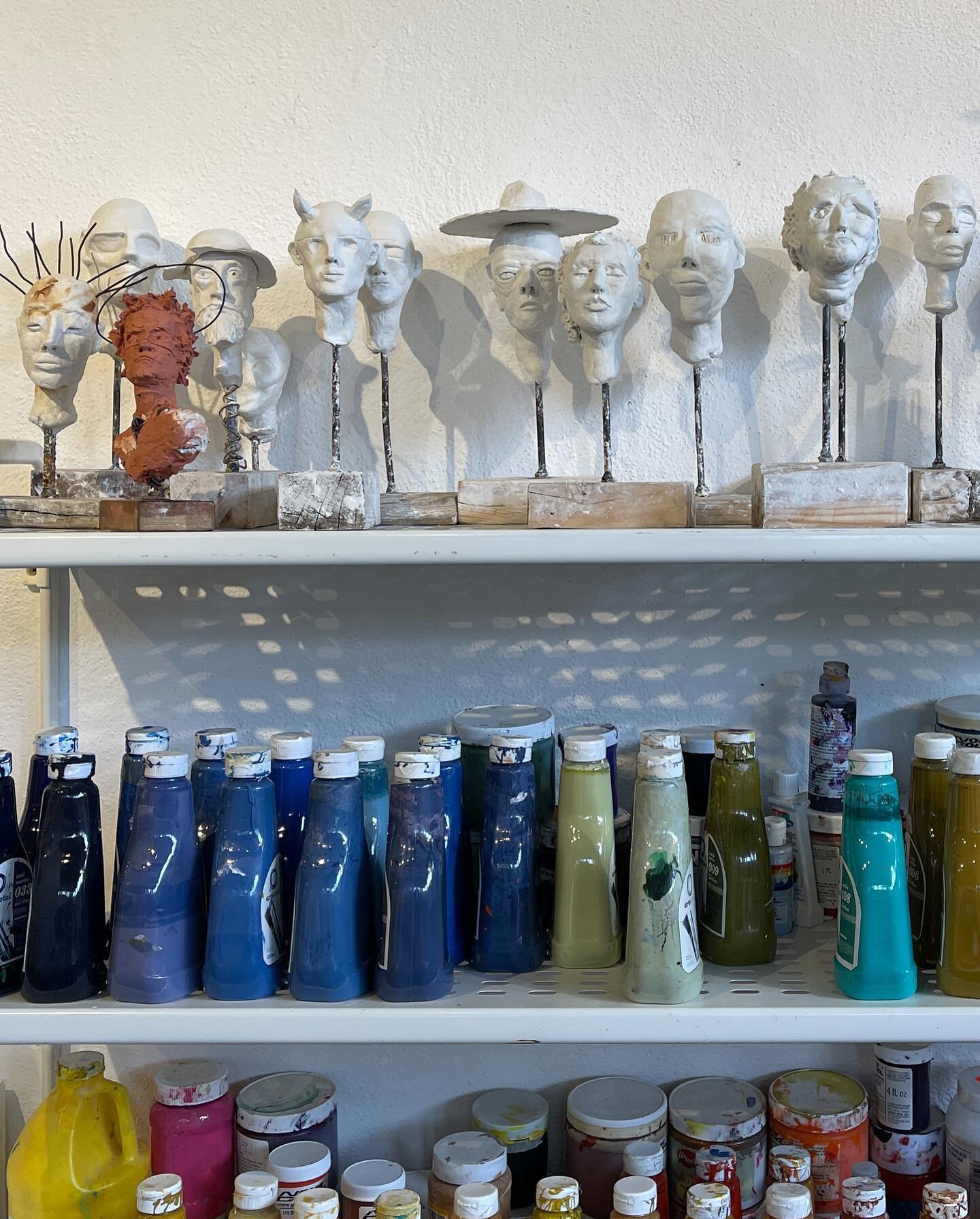
Ceramic heads, painted plates and paintings of Greek mythological figures on the shelves at Oficina Marques in Lisbon

The Creative Duo Behind Oficina Marques

The studio is led by the creative duo Gezo Marques and José Aparício Gonçalves, whose distinctive style draws inspiration from the natural world and embodies the motto “tusa de viver” — the irrepressible desire to live. Their work explores several themes including: Mar (Sea), Mato (Forest), Corpo (Body), Fé (Faith), and Lisboa (Lisbon), each offering a window into how they see life, place and the materials they transform into art.

Oficina means “workshop” in Portuguese, a nod to the handmade nature of their work, while Marques comes from the surname of one of its founders, Gezo, grounding the studio’s name in both craft and personal identity. Their atelier is located in the Interpress building, a former printing and distribution center for newspapers and magazines that was gradually transformed into a vibrant creative hub filled with studios, workshops and galleries. 

The glass door with OM on it at Oficina Marques in Lisbon, Portugal

A Visit to Oficina Marques

When we arrived, the gallery space held a few assemblages made from recycled materials and a couple of framed tile panels. As we looked around, José, one of the founders, popped in and explained that the embossed white and green tile panels were developed in collaboration with Viúva Lamego to celebrate the factory’s 175th anniversary. The partnership resulted in Arcádia, a collection of geometric forms inspired by the mythical Greek utopia, where dryads, nymphs and shepherds lived in harmony with nature. He went on to mention that a temple-like installation of those tiles by Spacegram Studio had been on display in the gallery during Design Week. 

While the gallery itself was filled with a few larger pieces, the adjoining shop felt like a cabinet of curiosities — brimming with original art and objects crafted in the adjacent workshop. Bundles of dried amaranthus, eucalyptus and hydrangea hung from the ceiling, perfuming the air with a faint, earthy sweetness. 

A faun and bird made of recycled wood at Oficina Marques gallery in Lisbon, Portugal

The shelves held an eclectic mix of items: ceramic face vessels and glass cloches filled with curious scenes — the Virgin Mary surrounded by seahorses, starfish and coral; a saint on horseback slaying a dragon-like creature, with a troop of toy soldiers poised for battle at his feet. Hand-painted plates of varying sizes were set among a plaster cast of a classical male nude, along with primitive carved wooden crocodiles, African tribal statuettes, and glinting tin ex-voto hearts — all arranged with a discerning curatorial eye.

We were debating between a small blue-and-white plate with an open hand and another featuring a bare-chested minotaur when I noticed a pair of weathered wooden pieces hanging on the wall, each shaped like a raised hand with symbols etched into the fingers. One was inscribed with the words “Love You,” and the other “Fuck You.” It was at that moment I “went rogue,” as Wally would later say. Without consulting my husband, I looked over at José and said, “We’ll take these.”

José smiled and explained that he and Gezo had found the pieces while out on the beach, scavenging for materials to use in their work. The two boards, he told us, fit together perfectly — a reflection of life’s many dualities. 

After José carefully wrapped our purchase, he invited us to step into his and Gezo’s workshop. We were honored to catch a glimpse of their imaginative world — a place shaped by creations that invite you to think, to feel, to wonder and to imagine. 

And honestly, in a world that can feel heavy with pessimism, a little more levity is just what we all need. –Duke

The exterior of Oficina Marques in Lisbon, Portugal, with potted plants and a sidewalk made of square stones

Oficina Marques

Rua Luz Soriano 71
1200-246 Lisbon
Portugal


How to Apply for English Teaching Jobs in Europe

Teach English in Europe and use your paycheck for weekend trips. Here’s the FAQ guide to making it happen: visas, qualifications, best countries, salary expectations and the insider stuff the other blogs don’t tell you.

A teacher leads a lesson in Barcelona, with La Sagrada Familia behind them, with a globe, chalkboard and laptop

Europe is a buffet of languages, castles, budget airlines and carbs.

The challenge? Experiencing it without coming home to a credit card bill that looks like a Greek tragedy.

Enter: Teaching English in Europe.

It’s flexible, it pays, and it gives you the greatest perk of all: time. Time to wander. Time to travel. Time to pretend you’re in Under the Tuscan Sun.

Whether you picture yourself in a Catalonian classroom or teaching business English in Prague, here’s how to make your European teaching fantasy a real-life paycheck.

A teacher holds a book and leads a lesson in Prague, with a bridge and castle behind her

FAQ: Teaching English in Europe

Is there demand for English teachers in Europe?

Short answer: Yes.

Longer answer: Yes, and your inbox will start to resemble a talent agent’s.

English is still the language of business worldwide, and studies show that over 20% of job listings in Europe require English proficiency. Everyone from university students to professionals to retirees wants to level up their English, and they need native (or near-native) speakers to help.

A man teaches English in London, with Big Ben, the London Eye and a historic building behind him

Why teach English in Europe? 

Besides the croissants, you get:

1. A dreamy work/life balance

Most contracts average around 35 hours a week (or less). Weekends are for hopping trains to a different country because… well… Europe.

2. Attractive pay + perks

Salaries vary by country, but many schools include:

  • Housing assistance

  • Transportation stipends

  • Health insurance

Translation: Your money goes to travel, not rent.

3. Easy, affordable travel

Cheap regional flights. Trains that actually run on time. Buses for €3.

You’ll become the person who says, “Well since we’re already in Slovenia…”

4. Food worth relocating for

Eat pasta in Rome. Bratwurst in Berlin. Brie in Lyon. Fish ’n’ chips in the U.K.

A teacher in a hijab in Paris, clutching a notebook, with the Eiffel Tower and an ornate streetlamp behind her

Where can I teach English in Europe?

You can find work almost anywhere, but these destinations are the greatest hits:

  • Spain: Madrid and Barcelona are classics for a reason: big expat community, tons of language schools.

  • Italy: Milan, Florence and Rome are magnets for teachers who want culture + carbs.

  • Czechia: Prague gives fair salaries, low cost of living and a built-in community of teachers.

  • Poland: A rapidly growing market, excellent work/life balance and very affordable living.

A man in a wheelchair teaches English in Berlin, Germany, with the Brandenburg Gate and a train behind him

What qualifications do I need to teach English in Europe?

You don’t need a degree for many adult and language school roles.

You do need:

  • A TEFL (Teaching English as a Foreign Language) certification, which takes a minimum of 120 hours, from a reputable provider

It tells employers you know how to structure a lesson — and you didn’t just wake up and say, “I think I’ll be a teacher today.”

It also helps with visas and sponsorship in several countries.

A nonbinary person wearing glasses with pastel-dyed hair teaches English in Amsterdam, with narrow buildings, tulips and a bike around them

Do I need a visa to teach English in Europe?

If you’re an EU citizen, it’s easy.

If you’re not (hi, Americans), it’s still doable, there’s just more paperwork.

Options include:

  • Working visas (school sponsorship)

  • Working holiday visas (depends on nationality)

  • Language assistant programs (government-run placements)

  • Digital nomad visas (if teaching online)

Moral of the story: Research the specific visa rules before you start sending applications.

A woman teaches English in Lisbon, Portugal, surrounded by a globe, the Belem Tower, a streetcar and bridge

What teaching roles are available?

You’re not limited to standing in front of a chalkboard.

You can teach:

  • In public or private schools

  • At language academies

  • Business English inside companies

  • At summer camps

  • Online (live anywhere, work from everywhere)

An older woman sits in a chair, teaching English in Athens, Greece, with the Parthenon and nearby temple behind her

What are the steps to becoming an English teacher in Europe?

  1. Get your TEFL certification (120+ hours). This shows you’re serious and gives you the basics: lesson planning, classroom management, etc.

  2. Search for jobs. Try:

    • Major language school chains

    • TEFL job boards

    • Local career sites in your target country

  3. Consider government programs. Spain and France, for example, both have teacher placement programs.

  4. Research visas early. Visas tend to move slowly. (European bureaucracy loves paperwork. And stamps.)

  5. Budget your move. Understand the cost of living and how long until that first paycheck lands.

A young woman with constellation tattoos teaches English in Krakow, Poland, with the city behind her

So… is this really a good way to experience Europe?

Absolutely. Instead of visiting Europe, you get to live Europe. Living abroad, you become a regular at a café. You have favorite bakery staff who know your order. You find yourself muttering, “Ugh, tourists,” like you didn’t arrive on the same flight.

And before you know it, you’re planning weekend trips based on whatever city is calling your name.

Ready to make Europe your classroom?

Get the TEFL, send the applications, and book the one-way ticket. Your future self — living near a 14th century cathedral and eating €2 gelato — will thank you. –Shahroz Yousaf


ANOTHER OPTION: Have you thought about being a licensed practical nurses (LPNs) abroad?

Snowed-In Layover at MSP: Skyways Survival, Saunas & Sweet Spots

Got a layover at Minneapolis–Saint Paul International Airport? Here’s how to amuse yourself, from a terminal massage to a quick trip downtown via the skyways.

A handsome man with a tattoo sleeve gets a chair massage at MSP airport

You step off the plane, and the jet bridge exhales a blast of arctic air. Outside, Minneapolis is a snow globe; inside, the terminal hums with gate changes and scarf-wrapped travelers clutching hot coffee. You’ve got three to six hours until your next flight. Great. 

But a winter layover at MSP can be fun. It’s an invitation to warm up, wander smart and waste precisely zero time.

A woman in winter garb holds a to-go cup of coffee and goes down an escalator at MSP airport with her suitcase

The 3-to-6-Hour MSP Game Plan: Choose Your Own Cozy

Before you sprint toward the nearest cinnamon roll, map the layover by time:

  • 3 hours or less: Stay terminal-side. Walk to reset your circulation, grab one indulgent local treat, book a shoulder-saving mini-massage, and pick one micro-mission (reading nook, art stroll or people-watching perch near a window).

  • 4–5 hours: Consider a quick city dip. The Metro Blue Line from MSP to downtown runs directly from both terminals. Trains run frequently, and the ride to the core is under half an hour each way, so you can touch base with Minneapolis without flirting with a missed connection.

  • 6 hours: Stretch your legs downtown via the skyways (more on that below), nibble something warm, and loop back with a cushion to spare.

Pro tip: If you drove to the airport: Avoid terminal garage sticker shock by pre-booking off-site MSP parking so arrival and departure are frictionless. It’s dull logistics that pays you back in actual fun once you’re landside.

A man holds a cup of coffee while looking out the window at MSP airport

MSP Terminal Comforts: Heat, Knead, Feed

This is a winter layover: Your core mission is warmth and circulation. Inside MSP, you’ll find:

  • Quick kneads. Ten to 30 minutes in a massage chair can reset even the surliest spine before a long haul. If you’re the “I didn’t know my neck could make that sound” traveler, build one mini-treatment into your itinerary.

  • Warmth by walking. Terminals here are made for laps. Lace up, cue a podcast, and walk 10 to 20 minutes between bites or tasks. Your joints (and mood) will thank you at cruising altitude.

  • Strategic calories. Think “one hot + one hydrating”: soup or a toasted sandwich plus a giant water to counteract the dehydrating air. If you do coffee, chase it with water so you don’t arrive at your gate feeling like a raisin in a parka.

  • Delay insurance. Put your meds, a spare pair of socks, and a portable battery in your personal item — not the carry-on you gate-check when overheads fill up. If chaos hits, you’ll still be functional. If chaos really hits, you’ll appreciate how to not freak out if you lose your wallet — mindset and method matter when travel gets messy.

A woman smiles as she walks through the Skyway in Minneapolis, Minnesota

Want a Taste of Minneapolis? Ride & Glide

If your layover is 4–6 hours and the weather isn’t actively auditioning for a disaster movie, do the quick city loop:

  1. Hop on the Blue Line. From Terminal 1 or 2, board the light rail toward downtown. Trains are frequent, and it’s a straight shot to Nicollet Mall/Target Field. Check schedules and any service alerts before you commit; the official pages keep them current.

  2. Enter the sky. Downtown’s enclosed walkways are the city’s winter superpower — roughly 10 miles of climate-controlled routes connecting about 80 blocks. Think of it as a heated maze where you can wander without windburn. Hours vary by building (weekday-heavy), so plan for daytime/early evening access.

  3. A tiny “sky-tour.”

    • From the Nicollet area, duck into an entrance and follow overhead signage toward retail or food courts.

    • Loop two to four blocks, pausing where you see cozy seating or bakery smells (the best compass).

    • Snap a skyline peek from an elevated window and then reverse course. The goal isn’t maximal sightseeing; it’s staying toasty while you get a feel for Minneapolis’ unique winter rhythm — walking without ever going outside.

  4. Time discipline. Set a departure alarm that gets you back on the Blue Line with a generous buffer. Winter means slower everything; your future self would like to avoid cardio sprints in snow boots.

Weather reality check: Minneapolis winters can deliver serious wind chills. If you’re curious how cold it really feels, the National Weather Service’s wind chill chart translates temps and wind into “what your face experiences,” so you can decide whether street-level detours make sense, or if indoor skyways should be your sole playground.

A woman enters her hotel room with her suitcase at the InterContinental MSP

Heat Therapy, Minnesota Edition: Saunas, Steam and “Warm Enough” Hacks

No, MSP isn’t Helsinki. But you can still nudge your core temp upward without a full spa day:

  • Hotel-adjacent warmth. The InterContinental MSP connects to Terminal 1 via skybridge and (when operating) offers a dedicated TSA checkpoint window for carry-on travelers — handy if you’re starting or ending in Minneapolis and want a “roll out of bed, roll onto plane” morning. Even if you’re not staying the night this time, earmark it for a future trip when you are starting in MSP; the path beats a frosty curbside dash. (Always verify current hours before you plan around them.)

  • Make your own sauna lite. Swap a bulky coat for tactical layers you can modulate: thermal tee, mid-layer fleece, packable shell. Layering beats sweating, then freezing, especially when you’re transitioning between warm terminals, brisk platforms and steamy coffeeshops. (If you’re revisiting your packing system, you might find the field-tested notes on what to pack for South America useful — different continent, same principles of warmth, weight and sanity.)

  • Hands and feet first. Carry a tiny tube of unscented balm (for nose and lips), thin glove liners that work with phone screens, and wool socks that keep your toes snug and warm. If you’re prone to Raynaud’s, stash disposable hand warmers and use them before you feel the sting.

  • Hydrate and humidify. Winter air is bone-dry. Drink more water than you feel comfortable with, and if you’re sensitive, a pocket-sized saline spray can do wonders. Your skin will forgive you by the next boarding call.

  • Mindset matters. Long layovers feel better with a small, self-sufficient kit and a loose plan — exactly the ethos of how to survive and actually enjoy off-grid travel. You don’t need a cabin in the woods to use those habits; an airport in February will do.

The Minneapolis skyline with the Stone Arch Bridge over the Mississippi River in the foreground, as a plane flies overhead

Micro-Itineraries for an MSP Layover

3-Hour Thaw: Staying Airside

  • 0:00–0:10 — Walk a long loop to shake off the plane

  • 0:10–0:40 — Quick chair massage, shoulders + neck

  • 0:40–1:10 — Soup and water; download podcasts or audiobooks

  • 1:10–2:10 — Art stroll + bookshop browse; text the friend you always forget to text

  • 2:10–3:00 — Gate shift, stretch, board

4½-Hour Tour: Touching the City

  • 0:00–0:15 — Exit to the Blue Line platform; set your return alarm

  • 0:15–0:45 — Train to Nicollet Mall; enter an indoor walkway; browse a couple of blocks for a warm lunch

  • 0:45–1:45 — Loop through the skyways; peek at street views from elevated windows

  • 1:45–2:15 — Train back to MSP

  • 2:15–3:00 — Security + hydration + boarding buffer

6-Hour Itinerary: Maximizing Comfort

  • Split your time:

    • An hour of movement (walks)

    • An hour of eating (twice)

    • An hour of errands (charging, reorganizing your bag), plus transit and buffers

    • If the wind-chill reading makes you wince, keep the whole thing indoors and bask in the fact that Minneapolis lets you wander for blocks without ever braving the curb.

A man stands on the platform of the Blue Line metro in Minneapolis, Minnesota in the snow

Minneapolis Winter Know-Before-You-Go

  • Transit timing. Blue Line frequency and travel times are predictable, but winter can slow transfers. Always skim the official page right before you commit to the downtown hop; it’ll flag any service changes.

  • Skyway hours vary. Many connections keep weekday business hours, with shorter weekends. If you’re planning a Saturday or Sunday wander — or an evening hop — expect a smaller network than the lunch-hour rush.

  • Layer logic beats heavy coats. You’ll move between overheated interiors and brisk platforms; being able to peel or add is the difference between “glow” and “sweaty popsicle.”

  • Security reality. Liquid rules are still very much a thing in the U.S., so consolidate your gels/creams into a 1-quart bag, and don’t gamble on oversized lotions. If you need a refresher, the official TSA liquids rule is the no-drama reference — worth a peek before you hit the checkpoint on your way back to the gate.

  • Money and ID always accessible. Keep a small “essentials kit” (ID, a backup credit or debit card, some cash, phone) on your person.

  • If you’re a “park and fly” person. For multi-day trips, booking offsite parking in advance means you’re not circling garages at odd hours or paying top-tier prices on return day. Treat it like lodging: The earlier you book, the saner the rate and the smoother your exit.

  • Pack a small mercy. A spare pair of socks. Trust me. Dry wool on cold feet is a personality upgrade. It’s something you don’t ever want to forget to pack.

A gay couple with their carry-on luggage and backpacks have a meal and glasses of wine at a cafe in Minneapolis

A snowed-in layover can be a slog, but it can also be a strangely lovely intermission: a heated stroll above the streets, a real meal, a reset for your brain and back, and a tiny story to take home. You don’t need to conquer Minneapolis in an afternoon; you just need to leave warmer, calmer, and a little bit smug about how well you used the time. –Munazza Faisal

Best Secrets to Find Common Ground Anywhere

You don’t need a shared language to understand someone — just an open mind, a curious heart and maybe a meal together. Discover the simple, human gestures that turn strangers into friends anywhere in the world.

A woman shops at a fruit stand at a market, with awnings and other shoppers and vendors carrying baskets of flowers and vegetables

It doesn’t matter where you go — the language, the food or even the way people cross the street can feel alien. Yet, beneath all that difference, a pulse remains the same: People want to connect. In a world that moves faster than your next flight, finding common ground is more than just being polite; it’s survival for the modern traveler, the curious mind and the restless soul.

Travel is a series of encounters. And in every one, culture becomes both a bridge and a wall. According to a recent survey by Arival, over 65% of travelers say their most memorable experiences come from interactions with locals, not sightseeing. That statistic tells a quiet truth — shared understanding turns destinations into stories.

Here’s how to find common ground and make connections no matter where you travel: 

Two women talk over coffee at a cafe in Prague, Czech Republic

1. Start with listening — not talking. 

The first and most underestimated secret is silence. People often mistake connection for conversation, but the reality is gentler. Listening is what opens the door. When traveling to new cultures, the rhythm of speech, tone and pauses can often tell more than words themselves.

Think about it. When you’re in a market in Morocco, in a café in Prague or waiting for a train in Japan, what makes you part of that place isn’t what you say — it’s how you observe. Active listening, psychologists note, improves empathy and helps form trust almost 40% faster than normal conversation.

So, whether you’re in the middle of an adventure through remote villages or navigating a big city, the rule holds: The quieter you become, the more you hear.

A man with a backpack talks with a Japanese family in a train compartment, with Mount Fuji seen out the window

2. Learn the little things. 

Culture isn’t always grand architecture or traditional festivals. Sometimes it hides in how people greet each other or how they serve tea. A traveler who learns to notice those things becomes less of an outsider.

Try saying just one word in the local language — not perfectly, just honestly. A study from the University of Cambridge showed that even a small attempt at local language increases positive reactions by nearly 70% in social encounters abroad. Why? Because effort is universal respect.

Adventure can also be about humility — learning from others without trying to prove that you already know something.

A gay couple is handed tacos from a street vendor in Mexico

3. Share food, share worlds. 

There’s no faster way to find common ground than by sharing a meal. Every dish is a cultural message — spicy, sweet, bitter or subtle, it tells a story of geography, history and survival. Sitting at a table, even in silence, can melt barriers faster than words.

In Thailand, you’ll see travelers and locals sharing street food without hesitation. In Italy, long lunches turn strangers into family. In Mexico, a tortilla passed from one hand to another carries warmth that no translation can express. Food, in essence, is diplomacy in disguise.

And yet, it’s more than that. Eating together reminds us that human adventure is shared — that we all need nourishment, warmth, laughter.

A woman video chats with a man on her laptop in a hotel room

4. Be curious, not  judgmental. 

It’s tempting to compare. To measure one culture by another. But to find common ground, curiosity must replace judgment. Curiosity leads to stories. Judgment leads to silence.

When you ask, ”Why?” instead of saying, “That’s strange,” you invite the world to explain itself to you. A traveler once said, “The moment you stop being surprised, you stop traveling.” And you don’t have to physically travel the world; you can open a window through live video platforms like CallMeChat and similar services. Chatting online helps you get to know new cultures and people, and develop your curiosity right from your smartphone or PC.

A family in a tuk tuk laughs with the driver

5. Use shared emotions. 

You may not share a language, but you share emotions. Laughter, surprise, gratitude — these are cultural passports. A smile can speak faster than Google Translate ever could. In moments of misunderstanding, humor eases the tension.

When someone helps you find your way or teaches you something local, gratitude bridges the gap. Travel is a lesson in vulnerability — in allowing yourself to be seen not as a tourist, but as a fellow human being.

Fans cheer on the sidelines of a football game in Brazil

6. Join local life, even briefly. 

To find common ground, you must step into daily rhythms — even if just for a short time. Take a bus, visit a community market, attend a local game or help in a small project. When you participate, you cross the line between observer and participant.

In studies, cultural immersion is said to increase empathy after a week or so of active engagement. That means walking the same streets, sharing the same weather, even facing the same small inconveniences — because in those moments, you stop being a visitor and start being part of the place.

Adventure becomes a two-way story. You take memories, yes, but you also leave traces — laughter, kindness, maybe a promise to return.

A nonbinary person smiles and holds their phone while talking with two boys by ancient ruins

7. Let technology help — but not lead. 

It’s tempting to rely on translation apps, maps or social platforms to connect. Yes, they’re useful — essential even. But the risk is losing the raw, human unpredictability that makes connection real.

Technology should foster connection, not isolation. It can help you learn a few words, understand customs or find cultural events nearby. Yet the deepest understanding happens offline — when you look up, make eye contact and exchange gestures instead of data.

A woman visiting a mosque takes off her shoes, puts on a scarf and kneels while a woman watches, smiling

Respect: The Core of Connection

Respect is the quiet foundation of all shared ground. It’s not about agreement; it’s about acknowledgment. You can admire another culture without adopting it. You can disagree without disrespecting.

When you travel through new lands, remember that your exploration unfolds in someone else’s home. Remember that. The more respect you give, the more culture gives back.

In fact, surveys across multiple countries show that travelers rated “respect for local customs” as the most appreciated trait in foreigners — above generosity or politeness. That says everything.

A multicultural group sits around a brazier with fire, some drinking hot beverages, and one man playing the guitar while the sun sets

Finding Universal Ground

Every culture is a mirror — sometimes clear, sometimes foggy — reflecting a version of humanity back at you. Finding common ground isn’t about losing your identity; it’s about expanding it.

Travel, when done right, teaches that there is no them. There’s only us, in different forms, languages and stories. And adventure — the real kind — begins when you start to see yourself in others.

In the end, the best secret to finding common ground anywhere is simple: Be human, and let others be, too. Everything else — the smiles, the shared food, the laughter, the lessons — will follow naturally. –William Charest

RELATED: How Living Abroad Will Challenge and Change You

Old City Chiang Mai: Culture, Markets and Routes for Tourists

Discover the Old Town of Chiang Mai, where ancient temples, vibrant markets and scenic walking routes bring Thailand’s Lanna heritage to life.

The Old City of Chiang Mai is a living testament to a rich cultural heritage and history. With its ancient temples, charming streets and bustling markets, it offers a perfect blend of tradition and modern life. 

The city’s old walls and moat, which once protected it, now provide a scenic backdrop to the vibrant cultural scene. From serene Buddhist temples to lively night bazaars, there’s something for everyone. We’ll explore the best cultural sites, markets and walking routes in Chiang Mai’s Old City, offering helpful tips for tourists looking to fully experience the essence of this historic location.

As with any popular tourist destination, it’s important to stay aware of your surroundings and ensure personal safety. Travelers should be cautious of potential scams or fraudulent activities that could arise during their visit. For those unfamiliar with the term, white collar crime (คือ) refers to financial crimes like fraud or embezzlement, which can affect both locals and tourists alike. Understanding the risks will help you have a safe and enjoyable trip.

Historical Value and Culture of the Old City Chiang Mai

Chiang Mai is one of the oldest and most culturally rich cities in Thailand. The Old City of Chiang Mai, surrounded by a moat and walls, is a true open-air museum that attracts tourists with its history and architecture. Here, ancient temples and pagodas have been preserved, most of which were built in the style of the Lanna Kingdom. The temples of Wat Phra Singh and Wat Chedi Luang are just a couple of the many sacred sites worth visiting.

A walk through the streets of the Old City allows you to feel the atmosphere that has been preserved from ancient times. The city blends tradition with modernity: On one street, you can see ancient temples, while on another, you will find modern cafés and shops. This contrast creates a special atmosphere that attracts travelers from all over the world.

MORE: Find these off-the-beaten-path Chiang Mai temples

Main Markets and Local Attractions of Chiang Mai

Chiang Mai is known for its markets, which are an integral part of local culture. The day market, known as Chiang Mai Rat, is where tourists can buy souvenirs, local products and handmade goods. However, the most famous is the Chiang Mai Night Market, which operates from evening until late at night. This is a great place to purchase unique items such as leather goods, silverware, textiles, and also to enjoy local street food.

MORE: Where is the best street food in Chiang Mai?

In addition to the markets, Chiang Mai has several museums, such as the Art Museum and the National Museum of Chiang Mai. All of these places provide an excellent opportunity to learn more about the culture and history of the region.

To fully enjoy the atmosphere of the city, it is recommended to visit these markets early in the morning or later in the evening, when the temperature is more comfortable and the number of tourists is lower.

Chiang Mai Walking Routes and Excursions

Walking through the Old City of Chiang Mai is a wonderful way to enjoy its atmosphere. For those who enjoy walking, there are several interesting routes that allow you to see all the major attractions of the city — especially if you want to see the Thai Buddhist temples of Chiang Mai. For cyclists, there are designated bike routes that pass through green areas and offer the opportunity to get acquainted with the local nature.

You can also participate in guided tours that help you understand the culture and history of the city more deeply. For those who prefer independent routes, there is the option of hiring a guide who will tell you about historical sites and traditions of the region.

For tourists who prefer safe areas, the Old City is an ideal choice, as most tourist attractions are within walking distance and you can peacefully stroll through the quiet streets.

Useful Information for Travelers and Legal Aspects

Chiang Mai is a safe place for travel, but there are always some safety aspects to consider. For visitors to Thailand, a visa is required for many countries, so it is important to take care of obtaining it in advance. It is also crucial to have medical insurance for the trip, which will cover any unforeseen expenses in case of illness or accidents.

Additionally, it is important to be informed about the legal aspects of staying in Thailand. For example, crimes related to financial manipulation or illegal activities can result in serious consequences. White collar crime in Thailand refers to crimes related to fraud, corruption, and other financial violations. It is important to comply with local laws to avoid legal troubles.

Also, remember that if legal issues arise in Thailand, you can turn to Interpol Thailand for consultation and assistance in resolving legal problems. This will help ensure your safety while staying in the country. –Anatoly Yarovyi


Anatoly Yarovyi is a Ukrainian attorney and human rights advocate with over 20 years of experience. He holds masters of laws (LL.M.) from Ivan Franko National University of Lviv and Stanford University, specializing in international law and extradition cases.