spain

How to Apply for English Teaching Jobs in Europe

Teach English in Europe and use your paycheck for weekend trips. Here’s the FAQ guide to making it happen: visas, qualifications, best countries, salary expectations and the insider stuff the other blogs don’t tell you.

A teacher leads a lesson in Barcelona, with La Sagrada Familia behind them, with a globe, chalkboard and laptop

Europe is a buffet of languages, castles, budget airlines and carbs.

The challenge? Experiencing it without coming home to a credit card bill that looks like a Greek tragedy.

Enter: Teaching English in Europe.

It’s flexible, it pays, and it gives you the greatest perk of all: time. Time to wander. Time to travel. Time to pretend you’re in Under the Tuscan Sun.

Whether you picture yourself in a Catalonian classroom or teaching business English in Prague, here’s how to make your European teaching fantasy a real-life paycheck.

A teacher holds a book and leads a lesson in Prague, with a bridge and castle behind her

FAQ: Teaching English in Europe

Is there demand for English teachers in Europe?

Short answer: Yes.

Longer answer: Yes, and your inbox will start to resemble a talent agent’s.

English is still the language of business worldwide, and studies show that over 20% of job listings in Europe require English proficiency. Everyone from university students to professionals to retirees wants to level up their English, and they need native (or near-native) speakers to help.

A man teaches English in London, with Big Ben, the London Eye and a historic building behind him

Why teach English in Europe? 

Besides the croissants, you get:

1. A dreamy work/life balance

Most contracts average around 35 hours a week (or less). Weekends are for hopping trains to a different country because… well… Europe.

2. Attractive pay + perks

Salaries vary by country, but many schools include:

  • Housing assistance

  • Transportation stipends

  • Health insurance

Translation: Your money goes to travel, not rent.

3. Easy, affordable travel

Cheap regional flights. Trains that actually run on time. Buses for €3.

You’ll become the person who says, “Well since we’re already in Slovenia…”

4. Food worth relocating for

Eat pasta in Rome. Bratwurst in Berlin. Brie in Lyon. Fish ’n’ chips in the U.K.

A teacher in a hijab in Paris, clutching a notebook, with the Eiffel Tower and an ornate streetlamp behind her

Where can I teach English in Europe?

You can find work almost anywhere, but these destinations are the greatest hits:

  • Spain: Madrid and Barcelona are classics for a reason: big expat community, tons of language schools.

  • Italy: Milan, Florence and Rome are magnets for teachers who want culture + carbs.

  • Czechia: Prague gives fair salaries, low cost of living and a built-in community of teachers.

  • Poland: A rapidly growing market, excellent work/life balance and very affordable living.

A man in a wheelchair teaches English in Berlin, Germany, with the Brandenburg Gate and a train behind him

What qualifications do I need to teach English in Europe?

You don’t need a degree for many adult and language school roles.

You do need:

  • A TEFL (Teaching English as a Foreign Language) certification, which takes a minimum of 120 hours, from a reputable provider

It tells employers you know how to structure a lesson — and you didn’t just wake up and say, “I think I’ll be a teacher today.”

It also helps with visas and sponsorship in several countries.

A nonbinary person wearing glasses with pastel-dyed hair teaches English in Amsterdam, with narrow buildings, tulips and a bike around them

Do I need a visa to teach English in Europe?

If you’re an EU citizen, it’s easy.

If you’re not (hi, Americans), it’s still doable, there’s just more paperwork.

Options include:

  • Working visas (school sponsorship)

  • Working holiday visas (depends on nationality)

  • Language assistant programs (government-run placements)

  • Digital nomad visas (if teaching online)

Moral of the story: Research the specific visa rules before you start sending applications.

A woman teaches English in Lisbon, Portugal, surrounded by a globe, the Belem Tower, a streetcar and bridge

What teaching roles are available?

You’re not limited to standing in front of a chalkboard.

You can teach:

  • In public or private schools

  • At language academies

  • Business English inside companies

  • At summer camps

  • Online (live anywhere, work from everywhere)

An older woman sits in a chair, teaching English in Athens, Greece, with the Parthenon and nearby temple behind her

What are the steps to becoming an English teacher in Europe?

  1. Get your TEFL certification (120+ hours). This shows you’re serious and gives you the basics: lesson planning, classroom management, etc.

  2. Search for jobs. Try:

    • Major language school chains

    • TEFL job boards

    • Local career sites in your target country

  3. Consider government programs. Spain and France, for example, both have teacher placement programs.

  4. Research visas early. Visas tend to move slowly. (European bureaucracy loves paperwork. And stamps.)

  5. Budget your move. Understand the cost of living and how long until that first paycheck lands.

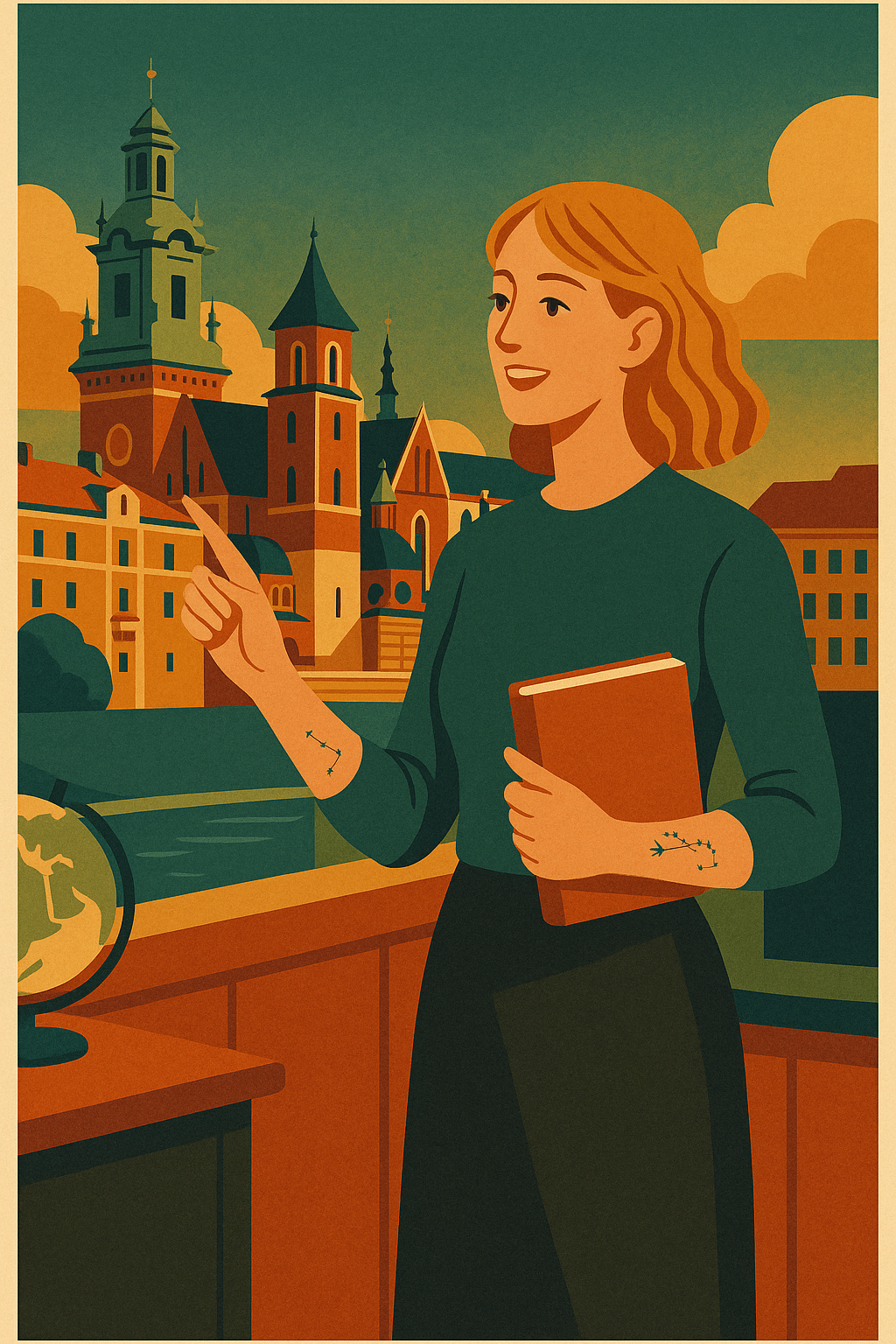
A young woman with constellation tattoos teaches English in Krakow, Poland, with the city behind her

So… is this really a good way to experience Europe?

Absolutely. Instead of visiting Europe, you get to live Europe. Living abroad, you become a regular at a café. You have favorite bakery staff who know your order. You find yourself muttering, “Ugh, tourists,” like you didn’t arrive on the same flight.

And before you know it, you’re planning weekend trips based on whatever city is calling your name.

Ready to make Europe your classroom?

Get the TEFL, send the applications, and book the one-way ticket. Your future self — living near a 14th century cathedral and eating €2 gelato — will thank you. –Shahroz Yousaf


ANOTHER OPTION: Have you thought about being a licensed practical nurses (LPNs) abroad?

The Smarter Way to Stay Near Barcelona: Rent a Villa in Sitges

Looking for a place to stay near Barcelona? Just 30 minutes away, Sitges combines a gay-friendly beach vibe with easy city access. Here’s why renting a villa in Sitges might be the smartest move for your next trip.

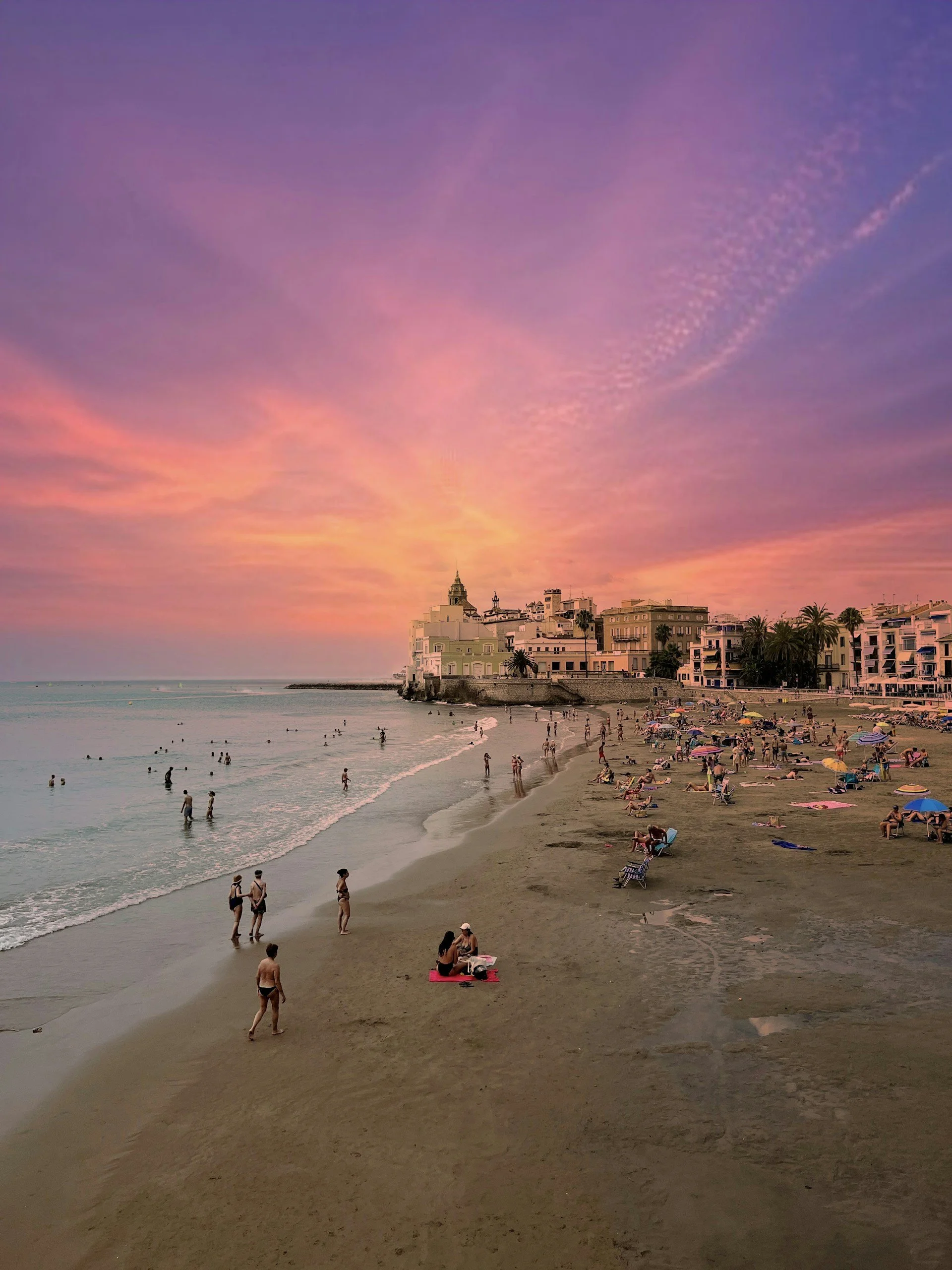
The waterfront of Sitges, Spain at sunset

Barcelona gets a lot of love — and rightfully so. It’s a city bursting with culture, creativity and food that makes you want to cancel your return flight. But if you’re planning a trip to this part of Spain and want a slower, more intimate experience without sacrificing access to the city, it’s worth looking just a bit down the coast.

Welcome to Sitges, a seaside town with enough charm to rival its famous neighbor — and a growing reputation as one of the best spots in Catalonia for relaxed, authentic travel.

Beachgoers on the sand and in the water in Sitges, Spain, with a purplish pink sunset

So Why Sitges?

Sitges sits just 30 minutes from Barcelona by train, but it offers a very different rhythm. With its whitewashed façades, palm-lined promenades, art galleries and hidden beaches, Sitges feels like a Mediterranean postcard come to life. It’s long been a favorite of artists, writers and other creatives, and in recent years, it's become a go-to for travelers seeking a mix of beachside tranquility and cultural flair.

You’ll still find great food (from local seafood to global fusion), a lively LGBTQ+ scene and plenty of opportunity to dance until dawn. But you’ll also find moments of quiet: morning walks by the sea, wine tastings in the hills of Penedès, and long, unhurried lunches.

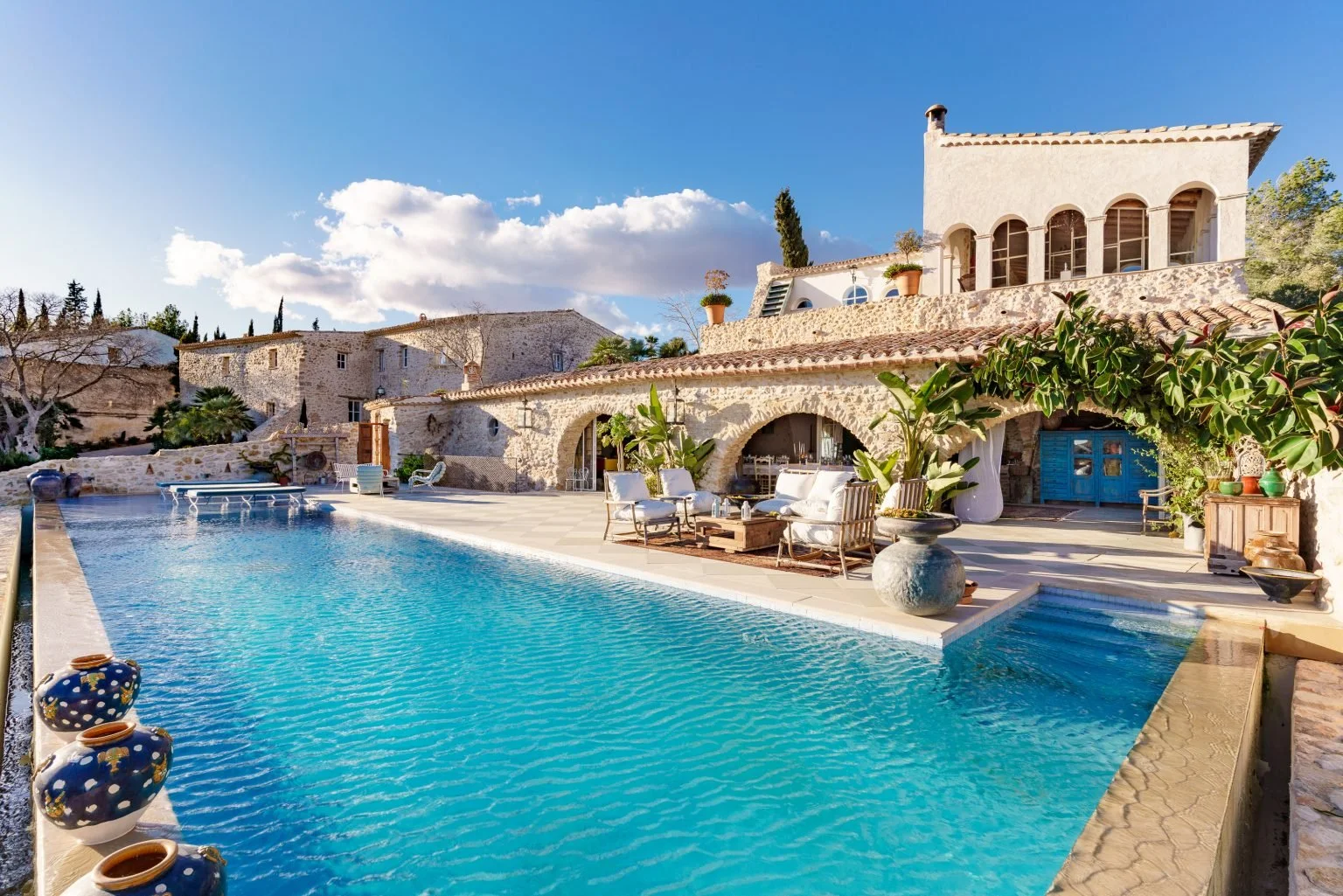
A Mediterranean-style villa with large pool in Sitges, Spain

Why Choose a Villa Over a Hotel?

When most people plan a trip to Spain, they default to hotels or rentals in the city. But Sitges offers a different kind of accommodation — one that’s growing in popularity, especially for longer stays or group travel: private villas.

So, what makes a villa special?

  • Space: Villas often come with multiple bedrooms, living areas, private gardens and pools — making them ideal for families, friend groups or even digital nomads seeking more comfort.

  • Flexibility: There’s no need to wake up for the hotel breakfast or worry about noisy hallways. You eat when you want, swim when you want, and relax on your own schedule.

  • Connection: Villas create a different kind of experience. Cooking together, lounging by the pool, having conversations over wine at sunset — it’s the kind of setting that invites you to truly connect with your travel companions.

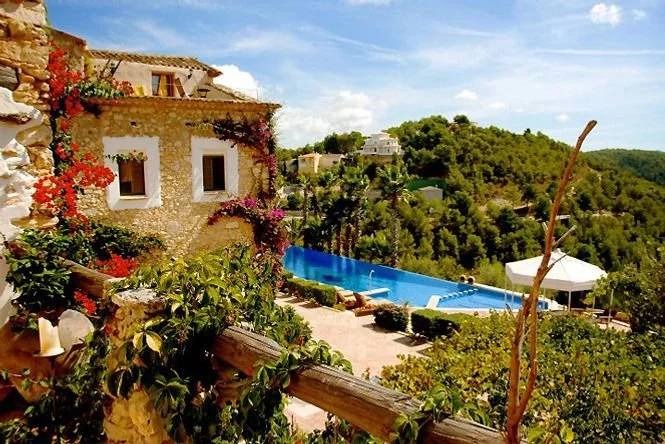
A tan stone villa with pool and greenery in the hills of Sitges, Spain

What to Look For in a Villa Stay

Not all villas are created equal, of course. Some are better suited for couples, others for large groups or remote workers. If you’re considering this kind of stay in Sitges, here are a few things to keep in mind:

  • Location: Some villas are tucked away in the hills with panoramic views, while others are walking distance to the beach or town center. Choose based on your priorities: peace and quiet or easy access to town.

  • Amenities: A pool, outdoor dining area, well-equipped kitchen and air conditioning are essentials during summer. Some villas also offer concierge services, bike rentals or yoga sessions.

  • Local insight: Booking through platforms that know the area — or local agencies — often gives you access to insider tips that make your stay even better.

A modern white villa with pool in Sitges, Spain

Where to Start Your Search for a Sitges Villa

There are plenty of platforms to browse villa rentals, from the big global ones to smaller local specialists. One option worth exploring is Utopia Villas, a Sitges-based company that curates a selection of stylish, well-located properties across the region. They offer villas for different types of travelers and budgets, and can also help organize extras like airport transfers or private chefs.

If your idea of a good trip includes space to breathe, the sound of waves instead of city traffic, and the chance to live more like a local than a tourist, renting a villa in Sitges might be your best move.

It’s a slower, more intentional kind of travel — one where you don’t just visit, but stay. –Sophia Martin


Sophia Martin is a travel writer who focuses on Mediterranean destinations. She has explored Spain’s coast, from Costa Brava to Sitges, and writes about local culture, food and travel experiences. When not writing, she enjoys wine tasting and sketching seaside towns from a café terrace.

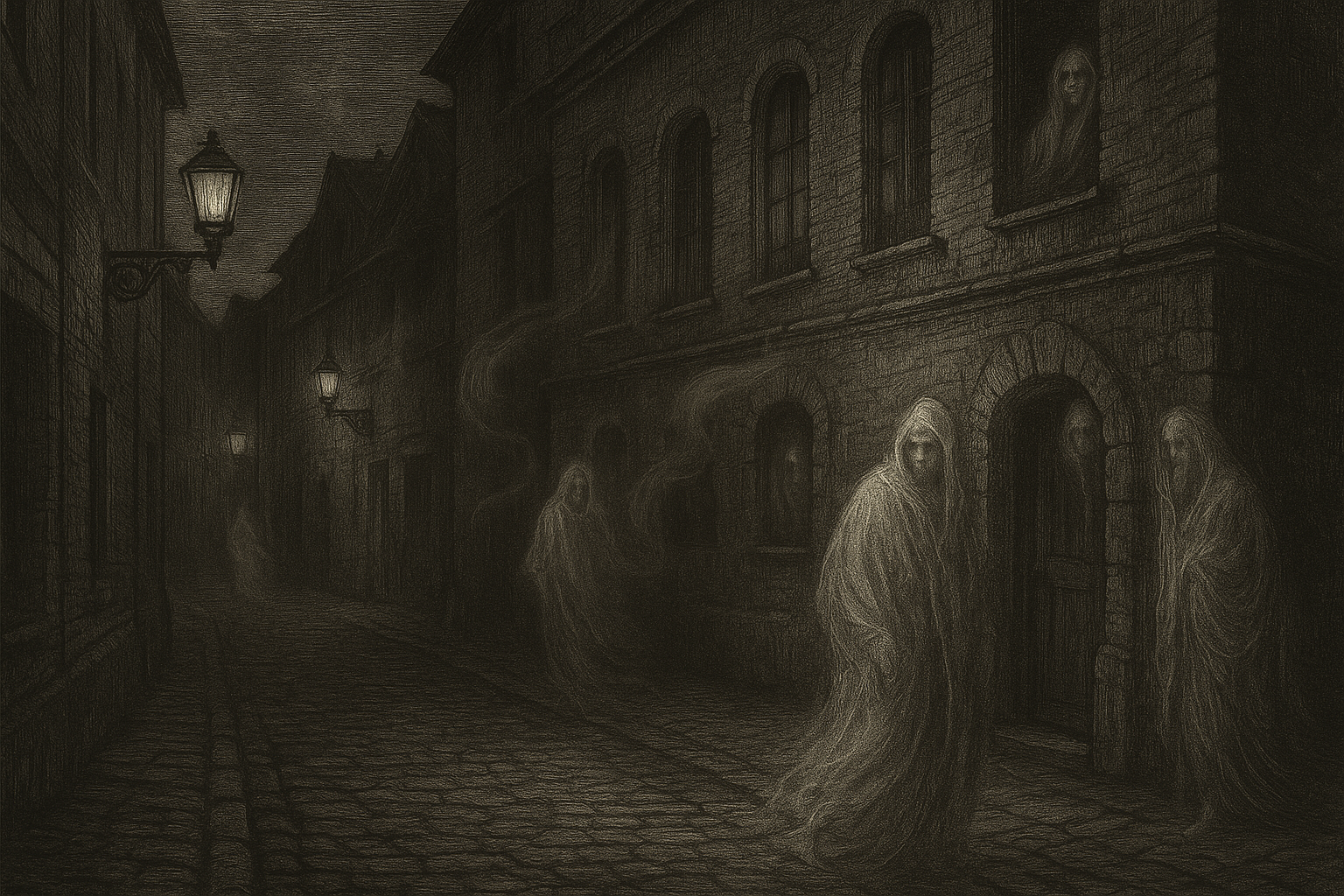
Madrid Legends and Ghost Stories: Haunting Tales From Spain’s Capital

Discover Madrid’s haunted history — from royal scandals to ghostly legends that still linger in its palaces, plazas and rooftops.

You could go almost anywhere on this spinning green globe — but Spain hits different. Sure, the sun-drenched beaches of Tenerife and Mallorca are calling, and flamenco in Sevilla is a whole event in itself. But if you’re like me, you want something more than a postcard. You want stories. Secrets. Shadows.

And while Sevilla has its share of ghost stories, I ended up in Madrid — not just for the churros and Goya paintings, but for the whispered legends hidden in its rooftops and courtyards.

A city of over 3 million residents, Madrid welcomes more than 10 million visitors a year — and for good reason. Beneath its modern buzz lies something older, stranger…and far more haunting.

Because everywhere you go in this city, the past follows.

Madrid: Where Legends Linger

Madrid might be one of Europe’s most modern cities — sleek, global, buzzing with energy — but scratch the surface, and you’ll find tales that have been passed down for centuries. Think royal cover-ups, wandering ghosts, and mysterious women who might’ve been wolves.

Let’s start with a few stories you won’t find on your average travel blog.

1. The House of the Seven Chimneys

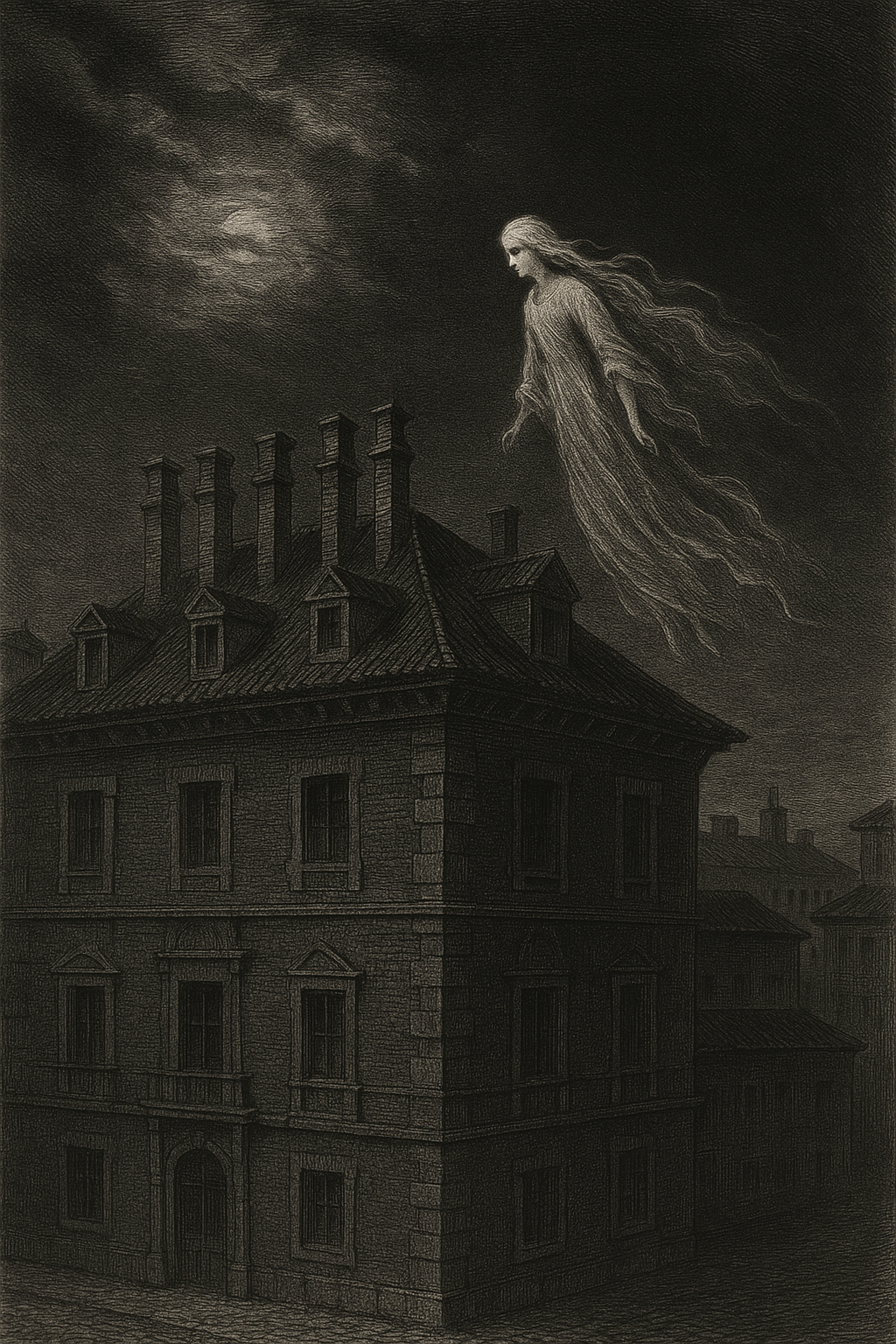
In the heart of Madrid sits a 16th-century mansion with (you guessed it) seven chimneys poking into the skyline. The building was home to Elena, a young noblewoman married to a soldier who went off to war — and never came back. Soon after, Elena herself died under suspicious circumstances. Her body vanished without a trace.

Rumors swirled: Had she taken her own life? Was there foul play? Some even whispered she’d been entangled with a royal — possibly the son of Philip II.

To this day, people say her ghost still wanders the roof, weaving between the chimneys, searching.

2. The White Lady of Linares Palace

This one sounds like a Gothic novel, but the Linares Palace — now Casa de América — has its own ghostly drama. The story goes like this:

The Marquis of Linares fell in love with a humble cigarette vendor, and they had a daughter. Years later, his own son, unaware of her identity, married the girl. Only after their wedding — and after having a child — did they discover the truth: They were half-siblings.

What happened next is murky. One version claims the couple ended their child’s life in despair. Now, visitors report ghostly whispers and shadows in the palace. Paranormal teams have even claimed to record unexplained voices.

La Loba de Madrid, the She-Wolf, in ragged clothes, stands by a traveler, with bones at her feet

3. La Loba de Madrid (The She-Wolf)

“La loba” was slang for a certain kind of woman — alluring, dangerous, often outside society’s norms. One legend tells of a woman who roamed the hills near Madrid, guiding lost travelers to safety. Another paints her as a shapeshifter who wandered the outskirts at night, collecting bones.

Prostitute, protector, predator — take your pick. Either way, Madrid’s she-wolf still prowls through local folklore.

4. The Nude Maja and Goya’s Secret Muse

Francisco de Goya’s La Maja Desnuda (The Nude Maja) caused quite the stir in the late 18th century. The reclining woman, completely unclothed, was bold enough to warrant a private viewing — and later, an order for a second version with clothes, just in case anyone fainted.

This one isn’t a ghost story, but it’s one of Madrid’s great artistic mysteries. Who was the model? Many suspect the Duchess of Alba, one of Goya’s rumored lovers. But no one knows for sure — and that uncertainty only deepens the allure behind her half-smile.

Madrid Ghost Tours

If you really want to uncover these stories, book Madrid private tours with a guide who knows the city’s darker side. Ask about the palace hauntings. Peer up at the seven chimneys. Linger a moment longer on the quiet steps of Linares.

Let the past walk beside you.

And if you listen closely, you just might hear someone — or something — whisper your name. –Mark San Juan


Want a different kind of mystery? Follow Dan Brown’s Origin trail through Spain.

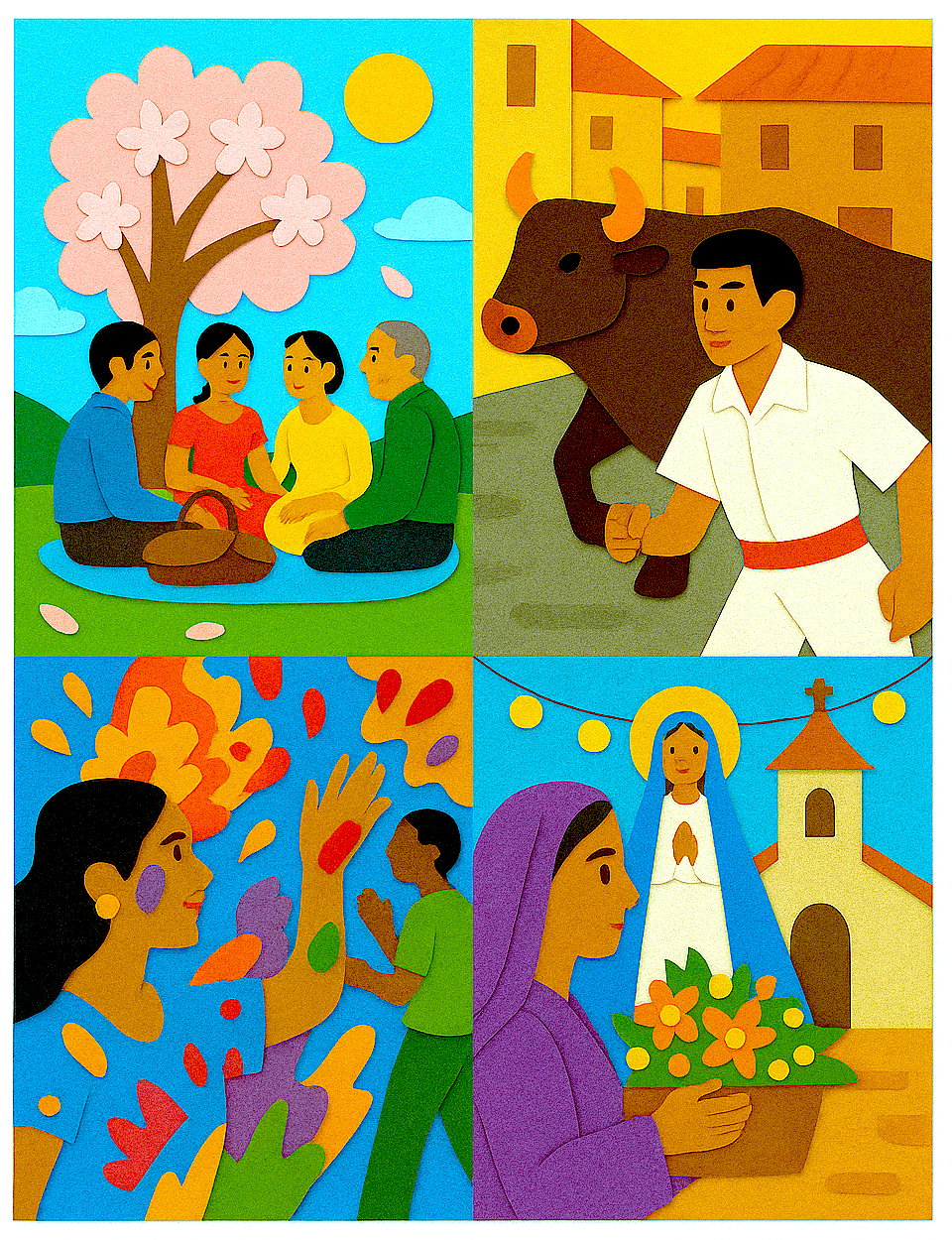
Spring Festivals Around the World: Sakura, Holi, Semana Santa and More

From Japan’s cherry blossom hanami to India’s colorful Holi and Spain’s heart-pounding San Fermín, discover spring festivals that celebrate renewal, connection and pure joy. 

Spring is the season that grabs you by the hand and pulls you outside, whispering, “Wake up, the world’s alive again!” It’s when the earth shrugs off winter’s weight, and people respond with festivals that feel like love letters to life itself. 

Some of the most enduring spring traditions come from rituals that have been blooming for centuries. The celebration of Ostara at the spring equinox draws inspiration from an ancient Anglo-Saxon festival said to honor the goddess Eostre. This, in turn, influenced early Christians, who created Easter, and is a large part of why we have the Easter Bunny today.  

Spring festivals are raw, messy, beautiful collisions of culture, memory and the kind of joy that makes your chest ache. Let’s wander through a few corners of the globe, from Japan’s petal-dusted picnics to the pulse-pounding streets of Pamplona, each festival a one-of-a-kind story that’ll stick with you long after the season fades.

1. Japan: Sakura Whispers and Stolen Moments

In Japan, spring arrives like a secret shared between friends: the cherry blossoms, known as sakura, bloom in a hush of pink, turning every park and riverside into a fleeting masterpiece. (It’s a perfect counterpart to koyo, the changing colors of leaves in the fall.)

I’ll never forget my first hanami — the custom of gathering to enjoy the beauty of cherry blossoms — in a tiny Osaka park, sprawled on a blanket with strangers who offered me homemade onigiri (rice balls or triangles) and a sip of plum wine. We didn’t need words; the petals drifting down said it all. Sakura isn’t just about the gorgeousness of nature — it’s a gut-punch reminder that nothing lasts forever, so you’d better soak it up. Families, lovers, old friends — they all come together, laughing over sake or staring quietly at the trees, each person wrestling with their own thoughts about time. It’s less a festival and more a moment where the world holds its breath.

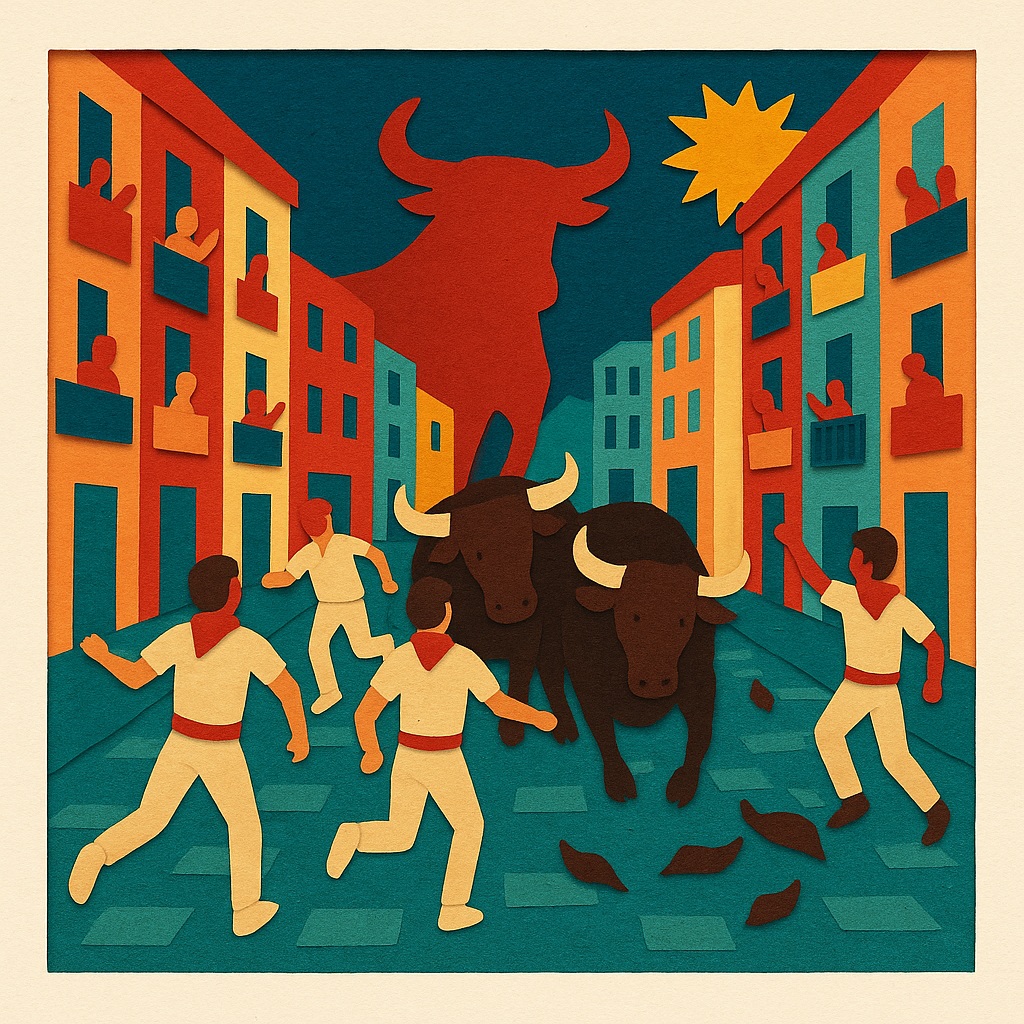
2. Spain: San Fermín’s Roar and Reckless Courage

Half a world away, Pamplona, Spain turns spring’s energy into something primal. The San Fermín Festival, brewing through spring and erupting in July, is a beast of a celebration. Picture narrow streets, the air electric with nerves, and the thunder of bulls charging behind runners who are equal parts terrified and exhilarated. 

I stood on a rickety balcony once, clutching a sangria, watching the encierro unfold below: runners tripping, laughing, living on the edge of chaos. It’s the ultimate thrill, sure, but it’s also a nod to history, to Saint Fermín (the patron saint of Pamplona, who was beheaded for his Christian faith), to the days when humans and nature stared each other down. The whole city erupts in a burst of music, dance and sweat-soaked joy. 

If you’re crazy enough to go, keep Flight Refunder in your back pocket — they’ll help you reclaim cash if a canceled flight threatens to derail your adventure.

3. India: Holi’s Explosion of Color and Connection

In India, spring crashes in with Holi, a festival that’s like diving headfirst into a kaleidoscope. I was in a dusty Rajasthan village once, my clothes soaked, my face smeared with turquoise and magenta powder, dancing with a crowd of strangers to a drumbeat that shook the ground. 

Holi is about flinging colors, but it’s also a time to tear down walls — between people, and between the past and present. The story of Krishna — a beloved Hindu god known for his playful spirit — and his soulmate Radha runs through the heart of Holi. Their legendary love, full of laughter and mischief, is echoed in every handful of gulal, the brightly colored powder that revelers throw into the air (and, inevitably, onto other people). 

At Holi, it’s impossible to just be a bystander; you’re part of the chaos, laughing until your sides hurt, feeling like the world could be this free, this kind, every day. It’s the kind of messy joy that stains your skin and your soul.

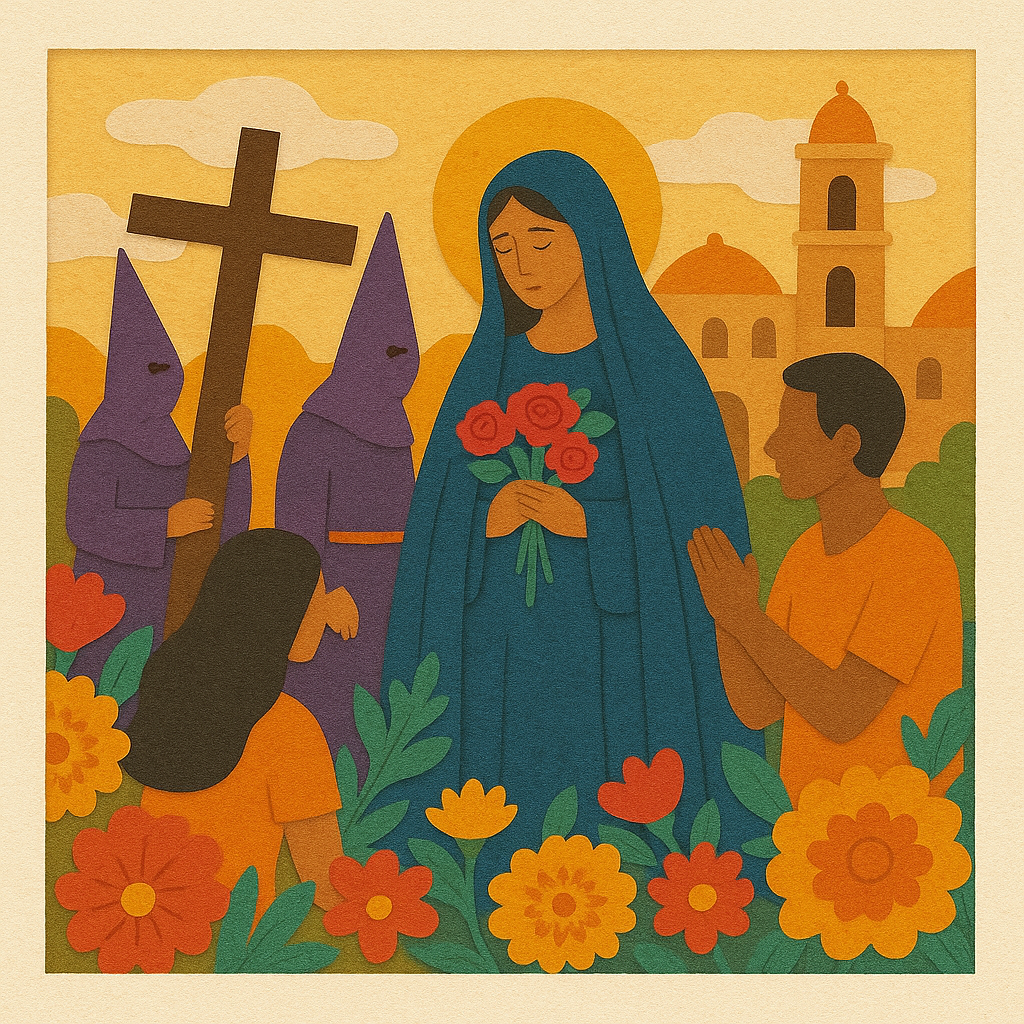
4. Mexico: Semana Santa’s Soulful Dance of Faith

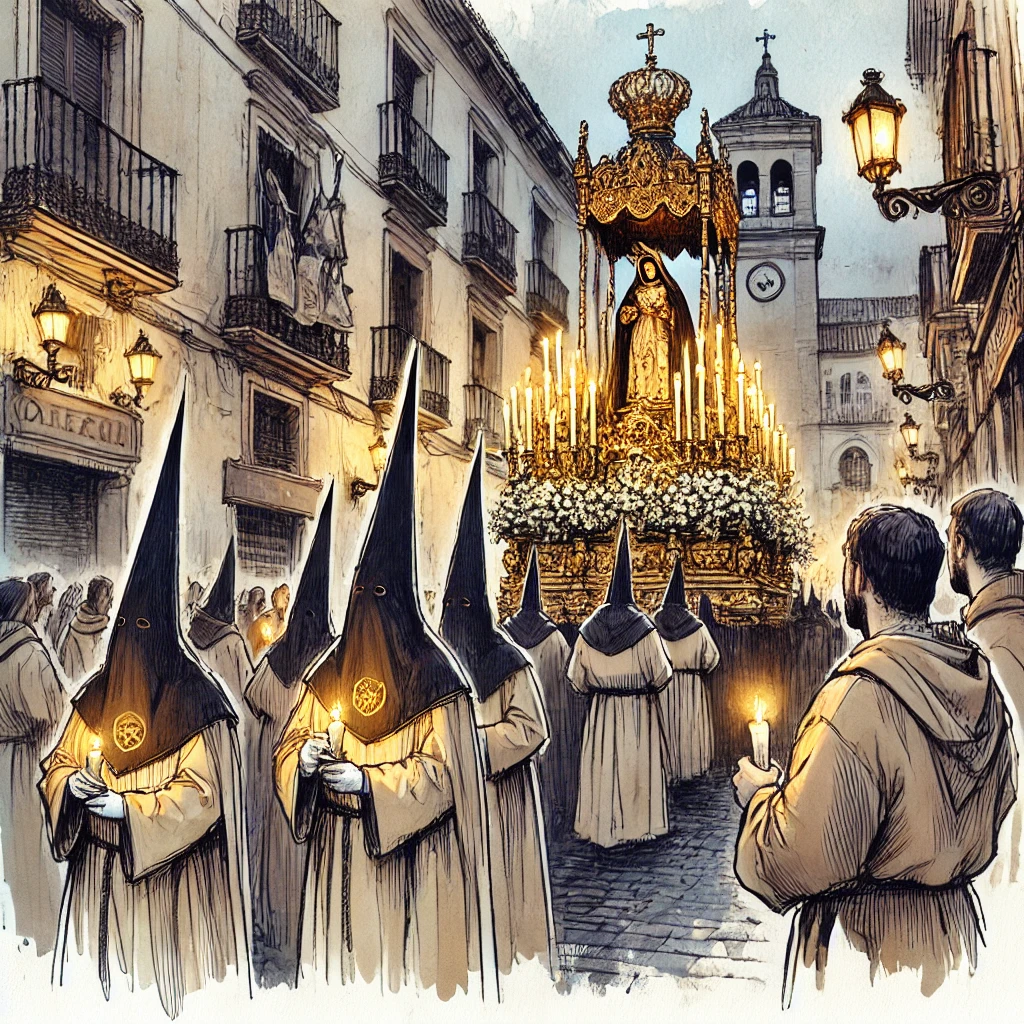
Mexico’s Semana Santa is spring at its most heartfelt. Holy Week turns towns into theaters of devotion, with processions that weave through streets blanketed in flower petals and sawdust art. 

I wandered San Miguel de Allende one April, caught in a crowd following a statue of the Virgin Mary, her face serene under a crown of roses. The air was heavy with incense, marigolds and the soft hum of prayers. 

Every town does it differently — some with mournful silence, others with bursts of brass bands — but it’s all so alive, blending Catholic roots with ancient Mexican spirit. You feel it in your bones: This is more than religion; it’s about a community stitching itself together, step by sacred step.

5. France: The Soft Spring Embrace of Easter in Provence

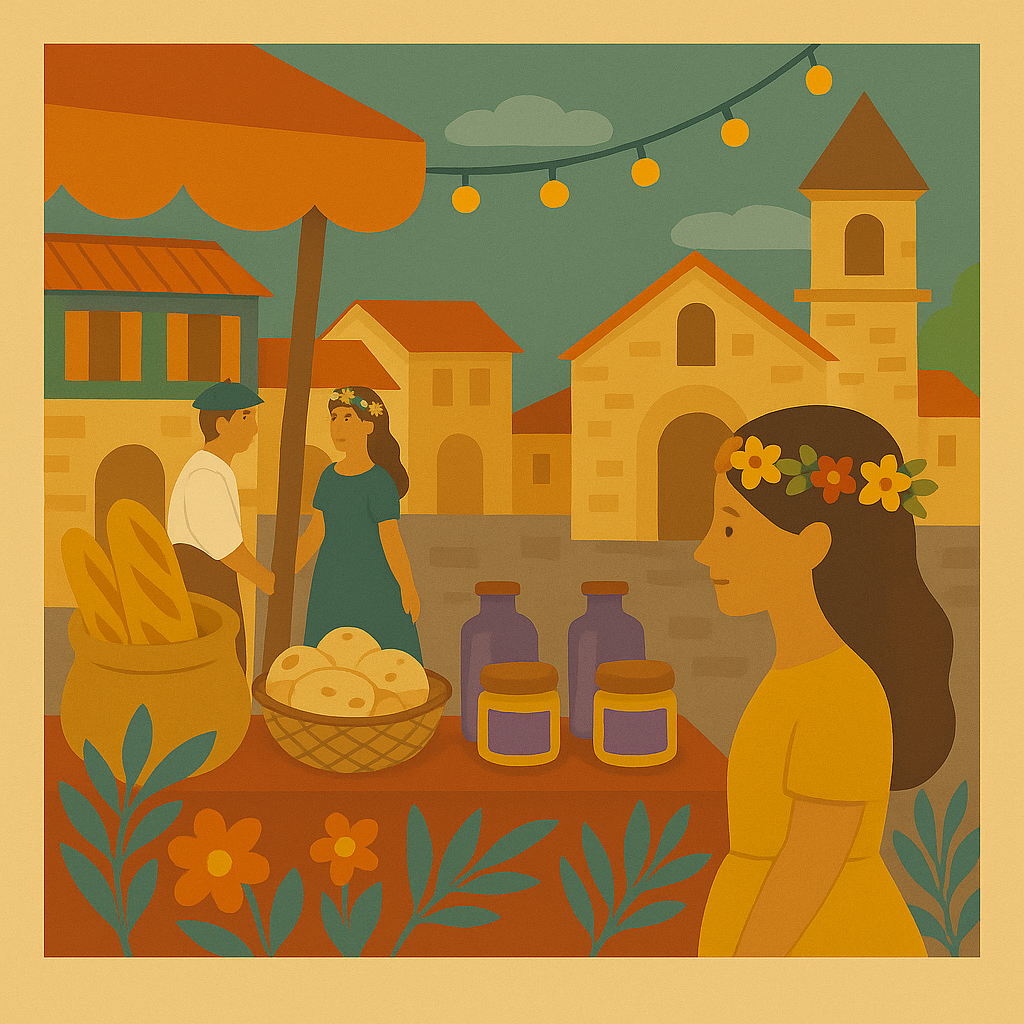
Then there’s Provence, France, where spring feels like a warm breeze. Easter here is less about grand spectacles and more about the small, perfect moments: a village square strung with lights, a market stall piled high with crusty baguettes and jars of lavender honey. 

I spent one Easter in Gordes, a storybook hilltop village of stone houses and winding lanes in Provence, nibbling on almond-studded nougat while a parade of kids in flower crowns skipped by. The hills were just starting to green, the air sharp with herbs and promise. Provence’s festivals are simple, soulful and so generous with their beauty. You leave feeling like you’ve been let in on a secret about how to live well.

The Joy, Chaos and Charm of Spring Festivals

Spring festivals are the world’s way of saying, “Hey, we’re all in this together.” Whether it’s Japan’s quiet awe under cherry blossoms, Spain’s reckless sprint through Pamplona’s streets, or India’s color-soaked chaos, these moments are where humanity shines — flawed, vibrant and so damn alive. Traveling to them is like chasing sparks, each one lighting up a piece of who you are. –Erik Ilin

What Are Torrijas? Spain’s Easter Dessert That Puts French Toast to Shame

Sweet Jesus, they’re good! This once-a-year Spanish Easter treat is soaked in milk or wine, fried to golden perfection, and steeped in centuries of tradition.

Let’s get one thing straight. Torrijas may only show up for a month or so a year in Spain, but they are serious business. And they’ve been showing up for a while — since Roman times, in fact, when they appeared in a cookbook attributed to the glutton Marco Gavio Apicius. 

So what is it that makes torrijas so special? Why is it blasphemous to call them French toast? What’s their connection to Easter? And why on earth were they part of a staple diet for expectant mothers?

Torrijas: Spain’s Simple, Sweet Easter Dessert Explained 

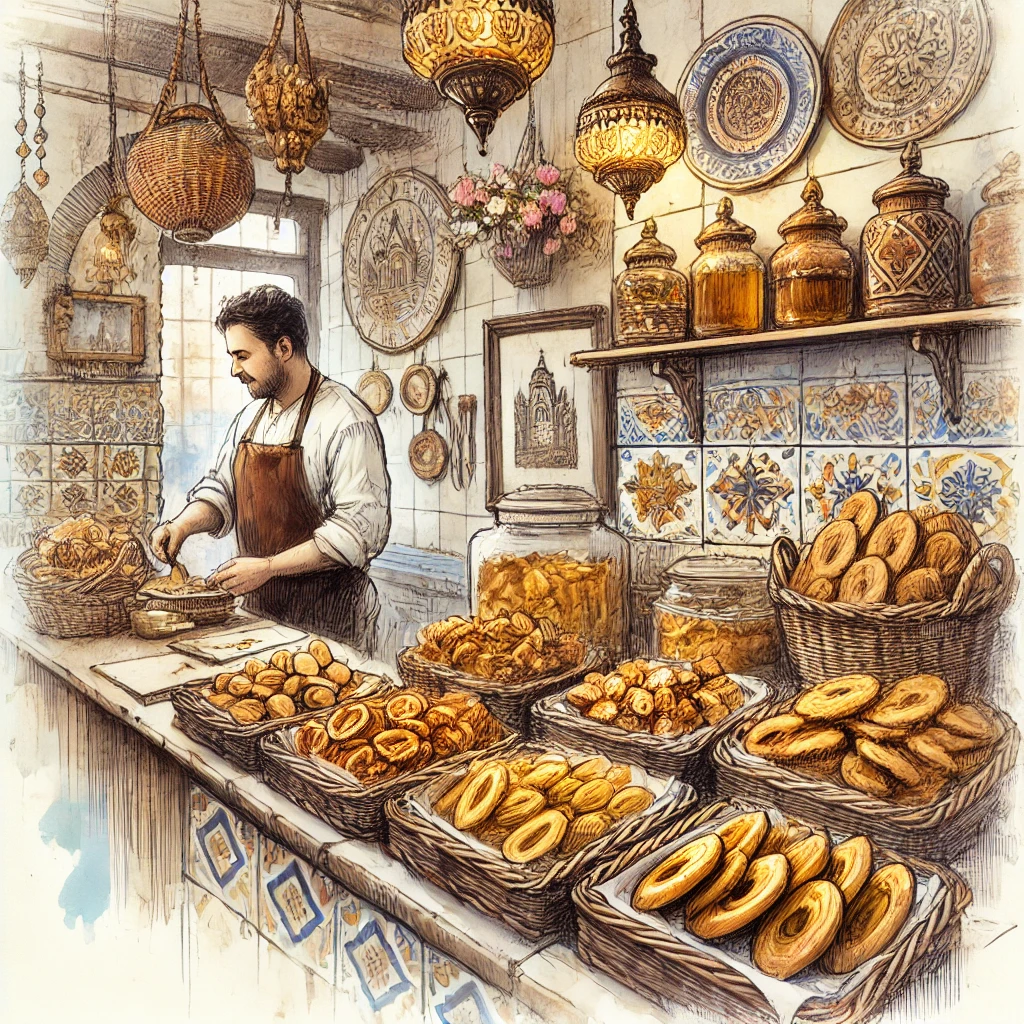
Torrijas, a simple Spanish dessert, consists of slices of stale bread dipped in milk, egg, honey and cinnamon. Or trade out the egg for sweet wine. Now I’ve got your attention. Once the bread has soaked for a while in this mixture, fry it in hot olive oil. Pack your bags, French toast — torrijas are in town. 

If you live in Spain or have visited during Easter, you’ll know what I am talking about. If you don’t, add this to your must-eat list for when you’re next here. Put it high up. And if you can, visit my favorite place in the world for torrijas: Maru Jara in Seville.

You can tell when Easter is just around the corner in Spain from the waft of incense in the streets emerging from church doorways and the faithful’s windows. Another sure sign is the huge queue that forms outside of local bakeries and patisseries, where a different kind of devoted crowd waits in line for their favorite dessert. 

Despite the svelte figure that many Spaniards boast, they eat a lot of torrijas. In 2024 alone, Confitería Aparicio in Málaga, who’ve been in business since 1941, sold 80,000 torrijas. You do the math. Like I said, torrijas are no joke. 

The History of Torrijas: How They Became a Holy Week Tradition

At the end of the 15th century, torrijas made their way into a Christmas carol, thanks to a Salamanca writer, Juan de la Encina (1468-1533). While the biblical association is still alive and well, shortly thereafter, torrijas swapped out Christmas for Easter. 

Devout Catholics abstained from eating meat during Lent, especially during Semana Santa (Holy Week) in the leadup to Resurrection Day. To sweeten the deal, torrijas took center stage, providing the obedient with the energy they needed during this frugal period. Not only did this sustain appetites, but it also used up day-old bread — waste not, want not, as the bible says. In case you needed another reason, eaten with wine, together the two were said to represent the body and blood of Christ. Amen to that, I say. 

Torrijas and Childbirth: Their Strange Role in Spanish Medicine 

Never mind epidural anaesthesia, back in the 16th century torrijas were just what the doctor ordered. As well as being a staple at Easter, they were dispensed to pregnant women before giving birth since this calorie-packed fare was thought to revitalize energy. 

While the custom no longer survives, its legacy lives on in the name. In Galicia, torrijas are known as torradas de parida, and in the Balearic Islands, they’re sopes de partera — both loosely translating to something like “post-childbirth toast,” a nod to the pastry’s former role in postpartum recovery.

Why Torrijas Vanish After Semana Santa

As popular as torrijas are, they don’t stick around for long. Typical desserts that sell all year in bakeries aren’t to be found at Easter, as there’s no time (or space on the shelves) for them. Yet, search for torrijas after Easter Sunday, and you’ll be out of luck. 

If you can’t wait that long, you can find torrijas on menus in high-end restaurants year-round. Some chefs dare to make them with fresh bread instead of day-old, trade it out for brioche, stuff them with cream and chocolate, or add a dollop of ice cream, or even worse — a mousse. That’s sacrilegious, if you ask me. I’ll wait til next spring for their resurrection. –Joanne Batten

The Real Alcázar’s Mezmering Mudéjar Palace in Seville

Europe’s oldest continuously used palace and UNESCO World Heritage Site is the best thing to see in Seville.

The Mudejar Palace at the Real Alcázar of Sevilla with intricate stucco details

A palace like no other — the Real Alcázar of Sevilla dazzles with its stunning Mudéjar design with intricate stucco details.

After a quick, delicious breakfast at charming Filo, Wally and I made our way to Plaza del Triunfo (Triumph Square), the plaza where the Real Alcázar de Sevilla (Royal Palace of Seville) and its formidable main entrance, the Puerta de León (Lion Gate), stand. It’s just to the southeast of the Seville Cathedral

Thanks to Wally’s planning, all we had to do was show up at our scheduled time and wait in the line on the left, which was designated for pre-purchased ticket holders. That being said, it was a bit confusing — we weren’t sure we were in the right line, and the tickets Wally had purchased looked different than other people’s. So there was some apprehension until they were scanned and we were able to enter the palace complex. 

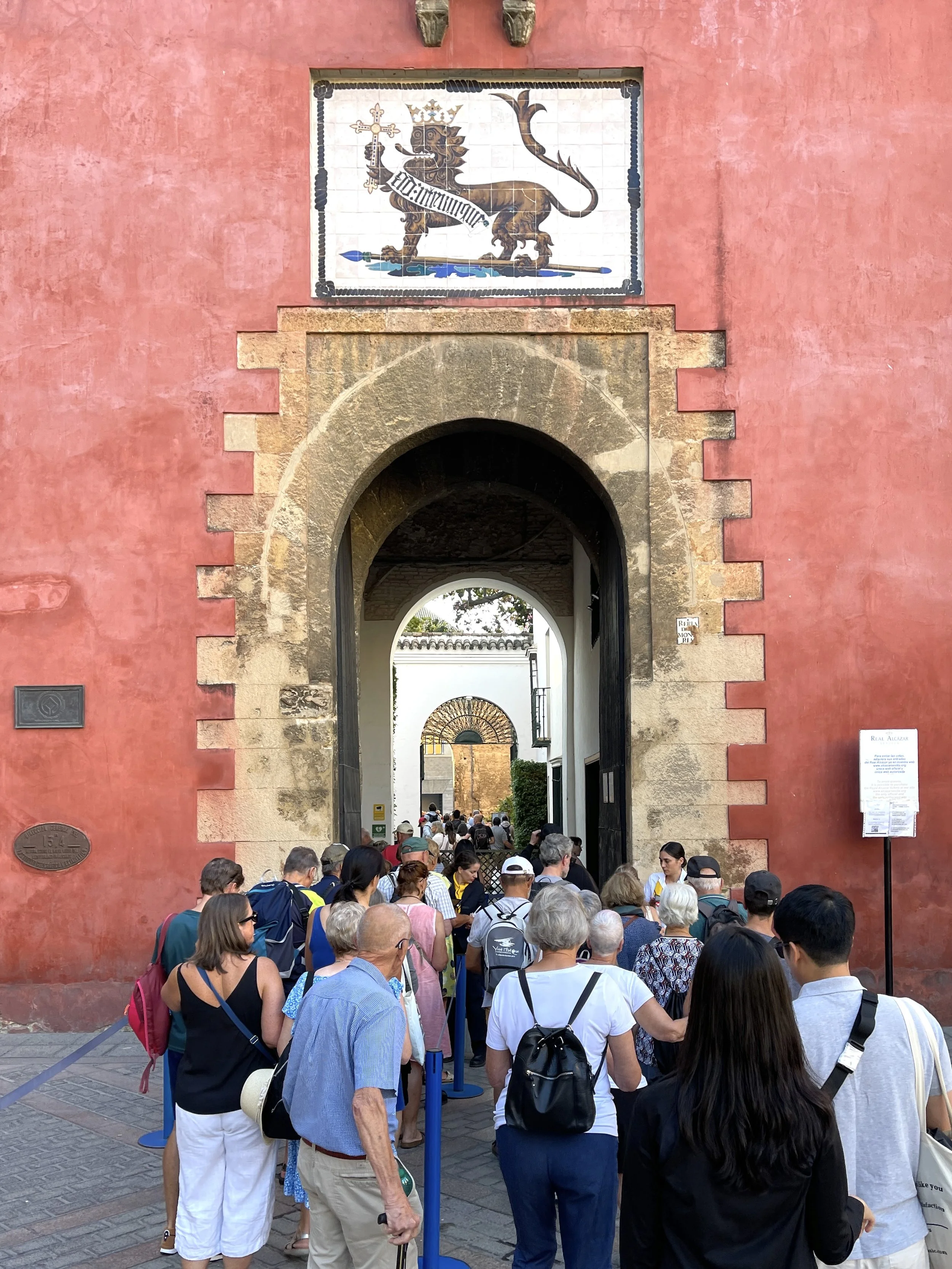
Crowds wait in line to pass through the Puerta de León (Lion Gateway), the main entrance to the Real Alcázar de Sevilla

The monumental Puerta de León (Lion Gateway) serves as the main entrance to the Real Alcázar de Sevilla.

Puerta de León (Lion Gateway)

While we waited, I looked up at the tile panels set into the lintel above the gate. It depicted a peculiar, emaciated lion wearing a crown with its tongue lolling out of its mouth. It’s standing atop the flags of its defeated enemies, with a cross in its paw.

This passage was added by the Castilian monarch Pedro I (who reigned from 1350-1369) to provide direct access to his royal residence. The gate takes its name from the heraldic lion, a symbol of the Spanish crown’s power and protection. Although the defensive wall dates back to Almohad rule, the rampant lion was a more recent addition, created in 1892 at the Mensaque Rodríguez ceramic factory in Triana, the center of glazed-tile production in Seville. 

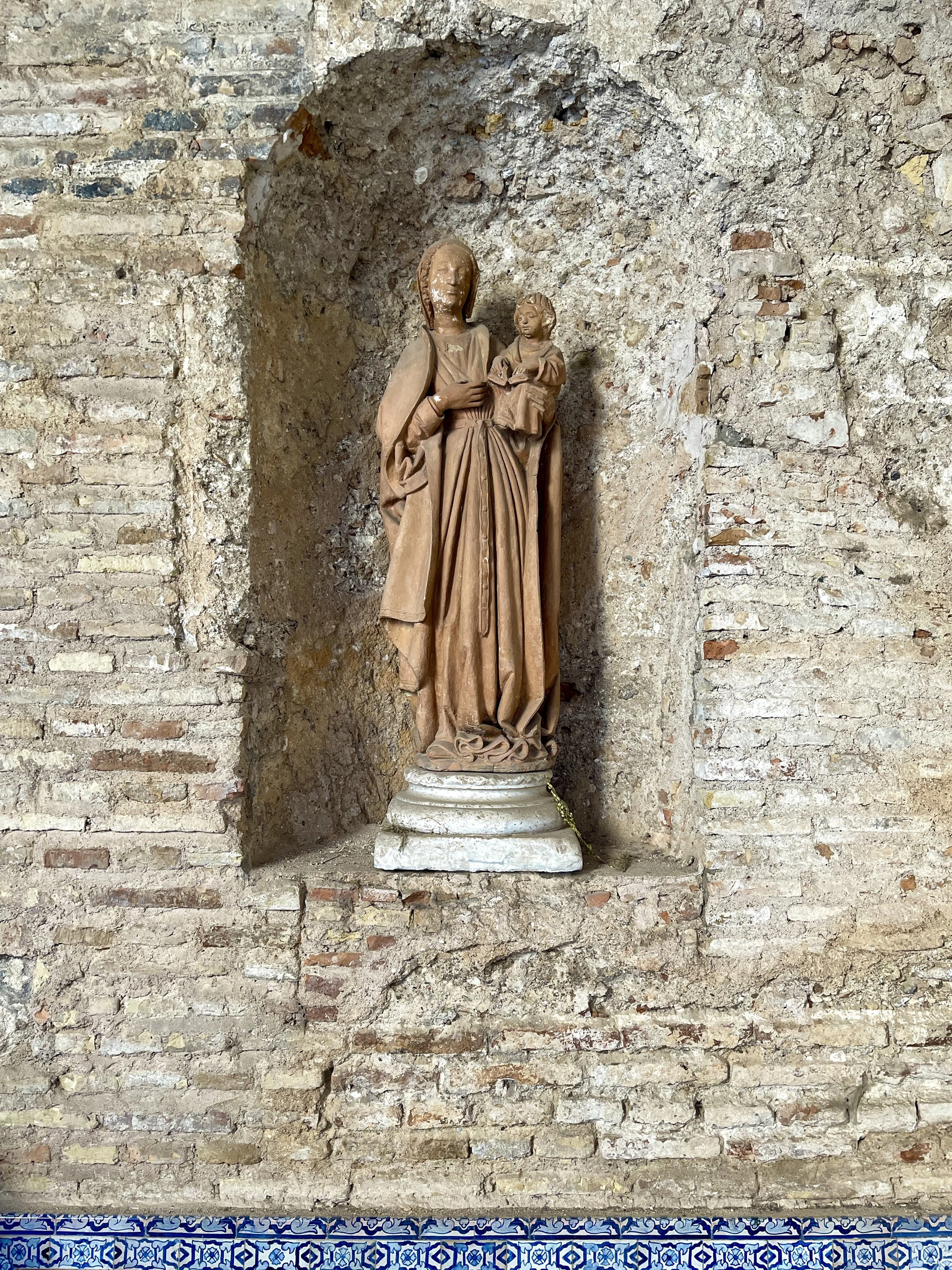
A statue of the Virgin and Child located within the stone walls of the Lion Gateway at the Real Alcazar in Seville

A statue of the Virgin and Child located within the stone walls of the Lion Gateway en route to the Patio de la Montería (Courtyard of the Hunt)

Wally and I passed beneath the puerta, where an attendant checked our tickets. Just beyond was the expansive Patio de la Montería (Courtyard of the Hunt), the main courtyard of the Royal Alcázar of Seville, where Pedro I and his noblemen gathered before embarking on royal hunts.

Carlos Blanco’s portrait of Fernando VII at the Real Alcazar of Seville

Carlos Blanco’s portrait of Fernando VII, one of the many royals who once called the Alcázar home. 

Casa de Contratación de Indias (House of Trade for the Americas)

We continued through the enclosed courtyard of the Patio del Cuarto Militar (Courtyard of the Military Quarter), which perfectly framed the blue sky above. From there we entered the Casa de Contratación de Indias (House of Trade for the Americas). The Renaissance-period addition was commissioned in 1503 by Isabella I of Castile and designed to regulate the flow of goods arriving from the New World, whose colonization had begun 11 years prior. Due to its location on the banks of the Guadalquivir River, Sevilla became an epicenter of commerce and trade, where ships set sail and returned to the port laden with goods from across the seas.

An oil painting by Alfonso Grosso Sánchez of King Alfonso XIII and Queen Victoria Eugenia at the Ibero-American Exposition in Seville in 1929 in the Cuarto del Almirante (Admiral’s Quarters) at the Real Alcazar

The Cuarto del Almirante (Admiral’s Quarters) is presided over by a large oil painting by Alfonso Grosso Sánchez depicting King Alfonso XIII and Queen Victoria Eugenia at the inauguration of the Ibero-American Exposition held in Seville in 1929. 

Cuarto del Almirante (Admiral’s Room)

After passing through the main doorway, Wally and I entered the spacious Cuarto del Almirante (Admiral’s Room), whose walls have 19th and 20th century paintings of historic events, along with a collection of royal portraits. It was here that explorers and pilotos mayores (master navigators) such as Amerigo Vespucci, Ferdinand Magellan and Juan Sebastián Elcano signed their contracts and charted their voyages, while cartographers drew up detailed maps and navigational charts to assist them on their travels.

Hand fans on display in the hand fans in the Sala de los Abanicos (Hall of Fans) at the Real Alcazar

Among the traditional Spanish hand fans in the Sala de los Abanicos (Hall of Fans) are the Abanico Inglés (English Fan), made of mother-of-pearl and silk, handpainted with birds and flowers, and the Abanico Macao (Chinese Fan), a handpainted silk fan with tortoise-shell ribs depicting a traditional court scene from the province of Macau.

Sala de los Abanicos (Hall of Fans)

The following room was the Sala de los Abanicos (Hall of Fans), which held glass vitrines displaying a collection of antique fans amassed and donated to the Real Alcázar in 1997 by María Trueba Gómez. Among the beautiful and rare examples is a tortoiseshell and Chantilly lace fan, as well as a mother-of-pearl and silk fan commemorating the wedding between Alfonso XII of Spain and María Cristina Habsburg-Lorena of Austria.

The Virgen de los Navegantes (Virgin of the Navigators) altarpiece in the Sala de Audiencias (Chapterhouse) at the Real Alcazar in Seville

The Sala de Audiencias (Chapterhouse) is where you’ll find the Virgen de los Navegantes (Virgin of the Navigators) altarpiece, the first religious artwork linked to the discovery and conquest of America.

Sala de Audiencias (Chapterhouse)

After the Sala de los Abanicos, we entered the square-shaped Sala de Audiencias (Chapterhouse). This room includes a stone bench where chapter members sat. In front of these seats is an altarpiece inspired by the discovery of the Americas. 

The central panel was painted in 1535 by Alejo Fernández and is titled Virgen de los Navegantes (The Virgin of the Navigators). Fernández’s painting depicts the Virgin Mary hovering above a harbor, with her outstretched arms and billowing mantle sheltering notable navigators and monarchs, including Christopher Columbus, Amerigo Vespucci, Fernando II of Aragón and Carlos V, from the dangers of the sea. 

Flanking the Virgin are four smaller panels with saints, from left to right and top to bottom: San Sebastiano (Saint Sebastian), shown with a sword, a bow and an arrow piercing his chest; Santiago Matamoros (Saint James the Moor-Slayer) riding a white horse; San Telmo (Saint Elmo), the patron saint of sailors, dressed as a Dominican and holding a ship in his hand; and San Juan Evangelista (Saint John the Evangelist) with his book, pen, scroll and eagle. 

The entrance to the Cuarto Real (Upper Palace) museum

The entrance to the Cuarto Real (Upper Palace), which acts as a museum. For an additional fee, visitors can tour the royal residences.

Cuarto Real (Upper Palace)

Wally and I proceeded to ascend the staircase leading to the Cuarto Real (Upper Palace), where the private residences of the royal family are located. Throughout its long history, the palace has undergone numerous renovations and expansions by various kings, particularly during the 16th, 17th and 19th centuries.

Detail of a tarjetero, a large plate for holding social calling cards, designed by Manuel Arellano y Campos in the Real Alcazar in Seville

Detail of a tarjetero, a large plate for holding social calling cards, designed by Manuel Arellano y Campos in 1894. 

Since we didn’t purchase tickets (as admission to visit these is separate), we didn’t get to tour them, but we did wander through a small museum displaying ceramic objects from the collection of Vicente Carranza. The pieces are arranged chronologically, starting with Muslim and Mudéjar ceramics from the late 12th century, followed by Renaissance ceramics, and ending with Baroque ceramics from the 18th century.

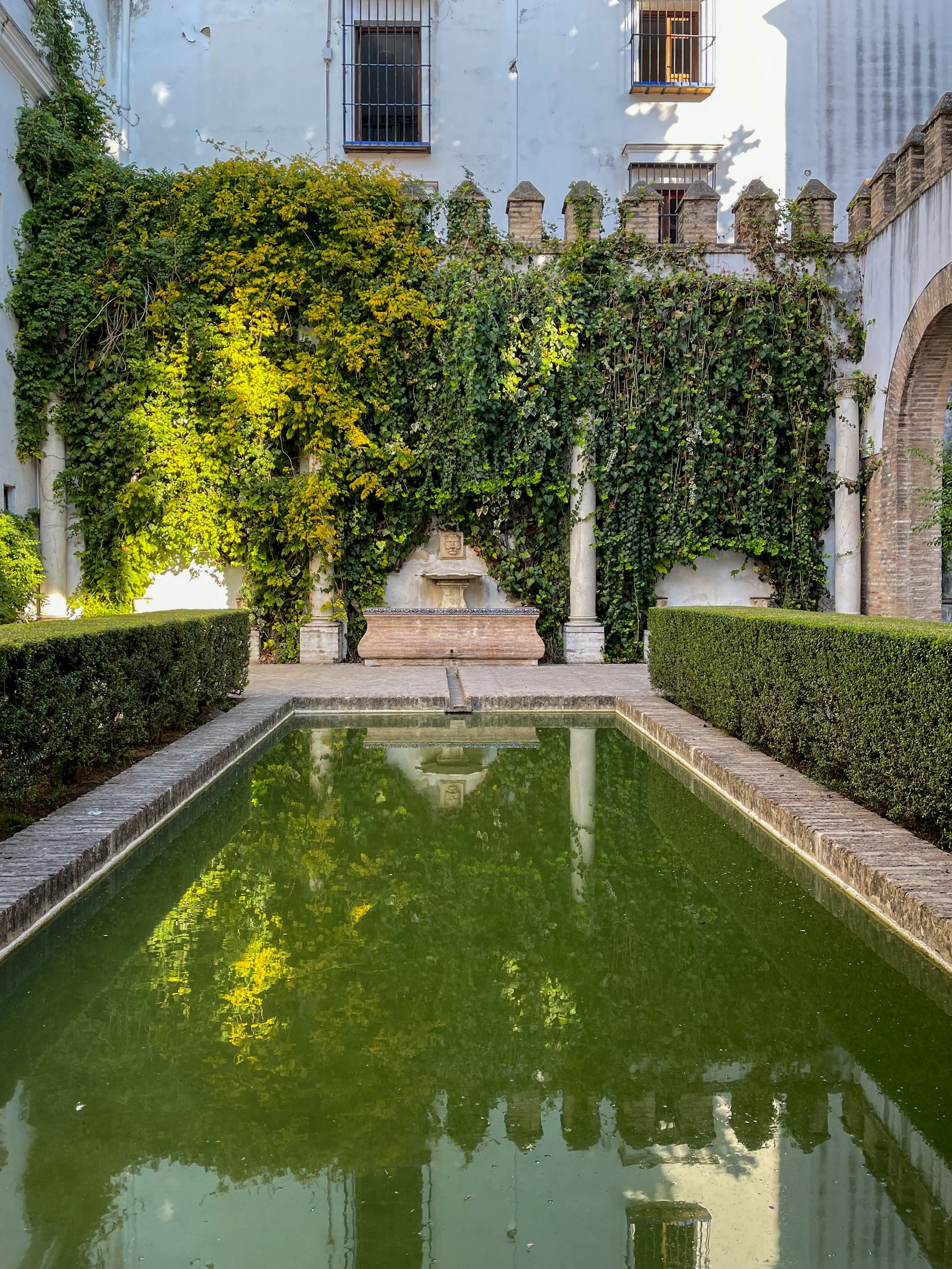
Reflecting pool and greenery in the Patio de Levíes at the Real Alcazar in Seville

A tranquil haven within the Real Alcázar, the Patio de Levíes captivates with its symmetry and the quiet beauty of its reflecting pool.

Patio de Levíes (Courtyard of the Levis)

Back outside, Wally and I found ourselves in the tranquil Patio de Levíes (Courtyard of the Levis), which likely gets its name from the slender columns supporting four semicircular arches that were taken from the residence of Samuel Leví, the treasurer of King Pedro I.

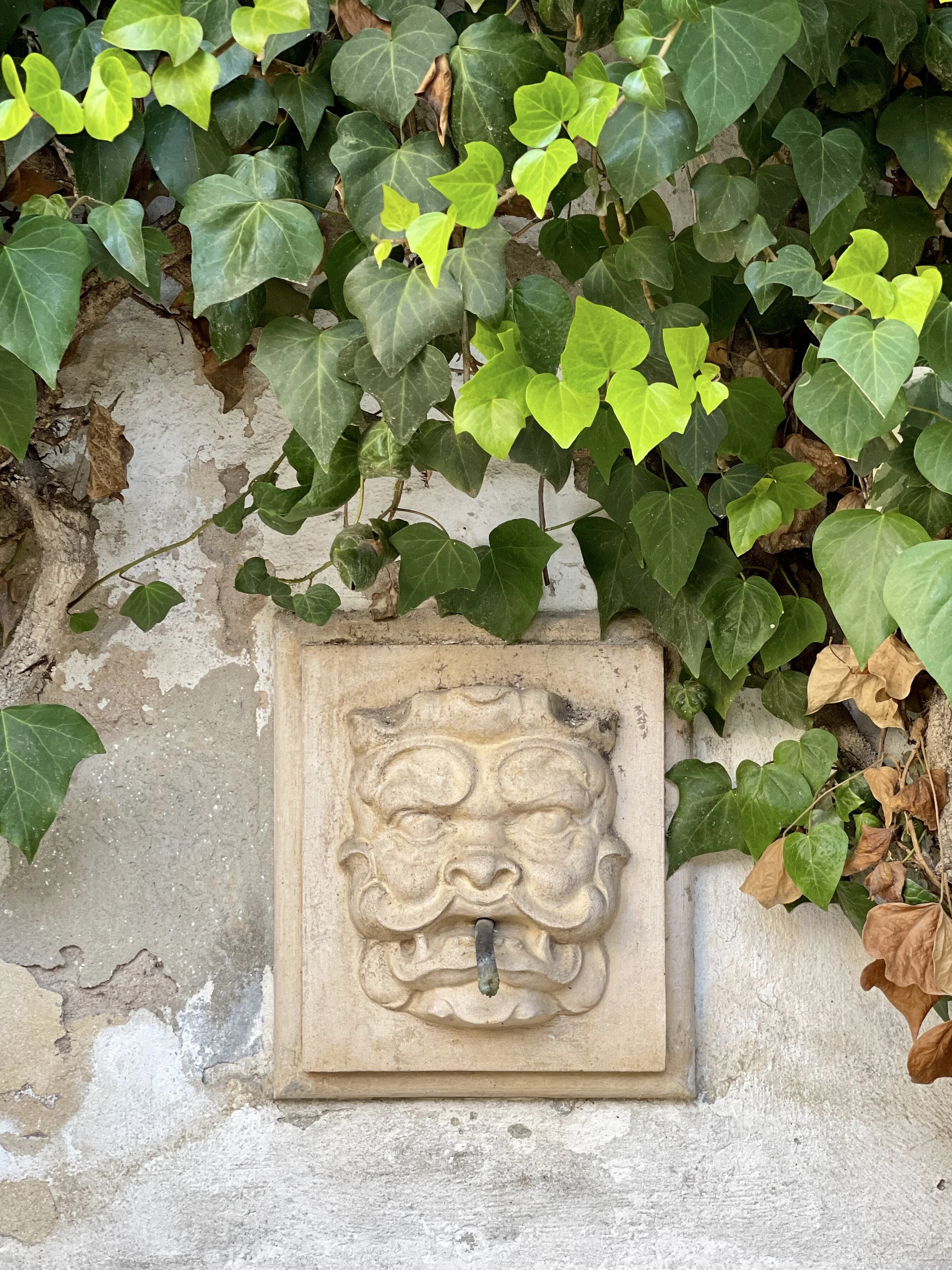
A grotesque fountain spout in the Patio de Levíes at the Real Alcazar

The carved fountain spout, known as “grotesque,” in the Patio de Levíes combines artistry and utility.

Set into the wall on the left side of the patio is a Baroque-style ceramic tile altarpiece depicting the Immaculate Conception. At the center of the courtyard is a narrow reflecting pool with a gargoyle-faced fountain, flanked by white marble columns of the Ionic order.

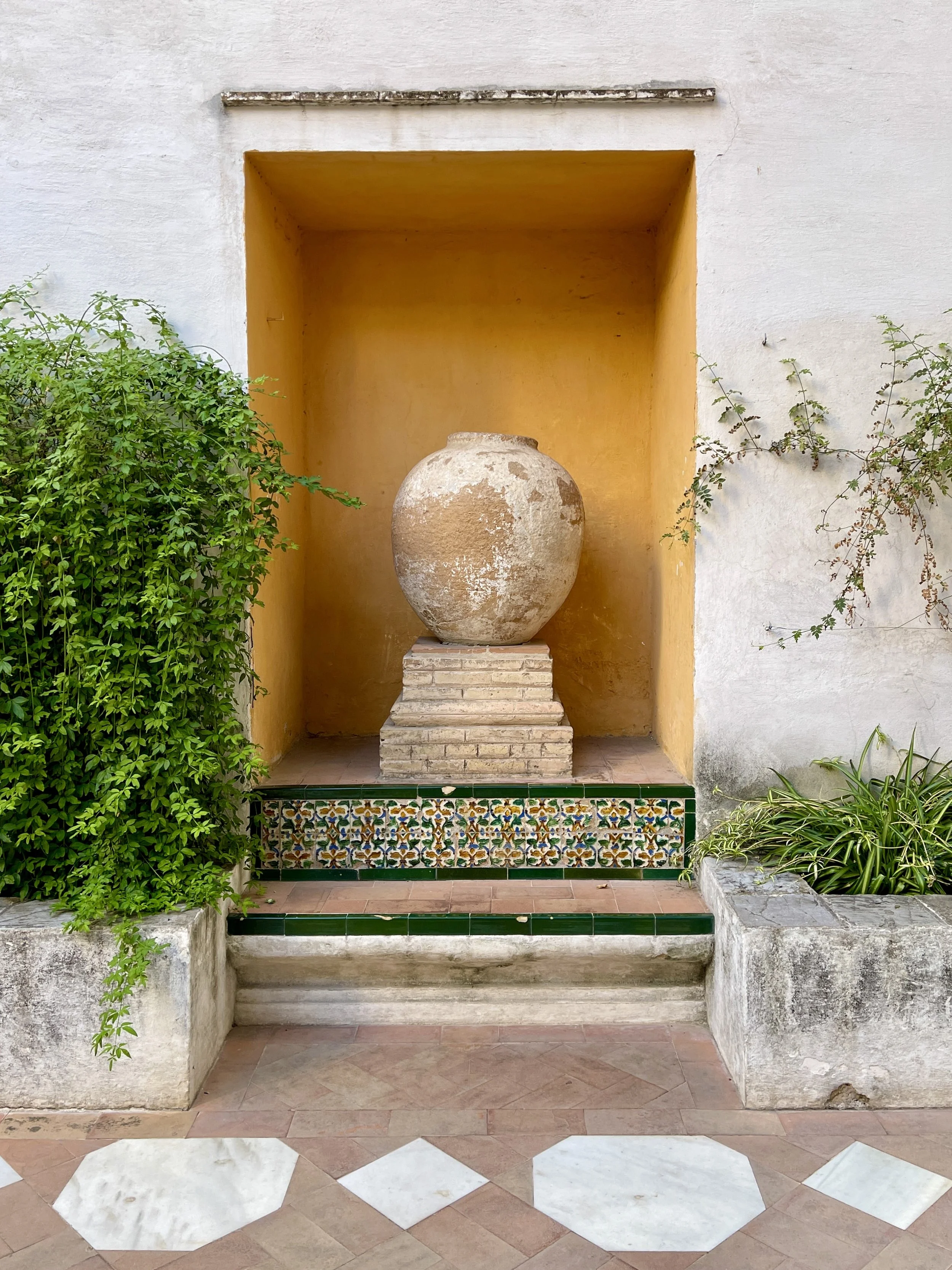
An urn in a yellow niche in the Romero Murube Courtyard at the Real Alcazar, Seville, Spain

The Romero Murube Courtyard, named after a famed Sevillian poet

Patio de Romero Murube (Romero Murube Courtyard)

Between the Patio de Levíes and Jardín del Príncipe (Garden of the Prince) is the Patio de Romero Murube (Romero Murube Courtyard), whose name refers to Joaquín Romero Murube, a poet and the curator of the Real Alcázar from 1934 to 1969.

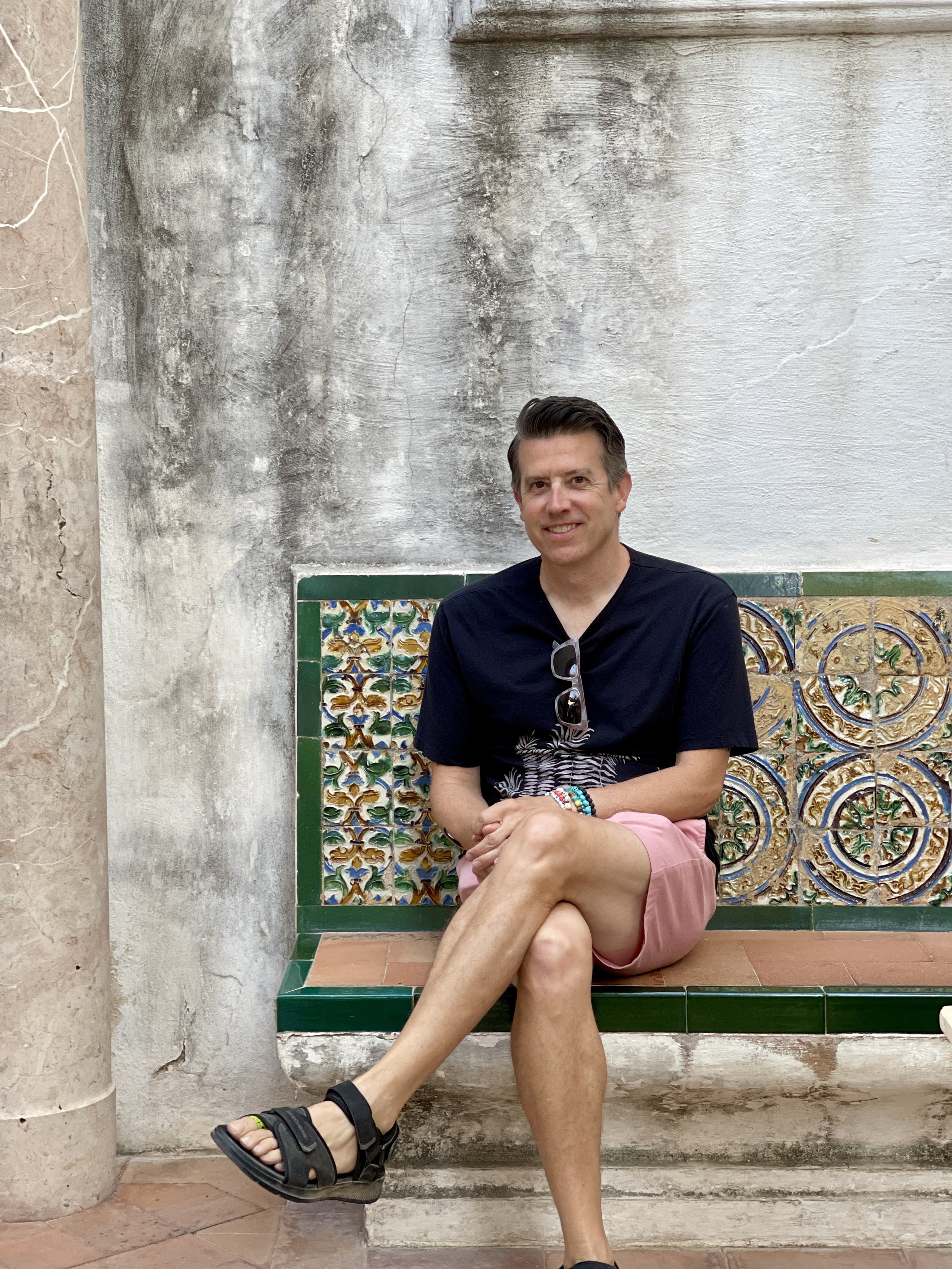
A man sits on a tiled bench in the Romero Murube Courtyard at the Real Alcazar in Seville

Wally takes a break on a bench in the courtyard.

The courtyard’s design reflects the style of 19th century Sevillian domestic architecture, with a pair of flowerbeds on either side and a tile-covered bench framed by pink marble columns. 

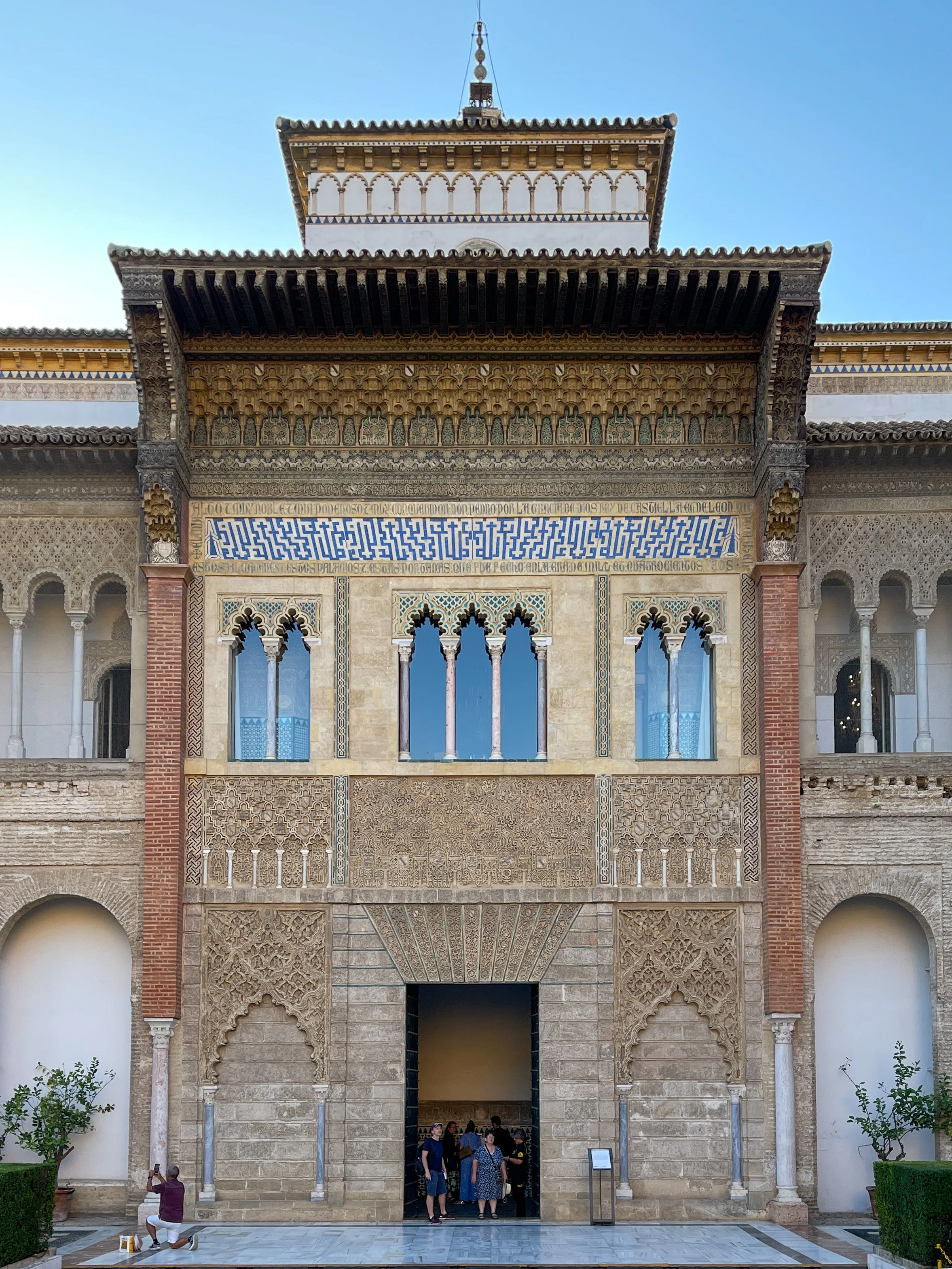
The facade of the Mudejar palace at the Real Alcazar, Sevilla, Espana

The entrance to the palace, crafted by artisans from Granada, Toledo and Seville, is considered a masterpiece of Mudéjar architechture.

Palacio del Rey Don Pedro I (Palace of King Don Pedro I)

Standing opposite the Puerta de Leon is the Palacio del Rey Don Pedro I (Palace of King Don Pedro I), a majestic 14th century masterpiece of Mudéjar architecture.

The young prince came of age during a period of religious tolerance toward Muslims and Jews and a fondness for Mudéjar architecture, which blends Muslim aesthetics with local traditions. At just 15, Pedro became the final ruler of the House of Ivrea after his father, Alfonso XI, fell victim to the bubonic plague.

Pedro’s reign was a study in contrasts. To some, he was el Cruel (the Cruel), while to others, he was el Justiceiro (the Just) — depending on which side of his sword you stood. The only solution the young king ever seemed to find for resolving political conflict was to eliminate anyone who posed a threat. One of his first acts was to target his father’s mistress, Leonor de Guzmán. Shortly after taking the throne, he had her imprisoned, and following his mother’s orders, she was executed by Pedro’s chancellor, Juan Alfonso. 

Pedro ruled alongside his mistress, María de Padilla, and used his alliance with the exiled Nasrid sultan, Muhammad V of Granada, to bring in some of the most skilled Muslim builders and craftsmen from Granada, Toledo and Seville. Between 1356 and 1366, these craftsmen built his royal residence within the walls of the Alcázar in the Mudéjar style, which is why his palace bears such a strong resemblance to the Nasrid Palaces at the Alhambra.

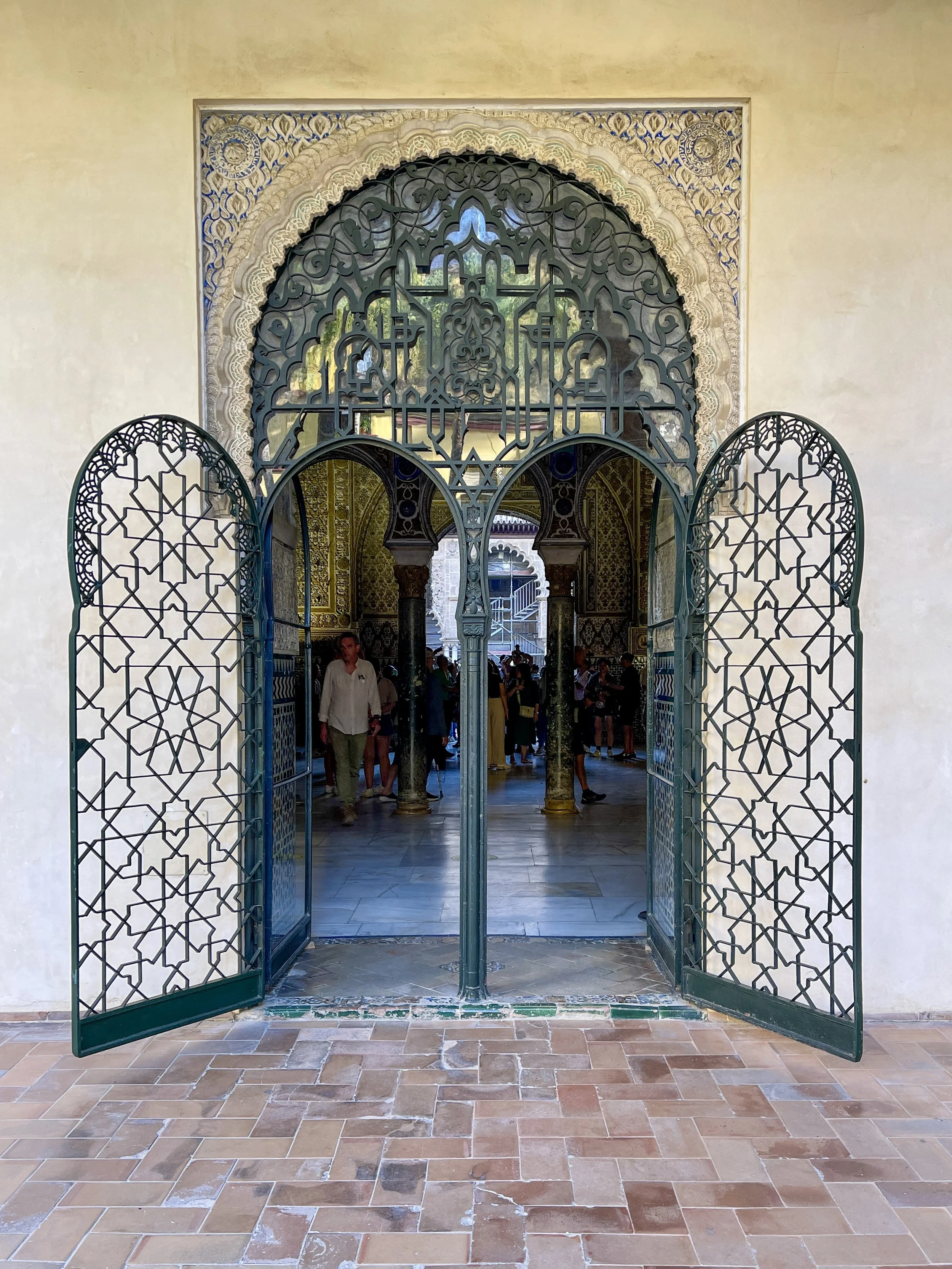
Intricate grillwork adorning a doorway at the exit of the Mudejar palace at the Real Alcazar in Seville

The intricate grillwork adorning this doorway exemplifies the Mudéjar style’s mastery of geometric patterns.

Originally, the term mudejár, derived from the Arabic mudajjan, meaning “domesticated” or “tamed,” was a derogatory label given to Muslims who chose to remain in al-Andalus under Christian rule after the Reconquista. Yet, as time passed, it came to represent something far more enduring — the synthesis of Islamic forms and decorative elements within Christian architecture. This distinctive style of art and architecture includes features like horseshoe arches, carved stucco, geometric tile compositions, muqarnas (stepped, stalactite-like vaulted ceilings) and carved wood.

However, Pedro didn’t get to enjoy his palace for long. On March 23, 1369, just three years after the building’s completion, Pedro was assassinated at the age of 34 by his half-brother, Enrique. This treacherous act propelled Enrique to the throne as Enrique III, marking the beginning of the new Trastámara dynasty.

A window grille with geometric patterns and stylized arches at the Real Alcazar in Sevilla

The window grille showcases elegant geometric patterns and stylized arches.

The palace’s main entrance is framed by two blind multifoil arches embellished with panels featuring symmetrical vegetal and geometric designs known as sebka. 

Above, the second-story gallery has three multifoil window arches. A horizontal blue and white frieze bears the Kufic inscription written forward and in mirror image: “There is no victor but Allah.” Framing this is a secondary band dedicated to Pedro I in Latin: “El muy alto y muy noble y muy poderoso y muy conquistador don Pedro, por la gracia de Dios Rey de Castilla y de León, mandó hacer estos Alcázares y estos Palacios y estas portadas que fue hecho en la era de mil cuatrocientos y dos.” This translates to, “The highest, noblest and most powerful conqueror, Don Pedro, by God’s grace the King of Castile and León, ordered the construction of these Alcázares, and these palaces, and these façades, completed in the year 1402.”

We stepped through the palace’s main door and found ourselves in a spacious two-story vestibule. In keeping with Islamic tradition, arches divided the reception hall into two smaller rooms with a broken axis of sharp right-angle turns, an ingenious architectural device designed to maintain the privacy of interior spaces. To the left was the Patio de las Doncellas (Courtyard of the Maidens), and to the right stretched the passageway leading to the Patio de las Muñecas (Courtyard of the Dolls). 

The magnificent Mudejar Patio de las Muñecas (Courtyard of the Dolls), looking up various flors to a gorgeous skylight at the Real Alcazar

Located in the palace’s private area, reserved for the enjoyment of the monarch and his family, the Patio de las Muñecas (Courtyard of the Dolls) includes elegant marble columns, sourced from the caliphal palace city of Madinat al-Zahra.

Patio de las Muñecas (Courtyard of the Dolls)

The intimate courtyard is one of the palace’s private spaces and owes its name to the small doll-like faces that decorate the bases of the cusped arches surrounding the patio. According to tradition, whoever finds these attracts good luck, and eligible girls are believed to find husbands. Like Córdoba’s magnificent Mezquita Mosque, the columns of black, white and pink marble that support the arches came from the former palace of Madinat al-Zahra. 

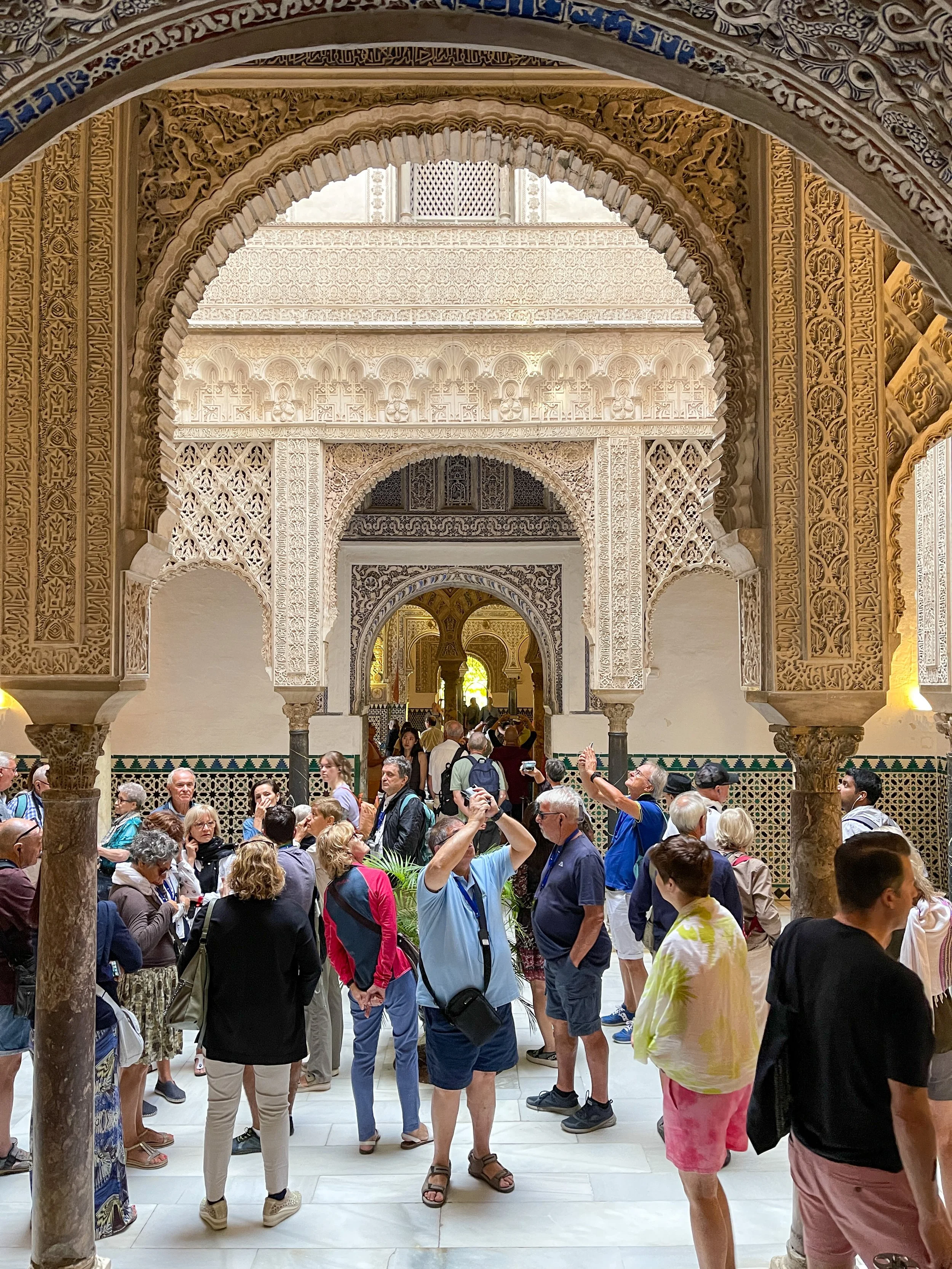
Throngs of tourists admire the elaborate carvings in the Mudejar palace of the Real Alcazar, Seville, Spain

Touring the Alcázar is a contrast of admiring serene beauty while surrounded by throngs of fellow tourists.

The two upper floors were added during the 19th century, and the domestic rooms were completely remodeled during the reign of the Catholic Monarchs. However, the showstopper here is the elegant glass skylight that turns this courtyard into a solarium.

A narrow reflecting pool, carved arches and sunken gardens in the Patio de las Doncellas (Courtyard of the Maidens) at the Real Alcazar

The cupola roof of the Hall of Ambassadors is visible from the Patio de las Doncellas (Courtyard of the Maidens).

Patio de las Doncellas (Courtyard of the Maidens)

At the heart of the palace is the Patio de las Doncellas, the main courtyard. It’s encircled by a gallery of delicate, lace-like multifoil arches, each supported by pairs of double columns brought from Genoa during the Renaissance to replace the original brick pillars. 

Scaffolding for restorations of the tiles and carved stucco in the Courtyard of the Maidens, Real Alcazar, Seville

The Patio de las Doncellas’ lower level features an arcade of polylobed arches reflecting the Mudéjar style, while the upper gallery incorporates semicircular arches influenced by the principles of the Italian Renaissance.

In contrast, the upper gallery, separated by a marble balustrade and semicircular arches, was added between 1540 and 1572 during the reign of Carlos V and reflects the Renaissance style. Despite their stylistic differences, these elements blend harmoniously, creating a space that is both cohesive and visually arresting. 

In the center of the courtyard is a rectangular pool flanked by sunken gardens with orange trees. 

Mudejar carving of Islamic symbols and a scallop shell at the Real Alcazar in Seville, Spain

The scallop motif, symbolizing the authority of the Catholic monarchy, seamlessly integrates with Mudéjar designs, highlighting the interplay of cultures and faiths in the Real Alcázar.

The name of the courtyard is tied to a controversial legend: It references a supposed annual tribute of 100 virgin maidens that the Christian kingdom of Asturias was required to send to the emirate of Córdoba. Each year, the Christian rulers allegedly selected the maidens — young women from noble and common families alike — to be sent to Córdoba. Many were believed to have been enslaved, serving as concubines or laborers in the palaces of the emirate. 

While there’s no historical evidence to confirm that such a tribute actually occurred, the story persisted in Christian retellings to underscore the perceived cruelty of Muslim rule and bolster the Christian narrative of righteous resistance. 

A tree and ground cover in the sunken garden in the Courtyard of the Maidens at the Real Alcazar

The sunken garden in the Courtyard of the Maidens is a result of a 20th century restoration of the original Islamic-era design, rediscovered through archaeological evidence and reinstated after centuries of Renaissance alterations.

The courtyard has also made its mark on popular culture, appearing as a striking backdrop in Ridley Scott’s epic film Kingdom of Heaven and as a setting in the popular HBO fantasy series Game of Thrones, where Ellaria Sand kneels before Prince Doran.

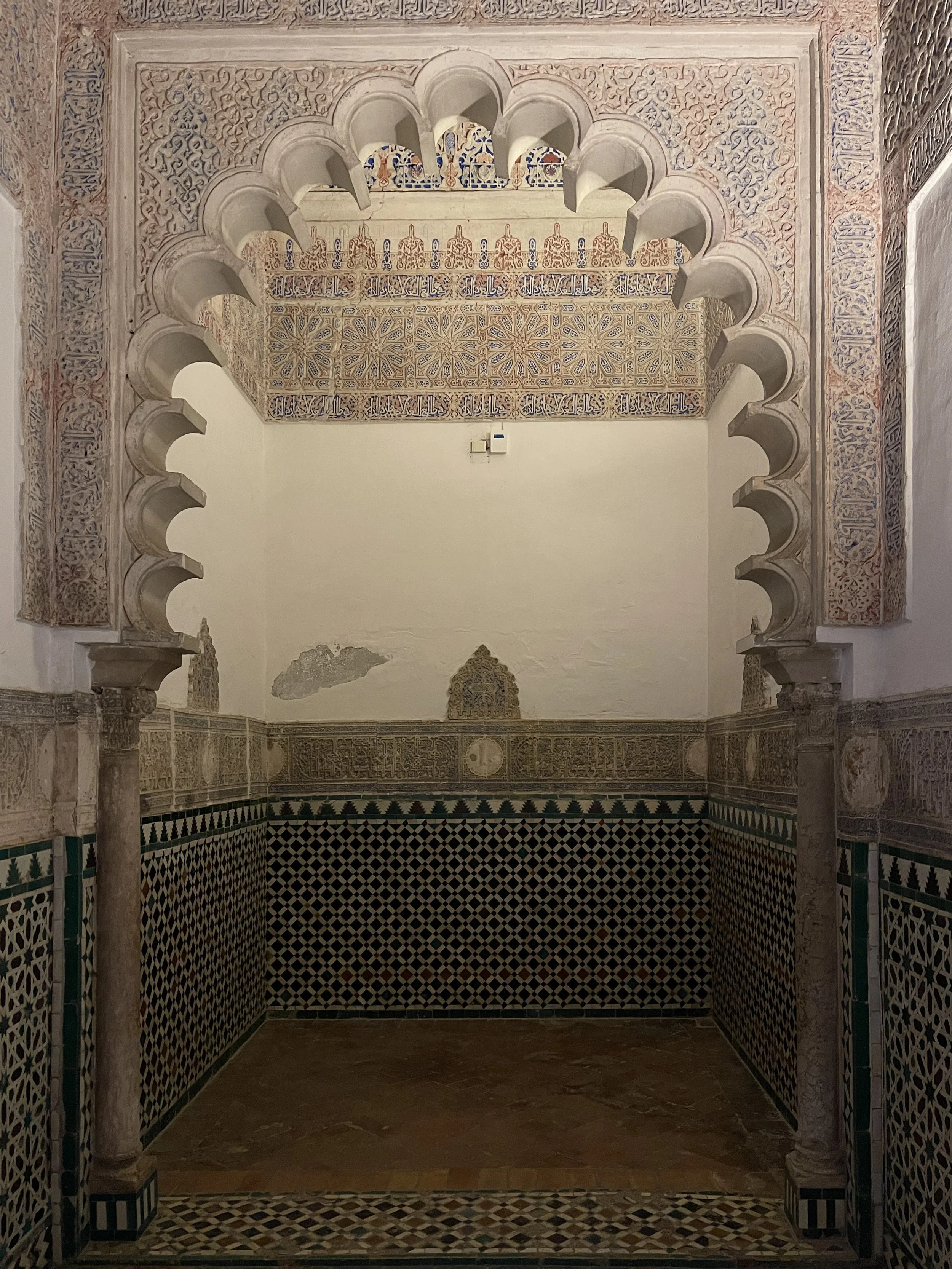
An alcove that once held the king's bed in the Alcoba Real (Royal Chamber) of the Real Alcazar, Seville

The alcove used as a bedchamber by the king during the summer months is topped by a pointed barrel vault, designed to keep the space cool.  

Alcoba Real (Royal Chamber)

The Alcoba Real (Royal Chamber) is another one of the private palace rooms and is accessible from the ground floor gallery of the Patio de las Doncellas. Its interior is divided into an antechamber and a bedroom with alcoves on the sides. Its lower walls are covered with colorful ceramic tile compositions in turquoise, royal blue and orange. 

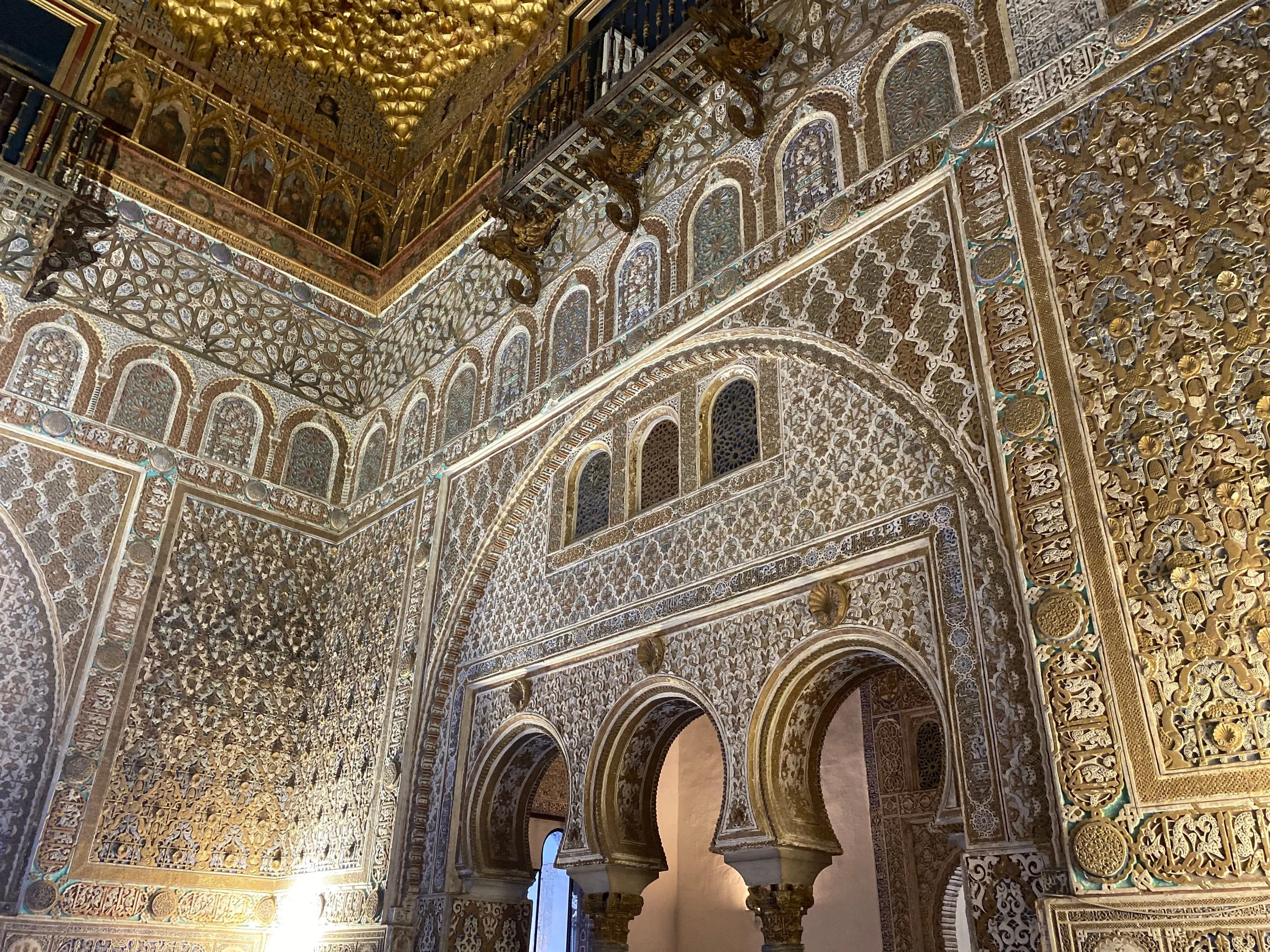
The Mudejar splendor with beautiful carvings and archways in the Salón de Embajadores (Hall of Ambassadors) at the Real Alcazar

Once used by Pedro I as his throne room, the Salón de Embajadores (Hall of Ambassadors) stands as the most magnificent room in the palace. Its opulent design perfectly embodies its purpose as a symbol of regal authority and grandeur.

Salón de Embajadores (Hall of Ambassadors)

One of the most spectacular rooms in the Real Alcázar is the Salón de Embajadores (Hall of Ambassadors). Originally, it served as the throne room for Pedro I, where he received dignitaries and other important visitors.

Looking up at the gilt dome of the opulent Hall of Ambassadors in the Real Alcazar de Sevilla

Beneath the shimmering, gilt dome of the opulent Hall of Ambassadors is a frieze depicting castles and lions, and below that Gothic niches containing portraits of Spanish kings.

The walls of the room are covered with intricate tile and finely carved stucco work and follow the architectural scheme of a qubba — a structure in Islamic architecture, often as a mausoleum or shrine — which features a cubic floor plan with a spherical dome above it. The square base represents the earth, while the domed ceiling symbolizes the vastness of the universe above.

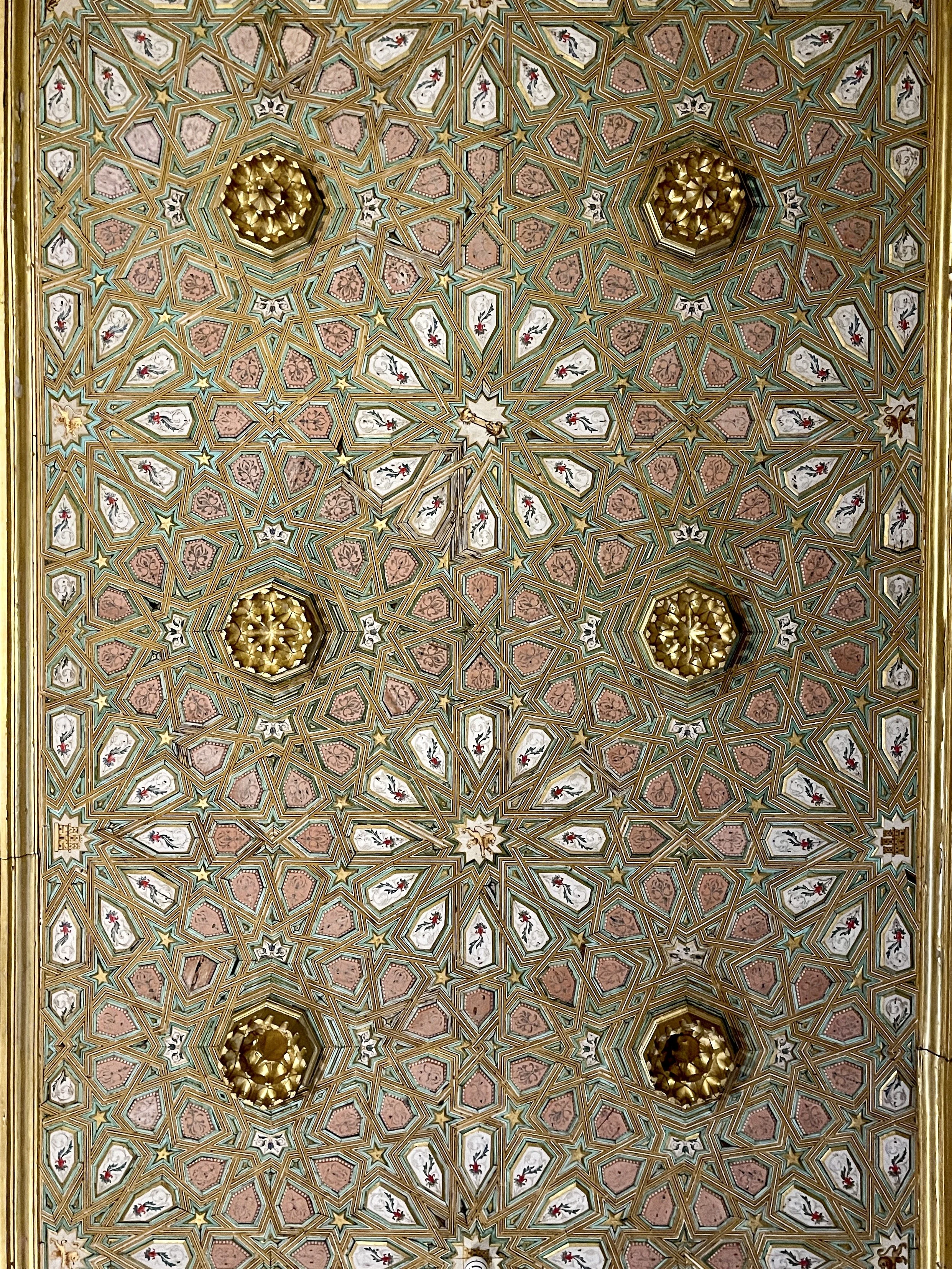
The ceiling of the Cuarto de Príncipe (Prince’s Suite) in the Real Alcazar with golden honeycomb-like mocarabes

The ceiling of the Cuarto de Príncipe (Prince’s Suite) was created during the reign of Charles V in 1543 and is adorned with golden honeycomb-like mocarabes. 

Cuarto de Príncipe (Prince’s Suite)

You’ll find the Cuarto de Príncipe (Prince’s Suite), through the north gallery of the Patio de las Muñecas. This historic space includes a central hall with two smaller alcove rooms on each side. The room is named after Juan de Trastámara, the only son  of Fernando II of Aragon and Isabella I of Castile. He was believed to have been born here in 1478. 

Look up, and you’ll find a ceiling decorated with the heraldic symbols of the Catholic Monarchs, with plaster arches dividing the room into three sections.

Islamic designs on the lower walls of the Prince’s Suite in the Real Alcazar

Islamic design, as seen on the lower walls of the Prince’s Suite, avoids depictions of people or animals, reflecting a focus on abstract patterns and geometry as a way to honor the divine without creating so-called idolatrous imagery.

We exited the Palacio del Rey Don Pedro I through a set of wrought iron and glass doors into the back gardens of the Real Alcázar — a serene oasis and the perfect respite after the dazzling beauty of the Mudéjar palace, which left us awestruck with its intricate details and overwhelming splendor. –Duke

Mediterranean Mélange: Unveiling Spain and Italy’s Shared Splendor

From Barcelona’s vibrant streets to Rome’s ancient echoes, experience the warmth, flavor and rhythm that make the Mediterranean so unforgettable.

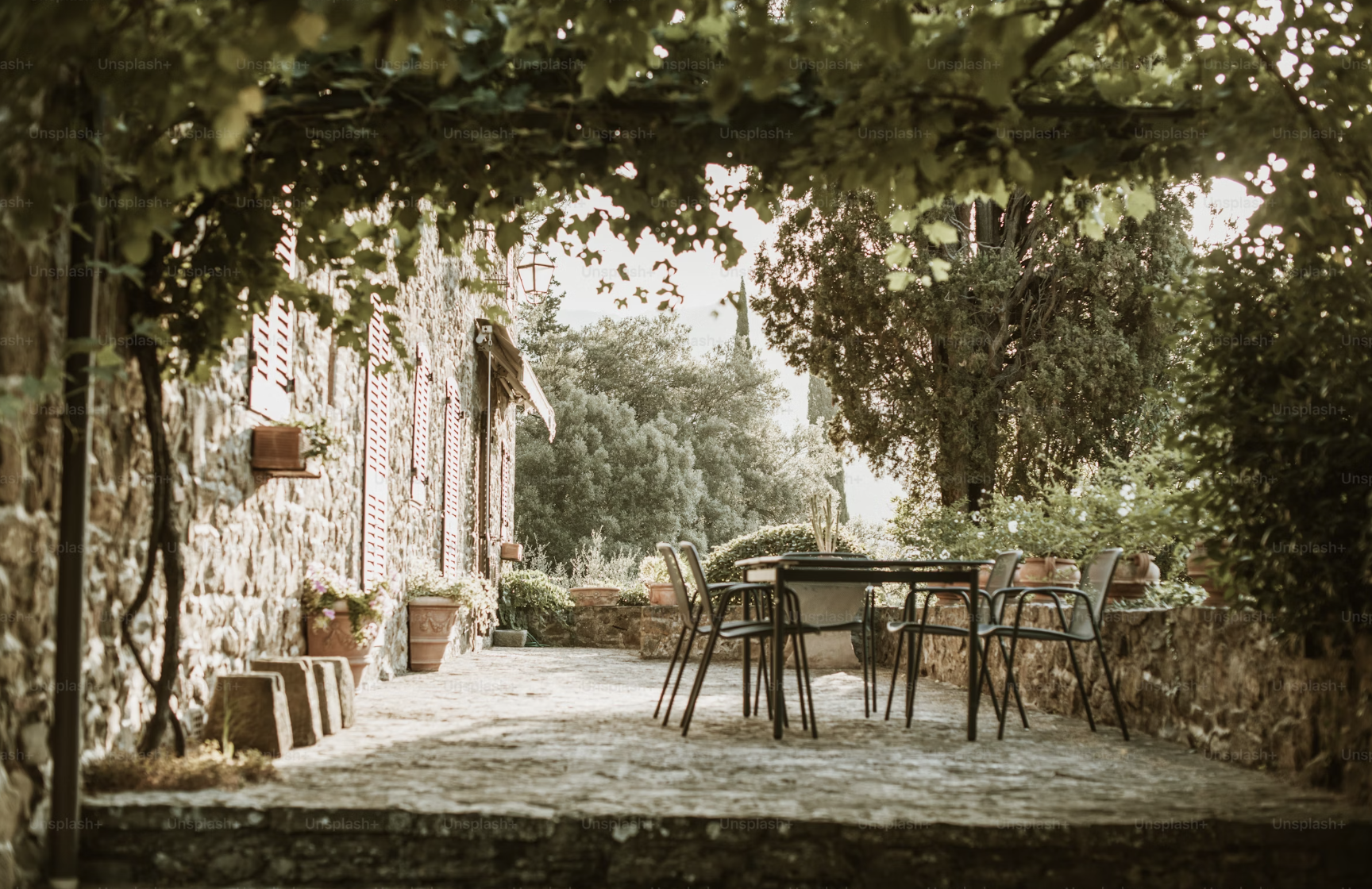
Tuscan patio with cobblestones, trellis covered with greenery, table and chairs

The Mediterranean isn’t just a sea; it’s a state of mind. My recent journey through Spain and Italy felt like diving into a living, breathing artwork — each vista bathed in the golden glow of the Mediterranean sun, each scent wafting from open kitchen windows a reminder of their shared yet singular flavors.

These two nations, linked by that glimmering Mediterranean, show their charm in ways that go beyond landmarks or scenic views.

It’s in the warmth of people who live with passion in every part of their day. It’s the unspoken language of hospitality and genuine connection that leaves a mark long after you’ve moved on.
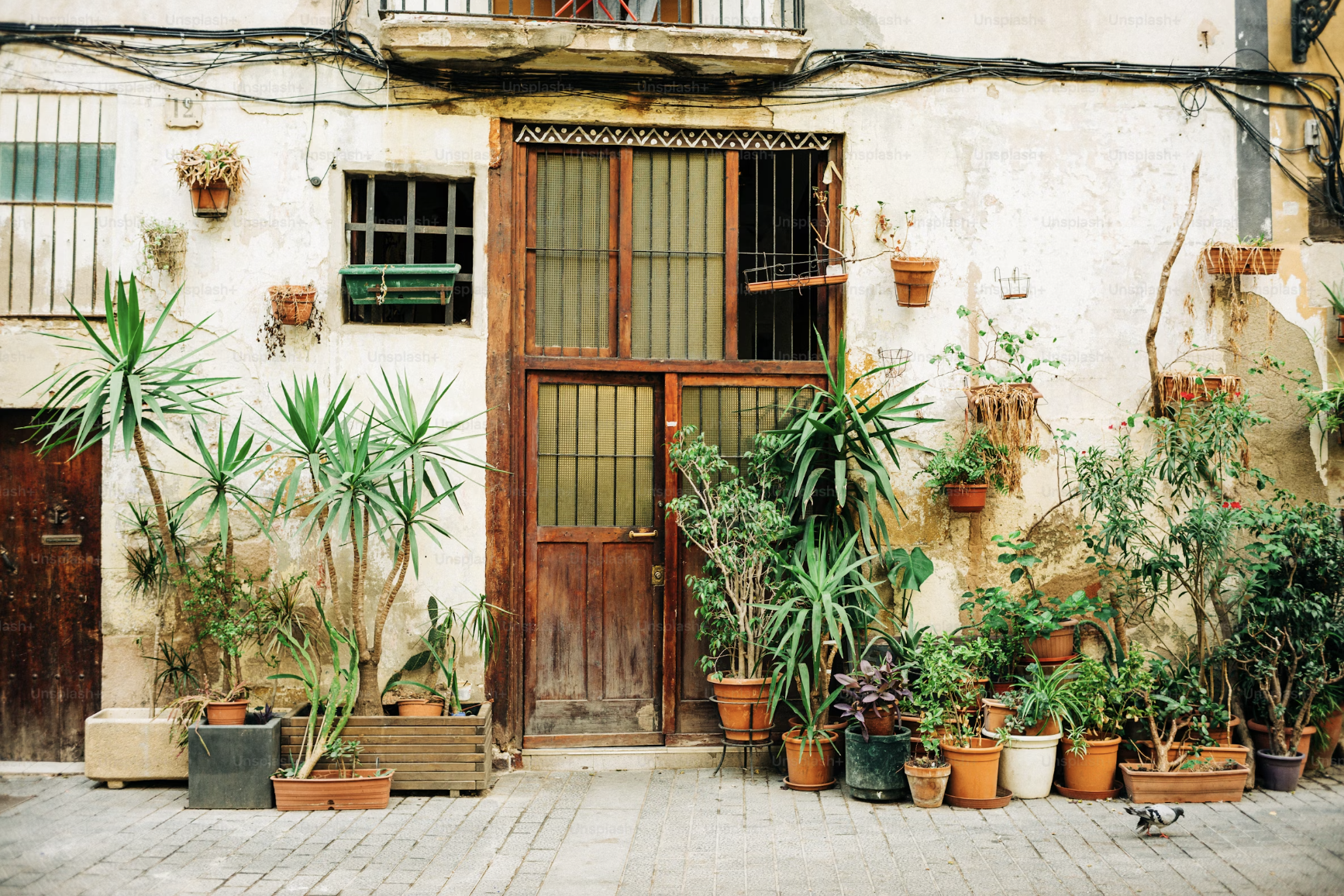
Street in Barcelona with lots of potted plants

Barcelona 

My exploration began in Barcelona, where the Catalan spirit fills the streets with a palpable energy. Wandering the Gothic Quarter’s labyrinthine alleys as part of my Spain tours, I encountered more than ancient stone and soaring arches — this was a place alive with whispered histories and Gaudí’s fantastical fingerprints. The Sagrada Familia loomed like an unfinished masterpiece against the sky, a testament to the vision and determination that defines this city. But it was sipping sangria at a quiet café that I felt the real essence of Barcelona — a blend of warmth, tradition and a fierce love of life.

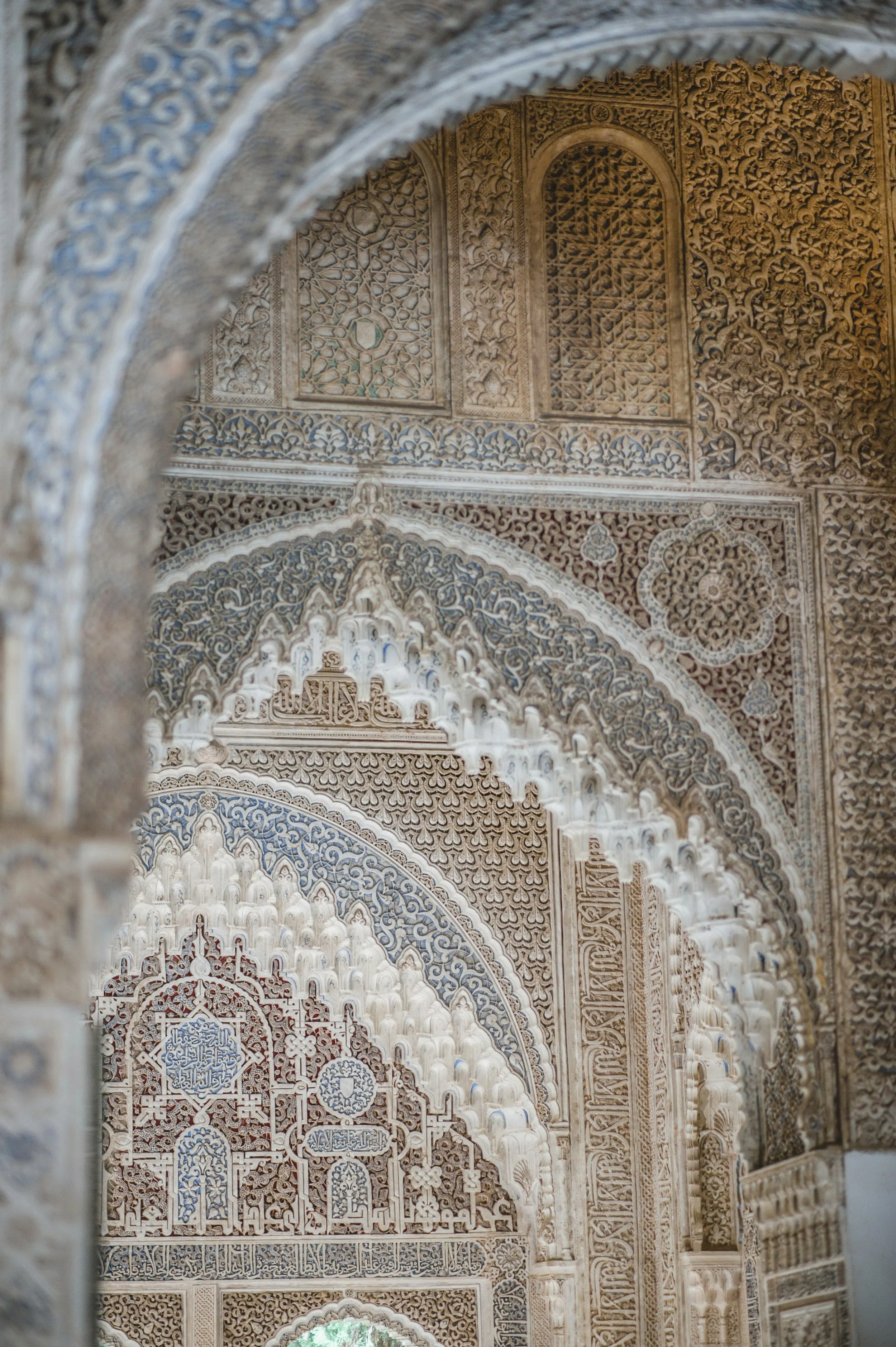
Elaborately carved arches at the Alhambra in Granada, Spain

Granada 

Leaving Barcelona’s cosmopolitan allure behind, I ventured south into the rustic embrace of Andalusia, where the landscape seems to ripple in the sun. In Granada’s Alhambra, the spirit of al-Andalus echoes through the quiet arches and intricate tiles of the Nasrid Palaces, each curve and hue a reminder of the cultural symbiosis that flourished here. The Mediterranean’s influence shaped architecture, art and daily life, with its ever-present warmth and rhythm.

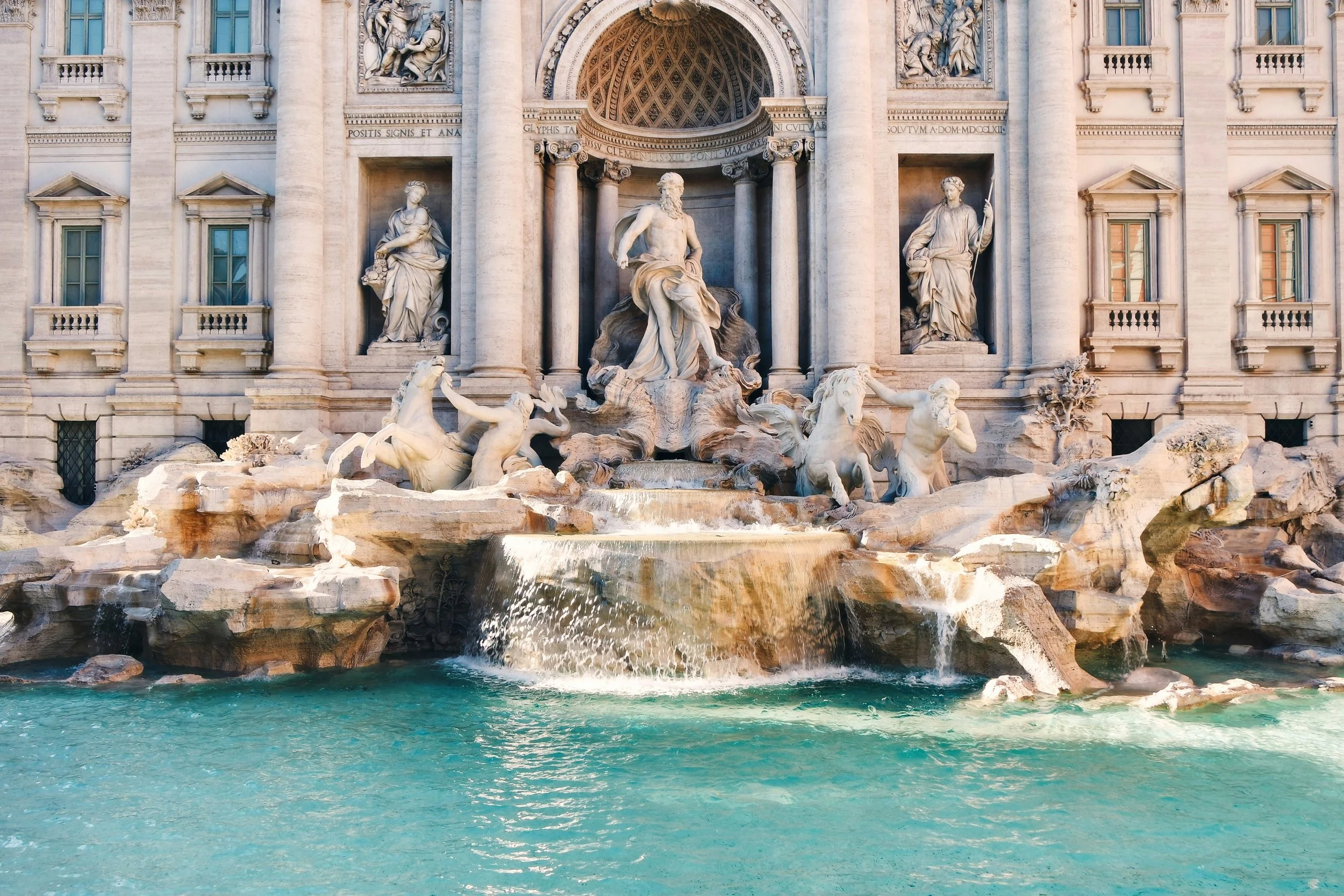
The Trevi Fountain, Rome

Rome

Crossing the sea to Italy, I found myself swept into a whole new cadence in Rome on one of the top-rated tours of Italy. There’s an undeniable gravitas here, where history presses upon the present. Amid the ruins of the Colosseum and the Roman Forum, I could almost hear the shouts of ancient citizens and feel the pounding of history beneath my feet. But Rome isn’t all grandiosity; it’s also the aroma of pizza baking in Campo de’ Fiori, the laughter echoing through Trastevere’s cobbled streets, and the dizzying sweetness of gelato on a hot day.

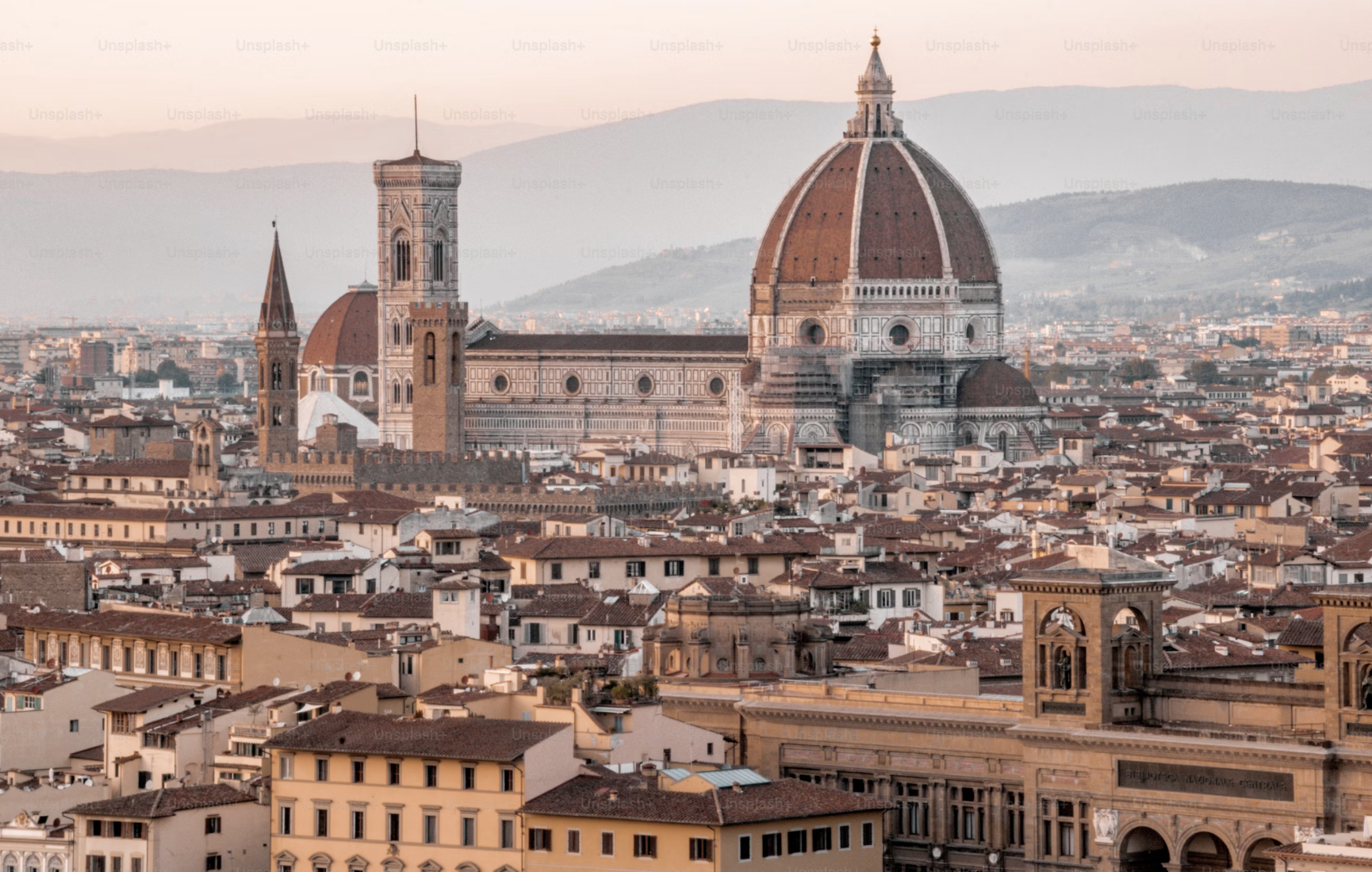
Aerial view of Florence, Italy, with the big church, the Duomo

Florence 

And then, Florence — the heart of Renaissance Italy, where every corner seems touched by genius. At the Uffizi Gallery, each masterpiece tells the story of a nation that birthed Michelangelo and Botticelli, of a people with a timeless love for beauty in all forms. Climbing the Duomo, I gazed over red-tiled rooftops stretching endlessly to the horizon — a view that seemed to capture the soul of Italy itself.

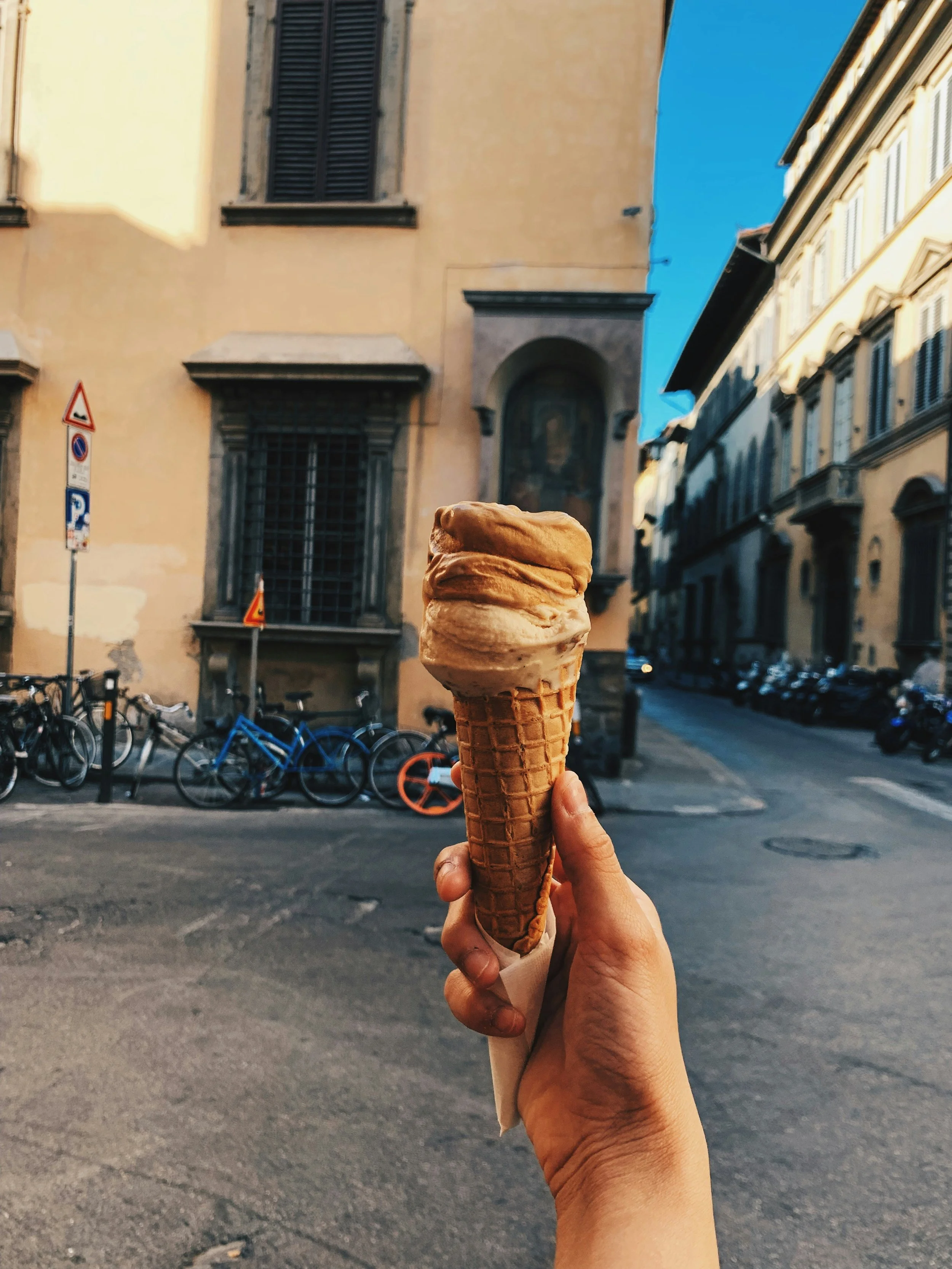
a hand holds up a cone of gelato on an Italian street

Spain + Italy = Mediterranean Magic

As my time in Spain and Italy came to an end, I knew I’d been irrevocably changed by the magic that spilled from every cobblestone street, every vineyard row, every heart-stopping vista. From the electric hum of Barcelona’s streets to the rolling, sun-soaked hills of Tuscany, each place felt like an old friend with a new story to share.

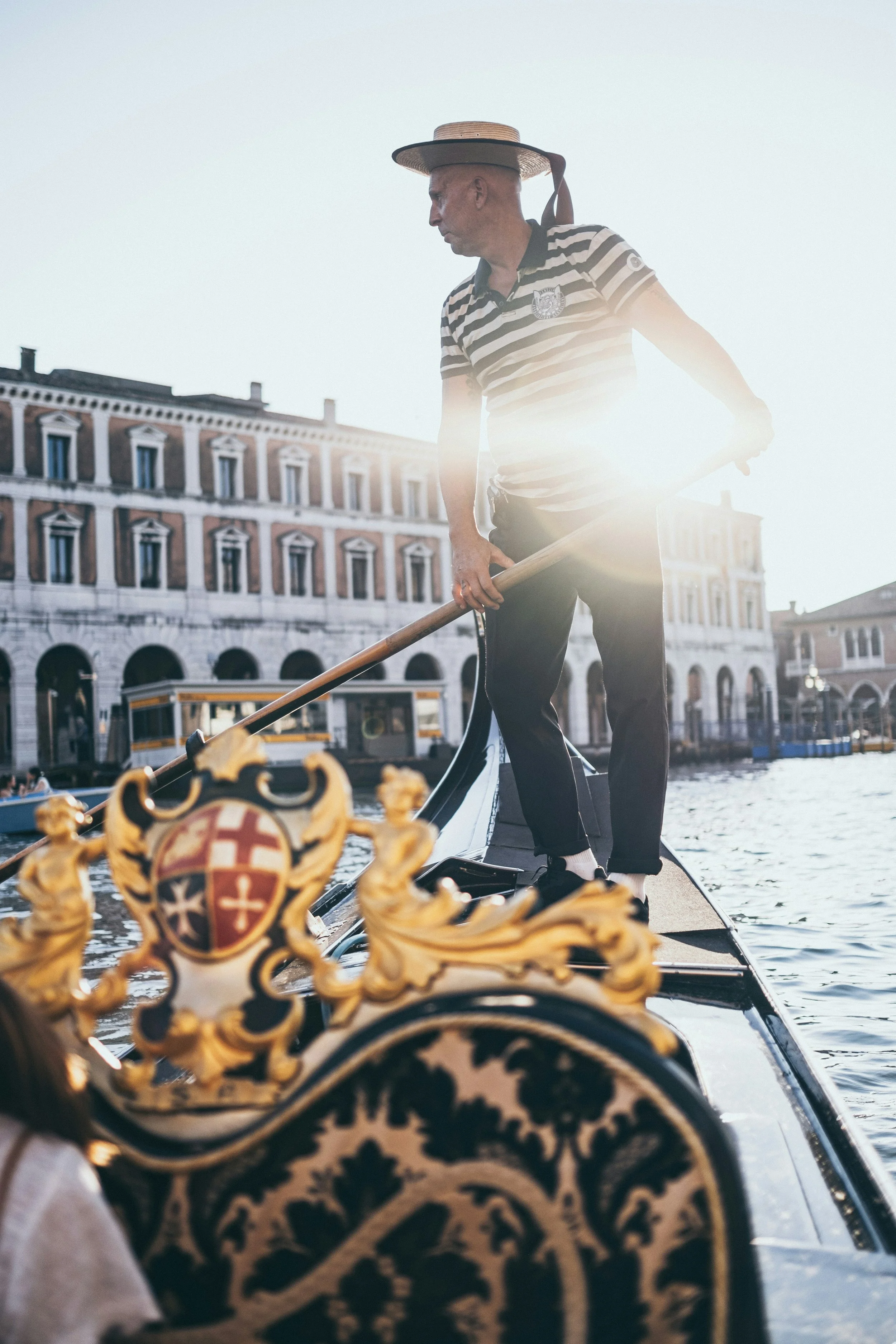
These two nations, linked by that glimmering Mediterranean, show their charm in ways that go beyond landmarks or scenic views. It’s in the warmth of people who live with passion in every part of their day. Think of flamenco dancers in Seville, pouring their souls into every step, or the Venetian gondoliers, who navigate their waters like a dance. It’s the unspoken language of hospitality and genuine connection that leaves a mark long after you’ve moved on.

Leaving the Mediterranean shores behind feels like stepping out of a dream. But I carry with me memories of sunlit piazzas, starlit nights, the laughter of strangers who became friends and the quiet moments in the shadows of cathedrals. And even though my journey is technically over, Spain and Italy now live in my bones, a forever reminder of the adventures that await around every corner.

To explore Spain and Italy is to dive headfirst into a world of color, flavor and stories. Picture yourself sipping sangria in a Barcelona café or twirling pasta in a tucked-away Tuscan trattoria. Each moment here is a toast to life itself. The crumbling ruins, lively piazzas and cobblestone alleyways all testify to the enduring spirit of these lands — and the people who make them unforgettable. In travel, we’re reminded that while each place is one-of-a-kind, there’s a universal rhythm that binds us all.

Spain and Italy lure us with their sun-drenched coastlines, timeless ruins, and fiery, joyful souls. And while you might come for the food or the art, you’ll leave with a spirit that’s been altered, a heart forever stamped by their beauty. –Kirill Balaganin 

Iglesia de San Luis de los Franceses: The Baroque Brilliance of Seville’s Hidden Gem

This little-known chapel will have your head spinning, with gorgeous art and jaw-dropping details in every direction.
Gilded Baroque altar with saint in the middle at Iglesia de San Luis de los Franceses in Seville

When we returned to Sevilla, our friend José told us of a little-known but absolutely gorgeous church, the Iglesia de San Luis de los Franceses (the Church of Saint Louis of France). His partner Jo, who I once dubbed the Rock ’n’ Roll Nanny, gave Duke and me a tour of her favorite spots in Sevilla. In between stuffing our faces with delectable tapas dishes and sipping sherry, she took us to see José’s secret spot.  
We arrived during the lull of siesta, so we bided our time the best way we knew how: by indulging in yet more tapas, finding a quaint café in the Macarena neighborhood. 

Gilded altar with paintings and dome above at Iglesia de San Luis de los Franceses in Seville

When we returned to San Luis and entered the main chapel, we stood stock still as we took in the sheer spectacle before us. We understood immediately why José was so captivated — even for us recovered Catholics. Baroque churches have a way of being extravagantly maximalist, but even by those standards, San Luis packs so much into a small space. 

The chapel is a visual feast, where every surface competes for your attention. We moved from one altar to the next, making our way around the circle, grinning immensely and excitedly pointing out strange details to each other. You could spend an hour here and still not catch every detail.

Elaborately carved facade of Iglesia de San Luis de los Franceses in Seville

The Schizophrenic History of the Iglesia de San Luis de los Franceses

Built between 1699 and 1730, this Baroque marvel was the crowning achievement of Leonardo de Figueroa, an architect celebrated for his role in shaping Sevilla’s grandest religious spaces. 

The church was originally part of a Jesuit novitiate, meaning it was designed not only for worship but to serve as a spiritual training ground for novices. 

This complex was built on land donated by a noble family with French ties, hence the dedication to Saint Louis, the French King Louis IX.

In those early years, the church was a prime example of Jesuit opulence and influence. Every inch of the building seemed designed to overwhelm with splendor, drawing viewers into a theatrical experience. 

The main chapel, a circular space devoid of traditional seating, was meant to stand as a monument to Jesuit ideals, immersing novices and visitors alike in an atmosphere where spiritual grandeur took precedence over community worship. 

However, in 1767, the Spanish crown expelled the Jesuits. For a time, the building served as a Franciscan convent. 

Painting of Baby Jesus surrounded by cherubs on panel at Iglesia de San Luis de los Franceses in Seville
Painting of the Virgin Mary surrounded by cherubs on wall panel at Iglesia de San Luis de los Franceses in Seville

As the 19th century rolled in, the property underwent secularization and was turned over to the state. The grand altarpieces designed to showcase Jesuit saints were stripped, and the space was adapted for pragmatic uses, including functioning as a factory. 

The building’s role shifted once again as it became a hospice for the city’s elderly and sick. For several decades, the church was a place of stark contrasts — its Baroque details and gilded interiors juxtaposed with the somber reality of its new short-term inhabitants. 

The 20th century saw further change. The once-sacred site became a stage for performances, with productions like Don Juan Tenorio taking advantage of the church’s dramatic acoustics and architecture to tell the tale of the infamous lothario. 

A lightning strike in the 1920s pierced the vault, destroying an oil painting — perhaps serving as a grim suggestion that God wasn’t happy with how the church was being used?

After decades of neglect, San Luis was finally restored in the late 20th century. This revitalization effort sought to reclaim the site’s former glory, reopening the doors of the church, domestic chapel and crypt to the public. 

Exterior of the Iglesia de San Luis de los Franceses with bell tower, dome and statues

Architectural Highlights of the Iglesia de San Luis de los Franceses 

The façade alone is a visual feast. Ornate Solomonic columns twist skyward, framing a riot of Baroque symbolism covering the pale pink building. Statues of saints and angels stand guard like sentinels, their expressions a mix of stern devotion and regal authority. Above the entrance, the coat of arms of Spain is crowned by three archangels.

Religious painting on ceiling under carved altar with cherubs at the top at Iglesia de San Luis de los Franceses in Seville
Gilded altar covered with paintings at Iglesia de San Luis de los Franceses in Seville

The Surreal Spirituality of the Main Chapel

But it’s when you step inside that the full spectacle begins. The church was designed in a Greek cross layout, and from the moment you cross the threshold, your gaze is drawn upward to the magnificent dome. Light filters through the lantern high above, illuminating frescoes that swirl like divine visions. Painted by Lucas Valdés, these frescoes depict scenes of Christian virtues — obedience, chastity, humility — interspersed with symbols of Solomon’s Temple. (Side note: Did King Solomon really exist?)
The main chapel is something of an enigma. Circular and intimate, it has no pews. Jesuit novices would have stood in silent contemplation, absorbing the intricate carvings, gilded reliefs and soaring altarpieces that fill the space. This is Baroque at its most intense. 
Statue of saint holding Baby Jesus in a gilded Baroque altar at Iglesia de San Luis de los Franceses
Statue of saint at the center of an ornate Baroque altar with head of the Virgin and cherubs at Iglesia de San Luis de los Franceses

At the center of the main altar is a painting of San Luis, the church’s namesake, attributed to the school of Zurbarán. Flanking this are paintings of the Immaculate Conception and the Virgin of Bethlehem, all framed by mirrors that multiply the radiance of the gold. (Learn more about the various depictions of the Virgin Mary.)

But what really caught our eye are the relics embedded within this luxurious setting. Encased in delicate reliquaries, you’ll find a skull, ribs, and fragments of bones belonging to Jesuit holy men like Saint Ignatius of Loyola and Saint Francis Xavier. Vials of blood, believed to belong to lesser-known saints, are encased in gold and glass. There’s also a piece of cloth from Saint Stanislaus Kostka’s robes to honor this Polish saint who died at the age of 18. 

Relic of rib bones in ornate gilded Baroque frame at the Iglesia de San Luis de los Franceses in Seville

Each side altar tells a different story through its artwork and relics. On one side are scenes celebrating Jesuit virtues (devotion, sacrifice, spiritual fortitude), while the other side showcases key moments from the lives of saints who exemplified those ideals. 

Baroque altar with statue of saint kneeling behind glass and small frames on red arch at the Iglesia de San Luis de los Franceses in Seville
Statue of baby in niche in Baroque altarpiece with black walls and gilded frames at the Iglesia de San Luis de los Franceses in Seville
Gorgeously painted ceiling with angels at at the Iglesia de San Luis de los Franceses in Seville
Gilded altars in arched niches with black and white checkered floor at at the Iglesia de San Luis de los Franceses in Seville

The black-and-white checkered floor calls to mind dualities — light and dark, good and evil, the sacred and the profane — echoing the spiritual journey of navigating moral choices central to Jesuit teachings. In a space filled with opulence, the simple geometry of the floor offers a grounding presence, representing the balance between the earthly and divine realms. 

This is a chapel designed not just to be seen but to be felt — a place where spiritual reverence mingles with a sense of the macabre. 

Painted ceiling with angels and sacred heart in the Domestic Chapel at the Iglesia de San Luis de los Franceses in Seville

The Domestic Chapel

As you wind through the quiet corridors of the Iglesia de San Luis de los Franceses, following almost inconspicuous signs, you find yourself in another part of the complex. This secluded space, the Domestic Chapel, hidden within the old Jesuit novitiate, was designed for private worship by the novices. It’s a single-nave chapel, but, like the Main Chapel, don’t let its size deceive you — its beauty and detail are breathtaking.

Gilded Baroque altar in the Domestic Chapel at the Iglesia de San Luis de los Franceses in Seville

The chapel is lavishly adorned, featuring stunning frescoes by Lucas Valdés and Domingo Martínez, and sculptures by the renowned Duque Cornejo. 

Round windows shine light on painted ceiling depicting angels at the Iglesia de San Luis de los Franceses in Seville

The richly ornamented altarpiece is a visual celebration of the Eucharist. At its center is the Virgin Mary, a gift from Saint Francis Borgia, flanked by statues of Saint Stanislaus Kostka and Saint Aloysius Gonzaga. Above the Virgin, a relief depicts Saint Stanislaus’ reception into the novitiate in Rome, surrounded by medallions illustrating the lives of Saint Francis Xavier and Saint Francis Borgia. Saints alive!

Man pretends to be scared in a corner of the crypt at the Iglesia de San Luis de los Franceses in Seville

The Crypt

The crypt, once sealed off and hidden, has now been opened to the public. That being said, there’s not much to see here. The crypt of the Iglesia de San Luis de los Franceses is a subdued space — especially when contrasted to the crazily ornate rest of the church or something like the catacombs of Paris — primarily intended for meditation and remembrance. 

Brick tunnels in the crypt at the Iglesia de San Luis de los Franceses in Seville

Over 300 bodies are buried in the crypt — though you’d never know that. There’s not a single marker. So who’s buried down there? Some members of the Jesuit order and other notable figures associated with the church, although specific records of who’s interred there are sparse. 

Skull relic in gilded Baroque niche at the Iglesia de San Luis de los Franceses in Seville

Haunting Tales of San Luis de los Franceses

One of the most unsettling tales of this church is that of Manuel Cantelar. In the 1990s, this troubled man is said to have staggered toward the church one fateful night, a knife clenched tightly in his trembling hands. Eyes glazed with despair (or madness), he pressed the blade against his chest and threw himself against the cold stone façade in a bizarre form of suicide. It’s said his spirit never left. 

Strange occurrences continue to plague the church. Workers involved in restoration projects have spoken of tools vanishing, only to have them reappear in baffling places. Even the bravest of them have confessed to hearing ghostly whispers and feeling a sudden chill as if unseen eyes were fixed on them. And then there are the dogs. They growl and snarl at empty spaces, their hackles raised, as if warning off an unseen presence.

Even now, the murmur of phantom voices and the chill of restless spirits might greet anyone daring enough to explore the forgotten corners of San Luis de los Franceses.

Brick and elaborate plasterwork facade of the Iglesia de San Luis de los Franceses in Seville

Visiting the Iglesia de San Luis de los Franceses

As we left the church of San Luis de los Franceses, we couldn’t help but feel a sense of awe at the beauty and history of this often-overlooked treasure — from the grand Main Chapel with its imposing dome and intricate altarpieces to the almost-as-impressive Domestic Chapel tucked away from the main church. 

While most visitors will make sure to see the Seville Cathedral, we found its beauty to only be skin deep: The façade is much more impressive than its interior. That’s why we were so happy to marvel in surprise at the unexpected tiny-by-comparison grandeur of San Luis. We owe our heartfelt thanks to our friends Jo and José for encouraging us to explore this hidden gem, a reminder that some of Seville’s most stunning spaces lie just beyond the well-trodden paths. –Wally

Painted dome and walls with arched balcony at the Iglesia de San Luis de los Franceses in Seville

The deets

Hours
Monday:
Closed
Tuesday to Sunday: 10 a.m. to 2 p.m. and 4 p.m. to 8 p.m. 
Summer hours (July 1 to August 31): 9 a.m. to 5 p.m. 
Note: Ticket sales end 15 minutes before closing time, and visitors are asked to leave 10 minutes prior to closing. 

Cost: €4, with discounts for students, seniors and local residents

Tour options: Guided tours are available as are audio guides in multiple languages. 

Iglesia de San Luis de los Franceses

Calle de San Luis, 37
41003 Sevilla
Spain 


Visiting Seville Cathedral

Discover the world’s largest Gothic cathedral, a UNESCO World Heritage Site with the iconic La Giralda bell tower and Columbus’ tomb. 

The Seville Cathedral dominates the skyline — not surprisingly, since it's the largest Gothic cathedral in the world.

As you walk through the narrow, winding streets of Seville, you’ll inevitably find yourself in the Plaza del Triunfo. There, rising as a colossal monument to faith and human ingenuity, stands La Catedral de Sevilla (Seville Cathedral). It’s hard not to feel a sense of awe as you take in the sight before you — this is the largest Gothic cathedral in the world, and it commands your attention.

Gothic architecture was all about height and light, creating spaces that drew the eyes — and the spirit — upward. The architects of Seville Cathedral embraced this philosophy wholeheartedly. They designed a building that seemed to defy gravity, with soaring arches, intricate ribbed vaults and walls of stone that appear as delicate as lace.

The towering high altar of Seville Cathedral seems to glow with an otherworldly light.

It’s the largest and one of the most ornate Catholic altars in the world — a gilded masterpiece that took nearly a century to complete.

With its intricate ornamentation, the cathedral is gorgeous from any angle.

Visiting Seville Cathedral: First Impressions

The façade of Seville Cathedral is an intricate pattern of religious figures and mythical beasts, all carved in stone with remarkable detail. Saints and apostles line the entrances, each captured in dynamic poses, holding symbols of their faith and martyrdom. Figures like Saint Peter with his keys to Heaven and Saint James with his staff stand as silent guardians of the cathedral. Above the portals, scenes from the life of Christ and the Virgin Mary are depicted in elaborate reliefs.

Statues of holy personages ring the cathedral's doorways.

Interspersed among these sacred figures are gargoyles — grotesque stone creatures jutting out from the walls. Their twisted forms, often a blend of animals with something monstrous, serve both symbolic and functional roles. They channel rainwater away from the building, but they also act as protectors, believed to ward off evil spirits from entering the holy site. 

La Giralda rises 341 feet (104 meters) into the air.

The Symbolism of La Giralda: A Story in Stone

Look closely at the base of the tower, where the original stonework from the Almohad Muslim empire remains intact. The arches, adorned with delicate arabesques, are a reminder of the tower’s Islamic origins. They speak of a time when Seville was a center of learning and culture in the Islamic world, a place where scholars and artisans thrived.

Part Islamic, part Renaissance, La Giralda is a good symbol of the merging of East and West that's such a part of southern Spain.

Now, let your gaze travel upward, to the belfry that was added during the Renaissance. The clean lines, classical proportions and elegant simplicity of the design are a stark contrast to the intricate patterns below. This was a statement, a declaration of the Christian faith’s ascendancy. 

Driving home that point is the Latin verse inscribed around the belfry: “TURRIS FORTISSIMA NOMEN DNI PROVERB. 18,” translating to “The name of the Lord is a strong tower,” from Proverbs 18:10. 

High above the city, El Giraldillo stands poised on La Giralda, her massive bronze figure more than just a weather vane — she’s a symbol of faith and victory. Cloaked in a flowing tunic, she holds a mighty shield in one hand and a palm branch in the other. Her figure twists gracefully, moved by the winds, but her expression and stance evoke unshakable faith. Like a sentinel or an ancient goddess, she watches over her city.

El Giraldillo: the most famous weathervane in the world?

La Giralda’s Lesser-Known Secrets

La Giralda also holds secrets that many visitors aren’t familiar with. For instance, did you know that the tower was designed with ramps instead of stairs? This allowed the muezzin, who called the faithful to prayer, to ride a horse to the top. As you imagine this, you can almost hear the rhythmic clatter of hooves echoing within the tower’s walls.

Another lesser-known fact is that during the cathedral’s construction, La Giralda served as a lookout tower. From its heights, guards could survey the city and the surrounding countryside, a strategic vantage point that was vital during times of conflict. 

Duke got this shot from the nearby General Archive of the Indies. You can see the copy of El Giraldillo that topped the tower while the genuine article got restored.

The Entrance of Seville Cathedral 

In front of the cathedral, a statue of Ferdinand III of Castile proudly holds a globe and a sword, commemorating his pivotal role in the 13th century Christian conquest of Seville. Ferdinand’s victory led to the transformation of the city from an Islamic stronghold into a key Christian center, with the mosque being converted into the cathedral we see today.

But Ferdinand isn’t the only figure watching over the entrance. Nearby stands a replica of El Giraldillo. The bronze reproduction topped the tower during a restoration and was moved here when the original figure returned to its rightful place atop La Giralda.

As you step inside the cathedral, your eyes are immediately drawn upward. Massive stone columns rise like ancient trees in a forest, supporting the ceiling. These columns branch out into ribbed vaults, forming a web-like pattern that not only adds to the structure’s stability but also creates an otherworldly sense of space.

The high altar of Seville Cathedral, a breathtaking display of intricate gold niches, showcases scenes from the life of Christ.

The High Altar: A Golden Marvel

The towering structure of the high altar of Seville Cathedral seems to glow with an otherworldly light. It’s the largest and one of the most ornate Catholic altars in the world — a gilded masterpiece that took nearly a century to complete. 

Crafted by Flemish sculptor Pierre Dancart in the late 15th century, the altar rises over 65 feet high and 42 feet wide, composed of 45 intricately carved panels — it feels like an epic storybook springing to life, scene by scene, pulling you into its divine narrative. Imagine it as a tapestry of tales, each vignette acting as a page from the most sacred stories in Christian tradition.

The altar's reliefs are intricately carved wood covered in gold leaf.

At the base, you can see the Nativity, with Mary cradling the infant Jesus, the shepherds humbly offering their reverence, and the Magi presenting their gifts.

Move higher, and the story unfolds into more dramatic, intense episodes. In one vignette, you can see the Crucifixion, then comes the Resurrection, bursting forth from the altar’s center, where Christ, victorious over death, stands surrounded by heavenly figures. (Related: When did Jesus Have to Become God?)

The higher tiers focus on the Ascension of Mary, where she rises amid a host of saints and angels, emphasizing her purity and elevation as the Queen of Heaven.

Each story is framed with ornate Gothic tracery, like delicate borders separating the sacred moments yet tying them all together into one continuous narrative, acting like pages of a gilded gospel.

Columbus' tomb

The Tomb of Christopher Columbus: A Monument Shrouded in Mystery

Inside Seville Cathedral, amid its towering arches and breathtaking art, you’ll find something that has captured the imaginations of visitors for centuries: the tomb of Christopher Columbus, known in Spain as Cristóbal Colón. It’s a monument wrapped in mystery and steeped in controversy, honoring one of history’s most famous and contentious figures.

The ornate tomb seems to be held aloft by four statues, each representing one of the kingdoms of Spain: Castile, León, Aragon and Navarre. These larger-than-life figures, clad in armor and bearing the weight of the tomb on their shoulders, carry not just the remains of a man, but the legacy of an era that forever changed the world. Their expressions are solemn, their posture resolute, as if they understand the weight — both literal and symbolic — that they bear.

Is Seville Cathedral really the site of Columbus' corpse?

The Journey of Columbus’ Remains: A Tale of Many Cities

Here’s where the story takes a fascinating turn: Columbus’ remains have journeyed across the world almost as much as he did during his lifetime. After his death in 1506, Columbus was initially buried in Valladolid, Spain, the city where he died. Yet this was only the beginning of his posthumous odyssey.

A few years later, his remains were moved to Seville, then across the Atlantic to the island of Hispaniola (modern-day Dominican Republic) in the early 16th century, as Columbus had expressed a desire to be buried in the so-called New World he helped to “discover.”

But the story doesn’t end there. Before the French took control of Hispaniola in 1795, Columbus’ remains were supposedly transferred to Havana, Cuba, to prevent them from falling into French hands.

Then, in 1898, after Spain lost control of Cuba following the Spanish-American War, the explorer’s remains were sent back to Seville, where they were interred in the cathedral. 

The ornate tomb that visitors see today was designed by the Spanish sculptor Arturo Mélida. Made from a mix of materials, including bronze and marble, the tomb features intricate carvings that tell the story of Columbus’ voyages. 

The underside of Columbus' tomb

The Controversy: Are These Columbus’ True Remains?

But here’s the twist: Are the remains in Seville Cathedral really those of Christopher Columbus? This question has sparked debate among historians, scientists and enthusiasts for years. The Dominican Republic claims that it still holds the true remains of Columbus in the Columbus Lighthouse in Santo Domingo, and that the bones moved to Havana and later to Seville were actually those of his son, Diego.

In 2003, DNA testing was conducted on the remains in Seville, comparing them to the known DNA of Columbus’ brother, also named Diego, who’s buried in the city. The results were inconclusive but suggested a close familial match. While this supports the claim that Seville holds Columbus’ remains, the mystery remains unsolved — especially since the Dominican Republic has refused to allow the testing of the remains in Santo Domingo.

The Ghost of Columbus and His Troubled Legacy

Some say that Columbus’ spirit roams the cathedral, restless due to the uncertainty surrounding his remains. And it’s said that if you listen closely at night, you might hear the faint sound of waves lapping against a ship’s hull — Columbus’ spirit, still seeking the shores of a New World. It’s just one of the many legends of Seville Cathedral

While many Spaniards still recognize and honor Columbus for his role in history — particularly for his voyages that led to the European colonization of the Americas — there’s also a growing awareness and acknowledgment of the darker aspects of his legacy, recognizing the consequences of his expeditions, including the forced labor and diseases that devastated indigenous populations.

A few kings of Spain are buried in the Royal Chapel of Seville Cathedral.

The Capilla Real (Royal Chapel): Resting Place of Spanish Royalty

In most Gothic cathedrals, the eastern end is typically home to an apse and an ambulatory, designed to guide the flow of worshippers and pilgrims. But in Seville Cathedral, the eastern end holds something quite different and historically significant: the Capilla Real, or Royal Chapel. 

The Capilla Real

This impressive, domed structure houses the tombs of Spanish royalty. Dominating the chapel is the ornate burial site of King Ferdinand III, known as Ferdinand the Saint, whom we met out front — the monarch who played a critical role in the Reconquista by reclaiming Seville from Muslim rule in 1248. His body, said to be miraculously preserved, lies in a silver casket beneath the altar.

The chapel also contains the remains of Alfonso X, his son, a king remembered for his patronage of the arts and legal reforms, leading to his nickname Alfonso the Wise. 

Then there’s the tomb of Pedro I, often called Pedro the Cruel (or Pedro the Just by his supporters). Known for his ruthless methods of maintaining power, Pedro I rebuilt much of the nearby Real Alcázar of Seville. 

The treasury includes the Crown of the Virgin of the Kings, made in 1904.

The Treasury: Relics and Sacred Artifacts

Beyond the paintings and sculptures, Seville Cathedral houses a vast treasury filled with relics and sacred artifacts. Among the most notable is the Custodia de Arfe, a massive silver monstrance created by Enrique de Arfe in the early 16th century. Standing over 12 feet tall, this masterpiece of metalwork is used during the annual Corpus Christi procession, where it’s paraded through the streets of Seville.

The treasury also contains an array of other priceless items, from jewel-encrusted chalices to intricately carved crosses. 

The Vision of Saint Anthony of Padua by Bartolomé Esteban Murillo, 1656. At one point, the saint had been cut out of the painting and smuggled to the U.S.!

Murillo’s Masterpieces: Capturing Divine Grace

Seville Cathedral is home to many works of art, but among the most revered are the paintings of Bartolomé Esteban Murillo, one of Spain’s greatest Baroque artists. Murillo’s work is known for its luminous quality, capturing the divine grace of his subjects with an almost ethereal softness. 

In The Vision of Saint Anthony of Padua, the saint gazes upwards, his expression one of pure rapture, as the Christ Child appears before him in a radiant burst of light. Here’s a crazy story: Saint Anthony was cut out of the painting in 1874 and smuggled to the United States, where an immigrant sold it to a New York gallery owner. Thankfully, the man made sure it was returned to the cathedral.

Other works by Murillo in the cathedral include The Immaculate Conception, Saint Isidore of Seville and Saint Leander of Seville

Saints Justa and Rufina by Francisco de Goya, 1817. The women are the patron saints of Seville.

Zurbarán and Goya: Masters of Light and Shadow

The cathedral’s collection also includes paintings by Francisco de Zurbarán and Francisco de Goya, two other giants of Spanish art. Zurbarán’s work is known for its dramatic use of light and shadow, creating a sense of intense spirituality.

Goya, on the other hand, brings a more psychological depth to his works. His Santa Justa and Santa Rufina, depicting the two patron saints of Seville, is a study in contrasts — between light and shadow, and faith and suffering. The saints’ expressions are both serene and sorrowful, capturing the complex emotions of their martyrdom. 

The Patio de los Naranjos was part of the original mosque that stood on this site.

The Patio de los Naranjos

Tucked away within Seville Cathedral lies the Patio de los Naranjos, a courtyard steeped in history and shaded by fragrant orange trees. This serene space is one of the few surviving remnants from the original Almohad mosque that once stood on this site. Built in the late 12th century, the patio was initially used by Muslim worshippers for ablutions, a ritual washing before prayer. 

The patio’s arched entranceways and elegant fountains have been preserved, though the orange trees themselves were likely added after the Christian Reconquest. 

Seville Cathedral was built on the site of a 12th century Almohad mosque, with some elements retained.

The courtyard’s irrigation system is a holdover from the mosque’s original design. Channels carved into the stone floor direct water to the trees and fountain, showcasing the advanced engineering techniques of the period. 

Beyond its architectural significance, the Patio de los Naranjos has also served as a gathering place over the years — first for religious purposes, and later as a civic space where citizens met, traded goods and exchanged news. 

La Giralda was undergoing repairs when we visited.

Restoration and Preservation: Protecting a Cultural Treasure

The largest Gothic cathedral in the world: With such a significant title comes great responsibility. Over the years, Seville Cathedral has undergone numerous restoration and preservation efforts aimed at protecting its delicate structures and priceless artworks from the ravages of time. These projects are often painstakingly complex, involving skilled artisans and conservators who work to maintain the integrity of the cathedral’s original design while using modern techniques to ensure its longevity.

One of the most significant recent restoration projects focused on La Giralda. Over centuries, exposure to the elements had taken its toll on the tower’s intricate stonework, leading to erosion and structural weakening. The restoration, completed in the early 2000s, involved carefully cleaning and repairing the stone, reinforcing weakened areas and restoring the tower’s original splendor. Today, La Giralda stands tall, a beacon for all of Seville — and, as mentioned, its temporary replacement can be seen in the entrance courtyard. 

Inside the cathedral, restoration work is ongoing as well. The high altar, with its intricate gilded panels, has been the focus of several preservation efforts aimed at protecting it from humidity and pollution. 

Similarly, the cathedral’s numerous chapels, paintings and sculptures are regularly monitored and conserved to ensure they remain as vibrant and inspiring as they were when first created.

The Puerta del Perdón (Door of Forgiveness) gets its name from the tradition of granting absolution to debtors and sinners who entered through it.

A Major Tourist Attraction: Drawing the World to Seville

Seville Cathedral is one of the city’s top tourist attractions, drawing millions of visitors each year who come to explore its architectural wonders, artistic treasures and historical significance. The cathedral’s central location makes it an essential stop on any tour of Seville.

Guided tours, often led by knowledgeable local historians, offer visitors a chance to delve deeper into the history of Seville Cathedral and its many hidden stories. 

In addition to its historical and religious significance, the cathedral offers one of the best views in Seville. Visitors can climb to the top of the Giralda tower, following the same winding ramps that were once used by horseback riders to ascend to the top. 

From there, the panoramic view of Seville is breathtaking, with the city’s rooftops, narrow streets and distant hills stretching out as far as the eye can see. It’s a view that not only showcases the beauty of Seville but also puts the cathedral’s dominance over the cityscape into perspective.

The cathedral interior doesn't instill that immediate awe that so many others do — until you look up.

Is the Seville Cathedral Worth Visiting?

The cathedral’s interior is vast, covering an area of about 124,000 square feet (over 11,500 square meters). However, unlike many other large cathedrals where the central nave and the main altar dominate the space, Seville Cathedral has a somewhat fragmented layout that feels sprawling and compartmentalized. It just doesn’t inspire the immediate awe that other Spanish churches do, like the Iglesia de los Santos Mártires and Iglesia de Santiago Apóstol in Málaga. Maybe I’m just not a huge fan of Gothic interiors — I felt similarly underwhelmed at Notre-Dame in Paris. 

Numerous chapels, side altars and smaller spaces break up the vast interior. One reason for this disjointed feel is the fact that the cathedral was constructed over more than a century, with different architects and styles influencing its design. The structure incorporates elements from its previous incarnation as a mosque, Gothic architecture, Renaissance additions and even Baroque influences in later restorations. This mix of styles and the extended timeline of construction contributed to the compartmentalized nature of the interior.

If you have extra time during your stay in Seville, the cathedral is certainly worth a visit — if only to appreciate its historical significance, the impressive Giralda and its role in the city’s rich cultural tapestry. However, if your schedule is tight, you shouldn’t feel bad about prioritizing other adventures in Seville. 

Mary holding a young Jesus

Saint Rufina and Saint Fulgentius

A Center of Faith: Continuing Religious Significance

Despite its status as a major tourist attraction, Seville Cathedral remains first and foremost a place of worship. Every day, locals and pilgrims alike come to the cathedral to attend Mass, light candles and seek spiritual solace in its sacred spaces. 

For many Sevillanos, the cathedral is a symbol of their identity, a place where personal and communal faith is expressed and celebrated. Its bells toll for the city’s most significant moments, marking everything from joyous occasions like weddings and christenings to solemn events like funerals. In every way, the cathedral is woven into the fabric of daily life in Seville.

As happens in Spain, some of the chapels are caged off, so you have to admire the small surprises throughout the space, like this pillar.

Visiting Seville Cathedral

Hours: 

Monday: 11 a.m. to 3:30 p.m.
Tuesday to Saturday: 11 a.m. to 5 p.m.
Sunday: 2:30 p.m. to 6 p.m.

Admission: Generally €9 for adults, with discounts available for students and seniors. 
Children under 14 can enter for free. 
Check the official website for any changes or special events that may affect hours. 

Buying tickets: We found that tickets had sold out days in advance. It’s highly recommended to buy tickets online as early as possible. Tickets can also be bought at the cathedral box office if they’re still available. 

Free entry: You can explore the cathedral without a ticket in the morning, before one of their mass services, typically held at 8 and 10 a.m. Keep in mind they’ll kick you out about 15 minutes before the service starts. We do wish we had taken a proper tour — we would have come away with more of an appreciation of this historic site. 

Grab a bite at one of the many cafés along Calle Mateos Gago.

Exploring the Area: A Walk Through the Heart of Seville

Chances are you’ll find yourself walking past the Seville Cathedral numerous times on any given visit. 

It’s in the Plaza del Triunfo, a beautiful square that forms the heart of the city’s historic district. Nearby is the Real Alcázar, a stunning palace complex that’s not to be missed, as well as the General Archive of the Indies, a treasure trove of documents that chronicle Spain’s colonial empire. 

The plaza and the narrow streets that fan out from it are lined with charming shops, boutiques and eateries (including a Starbucks we found ourselves stopping at most days). 

Fuente Farola, or Lamp Post Fountain

Alongside the cathedral is the Fuente Farola, a fountain topped by an enormous, ornate lamp post. Beyond this, you’ll find Calle Mateos Gago, a lively thoroughfare teeming with outdoor cafés and tapas bars. This street is a local favorite, especially in the evenings, when the tables are filled with people enjoying a meal and a drink while watching the world go by. There’s also a spot where you can indulge in the delectable Portuguese tarts known as pasteis de nata, a sweet treat that Duke instantly became addicted to.

Grab one and explore the Barrio Santa Cruz, the adjoining historic Jewish quarter. This maze of narrow streets, whitewashed houses and hidden courtyards is one of Seville’s most picturesque neighborhoods. 

Visiting Seville Cathedral isn’t just about seeing the largest Gothic cathedral in the world — it’s about immersing yourself in the vibrant life of Seville. The cathedral is at the heart of a district that’s rich with history, culture and the everyday pleasures of Andalusian life. –Wally

Catedral de Sevilla

Avenida de la Constitución, s/n
Casco Antiguo
41004 Sevilla
Spain


Seville Cathedral: Its Rich History and Stunning Architecture

A complete guide to a major part of Seville history, including La Giralda, Christopher Columbus, royal weddings and the Spanish Inquisition. 

In the heart of Seville stands a cathedral that defies simple description. Built on the ruins of a mosque, this massive Gothic masterpiece reflects the ambitions of a city eager to cement its place on the world stage.

Origins and Construction of Seville Cathedral

Seville in the late 14th century: a bustling hub of commerce and culture, still echoing with the influence of its Moorish past. The city is vibrant, filled with the sounds of merchants, artisans and the ever-present calls to prayer from the towering minaret of the Great Mosque of Seville, built during the Almohad dynasty, which dominates the skyline. 

Yet, beneath the surface, there’s a growing restlessness among the Christian rulers. They dream of an awe-inspiring structure that would not only dwarf the mosque but would also stand as a testament to the power of their piety.

In 1401, that dream begins to take shape. The city leaders, fueled by both ambition and a desire to solidify Christian dominance, gather to discuss the construction of a new cathedral. During one meeting, a church elder boldly declares, “Let us build a church so beautiful and so grand that those who see it finished will think we are mad.” 

The decision was made: Seville would build the largest cathedral in the world, a Gothic masterpiece that would leave an indelible mark on history.

The Transition From Mosque to Cathedral

But before this vision could be realized, there was the matter of the mosque. Built in the late 12th century, the Great Mosque was a symbol of Muslim rule in Seville. With its elegant arches, intricate tilework and towering minaret, it was a marvel of Islamic architecture. 

In the wake of the Reconquista, when the Christian states recaptured territory ruled by the Muslim Moors, the mosque was consecrated as a church. For over a century, it served as the city’s cathedral — but it was clear to the Christian rulers that something more magnificent was needed.

The decision was made to demolish most of the mosque, though the minaret and the Patio de los Naranjos (Courtyard of the Orange Trees) were spared, becoming integral parts of the new cathedral. This wasn’t just a practical decision but a symbolic one, blending the old with the new, and honoring the complex cultural history of Seville.

It certainly wasn’t the first time such appropriation took place. Spain in particular had a tendency to transition from mosques to churches, reflecting the shifts in power over the centuries. La Mezquita in Córdoba, with its blend of Islamic and Christian architecture, is not only one of the most striking but also the earliest example of such a transformation.  

Architectural Challenges and Triumphs

As construction began, the scale of the project quickly became apparent. The builders faced immense challenges, not least of which was the sheer size of the cathedral. 

At its peak, the construction site buzzed with hundreds of workers — stone masons, carpenters, artisans — all toiling to bring the ambitious vision to life. The air was thick with dust and the sound of chisels striking stone, as massive blocks of limestone were shaped into the soaring arches and ribbed vaults that define the Gothic style.

Charles Galter and Alonso Martínez design Seville Cathedral

Key Figures in Seville Cathedral’s Creation

Behind this monumental effort were some of the most brilliant minds of the time. Master architects like Charles Galter and Alonso Martínez, among others, brought their expertise to the project. Galter, known for his work on other Gothic cathedrals in Spain, was particularly instrumental in the design of the soaring nave and the intricate stonework that adorns the exterior.

The artisans who carved the statues, the stonemasons who shaped each block, and the laborers who worked tirelessly day after day were all part of this grand endeavor. Their collective effort created something far greater than the sum of its parts.

The Grand Unveiling and Seville Cathedral’s Legacy

The construction of Seville Cathedral, or Catedral de Sevilla, took over a century to complete, with work continuing long after the original architects had passed away. But when the cathedral was finally finished in 1528, it was clear that their bold vision had been realized. When you visit the Seville Cathedral, you can only marvel at its scale, its beauty — and its audacity.

To the average Sevillano, its sheer size would have been overwhelming, a towering monument that seemed to reach up to Heaven itself. Its intricate details — gargoyles, statues of saints and other elaborate carvings — invite closer inspection, revealing new wonders at every turn.

La Giralda: From Minaret to Bell Tower 

The mosque that once stood here was the pride of the Islamic world, and its minaret — the future Giralda — was a marvel of engineering. The city’s Muslim residents would pause in their daily routines as the call to prayer echoed across the rooftops. The minaret was a spiritual beacon, guiding the faithful and asserting the dominance of Islam in the region.

It would remain a spiritual beacon — just for those of the Catholic faith now. In the 16th century, a Renaissance-style belfry was added to the top, transforming the minaret into a bell tower. 

At the very top of the tower stands El Giraldillo, a bronze statue that functions as a weathervane. This figure, representing Faith, stands with one foot firmly planted on the tower, while the other seems to step into the air, as if ready to take flight. 

Because the statue could turn with the wind, the tower itself came to be known as La Giralda, meaning “The One That Turns” or “The Spinner.”

La Giralda also plays a part in the eerie legends of Seville Cathedral, when a scorned bride-to-be cursed the bell tower and all those who dare to be unfaithful in its vicinity.

A Stage for History: Seville Cathedral’s Role in Historic Events

Royal Weddings: The Joining of Crowns and Countries

It’s October 18, 1526. The cathedral is adorned with tapestries, lit by the flickering flames of hundreds of candles. The air is filled with anticipation, as the people of Seville gather to witness the wedding of the century: the marriage of Holy Roman Emperor Charles V and Isabella of Portugal. The union of these two powerful figures promises to shape the future of Europe.

The bride and groom exchange vows beneath the towering altar, surrounded by the highest nobility of Spain and Portugal. The grandeur of the ceremony reflects the power and wealth of the Spanish empire at its height.

But this wasn’t the only royal wedding held in Seville Cathedral. Over the centuries, the cathedral has hosted numerous royal ceremonies, each one adding to its legacy as a place where the personal and the political intersect, where the fate of nations has often been decided at the altar.

The cathedral hosted the royal weddings of Philip II and Elisabeth of Valois in 1559; Philip III and Margaret of Austria in 1599; and Philip IV and Elisabeth of France in 1615, each marking significant political alliances in European history.

The Spanish Inquisition: A Dark Chapter

However, not all of the cathedral’s historical events were moments of celebration. The Spanish Inquisition, a dark chapter in the country’s history, also left its dubious mark on Seville Cathedral. During this time, the cathedral served as a setting for the public sentencing of those accused of heresy, events known as autos-da-fé (Portuguese for “acts of faith” — a euphemism if there ever was one). 

Picture it: The cathedral, normally a place of worship and reflection, is transformed into a courtroom. The accused, dressed in penitential robes, stand before the altar, their fates hanging in the balance. The atmosphere is tense, as the Inquisitors pass judgment in the name of religious purity. 

The results were horrific: Over 700 people were burned at the stake, and more than 5,000 others faced imprisonment, forced penance and the stripping away of their social status. 

These grim proceedings unfolded in public spectacles where fear and fanaticism reigned supreme, forever marking Seville as a place where religious zealotry took its darkest form.  

A Witness to the New World: Columbus and the Age of Exploration

Seville Cathedral also played a significant role during the Age of Exploration, when Spain was at the forefront of colonizing the Americas. The cathedral was the site of numerous ceremonies celebrating the successes of explorers like Columbus, whose voyages expanded the Spanish empire and brought immense wealth and influence to the crown.

One of the most poignant moments in this history occurred in 1502, when Columbus, known locally as Cristóbal Colón, then an old man, attended a mass at Seville Cathedral before departing on his fourth and final voyage to the Americas. 

Standing in the very same spot, you can almost imagine Columbus, weary yet resolute, contemplating the journey ahead. The cathedral, with its vastness and grandeur, must have seemed like a fitting place to seek divine favor before embarking on such a perilous and uncertain journey.

Semana Santa in Seville 

During Semana Santa, or Holy Week, in Seville, the streets fill with processions led by hooded nazarenos from various brotherhoods. Dressed in long robes and creepy pointed hoods known as capirotes that cover their faces, they carry candles or crosses in solemn silence. The color of their robes — black, purple, white, red or green — reflects the symbolism of their brotherhood. Massive, ornate floats (pasos) depicting scenes from the Passion of Christ or the sorrowful Virgin Mary are carried through the streets, held up by hidden penitents called costaleros. The air is filled with the sounds of traditional music or the haunting cry of a saeta, a flamenco-style song, creating a deeply spiritual atmosphere.

The processions begin and end at the cathedral, reinforcing its status as the spiritual heart of Seville. 

A Beacon of Resilience: Surviving Earthquakes and Wars

Seville Cathedral’s history is also a story of resilience. Over the centuries, it has withstood natural disasters and human conflicts that have threatened its very existence. One of the most significant of these was the 1755 Lisbon earthquake, which caused widespread devastation across Portugal and Spain. The cathedral suffered considerable damage, with sections of its roof collapsing and the Giralda tower sustaining cracks. 

Yet, the cathedral was repaired and restored, standing as a testament to the city’s determination to preserve its cultural treasures.

Then, during the Spanish Civil War, the cathedral was once again at risk. The conflict saw many religious buildings across Spain looted or destroyed — but Seville Cathedral was spared, thanks in part to the efforts of local citizens who recognized its importance to their heritage. 

A UNESCO World Heritage Site: Acknowledging Its Global Importance

In 1987, Seville Cathedral was designated as a UNESCO World Heritage Site, alongside the Alcázar palace complex and the General Archive of the Indies. This prestigious recognition is a testament to the cathedral’s global significance.

As a UNESCO site, Seville Cathedral is recognized for its architectural splendor, its historical importance and its role as a center of cultural heritage. The designation also brings with it a commitment to preservation, ensuring that future generations will be able to experience the cathedral’s beauty and history as we do today. The recognition has helped to elevate the cathedral’s status on the world stage, attracting visitors from every corner of the globe who come to marvel at its grandeur and delve into its rich history.

A Symbol of the City

Today, the cathedral stands as a symbol of the resilience and enduring spirit of Seville, a city that has weathered the storms of history, adapted while honoring its past, and emerged stronger each time. –Wally