hotels

Mexico City Travel Guide: Best Things to Do in CDMX, Neighborhoods & Itinerary

Everything you need to plan a Mexico City vacation, from where to stay and what to eat to museums, architecture, markets and hidden gems across CDMX.

Wally and Duke pose in cutouts of Frida Kahlo and Diego Rivera

Frida and Diego, err, Wally and Duke offer up this guide to CDMX.

I hesitate to write this guide. Sure, I could rave about Mexico City for days — but that’s exactly the problem. I don’t want it to get too popular. There’s something special about CDMX that feels like a secret, and every time someone returns, I ask, “Did you love it?” The answer is always a resounding yes. It’s a city with undeniable magic. But maybe it’s time we stop singing its praises quite so loudly before it gets overrun and loses its charm. (And it’s already well on its way, as the recent protests against expats and digital nomads, who have driven up rents and fast-tracked gentrification, can attest.)

For one thing, Mexico City is an embarrassment of riches, with enough history, art and culture to keep even the most seasoned traveler captivated for weeks on end. Like Paris, you can spend a week here and barely scratch the surface. With every neighborhood offering something unique — from the bohemian charm of Coyoacán to the vibrant streets of La Condesa — there’s an endless amount to explore.

To help you navigate this sprawling city, we’ve organized our guide by neighborhood, highlighting the best markets, museums, landmarks, restaurants and quirky spots that make CDMX unforgettable. Whether you’re hunting for artisan crafts, enjoying a peaceful moment at a museum, or getting a little creeped out at the Island of the Dead Dolls on the canals of Xochimilco, this guide will take you through the gems that make Mexico City one of the most thrilling destinations in the world. 

Just accept the fact that you’ll just have to pick the things that appeal to you the most, knowing that you can’t hit them all — and that you have a reason for coming back. 

Click on any of the links for deeper dives into these spots. 

Centro Histórico
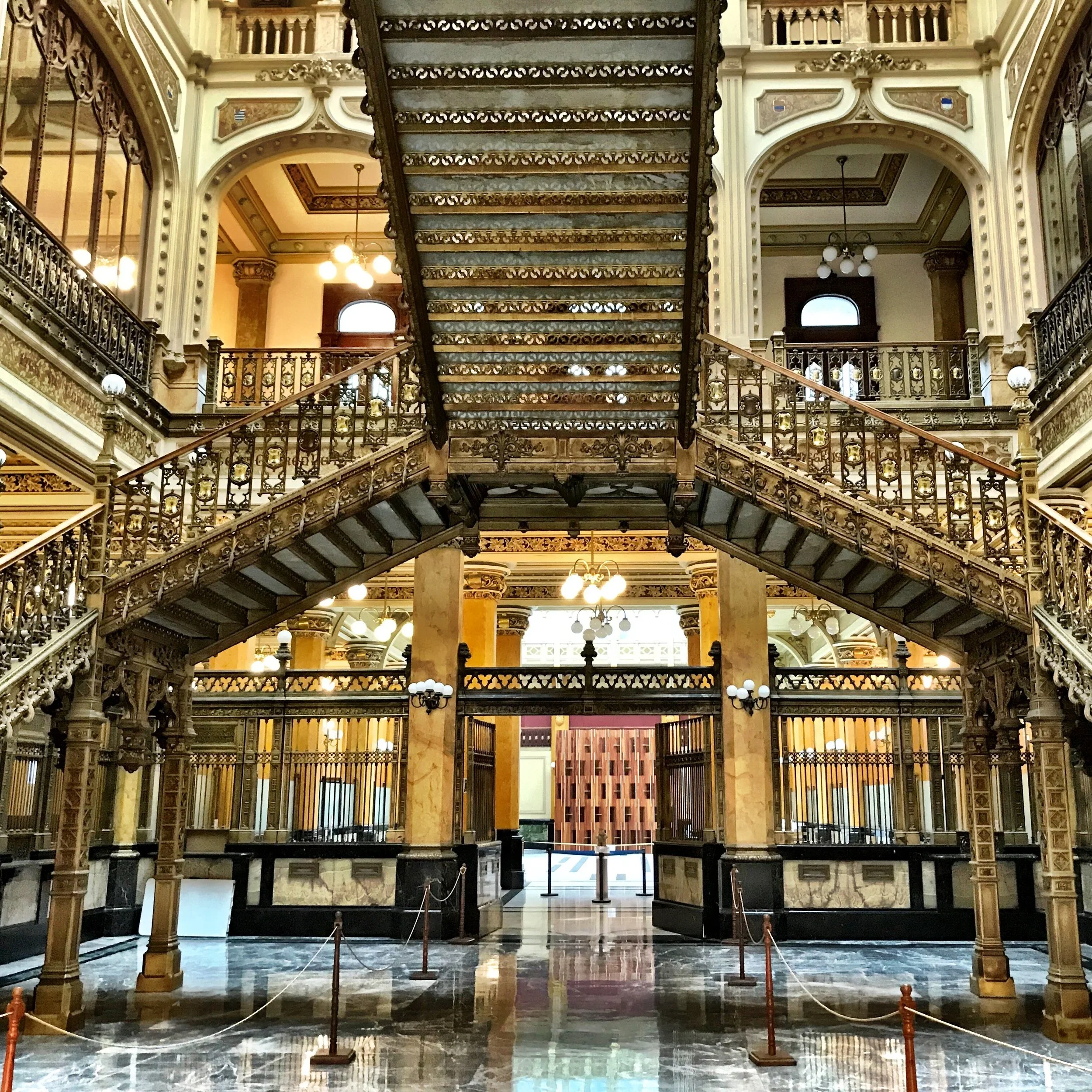
The famous staircase inside Palacio Postal in Mexico City's Centro

Most Instagrammable Places in Centro

Our guide to the most Instagrammable spots in Mexico City’s Centro takes you through one of CDMX’s most photogenic neighborhoods, where colonial architecture, Art Nouveau landmarks and modern public art collide. Our self-guided photo tour begins at the Sinagoga Histórica, whose unassuming façade gives way to a stunning folk art-inspired sanctuary, before continuing to the Antiguo Colegio de San Ildefonso, birthplace of the Mexican muralism movement. Along the way, stop for lunch on the rooftop at La Casa de las Sirenas, overlooking the Catedral Metropolitana and (unimpressive) Templo Mayor, then admire the cathedral’s lavish Baroque interior before wandering past the tiled façade of the Casa de los Azulejos.

Next, duck into the Gran Hotel Ciudad de México to marvel at its soaring stained-glass ceiling, then don’t miss the spectacular Palacio Postal, where twin gilded staircases and intricate brasswork make it one of the city’s most photogenic interiors. From there, cross to Sears for the iconic view of the Palacio de Bellas Artes dome before wrapping up with the Hemiciclo a Benito Juárez in Alameda Central and the striking red pyramids of Fuente de Vicente Rojo just across the street.
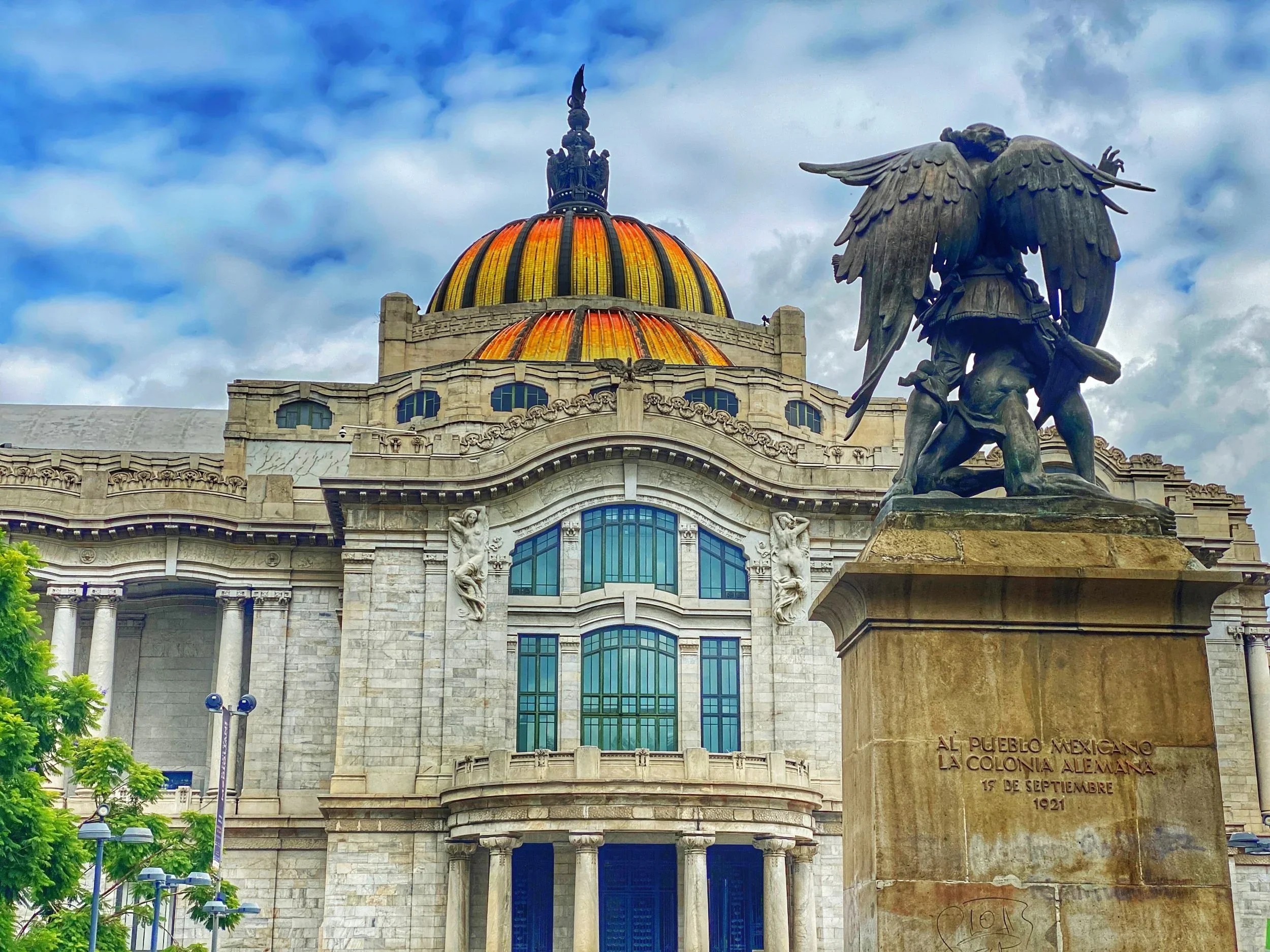
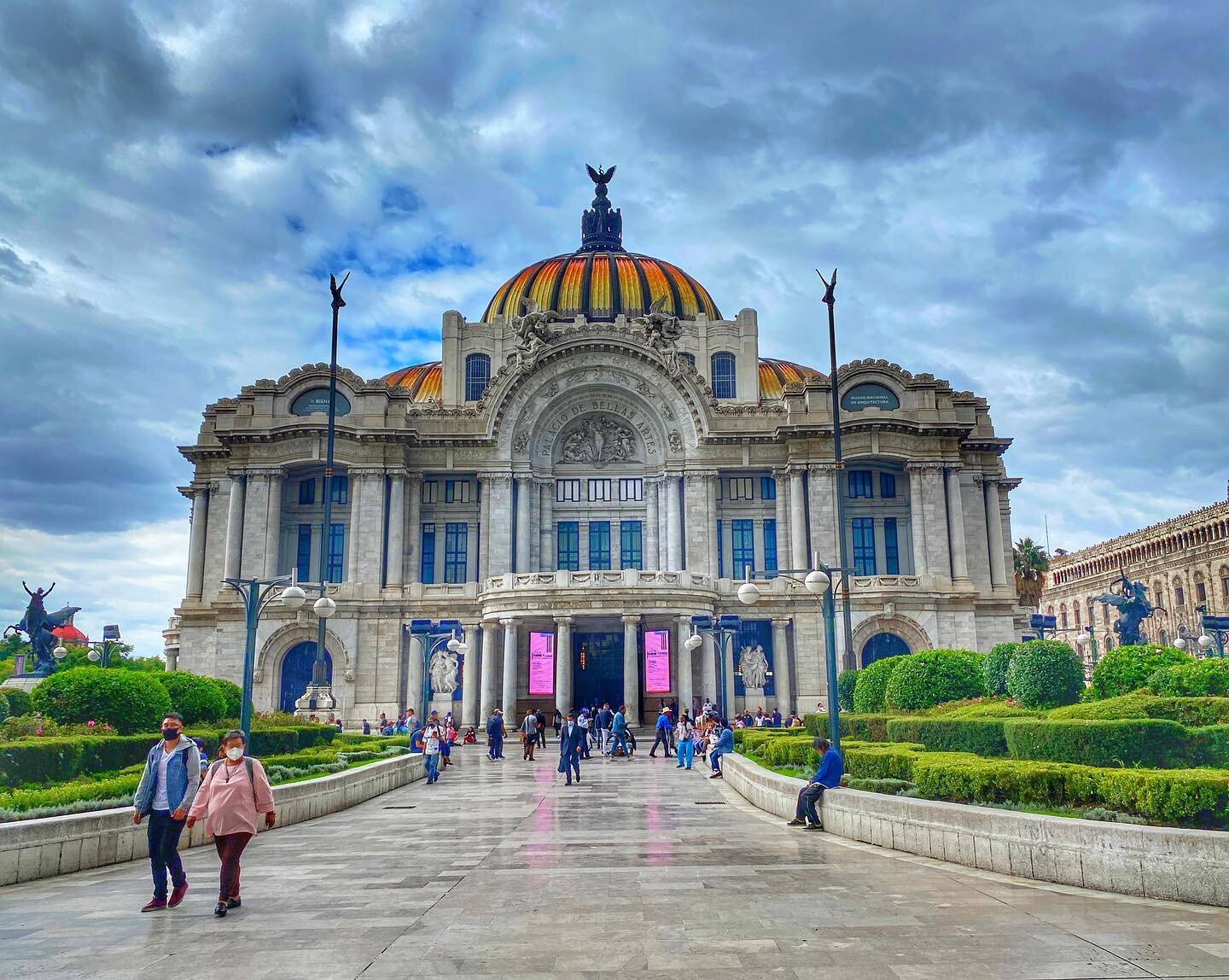
A statue in front of the orange and yellow domed Palacio de Bellas Artes in Mexico City's Centro neighborhood

Palacio de Bellas Artes

From the outside, the Palacio de Bellas Artes is a stunning Art Nouveau dome-topped palace glowing across Centro Histórico; inside, it’s home to Mexico’s premier opera house, the National Museum of Architecture, and a renowned collection of murals that provoke as much as they awe. We first glimpsed its golden crown from across the street, taking in the best view from Sears department store. But on another visit, we dove into the heart of the building, to find that in the Palacio’s mural museum, Mexico’s famous large-scale artists — Rivera, Orozco and David Alfaro Siqueiros — don’t hold back.

Rivera’s Man, Controller of the Universe takes center stage, revisiting his controversial commission for the Rockefeller Center — destroyed for depicting Lenin. Here, Karl Marx and Charles Darwin rub shoulders. Meanwhile, Orozco’s Catharsis unleashes a dystopia where naked bodies and mechanical beasts clash, featuring the infamous La Chata, a grinning prostitute, who adds to the mural’s disturbing reputation. Each mural tells a story, whether it’s Siqueiros’ dream of Cuauhtémoc defeating the conquistadors or Rivera’s sly digs at White tourists and their clichés in Carnival of Mexican Life. The collection is edgy and bold, and it’s impossible to walk away without feeling like the walls just had the last word.
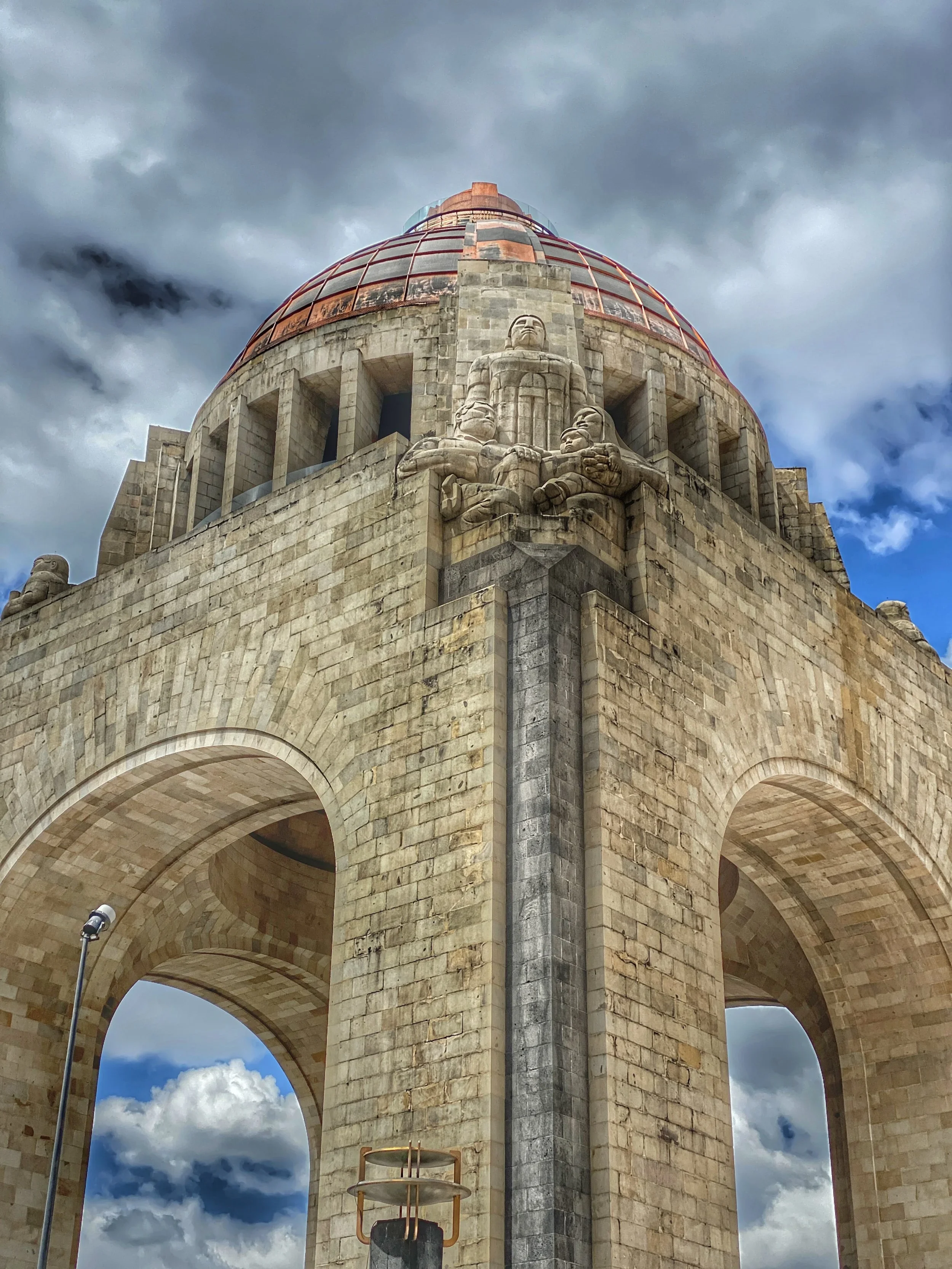
The top of the Monumento a la Revolución in Mexico City

Monumento a la Revolución

The Monument to the Revolution is a triumphal arch with some serious swagger. Originally destined to be the Palacio Legislativo Federal, the grand project was abandoned when the Mexican Revolution took center stage. For two decades, the half-built structure just sat there, rusting away. But then architect Carlos Obregón Santacilia had a better idea: turn that mess into a towering 220-foot icon, now the tallest triumphal arch in the world. Take that, Arc de Triomphe!

Today, the monument wears many hats: mausoleum, observation deck and revolutionary museum, with a little copper-clad cupola action thrown in for good measure. The glass elevator ride up the center is worth it for the views alone, but the exposed steel innards are also worth checking out. 

Meanwhile, down below, the National Museum of the Revolution does its best to impress with its “avant-garde” exhibits (we’ll take their word for it). 

Outside, the Plaza de la República buzzes with vendors selling everything from T-shirts to street snacks, and the sunken garden gives you a breather from the city’s chaos.

Chapultepec Park
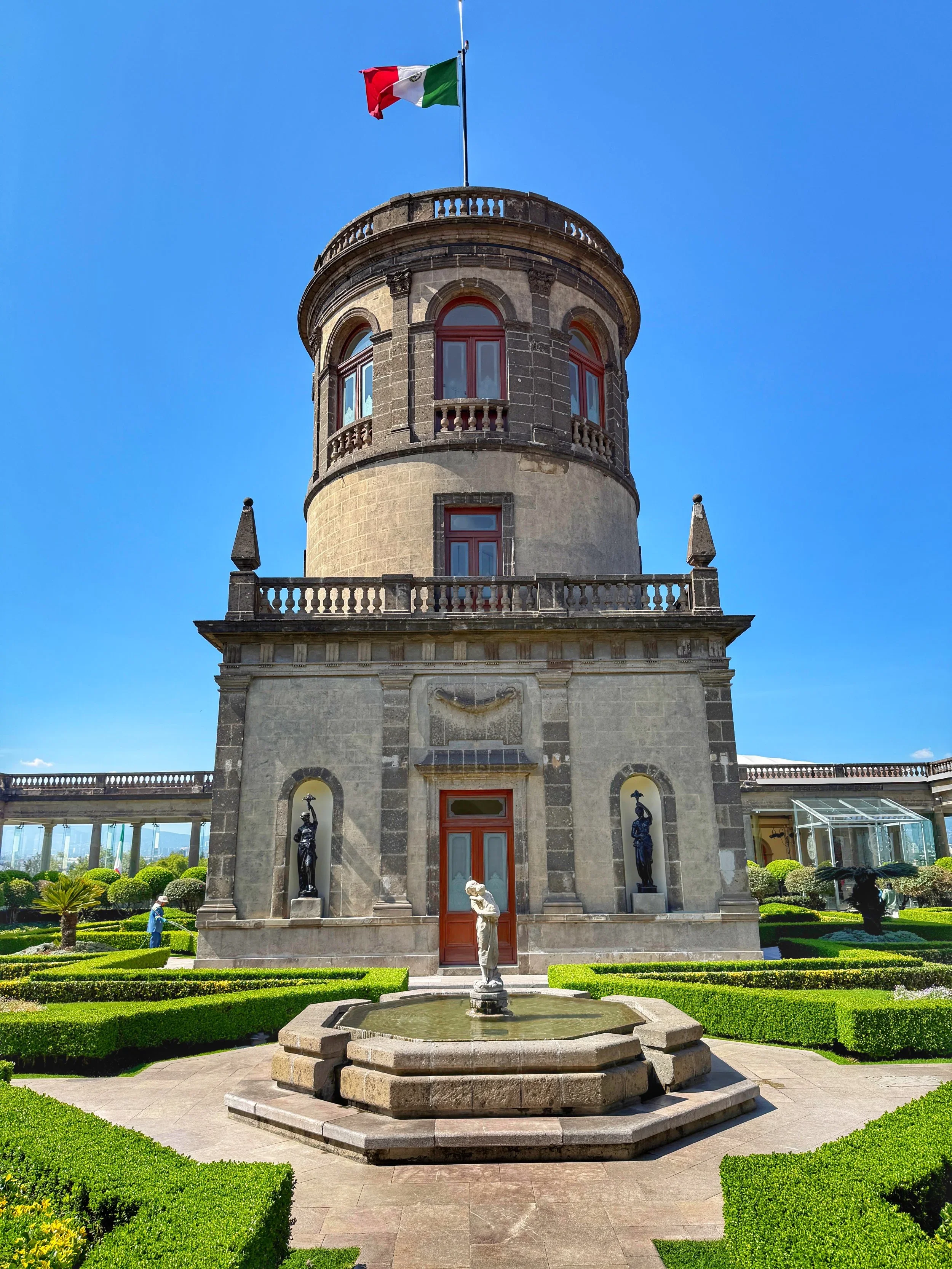
The rooftop garden and observatory tower by a fountain and hedges in Mexico City's Chapultepec Castle

Chapultepec Castle

A castle in the middle of Mexico City? Yes, really — perched atop Chapultepec Hill, this once-imperial palace is now a museum, a monument and a mood. From its sweeping views to its storybook staircases, Chapultepec Castle delivers drama at every turn.

On our visit, we followed the winding hilltop path, dodging packs of schoolchildren to reach the gates. Once inside, things get surreal. French chandeliers, trompe-l’œil ceilings, and checkerboard floors speak to its time as Emperor Maximilian and Empress Carlota’s royal residence, when the castle played dress-up as a European palace. And don’t miss the stained glass gallery of Muses and the rooftop garden.

The castle also houses the National Museum of History — and the exhibits remind you that while emperors played house, revolutionaries were gearing up to take it all down. Cases hold Aztec codices, colonial relics and revolutionary banners. It’s a crash course in Mexico’s past, where empires rose, ideals clashed, and the culture kept reinventing itself.
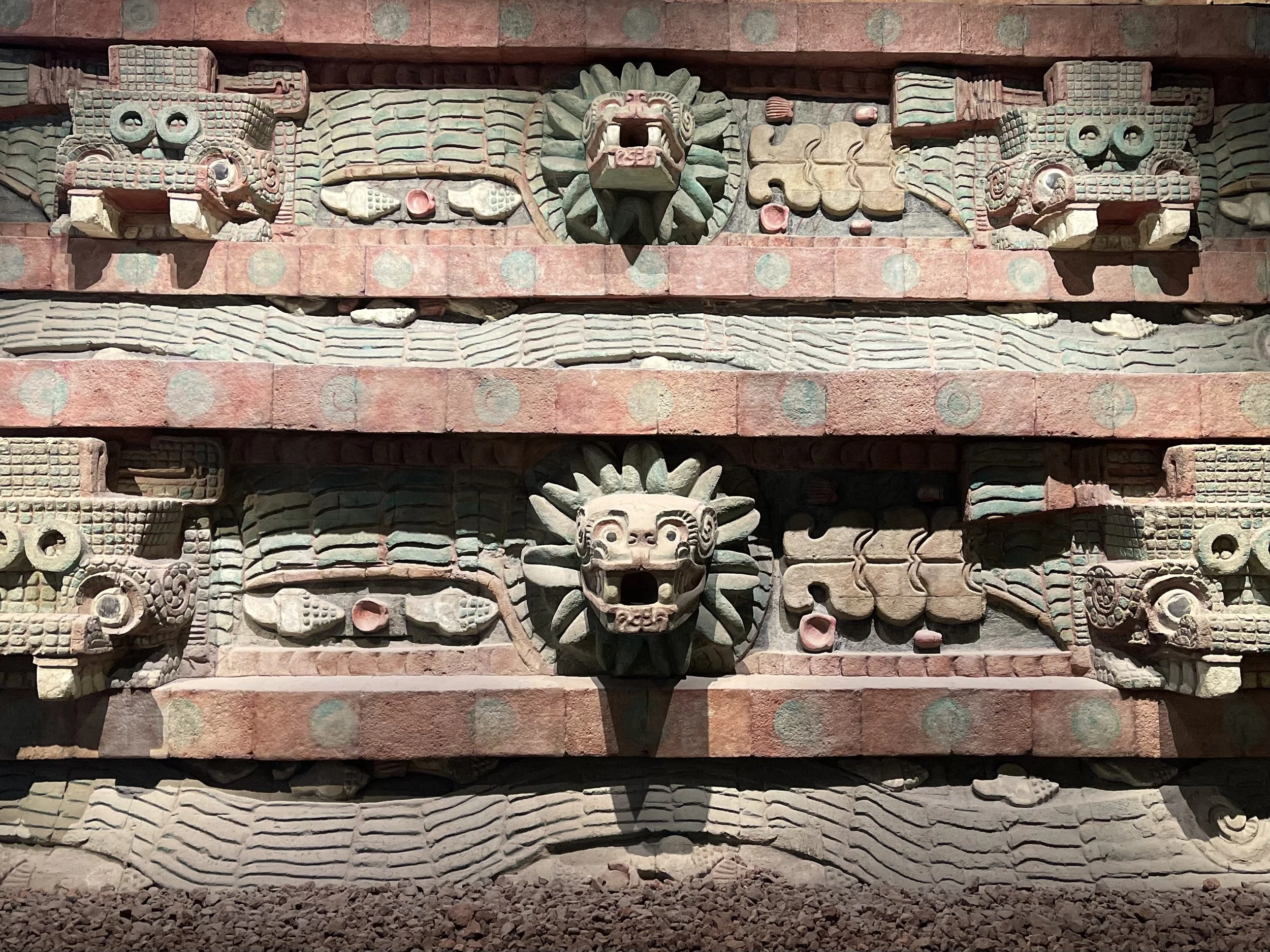
Animal heads and other carvings on parts of an Aztec temple in CDMX's Museo Nacional de Antropología

Museo Nacional de Antropología

The museum doesn’t wait until the galleries to wow you — its massive umbrella fountain out front rains spectacle on everyone walking in. Inside, soaring halls hold colossal Olmec heads, Aztec sun stones and Maya stelae — alongside delicate figurines that speak to everyday life. Every gallery plunges you deeper into the civilizations that shaped Mexico long before the Spanish arrived. My favorite part: Various galleries lead outside, where you feel like you’ve stumbled into the jungle and discovered an ancient temple and artifacts.

Another highlight? The way animals come to life in pottery and sculpture, each one symbolizing something sacred, fierce or divine. Here’s what we uncovered about animal symbolism in pre-Columbian pottery.

And if you’re drawn to the darker corners of history, don’t miss the exhibits on burial rituals and offerings. From jade beads in the mouths of the dead to xolo dogs sacrificed as guides to the afterlife, the museum doesn’t shy away from the raw power of the death cults of Ancient Mexico.

La Condesa
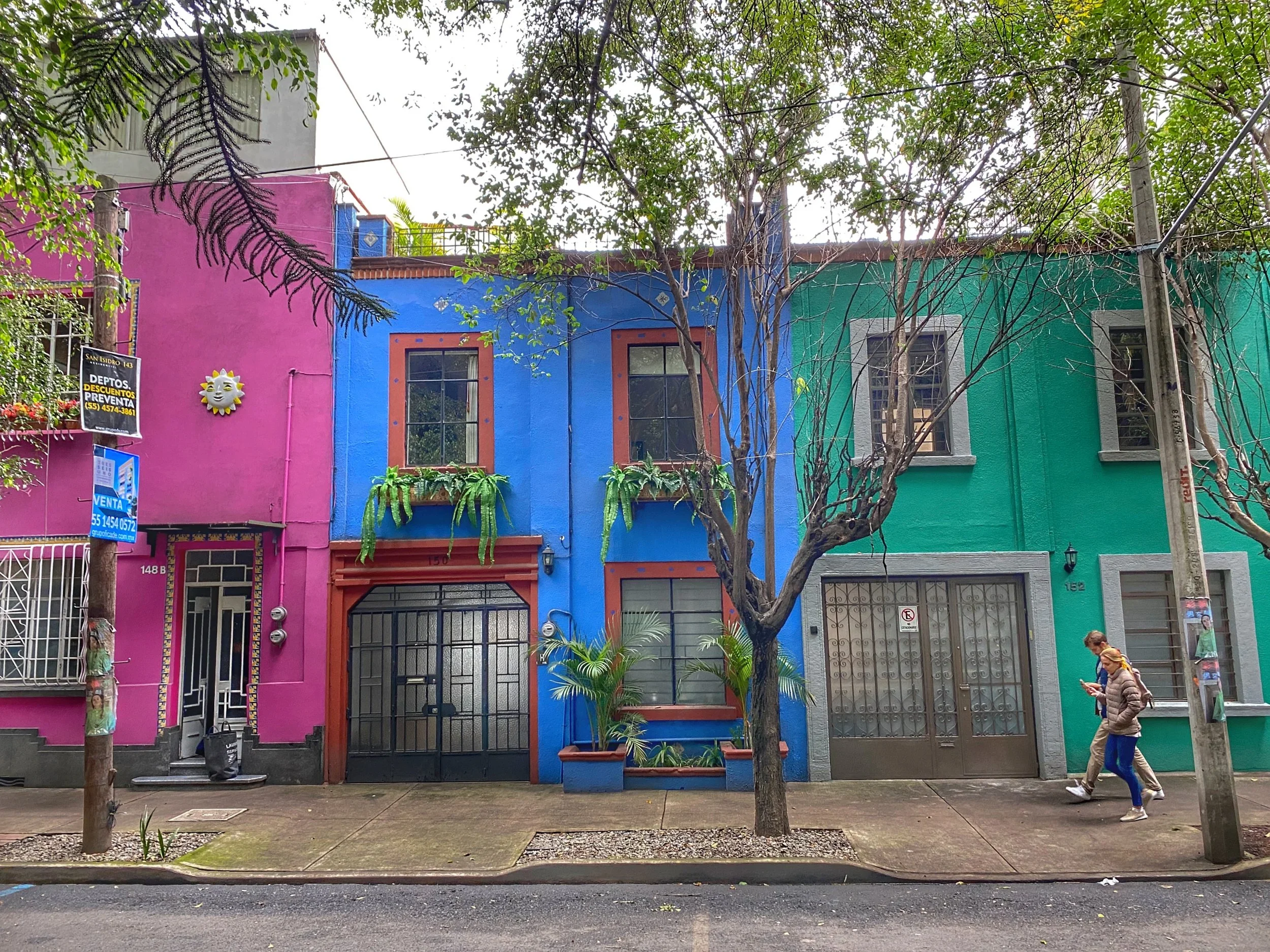
Brightly colored buildings in CDMX's La Condesa neighborhood

Morning in La Condesa

Start your morning in La Condesa, where Avenida Amsterdam’s tree-lined oval leads you past Art Deco gems and green spaces that feel worlds away from the city’s hustle. The avenue’s curving path traces the outline of an old racetrack. As you stroll, keep an eye out for the architectural detail: Streamline Moderne façades and stylish mansions make every turn a feast for the eyes.

For breakfast, we recommend Frëims, tucked inside a renovated 1920s home. The sun-drenched patio is perfect for savoring a coffee or one of their fresh juice blends, while admiring the mural. Fuel up on something like the lemon ricotta pancakes or huevos benedictinos, then take a leisurely walk over to Parque México. This green space, once home to an elite jockey club, now offers a mix of dog walkers, skaters and public art, like the Fountain of the Pitchers, which immortalizes Luz Jiménez as the iconic indigenous beauty of the 1920s. Whether you’re there for a stroll or just people-watching, La Condesa’s vibe is pure magic.

Where to stay in La Condesa
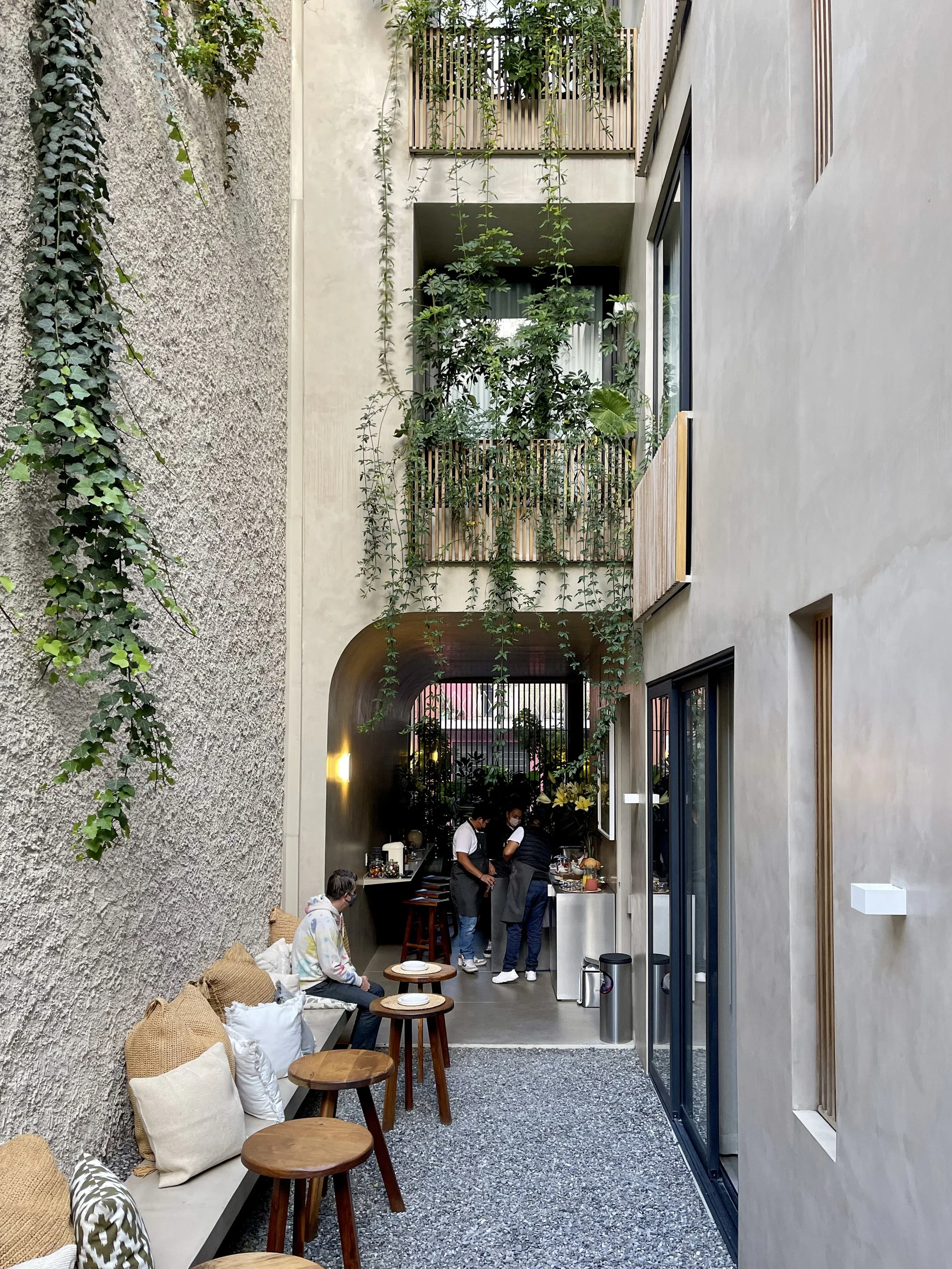
The interior courtyard / eating area with stones and plants trailing off balconies at Octavia Casa in Mexico City, Mexico

Octavia Casa

Octavia Casa is where minimalist design meets boutique charm, offering a chic retreat from the mellow bustle of La Condesa. The hotel’s teak lattice façade and the tropical plants spilling out over the concrete and glass exterior provide a touch of nature in the urban landscape. It’s a natural extension of the Octavia fashion brand, with spaces inspired by the label’s understated style, brought to life through thoughtful details like chukum stucco walls and muted earth tones that give each room an airy, welcoming vibe.

Mornings begin with a breakfast buffet of fresh fruit, pastries and handmade mugs. The staff go above and beyond, from a surprise birthday bottle of wine to Silvia’s heartfelt hugs. Evenings bring a different ambiance, with candlelight and libations on offer, perfect for winding down after a day of exploring CDMX. It’s hard not to feel special here, especially when you happen to be sharing the space with stars like Natalia Lafourcade.

Where to eat in La Condesa
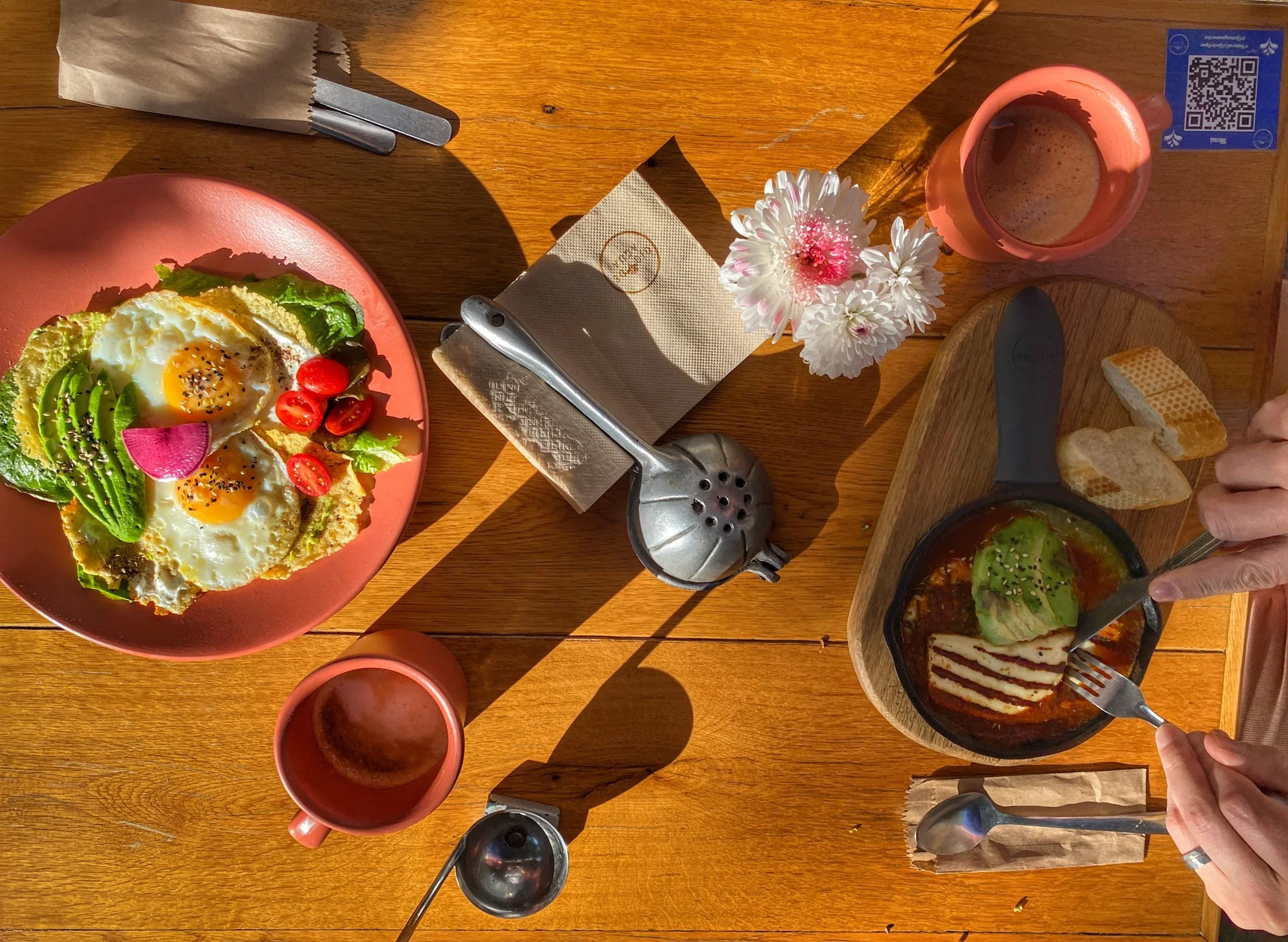
Breakfast dishes from Ojo de Agua in La Condesa, Mexico City

Ojo de Agua

Ojo de Agua in La Condesa is where health-conscious meets delicious. Situated near the lush Avenida Amsterdam and Plaza Citaltépetl, this fast casual café has a bright, fresh vibe and a fruit stand right inside. Named after a Michoacán town, the restaurant channels a commitment to living well, celebrating fresh ingredients in dishes that don’t skimp on flavor. The interior is casual chic, with Mudéjar-style tiles, big windows and plenty of natural light, while the outdoor seating is perfect for soaking up the neighborhood’s morning buzz.

The menu has something for everyone, from açaí bowls to cinnamon roll French toast, but we couldn’t resist the savory options. The santos ahogados, with its poached eggs, grilled panela and two salsas over a heart-shaped hoja santa leaf, brought a rich balance of flavors, while the huevos Polanco paired eggs with avocado purée and a za’atar-spiced jocoque. With Queen’s “Bohemian Rhapsody” playing in the background and fresh juice from the bar to finish things off, Ojo de Agua left us feeling fully satisfied and ready to take on CDMX.

Roma

Where to stay in Roma
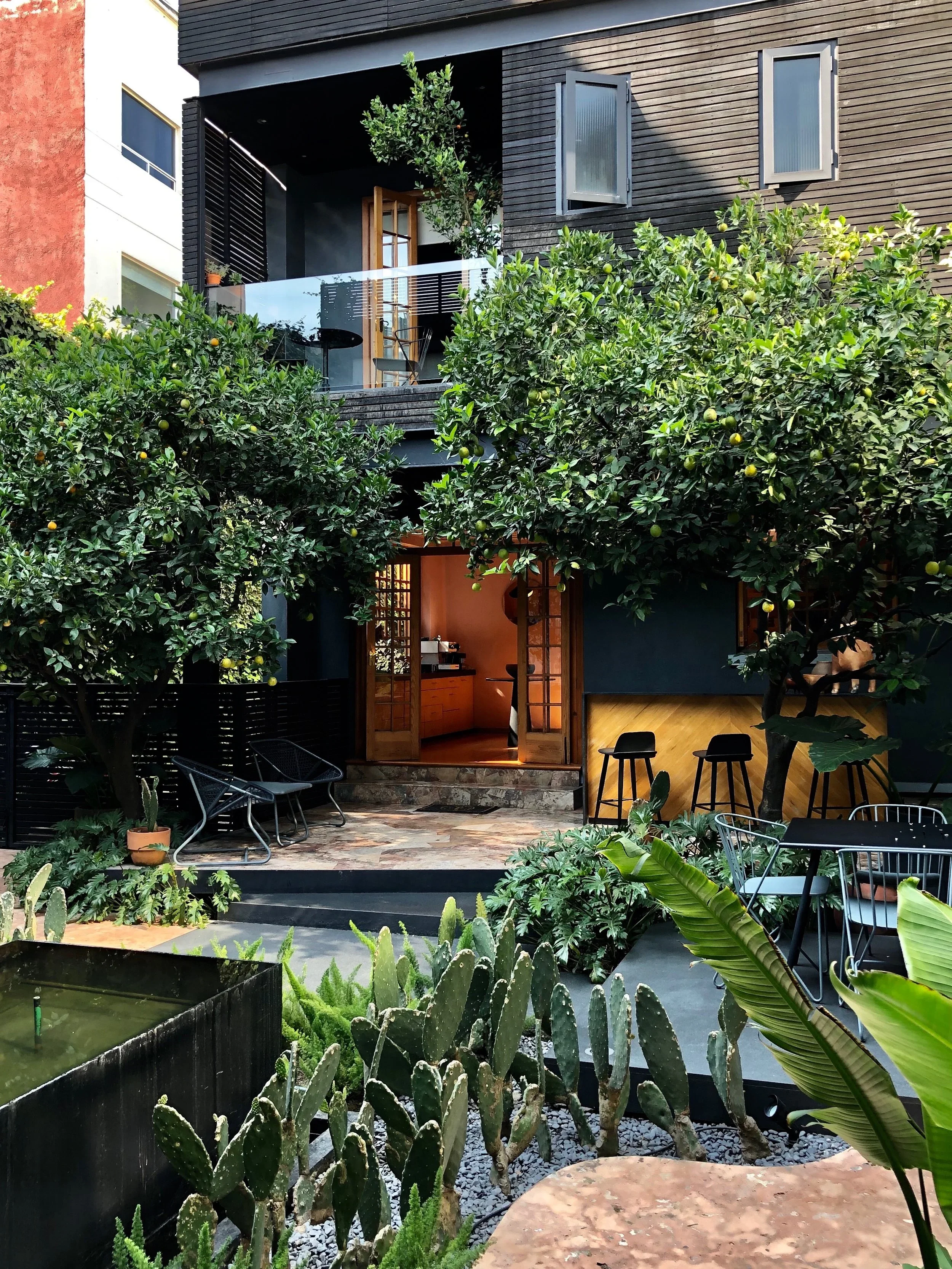
The backyard of Ignacia Guest House in Mexico City, with cacti, a water feature, bar and trees

Ignacia Guest House

Ignacia Guest House in Colonia Roma is a sophisticated blend of historic charm and modern elegance, tucked away in one of Mexico City’s most picturesque neighborhoods. The meticulously restored 1913 mansion captures the spirit of the area with its Neoclassical and Art Nouveau touches, while the modern wing adds a sleek contrast of glass and steel. Named after the beloved housekeeper who spent more than 70 years living and working in the home, Ignacia’s story is woven into every detail, from the Oaxacan cactus garden she planted to the woodcut portraits of her displayed in the lobby. We stayed in the Azul suite, which features reclaimed bowling alley maple floors and Carrara marble bathroom fixtures, providing the perfect mix of rustic and luxe.

The daily breakfast menu, crafted from Ignacia’s original recipes, offers a delicious start to the day, complete with fresh pastries and locally sourced ingredients. We especially loved the cocktail hour, where we sampled mezcal-infused drinks with sal de gusano (worm salt) and even tried crispy chapulines (grasshoppers) — because when in Rome… or, Roma. The courtyard patio is a central hub for socializing, shaded by ivy-covered walls and overlooked by the glass corridor that connects the new and old buildings. As much as the architecture and gardens enchanted us, it was the warm and welcoming staff who truly made us feel at home. 

Coyoacán
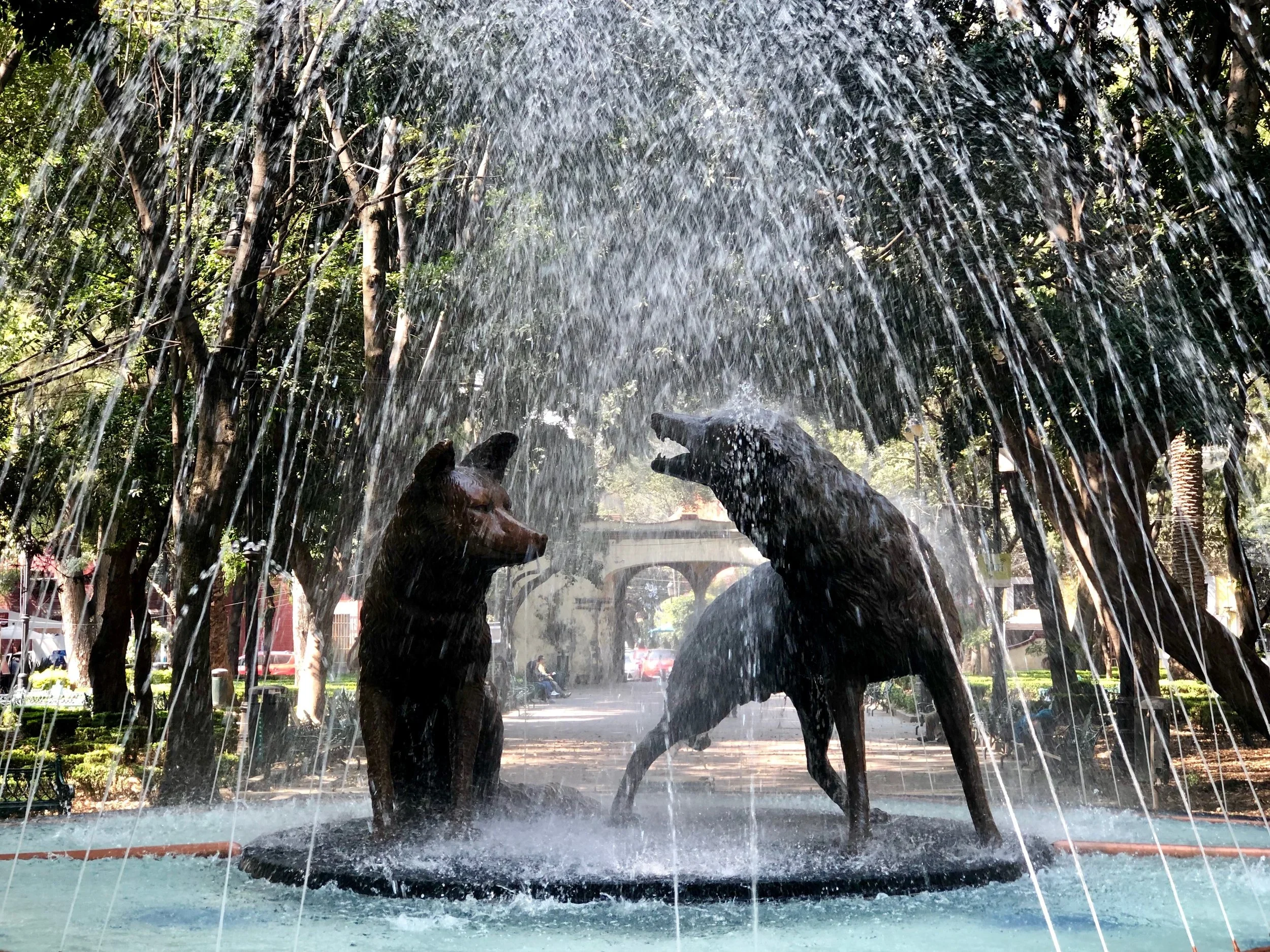
The fountain of two wolves in the square of Coyoacán in Mexico City

Wandering Coyoacán

An afternoon in Coyoacán offers a perfect mix of history, culture and a bit of boho chic. Start in Plaza Hidalgo, where the Fuente de los Coyotes splashes in the heart of a classic colonial square, and balloon vendors and palm-leaf crickets are part of the scene. Nearby, Los Danzantes serves up dishes like cricket croquetas and mezcal cocktails, perfect for people-watching while soaking up the bohemian vibe.

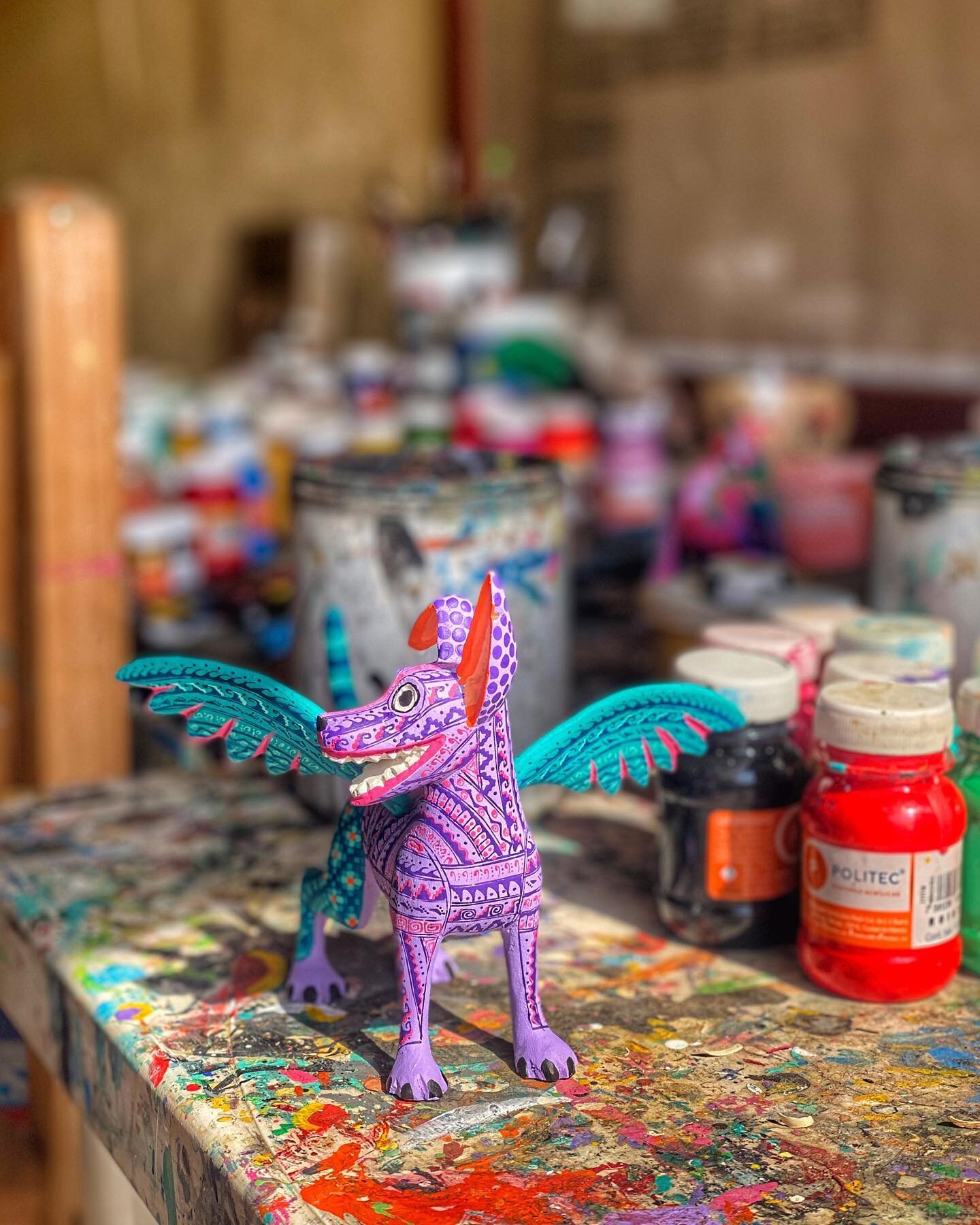
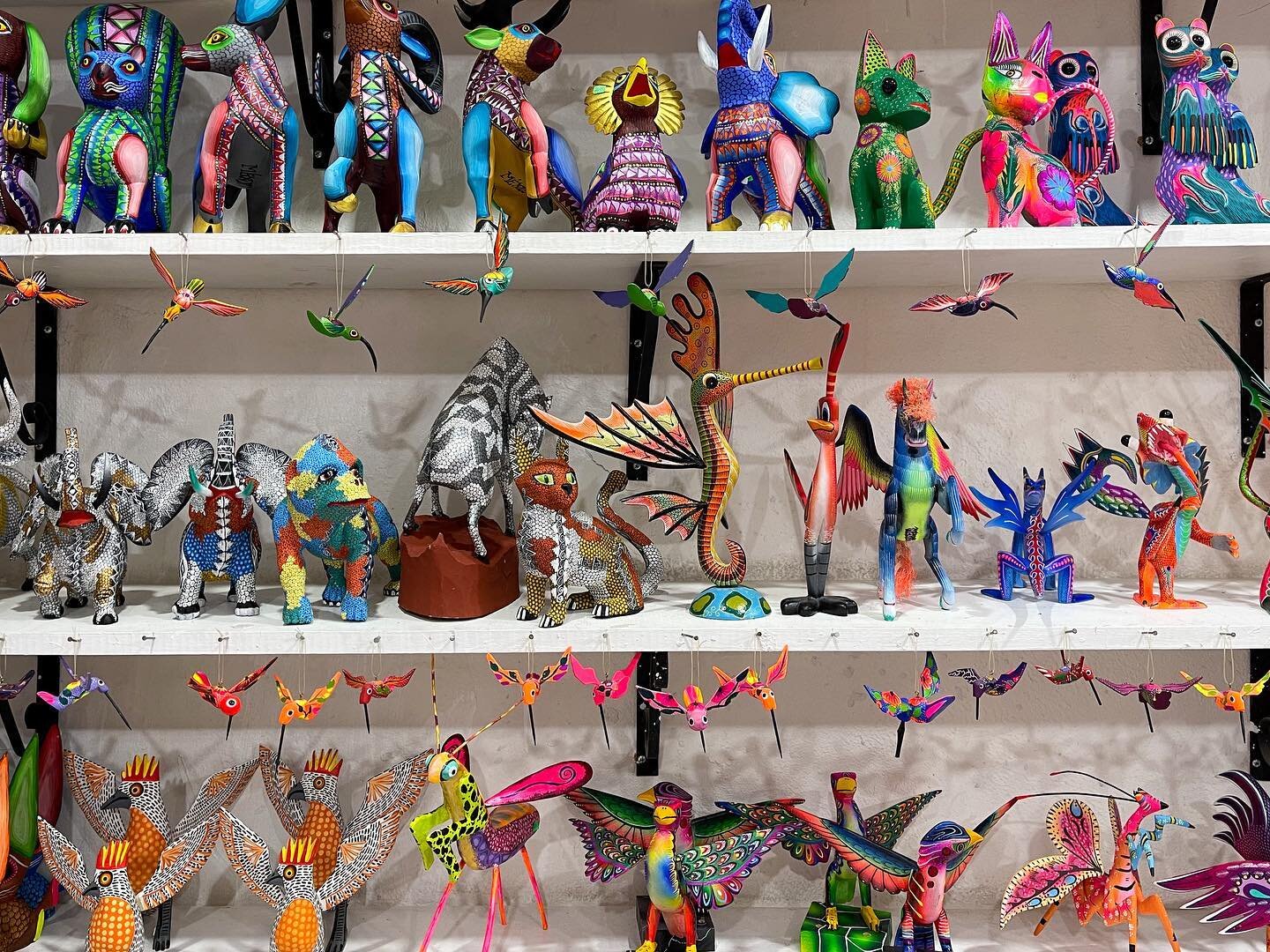
Wander into the Mercado Artesanal Mexicano for quirky souvenirs like Oaxacan alebrijes or oddball folk art, then recharge at Panadería Pública with a coffee and a guava pastry. Just a short stroll away, Plaza de la Conchita offers a quiet escape, where the 16th century chapel holds stories of Hernán Cortés’ time in the neighborhood. Finish at Frida Kahlo Park, where topiary animals greet you and teenagers practice salsa moves under bougainvilleas, and a mural by Dan Silva adds a burst of color. Coyoacán’s charm is irresistible, making it easy to see why artists and dreamers have called it home.
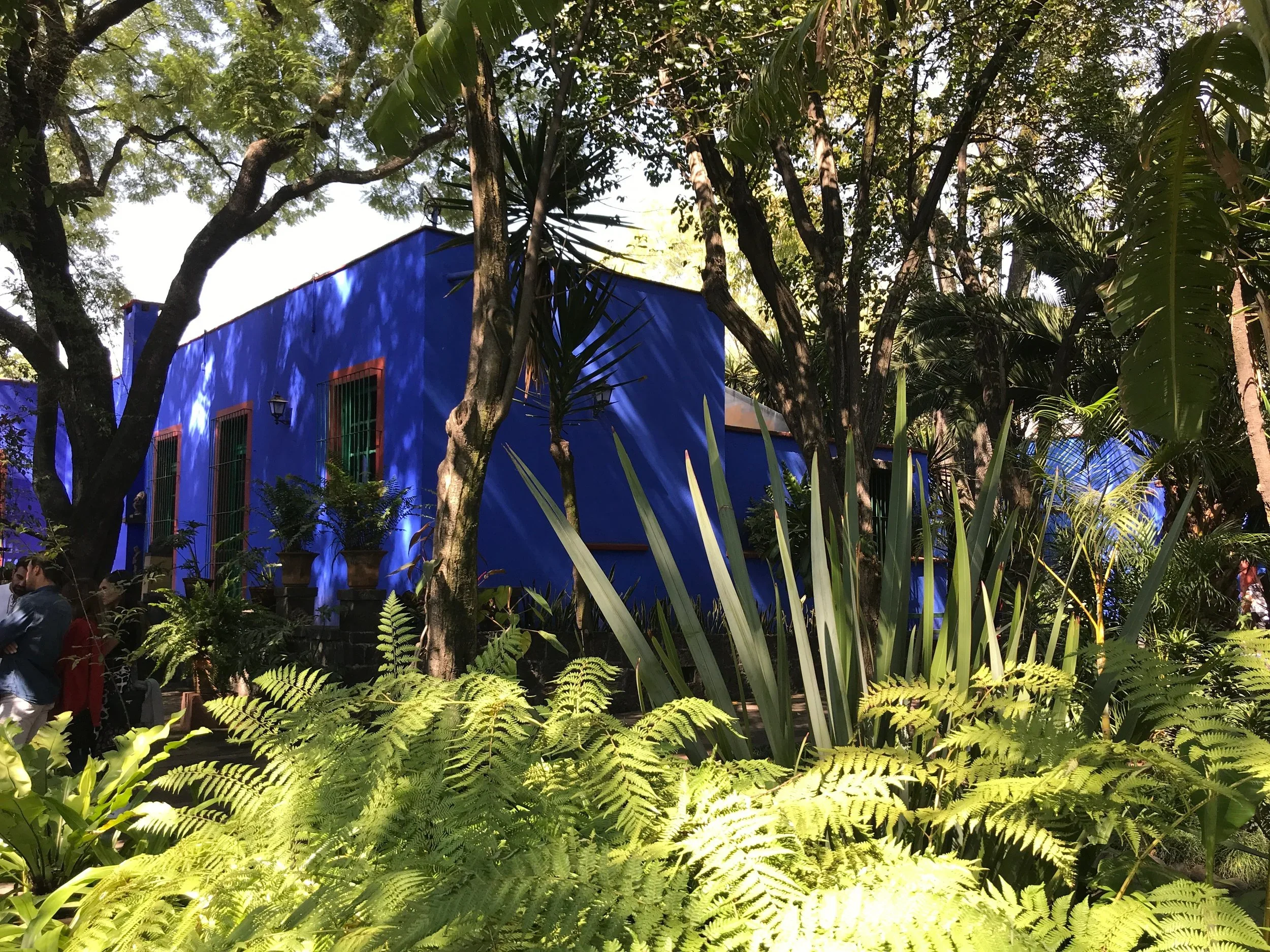
The bright blue Casa Azul, Frida Kahlo's family home, surrounded by greenery, in CDMX

La Casa Azul: The Frida Kahlo Museum

La Casa Azul, or the Frida Kahlo Museum, is as bold and layered as the artist herself, with its vibrant cobalt walls and eclectic blend of art, artifacts, and personal relics. The iconic blue-painted house in Coyoacán offers a glimpse into the world of Frida and Diego Rivera, where the bohemian spirit comes alive in the courtyard’s botanical garden and the interiors filled with papel picado, Tehuana dresses, and intricate folk art. We recommend booking tickets well in advance and arriving early to avoid the hours-long wait; it’s worth it to step inside this iconic space where Kahlo’s personality radiates from every corner.

From her wheelchair and easel to her night bed with a mirror overhead—where she painted while bedridden—La Casa Azul tells the story of an artist who turned pain into beauty. The house is filled with fascinating details, like the miniature clay mugs spelling out “Frida” and “Diego” above the stove, or the ashes resting in a pre-Columbian urn beside her bed. Beyond the personal spaces, you’ll find rooms with her lesser-known artworks, a display of her distinctive wardrobe, and even a pyramid of pre-Columbian sculptures Rivera added to the garden. The whole experience leaves a lasting impression, as if you’ve walked through the pages of Frida’s life story, with every object and plant bearing witness to her creative and resilient spirit.
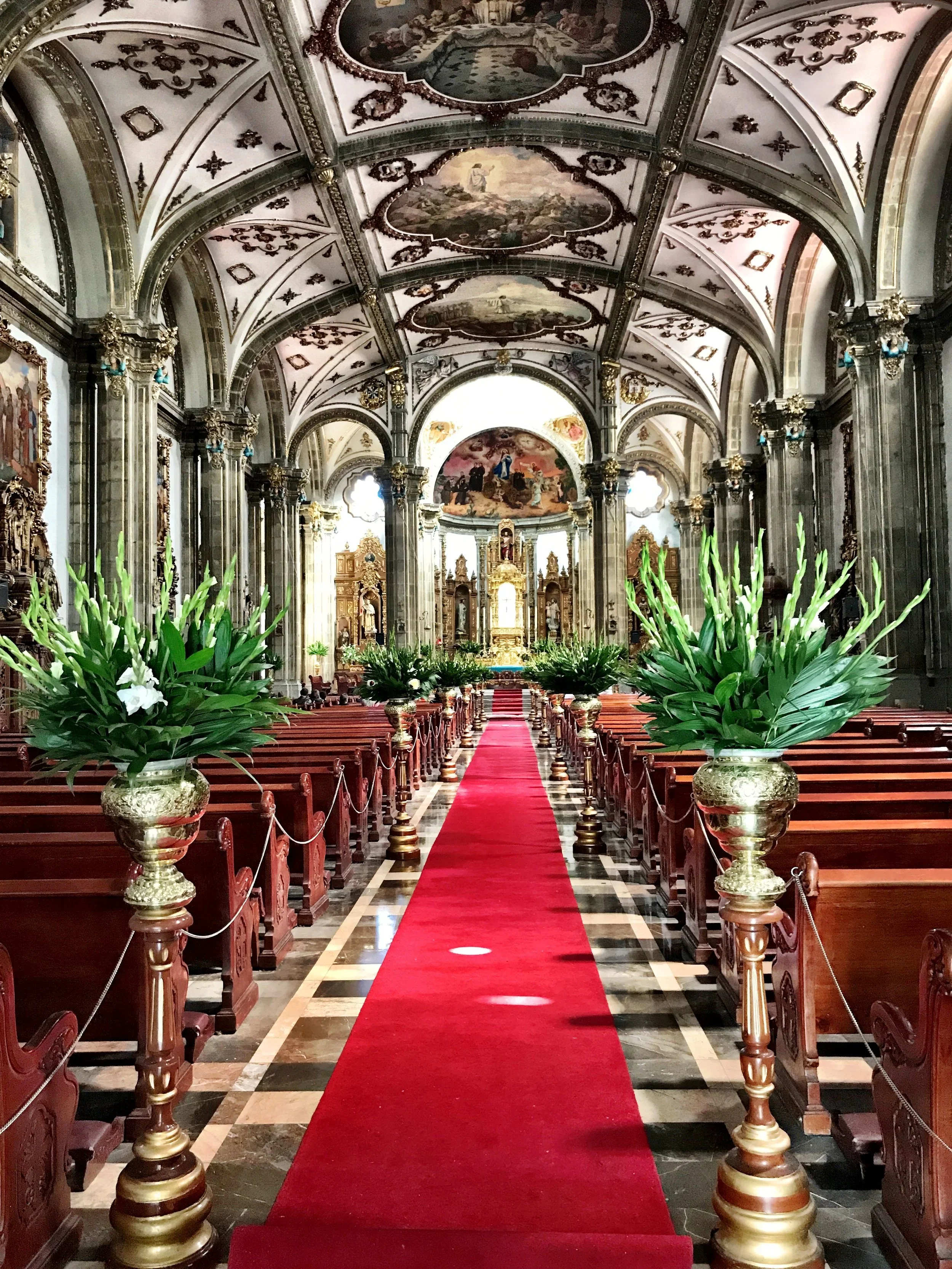
Murals on the ceiling, arches, pews and a red carpet runner inside Parroquia San Juan Bautista in Mexico City

Parroquia San Juan Bautista

Parroquia San Juan Bautista, or La Iglesia de Coyoacán, is a captivating piece of Spanish colonial history nestled in Mexico City’s bohemian Coyoacán neighborhood. Built between 1527 and 1552 on the site of an Aztec noble school, the church’s relatively plain Herrerian-style exterior belies the ornate Baroque splendor within. Step inside, and you’re greeted by gilded altars, frescoed ceilings depicting Christ’s life, and an array of small chapels, including the opulent Chapel of the Rosary.

The church is full of fascinating details, from the creepy yet compelling Cristo de los Milagros, adorned with healing charms, to niche statues and elaborate ornamentation that evoke Mexico’s blend of indigenous and Catholic traditions. Don’t miss wandering the peaceful cloisters out back, where Nahuatl-speaking converts were once baptized. La Iglesia de Coyoacán is not just a church; it’s a glimpse into the neighborhood’s layered history and enduring cultural richness. Read more here.
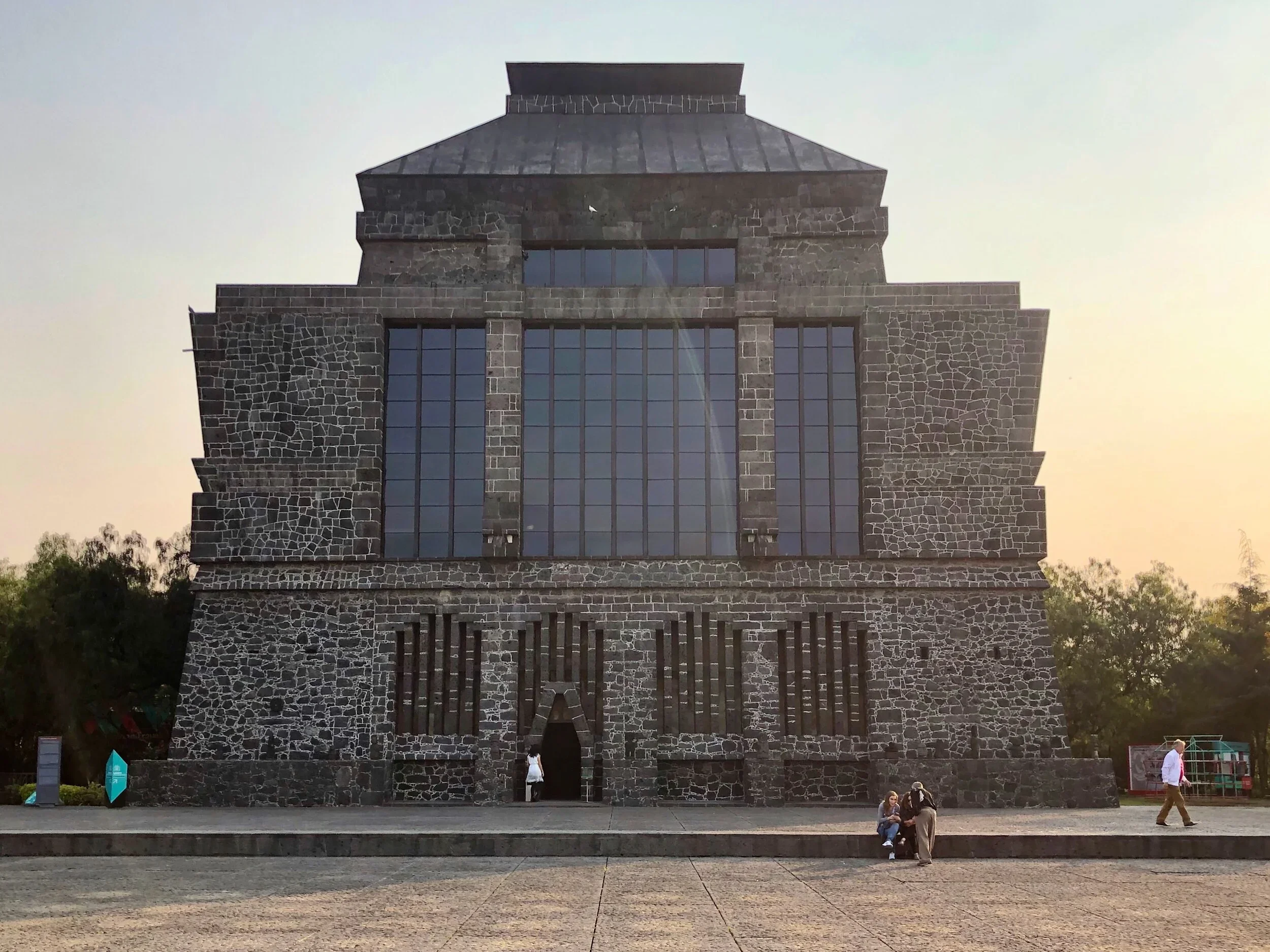
The stone exterior of Museo Anahuacalli at sunset

Museo Anahuacalli

The Anahuacalli Museum is unlike any other—a temple-like structure housing Diego Rivera’s vast collection of pre-Hispanic artifacts. Built on the rugged volcanic rock of El Pedregal, this black basalt museum rises like a Mesoamerican pyramid, surrounded by myth and history. Rivera envisioned it as a place to contemplate Mexico’s ancient past, with over 50,000 artifacts collected over his lifetime, though only a fraction is displayed. The museum’s dim and cool interior, lit by alabaster windows, creates an otherworldly atmosphere, while colorful ofrendas and papier-mâché alebrijes burst against the stone.

Inside, narrow staircases lead you up through galleries filled with Zapotec, Maya, Aztec, and Olmec relics, culminating in Rivera’s art studio on the sunlit second floor, where you can see studies for his controversial murals. The rooftop terrace offers a stark contrast to the dark confines below, with panoramic views of CDMX. Rivera’s passion for the past comes to life here, where mythological mosaics, jaguar statues, and Mesoamerican symbolism honor Mexico’s ancient heritage. It’s an unforgettable experience that feels as much like stepping into a temple as it does a museum.

San Ángel
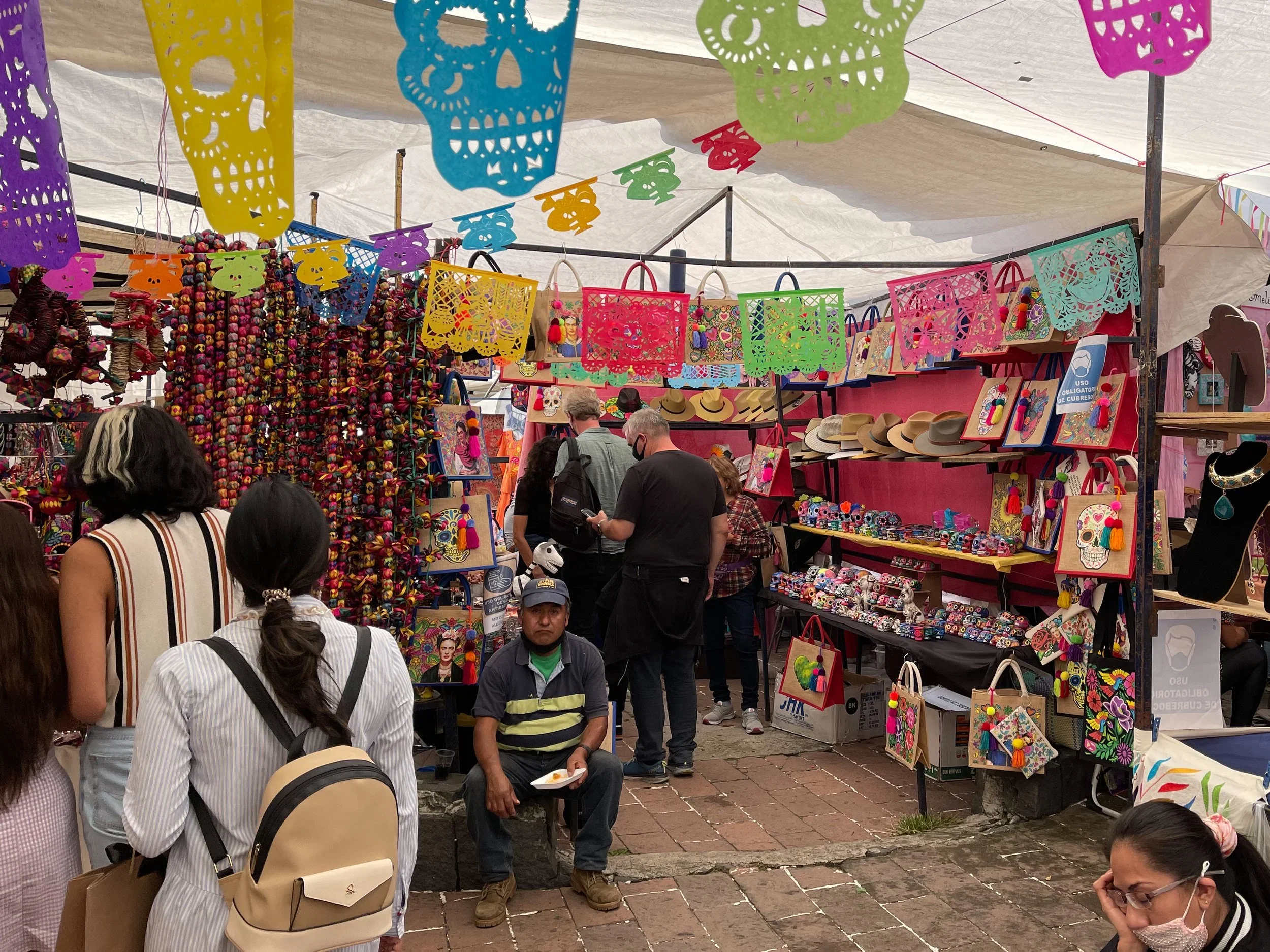
Paper skulls hang by craft vendors at the Bazar Sábado in San Angel, Mexico City

Bazar Sábado

The Bazar Sábado in San Ángel is a Saturday-only spectacle that fills the historic streets with artisans, craft stalls, and cultural treasures. The cobblestone lanes and colonial architecture set the scene for browsing unique wares, from vivid alebrijes and handpainted ceramics to quirky Day of the Dead memorabilia. Founded in 1960, the bazaar has grown into a beloved tradition, with its epicenter located in a central courtyard where you can also grab a bite or sip a local craft brew, like a Monstruo de Agua beer—a must-try for its unusual ingredients and axolotl-themed branding.

Though the market can get busy, a friendly “con permiso” helps you navigate the crowded stalls. Don’t miss browsing nearby shops like Cerámica San Germán, where the traditional meets the artistic, or grabbing a molcajete for your guacamole needs. The cupolas of Nuestra Señora del Carmen loom overhead, hinting at San Ángel’s rich history, complete with mummies and macabre relics in the crypt below. Whether you’re drawn to crafts, ceramics, or quirky curiosities, Bazar Sábado promises a vibrant and eclectic day out in CDMX’s most enchanting neighborhood.
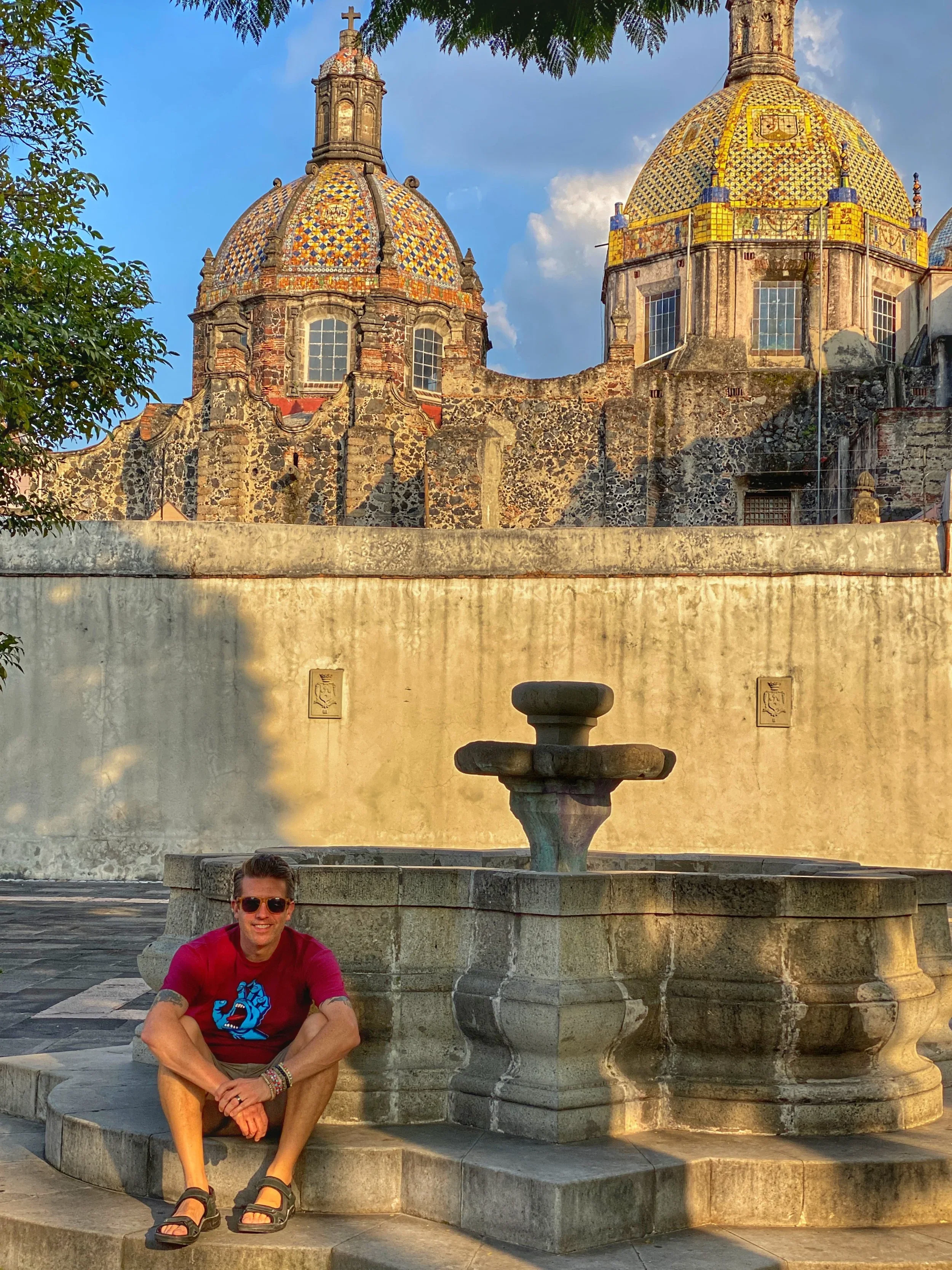
A man sits by the fountain at Nuestra Señora del Carmen in the San Angel neighborhood of CDMX

Nuestra Señora del Carmen

Nuestra Señora del Carmen in San Ángel is a captivating glimpse into Colonial Baroque architecture, with its faded domes tiled in vibrant patterns and gilded altarpiece that balances opulence with austerity. The church was founded for the Discalced Carmelites, a curious order known for their vow of shoelessness, established in the 16th century by Saint Teresa of Avila. Its history stretches back to the early 1600s, and the Carmen Complex encompasses more than just the church itself—it’s a former monastery and convent, now a museum where you can even find mummies lurking in the catacombs.

The church’s story doesn’t shy away from drama. After the War of Reform, when Mexico’s Liberal forces stripped the Catholic Church of its vast properties, parts of the complex were repurposed into everything from prisons to barracks. Today, the ornate interior of Nuestra Señora del Carmen stands in contrast to its unassuming façade, offering plenty to explore, from offshoot chapels to quiet corners for reflection. Whether you’re there for the architecture or just trying to catch a glimpse of those creepy mummies, this church is a must-see when wandering through the historic, tree-lined streets of San Ángel.
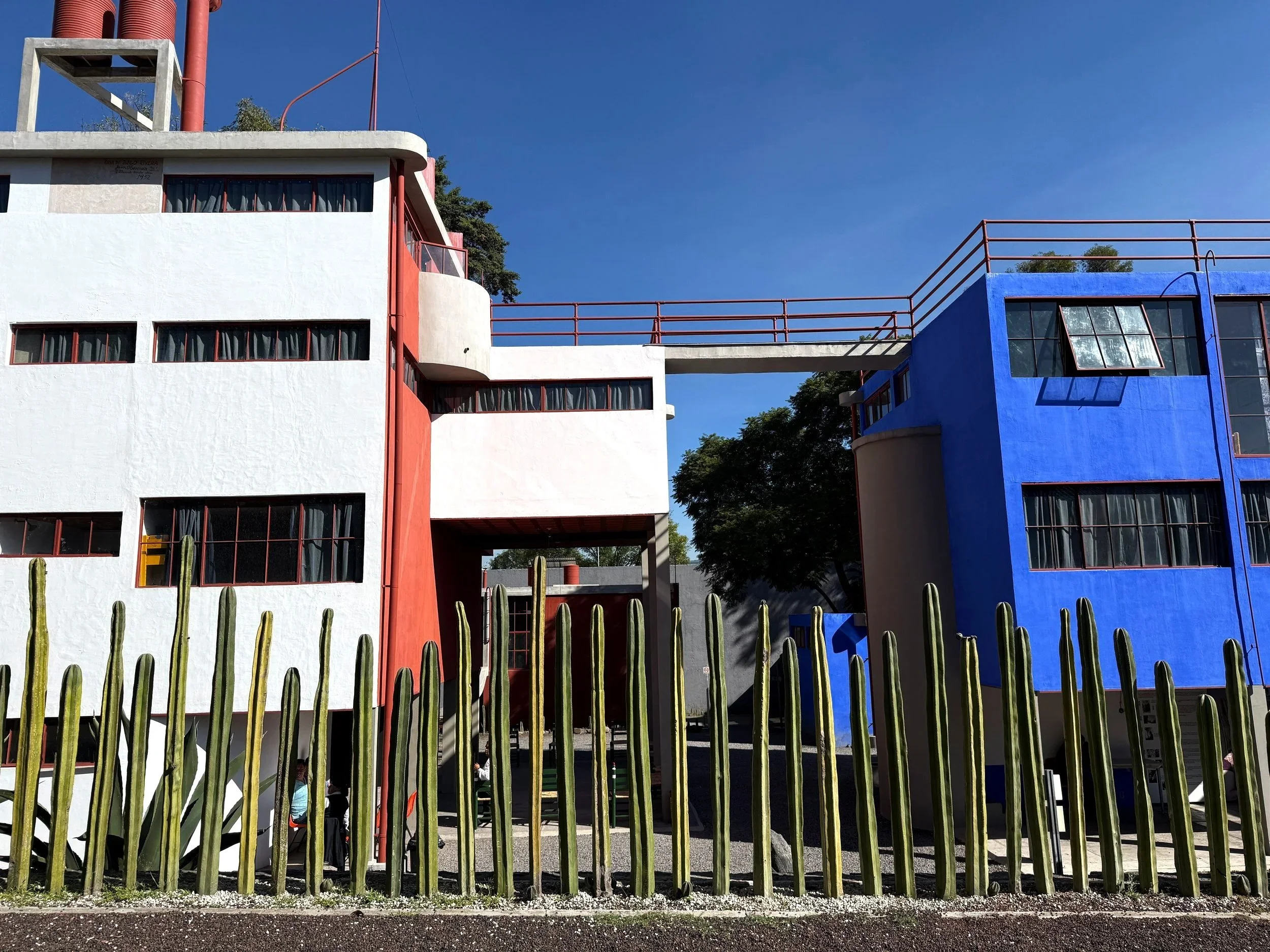
Diego Rivera & Frida Kahlo Studio House

While most visitors flock to Casa Azul—and rightly so—the duo’s other home in San Ángel offers a quieter, more architectural glimpse into their tangled lives. Designed by Juan O’Gorman in bold modernist style, the Museo Casa Estudio Diego Rivera y Frida Kahlo features two separate houses: one bright and spacious for Diego, the other small and cramped for Frida. Connected only by an outdoor stairwell and a narrow bridge, it’s a layout that feels like a metaphor—and a bit of a slap. Frida, who lived with chronic pain and mobility issues, had to climb steep steps just to see her husband.

Inside, Diego’s studio is full of light, murals-in-progress, and towering papier-mâché figures. Frida’s space is noticeably more austere—tight, plain, and edged with a kind of imposed solitude. If Casa Azul is where she found comfort, this house whispers of compromise.

Architectural Marvels in CDMX
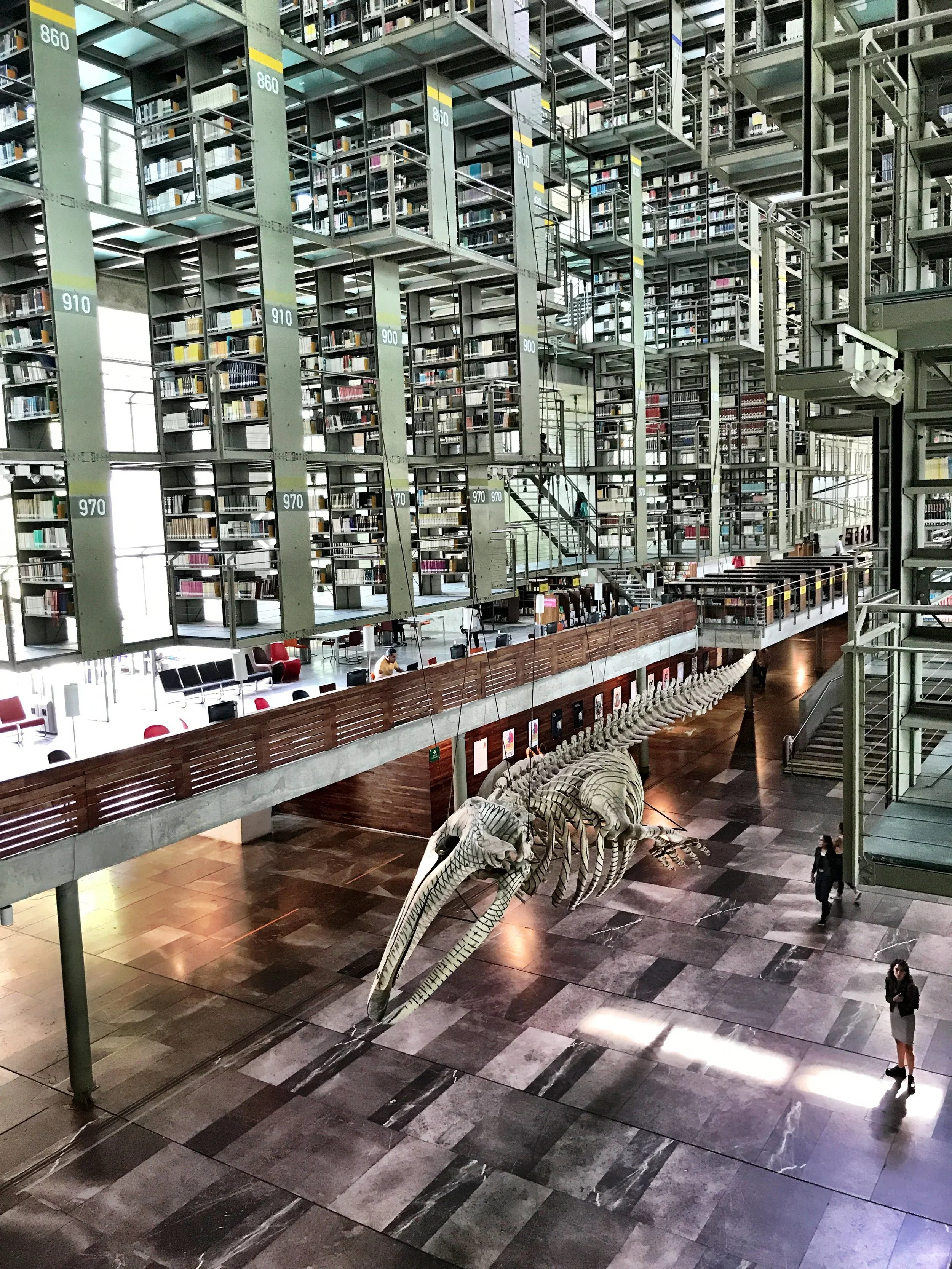
Biblioteca Vasconcelos

Biblioteca Vasconcelos is a must-see, offering an otherworldly experience in the Buenavista neighborhood of Mexico City. Designed by Alberto Kalach, the library’s floating metal and glass bookshelves create an intricate, maze-like space that seems to defy gravity. From the moment you step inside, it’s like entering a cathedral of knowledge, with sunlight streaming through louvered panels, casting an ethereal glow on the translucent walkways. The sensation is thrilling—and a little terrifying—as you navigate the thin, steel-framed floors that hover above the atrium.

Adding to the library’s allure is Gabriel Orozco’s “Mobile Matrix,” a mesmerizing installation featuring the skeleton of a gray whale, its bones intricately etched with thousands of mechanical pencil circles. Suspended mid-air, the piece echoes the library’s daring design, blurring the line between museum and reading space. After soaking in the modern architecture and art, venture into the surrounding botanic park for a breath of fresh air, or take a short walk to explore the nearby Kiosco Morisco, a colorful pavilion that serves as the perfect counterpoint to the library’s futuristic vibe.
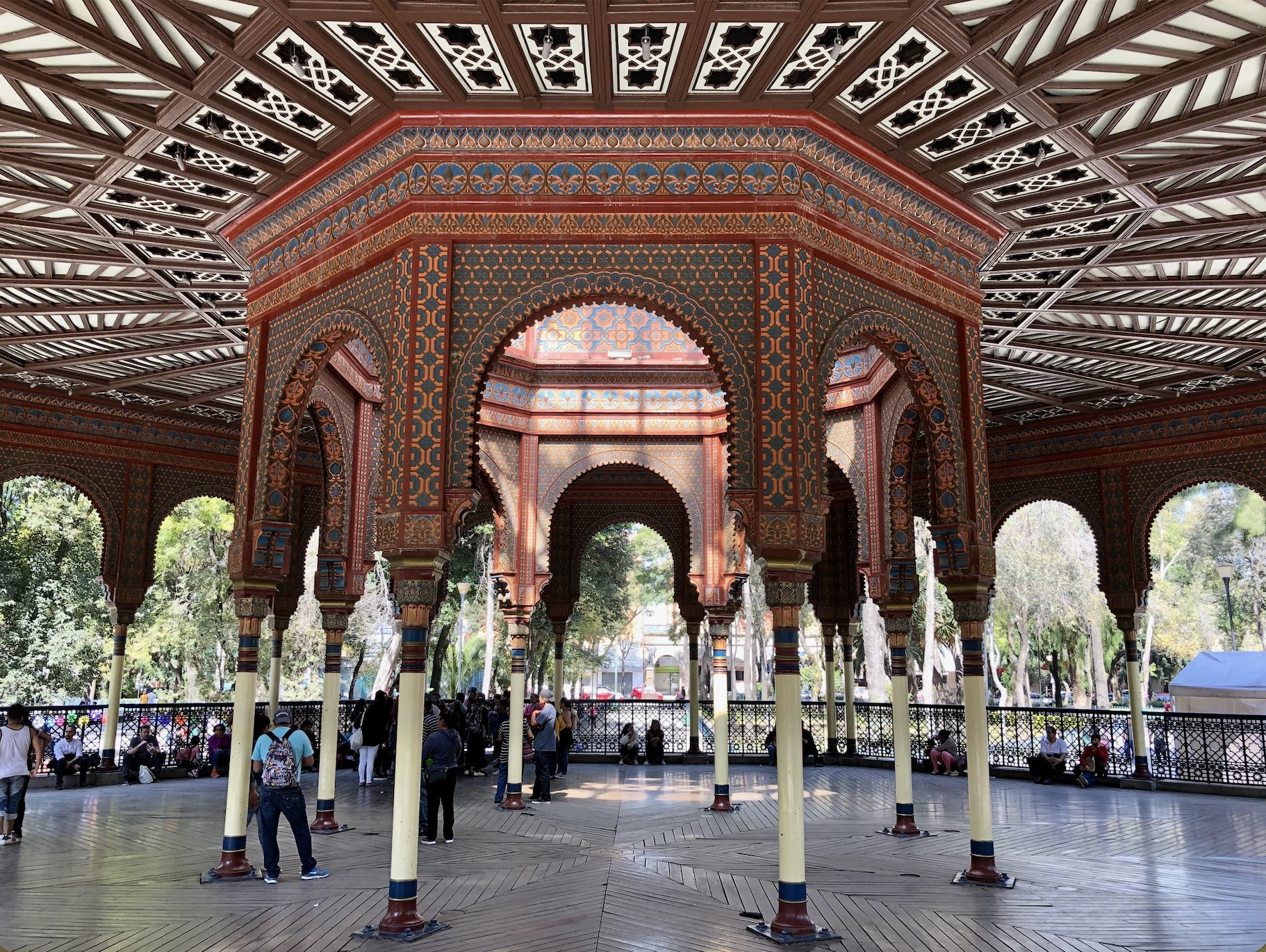
The Kiosko Morisco in Mexico City, Mexico

Kiosko Morisco

Kiosko Morisco, tucked away in the charming neighborhood of Santa María la Ribera, is a hidden gem with a fascinating past. This 19th-century Moorish-style pavilion, designed by José Ramón Ibarrola, was originally built for the 1884 World’s Industrial and Cotton Centennial Exposition in New Orleans. After its star turn on the world stage, the pavilion was relocated to Mexico City, where it has since become a beloved part of the local landscape. Featuring ornate arches, slender columns, and a striking bronze eagle devouring a snake atop the dome, this architectural wonder reflects Mexico’s rich cultural history with a touch of Spanish flair.

Now sitting proudly at the center of the Alameda de Santa María park, the Kiosko Morisco draws visitors with its vibrant colors, elegant design, and relaxed atmosphere. Whether you’re watching locals dance salsa beneath its arches or simply soaking in the beauty of its intricate patterns, this pavilion offers a glimpse into Mexico City’s storied past. Stop by for a leisurely afternoon and take in the beauty of this remarkable relic while exploring the laid-back barrio that surrounds it.

A man paddles one of the flat-bottomed boats that cruise the canals of Xochimilco outside of CDMX

Xochimilco

Xochimilco’s canals are a surreal slice of Aztec history in modern-day CDMX, where colorful trajineras glide past floating gardens called chinampas. Renting one of these vibrant boats is like having your own portable party—complete with a long table for snacks and drinks. We kicked off our trip at Embarcadero Nuevo Nativitas, perfect for accessing the infamous Isla de las Muñecas, where eerie dolls dangle from trees to appease a young girl’s restless spirit.

Cruising these ancient waterways, you’ll encounter everything from floating food vendors selling quesadillas to impromptu mariachi performances. The early hours are ideal for beating the crowds, but brace yourself for the chaotic boat traffic as the day goes on. It’s a magical and slightly macabre experience that brings the rich history and quirky charm of Xochimilco to life. 

Dolls and stuffed animals are nailed to a tree on the Island of the Dead Dolls on an island in Xochimilco, CDMX

The Island of the Dead Dolls

Just south of Mexico City in the Xochimilco canals lies la Isla de las Muñecas aka the Island of the Dead Dolls, an unsettling attraction draped in local legend. It’s said that a little girl drowned there under mysterious circumstances, and the island’s caretaker, Don Julián Santana Barrera, began hanging dolls he found floating in the canal to appease her restless spirit. Over the years, he amassed a bizarre collection of dolls, many decayed and missing limbs, creating a macabre shrine to the lost soul. In 2001, Don Julián himself drowned in the very spot where he had found the girl’s body.

When we visited, we couldn’t resist adding our own contribution to the legend. We brought a doll from Chicago and placed it on a toy car under a bower on the island. It’s now known as “la negrita en el carro,” one of only two foreign dolls on the island. Be sure to keep an eye out for her when you visit!

La Isla de las Muñecas is one of the eeriest destinations in CDMX and a must-see for fans of the supernatural and strange. Tours from Embarcadero Nuevo Nativitas offer a closer island option, while the original site takes around four hours round-trip. Don’t forget to bring a doll of your own as an offering!

Nearby 
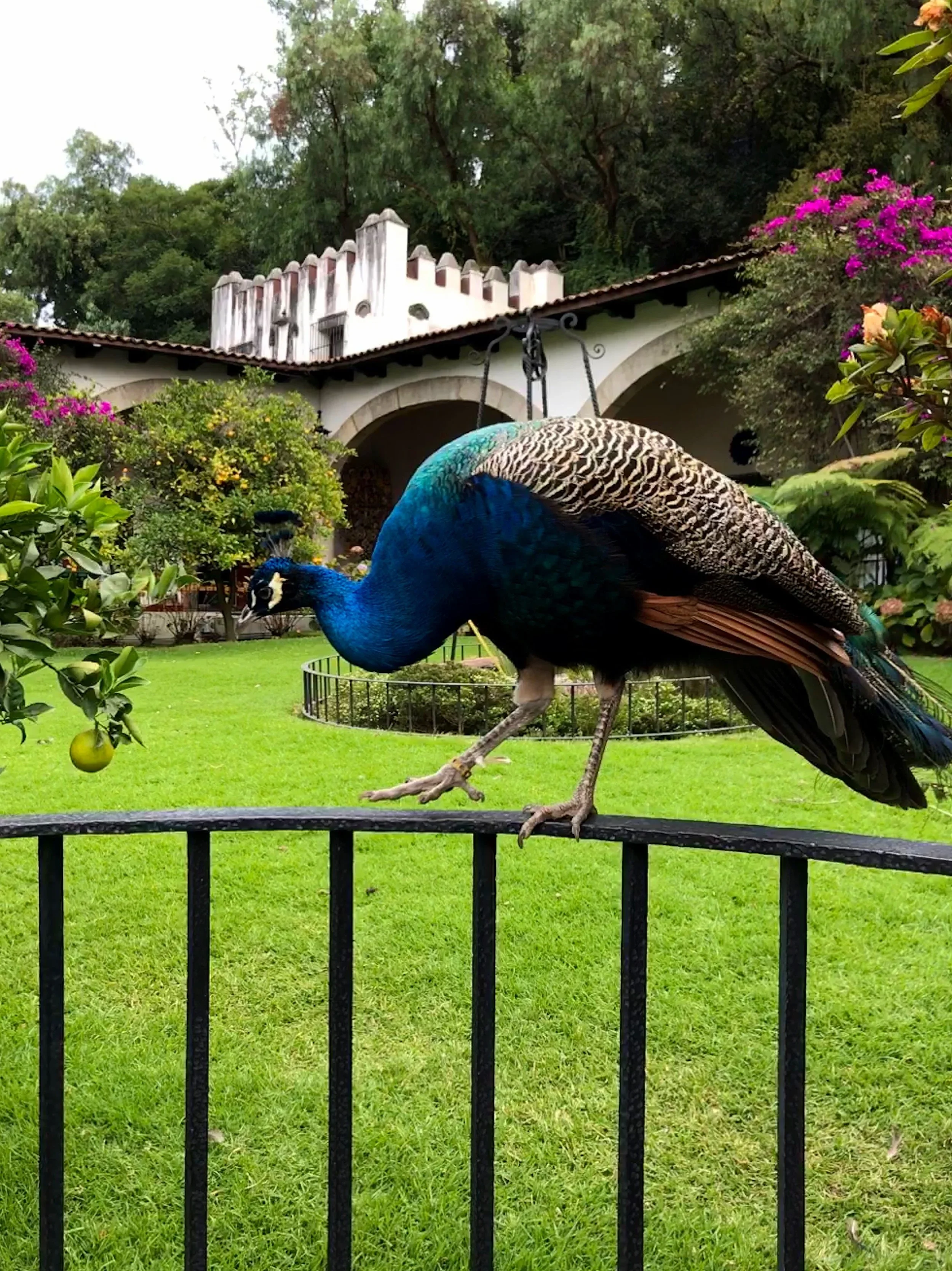
A peacock perches on a metal fence at the Museo Dolores Olmedo in CDMX

Museo Dolores Olmedo

NOTE: Sadly, a familial dispute has led to the (hopefully temporary) closure of the Museo Dolores Olmedo. When last we heard, it was set to reopen in 2026. Say a little prayer to Santa Frida — this is an amazing excursion that should be open to the public. 

The Museo Dolores Olmedo is an enchanting oasis that merges art, history, and whimsy on a sprawling 16th-century hacienda in Xochimilco. From the moment you arrive, you’re greeted by flocks of peacocks roaming the lush grounds, strutting their iridescent feathers like they own the place. The estate itself is worth the visit, with its colonial charm and gardens of dahlias, agaves, and bougainvilleas, offering a glimpse into the grandeur of old Mexico. But it’s not all just eye candy—the museum also houses the largest private collection of Diego Rivera’s work, plus several pieces by Frida Kahlo, including her distinctive small-format paintings and traditional Tehuana dress.

Inside, Rivera’s masterpieces span multiple rooms, showcasing his evolution from post-Impressionism to Cubism, while Olmedo’s pre-Columbian collection adds a layer of ancient mystique, with Colima dog effigies that once guided spirits through the Aztec underworld. The hacienda’s playful side shines through in the Day of the Dead ofrendas, where traditional and modern elements blend seamlessly, reflecting Olmedo’s inventive spirit. Don’t forget to swing by the Xoloitzcuintli enclosure, home to the adorably odd Mexican hairless dogs that roam the grounds like living relics. Whether you’re an art lover, history buff, or just here for the peacocks, the Museo Dolores Olmedo will surprise and charm you at every turn.
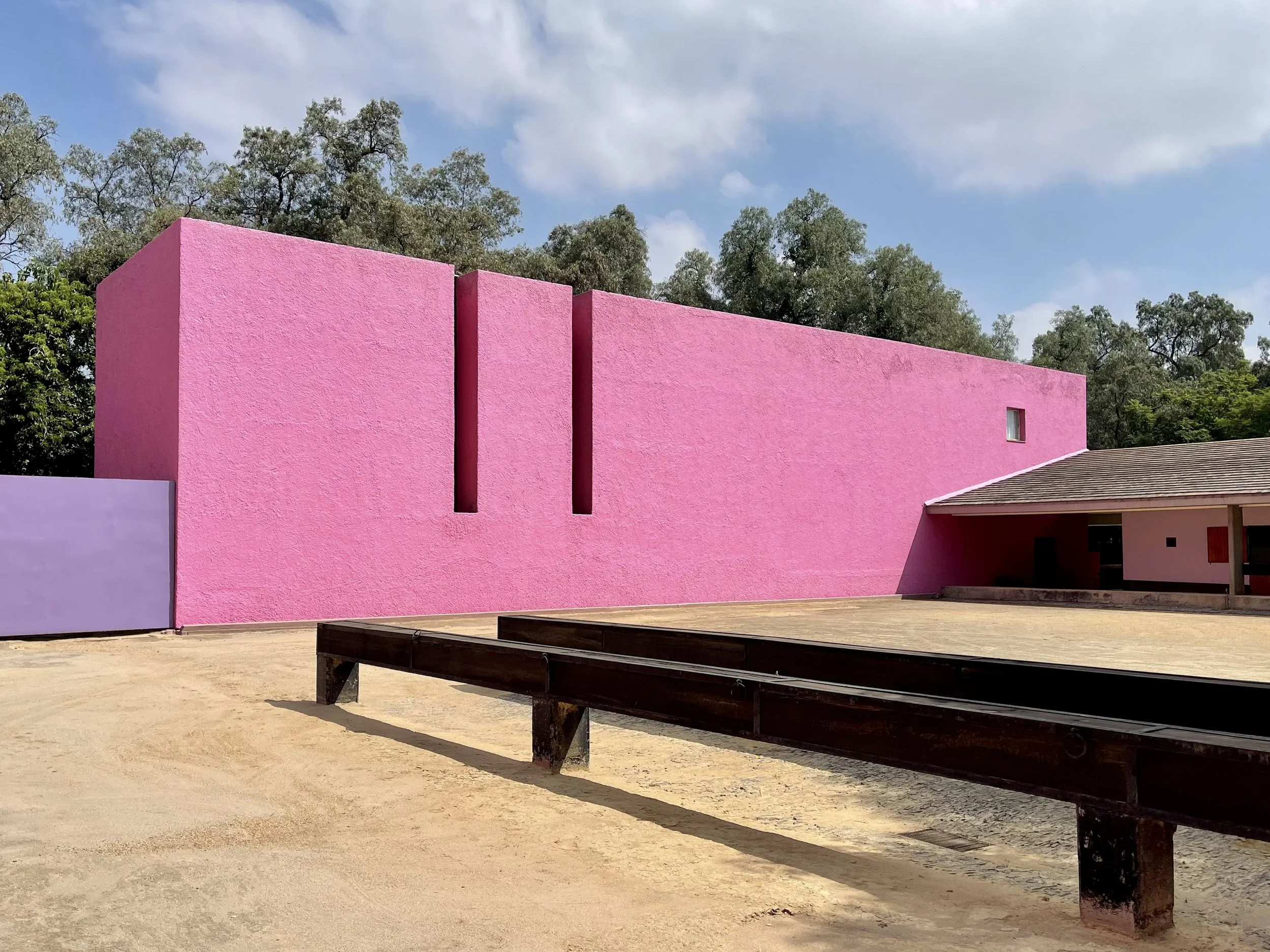
Purple and pink walls by the stables of Cuadra San Cristóbal architect Luis Barragán outside CDMX

Barragán Architecture Tour

Luis Barragán (1902–1988) didn’t just design buildings—he created spaces that stirred the soul. A poetic modernist and the only Mexican architect to win the Pritzker Prize, Barragán took the clean lines of European architecture and infused them with color, silence, shadow, and stillness. His homes, fountains, and public works reflect a love of introspection and nature—a legacy that’s best experienced in person.

To really understand Barragán, we recommend booking a tour with the Traveling Beetle, which took us from city outskirts to surreal spaces, all in a tomato-red VW bus. 
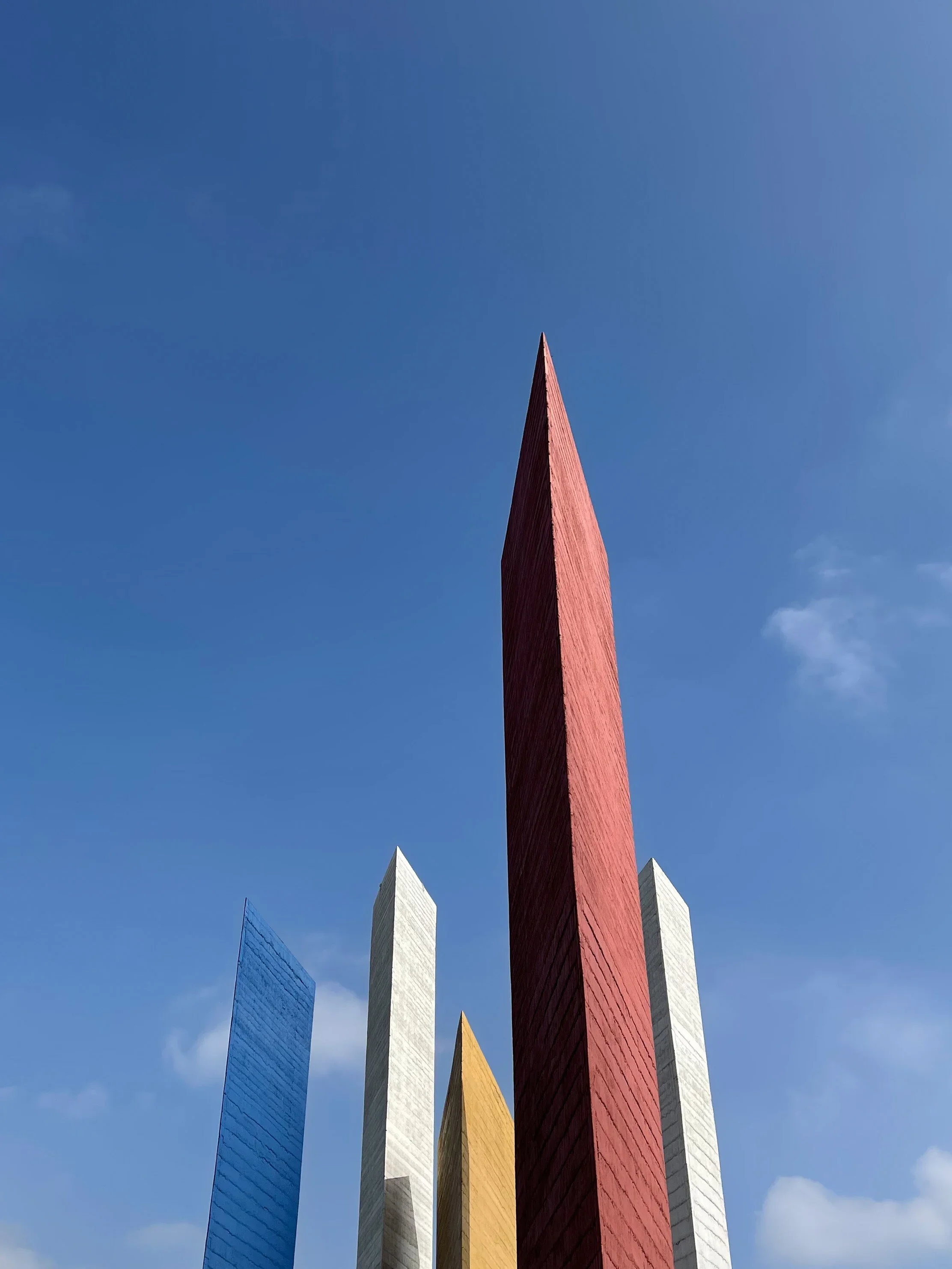
The blue, white, yellow and red thin sculptural Torres de Satélite by the architect Luis Barragán outside of CDMX

Torres de Satélite

You’ll spot them first from the freeway—five towering columns in blue, red, yellow, and white. These are the Torres de Satélite, co-designed with sculptor Mathias Goeritz, and they mark the edge of a planned community that never quite came to be. But the towers endure, bold and mysterious, like sentinels from another dimension. They aren’t just monuments—they’re Barragán’s modernist exclamation point.
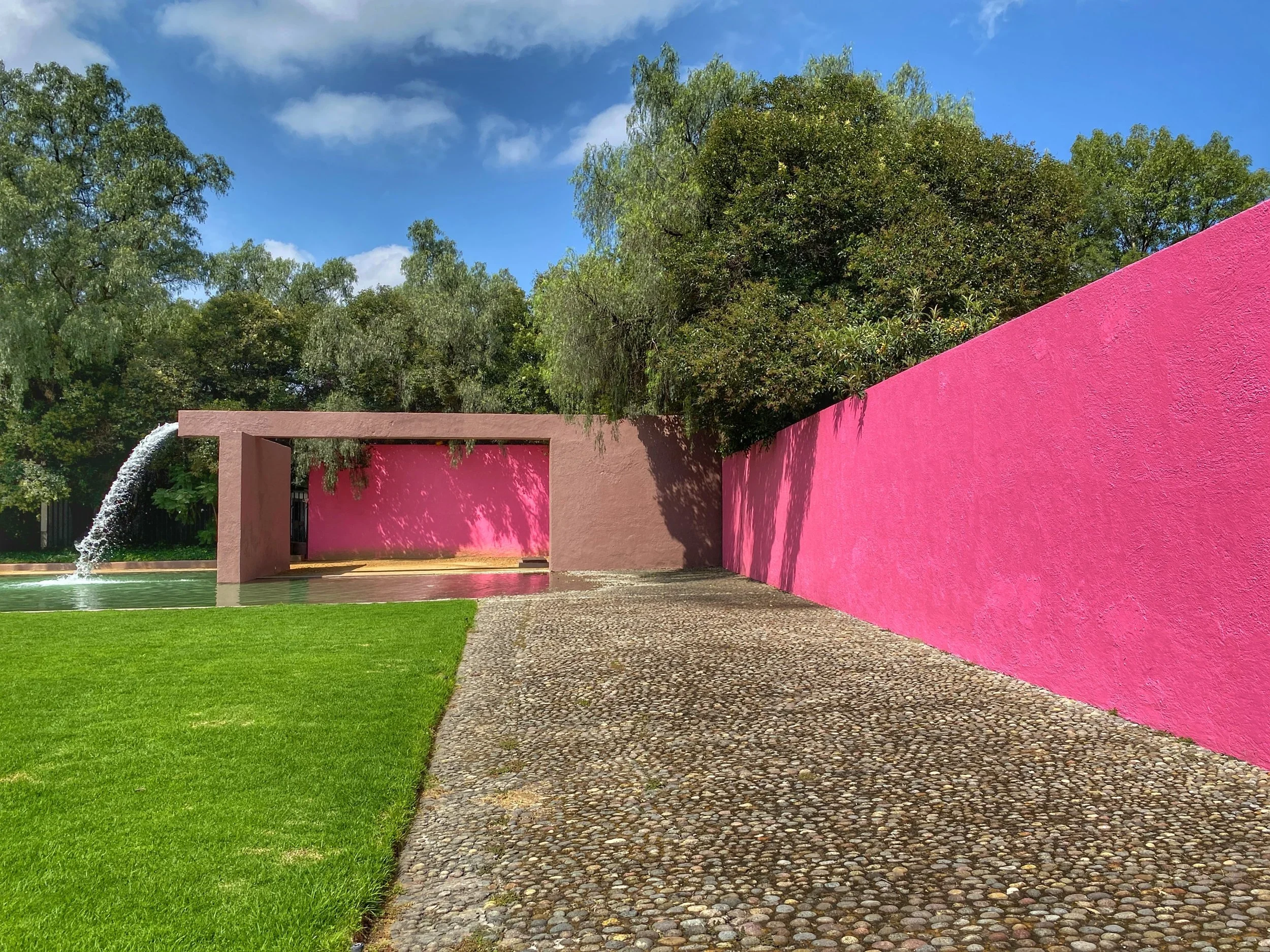
Modernist pink walls and cascading water at the Fuente de los Amantes by architect Luis Barragán outside Mexico City

Fuente de los Amantes

Hidden in a quiet corner of the San Cristóbal subdivision, the Fuente de los Amantes (Lovers’ Fountain) speaks in whispers. The aqueduct releases water once a day into the rectangular basin below, where two simple stone figures sit—one gazing, the other waiting. It’s classic Barragán: deceptively simple, achingly emotional. A place to contemplate connection, longing, and the kind of love that waits in silence.
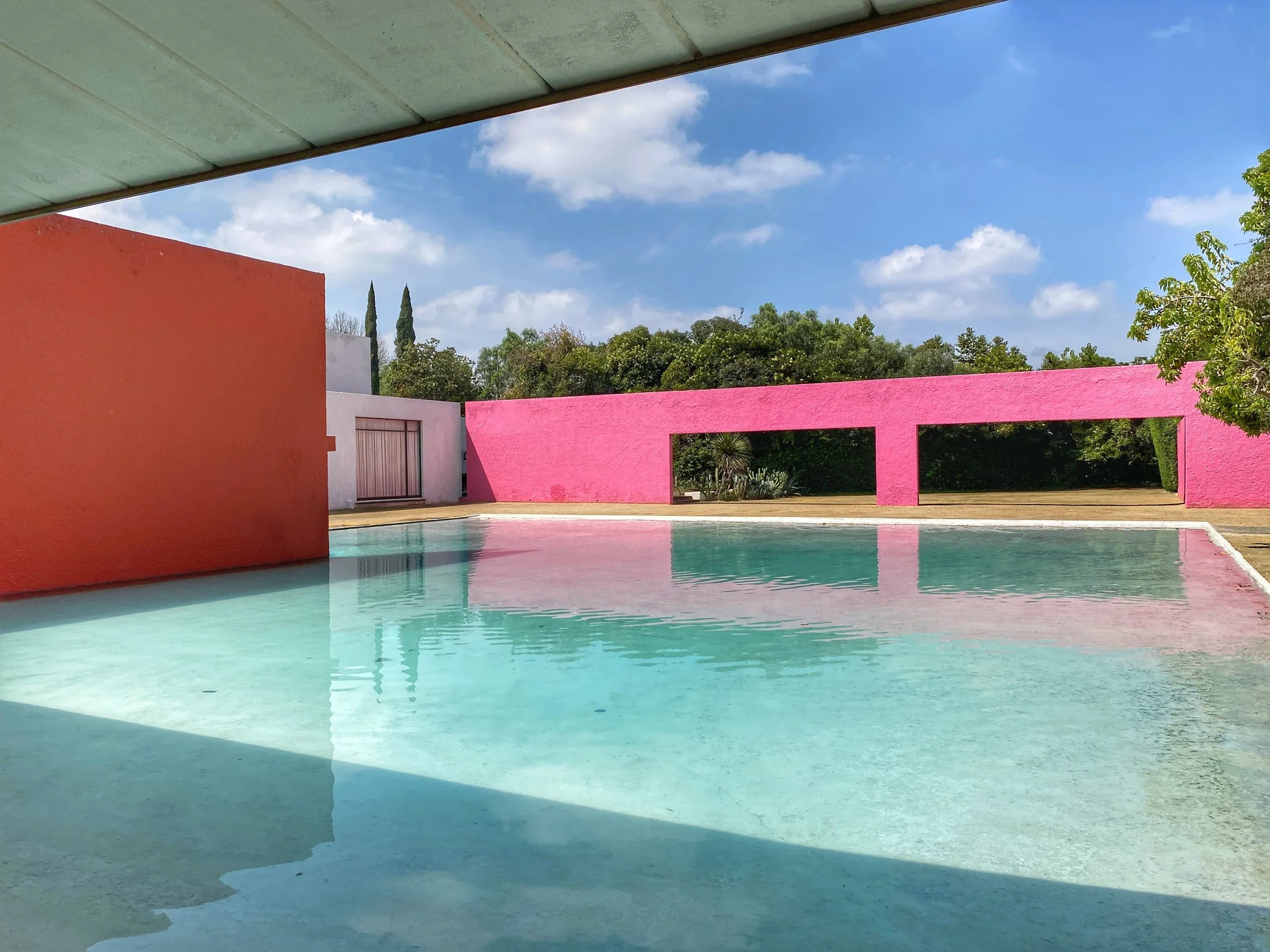
A pool by brightly colored minimal modern walls at Cuadra San Cristóbal byarchitect Luis Barragán outside of CDMX

Cuadra San Cristóbal

This is the showstopper. From the outside, Cuadra San Cristóbal feels like a fortress—flat pink walls, geometric cutouts, no hint of what’s inside. But step into the courtyard and it unfolds like a fever dream: a long pink wall set against cobalt pools, fountains built for horses, and trees erupting through carefully placed openings. It’s the kind of space that doesn’t just look beautiful—it makes you feel something. Even the horses seem to know they’re walking through art.
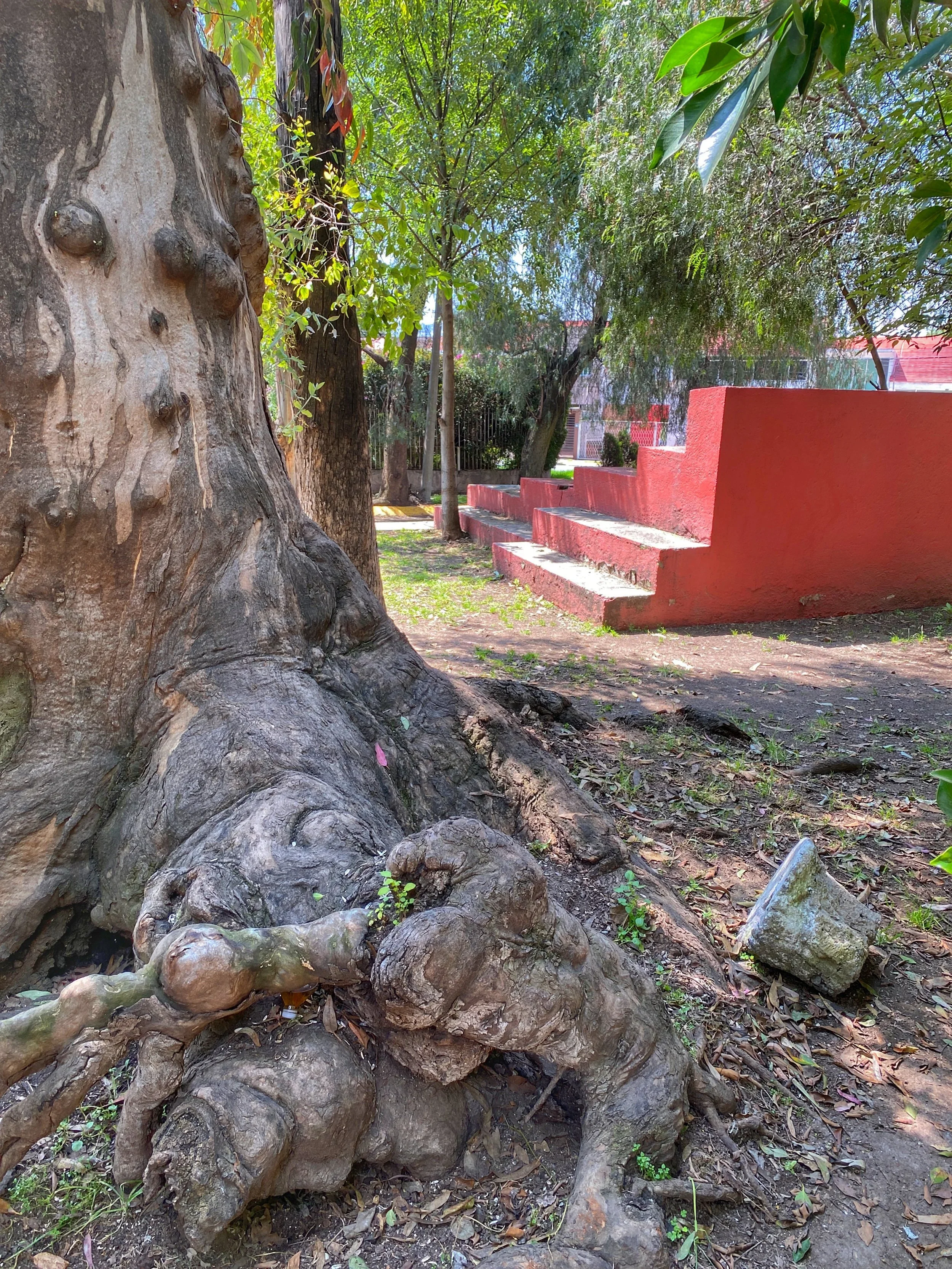
Gnarled eucalyptus tree and stepped structure by Barragán at Paseo de los Gigantes and Plaza del Bebedero outside CDMX

Paseo de los Gigantes and Plaza del Bebedero

The name Paseo de los Gigantes isn’t a metaphor, it’s literal. Those majestic, gnarled eucalyptus trees — unyielding and grand — are the giants the path is named for. Once part of a glamorous social scene where Barragán hosted horsing events, today the park feels forgotten — overgrown, faded — but no less haunting. From their bark to their scale, the trees still command attention. As you continue, you reach the Plaza del Bebedero, anchored by a long, empty horse trough fountain and framed by stark white and indigo walls where light and shadow play like whispered memories of its past.

Best Restaurants in CDMX
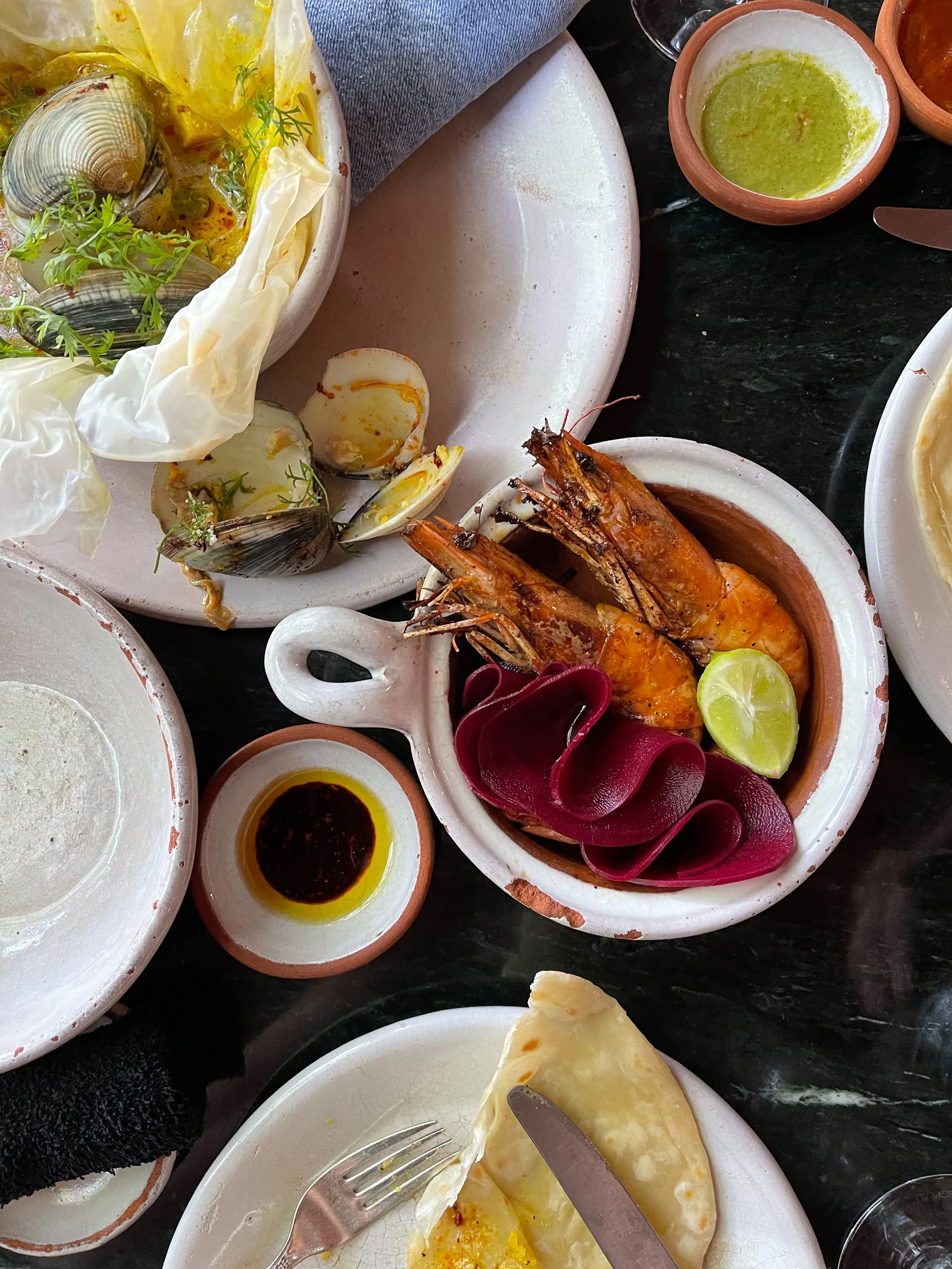
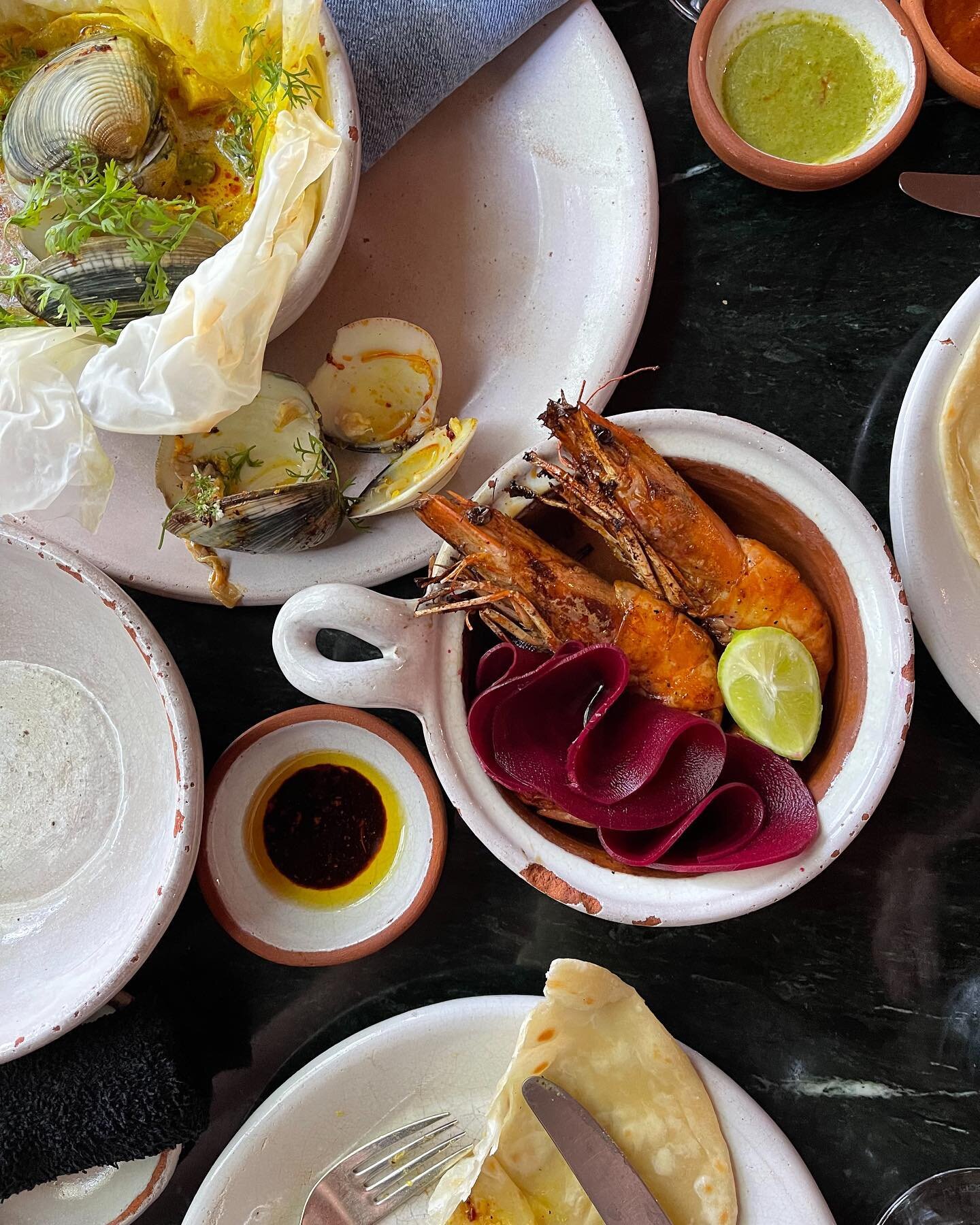
Two shrimp in a small bowl amid lunch at  Masala y Maíz in CDMX

Masala y Maíz

Masala y Maíz serves one of the most memorable meals we've had anywhere in the world. The husband-and-wife team behind the restaurant blends Mexican, South Asian and East African culinary traditions into dishes that somehow feel both inventive and deeply rooted in history. Every course surprised us, from brisket-filled samosas and vibrant chaat to chile-rubbed shrimp with vanilla ghee and clams simmered in turmeric, coconut milk and tomato masala.

Just as impressive as the food is the philosophy behind it. The owners have built a restaurant committed to fair labor practices, ethical sourcing and fostering a healthier restaurant culture—values that shine through in every aspect of the experience. Pair your meal with one of their excellent natural wines, and it's easy to see why Masala y Maíz remains one of our favorite restaurants in Mexico City.

Quirky Attractions in CDMX

A doll painted half black, half red as the Santeria deity Lucero at the Sonora witch market in CDMX

Witch’s Market at Mercado Sonora

If creepy, offbeat shopping is your thing, the witch market at Mercado Sonora in Mexico City is an absolute must-see. Tucked away in the market’s back left corner, this bizarre bazaar offers everything from potions to voodoo dolls, making it the ultimate mix of brujería and Catholic kitsch. Santa Muerte figures sit next to baby Jesus statues, and spells for love or money come in bottles of neon liquid you probably shouldn’t drink.

The aisles are tight, chaotic, and filled with the scent of sage. While navigating the labyrinthine stalls, you’ll find unsettling trinkets like Lucero Mundo dolls with sewn-shut eyes or macabre fur balls that defy description. It’s not for the faint of heart, but if you’re into all things witchy, Mercado Sonora is a slice of dark magic in CDMX. 

Shopping in CDMX
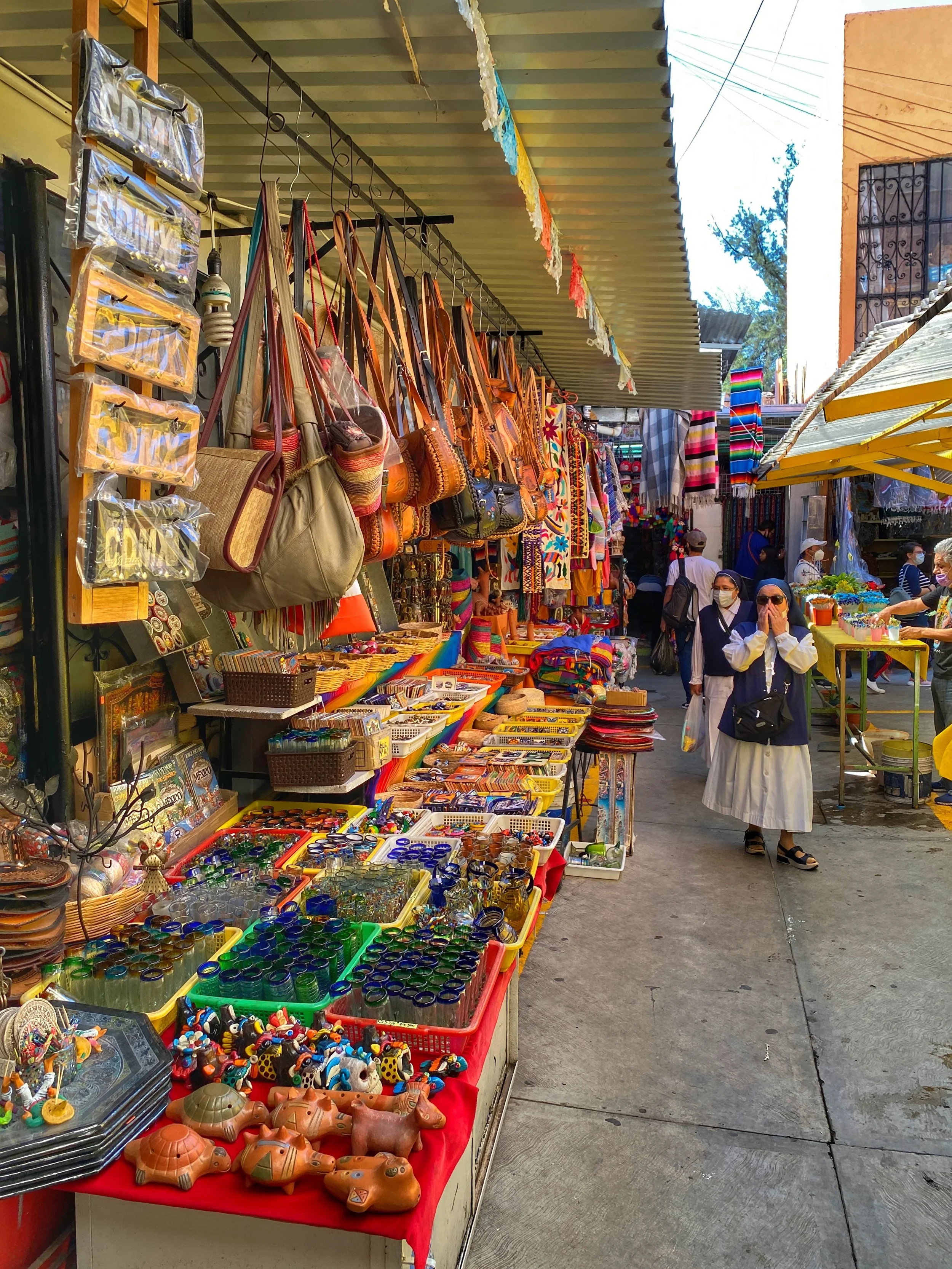
Nuns walk through the handicraft market of La Ciudadela in CDMX

Mercado de Artesanías La Ciudadela is a paradise for folk art and handicrafts lovers, offering a treasure trove of arte popular from all over Mexico. This sprawling market is packed with stalls selling everything from Oaxaca’s vibrant alebrijes and intricate Otomi textiles to pre-Columbian-style clay sculptures that rival museum pieces. It’s impossible to see it all in one go, so take your time and maybe even ask for a discount if you’re buying multiple items.

When you need a break from browsing, head to Fonda Carmelita, the market’s cantina, for traditional Mexican food and a refreshing margarita. It’s the perfect spot to recharge before diving back into the market’s colorful chaos. Don’t miss this iconic shopping destination whenever you’re in Mexico City — we never do.
A Taste of Rosemary in Marrakech, an Art-Filled Boutique Riad

Discover Riad Rosemary Marrakech, Laurence Leenaert’s LRNCE-designed boutique riad near the Mellah, filled with hand-crafted ceramics and textiles.

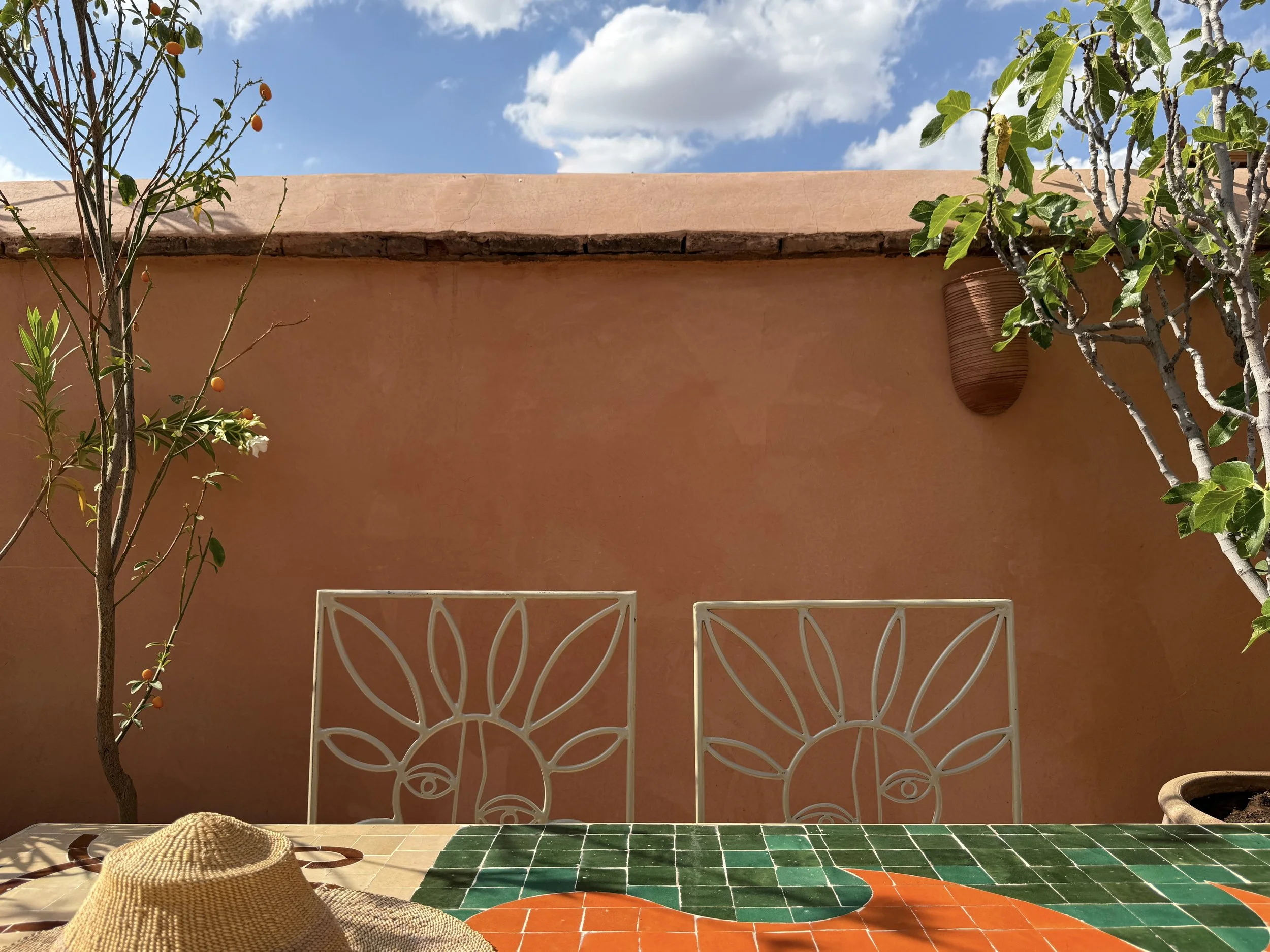
Mosaic table and wire chairs with suns on the rooftop terrace at Riad Rosemary in Marrakech, Morocco

The rooftop terrace features whimsical wrought iron Helios chairs and a tiled table adapted from one of Laurence Leenaert’s drawings.

When Wally and I began thinking about where to travel next, we found ourselves drawn back to Marrakech, the Red City, named for the salmon-colored rammed earth walls enclosing its maze of alleys, their blank façades broken only by wooden doors that suggest another world hidden just beyond them. We had visited in 2012 with our friend Vanessa and were curious to see how the city had changed and what remained from our previous trip.

On that visit, we had a digital camera, and after a three-day journey that included an overnight stay among the shifting sands of the Sahara, we discovered the memory card was “frite” (fried) and beyond repair. So the prospect of returning to a place that held such wonderful memories for a full week this time, was impossible to resist. 

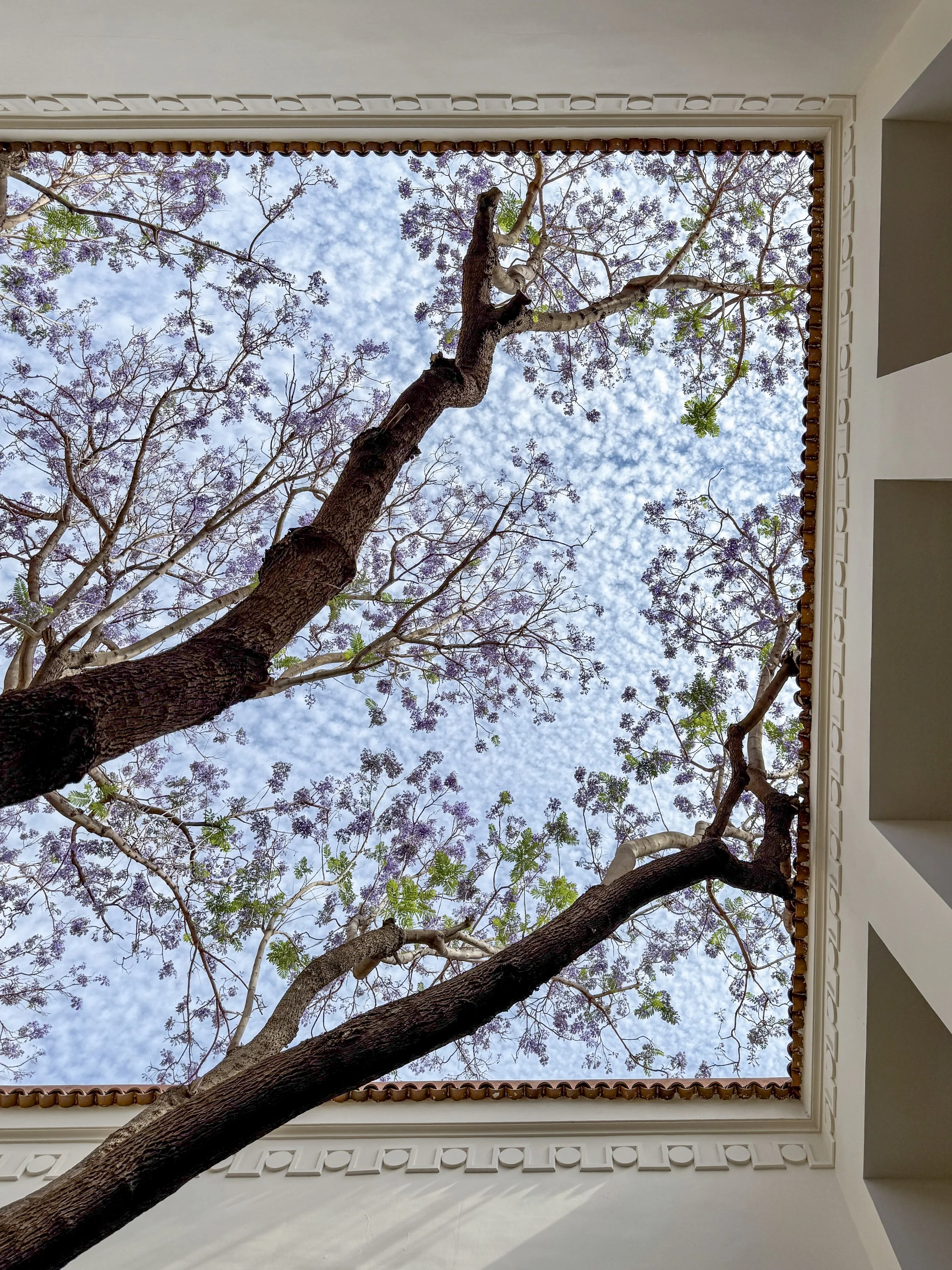
Looking up through the open-air courtyard and the flowering jacaranda tree at Riad Rosemary in Marrakech

The courtyard is the heart of the riad, anchored by a magnificent 40-year-old jacaranda tree and home to the salon d’été, wavy terrazzo tiles, plunge pool, LRNCE boutique and living room.

Like Alice in Wonderland, I enjoy falling down the rabbithole, gathering sites for us to see as well as finding the perfect place to call home during our stay. This was how I discovered Rosemary, an intimate five-bedroom boutique riad built around a courtyard and interior garden, tucked into the quiet residential neighborhood of Riad Zitoun Jdid. 

On the map, it sits in one of the oldest quarters of the southern medina, a stone’s throw from Bahia Palace and within walking distance of the souks and other sites we wanted to explore. 

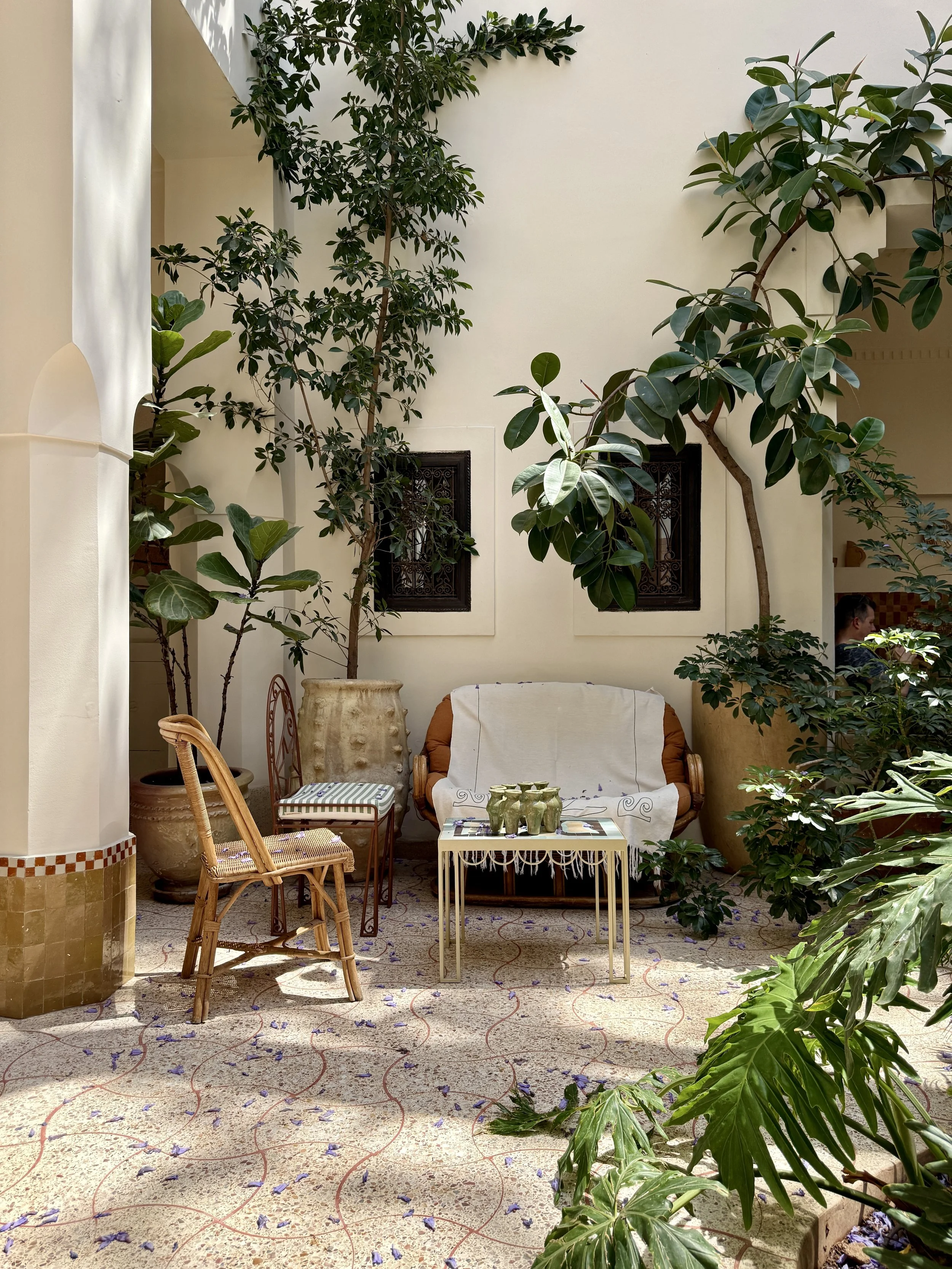
A seating area in the interior courtyard with plants at Riad Rosemary in Marrakech

Leenaert and her husband, Ayoub Boualam, worked with dozens of craftsmen and women from Morocco to rework the interiors with bespoke furnishings and finishes, including zelije tiles and tadelakt, a natural lime-based plaster.

The riad was the former home of Rose-Marie, who happened to cross paths with Belgian artist and designer Laurence Leenaert and her husband and business partner, Ayoub Boualam, at their studio in Sidi Ghanem, an industrial area just outside Marrakech. She was looking to sell, and once the couple toured the space, its faded grandeur made the decision an easy one, and a logical next step in the brand’s evolution.

Leenaert is the founder of the lifestyle brand LRNCE, launched in 2013 and based in Marrakech, where she arrived with little more than a sewing machine and a few hundred euros. She originally specialized in small leather bags before evolving into an internationally recognized label known for its hand-painted ceramics, woven rugs, textiles, clothing and objects deeply rooted in Marrakech’s craft traditions.

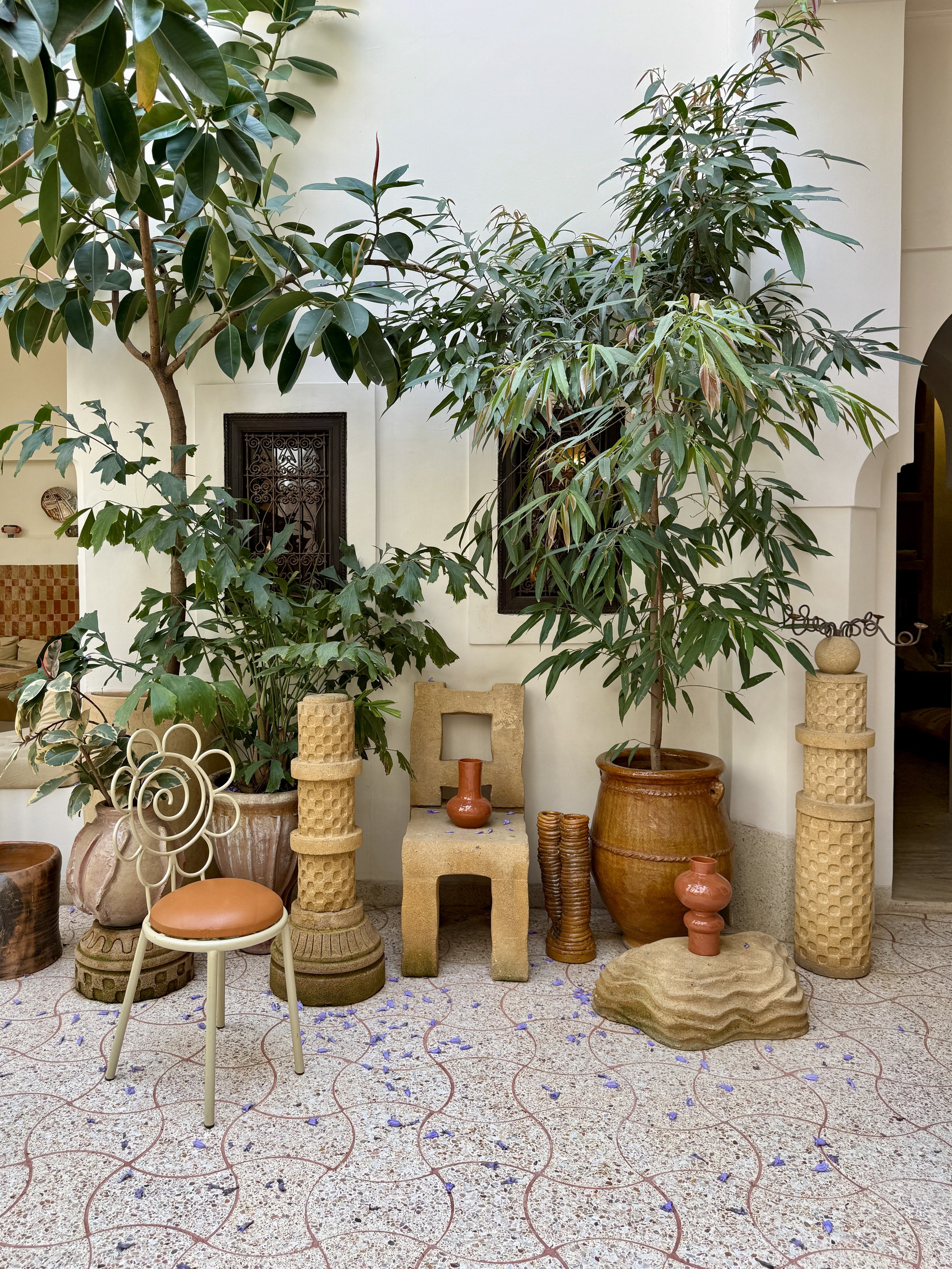
Whimsical chairs and pots with plants in the interior courtyard of Riad Rosemary in Marrakech

Rosemary is a living extension of LRNCE’s aesthetic universe, immersing guests in Leenaert’s creative world rather than simply offering a glimpse of it.

Arriving at Rosemary 

We remembered how easy it was to get lost in the medina, and while that’s part of the fun, we didn’t want to stress over being dropped at the edge of a narrow street and rolling our suitcases down it while navigating pedestrians, donkey carts and weaving mopeds. To avoid this, I prearranged pickup. We were met at the airport and transported to a dropoff point on Rue Riad Zitoun el Jdid. There, one of Rosemary’s accommodating hosts welcomed us, took our bags, and led us down to 25 Rue de la Bahia.

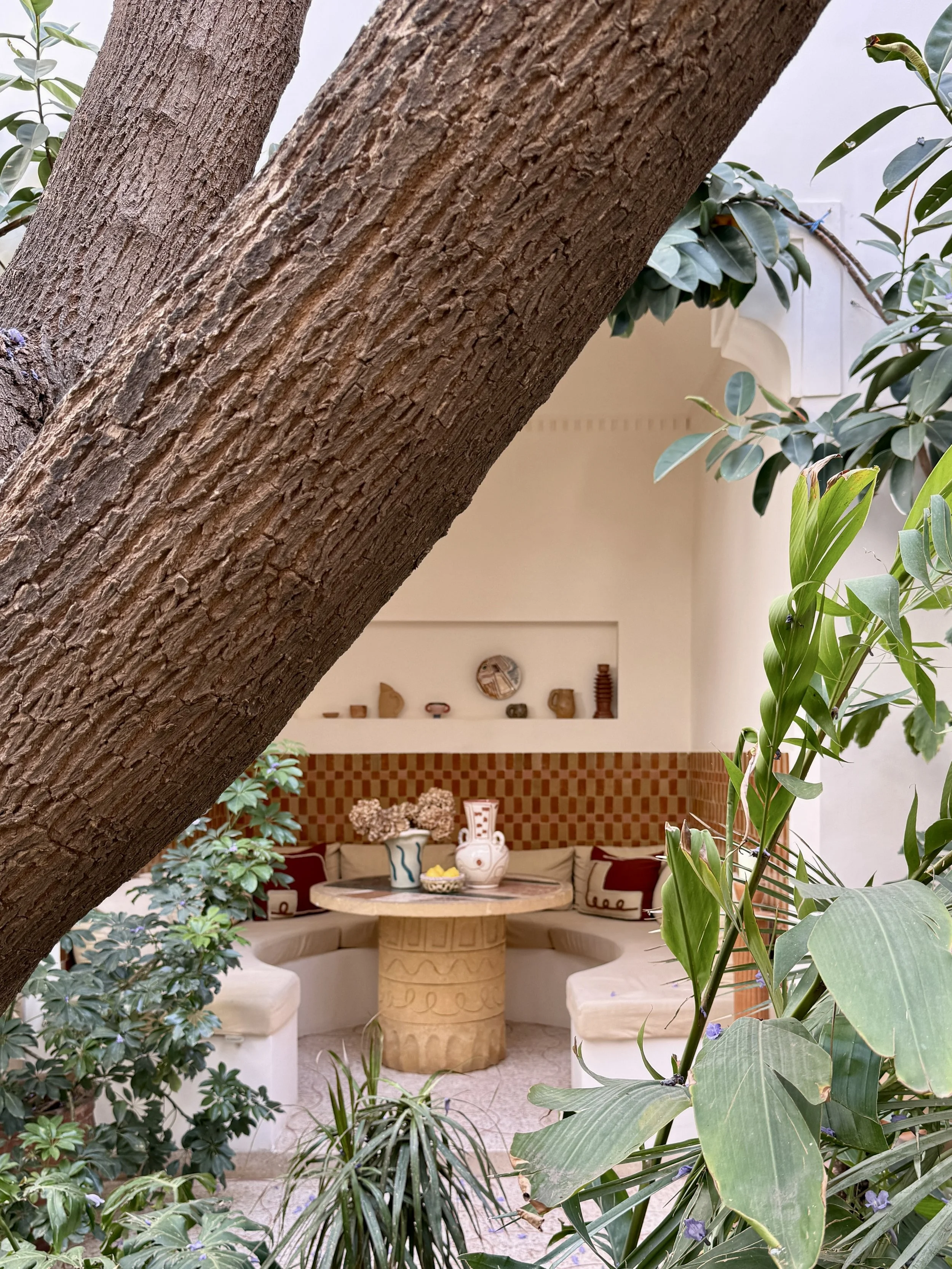
A circular seating area by a large tree in the interior courtyard of Riad Rosemary in Marrakech

Among the countless handcrafted details, sandstone has been fashioned into sculptural objects, including a chair, pedestal and table base, for the salon d’été.

We were seated at a banquette in the cozy salon d’été (summer salon) in the tranquil central courtyard shaded by a majestic jacaranda tree, and served mint tea and slices of housemade banana bread while we completed check-in. 

Afterward, we were shown our room and given a tour. During our stay, the riad was hosting an event on the rooftop to promote the collaboration between LRNCE and Australian resort wear brand Alémais, and guests could also participate in craft events, including an intimate textile workshop the day before we departed. 

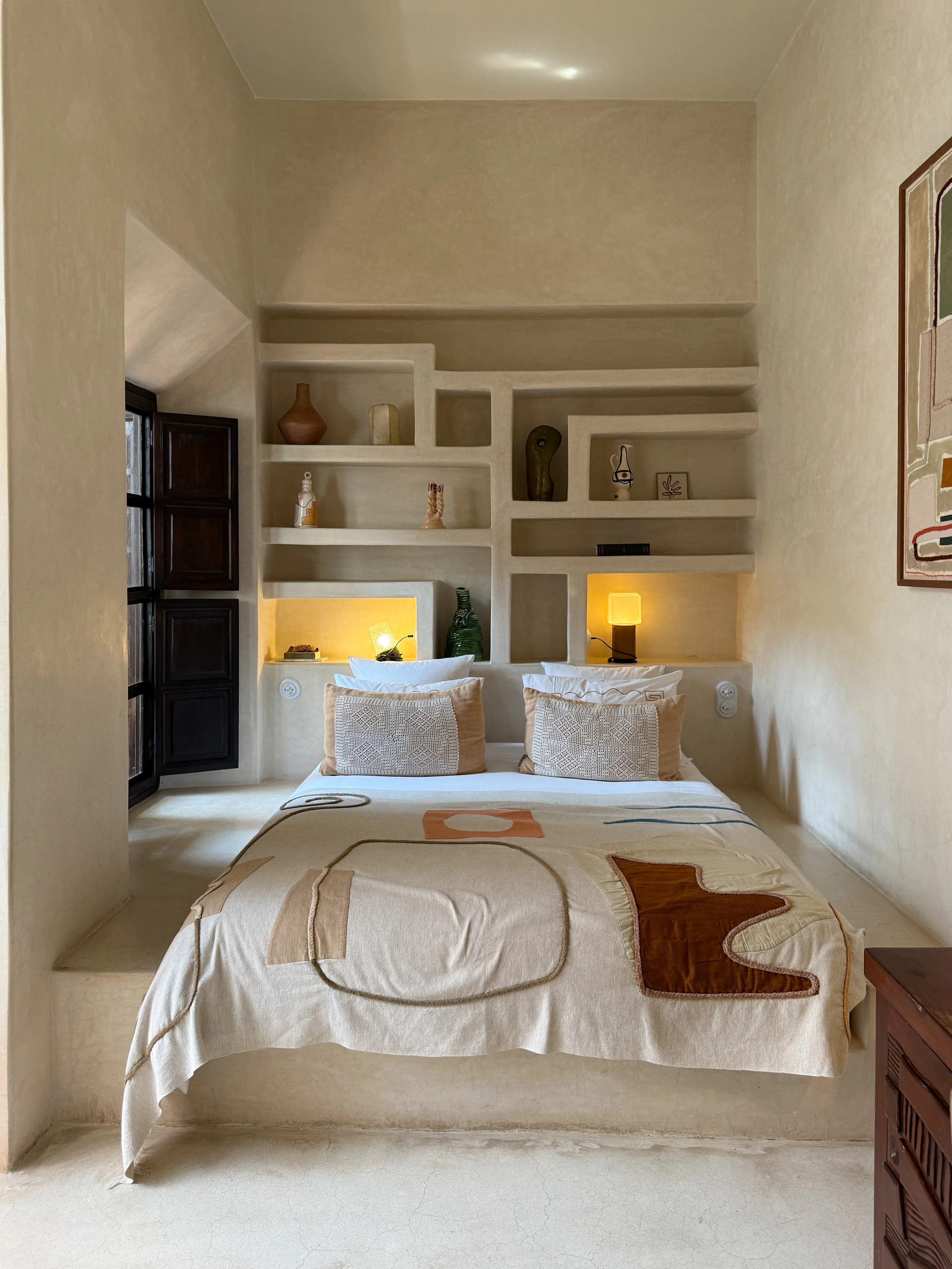
Bed and shelving in the Clemande suite at Riad Rosemary in Marrakech

The Clemande suite features a queen-sized bed, built-in shelving filled with hand-painted ceramics and found objects, including a goatskin lampshade.

The Rooms at Rosemary

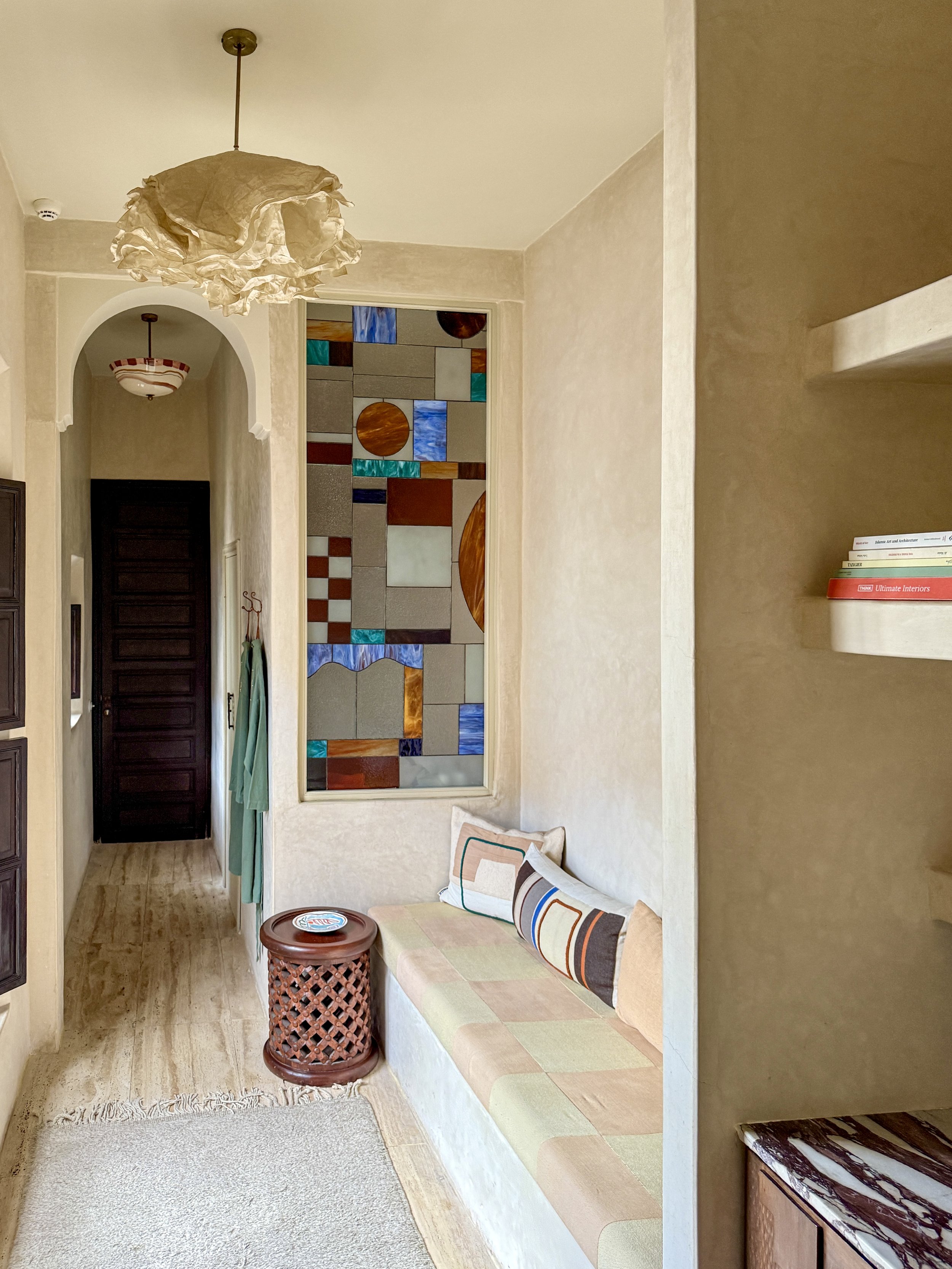
I had booked the Cocoon suite on the second floor, which overlooks the central courtyard. In-room amenities include wifi, a preloaded iPad complete with a chill rooftop mix, a Sonos portable Bluetooth speaker and shelves lined with art books, along with a queen-sized bed, a bathroom with a stained glass window, a built-in bench with hand-embroidered throw pillows and a handcarved cedarwood sideboard with a marble top. 

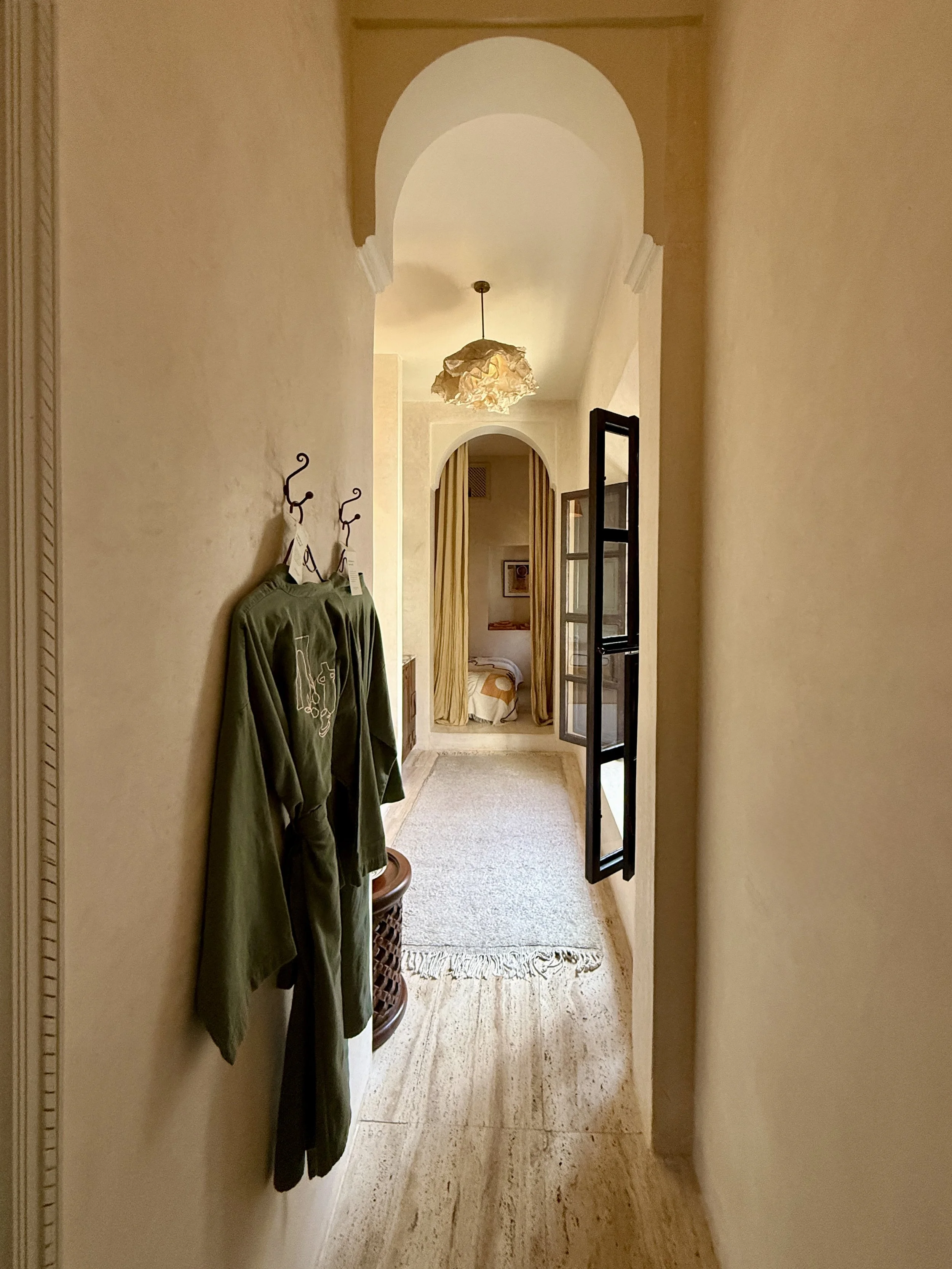
Robes hand on the wall in the narrow Cocoon room at Riad Rosemary in Marrkech

The Cocoon suite lives up to its name — a perfect retreat after a day spent haggling in the souks.

Stained glass window, seating nook and narrow arch with hanging lamps in the Cocoon suite at Rosemary Riad in Marrakech

The Cocoon suite features a custom stained glass panel, sculptural lighting and a cozy bedroom.

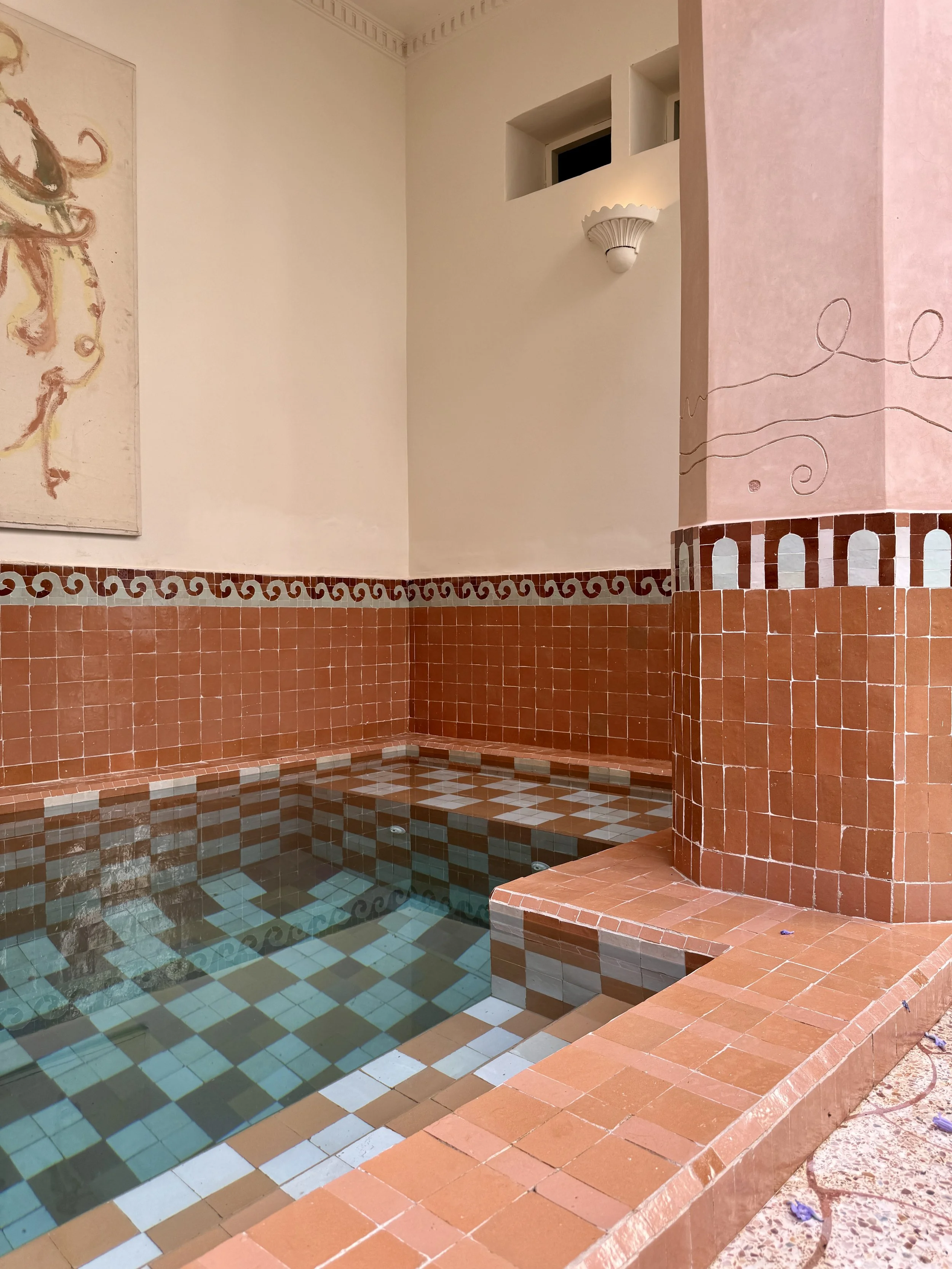
A couple of days later, we were graciously upgraded to the Clemande suite and could hardly believe we had our very own private balcony. We spent most afternoons soaking our feet in the cool water of the plunge pool or relaxing up there. 

The plunge pool with checkered floor at Riad Rosemary in Marrakech

A large painting of two octopuses by Belgian artist Lieven Deconinck hangs above the plunge pool where Duke and Wally spent many afternoons relaxing and soaking our tired feet. 

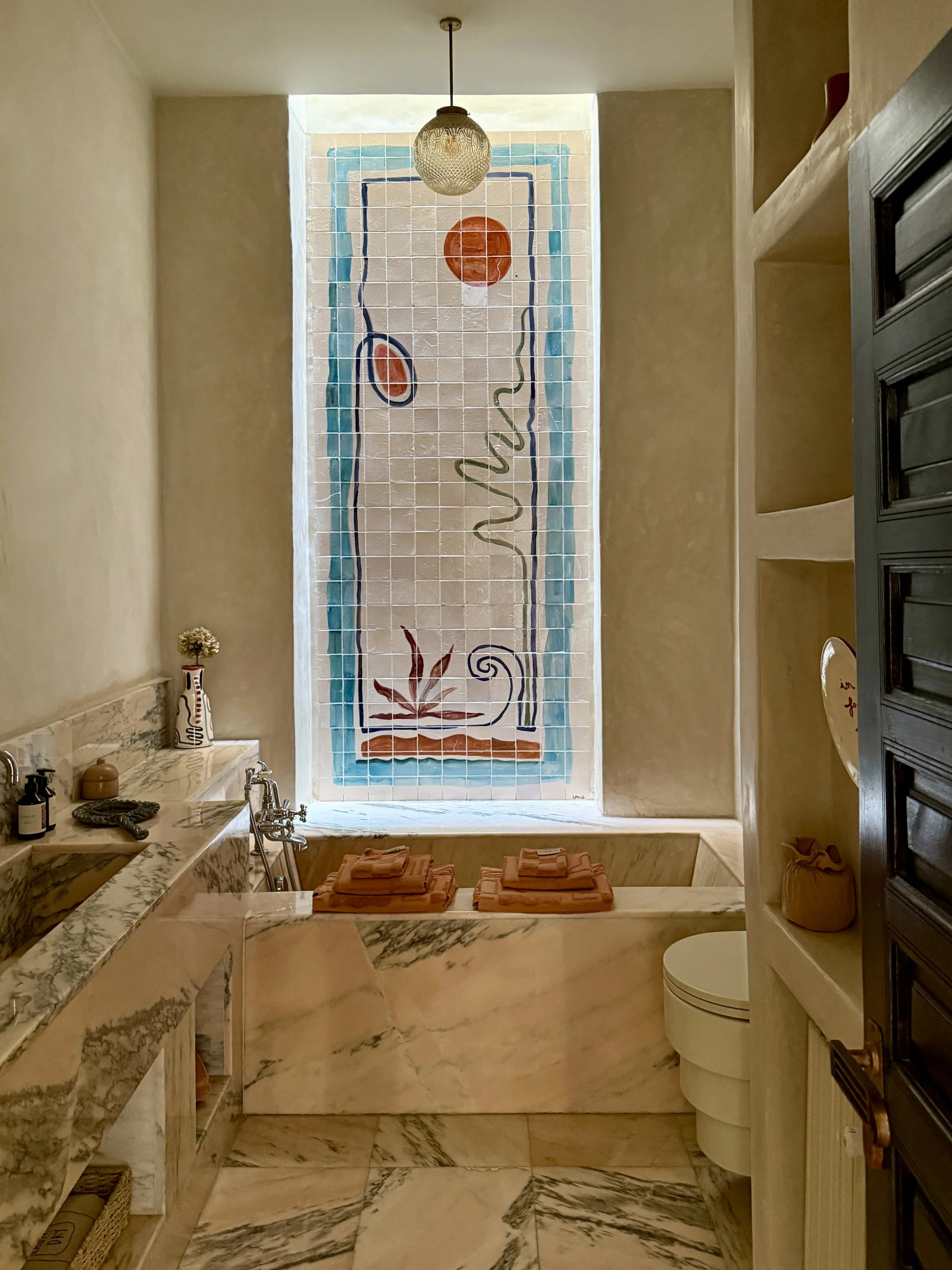
The suite features a queen-size bed, built-in geometric shelving lined with art books, hand-painted ceramics and found objects, including a goatskin lampshade, plus a bathroom with a marble soaking tub and a striking tile mural painted by Leenaert.

The Clemande suite features a marble bathtub and hand-painted tile mural by Leenaertart.

And can we take a moment to talk about their toiletries? The hand soap, body wash, shampoo and silky body lotion are all scented with notes of neroli orange, rosemary and cedar atlas. We ended up buying some to take home.

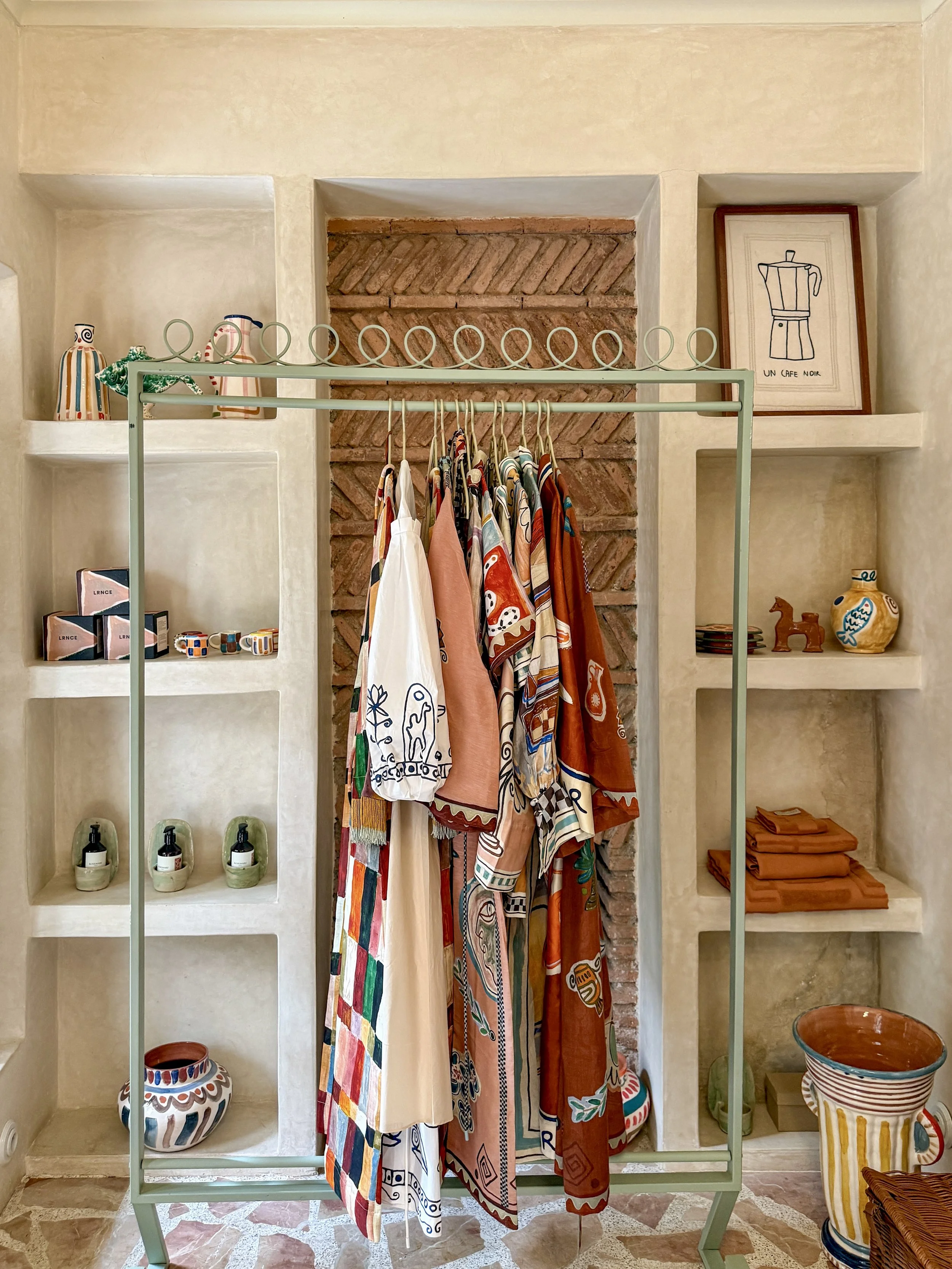
Hand-painted ceramics, embroidered bed linens, toiletries and apparel at the onsite boutique at Riad Rosemary in Marrakech

The onsite boutique carries hand-painted ceramics, embroidered bed linens, toiletries and apparel.

The LRNCE Vision

Laurence and Ayoub’s vision respects the building’s pedigree, and the results are anything but typical. The property had previously been renovated by Belgian architect Quentin Wilbaux, who has spent decades documenting and restoring traditional riads throughout the medina and is widely regarded as one of the leading authorities on its architecture. The couple oversaw every aspect of the intensive three-year renovation, and collaborated with more than a few dozen maâlems, or master craftsmen, drawn from across Morocco’s specialized trades: stained-glass artisans from Meknès, potters from Safi, zellige tilemakers from Fès, marble vendors from Rabat, and a crew of local Marrakchi carpenters, metalworkers and plasterers who handled the riad’s finishes. 

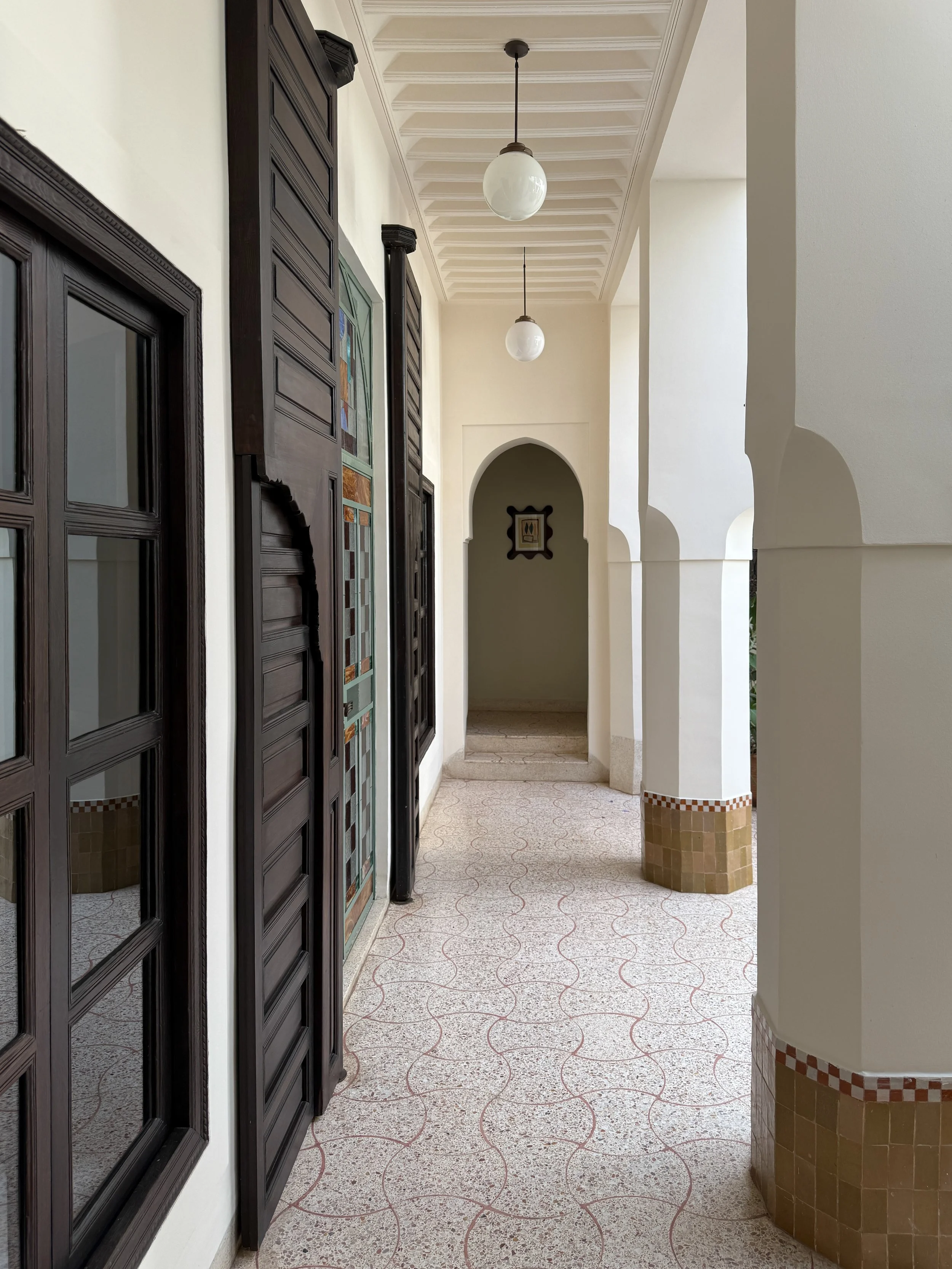
A hallway with white columns and dark wood doors and window frames at Rosemary Riad in Marrakech, Morocco

The hotel’s name is a nod to its previous owner as well as the herb used to perfume its in-house hammam.

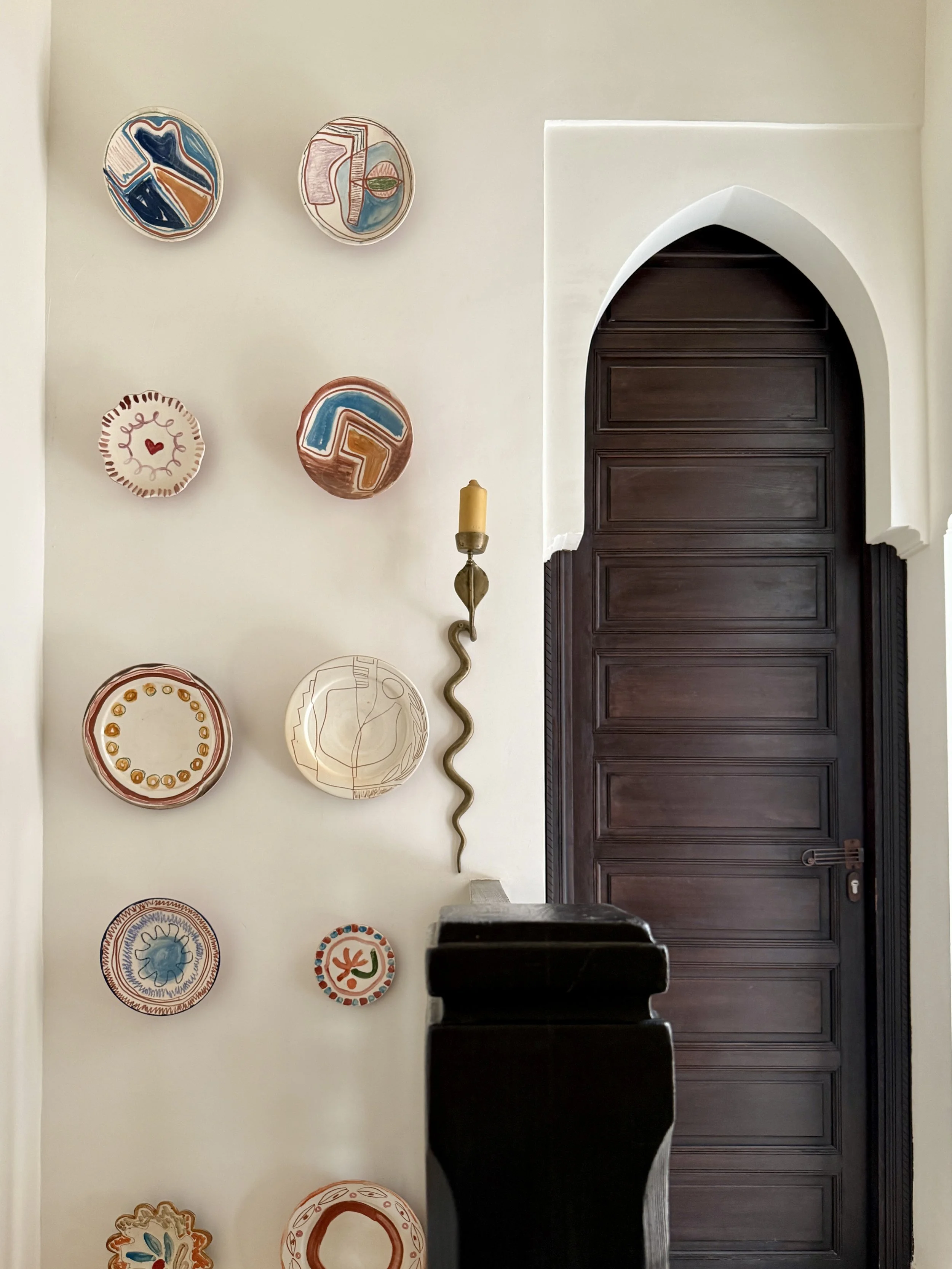
A gallery wall of hand-painted plates by LRNCE, accented by a vintage brass cobra sconce at Riad Rosemary in Marrkech

Hand-painted plates by LRNCE and a vintage brass cobra sconce we coveted, found at the Bab el Khemis flea market

Each detail, from the spontaneous hand-drawn lines etched into the columns framing the plunge pool to the wrought iron door handles and red marble lozenges meticulously set into the staircase, contributes to a space that pulls you fully into Leenaert’s creative world. Her own works are complemented by vintage fixtures and furnishings sourced from their travels. Wally and I were obsessed with the vintage brass cobra wall sconces found throughout, and later learned they came from a seller at the Bab el Khemis flea market.

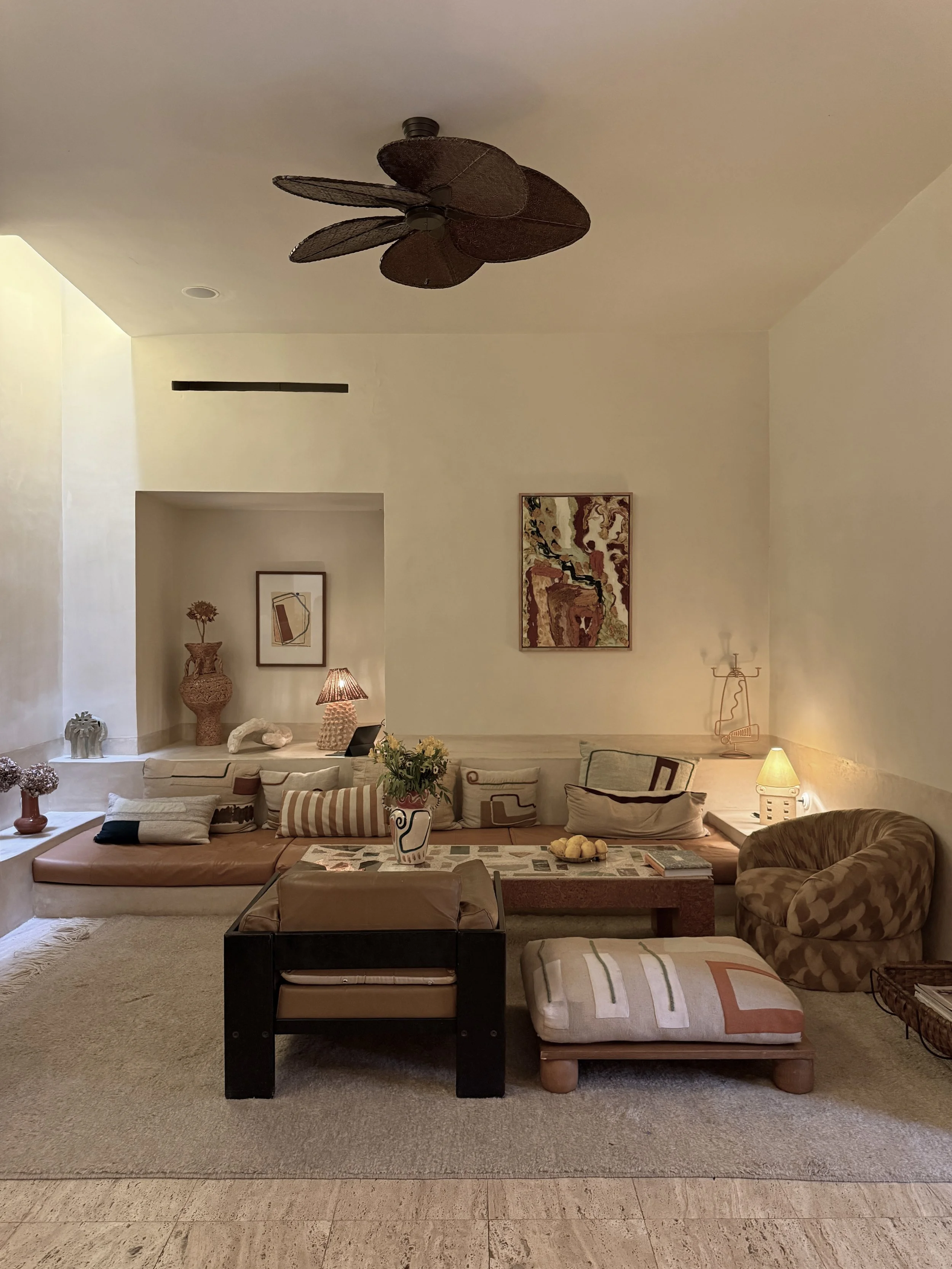
The living room at Riad Rosemary in Marrakech with built-in banquette, vintage furniture and tiered shelves lined with art books, ceramics and objects by LRNCE

Located off the courtyard, the living room features built-in banquette, vintage furniture, and tiered shelves lined with art books, ceramics and objects by LRNCE. 

Staying at Rosemary 

Breakfast is served on the sun-drenched rooftop terrace, which is dotted with LRNCE designed tables, whimsical wrought iron chairs and sunloungers. The spread includes homemade yogurt, amlou (almond spread), honey, preserves, sticky date and sesame energy balls, mesemmen (semi-leavened bread), baghir (Moroccan semolina pancakes) and eggs made to order, served from terracotta tagines. The freshly squeezed orange juice is exceptional, as is the nous nous (“half-half” in Darija, Moroccan Arabic), a local café staple made with equal parts espresso and steamed milk.

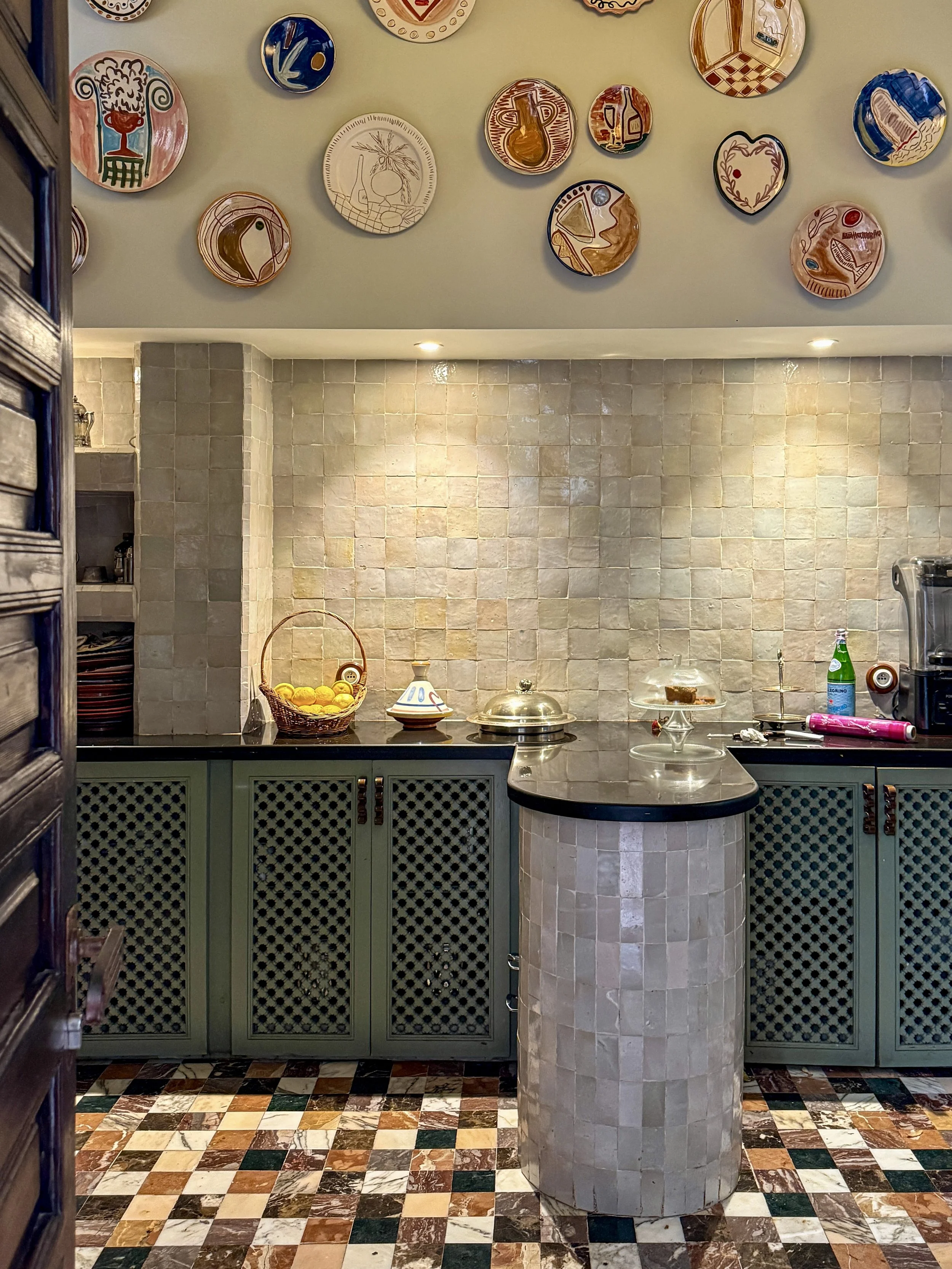
The kitchen at Riad Rosemary in Marrakech, with hand-painted plates by Leenaert and mashrabiya-style cabinet doors

The kitchen features hand-painted plates by Leenaert and mashrabiya-style cabinet doors.

Rosemary felt less like staying at a hotel and more like being welcomed into a dear friend’s home. The warmth and generosity of everyone who took care of us will not soon be forgotten. Once you check in, you may never want to leave. 

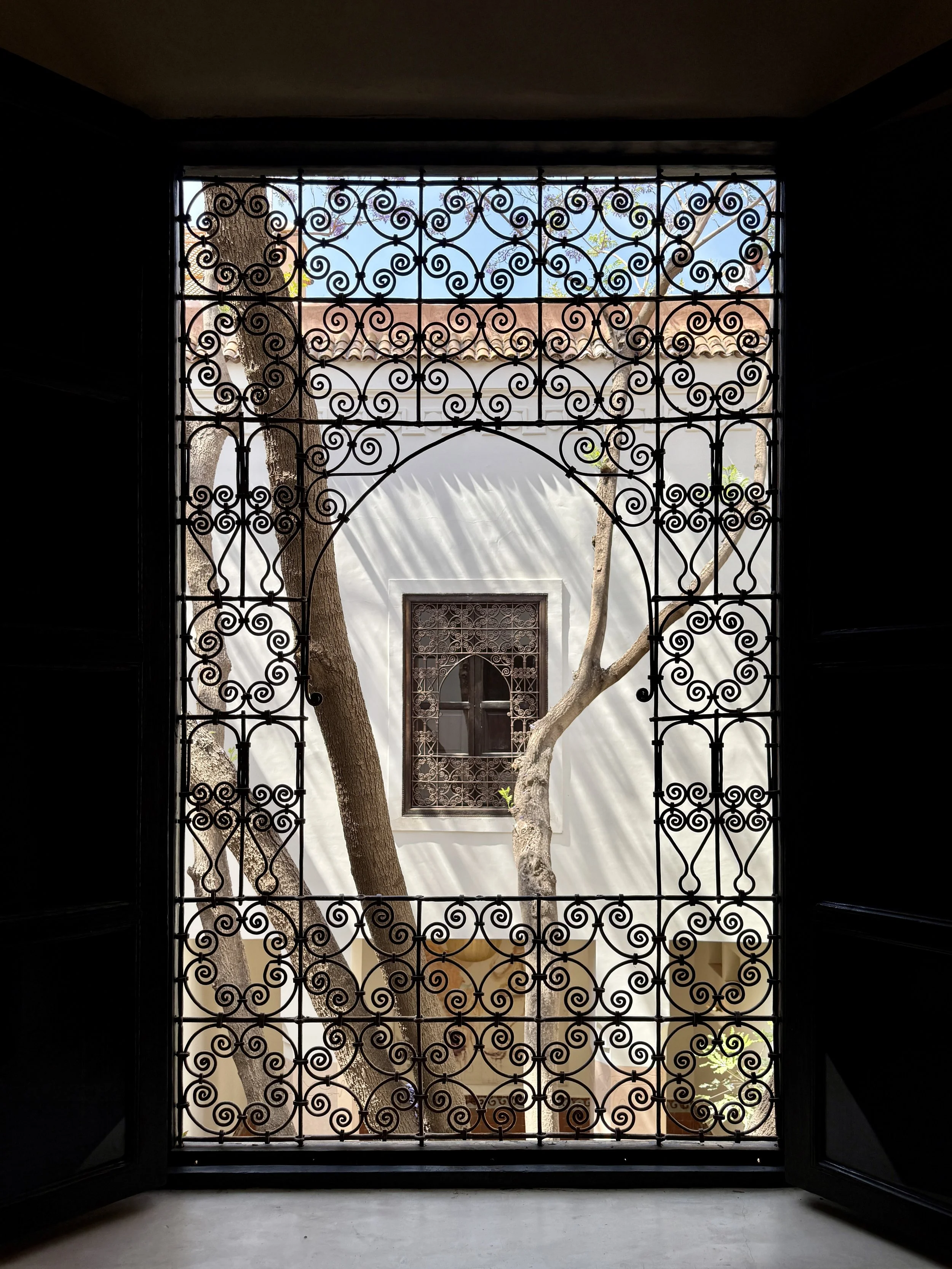
Curlicues cover a wrought iron grille over a window in a hotel room at Rosemary Riad in Marrakech

An ornate traditional wrought iron grille looks out upon the interior courtyard.

If you happen to fall in love with the hand-crafted ceramics, linens, rugs or toiletries during your stay — and you will — the onsite LRNCE shop makes it easy to take a bit of Rosemary home with you. –Duke

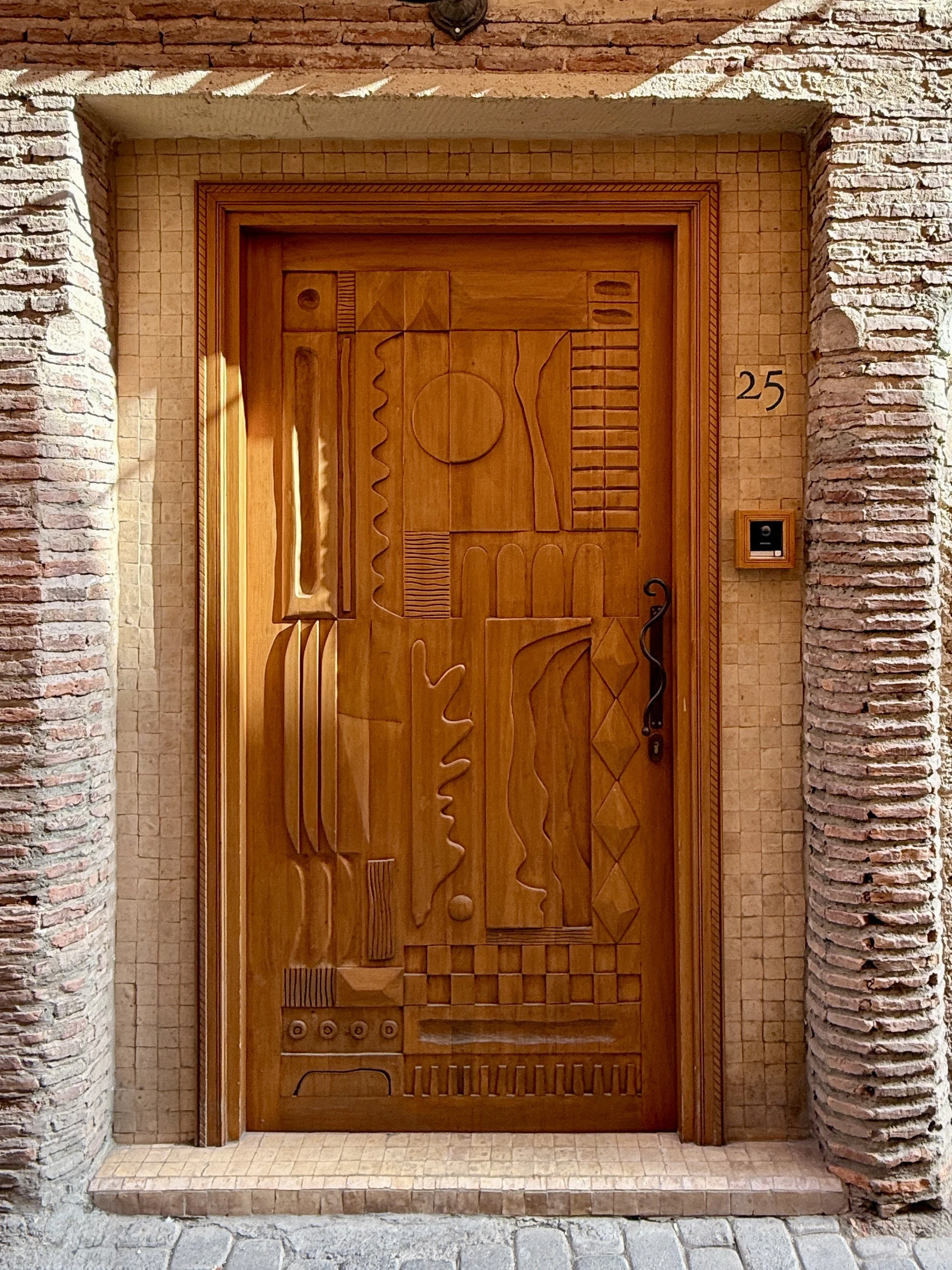
The elaborately carved cedarwood door at Riad Rosemary in Marrakech, Morocco

The hand-carved cedarwood front door was adapted from Leenaert’s sketches, one of the first pieces created for Rosemary, and took over four months to complete.

Riad Rosemary

25 Rue de la Bahia
Marrakech 40000
Morocco


Locke de Santa Joana Hotel in Lisbon: From Convent to Chic Retreat

Want to spend a few nights in a converted 17th century convent in Lisbon? Look no further than the apartment-like rooms of Locke de Santa Joana. 

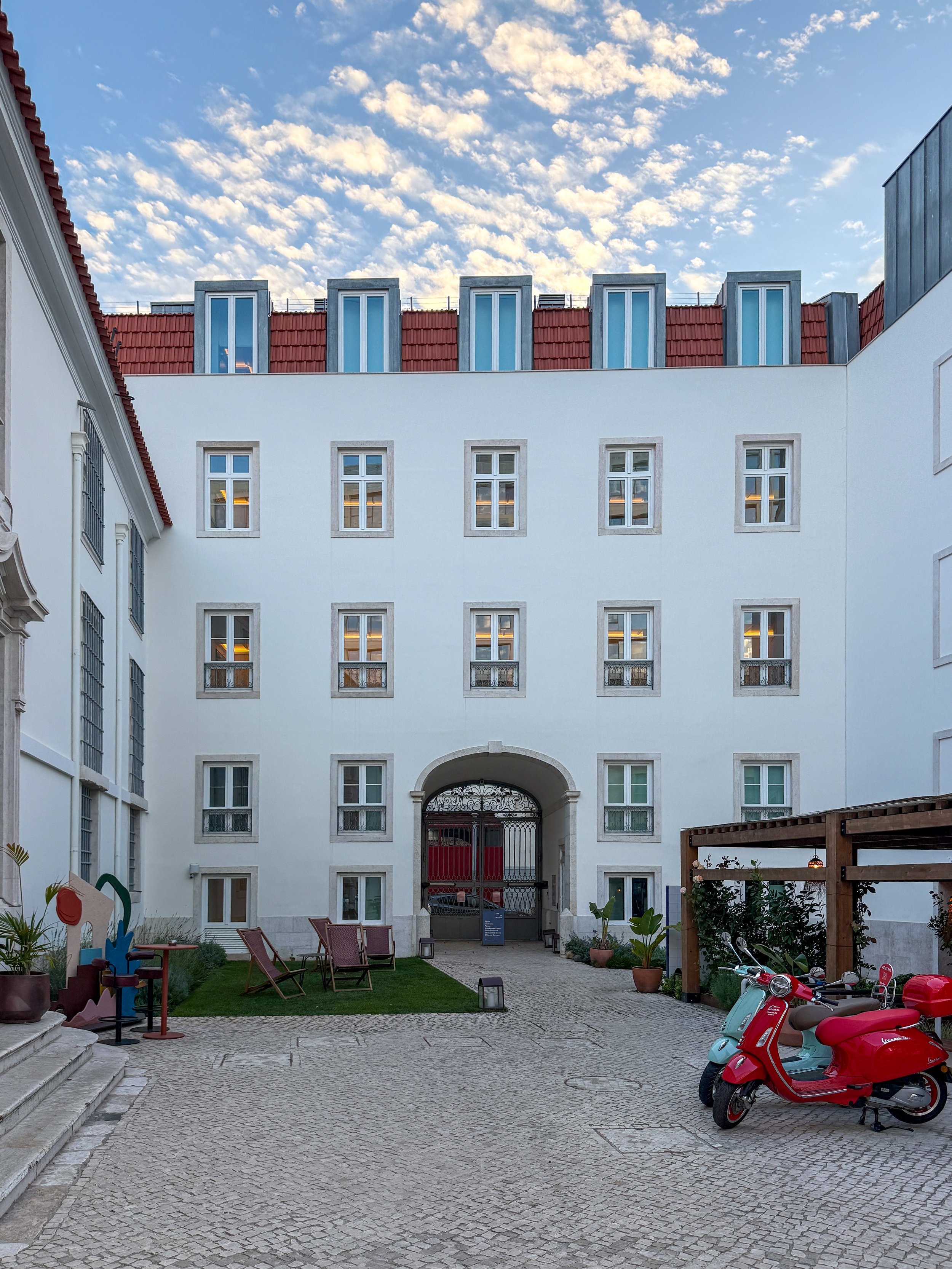
The Santa Marta wing of Locke de Santa Joana in Lisbon, with two Vespa parked in the courtyard

For me, one of the best parts of planning any trip lies in finding the perfect home base — a place within walking distance of the sights we want to see, yet far enough removed to kick back and unwind at the end of a day spent exploring. 

After narrowing down our options for Lisbon, Portugal, Locke de Santa Joana was a no-brainer. The property’s about a 15-minute cab ride from Lisbon Airport, located near Marquês de Pombal Square and Avenida da Liberdade — Lisbon’s grand, tree-lined boulevard modeled after Paris’ Champs-Élysées. It’s also within walking distance of the barrios históricos (historic neighborhoods) of Baixa, Chiado and Bairro Alto, home to many landmarks, shops and cafés.

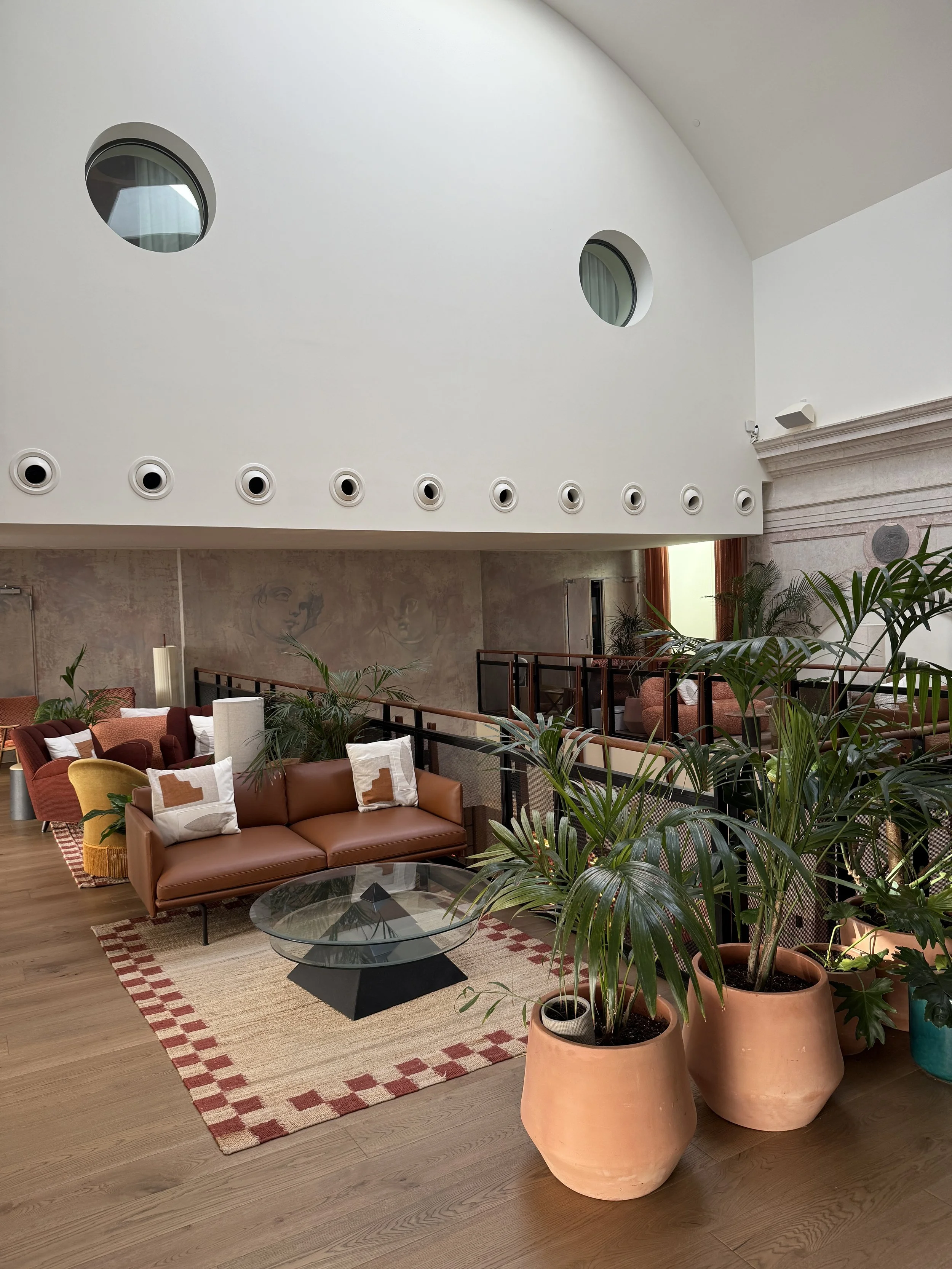
Thanks to strict preservation laws, a large percentage of the original convent’s architecture remains untouched, including arches, columns and the azulejo tiles that can be seen throughout the hotel’s hallways.
Looking down at the pool area in the interior courtyard of Locke de Santa Joana in Lisbon

I was smitten from the moment Wally and I stepped into the lobby and passed Castro’s, the hotel’s in-house café. We were surrounded by a captivating mix of old and new: handpainted azulejo tiles unearthed during excavation, plush low-slung seating in rich hues of ochre, umber and cornflower blue, and clusters of tropical plants spilling from oversized terracotta pots, giving the space a laidback, residential warmth.

The original entrance to the convent at the now-hotel Locke de Santa Joana in Lisbon

A Brief History of Locke de Santa Joana

The hotel occupies four distinct buildings — Arte, Beato, Convento and D. Álvaro —  naming conventions that pay homage to its heritage, notable historical figures and the original purpose of the structures. 

Inside, you’ll find preserved artifacts from the former Convento de Santa Joana de Lisboa (Convent of Saint Joana), dedicated to Joana of Portugal, the princess and daughter of King Afonso V and Queen Isabella of Coimbra, who later took her vows as a Dominican nun and was beatified for her devotion.

The convent’s story begins in 1699, when the first buildings were established by the Dominicans of the Order of Preachers. For centuries, the complex housed nuns who lived largely in seclusion through prayer, work and self-sufficiency. 

Its buildings were heavily damaged during the catastrophic earthquake that struck Lisbon on All Saints’ Day in 1755 but were later repaired. Over a century later, the convent was officially decommissioned following the death of its last nun, and the property passed to the state. Over the ensuing decades, the buildings fell into disrepair and were repurposed for various uses. The last known occupant before the site's transformation into Locke de Santa Joana was a modest office used by the police department’s traffic division.

Looking back, I realize that we’ve stayed in more than a few places formerly dedicated to monastic life. 

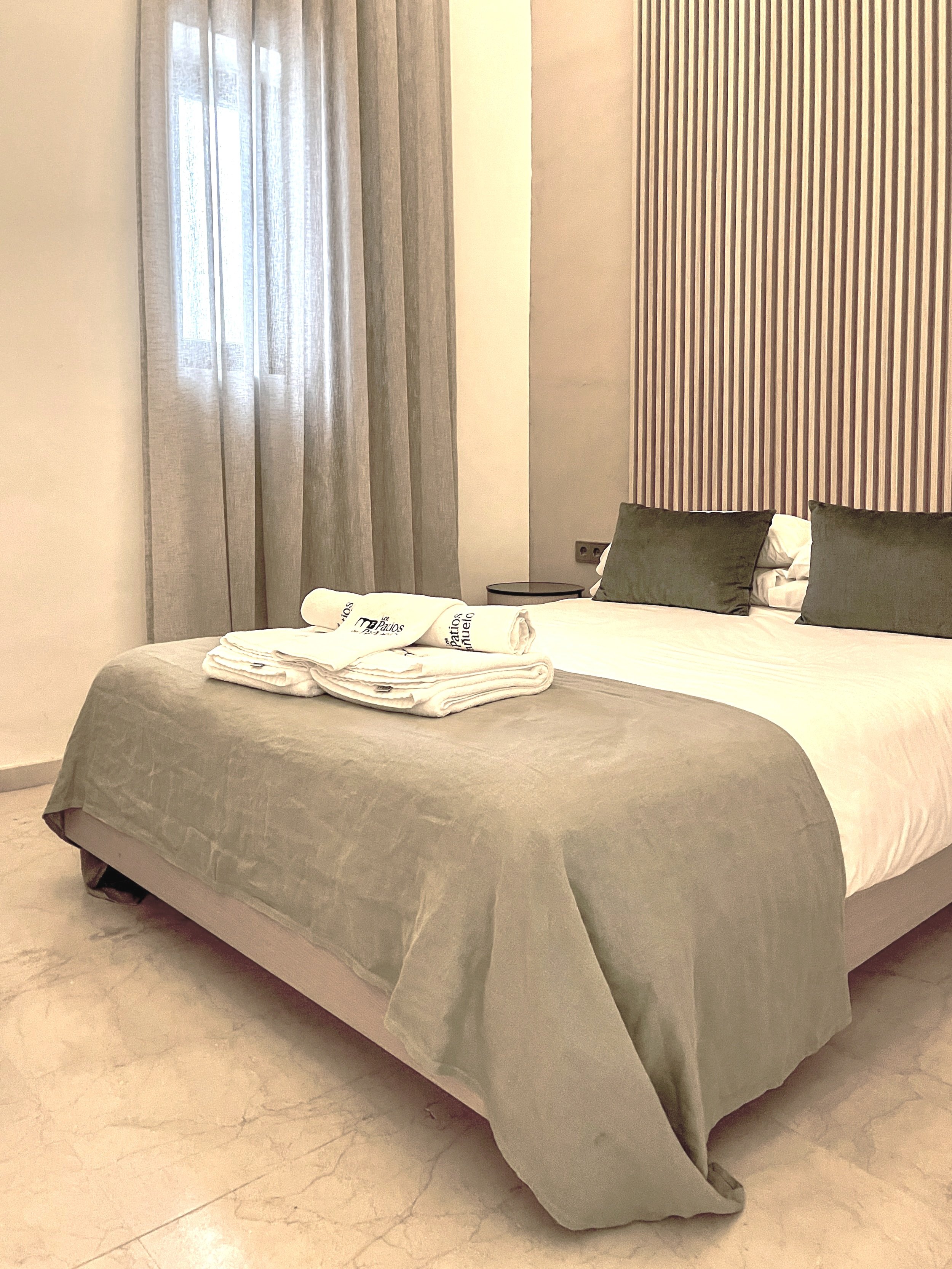
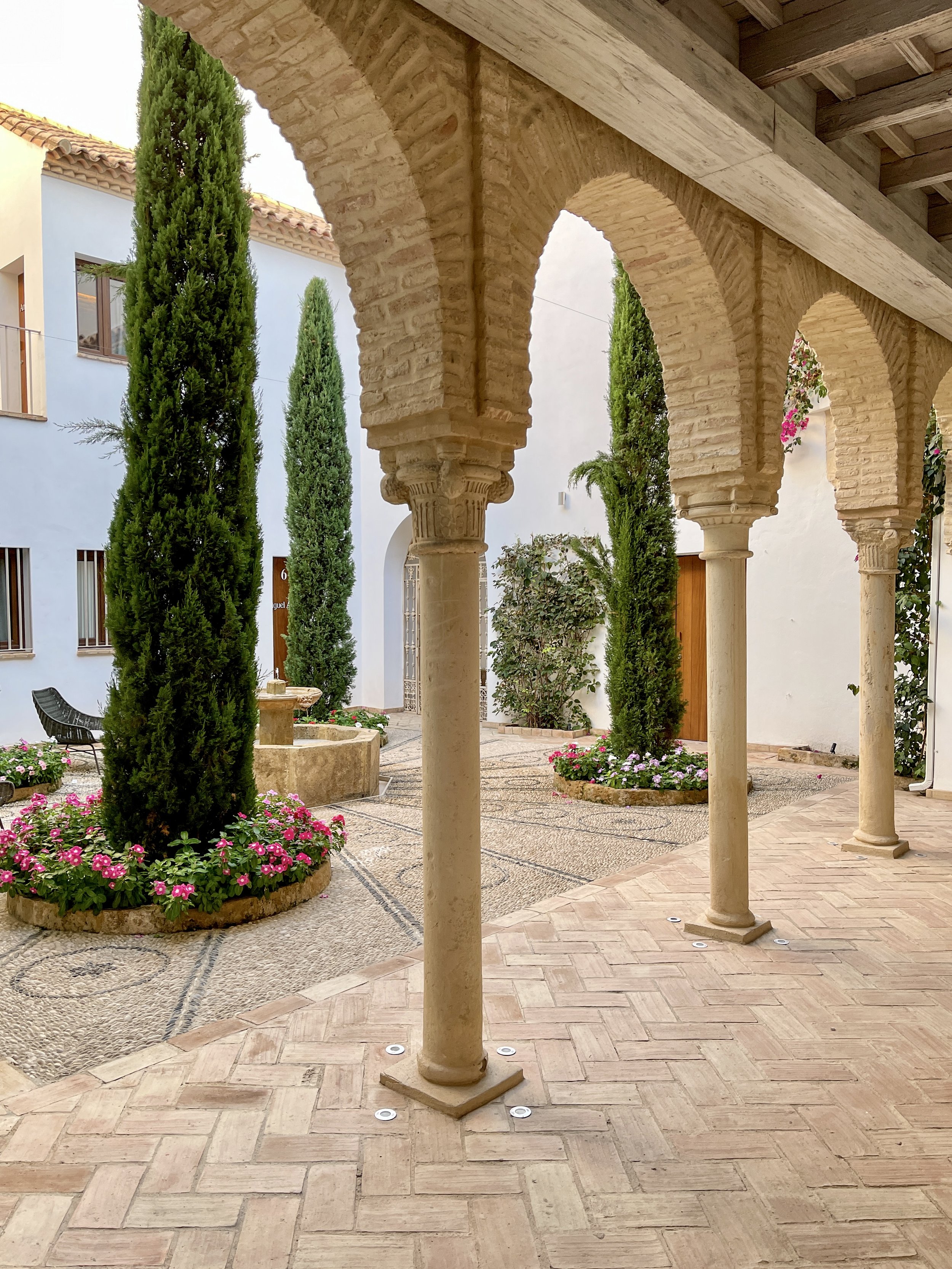
Casa Antonieta in Oaxaca, Mexico was originally part of the Convent of San Pablo before becoming a private residence and, eventually, a boutique hotel. While in Córdoba, Spain’s serene Judería, Los Patios de Pañuelos occupies what was once a bishop’s manor. There’s something undeniably special about staying in a place that has a story to tell.

The upstairs bar at the Santa Joana restaurant at Locke de Santa Joana in Lisbon

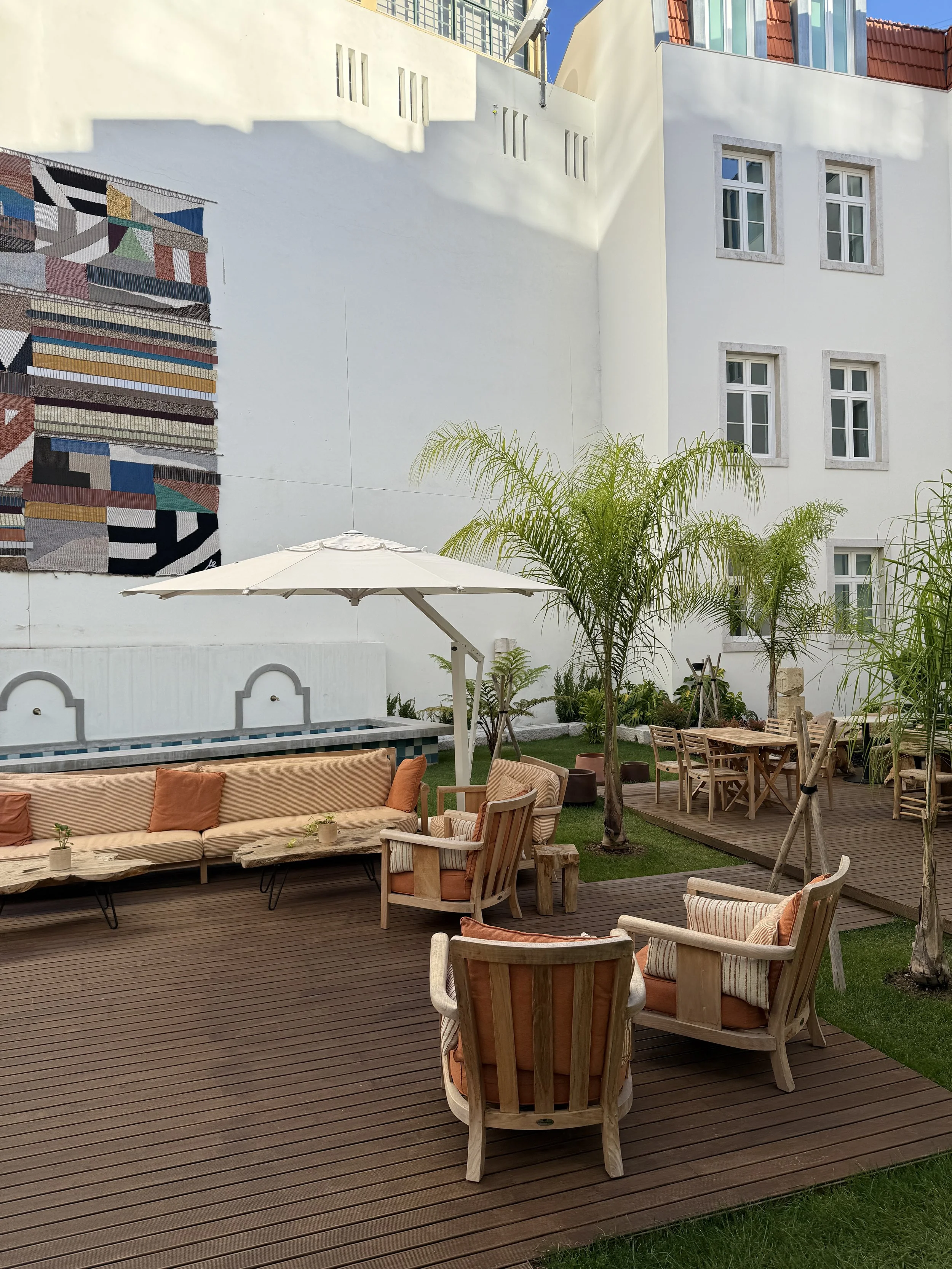
The 370-room property is spread across four interconnected buildings, or blocks, with several offering views of the central courtyard terrace that houses the pool, outdoor bar and Santa Marta restaurant, located on Rua de Santa Marta, the street that provides an additional entrance to Locke de Santa Joana. The restaurant is open daily from 12 p.m. to 10 p.m., and serves Mediterranean fare, as well as wood-fired pizzas for when you’re craving something beyond traditional Portuguese cuisine. 

Fun fact: In Christian tradition, Santa Marta (Saint Martha of Bethany), sister of Lazarus and Mary, is the patron saint of hospitality, cooks, servants and innkeepers — basically the ultimate foodie and hostess. Makes you think the restaurant might have her blessing, don’t you?

A bedroom at Locke de Santa Joana in Lisbon

The Rooms of Locke de Santa Joana

Architecture studio Saraiva+Ássociados designed the modern Beato wing, fittingly named after Santo António (Saint Anthony), the patron saint of Lisbon, who, according to legend, began the construction of the Convento do Beato (Convent of the Blessed) with just seven tostões, a small denomination of currency, given as alms. 

Inside, Lázaro Rosa-Violàn oversaw the design of the hotel’s communal spaces, which gracefully honor its monastic past while embracing its new purpose as a luxury hotel. The guest rooms reflect the refined, modern sensibility of Brooklyn-based Post Company, blending comfort and contemporary style in every detail. 

Thanks to strict preservation laws, a large percentage of the original architecture remained untouched, including arches, stone columns, and the aforementioned centuries-old azulejos that can be seen throughout the hotel’s winding white hallways.

Full disclosure: We found ourselves lost several times due to inner staircases that required a key card to pass through and elevators that served only specific floors. And we weren’t alone; we passed quite a few fellow guests shaking their heads, unable to figure out how to get where they wanted to go. 

The kitchenette in a room at Locke de Santa Joana in Lisbon

We stayed in a Locke Studio in the Beato block for five nights, a space that perfectly balanced thoughtful design with understated comfort. The bathroom, tiled in dusty rose, featured a walk-in rainfall shower, thick cotton towels and toiletries by Kinsey Apothecary.

The queen-size bed was soft and inviting, and above it hung a framed textile by Peruvian artist Ana Teresa Barboza. Woven from dyed cotton and wool fibers, the piece reflected the colors of Lisbon and incorporated fragments of a geological map of Portugal, to create a layered, tactile homage to the city’s history. 

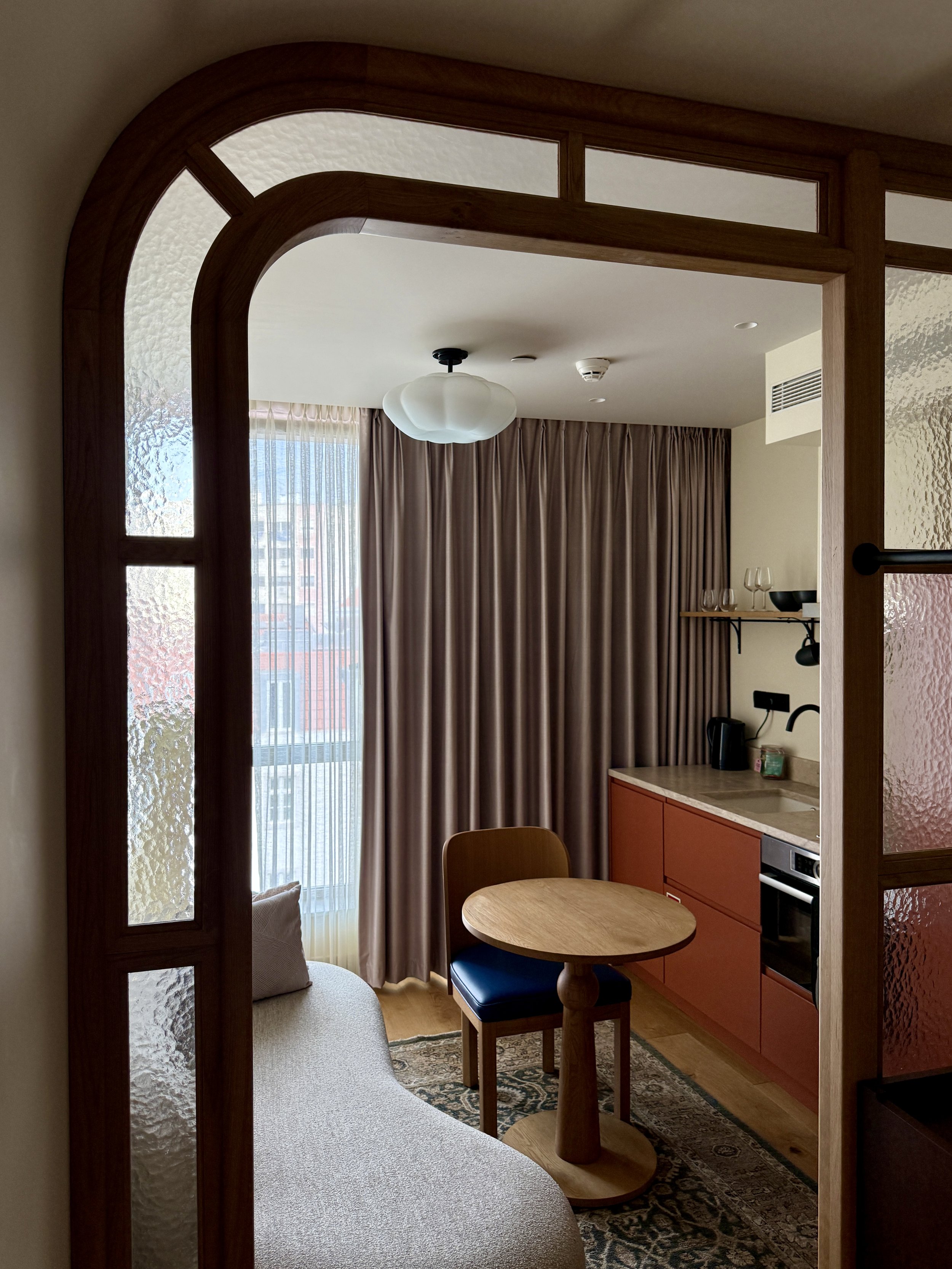
A curved wooden frame with subtly rippled glass separates the sleeping area from a well-equipped kitchenette, complete with a Nespresso coffee machine, washer/dryer, mini-fridge, dishwasher, sink, oven and two-burner induction cooktop. 

The kitchenette is a nice touch — we enjoyed being able to have leftovers for dinner one evening. 

There’s also a sofa that’s perfect for lounging and a small dining table and chair where you can linger over your morning coffee.

A bathroom at Locke de Santa Joana in Lisbon

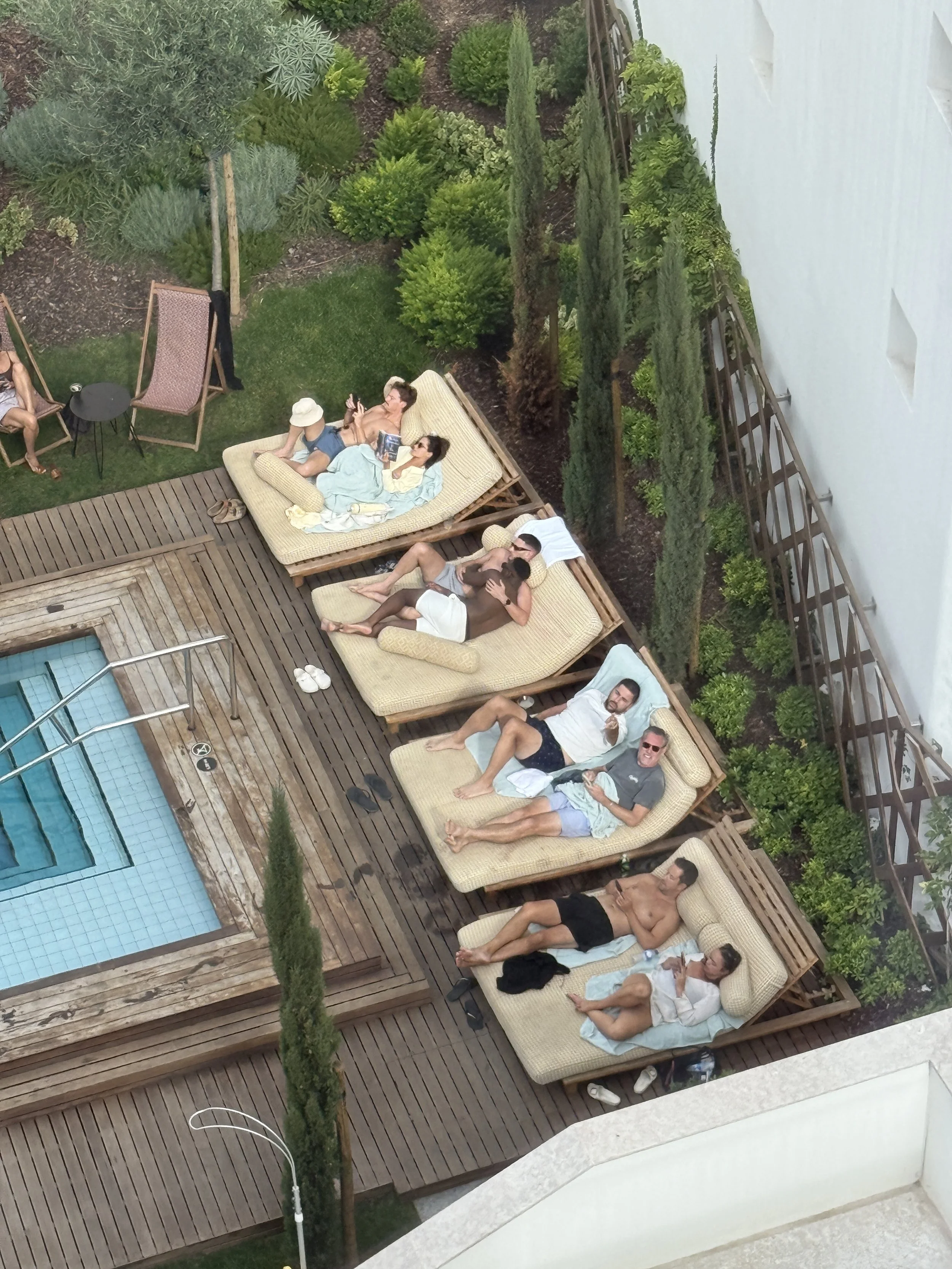
At one point, Wally peered down from our room’s large windows, saw a couple of young women lounging with books by the pool, and remarked that the scene gave him serious White Lotus vibes. 

Heads up — this isn’t your typical hotel. Housekeeping is limited to weekly service, or midway through longer stays, though extra cleanings can be arranged upon request. The upside? You get your own beautifully designed space to actually live in, not just stay in.

Drinks on a tray at Kissaten, a bar at Locke de Santa Joana in Lisbon

Food and Drink Options at Locke de Santa Joana

Breakfast is served daily from 7 a.m. to 10:30 a.m. at Santa Joana, the hotel’s namesake restaurant, located inside the centrally situated Arte building, which features the restored façade of the former 17th century convent. Like other guests, we entered through the courtyard and checked in with the host before going inside. 

Looking down at the tables at the restaurant at Locke de Santa Joana in Lisbon

The restaurant’s interior is a feast for the eyes, blending preserved architectural elements with contemporary design. Its grand dining room features soaring ceilings, pink marble tables, and a focal wall adorned with modern tribal masks reduced to geometric shapes in blush, brick and aubergine tones by Lisbon-based Grau° Cerâmica. Like the lobby, the room is filled with greenery, offering privacy between the tables and upholstered banquettes.

The patio for outside dining at the Santa Joana restaurant at Locke de Santa Joana in Lisbon

The indulgent buffet covers table after table, offering a variety of thinly sliced cured meats, including presunto, the Portuguese take on prosciutto, along with smoked salmon, local cheeses, fruit, yogurt and freshly squeezed juices, as well as a selection of freshly baked breads and pastries, including the legendary pasteis de nata. There are also self-serve hot options such as scrambled eggs, sausage, bacon and roasted potatoes.

Castro's coffee bar in the lobby of Locke de Santa Joana in Lisbon

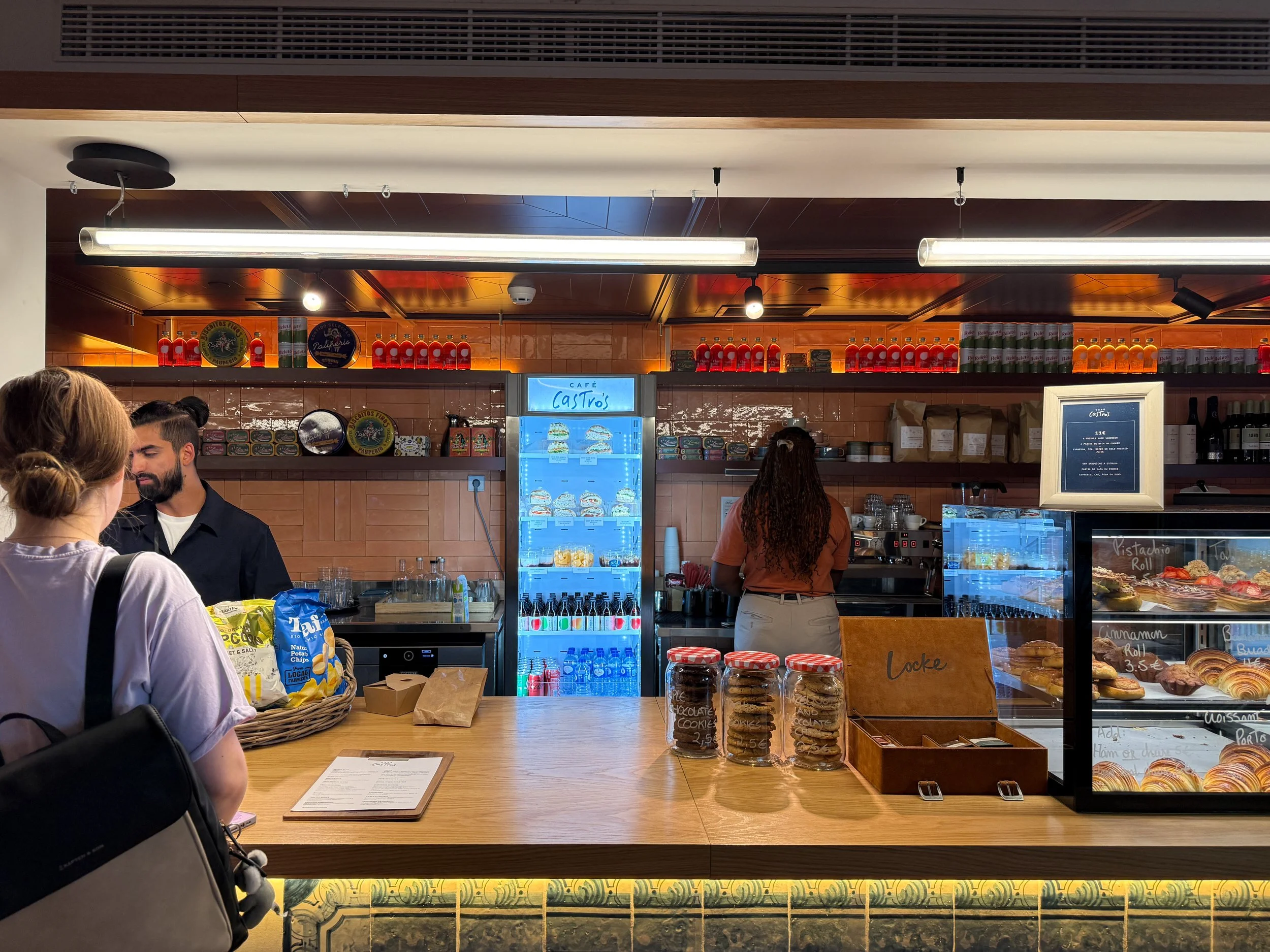
Castro’s was our first stop before heading out each morning and offered a variety of pastries, sandwiches, cookies and of course coffee. I regret not purchasing a pistachio cookie but somehow found the willpower to restrain myself. 

A teal speaker and bottles at Kissaten, a bar at Locke de Santa Joana in Lisbon

We ended one evening at Kissaten (which Wally of course called Kiss & Tell), the hotel’s late-night Japanese jazz kissa — a listening bar where the soundtrack drifted from jazz to blues, rock, soul and singer-songwriter classics. The menu boasts Lisbon’s largest whiskey collection, curated by Glasgow-born expert Dave Broom. 

We loved the vibe of the dimly lit lounge and cozied up to the bar. I snapped a photo of the menu and sent it to my dad — he’s a bit of a connoisseur — who suggested Compass Box, but I ended up ordering the Spicy Mezcalita, a bright, smoky mix of mezcal, yuzu, lime and jalapeño. Wally went for the Plum, a smooth, refreshing blend of Japanese whisky, plum, sake and soda water. We probably would’ve ordered a second round if we hadn’t been getting up early the next morning for a tour of Castelo de São Jorge
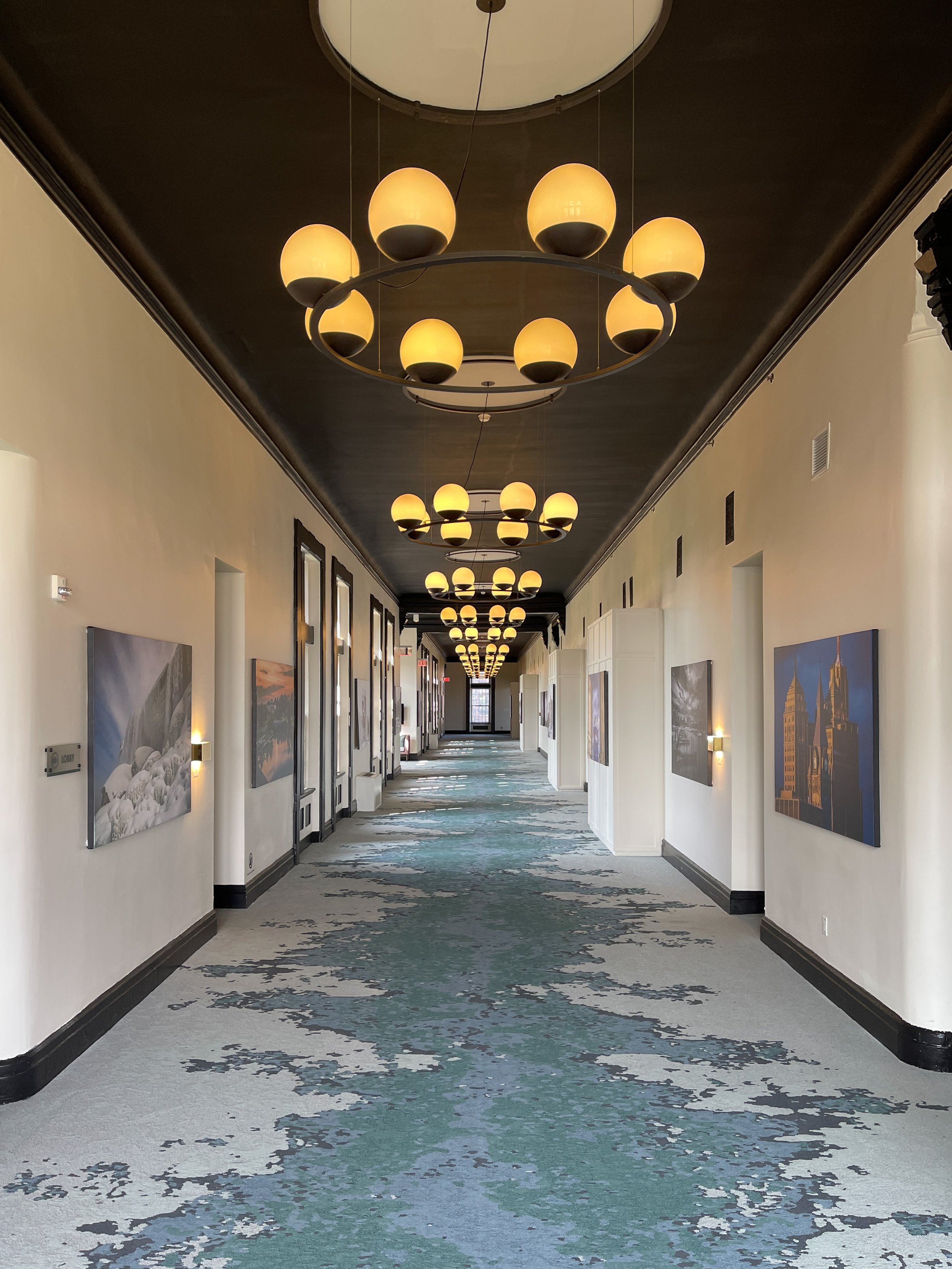
People lay on double lounge chairs by the pool at Locke de Santa Joana in Lisbon

Service and Amenitites 

From the moment we arrived, the genuine warmth and hospitality of the staff made a lasting impression. Everyone we met was friendly, attentive and went above and beyond to ensure our stay was as comfortable as possible. 

I overheard a man (one half of a couple who was checking out on the day we arrived) say to the concierge, “We didn’t get to enjoy the pool.” When the concierge asked why, he deadpanned, “Because we’re British.”

I’d packed our swimsuits knowing there was a pool, but, alas, like the British pair, the most we managed was to relax poolside on sun loungers with a cocktail one late afternoon. 

Part of the modern structure at Locke de Santa Joana in Lisbon

While Santa Joana is right in the thick of it, step inside, and suddenly, you’re in an unexpected oasis that feels about as far from the city chaos as you can get. 

So, if you’re looking for a chic Lisbon base beyond the traditional hotel format, Locke de Santa Joana is just the place. –Duke

The front entrance to Locke de Santa Joana in Lisbon

Locke de Santa Joana

Rua Camilo Castelo Branco, 18
1150-084 Lisbon
Portugal 

The Creepiest Places to Visit in the United States

From a haunted prison to a hotel with its own morgue, here are five terrifyingly popular U.S. destinations for ghost hunters, thrill seekers and paranormal tourists.

Dilapidated crumbling hallway in the Eastern State Penitentiary in Philadelphia

Eastern State Penitentiary in Philadelphia, where solitary confinement originated

For those of us who like our vacations with a side of dread, the U.S. has you covered. Cursed plantations? Check. Derelict prisons? Yep. A floating hotel with a body count? You bet. These are the kinds of places where whispers echo in empty rooms, photos blur for no reason, and something unseen always seems to tug at your shirt.

Whether you’re a seasoned ghost hunter or just want to say you slept in the most haunted hotel in America, these are the must-visit spots that will make your heart race — and maybe stop.

1866 Crescent Hotel & Spa in Eureka Springs, Arkansas

1866 Crescent Hotel & Spa in Eureka Springs, Arkansas

Where the cancer cures were fake, but the bodies were real.

Originally built in 1886, the Crescent Hotel started as a luxury resort — and quickly spiraled into something much darker. After a short-lived first act, it was purchased in 1937 by Norman Baker, a con artist who turned the building into a sham cancer hospital. He operated without a license, performed grotesque procedures, and stored bodies in a basement morgue that still exists.

Women in white dresses and hats stand on the steps of the 1866 Crescent Hotel & Spa in Eureka Springs, Arkansas when it was a college for women

Back when the property was the Crescent College for Women

Guests and ghost hunters report sightings of Baker himself, nurses in old-timey uniforms, and figures wandering the halls at night. Want proof? You can join nightly ghost tours that take you to the most haunted corners of the property — including Baker’s old morgue.

1886 Crescent Hotel & Spa
75 Prospect Avenue
Eureka Springs, Akansas​

The castlelike Eastern State Penitentiary in Philadelphia, Pennsylvania at twilight

Eastern State Penitentiary in Philadelphia, Pennsylvania

Solitary confinement never really ends … if your ghost sticks around.

Once home to over 85,000 inmates — including Al Capone — this Gothic fortress pioneered solitary confinement, which sounded humane in theory and turned out to be more of a psychological torture chamber. The prison operated from 1829 to 1971 and is now a National Historic Landmark.

Historic photo of a worker standing in a cellblock of Eastern State Penitentiary in Philadelphia, Pennsylvania

Its crumbling halls, rusted doors and echoing cellblocks give off a presence that’s hard to ignore. Visitors report disembodied voices, cell doors slamming on their own, and shadowy figures pacing inside locked cells. Cellblock 12 and the guard tower are said to be the most active — if you believe in that sort of thing. And even if you don’t, you’ll probably walk faster through them.

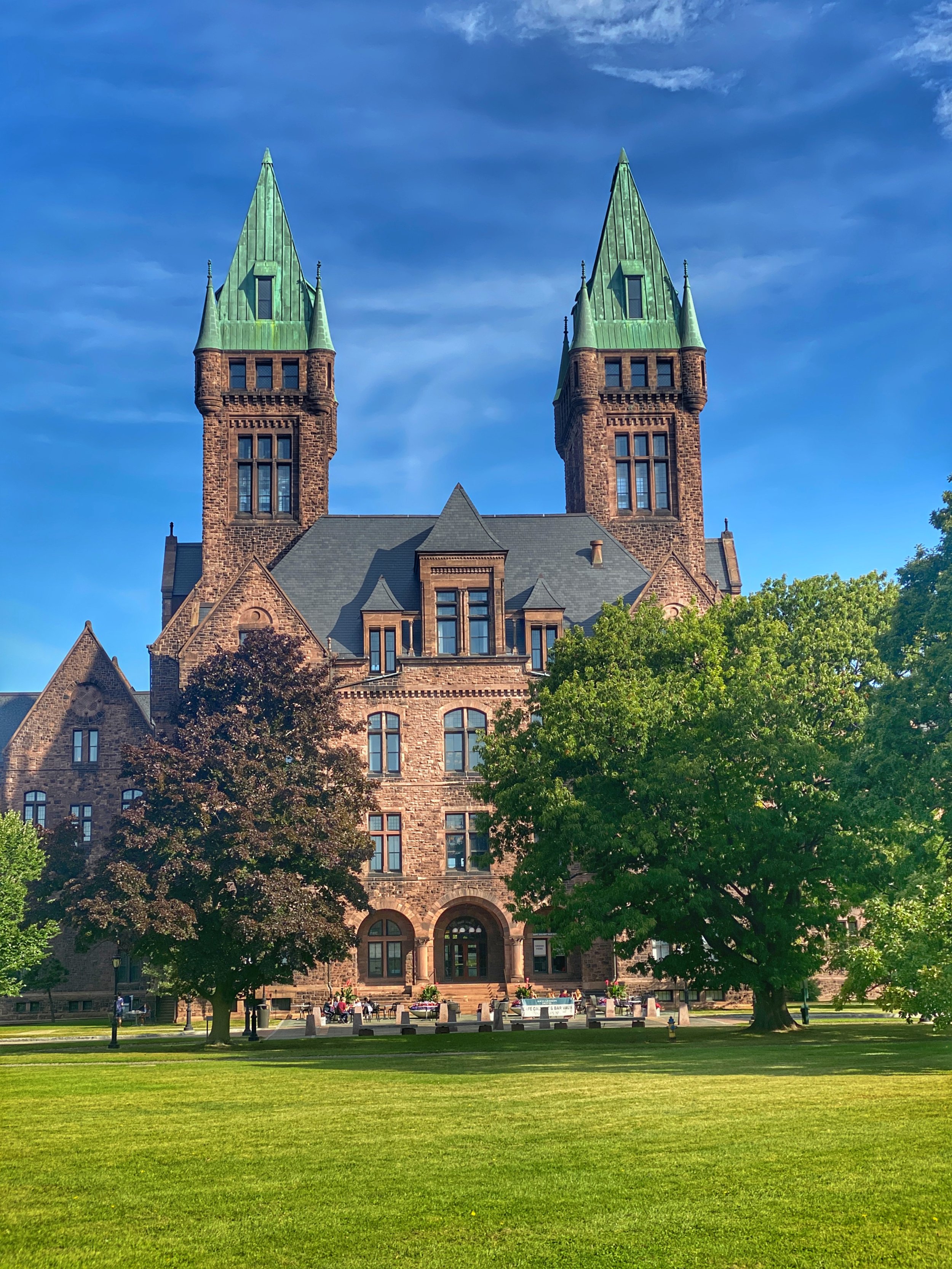
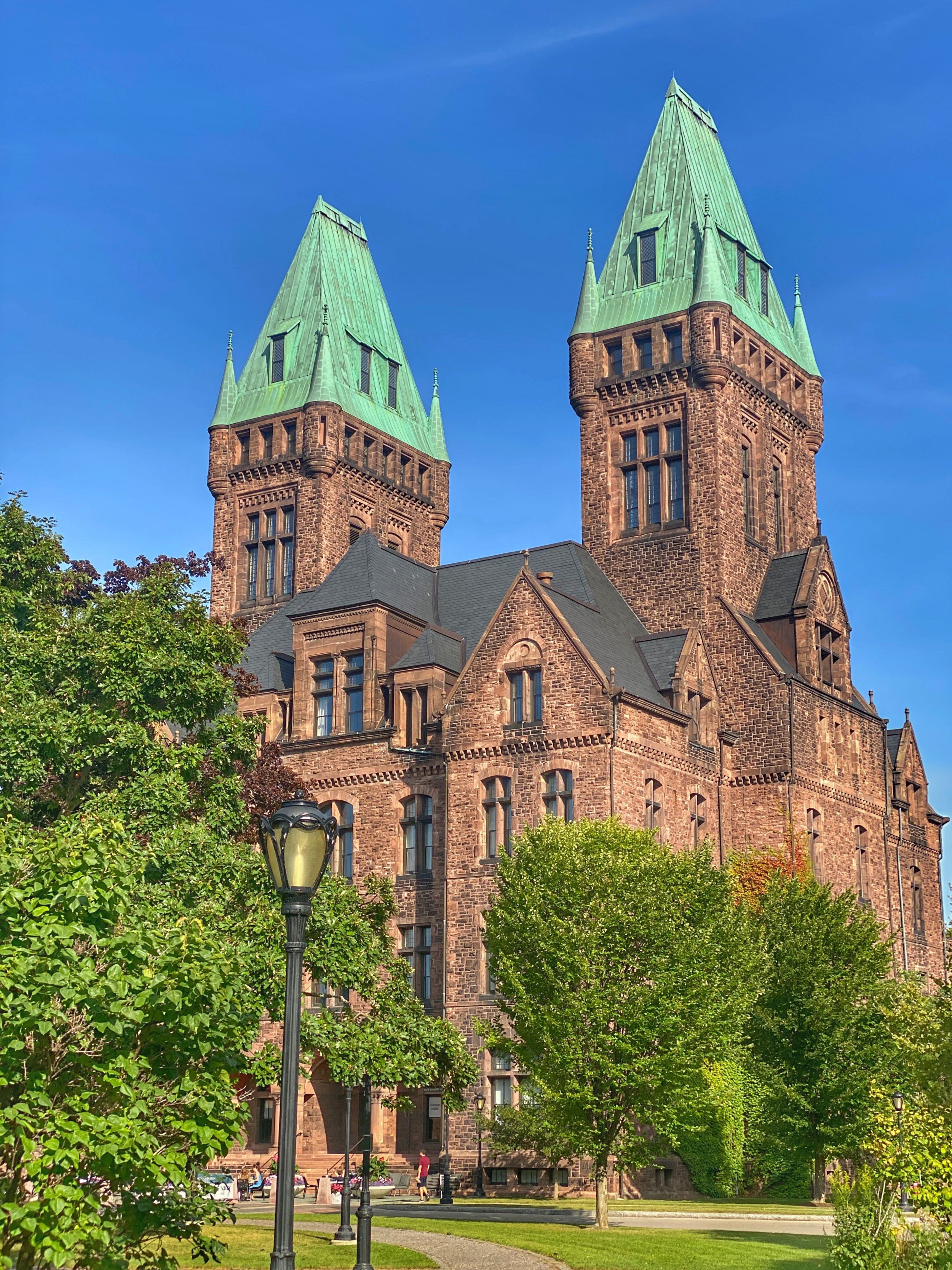
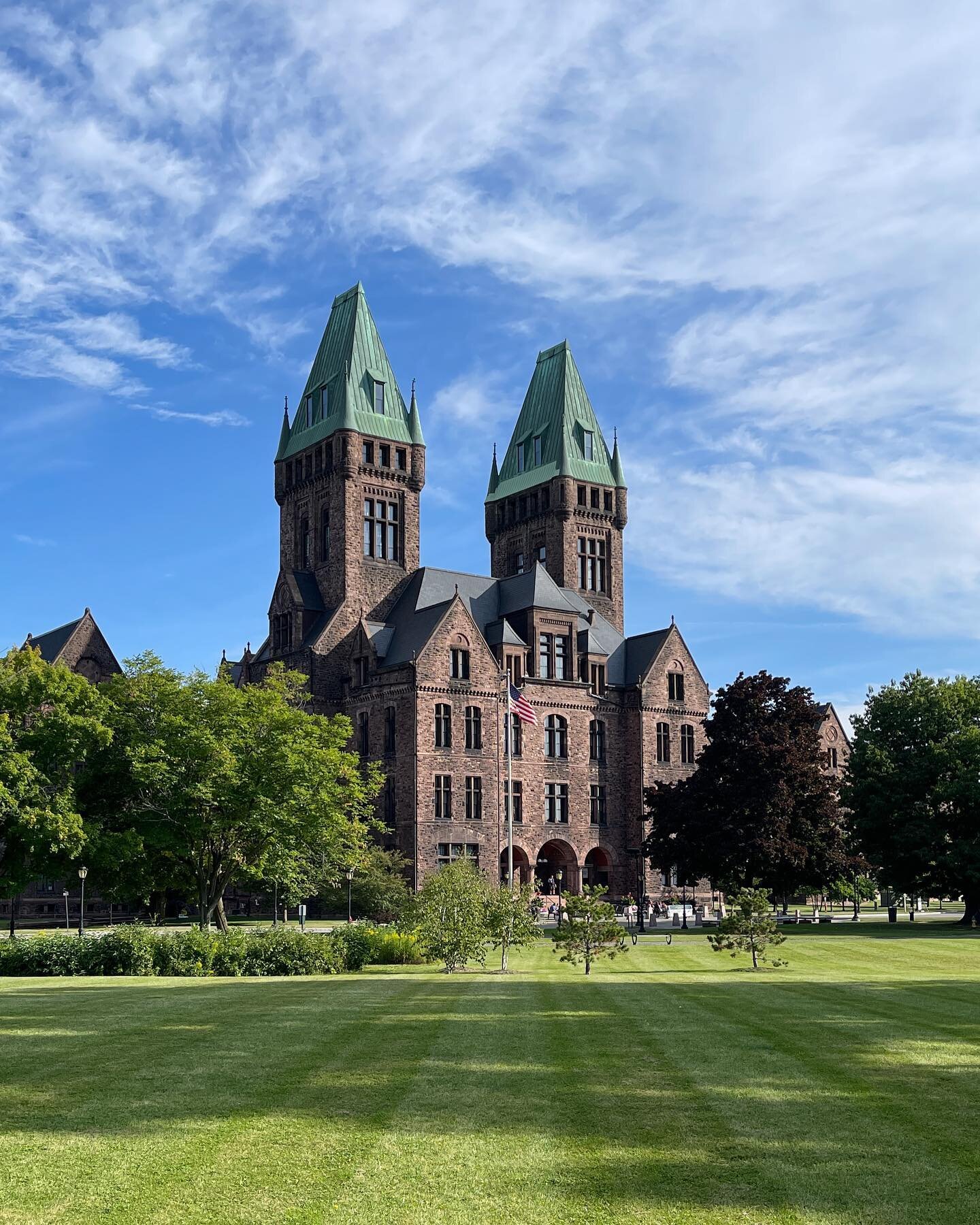
Sounds a bit like the derelict insane asylum attached to the Richardson Hotel in Buffalo, New York, which is also worth touring. 

If you’re also going to Pittsburgh, be sure to creep yourself out at Trundle Manor

Eastern State Penitentiary
2027 Fairmount Avenue
Philadelphia, Pennsylvania

The ocean liner Queen Mary in Long Beach, California at sunset

The Queen Mary in Long Beach, California

All aboard — for a cruise you’ll definitely want to disembark from.

This ocean liner hosted royalty, celebrities and WWII troops — and now ghosts. Docked permanently in Long Beach, the Queen Mary is considered one of the most haunted ships in the world.

A girl is dressed up like the ghost of Jackie, a girl who drowned in the pool on the Queen Mary ship

Say hi to Jackie! She drowned in the pool but now giggles through the hallways.

Visitors regularly report paranormal activity, including screams, slamming doors and the ghost of a crewmember who was crushed by a watertight door in the engine room. Then there’s Jackie, the little girl who allegedly drowned in the pool and now giggles through the halls — creepy kid laughter being the ultimate test of your fight-or-flight response.

If you visit around Halloween (known to witches as Samhain), don’t miss the ship’s Dark Harbor event — a screamfest that brings its haunted legends to life.

​​The Queen Mary
1126 Queens Highway
Long Beach, California

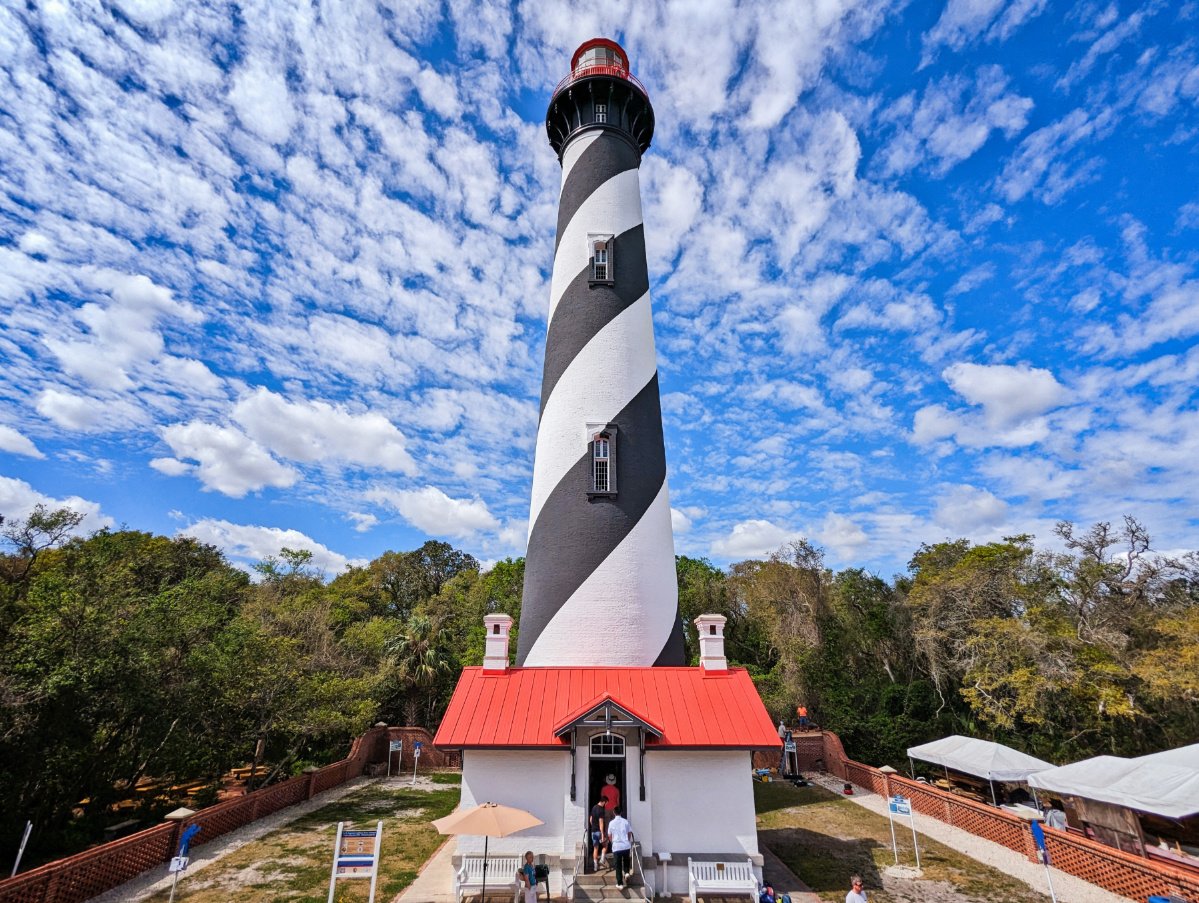
Black and white diagonally striped St. Augustine Lighthouse in St. Augustine, Florida

St. Augustine Lighthouse in St. Augustine, Florida

Helping ships find the shore — and maybe helping spirits climb the stairs.

The current lighthouse was completed in 1874 — but the land has a longer, darker history. Tragedy struck during construction, when two young daughters of the superintendent drowned in the bay. Ever since, strange sightings have haunted the tower.

The spiral staircase inside St. Augustine Lighthouse in St. Augustine, Florida

Visitors report hearing footsteps on the spiral stairs, catching glimpses of shadowy figures, and even being touched by something unseen. The Dark of the Moon tour takes you up the tower at night — just you, a flashlight … and your frazzled nerves.

St. Augustine Lighthouse & Maritime Museum
100 Red Cox Drive
St. Augustine, Florida

Exterior of Myrtles Plantation in St. Francisville, Louisiana

Myrtles Plantation in St. Francisville, Louisiana

Cursed ground, murder and ghosts with unfinished business. Southern hospitality not guaranteed.

The Myrtles has everything you could want in a haunted Southern plantation: hidden pasts, murder, mystery and a good chance of ghostly encounters. Built in 1796, the property is said to be cursed from the start, allegedly located on an indigenous burial ground. Several people died violently here, and stories of hauntings are as thick as the Spanish moss out front.

A grainy photo Chloe, the ghost at Myrtles Plantation in St. Francisville, Louisiana

The enlarged section of this image is said to be the plantation’s famous ghost, a former slave named Chloe.

The most infamous ghost? Chloe — a formerly enslaved woman who was reportedly mutilated for eavesdropping and later hanged after poisoning members of the household. Her apparition has supposedly been caught in photos and is said to still roam the grounds. 

Other spirits include William Winter, shot on the porch in 1871, and his young daughter, who died of yellow fever.

The Myrtles Plantation
7747 U.S. Highway 61
St. Francisville, Louisiana

An aerial view of Eastern State Penitentiary in Philly

An aerial view of Eastern State Penitentiary, which is no longer operational — just attracting visitors who appreciate the macabre.

Haunted Hotspots

Some people go to the beach — others go looking for the ghosts of 19th century criminals. These haunted destinations deliver the perfect mix of history and horror, where the stories are real, the wallpaper is peeling, and the room you booked might come with a ghost you didn’t. –Armughan Zaigham

How to Plan a Romantic and Luxurious Getaway to Aspen

From skiing Aspen Mountain to spa days at the St. Regis, private fireside dinners, and stays at Hotel Jerome and The Little Nell, this guide unlocks the most romantic and luxurious experiences in Aspen.

A man holds up a woman by her legs as she wraps her arms around his head and kisses him by a snowy Aspen mountain

Tucked high in the Colorado Rockies, Aspen isn’t just about the ski scene (though, yes, the powder is as perfect as you’ve heard). 

It’s a town where mountain air meets high-end indulgence, where you can spend your morning on the slopes and your evening sipping champagne fireside. 

Beyond the adventure, Aspen delivers serious romance with its charming streets, award-winning restaurants, plush accommodations and cultural gems that’ll sweep you off your snow-dusted feet.

Whether you’re celebrating a milestone or just need an excuse to spoil your favorite person, Aspen is your ticket to a getaway that feels straight out of a fairytale. All it takes is a little planning — and a touch of insider know-how. In this guide, we’ll share the tips and inspiration you need to craft an unforgettable romantic escape, full of swoon-worthy moments and luxe surprises.

The valley of the town of Aspen at night

Choosing the Perfect Time to Visit Aspen

When it comes to Aspen, timing matters. The town transforms with the seasons, each offering its own charm.

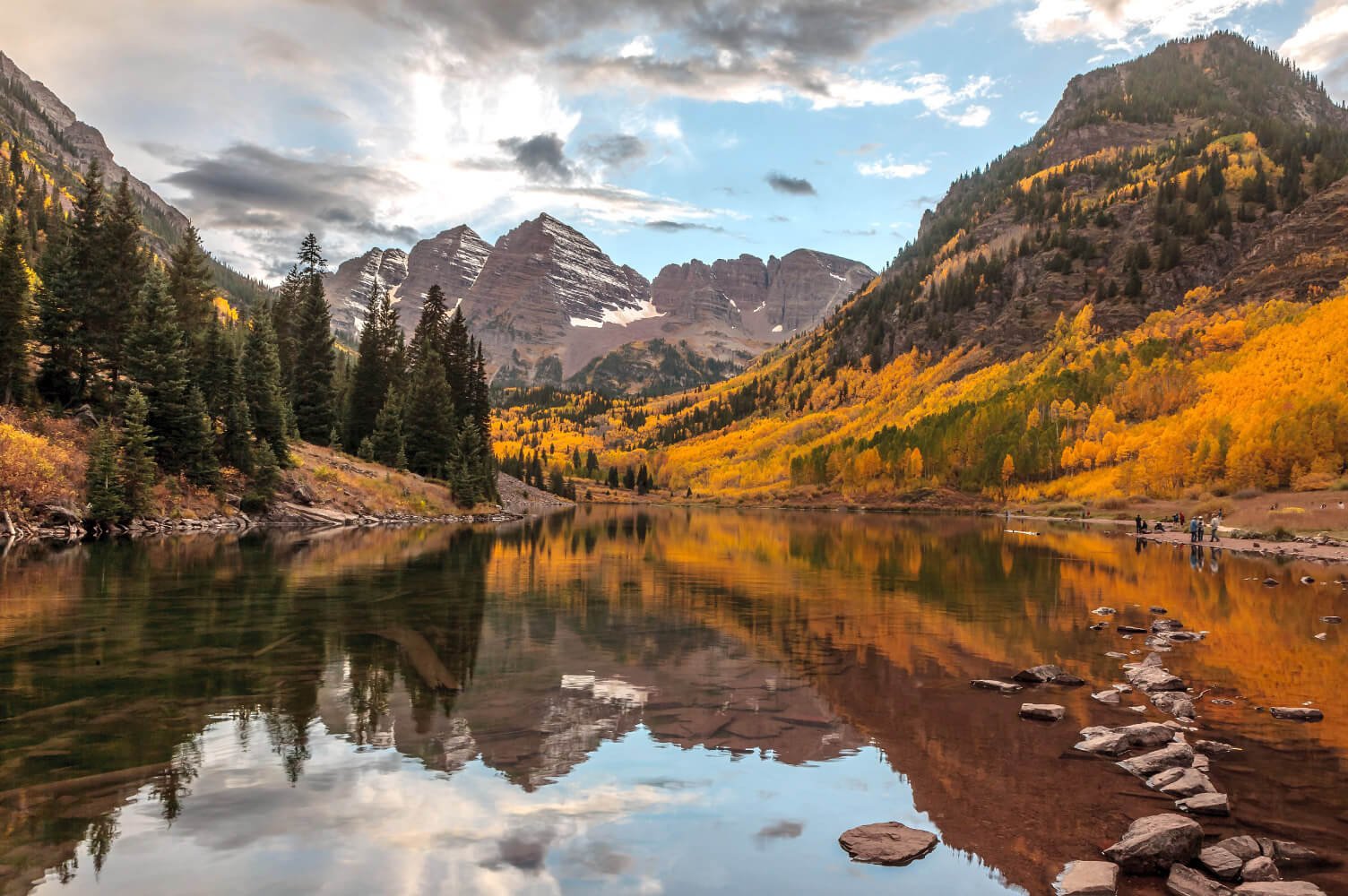
A lake in Aspen in the fall, with the trees a golden yellow

Seasonal Highlights in Aspen

  • Winter (December–March): Snow-capped peaks, skiing adventures and cozy fireside evenings

  • Spring (April–June): Blossoming flowers, fewer crowds and mild weather

  • Summer (July–September): Warm, sunny days, ideal for hiking and picnics

  • Fall (October–November): Vibrant foliage and serene landscapes for romantic photoshoots

Whichever season you choose, getting there is part of the planning, and many luxury travelers skip the commercial connection through Denver entirely, opting for a private jet charter to Aspen, given the airport's easy access to the mountain.

A band performs at the Aspen Winter Music Series

Special Events in Aspen for Couples to Enjoy

The 2025 Winter Music Series adds cultural sophistication to Aspen’s natural splendor. The series opens on February 7, with acclaimed pianist Nikolai Lugansky performing classical masterpieces. 

The Grammy-winning Takács String Quartet follows on March 6, and renowned pianist Garrick Ohlsson concludes the season on March 20. All performances begin at 6:30 p.m. in the intimate Harris Concert Hall.  

Remède Spa at the St. Regis Aspen is pure mountain luxury — think of it as the crown jewel of Aspen’s wellness scene. According to the Aspen Chamber Resort Association, this full-scale resort spa goes above and beyond the city’s charming boutique day spas, offering an immersive experience that’s hard to top.

Your escape begins with a complete wellness circuit designed to refresh and rejuvenate. Get your heart pumping in the state-of-the-art fitness center, then melt away any tension with a visit to the hot tub, steamroom and cutting-edge infrared sauna. It’s the perfect balance of invigorating and indulgent.

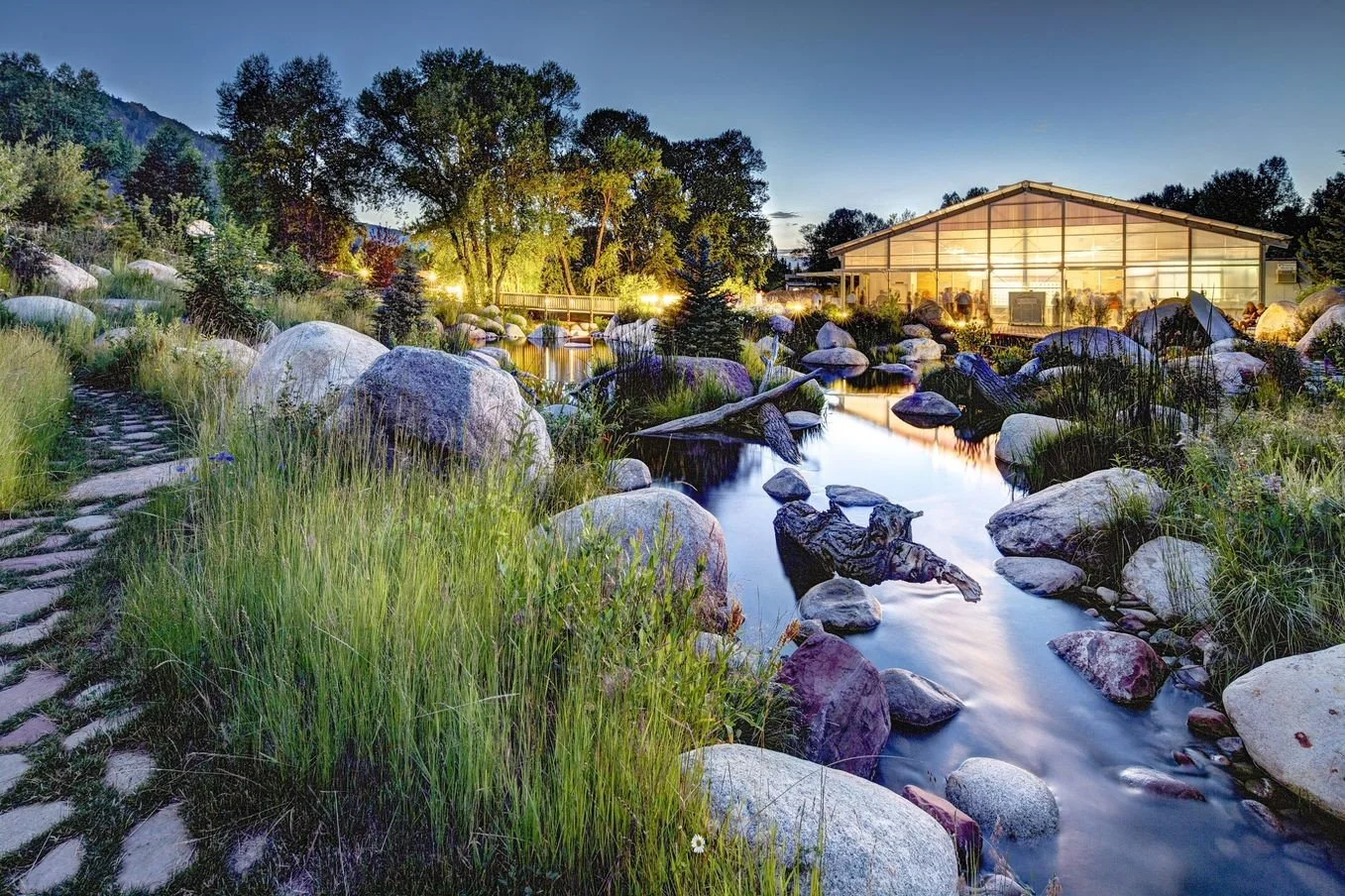
A creek and building for gatherings in Aspen, Colorado

Aspen’s Elite Accommodations

Aspen’s legendary hospitality scene offers an array of exceptional accommodations, each promising its own version of mountain luxury. From historic hotels to contemporary resorts, every property provides a scenic backdrop for your romantic escape.

Facade of the Little Nell hotel in the snow in Aspen, Colorado

The Little Nell

The Crown Jewels: Five-Star Resorts in Aspen

With an unrivaled setting at the foot of Aspen Mountain, the Little Nell is the only Forbes five-star, five-diamond hotel in Aspen. This intimate luxury resort brings the soul of Aspen to life with its ski-in/ski-out access and sophisticated charm.

The property’s Element 47 restaurant has earned its place as a culinary destination. Its sommelier-led wine cellar tours provide an exclusive glimpse into one of the country’s most impressive collections.

The round pool and chaise longues at the red brick St. Regis Aspen Resort

St. Regis Aspen Resort

The majestic St. Regis Aspen Resort, with its striking red brick façade and mountain backdrop, embodies timeless elegance. 

Beyond its luxurious rooms, the resort captivates guests with distinctive traditions like evening champagne sabering and their signature Bloody Mary ritual. The Velvet Buck restaurant serves refined mountain cuisine in a sophisticated setting. And, as mentioned earlier, the Remède Spa provides world-class treatments. 

Brown couches, white chairs, red carpet with gray diamonds and a fireplace in the lobby of Hotel Jerome in Aspen

Hotel Jerome

Boutique Luxury: Character Meets Comfort

Hotel Jerome weaves Aspen’s story into every detail, carrying on a legacy more than 135 years in the making.

This historic property seamlessly blends Wild West heritage with contemporary luxury, featuring rooms adorned with cashmere curtains and leather furnishings. The hotel’s living room has become the toast of Aspen’s social scene, while Felix Roasting Co. offers an ornate setting for your morning caffeine fix.

The outdoor swimming pool at Limelight hotel in Aspen, Colorado

Limelight

Limelight provides a fresh take on mountain luxury with its contemporary design and vibrant atmosphere. 

Its 126 rooms offer modern comfort with classic alpine touches, while the hotel’s partnership with Audi ensures guests travel in style. 

The property’s lounge has become a local favorite for live music and après-ski gatherings.

A couple takes a break from hiking in the mountains and sits down together

Crafting Magical Moments in Aspen

Transform your mountain getaway into an unforgettable experience with thoughtfully planned surprises that capture the essence of romance in the Rockies.

A teardrop-shaped multifaceted pink diamond

The Gift of Timeless Elegance 

Many luxury brands showcase an exquisite selection of gemstones, including some of the rarest diamonds. In fact, diamonds come in 12 mesmerizing colors, with subtle variations in intensity and secondary hues that create over 230 unique combinations.

According to Leibish, a specialist in natural colored diamonds and high-end gemstones, these vibrant stones are the rarest of the rare — representing just a tiny fraction of the world’s diamond production. It’s this exceptional scarcity that makes colored diamonds the ultimate expression of love and luxury.

For a romantic and savvy choice, consider pink diamonds. These gems gracefully blend vibrant hues with feminine elegance and are among the most sought-after colored diamonds. Their charm goes beyond beauty — they’ve consistently proven to be a smart investment.

The town of Aspen, Colorado and the ski run above it

Personalized Adventures

Treat your partner to an exclusive after-hours gallery tour at Aspen’s renowned art venues. These private experiences allow you to immerse in the town’s vibrant art scene without the usual crowds, creating a truly memorable outing.

For a dose of adventure, plan a day packed with outdoor activities that let you soak up Aspen’s world-famous natural beauty. Of course, skiing is a must — this is one of the premier ski destinations in the United States, after all. With four major ski areas and 5,300 acres of skiable terrain, there’s plenty of powder to explore:

  • Aspen Mountain (Ajax): Perfect for seasoned skiers

  • Aspen Highlands: Known for the Highland Bowl’s steep descents, offering an adrenaline rush at 12,392 feet above sea level

  • Buttermilk Mountain: Home of the Winter X Games, catering to all skill levels

Finally, cap off the day with an intimate, chef-prepared dinner by the glow of a crackling fire. This cozy, luxurious setting is the perfect way to unwind, savor the moment, and create memories you’ll treasure long after you’ve left the mountains behind.

A chairlift takes skiers up the mountain at Aspen in Colorado

Travel to Aspen FAQs

How many days do you need for Aspen?

A week in Aspen offers ample time to explore its diverse attractions, whether you’re into outdoor adventures, art or local cuisine. With plenty of events, including the Winter X Games at Buttermilk and Wintersköl on Aspen Mountain, there’s always something exciting to experience.

Is Aspen a good place to honeymoon?

Aspen is an ideal honeymoon destination, offering a romantic setting year-round. The town offers world-class skiing in winter and scenic hiking trails in the summer. It provides the perfect balance of adventure and romance for newlyweds. Aspen also boasts luxurious resorts, intimate spas and fine dining.

Is Aspen a wealthy city?

Yes, Aspen is known for its affluence. With a significant portion of its population possessing a net worth of over $30 million, it’s considered a playground for the wealthy. The area is home to many of the ultrarich, particularly in the exclusive Red Mountain neighborhood known as “Billionaire Mountain.”

A man puts his arms around a woman along a street in Aspen, Colorado in the winter

Romantic Aspen 

While the champagne buzz may fade and ski tracks vanish under fresh powder, the genuine connections made in this mountain paradise will endure. These moments will echo far beyond your return home.

Perhaps that’s the real essence of luxury — not the thread count of the sheets or the vintage of the wine. Instead, it’s the priceless gift of undivided attention and shared wonder in one of nature’s most spectacular settings. –Mashum Mollah 

Discover the Best Luxury Hotels in Sydney and Melbourne for Different Types of Travelers

From foodie favorites to spa retreats, these luxury hotels in Sydney and Melbourne, Australia offer stays as unique as your travel style.

The city of Melbourne, with a river running through it, at sunset

Sydney and Melbourne rank among Australia’s top destinations, each offering its own flavor of luxury. But choosing the right hotel depends on the kind of traveler you are. Are you a foodie chasing the next great meal? An architecture buff who wants a room with a view? Or someone who craves immersive cultural experiences from check-in to checkout? Whatever your travel style, I’ve rounded up the perfect luxury stays in Sydney and Melbourne based on your number-one priority.

Are you a foodie chasing the next great meal?
An architecture buff who wants a room with a view?
Or someone who craves immersive cultural experiences from check-in to checkout?

Best Hotels for Foodies

If you’re searching for the best Sydney hotel deals with exclusive benefits start by thinking about what’s nearby — especially if you plan to eat your way through the city. For foodies, location can make or break a luxury stay. Here are two standout options, perfectly placed for gourmet adventures in Sydney and Melbourne.

The Dining Room restaurant at the Park Hyatt Sydney, with a view of the Opera House at night

Park Hyatt Sydney

📍 7 Hickson Road
    The Rocks
    Sydney, New South Wales 2000

Park Hyatt Sydney offers unbeatable harbor views and an address that’s steps from some of Sydney’s most iconic dining experiences. Start at the hotel’s own Dining Room — where floor-to-ceiling windows frame the Sydney Opera House while you enjoy dishes that celebrate local ingredients with global flair.

From there, wander over to Quay one of Australia’s most-awarded restaurants, known for its innovative cuisine and stunning water views. Craving steak? 6Head at Campbell’s Cove steakhouse serves premium cuts with a side of historic charm — it’s housed in one of Sydney’s oldest waterfront buildings.

Exterior of the Crown Towers Melbourne on the water

Crown Towers Melbourne

📍 8 Whiteman Street
    Southbank, Victoria 3006

Over in Melbourne, foodie travelers flock to Crown Towers Melbourne — where luxury suites meet a built-in culinary wonderland. Located in the heart of Southbank, the hotel gives you direct access to a lineup of world-class restaurants.

Dine at Rockpool Bar & Grill for legendary steaks, or treat yourself to modern Japanese perfection at Nobu. Want a meal with a side of molecular magic? Dinner by Heston Blumenthal brings historic British dishes into the future — all without leaving Melbourne.

Best Hotels for Architectural Lovers

If you plan your stays based on how photogenic the lobby is (no shame), Australia’s got plenty of eye candy. From historic gems with stories in every brick to sleek modern marvels, these hotels are architectural destinations in their own right. Whether you’re a design devotee or just appreciate a good façade, here are a couple of stays that’ll make you swoon.

The pool at the Old Clare Hotel in Sydney, Australia

The Old Clare Hotel

📍 1 Kensington Street
    Chippendale, New South Wales

The Old Clare Hotel is where heritage charm meets industrial cool. Housed in a former brewery and pub, this Chippendale icon is all exposed brick, soaring windows and carefully preserved details. Even your room feels like a design exhibit — with a perfect mix of vintage finds and modern edge. And speaking of beer, the onsite pub and microbrewery mean you can admire the architecture with a pint in hand.

The lobby, with staircase and stuffed peacock at the QT Melbourne hotel

QT Melbourne

📍 133 Russell Street
    Melbourne, Victoria 

If your taste leans more bold and contemporary, check out (and check into) QT Melbourne. This design-forward hotel blends urban grit with playful art installations and luxe finishes at every turn. The real star? The rooftop bar, where you can sip a cocktail with panoramic views of Melbourne’s skyline. It’s the kind of place where you feel cooler just by walking through the door — and honestly, you just might be.

Best Hotels For Wellness-Minded Travelers

If your idea of luxury includes spa time, serene swims and a suite so calm it practically whispers, “Relax,” Sydney and Melbourne have you covered.

A woman stands in the open-air pool at the Langham hotel in Sydney, with stars in the nighttime sky above

The Langham

📍 89-113 Kent Street
    Sydney, New South Wales

The Langham in Sydney blends five-star luxury with serious self-care. Start with a visit to the Day Spa by Chuan, where treatments draw from traditional Chinese medicine. Then drift over to the indoor heated pool, complete with a celestial ceiling that turns your swim into a full sensory escape.

Two trees grow in front of the white facade of the Lyall hotel in Melbourne, Australia

The Lyall

📍 16 Murphy Street
    South Yarra, Victoria 

Over in Melbourne, the Lyall offers a boutique wellness retreat in the heart of one of the city’s most elegant neighborhoods. Think oversized suites with private balconies, a full-service spa known for its holistic therapies, and a tranquil location within walking distance of leafy parks and gardens.

Best Hotels for the Culture Lover

If you plan your trips around museums, galleries and creative vibes, Sydney and Melbourne both offer hotels that put you right in the cultural thick of things — with a little luxury on the side.

Modern-designed staircase and interior of the Ovolo Woolloomooloo hotel in Sydney, Australia

Ovolo Woolloomooloo

📍 6 Cowper Wharf Roadway
    Woolloomooloo, New South Wales

The name might be a mouthful, but Ovolo Woolloomooloo is a culture lover’s dream stay. Sitting right on the iconic Finger Wharf, this quirky hotel puts you within strolling distance of the Royal Botanic Garden and the Art Gallery of New South Wales. Plus, the hotel itself leans into bold design, creative energy and a playful vibe, so the art isn’t just outside — it’s everywhere you look.

White, sleek hotel room with paintings on the wall at the Olsen Melbourne in Australia

The Olsen Melbourne

📍 637 Chapel Street
    South Yarra, Victoria

Over in Melbourne, the Olsen Melbourne offers a full-on art immersion. Part of the Art Series Hotels, the Olsen pays tribute to John Olsen, one of Australia’s most celebrated painters. Every room feels like a mini gallery, with Olsen’s work featured throughout the hotel. They even offer art tours and creative workshops, so you can live like an artist — or at least sleep like one. 

Sydney Harbour at night, with skyline and the Opera House all lit up

Best Hotels in Sydney and Melbourne for Every Type of Traveler

Whether you’re chasing harbor views in Sydney or art-filled stays in Melbourne, these hotels go beyond a place to sleep — they’re part of the experience. From foodie hotspots to wellness retreats and design-driven gems, we’ve rounded up the best hotels in Sydney and Melbourne for travelers who want more than just a standard check-in.

MORE: 8 Must-Visit Destinations Across Victoria, Australia

Wherever you land, don’t forget to time your visit wisely (off-peak = better deals) and stay close to what you love most, whether that’s top restaurants, must-see museums, or cultural landmarks that spark your curiosity. After all, the best trips start with the right home base. –Alexander Novak

From Bishop’s Manor to Boutique Haven: Los Patios del Pañuelo in Córdoba

Looking for places to stay in Córdoba, Spain? You’ll count your blessings when you experience the tranquil beauty of this sanctuary-like lodging in the Casco Antiguo, or Old Town. 

Square fountain by metal outdoor seating under brick arch over palms and windows of apartment at Los Patios del Pañuelo in Cordoba

The entrance patio is furnished with a sofa, a set of barrel chairs and a low table. Because it was right outside the door to Apartment 2, we liked to think of it as ours — but were willing to share if need be.

There are certain places that leave a lasting impression long after you’ve left, and without a doubt Los Patios del Pañuelo is one of them. The aparthotel (get it? It’s sort of an apartment complex, sort of a boutique hotel!) is located within the UNESCO-listed Casco Antiguo, the historic Old Town of Córdoba, Spain and is where Wally and I recently stayed for two nights. Perhaps it was the weathered but rather grand brick arcades that reflect the passage of time, or the monastic tranquility of its communal courtyards, with their softly gurgling fountains. Or maybe, just maybe, it was its prime location. It’s close to the city center and less than a five-minute walk from the Mezquita, Córdoba’s magnificent mosque-cathedral. 

When building the complex, the owners sought to unify three properties. The result is a harmonious blend of contemporary conveniences, restored period details, natural materials and exquisite craftsmanship.
Man in floral patterned t-shirt and blue shorts leans against white wall with greenery on narrow lane in Cordoba, Spain

Wally leans against the Los Patios complex’s exterior wall in one the narrow pedestrian lanes that make Córdoba so charming — and provide a respite from the heat.

Finding Los Patios del Pañuelo

On the afternoon of our arrival, our cab driver dropped Wally and I off on Calle Rey Heredia and directed us to an opening between the shops, which marked the entrance to Calle Osio, the pedestrian-only passage where Los Patios del Pañuelo is located. The cobblestone thoroughfare is named after Hosius aka Osio, who was the first bishop of Córdoba from 295-357 CE.  

Before it was renamed for the cleric, the street bore the name Espalda de Santa Clara, which referred to the defunct Convento de Santa Clara. A 3-by-3-inch hand-painted tile displaying its old name remains securely affixed to one of the walls off the street. Osio is spelled out in tiles to the right, but only the O and S peek out from behind a circular red and white sign. We were a bit perplexed as we tried to orient ourselves.

Weathered wood front door under stone archway looking into collonaded courtyard at Los Patios del Pañuelo in Cordoba

Look closely: The mitre and crozier, symbols of a bishop, are visible above the entrance to Los Patios del Pañuelo.

Adding to our confusion was the irregular order of street numbers. As we were walking along the street in search of number 10, with our suitcase in tow, we came to a halt in front of a white powder-coated steel screen with the word “Patios…” laser-cut into it. Although the address didn’t match, we glimpsed a courtyard beyond and decided to ring the doorbell at the adjacent door. To our surprise, a short, older woman, in the midst of dyeing her hair, greeted us with a warm smile and a towel around her neck. She chuckled and told us to continue a bit farther up the street. We thanked her and resumed our journey. 

Light brick arches and plaster columns seen through square window of wood-beamed room at Los Patios del Pañuelo in Cordoba

An interior window acts as a perfect frame for a view of the gorgeous courtyard beyond.

Eventually we found Los Patios del Pañuelo and entered the keyless security code we had been provided with prior to our arrival. Los Patios sits within the two-story 17th century manor that was the former residence of the aforementioned bishop, which extends into two adjoining properties (a mitre and crozier, the liturgical headdress and ceremonial staff of a bishop, can be seen above the entrance). 

Its name comes from Calleja del Pañuelo, the narrow alley that runs behind the last of the complex’s three interior courtyard apartments. If you’re as curious as I was about the name, it roughly translates to Handkerchief Alley. This is because the passageway’s width measures around 20 inches, or 50 centimeters — no wider than a fancy gentleman’s or a lady’s lace handkerchief, which was once a must-have accessory for high society.

Religious painting by potted palm and grated window in the entrance courtyard of Los Patios del Pañuelo in Cordoba

A kinetic modern painting depicting the nativity, with Joseph, Mary and baby Jesus, by Kiko Flores, is displayed on the first patio and is a ode to the building’s previous life. 

Beyond the heavy wooden doors is a foyer with a reception desk and a set of numbered wall boxes corresponding to the apartments, where you can securely stash your key when you leave for the day. I found this feature to be liberating. A concierge, Maria, was present when we arrived to complete our check-in, and either herself or Judit can be easily reached during off-hours via WhatsApp.  

Living room of Apartment 2 at Los Patios del Pañuelo in Cordoba, with sofa, chairs, round glass table and wood-beam ceiling

The living room area in Apartment 2, looking at the kitchen. We loved the zen-like calm the space evoked, and details like the wood-beamed ceilings.

A Stay in Apartment 2

Wally and I stayed in apartment 2, Antonio Jesús. Each of the 13 apartments has been named for the owner’s numerous children in order of age. The 14th bears his and his wife’s name, Antonio and Mati. 

Our apartment was equipped with air conditioning and situated on the ground floor off the first patio. We had an inviting outdoor seating area with a fountain, reached through the flat’s sliding glass doors. It served as a welcome retreat from the crowds and sweltering heat. During our three-day visit in early October, the city sizzled at a scorching 93°F (33°C). 

Sleek kitchen with gray and wood cabinets in Apartment 2 in Los Patios del Pañuelo in Cordoba

Clean lines and sleek cabinetry keep the kitchen uncluttered.

Upon entering the flat, we found a welcome basket filled with a carton of juice, milk, a loaf of brioche, and single-serve packets of olive oil, marmalade and Nutella placed on the coffee table in the living room and kitchen. The kitchen runs along one wall. It’s small but was equipped with a Nespresso coffeemaker, refrigerator, radiant electric cooktop and a washing machine, all neatly concealed within custom-made cabinets. 

MInimal bedroom of Apartment 2 at Los Patios del Pañuelo in Cordoba

This was the bedroom we chose to sleep in.

Bed with white towels and green bedspread and high wood paneled headboard by curtained window at Los Patios del Pañuelo in Cordoba, Apartment 2

Apartment 2 has a second bedroom.

The muted palette matches the natural, earthy tones of weathered brick and stone of the courtyard, while the high, lofted ceilings evoke a distinctly Moorish influence. The bedrooms, serene and cozy, with thick stone walls and luxurious beds, afforded us a restful night’s sleep. 

Small modern bathroom with basin sink, toilet and glass-walled shower at Apartment 2 at Los Patios del Pañuelo in Cordoba

The small but modern bathroom in Apartment 2

I admired the details throughout the apartment: the exposed wooden beams, natural stone floors, linen curtains and plaster walls. In addition, the bathroom features a rain shower and is stocked with orange and cedarwood-scented body care products by Rituals. 

Period details like the brick arches and columns were restored during the renovation and came from the nearby ancient city of Madinat al-Zahra. Be sure to explore each patio to appreciate each one’s unique beauty. 

A Heavenly Blend of Historic and Contemporary

When building the complex, the owners enlisted the expertise of local firm Amas Studio to unify the properties. The result is a harmonious blend of contemporary conveniences, restored period details, natural materials and exquisite craftsmanship.

During our stay, Wally and I explored the complex, which is divided into three zones. The first patio (we liked to think of it as ours) has columns with rounded Tuscan capitals, exposed sand-colored brick, and a square fountain. 

Courtyard with octagonal fountain, chairs, plants and patterned stonework at the white-walled Los Patios del Pañuelo in Cordoba

Every corner of Los Patios del Pañuelo pays homage to its past. This includes a stone fountain adorned with lion heads in the second terrace — an original fixture that’s been lovingly restored. 

The other courtyards feature columns topped with Arabesque designs. The second one has an octagonal fountain with a bowl adorned by four lion’s heads spouting water, encircled by a meticulously arranged mosaic created from thousands of rounded black and putty-colored river rocks, arranged into a pattern that radiates like sunbeams.

View of Bell Tower in Cordoba, Spain, lit up at night

The best-kept secret of Los Patios is the balcony off the meeting room. The charming concierge recommended we go up there with some drinks to enjoy the sunset.

Los Patios del Pañuelo offers the advantage of catering to both short visits and extended stays and was the perfect home base for us. If you’re searching for a great place to spend a few days or more in Córdoba, your search can end here. –Duke

The name awkwardly translates to The Patios of the Handkerchief, referring to a narrow alley out back.

Los Patios del Pañuelo

Calle Osio 10
14003 Córdoba 
Spain 


The Richardson Hotel: A Night in a Former Insane Asylum

The hotel brings new life to a Buffalo, New York landmark. But does it deliver? 

I knew we had to stay at this iconic Buffalo building, an architectural landmark dating back to the late 1800s. 

I can still remember the clusters of vacant but majestic buildings of the Buffalo Psychiatric Center, bordering my alma mater. When I was an art student at Buffalo State College in the late 1980s, it had become a daily ritual for me. After parking my car, I would gaze beyond the chain-link fence at the fortress-like structures, imagining the possibilities of their reuse. That was over three decades ago.

In recent years, my dream of exploring the historic national landmark has finally come true. The grounds of the former mental asylum have been reintegrated into the city’s urban fabric and are now known as the Richardson Olmsted Campus

When I shared that we were staying in a former mental asylum with my friends, they quipped, “Aren’t you worried it’s haunted?”

As a Buffalo native returning to visit family in Ellicottville, New York, I wanted Wally and me to add an extra day to revisit my old stomping grounds and stay overnight at the Richardson Hotel. In its previous iteration, it operated as the upscale Hotel Henry, which opened in 2017 but, due to the impact of the COVID-19 pandemic, closed its doors four years later in 2021. 

The 88-room hotel occupies the central administration building and two adjacent wards, which are dwarfed by a pair of twin, verdigris roofed towers, a hue somewhere between green and blue. Additionally, it’s within walking distance of Elmwood Avenue and three world-class museums: the Buffalo AKG Art Museum, the Burchfield Penney Art Center and the Buffalo History Museum, the only remaining building from Buffalo’s 1901 Pan-American Exposition. 

The original campus was 203 acres but is now 42. The largest reduction in size occurred in 1927, when half of the land was used to develop Buffalo State College, Duke’s alma mater.

The Architecture of Madness

But first, here’s a bit about the landmark’s backstory. In June 1871, construction began on a grand new civic project: the Buffalo State Asylum for the Insane. Architect Henry Hobson Richardson designed the innovative facility away from the city center, on 203 acres of farmland, which eventually grew to include 11 buildings. Its parklike grounds were planned by the foremost landscape architects of the nation, Frederick Law Olmsted and Calvert Vaux, whose Greensward Plan won them the commission to design New York City’s Central Park.

The monumental Richardsonian Romanesque asylum looked more like a stately manor than a state hospital. It’s anchored by a large central administrative building with two symmetrical sets of wards extending horizontally in an orderly V-shaped formation, like a flock of geese in flight. Its general layout was determined by Joseph Gray, head of the existing State Lunatic Asylum in Utica, New York, and based on the Kirkbride Plan, a geometric system of asylum architecture developed by 19th century American psychiatrist Thomas Story Kirkbride. 

Patients were segregated by gender and condition: one ward for male patients and the other for females. Those who required the most care were placed at the farthest ends of the institution’s wards. This was done to ensure that patients received the most appropriate care based upon the nature and seriousness of their illness. 

Olmsted applied his skills as a landscape architect to establish a buffer between the asylum and the outside world, aligning with Kirkbride’s philosophy of “moral treatment,” which advocated for a more humane approach to mental health care. He suggested to Richardson that the buildings should be oriented to face southeast, which would enable the spacious corridors to be  filled with natural light. You see, the asylum opened on November 15, 1880 — two years before the commercial introduction of electricity. 

Additionally, Olmsted surrounded the buildings with expansive lawns and trees, fostering a connection between the facility’s interior and its surrounding landscape, both of which were considered crucial for patients’ recovery.

Duke loves his detail shots — and this one is of the Minton tile inside the south entrance portico, the original entrance to the central building. 

A New Legacy 

Although the building was designated a National Historic Landmark in 1986, it wasn’t until two decades later that the nonprofit Richardson Center Corporation (RCC) was formed and subsequently intervened. Their objective was to own and redevelop the architectural treasure. The RCC raised funds to adapt a portion of the site, and the state of New York contributed $76 million to help jumpstart the ambitious project.

Following a seven-year conservation process, the public-private partnership focused on phase one, to reimagine the centuries-old complex by regreening the nine-acre South Lawn and adaptively reusing the central pavilion and two adjoining wings of the Medina sandstone building. TenBerke of NYC, Flynn Battaglia Architects of Buffalo, and Goody Clancy of Boston teamed up to undertake the overhaul, resulting in a boutique hotel, conference center and permanent home for the Lipsey Architecture Center, named for the late Stanford Lipsey, the former publisher of the Buffalo News and a champion for the city’s architectural revival. 

A key aspect of the redesign involved moving the main entrance to the north side of the four-story central administrative building, and enclosing it within a contemporary transparent steel and glass box. 

Fun fact: During renovation, the addition attached to the north side of the central building was demolished, revealing the original terracotta-colored grout between the blocks of muddy pink Medina sandstone. Don’t forget to pause and admire this before entering the hotel. 

When I shared my excitement about staying at the Richardson with my friends, they quipped, “Aren’t you worried it’s haunted?” In reality, the only apparitions I found were some of the aesthetic “improvements” made by the hotel’s new owners. 

The hallways at the Richardson feature warm globe lights and distinctive carpeting that evokes the decay of the abandoned wards.

Staying at the Richardson 

After the closure of Hotel Henry, Douglas Development purchased the property and rebranded it as the Richardson Hotel (which reopened on March 3, 2023). While I can appreciate the new owners’ intentions to establish their own identity, they had acquired a timeless and restrained turnkey property. Why junk it up?

For me, the addition of the porte-cochère was disappointing and feels out of place. It detracts from the commanding lines of the sandstone façade and obstructs artist Dániel Shafer’s graceful, rounded Spirit of Community sculpture. Incidentally, the addition of a herd of Buffalo statues doesn’t help. It’s not surprising, then, that the outdoor terrace that used to be above the atrium was dismantled — after all, who would want to overlook a canopy covered in corrugated steel? 

I’ll say it: I’m not a fan of the porte-cochère, which feels more appropriate for a gas station than a boutique hotel. 

As we entered the atrium, I noticed that the elegant, low-slung seating areas outside of the Lipsey Architecture Center were strangely cordoned, as if to say, “Keep off.” And when I looked up at the modern double glass and metal staircases leading to reception, I was overwhelmed by the number of vinyl decals indicating the check-in location. (Note: This abundance of signage was a recurring theme throughout the hotel). 

I saw the sign…and then some! The overabundance of wayfinding signage at the Richardson made it feel cheap.

I was eager to appreciate the scale and volume of Richardson’s design, but what I discovered were walls covered with oversized canvas photo prints of Buffalo landmarks. There were so many that my eyes didn’t know where to focus. The refurbished grand staircase should have been the centerpiece of the lobby, but instead, had to contend with the decorative stencil work uncovered during renovation and the aforementioned wall art. 

During renovation, Douglas Development uncovered decorative stencil work and replicated it throughout the hotel.

The reception desk is tucked under this impressive staircase.

I can get behind the idea of celebrating Buffalo and its architectural legacy, and I have no issue with historically accurate stenciling — but perhaps they should have considered choosing one or the other, not both. If the goal is to pay homage to the city’s landmarks, condensing it into a gallery wall could serve as a more fitting approach. 

The richly patterned and colored tile flooring in this curved connector passage was made by Minton, Hollins & Co. in Staffordshire, England. 

Considering the national reputation of nearby art galleries, such as the Burchfield Penney and AKG, I found myself wishing Douglas Development continued the rotating art program that Hotel Henry established with Resource:Art. This would encourage visitors to explore the hotel’s public spaces, serve as an additional draw and solidify the hotel’s presence within the city’s museum corridor. 

At least the former asylum’s lofty corridors retain their grand scale. The palatial hallways are anchored with wall-to-wall carpeting in a palette of blues and greens. This color scheme could be a nod to Buffalo’s heyday as a Great Lakes port or the peeling paint of the wards that have yet to be restored. I particularly liked the elegant yet simple circular pendants with milk glass globes suspended from the ceiling. 

Just what the doctor ordered: Our room was cozy, uncluttered and bright.

Our Room: A Cozy Queen for a Couple of Queens

We stayed in a Cozy Queen room on the second floor. I had read that most of the hotel's guest rooms were created by merging three single-occupancy rooms, which were only 11 x 9 feet wide. And staying true to its name, our room was compact and uncluttered, with a queen-size bed, two nightstands, a desk and en-suite bathroom. Given the limited space, a built-in stainless steel rack and cheerful bright yellow ball coat hooks efficiently served in lieu of a full-size dresser. 

The wall art above the upholstered headboard was the focal point of the room, featuring a striking black and white architectural detail of the landmark. Not only was it cool but it also served a practical purpose. The panels are constructed from an eco-friendly noise-reducing wool and wood fiber material. 

Café Calvert was the perfect place to start our day. They offer caffeinated and non-caffeinated beverages, as well as an assortment of delicious sweet and savory baked goods. Tell Jenna we say hi!

Onsite Dining at the Richardson Hotel

Visitors can get their caffeine fix and a bite at Café Calvert, which is exactly what Wally and I did after we dropped our bags off in our room. The café sources its beans from local roaster Overwinter Coffee. In addition to an iced latte, Wally and I shared a peach and blueberry muffin and a cheddar and bacon scone, both of which were delicious. Jenna, the barista who served us, was friendly and helpful. When I asked her for a local lunch spot to go the following afternoon, she suggested Remedy House in the hip Five Corners neighborhood, a highlight of our trip. 

We also checked out Bar Vaux, the cocktail lounge located next to Café Calvert. I had the Across the Pacific and Wally, the Hobson Sour. We also shared a tasty thin-crust mushroom pizza. Despite its high ceilings, the space feels intimate. 

Mushroom pizza on table at Bar Vaux in the Richardson Hotel in Buffalo, New York

Get a pizza (and great cocktails) at Bar Vaux.

Overall, our stay was pleasant but fell short of my expectations for a luxury boutique hotel. There was no welcome book, TV guide or menus for the hotel restaurants in our room. Additionally, only one of us could use the hotel WiFi; if both of us had wanted to, we would have incurred an additional fee. 

The building features rounded passages between buildings — originally designed to deter putting beds in the hallways.

The upstairs lounge is a nice spot to hang out.

With that said, the hotel has been open for six months and celebrated its grand opening on September 19. It’s my hope that Douglas Development has plans to address cosmetic changes using a more discerning eye and introduce in-room amenities in the future, to fully meet the expectations of a four-star hotel experience. 

Buildings aren’t made like this anymore — let alone converted into hotels. So it’s well worth a stop for food and drinks at Bar Vaux or a visit to the Buffalo Architecture Center to see this gem up close, even if you can’t experience an overnight stay. –Duke 

The Richardson Hotel

444 Forest Avenue 
Buffalo, New York 14213
USA


Casa Hoyos Boutique Hotel in the Heart of San Miguel de Allende

With so many places to stay in San Miguel de Allende, you could make your base the cinematic Casa Hoyos, which pays a stylish homage to its storied past, hosts the trendy rooftop bar Bekeb and is within walking distance of the major sites of this charming Colonial city. 

Second floor sitting area at Casa Hoyos in San Miguel de Allende

Bright colors and a Deco-meets-Modern design make Casa Hoyos feel like something out of an Almodóvar film. Those eclectic throne-like armchairs come from the Mexico City design studio Comité de Proyectos. 

The building that stands at Mesones 14 in San Miguel de Allende has a colorful past dating back to the 17th century. It’s now Casa Hoyos (the last part is pronounced “Oy-ohz”), a boutique hotel that pays homage to its origins. The property was acquired by Julián Hoyos in 1938 to house both his family and his business. It was here that he established a grain and seed bank. In 1947 he added the city’s first cambio de moneda, or currency exchange, to serve the arriving expats. It operated until the mid-60s. Locals affectionately gave the property the nickname “Banco del Frijol” or “the Bean Bank.”

The home has belonged to the same family for four generations, and under the supervision of Julián’s great-granddaughter and hotel founder, Vianney Torres, reemerged in 2020 as Casa Hoyos. 

Man in pink sweatshirt in hanging chair at Casa Hoyos in San Miguel de Allende

Wally hangs out in the swinging chair in the hotel’s front courtyard.

Staying Power

In November 2018 Wally and I stayed at the Ignacia Guest House in the pedestrian-friendly Colonia Roma neighborhood of Mexico City. The accommodations were a collaboration between architecture firm Factor Eficiencia and Andrés Guitiérrez’s interior design firm A-G Studio. I loved the mix of traditional and contemporary style, not to mention the curation of handmade artisan pieces found throughout the former manor, a love letter to its beloved housekeeper Ignacia, who lived and worked at the house for more than 70 years. 

I’ll admit it, I’m a fan of Guitiérrez’s. When the time came for us to find the perfect place to stay in San Miguel de Allende, and I saw that Casa Hoyos was another one of his projects, the decision for me was easy.

Pool at Casa Hoyos in San Miguel de Allende

If you visit in the warm season, you can cool off in the rooftop pool.

Because the original home is a historic property, every detail of its restoration was regulated and submitted for approval to the National Institute of Anthropology and History (INAH). UNESCO also oversaw aspects of the renovation, as the town center was designated a World Heritage Site in 2008. 

When it came to selecting color for the façade, INAH requires that all buildings in San Miguel de Allende abide by specific standards–in this case, a particular palette of burnt red, orange and yellow. The hotel’s exterior is covered in a rich red ochre called vasija. 

Man taking photo through round interior window in lobby of Casa Hoyos in San Miguel de Allende

Circular porthole-like interior windows create fun viewing (and photo) frames.

Rebuilt to Last 

One afternoon we met up with Enrique Garcia, the hotel’s director of operations and marketing, outside the hotel office, which was the original location of the kitchen. I was admiring the well-worn pink stone of the courtyard beneath our feet. Enrique told us that each of these stones was quarried in the hills outside of San Miguel de Allende and, because of UNESCO oversight, required precise documentation and numbering before they could be removed and put back exactly into place. 

Standing outside the office is a beautiful Moorish-looking structure with niches that now hold candles. When I asked Enrique about it, he smiled and told us that it was known as an aguamanil and was used for placing hot clay pots to cool after they were removed from the stove. 

Aguamanil at Casa Hoyos in San Miguel de Allende, Mexico

This piece, called an aguamanil, stood right outside the family’s kitchen and was a place to put hot pots for serving.

The courtyard also contains the hotel’s kitchen and breakfast area, which is currently run by As de Guia, as well as a couple of other businesses: Tropa Gallery and Neithan Herbert, a women’s clothing boutique. 

Fruit and coffee on table at Casa Hoyos in San Miguel

Breakfast from As de Guia consists of fruit, yogurt, granola, toast and coffee.

The light complimentary breakfast consisted of fresh fruit, including cantaloupe, apples and papaya, served with a dollop of yogurt and granola, along with coffee, toast and freshly squeezed orange. if you’d like something heartier, you have to  order from their à la carte menu. 

Looking down at the red couches in the lobby of Casa Hoyos in San Miguel de Allende

Looking down at the back lobby with its bright red couches

Like Being on the Set of an Almodóvar Film 

The boutique hotel was built in the second courtyard, where grain warehouses once stood. But the real visual wonder comes when you walk through the passageway leading from the courtyard to the reception counter. The remains of an original brick wall give way to lofted wooden beams and a modern aesthetic — a striking contrast to the Colonial-style buildings just outside its wooden doors. Rooms range from singles, doubles, junior suite and master suite. 

I looked around and remarked to Wally that I felt like I was in an Almodóvar film. The objects and colors of his sets evoke an exuberant mood, much in the same way that Guitiérrez uses color. 

Man looking through round window at Casa Hoyos in San Miguel de Allende

See you around, Wally!

Man looking through round window

Circling back with you Duke.

Informed by an exchange of ideas with Torres about the home’s history, Guitiérrez and his creative director, Mayela Ruiz, designed a pared-back atrium that forms the center of the space. A hybrid of ’50s Mexican Modernist and ’20s Art Deco, its walls are enveloped in raw concrete — a stark contrast to the graphic pop of glazed yellow ochre tiles and black grout revealed through the curved openings of the surrounding arcade. Andalusian-style balconies typical of a Spanish home complete the design, a reference to patriarch Julián, who moved to San Miguel de Allende from Spain during the Mexican Revolution. 

Honesty bar in lobby of Casa Hoyos in San Miguel de Allende

The tilework Virgin of Loreto looks down (and keeps an eye on?) the honesty bar on the first floor.

During the day, sunlight fills the lobby with a warm glow and features a trio of ’50s-inspired salmon pink Felix sofas with red cushions, a collaboration between industrial designer Christian Vivanco and Monterrey, Mexico-based manufacturer Los Patrones. The unattended honesty bar is stocked with a selection of artisanal mezcals, tequilas and whiskey.

Observing the scene from her second-story perch is the Virgin of Loreto, the patron saint of the Hoyos family and nearby Templo del Oratorio de San Felipe Neri. The hand-painted tile mural was sourced from the town of Dolores Hidalgo, which like Puebla, specializes in tin-enameled Talavera pottery. I didn’t manage to get a good photo of it, but the piece below the Virgin was repurposed and originally served as the exchange house counter. The understated encaustic black cement floors anchor the space and draw the eye up to the tiled walls, the color of maize, a wink to its former life as a grain and seed warehouse. 

Front desk with flower arrangement at Casa Hoyos in San Miguel de Allende

Welcome to Casa Hoyos! Concierge extraordinaire Christopher can help you organize outings.

Additional references to the Hoyos family can be found in the hotel’s logo, a pair of serpents from the heraldic family coat of arms, echoed in the details of the arcades’ pale pink and black tile-edged arches and its rounded Deco elements, such as interior windows and lobby portholes.  

Bed in the master suite at Casa Hoyos in San Miguel de Allende

The bed in the master suite

Home, Suite Home

Alex, a porter at the hotel, met us upon our arrival and whisked our luggage up to our room. 

We stayed in room 12, the master suite, which was outfitted with a king-size four-poster bed and black and natural woven rattan pieces designed by A-G Studio. The walls and ceiling are covered in a soothing shade of pastel pink. 

Tapestry with suns, crown and book above console table
Light and nightstand in master suite at Casa Hoyos

Adding to the vibe was a squat gunmetal table lamp by Editora Nacional sitting atop a console with spiral turned legs, one of the aforementioned pieces designed by A-G Studio. On the wall above this hangs a wool tapestry designed by Mexican artist Meli Ávila. 

Bathroom in master suite at Casa Hoyos in San Miguel de Allende

The LED light rings in the bathroom help put you in your best light.

The bathroom has burnt orange walls, recessed ceiling lighting, a jacuzzi tub big enough for four people and a rain shower. On our first evening there, Wally indulged in a luxurious bath and emerged entirely relaxed. As a bonus, there are two sinks, a pair of circular mirrors with LED lighting rings and botanical body care products by Loredana. 

Neon sign that reads, "I want us to love each other"

A fun neon sign on the rooftop terrace

Raising the Bar

On the rooftop terrace of Casa Hoyos is Bekeb, led by master mixologist and owner Fabiola Padilla, who previously honed her skills at Cosme and Diego in New York City. Its name is a palindrome and refers to the Tzontil word bek, which means “seed.” 

Bekeb bar

Bekeb cocktail bar becomes quite the hotspot on weekend nights.

The thread connecting each cocktail is that they’re all based on roots, plants and flowers. Padilla pairs endemic herbs such as hoja santa and cedrón to infuse traditional Mexican spirits such as mezcal, sotol and racilla. 

Skyline of San Miguel de Allende, including Plaza de la Soledad

The gorgeous view from the rooftop at Casa Hoyos. Here you can see nearby Plaza de la Soledad — along with three of the many churches in town.

Cocktails at Bekeb bar

Two of Bekeb’s signature cocktails: the Carijillo Allende and the Guava Tiki

Three black skull containers holding rosemary, cilantro and other herbs

Fresh herbs used in cocktails are kept in skull containers at Bekeb.

On our first visit, I tried the signature Bekeb cocktail, which was served in a cool handmade earthenware tumbler, and Wally tried the Milk Punch Vol. 2. I also tried the Carijillo Allende, and Wally the Guava Tiki on the evening before we left. The Carijillo consisted of espresso, cacao liqueur and banana liqueur, garnished with star anise. It was the perfect drink to imbibe as we watched the sun set behind the tiled domes of the Iglesia de San Francisco. 

If you’re looking for something to eat before dinner there’s a tapas menu, and a DJ spins on the weekends, when the bar becomes a trendy hangout. 

Gay couple on rooftop of Casa Hoyos

Wally and Duke relaxed on the rooftop terrace after a long day exploring the quaint town of San Miguel de Allende.

Home Base

We loved calling Casa Hoyos home. We’ll not soon forget the kindness of the hotel’s chief concierge, Christopher Granados, who took the stress out of coordinating our visit to the Chapel of Jimmy Ray in Cieneguita and a day trip to Guanajuato. 

Its prime location in the heart of the city made it easy for us to set out for the day to explore its sights. It’s a short walk along the cobblestone streets to the lively Jardín de Allende and the spectacular Neo-Gothic Parroquia de San Miguel Arcángel, the city’s main parish church. –Duke

Casa Hoyos

Mesones 14
Zona Centro
37700 San Miguel de Allende
Guanajuato
Mexico


48 Hours in Cairns, Australia’s Gateway to the Great Barrier Reef

In addition to the marine wonderland of the Great Barrier Reef, there’s so much to do in the Cairns area — including the Kuranda Scenic Railway, Trinity Inlet and the Cairns Museum — that you’ll have to plan your visit, especially if you’ve only got a couple of days.

Two scuba divers swimming past the Great Barrier Reef

The Great Barrier Reef stretches over an area of 134,634 square miles (344,400 square kilometers) — not surprisingly, it’s the largest coral reef in the world.

Considered one of the Seven Wonders of the Natural World, Australia’s Great Barrier Reef, is home to an incredible diversity of marine life, and a visit to the reef is an unforgettable experience. 

The best jumping-off point to see the largest coral reef on the planet is the city of Cairns, on Australia’s northeast coast. 

With its clear waters and abundance of marine life, the Great Barrier Reef is a truly once-in-a-lifetime experience. 

But as impressive as the Great Barrier Reef is, it’s not the only thing to see in the area. Here’s a guide to making the most of a couple of days in Cairns. 

Man snorkeling the Great Barrier Reef as woman sits on boat

Snorkeling or diving the reef is an experience you’ll never forget.

Start with a snorkeling or diving tour of the Great Barrier Reef. 

If you only have 48 hours in Cairns, be sure to book a snorkeling or diving tour of the reef. The Great Barrier Reef is home to an astonishing variety of marine life, and there’s no better way to see it than up close.

A snorkeling or diving tour will give you the chance to explore the reef at your own pace, but a qualified guide can point out the best bits. With its clear waters and abundance of marine life, the Great Barrier Reef is a truly once-in-a-lifetime experience. 

Riders on a glass-bottom boat looking down at the Great Barrier Reef

If you want to be close to the water but not in it, take a glass-bottom boat tour of the reef instead.

See the reef on a glass-bottom boat tour — or a helicopter ride. 

If snorkeling or diving isn’t your thing, a glass-bottom boat tour is a must if you’re looking for an unforgettable way to experience the Great Barrier Reef. You’ll have the chance to see the reef up close — while staying dry — as you glide over the colorful coral and fish. Be sure to keep an eye out for turtles, manta rays and sharks. If you’re short on time, plenty of tour operators offer half-day or even three-hour tours.

And there’s nothing quite like a helicopter ride for a bird’s-eye view of the reef. You’ll marvel at the size and scale of the reef as you soar over its vast expanse. Helicopter rides typically last around 30 minutes, so they’re perfect if you’re pressed for time. Just be sure to book in advance, as spaces fill up fast.

Lush plant life at the Kuranda rainforest

The Skyrail Rainforest Cableway takes you through lush greenery, where you can see rainbow lorikeets, koalas and cassowaries.

Admire the flora and fauna along the Kuranda Scenic Railway and Rainforest Cableway. 

There’s no time to waste when you only have 48 hours in Cairns. Make the most of your limited time by taking a walk through the rainforest via the Kuranda Scenic Railway. This popular tourist operation offers breathtaking views of the lush rainforest canopy, as well as opportunities to spot some of the area’s wildlife, including koalas, rainbow lorikeets (parrots as colorful as their name suggests) and even a large flightless bird called the cassowary (if you stop off at Birdworld).

The railway is also a great way to learn about the local Aboriginal culture, with guided tours available in several languages. 

And if you’re feeling adventurous, you can even take a dip in one of the many natural swimming holes along the way.

Cairns, Australia CBD with grassy roundabout

Go for a swim in the Esplanade Lagoon, then explore the CBD, the central business district.

Spend the day exploring Cairns CBD. 

To explore the city, start with a visit to the Esplanade Lagoon, where you can take a dip or simply relax on the beach. Then, head to the Cairns Museum to learn about the city’s history and culture.

Hides Corner and plaza in downtown Cairns

Visit a local history museum, the botanic gardens or zipline over a crocodile at Cairns Zoom and Wildlife Dome.

Finish up your day with a walk through the botanic gardens, where you can admire the diverse plant life of Tropical North Queensland. With so much to see and do, you’re sure to have an unforgettable experience when you spend a day exploring Cairns CBD.

Gray tables, lots of plants and the back counter at the patio of The Chambers restaurant in Cairns

The patio at the hip Chambers café, known for its brunch and cocktail bar.

Enjoy a meal at one of the city’s many restaurants or food trucks. 

There’s no denying that food is an important part of the travel experience. Trying new dishes and sampling local specialties is a great way to get a taste for the culture of a place. If you’re short on time but big on appetite, make sure to check out some of Cairns’ best restaurants. 

From casual cafés like Caffiend and the Chambers to fine dining establishments like the French restaurant C’est Bon and Tamarind at the Reef Hotel Casino, there’s something to suit every taste and budget.

For a quick bite, head to one of the city’s many food trucks or grab a slice of pizza from a pizzeria. 

Whether you’re looking for a quick snack or a gourmet meal, Cairns’ restaurants won’t disappoint.

Sunrise over Trinity Inlet, Australia

A gorgeous sunrise over Trinity Inlet

Head to the lookout for views of Cairns and Trinity Inlet. 

If you find yourself in Port Douglas (about an hour up the coast), make sure you stop at the Trinity Bay Lookout. It’s just a short walk from Four Mile Beach, and from here you'll be able to see the city skyline, including the iconic palm trees that line the waterfront.

Trinity Bay Lookout

Climb to the top of the Trinity Bay Lookout for views of Four Mile Beach.

On a clear day, you may even be able to see as far as Double Island off the coast. The lookout also offers stunning views of Mount Whitfield, which is worth hiking to the top of for another vantage point.


Two clownfish hiding in the sea life of the Great Barrier Reef

You might not find Nemo (or any other clownfish) with only two days in Cairns. But plan your itinerary — and make sure you include the Great Barrier Reef.

So there you have it: 48 hours in Cairns doesn’t have to be rushed. By following these tips, you can make sure you have a truly memorable experience, even when time is limited. –Charlie Btallent


Palm trees on beach at Palm Cove, Australia

Aerial view of the city of Adelaide, Australia