castles

Chapultepec Castle’s Lavish Décor and Imperial Intrigue in CDMX

Take a room-by-room tour of Chapultepec Castle — North America’s only royal palace — and uncover the imperial lives of Maximilian, Carlota and Porfirio Díaz in the heart of Mexico City.

Schoolchildren pass by Grasshopper Fountain at Chapultepec Castle in CDMX

The deeper we wandered into Chapultepec Castle, the more it felt like we were stepping back in time. 

It’s the only royal palace in North America that actually housed monarchs: Emperor Maximilian and Empress Carlota, who brought European grandeur, idealism (and a fair share of drama) to Mexico City. Their brief, ill-fated reign left a lasting mark on the castle and the country — a poignant reminder of how imperial ambition once shaped the course of Mexican history.

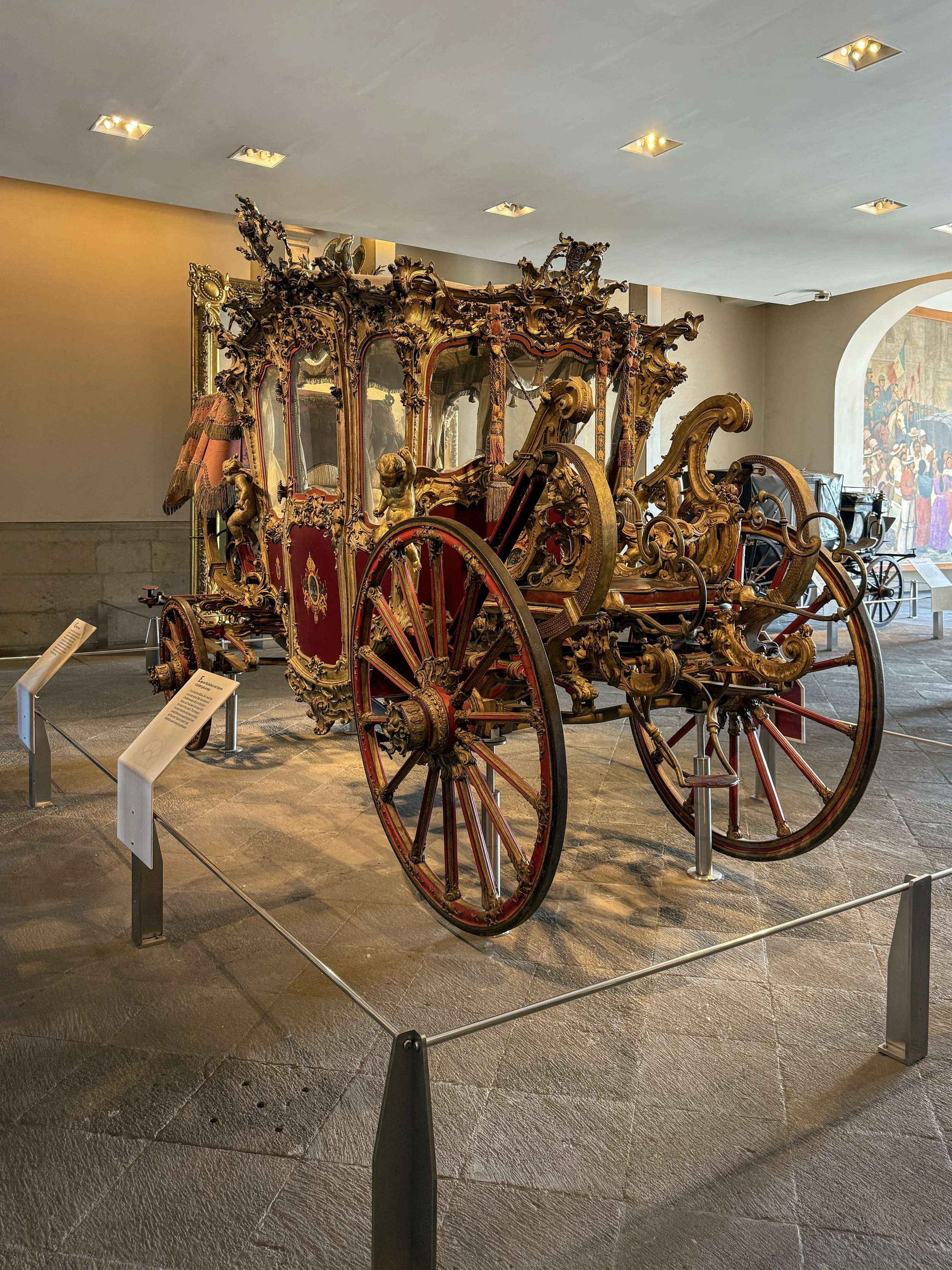
The carriage of Emperor Maximilian and Charlotte at the Alcázar of Chapultepec

This extravagant carriage belonged to Maximilian and Charlotte.

Sala de Carruajes (Carriage Room)

After making our way out of the west wing, which houses the Museo Nacional de Historia, Wally and I found ourselves in the Sala de Carruajes (Carriage Room). This covered space features historic carriages and serves as the main entrance to the Alcázar, or Royal Palace. 

At the center of the room is the royal coach that belonged to Maximilian and Charlotte. Designed for special occasions, the ornate Baroque-style carriage was meticulously fabricated in 1864 by the Cesare Scala workshop in Milan, Italy and later shipped to Mexico. 

Its gold detailing, sculpted cherubs, and doors bearing the coat of arms of the Mexican Empire, an eagle atop a nopal devouring a serpent, beneath an imperial crown — lend the carriage an air of majestic splendor.

According to records from the National Museum of History, the carriage was used only twice, contributing to its near perfect condition. You could almost imagine it rolling through the streets, drawing every eye in its path.

Additionally, a more modest four-wheeled carriage, designed in Paris, France by Henri Binder for everyday transport, is also on display. Originally built for Maximilian, it was adapted for President Benito Juárez. While its wheels kept turning, they no longer carried a king. Maximilian’s imperial crest was replaced with the emblem of the republic — minus the imperial crown.

We spent hours exploring the castle’s magnificent halls, grand stairways and stunning rooms — not to mention the breathtaking views from the top of Chapultepec Hill.

Just beyond the room’s entrance is the first of two large-scale works by Antonio González Orozco, one of the last great artists of the Mexican muralist movement: Entrada Triunfal de Benito Juárez al Palacio Nacional, Acompañando de Su Gabinete (The Triumphal Arrival of Benito Juárez at the National Palace, Accompanied by His Cabinet), painted in 1967.

Nearby is another painting by Orozco: Juárez, Símbolo de la República Frente a la Intervención Francesa (Juárez, Symbol of the Republic Against the French Intervention), which celebrates Juárez’s role in preserving Mexican sovereignty during the French Intervention. His resistance to foreign rule and efforts to restore the republic earned him the Colombian government’s honorific title Benemérito de las Américas (Worthy of the Americas).

Among the other artworks in the room are three equestrian portraits: one of Maximilian of Habsburg, painted in 1865 by French artist Jean Adolphe Beaucé; one of General Mariano Escobedo; and one of General Porfirio Díaz, painted by Spanish soldier and artist José Cusachs in 1901.

Visitors stand in the narrow Sala Introductoria (Introductory Hall) at Chapultepec Castle

A detail of the intricate Baroque plasterwork inside the Sala Introductoria.

Sala Introductoria (Introductory Hall)

Behind the Carriage Room, Wally and I stepped into a long, narrow hallway with wooden floors and a gilt plasterwork ceiling. This elegant corridor is now known as the Sala Introductoria (Introductory Hall), and features placards that tell the stories of its most notable residents, including Maximilian and Charlotte, as well as Díaz. 

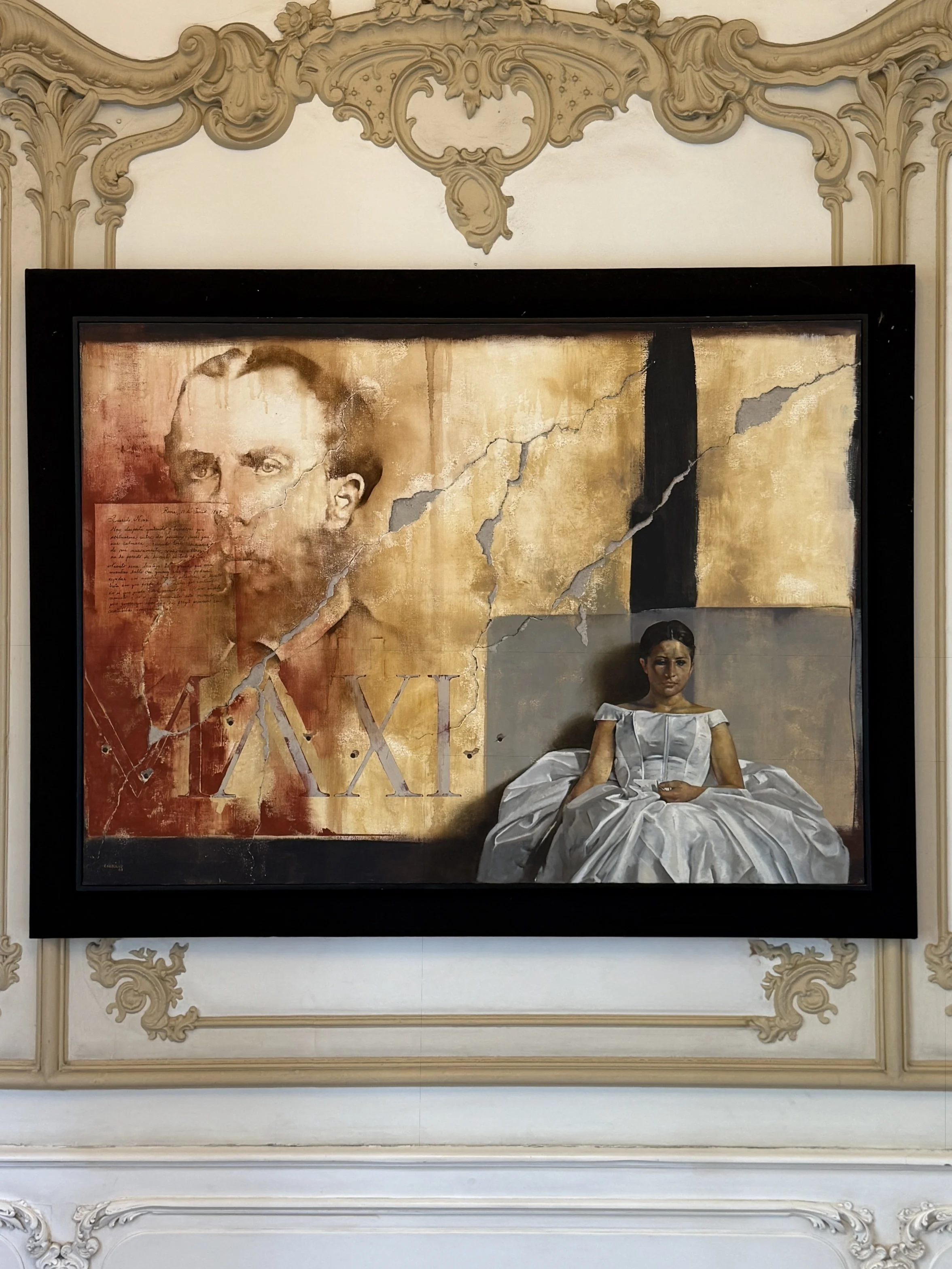
Querido Max (Dear Max) by Miguel Carillo Lara in the Introductory Hall at Chapultepec Castle

Querido Max (Dear Max) by Miguel Carillo Lara, 2003

During Maximilian’s reign, this space served a very different purpose. It was a skittles alley, a game similar to bowling, where players would roll a wooden ball or disc down the hall, aiming to knock over nine pins arranged in a diamond formation. 

Attack on the Castle Chapultepec, a print by Nathaniel Currier from 1848

Attack on the Castle Chapultepec, a print by Nathaniel Currier, 1848

History of Chapultepec Castle

Chapultepec Castle’s appearance was shaped largely by two men: Maximilian I of the Austrian House of Habsburg, who ruled Mexico from 1864 to 1867, and Porfirio Díaz, who took power in 1876 and held onto it for over 30 years. 

Maximilian transformed the castle into a lavish imperial residence, while Díaz, an avid Francophile, despite fighting against the French in the Second Franco-Mexican War, modernized and expanded the structure. The castle remained the official presidential residence until 1934, when President Lázaro Cárdenas relocated the residence to Los Pinos. 

Not long after, on February 3, 1939, Cárdenas declared that Chapultepec Castle would become the National Museum of History. It officially opened to the public on September 27, 1944, during the presidency of Manuel Ávila Camacho.

The Austrian Archduke Ferdinand Maximilian Joseph (future emperor of Mexico) and his wife Charlotte of Belgium

The Austrian Archduke Ferdinand Maximilian Joseph (future emperor of Mexico) and his wife Charlotte of Belgium

The French Intervention in Mexico 

So, how did Mexico come to have an Austrian emperor?

It all started in the 1830s, when France began eyeing Mexico as a place to extend its influence, most notably during the Pastry War (1838–1839), a brief conflict sparked by complaints over damages to French-owned businesses. Although France never established a formal colony, its cultural and economic presence grew, especially in cities like Veracruz and Mexico City.

After years of political turmoil, Mexico’s economy was in ruins. In 1861, President Juárez made a bold move — he suspended all foreign debt payments. European creditors were infuriated, prompting France, Spain and Britain to send troops, determined to collect what they were owed. 

But it soon became clear that France, under Napoleon III, had bigger ambitions than debt recovery. By April 1862, Britain and Spain, unwilling to be drawn into an imperial venture, withdrew, leaving France to pursue its grand designs alone.

Napoleon wanted to establish a French-backed monarchy in Mexico to boost French influence in the Americas and counterbalance the growing power of the United States. 

French troops marched inland, but on May 5, 1862, they ran into stiff resistance at the Battle of Puebla, where Mexican forces under General Ignacio Zaragoza pulled off a stunning victory — a moment still celebrated every Cinco de Mayo.

However, the French regrouped, and returned stronger. By June 1863, they captured Mexico City, and Juárez and his government were forced into exile in the north.

With Mexico under French control, Napoleon needed a suitable European noble to serve as emperor. He found his answer in Archduke Ferdinand Maximilian Joseph of Austria, the younger brother of Emperor Franz Joseph I. As the second son, Maximilian had lived in his brother’s shadow. He was idealistic, ambitious and increasingly disillusioned with his limited role in Europe. 

Departure for Mexico by Cesare dell'Acqua, 1865, showing Maximilian and Charlotte on a boat

Departure for Mexico by Cesare dell'Acqua, 1865. The royal couple head out to rule Mexico — a reign that would be short-lived and would end with Maximilian’s execution in 1867.

Emperor Maximillian Goes to Mexico

At first Maximilian hesitated. But the promise of power and glory in Mexico eventually won him over. With the encouragement of his equally determined wife, Princess Charlotte of Belgium, he accepted Napoleon’s offer. On May 28, 1864, the couple arrived in Mexico to begin their reign as Emperorador Maximiliano I and Emperatriz Carlota of Mexico.

Settling into their new roles, Maximilian and Charlotte chose Castillo de Chapultepec as their imperial residence, overseeing renovations to transform it into a grand European-style palace. They saw themselves as enlightened rulers, destined to bring stability and prosperity to a nation fractured by years of war.

While conservative elites had initially welcomed the monarchy, many Mexicans remained unconvinced. Juárez’s supporters, known as Juaristas, refused to recognize Maximilian’s authority and launched a sustained resistance movement. In an effort to win public support, Maximilian introduced several liberal reforms. These included protections for workers, efforts to limit working hours, and the promotion of fair labor practices. He also issued decrees aimed at restoring land rights to indigenous communities, reversing some of the damage done by earlier liberal reforms that had led to the loss of communal lands.

L'Exécution de Maximilien(The Execution of Emperor Maximilian) by Édouard Manet, 1869

L'Exécution de Maximilien (The Execution of Emperor Maximilian) by Édouard Manet, 1869

The End of the Second Mexican Empire

Ironically, Maximilian proved too liberal for the conservatives who had brought him to power. They hadn’t signed up for an emperor who challenged their privilege and wealth.

As tensions mounted, international pressure began to close in. After the American Civil War ended in 1865, the U.S. government officially recognized Juárez as Mexico’s legitimate leader and strongly urged France to withdraw support. By 1866, under increasing diplomatic pressure from the United States, Napoleon began withdrawing French troops from Mexico, effectively ending armed intervention and leaving Maximilian without critical support. 

Determined not to relinquish power, Charlotte sailed to Europe in July 1866, pleading with Napoleon III, Pope Pius IX and her royal relatives to continue supporting the empire. But her mission failed — and the emotional toll broke her. She suffered a mental breakdown  in Rome and never returned to Mexico.

Back home, Maximilian made his final stand in the city of Querétaro. On May 15, 1867, Republican forces broke through, after one of Maximilian’s own men, Colonel Miguel López, betrayed him. Captured along with his generals Miguel Miramón and Tomás Mejía, he was quickly sentenced to death.

Despite desperate pleas from European monarchs — including his own brother — President Juárez stood firm. Granting a pardon would have weakened his stance and undermined the republic. 

On June 19, 1867, Maximilian and his generals were executed by firing squad on Cerro de las Campanas, the Hill of the Bells, bringing the Second Mexican Empire to a dramatic and final end. (The First Mexican Empire, led by Agustín de Iturbide, had collapsed decades earlier in 1823, after barely two years of shaky rule following independence from Spain.)

Pink and white furniture in the Sala de Lectura (Reading Room) at Chapultepec Castle

A pair of alabaster vases, featuring the coat of arms of the Second Mexican Empire, sit atop pedestals flanking a grand bookcase, while the sideboard holds a bust of French poet and fabulist Jean de La Fontaine. 

Sala de Lectura (Reading Room)

Rooms on the ground floor are accessible from a gleaming black and white marble promenade and have been restored to reflect their appearance during the time of Emperor Maximilian and Empress Charlotte. 

After the skittles alley, the first room we saw was the Sala de Lectura (Reading Room), where Maximilian spent time reading, drafting decrees, and handling both official and personal correspondence. 

As we took it all in, something on the red damask-covered wall caught our eye: a dark, rectangular outline, like a shadow frozen in time. It was clear that a large painting had once hung there. Our curiosity got the best of us, so I did a little digging online later and found out it had been a full-length portrait of Maximilian.

To be honest, this is probably the least impressive of the palace rooms. It’s all uphill from here. Louis XV-style giltwood chairs and a settee, upholstered in Aubusson tapestries, depict scenes from Jean de La Fontaine’s fables. While the term “tapestry” is typically associated with wall hangings, Aubusson’s craftsmanship extends to rugs and furniture upholstery as well.

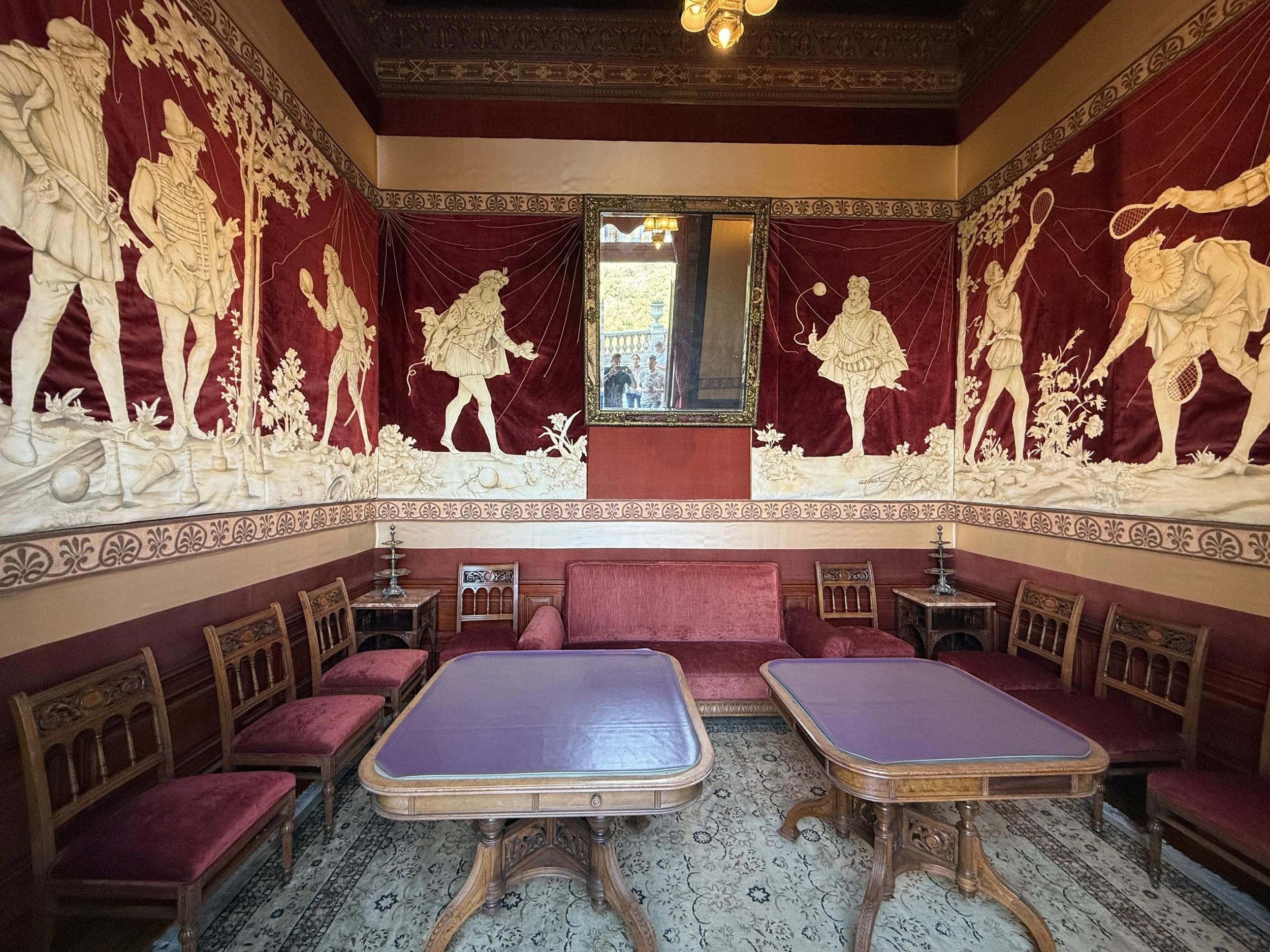
Burgundy and offwhite murals showing noblemen playing games in the Salón de Juego (Game Room) at Chapultepec Castle

The set of tapestries depicting nobleman playing games, fittingly adorning the Game Room, were a gift from Napoleon III to Maximilian for his birthday.

Salón de Juego (Game Room)

The next room was the Salón de Juego (Game Room), which was about half the size of the Reading Room. Its walls were decorated with scenes of noblemen dressed in elaborate 16th century finery — frilly pleated collars, puffed-out pumpkin breeches and cloaks — engaged in games such as badminton, bilboquet (a cup and ball toy) and the aforementioned skittles.

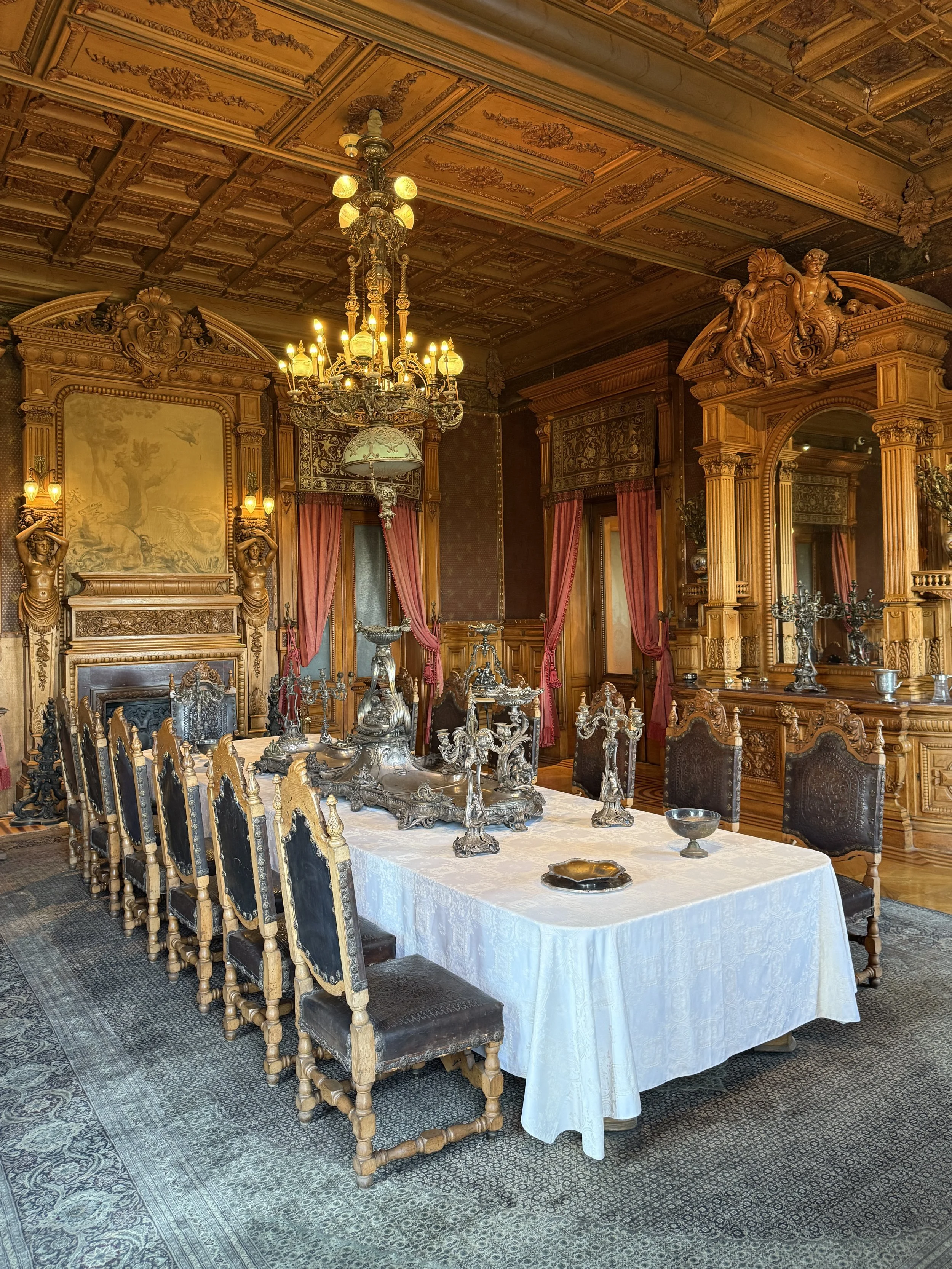
A long table in the Comedor (Dining Room) at Chapultepec Castle

The overmantle bears the eagle and snake coat of arms, while the sideboard features a pair of putti holding Díaz’s seal, ‘RM,’ which stands for República Mexicana.

Comedor (Dining Room)

Immediately following was the Comedor, or Dining Room. The fireplace mantelpiece and sideboards, masterfully handcarved from mahogany by Pedro Téllez Toledo and Epitacio Calvo, were commissioned during the 1880s during Díaz’s presidency. Above the topless caryatids, symbolizing Mexico’s agricultural abundance, hung another elegant Aubusson tapestry, this one depicting a fox and a duck.

The dining table was equally impressive. Tooled leather chairs with nailhead studs surrounded it, and the table itself was set with silver-plated serving pieces and candelabra from Maximilian’s own service — crafted by Christofle of Paris, no less, the same silversmith favored by Napoleon III. 

Salón de Gobelinos (Hall of Gobelins) with a piano and portraits on a pink wall at Chapultepec Castle

The Music Room includes chairs upholstered with tapestries depicting the fables of Jean de La Fontaine and two grand pianos.

Salón de Gobelinos (Hall of Gobelins)

Much to our disappointment, the Salón de Gobelinos (Hall of Gobelins) wasn’t named after mischievous little creatures from folklore, as we had hoped. Instead, it gets its name from the Gobelin family of clothmakers. Their Paris workshop became world-famous, and in this case, the name refers to the aforementioned Aubusson-woven textiles that cover the Louis XV furniture throughout the room.

Salón de Gobelinos (Hall of Gobelins) at Chapultepec Castle

Gazing back at us from the walls were full-length portraits of Maximiliano and Carlota by German painter Albert Gräfe, alongside those of Napoleon III and his wife, Eugénie de Montijo. In the center of the room stood two grand pianos — one French, the other English — which Maximilian and Charlotte once played.

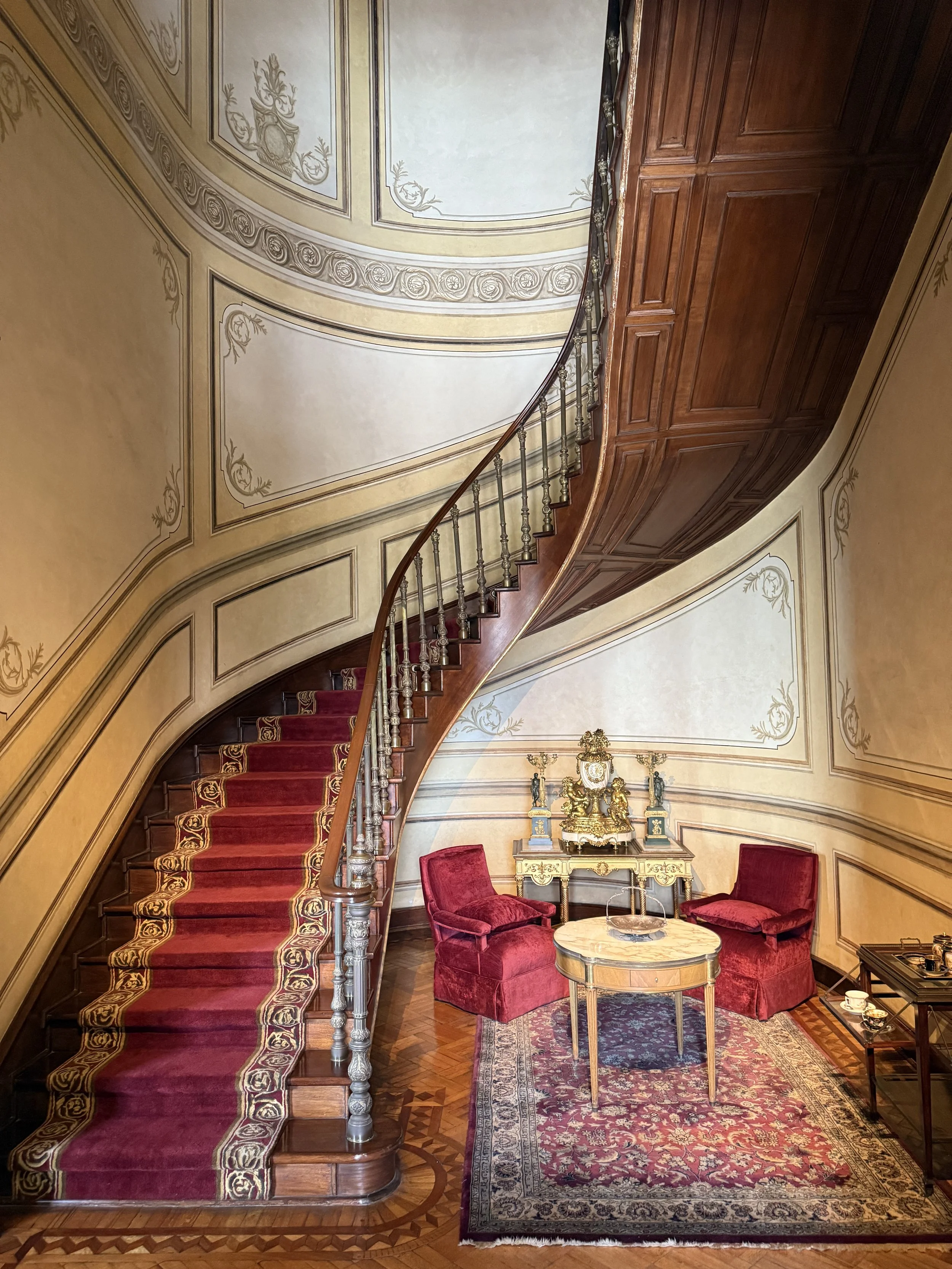
The curving Grand Staircase with red runner and a seating nook at Chapultepec Castle

The spiral staircase adjacent to the elevator was designed by architect Antonio Rivas Mercado. He contributed to the castle’s neoclassical design, transforming it into a grand structure suitable for use as a presidential residence and a venue for official events. Mercado’s influence extended beyond architecture, though; while serving as director of the Academy of San Carlos from 1903 to 1912, he was responsible for granting the scholarship that enabled Diego Rivera to study in Europe for several years. 
The light blue Recámara de Carlota (Charlotte’s Bedroom) at Chapultepec Castle

The brass bed in Carlota’s bedroom displays the coat of arms of Maximilian’s empire.

Recámara y Baño de Carlota (Charlotte’s Bedroom and Bathroom)

The Recámara de Carlota (Charlotte’s Bedroom) was the first in a suite of three rooms once used by the empress herself. Decorated in blue and gold, it features Boulle-style furniture, characterized by intricate inlays of tortoiseshell and brass. At the center stood a brass bed, its headboard topped by an oval medallion featuring the coat of arms of the Second Mexican Empire — an eagle and a snake, flanked by two griffins — while the footboard bears the imperial monogram “MIM” for Maximiliano I de Mexico. 
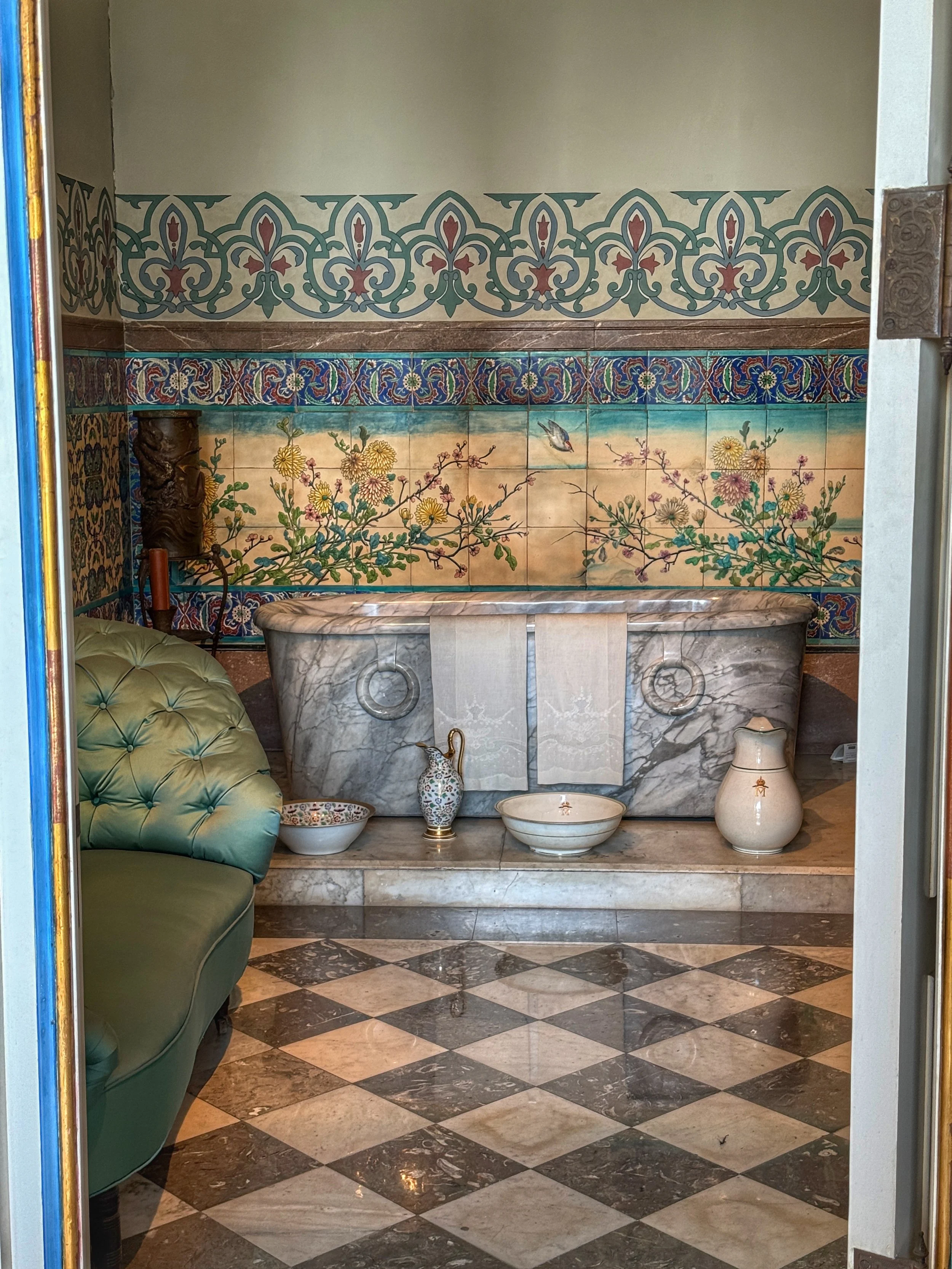
Next to the bedroom was the Baño de Carlota, or Charlotte’s Bathroom, where we saw the massive freestanding marble bathtub commissioned by Maximilian for Charlotte. Hewn from a single block of stone, it was produced by the Fratelli Tangassi workshop, an Italian family of alabaster artisans from Volterra, and exported to the castle at great expense. Standing before it, I could only imagine how much water it must have taken to fill.

A marble bathtub and floral tiles in Charlotte's bathroom at Chapultepec Castle

Behind the tub, tiles imported from China were delicately painted with peonies and cherry blossoms. 

Sala de Estar Carlota (Charlotte’s Sitting Room) at Chapultepec Castle

Charlotte’s sitting room reflected her devout faith, with a rare bust of the Virgin Mary under glass and one of the earliest known images of Our Lady of Guadalupe in the castle’s collection.

Sala de Estar Carlota (Charlotte’s Sitting Room)

Beyond the bathroom was the Sala de Estar Carlota (Charlotte’s Sitting Room). 

As a deeply devout Catholic, she saw her role in Mexico as part of a divine mission, her religious devotion merging with a growing sense of connection to her adopted country. The room reflected her spirituality, with a bust of the Virgin Mary under a glass cloche, a painting of St. Peter’s Basilica in Vatican City, and a small painting of the Virgin of Guadalupe, a powerful national and religious symbol in Mexico.
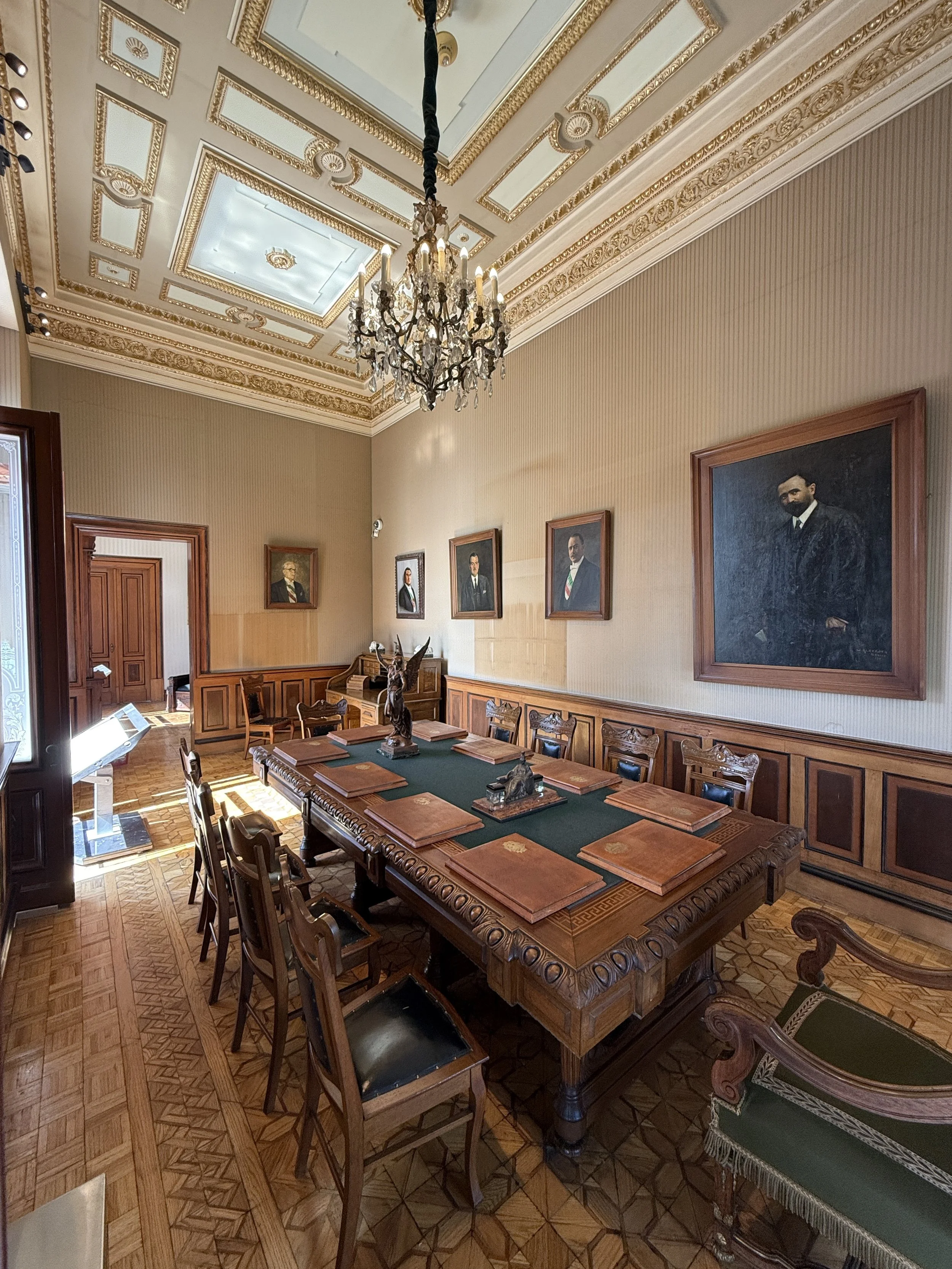
Salón de Acuerdos (Meeting Room) at Chapultepec Castle

With a green velvet tabletop and portraits of past leaders, the Salón de Acuerdos served as a formal space for cabinet discussions after the castle became the president’s official residence.
Salón de Acuerdos (Meeting Room)

Once Chapultepec Castle became the official presidential residence, there was a need for a dedicated space to receive cabinet members, and that’s where the Salón de Acuerdos (Meeting Room) comes in. Designed in the early 20th century, the green velvet tabletops and portraits of past leaders lining the walls make the room feel very presidential. Among those displayed are Presidents Francesco Madero, Álvaro Obregón, Emilio Portes Gil, Pascual Ortiz Rubio and Lázaro Cardenas.

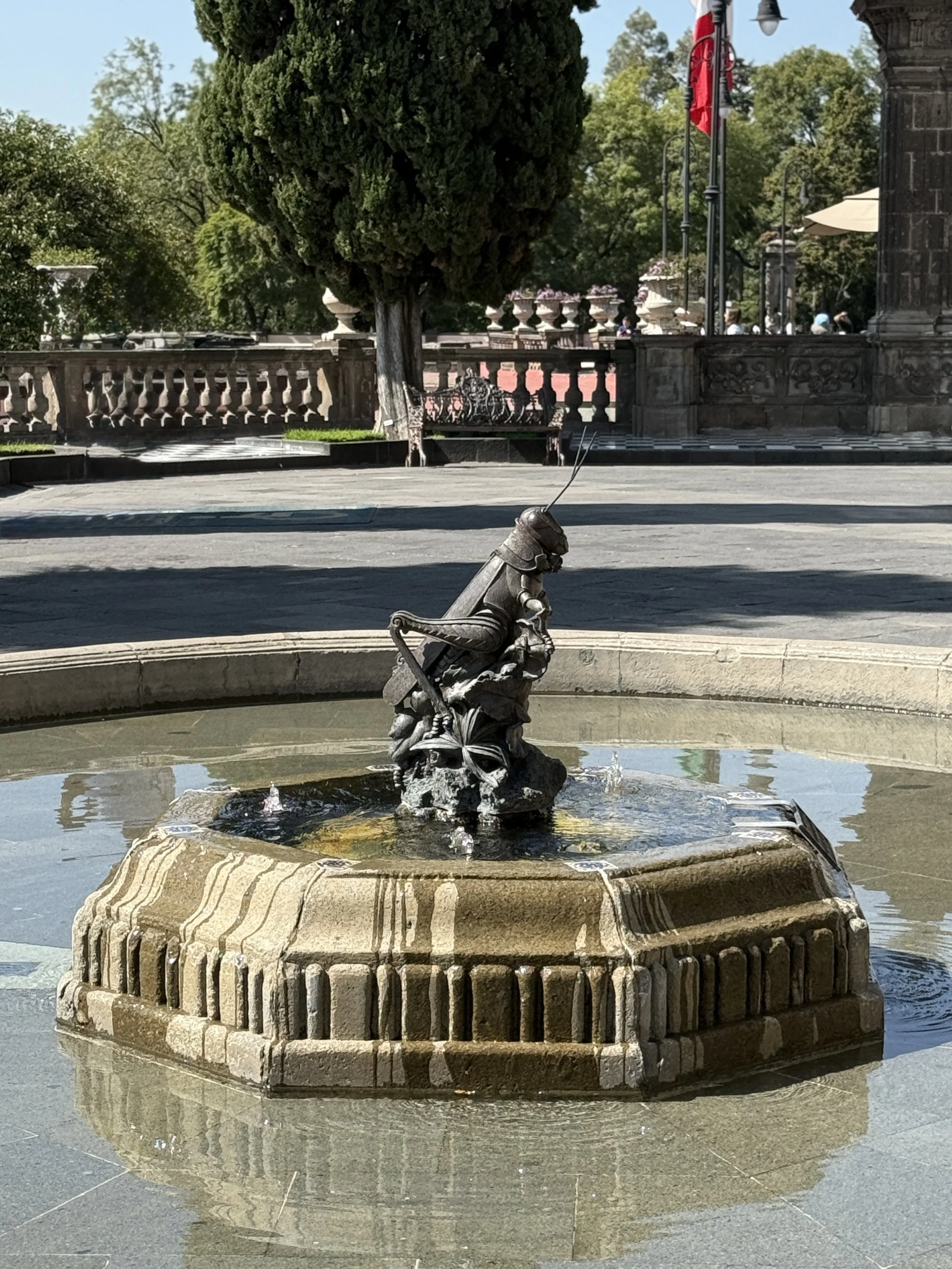
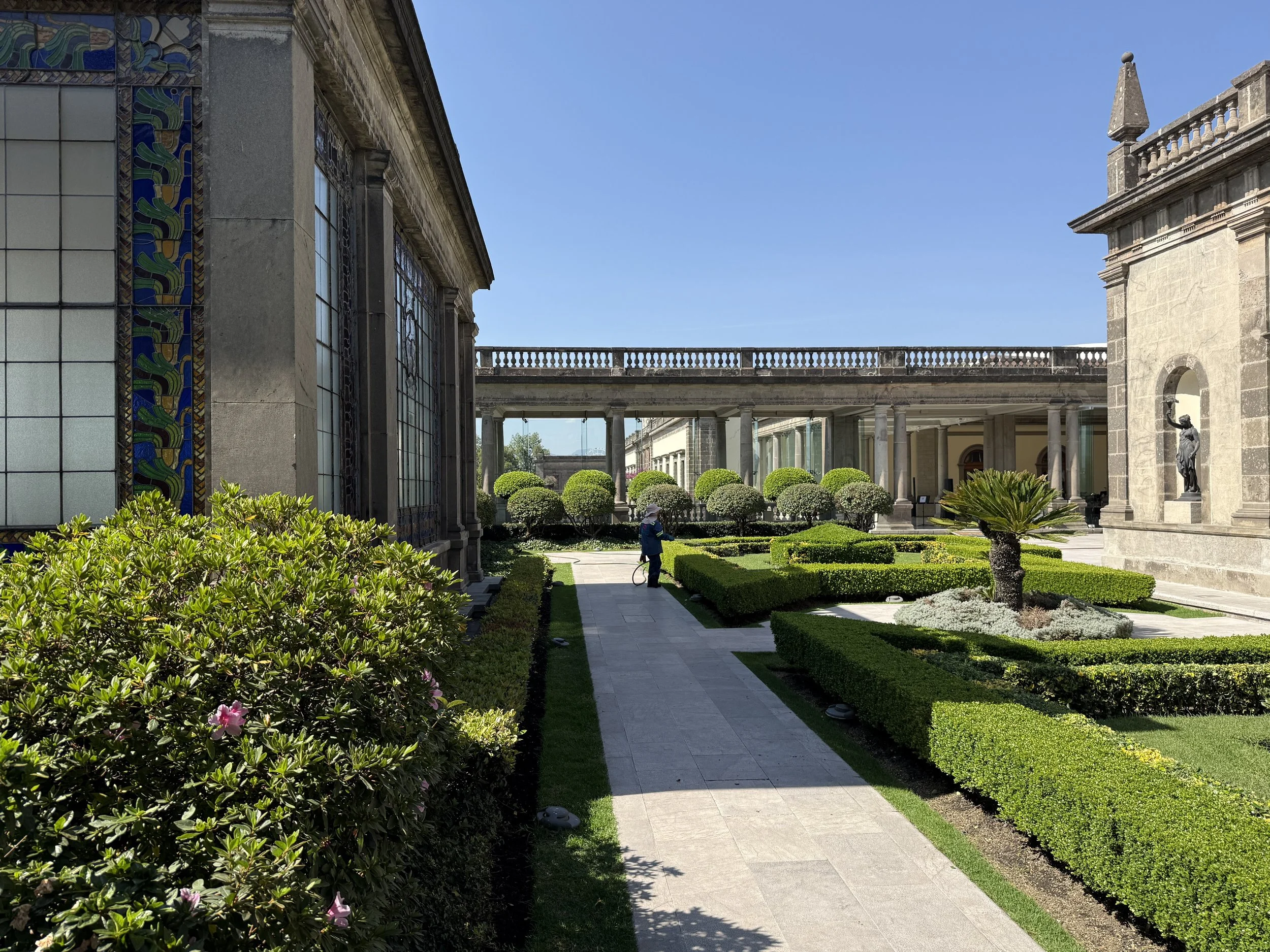
The fountain in the Patio del Chapulín (Courtyard of the Grasshopper) at Chapultepec Castle

The bronze grasshopper atop the Fuente del Chapulín was sculpted by Luis Albarrán y Pilego and installed in 1924.

Patio del Chapulín (Courtyard of the Grasshopper)

Before climbing to the second floor, we took a moment to explore the Patio del Chapulín (Courtyard of the Grasshopper). Framed by manicured hedges and anchored by the Fuente del Chapulín (Grasshopper Fountain), the courtyard opens onto a balcony terrace with breathtaking views of Mexico City below. 

Statues dedicated to the Niños Héroes stand atop the balustrade at the edge of the Patio del Chapulín at Chapultepec Castle

Six statues dedicated to the Niños Héroes stand atop the balustrade at the edge of the Patio del Chapulín.

Standing atop the terrace balustrade are six statues of the Niños Héroes, created in 1942 by artist Armando Quezada Medrano. They depict the young military cadets who died defending Mexico during the Battle of Chapultepec on September 13, 1847, during the Mexican–American War. Note that these figures are separate from the Altar a la Patria (Altar to the Homeland) monument, also located in Chapultepec Park, although both honor the same brave cadets.

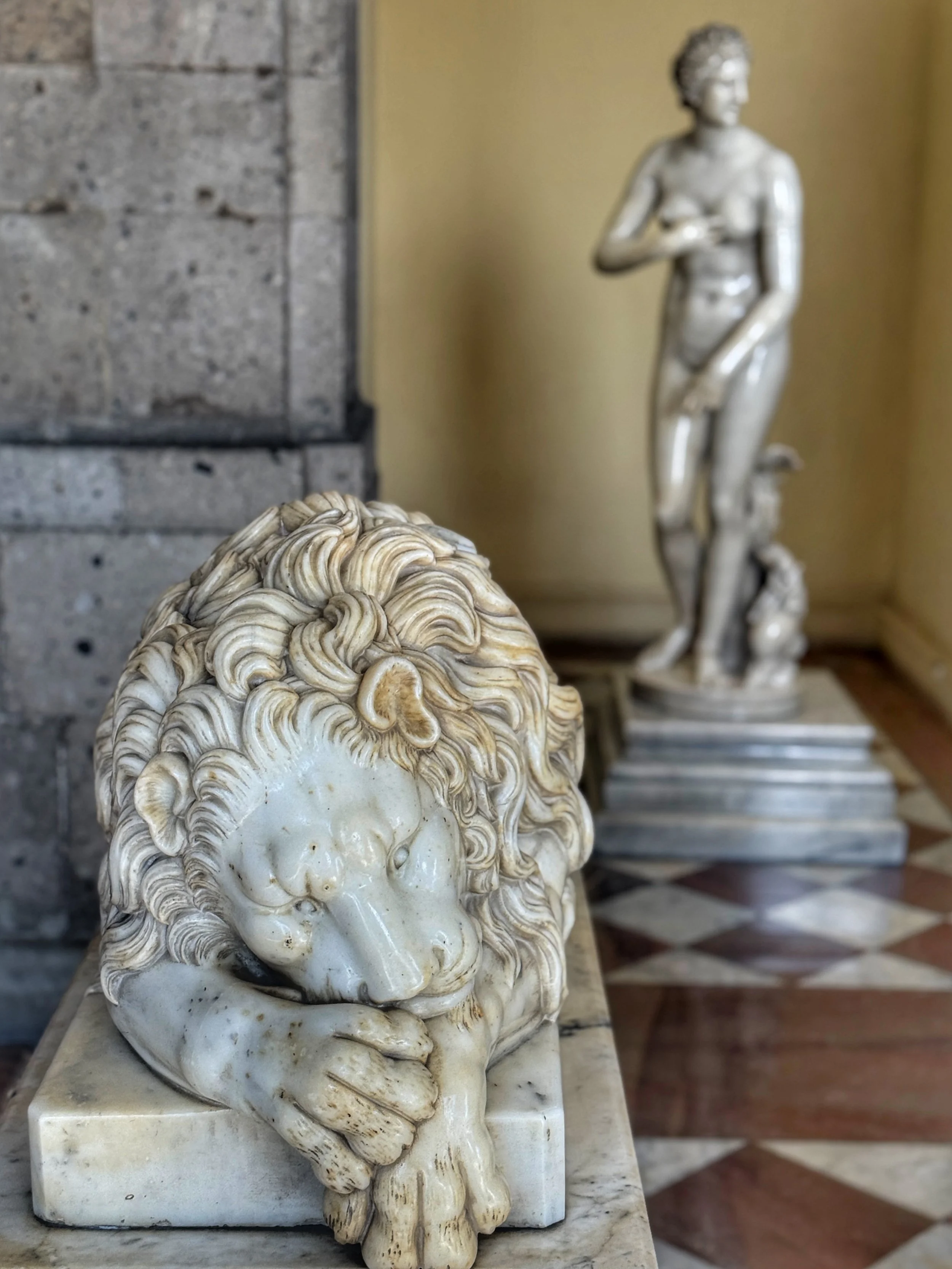
The sweeping Escalera de Leones (Lion’s Staircase) links the first floor to the terraced gardens above. Its steps, carved from Carrara marble, are flanked at the base by two marble lions modeled after Antonio Canova’s monumental mausoleum for Pope Clement XIII in St. Peter’s Basilica at the Vatican. One rests peacefully, while the other stands watchful and alert. 

Marble lion with a statue of a naked woman behind it by a staircase in Chapultepec Castle
A man walks up the Escalera de Leones at Chapultepec Castle

The Escalera de Leones leads to the rooftop gardens and includes stained glass windows installed during the presidency of Venustiano Carranza.

At the top of the staircase, stained glass windows installed during the presidency of Venustiano Carranza (1859–1920) protect the stairwell from the elements. Their designs feature floral and vegetal patterns inspired by the Mexican landscape. One window depicts the glyph of a chapulín (a grasshopper, running with the theme), perched on a hill with flowing water beneath it. The other showcases the Mexican coat of arms. 

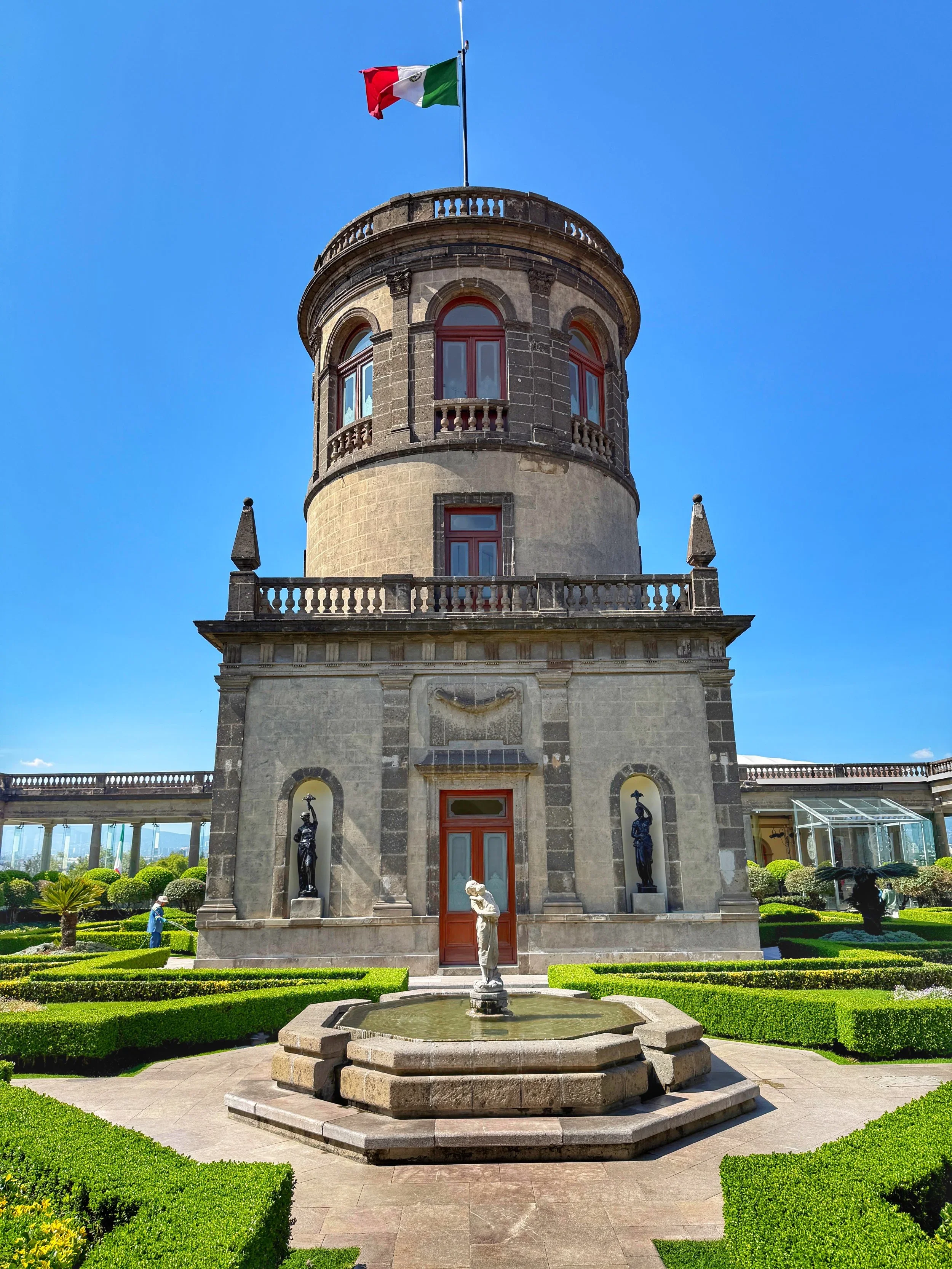
The observatory tower in the rooftop gardens at Chapultepec Castle

Above the treetops, the Tall Knight keeps watch — first as a military tower, then as Mexico’s gaze turned skyward in 1877, becoming a short-lived but advanced observatory.

Rooftop Gardens

Just beyond are the rooftop gardens designed by Austrian botanist Wilhelm Knechtel during the reign of Emperor Maximilian. At its center stands a tower called the Caballero Alto (Tall Knight), surrounded by neatly trimmed hedges and classical statues. This structure, built around 1842 as part of the Military College, was briefly repurposed in 1877 as an astronomical observatory, complete with meteorological instruments considered cutting-edge for the time.

A fountain in the rooftop gardens at Chapultepec Castle in CDMX

Designed in the 1860s by Austrian botanist Wilhelm Knechtel, these rooftop gardens were part of Maximilian’s vision to bring European elegance to Chapultepec Castle.

Adorning the walls of the elevated garden are colorful frescoes of bacchantes — female followers of Bacchus, the Roman god of wine. Painted in the Pompeian style, these works were created by Santiago Rebull, the court painter of Maximilian and one of the few individuals close to the monarchy who managed to remain in Mexico and even thrive in the subsequent decades under the Republic. He completed four of the figures between 1865 and 1866 during Maximilian’s reign, and nearly three decades later, painted the remaining two in 1894 under the Díaz administration.

A breast falls out of a dress in a fresco of a bacchante in the rooftop gardens of Chapultepec Castle

Nip slip! The bacchae depicted on the walls of the upper terrace were painted by Santiago Rebull in the Neoclassical style, inspired by the 18th century rediscovery of the ancient ruins at Pompeii and Herculaneum.

The day Wally and I visited, an orchestra and a vocalist were rehearsing an aria beneath the terrace pavilion.


Díaz and Chapultepec Castle

During his extended rule as president, Díaz was determined to position Mexico as a modern, forward-thinking nation, and the castle became part of that vision. Under his direction, Chapultepec Castle saw some major upgrades, including the installation of its very first elevator in 1900. It connected the basement, main floor and rooftop, and at the time, it was cutting-edge. In fact, the castle was one of the first buildings in all of Mexico to be outfitted with electricity.

The bedroom of Porfirio Díaz at the Alcázar of Chapultepec in CDMX

Díaz’s bedroom was appointed in French style with Louis XVI furniture.

Recámara de Porfirio Díaz (Bedroom of Porfirio Díaz)

Inside, the Recámara de Porfirio Díaz (Bedroom of Porfirio Díaz) reflects a refined French taste. Though not as lavish as Charlotte’s quarters downstairs, it still impresses with its Louis XVI furnishings: a stately mahogany bed and a pair of cream-colored slipper chairs with scrolled backs and elegant fringe.

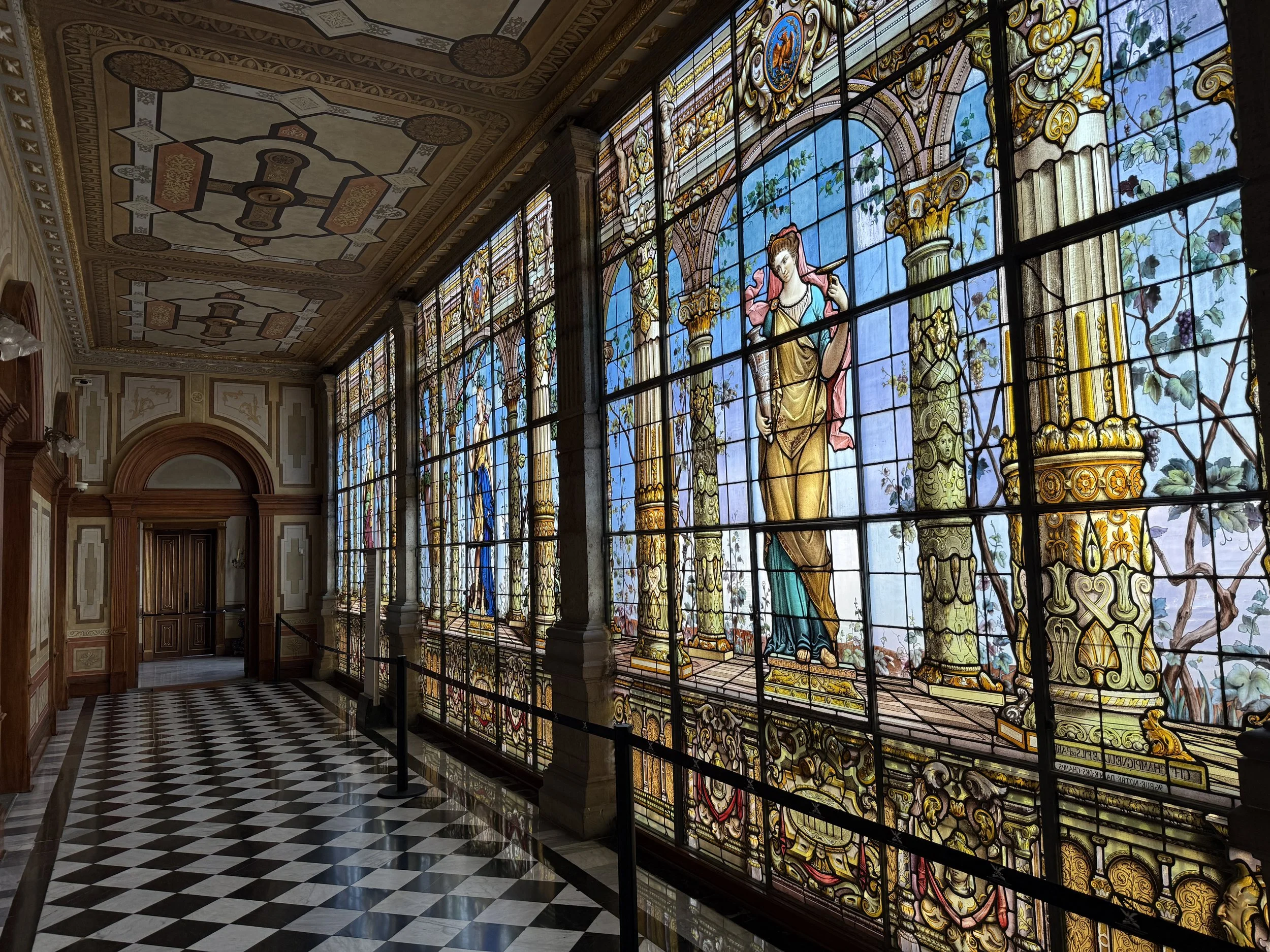
The Galería de Emplomados lined with stained glass windows

The Galería de Emplomados is lined with stained glass windows created by the French firm Champigneulle Fils, and were installed in 1901.

Galería de Emplomados (Stained Glass Gallery)

Beyond Díaz’s bedroom is the Galería de Emplomados (Stained Glass Gallery). Installed in 1901, the grand corridor features five stained glass windows crafted by the renowned French firm Champigneulle Fils, celebrated for their work in churches, palaces, and civic buildings across Europe and Latin America. Spanning nearly 800 square feet, the windows cover half the length and height of the Alcázar’s eastern elevation. Each depicts a nature goddess: Pomona (goddess of fruits), Flora (goddess of flowers), Hebe (bearer of divine nectar and grantor of eternal youth), Diana (goddess of the hunt), and Ceres (goddess of agriculture). 

It would have been the perfect photo op — if not for one particularly self-important visitor, who had commandeered the gallery, barking orders at her poor friend and critiquing every shot like she was Anna Wintour on a Vogue editorial shoot.

The Salón de Embajadores (Hall of Ambassadors) with a glowing chandelier at Chapultepec Castle

The Salón de Embajadores features furniture in the Louis XVI style and plaster painted to look like marble.

Salón de Embajadores (Hall of Ambassadors)

The final Díaz-period room we peered into was the Salón de Embajadores (Hall of Ambassadors) a French-inspired room where Díaz met with diplomats to discuss international relations. Originally Charlotte’s study, the room was repurposed by Díaz as Mexico gained prominence on the world stage, and the castle became a key venue for hosting foreign dignitaries. 

Designer Epitacio Calvo incorporated Baroque and French Neoclassical styles into the room’s furnishings. 

A walkway beyond hedges in the rooftop garden of Chapultepec Castle

Plan Your Visit 

The weather couldn’t have been better for our visit to this incredible landmark. We spent hours exploring its magnificent halls, grand stairways and stunning rooms, not to mention the breathtaking views from the top of Chapultepec Hill. If you’re in Mexico City, this place is an absolute must-see.

Hours:

  • Monday: Closed

  • Tuesday–Sunday: 9 a.m.–5 p.m. (Note: The museum begins clearing rooms at 4:45 p.m.)

Admission:

  • 100 MXN (about $5.50)

  • Free every day for children under 13, seniors 60+, students, teachers, pensioners/retirees, and visitors with disabilities with valid ID

  • Free on Sundays for Mexican nationals and residents

Ticket Purchase:

  • Tickets are sold at the bottom of the hill before the ramp — there aren’t ticket booths at the castle entrance.

  • You can buy your tickets online as well.

Accessibility:

  • The castle offers ramps, elevators and loaner wheelchairs.

  • Visitors with disabilities or those seeking adapted educational tours can arrange assistance by emailing difusion.mnh@inah.gob.mx.

Food & Drink:

  • Food and beverages aren’t permitted inside the castle. You must leave these in a locker at the bottom of the hill. Plan to eat and hydrate before or after your visit.

Two statues of the young military cadets known as the Niños Heroes at Chapultepec Castle

Chapultepec Castle

Primera Sección del Bosque de Chapultepec s/n 
San Miguel Chapultepec
Mexico City 11580
Mexico

Chapultepec Castle’s National History Museum in Mexico City

Perched atop the Hill of the Grasshopper, Chapultepec Castle is the only royal residence in North America. From its imperial past to the revolutionary murals inside, here’s why this must-visit landmark in Chapultepec Park is worth the climb.

Staircase at Chapultepec Castle in CDMX with the mural Alegoría de la Revolución (Allegory of the Revolution) by Eduardo Solares Gutiérrez, 1933

Alegoría de la Revolución (Allegory of the Revolution) by Eduardo Solares Gutiérrez, 1933

They say the third time’s a charm, and on our latest (and yes, third) trip to Mexico City, Wally and I finally made it to the Castillo de Chapultepec (Chapultepec Castle). 

Perched atop the summit of Cerro del Chapulín (Hill of the Grasshopper) in the first section of the vast Bosque de Chapultepec (Chapultepec Forest), this historic site and local landmark is the only castle in North America to have served as a royal residence. It was home to Emperor Maximilian I and Empress Charlotte, the ill-fated rulers of the short-lived Second Mexican Empire — but more on that later. 

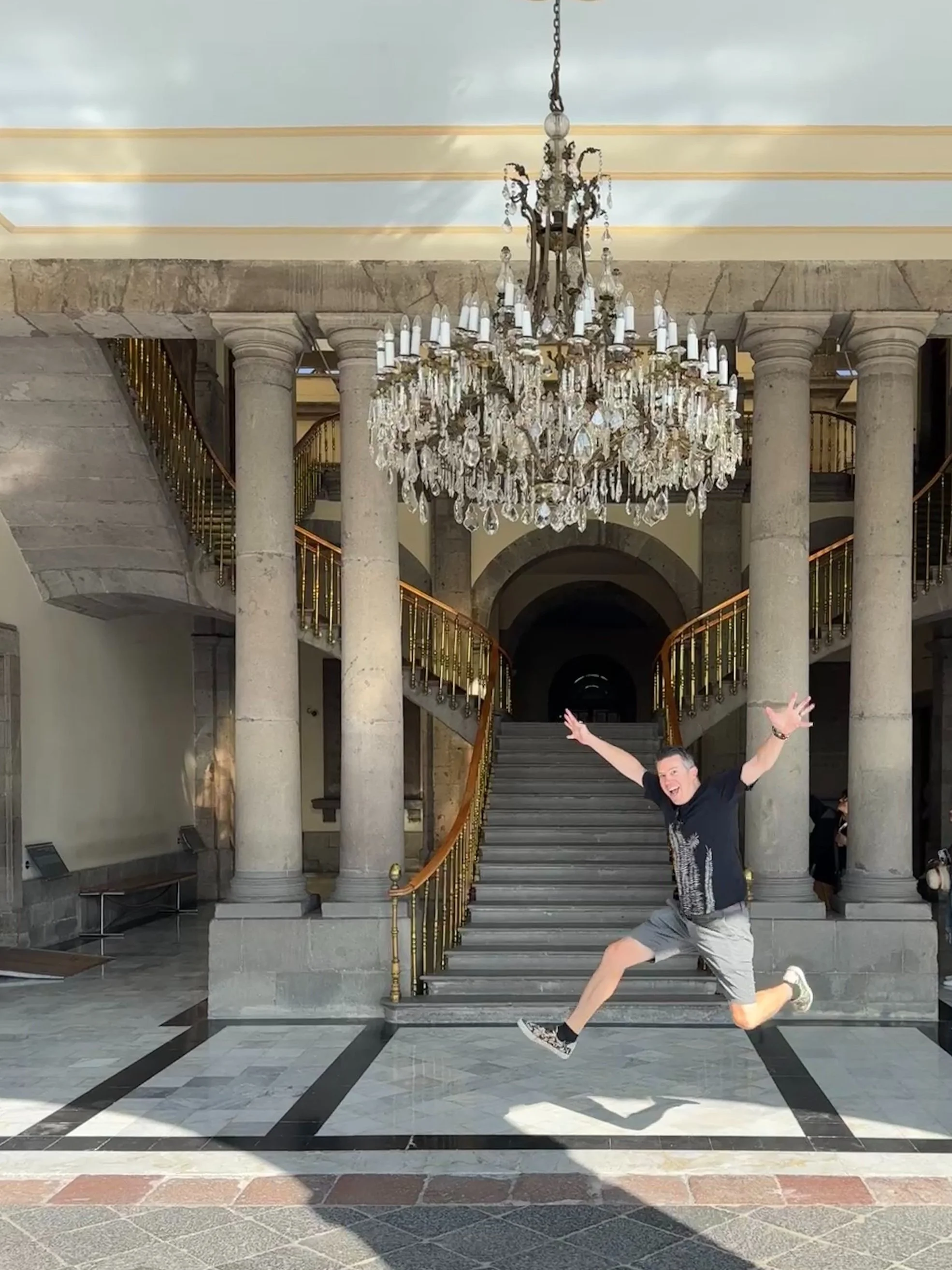
A man jumps in the air under an ornate chandelier by the stairwell in the National History Museum at Chapultepec Castle in CDMX
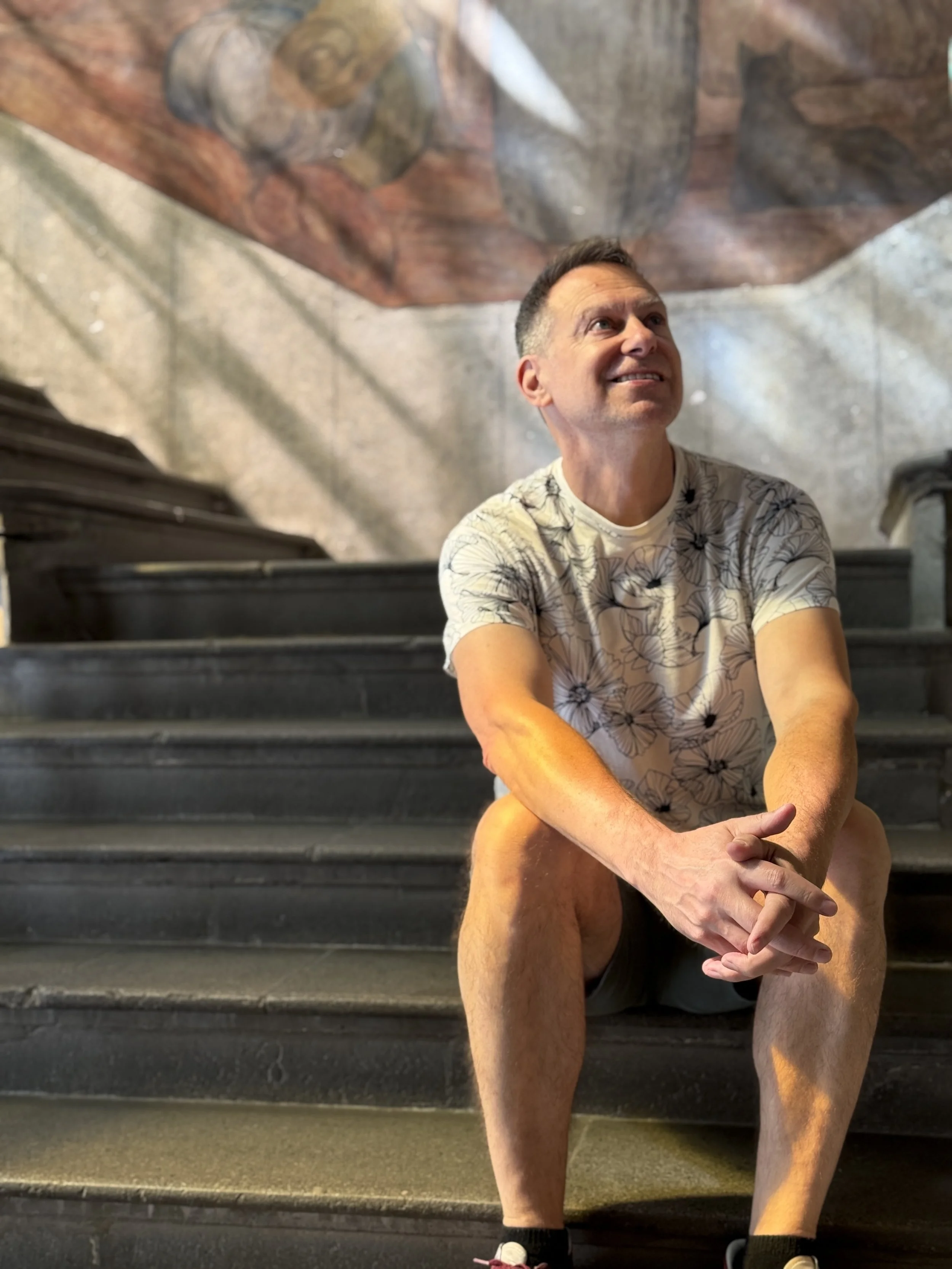
A man sits on the stairs in the National History Museum at Chapultepec Castle in CDMX
Perched atop the summit of the Hill of the Grasshopper, this historic site is the only castle in North America to have served as a royal residence.

Chapultepec itself is one of the oldest and largest public parks in Latin America. Dating back to the pre-Hispanic era and officially designated as a public space in the 16th century, the park underwent major renovations in 1910 to commemorate Mexico’s independence centennial. Today, it spans approximately 2,100 acres — more than twice the size of New York City’s Central Park, one of the largest urban parks in the world. 

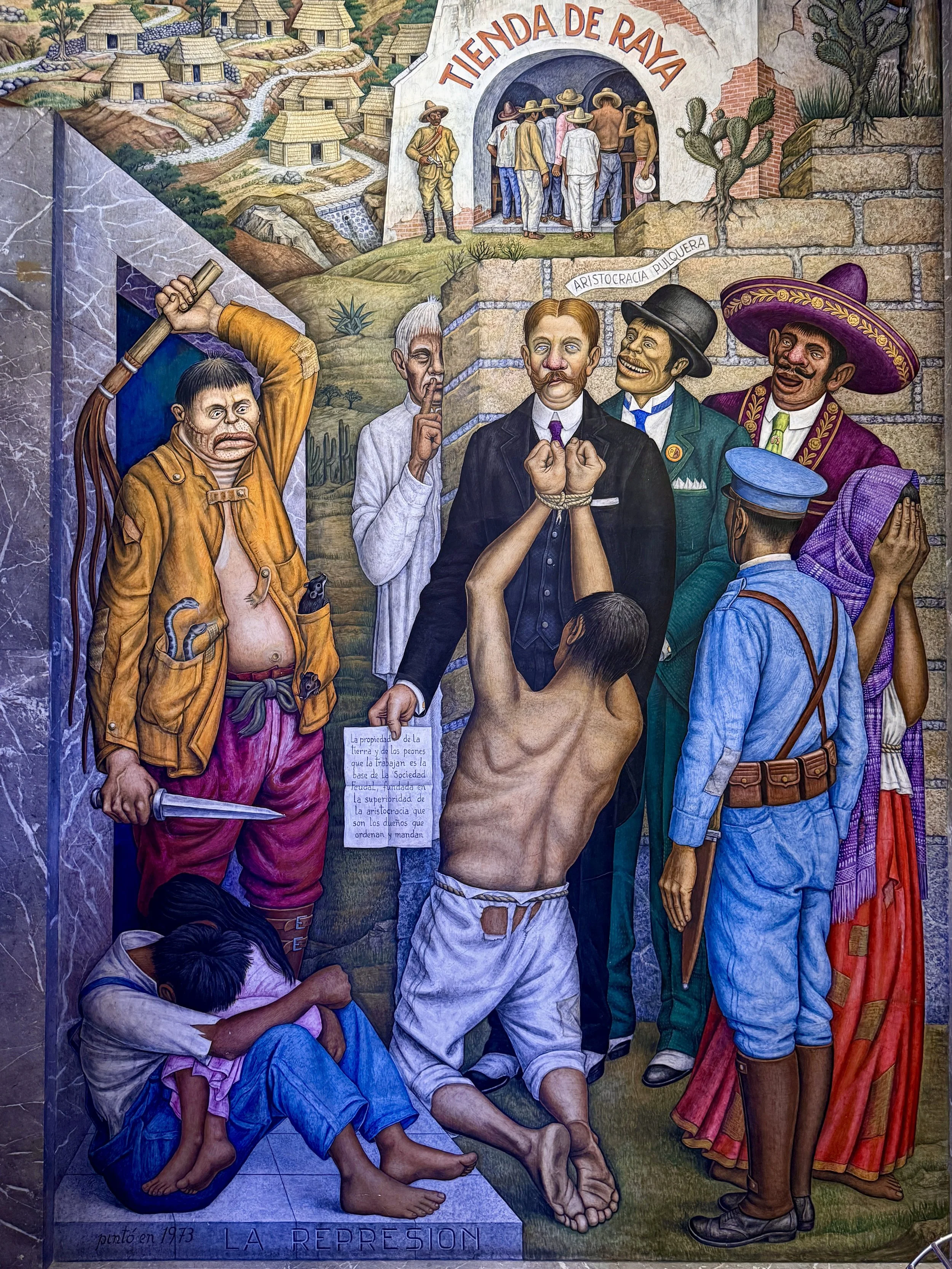
Detail of the right half of the mural La Dictadura y La Represión (Dictatorship and Repression) by Juan O'Gorman

Detail of the right half of the mural La Dictadura y La Represión (Dictatorship and Repression) by Juan O'Gorman — a visual commentary on the transgressions of President Díaz

On our previous visit, we spent hours exploring the first floor of the incredible Museo Nacional de Antropología (National Museum of Anthropology), captivated by its collection of pre-Hispanic artifacts from civilizations like the Aztecs and Maya. 


MORE: Explore the Museum of Anthropology’s collections on Animal Pottery and Death Cults of Ancient Mexico


The park is divided into four sections, from historic landmarks to vast green spaces. It’s home to nine major museums covering a wide range of subjects, along with monuments, gardens and countless other fascinating sights. And so far, we’ve barely scratched the surface of Section One. 

Its name comes from the Nahuatl word chapoltepēc, meaning “Hill of the Grasshopper.” But why a grasshopper? The area may have once been full of them, but in Mesoamerican cultures, the insect also symbolized prosperity and good fortune. 

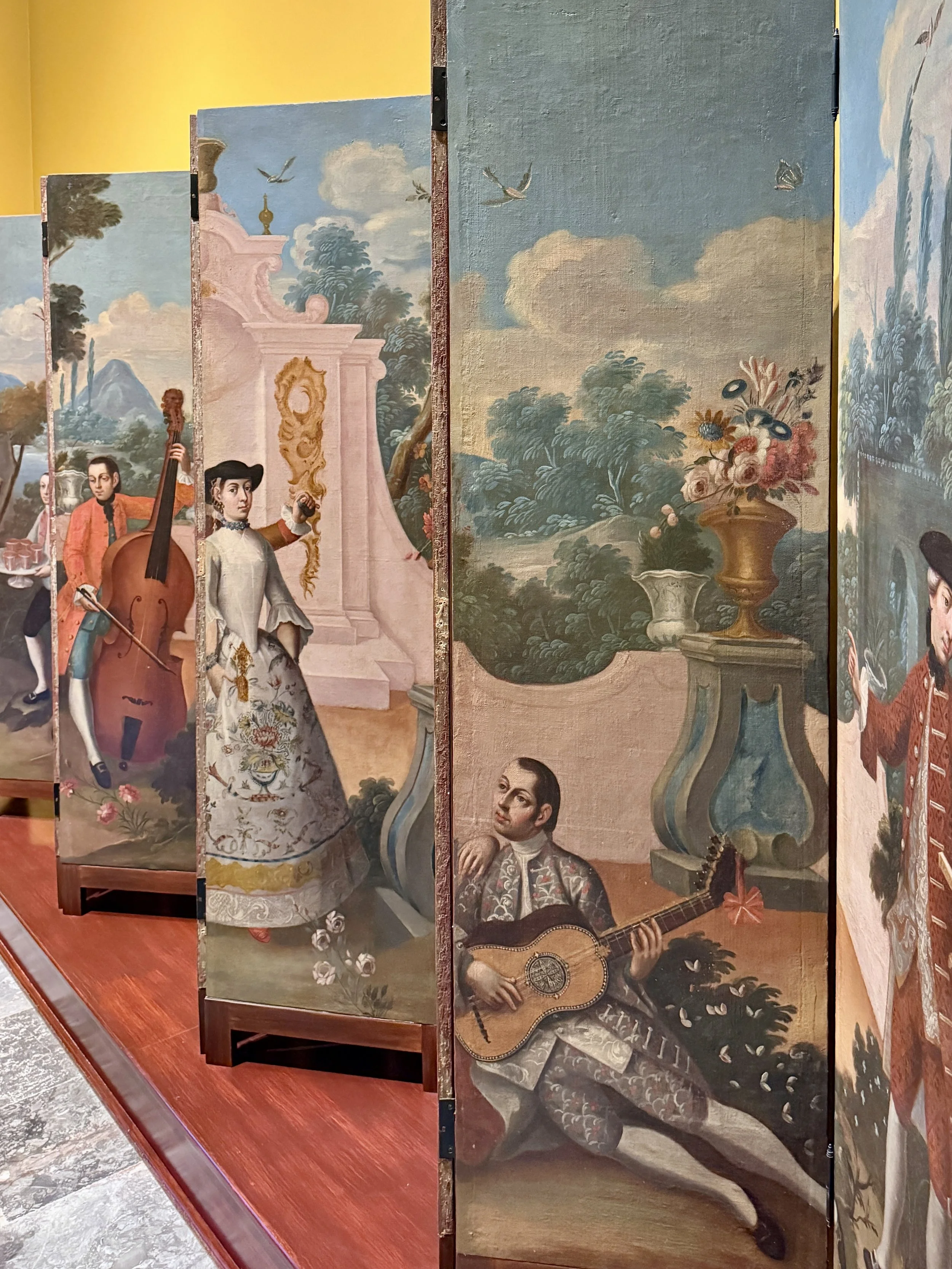
Sarao en un jardin de Chapultepec (Festive Gathering in a Garden at Chapultepec) is a handpainted biombo, or folding screen, from around 1780-1790. It depicts a sarao, a lively social gathering featuring music and dancing that played a key role in courtly and aristocratic life.

Visiting Chapultepec Castle

For this trip, we once again stayed in Colonia Condesa, a charming neighborhood that borders Chapultepec. After breakfast, we set off toward the castle, and about 25 minutes later, we were following one of the pathways leading into the park. Since it was still early morning, the vendors were just beginning to set up. 

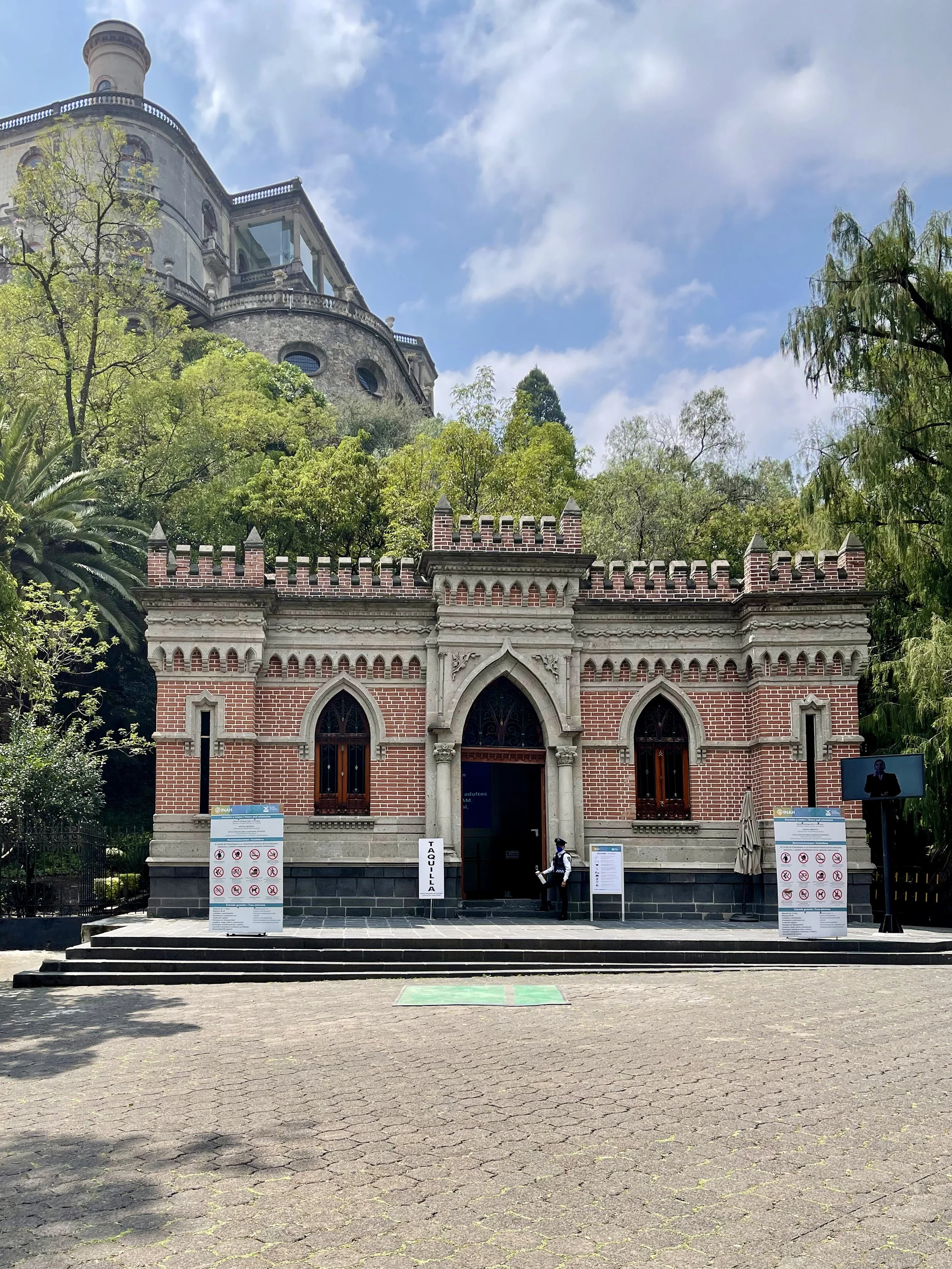
Wally and I stopped by the Old Guard House, a brick building situated at the base of the hill, to verify our tickets with an attendant, which Wally had purchased online the night before. 

The Old Guard House, located at the base of the entrance leading to Chapultepec Castle

You’ll know you’ve arrived at the right place when you see the Old Guard House, located at the base of the entrance leading to Chapultepec Castle.

Note: If you’re carrying bottled water or snacks like we were, be sure to pay for a locker as well. We didn’t realize that food and drink were prohibited inside the castle grounds — and were told at the security checkpoint that we needed to finish or rent a locker to store them.

The morning we visited, we got the full experience — a busload of kids arrived at the same time we did, their chaperones struggling to keep them from running and yelling as they excitedly scattered across the path ahead of us. Fortunately, we managed to get ahead of the group and for the most part avoided them once we reached the top. 

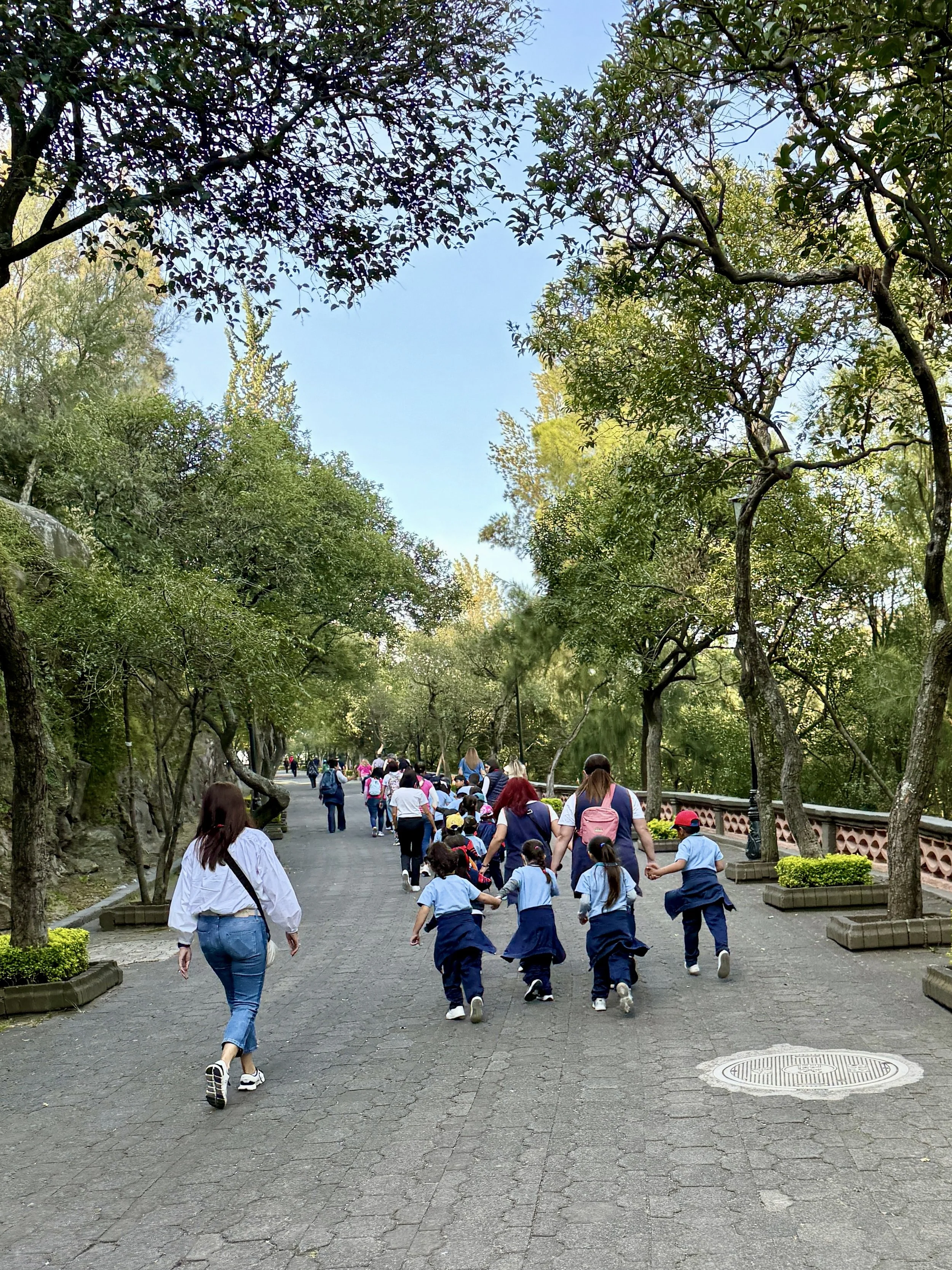
Schoolchildren and their chaperones walk up the path to Chapultepec Castle in CDMX

We hurried past the schoolchildren walking up the hill — and mostly avoided them while exploring the castle.

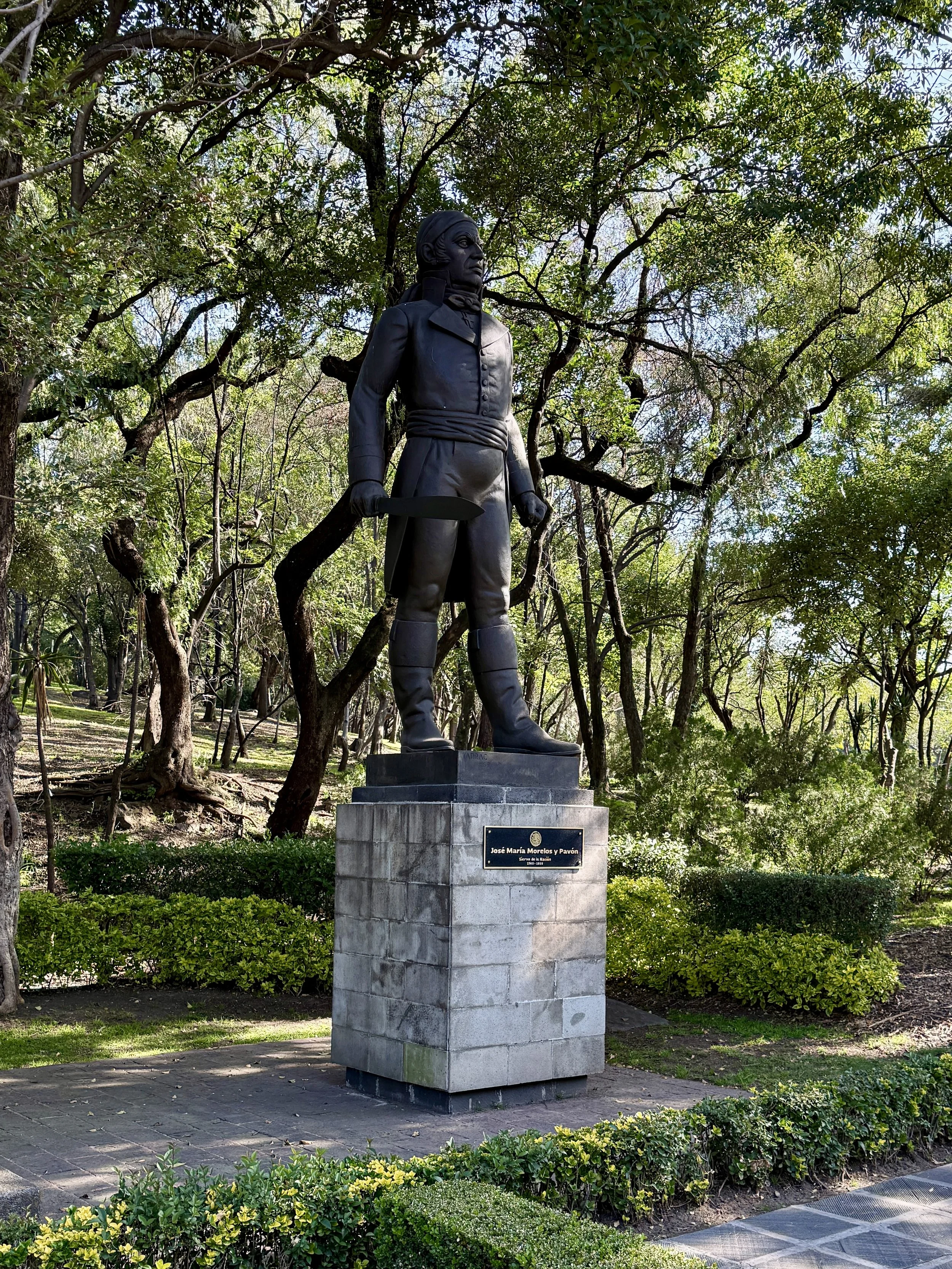
As we continued our ascent to the top, where the castle is located, we passed a bronze statue of José María Morelos y Pavón, created by Spanish sculptor Ángel Tarrach. Morelos, a Catholic priest and revolutionary leader during Mexico’s War of Independence, was ultimately captured by the Spanish army, tried by the Inquisition, and executed by firing squad for treason. Despite his fate, he’s remembered as a champion of the people — a brilliant military strategist and a tireless advocate for a more just society. 

A bronze statue of José María Morelos y Pavón on Chapultepec Hill

A bronze statue of José María Morelos y Pavón, a priest and revolutionary leader, by Ángel Tarrac

Since there’s nowhere to buy tickets at the top of the hill, it’s essential to get them online or at the guard house before making the climb. The security checkpoint at the base of the hill won’t ask for them, but the attendants at the castle gate will. If you forget, you’ll have to trek all the way back down — and trust me, that steep uphill climb is tough enough the first time, especially if you’re still acclimating to Mexico City’s altitude. After all, Chapultepec Castle is located at a height of 7,628 feet (2,325 meters) above sea level. 

Two structures stand atop the Hill of the Grasshopper: to the east, Chapultepec Castle — also known as the Alcázar (Royal Palace) — and to the west, the Museo Nacional de Historia (National Museum of History). Housed in the same building that once served as the military academy, the museum explores nearly 500 years of Mexico’s complex history that are displayed chronologically from the 15th to the 21st century. 

Fun fact: The castle exterior was used as the Capulet mansion in Baz Luhrmann’s Romeo + Juliet from 1996, starring Leonardo DiCaprio and Claire Danes. 

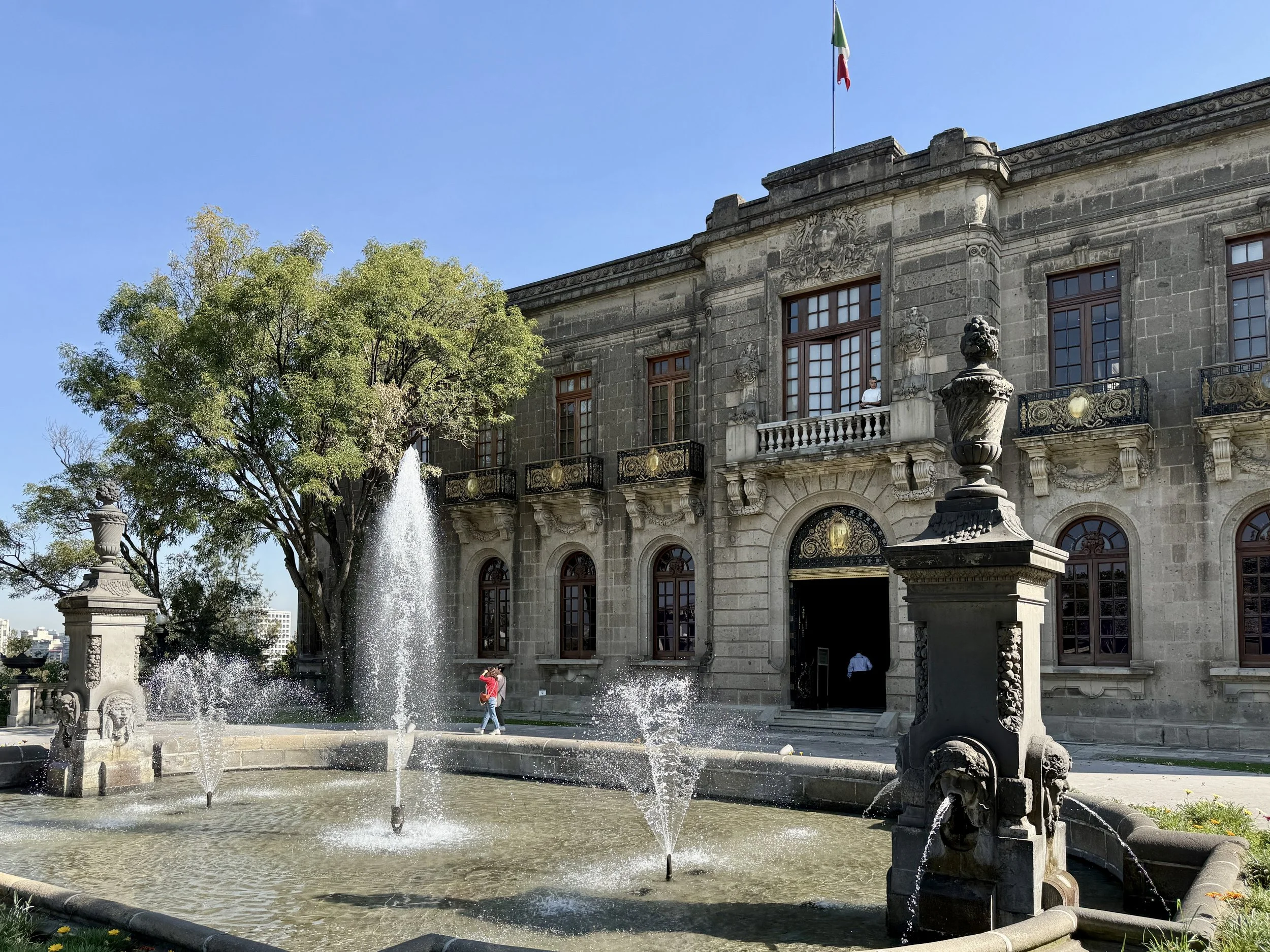
The façade of Chapultepec Castle that houses the National History Museum

The façade of the castle that houses the National History Museum

A Brief History of Chapultepec Castle

Construction of what would become the castillo began in 1785 during the Spanish colonial period. Originally intended as a retreat for Spanish officials, the project was closely associated with Bernardo de Gálvez, the viceroy of New Spain, who governed the territory on behalf of the Spanish crown from 1785 to 1786. 

Before his term as viceroy, Gálvez served as the governor of Spanish Louisiana, where he played a pivotal role in the American Revolution. He led military campaigns that supported General George Washington’s troops, capturing Pensacola, the capital of British West Florida, and effectively removing British influence from the region. His legacy lives on in the place names such as Galveston, Texas, and Galvez Street in New Orleans, Louisiana.

Unfortunately, Gálvez’s service was brief. Before  he could complete the project, he died from yellow fever — known in Mexico as vomito negro because internal bleeding turned the victim’s vomit black. The estate went unfinished. By 1806, the municipal government had taken ownership of the structures, and in 1833, they were converted into the Colegio Militar, a military academy that trained young officers for the Mexican Army.

Today, the grounds are remembered as the site of the Battle of Chapultepec, a pivotal conflict of the Mexican-American War fought on September 12 and 13, 1847. The U.S. was victorious, capturing Chapultepec Castle and paving the way for the fall of Mexico City. 

It was here that six young cadets, ages 13 to 19 — known as Los Niños Héroes (The Boy Heroes) — lost their lives defending the military academy against American forces in one of the war’s final battles.

The war officially ended in 1848 with the Treaty of Guadalupe Hidalgo, a humiliating agreement that forced Mexico to cede over half its territory to the United States. 

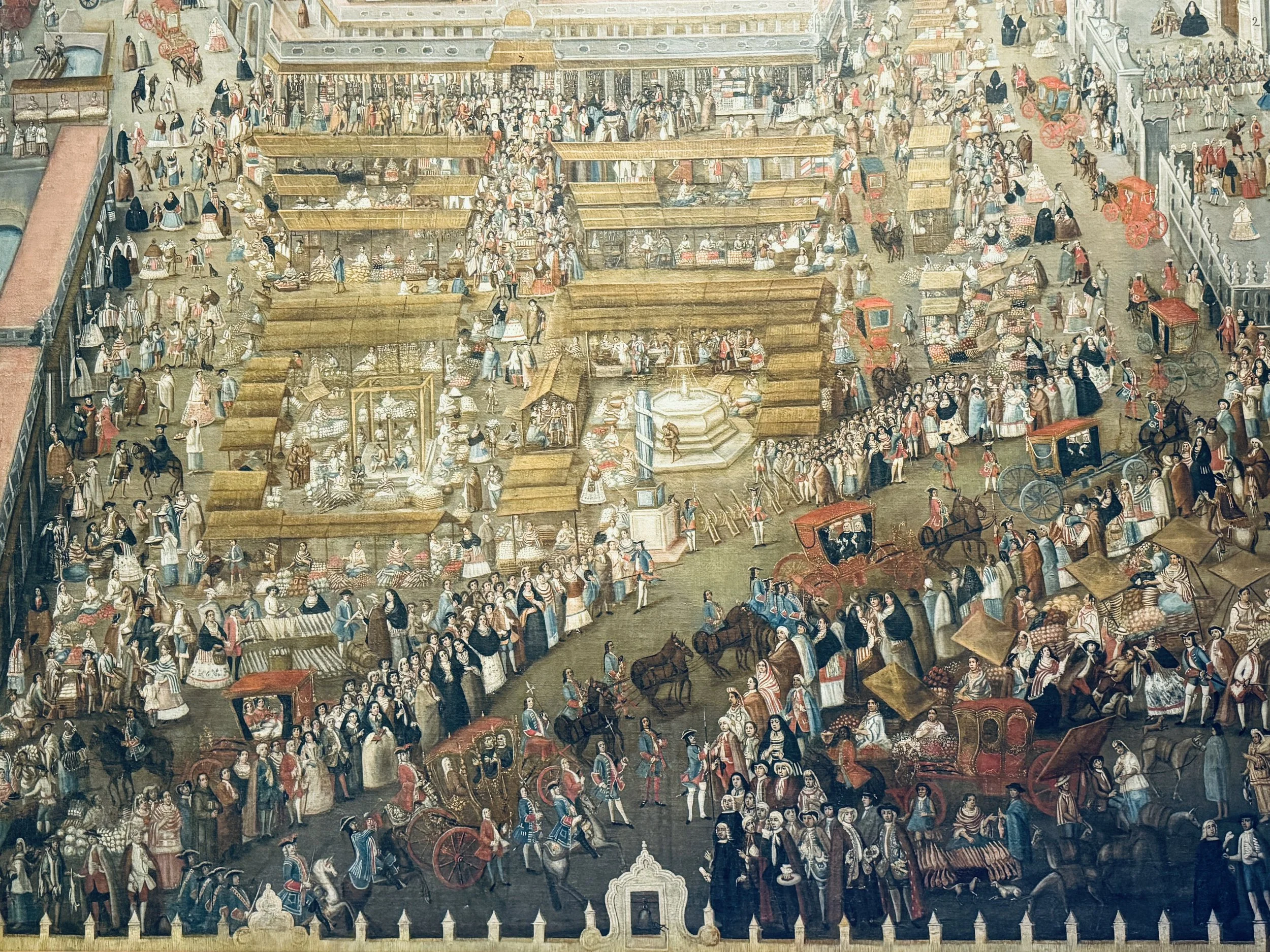
Vista de la Plaza Mayor de la Ciudad de México (View of the Zócalo of Mexico City) by Cristóbal de Villapando, 1695

Vista de la Plaza Mayor de la Ciudad de México (View of the Zócalo of Mexico City) by Cristóbal de Villapando, 1695

Exploring the National History Museum 

As Wally and I stepped through the entrance of the museum, we were awestruck by the double staircase that rose before us. Covering the domed ceiling high above is La Intervención Norteamericana (The North American Intervention), a mural by Gabriel Flores. It depicts Juan Escutia, one of the six Niños Héroes who died defending the academy from invading U.S. forces. According to legend, Escutia leapt to his death from the academy, plunging over the steep rock face of the Hill of the Grasshopper, wrapped in the Mexican flag to prevent it and himself from falling into enemy hands.

The front staircase features the mural Alegoría de la Revolución (Allegory of the Revolution) by Eduardo Solares from 1934

The front staircase features the mural Alegoría de la Revolución (Allegory of the Revolution) by Eduardo Solares from 1934.

There’s another large-scale mural on the staircase, Alegoría de la Revolución (Allegory of the Revolution) painted by Eduardo Solares. This powerful piece depicts a moment from the revolution that overthrew the dictatorial regime of Porfirio Díaz. 

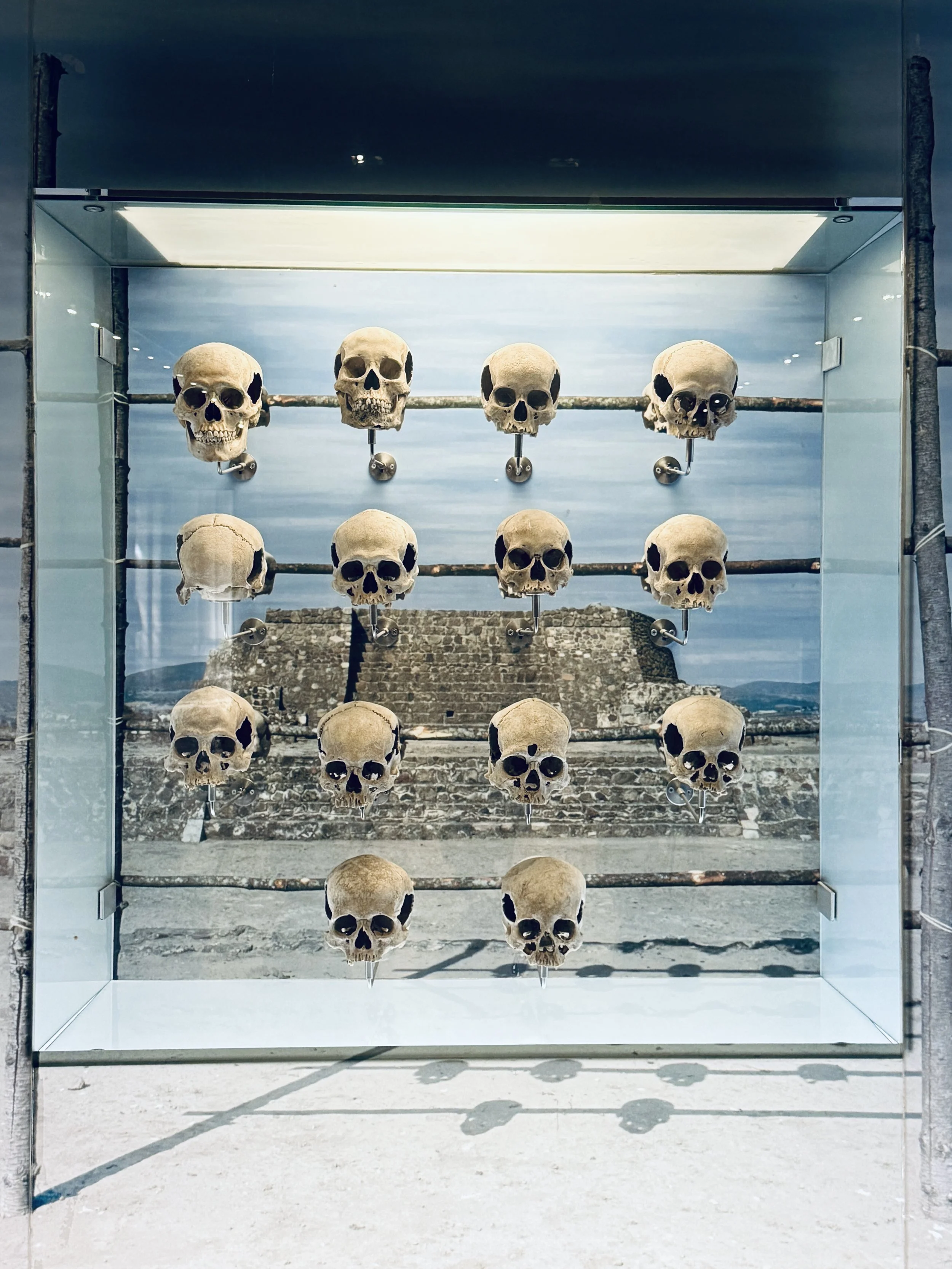
tzompantli — a rack used by the Aztecs to display the skewered skulls of human sacrifices and prisoners of war at the history museum at Chapultepec Castle

Cute décor idea: a tzompantli — a rack used by the Aztecs to display the skewered skulls of human sacrifices and prisoners of war

The Conquest of the Americas

We passed display cases featuring armor worn by the conquistadors and their horses, along with a small 16th century wooden sculpture of the Virgin of Valvanera. According to legend, this likeness is a “true portrait” of the Virgin Mary, carved by Saint Luke and brought to Spain by the disciples of Saint Peter.

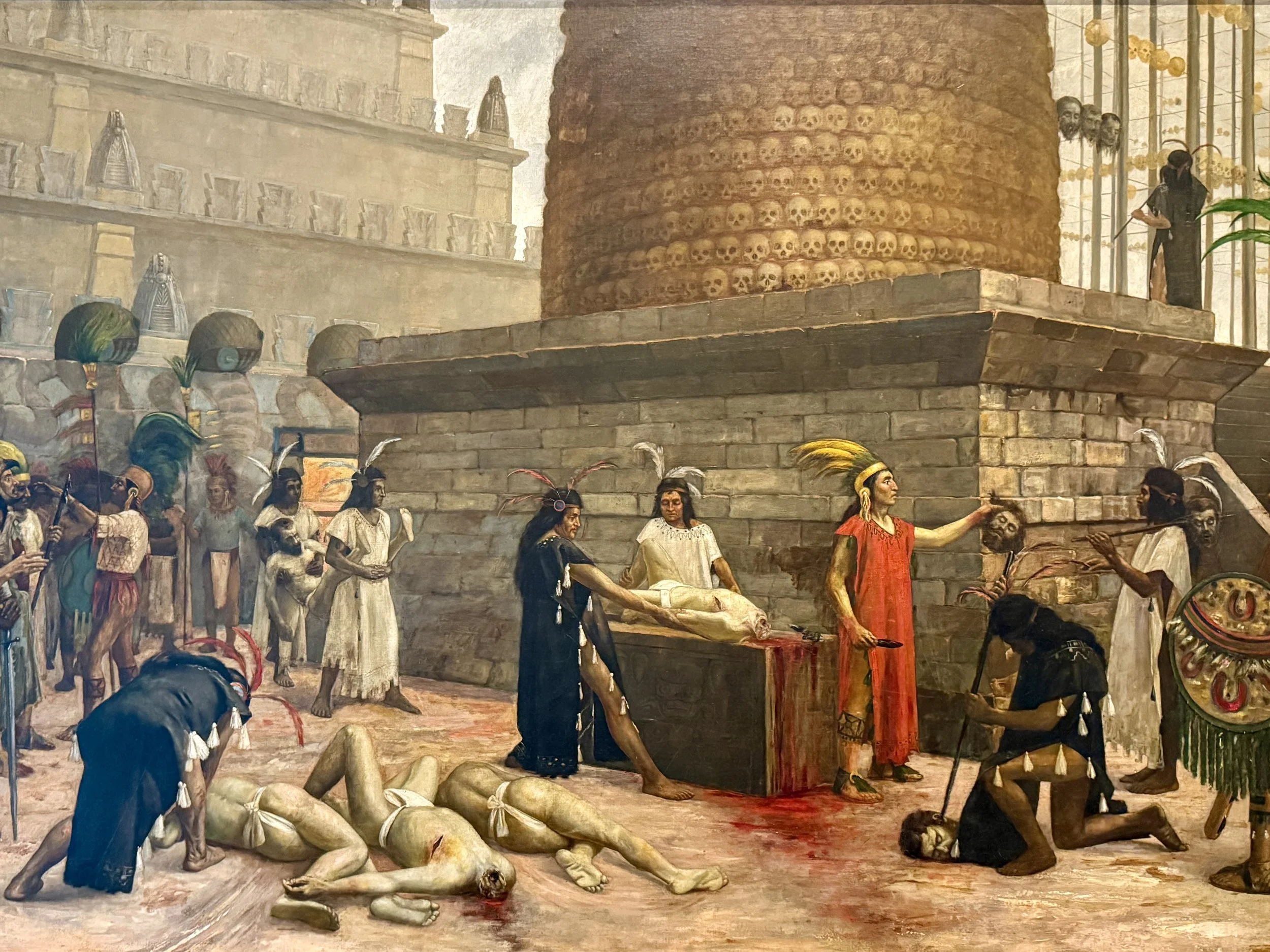
Sacrificio de Españoles por Mexicas (Sacrifice of Spaniards by Mexicas) by Adrian Unzeta, 1898

Sacrificio de Españoles por Mexicas (Sacrifice of Spaniards by Mexicas) by Adrian Unzeta, 1898

While these were fascinating, the installation that stopped us in our tracks was a tzompantli — a rack used by the Aztecs to display the skewered skulls of human sacrifices and prisoners of war. Discovered in 1994 at Tecoaque, an archaeological site in central Mexico whose name translates to “the Place Where They Ate Them” in Nahuatl, this tzompantli is believed to have been built by the Acolhua, allies of the Aztecs. It held the skulls of a defeated Spanish-led convoy captured in 1520 — comprising conquistadors and their indigenous allies, who were ritually sacrificed and quite possibly eaten. 

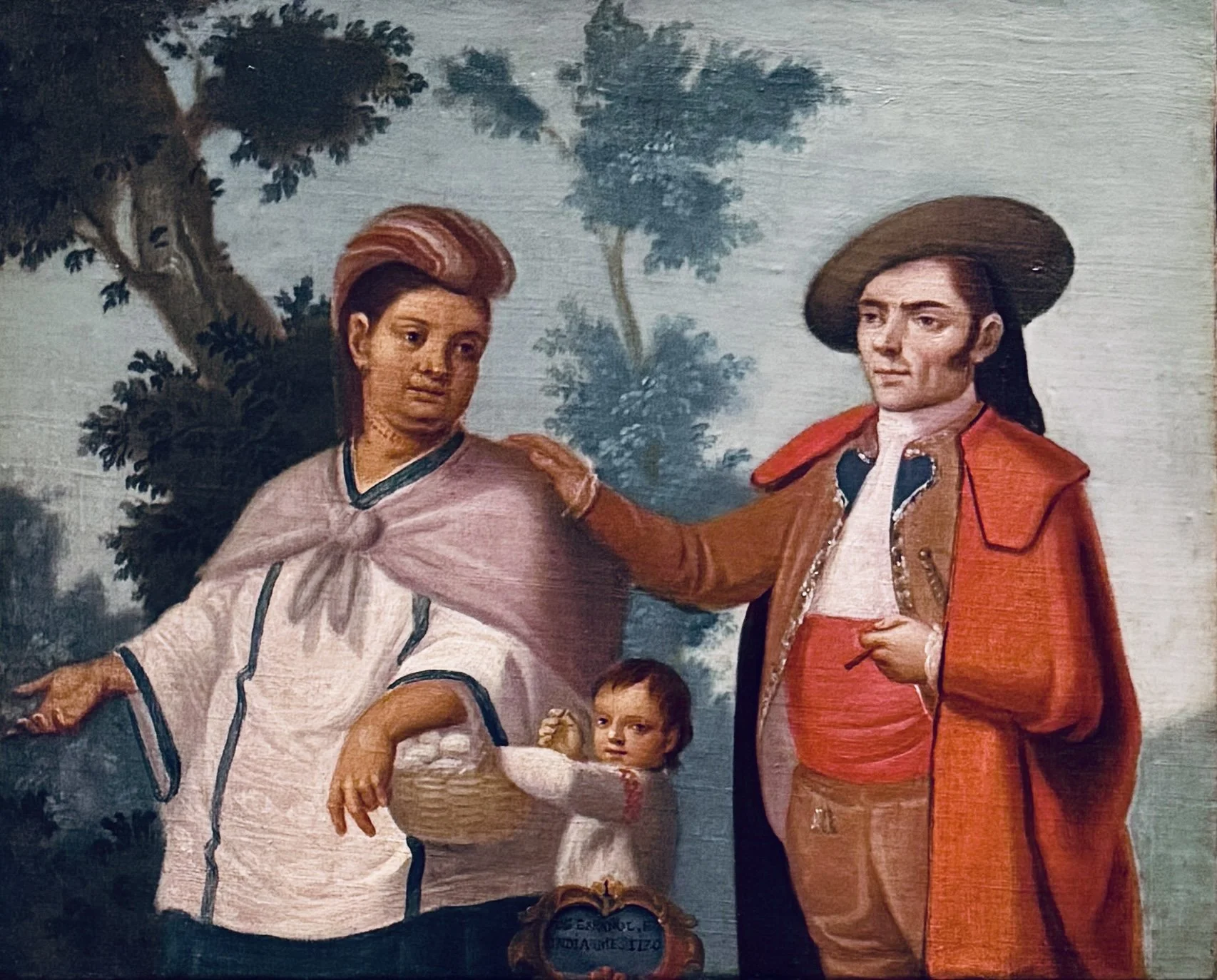
#1 De Español y Indio, Mestizo o Cholo (From Spaniard and Indian, Mestizo or Cholo), depicting the highest-class of the caste hierarchy imposed by the Spanish colonists in Mexico

This image, #1 De Español y Indio, Mestizo o Cholo (From Spaniard and Indian, Mestizo or Cholo), depicts the highest-class of the caste hierarchy imposed by the Spanish colonists.

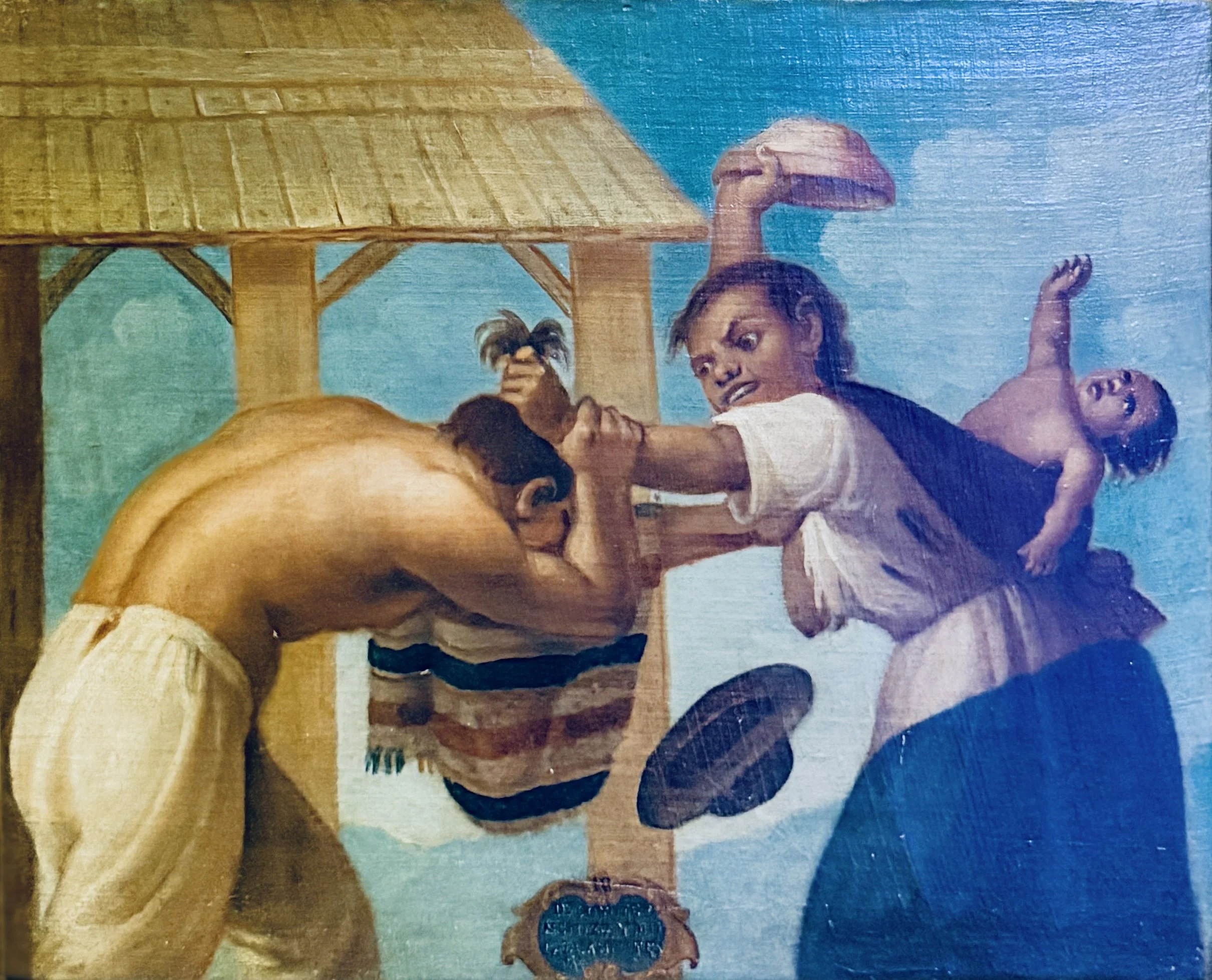
#16 De Coyote, Mestizo y Mulata: Ahí te estás (From Coyote, Mestizo and Mulatto: There you are)

The depiction of the lowest caste in #16 De Coyote, Mestizo y Mulata: Ahí te estás (From Coyote, Mestizo and Mulatto: There You Are) reflects the prejudices of the Spanish invaders.

The Pecking Order of New Spain

In a nearby room, a series of 18th century casta (caste) paintings hung on the wall. 

These 16 scenes depicted the colonial social hierarchy of New Spain, a system imposed by the Spanish government to classify individuals based on ancestry and racial mixing. At the top were Spaniards, both those born in Spain (peninsulares) and those born in the Americas (criollos). Below them were mestizos, people of mixed Spanish and indigenous heritage, and other mixed-race groups, followed by indigenous people and those of African descent. Though rigid in theory, this system allowed some social mobility through wealth,  marriage or official status changes. 

The massive Retablo de la Independencia (Independence Altarpiece) by Juan O’Gorman at the National History Museum at Chapultepec Castle

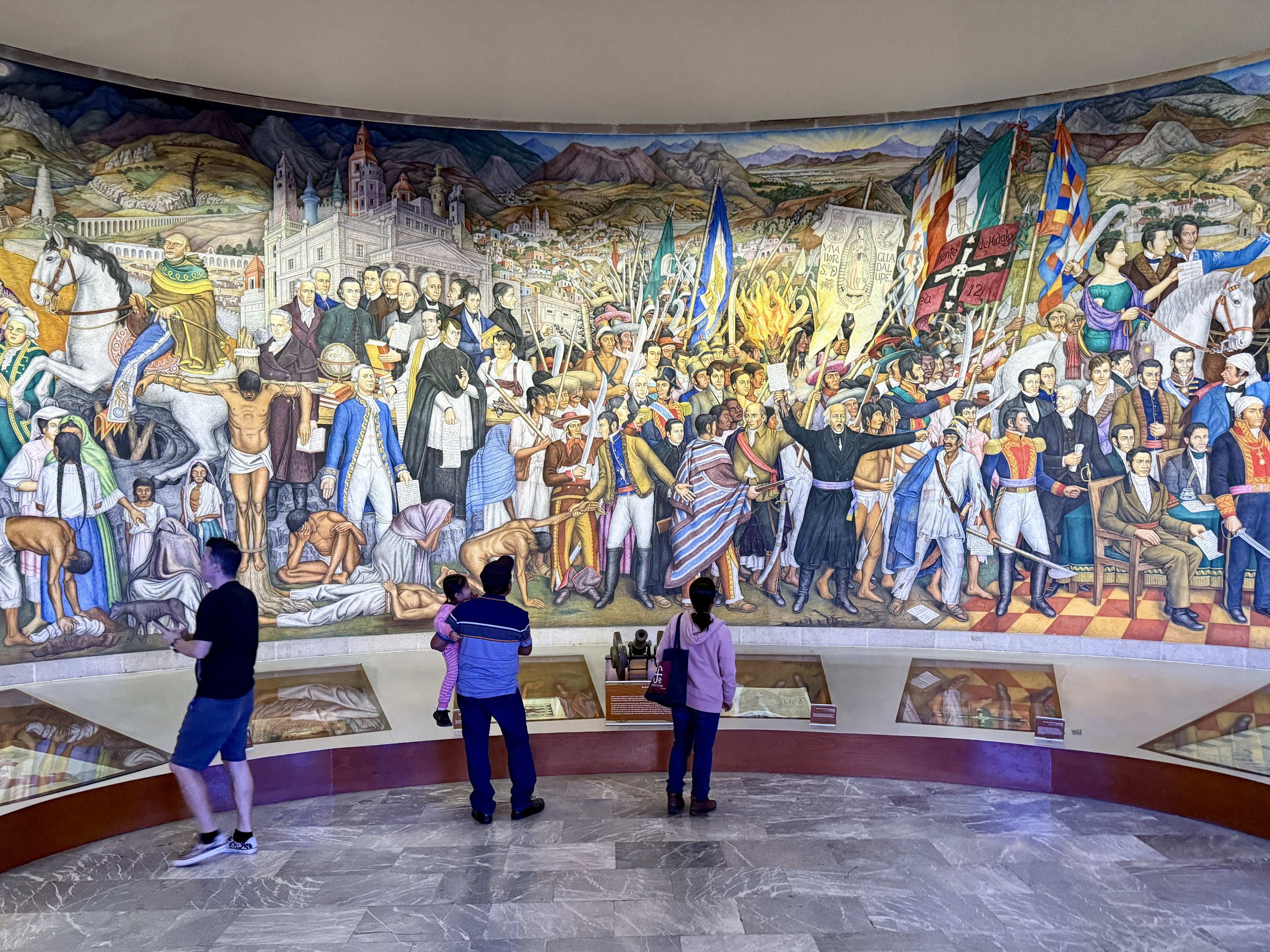
Juan O'Gorman was invited by Antonio Arriaga Ochoa, the director of the National Museum of History, to complete the project that had initially been commissioned by his friend, Diego Rivera, who had died three years earlier in 1957.

The STRUGGLE WAS REAL: MEXICO’S WAR of INDEPENDENCE

The Salón de Independencia (Hall of Independence) features the Retablo de la Independencia (Independence Altarpiece), a monumental mural painted by architect and muralist Juan O’Gorman between 1960 and 1961.  

The mural is divided into four sections, each representing a different stage of the Mexican independence movement. At the center stands the white-haired figure of Miguel Hidalgo y Costilla, dressed in clerical robes and brandishing a torch in his left hand. During Mexico's fight for independence, he took a banner depicting the Virgin of Guadalupe from the Sanctuary of Jesús Nazareno de Atotonilco, using it as the flag for his insurgent army. Look for the flag in the case below the mural. Hidalgo’s call to arms, known as the Grito de Dolores (Cry of Dolores), ignited the fight against Spanish colonial rule.

Nearby, José María Morelos is depicted gripping a sword, with a white bandana tied around his head. Morelos was a key leader in the movement, organizing insurgent forces to abolish slavery and the casta system.

Among other figures, Josefa Ortiz de Domínguez appears wearing a green dress and a purple rebozo (shawl), seated on a white horse and surrounded by indigenous victims of exploitation, hunger and death.


The western terrace, or Patio de Juan de la Barrera, was named in honor of one of the young Mexican cadets who died during the Battle of Chapultepec fighting in the Mexican-American War.

Pergola Terrace, or Patio de Juan Barradas

Wally and I stepped out of the building and into the sunlight-drenched western terrace. A gurgling fountain stood before us and an expansive pergola stretched out to the right, offering shade and views of the park’s artificial lake and city beyond. 

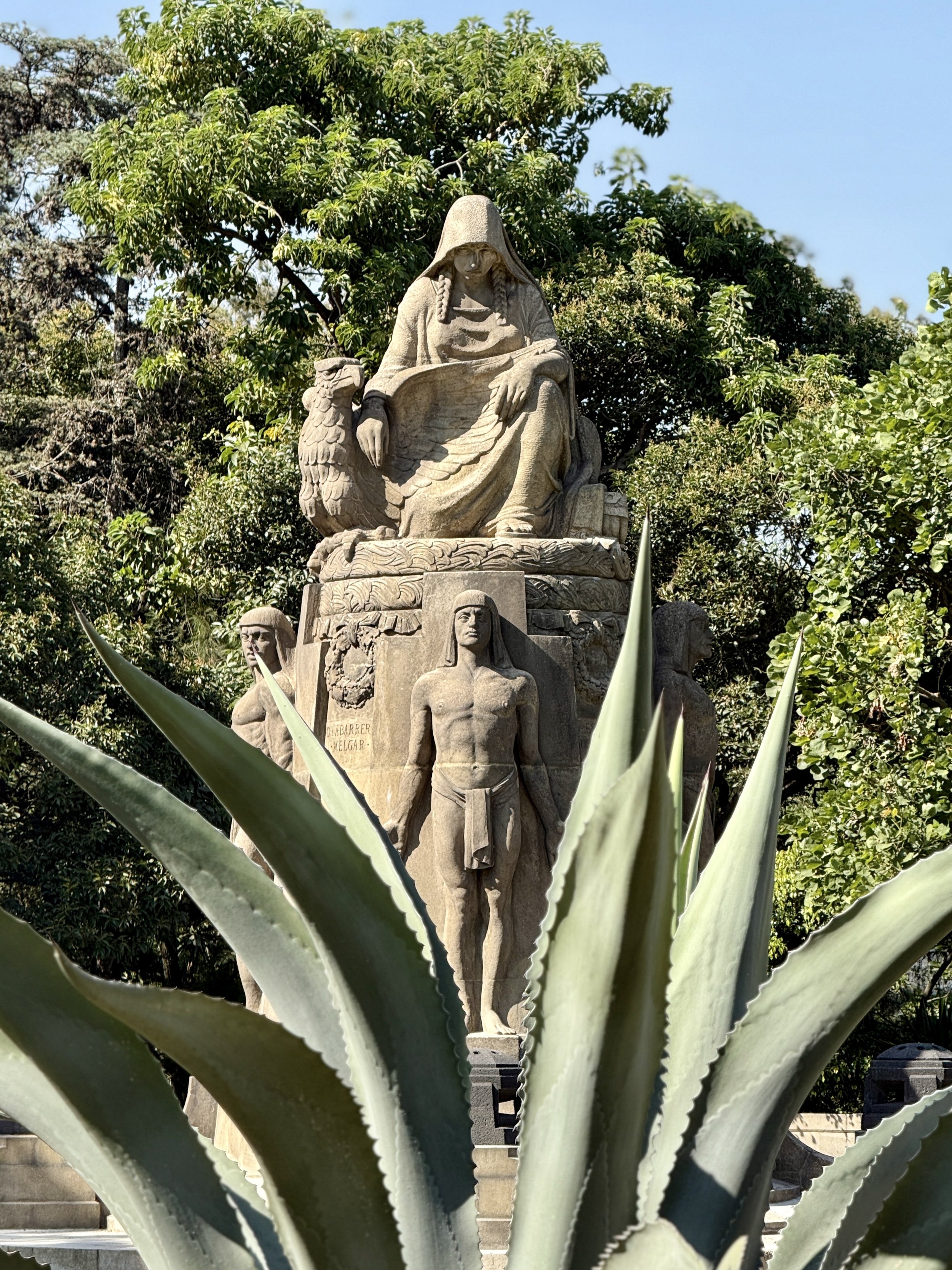
At the back of the garden stands La Madre Patria, Agradecida a sus Hijos Caídos (The Motherland, Grateful to Its Fallen Children), a classical monument commemorating the Niños Héroes. Designed by architect Luis MacGregor Cevallos and sculpted by French-trained Mexican artist Ignacio Asúnsolo, it was inaugurated in 1924.

A giant agave plant in front of the statue La Madre Patria, Agradecida a sus Hijos Caídos (The Motherland, Grateful to Its Fallen Children) behind Chapultepec Castle

Asúnsolo finished the monument to the Niños Héroes in a mere three months, fulfilling President Álvaro Obregón’s request to have it completed and inaugurated before the end of his term.

The top of the pylon-shaped memorial features a solemn veiled matron, an eagle at her side, its wings spread protectively. Encircling them is a coiled, feathered serpent, a creature from pre-Hispanic mythology that symbolizes the deity Questzacoatl and reflects the national coat of arms. Below, four muscular figures of young native warriors clad in loincloths represent a different aspect of sacrifice and struggle, each facing a different direction: Supreme Sacrifice (east), Desperation in Defense (north), Unequal Fight (south) and The Epic (west).

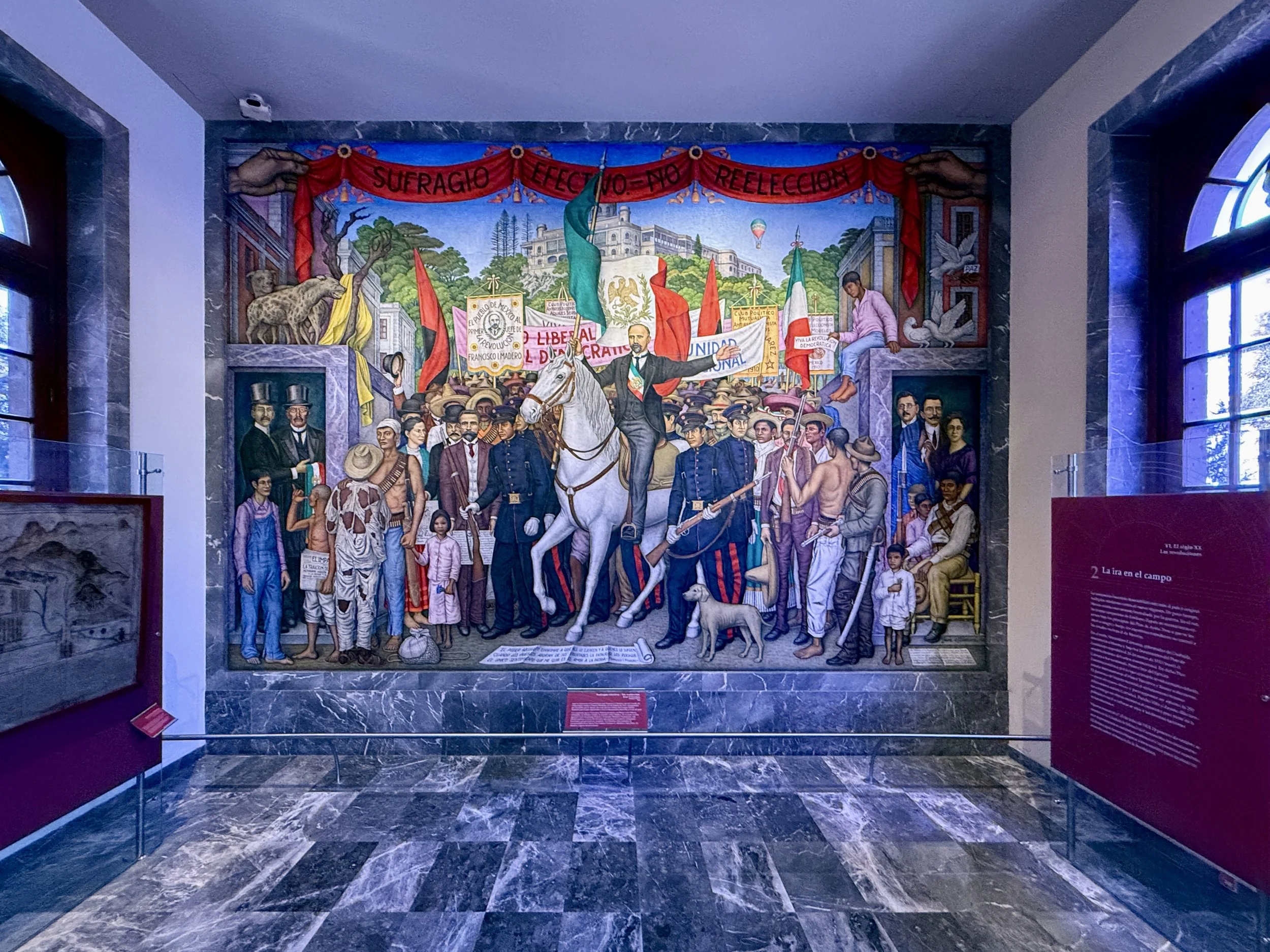
A scene from Retablo de la Revolución (Sufragio Efectivo no Reelección) by Juan O’Gorman at Chapultepec Castle

The mural Sufragio efectivo, no reelección (Effective Suffrage, No Reelection) by Juan O’Gorman is named for the rallying cry of President Francisco I. Madero against the long dictatorship of Porfirio Díaz.

Fall of the Feudal Empire

When we stepped back inside from the terrace, we entered a room to the right, where a series of murals by Juan O’Gorman covered the walls. These paintings depict a turbulent chapter in Mexico’s history — the fall of the Porfirian dictatorship and the revolution that followed.

(Incidentally, O’Gorman wasn’t just a painter — he was also an architect. He designed strikingly modern homes for Frida and Diego, which pissed off the neighbors.)

One of the most striking murals, Sufragio efectivo, no reelección (Effective Suffrage, No Reelection), dominates one of the walls. Part of O’Gorman’s Retablo de la Revolución (Altarpiece of the Revolution), it captures a pivotal moment in the Mexican Revolution: the Marcha de Lealtad (March of Loyalty). At the center, Francisco Madero rides on horseback, wearing the presidential sash across his chest. The mural portrays his journey from Chapultepec Castle to the National Palace on the morning of February 9, 1913, escorted by students of the Military College. This march would mark the beginning of the Decena Trágica (Ten Tragic Days), a coup that would ultimately cost Madero his life.

Madero had risen to power in the wake of the Mexican Revolution, which erupted in 1910 against the long rule of President Porfirio Díaz. Although Díaz modernized Mexico and maintained a period of stability known as the “Pax Porfiriana,” his policies overwhelmingly favored the wealthy and foreign investors while leaving much of the population — especially indigenous communities — trapped in near-servitude. His ousting paved the way for Madero’s election as president, ushering in hopes of democracy and social justice.

But Madero’s time in power was short-lived.

The Decena Trágica was a violent siege that led to his downfall. What began as an armed revolt quickly turned into a bloody standoff in Mexico City, with intense fighting around the National Palace and the Ciudadela armory. In a devastating betrayal, Madero’s own army chief, Victoriano Huerta, turned against him. Forced to resign on February 18, 1913, Madero and Vice President José María Pino Suárez were executed just days later, on February 22, under Huerta’s orders. Their deaths threw Mexico into further chaos, deepening the revolution that would reshape the nation.

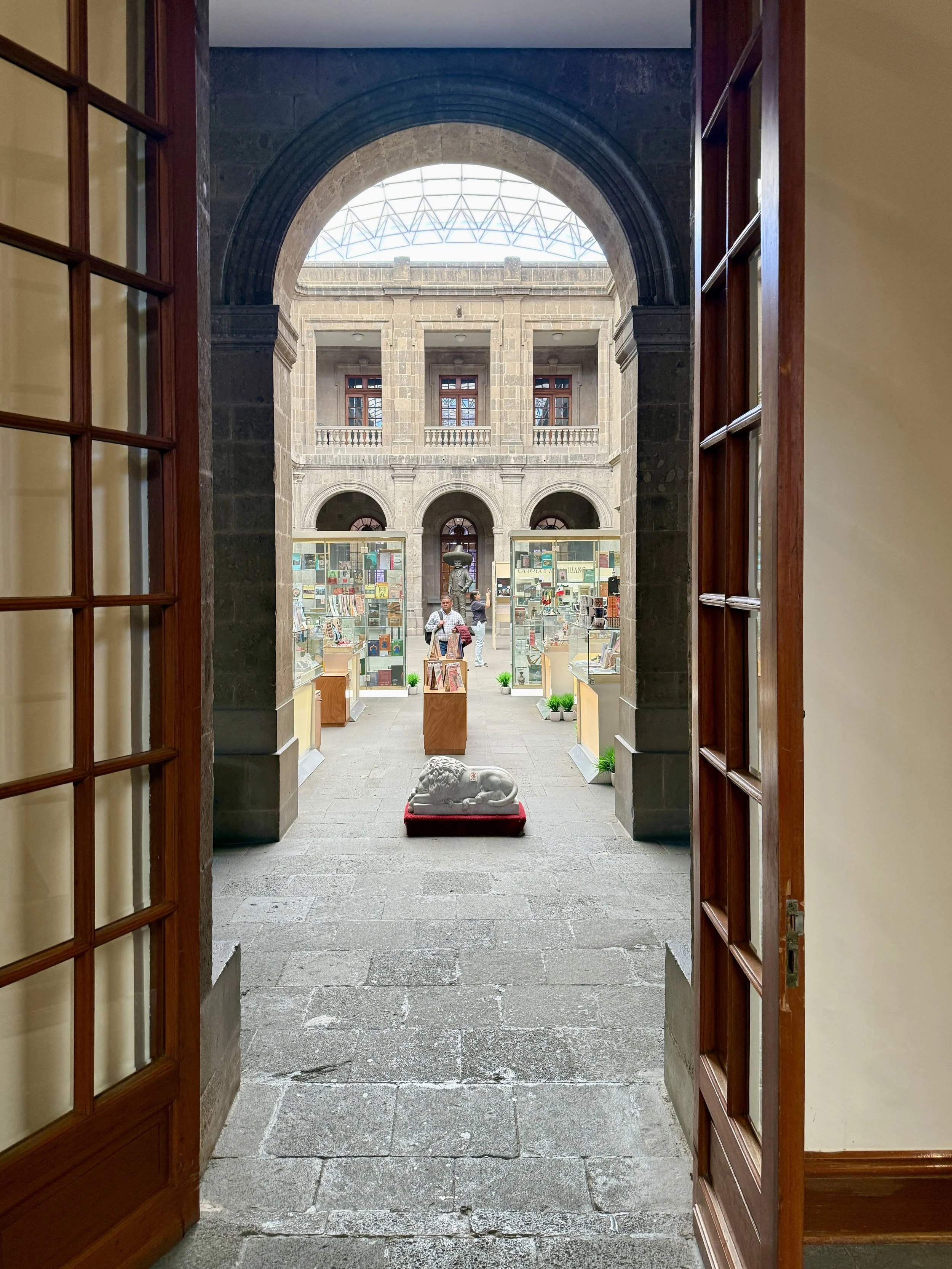
Looking into the gift shop in a central courtyard at Chapultepec Castle

Looking into the gift shop in a central courtyard of this wing of the castle

Cannonball Run to the Gift Shop

The museum shop is located on the ground floor at the center of the Patio de Cañones (Patio of Cannons), so named for the cannons that can be found in the courtyard of the museum. The space is anchored by a sculpture by David Camorlinga dedicated to Emiliano Zapata, a key figure in the Mexican Revolution, known for championing land reform and peasant rights under the rallying cry, “Tierra y Libertad” (Land and Liberty).

The statue Zapata, 100 Años, by David Camorlinga, at the entrance to the Patio of Cannons

The somewhat cartoonish bronze statue of revolutionary leader Emilano Zapata by David Camorlinga can be found in the Courtyard of Canons near the gift shop. The artwork captures Zapata’s defining features, including his iconic walrus mustache and broad-brimmed charro hat.

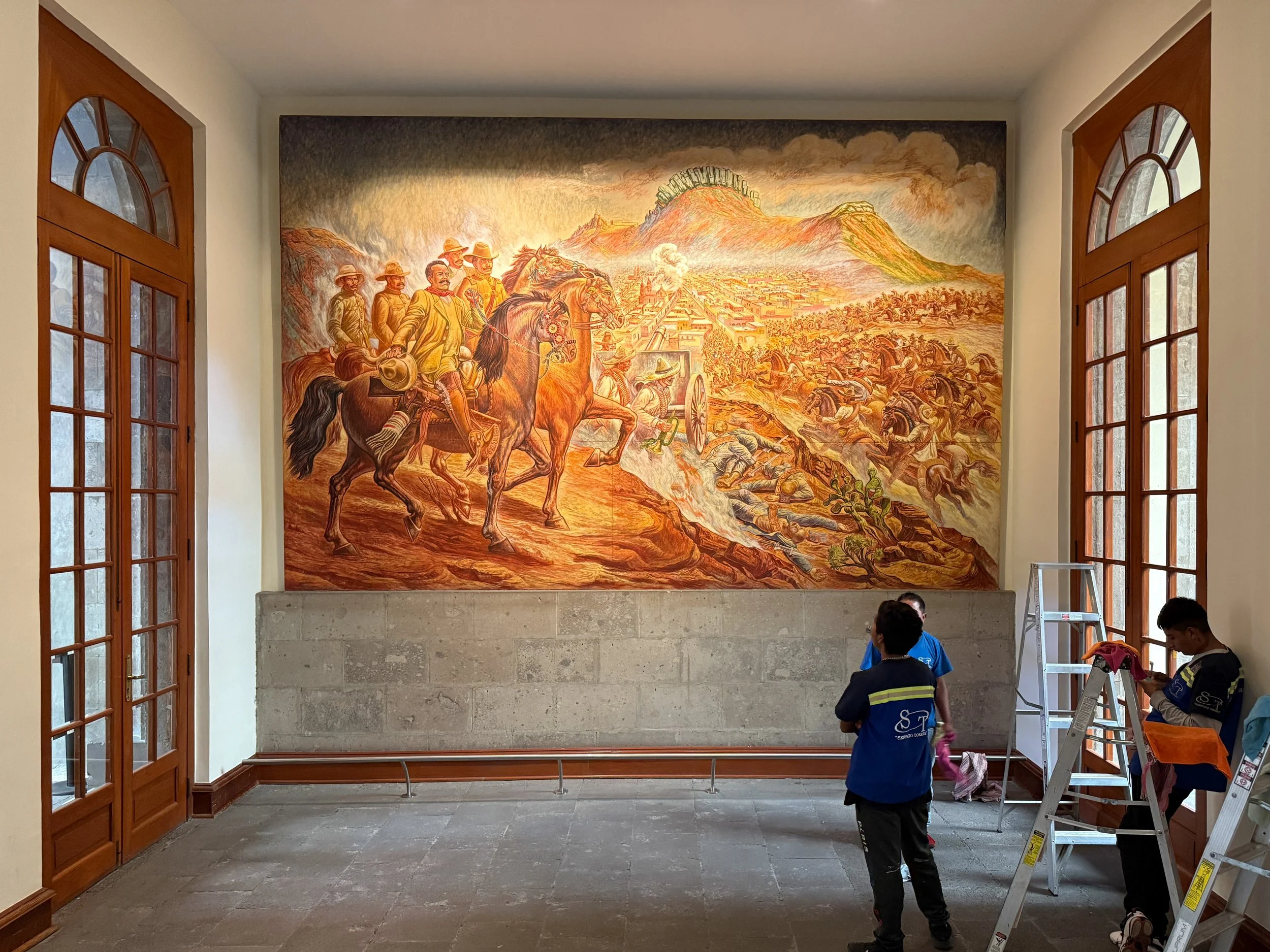
Three men work on renovating the mural Batalla de Zacatecas (Battle of Zacatecas) by Ángel Bolivar from 1965

When we visited, a team was renovating the mural Batalla de Zacatecas (Battle of Zacatecas) by Ángel Bolivar from 1965. 

During our visit, the whimsical and informative temporary exhibit Juárez/Max, Reflejo de dos vidas (Reflection of Two Lives) featured dioramas that told the story of the second Mexican empire, as well as the arrival and establishment of the republic, complete with cute felt Day of the Dead-style dollies of President Benito Juárez, First Lady Margarita Maza, Maximilian von Habsburg, and his wife Princess Charlotte of Belgium.  

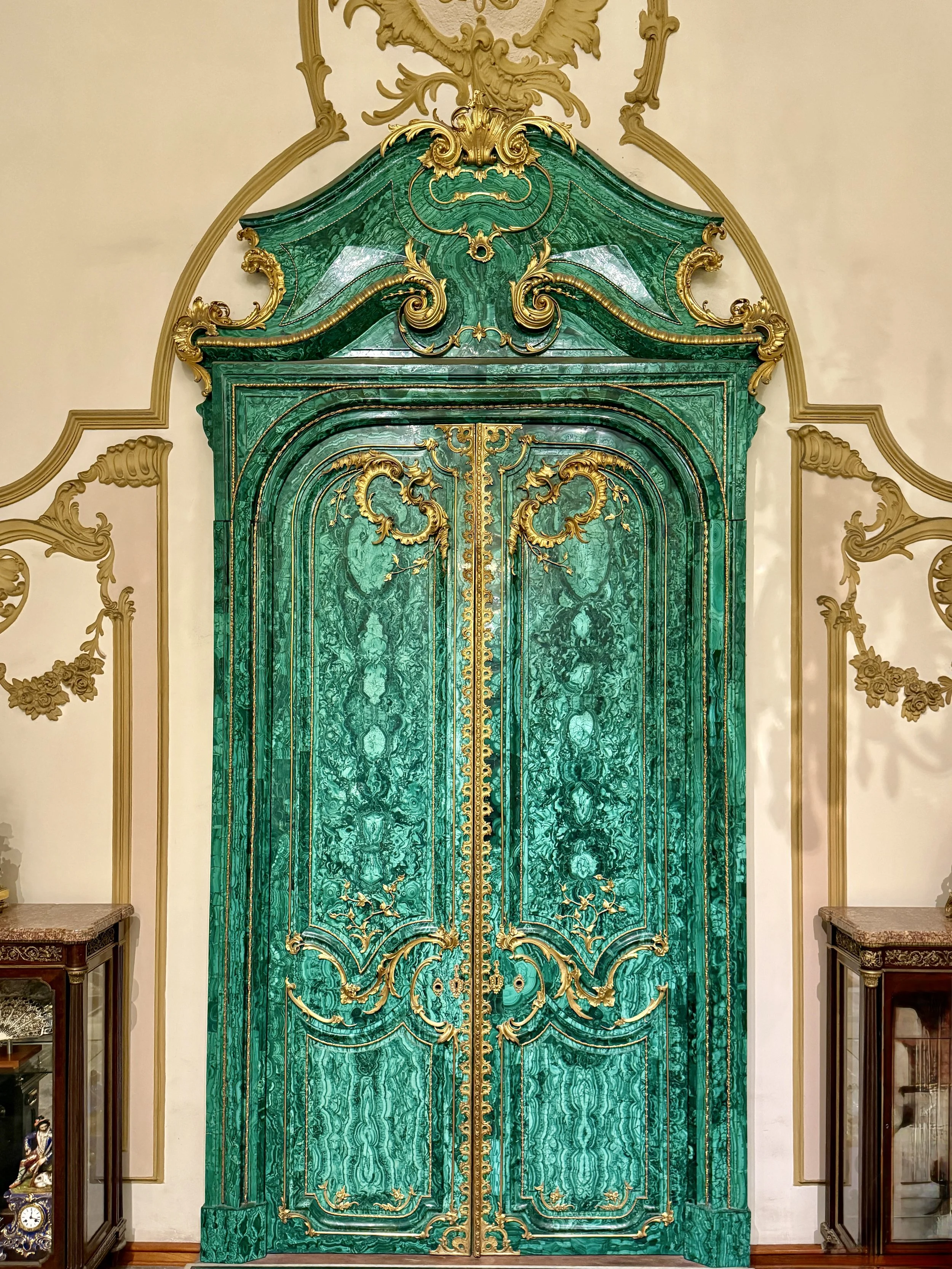
An ornate green door in the Salón de Malaquitas at Chapultepec Castle in CDMX

An ornate door in the Salón de Malaquitas

Green With Envy: Salón de Malaquitas 

This richly decorated room takes its name from its impressive malaquita (malachite) and gilt metal doors, fountains and vases. They’re actually composed of carefully fitted slivers of malachite that combine to create the illusion of a seamless surface. 

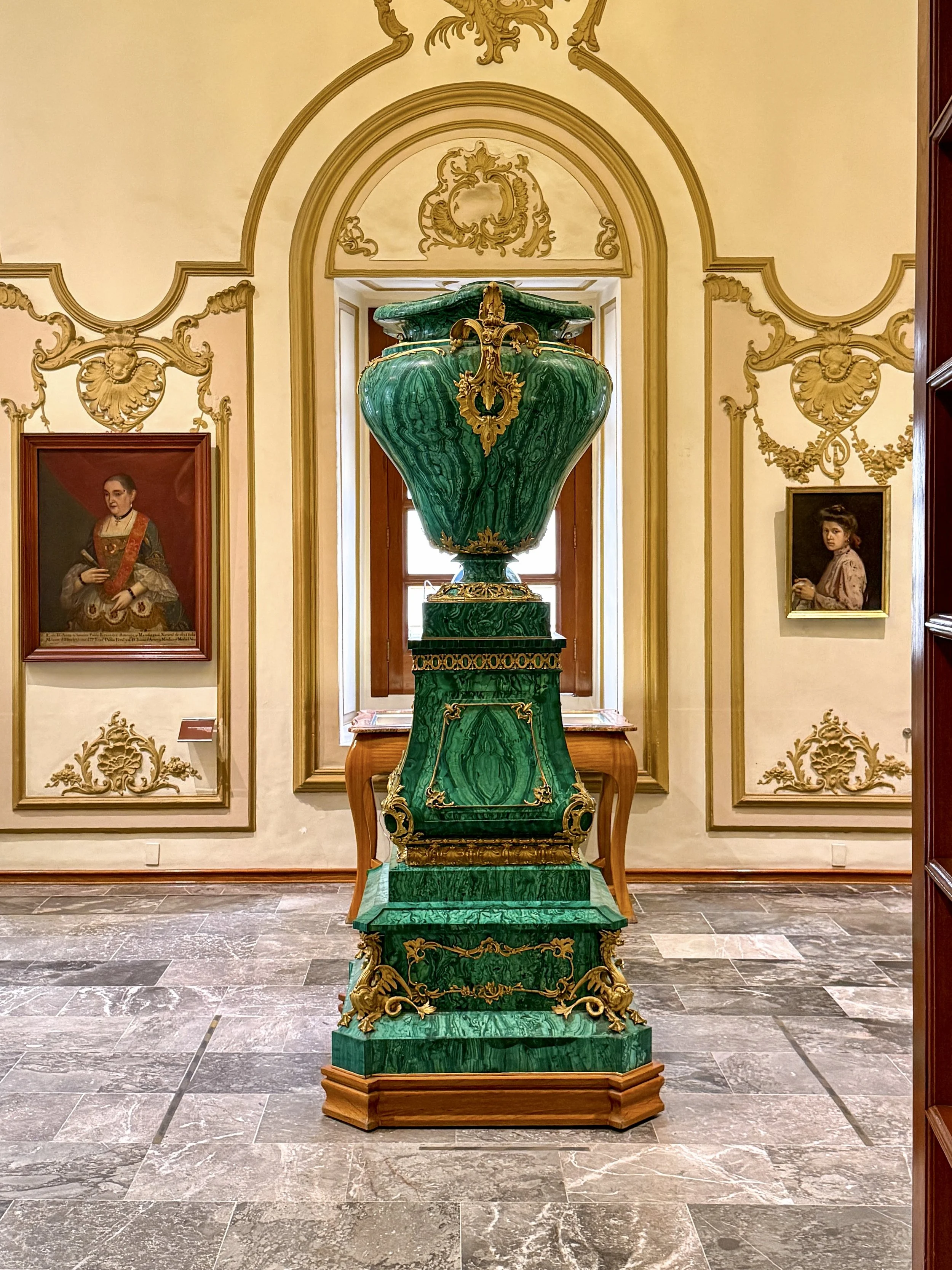
Green malachite urn on a large pedestal by ornate wall decor and paintings in Salon de Malaquitas at Chapultepec Castle

The malachite objets d’art came from Russia, purchased by Díaz from a collection shown at the first World’s Fair in 1851.

These pieces were fabricated at the Imperial Peterhof Lapidary Factory and sent by Tsar Nicholas I to showcase the artistic achievements of Russia at the first World’s Fair in London in 1851. Later, they were purchased by Díaz for the Palacio Nacional before ultimately being installed here. The vibrant green color, with their undulating bands of contrasting hues, come from naturally occurring copper carbonate deposits.

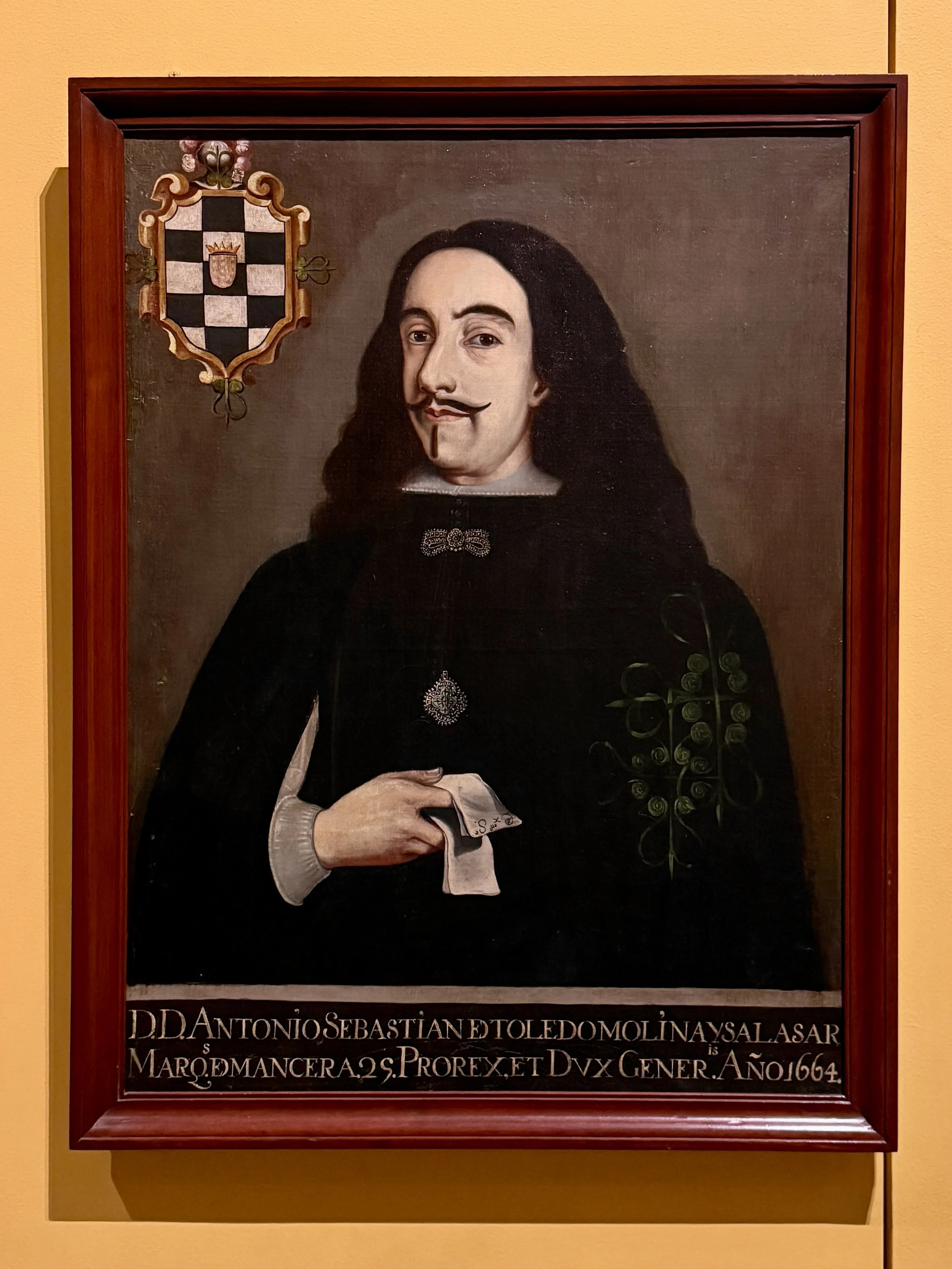
Portrait of Antonio Sebastián Álvarez de Toledo y Salazar in the Salón de Virreyes at Chapultepec Castle

The Salón de Virreyes at Chapultepec Castle displays portraits of all 62 viceroys of New Spain. Among them is Antonio Sebastián Álvarez de Toledo y Salazar, the 18th viceroy, who served from 1664 to 1673.

Salón de Virreyes, the Hall of the Viceroys

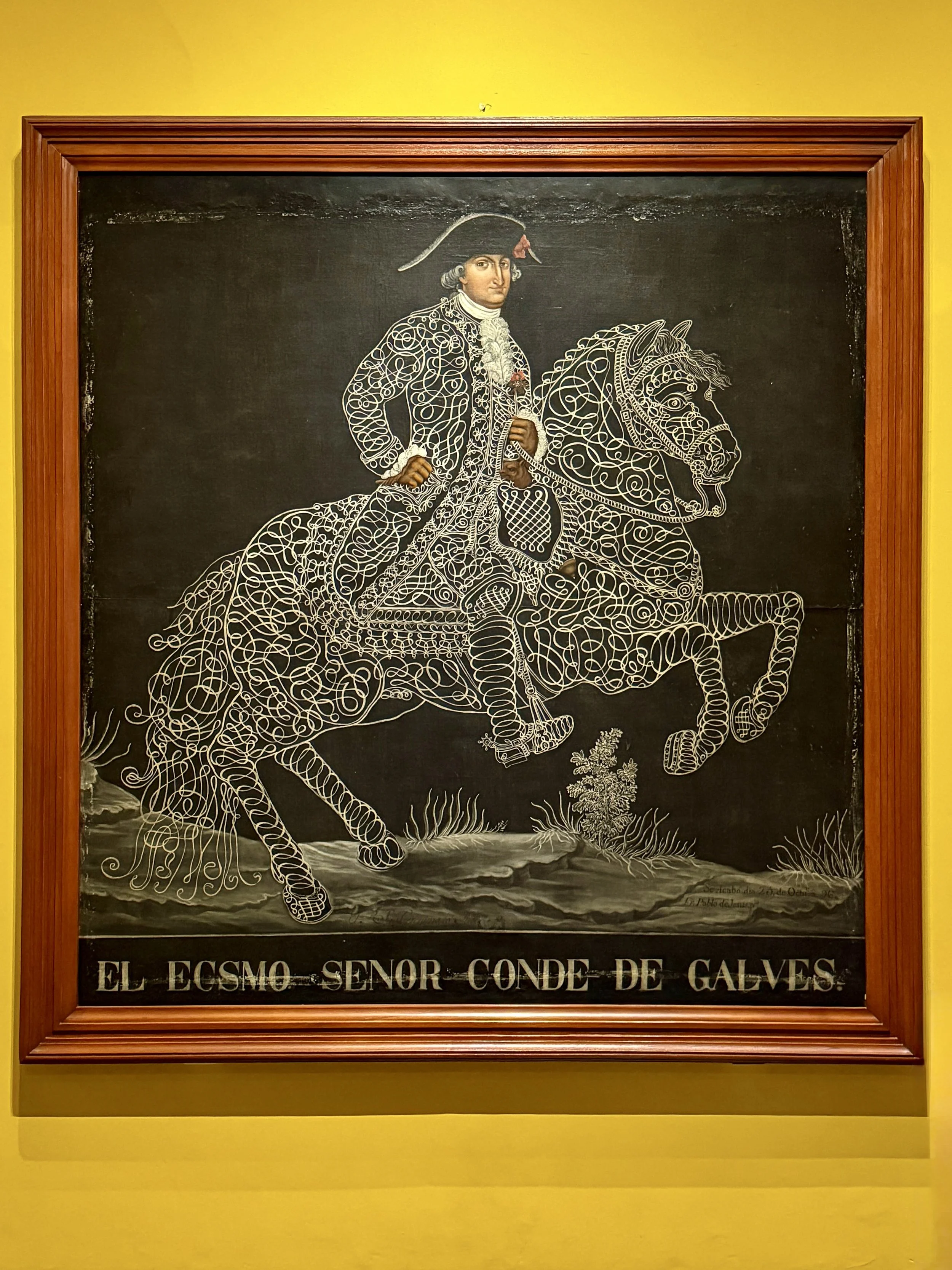
Rounding out the museum is the Salón de Virreyes (Hall of the Viceroys), a gallery showcasing every viceroy who ruled New Spain from 1535 to 1821. It’s fascinating to see how attire and hairstyles evolved over the centuries — but the portrait that stood out most to me was of Bernardo de Gálvez, who governed from 1785 until his early death in November the next year. Created in 1796 by two friars using the sgraffito technique — derived from the Italian graffiare, meaning “to scratch” — this piece feels strikingly modern. While Gálvez’s face, hands and hat are painted, his uniform and prancing horse emerge from an intricate web of white spirals, loops and squiggly lines revealed by the “scratching” or removal of the top layer of paint. 

The surprisingly modern equestrian portrait of Bernardo de Gálvez, the 49th Viceroy of New Spain, was painted in 1796 by two friars: Jerónimo and Pablo de Jesús. 

This room was a fitting close to the National Museum of History as the castle’s buildings sprang forth from viceroyalty and evolved into a spectacular showcase of Mexico City’s past.

With the museum’s murals, artifacts and revolutionary history behind us, we stepped out into the sunlight once more. But Chapultepec Castle wasn’t done with us yet — next, it was on to the imperial side, where Maximilian and Charlotte once reigned in opulence. –Duke

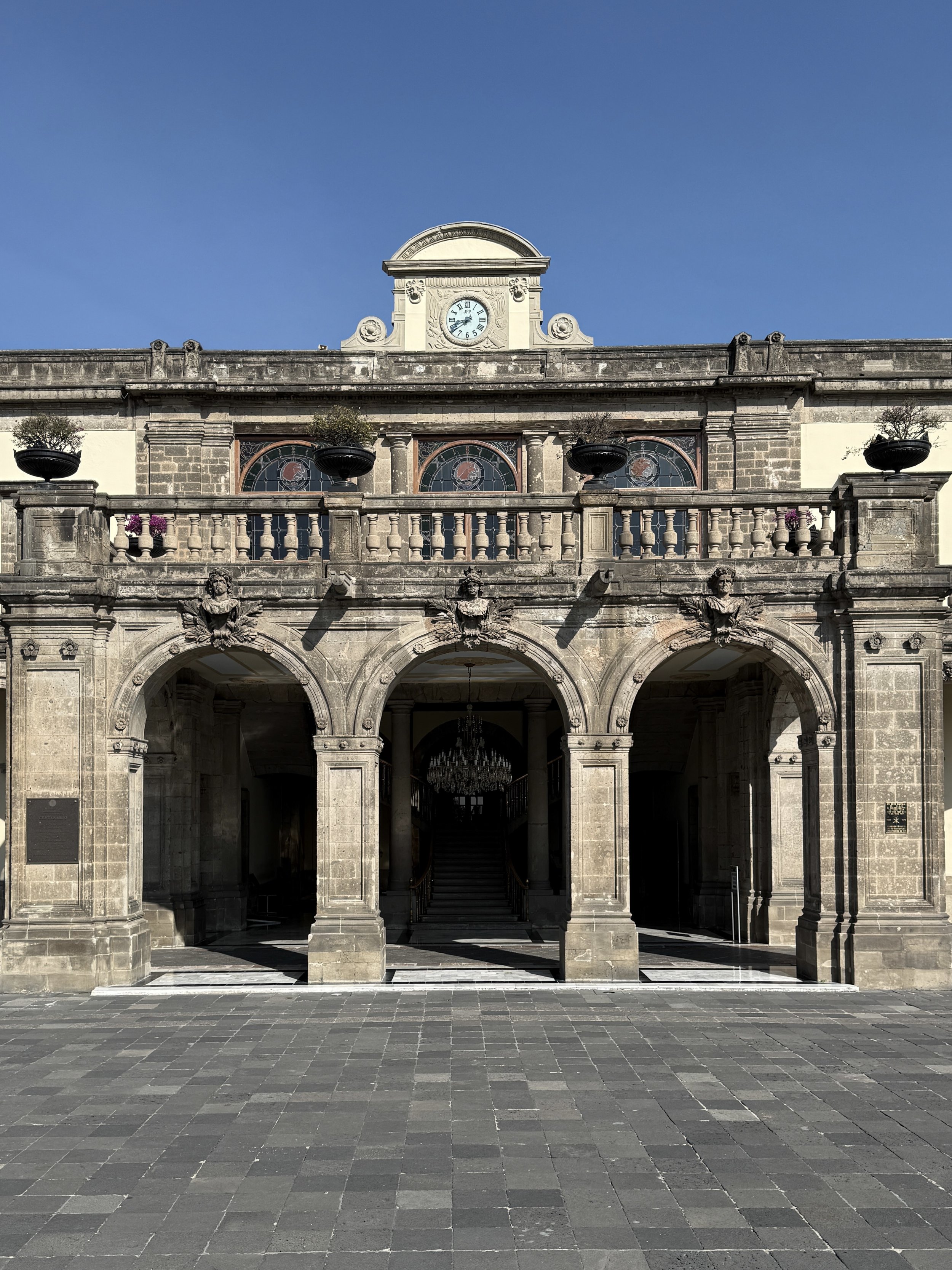
Exterior of the National History Museum with clock at Chapultepec Castle

Museo Nacional de Historia Castillo de Chapultepec

Primera Sección del Bosque de Chapultepec 
San Miguel Chapultepec, C.P. 11580
Delegación Miguel Hidalgo
Mexico City
Mexico


Beyond Paris: Travel to Lesser-Known France

The most underrated places in France: Nantes, Amiens and Rennes — where mechanical elephants, floating gardens and medieval wonders await your next adventure.

Porte Saint-Pierre in Nantes

Sure, Paris is the City of Love, the place where couples smooch along the Seine. But if you think France is just pain au chocolat, promenades and Paris, you’re just scratching the surface. Once you’ve marveled at the must-sees and taken more Eiffel selfies than your Instagram can handle, it’s time to move beyond Paris into the France that doesn’t always make it into the guidebooks.

The Eiffel Tower with the city of Paris spread out before it

We’re not saying you should skip Paris — there are just some hidden gems you should also check out.

First Up: Gay Paree

Of course, any trip to France is worth a stop-off in Paris. The first rule? Don’t be in a rush. Paris is a city meant to be savored — one street, one café, one perfect pastry at a time. 

Begin your journey on foot, meandering through boulevards filled with the smell of fresh bread, the buzz of busy terraces and architecture that just might be older than your country. 

Once you’re ready to kick things up a notch, switch over to the Métro or tram — the real Parisian way to get around. Sure, you could opt for taxis or ride-shares, but you’d be missing the electric hum of everyday life on the city’s veins.

Of course, you’ll want to plan ahead. If you want to visit the Louvre, don’t even think about showing up without pre-booked tickets. Skip the epic queues and head straight into the thick of it. 

Or, if you’re craving a bit more underworld mystique, take the plunge into the Catacombs of Paris — a dark, fascinating corner of the city. 

And for the romantics, the Eiffel Tower may be free to admire from below, but if you want to climb up, save yourself time (and foot cramps) by booking your tickets in advance.

People hang out under a tree in the Jardin des Tuileries in Paris, France

Jardin des Tuileries

Picnics, Cruises and Prepping for the Great Escape

Before you say your final “au revoir” to Paris, it’s time to embrace the most Parisian of pastimes: picnicking in a garden. Pack up a basket with a crusty baguette, some fancy cheese, and a bottle of rosé — this is France, after all. Parc des Buttes-Chaumont, Jardin des Tuileries and Luxembourg Gardens are the perfect spots to recharge. 

But Paris is just the beginning. Once you’ve ticked off the iconic sights, why not step into the real adventure — those lesser-known spots where the crowds thin and the charm thickens. Take a road trip or hop on a train, and dive into the countryside, where France has some seriously under-the-radar gems waiting for you.

Here’s your guide to three fascinating cities that will make your trip to France unforgettable.

Nantes: The City of Innovation and Imagination

If there’s a city where imagination runs wild, it’s Nantes. Perched along the Loire River, this historic gem was once the bustling capital of Brittany and a powerhouse of trade and commerce. Fast forward to today, and Nantes has reinvented itself as a vibrant playground for artists, engineers and visionaries — where creativity isn’t just encouraged, it’s celebrated at every turn.

Giant mechanical steampunk elephant at Les Machine de l'Ile in Nantes, France

Must-See Attractions in Nantes

Les Machines de l’Île: A fantastical world inspired by Jules Verne and Leonardo da Vinci, this is one of Nantes’ most famous attractions. Here, you’ll find mechanical animals, including the iconic 40-foot-tall elephant that you can ride as it lumbers through the streets.

White facade of the Chateau des Ducs de Bretagne in Nantes, France

Château des Ducs de Bretagne: This 13th century castle is a key part of Nantes’ history. Once the seat of the dukes of Brittany, it now houses a museum that tells the story of the city’s past, including its shameful role in the transatlantic slave trade.

Les Anneaux de Pouvoir (Buren), colored rings of light on l'Ile de Nantes, in Nantes, France

Les Anneaux (The Rings) on l’Île de Nantes

Île de Nantes: The island at the heart of the city is a blend of modern art installations, restaurants and waterfront paths. You’ll find sculptures that pop up in unexpected places, and the island is a symbol of Nantes’ artistic resurgence.

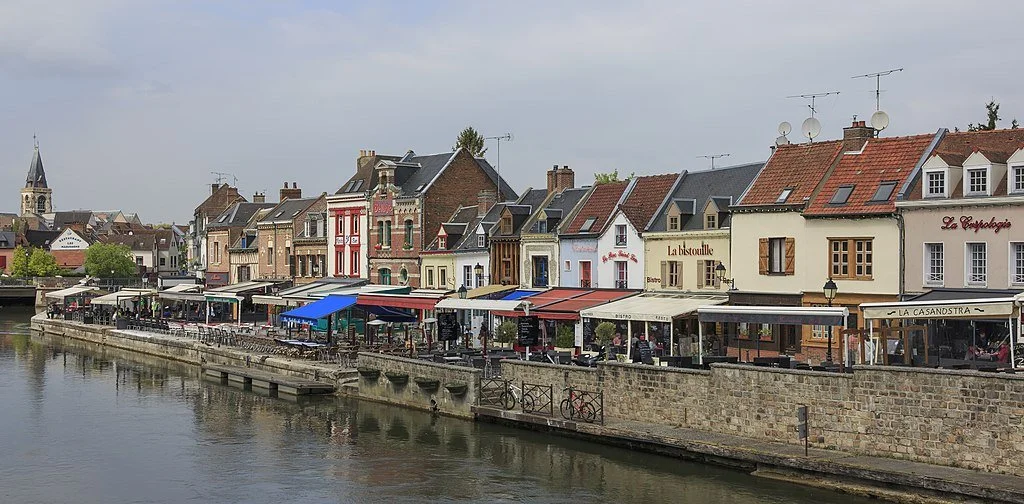
Quai Belu, with quaint buildings along the water, in Amiens, France

Amiens: France’s Hidden Medieval Treasure

Perhaps Amiens hasn’t made your radar yet — but trust me, it’s one of France’s best-kept secrets, far from the touristy throngs most people associate with a trip to France. Nestled in the Haut-de-France region in the north, Amiens is divided by the River Somme and boasts a blend of charm, history and, yes, some seriously Instagrammable spots. If you’re hunting for a place to grab some mouthwatering French cuisine or buy a perfectly aged bottle of wine, the shops and cafés along Quartier St.-Leu’s narrow, cobbled streets are practically begging you to stop by.

Now, here’s the kicker: Amiens is ridiculously budget-friendly. Sure, France has a rep for being on the pricey side, especially if you’re staying where all the iconic sites are. But in Amiens? You can snag top-tier hotels without emptying your wallet. So while you might be pinching pennies in hostels across Paris or Marseilles, Amiens is where you treat yourself to a touch of luxury. Balance, my friends. Amiens is the city that gets it.

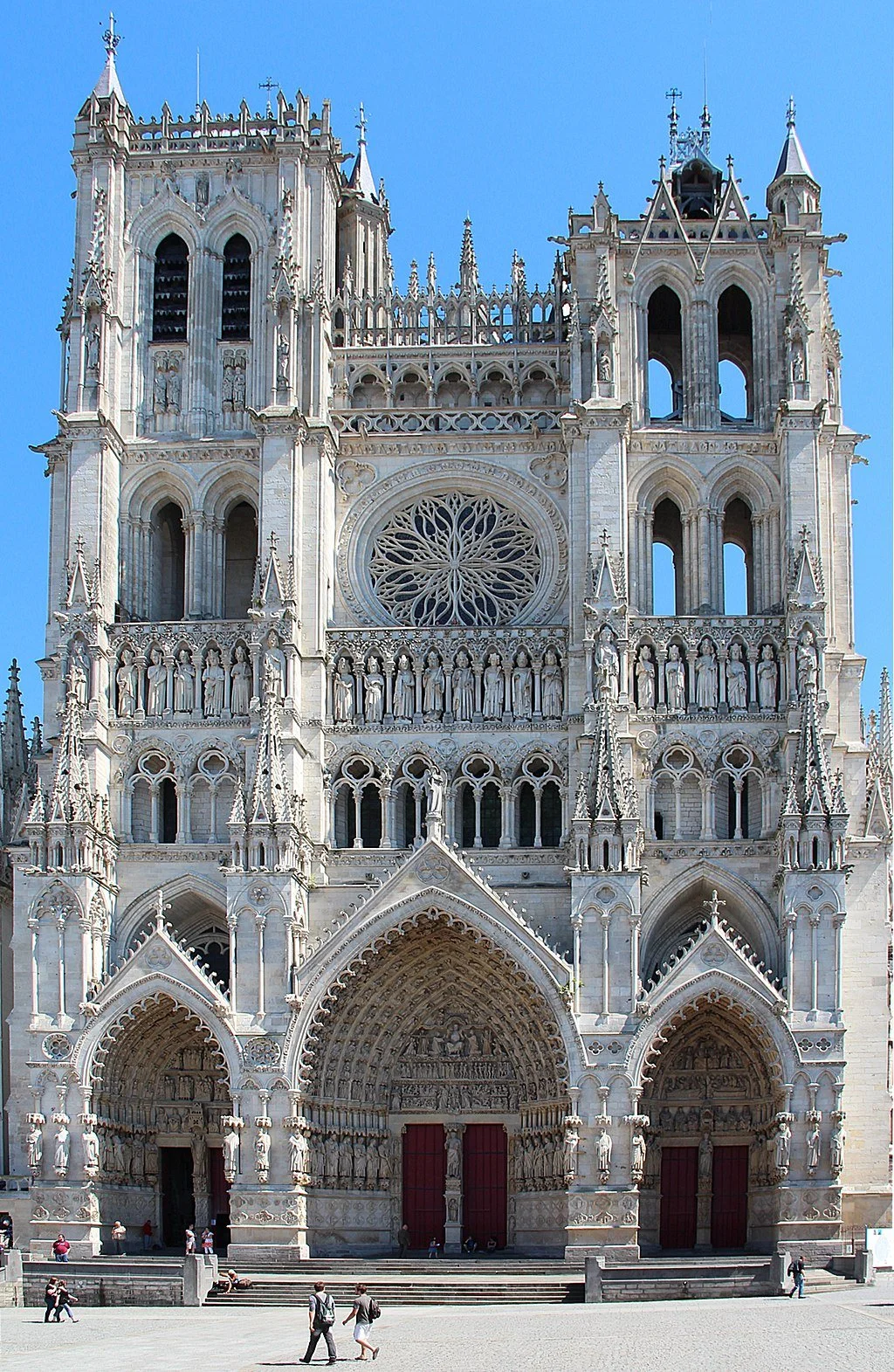
The front of Amiens Cathedral in Amiens, France

Must-See Attractions in Amiens

Amiens Cathedral: This Gothic masterpiece is one of the largest churches in the world and boasts intricate carvings and towering spires. As a UNESCO World Heritage site, it’s known for its exceptional beauty. The cathedral’s façade was originally painted in vibrant colors. Over time, the paint wore away, leaving the stone we see today. During the summer, a light show recreates these original rainbow hues.

A couple rows a small green boat through Les Hortillonnages, the floating gardens in Amiens, France

Les Hortillonnages: These floating gardens are situated on a network of canals and have been cultivated since the Middle Ages. You can explore them by boat, winding through the greenery and flower-filled gardens that seem worlds away from the city streets.

A closeup of the exterior of the Maison de Jules Verne in Amiens, France, with the tower and some floral tilework

Maison de Jules Verne: While Verne was born in Nantes, he spent much of his life in Amiens, where he wrote some of his famous novels. His former home is now a museum that gives visitors a glimpse into his world and imagination.

Timbered houses along a river in Rennes, France

Rennes: Medieval Meets Modern

In the final stop on our tour of underrated French gems, the road less traveled takes us to Rennes, the capital of Brittany, where history and modernity collide in the best way possible. What sets Rennes apart? Picture medieval half-timbered houses lining the streets, right alongside the imposing grandeur of the cathedral. It’s like stepping into a time machine — but with better coffee.

People in the courtyard of the Parlement de Bretagne in Rennes, France

Must-See Attractions in Rennes

Parlement de Bretagne: Once the seat of the Brittany parliament, this grand building is a must-see for history buffs. It survived a major fire in the 1990s and was carefully restored. Guided tours give visitors a glimpse into the past and the intricate artwork inside.

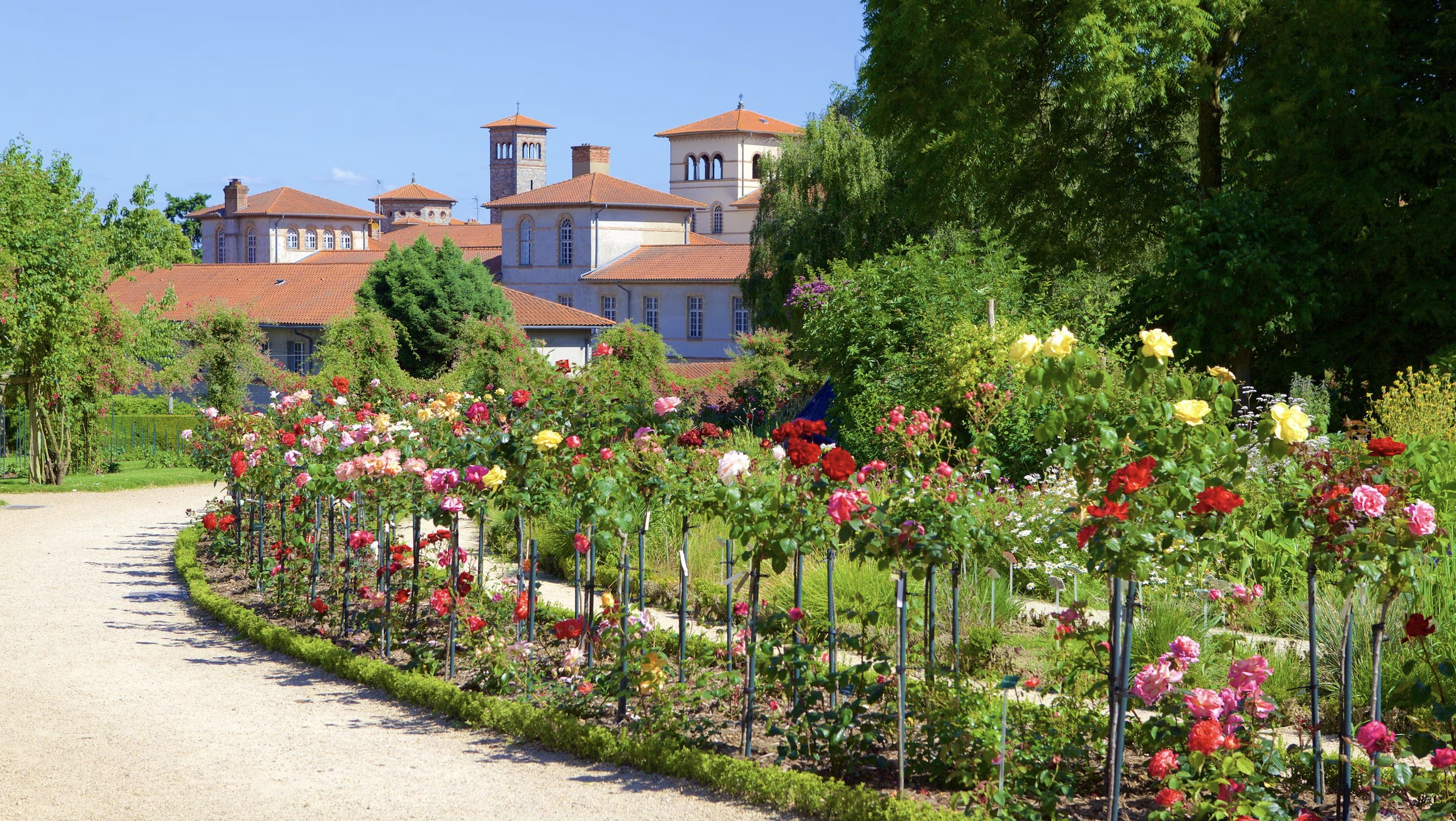
Roses of all colors along a path leading to red-topped buildings in the Thabor Gardens in Rennes, France

Thabor Gardens: One of France’s most beautiful public parks, the Thabor Gardens span 25 acres (10 hectares) and include a French garden, English garden, rose garden and aviary. It’s the perfect spot for a quiet escape after a day of sightseeing.

White walls and a glass-covered ceiling in a room with a giant white ring in the Musee des Beaux-Arts in Rennes, France

Musée des Beaux-Arts: Art lovers will feel right at home in this museum, which boasts works from European masters like Rubens, Botticelli and Picasso. The museum’s collection covers everything from ancient Egyptian artifacts to modern art.

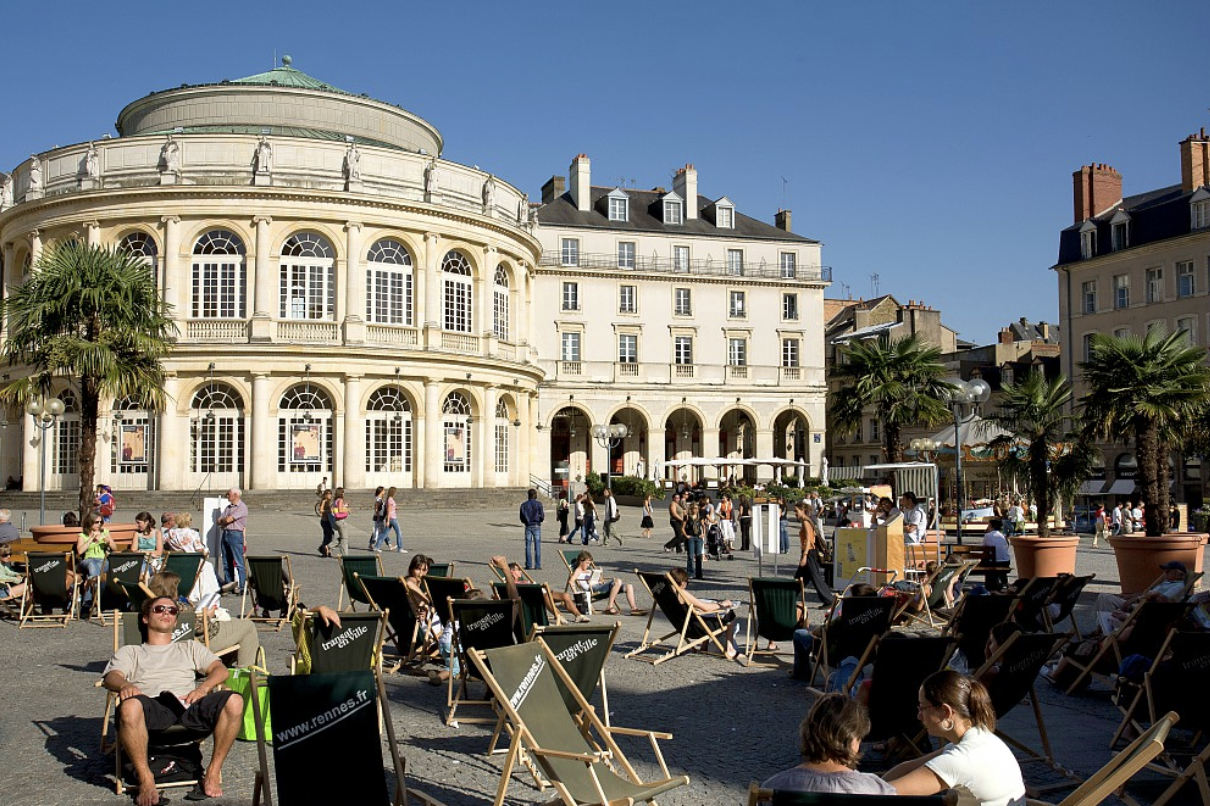
The Rennes Opera House

France off the Beaten Path

France is so much more than Paris. By stepping off the beaten path and exploring places like Nantes, Amiens and Rennes, you’ll not only escape the tourist crowds but will also discover the true heart of the country. It’s in the untapped corners, the quiet lanes and the lesser-known wonders. As they say: Life is about the adventures you take and the memories you make. –Sadie Smith

The Alcazaba, the Fierce Fortress of the Alhambra

Tour the towers of the defensive outpost perched above the charming city of Granada in the South of Spain.

Start your tour of the Alhambra with the Generalife gardens and the Alcazaba fortress.

Start your tour of the Alhambra with the Generalife gardens and the Alcazaba fortress.

With the snow-capped peaks of the Sierra Nevada as a backdrop, it’s easy to see why the monumental fortress palace of the Alhambra is one of the most visited monuments in Spain, second only to the Sagrada Família in Barcelona. 

The complex of buildings was fittingly recognized as a UNESCO World Heritage Site in 1984, and served as residence to the Islamic sultanates of the Iberian Peninsula. Muslims ruled the region from the 11th to 15th century, until conquered by the Catholic monarchy in 1492. The Alhambra’s name comes from the Arabic al-Qal’at al-Hamra, or Red Fortress, owing to the reddish color of the clay-rich soil of the al-Sabika Hill ridge, where it rises from the terrain. That same ochre soil was used in the rammed, or compressed, earth brick walls of this impressive complex. 

A fortress doesn’t do any good if you simply open its doors to invaders.

But that’s exactly what King Boabdil did, after his fellow Muslims had ruled the region for nearly 700 years.
Touring the Alcazaba and the rest of the Alhambra made for a birthday Wally will never forget!

Touring the Alcazaba and the rest of the Alhambra made for a birthday Wally will never forget!

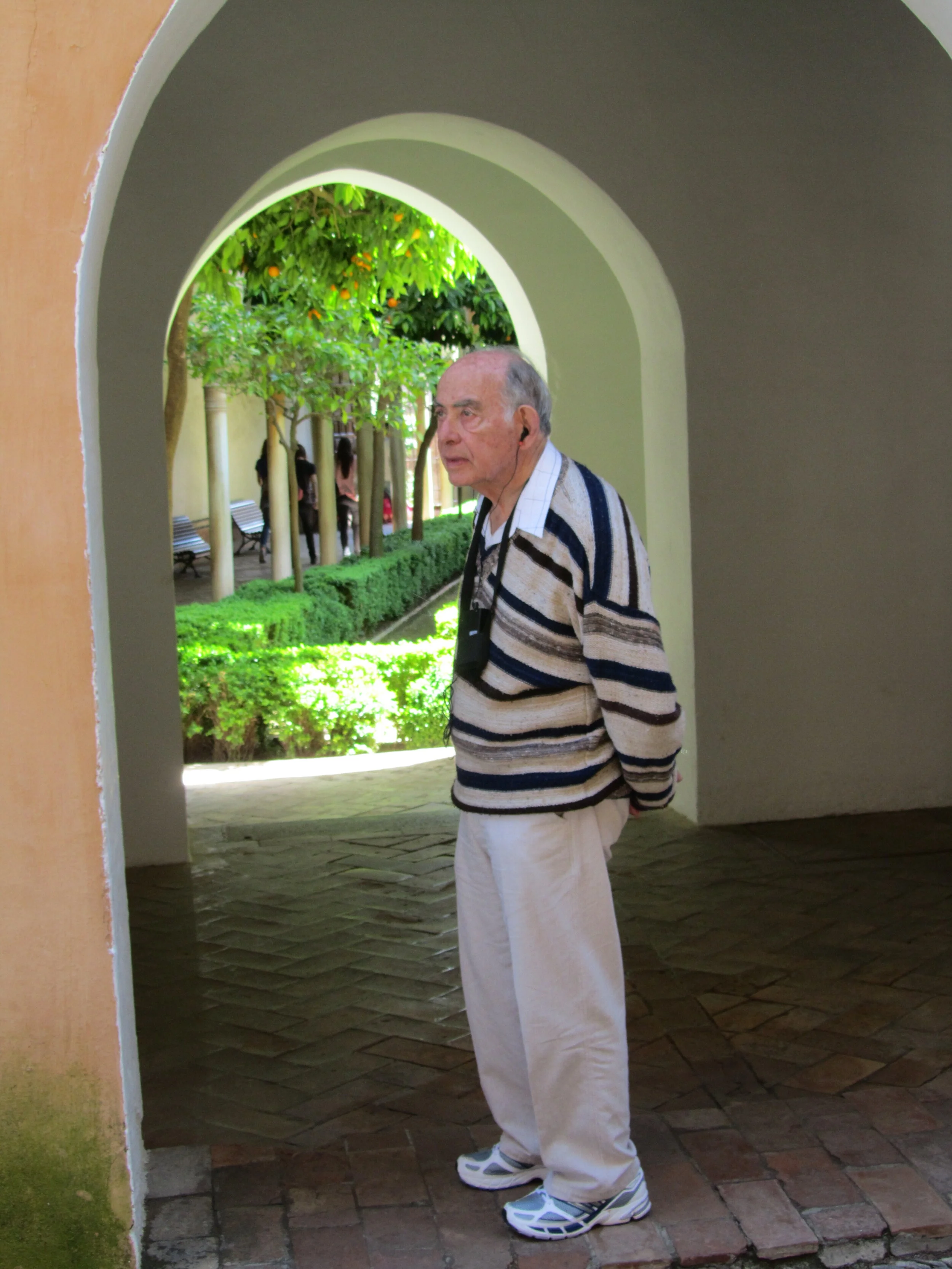
After literally taking time to stop and smell the roses in the gardens of the Generalife, we made our way to the Alcazaba, the fortress that once guarded the palace. We had booked our tickets for a guided tour (about 46€) months before, and a small group of ill-mannered and boisterous British tourists were part of our entourage. One of them was a doddering old man named Leslie, who frequently strayed from the group, and whose companions could be heard incessantly shouting, “Leslie! Leslie, come here!” to reel him back in. 

This is Leslie, wandering off again. “Leslie! Get back here!”

This is Leslie, wandering off again. “Leslie! Get back here!”

Plaza de los Aljibes, the Square of the Cisterns

Our group arrived at the Plaza de los Aljibes, the Square of the Cisterns, built after the Christian victory. The broad open space got its name from the underground cisterns built to collect rainwater below the square because the new occupants didn’t understand the complexities of the water channels the Arab engineers had created, leaving the aqueducts to fall into disrepair. Off to one side of the square lie the Nasrid Palaces, to the other, the Alcazaba.

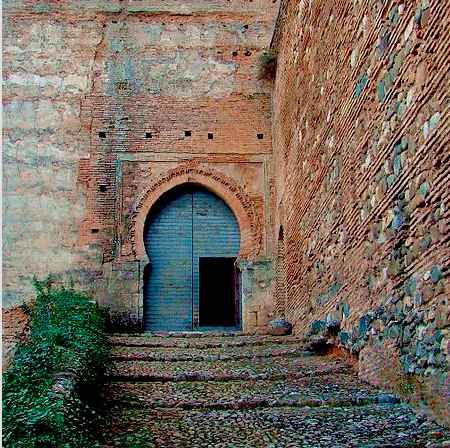
The entrance to the Alcazaba, built by Muhammad I, the first sultan of the Nasrid dynasty

The entrance to the Alcazaba, built by Muhammad I, the first sultan of the Nasrid dynasty

The Alcazaba Fortress

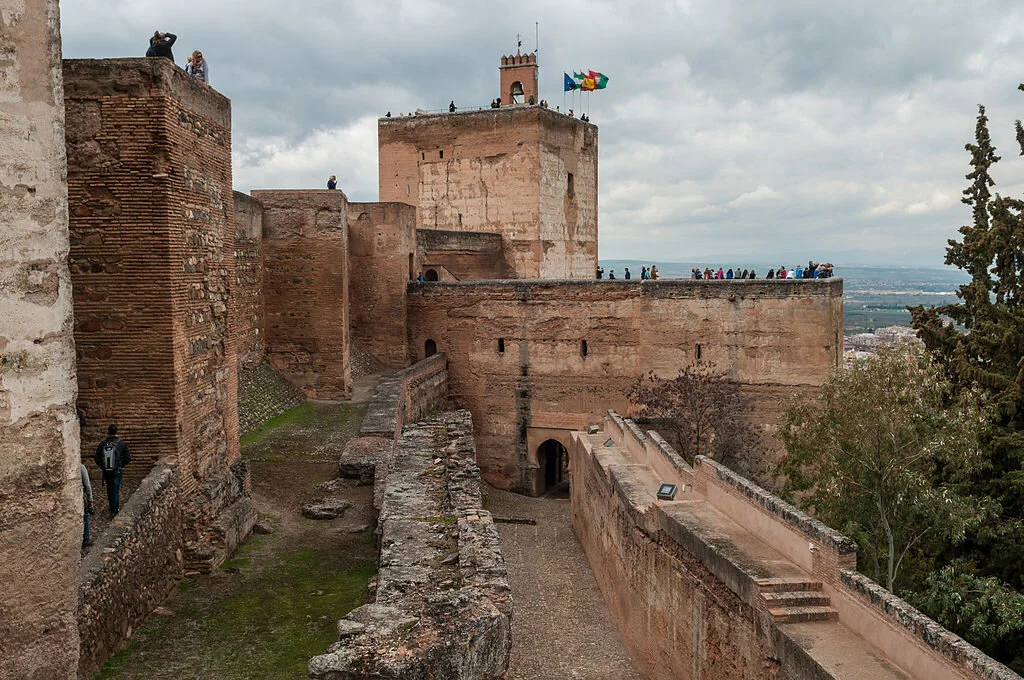
The austere military enclosure of the Alcazaba fortress is strategically positioned at the summit of the westernmost end of the monumental site, overlooking the city of Granada. Its construction is attributed to Muhammad I (who reigned from 1238-1273), the founder of the Nasrid dynasty. A stark contrast to the opulent and residential Nasrid Palaces, its primary function was to shield its inhabitants from external attacks. 

The separations in the defensive wall allowed archers to fire at invaders.

The separations in the defensive wall allowed archers to fire at invaders.

Of the whole set of structures within the Alhambra, the Alcazaba is the oldest. The north-facing walls were built atop the remains of a 9th century castle constructed for the Zirid dynasty, who were Berbers from Algeria, and incorporated into the foundation walls. Here, Muhammad I strengthened the enclosure walls and constructed three of its 30 imposing towers. Our group entered the fortress from the plaza through a doorway cut into the high east-facing wall. 

Torre del Homenaje, the Tribute Tower

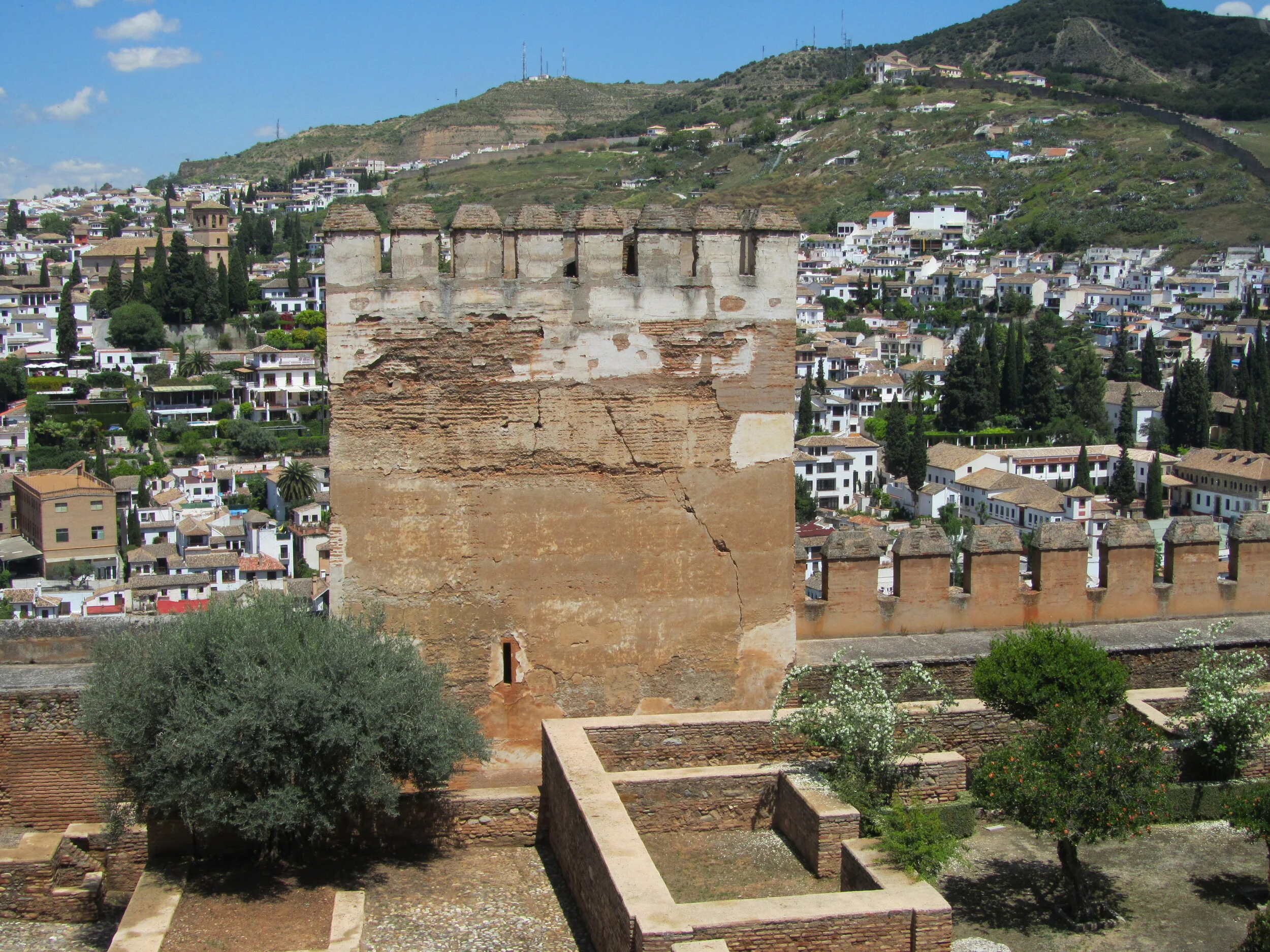
Located at the northeast corner of the perimeter wall is the keep, known as the Torre del Homenaje, which could be translated as the Tribute Tower or the Tower of Homage. It’s one of the highest of the Alhambra and was strategically the most important, as it served both defensive and offensive purposes. The upright crenellated “teeth,” aka the battlements along the top of the tower, protected sentries from attacks and allowed them to fire arrows at intruders. Throughout its history, the tower served many functions, including as royal residence to Muhammad I and as a prison during the Christian occupation. 

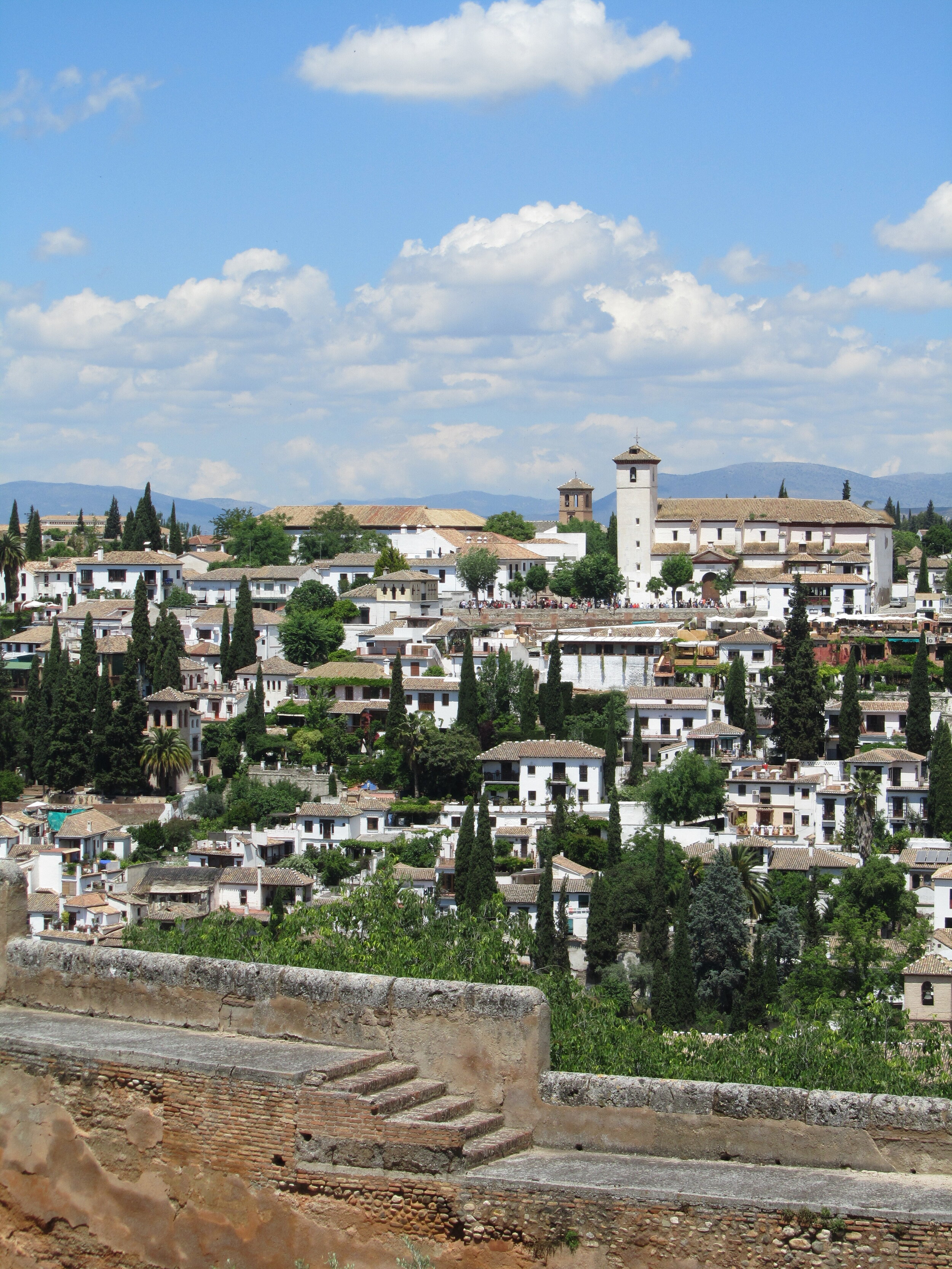
The towers of the Alcazaba, the Torre de la Vela in particular, provide great views of the white city of Granada below.

The towers of the Alcazaba, the Torre de la Vela in particular, provide great views of the white city of Granada below.

Torre de la Vela, the Watchtower

The Torre de la Vela, the Watchtower, defiantly perches on the far west end of the hill, where the previously mentioned modest Zirid castle once stood. It served as a watchtower, and the interior consists of four floors plus the terrace and a subterranean dungeon—a kind of command center in the middle of the fortress. 

Wally and I climbed the narrow staircase to the top to take in the panoramic bird’s-eye view of the rolling Andalusian hills and Albaicín, Granada’s Moorish neighborhood. The terrace is crowned by a bell tower, added by the Christian kings in the 18th century, which was used to signal significant news to the general populace. 

There are many thoughts on the origin of its name. The literal translation of the word vela is “candle,” but one theory posits that the bell was brought from Castil de Vela, a municipality located in the province of Palencia. Then again, it could be connected to the verb desvelar, which means to keep awake, possibly referring to the sounding bell and its ability to awaken anyone below from slumber. In any event, the bell is rung every January 2 to celebrate the taking of Granada from the Muslim sultans.

The Alcazaba at the Alhambra is cool to tour — but just wait till you see the ornate Nasrid Palaces!

The Alcazaba at the Alhambra is cool to tour — but just wait till you see the ornate Nasrid Palaces!

Torre Quebrada, the Broken Tower

This imposing monolithic tower stands within the shadow of the Torre de la Vela. I couldn’t find any specifics as to how it acquired its name, but one could presume that it suffered from seismic activity, or Napoleon's army, which decided to inflict damage by blowing up a few of the towers when they withdrew from the palace, petty and bitter at having lost the Peninsular War, which took place from 1808-1814. 

Visitors had to leave their weapons at the Puerta de las Armas.

Visitors had to leave their weapons at the Puerta de las Armas.

Puerta de las Armas, the Gate of Arms

Originally, the Bab al-Silas, or Puerta de las Armas, the Gate of Arms, functioned as the populace’s primary entrance. The doorway probably got its name from its associated use: Visitors were stopped and required to leave their weapons behind before gaining access. 

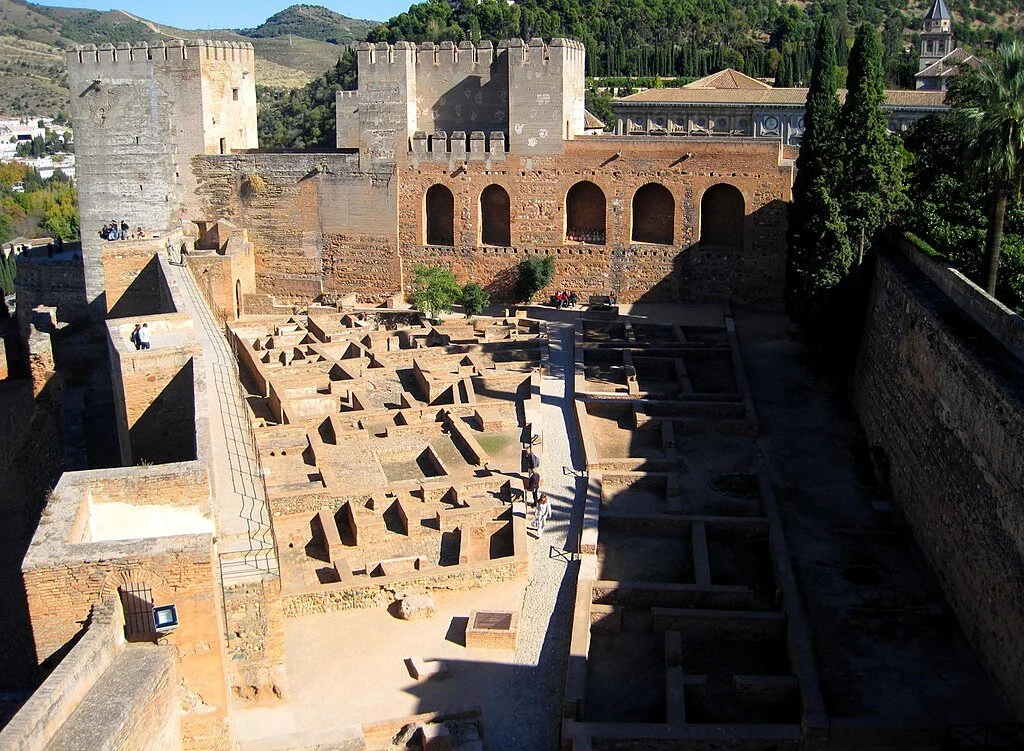
Part of the Plaza de las Armas contains the ruins of the Barrio Castrense, the foundations of the residential dwellings for the royal guard and soldiers needed for the defense of the sultan. 

The foundations of the military quarters can still be seen in the Plaza de la Armas.

The foundations of the military quarters can still be seen in the Plaza de la Armas.

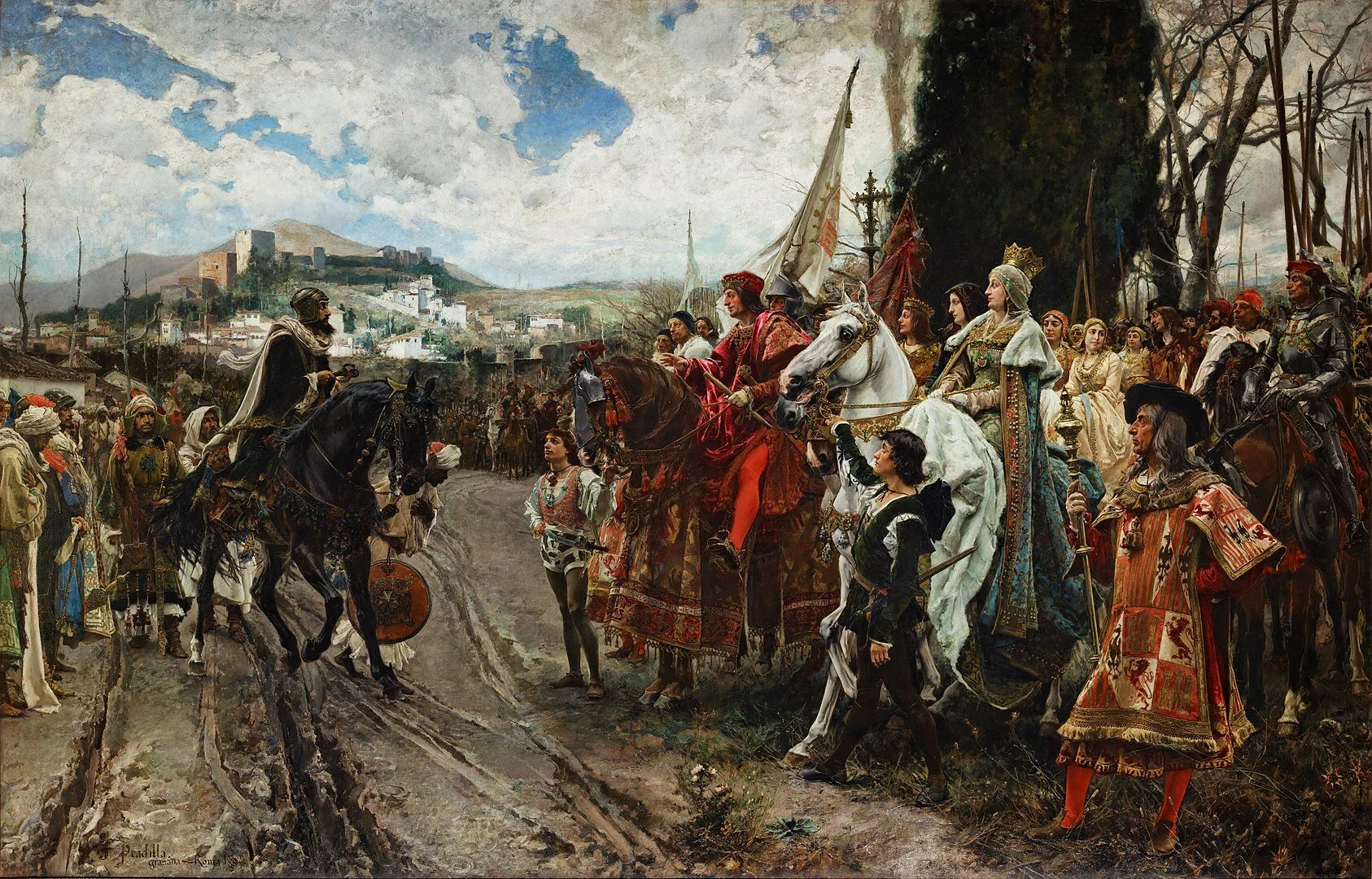
The Surrender of Granada by Francisco Pradilla y Ortiz, 1882, shows poor Baobdil turning over the keys to Granada to Ferdinand and Isabella.

The Surrender of Granada by Francisco Pradilla y Ortiz, 1882, shows poor Baobdil turning over the keys to Granada to Ferdinand and Isabella.

Letting the Catholics In

A fortress doesn’t do you any good if you simply open its doors to invaders. But that’s exactly what King Boabdil did, after his fellow Muslims had ruled the region for nearly 700 years. 

On January 2, 1492, Ferdinand II of Aragon and Isabella of Castile ceremoniously entered Granada, curiously in Muslim dress. They set up court in the Alhambra declaring it a Casa Real, or royal residence. One of their first orders of business? Declaring that all Jews and Muslims had to convert to Catholicism or leave the country. –Duke