morocco

Dar el Bacha Marrakech: Morocco’s Most Beautiful Museum?

Originally built in 1910 for Thami El Glaoui, the Pasha of Marrakech, Dar el Bacha: Musée des Confluences is one of Marrakech’s most captivating museums, a true architectural gem and a must-see. Plus: Is the trendy Bacha Coffee worth the wait?
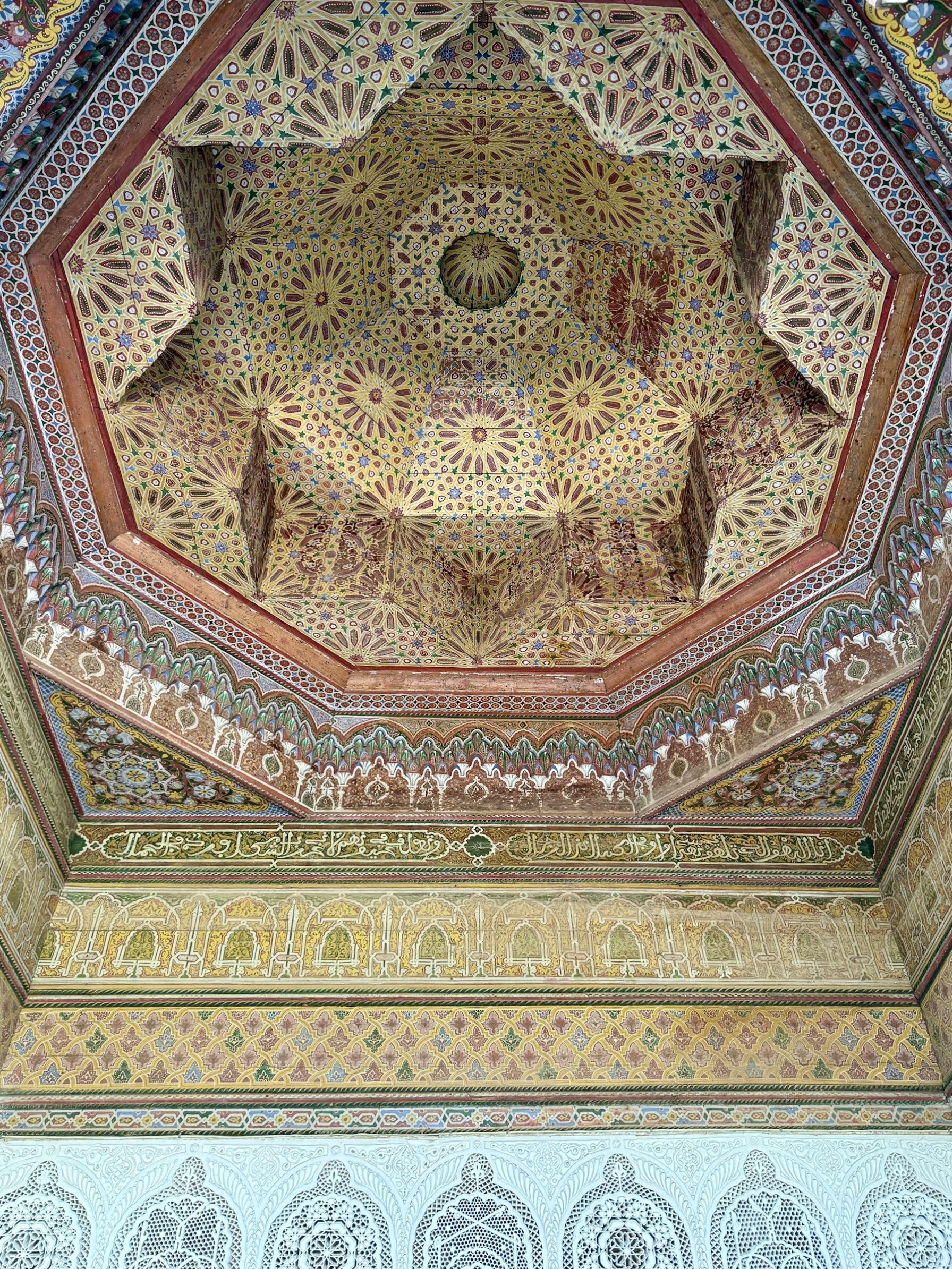
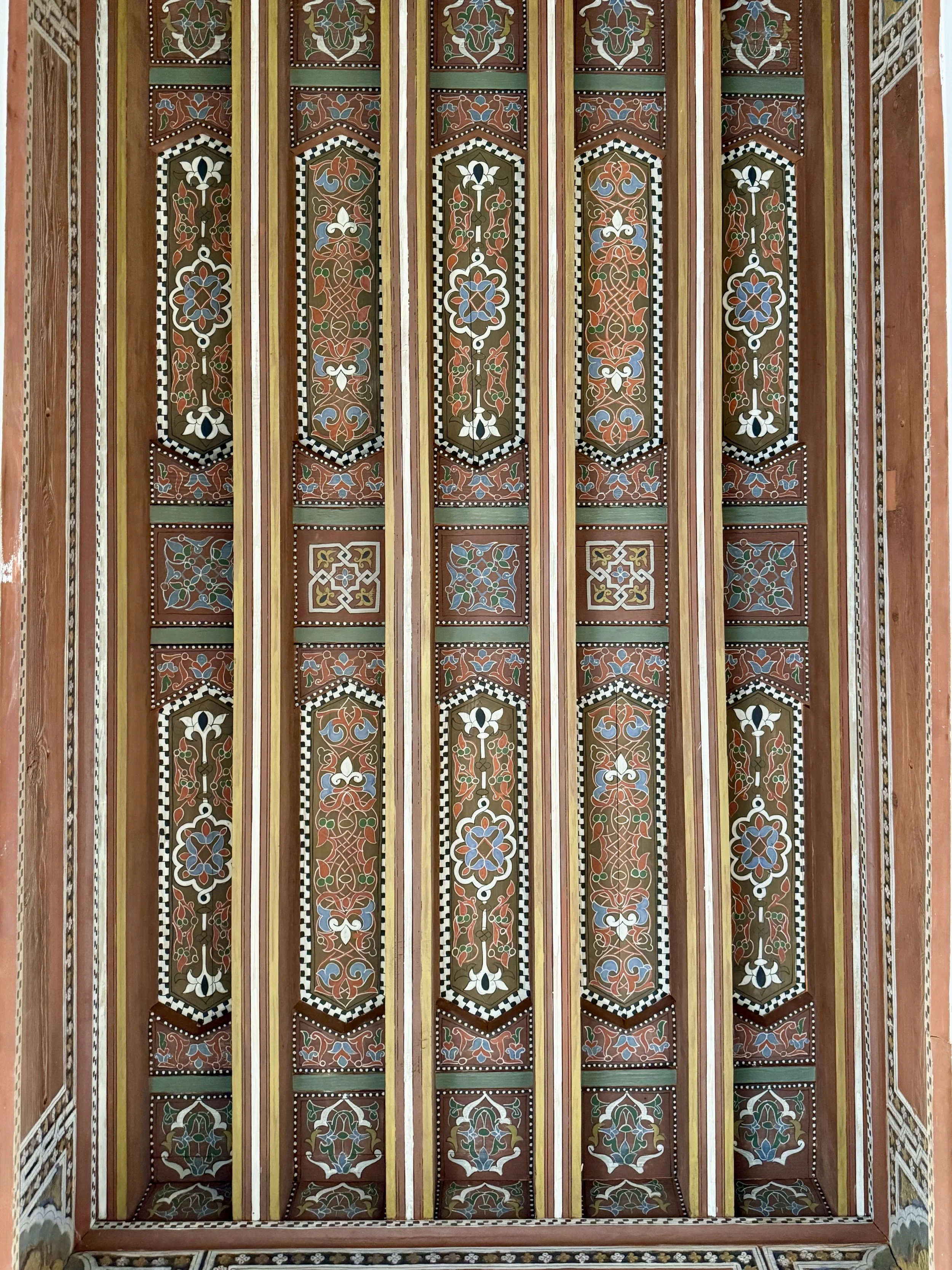
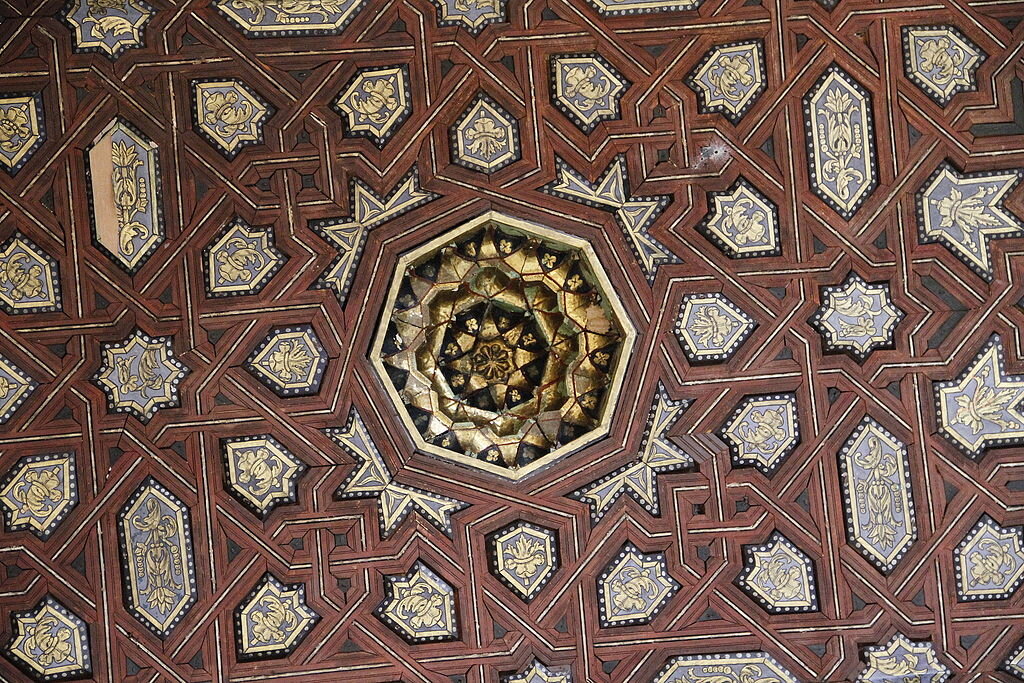
A star-shaped elaborately painted ceiling at Dar el Bacha in Marrakech, Morocco

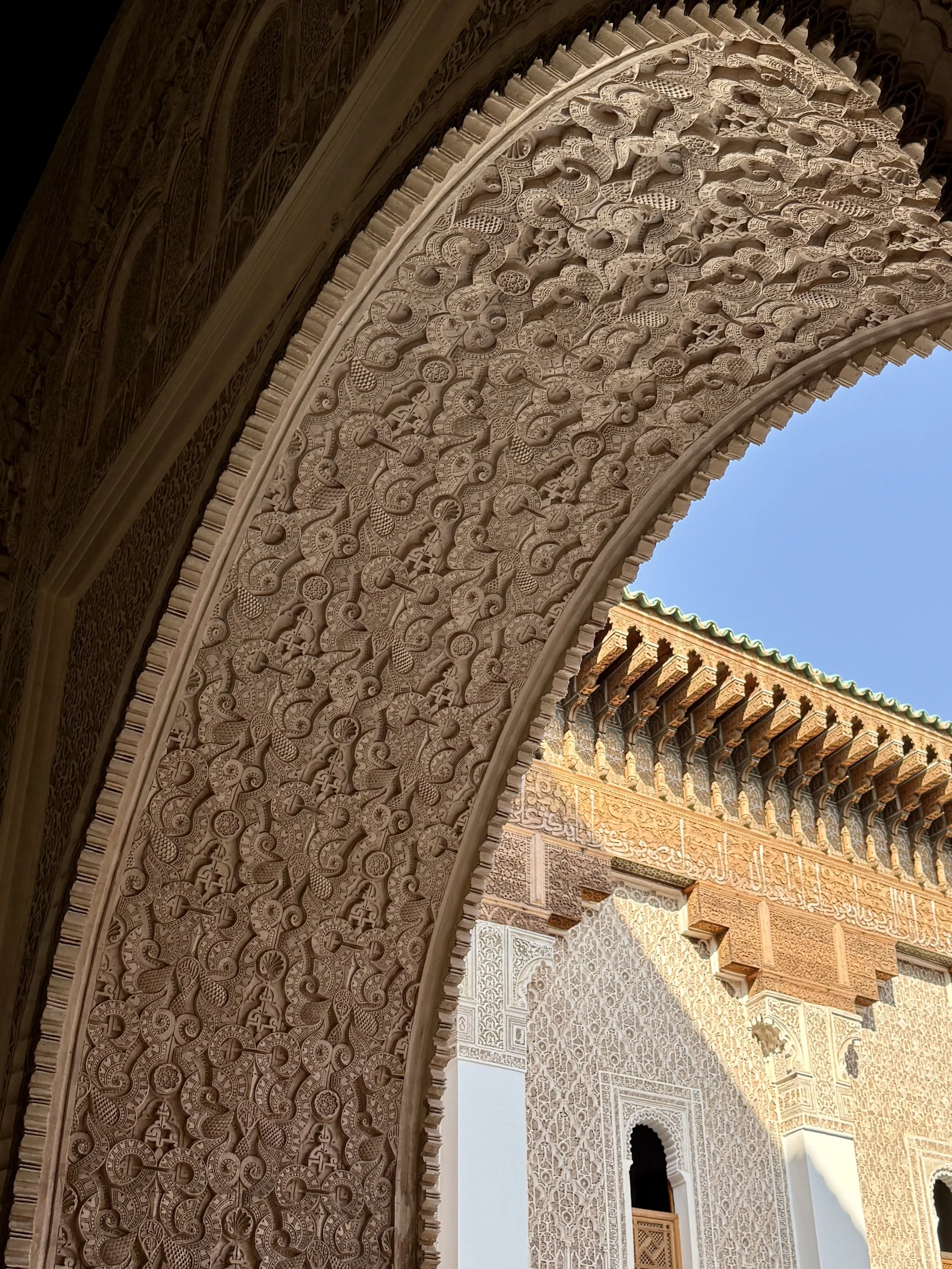
One of the landmarks that was new to us on our return trip to Marrakech was Dar el Bacha, a meticulously restored Moroccan mansion-turned-museum. 
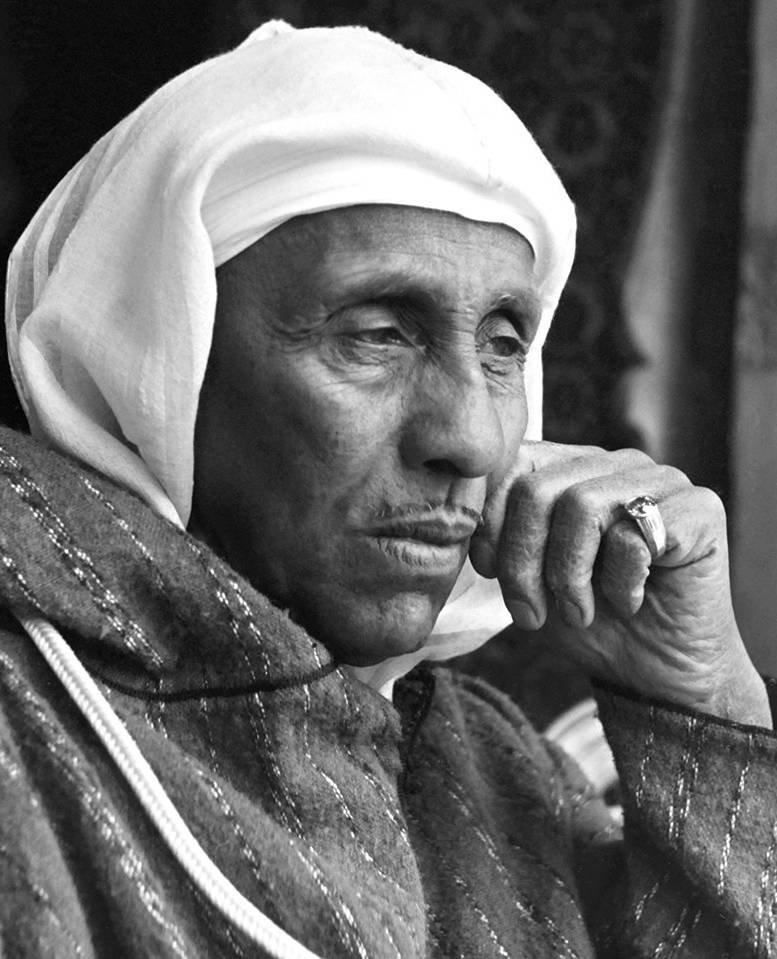
Thami El Glaoui, with a hand to his face

Thami El Glaoui, the powerful pasha who owned Dar el Bacha before it became a museum

Located in the lively medina, the estate was commissioned by Thami El Glaoui, a Berber chieftain born in 1879 into the Glaoua tribe of the High Atlas Mountains. He allied early with the French, lending troops to Resident General Lyautey’s “pacification” campaign — a sanitized colonial label for the military suppression of Moroccan resistance.

In 1912 Sultan Moulay Youssef rewarded El Glaoui with the post of pasha, a role he held until 1956, bacha being the French transliteration of the same title. The partnership made him “Lord of the Atlas” to Europeans and, in time, one of the wealthiest and most divisive men in Morocco. 
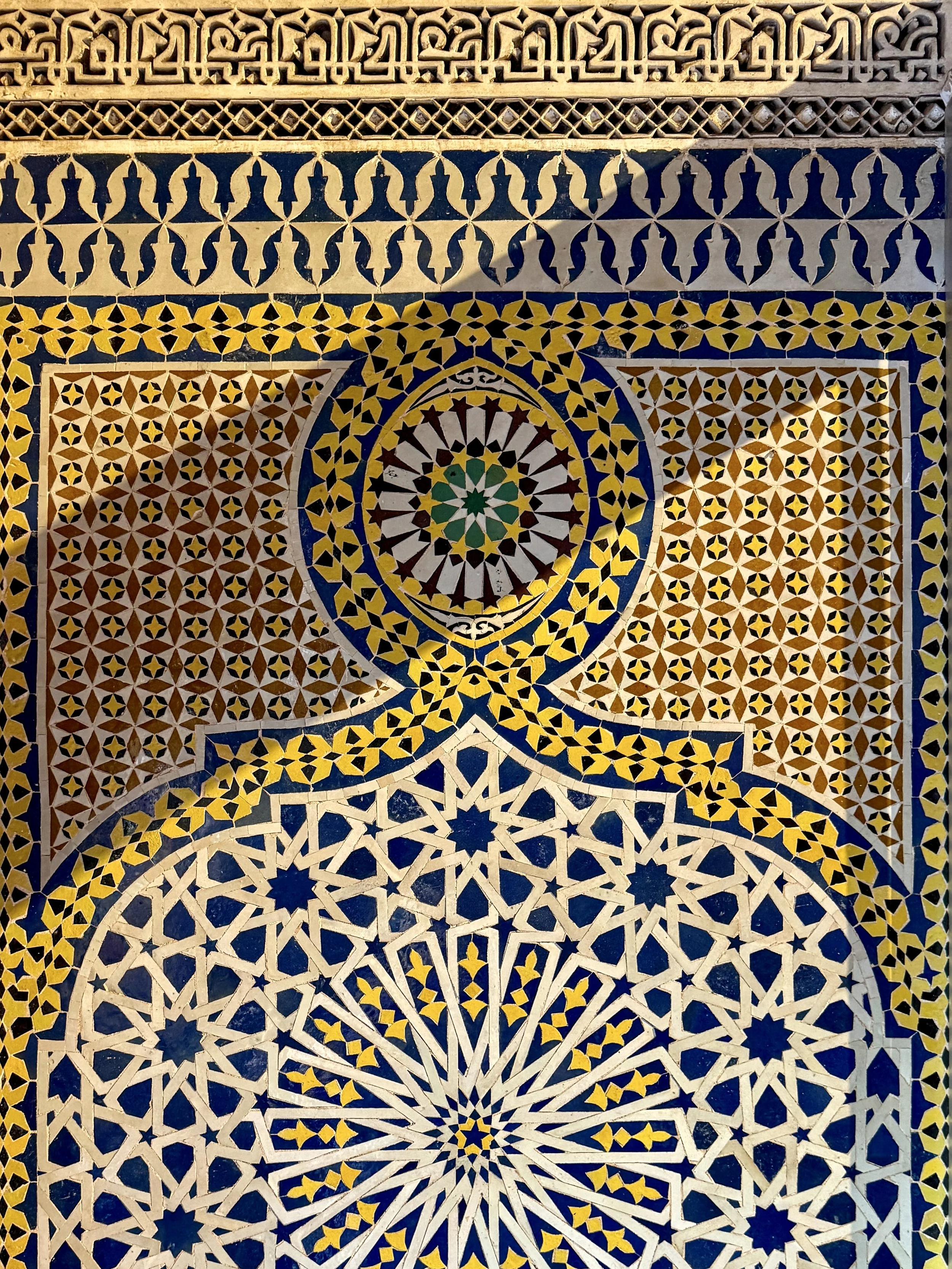
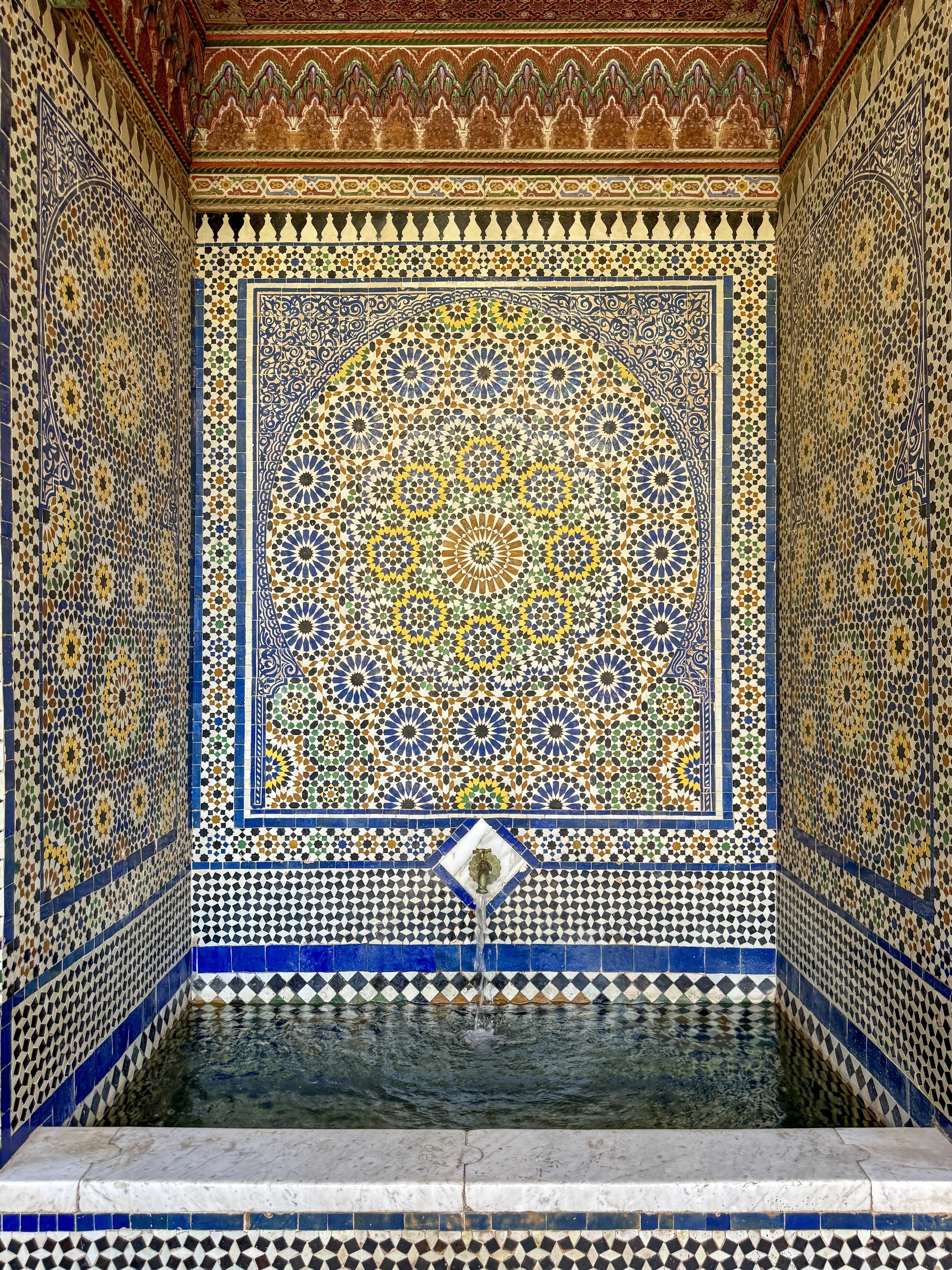
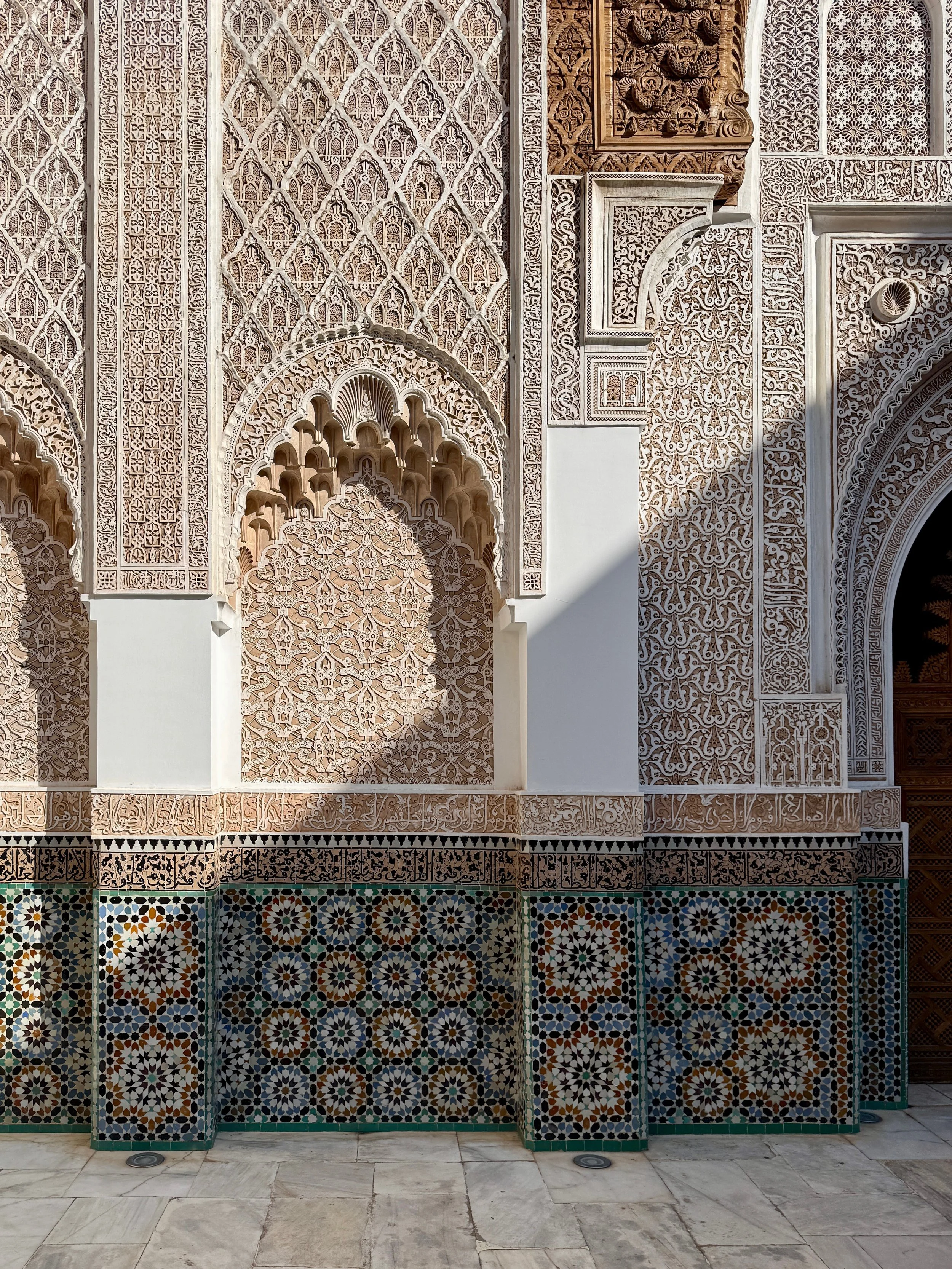
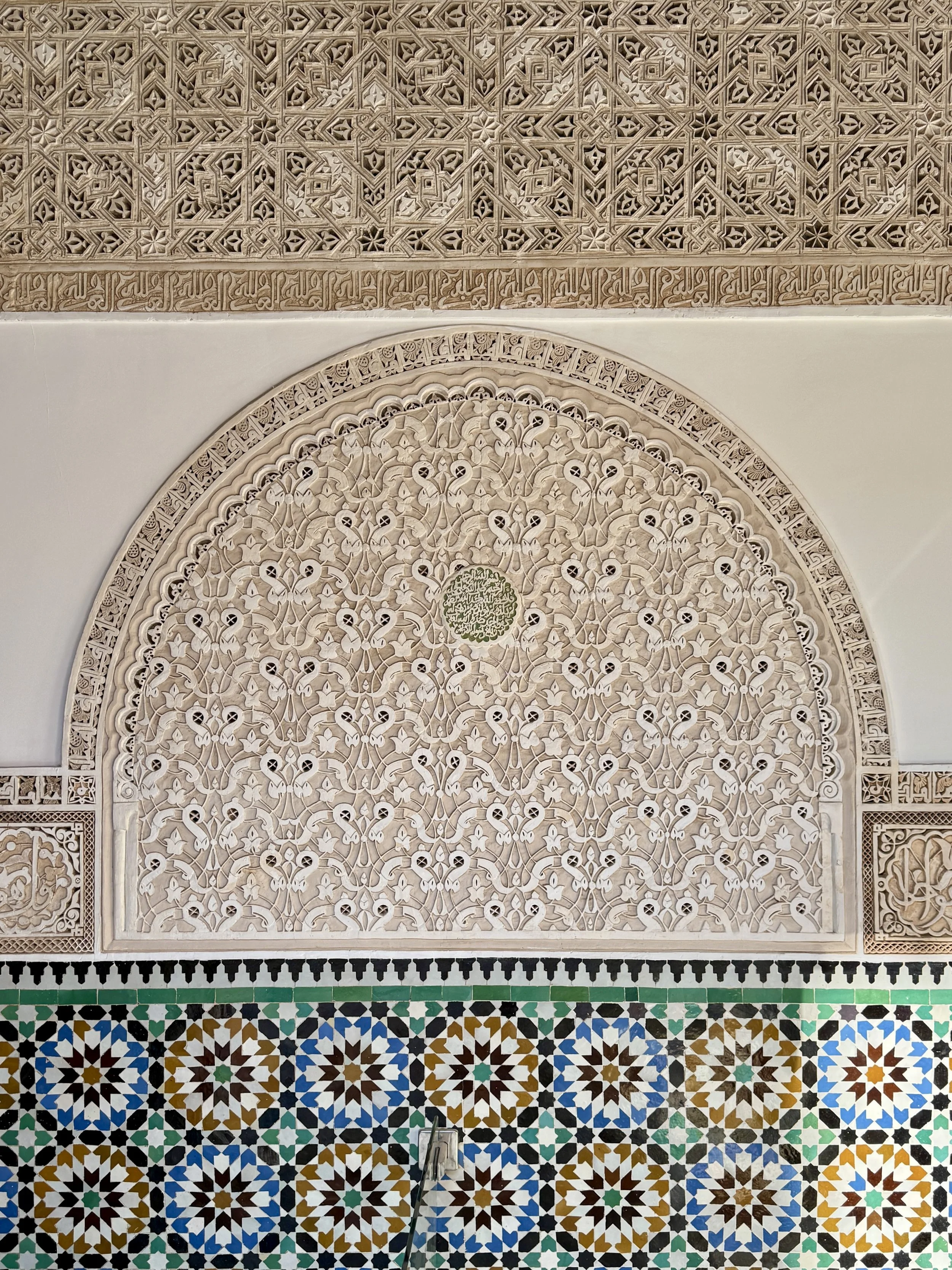
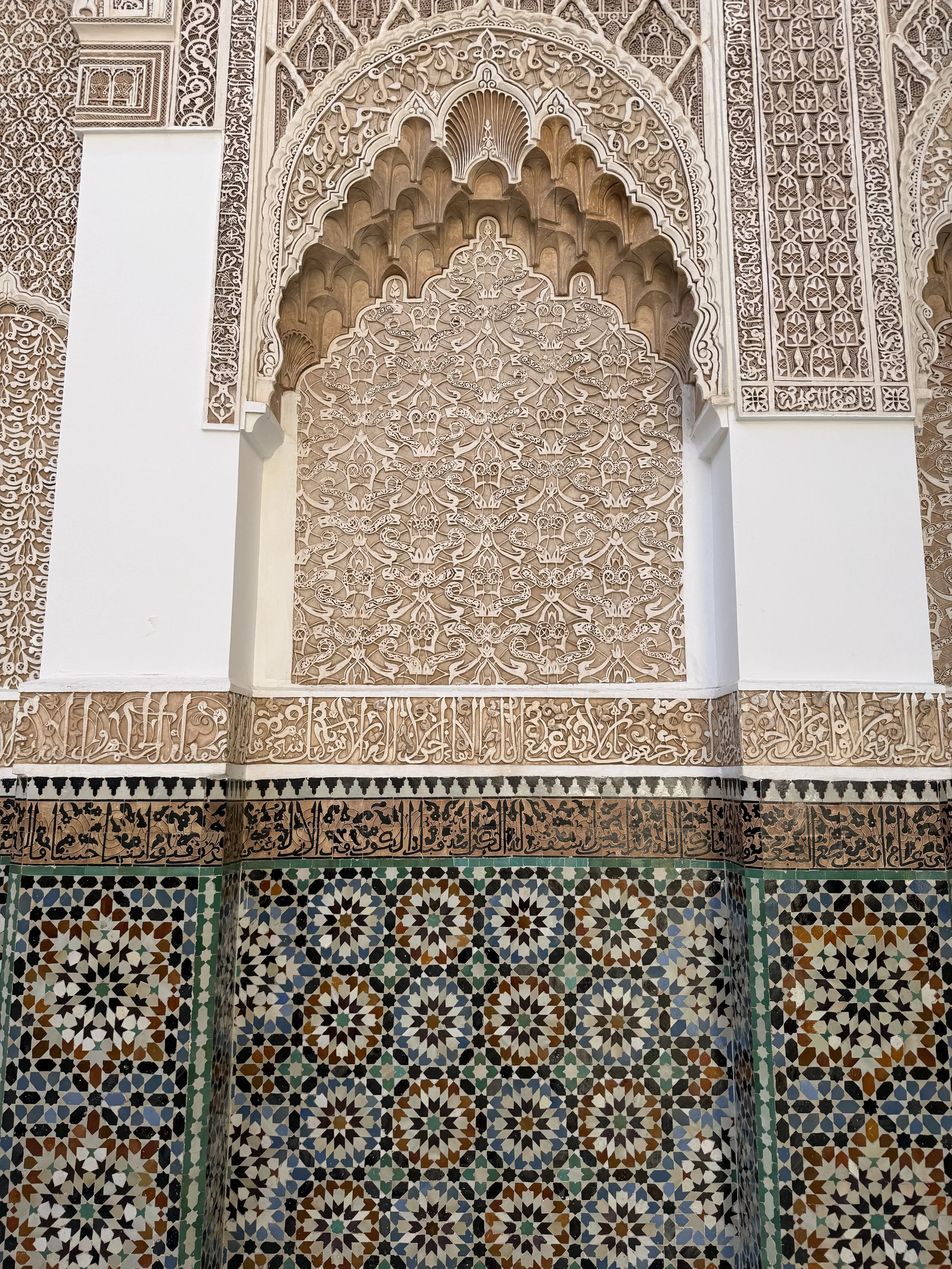
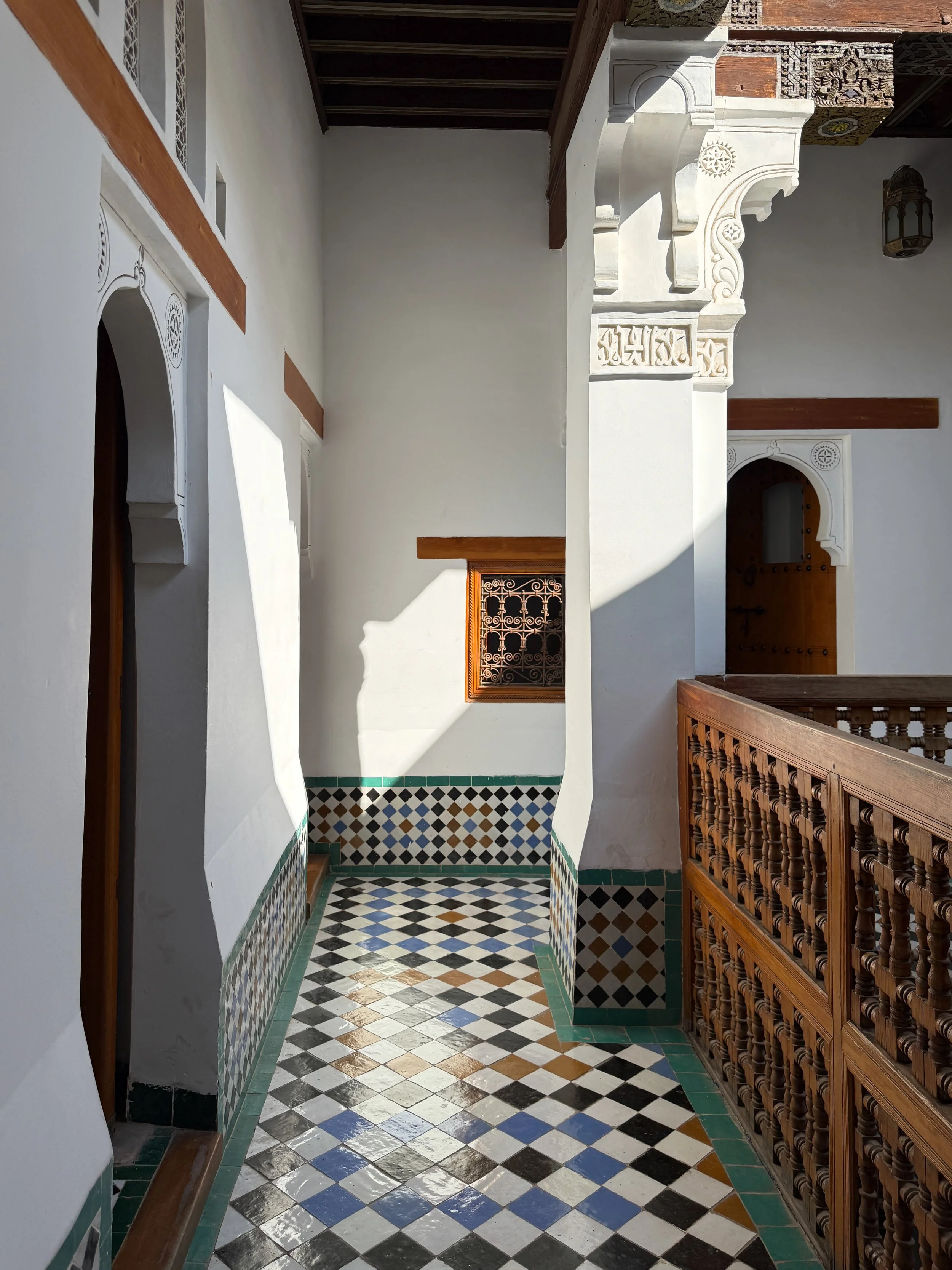
Zellige tilework at Dar el Bacha in Marrakech

The Rise and Fall of Marrakech’s Most Powerful Pasha  

The grand residence dates to 1910, and its scale was meant to impress the steady stream of international celebrities and politicians who passed through El Glaoui’s court. Among them were UK Prime Minister Winston Churchill, the writer Colette, the composer Maurice Ravel and the filmmaker Charlie Chaplin. 

The estate included a reception hall, a hammam (a traditional steam bathhouse), a courtyard shaded by orange trees, fountains, a harem (the private quarters reserved for the bacha’s family) and a douiria (servants’ quarters).

In 1953, El Glaoui helped engineer the forced exile of Sultan Mohammed V. It’s one of the reasons he’s remembered for his lavish excess, his ruthless suppression of rivals and dissidents, and a justice system widely regarded as arbitrary and self-serving. After his death in 1956, the same year Morocco achieved independence, the compound was shuttered and left to fall into disrepair. 
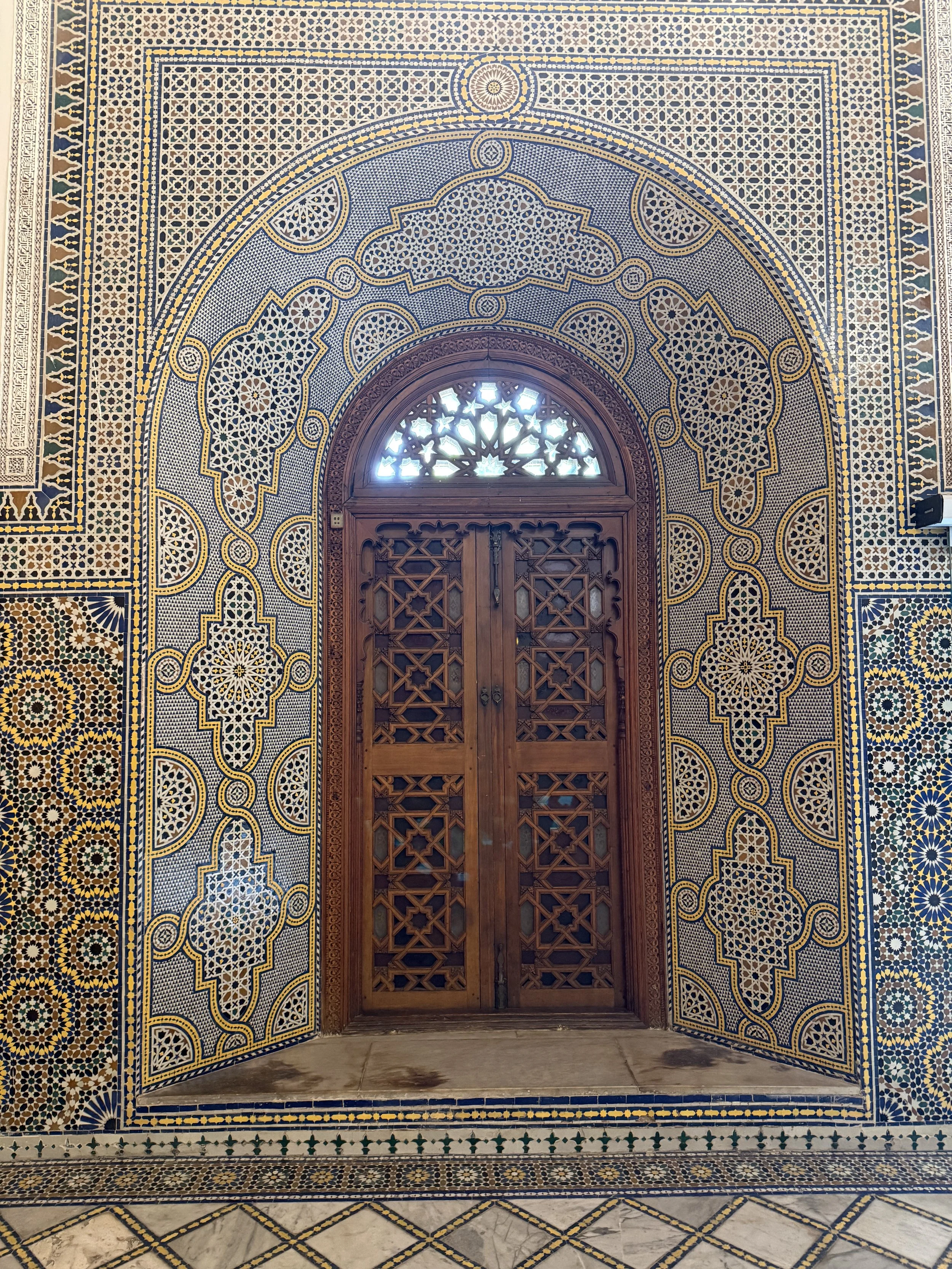
Cedarwood widow screen and zellige tile at Dar el Bacha, Marrakech, Morocco

From Crumbling Estate to Museum of Confluences 

The first attempt at conversion began around 2006, led by the Paris- and Casablanca-based firm Oualalou+Choi. They were commissioned to transform the former seat of the pasha into the Musée des Arts Premiers (Museum of Tribal Arts). 

The project grew out of a partnership between Morocco’s Ministry of Culture and Patti Cadby Birch, an American philanthropist and honorary trustee of the Metropolitan Museum of Art. Birch had previously funded the 1990s restoration of the Koutoubia minbar (the pulpit from which the imam delivers the sermon) and envisioned transforming Dar el Bacha into an arts museum to properly showcase her vast personal collection. That effort stalled, and Birch died in 2007 without seeing her vision realized.
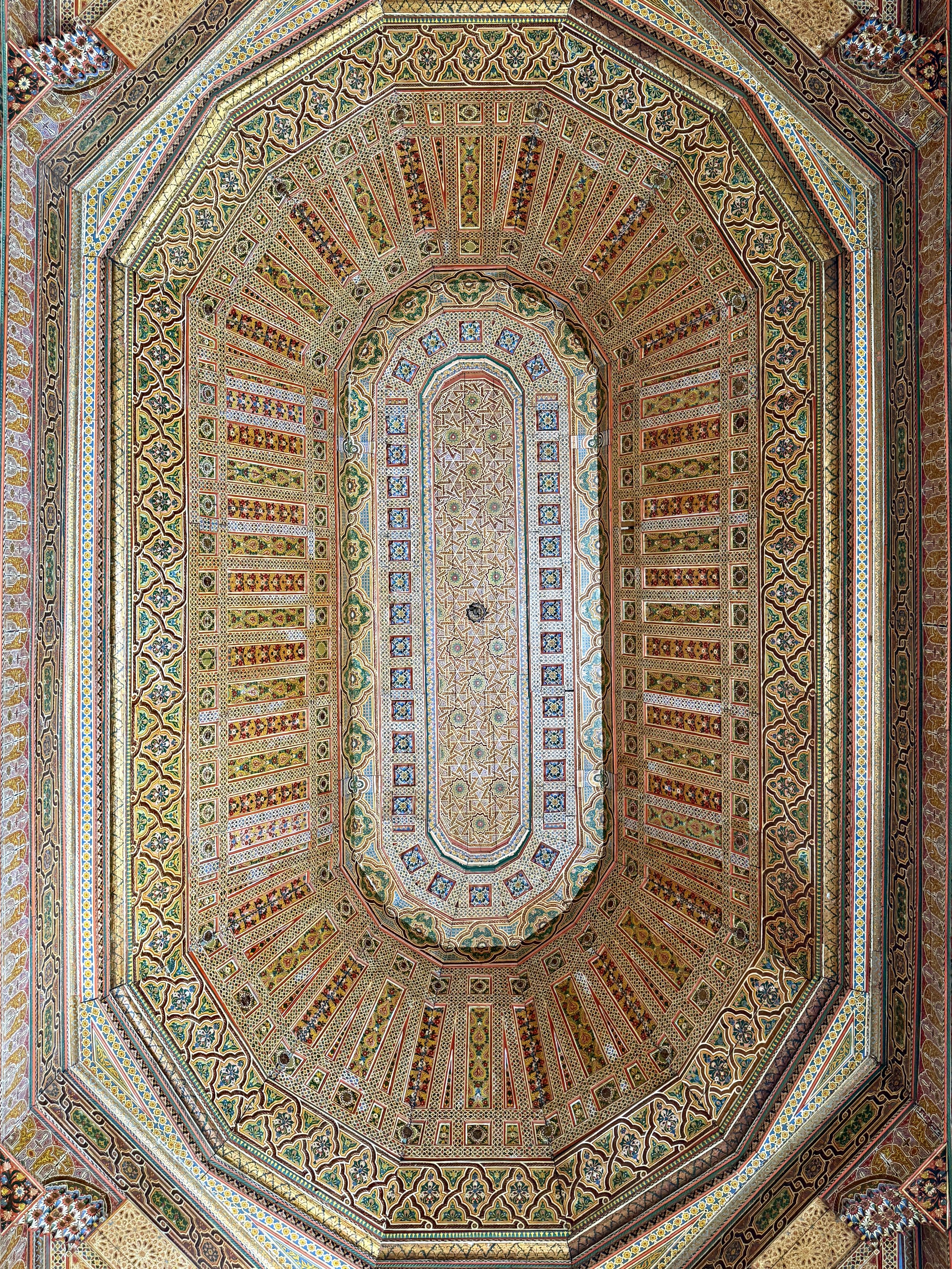
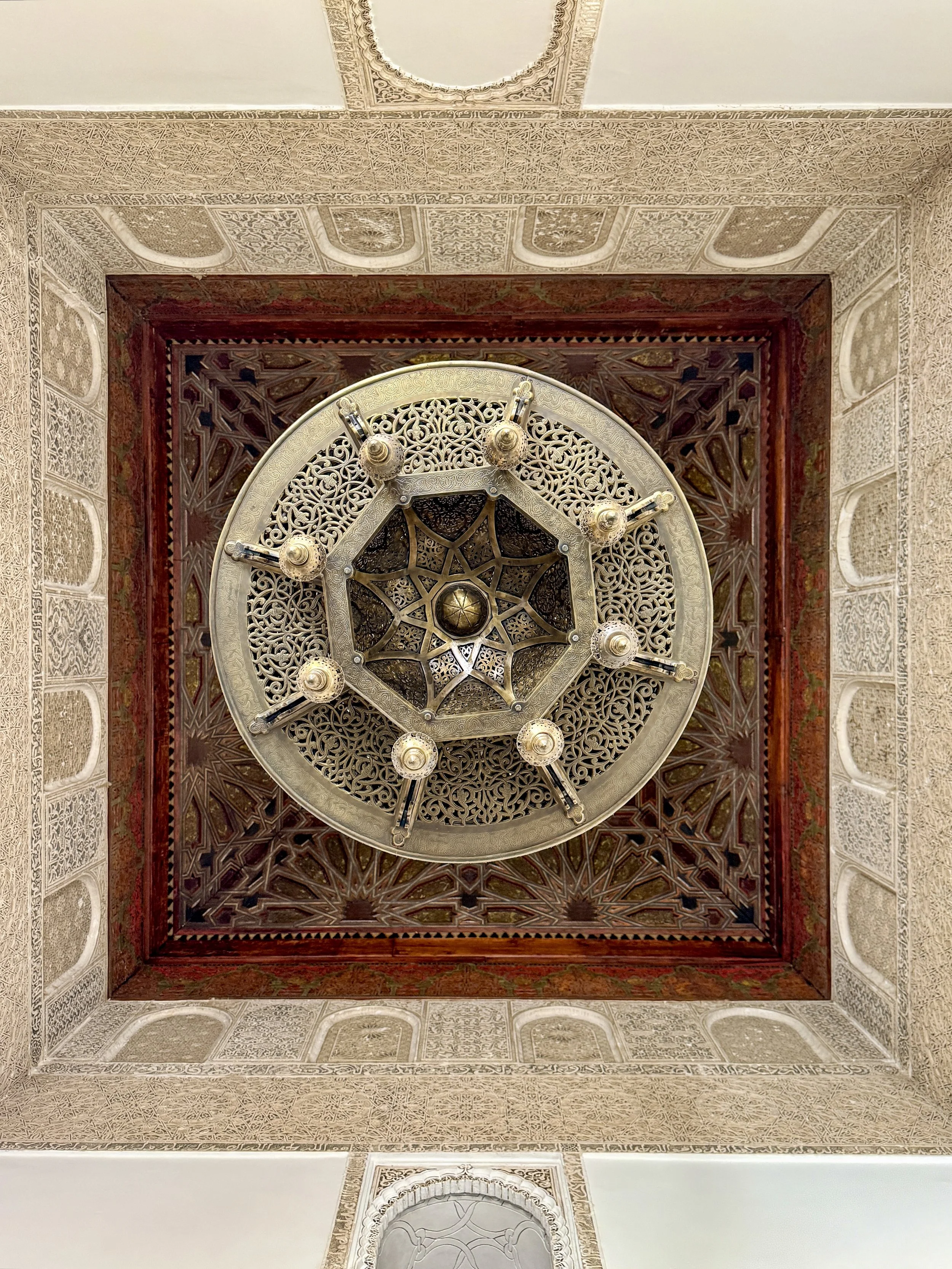
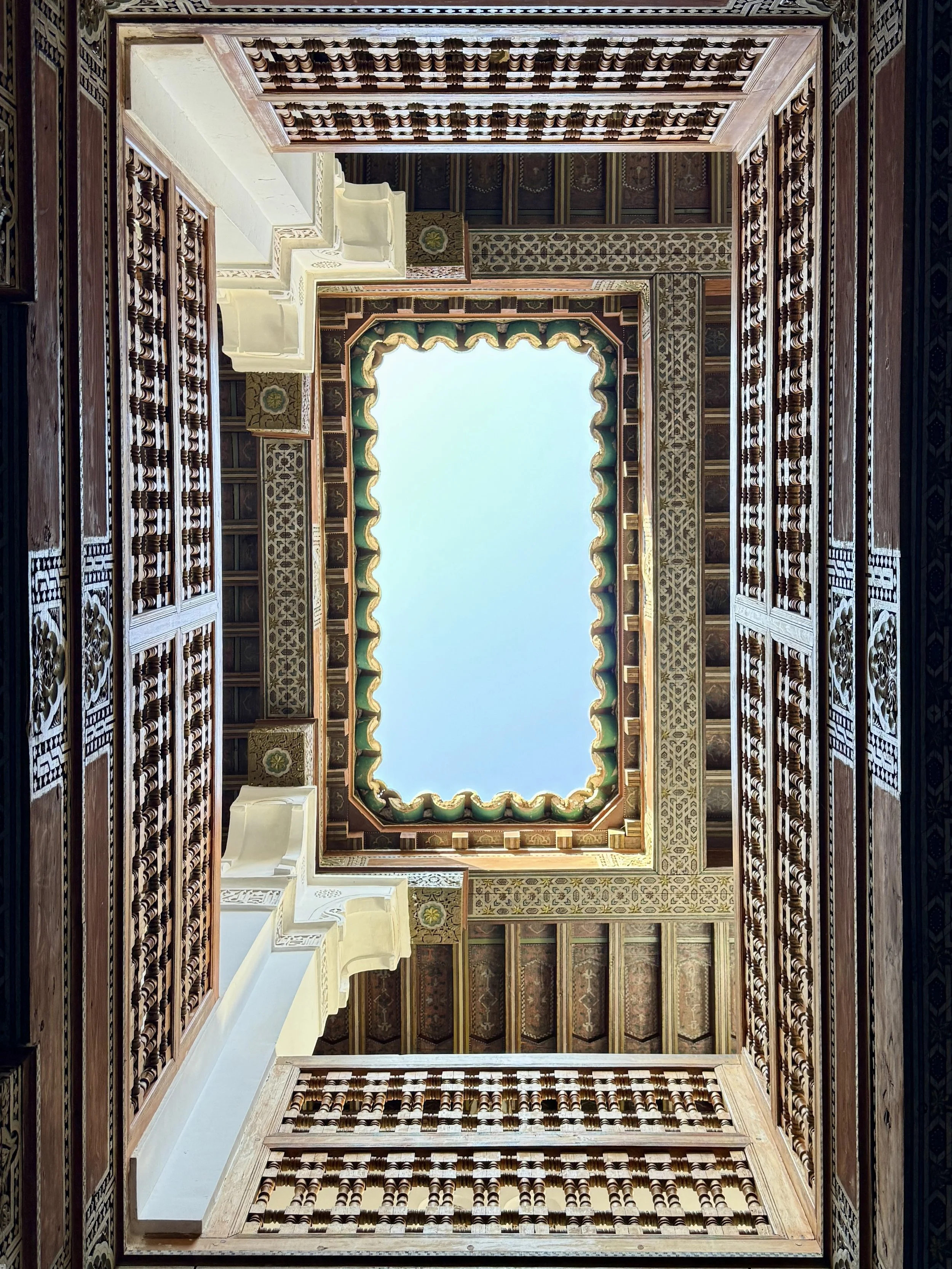
Coffered ceiling at Dar el Bacha, Marrakech, Morocco

The ruined mansion’s fortunes changed in 2014, when it was placed under the stewardship of the Fondation Nationale des Musées (National Foundation of Museums). After several more years of restoration, it finally opened to the public in 2017 as Dar el Bacha: Musée des Confluences (House of the Pasha: Museum of Confluences) with a mission to showcase the various aspects of cultural heritage that shaped the country’s identity. It was inaugurated by King Mohammed VI, with a dedicated room honoring Birch’s collection.
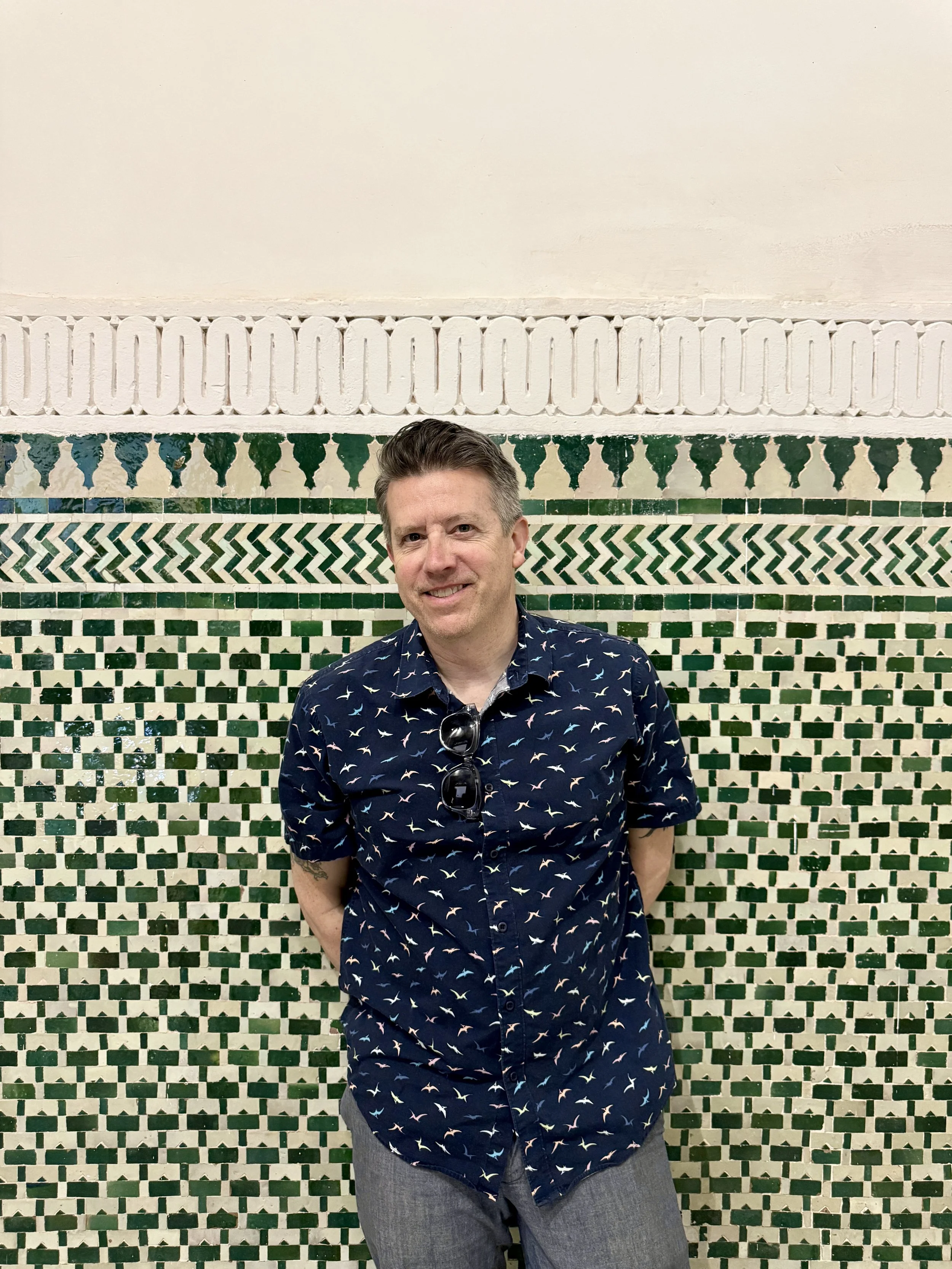
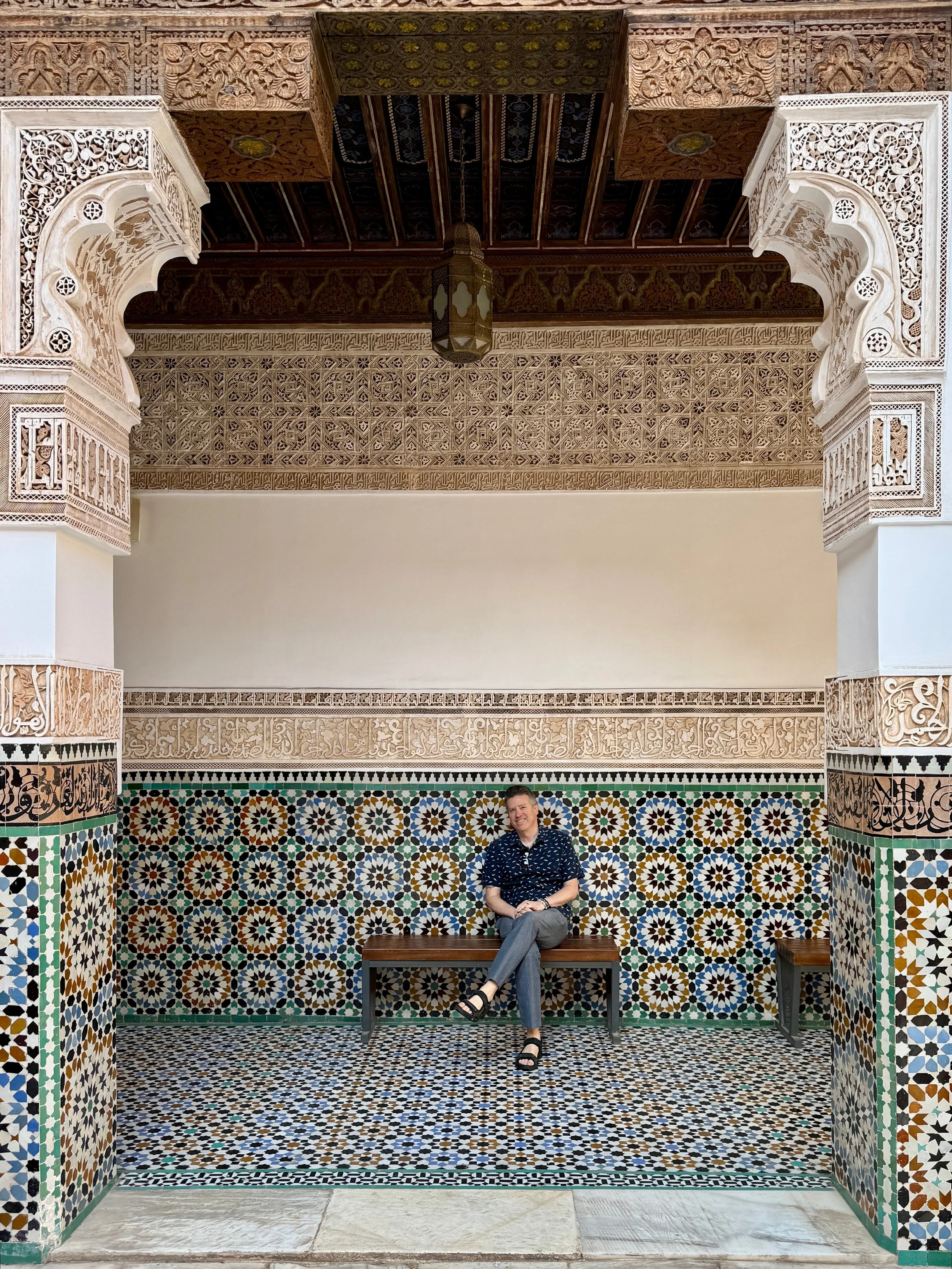
Wally leaning against a tiled wall in the vestibule of Dar el Bacha, Marrakech, Morocco

After exploring the nearby Ben Youssef Madrasa, we arrived around 10:30 a.m. on a Sunday morning and found ourselves at the end of a rather long line. 
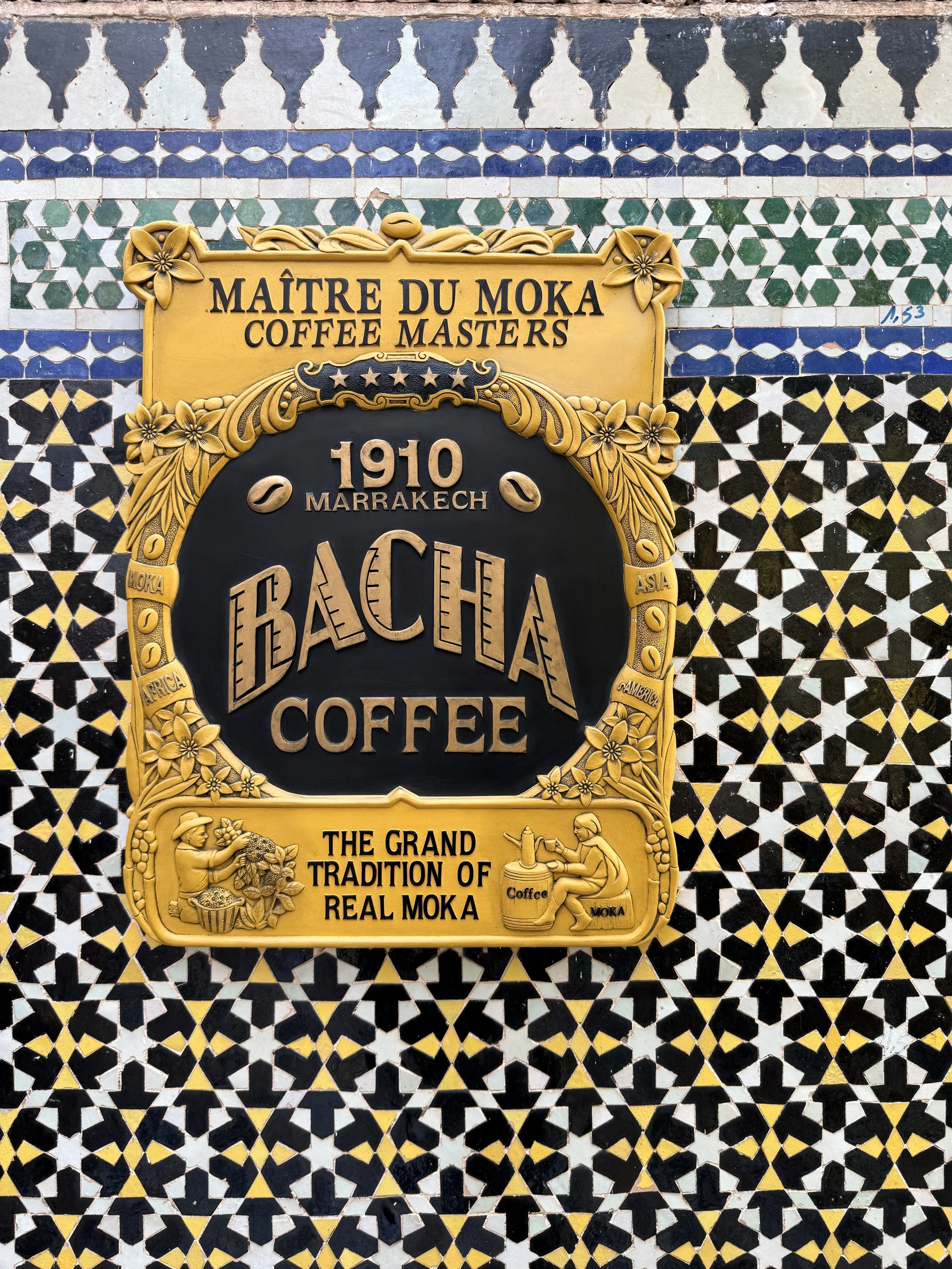
Sign for Bacha Coffee on tile wall at Dar el Bacha in Marrakech

Bacha Coffee: Worth the Wait?

Note: If you’re interested in going to the ultra-trendy Bacha Coffee, which is housed in an Art Deco-style salon inside the museum, you’ll need to purchase either a café-only ticket (10 dirhams, about $1) or a combined ticket (60 MAD, about $6) that also includes museum entry. 
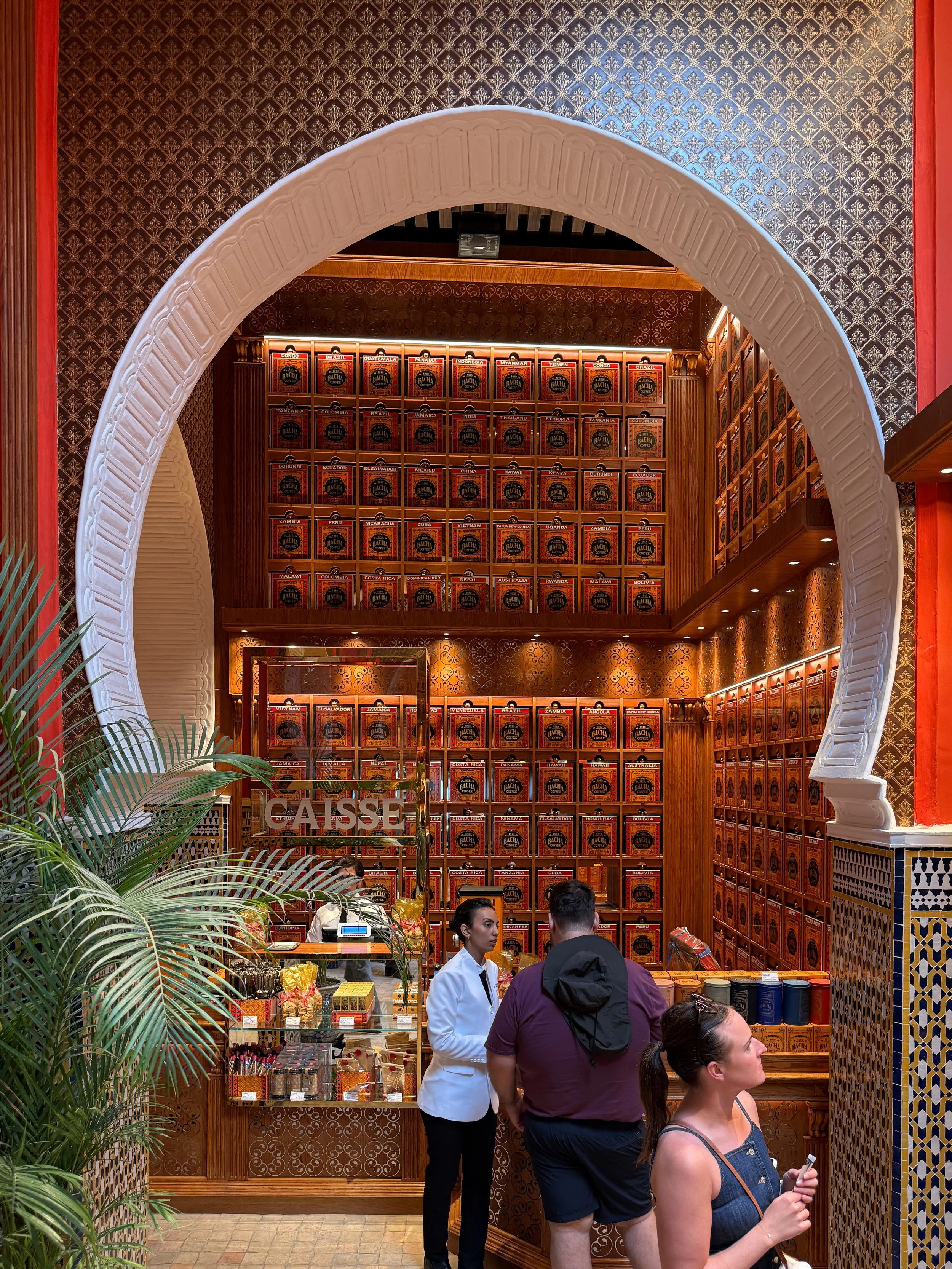
The coffee store for Bacha Coffee at Dar el Bacha in Marrakech

When we got to the ticket counter, we were told the wait time for the café was already pushing three hours — roughly the flight time from Marrakech to London — and agreed to get our caffeine fix elsewhere. 

We were told the wait for Bacha Coffee was already pushing three hours — roughly the flight time from Marrakech to London.

The concept was inspired by the lavish receptions where Arabica coffee was served to guests from glittering golden gooseneck pots at El Glaoui’s home. In 2017, French-Moroccan entrepreneur Taha Bouqdib attended the ceremony marking the museum’s opening and was invited to bring the legendary coffee tradition back to life.

We did, however, stop by the Bacha Coffee boutique, just beyond the ticket counter. The irresistible aroma of freshly ground coffee filled the air, and library-style shelves were stocked floor to ceiling with neat rows of orange canisters bearing gold lettering, organized by growing region. 
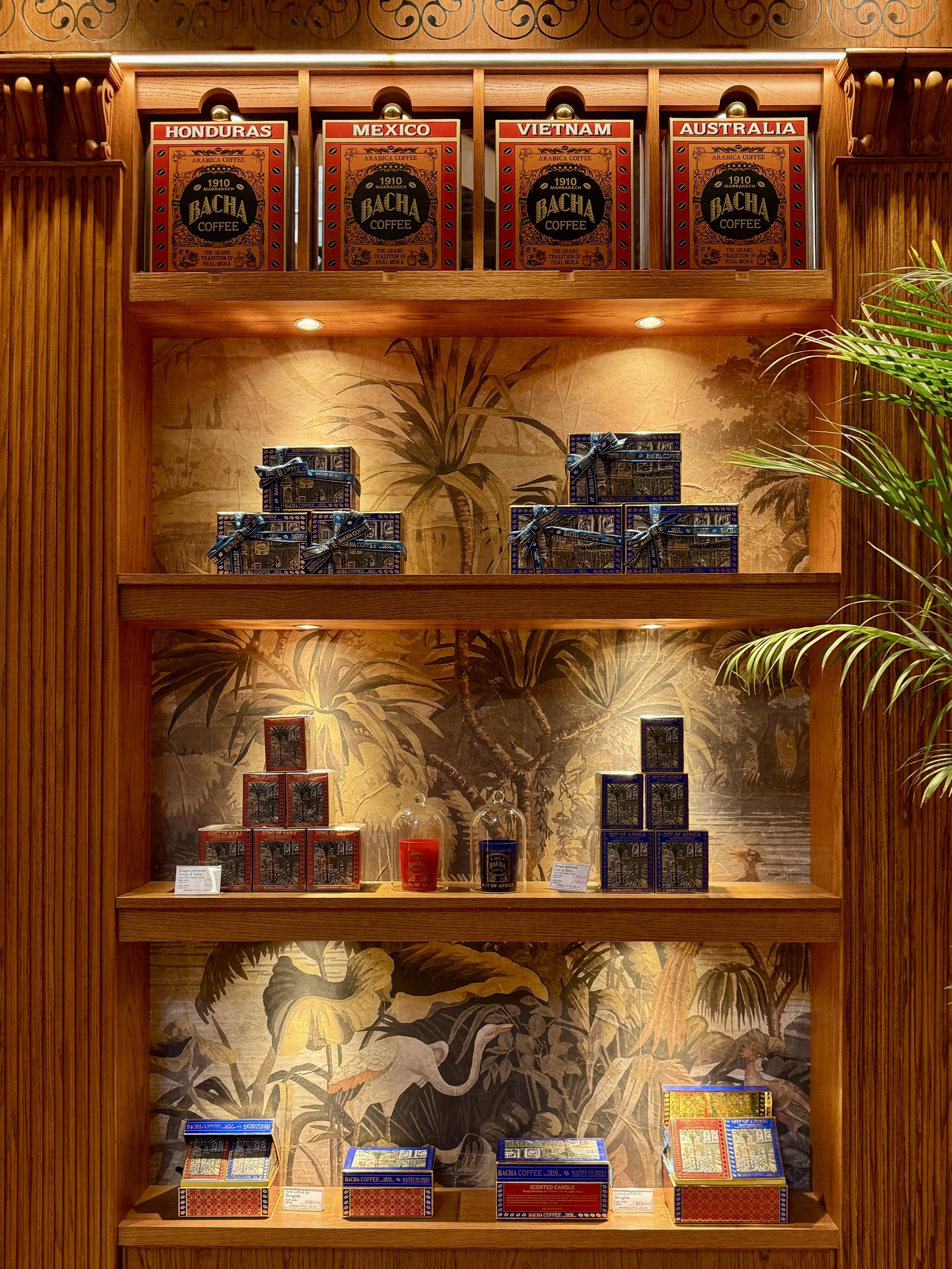
A shelf at the Bacha Coffee store at Dar el Bacha in Marrakech

The walls that didn’t display coffee held gift sets, scented candles and serviceware, set against wallpaper depicting tropical flora and exotic birds. They also sold a book titled Marvelous Moroccan Moka, detailing the origins of the brand’s 200-plus coffee varieties, which I debated buying but ultimately didn’t.

Pro tip: The airport also has a shop, where I bought an airtight tin and a 200 gram (7 ounce) bag of Cuba Turquino, a single-origin, medium roast coffee, ground for French press.
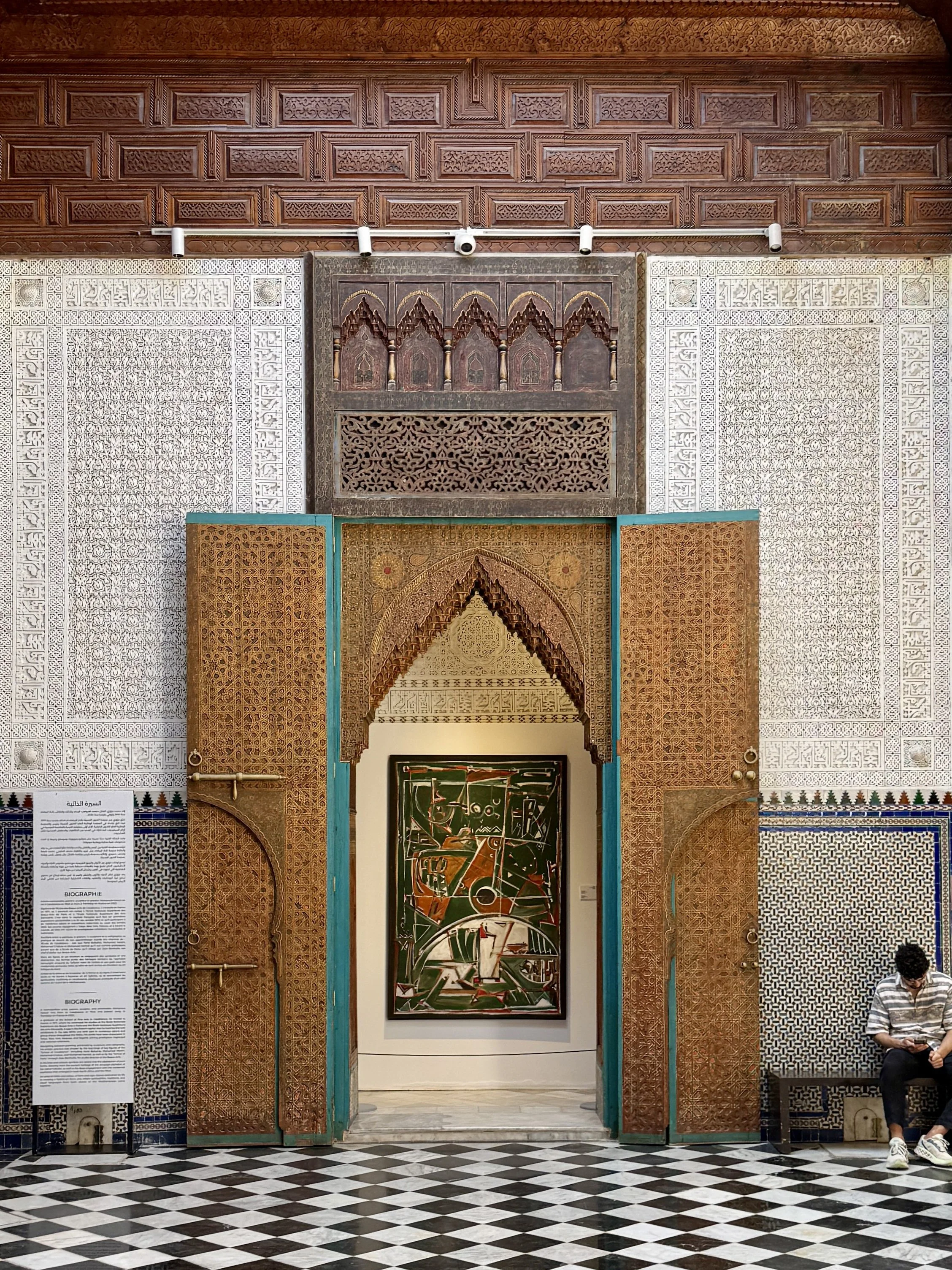
Looking into a gallery room in the reception area of Dar el Bacha in Marrakech

The meticulously restored reception hall of El Glaoui’s former residence now hosts temporary exhibitions.

Dar el Bacha’s Reception Hall 

One of the first rooms we entered was the grand reception hall, where columns covered in geometric zellige tile rose toward a ceiling of carved cedarwood. 

The building has been meticulously restored, with several details of the stately home’s history preserved. 
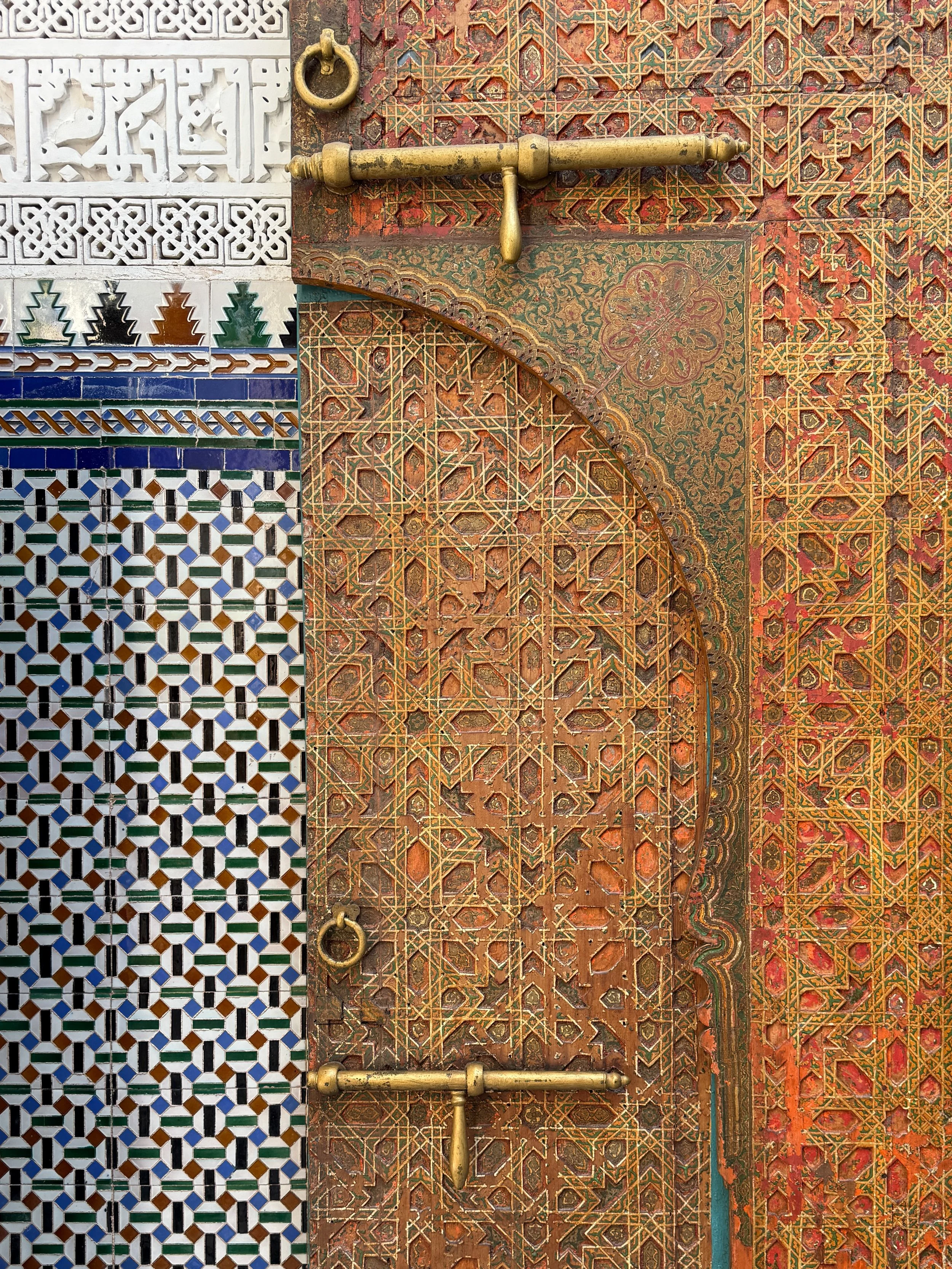
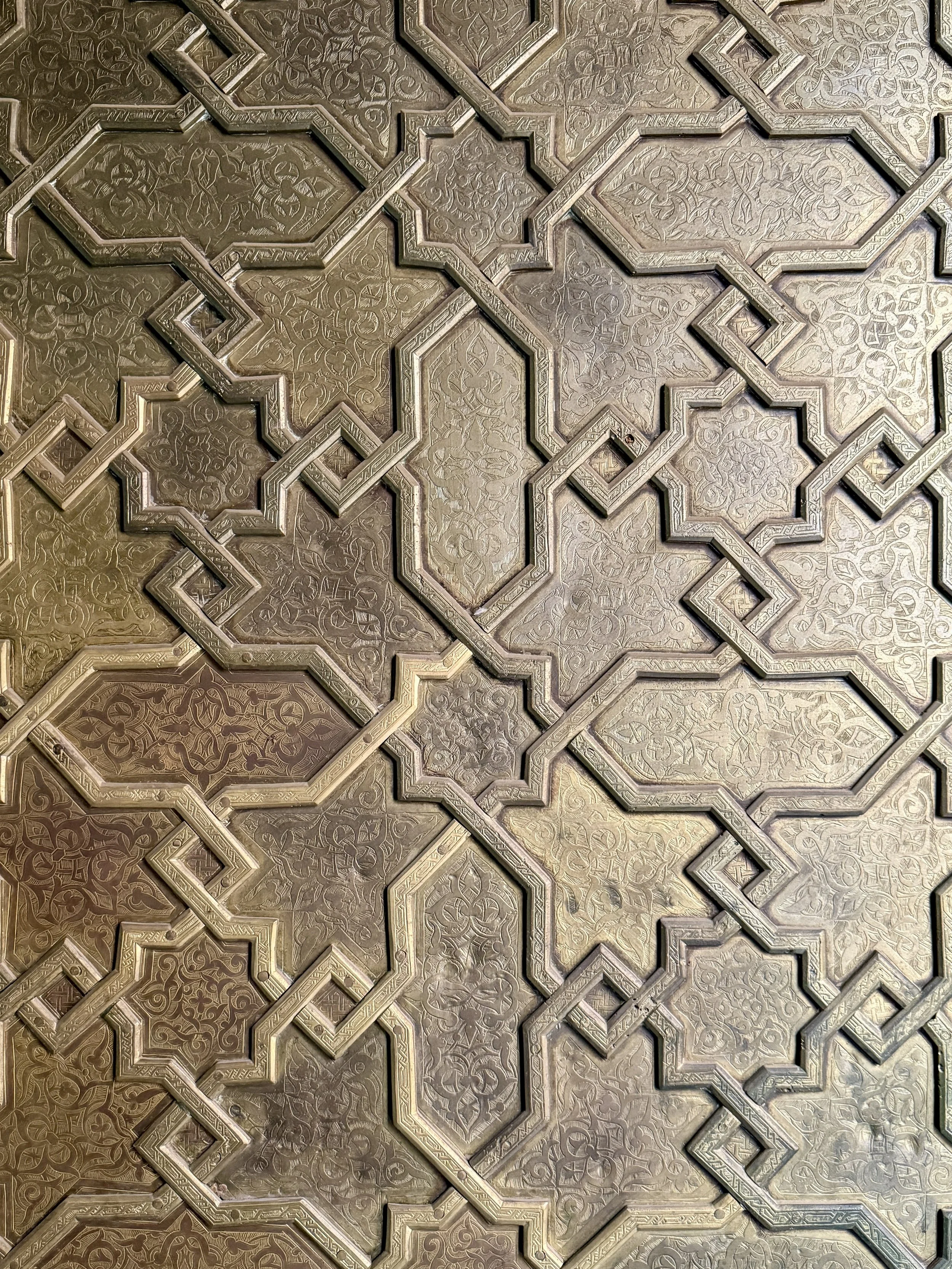
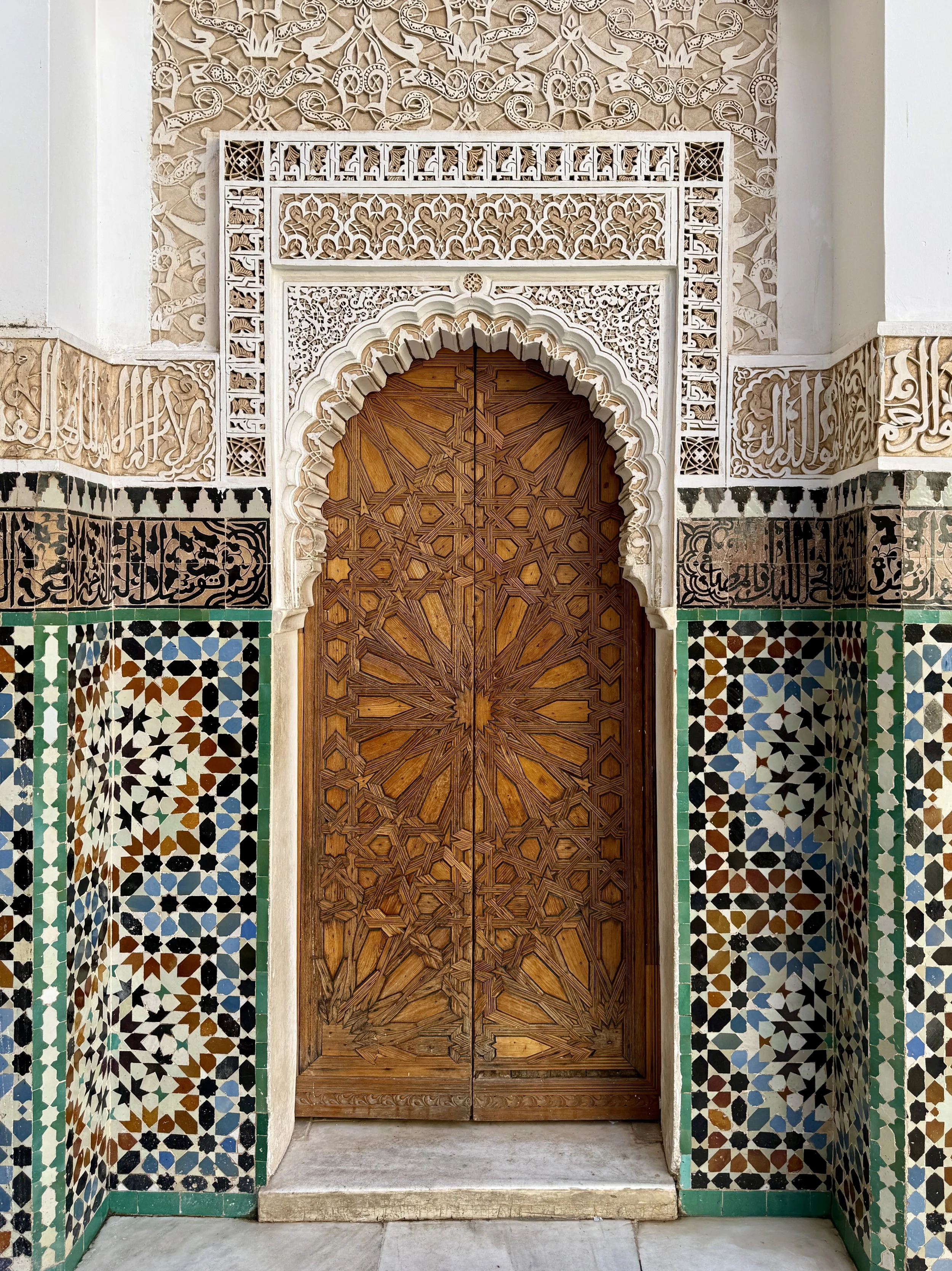
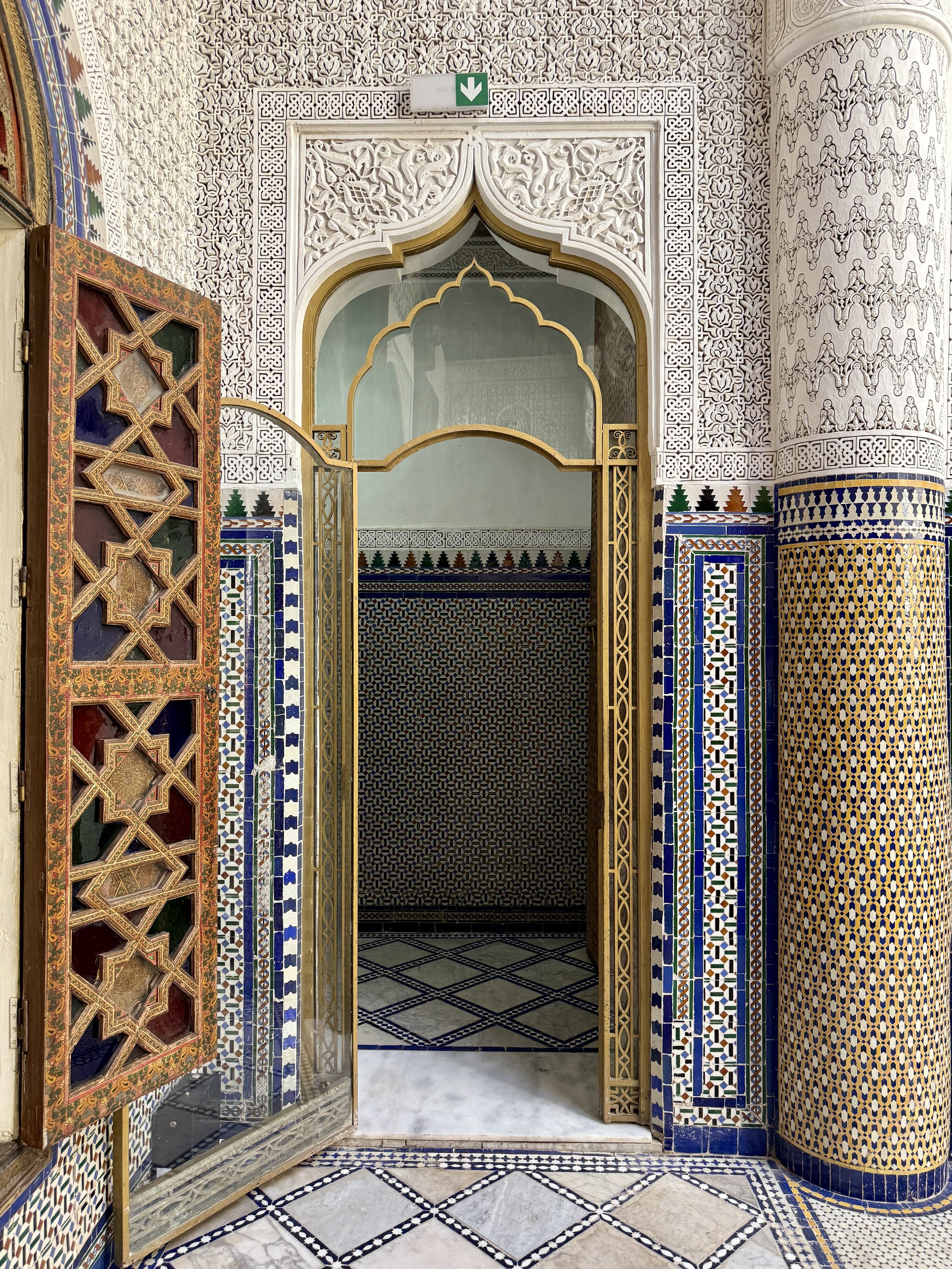
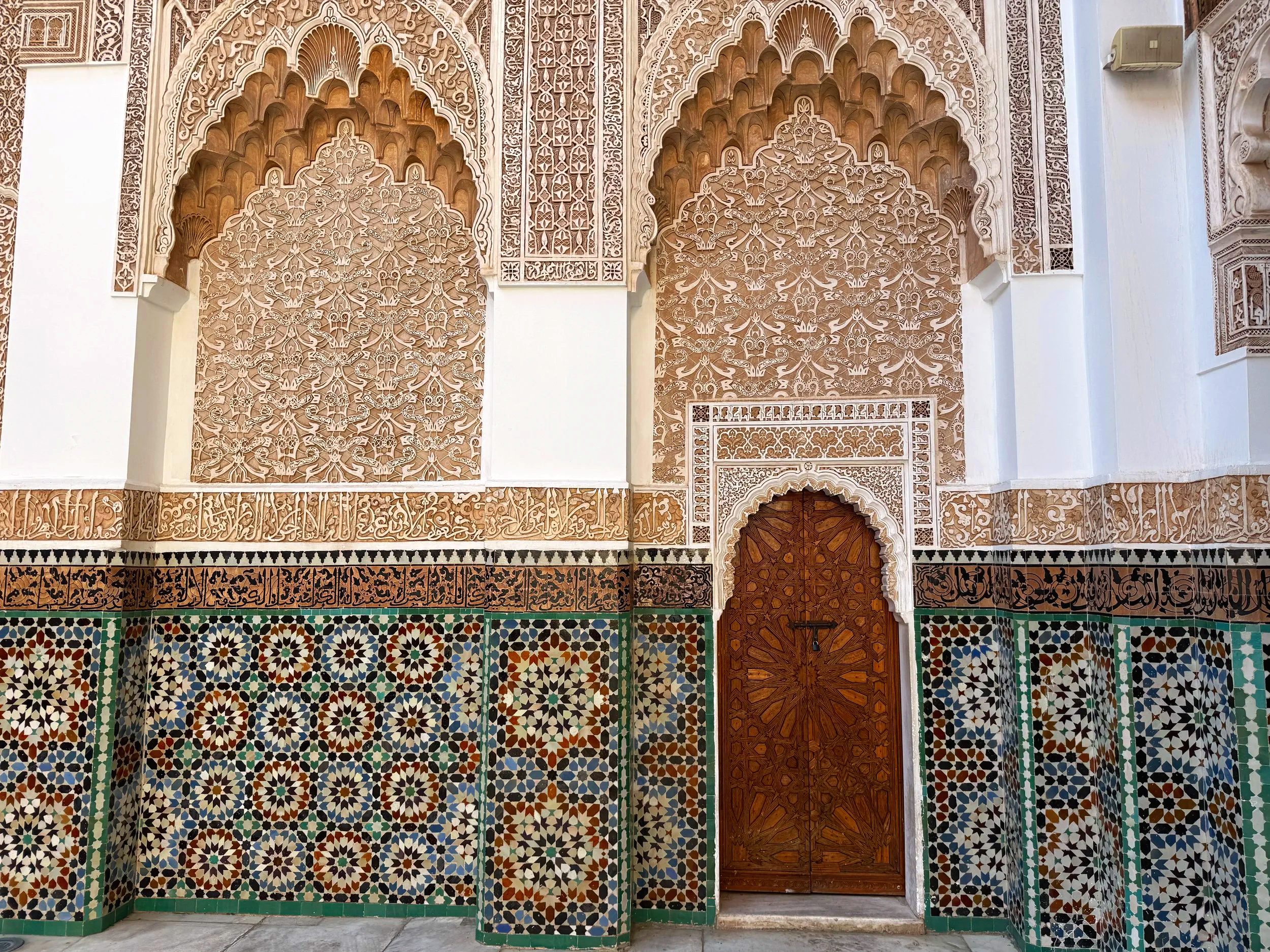
An ornately carved door by colorful tilework at Dar el Bacha in Marrakech
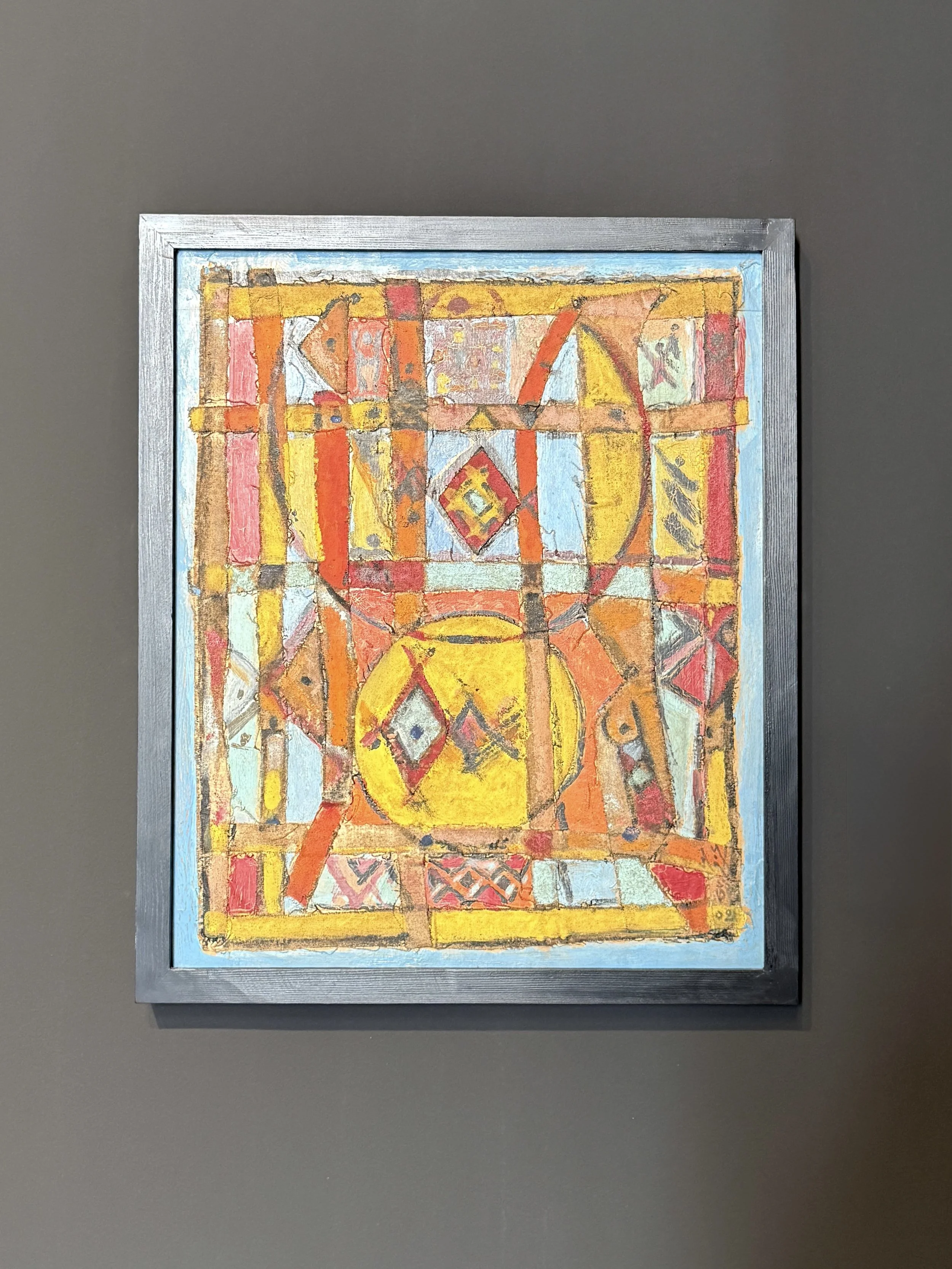
Mosaïque (Mosaic) by Mohamed Azouzi

Mosaïque (Mosaic) by Mohamed Azouzi, 2002
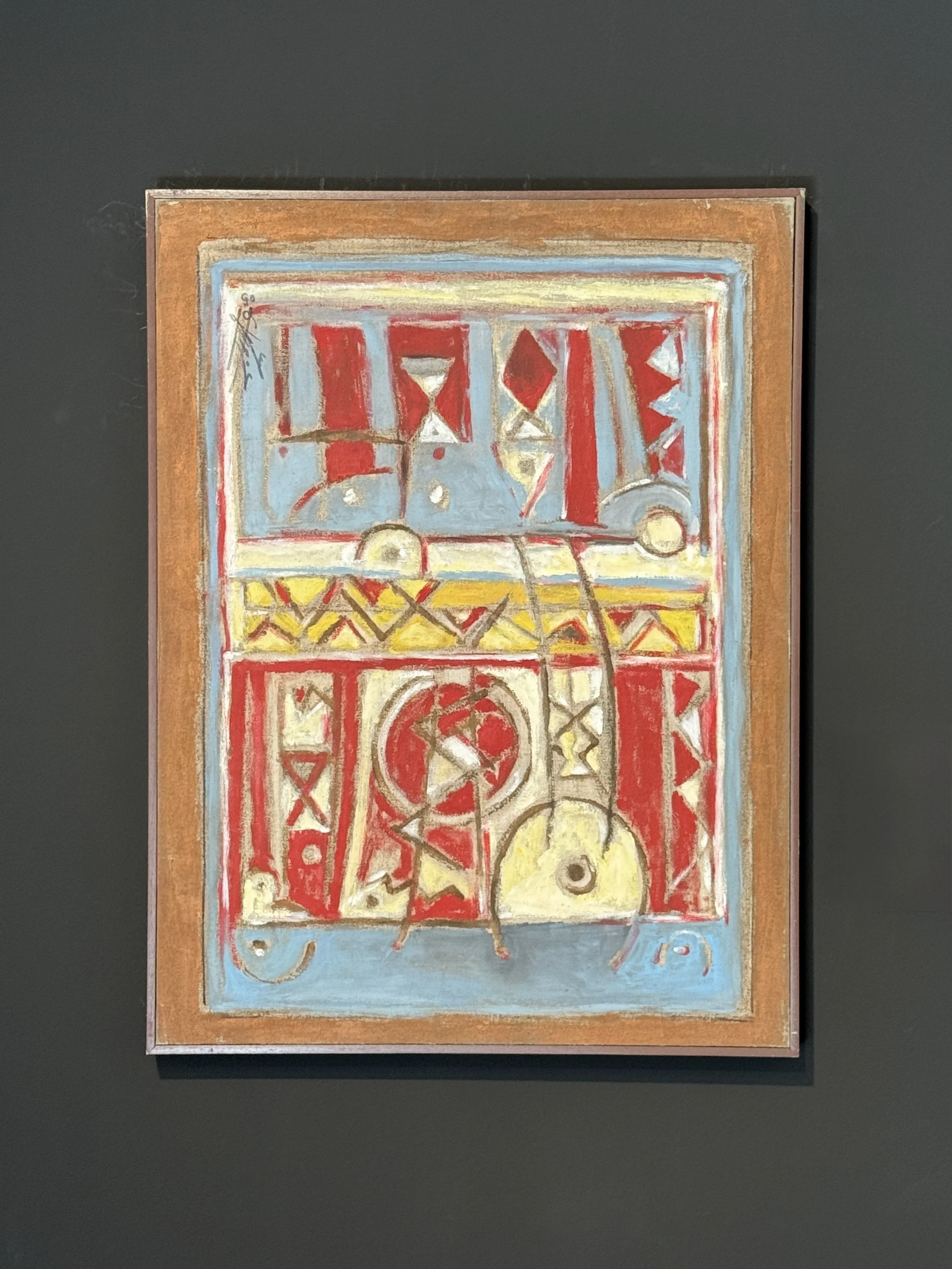
Le soulèvement (The Uprising) by Mohamed Azouzi

Le soulèvement (The Uprising) by Mohamed Azouzi, 2005

Smaller adjoining chambers, fitted with handcarved cedarwood doors, held the temporary exhibit Sous le signe du Noun (Under the Sign of Noun), a retrospective featuring the vibrant abstract canvases of Mohamed Azouzi (1946–2022), a Moroccan painter who trained at the École des Beaux-Arts de Casablanca (Casablanca School of Fine Arts) before moving to Paris to continue his studies at the École des Arts Décoratifs (School of Decorative Arts). 
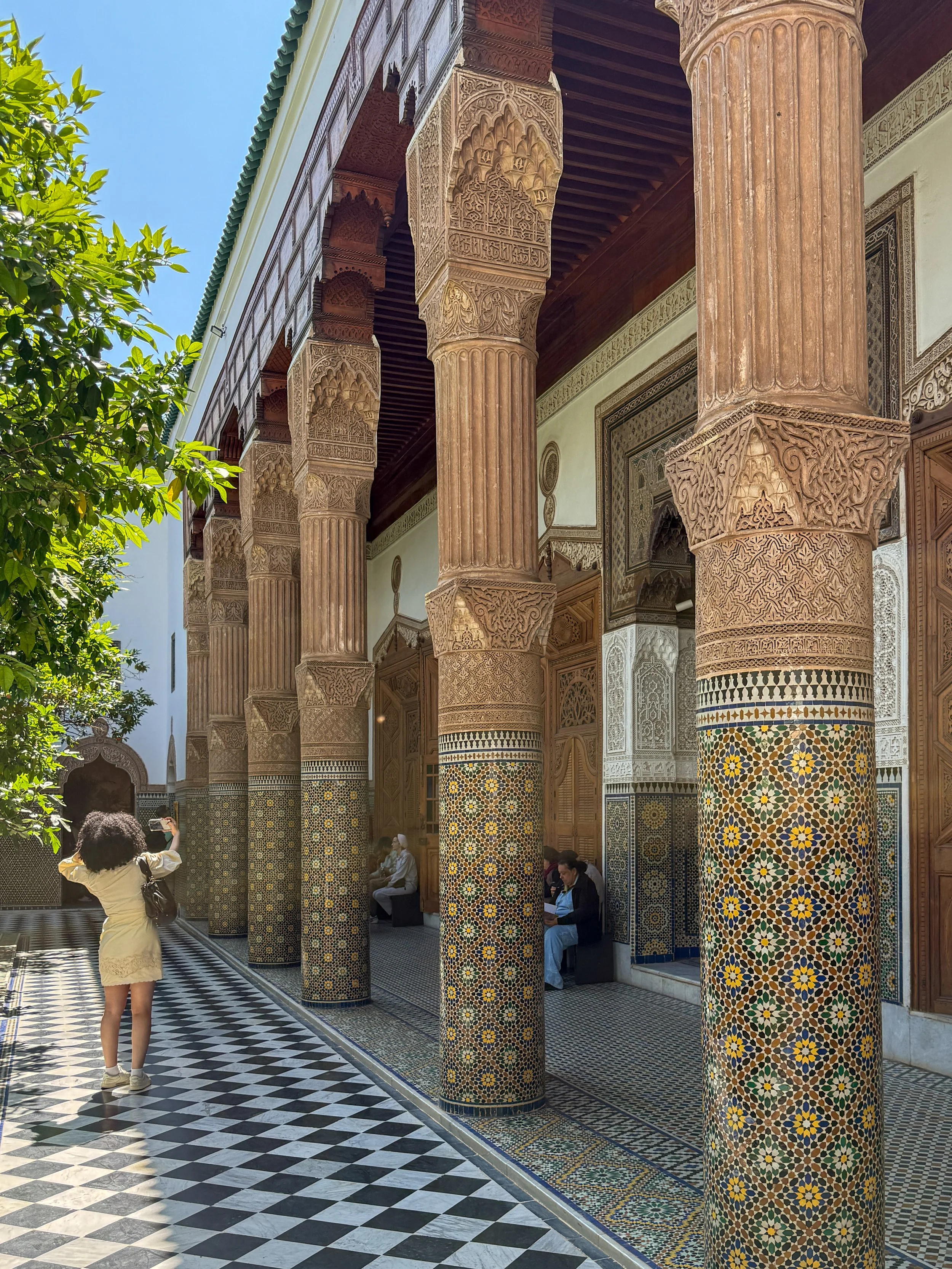
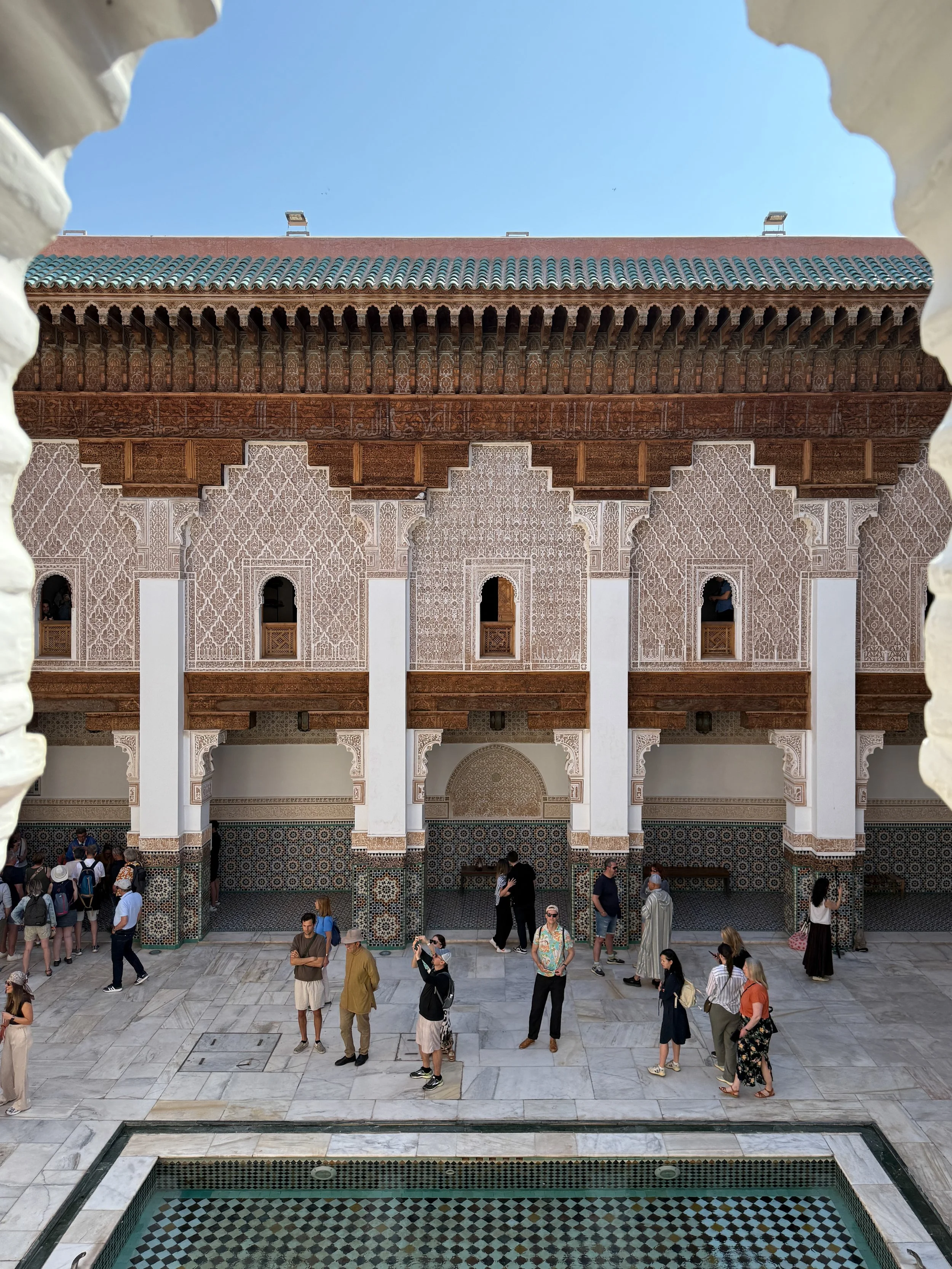
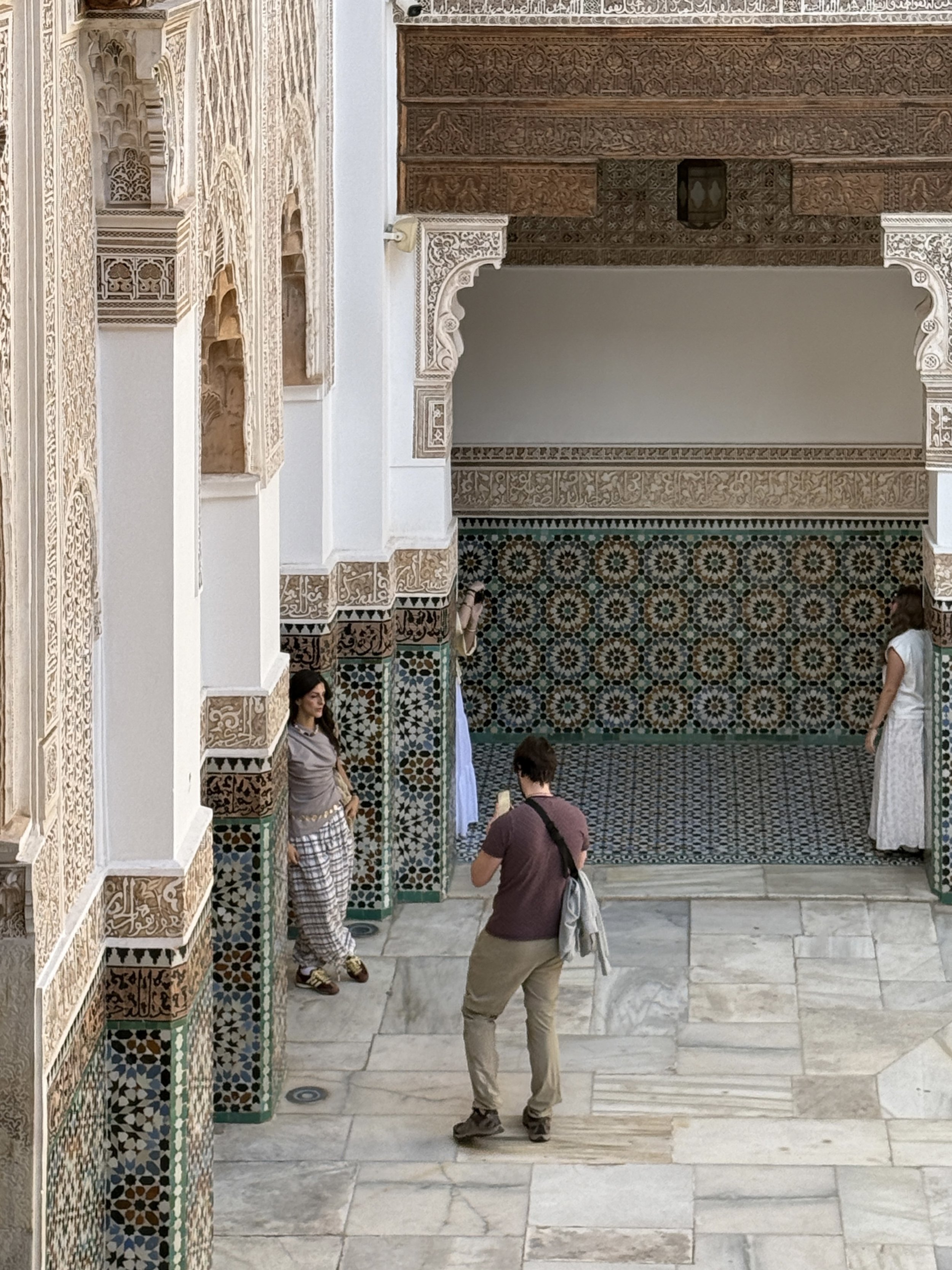
A woman takes a picture by tiled columns in the central courtyard at Dar el Bacha in Marrakech, Morocco

Interior Courtyard

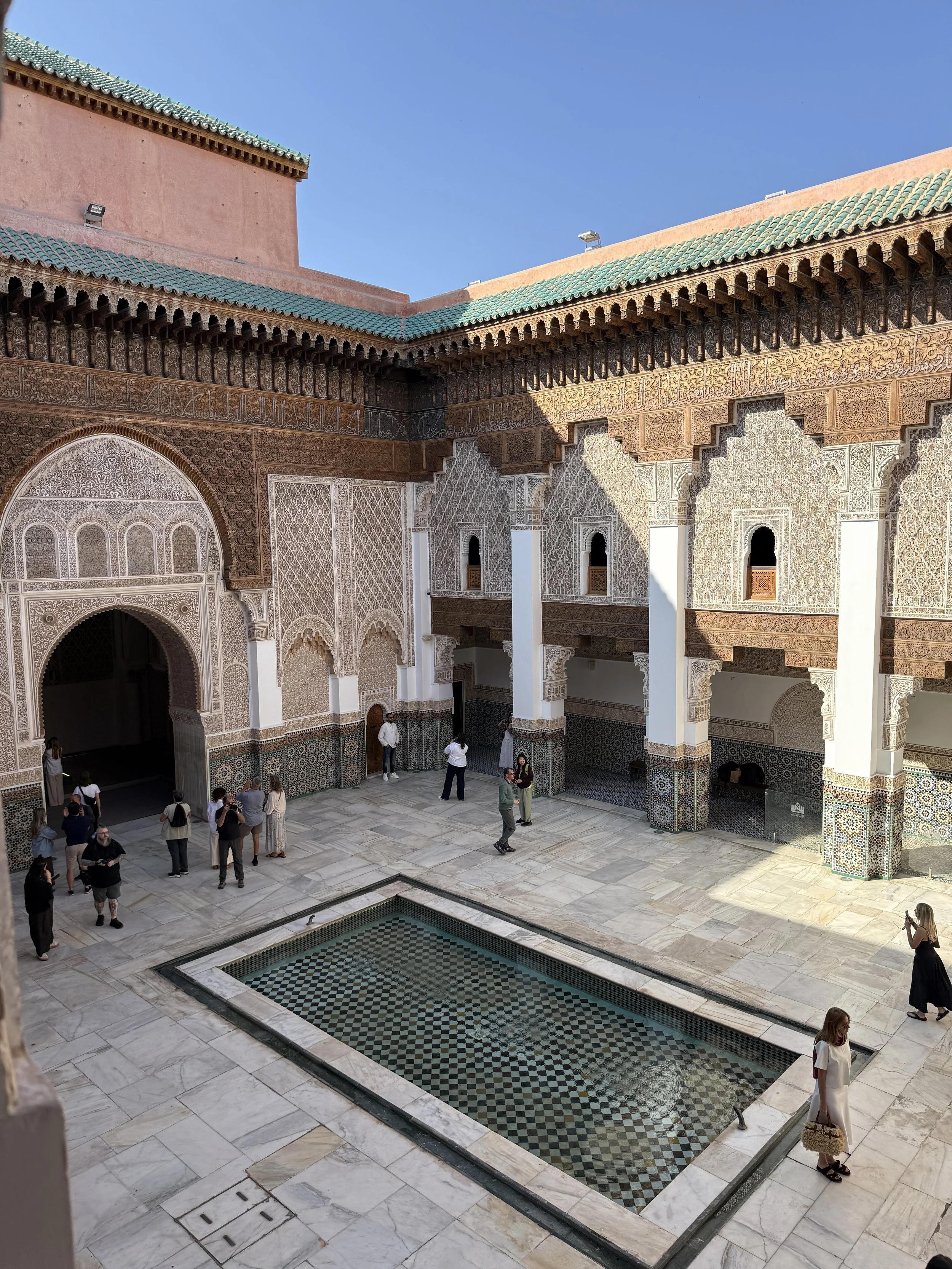
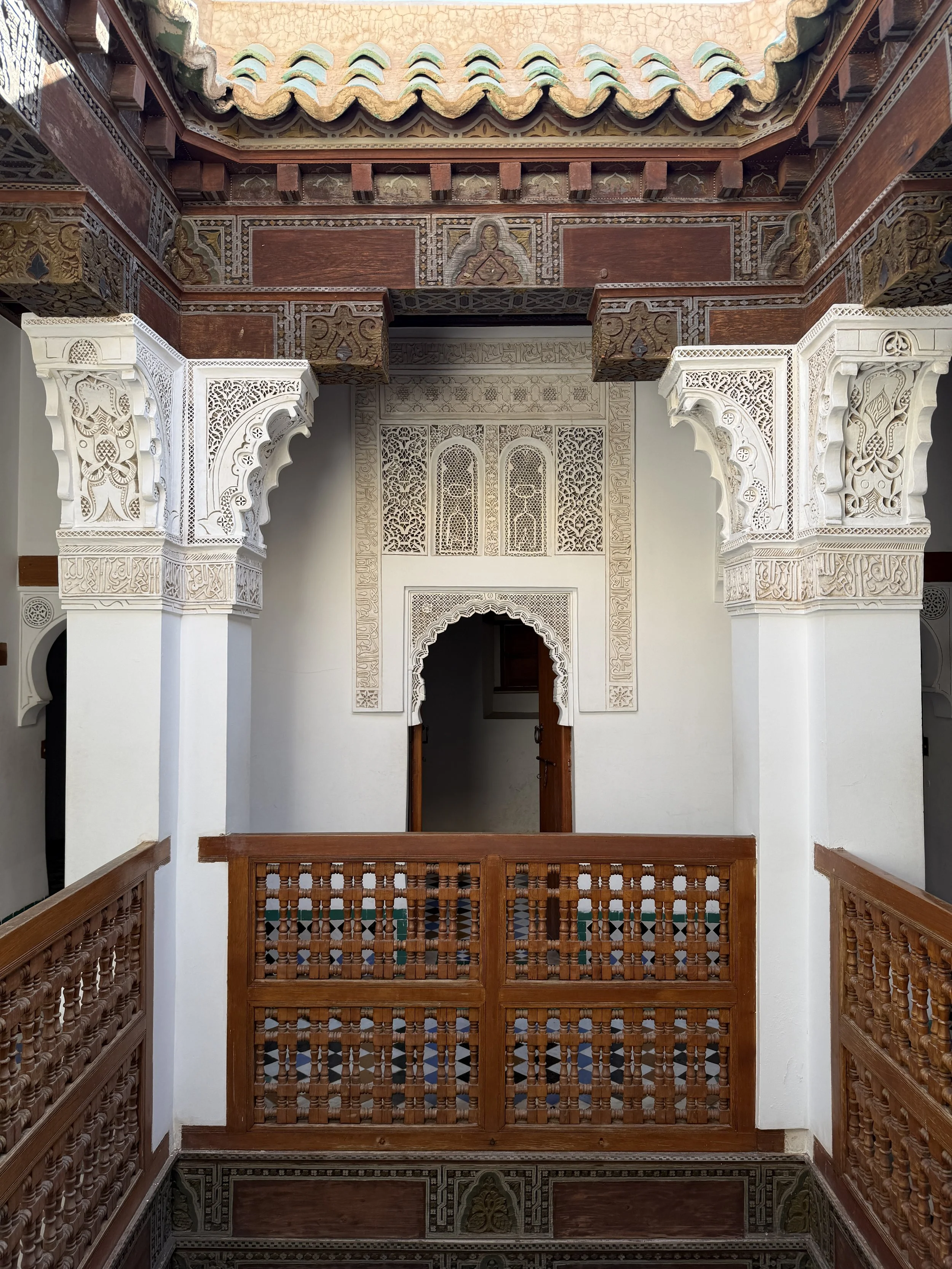
From there, we made our way to the palatial interior courtyard, the heart of the museum. Framed by an arcade of tiled columns with sculpted capitals and set against carved cedarwood shutters and doors, the open-air enclosure and its six surrounding chambers now serve as galleries featuring a diverse collection of traditional Islamic art. 
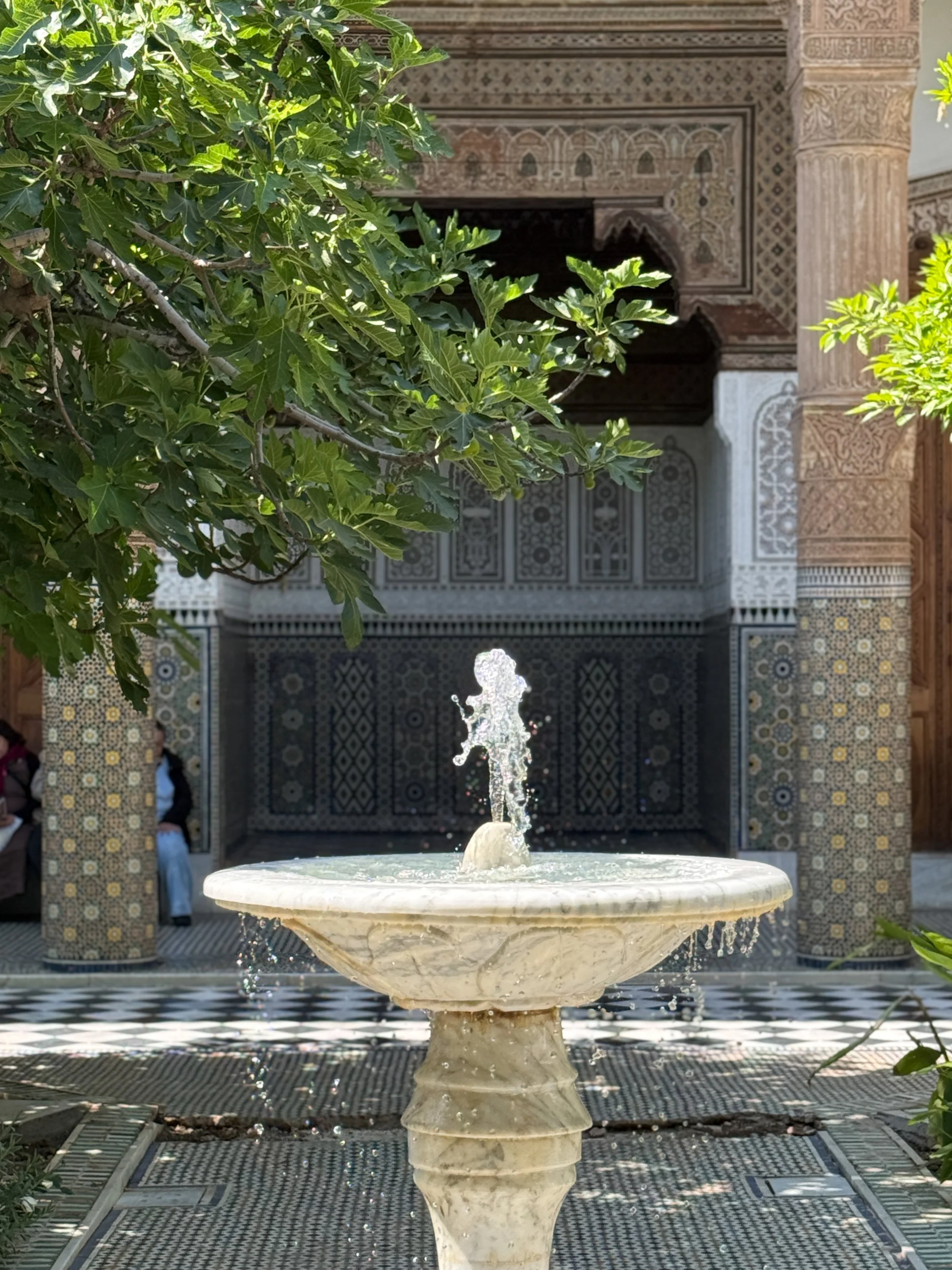
A fountain gurgles in the central courtyard of Dar el Bacha in Marrakech, Morocco
A water feature with elaborate zellige tiles at Dar el Bacha in Marrakech, Morocco

The garden is divided into four sections, planted with manicured orange trees throughout, a design evoking the garden of paradise described in the Qur’an. 
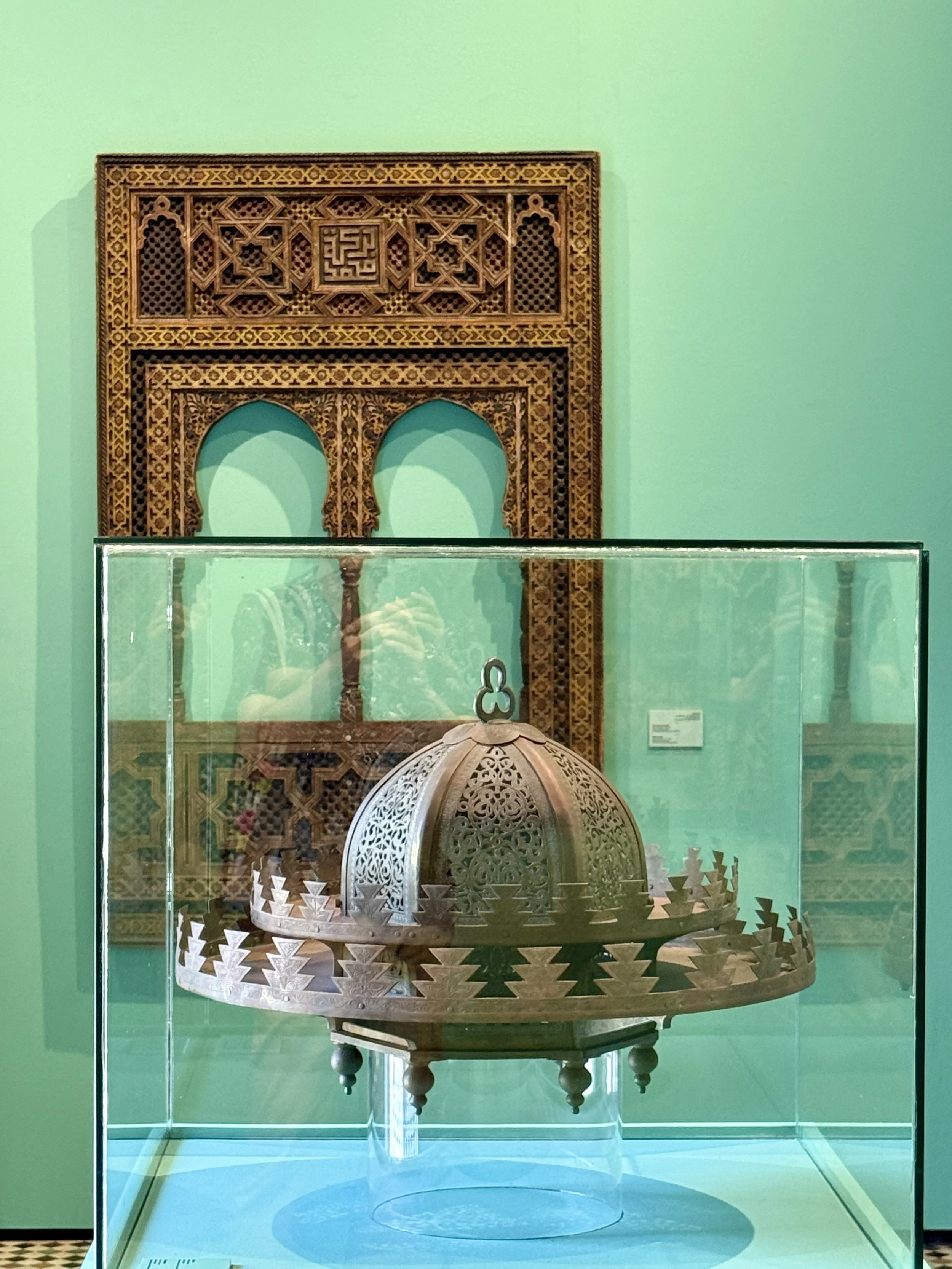
A bronze light feature with cedar window frames on display at Dar el Bacha in Marrakech, Morocco

One of the salons holds religious artifacts, including a cast bronze chandelier and a cedar window frame bearing the maze-like barakah Muhammad (blessings of Muhammad).

The first room displayed a collection of religious artifacts associated with the expression of faith among Muslim artisans, including a carved and painted cedar window frame with a square Kufic inscription bearing the blessings of Muhammad from Meknès; a painted and carved wood corbel with floral patterns and muqarnas (stalactite vaulting) from Fès; and a hammered and cast bronze thrayya (chandelier) used for illuminating prayer halls in mosques and madrasas. 
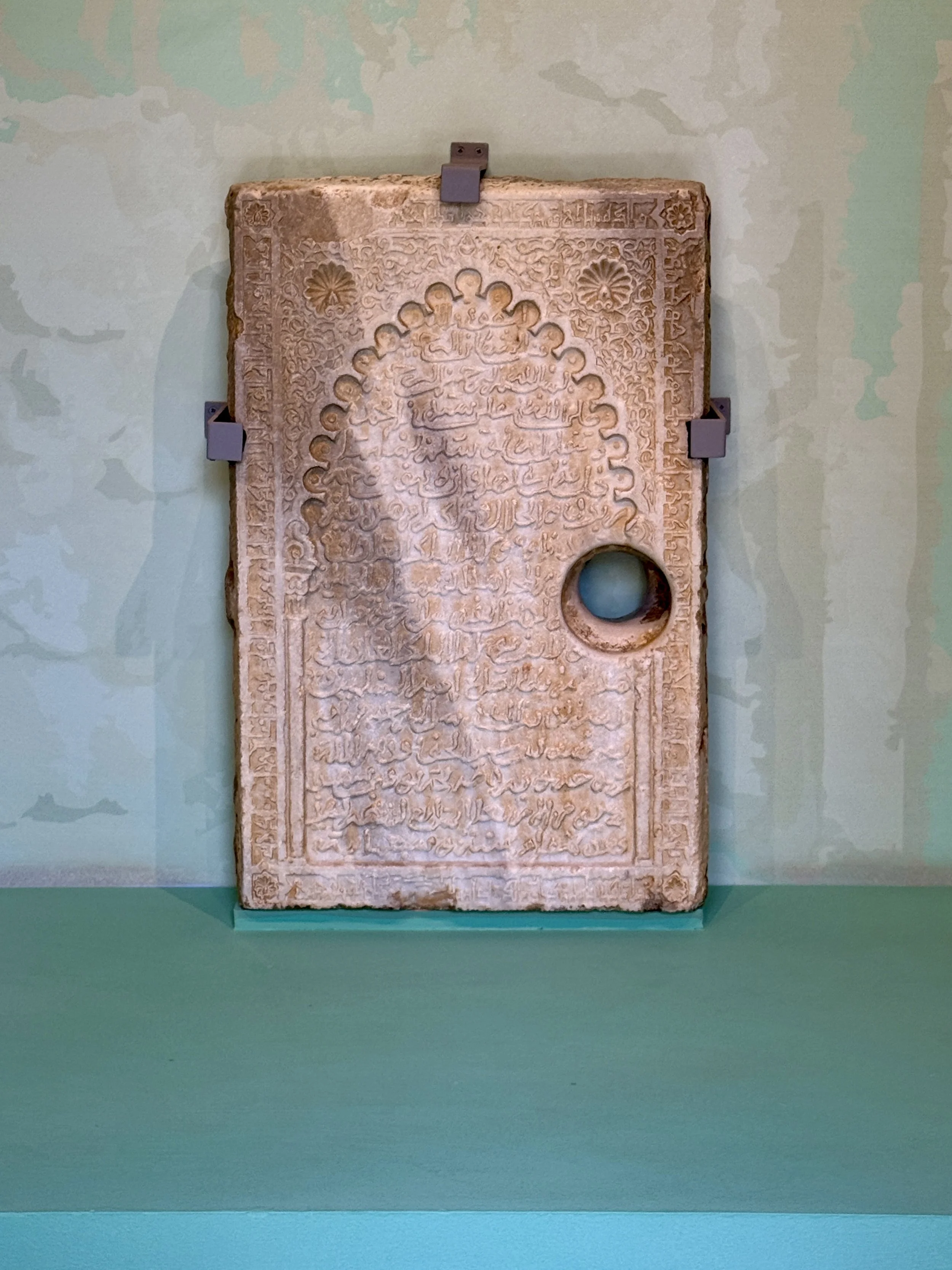
The marble funerary stele of Sultan Abu Ya’qub Yusuf on display at Dar el Bacha, Marrakech, Morocco

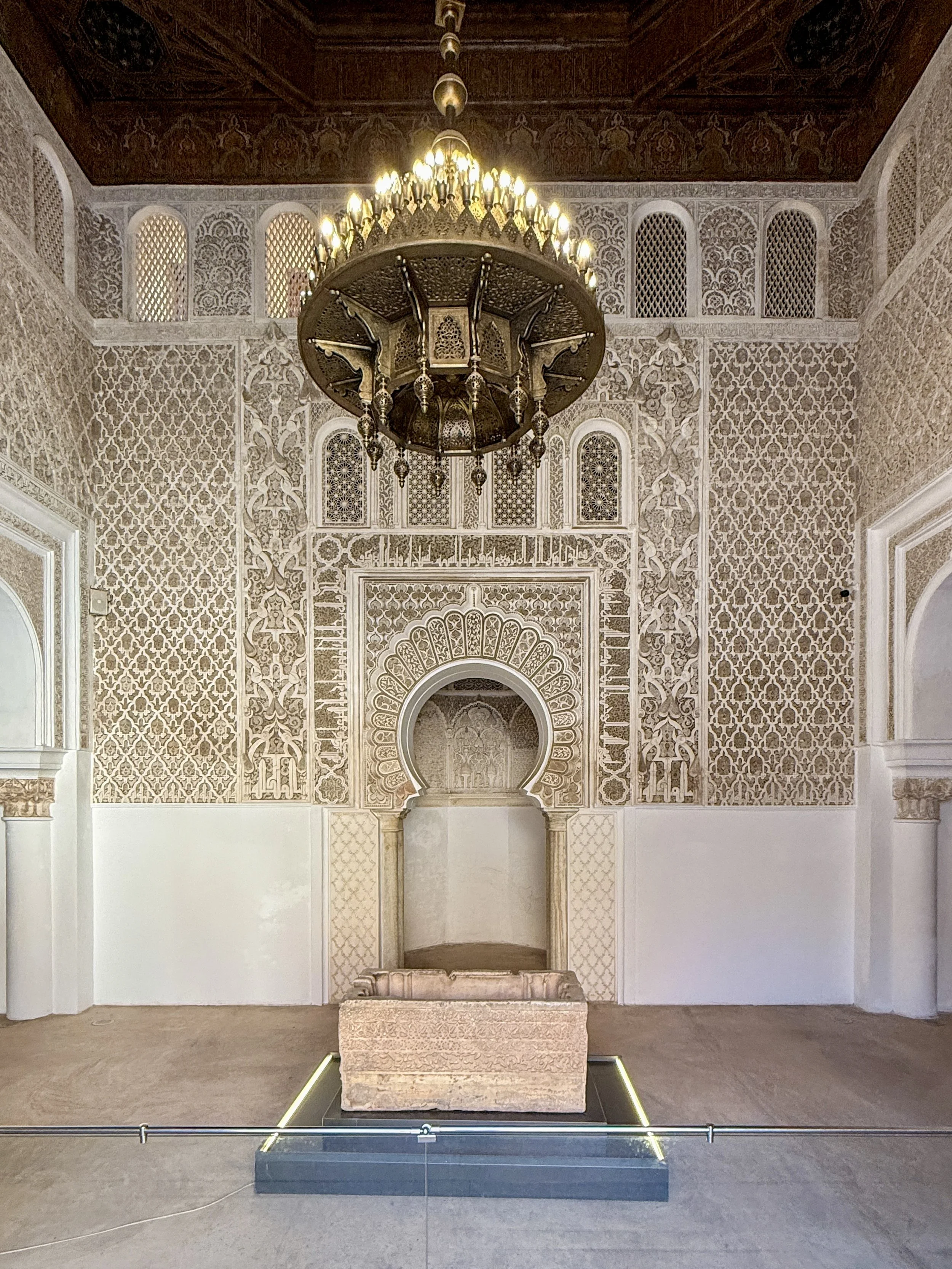
The marble funerary stele of Sultan Abu Ya’qub Yusuf. Its front is inscribed with Latin, and its back was used for his epitaph. 

Another room held the white marble funerary stele of Marinid Sultan Abu Ya’qub Yusuf (ruled 1286–1307), son and successor of Abu Yusuf Ya’qub. The marker has a curious history: It began as a Roman tombstone from Hispania Baetica, dedicated to a 3rd century governor, Aulus Caecina Tacitus. It was later repurposed as a fountain basin in Umayyad Córdoba, Spain, and centuries later was brought to Morocco, where Marinid carvers turned its blank face into the sultan’s epitaph. 

The stone features a poly-lobed arch reminiscent of a mihrab, the wall niche marking the holiest place in a mosque, and a circular opening, likely a  drainage hole from its former life as a fountain.
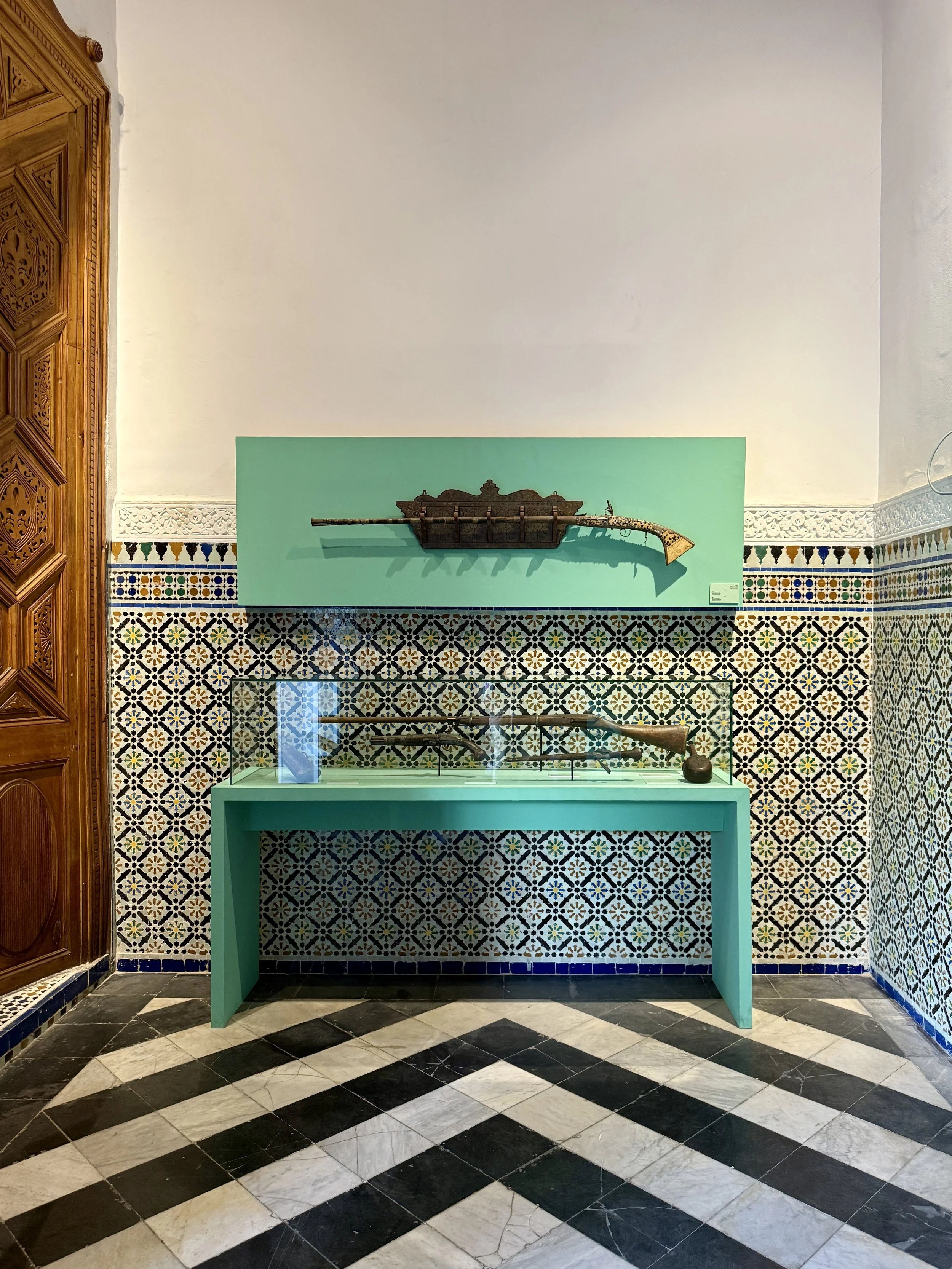
Antique rifles on display at Dar el Bacha, Marrakech, Morocco

Known for his piety and prowess in warfare, Sultan Abu Ya’qub Yusuf faced revolts within his own territories in Morocco, alongside a prolonged siege against the Zayyanids of Tlemcen (Algeria) and military campaigns in Spain. He was assassinated in the Tlemcen siege camp in May 1307 (706 AH), after which he was laid to rest in the Chellah necropolis in Rabat.
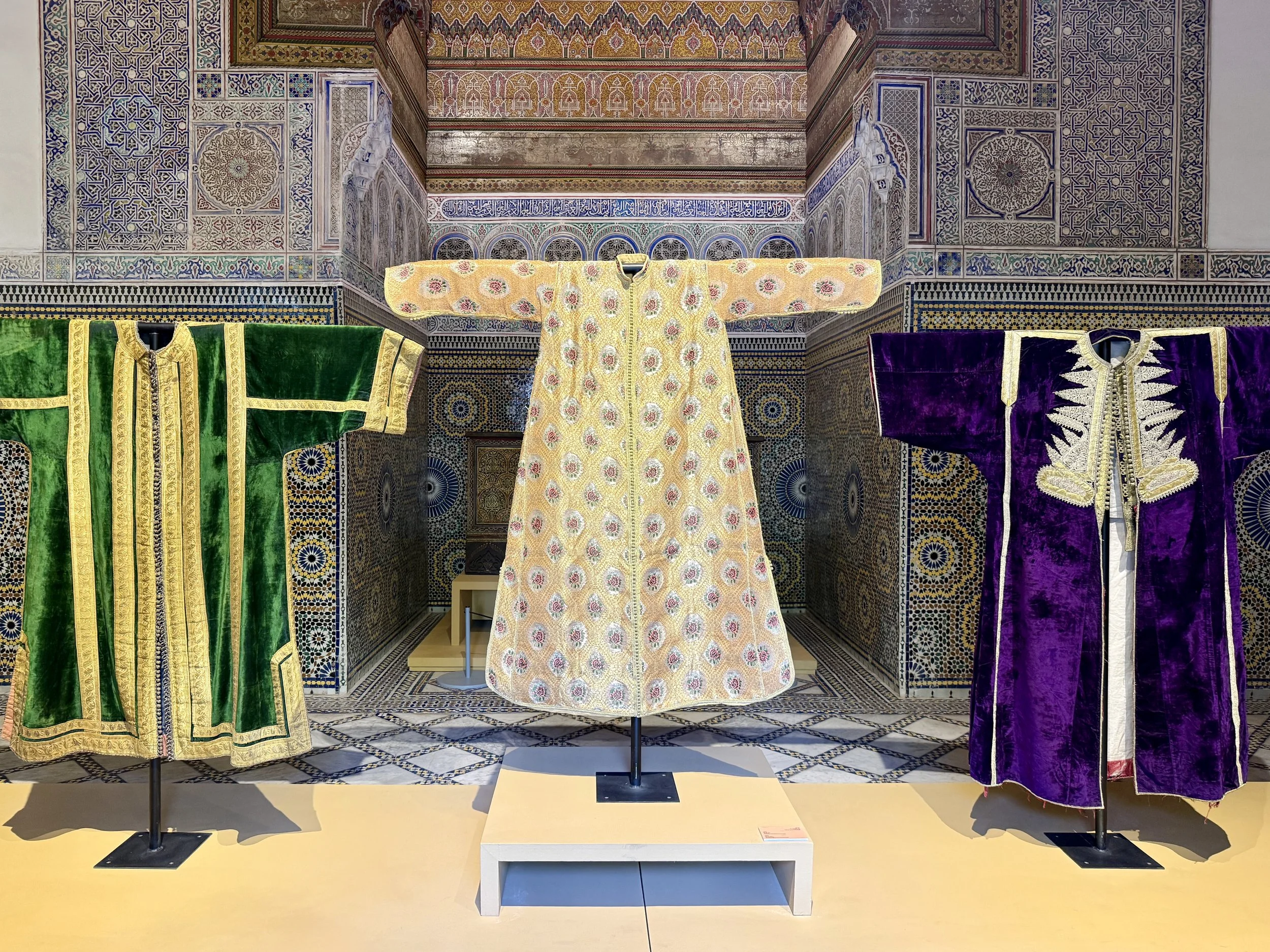
Caftans on display in one of the rooms at the museum in Dar el Bacha, Marrakech, Morocco

One of the larger halls displayed a grouping of robe-like caftans. The pale yellow silk brocade caftan is embroidered using the khrib technique, which loosely translates to “the one who ruins,” a nod to how costly and exclusive this fabric once was.

We ventured into a larger exhibition hall with an elaborate coffered ceiling, featuring traditional silk brocade and embroidered velvet caftans from Fès and Tetouan. Of the trio, the pale yellow silk brocade caftan with raised rose medallions caught my eye and was labeled as a bencherif-style bridal costume from the Alawite period. Developed by the Bencherif family in Fès, this luxurious woven textile is known as khrib, which loosely translates to “the one who ruins,” a nod to how costly and exclusive this fabric once was.

Originally reserved for nobility, the collarless, robe-like garment is thought to have reached Morocco via Andalusian Spain, carried by the Marinid dynasty following their ties to al-Andalus. Under the Saadian dynasty, it spread more widely and became a celebrated symbol of Moroccan identity and heritage. 
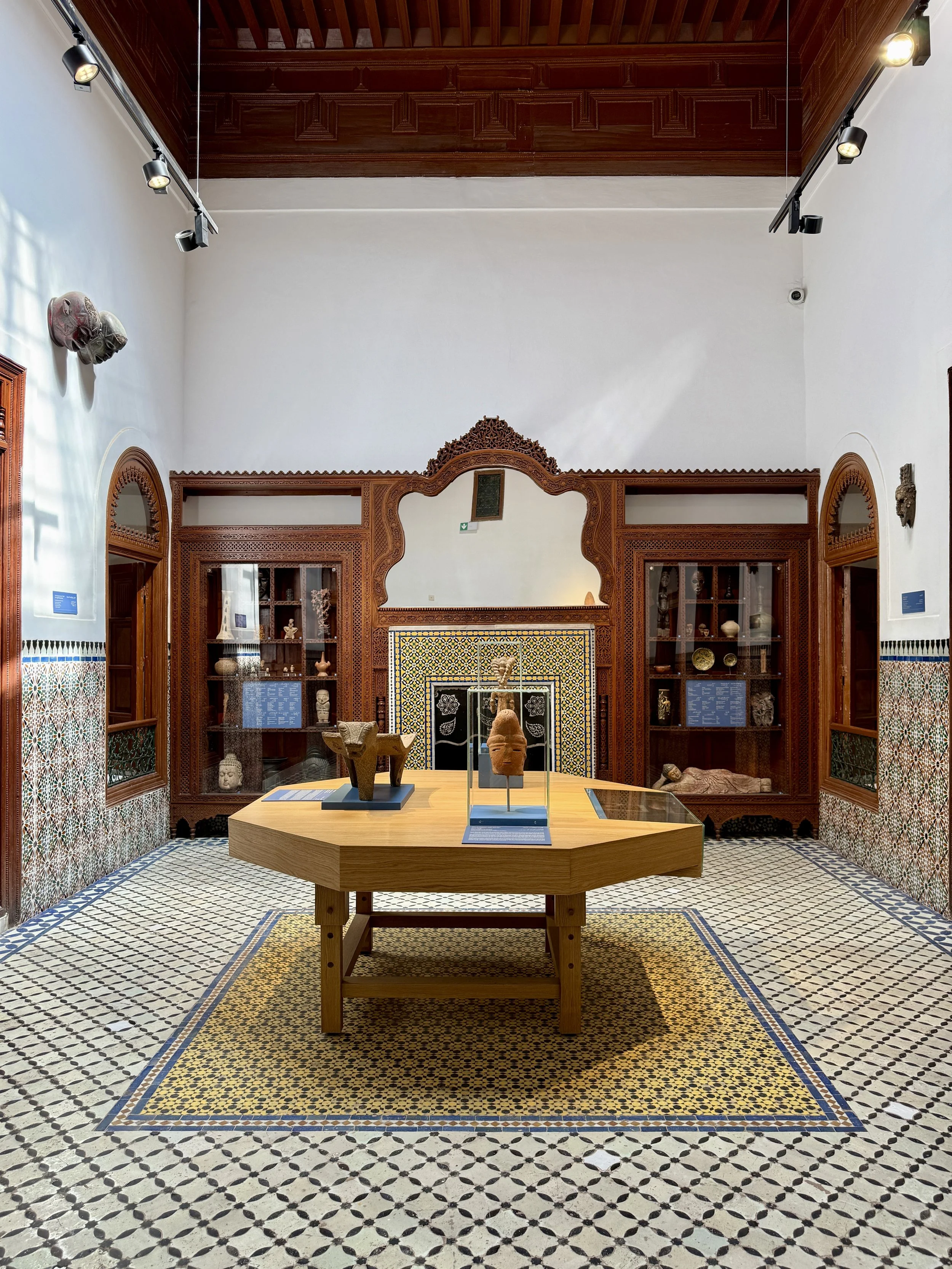
The room holding the Patti Birch collection at Dar el Bacha, Marrakech, Morocco, with an octagon-shaped table, wooden display cases and tiled floor and walls

Objects from Birch’s personal collection come from across Africa, Asia, Europe and the Americas.

Birch, Please: The Patti Birch Collection

The final space held a selection of pieces from the Patti Birch collection and featured an introductory wall panel accompanied by a striking black-and-white portrait of its patroness taken by Man Ray in 1948. The permanent exhibition is the work of curator Hadia Temli and French scenographer Christophe Martin, whose résumé also includes the Museé Berbère at the Jardin Majorelle and the Yves Saint Laurent Museum across town. Temli runs Galerie Siniya28 in Gueliz, a showcase for emerging artists.

We learned more about the remarkable Ms. Birch. She was born in New York City in 1923, the daughter of sculptor S. Tobias Garnell. After an education in Paris, Birch returned to the United States, where a short-lived stint at the University of Virginia gave way to a growing fascination with art. That pull eventually led her to a job at the Philadelphia Museum of Art, where she met her future husband, Everett Birch, in 1952.
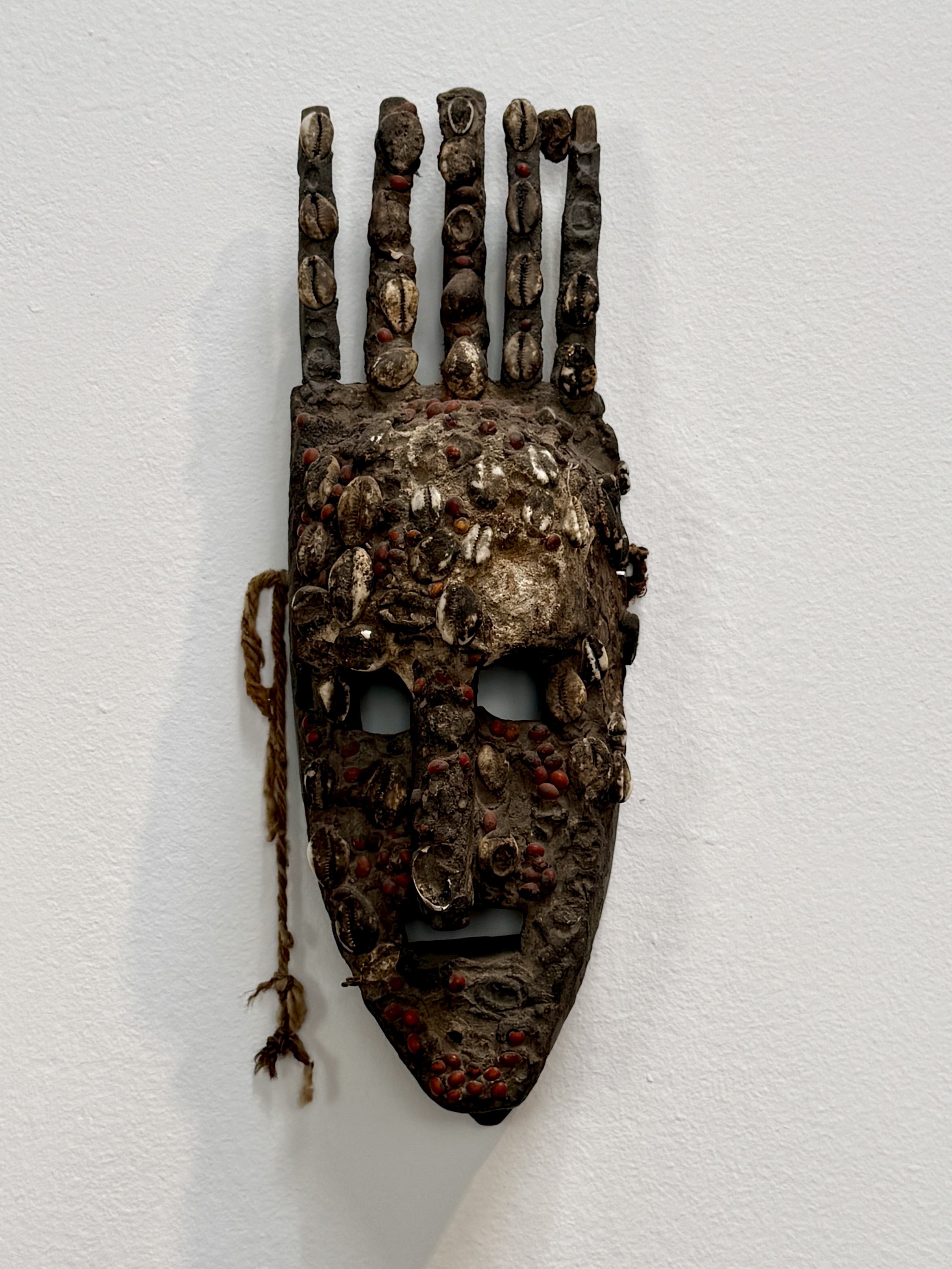
An Ndomo mask from Mali made of wood, wax, shells and seeds in the Patti Birch section of Dar el Bacha, Marrakech, Morocco

An Ndomo mask made of wood, wax, shells and seeds from Mali, mid-20th century

Together, they built a wide-ranging collection, amassing artworks that ranged from jewelry to antiquities to contemporary art. Having traveled extensively in Morocco, Birch was a generous supporter of the Met’s Islamic collections. The Patti Cadby Birch Court, also known as the Moroccan Court, was funded in her memory by the Patti and Everett B. Birch Foundation after her death.

Objects from her personal collection, gifted to the kingdom of Morocco in 1999, are on display at Dar el Bacha, drawn from across Africa, Asia, Europe and the Americas. The room is a high-ceilinged gallery with a single overhead skylight and an octagonal wooden table at its center, holding a terracotta head, a stone ceremonial stool in the shape of an animal, and a carved wooden tribal fertility statue. The back wall is anchored by a zellige-tiled fireplace, flanked by a pair of built-in glass display cabinets holding smaller ceramics, masks and figurines, each labeled with an ice blue placard. 

The assemblage pays tribute to Birch’s commitment to cultural preservation and stands as a testament to humanity’s shared history.
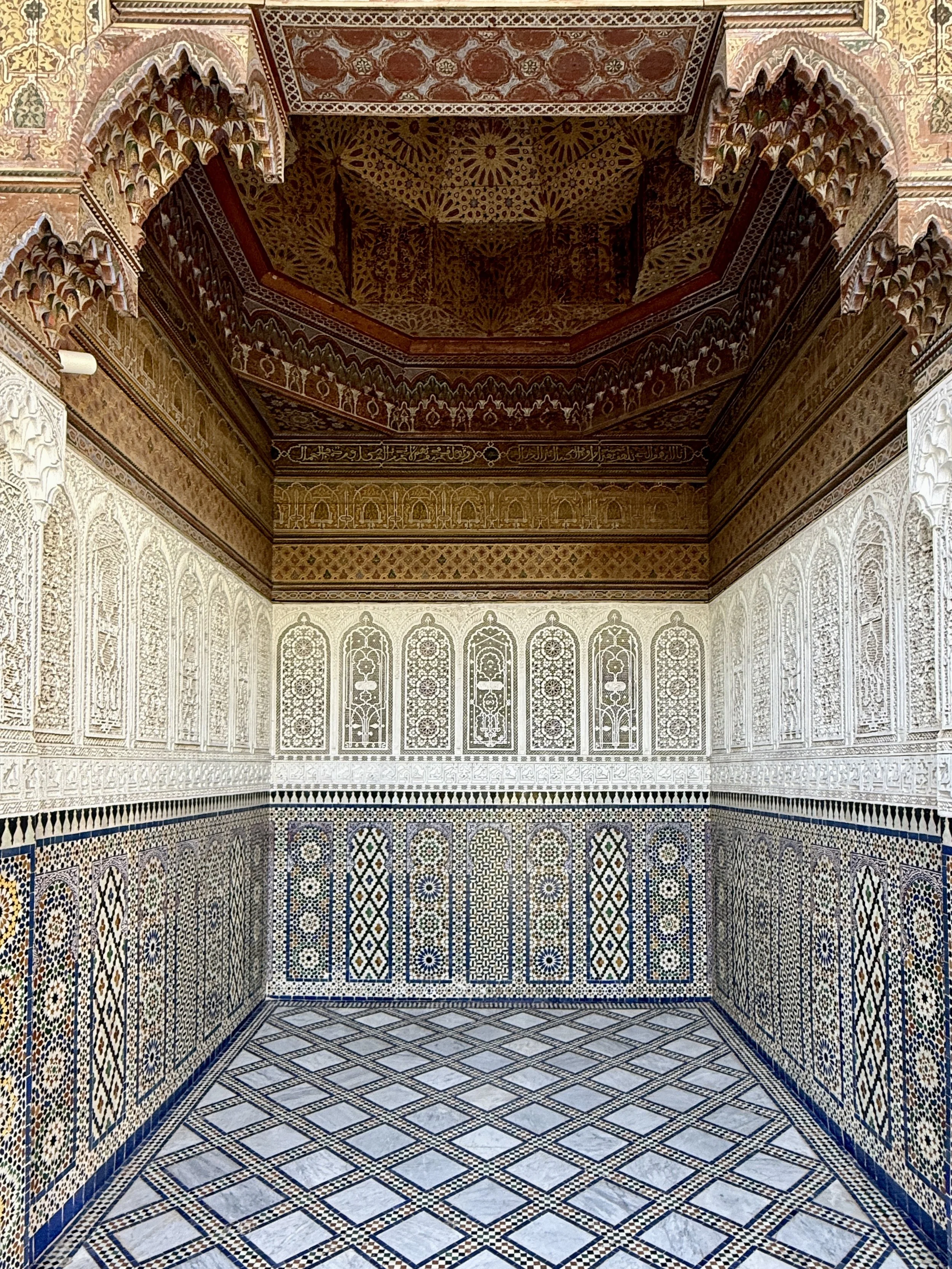
One of the niches off of the courtyard at Dar el Bacha, Marrakech, Morocco, with gorgeous tilework and carved ceiling

Why Dar el Bacha Is One of Marrakech’s Best Museums  

The Dar el Bacha’s holdings reflect the estate’s history and its role as a point of interconnection between Marrakech and the wider world, bridging different cultures, religions and artistic traditions. 

We spent about two hours wandering through its rooms and admiring its artifacts. Floors are laid with marble, and rooms unfold in a skillful blend of Islamic and Andalusian splendor with European design influences. It felt less like an exhibition hall and more like a conversation between cultures, which is exactly what the Musée des Confluences promises. –Duke
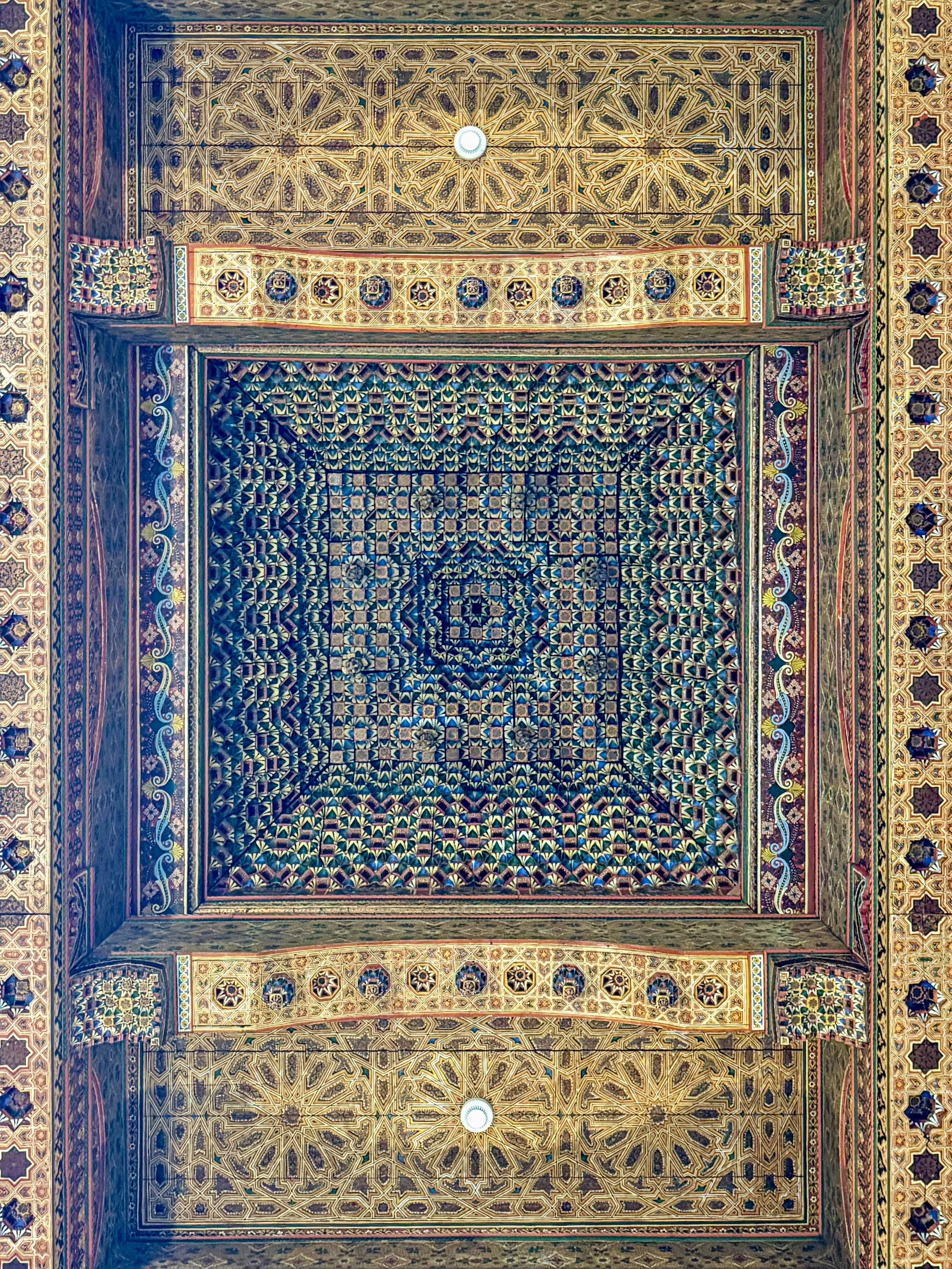
Colorful, kaleidoscopic carved and painted wood ceiling at Dar el Bacha, Marrakech, Morocco

VISITOR INFORMATION

Dar el Bacha and Bacha Coffee

Address
65–69 Riad Laârous
Route Dar el Bacha, Medina
Marrakech, Morocco

Hours
Tuesday–Sunday, 10 a.m.–6 p.m.
Closed Mondays

Admission
60 MAD (about $6) for foreign visitors
A café-only ticket (10 MAD) is available if you're just visiting Bacha Coffee.

Time Needed
Plan for 1½–2 hours to explore the museum.
If Bacha Coffee is on your itinerary, budget significantly longer for the wait.

Tips

  • Arrive early, especially if you want to visit Bacha Coffee — waits of several hours are common.
  • You can skip the wait at Bacha Coffee and just visit the store (or the shop at the airport).
  • Pair your visit with nearby Ben Youssef Madrasa and Le Jardin Secret.
  • Take your time. The palace itself is as much the attraction as the museum's collections.
 

A Taste of Rosemary in Marrakech, an Art-Filled Boutique Riad

Discover Riad Rosemary Marrakech, Laurence Leenaert’s LRNCE-designed boutique riad near the Mellah, filled with hand-crafted ceramics and textiles.

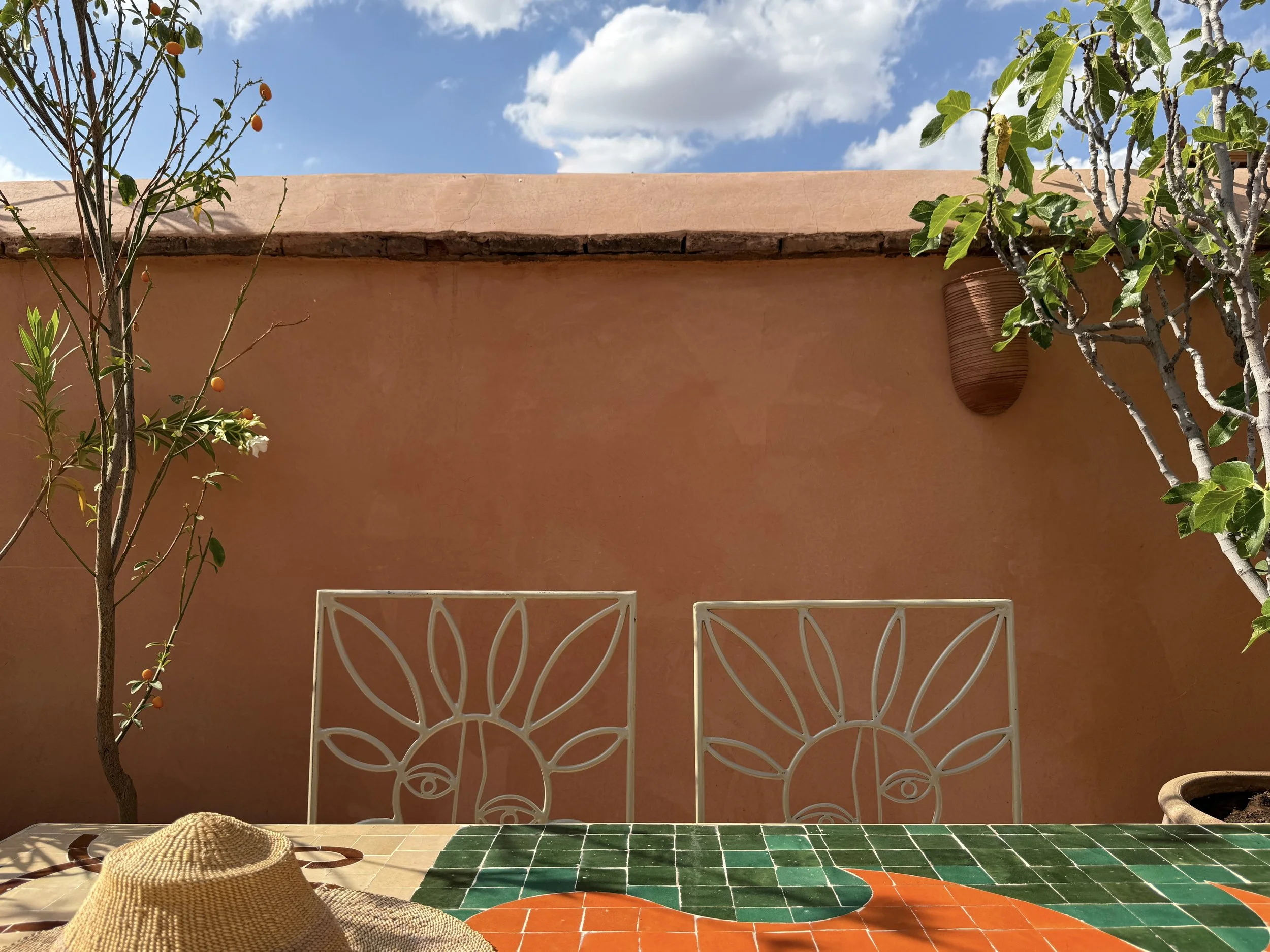
Mosaic table and wire chairs with suns on the rooftop terrace at Riad Rosemary in Marrakech, Morocco

The rooftop terrace features whimsical wrought iron Helios chairs and a tiled table adapted from one of Laurence Leenaert’s drawings.

When Wally and I began thinking about where to travel next, we found ourselves drawn back to Marrakech, the Red City, named for the salmon-colored rammed earth walls enclosing its maze of alleys, their blank façades broken only by wooden doors that suggest another world hidden just beyond them. We had visited in 2012 with our friend Vanessa and were curious to see how the city had changed and what remained from our previous trip.

On that visit, we had a digital camera, and after a three-day journey that included an overnight stay among the shifting sands of the Sahara, we discovered the memory card was “frite” (fried) and beyond repair. So the prospect of returning to a place that held such wonderful memories for a full week this time, was impossible to resist. 

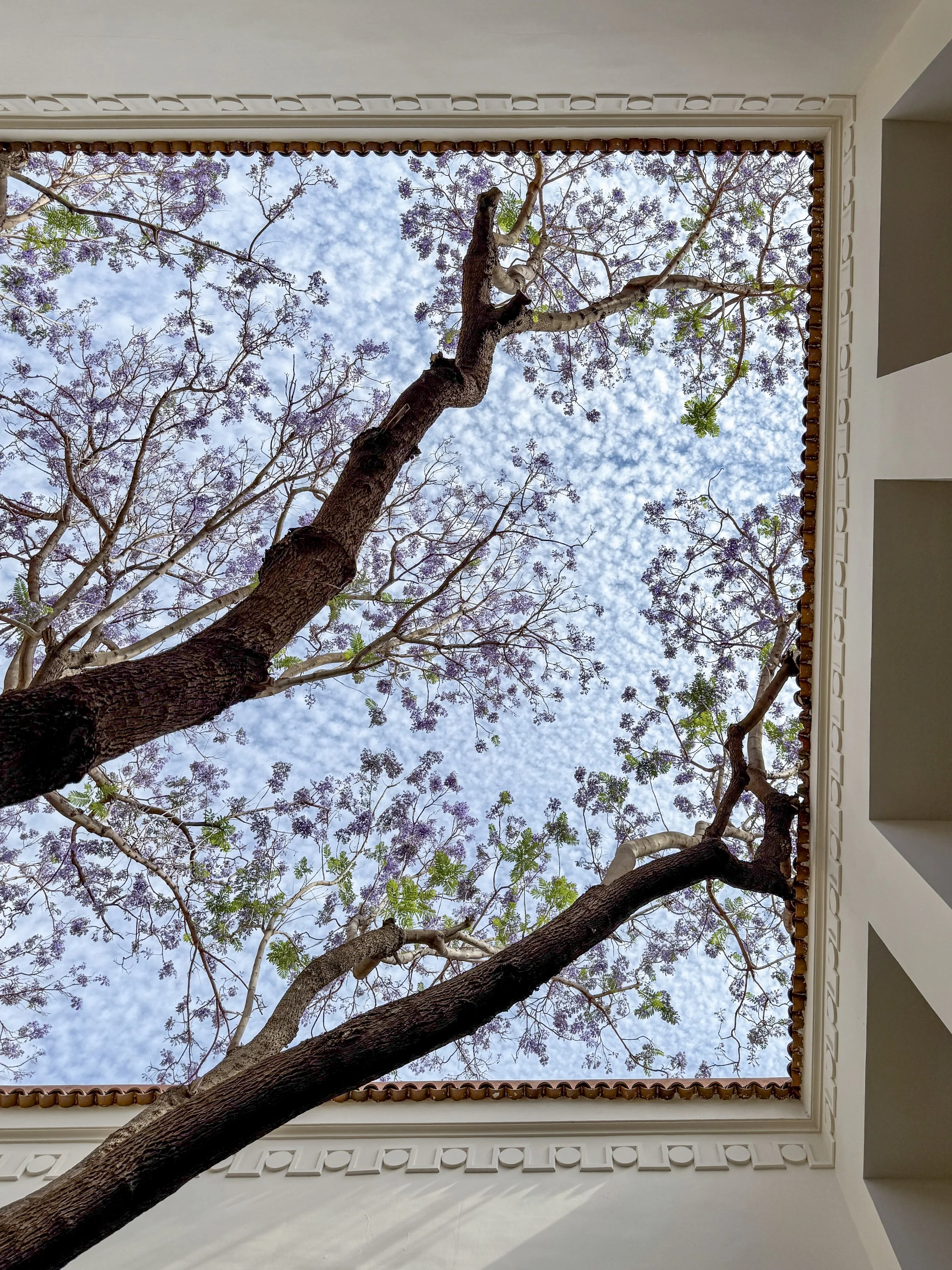
Looking up through the open-air courtyard and the flowering jacaranda tree at Riad Rosemary in Marrakech

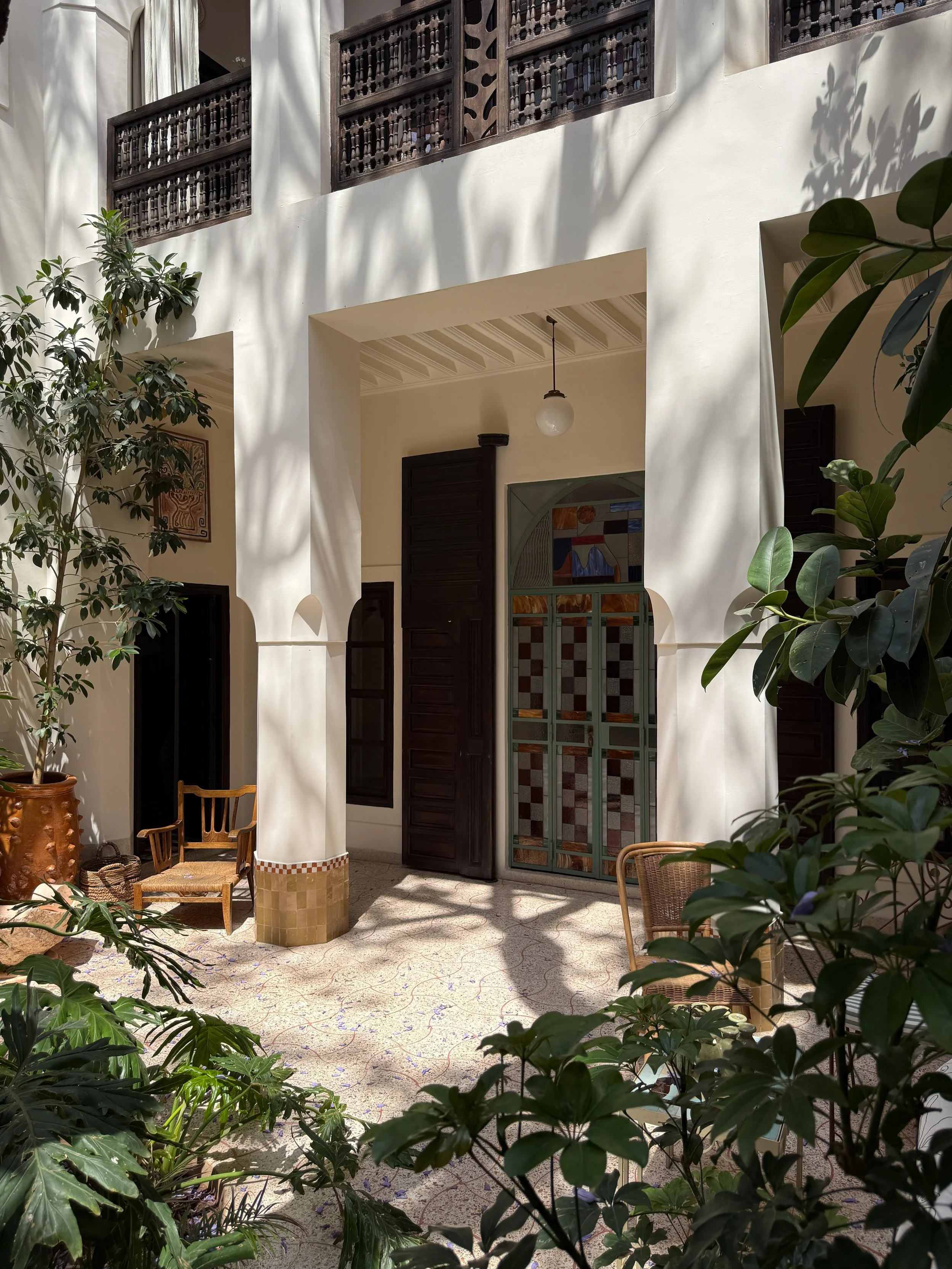
The courtyard is the heart of the riad, anchored by a magnificent 40-year-old jacaranda tree and home to the salon d’été, wavy terrazzo tiles, plunge pool, LRNCE boutique and living room.

Like Alice in Wonderland, I enjoy falling down the rabbithole, gathering sites for us to see as well as finding the perfect place to call home during our stay. This was how I discovered Rosemary, an intimate five-bedroom boutique riad built around a courtyard and interior garden, tucked into the quiet residential neighborhood of Riad Zitoun Jdid. 

On the map, it sits in one of the oldest quarters of the southern medina, a stone’s throw from Bahia Palace and within walking distance of the souks and other sites we wanted to explore. 

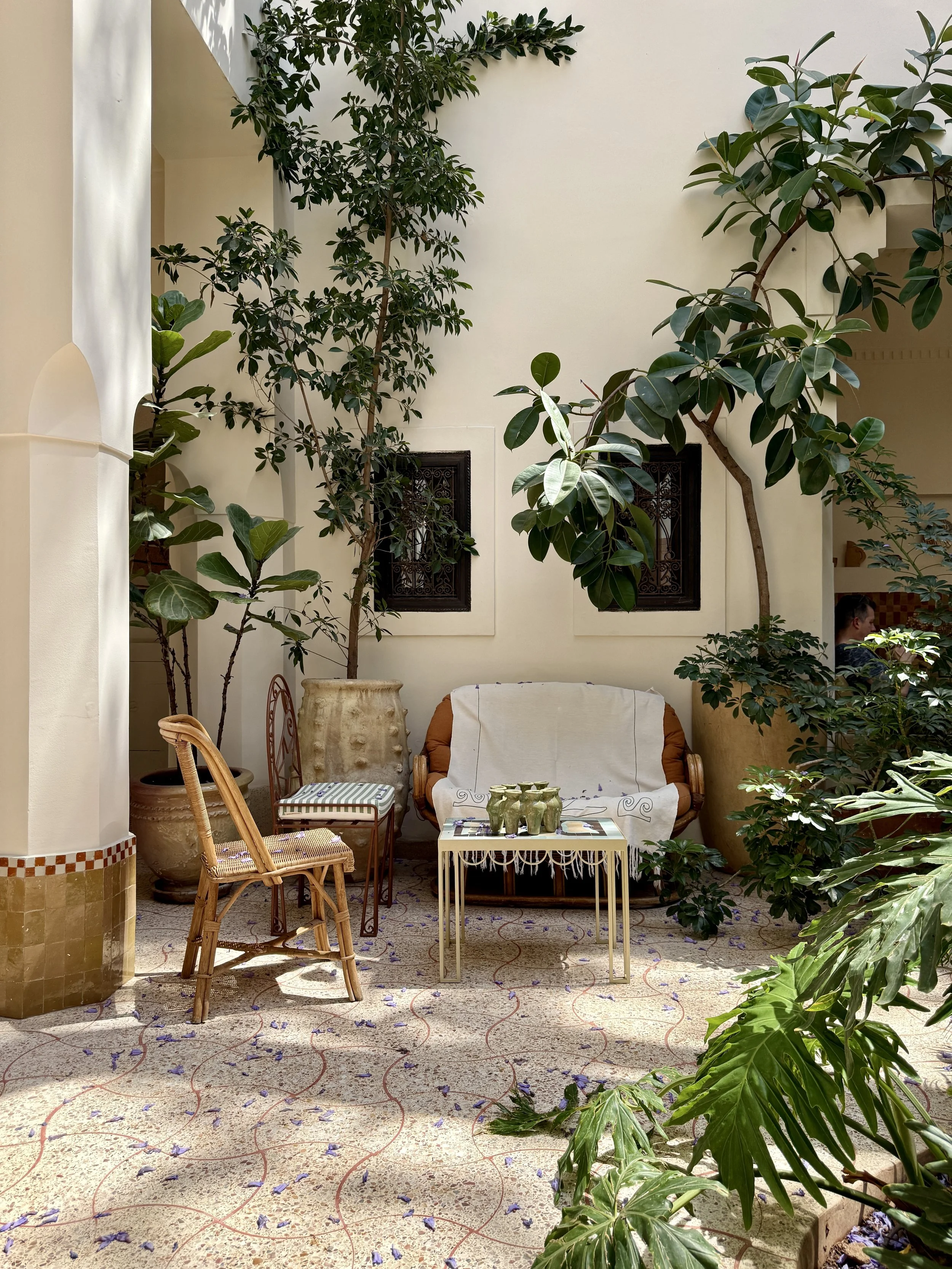
A seating area in the interior courtyard with plants at Riad Rosemary in Marrakech

Leenaert and her husband, Ayoub Boualam, worked with dozens of craftsmen and women from Morocco to rework the interiors with bespoke furnishings and finishes, including zelije tiles and tadelakt, a natural lime-based plaster.

The riad was the former home of Rose-Marie, who happened to cross paths with Belgian artist and designer Laurence Leenaert and her husband and business partner, Ayoub Boualam, at their studio in Sidi Ghanem, an industrial area just outside Marrakech. She was looking to sell, and once the couple toured the space, its faded grandeur made the decision an easy one, and a logical next step in the brand’s evolution.

Leenaert is the founder of the lifestyle brand LRNCE, launched in 2013 and based in Marrakech, where she arrived with little more than a sewing machine and a few hundred euros. She originally specialized in small leather bags before evolving into an internationally recognized label known for its hand-painted ceramics, woven rugs, textiles, clothing and objects deeply rooted in Marrakech’s craft traditions.
Whimsical chairs and pots with plants in the interior courtyard of Riad Rosemary in Marrakech

Rosemary is a living extension of LRNCE’s aesthetic universe, immersing guests in Leenaert’s creative world rather than simply offering a glimpse of it.

Arriving at Rosemary 

We remembered how easy it was to get lost in the medina, and while that’s part of the fun, we didn’t want to stress over being dropped at the edge of a narrow street and rolling our suitcases down it while navigating pedestrians, donkey carts and weaving mopeds. To avoid this, I prearranged pickup. We were met at the airport and transported to a dropoff point on Rue Riad Zitoun el Jdid. There, one of Rosemary’s accommodating hosts welcomed us, took our bags, and led us down to 25 Rue de la Bahia.

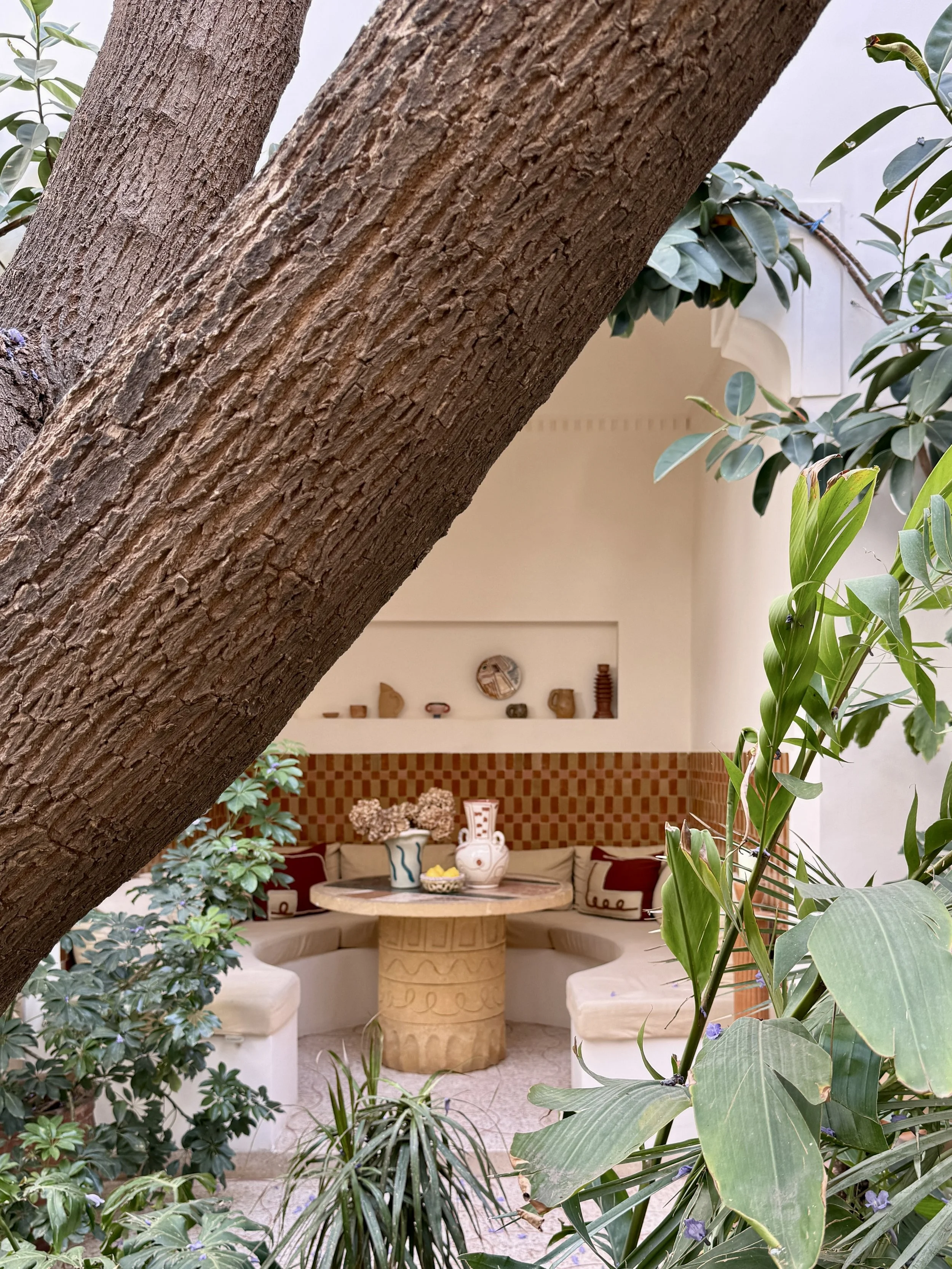
A circular seating area by a large tree in the interior courtyard of Riad Rosemary in Marrakech

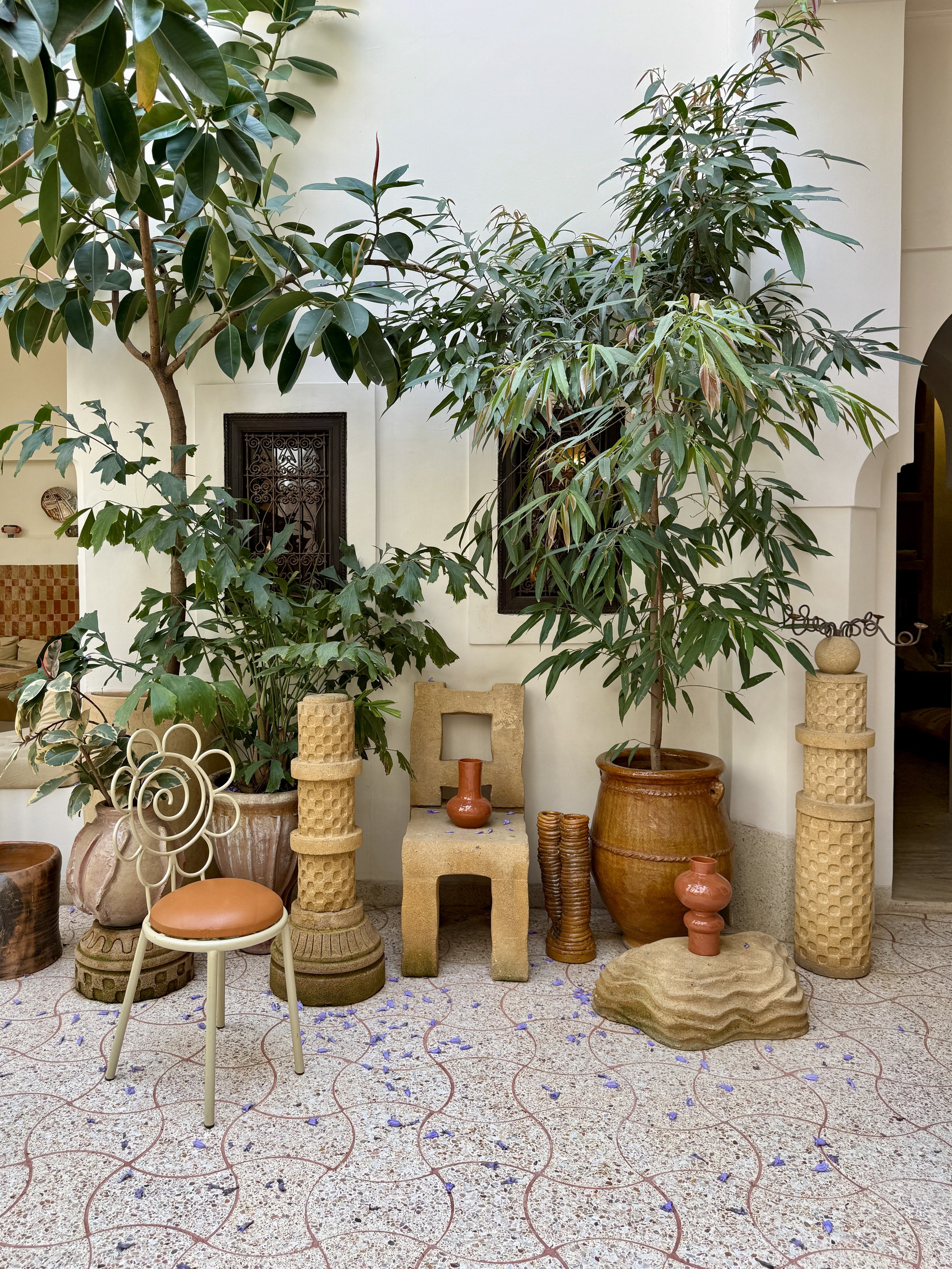
Among the countless handcrafted details, sandstone has been fashioned into sculptural objects, including a chair, pedestal and table base, for the salon d’été.

We were seated at a banquette in the cozy salon d’été (summer salon) in the tranquil central courtyard shaded by a majestic jacaranda tree, and served mint tea and slices of housemade banana bread while we completed check-in. 

Afterward, we were shown our room and given a tour. During our stay, the riad was hosting an event on the rooftop to promote the collaboration between LRNCE and Australian resort wear brand Alémais, and guests could also participate in craft events, including an intimate textile workshop the day before we departed. 

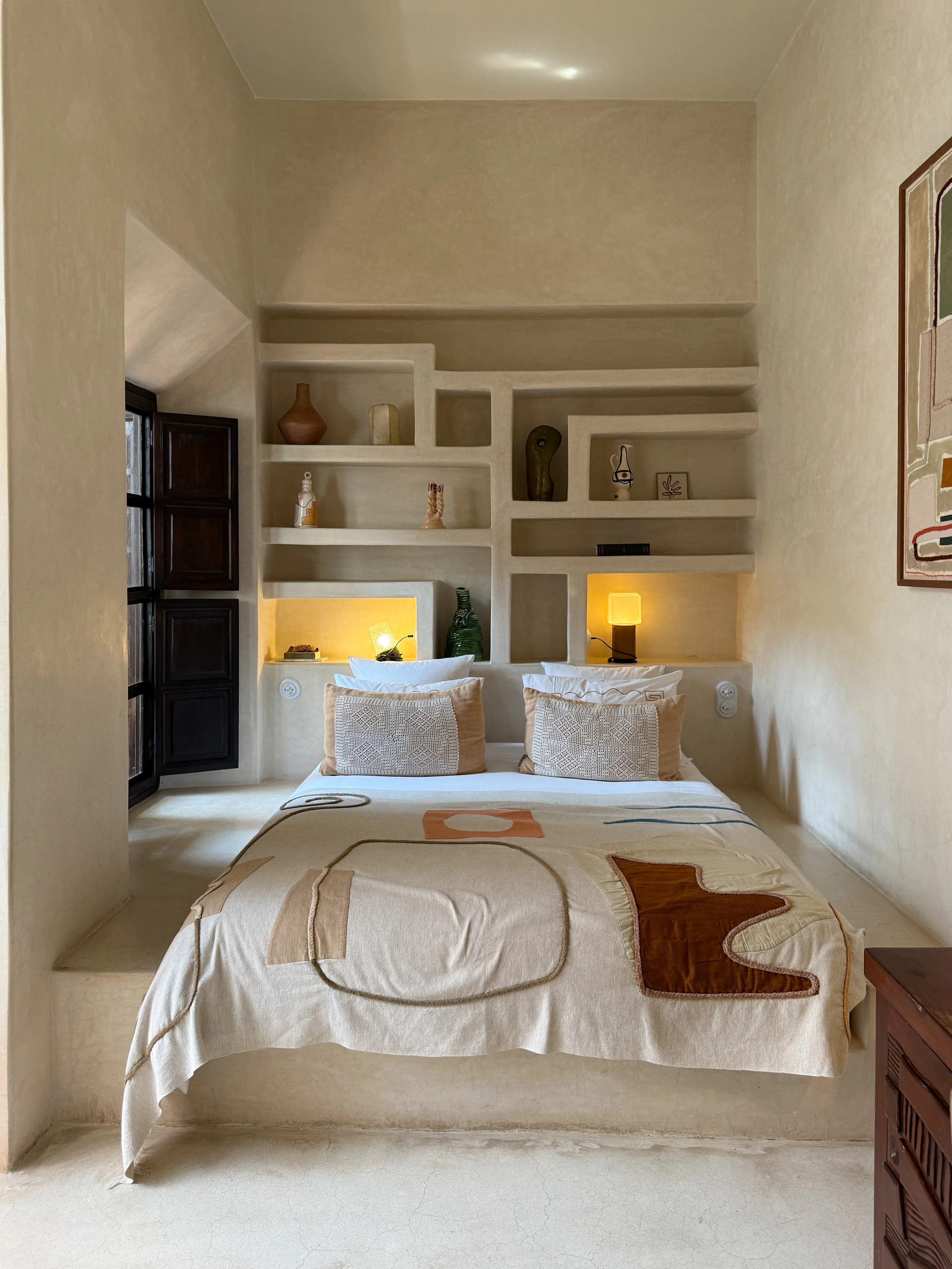
Bed and shelving in the Clemande suite at Riad Rosemary in Marrakech

The Clemande suite features a queen-sized bed, built-in shelving filled with hand-painted ceramics and found objects, including a goatskin lampshade.

The Rooms at Rosemary

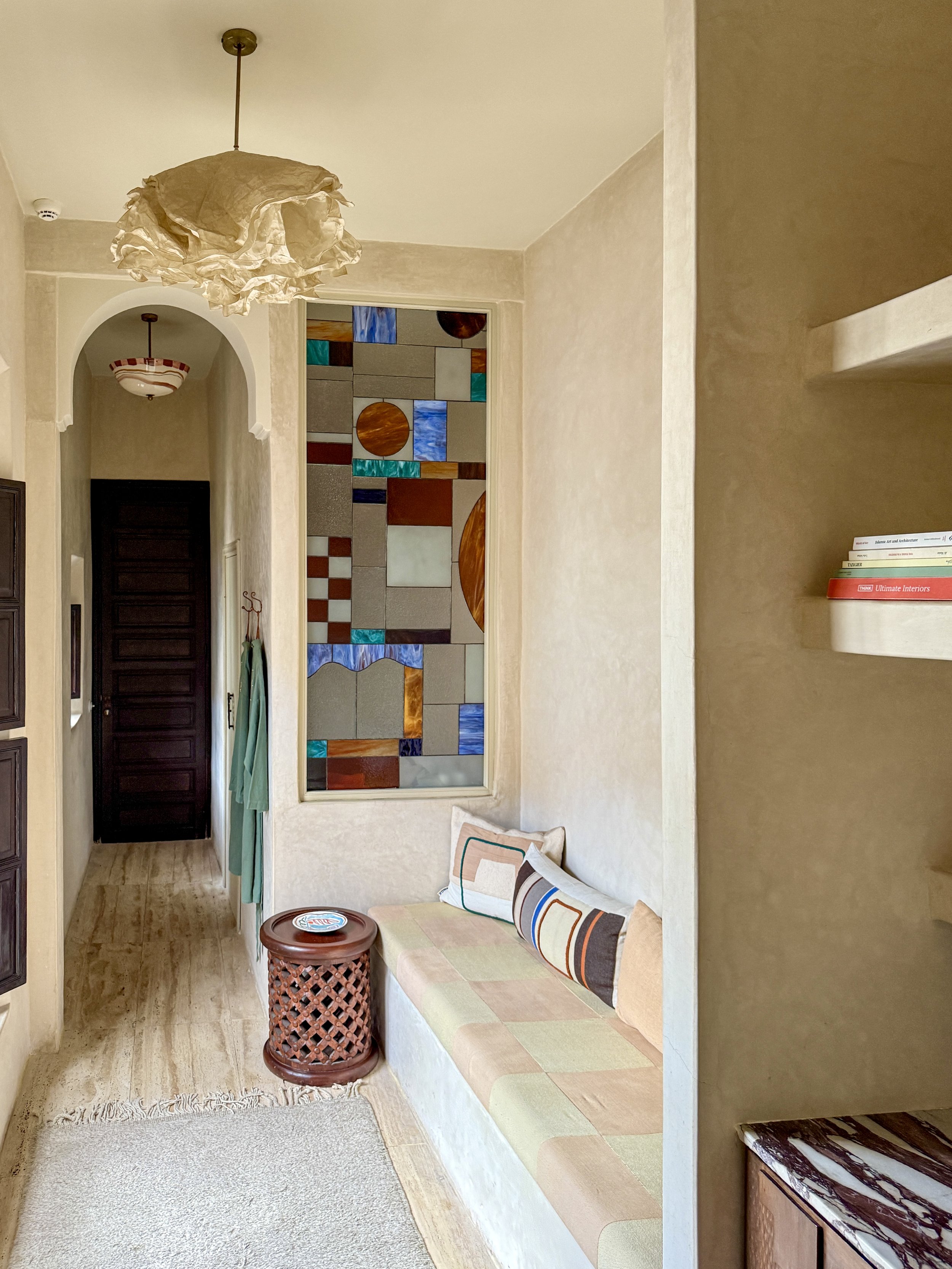
I had booked the Cocoon suite on the second floor, which overlooks the central courtyard. In-room amenities include wifi, a preloaded iPad complete with a chill rooftop mix, a Sonos portable Bluetooth speaker and shelves lined with art books, along with a queen-sized bed, a bathroom with a stained glass window, a built-in bench with hand-embroidered throw pillows and a handcarved cedarwood sideboard with a marble top. 

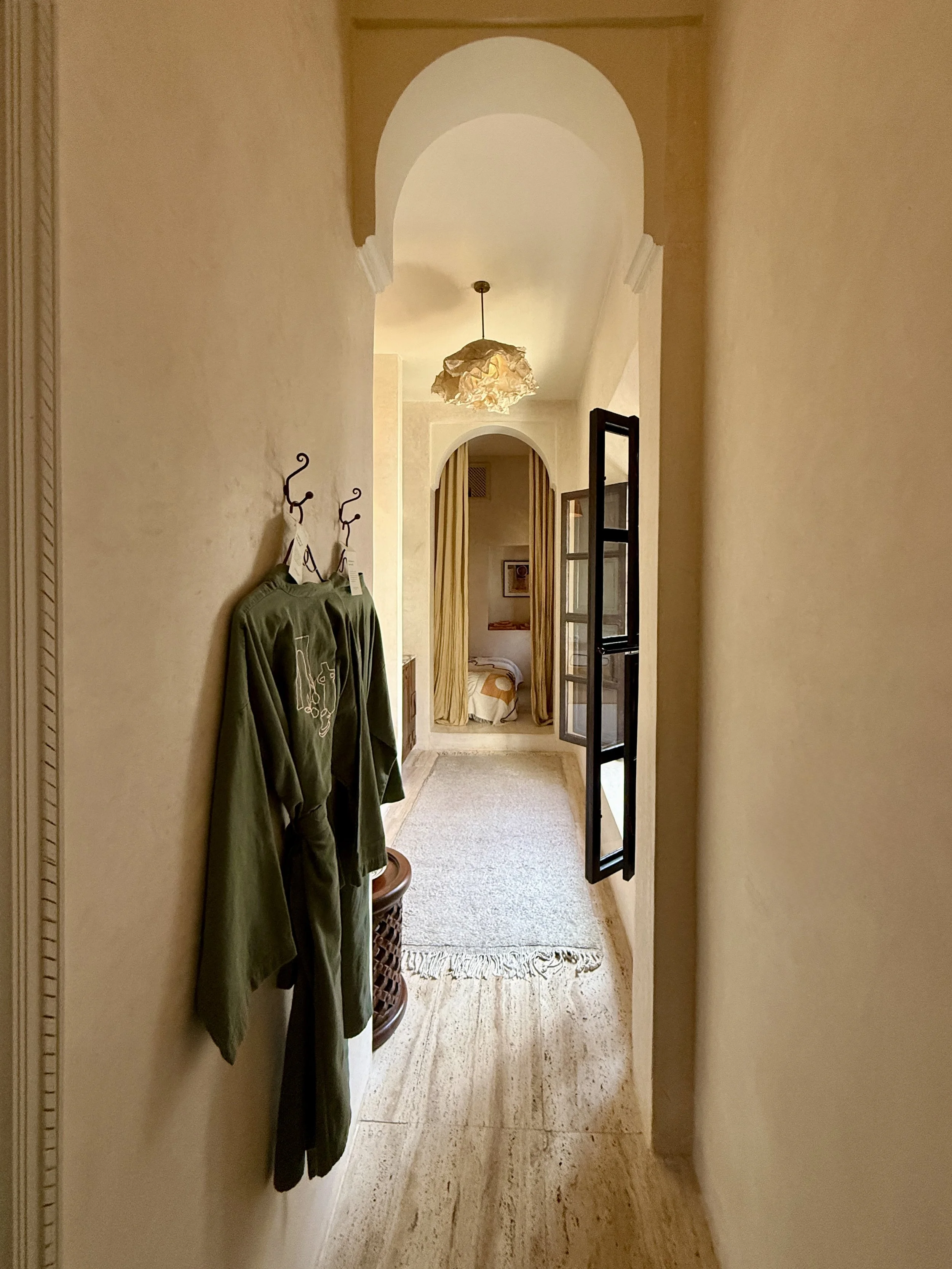
Robes hand on the wall in the narrow Cocoon room at Riad Rosemary in Marrkech

The Cocoon suite lives up to its name — a perfect retreat after a day spent haggling in the souks.

Stained glass window, seating nook and narrow arch with hanging lamps in the Cocoon suite at Rosemary Riad in Marrakech

The Cocoon suite features a custom stained glass panel, sculptural lighting and a cozy bedroom.

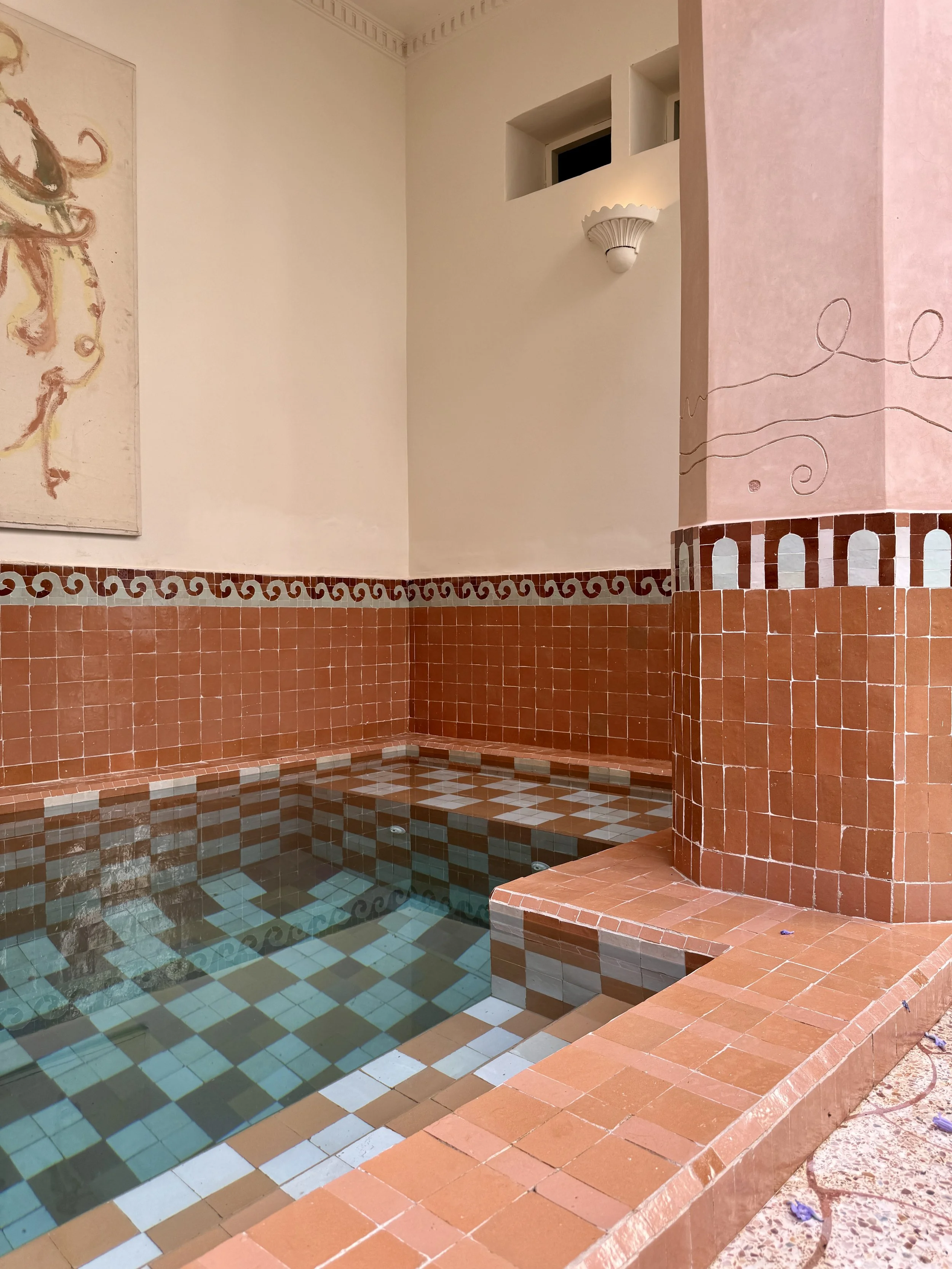
A couple of days later, we were graciously upgraded to the Clemande suite and could hardly believe we had our very own private balcony. We spent most afternoons soaking our feet in the cool water of the plunge pool or relaxing up there. 

The plunge pool with checkered floor at Riad Rosemary in Marrakech

A large painting of two octopuses by Belgian artist Lieven Deconinck hangs above the plunge pool where Duke and Wally spent many afternoons relaxing and soaking our tired feet. 

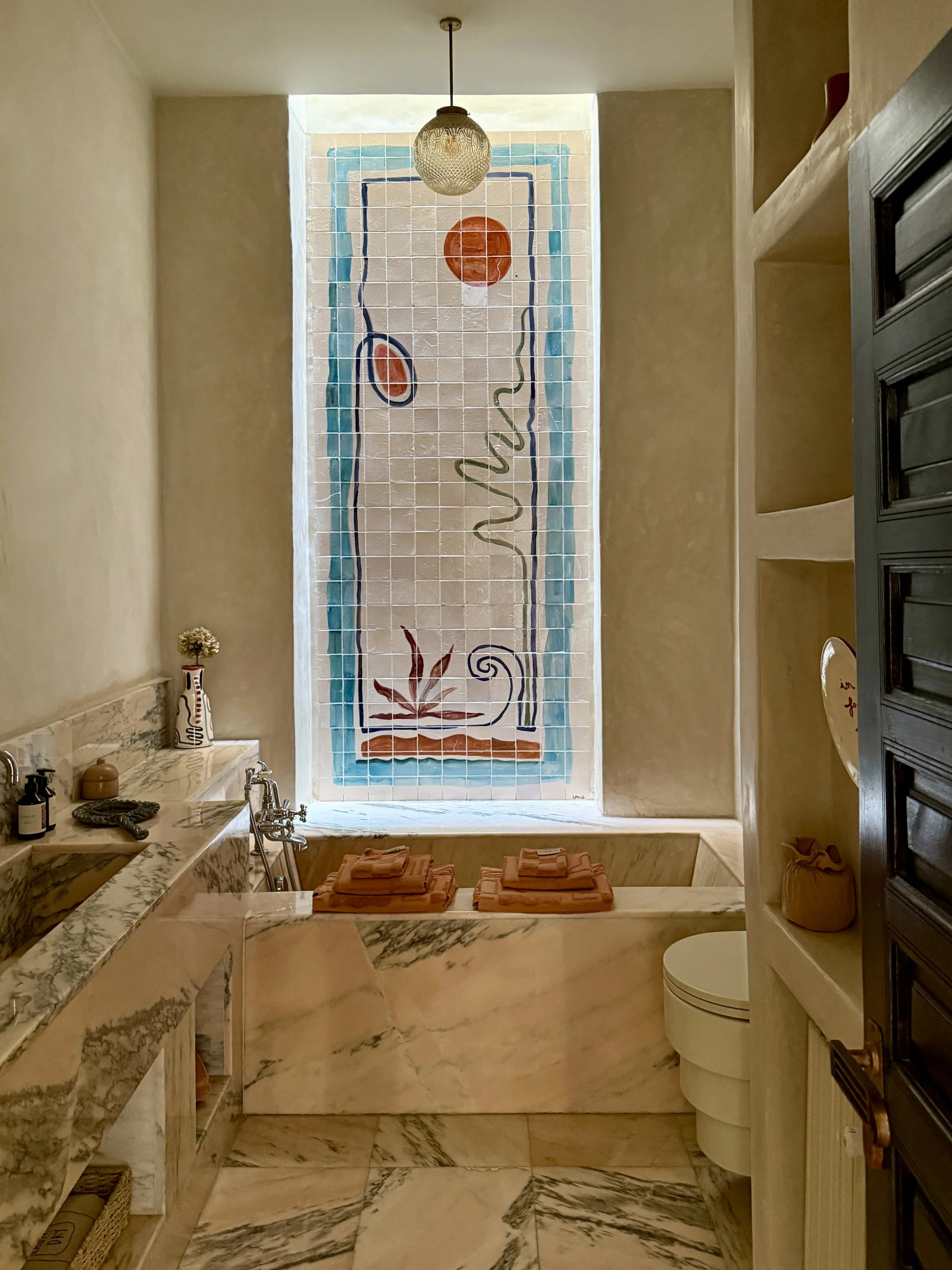
The suite features a queen-size bed, built-in geometric shelving lined with art books, hand-painted ceramics and found objects, including a goatskin lampshade, plus a bathroom with a marble soaking tub and a striking tile mural painted by Leenaert.

The Clemande suite features a marble bathtub and hand-painted tile mural by Leenaertart.

And can we take a moment to talk about their toiletries? The hand soap, body wash, shampoo and silky body lotion are all scented with notes of neroli orange, rosemary and cedar atlas. We ended up buying some to take home.

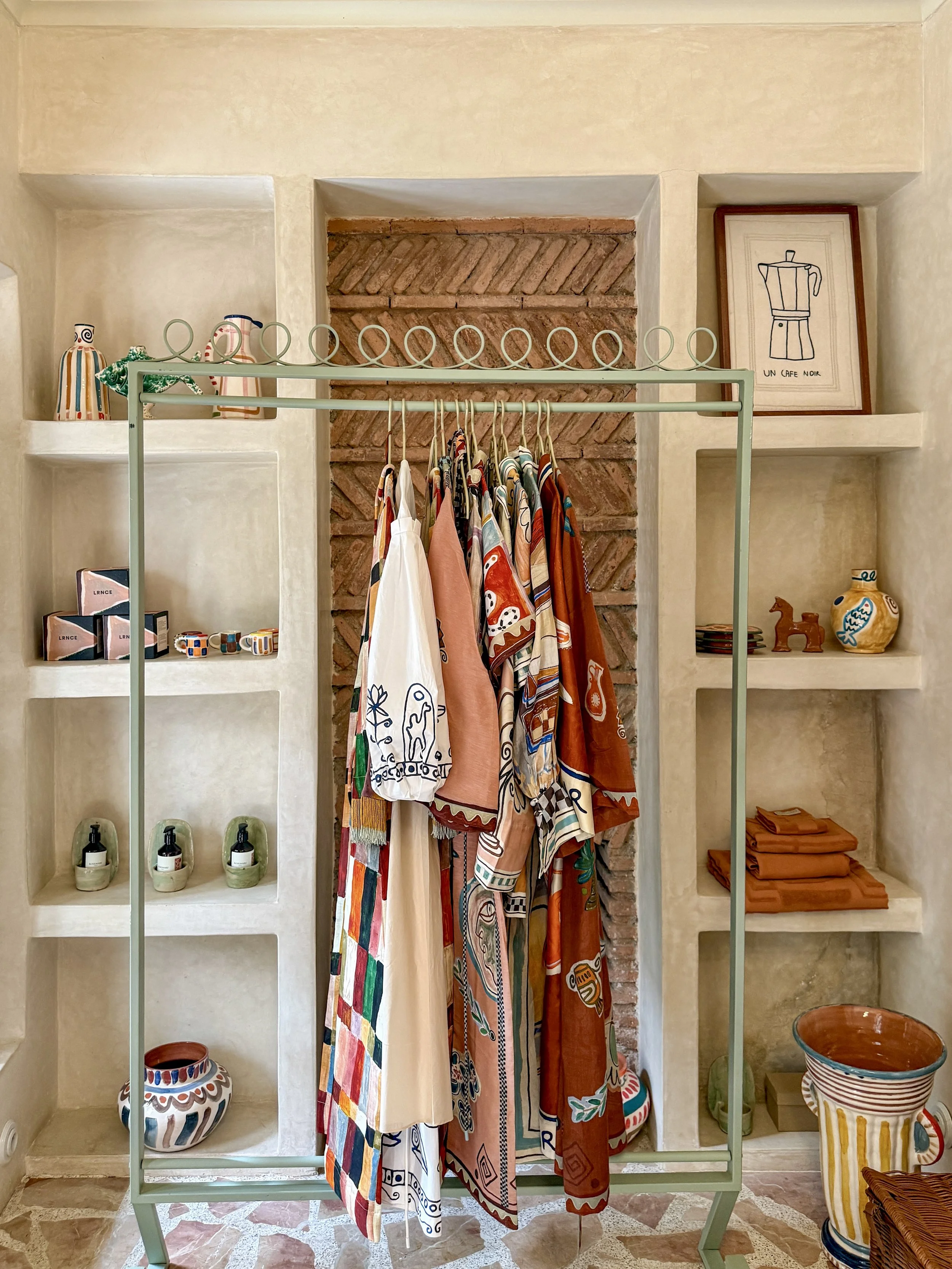
Hand-painted ceramics, embroidered bed linens, toiletries and apparel at the onsite boutique at Riad Rosemary in Marrakech

The onsite boutique carries hand-painted ceramics, embroidered bed linens, toiletries and apparel.

The LRNCE Vision

Laurence and Ayoub’s vision respects the building’s pedigree, and the results are anything but typical. The property had previously been renovated by Belgian architect Quentin Wilbaux, who has spent decades documenting and restoring traditional riads throughout the medina and is widely regarded as one of the leading authorities on its architecture. The couple oversaw every aspect of the intensive three-year renovation, and collaborated with more than a few dozen maâlems, or master craftsmen, drawn from across Morocco’s specialized trades: stained-glass artisans from Meknès, potters from Safi, zellige tilemakers from Fès, marble vendors from Rabat, and a crew of local Marrakchi carpenters, metalworkers and plasterers who handled the riad’s finishes. 

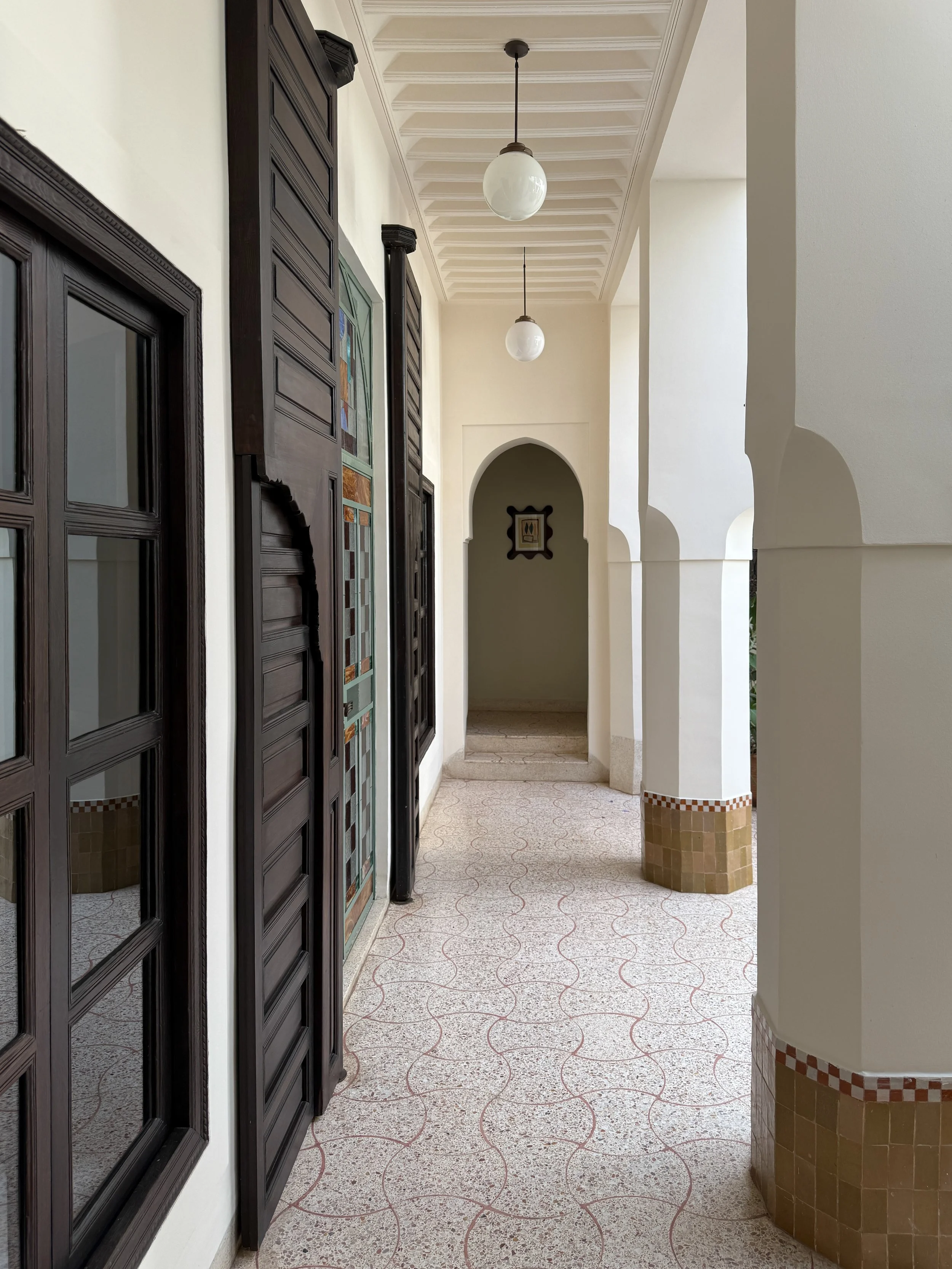
A hallway with white columns and dark wood doors and window frames at Rosemary Riad in Marrakech, Morocco

The hotel’s name is a nod to its previous owner as well as the herb used to perfume its in-house hammam.

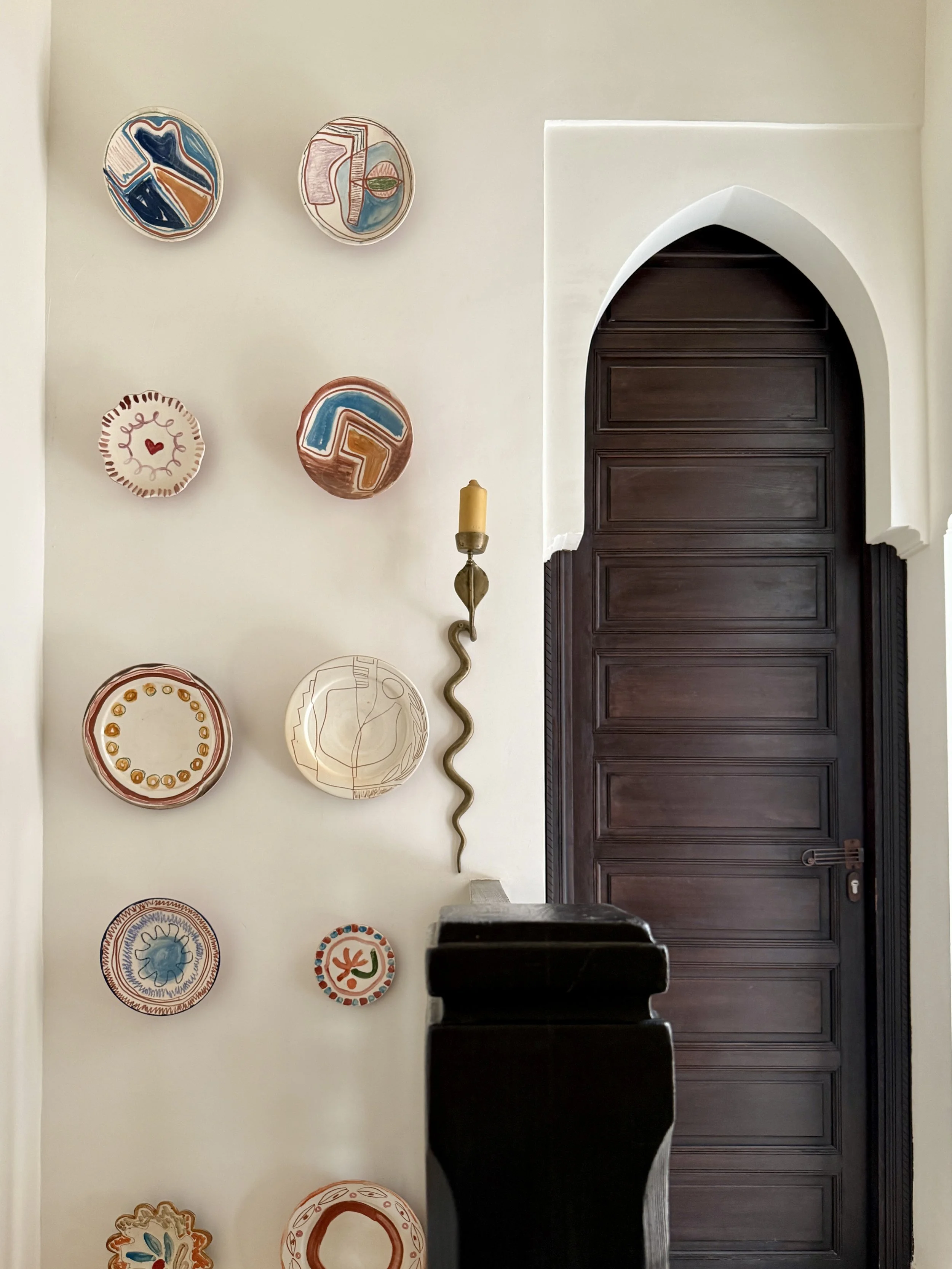
A gallery wall of hand-painted plates by LRNCE, accented by a vintage brass cobra sconce at Riad Rosemary in Marrkech

Hand-painted plates by LRNCE and a vintage brass cobra sconce we coveted, found at the Bab el Khemis flea market

Each detail, from the spontaneous hand-drawn lines etched into the columns framing the plunge pool to the wrought iron door handles and red marble lozenges meticulously set into the staircase, contributes to a space that pulls you fully into Leenaert’s creative world. Her own works are complemented by vintage fixtures and furnishings sourced from their travels. Wally and I were obsessed with the vintage brass cobra wall sconces found throughout, and later learned they came from a seller at the Bab el Khemis flea market.

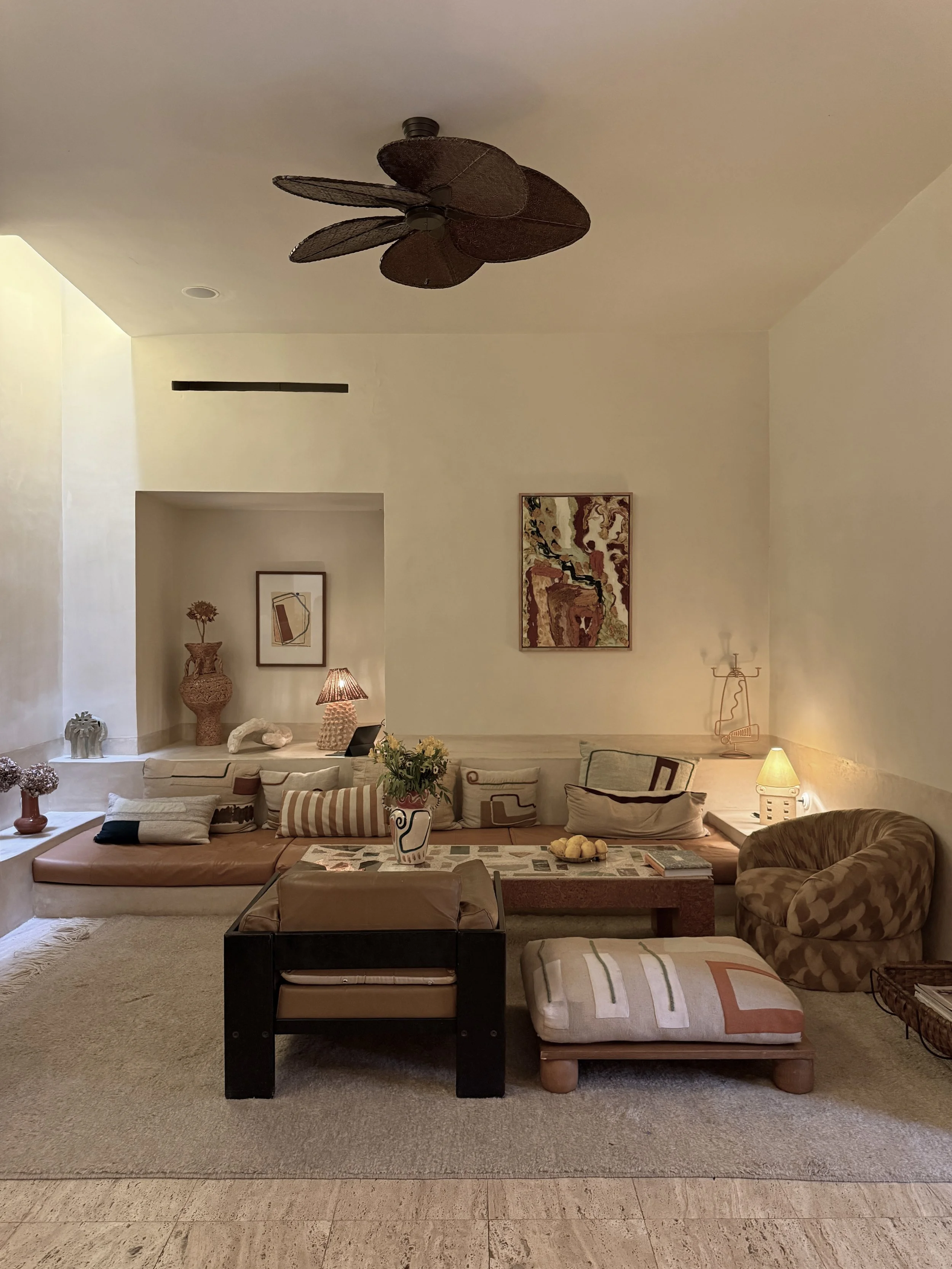
The living room at Riad Rosemary in Marrakech with built-in banquette, vintage furniture and tiered shelves lined with art books, ceramics and objects by LRNCE

Located off the courtyard, the living room features built-in banquette, vintage furniture, and tiered shelves lined with art books, ceramics and objects by LRNCE. 

Staying at Rosemary 

Breakfast is served on the sun-drenched rooftop terrace, which is dotted with LRNCE designed tables, whimsical wrought iron chairs and sunloungers. The spread includes homemade yogurt, amlou (almond spread), honey, preserves, sticky date and sesame energy balls, mesemmen (semi-leavened bread), baghir (Moroccan semolina pancakes) and eggs made to order, served from terracotta tagines. The freshly squeezed orange juice is exceptional, as is the nous nous (“half-half” in Darija, Moroccan Arabic), a local café staple made with equal parts espresso and steamed milk.

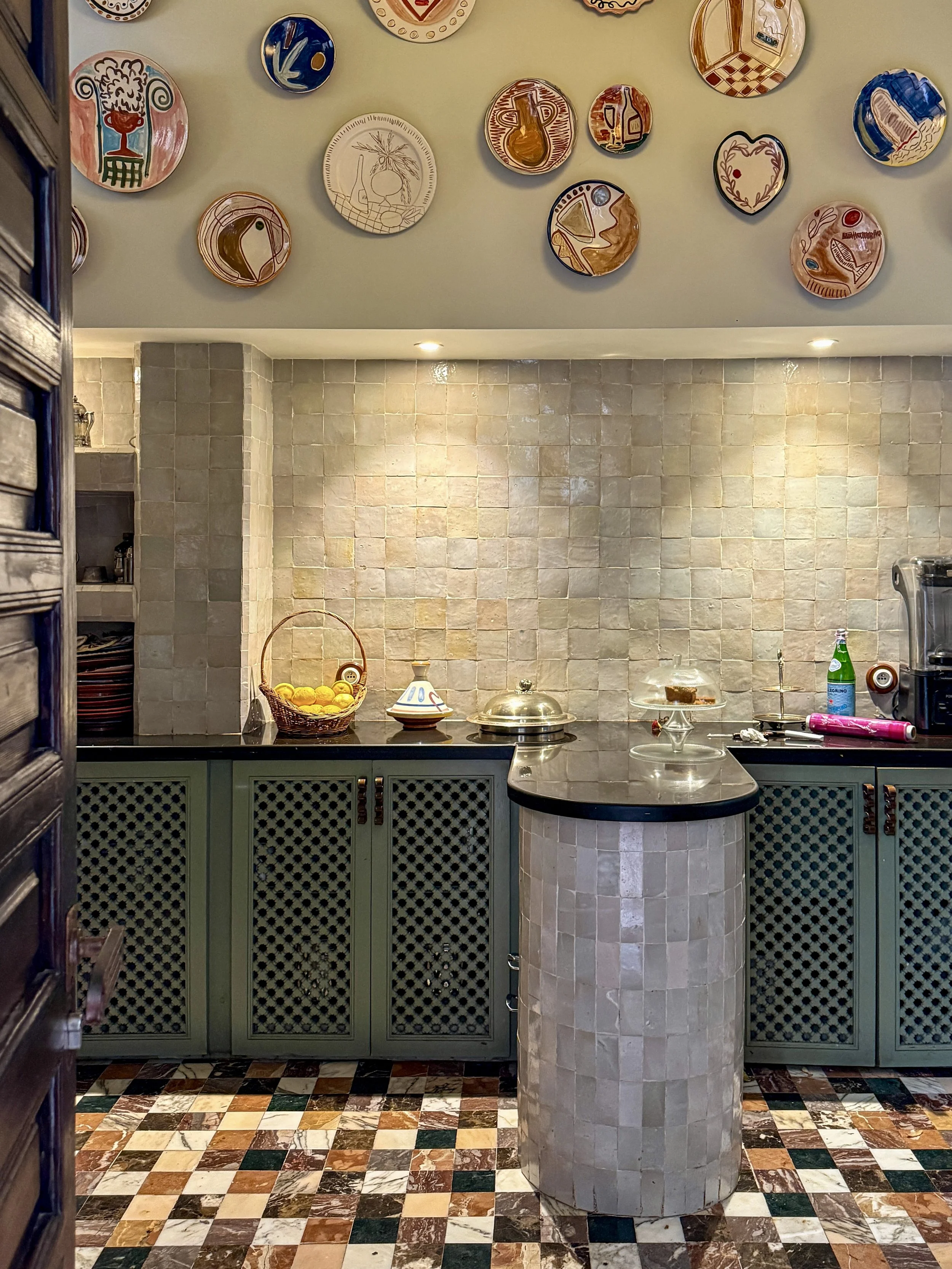
The kitchen at Riad Rosemary in Marrakech, with hand-painted plates by Leenaert and mashrabiya-style cabinet doors

The kitchen features hand-painted plates by Leenaert and mashrabiya-style cabinet doors.

Rosemary felt less like staying at a hotel and more like being welcomed into a dear friend’s home. The warmth and generosity of everyone who took care of us will not soon be forgotten. Once you check in, you may never want to leave. 

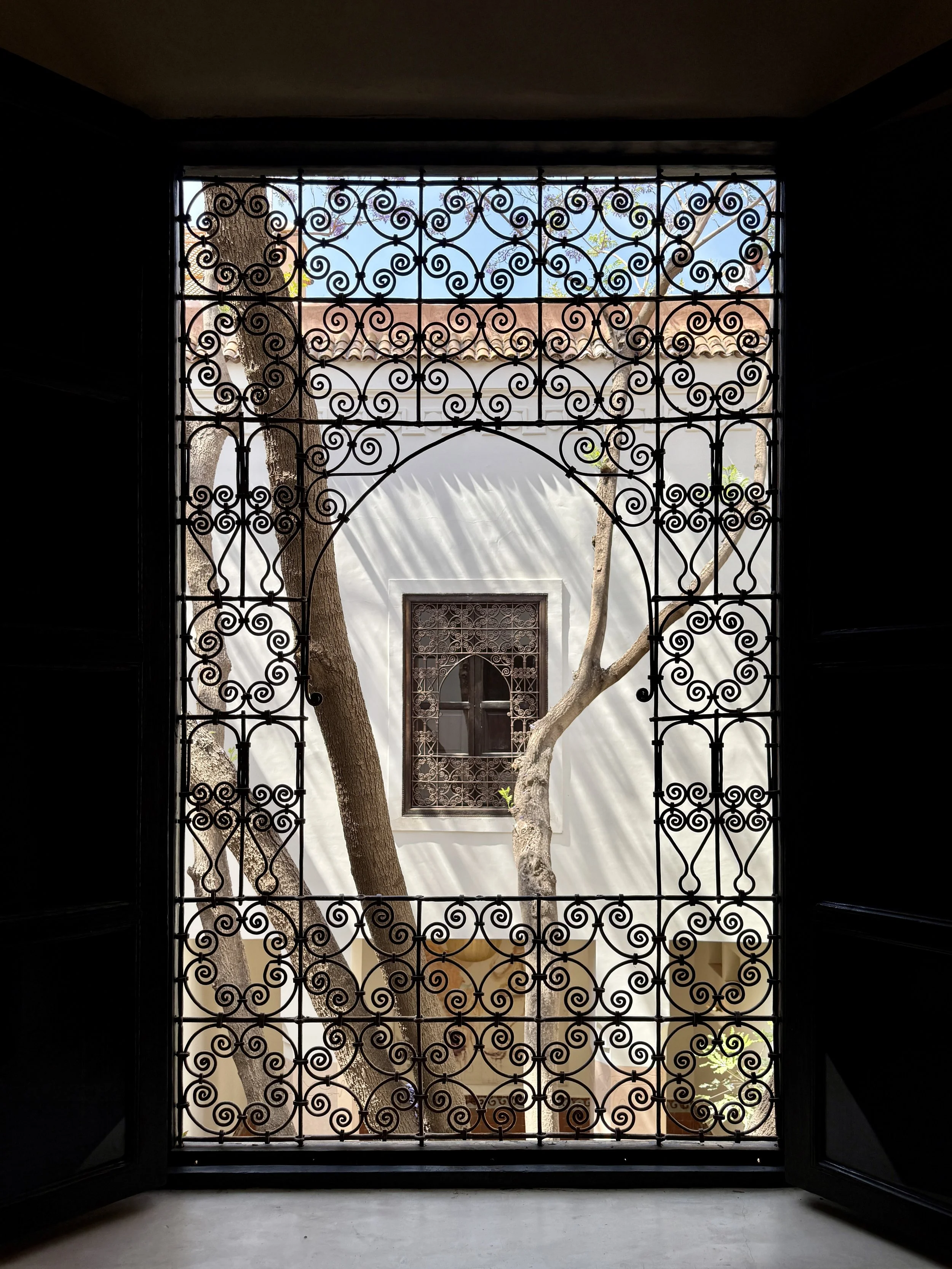
Curlicues cover a wrought iron grille over a window in a hotel room at Rosemary Riad in Marrakech

An ornate traditional wrought iron grille looks out upon the interior courtyard.

If you happen to fall in love with the hand-crafted ceramics, linens, rugs or toiletries during your stay — and you will — the onsite LRNCE shop makes it easy to take a bit of Rosemary home with you. –Duke

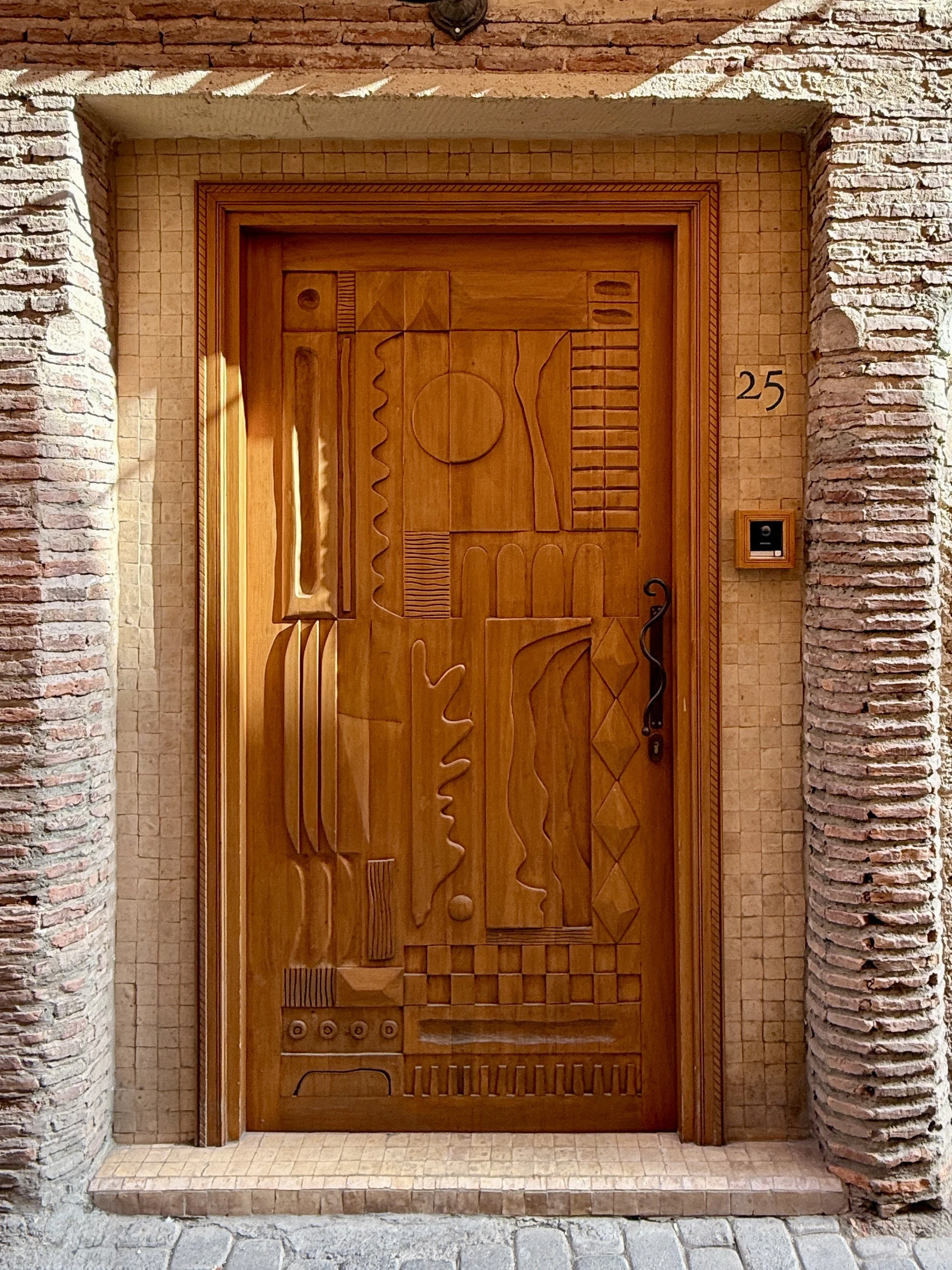
The elaborately carved cedarwood door at Riad Rosemary in Marrakech, Morocco

The hand-carved cedarwood front door was adapted from Leenaert’s sketches, one of the first pieces created for Rosemary, and took over four months to complete.

Riad Rosemary

25 Rue de la Bahia
Marrakech 40000
Morocco


Ben Youssef Madrasa Is Beautiful — Even When Someone Is Blocking Your Shot

Once home to hundreds of theology students, Ben Youssef Madrasa in Marrakech is now a hypnotic maze of cedarwood, tilework, tiny dormitories and tourists trying to stage the perfect Instagram reel.

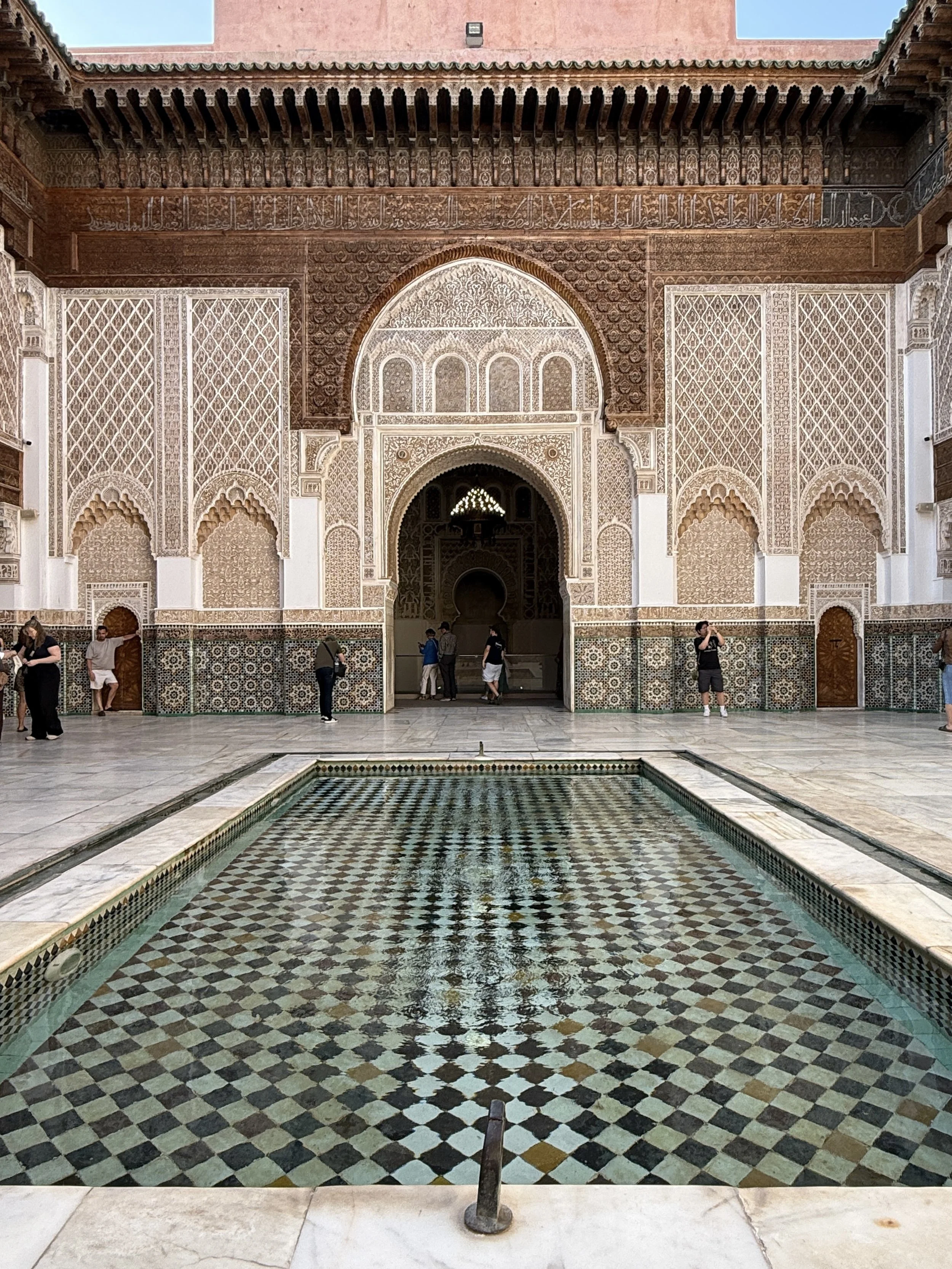
Courtyard of the Ben Youssef Madrasa with its reflecting pool in Marrakech, Morocco

En route to Ben Youssef Madrasa, you wind through the medina past scooters, cats, more cats, hanging lanterns, leather bags and shopkeepers trying to lure you into buying everything from slippers to saffron. The alleys feel compressed and chaotic — until suddenly they open up. Around a corner: a doorway. You’ve arrived.  

You step into the entrance, pay for your ticket — and then!

There were moments when the madrasa felt less like a historic site and more like the set of multiple simultaneous influencer campaigns.

The courtyard is almost absurdly intricate. Cedarwood curls across the ceilings in impossible patterns. Geometric zellige tilework climbs the walls with mathematical precision. Light bounces off the reflecting pool while visitors slowly circle the space trying to take it all in.

Or, in many cases, trying to take themselves in. During our visit, there were moments when the madrasa felt less like a historic site and more like the set of multiple simultaneous influencer campaigns. One woman posed dramatically at the edge of the reflecting pool while her friend shot video from approximately 14 different angles. Another visitor appeared to be filming a luxury perfume commercial involving slow-motion twirling. At one point, someone became visibly irritated that tourists were daring to walk through a public building during her photoshoot.

Which is unfortunate, because this place deserves your actual attention.

Planning Your Visit

Ben Youssef Madrasa

Address

Rue Assouel, Marrakesh Medina, Morocco

Hours

9 a.m. to 7 p.m.

Ramadan: 9 a.m. to 4:30 p.m.

Admission

50 dirhams (~$5) — foreign adults

20 DH — Moroccan adults

10 DH — children under 12

30 DH — groups of 21+

Time Needed

Plan for at least 45 minutes to an hour.

Dress Code

Modest clothing is best — shoulders and knees covered out of respect for the site.

Long before it became one of the most photographed spots in Marrakech, Ben Youssef Madrasa was one of the great centers of Islamic learning in North Africa. Built in its current form during the 16th century under the Saadian dynasty, the school once housed hundreds of students studying theology, law and philosophy within these walls. And despite the crowds, despite the cameras and despite the occasional accidental appearance in a stranger’s TikTok, there are still moments where the building completely silences you.

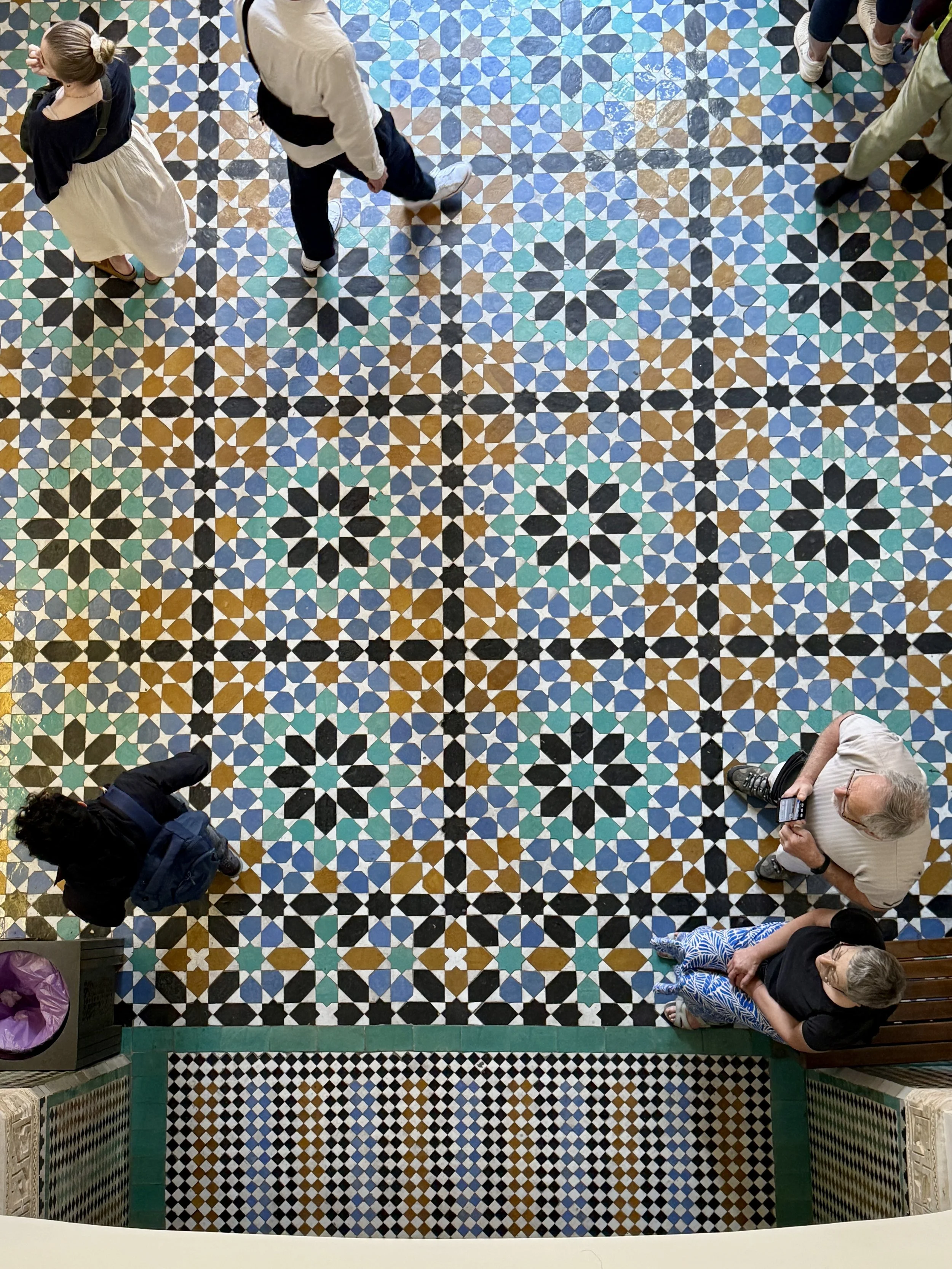
People  walk on the zellij tiled floor in the lobby of Ben Youssef Madrasa

Especially once you wander upstairs into the tiny student dormitories and realize the people who lived here were just young scholars sleeping in cramped little rooms beneath some of the most astonishing craftsmanship in Morocco.

Ornate carvings and tilework at Ben Youssef Madrasa

The History of Ben Youssef Madrasa

Before it became one of Marrakech’s most photographed attractions, Ben Youssef Madrasa was built for something far less glamorous: studying.

The madrasa was connected to the nearby Ben Youssef Mosque, which was originally founded in the 12th century during the Almoravid dynasty under Sultan Ali Ben Youssef, the ruler the complex is ultimately named after. At the time, Marrakech was emerging as a major political, religious and intellectual center, and institutions like this helped establish the city as one of the most important hubs of Islamic scholarship in the region.

What visitors see today, however, mostly dates to a later reconstruction ordered by the Saadian Sultan Abdallah al-Ghalib in the 1560s. And the Saadians, to put it mildly, weren’t interested in subtlety.

Beautiful carvings and tilework at Ben Youssef Madrasa in Marrakech
Starlike patterns carved on a wood door at Ben Youssef Madrasa
Gorgeous painted cedar ceilings at Ben Youssef Madrasa

The rebuilt madrasa was enormous for its time. Historians believe it housed as many as 900 students living in its 130 dormitory cells, and shared a single communal bathroom. Young men traveled here from across Morocco to study Qur’anic interpretation, theology, law and other religious sciences. Some likely arrived after journeys that took days or even weeks by foot or caravan, only to end up sleeping in rooms roughly the size of a walk-in closet — just three square meters, or about nine by nine feet. 

Which is part of what makes the place so fascinating today. Every visible surface seems carved, painted or tiled. The cedarwood ceilings resemble something pulled from a fantasy novel. The geometric mosaics are so precise they start to make your brain hurt if you stare too long. Yet the actual student quarters upstairs are tiny and more austere, built for discipline rather than comfort.

It’s a striking contrast — and very intentional. Islamic madrasas often placed beauty in communal and sacred spaces rather than personal luxury. The architecture itself became part of the educational experience, reflecting ideas about harmony, mathematics, craftsmanship and divine order.

Gorgeous Islamic architecture at Ben Youssef Madrasa in Marrakech

And the craftsmanship here is genuinely staggering. The zellige tilework was assembled by hand, piece by piece. The carved stucco contains Arabic calligraphy and religious inscriptions woven into floral and geometric patterns. Massive cedar beams from the Atlas Mountains were transformed into intricately carved ceilings that somehow still look delicate centuries later.

The madrasa continued operating as a school until 1960 before eventually closing and later undergoing restoration. Today, instead of students memorizing scripture by oil lamp, the building is filled with tourists whispering “oh my God” while trying not to accidentally walk into someone’s selfie shoot.

Tourists mill about the courtyard of Ben Youssef Madrasa in Marrakech

The Courtyard: The Big Reveal

There’s a very specific moment that happens when people enter the central courtyard of Ben Youssef Madrasa.

They stop.

Not politely. Abruptly. Like their brains need a second to process what they’re looking at.

The courtyard is the heart of the madrasa and the space most people picture when they think of Ben Youssef: the reflecting pool stretching down the center, the carved cedar balconies overhead, the walls wrapped in geometric tilework so intricate it barely seems possible that human hands made it. Every surface appears obsessed with detail. Even the empty spaces feel designed.

And somehow it never quite becomes visual overload.

Part of that comes down to symmetry. Islamic architecture often uses repeating geometric patterns to create a sense of balance and harmony, and Ben Youssef Madrasa leans into that philosophy hard. Your eyes keep finding echoes of shapes and lines repeating across the courtyard — arches mirroring arches, tiles reflecting tiles, carvings folding endlessly into themselves. It creates this strange feeling where the space feels both calming and hypnotic at the same time.

Tourists visit and take photos in the courtyard of Ben Youssef Madrasa in Marrakech

Then there’s the reflecting pool, which anchors the entire courtyard. Water plays an important symbolic role in Islamic architecture, representing purity and paradise while also helping cool the surrounding space. Here, the pool acts almost like a visual pause button amid all the detail. Of course, today it also serves another important function: becoming the exact spot where every tourist wants their photo taken.

At one point during our visit, there was an unofficial queue forming for people to stand dramatically beside the water while their companions directed increasingly elaborate poses. Gazing up thoughtfully. Turning slowly toward the camera. Looking over their shoulder. Touching the brim of their sun hat. It’s a terrible trend, and you’ll see it all over Marrakech. 

Meanwhile, the actual architecture remains the real star of the show.

It’s the kind of place where you keep spotting details long after you think you’ve fully taken it in.

And honestly, the best thing you can do here is occasionally stop trying to photograph every inch of it and just stand still for a minute. The courtyard was designed to inspire awe long before anyone invented Instagram. Sixteenth-century students probably walked through here every day and still found themselves impressed by the craftsmanship.

Though thankfully, they were less likely to block an entire archway for a slow-motion video.

A chandelier hangs above the ablution basin in the Prayer Hall of Ben Youssef Madrasa

The Prayer Hall and Ablution Basin

Off the main courtyard is the prayer hall, though “hall” may make it sound grander than the visitor experience actually feels. You can look into it, but you can’t fully wander through the space, so it reads more like a richly decorated room just beyond the courtyard rather than a major stop on its own.

The entrance is framed by two finely decorated marble panels, while the arch leading into the entrance bay is embellished with palm leaves and pineapples. The mihrab, which indicates the direction of Mecca, has a pentagonal plan and an arched frame supported by four marble columns, with palm leaves and intertwining floral motifs worked into the design.

Carved arch  in the prayer hall looking into the courtyard of Ben Youssef Madrasa

Dominating the space is the ablution basin, which once served as a fountain for ritual washing before prayer. Its faces carry a partly legible Kufic inscription naming its patron, Abd al-Malik, son of the powerful Andalusian vizier Al-Mansur. The basin was imported from Andalusia by the Almoravid sovereign Youssef Ben Tachfine — a reminder that medieval Marrakech and Islamic Spain were deeply interconnected worlds, with artistic styles, craftsmen and ideas moving back and forth across the Strait of Gibraltar. Visitors who have explored places like the Alhambra in Granada or the Mezquita in Córdoba will likely recognize some of the same geometric motifs, carved stucco work and architectural sensibilities here.

The basin itself is decorated with floral and geometric motifs, along with carefully depicted animals including birds and fish. That detail is especially interesting because people often assume Islamic art avoids animal imagery entirely. 

Wooden balconies in the hallways of the upstairs dormitories at Ben Youssef Madrasa

Upstairs in the Dormitories

A surprising number of visitors to Ben Youssef Madrasa never spend much time upstairs. I’m not even sure we ventured up there on our first visit more than a decade ago. 

Most people walk through the courtyard, take approximately 400 photos in front of the reflecting pool, glance into the prayer hall and move on. Which is a shame, because the upper level changes your understanding of the building.

The staircase leads into a maze of narrow corridors lined with tiny student rooms, and the contrast is immediate. Downstairs feels grand and ceremonial. Upstairs feels practical. Human. A bit severe.

Some of the dormitory cells are shockingly small — little more than sparse chambers with enough room for about six young boys to get packed in like sardines to sleep and study. After the extravagance of the courtyard below, the simplicity is almost startling. These students lived surrounded by extraordinary beauty without actually living luxuriously themselves.

Upstairs hallway at Ben Youssef Madrasa in Marrakech, Morocco

The architecture downstairs wasn’t designed to pamper students. It reflected larger ideas about knowledge, faith, harmony and discipline. Meanwhile, the dormitories emphasized modesty and focus. You can easily imagine young scholars sitting cross-legged in these tiny rooms late into the evening, memorizing religious texts by lamplight while the sounds of the courtyard drifted upward through the open galleries.

The upstairs level also gives you some of the best views in the building.

From the balconies, you can look down into the courtyard and see the geometry of the madrasa as a complete composition. The reflecting pool stretches like a spine through the center while visitors below move slowly through the space like pieces on a game board. 

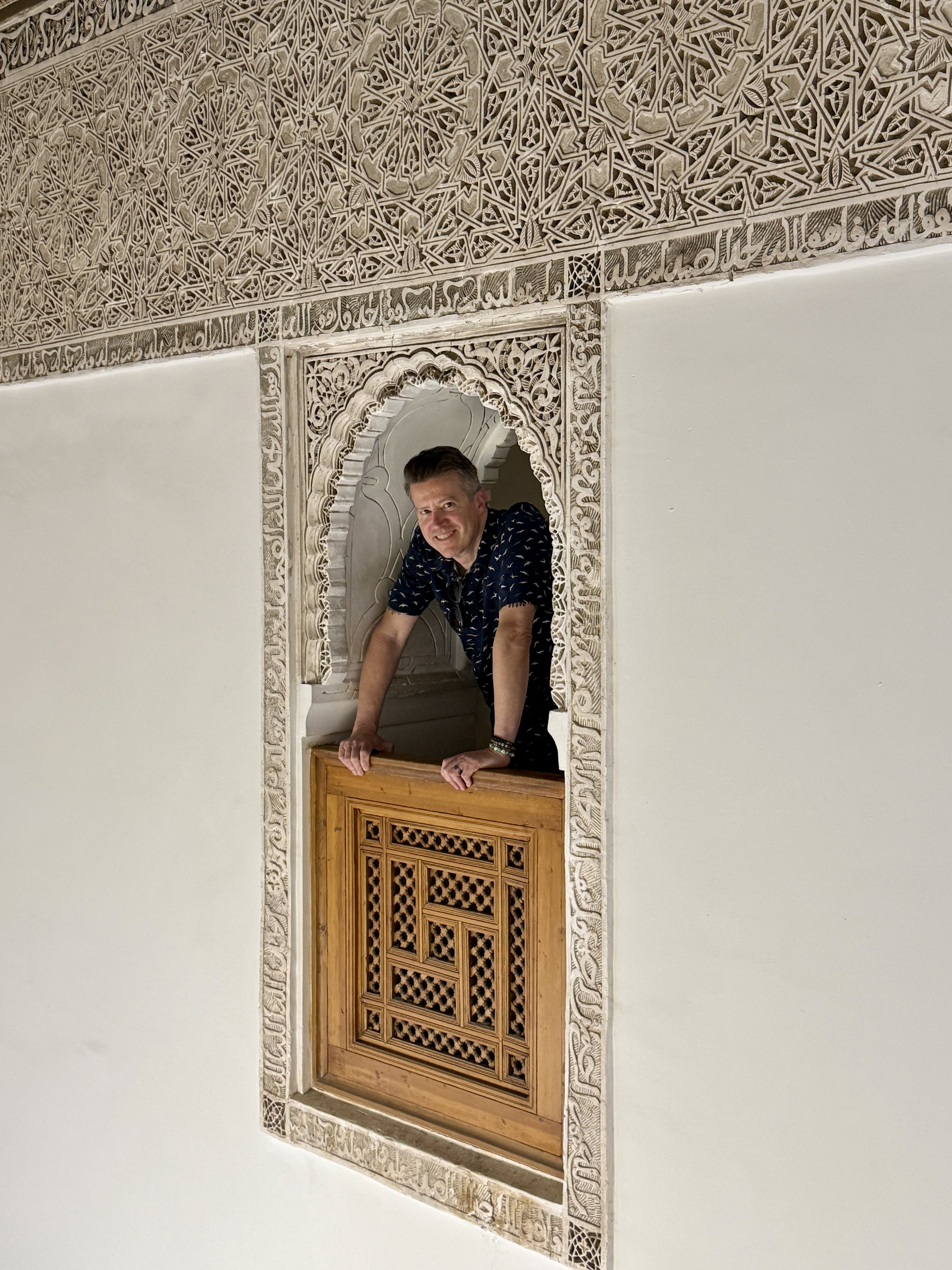
A man leans on a wood balcony in a carved arched interior window upstairs at Ben Youssef Madrasa

And I hate to say this since it could draw more influencer wannabes upstairs, but there are some nice photo opps up here. Station a photographer in one arched window while the subject poses on the balcony across the way. 

For now, the upper floor feels calmer overall. Fewer people linger there for long, which means you occasionally get rare moments where the building becomes quiet. It’s upstairs that Ben Youssef Madrasa stops feeling merely impressive and starts feeling inhabited.

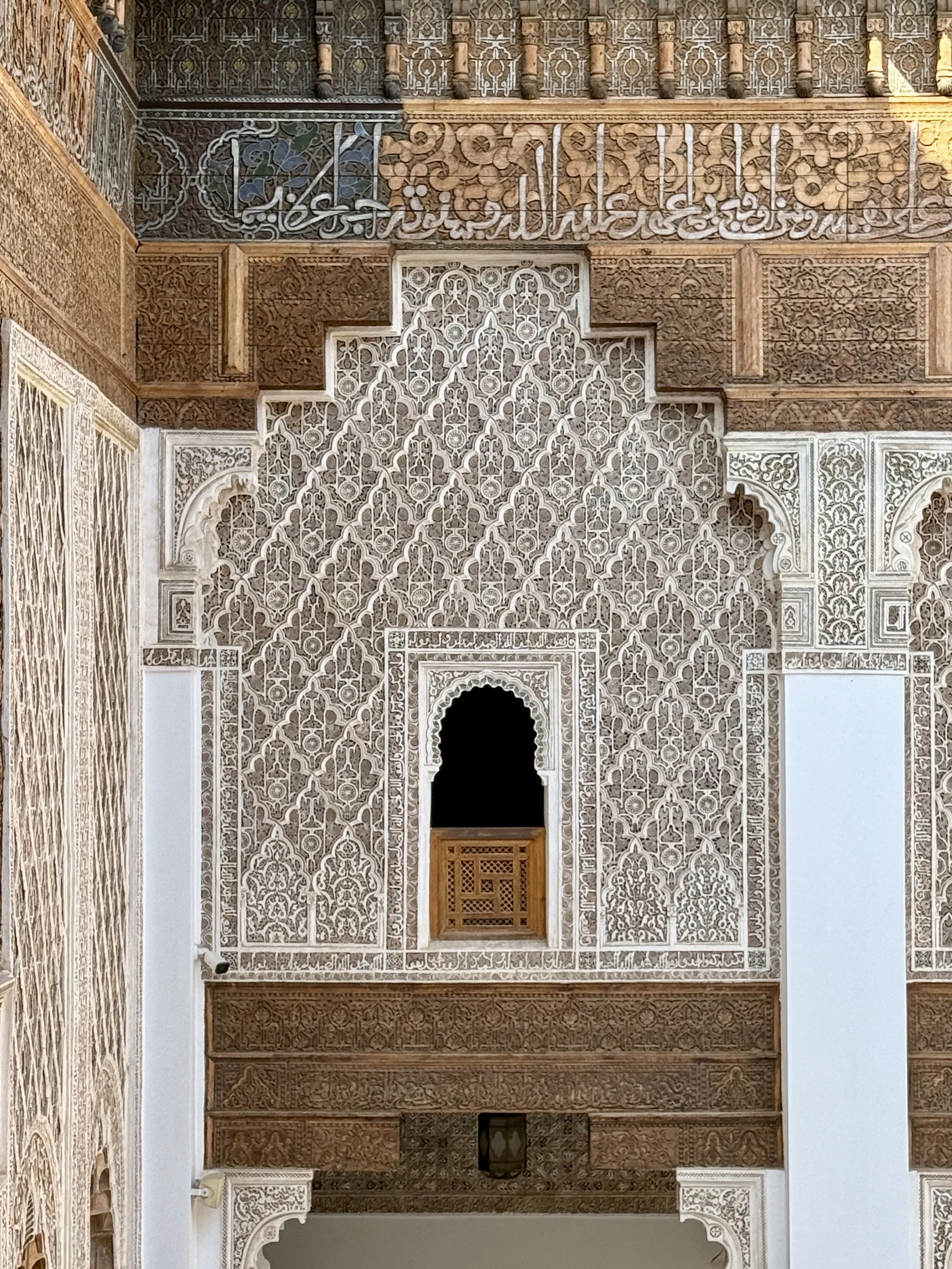
Carved Arabic calligraphy and patterns in plasterwork, a wooden door and zellij tiles at Ben Youssef Madrasa

Fascinating Details Most Visitors Miss at Ben Youssef Madrasa

It’s easy to walk through Ben Youssef Madrasa in a kind of architectural daze. But beneath the obvious beauty are dozens of small details that make the madrasa even more fascinating once you slow down enough to notice them.

The student rooms were intentionally austere. 

The contrast between the lavish courtyard and the tiny dormitory cells upstairs wasn’t accidental. Islamic madrasas often emphasized communal beauty and spiritual reflection over personal comfort. Students lived simply even while surrounded by extraordinary craftsmanship.

A light fixture at the entrance to Ben Youssef Madrasa in Marrkech

The cedarwood ceilings are functional, not just decorative. 

Many of the carved cedar elements came from Atlas Mountain cedar, prized not only for its beauty but also because cedar naturally resists insects and rot. Which means the ceilings weren’t just stunning — they were practical engineering.

The tilework is assembled piece by piece. 

The geometric mosaics, known as zellige (or zellij), are not painted patterns or prefabricated panels. Artisans individually cut and placed tiny pieces of glazed tile by hand into elaborate mathematical designs. Looking closely at the edges makes the craftsmanship feel even more impressive.

The reflecting pool was never meant for swimming. 

This may sound obvious, but judging by modern tourist behavior worldwide, it apparently needs to be stated occasionally. The water feature was symbolic and architectural, helping reflect light, cool the courtyard and create a sense of harmony.

Arabic calligraphy and carved Islamic patterns in the beautiful Ben Youssef Madrasa

The calligraphy is saying something. 

Many visitors admire the carved Arabic inscriptions without realizing they contain Qur’anic verses, blessings and religious phrases woven directly into the decoration. The building itself is essentially layered with sacred text.

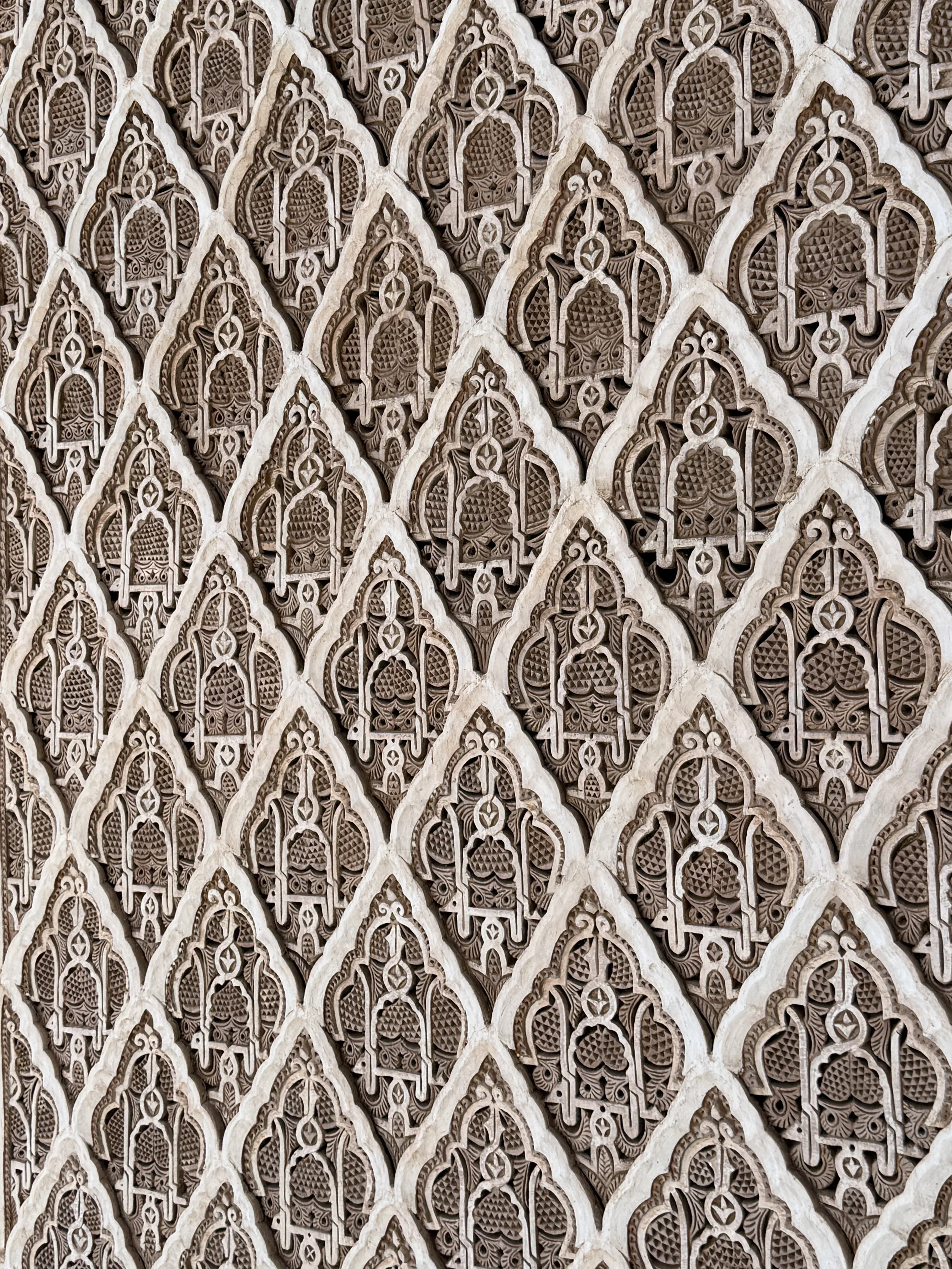
Amazingly detailed repeating patterns on the plaster walls of Ben Youssef Madrasa

The architecture manipulates your experience on purpose. 

The medina streets outside are noisy and enclosed. Then the madrasa suddenly opens into a bright symmetrical courtyard. That dramatic reveal is part of the experience. The building was designed to create emotional impact from the moment you entered.

It remained an active school until surprisingly recently. 

Ben Youssef Madrasa only stopped functioning as a college in 1960. Which means this isn’t some distant medieval relic disconnected from modern history. People were still studying here within living memory.

Upstairs is quieter because many tourists skip it. 

The dormitories tend to thin out the crowds significantly. If you want a calmer experience, go upstairs and linger longer than everyone else.

The acoustics are incredible. 

Even small sounds carry through the courtyard and hallways in unexpected ways. Footsteps echo softly across the tile. Conversations drift upward into the galleries. 

A man sits on a bench among colorful zellij tiles at Ben Youssef Madrasa,

Visitor Tips for Ben Youssef Madrasa

Go early. 

This is one everyone’s must-see list. 

By mid-morning, Ben Youssef Madrasa can become extremely crowded, especially in the central courtyard. Arriving earlier gives you softer light, slightly cooler temperatures and at least a fighting chance of seeing the reflecting pool without six simultaneous photoshoots unfolding around it.

Keyword: slightly.

But maybe not right at opening. 

We haven’t tested this out, but I wonder if maybe it’s not actually wise to go right when these attractions open. Because inevitably there are other others with the same idea, and you guarantee you’re entering with a crowd. 

I’m wondering if maybe it would calm down even just a bit a half an hour or an hour after opening. But again, it’s just a theory.

Don’t just do the courtyard. 

Some of the best details are actually around the edges: carved doorways, quieter side chambers, shadow patterns in the hallways and the transitions between rooms.

The madrasa rewards wandering.

Go upstairs — seriously. 

A surprising number of people barely explore the dormitory level, which is unfortunate because it completely changes how the building feels. The upstairs corridors are quieter, more atmospheric and far more revealing about what daily life here might actually have been like.

Plus, the views overlooking the courtyard are fantastic.

Looking up at an opening in the roof with elaborately carved cedarwood at Ben Youssef Madrasa

Look up constantly. 

This is good advice for Marrakech in general. Duke is obsessed with Moroccan ceilings, and for good reason.

The walls get most of the attention, but some of the most astonishing craftsmanship is overhead. The cedar ceilings are unbelievable and easy to miss if you stay focused at eye level.

Your neck may eventually resent you for this advice.

Women run through a series of poses to capture that perfect social media shot at Ben Youssef Madrasa's courtyard

Be prepared for the influencer culture. 

You’re going to encounter people filming elaborate content. It’s sadly unavoidable.

Some visitors behave as though they’ve rented the entire madrasa for a private campaign shoot. You can roll your eyes, but getting frustrated will only ruin your own experience.

Pair the madrasa with other nearby sites. 

Ben Youssef Madrasa works especially well alongside other attractions in the vicinity:

  • Dar El Bacha Museum of Confluences

  • Le Jardin Secret

  • Rahba Kedima spice square

  • The surrounding souks

Together they create a fuller picture of Marrakech beyond just checking famous landmarks off a list. –Wally

Hidden Gems of Morocco: 7 Underrated Places Worth Exploring

Escape the crowds and discover the authentic Morocco — from cave homes to ancient libraries. These underrated destinations in Morocco offer culture, adventure and a lot fewer tourists.

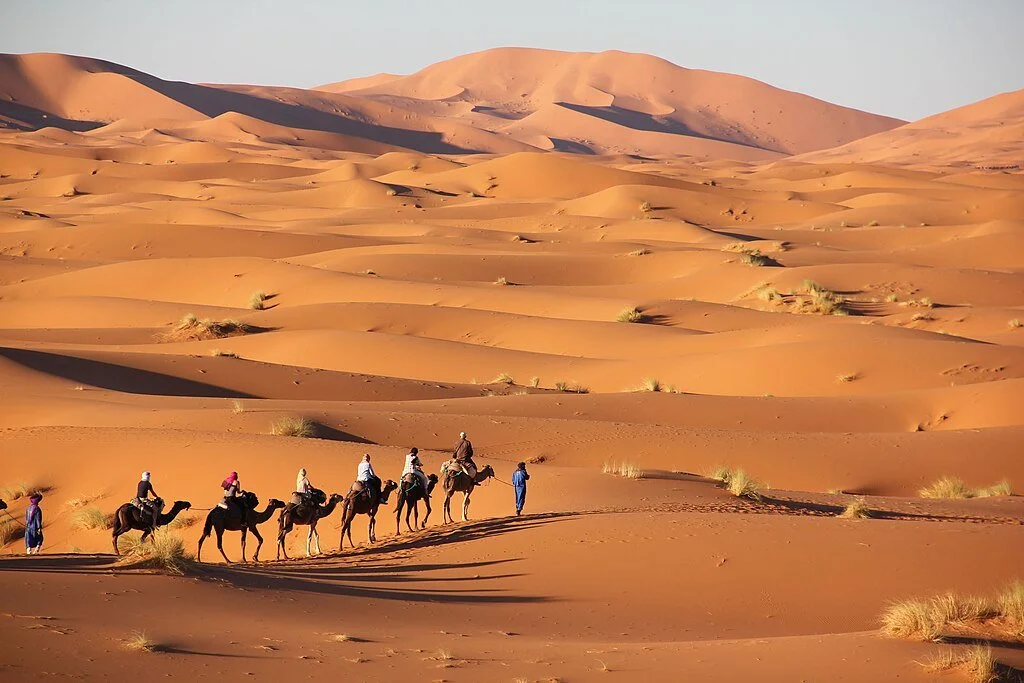
A line of people on camels walk through the Sahara Desert at Merzouga in Morocco

When most people think of Morocco, names like Marrakech, Fès or the Sahara instantly come to mind. And while these places are undeniably stunning, there’s a whole other side to the country that often gets overlooked — one you can truly discover through immersive Morocco desert tours, revealing untouched landscapes, ancient culture and authentic experiences waiting quietly in the shadows.

Let’s go beyond the Instagram hotspots and dive deep into seven underrated places in Morocco that are absolutely worth your time. Ready to wander off the beaten path?

The real Morocco isn’t always in the tour book, but it’s waiting for you just the same.
Part of the Portuguese fortress in the city of El Jadida in Morocco

1. El Jadida: A Coastal Fortress of Portuguese Legacy

Overview and History

Nestled along Morocco’s Atlantic coast, El Jadida is a unique fusion of Moroccan soul and Portuguese history. Once known as Mazagan, this port city was fortified by the Portuguese in the 16th century.

Columns and arches reflected in the water in the Portuguese Cistern in El Jadida, Morocco

What to See and Do

  • The Portuguese Cistern: A hauntingly beautiful underground chamber, known for its perfectly symmetrical arches and eerie reflection pools

  • City Walls: Walk along the historic ramparts and enjoy sweeping ocean views

  • Plage El Haouzia: A quieter alternative to the country’s more commercial beaches

Best Time to Visit

Spring and early autumn are ideal — pleasant weather, fewer tourists and beautiful ocean breezes.

The village of Tafraoute, Morocco, in the shadow of a peak of the Anti-Atlas

2. Tafraoute: The Heart of the Anti-Atlas

Cultural and Natural Highlights

Located in a valley surrounded by pink granite mountains, Tafraoute is an oasis of tranquility. The village is famous for its peculiar rock formations and rich Berber culture.

The Painted Rocks in Tafraoute, Morocco
  • Painted Rocks: Belgian artist Jean Vérame transformed local boulders into surreal artworks using vibrant colors

  • Traditional Berber Villages: Get a true taste of Moroccan hospitality with a home-stay experience

Trekking and Biking Opportunities

Tafraoute is also a hidden gem for trekkers and cyclists, with trails snaking through palm groves, narrow canyons and desert plateaus.

Art Deco buildings in Sidi Ifni, Morocco overlook the water

3. Sidi Ifni: Spanish Legacy by the Sea

Spanish-Moorish Architecture

Sidi Ifni is a sleepy coastal town with a distinct vibe — a relic of Spanish colonization, it feels like stepping into another time. The Art Deco buildings and Spanish signage still linger.

A person stands under a natural arch at Legzira Beach in Morocco

Legzira Beach and Rock Formations

Just six miles (10 kilometers) north, you’ll find Legzira Beach with its natural red sandstone arches that glow in the evening sun. It’s a dramatic, cinematic slice of Morocco most travelers skip.

A person stands in a natural pool by a waterfall at Akchour

4. Akchour: A Waterfall Wonderland

Hiking Trails and Natural Pools

If you’re staying in Chefchaouen, Akchour is just a short drive away. It’s an emerald paradise where you’ll find hiking trails, freshwater pools and waterfalls that look like scenes out of a fairy tale.

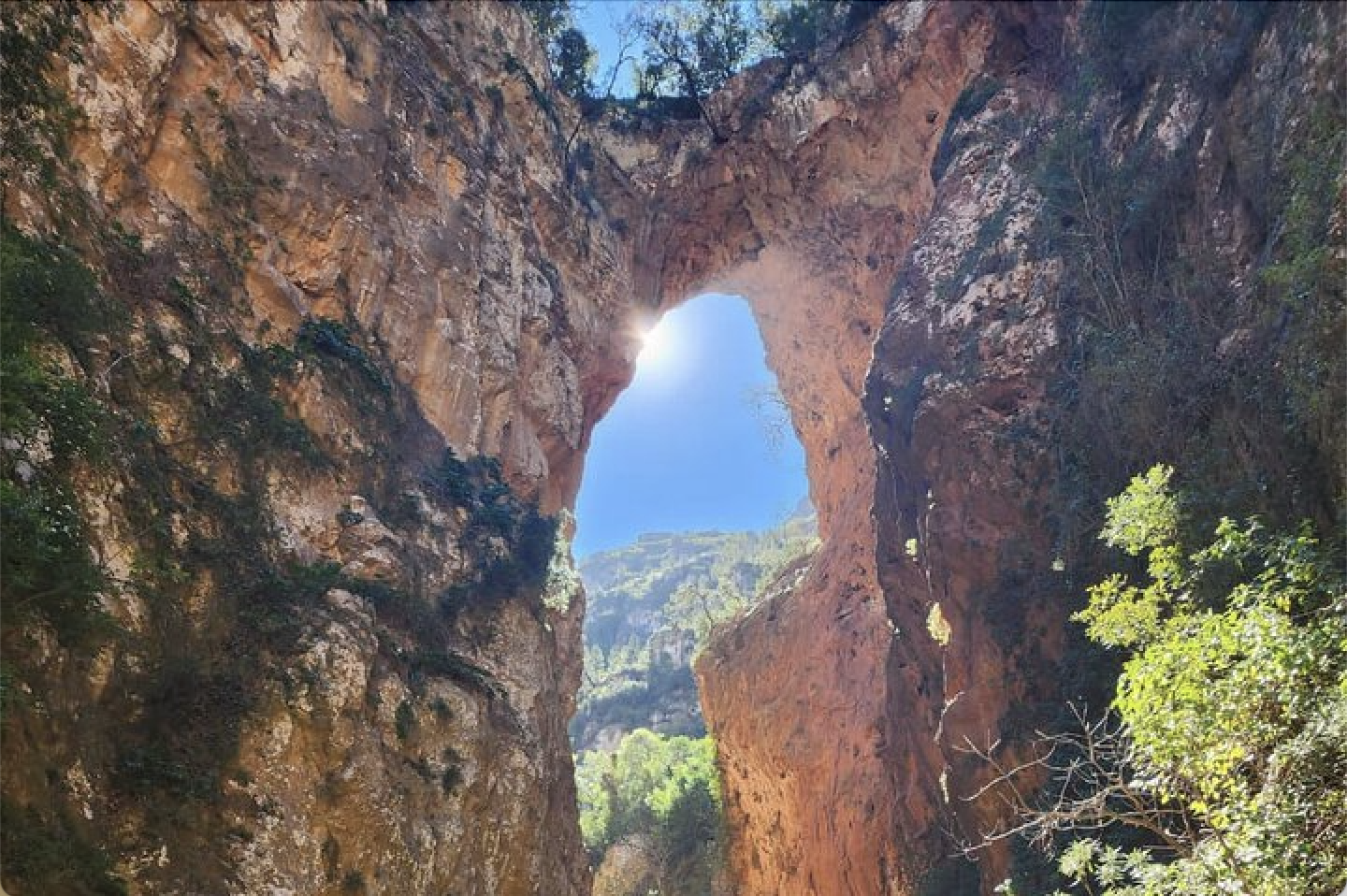
The Bridge of God, or Pont de Dieu, in Akchour, Morocco

The Bridge of God

One of the trail’s biggest highlights is the Pont de Dieu — a natural stone arch suspended over a canyon. Nature’s version of the Eiffel Tower, minus the crowds.

A series of waterfalls at Ouzoud, Morocco

5. Ouzoud: Beyond the Waterfalls

Wild Barbary Apes

While Ouzoud’s 360-foot (110-meter) waterfall steals the show, the surrounding forest is home to playful Barbary macaques, often seen swinging through olive trees.

A Barbary ape sits on a rock at the top of the Ouzoud waterfalls

Hidden Hikes and Local Life

Venture off the main path and you’ll discover tiny villages, hidden viewpoints and family-run tajine spots where the flavors are as rich as the views.

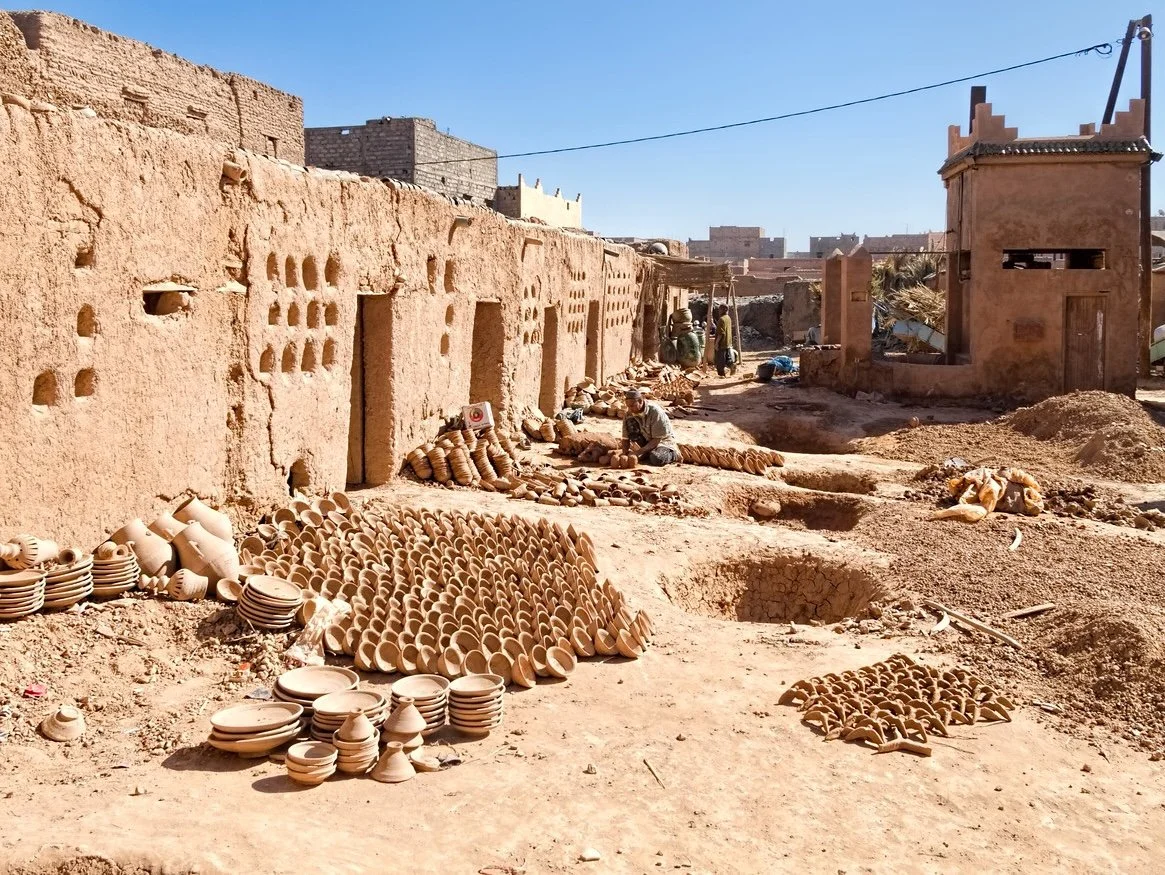
Pottery dries in the sun in the ancient town of Tamegroute, Morocco

6. Tamegroute: Morocco’s Ancient Library and Pottery Town

The Hidden Koranic Library

Tamegroute is one of Morocco’s best-kept secrets. This tiny village near Zagora houses an ancient Quranic library with manuscripts dating back to the 11th century.

Cups, tagines and containers for sale, many the famous green pottery of Tamegroute, Morocco

Unique Green Pottery

What makes this village even more special is its distinct green-glazed pottery, fired in traditional clay ovens. It’s imperfect, earthy and completely charming.

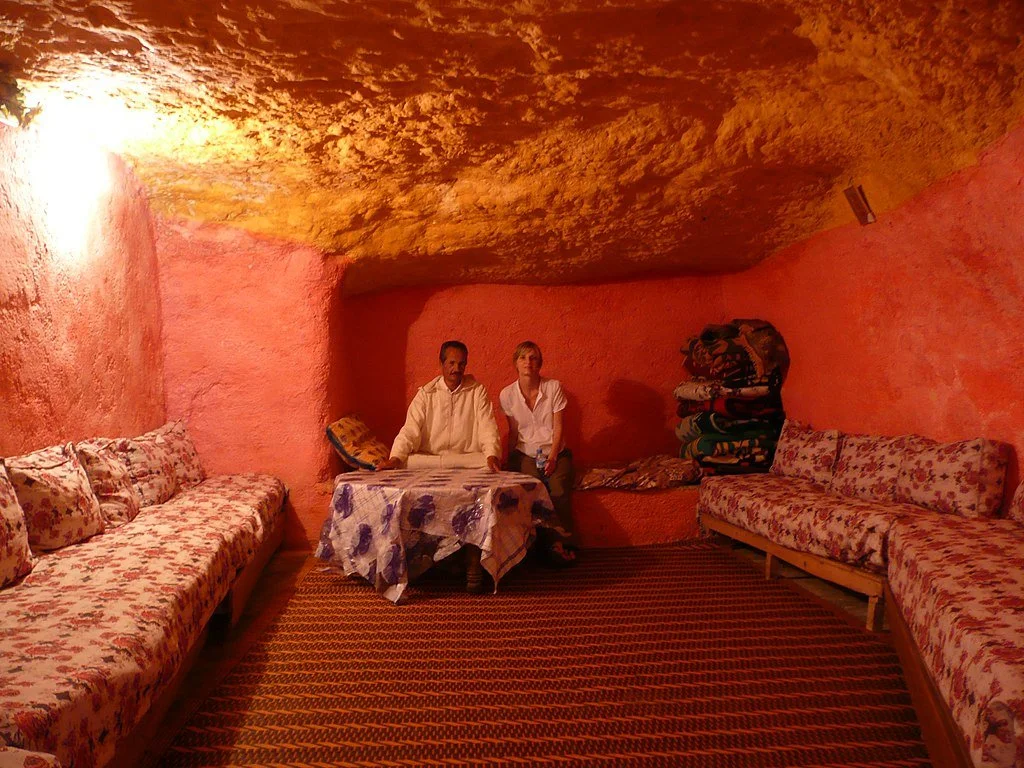
A man and woman sit inside one of the cave houses at Bhalil village in Morocco

7. Bhalil: The Cave House Village

Stay in Berber Caves

Just outside Fès lies Bhalil — a small village where many homes are literally carved into the hillside caves. Unlike modern cave hotels, these are still lived in by Berber families.

A view of the village of Bhalil in Morocco

Authenticity at Its Peak

You’ll be welcomed with tea, homemade bread and big smiles. No entry tickets, no waiting lines — just real life unfolding in front of your eyes.

The village of Tafraoute, Morocco, built atop and alongside rounded rock formations

Tips for Discovering Morocco’s Hidden Treasures

Hire local guides. 

Many of these places are off-grid. Hiring a local guide not only supports the community but also helps you uncover stories and places you’d otherwise miss.

Travel in the off-season. 

Skip the high seasons and travel during shoulder months (March to May or September to November). You’ll dodge the crowds and often score better deals on accommodations.
Learn a few Darija phrases. 

Even basic words like shukran (thank you) or salaam (hello) go a long way in rural areas. Locals will appreciate the effort, and you’ll likely get warmer treatment.

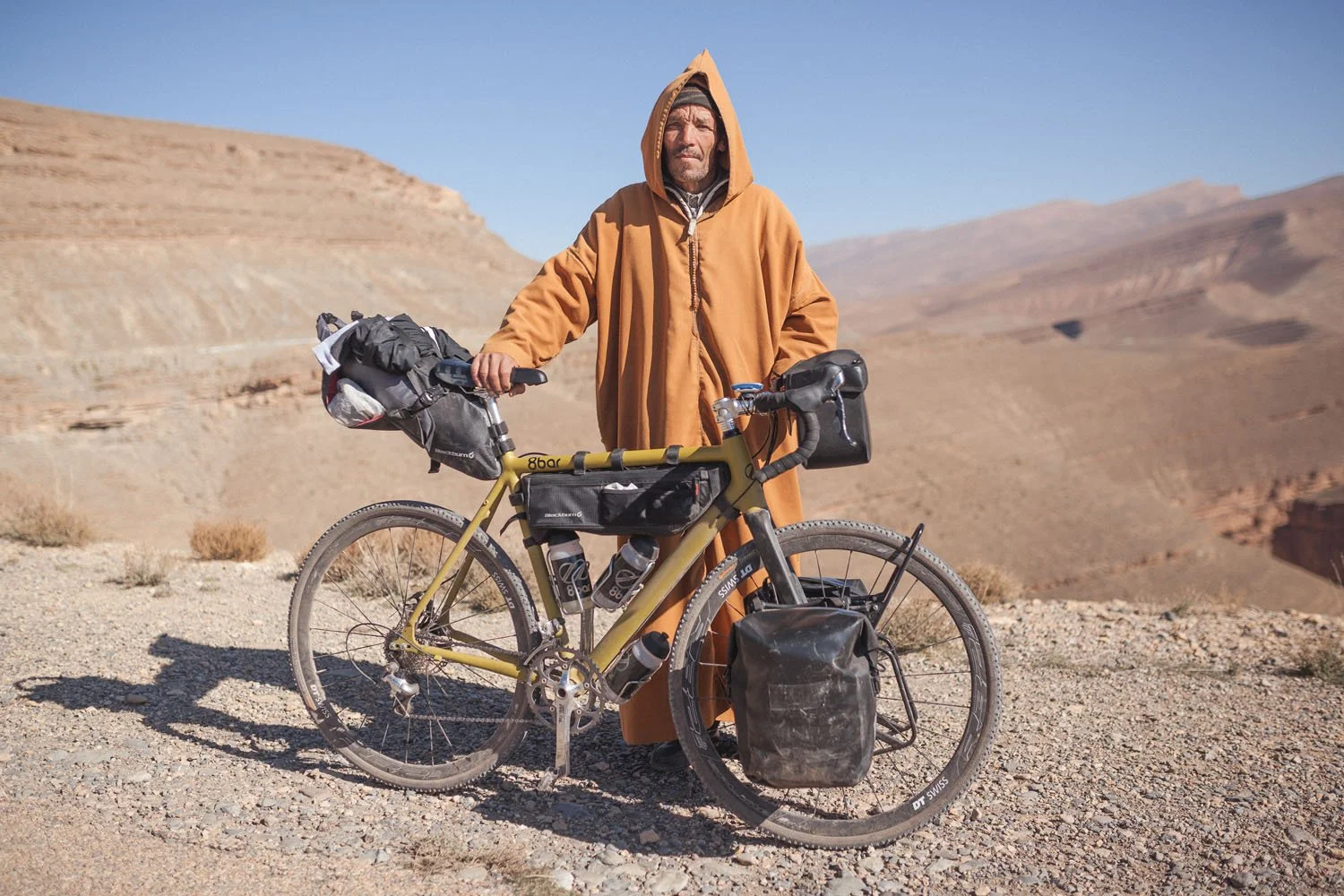
A Berber man holds a bike loaded with packs by the Atlas Mountains in Morocco

Why You Should Skip the Crowds and Go Off the Beaten Path

Sometimes, the most profound travel moments happen away from the obvious. Whether it’s sipping mint tea in a cave house, stumbling upon ancient manuscripts, or watching the sun dip behind a sandstone arch — these lesser-known gems will give you stories no guidebook can.

Want to dive deeper into planning your adventure? Check out this Morocco tour guide for expert tips, must-see destinations and everything you need to know before you go.

Morocco is a land of contrast — mountains, deserts, beaches, cities and silence. If you’re the kind of traveler who enjoys meaningful, raw and less commercialized experiences, these seven hidden gems will win your heart. So, step off the tourist trail and let Morocco surprise you in the most unexpected ways.

Baskets and flowerpots line the bright blue stairs and walls of Chefchaouen, Morocco

FAQs

1. What is the safest hidden gem in Morocco to visit solo?

Tafraoute is ideal for solo travelers. It’s calm and friendly, and the locals are extremely welcoming.

2. How do I get to Akchour from Chefchaouen?

Shared taxis or private transport from Chefchaouen will get you to Akchour in under an hour.

3. Is it expensive to visit these underrated places in Morocco?

No — in fact, many of these spots are budget-friendly and less commercial, meaning you get more value for your money.

4. What language is spoken in small Moroccan villages?

Mostly Amazigh (Berber) and Darija (Moroccan Arabic), but some locals speak basic French, too.

5. Are these hidden gems suitable for family travel?

Absolutely! Places like Ouzoud and El Jadida are especially fun for kids and easy to access for families. 

So go ahead — chase the waterfalls, sip tea in a cave, lose your breath at sunset. The real Morocco isn’t always in the tour book, but it’s waiting for you just the same. –Abe Abdessamad


Riad Alwachma, Marrakech, Morocco

Why a riad is absolutely the best place to stay in Marrakech, with their interior courtyards with fountains and rooftop terraces. We chose one that’s a quick walk to Jemma el-Fna, the main square.

The interior courtyard of Riad Alwachma, Marrakech, Morocco

The interior courtyard of Riad Alwachma, Marrakech, Morocco

Part of the fun in planning a trip is figuring out where you’re going to stay. When Wally and I settled on Marrakech, I set to work to find a few options. The only criteria was to find lodging within the medina, the old quarter of the city surrounded by rammed earth walls. 
I had narrowed it down to three riads and began showing them to Wally. He’d excitedly reply with, “Ooo, I like that one with the fountain in the middle!” To which I’d reply, “They all have fountains in the middle.” 

Then he’d exclaim, “Ooo! I like that one with the rooftop terrace!” To which I’d reply, “They all have rooftop terraces.” 

“OK,” Wally said, a huge smile on his face. “I get it.”

“Ooo, I like that one with the fountain in the middle!”

”They all have fountains in the middle.” 

“Ooo! I like that one with the rooftop terrace!”

“They all have rooftop terraces.” 

We settled upon Riad Alwachma, located a mere 10 minutes from the Jemaa el-Fnaa, the main square, and the souks.


Our driver, which we had arranged in advance, dropped Wally, Vanessa and I off at the entrance to Derb Bab Doukkala and led us with our luggage in tow down the cobbled road to the riad. Most derbs (often translated as alleys, but more like lanes) in the medina are too narrow for cars — not a bad thing as there are plenty of other types of traffic throughout, including mopeds and donkey carts.

We arrived at Riad Alwachma’s large wooden door and were cordially greeted by one of the proprietors, a charming French expat named Jérôme. The three of us passed through the threshold, and the quiet of the interior courtyard enveloped us.

Most riads have unassuming front doors, like that of Riad Alwachma — but such beauty lies within!

Most riads have unassuming front doors, like that of Riad Alwachma — but such beauty lies within!

What’s a Riad?

Riads are the traditional former residences of wealthy merchants that have been converted into private guest lodgings. The term comes from the Arabic word ryad, meaning garden, and is applied to homes built around an inner courtyard or garden. They have unassuming façades that conceal a gorgeous interior. 

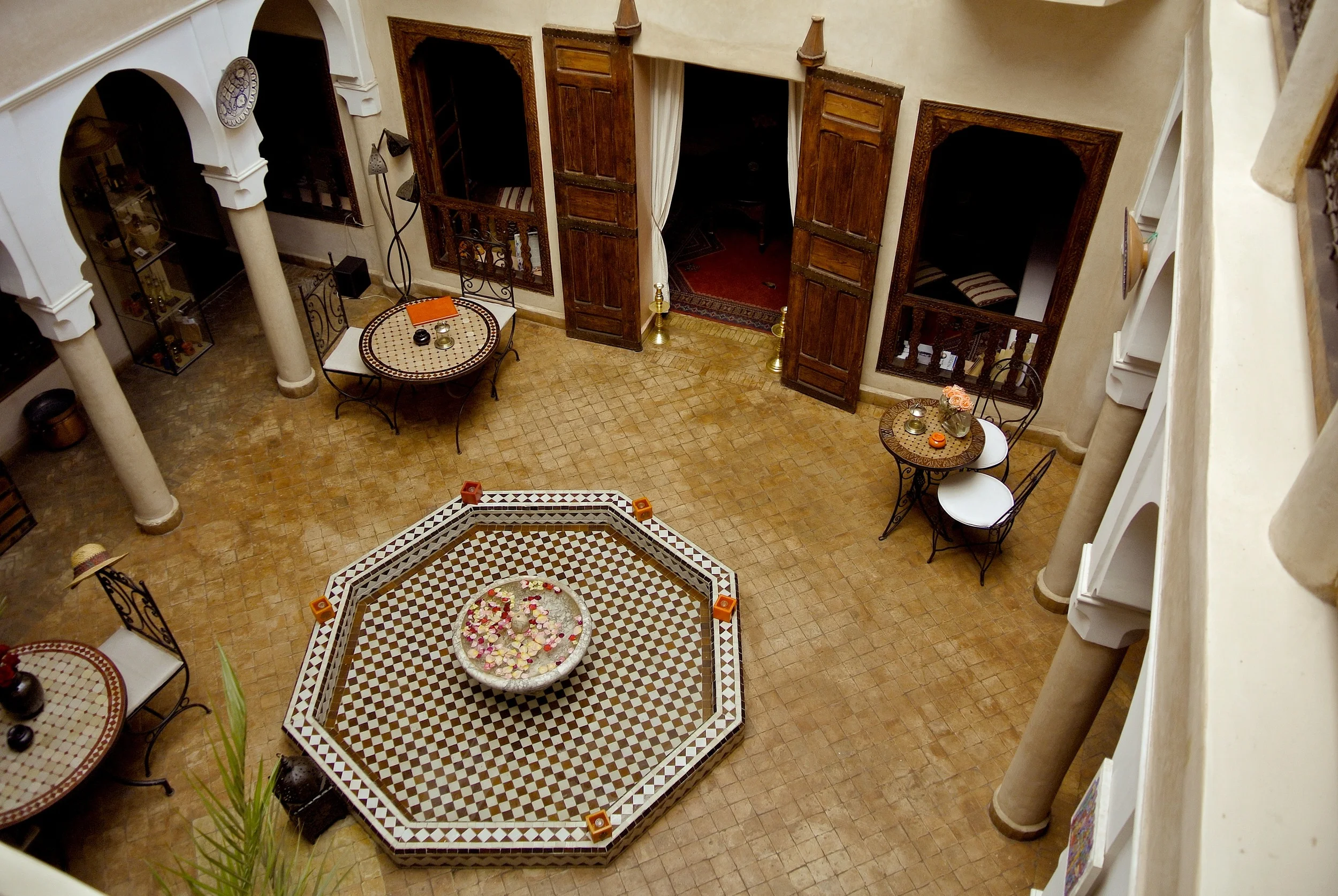
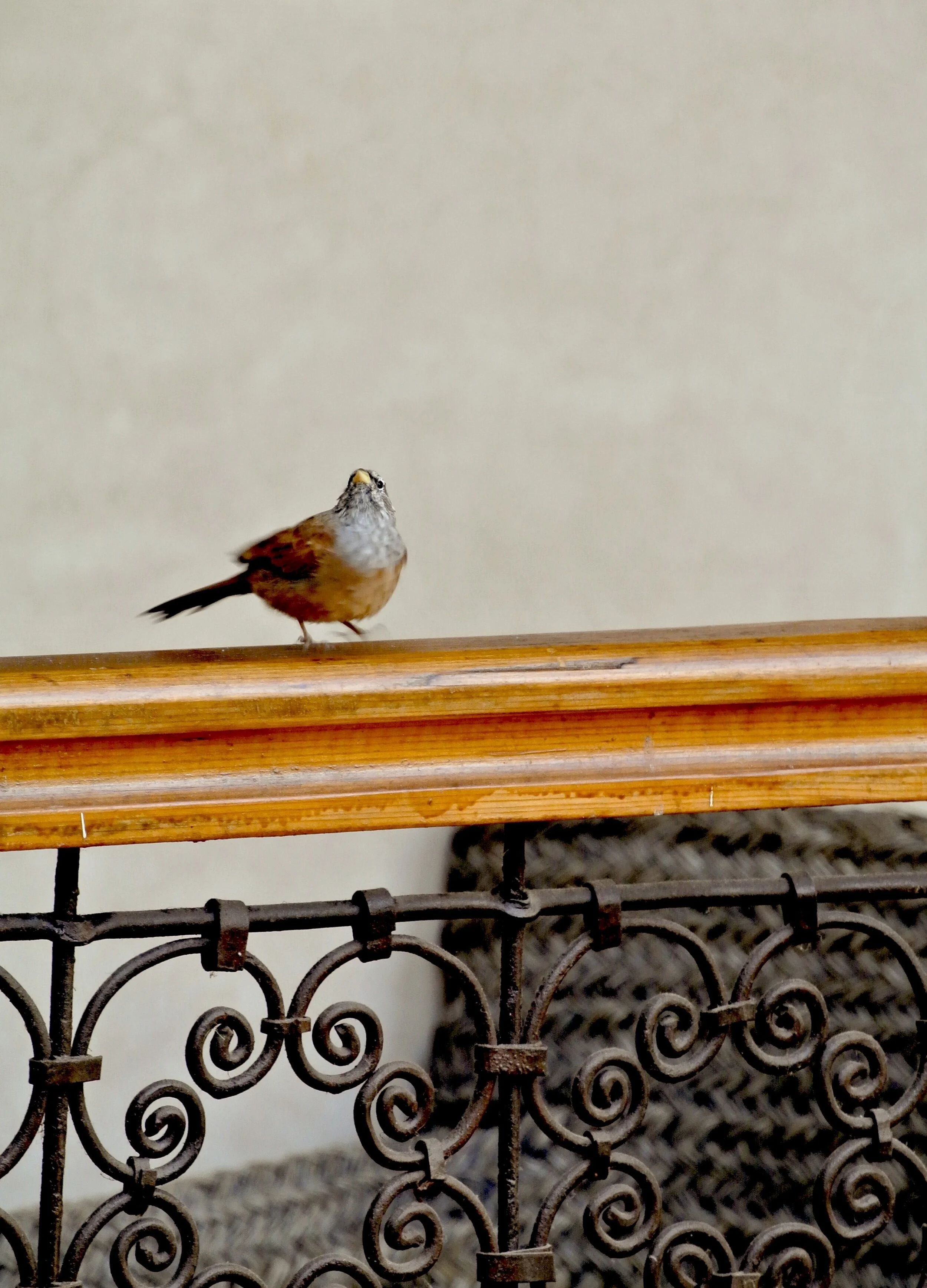
Like all riads, ours had a large central courtyard that opened to the sky. In the center, a fountain laden with rose petals dancing on the surface gurgled faintly. A chirping bird was contentedly hopping along the floor.

Wally and I smiled conspiratorially at each other. Without missing a beat, Jérôme smiled too and told us that a bird in the house is a symbol of good luck.

A bird in the home is good luck, our host tells us — and a not-too-uncommon occurrence with the open-air central courtyard.

A bird in the home is good luck, our host tells us — and a not-too-uncommon occurrence with the open-air central courtyard.

Vanessa, Wally and I sat at a table in the courtyard while Jérôme explained the origin of the riad's name. Alwachma comes from a traditional chin tattoo Berber women use to adorn themselves. I decided to nickname our riad The Girl With the Berber Tattoo.

Our host provided us with a map of the city and indicated points of interest and areas to avoid at night.


Getting Your Bearings in Marrakech

Over some pastries and our first cup of mint tea, which locals love to jokingly call “Berber whisky,” Jérôme explained that Marrakech tends to be a very safe city and that there are many uniformed police found throughout. But he did offer some advice on concealing our new camera because of the approach of Eid al-Adha, the Islamic festival to commemorate prophet Ibrahim’s obedience to Allah above all others. Jérôme explained that locals sacrifice animals on this feast day, and people occasionally do desperate things to provide their families with money to purchase a sheep or goat.

While we were more interested in the sights of the medina, from the Saadian Tombs to the El Badi Palace, Jérôme indicated Guéliz, the Ville Nouveau, or New Town, on the map. He kept saying that this was where we should go should we want to “make party,” an expression that made us giggle. 

We finished our tea while mapping out our first of many adventures to come. First stop:  Jemaa El-Fna and shopping in the souks, of course. –Duke
 

Riad Alwachma
27 Derb Sehb Bab Doukkala, Medina
4000 Marrakech
Morocco


The Saadian Tombs: A Glorious Monument to the Dead

Peek inside the royal necropolis in Marrakech, which rivals parts of the Alhambra in its beauty. We can thank Sultan al-Mansur for its magnificence — and Ismail Ibn Sharif’s fear of the dead for leaving it intact. 

The Saadian Tombs in 1925

The Saadian Tombs in 1925

Don’t judge a tomb by its cover. The unremarkable exterior walls surrounding the Saadian Tombs in the medina of Marrakech concealed their exquisite mausoleums for centuries, attracting little more than stray cats and storks. While not much to look at from the outside, the secluded interior courtyard is a completely different matter. 

Walled in and forgotten for more than two centuries, the necropolis of the deceased Saadian royals and their descendants remained hidden until its discovery in 1917. French Resident-General Hubert Lyautey commissioned an aerial survey of Marrakech and, by chance, the photographs revealed the existence of the tombs. They were brought back from disrepair by the Service des Beaux-Arts, Antiquités et des Monuments Historiques before being opened to the general public. 

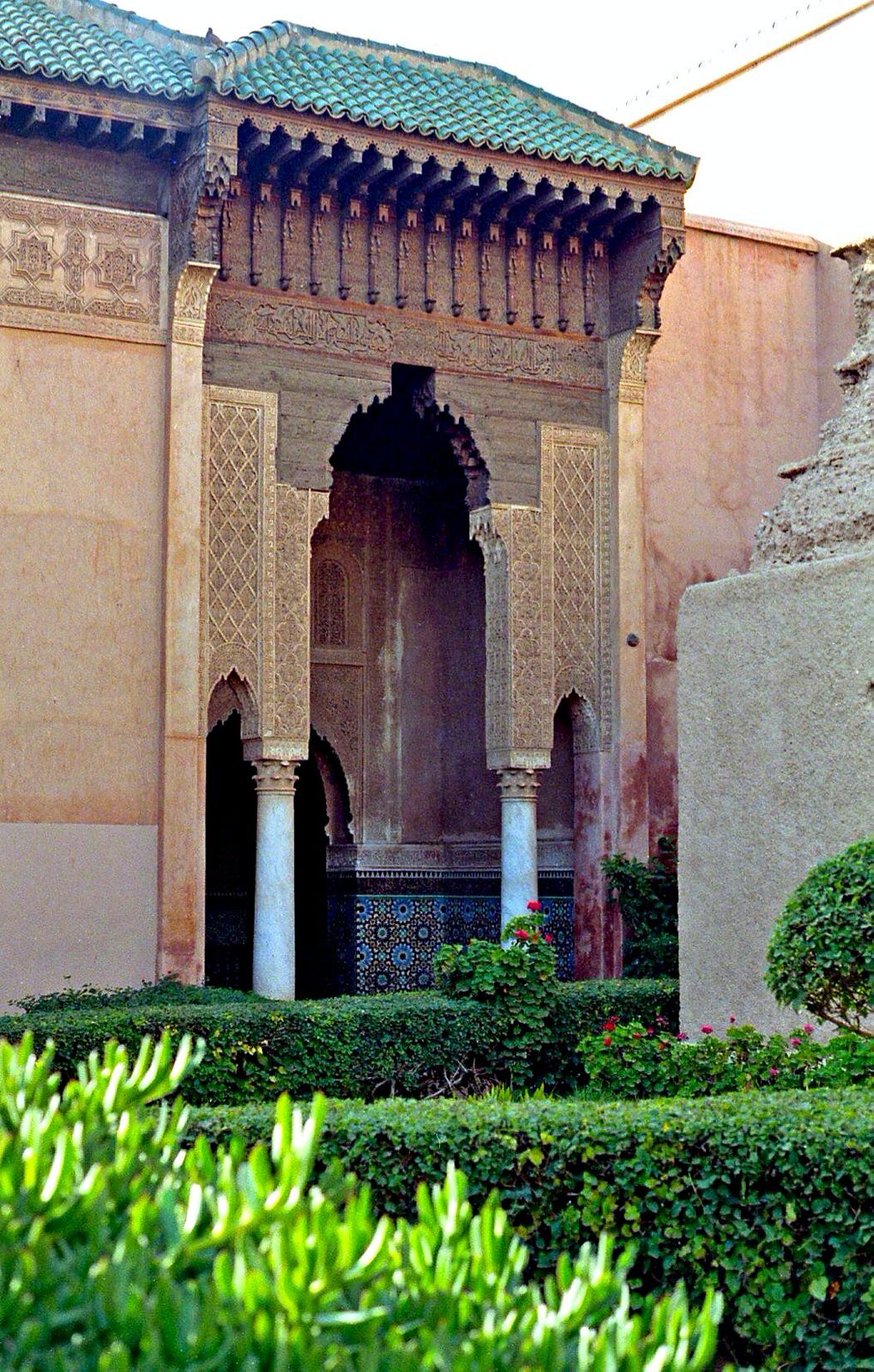
The unassuming exterior of the Saadian Tombs belies its gorgeous interior.

The unassuming exterior of the Saadian Tombs belies its gorgeous interior.

The historic property is located along the Rue de la Kasbah near the ruins of the El Badi Palace. Even if you have a strong sense of direction, the unmarked streets and nondescript ancient rammed earth walls surrounding many of the buildings in the medina district of Marrakech make finding a destination challenging. 

Ahmad al-Mansur

Ahmad al-Mansur

We eventually did and purchased our tickets, which cost 70 dirhams, or around $8, each. Wally, our friend Vanessa and I passed through an inconspicuous narrow corridor cut into the exterior wall and emerged into a tranquil courtyard garden. 

The royal necropolis dates back to the beginning of the 14th century and originally served as a courtyard garden of the Kasbah Mosque. It wasn’t until the reign of the sixth and most famous sultan of the Saadian dynasty, Ahmad al-Mansur (who reigned from 1578-1603 and was known as Eddahbi, the Golden), that the construction of the tombs reached a far more elegant and refined status. Before al-Mansur died from the plague in 1603, he expanded and embellished its mausoleums in the grand style of the Alhambra, the royal residence of the Nasrid Kingdom, built 200 years prior in Granada, Spain.


Brightly tiled tombstones fill the courtyard.

Brightly tiled tombstones fill the courtyard.

A Rested Development

Seven sultans and 62 family members are interred in the Saadian Tombs, with over 100 more outside in the gardens. 
The courtyard enclosure includes two mausoleums with gabled, glazed green roof tiles of kiln-fired clay. 

The gravestones in the mihrab, or prayer niche, reminded us of prayer mats.
The gravestones in the mihrab, or prayer niche, reminded us of prayer mats.
The main tombs are located to the left of the enclosure. The first of the three chambers was originally a mihrab, or prayer niche, and is now the final resting place of Saadian princes. Its walls and floors are covered with intricate multicolored zellij mosaic tiles. The varying shapes, colors and patterns embedded in the flat graves reminded me of prayer rugs, laid facing Mecca, for eternity. The stucco work of the archway is delicate and ornate, while the ceiling is equally impressive.

The Hall of Twelve Columns is the star of the show.

The Hall of Twelve Columns is the star of the show.

Pillars of Society: The Hall of Twelve Columns

The central mausoleum where al-Mansour lies is known as the Hall of Twelve Columns. This chamber incorporates a dozen Carrera marble pillars, carved stucco walls and gilt honeycomb ceiling vaulting known as muqarnas. Al-Mansur traded sugar with the Italians in exchange for the marble, which is fitting, as its white, crystalline surface resembles the fine granular texture of sugar. The sultan’s narrow marble headstone stands in the center of the room and is flanked by those of his son and grandson. The chamber is also home to the remains of Princess Zahra, whose epitaph reads, “Here is the tomb of the noble lady, new moon, marvel of virtues.”

A coffered cedarwood ceiling with sunken square panels of diminishing sizes representing the earth and a circle at its apex standing in for the heavens spans the columned central chamber. This sacred geometry symbolizes the passage from the material to the spiritual world. 

Recent restoration work on the Saadian Tombs began in 2013 and lasted for two years.

Recent restoration work on the Saadian Tombs began in 2013 and lasted for two years.

The Three Niche Chamber and Lalla Masuda Qubba

Beyond the great hall is the Three Niche Chamber, where those relations deemed less important, including children, are buried. The three arched recesses for which the mausoleum takes its name feature magnificent incised muqarnas embossed in gold, lending the space a luminous quality. 

The “less important” relatives were interred in the Three Niche Chamber, which is still not too shabby a place to spend eternity, if you ask us.

The “less important” relatives were interred in the Three Niche Chamber, which is still not too shabby a place to spend eternity, if you ask us.

Between the mausoleums and throughout the gardens are descendants, wives and emirs, each resting closer or further away from al-Mansur’s sepulcher, depending on his or her status. 

The entrance to the Lalla Masuda Qubba. As with the rest of the complex, you can’t go inside —  but you can peek into the chambers.

The entrance to the Lalla Masuda Qubba. As with the rest of the complex, you can’t go inside —  but you can peek into the chambers.

The second and smaller structure is called the Lalla Masuda Qubba and refers to the domed roof mausoleum which contains the grave of al-Mansur’s mother. 

Lalla Masuda

Lalla Masuda

The oldest and original Saadian tomb includes a cedarwood dome and two entrance porches or loggias. It was built by Sultan Abdallah al-Ghalib to bury his father, Mohammed al-Sheikh, the founder of the dynasty. 

In 1591, al-Mansur had his mother, Lalla Masuda, added to the tomb. She was a Moroccan political figure in the Saadi dynasty remembered for her humanitarian work and considered an awliya, or saint. 

Fearing the Dead 

Less than two decades later, Sultan Ahmad al-Abbas was assassinated, the Saadian dynasty had come to an end, and the Alaouites had taken control of the country.  

When Sultan Moulay Ismail Ibn Sharif assumed power, he wasted no time eradicating the legacy of the Saadi dynasty. He systematically set about looting and stripping most of their architectural achievements, including the El Badi Palace. However, he spared the Saadian Tombs — probably because he feared bad luck if he desecrated them and was superstitious that the spirits of the dead would pursue him. He satisfied himself with sealing up all but one obscure entrance from the Kasbah Mosque. 

Moulay Ismail Ibn Sharif completely stripped the nearby El Badi Palace but left the Saadian Tombs intact. Was he nervous about disturbing the spirits of the dead?

Moulay Ismail Ibn Sharif completely stripped the nearby El Badi Palace but left the Saadian Tombs intact. Was he nervous about disturbing the spirits of the dead?

The Saadian Tombs gave us a sense of the former grandeur of the El Badi Palace. Heads up that the various chambers are off limits to the public, but a path winds past them, letting tourists see them from outside, much like peeking into a diorama. 

While the tombs are cordoned off to human visitors, felines are another matter. We witnessed more than a few cats and kittens napping on their cool tiled floors. 

If you enjoy Islamic architecture as much as we do, then a visit to this funerary monument and tribute to the Saadian legacy is a must. –Duke


The Crumbling Ruins of El Badi Palace in Marrakech

Once praised for its massive scale and beauty, El Badi Palace soon became a mere shell of its former grandeur. Only storks now call it home.

A ruined palace sits within the medina of Marrakech.

A ruined palace sits within the medina of Marrakech.

It must have once been quite a spectacle. El Badi Palace was commissioned by Ahmad al-Mansour, a Saadi sultan who ascended to power after his brother’s untimely death in 1578. Its financing came from ransoms paid by the Portuguese to release their prisoners who had been captured and enslaved following their defeat after the Battle of al-Qasr al-Quibir.

A ransom paid by Portugal financed the construction of El Badi Palace.

A ransom paid by Portugal financed the construction of El Badi Palace.

Al-Mansour and the Battle of Three Kings

The young and impetuous King Sebastian of Portugal wanted to reclaim coastal Morocco for his country and intended to convert the Muslim populace to Christianity. He combined forces with the deposed sultan al-Mutawakkil, who had his own aspirations to reclaim sovereignty. 

When King Sebastian, al-Mutawakkil and their troops landed at Tangier, they were met by Sultan Abd al-Malik and his men. Within a mere six hours, the Muslim army easily forced the invading Christians to retreat to the port city of Larache — but while fleeing across the Wadi al-Makhazin at high tide, Sebastian and al-Mutawakkil drowned. 

Exhausted from combat, Abd al-Malik fell ill and expired the following morning. In the end, all three died. For this reason, the event is also known as the Battle of Three Kings.

Al-Mansour asked his court jester what he thought of his palace complex.

The jester replied, “It will make a magnificent ruin.”
Was this stork once a human being? Or is it off to deliver a baby?

Was this stork once a human being? Or is it off to deliver a baby?

Say Hi to the Storks: Visiting El Badi Palace

While staying in the Marrakech medina, we spent a day trying not to get lost and seeing the sights, including El Badi Palace. 

Outside the site are shops. An open-air restaurant with charcoal braziers filled the air with oily black smoke. Enormous storks nests that could easily accommodate the three of us have taken up residence atop the remains of the rammed earth walls. The storks of Marrakech are considered to be holy animals. Even before the arrival of Islam, an old Berber belief held that storks were actually transformed humans. As a Westerner, I’m only familiar with storks delivering babies.

The silhouettes of storks seen at sunset. The birds find niches in the ruins of El Bahi Palace to build their nests.

The silhouettes of storks seen at sunset. The birds find niches in the ruins of El Bahi Palace to build their nests.

Wally, our travel buddy Vanessa and I paid 10 Moraccan dirham (about $1) at the kiosk located outside the palace. We entered through a towering doorway and found ourselves enclosed in a massive bare-walled chamber open to a cloudless blue sky. These are the ruins of the Qubbat al-Khadra or Green Pavilion. The two-story pavilion most likely had a pyramidal roof of green terracotta tiles, a common material of the period. 

El Badi means the Incomparable One.

El Badi means the Incomparable One.

Nothing Compares 2 U: The Incomparable Palace

The name of the palace derives from one of the 99 names of Allah given in the Qur’an, and translates to “the Incomparable One.” It served as the reception palace of al-Mansour, who spared no expense in building his lavish monument to the Saadian dynasty and its growing power. 

While the palace was widely acknowledged in its time as a spectacular architectural achievement, it was plundered for its rich decorative materials only a century after its construction. However, you still get a clear sense of its monumental scale. The courtyard features four symmetrical sunken groves planted with lemon and orange trees surrounded by footpaths and separated by a large central basin, which was dry upon our visit but once provided irrigation for the orchards. 

The sunken courtyards house small orchards of citrus trees.

The sunken courtyards house small orchards of citrus trees.

It took nearly 16 years over the course of Sultan al-Mansour’s reign to complete, using materials imported from numerous countries, including onyx, Carrera marble from Italy, gold from Sudan, cedarwood and ivory. Walls and pathways were covered with multi-colored glazed zellij tiles arranged in geometric patterns. 

The zellij tile floor is the one section of the palace with some color.

The zellij tile floor is the one section of the palace with some color.

We met a fussy tomcat who at first craved our attention and then just as quickly grew fickle, batted a paw and hissed at us. (I think it was an angry jinn who became unhinged as we didn’t have any scraps of food to offer it.)

Sixteen-century Moroccan architecture during the Saadian period was heavily influenced by Andalusian decorative traditions, an Islamic architectural style that spanned across North Africa and Spain. El Badi’s layout follows a rectilinear grid similar to the Court of Myrtles at the Alhambra in Granada, Spain, but on a much larger scale.

Foreign ambassadors of the time gushed about El Badi’s unparalleled beauty and grandiose domed pavilions: In addition to the Green Pavilion, there’s the Qubbat ad-Dahab (Golden Pavilion), the Qubbat az-Zujaj (Crystal Pavilion) and the Qubbat al-Khayzuran (Khayzuran Pavilion). According to a plaque outside the latter, Khayzuran comes from the Arabic name for wild myrtle and is believed to have been the harem’s quarters. 

I’d suggest bringing bottled water and sunblock, as the site is mostly exposed. Although there isn’t a dress code, it’s respectful to stay modest wherever you go in Morocco. Wally and I both wore linen pants, and Vanessa covered up appropriately. 

It’s too bad the grandeur of the palace didn’t last long. Moulay Ismail stripped El Badi and repurposed the materials to build a new residence in nearby Meknès.

It’s too bad the grandeur of the palace didn’t last long. Moulay Ismail stripped El Badi and repurposed the materials to build a new residence in nearby Meknès.

El Badi’s Short-Lived Beauty

Less than a century after the construction of El Badi, the 17th-century Alaouite Sultan Moulay Ismail decided to move the capital from Marrakech to Meknès, and spent over 10 years systematically stripping El Badi of its riches to reuse for his palace in the new capital city. 

This could explain why, as far as ruins go, El Badi might have once been astounding, but now it just doesn’t inspire much awe. That being said, according to local lore, al-Mansour asked his court jester, who was in attendance at the official opening, what he thought of his palace complex. The jester replied, “It will make a magnificent ruin.” And indeed it does. –Duke

If you have a few days in Marrakech, you should visit El Badi Palace. If time is limited, skip it and do the souk and Jardin Majorelle instead.

If you have a few days in Marrakech, you should visit El Badi Palace. If time is limited, skip it and do the souk and Jardin Majorelle instead.

El Badi Palace
Ksibat Nhass
Marrakech 40000
Morocco


Overnight in the Sahara Desert

No trip to Morocco is complete without a camel ride to a Berber camp at Erg Chigaga. 

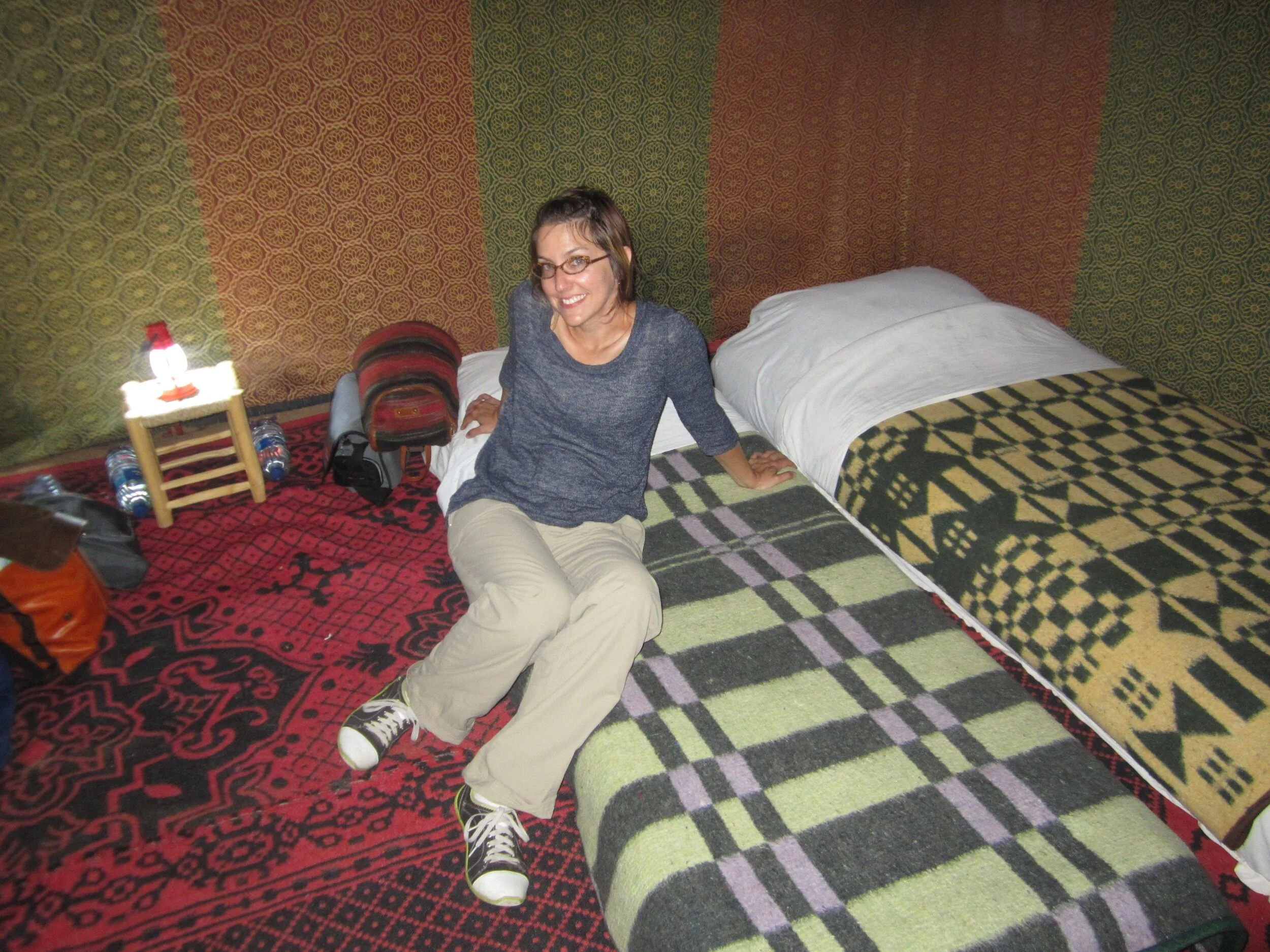
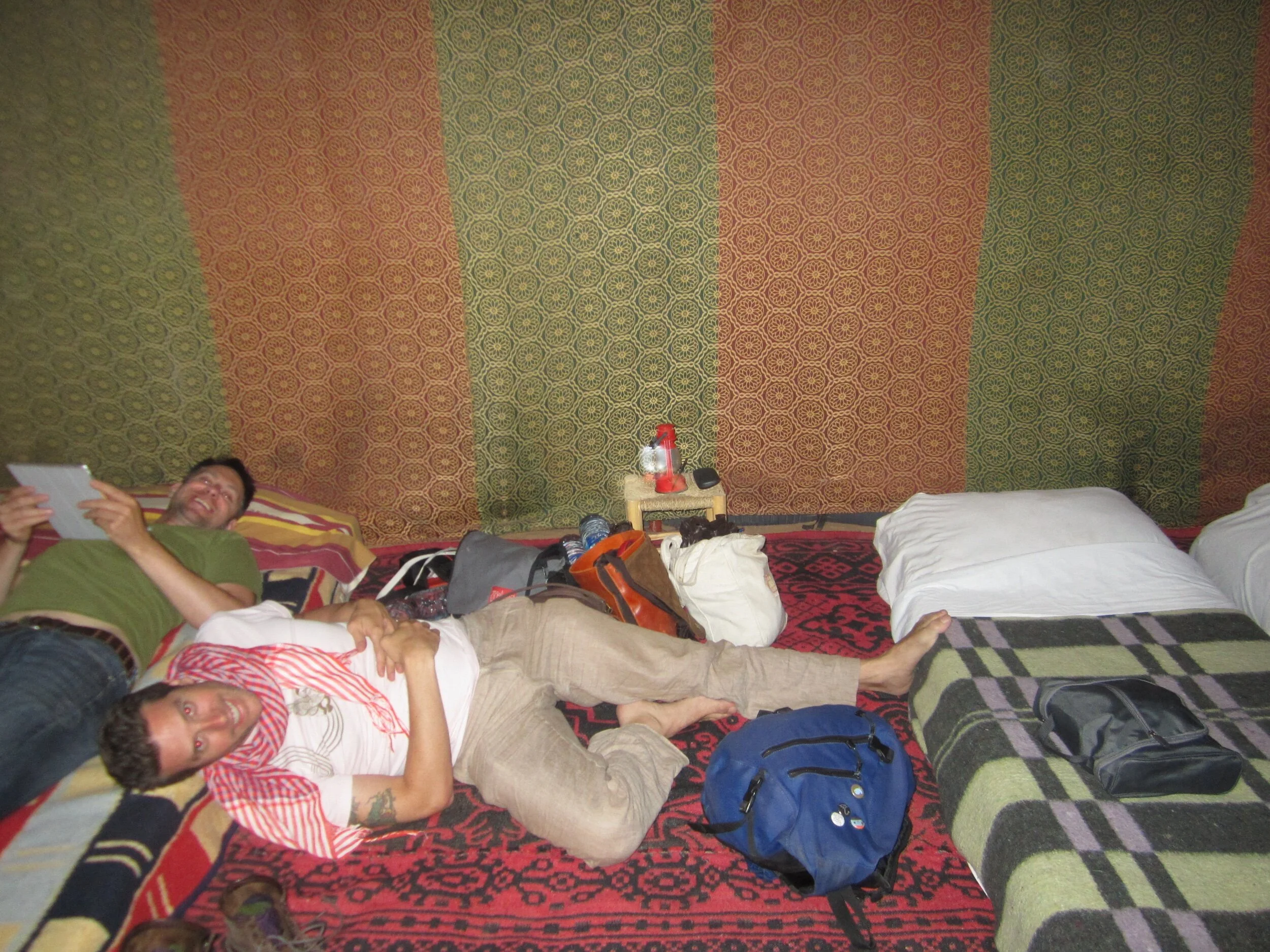
The tents are spacious and have carpets lining the walls to keep the warmth in.

The tents are spacious and have carpets lining the walls to keep the warmth in.

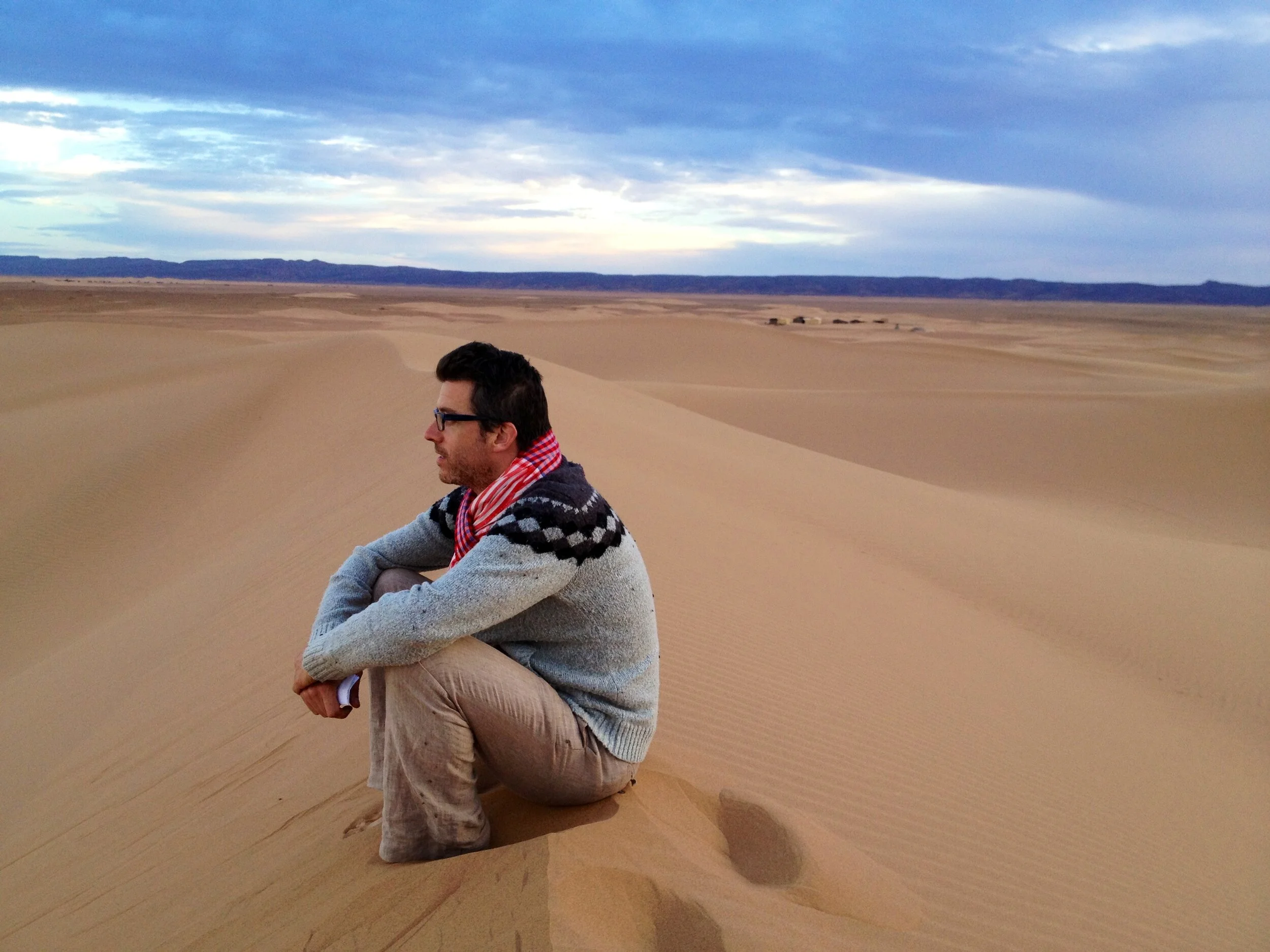
There are some adventures that offer a one-of-a-kind experience that simply can’t be passed over. For Wally and me, an overnight at a Berber camp in the middle of the Sahara Desert fell into this category.

Besides, the road trip from Marrakech takes you to some amazing stopovers, including Atlas Studios and Aït Benhaddou. 

The camel was wide-eyed with fear or fury, rearing its head and making terrible Chewbacca-like warbles. 

“Nous avons peur!” Wally exclaimed, which translates to “We are scared!”
Look how happy being in the beautiful and vast Sahara made Duke, Wally and Vanessa!

Look how happy being in the beautiful and vast Sahara made Duke, Wally and Vanessa!

On the Road Again

After spending the night in Ouarzazate, Wally, Vanessa and I set out with our driver, Barak, to Erg Chigaga. Prior to our trip, we had debated at length whether to set off for the desert from Erg Chebbi or Erg Chigaga, and settled upon the latter — perhaps just because it sounded a bit like Chicago.

The landscape beyond Ouarzazate is covered with scrub and jagged rocks. Hillsides are mostly barren, covered with loose-looking boulders and thorny bushes. The rock color shifts from mountain to mountain — red ochre at first, then a sulfurous basalt green and finally a deep coal black. The large angular red rocks of the Anti-Atlas range jut out in a staccato formation like massive fallen Jenga blocks littering the mountainsides.

Unfortunately, even remote places like the Sahara aren’t immune to pollution. Disposable plastic bags of blue, faded rose, green, pale lavender and yellow littered the landscape like deflated balloons.

The Sahara isn’t an immediate vast expanse of sand — the first hour or so of our camel ride was over semi-rocky terrain with green outcroppings here and there.

The Sahara isn’t an immediate vast expanse of sand — the first hour or so of our camel ride was over semi-rocky terrain with green outcroppings here and there.

Draa Valley: It’s a Date

We passed through Zagora, the last major town, 60 miles outside of the small rural outpost of M’hamid El Ghizlane, our departure point for our desert adventure. 

Zagora is located in the fertile Draa River Valley and was originally known as Tazagourt, the singular of the plural Tizigirt, Berber for Twin Peaks, referring to the mountains that flank the village. A sea of lush green date palms lined the road, seeming to stretch endlessly. Since they happened to be in season, they were heavy with ripening fruit. Dates are a big agricultural business in Zagora and are sold roadside, in local shops and in the markets of Marrakech. I regret that we didn’t stop and try some.

We purchased bottles of water at a small shop while a little boy with a Spider-Man backpack watched us curiously from an alley across the street.

Upon arrival in M’hamid, we were a bit shocked when we pulled into a dusty parking lot that was literally across the street from the desert. The three of us decided to use the restroom before heading out. It was the foulest bathroom I’ve ever been in, and the stench haunts me to this day. 

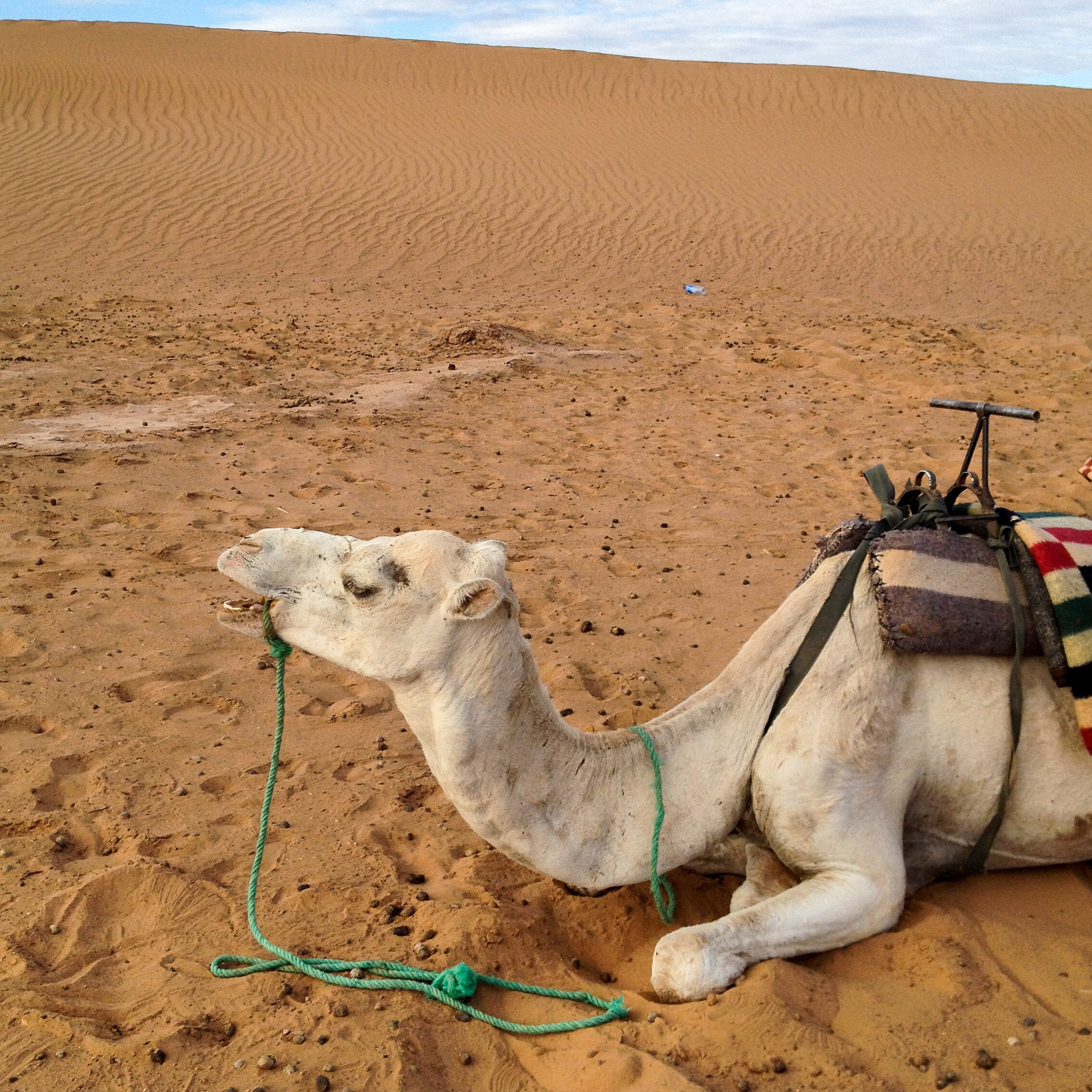
Camels aren’t the most pleasant creature to ride upon.

Camels aren’t the most pleasant creature to ride upon.

Zou Zou le Fou Fou: The Camel From Hell

Something wasn’t right. As we were queuing up to be paired with the camels we would be riding out to the encampment in the middle of the Sahara, one was noticeably smaller than the others. Crouching on all fours, the camel’s front right leg was folded up and bound with what looked like an Ace bandage. The animal was wide-eyed with fear or fury, rearing its head and making terrible Chewbacca-like warbles. 

Barak presented the camels with a flourish. We all took a step backward simultaneously, staring at him, wide-eyed. Wally, who can speak French, asked if there was another camel we could ride instead of the bucking bronco. Barak asked the handlers, then shook his head no.

“Nous avons peur!” Wally exclaimed, which translates to “We are scared!”

Barak could see the terror in our eyes but tried to assure us that Zou Zou, for that was the camel’s name, would be perfectly safe. He explained that she was young and her leg was tied up like that because that’s how they train camels to kneel for passengers to climb on top of them.

Wally muttered that the camel’s name should instead be Fou Fou, a play upon the French word for “crazy.” 

After we all stood there, staring in horror at the thrashing, spitting Zou Zou, Vanessa bravely volunteered to ride her. We thanked her profusely, and she shrugged and said she figured she was the lightest.

Camels spit and eat shit, and riding them is a bit like being on a slow-mo mechanical bull.

Camels spit and eat shit, and riding them is a bit like being on a slow-mo mechanical bull.

Wally rode Mujeres, an ironically named male camel (it’s the word for “women” in Spanish). Mujeres enjoyed stopping to eat Zou Zou’s dung nuggets en route to the camp, which was funny, disgusting and annoying all at once. My camel’s name was Mimoun. He was mostly well behaved, aside from periodically making a series of unpleasant gurgles.

All aboard the camel train! We caravan out to the middle of the Sahara.

All aboard the camel train! We caravan out to the middle of the Sahara.

Camel Ride 

The camels were tethered together and led by a guide on foot. We had an hour-and-a-half camel ride out to our encampment. There’s a saddle of sorts, covered with a doormat-sized rug and a pair of handles not unlike those found on a bicycle. 

Guidebooks tend to gloss over the fact that a camel’s awkward gait makes for a bumpy ride. It’s basically like riding a mechanical bull.

Our guide whipped out his cell phone and chatted away, which took us out of the moment. “Who knew they’d get better reception in the middle of the desert than in some parts of Chicago?” Wally quipped.

Vanessa takes a selfie while camelback.

Vanessa takes a selfie while camelback.

Guidebooks also neglect to mention that the desert isn’t all drifting dunes. We expected the desert to start with a dramatic line of sand like you’d see in a cartoon. But the first leg of our journey into the Sahara was rocky and punctuated by gnarled outcrops of mastic and cypress trees. 

It wasn’t until we got closer to camp that the foliage disappeared, the sand turned an intense orange, and the ergs, or sand dunes, emerged. 

Duke explores our Berber encampment.

Duke explores our Berber encampment.

Berber Camp

The camp consisted of several tents whose interiors were covered with blankets. Upon arrival, we were served what locals love to call “Berber whiskey” but is disappointedly mint tea, a sign of hospitality. It was all a bit surreal being surrounded by nothing but dunes and knowing that we were halfway to the border of Algeria, which was undergoing some political unrest at the time. 

Wally got up early to climb a dune for a moment of zen.

Wally got up early to climb a dune for a moment of zen.

There was a tent for eating and separate tents for sleeping. Our desert companions included a large group of Dutch travelers. They tittered as they asked our guides if they had a magic carpet, could charm snakes or summon genies. (Wally and I, by contrast, know that jinn are no laughing matter. In fact, we blamed them for our camera having malfunctioned, causing us to lose most of our photos of the trip. Once again, shoutout to Vanessa for sharing some of her photos with us.)

Vanessa and Wally hanging out at camp. There’s not a lot to do except admire the view — and experience traditional Berber music around a bonfire at night.

Vanessa and Wally hanging out at camp. There’s not a lot to do except admire the view — and experience traditional Berber music around a bonfire at night.

We arrived at camp just as the sun was setting. The sky changed from pink to amber to a deep blue before darkening to an intense black as soon as the sun dipped beneath the horizon. I let my mind wander and hummed a few bars of “Tea in the Sahara,” a song by the British band the Police, inspired by Paul Bowles’ bleak novel The Sheltering Sky

Vanessa in our tent

Vanessa in our tent

Duke and Wally lounge in the tent, glad they didn’t have to share it with any of the boisterous Dutch travelers.

Duke and Wally lounge in the tent, glad they didn’t have to share it with any of the boisterous Dutch travelers.

The stars were absolutely incredible and the three of us laid down on the sand outside of our tent to look up at the night sky, feeling utterly small and at peace. After a while, we joined the group and sat around a bonfire, listening to our hosts intensely play drums and sing ritual Berber music. 

The sand in the Sahara blazes a bright orange.

The sand in the Sahara blazes a bright orange.

You’ve probably heard that while deserts can be scorching hot during the day, they get to be surprisingly cold at night. We awoke the next morning and put on our sweaters and scarves. Much to Wally’s relief, no scorpions had crawled into his boots.

Wally and Duke were glad they took a couple of days to travel to the Sahara.

Wally and Duke were glad they took a couple of days to travel to the Sahara.

The beauty of the sunrise was amazing — it’s not every day that you begin by leaving a tent to climb a sand dune in the Sahara Desert. The sunlight made the ochre grains of sand glow, and we sat there for a bit in a meditative state. It almost seemed disrespectful to break the silence with our voices.

As we rode our camels back to Erg Chigaga, we began to feel the effects of the previous day’s trek. As mentioned, camels are not comfortable rides. With their arched backs and their lurching around, shifting me almost comically sideways, I found myself tightly gripping with my legs. After our ride, all three of us had a piercing pain right in the taint, which Wally coined “camel crotch.”

Obligatory cameltoe pic

Obligatory cameltoe pic

We would have liked to spend more time in the desert, but we had to get on the road for the long journey back to Marrakech. The trip was about eight hours, returning through the treacherous turns of the Atlas Mountains. As we neared Marrakech, I noticed storm clouds on the horizon. –Duke


Road Trip! Marrakech to the Sahara

The death-defying hairpin turns in the Atlas Mountains are worth it. With stopovers at Aït Benhaddou and Ouarzazate, a big part of the fun is the journey to Erg Chigaga for an overnight in the Sahara Desert. 

A stray dog looks off at the Atlas range, surely thinking deep thoughts…like how no trip to Morocco is complete without a sojourn in the Sahara.

A stray dog looks off at the Atlas range, surely thinking deep thoughts…like how no trip to Morocco is complete without a sojourn in the Sahara.

There was one thing we knew we couldn’t miss out on while Wally and I planned our itinerary for Morocco with our friend Vanessa: a once-in-a-lifetime opportunity for a desert adventure. We decided upon a three-day and two-night Sahara excursion through Imzi Tours.

The familiar sound of the muezzin’s voice broadcast over the speakers of the nearby Koutoubia Mosque in Marrakech woke me from my slumber at 5 a.m. When the alarm rang an hour later, I thought I’d half-imagined the call to prayer, asking Wally and Vanessa if they had heard it, too. 

Nothing can quite prepare you for being a passenger in a car maneuvering the tight cliffside turns with low guardrails found throughout the Atlas range.

By the time we got dressed, it was only 6:30 in the morning, so the kitchen at our riad, Alwachma, hadn’t opened — which meant we were served an abundance of carb-laden fare that left the three of us longing for the cumin-dusted fried eggs we had enjoyed the day before. Our breakfast spread consisted of msemen, a traditional flatbread cooked in a frying pan. It reminded me of a chewy square-shaped pancake, but was described best by Wally as “crêpe jerky.” This was accompanied by another unleavened bread, matloua, the Moroccan version of an arepa, which was served with preserves, freshly squeezed orange juice and French press coffee. 

We had to get an early start for our desert excursion because Marrakech is roughly 225 miles from Zagora and the dunes of Erg Chigaga, though we had an overnight at Ouarzazate. At 8 a.m., the three of us met our guide and driver at the end of Derb Bab Doukkala, the cobblestone alley outside our riad.

His name was Mubarak, but he went by Barak. After asking our names, he promptly gave us Berber names: Vanessa was Fatima, Wally was Mustafa, and I was Ali. Vanessa whispered a theory that I was inclined to believe. She said Barak gave us Berber names so he didn’t have to remember our real ones. But what the heck, it’s all in fun, right? 

Moustafa, Ali and Fatima…err, Wally, Duke and Vanessa stretch their legs and admire the view on a road trip through the Atlas Mountains in Morocco.

Moustafa, Ali and Fatima…err, Wally, Duke and Vanessa stretch their legs and admire the view on a road trip through the Atlas Mountains in Morocco.

It’s a long ride to M’hamid, the launching point for the camel ride to the desert camp, but Barak assured us that there’d be plenty of stops along the way. Our first day would take us to an argan oil cooperative, Aït Benhaddou and Ouarzazate, where we would be spending the night. 

Our driver Barak, posing with our friend, Vanessa. He was a fiercely proud Berber and expounded about his people at length.

Our driver Barak, posing with our friend, Vanessa. He was a fiercely proud Berber and expounded about his people at length.

The Free People: A Lesson About Berbers

As we sped along National Route 9, Barak explained that there are several different types of Berber tribes, the semi-nomadic people who inhabit the Sahara. Two of the largest populations are found in Algeria and Morocco. Their livelihood revolves around traveling with their livestock as the seasons change.

The name Berber was ascribed to the oldest known inhabitants of the Barbary Coast of North Africa. The term stemmed from the Greek bárbaros, used to refer to any foreigner, and which is the root of the derogatory term barbarian. It’s understandable that Berbers prefer to call themselves Imazighen, which means “Free People” in the indigenous Tamazight language.

Berber on a motorbike: A man whizzes by in traditional Berber garb.

Berber on a motorbike: A man whizzes by in traditional Berber garb.

The southern Atlas and Anti-Atlas Mountains are home to the Shilha, the largest Berber tribe in the country and often viewed as having the “purest” dialect: Tashlheit, the most commonly spoken in Morocco.

Riffan or Rif Berbers speak a dialect called Tarafit. The smallest Berber population in the country, this group stays within the bounds of the Rif Mountains.

In the Middle Atlas are the Zayanes, who spread from Fès in the north to Marrakech in the south. Their dialect, Tamazight, varies wildly from region to region but is usually intelligible by native speakers. Some Zayanes, particularly those near Ouarzazate in the south, are still nomads. 

It’s astonishing how much work goes into extracting oil from the argan nut.

It’s astonishing how much work goes into extracting oil from the argan nut.

Argan Oil Women’s Collective: A Tough Nut to Crack 

As we entered the High Atlas Mountains, the undulating surface of the surrounding landscape resembled gray-green fleshy folds of walrus skin peppered with errant bursts of green scrub. In other parts, it was like driving through the Grand Canyon. A frequent roadside sight are the paddle-shaped limbs of the nopal cactus bearing prickly pear fruit in varying states of ripeness.

Argan trees are indigenous to the Atlas Mountains. They are thorny, drought-resistant trees that bear a hard yellow fruit. 

Argan trees are quite tenacious and can grow on rocky outcroppings. The oil from their fruit is used in cosmetics and cooking.

Argan trees are quite tenacious and can grow on rocky outcroppings. The oil from their fruit is used in cosmetics and cooking.

Our first stop was a roadside argan oil cooperative shop whose parking lot was littered with desiccated argan fruit husks. Inside, Berber women demonstrated the manual labor required to make this “Moroccan gold.”

Collectives like the one we visited help provide women with lucrative employment.

Collectives like the one we visited help provide women with lucrative employment.

One pair was seated and cleaved the inner nut with a sharp stone to extract the kernels. Another pair ground the roasted kernels between two slabs of rock into a paste that resembled natural peanut butter. A woman who served as a guide told us that two types of oil are produced — one is used in cosmetics while the other is used like olive oil in cooking. 

Because the extraction process is labor intensive (it takes between 25 to 30 kilograms of argan kernels to produce 1 liter of oil), the government has established a fund to help ensure the success of cooperatives like this. UNESCO has designated the 10,000-square-mile argan growing region as a biosphere reserve. This empowers the women who produce the oil, providing them with fair wages, an opportunity to improve the welfare of their families and safe working conditions.

The trio of adventurers reach the highest point in the Atlas range — and, indeed, in all of North Africa.

The trio of adventurers reach the highest point in the Atlas range — and, indeed, in all of North Africa.

Tizi n’Tichka: High Point of the Atlas Mountains

Whenever we stopped to take a photograph anywhere along Route 9, a local man or boy emerged from the rocks brandishing geodes split open for us to see the glittering crystalline structures inside, some artificially dyed a vibrant pink or blue. 

We passed dozens of beaten earth houses, many of which appeared to be uninhabited, although we learned from Barak that this wasn’t always the case.

The houses in the mountains are made of local materials and, as a result, are practically camouflaged.

The houses in the mountains are made of local materials and, as a result, are practically camouflaged.

Laundry is put out to dry in the sun on the rocks of the Atlas Mountains.
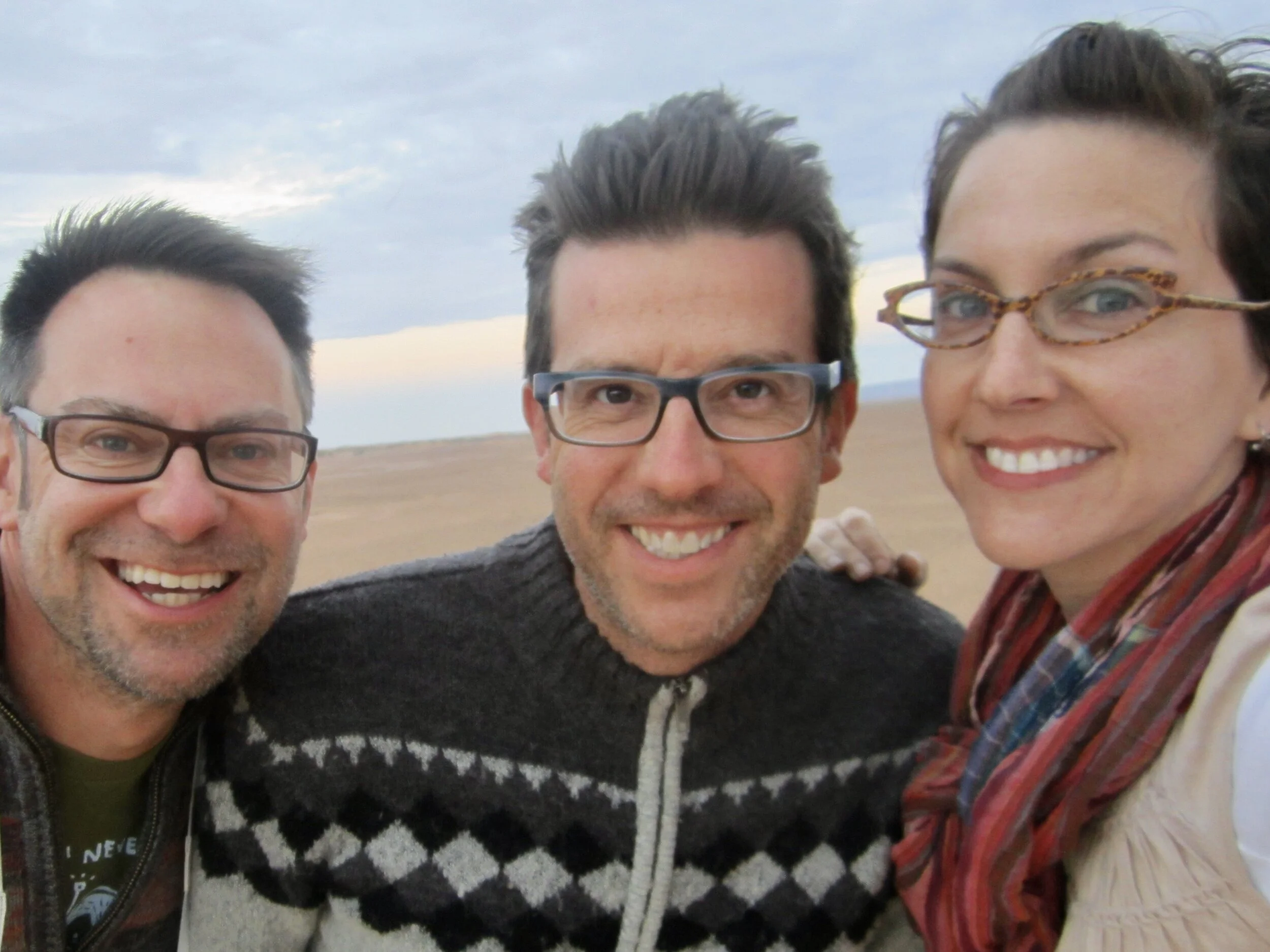
Laundry is put out to dry in the sun on the rocks of the Atlas Mountains.
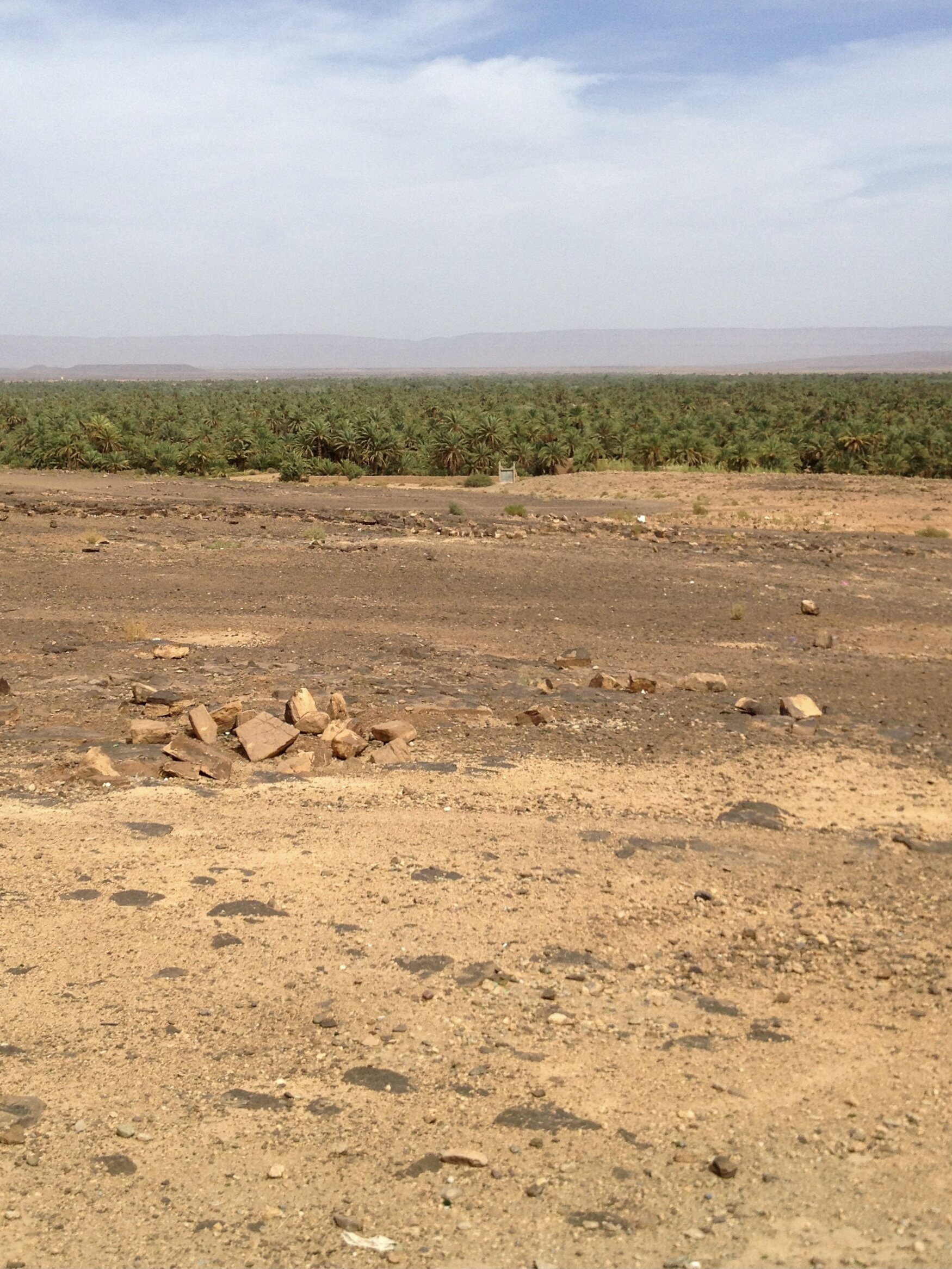
Before making our descent into Ouarzazate, known as the Gateway to the Sahara, we reached the highest point of the Atlas Mountains. At an elevation of 7,410 feet (2.260 meters) above sea level, Tizi n’Tichka is the highest mountain pass in North Africa. We stopped for a moment to take in the incredible views and an obligatory photo, of course. 
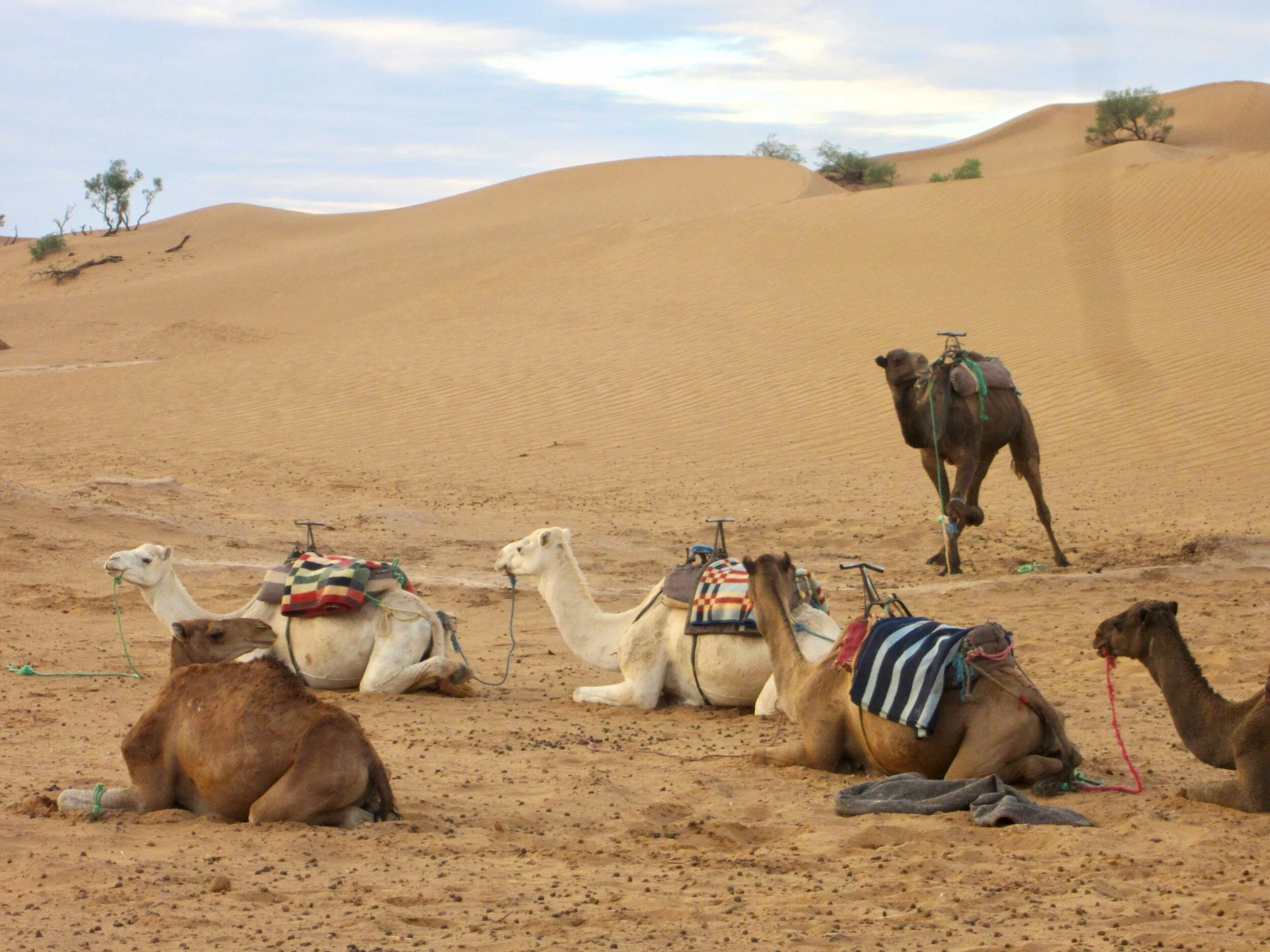
We were sure we’d never make it through the mountains alive, as Barak sped past large trucks winding through the switchbacks of the Atlas.

We were sure we’d never make it through the mountains alive, as Barak sped past large trucks winding through the switchbacks of the Atlas.

Nothing can quite prepare you for being a passenger in a car with a driver maneuvering the tight cliffside turns with low guardrails found throughout the Atlas range. Since this route is shared by trucks and other large passenger vehicles, the three of us would lean to the opposite side every time Barak passed a vehicle on the narrow lanes, in hopes that this would help prevent our car from toppling over the edge. 

You definitely have to stop off at Aït Benhaddou en route to the Sahara.

You definitely have to stop off at Aït Benhaddou en route to the Sahara.

Hollywood in the Desert: Aït Benhaddou and Atlas Studios

One of the coolest stops en route to the Sahara was the fortified village of Aït Benhaddou. Barak told us that the oldest dwelling in what he called a kasbah was built in the 11th century, though UNESCO dates the oldest construction “to be no earlier than the 17th century.”

Wally thinks the ancient structures of Aït Benhaddou look like sandcastles.

Wally thinks the ancient structures of Aït Benhaddou look like sandcastles.

Regardless, the atmospheric desert dwellings have been so well preserved that it has captured the imagination of Hollywood. Several productions have been shot here including, The Sheltering Sky and The Mummy. In fact, a large artificial entrance had been constructed for the Daenerys storyline in Game of Thrones — but unfortunately, they weren’t going to start filming for another month or so, much to Wally’s dismay.

Many movies set in Ancient Egypt have been filmed at Atlas Studios in Ouarzazate.

Many movies set in Ancient Egypt have been filmed at Atlas Studios in Ouarzazate.

Speaking of Hollywood, the next stop was Atlas Studios in the town of Ouarzazate, where numerous desert-themed movies have been filmed. For some reason, our guide was enthralled with Steven Segal. The group we toured with was predominantly French, with a small group of English-speaking Brazilians. 

Most of the sets were made of fiberglass with back supports of bamboo scaffolding. I was intrigued by the false perspective and scale used in the spaces to trick the eye. 

Hopefully Les Jardins de Ouarzazate has been upgraded a bit since our visit.

Hopefully Les Jardins de Ouarzazate has been upgraded a bit since our visit.

Les Jardins de Ouarzazate Hotel: I Never Promised You a Rose Garden

Atlas Studios also boasts an exclusive 10-suite hotel aptly named the Oscar. Perhaps we should have stayed there instead of Les Jardins de Ouarzazate, which was included in our tour package.

At the time we visited, back in 2012, the hotel had clearly seen better days. A layer of dust and grime covered everything inside the expansive lobby and I half-expected to see Miss Havisham from Dickens’ Great Expectations descend the tiled stairs.

Our room, at the top of the stairs, had a foul smell, so we were upgraded to a private suite off to the side of an unkempt but beautifully wild rose garden and swimming pool. Both rooms were dark, and when we went to take showers the following morning, the water was cold.

An old man kept pacing around the pool. Vanessa thought he was lost; I thought he was a Peeping Tom; but Wally fabricated the most amusing story: The geezer was wandering around looking for Arab boys. “Is this where the Arab boys are?” Wally said, mimicking an old man’s voice, while I laughed. “I thought I saw one come back here.”

The highlight of our stay was our waiter. He was quite jovial, so we nicknamed him Giggles. He asked us if we were doctors because we were all wearing glasses. 

There was a little kitten that stayed next to me throughout dinner. It took all of my willpower not to toss it a scrap of food.

Breakfast was a buffet of fly-smothered, day-old croissants loosely covered with cloth napkins.

Mediocre hotel aside, the interesting stopovers make the journey to the Sahara as much fun as the overnight in the desert itself. –Duke

Atlas Studios: The Hollywood of Morocco

Ouarzazate, a stopover en route from Marrakech to the Sahara, is where blockbusters and TV series, including Gladiator, Kundun, The Mummy and Game of Thrones, were shot.

If you’ve seen a Hollywood movie set in the desert, there’s a good chance it was shot at Atlas Studios. The Mummy, Gladiator and Kingdom of Heaven have all filmed sequences here.

If you’ve seen a Hollywood movie set in the desert, there’s a good chance it was shot at Atlas Studios. The Mummy, Gladiator and Kingdom of Heaven have all filmed sequences here.

On the well-traveled route from Marrakech, almost all roads lead tourists heading to the Sahara Desert through the city of Ouarzazate (pronounced Wahr-za-zaht). It looks like a sleepy town, and, indeed, its name is derived from the local Amazigh dialect for “without” (ouar) and “noise” (zazt). 

But under the surface, the Gateway to the Sahara has a few surprises up its sleeve. Just minutes from the town center is a major motion picture facility. Though there’s no Hollywood sign visible on a hillside, there are faux pharaonic statues and a pair of iron gates emblazoned in gold letters with the name Atlas Corporation Studios. 

You can really see through the illusion when you go around back and realize that it’s all supported by bamboo scaffolding.

The working movie studio, which takes its name from the vast mountain range that surrounds it, was established in 1983 by Moroccan entrepreneur Mohamed Belghmi, who recognized the need for a permanent film facility in the region. He promoted Morocco as the perfect setting for virtually any Middle Eastern location — think Biblical epics and Ancient Egyptian myths. Perhaps he took a cue from British producer David Lea, who, in 1962, saw the potential of Ouarzazate when they needed a desert location for Lawrence of Arabia

It’s all a façade (literally!) at Atlas Studios. What at first appears to be a temple is actually just a front supported by scaffolding.

It’s all a façade (literally!) at Atlas Studios. What at first appears to be a temple is actually just a front supported by scaffolding.

Lights, Camera, Action!

When the cameras aren’t rolling, public tours of the studio are offered, and that’s just what Wally, our friend Vanessa and I did after visiting the UNESCO World Heritage site of Aït Benhaddou en route to a camel ride and overnight in the middle of the Sahara. The entrance fee is 80 dirhams (about $9 at the time of this writing), though ours was included as part of our tour package.

Our driver dropped us off outside of the complex, where we joined a small group and guide leading a walking tour of the studio. 

Just a sampling of the many movies and TV shows filmed at Atlas

Just a sampling of the many movies and TV shows filmed at Atlas

The first thing we saw after passing through its gates was the elaborate interior set of a Tibetan temple, one of the soundstages constructed for the 1997 film Kundun, Martin Scorcese’s biopic based on the life of the 14th Dali Lama. The track used by the cameraman during production is still in place on the floor of the set. 

Fun fact: Extras from Tibet were flown in to lend the movie authenticity. 

You can see the track used for the camera in Kundun. It’s this kind of behind-the-scenes looks at movie production that make a visit to Atlas Studios so fun.

You can see the track used for the camera in Kundun. It’s this kind of behind-the-scenes looks at movie production that make a visit to Atlas Studios so fun.

Beyond the temple lies a replica F-16 prop jet plane used in the production of The Jewel of the Nile (1985), starring Michael Douglas, Kathleen Turner and Danny DeVito. 

While the sets at Atlas are impressive, they pale in comparison to the real deal, obviously.

While the sets at Atlas are impressive, they pale in comparison to the real deal, obviously.

Taking a Peek Behind the Curtain

From afar everything looks real — but once we got closer, it became clear that it’s all smoke and mirrors. Walls are actually false fronts, their sides sculpted from polystyrene and concrete. But you can really see through the illusion when you go around back and realize that it’s all supported by bamboo scaffolding. More than a few were weathered and worn by the passage of time and desert air. 

Hang in there, Vanessa!

Hang in there, Vanessa!

Not sure if you knew this, but Wally’s a witch.

Not sure if you knew this, but Wally’s a witch.

On one lot, the three of us found ourselves in a medieval square that was surprisingly small. But the buildings’ exteriors use forced perspective, which, when seen through a camera lens gives the illusion of being farther than they really are. Incidentally, this was where the scene of Russell Crowe’s character, Maximus, getting sold into slavery in Gladiator (Ridley Scott, 2000) was shot. 

We were quite charmed by the Egyptian temple sets, the largest of which were used for Asterix & Obelix: Mission Cleopatra, a French film based on the comic, starring Christian Clavier as Astérix, Gérard Depardieu as Obélix and Monica Bellucci as Cleopatra. 


The global hit series Game of Thrones converted one of the Atlas backlots into Pentos, one of the Free Cities of Essos, where Daenerys Targaryen lived in exile early on.

Vivid technicolor Egyptian temple interiors. I wonder what the hieroglyphics translate to?

Vivid technicolor Egyptian temple interiors. I wonder what the hieroglyphics translate to?

Atlas’ Massive Productions

In terms of scale, Atlas is one of the largest movie studios in the world. At 49 acres, it’s equal to the length of 37 football fields. It’s so vast that there’s confusion as to where sets end and the sprawling desert begins.

When a film finishes production, the sets are typically left behind, with new ones built nearby for the next shoot. The end result is a studio that grows larger each year. That means many big-budget productions are left in situ, though some are recycled and reworked for other features. 

Atlas acts as a stand-in for many countries of the Middle East, but Egypt in particular, as attested by the numerous set pieces, like this ram-headed sphinx.

Atlas acts as a stand-in for many countries of the Middle East, but Egypt in particular, as attested by the numerous set pieces, like this ram-headed sphinx.

Visiting the studios was one of the highlights of a trip filled with astounding adventures. It was a fascinating glimpse behind the scenes. We weren’t sure what to expect and were pleasantly surprised. Our guide was friendly and gave us plenty of time to take pictures. If you’re looking for an interesting day trip from Marrakech or happen to be en route to the Sahara, you should definitely add Atlas Studios to your itinerary. –Duke

Special shoutout to Vanessa for sharing her photos with us. Our camera’s memory card got fried on this trip and we lost most of our photos.

Is that the Ancient Egyptian temple of Karnak?! Oh, it’s just a replica at Atlas Studios in Morocco.

Is that the Ancient Egyptian temple of Karnak?! Oh, it’s just a replica at Atlas Studios in Morocco.

Atlas Movie Studios
Km 5
BP 28 Route de Marrakech
Ouarzazate, Morocco