PORTUGAL

Oficina Marques: A Cool Collaboration in Lisbon

The playful atelier in the Bairro Alto neighborhood turns recycled materials, folklore and everyday objects into irresistible art.

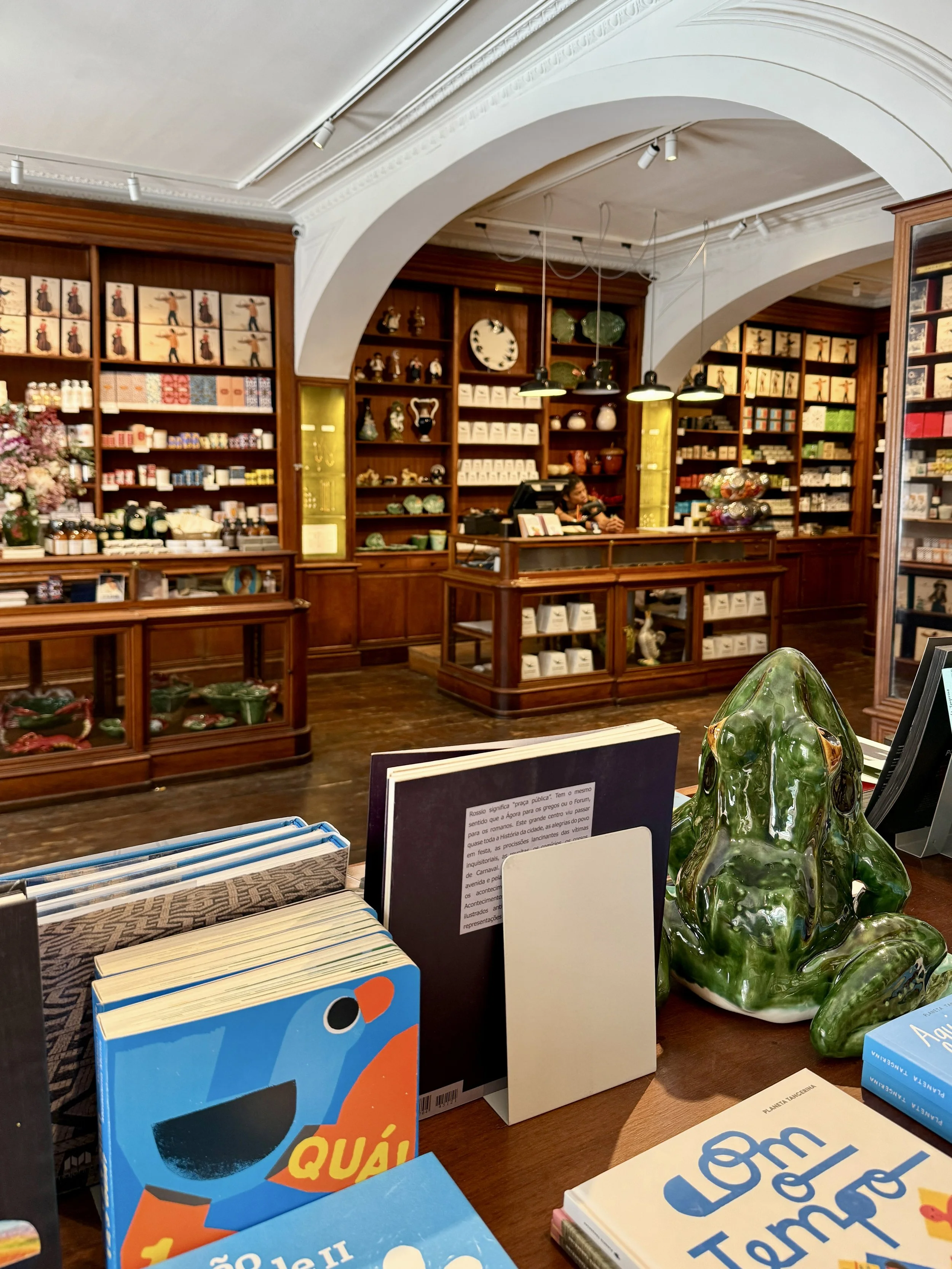
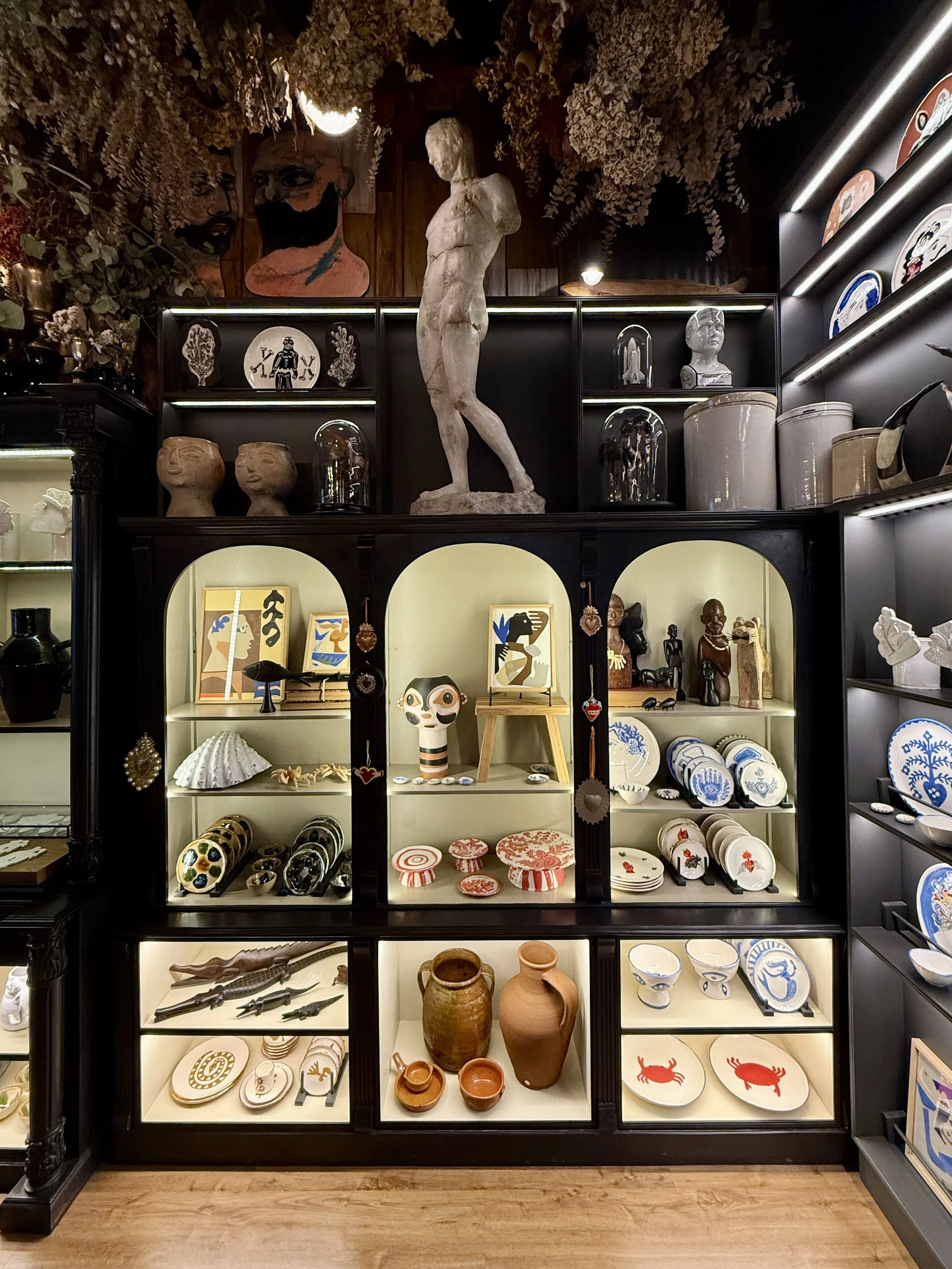
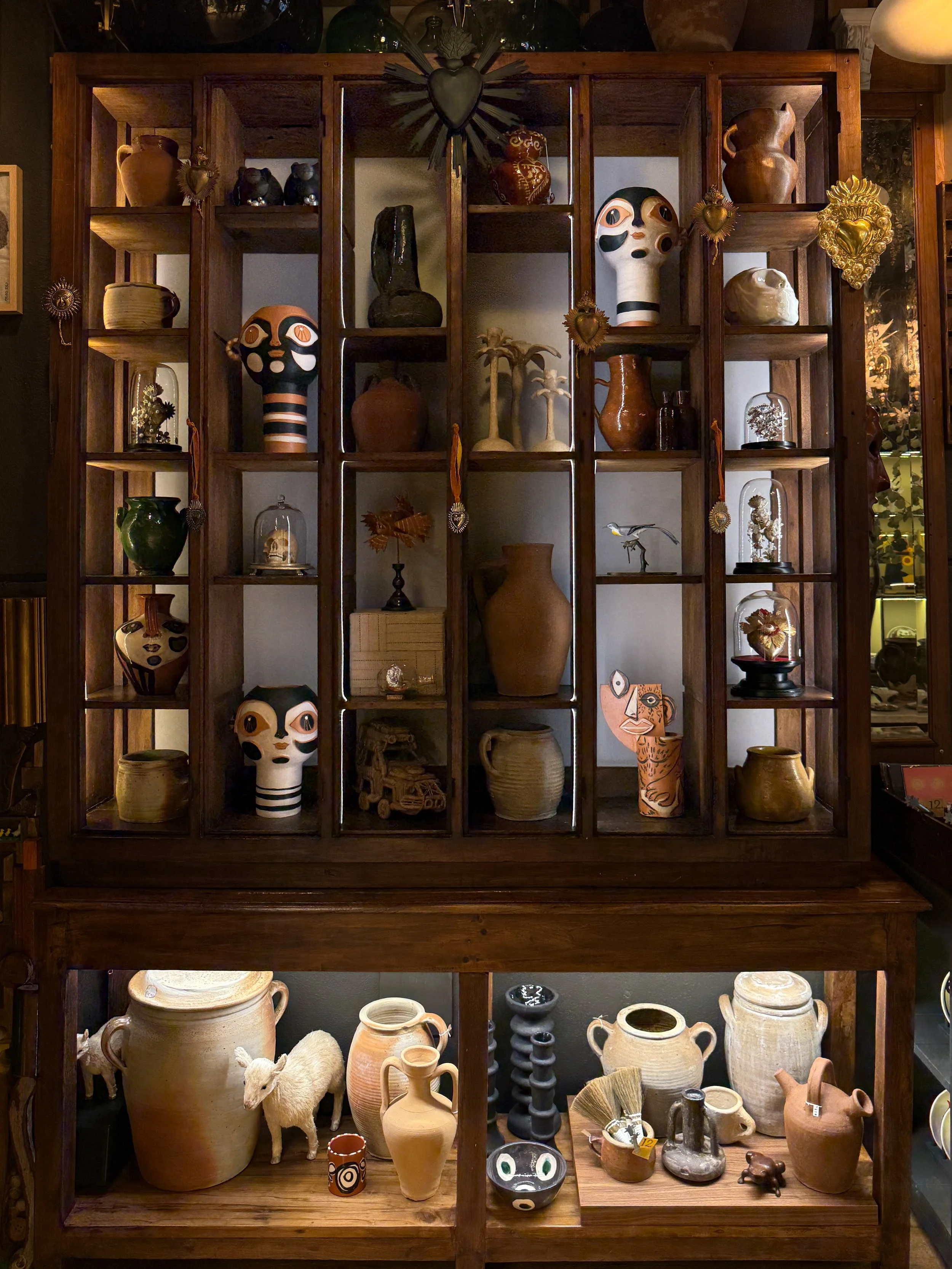
A statue stands atop a cabinet filled with painted ceramics at Oficina Marques shop in Lisbon

When planning a trip, we always start big, with days packed with places we want to see. But once we arrive, reality (and time and exhaustion) usually means scaling back and shifting things around a bit.

One destination that didn’t get cut from our Lisbon list: Oficina Marques, a gallery and shop in Bairro Alto, one of the city’s oldest neighborhoods and, remarkably, one left relatively untouched by the 1755 earthquake. 

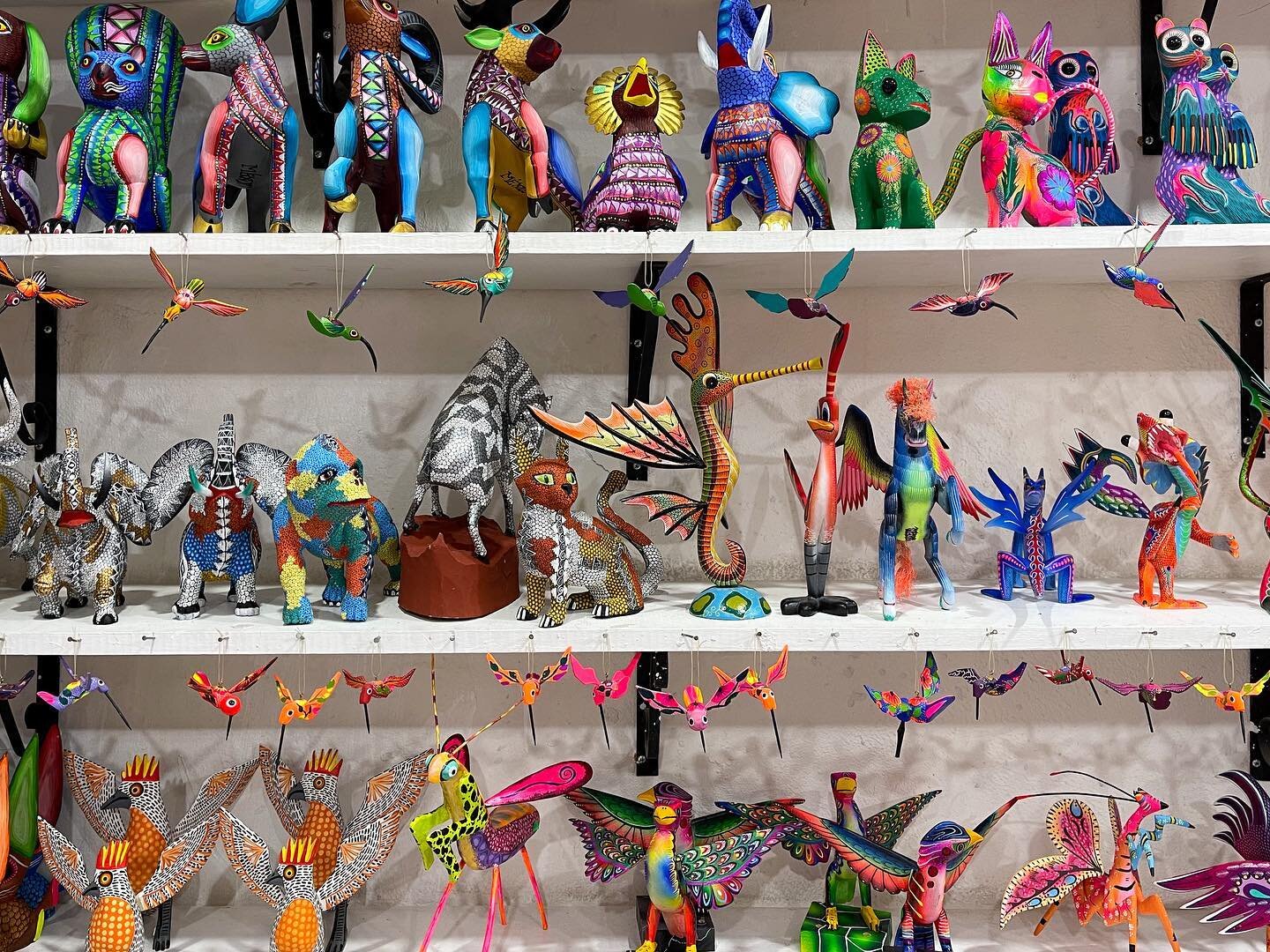
The shop feels like a cabinet of curiosities — brimming with original art and objects crafted in the adjacent workshop.

I first came across their atelier through a feature in Surface’s Design Dispatch newsletter about Lisbon Design Week. I was instantly drawn to their playful aesthetic, and when I showed my husband, Wally, their Instagram, he was sold, too. 

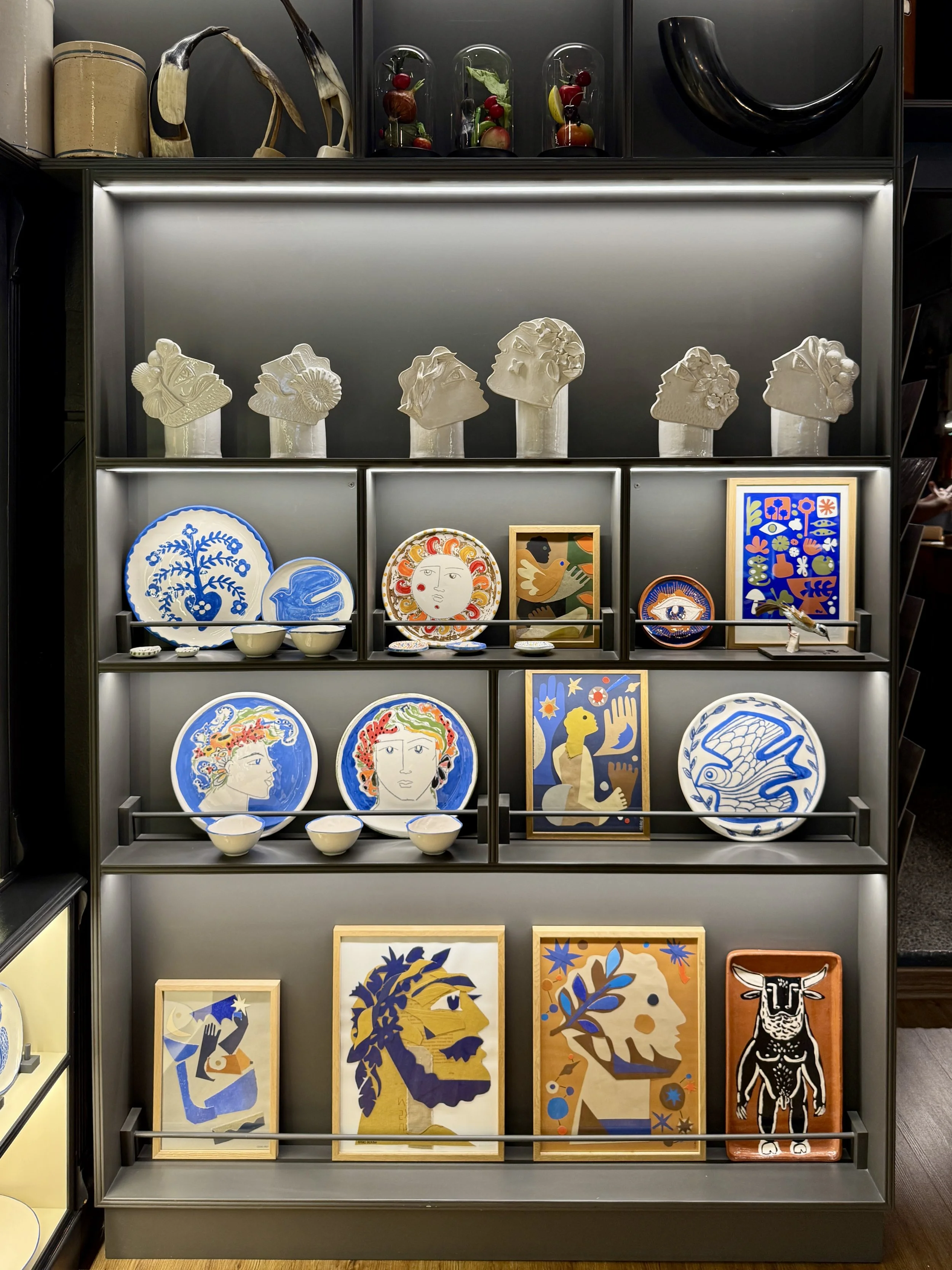
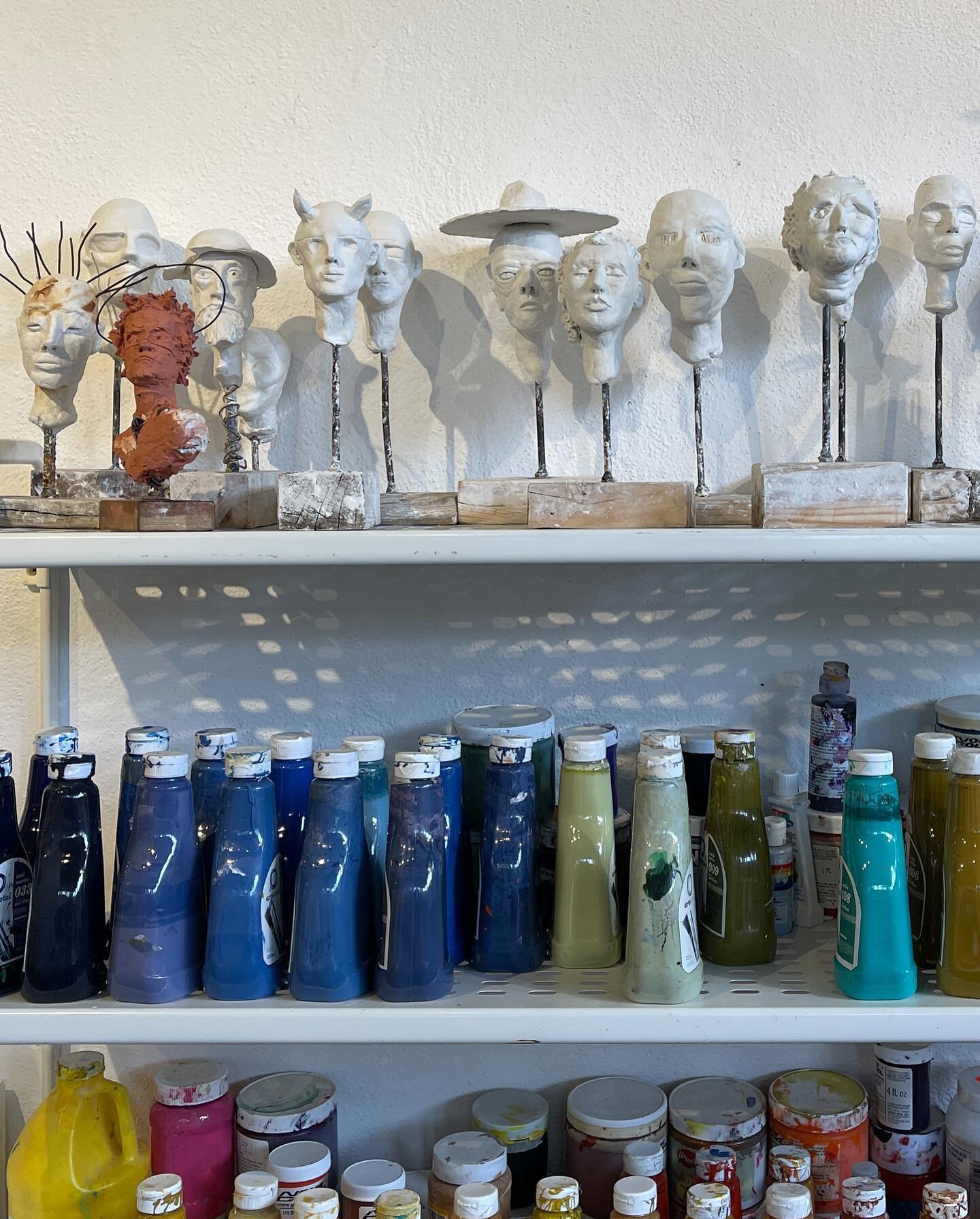
Ceramic heads, painted plates and paintings of Greek mythological figures on the shelves at Oficina Marques in Lisbon

The Creative Duo Behind Oficina Marques

The studio is led by the creative duo Gezo Marques and José Aparício Gonçalves, whose distinctive style draws inspiration from the natural world and embodies the motto “tusa de viver” — the irrepressible desire to live. Their work explores several themes including: Mar (Sea), Mato (Forest), Corpo (Body), Fé (Faith), and Lisboa (Lisbon), each offering a window into how they see life, place and the materials they transform into art.

Oficina means “workshop” in Portuguese, a nod to the handmade nature of their work, while Marques comes from the surname of one of its founders, Gezo, grounding the studio’s name in both craft and personal identity. Their atelier is located in the Interpress building, a former printing and distribution center for newspapers and magazines that was gradually transformed into a vibrant creative hub filled with studios, workshops and galleries. 

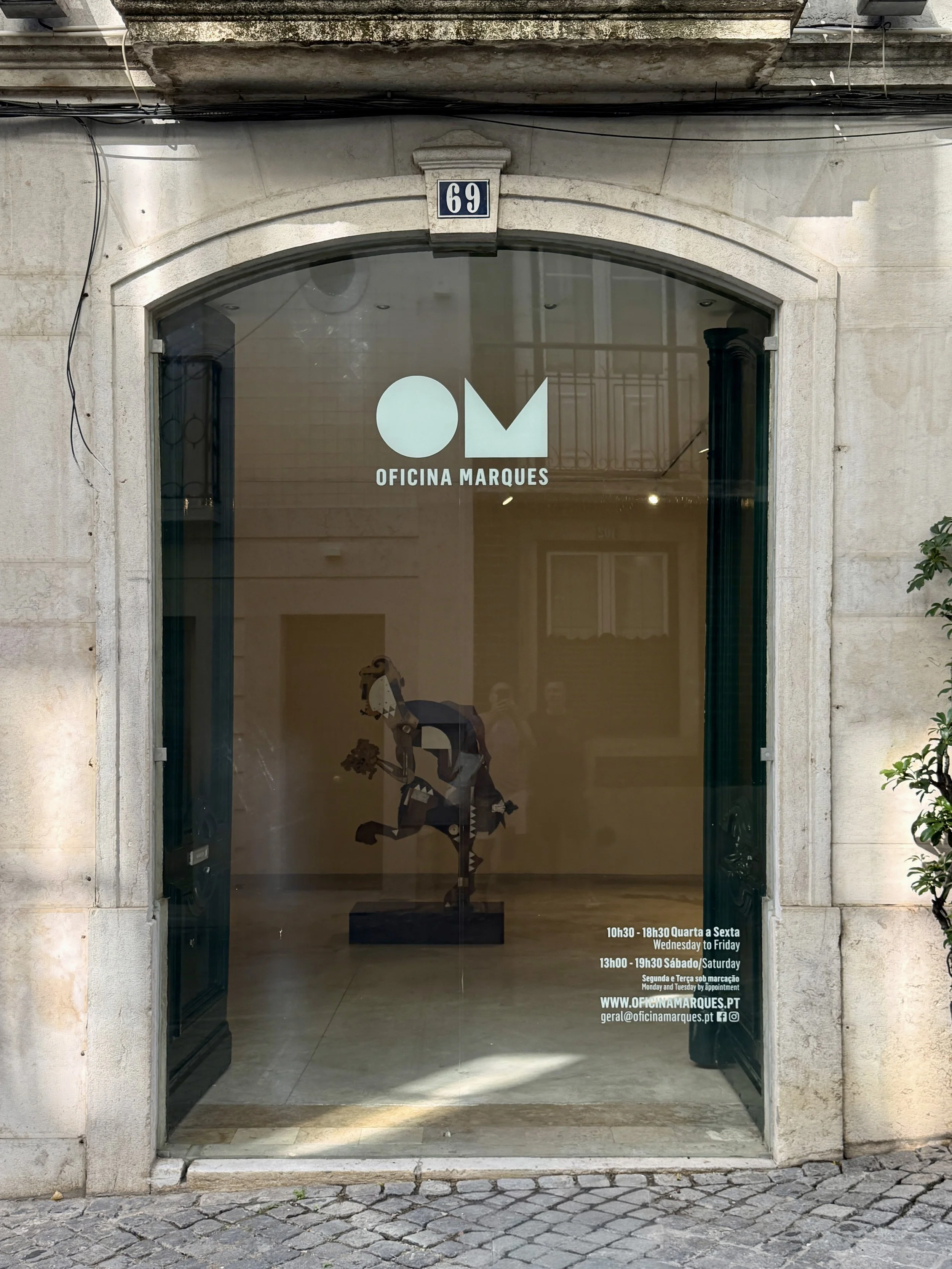
The glass door with OM on it at Oficina Marques in Lisbon, Portugal

A Visit to Oficina Marques

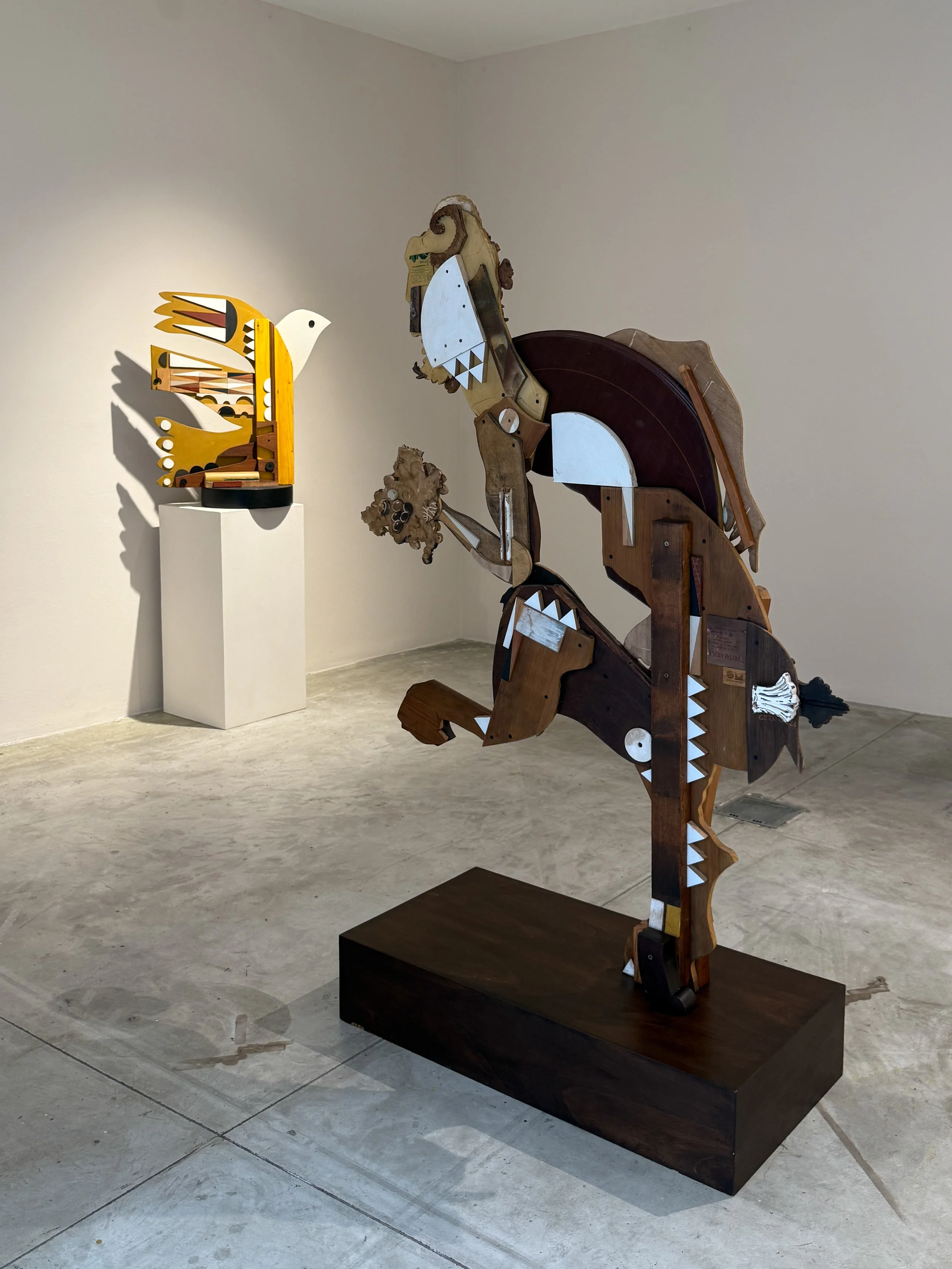
When we arrived, the gallery space held a few assemblages made from recycled materials and a couple of framed tile panels. As we looked around, José, one of the founders, popped in and explained that the embossed white and green tile panels were developed in collaboration with Viúva Lamego to celebrate the factory’s 175th anniversary. The partnership resulted in Arcádia, a collection of geometric forms inspired by the mythical Greek utopia, where dryads, nymphs and shepherds lived in harmony with nature. He went on to mention that a temple-like installation of those tiles by Spacegram Studio had been on display in the gallery during Design Week. 

While the gallery itself was filled with a few larger pieces, the adjoining shop felt like a cabinet of curiosities — brimming with original art and objects crafted in the adjacent workshop. Bundles of dried amaranthus, eucalyptus and hydrangea hung from the ceiling, perfuming the air with a faint, earthy sweetness. 

A faun and bird made of recycled wood at Oficina Marques gallery in Lisbon, Portugal

The shelves held an eclectic mix of items: ceramic face vessels and glass cloches filled with curious scenes — the Virgin Mary surrounded by seahorses, starfish and coral; a saint on horseback slaying a dragon-like creature, with a troop of toy soldiers poised for battle at his feet. Hand-painted plates of varying sizes were set among a plaster cast of a classical male nude, along with primitive carved wooden crocodiles, African tribal statuettes, and glinting tin ex-voto hearts — all arranged with a discerning curatorial eye.

We were debating between a small blue-and-white plate with an open hand and another featuring a bare-chested minotaur when I noticed a pair of weathered wooden pieces hanging on the wall, each shaped like a raised hand with symbols etched into the fingers. One was inscribed with the words “Love You,” and the other “Fuck You.” It was at that moment I “went rogue,” as Wally would later say. Without consulting my husband, I looked over at José and said, “We’ll take these.”

José smiled and explained that he and Gezo had found the pieces while out on the beach, scavenging for materials to use in their work. The two boards, he told us, fit together perfectly — a reflection of life’s many dualities. 

After José carefully wrapped our purchase, he invited us to step into his and Gezo’s workshop. We were honored to catch a glimpse of their imaginative world — a place shaped by creations that invite you to think, to feel, to wonder and to imagine. 

And honestly, in a world that can feel heavy with pessimism, a little more levity is just what we all need. –Duke

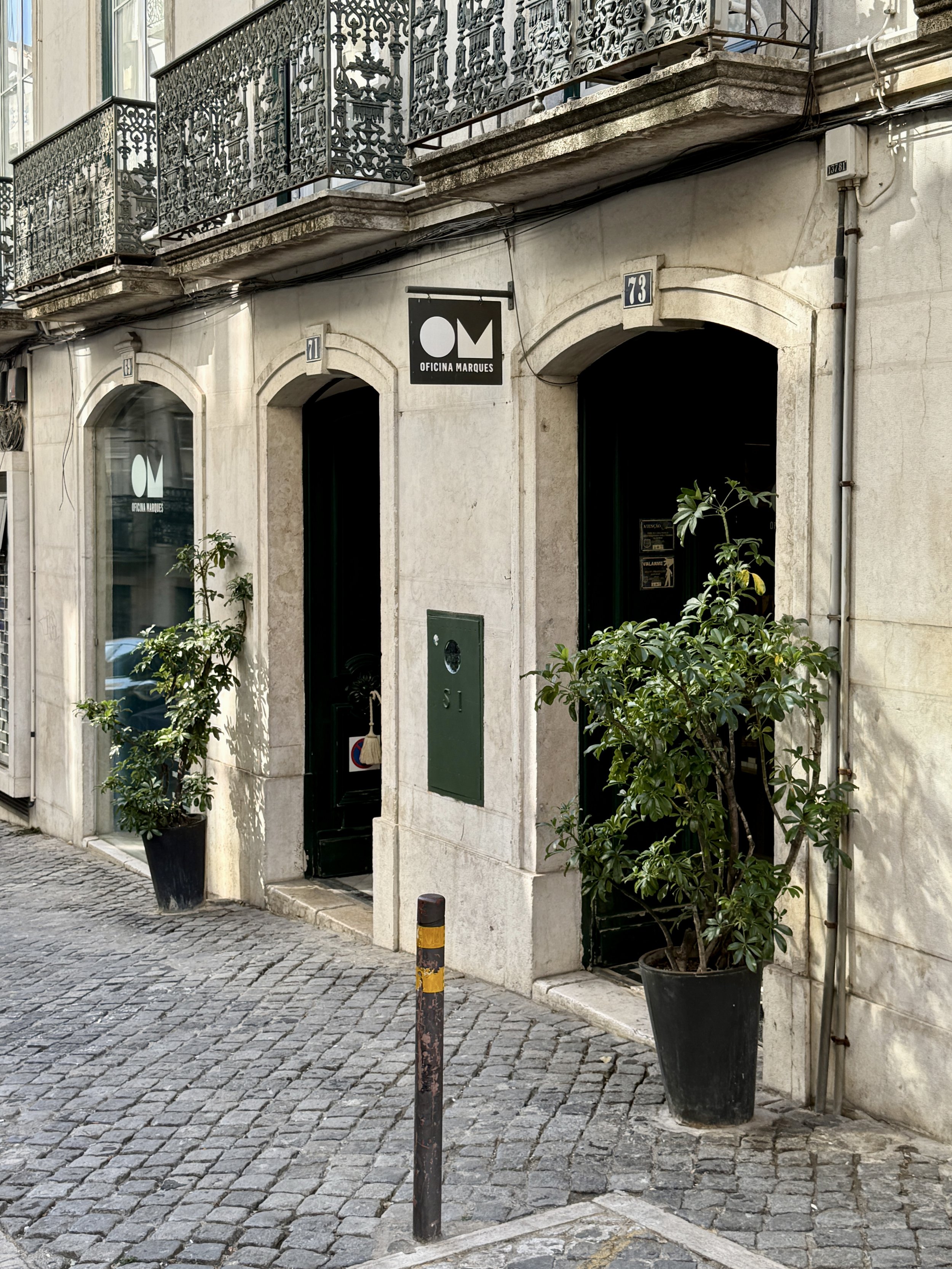
The exterior of Oficina Marques in Lisbon, Portugal, with potted plants and a sidewalk made of square stones

Oficina Marques

Rua Luz Soriano 71
1200-246 Lisbon
Portugal


Locke de Santa Joana Hotel in Lisbon: From Convent to Chic Retreat

Want to spend a few nights in a converted 17th century convent in Lisbon? Look no further than the apartment-like rooms of Locke de Santa Joana. 

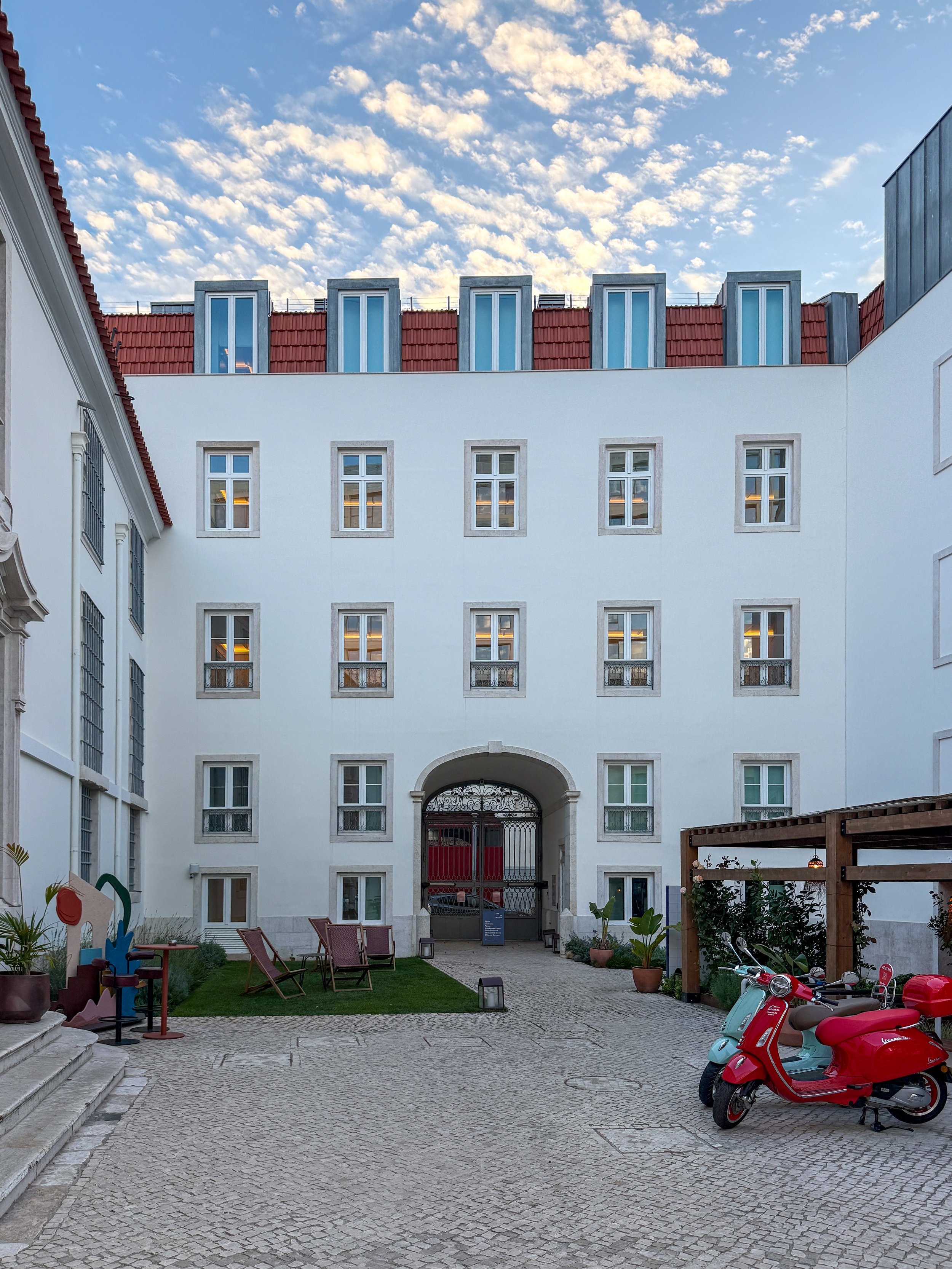
The Santa Marta wing of Locke de Santa Joana in Lisbon, with two Vespa parked in the courtyard

For me, one of the best parts of planning any trip lies in finding the perfect home base — a place within walking distance of the sights we want to see, yet far enough removed to kick back and unwind at the end of a day spent exploring. 

After narrowing down our options for Lisbon, Portugal, Locke de Santa Joana was a no-brainer. The property’s about a 15-minute cab ride from Lisbon Airport, located near Marquês de Pombal Square and Avenida da Liberdade — Lisbon’s grand, tree-lined boulevard modeled after Paris’ Champs-Élysées. It’s also within walking distance of the barrios históricos (historic neighborhoods) of Baixa, Chiado and Bairro Alto, home to many landmarks, shops and cafés.

Thanks to strict preservation laws, a large percentage of the original convent’s architecture remains untouched, including arches, columns and the azulejo tiles that can be seen throughout the hotel’s hallways.
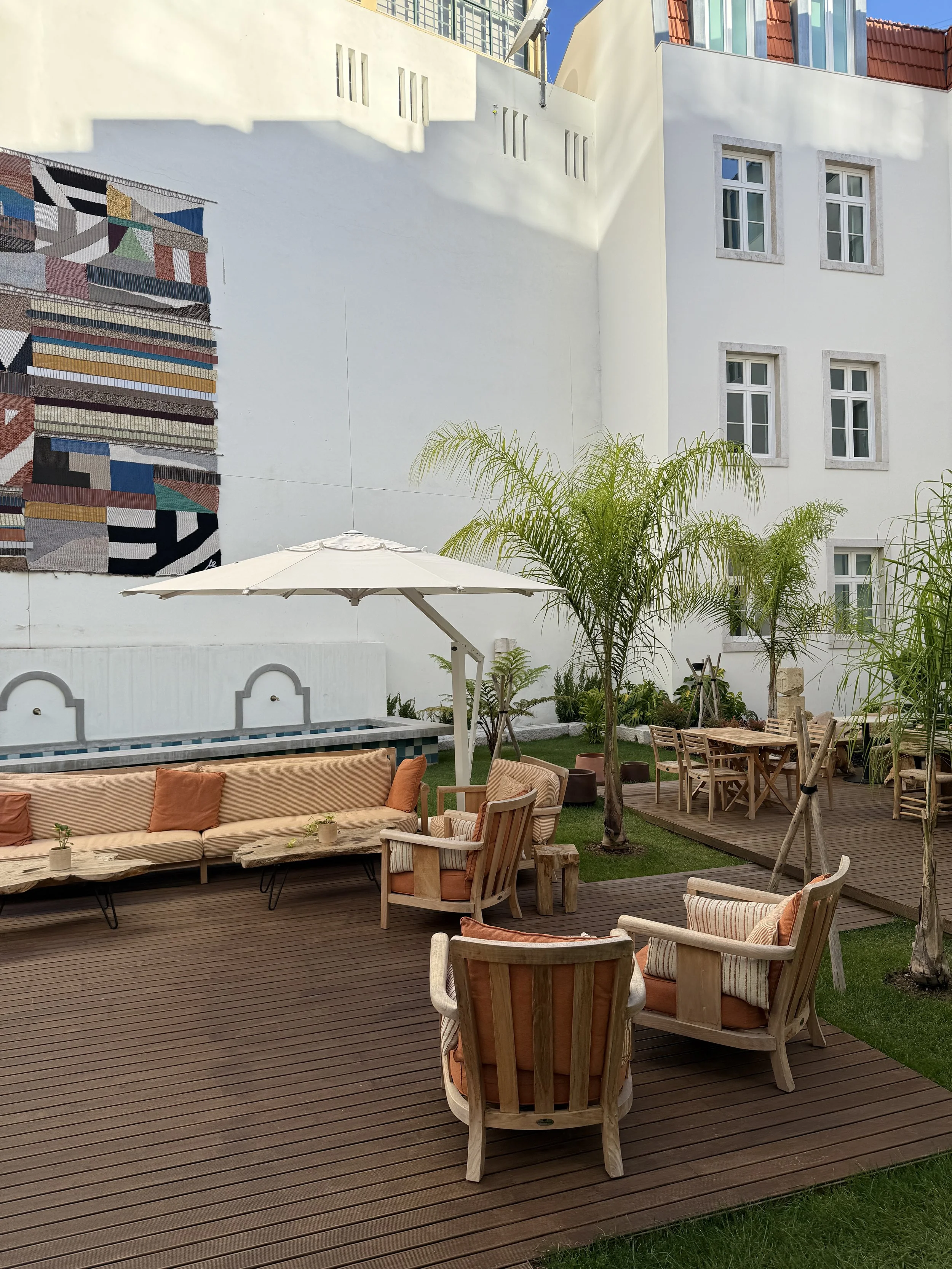
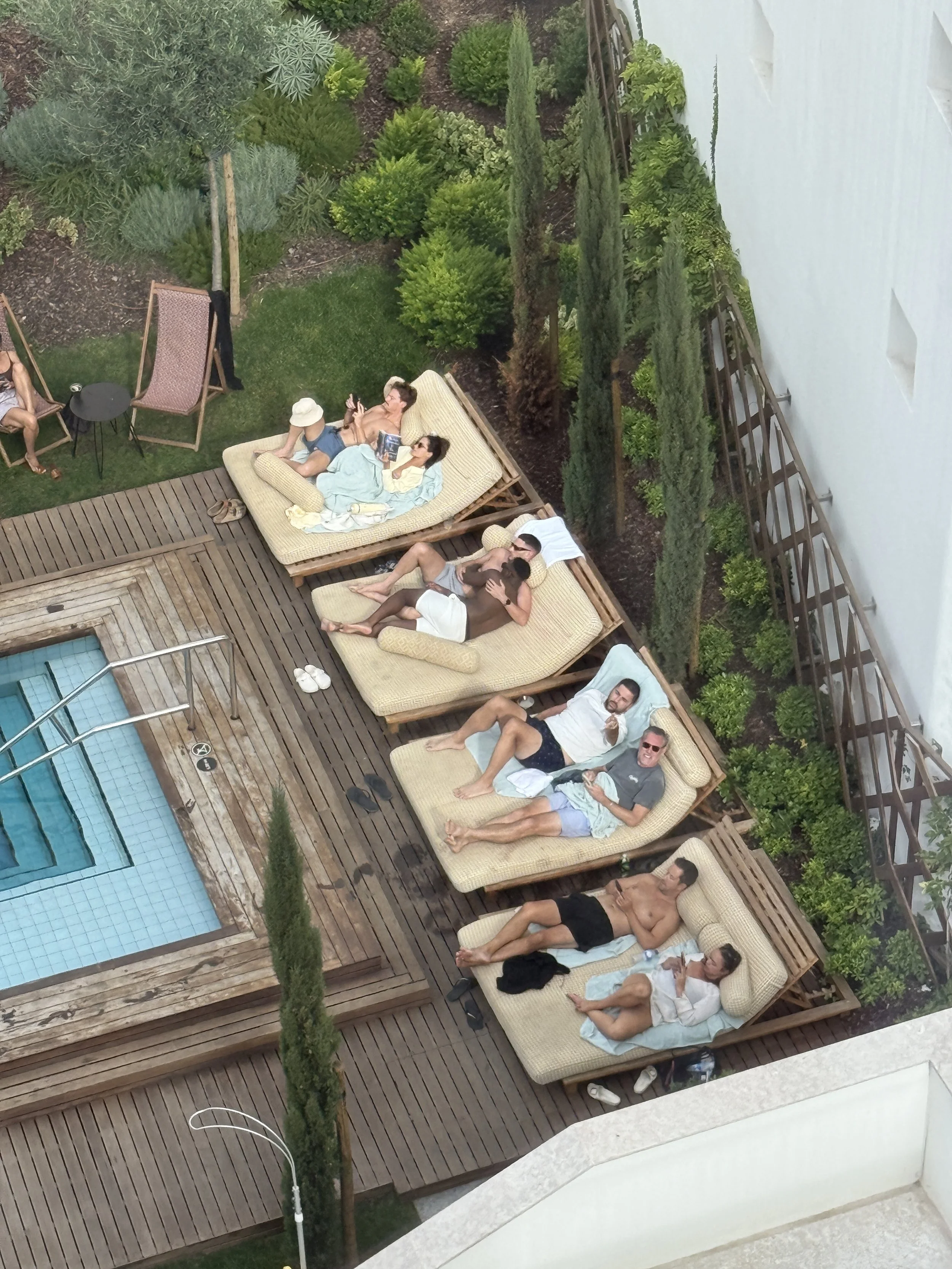
Looking down at the pool area in the interior courtyard of Locke de Santa Joana in Lisbon

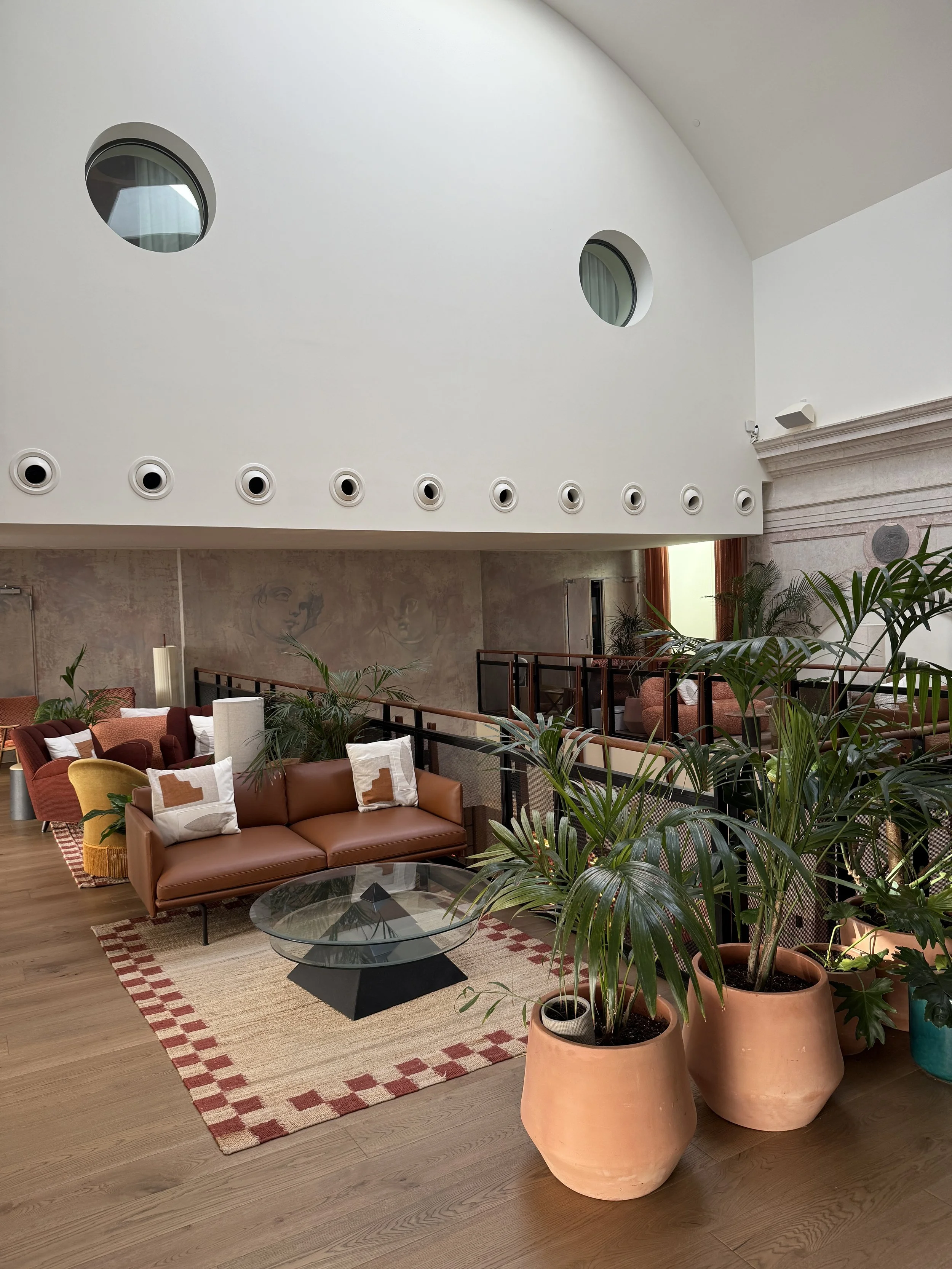
I was smitten from the moment Wally and I stepped into the lobby and passed Castro’s, the hotel’s in-house café. We were surrounded by a captivating mix of old and new: handpainted azulejo tiles unearthed during excavation, plush low-slung seating in rich hues of ochre, umber and cornflower blue, and clusters of tropical plants spilling from oversized terracotta pots, giving the space a laidback, residential warmth.

The original entrance to the convent at the now-hotel Locke de Santa Joana in Lisbon

A Brief History of Locke de Santa Joana

The hotel occupies four distinct buildings — Arte, Beato, Convento and D. Álvaro —  naming conventions that pay homage to its heritage, notable historical figures and the original purpose of the structures. 

Inside, you’ll find preserved artifacts from the former Convento de Santa Joana de Lisboa (Convent of Saint Joana), dedicated to Joana of Portugal, the princess and daughter of King Afonso V and Queen Isabella of Coimbra, who later took her vows as a Dominican nun and was beatified for her devotion.

The convent’s story begins in 1699, when the first buildings were established by the Dominicans of the Order of Preachers. For centuries, the complex housed nuns who lived largely in seclusion through prayer, work and self-sufficiency. 

Its buildings were heavily damaged during the catastrophic earthquake that struck Lisbon on All Saints’ Day in 1755 but were later repaired. Over a century later, the convent was officially decommissioned following the death of its last nun, and the property passed to the state. Over the ensuing decades, the buildings fell into disrepair and were repurposed for various uses. The last known occupant before the site's transformation into Locke de Santa Joana was a modest office used by the police department’s traffic division.

Looking back, I realize that we’ve stayed in more than a few places formerly dedicated to monastic life. 

Casa Antonieta in Oaxaca, Mexico was originally part of the Convent of San Pablo before becoming a private residence and, eventually, a boutique hotel. While in Córdoba, Spain’s serene Judería, Los Patios de Pañuelos occupies what was once a bishop’s manor. There’s something undeniably special about staying in a place that has a story to tell.

The upstairs bar at the Santa Joana restaurant at Locke de Santa Joana in Lisbon

The 370-room property is spread across four interconnected buildings, or blocks, with several offering views of the central courtyard terrace that houses the pool, outdoor bar and Santa Marta restaurant, located on Rua de Santa Marta, the street that provides an additional entrance to Locke de Santa Joana. The restaurant is open daily from 12 p.m. to 10 p.m., and serves Mediterranean fare, as well as wood-fired pizzas for when you’re craving something beyond traditional Portuguese cuisine. 

Fun fact: In Christian tradition, Santa Marta (Saint Martha of Bethany), sister of Lazarus and Mary, is the patron saint of hospitality, cooks, servants and innkeepers — basically the ultimate foodie and hostess. Makes you think the restaurant might have her blessing, don’t you?

A bedroom at Locke de Santa Joana in Lisbon

The Rooms of Locke de Santa Joana

Architecture studio Saraiva+Ássociados designed the modern Beato wing, fittingly named after Santo António (Saint Anthony), the patron saint of Lisbon, who, according to legend, began the construction of the Convento do Beato (Convent of the Blessed) with just seven tostões, a small denomination of currency, given as alms. 

Inside, Lázaro Rosa-Violàn oversaw the design of the hotel’s communal spaces, which gracefully honor its monastic past while embracing its new purpose as a luxury hotel. The guest rooms reflect the refined, modern sensibility of Brooklyn-based Post Company, blending comfort and contemporary style in every detail. 

Thanks to strict preservation laws, a large percentage of the original architecture remained untouched, including arches, stone columns, and the aforementioned centuries-old azulejos that can be seen throughout the hotel’s winding white hallways.

Full disclosure: We found ourselves lost several times due to inner staircases that required a key card to pass through and elevators that served only specific floors. And we weren’t alone; we passed quite a few fellow guests shaking their heads, unable to figure out how to get where they wanted to go. 

The kitchenette in a room at Locke de Santa Joana in Lisbon

We stayed in a Locke Studio in the Beato block for five nights, a space that perfectly balanced thoughtful design with understated comfort. The bathroom, tiled in dusty rose, featured a walk-in rainfall shower, thick cotton towels and toiletries by Kinsey Apothecary.

The queen-size bed was soft and inviting, and above it hung a framed textile by Peruvian artist Ana Teresa Barboza. Woven from dyed cotton and wool fibers, the piece reflected the colors of Lisbon and incorporated fragments of a geological map of Portugal, to create a layered, tactile homage to the city’s history. 

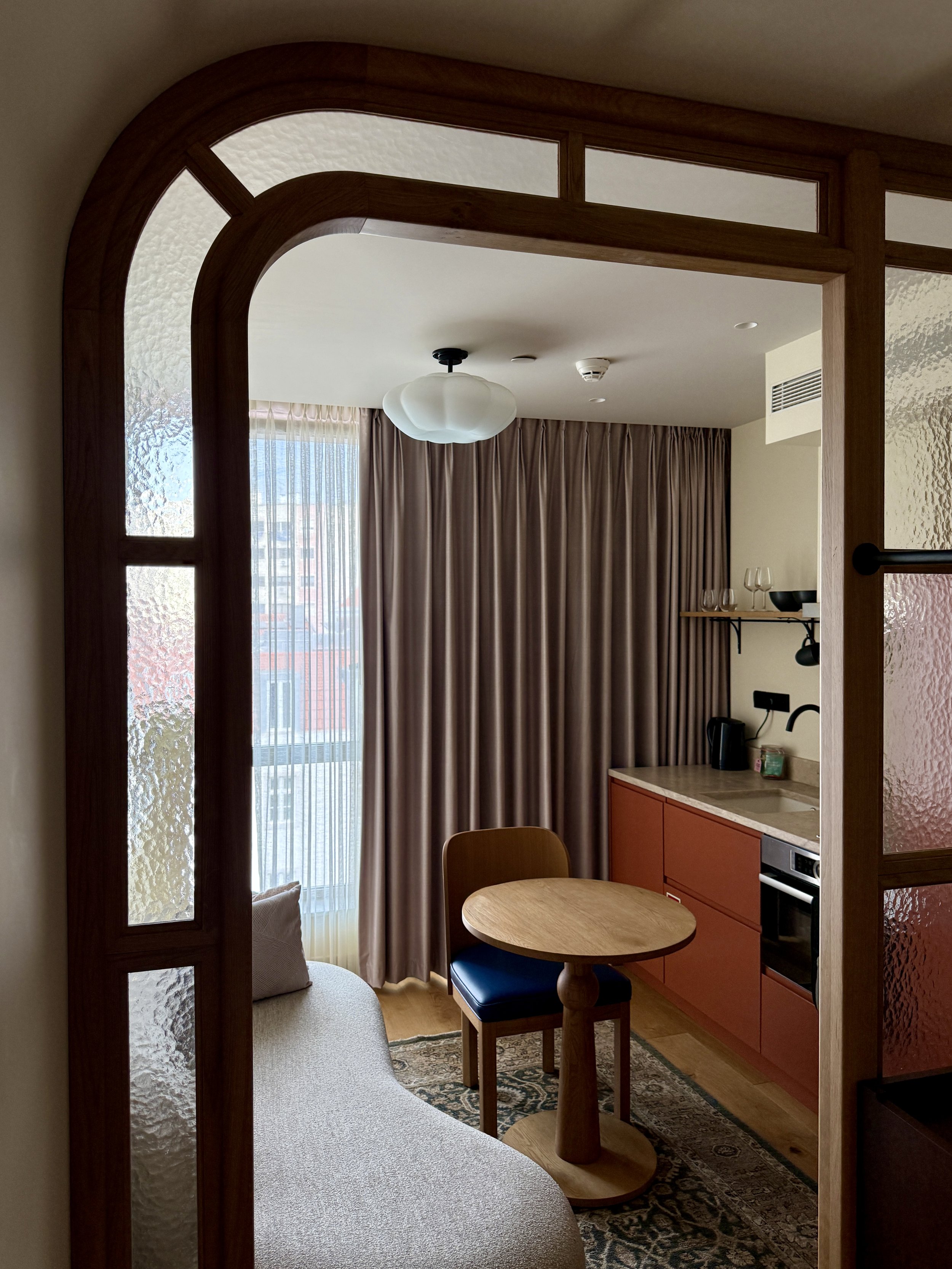
A curved wooden frame with subtly rippled glass separates the sleeping area from a well-equipped kitchenette, complete with a Nespresso coffee machine, washer/dryer, mini-fridge, dishwasher, sink, oven and two-burner induction cooktop. 

The kitchenette is a nice touch — we enjoyed being able to have leftovers for dinner one evening. 

There’s also a sofa that’s perfect for lounging and a small dining table and chair where you can linger over your morning coffee.

A bathroom at Locke de Santa Joana in Lisbon

At one point, Wally peered down from our room’s large windows, saw a couple of young women lounging with books by the pool, and remarked that the scene gave him serious White Lotus vibes. 

Heads up — this isn’t your typical hotel. Housekeeping is limited to weekly service, or midway through longer stays, though extra cleanings can be arranged upon request. The upside? You get your own beautifully designed space to actually live in, not just stay in.

Drinks on a tray at Kissaten, a bar at Locke de Santa Joana in Lisbon

Food and Drink Options at Locke de Santa Joana

Breakfast is served daily from 7 a.m. to 10:30 a.m. at Santa Joana, the hotel’s namesake restaurant, located inside the centrally situated Arte building, which features the restored façade of the former 17th century convent. Like other guests, we entered through the courtyard and checked in with the host before going inside. 

Looking down at the tables at the restaurant at Locke de Santa Joana in Lisbon

The restaurant’s interior is a feast for the eyes, blending preserved architectural elements with contemporary design. Its grand dining room features soaring ceilings, pink marble tables, and a focal wall adorned with modern tribal masks reduced to geometric shapes in blush, brick and aubergine tones by Lisbon-based Grau° Cerâmica. Like the lobby, the room is filled with greenery, offering privacy between the tables and upholstered banquettes.

The patio for outside dining at the Santa Joana restaurant at Locke de Santa Joana in Lisbon

The indulgent buffet covers table after table, offering a variety of thinly sliced cured meats, including presunto, the Portuguese take on prosciutto, along with smoked salmon, local cheeses, fruit, yogurt and freshly squeezed juices, as well as a selection of freshly baked breads and pastries, including the legendary pasteis de nata. There are also self-serve hot options such as scrambled eggs, sausage, bacon and roasted potatoes.

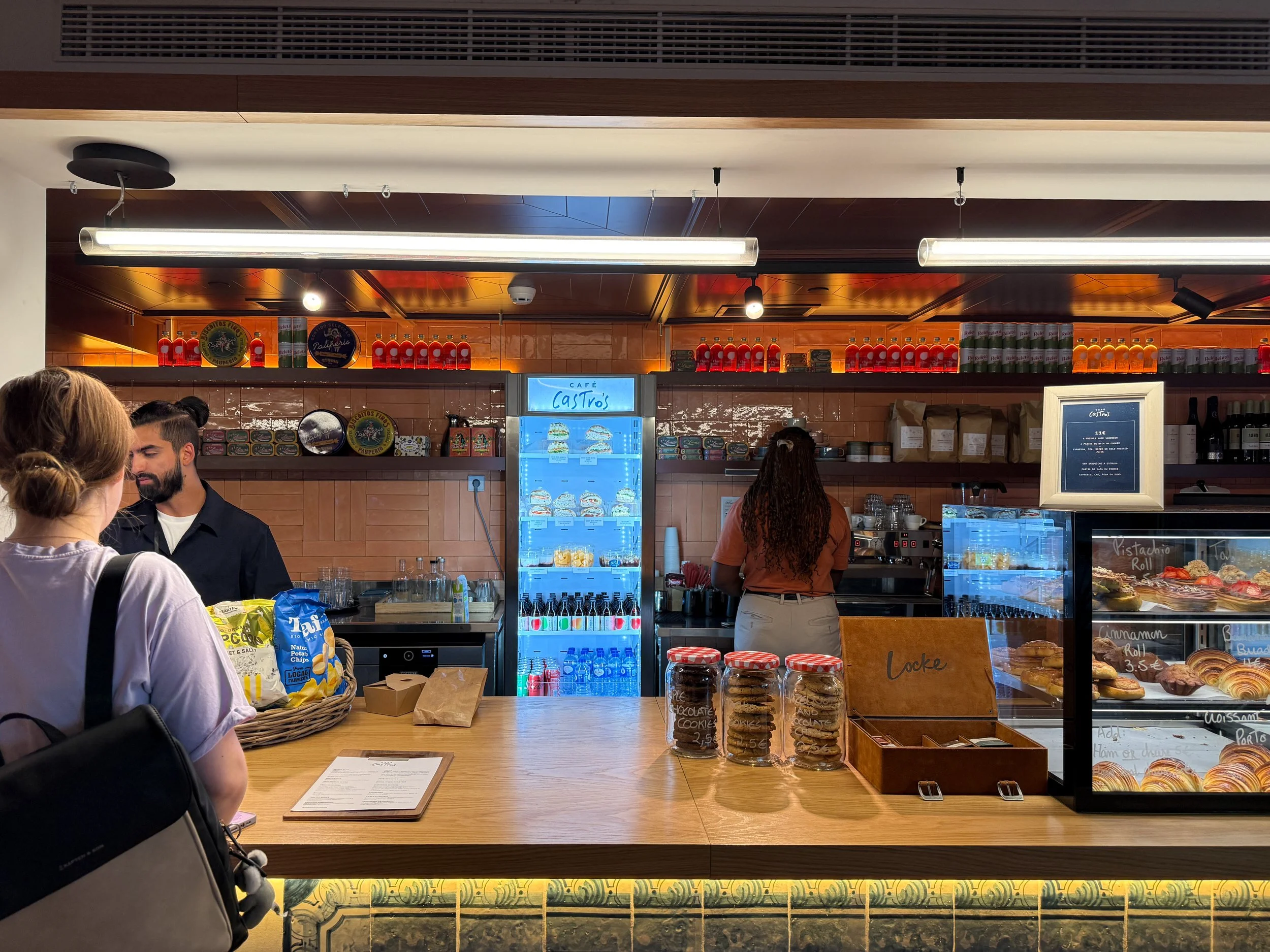
Castro's coffee bar in the lobby of Locke de Santa Joana in Lisbon

Castro’s was our first stop before heading out each morning and offered a variety of pastries, sandwiches, cookies and of course coffee. I regret not purchasing a pistachio cookie but somehow found the willpower to restrain myself. 

A teal speaker and bottles at Kissaten, a bar at Locke de Santa Joana in Lisbon

We ended one evening at Kissaten (which Wally of course called Kiss & Tell), the hotel’s late-night Japanese jazz kissa — a listening bar where the soundtrack drifted from jazz to blues, rock, soul and singer-songwriter classics. The menu boasts Lisbon’s largest whiskey collection, curated by Glasgow-born expert Dave Broom. 

We loved the vibe of the dimly lit lounge and cozied up to the bar. I snapped a photo of the menu and sent it to my dad — he’s a bit of a connoisseur — who suggested Compass Box, but I ended up ordering the Spicy Mezcalita, a bright, smoky mix of mezcal, yuzu, lime and jalapeño. Wally went for the Plum, a smooth, refreshing blend of Japanese whisky, plum, sake and soda water. We probably would’ve ordered a second round if we hadn’t been getting up early the next morning for a tour of Castelo de São Jorge

People lay on double lounge chairs by the pool at Locke de Santa Joana in Lisbon

Service and Amenitites 

From the moment we arrived, the genuine warmth and hospitality of the staff made a lasting impression. Everyone we met was friendly, attentive and went above and beyond to ensure our stay was as comfortable as possible. 

I overheard a man (one half of a couple who was checking out on the day we arrived) say to the concierge, “We didn’t get to enjoy the pool.” When the concierge asked why, he deadpanned, “Because we’re British.”

I’d packed our swimsuits knowing there was a pool, but, alas, like the British pair, the most we managed was to relax poolside on sun loungers with a cocktail one late afternoon. 

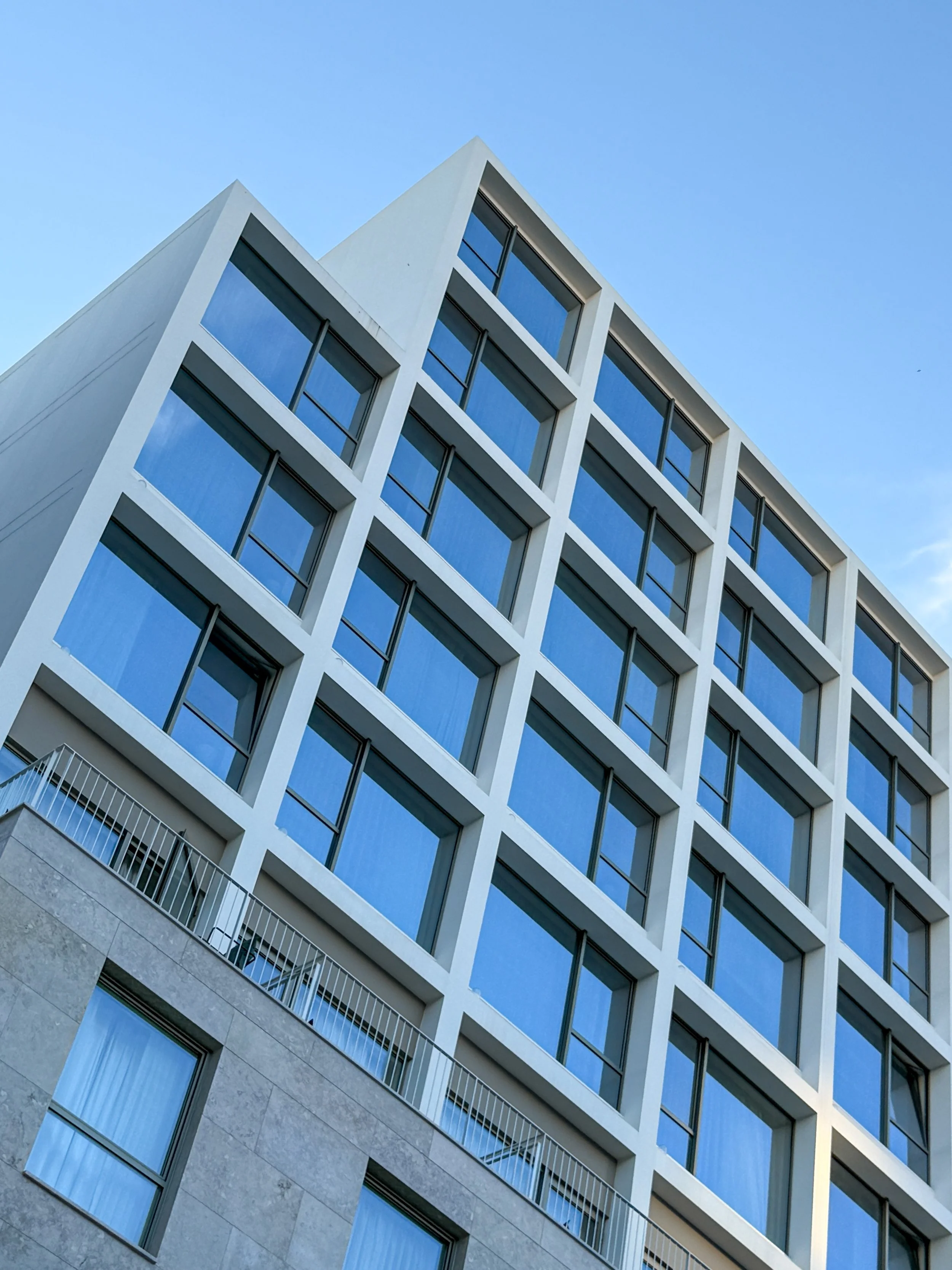
Part of the modern structure at Locke de Santa Joana in Lisbon

While Santa Joana is right in the thick of it, step inside, and suddenly, you’re in an unexpected oasis that feels about as far from the city chaos as you can get. 

So, if you’re looking for a chic Lisbon base beyond the traditional hotel format, Locke de Santa Joana is just the place. –Duke

The front entrance to Locke de Santa Joana in Lisbon

Locke de Santa Joana

Rua Camilo Castelo Branco, 18
1150-084 Lisbon
Portugal 

Church of São Domingos: Lisbon’s Beautiful Burnout

Visiting Igreja de São Domingos in Lisbon? Just off Rossio Square, this fire-scarred church turns ruin into reverence.

Once dripping in gold and glory, the Church of São Domingos in Lisbon, Portugal now wears its wounds with pride. A fire-charred interior, a bloody past, and a defiant refusal to hide the damage make it one of the most hauntingly honest churches in Europe.

We’d already been in Lisbon a couple of days when I flipped through a guidebook and saw a photo of São Domingos’ interior, with those scorched terracotta-colored walls and raw stone arches. I stopped mid-page. It didn’t look like any church I’d ever seen; it looked like something that had survived the end of the world. I turned to Duke and said, “We have to find this place.”

Workers reinforced the structure but left the burn marks as they were, creating an atmosphere that feels halfway between holy and haunted.

It’s not “beautiful” in the traditional sense, but it’s impossible to forget.

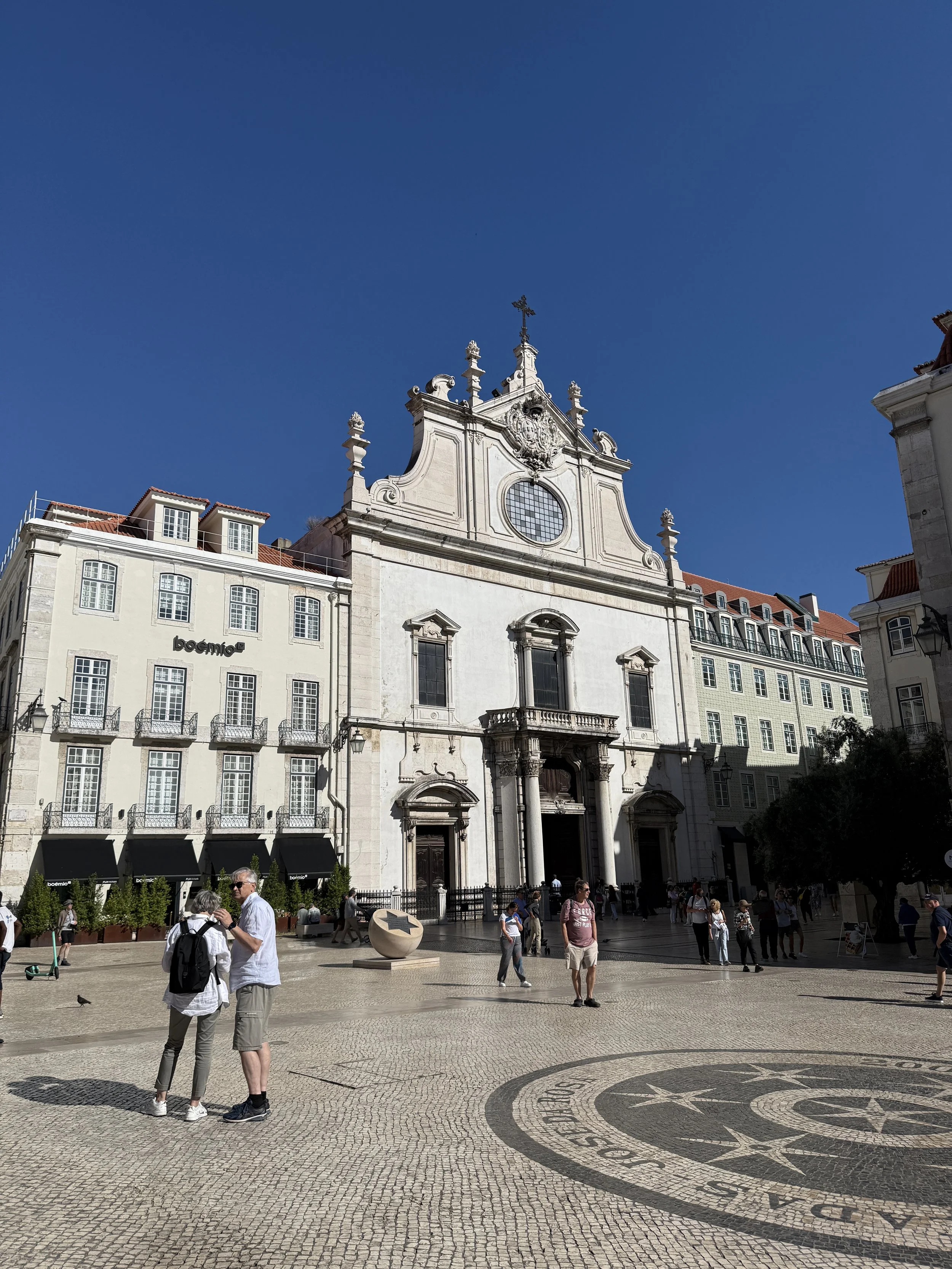
Imagine our surprise when we realized it was right under our noses — tucked just off Rossio Square in a strangely angled building we’d already walked past several times without noticing. From the outside, São Domingos looks a bit plain, its façade rather unassuming. But step through the doors and it’s like falling through time. Lisbon’s brightest square gives way to one of its darkest, most moving spaces.

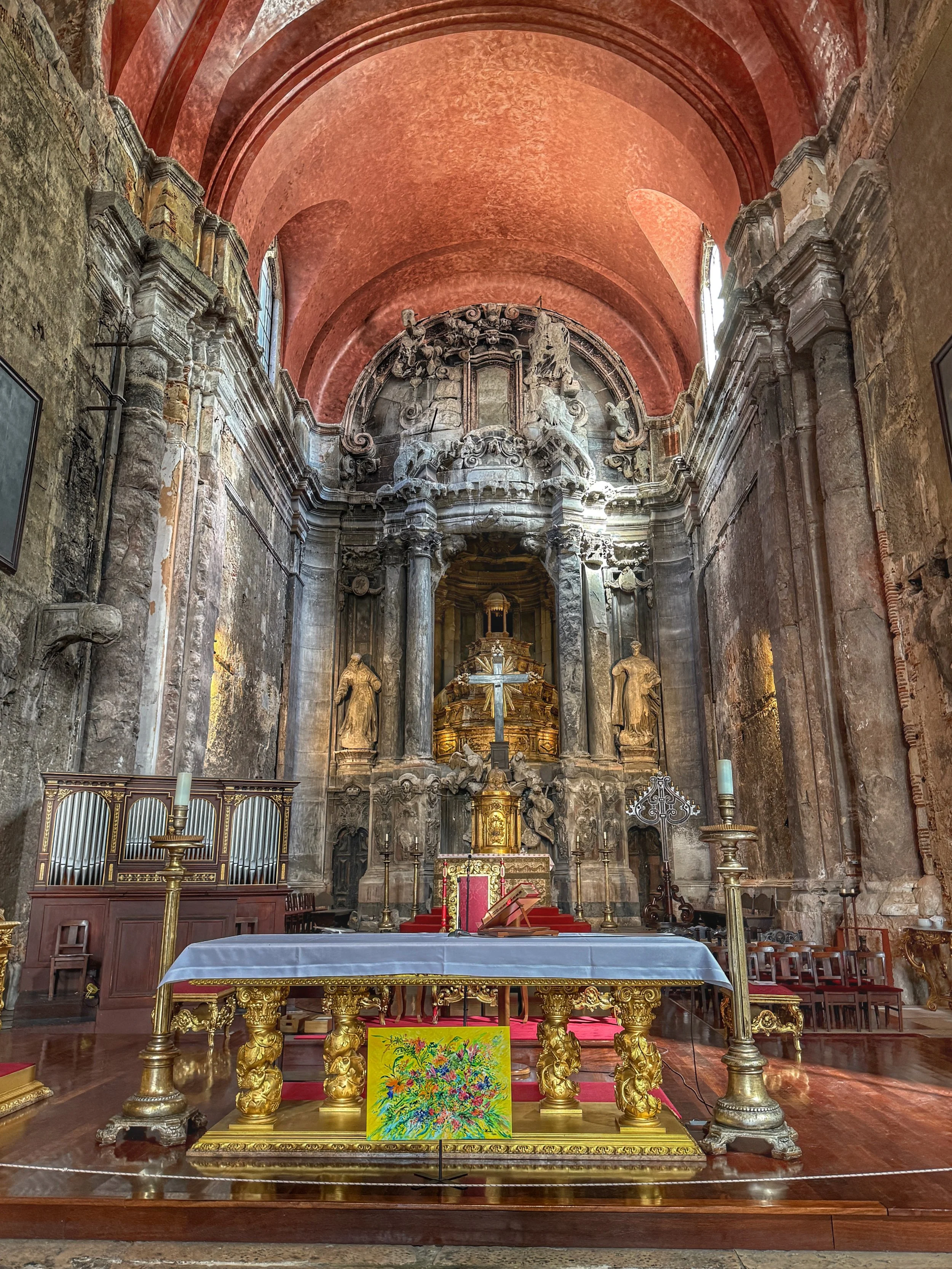
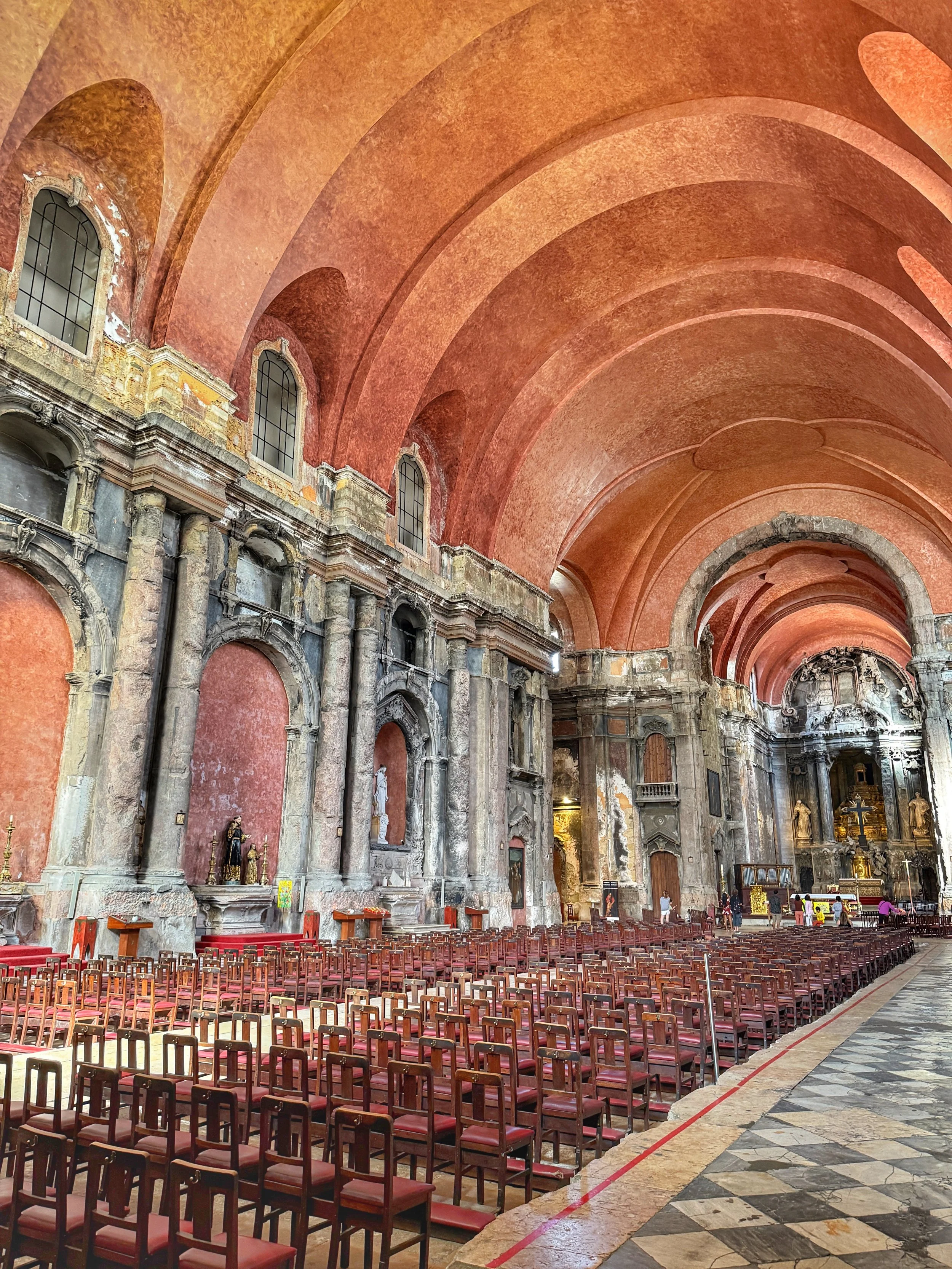
Inside Igreja de São Domingos

The first thing you notice inside Igreja de São Domingos isn’t the altar or the statues — it’s the walls. They’re scorched, cracked and blistered like the inside of a volcano. You half-expect to smell smoke. Once upon a time, this was one of Lisbon’s most lavish Baroque churches — all gold leaf, marble and over-the-top devotion. Then, in 1959, fire ripped through it, devouring the splendor and leaving behind something much more human.

Most churches would have been restored to postcard perfection. São Domingos wasn’t. The decision to leave its wounds visible — blackened stone, warped columns, burnt sienna ceilings that look like they still ache — feels radical, especially in a city that prides itself on polished tiles and pastel façades. This one’s not pretending. It’s survived earthquakes, massacres and flames, and it’s still standing — raw, imperfect and more sacred for it.

The fire that ravished São Domingos is believed to have started at the high altar — with, possibly, a candle to blame.

The Fire That Changed Everything

In 1959, a fire tore through São Domingos, leaving only its stone skeleton behind. The blaze gutted centuries of gilded wood and painted ceilings, the kind of gaudy grandeur that Baroque churches specialized in. Parishioners watched in horror as molten gold dripped from the altar and statues melted into unholy puddles. Yet instead of rebuilding it to its former blingy glory, Lisbon decided to do something almost heretical: It left the scars.

The fire broke out on August 13, 1959, just after dawn, starting near the high altar — the very heart of the church. No definitive cause was ever confirmed, though some reports suggested a stray candle or heat rising through an old chimney shaft. 

Within minutes, flames shot through the wooden roof and raced down the nave, feeding on centuries of lacquer, paint and gilt. 

More than 100 firefighters from across Lisbon rushed to the scene, and crowds filled Rossio Square to watch in disbelief and despair. 

Despite the firefighters’ efforts, the roof collapsed, killing two of them and reducing the sanctuary to a molten ruin.

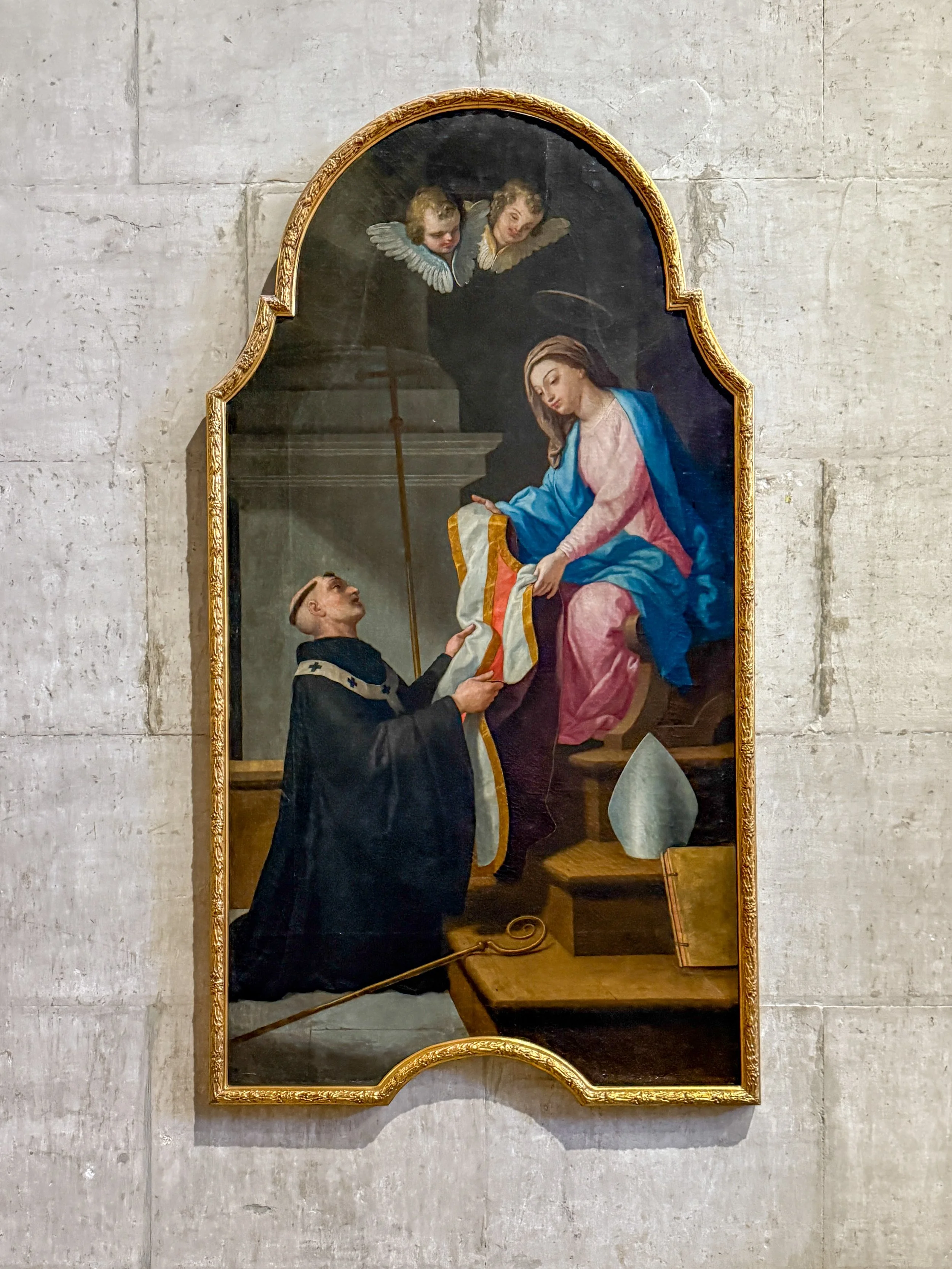
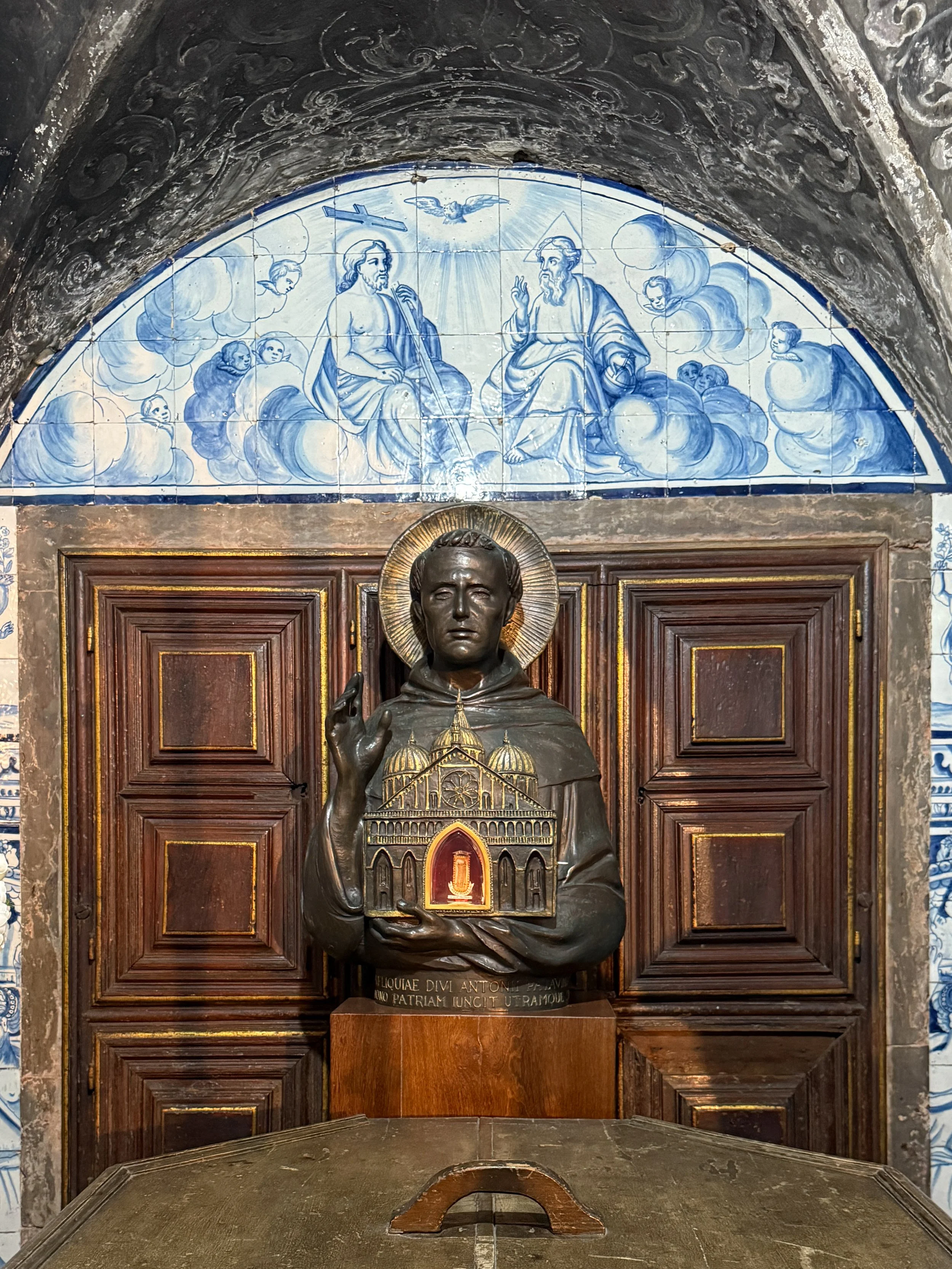
Saint Dominic’s vision of receiving the rosary from the Virgin Mary

Saint Thomas Aquinas, the Dominican Order’s scholar-saint

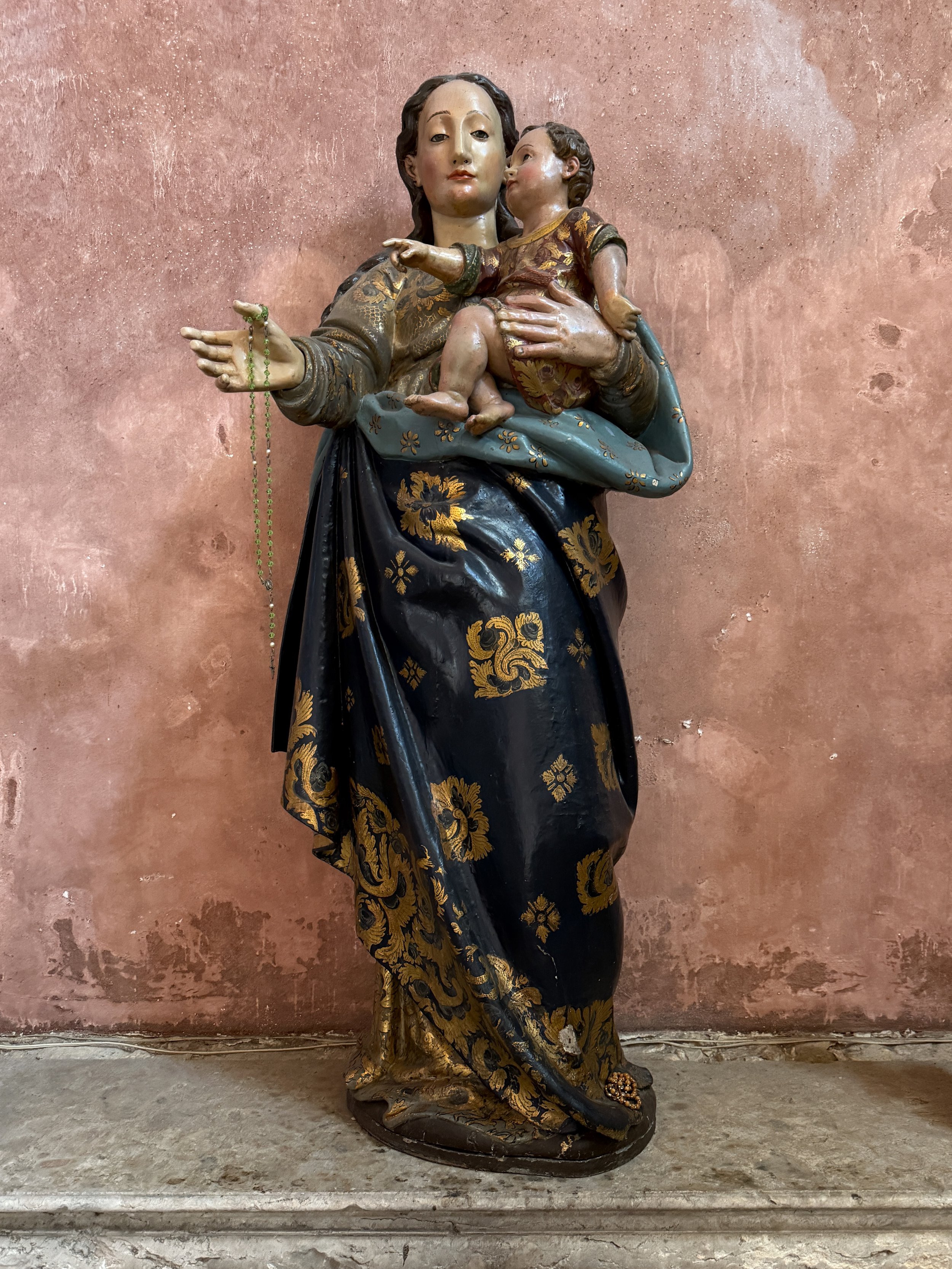
The losses were staggering. The great pipe organ, centuries of paintings and sacred objects — including a revered 17th century image of Our Lady of the Rosary — were destroyed. 

The heat was so intense that the marble itself split, and the once-golden altars ran like wax. 

For a church that had hosted royal weddings, funerals, baptisms and national ceremonies, the devastation felt almost personal — a wound carved into Lisbon’s collective memory. That same year, São Domingos was declared a National Monument, ensuring that what survived would never again be hidden behind fresh plaster.

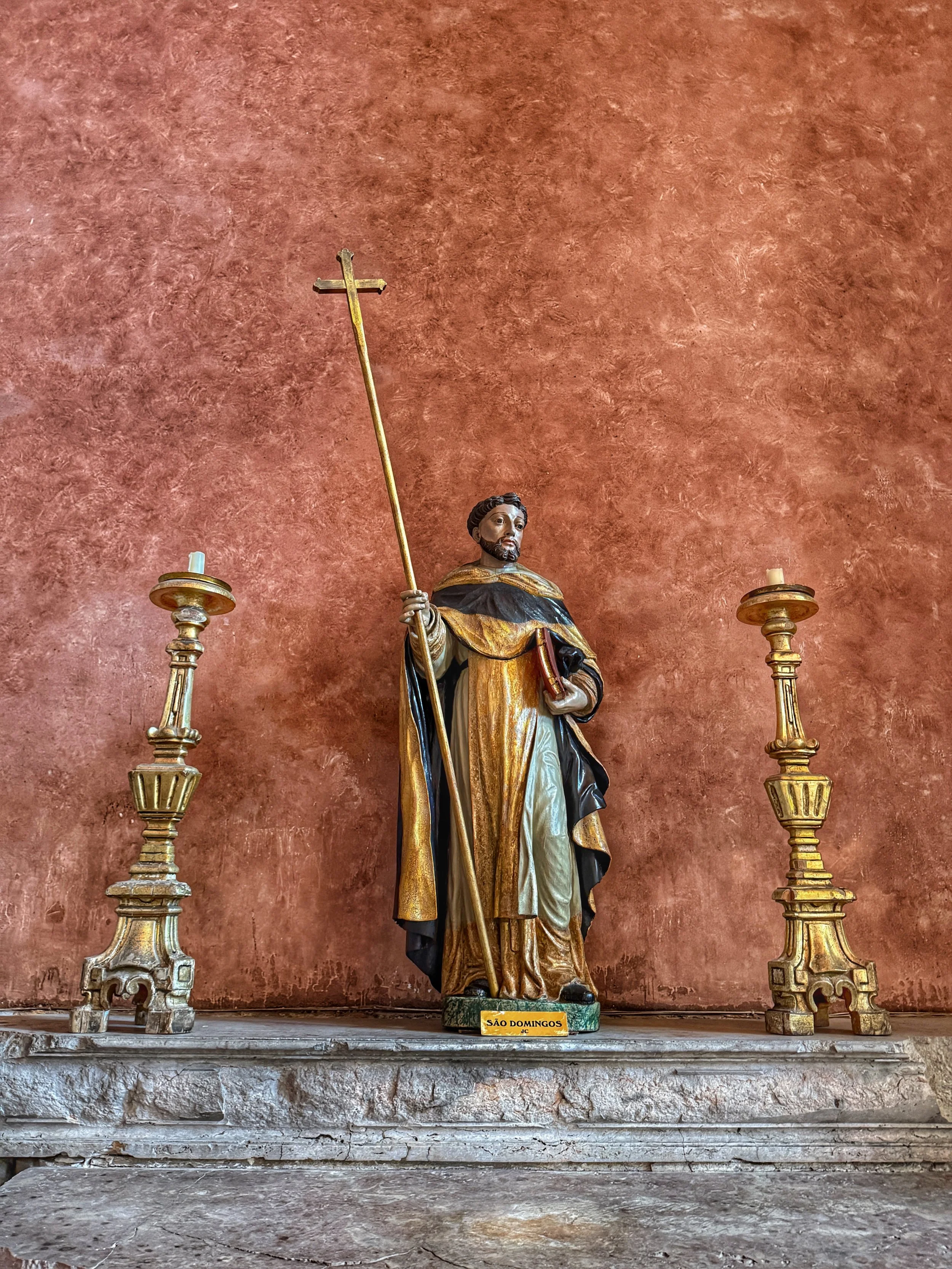
Saint Dominic (São Domingos), founder of the Dominican Order, was devoted to truth through study and preaching.

São Domingos, the Saint Who Started It All

It feels poetic — maybe even karmic — that the church dedicated to Saint Dominic, the man who founded the Dominican Order, should end up looking like penance. Dominic was no quiet monk. Born in 1170 in Spain — supposedly on a Sunday (domingo), hence his name — he was a fiery preacher famous for fighting heresy and convincing people through debate rather than violence. At least, that was the idea. His order later became the intellectual arm of the Inquisition — less conversation, more confession under duress. Not quite the legacy he’d hoped for.

Dominic himself, though, was fascinating. Legend says his mother dreamed of a dog carrying a torch in its mouth, setting the world aflame — a symbol of how her son would spread faith like wildfire. (“Dominican,” after all, comes from Domini canes — “the dogs of the Lord.”) 

He died in Bologna, Italy in 1221, apparently of sheer exhaustion from walking and preaching barefoot across Europe. 

Standing inside São Domingos today, it’s hard not to think of that dream — of flames and faith intertwined. 

Saint Joseph (São José), the carpenter stepfather of Jesus and patron of Portugal, gets more reverence here than perhaps any other country.

The Shadow of the Inquisition

For a church that now feels so peaceful, São Domingos has a disturbingly violent past. Long before the fire, before Lisbon’s earthquakes and rebuilds, this was the epicenter of something far darker: the 1506 Massacre of Lisbon’s Jews.

It started with a miracle gone wrong. A drought had gripped the city, and crowds filled the church, praying for rain. When someone claimed to see Christ’s face glowing on the altar, a man in the crowd dared to doubt it — and was beaten to death on the spot. The frenzy that followed spilled into the streets, egged on by Dominican friars who urged the mob to “cleanse” Lisbon of unbelievers.

For three days, chaos ruled. Jews and New Christians (converted Jews, many forcibly baptized) were dragged from their homes and slaughtered. By the time it ended, an estimated 2,000 people were dead. The king was away; the city, soaked in blood. And São Domingos — that grand, gold-drenched house of God — had become a stage for fanaticism.

Outside the church today, there’s a modest memorial stone, easy to miss unless you’re looking for it. It reads, in both Portuguese and Hebrew: “In memory of the thousands of Jews who were victims of intolerance and religious fanaticism.” A single Star of David rests at its center, quietly defying centuries of silence.

Nearby lies Rossio Square — once the site of Lisbon’s public executions, where the condemned were burned at the stake in the name of faith. The Dominican friars, the same order tied to this church, often presided over those ceremonies, chanting prayers as flames rose.

It’s impossible not to sense the irony: The very order that once helped fuel the Inquisition now prays beneath ceilings blackened by fire. The church that once blessed the flames became a victim of them.

Step inside afterward and the air feels heavier, as if the walls themselves are still atoning. Maybe it’s Lisbon’s way of keeping the story honest — no whitewash, no denial, just stone and ash and memory.

Rebuilding, Remembering, Reclaiming São Domingos

Lisbon has a complicated relationship with ruin. It’s a city that’s burned, crumbled and drowned more times than seems fair — yet it always finds a way to look good doing it. After the devastating 1755 earthquake, much of Lisbon was rebuilt with Enlightenment precision: straight boulevards, orderly plazas, symmetrical façades — all courtesy of the Marquês de Pombal (Marquis of Pombal), who refused to let chaos have the final word. But São Domingos never quite conformed.

When fire tore through the church in 1959, the city could’ve easily restored it to its former Baroque bling. Instead, Cardinal Manuel Gonçalves Cerejeira, the Patriarch of Lisbon at the time, made the startling decision to leave the damage visible. He wanted the church to stand as a monument to survival — a spiritual scar that reminded worshippers of both faith and fragility. 

In the days after the fire, thousands of Lisboetas crowded around the smoldering ruins, stunned by what they saw. The interior that had once hosted royal weddings and state funerals was gone, its marble columns cracked and its altars reduced to cinders. Yet amid the shock, something shifted — the city seemed to accept the ruin as part of itself. When rebuilding began, Lisbon’s leaders chose not to repaint or replaster. The church’s new status as a National Monument cemented that choice, enshrining the damage as a public act of remembrance.

The heat had cracked the limestone, buckled the arches, and scorched the marble into shades of rust and rose. Replastering it would’ve been like putting concealer on a masterpiece.

So the charred stone stayed. Workers reinforced the structure but left the burn marks as they were, creating an atmosphere that feels halfway between holy and haunted. It’s not “beautiful” in the traditional sense, but it’s impossible to forget. The decision echoed another Lisbon landmark: the Carmo Convent, whose roof collapsed in the same 1755 quake and was never rebuilt. It now houses the Carmo Archaeological Museum, a stunning open-air ruin that, like São Domingos, celebrates what survived rather than what was lost.

Both spaces — Carmo’s skeletal Gothic arches and São Domingos’s fire-blistered vaults — speak to the same Lisbon instinct: to remember through ruin. There’s a kind of integrity in that — a refusal to rewrite history with fresh paint. Walk into São Domingos today and you can still see the melted lines where gilding once was, like ghosts of devotion past. 

A Living Testament

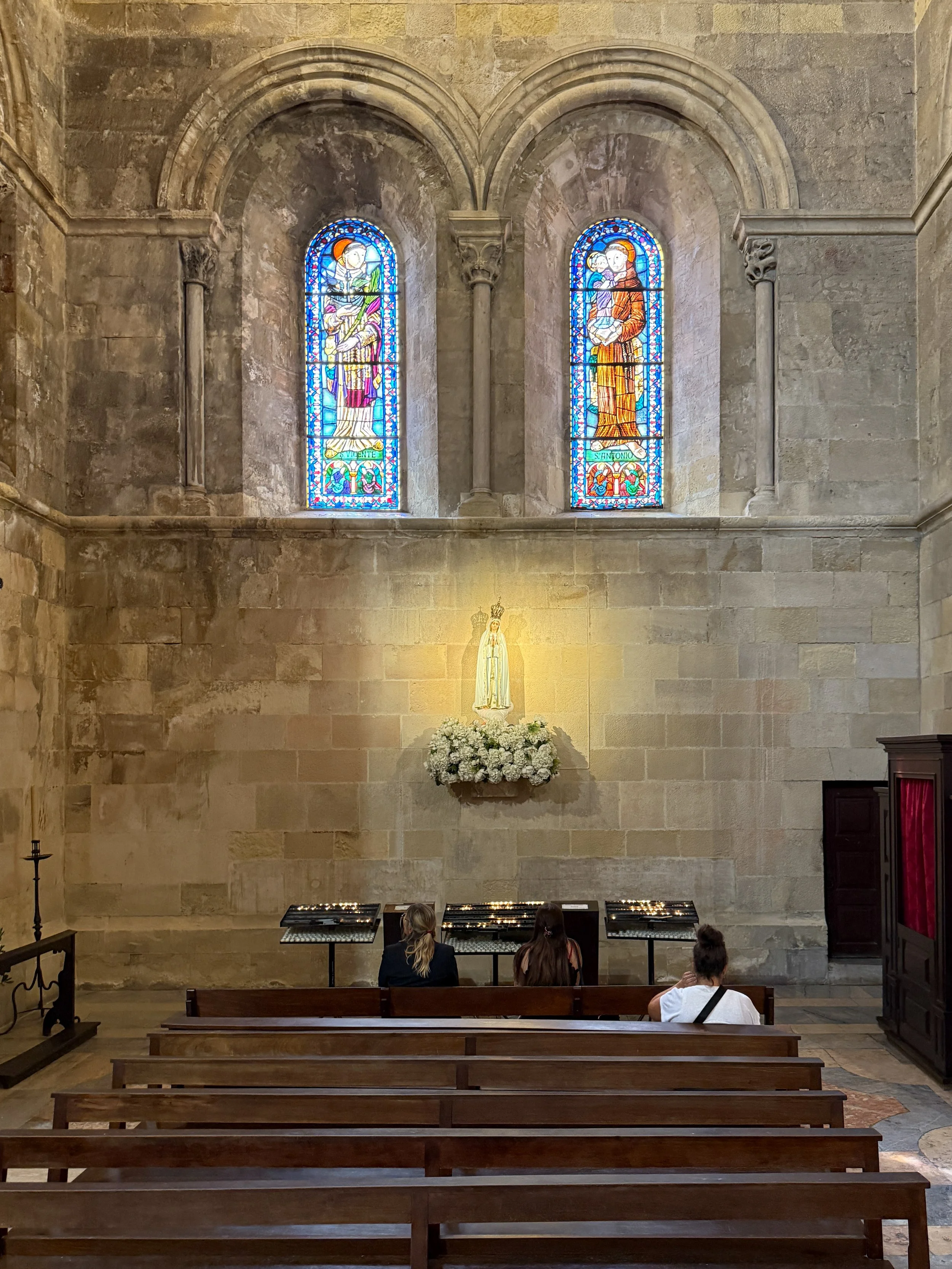
Step inside São Domingos on any given morning and you’ll find people lighting candles in front of walls that look like they’ve survived the apocalypse. The soot stains catch the flicker of each flame. Tourists wander in hushed awe, cameras half-lowered as if they’re intruding on something sacred. Locals cross themselves and sit quietly, lost in prayer. 

If you look closely, the worst fire damage still clings to the area around the high altar — the spot where the 1959 blaze began. The marble floor still gleams in places, though time has softened its edges.

There’s a quiet honesty here. In a city famous for azulejos and ornament, São Domingos doesn’t try to impress you. It doesn’t sparkle or hide the damage. It simply endures. That’s its sermon.

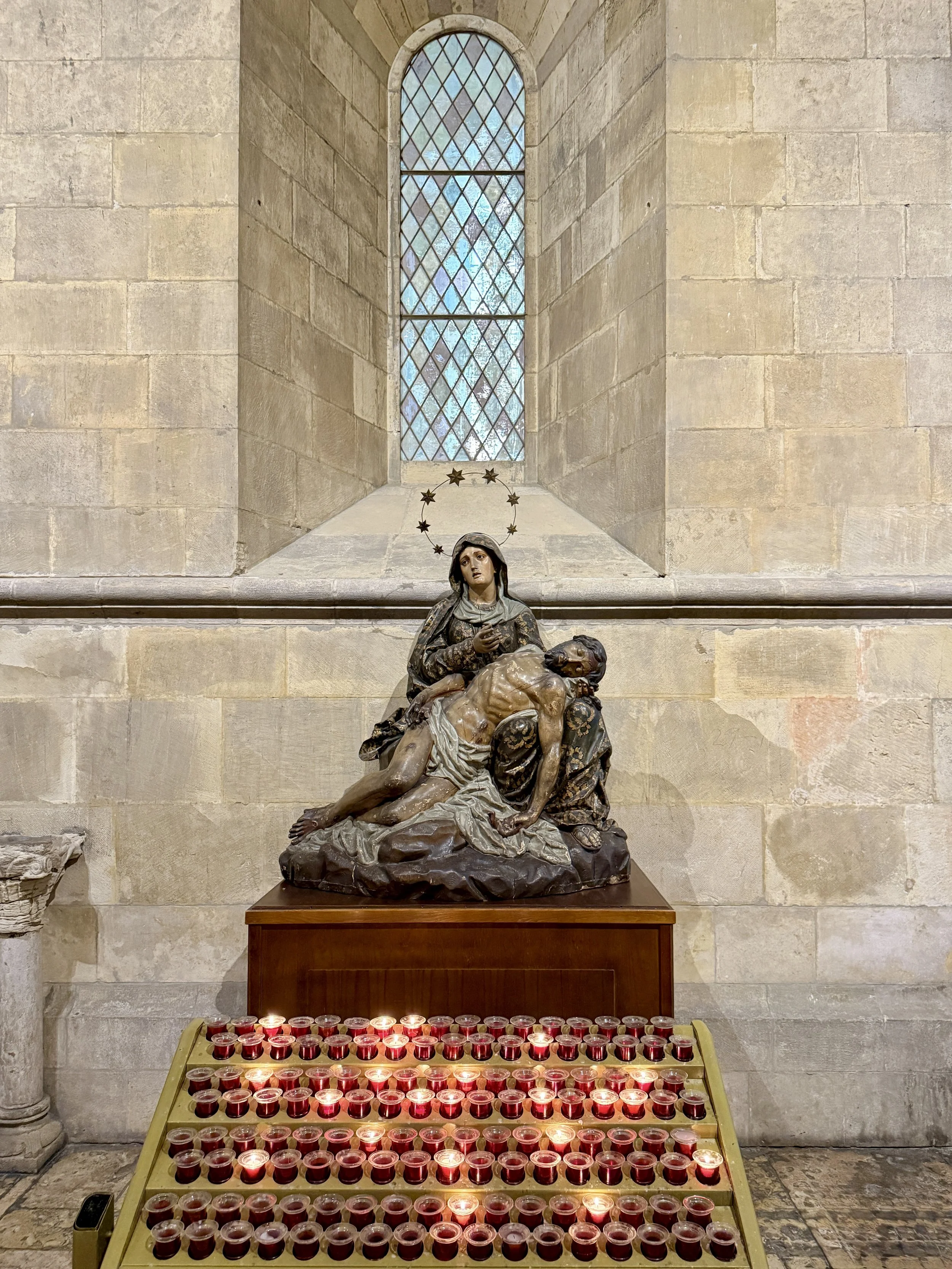
A statue of the Virgin Mary as Our Lady of the Rosary

The Church That Refused to Hide Its Pain

Lisbon does polished beautifully — the colorful façades, the shiny blue tiles, the pastry cases that look like art installations. But São Domingos offers something braver. It’s a church that said no to cosmetic miracles, a reminder that survival itself can be sacred.

Maybe that’s what makes it unforgettable. The gold is gone, the glory has burned away, and yet what’s left feels closer to the truth — the raw, cracked heart of a city that refuses to give up. Lisbon rebuilt itself a dozen times over, but here, at São Domingos, it decided to remember instead. 

Visiting São Domingos 

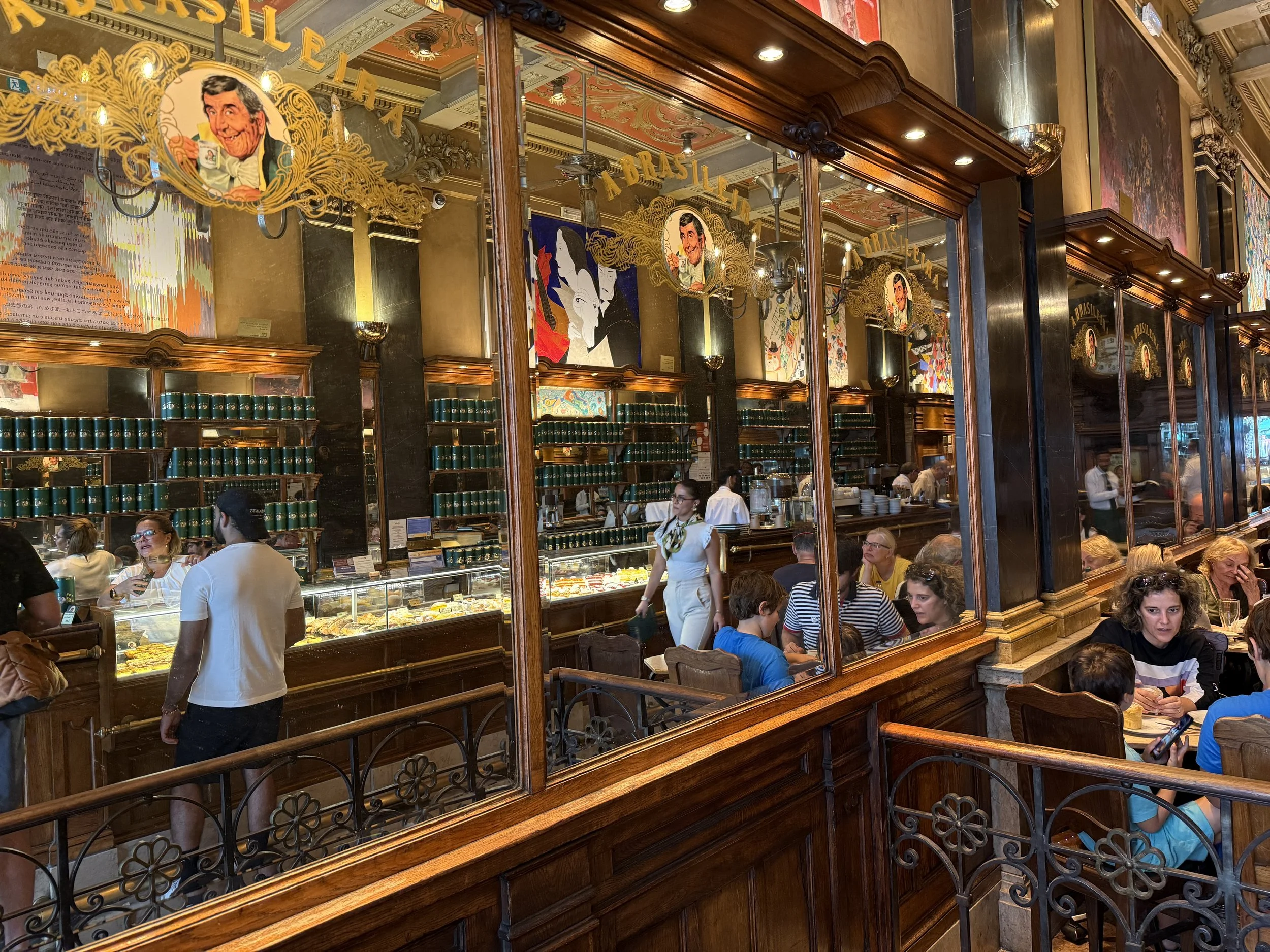
You’ll find Igreja de São Domingos tucked just off Rossio Square, in the Largo de São Domingos, where locals queue for ginjinha (Lisbon’s famous cherry liqueur) right outside its doors. It’s hard to miss — the façade is stately but unassuming, the real drama waiting inside.

Hours: The church is usually open daily from 7:30 a.m. to 7 p.m., and entry is free. Early morning or late afternoon is best if you want to feel the light shifting across the walls. –Wally
Igreja de São Domingos

Largo São Domingos
1150-320 Lisboa
Portugal


Portugal’s Pastry Penises

Cock an eye at the phallic pastries from Amarante, Portugal, which, strangely, honor a saint.

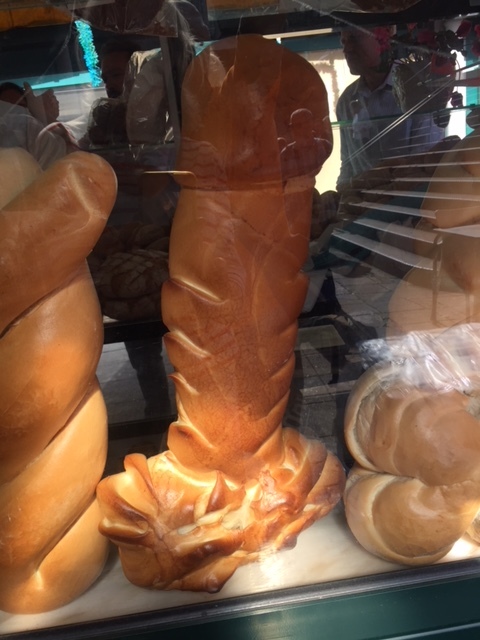
Doesn’t this penis pastry look simply mouth-watering? Hopefully it's cream-filled!

Doesn’t this penis pastry look simply mouth-watering? Hopefully it's cream-filled!

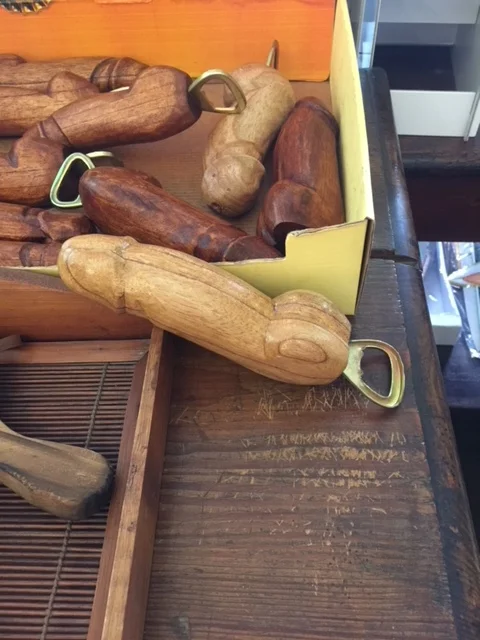
Portugal’s pastry penises, they pop up (sorry, couldn’t resist) everywhere. Darling small ones covered in sugar. Massive ones big enough to share. Some are filled with, what else, cream. Porcelain ones, can openers, corkscrews line up on store shelves like soldiers at attention. It’s a penispalooza!

You see them all over the country, but they actually come from Amarante east of Porto. A lovely town where everything — the church, the bridge, the convent, a street — is named after the same man, Amarante sits at the western entrance to the Douro Valley, home to the port wine industry.
Modestly dressed women giggle as they confront an anatomically correct penis dusted with powdered sugar.
There is that awkward moment of deciding whether to use a knife and fork or pick it up and nibble away.

In the 13th century, long after the Romans built the bridge that bears his name, a priest, now canonized, São Gonçalo, had “matchmaking abilities.”

There is no word on his personal equipment size. Given the doces fálicos (phallic sweets) or bolos (cakes) that commemorate him, however, it must have been quite something.

The fact that he was run out of town for some long-forgotten reason fuels speculation as to why he is so vividly remembered eight centuries later. Also no word on why he’s revered with pastry — malleable, rise-able, edible…shouldn’t go too far with the metaphors.
Portugal’s penis obsession extends to other products, including bottle openers

Portugal’s penis obsession extends to other products, including bottle openers

The pastries are given as gifts in January so that the recipient will have a fortuitous and fertile year. But the really big celebration is the first week in June, around São Gonçalo's feast day, when Amarante goes penis crazy.

There’s a procession, fireworks, penis bunting, fetching penis deely-boppers and a lot of pastry penis presents to single women looking for love. In other words, the world’s largest bachelorette party.

Phallic baked goods are a common sight in Portugal, especially the town of Amarante

Phallic baked goods are a common sight in Portugal, especially the town of Amarante

The rest of the year, modestly dressed women sit in cafés throughout the country, sipping espresso and giggling as they confront an anatomically correct, carefully circumcised and fully, shall we say, inflated penis dusted with powdered sugar. There is that awkward moment of deciding whether to use a knife and fork or pick it up and nibble away.

Otherwise, if you miss the festa in Amarante, if you’re new to Portugal, if you haven’t seen anyone eating the equivalent of a phallic doughnut, you are left standing in the middle of Porto’s open-air market, staring into a bakery shop window thinking, “That’s not what I think it is. Is it?” –Rebecca