lighthouses

Secrets of the Seven Wonders of the Ancient World

Author Bettany Hughes shares surprising truths about the Great Pyramid, the Hanging Gardens of Babylon and other Wonders of the Ancient World. 
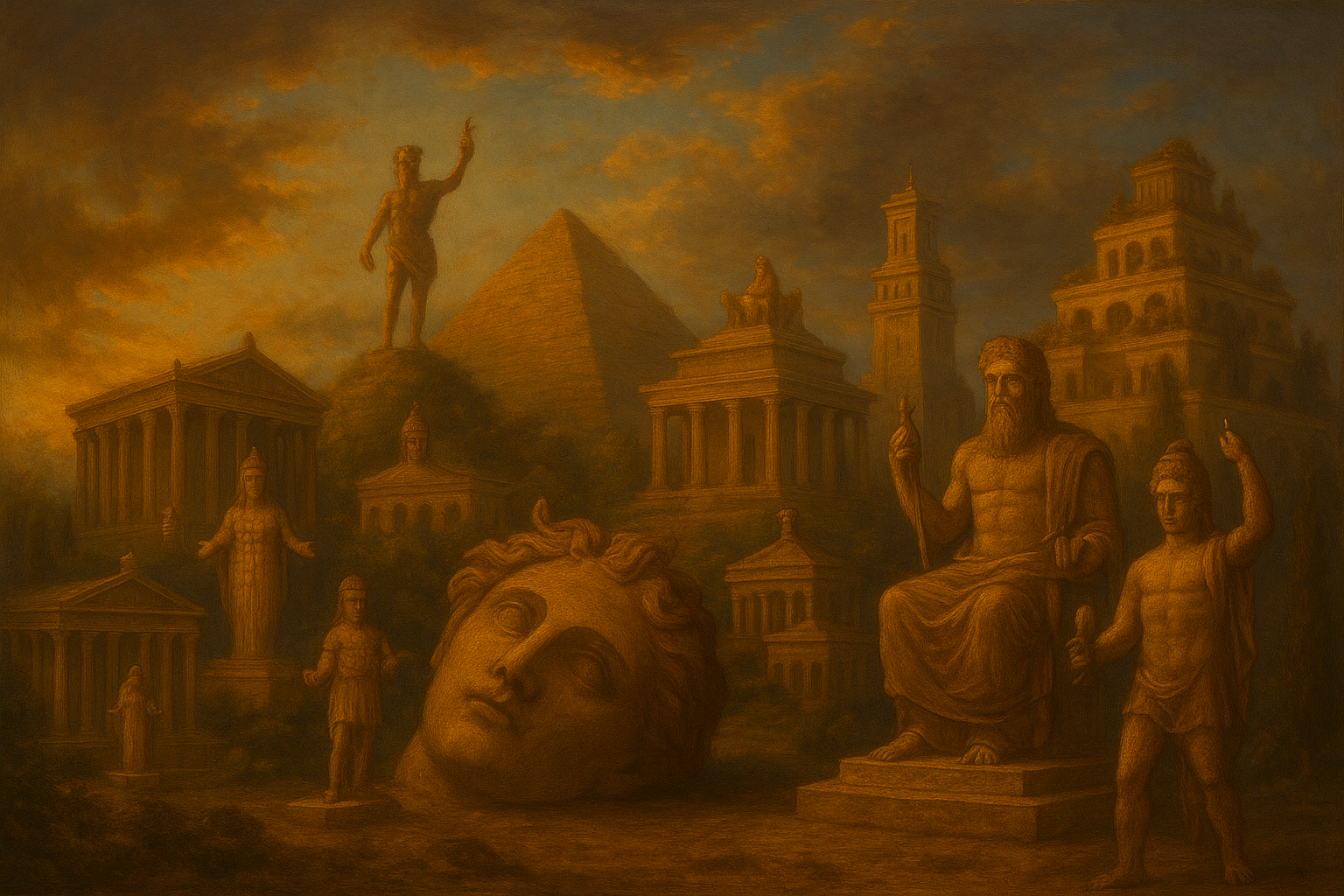
A collection of the Seven Wonders of the Ancient World, including the Pyramid of Giza, Mausoleum, Colossos, Hanging Gardens, statue of Zeus, Alexandria Lighthouse and Temple of Artemis at Ephesus

Quick — name the Seven Wonders of the Ancient World.

Struggling? You’re not alone.

Most people can’t list them all. Some guess the Colosseum or Stonehenge. Others don’t realize that only one still stands. 

These weren’t just impressive buildings and sculptures.

They were bold declarations of power — a Hellenistic highlight reel that reflected the ambition and reach of Alexander the Great’s world.

In her 2024 book The Seven Wonders of the Ancient World: An Extraordinary Journey Through History’s Greatest Treasures, historian Bettany Hughes peels back the mythology and reveals the politics, poetry and propaganda behind these wonders. These weren’t just impressive buildings and sculptures. They were bold declarations of power — a kind of Hellenistic highlight reel that reflected the ambition and reach of Alexander the Great’s world.

MORE: 3 Times Alexander the Great Wasn’t So Great

The oldest surviving version of the list was scribbled on a scrap of papyrus used to wrap a mummified body in Ancient Egypt. 

Most could be visited on a single, well-planned trip through the eastern Mediterranean. This was the ancient world’s first viral travel list — and its message was clear: Look upon our works, ye mortals, and marvel.
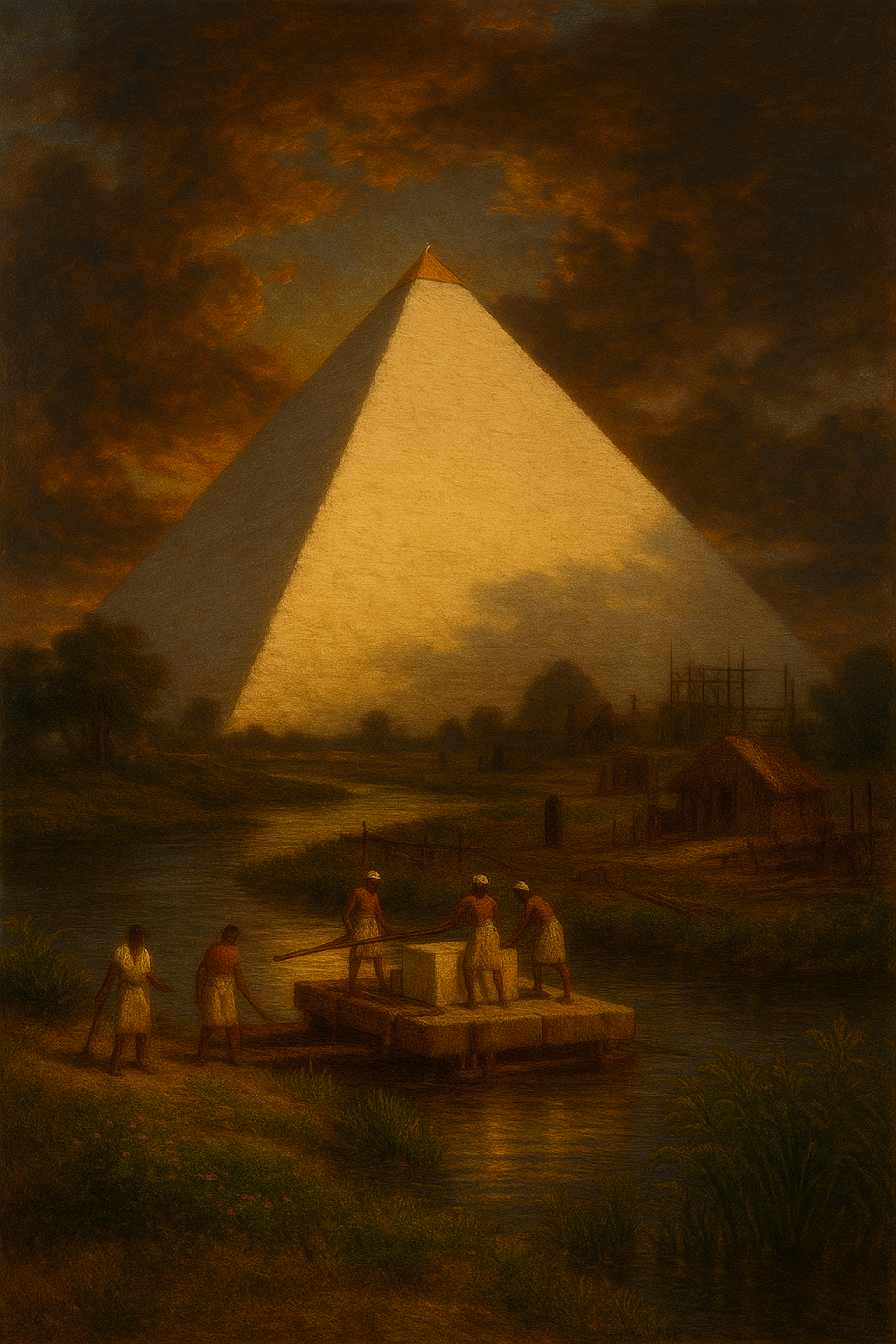
Workers transport limestone on the Nile to cover the Great Pyramid of Giza, seen with a metal capstone

1. The Great Pyramid of Giza: A Resurrection Machine by the Nile

If you visit the Great Pyramid today, you’ll likely see a heat-blasted monument rising from a stretch of ochre desert. But what if we’ve been picturing it all wrong? Hughes urges us to reimagine the Giza Plateau not as barren but as bursting with life: “Where we see desertion, imagine an abundance of clover and thousands of homes; where there are sands, waterways; where there is emptiness, tens of thousands of workers in loincloths and linen kilts. Where there are now neutral horizons, there was once hectic color; where piles of collapsed stone, dwarf-pyramids and sloping, mudbrick mastaba tombs. Where desert, gravid green.”

Built around 2550 BCE and once faced in polished white limestone, the Great Pyramid would have shimmered with a blinding brilliance. 

It wasn’t just a royal tomb; it was a “resurrection machine,” a literal launchpad to the afterlife. This machine served a higher cosmic purpose: to guarantee Egypt’s prosperity by ensuring the pharaoh’s rebirth. The fate of the world literally depended upon Khufu’s afterlife. 

And the engineering behind it still leaves modern minds gasping. Standing 480 feet tall and weighing in at roughly 6.5 million tons, the pyramid used about 2.3 million blocks of limestone, each hauled into place over a quarter of a century. Its interior space alone could swallow London’s St. Paul’s Cathedral, Westminster Abbey, St. Peter’s Basilica in the Vatican, and the cathedrals of Milan and Florence — with room to spare.

A historic etching of the construction of the Great Pyramid of Giza in Egypt, a Wonder of the Ancient World

Despite theories ranging from alien intervention to lost technologies, Hughes focuses on the human marvel of it all: tens of thousands of anonymous laborers working 10-hour days, 52 weeks a year, over decades — moving one block every two to three minutes. Current estimates suggest around 20,000 workers were active on the plateau at any given time, likely using a combination of sledges, rollers, ramps and perhaps even early hydraulic lifts. Still, the exact method remains elusive: “The engineering and construction of the Pyramid — the way these blocks were shaped, lifted and set in place — has confounded researchers for centuries, triggering miles’ worth of parchment and paper, and now volumes of iCloud storage,” Hughes writes. “It is a conundrum that obsesses the modern world — taxing the minds of engineers, architects, archaeologists, surveyors, even mediums.”

It’s also easy to forget that this was a riverfront wonder. In Khufu’s day, the Nile flowed much closer to Giza, hugging the Pyramid complex for most of the year, and sometimes lapping its very foundations. What we now see as isolation was once a place of movement and connection — a grand riverside attraction.

Capped with a golden or electrum pyramidion that caught the sun’s rays and hurled them back to the heavens, the Great Pyramid symbolized the original mound of creation — the divine moment when the world emerged from chaos. It was cosmic.
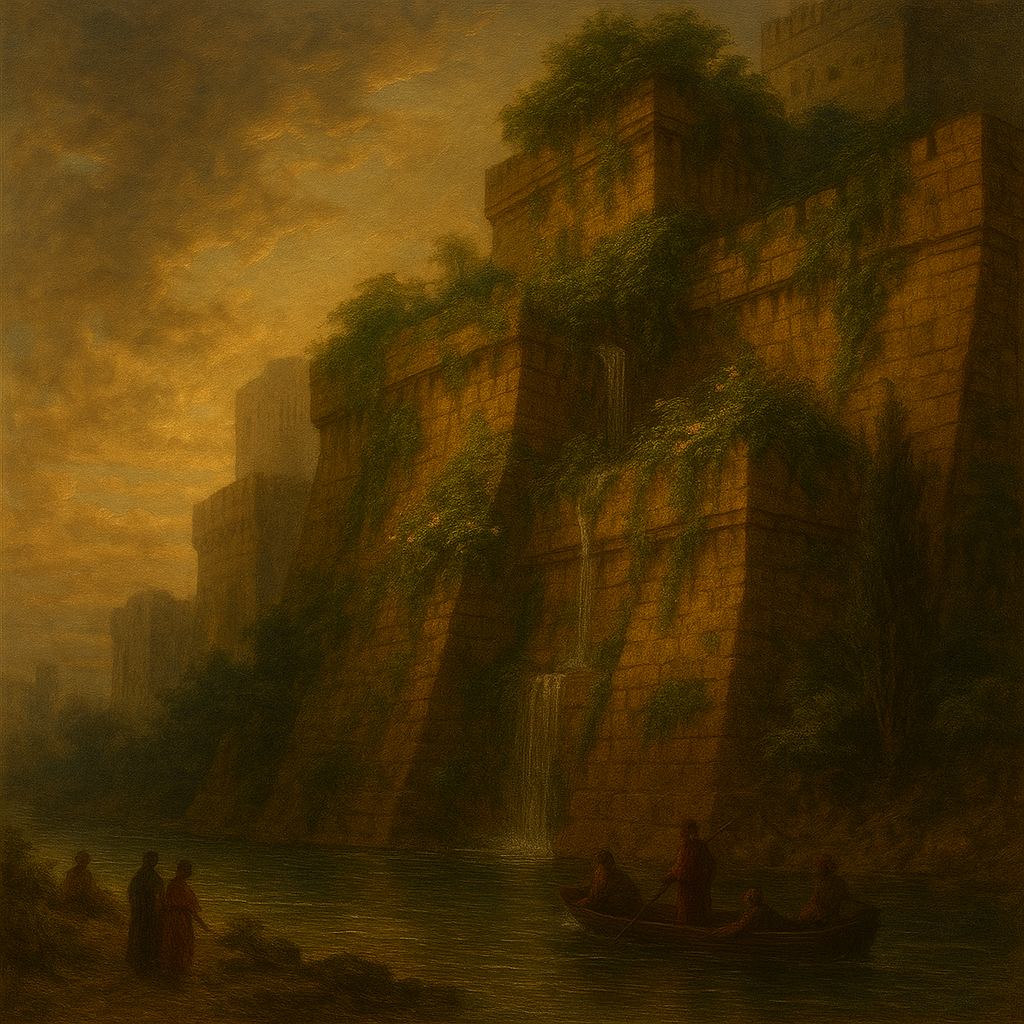
Greenery on the fortified walls known at the Hanging Gardens of Babylon, an Wonder of the Ancient World

2. The Hanging Gardens of Babylon: Myth, Monument or Mistranslation?

Of all the Seven Wonders, the Hanging Gardens of Babylon remain the most mysterious — and possibly the most fictional. Unlike the Great Pyramid, whose stones still scrape the sky, the Gardens leave us with no ruins, no universally agreed-upon site, and plenty of questions. Did they even exist?

If they did, the Hanging Gardens would have bloomed sometime in the 6th century BCE, during the reign of Nebuchadnezzar II — the great Babylonian king who ruled from 605 to 562 BCE and who is most often credited with their creation. That attribution, though, rests more on later tradition than contemporary evidence.

MORE: Nebuchadnezzar, King Josiah and the Formation of Jewish Law

And the evidence is where things get messy. Hughes lays out the problem clearly: Neither Herodotus nor Xenophon — Greek chroniclers who actually visited Babylon — mention the Gardens. Not once. That silence is thunderous. Even the East India House Inscription, a beautifully preserved 20-inch-wide slab chronicling the many accomplishments of Nebuchadnezzar II, makes no mention of them — no garden at all, hanging or otherwise.

So what gives?

Hughes suggests we may be looking for something too specific. What if the gardens weren’t separate from Babylon’s famed walls but were part of them — verdant terraces that flowed from the fortifications and palatial structures themselves? In many ancient lists, it’s actually Babylon’s walls that earn the “Wonder” designation, not the elusive Gardens. That ambiguity raises the possibility that what we now call the “Hanging Gardens” may have been a poetic misunderstanding — a mistranslated marvel.
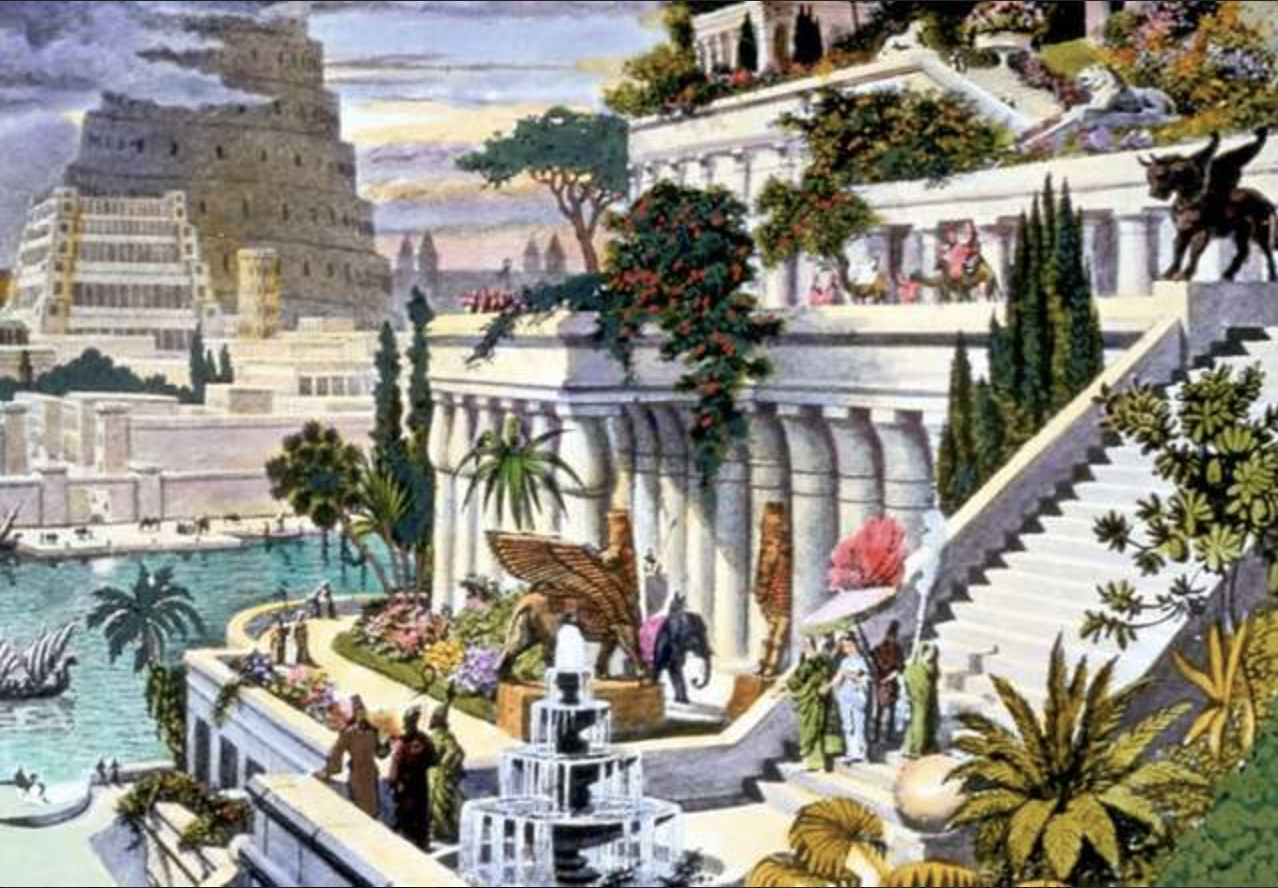
The Hanging Gardens of Babylon, with the Tower of Babel in the distance

And yet, the idea of the Gardens persists — not just because they would’ve been beautiful, but because they captured something deeper and darker about humanity’s emerging relationship with nature. These were not serene rooftop retreats. They were feats of engineering and control, power disguised as paradise.

“Whatever they were, however wondrous, the Hanging Gardens of Babylon would not have been idylls,” Hughes writes. “They would have been exquisite, exacting expressions of potency, expressions of belief, manifestations of ingenuity and the start of a dangerously dominating relationship with the natural world.”

Whether built in Babylon or borrowed from memories of Nineveh, the Hanging Gardens endure because they symbolize an idea: that nature could be bent into spectacle. And that idea, as Hughes suggests, has echoed through every empire since.
MORE: Controversial Theories About the Tower of Babel

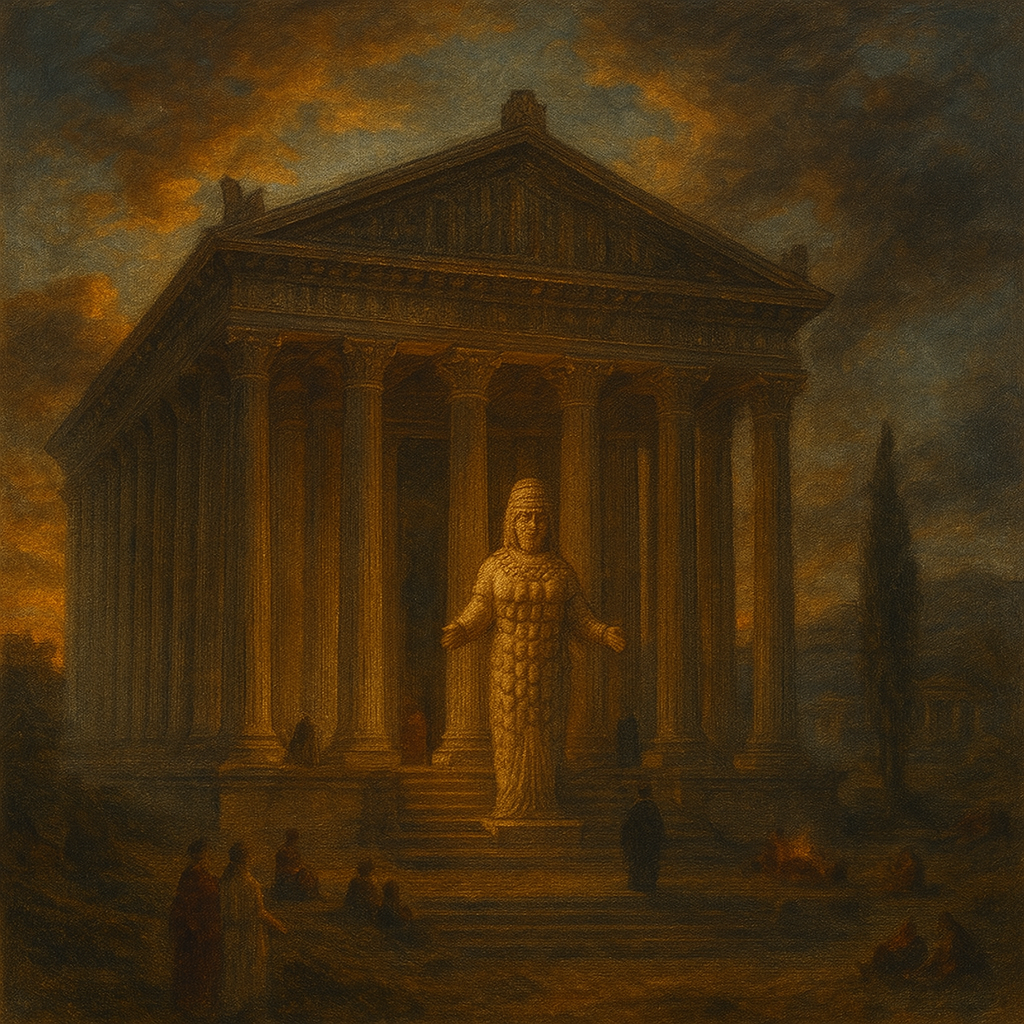
A multi-breasted statue of Artemis stands in front of her Temple at Ephesus, a Wonder of the Ancient World

3. The Temple of Artemis at Ephesus: Sanctuary of Stone and Wildness

Of all the ancient world’s architectural achievements, none left the poet Antipater of Sidon more breathless than the Temple of Artemis. Around 140 BCE, he wrote, “I have set eyes on the very wall of lofty Babylon, supporting a chariot road, and the [statue of] Zeus by the Alpheios [in Olympia], and the Hanging Gardens, and the Colossus of Helios, and the huge labor of the steep pyramids, and the vast tomb of Mausolos; but when I saw the temple of Artemis, reaching up to the clouds, these other marvels dimmed, they lost their brilliance, and I declared, ‘Look, apart from Olympus itself, the sun has never shone on anything that can compare to this!’”

Constructed around 550 BCE and rebuilt in grander fashion after a devastating fire in 356 BCE, the Artemision — as it was called in classical sources — was the first of the Seven Wonders to be accessible to all people, not just royalty. And it was the only one where women, both mythic and mortal, stood at the center of its story.

The original temple was incinerated on a sweltering July night — the very night Alexander the Great was born. In fact, the Greek world couldn’t help but connect the two events: “Tongues wagged: Artemis — goddess of nature and childbirth — it was whispered, was so busy in northern Greece, super-birthing a world-class megalomaniac, she neglected her earthly temple home,” Hughes writes. 

MORE: Alexander the Great: 8 WTF Facts About His Early Life

The arsonist was a man named Herostratus, likely a desperate slave who torched the temple to immortalize his own name — and, ironically, succeeded. The Ephesians tried to erase him completely. Speaking his name was made a capital crime. But history, being what it is, remembered him anyway.

The rebuilt temple was a marvel: 425 feet long, 225 feet wide — nearly twice the size of the Parthenon that would follow it 150 years later. It featured 127 columns, each 60 feet high, and some capped by a skylight above the central cult statue. The structure marked the first true colonnaded Greek temple, laying the architectural blueprint for millennia to come.
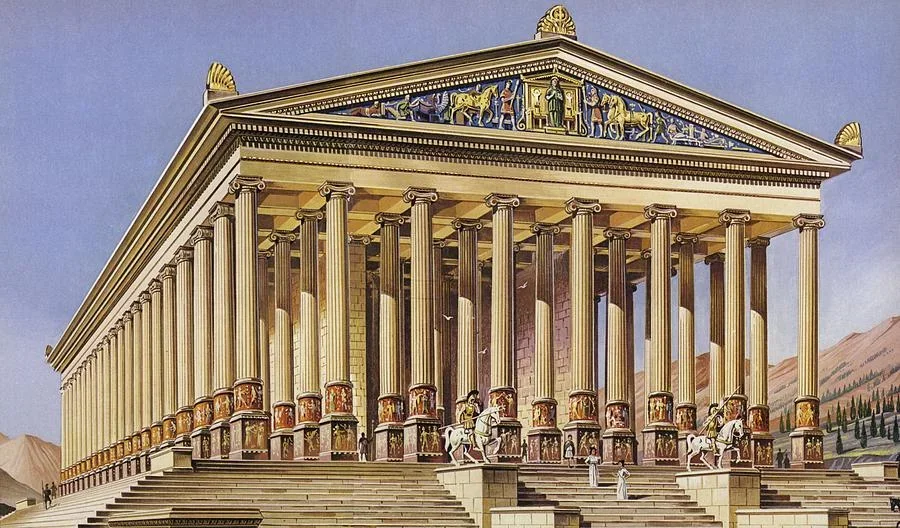
The Temple of Artemis at Ephesus, with painted column bases and frieze at the top, a Wonder of the Ancient World

Here, Artemis wasn’t the graceful huntress of Louvre sculptures. She was Asiatic Artemis, a wild guardian of beasts, bearing the mystery and fertility of the Earth. She was a goddess of contradictions — pure yet primal, distant yet intimately present.

“Artemis in the mythology of the Greeks was an unusual goddess, a female figure who stood apart from the rutting sexuality that was the norm of ancient life and myth,” Hughes writes. “The story went that on the eve of her wedding, Artemis begged her father Zeus to allow her not to marry. In most cultures at this time, women were controlled, either by having to have sex, or by not being allowed to. Artemis’s agency, and her choice, makes her attractively odd. She was a virgin, whose sphere was consummation.”

Her image, kept hidden behind a curtain in the sanctuary, was likely a wooden plank known as a xoanon — treated as a living being. It was washed in seawater, anointed in fig milk or grape juice, adorned with clothes and gold, and lovingly cared for in a process called kosmeis — the root of our word cosmetics.

The cult of Artemis was largely female-led. Young women, or parthenoi, took part in the rites. But the high priests — the megabyzoi — were eunuchs, men who had castrated themselves in service to the goddess. Their female counterparts, the melissae, were the “honey women,” underscoring the deep associations between Artemis, fertility and nature’s sweetness.

Ephesus itself had become one of the largest and busiest cities in the ancient world, its port capable of hosting over 800 ships. That accessibility helped the temple’s fame spread far and wide. It was a religious sanctuary, a political hub and — crucially — a bank. Like many temples of the time, it safeguarded vast stores of wealth and knowledge. To violate the temple was to risk divine wrath.

The mythic presence of Amazons — female warriors who were said to have founded the site — was inescapable. Their likenesses adorned the temple’s façade, doorframes and rooftop sculptures. Bronze statues of Amazons stood with short chitons, bare breasts, crescent shields and battleaxes — some even depicted with wounds.

“The Temple of Artemis is a Wonder with diverse genetic makeup and influences from both East and West within its deity, its design and its dogma,” according to Hughes. “It is a work of mankind, trying to understand the power of the natural world and the power of women.”

And Artemis herself? Her statue was encrusted with bees, lions, griffins, cows, horses and sphinxes — a tapestry of creatures and symbols. Her front was thick with mysterious swellings: ostrich eggs? Pollen sacks? Breasts? Testicles? Bags of gold? The goddess resisted definition. She contained multitudes.

Topping her cylindrical polos crown was an image of the temple itself. A shrine of power, mystery and the wild feminine, the Artemision stood as a defiant celebration of life’s most primal forces.
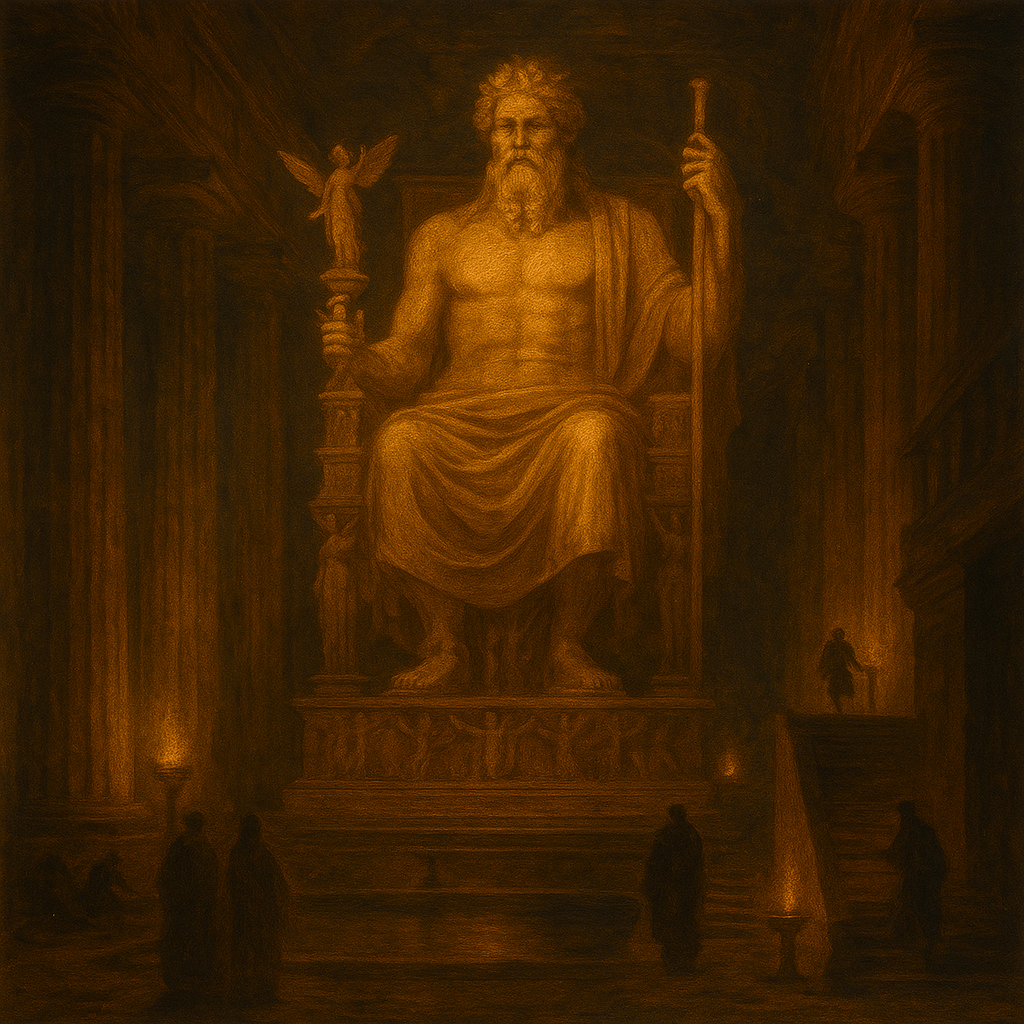
The massive seated statue of Zeus in his temple in Olympia, holding Winged Victory in one hand and a staff in the other

4. The Statue of Zeus at Olympia: God Made Monument

Epictetus, a Stoic philosopher, captured just how beloved the Statue of Zeus had become by the 1st century CE: “The wish to witness the ancient masterpiece of Phidias was so intense, that to die without having seen it was considered a huge misfortune,” he wrote in Discourses

The statue of Zeus at Olympia glowed with godly gravitas inside the sanctuary’s darkened temple. A creation of the sculptor Phidias, it was a divine father made colossal: Zeus, King of the Gods, father of Artemis and Apollo, products of the rape of the titaness Leto. The statue wasn’t meant to comfort. It was meant to awe.

“Of course, in a place where men were attempting to become godlike, the ultimate god took the form of the ultimate man,” Hughes writes. 

Built between 438 and 430 BCE, the statue was made of the most extravagant materials available: gleaming hippopotamus ivory for skin, gold for hair and beard, ebony, bone, polished stone and glass. 
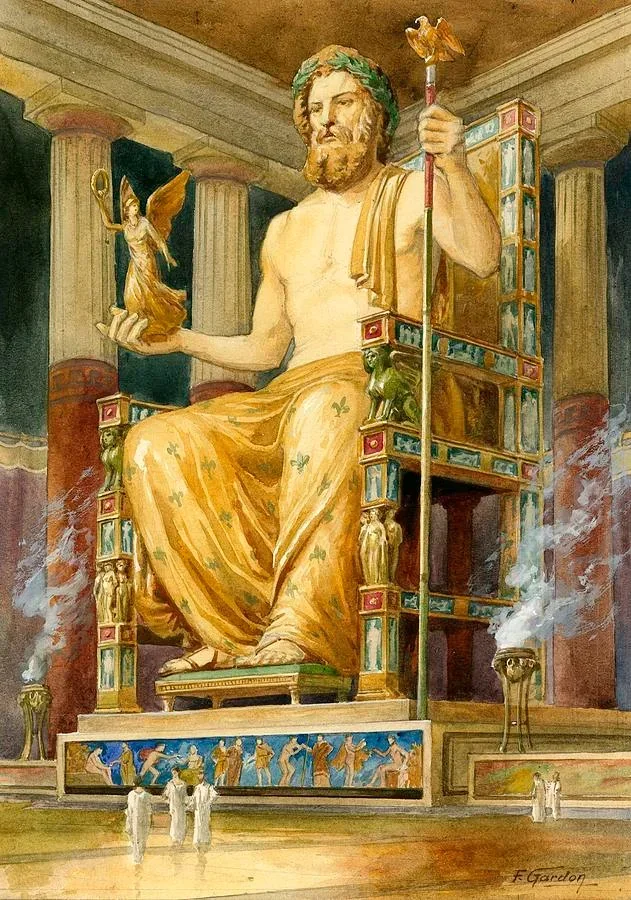
The giant statue of Zeus at Olympia, a Wonder of the Ancient World

“Measuring the size of a three-story home (41 feet, on his pedestal rising over 44 feet tall), and yet seated, crouching, with his head skimming the ceiling, like Alice in Wonderland after taking her Drink Me spiked potion, the godhead must have seemed extraordinarily intimidating,” Hughes adds. “It was said that if he stood up, this Zeus would ‘unroof’ his temple-home.”

The throne featured six statues of Nike, the goddess of victory, marching up the legs. The arms of the seat were sobering sphinxes. The struts featured Herakles slaughtering Amazons to seize their queen’s girdle. The side panels showed Artemis and Apollo massacring Niobe’s children for her pride. And at Zeus’s feet? A stool supported by snarling lions — another Amazonian battlefield carved beneath.

“The message was clear: Olympia, and its Holy of Holies were, in every sense, somewhere that weakness was abhorred, for Zeus’s domain, there were only winners and losers,” Hughes explains. 

In Zeus’ right hand stood a 6-and-a-half-foot statue of Nike, also made of ivory and gold. In his left: a scepter topped by a gleaming eagle. His hair curled in heavy golden locks onto his shoulders, while his ivory skin was oiled daily to prevent cracking in the damp climate. That oil pooled in a limestone basin at his feet — creating a dark twin of the god.

The temple that housed Zeus at Olympia was a masterpiece of Doric architecture, designed by Libon of Elis and completed in 456 BCE with the spoils of war. Zeus’ likeness, modeled after Homer’s verses in The Iliad, captured the very image of cosmic authority. It was said Zeus could start an earthquake just by furrowing his brow. 

A wooden framework supported the ivory plating, carefully soaked in vinegar and sculpted into seamless sheets. Recent research by Kenneth Lapatin confirms the intricacy of this process — and the ingenuity of the ancients who achieved it.

When Roman Emperor Caligula ordered the statue’s decapitation in 41 CE so he could replace the god’s head with his own, Zeus reportedly laughed. The scaffolding collapsed, and days later, Caligula was assassinated — after having dreamed of the deity he sought to deface.

After standing for nearly 1,000 years, the statue was eventually moved to Constantinople, where it burned in a city-wide fire around 476 CE. Olympia’s pride, a masterpiece honored for generations, was reduced to ash.

And yet, Zeus lived on — not just in memory, but in iconography. The Byzantine depiction of Christ Pantokrator, “Ruler of All,” seated on a throne with glowering brow and commanding presence, bore a striking resemblance to Phidias’s Zeus. The divine father had been reborn.
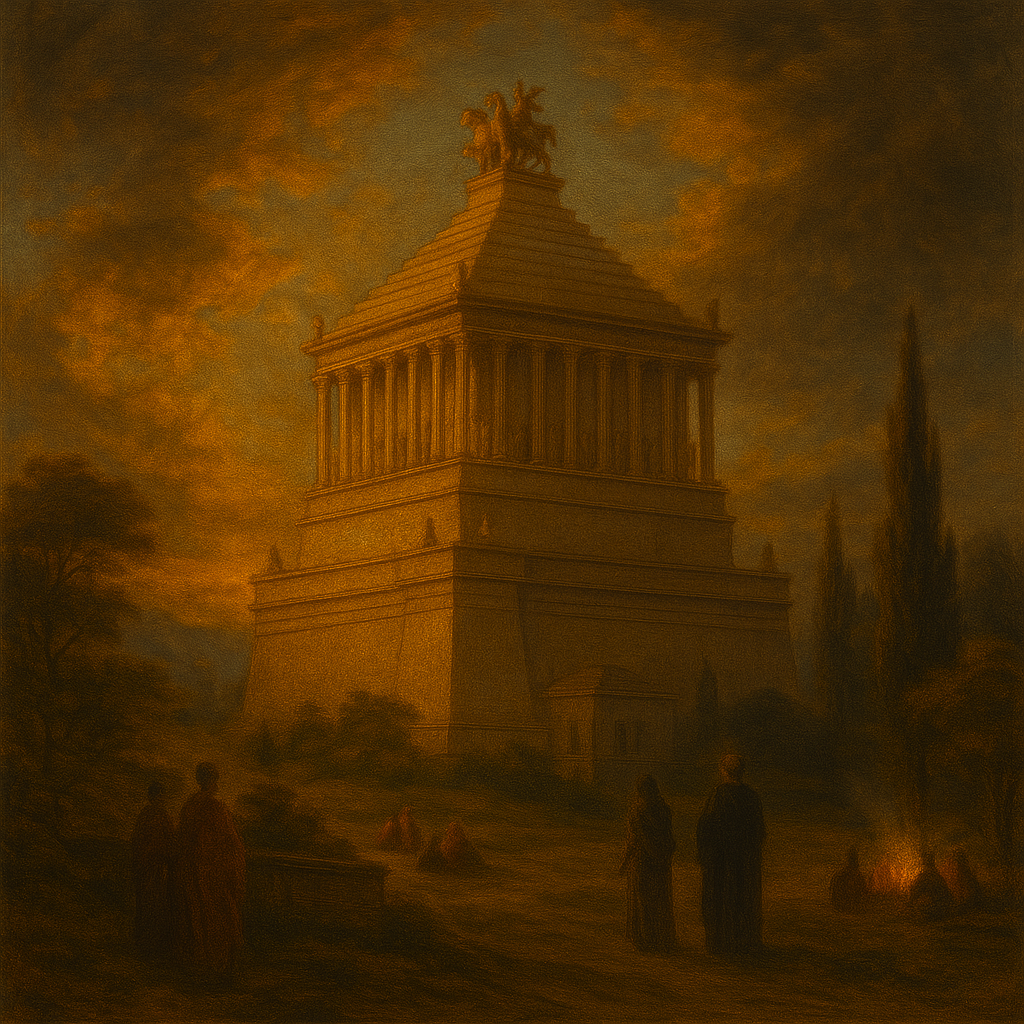
The impressive Mausoleum of Halikarnassos, with a large base, a temple-like structure, stepped pyramid and chariot on top

5. The Mausoleum of Halikarnassos: A Monument to Power, Grief and Glittering Excess

It was a tomb so grand it gave its name to every monumental tomb that followed. But the Mausoleum of Halikarnassos — final resting place of Mausolos, satrap-king of Karia — wasn’t just massive. It was mesmerizing. A collision of Greek elegance, Persian grandeur and Anatolian symbolism, built between 361 and 351 BCE on the sun-soaked coast of modern-day Turkey.

This Wonder fused the influences of East and West: Ionian and Doric architectural styles mingled with the dramatic scale and symmetry of Persian rock-cut tombs. Hughes notes that Karia, the region where Halikarnassos sat, was a culture of blendings — borrowing, reimagining and innovating in equal measure. And the Mausoleum was its masterpiece.

“This giant tomb came to be thought of as wonderful because it was trumpeted as embodying a faithful woman’s selfless devotion to her husband-brother, a sign that the brilliance of some men is to devastate women by dying,” she writes. 

Indeed, much of its fame came from the story of Artemisia II, Mausolos’ sister and wife, who reportedly grieved so hard she mixed his ashes into her wine. But beneath the romance lay a structure of staggering ambition: a 145-foot-tall marble confection built atop a limestone terrace stretching over 785 feet — about half the height of Big Ben, and nearly the length of two football fields.
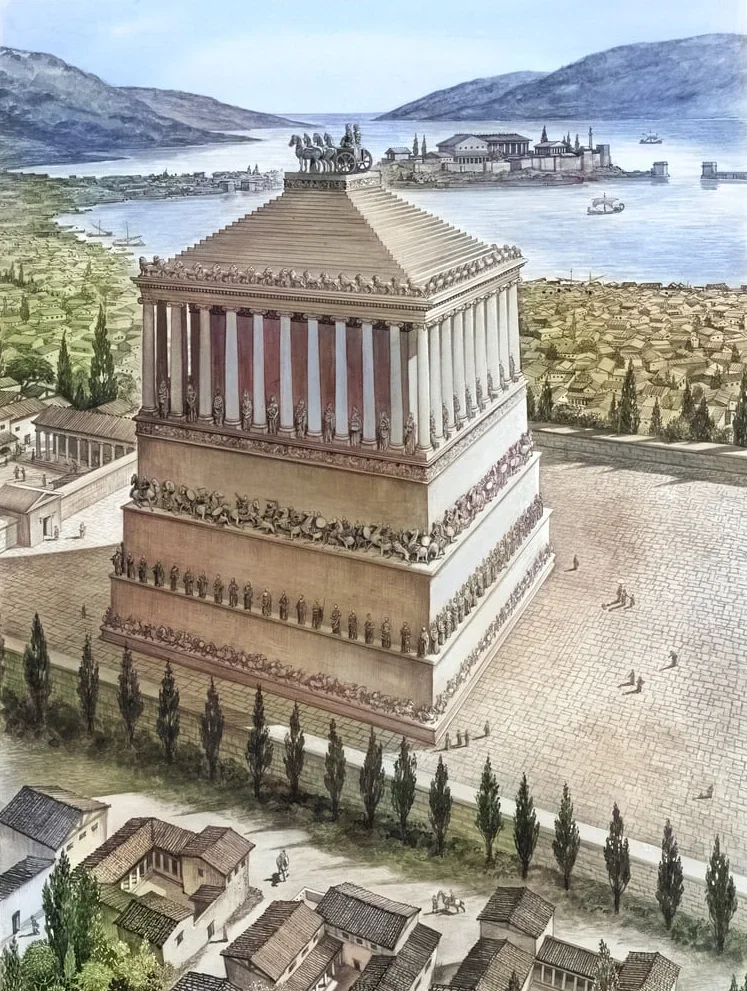
The Mausoleum of Halikarnassos by the water, a Wonder of the Ancient World

The base consisted of a rectangular podium roughly 100 by 125 feet wide. Above that, 36 columns ringed the structure, echoing the layout of the Temple of Artemis. On top of the colonnade rose a stepped pyramid of 24 tiers, leading to a grand pedestal. And at the very top? A chariot drawn by four thrashing horses, almost certainly carrying statues of Mausolos and Artemisia themselves — a couple who have been put quite literally on a pedestal.

Designed by architect-sculptor Pytheos and possibly other elite artists of the day — Scopas, Bryaxis, Leochares and Timotheus among them — the Mausoleum was both a sculpture gallery and a piece of architectural theater. Its blocks were polished to a glass-like sheen. Carvings depicted Mausolos hunting, receiving ambassadors, honoring the gods and leading battles — scenes real and imagined. Life, as Mausolos wanted it remembered, in full pageantry. 

We tend to think of ancient structures as white, but many were actually a riot of color — and the Mausoleum certainly was. “Funerary monuments in particular favored color — there was a sense that the polychrome experience brought the dead back to some kind of life,” Hughes informs us. “Mausolos’ tomb would have been a firework in the sky.”

And what fireworks: white marble, then bluish limestone adorned with over 120 human and animal figures — all progressing toward a seated Mausolos before a great doorway. Was this his entrance to the afterlife? Above this level, imported white marble from Athens depicted brutal battle scenes, including — once again — Amazons, a recurring motif in Wonder architecture.

A ring of lions likely prowled the pyramid’s base. The decorative program celebrated domination, but also wildness and ritual. Priestesses in clinging, diaphanous dresses, their bodies visible beneath the folds, hint at ecstatic Bacchic rites. 

Skulls unearthed at the site suggest mass animal sacrifice during the burial — a slaughter of sheep, oxen, lambs, birds. Where now there are thistles and butterflies, there were once streams of blood.

Threads of gold found among the ruins may have once wrapped the king’s cremated remains. 

A spring near the site was famed in antiquity for its uncanny power to make men infertile or effeminate. That same spring inspired Ovid’s tale of the creation of Hermaphrodite: the son of Hermes and Aphrodite, lured into its waters by a nymph, merging into one being of two sexes.

The Mausoleum was a place where myth, sex, sacrifice, politics and grief all coalesced. A wonder of death, yes — but pulsing with the messy, lavish power of life.
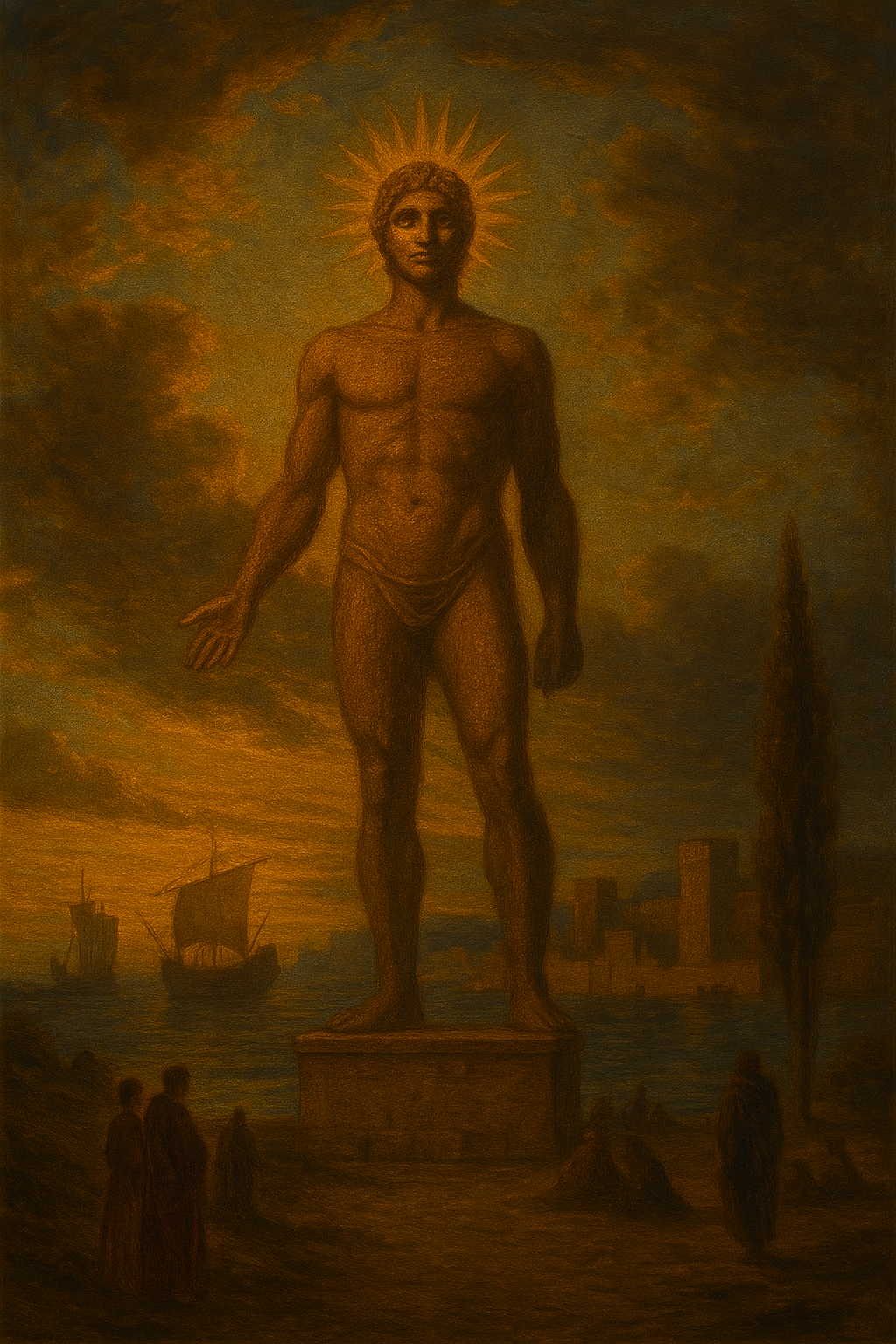
The giant statue of the Colossus of Rhodes, a sun god rising above the island's port

6. The Colossus of Rhodes: Bronze Giant, Fallen God

The Colossus of Rhodes is perhaps the most misunderstood Wonder. Popular imagination has long insisted it stood legs astride the harbor entrance, torch in hand, as ships passed beneath. But that towering figure, feet apart across a 390-foot waterway, is pure fantasy — a medieval myth that held the world’s imagination hostage for 800 years. (It even inspired the Titan of Braavos in George R.R. Martin’s Game of Thrones.)

In reality, the Colossus never straddled the harbor. It likely stood higher up, on the city’s acropolis, towering above the bustling port of Rhodes. This was Helios — the pre-Olympian sun god — cast in bronze and iron, gleaming in the Aegean light.

Standing an estimated 108 feet tall, the statue was a staggering feat of ancient engineering. Built in the early 3rd century BCE and completed around 280 BCE, it had a skeleton of iron and a polished bronze skin. Just one of its digits — a single toe, say — was said to be larger than most full-sized statues.
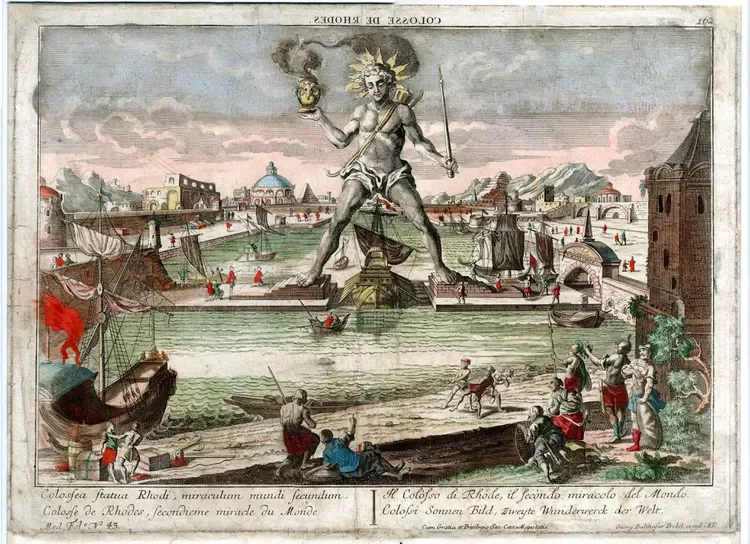
The Colossus of Rhodes, a Wonder of the Ancient World, seen straddling the harbor

Unlike Zeus’ patriarchal presence, Helios pulsed with youthful ambition. “Whereas the Zeus at Olympia thundered, his luxurious beard the signifier of a mature man in Greek culture, Rhodes’ Wonder, the un-bearded, tousled, soft-lipped Helios, had the dangerous energy of a young, unpredictable man poised to do great things,” Hughes writes. 

And given the era, it’s hard not to see the influence and inspiration of Alexander the Great in the statue’s features and commanding pose. Rhodes had resisted a siege by one of Alexander’s successors — and the Colossus was both a victory monument and a symbol of sun-blessed resilience.

Kolossos is a Greek word — possibly of Asiatic origin — that originally meant simply “statue.” But this statue rewrote the definition. It was never just a likeness. It was legend in metal, a city’s pride forged into form.

“This was a wonder that became legendary within weeks of its completion,” Hughes says. 

Created by the sculptor Chares of Lindos — and possibly influenced by the legendary Telchines, mythical inventors of metalwork — the statue took 12 years to complete. It was cast in sections, working from the feet upward. Each foot stood on a marble plinth around 60 feet wide and 10 to 15 feet thick.

And then it fell.

Around 227 BCE — just 60 or so years after it was completed — a devastating earthquake struck Rhodes. The city walls crumbled, the coastline dropped by 3 feet, and the Colossus came crashing down. It broke at the knees and was never re-erected. 

The fragments, enormous and awe-inspiring, lay scattered for centuries — longer than the statue ever stood. According to later sources, the tumbled Helios remained visible until the 7th century CE, when its remains were finally melted down for scrap. So much for immortality.

And that legend has never quite gone cold.
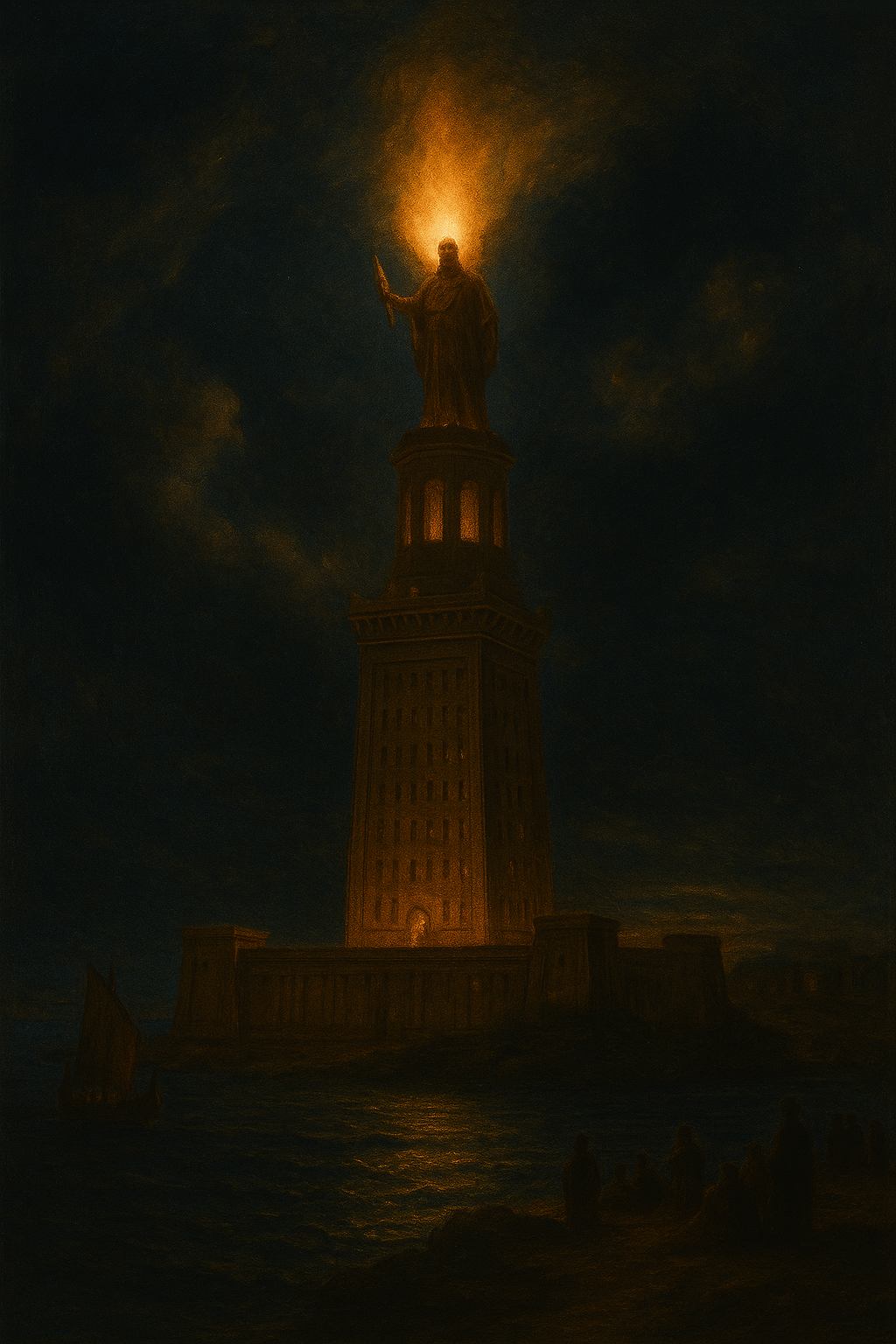
The Lighthouse of Alexandria, a Wonder of the Ancient World, at night, ablaze and topped by a statue of Zeus

7. The Lighthouse of Alexandria: Fire, Mirrors and the Edge of the World

Unlike the short-lived Colossus of Rhodes, the Lighthouse of Alexandria stood tall for over 1,500 years — a marvel of geometry, ingenuity and sheer ambition. Built beginning around 297 BCE and completed over the course of 15 years, this towering wonder rose more than 400 feet above the bustling twin harbors of Alexandria, Egypt, making it the second tallest structure in the ancient world after the Great Pyramid.

It was astonishing. A stacked sequence of geometric forms — square, octagonal, circular — constructed from marble and local limestone, sheathed in red granite shipped down the Nile from the scorched quarries of Aswan. Some blocks stretched 36 feet long and weighed 75 tons. The tower was crowned with a 50-foot statue, almost certainly of Zeus Soter (Zeus the Savior), watching over the seas like a divine lighthousekeeper.

Its beacon could be seen for over 37 miles — a flaming furnace at night, and during the day, sunlight reflected off massive copper mirrors. It was both a feat of engineering and a performance of cosmic authority. Ships approaching Alexandria’s treacherous coast — battered by crosswinds, stalked by hidden rocks — were guided by this shimmering sentinel, the Pharos.

It was built of red granite, which is usually a dull pink, but could turn an iridescent purple  in desert light. “The ancients must have believed red granite brought with it some kind of sorcerer’s power,” Hughes muses. 
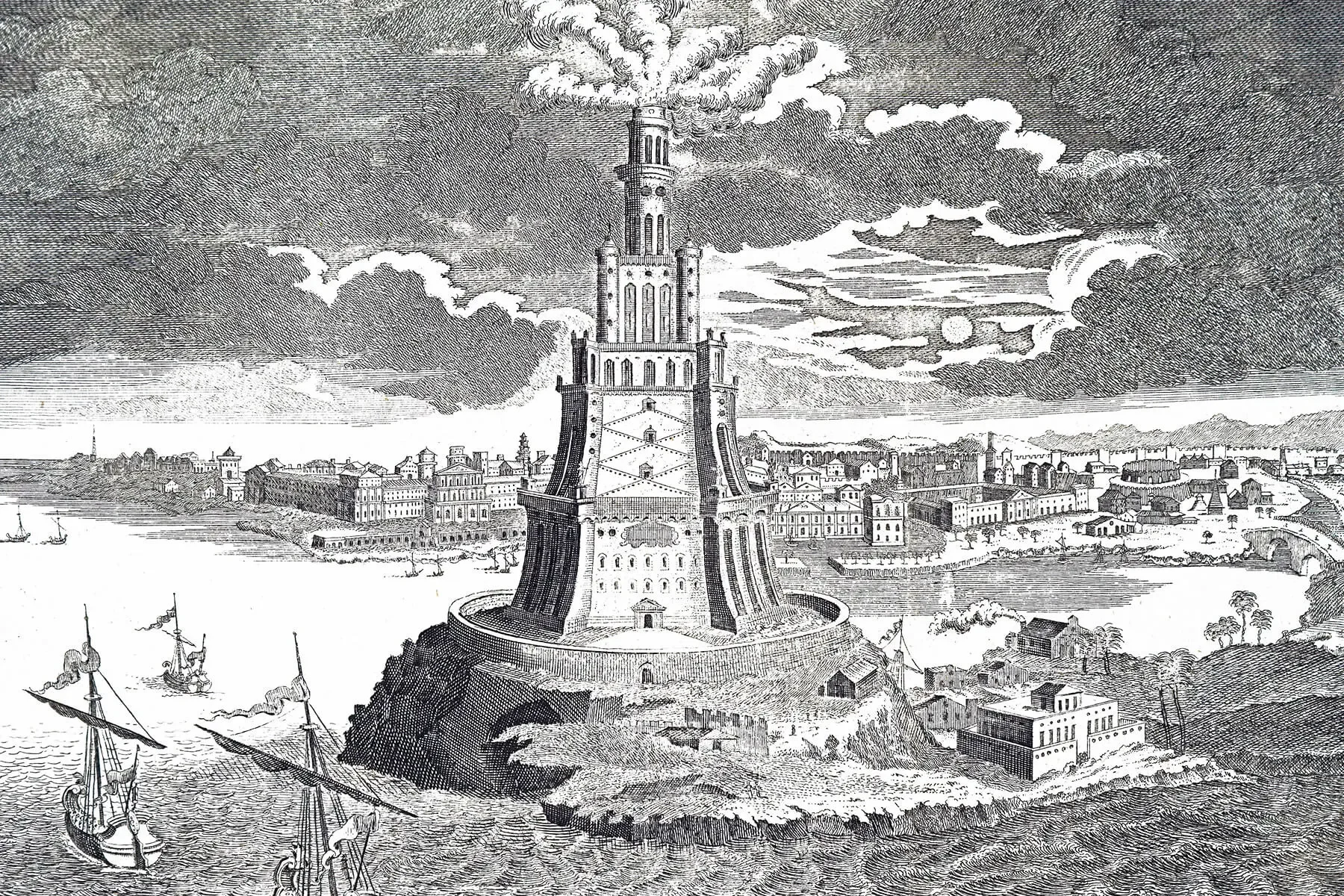
An engraving of the Lighthouse of Alexandria in Egypt, a Wonder of the Ancient World

The tower’s structure was just as beguiling: a 1,115-by-1,115-foot base with fortified brick walls and turrets; an interior ramp and hoist system to ferry fuel and supplies; and an eight-sided middle tier symbolizing the compass winds. Above that, a cylindrical chamber topped with the beacon — perhaps powered by naphtha and papyrus, possibly attended by pack animals climbing in pairs.

And the Pharos wasn’t just a lighthouse. It was also a proto-telecom tower, using flashing heliography — ancient Morse code — and possibly even mechanical sound effects. Sculpted Tritons (half-man, half-fish) stood around the structure, possibly blowing horns that served as early sirens, ancient animatronics that altered the city in times of danger.

The lighthouse was initially funded by Ptolemy I — one of Alexander the Great’s most successful generals — and completed under his son, Ptolemy II. It cost an estimated 800 silver talents — over $19 m

illion in today’s money. Built on the island of Pharos, which would lend its name to the structure and eventually become the word for “lighthouse” in multiple languages, the monument embodied Ptolemaic power and vision. It was a glowing stake in the sand, declaring Alexandria the gateway between Africa, Asia and the Mediterranean world.

And for centuries, it worked.

Until 1303 CE, when the Earth shook. An earthquake finally toppled the Pharos, reducing it to ruins and ending one of the longest-standing Wonders of the Ancient World.
MORE: The Major Egyptian Gods and Goddesses

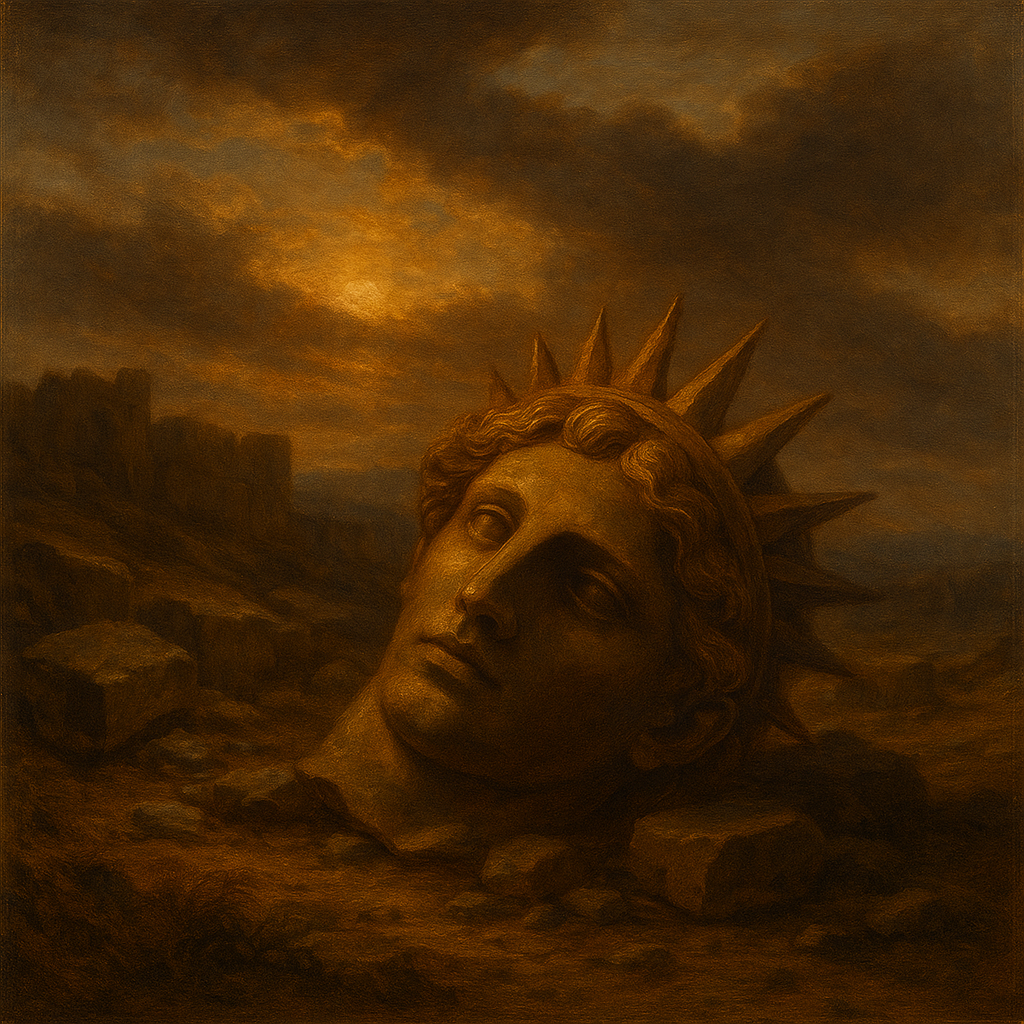
The head of the Colossus of Rhodes has fallen off and lies on the ground

Why the Seven Wonders of the Ancient World Still Matter

All but one of the original Seven Wonders may be long gone — toppled by earthquakes, scavenged for scrap, or buried beneath centuries of sand and myth. But as Hughes makes clear, their true legacy is that they weren’t simply monuments to kings or gods. They were monuments to us — to human ambition, ingenuity, imagination and the drive to build something bigger than ourselves.

The list was specific, political, proudly Hellenistic — showcasing a curated world seen through Greek eyes in the wake of Alexander the Great. And yet, the idea of a Wonder has endured far beyond its original moment.

“Wonders serve a rich triple purpose,” Hughes writes. “They were constructed partly to feed our need for wondrous tales — to experience and talk about the biggest, the best, the tallest, the most strange, the most bold. They encourage a saturation in the now, by submitting to a present, pure sensation of wonder. They remind us of our overwhelming desire to collaborate to create beyond the possibilities of the individual.” 

Even today, the concept of a “wonder” still fuels our storytelling, our bucket lists, our skyscrapers and our sci-fi dreams. Because deep down, we’re still looking to be amazed. Still looking to build what seems impossible. Still wondering. –Wally

MORE: What Was Daily Life Like in Ancient Egypt?

The Creepiest Places to Visit in the United States

From a haunted prison to a hotel with its own morgue, here are five terrifyingly popular U.S. destinations for ghost hunters, thrill seekers and paranormal tourists.

Dilapidated crumbling hallway in the Eastern State Penitentiary in Philadelphia

Eastern State Penitentiary in Philadelphia, where solitary confinement originated

For those of us who like our vacations with a side of dread, the U.S. has you covered. Cursed plantations? Check. Derelict prisons? Yep. A floating hotel with a body count? You bet. These are the kinds of places where whispers echo in empty rooms, photos blur for no reason, and something unseen always seems to tug at your shirt.

Whether you’re a seasoned ghost hunter or just want to say you slept in the most haunted hotel in America, these are the must-visit spots that will make your heart race — and maybe stop.

1866 Crescent Hotel & Spa in Eureka Springs, Arkansas

1866 Crescent Hotel & Spa in Eureka Springs, Arkansas

Where the cancer cures were fake, but the bodies were real.

Originally built in 1886, the Crescent Hotel started as a luxury resort — and quickly spiraled into something much darker. After a short-lived first act, it was purchased in 1937 by Norman Baker, a con artist who turned the building into a sham cancer hospital. He operated without a license, performed grotesque procedures, and stored bodies in a basement morgue that still exists.
Women in white dresses and hats stand on the steps of the 1866 Crescent Hotel & Spa in Eureka Springs, Arkansas when it was a college for women

Back when the property was the Crescent College for Women

Guests and ghost hunters report sightings of Baker himself, nurses in old-timey uniforms, and figures wandering the halls at night. Want proof? You can join nightly ghost tours that take you to the most haunted corners of the property — including Baker’s old morgue.

1886 Crescent Hotel & Spa
75 Prospect Avenue
Eureka Springs, Akansas​

The castlelike Eastern State Penitentiary in Philadelphia, Pennsylvania at twilight

Eastern State Penitentiary in Philadelphia, Pennsylvania

Solitary confinement never really ends … if your ghost sticks around.

Once home to over 85,000 inmates — including Al Capone — this Gothic fortress pioneered solitary confinement, which sounded humane in theory and turned out to be more of a psychological torture chamber. The prison operated from 1829 to 1971 and is now a National Historic Landmark.

Historic photo of a worker standing in a cellblock of Eastern State Penitentiary in Philadelphia, Pennsylvania

Its crumbling halls, rusted doors and echoing cellblocks give off a presence that’s hard to ignore. Visitors report disembodied voices, cell doors slamming on their own, and shadowy figures pacing inside locked cells. Cellblock 12 and the guard tower are said to be the most active — if you believe in that sort of thing. And even if you don’t, you’ll probably walk faster through them.
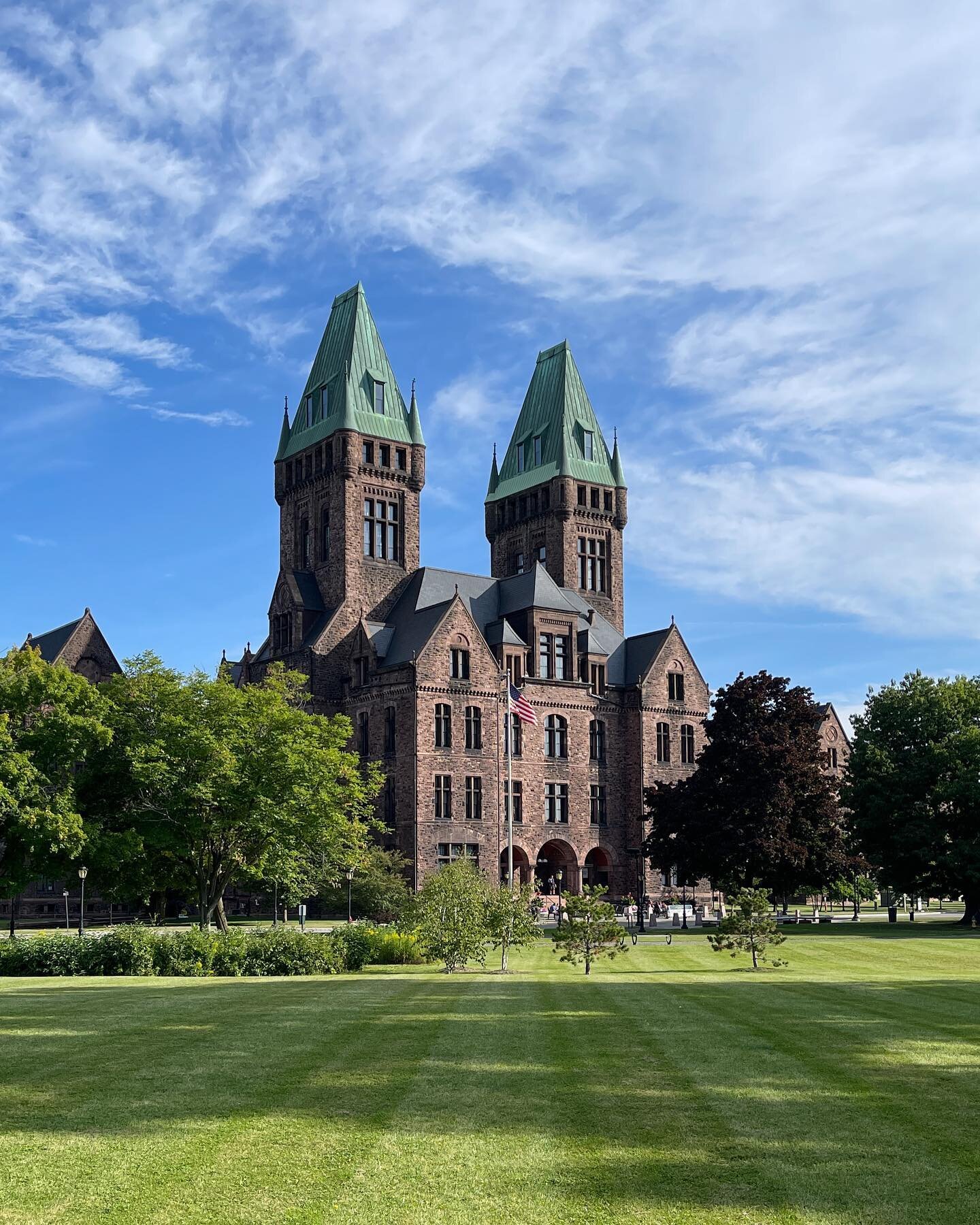
Sounds a bit like the derelict insane asylum attached to the Richardson Hotel in Buffalo, New York, which is also worth touring. 

If you’re also going to Pittsburgh, be sure to creep yourself out at Trundle Manor

Eastern State Penitentiary
2027 Fairmount Avenue
Philadelphia, Pennsylvania

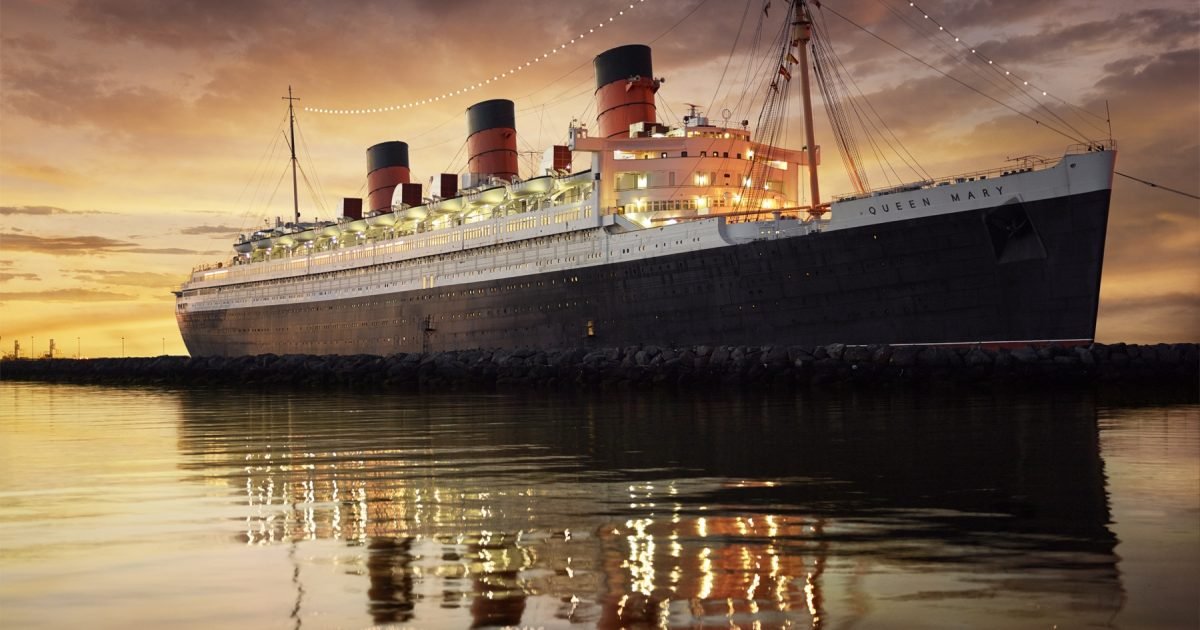
The ocean liner Queen Mary in Long Beach, California at sunset

The Queen Mary in Long Beach, California

All aboard — for a cruise you’ll definitely want to disembark from.

This ocean liner hosted royalty, celebrities and WWII troops — and now ghosts. Docked permanently in Long Beach, the Queen Mary is considered one of the most haunted ships in the world.

A girl is dressed up like the ghost of Jackie, a girl who drowned in the pool on the Queen Mary ship

Say hi to Jackie! She drowned in the pool but now giggles through the hallways.

Visitors regularly report paranormal activity, including screams, slamming doors and the ghost of a crewmember who was crushed by a watertight door in the engine room. Then there’s Jackie, the little girl who allegedly drowned in the pool and now giggles through the halls — creepy kid laughter being the ultimate test of your fight-or-flight response.

If you visit around Halloween (known to witches as Samhain), don’t miss the ship’s Dark Harbor event — a screamfest that brings its haunted legends to life.

​​The Queen Mary
1126 Queens Highway
Long Beach, California

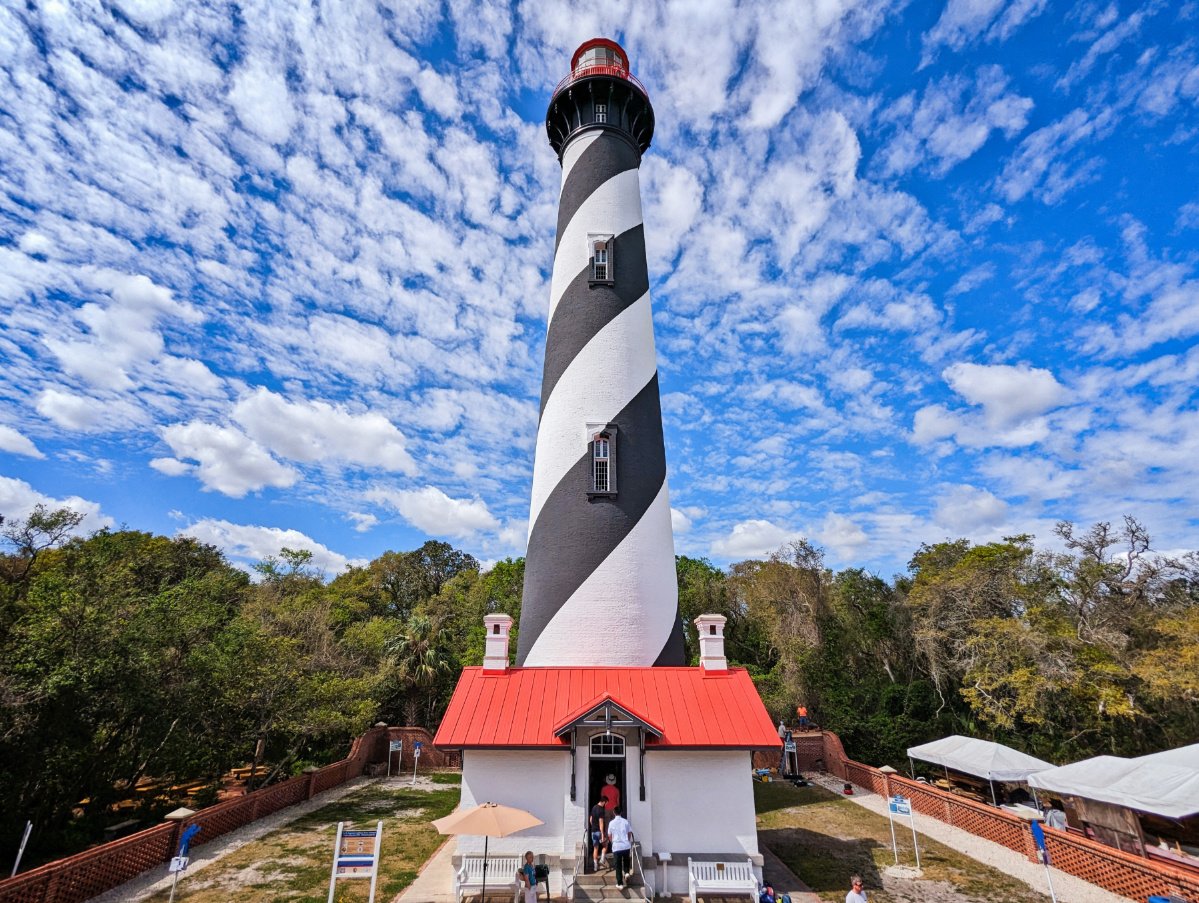
Black and white diagonally striped St. Augustine Lighthouse in St. Augustine, Florida

St. Augustine Lighthouse in St. Augustine, Florida

Helping ships find the shore — and maybe helping spirits climb the stairs.

The current lighthouse was completed in 1874 — but the land has a longer, darker history. Tragedy struck during construction, when two young daughters of the superintendent drowned in the bay. Ever since, strange sightings have haunted the tower.

The spiral staircase inside St. Augustine Lighthouse in St. Augustine, Florida

Visitors report hearing footsteps on the spiral stairs, catching glimpses of shadowy figures, and even being touched by something unseen. The Dark of the Moon tour takes you up the tower at night — just you, a flashlight … and your frazzled nerves.

St. Augustine Lighthouse & Maritime Museum
100 Red Cox Drive
St. Augustine, Florida

Exterior of Myrtles Plantation in St. Francisville, Louisiana

Myrtles Plantation in St. Francisville, Louisiana

Cursed ground, murder and ghosts with unfinished business. Southern hospitality not guaranteed.

The Myrtles has everything you could want in a haunted Southern plantation: hidden pasts, murder, mystery and a good chance of ghostly encounters. Built in 1796, the property is said to be cursed from the start, allegedly located on an indigenous burial ground. Several people died violently here, and stories of hauntings are as thick as the Spanish moss out front.

A grainy photo Chloe, the ghost at Myrtles Plantation in St. Francisville, Louisiana

The enlarged section of this image is said to be the plantation’s famous ghost, a former slave named Chloe.

The most infamous ghost? Chloe — a formerly enslaved woman who was reportedly mutilated for eavesdropping and later hanged after poisoning members of the household. Her apparition has supposedly been caught in photos and is said to still roam the grounds. 

Other spirits include William Winter, shot on the porch in 1871, and his young daughter, who died of yellow fever.

The Myrtles Plantation
7747 U.S. Highway 61
St. Francisville, Louisiana

An aerial view of Eastern State Penitentiary in Philly

An aerial view of Eastern State Penitentiary, which is no longer operational — just attracting visitors who appreciate the macabre.

Haunted Hotspots

Some people go to the beach — others go looking for the ghosts of 19th century criminals. These haunted destinations deliver the perfect mix of history and horror, where the stories are real, the wallpaper is peeling, and the room you booked might come with a ghost you didn’t. –Armughan Zaigham

An Insider’s Guide to Nantucket

Are you looking for things to do in Nantucket, Massachusetts? We cover the popular tourist attractions like the Whaling Museum and Brant Point Lighthouse as well as some of this charming island’s best-kept secrets — an icon of Mister Rogers, anyone? Also: the best Nantucket restaurants. 

Gray houses on the water with boats in Nantucket

For some strange reason, the Wampanoag Native Americans who lived on Nantucket gave it a name that alludes to it being a distant, desolate place. According to Britannica, it could even mean “sandy, sterile soil tempting no one”!

From stunning natural landscapes and beaches to must-see historical landmarks and quirky interior spaces, Nantucket, Massachusetts has it all. 

Here are my insider tips on the gems of Nantucket, an island in the Atlantic about 30 miles south of Cape Cod.

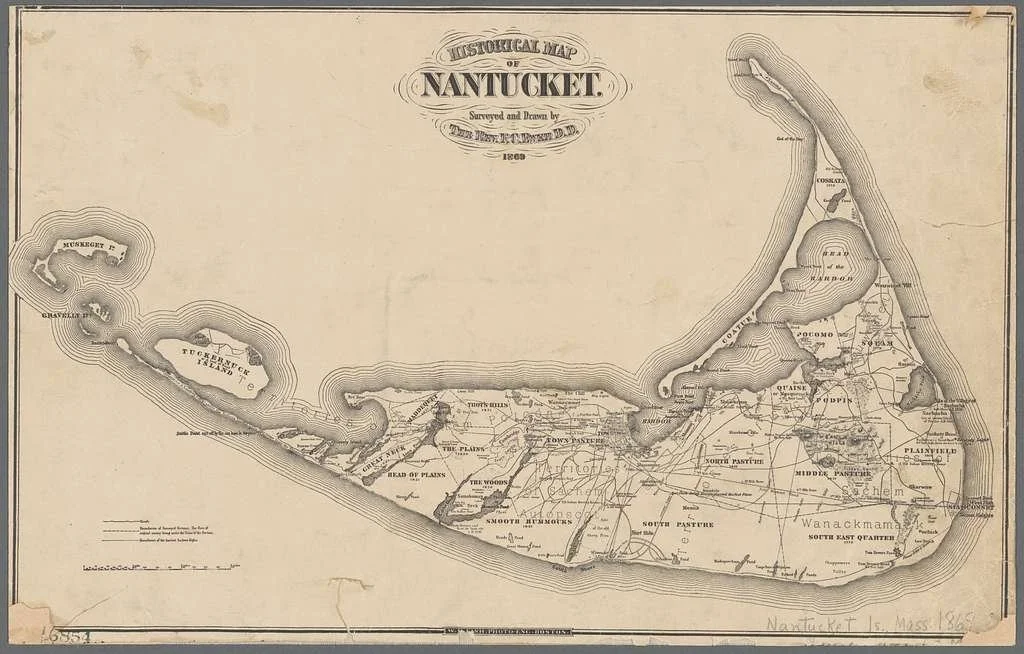
Historic map of Nantucket, Massachusetts

The island of Nantucket is 30 miles off the south coast of Cape Cod. It’s 14 miles long and three and a half miles wide.

Quick Tips for a Hassle-Free Nantucket Vacation

Keep in mind that this could be an expensive getaway: Things can be a bit pricey on the island.

Nantucket vacation home with pool in backyard

One of the best ways to experience the Nantucket lifestyle is to rent a home during your stay.

Be sure to book your accommodation in advance, especially during the peak summer season. Vacation rental homes are a great option to get a feel for how locals live.

Woman walking her beach between fences to Nantucket beach

Why bring your car over when you can reach everything on a bike?

Choose your mode of transport. You can get to the island either by plane or ferry. Once there, I’ve found that the most satisfactory way to tour this exquisite island is by bike. Of course, you can bring your car, but it’ll cost you about $400-$450 to do so. I suggest renting a bike at Nantucket Bike Shop. Cycling is a great way to see the sights and exercise at the same time. Besides, there are numerous bike trails on the island.

8 Top Attractions on Nantucket

Nantucket is home to many gems, including secluded beaches, secret gardens and hidden coves. Here are my favorite spots:

Greater Light house exterior in Nantucket

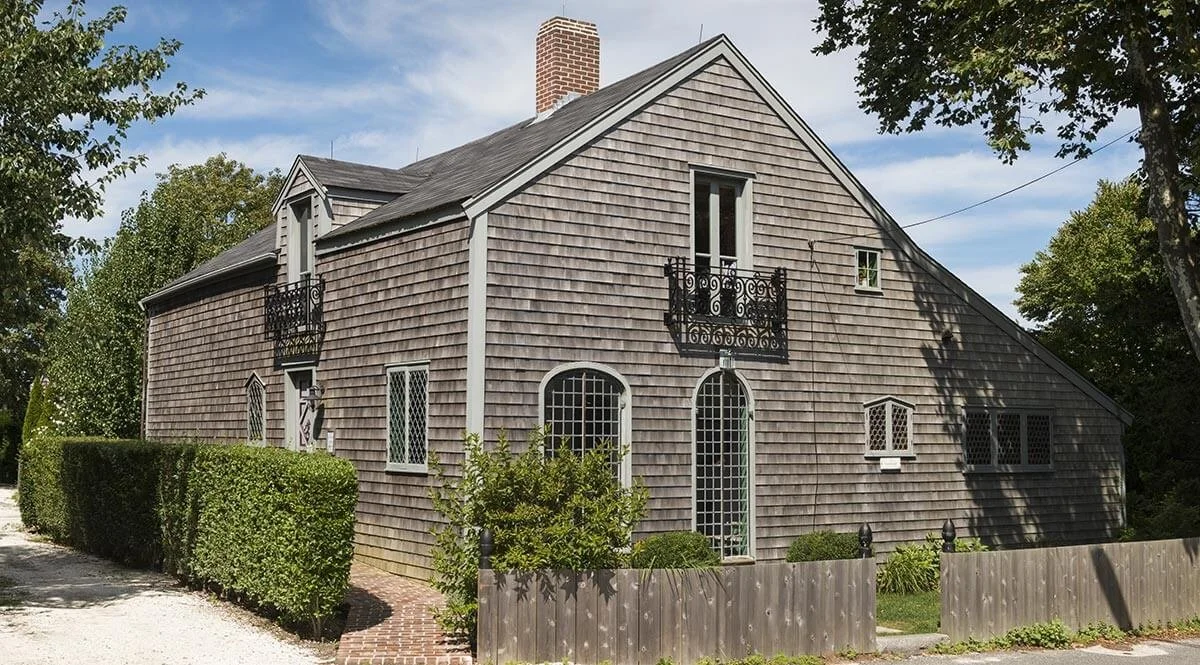
Greater Light, a historic home in Nantucket, has become a cultural center and wedding venue.

1. Greater Light

Gertrude and Hanna Monaghan, two artistic sisters, had come to Nantucket because of its growing creative community. In the summer of 1929, the Monaghan sisters were taking in the city's vibrant art scene when they stumbled upon a herd of cattle. They followed the herd until it took a U-turn at Howard Street and entered a 140-year-old barn. The siblings were fascinated with the dilapidated structure. They discovered it was owned by the town grocer, William Holland, and they convinced him to sell it to them. 

The siblings named the barn Greater Light after the Bible verse Genesis 1:16: “God made two great lights — the greater light to govern the day and the lesser light to govern the night.” They began turning the barn into a light-filled summer home and filled it with architectural artifacts and an eclectic mix of furnishings. If you want to experience the emotional vibe of the town, this is the place to be.

Insider’s Tip: Greater Light is accessible to the general public from May to October. It’s a 10-minute walk from the town center. In addition to being a popular wedding venue, numerous events, including book signings, concerts and lectures, are held on the renovated property. For the most current schedule, visit the Nantucket Historical Association website.

Greater Light
8 Howard Street

Icon of Mister Rogers at St. Paul's Church in Nantucket

Could someone just make this man a saint already? The icon of Mister Rogers at St. Paul’s.

2. Mister Rogers Portrait at St. Paul’s Church

Some people would indeed consider Mister Rogers a saint; they’d find it fitting that he’s an idol at St. Paul’s Church. Before he became a beloved children’s television icon, Rogers studied to be a Presbyterian preacher. 

He spent the summers on Nantucket with his family, residing in the Madaket neighborhood on the island's west side. He and his family attended St. Paul’s Episcopal Church on Fair Street. 

A local artist, Julie Dunbar, painted a tribute to Mister Rogers’ legacy as an honored parishioner and a well-known friend to many. Pop into the church, identifiable by its beautiful Tiffany stained glass windows, to see this quirky icon bearing the words “Gentle, Kind + True.”

Insider’s Tip: While the church is open to visitors, check to see if it happens to be closed for exclusive services and activities.

St. Paul’s Epsicopal Church
20 Fair Street

Sperm whale skeleton hanging from the ceiling at the Whaling Museum in Nantucket

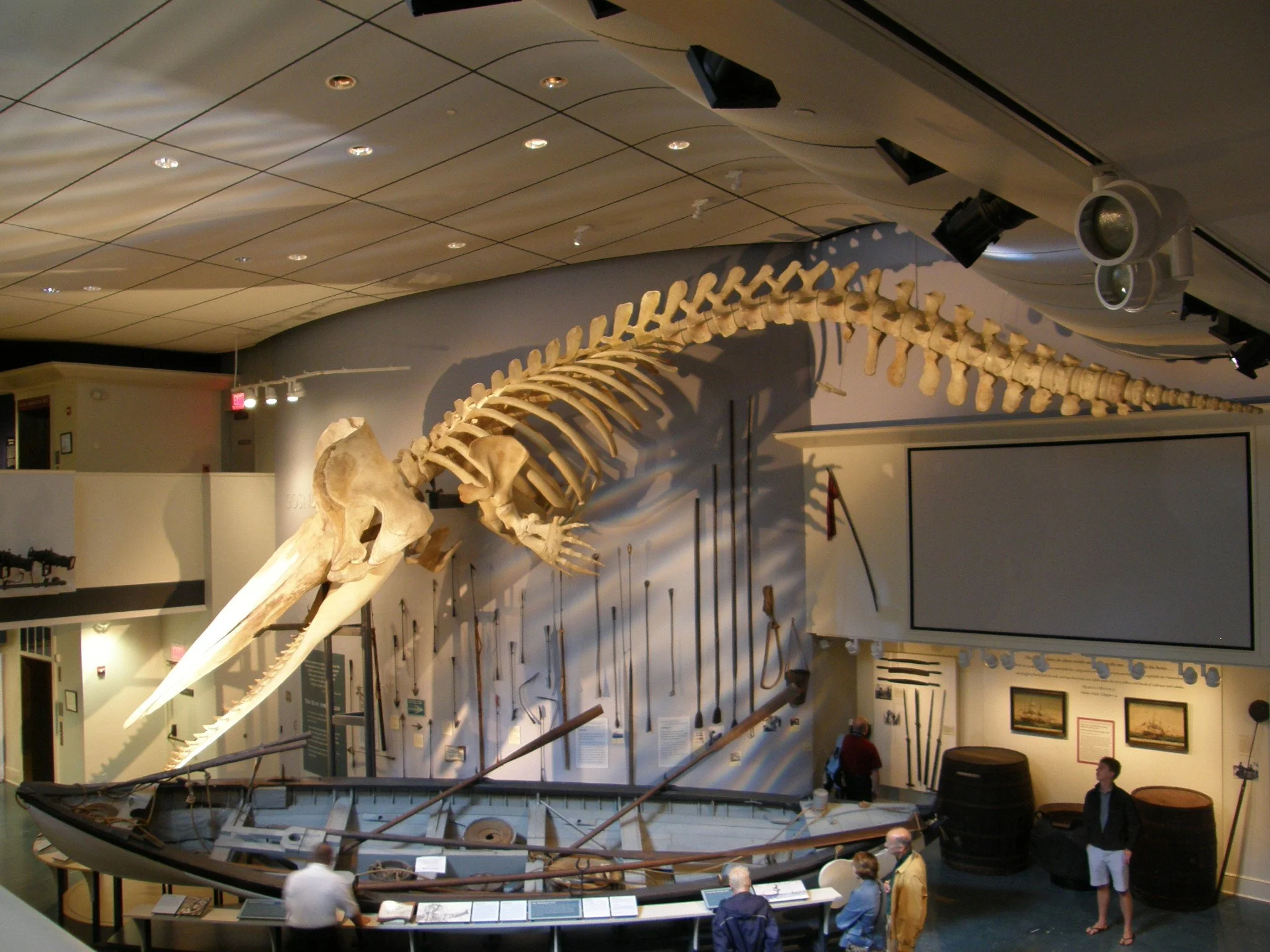
The 46-foot-long skeleton of a sperm whale that died in 1998 hangs from the ceiling. Check out those chompers — a testament to the dangers of the whaling profession.

3. The Whaling Museum

Once known as the whaling capital of the world, Nantucket has a historic whaling district, and the museum is housed in a former whaling captain’s house. The Whaling Museum was established in 1929 and is among the oldest naval museums in the United States. 

Exterior of the Whaling Museum with passersby in Nantucket

The Whaling Museum in Nantucket

Its gallery has a collection of over 1,000 artifacts, including a sperm whale skeleton and a whaleboat. The museum also has a library and archives with over 500 books, maps and manuscripts. 

Insider’s Tip: The museum is open year-round and offers various educational schedules for adults and children. Hopefully you’ll get a guide as colorful as Emily Gilmore on The Gilmore Girls. And be sure to climb the spiral staircase (or take the elevator) up to Tucker’s Roofwalk for a panoramic view of the harbor — where the captain’s wife might once have kept an anxious lookout for the return of her husband’s ship.

The Whaling Museum
13 Broad Street

White sailboat and walkway to the Brant Point Lighthouse in Nantucket

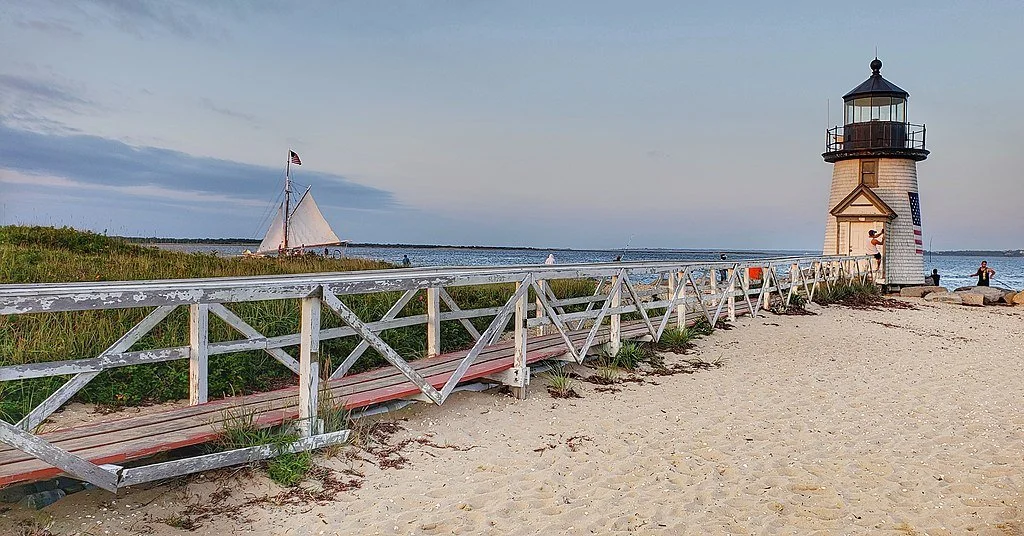
Brant Point Lighthouse is one of three to see in Nantucket. Look for the American flag on its side.

4. The Lighthouses 

Nantucket has three lovely lighthouses, all of which are well worth a visit:

Brant Point Lighthouse is near the city at the end of Easton Street and is the ideal location to view the sunset or sunrise. Its white stairway and American flag painted on its side make it easy to spot.

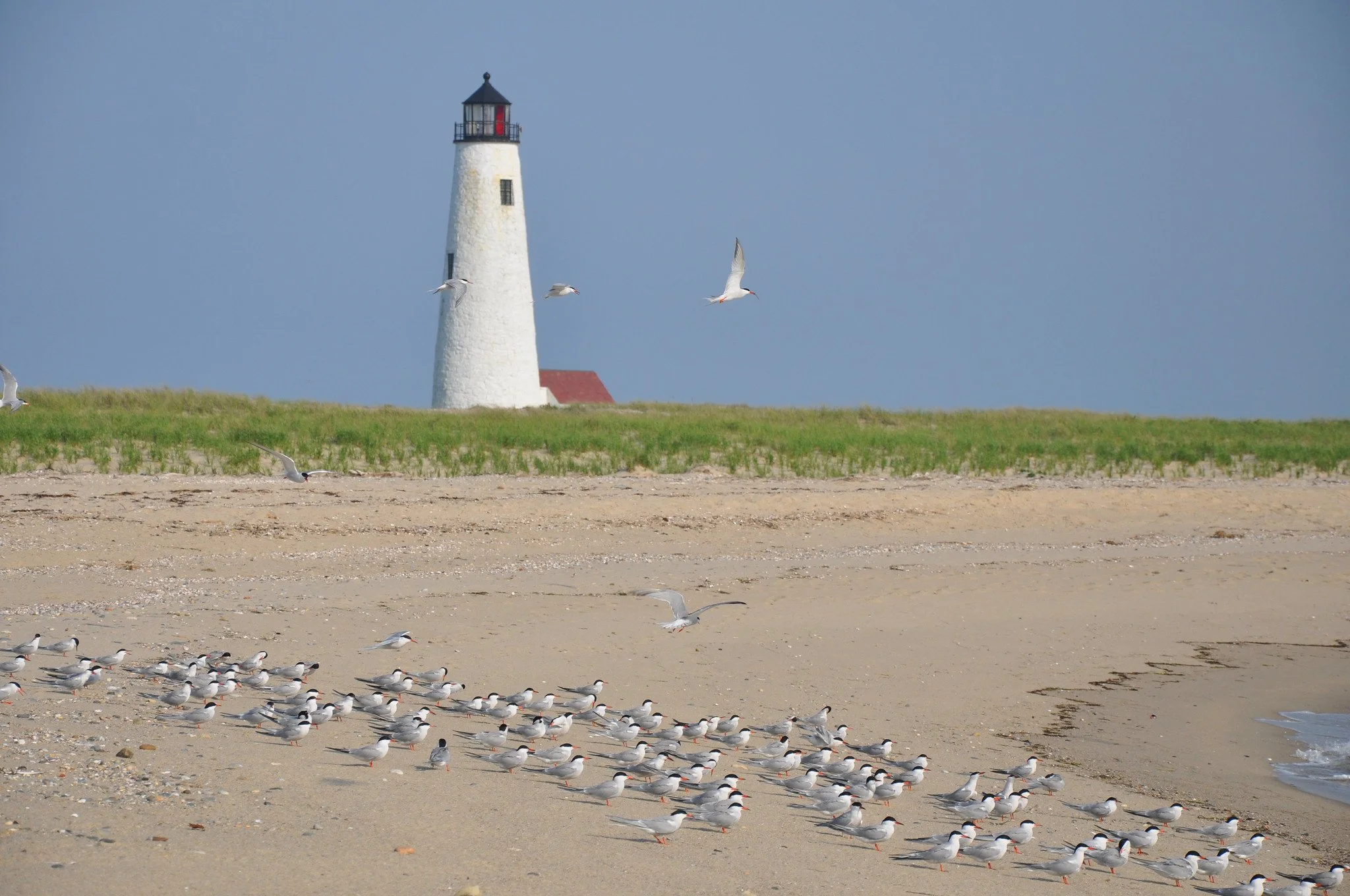
Sea birds on the beach by Great Point Lighthouse in Nantucket

Great Point Lighthouse is in a wildlife reserve at the northern tip of the island.

Arriving at Great Point Lighthouse is slightly more complicated since the light is on sandy land. Hire a four-wheel drive if you don’t have one. The trip can be backbreaking, so bring a picnic lunch to eat and get reenergized. 

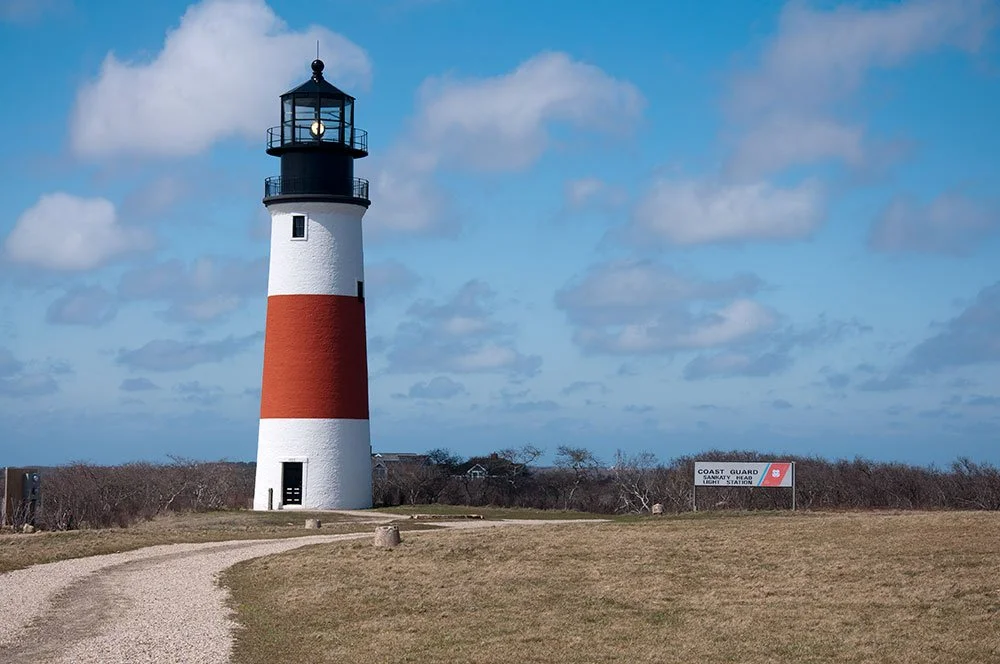
Red and white striped Sankaty Head Lighthouse in Nantucket

Sankaty Head Lighthouse stands 70 feet tall at the easternmost point on Nantucket, flashing its light every 7.5 seconds

With its distinctive white and sandy red stripe design, Sankaty Head Lighthouse could be the most outstanding lighthouse on Nantucket. The light is on Baxter Road, but on a clear day, you will see it miles away in every direction. 

Insider’s Tip: The lighthouses are open from  9 a.m. to 6 p.m. all year round. For Great Point, you’ll need an oversand vehicle permit. 

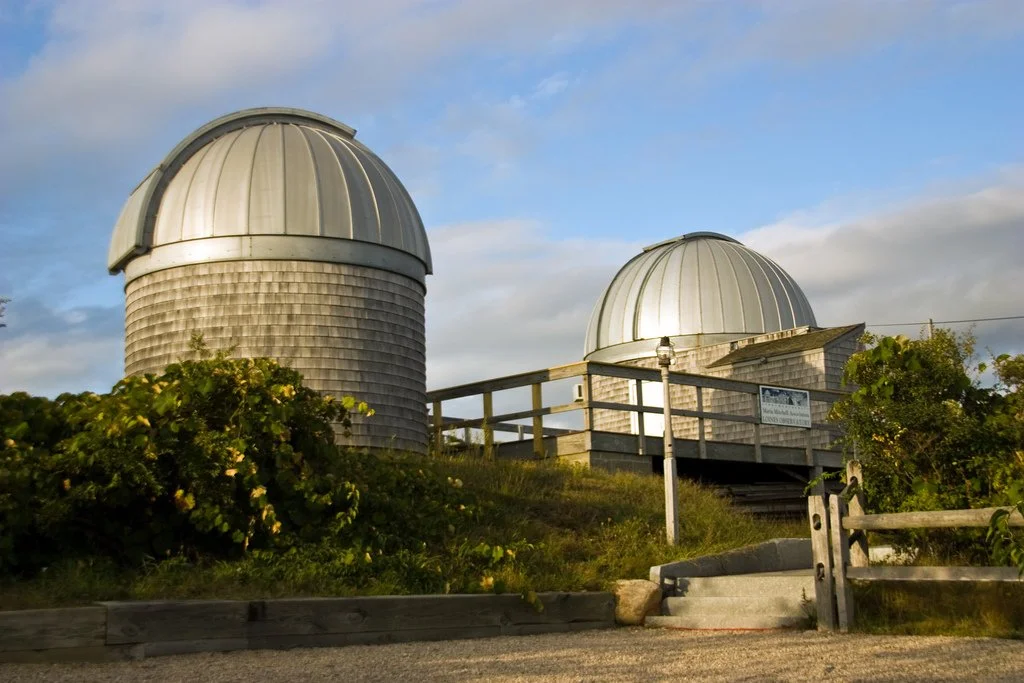
Loines Observatory in Nantucket, Massachusetts

Pay homage to Maria Mitchell by stargazing at the Loines Observatory.

5. Maria Mitchell Association

Maria Mitchell was raised on the island and was a Quaker with a passion for astronomy. She channeled her passions into a spectacular career as America’s first female astronomer. She established the Maria Mitchell Association, Nantucket’s only scientific organization.

The association has plenty to see: an aquarium, the historic 1800s Quaker house Mitchell lived in and a natural science museum, in addition to a series of scientific speakers.

The Historic Mitchell House in Nantucket

The Historic Mitchell House, where the first female U.S. astronomer lived.

Insider’s Tip: Nantucket has long been famous for its meticulous craft of scrimshaw and historic whaler voyages. But in the 19th century, Mitchell added a curious new chapter to the history of this small island. Honor her legacy by stargazing at the Loines Observatory. The Vestal Street Observatory is currently closed for conservation.

Maria Mitchell Association
33 Washington Street

6. Nantucket Shipwreck & Lifesaving Museum

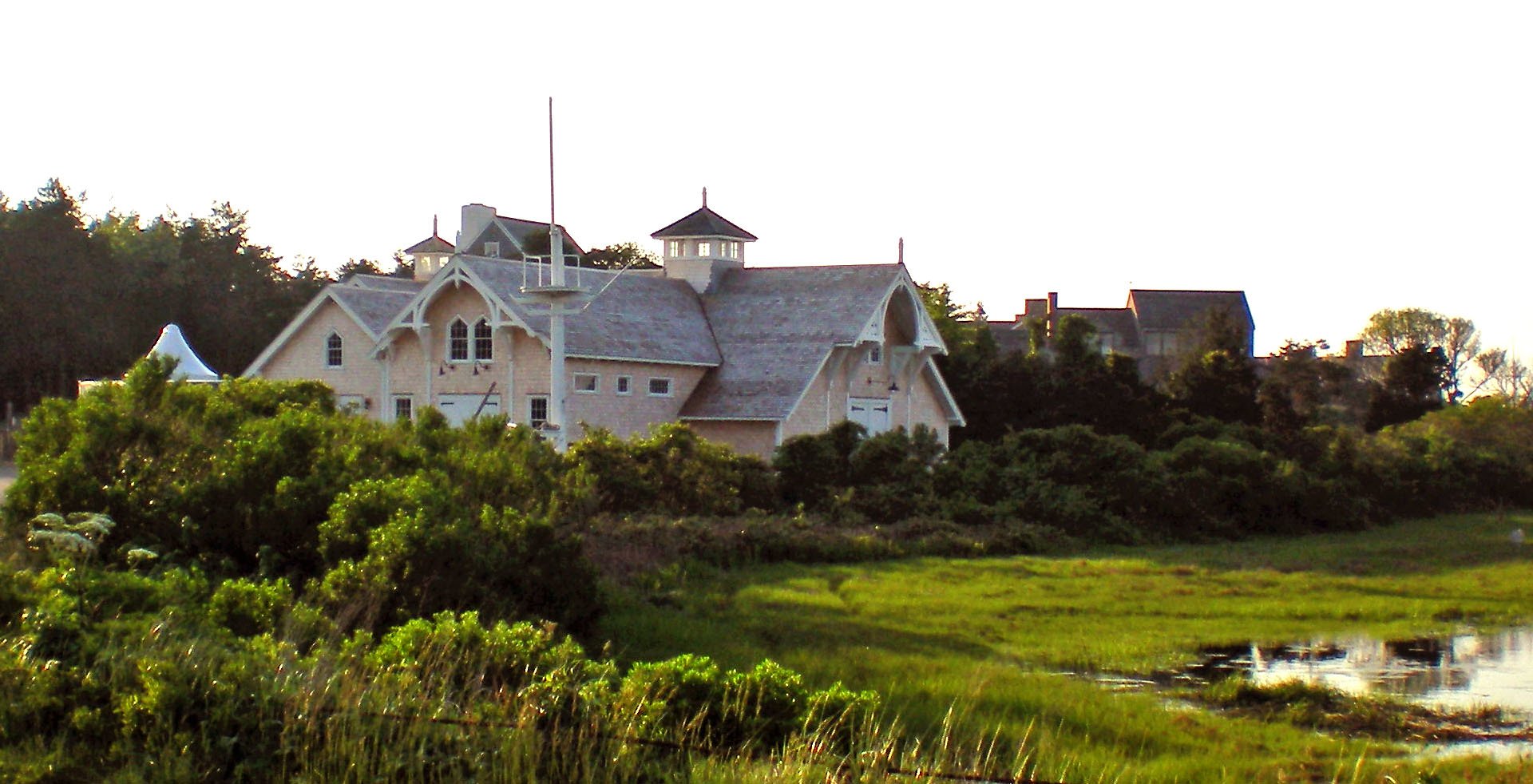
The Nantucket Shipwreck & Lifesaving Museum

6. Nantucket Shipwreck & Lifesaving Museum

The charitable Egan Maritime Institute runs this museum, which shares the stories of local shipwrecks and the brave rescuers who put their lives in danger to save drowning seamen. 

The building, constructed in 1968, features the design of the traditional stations run by the U.S. Life-Saving Service. It’s the earliest museum devoted to maritime lifesaving and safety history. Its hours of operation are Monday to Saturday from 10 a.m. to 5 p.m. and Sunday from noon to 5 p.m. The entrance fee includes a tour guide.

Insider’s Tip: Keep in mind that Nantucket is a seasonal destination, and many places, like this museum, are only open part of the year, closing in the fall and winter. A 15-minute journey down Polpis Road will take you to the museum, which is three miles east of town. But you can also catch the Shipwreck Shuttle from the visitors bureau at 25 Federal Street every half hour starting at 9:30 a.m., returning from the museum on the hour, with the last ride at 5 p.m.), Monday through Saturday from May 30 through October 10.

Nantucket Shipwreck & Lifesaving Museum
158 Polpis Road

You have to get on the water during every stay in Nantucket.

7. The Harbor

When in Nantucket…

Sailing around the harbor is the perfect afternoon pastime and can take you into the evening to enjoy the most splendid sunset in Nantucket. You’ve got plenty of choices: tugboats, larger whale-viewing cruises and swanky schooners. Many offer two-hour rides that head around Brant Point Lighthouse. 

Insider’s Tip: Shearwater Excursions offers the Ice Cream Cruise, where you can enjoy not only a scenic tour but also its namesake treat. But my favorite thing to do is rent a tugboat for the late afternoon, where you can bring cocktails to sip and have some snacks (perhaps a charcuterie board). 

A group of people holding up the game fish they caught in the Atlantic off of Nantucket island

Catch your dinner on a fishing charter into the Atlantic Ocean.

8. Fishing Zones

Nantucket has a large population of game fish, and the best time to go fishing is from May to November. A suitable spot is the south bay between Nantucket Harbor and Great Point. But you can also try your luck near the Sankaty Head Lighthouse. Additionally, the harbor offers dedicated charters for catching large game fish like mahi mahi, marlin and tuna.  

Insider’s Tip: Waves can be intense — even deadly — so make sure you find a pro and ask for the safest times to get on the water. 

Exterior of Straight Wharf Restaurant in Nantucket

Straight Wharf Restaurant

Where to Eat in Nantucket

From fresh seafood to classic New England fare, there’s something for everyone to enjoy on this beautiful island.

For seafood lovers, the Straight Wharf Restaurant is a must-visit. The spot is well known for its fresh, local seafood and harbor views.

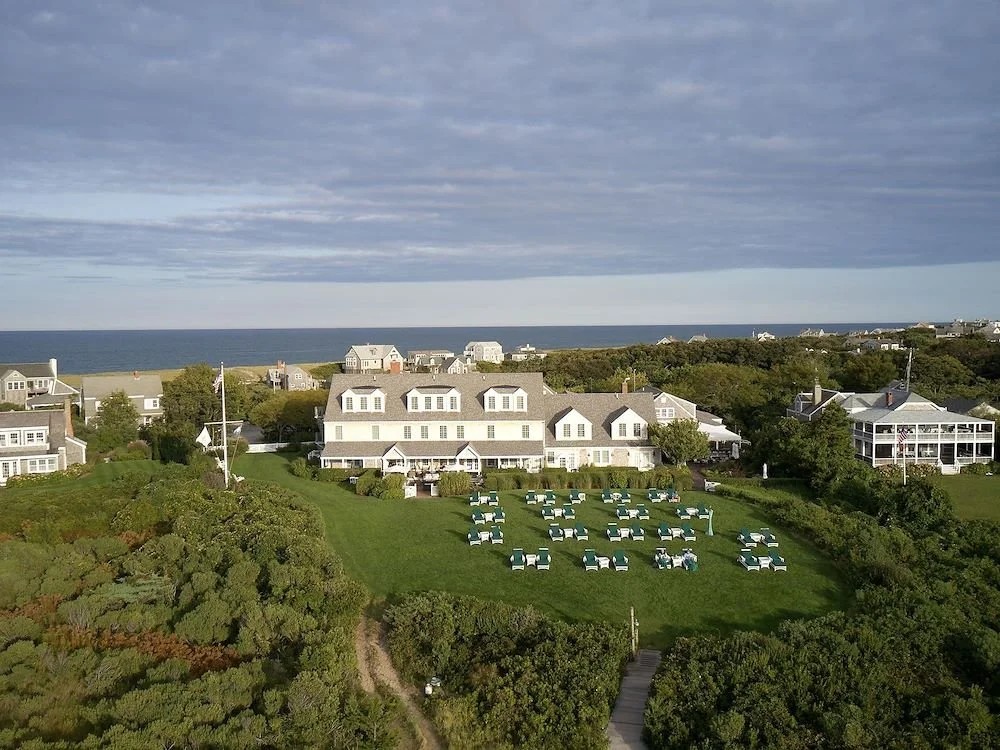
Aerial view of white Wauwinet Hotel in Nantucket with lawn chairs

Head to the Wauwinet hotel to dine at Topper’s.

Head to Topper’s at the Wauwinet hotel to taste classic New England cuisine. This elegant restaurant is known for its delicious lobster dishes, as well as its stunning views of the ocean. 

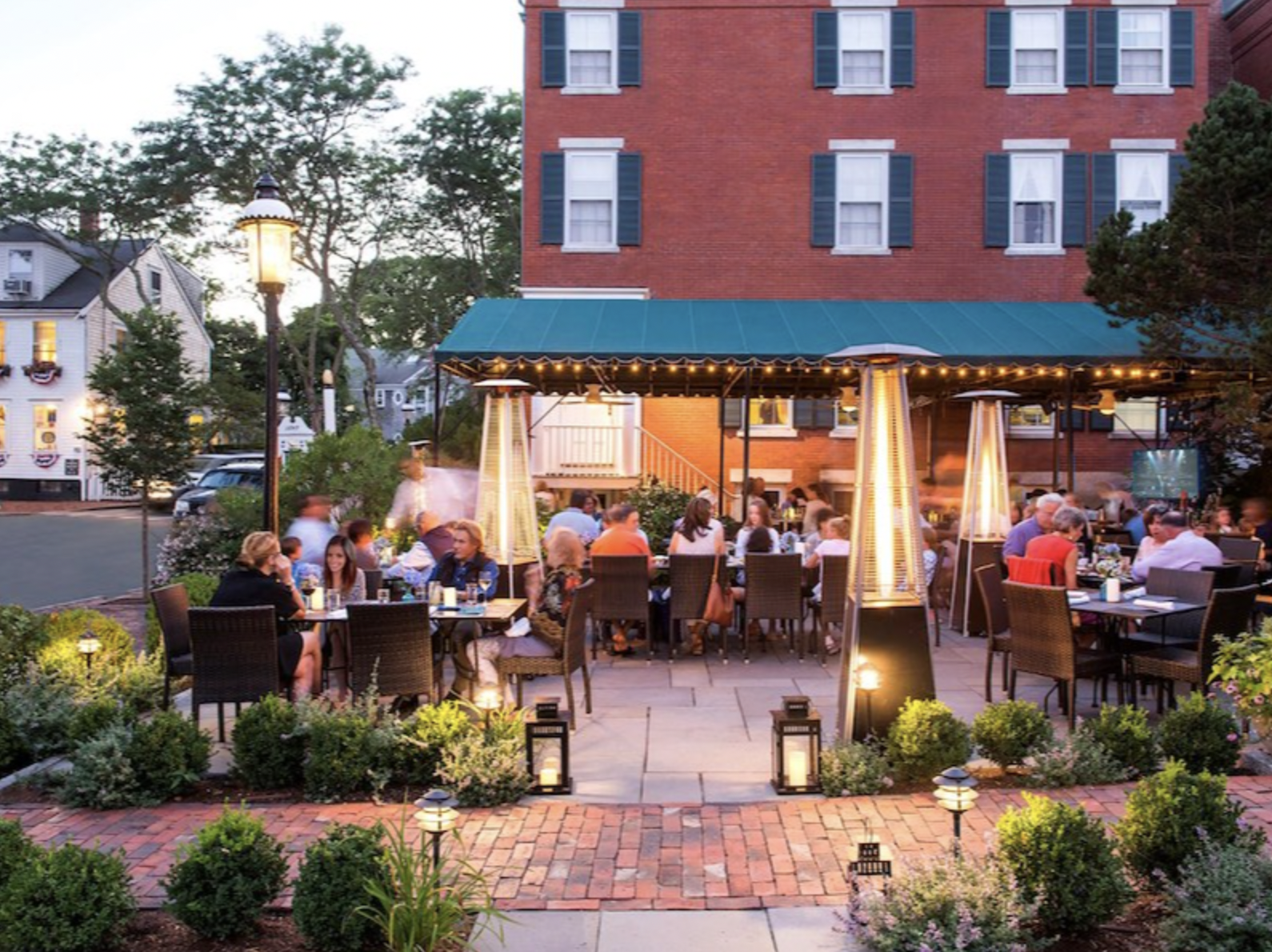
People eating al fresco at the Nantucket Tap Room at the Jared Coffin House in Nantucket

Get your New England staples and some good beer at the Nantucket Tap Room at the historic Jared Coffin House.

The Nantucket Tap Room at the Jared Coffin House is an excellent alternative for a more casual dining experience. This historic inn’s tavern offers a cozy atmosphere and classic dishes like clam chowder and fish and chips.

Other good restaurants to try include:

Heads up: The popular spot Black-Eyed Susan’s seems to be closed for good. But no matter your mood, you’ll uncover plenty of places to feast in Nantucket.

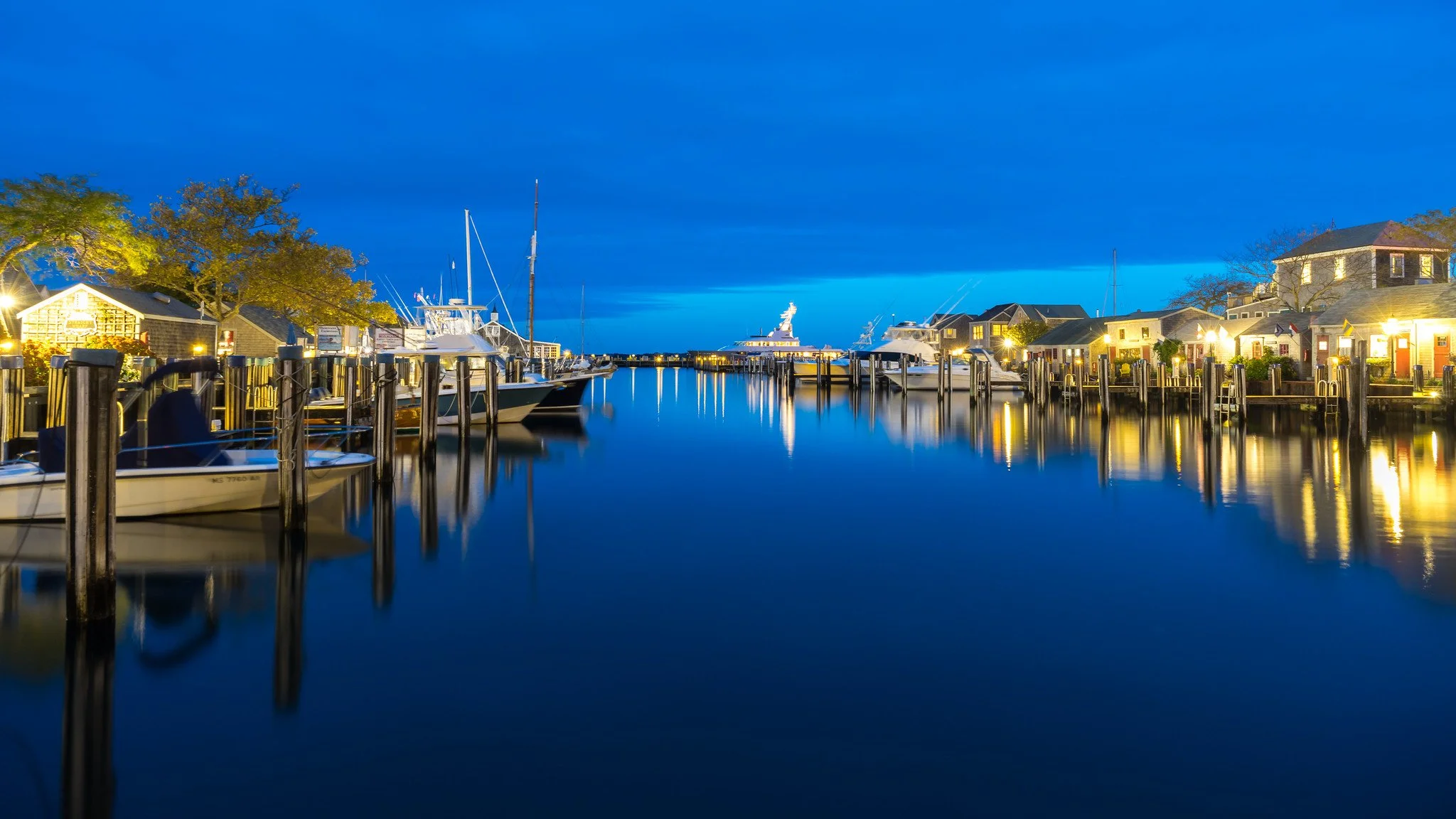
Nantucket harbor at twilight

Smaller than Martha’s Vineyard, Nantucket offers a quaint New England getaway.

The Ideal New England Getaway

Nantucket is a small island with a big reputation. It’s a popular summer tourist destination, thanks to its picturesque hangout spots and plenty of outdoor activities. Moreover, the locals are warm and welcoming, guaranteeing you have a great time. As far as I’m concerned, the island is the perfect New England getaway. –Christine Cooper

3 Most Stunning Spots on Mallorca

Formentor, Sóller, Banyalbufar: The largest of the Balearic Islands in Spain offers these Instagram-worthy places to visit.

Cap de Formentor Beach on Mallorca

Beautiful beaches, harbor towns and hillside villages are all part of the appeal of Mallorca, Spain.

To me, there’s no destination anywhere in Europe that’s more synonymous with sunny summer sojourns than the island of Mallorca (pronounced “My-york-ka,” it’s also spelled as Majorca in English-speaking countries). The largest of Spain’s Balearic Islands, Mallorca is known for its sun-soaked beaches, bustling resorts and endless natural beauty waiting around every corner.

While I can’t say there’s ever a bad time to visit the island, if you’re looking for a more laidback retreat, try to avoid traveling in the summer months, when the resorts and attractions will be at their busiest. Also, many of the island’s most beautiful natural charms can be found away from the hustle and bustle of Palma, the capital city, so why not escape the crowds and admire some of the island’s most stunning spots?

Finding peace and quiet on the island can mean that you find its magic. If it’s a sightseeing venture you’re on, here are three of the most photogenic spots you can find anywhere on the island.

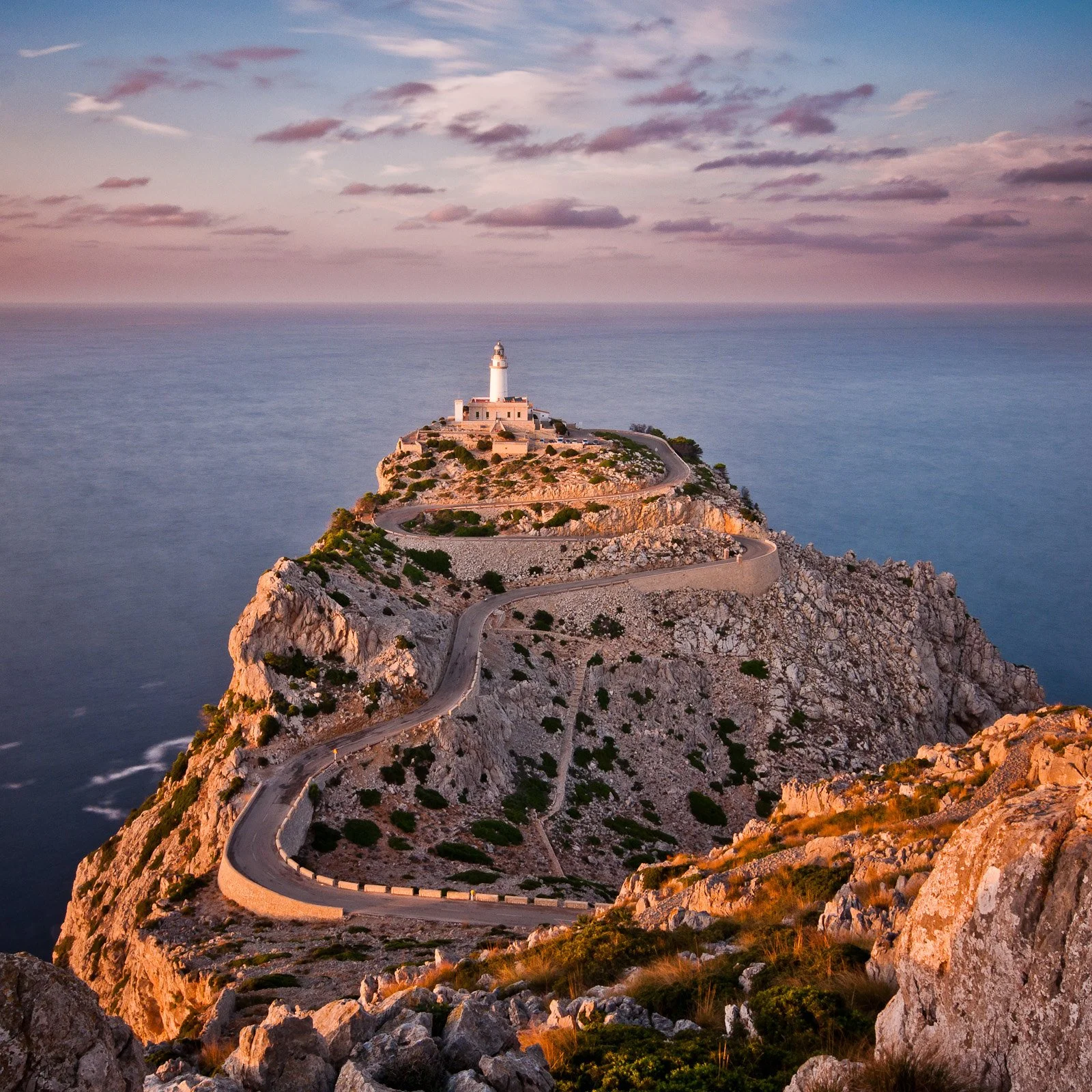
Cap de Formentor Lighthouse

The Cap de Formentor Lighthouse at the northern end of Mallorca is striking — and less visited by tourists.

Cap de Formentor

For those looking for a truly breathtaking experience, Cap de Formentor on Mallorca is a must-see. Due to its remote location in the less-populated northern area of the island, Formentor perhaps doesn’t get the recognition it deserves — but it remains one of the most gorgeous sights anywhere in the Balearics.

This dramatic stretch of coastline is characterized by sheer cliffs, turquoise waters and stunning views headlined by the region’s emblematic lighthouse. Visitors can take in the sights by driving along the scenic roads that wind their way along the coast. There are also several hiking trails that offer up-close views of the rocky landscape. No matter how you choose to experience it, Cap de Formentor is sure to leave a lasting impression.

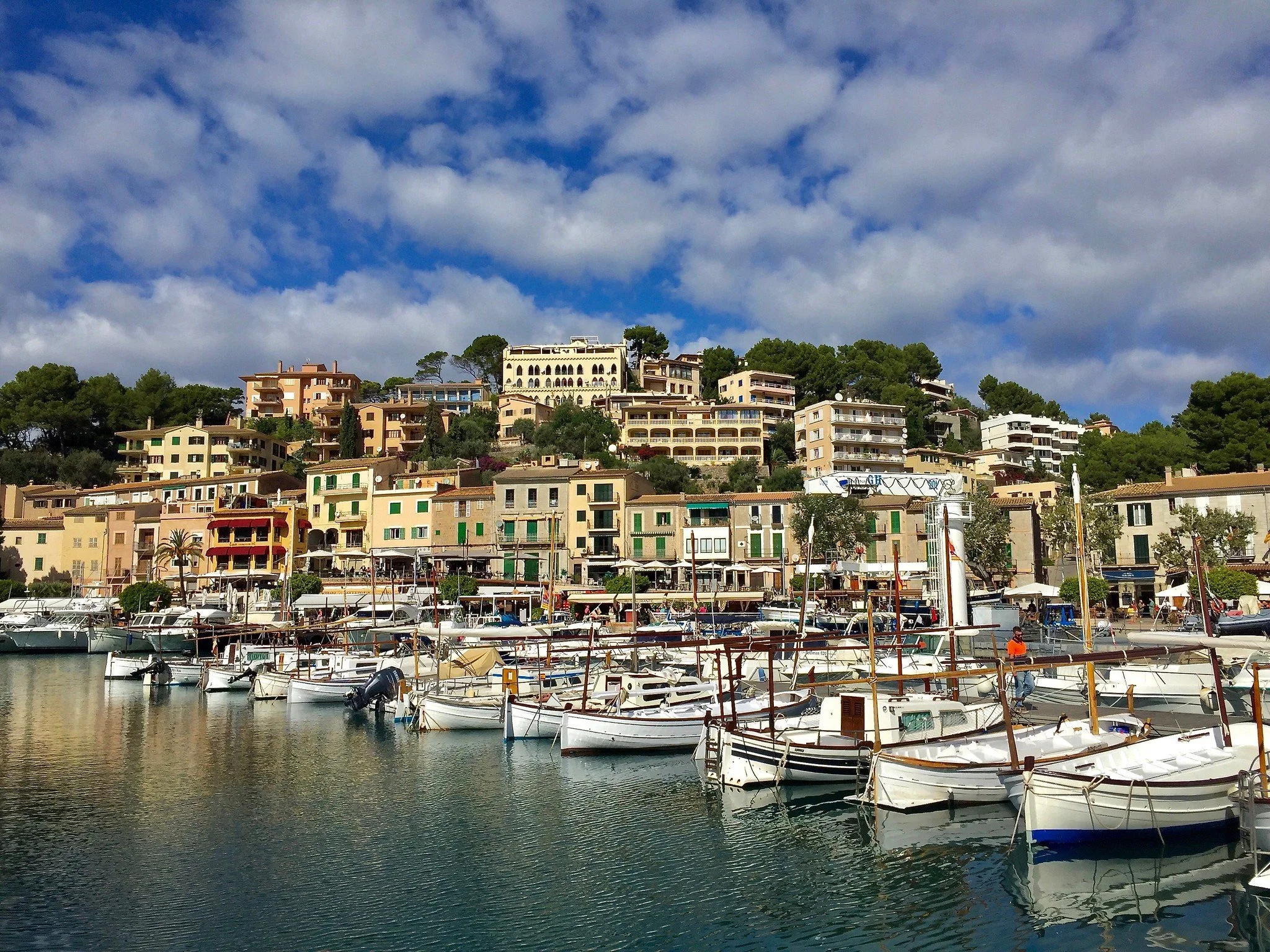
Port of Soller on Mallorca

The port of Sóller on Mallorca

Sóller

Sóller is a town located in the northwest of Mallorca, in the foothills of the Serra de Tramuntana mountain range. Visitors to Sóller can enjoy hiking in the nearby mountains, exploring the town’s charming narrow streets or relaxing on one of the many beaches that line the coast. With its idyllic setting and plentiful activities, Sóller is an ideal destination for a fun-filled vacation.

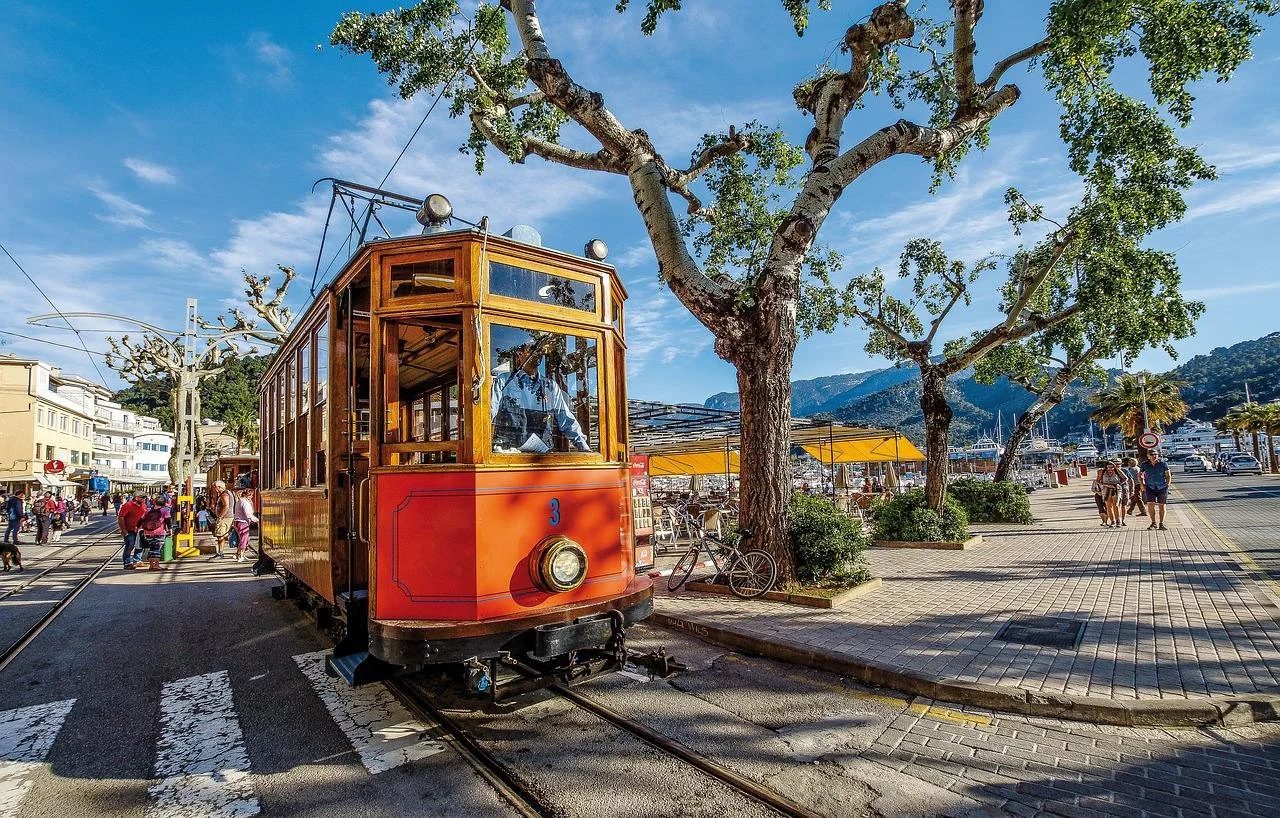
One thing that makes a trip to Sóller so special is the journey that’s required to get there. Starting from Palma, the most picturesque route involves a train ride through the Mallorcan countryside, where you’ll fly across the viaducts, bridges and tunnels that zigzag across the landscape. The trip includes a stop at a viewpoint along the way, where you can hop off for an unmissable photo opportunity.

Red and yellow tram in Sóller, Mallorca

The adorable, old-fashioned trams are a fun way to get around Sóller.

If you’re looking for a good place to eat in Sóller, you have plenty of options. There are a number of restaurants that serve up traditional Spanish cuisine, as well as international fare. But my favorite dining experience in the area is to head to one of the local markets, where you can purchase fresh produce, seafood and meat to have a picnic for your day at the beach.

The markets also offer a variety of prepared food, so you can stock up on snacks and drinks for a hike up the nearby mountain.

There are also several cafés and bakeries in Sóller, offering everything from pastries and coffee to light meals and sandwiches.

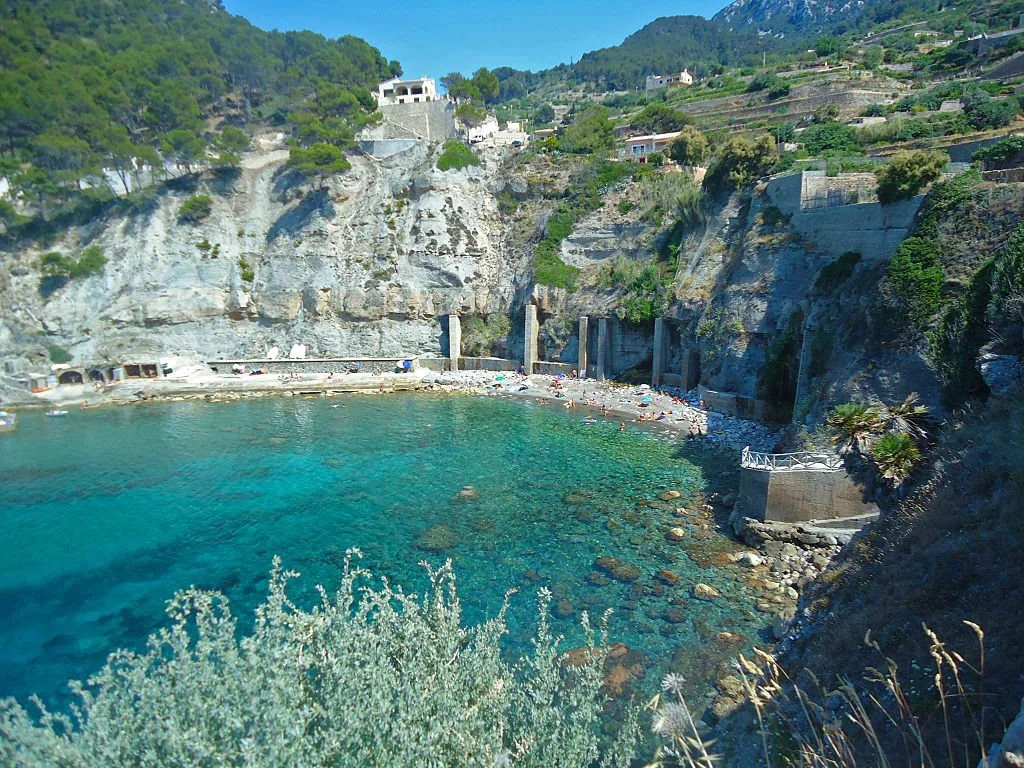
White cliffs and turquoise water at Banyalbufar on Mallorca

The rocky beaches of Mallorca’s western coast are much more chill.

Banyalbufar

Framed by the imposing peaks of the Tramuntana mountains, this small town on the western coast is one of Mallorca’s best-kept secrets. There are rocky coves and pebbled beaches in the area that you’ll likely find to be far more tranquil than the busier coastal stretches along the south coast. From here, you can go for a dip in the inviting waters or simply watch the world go by as you soak up some sun.

Banyalbufar is a great base from which to explore other surrounding villages, which many visitors find to be just as charming. Be sure to hop over to Valldemossa or Deià, a mecca for Spanish artists. 

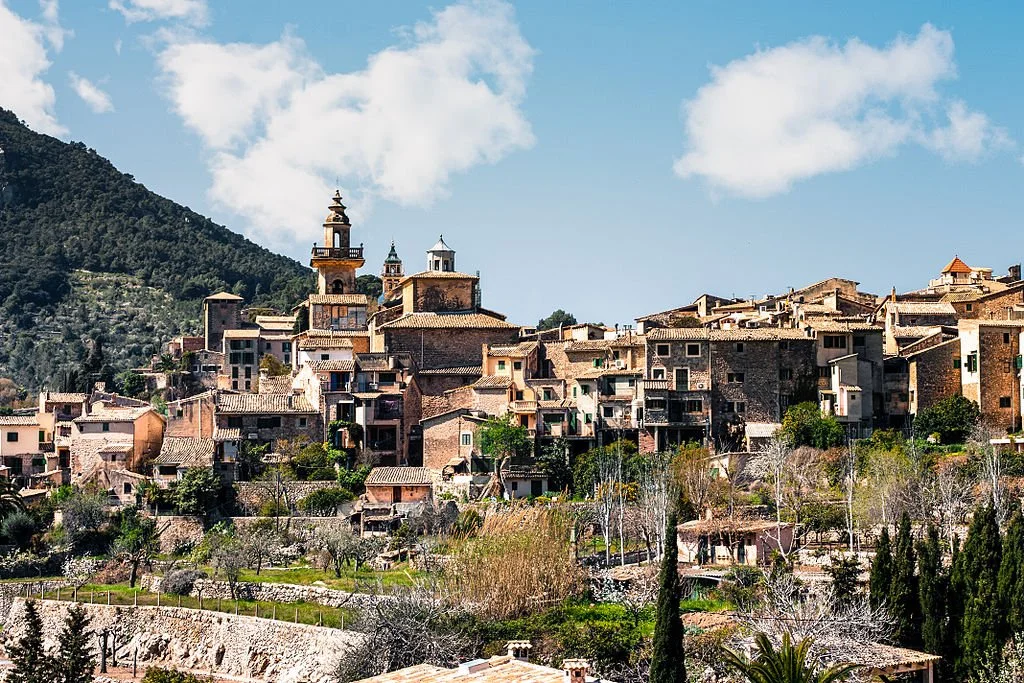
Hillside town of Valldemossa, Mallorca, Spain

While staying in Banyalbufar, take a day trip to Valldemossa, one of the quaint villages nestled on the hillside.

The best way to access Sóller is via the winding roads that connect it to the rest of the island. I advise renting a car, which will give you access to some of the smaller towns all across Mallorca. The drive is a memorable and scenic one, and from Palma it should take no longer than 45 minutes.

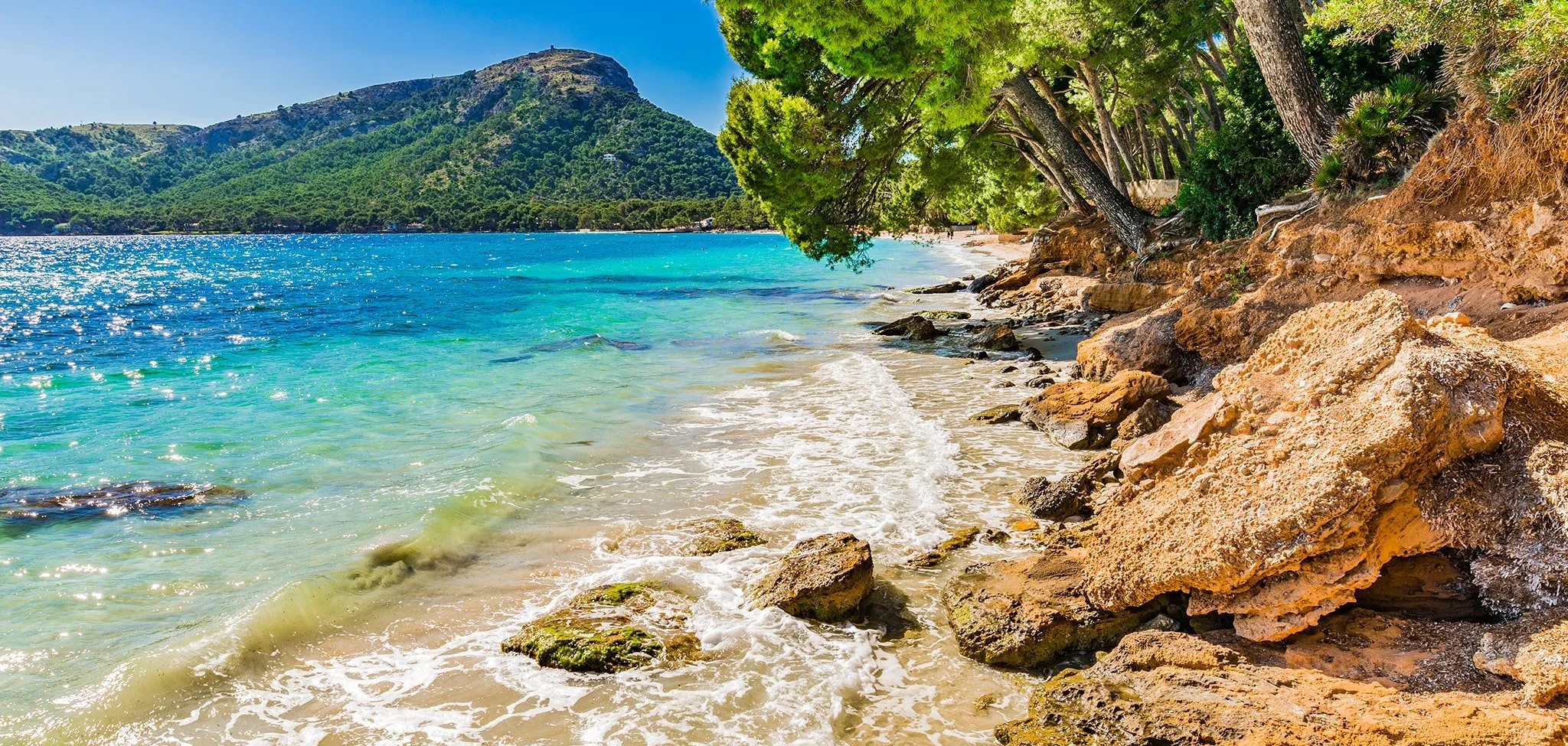
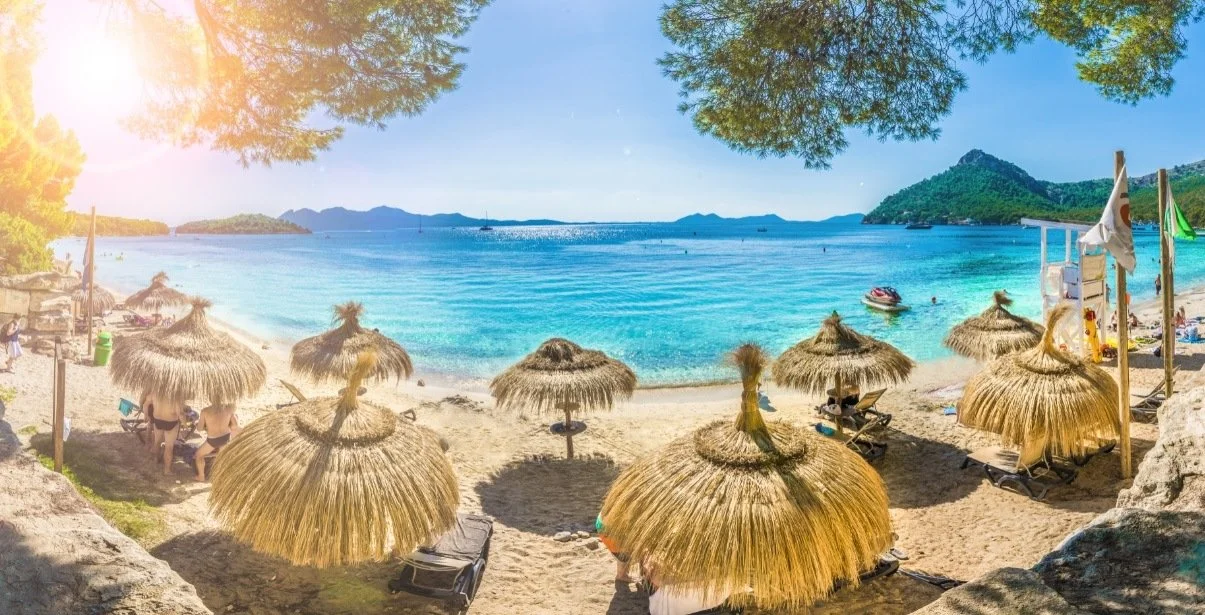
Palm umbrellas at resort on Formentor Beach, Mallorca

Beautiful beaches, like that at Formentor, are just part of the gorgeous scenery on Mallorca.

Marvelous Mallorca

Beyond the waves and the waterparks, Mallorca is blessed with an extensive catalogue of unforgettable sights. Before traveling, take the time to do some research so you don’t miss any of the stunning spots you want to tick off. The only difficulty is deciding what to go and see first! –Noah Pollard