churches

Sacred Colors: How Money, Trade and Faith Painted the World

From saffron robes to Maya blue, the colors of sacred spaces reveal surprising stories of wealth, trade, technology and belief.
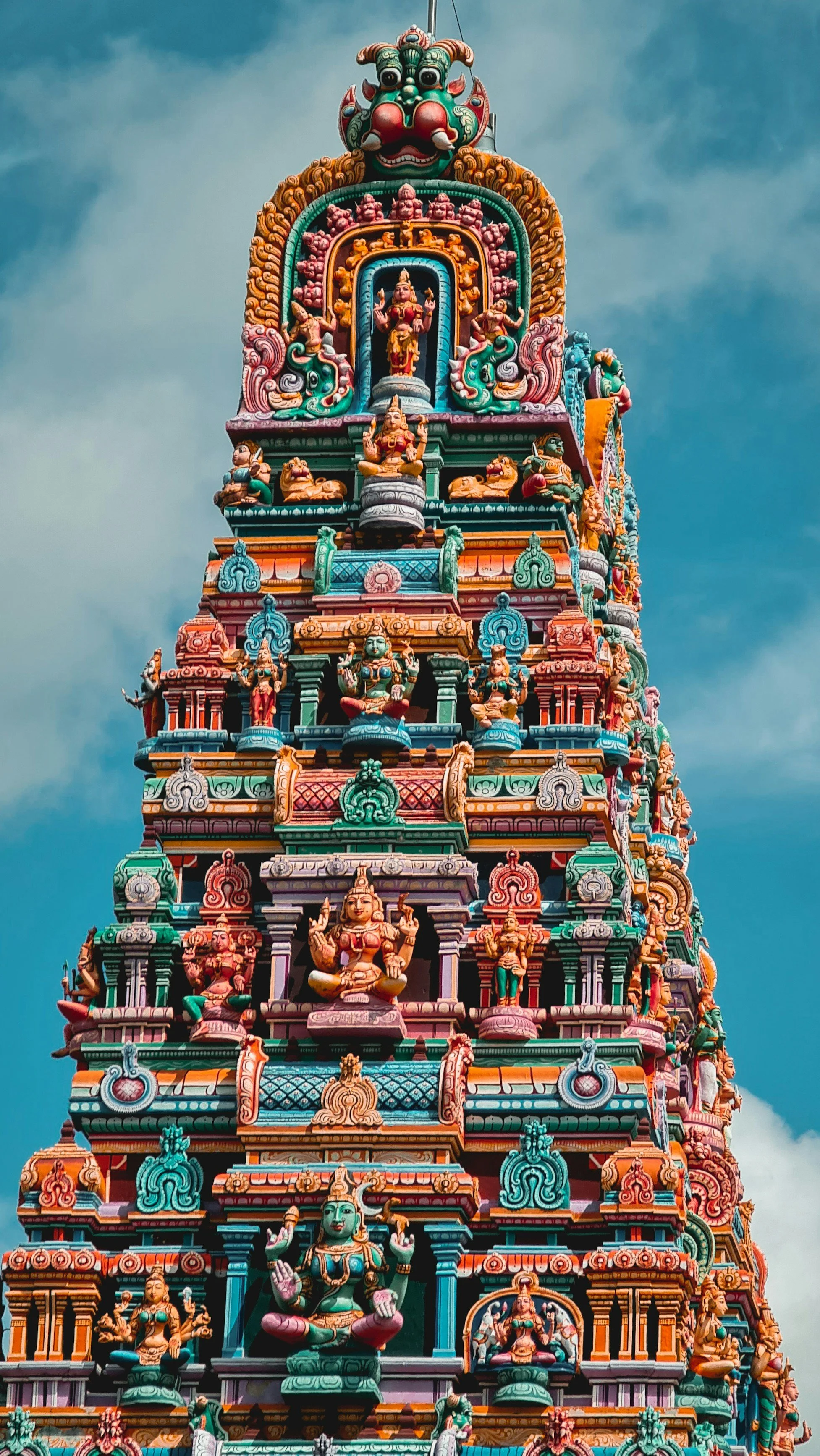
A colorful, tall Hindu temple covered with figurines in the south of India

Walk into a temple, mosque, church or shrine, and color starts telling a story before anyone explains what it actually means.

Gold suggests importance. White feels spare and pure. Saffron immediately evokes Buddhist monks. Blue can turn an ordinary ceiling into something celestial.

But religious color symbolism isn’t as simple as a chart that tells you red means sacrifice and white means purity. Before a color could acquire spiritual meaning, someone had to figure out how to make it.

And sometimes that was surprisingly difficult.

The colors of sacred spaces were shaped by what grew nearby, what could be dug out of the ground, what survived the local climate and what could be hauled hundreds — or thousands — of miles along ancient trade routes.

Once you know that, you start looking at sacred architecture differently.
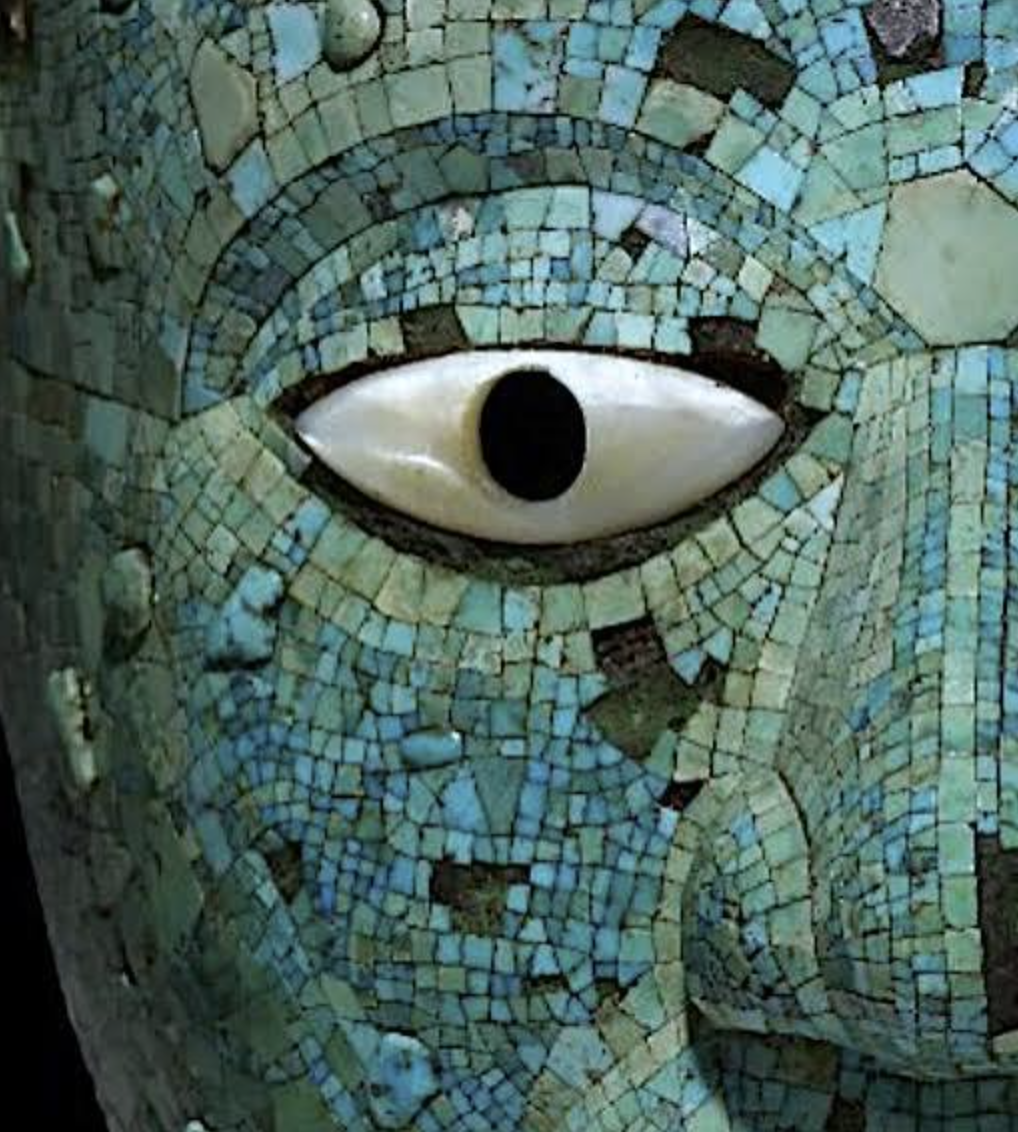
Detail of a Maya statue covered with turquoise, showing an eye and part of a face

Why Sacred Spaces Are the Colors They Are

Before anyone could paint a church ceiling blue, they needed blue pigment.

For centuries, one of the most prized blues in European art came from lapis lazuli, a semiprecious stone mined primarily in what is now Afghanistan. The stone had to travel enormous distances before it could be ground and painstakingly processed into ultramarine pigment.

That made blue expensive — and therefore significant.

The same basic principle applies around the world. Local geology, plants, technology and trade determined which colors were readily available and which represented a serious investment.

A few terms help decode what you’re seeing:

  • Pigment: A colored substance, often derived from minerals or other natural materials, that can be ground and mixed into paint. 

  • Dye: Color that penetrates a material rather than coating its surface. Think robes, banners and other textiles.

  • Fugitive color: A color that fades with exposure to light or the environment. A muted shrine today might once have been riotously bright.

  • Polychromy: The use of multiple colors to decorate architecture or sculpture. Many ancient buildings and statues we now associate with bare stone were originally painted.

That last one is particularly good to remember. Ancient doesn’t necessarily mean beige.
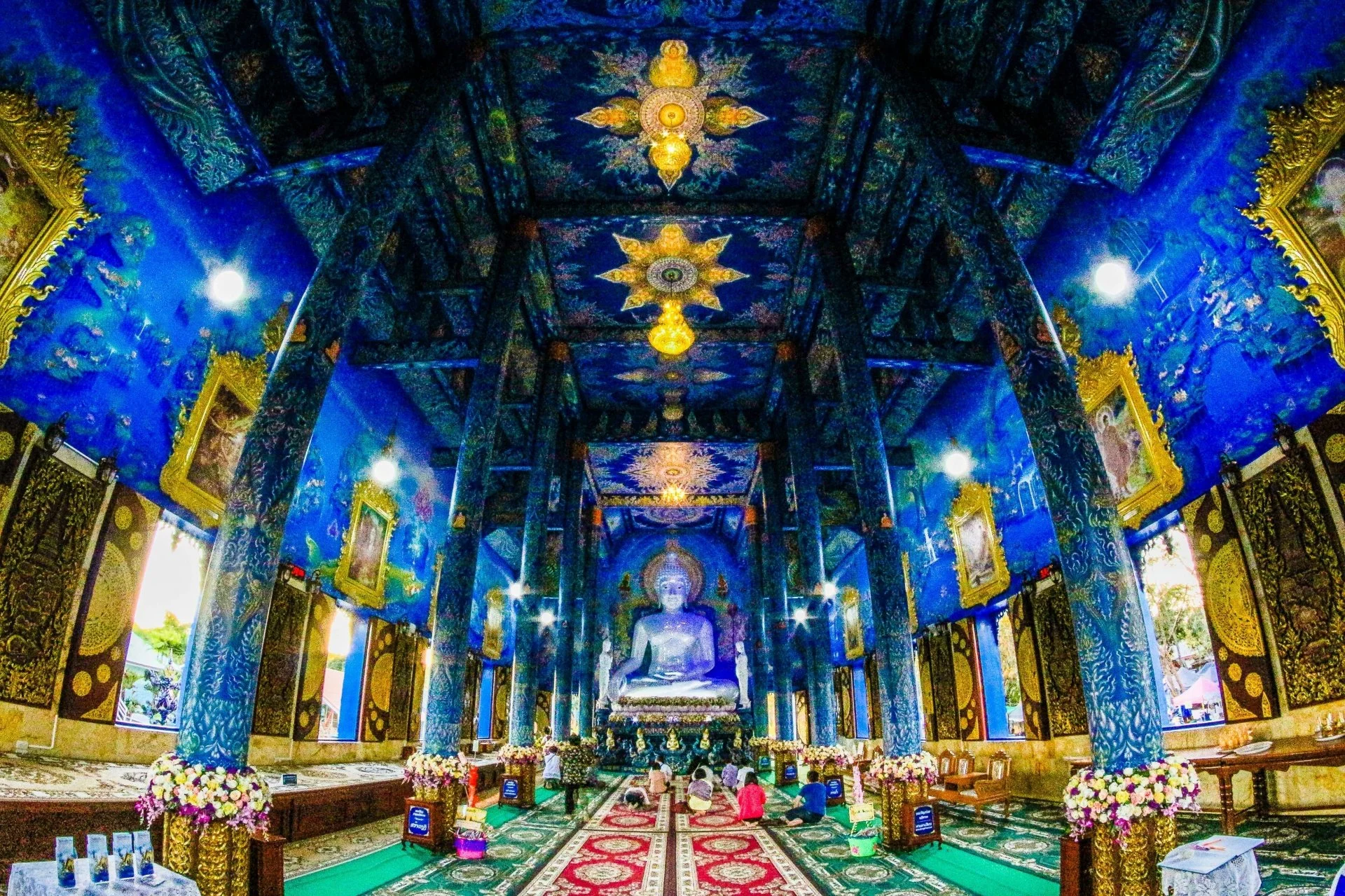
The interior of the Blue Temple in Chiang Rai, Thailand

How to Read Color Symbolism in Sacred Architecture

When you’re visiting a sacred site, don’t start by asking, What does this color symbolize?

Start with: Why was this color available here?

Look at the landscape. Iron-rich earth can supply reds and ochres. Limestone provides the raw material for limewash. Plants can become dyes. Advances in ceramics and glazing allow intense colors to survive outdoors on tiles rather than remaining protected inside on plaster, wood or cloth.

Then look at where the builders chose to use their most impressive materials.

Is the brightest color above you? Behind an altar? On a dome? Wrapped around a sacred object? Reserved for the clothing of a religious figure?

You’re essentially following the money — and often finding the theology along the way.
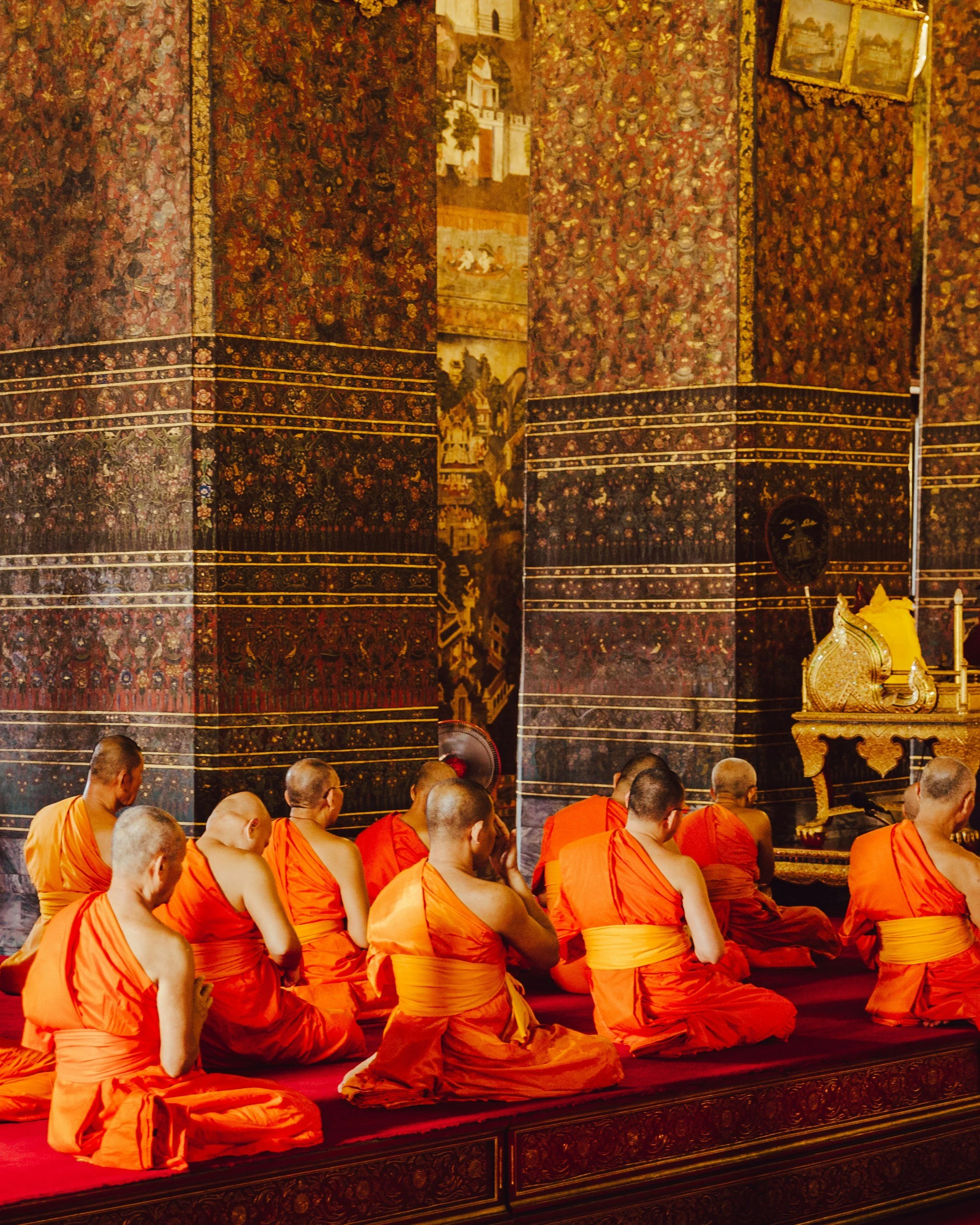
Buddhist monks in saffron robes sit and pray in a temple

Saffron and Ochre: Sacred Colors of Renunciation

The yellow, orange and ochre robes associated with Buddhist monks are among the most recognizable examples of religious color symbolism.

Their origins, though, were practical.

Early Buddhist monastic clothing was supposed to reject luxury. Monks used discarded cloth and colored it with readily available natural materials. Depending on the region, dyes could come from bark, roots, wood, leaves and other plant matter, producing variations of yellow, brown and orange rather than one universal shade of “Buddhist saffron.”

That variation still exists across Buddhist traditions today, as you’ll see, for example, in the temples of Chiang Mai, Thailand

The important thing wasn’t originally achieving a perfect Pantone match. It was wearing something deliberately removed from fashion, status and extravagance.

Over time, those humble colors became sacred colors in their own right.

It’s an interesting reversal: a color chosen because it wasn’t valuable eventually became valuable because of what it represented.

A white church with steeple under a blue sky

White: Purity, Practicality and the Power of Restraint

White appears in sacred spaces around the world, but it doesn’t always mean the same thing.

Sometimes its prevalence starts with an extremely practical material: limewash.

Made from lime and water, limewash was inexpensive, helped protect walls and reflected sunlight — particularly useful in hot climates. It’s one reason brilliant white architecture became so common in parts of the Mediterranean.

Later on, white became deadly, made with lead

But practical choices can acquire spiritual associations.

White can suggest cleanliness, purity, simplicity, light or the deliberate rejection of ornament. Compare the visual restraint of a Quaker meeting house with an extravagantly decorated Baroque church like the Templo de Santo Domingo de Guzmán Church in Oaxaca, and you’re seeing two very different ideas about how architecture should help humans approach the divine.

Neither requires white to possess one universal meaning. Context is everything. That applies when people assign meaning to personal colors as well. A conversation with a Nebula spiritual reader about the colors someone feels drawn to, for instance, treats color as something contextual and personal rather than a code with one answer for everyone.

Sacred spaces work much the same way. The interesting question isn’t simply: What does white mean? It’s: Why does white mean something here?
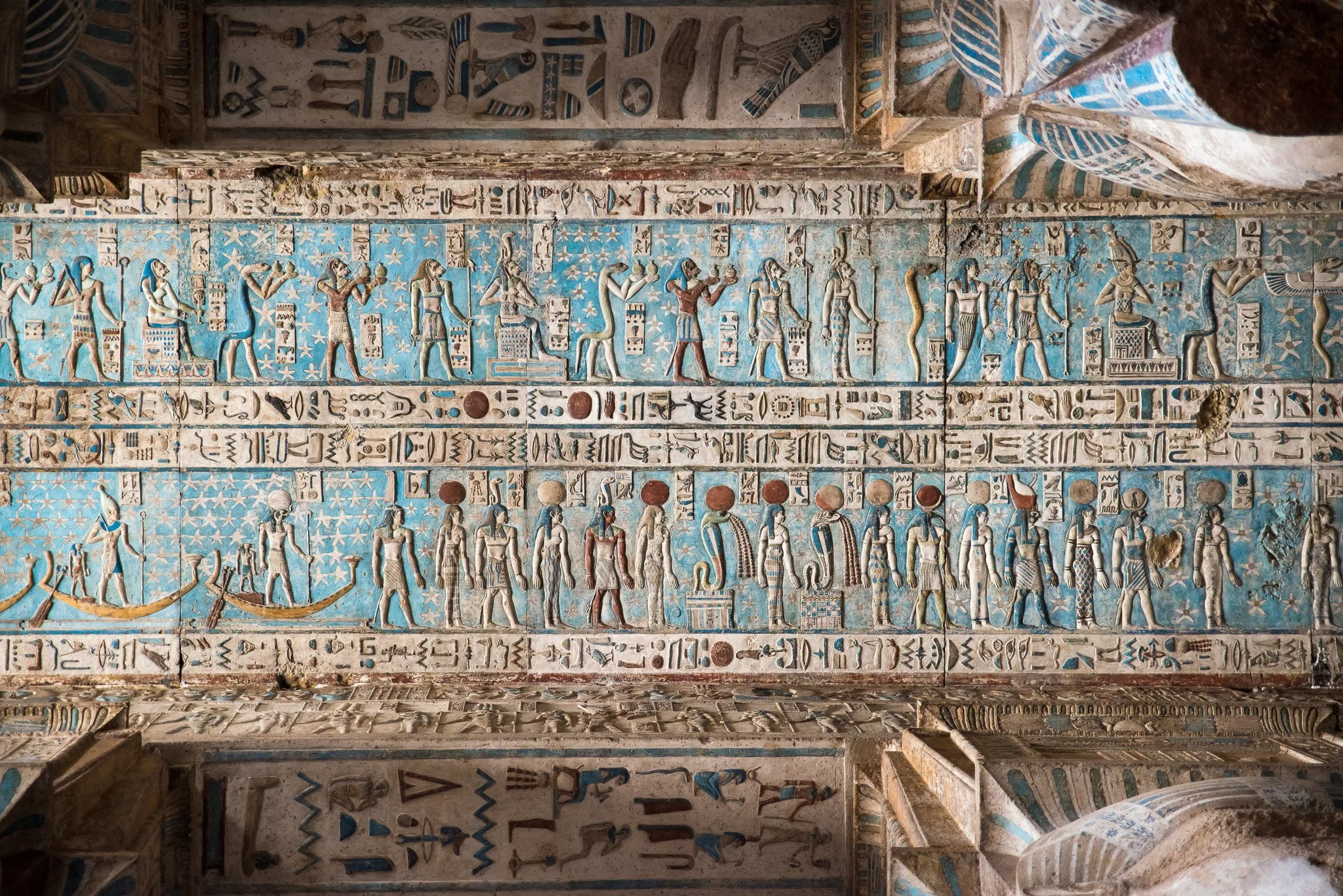
A bas-relief with blue paint on the ceiling of Dendara Temple in Egypt

Blue: The Sacred Color That Could Cost a Fortune

Few colors reveal the connection between spirituality and economics as dramatically as blue.

In medieval and Renaissance Europe, high-quality ultramarine made from lapis lazuli could be extraordinarily expensive. Artists and patrons therefore had to decide where that precious blue belonged.

Put it somewhere prominent and the material itself communicated importance.

But Europeans weren’t the only people solving the problem of making a spectacular blue.

Ancient Egyptians used it to decorate Dendara Temple, for instance — and that blue ceiling can still be seen today. 

The ancient Maya created what we now call Maya blue, a remarkably durable pigment made by combining indigo with the clay mineral palygorskite. Unlike many natural pigments, it could survive centuries of heat, humidity and weathering.

And at Chichén Itzá in Mexico, Maya blue took on an especially dramatic ritual role.

Researchers studying material associated with the site’s Sacred Cenote have connected the pigment with ceremonies and offerings associated with Chaak, the Maya rain deity. Objects — and apparently people — were cast into the cenote as offerings.

Suddenly the blue isn’t merely beautiful.

Making it required specialized knowledge, materials and labor. Using it on something destined to disappear into sacred water made the expenditure part of the offering.

The color had value because it cost something to give it away.
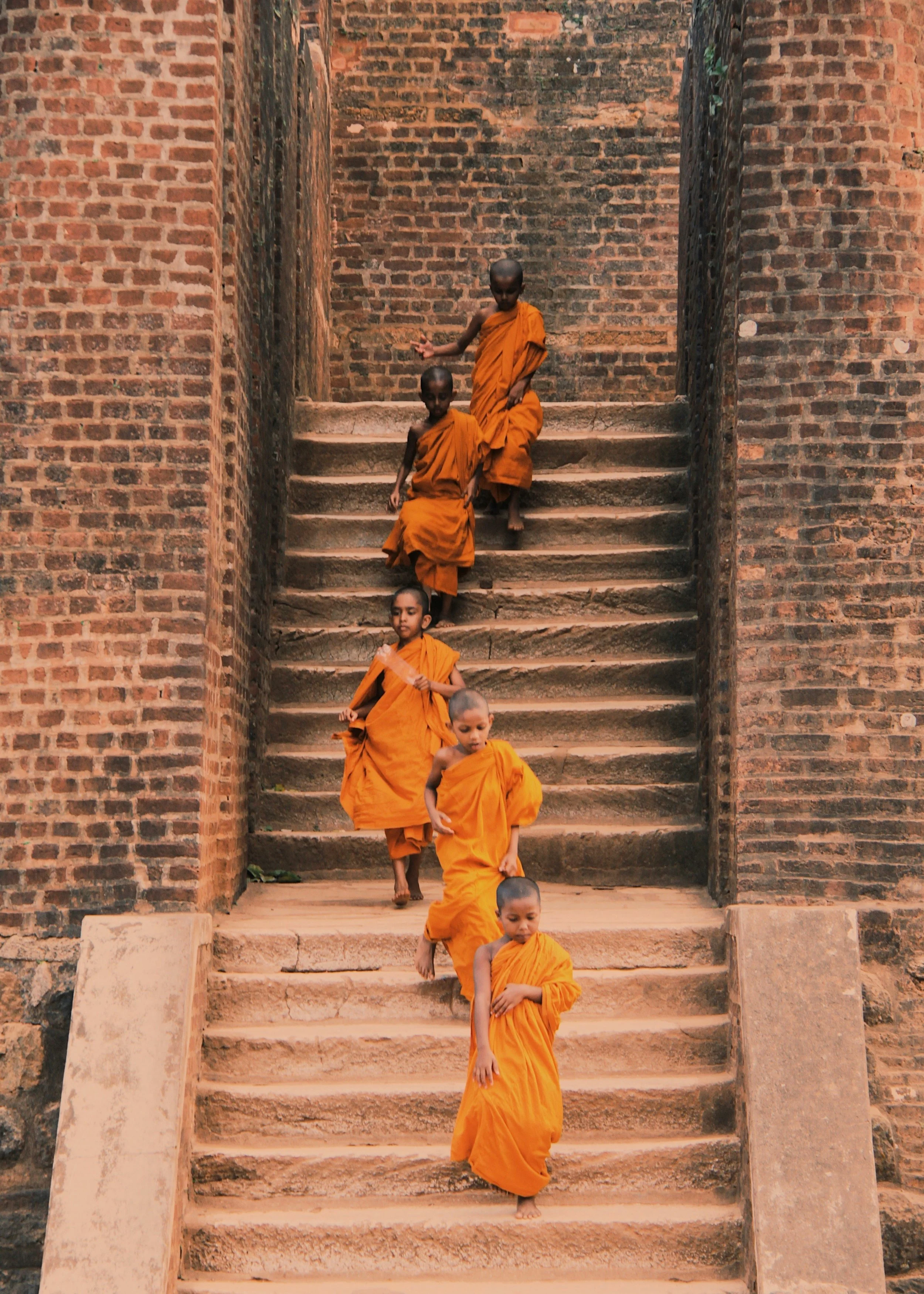
Young Buddhist monks walk down a staircase in their saffron robes

4 Things to Notice in Any Sacred Space

You don’t need to know the chemistry of medieval pigments before entering a temple. Just slow down and look.

Ask yourself:

  1. Where does the daylight land first, and what does it illuminate?

  2. Which colors are beneath your feet and which are above your head?

  3. Is the brightest thing in the room paint, textile, metal, tile or glass?

  4. Which surfaces have faded — and which have obviously been restored or repainted?

Those questions can reveal what materials were available, where builders concentrated their resources and what they most wanted visitors to notice.

And remember that what you’re seeing now isn’t necessarily what the original worshippers saw.

Centuries of sunlight can fade pigments. Smoke can darken walls. Paint can flake away. Restoration can introduce entirely new colors. Political and religious changes can strip decoration out or cover it up.

Sometimes “ancient austerity” is just what survived.
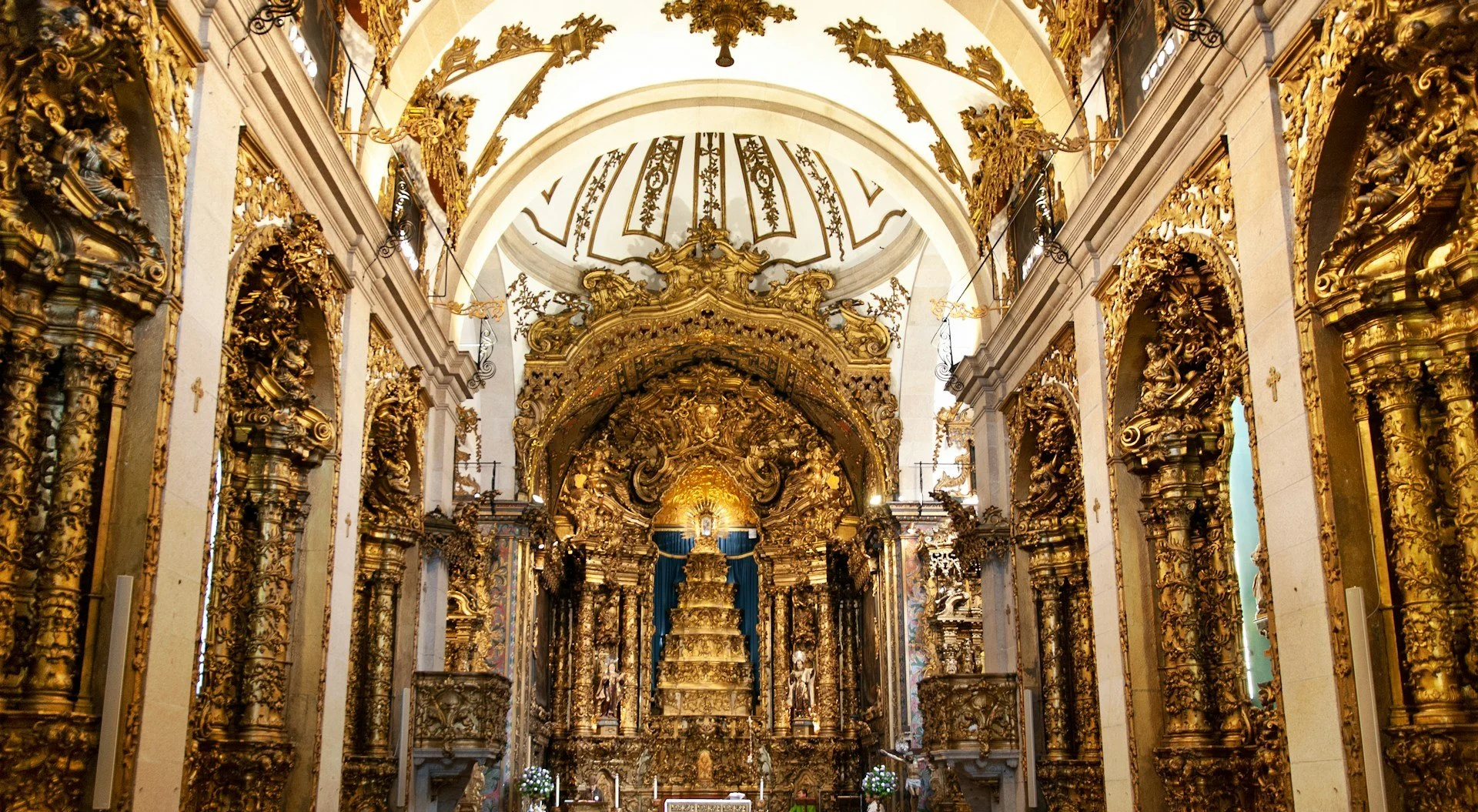
Gold-covered interior of a Baroque church

The Meaning of Color Isn’t Universal

It’s tempting to create a universal guide to sacred colors:

Red = sacrifice

White = purity

Blue = heaven

Gold = divinity

Except, humans are much more interesting than that.

A color can signify mourning in one culture and celebration in another. White can represent purity, death, simplicity or merely an abundant supply of lime. Gold can suggest divine radiance, but it can also announce that a patron had a staggering amount of money to spend.

The modern fascination with aura colors meaning comes from a similar desire to make color legible: If we feel something when we encounter a color, surely that feeling must be telling us something.

Maybe it is. But when you’re traveling, context will tell you far more than a universal color chart ever could.
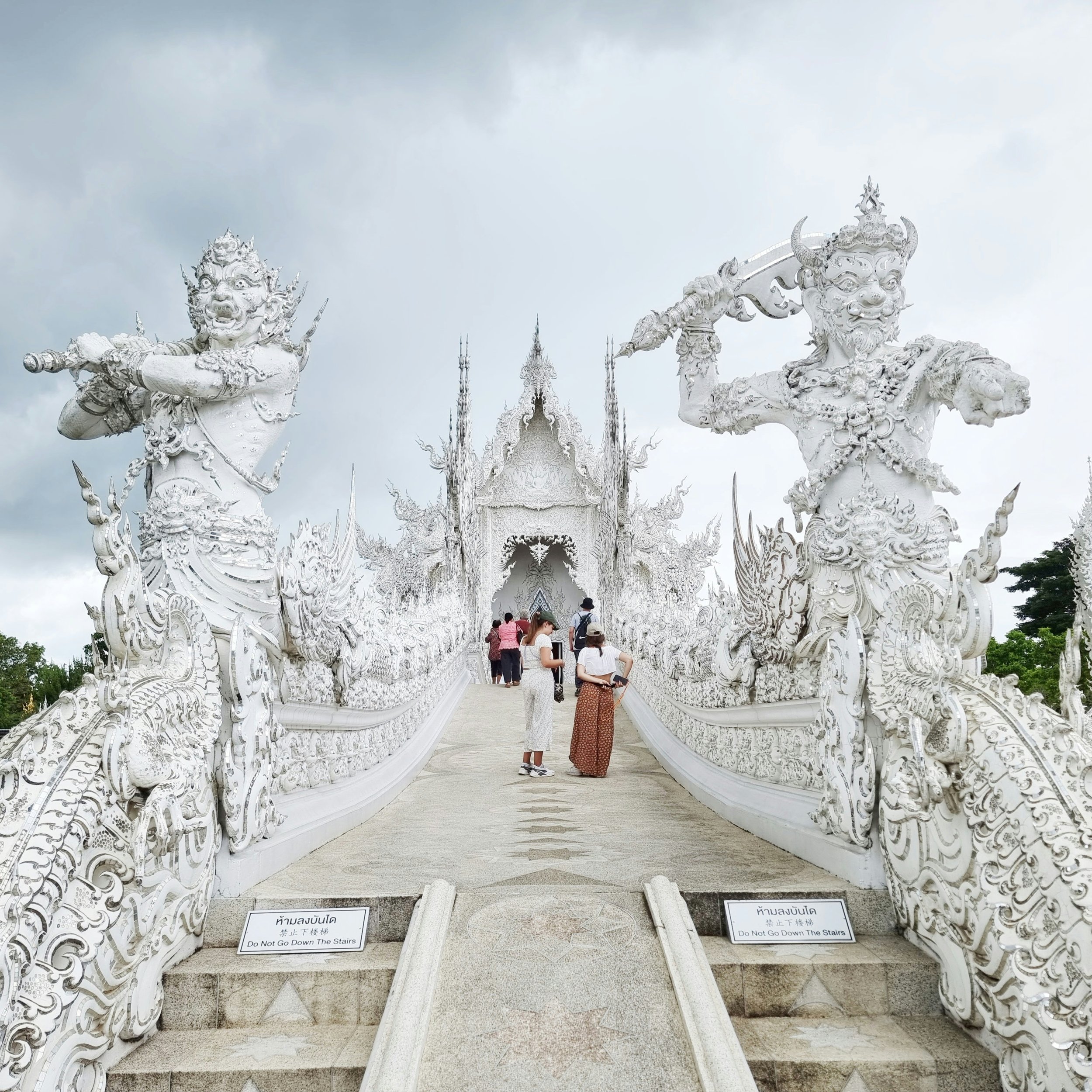
Fierce mythological figures holding weapons by the bridge to the White Temple in Chiang Rai, Thailand

How Color Changes the Way You Travel

The next time you enter a sacred space, stop at the doorway for a moment.

Before reading the plaque or pulling out your phone, look for the brightest thing in the room.

Is it gold? Blue tile? A painted statue? A monk’s robe? Stained glass catching the afternoon sun?

Then ask why that got the color.

You might find yourself thinking about mineral deposits, dying techniques, ancient trade routes, kiln temperatures, religious rules and wealthy patrons — all from one patch of paint.

That’s what makes color in sacred spaces so fascinating. The walls aren’t only telling you what people believed.

They’re telling you what they had, what they knew how to make and what they believed was worth the expense. –Karyna Diadiura


Karyna Diadiura is a spiritual guide and mentor specializing in numerology, tarot and yoga. 
Mexico City Travel Guide: Best Things to Do in CDMX, Neighborhoods & Itinerary

Everything you need to plan a Mexico City vacation, from where to stay and what to eat to museums, architecture, markets and hidden gems across CDMX.

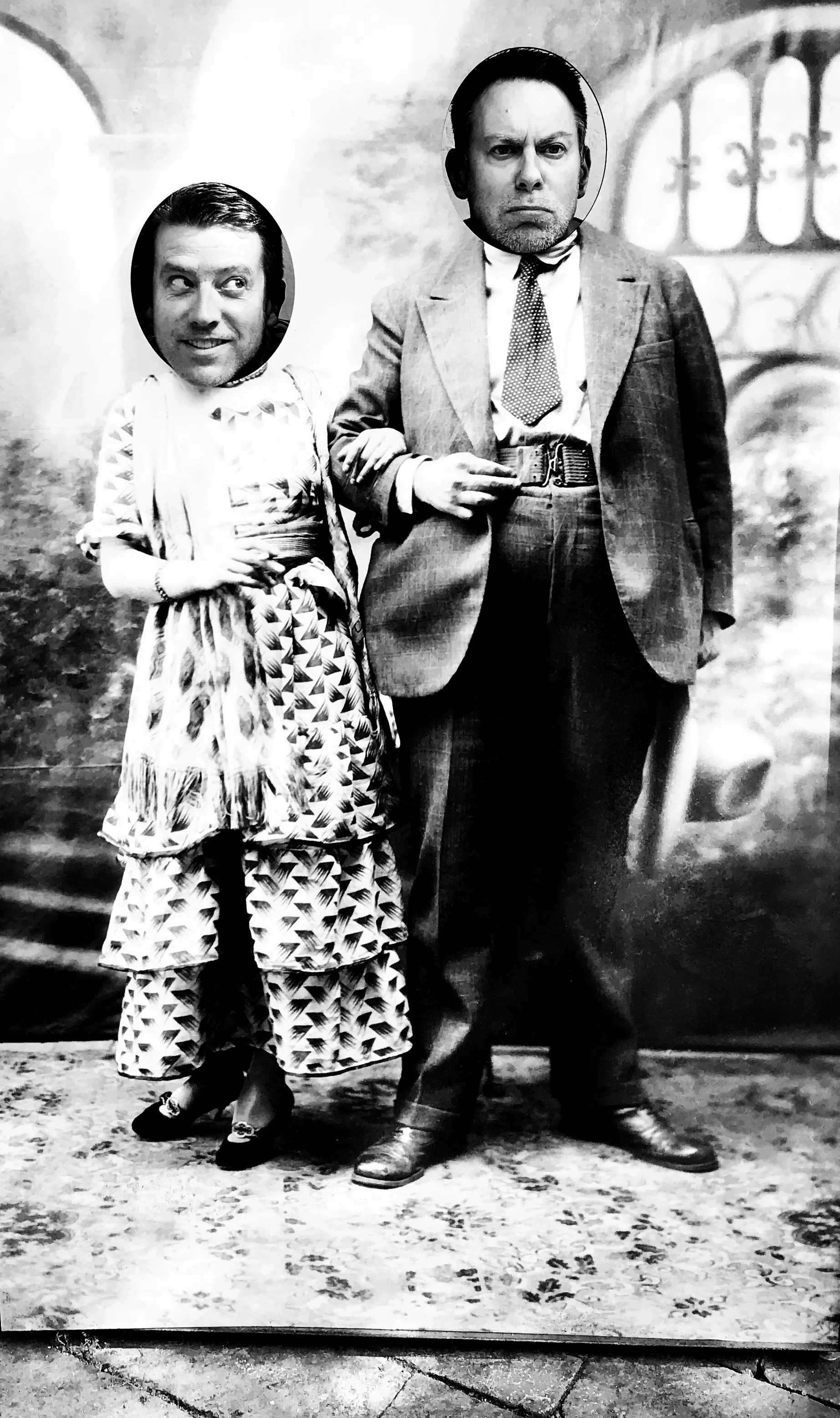
Wally and Duke pose in cutouts of Frida Kahlo and Diego Rivera

Frida and Diego, err, Wally and Duke offer up this guide to CDMX.

I hesitate to write this guide. Sure, I could rave about Mexico City for days — but that’s exactly the problem. I don’t want it to get too popular. There’s something special about CDMX that feels like a secret, and every time someone returns, I ask, “Did you love it?” The answer is always a resounding yes. It’s a city with undeniable magic. But maybe it’s time we stop singing its praises quite so loudly before it gets overrun and loses its charm. (And it’s already well on its way, as the recent protests against expats and digital nomads, who have driven up rents and fast-tracked gentrification, can attest.)

For one thing, Mexico City is an embarrassment of riches, with enough history, art and culture to keep even the most seasoned traveler captivated for weeks on end. Like Paris, you can spend a week here and barely scratch the surface. With every neighborhood offering something unique — from the bohemian charm of Coyoacán to the vibrant streets of La Condesa — there’s an endless amount to explore.

To help you navigate this sprawling city, we’ve organized our guide by neighborhood, highlighting the best markets, museums, landmarks, restaurants and quirky spots that make CDMX unforgettable. Whether you’re hunting for artisan crafts, enjoying a peaceful moment at a museum, or getting a little creeped out at the Island of the Dead Dolls on the canals of Xochimilco, this guide will take you through the gems that make Mexico City one of the most thrilling destinations in the world. 

Just accept the fact that you’ll just have to pick the things that appeal to you the most, knowing that you can’t hit them all — and that you have a reason for coming back. 

Click on any of the links for deeper dives into these spots. 

Centro Histórico

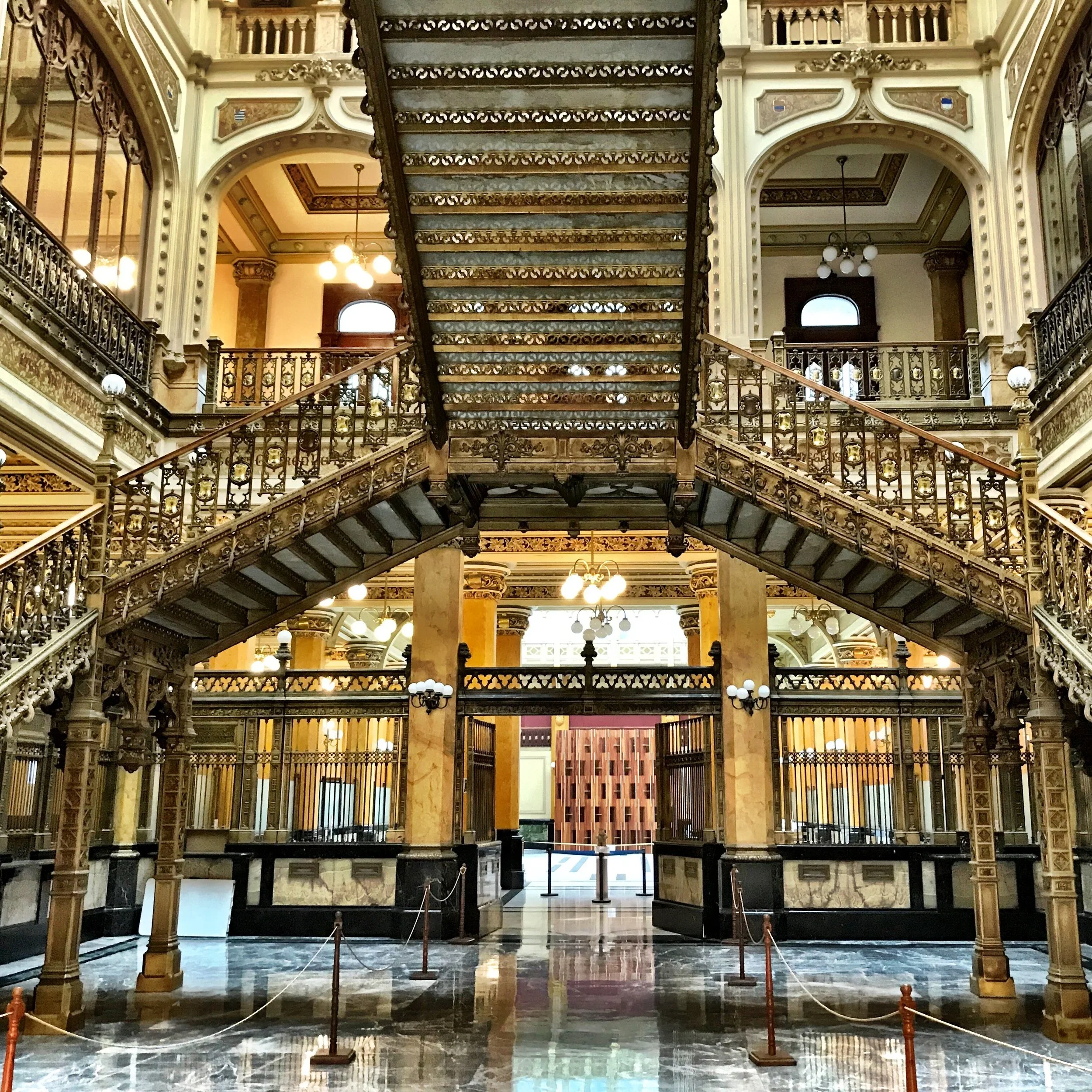
The famous staircase inside Palacio Postal in Mexico City's Centro

Most Instagrammable Places in Centro

Our guide to the most Instagrammable spots in Mexico City’s Centro takes you through one of CDMX’s most photogenic neighborhoods, where colonial architecture, Art Nouveau landmarks and modern public art collide. Our self-guided photo tour begins at the Sinagoga Histórica, whose unassuming façade gives way to a stunning folk art-inspired sanctuary, before continuing to the Antiguo Colegio de San Ildefonso, birthplace of the Mexican muralism movement. Along the way, stop for lunch on the rooftop at La Casa de las Sirenas, overlooking the Catedral Metropolitana and (unimpressive) Templo Mayor, then admire the cathedral’s lavish Baroque interior before wandering past the tiled façade of the Casa de los Azulejos.

Next, duck into the Gran Hotel Ciudad de México to marvel at its soaring stained-glass ceiling, then don’t miss the spectacular Palacio Postal, where twin gilded staircases and intricate brasswork make it one of the city’s most photogenic interiors. From there, cross to Sears for the iconic view of the Palacio de Bellas Artes dome before wrapping up with the Hemiciclo a Benito Juárez in Alameda Central and the striking red pyramids of Fuente de Vicente Rojo just across the street.

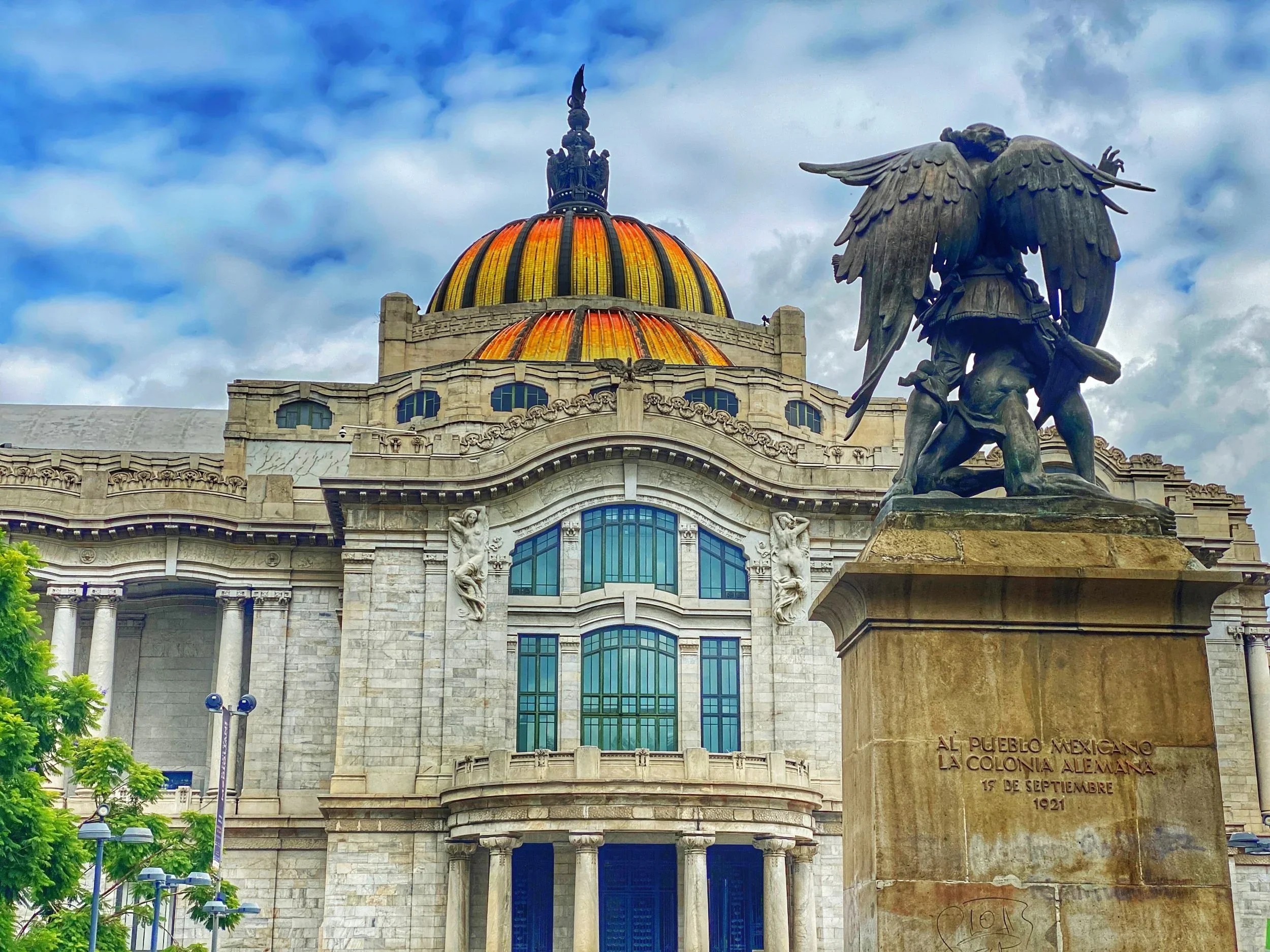
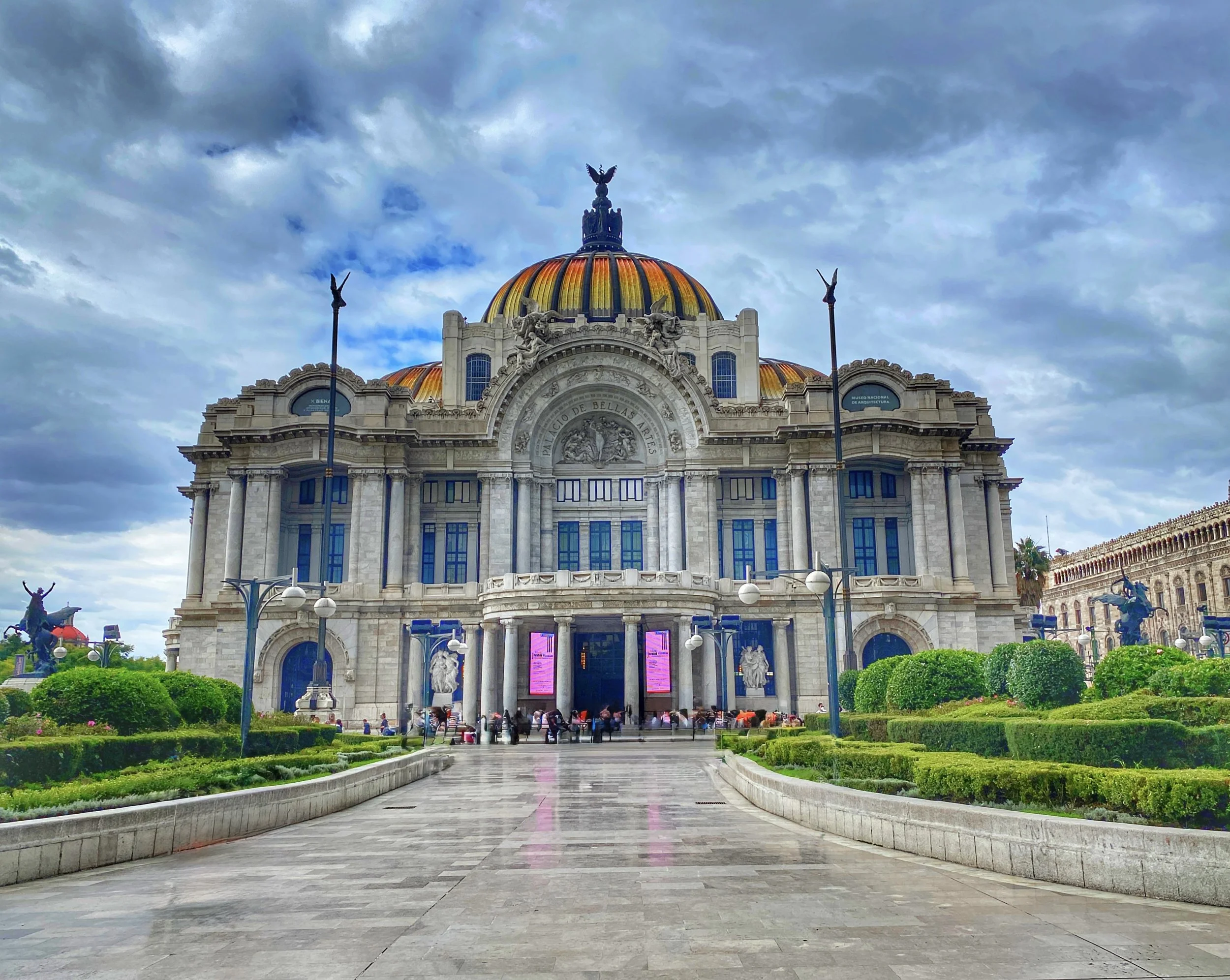
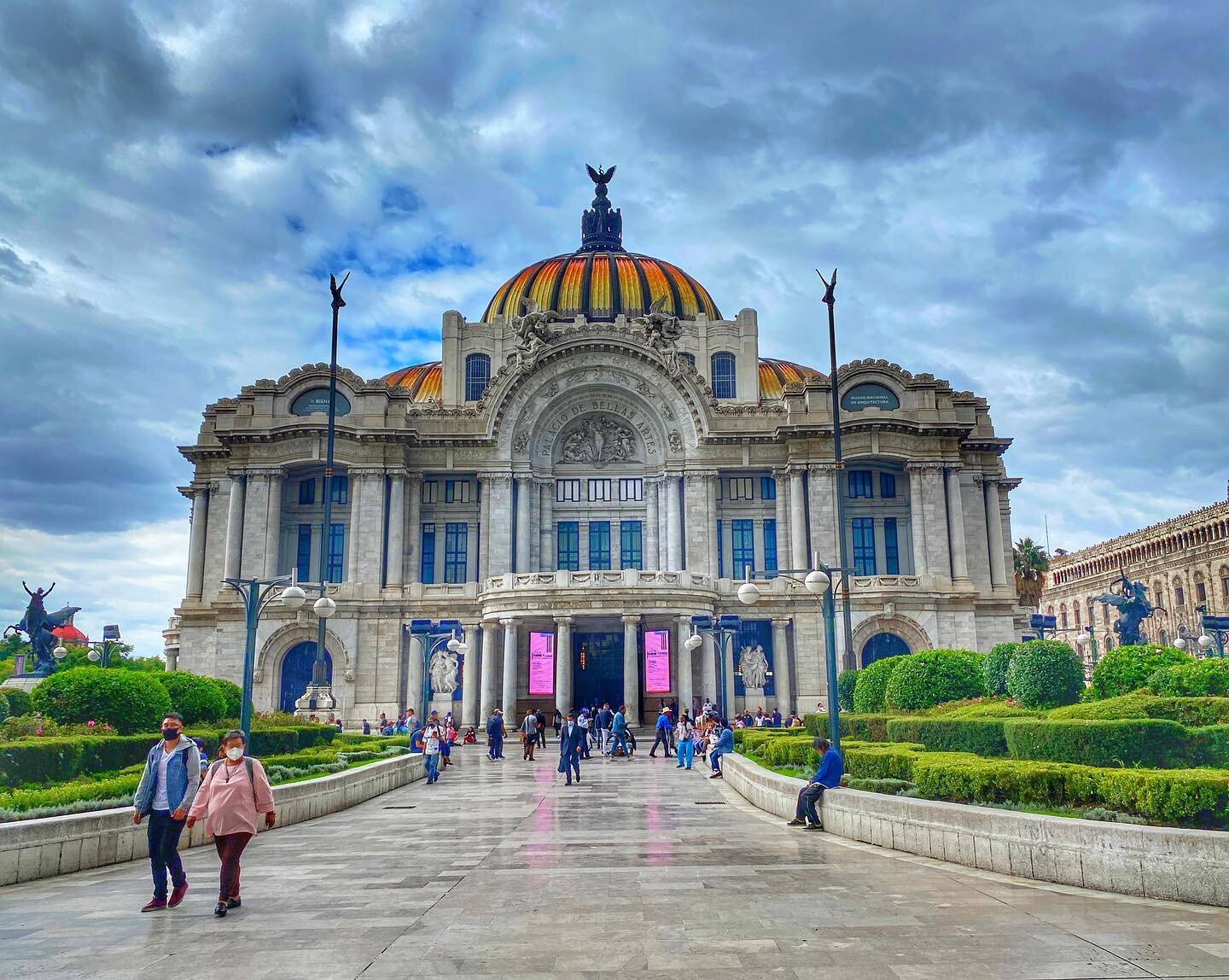
A statue in front of the orange and yellow domed Palacio de Bellas Artes in Mexico City's Centro neighborhood

Palacio de Bellas Artes

From the outside, the Palacio de Bellas Artes is a stunning Art Nouveau dome-topped palace glowing across Centro Histórico; inside, it’s home to Mexico’s premier opera house, the National Museum of Architecture, and a renowned collection of murals that provoke as much as they awe. We first glimpsed its golden crown from across the street, taking in the best view from Sears department store. But on another visit, we dove into the heart of the building, to find that in the Palacio’s mural museum, Mexico’s famous large-scale artists — Rivera, Orozco and David Alfaro Siqueiros — don’t hold back.

Rivera’s Man, Controller of the Universe takes center stage, revisiting his controversial commission for the Rockefeller Center — destroyed for depicting Lenin. Here, Karl Marx and Charles Darwin rub shoulders. Meanwhile, Orozco’s Catharsis unleashes a dystopia where naked bodies and mechanical beasts clash, featuring the infamous La Chata, a grinning prostitute, who adds to the mural’s disturbing reputation. Each mural tells a story, whether it’s Siqueiros’ dream of Cuauhtémoc defeating the conquistadors or Rivera’s sly digs at White tourists and their clichés in Carnival of Mexican Life. The collection is edgy and bold, and it’s impossible to walk away without feeling like the walls just had the last word.

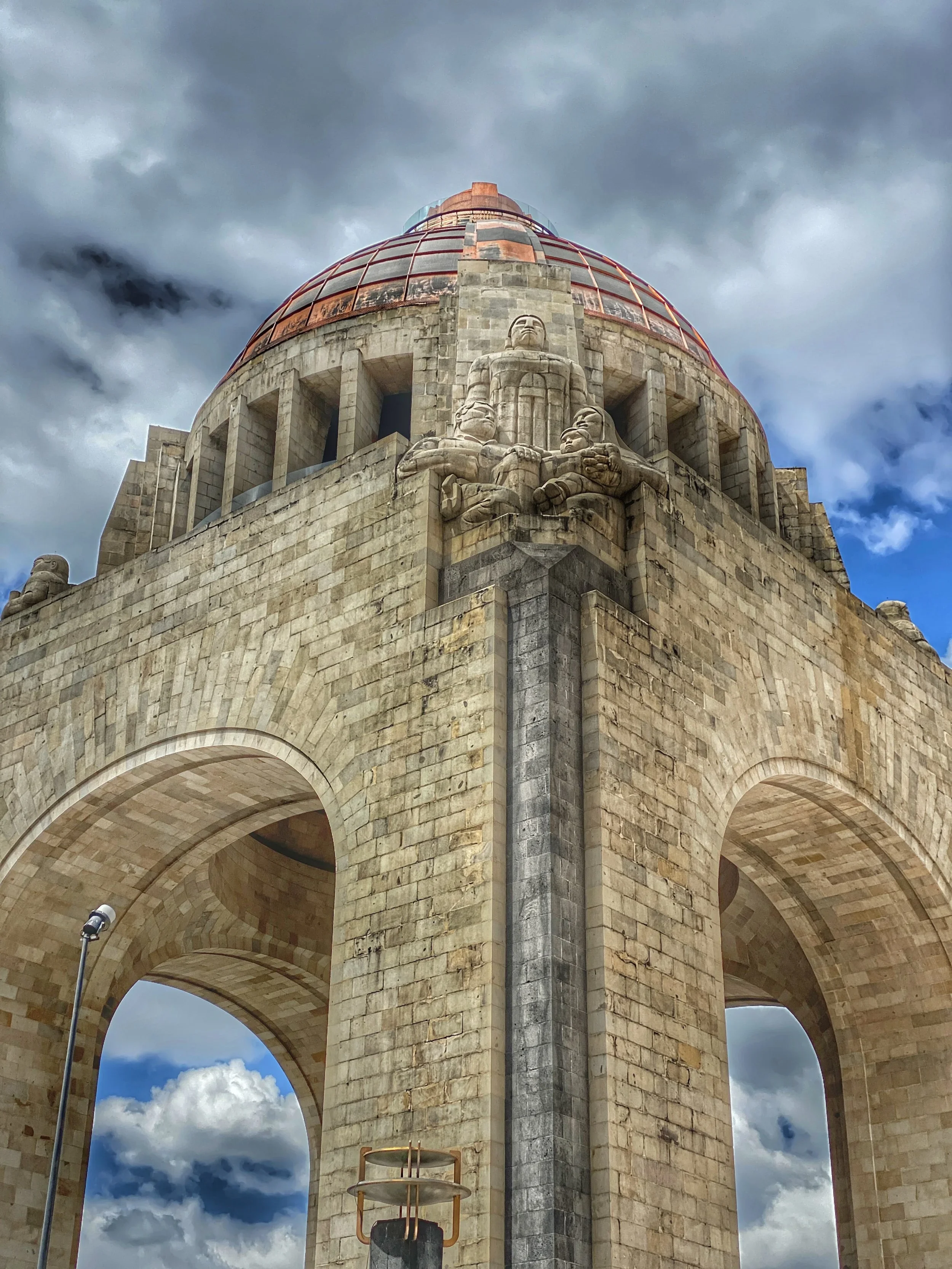
The top of the Monumento a la Revolución in Mexico City

Monumento a la Revolución

The Monument to the Revolution is a triumphal arch with some serious swagger. Originally destined to be the Palacio Legislativo Federal, the grand project was abandoned when the Mexican Revolution took center stage. For two decades, the half-built structure just sat there, rusting away. But then architect Carlos Obregón Santacilia had a better idea: turn that mess into a towering 220-foot icon, now the tallest triumphal arch in the world. Take that, Arc de Triomphe!

Today, the monument wears many hats: mausoleum, observation deck and revolutionary museum, with a little copper-clad cupola action thrown in for good measure. The glass elevator ride up the center is worth it for the views alone, but the exposed steel innards are also worth checking out. 

Meanwhile, down below, the National Museum of the Revolution does its best to impress with its “avant-garde” exhibits (we’ll take their word for it). 

Outside, the Plaza de la República buzzes with vendors selling everything from T-shirts to street snacks, and the sunken garden gives you a breather from the city’s chaos.

Chapultepec Park

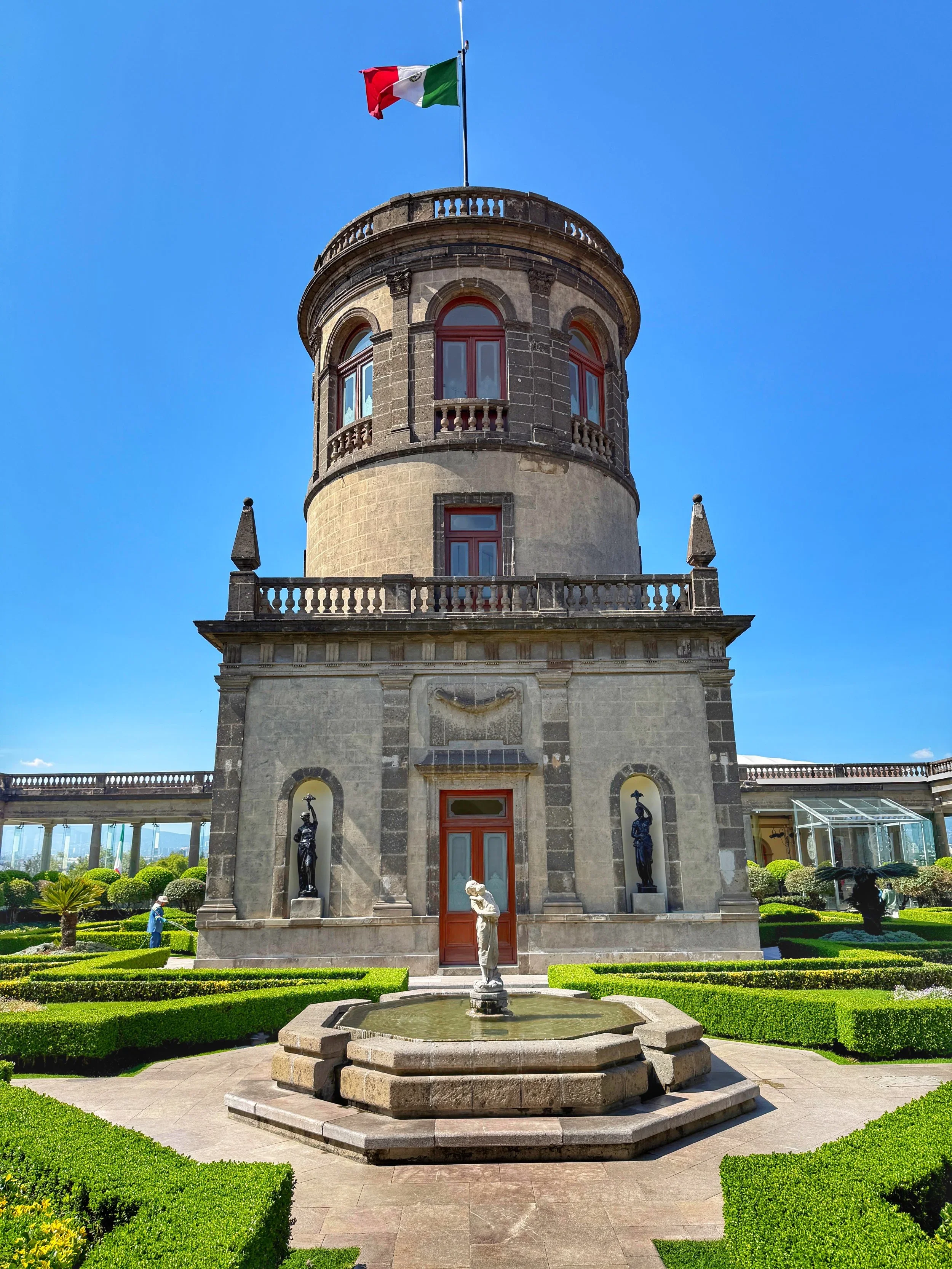
The rooftop garden and observatory tower by a fountain and hedges in Mexico City's Chapultepec Castle

Chapultepec Castle

A castle in the middle of Mexico City? Yes, really — perched atop Chapultepec Hill, this once-imperial palace is now a museum, a monument and a mood. From its sweeping views to its storybook staircases, Chapultepec Castle delivers drama at every turn.

On our visit, we followed the winding hilltop path, dodging packs of schoolchildren to reach the gates. Once inside, things get surreal. French chandeliers, trompe-l’œil ceilings, and checkerboard floors speak to its time as Emperor Maximilian and Empress Carlota’s royal residence, when the castle played dress-up as a European palace. And don’t miss the stained glass gallery of Muses and the rooftop garden.

The castle also houses the National Museum of History — and the exhibits remind you that while emperors played house, revolutionaries were gearing up to take it all down. Cases hold Aztec codices, colonial relics and revolutionary banners. It’s a crash course in Mexico’s past, where empires rose, ideals clashed, and the culture kept reinventing itself.

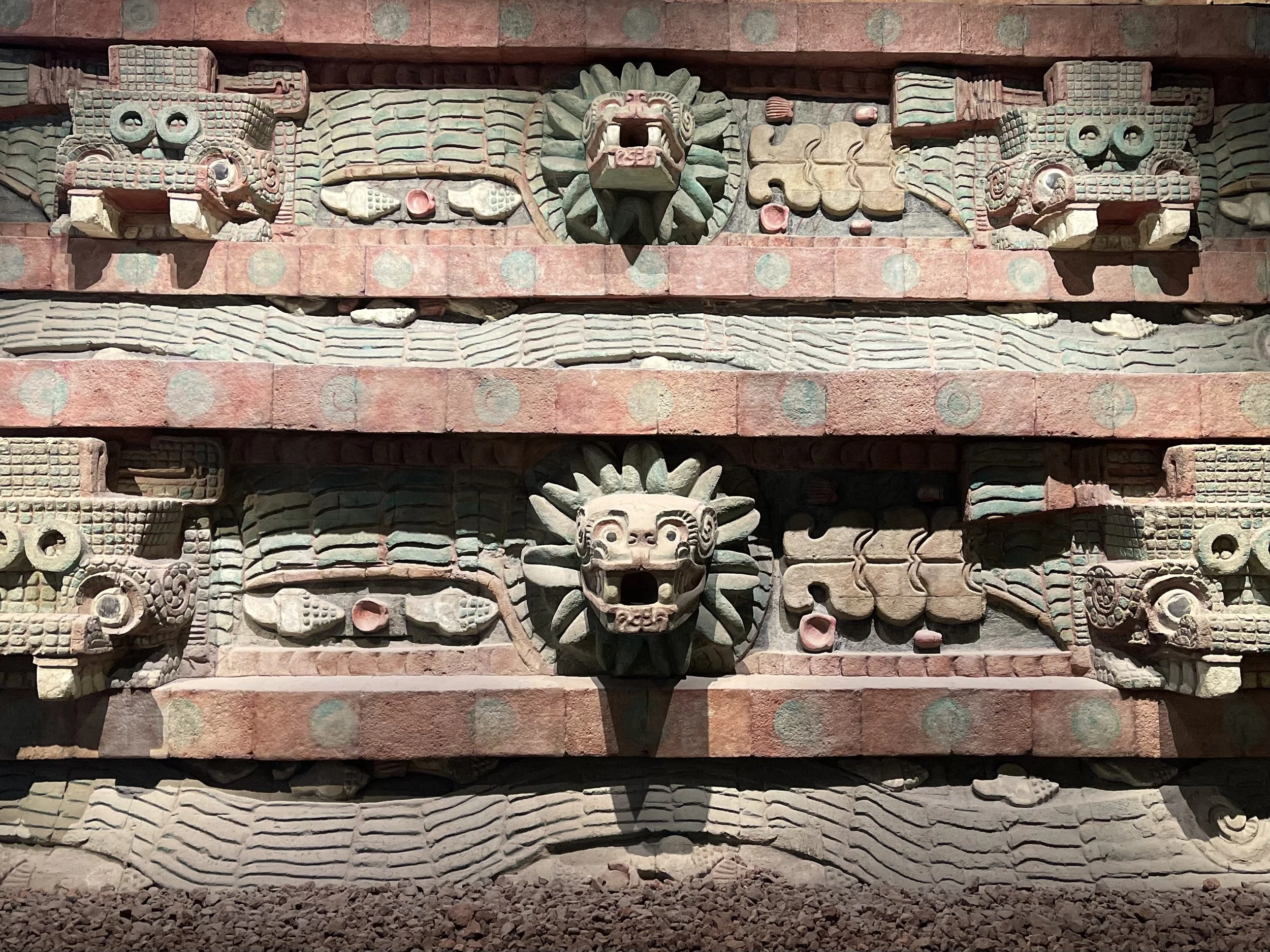
Animal heads and other carvings on parts of an Aztec temple in CDMX's Museo Nacional de Antropología

Museo Nacional de Antropología

The museum doesn’t wait until the galleries to wow you — its massive umbrella fountain out front rains spectacle on everyone walking in. Inside, soaring halls hold colossal Olmec heads, Aztec sun stones and Maya stelae — alongside delicate figurines that speak to everyday life. Every gallery plunges you deeper into the civilizations that shaped Mexico long before the Spanish arrived. My favorite part: Various galleries lead outside, where you feel like you’ve stumbled into the jungle and discovered an ancient temple and artifacts.

Another highlight? The way animals come to life in pottery and sculpture, each one symbolizing something sacred, fierce or divine. Here’s what we uncovered about animal symbolism in pre-Columbian pottery.

And if you’re drawn to the darker corners of history, don’t miss the exhibits on burial rituals and offerings. From jade beads in the mouths of the dead to xolo dogs sacrificed as guides to the afterlife, the museum doesn’t shy away from the raw power of the death cults of Ancient Mexico.

La Condesa

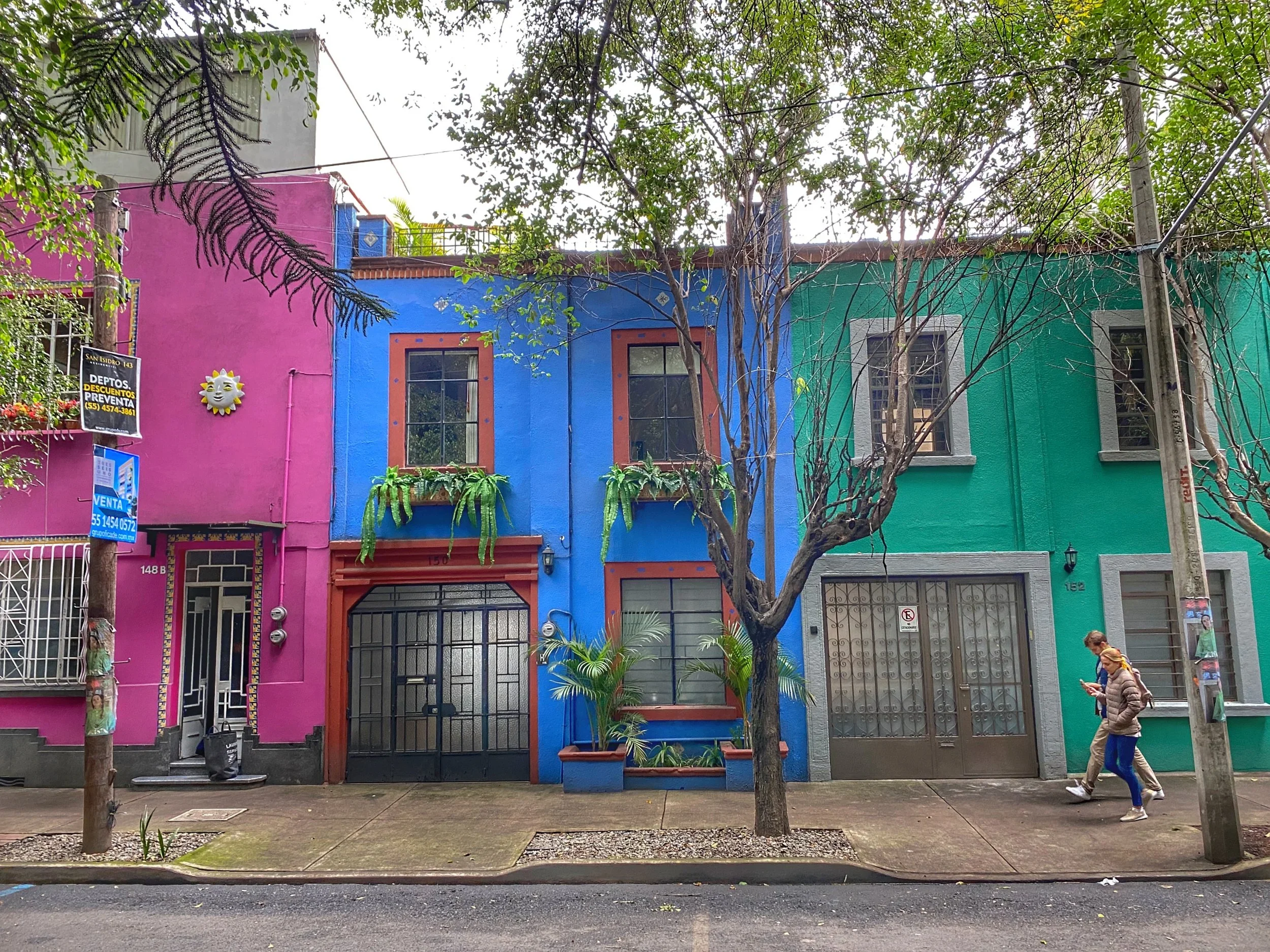
Brightly colored buildings in CDMX's La Condesa neighborhood

Morning in La Condesa

Start your morning in La Condesa, where Avenida Amsterdam’s tree-lined oval leads you past Art Deco gems and green spaces that feel worlds away from the city’s hustle. The avenue’s curving path traces the outline of an old racetrack. As you stroll, keep an eye out for the architectural detail: Streamline Moderne façades and stylish mansions make every turn a feast for the eyes.

For breakfast, we recommend Frëims, tucked inside a renovated 1920s home. The sun-drenched patio is perfect for savoring a coffee or one of their fresh juice blends, while admiring the mural. Fuel up on something like the lemon ricotta pancakes or huevos benedictinos, then take a leisurely walk over to Parque México. This green space, once home to an elite jockey club, now offers a mix of dog walkers, skaters and public art, like the Fountain of the Pitchers, which immortalizes Luz Jiménez as the iconic indigenous beauty of the 1920s. Whether you’re there for a stroll or just people-watching, La Condesa’s vibe is pure magic.

Where to stay in La Condesa

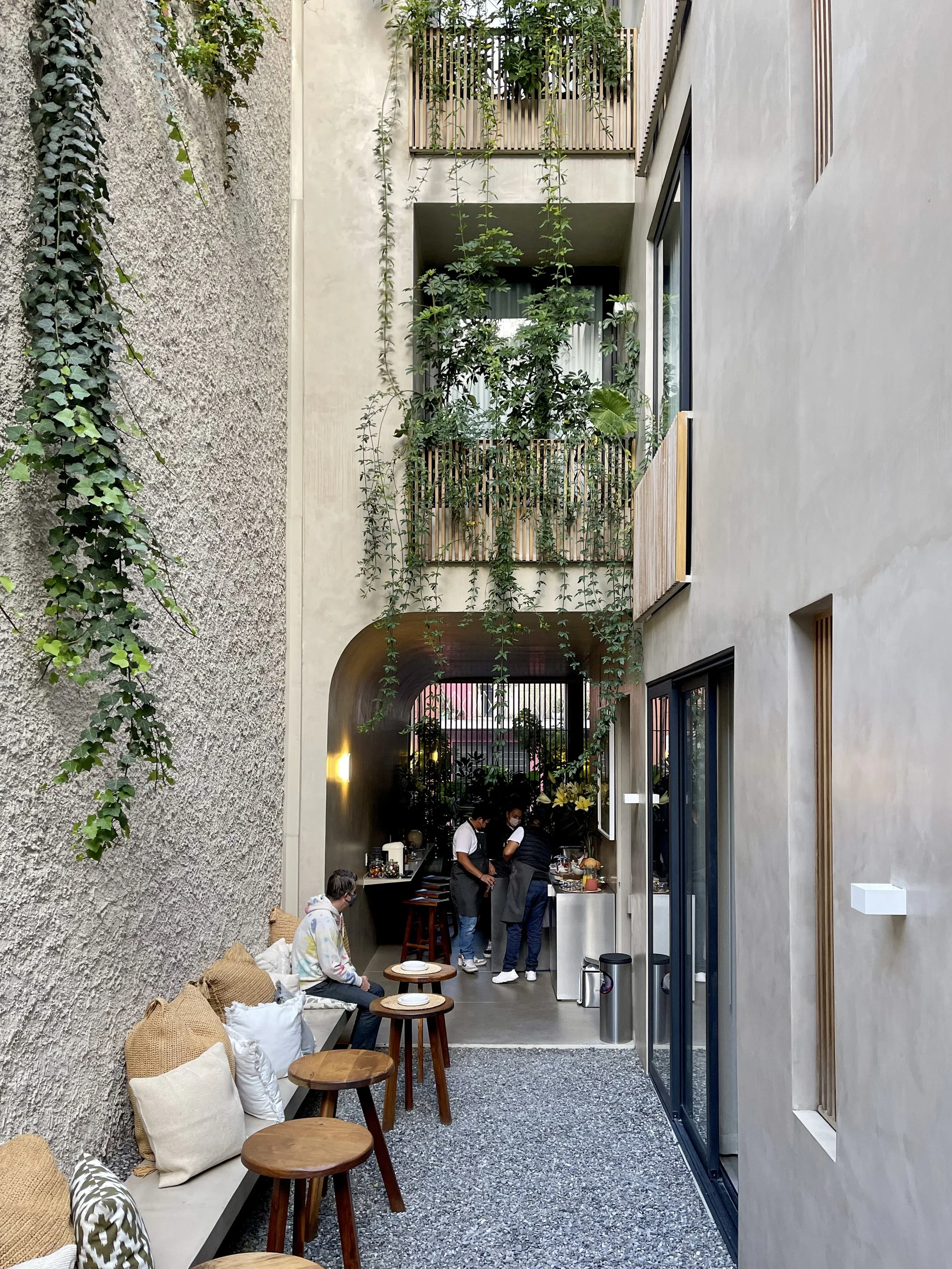
The interior courtyard / eating area with stones and plants trailing off balconies at Octavia Casa in Mexico City, Mexico

Octavia Casa

Octavia Casa is where minimalist design meets boutique charm, offering a chic retreat from the mellow bustle of La Condesa. The hotel’s teak lattice façade and the tropical plants spilling out over the concrete and glass exterior provide a touch of nature in the urban landscape. It’s a natural extension of the Octavia fashion brand, with spaces inspired by the label’s understated style, brought to life through thoughtful details like chukum stucco walls and muted earth tones that give each room an airy, welcoming vibe.

Mornings begin with a breakfast buffet of fresh fruit, pastries and handmade mugs. The staff go above and beyond, from a surprise birthday bottle of wine to Silvia’s heartfelt hugs. Evenings bring a different ambiance, with candlelight and libations on offer, perfect for winding down after a day of exploring CDMX. It’s hard not to feel special here, especially when you happen to be sharing the space with stars like Natalia Lafourcade.

Where to eat in La Condesa

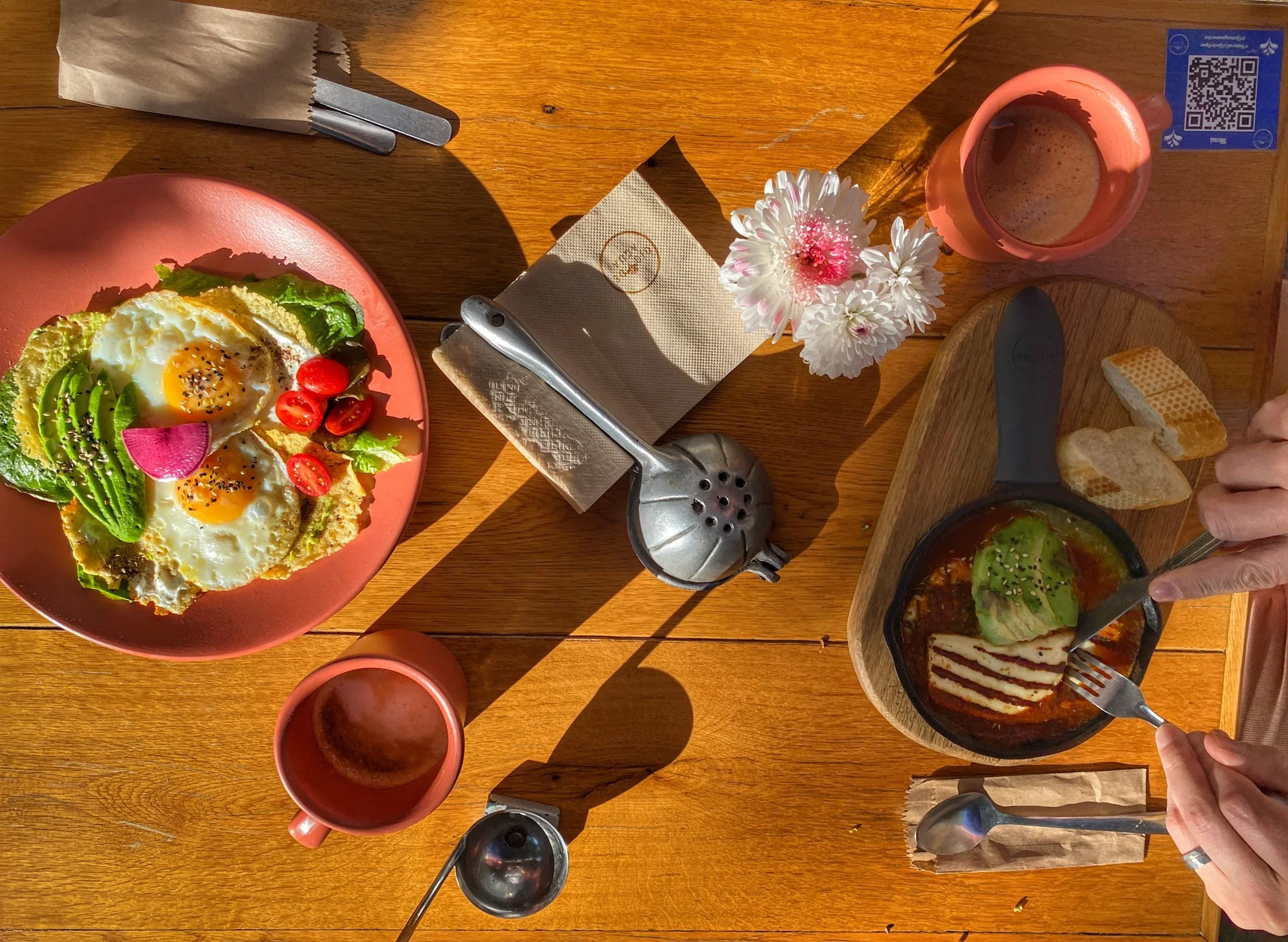
Breakfast dishes from Ojo de Agua in La Condesa, Mexico City

Ojo de Agua

Ojo de Agua in La Condesa is where health-conscious meets delicious. Situated near the lush Avenida Amsterdam and Plaza Citaltépetl, this fast casual café has a bright, fresh vibe and a fruit stand right inside. Named after a Michoacán town, the restaurant channels a commitment to living well, celebrating fresh ingredients in dishes that don’t skimp on flavor. The interior is casual chic, with Mudéjar-style tiles, big windows and plenty of natural light, while the outdoor seating is perfect for soaking up the neighborhood’s morning buzz.

The menu has something for everyone, from açaí bowls to cinnamon roll French toast, but we couldn’t resist the savory options. The santos ahogados, with its poached eggs, grilled panela and two salsas over a heart-shaped hoja santa leaf, brought a rich balance of flavors, while the huevos Polanco paired eggs with avocado purée and a za’atar-spiced jocoque. With Queen’s “Bohemian Rhapsody” playing in the background and fresh juice from the bar to finish things off, Ojo de Agua left us feeling fully satisfied and ready to take on CDMX.

Roma

Where to stay in Roma

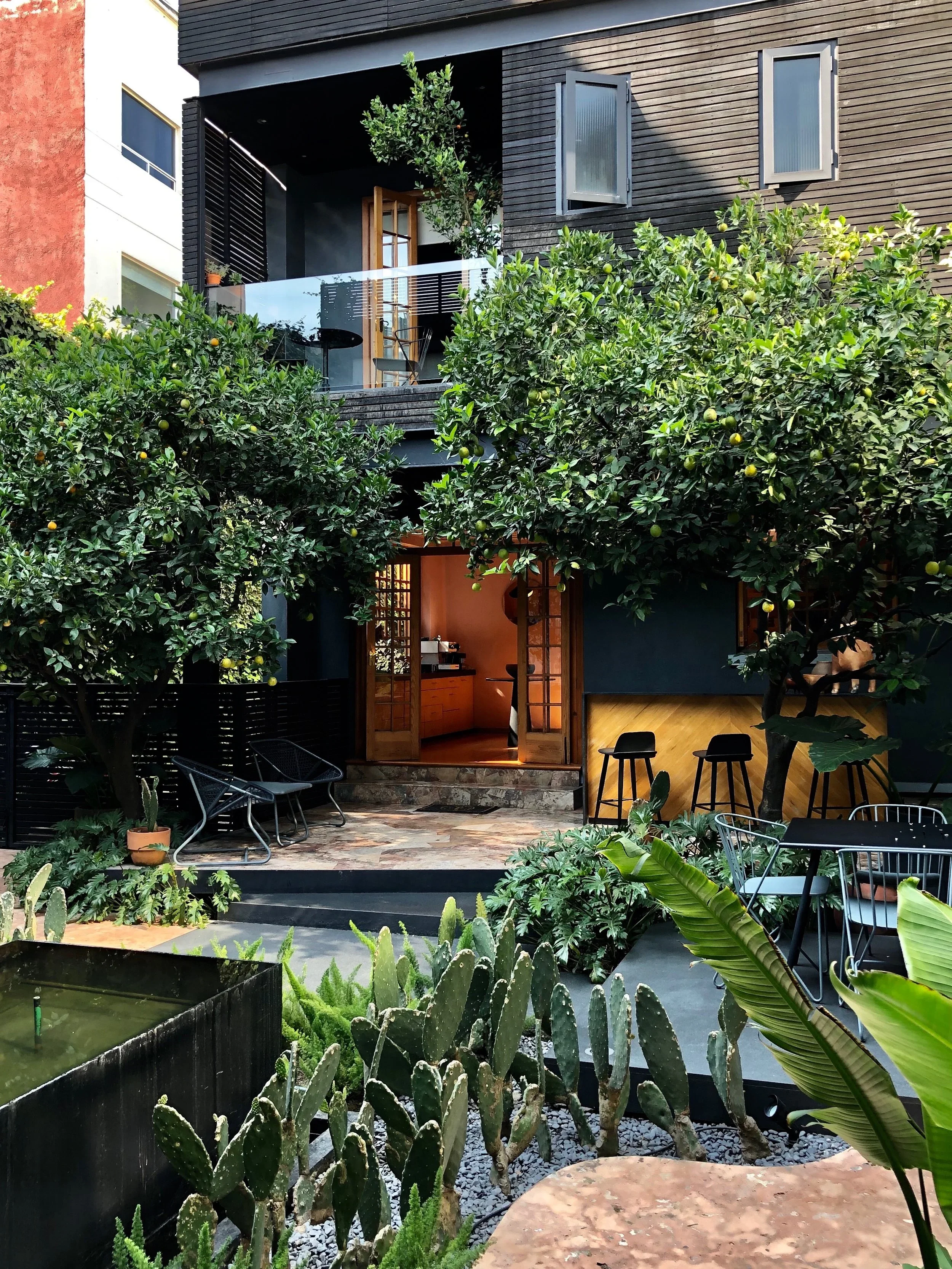
The backyard of Ignacia Guest House in Mexico City, with cacti, a water feature, bar and trees

Ignacia Guest House

Ignacia Guest House in Colonia Roma is a sophisticated blend of historic charm and modern elegance, tucked away in one of Mexico City’s most picturesque neighborhoods. The meticulously restored 1913 mansion captures the spirit of the area with its Neoclassical and Art Nouveau touches, while the modern wing adds a sleek contrast of glass and steel. Named after the beloved housekeeper who spent more than 70 years living and working in the home, Ignacia’s story is woven into every detail, from the Oaxacan cactus garden she planted to the woodcut portraits of her displayed in the lobby. We stayed in the Azul suite, which features reclaimed bowling alley maple floors and Carrara marble bathroom fixtures, providing the perfect mix of rustic and luxe.

The daily breakfast menu, crafted from Ignacia’s original recipes, offers a delicious start to the day, complete with fresh pastries and locally sourced ingredients. We especially loved the cocktail hour, where we sampled mezcal-infused drinks with sal de gusano (worm salt) and even tried crispy chapulines (grasshoppers) — because when in Rome… or, Roma. The courtyard patio is a central hub for socializing, shaded by ivy-covered walls and overlooked by the glass corridor that connects the new and old buildings. As much as the architecture and gardens enchanted us, it was the warm and welcoming staff who truly made us feel at home. 

Coyoacán

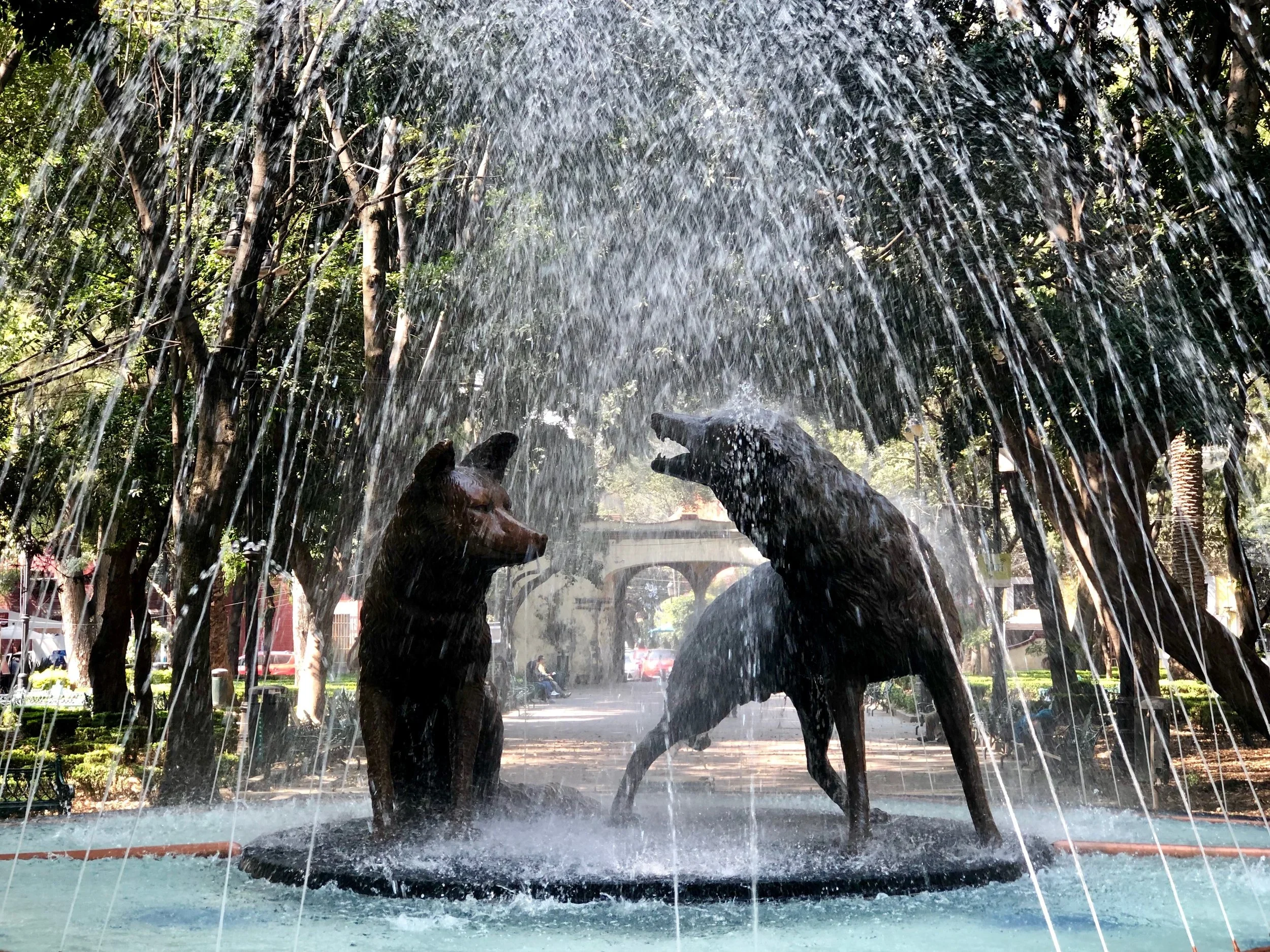
The fountain of two wolves in the square of Coyoacán in Mexico City

Wandering Coyoacán

An afternoon in Coyoacán offers a perfect mix of history, culture and a bit of boho chic. Start in Plaza Hidalgo, where the Fuente de los Coyotes splashes in the heart of a classic colonial square, and balloon vendors and palm-leaf crickets are part of the scene. Nearby, Los Danzantes serves up dishes like cricket croquetas and mezcal cocktails, perfect for people-watching while soaking up the bohemian vibe.

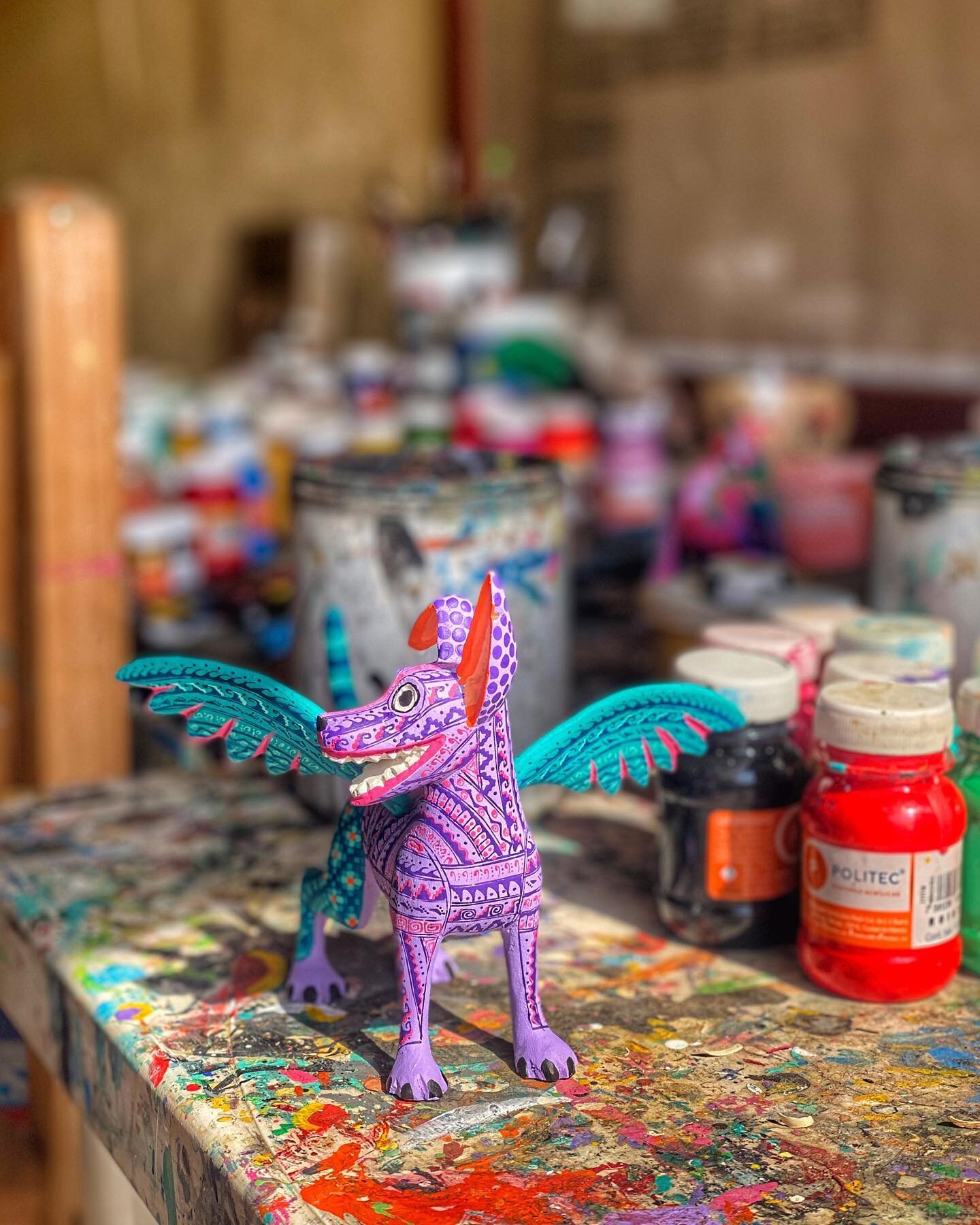
Wander into the Mercado Artesanal Mexicano for quirky souvenirs like Oaxacan alebrijes or oddball folk art, then recharge at Panadería Pública with a coffee and a guava pastry. Just a short stroll away, Plaza de la Conchita offers a quiet escape, where the 16th century chapel holds stories of Hernán Cortés’ time in the neighborhood. Finish at Frida Kahlo Park, where topiary animals greet you and teenagers practice salsa moves under bougainvilleas, and a mural by Dan Silva adds a burst of color. Coyoacán’s charm is irresistible, making it easy to see why artists and dreamers have called it home.

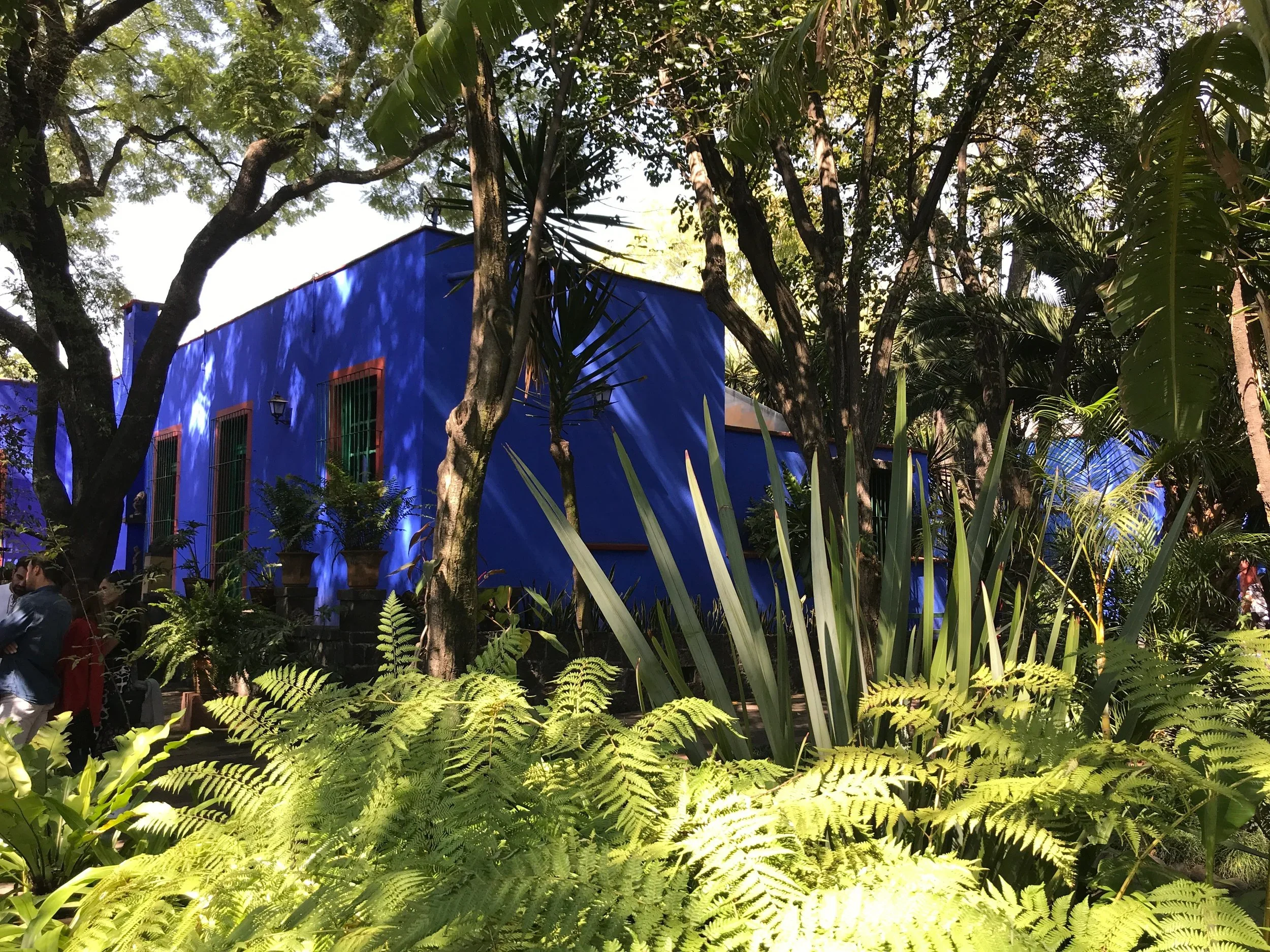
The bright blue Casa Azul, Frida Kahlo's family home, surrounded by greenery, in CDMX

La Casa Azul: The Frida Kahlo Museum

La Casa Azul, or the Frida Kahlo Museum, is as bold and layered as the artist herself, with its vibrant cobalt walls and eclectic blend of art, artifacts, and personal relics. The iconic blue-painted house in Coyoacán offers a glimpse into the world of Frida and Diego Rivera, where the bohemian spirit comes alive in the courtyard’s botanical garden and the interiors filled with papel picado, Tehuana dresses, and intricate folk art. We recommend booking tickets well in advance and arriving early to avoid the hours-long wait; it’s worth it to step inside this iconic space where Kahlo’s personality radiates from every corner.

From her wheelchair and easel to her night bed with a mirror overhead—where she painted while bedridden—La Casa Azul tells the story of an artist who turned pain into beauty. The house is filled with fascinating details, like the miniature clay mugs spelling out “Frida” and “Diego” above the stove, or the ashes resting in a pre-Columbian urn beside her bed. Beyond the personal spaces, you’ll find rooms with her lesser-known artworks, a display of her distinctive wardrobe, and even a pyramid of pre-Columbian sculptures Rivera added to the garden. The whole experience leaves a lasting impression, as if you’ve walked through the pages of Frida’s life story, with every object and plant bearing witness to her creative and resilient spirit.

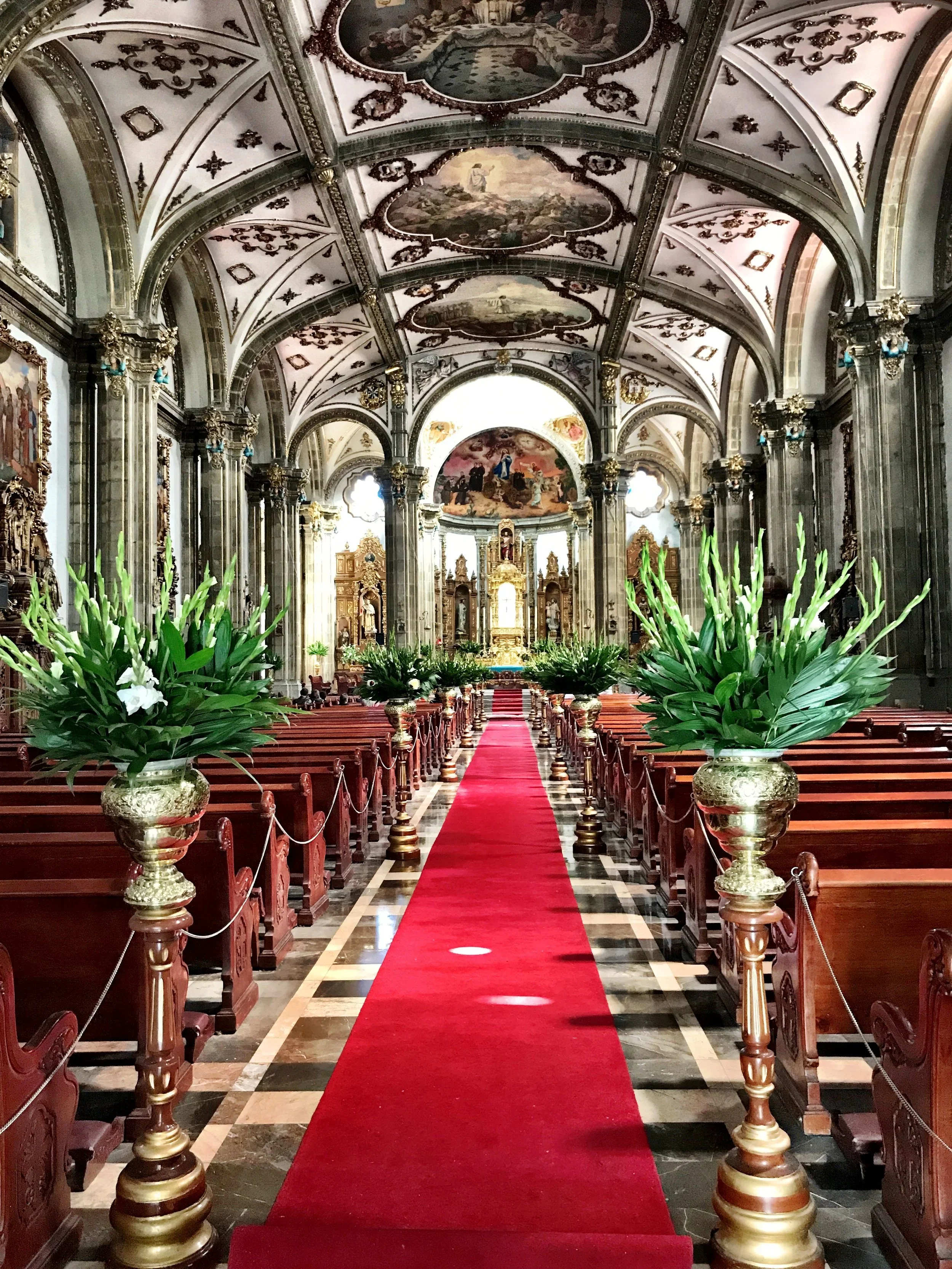
Murals on the ceiling, arches, pews and a red carpet runner inside Parroquia San Juan Bautista in Mexico City

Parroquia San Juan Bautista

Parroquia San Juan Bautista, or La Iglesia de Coyoacán, is a captivating piece of Spanish colonial history nestled in Mexico City’s bohemian Coyoacán neighborhood. Built between 1527 and 1552 on the site of an Aztec noble school, the church’s relatively plain Herrerian-style exterior belies the ornate Baroque splendor within. Step inside, and you’re greeted by gilded altars, frescoed ceilings depicting Christ’s life, and an array of small chapels, including the opulent Chapel of the Rosary.

The church is full of fascinating details, from the creepy yet compelling Cristo de los Milagros, adorned with healing charms, to niche statues and elaborate ornamentation that evoke Mexico’s blend of indigenous and Catholic traditions. Don’t miss wandering the peaceful cloisters out back, where Nahuatl-speaking converts were once baptized. La Iglesia de Coyoacán is not just a church; it’s a glimpse into the neighborhood’s layered history and enduring cultural richness. Read more here.

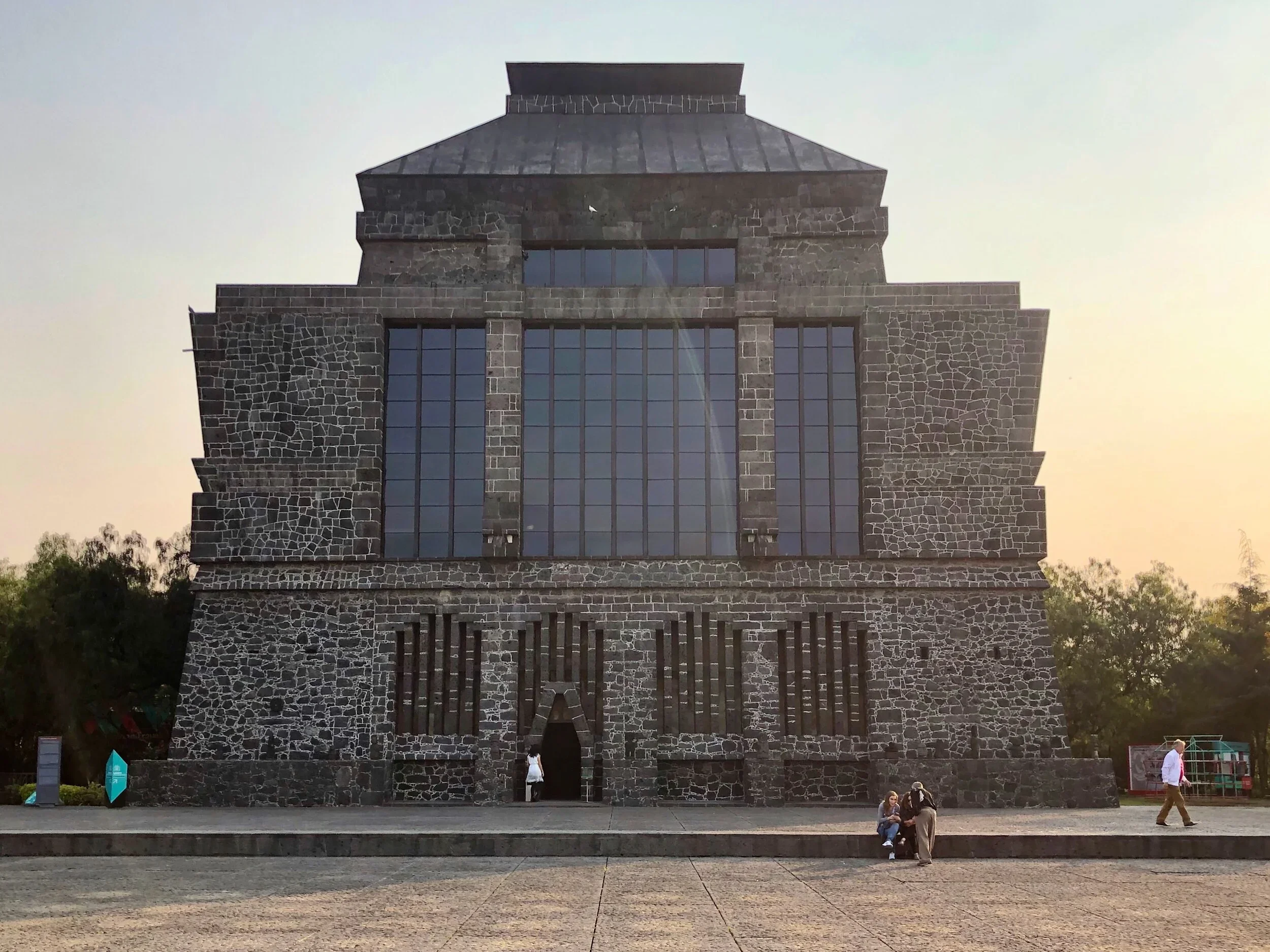
The stone exterior of Museo Anahuacalli at sunset

Museo Anahuacalli

The Anahuacalli Museum is unlike any other—a temple-like structure housing Diego Rivera’s vast collection of pre-Hispanic artifacts. Built on the rugged volcanic rock of El Pedregal, this black basalt museum rises like a Mesoamerican pyramid, surrounded by myth and history. Rivera envisioned it as a place to contemplate Mexico’s ancient past, with over 50,000 artifacts collected over his lifetime, though only a fraction is displayed. The museum’s dim and cool interior, lit by alabaster windows, creates an otherworldly atmosphere, while colorful ofrendas and papier-mâché alebrijes burst against the stone.

Inside, narrow staircases lead you up through galleries filled with Zapotec, Maya, Aztec, and Olmec relics, culminating in Rivera’s art studio on the sunlit second floor, where you can see studies for his controversial murals. The rooftop terrace offers a stark contrast to the dark confines below, with panoramic views of CDMX. Rivera’s passion for the past comes to life here, where mythological mosaics, jaguar statues, and Mesoamerican symbolism honor Mexico’s ancient heritage. It’s an unforgettable experience that feels as much like stepping into a temple as it does a museum.

San Ángel

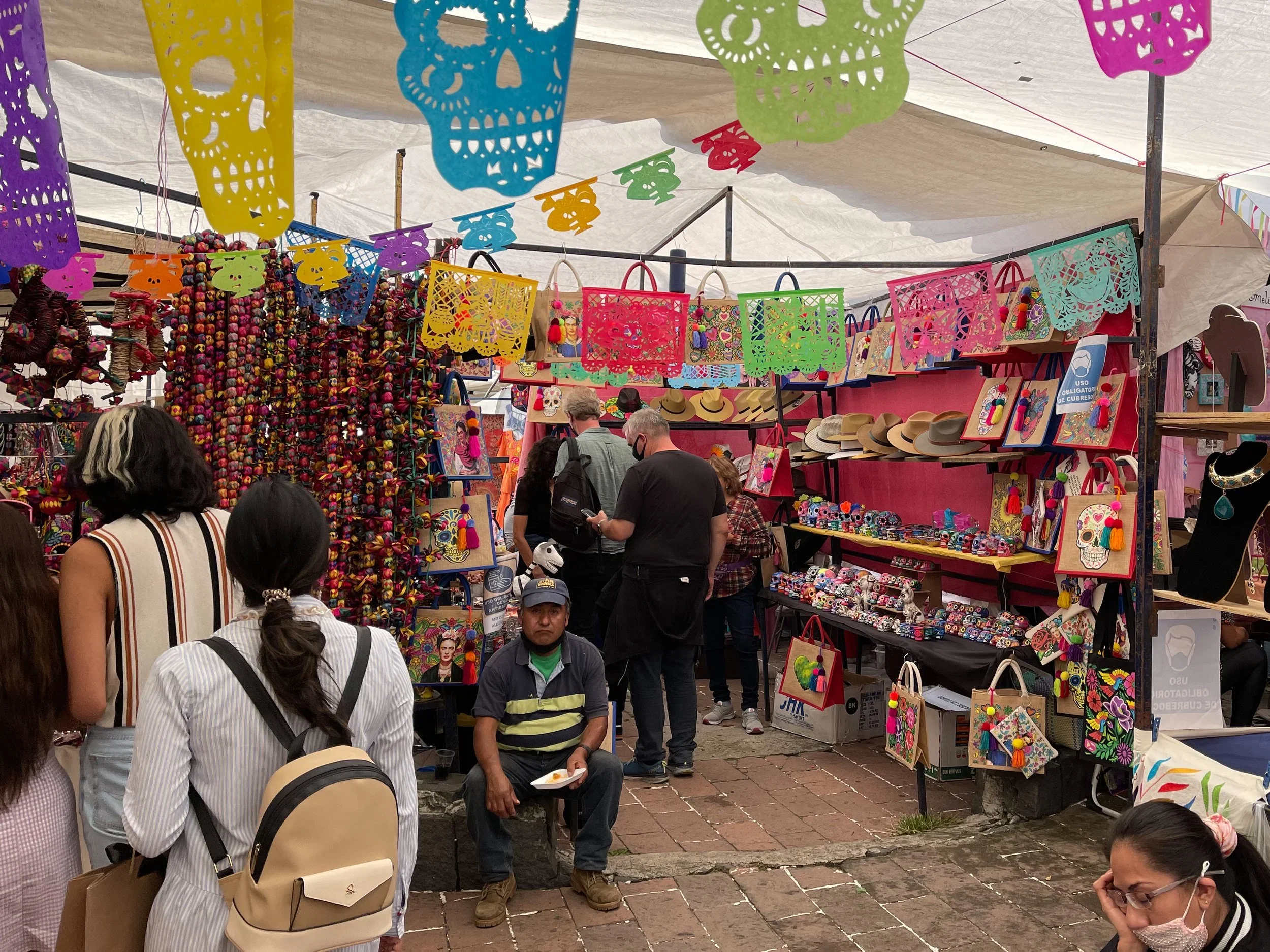
Paper skulls hang by craft vendors at the Bazar Sábado in San Angel, Mexico City

Bazar Sábado

The Bazar Sábado in San Ángel is a Saturday-only spectacle that fills the historic streets with artisans, craft stalls, and cultural treasures. The cobblestone lanes and colonial architecture set the scene for browsing unique wares, from vivid alebrijes and handpainted ceramics to quirky Day of the Dead memorabilia. Founded in 1960, the bazaar has grown into a beloved tradition, with its epicenter located in a central courtyard where you can also grab a bite or sip a local craft brew, like a Monstruo de Agua beer—a must-try for its unusual ingredients and axolotl-themed branding.

Though the market can get busy, a friendly “con permiso” helps you navigate the crowded stalls. Don’t miss browsing nearby shops like Cerámica San Germán, where the traditional meets the artistic, or grabbing a molcajete for your guacamole needs. The cupolas of Nuestra Señora del Carmen loom overhead, hinting at San Ángel’s rich history, complete with mummies and macabre relics in the crypt below. Whether you’re drawn to crafts, ceramics, or quirky curiosities, Bazar Sábado promises a vibrant and eclectic day out in CDMX’s most enchanting neighborhood.

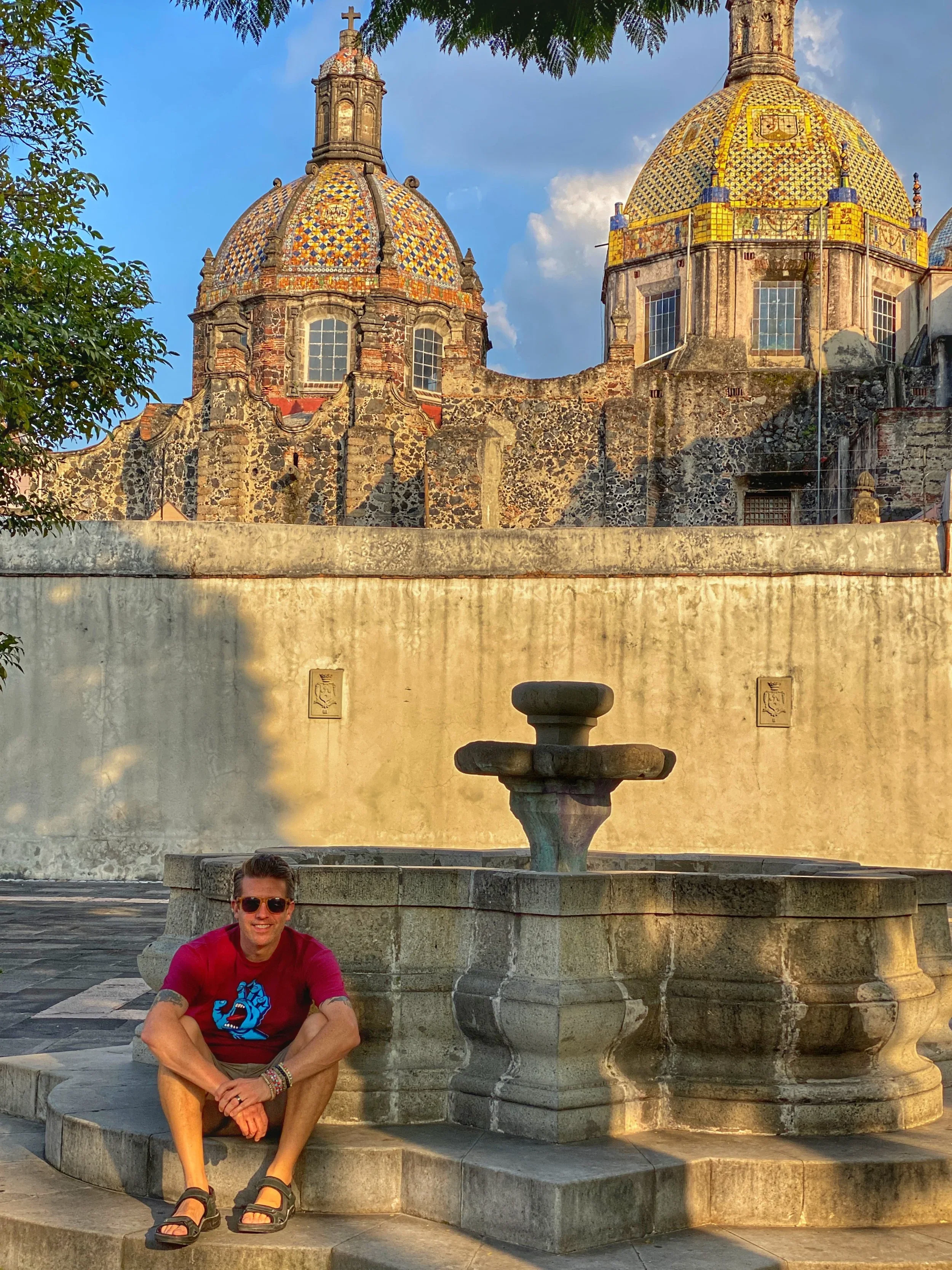
A man sits by the fountain at Nuestra Señora del Carmen in the San Angel neighborhood of CDMX

Nuestra Señora del Carmen

Nuestra Señora del Carmen in San Ángel is a captivating glimpse into Colonial Baroque architecture, with its faded domes tiled in vibrant patterns and gilded altarpiece that balances opulence with austerity. The church was founded for the Discalced Carmelites, a curious order known for their vow of shoelessness, established in the 16th century by Saint Teresa of Avila. Its history stretches back to the early 1600s, and the Carmen Complex encompasses more than just the church itself—it’s a former monastery and convent, now a museum where you can even find mummies lurking in the catacombs.

The church’s story doesn’t shy away from drama. After the War of Reform, when Mexico’s Liberal forces stripped the Catholic Church of its vast properties, parts of the complex were repurposed into everything from prisons to barracks. Today, the ornate interior of Nuestra Señora del Carmen stands in contrast to its unassuming façade, offering plenty to explore, from offshoot chapels to quiet corners for reflection. Whether you’re there for the architecture or just trying to catch a glimpse of those creepy mummies, this church is a must-see when wandering through the historic, tree-lined streets of San Ángel.

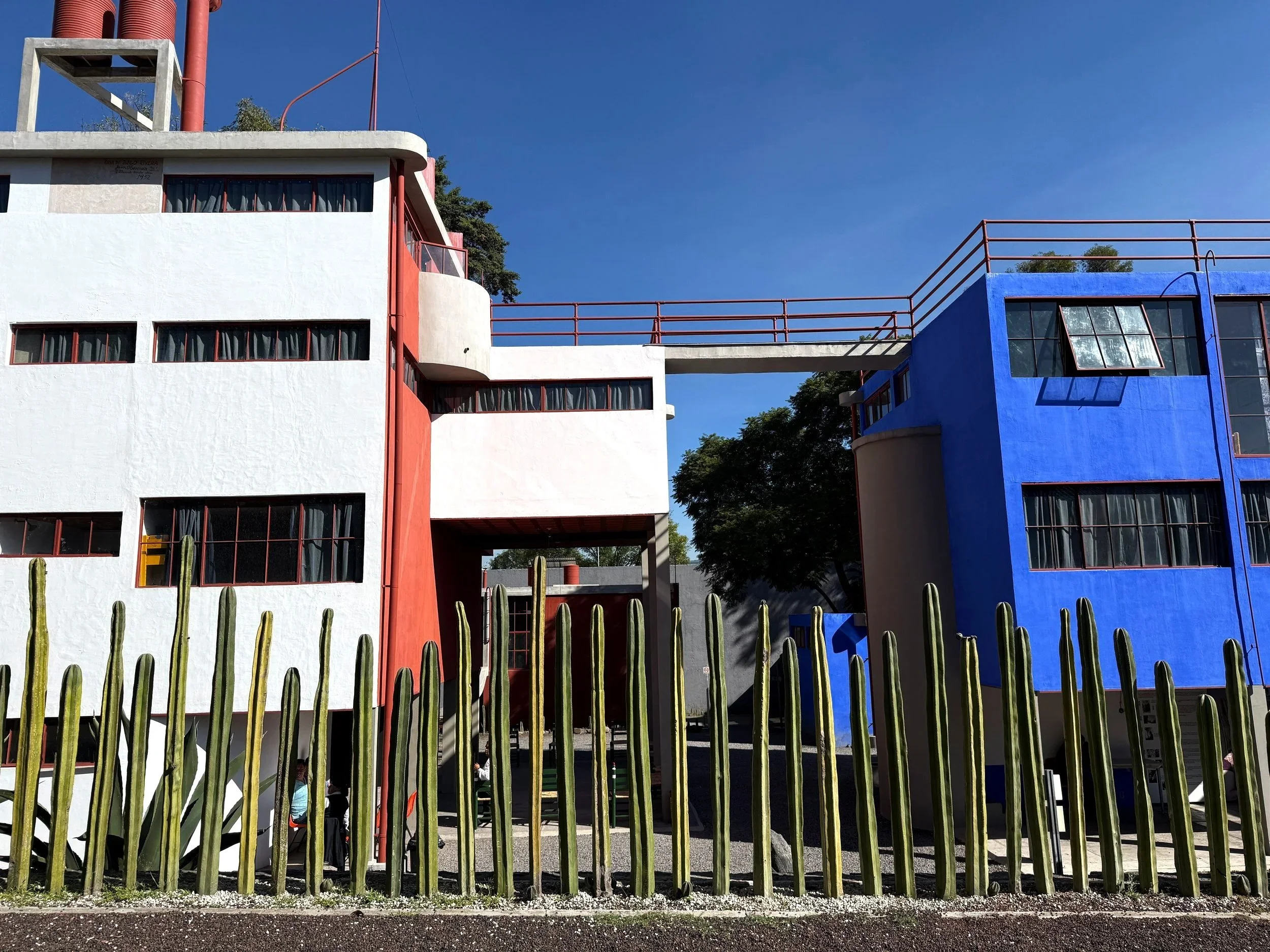
Diego Rivera & Frida Kahlo Studio House

While most visitors flock to Casa Azul—and rightly so—the duo’s other home in San Ángel offers a quieter, more architectural glimpse into their tangled lives. Designed by Juan O’Gorman in bold modernist style, the Museo Casa Estudio Diego Rivera y Frida Kahlo features two separate houses: one bright and spacious for Diego, the other small and cramped for Frida. Connected only by an outdoor stairwell and a narrow bridge, it’s a layout that feels like a metaphor—and a bit of a slap. Frida, who lived with chronic pain and mobility issues, had to climb steep steps just to see her husband.

Inside, Diego’s studio is full of light, murals-in-progress, and towering papier-mâché figures. Frida’s space is noticeably more austere—tight, plain, and edged with a kind of imposed solitude. If Casa Azul is where she found comfort, this house whispers of compromise.

Architectural Marvels in CDMX

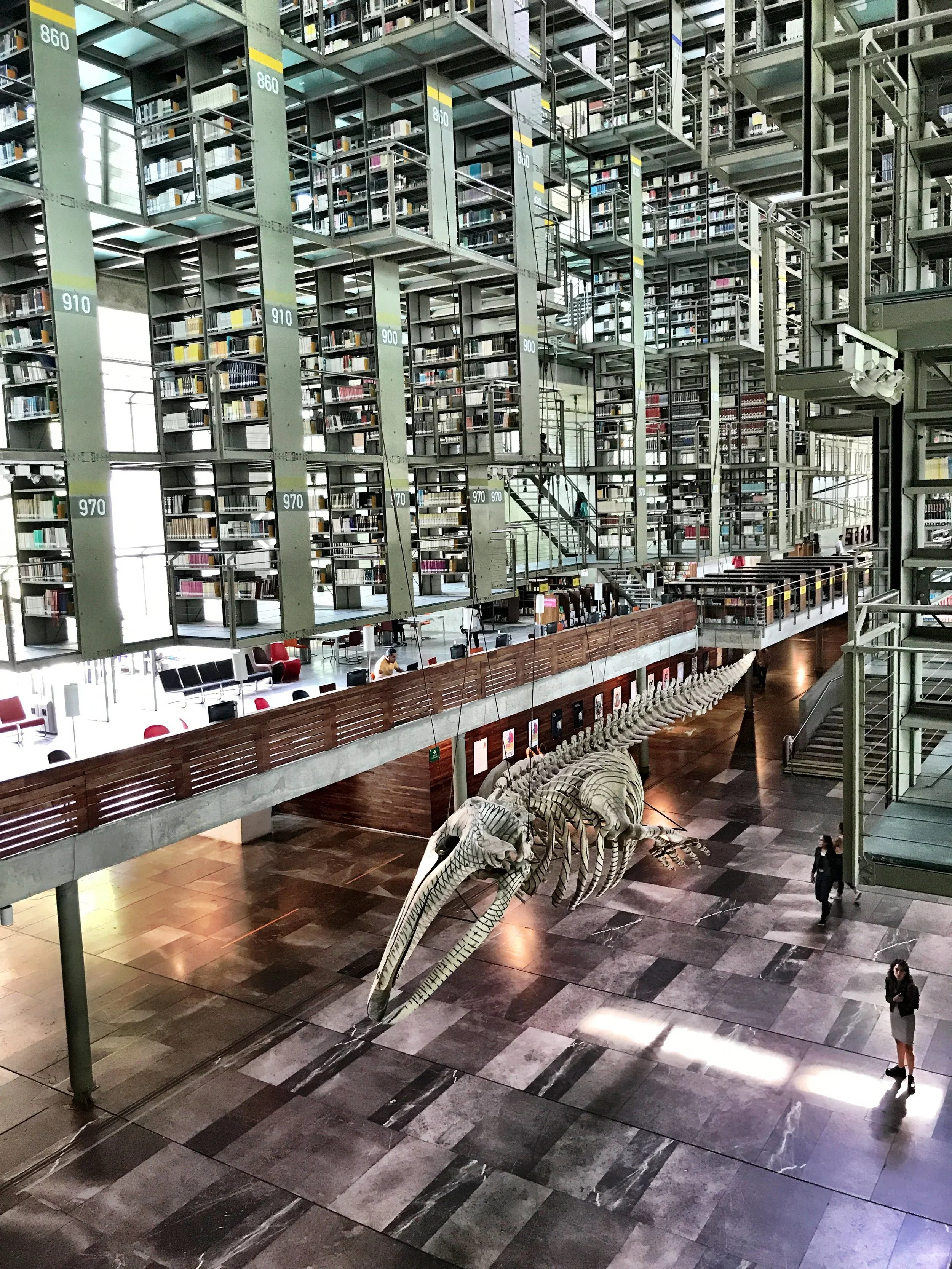
Biblioteca Vasconcelos

Biblioteca Vasconcelos is a must-see, offering an otherworldly experience in the Buenavista neighborhood of Mexico City. Designed by Alberto Kalach, the library’s floating metal and glass bookshelves create an intricate, maze-like space that seems to defy gravity. From the moment you step inside, it’s like entering a cathedral of knowledge, with sunlight streaming through louvered panels, casting an ethereal glow on the translucent walkways. The sensation is thrilling—and a little terrifying—as you navigate the thin, steel-framed floors that hover above the atrium.

Adding to the library’s allure is Gabriel Orozco’s “Mobile Matrix,” a mesmerizing installation featuring the skeleton of a gray whale, its bones intricately etched with thousands of mechanical pencil circles. Suspended mid-air, the piece echoes the library’s daring design, blurring the line between museum and reading space. After soaking in the modern architecture and art, venture into the surrounding botanic park for a breath of fresh air, or take a short walk to explore the nearby Kiosco Morisco, a colorful pavilion that serves as the perfect counterpoint to the library’s futuristic vibe.

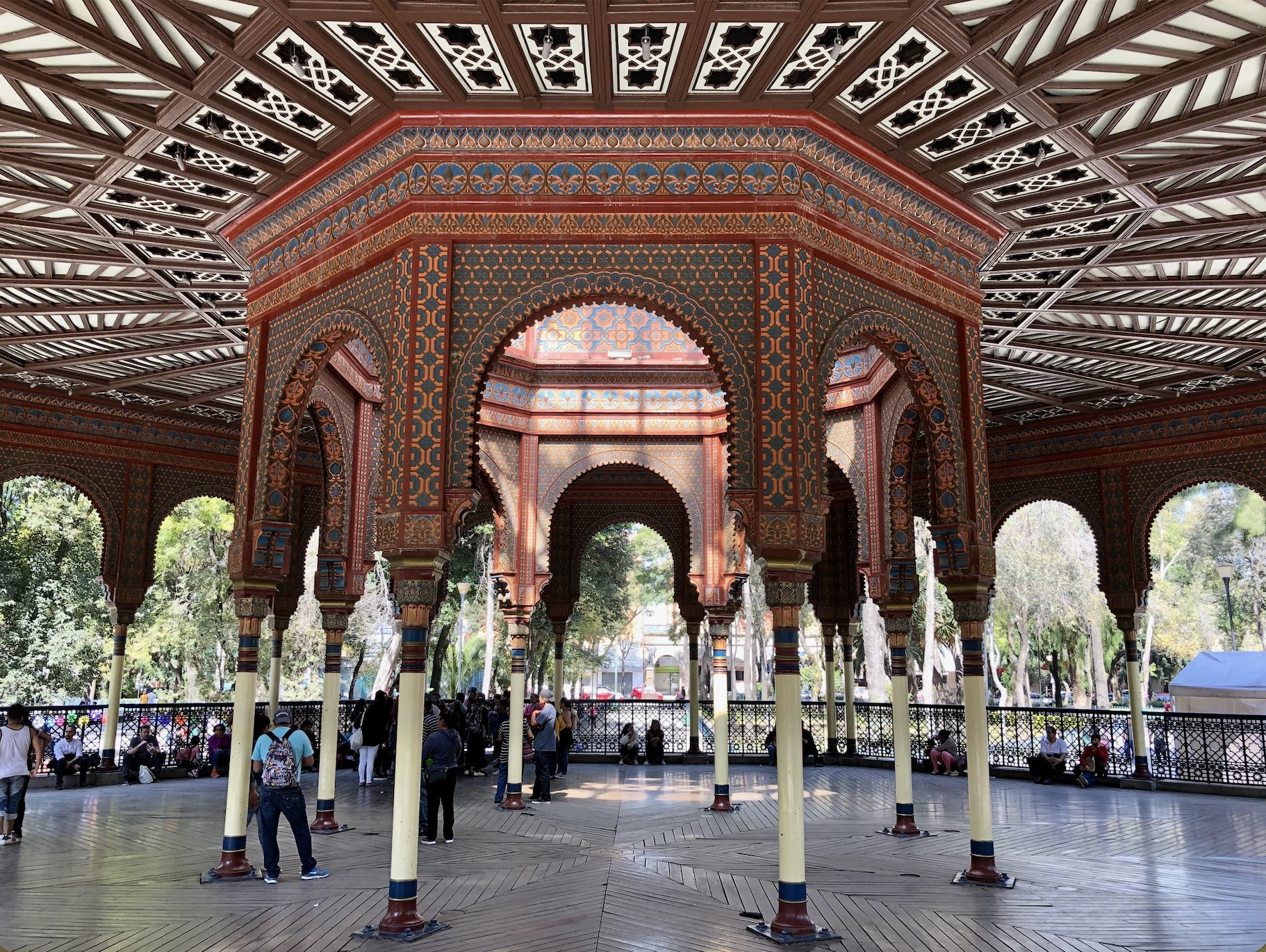
The Kiosko Morisco in Mexico City, Mexico

Kiosko Morisco

Kiosko Morisco, tucked away in the charming neighborhood of Santa María la Ribera, is a hidden gem with a fascinating past. This 19th-century Moorish-style pavilion, designed by José Ramón Ibarrola, was originally built for the 1884 World’s Industrial and Cotton Centennial Exposition in New Orleans. After its star turn on the world stage, the pavilion was relocated to Mexico City, where it has since become a beloved part of the local landscape. Featuring ornate arches, slender columns, and a striking bronze eagle devouring a snake atop the dome, this architectural wonder reflects Mexico’s rich cultural history with a touch of Spanish flair.

Now sitting proudly at the center of the Alameda de Santa María park, the Kiosko Morisco draws visitors with its vibrant colors, elegant design, and relaxed atmosphere. Whether you’re watching locals dance salsa beneath its arches or simply soaking in the beauty of its intricate patterns, this pavilion offers a glimpse into Mexico City’s storied past. Stop by for a leisurely afternoon and take in the beauty of this remarkable relic while exploring the laid-back barrio that surrounds it.

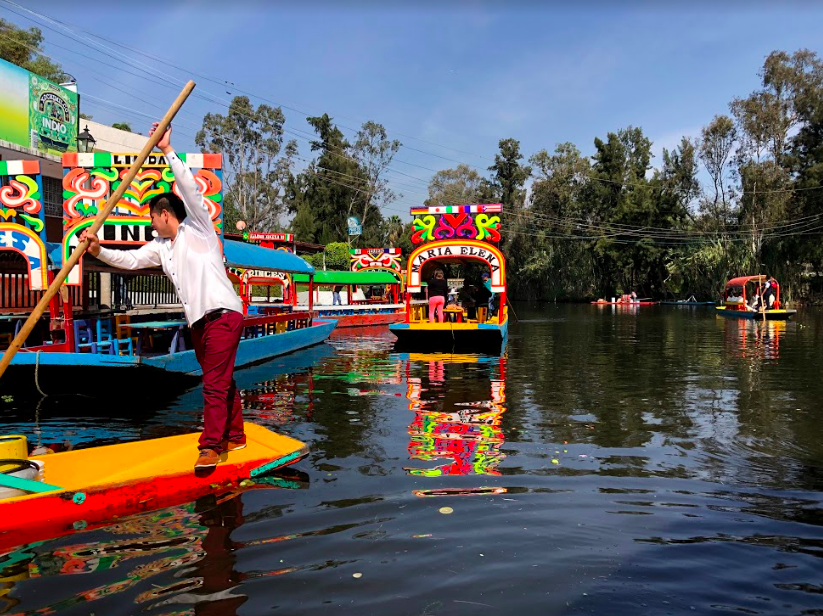
A man paddles one of the flat-bottomed boats that cruise the canals of Xochimilco outside of CDMX

Xochimilco

Xochimilco’s canals are a surreal slice of Aztec history in modern-day CDMX, where colorful trajineras glide past floating gardens called chinampas. Renting one of these vibrant boats is like having your own portable party—complete with a long table for snacks and drinks. We kicked off our trip at Embarcadero Nuevo Nativitas, perfect for accessing the infamous Isla de las Muñecas, where eerie dolls dangle from trees to appease a young girl’s restless spirit.

Cruising these ancient waterways, you’ll encounter everything from floating food vendors selling quesadillas to impromptu mariachi performances. The early hours are ideal for beating the crowds, but brace yourself for the chaotic boat traffic as the day goes on. It’s a magical and slightly macabre experience that brings the rich history and quirky charm of Xochimilco to life. 

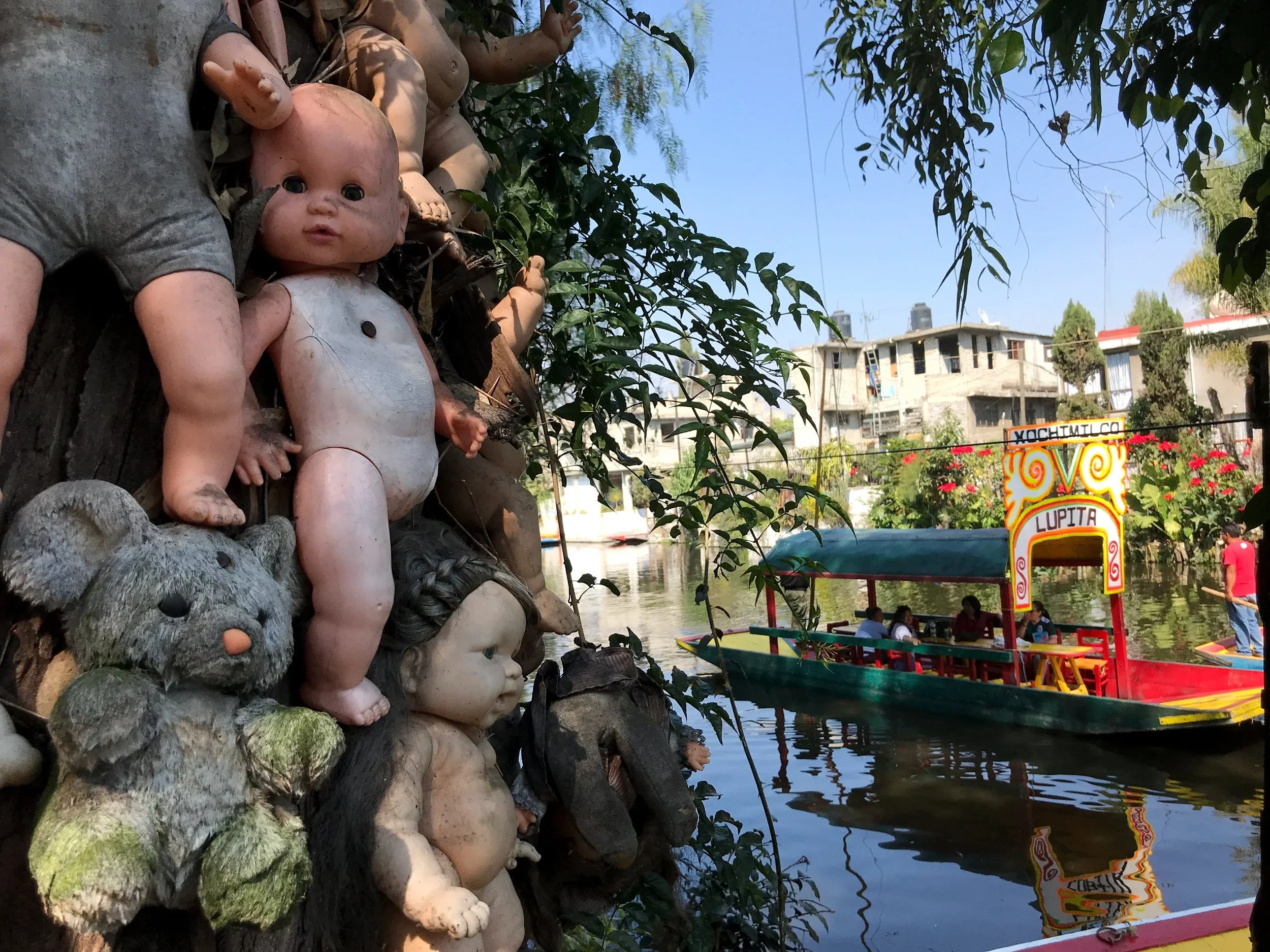
Dolls and stuffed animals are nailed to a tree on the Island of the Dead Dolls on an island in Xochimilco, CDMX

The Island of the Dead Dolls

Just south of Mexico City in the Xochimilco canals lies la Isla de las Muñecas aka the Island of the Dead Dolls, an unsettling attraction draped in local legend. It’s said that a little girl drowned there under mysterious circumstances, and the island’s caretaker, Don Julián Santana Barrera, began hanging dolls he found floating in the canal to appease her restless spirit. Over the years, he amassed a bizarre collection of dolls, many decayed and missing limbs, creating a macabre shrine to the lost soul. In 2001, Don Julián himself drowned in the very spot where he had found the girl’s body.

When we visited, we couldn’t resist adding our own contribution to the legend. We brought a doll from Chicago and placed it on a toy car under a bower on the island. It’s now known as “la negrita en el carro,” one of only two foreign dolls on the island. Be sure to keep an eye out for her when you visit!

La Isla de las Muñecas is one of the eeriest destinations in CDMX and a must-see for fans of the supernatural and strange. Tours from Embarcadero Nuevo Nativitas offer a closer island option, while the original site takes around four hours round-trip. Don’t forget to bring a doll of your own as an offering!

Nearby 

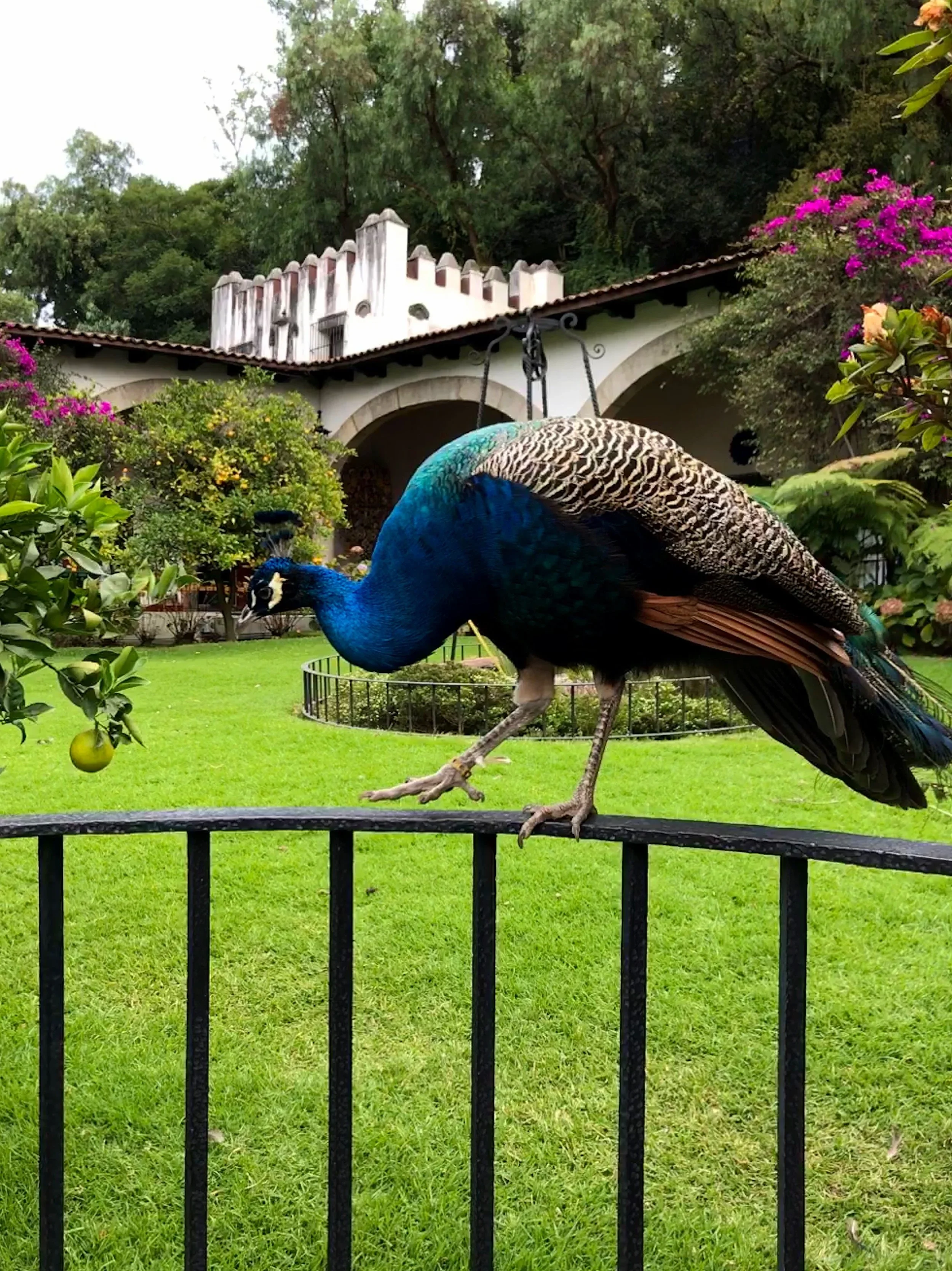
A peacock perches on a metal fence at the Museo Dolores Olmedo in CDMX

Museo Dolores Olmedo

NOTE: Sadly, a familial dispute has led to the (hopefully temporary) closure of the Museo Dolores Olmedo. When last we heard, it was set to reopen in 2026. Say a little prayer to Santa Frida — this is an amazing excursion that should be open to the public. 

The Museo Dolores Olmedo is an enchanting oasis that merges art, history, and whimsy on a sprawling 16th-century hacienda in Xochimilco. From the moment you arrive, you’re greeted by flocks of peacocks roaming the lush grounds, strutting their iridescent feathers like they own the place. The estate itself is worth the visit, with its colonial charm and gardens of dahlias, agaves, and bougainvilleas, offering a glimpse into the grandeur of old Mexico. But it’s not all just eye candy—the museum also houses the largest private collection of Diego Rivera’s work, plus several pieces by Frida Kahlo, including her distinctive small-format paintings and traditional Tehuana dress.

Inside, Rivera’s masterpieces span multiple rooms, showcasing his evolution from post-Impressionism to Cubism, while Olmedo’s pre-Columbian collection adds a layer of ancient mystique, with Colima dog effigies that once guided spirits through the Aztec underworld. The hacienda’s playful side shines through in the Day of the Dead ofrendas, where traditional and modern elements blend seamlessly, reflecting Olmedo’s inventive spirit. Don’t forget to swing by the Xoloitzcuintli enclosure, home to the adorably odd Mexican hairless dogs that roam the grounds like living relics. Whether you’re an art lover, history buff, or just here for the peacocks, the Museo Dolores Olmedo will surprise and charm you at every turn.

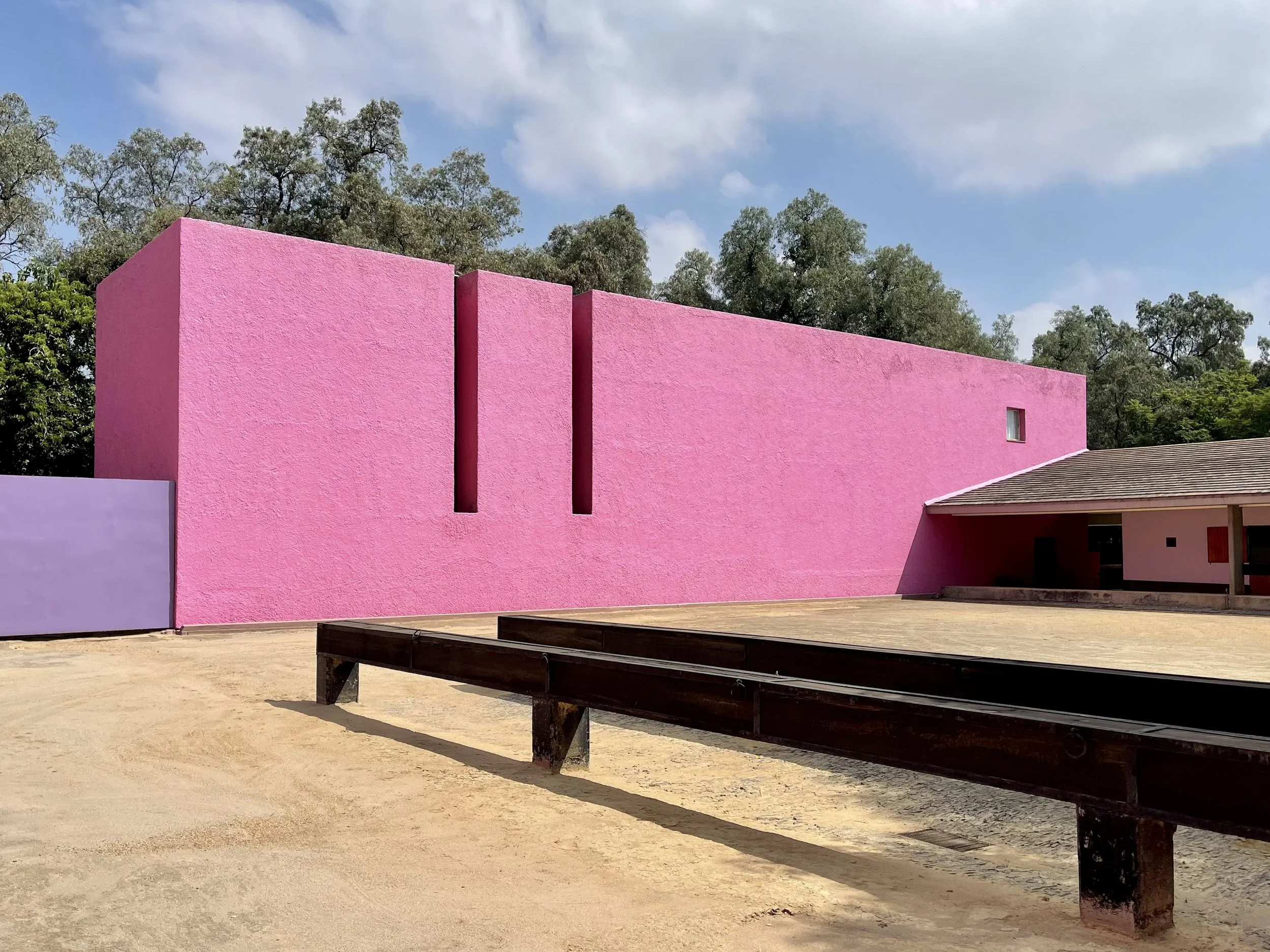
Purple and pink walls by the stables of Cuadra San Cristóbal architect Luis Barragán outside CDMX

Barragán Architecture Tour

Luis Barragán (1902–1988) didn’t just design buildings—he created spaces that stirred the soul. A poetic modernist and the only Mexican architect to win the Pritzker Prize, Barragán took the clean lines of European architecture and infused them with color, silence, shadow, and stillness. His homes, fountains, and public works reflect a love of introspection and nature—a legacy that’s best experienced in person.

To really understand Barragán, we recommend booking a tour with the Traveling Beetle, which took us from city outskirts to surreal spaces, all in a tomato-red VW bus. 

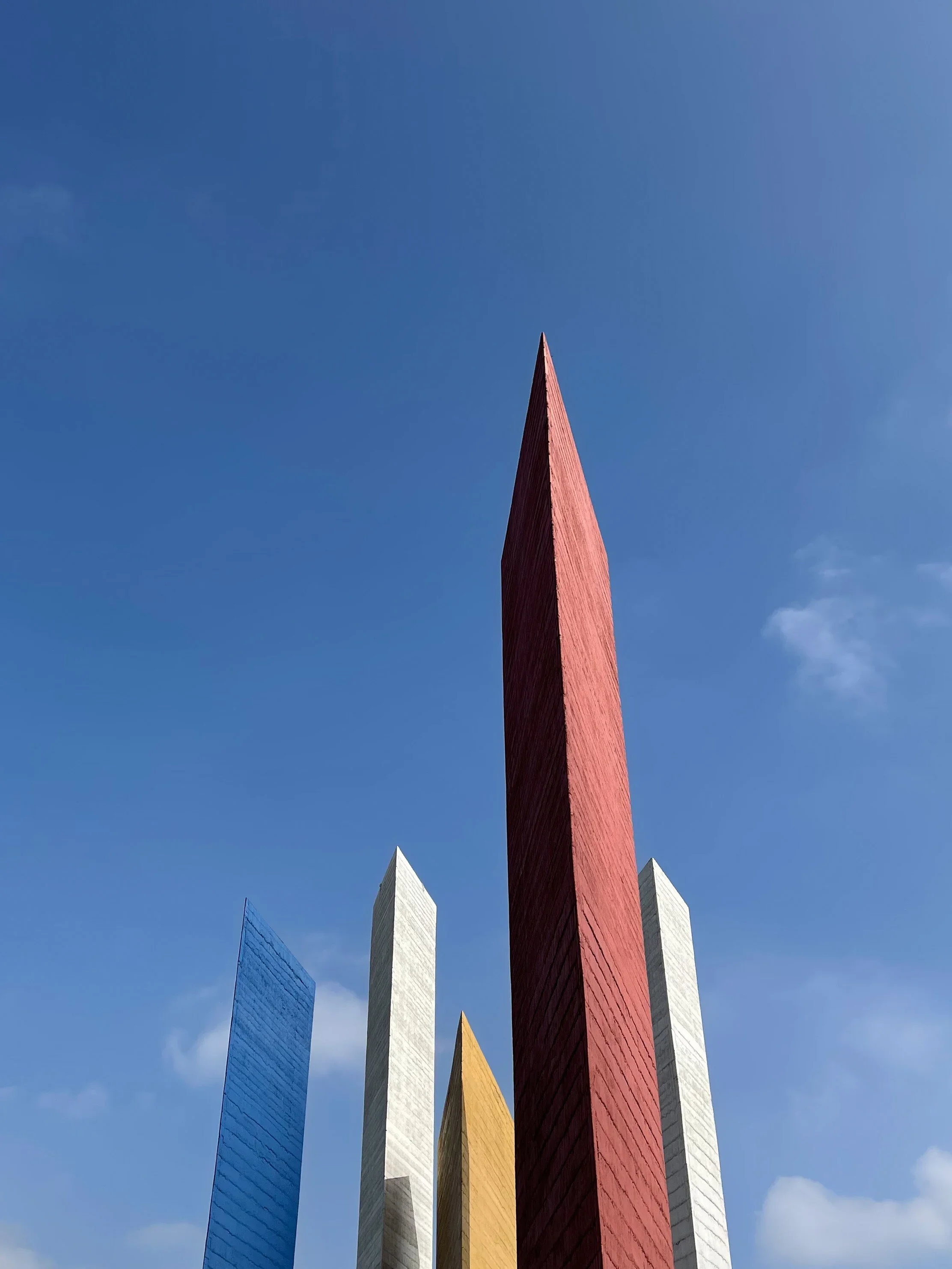
The blue, white, yellow and red thin sculptural Torres de Satélite by the architect Luis Barragán outside of CDMX

Torres de Satélite

You’ll spot them first from the freeway—five towering columns in blue, red, yellow, and white. These are the Torres de Satélite, co-designed with sculptor Mathias Goeritz, and they mark the edge of a planned community that never quite came to be. But the towers endure, bold and mysterious, like sentinels from another dimension. They aren’t just monuments—they’re Barragán’s modernist exclamation point.

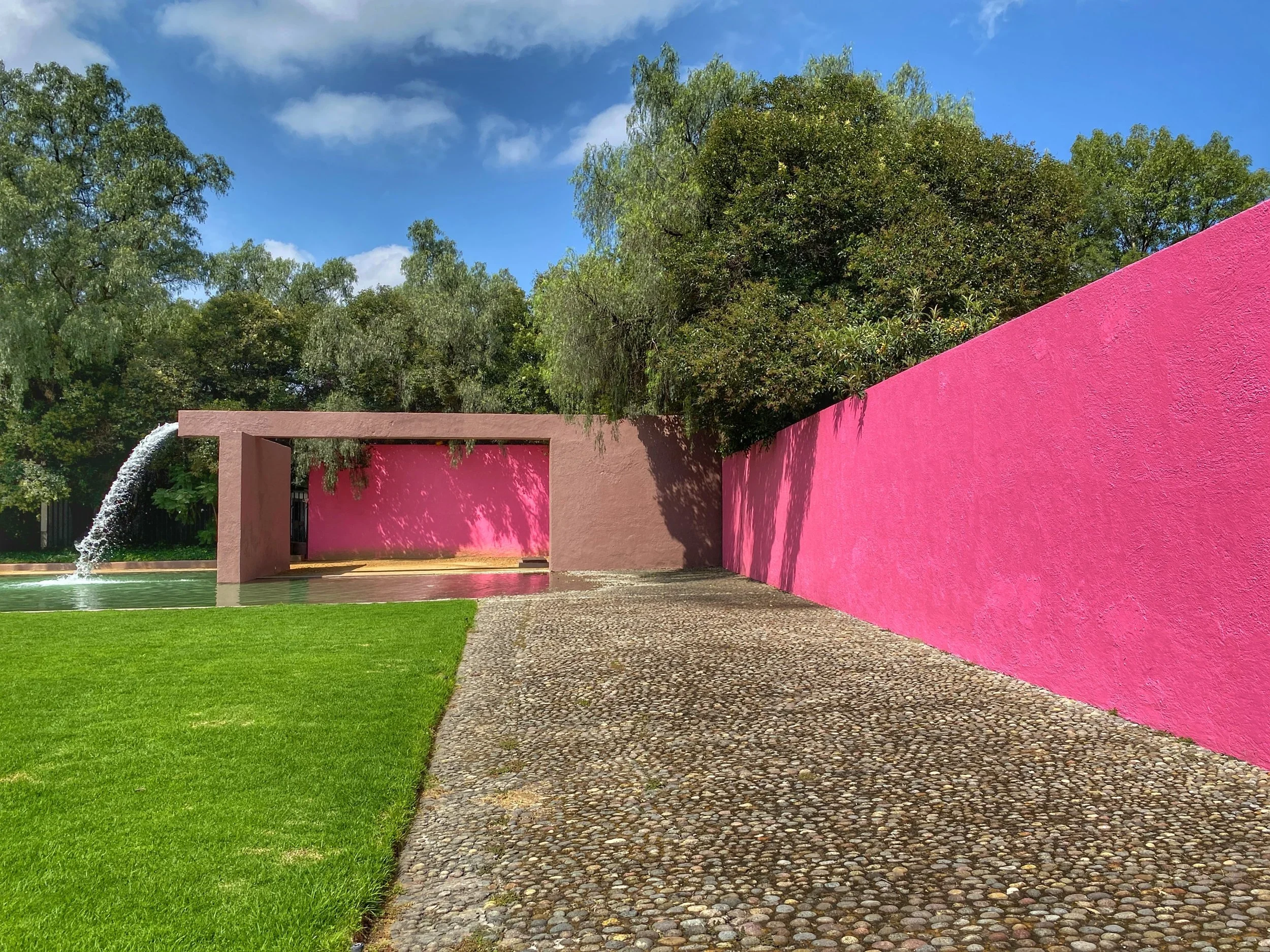
Modernist pink walls and cascading water at the Fuente de los Amantes by architect Luis Barragán outside Mexico City

Fuente de los Amantes

Hidden in a quiet corner of the San Cristóbal subdivision, the Fuente de los Amantes (Lovers’ Fountain) speaks in whispers. The aqueduct releases water once a day into the rectangular basin below, where two simple stone figures sit—one gazing, the other waiting. It’s classic Barragán: deceptively simple, achingly emotional. A place to contemplate connection, longing, and the kind of love that waits in silence.

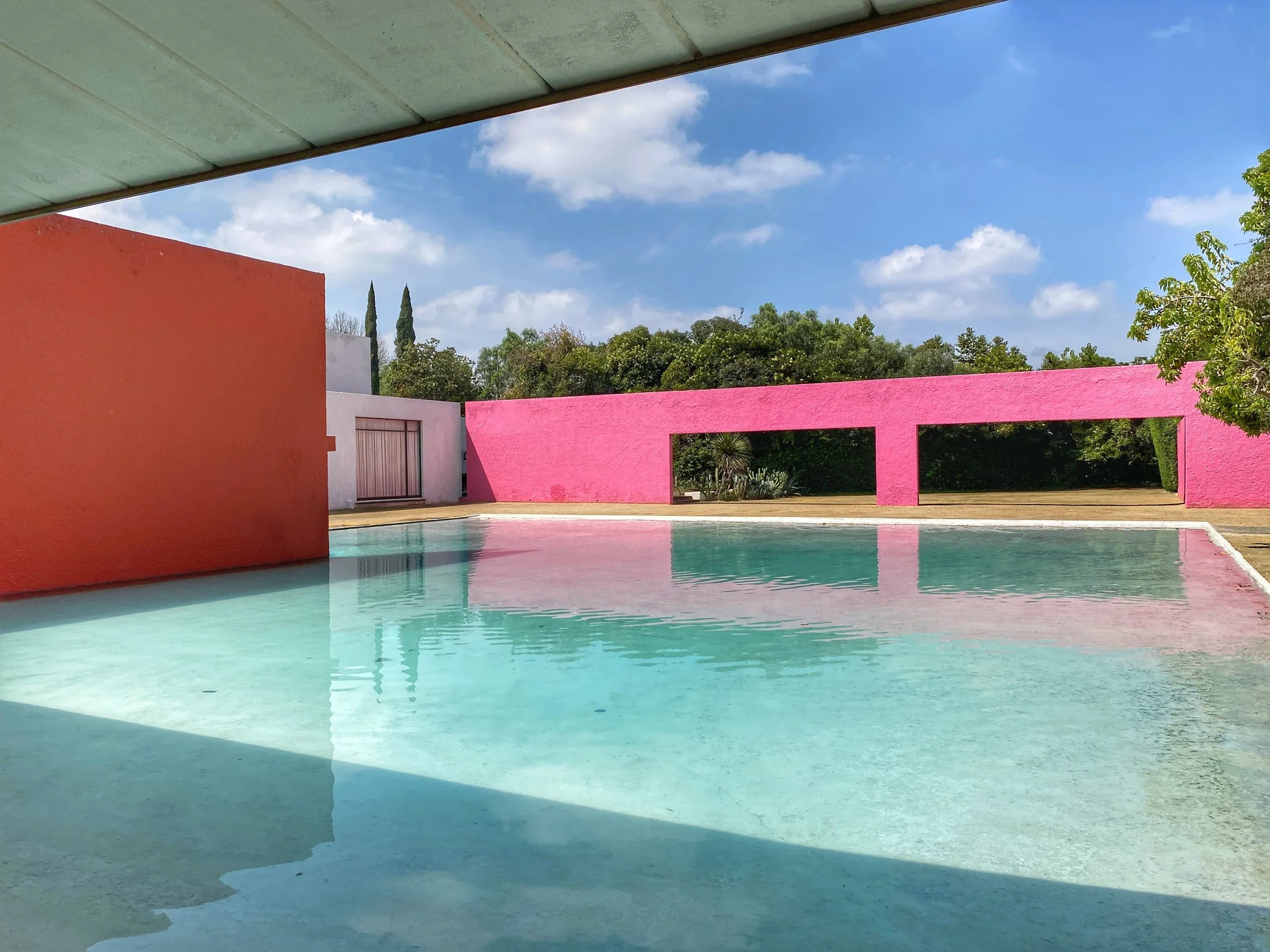
A pool by brightly colored minimal modern walls at Cuadra San Cristóbal byarchitect Luis Barragán outside of CDMX

Cuadra San Cristóbal

This is the showstopper. From the outside, Cuadra San Cristóbal feels like a fortress—flat pink walls, geometric cutouts, no hint of what’s inside. But step into the courtyard and it unfolds like a fever dream: a long pink wall set against cobalt pools, fountains built for horses, and trees erupting through carefully placed openings. It’s the kind of space that doesn’t just look beautiful—it makes you feel something. Even the horses seem to know they’re walking through art.

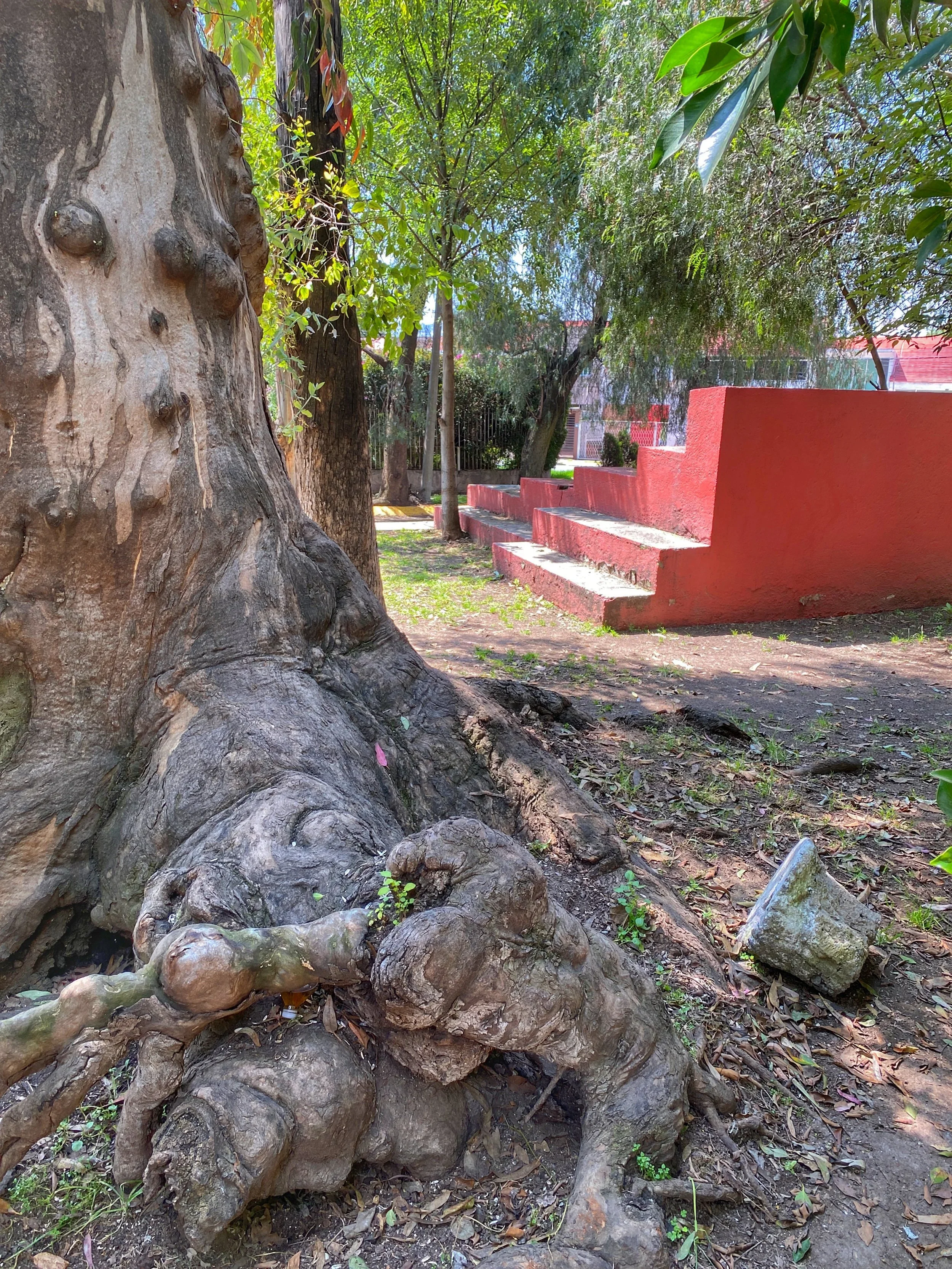
Gnarled eucalyptus tree and stepped structure by Barragán at Paseo de los Gigantes and Plaza del Bebedero outside CDMX

Paseo de los Gigantes and Plaza del Bebedero

The name Paseo de los Gigantes isn’t a metaphor, it’s literal. Those majestic, gnarled eucalyptus trees — unyielding and grand — are the giants the path is named for. Once part of a glamorous social scene where Barragán hosted horsing events, today the park feels forgotten — overgrown, faded — but no less haunting. From their bark to their scale, the trees still command attention. As you continue, you reach the Plaza del Bebedero, anchored by a long, empty horse trough fountain and framed by stark white and indigo walls where light and shadow play like whispered memories of its past.

Best Restaurants in CDMX

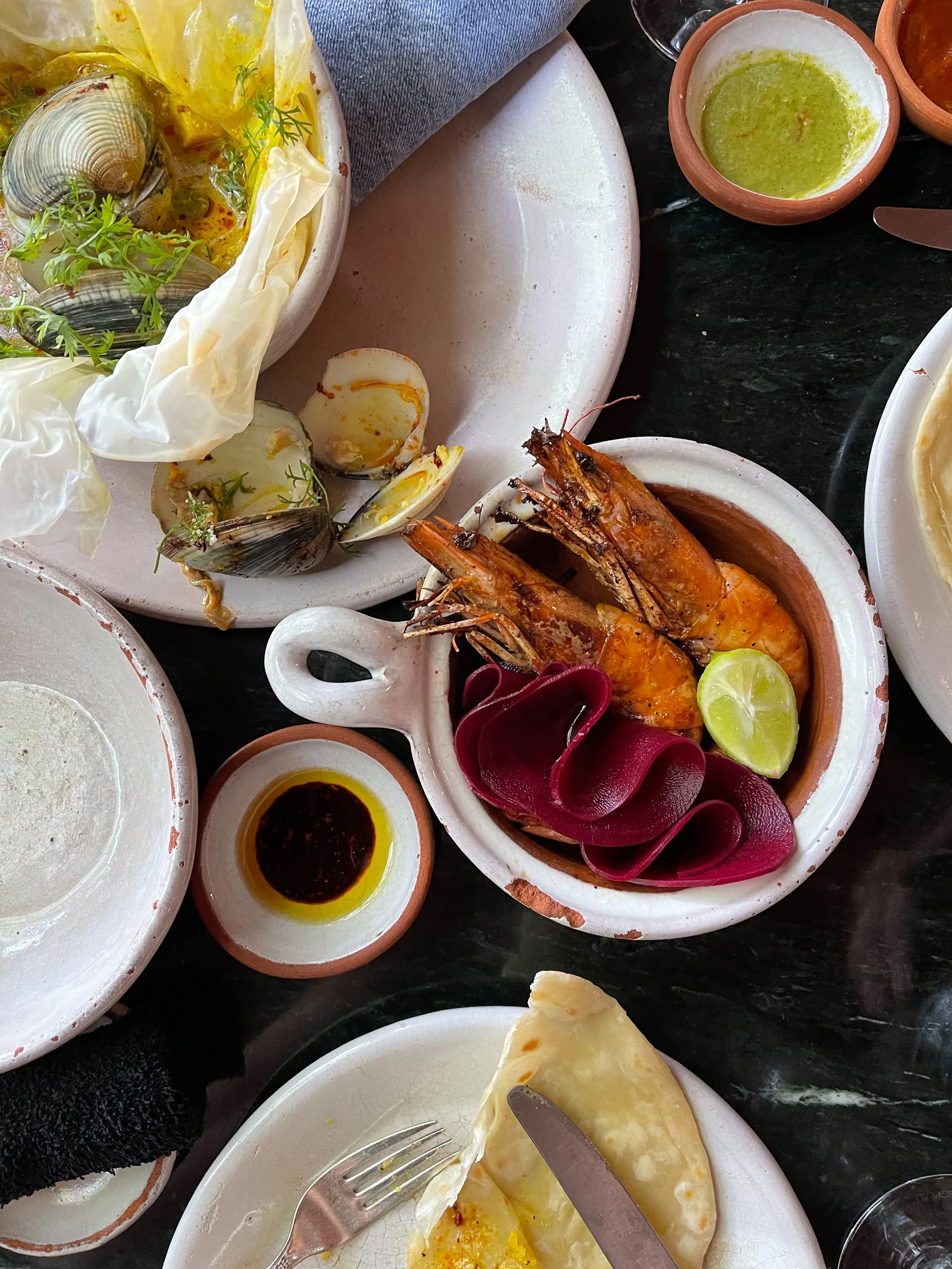
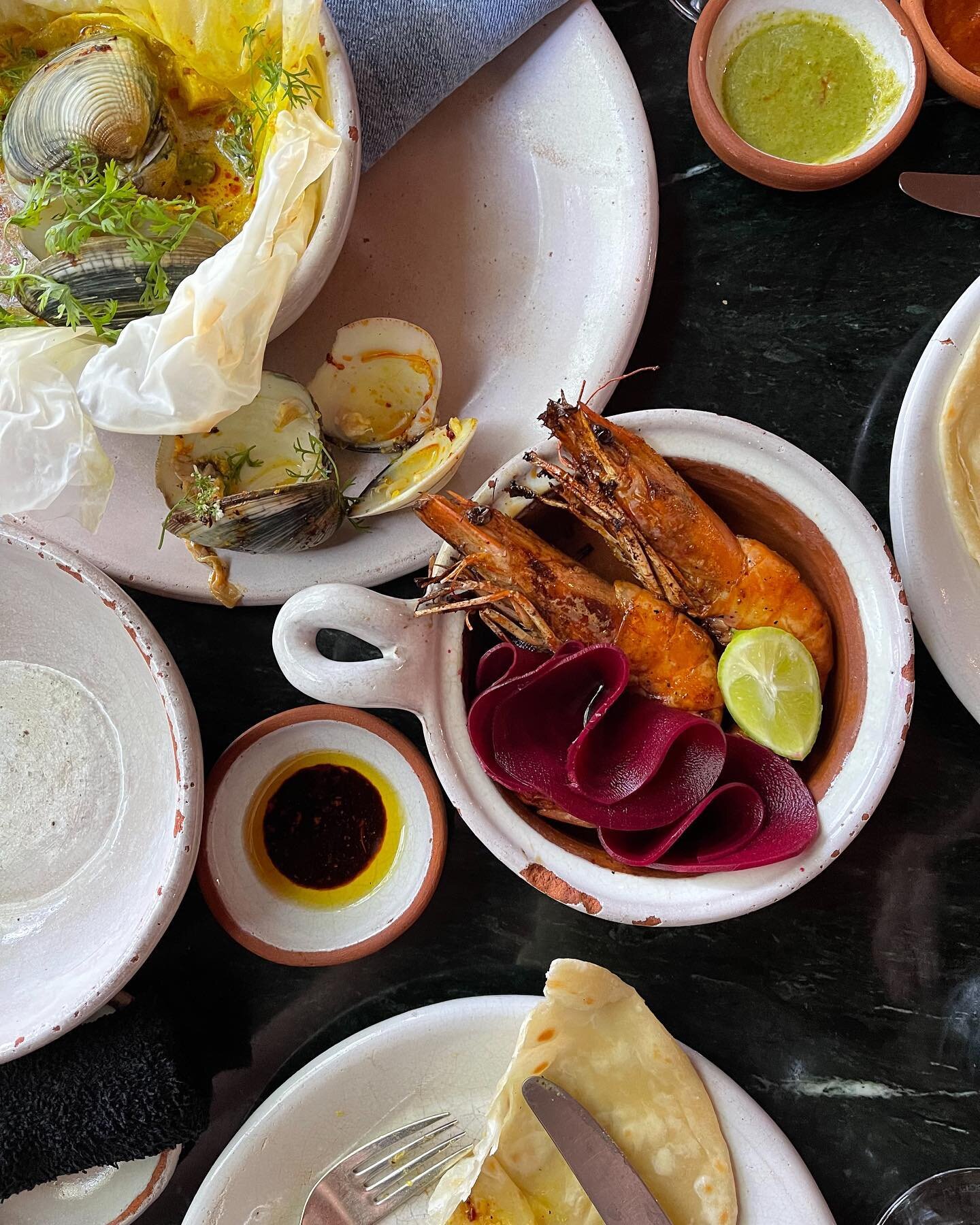
Two shrimp in a small bowl amid lunch at  Masala y Maíz in CDMX

Masala y Maíz

Masala y Maíz serves one of the most memorable meals we've had anywhere in the world. The husband-and-wife team behind the restaurant blends Mexican, South Asian and East African culinary traditions into dishes that somehow feel both inventive and deeply rooted in history. Every course surprised us, from brisket-filled samosas and vibrant chaat to chile-rubbed shrimp with vanilla ghee and clams simmered in turmeric, coconut milk and tomato masala.

Just as impressive as the food is the philosophy behind it. The owners have built a restaurant committed to fair labor practices, ethical sourcing and fostering a healthier restaurant culture—values that shine through in every aspect of the experience. Pair your meal with one of their excellent natural wines, and it's easy to see why Masala y Maíz remains one of our favorite restaurants in Mexico City.

Quirky Attractions in CDMX

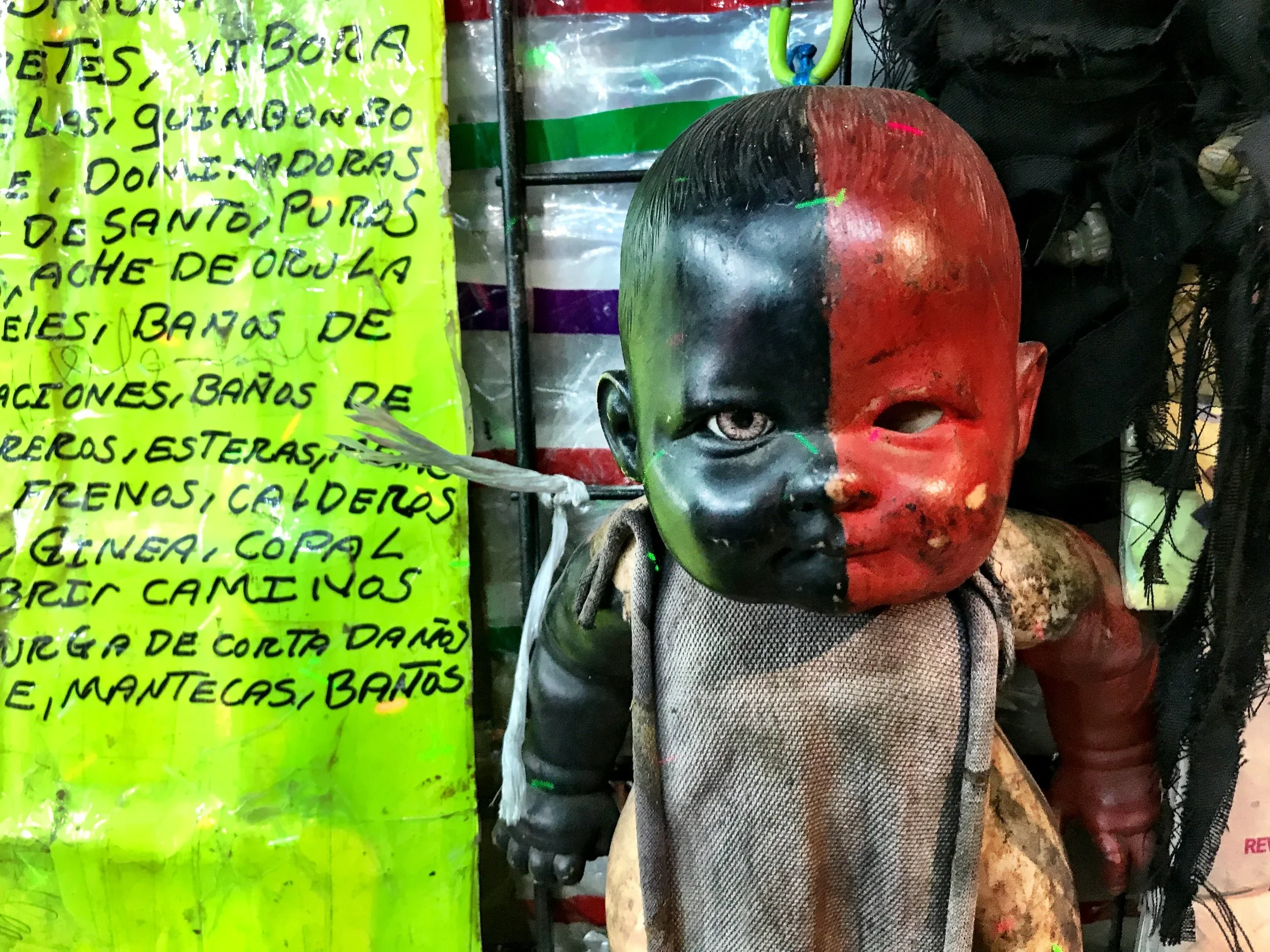
A doll painted half black, half red as the Santeria deity Lucero at the Sonora witch market in CDMX

Witch’s Market at Mercado Sonora

If creepy, offbeat shopping is your thing, the witch market at Mercado Sonora in Mexico City is an absolute must-see. Tucked away in the market’s back left corner, this bizarre bazaar offers everything from potions to voodoo dolls, making it the ultimate mix of brujería and Catholic kitsch. Santa Muerte figures sit next to baby Jesus statues, and spells for love or money come in bottles of neon liquid you probably shouldn’t drink.

The aisles are tight, chaotic, and filled with the scent of sage. While navigating the labyrinthine stalls, you’ll find unsettling trinkets like Lucero Mundo dolls with sewn-shut eyes or macabre fur balls that defy description. It’s not for the faint of heart, but if you’re into all things witchy, Mercado Sonora is a slice of dark magic in CDMX. 

Shopping in CDMX

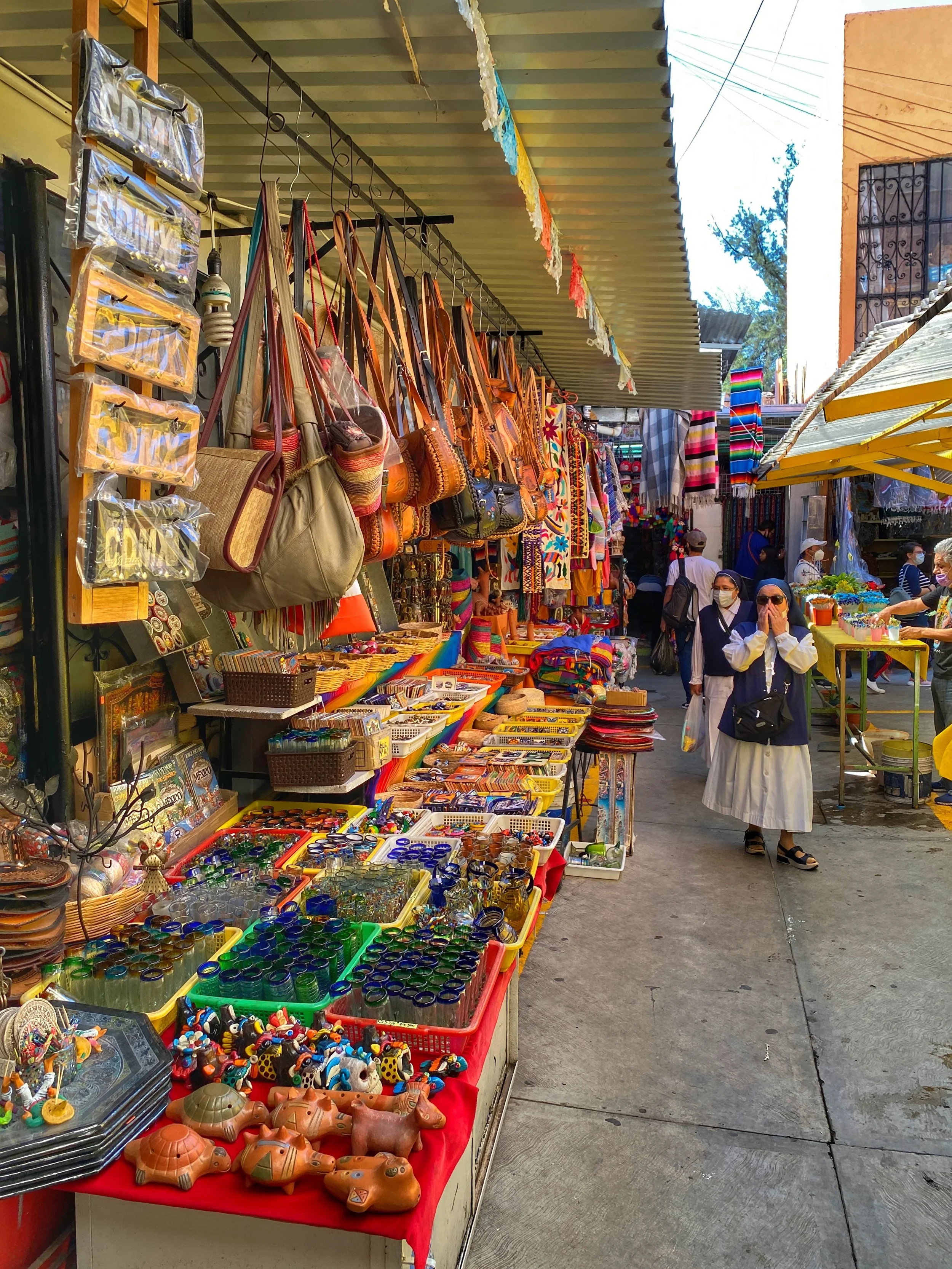
Nuns walk through the handicraft market of La Ciudadela in CDMX

Mercado de Artesanías La Ciudadela is a paradise for folk art and handicrafts lovers, offering a treasure trove of arte popular from all over Mexico. This sprawling market is packed with stalls selling everything from Oaxaca’s vibrant alebrijes and intricate Otomi textiles to pre-Columbian-style clay sculptures that rival museum pieces. It’s impossible to see it all in one go, so take your time and maybe even ask for a discount if you’re buying multiple items.

When you need a break from browsing, head to Fonda Carmelita, the market’s cantina, for traditional Mexican food and a refreshing margarita. It’s the perfect spot to recharge before diving back into the market’s colorful chaos. Don’t miss this iconic shopping destination whenever you’re in Mexico City — we never do.

Lisbon Cathedral: A Guide to the Sé de Lisboa, Lisbon’s Oldest Church and Its Treasures

Sé what? Where St. Anthony was baptized, St. Vincent’s relics rest, and a bishop got tossed from the tower — Lisbon Cathedral holds centuries of stories in its stones.

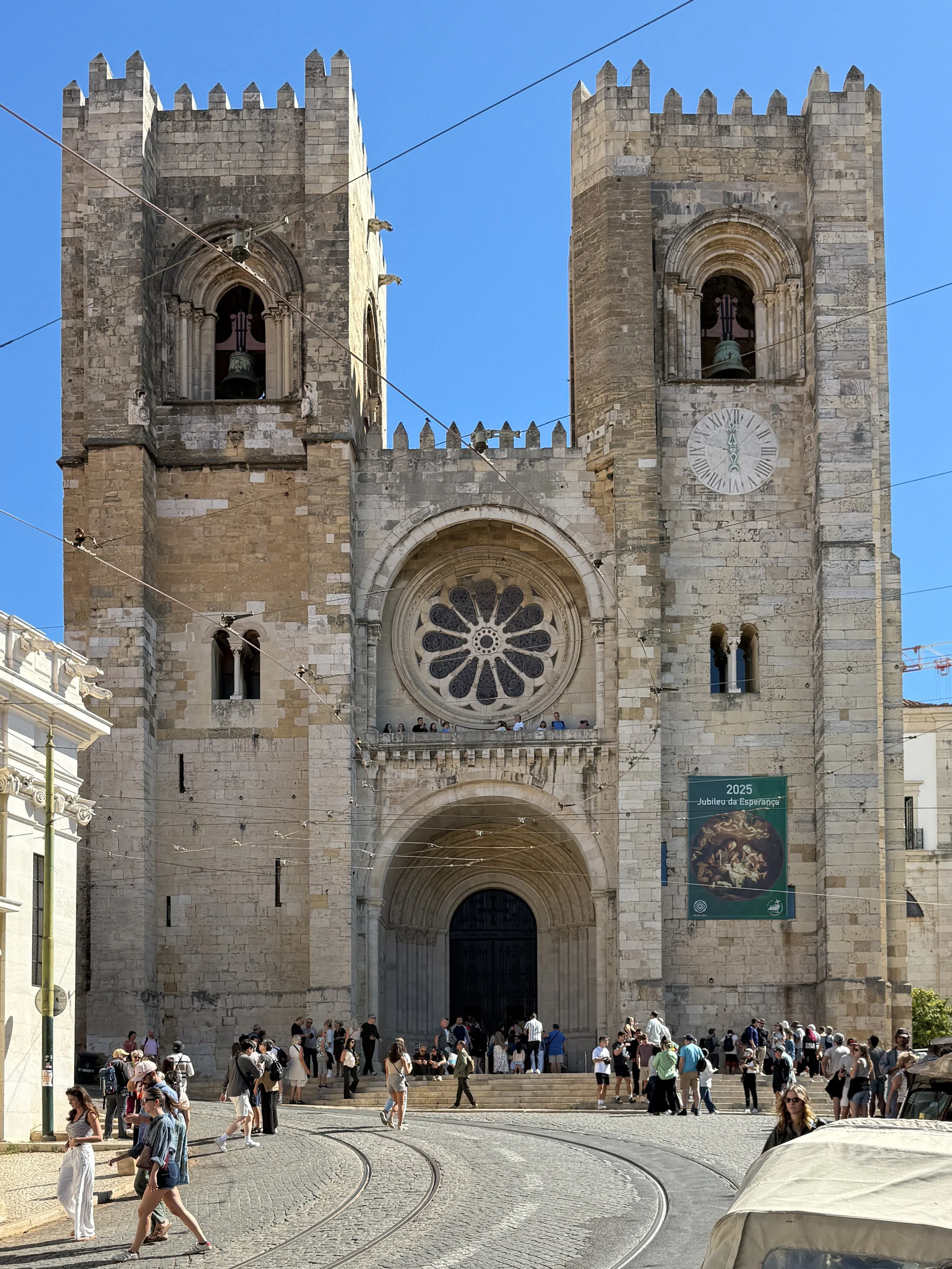
Facade of the Sé de Lisboa with tourists out front

The Sé de Lisboa was built on the site of a former mosque shortly after King Alfonso Henriques conquered the city from the Moors in 1147 CE.

Perched on a hillside in Lisbon’s Moorish Alfama quarter, the Basílica de Santa Maria Maior (Cathedral of Saint Mary Major), commonly known as the Sé de Lisboa (Lisbon Cathedral), serves as the seat of the Patriarchate of Lisbon and the city’s most significant surviving example of medieval architecture.

Construction of the national monument began shortly after King Afonso I and his Portuguese forces, aided by Christian crusaders, wrested the city of al-Usbūna from Islamic rule in 1147 CE, renaming it Lisboa. 

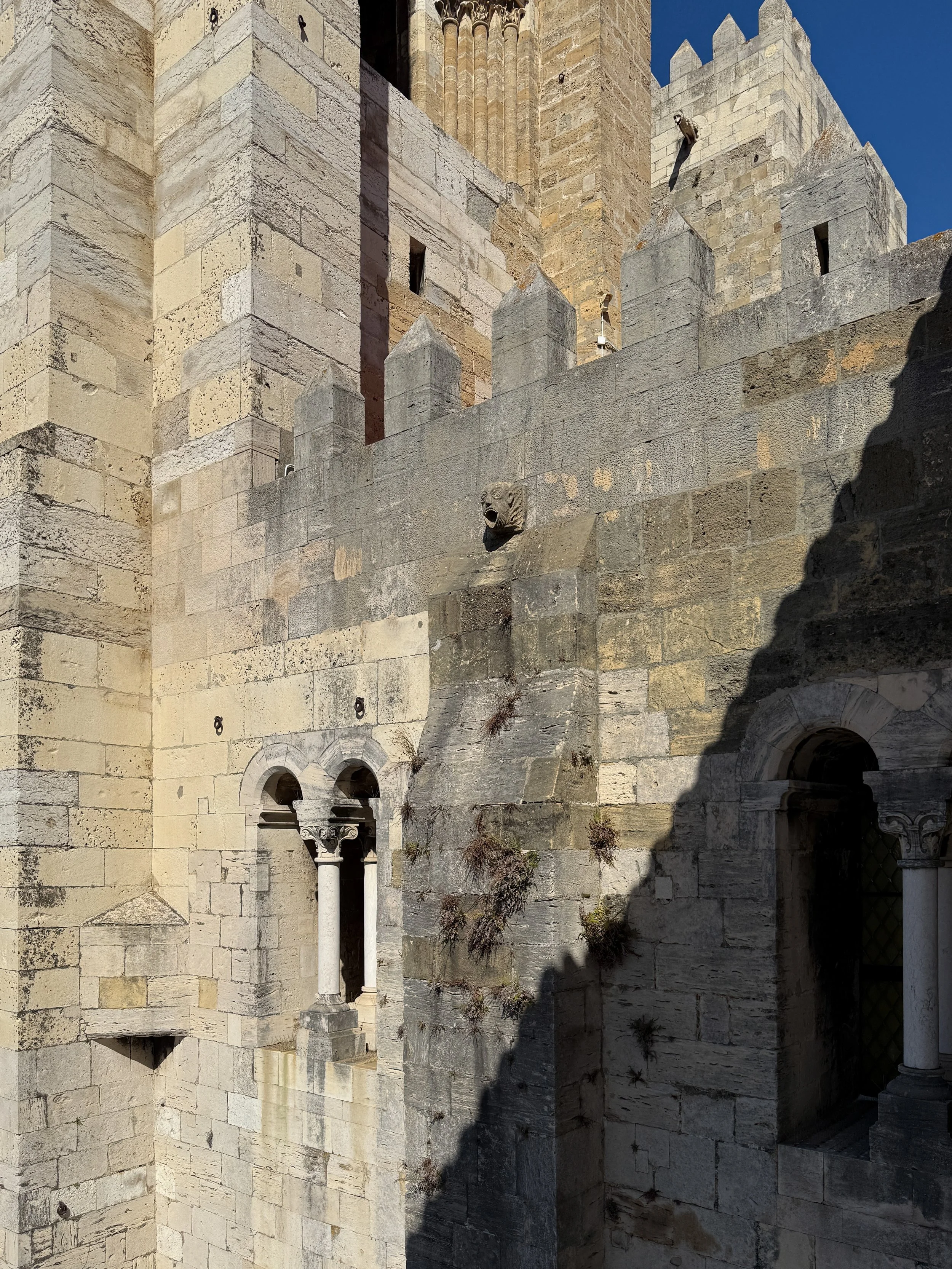
Jagged, tooth-like crenellations the Lisbon Cathedral’s Romanesque façade

Jagged, tooth-like crenellations give the cathedral’s Romanesque façade a fortress-like appearance. But if you look closely, you’ll see rounded arches and sets of slender columns topped with sculpted capitals.

The Façade of the Sé

Wally and I stumbled upon the imposing landmark as we made our way downhill after spending the morning exploring the hilltop ramparts of the Castelo de São Jorge (St. George’s Castle). The stone walls of the cathedral stretched so far along the Rua de São Tomé that I wouldn’t have been surprised if a local had told us they were once part of the Old City Wall. 

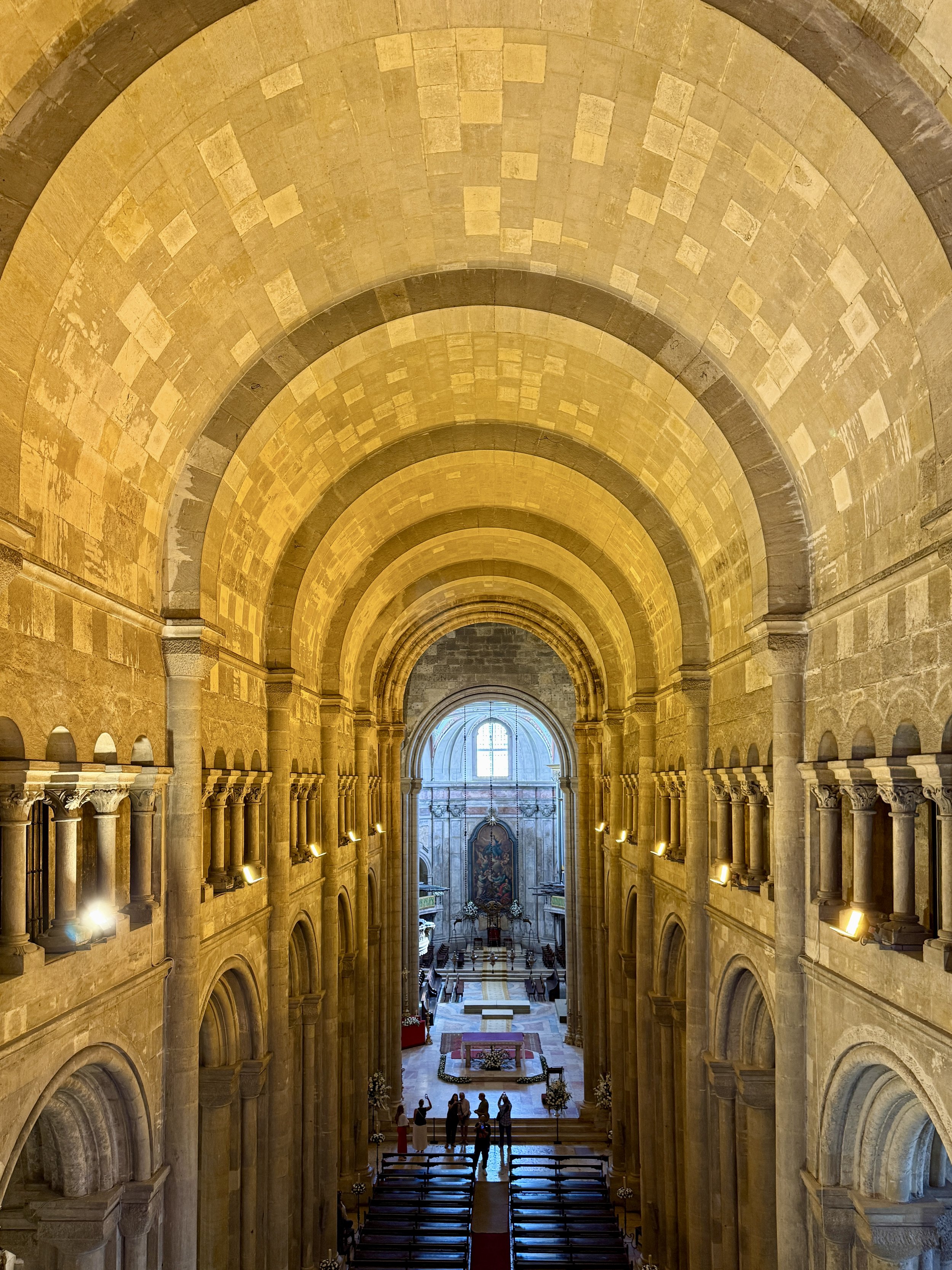
The choir loft of the Sé de Lisboa offers a spectacular view overlooking the barrel vaults of the central nave and main altar

The choir loft of the Sé de Lisboa offers a spectacular view overlooking the barrel vaults of the central nave and main altar.

From the western façade, the cathedral looked every bit like a fortress: a pair of stout towers flanked the entrance, narrow arrow-slit windows punctuated the stone walls, and jagged, tooth-like crenellations crowned the top. But as we drew closer, the stepped, concentric arches of the main doorway and the delicate tracery of the rose window above made it clear this was, unmistakably, a church.

Constructed largely from limestone blocks, the original Romanesque structure was completed between 1147 and the early 13th century. Its fortified appearance was no accident: In an era when sacred spaces often doubled as defensive strongholds, the Sé offered not only spiritual refuge but also a strategic vantage point in the event of siege.

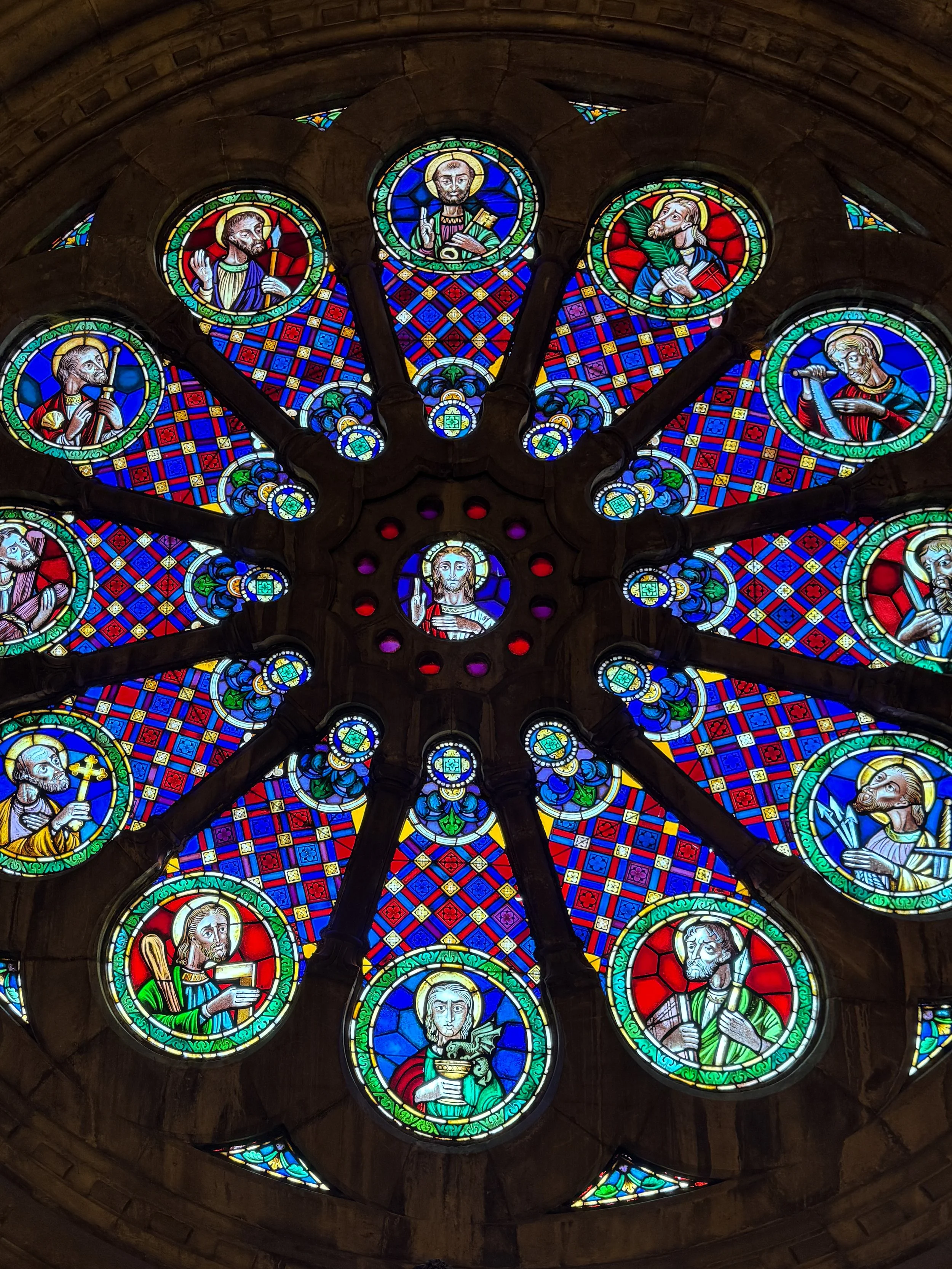
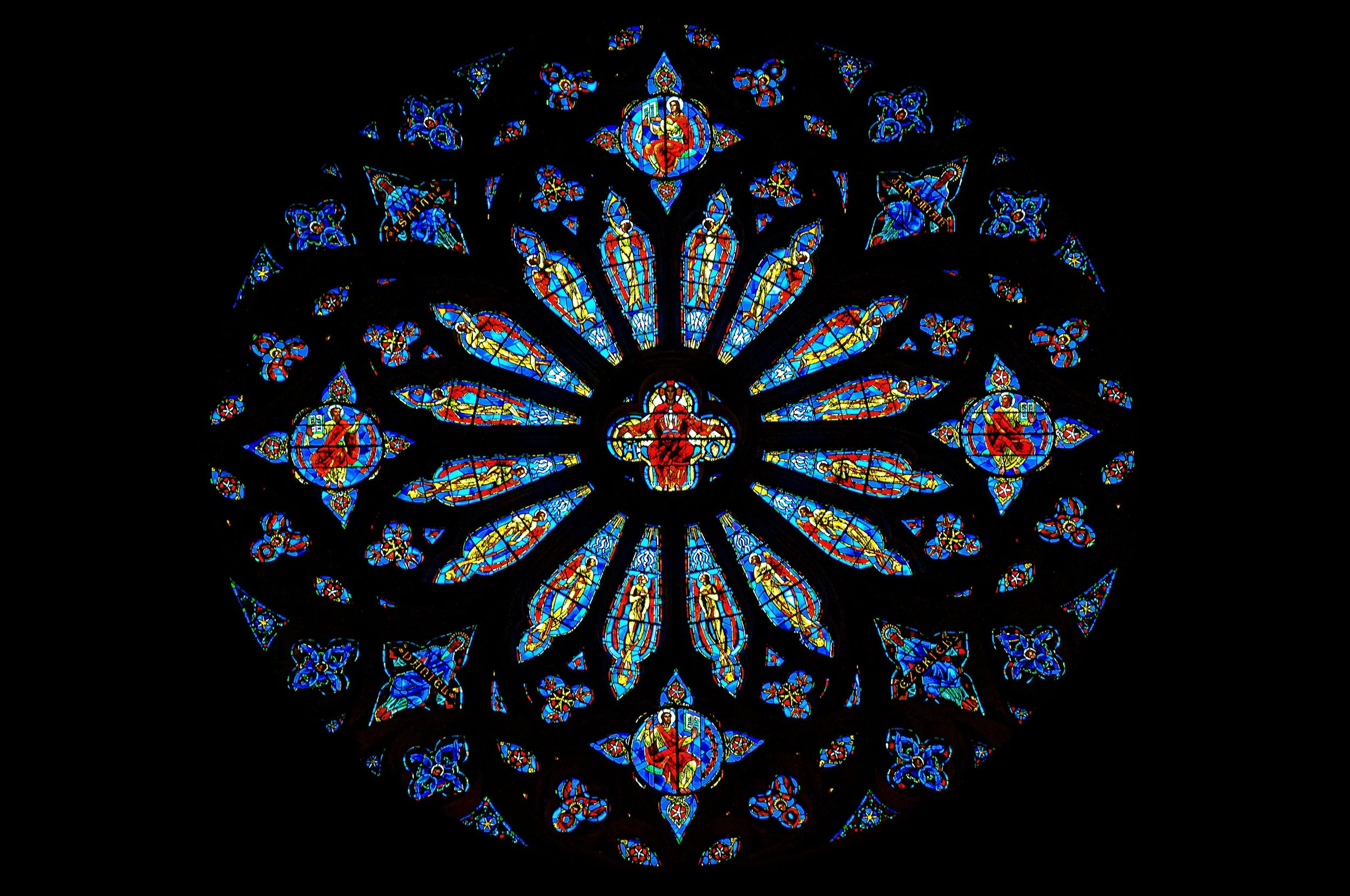
The rose window at the Sé de Lisboa featuring a central image of Jesus, surrounded by the 12 Apostles

Originally destroyed in the 1755 earthquake, the rose window at the Sé de Lisboa was reconstructed in the 1930s using fragments of the original and features a central image of Jesus, surrounded by the 12 Apostles.

Entering the Sé

Once inside, we made our way to the ticket counter and paid admission before ascending the staircase to the church tower leading to the Coro Alto (High Choir) loft and Tesouro da Sé (Treasury Museum). 

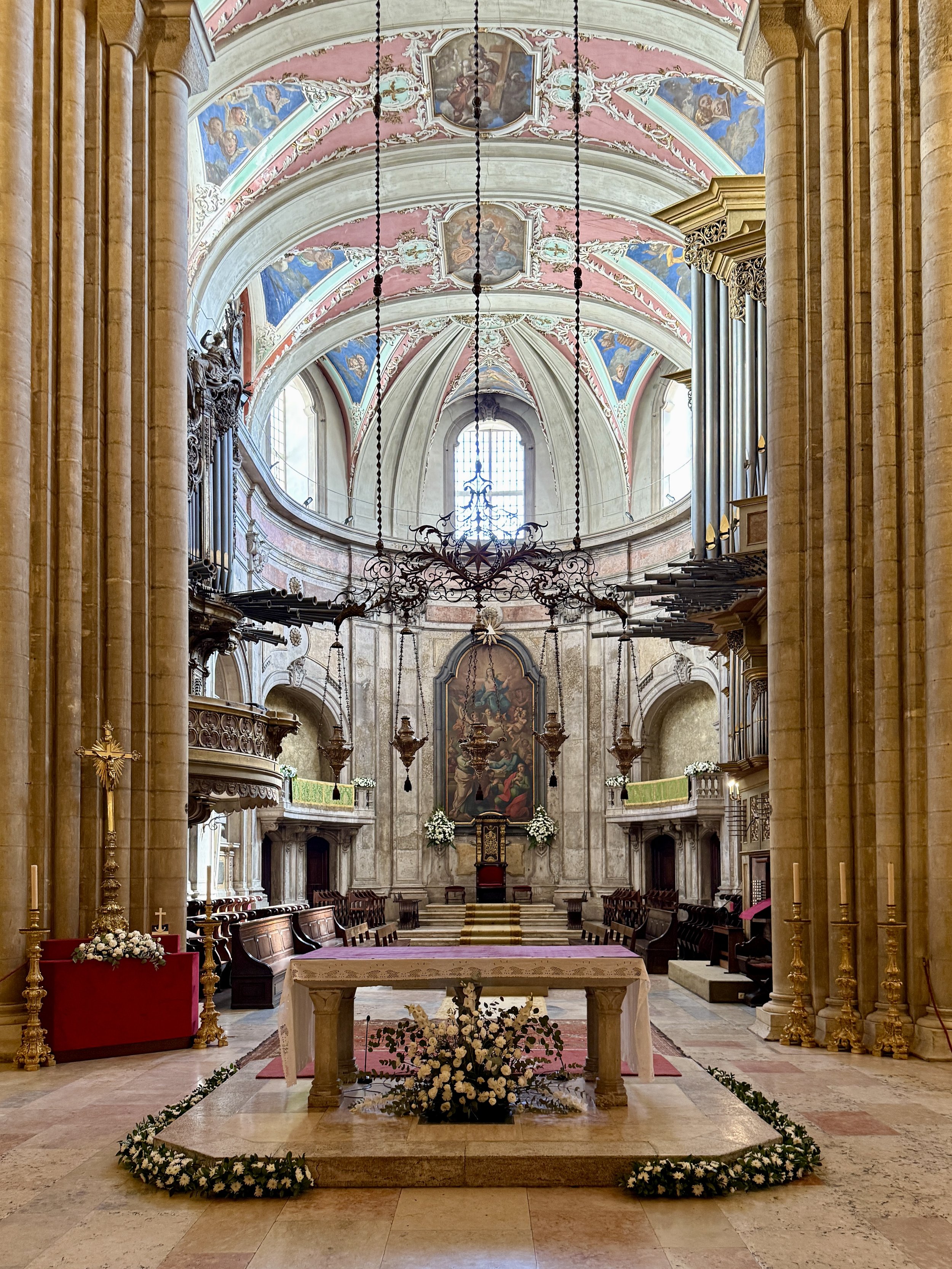
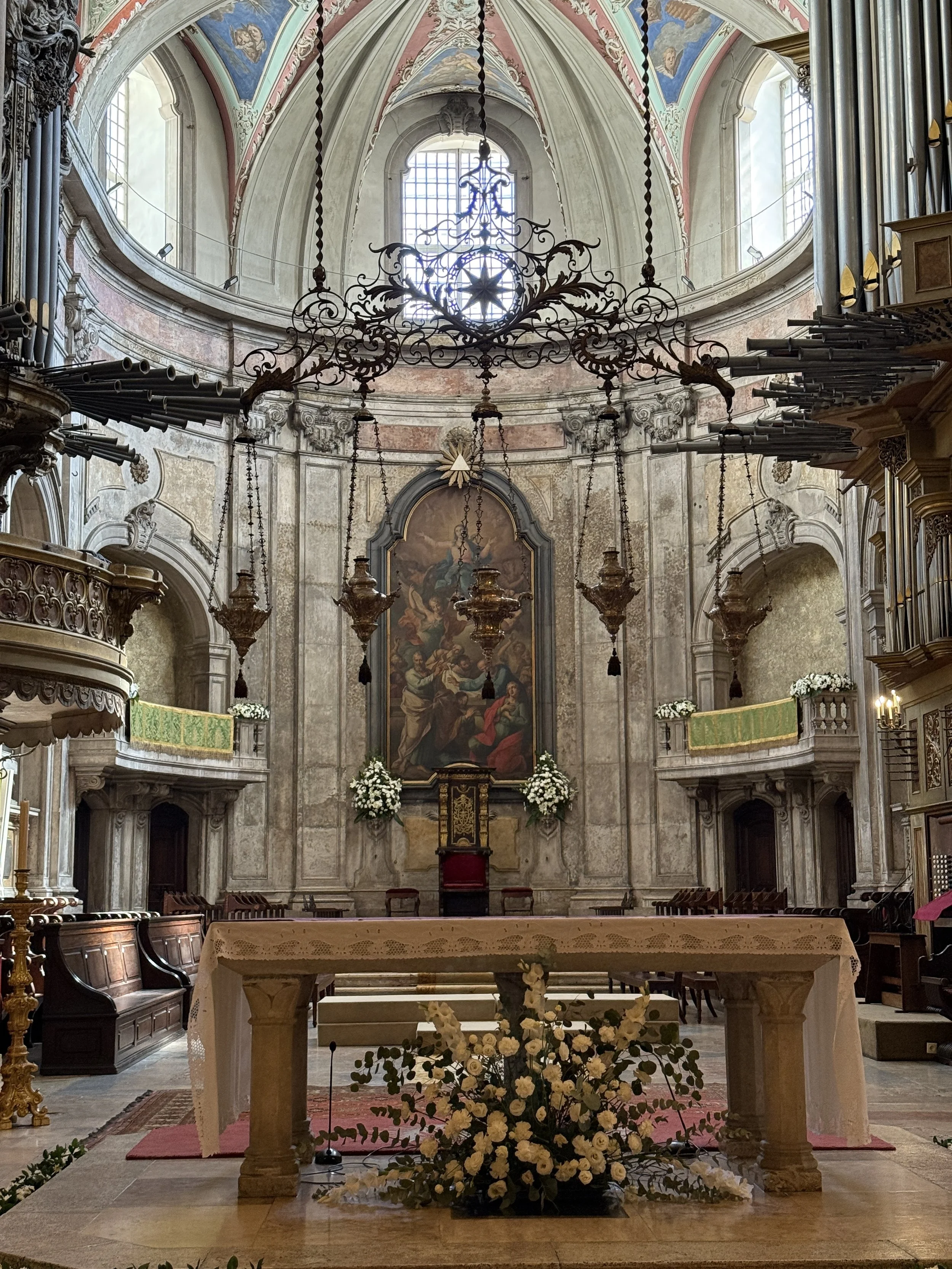
The high altar of the Lisbon Cathedral

The cathedral’s high altar was redesigned in the late 18th century in the ornate Baroque style.

Along the way, we paused to gaze at the spot where a young Fernando Martins, later Saint Anthony of Padua, was said to have been tempted by the Devil. Tradition holds that he drew the sign of the cross on the wall to repel Satan, a mark now framed by decorative ironwork and accompanied by a plaque recounting what is said to be the first of many miracles attributed to the Lisbon-born saint. 

The High Choir didn’t disappoint, offering a spectacular vista. From there, Wally and I enjoyed a bird’s-eye view of the orderly Romanesque barrel vaults, central nave and Baroque chancel, and could clearly see the magnificent rose window depicting Christ surrounded by the Twelve Apostles. Created in the 1930s by the atelier of Ricardo Leone, the window’s design was based on surviving fragments from the original, which had been destroyed in the catastrophic earthquake of 1755.

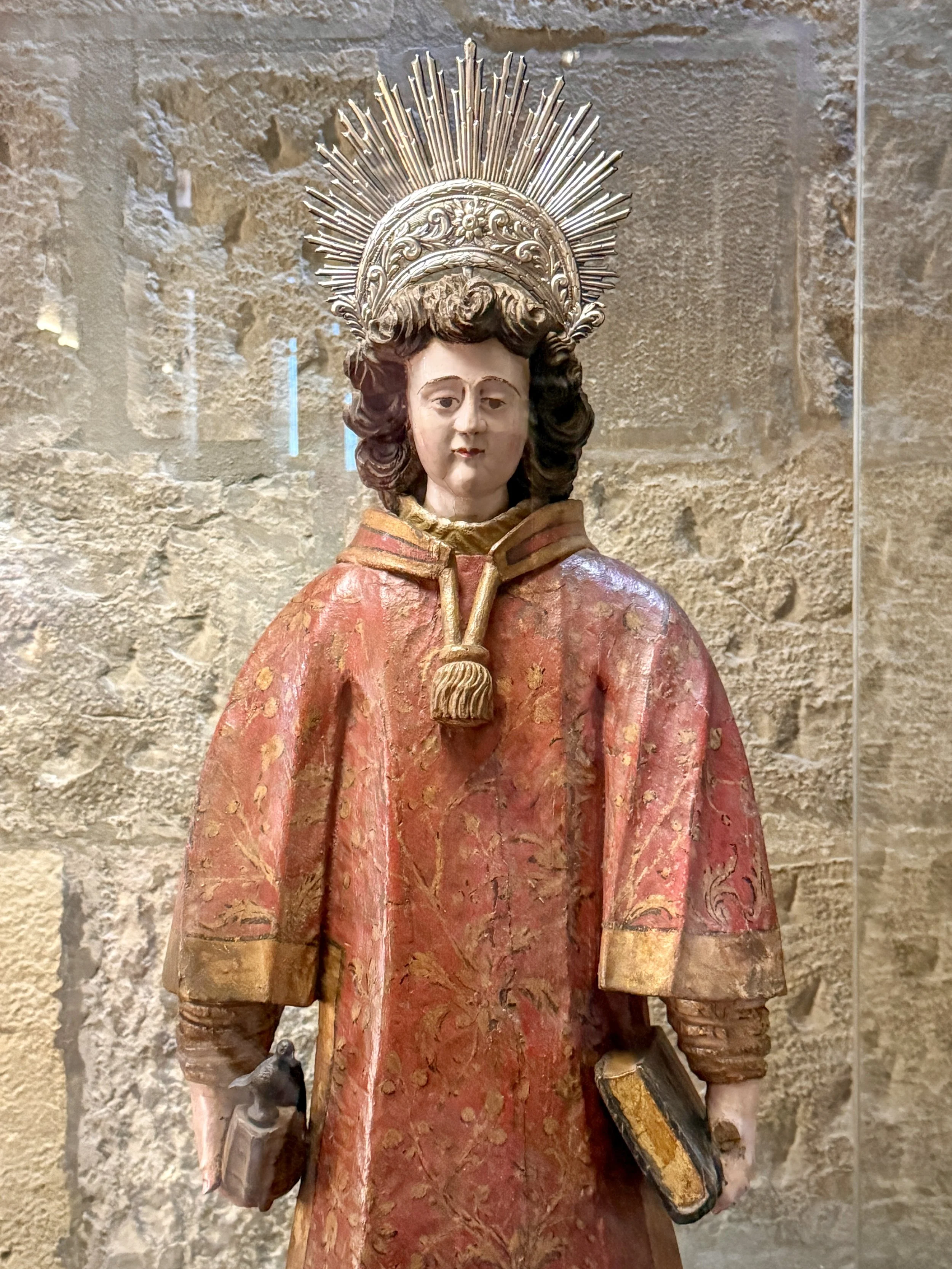
A statue of Saint Vincent of Zaragoza in a red robe, holding a book

This statue depicts Saint Vincent of Zaragoza, the patron saint of the Patriarchate of Lisbon, dressed as a deacon wearing a long red tunic and holding a book that evokes his role as preacher and protector of the Scriptures.

The Sé’s Treasury & Chapter House 

In the treasury museum, four halls display a remarkable collection of religious objects spanning the cathedral’s long history, including reliquaries and other sacred artifacts. Among the most striking objects is the Custódia da Patriarchal (Patriarchal Monstrance), a solid-gold liturgical vessel whose design is attributed to João Frederico Ludovice, a German-born goldsmith and architect. Commissioned by King Dom João V, a devout Catholic who made it his life’s mission to turn Lisbon into a second Rome, 

the monstrance is encrusted with more than 4,000 diamonds, rubies, sapphires and emeralds and weighs over 37.5 pounds (17 kilograms). It was used to display the consecrated host during mass and was meant to reflect both divine glory and the king’s ambitions for a richly adorned patriarchal church. I tried to get a good photograph of it, but the glare from the lights on the glass made it tricky. 

The third hall served as the Sala do Capiítulo (Chapter House), built in the 18th century above the sacristy. It was here that the patriarchs gathered daily to hear the chapter recited, discuss the business of the order, and receive their assignments. The chamber also hosted weightier functions: deliberations, disciplinary proceedings and commemorations for members of the chapter who had died. 

The fresco above the center of the Chapter House depicts a scene of the allegorical figures of Prudence, Peace, Victory and Justice at the Lisbon Cathedral

The fresco above the center of the Chapter House depicts a scene of the allegorical figures of Prudence, Peace, Victory and Justice — virtues meant to guide those who gathered there.

The room also includes a painting depicting the story of Judith and Holofernes — specifically the moment when Judith, one of the badass women of the Bible, having beheaded the Assyrian general in his tent, presents his severed head to the people of Bethulia. Biblical scenes like this one have inspired original oil paintings across European art for centuries.

Among the treasures of the Sé de Lisboa is a ceremonial sedia gestoria, a richly adorned, portable throne once used in processions by the Patriarch of Lisbon

Among the treasures of the Sé de Lisboa is a ceremonial sedia gestoria, a richly adorned, portable throne once used in processions by the Patriarch of Lisbon.

Among the treasures is a theatrical ensemble from the ceremonial apparatus of the papal court: a sedia gestatoria, the velvet-and-silk brocade throne on which popes were once carried, flanked by two flabella, great ostrich-feather fans. These fans signified honor but also served a practical purpose, to swat flies away from the consecrated host and the celebrant during liturgy.

Above, a Baroque fresco portrays a celestial allegory of the virtues expected of the cathedral chapter. At its center, positioned above the other figures, sits Prudence. Her mirror, the attribute that defines her, reflects the ideals of self-knowledge, truth and moral clarity.

Gathered around her are the remaining personifications of virtue. Peace appears as a female figure bearing an olive branch. Victory is depicted as a winged youth lifting a laurel-leaf crown. Justice, dressed in yellow, carries a bundle of rods bound with a ribbon, the traditional emblem of fair and measured authority. 

This painting depicts a scene from the Book of Genesis: Eliezer meeting Rebecca at the well, at the Lisbon Cathedral

This painting depicts a scene from the Book of Genesis: Eliezer meeting Rebecca at the well, a common subject in Christian devotional art. 

Construction of the Cathedral

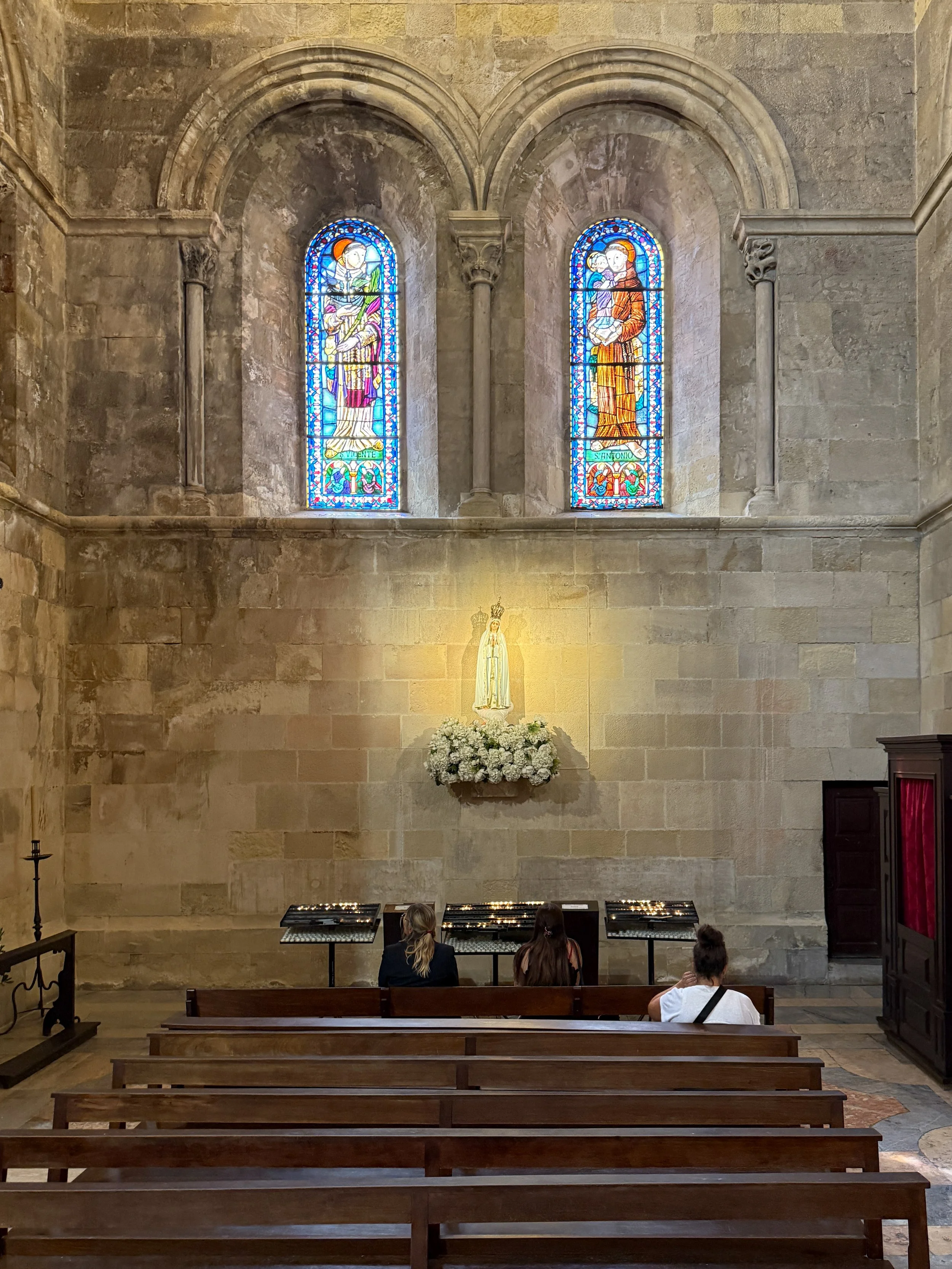
After exploring the treasury, we headed back downstairs and into the cathedral proper. It should be noted that the Sé de Lisboa has never been a static monument. The transept retains its original Romanesque vaults, though 20th century interventions introduced archways and a pair of stained glass windows depicting the city’s patrons: São Vicente (Saint Vincent) and Santo Antonio (Saint Anthony). 

Over the centuries, the cathedral has been rebuilt, reinforced and reimagined, shaped as much by changing architectural taste as by the forces of nature. The great quake of 1755, along with earlier earthquakes in 1344 and 1356, left it with significant structural damage. The result is an astonishing blend of Romanesque, Gothic and Baroque styles. 

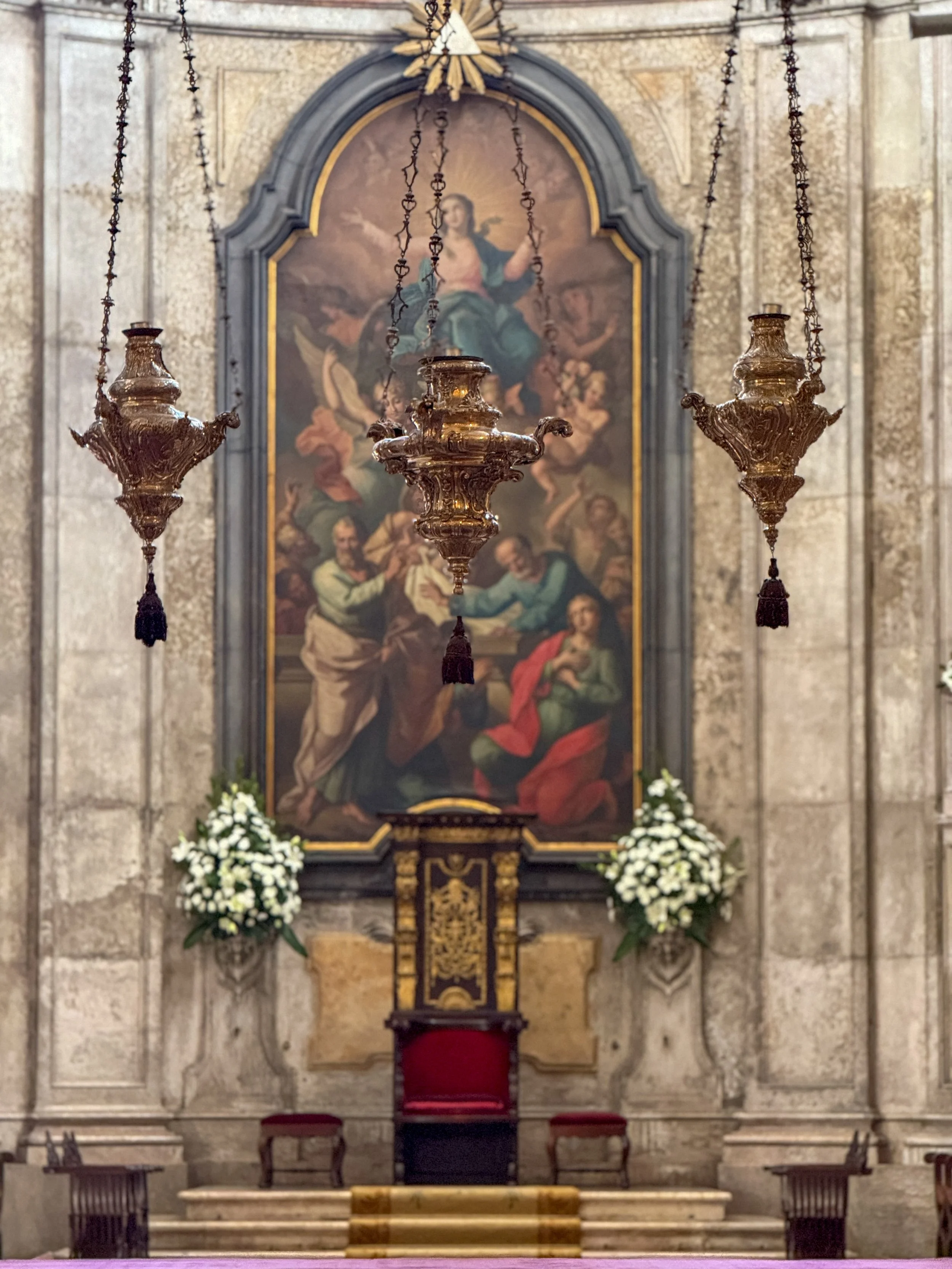
The Baroque 18th century painting above the high altar depicts the Assunção da Virgem (Assumption of the Virgin) and is attributed to José Inácio de Sampaio at the Lisbon Cathedral, with incense sifters hanging down

The Baroque 18th century painting above the high altar depicts the Assunção da Virgem (Assumption of the Virgin) and is attributed to José Inácio de Sampaio.

The octagonal dome over the high altar dates to the post-1755 reconstruction, adapted from what was once the cathedral’s bell tower. The Baroque chancel was created during that same campaign, replacing the Gothic chapel lost in the quake. In the 17th century, new side altarpieces were also added and later reworked, including one dedicated to the Virgem Maria (Virgin Mary) and another honoring Saint Anthony of Lisbon completed between 1769 and 1771 by the architect Reinaldo dos Santos. 

Located in Lisbon Cathedral’s transept and installed during a 20th century restoration, these stained glass windows honor Lisbon’s patron saints: Saint Vincent (left) and Saint Anthony (right).

Located in the cathedral’s transept and installed during a 20th century restoration, these stained glass windows honor Lisbon’s patron saints: Saint Vincent (left) and Saint Anthony (right).

RELATED: Artistic Depictions of the Virgin Mary: From Queen of Heaven to Lactating Mother

The earliest phase of construction of the Sé began under Gilbert de Hastings, an English crusader appointed bishop after the 1147 reconquest of Lisbon. The master builder Mestre Roberto is credited with designing the original Romanesque church: a Latin cross plan with three aisles, a transept and a main chapel encircled by an ambulatory.

The Gothic cloister was added during the reign of King Dinis, around 1261, and completed in the early 14th century. His successor, King Afonso IV, transformed the main chapel into a royal pantheon for himself and his wife, Queen Beatriz, and commissioned the construction of the apse, the semicircular east end of the cathedral, and its surrounding ambulatory. Located behind the high altar this corridor is covered with ribbed vaults and lined with nine radiating chapels, each dedicated to a different saint. Built between 1325 and 1357, the complex was designed to accommodate the growing number of pilgrims who came to venerate the relics of St. Vincent. 

Of Ravens and Bones

Born in Huesca (or Zaragoza) in the early 4th century, Vincent of Saragossa was arrested by Roman authorities and taken to Valencia, where he was martyred during Emperor Diocletian’s persecutions. According to tradition, he was tortured, roasted on a gridiron, and left for scavenging birds — but ravens guarded his body. Christians later recovered his remains, and devotion to his cult spread quickly across Christendom.

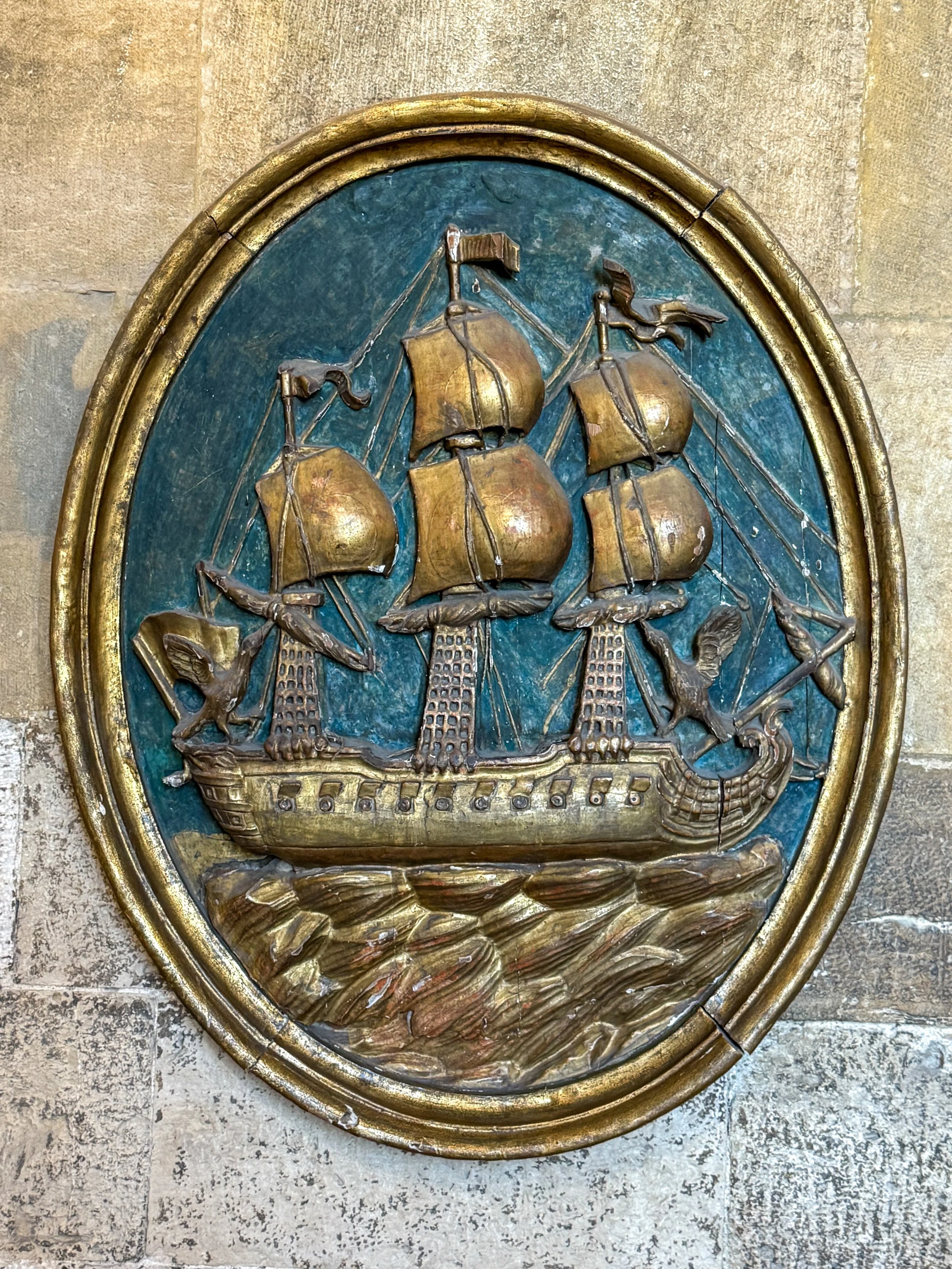
This decorative plaque commemorates the legendary voyage of the relics of Saint Vincent of Zaragoza to Lisbon, and features a caravel flanked by two ravens

This decorative plaque commemorates the legendary voyage of the relics of Saint Vincent of Zaragoza to Lisbon, and features a caravel flanked by two ravens. It’s said that ravens protected the martyr’s body on the ship bringing his remains to the city.

Centuries later, King Afonso I sought a significant relic to legitimize his conquest of Lisbon. He dispatched emissaries to the Algarve to retrieve St. Vincent’s remains from their coastal shrine and transport them north by sea. When the relics arrived in 1173, Afonso declared Vincent the patron saint of Lisbon.

According to legend, a pair of ravens accompanied the vessel carrying his remains. The story endures, and the image of a stylized caravel flanked by a raven at each end appears throughout the city, including on street lamps and in Lisbon’s coat of arms. 

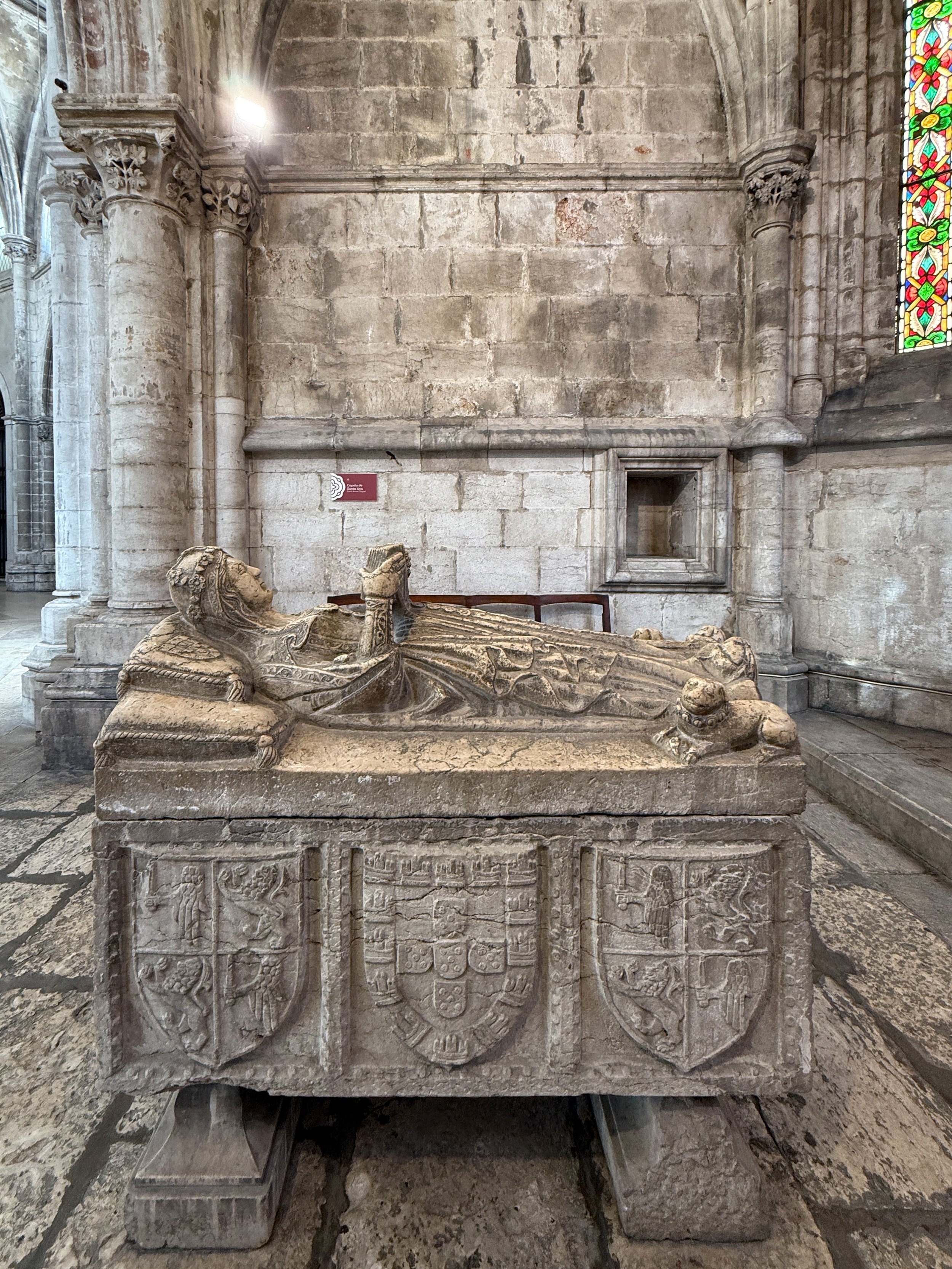
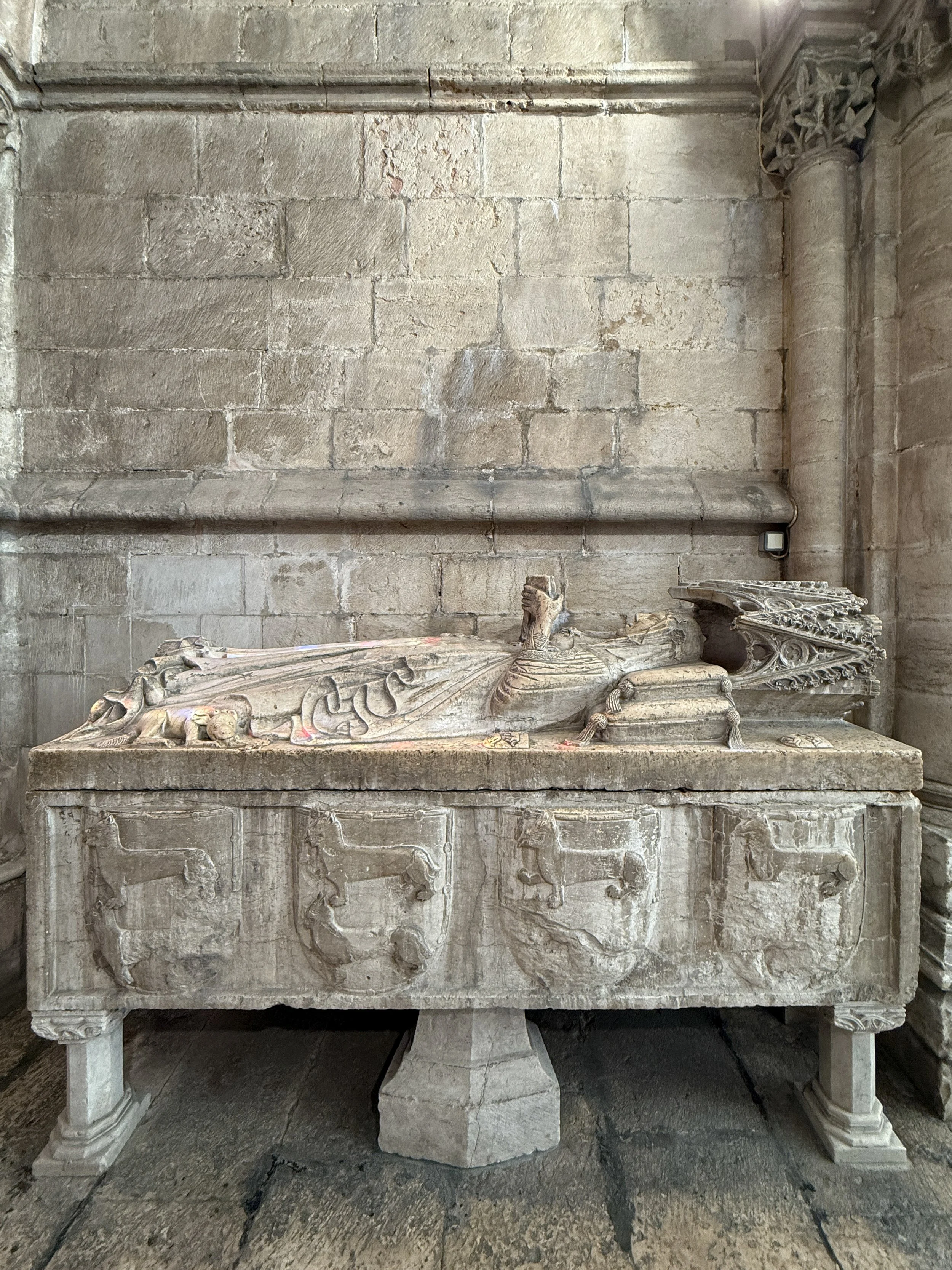
The tomb in Lisbon Cathedral's Capela de Santa Ana (Chapel of St. Anne), is more of a mystery, believed to belong to an unidentified royal princess. 

The tomb in the Capela de Santa Ana (Chapel of St. Anne), is more of a mystery, believed to belong to an unidentified royal princess. 

Although the tombs of Alfonso IV and Beatriz of Castile were destroyed in the 1755 earthquake, the cathedral’s Gothic ambulatory still contains three remarkable mid-14th century tombs. Two lie in the Capela de São Cosme and São Damian (Chapel of Saint Cosmas and Saint Damian), twin brothers born in Syria, traditionally venerated as early Christian physicians who offered their services for free, and considered patron saints of surgeons, pharmacists, veterinarians and barbers. 

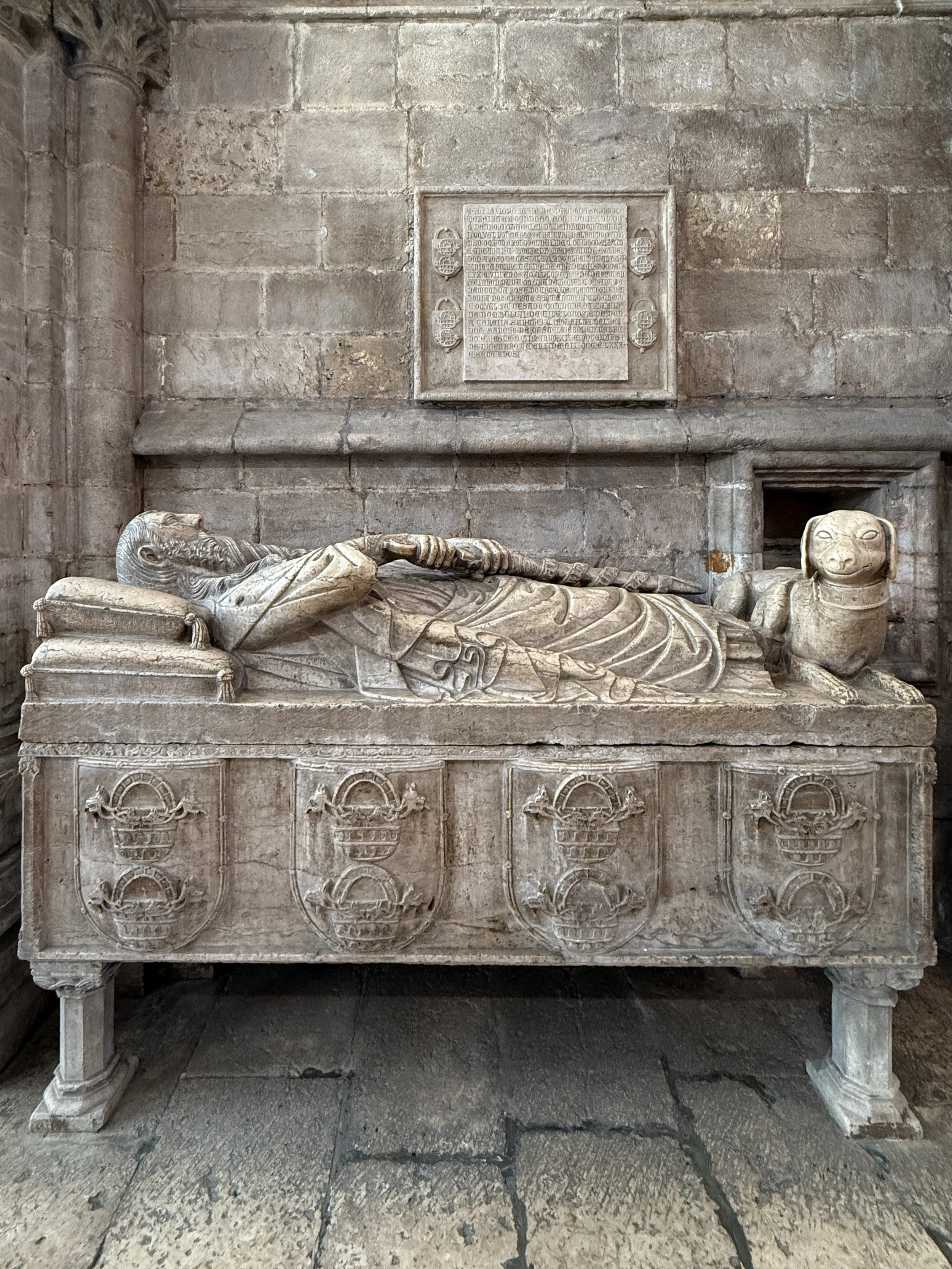
The effigy of Lopo Fernandes Pacheco portrays him as a dignified noble knight, his long, well-groomed beard emphasizing status, maturity and authority

The effigy of Lopo Fernandes Pacheco portrays him as a dignified noble knight, his long, well-groomed beard emphasizing status, maturity and authority. 

The sepulcher of Maria de Villalobos depicts her recumbent effigy reading from a book of hours at the Lisbon Cathedral

The sepulcher of Maria de Villalobos depicts her recumbent effigy reading from a book of hours. 

The chapel holds the funerary monument of Lopo Fernandes Pacheco, 7th Lord of Ferreira de Aves, a nobleman in Alfonso IV’s service; his recumbent effigy figure rests with a sword at his side, faithfully guarded by a dog at his feet. His wife, Maria de Vilalobos, lies in the adjacent tomb, depicted in serene contemplation as she reads from a book of hours. Above her, an elaborate Gothic, cathedral-like structure rises above her head — a symbol of the soul’s passage into the heavenly realm. 

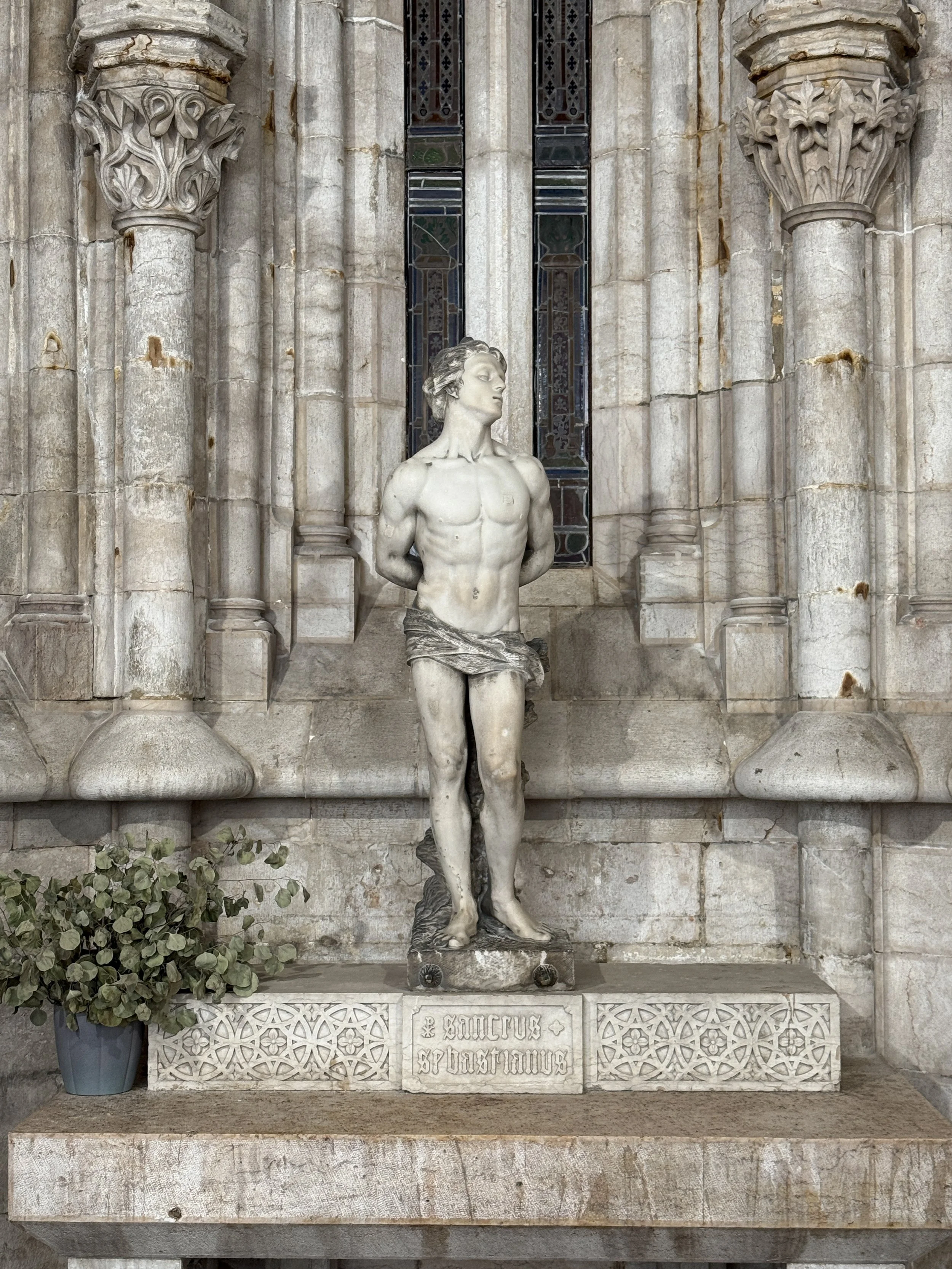
A statue of Saint Sebastian at the Lisbon Cathedral

Saint Sebastian, a Christian martyr often depicted tied to tree trunk and pierced with arrows, has long been celebrated in art as a representation of resilience.

The Chapel of São Sebastião (Saint Sebastian) contains a Baroque marble sculpture of the early Christian martyr. The figure is depicted as a muscular, nearly nude young man, bound to a tree and pierced by arrows. In Christian art, these arrows symbolize both the torments he endured and, more broadly, the saint’s role as a protector against plague, since arrows were long used as metaphors for sudden, deadly illness.

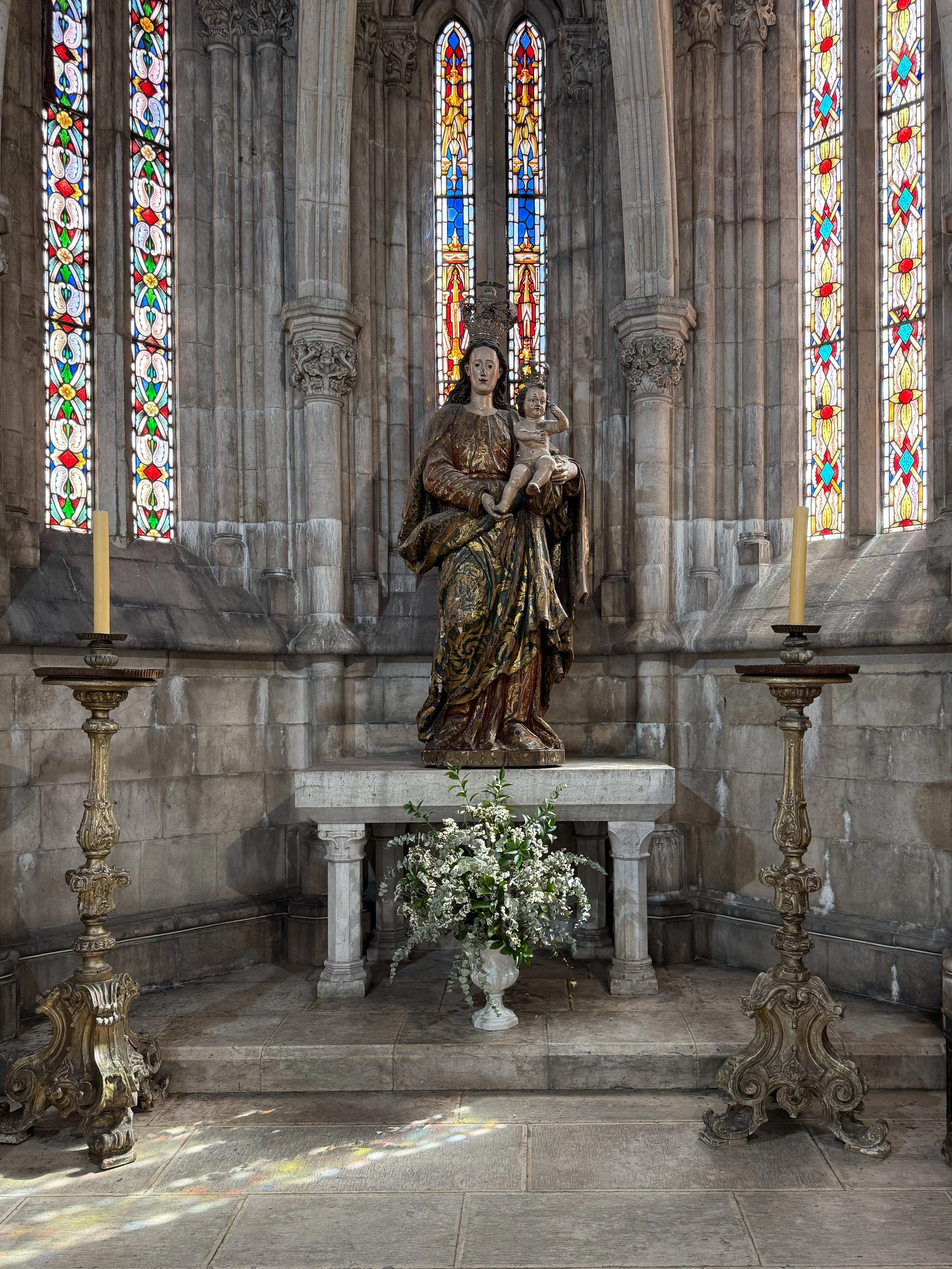
The Chapel of Santa Maria Maior (Saint Mary Major) features a polychrome wood sculpture of the Virgin and Child at the Lisbon Cathedral

The Chapel of Santa Maria Maior (Saint Mary Major) features a polychrome wood sculpture of the Virgin and Child and likely dates to the 16th or 17th century. 

A Bishop’s Fatal Fall From Grace

By the late 14th century, the cathedral had survived its share of natural disasters. But in December 1383, it found itself at the center of a political one. King Fernando I’s death plunged the city into turmoil, ending the Burgundian dynasty and triggering a bitter succession crisis.

The monarch died without a male heir, leaving the throne in doubt. His only child, Beatrice, was married to Juan I de Castilla (King John I of Castile). If she succeeded, Portugal risked being absorbed into Castilian rule — an outcome many feared would erase the kingdom’s hard-won autonomy. 

At the cathedral, tensions coalesced around its bishop, Martinho de Zamora (also known as Martinho Anes), a Castilian cleric suspected of favoring a Castilian takeover. In a moment when national sovereignty and political legitimacy hung in the balance, his perceived loyalties made him an easy target. 

According to the royal chronicler Fernão Lopes, a furious mob stormed the cathedral, seized Bishop Martinho, and threw him from the north tower. Lopes recounts with stark detail that his body was dragged through the streets and left to be devoured by dogs — a grim prelude to the civil war and eventual rise of Portugal’s new dynasty under João I, which laid the foundation for the house of Aviz.

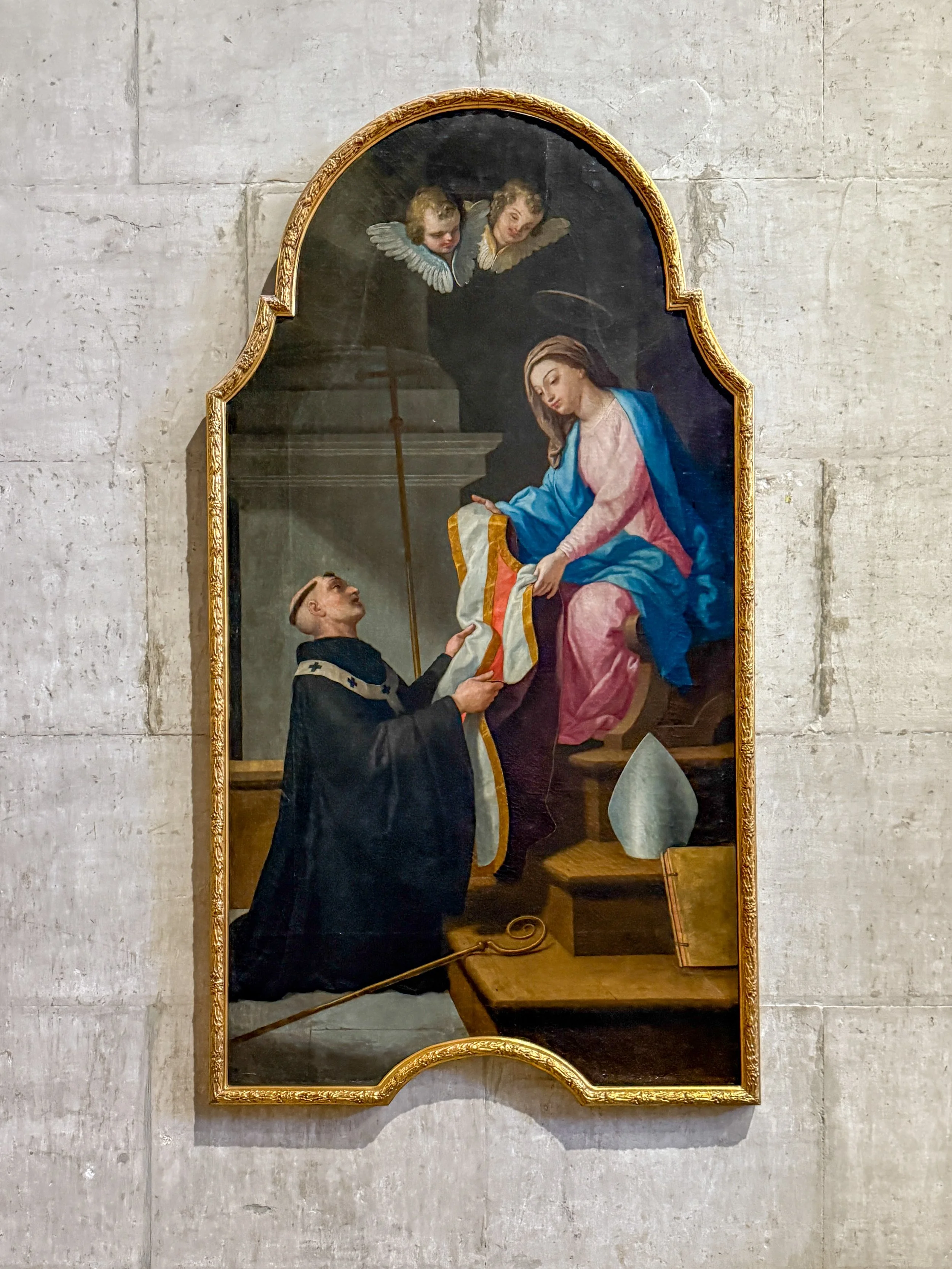
At Lisbon Cathedral, the Chapel of Idephonsus holds a painting Saint Ildephonsus receiving a chasuble, the outermost priestly vestment worn during mass, from the Virgin Mary, a gift honoring his defense of her perpetual virginity

The Chapel of Idephonsus holds a painting Saint Ildephonsus receiving a chasuble, the outermost priestly vestment worn during mass, from the Virgin Mary, a gift honoring his defense of her perpetual virginity. 

In 1498, Queen Eleanor of Viseu founded the Irmandade de Invocação a Nossa Senhora da Misericórdia de Lisboa (Brotherhood of Invocation to Our Lady of Mercy) in one of the chapels of the cloister of the cathedral. This brotherhood evolved into the Santa Casa da Misericórdia de Lisboa (Holy House of Mercy), a Catholic charitable institution that later spread to other cities and had a very important role in Portugal and its colonies.

The carved gilt-wood Baroque altarpiece is reason enough to visit the Patriarch's Dressing Room at the Lisbon Cathedral

Whether or not you’re into Catholic costuming, the carved gilt-wood Baroque altarpiece is reason enough to visit the Patriarch's Dressing Room. 

The Patriarch’s Dressing Room 

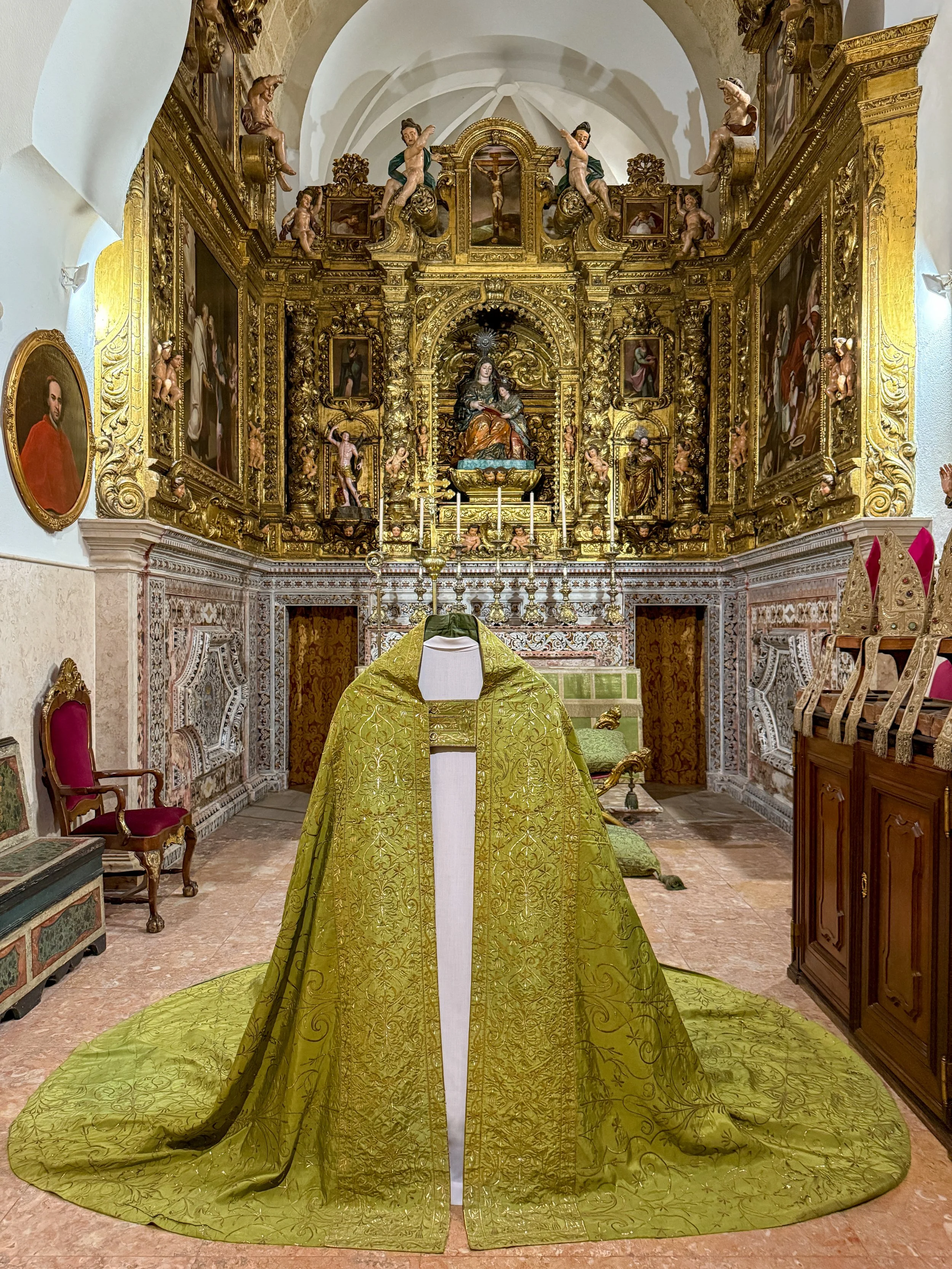
We paused to admire the Camarim do Patriarca (Patriarch’s Dressing Room), the space where the Patriarch of Lisbon — the city’s archbishop and one of Portugal’s highest-ranking church officials — prepared for mass. Upon arriving at the Sé, a bell announced his presence. He would first step into an antechamber to put on the cáligas, sandals matching the color of the day’s liturgical vestments, and the falda, a wide, flowing white tunic. From there, he proceeded into the dressing room to don the remaining vestments, including the cope, a full-length semicircular cloak, and the mitre, the tall, pointed ceremonial headdress with two trailing strips of cloth called lappets.

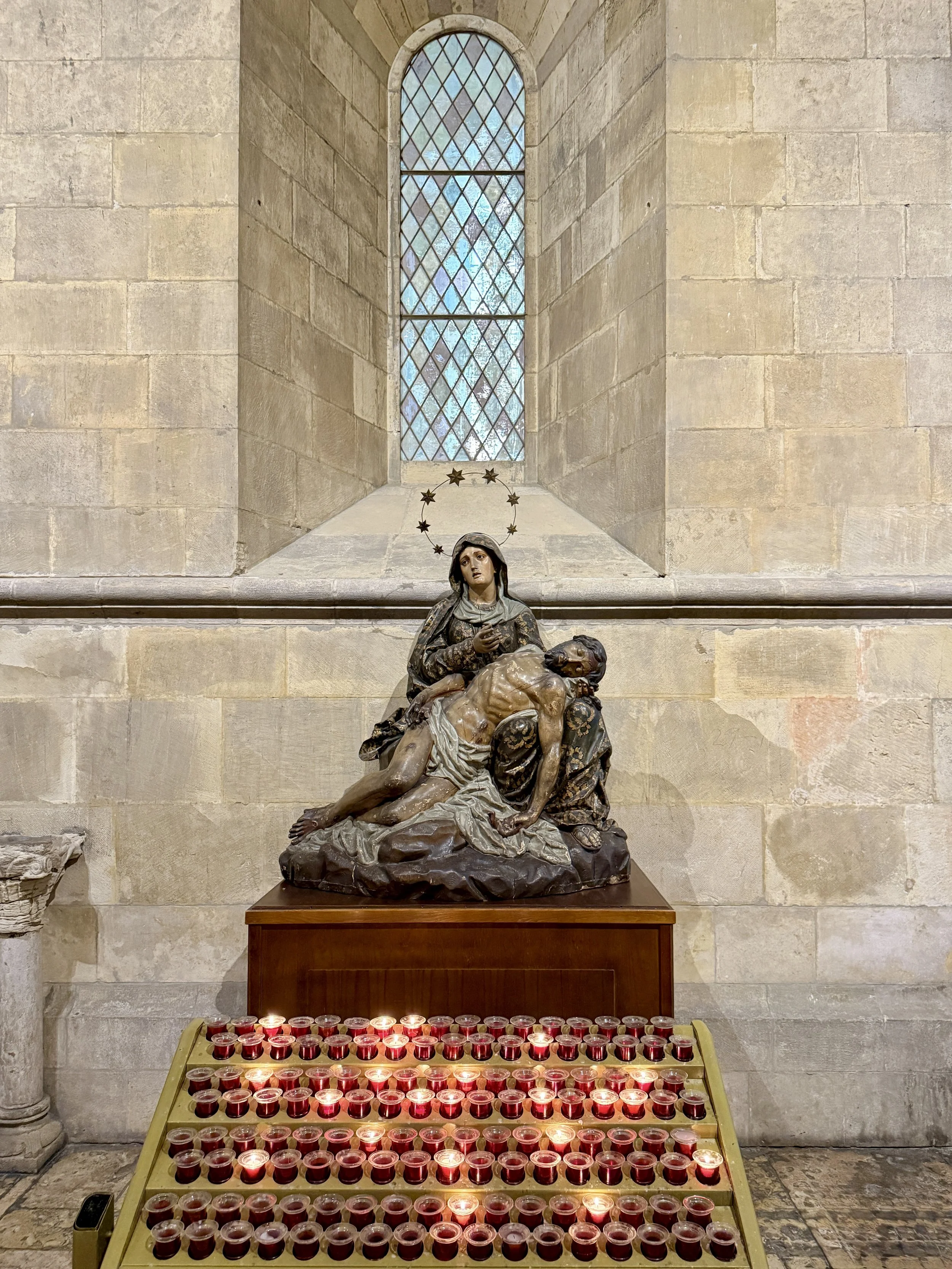
Located near the cathedral entrance, the Pietà depicts the Sixth Sorrow of the Virgin Mary as she holds the body of Jesus after the crucifixion.

Even though the cathedral wasn’t originally on our list, stumbling onto it was a wonderful surprise. We especially loved wandering through the quiet side chapels and discovering the ones that served as tombs. The Sé is absolutely worth popping into after an early morning visit to the castle just up the hill. –Duke

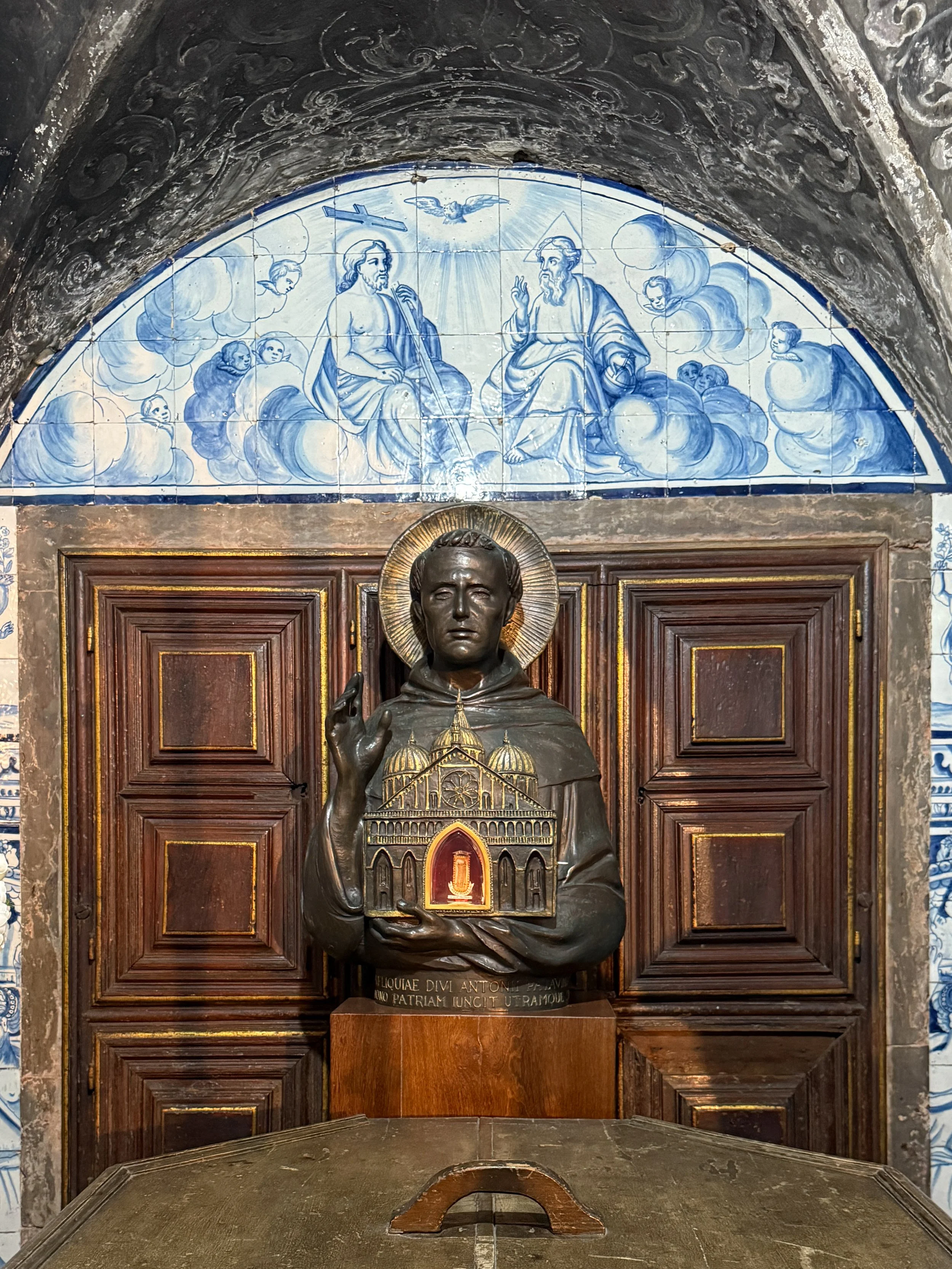
Near Lisbon Cathedral's entrance, surrounded by blue and white tile panels, stands the baptismal font where both Saint Anthony and Padre António Viera, a prominent 17th century Jesuit priest, were christened

Near the cathedral entrance, surrounded by blue and white tile panels, stands the baptismal font where both Saint Anthony and Padre António Viera, a prominent 17th century Jesuit priest, were christened. 

Before You Go: Lisbon Cathedral (Sé de Lisboa)

Cost

  • Main nave: Free for prayer

  • Museum and high choir:

    • €7 for adults (about $7.40)

    • €5 for children ages 7–12 (about $5.80)

    • Free for children under 6

Hours

  • Vary by season and by day (mass, choir services and special events can limit access)

  • Check the official site before visiting.

Accessibility

  • The main nave is accessible, but some areas — especially the museum and high choir — require climbing stairs.

  • Cobblestone streets around the cathedral can also be challenging.

How long to spend

  • We spent about an hour wandering through the museum and cathedral.

Lisbon Cathedral (Sé de Lisboa)

Largo da Sé 1
1100-585 Lisbon
Portugal

Church of São Domingos: Lisbon’s Beautiful Burnout

Visiting Igreja de São Domingos in Lisbon? Just off Rossio Square, this fire-scarred church turns ruin into reverence.

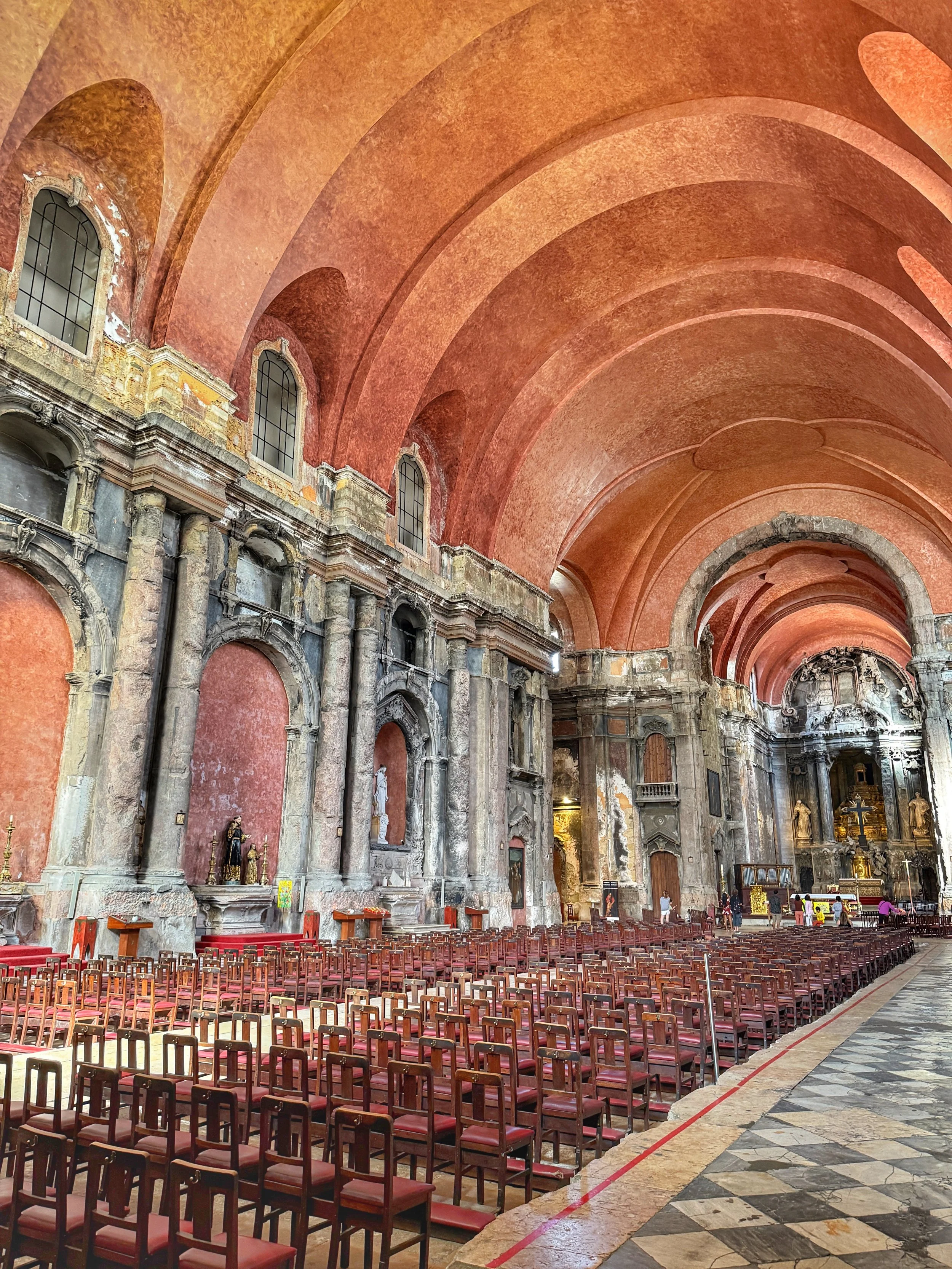
Once dripping in gold and glory, the Church of São Domingos in Lisbon, Portugal now wears its wounds with pride. A fire-charred interior, a bloody past, and a defiant refusal to hide the damage make it one of the most hauntingly honest churches in Europe.

We’d already been in Lisbon a couple of days when I flipped through a guidebook and saw a photo of São Domingos’ interior, with those scorched terracotta-colored walls and raw stone arches. I stopped mid-page. It didn’t look like any church I’d ever seen; it looked like something that had survived the end of the world. I turned to Duke and said, “We have to find this place.”

Workers reinforced the structure but left the burn marks as they were, creating an atmosphere that feels halfway between holy and haunted.

It’s not “beautiful” in the traditional sense, but it’s impossible to forget.

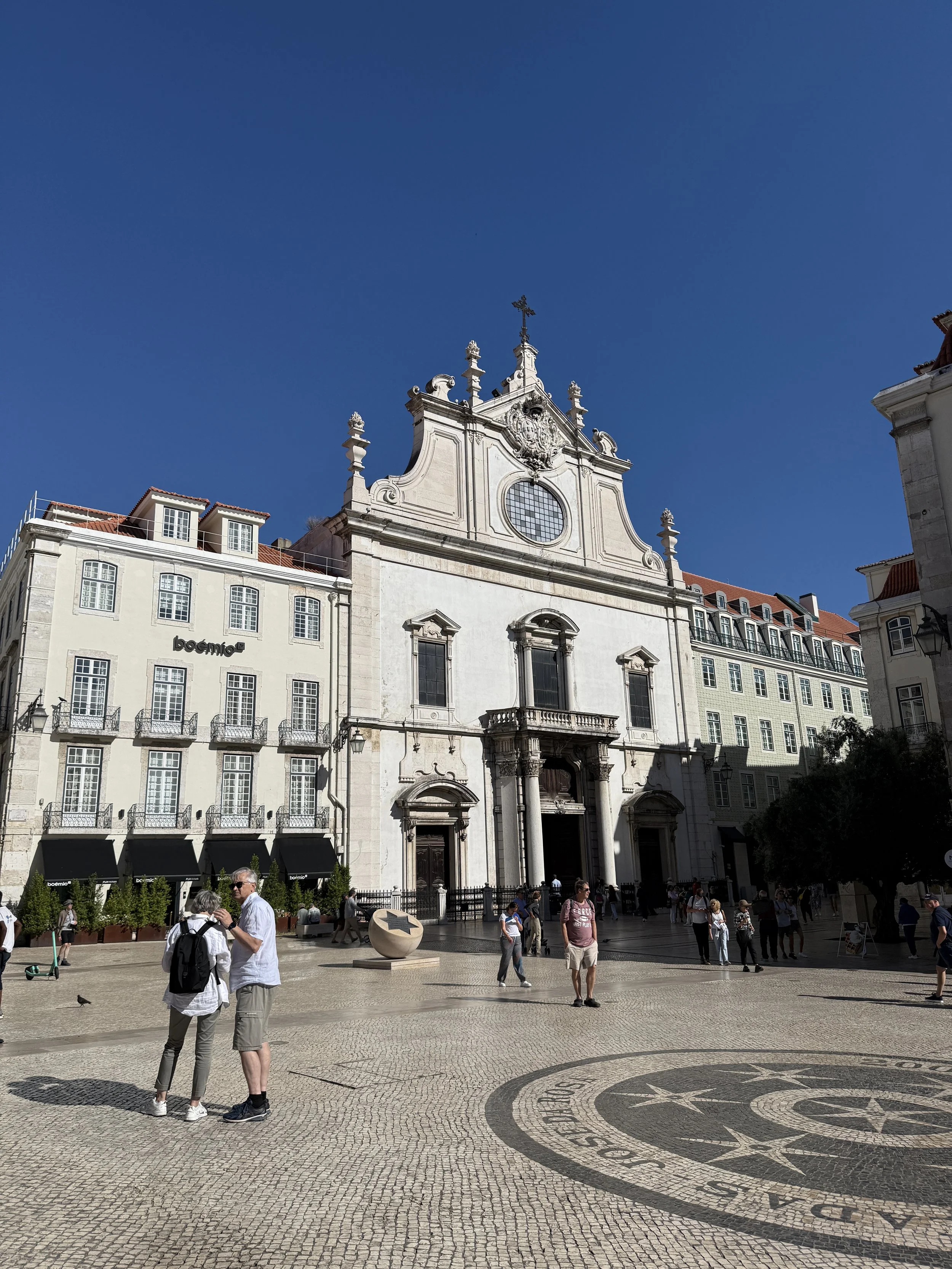
Imagine our surprise when we realized it was right under our noses — tucked just off Rossio Square in a strangely angled building we’d already walked past several times without noticing. From the outside, São Domingos looks a bit plain, its façade rather unassuming. But step through the doors and it’s like falling through time. Lisbon’s brightest square gives way to one of its darkest, most moving spaces.

Inside Igreja de São Domingos

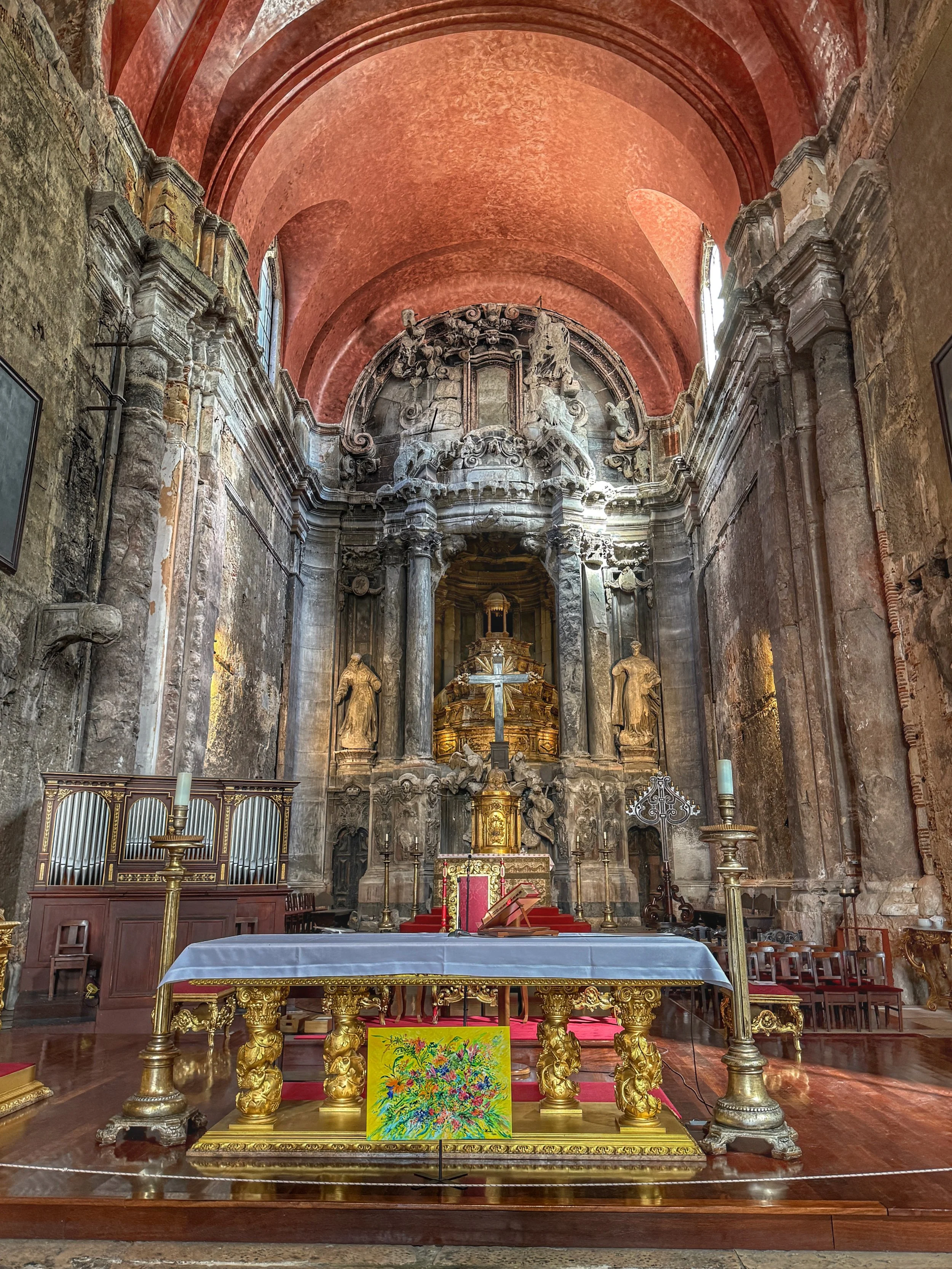
The first thing you notice inside Igreja de São Domingos isn’t the altar or the statues — it’s the walls. They’re scorched, cracked and blistered like the inside of a volcano. You half-expect to smell smoke. Once upon a time, this was one of Lisbon’s most lavish Baroque churches — all gold leaf, marble and over-the-top devotion. Then, in 1959, fire ripped through it, devouring the splendor and leaving behind something much more human.

Most churches would have been restored to postcard perfection. São Domingos wasn’t. The decision to leave its wounds visible — blackened stone, warped columns, burnt sienna ceilings that look like they still ache — feels radical, especially in a city that prides itself on polished tiles and pastel façades. This one’s not pretending. It’s survived earthquakes, massacres and flames, and it’s still standing — raw, imperfect and more sacred for it.

The fire that ravished São Domingos is believed to have started at the high altar — with, possibly, a candle to blame.

The Fire That Changed Everything

In 1959, a fire tore through São Domingos, leaving only its stone skeleton behind. The blaze gutted centuries of gilded wood and painted ceilings, the kind of gaudy grandeur that Baroque churches specialized in. Parishioners watched in horror as molten gold dripped from the altar and statues melted into unholy puddles. Yet instead of rebuilding it to its former blingy glory, Lisbon decided to do something almost heretical: It left the scars.

The fire broke out on August 13, 1959, just after dawn, starting near the high altar — the very heart of the church. No definitive cause was ever confirmed, though some reports suggested a stray candle or heat rising through an old chimney shaft. 

Within minutes, flames shot through the wooden roof and raced down the nave, feeding on centuries of lacquer, paint and gilt. 

More than 100 firefighters from across Lisbon rushed to the scene, and crowds filled Rossio Square to watch in disbelief and despair. 

Despite the firefighters’ efforts, the roof collapsed, killing two of them and reducing the sanctuary to a molten ruin.

Saint Dominic’s vision of receiving the rosary from the Virgin Mary

Saint Thomas Aquinas, the Dominican Order’s scholar-saint

The losses were staggering. The great pipe organ, centuries of paintings and sacred objects — including a revered 17th century image of Our Lady of the Rosary — were destroyed. 

The heat was so intense that the marble itself split, and the once-golden altars ran like wax. 

For a church that had hosted royal weddings, funerals, baptisms and national ceremonies, the devastation felt almost personal — a wound carved into Lisbon’s collective memory. That same year, São Domingos was declared a National Monument, ensuring that what survived would never again be hidden behind fresh plaster.

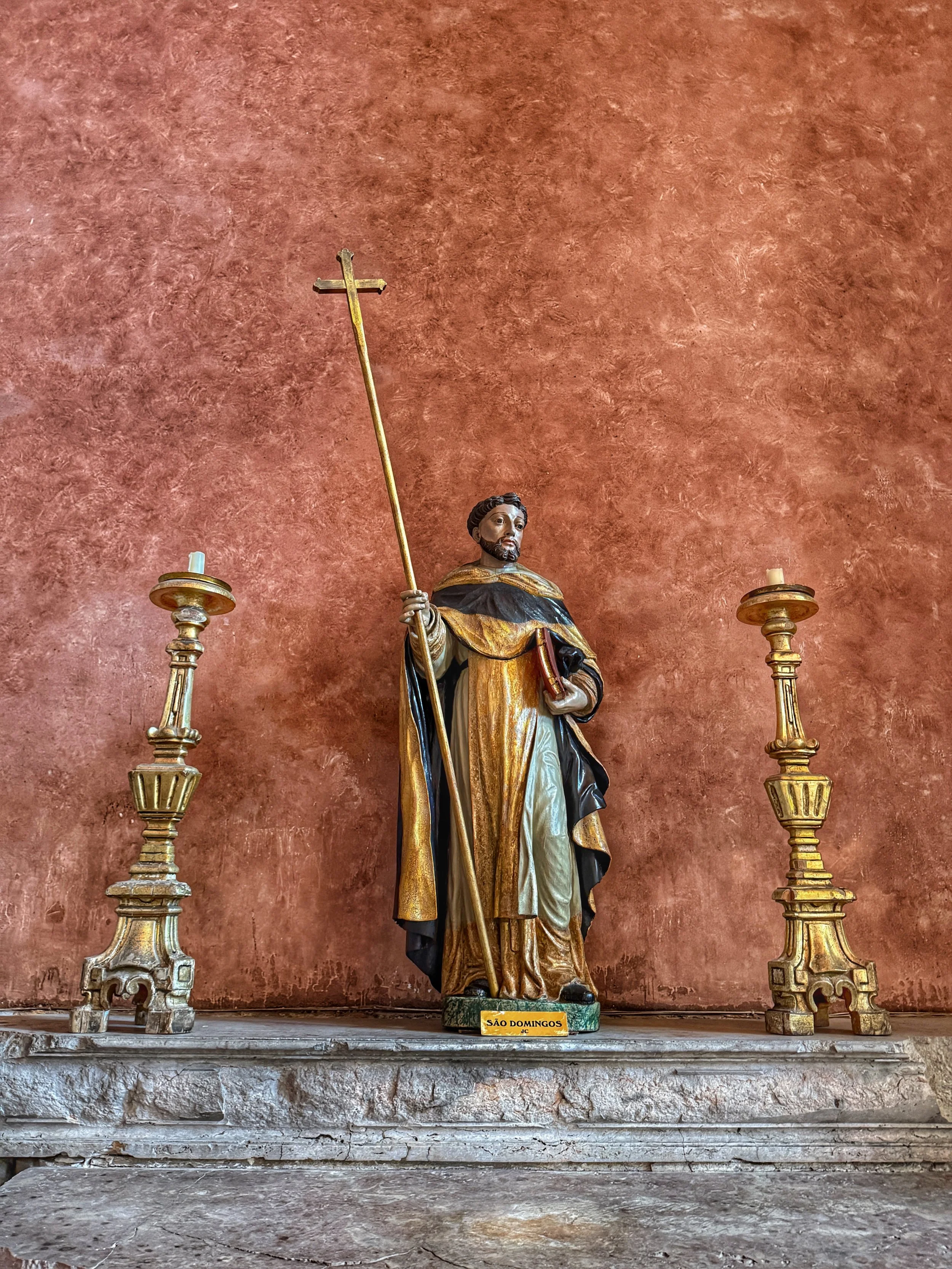
Saint Dominic (São Domingos), founder of the Dominican Order, was devoted to truth through study and preaching.

São Domingos, the Saint Who Started It All

It feels poetic — maybe even karmic — that the church dedicated to Saint Dominic, the man who founded the Dominican Order, should end up looking like penance. Dominic was no quiet monk. Born in 1170 in Spain — supposedly on a Sunday (domingo), hence his name — he was a fiery preacher famous for fighting heresy and convincing people through debate rather than violence. At least, that was the idea. His order later became the intellectual arm of the Inquisition — less conversation, more confession under duress. Not quite the legacy he’d hoped for.

Dominic himself, though, was fascinating. Legend says his mother dreamed of a dog carrying a torch in its mouth, setting the world aflame — a symbol of how her son would spread faith like wildfire. (“Dominican,” after all, comes from Domini canes — “the dogs of the Lord.”) 

He died in Bologna, Italy in 1221, apparently of sheer exhaustion from walking and preaching barefoot across Europe. 

Standing inside São Domingos today, it’s hard not to think of that dream — of flames and faith intertwined. 

Saint Joseph (São José), the carpenter stepfather of Jesus and patron of Portugal, gets more reverence here than perhaps any other country.

The Shadow of the Inquisition

For a church that now feels so peaceful, São Domingos has a disturbingly violent past. Long before the fire, before Lisbon’s earthquakes and rebuilds, this was the epicenter of something far darker: the 1506 Massacre of Lisbon’s Jews.

It started with a miracle gone wrong. A drought had gripped the city, and crowds filled the church, praying for rain. When someone claimed to see Christ’s face glowing on the altar, a man in the crowd dared to doubt it — and was beaten to death on the spot. The frenzy that followed spilled into the streets, egged on by Dominican friars who urged the mob to “cleanse” Lisbon of unbelievers.

For three days, chaos ruled. Jews and New Christians (converted Jews, many forcibly baptized) were dragged from their homes and slaughtered. By the time it ended, an estimated 2,000 people were dead. The king was away; the city, soaked in blood. And São Domingos — that grand, gold-drenched house of God — had become a stage for fanaticism.

Outside the church today, there’s a modest memorial stone, easy to miss unless you’re looking for it. It reads, in both Portuguese and Hebrew: “In memory of the thousands of Jews who were victims of intolerance and religious fanaticism.” A single Star of David rests at its center, quietly defying centuries of silence.

Nearby lies Rossio Square — once the site of Lisbon’s public executions, where the condemned were burned at the stake in the name of faith. The Dominican friars, the same order tied to this church, often presided over those ceremonies, chanting prayers as flames rose.

It’s impossible not to sense the irony: The very order that once helped fuel the Inquisition now prays beneath ceilings blackened by fire. The church that once blessed the flames became a victim of them.

Step inside afterward and the air feels heavier, as if the walls themselves are still atoning. Maybe it’s Lisbon’s way of keeping the story honest — no whitewash, no denial, just stone and ash and memory.

Rebuilding, Remembering, Reclaiming São Domingos

Lisbon has a complicated relationship with ruin. It’s a city that’s burned, crumbled and drowned more times than seems fair — yet it always finds a way to look good doing it. After the devastating 1755 earthquake, much of Lisbon was rebuilt with Enlightenment precision: straight boulevards, orderly plazas, symmetrical façades — all courtesy of the Marquês de Pombal (Marquis of Pombal), who refused to let chaos have the final word. But São Domingos never quite conformed.

When fire tore through the church in 1959, the city could’ve easily restored it to its former Baroque bling. Instead, Cardinal Manuel Gonçalves Cerejeira, the Patriarch of Lisbon at the time, made the startling decision to leave the damage visible. He wanted the church to stand as a monument to survival — a spiritual scar that reminded worshippers of both faith and fragility. 

In the days after the fire, thousands of Lisboetas crowded around the smoldering ruins, stunned by what they saw. The interior that had once hosted royal weddings and state funerals was gone, its marble columns cracked and its altars reduced to cinders. Yet amid the shock, something shifted — the city seemed to accept the ruin as part of itself. When rebuilding began, Lisbon’s leaders chose not to repaint or replaster. The church’s new status as a National Monument cemented that choice, enshrining the damage as a public act of remembrance.

The heat had cracked the limestone, buckled the arches, and scorched the marble into shades of rust and rose. Replastering it would’ve been like putting concealer on a masterpiece.

So the charred stone stayed. Workers reinforced the structure but left the burn marks as they were, creating an atmosphere that feels halfway between holy and haunted. It’s not “beautiful” in the traditional sense, but it’s impossible to forget. The decision echoed another Lisbon landmark: the Carmo Convent, whose roof collapsed in the same 1755 quake and was never rebuilt. It now houses the Carmo Archaeological Museum, a stunning open-air ruin that, like São Domingos, celebrates what survived rather than what was lost.

Both spaces — Carmo’s skeletal Gothic arches and São Domingos’s fire-blistered vaults — speak to the same Lisbon instinct: to remember through ruin. There’s a kind of integrity in that — a refusal to rewrite history with fresh paint. Walk into São Domingos today and you can still see the melted lines where gilding once was, like ghosts of devotion past. 

A Living Testament

Step inside São Domingos on any given morning and you’ll find people lighting candles in front of walls that look like they’ve survived the apocalypse. The soot stains catch the flicker of each flame. Tourists wander in hushed awe, cameras half-lowered as if they’re intruding on something sacred. Locals cross themselves and sit quietly, lost in prayer. 

If you look closely, the worst fire damage still clings to the area around the high altar — the spot where the 1959 blaze began. The marble floor still gleams in places, though time has softened its edges.

There’s a quiet honesty here. In a city famous for azulejos and ornament, São Domingos doesn’t try to impress you. It doesn’t sparkle or hide the damage. It simply endures. That’s its sermon.

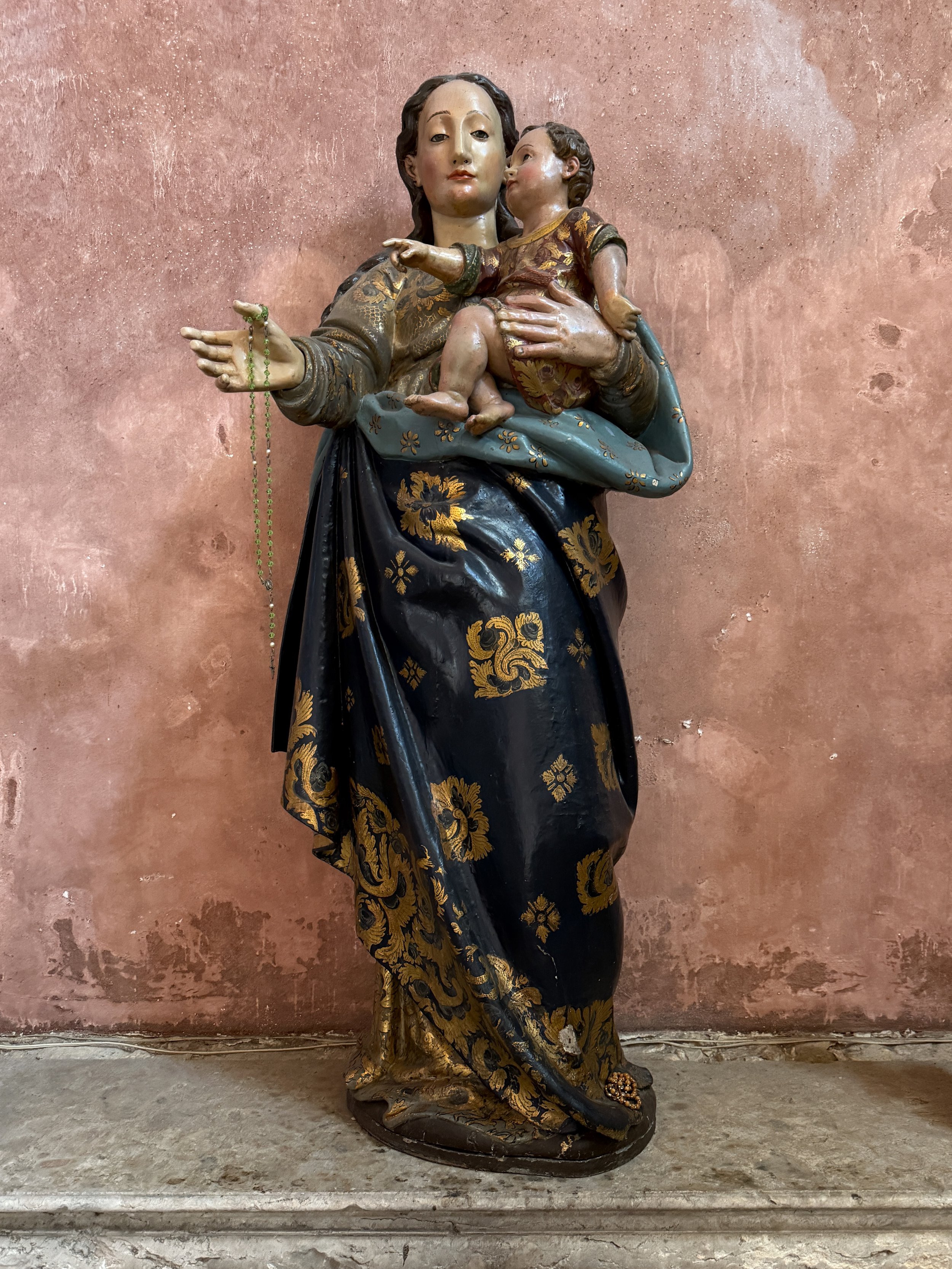
A statue of the Virgin Mary as Our Lady of the Rosary

The Church That Refused to Hide Its Pain

Lisbon does polished beautifully — the colorful façades, the shiny blue tiles, the pastry cases that look like art installations. But São Domingos offers something braver. It’s a church that said no to cosmetic miracles, a reminder that survival itself can be sacred.

Maybe that’s what makes it unforgettable. The gold is gone, the glory has burned away, and yet what’s left feels closer to the truth — the raw, cracked heart of a city that refuses to give up. Lisbon rebuilt itself a dozen times over, but here, at São Domingos, it decided to remember instead. 

Visiting São Domingos 

You’ll find Igreja de São Domingos tucked just off Rossio Square, in the Largo de São Domingos, where locals queue for ginjinha (Lisbon’s famous cherry liqueur) right outside its doors. It’s hard to miss — the façade is stately but unassuming, the real drama waiting inside.

Hours: The church is usually open daily from 7:30 a.m. to 7 p.m., and entry is free. Early morning or late afternoon is best if you want to feel the light shifting across the walls. –Wally

Igreja de São Domingos

Largo São Domingos
1150-320 Lisboa
Portugal


Iglesia de San Luis de los Franceses: The Baroque Brilliance of Seville’s Hidden Gem

This little-known chapel will have your head spinning, with gorgeous art and jaw-dropping details in every direction.

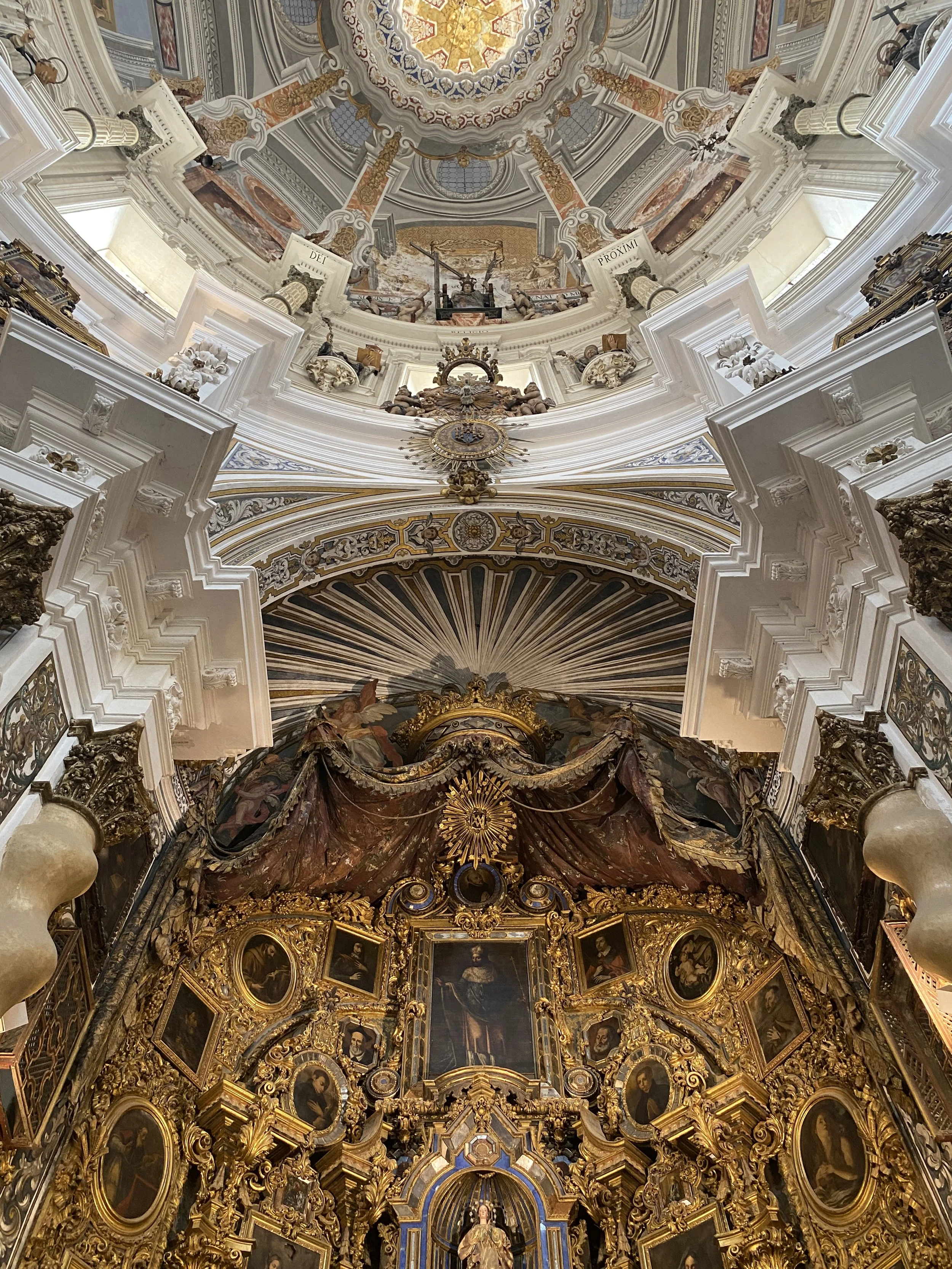
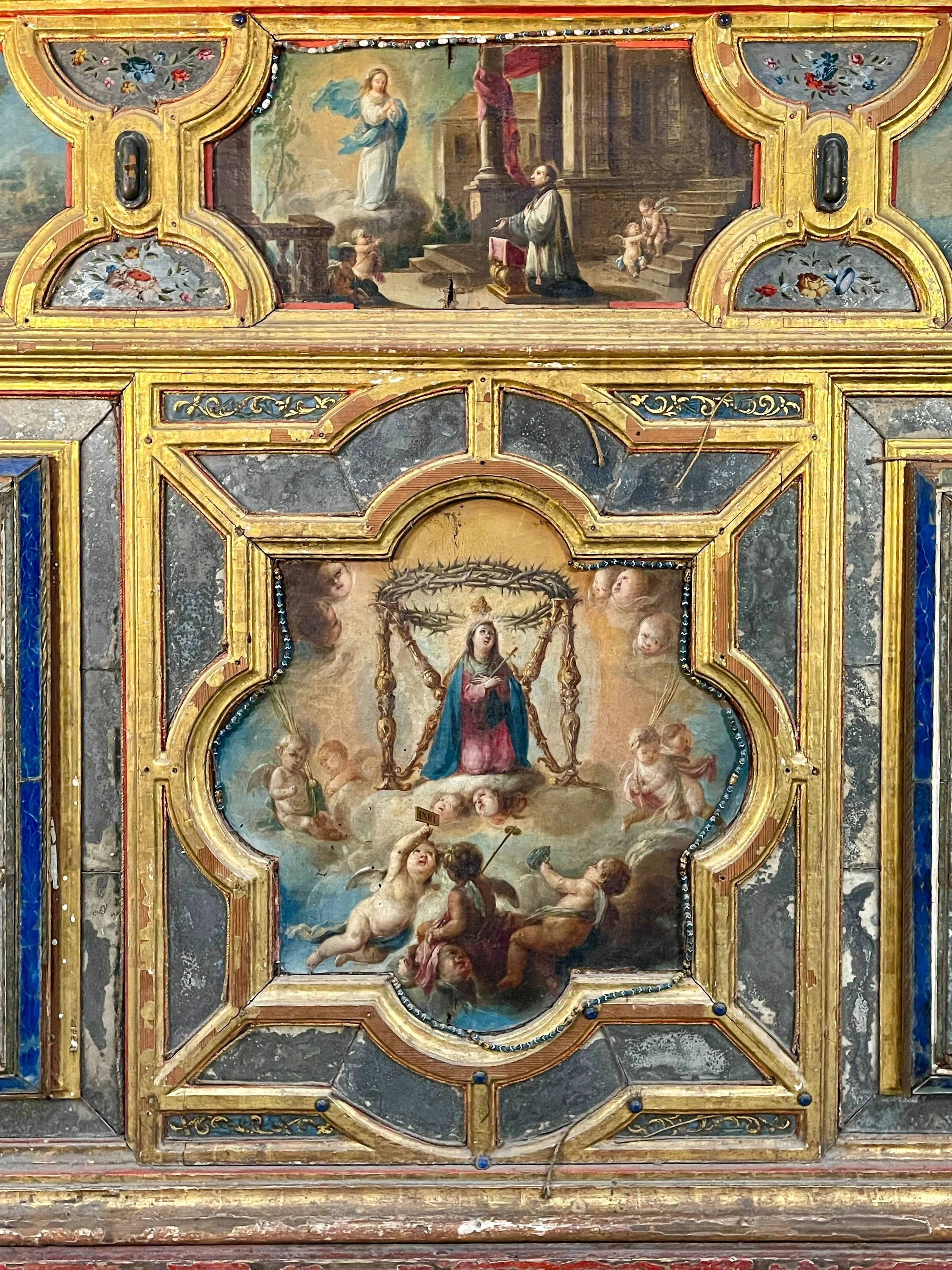
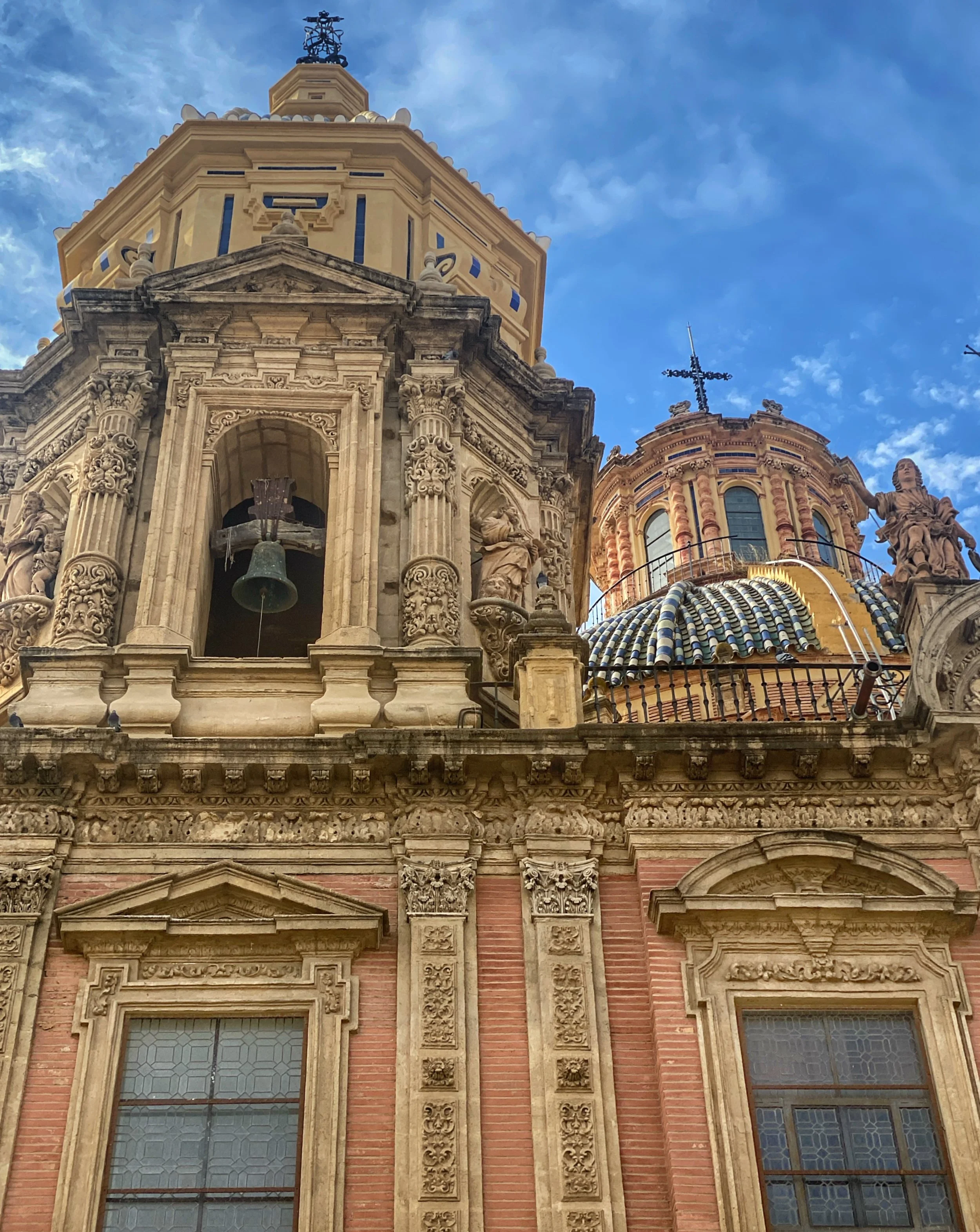
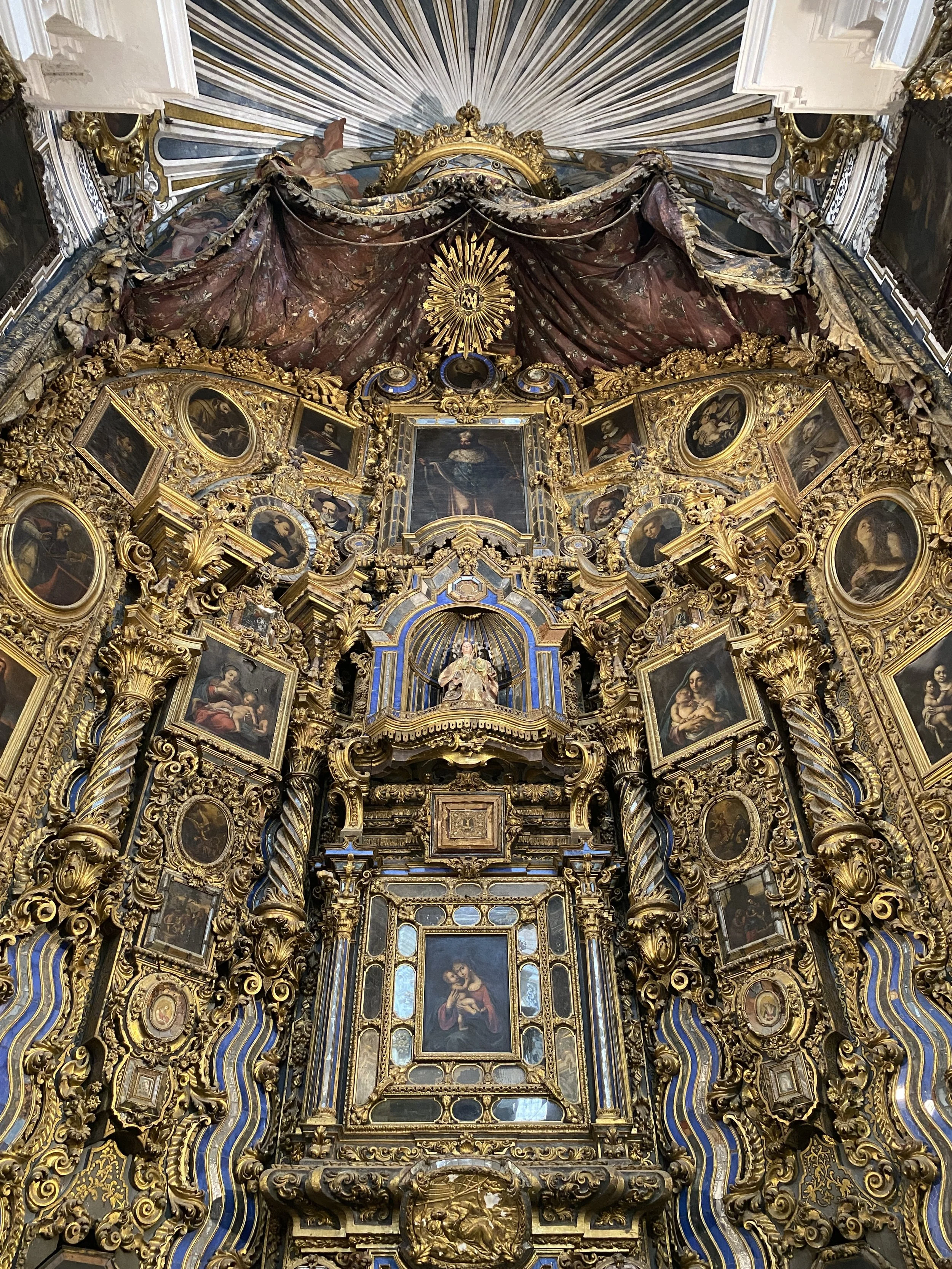
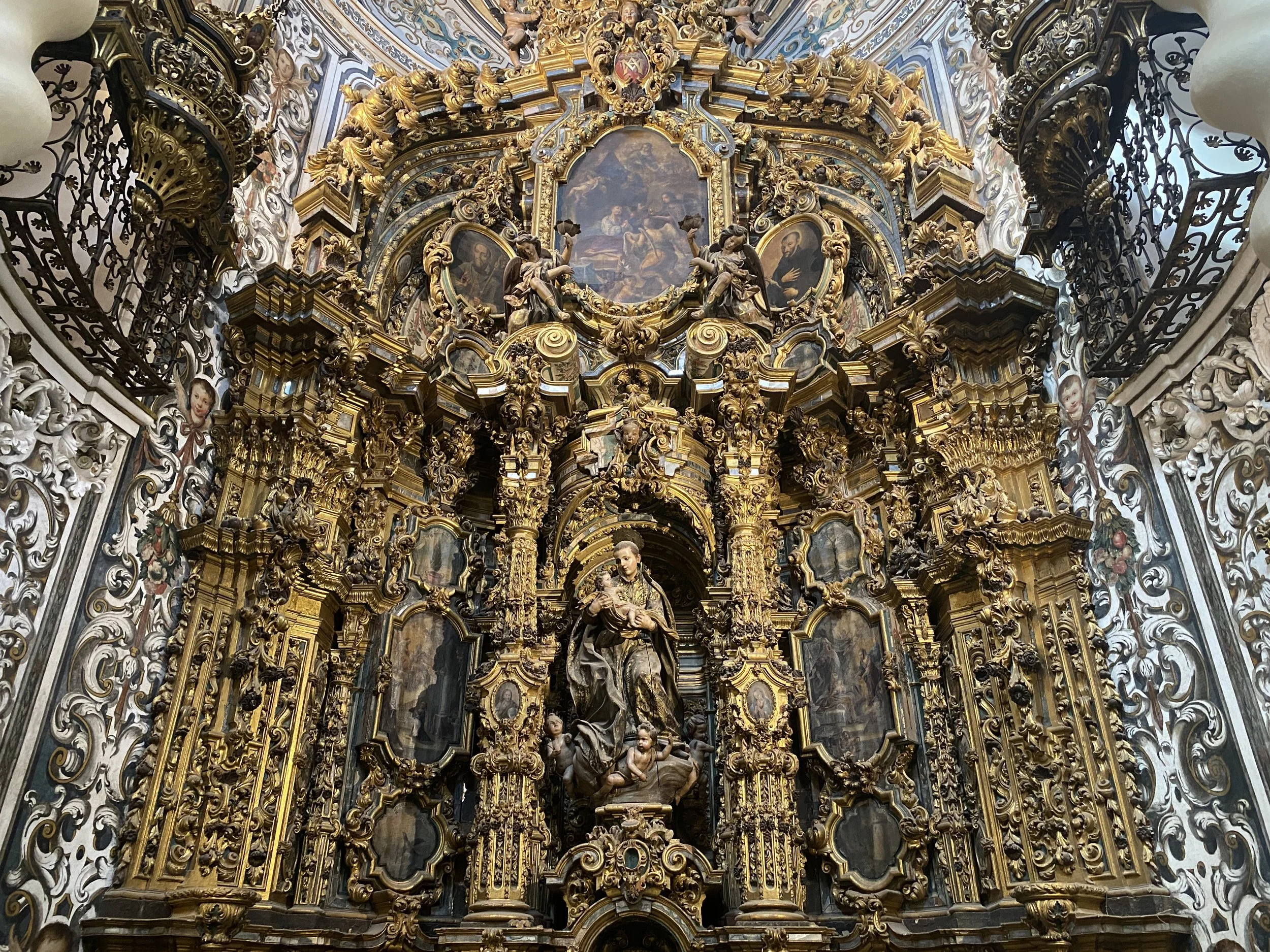
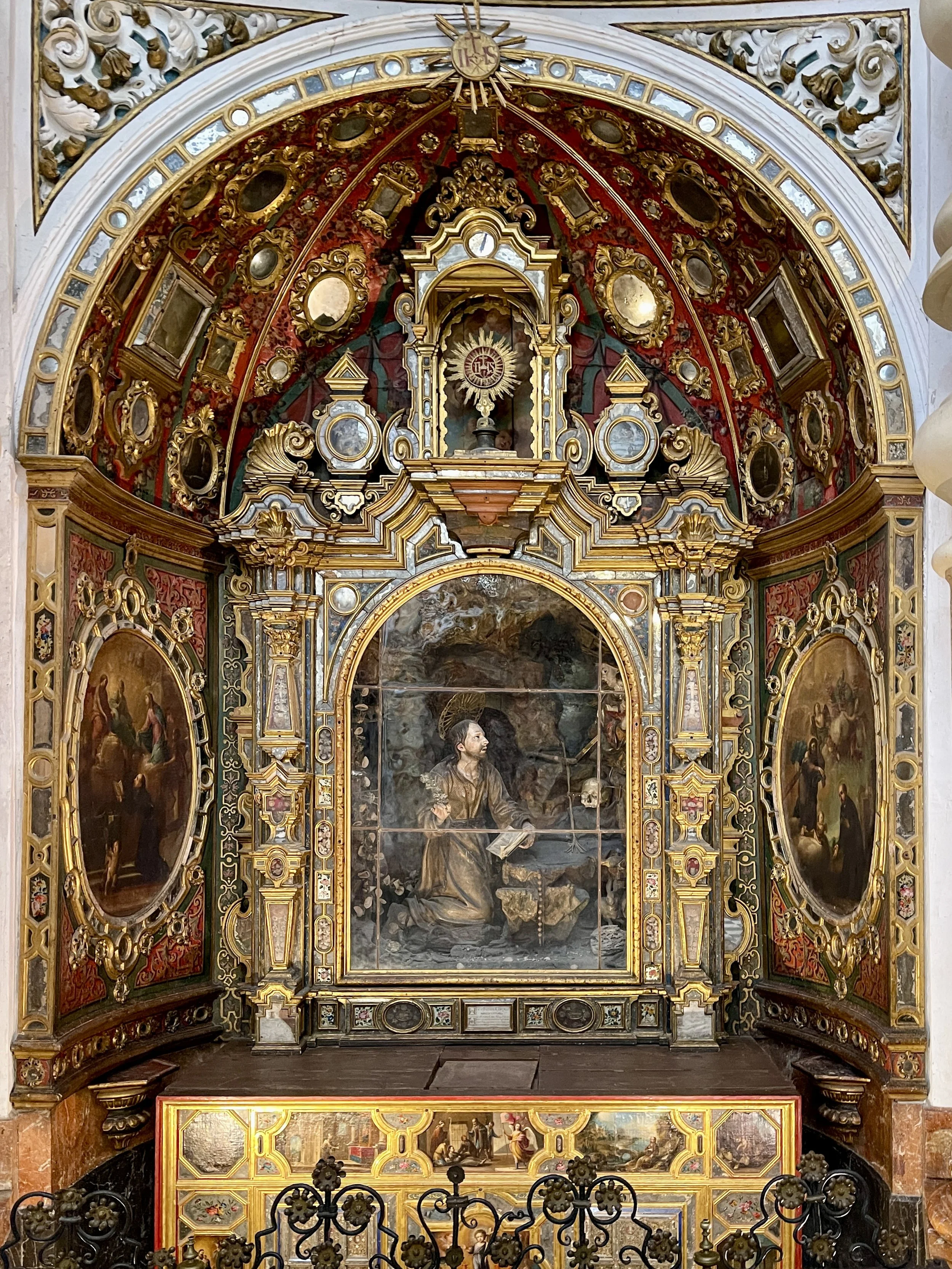
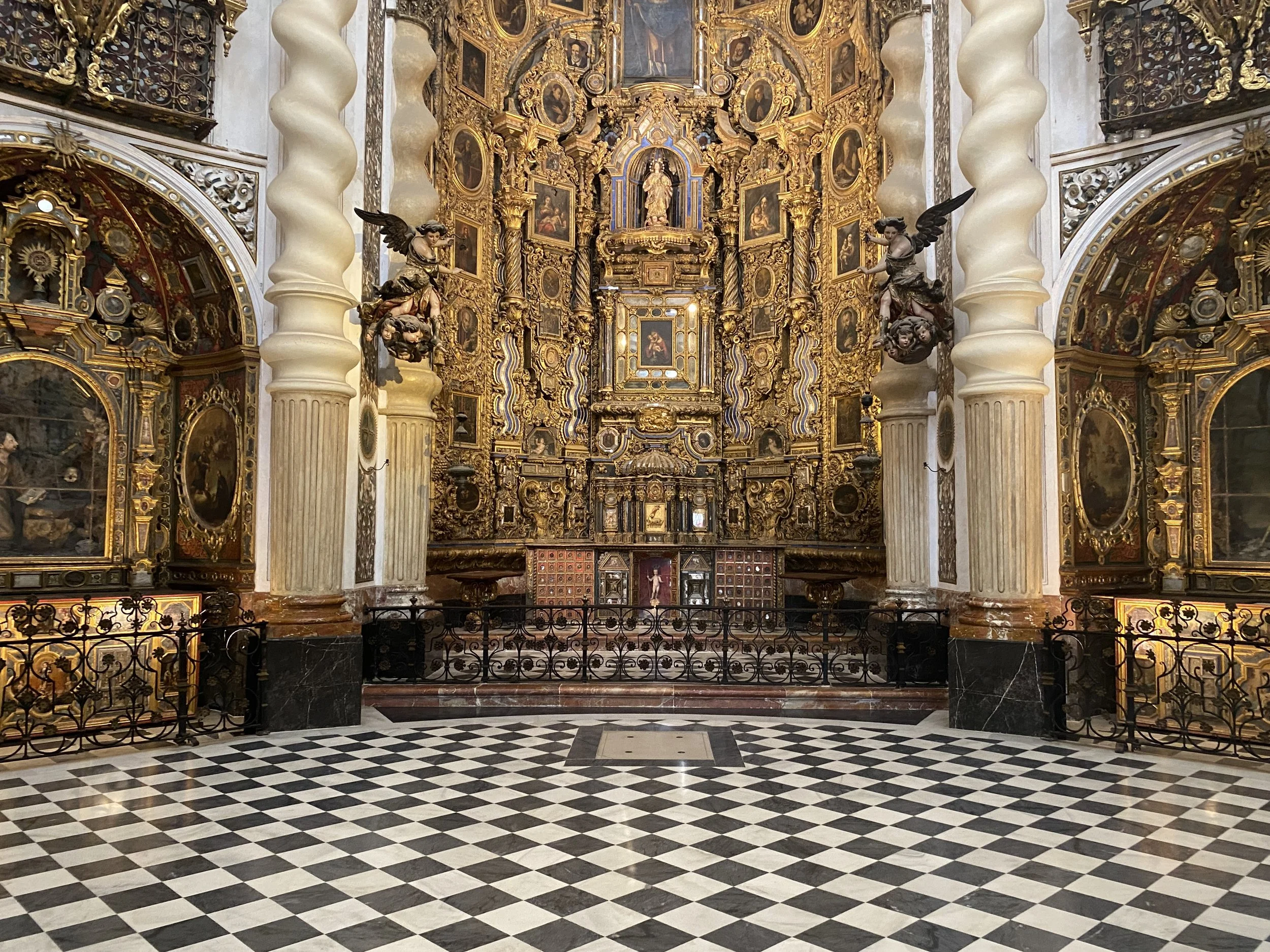
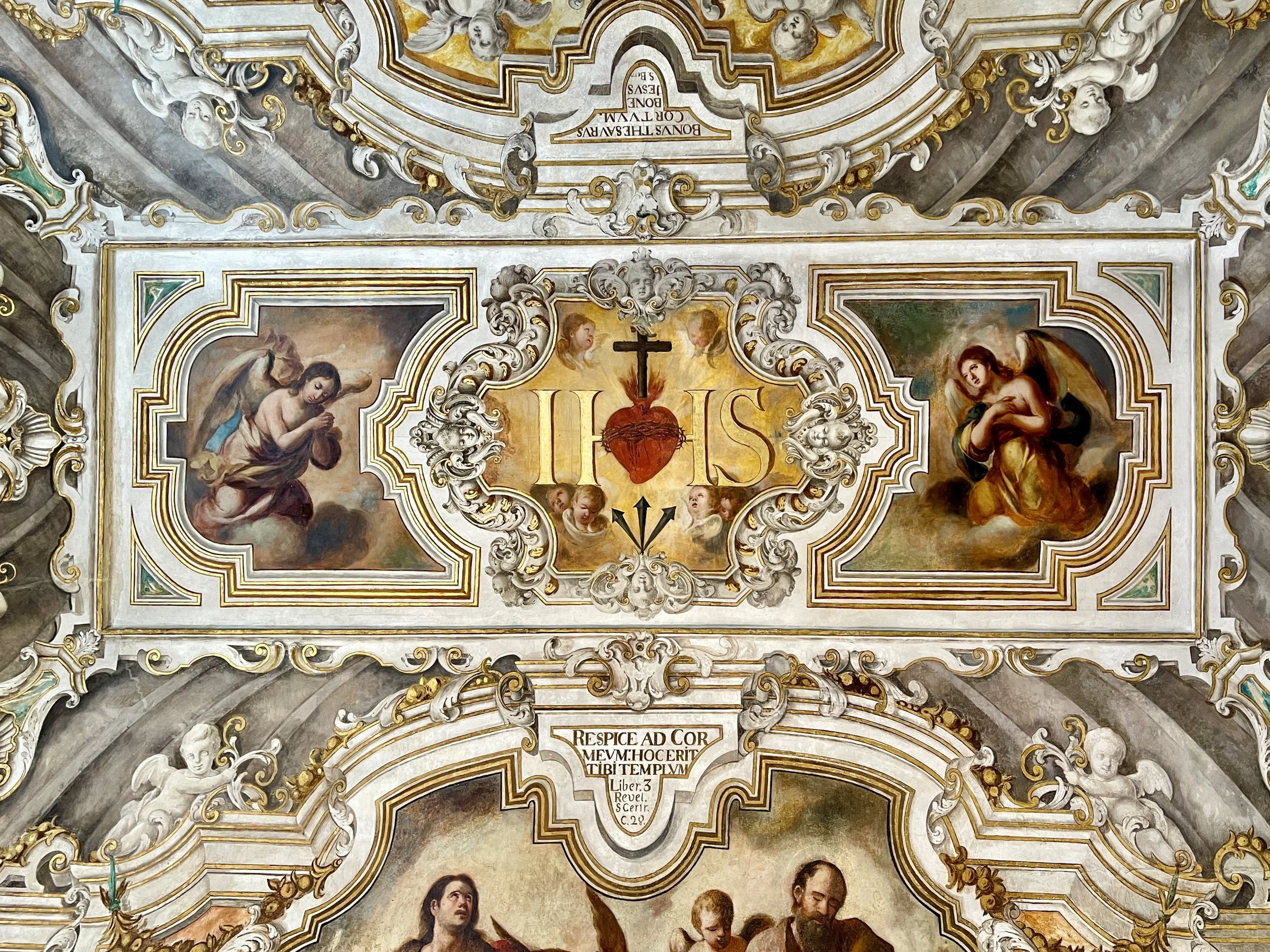
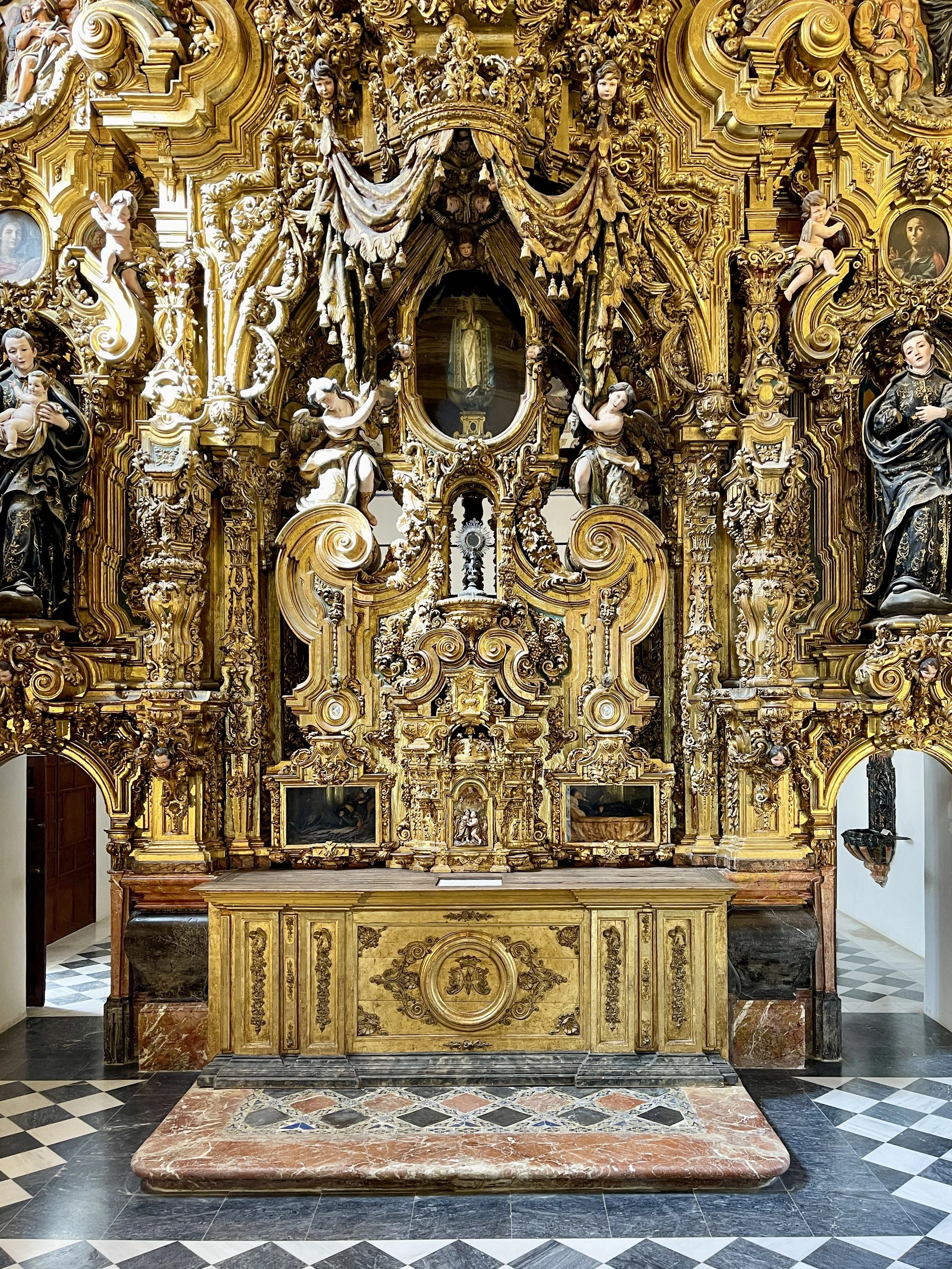
Gilded Baroque altar with saint in the middle at Iglesia de San Luis de los Franceses in Seville

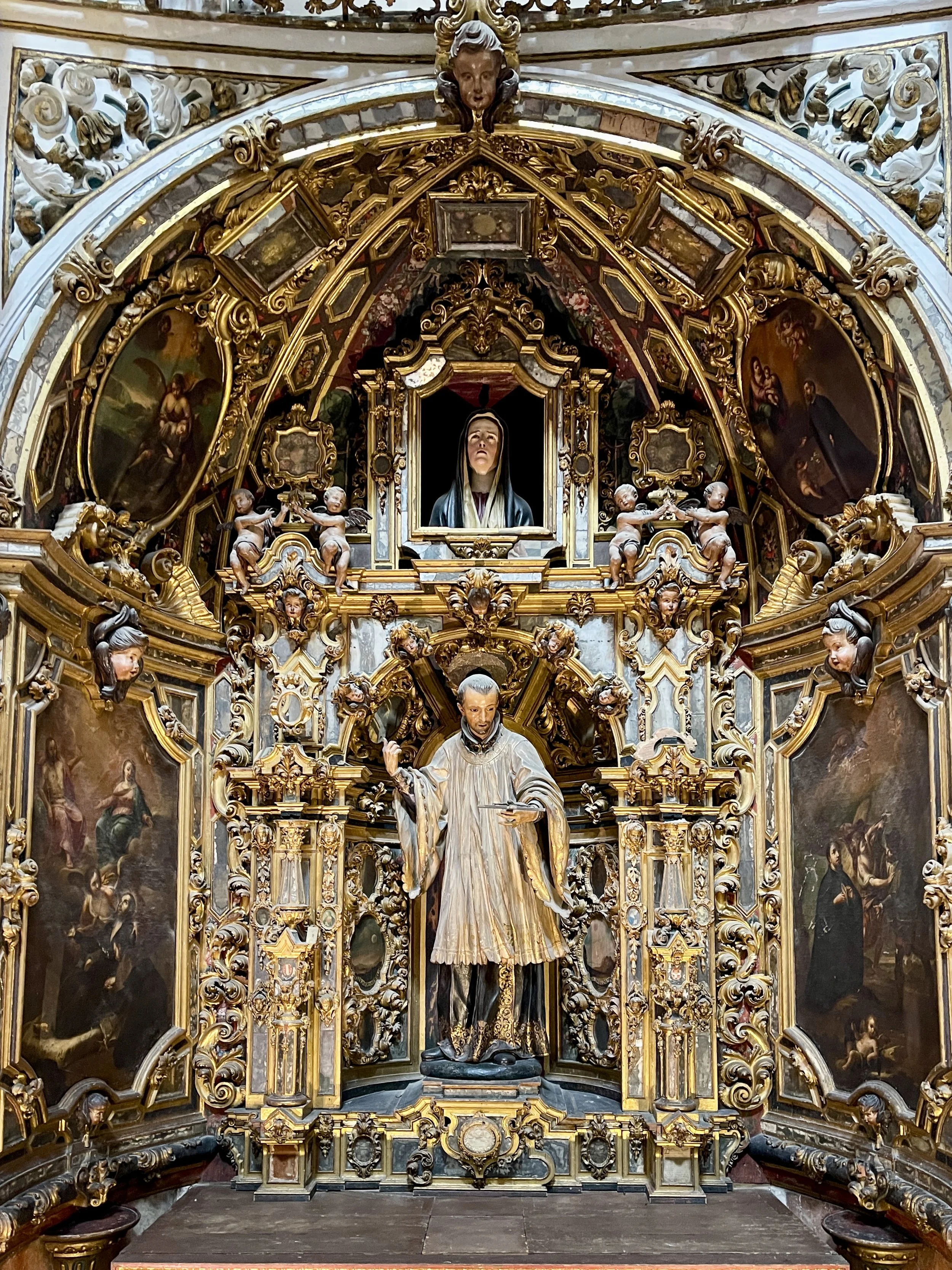
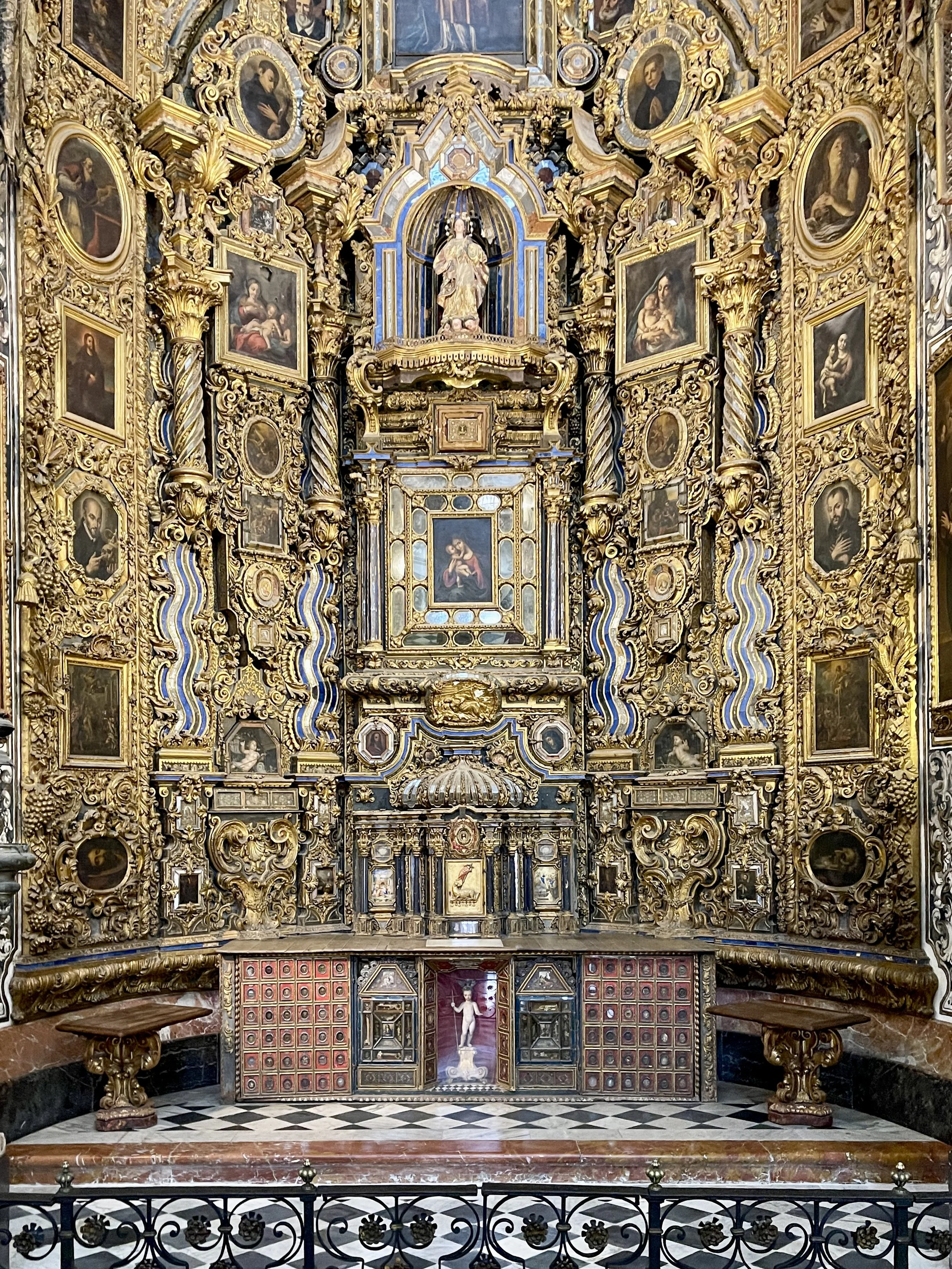
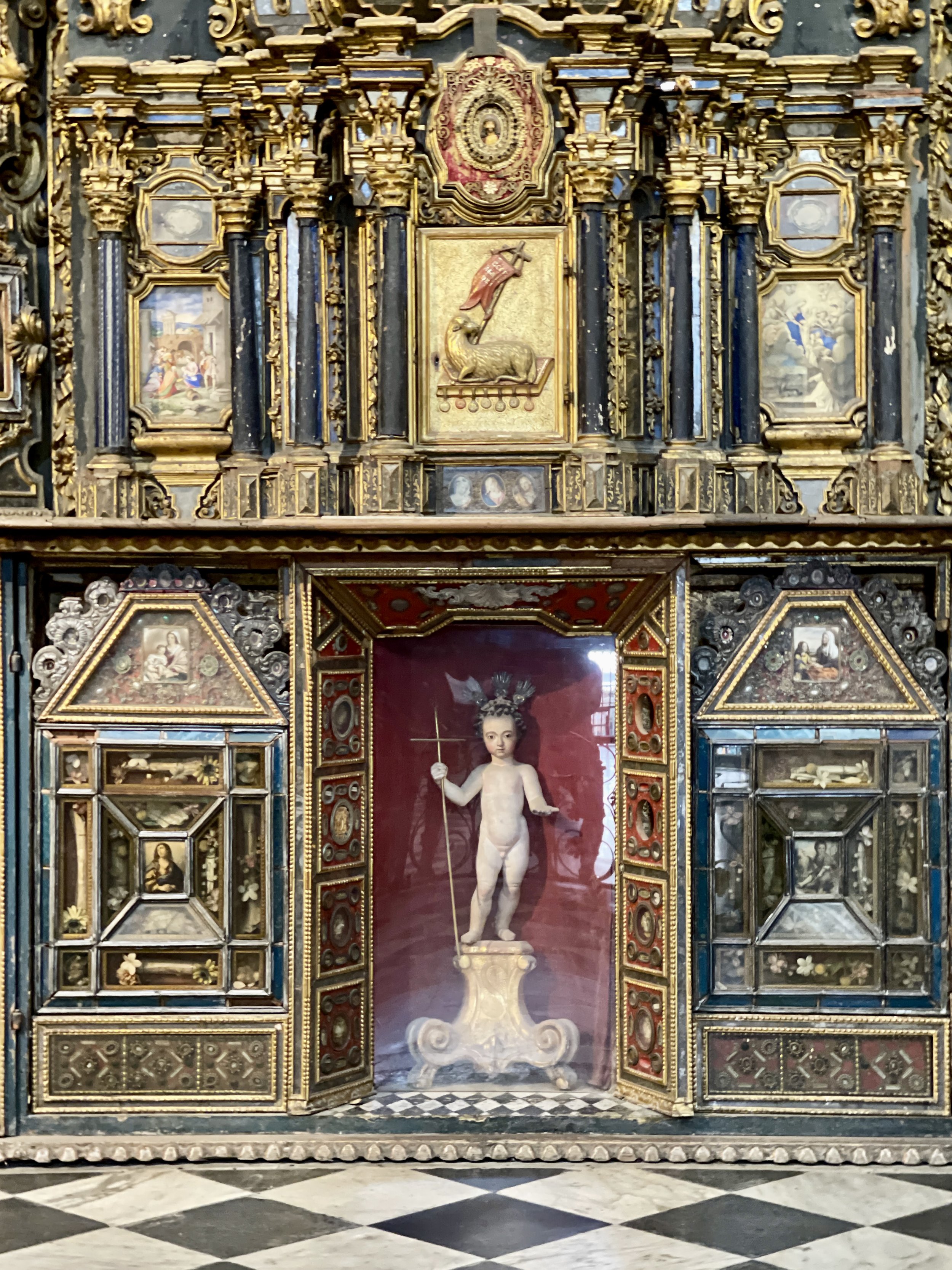
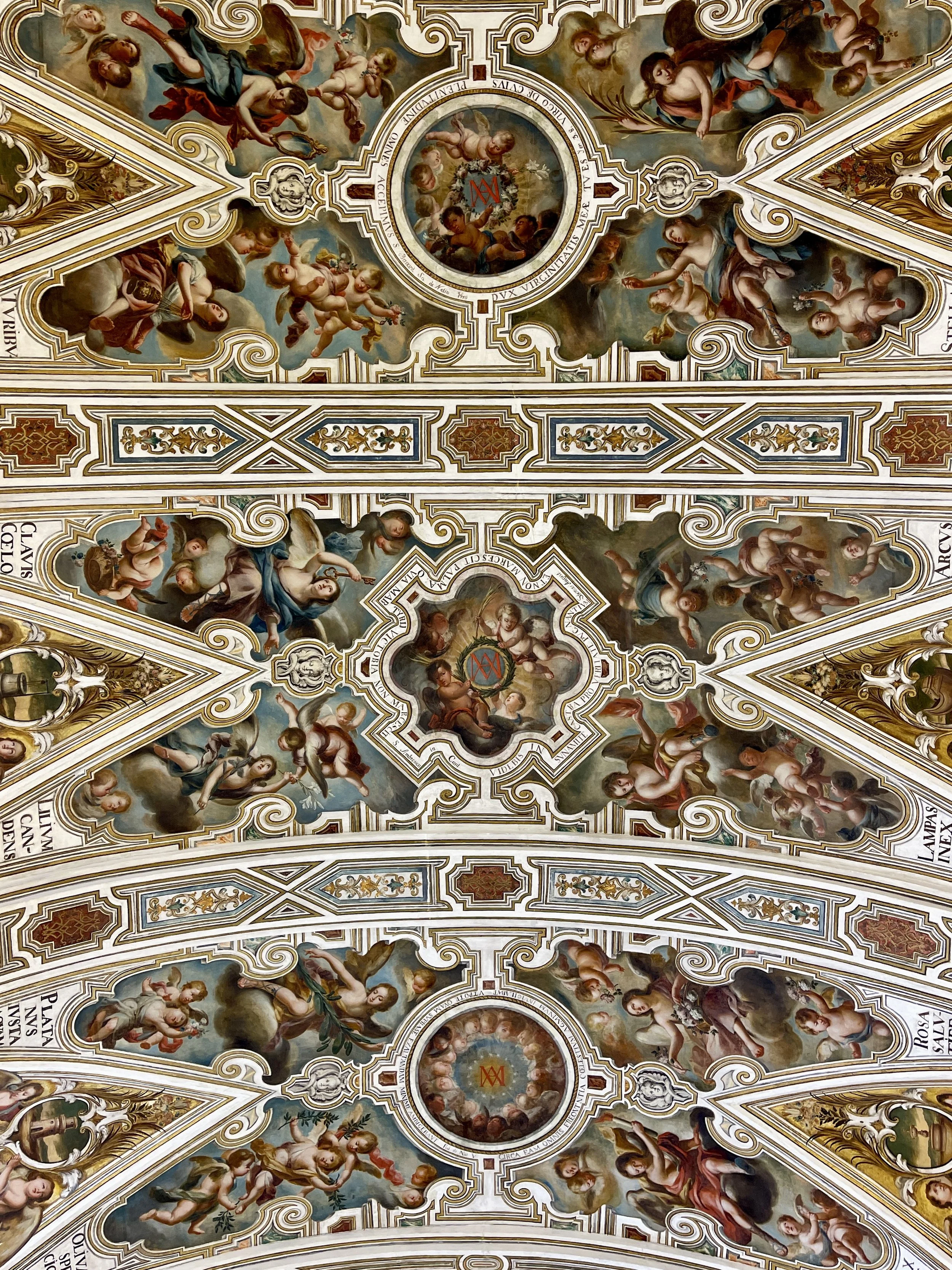
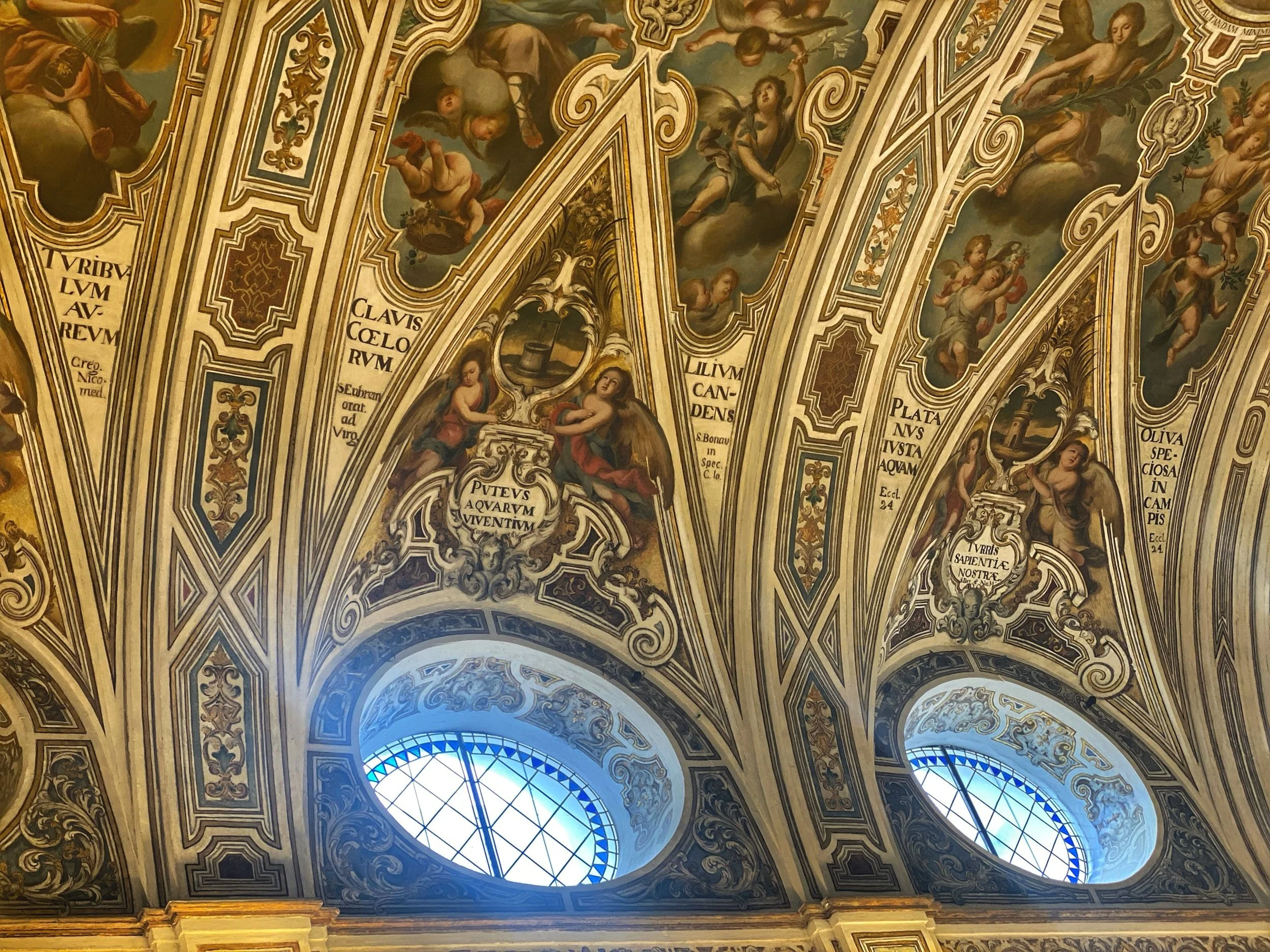
When we returned to Sevilla, our friend José told us of a little-known but absolutely gorgeous church, the Iglesia de San Luis de los Franceses (the Church of Saint Louis of France). His partner Jo, who I once dubbed the Rock ’n’ Roll Nanny, gave Duke and me a tour of her favorite spots in Sevilla. In between stuffing our faces with delectable tapas dishes and sipping sherry, she took us to see José’s secret spot.  

We arrived during the lull of siesta, so we bided our time the best way we knew how: by indulging in yet more tapas, finding a quaint café in the Macarena neighborhood. 

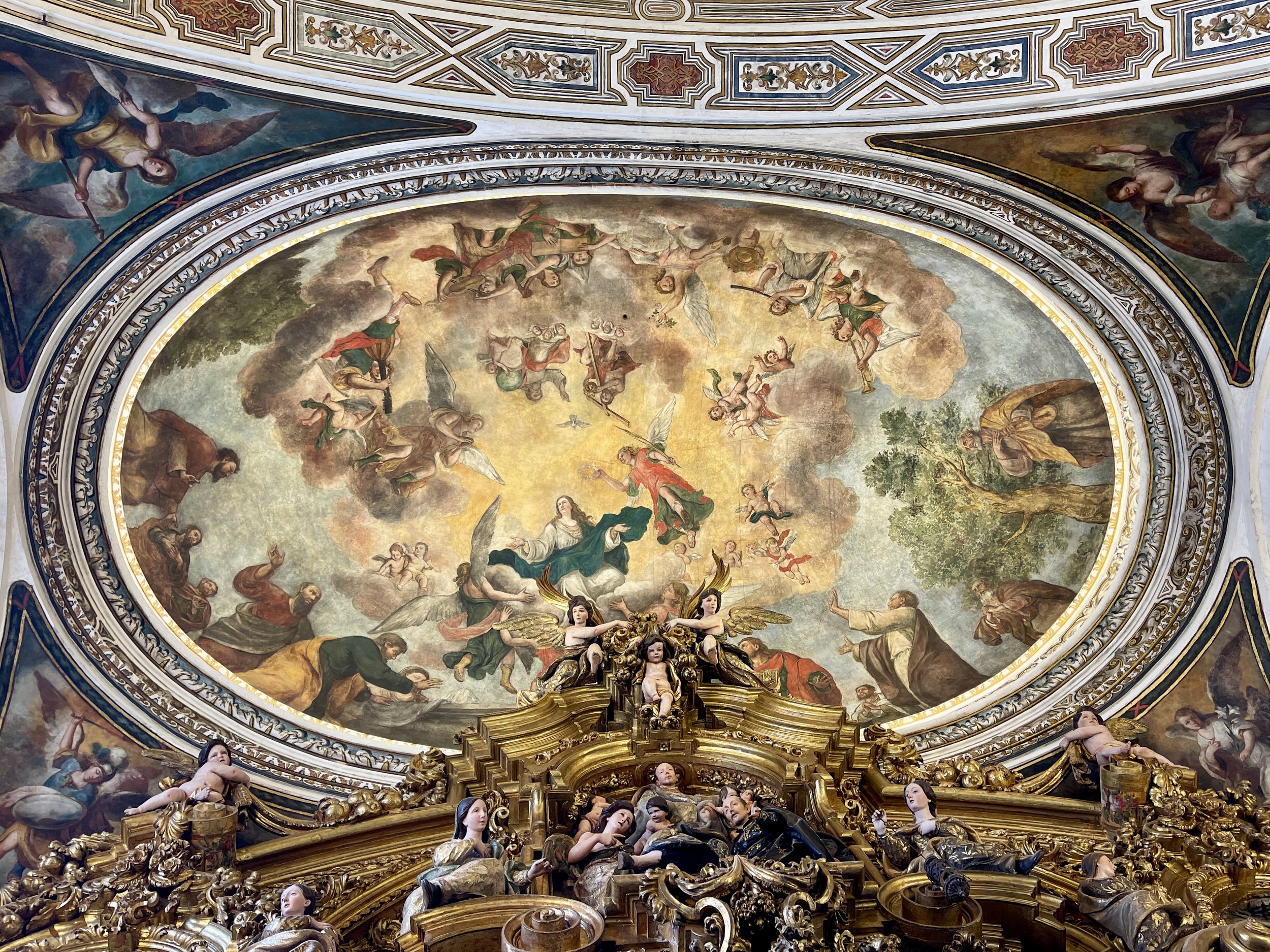
Gilded altar with paintings and dome above at Iglesia de San Luis de los Franceses in Seville

When we returned to San Luis and entered the main chapel, we stood stock still as we took in the sheer spectacle before us. We understood immediately why José was so captivated — even for us recovered Catholics. Baroque churches have a way of being extravagantly maximalist, but even by those standards, San Luis packs so much into a small space. 

The chapel is a visual feast, where every surface competes for your attention. We moved from one altar to the next, making our way around the circle, grinning immensely and excitedly pointing out strange details to each other. You could spend an hour here and still not catch every detail.

Elaborately carved facade of Iglesia de San Luis de los Franceses in Seville

The Schizophrenic History of the Iglesia de San Luis de los Franceses

Built between 1699 and 1730, this Baroque marvel was the crowning achievement of Leonardo de Figueroa, an architect celebrated for his role in shaping Sevilla’s grandest religious spaces. 

The church was originally part of a Jesuit novitiate, meaning it was designed not only for worship but to serve as a spiritual training ground for novices. 

This complex was built on land donated by a noble family with French ties, hence the dedication to Saint Louis, the French King Louis IX.

In those early years, the church was a prime example of Jesuit opulence and influence. Every inch of the building seemed designed to overwhelm with splendor, drawing viewers into a theatrical experience. 

The main chapel, a circular space devoid of traditional seating, was meant to stand as a monument to Jesuit ideals, immersing novices and visitors alike in an atmosphere where spiritual grandeur took precedence over community worship. 

However, in 1767, the Spanish crown expelled the Jesuits. For a time, the building served as a Franciscan convent. 

Painting of Baby Jesus surrounded by cherubs on panel at Iglesia de San Luis de los Franceses in Seville
Painting of the Virgin Mary surrounded by cherubs on wall panel at Iglesia de San Luis de los Franceses in Seville

As the 19th century rolled in, the property underwent secularization and was turned over to the state. The grand altarpieces designed to showcase Jesuit saints were stripped, and the space was adapted for pragmatic uses, including functioning as a factory. 

The building’s role shifted once again as it became a hospice for the city’s elderly and sick. For several decades, the church was a place of stark contrasts — its Baroque details and gilded interiors juxtaposed with the somber reality of its new short-term inhabitants. 

The 20th century saw further change. The once-sacred site became a stage for performances, with productions like Don Juan Tenorio taking advantage of the church’s dramatic acoustics and architecture to tell the tale of the infamous lothario. 

A lightning strike in the 1920s pierced the vault, destroying an oil painting — perhaps serving as a grim suggestion that God wasn’t happy with how the church was being used?

After decades of neglect, San Luis was finally restored in the late 20th century. This revitalization effort sought to reclaim the site’s former glory, reopening the doors of the church, domestic chapel and crypt to the public. 

Exterior of the Iglesia de San Luis de los Franceses with bell tower, dome and statues

Architectural Highlights of the Iglesia de San Luis de los Franceses 

The façade alone is a visual feast. Ornate Solomonic columns twist skyward, framing a riot of Baroque symbolism covering the pale pink building. Statues of saints and angels stand guard like sentinels, their expressions a mix of stern devotion and regal authority. Above the entrance, the coat of arms of Spain is crowned by three archangels.

Religious painting on ceiling under carved altar with cherubs at the top at Iglesia de San Luis de los Franceses in Seville
Gilded altar covered with paintings at Iglesia de San Luis de los Franceses in Seville

The Surreal Spirituality of the Main Chapel

But it’s when you step inside that the full spectacle begins. The church was designed in a Greek cross layout, and from the moment you cross the threshold, your gaze is drawn upward to the magnificent dome. Light filters through the lantern high above, illuminating frescoes that swirl like divine visions. Painted by Lucas Valdés, these frescoes depict scenes of Christian virtues — obedience, chastity, humility — interspersed with symbols of Solomon’s Temple. (Side note: Did King Solomon really exist?)

The main chapel is something of an enigma. Circular and intimate, it has no pews. Jesuit novices would have stood in silent contemplation, absorbing the intricate carvings, gilded reliefs and soaring altarpieces that fill the space. This is Baroque at its most intense. 

Statue of saint holding Baby Jesus in a gilded Baroque altar at Iglesia de San Luis de los Franceses
Statue of saint at the center of an ornate Baroque altar with head of the Virgin and cherubs at Iglesia de San Luis de los Franceses

At the center of the main altar is a painting of San Luis, the church’s namesake, attributed to the school of Zurbarán. Flanking this are paintings of the Immaculate Conception and the Virgin of Bethlehem, all framed by mirrors that multiply the radiance of the gold. (Learn more about the various depictions of the Virgin Mary.)

But what really caught our eye are the relics embedded within this luxurious setting. Encased in delicate reliquaries, you’ll find a skull, ribs, and fragments of bones belonging to Jesuit holy men like Saint Ignatius of Loyola and Saint Francis Xavier. Vials of blood, believed to belong to lesser-known saints, are encased in gold and glass. There’s also a piece of cloth from Saint Stanislaus Kostka’s robes to honor this Polish saint who died at the age of 18. 

Relic of rib bones in ornate gilded Baroque frame at the Iglesia de San Luis de los Franceses in Seville

Each side altar tells a different story through its artwork and relics. On one side are scenes celebrating Jesuit virtues (devotion, sacrifice, spiritual fortitude), while the other side showcases key moments from the lives of saints who exemplified those ideals. 

Baroque altar with statue of saint kneeling behind glass and small frames on red arch at the Iglesia de San Luis de los Franceses in Seville
Statue of baby in niche in Baroque altarpiece with black walls and gilded frames at the Iglesia de San Luis de los Franceses in Seville
Gorgeously painted ceiling with angels at at the Iglesia de San Luis de los Franceses in Seville
Gilded altars in arched niches with black and white checkered floor at at the Iglesia de San Luis de los Franceses in Seville

The black-and-white checkered floor calls to mind dualities — light and dark, good and evil, the sacred and the profane — echoing the spiritual journey of navigating moral choices central to Jesuit teachings. In a space filled with opulence, the simple geometry of the floor offers a grounding presence, representing the balance between the earthly and divine realms. 

This is a chapel designed not just to be seen but to be felt — a place where spiritual reverence mingles with a sense of the macabre. 

Painted ceiling with angels and sacred heart in the Domestic Chapel at the Iglesia de San Luis de los Franceses in Seville

The Domestic Chapel

As you wind through the quiet corridors of the Iglesia de San Luis de los Franceses, following almost inconspicuous signs, you find yourself in another part of the complex. This secluded space, the Domestic Chapel, hidden within the old Jesuit novitiate, was designed for private worship by the novices. It’s a single-nave chapel, but, like the Main Chapel, don’t let its size deceive you — its beauty and detail are breathtaking.

Gilded Baroque altar in the Domestic Chapel at the Iglesia de San Luis de los Franceses in Seville

The chapel is lavishly adorned, featuring stunning frescoes by Lucas Valdés and Domingo Martínez, and sculptures by the renowned Duque Cornejo. 

Round windows shine light on painted ceiling depicting angels at the Iglesia de San Luis de los Franceses in Seville

The richly ornamented altarpiece is a visual celebration of the Eucharist. At its center is the Virgin Mary, a gift from Saint Francis Borgia, flanked by statues of Saint Stanislaus Kostka and Saint Aloysius Gonzaga. Above the Virgin, a relief depicts Saint Stanislaus’ reception into the novitiate in Rome, surrounded by medallions illustrating the lives of Saint Francis Xavier and Saint Francis Borgia. Saints alive!
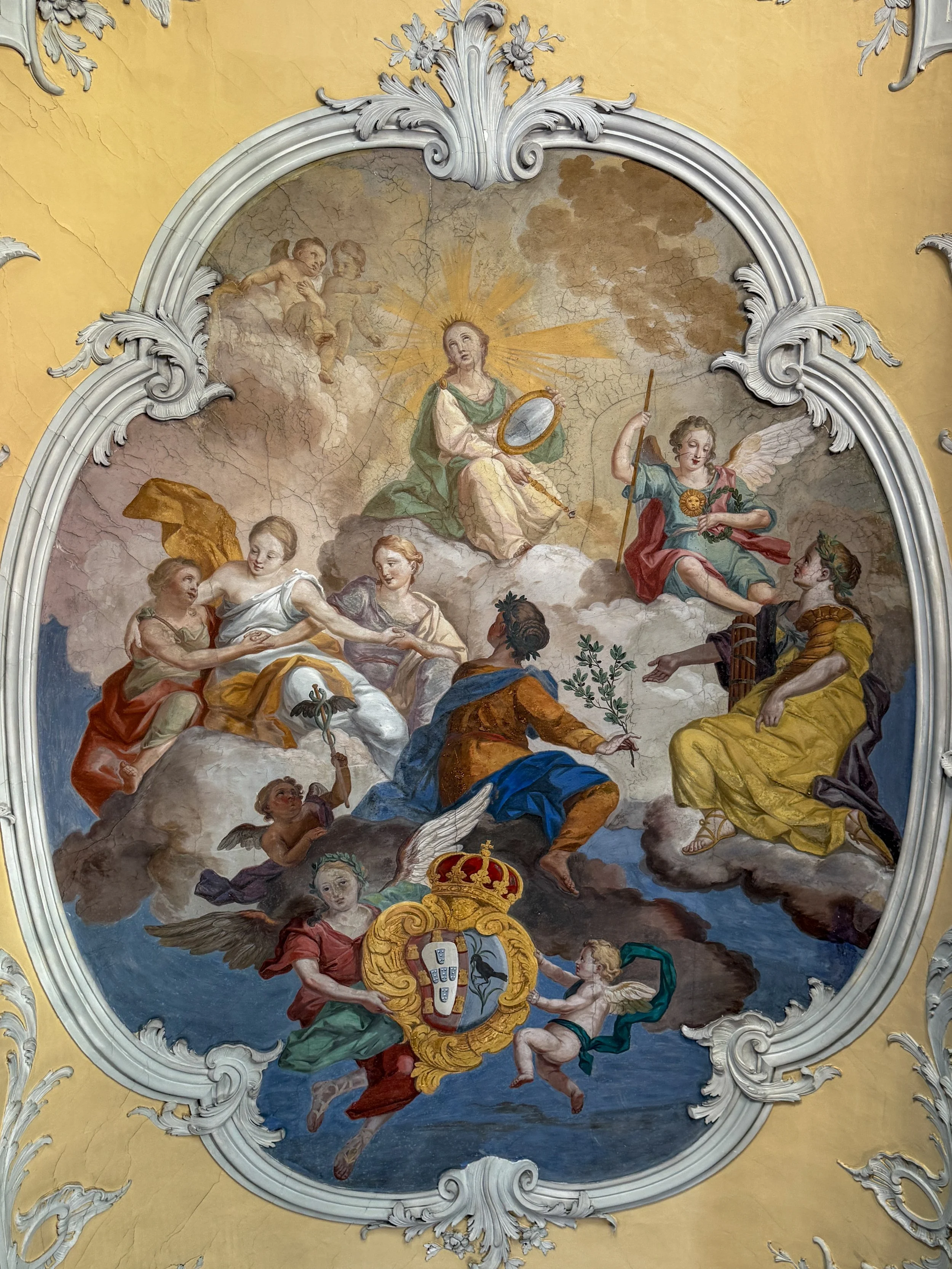
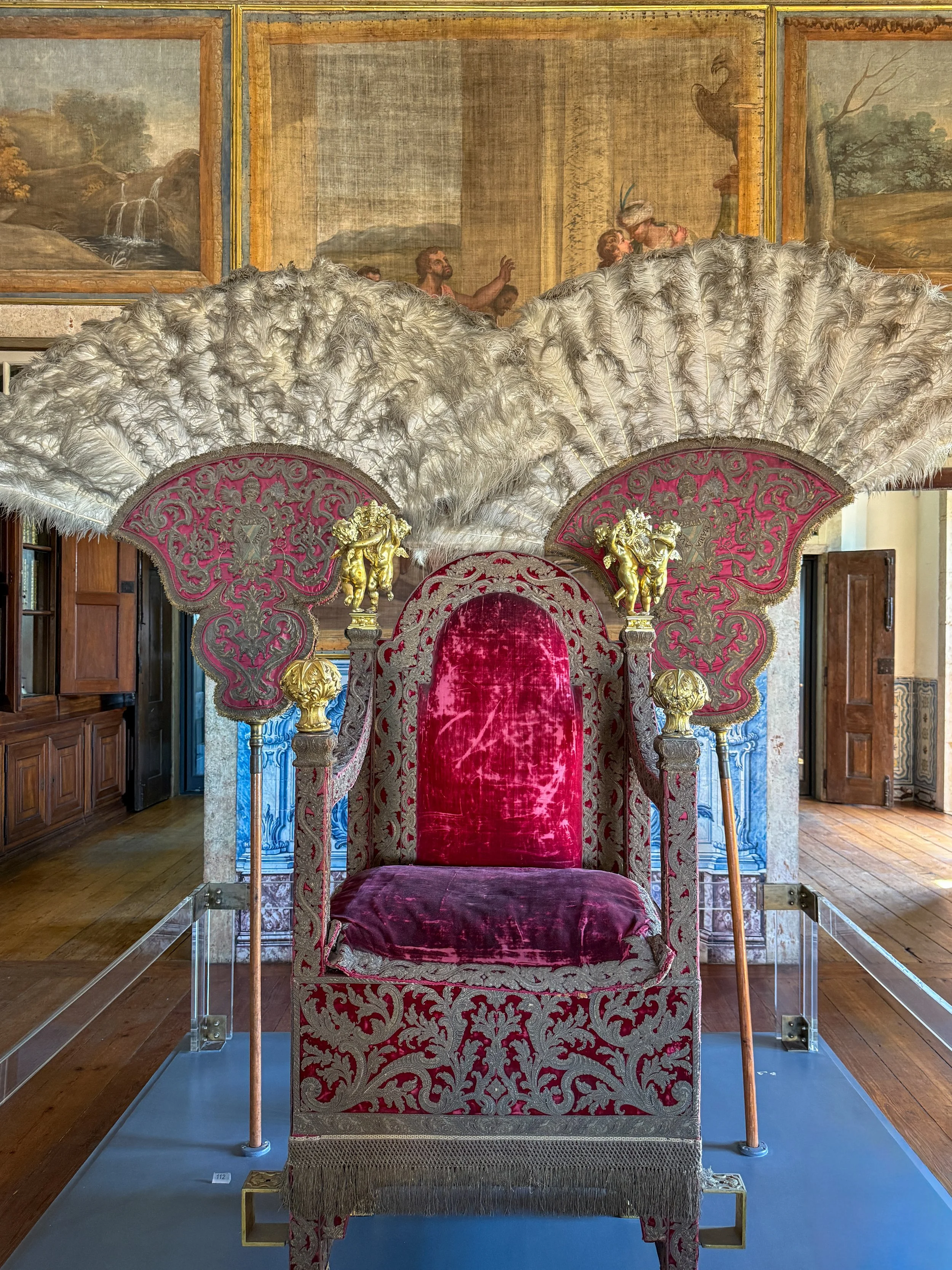
Man pretends to be scared in a corner of the crypt at the Iglesia de San Luis de los Franceses in Seville

The Crypt

The crypt, once sealed off and hidden, has now been opened to the public. That being said, there’s not much to see here. The crypt of the Iglesia de San Luis de los Franceses is a subdued space — especially when contrasted to the crazily ornate rest of the church or something like the catacombs of Paris — primarily intended for meditation and remembrance. 
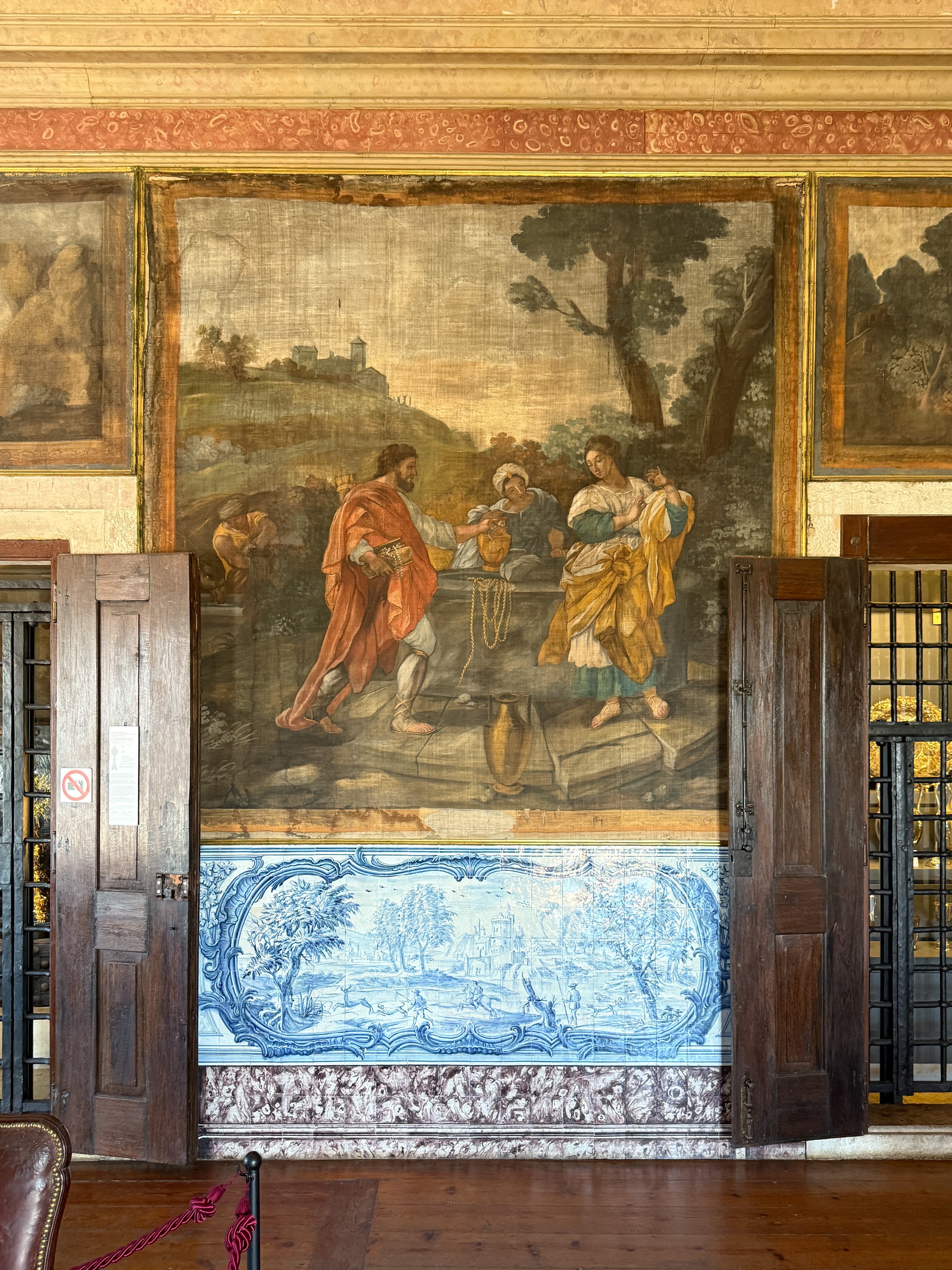
Brick tunnels in the crypt at the Iglesia de San Luis de los Franceses in Seville

Over 300 bodies are buried in the crypt — though you’d never know that. There’s not a single marker. So who’s buried down there? Some members of the Jesuit order and other notable figures associated with the church, although specific records of who’s interred there are sparse. 

Skull relic in gilded Baroque niche at the Iglesia de San Luis de los Franceses in Seville

Haunting Tales of San Luis de los Franceses

One of the most unsettling tales of this church is that of Manuel Cantelar. In the 1990s, this troubled man is said to have staggered toward the church one fateful night, a knife clenched tightly in his trembling hands. Eyes glazed with despair (or madness), he pressed the blade against his chest and threw himself against the cold stone façade in a bizarre form of suicide. It’s said his spirit never left. 

Strange occurrences continue to plague the church. Workers involved in restoration projects have spoken of tools vanishing, only to have them reappear in baffling places. Even the bravest of them have confessed to hearing ghostly whispers and feeling a sudden chill as if unseen eyes were fixed on them. And then there are the dogs. They growl and snarl at empty spaces, their hackles raised, as if warning off an unseen presence.

Even now, the murmur of phantom voices and the chill of restless spirits might greet anyone daring enough to explore the forgotten corners of San Luis de los Franceses.

Brick and elaborate plasterwork facade of the Iglesia de San Luis de los Franceses in Seville

Visiting the Iglesia de San Luis de los Franceses

As we left the church of San Luis de los Franceses, we couldn’t help but feel a sense of awe at the beauty and history of this often-overlooked treasure — from the grand Main Chapel with its imposing dome and intricate altarpieces to the almost-as-impressive Domestic Chapel tucked away from the main church. 

While most visitors will make sure to see the Seville Cathedral, we found its beauty to only be skin deep: The façade is much more impressive than its interior. That’s why we were so happy to marvel in surprise at the unexpected tiny-by-comparison grandeur of San Luis. We owe our heartfelt thanks to our friends Jo and José for encouraging us to explore this hidden gem, a reminder that some of Seville’s most stunning spaces lie just beyond the well-trodden paths. –Wally

Painted dome and walls with arched balcony at the Iglesia de San Luis de los Franceses in Seville

The deets

Hours
Monday:
Closed
Tuesday to Sunday: 10 a.m. to 2 p.m. and 4 p.m. to 8 p.m. 
Summer hours (July 1 to August 31): 9 a.m. to 5 p.m. 
Note: Ticket sales end 15 minutes before closing time, and visitors are asked to leave 10 minutes prior to closing. 

Cost: €4, with discounts for students, seniors and local residents

Tour options: Guided tours are available as are audio guides in multiple languages. 

Iglesia de San Luis de los Franceses

Calle de San Luis, 37
41003 Sevilla
Spain 


Visiting Seville Cathedral

Discover the world’s largest Gothic cathedral, a UNESCO World Heritage Site with the iconic La Giralda bell tower and Columbus’ tomb. 

The Seville Cathedral dominates the skyline — not surprisingly, since it's the largest Gothic cathedral in the world.

As you walk through the narrow, winding streets of Seville, you’ll inevitably find yourself in the Plaza del Triunfo. There, rising as a colossal monument to faith and human ingenuity, stands La Catedral de Sevilla (Seville Cathedral). It’s hard not to feel a sense of awe as you take in the sight before you — this is the largest Gothic cathedral in the world, and it commands your attention.

Gothic architecture was all about height and light, creating spaces that drew the eyes — and the spirit — upward. The architects of Seville Cathedral embraced this philosophy wholeheartedly. They designed a building that seemed to defy gravity, with soaring arches, intricate ribbed vaults and walls of stone that appear as delicate as lace.

The towering high altar of Seville Cathedral seems to glow with an otherworldly light.

It’s the largest and one of the most ornate Catholic altars in the world — a gilded masterpiece that took nearly a century to complete.

With its intricate ornamentation, the cathedral is gorgeous from any angle.

Visiting Seville Cathedral: First Impressions

The façade of Seville Cathedral is an intricate pattern of religious figures and mythical beasts, all carved in stone with remarkable detail. Saints and apostles line the entrances, each captured in dynamic poses, holding symbols of their faith and martyrdom. Figures like Saint Peter with his keys to Heaven and Saint James with his staff stand as silent guardians of the cathedral. Above the portals, scenes from the life of Christ and the Virgin Mary are depicted in elaborate reliefs.

Statues of holy personages ring the cathedral's doorways.

Interspersed among these sacred figures are gargoyles — grotesque stone creatures jutting out from the walls. Their twisted forms, often a blend of animals with something monstrous, serve both symbolic and functional roles. They channel rainwater away from the building, but they also act as protectors, believed to ward off evil spirits from entering the holy site. 

La Giralda rises 341 feet (104 meters) into the air.

The Symbolism of La Giralda: A Story in Stone

Look closely at the base of the tower, where the original stonework from the Almohad Muslim empire remains intact. The arches, adorned with delicate arabesques, are a reminder of the tower’s Islamic origins. They speak of a time when Seville was a center of learning and culture in the Islamic world, a place where scholars and artisans thrived.

Part Islamic, part Renaissance, La Giralda is a good symbol of the merging of East and West that's such a part of southern Spain.

Now, let your gaze travel upward, to the belfry that was added during the Renaissance. The clean lines, classical proportions and elegant simplicity of the design are a stark contrast to the intricate patterns below. This was a statement, a declaration of the Christian faith’s ascendancy. 

Driving home that point is the Latin verse inscribed around the belfry: “TURRIS FORTISSIMA NOMEN DNI PROVERB. 18,” translating to “The name of the Lord is a strong tower,” from Proverbs 18:10. 

High above the city, El Giraldillo stands poised on La Giralda, her massive bronze figure more than just a weather vane — she’s a symbol of faith and victory. Cloaked in a flowing tunic, she holds a mighty shield in one hand and a palm branch in the other. Her figure twists gracefully, moved by the winds, but her expression and stance evoke unshakable faith. Like a sentinel or an ancient goddess, she watches over her city.

El Giraldillo: the most famous weathervane in the world?

La Giralda’s Lesser-Known Secrets

La Giralda also holds secrets that many visitors aren’t familiar with. For instance, did you know that the tower was designed with ramps instead of stairs? This allowed the muezzin, who called the faithful to prayer, to ride a horse to the top. As you imagine this, you can almost hear the rhythmic clatter of hooves echoing within the tower’s walls.

Another lesser-known fact is that during the cathedral’s construction, La Giralda served as a lookout tower. From its heights, guards could survey the city and the surrounding countryside, a strategic vantage point that was vital during times of conflict. 

Duke got this shot from the nearby General Archive of the Indies. You can see the copy of El Giraldillo that topped the tower while the genuine article got restored.

The Entrance of Seville Cathedral 

In front of the cathedral, a statue of Ferdinand III of Castile proudly holds a globe and a sword, commemorating his pivotal role in the 13th century Christian conquest of Seville. Ferdinand’s victory led to the transformation of the city from an Islamic stronghold into a key Christian center, with the mosque being converted into the cathedral we see today.

But Ferdinand isn’t the only figure watching over the entrance. Nearby stands a replica of El Giraldillo. The bronze reproduction topped the tower during a restoration and was moved here when the original figure returned to its rightful place atop La Giralda.

As you step inside the cathedral, your eyes are immediately drawn upward. Massive stone columns rise like ancient trees in a forest, supporting the ceiling. These columns branch out into ribbed vaults, forming a web-like pattern that not only adds to the structure’s stability but also creates an otherworldly sense of space.

The high altar of Seville Cathedral, a breathtaking display of intricate gold niches, showcases scenes from the life of Christ.

The High Altar: A Golden Marvel

The towering structure of the high altar of Seville Cathedral seems to glow with an otherworldly light. It’s the largest and one of the most ornate Catholic altars in the world — a gilded masterpiece that took nearly a century to complete. 

Crafted by Flemish sculptor Pierre Dancart in the late 15th century, the altar rises over 65 feet high and 42 feet wide, composed of 45 intricately carved panels — it feels like an epic storybook springing to life, scene by scene, pulling you into its divine narrative. Imagine it as a tapestry of tales, each vignette acting as a page from the most sacred stories in Christian tradition.

The altar's reliefs are intricately carved wood covered in gold leaf.

At the base, you can see the Nativity, with Mary cradling the infant Jesus, the shepherds humbly offering their reverence, and the Magi presenting their gifts.

Move higher, and the story unfolds into more dramatic, intense episodes. In one vignette, you can see the Crucifixion, then comes the Resurrection, bursting forth from the altar’s center, where Christ, victorious over death, stands surrounded by heavenly figures. (Related: When did Jesus Have to Become God?)

The higher tiers focus on the Ascension of Mary, where she rises amid a host of saints and angels, emphasizing her purity and elevation as the Queen of Heaven.

Each story is framed with ornate Gothic tracery, like delicate borders separating the sacred moments yet tying them all together into one continuous narrative, acting like pages of a gilded gospel.

Columbus' tomb

The Tomb of Christopher Columbus: A Monument Shrouded in Mystery

Inside Seville Cathedral, amid its towering arches and breathtaking art, you’ll find something that has captured the imaginations of visitors for centuries: the tomb of Christopher Columbus, known in Spain as Cristóbal Colón. It’s a monument wrapped in mystery and steeped in controversy, honoring one of history’s most famous and contentious figures.

The ornate tomb seems to be held aloft by four statues, each representing one of the kingdoms of Spain: Castile, León, Aragon and Navarre. These larger-than-life figures, clad in armor and bearing the weight of the tomb on their shoulders, carry not just the remains of a man, but the legacy of an era that forever changed the world. Their expressions are solemn, their posture resolute, as if they understand the weight — both literal and symbolic — that they bear.

Is Seville Cathedral really the site of Columbus' corpse?

The Journey of Columbus’ Remains: A Tale of Many Cities

Here’s where the story takes a fascinating turn: Columbus’ remains have journeyed across the world almost as much as he did during his lifetime. After his death in 1506, Columbus was initially buried in Valladolid, Spain, the city where he died. Yet this was only the beginning of his posthumous odyssey.

A few years later, his remains were moved to Seville, then across the Atlantic to the island of Hispaniola (modern-day Dominican Republic) in the early 16th century, as Columbus had expressed a desire to be buried in the so-called New World he helped to “discover.”

But the story doesn’t end there. Before the French took control of Hispaniola in 1795, Columbus’ remains were supposedly transferred to Havana, Cuba, to prevent them from falling into French hands.

Then, in 1898, after Spain lost control of Cuba following the Spanish-American War, the explorer’s remains were sent back to Seville, where they were interred in the cathedral. 

The ornate tomb that visitors see today was designed by the Spanish sculptor Arturo Mélida. Made from a mix of materials, including bronze and marble, the tomb features intricate carvings that tell the story of Columbus’ voyages. 

The underside of Columbus' tomb

The Controversy: Are These Columbus’ True Remains?

But here’s the twist: Are the remains in Seville Cathedral really those of Christopher Columbus? This question has sparked debate among historians, scientists and enthusiasts for years. The Dominican Republic claims that it still holds the true remains of Columbus in the Columbus Lighthouse in Santo Domingo, and that the bones moved to Havana and later to Seville were actually those of his son, Diego.

In 2003, DNA testing was conducted on the remains in Seville, comparing them to the known DNA of Columbus’ brother, also named Diego, who’s buried in the city. The results were inconclusive but suggested a close familial match. While this supports the claim that Seville holds Columbus’ remains, the mystery remains unsolved — especially since the Dominican Republic has refused to allow the testing of the remains in Santo Domingo.

The Ghost of Columbus and His Troubled Legacy

Some say that Columbus’ spirit roams the cathedral, restless due to the uncertainty surrounding his remains. And it’s said that if you listen closely at night, you might hear the faint sound of waves lapping against a ship’s hull — Columbus’ spirit, still seeking the shores of a New World. It’s just one of the many legends of Seville Cathedral

While many Spaniards still recognize and honor Columbus for his role in history — particularly for his voyages that led to the European colonization of the Americas — there’s also a growing awareness and acknowledgment of the darker aspects of his legacy, recognizing the consequences of his expeditions, including the forced labor and diseases that devastated indigenous populations.

A few kings of Spain are buried in the Royal Chapel of Seville Cathedral.

The Capilla Real (Royal Chapel): Resting Place of Spanish Royalty

In most Gothic cathedrals, the eastern end is typically home to an apse and an ambulatory, designed to guide the flow of worshippers and pilgrims. But in Seville Cathedral, the eastern end holds something quite different and historically significant: the Capilla Real, or Royal Chapel. 

The Capilla Real

This impressive, domed structure houses the tombs of Spanish royalty. Dominating the chapel is the ornate burial site of King Ferdinand III, known as Ferdinand the Saint, whom we met out front — the monarch who played a critical role in the Reconquista by reclaiming Seville from Muslim rule in 1248. His body, said to be miraculously preserved, lies in a silver casket beneath the altar.

The chapel also contains the remains of Alfonso X, his son, a king remembered for his patronage of the arts and legal reforms, leading to his nickname Alfonso the Wise. 

Then there’s the tomb of Pedro I, often called Pedro the Cruel (or Pedro the Just by his supporters). Known for his ruthless methods of maintaining power, Pedro I rebuilt much of the nearby Real Alcázar of Seville. 

The treasury includes the Crown of the Virgin of the Kings, made in 1904.

The Treasury: Relics and Sacred Artifacts

Beyond the paintings and sculptures, Seville Cathedral houses a vast treasury filled with relics and sacred artifacts. Among the most notable is the Custodia de Arfe, a massive silver monstrance created by Enrique de Arfe in the early 16th century. Standing over 12 feet tall, this masterpiece of metalwork is used during the annual Corpus Christi procession, where it’s paraded through the streets of Seville.

The treasury also contains an array of other priceless items, from jewel-encrusted chalices to intricately carved crosses. 

The Vision of Saint Anthony of Padua by Bartolomé Esteban Murillo, 1656. At one point, the saint had been cut out of the painting and smuggled to the U.S.!

Murillo’s Masterpieces: Capturing Divine Grace

Seville Cathedral is home to many works of art, but among the most revered are the paintings of Bartolomé Esteban Murillo, one of Spain’s greatest Baroque artists. Murillo’s work is known for its luminous quality, capturing the divine grace of his subjects with an almost ethereal softness. 

In The Vision of Saint Anthony of Padua, the saint gazes upwards, his expression one of pure rapture, as the Christ Child appears before him in a radiant burst of light. Here’s a crazy story: Saint Anthony was cut out of the painting in 1874 and smuggled to the United States, where an immigrant sold it to a New York gallery owner. Thankfully, the man made sure it was returned to the cathedral.

Other works by Murillo in the cathedral include The Immaculate Conception, Saint Isidore of Seville and Saint Leander of Seville

Saints Justa and Rufina by Francisco de Goya, 1817. The women are the patron saints of Seville.

Zurbarán and Goya: Masters of Light and Shadow

The cathedral’s collection also includes paintings by Francisco de Zurbarán and Francisco de Goya, two other giants of Spanish art. Zurbarán’s work is known for its dramatic use of light and shadow, creating a sense of intense spirituality.

Goya, on the other hand, brings a more psychological depth to his works. His Santa Justa and Santa Rufina, depicting the two patron saints of Seville, is a study in contrasts — between light and shadow, and faith and suffering. The saints’ expressions are both serene and sorrowful, capturing the complex emotions of their martyrdom. 

The Patio de los Naranjos was part of the original mosque that stood on this site.

The Patio de los Naranjos

Tucked away within Seville Cathedral lies the Patio de los Naranjos, a courtyard steeped in history and shaded by fragrant orange trees. This serene space is one of the few surviving remnants from the original Almohad mosque that once stood on this site. Built in the late 12th century, the patio was initially used by Muslim worshippers for ablutions, a ritual washing before prayer. 

The patio’s arched entranceways and elegant fountains have been preserved, though the orange trees themselves were likely added after the Christian Reconquest. 

Seville Cathedral was built on the site of a 12th century Almohad mosque, with some elements retained.

The courtyard’s irrigation system is a holdover from the mosque’s original design. Channels carved into the stone floor direct water to the trees and fountain, showcasing the advanced engineering techniques of the period. 

Beyond its architectural significance, the Patio de los Naranjos has also served as a gathering place over the years — first for religious purposes, and later as a civic space where citizens met, traded goods and exchanged news. 

La Giralda was undergoing repairs when we visited.

Restoration and Preservation: Protecting a Cultural Treasure

The largest Gothic cathedral in the world: With such a significant title comes great responsibility. Over the years, Seville Cathedral has undergone numerous restoration and preservation efforts aimed at protecting its delicate structures and priceless artworks from the ravages of time. These projects are often painstakingly complex, involving skilled artisans and conservators who work to maintain the integrity of the cathedral’s original design while using modern techniques to ensure its longevity.

One of the most significant recent restoration projects focused on La Giralda. Over centuries, exposure to the elements had taken its toll on the tower’s intricate stonework, leading to erosion and structural weakening. The restoration, completed in the early 2000s, involved carefully cleaning and repairing the stone, reinforcing weakened areas and restoring the tower’s original splendor. Today, La Giralda stands tall, a beacon for all of Seville — and, as mentioned, its temporary replacement can be seen in the entrance courtyard. 

Inside the cathedral, restoration work is ongoing as well. The high altar, with its intricate gilded panels, has been the focus of several preservation efforts aimed at protecting it from humidity and pollution. 

Similarly, the cathedral’s numerous chapels, paintings and sculptures are regularly monitored and conserved to ensure they remain as vibrant and inspiring as they were when first created.

The Puerta del Perdón (Door of Forgiveness) gets its name from the tradition of granting absolution to debtors and sinners who entered through it.

A Major Tourist Attraction: Drawing the World to Seville

Seville Cathedral is one of the city’s top tourist attractions, drawing millions of visitors each year who come to explore its architectural wonders, artistic treasures and historical significance. The cathedral’s central location makes it an essential stop on any tour of Seville.

Guided tours, often led by knowledgeable local historians, offer visitors a chance to delve deeper into the history of Seville Cathedral and its many hidden stories. 

In addition to its historical and religious significance, the cathedral offers one of the best views in Seville. Visitors can climb to the top of the Giralda tower, following the same winding ramps that were once used by horseback riders to ascend to the top. 

From there, the panoramic view of Seville is breathtaking, with the city’s rooftops, narrow streets and distant hills stretching out as far as the eye can see. It’s a view that not only showcases the beauty of Seville but also puts the cathedral’s dominance over the cityscape into perspective.

The cathedral interior doesn't instill that immediate awe that so many others do — until you look up.

Is the Seville Cathedral Worth Visiting?

The cathedral’s interior is vast, covering an area of about 124,000 square feet (over 11,500 square meters). However, unlike many other large cathedrals where the central nave and the main altar dominate the space, Seville Cathedral has a somewhat fragmented layout that feels sprawling and compartmentalized. It just doesn’t inspire the immediate awe that other Spanish churches do, like the Iglesia de los Santos Mártires and Iglesia de Santiago Apóstol in Málaga. Maybe I’m just not a huge fan of Gothic interiors — I felt similarly underwhelmed at Notre-Dame in Paris. 
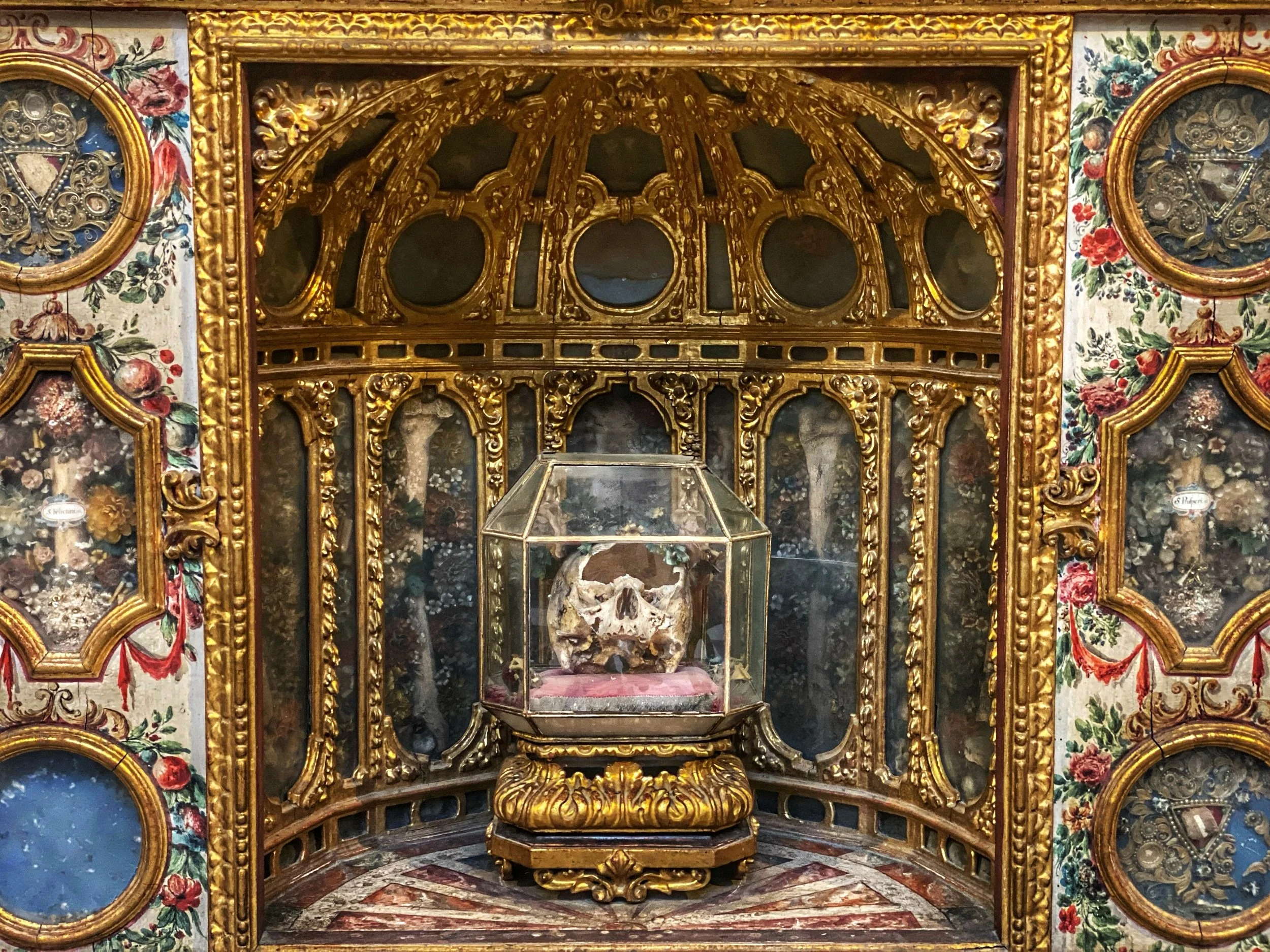
Numerous chapels, side altars and smaller spaces break up the vast interior. One reason for this disjointed feel is the fact that the cathedral was constructed over more than a century, with different architects and styles influencing its design. The structure incorporates elements from its previous incarnation as a mosque, Gothic architecture, Renaissance additions and even Baroque influences in later restorations. This mix of styles and the extended timeline of construction contributed to the compartmentalized nature of the interior.

If you have extra time during your stay in Seville, the cathedral is certainly worth a visit — if only to appreciate its historical significance, the impressive Giralda and its role in the city’s rich cultural tapestry. However, if your schedule is tight, you shouldn’t feel bad about prioritizing other adventures in Seville. 

Mary holding a young Jesus

Saint Rufina and Saint Fulgentius

A Center of Faith: Continuing Religious Significance

Despite its status as a major tourist attraction, Seville Cathedral remains first and foremost a place of worship. Every day, locals and pilgrims alike come to the cathedral to attend Mass, light candles and seek spiritual solace in its sacred spaces. 

For many Sevillanos, the cathedral is a symbol of their identity, a place where personal and communal faith is expressed and celebrated. Its bells toll for the city’s most significant moments, marking everything from joyous occasions like weddings and christenings to solemn events like funerals. In every way, the cathedral is woven into the fabric of daily life in Seville.

As happens in Spain, some of the chapels are caged off, so you have to admire the small surprises throughout the space, like this pillar.

Visiting Seville Cathedral

Hours: 

Monday: 11 a.m. to 3:30 p.m.
Tuesday to Saturday: 11 a.m. to 5 p.m.
Sunday: 2:30 p.m. to 6 p.m.

Admission: Generally €9 for adults, with discounts available for students and seniors. 
Children under 14 can enter for free. 
Check the official website for any changes or special events that may affect hours. 

Buying tickets: We found that tickets had sold out days in advance. It’s highly recommended to buy tickets online as early as possible. Tickets can also be bought at the cathedral box office if they’re still available. 

Free entry: You can explore the cathedral without a ticket in the morning, before one of their mass services, typically held at 8 and 10 a.m. Keep in mind they’ll kick you out about 15 minutes before the service starts. We do wish we had taken a proper tour — we would have come away with more of an appreciation of this historic site. 

Grab a bite at one of the many cafés along Calle Mateos Gago.

Exploring the Area: A Walk Through the Heart of Seville

Chances are you’ll find yourself walking past the Seville Cathedral numerous times on any given visit. 

It’s in the Plaza del Triunfo, a beautiful square that forms the heart of the city’s historic district. Nearby is the Real Alcázar, a stunning palace complex that’s not to be missed, as well as the General Archive of the Indies, a treasure trove of documents that chronicle Spain’s colonial empire. 

The plaza and the narrow streets that fan out from it are lined with charming shops, boutiques and eateries (including a Starbucks we found ourselves stopping at most days). 

Fuente Farola, or Lamp Post Fountain

Alongside the cathedral is the Fuente Farola, a fountain topped by an enormous, ornate lamp post. Beyond this, you’ll find Calle Mateos Gago, a lively thoroughfare teeming with outdoor cafés and tapas bars. This street is a local favorite, especially in the evenings, when the tables are filled with people enjoying a meal and a drink while watching the world go by. There’s also a spot where you can indulge in the delectable Portuguese tarts known as pasteis de nata, a sweet treat that Duke instantly became addicted to.

Grab one and explore the Barrio Santa Cruz, the adjoining historic Jewish quarter. This maze of narrow streets, whitewashed houses and hidden courtyards is one of Seville’s most picturesque neighborhoods. 

Visiting Seville Cathedral isn’t just about seeing the largest Gothic cathedral in the world — it’s about immersing yourself in the vibrant life of Seville. The cathedral is at the heart of a district that’s rich with history, culture and the everyday pleasures of Andalusian life. –Wally

Catedral de Sevilla

Avenida de la Constitución, s/n
Casco Antiguo
41004 Sevilla
Spain


Beyond Paris: Travel to Lesser-Known France

The most underrated places in France: Nantes, Amiens and Rennes — where mechanical elephants, floating gardens and medieval wonders await your next adventure.

Porte Saint-Pierre in Nantes

Sure, Paris is the City of Love, the place where couples smooch along the Seine. But if you think France is just pain au chocolat, promenades and Paris, you’re just scratching the surface. Once you’ve marveled at the must-sees and taken more Eiffel selfies than your Instagram can handle, it’s time to move beyond Paris into the France that doesn’t always make it into the guidebooks.

The Eiffel Tower with the city of Paris spread out before it

We’re not saying you should skip Paris — there are just some hidden gems you should also check out.

First Up: Gay Paree

Of course, any trip to France is worth a stop-off in Paris. The first rule? Don’t be in a rush. Paris is a city meant to be savored — one street, one café, one perfect pastry at a time. 

Begin your journey on foot, meandering through boulevards filled with the smell of fresh bread, the buzz of busy terraces and architecture that just might be older than your country. 

Once you’re ready to kick things up a notch, switch over to the Métro or tram — the real Parisian way to get around. Sure, you could opt for taxis or ride-shares, but you’d be missing the electric hum of everyday life on the city’s veins.

Of course, you’ll want to plan ahead. If you want to visit the Louvre, don’t even think about showing up without pre-booked tickets. Skip the epic queues and head straight into the thick of it. 

Or, if you’re craving a bit more underworld mystique, take the plunge into the Catacombs of Paris — a dark, fascinating corner of the city. 

And for the romantics, the Eiffel Tower may be free to admire from below, but if you want to climb up, save yourself time (and foot cramps) by booking your tickets in advance.

People hang out under a tree in the Jardin des Tuileries in Paris, France

Jardin des Tuileries

Picnics, Cruises and Prepping for the Great Escape

Before you say your final “au revoir” to Paris, it’s time to embrace the most Parisian of pastimes: picnicking in a garden. Pack up a basket with a crusty baguette, some fancy cheese, and a bottle of rosé — this is France, after all. Parc des Buttes-Chaumont, Jardin des Tuileries and Luxembourg Gardens are the perfect spots to recharge. 

But Paris is just the beginning. Once you’ve ticked off the iconic sights, why not step into the real adventure — those lesser-known spots where the crowds thin and the charm thickens. Take a road trip or hop on a train, and dive into the countryside, where France has some seriously under-the-radar gems waiting for you.

Here’s your guide to three fascinating cities that will make your trip to France unforgettable.

Nantes: The City of Innovation and Imagination

If there’s a city where imagination runs wild, it’s Nantes. Perched along the Loire River, this historic gem was once the bustling capital of Brittany and a powerhouse of trade and commerce. Fast forward to today, and Nantes has reinvented itself as a vibrant playground for artists, engineers and visionaries — where creativity isn’t just encouraged, it’s celebrated at every turn.

Giant mechanical steampunk elephant at Les Machine de l'Ile in Nantes, France

Must-See Attractions in Nantes

Les Machines de l’Île: A fantastical world inspired by Jules Verne and Leonardo da Vinci, this is one of Nantes’ most famous attractions. Here, you’ll find mechanical animals, including the iconic 40-foot-tall elephant that you can ride as it lumbers through the streets.

White facade of the Chateau des Ducs de Bretagne in Nantes, France

Château des Ducs de Bretagne: This 13th century castle is a key part of Nantes’ history. Once the seat of the dukes of Brittany, it now houses a museum that tells the story of the city’s past, including its shameful role in the transatlantic slave trade.

Les Anneaux de Pouvoir (Buren), colored rings of light on l'Ile de Nantes, in Nantes, France

Les Anneaux (The Rings) on l’Île de Nantes

Île de Nantes: The island at the heart of the city is a blend of modern art installations, restaurants and waterfront paths. You’ll find sculptures that pop up in unexpected places, and the island is a symbol of Nantes’ artistic resurgence.

Quai Belu, with quaint buildings along the water, in Amiens, France

Amiens: France’s Hidden Medieval Treasure

Perhaps Amiens hasn’t made your radar yet — but trust me, it’s one of France’s best-kept secrets, far from the touristy throngs most people associate with a trip to France. Nestled in the Haut-de-France region in the north, Amiens is divided by the River Somme and boasts a blend of charm, history and, yes, some seriously Instagrammable spots. If you’re hunting for a place to grab some mouthwatering French cuisine or buy a perfectly aged bottle of wine, the shops and cafés along Quartier St.-Leu’s narrow, cobbled streets are practically begging you to stop by.

Now, here’s the kicker: Amiens is ridiculously budget-friendly. Sure, France has a rep for being on the pricey side, especially if you’re staying where all the iconic sites are. But in Amiens? You can snag top-tier hotels without emptying your wallet. So while you might be pinching pennies in hostels across Paris or Marseilles, Amiens is where you treat yourself to a touch of luxury. Balance, my friends. Amiens is the city that gets it.

The front of Amiens Cathedral in Amiens, France

Must-See Attractions in Amiens

Amiens Cathedral: This Gothic masterpiece is one of the largest churches in the world and boasts intricate carvings and towering spires. As a UNESCO World Heritage site, it’s known for its exceptional beauty. The cathedral’s façade was originally painted in vibrant colors. Over time, the paint wore away, leaving the stone we see today. During the summer, a light show recreates these original rainbow hues.

A couple rows a small green boat through Les Hortillonnages, the floating gardens in Amiens, France

Les Hortillonnages: These floating gardens are situated on a network of canals and have been cultivated since the Middle Ages. You can explore them by boat, winding through the greenery and flower-filled gardens that seem worlds away from the city streets.

A closeup of the exterior of the Maison de Jules Verne in Amiens, France, with the tower and some floral tilework

Maison de Jules Verne: While Verne was born in Nantes, he spent much of his life in Amiens, where he wrote some of his famous novels. His former home is now a museum that gives visitors a glimpse into his world and imagination.

Timbered houses along a river in Rennes, France

Rennes: Medieval Meets Modern

In the final stop on our tour of underrated French gems, the road less traveled takes us to Rennes, the capital of Brittany, where history and modernity collide in the best way possible. What sets Rennes apart? Picture medieval half-timbered houses lining the streets, right alongside the imposing grandeur of the cathedral. It’s like stepping into a time machine — but with better coffee.

People in the courtyard of the Parlement de Bretagne in Rennes, France

Must-See Attractions in Rennes

Parlement de Bretagne: Once the seat of the Brittany parliament, this grand building is a must-see for history buffs. It survived a major fire in the 1990s and was carefully restored. Guided tours give visitors a glimpse into the past and the intricate artwork inside.

Roses of all colors along a path leading to red-topped buildings in the Thabor Gardens in Rennes, France

Thabor Gardens: One of France’s most beautiful public parks, the Thabor Gardens span 25 acres (10 hectares) and include a French garden, English garden, rose garden and aviary. It’s the perfect spot for a quiet escape after a day of sightseeing.

White walls and a glass-covered ceiling in a room with a giant white ring in the Musee des Beaux-Arts in Rennes, France

Musée des Beaux-Arts: Art lovers will feel right at home in this museum, which boasts works from European masters like Rubens, Botticelli and Picasso. The museum’s collection covers everything from ancient Egyptian artifacts to modern art.

The Rennes Opera House

France off the Beaten Path

France is so much more than Paris. By stepping off the beaten path and exploring places like Nantes, Amiens and Rennes, you’ll not only escape the tourist crowds but will also discover the true heart of the country. It’s in the untapped corners, the quiet lanes and the lesser-known wonders. As they say: Life is about the adventures you take and the memories you make. –Sadie Smith

Seville Cathedral: Its Rich History and Stunning Architecture

A complete guide to a major part of Seville history, including La Giralda, Christopher Columbus, royal weddings and the Spanish Inquisition. 

In the heart of Seville stands a cathedral that defies simple description. Built on the ruins of a mosque, this massive Gothic masterpiece reflects the ambitions of a city eager to cement its place on the world stage.

Origins and Construction of Seville Cathedral

Seville in the late 14th century: a bustling hub of commerce and culture, still echoing with the influence of its Moorish past. The city is vibrant, filled with the sounds of merchants, artisans and the ever-present calls to prayer from the towering minaret of the Great Mosque of Seville, built during the Almohad dynasty, which dominates the skyline. 

Yet, beneath the surface, there’s a growing restlessness among the Christian rulers. They dream of an awe-inspiring structure that would not only dwarf the mosque but would also stand as a testament to the power of their piety.

In 1401, that dream begins to take shape. The city leaders, fueled by both ambition and a desire to solidify Christian dominance, gather to discuss the construction of a new cathedral. During one meeting, a church elder boldly declares, “Let us build a church so beautiful and so grand that those who see it finished will think we are mad.” 

The decision was made: Seville would build the largest cathedral in the world, a Gothic masterpiece that would leave an indelible mark on history.

The Transition From Mosque to Cathedral

But before this vision could be realized, there was the matter of the mosque. Built in the late 12th century, the Great Mosque was a symbol of Muslim rule in Seville. With its elegant arches, intricate tilework and towering minaret, it was a marvel of Islamic architecture. 

In the wake of the Reconquista, when the Christian states recaptured territory ruled by the Muslim Moors, the mosque was consecrated as a church. For over a century, it served as the city’s cathedral — but it was clear to the Christian rulers that something more magnificent was needed.

The decision was made to demolish most of the mosque, though the minaret and the Patio de los Naranjos (Courtyard of the Orange Trees) were spared, becoming integral parts of the new cathedral. This wasn’t just a practical decision but a symbolic one, blending the old with the new, and honoring the complex cultural history of Seville.

It certainly wasn’t the first time such appropriation took place. Spain in particular had a tendency to transition from mosques to churches, reflecting the shifts in power over the centuries. La Mezquita in Córdoba, with its blend of Islamic and Christian architecture, is not only one of the most striking but also the earliest example of such a transformation.  

Architectural Challenges and Triumphs

As construction began, the scale of the project quickly became apparent. The builders faced immense challenges, not least of which was the sheer size of the cathedral. 

At its peak, the construction site buzzed with hundreds of workers — stone masons, carpenters, artisans — all toiling to bring the ambitious vision to life. The air was thick with dust and the sound of chisels striking stone, as massive blocks of limestone were shaped into the soaring arches and ribbed vaults that define the Gothic style.

Charles Galter and Alonso Martínez design Seville Cathedral

Key Figures in Seville Cathedral’s Creation

Behind this monumental effort were some of the most brilliant minds of the time. Master architects like Charles Galter and Alonso Martínez, among others, brought their expertise to the project. Galter, known for his work on other Gothic cathedrals in Spain, was particularly instrumental in the design of the soaring nave and the intricate stonework that adorns the exterior.

The artisans who carved the statues, the stonemasons who shaped each block, and the laborers who worked tirelessly day after day were all part of this grand endeavor. Their collective effort created something far greater than the sum of its parts.

The Grand Unveiling and Seville Cathedral’s Legacy

The construction of Seville Cathedral, or Catedral de Sevilla, took over a century to complete, with work continuing long after the original architects had passed away. But when the cathedral was finally finished in 1528, it was clear that their bold vision had been realized. When you visit the Seville Cathedral, you can only marvel at its scale, its beauty — and its audacity.

To the average Sevillano, its sheer size would have been overwhelming, a towering monument that seemed to reach up to Heaven itself. Its intricate details — gargoyles, statues of saints and other elaborate carvings — invite closer inspection, revealing new wonders at every turn.

La Giralda: From Minaret to Bell Tower 

The mosque that once stood here was the pride of the Islamic world, and its minaret — the future Giralda — was a marvel of engineering. The city’s Muslim residents would pause in their daily routines as the call to prayer echoed across the rooftops. The minaret was a spiritual beacon, guiding the faithful and asserting the dominance of Islam in the region.

It would remain a spiritual beacon — just for those of the Catholic faith now. In the 16th century, a Renaissance-style belfry was added to the top, transforming the minaret into a bell tower. 

At the very top of the tower stands El Giraldillo, a bronze statue that functions as a weathervane. This figure, representing Faith, stands with one foot firmly planted on the tower, while the other seems to step into the air, as if ready to take flight. 

Because the statue could turn with the wind, the tower itself came to be known as La Giralda, meaning “The One That Turns” or “The Spinner.”

La Giralda also plays a part in the eerie legends of Seville Cathedral, when a scorned bride-to-be cursed the bell tower and all those who dare to be unfaithful in its vicinity.

A Stage for History: Seville Cathedral’s Role in Historic Events

Royal Weddings: The Joining of Crowns and Countries

It’s October 18, 1526. The cathedral is adorned with tapestries, lit by the flickering flames of hundreds of candles. The air is filled with anticipation, as the people of Seville gather to witness the wedding of the century: the marriage of Holy Roman Emperor Charles V and Isabella of Portugal. The union of these two powerful figures promises to shape the future of Europe.

The bride and groom exchange vows beneath the towering altar, surrounded by the highest nobility of Spain and Portugal. The grandeur of the ceremony reflects the power and wealth of the Spanish empire at its height.

But this wasn’t the only royal wedding held in Seville Cathedral. Over the centuries, the cathedral has hosted numerous royal ceremonies, each one adding to its legacy as a place where the personal and the political intersect, where the fate of nations has often been decided at the altar.

The cathedral hosted the royal weddings of Philip II and Elisabeth of Valois in 1559; Philip III and Margaret of Austria in 1599; and Philip IV and Elisabeth of France in 1615, each marking significant political alliances in European history.

The Spanish Inquisition: A Dark Chapter

However, not all of the cathedral’s historical events were moments of celebration. The Spanish Inquisition, a dark chapter in the country’s history, also left its dubious mark on Seville Cathedral. During this time, the cathedral served as a setting for the public sentencing of those accused of heresy, events known as autos-da-fé (Portuguese for “acts of faith” — a euphemism if there ever was one). 

Picture it: The cathedral, normally a place of worship and reflection, is transformed into a courtroom. The accused, dressed in penitential robes, stand before the altar, their fates hanging in the balance. The atmosphere is tense, as the Inquisitors pass judgment in the name of religious purity. 

The results were horrific: Over 700 people were burned at the stake, and more than 5,000 others faced imprisonment, forced penance and the stripping away of their social status. 

These grim proceedings unfolded in public spectacles where fear and fanaticism reigned supreme, forever marking Seville as a place where religious zealotry took its darkest form.  

A Witness to the New World: Columbus and the Age of Exploration

Seville Cathedral also played a significant role during the Age of Exploration, when Spain was at the forefront of colonizing the Americas. The cathedral was the site of numerous ceremonies celebrating the successes of explorers like Columbus, whose voyages expanded the Spanish empire and brought immense wealth and influence to the crown.

One of the most poignant moments in this history occurred in 1502, when Columbus, known locally as Cristóbal Colón, then an old man, attended a mass at Seville Cathedral before departing on his fourth and final voyage to the Americas. 

Standing in the very same spot, you can almost imagine Columbus, weary yet resolute, contemplating the journey ahead. The cathedral, with its vastness and grandeur, must have seemed like a fitting place to seek divine favor before embarking on such a perilous and uncertain journey.

Semana Santa in Seville 

During Semana Santa, or Holy Week, in Seville, the streets fill with processions led by hooded nazarenos from various brotherhoods. Dressed in long robes and creepy pointed hoods known as capirotes that cover their faces, they carry candles or crosses in solemn silence. The color of their robes — black, purple, white, red or green — reflects the symbolism of their brotherhood. Massive, ornate floats (pasos) depicting scenes from the Passion of Christ or the sorrowful Virgin Mary are carried through the streets, held up by hidden penitents called costaleros. The air is filled with the sounds of traditional music or the haunting cry of a saeta, a flamenco-style song, creating a deeply spiritual atmosphere.

The processions begin and end at the cathedral, reinforcing its status as the spiritual heart of Seville. 

A Beacon of Resilience: Surviving Earthquakes and Wars

Seville Cathedral’s history is also a story of resilience. Over the centuries, it has withstood natural disasters and human conflicts that have threatened its very existence. One of the most significant of these was the 1755 Lisbon earthquake, which caused widespread devastation across Portugal and Spain. The cathedral suffered considerable damage, with sections of its roof collapsing and the Giralda tower sustaining cracks. 

Yet, the cathedral was repaired and restored, standing as a testament to the city’s determination to preserve its cultural treasures.

Then, during the Spanish Civil War, the cathedral was once again at risk. The conflict saw many religious buildings across Spain looted or destroyed — but Seville Cathedral was spared, thanks in part to the efforts of local citizens who recognized its importance to their heritage. 

A UNESCO World Heritage Site: Acknowledging Its Global Importance

In 1987, Seville Cathedral was designated as a UNESCO World Heritage Site, alongside the Alcázar palace complex and the General Archive of the Indies. This prestigious recognition is a testament to the cathedral’s global significance.

As a UNESCO site, Seville Cathedral is recognized for its architectural splendor, its historical importance and its role as a center of cultural heritage. The designation also brings with it a commitment to preservation, ensuring that future generations will be able to experience the cathedral’s beauty and history as we do today. The recognition has helped to elevate the cathedral’s status on the world stage, attracting visitors from every corner of the globe who come to marvel at its grandeur and delve into its rich history.

A Symbol of the City

Today, the cathedral stands as a symbol of the resilience and enduring spirit of Seville, a city that has weathered the storms of history, adapted while honoring its past, and emerged stronger each time. –Wally

Seville Cathedral Legends: Ghost Stories, Curses and Hidden Treasure

Meet the spirit of Christopher Columbus, the Ghostly Guardian and La Susona, brave the curse of La Giralda and discover a secret stash of gold.

Ghosts swarm around Seville Cathedral

The Seville Cathedral, with its towering Gothic spires and labyrinthine chambers, can be a gloomy sanctuary where it’s easy to imagine hearing whispers and catching dark shapes out of the corner of your eye. Over the centuries, this majestic building has become a repository of folktales — some tinged with mystery, others with tragedy. As the sun sets and the long shadows stretch across the cobblestones, gather round to hear the spookiest legends about Seville Cathedral. 

The curse lingers.

Now, anyone who betrays a vow within the cathedral’s grounds will be met with misfortune — anything from financial ruin to an untimely death.
The Ghostly Guardian of Seville Cathedral, a skeletal figure in flowing robe and full armor

The Ghostly Guardian of Seville Cathedral 

On stormy nights, when the wind wails through the narrow streets of Sevilla, locals speak in hushed tones of the Ghostly Guardian — a silent sentinel said to patrol Seville Cathedral’s hallowed halls. This figure, draped in a flowing, tattered cloak and clad in ancient armor, is believed to be the restless spirit of a medieval knight. Witnesses describe seeing him glide through the shadows, his armor clinking faintly as he moves from one darkened chapel to another, his gaze ever-watchful. Others have spied him kneeling in solemn prayer at the high altar, his ghostly form cast in a faint, silvery glow.

The Ghostly Guardian of Seville Cathedral floats in the air

He was once a master builder, a man whose life’s work was the construction of the cathedral. Stricken down by illness before seeing his masterpiece completed, his spirit lingered. Not even death could sever his connection to the place he so loved. 

The Ghostly Guardian of Seville Cathedral, kneeling in prayer at the altar

Visitors to the Seville Cathedral who stay too long after dark have claimed to hear strange sounds — the echo of footsteps when no one is near or the eerie clatter of unseen armor. The Ghostly Guardian continues his eternal watch, safeguarding the cathedral from threats both seen and unseen.

Men open a treasure chest in Seville Cathedral

Hidden Treasure: The Secret of the Cathedral’s Gold

Beneath the cathedral’s towering arches and heavy stones lies a secret that has tantalized treasure hunters for centuries — a hidden cache of riches. As the story goes, during a time of great unrest in Sevilla, a powerful nobleman sought to hide his treasure in a place he believed would be safe. 

He approached the master builders of the cathedral, bribing them to construct a secret chamber, deep within its bowels, where his fortune in gold, silver and precious gems could be hidden away. The builders, either out of greed or under duress, agreed to this clandestine arrangement, creating a hidden vault so ingeniously concealed that no outsider would ever suspect its existence.

The nobleman, however, never returned to claim his treasure. He died in a distant battle, taking the secret of the chamber’s location with him to the grave. Since then, countless treasure seekers have scoured the cathedral’s chapels, floors and nooks, succumbing to fevered dreams of instant wealth. 

Some claim the treasure is hidden beneath the grand altar; others believe it lies behind one of the many intricately carved stone panels that adorn the cathedral walls. Yet, despite the tireless searches, the treasure trove remains elusive.

A jilted bride stands under La Giralda of Seville Cathedral, cursing her runaway groom

The Curse of La Giralda

Who would suspect that La Giralda, with its elegant silhouette rising above Sevilla’s skyline, is also the focal point of a dark and vengeful curse, a warning to those who dare betray love and break a promise?

Back in the 16th century, a young nobleman was set to marry a beautiful woman from a wealthy family. The wedding was to be a grand affair, the kind that would be spoken of for generations. But the bride’s joy turned to despair when, on the morning of the ceremony, her betrothed abandoned her at the altar.

Heartbroken and humiliated, she stood beneath the shadow of La Giralda, her wedding gown fluttering in the wind, tears staining her cheeks. In her anguish, she raised her hands to the heavens and cursed the man who had jilted her. As she uttered her final words, dark clouds rolled in and the sky roared with thunder. A bolt of lightning struck La Giralda, sending a single stone crashing down at the feet of the fleeing nobleman. He was able to escape the city — but he couldn’t escape the curse. 

His life unraveled — he lost his fortune, his friendships turned sour, and he died alone, tormented by the consequences of his broken promise.

The curse lingers. Now, anyone who betrays a vow within the cathedral’s grounds will be met with misfortune — anything from financial ruin to an untimely death. The story serves as a cautionary tale, a reminder that love, once pledged, must not be taken lightly.

The beautiful, tragic figure of La Susona in the Old Jewish Quarter of Sevilla

The Legend of La Susona: A Tale of Love and Betrayal

Meet La Susona, a young woman whose beauty was matched only by the darkness of her fate. Susona Ben Susón was the daughter of a wealthy Jewish merchant in the late 15th century, a time when Sevilla was rife with tension, suspicion and the threat of religious persecution. Despite the danger, Susona fell deeply in love with a Christian nobleman, a relationship that was strictly forbidden.

One night, Susona overheard her father and his allies plotting a rebellion against the Christian authorities. To protect her lover, Susona revealed the plot, betraying her own family to save him. Her confession led to the swift arrest and execution of her father and many others, leaving her wracked with guilt. Shunned by her community and haunted by what she had done, Susona chose to live the rest of her life in isolation, dedicating herself to prayer and penance.

The skull of La Susona sits on the cobblestone streets of the Jewish Quarter of Sevilla

As death approached, Susona made one final, chilling request: that her skull be displayed at the entrance to her family home as a warning to others of the cost of betrayal. 

The glowing ghost of Christopher Columbus wanders Seville Cathedral

The Restless Ghost of Christopher Columbus

In the depths of Seville Cathedral’s hallowed halls, Christopher Columbus, the man who charted new worlds and altered the course of history, is said to haunt the very place where his bones now lie. 

By day, the cathedral bustles with visitors, but by night, when the crowds have gone, the air thickens with something unspoken. It’s then that some claim to see him — a ghostly figure drifting through the cold, silent nave, cloaked in a flowing coat, his face obscured by shadows.

Columbus appears near his grand tomb. Some who have ventured close to it at night have felt an icy chill or heard the faintest rustle, like the sweep of a cloak brushing against stone. Those who linger too long might catch a glimpse of a pale figure slipping into the darkness.

A ghost in ragged cloak wanders the Seville Cathedral

The ghost isn’t a vengeful spirit, nor does he lash out at those who dare approach. Instead, he wanders in sorrow and unrest, as if bound to the place by unfinished business or unquiet thoughts. His steps are slow, deliberate — an apparition of a man retracing paths he once walked in life, now doomed to tread them for eternity. 

Those who have encountered Columbus’ ghost speak of a sense of unease, as though they’re not just witnessing a spirit, but a regret that has taken form, a specter caught in an endless loop, reliving decisions that can never be undone — perhaps not too surprising for such a contentious figure.

A ghost floats along the Jardin del Naranjos at Seville Cathedral

Haunted Seville Cathedral 

These legends remind us that Sevilla is a city where the past is never truly buried. The stories may be shrouded in mystery and myth, but they endure, whispered through the ages, inviting all who listen to step into a world where history and the supernatural blur in the shadows of Seville Cathedral. 

It’s hard to shake the feeling that in this place of grandeur and mystery, some echoes never fade, and some spirits never rest. –Wally

Santa María la Mayor’s Islamic Roots and Catholic Grandeur

A repurposed mosque, a connection to Hearst Castle, Virgin Mary processional statues and rooftop views in Ronda, Spain. 

A woman stands gazing at the façade of Santa María la Mayor with its Moorish minaret turned bell tower in Ronda, Spain

The unassuming façade of Santa María la Mayor reflects the adjacent Ayuntamiento (City Hall) and a Moorish minaret-turned-bell-tower. 

After enjoying a late lunch in Ronda, Spain, on the terrace at Don Miguel, the restaurant of the hotel with the same name, we agreed to visit the Iglesia de Santa María la Mayor (Church of Saint Mary the Great). Wally and I were traveling with our friends Jo and José and were delighted to have them as our local guides for the weekend.

The food was good, but the view overlooking the steep El Tajo gorge and Puente Nuevo bridge was even better. The limestone cliffs plunge 390 feet (120 meters) to the Guadalevín River below the bridge connecting the historic old town (La Ciudad) to its modern counterpart (El Mercadillo). 

Architect Julia Morgan used the bell tower of Santa María la Mayor as the model for the ones at Hearst Castle, the estate of publishing tycoon William Randolph Hearst in San Simeon, California.
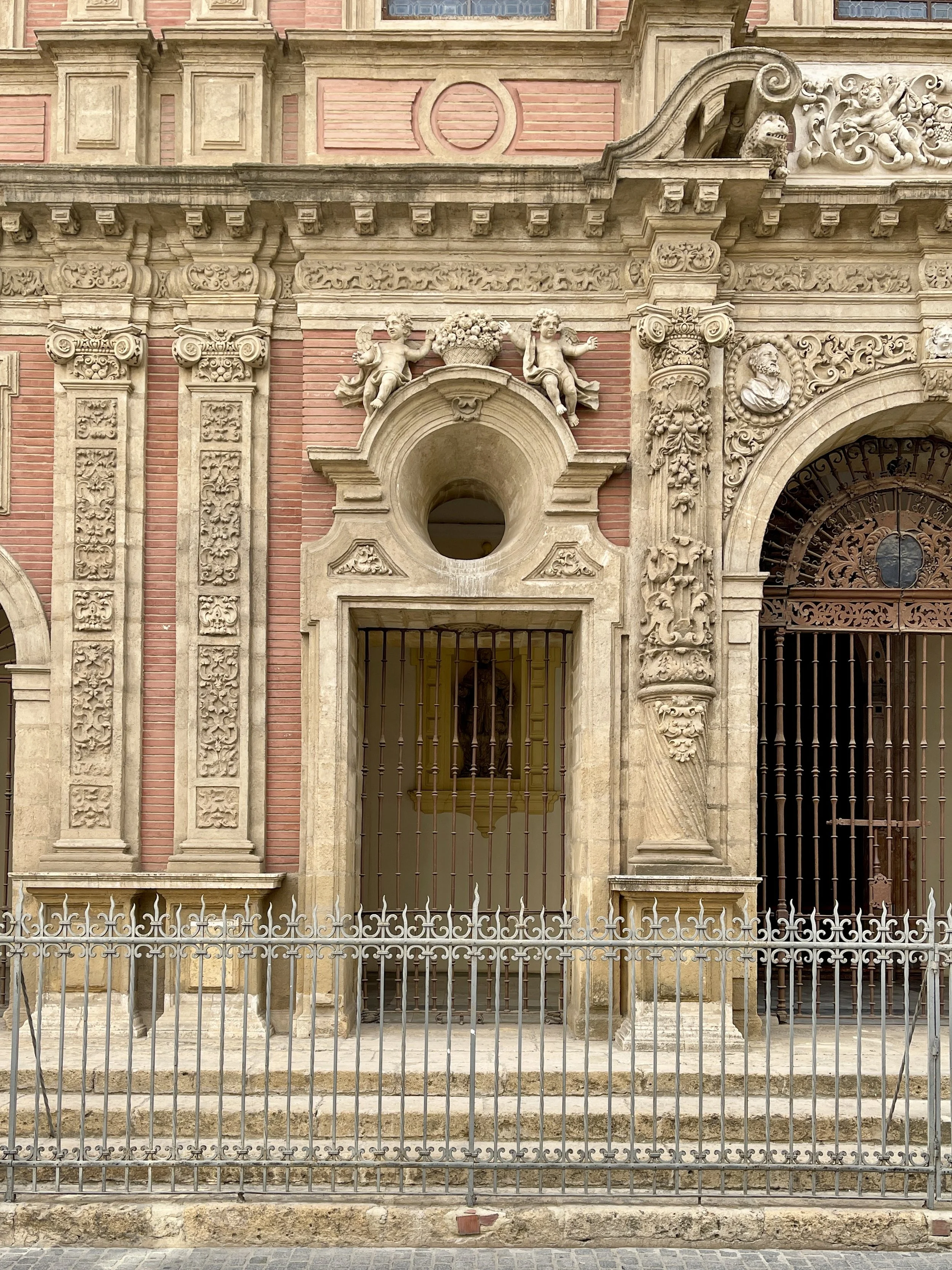
The Puente Nuevo in Ronda, Spain

Ronda’s iconic Puente Nuevo, or New Bridge, certainly isn’t “new” — having been completed in 1793 — but it is the most photographed.
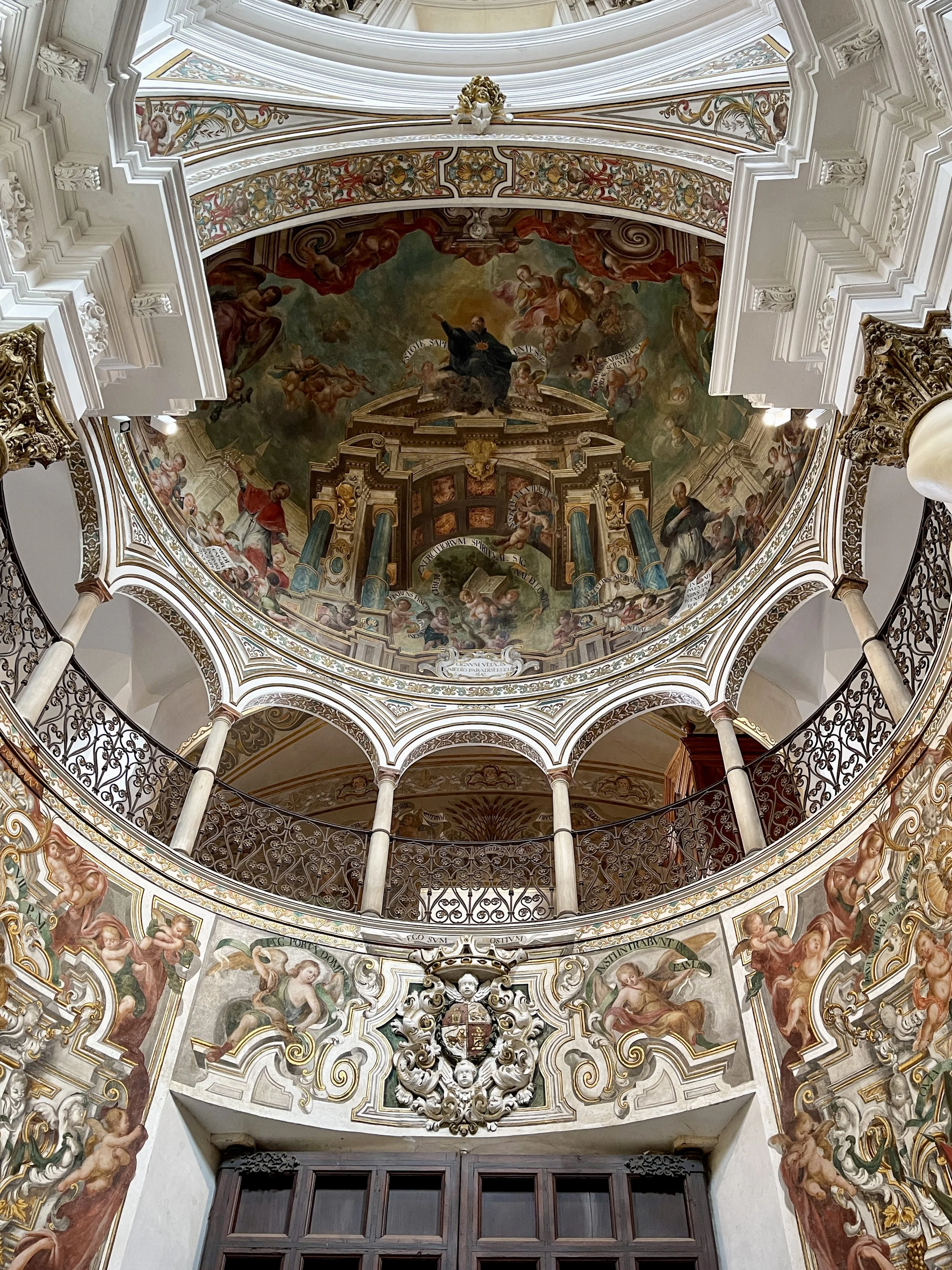
As we navigated the cobblestone streets and approached the church, we paused to gaze up at its unusual double-galleried façade, which looks more municipal than religious. The balconies were added during the reign of Felipe II and were a privileged place for nobility to watch the equestrian tournaments held in the square.

José told us that the American architect Julia Morgan used the bell tower of Santa María la Mayor as the model for the pair at Casa Grande, the main house of Hearst Castle, the elaborate hilltop estate of publishing tycoon William Randolph Hearst in San Simeon, California.

Ronda didn’t just leave a mark on Hearst; it also captivated Ernest Hemingway and Orson Welles, both passionate bullfighting enthusiasts who found refuge here. Welles even chose to have his ashes interred in a dry well on the Recreo San Cayetano estate of his good friend, the matador Antonio Ordóñez, on the outskirts of Ronda.

A copy of the illuminated Libro de Horas de la Reina Isabel (Queen Isabella’s Book of Hours) in the Church of Santa Maria la Mayor in Ronda, Spain

A copy of the illuminated Libro de Horas de la Reina Isabel (Queen Isabella’s Book of Hours). The original is part of the Cleveland Museum of Art’s collection.

Sacred Transformation: The Evolution of Iglesia de Santa María la Mayor 

The church used Ronda’s principal mosque as its foundation. But long before that, the site was allegedly a Roman temple to Diana, goddess of the hunt. 

The conversion from mosque to church began in earnest following the Reconquista of Ronda by Christian military forces in 1485. By the following year, King Fernando II (1479-1516) reconsecrated it as an abbey dedicated to the Virgin of Encarnación.

A statue of the Virgin Mary wearing a pink dress with blue mantel, with a glowing nimbus and crown, atop a crescent moon, at Santa Maria la Mayor church in Ronda, Spain

A statue of Mary as the Queen of Heaven. One interpretation of the crescent moon she’s standing on is that it represents her perpetual virginity.

During the reign of Charles I (1519-1556), its status was elevated to “colegiata” — a collegiate church — led by a clergy of ordained ministers without the direct involvement of a bishop. Its official title is the Real Colegiata de Santa María de la Encarnación la Mayor de Ronda, but locals commonly refer to it as the Iglesia de Santa María la Mayor due to its 19th-century designation as a “high parish” or “parroquia mayor.” Mass is held on Sundays and public holidays at 1 p.m. and on Thursdays at 8 p.m. April through September. 

Traces of its Islamic past are evident in the square-shaped body and arched windows punctuating the bell tower’s brick exterior, which originally served as the minaret of the mosque. It was probably more cost-effective to appropriate and reuse than to completely rebuild. Even so, the renovation of Santa María la Mayor required substantial funding and took nearly two centuries to complete. 

The remains of the mihrab, a semicircular prayer niche covered with stylized Arabic calligraphy and indicating the direction of Mecca, is visible from within the vestibule. Beyond is the gift shop, where we purchased admission for 4.50€ or about $5 per person to gain entry.   

Looking up at the chandelier and the tops of columns in Santa Maria la Mayor church in Ronda

This three-tiered chandelier suspended from the central vault of the Renaissance nave includes 34 lights and 24,700 pieces of sparkling cut crystal.

Split Personality: The Interior of Santa María la Mayor 

Inside, the ornate space feels more like a cathedral than a church. Constructed in two phases, the Gothic half follows the floor plan of the former mosque, while the enlargement initiated after the earthquake of 1580 reflects the evolution of architectural styles that rose in popularity during its extended completion and renovations, including both Renaissance and Baroque elements.

This altar is an impressive example of Spanish Baroque, a style known for its exuberance, grandeur and rich decorative elements.

A Baroque altar covered with gilded work, Solomonic columns, curving silver candleholders and a statue of the Virgin Mary in white and yellow with a blue ribbon around her waist and roses at her feet

The Virgin de la Aurora shows Mary in her aspect as Our Lady of the Dawn, a beacon of hope and a source of spiritual guidance for Catholics.

Altar of the Sagrario

The central nave of the Gothic section features an ornate and detailed Baroque giltwood altarpiece. Standing within a niche beneath a Marian crown is the figure of the Inmaculada, the Virgin Mary, standing on clouds. She’s flanked by representations of her mother, Santa Ana; her father, San Joaquín; and the Arcangel San Rafael. Twisted Solomonic columns, covered with delicately carved grapevines and topped by Corinthian capitals, complete the tableau. During our visit, the revered image of the Virgen de la Aurora (Virgin of the Dawn) was displayed on an elaborate paso, or float used for processions.

Mural in Santa Maria la Mayor of the giant San Cristobalón (Saint Christopher) carrying the baby Jesus upon his shoulders, painted by José Ramos

The Christ child sits upon the shoulders of the giant Saint Christopher and holds a fancy rattle, er, globus cruciger, a small sphere with a cross affixed to its top, symbolizing his sovereign dominion.

Mural of San Cristobalón

The large-scale mural to the left of the altar depicts a larger-than-life San Cristobalón (Saint Christopher), the patron saint of travelers, carrying the baby Jesus upon his shoulders. It was painted by Rondenian artist José Ramos. 

Statue of Nuestra Señora del Mayor Dolor (Our Lady of Sorrows) depicting the Virgin Mary with her eyes cast heavenward, heart pierced by a sword, and hands clasped in prayer, the central aspect of an altar at Santa Maria la Mayor in Ronda

The dramatic statue of Nuestra Señora del Mayor Dolor (Our Lady of Sorrows) depicts the Virgin Mary with her eyes cast heavenward, heart pierced by a sword, her hands clasped in prayer.

Altar of Nuestra Señora del Mayor Dolor

To the right is a highly ornate Churrigueresque-style altar framing a red velvet-lined niche holding the processional figure of Nuestra Señora del Mayor Dolor (Our Lady of Sorrows), which belongs to the religious brotherhood of the Hermandad del Santísimo Cristo de la Sangre. The sculpture depicts the moment when Mary learns that her son will die for the sins of mankind. Her eyes are lifted upwards and her hands are clasped, holding a rosary. Most dramatically, her heart is pierced with a silver sword, and a pair of cherubs flutter menacingly beneath her — one appears to be holding a hammer, and the other, pincers.

Wooden choir screen at Santa Maria la Mayor in Ronda, Spain, carved with figures of saints and a lectern stand holding a choir book from the 16th century

The Renaissance-period choir screen is embellished with imagery of the apostles and other saints and has a lectern stand holding a 16th century antiphonal (choir book). 

Coro

The choir screen was a Renaissance addition and features intricately carved cedarwood reliefs depicting the apostles and other saints. It’s no accident that it was placed strategically at the nave’s center as it served as a partition to divide the church into two social classes: aristocrats to the front and parishioners to the back. The lectern stand supports a 16th century antiphonal (choir book), its musical notations intricately inscribed on pages made of vellum. 

The high altar of Santa María la Mayor with a carved wooden canopy over statues of the Holy Spirit, the Archangel Gabriel and the Virgin Mary, between white columns and with red carpeted steps leading up to it

The high altar of Santa María la Mayor has an elaborately carved wooden canopy that showcases the Holy Spirit, the Archangel Gabriel and the Virgin Mary.

Baldaquino of the Altar Mayor

One of the most striking elements of the church is the impressive baldaquino, or canopy, located on the high altar under the central dome of the Renaissance nave. Carved from wood, it consists of four slender, finely carved Solomonic columns that support a towering highly decorated cupola topped by an angel. 

The original altarpiece was destroyed during the Spanish Civil War (1936-1939) and replaced by the baldaquino from Nuestra Señora de los Ángeles (Our Lady of the Angels). 

Within the ornate structure are the Archangel Gabriel and the Holy Spirit in the guise of a dove visiting the Virgin to inform her that she will conceive and give birth to Jesus Christ. 

Man in blue T-shirt leans on iron railing on the rooftop of Santa Maria la Mayor in Ronda, Spain, with the town seen from above

Be sure to climb up to the rooftop, like Duke did, for a view of Ronda from above.

Up on the Rooftop 

We passed through the doorway to the right of the altar and climbed the narrow steps of the winding spiral staircase leading to the roof and viewing deck.

Woman in chevron dress and sunglasses smiles from balcony of Santa Marina la Mayor church overlooking the Ayunamiento of Ronda, Spain

Jo stands on a balcony overlooking the square and the Ayuntamiento, the City Hall.

While we were there, the late afternoon sun cast a soft, warm glow over the terracotta-tiled rooftops of the old city, and it was so clear that we could see the rugged Sierra Nevada mountains in the distance.

Rooftops and blue mountains seen from the top of Santa Maria la Mayor in Ronda, Spain

Views of the Old Quarter and the mountains beyond from the rooftop

Looking down the stone spiral staircase at Santa Maria la Mayor in Ronda, Spain

Seen from above, the spiral staircase leading to the rooftop resembles a snail’s shell. 

There’s a long bench if you need to rest or take a moment to enjoy the view. Make sure to peek through the small door at the top of the staircase to take in a bird’s-eye view of the interior of the church.

A shiny lifesize statue of Baby Jesus in the museum section of Santa Maria la Mayor in Ronda, Spain

A figurine of the Baby Jesus with outstretched arms was one of Duke’s favorite pieces in the church’s museum.

Back Down on Earth

After exploring the rooftop, Jo, José, Wally and I returned to the ground floor and wandered through the church museum. It had several glass-front cabinets displaying various religious objects: vestments (clergy apparel), chalices and sculptures, including a life-sized glassy-eyed baby Jesus, which I imagine might get placed in the church’s crèche on Christmas Day. 

The Iglesia de Santa María la Mayor is a short distance from the Puente Nuevo, but its location in the leafy park-like Plaza Duquesa de Parcent feels a world away from the overcrowded tourist area. –Duke

Colegiata Santa María la Mayor 

Plaza de la Duquesa de Parcent s/n 
29400 Ronda Málaga
Spain