marrakech

Ben Youssef Madrasa Is Beautiful — Even When Someone Is Blocking Your Shot

Once home to hundreds of theology students, Ben Youssef Madrasa in Marrakech is now a hypnotic maze of cedarwood, tilework, tiny dormitories and tourists trying to stage the perfect Instagram reel.

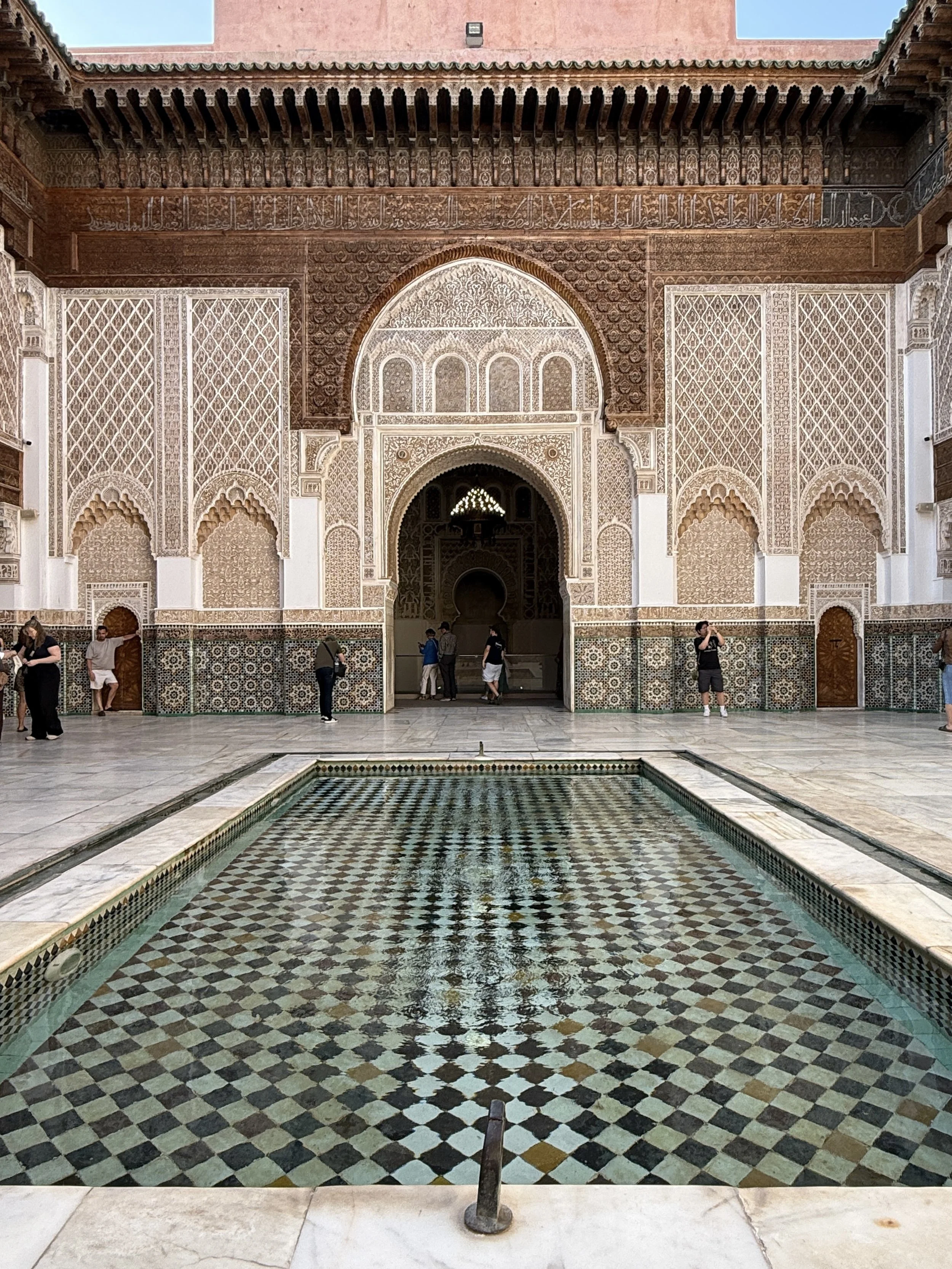
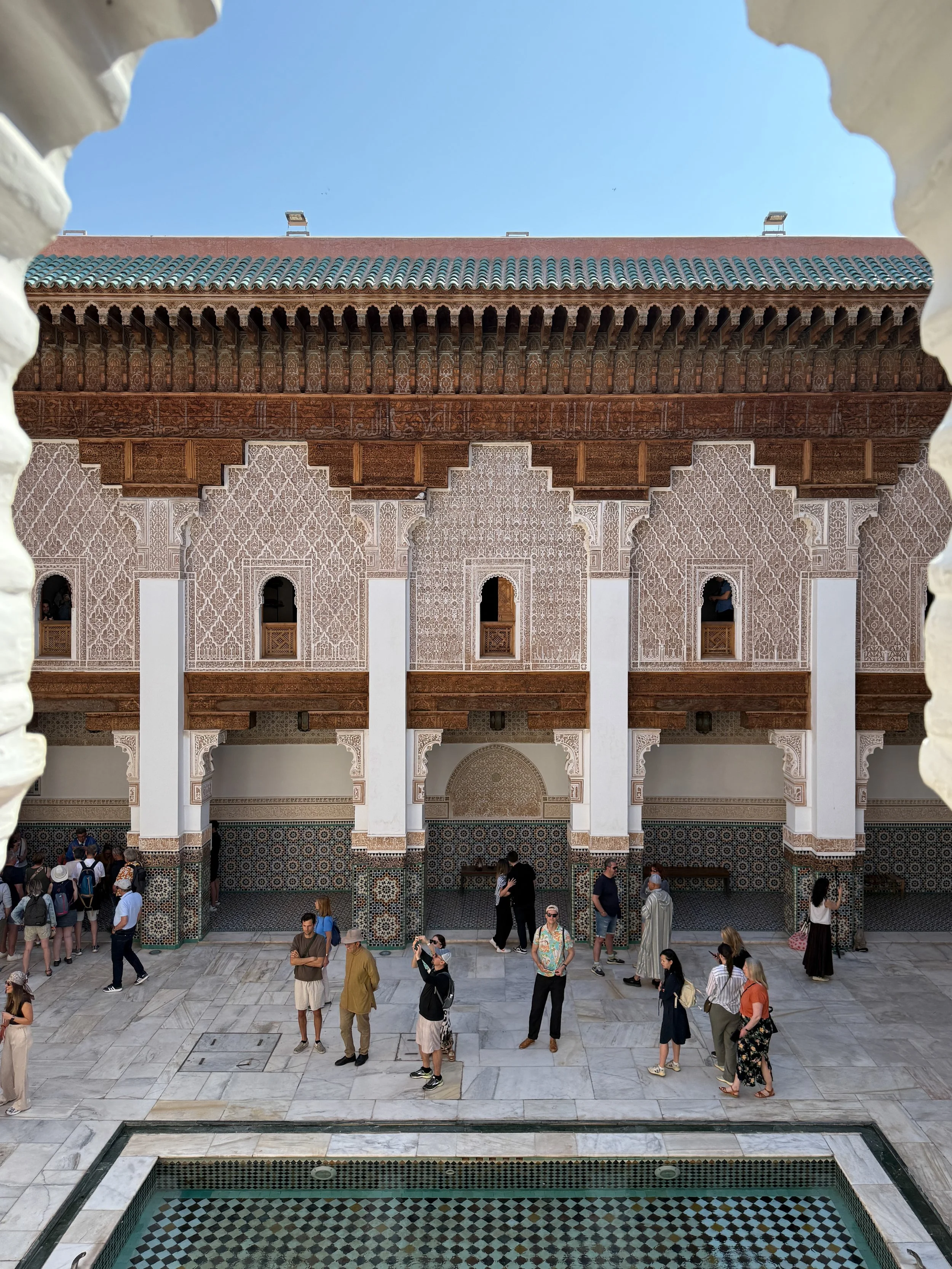
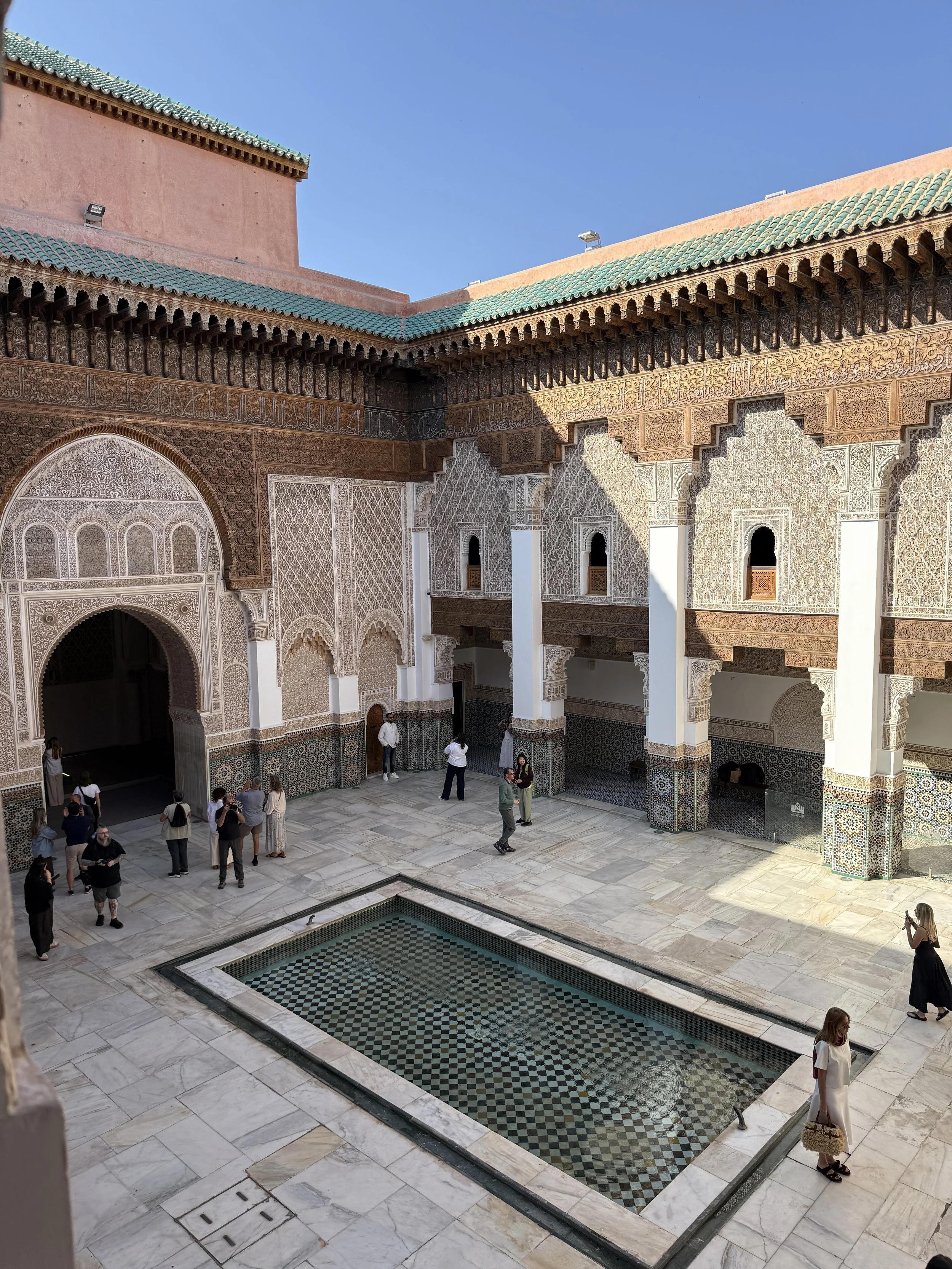
Courtyard of the Ben Youssef Madrasa with its reflecting pool in Marrakech, Morocco

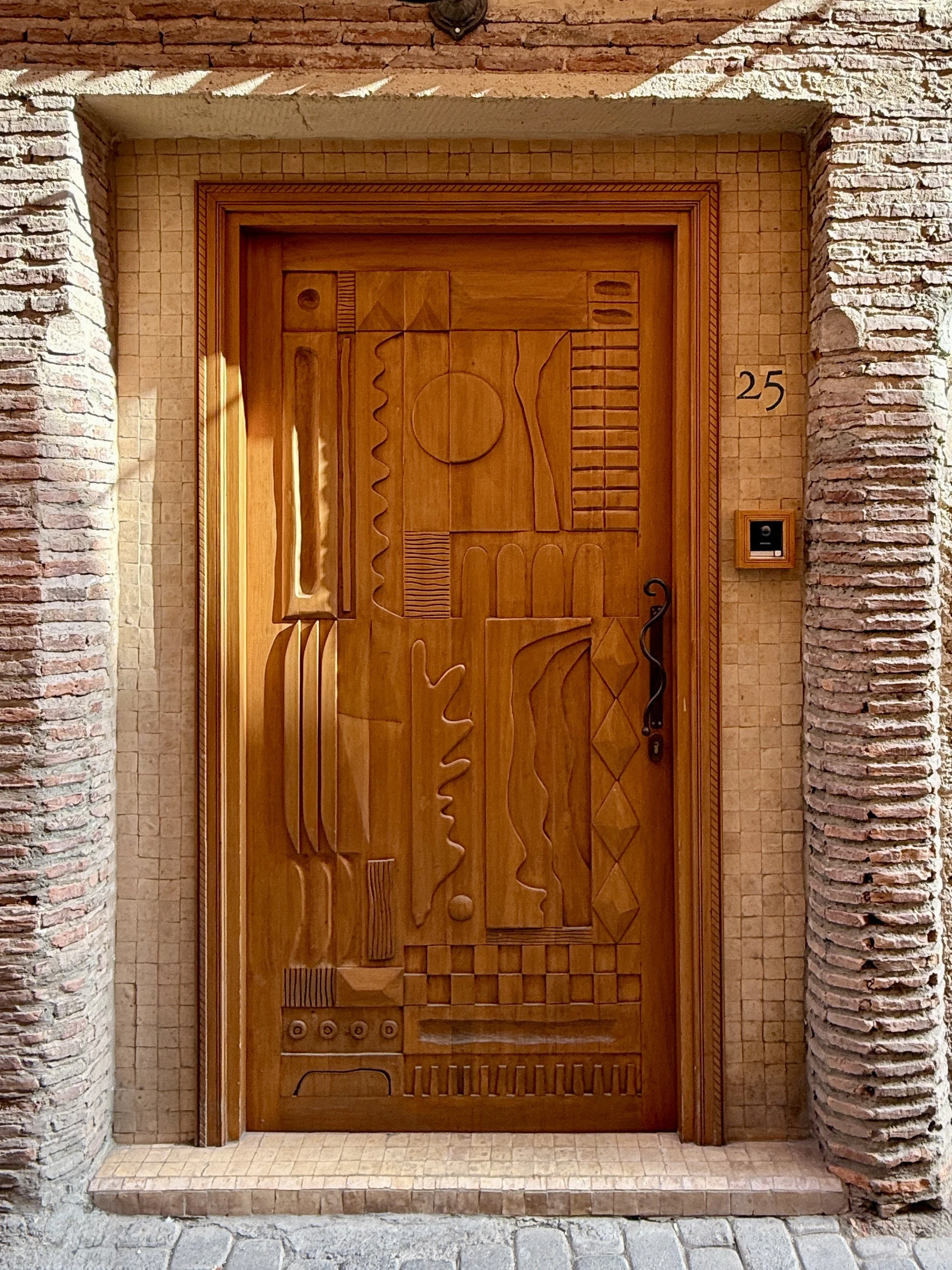
En route to Ben Youssef Madrasa, you wind through the medina past scooters, cats, more cats, hanging lanterns, leather bags and shopkeepers trying to lure you into buying everything from slippers to saffron. The alleys feel compressed and chaotic — until suddenly they open up. Around a corner: a doorway. You’ve arrived.  

You step into the entrance, pay for your ticket — and then!

There were moments when the madrasa felt less like a historic site and more like the set of multiple simultaneous influencer campaigns.

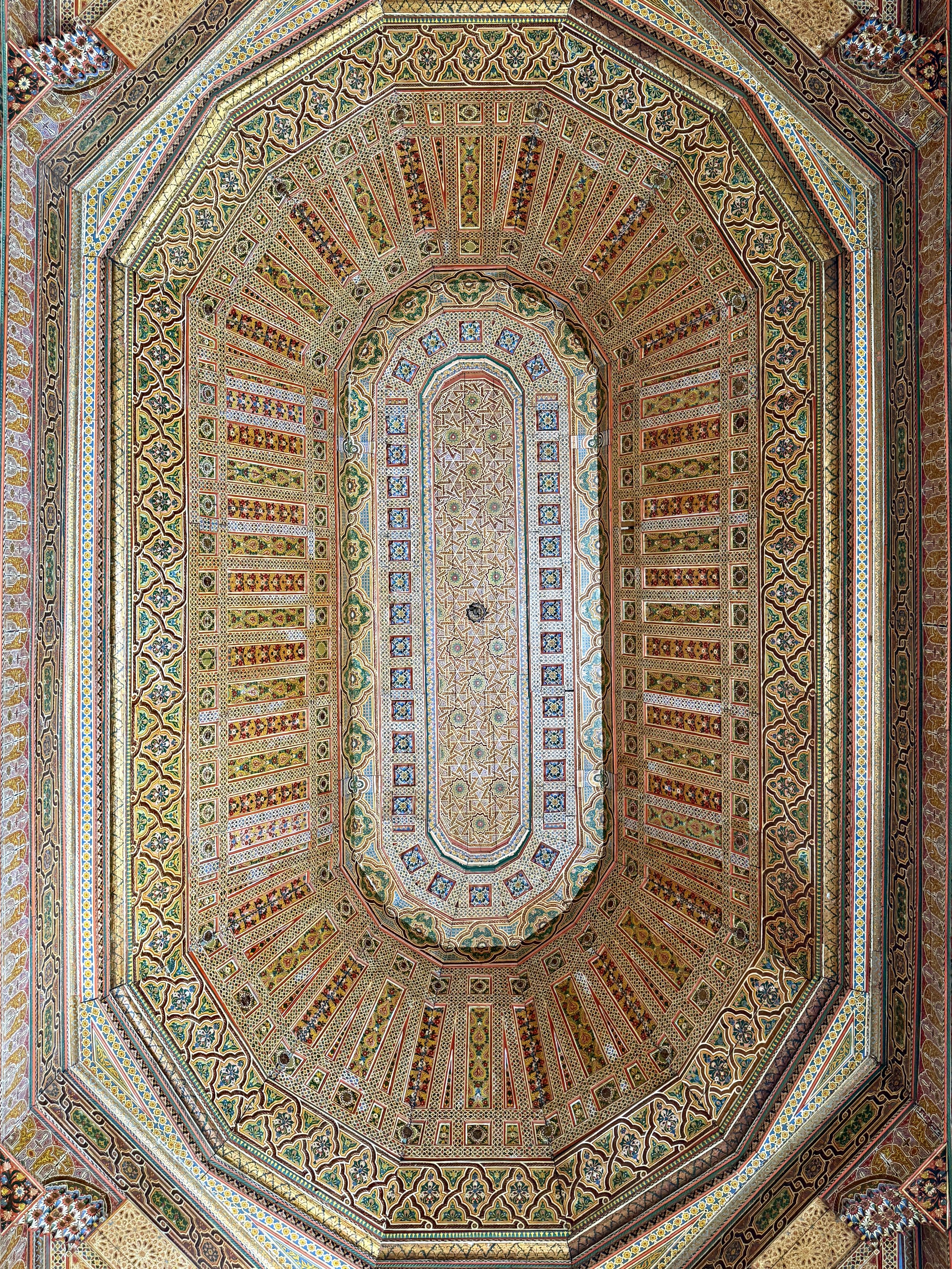
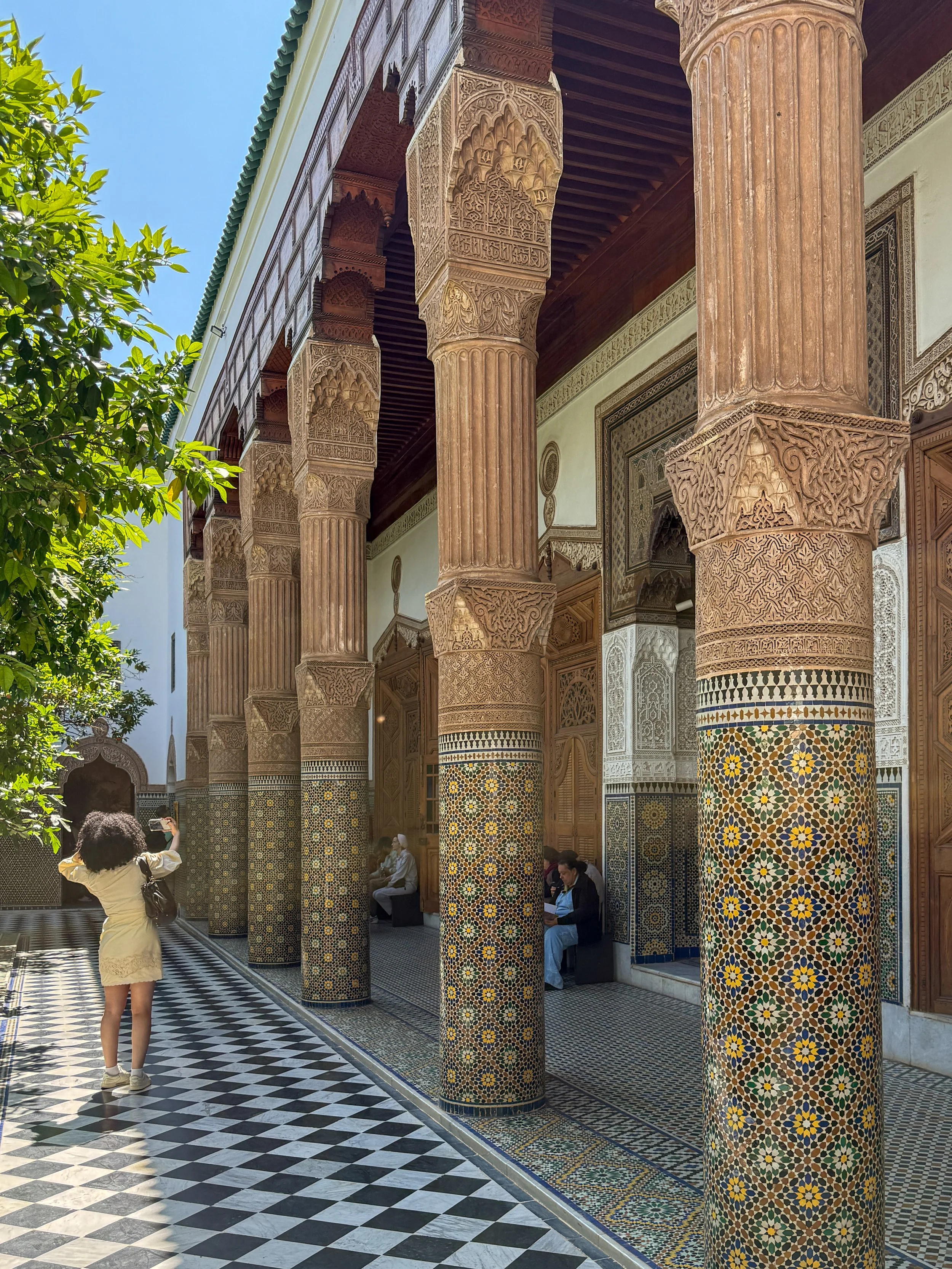
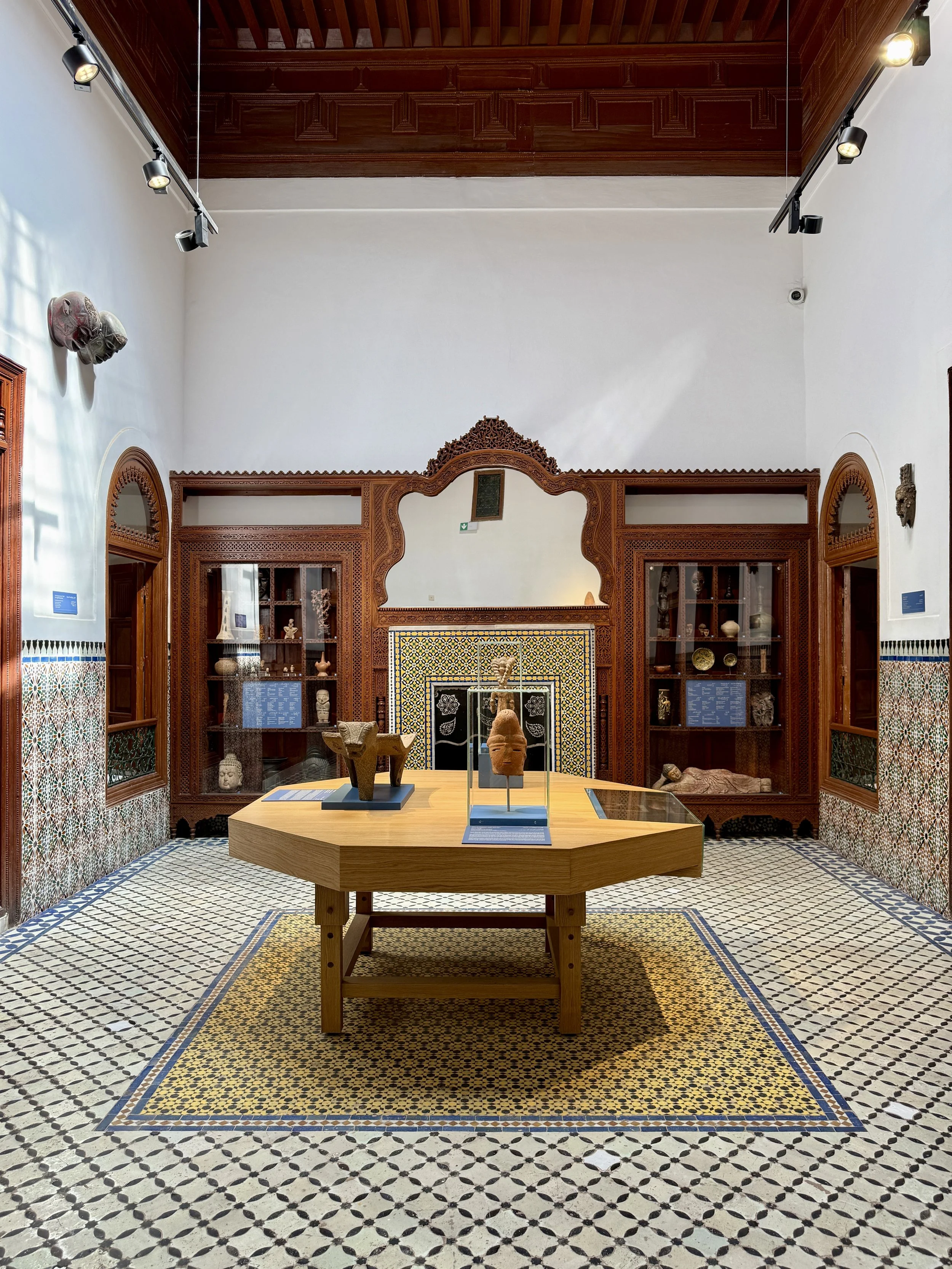
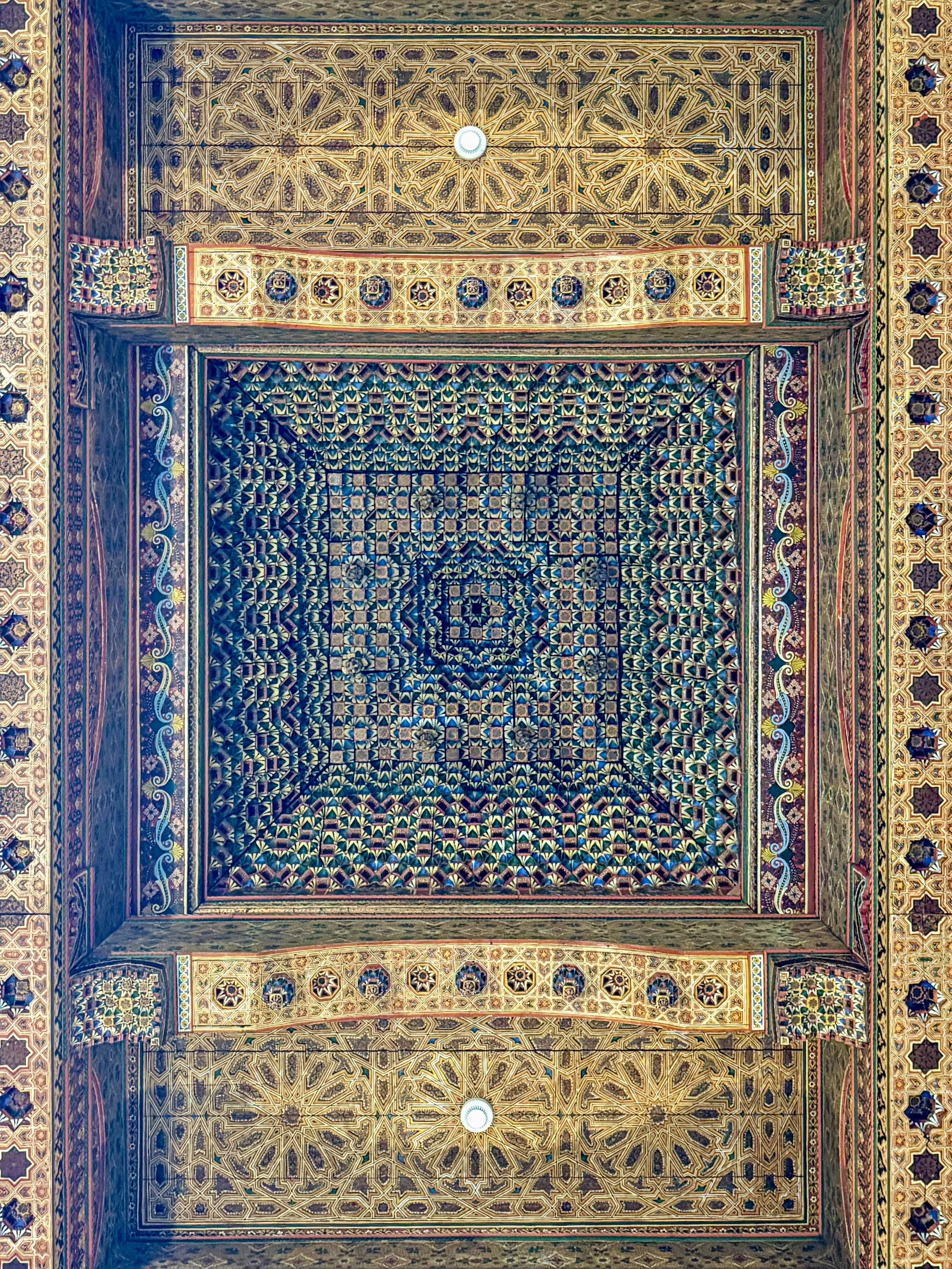
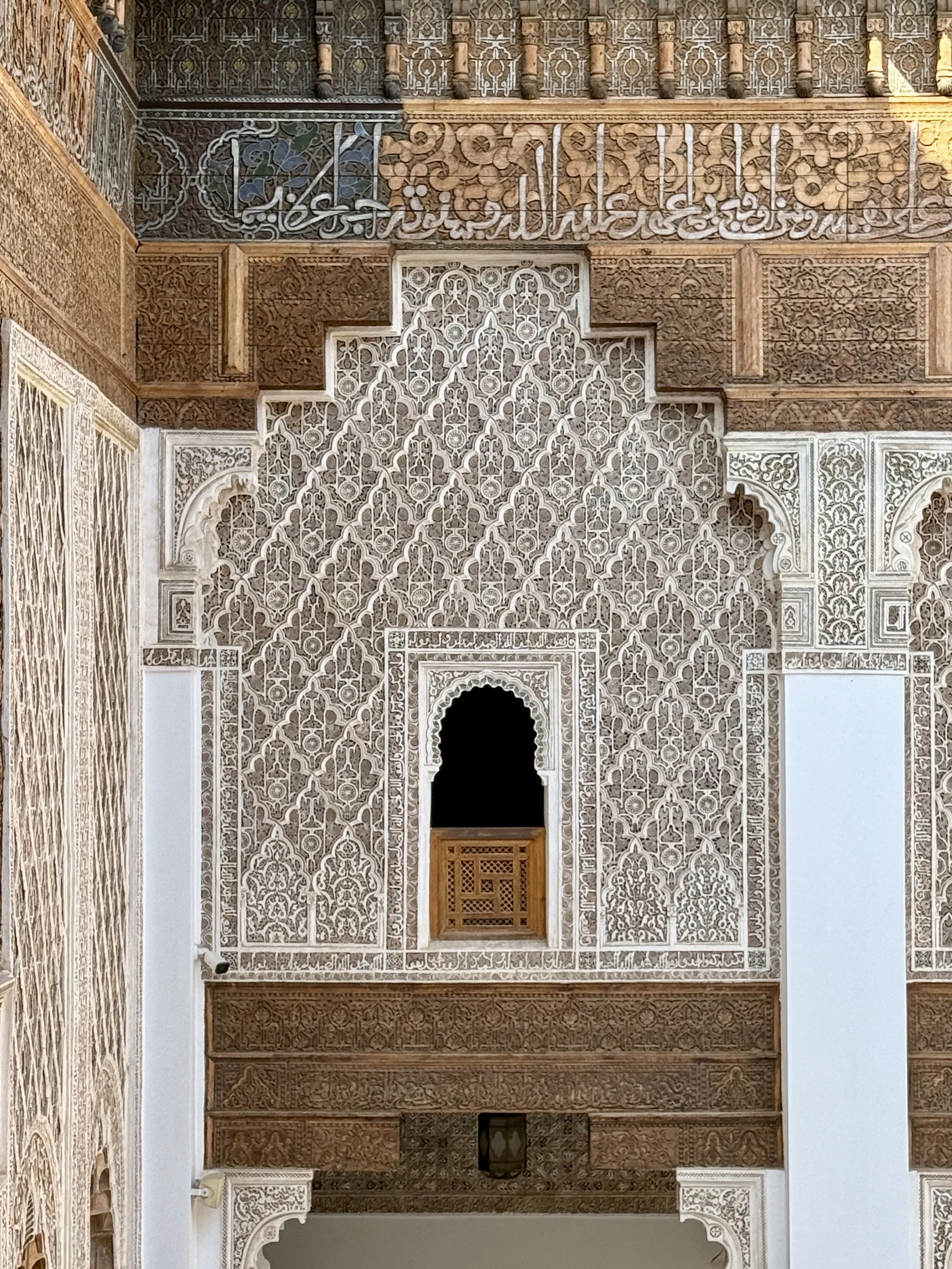
The courtyard is almost absurdly intricate. Cedarwood curls across the ceilings in impossible patterns. Geometric zellige tilework climbs the walls with mathematical precision. Light bounces off the reflecting pool while visitors slowly circle the space trying to take it all in.

Or, in many cases, trying to take themselves in. During our visit, there were moments when the madrasa felt less like a historic site and more like the set of multiple simultaneous influencer campaigns. One woman posed dramatically at the edge of the reflecting pool while her friend shot video from approximately 14 different angles. Another visitor appeared to be filming a luxury perfume commercial involving slow-motion twirling. At one point, someone became visibly irritated that tourists were daring to walk through a public building during her photoshoot.

Which is unfortunate, because this place deserves your actual attention.

Planning Your Visit

Ben Youssef Madrasa

Address

Rue Assouel, Marrakesh Medina, Morocco

Hours

9 a.m. to 7 p.m.

Ramadan: 9 a.m. to 4:30 p.m.

Admission

50 dirhams (~$5) — foreign adults

20 DH — Moroccan adults

10 DH — children under 12

30 DH — groups of 21+

Time Needed

Plan for at least 45 minutes to an hour.

Dress Code

Modest clothing is best — shoulders and knees covered out of respect for the site.

Long before it became one of the most photographed spots in Marrakech, Ben Youssef Madrasa was one of the great centers of Islamic learning in North Africa. Built in its current form during the 16th century under the Saadian dynasty, the school once housed hundreds of students studying theology, law and philosophy within these walls. And despite the crowds, despite the cameras and despite the occasional accidental appearance in a stranger’s TikTok, there are still moments where the building completely silences you.

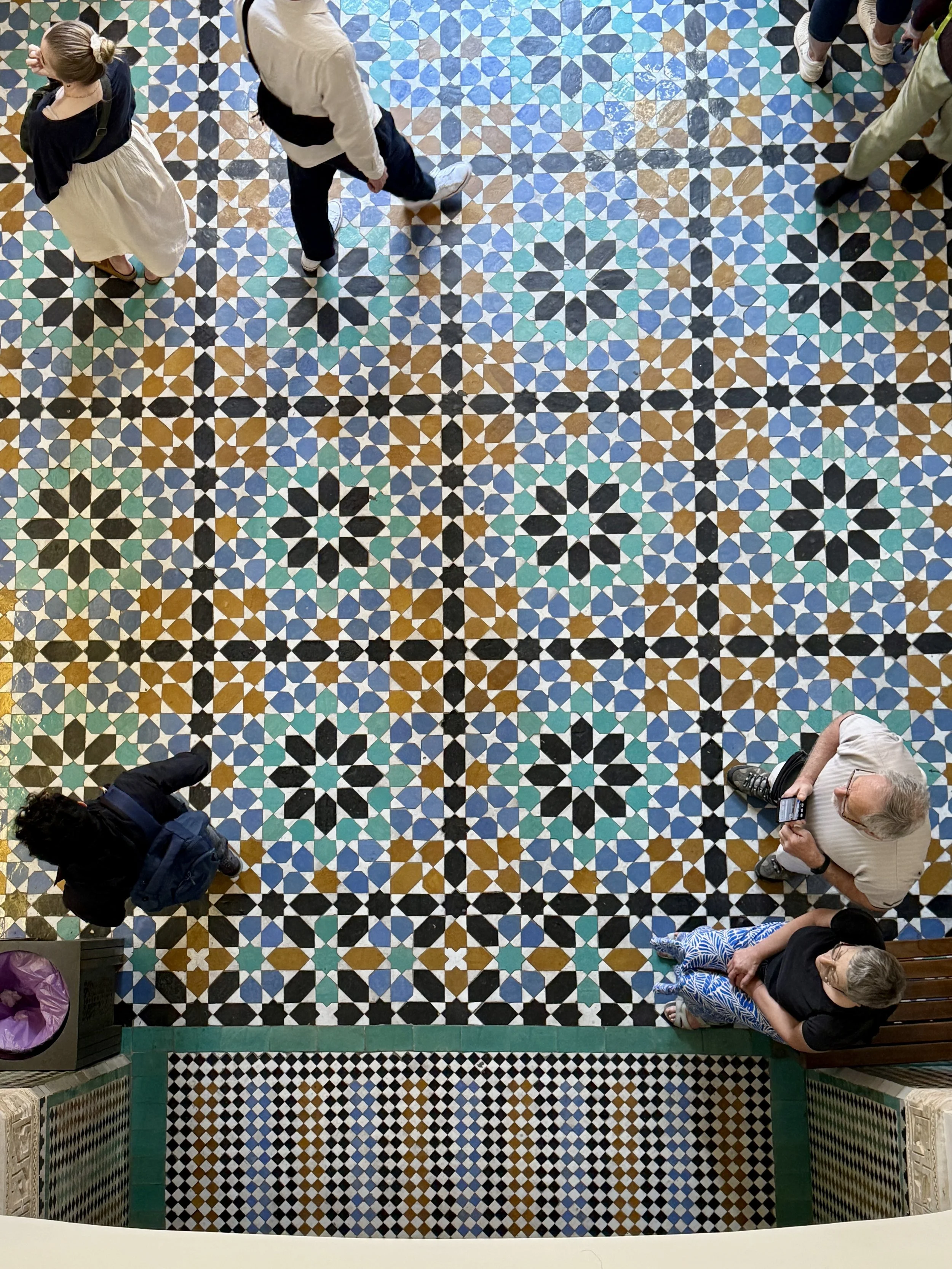
People  walk on the zellij tiled floor in the lobby of Ben Youssef Madrasa

Especially once you wander upstairs into the tiny student dormitories and realize the people who lived here were just young scholars sleeping in cramped little rooms beneath some of the most astonishing craftsmanship in Morocco.

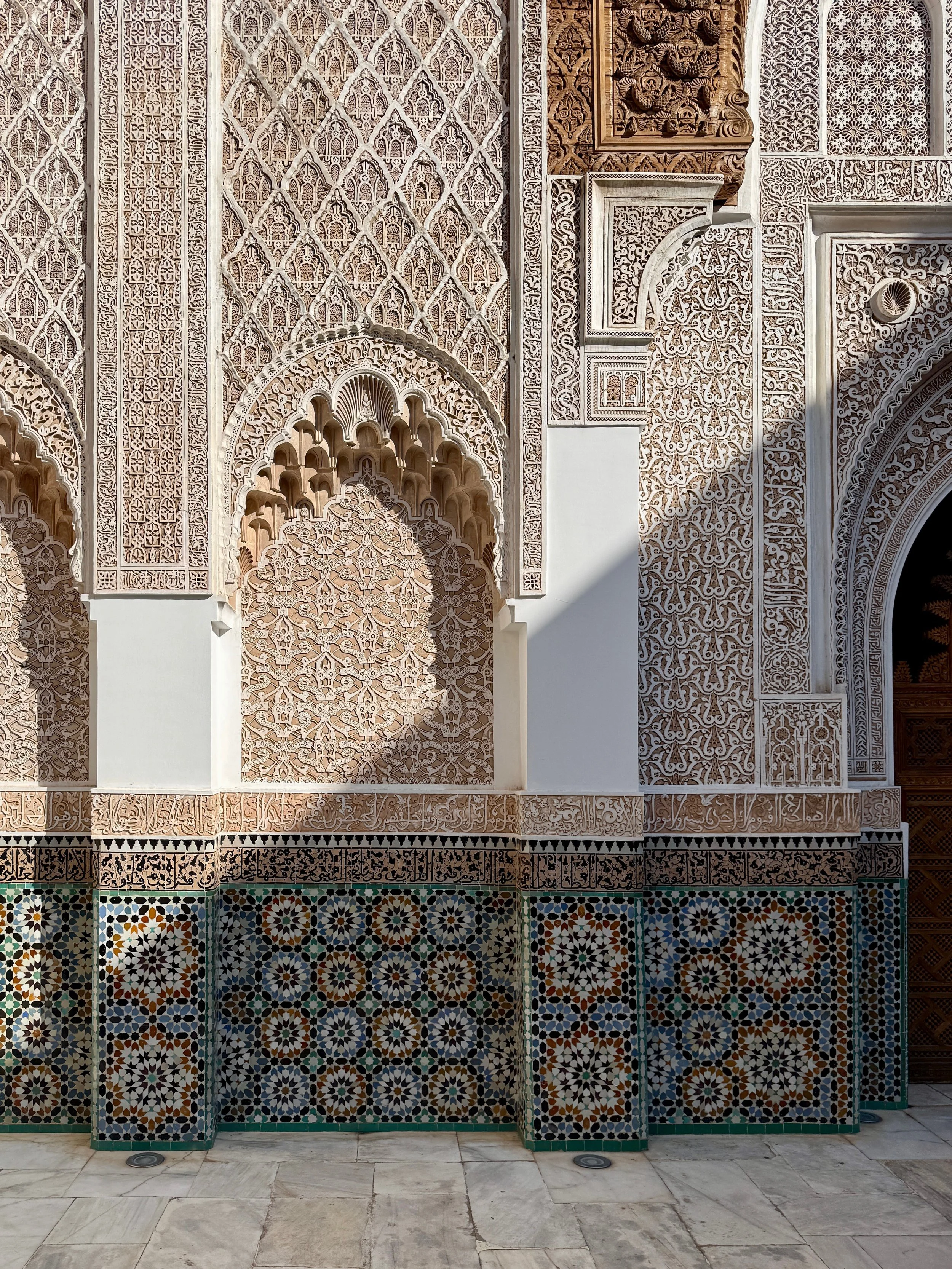
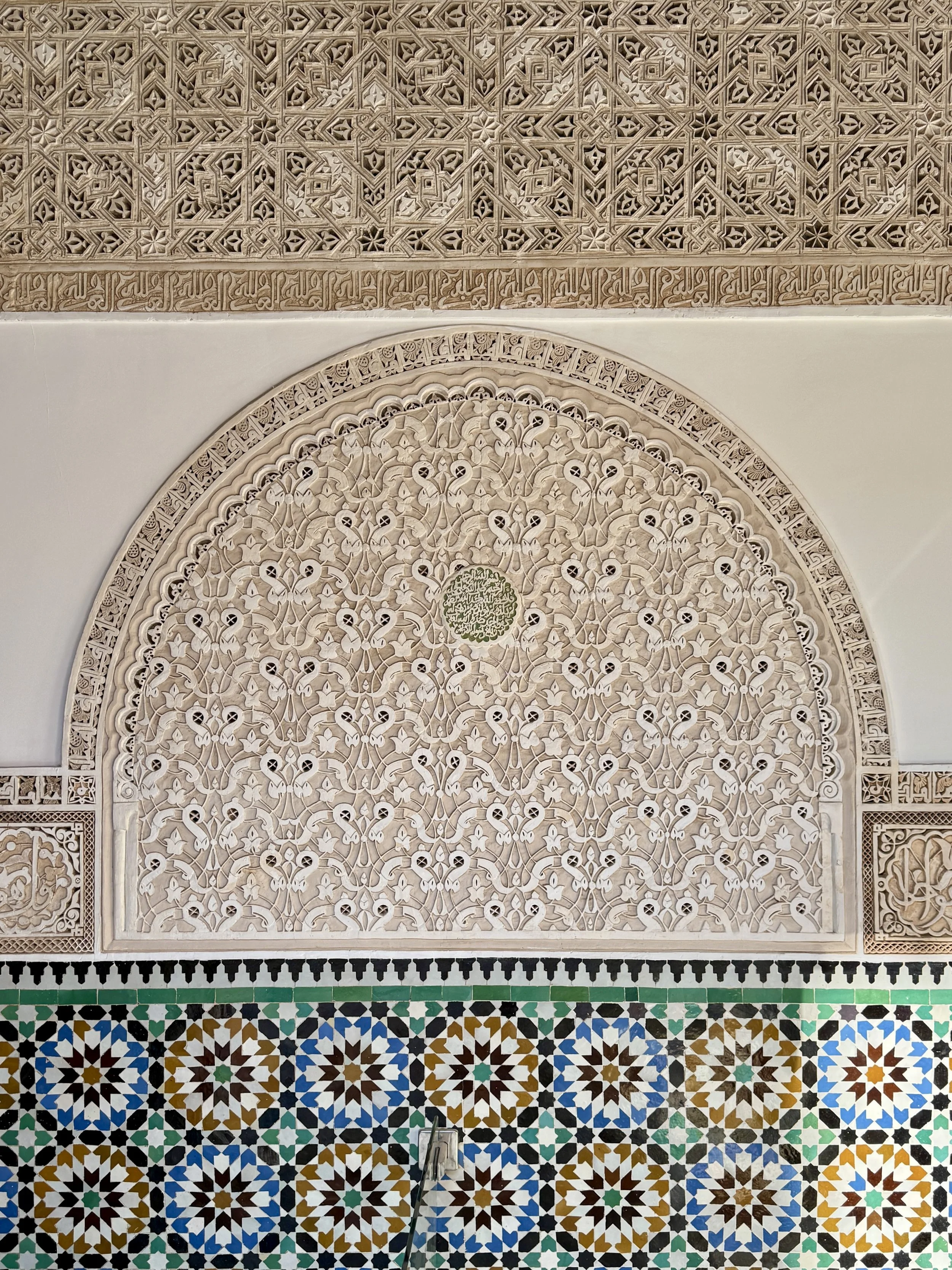
Ornate carvings and tilework at Ben Youssef Madrasa

The History of Ben Youssef Madrasa

Before it became one of Marrakech’s most photographed attractions, Ben Youssef Madrasa was built for something far less glamorous: studying.

The madrasa was connected to the nearby Ben Youssef Mosque, which was originally founded in the 12th century during the Almoravid dynasty under Sultan Ali Ben Youssef, the ruler the complex is ultimately named after. At the time, Marrakech was emerging as a major political, religious and intellectual center, and institutions like this helped establish the city as one of the most important hubs of Islamic scholarship in the region.

What visitors see today, however, mostly dates to a later reconstruction ordered by the Saadian Sultan Abdallah al-Ghalib in the 1560s. And the Saadians, to put it mildly, weren’t interested in subtlety.

Beautiful carvings and tilework at Ben Youssef Madrasa in Marrakech
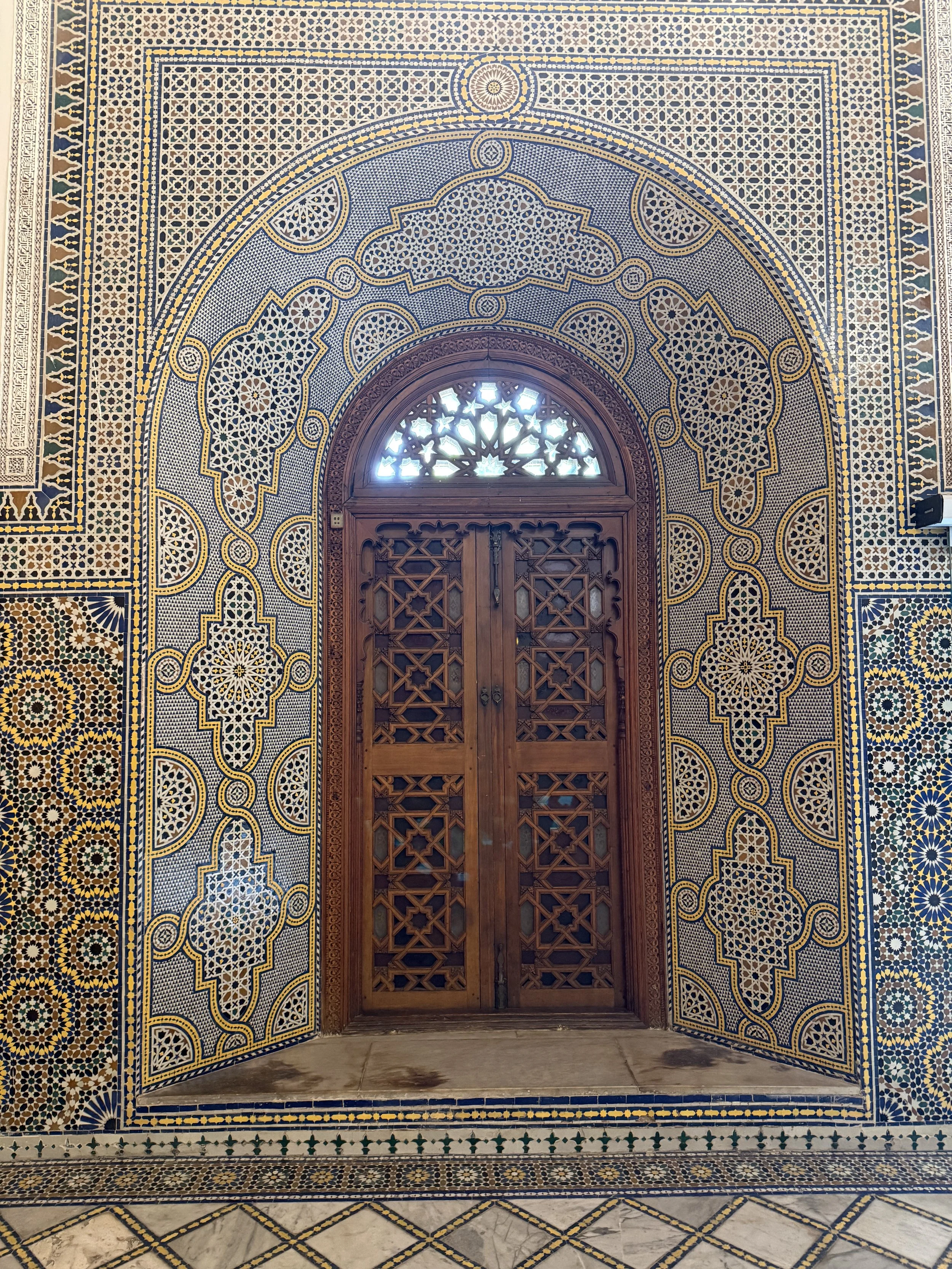
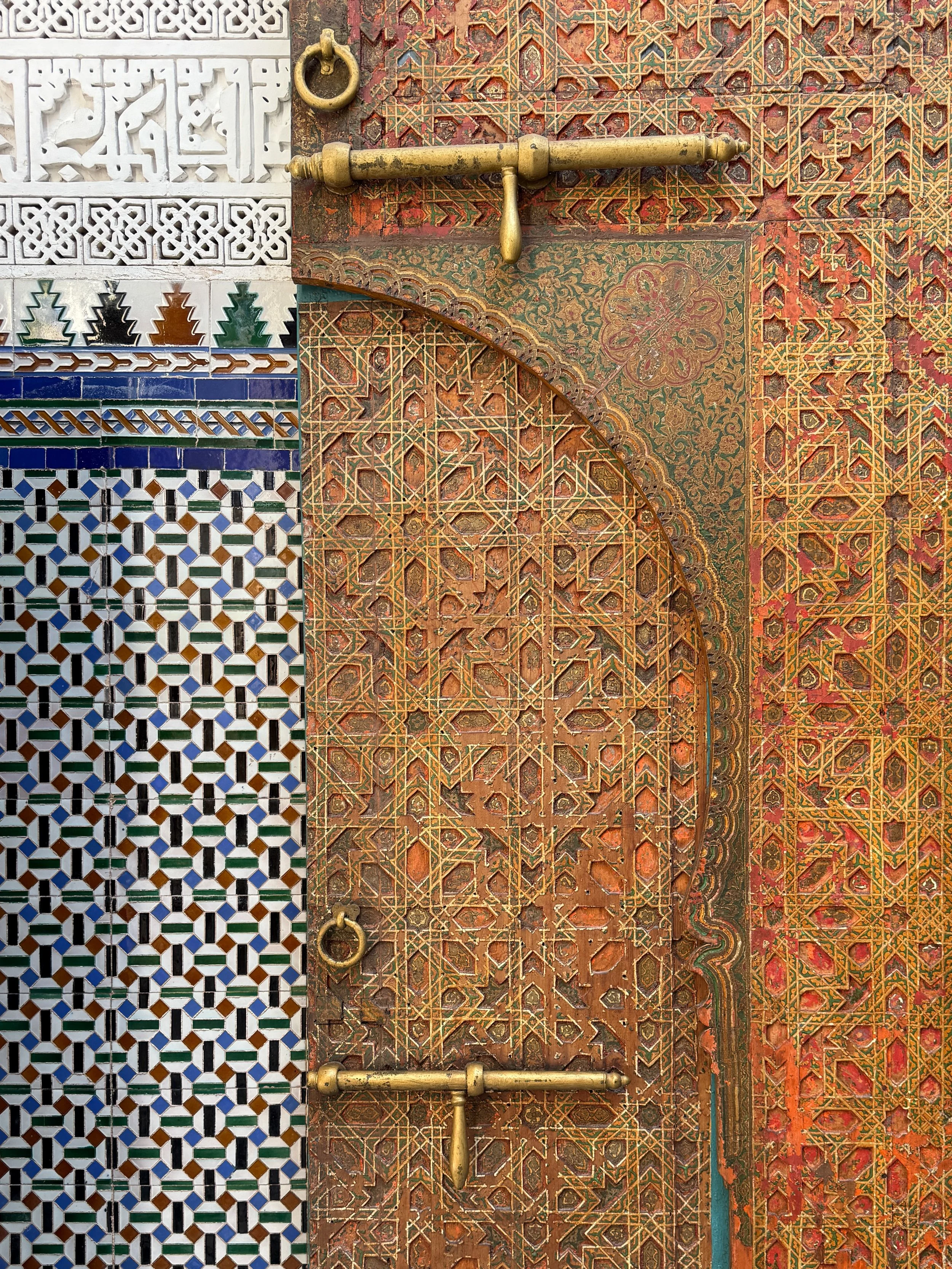
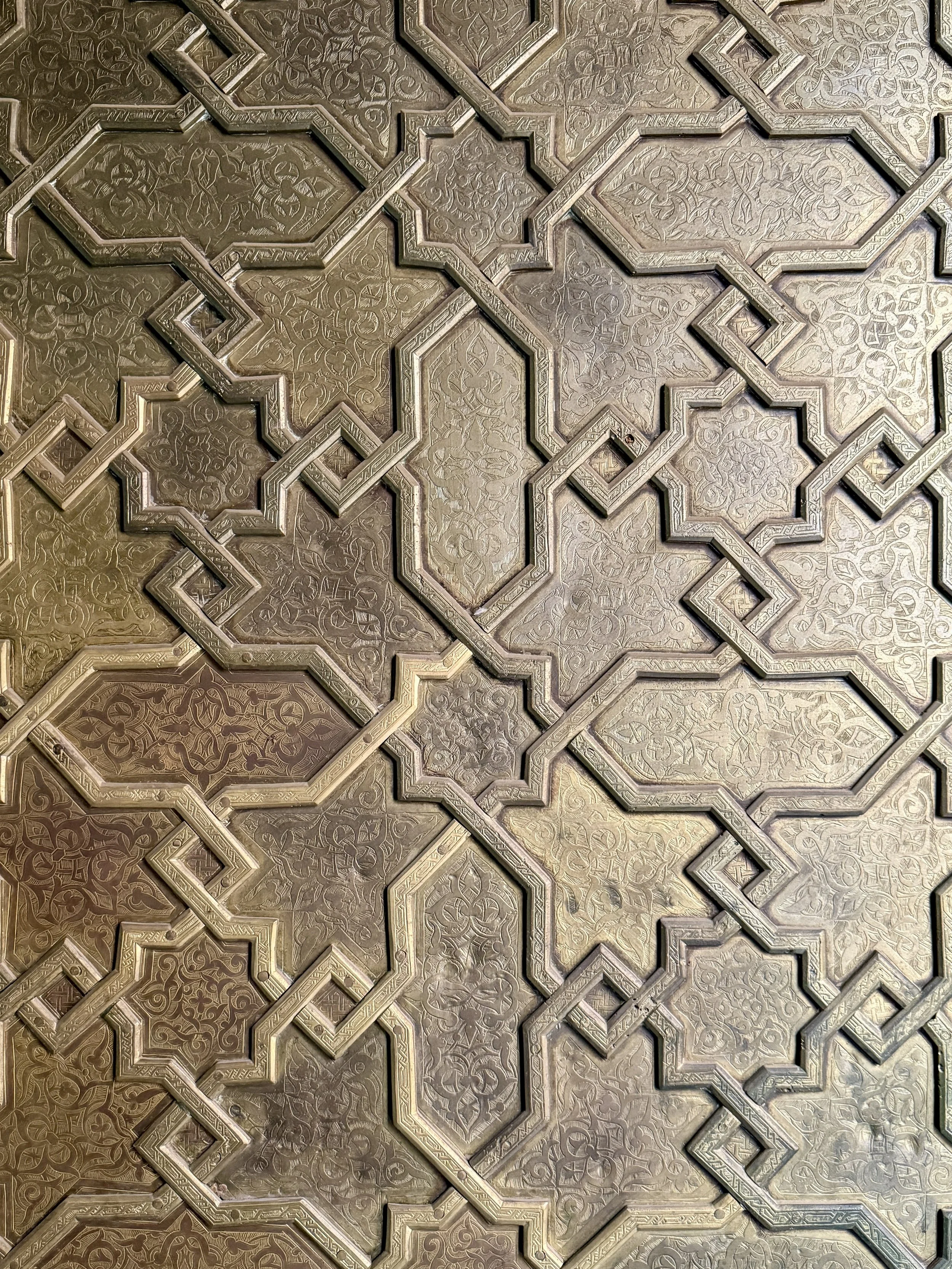
Starlike patterns carved on a wood door at Ben Youssef Madrasa
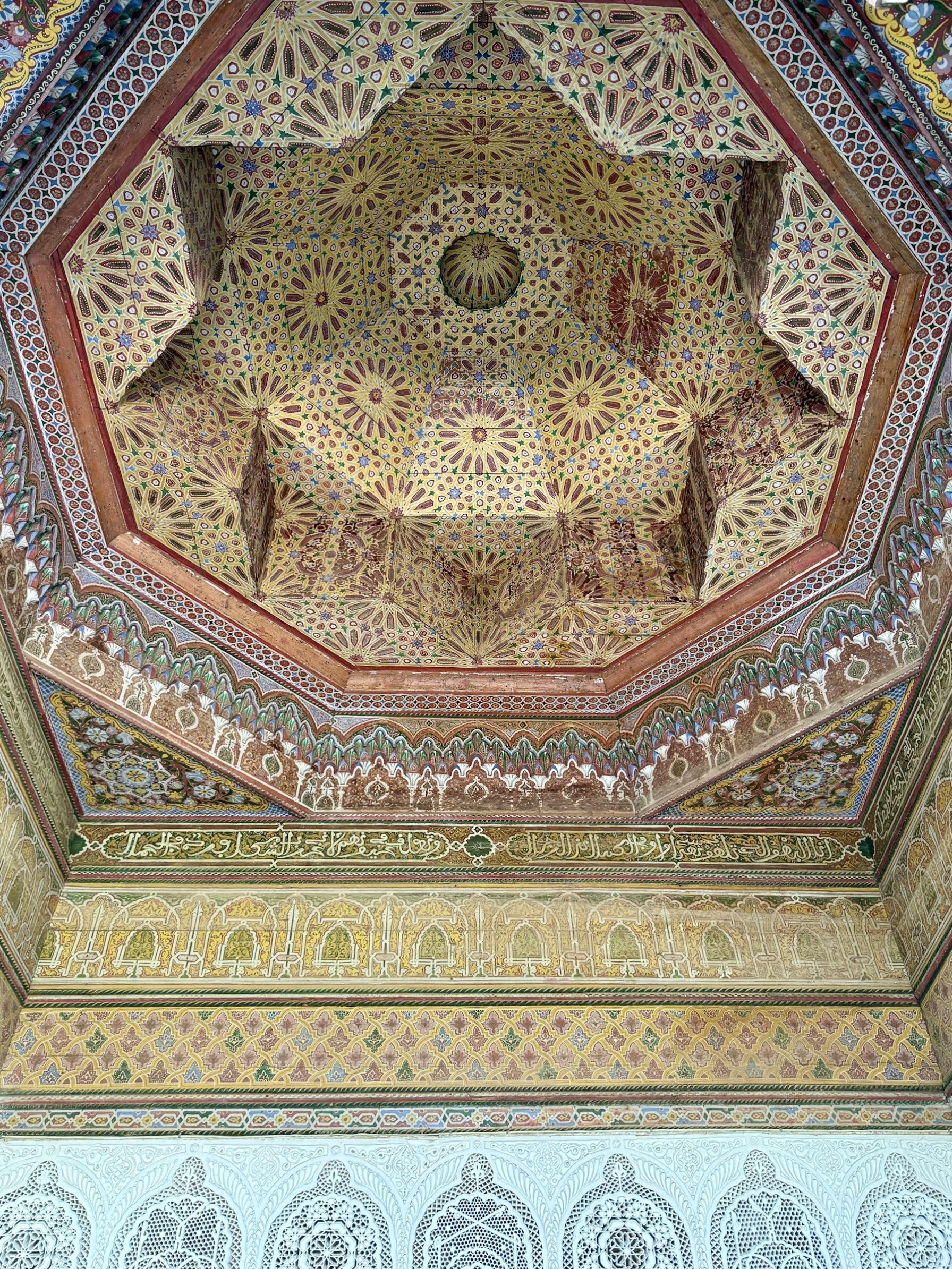
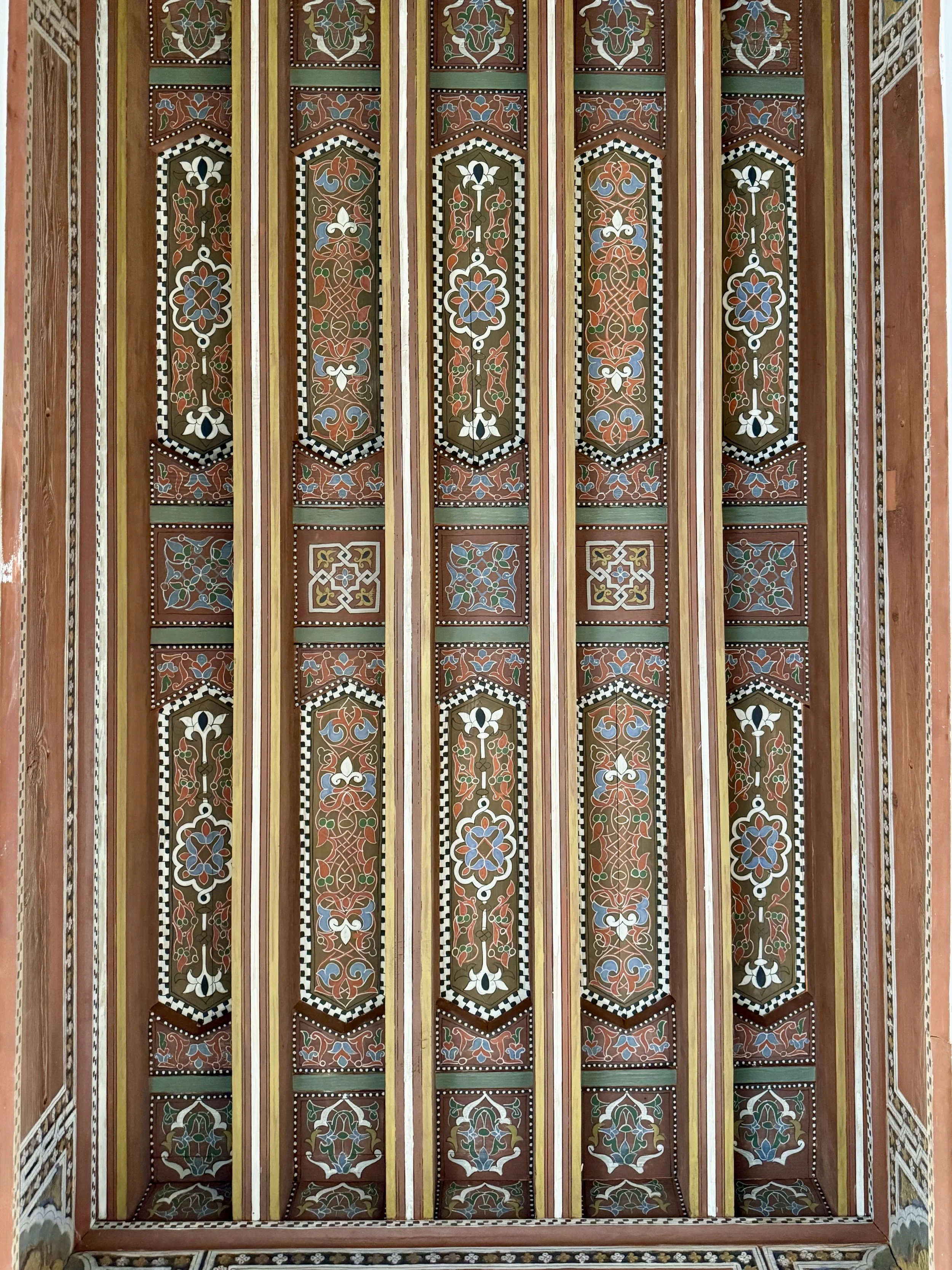
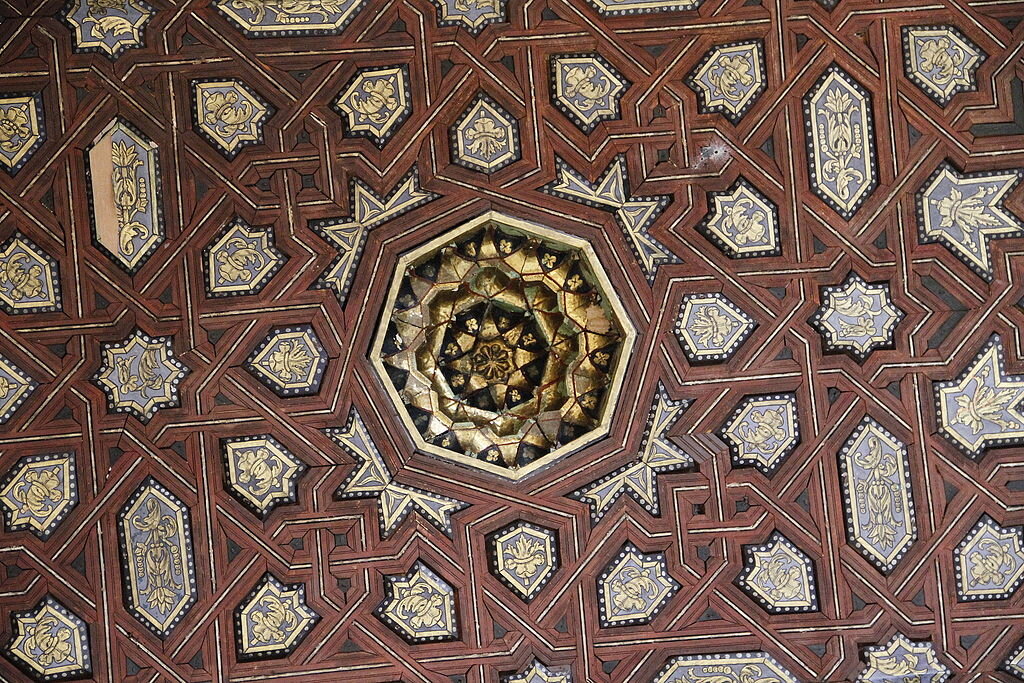
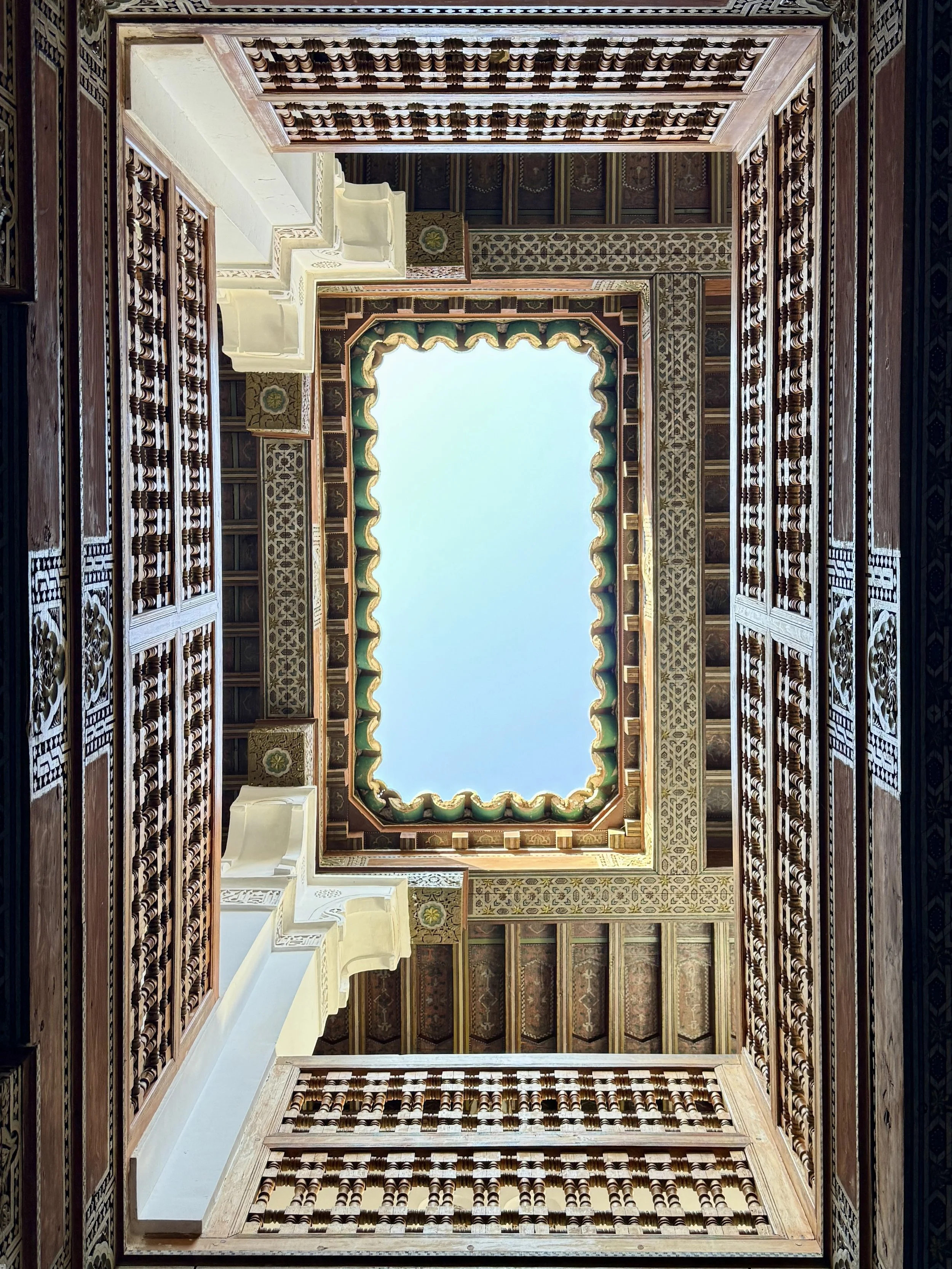
Gorgeous painted cedar ceilings at Ben Youssef Madrasa

The rebuilt madrasa was enormous for its time. Historians believe it housed as many as 900 students living in its 130 dormitory cells, and shared a single communal bathroom. Young men traveled here from across Morocco to study Qur’anic interpretation, theology, law and other religious sciences. Some likely arrived after journeys that took days or even weeks by foot or caravan, only to end up sleeping in rooms roughly the size of a walk-in closet — just three square meters, or about nine by nine feet. 

Which is part of what makes the place so fascinating today. Every visible surface seems carved, painted or tiled. The cedarwood ceilings resemble something pulled from a fantasy novel. The geometric mosaics are so precise they start to make your brain hurt if you stare too long. Yet the actual student quarters upstairs are tiny and more austere, built for discipline rather than comfort.

It’s a striking contrast — and very intentional. Islamic madrasas often placed beauty in communal and sacred spaces rather than personal luxury. The architecture itself became part of the educational experience, reflecting ideas about harmony, mathematics, craftsmanship and divine order.

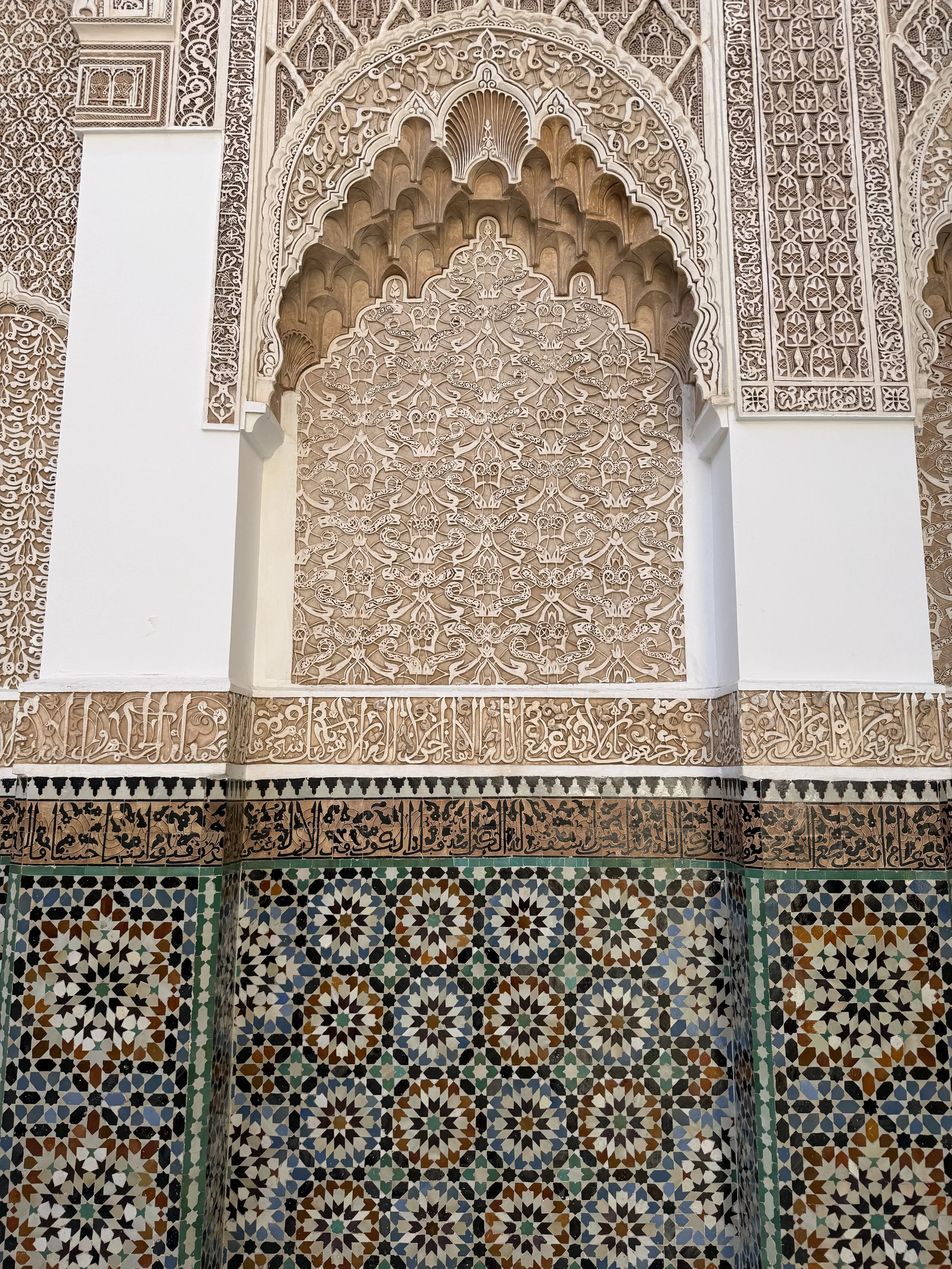
Gorgeous Islamic architecture at Ben Youssef Madrasa in Marrakech

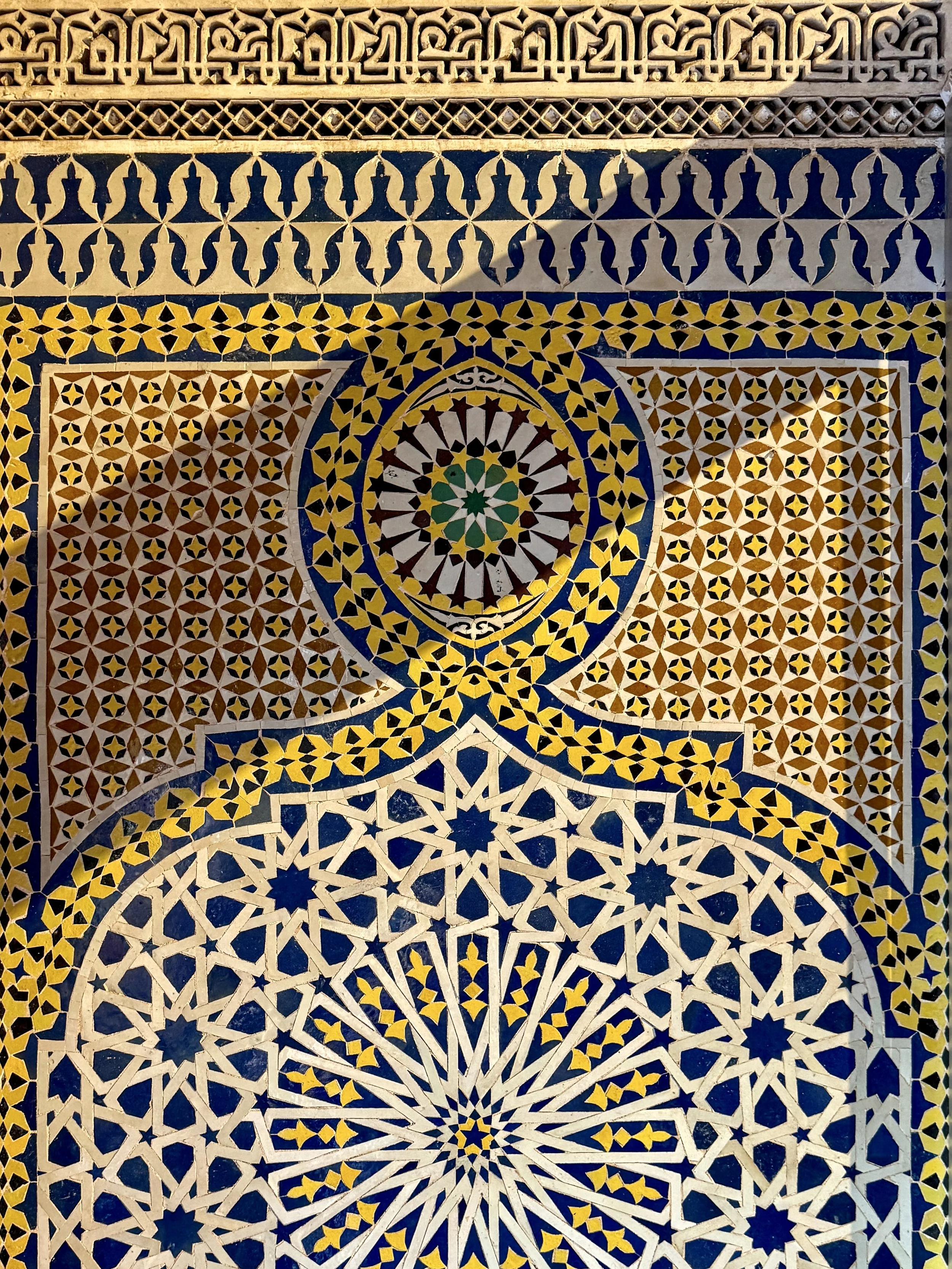
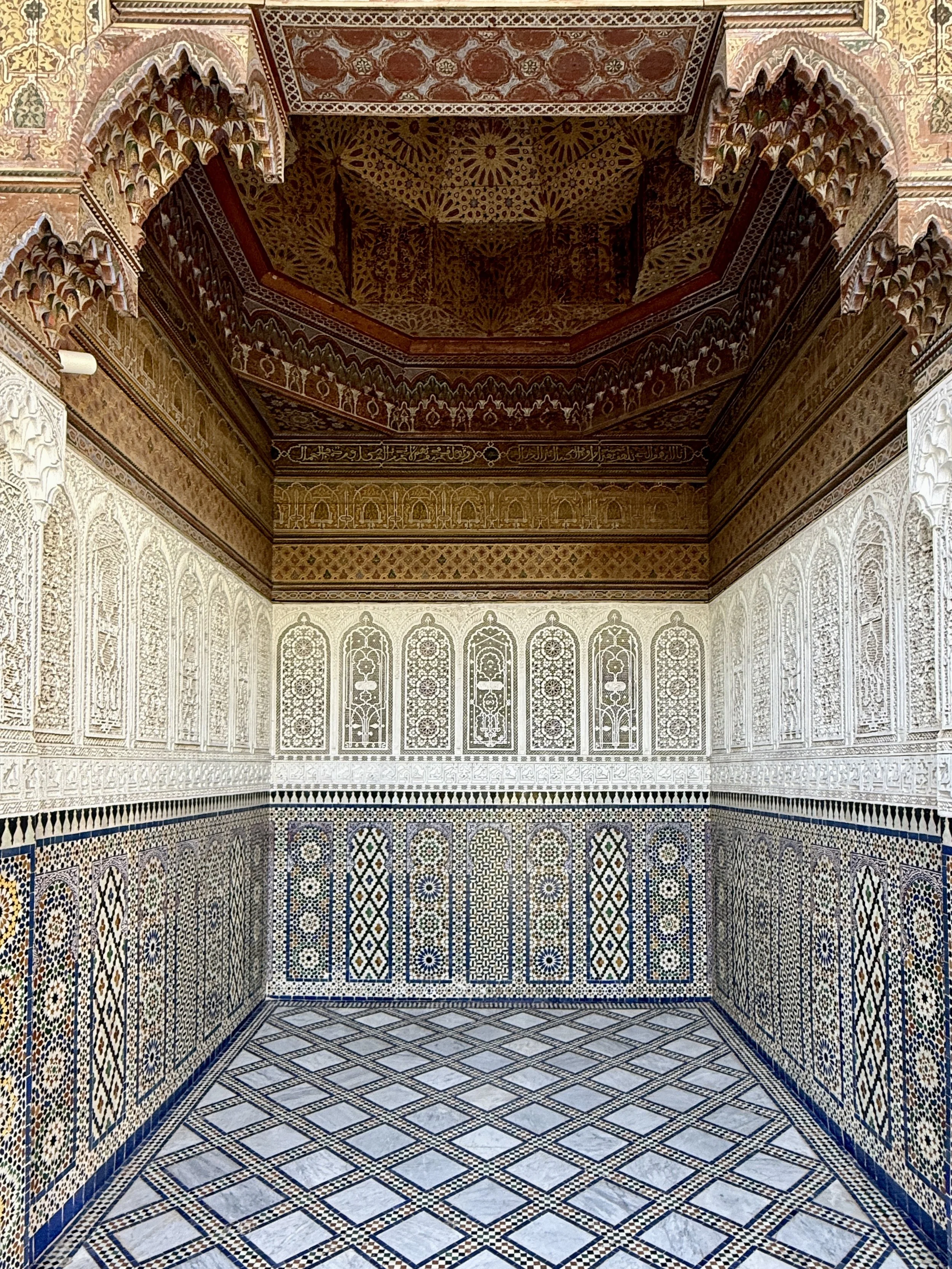
And the craftsmanship here is genuinely staggering. The zellige tilework was assembled by hand, piece by piece. The carved stucco contains Arabic calligraphy and religious inscriptions woven into floral and geometric patterns. Massive cedar beams from the Atlas Mountains were transformed into intricately carved ceilings that somehow still look delicate centuries later.

The madrasa continued operating as a school until 1960 before eventually closing and later undergoing restoration. Today, instead of students memorizing scripture by oil lamp, the building is filled with tourists whispering “oh my God” while trying not to accidentally walk into someone’s selfie shoot.

Tourists mill about the courtyard of Ben Youssef Madrasa in Marrakech

The Courtyard: The Big Reveal

There’s a very specific moment that happens when people enter the central courtyard of Ben Youssef Madrasa.

They stop.

Not politely. Abruptly. Like their brains need a second to process what they’re looking at.

The courtyard is the heart of the madrasa and the space most people picture when they think of Ben Youssef: the reflecting pool stretching down the center, the carved cedar balconies overhead, the walls wrapped in geometric tilework so intricate it barely seems possible that human hands made it. Every surface appears obsessed with detail. Even the empty spaces feel designed.

And somehow it never quite becomes visual overload.

Part of that comes down to symmetry. Islamic architecture often uses repeating geometric patterns to create a sense of balance and harmony, and Ben Youssef Madrasa leans into that philosophy hard. Your eyes keep finding echoes of shapes and lines repeating across the courtyard — arches mirroring arches, tiles reflecting tiles, carvings folding endlessly into themselves. It creates this strange feeling where the space feels both calming and hypnotic at the same time.

Tourists visit and take photos in the courtyard of Ben Youssef Madrasa in Marrakech

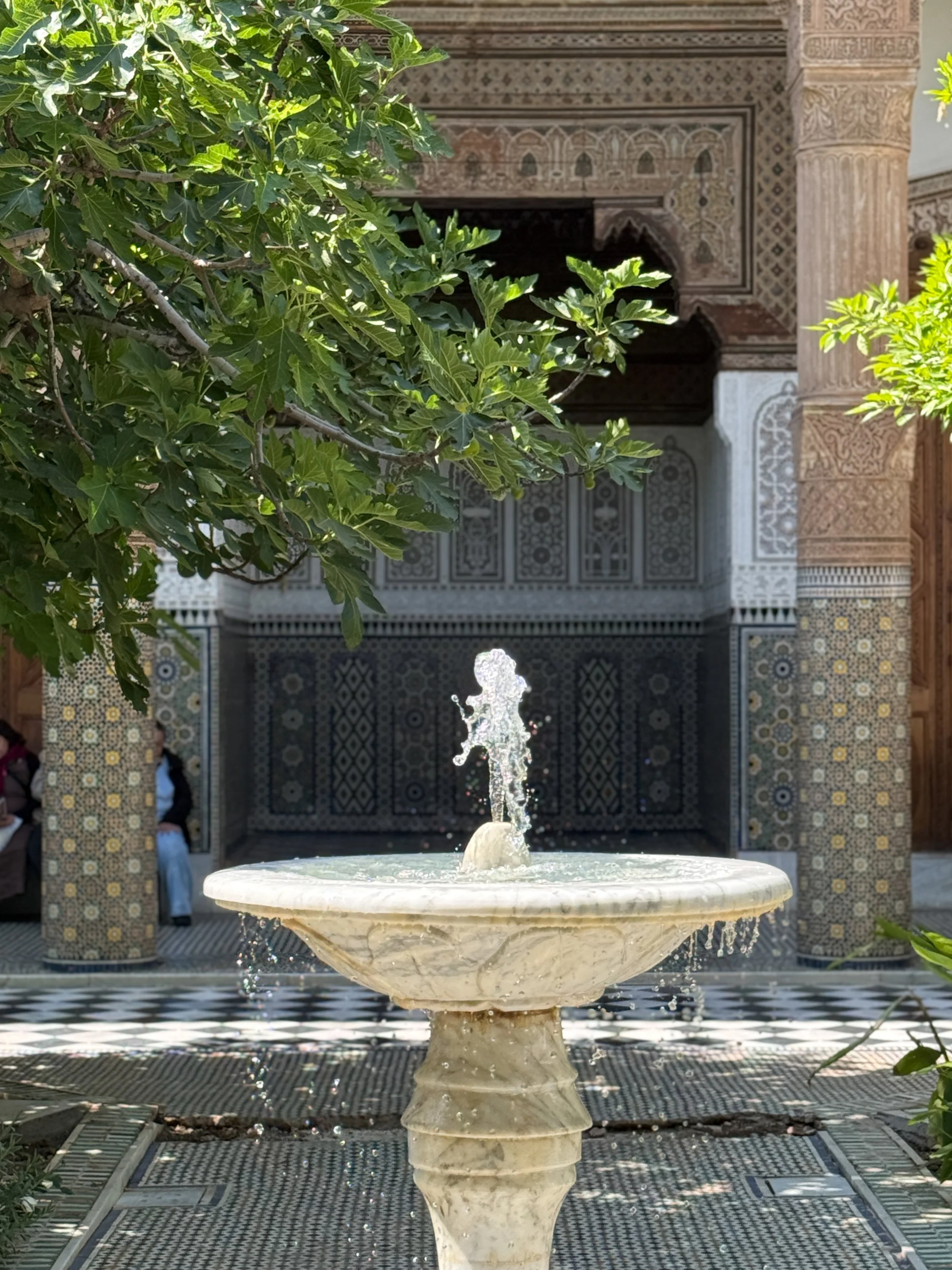
Then there’s the reflecting pool, which anchors the entire courtyard. Water plays an important symbolic role in Islamic architecture, representing purity and paradise while also helping cool the surrounding space. Here, the pool acts almost like a visual pause button amid all the detail. Of course, today it also serves another important function: becoming the exact spot where every tourist wants their photo taken.

At one point during our visit, there was an unofficial queue forming for people to stand dramatically beside the water while their companions directed increasingly elaborate poses. Gazing up thoughtfully. Turning slowly toward the camera. Looking over their shoulder. Touching the brim of their sun hat. It’s a terrible trend, and you’ll see it all over Marrakech. 

Meanwhile, the actual architecture remains the real star of the show.

It’s the kind of place where you keep spotting details long after you think you’ve fully taken it in.

And honestly, the best thing you can do here is occasionally stop trying to photograph every inch of it and just stand still for a minute. The courtyard was designed to inspire awe long before anyone invented Instagram. Sixteenth-century students probably walked through here every day and still found themselves impressed by the craftsmanship.

Though thankfully, they were less likely to block an entire archway for a slow-motion video.

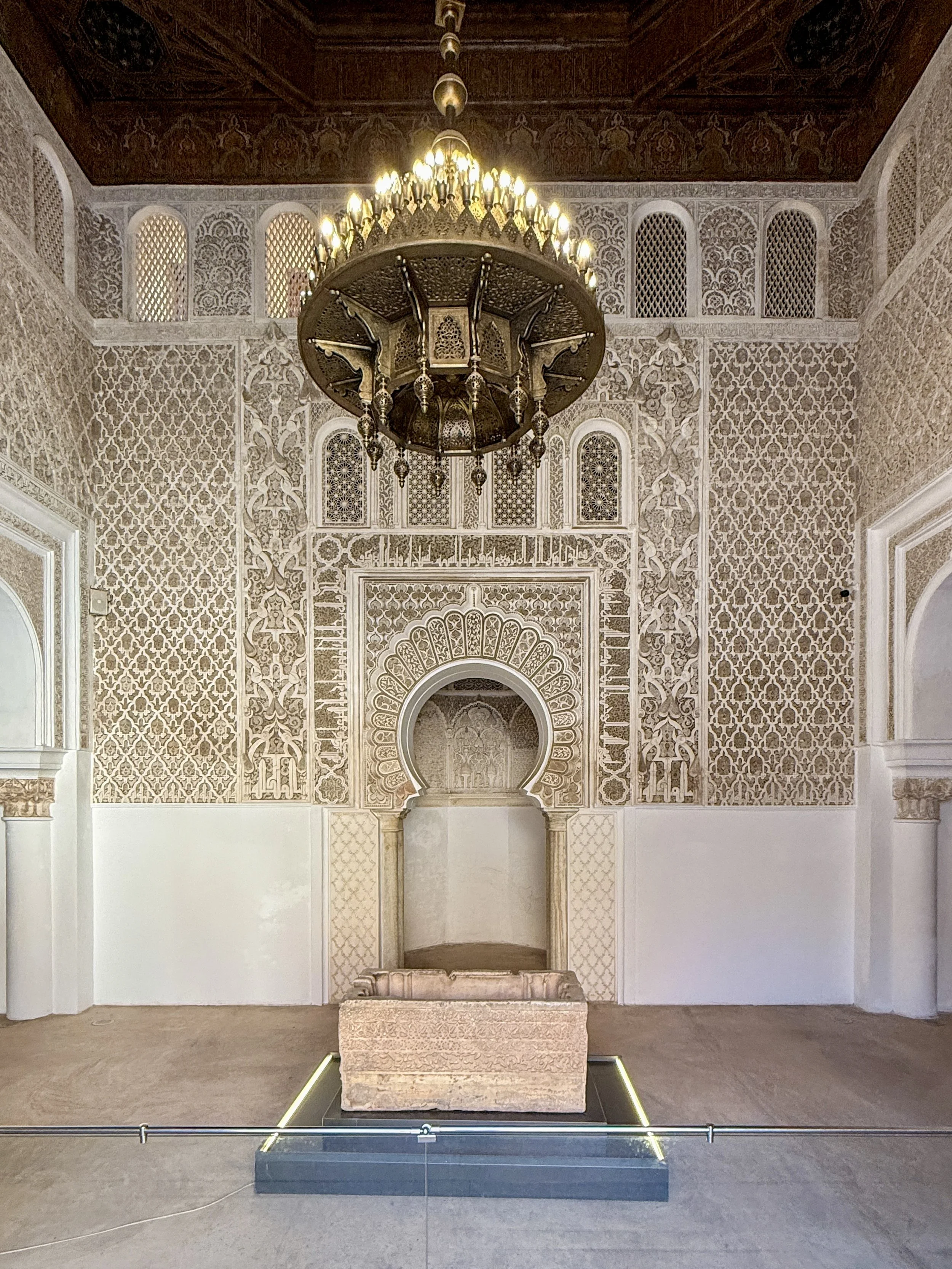
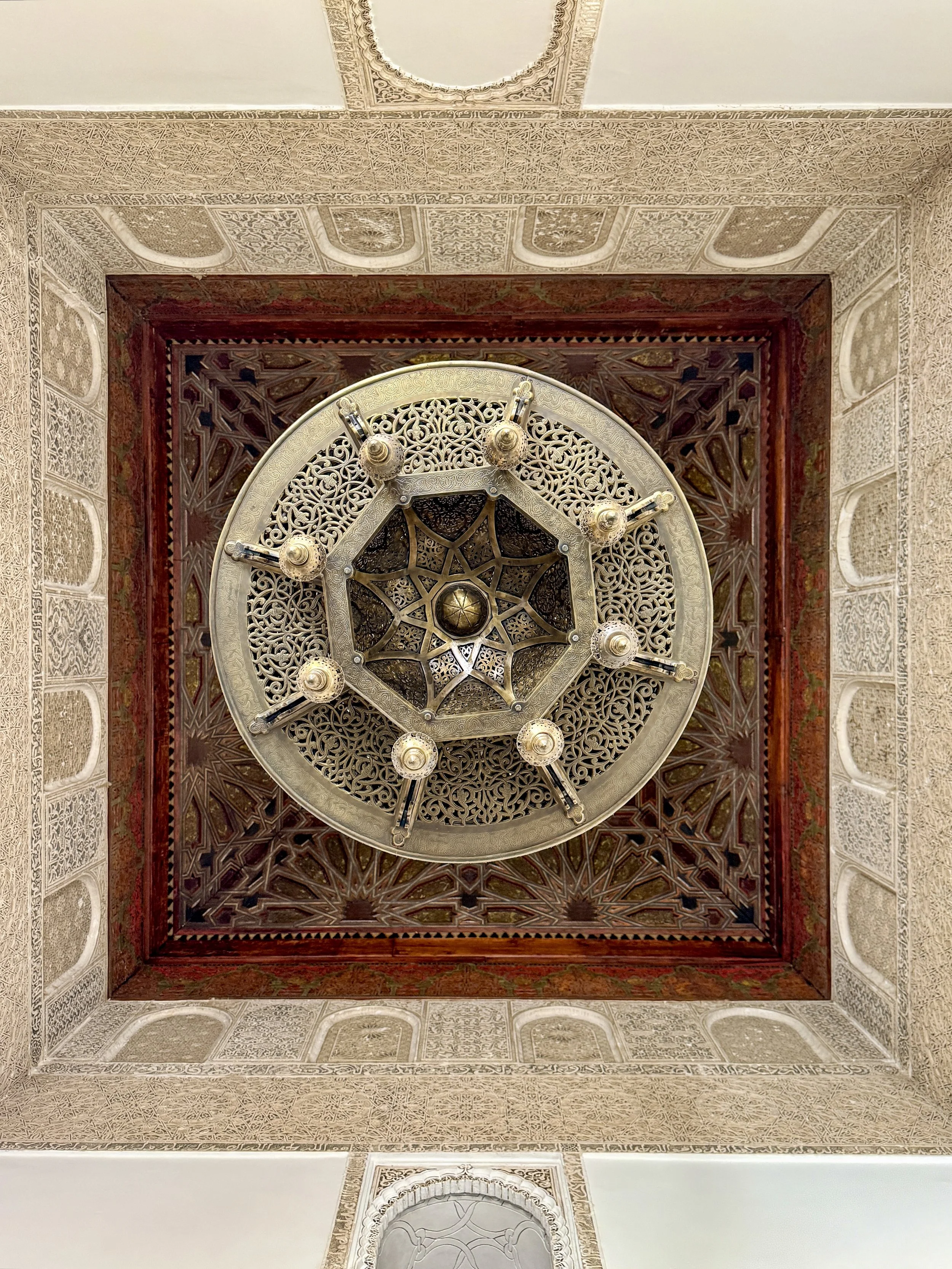
A chandelier hangs above the ablution basin in the Prayer Hall of Ben Youssef Madrasa

The Prayer Hall and Ablution Basin

Off the main courtyard is the prayer hall, though “hall” may make it sound grander than the visitor experience actually feels. You can look into it, but you can’t fully wander through the space, so it reads more like a richly decorated room just beyond the courtyard rather than a major stop on its own.

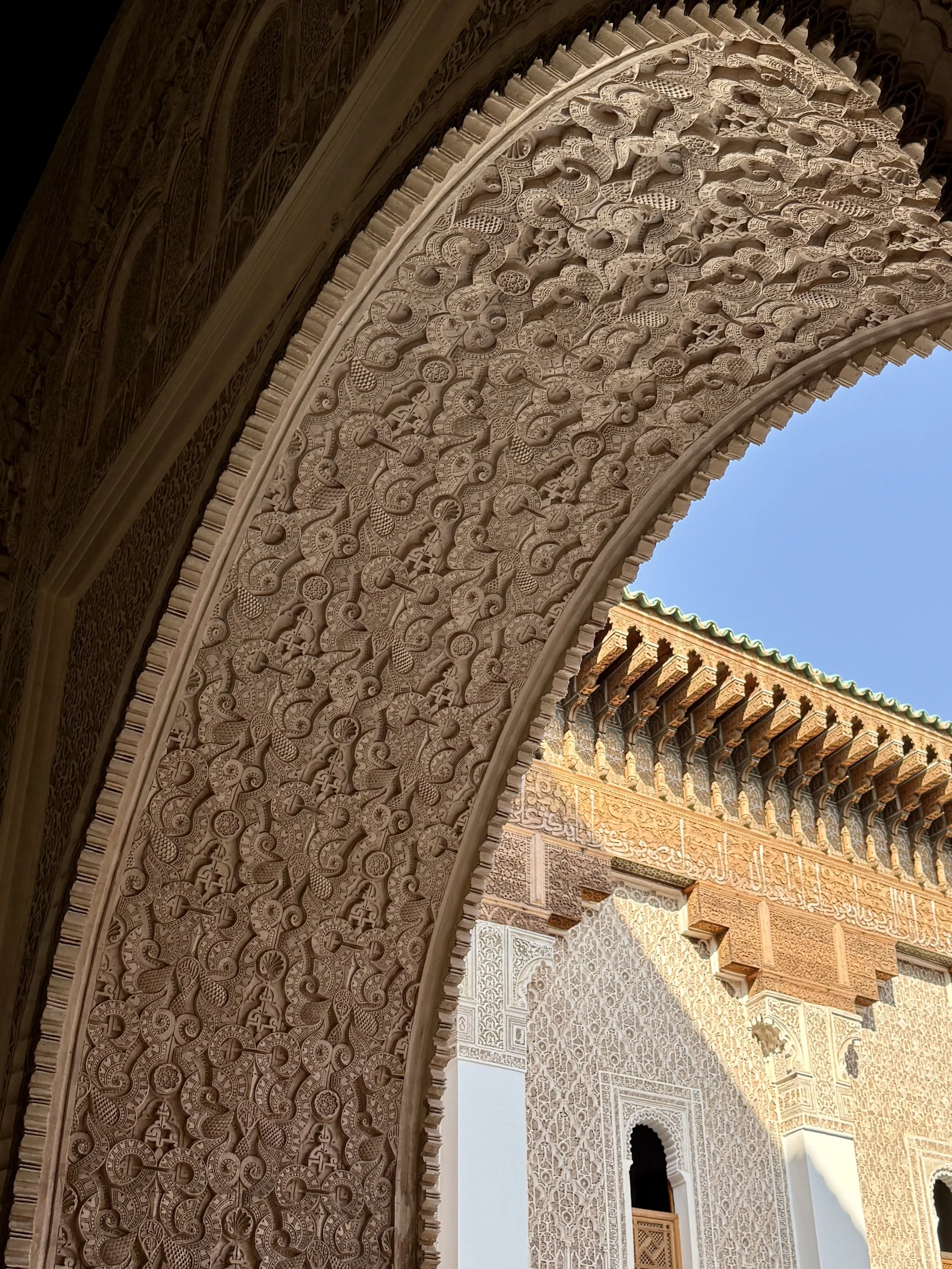
The entrance is framed by two finely decorated marble panels, while the arch leading into the entrance bay is embellished with palm leaves and pineapples. The mihrab, which indicates the direction of Mecca, has a pentagonal plan and an arched frame supported by four marble columns, with palm leaves and intertwining floral motifs worked into the design.

Carved arch  in the prayer hall looking into the courtyard of Ben Youssef Madrasa

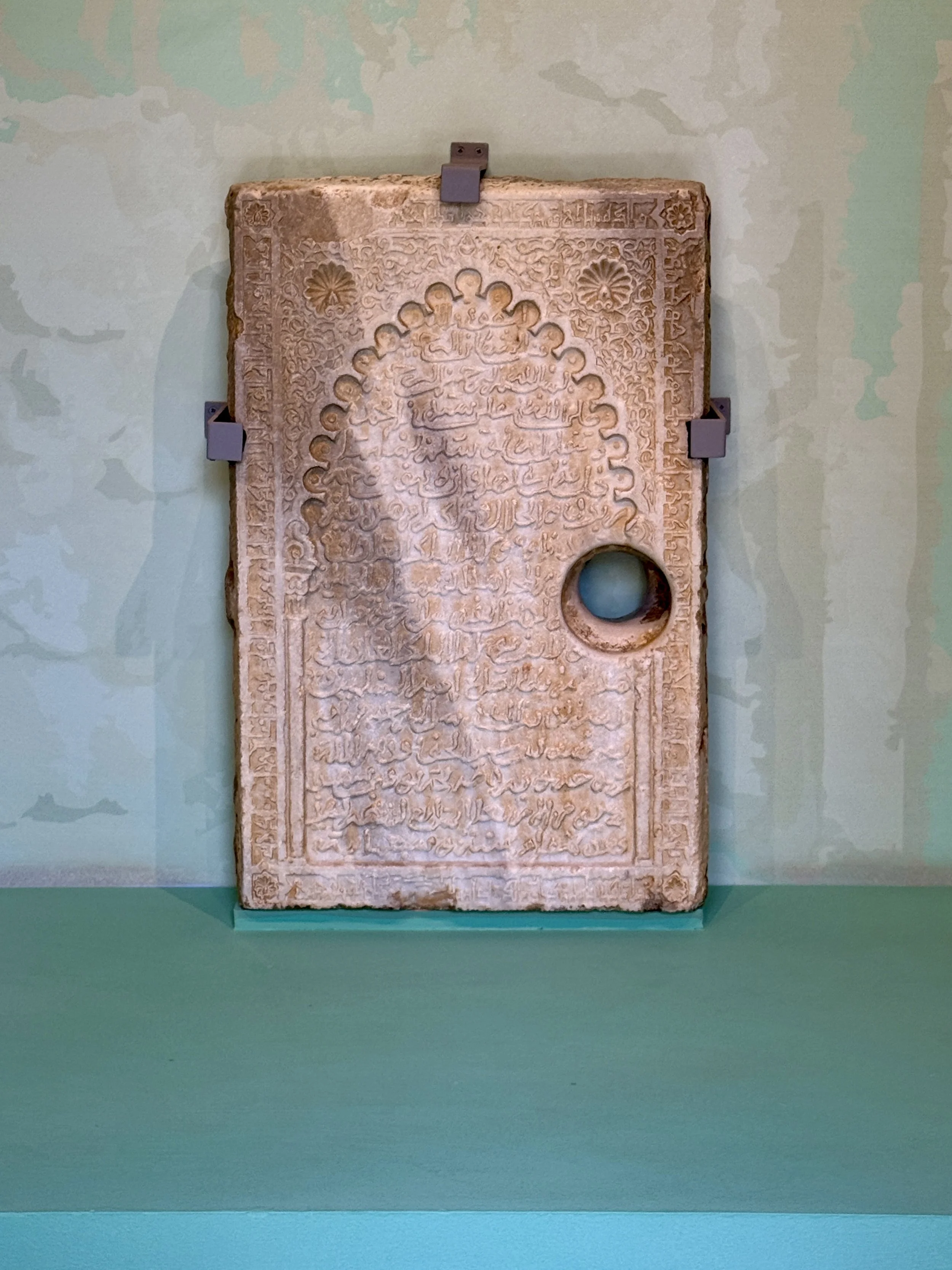
Dominating the space is the ablution basin, which once served as a fountain for ritual washing before prayer. Its faces carry a partly legible Kufic inscription naming its patron, Abd al-Malik, son of the powerful Andalusian vizier Al-Mansur. The basin was imported from Andalusia by the Almoravid sovereign Youssef Ben Tachfine — a reminder that medieval Marrakech and Islamic Spain were deeply interconnected worlds, with artistic styles, craftsmen and ideas moving back and forth across the Strait of Gibraltar. Visitors who have explored places like the Alhambra in Granada or the Mezquita in Córdoba will likely recognize some of the same geometric motifs, carved stucco work and architectural sensibilities here.

The basin itself is decorated with floral and geometric motifs, along with carefully depicted animals including birds and fish. That detail is especially interesting because people often assume Islamic art avoids animal imagery entirely. 

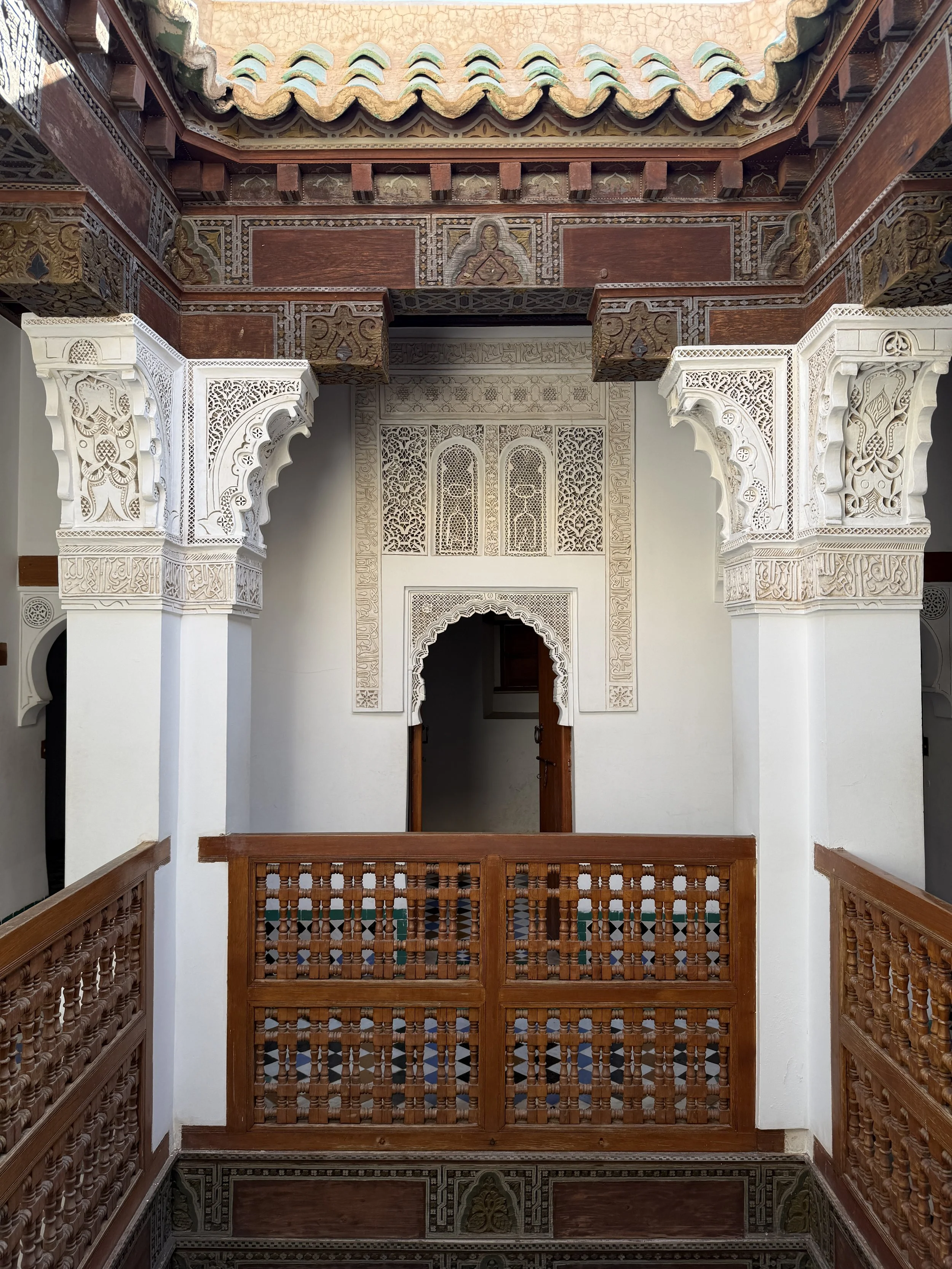
Wooden balconies in the hallways of the upstairs dormitories at Ben Youssef Madrasa

Upstairs in the Dormitories

A surprising number of visitors to Ben Youssef Madrasa never spend much time upstairs. I’m not even sure we ventured up there on our first visit more than a decade ago. 

Most people walk through the courtyard, take approximately 400 photos in front of the reflecting pool, glance into the prayer hall and move on. Which is a shame, because the upper level changes your understanding of the building.

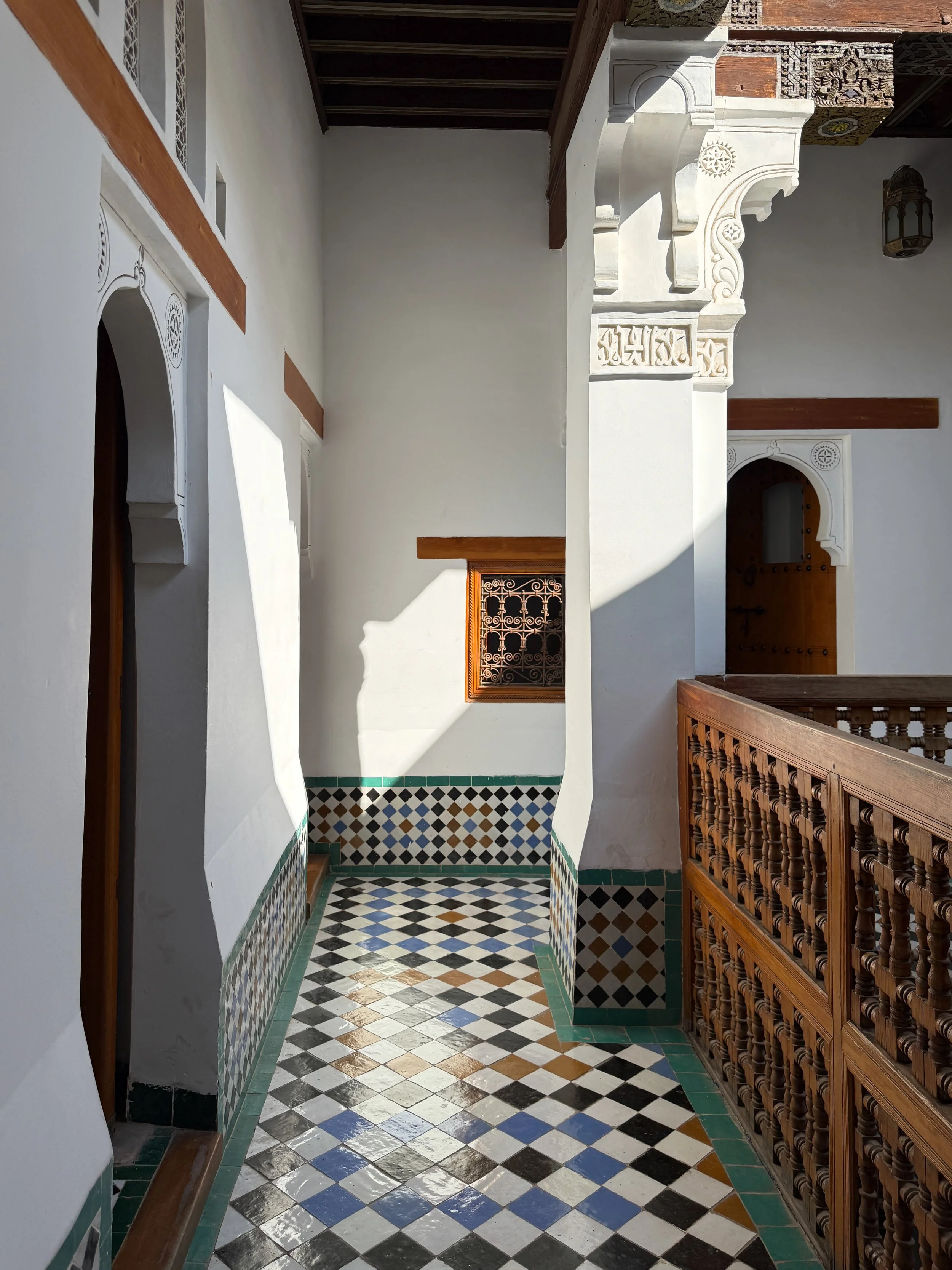
The staircase leads into a maze of narrow corridors lined with tiny student rooms, and the contrast is immediate. Downstairs feels grand and ceremonial. Upstairs feels practical. Human. A bit severe.

Some of the dormitory cells are shockingly small — little more than sparse chambers with enough room for about six young boys to get packed in like sardines to sleep and study. After the extravagance of the courtyard below, the simplicity is almost startling. These students lived surrounded by extraordinary beauty without actually living luxuriously themselves.

Upstairs hallway at Ben Youssef Madrasa in Marrakech, Morocco

The architecture downstairs wasn’t designed to pamper students. It reflected larger ideas about knowledge, faith, harmony and discipline. Meanwhile, the dormitories emphasized modesty and focus. You can easily imagine young scholars sitting cross-legged in these tiny rooms late into the evening, memorizing religious texts by lamplight while the sounds of the courtyard drifted upward through the open galleries.

The upstairs level also gives you some of the best views in the building.

From the balconies, you can look down into the courtyard and see the geometry of the madrasa as a complete composition. The reflecting pool stretches like a spine through the center while visitors below move slowly through the space like pieces on a game board. 

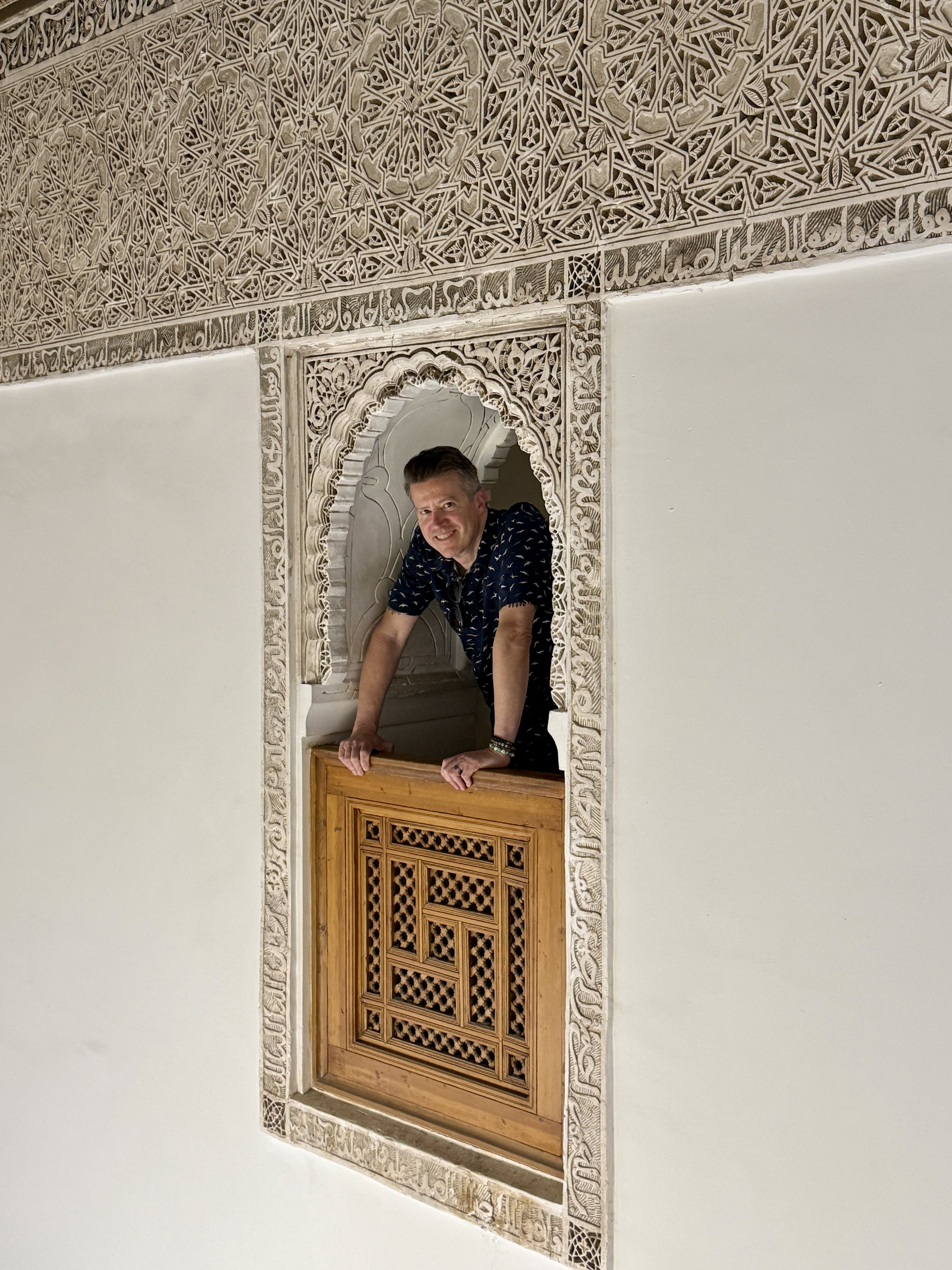
A man leans on a wood balcony in a carved arched interior window upstairs at Ben Youssef Madrasa

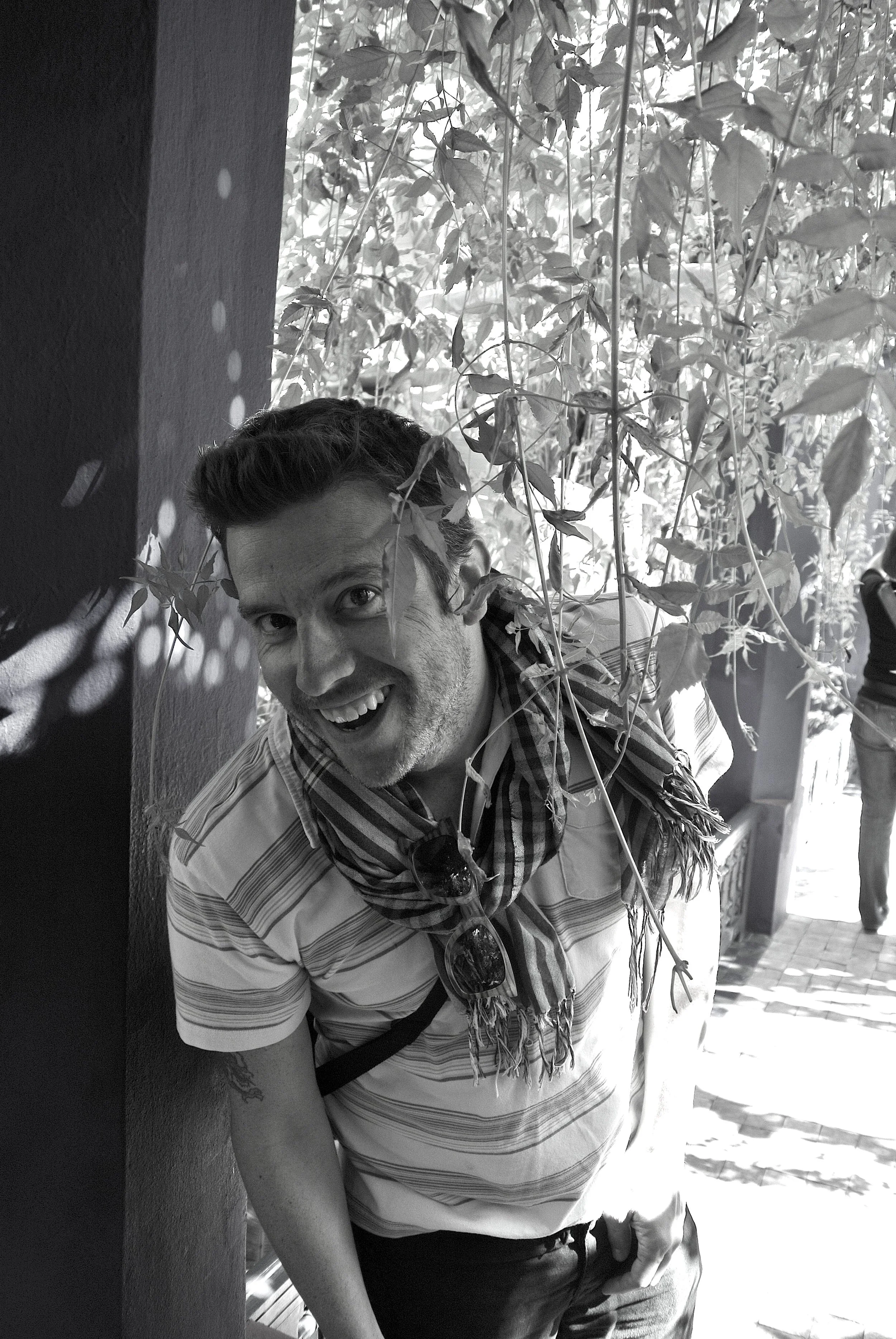
And I hate to say this since it could draw more influencer wannabes upstairs, but there are some nice photo opps up here. Station a photographer in one arched window while the subject poses on the balcony across the way. 

For now, the upper floor feels calmer overall. Fewer people linger there for long, which means you occasionally get rare moments where the building becomes quiet. It’s upstairs that Ben Youssef Madrasa stops feeling merely impressive and starts feeling inhabited.

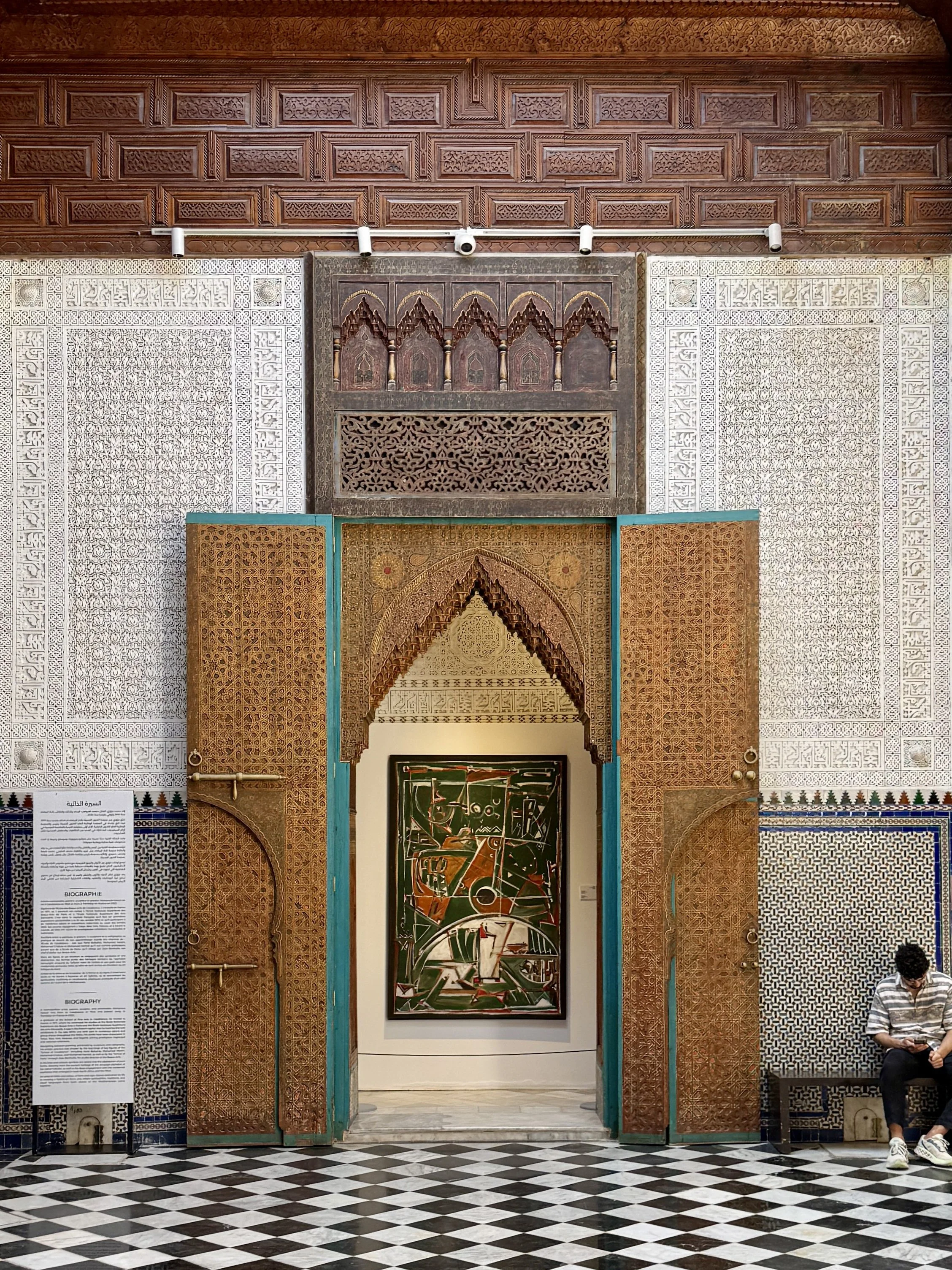
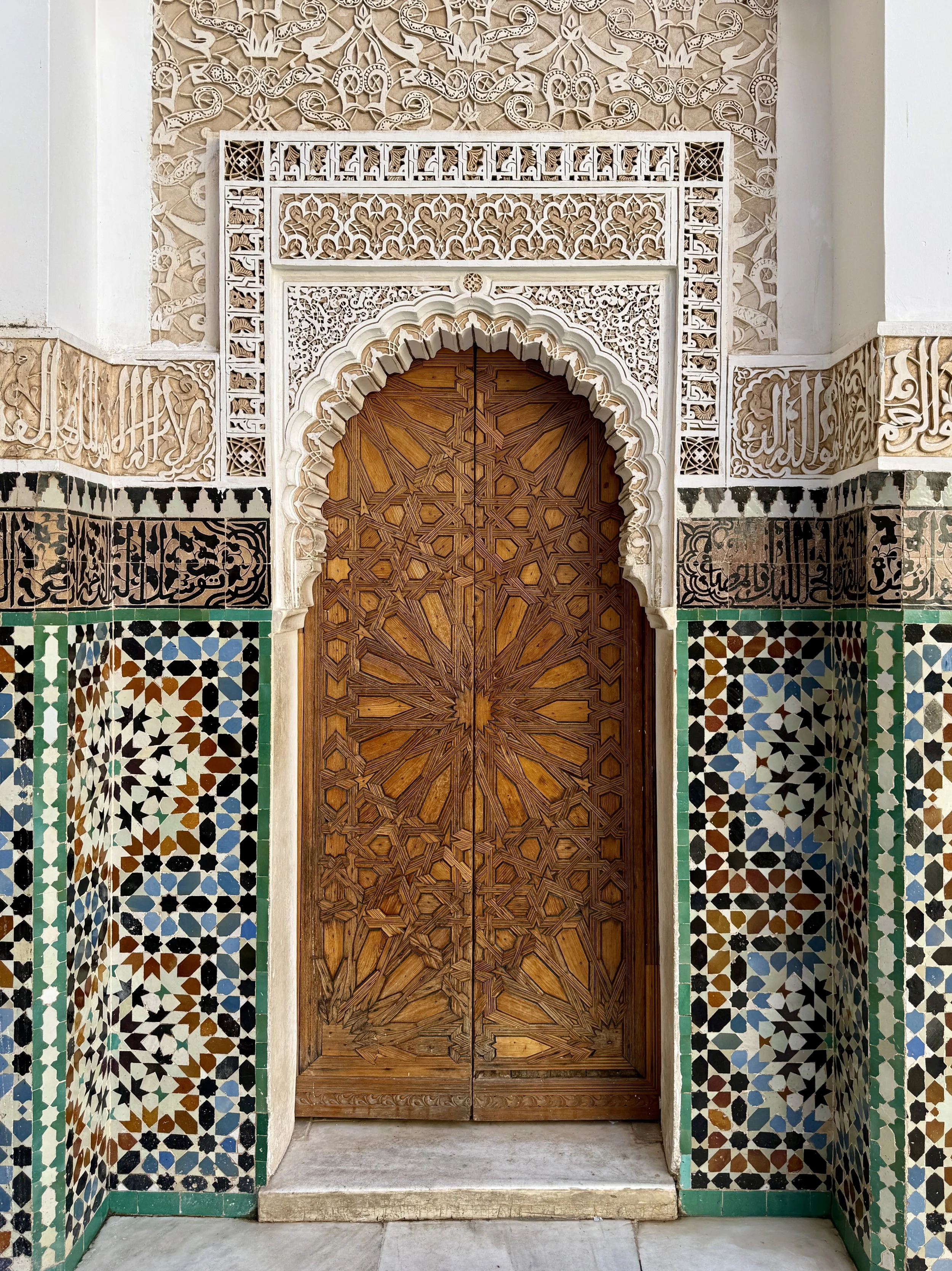
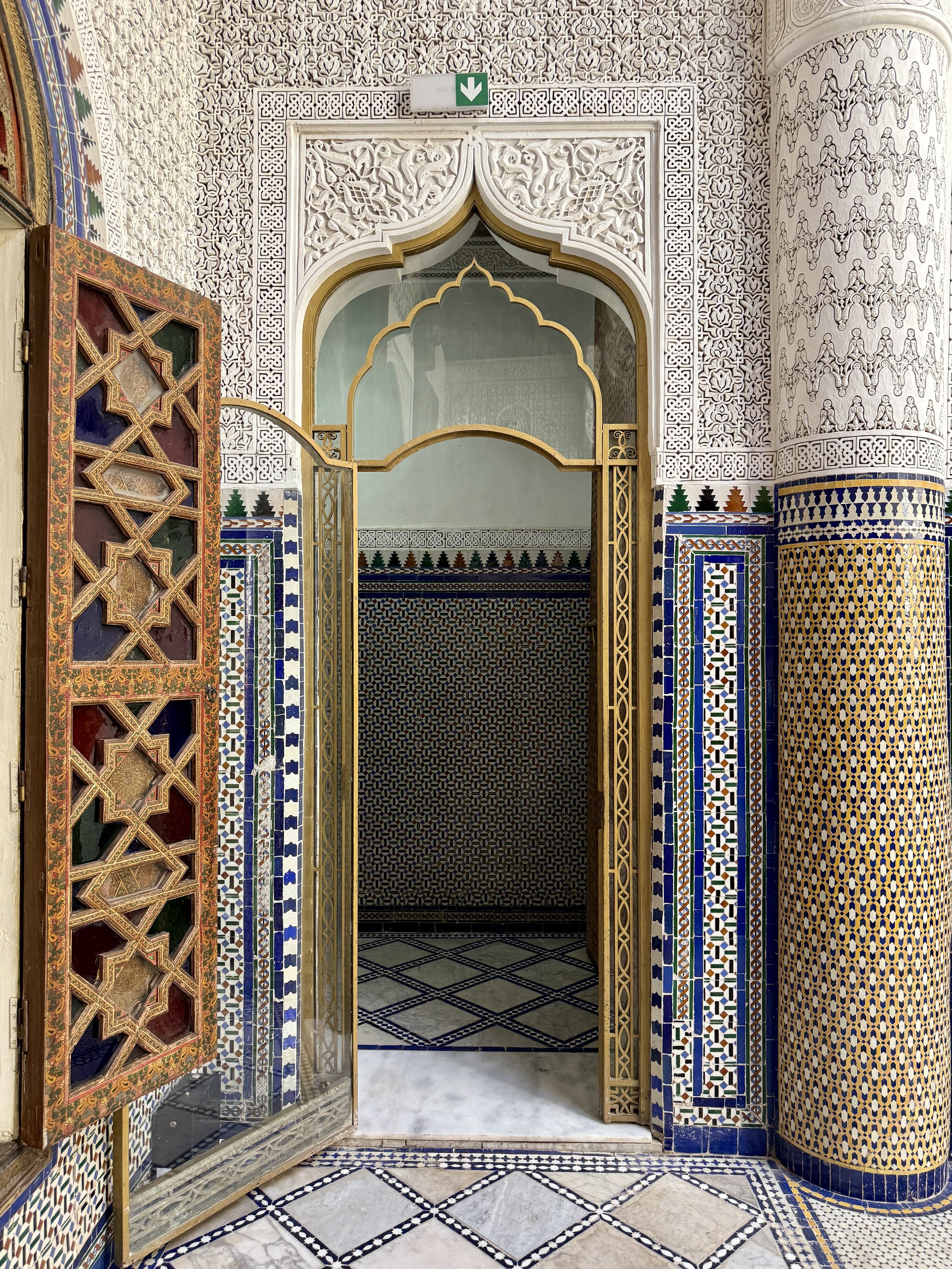
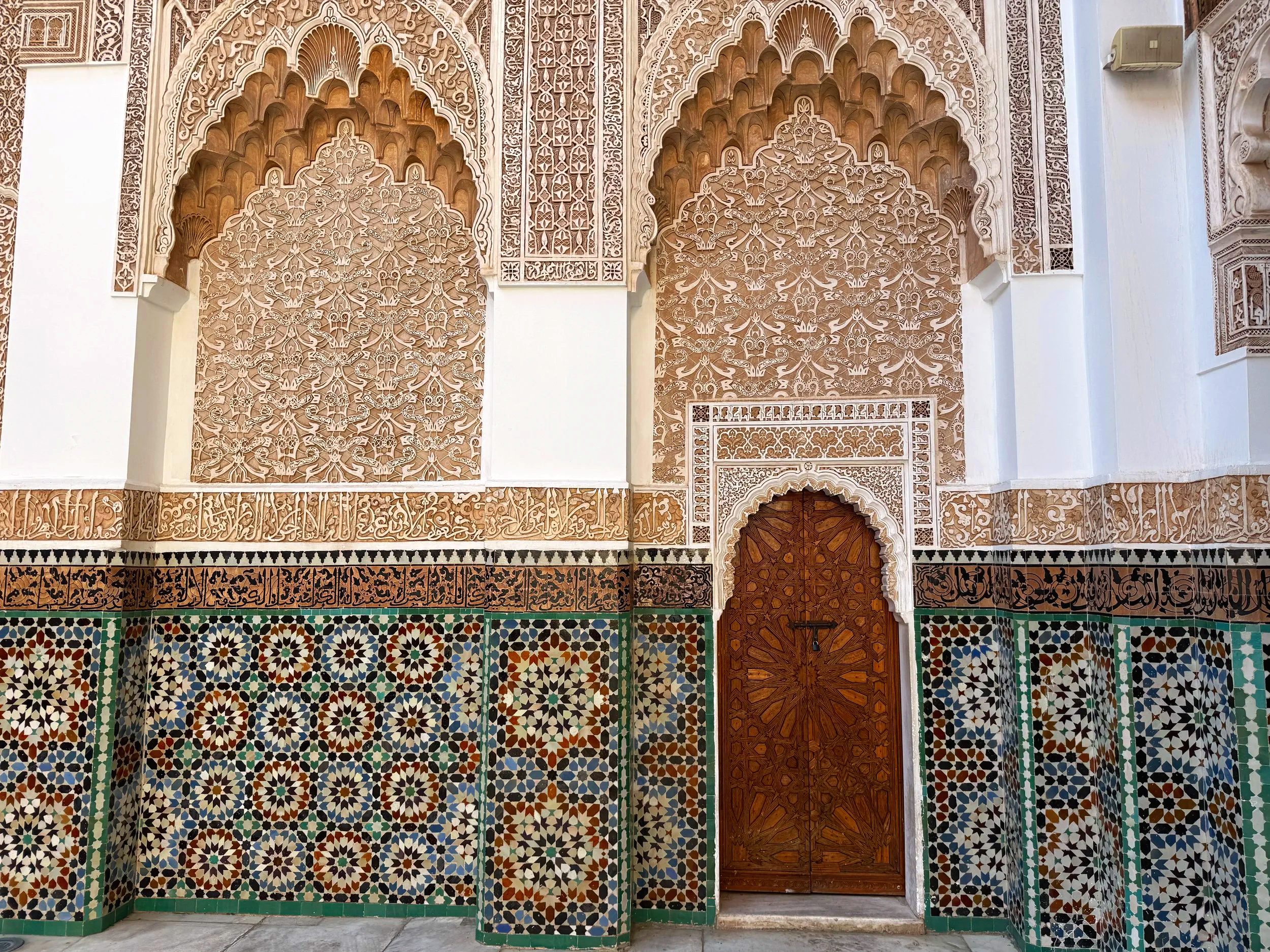
Carved Arabic calligraphy and patterns in plasterwork, a wooden door and zellij tiles at Ben Youssef Madrasa

Fascinating Details Most Visitors Miss at Ben Youssef Madrasa

It’s easy to walk through Ben Youssef Madrasa in a kind of architectural daze. But beneath the obvious beauty are dozens of small details that make the madrasa even more fascinating once you slow down enough to notice them.

The student rooms were intentionally austere. 

The contrast between the lavish courtyard and the tiny dormitory cells upstairs wasn’t accidental. Islamic madrasas often emphasized communal beauty and spiritual reflection over personal comfort. Students lived simply even while surrounded by extraordinary craftsmanship.

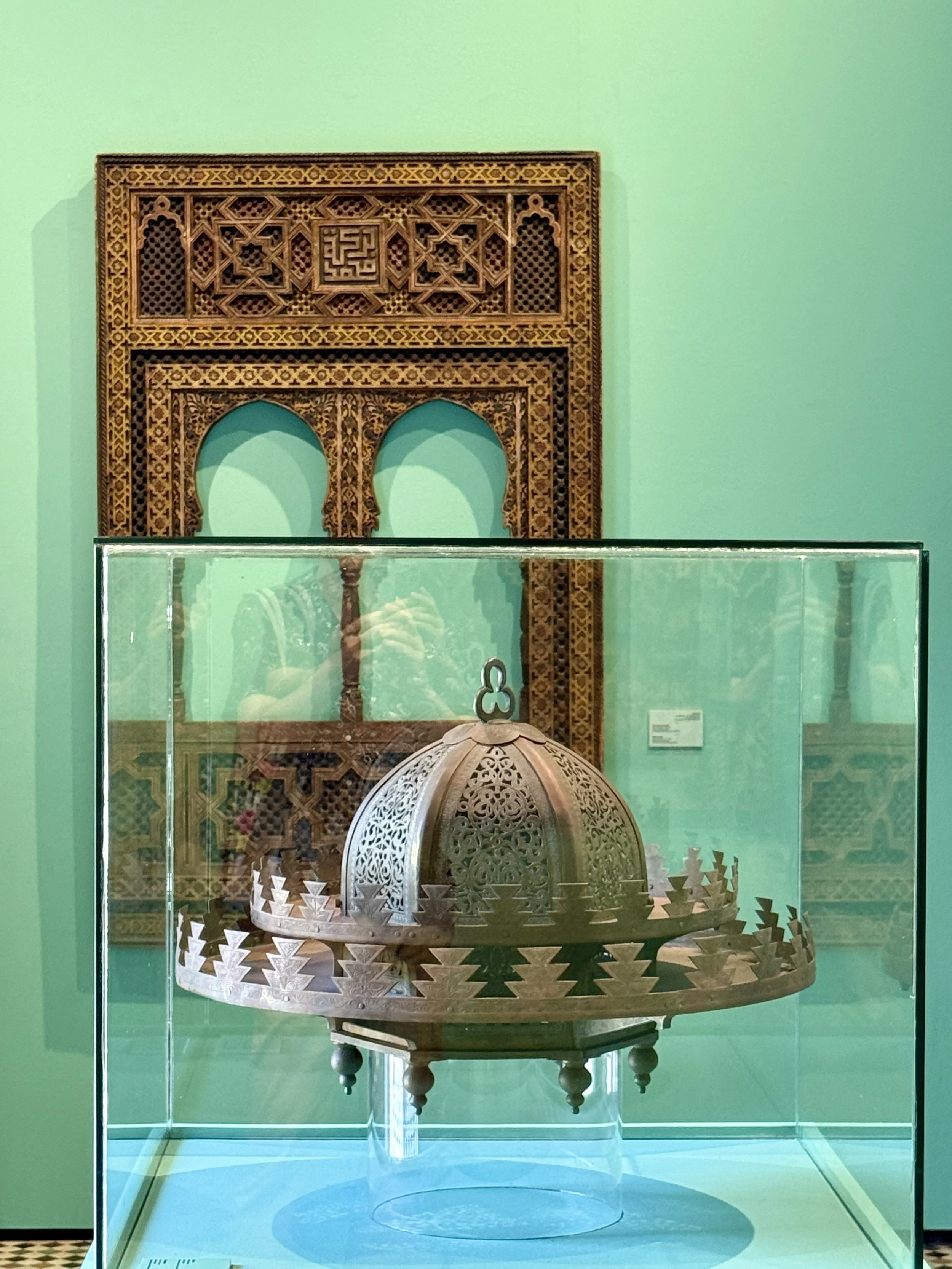
A light fixture at the entrance to Ben Youssef Madrasa in Marrkech

The cedarwood ceilings are functional, not just decorative. 

Many of the carved cedar elements came from Atlas Mountain cedar, prized not only for its beauty but also because cedar naturally resists insects and rot. Which means the ceilings weren’t just stunning — they were practical engineering.

The tilework is assembled piece by piece. 

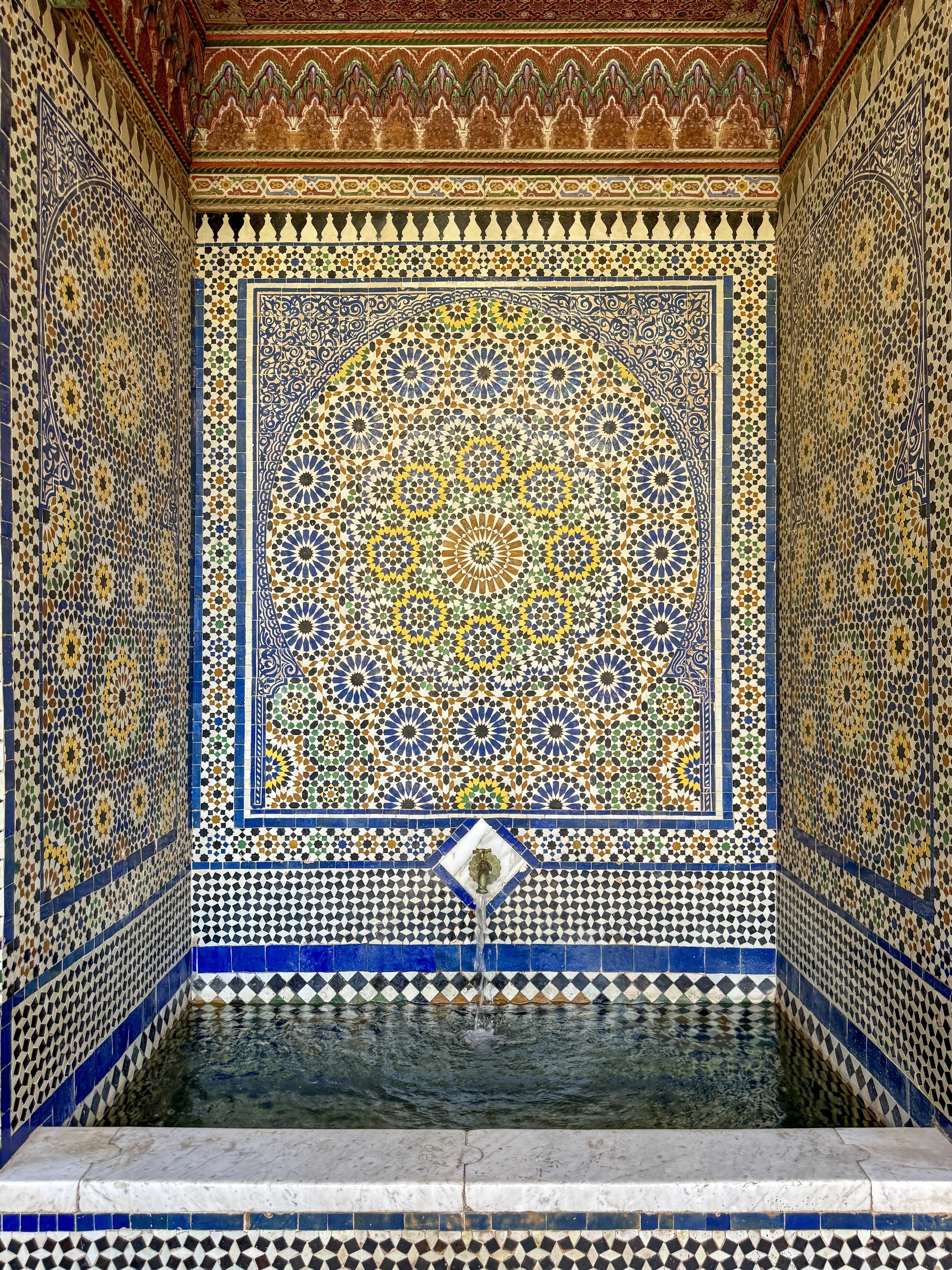
The geometric mosaics, known as zellige (or zellij), are not painted patterns or prefabricated panels. Artisans individually cut and placed tiny pieces of glazed tile by hand into elaborate mathematical designs. Looking closely at the edges makes the craftsmanship feel even more impressive.

The reflecting pool was never meant for swimming. 

This may sound obvious, but judging by modern tourist behavior worldwide, it apparently needs to be stated occasionally. The water feature was symbolic and architectural, helping reflect light, cool the courtyard and create a sense of harmony.

Arabic calligraphy and carved Islamic patterns in the beautiful Ben Youssef Madrasa

The calligraphy is saying something. 

Many visitors admire the carved Arabic inscriptions without realizing they contain Qur’anic verses, blessings and religious phrases woven directly into the decoration. The building itself is essentially layered with sacred text.

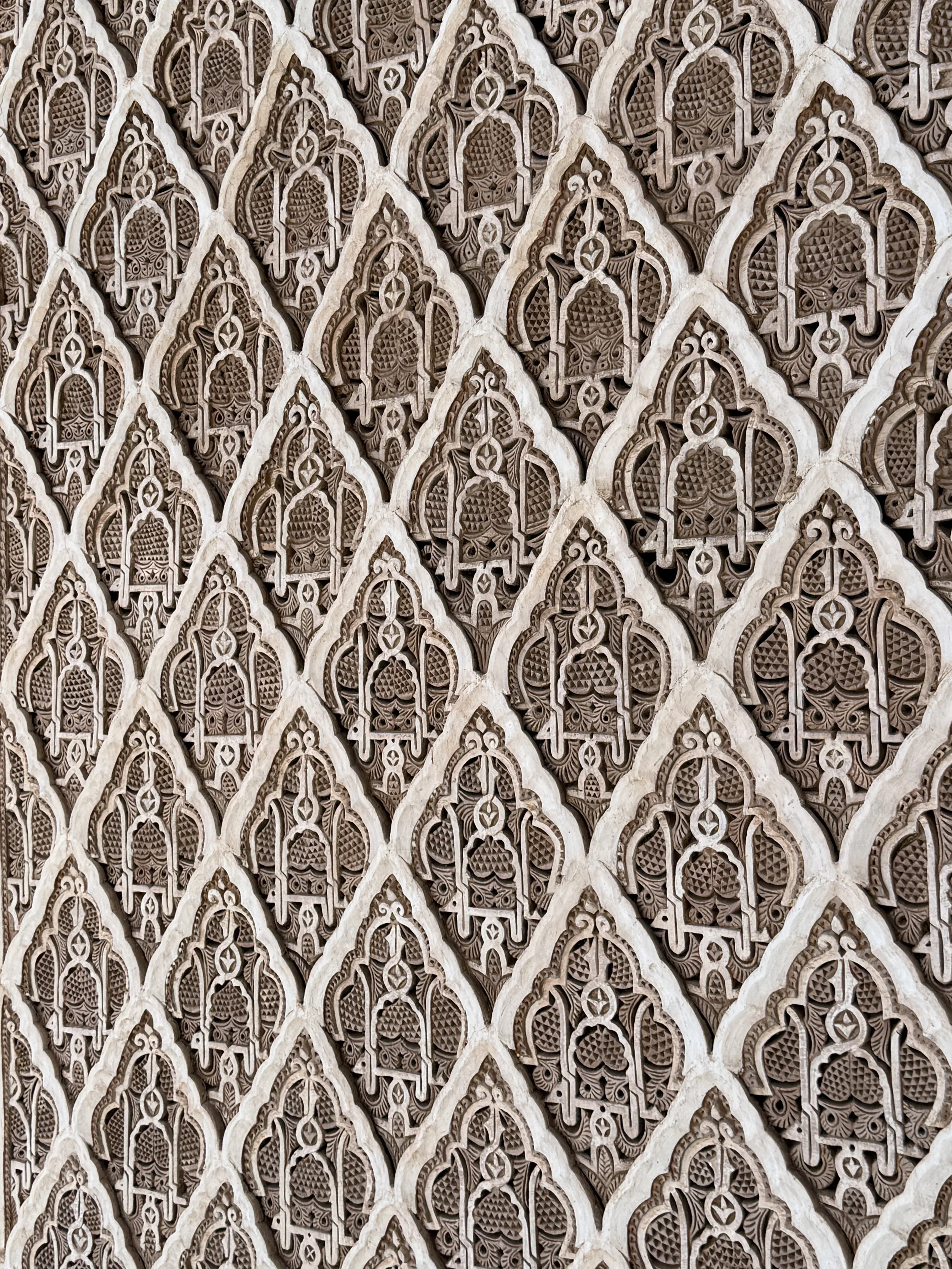
Amazingly detailed repeating patterns on the plaster walls of Ben Youssef Madrasa

The architecture manipulates your experience on purpose. 

The medina streets outside are noisy and enclosed. Then the madrasa suddenly opens into a bright symmetrical courtyard. That dramatic reveal is part of the experience. The building was designed to create emotional impact from the moment you entered.

It remained an active school until surprisingly recently. 

Ben Youssef Madrasa only stopped functioning as a college in 1960. Which means this isn’t some distant medieval relic disconnected from modern history. People were still studying here within living memory.

Upstairs is quieter because many tourists skip it. 

The dormitories tend to thin out the crowds significantly. If you want a calmer experience, go upstairs and linger longer than everyone else.

The acoustics are incredible. 

Even small sounds carry through the courtyard and hallways in unexpected ways. Footsteps echo softly across the tile. Conversations drift upward into the galleries. 

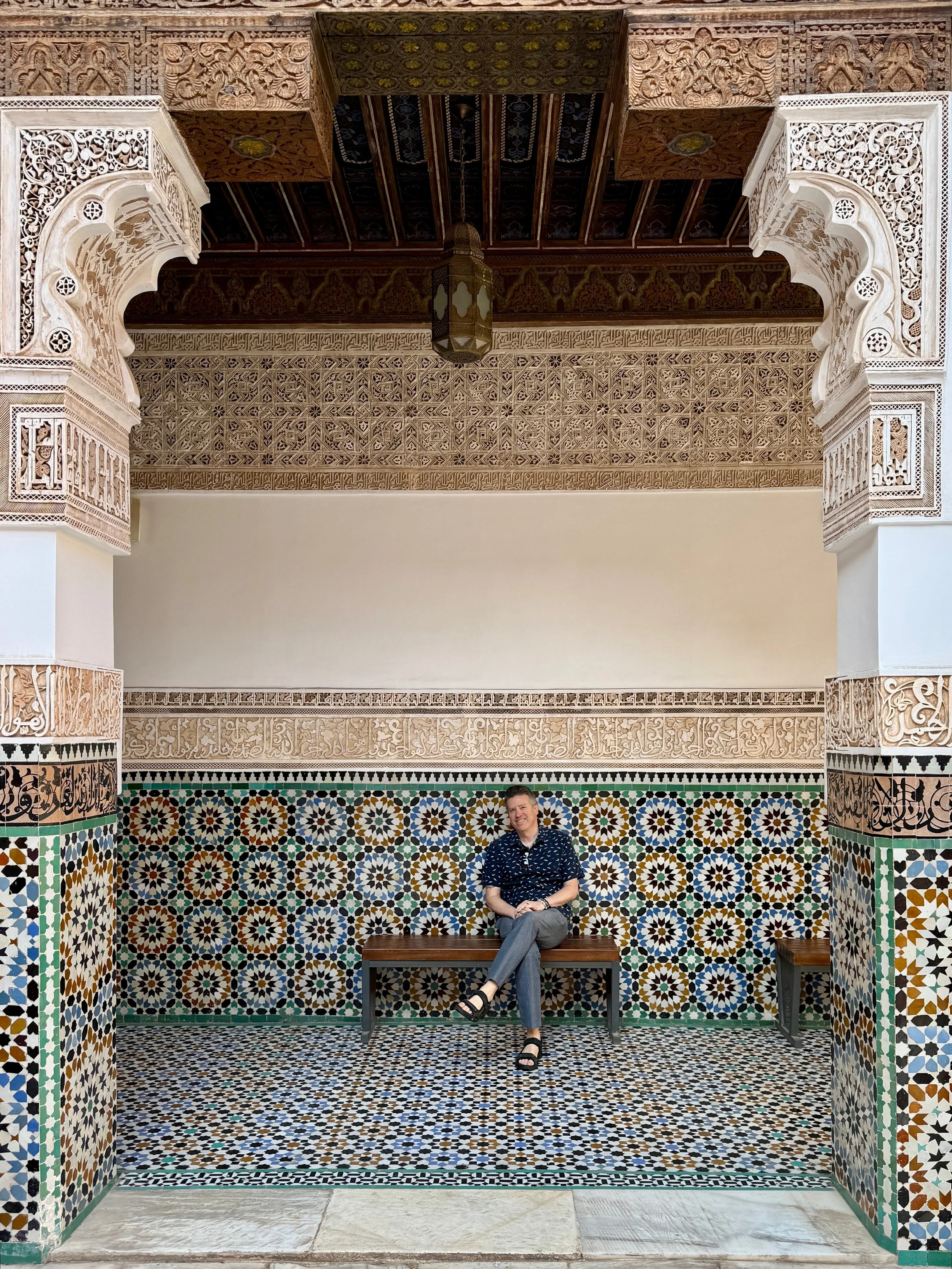
A man sits on a bench among colorful zellij tiles at Ben Youssef Madrasa,

Visitor Tips for Ben Youssef Madrasa

Go early. 

This is one everyone’s must-see list. 

By mid-morning, Ben Youssef Madrasa can become extremely crowded, especially in the central courtyard. Arriving earlier gives you softer light, slightly cooler temperatures and at least a fighting chance of seeing the reflecting pool without six simultaneous photoshoots unfolding around it.

Keyword: slightly.

But maybe not right at opening. 

We haven’t tested this out, but I wonder if maybe it’s not actually wise to go right when these attractions open. Because inevitably there are other others with the same idea, and you guarantee you’re entering with a crowd. 

I’m wondering if maybe it would calm down even just a bit a half an hour or an hour after opening. But again, it’s just a theory.

Don’t just do the courtyard. 

Some of the best details are actually around the edges: carved doorways, quieter side chambers, shadow patterns in the hallways and the transitions between rooms.

The madrasa rewards wandering.

Go upstairs — seriously. 

A surprising number of people barely explore the dormitory level, which is unfortunate because it completely changes how the building feels. The upstairs corridors are quieter, more atmospheric and far more revealing about what daily life here might actually have been like.

Plus, the views overlooking the courtyard are fantastic.

Looking up at an opening in the roof with elaborately carved cedarwood at Ben Youssef Madrasa

Look up constantly. 

This is good advice for Marrakech in general. Duke is obsessed with Moroccan ceilings, and for good reason.

The walls get most of the attention, but some of the most astonishing craftsmanship is overhead. The cedar ceilings are unbelievable and easy to miss if you stay focused at eye level.

Your neck may eventually resent you for this advice.

Women run through a series of poses to capture that perfect social media shot at Ben Youssef Madrasa's courtyard

Be prepared for the influencer culture. 

You’re going to encounter people filming elaborate content. It’s sadly unavoidable.

Some visitors behave as though they’ve rented the entire madrasa for a private campaign shoot. You can roll your eyes, but getting frustrated will only ruin your own experience.

Pair the madrasa with other nearby sites. 

Ben Youssef Madrasa works especially well alongside other attractions in the vicinity:

  • Dar El Bacha Museum of Confluences

  • Le Jardin Secret

  • Rahba Kedima spice square

  • The surrounding souks

Together they create a fuller picture of Marrakech beyond just checking famous landmarks off a list. –Wally

Riad Alwachma, Marrakech, Morocco

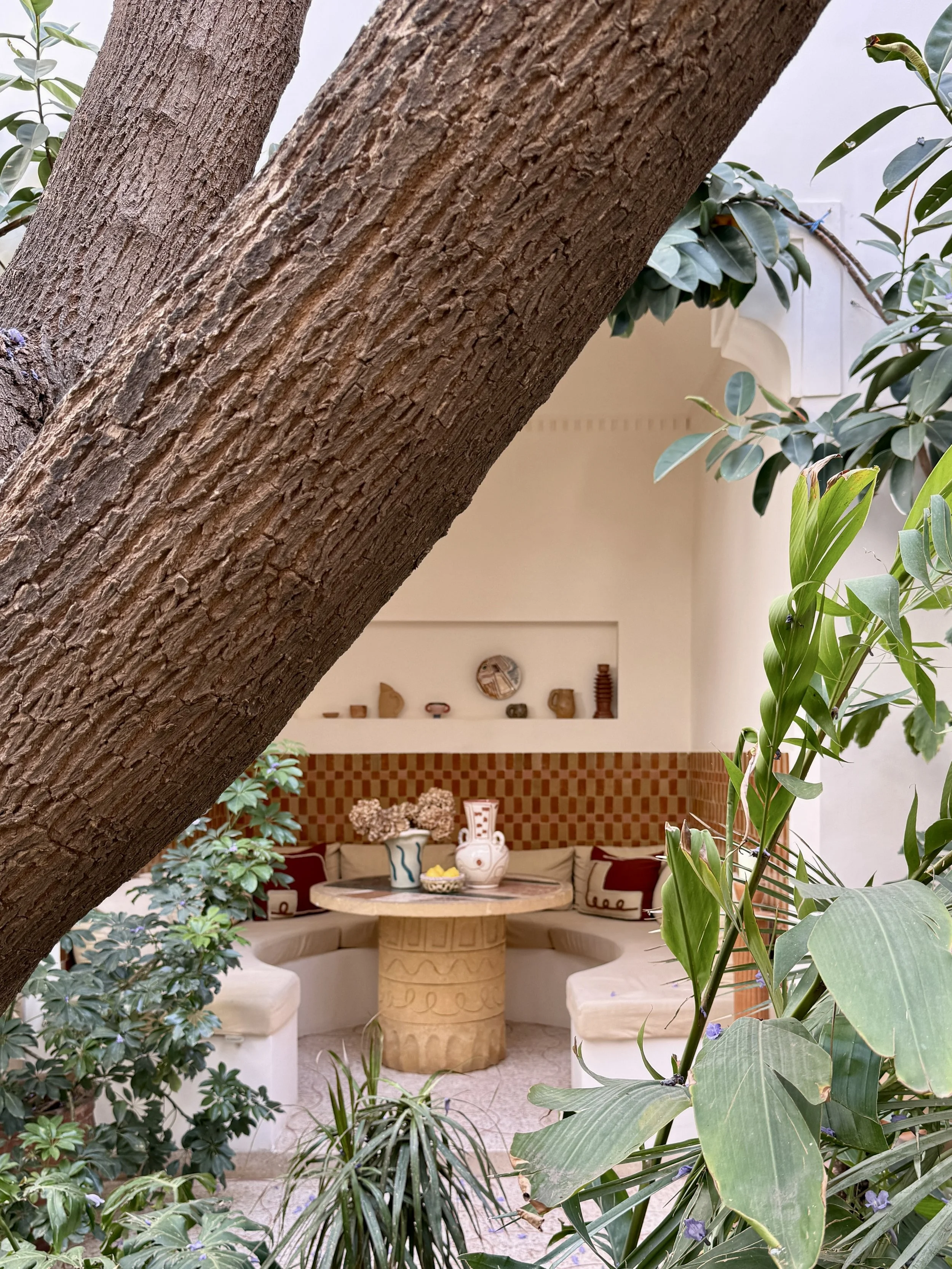
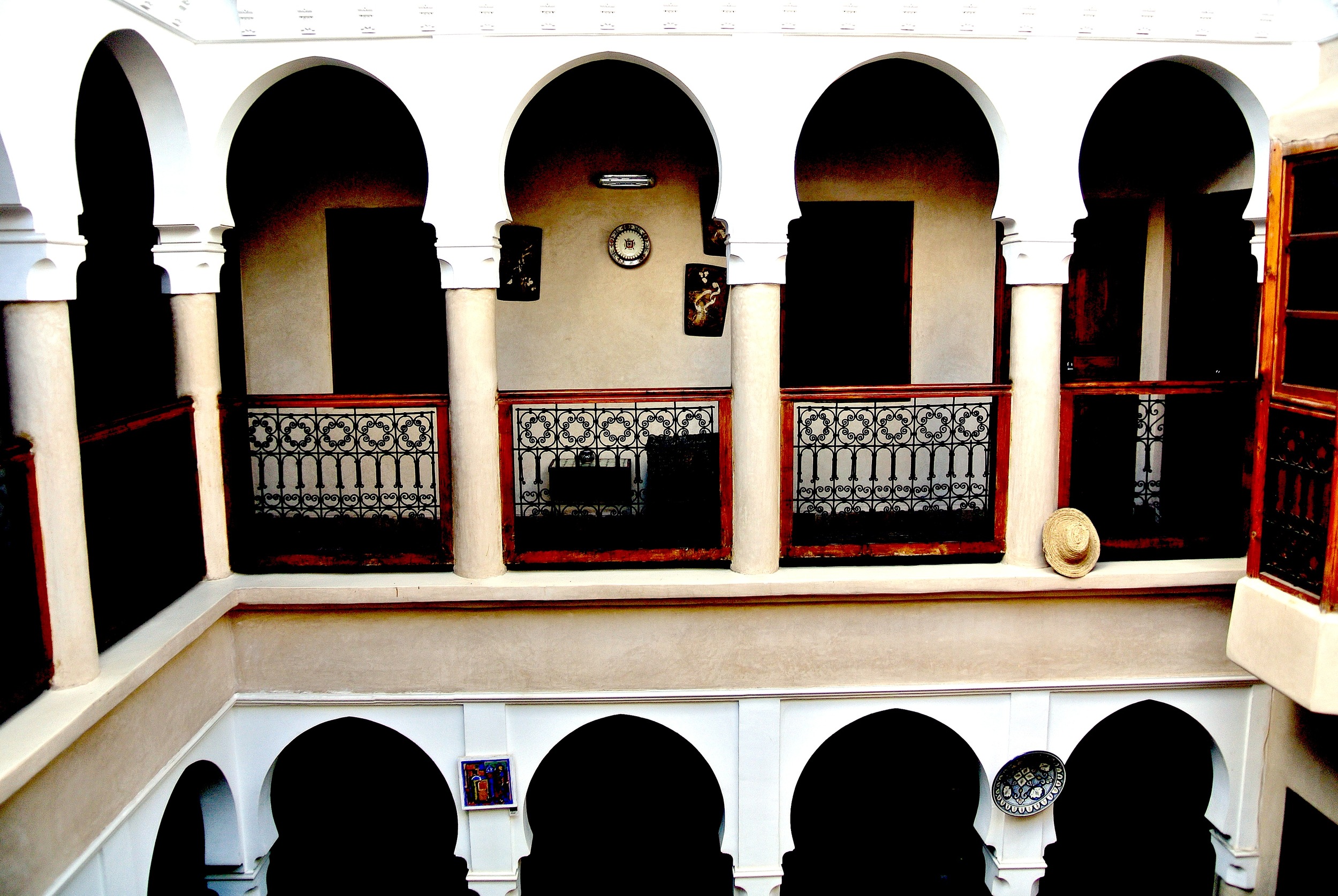
Why a riad is absolutely the best place to stay in Marrakech, with their interior courtyards with fountains and rooftop terraces. We chose one that’s a quick walk to Jemma el-Fna, the main square.

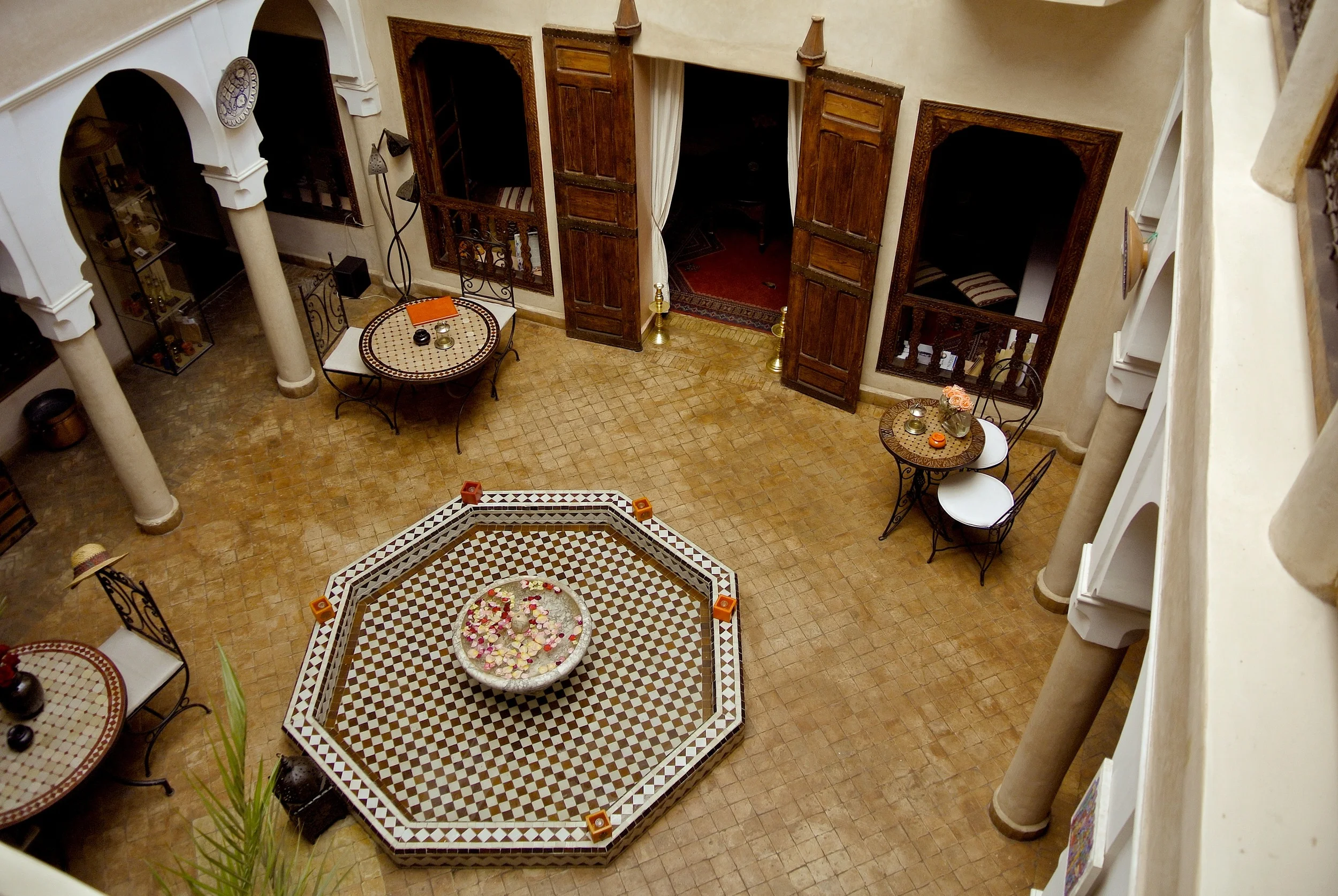
The interior courtyard of Riad Alwachma, Marrakech, Morocco

The interior courtyard of Riad Alwachma, Marrakech, Morocco

Part of the fun in planning a trip is figuring out where you’re going to stay. When Wally and I settled on Marrakech, I set to work to find a few options. The only criteria was to find lodging within the medina, the old quarter of the city surrounded by rammed earth walls. 
I had narrowed it down to three riads and began showing them to Wally. He’d excitedly reply with, “Ooo, I like that one with the fountain in the middle!” To which I’d reply, “They all have fountains in the middle.” 

Then he’d exclaim, “Ooo! I like that one with the rooftop terrace!” To which I’d reply, “They all have rooftop terraces.” 

“OK,” Wally said, a huge smile on his face. “I get it.”

“Ooo, I like that one with the fountain in the middle!”

”They all have fountains in the middle.” 

“Ooo! I like that one with the rooftop terrace!”

“They all have rooftop terraces.” 

We settled upon Riad Alwachma, located a mere 10 minutes from the Jemaa el-Fnaa, the main square, and the souks.


Our driver, which we had arranged in advance, dropped Wally, Vanessa and I off at the entrance to Derb Bab Doukkala and led us with our luggage in tow down the cobbled road to the riad. Most derbs (often translated as alleys, but more like lanes) in the medina are too narrow for cars — not a bad thing as there are plenty of other types of traffic throughout, including mopeds and donkey carts.

We arrived at Riad Alwachma’s large wooden door and were cordially greeted by one of the proprietors, a charming French expat named Jérôme. The three of us passed through the threshold, and the quiet of the interior courtyard enveloped us.

Most riads have unassuming front doors, like that of Riad Alwachma — but such beauty lies within!

Most riads have unassuming front doors, like that of Riad Alwachma — but such beauty lies within!

What’s a Riad?

Riads are the traditional former residences of wealthy merchants that have been converted into private guest lodgings. The term comes from the Arabic word ryad, meaning garden, and is applied to homes built around an inner courtyard or garden. They have unassuming façades that conceal a gorgeous interior. 

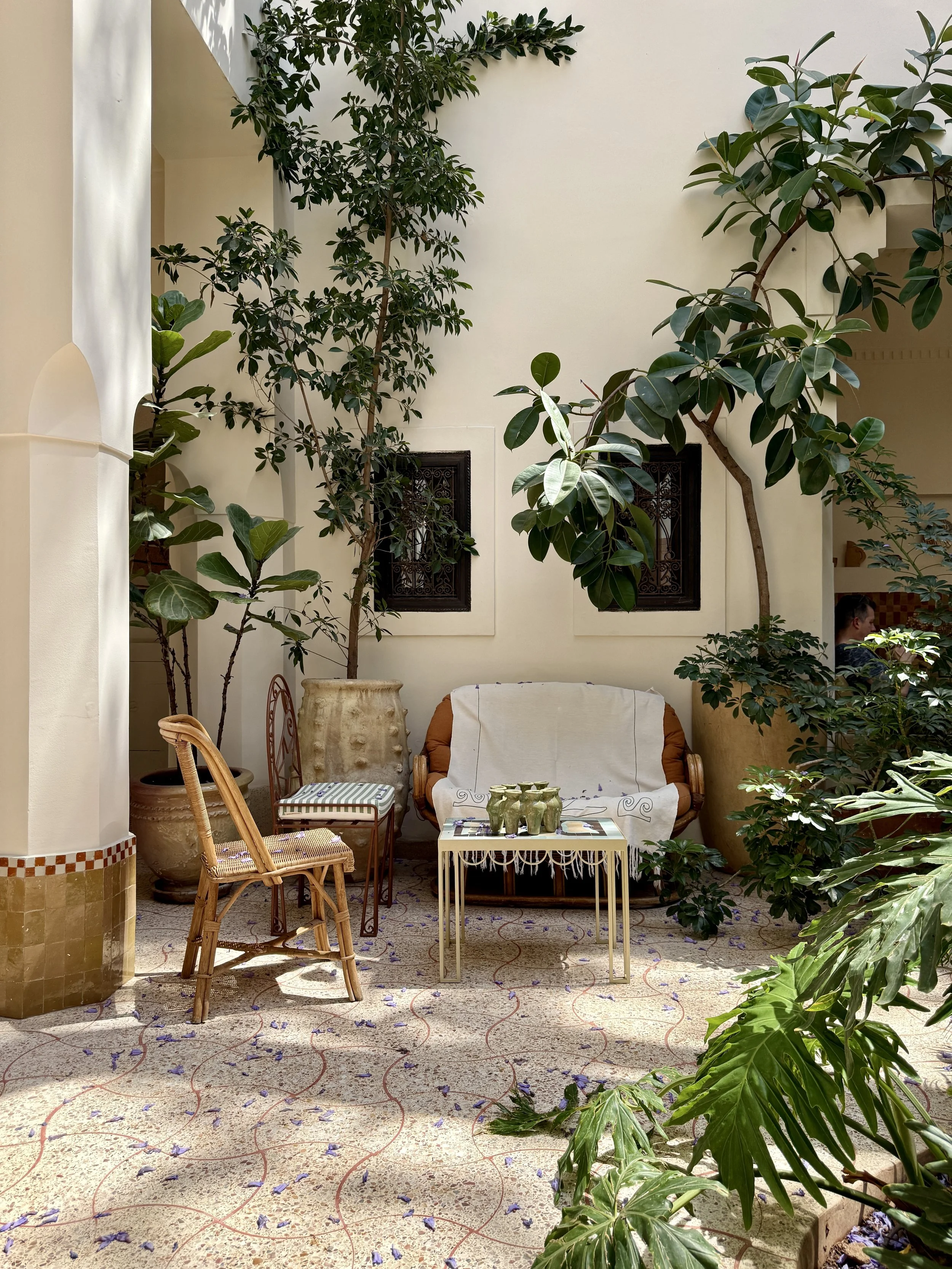
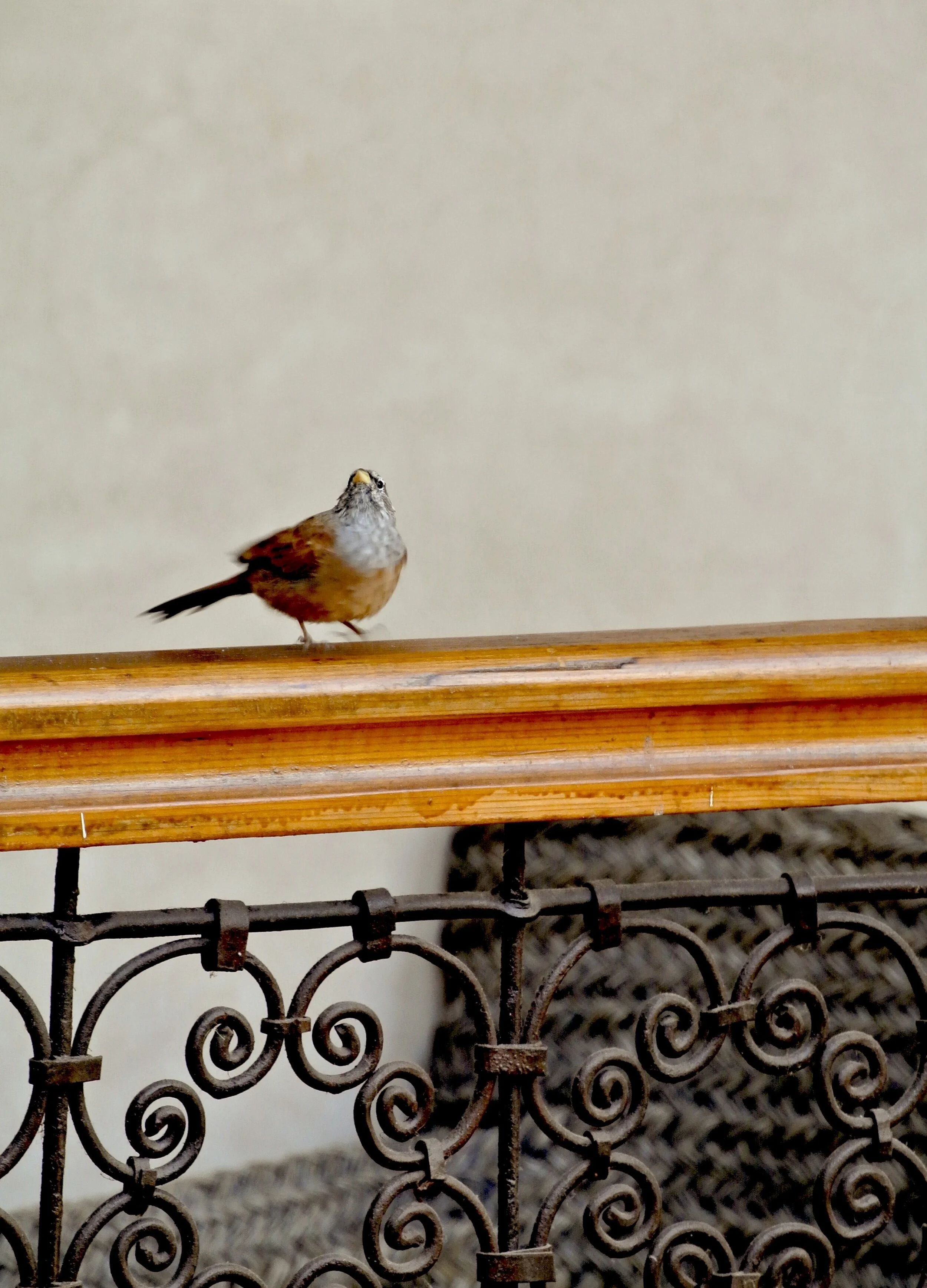
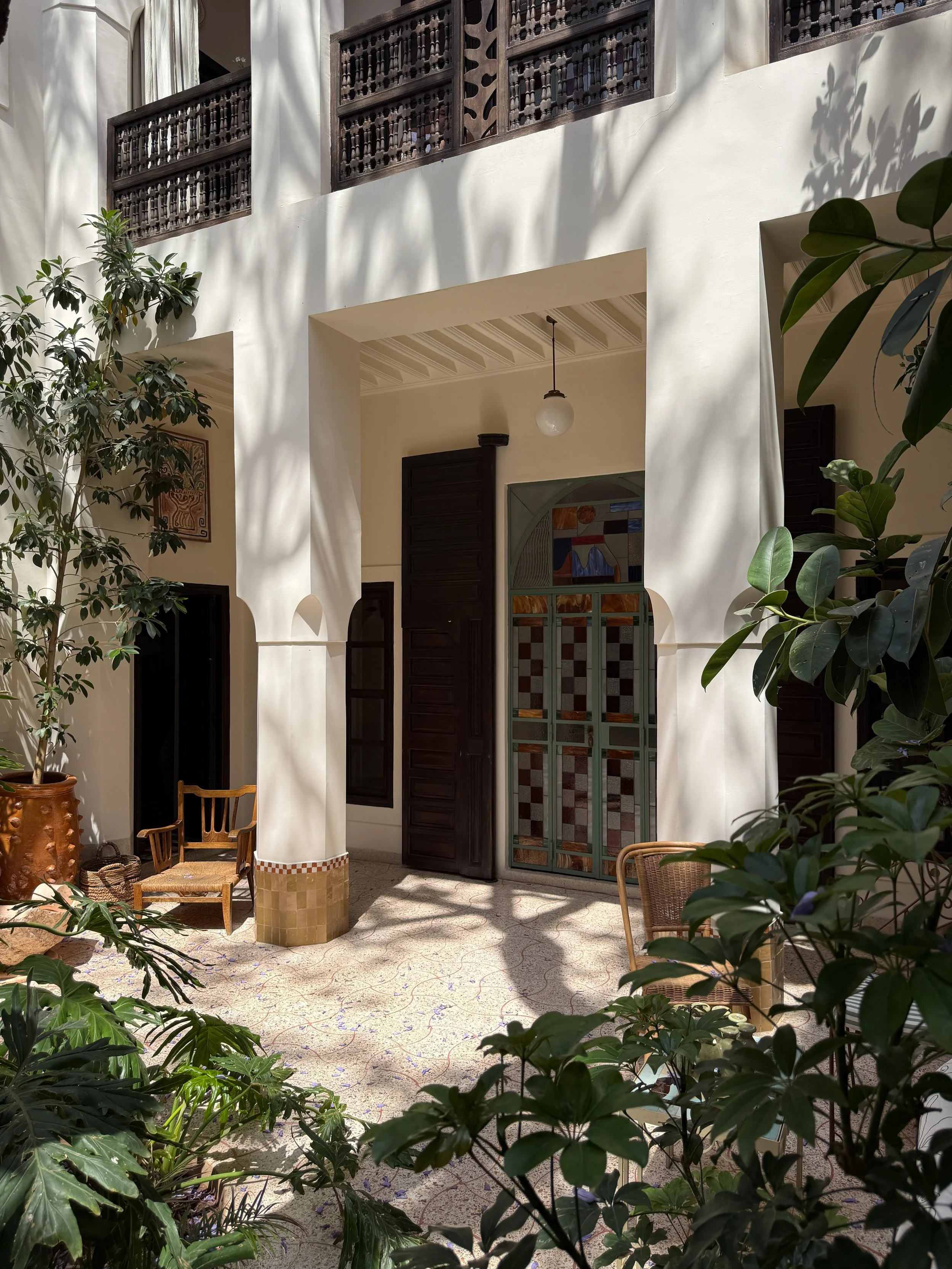
Like all riads, ours had a large central courtyard that opened to the sky. In the center, a fountain laden with rose petals dancing on the surface gurgled faintly. A chirping bird was contentedly hopping along the floor.

Wally and I smiled conspiratorially at each other. Without missing a beat, Jérôme smiled too and told us that a bird in the house is a symbol of good luck.

A bird in the home is good luck, our host tells us — and a not-too-uncommon occurrence with the open-air central courtyard.

A bird in the home is good luck, our host tells us — and a not-too-uncommon occurrence with the open-air central courtyard.

Vanessa, Wally and I sat at a table in the courtyard while Jérôme explained the origin of the riad's name. Alwachma comes from a traditional chin tattoo Berber women use to adorn themselves. I decided to nickname our riad The Girl With the Berber Tattoo.

Our host provided us with a map of the city and indicated points of interest and areas to avoid at night.


Getting Your Bearings in Marrakech

Over some pastries and our first cup of mint tea, which locals love to jokingly call “Berber whisky,” Jérôme explained that Marrakech tends to be a very safe city and that there are many uniformed police found throughout. But he did offer some advice on concealing our new camera because of the approach of Eid al-Adha, the Islamic festival to commemorate prophet Ibrahim’s obedience to Allah above all others. Jérôme explained that locals sacrifice animals on this feast day, and people occasionally do desperate things to provide their families with money to purchase a sheep or goat.

While we were more interested in the sights of the medina, from the Saadian Tombs to the El Badi Palace, Jérôme indicated Guéliz, the Ville Nouveau, or New Town, on the map. He kept saying that this was where we should go should we want to “make party,” an expression that made us giggle. 

We finished our tea while mapping out our first of many adventures to come. First stop:  Jemaa El-Fna and shopping in the souks, of course. –Duke
 

Riad Alwachma
27 Derb Sehb Bab Doukkala, Medina
4000 Marrakech
Morocco


The Saadian Tombs: A Glorious Monument to the Dead

Peek inside the royal necropolis in Marrakech, which rivals parts of the Alhambra in its beauty. We can thank Sultan al-Mansur for its magnificence — and Ismail Ibn Sharif’s fear of the dead for leaving it intact. 

The Saadian Tombs in 1925

The Saadian Tombs in 1925

Don’t judge a tomb by its cover. The unremarkable exterior walls surrounding the Saadian Tombs in the medina of Marrakech concealed their exquisite mausoleums for centuries, attracting little more than stray cats and storks. While not much to look at from the outside, the secluded interior courtyard is a completely different matter. 

Walled in and forgotten for more than two centuries, the necropolis of the deceased Saadian royals and their descendants remained hidden until its discovery in 1917. French Resident-General Hubert Lyautey commissioned an aerial survey of Marrakech and, by chance, the photographs revealed the existence of the tombs. They were brought back from disrepair by the Service des Beaux-Arts, Antiquités et des Monuments Historiques before being opened to the general public. 

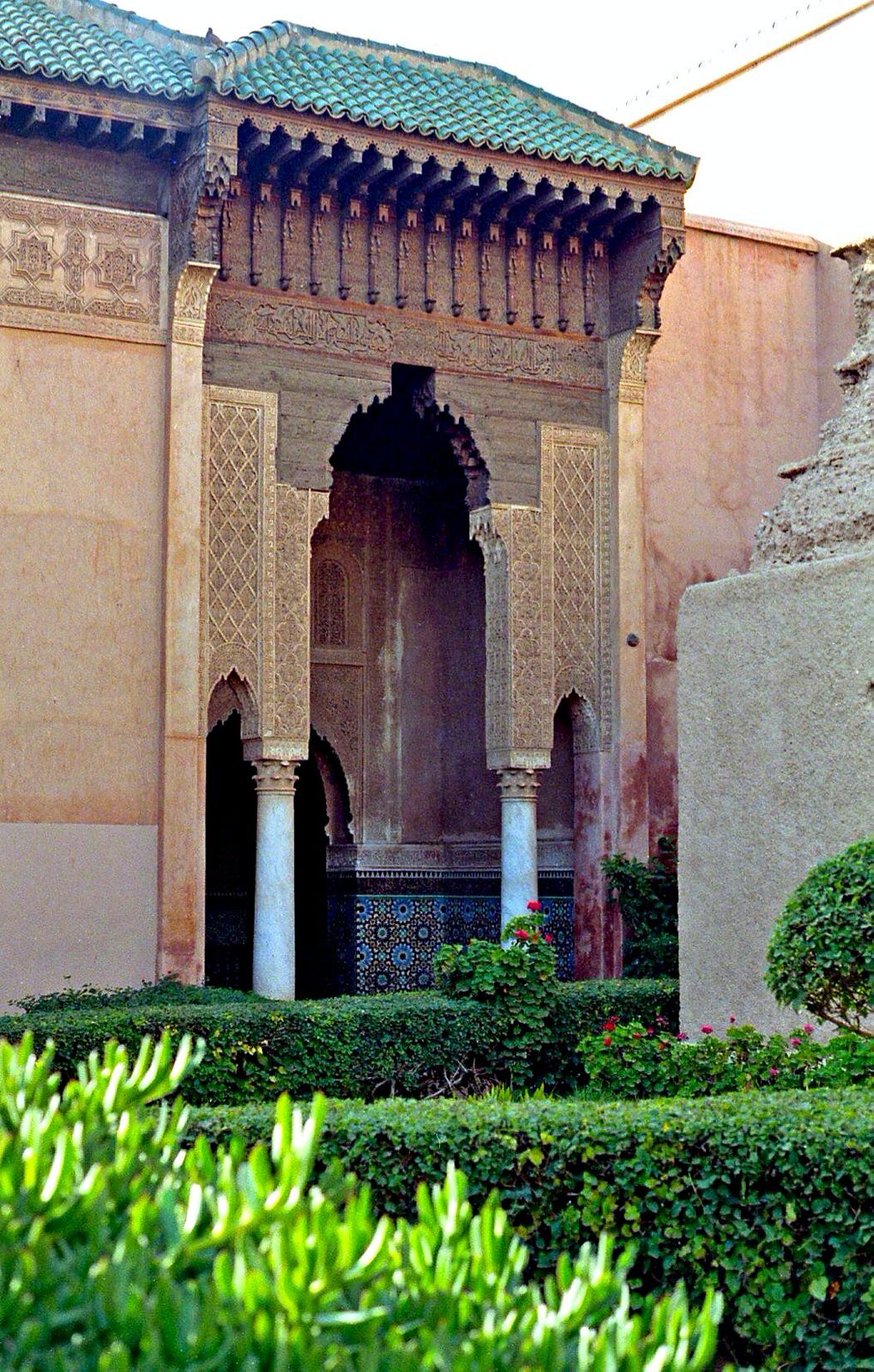
The unassuming exterior of the Saadian Tombs belies its gorgeous interior.

The unassuming exterior of the Saadian Tombs belies its gorgeous interior.

The historic property is located along the Rue de la Kasbah near the ruins of the El Badi Palace. Even if you have a strong sense of direction, the unmarked streets and nondescript ancient rammed earth walls surrounding many of the buildings in the medina district of Marrakech make finding a destination challenging. 

Ahmad al-Mansur

Ahmad al-Mansur

We eventually did and purchased our tickets, which cost 70 dirhams, or around $8, each. Wally, our friend Vanessa and I passed through an inconspicuous narrow corridor cut into the exterior wall and emerged into a tranquil courtyard garden. 

The royal necropolis dates back to the beginning of the 14th century and originally served as a courtyard garden of the Kasbah Mosque. It wasn’t until the reign of the sixth and most famous sultan of the Saadian dynasty, Ahmad al-Mansur (who reigned from 1578-1603 and was known as Eddahbi, the Golden), that the construction of the tombs reached a far more elegant and refined status. Before al-Mansur died from the plague in 1603, he expanded and embellished its mausoleums in the grand style of the Alhambra, the royal residence of the Nasrid Kingdom, built 200 years prior in Granada, Spain.


Brightly tiled tombstones fill the courtyard.

Brightly tiled tombstones fill the courtyard.

A Rested Development

Seven sultans and 62 family members are interred in the Saadian Tombs, with over 100 more outside in the gardens. 
The courtyard enclosure includes two mausoleums with gabled, glazed green roof tiles of kiln-fired clay. 

The gravestones in the mihrab, or prayer niche, reminded us of prayer mats.
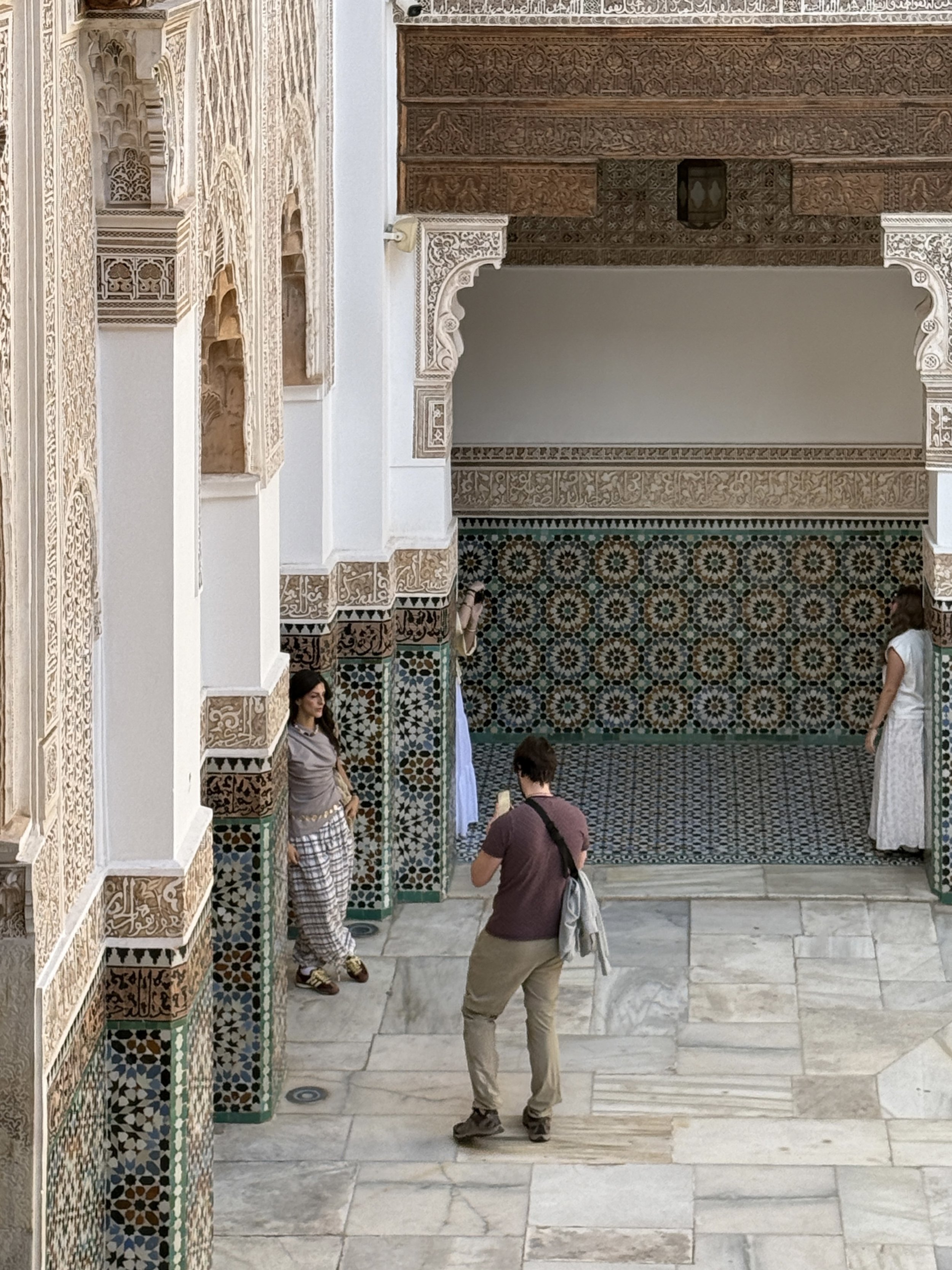
The gravestones in the mihrab, or prayer niche, reminded us of prayer mats.
The main tombs are located to the left of the enclosure. The first of the three chambers was originally a mihrab, or prayer niche, and is now the final resting place of Saadian princes. Its walls and floors are covered with intricate multicolored zellij mosaic tiles. The varying shapes, colors and patterns embedded in the flat graves reminded me of prayer rugs, laid facing Mecca, for eternity. The stucco work of the archway is delicate and ornate, while the ceiling is equally impressive.

The Hall of Twelve Columns is the star of the show.

The Hall of Twelve Columns is the star of the show.

Pillars of Society: The Hall of Twelve Columns

The central mausoleum where al-Mansour lies is known as the Hall of Twelve Columns. This chamber incorporates a dozen Carrera marble pillars, carved stucco walls and gilt honeycomb ceiling vaulting known as muqarnas. Al-Mansur traded sugar with the Italians in exchange for the marble, which is fitting, as its white, crystalline surface resembles the fine granular texture of sugar. The sultan’s narrow marble headstone stands in the center of the room and is flanked by those of his son and grandson. The chamber is also home to the remains of Princess Zahra, whose epitaph reads, “Here is the tomb of the noble lady, new moon, marvel of virtues.”
A coffered cedarwood ceiling with sunken square panels of diminishing sizes representing the earth and a circle at its apex standing in for the heavens spans the columned central chamber. This sacred geometry symbolizes the passage from the material to the spiritual world. 

Recent restoration work on the Saadian Tombs began in 2013 and lasted for two years.

Recent restoration work on the Saadian Tombs began in 2013 and lasted for two years.

The Three Niche Chamber and Lalla Masuda Qubba

Beyond the great hall is the Three Niche Chamber, where those relations deemed less important, including children, are buried. The three arched recesses for which the mausoleum takes its name feature magnificent incised muqarnas embossed in gold, lending the space a luminous quality. 

The “less important” relatives were interred in the Three Niche Chamber, which is still not too shabby a place to spend eternity, if you ask us.

The “less important” relatives were interred in the Three Niche Chamber, which is still not too shabby a place to spend eternity, if you ask us.

Between the mausoleums and throughout the gardens are descendants, wives and emirs, each resting closer or further away from al-Mansur’s sepulcher, depending on his or her status. 

The entrance to the Lalla Masuda Qubba. As with the rest of the complex, you can’t go inside —  but you can peek into the chambers.

The entrance to the Lalla Masuda Qubba. As with the rest of the complex, you can’t go inside —  but you can peek into the chambers.

The second and smaller structure is called the Lalla Masuda Qubba and refers to the domed roof mausoleum which contains the grave of al-Mansur’s mother. 

Lalla Masuda

Lalla Masuda

The oldest and original Saadian tomb includes a cedarwood dome and two entrance porches or loggias. It was built by Sultan Abdallah al-Ghalib to bury his father, Mohammed al-Sheikh, the founder of the dynasty. 

In 1591, al-Mansur had his mother, Lalla Masuda, added to the tomb. She was a Moroccan political figure in the Saadi dynasty remembered for her humanitarian work and considered an awliya, or saint. 

Fearing the Dead 

Less than two decades later, Sultan Ahmad al-Abbas was assassinated, the Saadian dynasty had come to an end, and the Alaouites had taken control of the country.  

When Sultan Moulay Ismail Ibn Sharif assumed power, he wasted no time eradicating the legacy of the Saadi dynasty. He systematically set about looting and stripping most of their architectural achievements, including the El Badi Palace. However, he spared the Saadian Tombs — probably because he feared bad luck if he desecrated them and was superstitious that the spirits of the dead would pursue him. He satisfied himself with sealing up all but one obscure entrance from the Kasbah Mosque. 

Moulay Ismail Ibn Sharif completely stripped the nearby El Badi Palace but left the Saadian Tombs intact. Was he nervous about disturbing the spirits of the dead?

Moulay Ismail Ibn Sharif completely stripped the nearby El Badi Palace but left the Saadian Tombs intact. Was he nervous about disturbing the spirits of the dead?

The Saadian Tombs gave us a sense of the former grandeur of the El Badi Palace. Heads up that the various chambers are off limits to the public, but a path winds past them, letting tourists see them from outside, much like peeking into a diorama. 

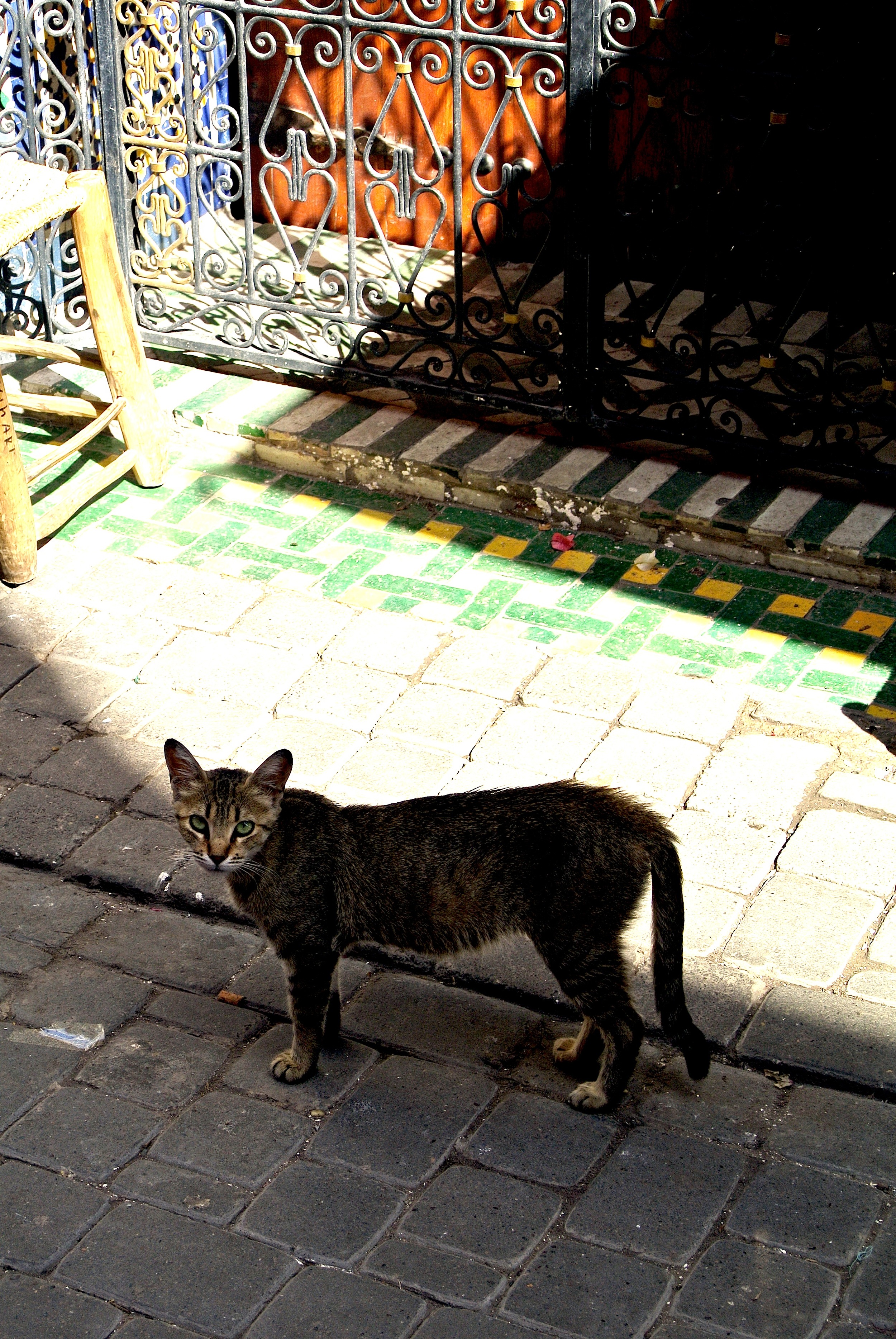
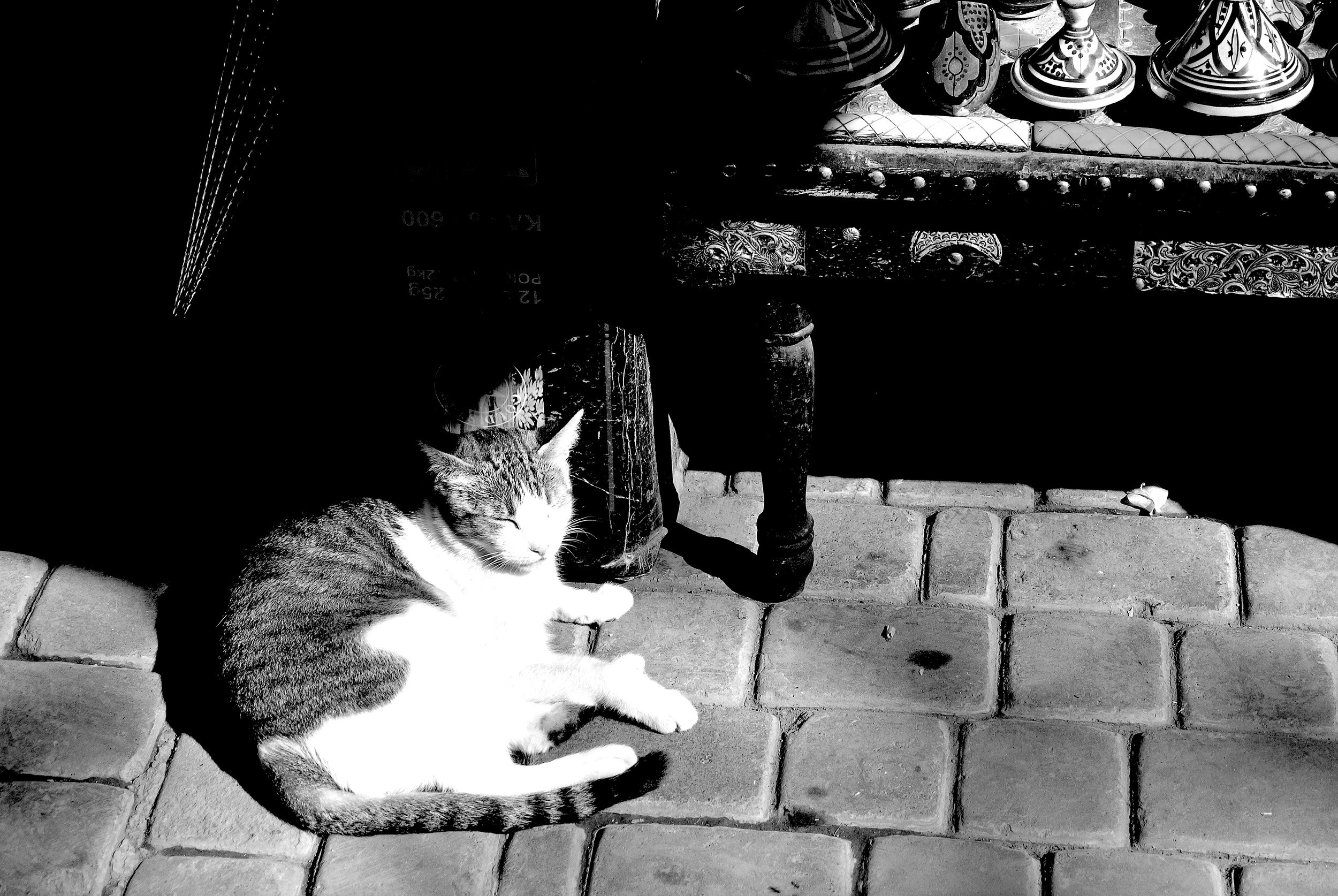
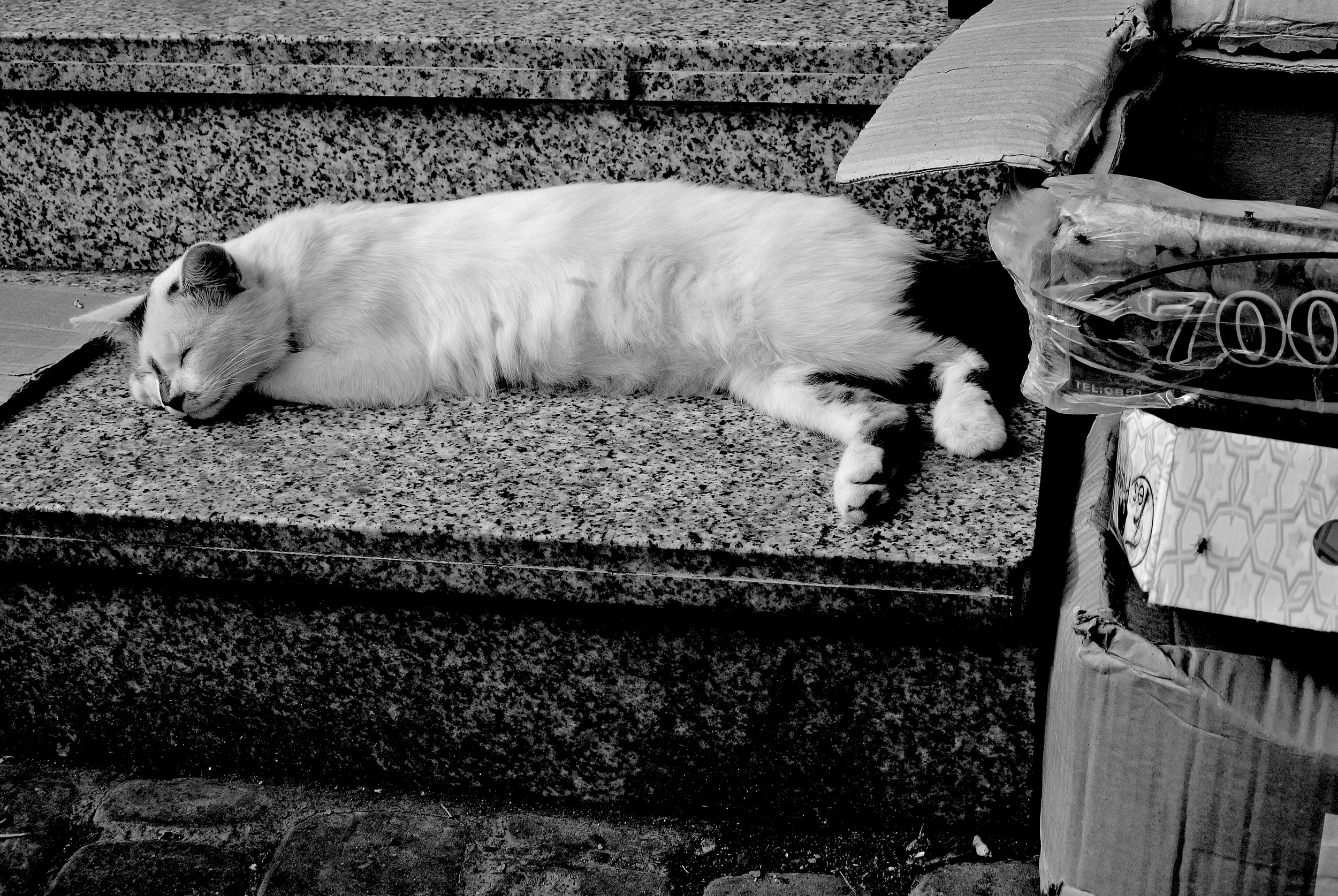
While the tombs are cordoned off to human visitors, felines are another matter. We witnessed more than a few cats and kittens napping on their cool tiled floors. 

If you enjoy Islamic architecture as much as we do, then a visit to this funerary monument and tribute to the Saadian legacy is a must. –Duke


The Crumbling Ruins of El Badi Palace in Marrakech

Once praised for its massive scale and beauty, El Badi Palace soon became a mere shell of its former grandeur. Only storks now call it home.

A ruined palace sits within the medina of Marrakech.

A ruined palace sits within the medina of Marrakech.

It must have once been quite a spectacle. El Badi Palace was commissioned by Ahmad al-Mansour, a Saadi sultan who ascended to power after his brother’s untimely death in 1578. Its financing came from ransoms paid by the Portuguese to release their prisoners who had been captured and enslaved following their defeat after the Battle of al-Qasr al-Quibir.

A ransom paid by Portugal financed the construction of El Badi Palace.

A ransom paid by Portugal financed the construction of El Badi Palace.

Al-Mansour and the Battle of Three Kings

The young and impetuous King Sebastian of Portugal wanted to reclaim coastal Morocco for his country and intended to convert the Muslim populace to Christianity. He combined forces with the deposed sultan al-Mutawakkil, who had his own aspirations to reclaim sovereignty. 

When King Sebastian, al-Mutawakkil and their troops landed at Tangier, they were met by Sultan Abd al-Malik and his men. Within a mere six hours, the Muslim army easily forced the invading Christians to retreat to the port city of Larache — but while fleeing across the Wadi al-Makhazin at high tide, Sebastian and al-Mutawakkil drowned. 

Exhausted from combat, Abd al-Malik fell ill and expired the following morning. In the end, all three died. For this reason, the event is also known as the Battle of Three Kings.

Al-Mansour asked his court jester what he thought of his palace complex.

The jester replied, “It will make a magnificent ruin.”
Was this stork once a human being? Or is it off to deliver a baby?

Was this stork once a human being? Or is it off to deliver a baby?

Say Hi to the Storks: Visiting El Badi Palace

While staying in the Marrakech medina, we spent a day trying not to get lost and seeing the sights, including El Badi Palace. 

Outside the site are shops. An open-air restaurant with charcoal braziers filled the air with oily black smoke. Enormous storks nests that could easily accommodate the three of us have taken up residence atop the remains of the rammed earth walls. The storks of Marrakech are considered to be holy animals. Even before the arrival of Islam, an old Berber belief held that storks were actually transformed humans. As a Westerner, I’m only familiar with storks delivering babies.

The silhouettes of storks seen at sunset. The birds find niches in the ruins of El Bahi Palace to build their nests.

The silhouettes of storks seen at sunset. The birds find niches in the ruins of El Bahi Palace to build their nests.

Wally, our travel buddy Vanessa and I paid 10 Moraccan dirham (about $1) at the kiosk located outside the palace. We entered through a towering doorway and found ourselves enclosed in a massive bare-walled chamber open to a cloudless blue sky. These are the ruins of the Qubbat al-Khadra or Green Pavilion. The two-story pavilion most likely had a pyramidal roof of green terracotta tiles, a common material of the period. 

El Badi means the Incomparable One.

El Badi means the Incomparable One.

Nothing Compares 2 U: The Incomparable Palace

The name of the palace derives from one of the 99 names of Allah given in the Qur’an, and translates to “the Incomparable One.” It served as the reception palace of al-Mansour, who spared no expense in building his lavish monument to the Saadian dynasty and its growing power. 

While the palace was widely acknowledged in its time as a spectacular architectural achievement, it was plundered for its rich decorative materials only a century after its construction. However, you still get a clear sense of its monumental scale. The courtyard features four symmetrical sunken groves planted with lemon and orange trees surrounded by footpaths and separated by a large central basin, which was dry upon our visit but once provided irrigation for the orchards. 

The sunken courtyards house small orchards of citrus trees.

The sunken courtyards house small orchards of citrus trees.

It took nearly 16 years over the course of Sultan al-Mansour’s reign to complete, using materials imported from numerous countries, including onyx, Carrera marble from Italy, gold from Sudan, cedarwood and ivory. Walls and pathways were covered with multi-colored glazed zellij tiles arranged in geometric patterns. 

The zellij tile floor is the one section of the palace with some color.

The zellij tile floor is the one section of the palace with some color.

We met a fussy tomcat who at first craved our attention and then just as quickly grew fickle, batted a paw and hissed at us. (I think it was an angry jinn who became unhinged as we didn’t have any scraps of food to offer it.)

Sixteen-century Moroccan architecture during the Saadian period was heavily influenced by Andalusian decorative traditions, an Islamic architectural style that spanned across North Africa and Spain. El Badi’s layout follows a rectilinear grid similar to the Court of Myrtles at the Alhambra in Granada, Spain, but on a much larger scale.

Foreign ambassadors of the time gushed about El Badi’s unparalleled beauty and grandiose domed pavilions: In addition to the Green Pavilion, there’s the Qubbat ad-Dahab (Golden Pavilion), the Qubbat az-Zujaj (Crystal Pavilion) and the Qubbat al-Khayzuran (Khayzuran Pavilion). According to a plaque outside the latter, Khayzuran comes from the Arabic name for wild myrtle and is believed to have been the harem’s quarters. 

I’d suggest bringing bottled water and sunblock, as the site is mostly exposed. Although there isn’t a dress code, it’s respectful to stay modest wherever you go in Morocco. Wally and I both wore linen pants, and Vanessa covered up appropriately. 

It’s too bad the grandeur of the palace didn’t last long. Moulay Ismail stripped El Badi and repurposed the materials to build a new residence in nearby Meknès.

It’s too bad the grandeur of the palace didn’t last long. Moulay Ismail stripped El Badi and repurposed the materials to build a new residence in nearby Meknès.

El Badi’s Short-Lived Beauty

Less than a century after the construction of El Badi, the 17th-century Alaouite Sultan Moulay Ismail decided to move the capital from Marrakech to Meknès, and spent over 10 years systematically stripping El Badi of its riches to reuse for his palace in the new capital city. 

This could explain why, as far as ruins go, El Badi might have once been astounding, but now it just doesn’t inspire much awe. That being said, according to local lore, al-Mansour asked his court jester, who was in attendance at the official opening, what he thought of his palace complex. The jester replied, “It will make a magnificent ruin.” And indeed it does. –Duke

If you have a few days in Marrakech, you should visit El Badi Palace. If time is limited, skip it and do the souk and Jardin Majorelle instead.

If you have a few days in Marrakech, you should visit El Badi Palace. If time is limited, skip it and do the souk and Jardin Majorelle instead.

El Badi Palace
Ksibat Nhass
Marrakech 40000
Morocco


Jardin Majorelle: A Moroccan Garden Oasis in Marrakech

What exactly is Majorelle Blue? What does Yves Saint Laurent have to do with the Majorelle Garden? And what’s this about a new Musée Yves Saint Laurent?

Escape the chaos of the medina for a calming visit to le Jardin Majorelle 

Escape the chaos of the medina for a calming visit to le Jardin Majorelle 

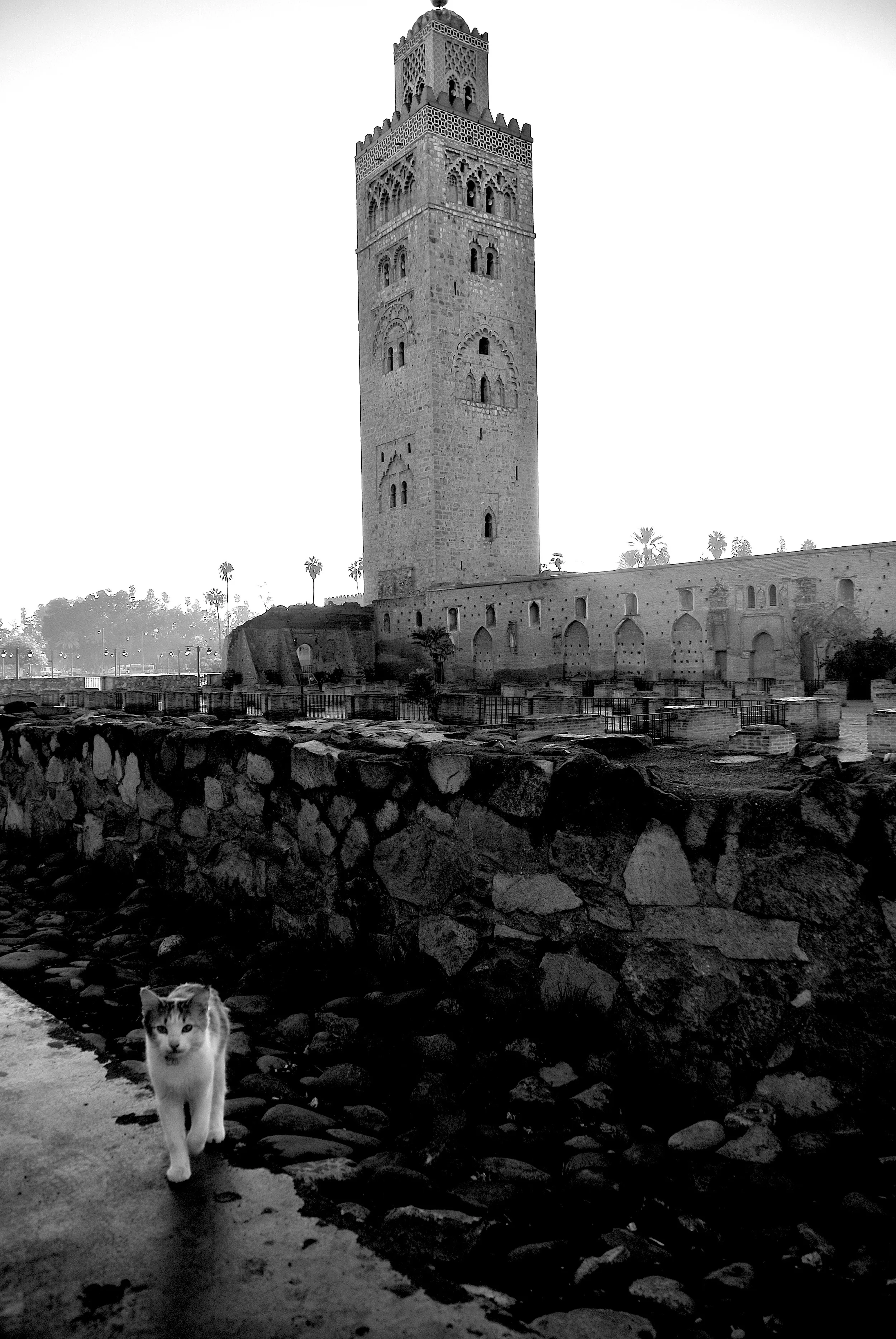
Marrakech, Morocco is famous for many things: thick, fortified ramparts of beaten red clay, the towering minaret of the Koutoubia Mosque and the vast open square Djemaa el-Fna with its network of narrow, winding market-filled alleys known as souks. Oh, and “Berber whiskey”: hot, sweet mint tea served in small glasses.

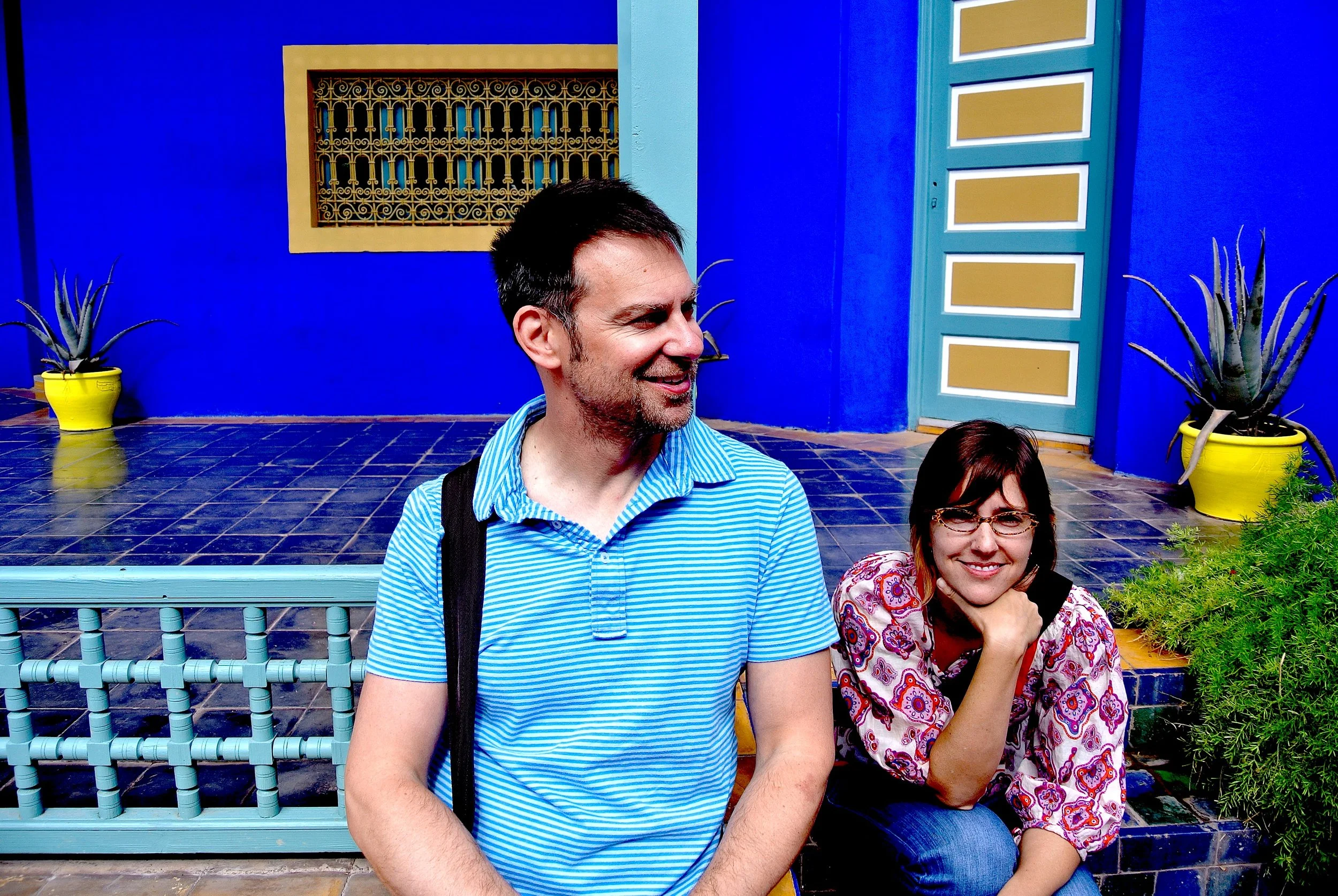
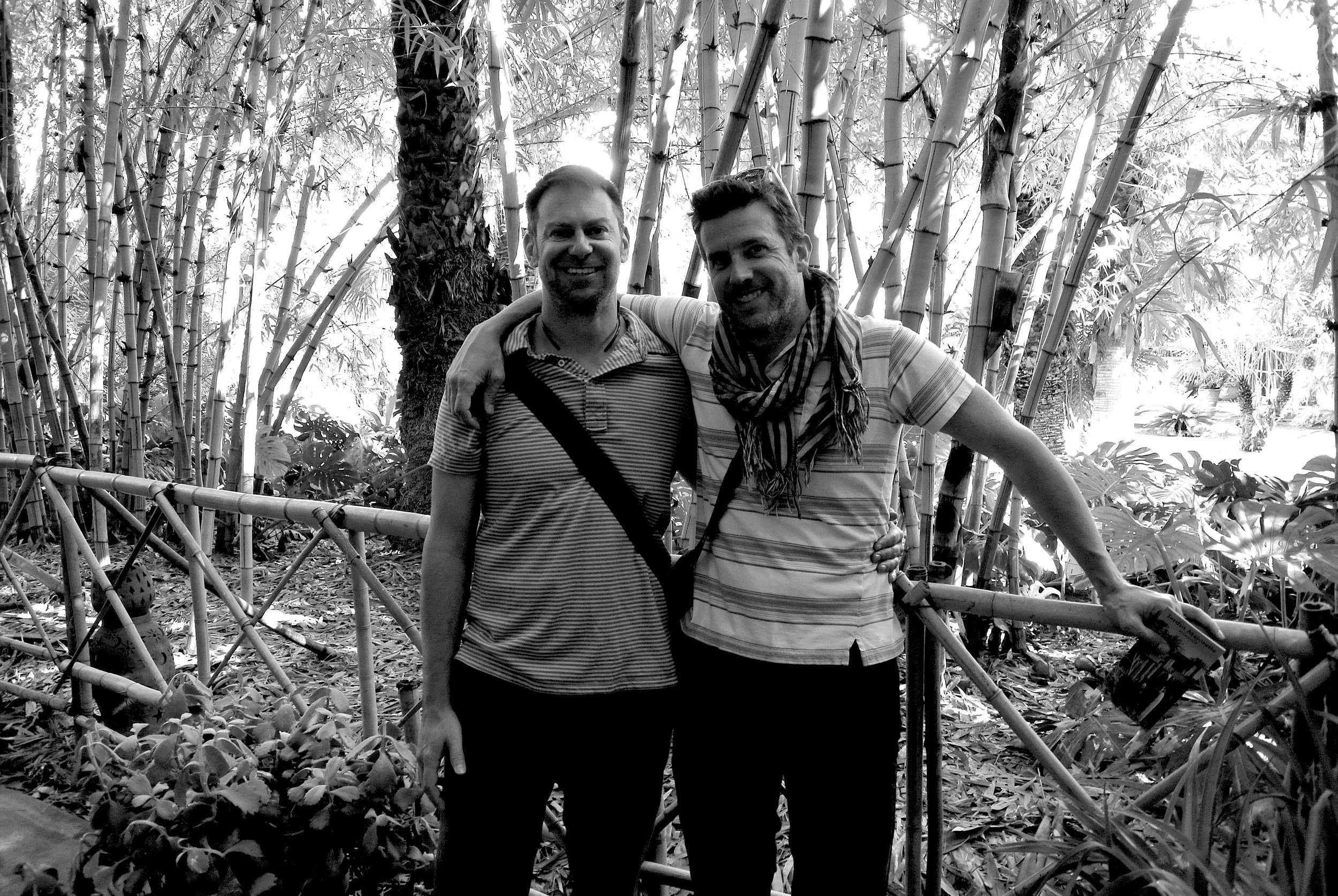
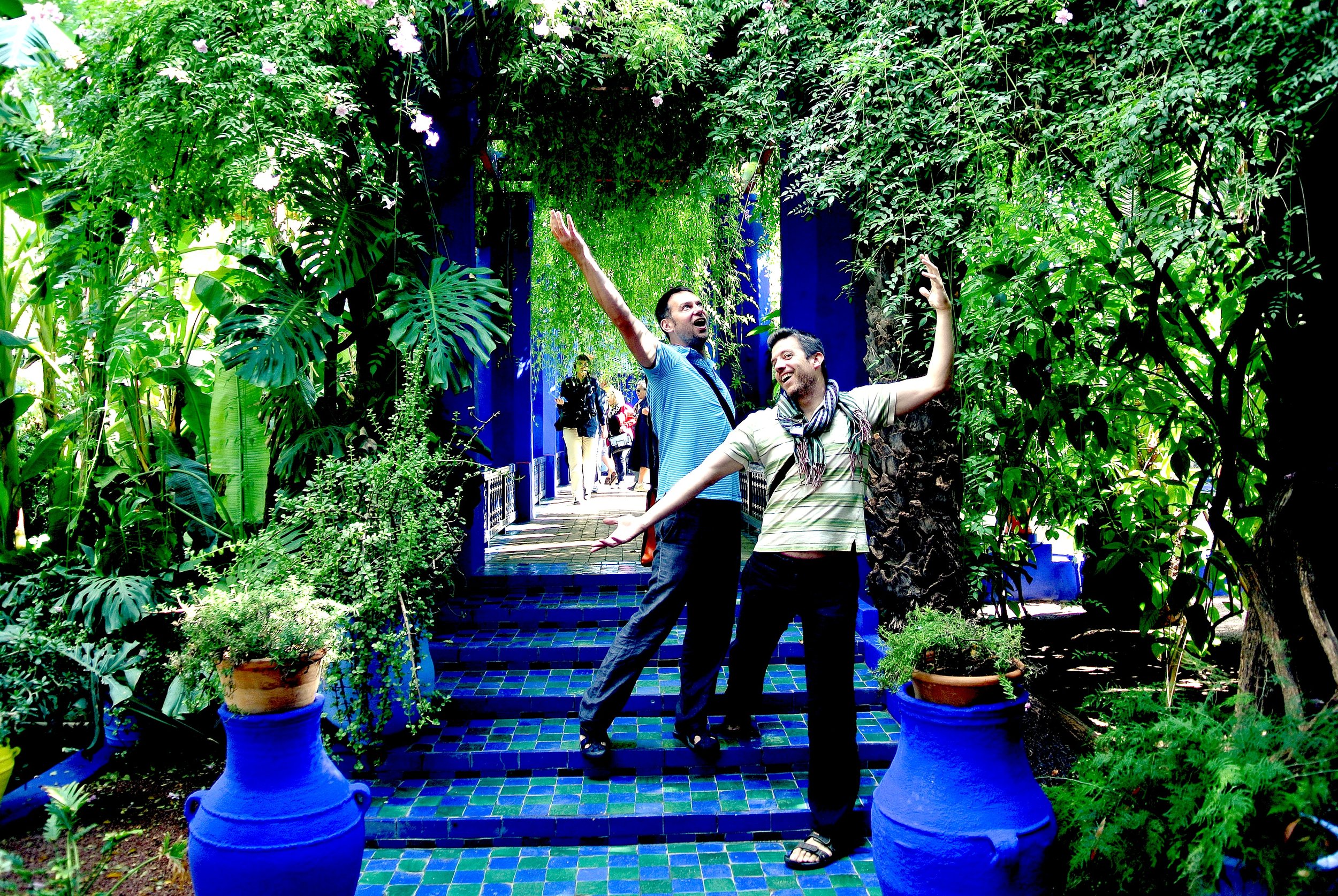
Duke and Vanessa in the Majorelle Gardens

Duke and Vanessa in the Majorelle Gardens

On our last full day in Marrakech, Wally, Vanessa and I walked from the medina to the Nouvelle Ville — French for New City. Our plan was to visit the Jardin Majorelle and to purchase a new memory card for our digital camera. We hoped to retrieve the images from our corrupted memory card, which had stopped working when we arrived in the Sahara, further proof that jinns exist.

We found a camera store, and Wally conversed with the shopkeeper in French, who took the card and inserted it into a reader. He looked up at us, shook his head and said, "C’est grillé.”

“I think that means it’s toast,” Wally said, sadly.

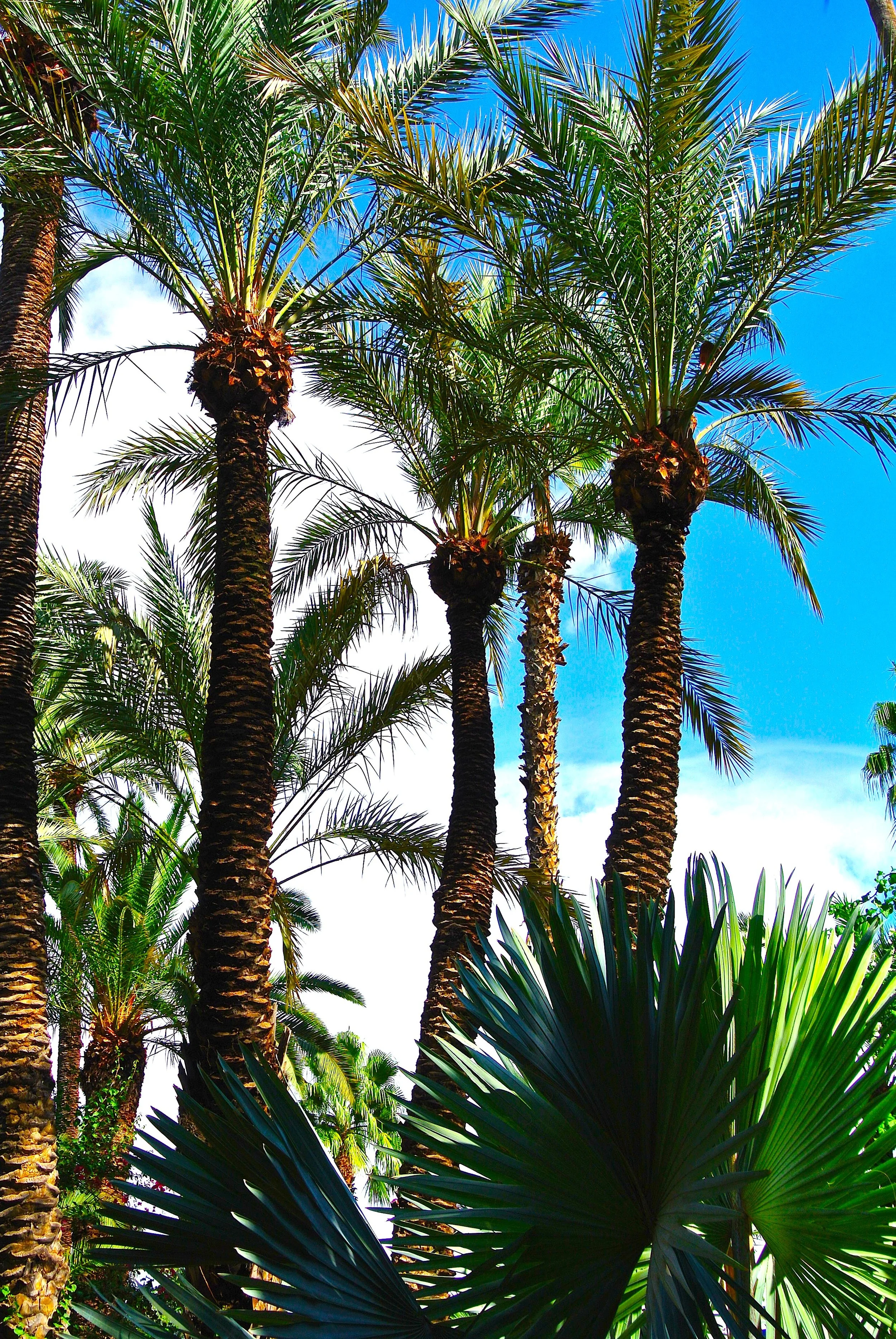
Towering palms seen through an archway

Towering palms seen through an archway

We went on with our day, happy to at least have a new memory card to start taking more pictures. As the three of us made our way around the walled enclosure surrounding the Jardin Majorelle, we became a bit concerned it wouldn’t be open. Our guide from our desert trek, Barack, had told us that the most important prayers of the week are those at noon on Friday, and because of this, Muslim cities essentially close from 11 a.m. to 3 p.m. We were in luck, though — the garden was open.

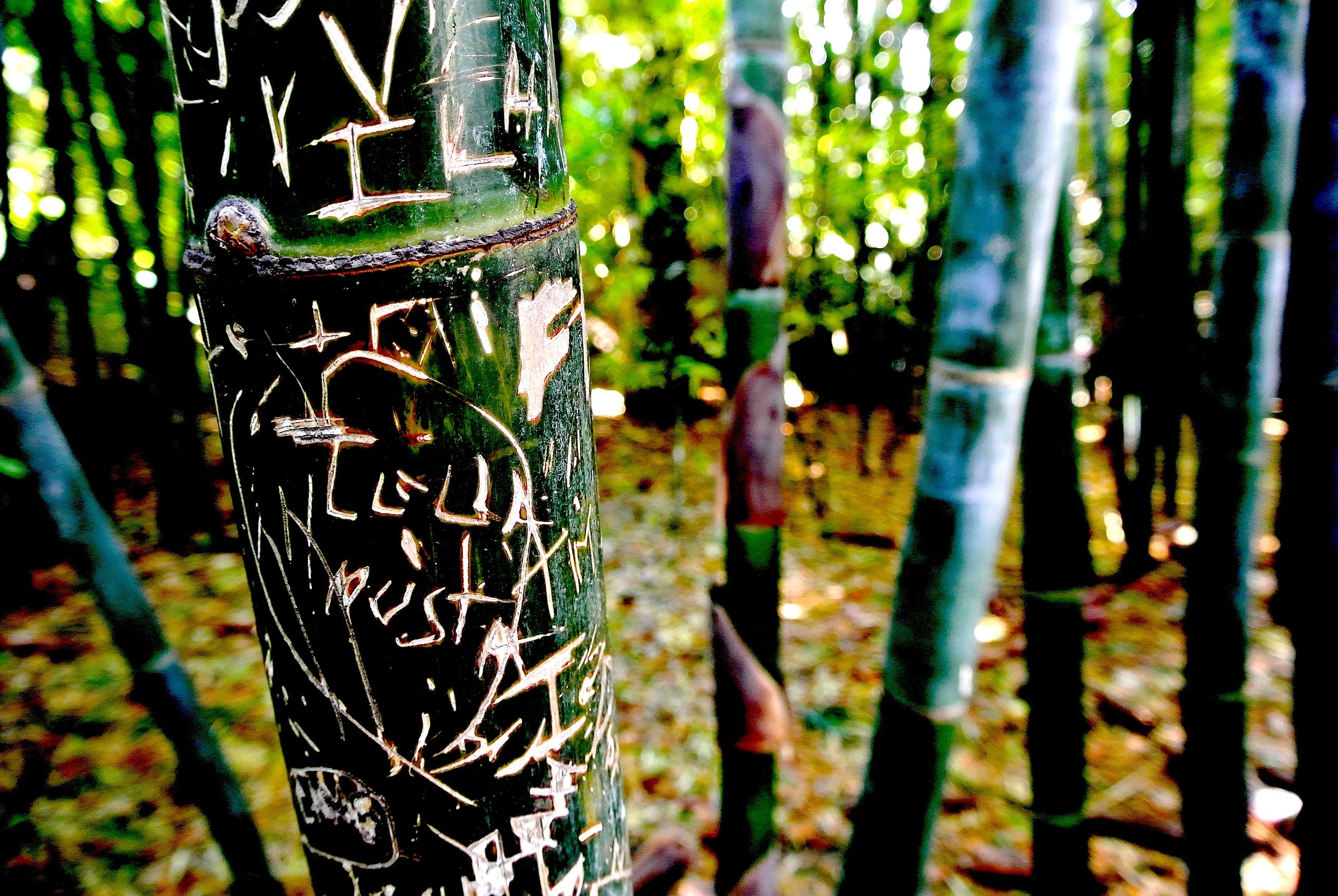
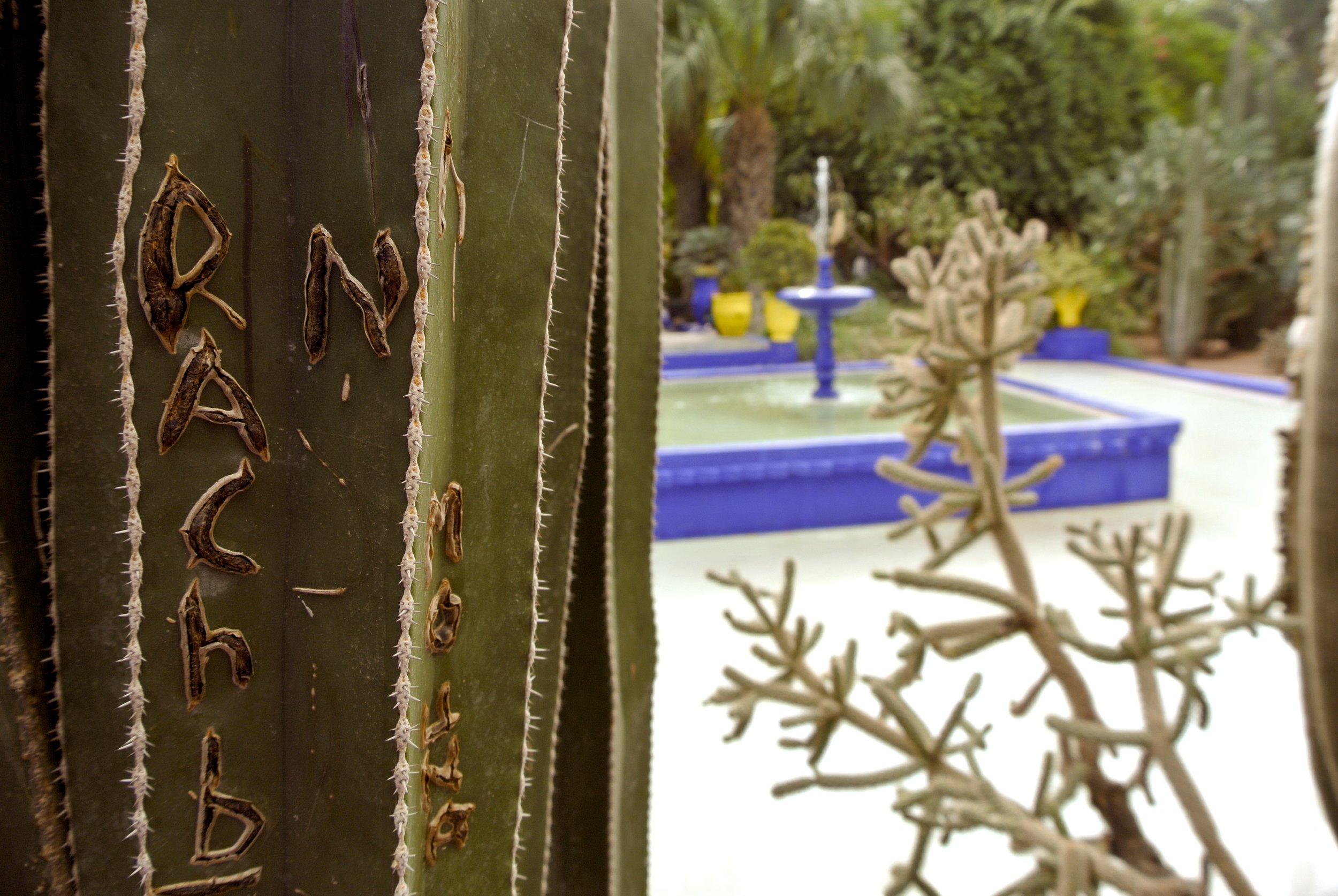
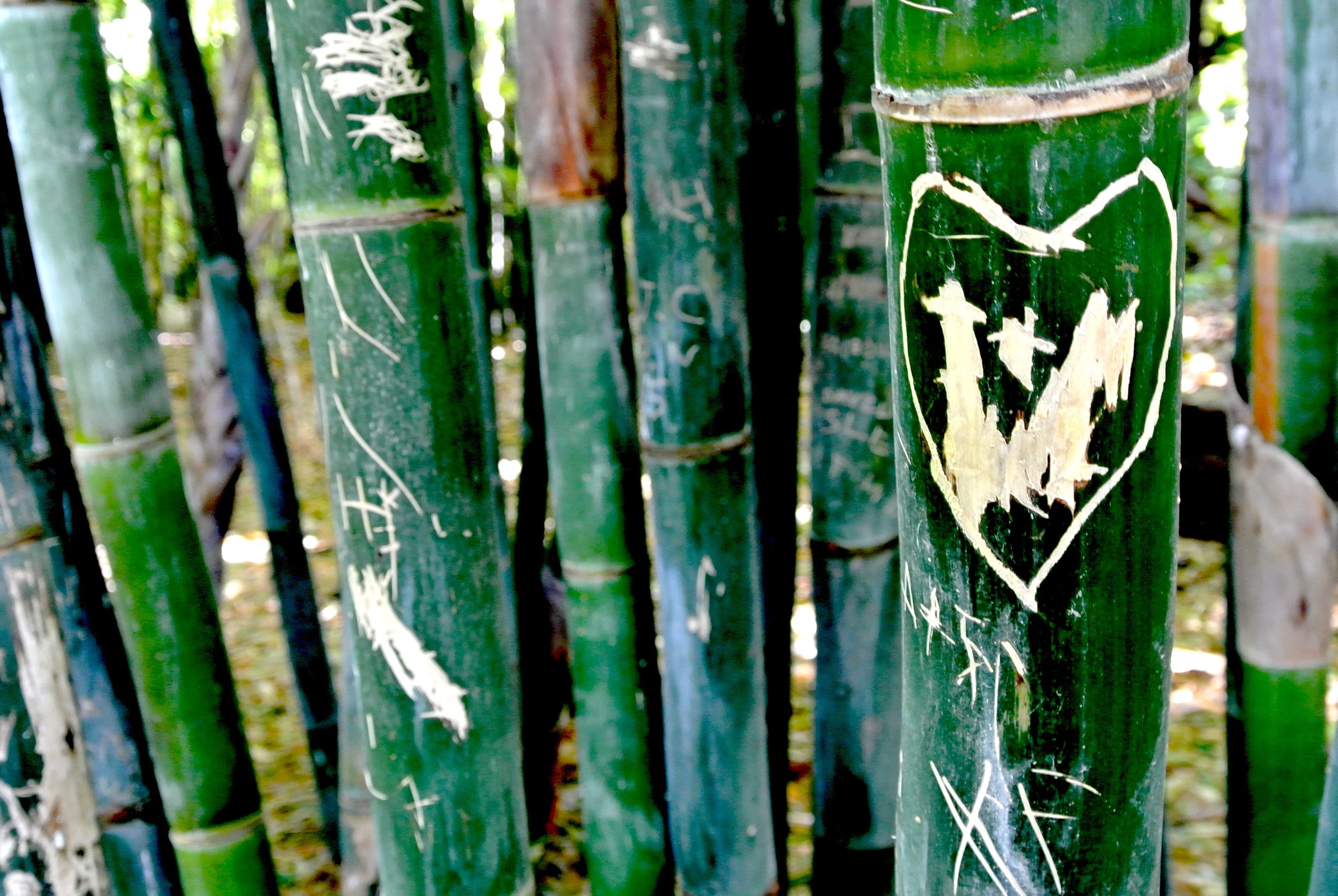
We entered the garden through a weathered wooden door, and although there were many people visiting that morning, I was struck by its serenity. The pebbled garden path led through a dense cluster of bamboo. Sadly, countless visitors have left their mark by carving their initials into the shafts of bamboo.

Visitors past have left their mark in the bamboo section of the garden

Visitors past have left their mark in the bamboo section of the garden

Wally loves the exquisite Moroccan detailing at the nearby villa 

Wally loves the exquisite Moroccan detailing at the nearby villa 

The villa houses a gift shop and Berber museum

The villa houses a gift shop and Berber museum

True Blue: The History of the Majorelle Garden

The garden’s creator was Jacques Majorelle, a French Orientalist painter, the son of furniture designer and manufacturer Louis Majorelle. On the advice of his physician, Majorelle the junior travelled to Morocco for the sake of his health, and was immediately captivated by the vibrant colors and quality of light.

He settled in Marrakech in 1917, and in 1923 purchased four acres of land bordering a palm grove outside the city’s ancient walled medina. Eventually, Majorelle purchased an adjacent plot, expanding the property to 10 acres.

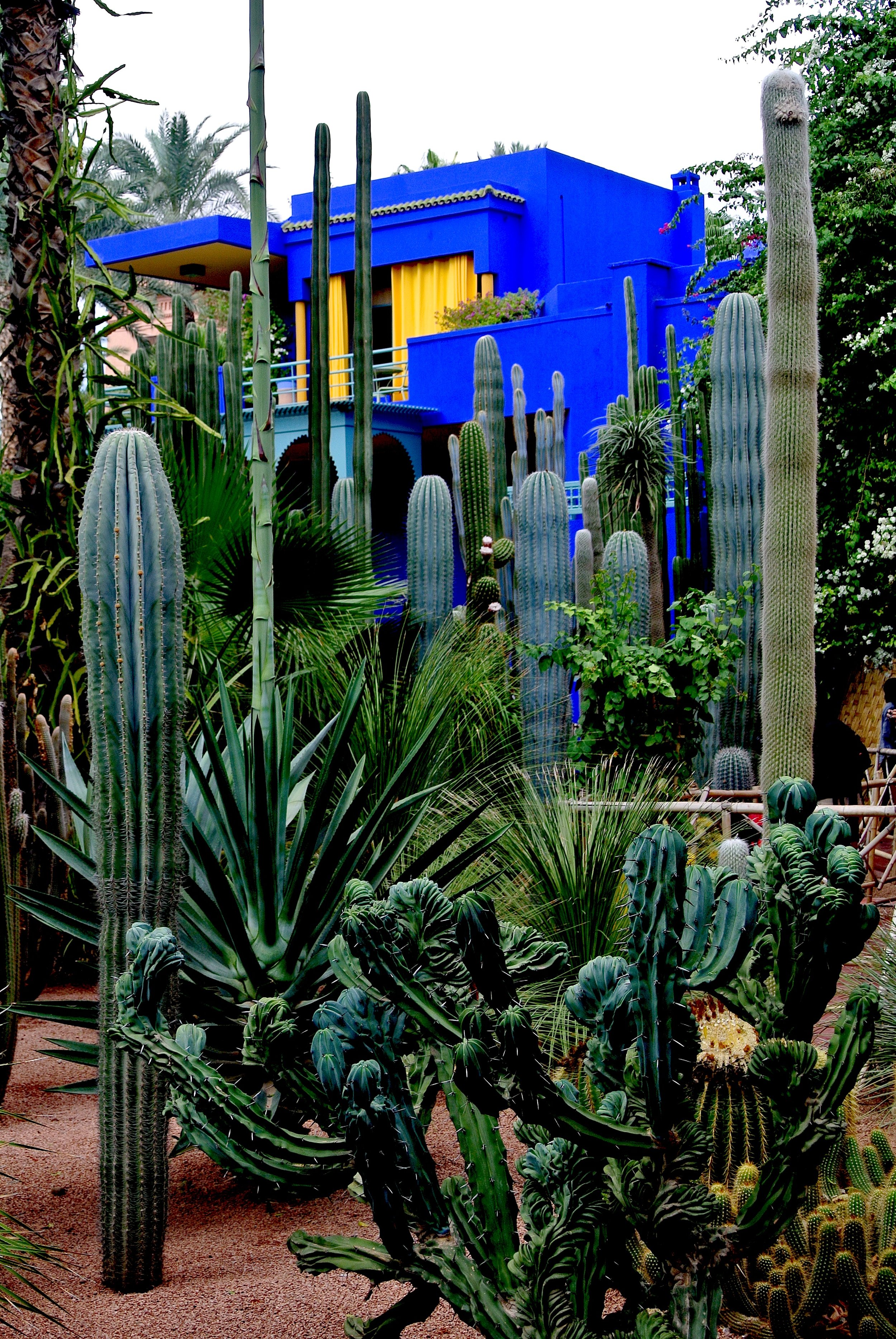
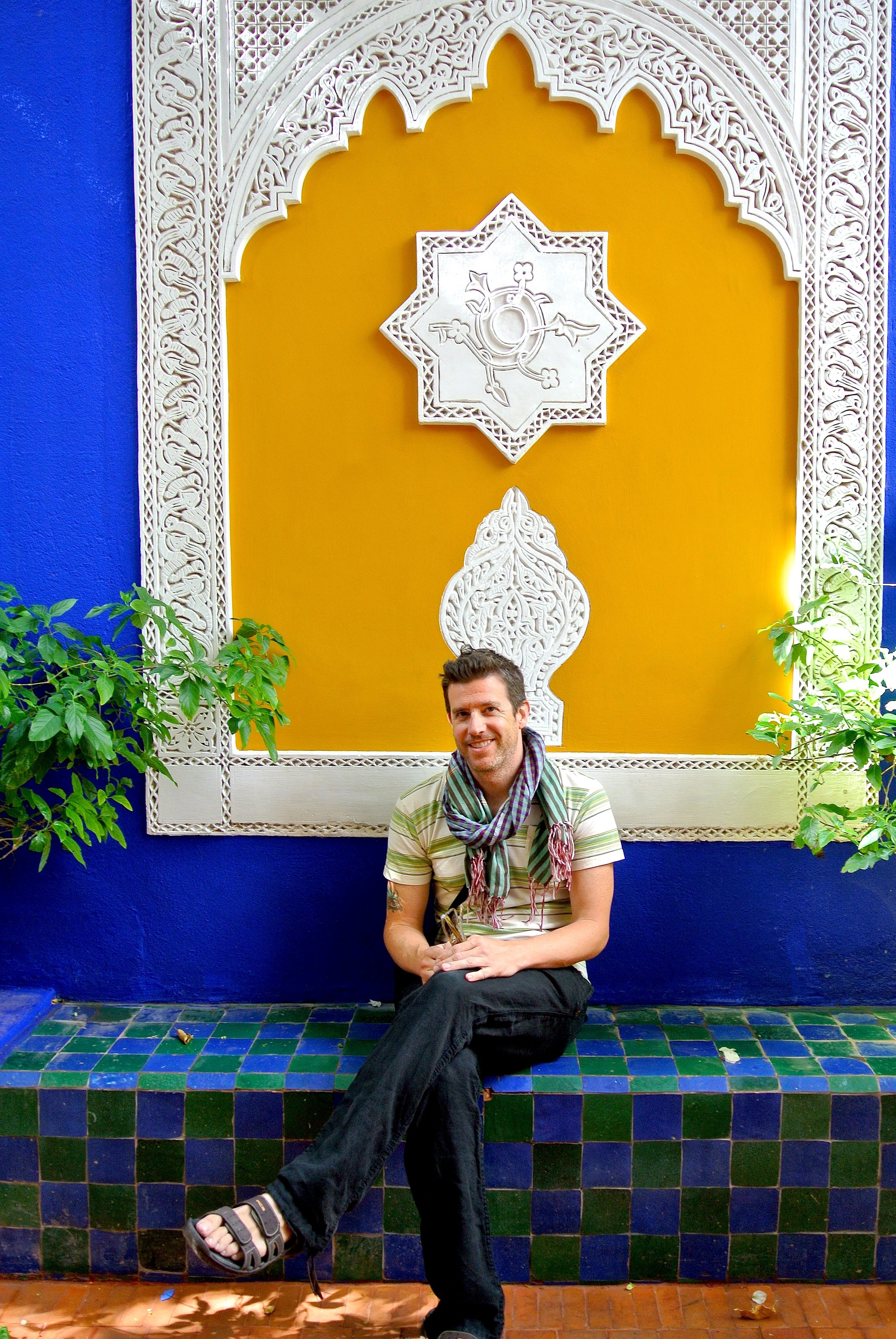
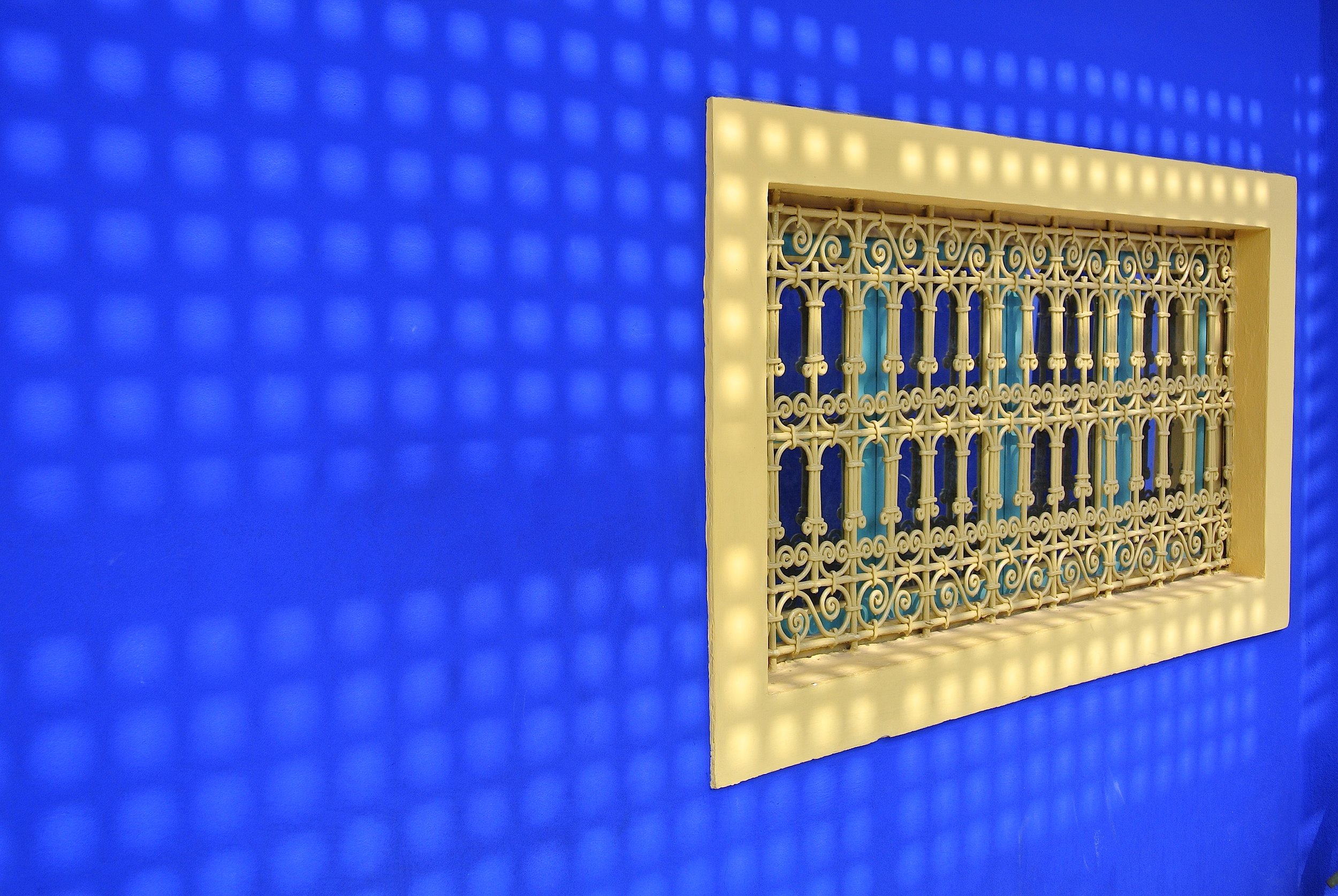
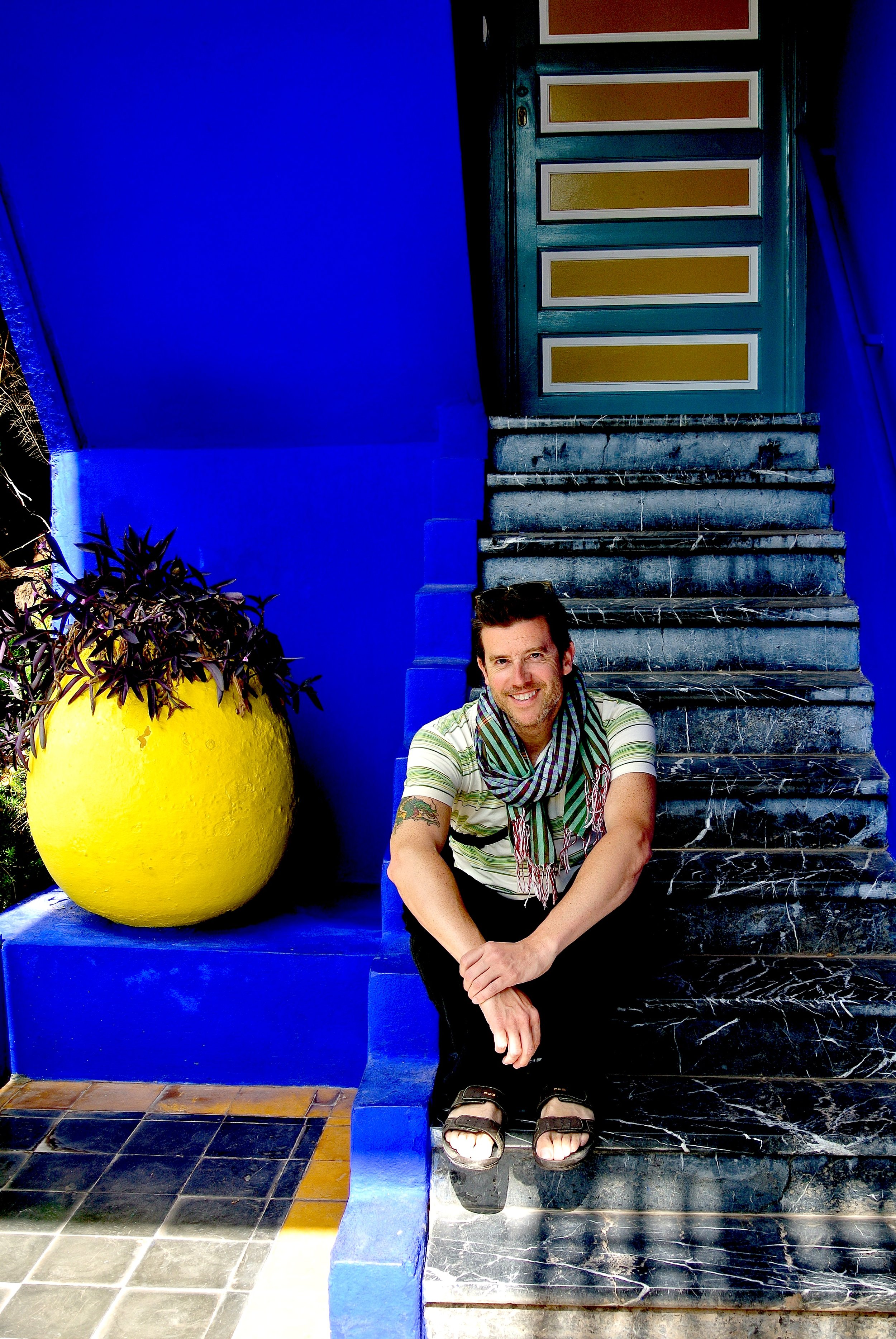
In 1931, he commissioned architect Paul Sinoir to design a Cubist villa to serve as his studio. Majorelle painted the fountains, planters and atelier a specific shade of cobalt blue, now appropriately named bleu Majorelle.

This striking cobalt is known as Majorelle blue

This striking cobalt is known as Majorelle blue

Around his new dwelling, Majorelle, a passionate amateur botanist, cultivated the gardens, which he opened to the public in 1947 to help offset their costly maintenance. After Majorelle’s death in 1962, the gardens remained open but gradually fell into a state of disrepair, lacking the care necessary to maintain them.

The designer Yves Saint Laurent saved the garden from disrepair

The designer Yves Saint Laurent saved the garden from disrepair

Yves Saint Laurent to the Rescue

Couturier Yves Saint Laurent acquired a second guesthouse, Dar Es Saada, in Marrakech in 1973 with his then-boyfriend Pierre Bergé. Arabic for the House of Happiness in Serenity, it was located near one of their favorite places, the Jardin Majorelle. When they learned seven years later that the gardens were slated for demolition to make way for a pool and bungalows. Saint Laurent and Bergé decided to purchase the 12-acre garden and villa. The couple enlisted American landscape architect Madison Cox to meticulously restore the gardens. According to Cox, Saint Laurent had the vision to have the flowerpots scattered throughout the garden painted in lemon yellow, sky blue and the famous bleu Majorelle. Saint Laurent and Bergé kept the garden open for visitors to enjoy, just as Majorelle did. 

(Bergé and Cox married in a private civil ceremony shortly before Bergé’s death in 2017. Cox is  also the director of the Fondation Jardin Majorelle, an organization that operates under the Fondation Pierre Bergé-Yves Saint Laurent.)

YSL’s genderbending aesthetic included le smoking, a feminized take on the tux

YSL’s genderbending aesthetic included le smoking, a feminized take on the tux

Musée Yves Saint Laurent

Saint Laurent often designed his collections while in Marrakech, inspired by the city’s colors and shapes. So it’s fitting, pun intended, that a museum dedicated to the influential designer’s life and legacy was built next to the Jardin Majorelle.

Although it wasn’t open when we visited, the Musée Yves Saint Laurent, abbreviated as mYSLm, was spearheaded by Bergé and conceived by Studio KO architects Karl Fournier and Olivier Marty. The museum contains an extensive collection of couture garments, sketches, fashion photos and assorted objects showcasing YSL’s signature genderbending style from 1962 until his retirement in 2002.

The bamboo copse at Majorelle

The bamboo copse at Majorelle

Secret Garden

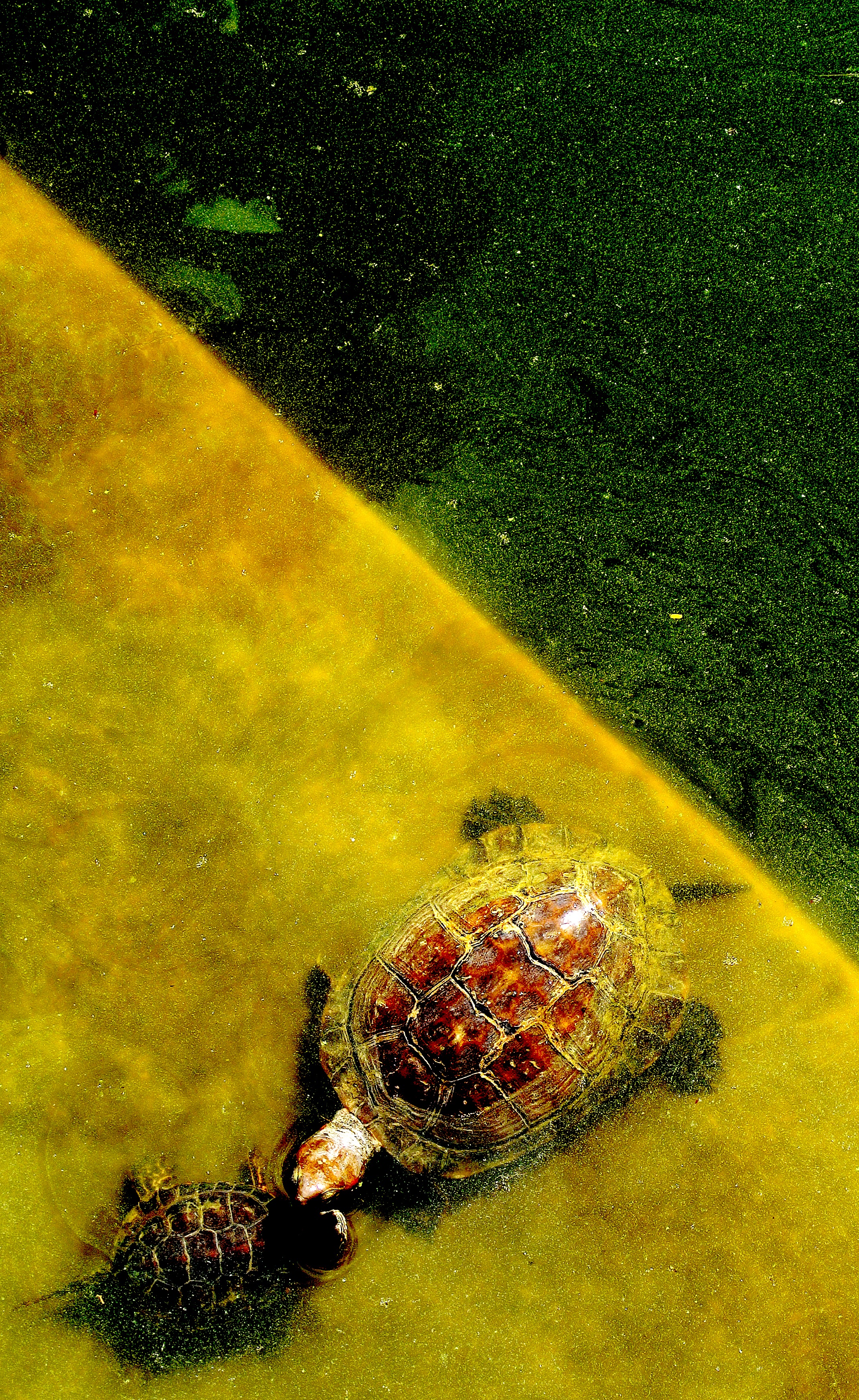
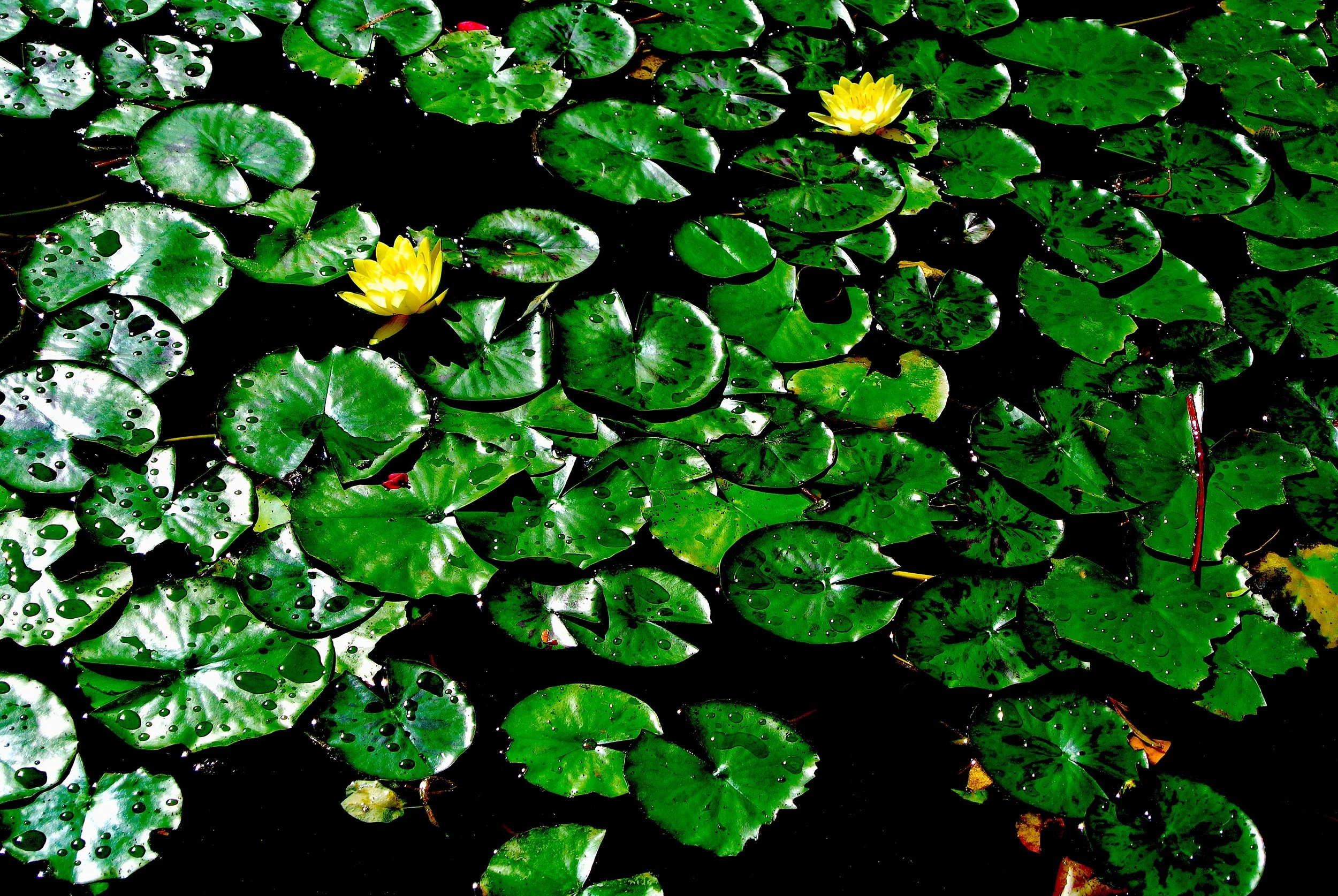
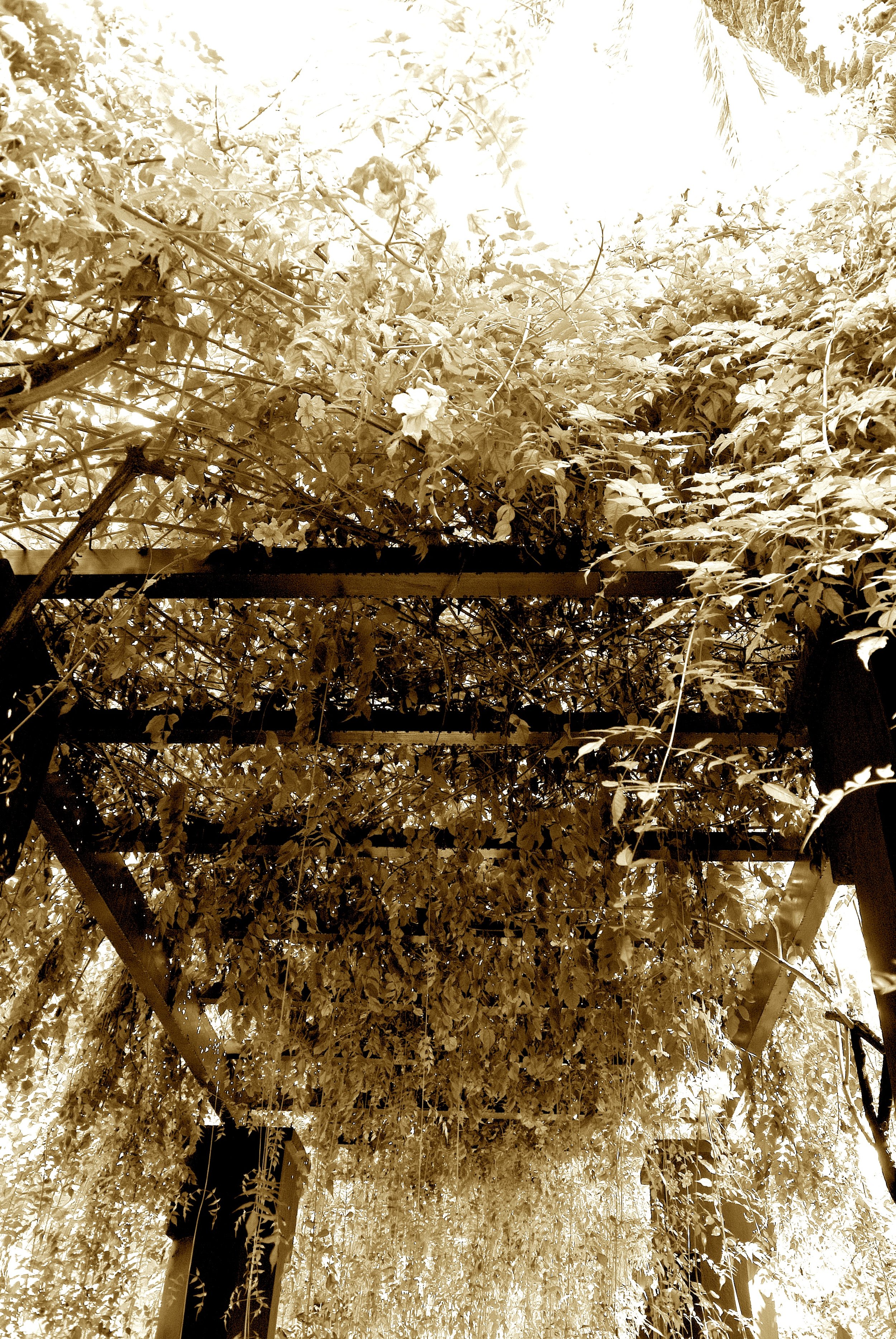
We passed through a pergola covered with bougainvillea and paused to look into a reflecting pool containing water lilies and a pair of turtles resting at its edge.

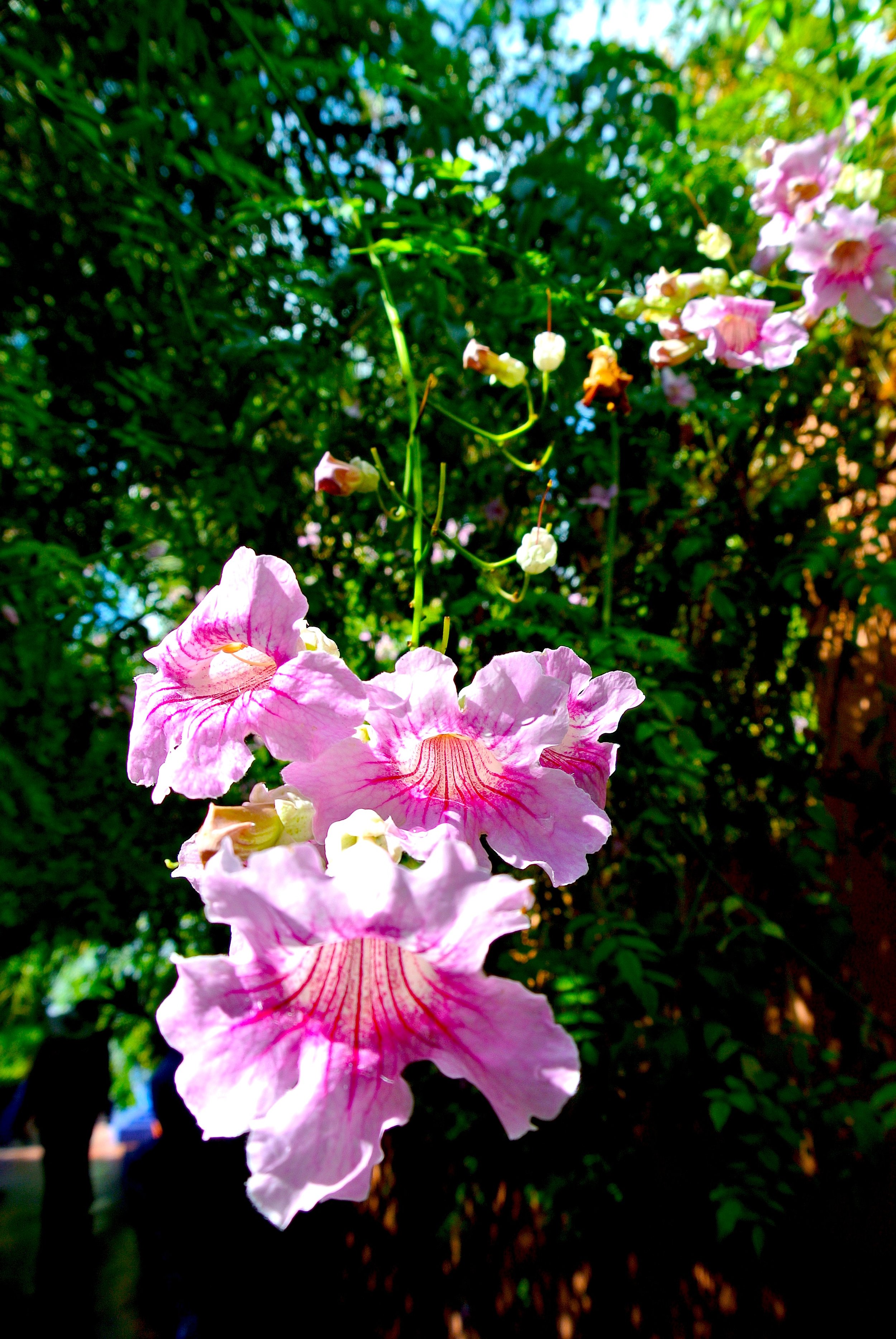
The garden is mostly green with periodic bursts of pink and red

The garden is mostly green with periodic bursts of pink and red

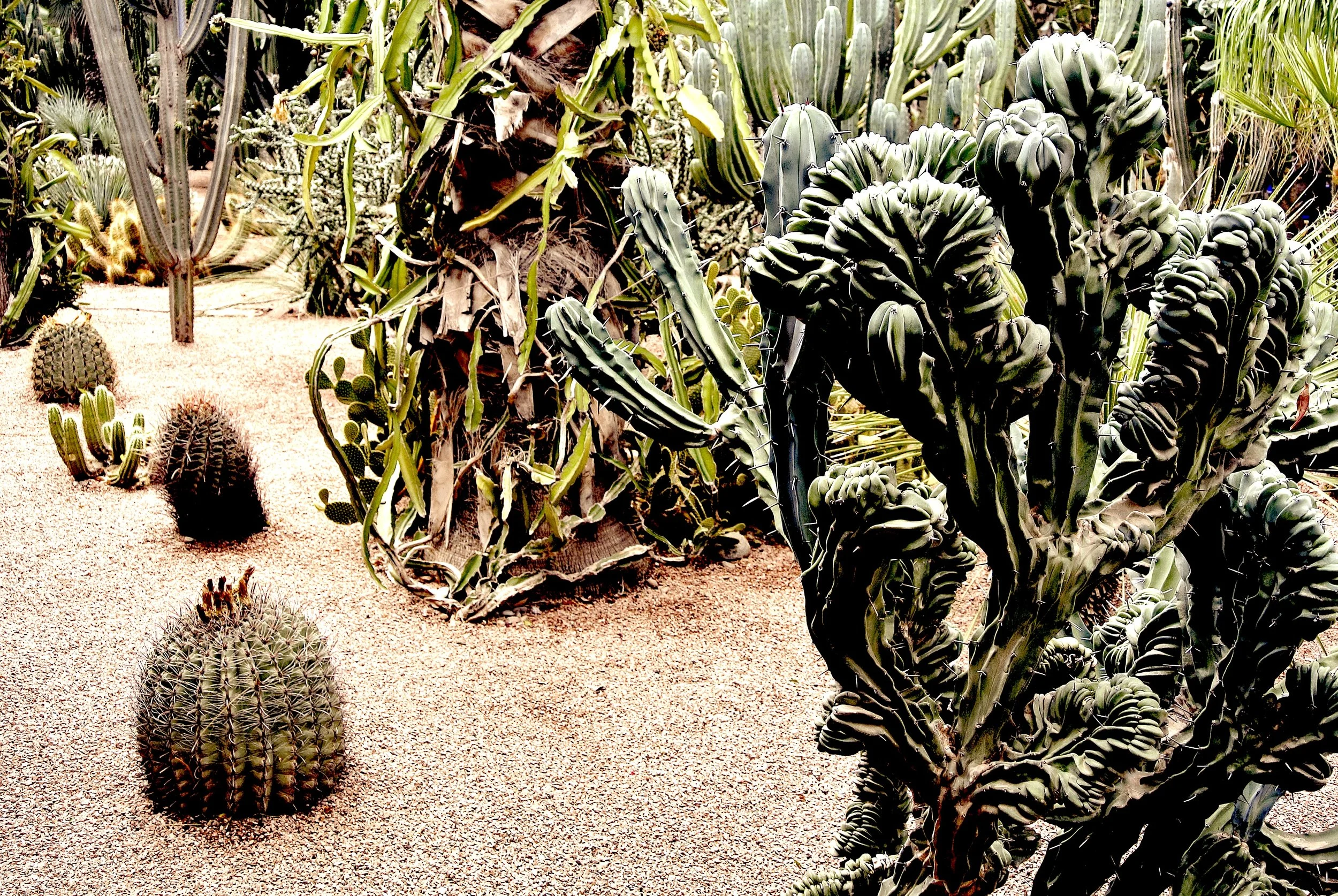
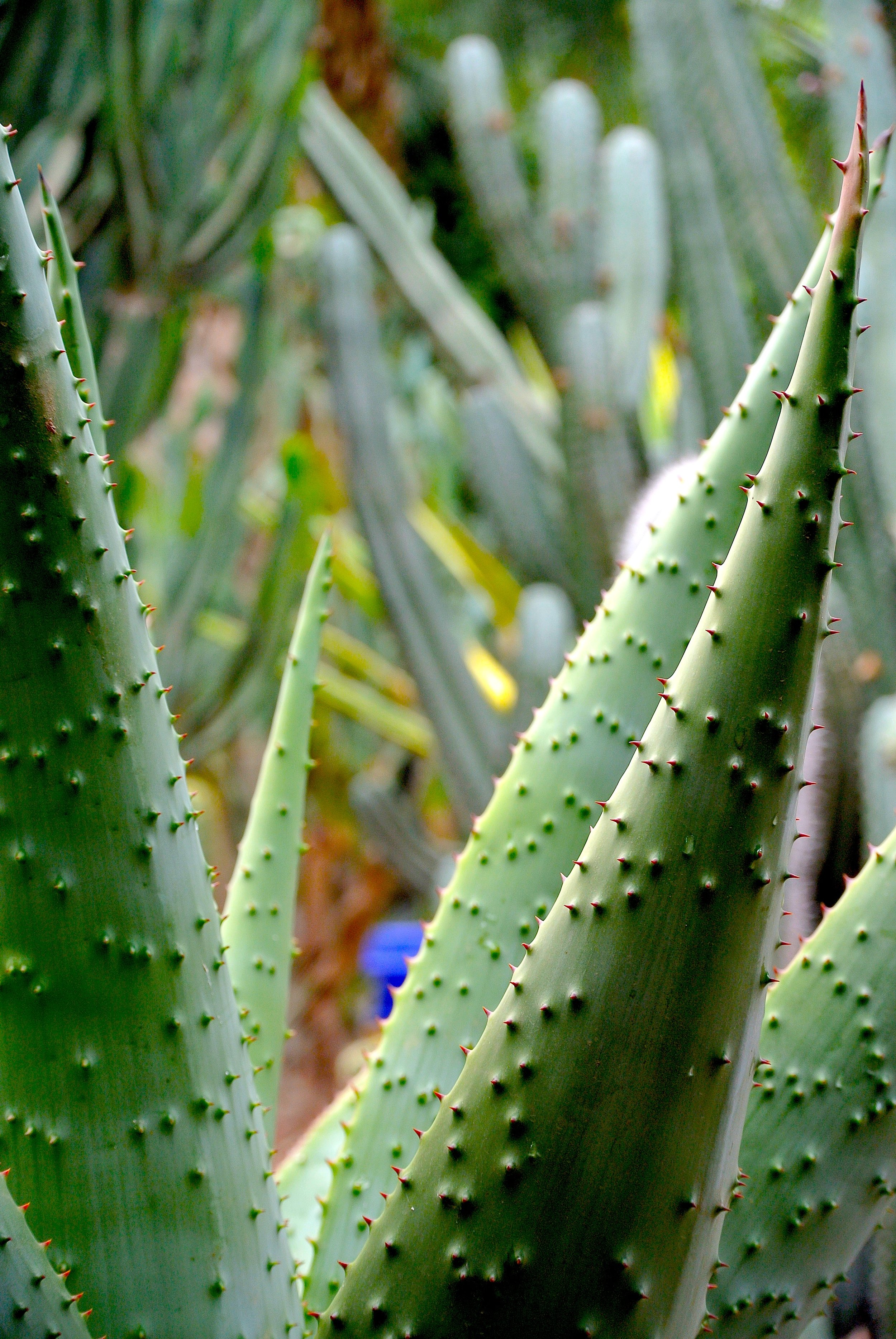
Drought-tolerant cacti make up the majority of plants at the Majorelle Garden

Drought-tolerant cacti make up the majority of plants at the Majorelle Garden

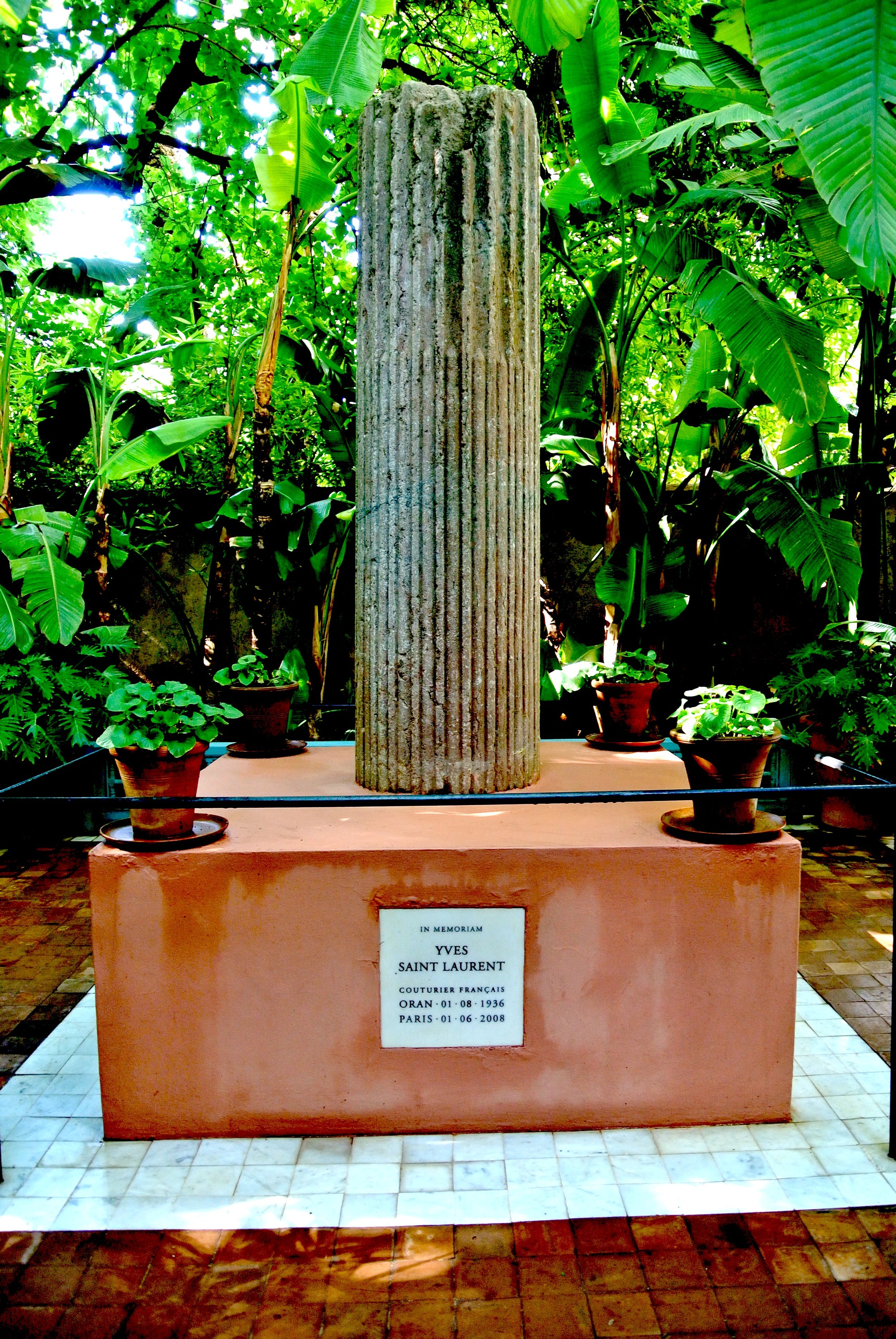
Following the garden path, we came upon a modest memorial dedicated to Saint Laurent. When he passed away in 2008, his ashes were scattered amongst the garden he and Bergé so lovingly restored.

This decaying column serves as Saint Laurent’s memorial 

This decaying column serves as Saint Laurent’s memorial 

Wally and Vanessa enjoy the serenity of this oasis

Wally and Vanessa enjoy the serenity of this oasis

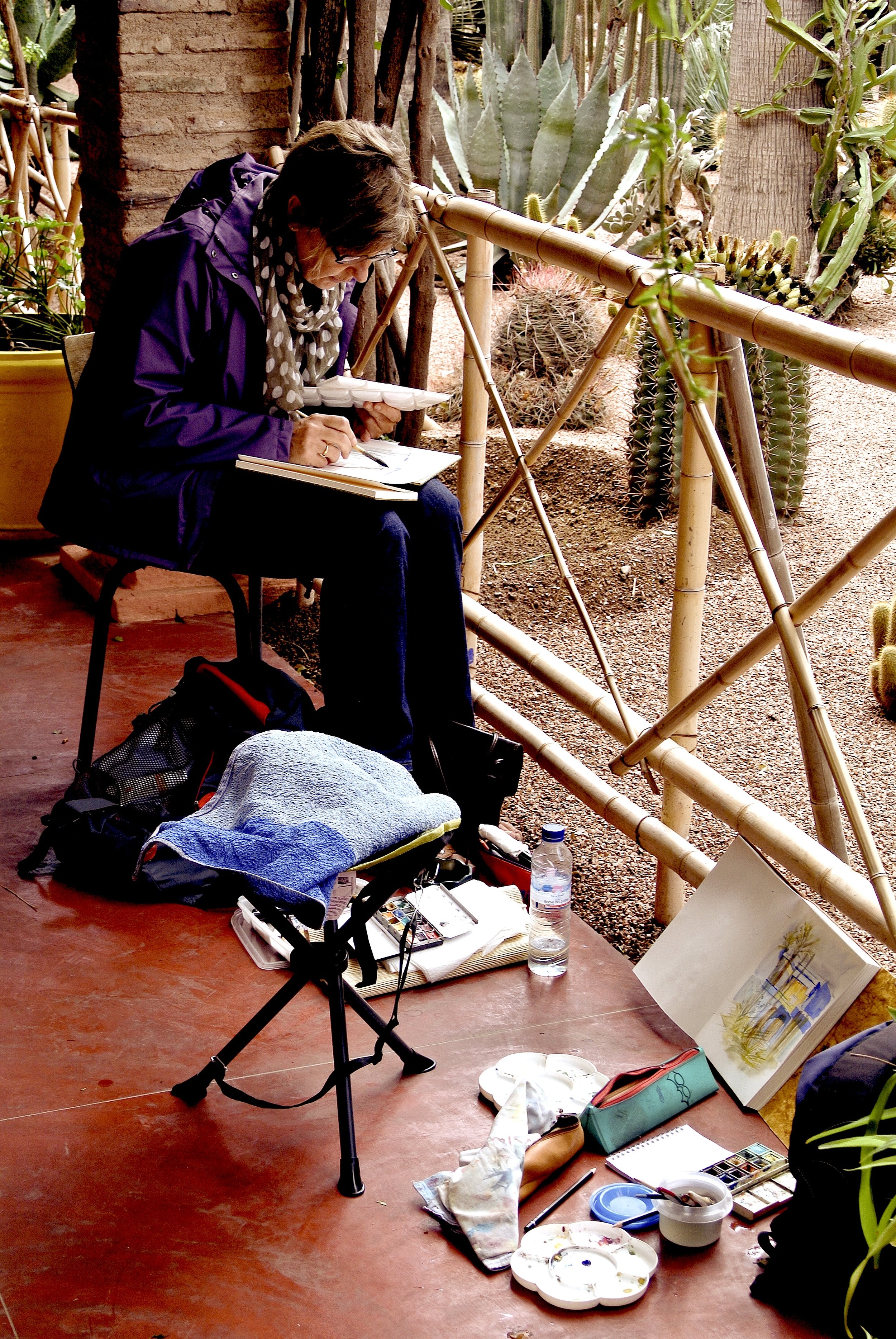
Artists paint the plantlife

Artists paint the plantlife

A peek over an artist’s shoulder

A peek over an artist’s shoulder

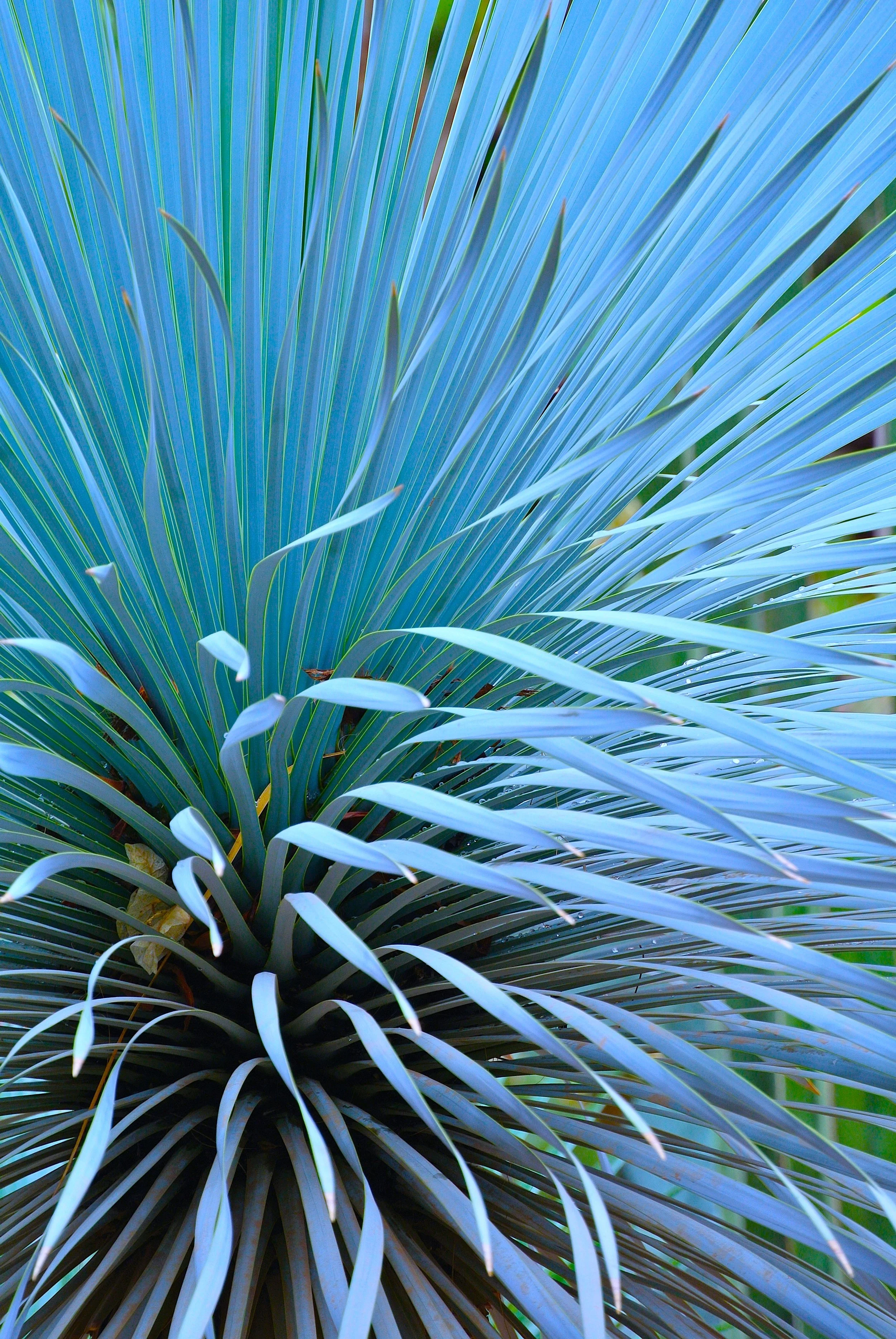
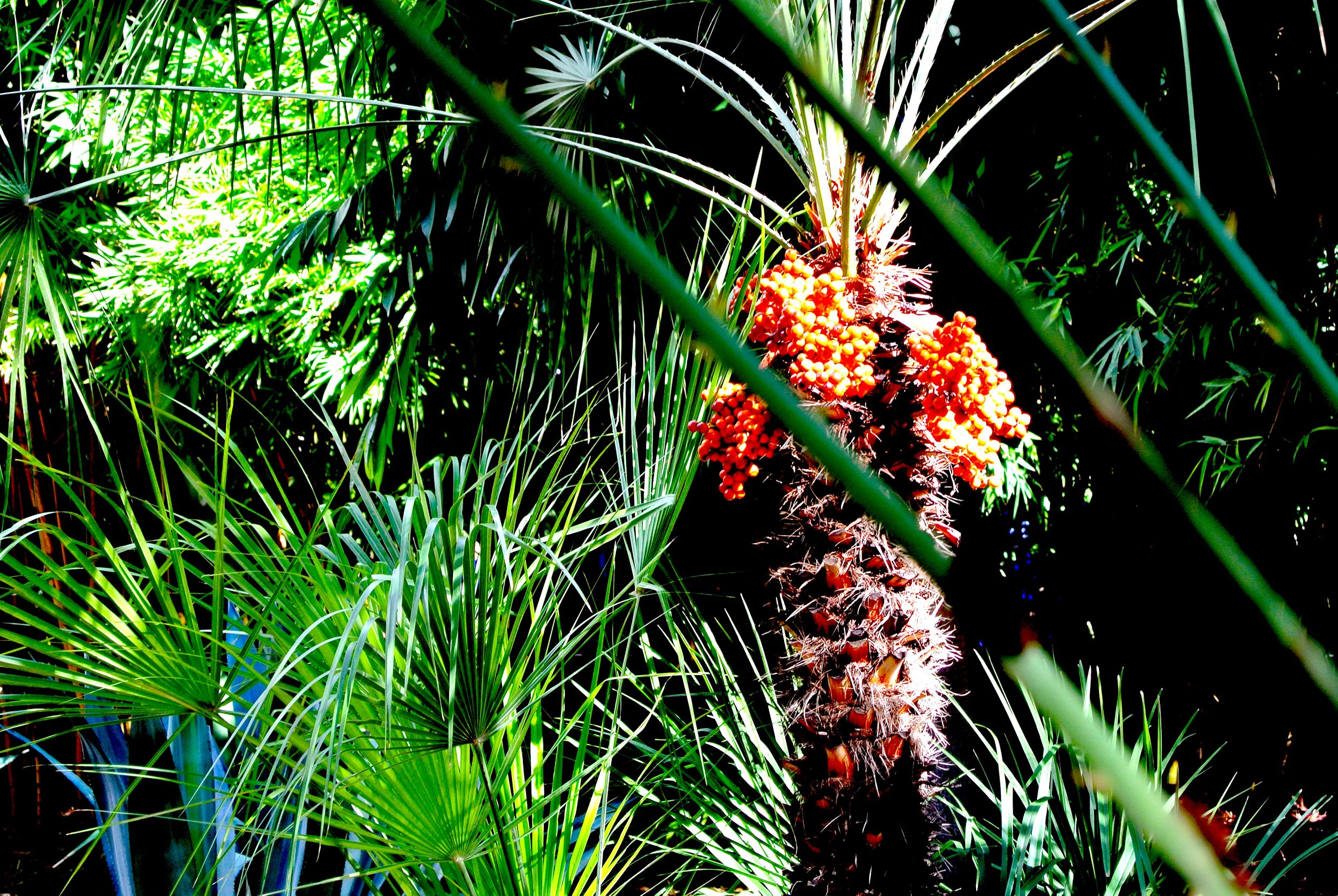
The magnificence of this garden reminded me of the exotic Generalife gardens located beside the Alhambra in Granada, Spain. The arid landscape, originally almost devoid of vegetation, like the gardens of the Alhambra, were utterly transformed by Majorelle over a span of 40 years. From what I could identify, the garden includes agave, bamboo, cacti, cypress, datura, succulents and bougainvillea.

In the Cubist villa, there’s a gift shop and a museum dedicated to artifacts from the pre-Arab inhabitants of North Africa, the Berbers. Just don’t try to sneak in, or you might get kicked out, like Wally did.

Birds chirping, bamboo rustling in the breeze, and the sound of trickling fountains truly turn the garden into a welcome oasis from the hustle and bustle of the medina. –Duke

We recommend adding le Jardin Majorelle to your Marrakech itinerary

We recommend adding le Jardin Majorelle to your Marrakech itinerary

Jardin Majorelle
Rue Yves Saint Laurent

Admission: 30 dirham, or around $3.25


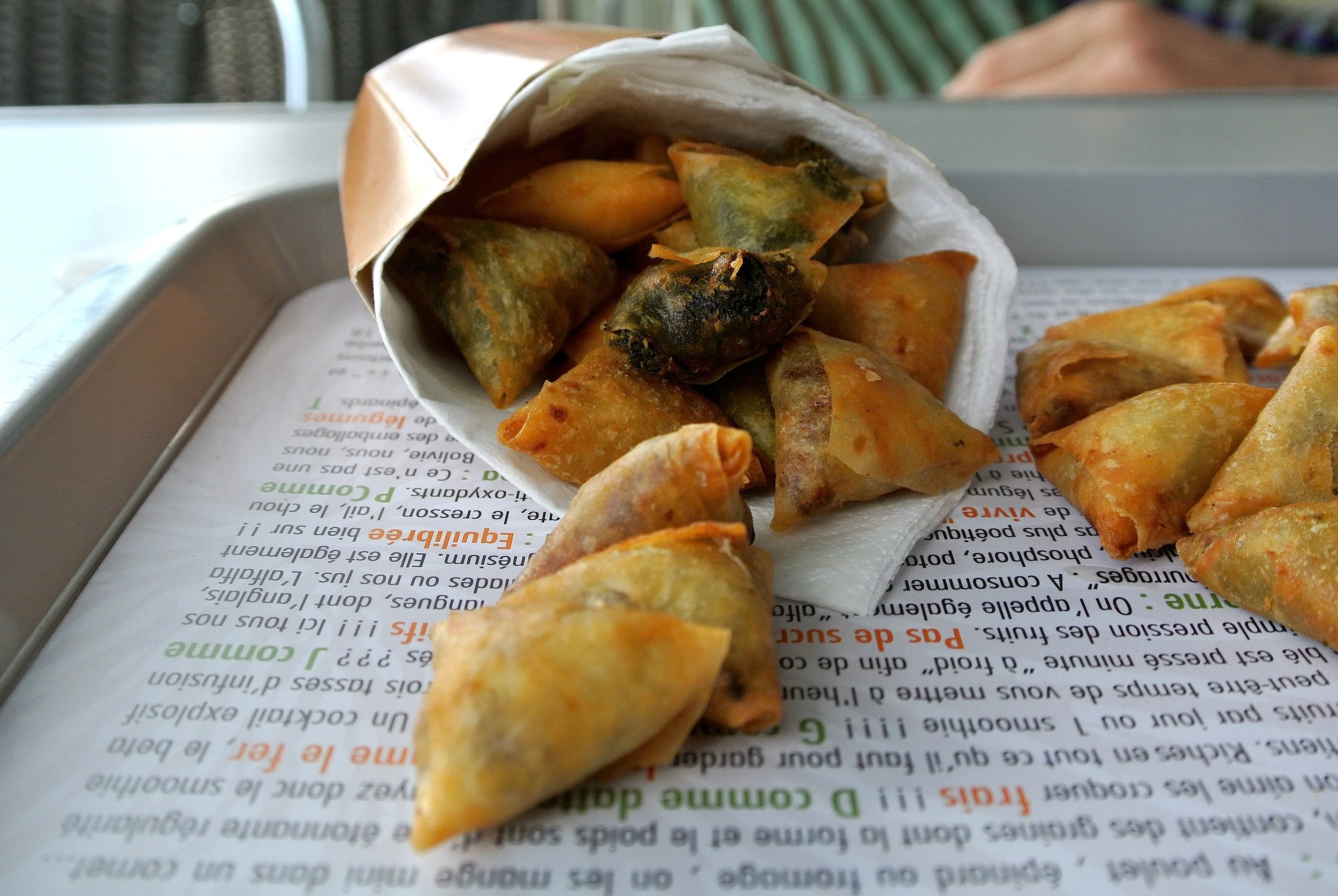
Spinach-filled phylo puffs at the neighboring Kaowa Café

Spinach-filled phylo puffs at the neighboring Kaowa Café

Nearby

Thirsty and hungry after visiting the gardens, we dined on the terrace of Kaowa Café, a snack and juice bar situated across the way. We ate delicious puffs filled with cheese and tried some of their signature juices.

20 Best Instagram Photos of 2016

You saw, you liked. Here are our best-rated travel photos on Instagram of last year.


Looking back, 2016 taught me the importance of staying connected to friends near and far. Seeking new perspectives to overcome hurdles and nurturing the labor of love Wally and I call the Not So Innocents Abroad.

Our hope is to share our experiences of other cities and other cultures. Whether exploring the unusual 161-year-old Dhundiraj Ganpati Mandir wooden Hindu temple in Baroda, India or asking our friends abroad to vocalize how they felt about the polarizing effects of the American election, we’re grateful for the role you’ve played and look forward to welcoming a year filled with optimism and new adventures.


Choose Your Own Adventure

As the old adage goes, “a picture is worth a thousand words.” Predicting what makes one image more engaging than another can be difficult to determine and often, like art, is simply subjective.

From amazing destinations that include Cambodia, France, India and Morocco, here’s a look back at our most popular Instagrams of last year.

Follow us on Instagram — and be a part of the action! –Duke

1. If Aix-en-Provence, France doesn’t charm you with its markets, food and architecture, there is no shortage of magnificent elaborately hand-carved entry doors to look at.

2. The beautiful Italianate courtyard outside the Darbar Hall at Laxmi Vilas Palace in Vadodara, India.

3. Deco Darling. Tucked away in the Fès Medina, Morocco, is the beautiful Palais Amani. Originally owned by a prominent Fassi family of merchants, the majority of the residence was rebuilt in the Art Deco style after a landslide badly damaged the 17th century property.

4. The Café St. Regis was one of our favorite spots to enjoy breakfast when we visited Paris, France.

5. The façade of Notre Dame in Paris has many interesting details, but perhaps none as unique as the sculpture in the left portal holding his head. The statue is of St. Denis, said to have picked his head up after being decapitated and walked six miles, while preaching a sermon of repentance the entire way. If it takes me 45 minutes on the treadmill at 6 miles per hour, he would have walked an hour plus!

6. Both covered and open-air, the green metal pavilions from the 1900s form the charming flower market located on Place Louis Lépine in Paris, between the Notre Dame Cathedral and Sainte Chapelle chapel.

7. A view of the magnificent Rajon Ki Baoli stepwell in Delhi, India, built by Daulat Khan during the reign of Sikandar Lodi in 1516. Chambers located behind the arch-shaped niches once provided respite from the heat and a place for patrons to socialize.

8. One of the splendid staircases with its elegant wrought-iron railing inside the 18th century Hotel d’Albertas mansion in Aix-en-Provence, France. Embellishments such as these were a sign of family wealth intended to call out the social status of the owner.

9. Neptune wielding a trident riding on a fish by sculptor André Massoule on the Beaux-Arts Pont Alexandre III in Paris. A marvel of 19th century engineering, this bridge consists of a 20-foot-high single-span steel arch.

10. Musical Chairs. I was awestruck by the hypnotic symmetry of the rows of empty ladder-back chairs awaiting the devout at Saint Suplice in Paris. The ethereal Catholic church, located in the 6th arrondissement, is the second largest in Paris and it was in some movie called The Da Vinci Code. 😜

11. The enormous grooved stump of lime mortar and rubble masonry are all that remains of the unfinished Alai Minar in Delhi. The minaret was intended to rival the Qutb Minar in both size and scale, but was never completed.

12. Part of the Right Bank, this busy square located in Montmartre, Paris is known for its portrait artists and painters. During the Belle Époque, at the beginning of the 20th century, many artists, including Pablo Picasso, Henri de Toulouse-Lautrec and Vincent van Gogh resided and worked here.

13. Fez was founded in 859 CE. The origin of the name is unknown. Some scholars believe it comes from the old Berber name of the Middle Atlas Mountains, Fazaz. Other stories trace the name back to a tale of a golden axe that divided the river of Fez into two halves. In Arabic, a fez is an axe.

14. Built by sculptor Jean-Claude Rambot and situated in the heart of the Mazarin district, the Fountain of the Four Dolphins in Aix supports an obelisk topped with a pineapple. We spent an afternoon here with our sketchbooks pretending we were bohemian artistes.

15. The stunning Angkor Wat temple, the largest religious monument in the world, was built by Khmer king Suryavarman II in Siem Reap, Cambodia. It’s a symbolic representation of Mount Meru, the Mount Olympus of the Hindu faith and the abode of ancient gods. The complex has been in continuous use since it was built.

16. Benched. There is something beautiful in the patina of these benches in Aix Cathedral combined with the well-worn brick floor that has stood the test of time.

17. A Room With a View. Our grand suite at the Udai Bilas Palace in Dungarpur, India looked out onto the tranquil waters of Gaibsagar Lake, where the royal family’s private island temple dedicated to the Lord Shiva floats serenely.

18. Set in Stone. A white marble cenotaph lies at the center of Safdarjung’s tomb in Delhi.

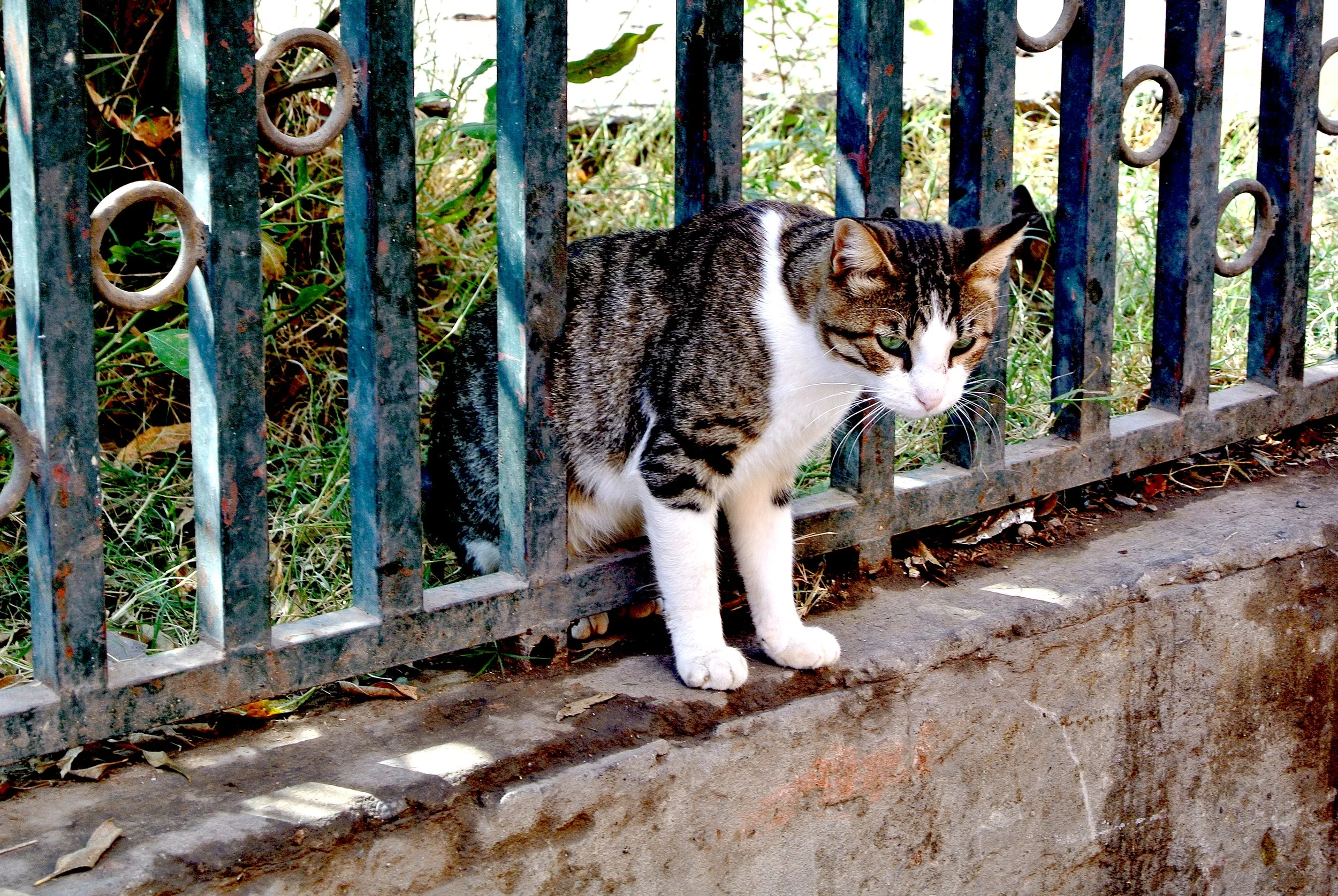
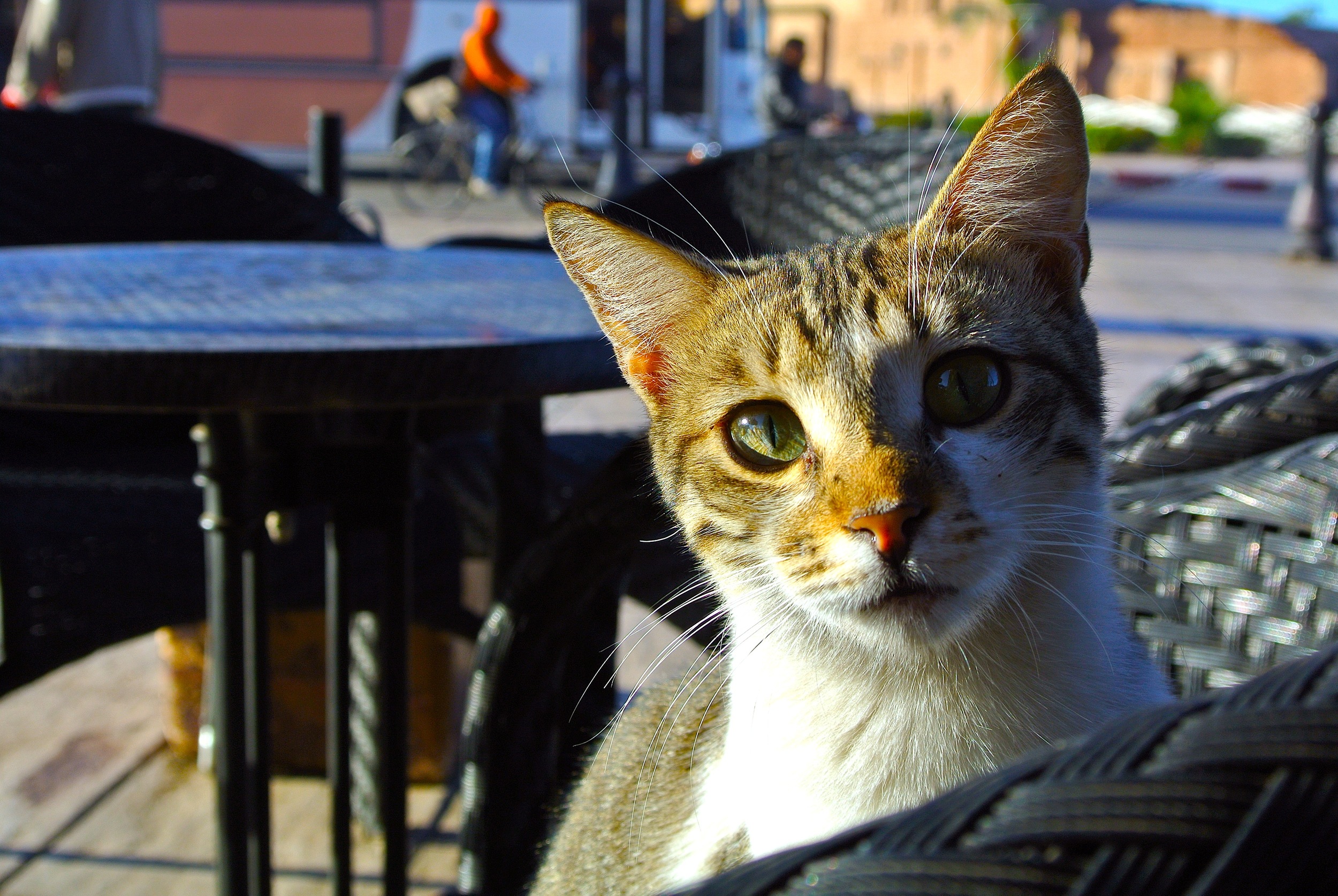
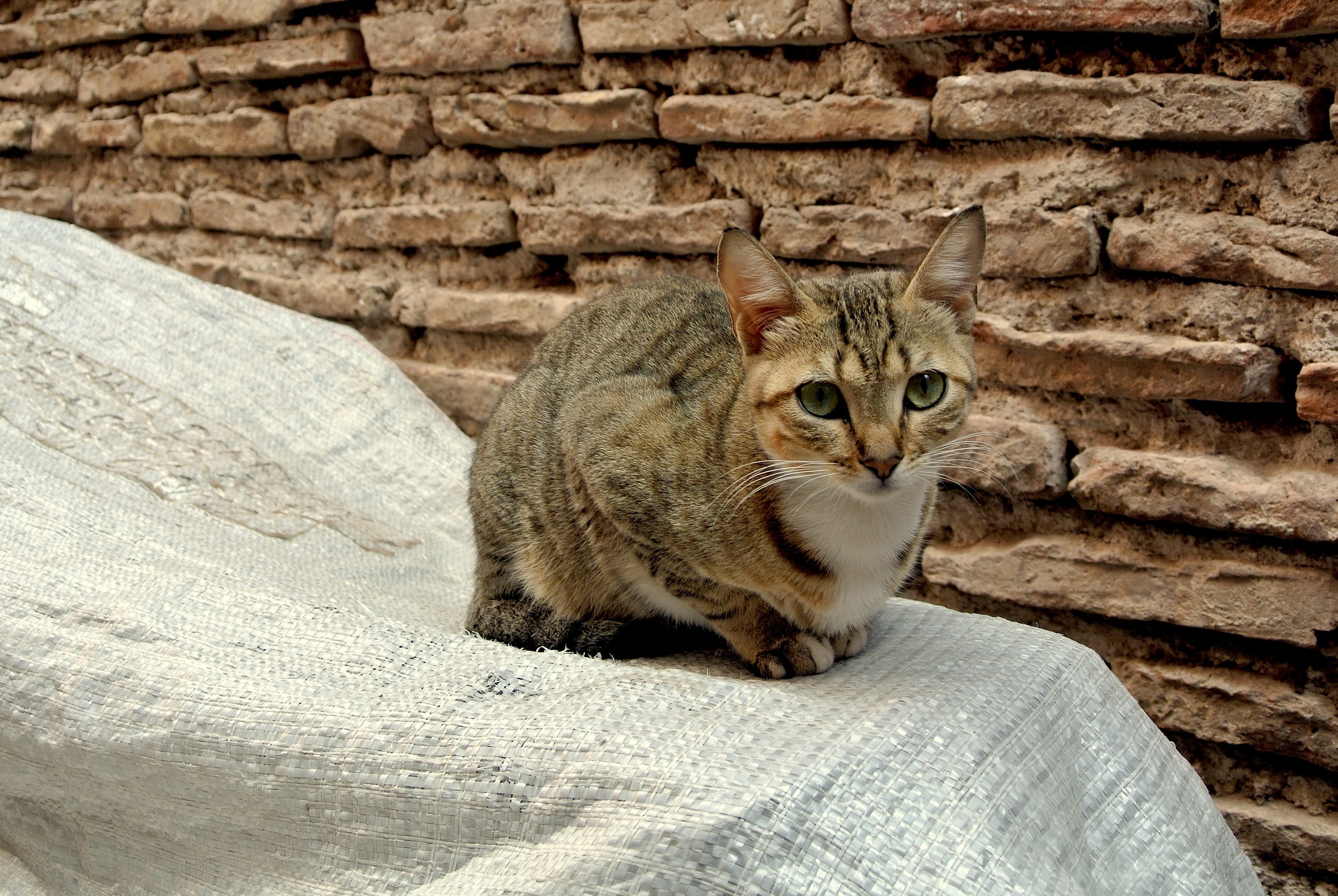
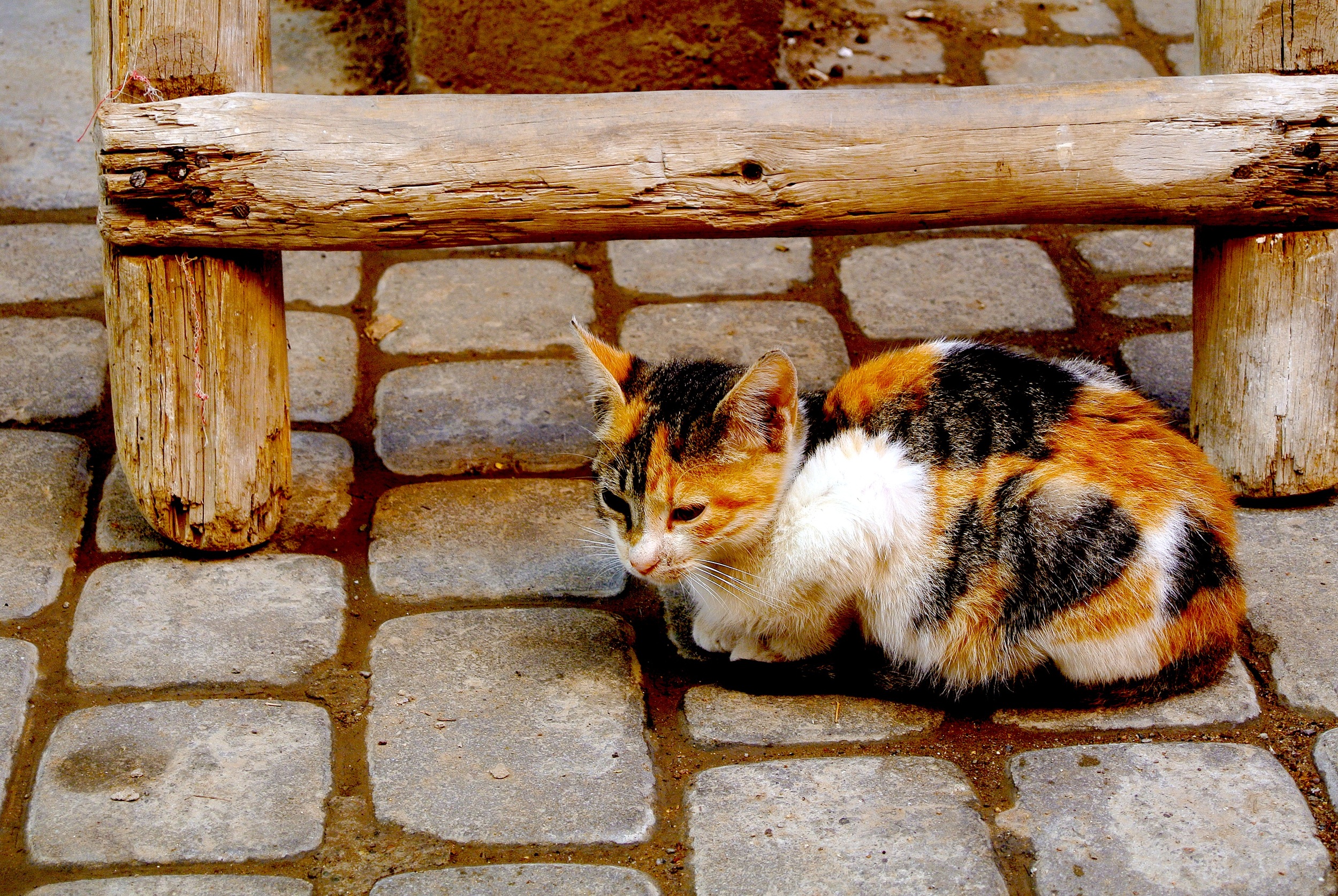
19. Kittens and cats are a common sight among the streets of the Marrakech Medina in Morocco, indifferent to the activity around them. This little guy came to visit while we were sitting having coffee.

20. Louvre is in the air at Paris’ famous museum.

The Cats of Marrakech

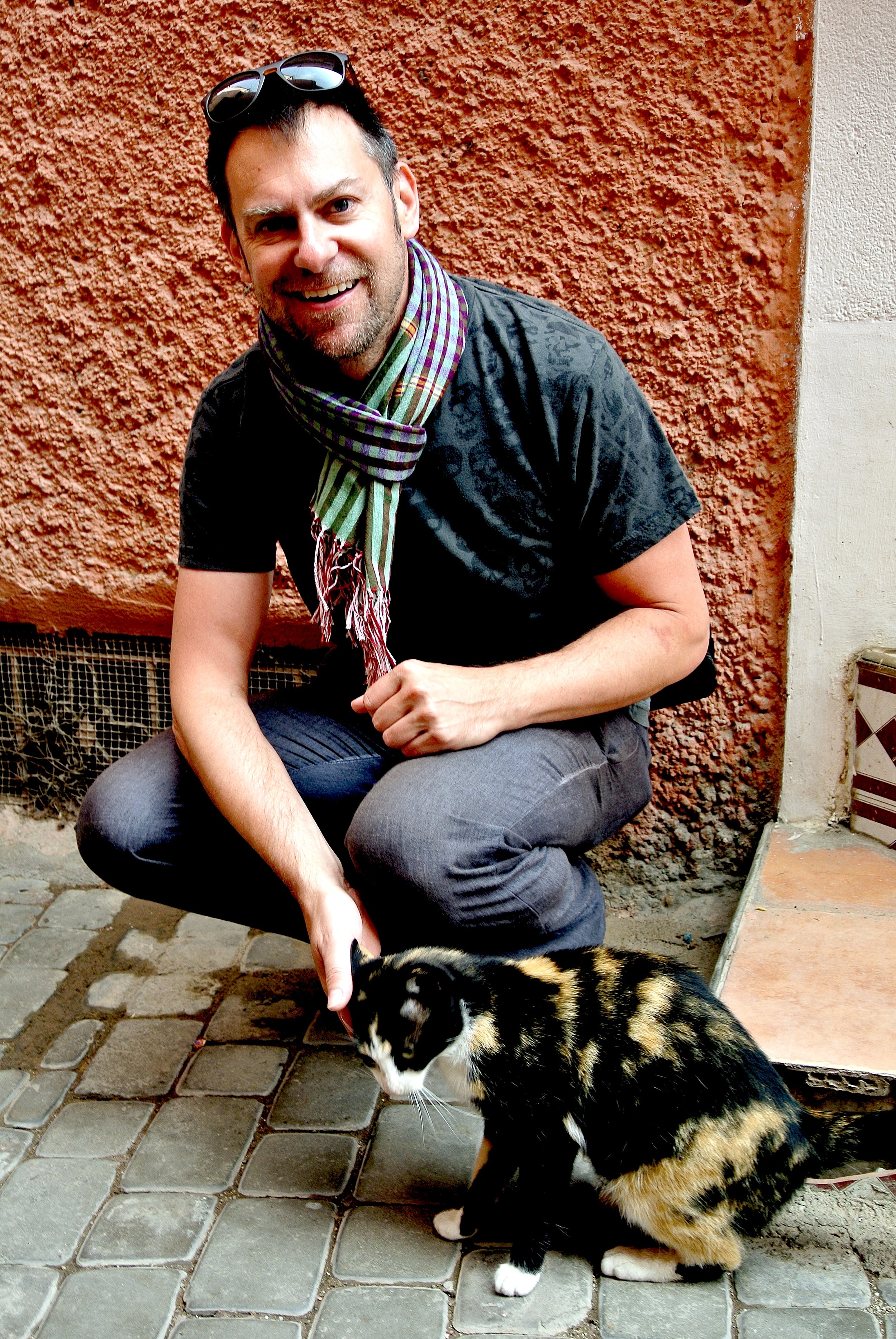
What to do in Marrakech? Try cat-watching! Cherchez les chats. Cats and Islam have a long history.


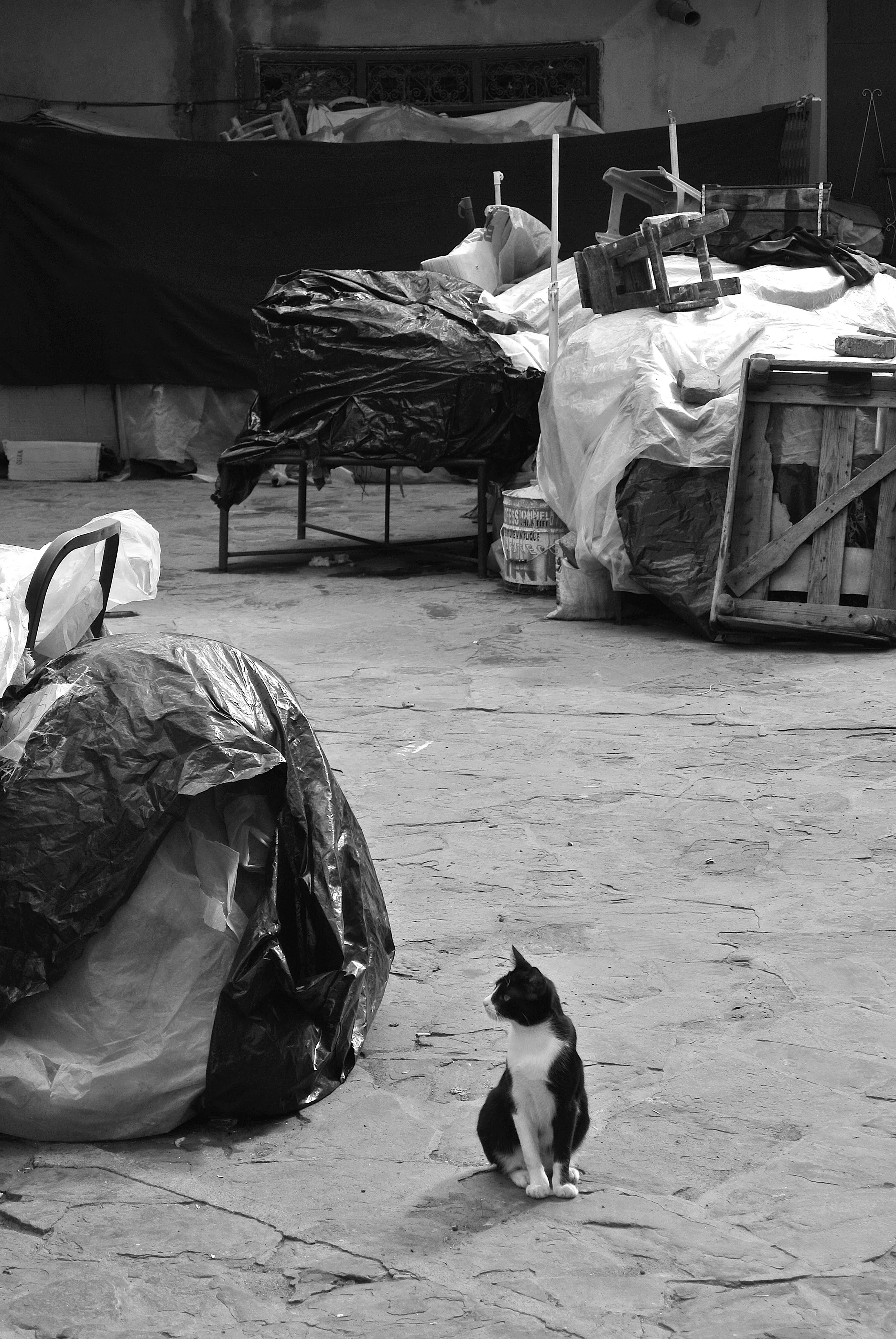
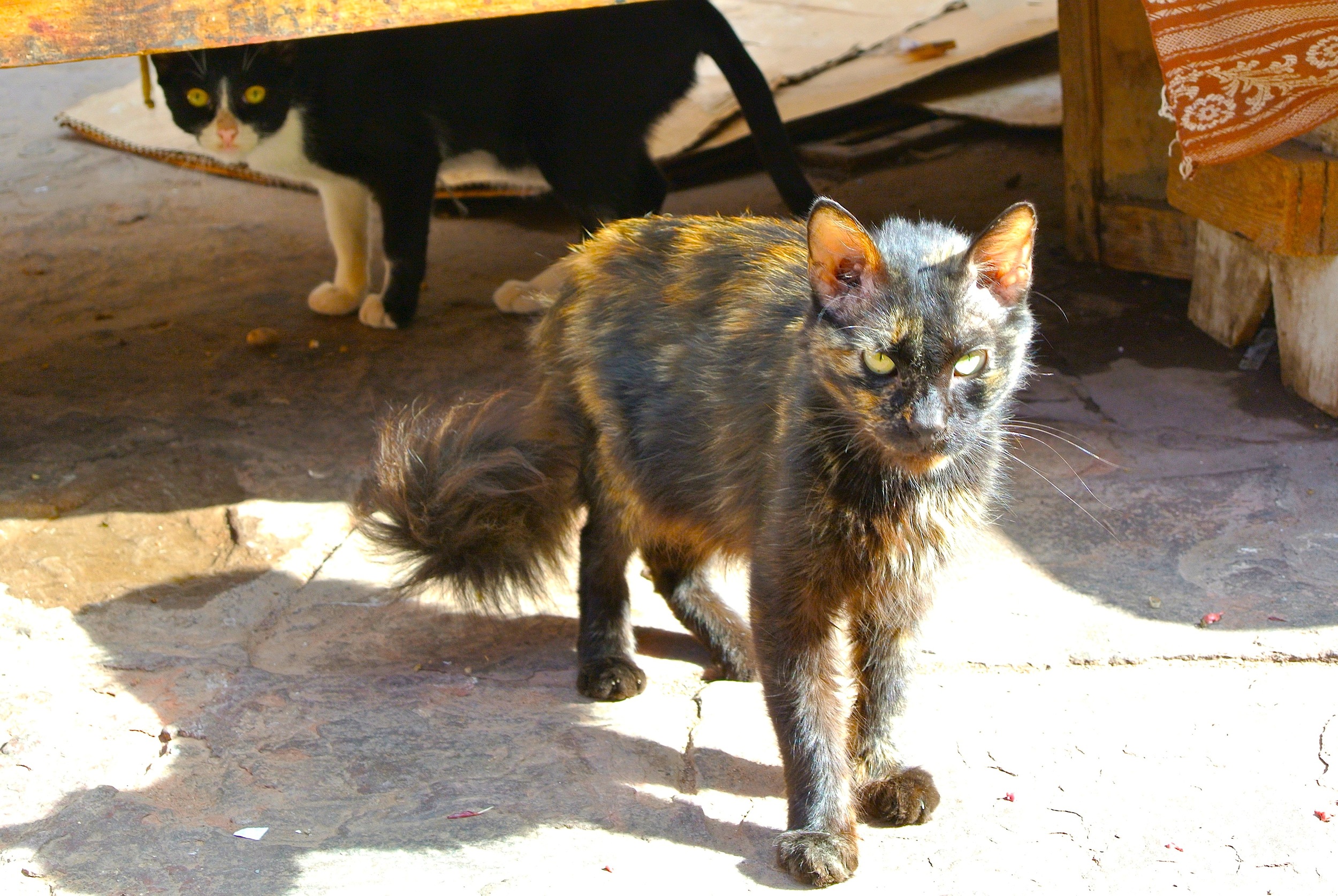
Morocco is a cat lover's delight. They're everywhere, and they're well taken care of. 

Every day we saw shopkeepers and ticket takers at monuments save bits of their meals to put out for a stray cat. 

A woman locked up a cat until the poor creature starved to death. For this, she was tortured and “had to get into Hell.”

We had tons more pics of the cats of Marrakesh, but a djinni corrupted our memory card. So these are all just from our last day and a half in the city.

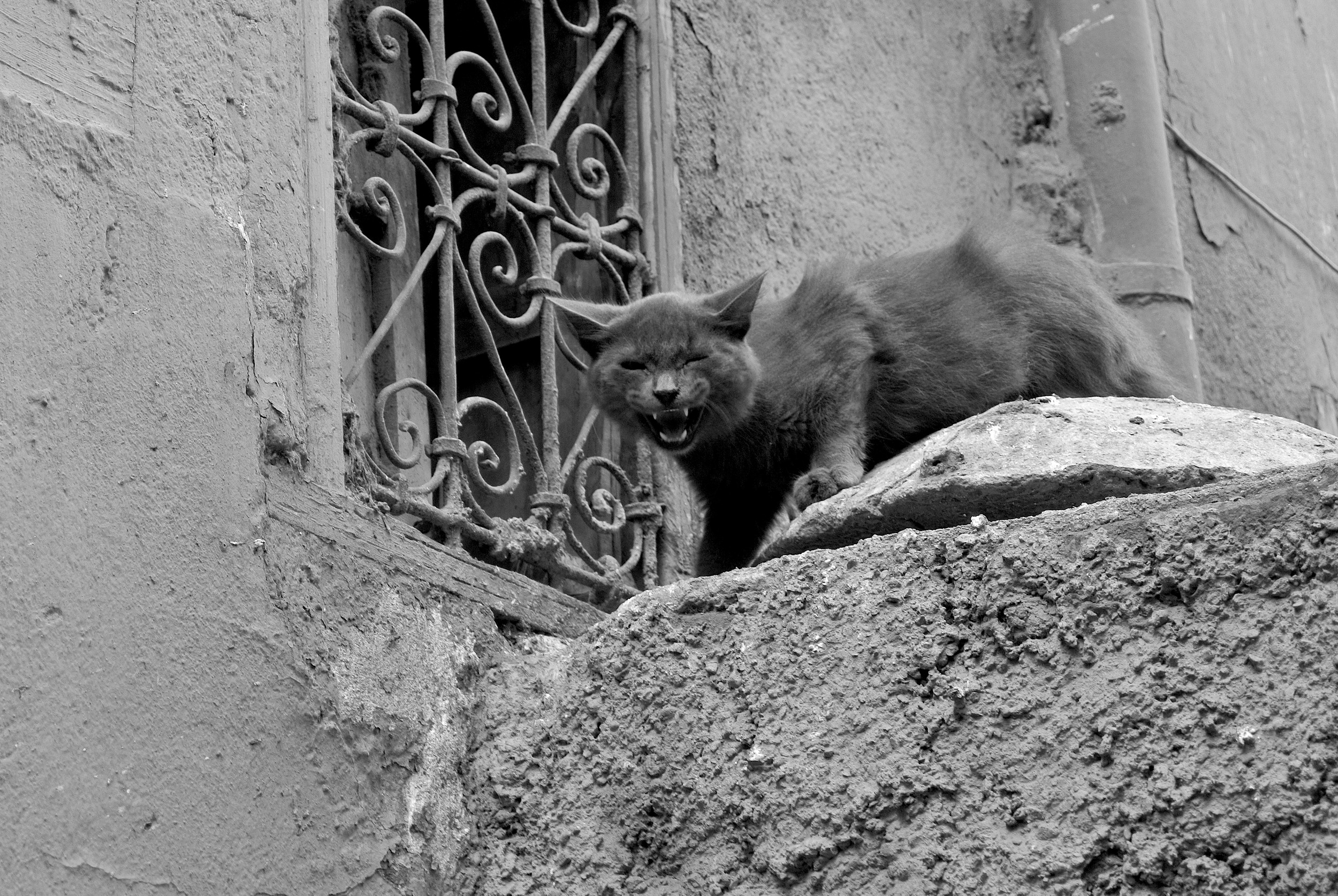
Like we said, there are cats everywhere. And most of them were sweet as can be. Click through the photos above, though, and you'll see the one mean kitty in Marrakech. 

FIND OUT: Why We Believe in Genies


Cats and Islam

Most people trace Muslims' fondness for felines back to the Prophet Mohammed. He had a cat named Muezza, who’s the star of a well-known story.

The call to prayer sounded, and Mohammed wanted to wear a particular robe — but Muezza was curled up asleep on one of its sleeves. Instead of disturbing the cat, the prophet cut the sleeve off of the robe.

Duke and I can certainly relate. I can’t tell you how many times we’ve stayed on the couch longer than we planned, just so we don’t have to budge Bowzer. So far no clothing has had to be sacrificed.

The Prophet Mohammed stroked Muezza three times  — and ever since then, all cats have nine lives and the ability to always land on their feet.

“Islam teaches Muslims to treat cats well and that the cat is a creature to be cherished and loved. Mistreating a cat is regarded as a severe sin in Islam,” according to the Islamic Information Portal.

The hadith (a story shared orally before being written down) titled The Book of Virtue, Good Manners and Joining of the Ties of Relationship explains how important it is not to mistreat a cat.

In the story, a woman locks up a cat until the poor creature starves to death. For this, she was tortured and “had to get into Hell.”

Cats are loved, not only for their beauty, cleanliness and elegance, but for their practical purposes as well. Muslim scholars wrote odes to their cats because they protected their precious books from mice, according to the website Muslim Heritage.

As an added bonus, “it is believed that you will suffer no harm if you drink from the cat’s water, provided no impurities are seen in the cat’s mouth,” the Islamic Information Portal states. Bottoms up! –Wally

Top 6 Wellness Tourism Trips

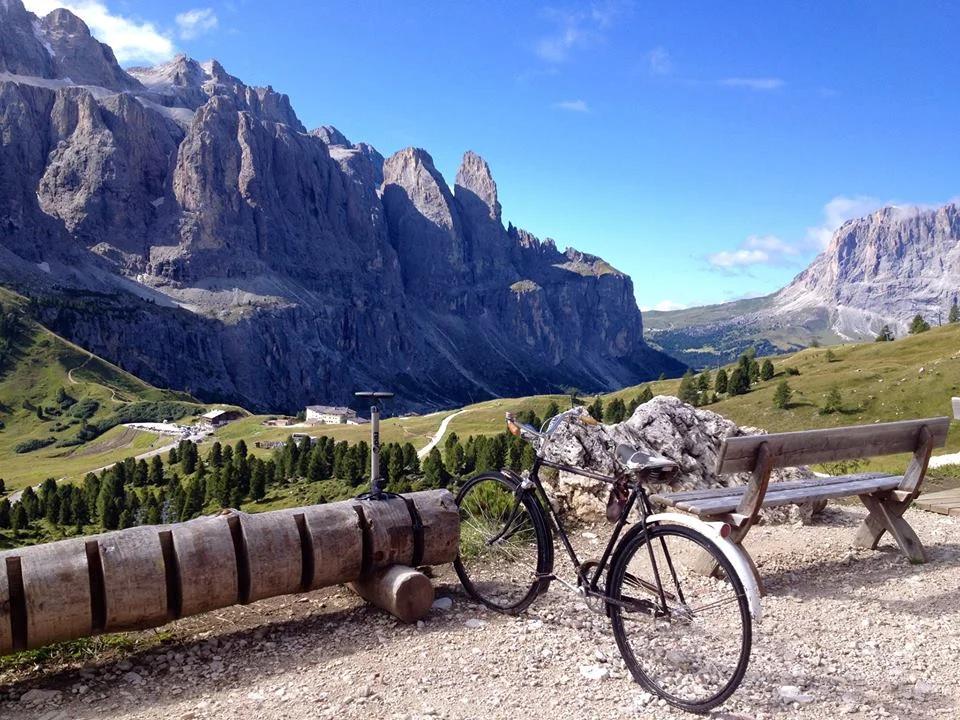
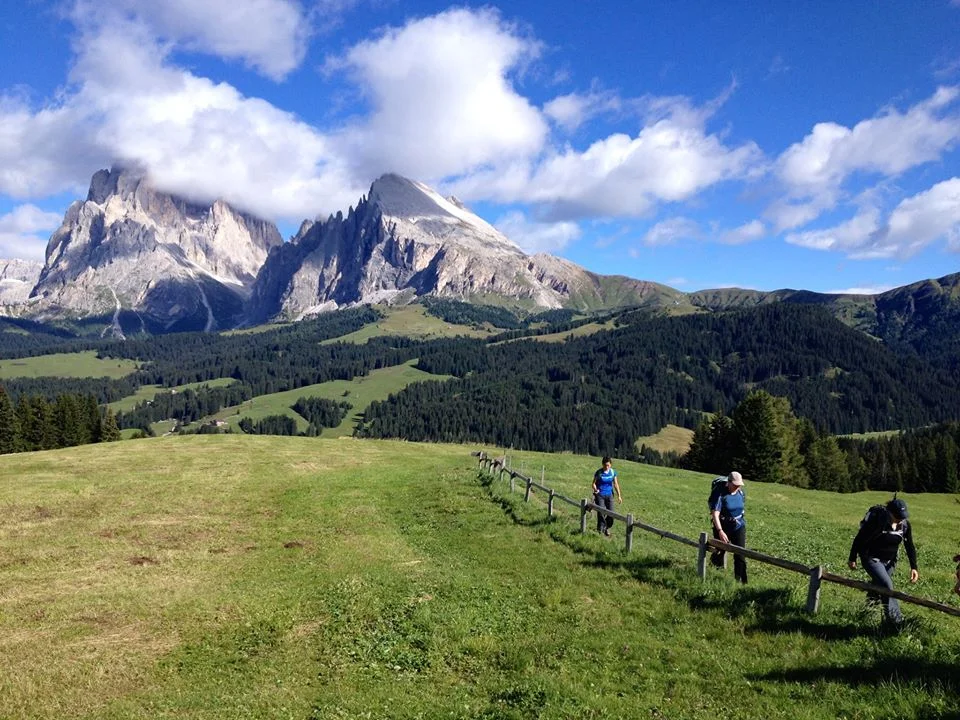
Hiking and biking the Dolomites along the Italian and Austrian border

Hiking and biking the Dolomites along the Italian and Austrian border

Yoga on the Mexican beach, hikes to Machu Picchu, Pilates in Morocco — the best health tourism adventures.


You know the type. Their Facebook page is full of beautiful photos of fabulous trips. You’re simultaneously insanely jealous and giddy with excitement at the opportunity to live vicariously through your friend’s adventures.

Well, that’s Nancy.

I leave with a feeling of renewal and that I can take on all of my biggest dreams.

As I battled my jealousy of and happiness for her, I noticed a trend among Nancy’s trips: They all had some sort of wellness angle. She’d be doing yoga on a beach in Mexico or hiking across Europe or doing Pilates in Morocco.

I decided to get her take on wellness travel. Here are her top trips and advice. Namaste. –Wally


What draws you to wellness travel?

I cannot just sit on a beach. I always feel like I need to “earn the day.”

I love combining culture, physical activity, regional food and wine, like-minded people, spirituality and mindfulness into one trip. 


What trends have you seen in wellness travel lately?

Adding volunteerism to the experience. For example, in Marrakech, Morocco, we delivered school supplies to a local school and spent some time in the classroom. 


Most surprising thing you’ve discovered on a trip?

In Tulum, Mexico, I got a massage from a Mayan healer. These healers can pick up on energy in your body. He told me that the sciatic nerve area can represent “stalled advancement” and that I was experiencing this right now. He basically summed up a few key areas of my life at the time.

This experience motivated me to go after a new career opportunity at my company, which I successfully landed.


Nancy’s Top Wellness Travel Destinations 

Amansala in Tulum, Mexico offers runs along the beach and candlelit yoga

Amansala in Tulum, Mexico offers runs along the beach and candlelit yoga

1. Amansala Bikini Bootcamp, Tulum, Mexico

I go to Amansala every year for the last week of the year as a way to undo all of the debauchery from the holidays and to kick-start the New Year.

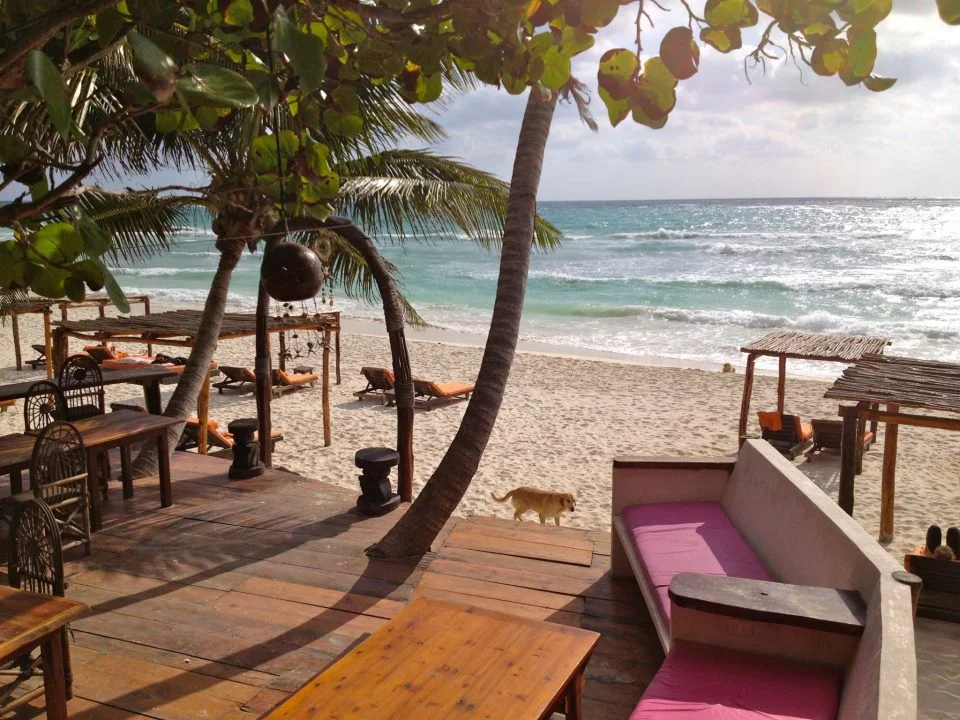
The setting is boho chic huts and palapas [open-sided shelters with thatched palm roofs] on a white sand beach with Caribbean blue water.

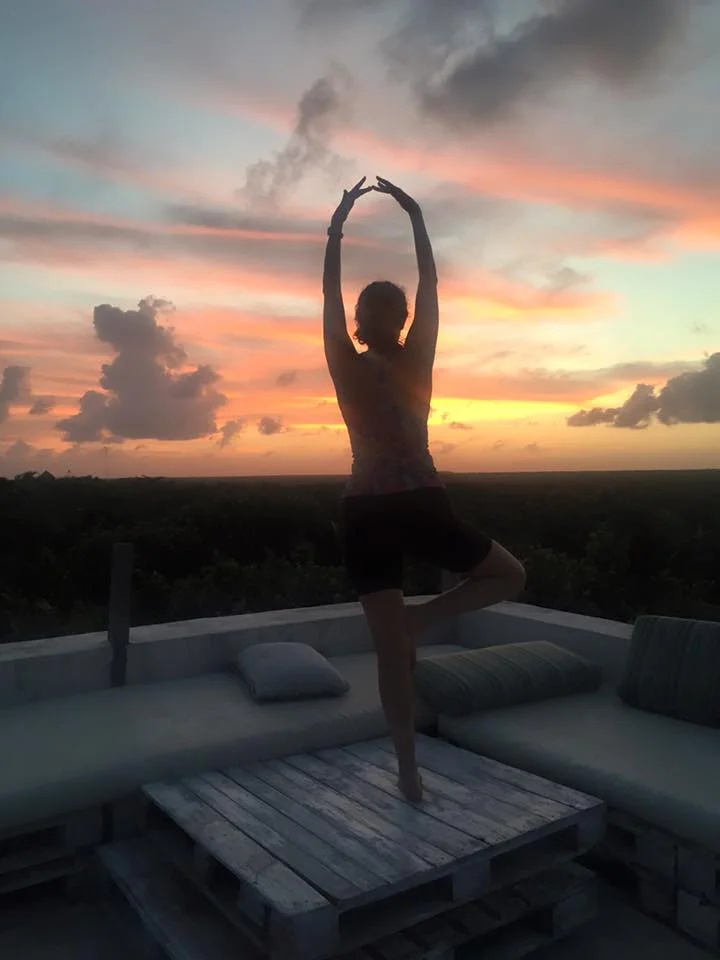
One of her favorite annual traditions: Nancy does yoga at sunset on New Year's Eve

One of her favorite annual traditions: Nancy does yoga at sunset on New Year's Eve

Guests have the option to make the week as active or as chill as they would like. Most choose active due to the wide variety of activities and high-caliber instructors.

The daily routine at Amansala includes morning beach walks or runs, yoga with beach views, cardio class (kickboxing, circuit training, etc.), dance class and/or sunset candlelit yoga.

Experiences such as cultural excursions, massages, a Mayan clay renewal ritual and tarot card readings are all offered at Amansala. You can also sweat out all of your toxins/sins at their Temezcal (Mayan sweat lodge) ceremony, led by an elder Mayan healer.

In between all of this, you can relax on the gorgeous white sand beach. The three golden Labs, who are pets of the property, might join you or try to rally you for a game of “fetch the coconut.”

The food is also healthy and tasty — they even have their own cookbook. 

Amansala combines the physical, mental and spiritual aspects of wellness, which is why I go back every year. I leave with a feeling of renewal and that I can take on all of my biggest dreams. This special place attracts like-minded people, so I have met several friends with whom I am still in touch. 


Hiking through the Dolomites mountain range, which straddle Italy and Austria

Hiking through the Dolomites mountain range, which straddle Italy and Austria

2. Backroads Breakaway Walking & Hiking Tour, the Dolomites, Italy

On this tour, you hike every day (four to six hours) in the spectacular setting of the Dolomites mountain range in-between Italy and Austria.

There’s amazing Italian and Austrian food. You might have apple strudel and beer at lunch and then pasta and red wine at dinner.

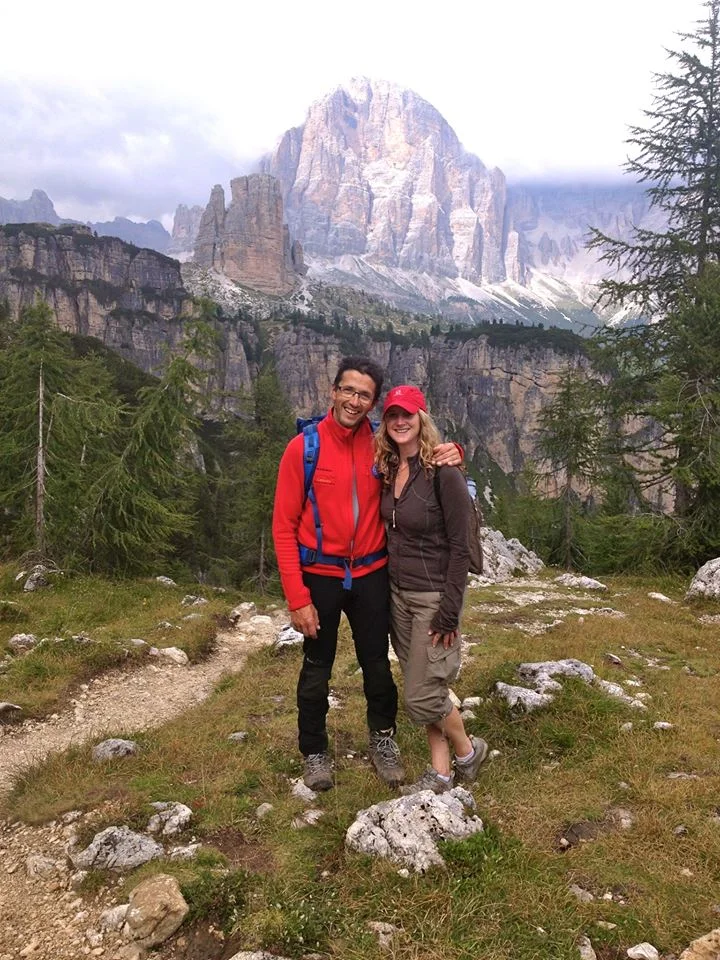
Nancy and her local guide, with the Cinque Torri in the Dolomites as a backdrop

Nancy and her local guide, with the Cinque Torri in the Dolomites as a backdrop

We hiked from one resort to the next over a seven-day period. We would stop in at ski huts along the way to refuel.

It was the perfect combination of outdoor activity, breathtaking scenery, culture — Italy and Austria! — amazing food and awe-inspiring boutique hotels. 


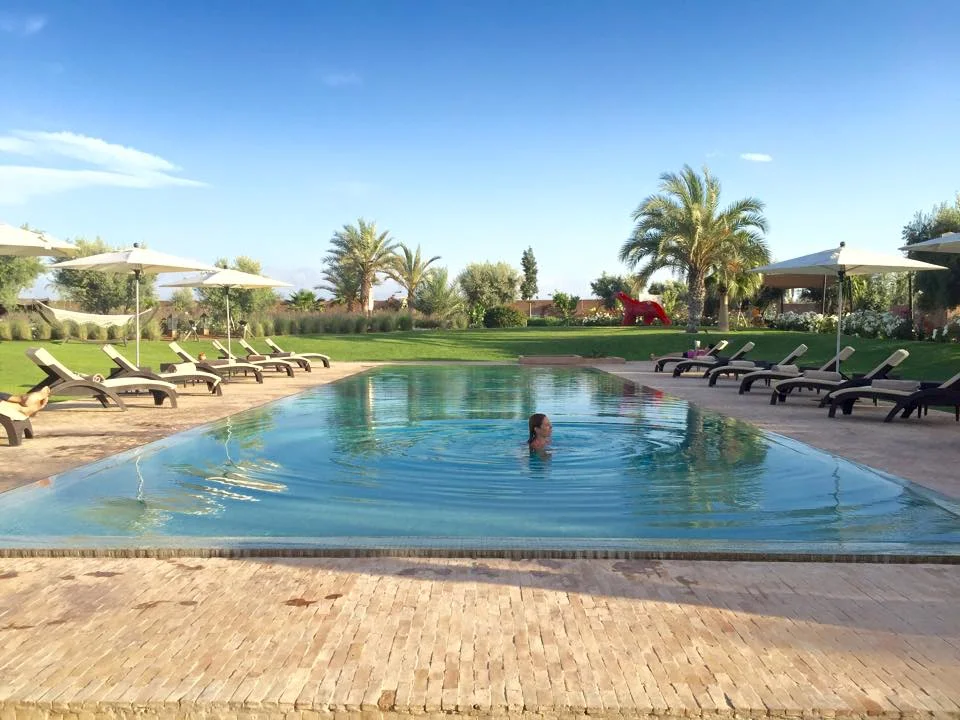
The amazing pool at the Escape to Shape resort in Marrakech, Morocco

The amazing pool at the Escape to Shape resort in Marrakech, Morocco

3. Escape to Shape, Marrakech, Morocco

This yoga and Pilates retreat was hosted at our own private amazing villa in Marrakech, located outside of the medina. Lodging, meals, cultural excursions, and yoga, Pilates and circuit training classes were all included.

This was a great combination of physical activity (about two to three hours per day) and cultural immersion.

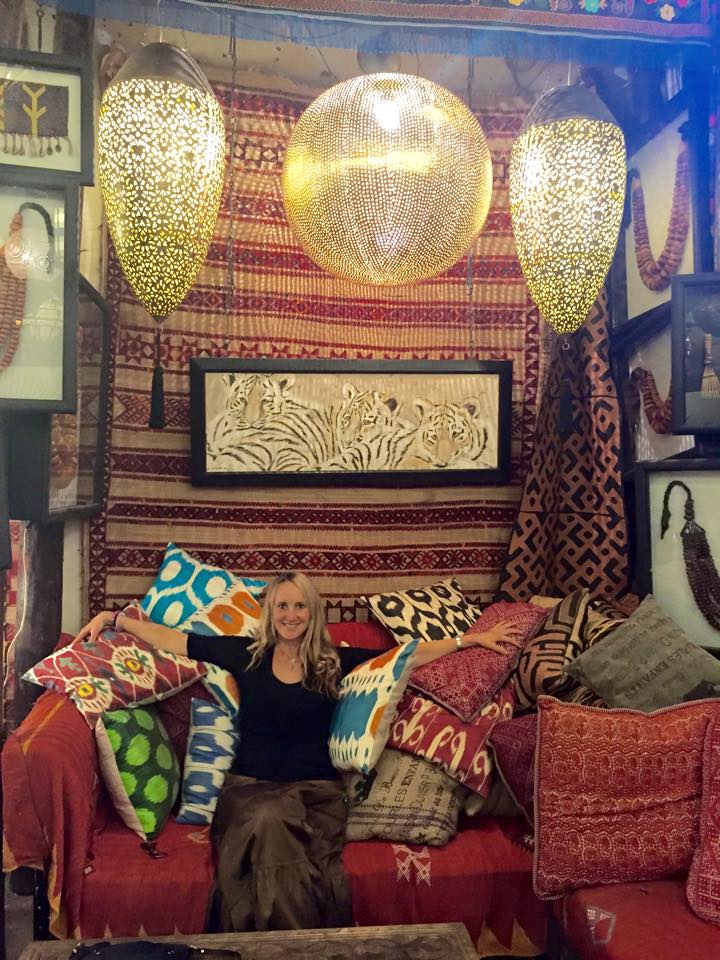
Nancy in her favorite store in Marrakech

Nancy in her favorite store in Marrakech

Escape to Shape provided a very safe, fun and invigorating way to experience Marrakech. Erica Gragg, the owner, has been doing this for years, and she curates the perfect trip. She knows Marrakech like the back of her hand and showed us all of the hidden jewels and hot spots. She would open a door in the medina that you did not even know was there, and inside you would find four floors of amazing treasures.

Shopping is a must in Marrakech, and Erica is the perfect sherpa/stylist. Our group came away with beautiful rugs, caftans and home accents that we never would have found without Erica’s expert eye and relationships.

The yoga and Pilates classes allowed us to indulge without guilt in all of the amazing Moroccan cuisine.  


4. Miraval Resort & Spa, Tucson, Arizona, USA

Their tagline is “Life in Balance.” Miraval offers hiking in the Sonoran Desert and Santa Catalina Mountains, a large variety of fitness classes, meditation, healthy, delicious food, mindfulness sessions, equine therapy and other outdoor adventure activities.

Their spa is beautiful. Relax by the pool during your downtime. 

I always come away feeling amazing after four to five days here. 


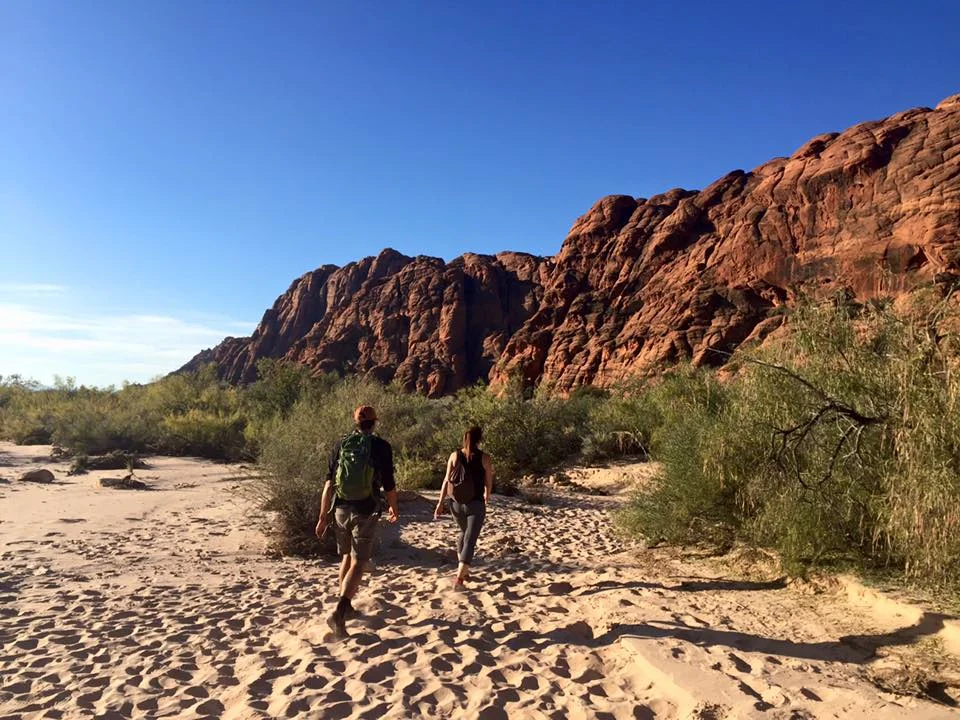
Snow Canyon State Park in Utah

Snow Canyon State Park in Utah

5. Red Mountain Resort, Ivins, Utah, USA

Red Mountain offers hiking in a gorgeous setting — literally in red rocks in Snow Canyon State Park, Zion National Park and Bryce Canyon National Park.

Hikes are guided, or you can go on your own — all different levels.

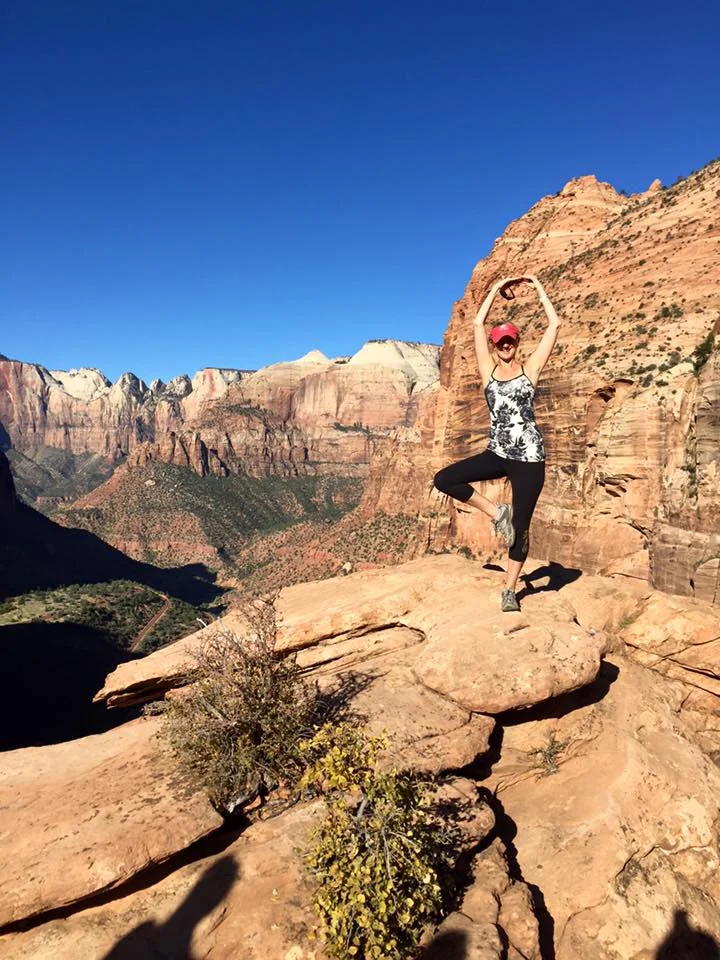
Nancy in Zion National Park, Utah

Nancy in Zion National Park, Utah

The setting is breathtaking and awe-inspiring.

Fitness classes and outdoor activities keep you physically active. There are also great opportunities for personal discovery and mindfulness: intuitive energy reading, guided imagery, etc., as well as artistic pursuits, such as photography and pottery classes.  


Machu Picchu, Peru

Machu Picchu, Peru

6. Mountain Travel Sobek Machu Picchu Inn-to-Inn Express Trek, Peru

This was a seven-day lodge-to-lodge trek to Machu Picchu through a variety of terrain, scenery and elevation. 

It was a great combination of scenic hiking, excellent Peruvian food and wine, cultural exposure and great lodging.

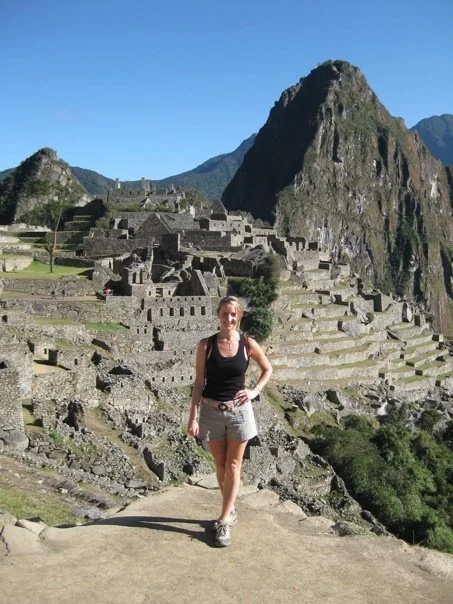
Nancy at the peak of Machu Picchu

Nancy at the peak of Machu Picchu

8 Tips to Get the Best Deals at a Moroccan Souk

The souk in Marrakesh, Morocco is just off of the large square in the media, Jemaa el-Fnaa.

The souk in Marrakesh, Morocco is just off of the large square in the media, Jemaa el-Fnaa.

Bargaining and haggling are a time-honored tradition when shopping at markets. Just make sure you don’t get taken advantage of.


Duke and I are unabashed consumers. When we’re on vacation, we’ll hit the markets once or even twice a day if possible. So let’s just say we’ve had plenty of practice bargaining for the best price. I also play hardball (our guide on our trip to the Sahara, Barack, saw me in action and was so impressed, he dubbed me an honorary Berber).

Haggling for everything you buy (food aside) can be exhausting. But it’s part of the culture in Morocco, and vendors look forward to a lively contest of wills. Follow these steps, and chances are you’ll get a good deal when shopping the souks.

Our guide saw me in action and was so impressed, he dubbed me an honorary Berber.


1. Scope out the sitch. 

Start out with a reconnaissance mission. When you see something you’re interested in, ask how much it is, as casually as possible. Then make a mental note and move on. Quickly. 

You’ll often see similar items at other stalls, so it’s good to have perspective, to see if you’re getting ripped off.

That being said, if you see something you really want, snag it. You never know if you’ll find it again. Souks are labyrinthine, and there’s no guarantee you can retrace your steps another day. 


2. Speak French if you know it. 

Most vendors speak French as well as an impressive amount of English and phrases from Spanish and other languages. I’m not sure that all vendors assume Americans are rich and charge more — but it sure seemed that way. I definitely scored better deals when they couldn’t quite pin down my nationality. 

And don’t worry about being fluent in French. Remember, it’s their second language, too, so you can meet in the middle, skill-wise.


3. Be aggressive if need be. 

It’s not uncommon to be inside a narrow stall, looking around and then, when you turn to leave, find the merchant blocking your path. He might have something he’s shoving in your face, trying to excite your interest.

I found that there were times when I literally had to grab a vendor's shoulder and push him out of the way in order to leave.

Note that we traveled with our friend Vanessa, who said the men didn’t accost her in this way. So it might (hopefully) just be a “guy thing.”


4. Shop on Friday — despite what you’ve been told. 

Everyone told us the souk would be closed on Friday, that everyone’s at the mosque. Well, Duke and I couldn’t resist just seeing if anyone was open — and sure enough, in the Marrakech souk, we found that about a quarter of the stalls weren't closed. Instead of the usual hustle and bustle, the passageways were relatively quiet, and we scored some great deals, as shopkeeps knew business would be slow.


5. Use this formula. 

OK, let’s get down to the nitty gritty. How much should you pay? Here’s what I do: Think about what you’d pay at a store back home. Then divide that in half. You won’t be ripping anyone off, and you’ll be getting a great deal — which you deserve by eliminating the middleman. 

On our last day in Marrakech, we found a fertility doll from Cameroon, covered in beads and horn and metal bangles, that we simply had to have. It wouldn’t surprise me to a see a museum-quality handicraft from Africa like this for $70 back in the States. (Indeed, a Google search revealed prices upwards of $100.) So I divided $70 in two, and decided I’d like to end up at $35. 


6. Ignore their opening bid. 

In most places I’ve been, the shopkeeps start with a reasonable offer and you can end up with a decent price by meeting in the middle. Not so in Morocco. They’ll try to get as much out of you as possible. So don’t even listen to the first number they throw out there.

With the fertility doll, the young man started at $200. By this point, I knew better than to even pay attention. I countered with $20. Yes, that seems ridiculous, right? But if they’re being ridiculous, you can be ridiculous right back.


7. Give yourself some wiggle room. 

After you’ve figured out what you want to pay, go a bit lower. After all, you need to come up a bit, act as if you’re conceding, unable to escape the vendor’s wiliness. He wants to feel as if he’s won on some level. 

Our fertility doll vendor offered the equivalent of $45 and wouldn’t budge. 


8. Walk away. 

This is an especially successful tactic in Morocco. (Not so much in India, btw, where we said goodbye to many an item.) Even though we were just above what I wanted to pay for the doll, I shook my head and dragged a reluctant Duke away. 

“We could pay $45!” he pleaded. 

But I can be merciless. “We’ll go halfway down the block,” I told him. “And if he doesn’t chase after us, we’ll go back and get it for $45.”

We had gotten only 20 feet away before the young man chased after us, grabbing my arm. 

“What’s your final offer?”

I pretended to think about it. “We really don’t need it… $35 is my final offer.”

“OK. OK,” he caved. “You’re getting great deal.”

Yes. Yes, I was. –Wally

Travel to Marrakech, Morocco

The modern façade of the Marrakech Menara Airport casts gorgeous lace-like shadows

The modern façade of the Marrakech Menara Airport casts gorgeous lace-like shadows

Long flights on cheap airlines can be a "plane" in the ass — but the excitement you feel upon arrival makes it all worth while.


Our overnight flight from Chicago to Madrid, Spain wasn't terribly long. But like our previous trip on Air Iberia, it was a sleepless one.

This time, however, the woman hopped up on medication who spoke loud enough for the entire cabin to hear her was replaced by a group of boisterous, flash photo-snapping Spanish nuns.

I couldn’t believe it — we were in Africa!

One of the nuns had a confounding method of sleeping: She knelt on the floor facing her seat, a pillow set beneath her knees with her face pushed into the bottom of the seat.

Every now and then I glanced over a few aisles ahead, where our friend Vanessa was sitting. The guy sitting next to her was watching a strange soft-core porn movie on his laptop.

The layover in Barcelona was five hours, but our connecting gate to Marrakech was revealed a mere 30 minutes prior to departure. We were informed that our gate had been moved to the opposite end of the terminal. We ran from one end of the terminal to the other — only to be told our plane was actually leaving from where we had just come.

Once aboard, Wally, Vanessa and I collapsed in exhaustion into a brief bit of fitful sleep.

We awoke to a coy wee German boy named Otto, who was playing a game of peekaboo with us. He held a deflated white balloon, which he would dangle in front of us while we feigned being unable to catch it.

Eventually Wally grew bored with this ruse and caught hold of the balloon, and as it snapped back, Otto squealed excitedly, “Nein! Nein! Nein!”

Bienvenue à Morocco!

When we arrived at the Marrakech airport and exited the plane, a warm breeze washed over us. We were surrounded by clear blue skies and sun. I couldn’t believe it — we were in Africa! (Even if it was the most northwesterly part of Africa.)

We entered the faded pink stucco terminal from the tarmac. Inside, the ceiling was low and contained columns covered with beautiful zellij, brightly colored tiles with intricate geometric patterns.

We filled out our immigration forms and waited in line to have our passports approved and stamped.

A brief walk brought us into the modern expansion to the airport, where the terminal expands into a brilliant white canopy that soars overhead. The tendrils of arabesque-etched panels pierce the ceiling, casting a mix of light and shadow across the floor.

We could feel the excitement in the air as we picked up our bags and were met by our driver.

Moments later we were passing the ancient sun-baked ramparts of the medina — the original walled city, en route to our Moroccan adventure. –Duke