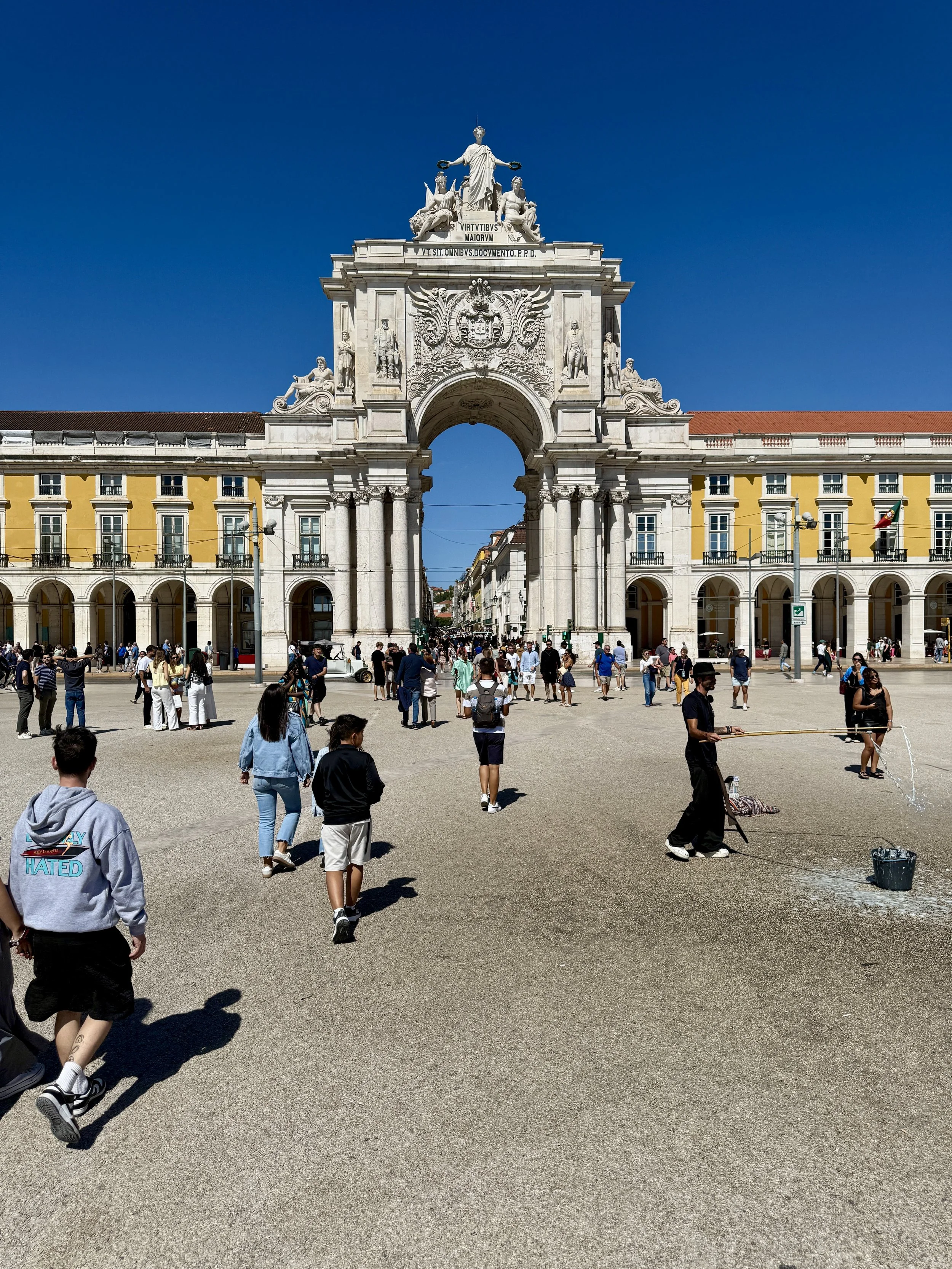
From the wave-patterned stones of Rossio Square to the waterfront Praça do Comércio — with coffee at A Brasileira — we trace how the 1755 Lisbon earthquake reshaped the neighborhoods of Baixa and Chiado forever.
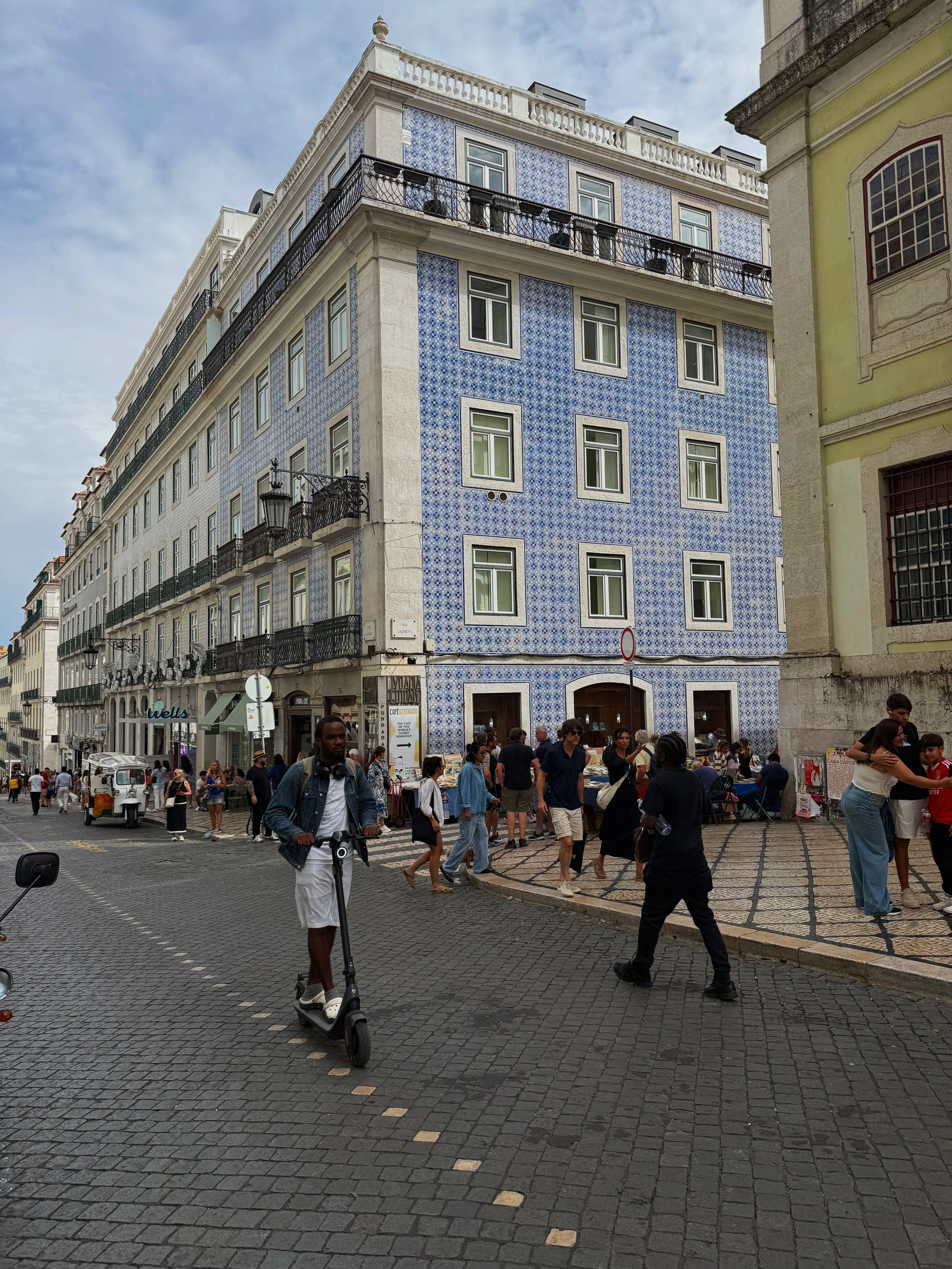
In Baixa and Chiado, Lisbon’s Pombaline buildings pair wrought-iron balconies with azulejo-covered façades — a style born from the city’s post-1755 reconstruction.
Wally and I spent our first full day in Lisbon wandering the historic cobblestone streets of Baixa and Chiado, two of the city’s central neighborhoods that feel orderly today but were dramatically reshaped after a disastrous earthquake struck the city on All Saints’ Day, November 1, 1755.
The powerful quake toppled buildings and ignited fires that would rage for nearly a week. Some 40 minutes later, a massive tsunami triggered by the tremors surged up the Rio Tejo (Tagus River), washing away ships and the thousands who had fled to the waterfront believing it was safe. By the time the devastation subsided, tens of thousands were dead or homeless, and much of the city lay in ruins.
“The earthquake, and the tsunami that followed, erased the palace in an instant, permanently reshaping the waterfront.”
The rebirth of the Cidade das Sete Colinas — the City of Seven Hills — was led by Sebastião José de Carvalho e Melo, the powerful royal minister who was later given the title Marquês de Pombal. Appointed Secretary of State for Foreign Affairs when José I took the throne in 1750, he steadily consolidated power until, by the time the earthquake struck, he was the king’s de facto chief minister — and, in the aftermath, the undisputed force behind Lisbon’s reconstruction. He remains Portugal’s most consequential political figure of the 18th century.
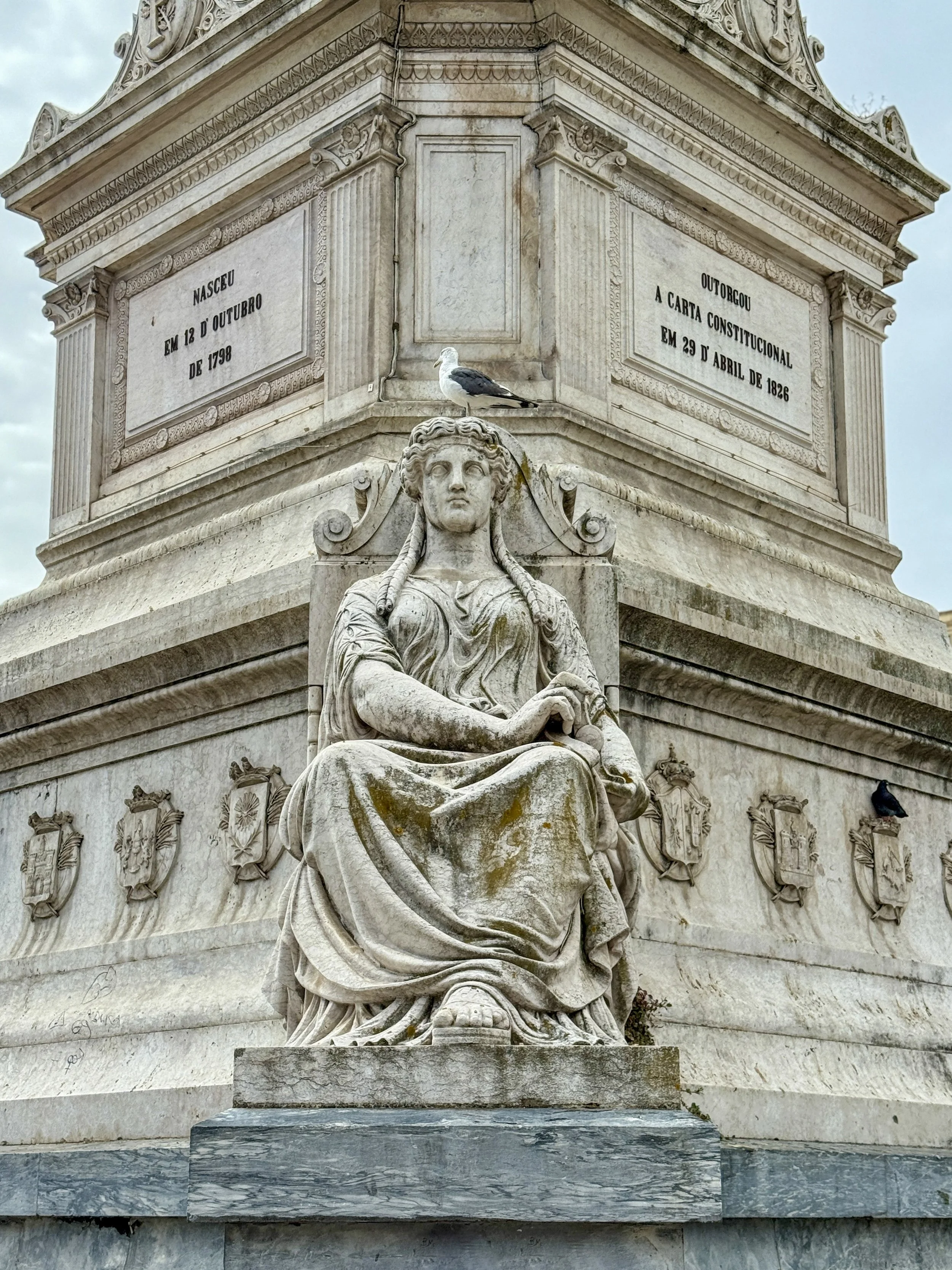
This statue, with a seagull perched upon her head, is Justice (or Wisdom, perhaps), positioned near the inscription marking Dom Pedro’s grant of the constitutional charter in 1826.
Under his direction, architects and engineers, including Manuel da Maia, Eugénio dos Santos and Carlos Mardel drew up plans to redesign Lisbon from the ground up. Buildings were constructed using the innovative gaiola (“cage”) system — a lattice of vertical, horizontal and diagonal wooden beams arranged in a Saint Andrew’s cross pattern and embedded within masonry walls, designed to absorb shocks. It ranks among the world’s earliest anti-seismic construction methods. From the rubble rose the Baixa Pombalina, with its wide avenues, grand squares and uniform façades shaped by Enlightenment‑era urban planning.
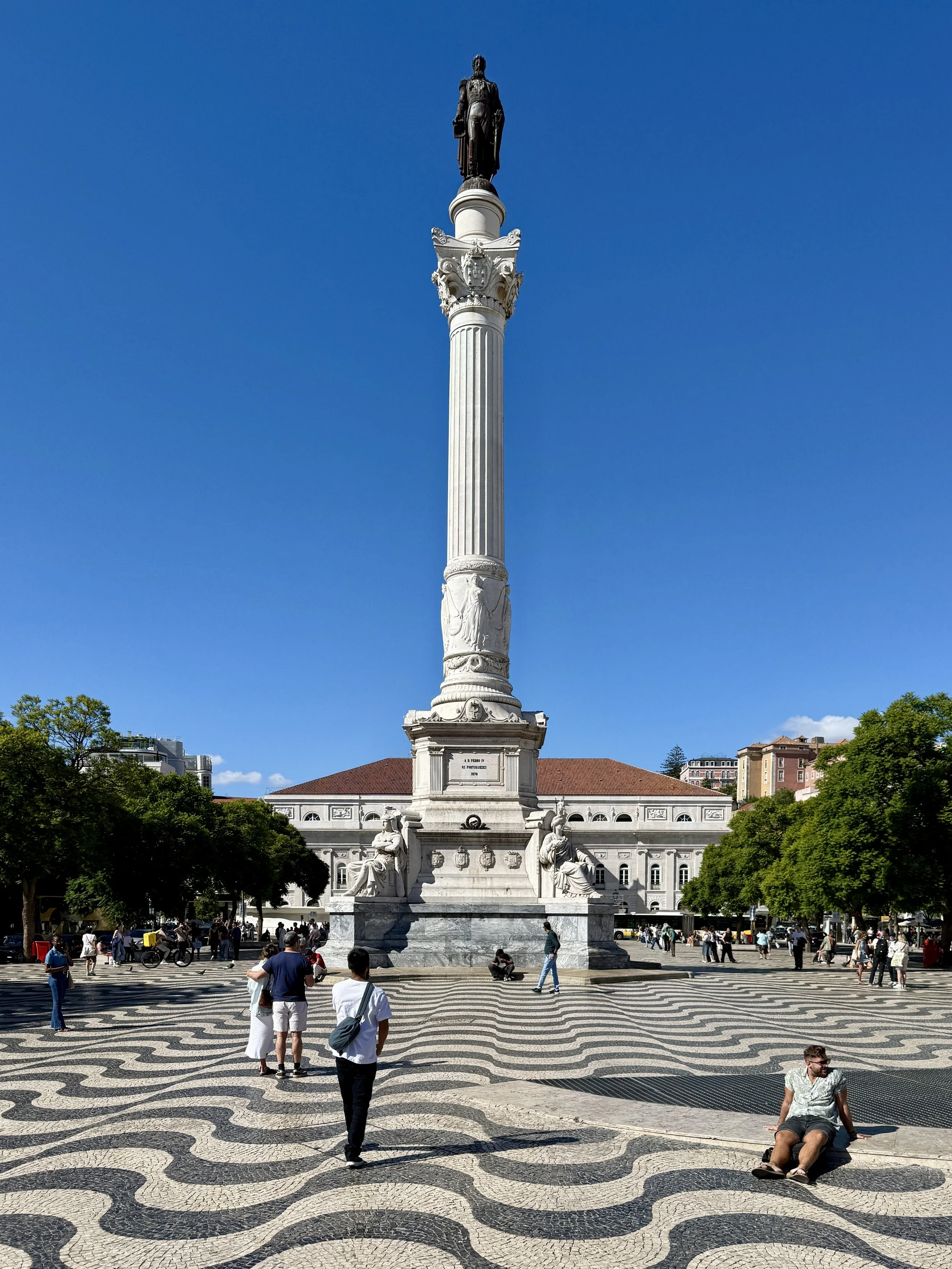
Pedro IV watches over Lisbon, while hand-cut limestone and basalt create the calçada portuguesa pattern that mimics the sea.
Rossio Square: Lisbon’s Wave-Patterned Plaza
Since we were staying at Locke de Santa Joana near the Marquês de Pombal roundabout, we stepped out of the hotel and followed Rua Camilo Castelo Branco down to Avenida da Liberdade, continuing south until we reached Praça dos Restauradores and the edge of Praça do Rossio.
Known locally as Rossio, Praça de Dom Pedro IV sits at the northern edge of the Baixa district and ranks among Lisbon’s liveliest squares. It has been the city’s historic hub since the Middle Ages, witnessing royal proclamations, political revolutions and autos de fé (the public sentencing ceremonies of the Portuguese Inquisition that frequently culminated in heretics being burned at the stake by civil authorities). The Inquisition tribunal was once headquartered on the square’s north side in the Estaus Palace, later replaced by the Teatro Nacional Dona Maria II, which was under restoration when we visited.
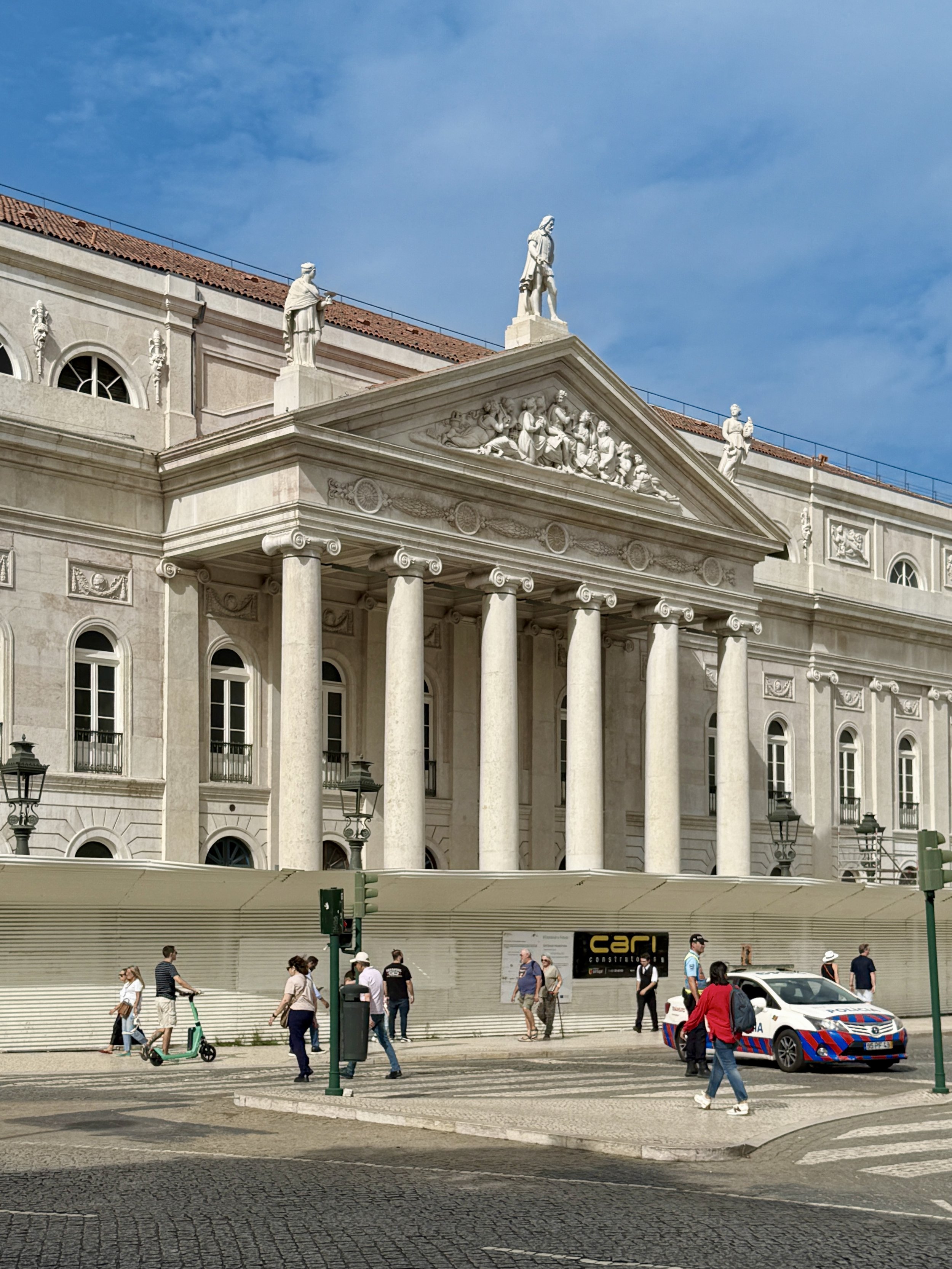
Lisbon’s Teatro Nacional de São Carlos has hosted opera since 1793 and was modeled after Italian theaters.
At the center of Rossio stands an 89-foot (27-meter) column topped by a bronze statue of Pedro IV, who also ruled as Brazil’s first emperor. Installed in 1870, it presides over a sea of black-and-white wave-patterned calçada portuguesa — traditional cobblestone paving made from small limestone and basalt cubes arranged in decorative patterns, and notoriously hard on the feet. At the base, four allegorical figures — Justice, Wisdom, Strength and Moderation — keep watch, presumably to remind the king (and everyone else) how virtuous he was.
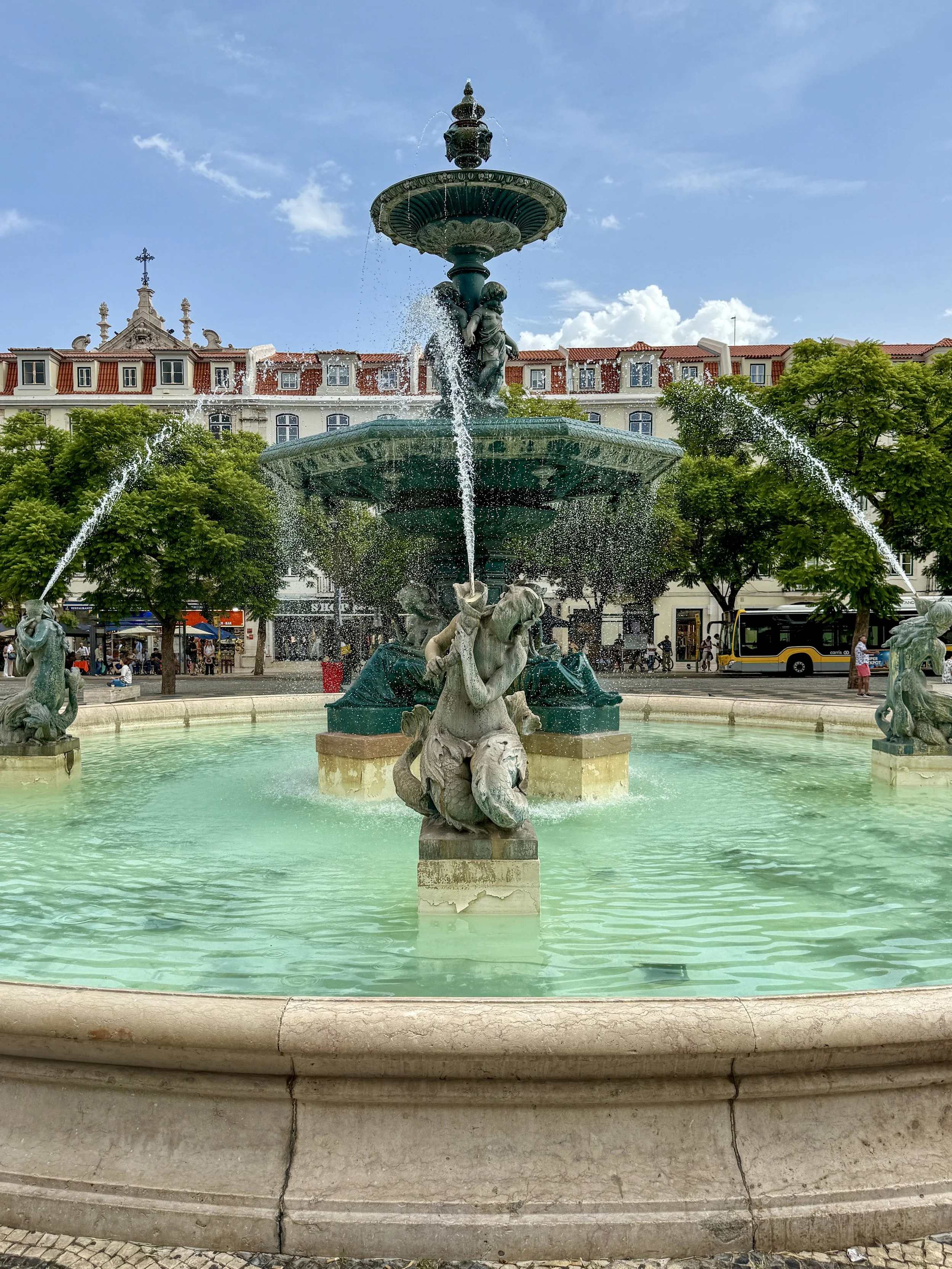
The Rossio fountains feature mermaids and other sea creatures, echoing Portugal’s deep connection to the ocean and its Age of Exploration.
Twin fountains imported from France anchor either end of the square. Cast in bronze and installed in 1889, they were designed by French sculptors Mathurin Moreau and Michel Liénard and produced at the Val d’Osne foundry before being shipped to Lisbon. Each richly ornamented fountain rises in tiers of cherubs and allegorical figures, while nereids and other sea creatures spout water into the basins below — a subtle nod to Lisbon’s identity as a city shaped by water, trade and the sea.
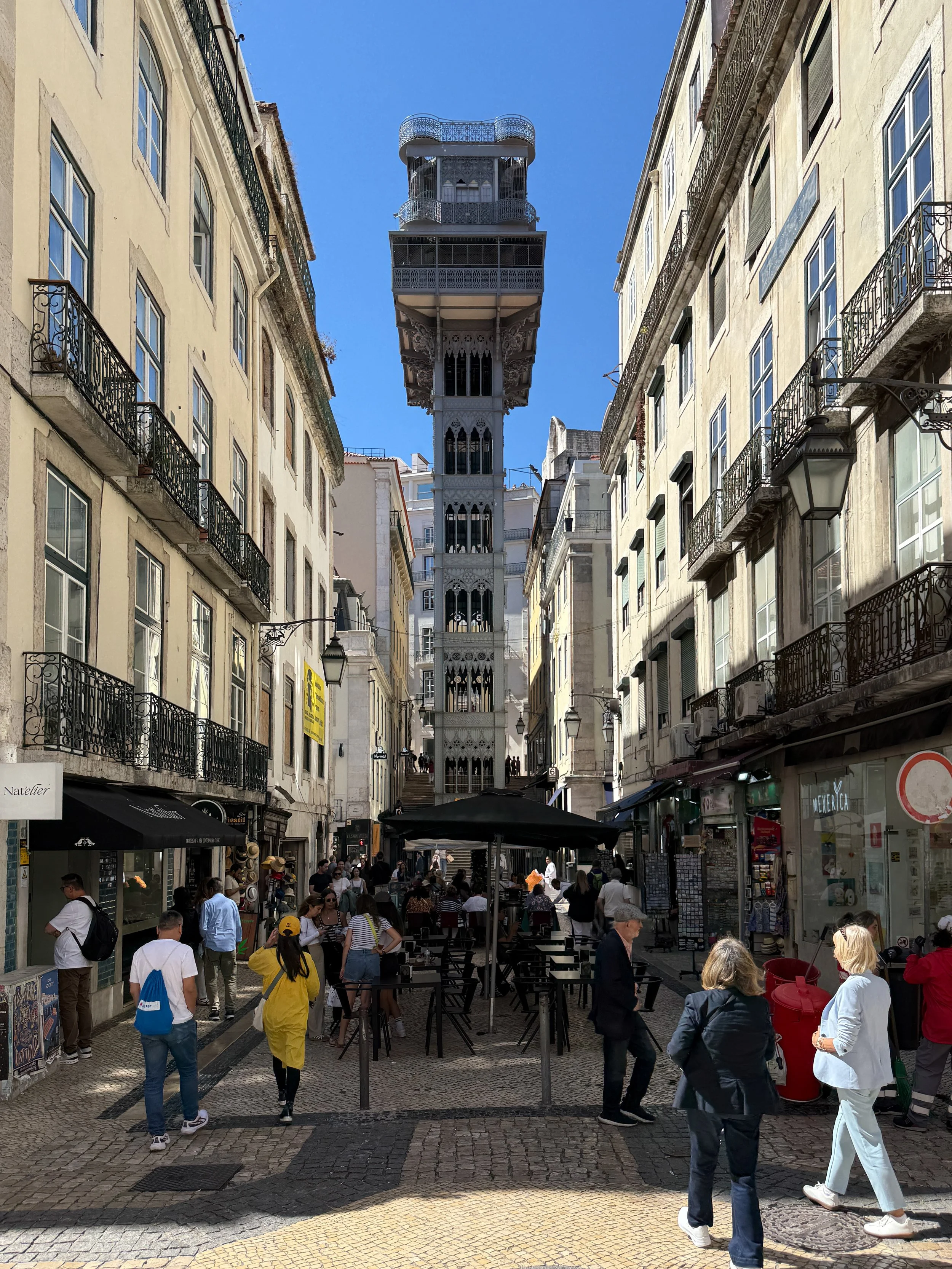
Designed in a Neo-Gothic style, the Elevador de Santa Justa has been lifting pedestrians between Lisbon’s lower and upper neighborhoods since 1902.
The Elevador de Santa Justa and Commerce Square
As we made our way down to the waterfront, we passed the iconic Elevador de Santa Justa. Inaugurated on July 10, 1902, the Neo-Gothic cast-iron elevator was designed by Raoul Mesnier du Ponsard, a Portuguese engineer whose work reflects the iron construction innovations of his era. Often compared to the techniques associated with Gustave Eiffel, the industrial structure rises roughly 148 feet (45 meters) and links Baixa, the city’s low-lying commercial district, with the plaza Largo do Carmo in Chiado.
Passing by the Elevador and continuing on for about 10 minutes, Wally and I reached Praça do Comércio (Commerce Square), Lisbon’s vast waterfront square rebuilt after the 1755 earthquake. It was from this very stretch of the riverfront — and from nearby Belém, a few miles downstream — that Portuguese ships departed on their great voyages of exploration. The reconstruction was directed by the Marquês de Pombal and financed through a combination of crown authority and taxes levied on merchants and goods — a reminder that commerce and statecraft bankrolled the city’s rebirth.
Before the disaster, this open expanse was known as Terreiro do Paço (the Palace Courtyard), acting as the ceremonial forecourt of the Paço da Ribeira (Ribeira Palace). The earthquake, and the tsunami that followed, erased the palace in an instant, permanently reshaping the waterfront.
Today, one side of the square opens directly onto the Tagus River, while the others are ringed by stately ochre-colored buildings topped with terracotta-tiled roofs. Their arcades face the plaza and now house government ministries, Lisbon’s main tourism office, and a mix of restaurants and cafés, including the Pousada de Lisboa hotel’s Rib Beef & Wine Lisboa.
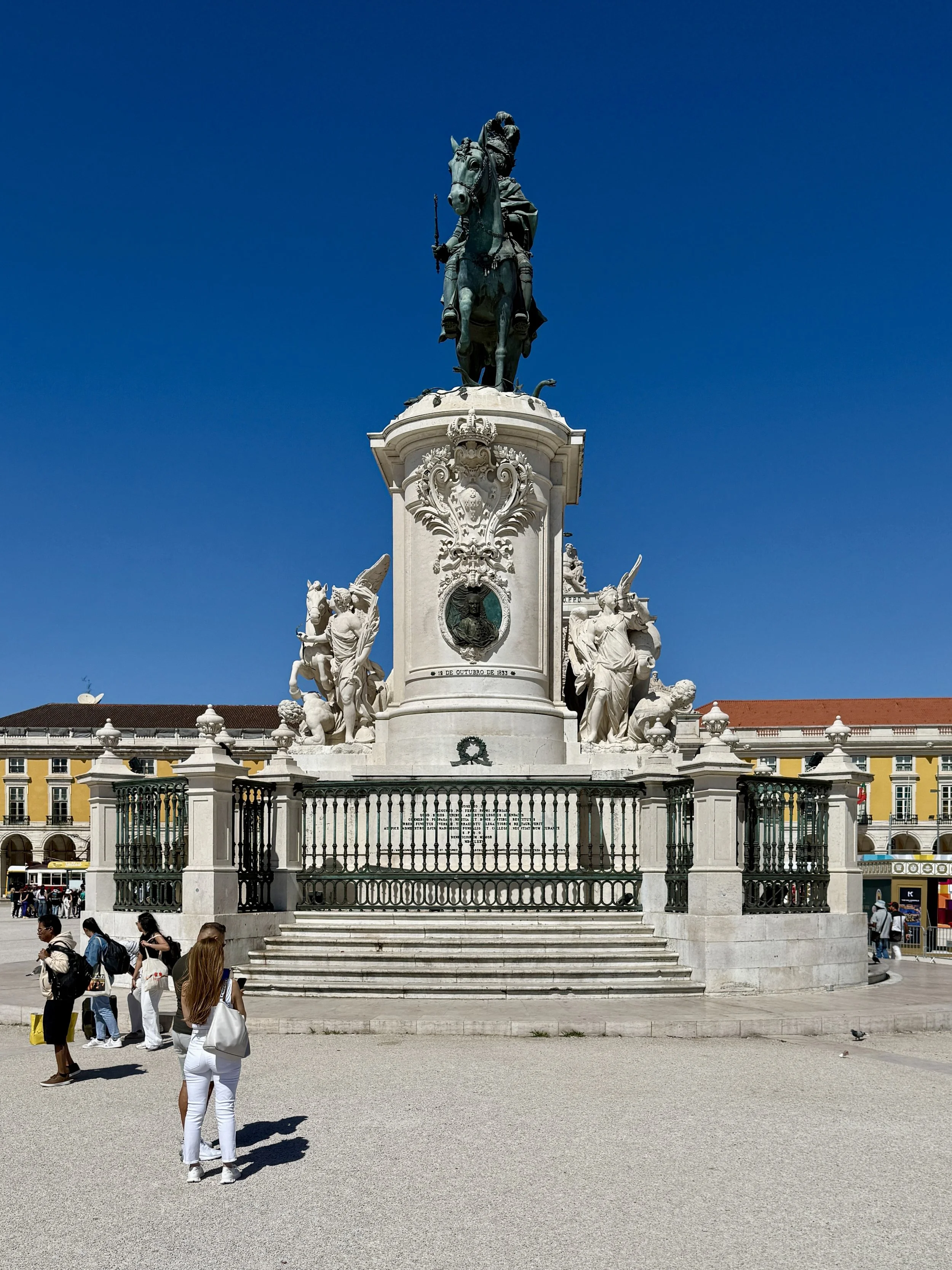
King José I surveys Praça do Comércio on horseback, part of Lisbon’s grand post-1755 rebuild designed to project power, order and a city very much back in business.
Up on a Pedestal: A Monument Fit for a King (José I, That Is)
The centerpiece is the bronze equestrian statue of King José I, who reigned from 1750 to 1777. Installed two decades after the disaster, the monarch sits atop a lofty pedestal, rides with arm raised, and defiantly faces the Tagus, his horse trampling writhing serpents — a symbol of triumph over catastrophe.
In reality, José I’s post-quake life was less triumphant. Traumatized by the disaster, he developed a lifelong fear of enclosed stone buildings and withdrew from the city, establishing his court in a sprawling encampment of royal tents and lightweight structures at Ajuda, on Lisbon’s outskirts. He never again lived in a traditional palace, ruling instead from his improvised settlement for the remainder of his reign.
Flanking the pedestal are two allegorical figures: Triumph and Fame, accompanying a horse trampling a vanquished warrior and an elephant overcoming a fallen figure, together representing Portugal’s dominion in Europe and India. The front is dominated by an exuberant royal coat of arms, paired with a bronze medallion of the Marquês de Pombal — in case anyone forgot who was responsible for the monument.
The monumental ensemble was designed by Joaquim Machado de Castro, a self-taught 18th century sculptor. José I refused to pose for the work, forcing Machado de Castro to rely on coins and other likenesses — and deliberately emphasized the king’s plumed helmet to draw attention away from the face. When Queen Mariana Vitória first viewed the completed statue at the foundry, she reportedly remarked that the king’s face looked “horrendous.”
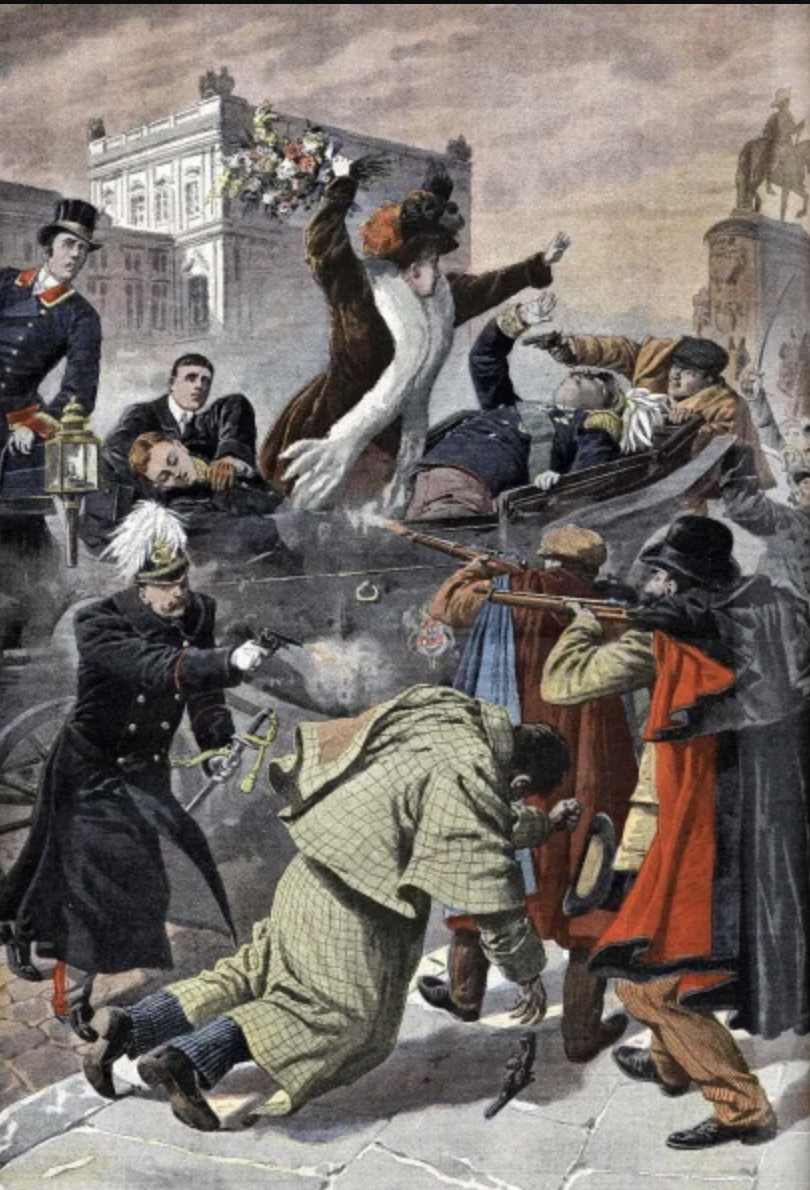
The cover of Le Petit Journal’s February 1908 edition depicted the regicide of Dom Carlos —though incorrectly shows four assassins rather than the actual two.
The Assassination of King Carlos I and His Heir
But change, even when it reshapes a city in stone and bronze, rarely guarantees stability. Decades later, the same square would bear witness to an act that shattered any lingering illusion of permanence.
On Saturday, February 1, 1908, Praça do Comércio became the site of a shocking assassination. King Carlos I and the royal family were returning to Lisbon from the winter hunting season at Vila Viçosa when gunfire erupted as their open carriage crossed the square. A shot struck the king in the neck, killing him instantly; his heir, Luís Filipe, was mortally wounded and died at the nearby Navy Arsenal shortly after; and his younger son, Prince Manuel, was hit in the arm.
The attackers, Alfredo Luís da Costa and Manuel Buiça, were shot dead by police and identified as republican activists. Just two years later, in 1910, the monarchy fell, ending centuries of royal rule.
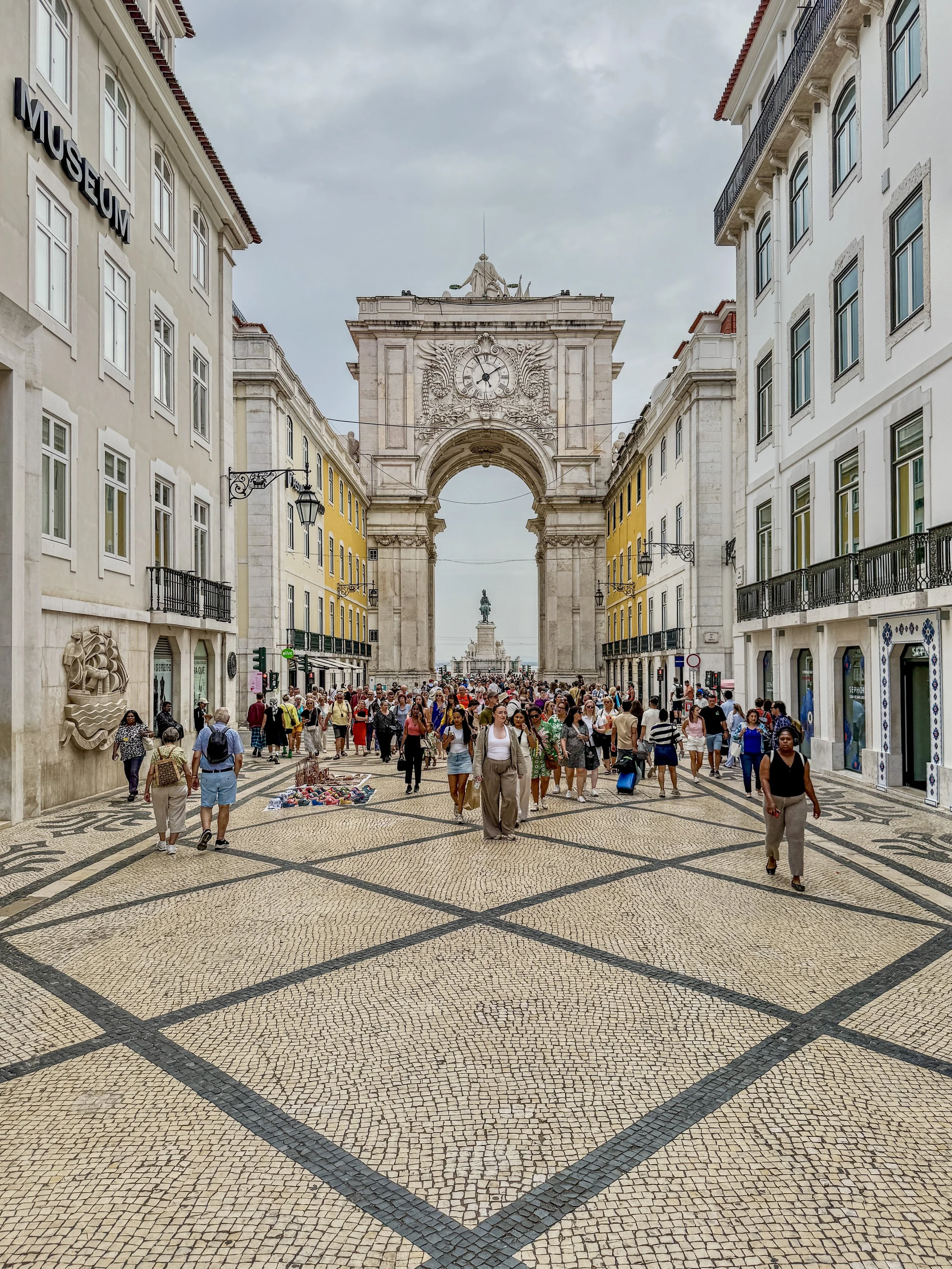
Completed in 1875, the Rua Augusta Arch celebrates Lisbon’s reconstruction following the devastating 1755 earthquake.
Rua Augusta Arch: A City’s Triumph in Stone
Rising at the northern edge of the square, the majestic Arco da Rua Augusta connects the city to the Praça do Comércio and frames the entrance to Rua Augusta, Baixa’s grand pedestrian boulevard.
The immense arch was first conceived by Eugénio dos Santos, chief architect of Lisbon’s post-quake reconstruction. Construction began in 1759, but political unrest, funding shortages, and shifting artistic tastes stalled the project for decades. Work resumed in 1843, when a revised design by architect Veríssimo José da Costa, drawing on Santos’ original proposal, was approved.
Completed in 1873, the arch is crowned with an assemblage of classical figures. At the summit, the allegorical figure of Glory crowns Valor and Genius — sculptures by the French artist Anatole Calmels. Below, a pantheon of historical figures and allegorical elements unfolds, including personifications of Portugal’s great rivers: the Tagus on the west side and the Douro on the east.
Beneath the figure of the Tagus stand Viriathus, the Lusitanian leader who resisted Roman rule, and Vasco da Gama, the navigator whose voyages opened the sea route from Europe to the East. On the east side are the figures of the Marquês de Pombal and Nuno Álvares Pereira, the medieval military hero who played a pivotal role in securing Portugal’s independence from Castile and later became a Carmelite friar and founder of the Carmo Convent.
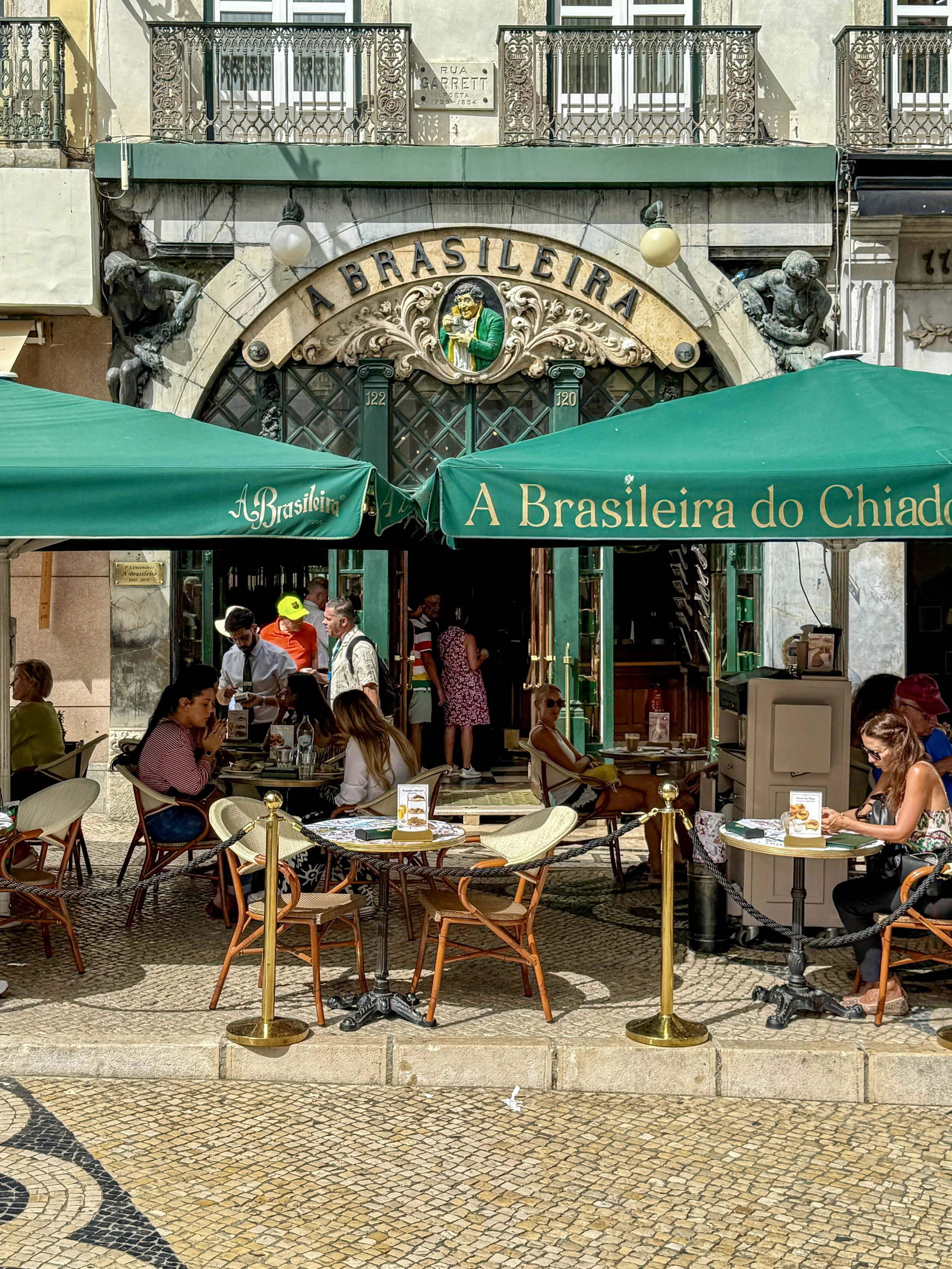
Look closely — A Brasileira’s façade is as theatrical as its clientele, with sculpted figures and ornate details framing the entrance.
A Brasileira: Where Lisbon Learned to Love Coffee
By this time, we were both feeling peckish and in serious need of a caffeine fix, so we made our way to the buzzy A Brasileira, one of Lisbon’s oldest and most iconic cafés.
Fun fact: Famous for its cafés, shops and literary spirit, Lisbon’s Chiado district most likely takes its name from a 16th century poet, António Ribeiro. A sharp-tongued satirist, Ribeiro lived in the neighborhood and was known for his impressions of notable figures — a talent that earned him the nickname O Chiado — Portuguese for “the Squeak.” The name was already attached to the area during his lifetime, and the two became so intertwined that it’s now impossible to say with certainty which named the other.
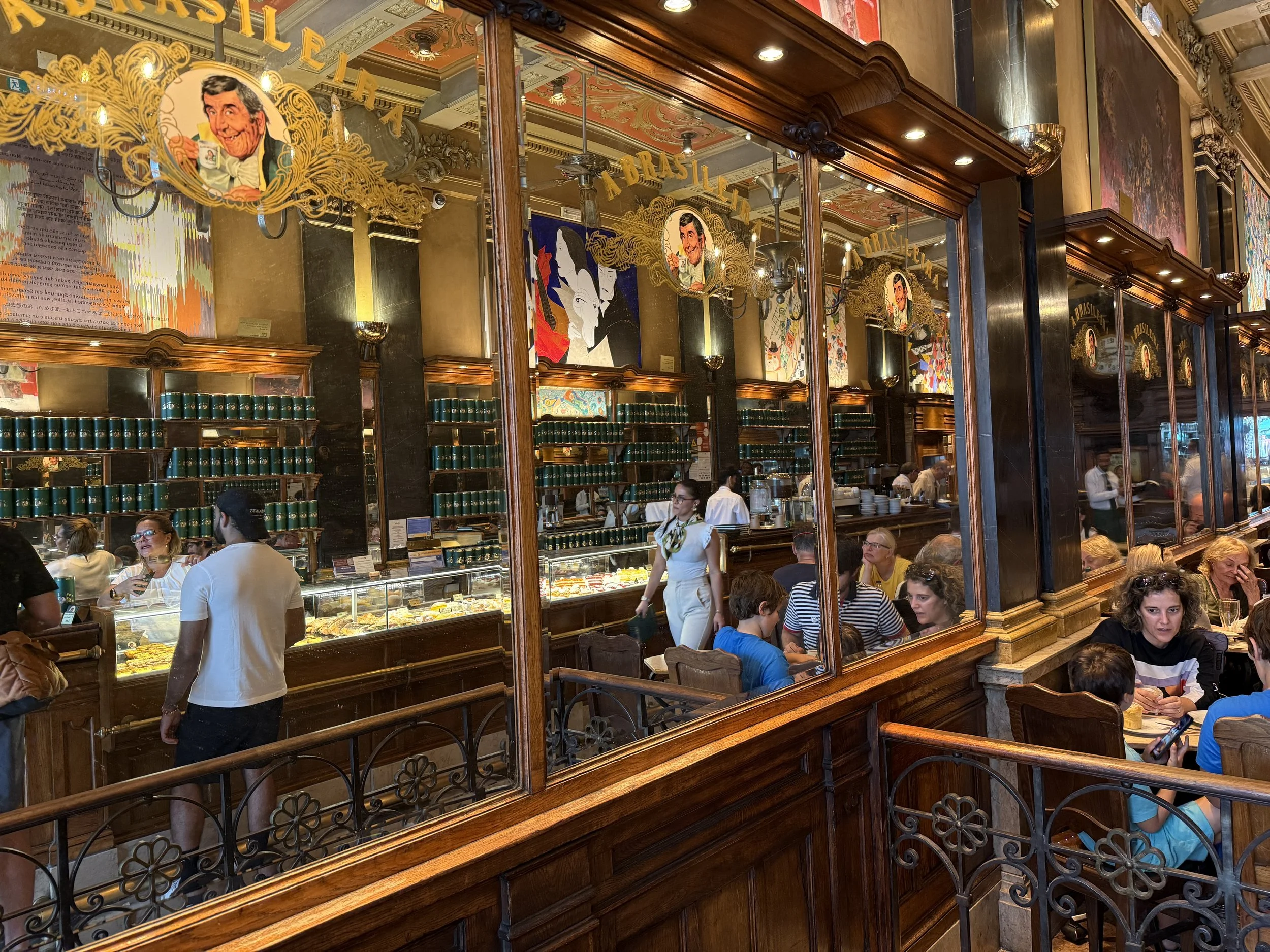
Opened in 1905, A Brasileira helped popularize coffee in Lisbon.
Opened on November 19, 1905, A Brasileira was founded by Adriano Telles, a Portuguese emigrant who had travelled to Brazil and married the daughter of one of the largest coffee producers in Minas Gerais, one of Brazil’s top bean-growing regions.
When he returned to Portugal, Telles set out to introduce high-quality Brazilian coffee to a city that scarcely knew it and, frankly, had little taste for its bitterness. To convert skeptics, he offered a free cup to anyone who bought a kilogram of ground coffee — a promotion that quickly built the café’s reputation.
The small, strong coffee served here, later called bica, is comparable to an espresso and usually drunk black. Over time, the bica became a daily ritual, fueling conversations, business deals and bursts of creativity across Lisbon. Visitors can also order um garoto — literally “little boy” — the same size as a bica but half coffee, half milk, for those who prefer a milder taste.
A Brasileira quickly became a hub for Lisbon’s artists, writers and other intellectuals. Most famously, the poet Fernando Pessoa was a frequent patron, reportedly lingering over sweet coffee or absinthe while reading, writing and smoking. Today, a bronze likeness of Pessoa sits at one of the outside tables, eternally holding court.
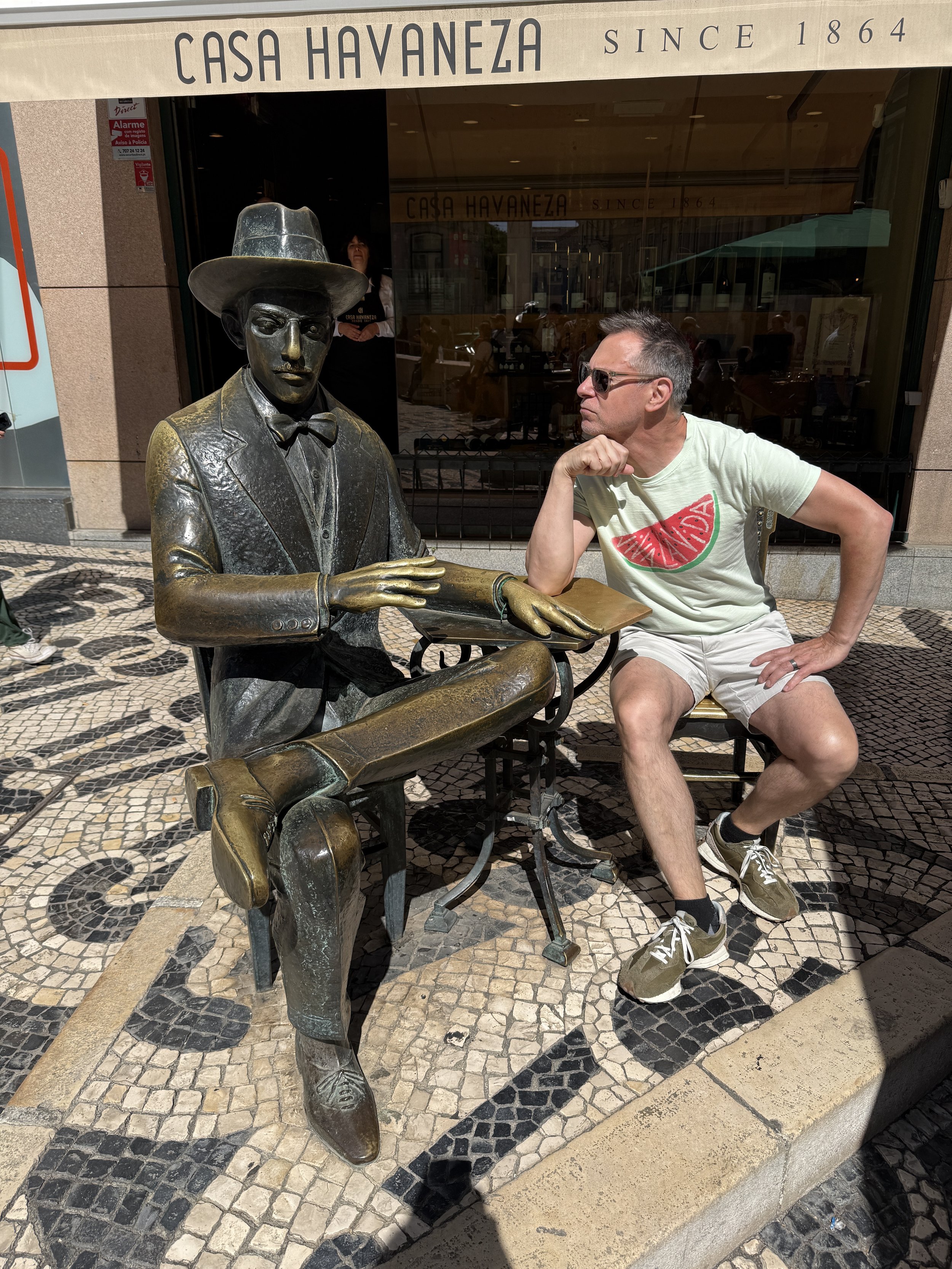
Duke takes a seat with Fernando Pessoa outside A Brasileira, where the poet was a regular — now permanently holding court in bronze.
The building itself is a feast for the eyes. Its ornate two-story façade, designed by architect Manuel Norte Júnior and blending Art Nouveau and Art Deco elements draws the eye with ironwork, glass and richly sculpted detailing. Beneath the café’s name, a decorative relief depicts a smiling man in a loosely tied cravat and emerald-green jacket, cheerfully enjoying a cup of coffee. Inside, the atmosphere is delightfully Old World, with polished brass fittings, richly sculpted woodwork, and a classic black-and-white checkerboard tile floor.
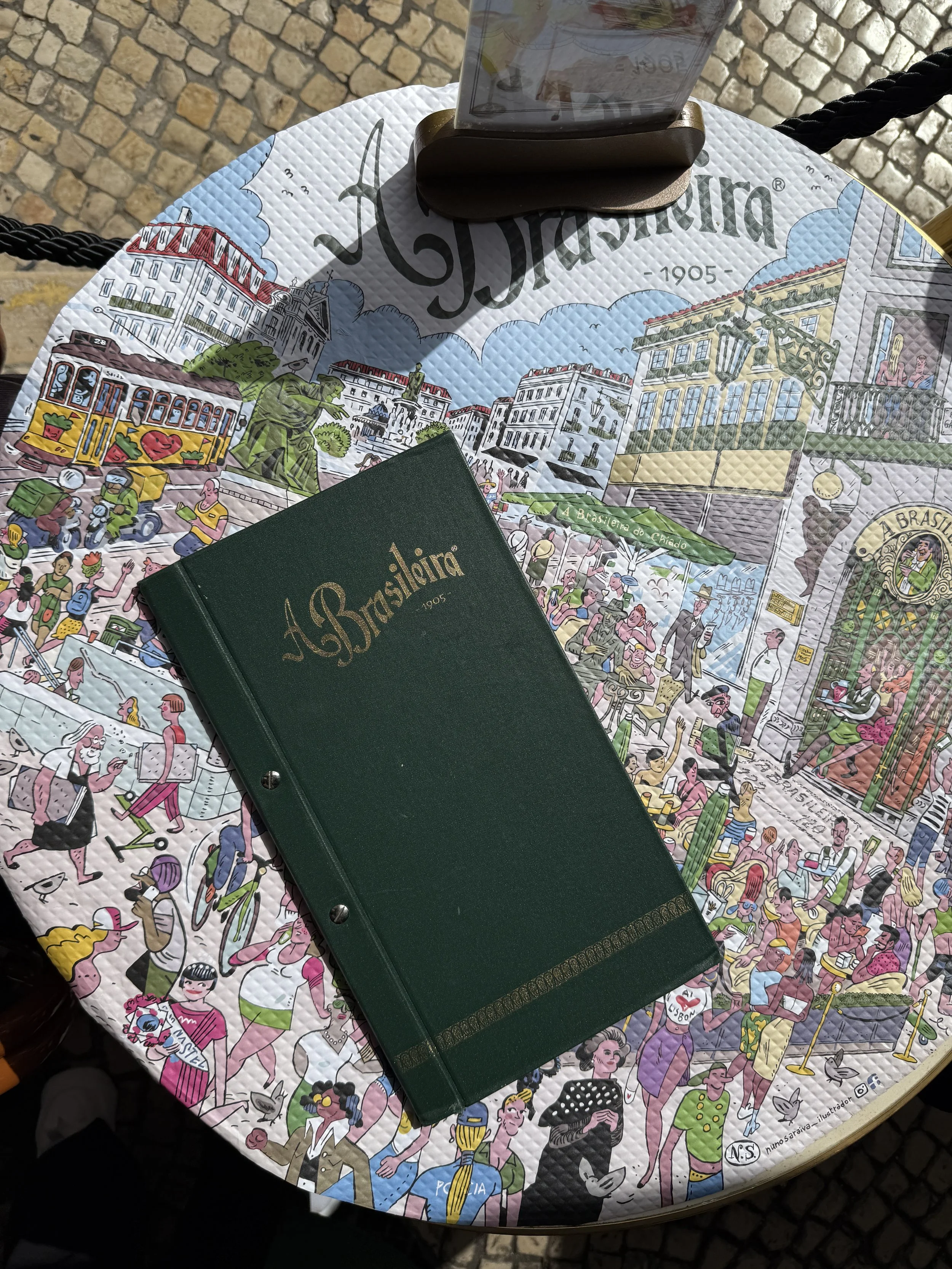
Duke wishes he had kept one of Nuno Saraiva’s illustrated tablecloths, which bring A Brasileira’s playful spirit to life.
Despite the crowds, Wally and I managed to get seats outside facing Rua Garrett, where, much like Pessoa, we lingered over our coffees and split a chocolate pavlova. I couldn’t help admiring the whimsical illustrated paper tablecloths on the outdoor tables, designed by Portuguese illustrator Nuno Saraiva, which perfectly capture the café’s playful spirit — and exactly the kind of souvenir I wish we’d taken home with us. –Duke
A Brasileira
Rua Garrett 120/122