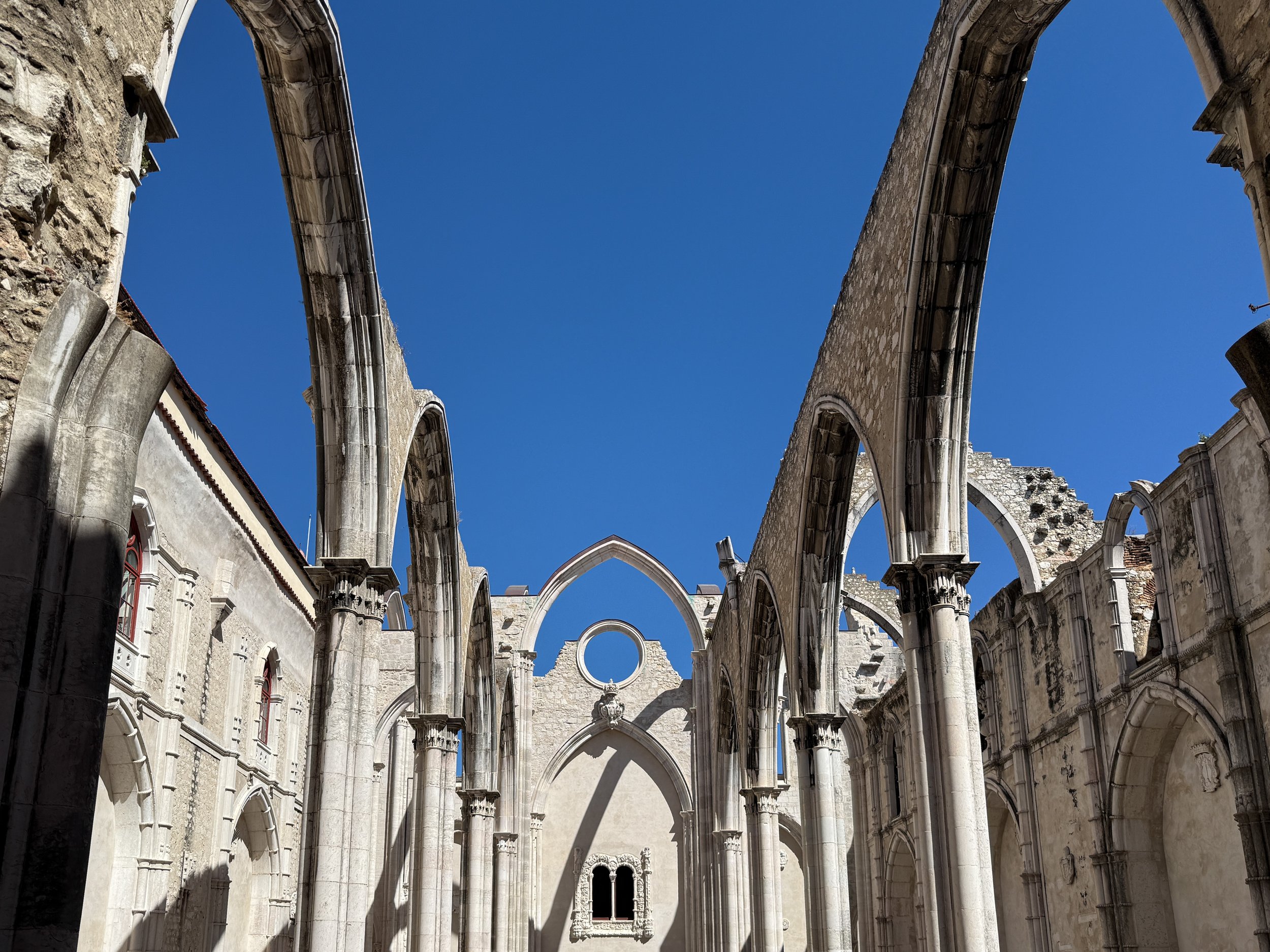
When the 1755 Lisbon earthquake tore the roof from the Gothic Carmo Convent, the sky moved in — and never left. Today, its haunting ruins stand as a reminder of the disaster, now home to the Carmo Archaeological Museum.
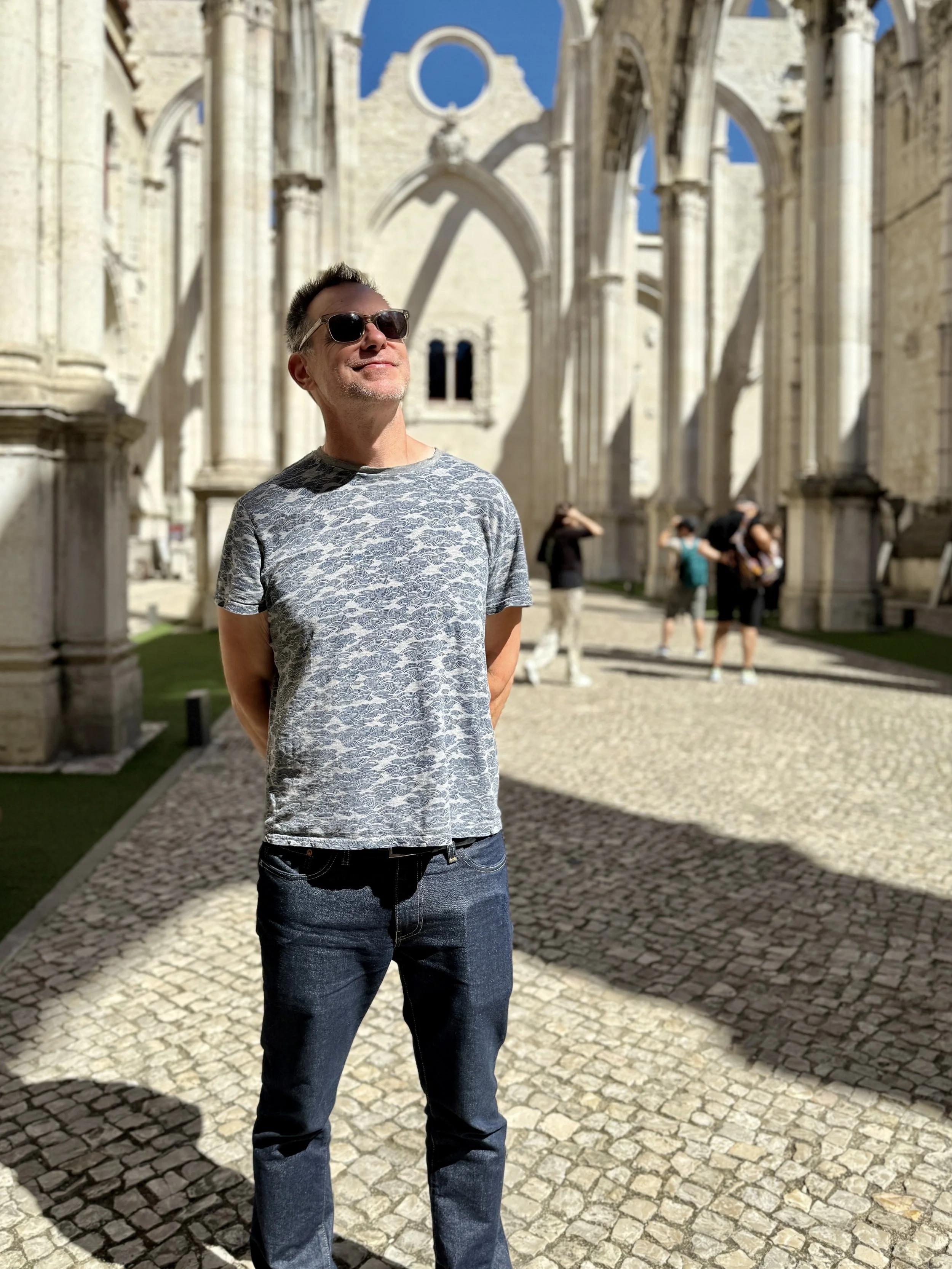
The devastating 1755 Lisbon earthquake brought down the roof of the Igreja do Carmo, leaving its Gothic arches open to the sky.
Perched on a hillside above Chiado and visible from Rossio Square, the Gothic Igreja do Carmo (aka the Church of the Convent of Our Lady of Mount Carmel) cuts an unlikely but striking silhouette. Founed in 1389, it was once one of the largest and grandest churches in Lisbon. Pale limestone walls and slender, skeletal arches frame a nave that has been open to the sky since the cataclysmic earthquake and fire of 1755 leveled much of the city on All Saints’ Day.
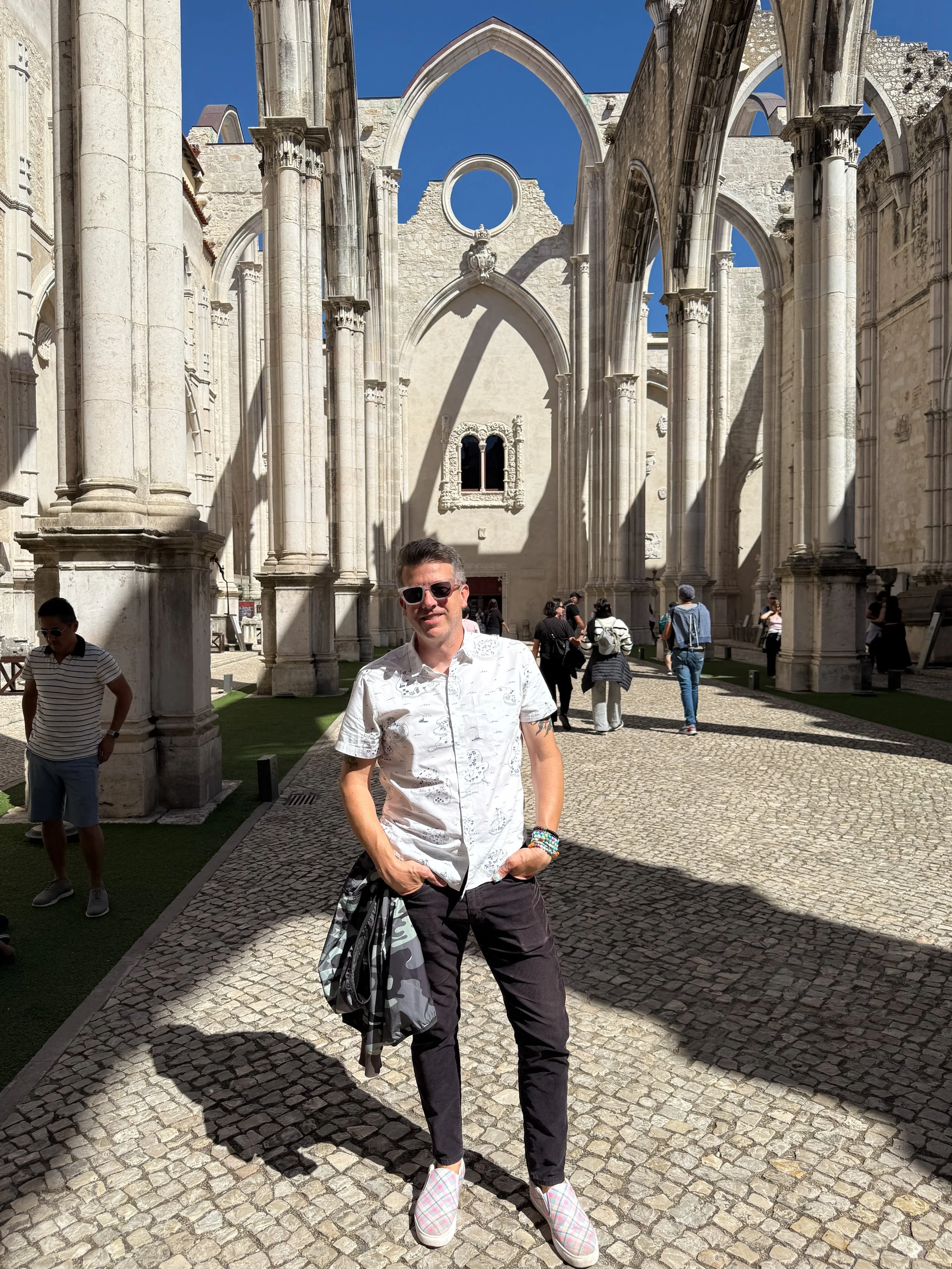
The ruins were never fully rebuilt and today provide a dramatic setting for the Carmo Archaeological Museum.
Wally and I have visited some unusual houses of worship over the years, from Gereja Ayam, the once-abandoned “Chicken Church” deep in the jungle near Magelang, Indonesia, to Lisbon’s Church of São Domingos, where blackened walls and blistered stone still bear the scars of a devastating 1959 fire. But nothing quite prepared us for the roofless remains of the Igreja do Carmo.
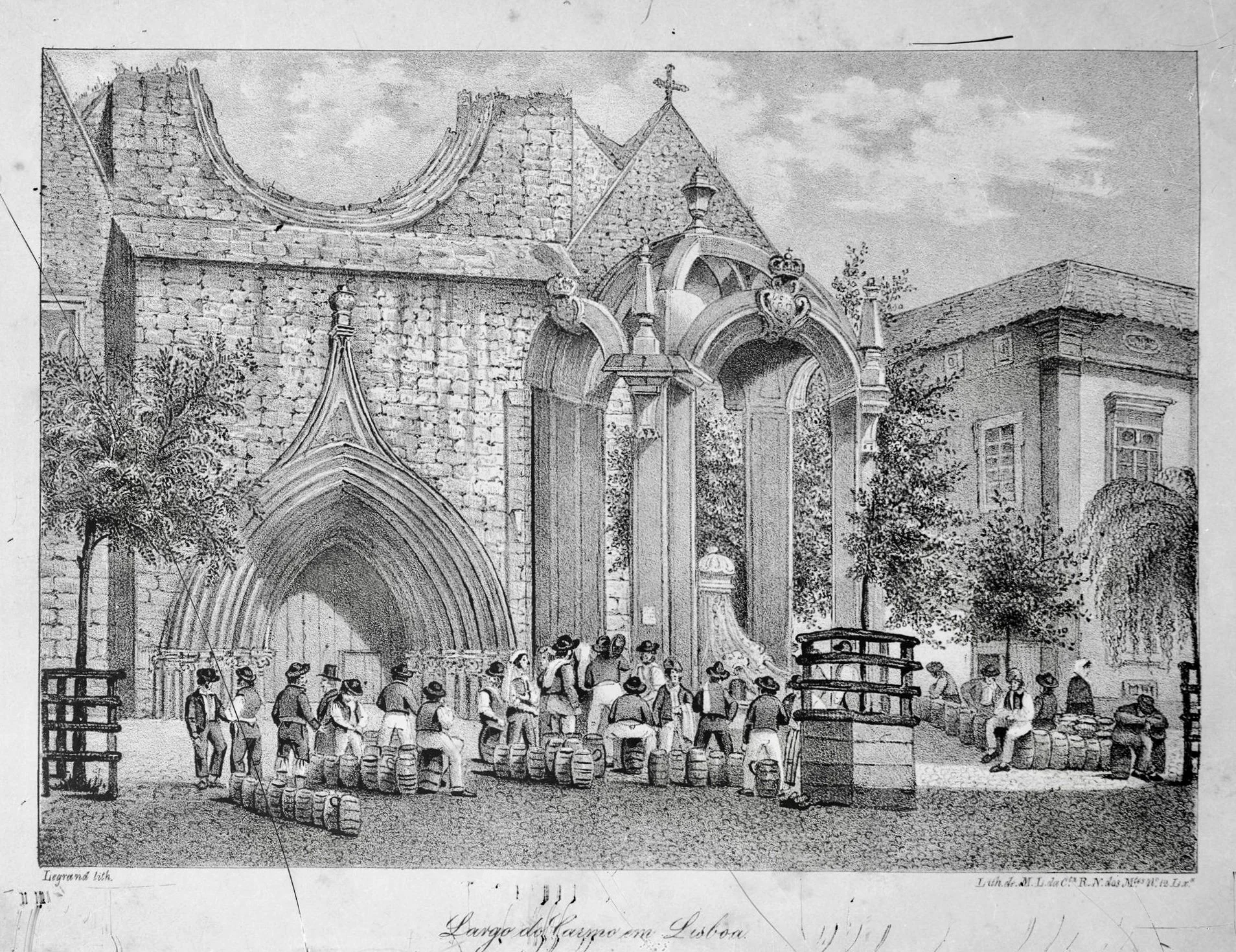
Largo do Carmo em Lisboa, a 19th century lithograph by Legrand and printed by M.L. da Costa in Lisbon. This 19th century print depicts aguadeiros (water carriers) filling their barrels at the Chafariz do Carmo (Carmo fountain), in front of the ruins of the Carmo Convent..
Largo do Carmo
The former convent sits on the western edge of the leafy Largo do Carmo. At the center of the square is the Chafariz do Carmo, an ornate late Baroque confection with four pillars supporting a ring of rounded arches beneath a false dome, its spouts carved as stylized dolphins that veer into sea monster territory. Credited to architect Reinaldo Manuel dos Santos and completed in 1771, the fountain once supplied water to Chiado residents from the Águas Livres Aqueduct. Today it’s purely ornamental, a pretty relic to admire on your way to the ruins.
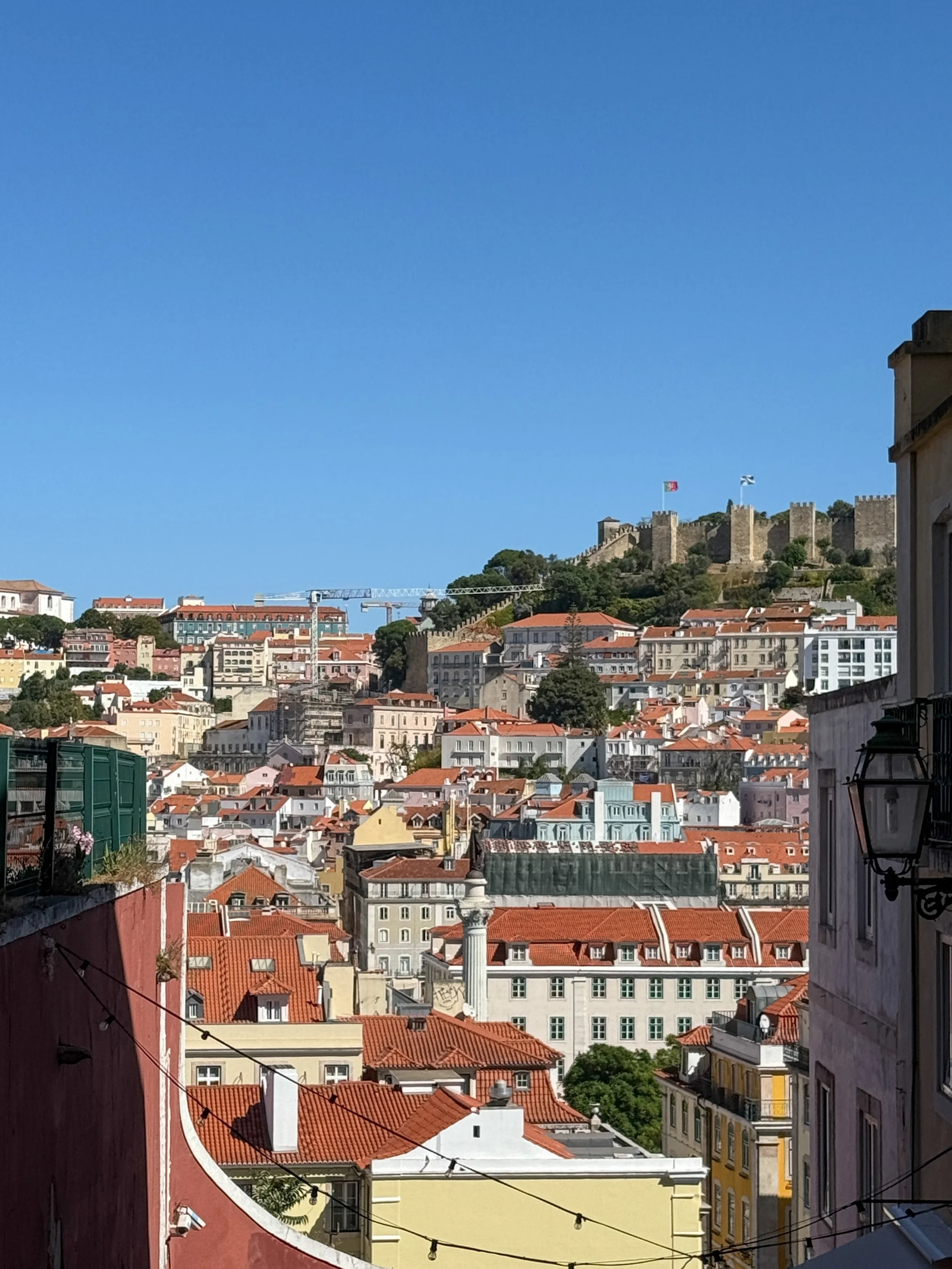
A view across Lisbon’s terracotta rooftops from the hillside near the ruins of the Igreja do Carmo
Just beyond is the Gothic façade of the Igreja do Carmo, its main doorway is framed by receding archivolts resting on slender columns. Their capitals are embellished with a whimsical of leaves, flowers and figures peeking out from the foliage. Above, only the lower frame of the oculus window survives.
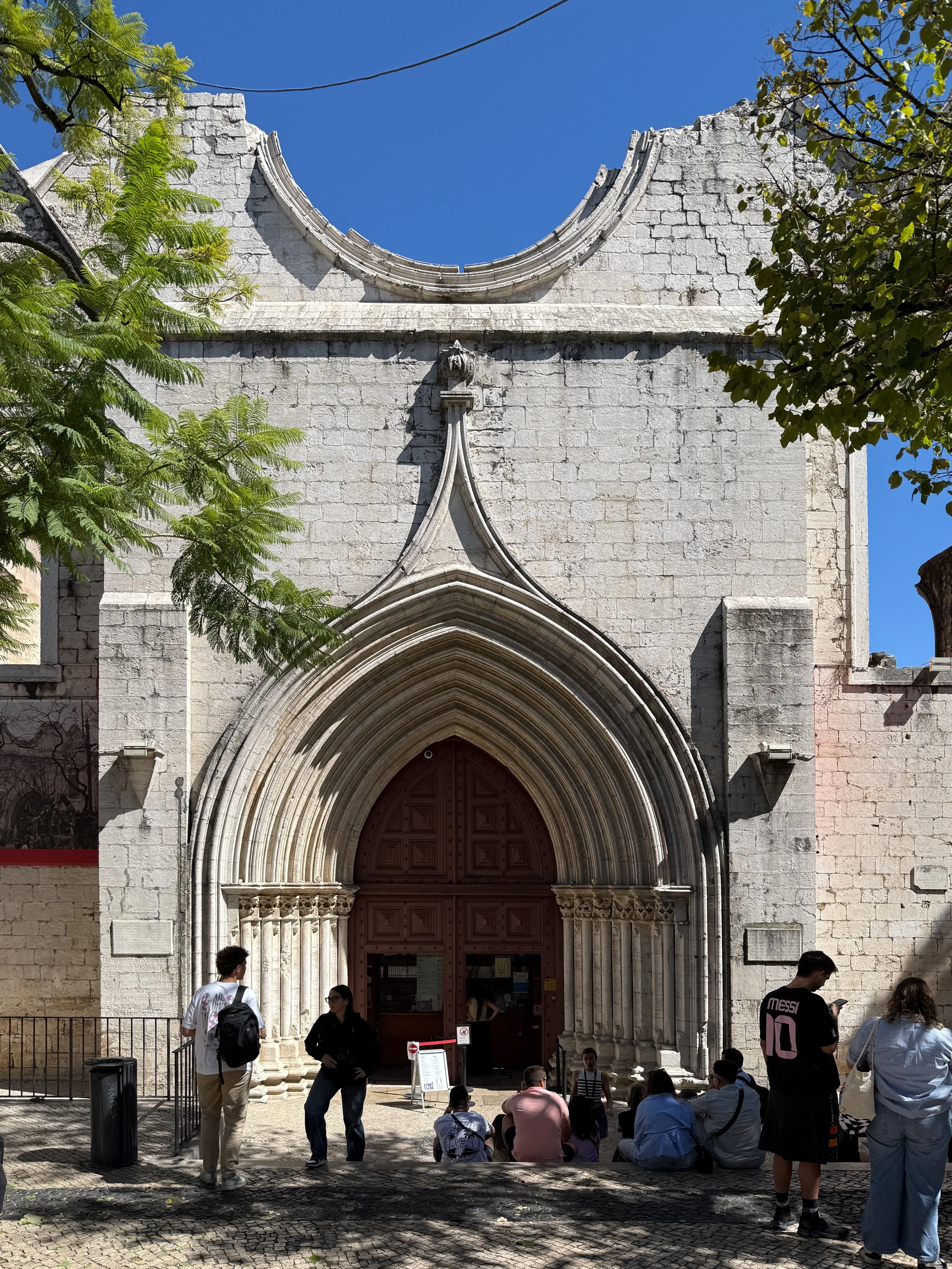
Layers of pointed Gothic arches frame the entrance to the Museu Arqueológico do Carmo.
In Ruins: Convento do Carmo
Masons were back at work on a new Gothic nave as early as 1756, but Lisbon had bigger problems brewing. Napoleon’s army was closing in, the royal family fled for Brazil, and whatever momentum the rebuilding had gathered brought the project to a halt.
In the meantime, the convent had found other uses. By 1810, Marshal Beresford had installed a company of the Guarda Real de Polícia, the militarized police force Prince Regent João had created in 1801, in the old cloisters. What habitable rooms remained became barracks and offices.
When Portugal’s religious orders were abolished in 1834, there was no longer any question of rebuilding. Thirty years later, the old convent found a new purpose when the Associação dos Arquitectos Civis Portugueses (Association of Portuguese Civil Architects) took up residence and established the Museu Arqueológico do Carmo (Carmo Archaeological Museum). Founded by Joaquim Possidónio Narciso da Silva, it was the country’s first museum of art and archaeology. Left largely untouched, the open-air nave was perfectly suited to the Romantics’ fascination with ruins and the beauty they found in decay.
The site has one more twist worth mentioning. It’s where Marcelo Caetano, the last prime minister of the Estado Novo dictatorship, holed up before surrendering to General António de Spínola during the Carnation Revolution, the military-led coup of April 25, 1974, that ended 48 years of authoritarian rule and brought democracy to Portugal.
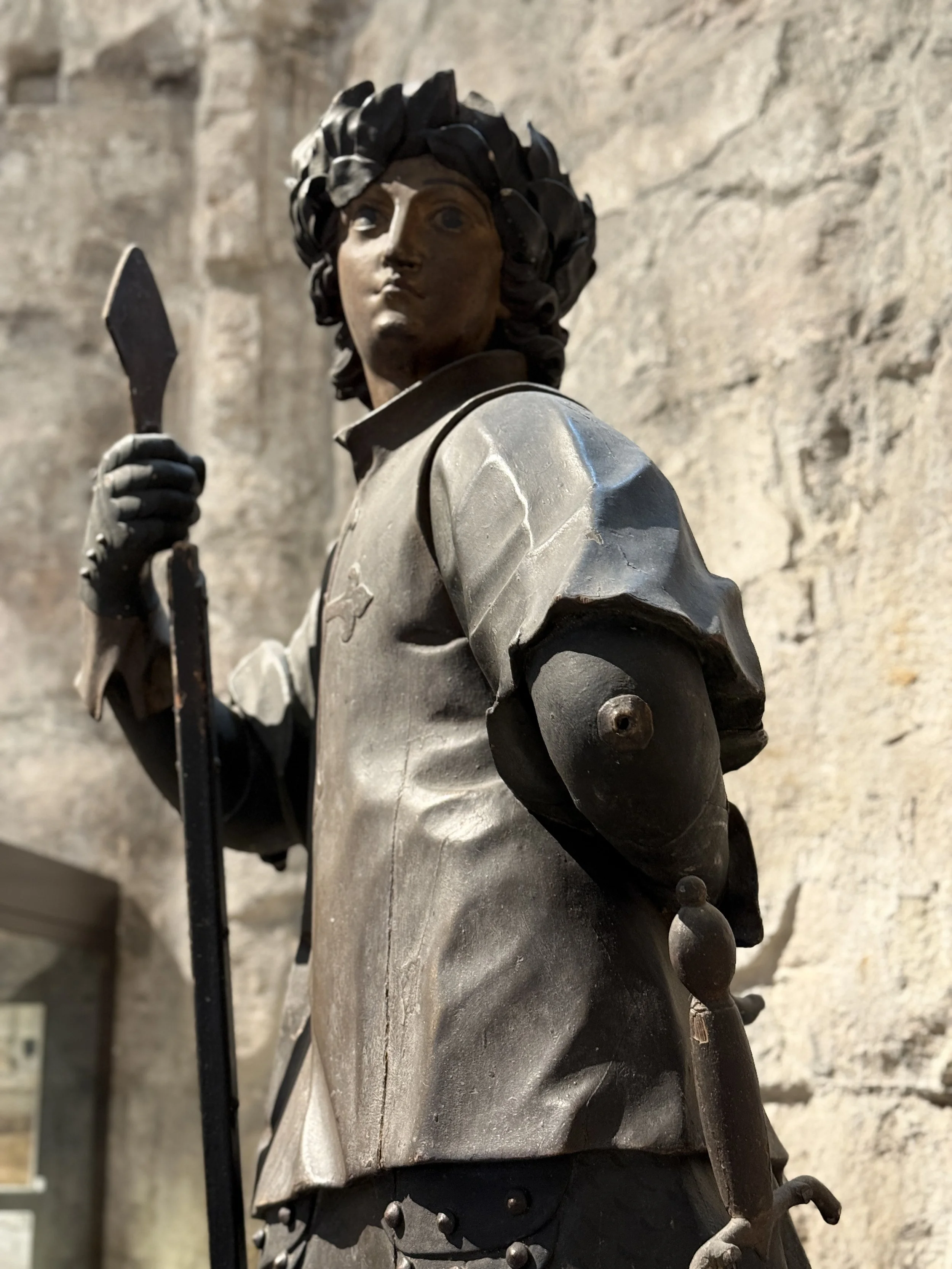
Among the artifacts in Sala 5 is a classical depiction of a youthful Nuno Álvares Pereira, later São Nuno de Santa Maria. Shown in armor and crowned with laurel, he holds a spear in one hand, while the cross on his tunic marks him as a Christian knight.
A Brief History of Carmo Convent
Go back further and you land on Nuno Álvares Pereira, Constable of Portugal, who founded the convent in honor of Nossa Senhora do Carmo (Our Lady of Mount Carmel), the patron saint and protector he credited with getting him through battle after battle against the Castilians. Pereira became one of the defining figures of Portugal's fight for independence, leading the Portuguese army to a decisive win over Castile at the Battle of Aljubarrota in 1385.
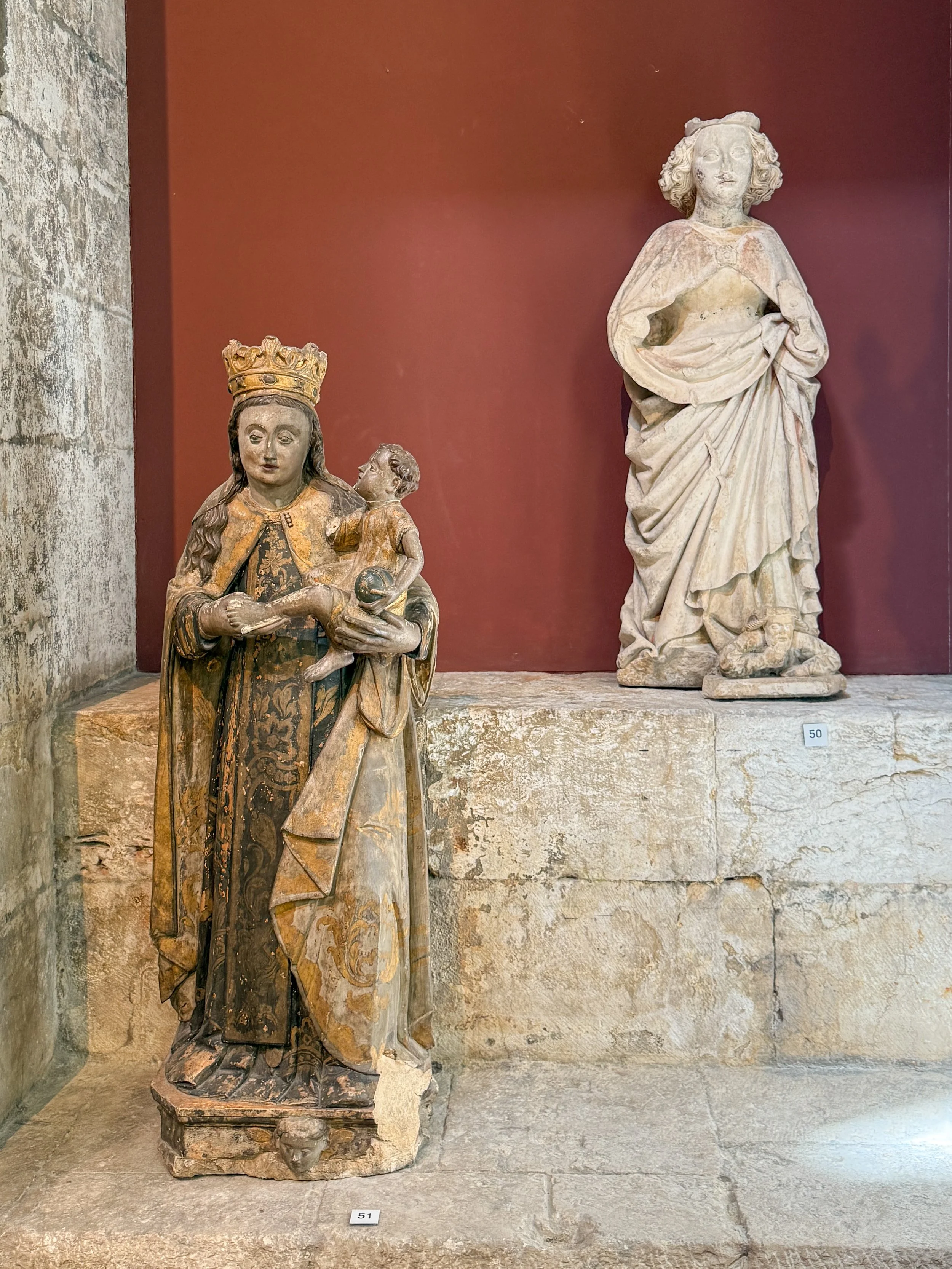
Our Lady of Mount Carmel, for whom the convent was named, cradles the Christ Child beside a weathered Saint Catherine of Alexandria.
The trouble had started two years earlier, when King Fernando I died without a male heir. His only child, Beatriz, was married to John I of Castile, which handed her husband a claim to the Portuguese throne and threw the country into a succession crisis. Lisbon was a tinderbox. At one point, an angry mob dragged Bishop Dom Martinho Annes, suspected of conspiring with the Castilians, to the northern tower of the Lisbon Sé and threw him from the window.
Aljubarrota made Pereira a national hero and secured Portugal's independence from Castile. But he spent his later years turning away from the world he'd fought so hard to defend. In 1423 he entered the Carmelite order, took the name Frei Nuno de Santa Maria, and traded the soldier's life for one of prayer and quietude.
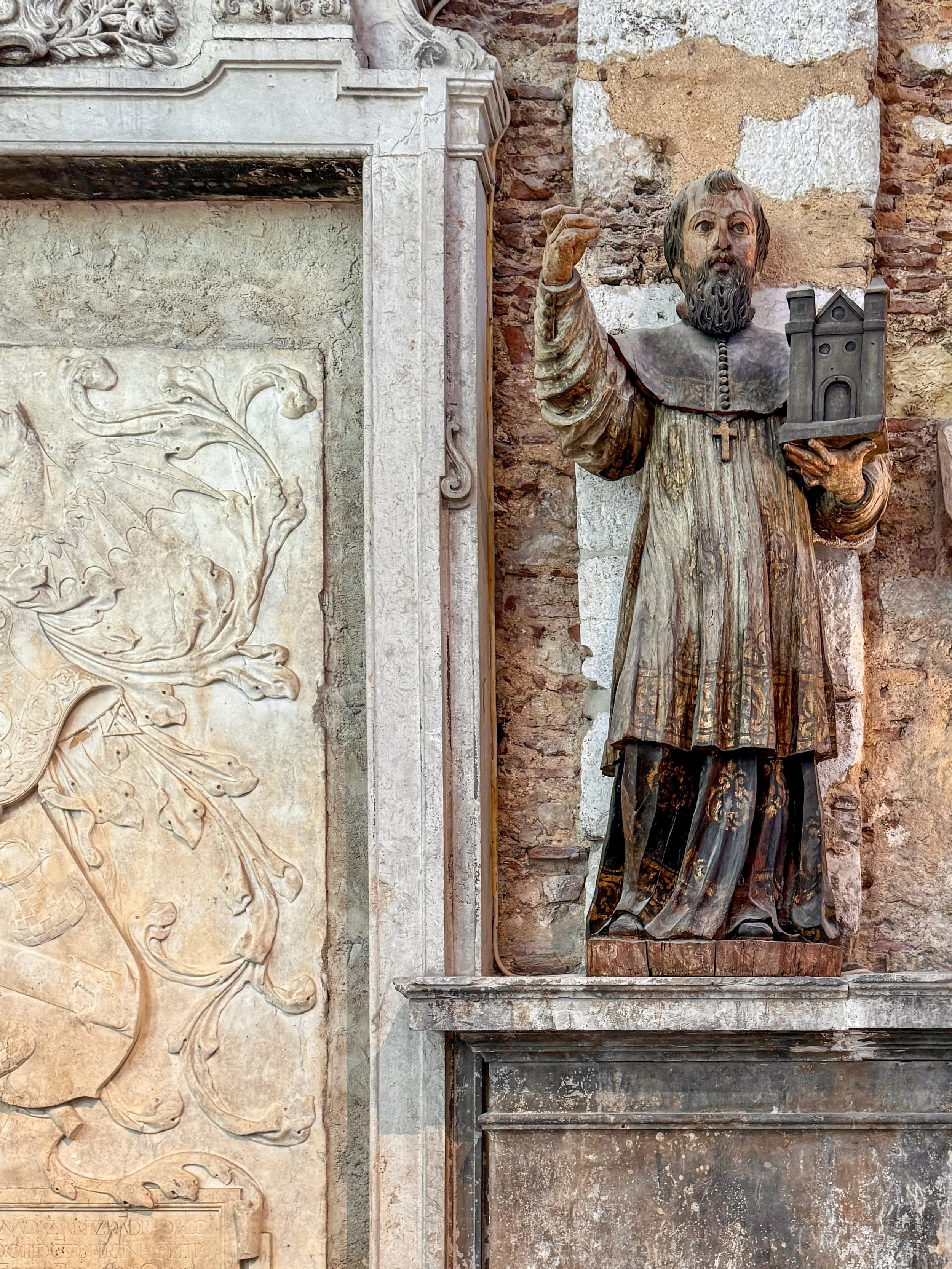
This polychrome wooden sculpture depicts São Nuno de Santa Maria (Nuno Álvares Pereira), the former Portuguese military commander who founded the Convento do Carmo before becoming a Carmelite monk. He holds an architectural model of a church, symbolizing his patronage of the order.
He was buried in the convent he'd founded, but the earthquake swallowed his tomb along with the convent's library, both lost in the fires that followed. His remains weren't discovered again until 1996, unearthed during excavations in one of the convent’s side chapels, nearly two and a half centuries later.
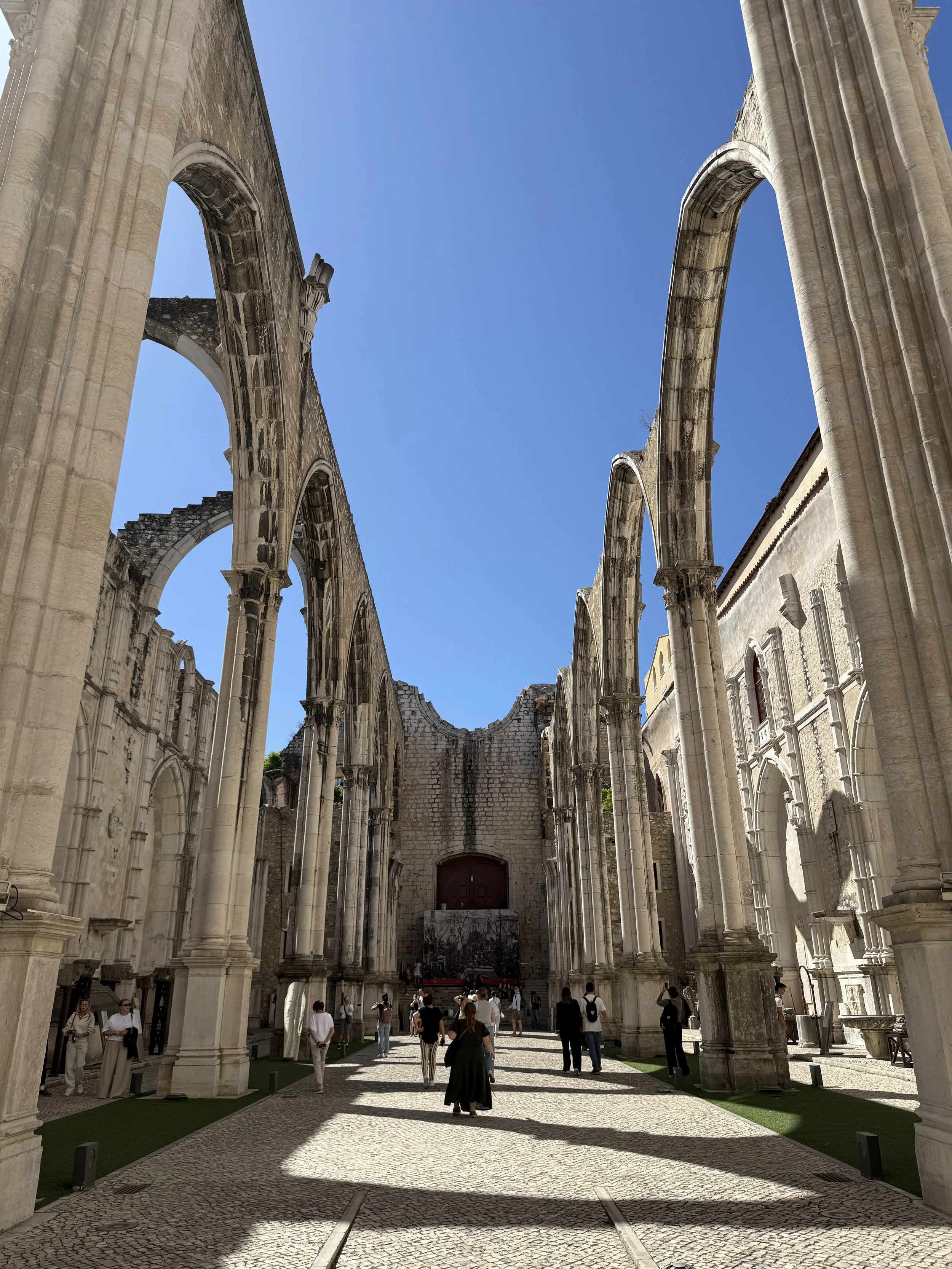
Reconstruction began in 1756 and halted in 1834, though the pillars and arches of the nave, dating to the 14th and 15th centuries, are original.
Carmo Archaeological Museum: History and Culture en Plein Air
Wally and I stepped through the main entrance and stopped short. Stone arches soared up from the pillars, and above them — nothing but a roofless nave opening straight onto a cloudless blue sky. Today, we can reach almost anywhere in the world with a tap of a finger, but standing under the bones of a medieval church and looking straight up through centuries of history is a different kind of seeing. It wasn't hard to understand why these ruins have captivated visitors long before us.
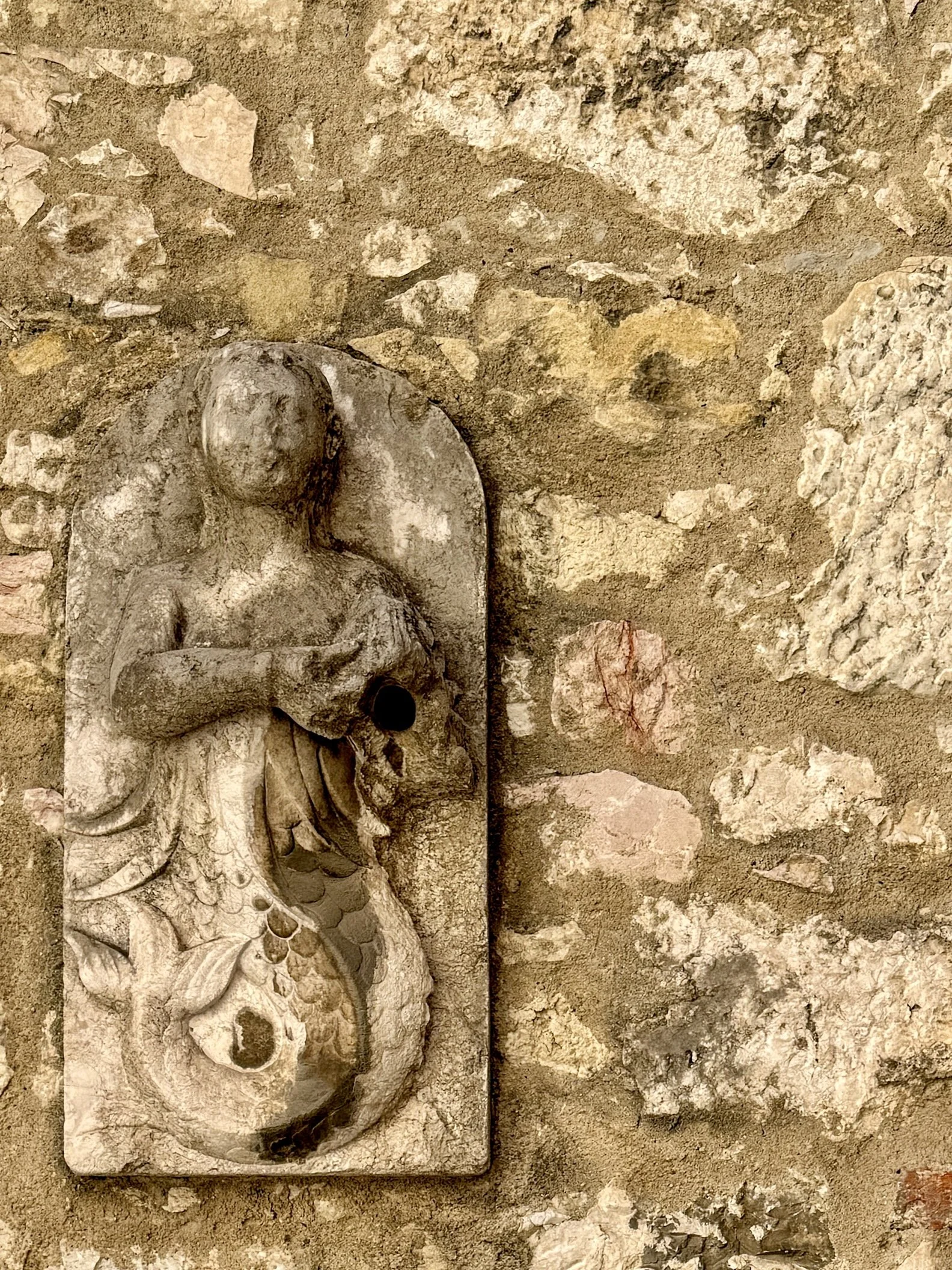
A limestone mermaid from the Monastery of São Dinis de Odivelas gazes from the wall near the entrance.
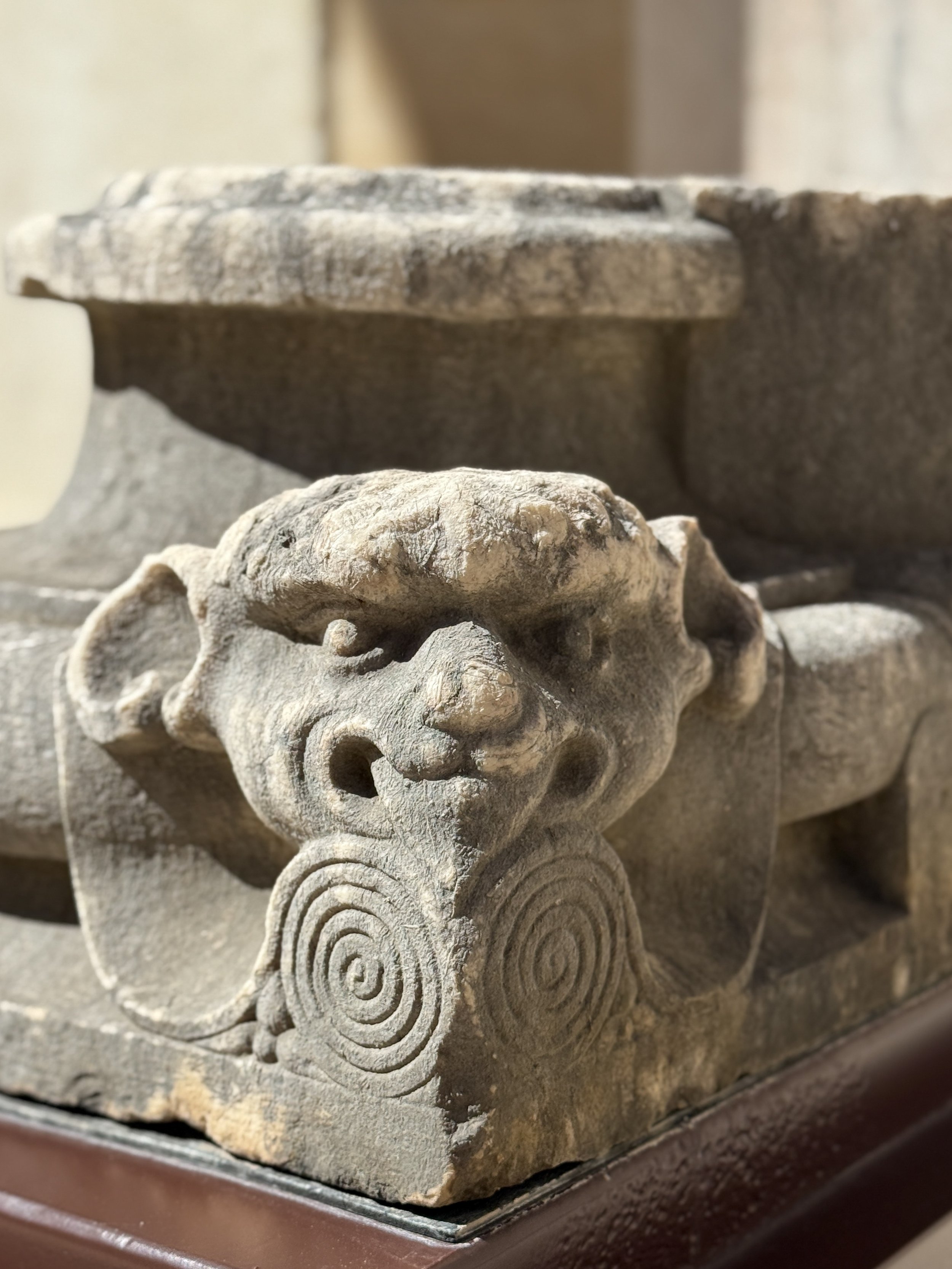
The museum’s eclectic collection includes this wonderfully weird little creature carved into a stone sarcophagus.
The former convent is laid out like a Latin cross, with a three-aisled nave, transept, and apse with a main chapel and four smaller side chapels. Much of what fills the roofless nave today can be traced back to Possidónio himself. When the religious orders were dissolved in 1834, churches and convents across Portugal were stripped bare, sold off or simply left to crumble. Possidónio made it his mission to save what he could — architectural fragments pulled from demolished churches and convents, funerary monuments displaced from their chapels, statues of medieval rulers and heraldic coats of arms.
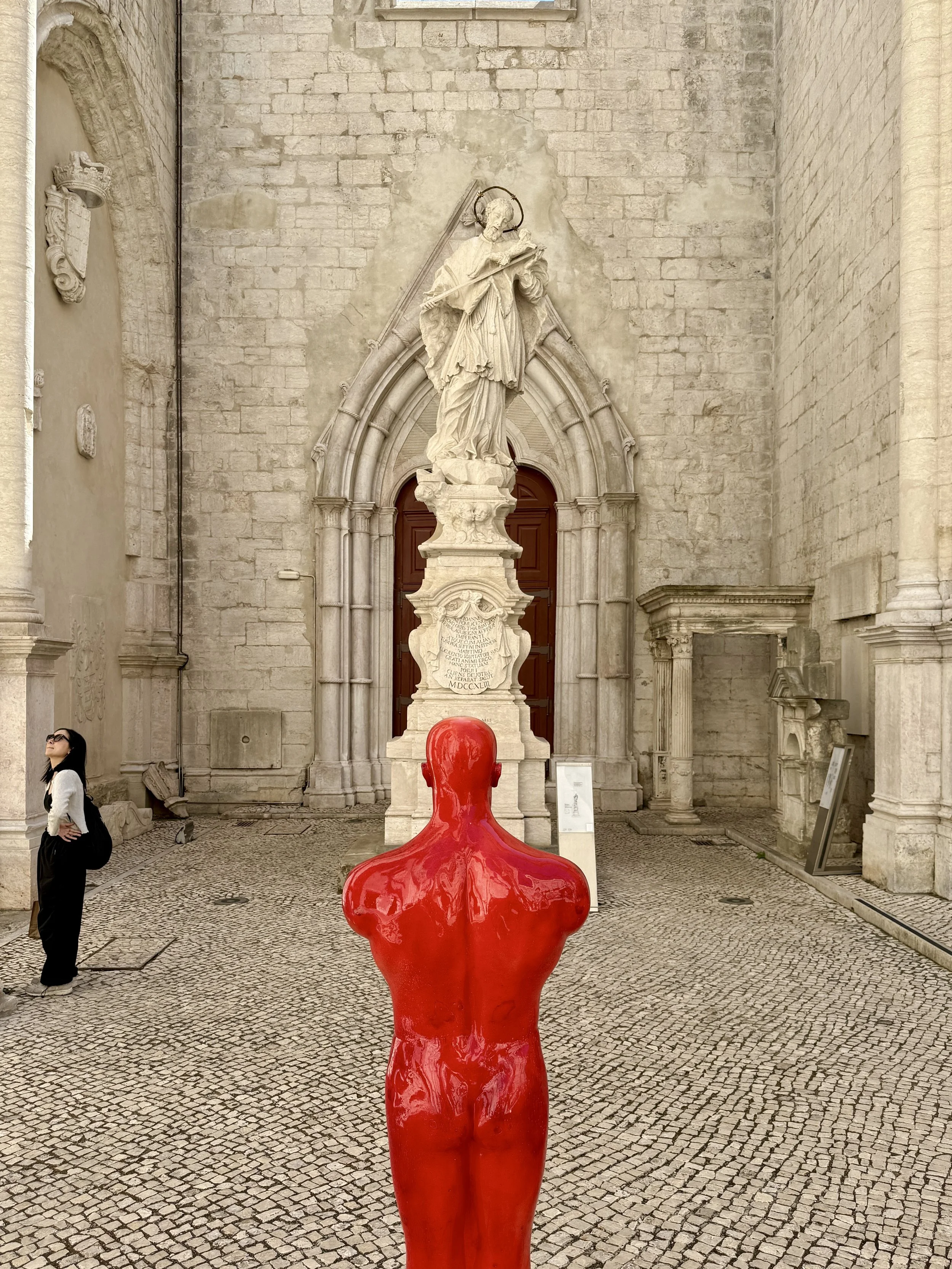
During our visit, Homem Vermelho (Red Man), a life-sized sculpture by Sérgio Pombo, stood among the medieval ruins. Its vivid red form was a striking contrast against Carmo’s weathered stone.
Wandering the Open-Air CarMo Museum
Working our way through the north nave, we stopped at the tomb of the knight Mem de Cerveira. His stone effigy lies within a lace-like frame of trilobed arches. stone leaves, and vines carved in the Manueline style, Portugal’s own distinctive spin on late Gothic design. Only the lid survives. The bottom half is lost. It was moved here from a chapel in the Igreja de São Domingos de Santarém, a church that no longer stands.
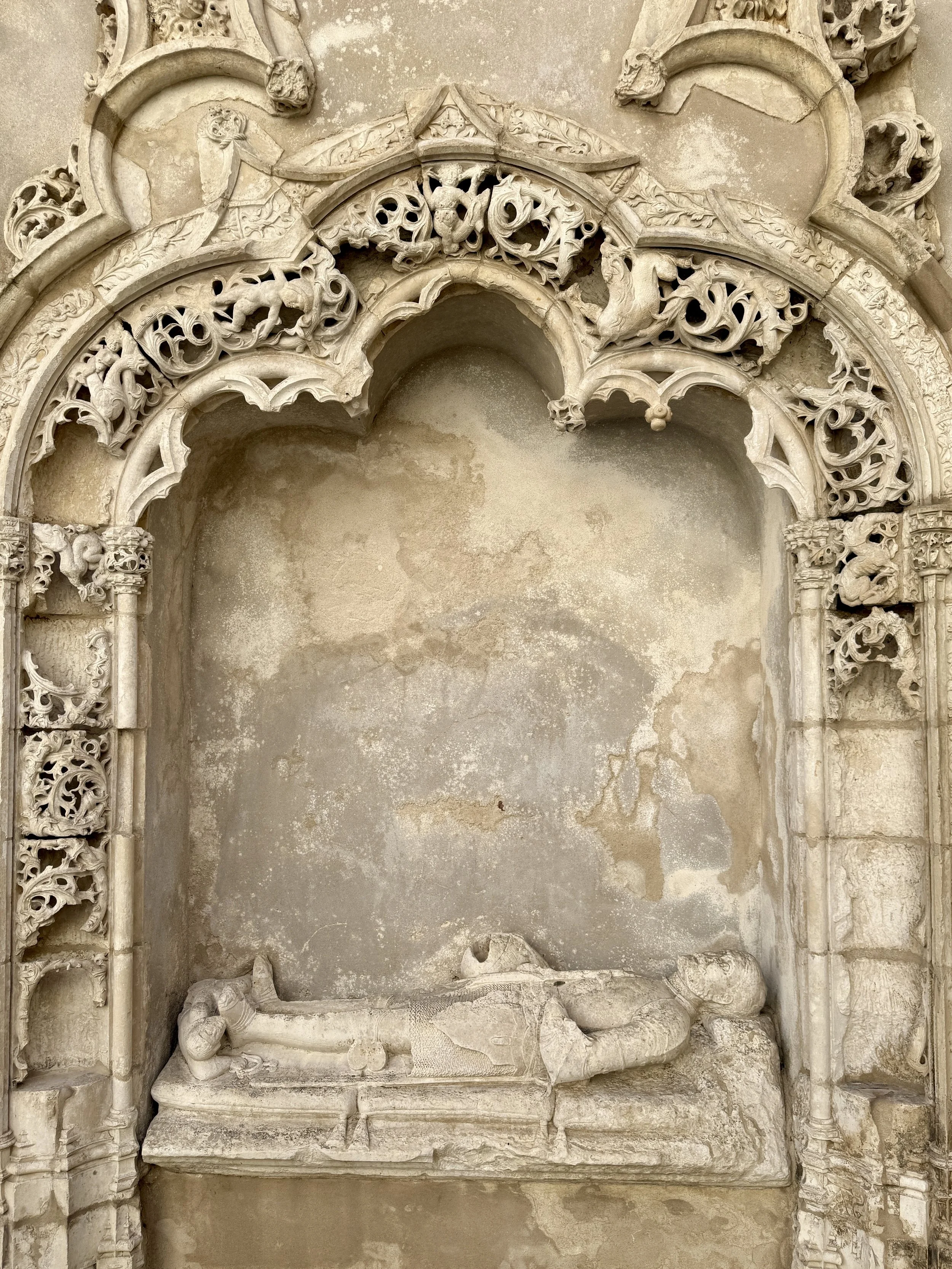
The limestone effigy of the knight Mem de Cerveira lies in repose beneath the delicate tracery of a Manueline arch, one of the remarkable salvaged religious relics displayed at Carmo.
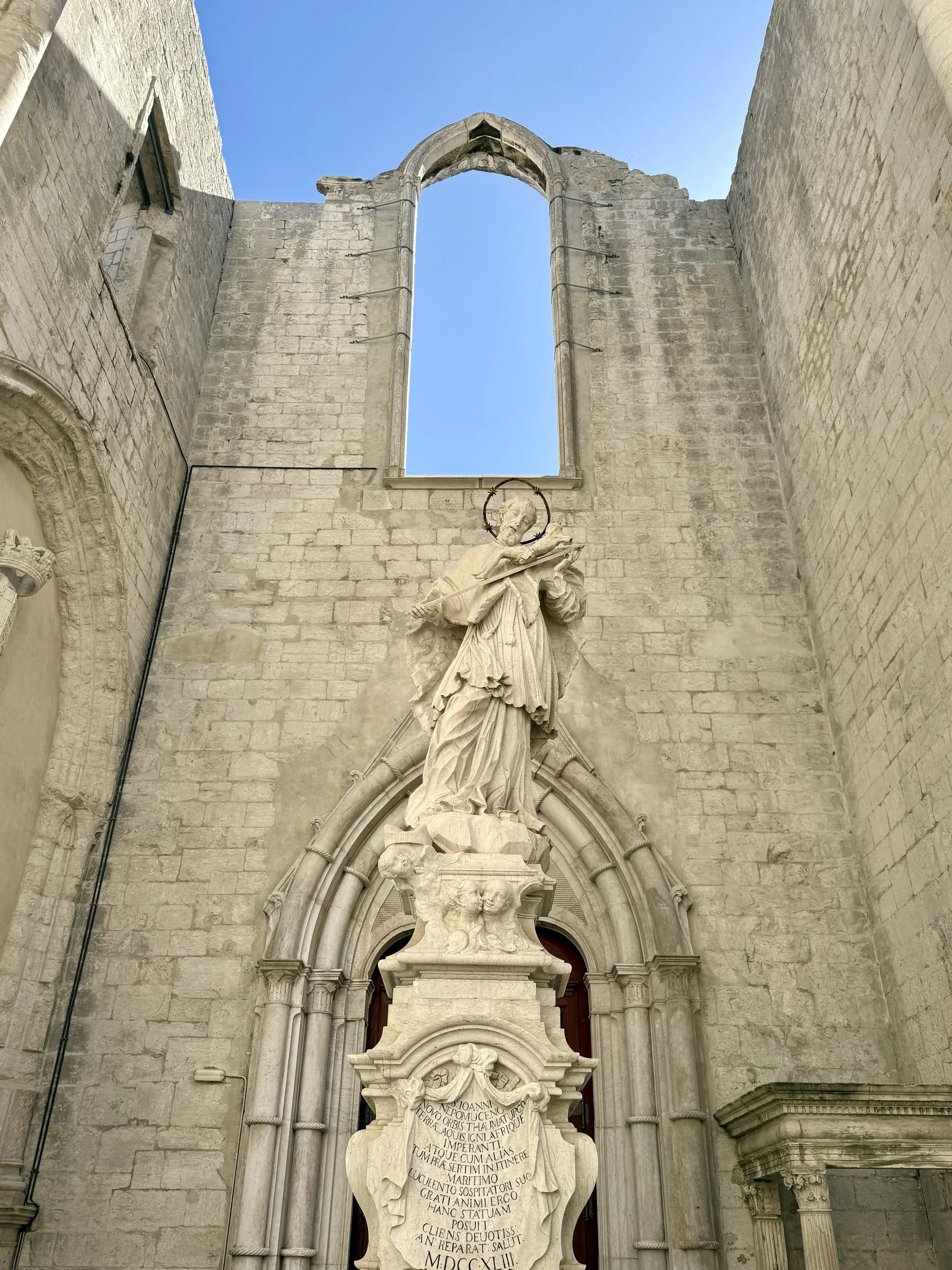
In the transept, we paused to look up at the marble statue of São João Nepomuceno (Saint John of Nepomuk), the patron saint of protection from drowning and floods. Sculpted by Giovanni Antonio Bellini in 1743, it depicts the Czech martyr whose fate was sealed by a bitter dispute between Wenceslaus IV of Bohemia and the Archdiocese of Prague over the appointment of an abbot. Accused of defying the king, Nepomuk was arrested, tortured and ultimately thrown from the Charles Bridge into the Vltava River in 1393, where he drowned. His cult took hold in Bohemia before spreading across Christendom.
The five stars encircling the saint’s head recall the legend that a miraculous light appeared in the water, marking the spot where his body was found. They also symbolize Christ’s five wounds and the five letters of TACUI, Latin for “I have kept silent,” a reference to Nepomuk’s refusal to break the seal of the confessional and reveal the queen’s secrets to King Wenceslaus.
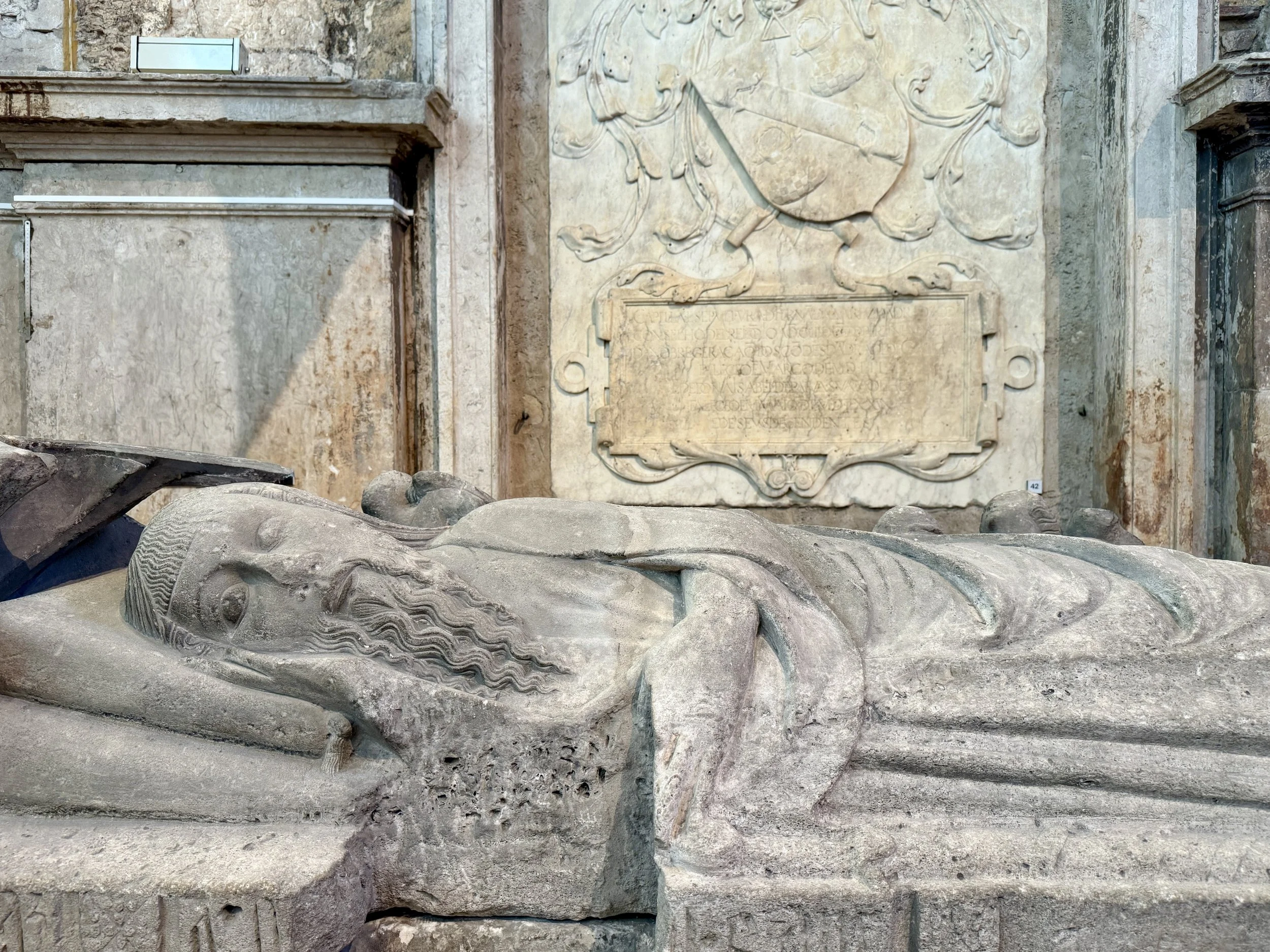
Recumbent figure of Fernão Sanchez, the illegitimate son of King Dinis, shown resting his head on a decorated pillow. His long, wavy beard and neatly styled structured hair reflect the fashion of early 14th century Portuguese nobility.
A Small Museum With Fascinating Finds
The apse and chapels at the far end of the nave survived the earthquake more or less intact and were later incorporated into the museum as enclosed galleries.
Above the entrance is a Manueline window pulled from the Mosteiro dos Jerónimos (Jerónimos Monastery) in Belém during the monastery’s 19th century restorations and brought here for safekeeping.
Inside, the collection is small but impressive, ranging from prehistoric and anthropological finds from Portugal and well beyond: an Egyptian mummy in its wooden sarcophagus, and a pair of remarkably well-preserved mummies from Peru, a young man and a young woman belonging to the Chancay culture.
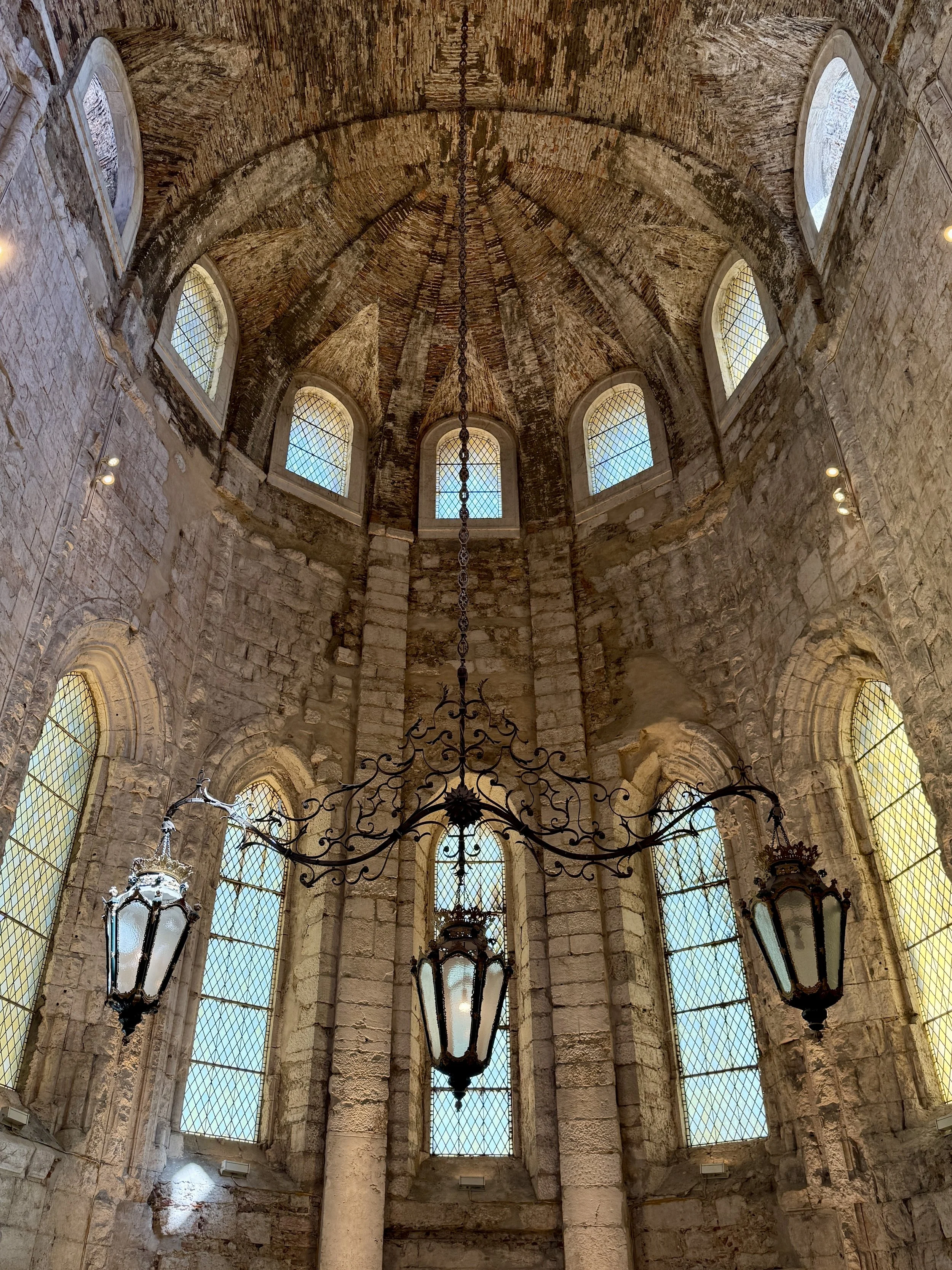
A wrought-iron chandelier hangs beneath the weathered Gothic vault of one of the church’s surviving apse chapels.
The first room offers a glimpse into Portugal’s past, displaying artifacts from the Stone Age to the Iron Age: stone and flint tools, Neolithic arrowheads, prehistoric pottery and metalwork. Each piece tells a story about the development of the region’s early civilizations and its culture.
The second room brings together objects from the Roman, Visigothic and Islamic periods, including the Roman Sarcophagus of the Muses. Dating to the 3rd or 4th century, its front panel depicts a central male figure, likely the deceased, flanked by the nine Muses representing the arts.
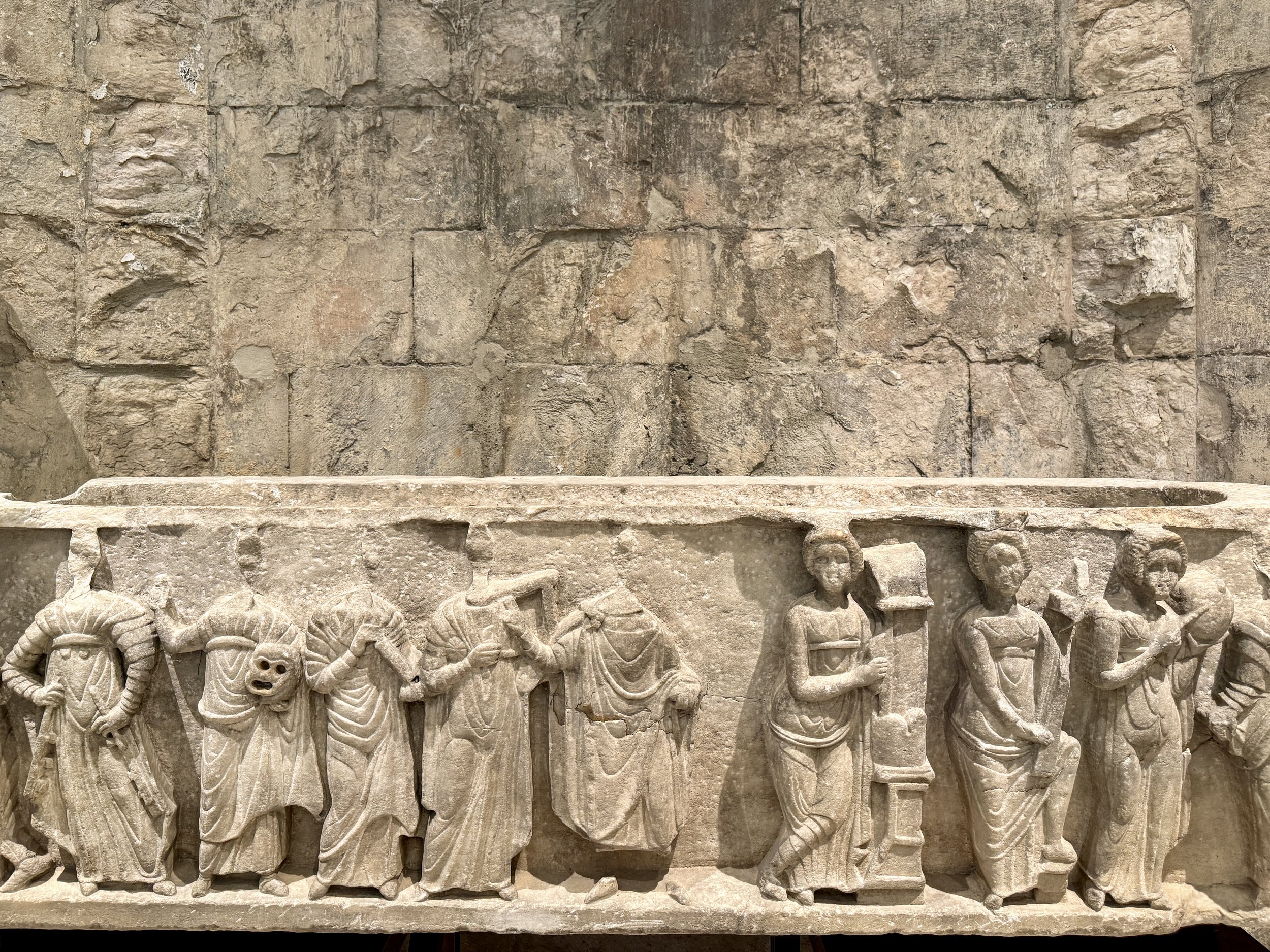
This marble sarcophagus, depicting the deceased flanked by the Muses, was unearthed in the village of Valado dos Frades. It came from the necropolis of a Roman home known as Villa da Mina, once located along the shores of Lagoa da Pederneira, a former inland seaport.
Its story is nearly as remarkable as the relief itself. A farmer unearthed it while plowing a field in the village of Valado dos Frades, after which it was moved to Alcobaça Monastery. Over the next century, careless handling caused much of the damage to the relief, including the loss of five of the nine Muses’ heads. When Portugal’s religious orders were dissolved, the sarcophagus was sold and eventually found an unlikely second life as a pig feeding trough at a nearby farm.
In 1868, da Silva, discovered it there, “neglected and buried in manure,” and brought it to Lisbon, where it remains in the museum today.
The third room, once the church’s main chapel, houses a fascinating collection of artifacts from the medieval through the early modern period.
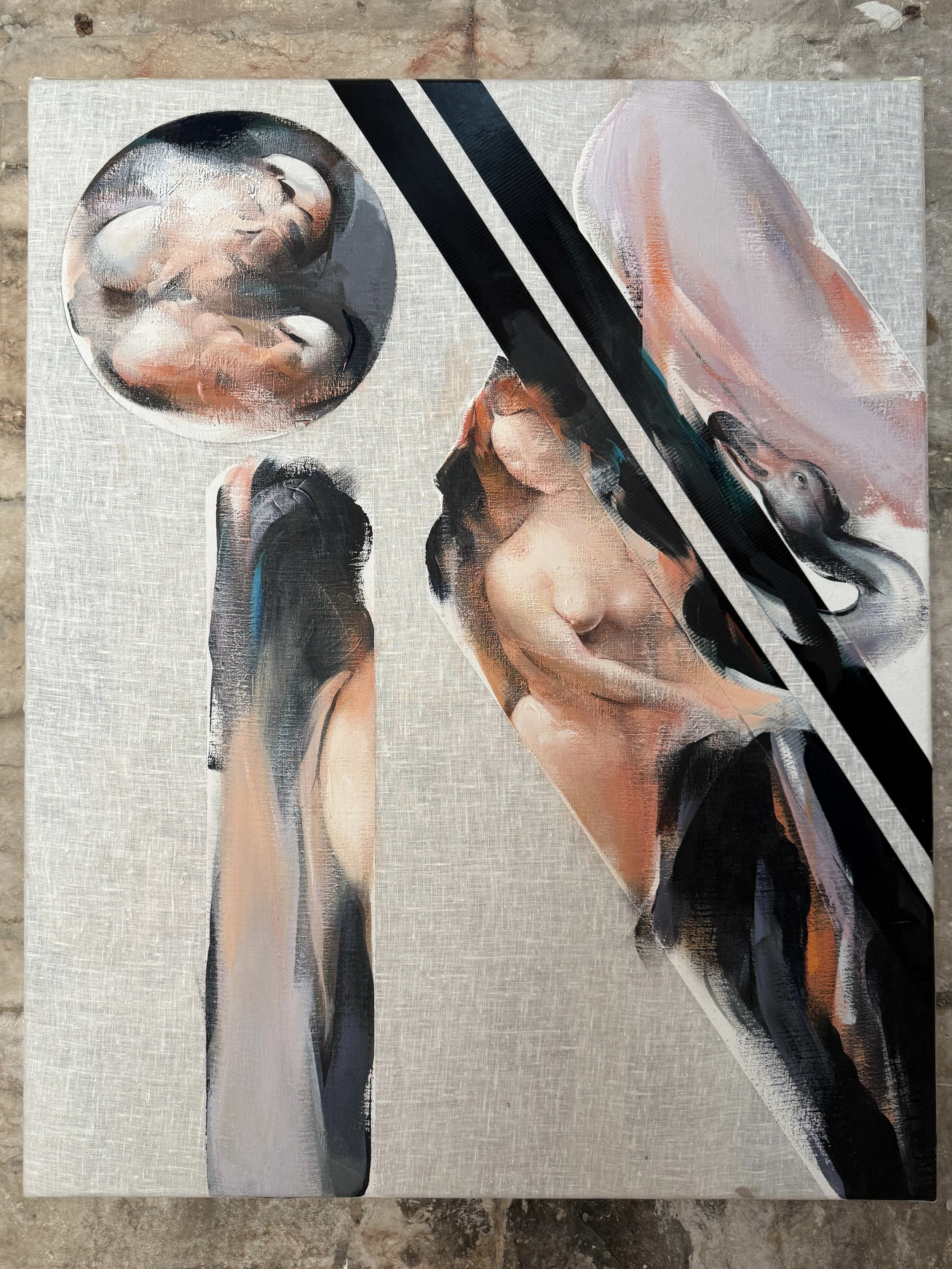
As part of a temporary exhibition, works by José Quaresma were displayed among the artifacts inside the museum at the Carmo Convent, including Leda "entre os dedos" de Leonardo (Leda "Slipping Through the Fingers" of Leonardo). Painted in 2022, the piece reimagines Leonardo da Vinci's lost Leda and the Swan, known today only through copies and studies.
Among them is the finely carved limestone sarcophagus of Fernando I. Originally housed in the Convent of St. Francis in Santarém and vandalized by French troops during the Peninsular War. Its sides unfold with scenes from Fernando’s life alongside references to Saint Francis of Assisi. His remains were lost during the French invasions, leaving the sarcophagus empty. Above, the lid depicts a winged figure rising into the heavens, surrounded by stars and small busts tucked into an intricate lace-like border.
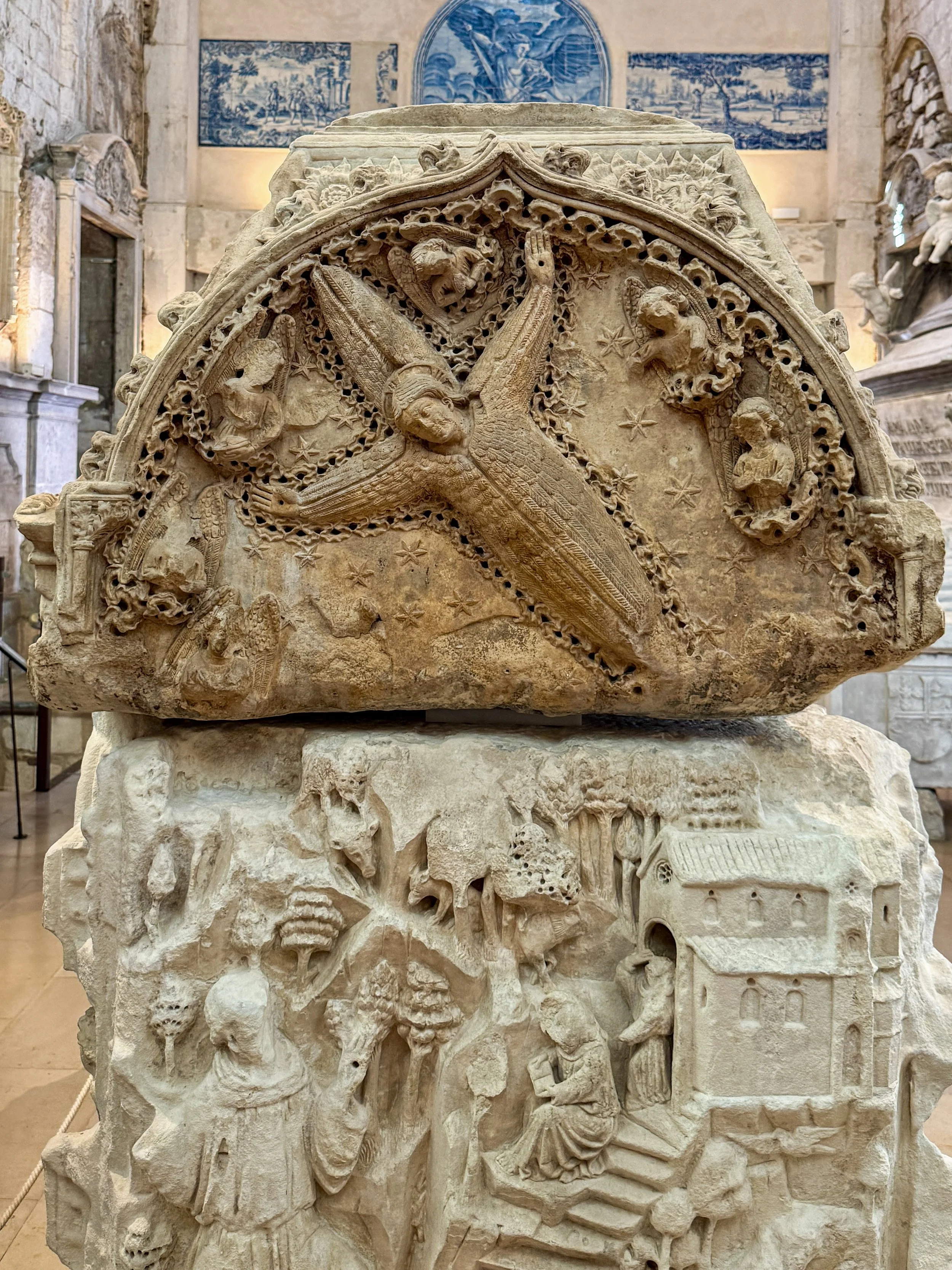
A winged figure soars through a star-filled sky atop the intricately carved 14th century tomb of King Fernando I.
Sharing the space is another elaborate funerary monument, this one commemorating Maria Ana de Áustria, queen consort of João V and a central figure in Portugal’s 18th century royal court.
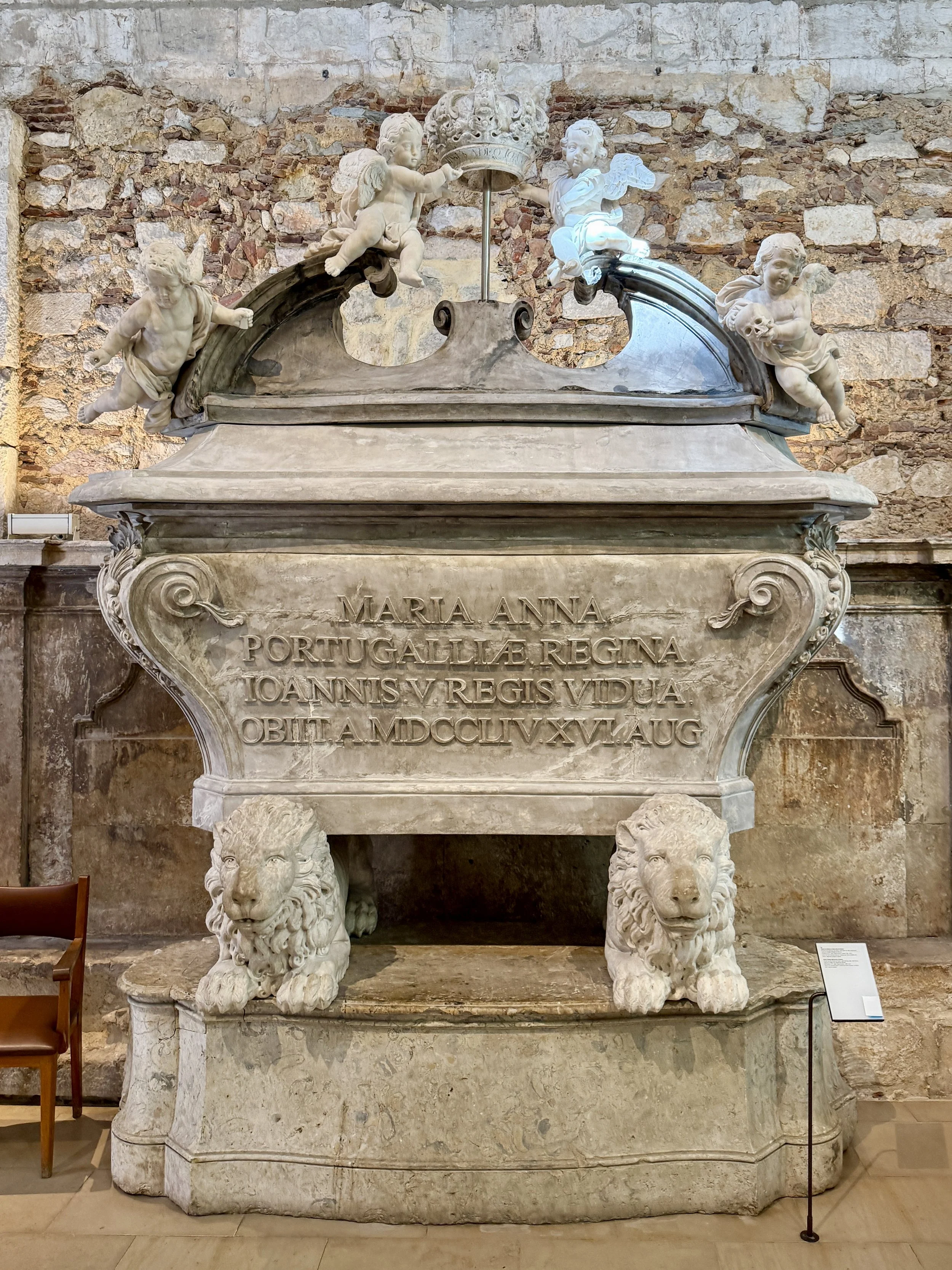
Winged putti, watchful lions and memento mori symbols adorn the elaborate tomb of Queen Maria Ana de Áustria.
Atop the chest, a crown is held aloft by two chubby, winged putti. Two others flank them, carrying a skull and a scythe, classic memento mori symbols reminding the viewer of life’s impermanence. At the base, a pair of recumbent lions keep watch.
Maria Ana founded the Mosteiro de São João Nepomuceno for the order of German Discalced Carmelites and was buried there after her death in 1754. The elaborate tomb may date to a later reburial, possibly commissioned by her granddaughter, Queen Maria I. Her heart, however, returned to Vienna, where it still rests in the Kaisergruft, the Habsburg Imperial Crypt.
Also worth a look is a niche with an intriguing pairing: Nossa Senhora do Carmo (Our Lady of Mount Carmel), wearing an ornate crown and holding the Christ Child, and Santa Catarina de Alexandra (Saint Catherine of Alexandra), depicted as a princess standing over the defeated Emperor Maxentius, whose head is beneath her foot. Nossa Seneroa do Carmo is carved in limestone, with traces of its original paint and gilding still visible.
According to legend, Santa Catarina bested Maxentius’s philosophers in religious debate and converted them to Christianity. The emperor had her imprisioned and tortured before eventually ordering her beheaded.
The fourth room has the feel of a Wunderkammer, or cabinet of curiosities. Here you’ll find the museum’s book collection alongside a scattered array of antiquities assembled from beyond Portugal’s borders, including pieces from the Americas and the Egyptian and Peruvian mummies mentioned earlier. That collection was donated in the late 19th century by the Conde de São Januário, a fellow president of the Association of Portuguese Archaeologists, along with part of his personal collection of pre-Columbian ceramics.
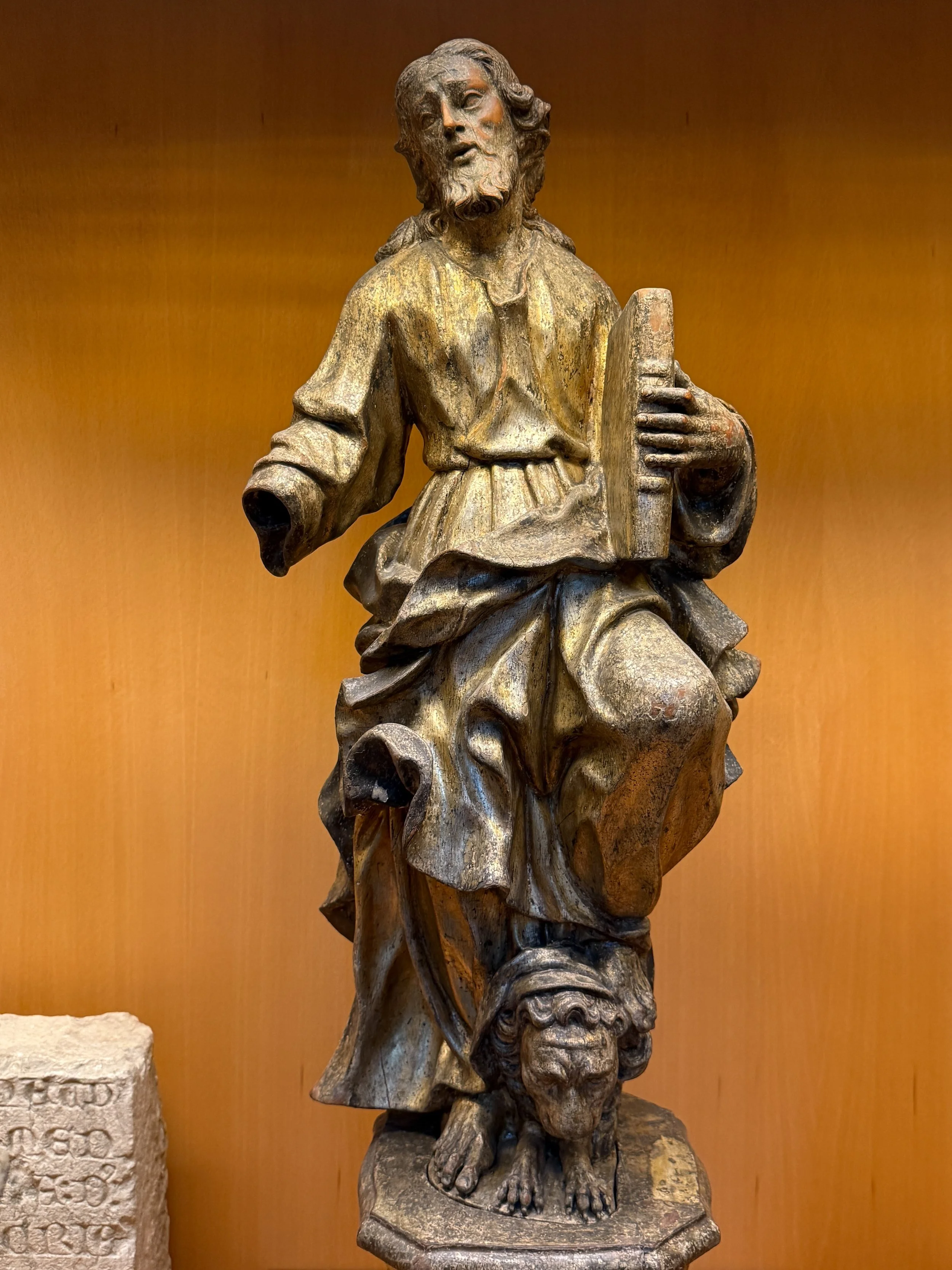
This piece is part of a set of four sculptures of the Evangelists — Matthew, Mark, Luke and John — and are original to the church.
From here, the collection turns back toward the church itself. The final chapel of the former church is filled with religious sculptures and a set of azulejo tile panels depicting scenes from the Passion of Christ. The tiles date to around 1780 and are attributed to the workshop of Francisco Jorge da Costa.
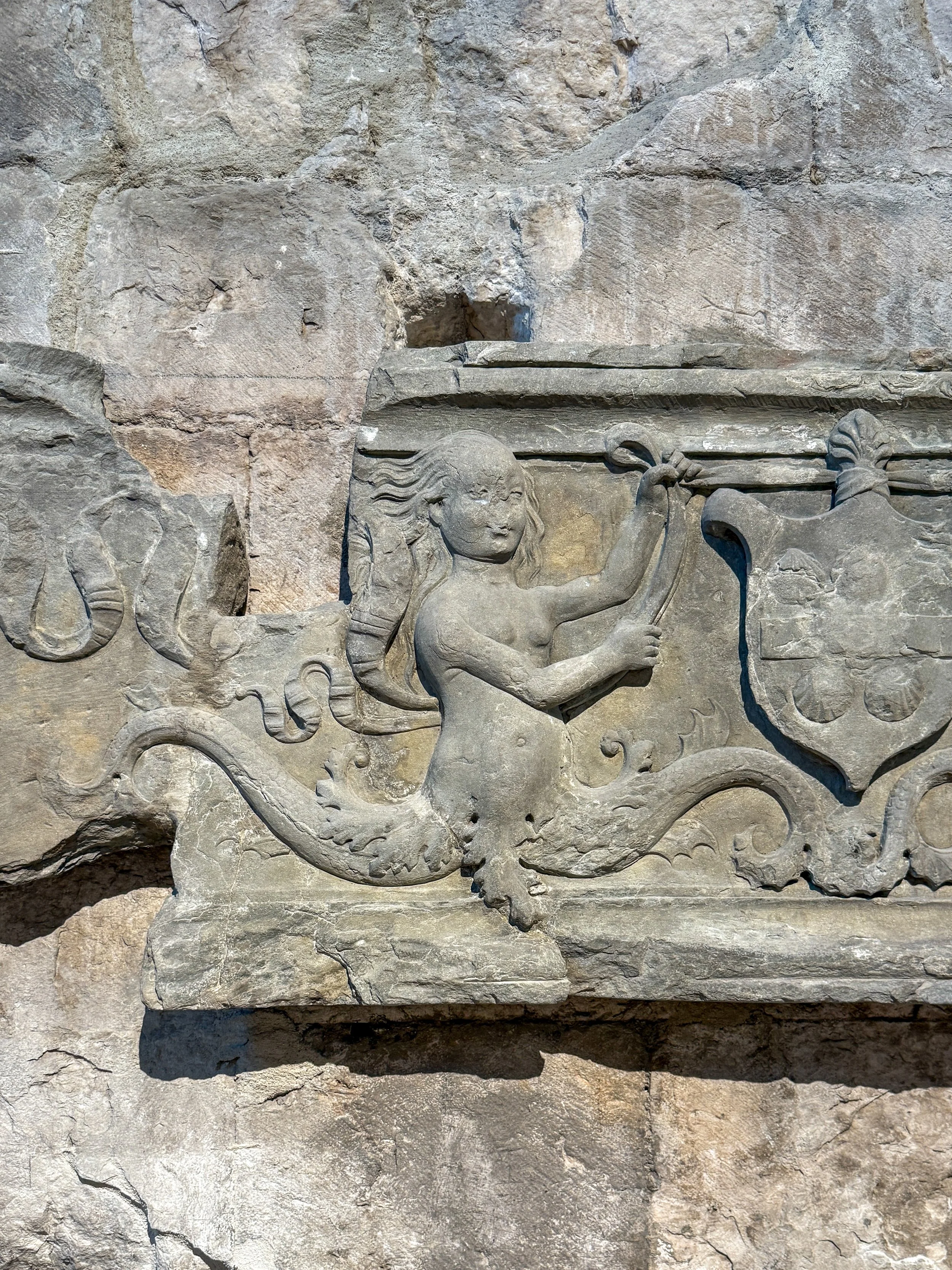
A two-tailed siren carved into a fragment of an altarpiece from the former Church of São Marcos, once located in Lisbon’s Campo das Cebolas.
The walls hold a few more fragments of Lisbon’s past. One displays pieces of a Renaissance sculptural frieze from Coimbra, with grotesque figures. Nearby another fragment features a two-tailed siren alongside a coat of arms decorated with scallop shells, once part of the altarpiece of São Marcos do Campo de Cebolas (whose moniker translates to “Field of Onions,” Lisbon’s old riverside market square).
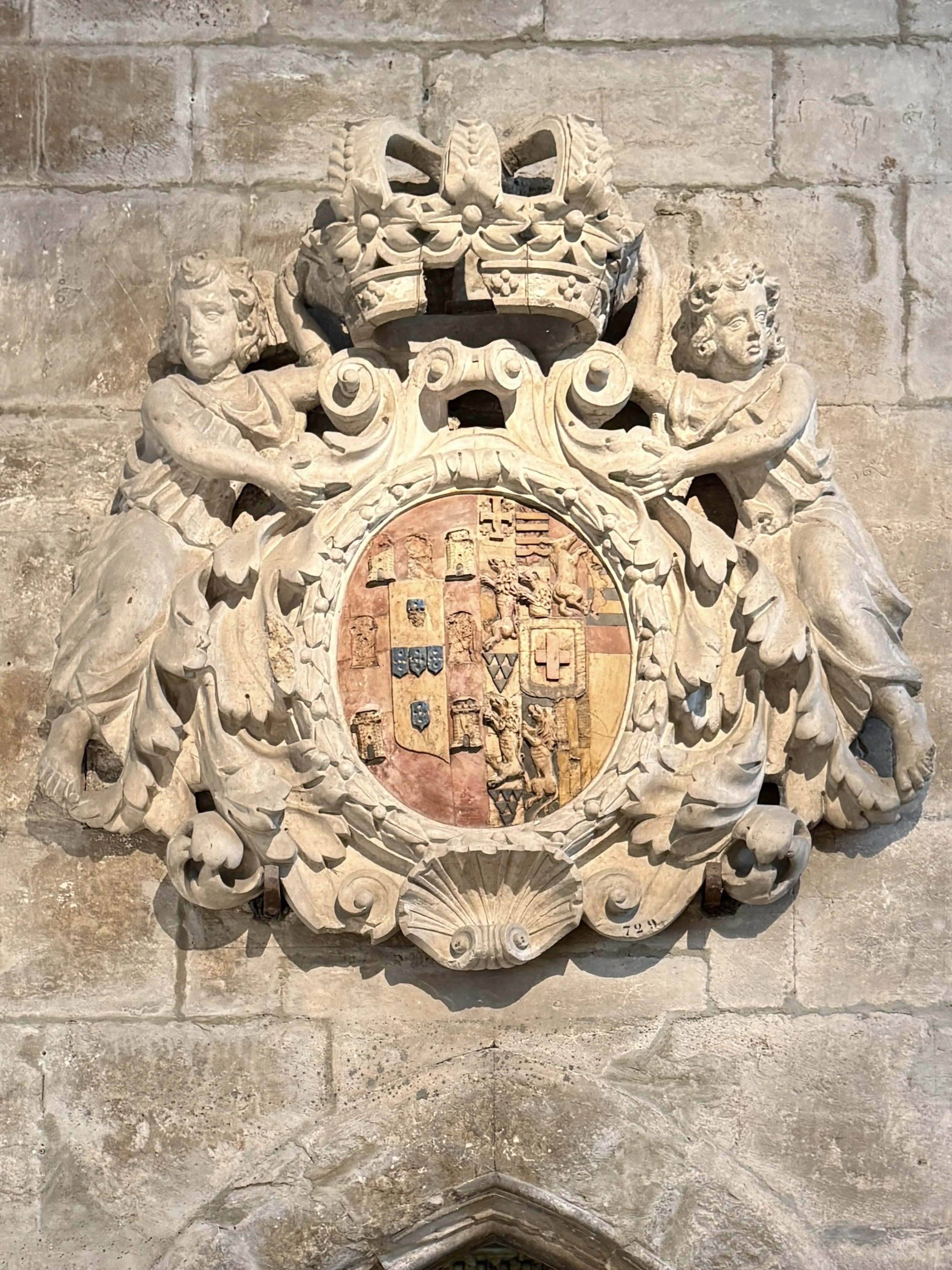
A 17th century shield bearing Queen Maria Francisca de Sabóia’s coat of arms hangs above the former sacristy doorway.
Above the doorway to the former sacristy, where clergy once prepared for services, hangs a 17th century shield bearing the royal coat of arms of Maria Francisca de Sabóia, queen consort first to Afonso VI and later to his brother Pedro II. The elaborate shield combines the Portuguese royal arms with those of her family, the House of Savoy-Nomours.
The shield originally came from the Convento do Santo Crucifixo (Convent of the Holy Crucifix), better known as the Francesinhas, or “Little French Women,” after the Capuchin nuns who ran it.
Today, the doorway leads to an auditorium rather than a sacristy. The five small shields at the center of the Portuguese arms represent the five Moorish kings defeated by Afonso Henriques at the Battle of Ourique in 1139, while also symbolizing the five wounds of Christ. The heraldry of Savoy-Nemours appears alongside them, a reminder of Maria Francisca’s royal lineage.
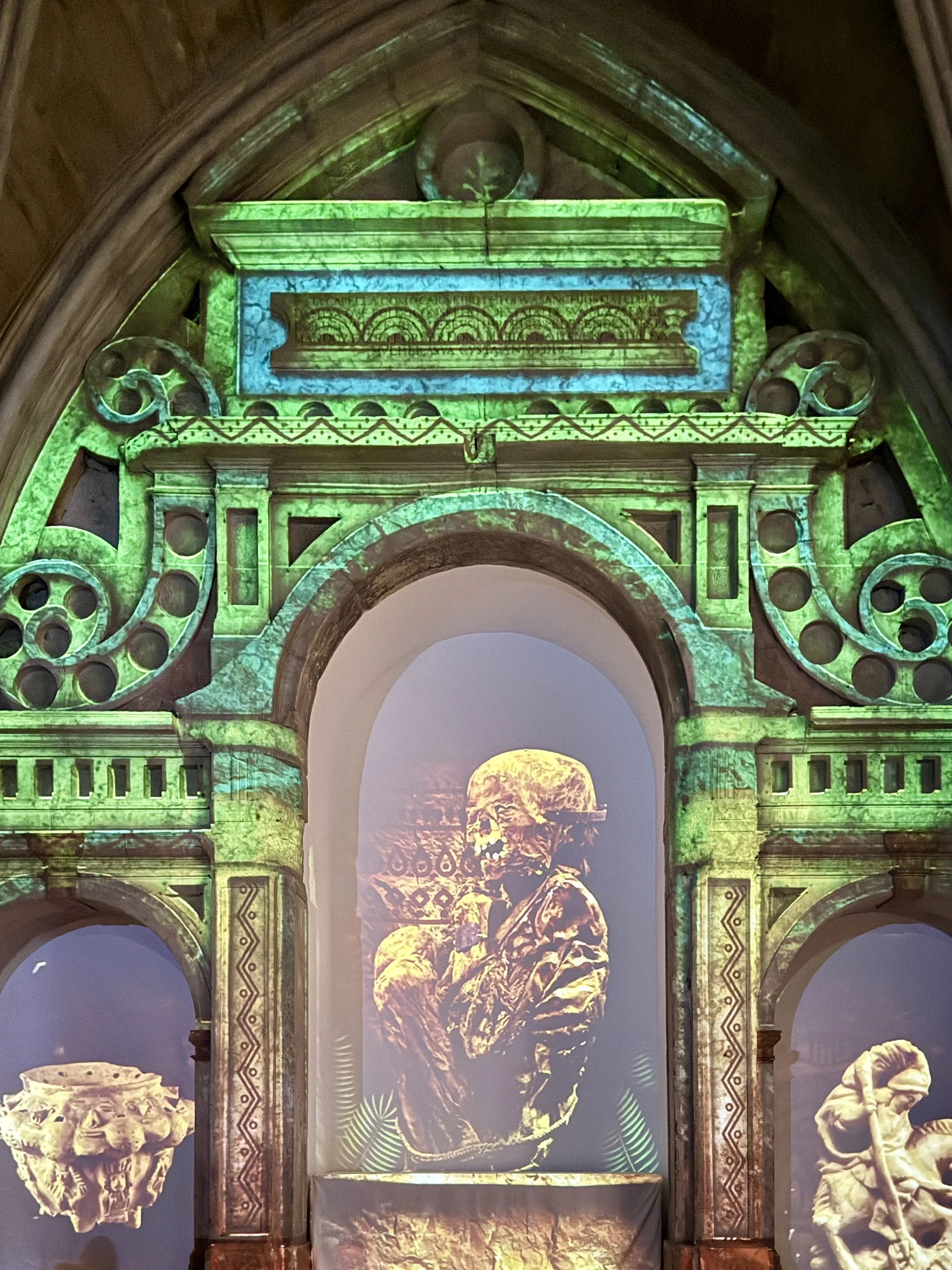
The short film Carmo: 630 Years of History traces the site’s history from Gothic church to archaeological museum, mummies and all.
In the former sacristy, Wally and I sat down to watch Carmo: 630 Years of History, a 15-minute film alternately narrated in Portuguese and English. Created by the Portuguese studio O Cubo, it uses the room’s architecture as a 3D screen, bringing the history of Carmo to life through large-scale moving images, from its founding in 1389 to the present day.
The Romantics were right. There’s something hauntingly beautiful about a church without a roof, especially at Carmo Convent, where Gothic arches frame Lisbon’s ever-changing sky.
The museum’s collection spans thousands of years, from prehistoric tools and Roman sarcophagi to royal tombs and Peruvian mummies. But it’s small enough to explore without succumbing to museum fatigue. Give yourself a leisurely couple of hours to take in the treasures, linger beneath the arches, and decide for yourself whether Carmo lost its roof or gained the sky. –Duke
Largo do Carmo
1200-092 Lisbon, Portugal
Closed Sundays, January 1, May 1 and December 25
10 a.m. to 6 p.m. (November–April)
10 a.m. to 7 p.m. (May–October)
Students, seniors 65 or older, Lisboa Card holders and Portuguese residents: €5 ($6)
Children under 14 (must be accompanied by an adult): Free
Museu Arqueológico do Carmo
Largo do Carmo
1200-092 Lisbon
Portugal