ruins

Carmo Convent in Lisbon: Where Gothic Ruins Meet the Sky

When the 1755 Lisbon earthquake tore the roof from the Gothic Carmo Convent, the sky moved in — and never left. Today, its haunting ruins stand as a reminder of the disaster, now home to the Carmo Archaeological Museum.
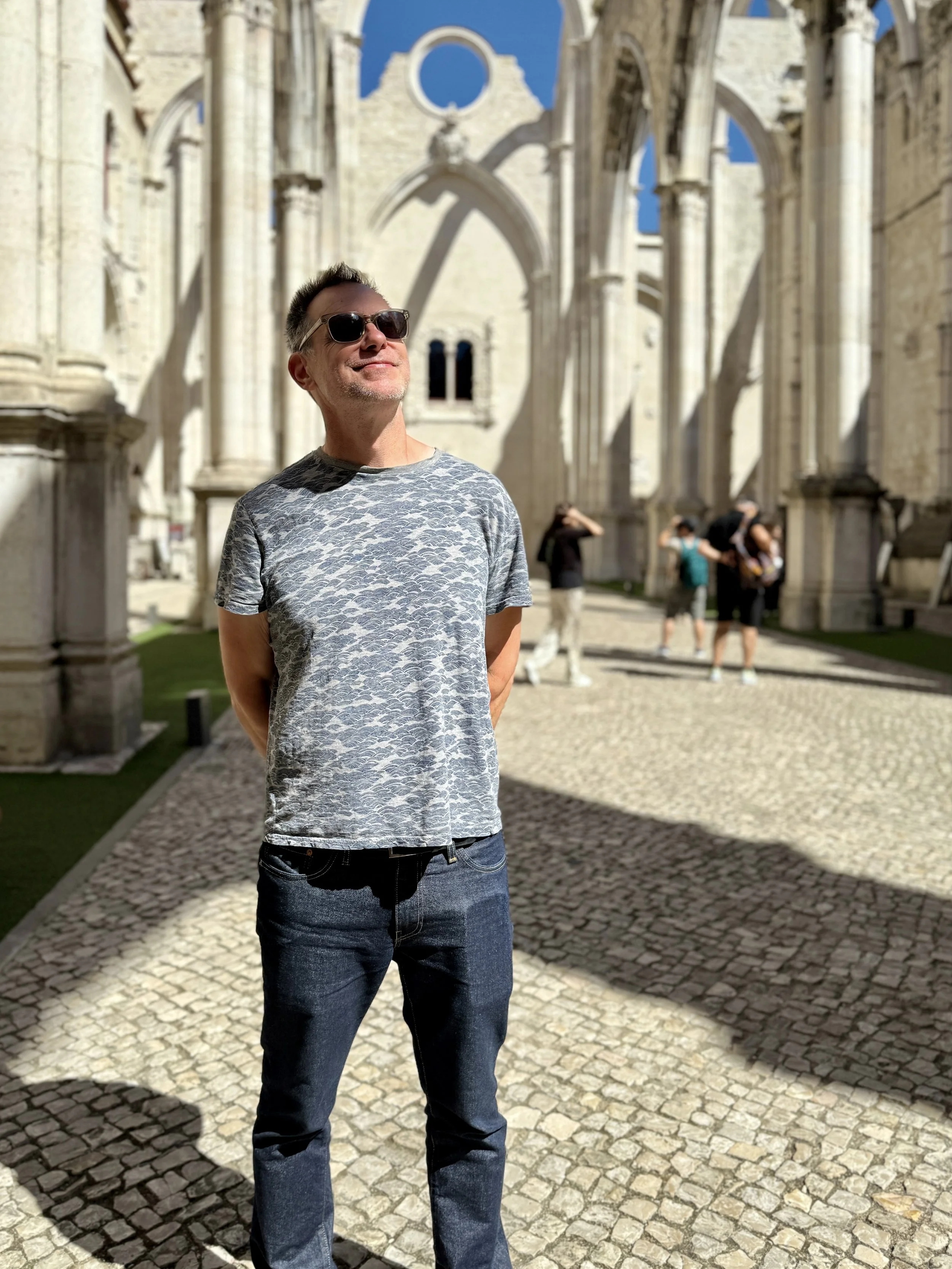
A man stands in the ruins of the Carmo Convent, now the Carmo Archaeological Museum

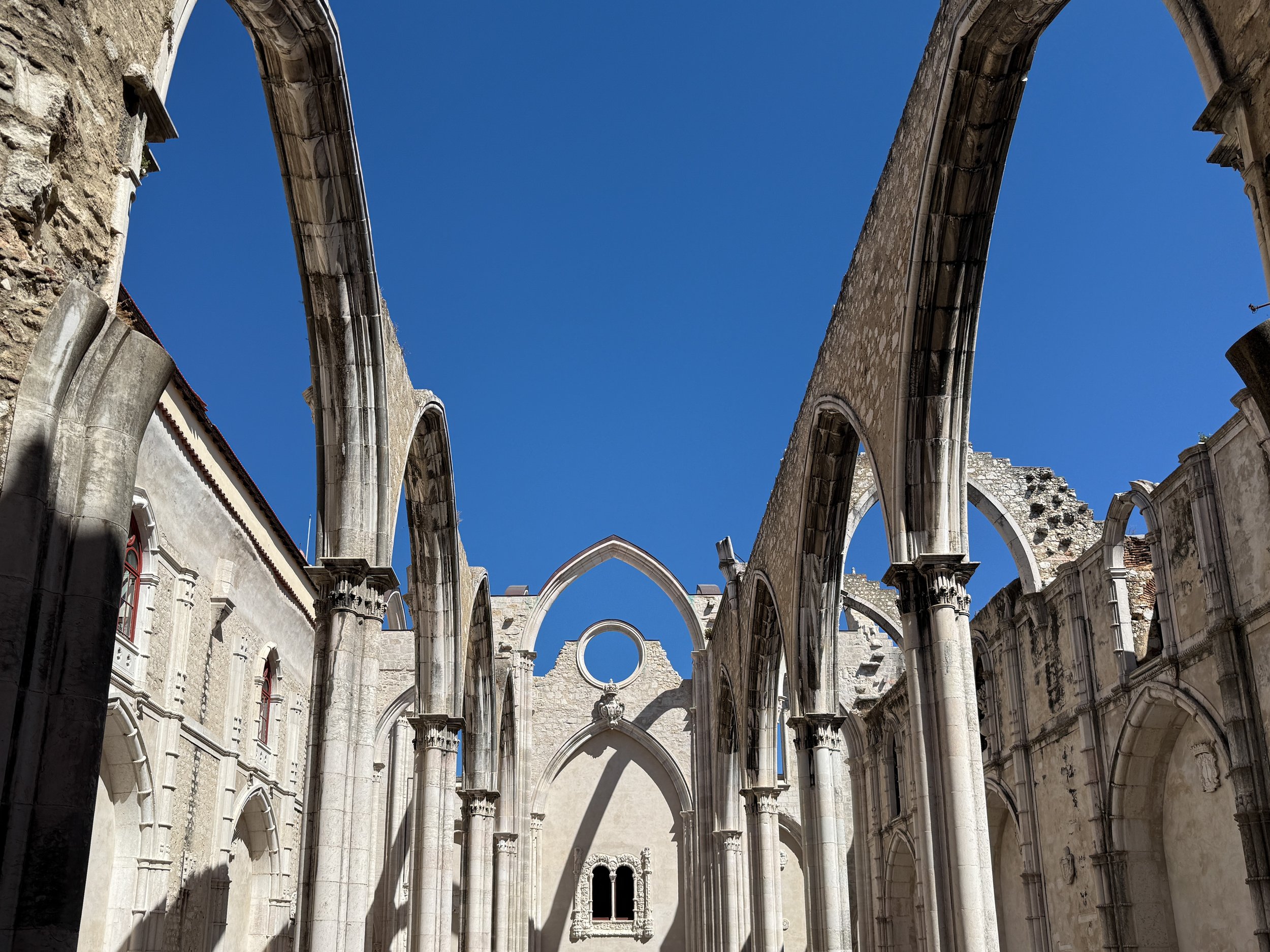
The devastating 1755 Lisbon earthquake brought down the roof of the Igreja do Carmo, leaving its Gothic arches open to the sky.

Perched on a hillside above Chiado and visible from Rossio Square, the Gothic Igreja do Carmo (aka the Church of the Convent of Our Lady of Mount Carmel) cuts an unlikely but striking silhouette. Founed in 1389, it was once one of the largest and grandest churches in Lisbon. Pale limestone walls and slender, skeletal arches frame a nave that has been open to the sky since the cataclysmic earthquake and fire of 1755 leveled much of the city on All Saints’ Day.
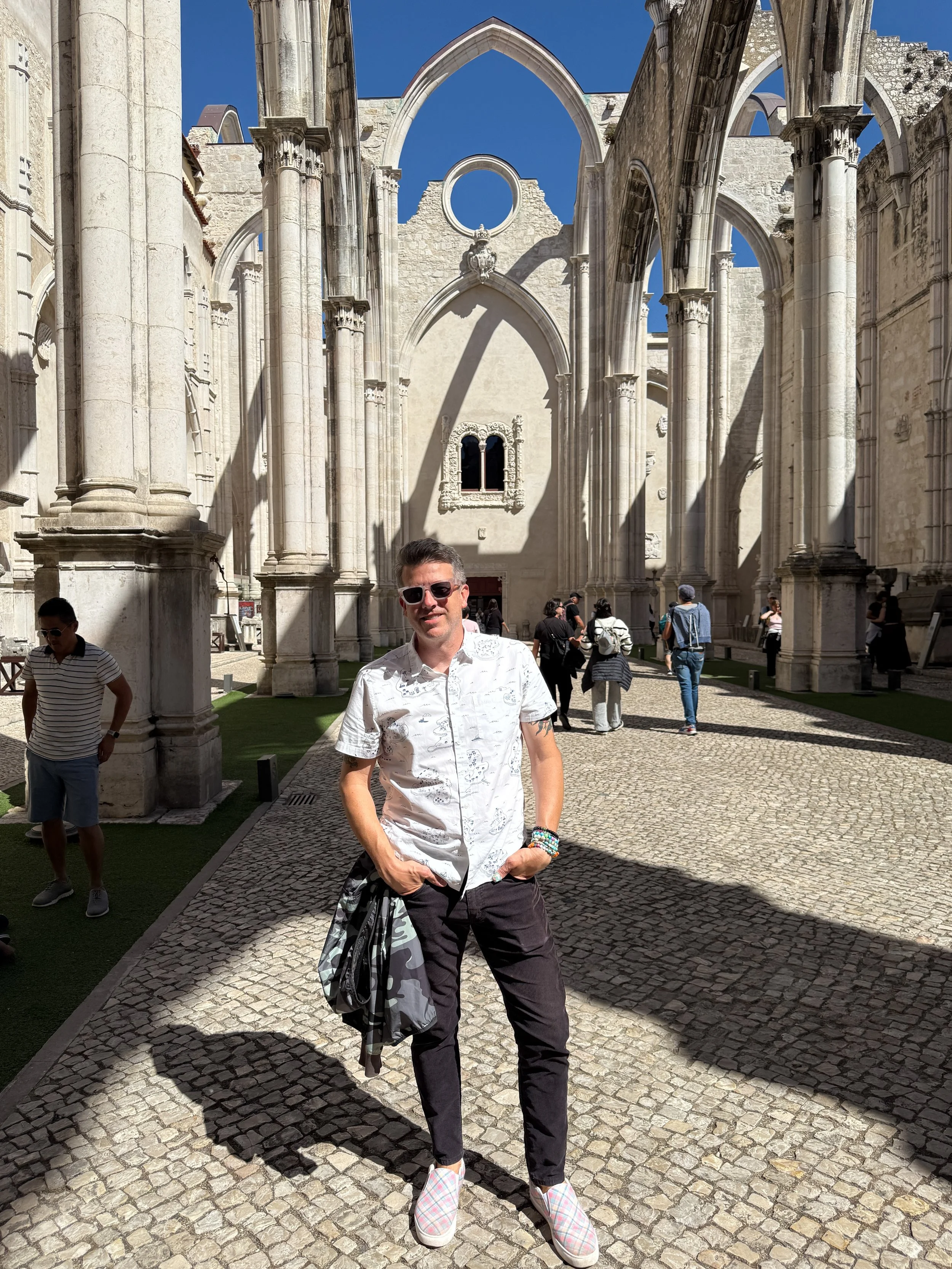
A man stands in the open-air Carmo Archaeological Museum in Lisbon

The ruins were never fully rebuilt and today provide a dramatic setting for the Carmo Archaeological Museum.

Wally and I have visited some unusual houses of worship over the years, from Gereja Ayam, the once-abandoned “Chicken Church” deep in the jungle near Magelang, Indonesia, to Lisbon’s Church of São Domingos, where blackened walls and blistered stone still bear the scars of a devastating 1959 fire. But nothing quite prepared us for the roofless remains of the Igreja do Carmo. 
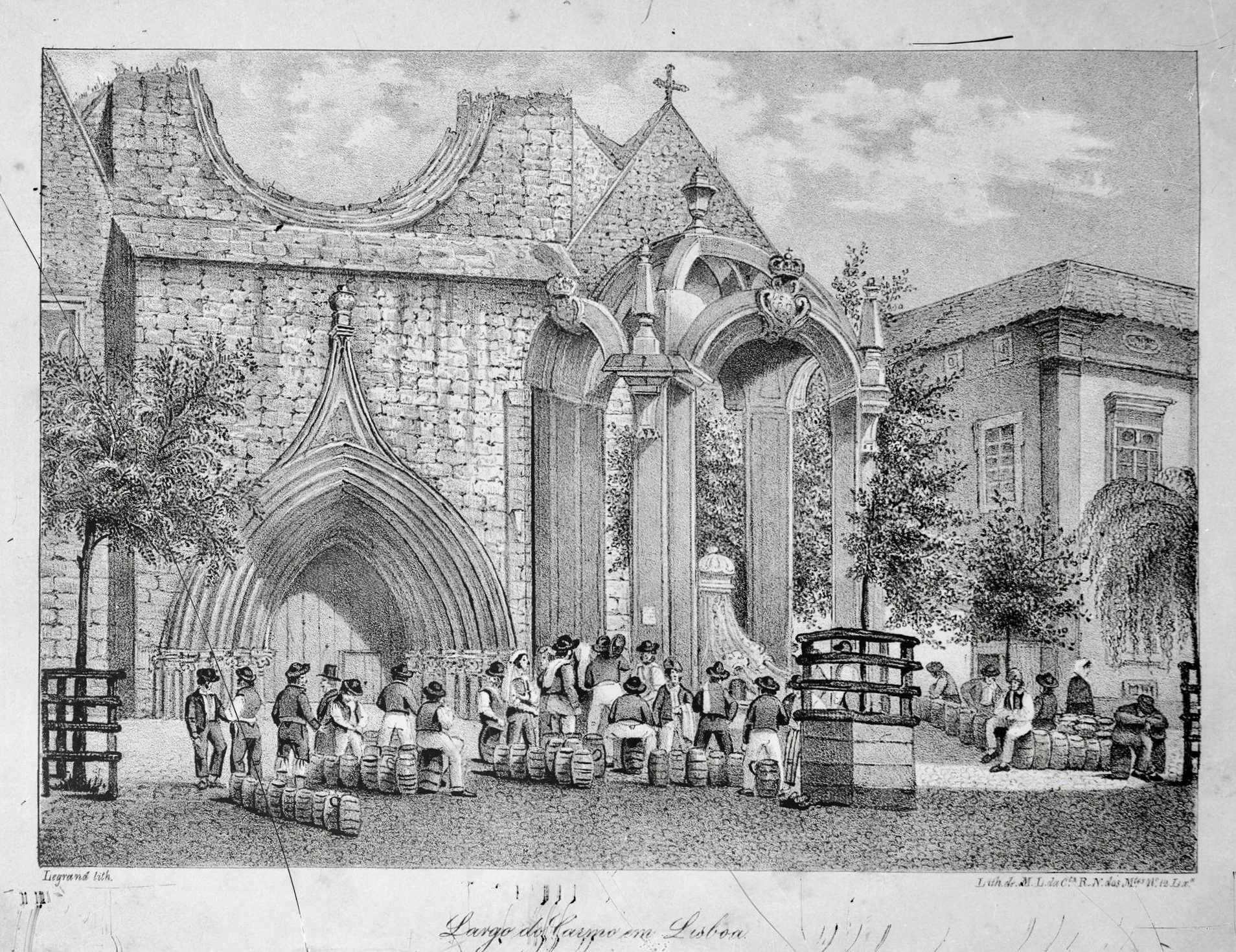
Largo do Carmo em Lisboa, a 19th century lithograph by Legrand

Largo do Carmo em Lisboa, a 19th century lithograph by Legrand and printed by M.L. da Costa in Lisbon. This 19th century print depicts aguadeiros (water carriers) filling their barrels at the Chafariz do Carmo (Carmo fountain), in front of the ruins of the Carmo Convent..

Largo do Carmo

The former convent sits on the western edge of the leafy Largo do Carmo. At the center of the square is the Chafariz do Carmo, an ornate late Baroque confection with four pillars supporting a ring of rounded arches beneath a false dome, its spouts carved as stylized dolphins that veer into sea monster territory. Credited to architect Reinaldo Manuel dos Santos and completed in 1771, the fountain once supplied water to Chiado residents from the Águas Livres Aqueduct. Today it’s purely ornamental, a pretty relic to admire on your way to the ruins. 
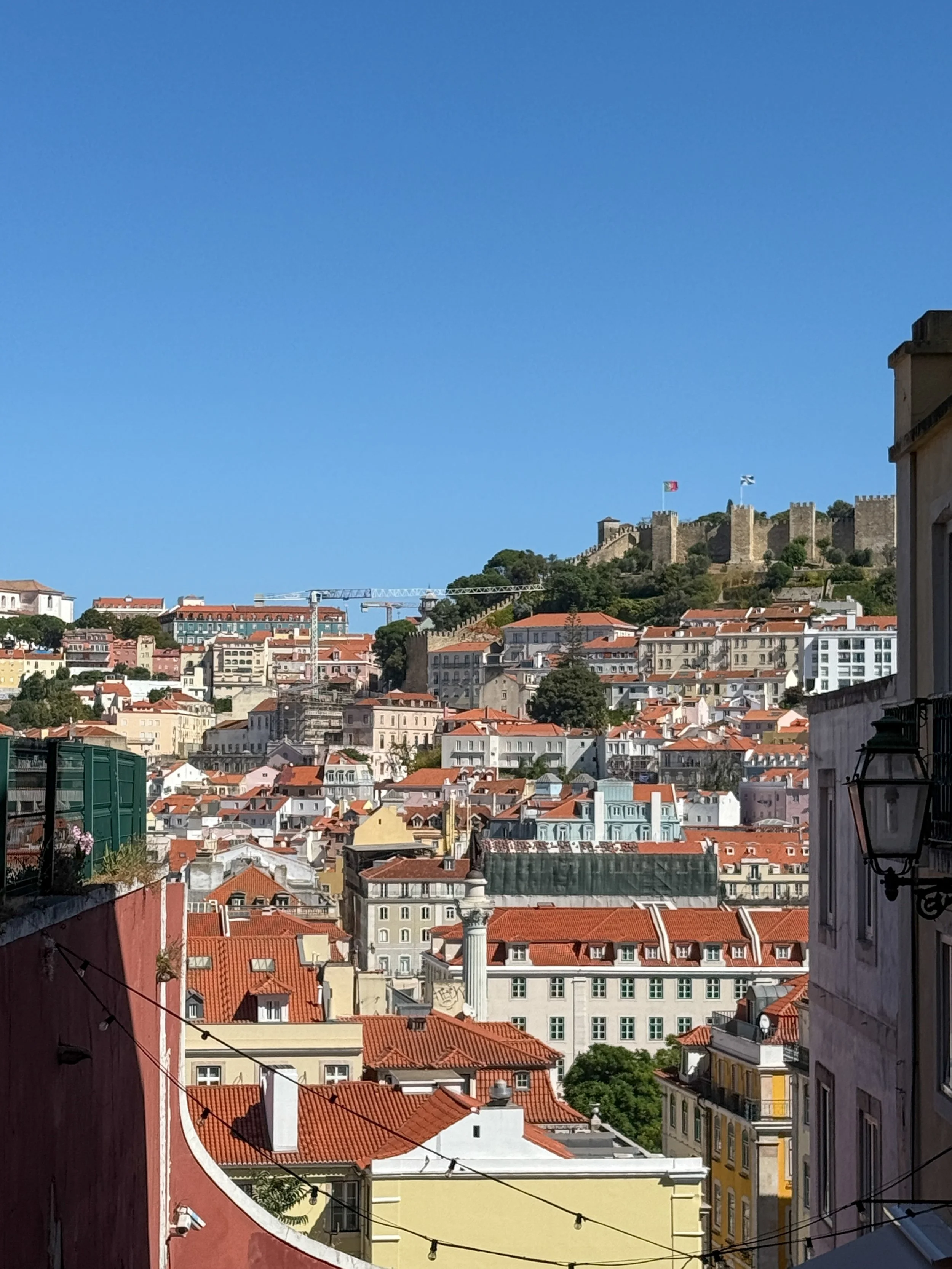
Lisbon’s terracotta rooftops from the hillside

A view across Lisbon’s terracotta rooftops from the hillside near the ruins of the Igreja do Carmo

Just beyond is the Gothic façade of the Igreja do Carmo, its main doorway is framed by receding archivolts resting on slender columns. Their capitals are embellished with a whimsical of leaves, flowers and figures peeking out from the foliage. Above, only the lower frame of the oculus window survives.
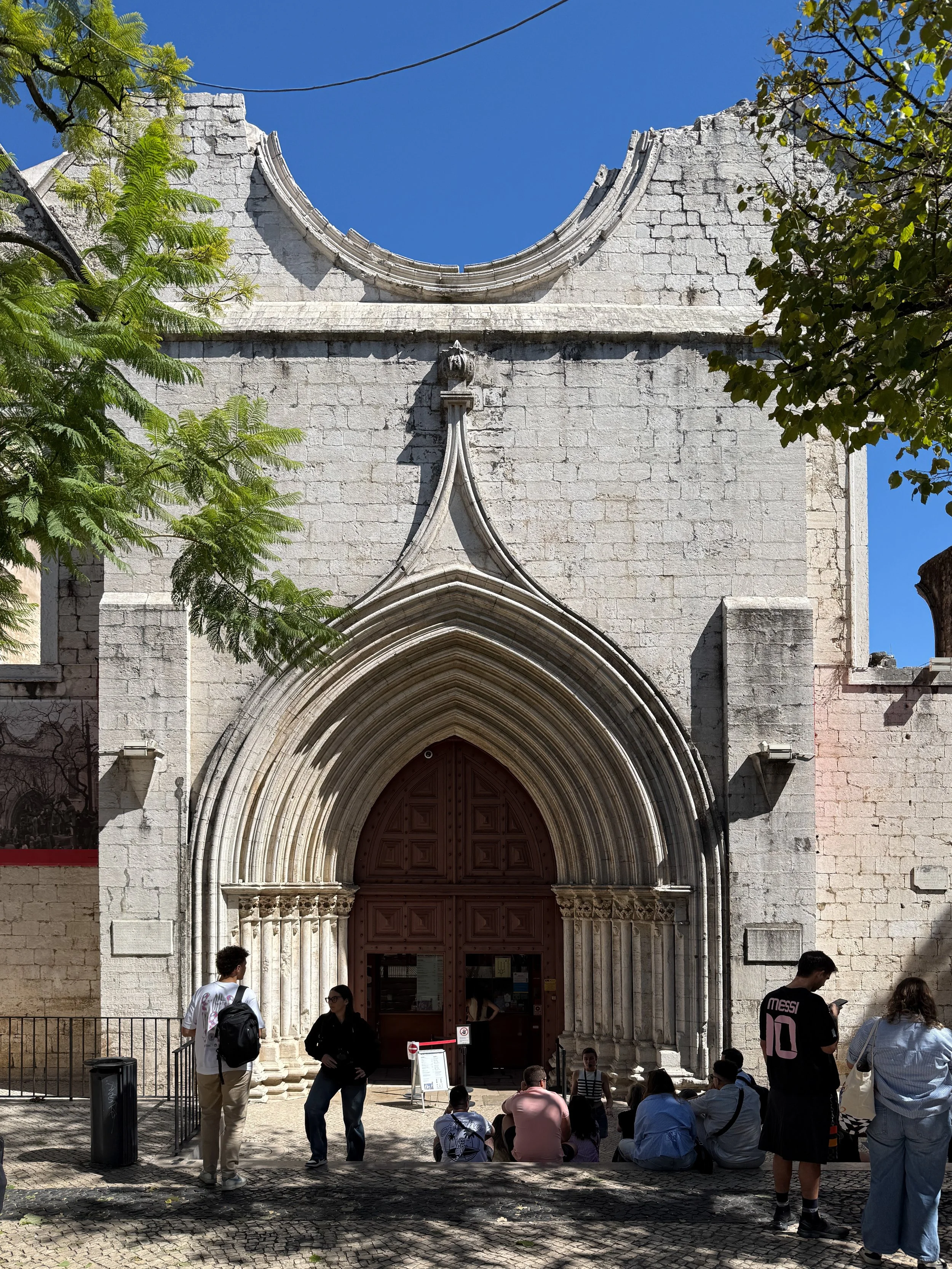
The entrance to the Museu Arqueológico do Carmo

Layers of pointed Gothic arches frame the entrance to the Museu Arqueológico do Carmo.

In Ruins: Convento do Carmo

Masons were back at work on a new Gothic nave as early as 1756, but Lisbon had bigger problems brewing. Napoleon’s army was closing in, the royal family fled for Brazil, and whatever momentum the rebuilding had gathered brought the project to a halt. 

In the meantime, the convent had found other uses. By 1810, Marshal Beresford had installed a company of the Guarda Real de Polícia, the militarized police force Prince Regent João had created in 1801, in the old cloisters. What habitable rooms remained became barracks and offices.

When Portugal’s religious orders were abolished in 1834, there was no longer any question of rebuilding. Thirty years later, the old convent found a new purpose when the Associação dos Arquitectos Civis Portugueses (Association of Portuguese Civil Architects) took up residence and established the Museu Arqueológico do Carmo (Carmo Archaeological Museum). Founded by Joaquim Possidónio Narciso da Silva, it was the country’s first museum of art and archaeology. Left largely untouched, the open-air nave was perfectly suited to the Romantics’ fascination with ruins and the beauty they found in decay.

The site has one more twist worth mentioning. It’s where Marcelo Caetano, the last prime minister of the Estado Novo dictatorship, holed up before surrendering to General António de Spínola during the Carnation Revolution, the military-led coup of April 25, 1974, that ended 48 years of authoritarian rule and brought democracy to Portugal.
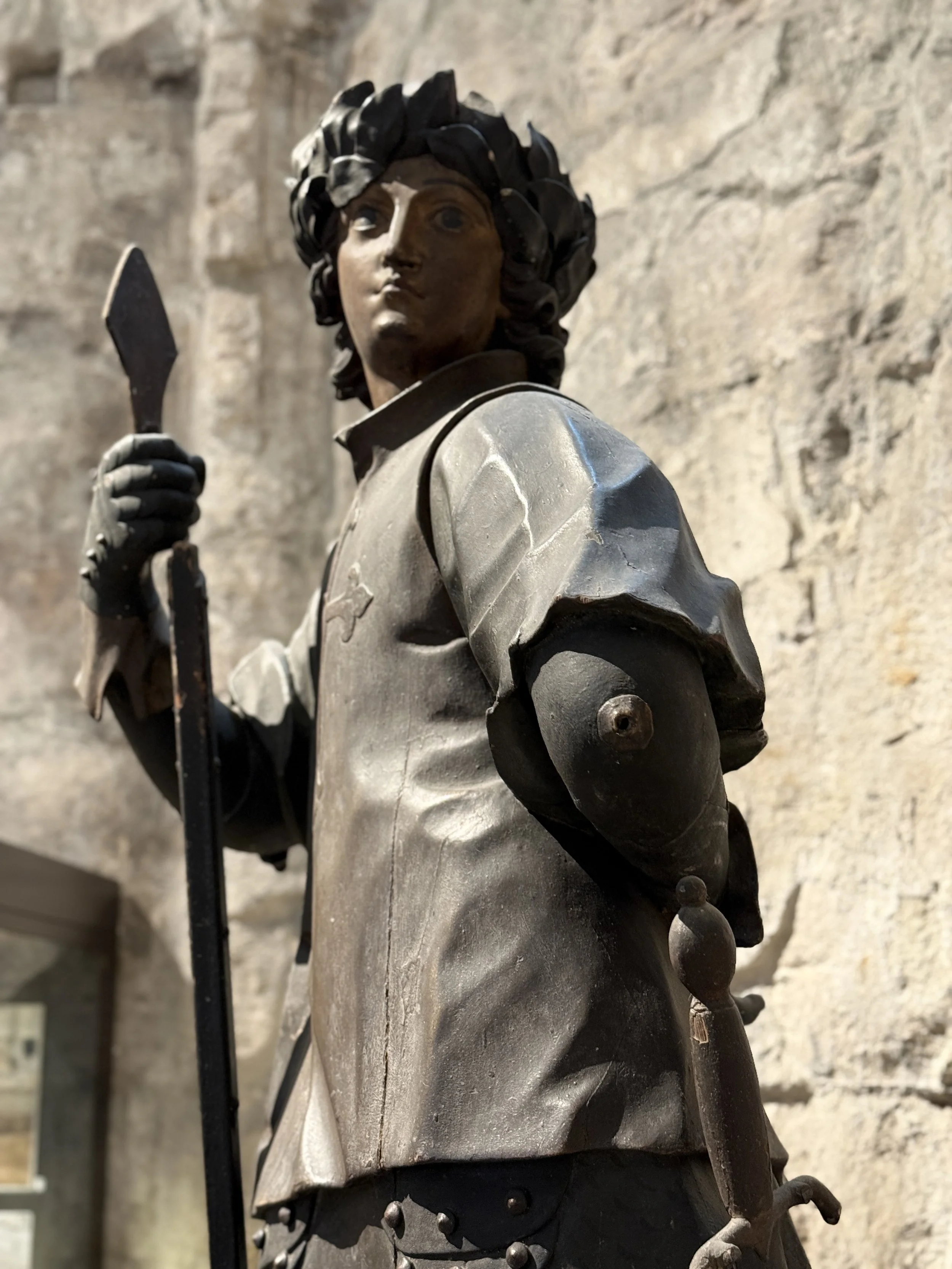
Statue of Nuno Álvares Pereira, later São Nuno de Santa Maria. Shown in armor and crowned with laurel, he holds a spear in one hand

Among the artifacts in Sala 5 is a classical depiction of a youthful Nuno Álvares Pereira, later São Nuno de Santa Maria. Shown in armor and crowned with laurel, he holds a spear in one hand, while  the cross on his tunic marks him as a Christian knight. 

A Brief History of Carmo Convent

Go back further and you land on Nuno Álvares Pereira, Constable of Portugal, who founded the convent in honor of Nossa Senhora do Carmo (Our Lady of Mount Carmel), the patron saint and protector he credited with getting him through battle after battle against the Castilians. Pereira became one of the defining figures of Portugal's fight for independence, leading the Portuguese army to a decisive win over Castile at the Battle of Aljubarrota in 1385.
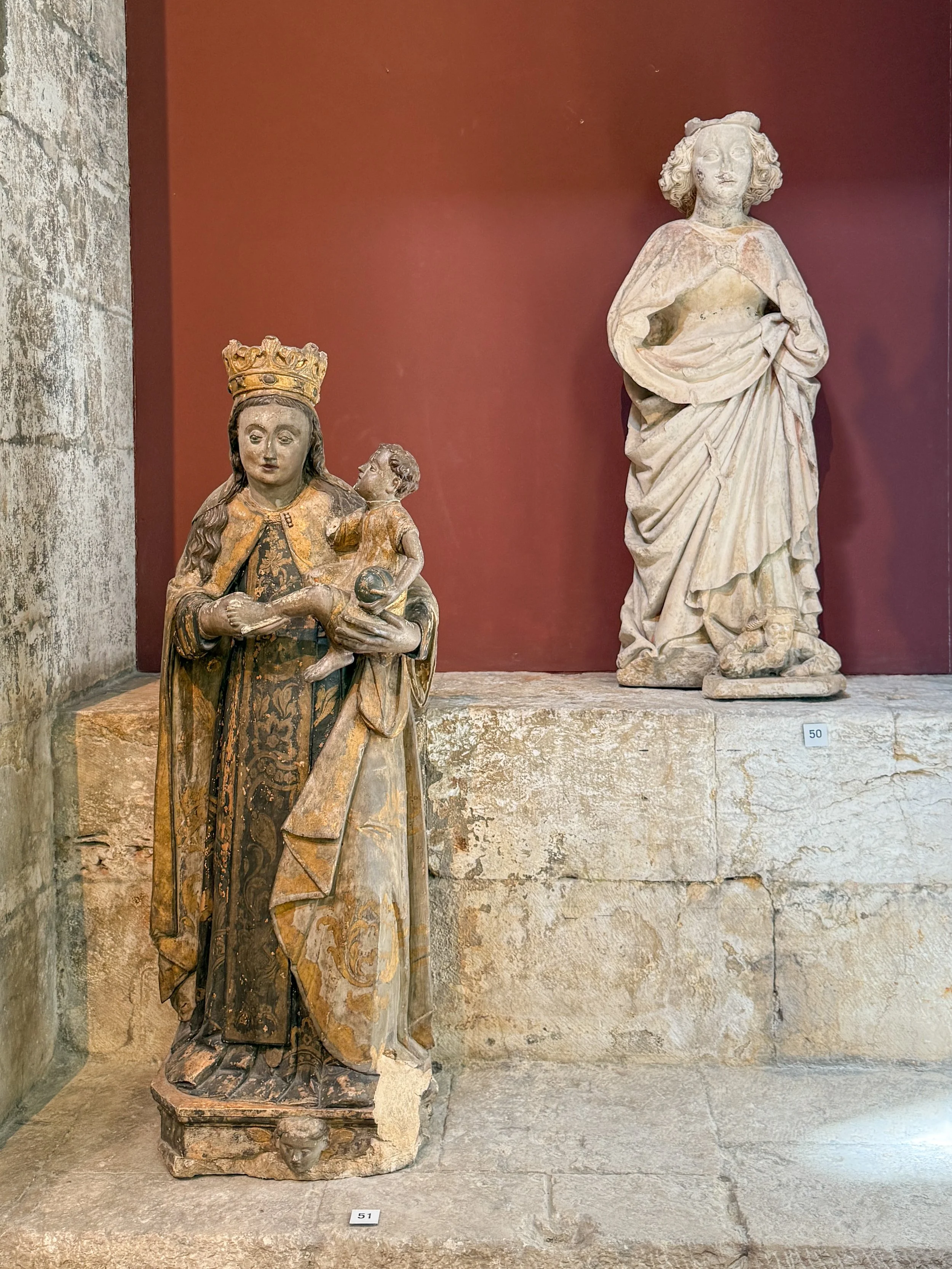
Our Lady of Mount Carmel, for whom the convent was named, cradles the Christ Child beside a weathered Saint Catherine of Alexandria

Our Lady of Mount Carmel, for whom the convent was named, cradles the Christ Child beside a weathered Saint Catherine of Alexandria.

The trouble had started two years earlier, when King Fernando I died without a male heir. His only child, Beatriz, was married to John I of Castile, which handed her husband a claim to the Portuguese throne and threw the country into a succession crisis. Lisbon was a tinderbox. At one point, an angry mob dragged Bishop Dom Martinho Annes, suspected of conspiring with the Castilians, to the northern tower of the Lisbon Sé and threw him from the window.

Aljubarrota made Pereira a national hero and secured Portugal's independence from Castile. But he spent his later years turning away from the world he'd fought so hard to defend. In 1423 he entered the Carmelite order, took the name Frei Nuno de Santa Maria, and traded the soldier's life for one of prayer and quietude.
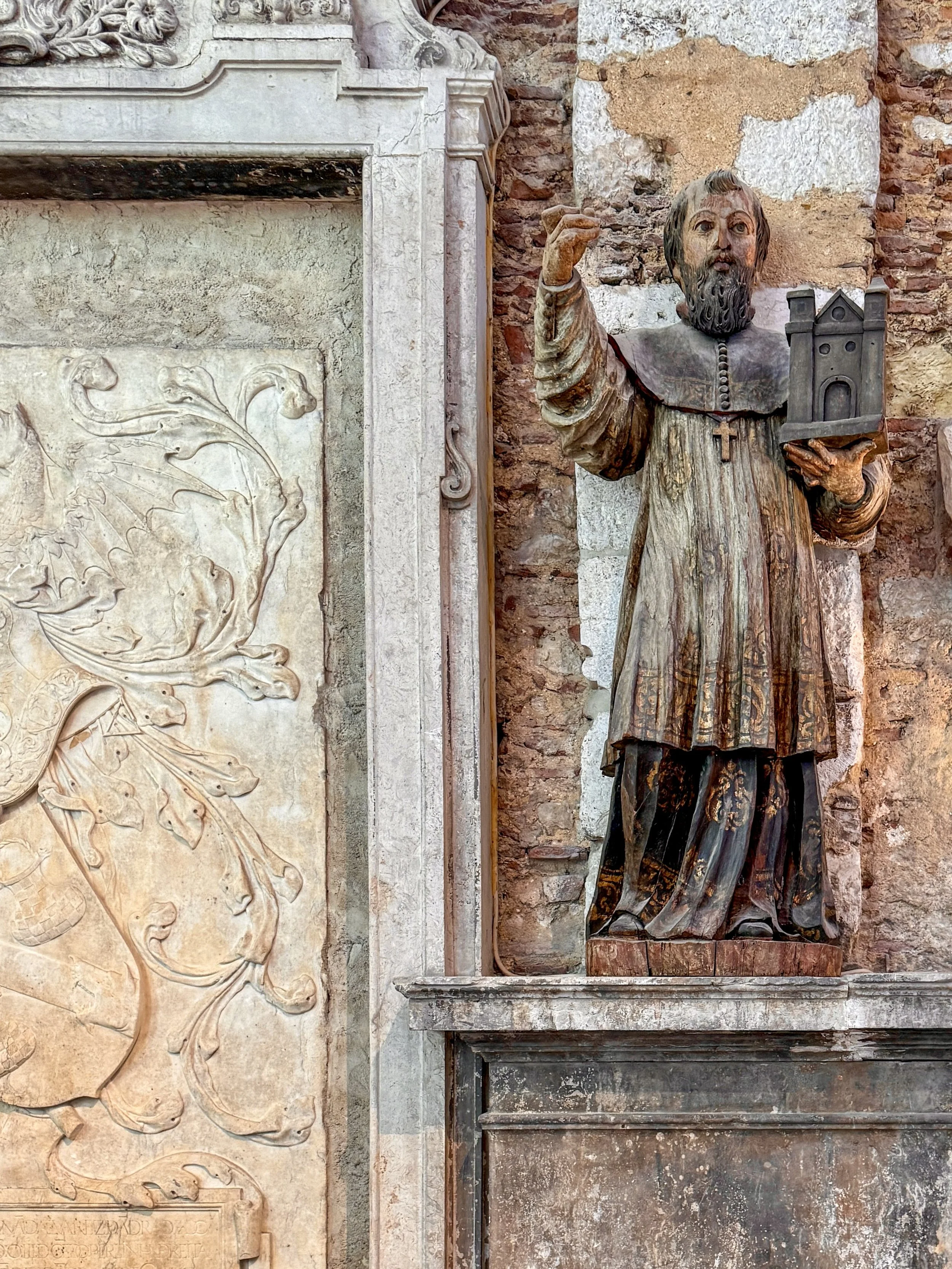
Polychrome wooden sculpture of São Nuno de Santa Maria (Nuno Álvares Pereira at Carmo museum

This polychrome wooden sculpture depicts São Nuno de Santa Maria (Nuno Álvares Pereira), the former Portuguese military commander who founded the Convento do Carmo before becoming a Carmelite monk. He holds an architectural model of a church, symbolizing his patronage of the order.

He was buried in the convent he'd founded, but the earthquake swallowed his tomb along with the convent's library, both lost in the fires that followed. His remains weren't discovered again until 1996, unearthed during excavations in one of the convent’s side chapels, nearly two and a half centuries later.
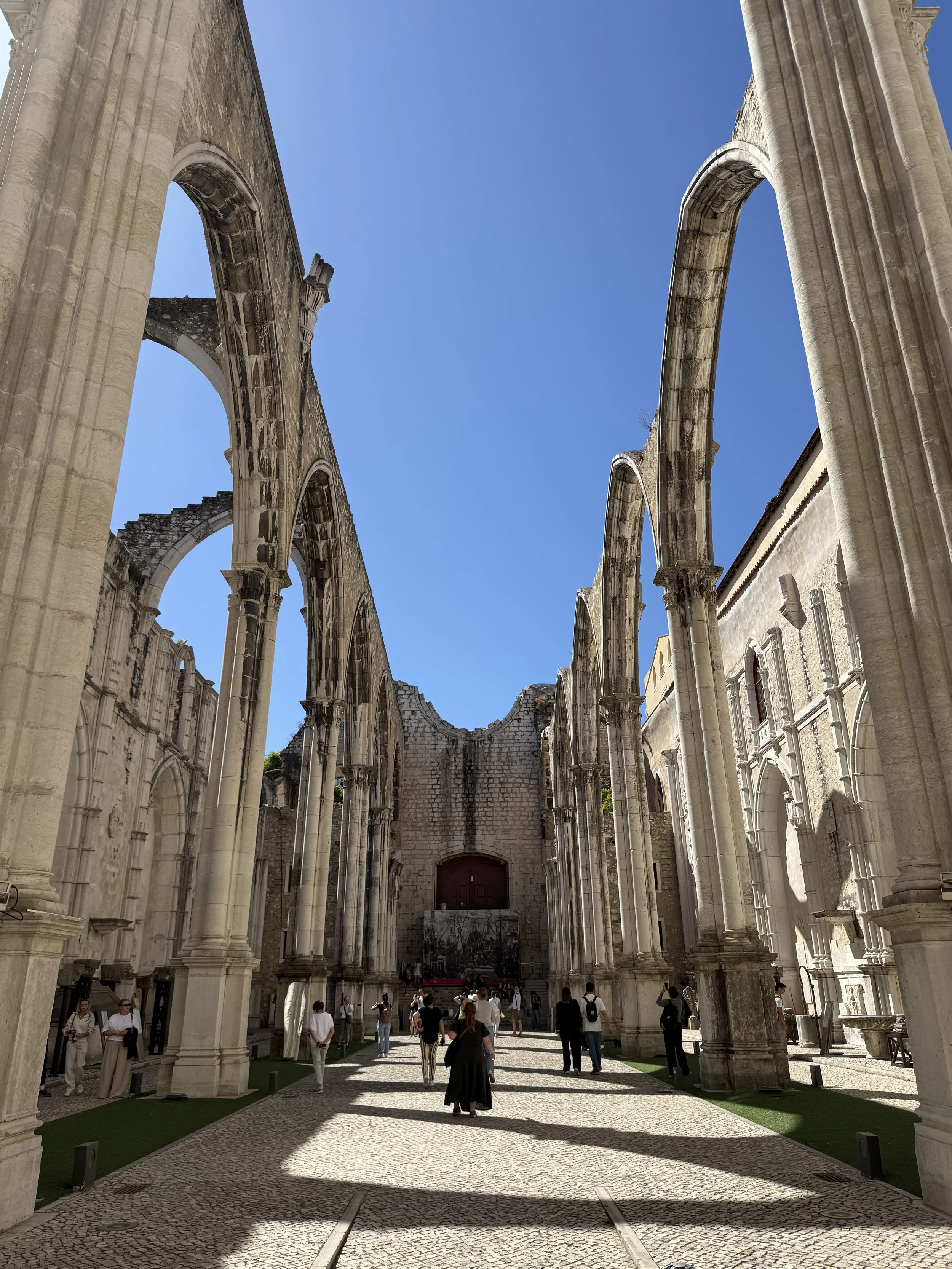
Arches and columns left from the ruined Carmo Convent, now a museum in Lisbon

Reconstruction began in 1756 and halted in 1834, though the pillars and arches of the nave, dating to the 14th and 15th centuries, are original.

Carmo Archaeological Museum: History and Culture en Plein Air

Wally and I stepped through the main entrance and stopped short. Stone arches soared up from the pillars, and above them — nothing but a roofless nave opening straight onto a cloudless blue sky. Today, we can reach almost anywhere in the world with a tap of a finger, but standing under the bones of a medieval church and looking straight up through centuries of history is a different kind of seeing. It wasn't hard to understand why these ruins have captivated visitors long before us.
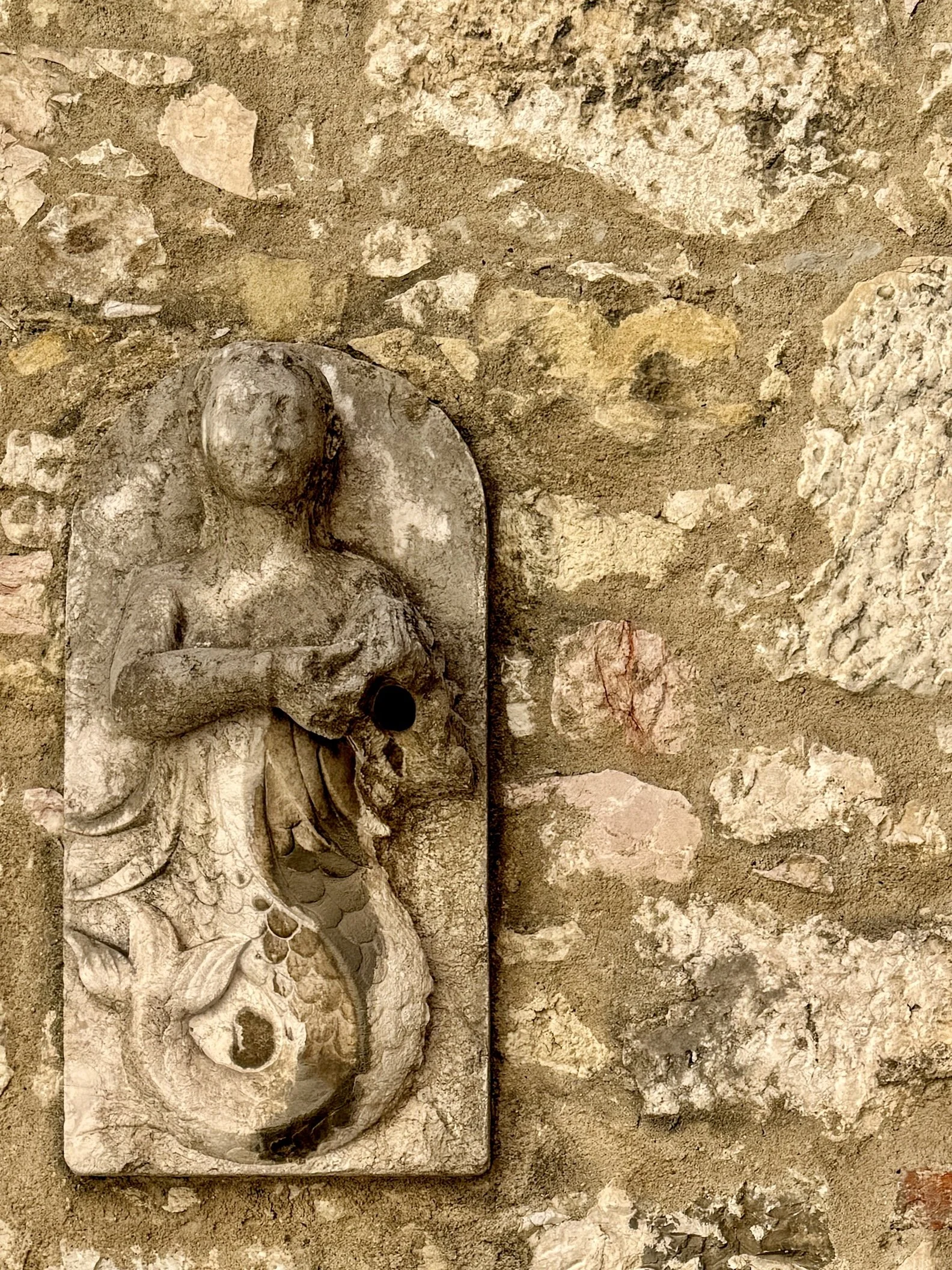
A limestone mermaid from the Monastery of São Dinis de Odivelas gazes from the wall of the Carmo Museum in Lisbon

A limestone mermaid from the Monastery of São Dinis de Odivelas gazes from the wall near the entrance.
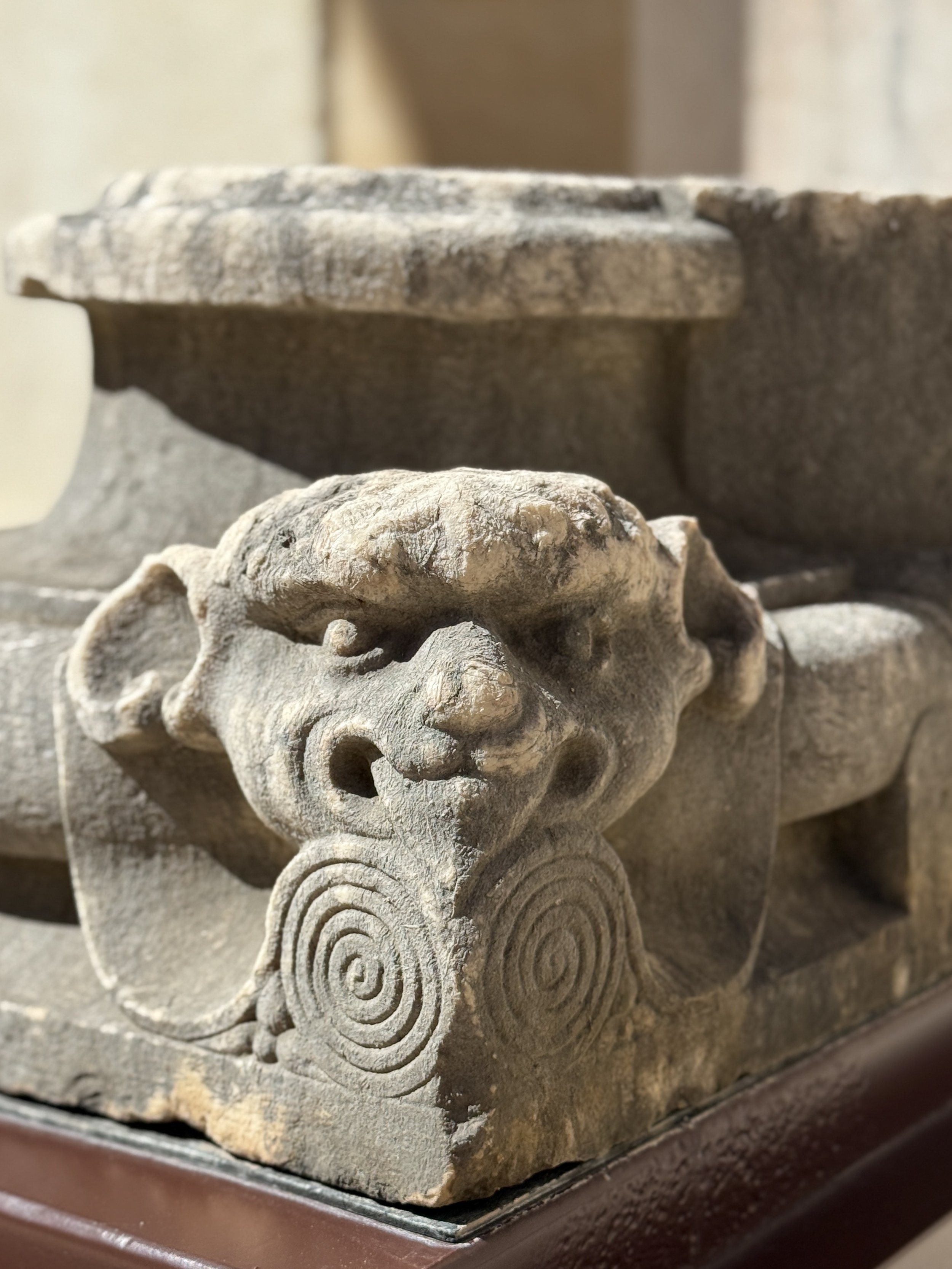
A weird little creature carved into a stone sarcophagus at the Carmo Archeological Museum in Lisbon

The museum’s eclectic collection includes this wonderfully weird little creature carved into a stone sarcophagus.

The former convent is laid out like a Latin cross, with a three-aisled nave, transept, and apse with a main chapel and four smaller side chapels. Much of what fills the roofless nave today can be traced back to Possidónio himself. When the religious orders were dissolved in 1834, churches and convents across Portugal were stripped bare, sold off or simply left to crumble. Possidónio made it his mission to save what he could — architectural fragments pulled from demolished churches and convents, funerary monuments displaced from their chapels, statues of medieval rulers and heraldic coats of arms. 
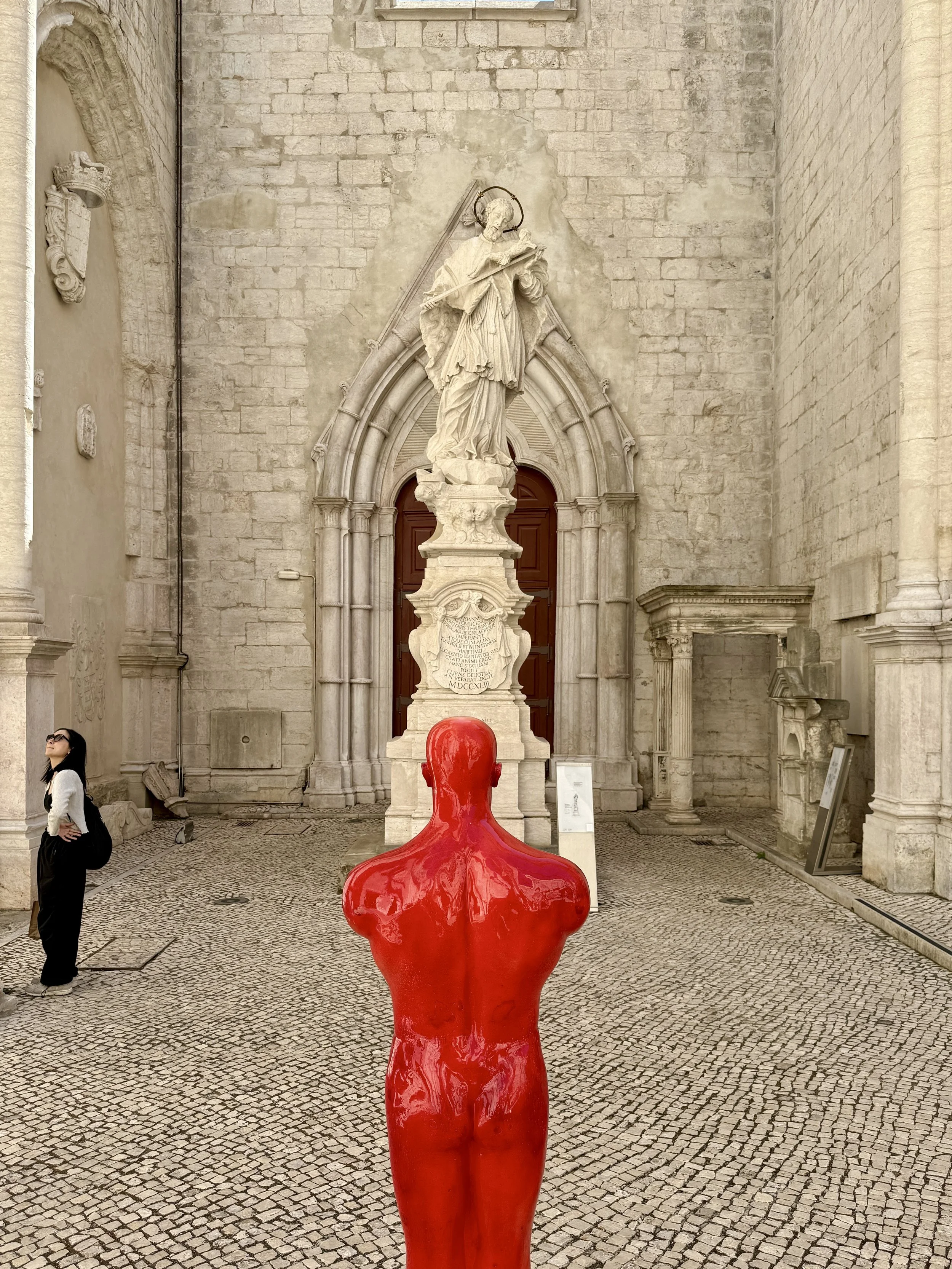
The bright red Homem Vermelho (Red Man), a life-sized sculpture by Sérgio Pombo, in the courtyard of the Carmo museum in Lisbon

During our visit, Homem Vermelho (Red Man), a life-sized sculpture by Sérgio Pombo, stood among the medieval ruins. Its vivid red form was a striking contrast against Carmo’s weathered stone.

Wandering the Open-Air CarMo Museum

Working our way through the north nave, we stopped at the tomb of the knight Mem de Cerveira. His stone effigy lies within a lace-like frame of trilobed arches. stone leaves, and vines carved in the Manueline style, Portugal’s own distinctive spin on late Gothic design. Only the lid survives. The bottom half is lost. It was moved here from a chapel in the Igreja de São Domingos de Santarém, a church that no longer stands.
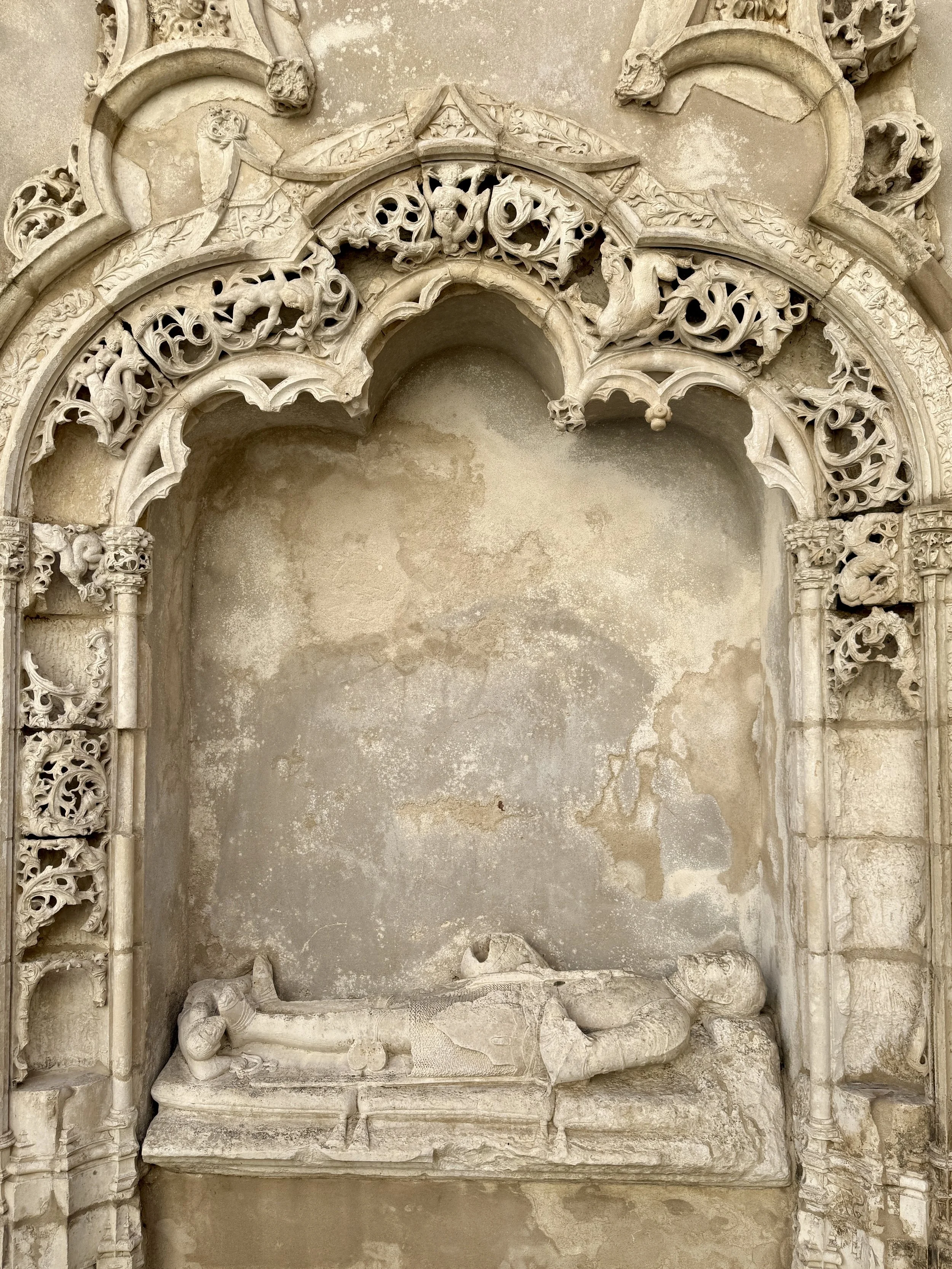
The limestone effigy of the knight Mem de Cerveira lies in repose beneath the delicate tracery of a Manueline arch at Carmo in Lisbon

The limestone effigy of the knight Mem de Cerveira lies in repose beneath the delicate tracery of a Manueline arch, one of the remarkable salvaged religious relics displayed at Carmo. 

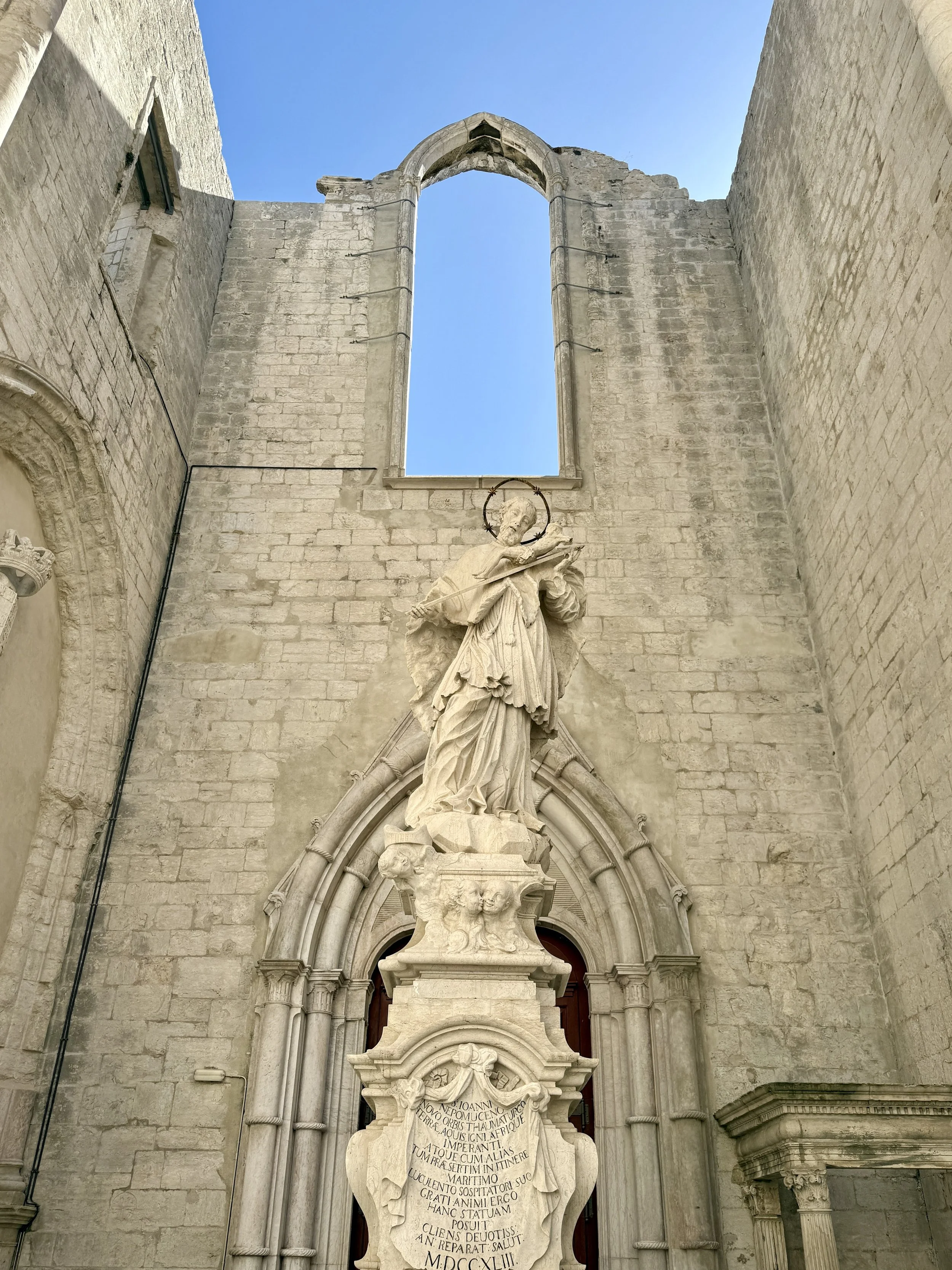
In the transept, we paused to look up at the marble statue of São João Nepomuceno (Saint John of Nepomuk), the patron saint of protection from drowning and floods. Sculpted by Giovanni Antonio Bellini in 1743, it depicts the Czech martyr whose fate was sealed by a bitter dispute between Wenceslaus IV of Bohemia and the Archdiocese of Prague over the appointment of an abbot. Accused of defying the king, Nepomuk was arrested, tortured and ultimately thrown from the Charles Bridge into the Vltava River in 1393, where he drowned. His cult took hold in Bohemia before spreading across Christendom.

The five stars encircling the saint’s head recall the legend that a miraculous light appeared in the water, marking the spot where his body was found. They also symbolize Christ’s five wounds and the five letters of TACUI, Latin for “I have kept silent,” a reference to Nepomuk’s refusal to break the seal of the confessional and reveal the queen’s secrets to King Wenceslaus.
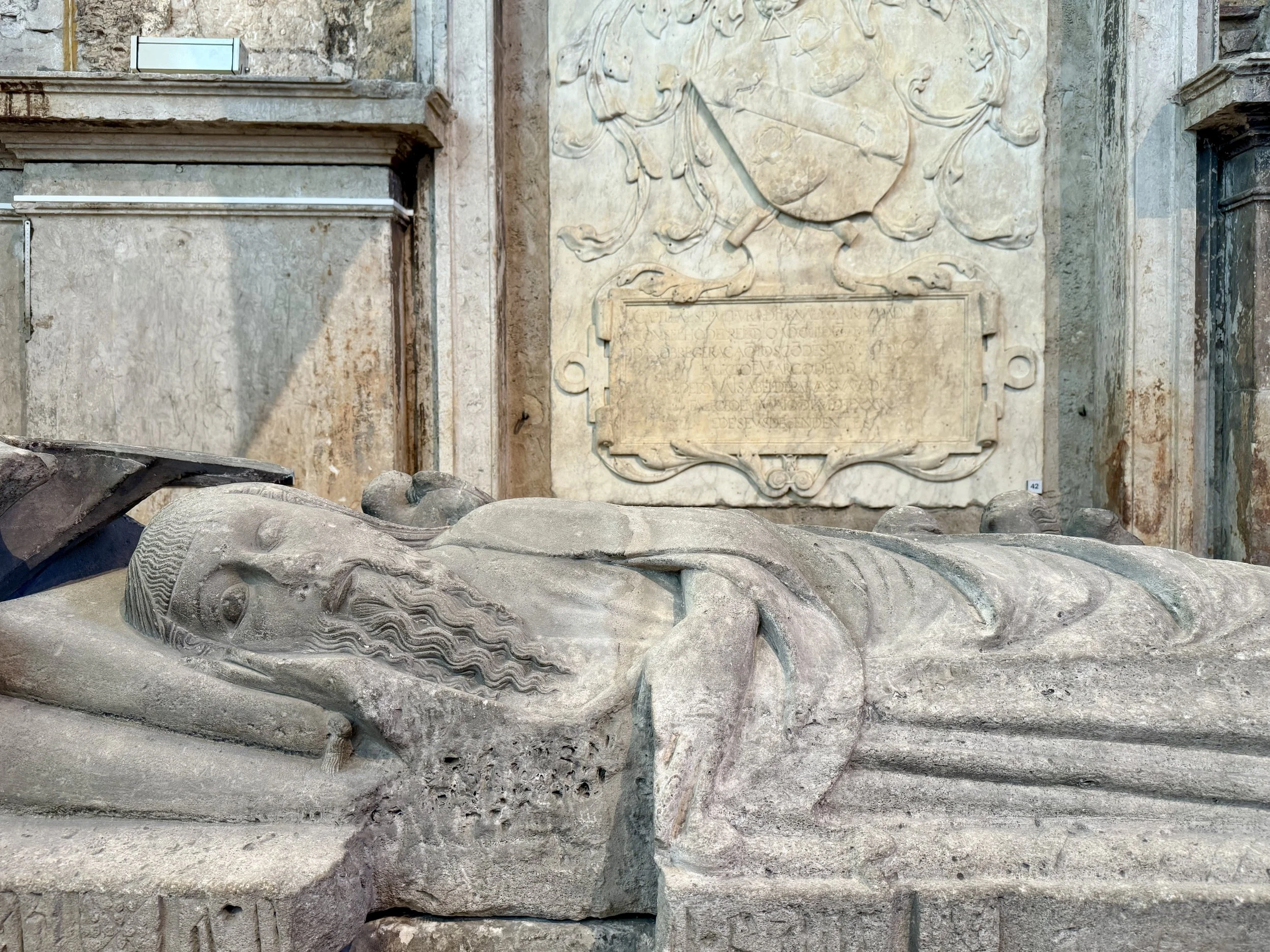
Recumbent figure of Fernão Sanchez, the illegitimate son of King Dinis, shown resting his head on a decorated pillow in the Carmo Convent museum

Recumbent figure of Fernão Sanchez, the illegitimate son of King Dinis, shown resting his head on a decorated pillow. His long, wavy beard and neatly styled structured hair reflect the fashion of early 14th century Portuguese nobility.

A Small Museum With Fascinating Finds

The apse and chapels at the far end of the nave survived the earthquake more or less intact and were later incorporated into the museum as enclosed galleries.

Above the entrance is a Manueline window pulled from the Mosteiro dos Jerónimos (Jerónimos Monastery) in Belém during the monastery’s 19th century restorations and brought here for safekeeping. 

Inside, the collection is small but impressive, ranging from prehistoric and anthropological finds from Portugal and well beyond: an Egyptian mummy in its wooden sarcophagus, and a pair of remarkably well-preserved mummies from Peru, a young man and a young woman belonging to the Chancay culture.
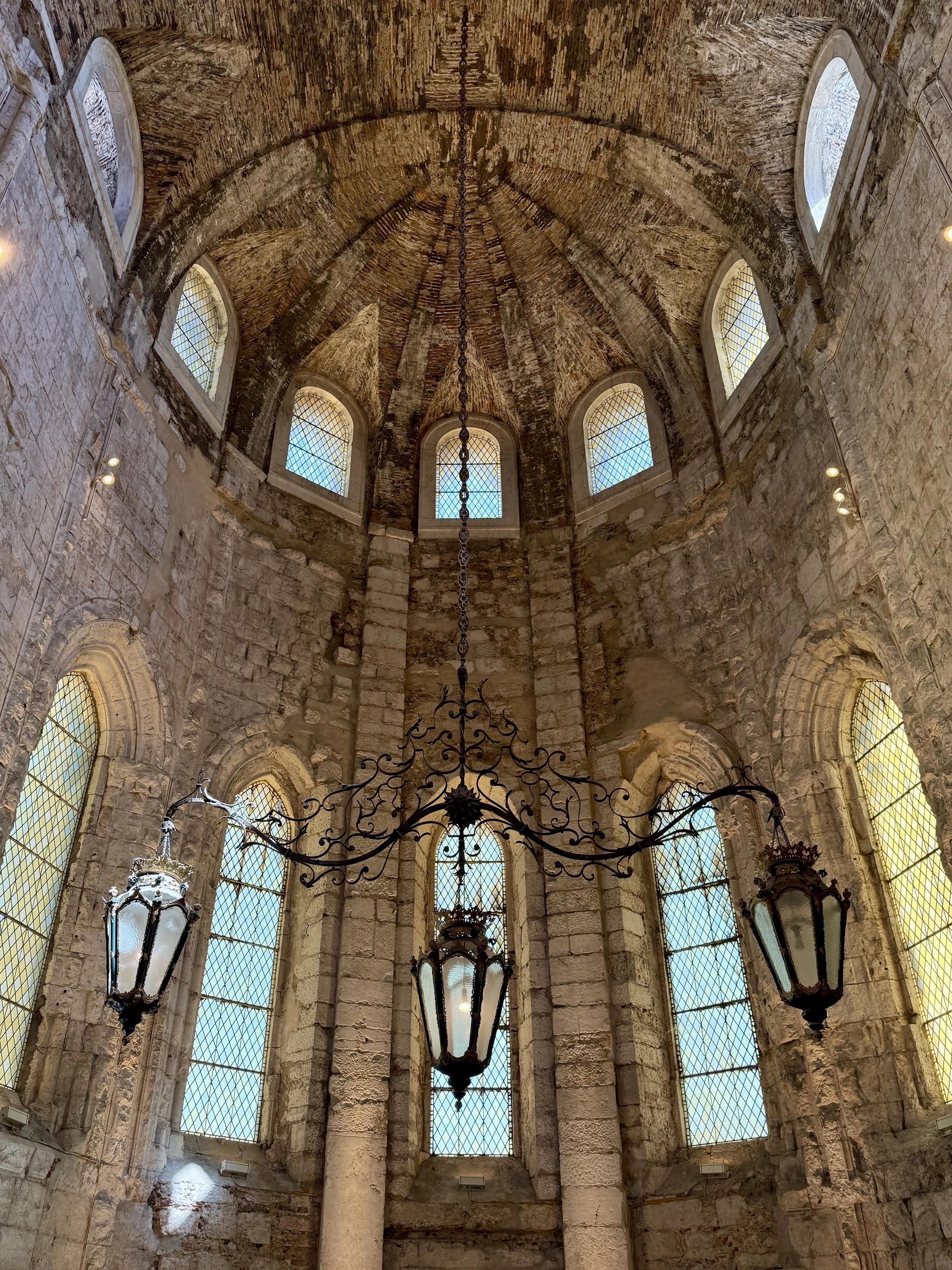
A wrought-iron chandelier hangs beneath the weathered Gothic vault of one of the Carmo church’s surviving apse chapels

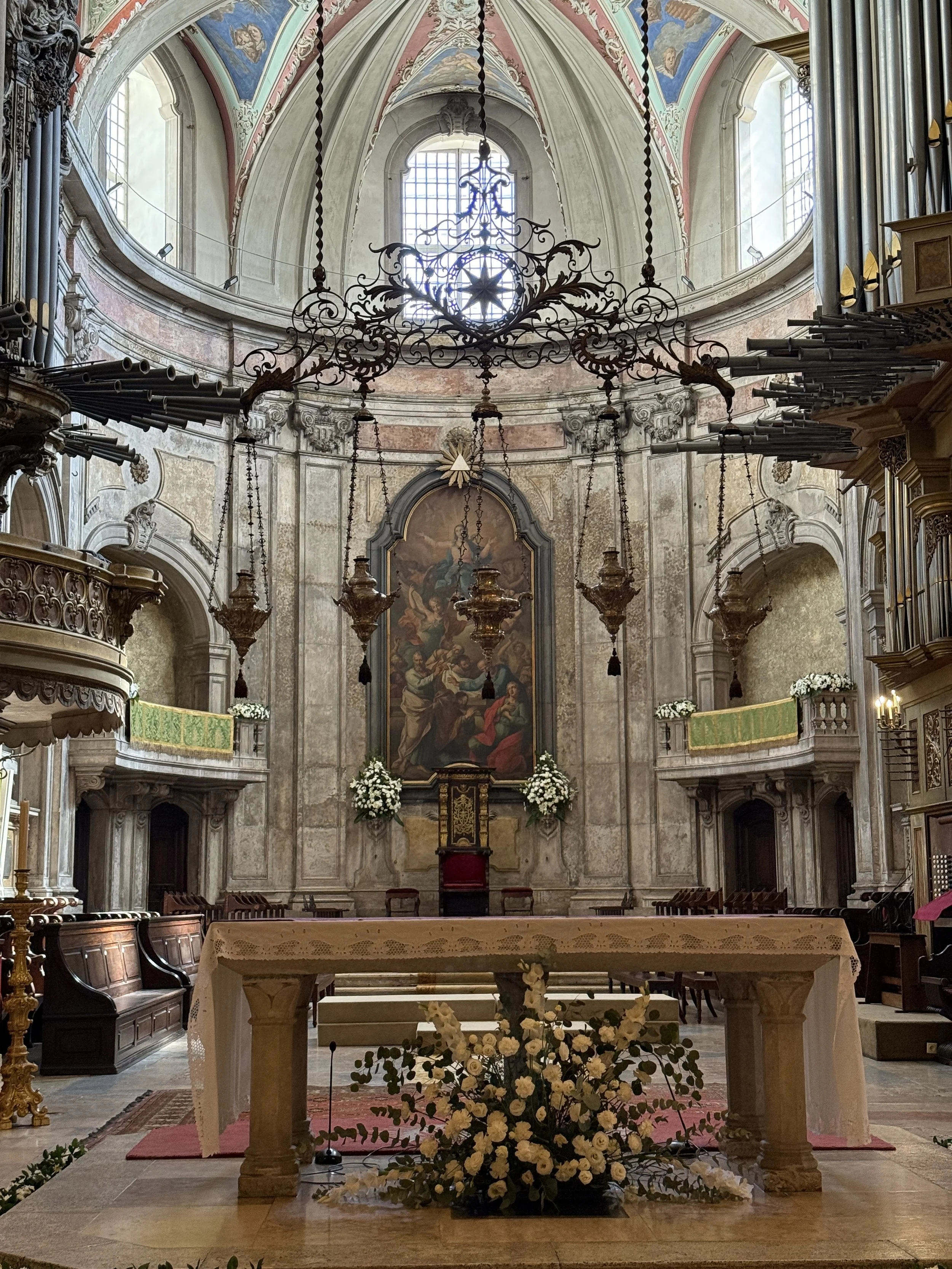
A wrought-iron chandelier hangs beneath the weathered Gothic vault of one of the church’s surviving apse chapels.

The first room offers a glimpse into Portugal’s past, displaying artifacts from the Stone Age to the Iron Age: stone and flint tools, Neolithic arrowheads, prehistoric pottery and metalwork. Each piece tells a story about the development of the region’s early civilizations and its culture. 

The second room brings together objects from the Roman, Visigothic and Islamic periods, including the Roman Sarcophagus of the Muses. Dating to the 3rd or 4th century, its front panel depicts a central male figure, likely the deceased, flanked by the nine Muses representing the arts.
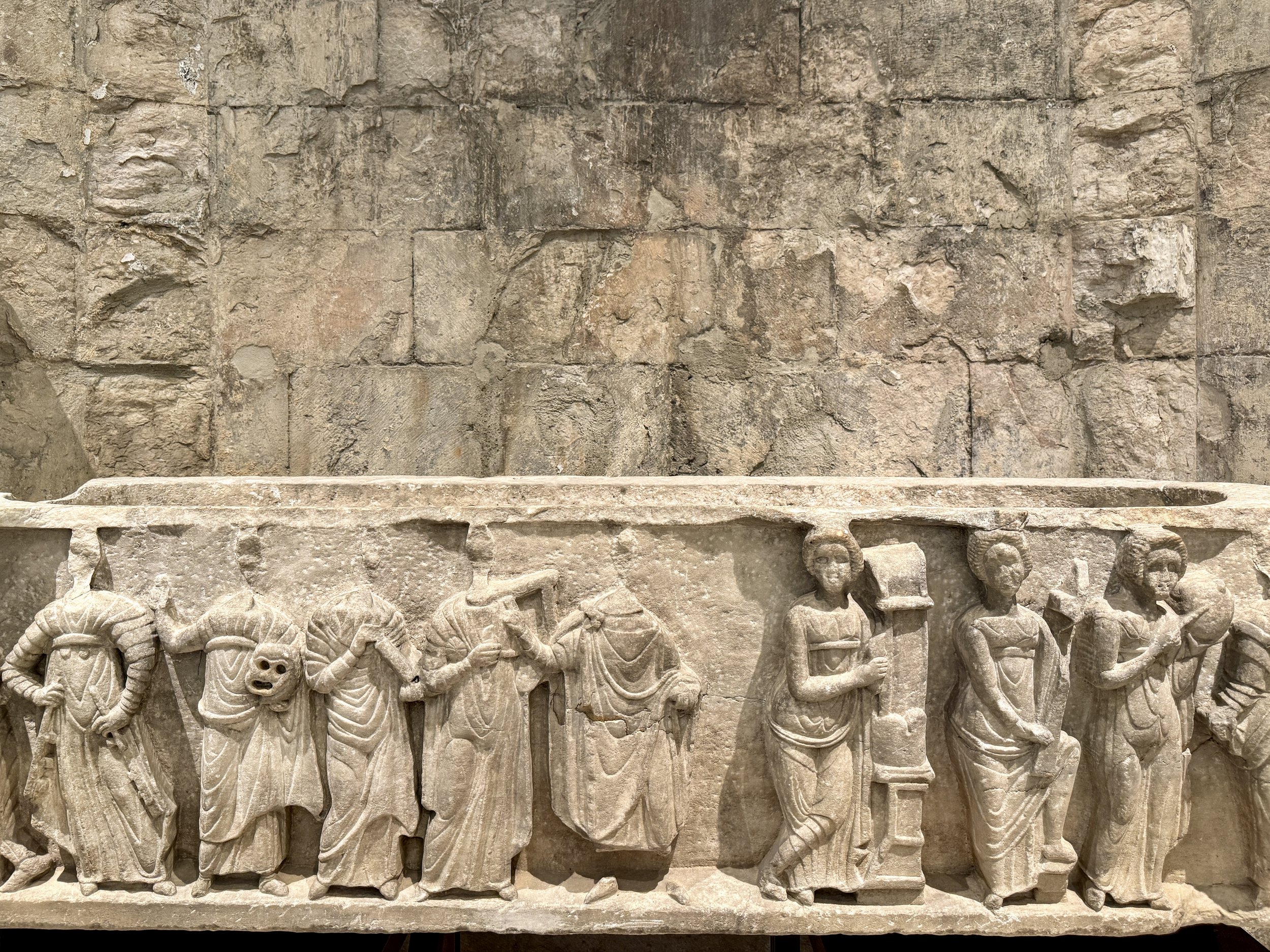
A marble sarcophagus depicting the deceased flanked by the Muses, at the Carmo Archeological Museum in Lisbon

This marble sarcophagus, depicting the deceased flanked by the Muses, was unearthed in the village of Valado dos Frades. It came from the necropolis of a Roman home known as Villa da Mina, once located along the shores of Lagoa da Pederneira, a former inland seaport.

Its story is nearly as remarkable as the relief itself. A farmer unearthed it while plowing a field in the village of Valado dos Frades, after which it was moved to Alcobaça Monastery. Over the next century, careless handling caused much of the damage to the relief, including the loss of five of the nine Muses’ heads. When Portugal’s religious orders were dissolved, the sarcophagus was sold and eventually found an unlikely second life as a pig feeding trough at a nearby farm.

In 1868, da Silva, discovered it there, “neglected and buried in manure,” and brought it to Lisbon, where it remains in the museum today.

The third room, once the church’s main chapel, houses a fascinating collection of artifacts from the medieval through the early modern period. 
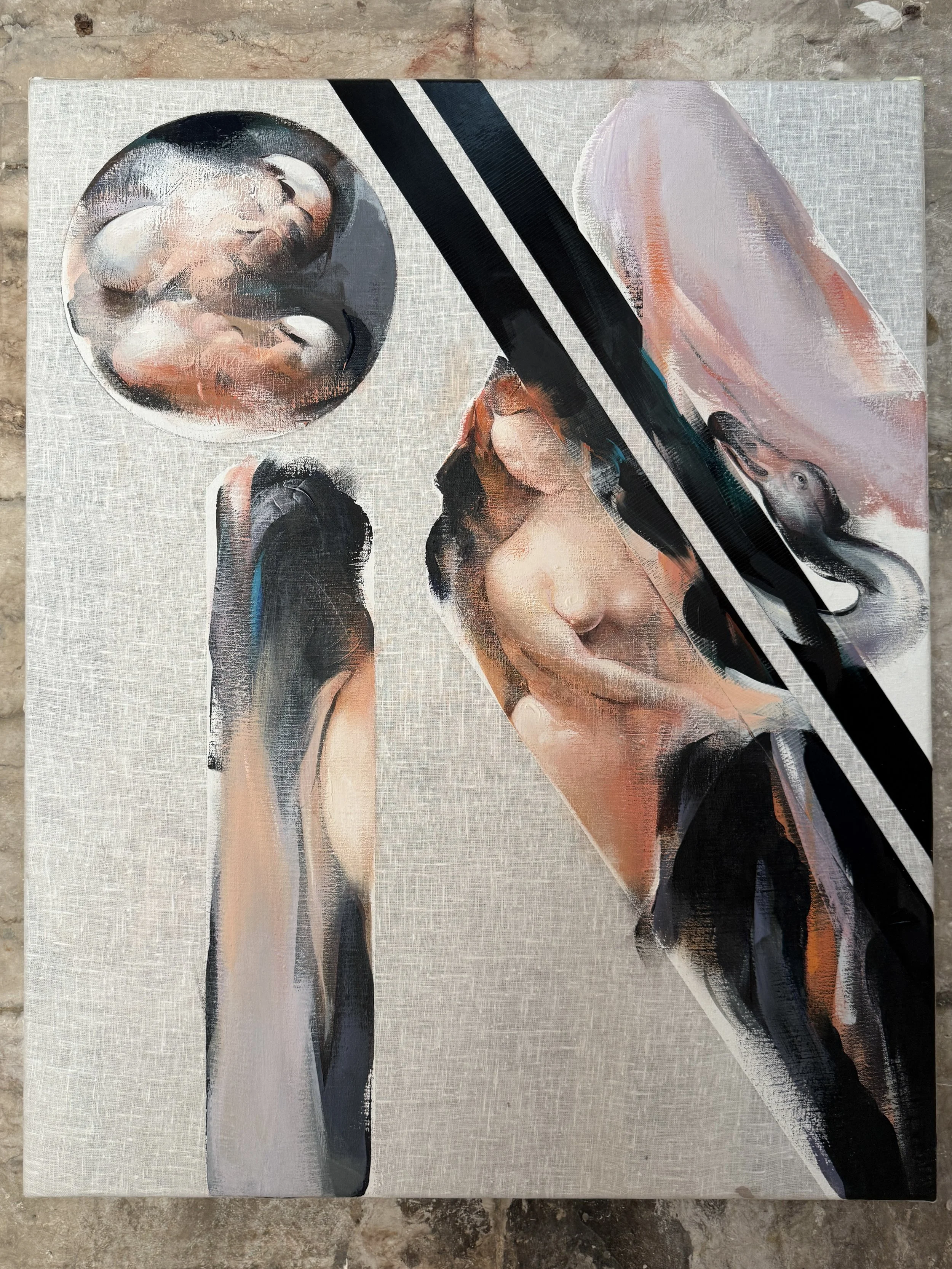
A painting titled, Leda "entre os dedos" de Leonardo (Leda "Slipping Through the Fingers" of Leonardo) by José Quaresma on display at the Carmo Convent museum in Lisbon

As part of a temporary exhibition, works by José Quaresma were displayed among the artifacts inside the museum at the Carmo Convent, including Leda "entre os dedos" de Leonardo (Leda "Slipping Through the Fingers" of Leonardo). Painted in 2022, the piece reimagines Leonardo da Vinci's lost Leda and the Swan, known today only through copies and studies.

Among them is the finely carved limestone sarcophagus of Fernando I. Originally housed in the Convent of St. Francis in Santarém and vandalized by French troops during the Peninsular War. Its sides unfold with scenes from Fernando’s life alongside references to Saint Francis of Assisi. His remains were lost during the French invasions, leaving the sarcophagus empty. Above, the lid depicts a winged figure rising into the heavens, surrounded by stars and small busts tucked into an intricate lace-like border. 
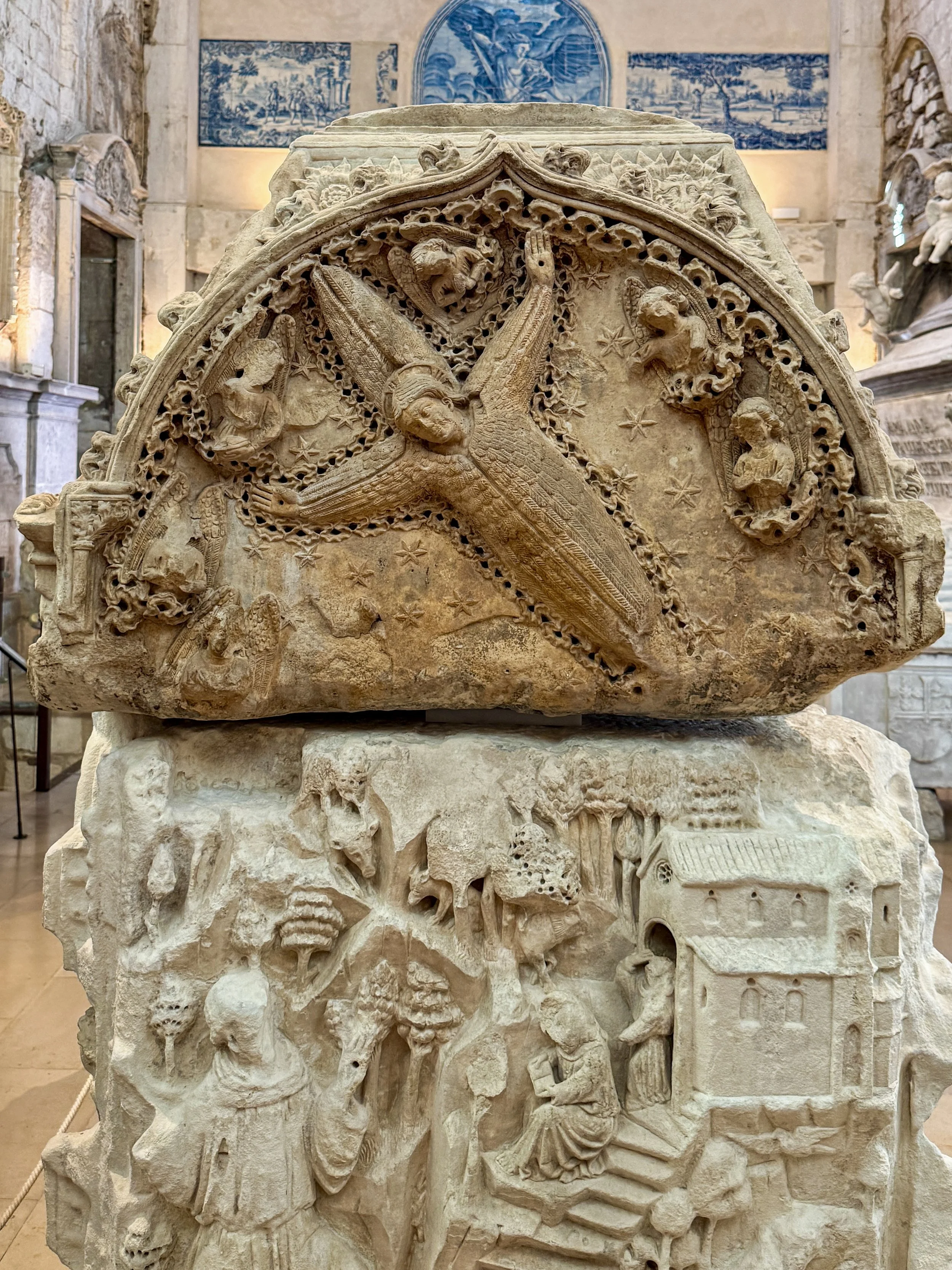
A winged figure soars through a star-filled sky atop the intricately carved 14th-century tomb of King Fernando I at the Carmo museum in Lisbon

A winged figure soars through a star-filled sky atop the intricately carved 14th century tomb of King Fernando I.

Sharing the space is another elaborate funerary monument, this one commemorating Maria Ana de Áustria, queen consort of João V and a central figure in Portugal’s 18th century royal court.
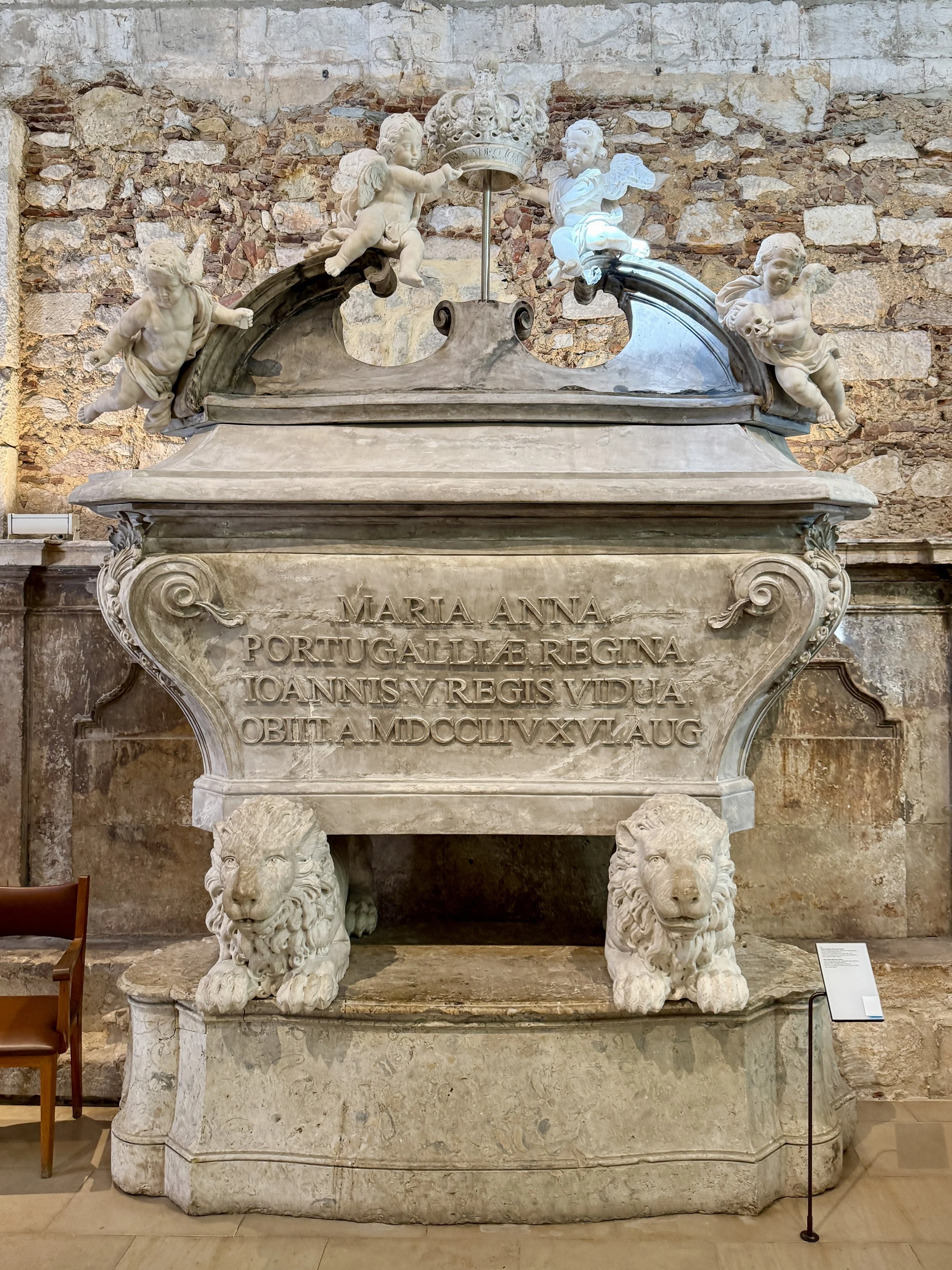
Winged putti, watchful lions and memento mori symbols adorn the elaborate tomb of Queen Maria Ana de Áustria at the Cartmo Archeological Museum in Lisbon

Winged putti, watchful lions and memento mori symbols adorn the elaborate tomb of Queen Maria Ana de Áustria.

Atop the chest, a crown is held aloft by two chubby, winged putti. Two others flank them, carrying a skull and a scythe, classic memento mori symbols reminding the viewer of life’s impermanence. At the base, a pair of recumbent lions keep watch.

Maria Ana founded the Mosteiro de São João Nepomuceno for the order of German Discalced Carmelites and was buried there after her death in 1754. The elaborate tomb may date to a later reburial, possibly commissioned by her granddaughter, Queen Maria I. Her heart, however, returned to Vienna, where it still rests in the Kaisergruft, the Habsburg Imperial Crypt.

Also worth a look is a niche with an intriguing pairing: Nossa Senhora do Carmo (Our Lady of Mount Carmel), wearing an ornate crown and holding the Christ Child, and Santa Catarina de Alexandra (Saint Catherine of Alexandra), depicted as a princess standing over the defeated Emperor Maxentius, whose head is beneath her foot. Nossa Seneroa do Carmo is carved in limestone, with traces of its original paint and gilding still visible.

According to legend, Santa Catarina bested Maxentius’s philosophers in religious debate and converted them to Christianity. The emperor had her imprisioned and tortured before eventually ordering her beheaded.

The fourth room has the feel of a Wunderkammer, or cabinet of curiosities. Here you’ll find the museum’s book collection alongside a scattered array of antiquities assembled from beyond Portugal’s borders, including pieces from the Americas and the Egyptian and Peruvian mummies mentioned earlier. That collection was donated in the late 19th century by the Conde de São Januário, a fellow president of the Association of Portuguese Archaeologists, along with part of his personal collection of pre-Columbian ceramics.
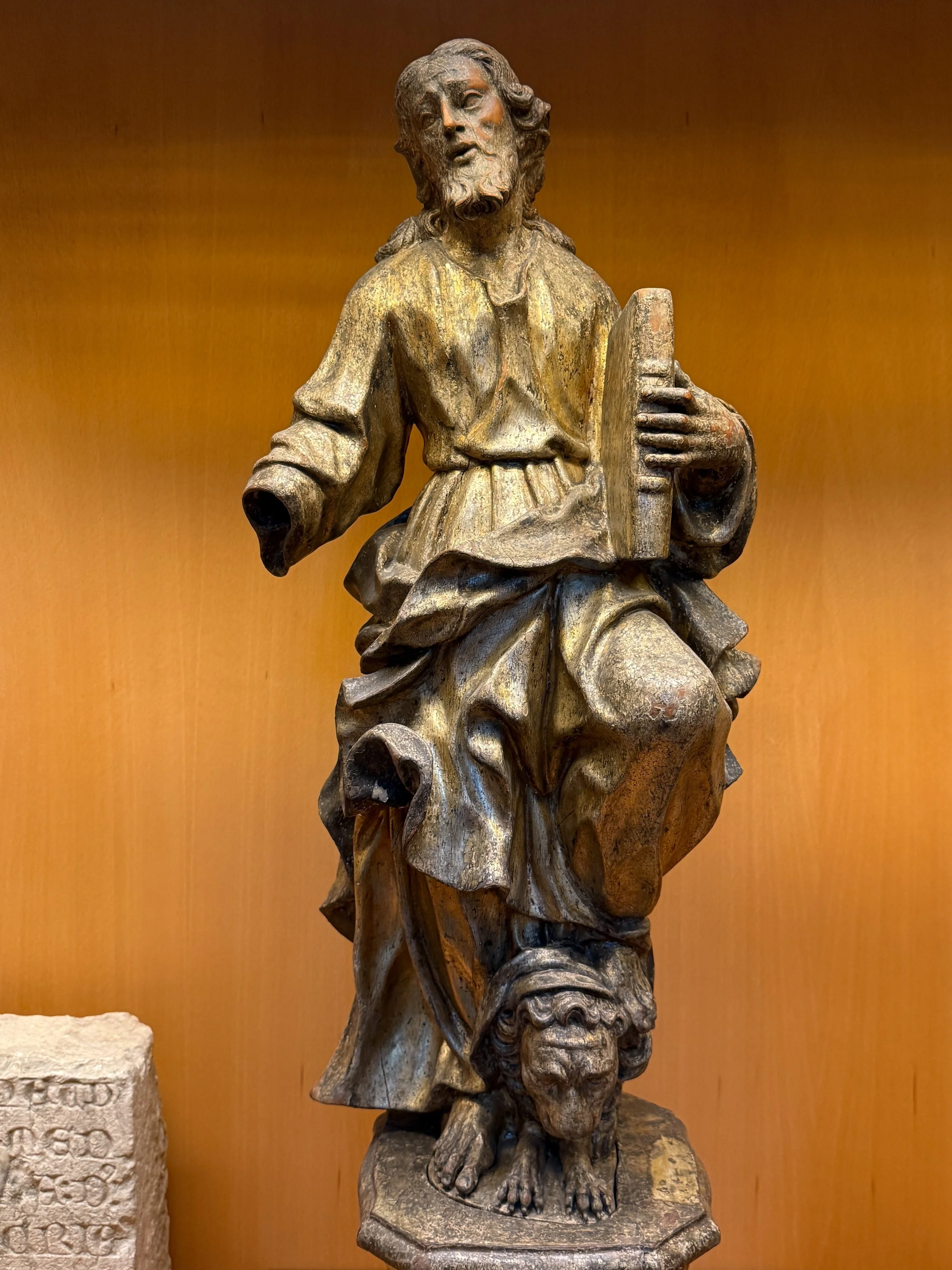
Sculpture of the Evangelist Matthew, holding a book with a lion at his feet, at the Carmo Convent in Lisbon

This piece is part of a set of four sculptures of the Evangelists — Matthew, Mark, Luke and John — and are original to the church. 

From here, the collection turns back toward the  church itself. The final chapel of the former church is filled with religious sculptures and a set of azulejo tile panels depicting scenes from the Passion of Christ. The tiles date to around 1780 and are attributed to the workshop of Francisco Jorge da Costa. 
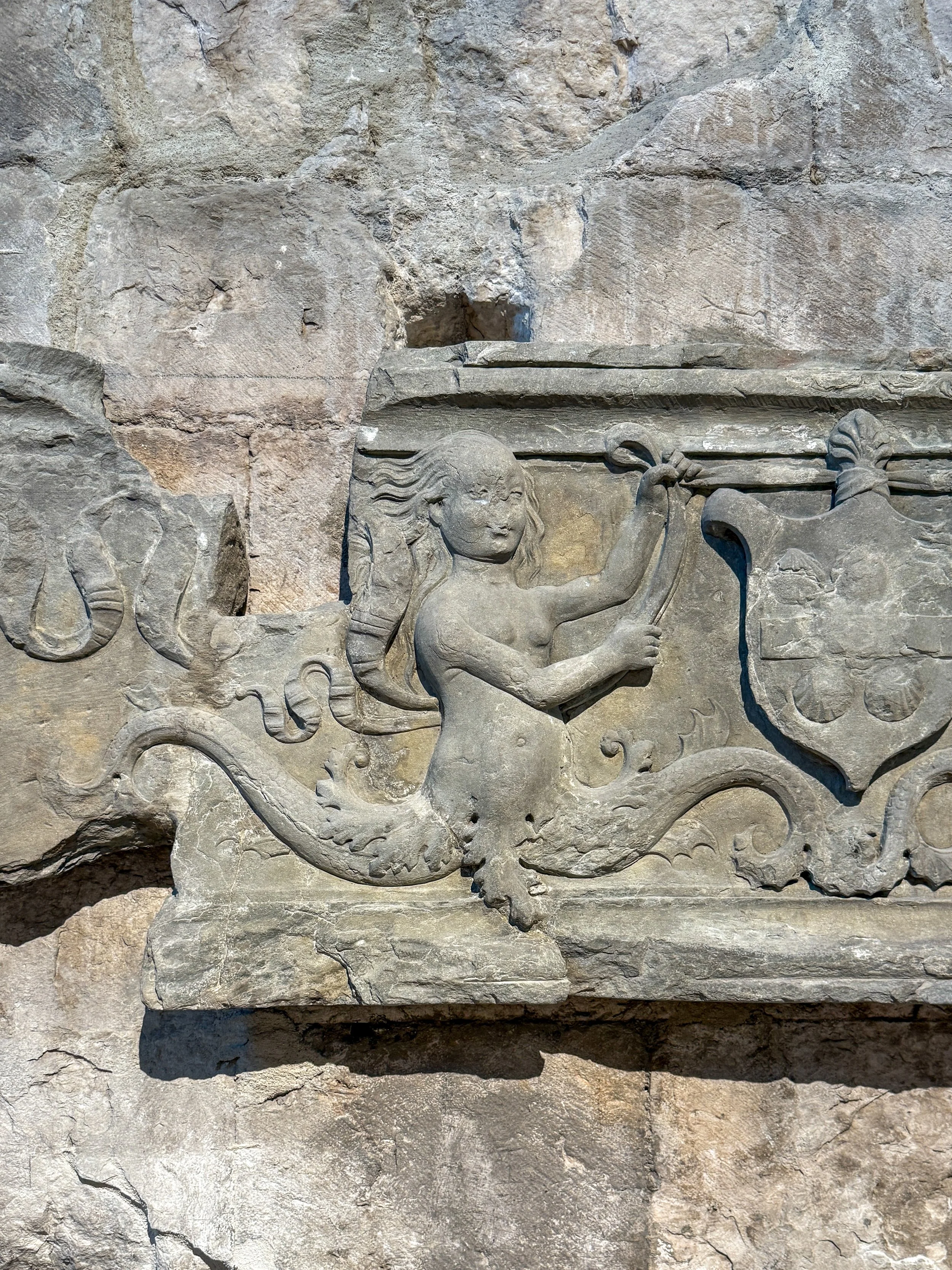
A two-tailed siren carved into a fragment of an altarpiece from the former Church of São Marcos, once located in Lisbon’s Campo das Cebolas

A two-tailed siren carved into a fragment of an altarpiece from the former Church of São Marcos, once located in Lisbon’s Campo das Cebolas.

The walls hold a few more fragments of Lisbon’s past. One displays pieces of a Renaissance sculptural frieze from Coimbra, with grotesque figures. Nearby another fragment features a two-tailed siren alongside a coat of arms decorated with scallop shells, once part of the altarpiece of São Marcos do Campo de Cebolas (whose moniker translates to “Field of Onions,” Lisbon’s old riverside market square).
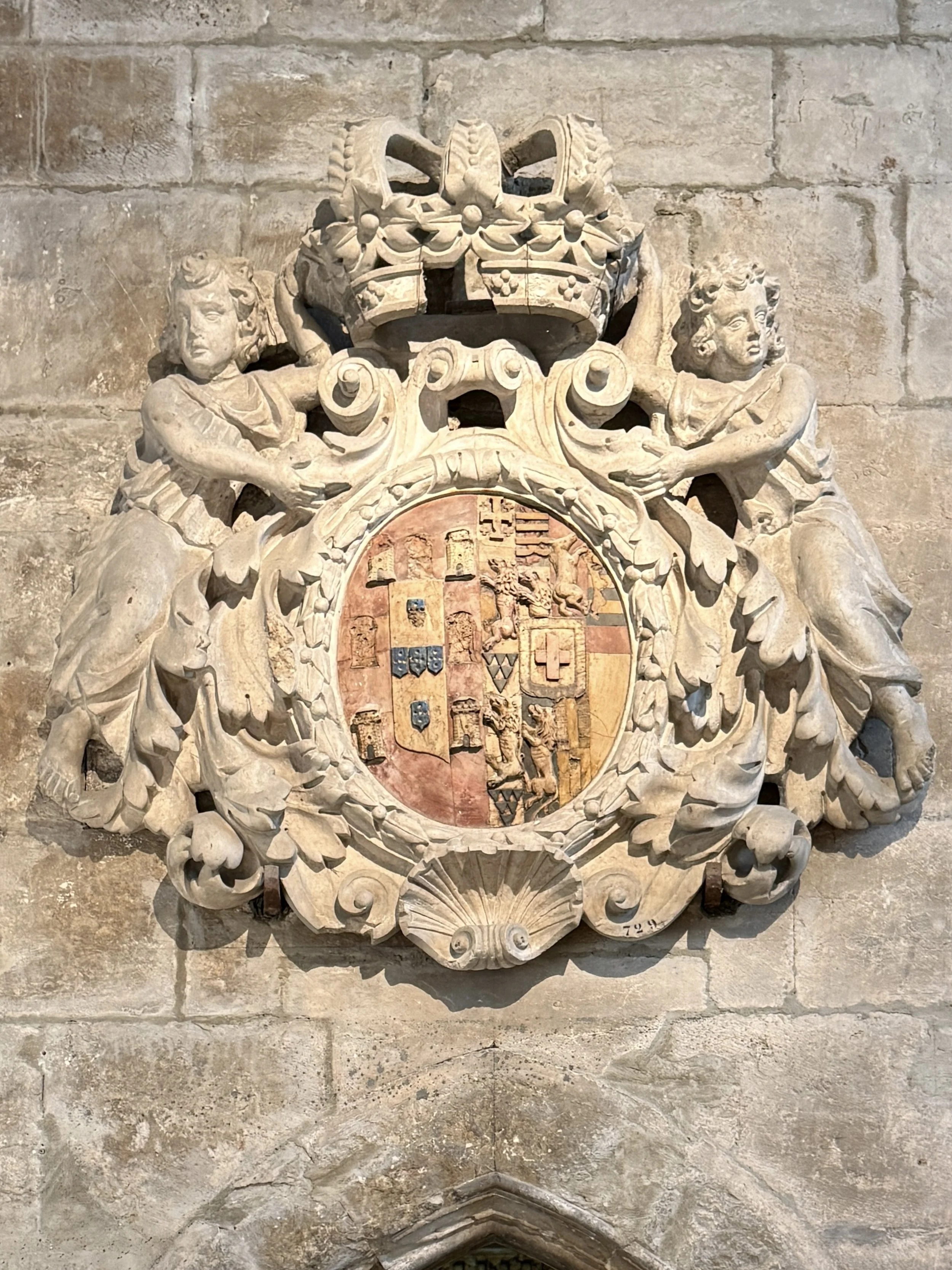
A 17th century shield bearing Queen Maria Francisca de Sabóia’s coat of arms hangs above the former sacristy doorway

A 17th century shield bearing Queen Maria Francisca de Sabóia’s coat of arms hangs above the former sacristy doorway.

Above the doorway to the former sacristy, where clergy once prepared for services, hangs a 17th century shield bearing the royal coat of arms of Maria Francisca de Sabóia, queen consort first to Afonso VI and later to his brother Pedro II. The elaborate shield combines the Portuguese royal arms with those of her family, the House of Savoy-Nomours.

The shield originally came from the Convento do Santo Crucifixo (Convent of the Holy Crucifix), better known as the Francesinhas, or “Little French Women,” after the Capuchin nuns who ran it.

Today, the doorway leads to an auditorium rather than a sacristy. The five small shields at the center of the Portuguese arms represent the five Moorish kings defeated by Afonso Henriques at the Battle of Ourique in 1139, while also symbolizing the five wounds of Christ. The heraldry of Savoy-Nemours appears alongside them, a reminder of Maria Francisca’s royal lineage.
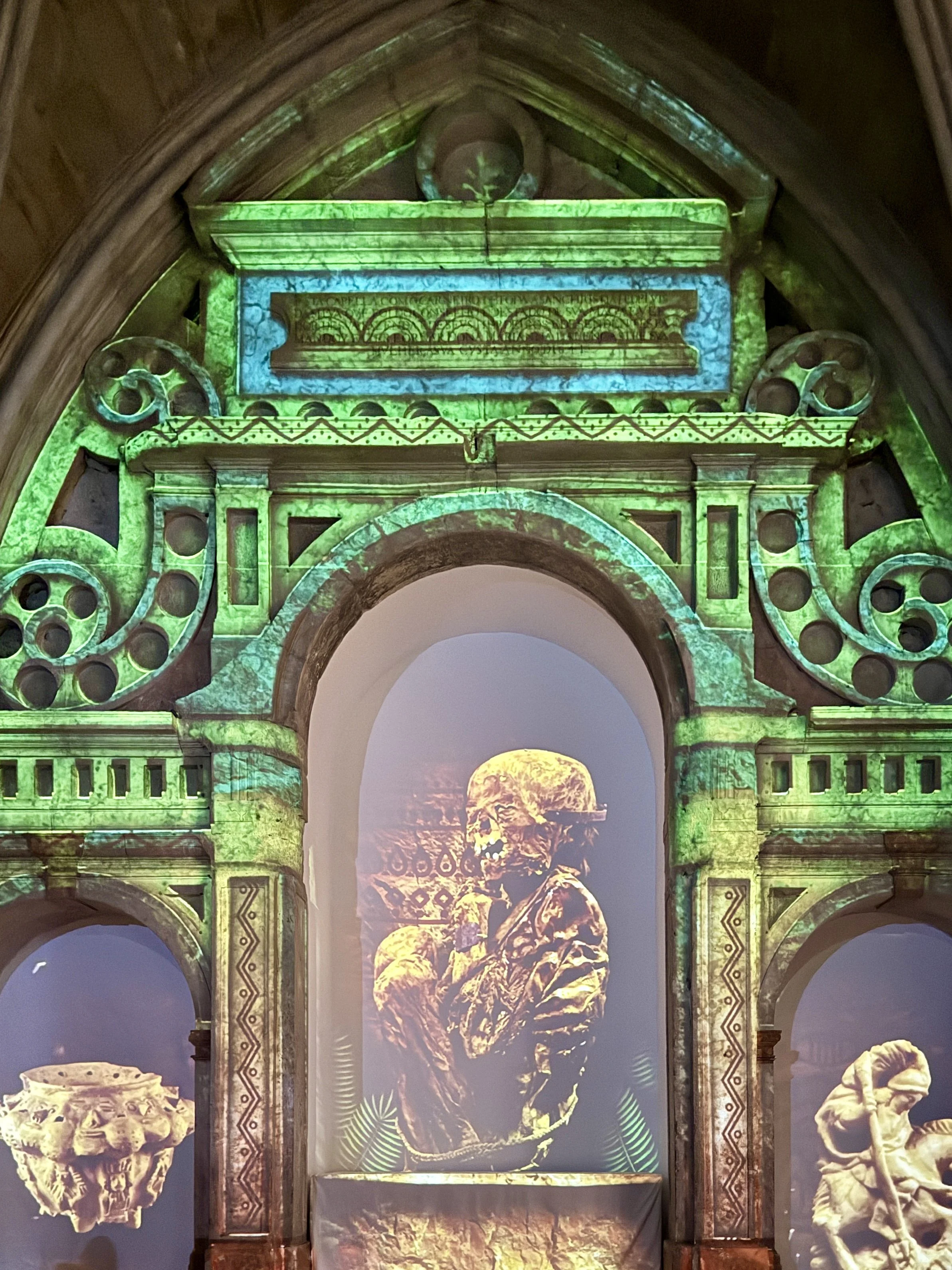
The short film Carmo: 630 Years of History traces the site’s history from Gothic church to archaeological museum, mummies and all.

In the former sacristy, Wally and I sat down to watch Carmo: 630 Years of History, a 15-minute film alternately narrated in Portuguese and English. Created by the Portuguese studio O Cubo, it uses the room’s architecture as a 3D screen, bringing the history of Carmo to life through large-scale moving images, from its founding in 1389 to the present day.

The Romantics were right. There’s something hauntingly beautiful about a church without a roof, especially at Carmo Convent, where Gothic arches frame Lisbon’s ever-changing sky.

The museum’s collection spans thousands of years, from prehistoric tools and Roman sarcophagi to royal tombs and Peruvian mummies. But it’s small enough to explore without succumbing to museum fatigue. Give yourself a leisurely couple of hours to take in the treasures, linger beneath the arches, and decide for yourself whether Carmo lost its roof or gained the sky. –Duke

Visitor Information
Carmo Convent & Archaeological Museum
Address
Museu Arqueológico do Carmo
Largo do Carmo
1200-092 Lisbon, Portugal
Hours
Monday through Saturday
Closed Sundays, January 1, May 1 and December 25
10 a.m. to 6 p.m. (November–April)
10 a.m. to 7 p.m. (May–October)
Admission
Adults: €7 ($8)
Students, seniors 65 or older, Lisboa Card holders and Portuguese residents: €5 ($6)
Children under 14 (must be accompanied by an adult): Free
Photography
Allowed in the galleries, but no flash and no tripods.
Statues and relics from the original church and convent are included with items from around the world at the Carmo Archeological Museum in Lisbon

Museu Arqueológico do Carmo

Largo do Carmo
1200-092 Lisbon
Portugal

Church of São Domingos: Lisbon’s Beautiful Burnout

Visiting Igreja de São Domingos in Lisbon? Just off Rossio Square, this fire-scarred church turns ruin into reverence.

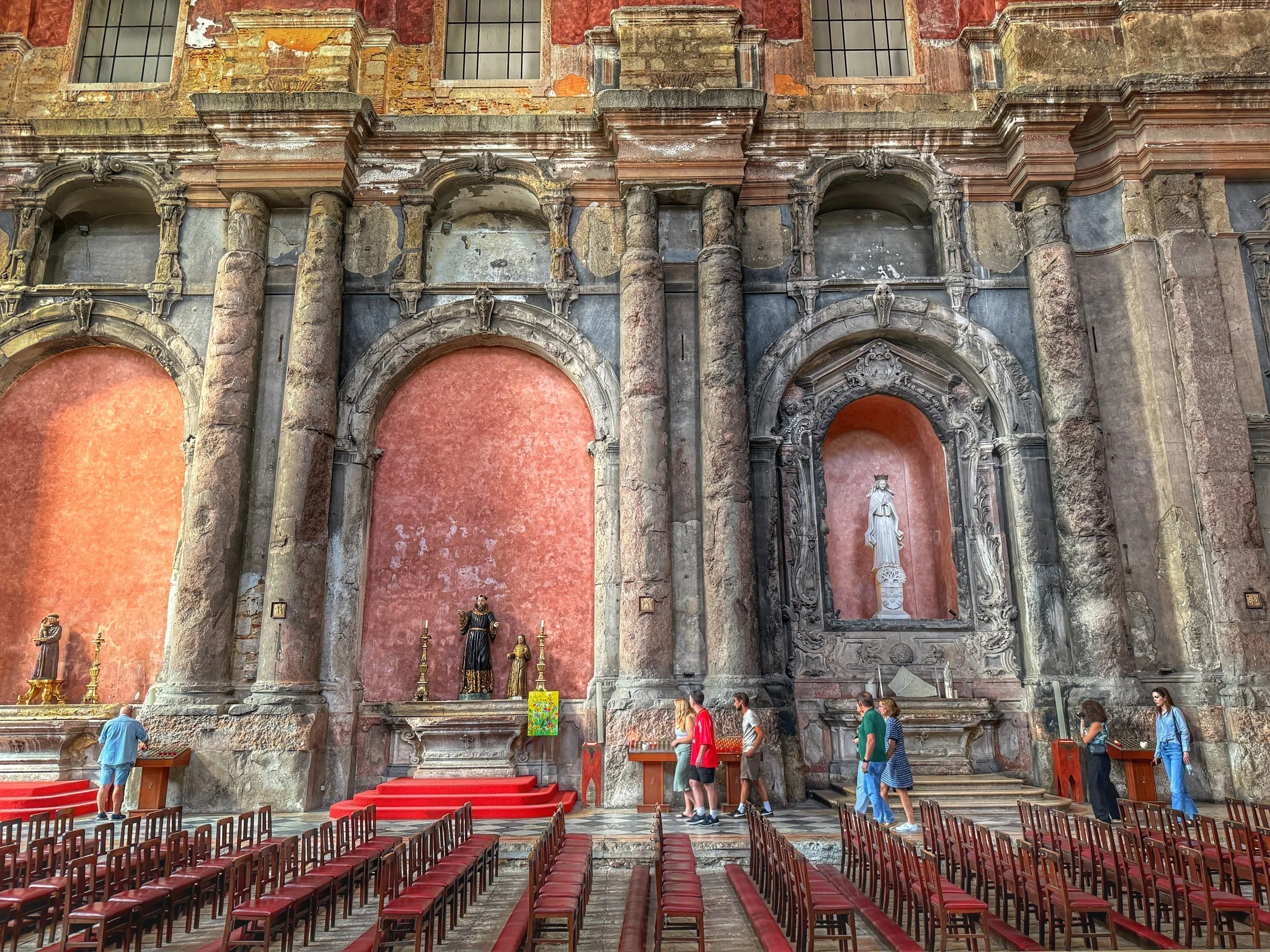
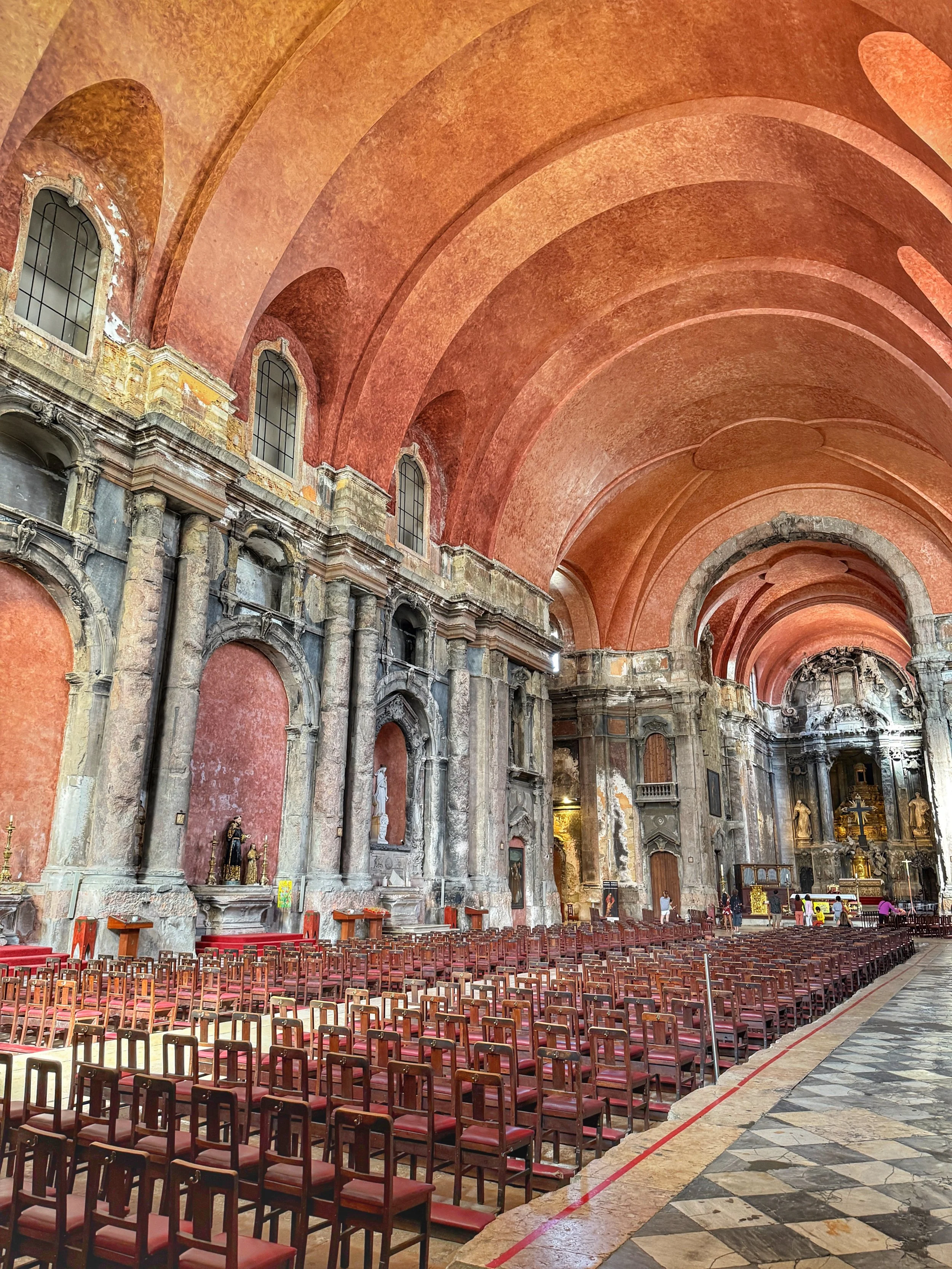
Once dripping in gold and glory, the Church of São Domingos in Lisbon, Portugal now wears its wounds with pride. A fire-charred interior, a bloody past, and a defiant refusal to hide the damage make it one of the most hauntingly honest churches in Europe.
We’d already been in Lisbon a couple of days when I flipped through a guidebook and saw a photo of São Domingos’ interior, with those scorched terracotta-colored walls and raw stone arches. I stopped mid-page. It didn’t look like any church I’d ever seen; it looked like something that had survived the end of the world. I turned to Duke and said, “We have to find this place.”

“Workers reinforced the structure but left the burn marks as they were, creating an atmosphere that feels halfway between holy and haunted.

It’s not “beautiful” in the traditional sense, but it’s impossible to forget. ”

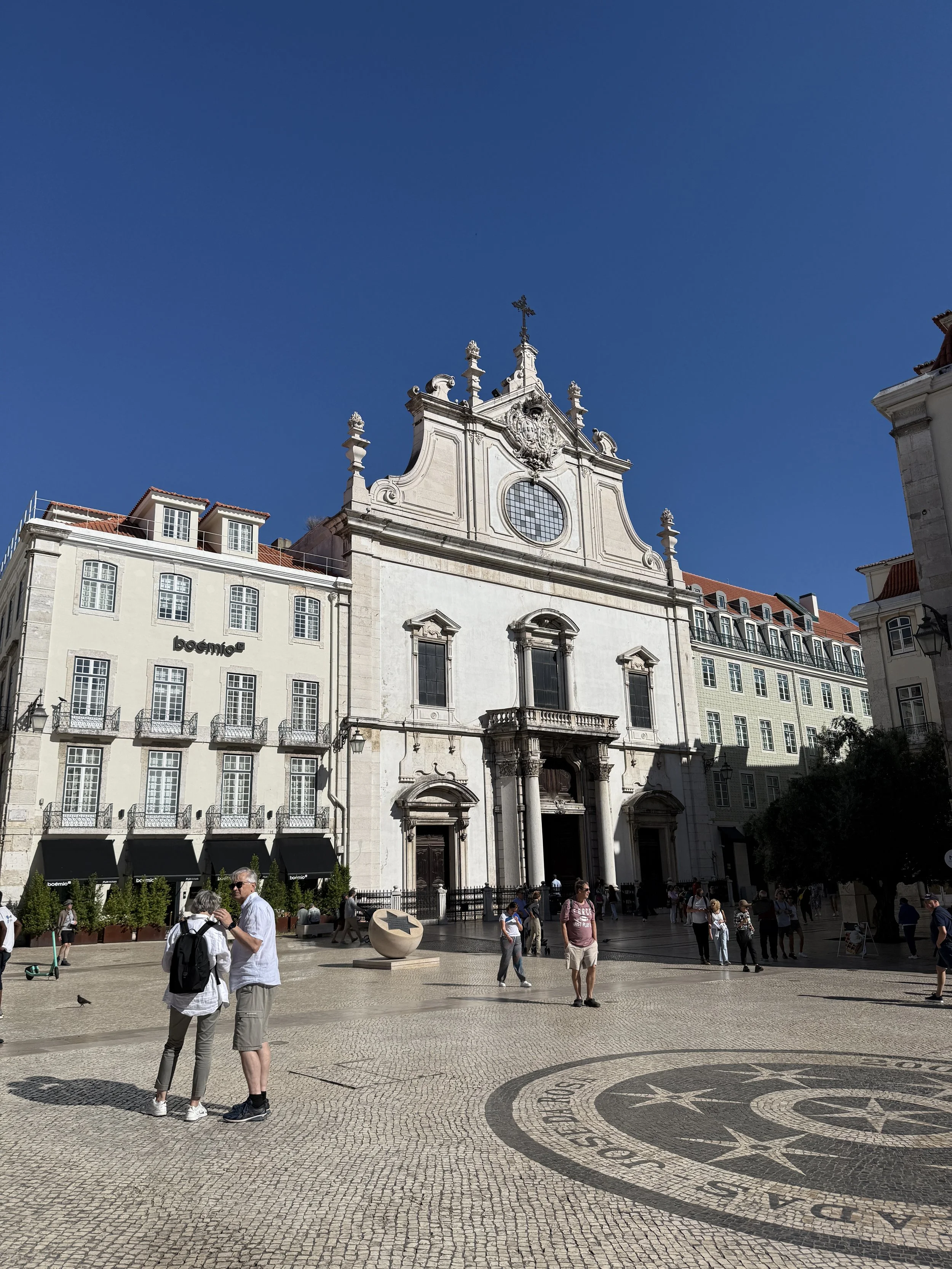
Imagine our surprise when we realized it was right under our noses — tucked just off Rossio Square in a strangely angled building we’d already walked past several times without noticing. From the outside, São Domingos looks a bit plain, its façade rather unassuming. But step through the doors and it’s like falling through time. Lisbon’s brightest square gives way to one of its darkest, most moving spaces.

Inside Igreja de São Domingos

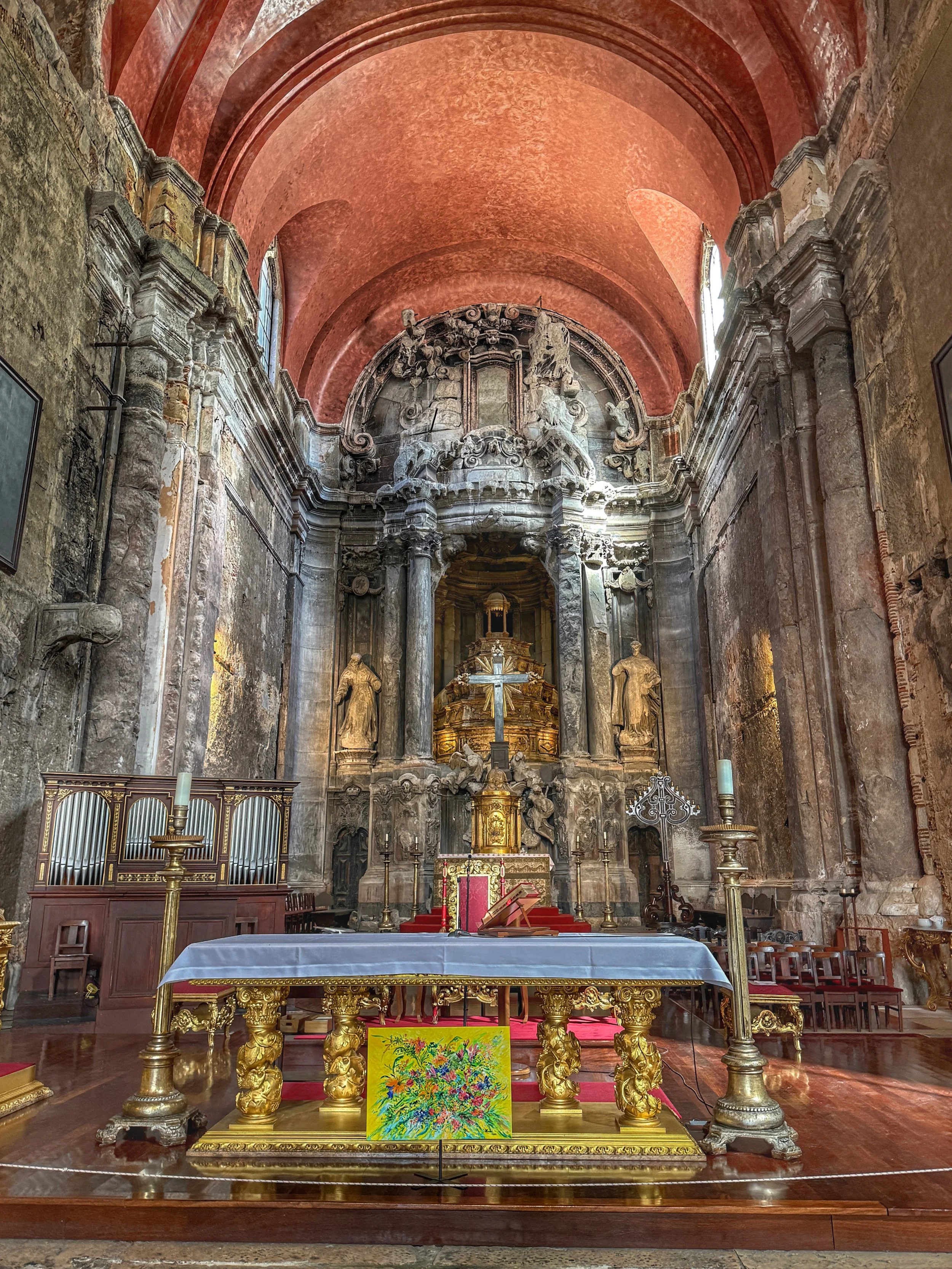
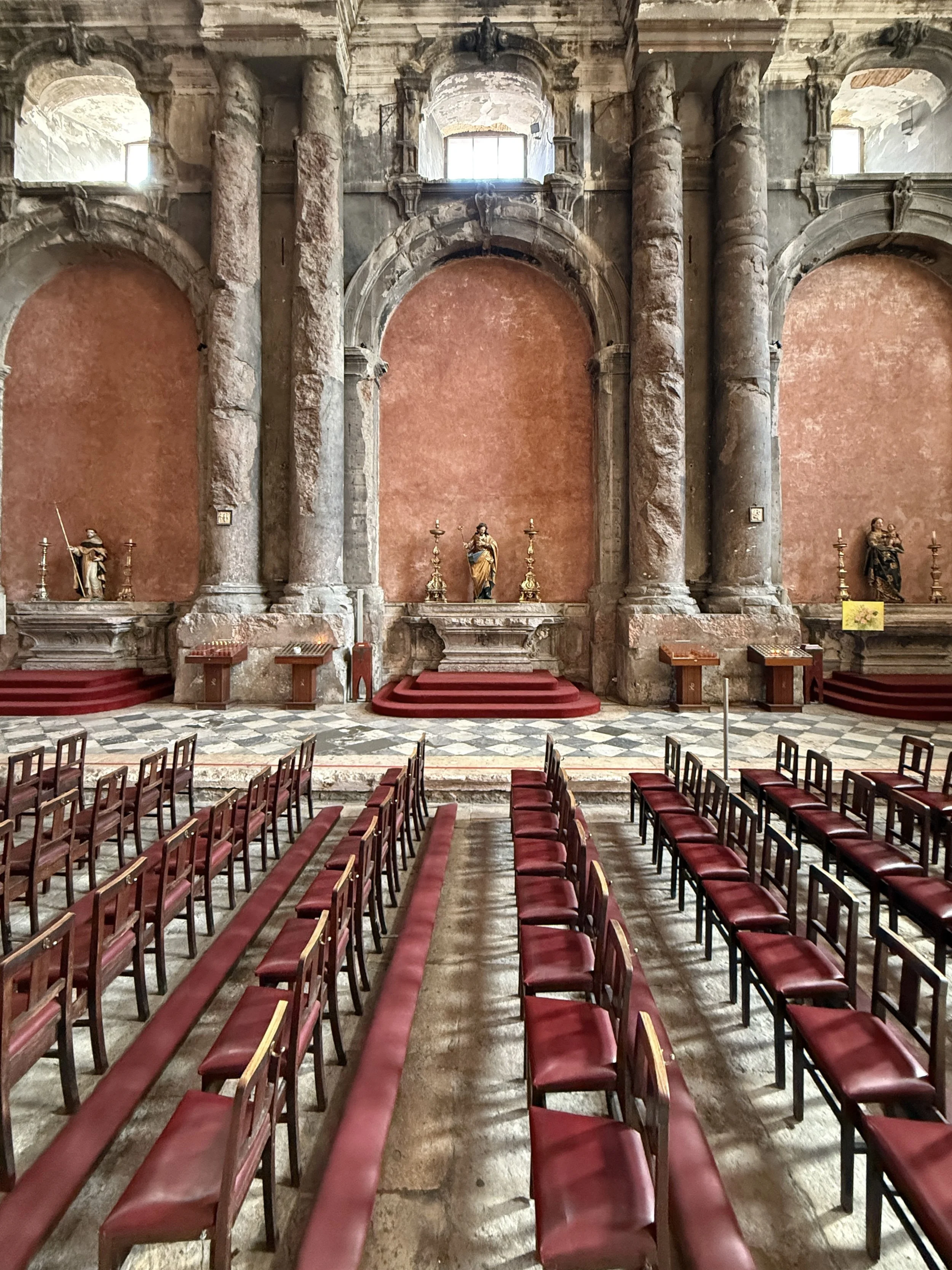
The first thing you notice inside Igreja de São Domingos isn’t the altar or the statues — it’s the walls. They’re scorched, cracked and blistered like the inside of a volcano. You half-expect to smell smoke. Once upon a time, this was one of Lisbon’s most lavish Baroque churches — all gold leaf, marble and over-the-top devotion. Then, in 1959, fire ripped through it, devouring the splendor and leaving behind something much more human.

Most churches would have been restored to postcard perfection. São Domingos wasn’t. The decision to leave its wounds visible — blackened stone, warped columns, burnt sienna ceilings that look like they still ache — feels radical, especially in a city that prides itself on polished tiles and pastel façades. This one’s not pretending. It’s survived earthquakes, massacres and flames, and it’s still standing — raw, imperfect and more sacred for it.

The fire that ravished São Domingos is believed to have started at the high altar — with, possibly, a candle to blame.

The Fire That Changed Everything

In 1959, a fire tore through São Domingos, leaving only its stone skeleton behind. The blaze gutted centuries of gilded wood and painted ceilings, the kind of gaudy grandeur that Baroque churches specialized in. Parishioners watched in horror as molten gold dripped from the altar and statues melted into unholy puddles. Yet instead of rebuilding it to its former blingy glory, Lisbon decided to do something almost heretical: It left the scars.

The fire broke out on August 13, 1959, just after dawn, starting near the high altar — the very heart of the church. No definitive cause was ever confirmed, though some reports suggested a stray candle or heat rising through an old chimney shaft. 

Within minutes, flames shot through the wooden roof and raced down the nave, feeding on centuries of lacquer, paint and gilt. 

More than 100 firefighters from across Lisbon rushed to the scene, and crowds filled Rossio Square to watch in disbelief and despair. 

Despite the firefighters’ efforts, the roof collapsed, killing two of them and reducing the sanctuary to a molten ruin.

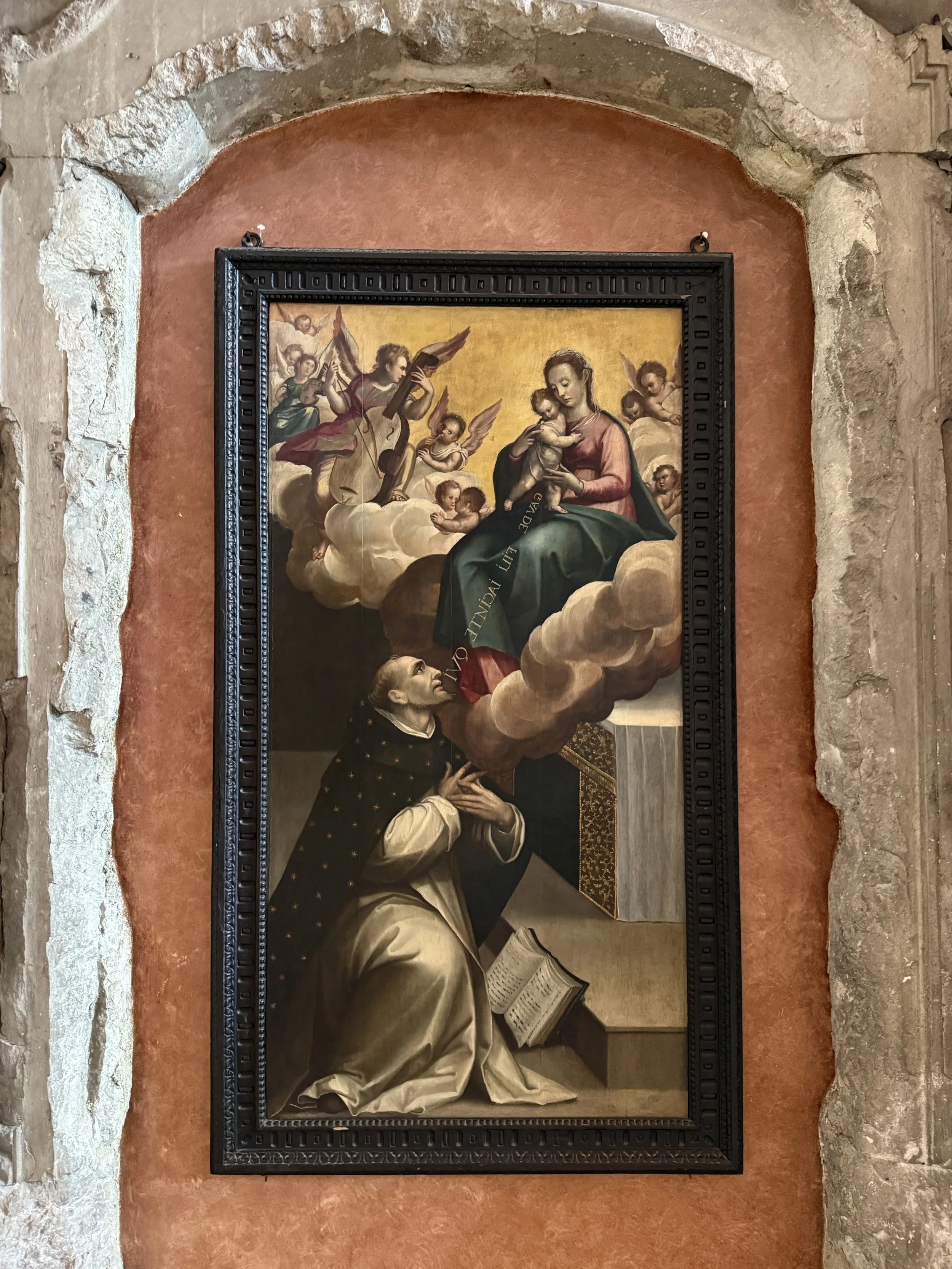
Saint Dominic’s vision of receiving the rosary from the Virgin Mary

Saint Thomas Aquinas, the Dominican Order’s scholar-saint

The losses were staggering. The great pipe organ, centuries of paintings and sacred objects — including a revered 17th century image of Our Lady of the Rosary — were destroyed. 

The heat was so intense that the marble itself split, and the once-golden altars ran like wax. 

For a church that had hosted royal weddings, funerals, baptisms and national ceremonies, the devastation felt almost personal — a wound carved into Lisbon’s collective memory. That same year, São Domingos was declared a National Monument, ensuring that what survived would never again be hidden behind fresh plaster.

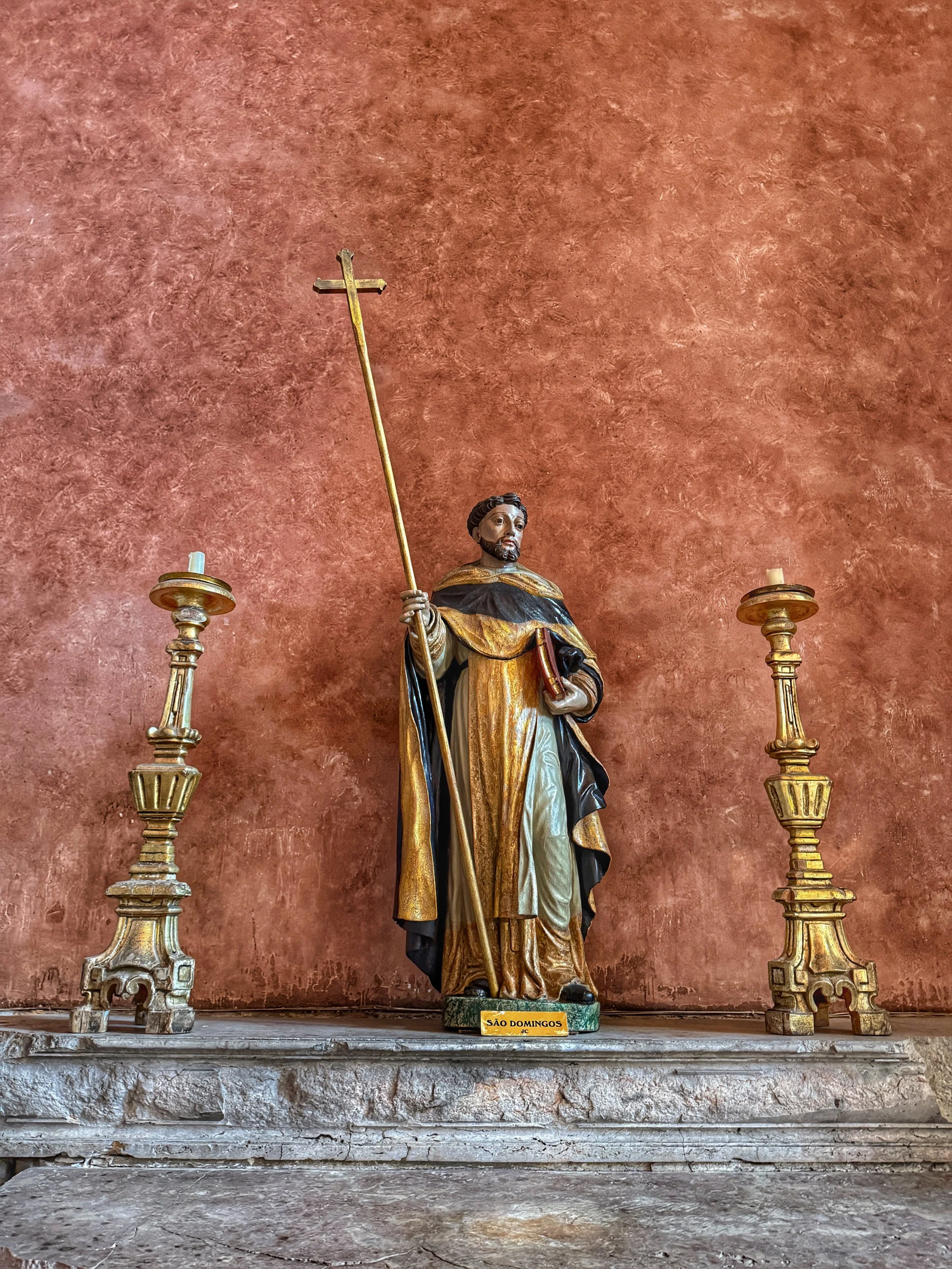
Saint Dominic (São Domingos), founder of the Dominican Order, was devoted to truth through study and preaching.

São Domingos, the Saint Who Started It All

It feels poetic — maybe even karmic — that the church dedicated to Saint Dominic, the man who founded the Dominican Order, should end up looking like penance. Dominic was no quiet monk. Born in 1170 in Spain — supposedly on a Sunday (domingo), hence his name — he was a fiery preacher famous for fighting heresy and convincing people through debate rather than violence. At least, that was the idea. His order later became the intellectual arm of the Inquisition — less conversation, more confession under duress. Not quite the legacy he’d hoped for.

Dominic himself, though, was fascinating. Legend says his mother dreamed of a dog carrying a torch in its mouth, setting the world aflame — a symbol of how her son would spread faith like wildfire. (“Dominican,” after all, comes from Domini canes — “the dogs of the Lord.”) 

He died in Bologna, Italy in 1221, apparently of sheer exhaustion from walking and preaching barefoot across Europe. 

Standing inside São Domingos today, it’s hard not to think of that dream — of flames and faith intertwined. 

Saint Joseph (São José), the carpenter stepfather of Jesus and patron of Portugal, gets more reverence here than perhaps any other country.

The Shadow of the Inquisition

For a church that now feels so peaceful, São Domingos has a disturbingly violent past. Long before the fire, before Lisbon’s earthquakes and rebuilds, this was the epicenter of something far darker: the 1506 Massacre of Lisbon’s Jews.

It started with a miracle gone wrong. A drought had gripped the city, and crowds filled the church, praying for rain. When someone claimed to see Christ’s face glowing on the altar, a man in the crowd dared to doubt it — and was beaten to death on the spot. The frenzy that followed spilled into the streets, egged on by Dominican friars who urged the mob to “cleanse” Lisbon of unbelievers.

For three days, chaos ruled. Jews and New Christians (converted Jews, many forcibly baptized) were dragged from their homes and slaughtered. By the time it ended, an estimated 2,000 people were dead. The king was away; the city, soaked in blood. And São Domingos — that grand, gold-drenched house of God — had become a stage for fanaticism.

Outside the church today, there’s a modest memorial stone, easy to miss unless you’re looking for it. It reads, in both Portuguese and Hebrew: “In memory of the thousands of Jews who were victims of intolerance and religious fanaticism.” A single Star of David rests at its center, quietly defying centuries of silence.

Nearby lies Rossio Square — once the site of Lisbon’s public executions, where the condemned were burned at the stake in the name of faith. The Dominican friars, the same order tied to this church, often presided over those ceremonies, chanting prayers as flames rose.

It’s impossible not to sense the irony: The very order that once helped fuel the Inquisition now prays beneath ceilings blackened by fire. The church that once blessed the flames became a victim of them.

Step inside afterward and the air feels heavier, as if the walls themselves are still atoning. Maybe it’s Lisbon’s way of keeping the story honest — no whitewash, no denial, just stone and ash and memory.

Rebuilding, Remembering, Reclaiming São Domingos

Lisbon has a complicated relationship with ruin. It’s a city that’s burned, crumbled and drowned more times than seems fair — yet it always finds a way to look good doing it. After the devastating 1755 earthquake, much of Lisbon was rebuilt with Enlightenment precision: straight boulevards, orderly plazas, symmetrical façades — all courtesy of the Marquês de Pombal (Marquis of Pombal), who refused to let chaos have the final word. But São Domingos never quite conformed.

When fire tore through the church in 1959, the city could’ve easily restored it to its former Baroque bling. Instead, Cardinal Manuel Gonçalves Cerejeira, the Patriarch of Lisbon at the time, made the startling decision to leave the damage visible. He wanted the church to stand as a monument to survival — a spiritual scar that reminded worshippers of both faith and fragility. 

In the days after the fire, thousands of Lisboetas crowded around the smoldering ruins, stunned by what they saw. The interior that had once hosted royal weddings and state funerals was gone, its marble columns cracked and its altars reduced to cinders. Yet amid the shock, something shifted — the city seemed to accept the ruin as part of itself. When rebuilding began, Lisbon’s leaders chose not to repaint or replaster. The church’s new status as a National Monument cemented that choice, enshrining the damage as a public act of remembrance.

The heat had cracked the limestone, buckled the arches, and scorched the marble into shades of rust and rose. Replastering it would’ve been like putting concealer on a masterpiece.

So the charred stone stayed. Workers reinforced the structure but left the burn marks as they were, creating an atmosphere that feels halfway between holy and haunted. It’s not “beautiful” in the traditional sense, but it’s impossible to forget. The decision echoed another Lisbon landmark: the Carmo Convent, whose roof collapsed in the same 1755 quake and was never rebuilt. It now houses the Carmo Archaeological Museum, a stunning open-air ruin that, like São Domingos, celebrates what survived rather than what was lost.

Both spaces — Carmo’s skeletal Gothic arches and São Domingos’s fire-blistered vaults — speak to the same Lisbon instinct: to remember through ruin. There’s a kind of integrity in that — a refusal to rewrite history with fresh paint. Walk into São Domingos today and you can still see the melted lines where gilding once was, like ghosts of devotion past. 

A Living Testament

Step inside São Domingos on any given morning and you’ll find people lighting candles in front of walls that look like they’ve survived the apocalypse. The soot stains catch the flicker of each flame. Tourists wander in hushed awe, cameras half-lowered as if they’re intruding on something sacred. Locals cross themselves and sit quietly, lost in prayer. 

If you look closely, the worst fire damage still clings to the area around the high altar — the spot where the 1959 blaze began. The marble floor still gleams in places, though time has softened its edges.

There’s a quiet honesty here. In a city famous for azulejos and ornament, São Domingos doesn’t try to impress you. It doesn’t sparkle or hide the damage. It simply endures. That’s its sermon.

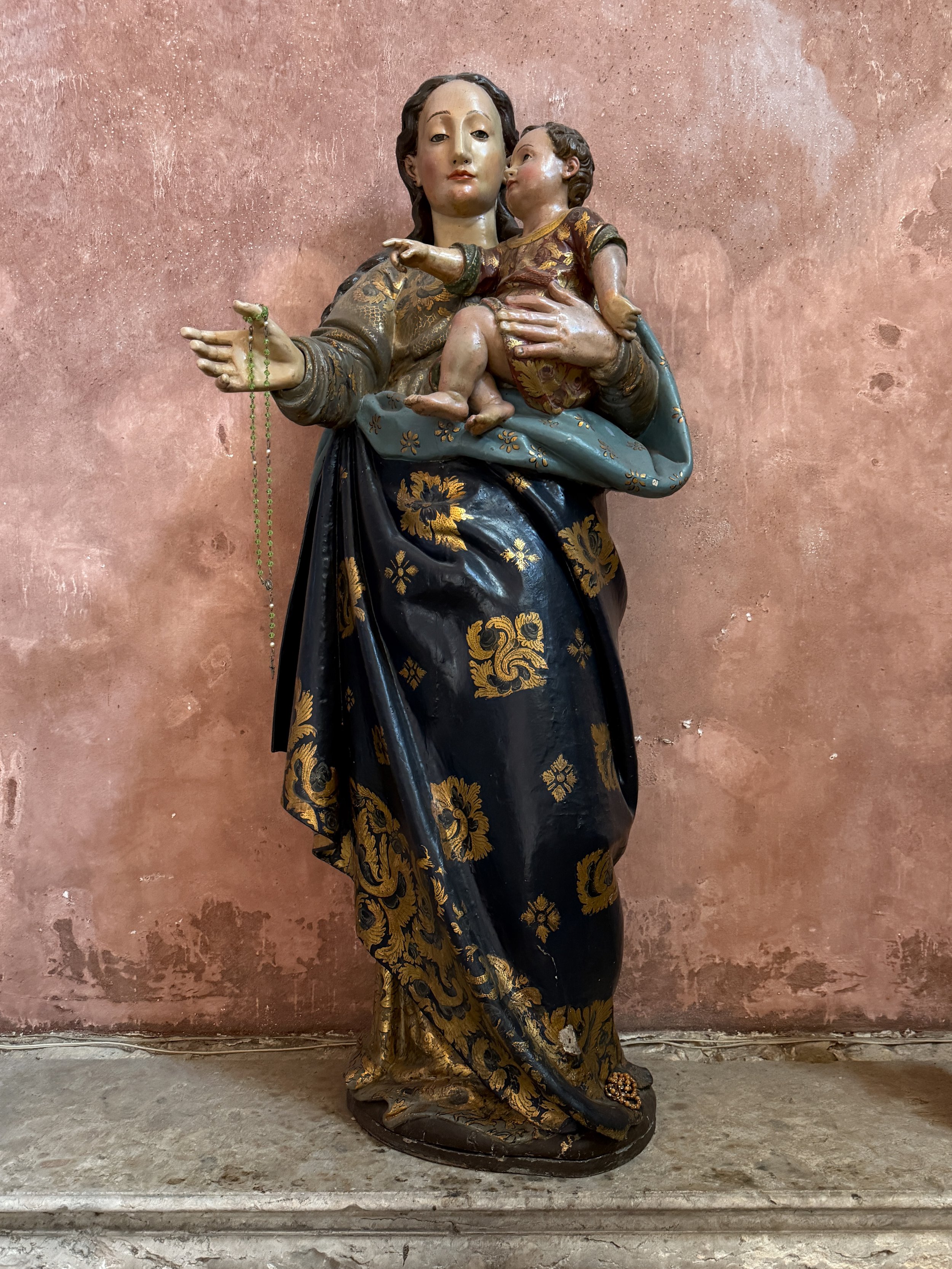
A statue of the Virgin Mary as Our Lady of the Rosary

The Church That Refused to Hide Its Pain

Lisbon does polished beautifully — the colorful façades, the shiny blue tiles, the pastry cases that look like art installations. But São Domingos offers something braver. It’s a church that said no to cosmetic miracles, a reminder that survival itself can be sacred.

Maybe that’s what makes it unforgettable. The gold is gone, the glory has burned away, and yet what’s left feels closer to the truth — the raw, cracked heart of a city that refuses to give up. Lisbon rebuilt itself a dozen times over, but here, at São Domingos, it decided to remember instead. 

Visiting São Domingos 

You’ll find Igreja de São Domingos tucked just off Rossio Square, in the Largo de São Domingos, where locals queue for ginjinha (Lisbon’s famous cherry liqueur) right outside its doors. It’s hard to miss — the façade is stately but unassuming, the real drama waiting inside.

Hours: The church is usually open daily from 7:30 a.m. to 7 p.m., and entry is free. Early morning or late afternoon is best if you want to feel the light shifting across the walls. –Wally

Igreja de São Domingos

Largo São Domingos
1150-320 Lisboa
Portugal
 

Antalya’s Ancient Ruins: Termessos to Aspendos

Beyond Antalya’s beaches and blue waters lies a world of ancient cities, Roman theaters and mountain-top fortresses — just waiting for you to explore.

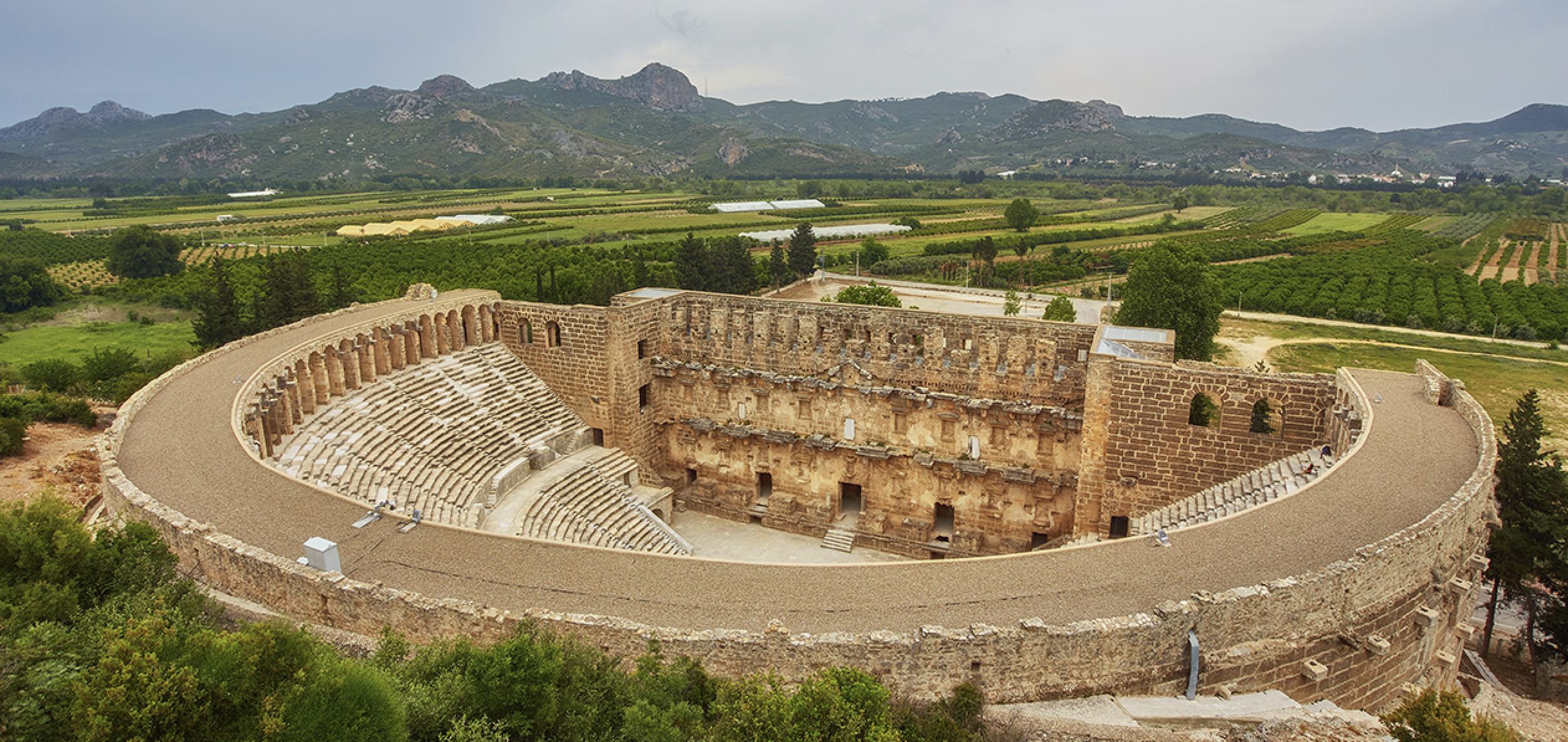
The Aspendos Theater in Turkey seen from above

Aspendos, Turkey is home to one of the best-preserved Ancient Roman theaters.

Antalya might be best known for its sun-baked beaches and shimmering coastline — but it’s also teeming with ancient remains. Once ruled by the civilizations of Lycia, Pamphylia and the Roman Empire, this region is dotted with some of the best-preserved archaeological sites in Turkey (now officially spelled Türkiye). Two standout destinations — Aspendos and Termessos — offer very different windows into life in the ancient world. 
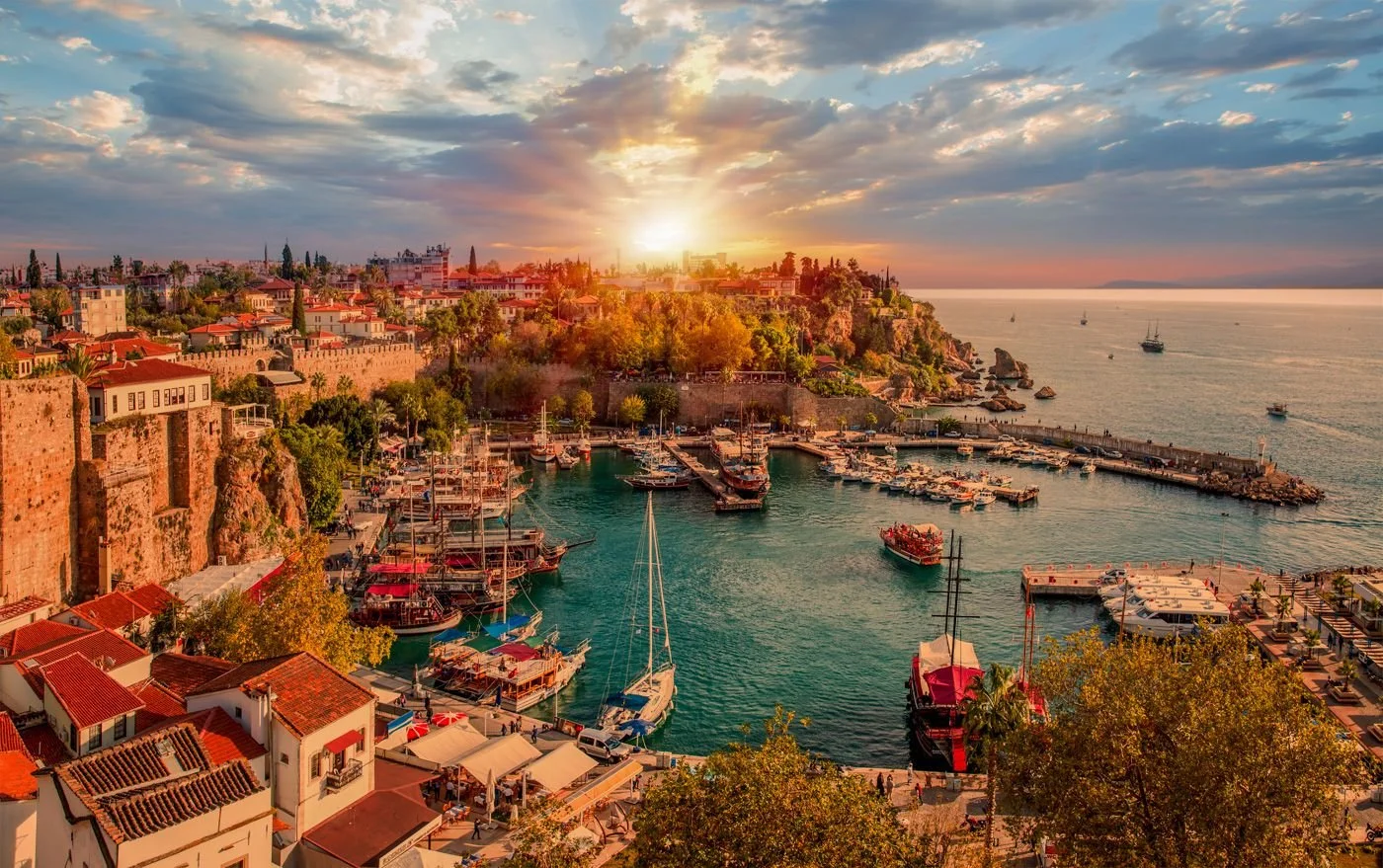
A harbor with sailboats and rocky hillsides in Antalya, Turkey at sunset

How to Get Around Antalya

To truly experience these ruins, an Antalya, Turkey car rental is the way to go. Many sites are tucked into the rugged south Turkey terrain, well beyond the reach of public transport. With a rental car, you can explore at your own pace and make the most of every stop. The site Localrent connects travelers to reliable local rental companies — making it simple and affordable to hit the road.

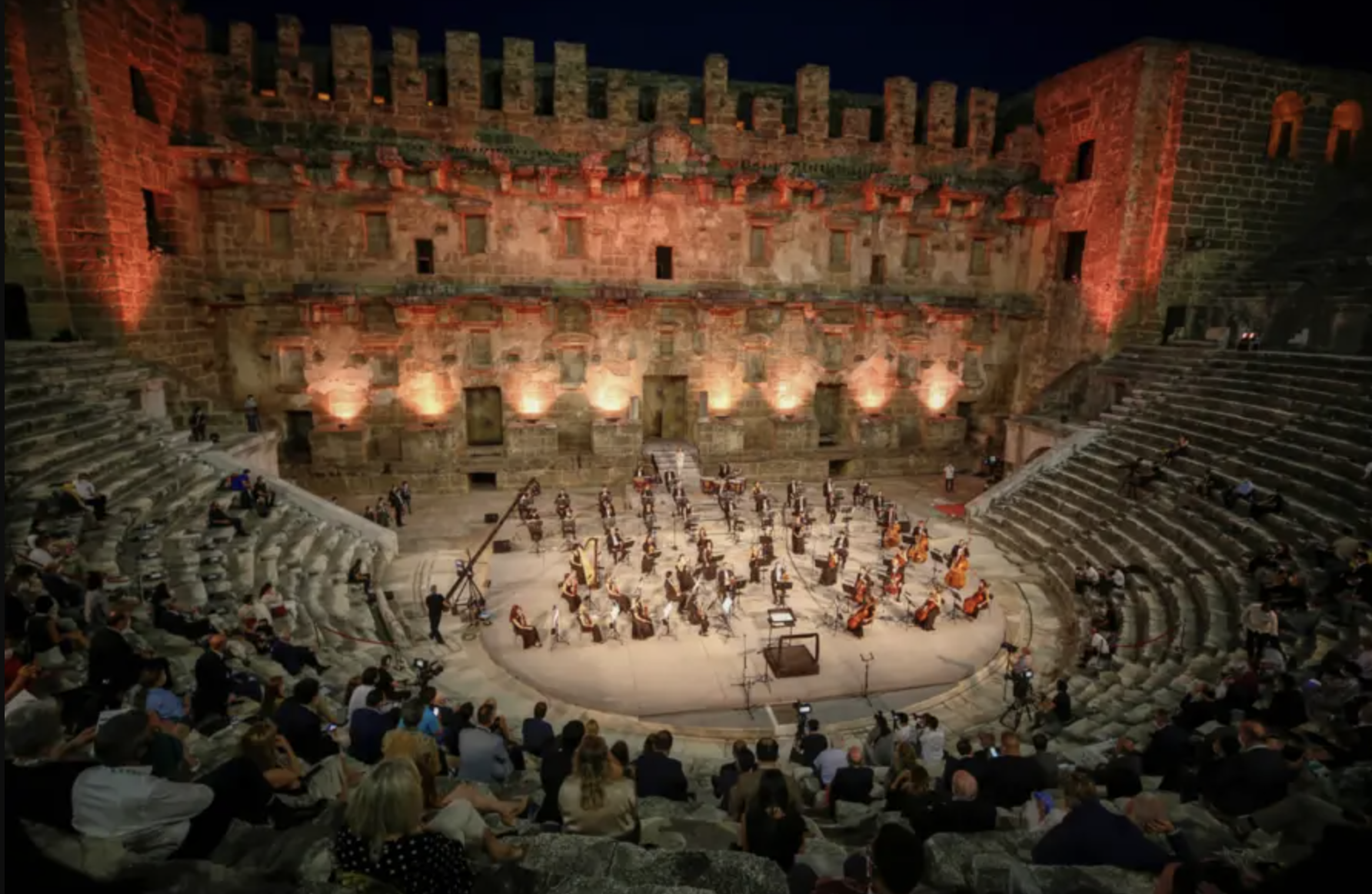
A nighttime musical performance at Aspendos Theater in Turkey

Aspendos: The World’s Best-Preserved Roman Theater

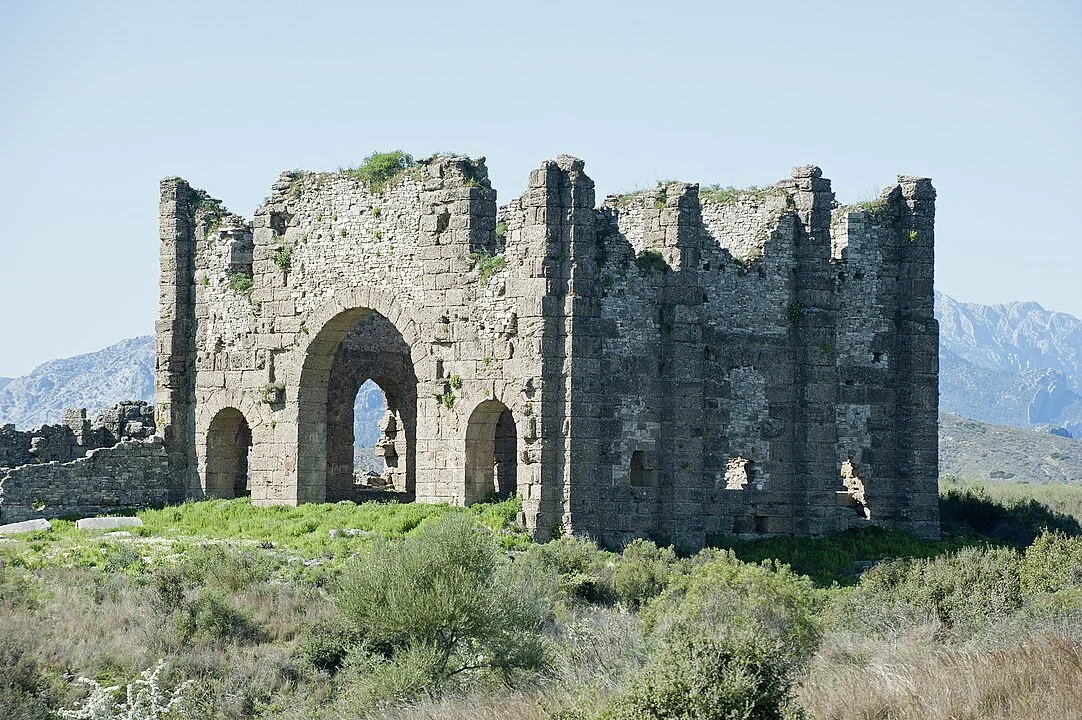
About 25 miles (40 kilometers) east of Antalya sits Aspendos, home to one of the finest surviving Roman theaters anywhere in the world. Built during the 2nd century CE under Emperor Marcus Aurelius, this massive structure once seated up to 20,000 spectators.

The design — celebrated for its impeccable acoustics — is so solid that the theater still hosts concerts and performances today. Step through its grand arched doors and you can almost hear the roar of ancient crowds.

What makes Aspendos unique

  • Unparalleled preservation. Most Roman theaters show their age. Aspendos looks brand new.

  • Astounding acoustics. A whisper on stage can still be heard from the highest seats.

  • Live performances. Each year, the theater comes alive again during the Aspendos International Opera and Ballet Festival.

Beyond the theater itself, visitors can explore a Roman aqueduct, a basilica and the remnants of a bustling marketplace — reminders of Aspendos’ glory days as a commercial hub.

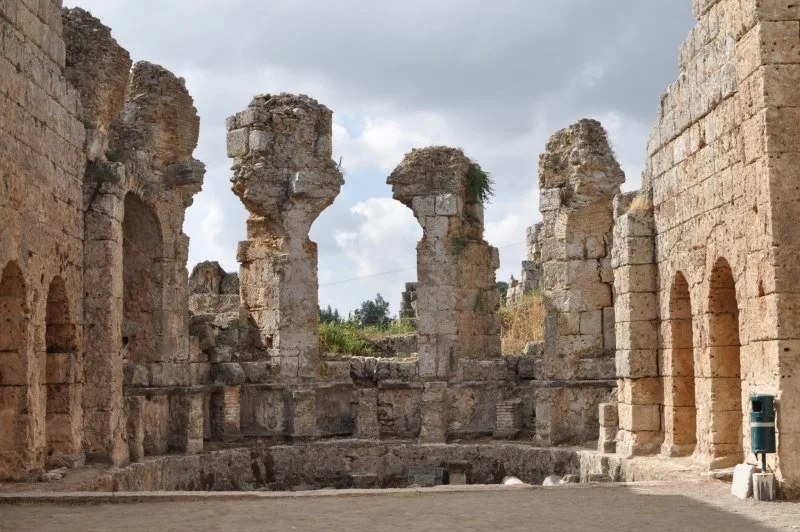
Ruined arches in Perge, Turkey

Perge: Pamphylia’s Ancient Metropolis

Just 11 miles (17 kilometers) east of Antalya, the sprawling ruins of Perge reveal a city that flourished at the crossroads of Greek and Roman influence. Set in Pamphylia — whose name means “Land of All Tribes” — this diverse, cosmopolitan region saw Perge rise from Bronze Age roots into one of its most impressive urban centers, with colonnaded streets, ornate bathhouses and towering gates.

The Hellenistic-Roman theater seated 12,000 people at its height, while the adjacent stadium — one of the largest in Anatolia — hosted athletic competitions and gladiator fights.

Don’t miss in Perge

  • The ancient gate. Pass through imposing Hellenistic towers that once protected the city.

  • Roman baths. See beautifully preserved public baths, some still decorated with intricate mosaics.

  • Colonnaded streets. Walk scenic boulevards lined with ancient water channels.

Perge also holds a place in early Christian history — Saint Paul is said to have preached here during his journeys.

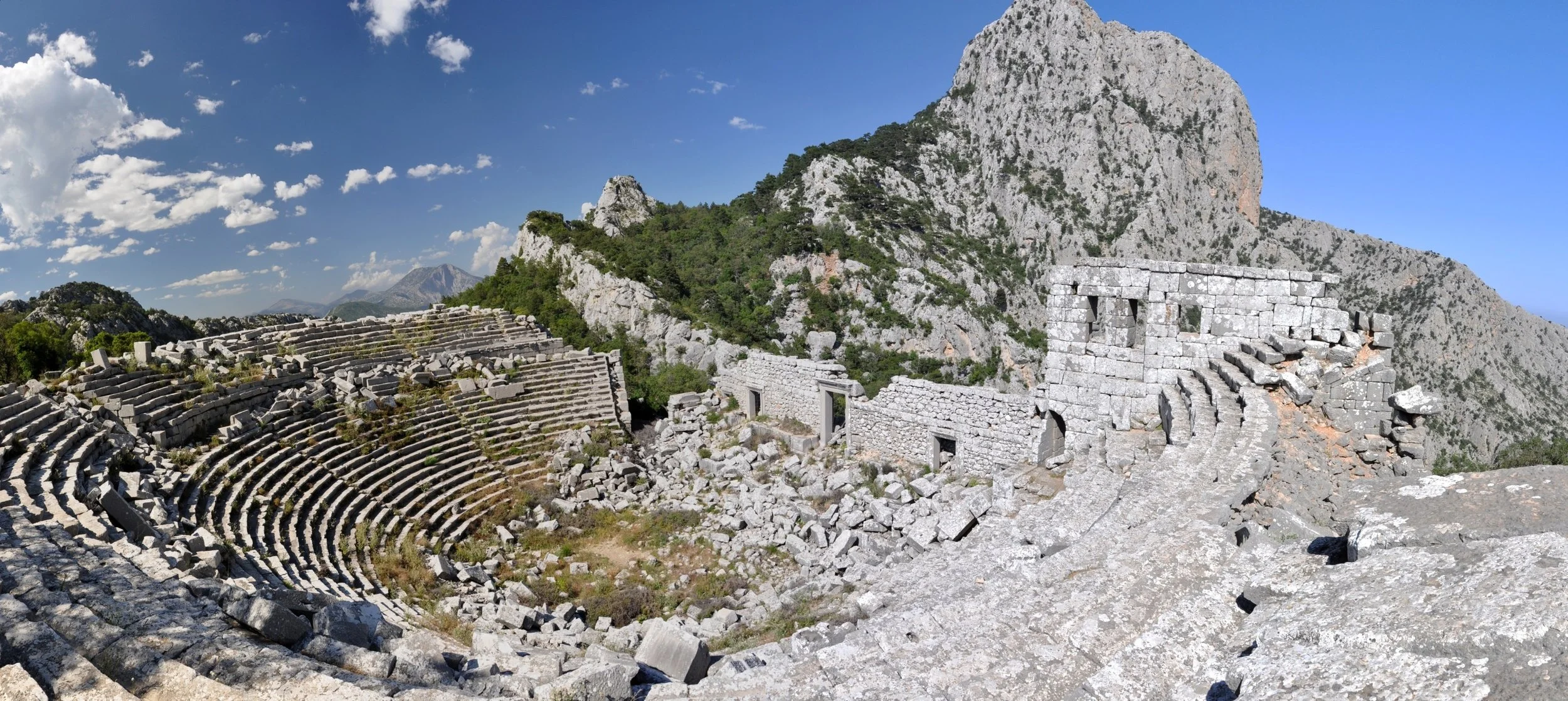
Termessos Theater, an amphitheater build into the side of the Taurus Mountains in Turkey

Termessos: The Eagle’s Nest of the Taurus Mountains

Unlike most ancient cities in Turkey, Termessos wasn’t built by the Greeks or Romans. This was a proud Pisidian stronghold, perched over 3,000 feet (1,000 meters) high in the Taurus Mountains. About 19 miles (30 kilometers) northwest of Antalya, Termessos offers a rare mix of rugged natural beauty and historic significance.

In 333 BCE, Termessos famously resisted Alexander the Great — thanks largely to its sheer, defensible terrain. The ruins remain largely unrestored today, adding to the feeling that you’ve stumbled across a lost world.

Highlights of Termessos

  • A theater with a view. Carved into the mountainside, this theater offers stunning vistas of the Taurus peaks.

  • Ancient sarcophagi and tombs. Elaborate stone tombs honoring Termessos’ kings and heroes are scattered across the site.

  • An untouched atmosphere. Fewer crowds mean Termessos feels wild, mysterious and adventurous.

Getting there: A rental car is essential. After parking, visitors must hike a rugged path to the ruins — good walking shoes, water and an early start are also a must.

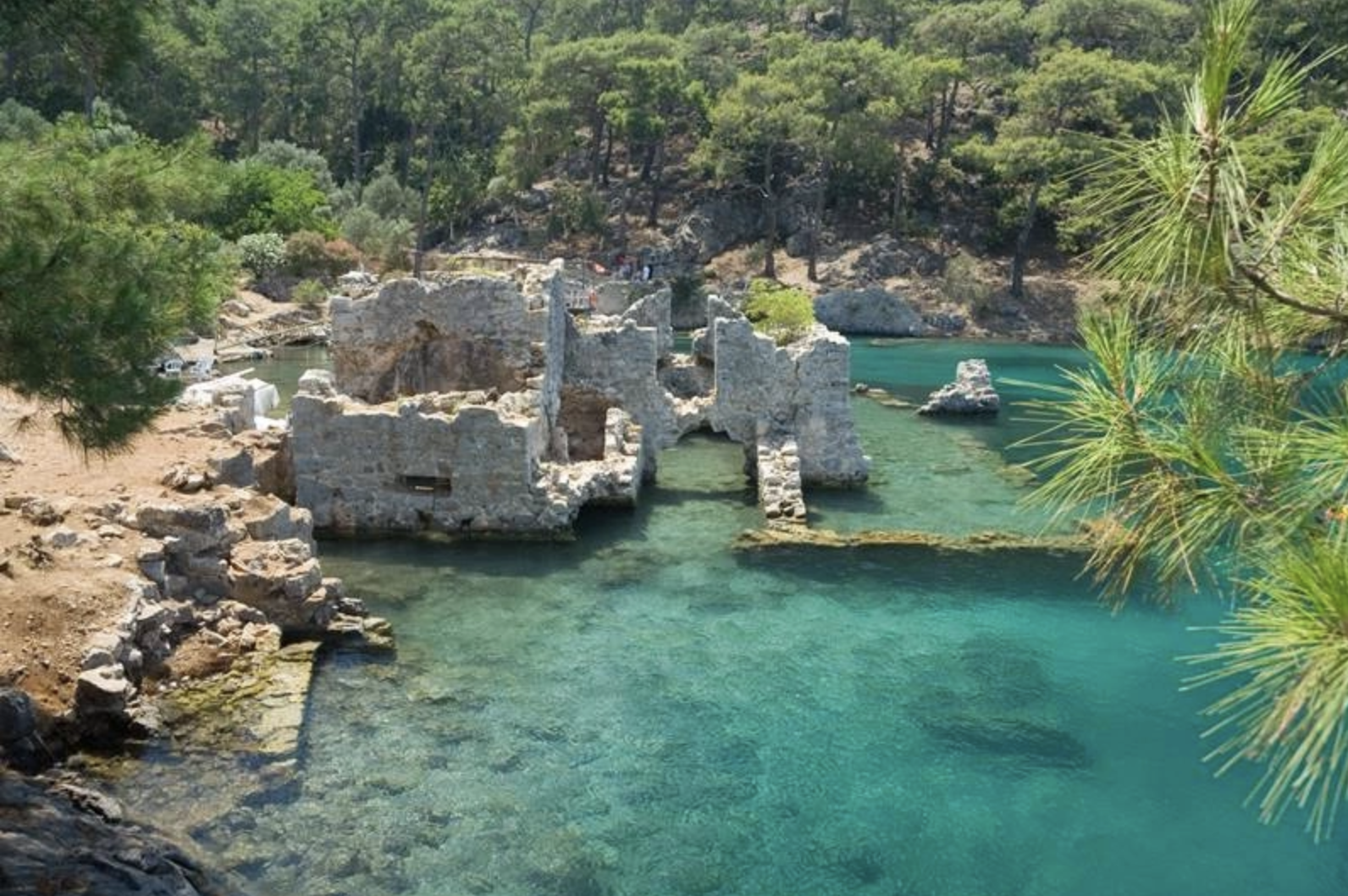
Ruins at Phaselis, Turkey, that go right into the aqua-colored water, surrounded by lush greenery

Phaselis: A Seaside Sanctuary of Antiquity

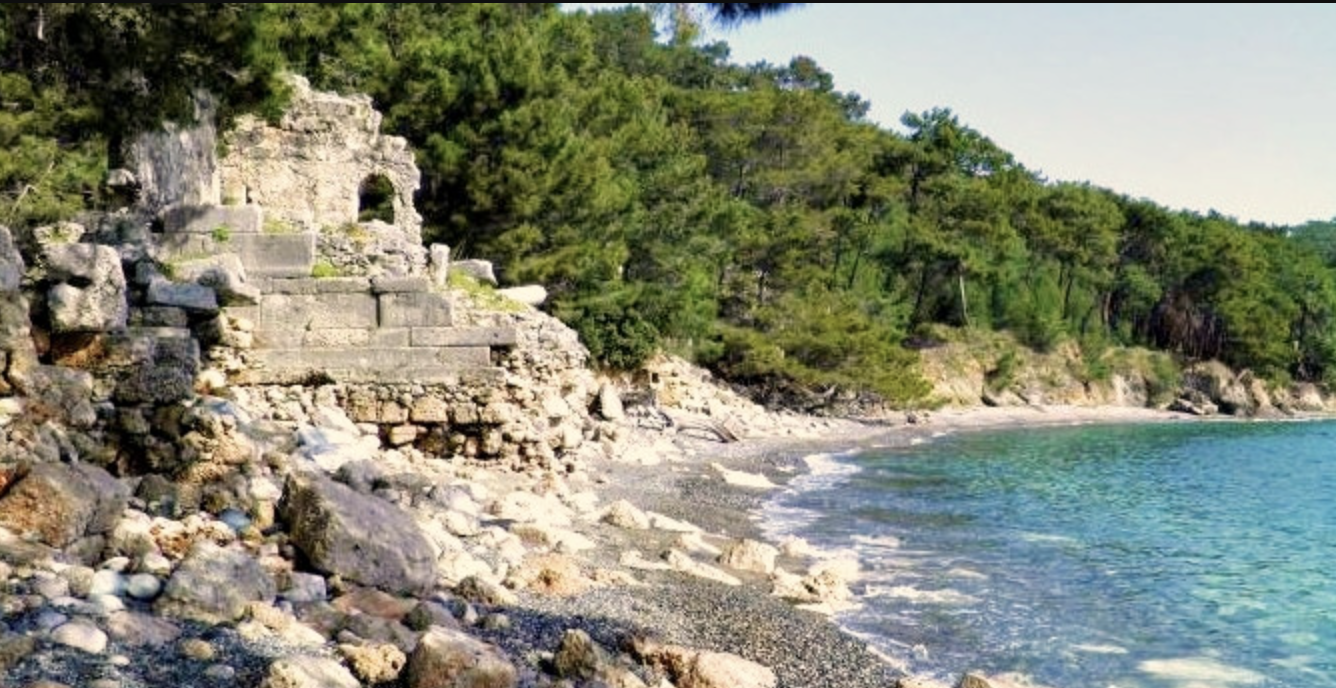
If you dream of exploring ancient ruins with your toes in the sand, Phaselis is for you. Nestled between pine forests and the Mediterranean’s turquoise waters, this ancient Greek and Roman city blends history and nature in spectacular fashion.

Founded in the 7th century BCE, Phaselis thrived as a major port with three harbors. Today you can wander among crumbling Roman baths, an ancient aqueduct and the remains of its theater — all just steps from the beach.

Why visit Phaselis

  • Beachfront ruins. Stroll through ancient history, then dive straight into the sea.

  • A peaceful escape. Phaselis is quieter and more serene than other major ruins.

  • Pine forest scenery. The combination of crumbling marble and towering pines makes for unforgettable photos.

Phaselis is easily reached by car, making an Antalya, Turkey car rental a smart choice if you want the freedom to explore multiple ruins in a single day.

The Roman basilica at Aspendos in Turkey

The Roman basilica at Aspendos

Travel Tips for Visiting Antalya’s Ancient Ruins

Best time to visit

  • Spring (April to June) and fall (September to November) bring mild weather and smaller crowds. 

  • Summer (July and August) is scorching — plan early morning visits to beat the heat.

What to bring

  • Sturdy walking shoes. Expect uneven paths and lots of stairs. 

  • Sunblock, a hat and plenty of water. Shade is scarce. 

  • A camera. You’ll want proof you walked through centuries of history. 

Waterfront stone ruins in Phaselis, Turkey

A Timeless Adventure Awaits

From the soaring mountain stronghold of Termessos to the seaside serenity of Phaselis, Antalya’s ancient ruins offer a breathtaking journey into the past. Each site tells a story of civilizations that shaped art, architecture and culture for millennia.

If you want to experience the full sweep of this history — at your own pace and on your own terms — renting a car is the best way to go. With the freedom to chart your course, you’ll uncover more than just ruins. You’ll find a timeless adventure waiting around every curve of the road. –Dana White


Echos of the Roman Empire

Itálica, Spain: Birthplace of the emperors Trajan and Hadrian — and the Dragonpit in Game of Thrones

Volubilis, Morocco: Roman mosaics and one unforgettable phallus

Itálica’s Rich Roman Heritage

Explore one of the largest amphitheaters (as seen on Game of Thrones!) and admire the impressive mosaics on a day trip from Seville to the ruins of the first Ancient Roman town outside of Italy. 

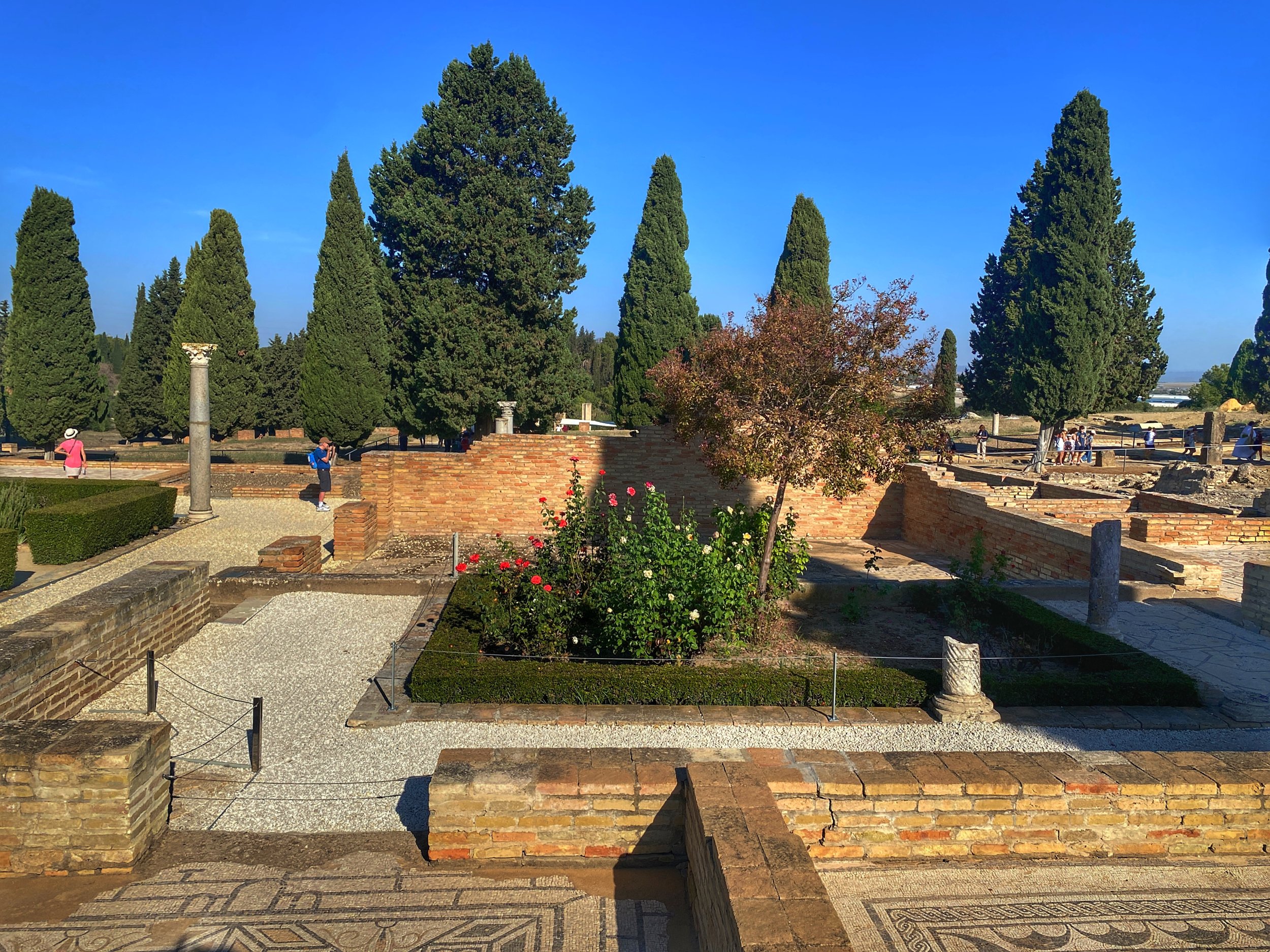
House of the Birds at Italica, Spain

The House of the Birds is the largest complex at Itálica.

Since Wally and I were spending five days in Sevilla, Spain, we figured we could add the nearby Roman ruins of Itálica to our itinerary. It reminded us of visiting the ruins of Volubilis outside of the city of Meknès, Morocco (although the Spanish weather was much nicer). We both share a passion for history: Wally’s childhood interest in Ancient Rome matches my fascination with Ancient Egypt (which we were fortunate enough to experience together, but I digress). 

“The amphitheater was used as a filming location for ‘Game of Thrones.’

Thanks to some CGI magic, it served as the Dragonpit.”
A nude statue of the goddess Venus, without head or arms, at Italica in Spain

The Venus of Itálica was unearthed in 1940. This is a replica — the actual statue is in the Archaeological Museum of Seville.

The archaeological park of Itálica (which Wally joking referred to as Italics) is located about 30 minutes northwest of Sevilla, in the municipality of Santiponce, and is one of the cultural points of interest along the Ruta Bética Romana, the Roman Baetica Route — an ancient Roman road that runs through the provinces of Sevilla, Cádiz and Córdoba. If you’re so inclined, you can walk it, though it’ll take you weeks. 

We had already done our fair share of walking, and since it was unseasonably hot, opted to take the 170A bus from the Plaza de Armas station, which typically departs every half hour from Sevilla. 

Statue of the goddess Diana at Italica, Spain

A replica of the 2nd century statue of Diana, goddess of the hunt, greets visitors to Itálica.

Roman Expansion: A Brief History of Itálica

Itálica was the first Roman city established outside of Italy and thrived from the 2nd to the 4th century CE. Its origins can be traced back to General Scipio Africanus’ victory at Ilipa (near Sevilla) in 206 CE. During the Second Punic War, Scipio’s tactical efforts against Hannibal and the Carthaginians focused on the lower Guadalquivir valley, and after conquering the region, he established the settlement for his veteran troops to live.

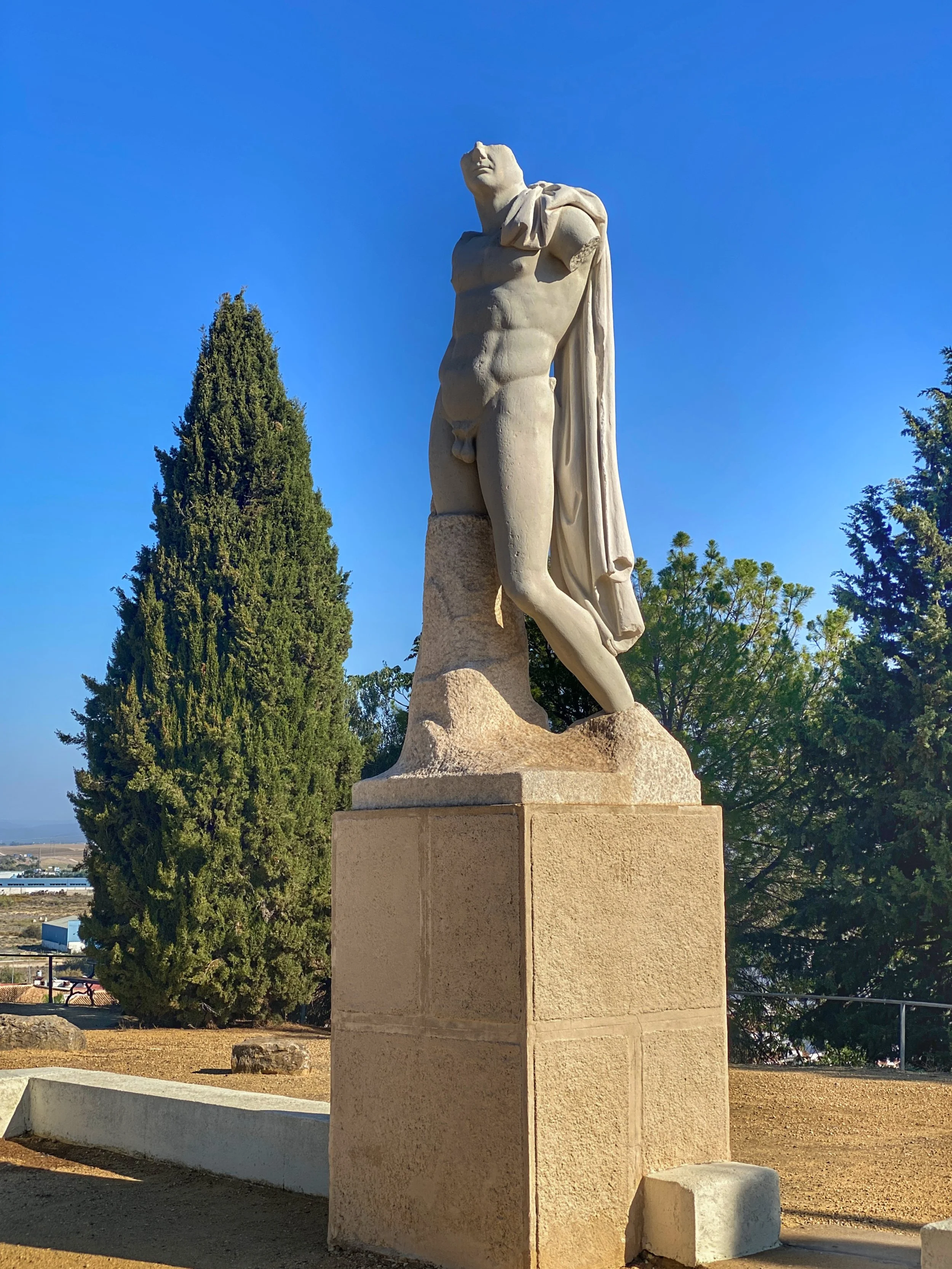
Itálica bore witness to the births of Trajan (53-117 CE) and his adopted son and successor, Hadrian (76-138 CE) who were the first Roman emperors born outside of Italy. 

Statue of the Roman Emperor Hadrian, nude, at Italica, Spain

A reproduction of a statue of the Roman emperor Trajan in heroic pose found in Itálica. The original can be seen at the — you guessed it — Archaeological Museum of Seville. 

Hadrian expanded the city to include the Urbs Nova, literally the “New City,” added an impressive amphitheater and elevated its status to colonia—the highest designation for a Roman city. Additionally, Itálica amassed significant wealth from the exportation of grain and olive oil grown in the fertile soil of the Gerena Depression. These goods were transported to the Guadalquivir River and shipped to Rome by boat.

However, by the 4th century, the combined impact of mass deforestation and poor agricultural practices left Itálica’s river port dry, ultimately causing the city to be abandoned.

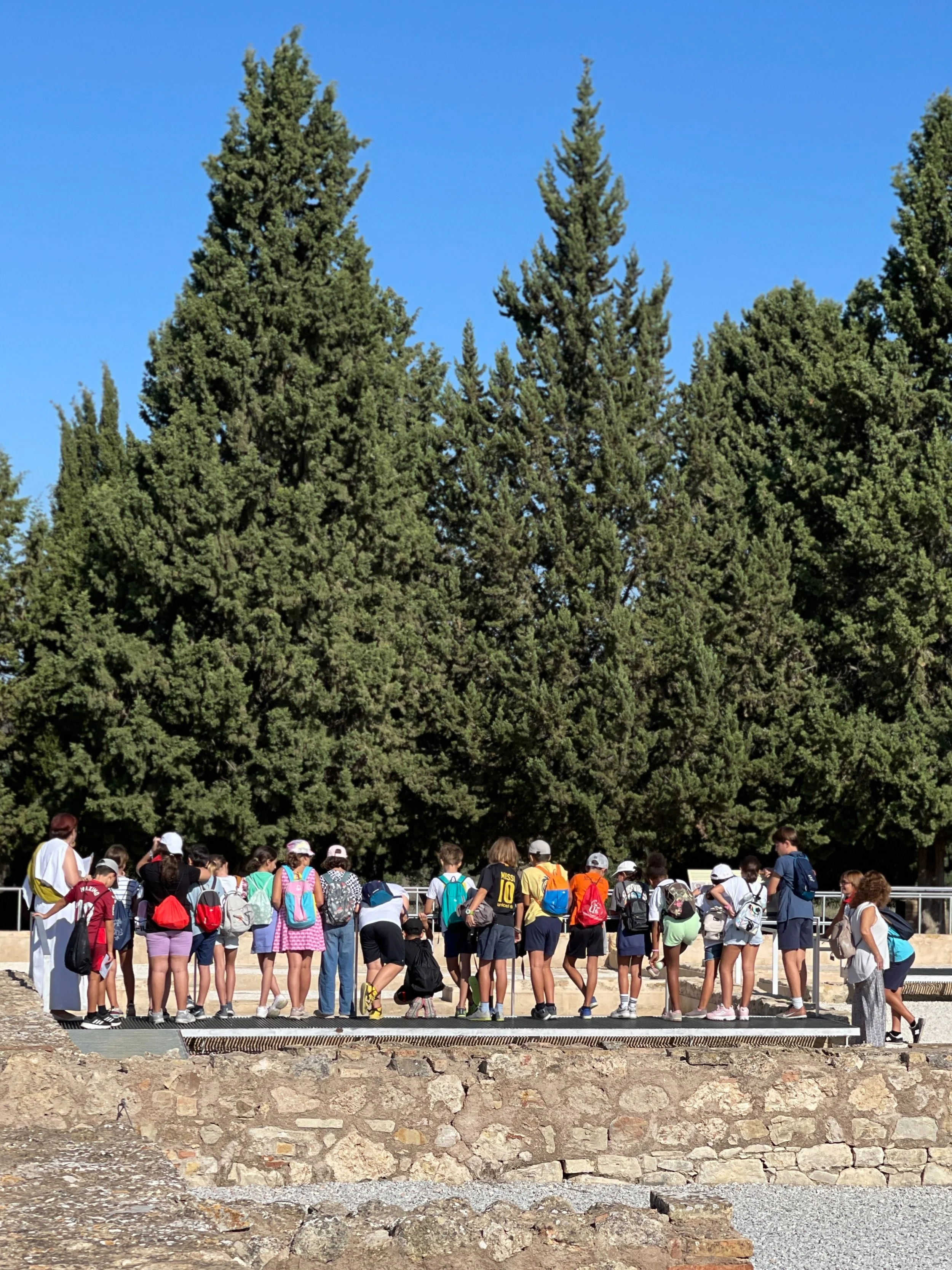
A row of schoolchildren look at the mosaics at Italica in Spain

Aside from a group of schoolchildren, we pretty much had Itálica to ourselves.

Visiting Itálica

After a short walk from the bus stop, Wally and I arrived at the park entrance. We purchased the very affordable admission: 3€ ($3.25) for both of us. It’s free for EU citizens. Bring some cash — they don’t take credit cards. 

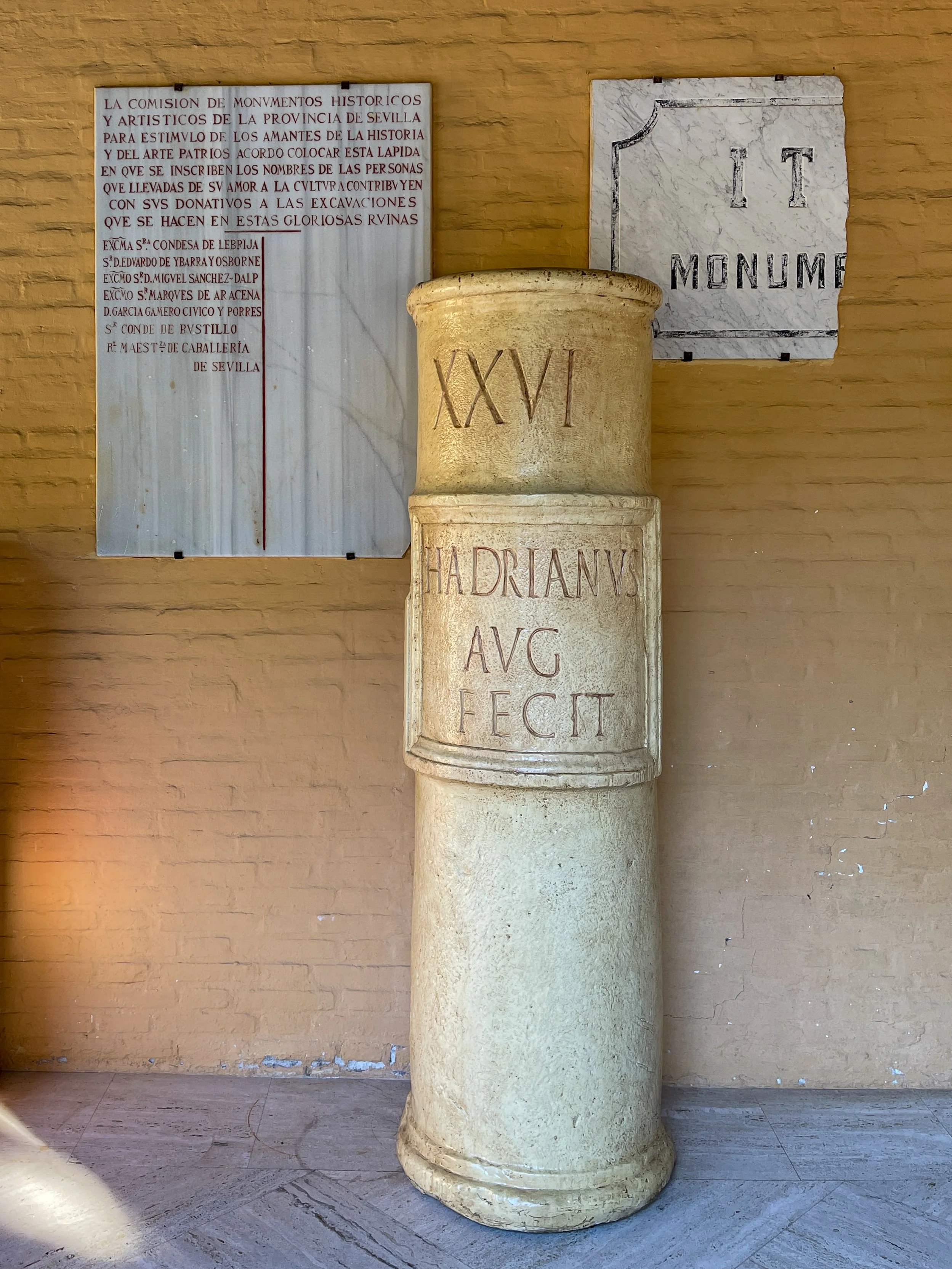
Historic plaques and a column bearing the emperor Hadrian's name at the Roman ruins of Italica in Spain

Plaques and a milestone with Hadrian’s name on it

We made a detour to the restroom, which is located in a nearby building, where we saw a commemorative plaque bearing the names of individuals who financed the early excavations at Itálica, as well as a marble milestone inscribed with Emperor Hadrian’s name.

I wasn’t sure what to expect. Most exposed ruins, those not buried beneath sand or soil, were commonly pillaged and used as a source of building materials by whomever occupied the region after they had been abandoned. Additional bits were plundered during the French occupation of Spain, and in the 18th century, a mosaic called the Loves of Zeus was taken by Regla Manjón, the Countess of Lebrija, and incorporated into her palatial home in Sevilla. Several artifacts, including the erotic Abduction of Hylas, are displayed at the Museo Arqueológico de Sevilla (the Archeological Museum of Seville). 

In 1912, the complex was officially declared a national monument, ensuring its conservation and protection against further looting.

Exterior of the amphitheater at Italica, Spain

Start your visit to Itálica by exploring the amphitheater.

Game On: Exploring the Amphitheater

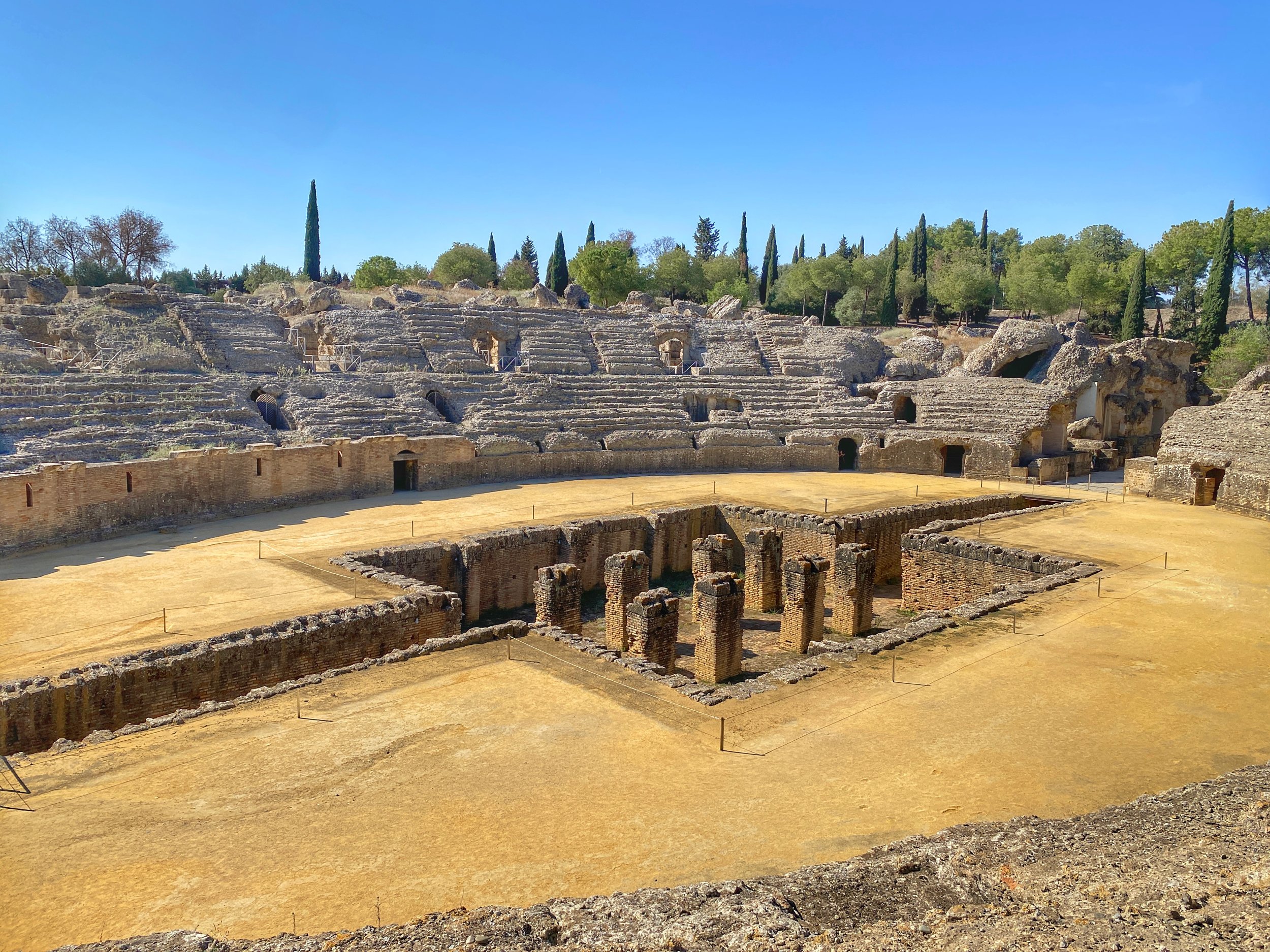
Situated just beyond the park’s entrance are the remains of the amphitheater. It was built between 117 and 138 CE and commissioned by Emperor Hadrian. When it was completed, it ranked among the largest in the Roman Empire and could accommodate up to 30,000 spectators — about half as many as the Colosseum in Rome, but far exceeding the scale required for a community of 8,000 inhabitants.

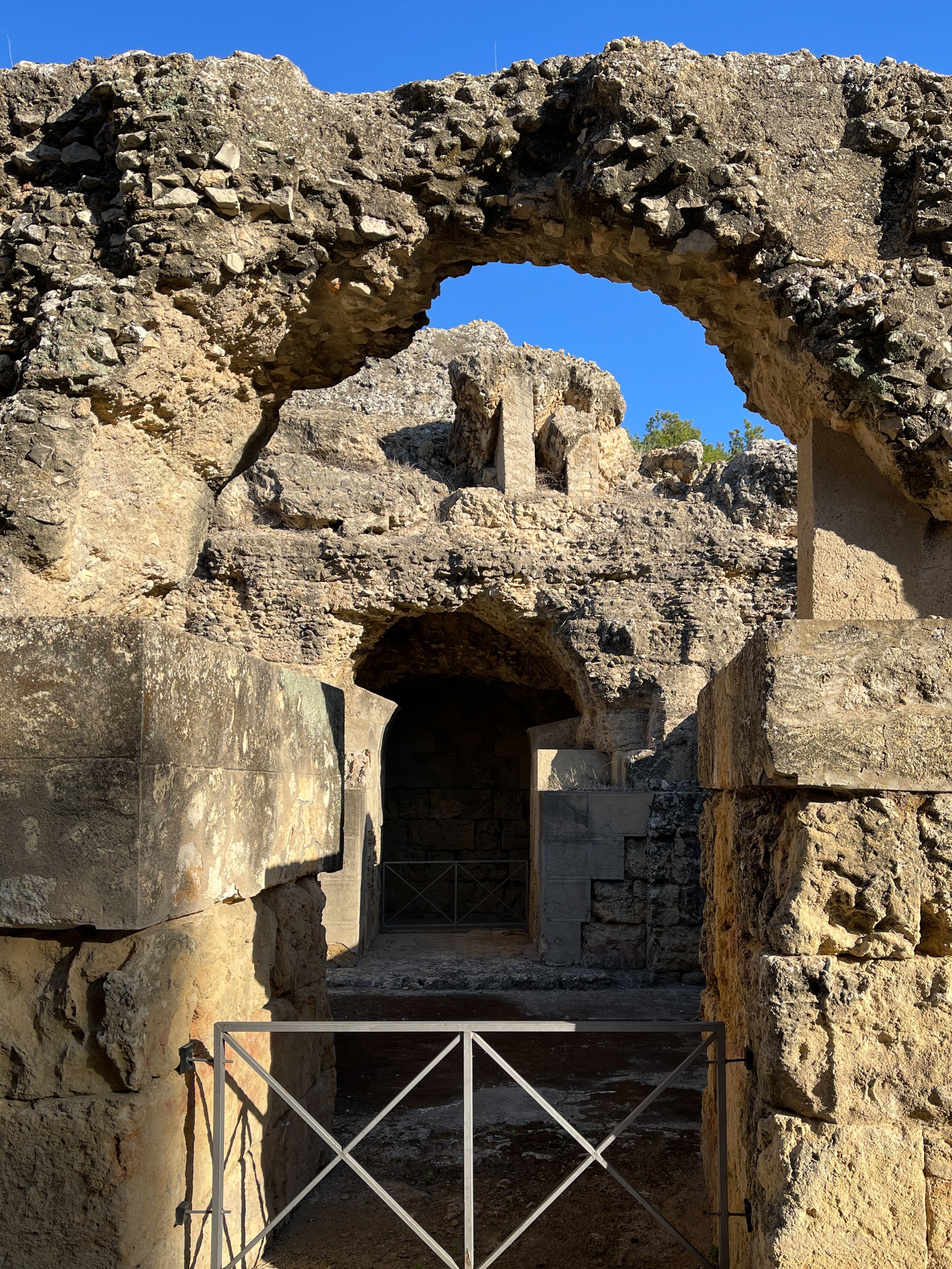
Archway at the amphitheater at Italica, Spain

The interior portions are closed off to the public.

The site was used as a filming location and featured in the penultimate season of Game of Thrones. Thanks to some CGI-generated magic, it served as the Dragonpit, where three members of major houses have a historic meeting about a common enemy.

The interior of the amphitheater at Italica, Spain, which was used as the Dragonpit in the TV show Game of Thrones

Attention, Game of Thrones fans! The amphitheater at Itálica, with some help from CGI, became the Dragonpit.

The amphitheater was the stage for the spectacle of bloodsport: gladiatorial combat, historic battle re-creations and animal hunts. Romans of all social classes attended, and the stand levels were carefully regulated and divided into a hierarchy based on wealth, gender and status. The lowest tier, or ima cavea, was closest to the action, reserved for the highest-ranking males. Women and the poor, meanwhile, sat or stood on wooden benches in the highest part of the stands, the suma cavea, which was covered by an awning to protect from the heat. 

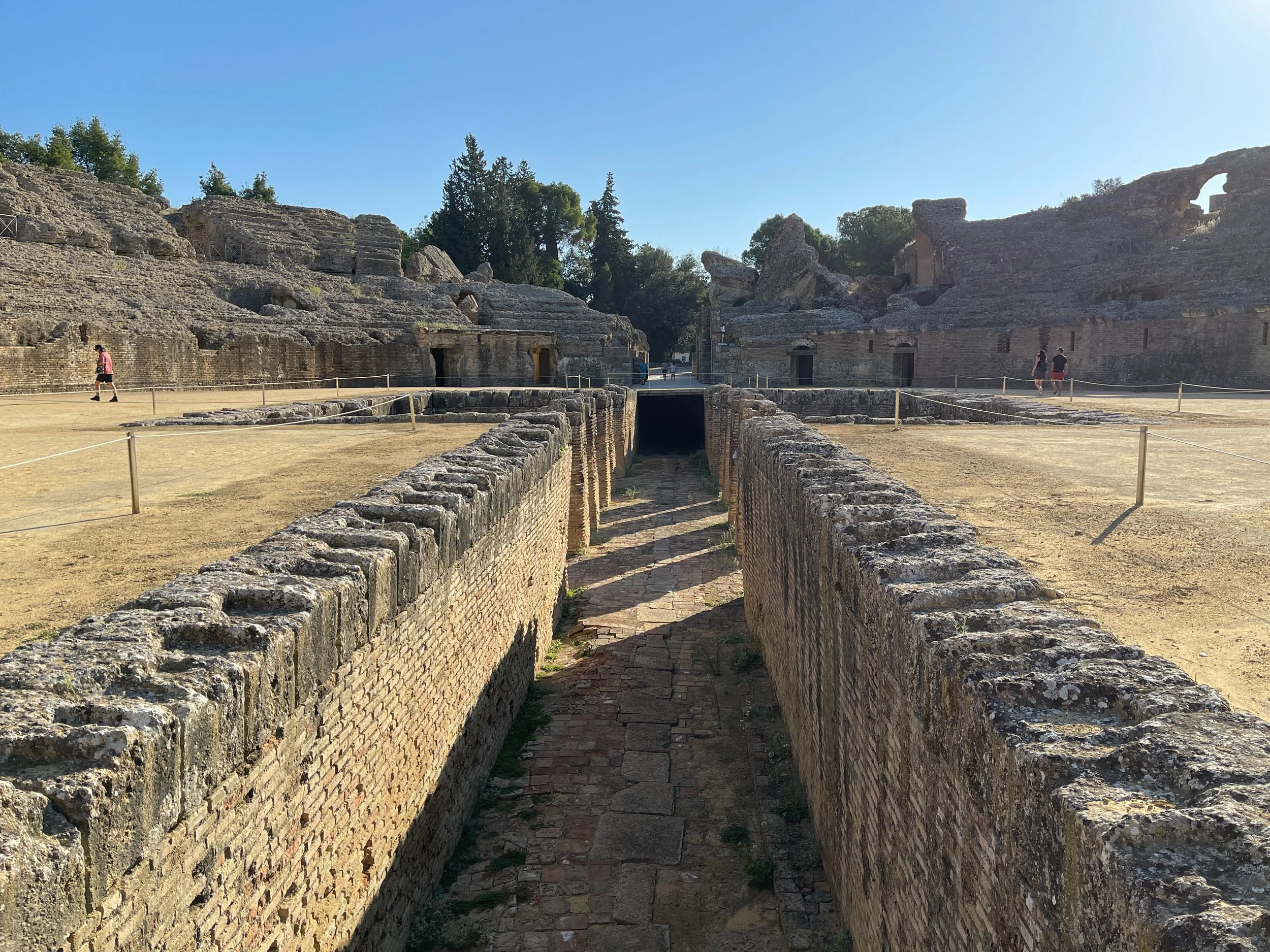
The pit at the amphitheater at Italica, Spain, a straight passageway dug into the floor of the arena

The passage leading to the fossa beastiaria, where wild animals were caged before being released into the amphitheater to be “hunted”

The massive rectangular pit at the center of the arena, known as the fossa beastiaria, was used to house the caged wild beasts that appeared in the spectacles prior to being released for the entertainment of the audience.

A labyrinth mosaic by a row of cypress trees at Italica, Spain

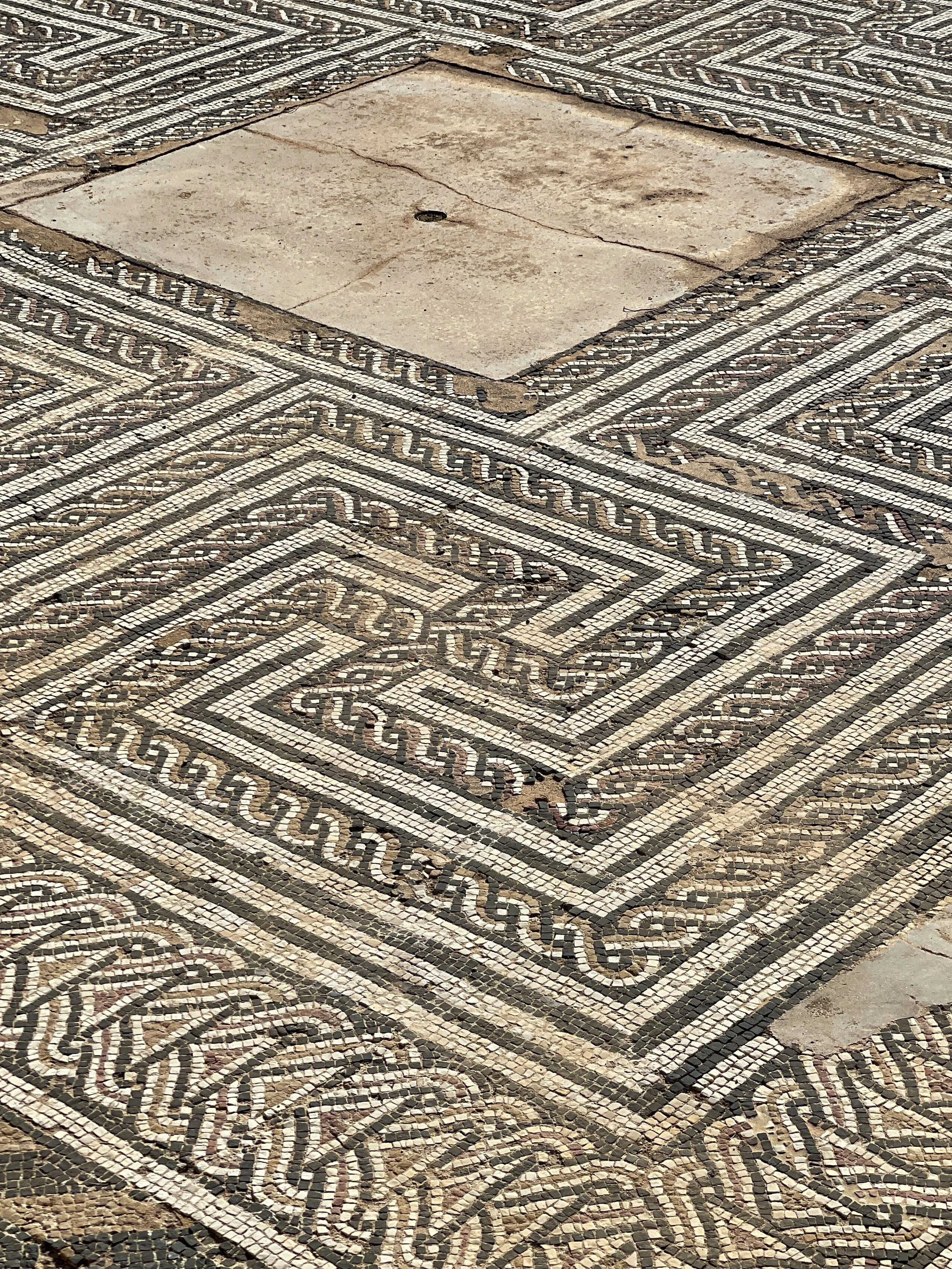
A variety of rather well-preserved murals can be seen at Itálica — though many of them are missing their central images.

Main Street Mosaics

We paused by a sign where the remnants of the city wall stood. In Roman times, the entire city was bounded by a walled perimeter. From here, you can glimpse the main sewer line, which runs through the Cardo Maximus (Latin for Main Street).

Beyond the amphitheater, large villas of prosperous families and municipal buildings have been excavated, many with colorful well-preserved mosaics. 

The peristyle House of Exedra at Italica, Spain

The House of Exedra was a private club of sorts for the elite of Itálica.

Exedra, Exedra, Exedra

Spanning a surface area of 43,056 square feet (4,000 square meters), the Casa de la Exedra was one of the largest municipal buildings in Itálica. Due to its size and the inclusion of specific rooms, like the palestra (an open-air gymnasium) and latrine, historians have suggested that this structure probably served as a private club. Alongside the entrance were five tabernae, or shops.

At the heart of the complex is the peristyle, a garden courtyard featuring a curvilinear fountain. Adjacent to this was the exedra, a semicircular chamber with seating that served as a gathering place for upper-class citizens to engage in scholarly conversation. Originally, this area was covered by a high vault. 

It also featured a thermae, which consisted of a series of rooms designed for bathing with hot, lukewarm and cold water — caldarium, tepidarium and frigidarium, respectively — as well as a changing room for patrons.

Pygmies fighting cranes in a mosaic in the latrine of the House of Exedra at Italica, Spain

Potty humor? The floor mosaic of the latrine is embellished with scenes featuring well-endowed pygmies battling cranes.

As we walked along the perimeter of the structure, we stopped to take a look at the latrine. Although it’s been reduced to a shell, it still retains its marble bench with keyhole-shaped openings. The room was open, and the “toilets” had no partitions between them. When nature called, Romans had no issue hiking up their togas to conduct their business in close proximity to one another.

A bench used as toilets at the latrine in the House of Exedra at Italica in Spain

Look how close you had to sit to other people while taking a dump. Could someone pass the sponge stick, please?

The bench is positioned above a channel where a stream of water once pushed the waste into the underground sewage system. An attendant would provide patrons with a tersorium, a sea sponge affixed to a wooden stick, which was used instead of toilet paper to wipe their nether regions. These communal sponges were then rinsed in running water and submerged in a large pot filled with vinegar to sanitize them. Eww.

“At least they used vinegar,” Wally said.

Mosaic of the sea god Neptune, with seahorses and other marine creatures at the House of Neptune at Italica, Spain

The god Neptune, king of the sea, rules over a variety of mythological water creatures.

Go Fish: The Neptune Building 

Although it hasn’t been completely excavated, the work carried out to date has indicated that one part of the Edificio de Neptuno functioned as a thermal bath, while another served as a municipal building.

Both structures cover an entire block, and the municipal building has intricate mosaics depicting Theseus and the Minotaur, along with a mosaic of Bacchus, the god of wine. The Theseus mosaic covers the floor of a grand hall and originally had a central panel portraying the divine hero within the Minotaur’s labyrinth. Meanwhile, the Bacchus mosaic features dancing maenads, satyrs, centaurs and tigers — figures typical of Bacchus’ entourage. Similar to the mosaic of Theseus, the depiction of Bacchus, the Greek Dionysus, is also missing.

Floor mosaic in the frigidarium of the House of Neptune at Italica, Spain

At the time we visited, the mosaic was covered by netting for protection — but you can see a crocodile chasing a pygmy at the bottom.

The building that contained the bathhouse retains the remnants of its underground heating system. Within the frigidarium is the mosaic that gives the buildings its name. At its center is the sea god, wielding his trident atop a chariot pulled by two seahorses and surrounded by dolphins, fish molluscs and crustaceans. Its border includes scenes of fishing and combat with Egyptian iconography, depicting a hippopotamus, a palm tree, and the clearly popular but bizarre motif of pygmies battling cranes and crocodiles.

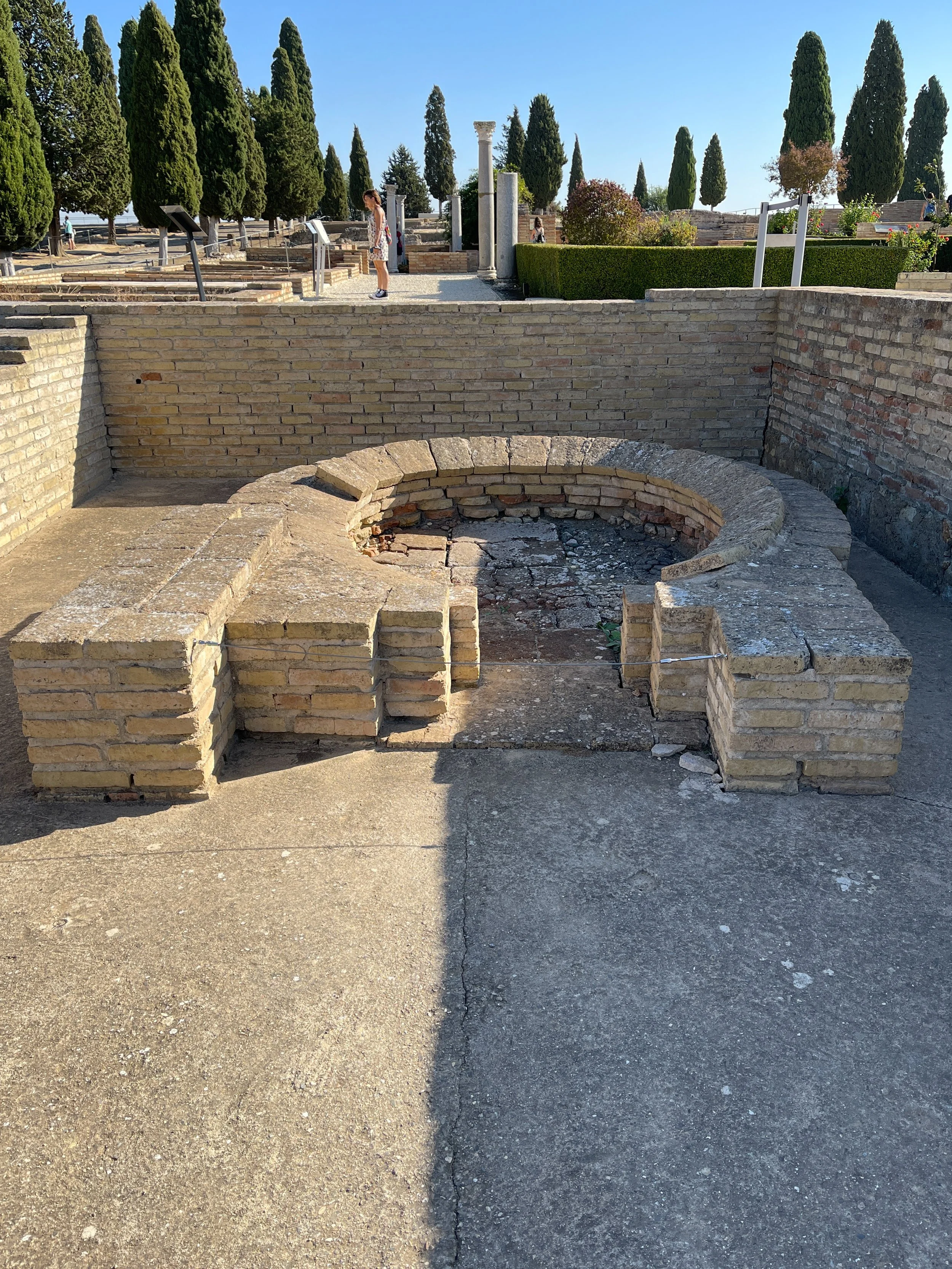
The oven at a bakery in one of the tabernae, or shops, at Italica, Spain

The remains of an oven from a bakery, one of the tabernae, or shops that lined the street-side of these luxurious villas.

Tabernae: Rome’s Retail Therapy

Tabernae could often be found along the perimeter of a household and served as an extra source of income for the owner of a villa. They included a variety of businesses, ranging from bakeries selling fresh loaves of bread to shops that produced small terracotta oil lamps called lucernes, and fullonicae, a kind of laundry or dry cleaner, where clothing was washed in a basin and agitated with a mixture of soda ash and urine. (Hey, apparently it worked.)

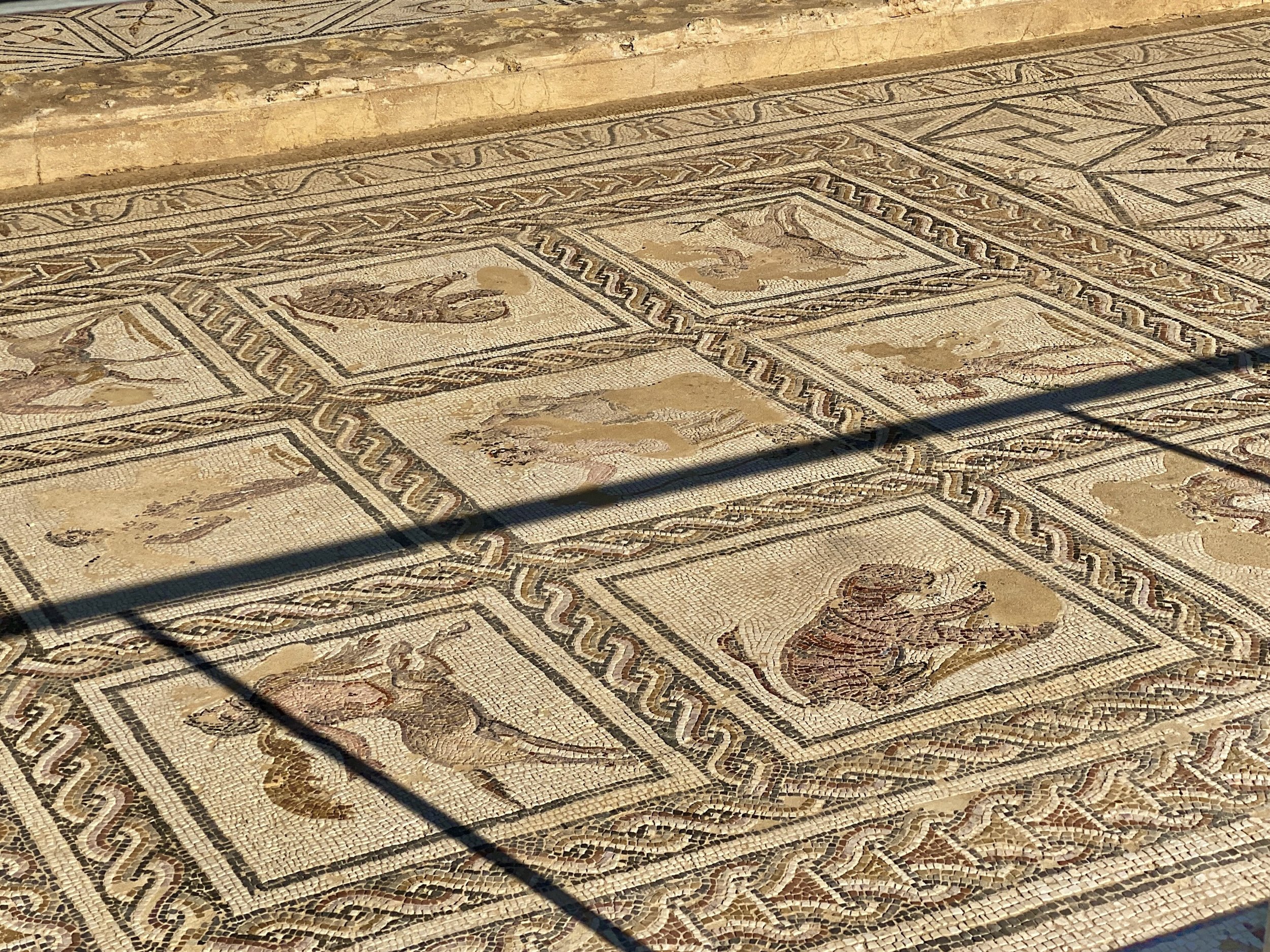
Floor mosaics depicting various types of birds at the House of the Birds in Italica, Spain

The main mosaic at the House of the Birds features various bird species, including a peacock, owl, rooster, pigeon, sparrow, heron, goose, parrot and mallard duck.

Pecking Order at the House of the Birds

The Casa de los Pájaros, also known as the House of the Birds, was the first domus, a private family residence, to be fully excavated in Itálica and likely belonged to an aristocratic family. Covering approximately 18,298 square feet (1,700 square meters), it’s divided into two primary spaces: a public area open to clients, tabernae and a semi-public area for those closely associated with the family; and a private area restricted to family members.

Schoolchildren by a guide dressed in Roman style at the House of the Birds at Italica, Spain

Kids on a field trip wander around the House of the Birds.

Cypress trees stand tall by one of the rooms at the House of the Birds in Italica, Spain, with an intricate mosaic on the floor

A room at the House of the Birds

Colorful geometric mosaic in a room of the House of the Birds at Italica in Spain

A colorful, well-preserved mosaic

The semi-public area was arranged around a peristyle courtyard which would’ve been surrounded by a columned gallery. At the back of this courtyard, there was a niche known as a lararium that held small bronze figures dedicated to Lares and Penates, guardian deities that protected the household. The private rooms, including the triclinium (formal dining room) and cubicula (bedrooms) could be accessed from the courtyard. 

An empty square where the central image was in a black and white geometric patterned mosaic at the House of Hylas at Italica, Spain

The portion of the mosaic showing Hylas, Hercules’ well-endowed boy toy, getting sexually accosted by nymphs has been removed and is now in the Archaeological Museum of Seville.

Hylas, the Horse Hung Hero

Yet another elite residence in Itálica is the partially excavated Casa de Hylas, or House of Hylas. The northernmost courtyard connects to an anteroom, which served as a passage to the room housing the mosaic of Hylas, after which the house was named.

This mosaic portrays Hylas, the favored companion and lover of Hercules, being seduced and abducted by nymphs while collecting water from a spring. I’m certainly no prude, but the mosaic has a scene that made me clutch my pearls. One of the nymphs has her hand wrapped around Hylas’ calf while the other is clearly pulling his dick.

As mentioned earlier, this section of the mosaic has been removed and is now exhibited at the Archaeological Museum of Seville, leaving the surrounding geometric-patterned mosaic incomplete without its central image.

Roman gods and goddesses in a mosaic depicting the days of the week at the Planetarium at Italica in Spain

A mosaic at the House of the Planetarium depicts the Roman gods who were associated with each day of the week. In the bottom right, for example, is Helios, who drove the chariot that pulls the sun across the sky. Not surprisingly, he’s paired with Sunday.

Out of This World: House of the Planetarium 

The last villa that Wally and I saw was the Casa del Planetario, or House of the Planetarium. The floor mosaic has seven medallions with depictions of each of the planetary deities who gave their names to the seven days of the week. This was Wally’s favorite, and he had to elbow some children out of the way to get a good look at it. 

Mosaic at the House of the Planetarium at Italica in Spain, depicting centaurs, tigers and other creatures

Centaurs and tigers line the mosaic of Bacchus and Ariadne.

The centermost celestial body of the mosaic is Venus, whose likeness is depicted wearing a jeweled crown and necklace, perhaps an allusion to the brightness of this star. As a divinity, she’s associated with Friday, the sixth day of the Roman week, and her prominent position suggests that love, one of her attributes, moves the universe.

Surrounding Venus are Helios (Sunday), Luna (Monday), Mars (Tuesday) Mercury (Wednesday), Jupiter (Thursday) and Saturn (Saturday). 

Man flexing in the amphitheater at Italica in Spain

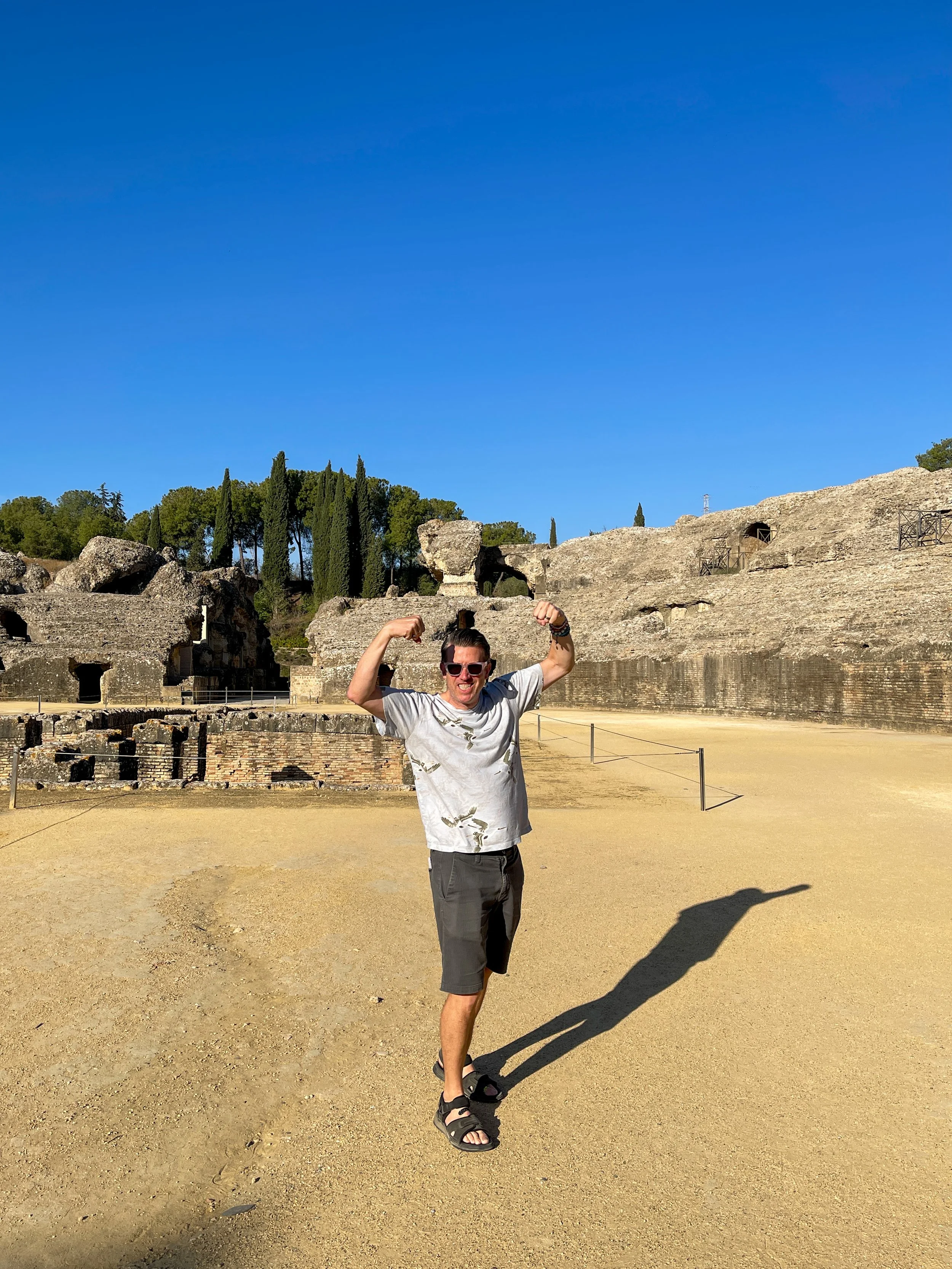
The gladiator Wally celebrates yet another stunning win.

Tips for Itálica

We had an incredible time and spent about two and a half hours leisurely exploring the site. It exceeded my expectations. We were impressed by the sheer scale of the amphitheater and the quality of the mosaics. Except for a school field trip, complete with costumed chaperones dressed in Roman garb, the crowds were sparse, which made it feel like we had the place (somewhat) to ourselves. Plus, the majestic cypress trees dotting the landscape lend Itálica an atmospheric charm.

A pathway lined with brick columns and cypresses leads to the town of Santiponce

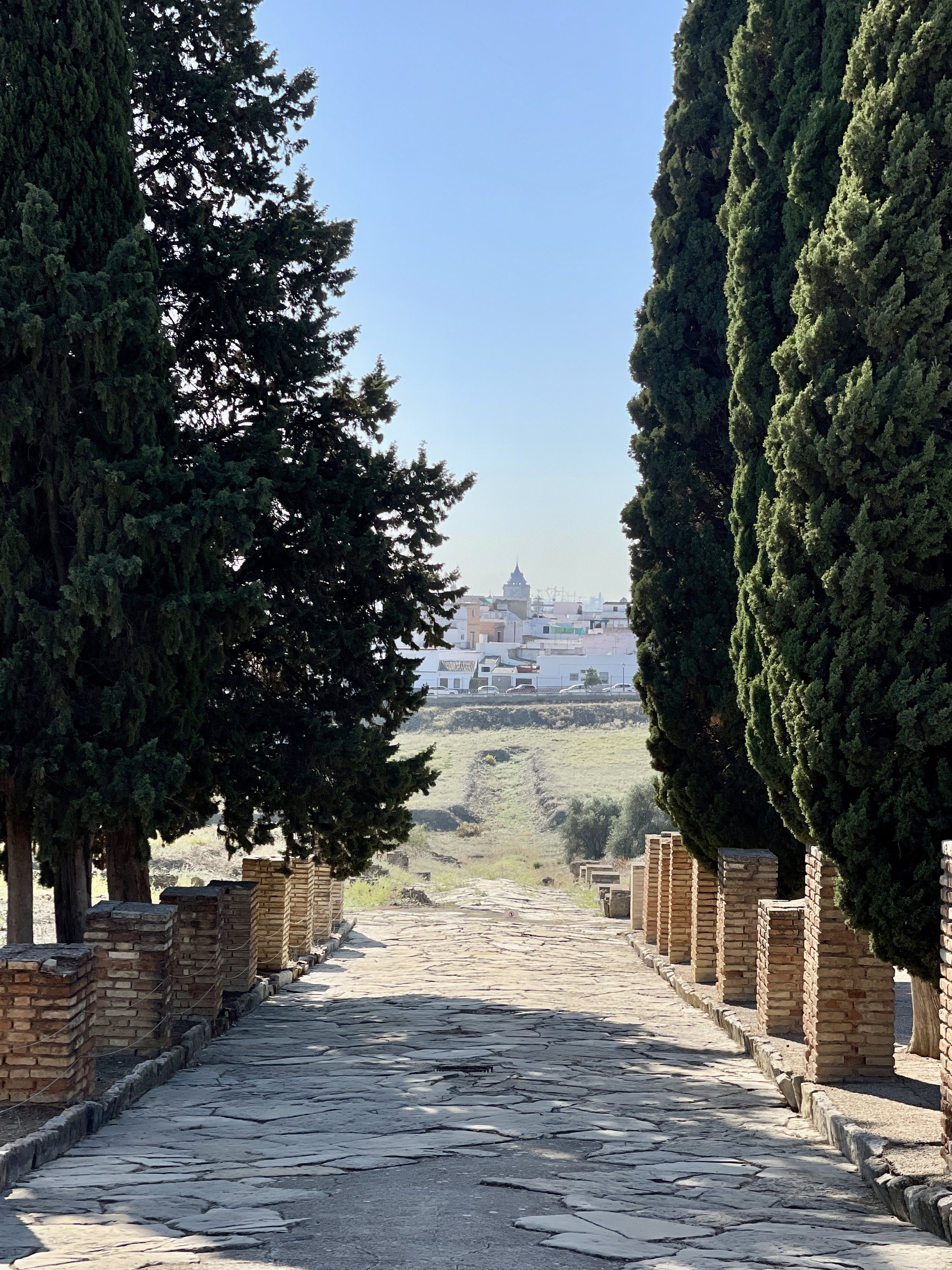
This elevated spot in Itálica offers a scenic view of the cobbled Roman road and the town of Santiponce.

On a practical note, remember to wear comfortable shoes for your visit and to bring sunscreen; there was little to no shade throughout the park. Also drink plenty of water. We brought two large bottles of water and snacks with us and were glad we did because there is no longer a café on the premises. 

If you’re seeking a fun half-day trip close to Sevilla, I highly suggest hopping on the bus to Itálica. The archeological site’s ancient charms will be part of the mosaic of your memories. –Duke