AROUND THE WORLD

Secrets of the Seven Wonders of the Ancient World

Author Bettany Hughes shares surprising truths about the Great Pyramid, the Hanging Gardens of Babylon and other Wonders of the Ancient World. 

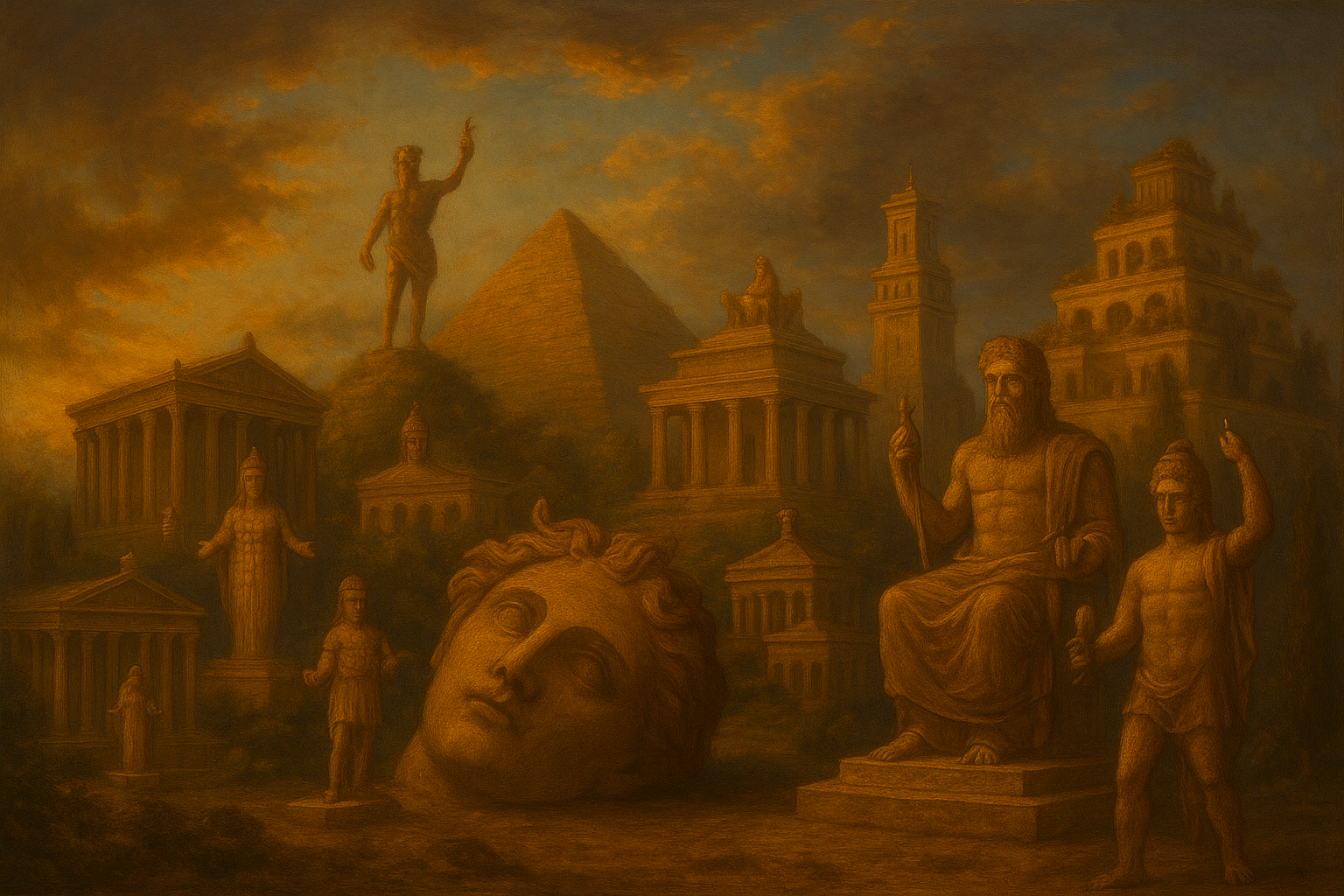
A collection of the Seven Wonders of the Ancient World, including the Pyramid of Giza, Mausoleum, Colossos, Hanging Gardens, statue of Zeus, Alexandria Lighthouse and Temple of Artemis at Ephesus

Quick — name the Seven Wonders of the Ancient World.

Struggling? You’re not alone.

Most people can’t list them all. Some guess the Colosseum or Stonehenge. Others don’t realize that only one still stands. 

These weren’t just impressive buildings and sculptures.

They were bold declarations of power — a Hellenistic highlight reel that reflected the ambition and reach of Alexander the Great’s world.

In her 2024 book The Seven Wonders of the Ancient World: An Extraordinary Journey Through History’s Greatest Treasures, historian Bettany Hughes peels back the mythology and reveals the politics, poetry and propaganda behind these wonders. These weren’t just impressive buildings and sculptures. They were bold declarations of power — a kind of Hellenistic highlight reel that reflected the ambition and reach of Alexander the Great’s world.

MORE: 3 Times Alexander the Great Wasn’t So Great

The oldest surviving version of the list was scribbled on a scrap of papyrus used to wrap a mummified body in Ancient Egypt. 

Most could be visited on a single, well-planned trip through the eastern Mediterranean. This was the ancient world’s first viral travel list — and its message was clear: Look upon our works, ye mortals, and marvel.

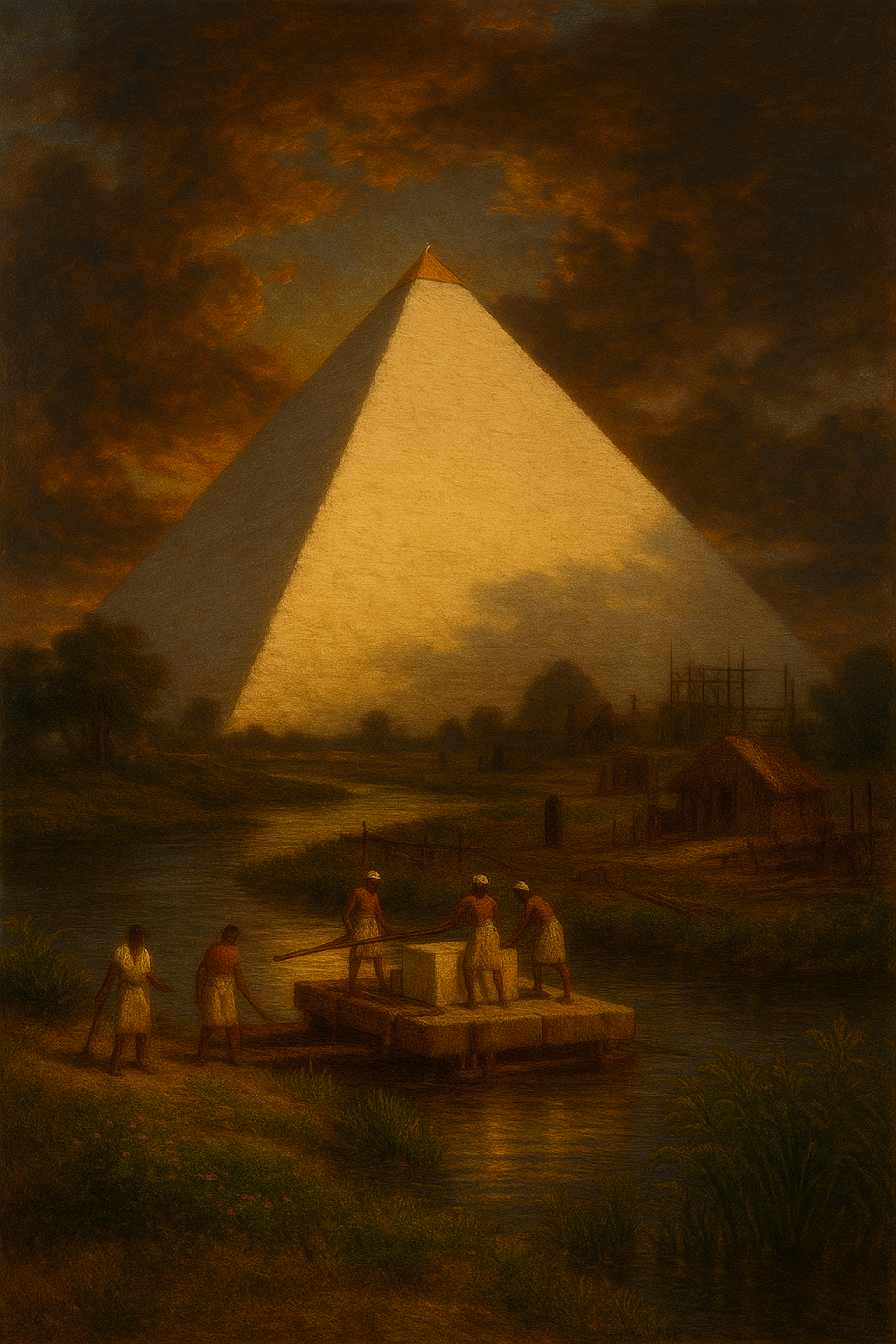
Workers transport limestone on the Nile to cover the Great Pyramid of Giza, seen with a metal capstone

1. The Great Pyramid of Giza: A Resurrection Machine by the Nile

If you visit the Great Pyramid today, you’ll likely see a heat-blasted monument rising from a stretch of ochre desert. But what if we’ve been picturing it all wrong? Hughes urges us to reimagine the Giza Plateau not as barren but as bursting with life: “Where we see desertion, imagine an abundance of clover and thousands of homes; where there are sands, waterways; where there is emptiness, tens of thousands of workers in loincloths and linen kilts. Where there are now neutral horizons, there was once hectic color; where piles of collapsed stone, dwarf-pyramids and sloping, mudbrick mastaba tombs. Where desert, gravid green.”

Built around 2550 BCE and once faced in polished white limestone, the Great Pyramid would have shimmered with a blinding brilliance. 

It wasn’t just a royal tomb; it was a “resurrection machine,” a literal launchpad to the afterlife. This machine served a higher cosmic purpose: to guarantee Egypt’s prosperity by ensuring the pharaoh’s rebirth. The fate of the world literally depended upon Khufu’s afterlife. 

And the engineering behind it still leaves modern minds gasping. Standing 480 feet tall and weighing in at roughly 6.5 million tons, the pyramid used about 2.3 million blocks of limestone, each hauled into place over a quarter of a century. Its interior space alone could swallow London’s St. Paul’s Cathedral, Westminster Abbey, St. Peter’s Basilica in the Vatican, and the cathedrals of Milan and Florence — with room to spare.

A historic etching of the construction of the Great Pyramid of Giza in Egypt, a Wonder of the Ancient World

Despite theories ranging from alien intervention to lost technologies, Hughes focuses on the human marvel of it all: tens of thousands of anonymous laborers working 10-hour days, 52 weeks a year, over decades — moving one block every two to three minutes. Current estimates suggest around 20,000 workers were active on the plateau at any given time, likely using a combination of sledges, rollers, ramps and perhaps even early hydraulic lifts. Still, the exact method remains elusive: “The engineering and construction of the Pyramid — the way these blocks were shaped, lifted and set in place — has confounded researchers for centuries, triggering miles’ worth of parchment and paper, and now volumes of iCloud storage,” Hughes writes. “It is a conundrum that obsesses the modern world — taxing the minds of engineers, architects, archaeologists, surveyors, even mediums.”

It’s also easy to forget that this was a riverfront wonder. In Khufu’s day, the Nile flowed much closer to Giza, hugging the Pyramid complex for most of the year, and sometimes lapping its very foundations. What we now see as isolation was once a place of movement and connection — a grand riverside attraction.

Capped with a golden or electrum pyramidion that caught the sun’s rays and hurled them back to the heavens, the Great Pyramid symbolized the original mound of creation — the divine moment when the world emerged from chaos. It was cosmic.

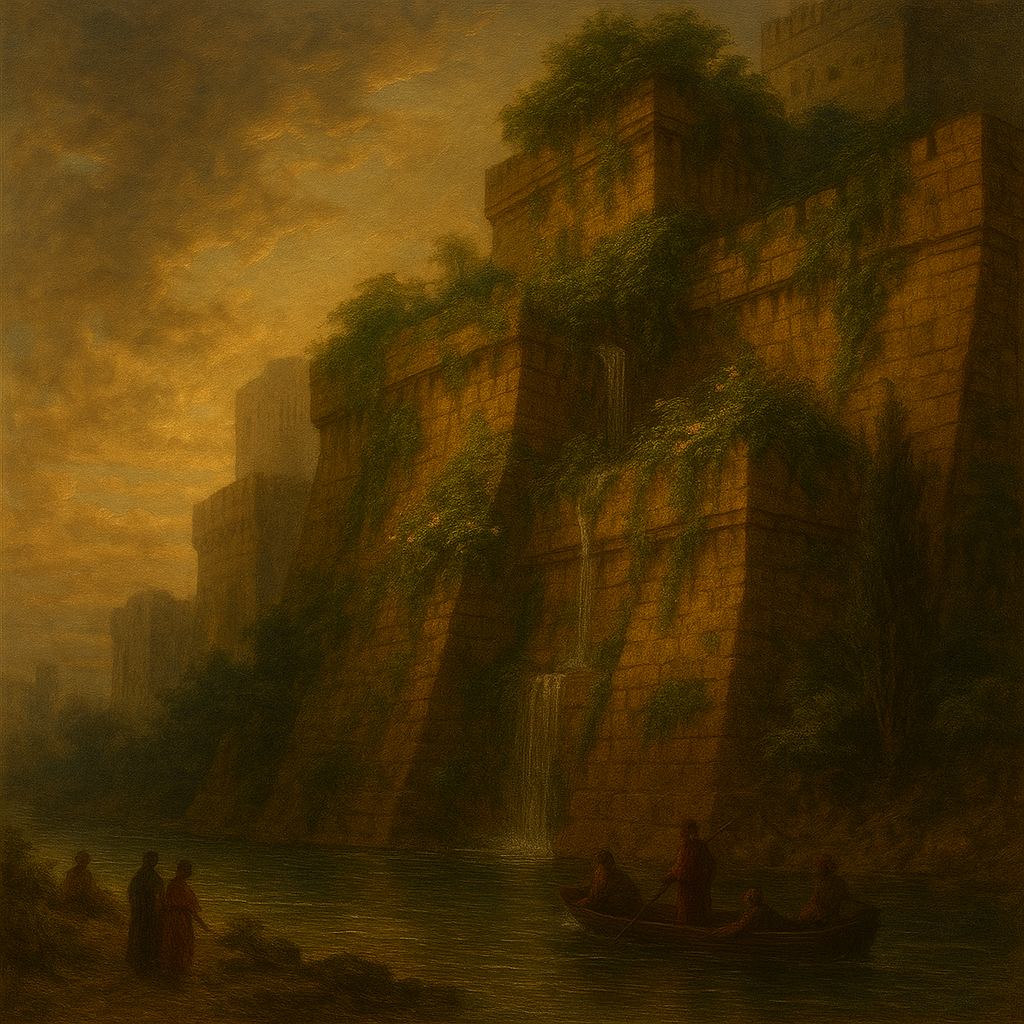
Greenery on the fortified walls known at the Hanging Gardens of Babylon, an Wonder of the Ancient World

2. The Hanging Gardens of Babylon: Myth, Monument or Mistranslation?

Of all the Seven Wonders, the Hanging Gardens of Babylon remain the most mysterious — and possibly the most fictional. Unlike the Great Pyramid, whose stones still scrape the sky, the Gardens leave us with no ruins, no universally agreed-upon site, and plenty of questions. Did they even exist?

If they did, the Hanging Gardens would have bloomed sometime in the 6th century BCE, during the reign of Nebuchadnezzar II — the great Babylonian king who ruled from 605 to 562 BCE and who is most often credited with their creation. That attribution, though, rests more on later tradition than contemporary evidence.

MORE: Nebuchadnezzar, King Josiah and the Formation of Jewish Law

And the evidence is where things get messy. Hughes lays out the problem clearly: Neither Herodotus nor Xenophon — Greek chroniclers who actually visited Babylon — mention the Gardens. Not once. That silence is thunderous. Even the East India House Inscription, a beautifully preserved 20-inch-wide slab chronicling the many accomplishments of Nebuchadnezzar II, makes no mention of them — no garden at all, hanging or otherwise.

So what gives?

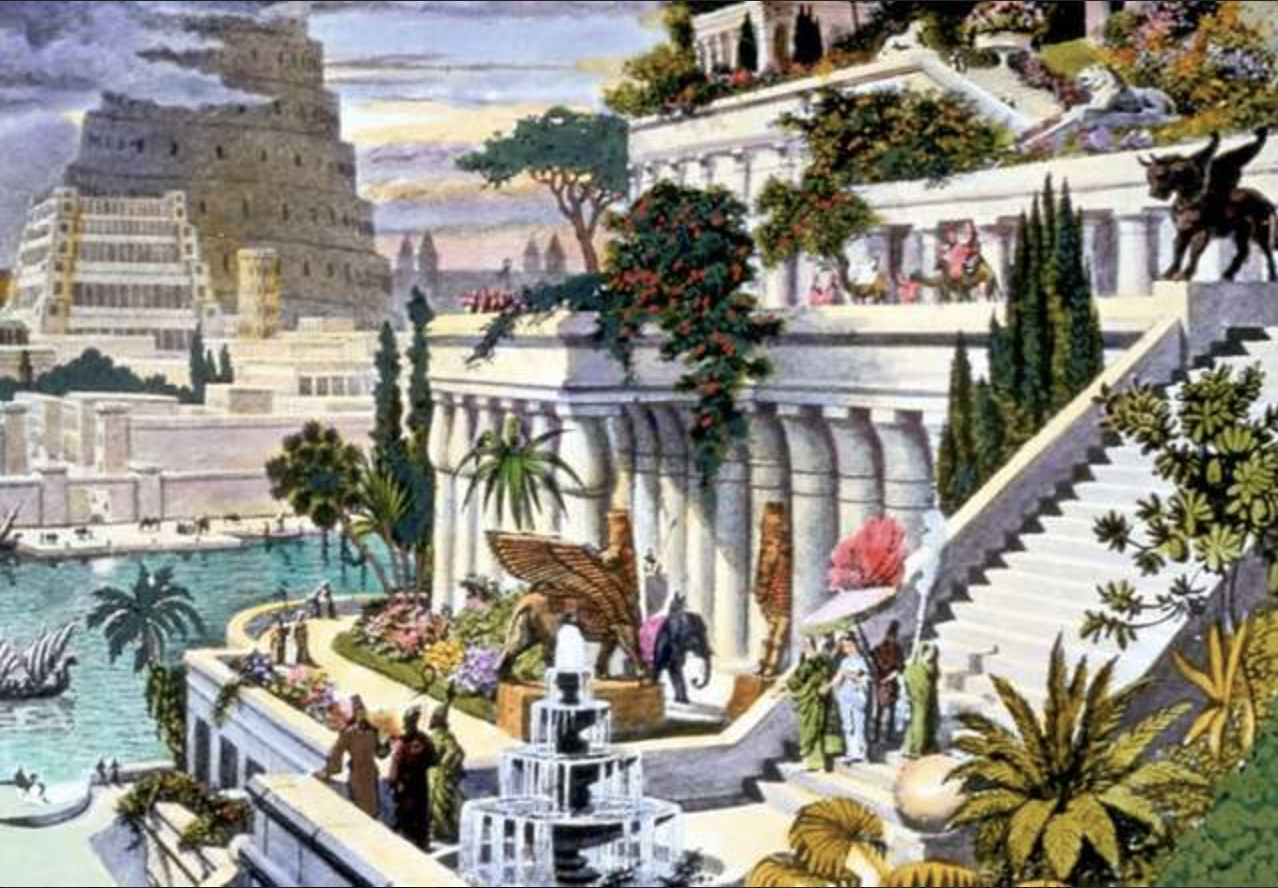
Hughes suggests we may be looking for something too specific. What if the gardens weren’t separate from Babylon’s famed walls but were part of them — verdant terraces that flowed from the fortifications and palatial structures themselves? In many ancient lists, it’s actually Babylon’s walls that earn the “Wonder” designation, not the elusive Gardens. That ambiguity raises the possibility that what we now call the “Hanging Gardens” may have been a poetic misunderstanding — a mistranslated marvel.

The Hanging Gardens of Babylon, with the Tower of Babel in the distance

And yet, the idea of the Gardens persists — not just because they would’ve been beautiful, but because they captured something deeper and darker about humanity’s emerging relationship with nature. These were not serene rooftop retreats. They were feats of engineering and control, power disguised as paradise.

“Whatever they were, however wondrous, the Hanging Gardens of Babylon would not have been idylls,” Hughes writes. “They would have been exquisite, exacting expressions of potency, expressions of belief, manifestations of ingenuity and the start of a dangerously dominating relationship with the natural world.”

Whether built in Babylon or borrowed from memories of Nineveh, the Hanging Gardens endure because they symbolize an idea: that nature could be bent into spectacle. And that idea, as Hughes suggests, has echoed through every empire since.

MORE: Controversial Theories About the Tower of Babel

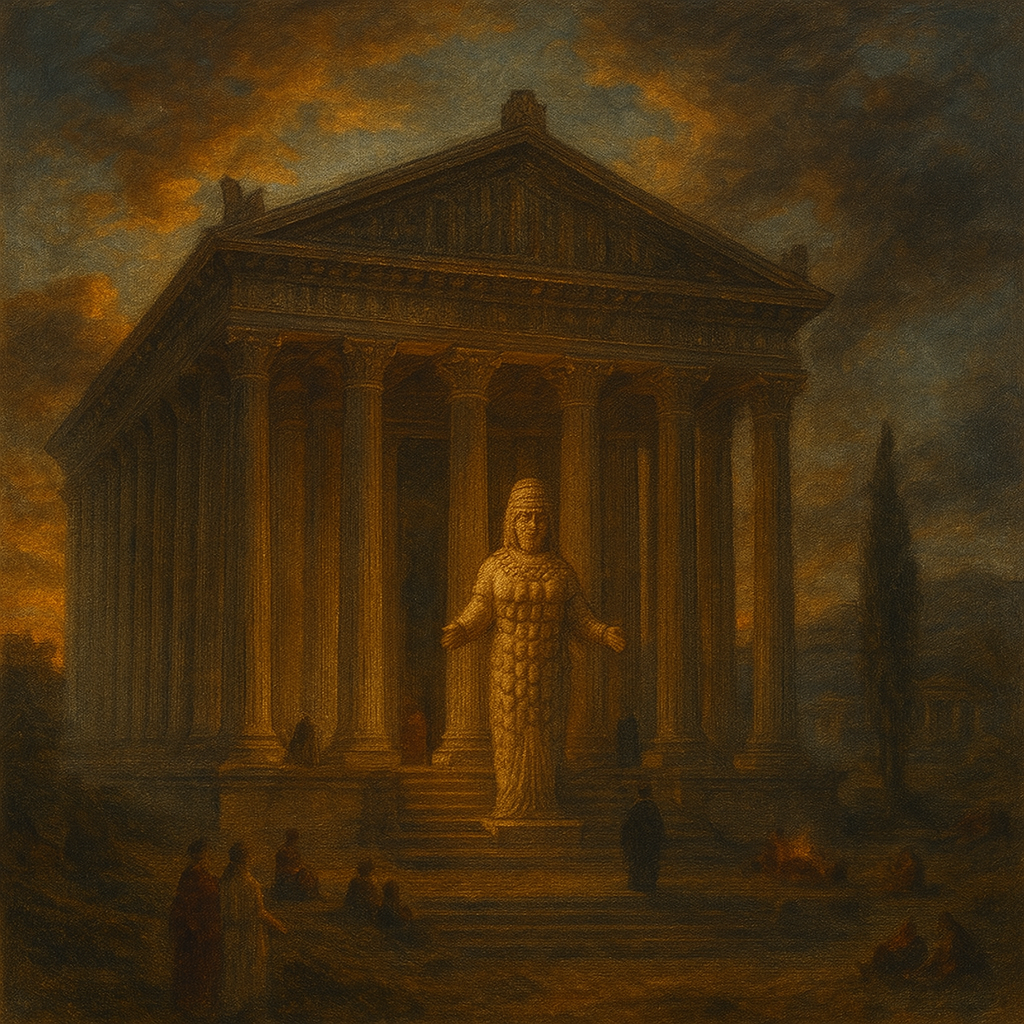
A multi-breasted statue of Artemis stands in front of her Temple at Ephesus, a Wonder of the Ancient World

3. The Temple of Artemis at Ephesus: Sanctuary of Stone and Wildness

Of all the ancient world’s architectural achievements, none left the poet Antipater of Sidon more breathless than the Temple of Artemis. Around 140 BCE, he wrote, “I have set eyes on the very wall of lofty Babylon, supporting a chariot road, and the [statue of] Zeus by the Alpheios [in Olympia], and the Hanging Gardens, and the Colossus of Helios, and the huge labor of the steep pyramids, and the vast tomb of Mausolos; but when I saw the temple of Artemis, reaching up to the clouds, these other marvels dimmed, they lost their brilliance, and I declared, ‘Look, apart from Olympus itself, the sun has never shone on anything that can compare to this!’”

Constructed around 550 BCE and rebuilt in grander fashion after a devastating fire in 356 BCE, the Artemision — as it was called in classical sources — was the first of the Seven Wonders to be accessible to all people, not just royalty. And it was the only one where women, both mythic and mortal, stood at the center of its story.

The original temple was incinerated on a sweltering July night — the very night Alexander the Great was born. In fact, the Greek world couldn’t help but connect the two events: “Tongues wagged: Artemis — goddess of nature and childbirth — it was whispered, was so busy in northern Greece, super-birthing a world-class megalomaniac, she neglected her earthly temple home,” Hughes writes. 

MORE: Alexander the Great: 8 WTF Facts About His Early Life

The arsonist was a man named Herostratus, likely a desperate slave who torched the temple to immortalize his own name — and, ironically, succeeded. The Ephesians tried to erase him completely. Speaking his name was made a capital crime. But history, being what it is, remembered him anyway.

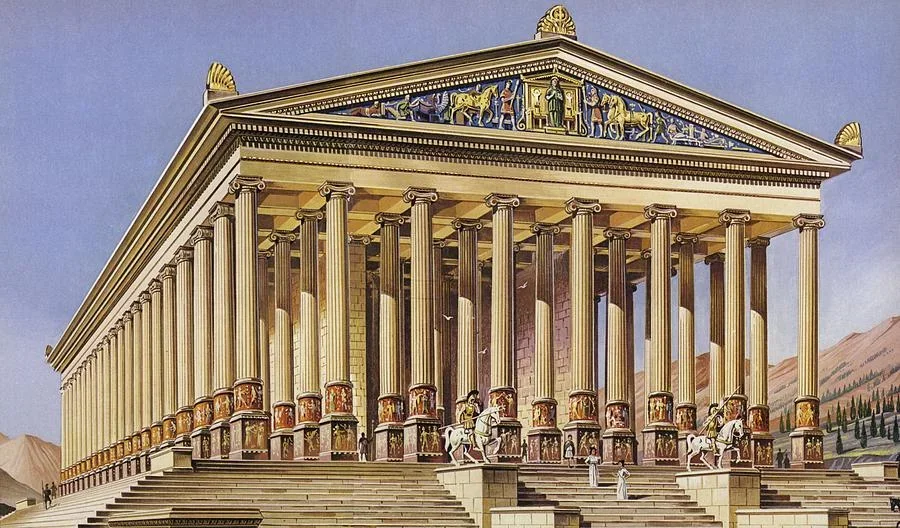
The rebuilt temple was a marvel: 425 feet long, 225 feet wide — nearly twice the size of the Parthenon that would follow it 150 years later. It featured 127 columns, each 60 feet high, and some capped by a skylight above the central cult statue. The structure marked the first true colonnaded Greek temple, laying the architectural blueprint for millennia to come.

The Temple of Artemis at Ephesus, with painted column bases and frieze at the top, a Wonder of the Ancient World

Here, Artemis wasn’t the graceful huntress of Louvre sculptures. She was Asiatic Artemis, a wild guardian of beasts, bearing the mystery and fertility of the Earth. She was a goddess of contradictions — pure yet primal, distant yet intimately present.

“Artemis in the mythology of the Greeks was an unusual goddess, a female figure who stood apart from the rutting sexuality that was the norm of ancient life and myth,” Hughes writes. “The story went that on the eve of her wedding, Artemis begged her father Zeus to allow her not to marry. In most cultures at this time, women were controlled, either by having to have sex, or by not being allowed to. Artemis’s agency, and her choice, makes her attractively odd. She was a virgin, whose sphere was consummation.”

Her image, kept hidden behind a curtain in the sanctuary, was likely a wooden plank known as a xoanon — treated as a living being. It was washed in seawater, anointed in fig milk or grape juice, adorned with clothes and gold, and lovingly cared for in a process called kosmeis — the root of our word cosmetics.

The cult of Artemis was largely female-led. Young women, or parthenoi, took part in the rites. But the high priests — the megabyzoi — were eunuchs, men who had castrated themselves in service to the goddess. Their female counterparts, the melissae, were the “honey women,” underscoring the deep associations between Artemis, fertility and nature’s sweetness.

Ephesus itself had become one of the largest and busiest cities in the ancient world, its port capable of hosting over 800 ships. That accessibility helped the temple’s fame spread far and wide. It was a religious sanctuary, a political hub and — crucially — a bank. Like many temples of the time, it safeguarded vast stores of wealth and knowledge. To violate the temple was to risk divine wrath.

The mythic presence of Amazons — female warriors who were said to have founded the site — was inescapable. Their likenesses adorned the temple’s façade, doorframes and rooftop sculptures. Bronze statues of Amazons stood with short chitons, bare breasts, crescent shields and battleaxes — some even depicted with wounds.

“The Temple of Artemis is a Wonder with diverse genetic makeup and influences from both East and West within its deity, its design and its dogma,” according to Hughes. “It is a work of mankind, trying to understand the power of the natural world and the power of women.”

And Artemis herself? Her statue was encrusted with bees, lions, griffins, cows, horses and sphinxes — a tapestry of creatures and symbols. Her front was thick with mysterious swellings: ostrich eggs? Pollen sacks? Breasts? Testicles? Bags of gold? The goddess resisted definition. She contained multitudes.

Topping her cylindrical polos crown was an image of the temple itself. A shrine of power, mystery and the wild feminine, the Artemision stood as a defiant celebration of life’s most primal forces.

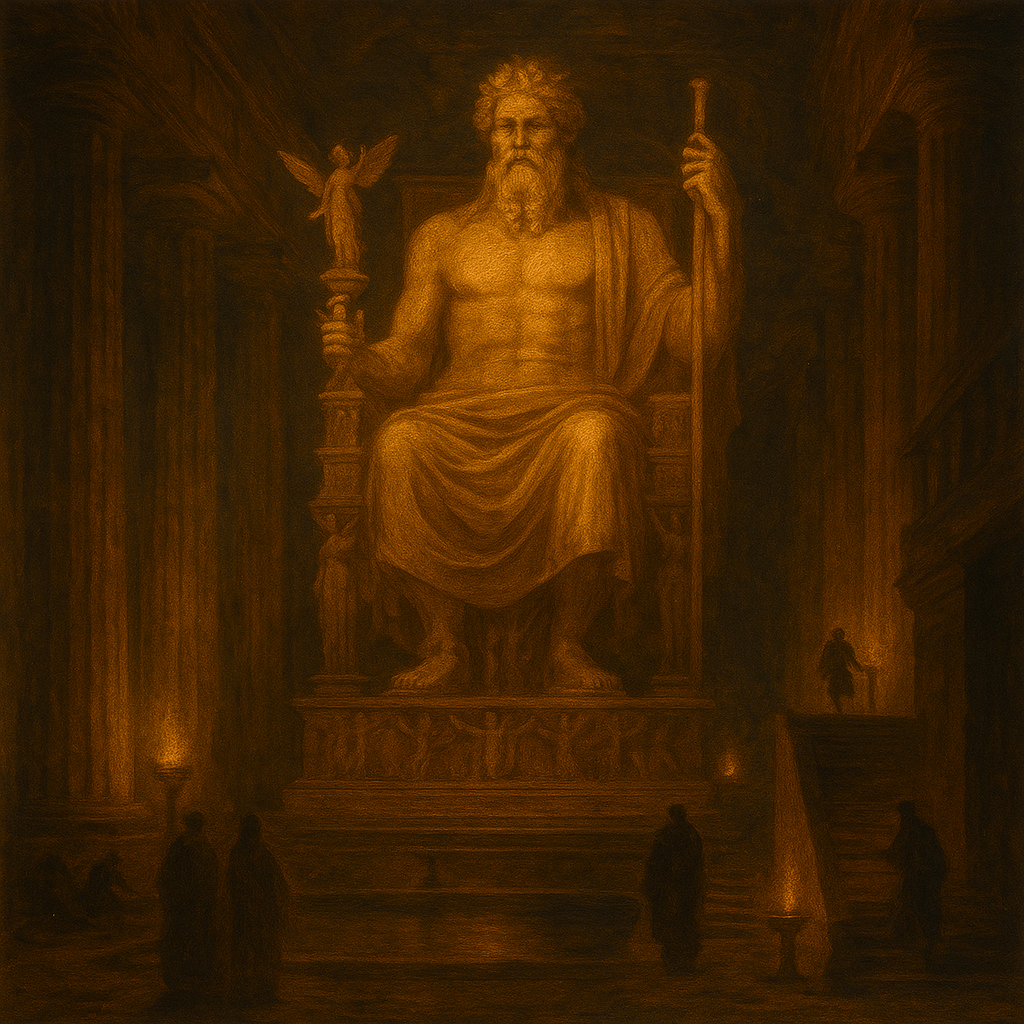
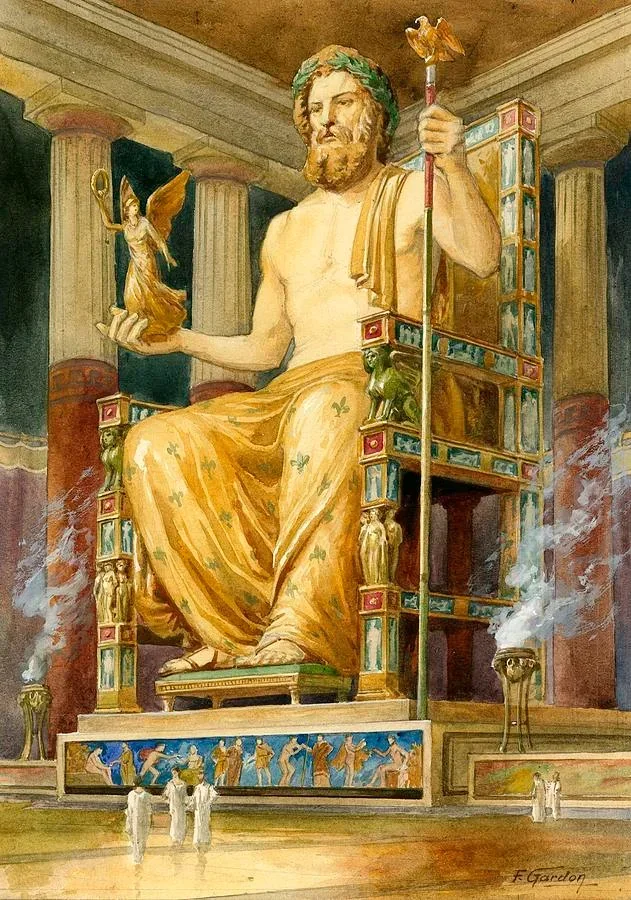
The massive seated statue of Zeus in his temple in Olympia, holding Winged Victory in one hand and a staff in the other

4. The Statue of Zeus at Olympia: God Made Monument

Epictetus, a Stoic philosopher, captured just how beloved the Statue of Zeus had become by the 1st century CE: “The wish to witness the ancient masterpiece of Phidias was so intense, that to die without having seen it was considered a huge misfortune,” he wrote in Discourses

The statue of Zeus at Olympia glowed with godly gravitas inside the sanctuary’s darkened temple. A creation of the sculptor Phidias, it was a divine father made colossal: Zeus, King of the Gods, father of Artemis and Apollo, products of the rape of the titaness Leto. The statue wasn’t meant to comfort. It was meant to awe.

“Of course, in a place where men were attempting to become godlike, the ultimate god took the form of the ultimate man,” Hughes writes. 

Built between 438 and 430 BCE, the statue was made of the most extravagant materials available: gleaming hippopotamus ivory for skin, gold for hair and beard, ebony, bone, polished stone and glass. 

The giant statue of Zeus at Olympia, a Wonder of the Ancient World

“Measuring the size of a three-story home (41 feet, on his pedestal rising over 44 feet tall), and yet seated, crouching, with his head skimming the ceiling, like Alice in Wonderland after taking her Drink Me spiked potion, the godhead must have seemed extraordinarily intimidating,” Hughes adds. “It was said that if he stood up, this Zeus would ‘unroof’ his temple-home.”

The throne featured six statues of Nike, the goddess of victory, marching up the legs. The arms of the seat were sobering sphinxes. The struts featured Herakles slaughtering Amazons to seize their queen’s girdle. The side panels showed Artemis and Apollo massacring Niobe’s children for her pride. And at Zeus’s feet? A stool supported by snarling lions — another Amazonian battlefield carved beneath.

“The message was clear: Olympia, and its Holy of Holies were, in every sense, somewhere that weakness was abhorred, for Zeus’s domain, there were only winners and losers,” Hughes explains. 

In Zeus’ right hand stood a 6-and-a-half-foot statue of Nike, also made of ivory and gold. In his left: a scepter topped by a gleaming eagle. His hair curled in heavy golden locks onto his shoulders, while his ivory skin was oiled daily to prevent cracking in the damp climate. That oil pooled in a limestone basin at his feet — creating a dark twin of the god.

The temple that housed Zeus at Olympia was a masterpiece of Doric architecture, designed by Libon of Elis and completed in 456 BCE with the spoils of war. Zeus’ likeness, modeled after Homer’s verses in The Iliad, captured the very image of cosmic authority. It was said Zeus could start an earthquake just by furrowing his brow. 

A wooden framework supported the ivory plating, carefully soaked in vinegar and sculpted into seamless sheets. Recent research by Kenneth Lapatin confirms the intricacy of this process — and the ingenuity of the ancients who achieved it.

When Roman Emperor Caligula ordered the statue’s decapitation in 41 CE so he could replace the god’s head with his own, Zeus reportedly laughed. The scaffolding collapsed, and days later, Caligula was assassinated — after having dreamed of the deity he sought to deface.

After standing for nearly 1,000 years, the statue was eventually moved to Constantinople, where it burned in a city-wide fire around 476 CE. Olympia’s pride, a masterpiece honored for generations, was reduced to ash.

And yet, Zeus lived on — not just in memory, but in iconography. The Byzantine depiction of Christ Pantokrator, “Ruler of All,” seated on a throne with glowering brow and commanding presence, bore a striking resemblance to Phidias’s Zeus. The divine father had been reborn.

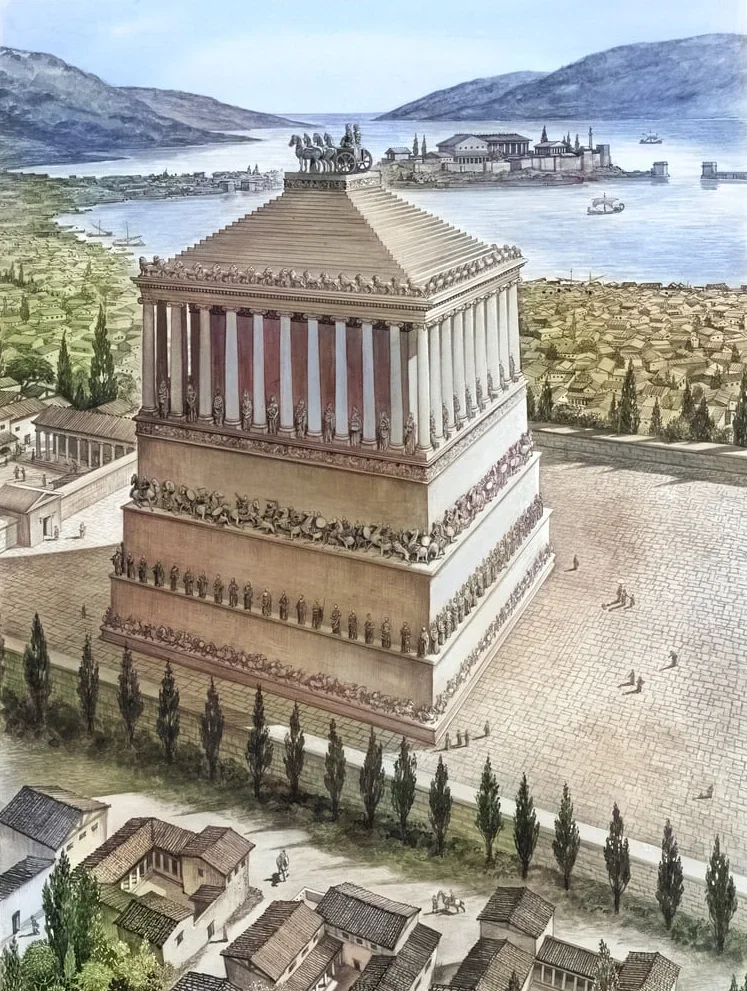
The impressive Mausoleum of Halikarnassos, with a large base, a temple-like structure, stepped pyramid and chariot on top

5. The Mausoleum of Halikarnassos: A Monument to Power, Grief and Glittering Excess

It was a tomb so grand it gave its name to every monumental tomb that followed. But the Mausoleum of Halikarnassos — final resting place of Mausolos, satrap-king of Karia — wasn’t just massive. It was mesmerizing. A collision of Greek elegance, Persian grandeur and Anatolian symbolism, built between 361 and 351 BCE on the sun-soaked coast of modern-day Turkey.

This Wonder fused the influences of East and West: Ionian and Doric architectural styles mingled with the dramatic scale and symmetry of Persian rock-cut tombs. Hughes notes that Karia, the region where Halikarnassos sat, was a culture of blendings — borrowing, reimagining and innovating in equal measure. And the Mausoleum was its masterpiece.

“This giant tomb came to be thought of as wonderful because it was trumpeted as embodying a faithful woman’s selfless devotion to her husband-brother, a sign that the brilliance of some men is to devastate women by dying,” she writes. 

Indeed, much of its fame came from the story of Artemisia II, Mausolos’ sister and wife, who reportedly grieved so hard she mixed his ashes into her wine. But beneath the romance lay a structure of staggering ambition: a 145-foot-tall marble confection built atop a limestone terrace stretching over 785 feet — about half the height of Big Ben, and nearly the length of two football fields.

The Mausoleum of Halikarnassos by the water, a Wonder of the Ancient World

The base consisted of a rectangular podium roughly 100 by 125 feet wide. Above that, 36 columns ringed the structure, echoing the layout of the Temple of Artemis. On top of the colonnade rose a stepped pyramid of 24 tiers, leading to a grand pedestal. And at the very top? A chariot drawn by four thrashing horses, almost certainly carrying statues of Mausolos and Artemisia themselves — a couple who have been put quite literally on a pedestal.

Designed by architect-sculptor Pytheos and possibly other elite artists of the day — Scopas, Bryaxis, Leochares and Timotheus among them — the Mausoleum was both a sculpture gallery and a piece of architectural theater. Its blocks were polished to a glass-like sheen. Carvings depicted Mausolos hunting, receiving ambassadors, honoring the gods and leading battles — scenes real and imagined. Life, as Mausolos wanted it remembered, in full pageantry. 

We tend to think of ancient structures as white, but many were actually a riot of color — and the Mausoleum certainly was. “Funerary monuments in particular favored color — there was a sense that the polychrome experience brought the dead back to some kind of life,” Hughes informs us. “Mausolos’ tomb would have been a firework in the sky.”

And what fireworks: white marble, then bluish limestone adorned with over 120 human and animal figures — all progressing toward a seated Mausolos before a great doorway. Was this his entrance to the afterlife? Above this level, imported white marble from Athens depicted brutal battle scenes, including — once again — Amazons, a recurring motif in Wonder architecture.

A ring of lions likely prowled the pyramid’s base. The decorative program celebrated domination, but also wildness and ritual. Priestesses in clinging, diaphanous dresses, their bodies visible beneath the folds, hint at ecstatic Bacchic rites. 

Skulls unearthed at the site suggest mass animal sacrifice during the burial — a slaughter of sheep, oxen, lambs, birds. Where now there are thistles and butterflies, there were once streams of blood.

Threads of gold found among the ruins may have once wrapped the king’s cremated remains. 

A spring near the site was famed in antiquity for its uncanny power to make men infertile or effeminate. That same spring inspired Ovid’s tale of the creation of Hermaphrodite: the son of Hermes and Aphrodite, lured into its waters by a nymph, merging into one being of two sexes.

The Mausoleum was a place where myth, sex, sacrifice, politics and grief all coalesced. A wonder of death, yes — but pulsing with the messy, lavish power of life.

The giant statue of the Colossus of Rhodes, a sun god rising above the island's port

6. The Colossus of Rhodes: Bronze Giant, Fallen God

The Colossus of Rhodes is perhaps the most misunderstood Wonder. Popular imagination has long insisted it stood legs astride the harbor entrance, torch in hand, as ships passed beneath. But that towering figure, feet apart across a 390-foot waterway, is pure fantasy — a medieval myth that held the world’s imagination hostage for 800 years. (It even inspired the Titan of Braavos in George R.R. Martin’s Game of Thrones.)

In reality, the Colossus never straddled the harbor. It likely stood higher up, on the city’s acropolis, towering above the bustling port of Rhodes. This was Helios — the pre-Olympian sun god — cast in bronze and iron, gleaming in the Aegean light.

Standing an estimated 108 feet tall, the statue was a staggering feat of ancient engineering. Built in the early 3rd century BCE and completed around 280 BCE, it had a skeleton of iron and a polished bronze skin. Just one of its digits — a single toe, say — was said to be larger than most full-sized statues.

The Colossus of Rhodes, a Wonder of the Ancient World, seen straddling the harbor

Unlike Zeus’ patriarchal presence, Helios pulsed with youthful ambition. “Whereas the Zeus at Olympia thundered, his luxurious beard the signifier of a mature man in Greek culture, Rhodes’ Wonder, the un-bearded, tousled, soft-lipped Helios, had the dangerous energy of a young, unpredictable man poised to do great things,” Hughes writes. 

And given the era, it’s hard not to see the influence and inspiration of Alexander the Great in the statue’s features and commanding pose. Rhodes had resisted a siege by one of Alexander’s successors — and the Colossus was both a victory monument and a symbol of sun-blessed resilience.

Kolossos is a Greek word — possibly of Asiatic origin — that originally meant simply “statue.” But this statue rewrote the definition. It was never just a likeness. It was legend in metal, a city’s pride forged into form.

“This was a wonder that became legendary within weeks of its completion,” Hughes says. 

Created by the sculptor Chares of Lindos — and possibly influenced by the legendary Telchines, mythical inventors of metalwork — the statue took 12 years to complete. It was cast in sections, working from the feet upward. Each foot stood on a marble plinth around 60 feet wide and 10 to 15 feet thick.

And then it fell.

Around 227 BCE — just 60 or so years after it was completed — a devastating earthquake struck Rhodes. The city walls crumbled, the coastline dropped by 3 feet, and the Colossus came crashing down. It broke at the knees and was never re-erected. 

The fragments, enormous and awe-inspiring, lay scattered for centuries — longer than the statue ever stood. According to later sources, the tumbled Helios remained visible until the 7th century CE, when its remains were finally melted down for scrap. So much for immortality.

And that legend has never quite gone cold.

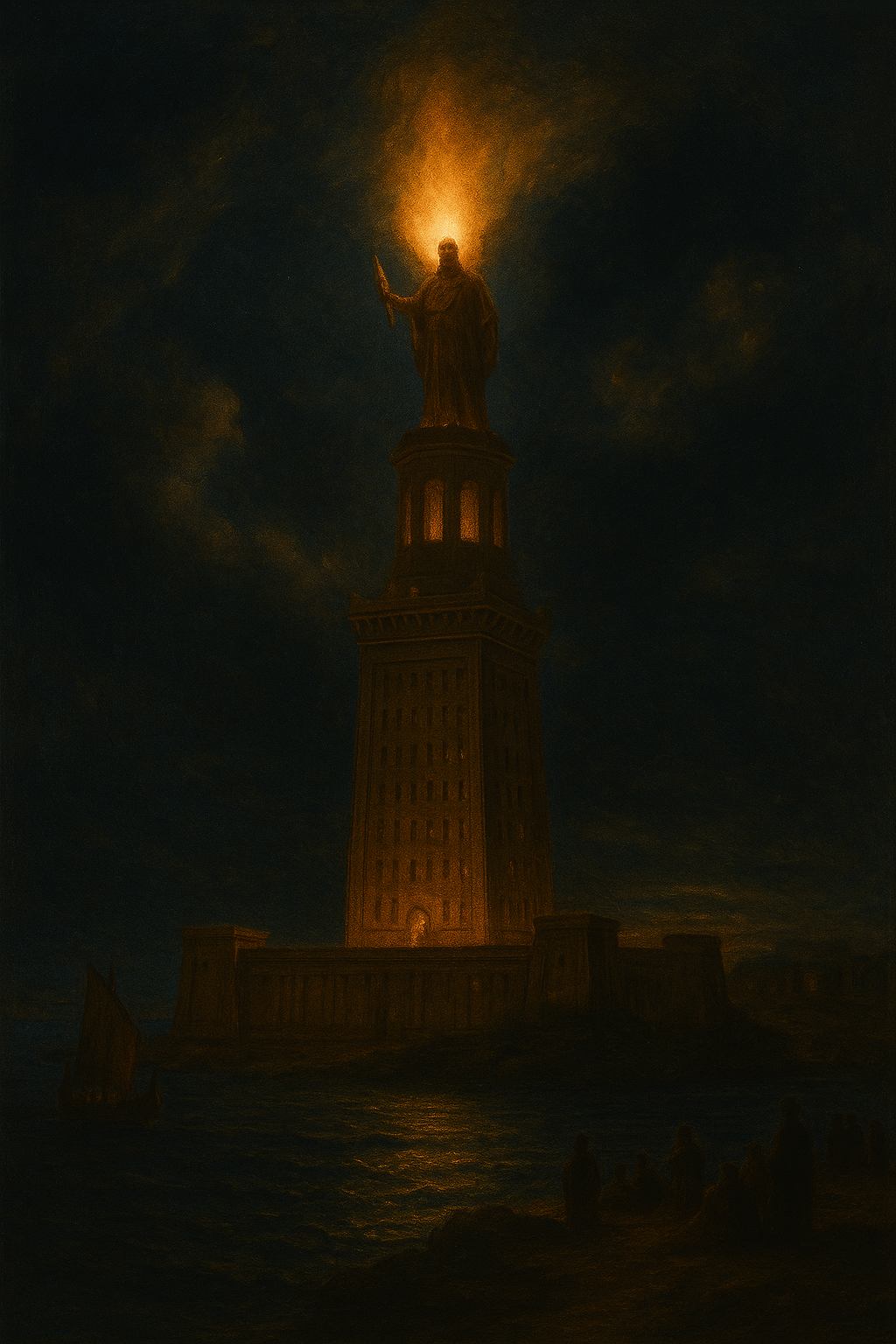
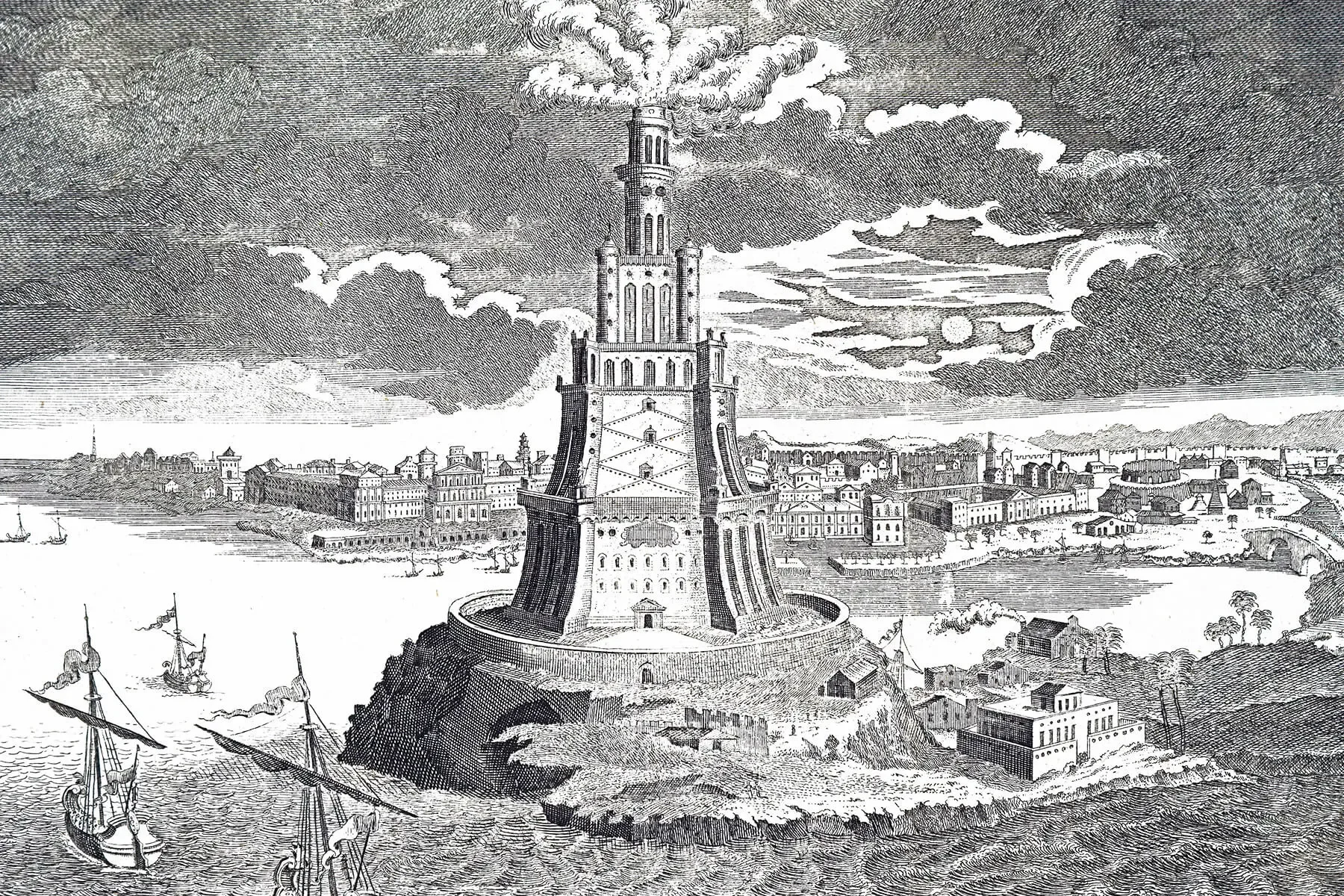
The Lighthouse of Alexandria, a Wonder of the Ancient World, at night, ablaze and topped by a statue of Zeus

7. The Lighthouse of Alexandria: Fire, Mirrors and the Edge of the World

Unlike the short-lived Colossus of Rhodes, the Lighthouse of Alexandria stood tall for over 1,500 years — a marvel of geometry, ingenuity and sheer ambition. Built beginning around 297 BCE and completed over the course of 15 years, this towering wonder rose more than 400 feet above the bustling twin harbors of Alexandria, Egypt, making it the second tallest structure in the ancient world after the Great Pyramid.

It was astonishing. A stacked sequence of geometric forms — square, octagonal, circular — constructed from marble and local limestone, sheathed in red granite shipped down the Nile from the scorched quarries of Aswan. Some blocks stretched 36 feet long and weighed 75 tons. The tower was crowned with a 50-foot statue, almost certainly of Zeus Soter (Zeus the Savior), watching over the seas like a divine lighthousekeeper.

Its beacon could be seen for over 37 miles — a flaming furnace at night, and during the day, sunlight reflected off massive copper mirrors. It was both a feat of engineering and a performance of cosmic authority. Ships approaching Alexandria’s treacherous coast — battered by crosswinds, stalked by hidden rocks — were guided by this shimmering sentinel, the Pharos.

It was built of red granite, which is usually a dull pink, but could turn an iridescent purple  in desert light. “The ancients must have believed red granite brought with it some kind of sorcerer’s power,” Hughes muses. 

An engraving of the Lighthouse of Alexandria in Egypt, a Wonder of the Ancient World

The tower’s structure was just as beguiling: a 1,115-by-1,115-foot base with fortified brick walls and turrets; an interior ramp and hoist system to ferry fuel and supplies; and an eight-sided middle tier symbolizing the compass winds. Above that, a cylindrical chamber topped with the beacon — perhaps powered by naphtha and papyrus, possibly attended by pack animals climbing in pairs.

And the Pharos wasn’t just a lighthouse. It was also a proto-telecom tower, using flashing heliography — ancient Morse code — and possibly even mechanical sound effects. Sculpted Tritons (half-man, half-fish) stood around the structure, possibly blowing horns that served as early sirens, ancient animatronics that altered the city in times of danger.

The lighthouse was initially funded by Ptolemy I — one of Alexander the Great’s most successful generals — and completed under his son, Ptolemy II. It cost an estimated 800 silver talents — over $19 m

illion in today’s money. Built on the island of Pharos, which would lend its name to the structure and eventually become the word for “lighthouse” in multiple languages, the monument embodied Ptolemaic power and vision. It was a glowing stake in the sand, declaring Alexandria the gateway between Africa, Asia and the Mediterranean world.

And for centuries, it worked.

Until 1303 CE, when the Earth shook. An earthquake finally toppled the Pharos, reducing it to ruins and ending one of the longest-standing Wonders of the Ancient World.

MORE: The Major Egyptian Gods and Goddesses

The head of the Colossus of Rhodes has fallen off and lies on the ground

Why the Seven Wonders of the Ancient World Still Matter

All but one of the original Seven Wonders may be long gone — toppled by earthquakes, scavenged for scrap, or buried beneath centuries of sand and myth. But as Hughes makes clear, their true legacy is that they weren’t simply monuments to kings or gods. They were monuments to us — to human ambition, ingenuity, imagination and the drive to build something bigger than ourselves.

The list was specific, political, proudly Hellenistic — showcasing a curated world seen through Greek eyes in the wake of Alexander the Great. And yet, the idea of a Wonder has endured far beyond its original moment.

“Wonders serve a rich triple purpose,” Hughes writes. “They were constructed partly to feed our need for wondrous tales — to experience and talk about the biggest, the best, the tallest, the most strange, the most bold. They encourage a saturation in the now, by submitting to a present, pure sensation of wonder. They remind us of our overwhelming desire to collaborate to create beyond the possibilities of the individual.” 

Even today, the concept of a “wonder” still fuels our storytelling, our bucket lists, our skyscrapers and our sci-fi dreams. Because deep down, we’re still looking to be amazed. Still looking to build what seems impossible. Still wondering. –Wally

MORE: What Was Daily Life Like in Ancient Egypt?

Sacred Sips: Unusual Drinking Rituals Around the World

Travel the globe one drink at a time — from sake ceremonies in Japan to vodka toasts in Russia — and explore the sacred drinking rituals that reveal the heart of a culture.

A group of people from around the world crowd around a table, holding traditional drinks from their countries

We’ve all had that moment: reclining on a sun-drenched patio, swirling a chilled drink, maybe a Malibu Bay Breeze, and thinking, Now this is living. But while your fruity cocktail might scream “vacation mode activated,” in many parts of the world, drinking goes far beyond recreation. It's ritual. It’s social glue. It’s ceremony, symbolism and, in some cases, sacred law.

Whether it’s the whisper of steam from a rice wine gourd in Bhutan or the thunderous clink of vodka glasses in Siberia, humanity’s connection to alcohol is as diverse as our languages and landscapes. So, if you're the kind of traveler who likes their libations with a dash of folklore, a twist of history, and a splash of anthropological intrigue, cheers to you. Let’s tour the world, one unusual drinking ritual at a time.

A younger man nervously pours sake for an older man in a suit at a Japanese teahouse, while a man sleeps in the corner and another enters, surprised

1. Japan’s Sakazuki Ceremony: The Art of Mutual Respect

In Japan, drinking isn't just about getting merry — it’s a ballet of etiquette and mutual reverence. Nowhere is this more evident than in the sakazuki ceremony, where two people exchange cups of sake to seal a bond. It can be between friends, business partners or during wedding rituals.

The process involves bowing, pouring for one another, and sipping from each other’s cups. If it sounds intimate, that’s because it is.

But beware: Hierarchy matters. If your boss pours for you, you’d better accept it with both hands and bow like your job depends on it — it just might.

RELATED: A Guide to Experiencing the Spectacular Koyo

An older Andean man puts some chicha out for Pachamama, the earth goddess, over a spread of nibblies, while girls and a male traveler watch

2. Peru’s Pachamama Offering: A Sip for the Earth

Head into the highlands of Peru, and you’ll quickly learn that no drink enters your body without first blessing the earth. Before sipping chicha (a fermented corn beer), locals spill a few drops onto the ground. This is a symbolic offering to Pachamama, the Andean earth goddess.

This practice isn’t just reserved for locals, though; travelers who show respect are invited to share in the ritual. Just remember: Spill before you sip. Otherwise, you may offend a deity — and your host.

This reverence for nature in drinking rituals speaks to a deeper connection between land, spirituality and celebration. It’s not about intoxication. It’s about inclusion.

RELATED: The Pishtaco of Peru

A bearded man stands, holding up a drinking horn, giving a toast, while people around him react

3. Georgia’s Supra: Toasting as a Competitive Art Form

No one toasts like the Georgians. And I mean no one. At a Georgian supra (a traditional feast), the tamada — a sort of designated toastmaster — leads an elaborate series of poetic, philosophical and sometimes comedic toasts that can go on for hours.

Each toast is met with wine horns raised and glasses drained. Guests are expected to participate, and interruptions are frowned upon. This is a structured, sacred ritual of storytelling, memory and reverence, made glorious with amber-toned Georgian wines.

There’s even a formal etiquette to how you hold your glass and how you respond to a particularly moving toast. Think TED Talk meets tavern.

A middle-aged man toasts a nervous, drunken man at a Chinese ganbei ceremony by a table laden with food and a passed-out man, while couple whispers at another table

4. China’s Ganbei: Bottoms Up…or Else

In China, saying “Ganbei!” (干杯) is more than a simple “cheers.” It means “dry cup” — a declaration that you’ll finish your drink in one go. And they mean it.

Refusing a ganbei in a business setting is akin to rejecting a handshake. It’s a test of trust and camaraderie. This ritual can turn business dinners into something closer to drinking marathons, especially when baijiu — China’s fiery sorghum liquor — is involved.

Refusing to finish may offend. Finishing too quickly will win you another round. Good luck.

People sit at a table in Russia, drinking vodka, with one man laughing, another passed out and a woman scowling

5. Russia’s Vodka Etiquette: Drink First, Talk Later

If you think you know how to handle your liquor, try keeping up at a Russian celebration. Vodka in Russia is a no-nonsense affair governed by strict cultural codes.

Rule one: Toasts come first. Talking, eating, or even breathing too soon after someone raises a toast is considered rude.

Rule two: Never sip. Vodka is taken as a shot, straight. 

Rule three: Don’t refuse a round unless you’re ill or driving — and even then, prepare to explain yourself.

The act of drinking vodka in a group is deeply tied to expressions of hospitality and trust. It’s about showing heart (“dusha”), courage and belonging.

A group of people in an Ethiopian home pour tela by a table with food

6. Ethiopia’s Tela Ceremony: Fermentation Meets Friendship

In Ethiopia, drinking tela, a traditional homemade beer brewed from barley or maize, is a community affair.

Usually made by women and served in small neighborhood gatherings, tela is a ritual of hospitality and kinship. Guests may sit in a circle, drinking from shared containers and swapping stories under woven thatch roofs.

The brewing process itself is communal, passed down through generations, with recipes varying by region and family. Every sip is a testament to shared heritage.

A monk in Bhutan holds up a vessel with ara, while a man prays, a woman holds a pitcher, and a boy and yak look on

7. Bhutan’s Ara Offering: Drink With the Divine

Bhutan isn’t the first place people think of when they imagine booze, but the Himalayan kingdom has its own take: ara, a rice-based liquor made in homes across the country.

When consumed, it’s often part of a lohso ritual: a prayer for peace, prosperity and warding off misfortune. The ara is sometimes mixed with butter and eggs (yes, really), and offered first to deities or the local lama.

While public consumption of ara is discouraged under Bhutanese law, its role in spiritual and community rituals remains deeply ingrained in local life.

RELATED: Bhutan and More of the World’s Most Underrated Adventure Travel Destinations

In front of a Thai temple and naga, people drink from silver bowls, while others, including a monk, watch

8. Thailand’s Communal Cups: Sharing in Celebration

At Thai ceremonies, including weddings and Buddhist merit-making rituals, alcohol often plays a social — not sacred — role. However, what stands out is the tradition of communal drinking from shared cups or small silver bowls (khan) at village gatherings.

This ritual fosters connection, trust and a sense of equality. Everyone shares from the same source, rich or poor, old or young.

Interestingly, some of these rituals are fading in urban centers but remain alive in rural areas, preserved by locals who see drinking as part of a holistic spiritual and social life.

RELATED: What’s the Best Chiang Mai Street Food?

A Maasai man pours honey wine for young men with white face paint during a coming-of-age ceremony in Kenya, while women smile and watch

9. The Maasai’s Honey Wine: From Rite to Rite

In Kenya and Tanzania, the Maasai people brew a traditional honey wine that features prominently in ceremonies such as weddings, age-group initiations and spiritual blessings.

Drinking together symbolizes unity and is believed to strengthen bonds between clans. The brew itself — fermented over days — is thick, sweet and often served in gourds.

While it’s not exported or available commercially, it remains an important cultural practice among the Maasai — one that links heritage, land and rite of passage.

Drinking as Cultural Mirror

Across continents, drinks are more than refreshments; they’re vessels of meaning. They tell stories. They set boundaries. They open doors.

Alcohol has long been used to unite communities, mark transitions, and strengthen social structures—an insight that’s as true today in Peruvian villages as it is in downtown Tokyo.

And this is why the next time you're sipping that refreshing cocktail under a lazy sun, you might reflect on how drinks connect us — not just across tables, but across centuries and civilizations.

People from around the world try to follow drinking etiquette

Tips for the Culturally Curious Sipper

If you’re planning to engage in local drinking customs during your travels, here are a few do’s and don’ts:

  • DO research ahead: Some rituals have sacred meaning, and missteps can be disrespectful.

  • DON’T chug everything: Unless the culture dictates it (hello, China), pacing is usually fine.

  • DO accept if offered: In many cultures, declining a drink can signal rejection of hospitality.

  • DON’T assume Western norms apply: One person’s toast is another’s offense.

  • DO participate wholeheartedly: The ritual is often more important than the drink itself.

So, here’s to the world’s drinkers — not the binge crowd, but the ceremonial sippers, the storytellers, the sacred pourers. To the women brewing tela in Ethiopia, to the Andean farmers offering chicha to the gods, to the Japanese executives bowing over crystal sake cups.

And to you, fellow traveler, who now understands that sometimes, a drink is just a drink… but sometimes, it’s the soul of a people poured into a glass.

Cheers—or as they say in Georgia, “Gaumarjos!” –Ivana Babic

RELATED: Bizarre Foods Around the World

Top World Travel Destinations for James Bond Fans

Step into 007’s world with thrilling destinations from London to Jamaica, the Swiss Alps to Venice. Live the Bond lifestyle with intrigue, elegance and adventure!

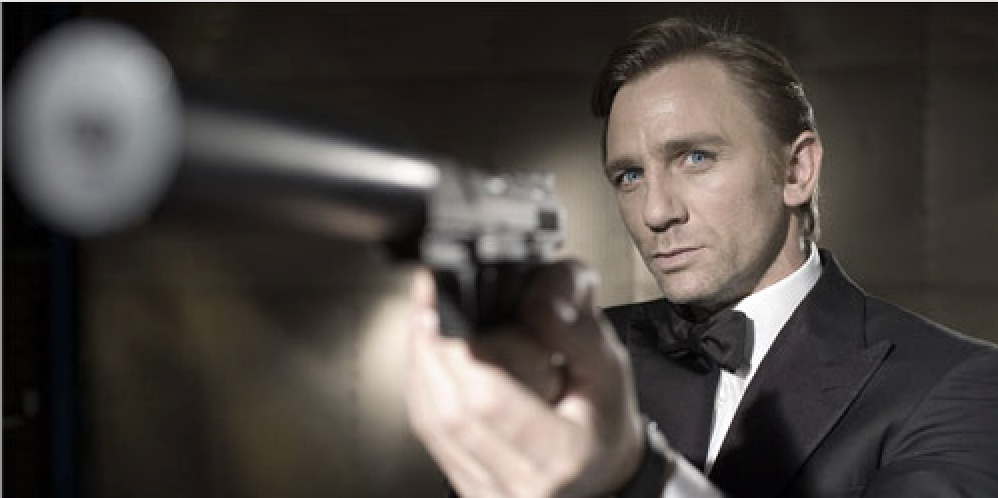
Daniel Craig, in a tux as James Bond, points a gun

There’s nothing quite like stepping into the world of James Bond. Fast cars, exotic locales and danger at every turn — all served with a side of impeccable style. If you’ve ever dreamed of living the 007 lifestyle, it’s time to trade your office chair for an Aston Martin and embark on a globe-trotting adventure that’s shaken, not stirred.

And if you’re feeling as daring as Bond himself, why not raise the stakes with a live bet on a cricket match while soaking up the excitement of these iconic locales? After all, it’s about embracing risk in style. 

So, channel your inner secret agent, pack your sharpest tuxedo (or your slinkiest evening gown), and prepare to walk in the footsteps of the world’s most iconic spy. The mission? Pure, unadulterated thrills. 

Locations You Can’t-Miss Out On as a 007 Lover

The James Bond universe oozes glamorous and cuts across many parts of the world. Here are the most iconic Bond locales for any true 007 enthusiast.

The London skyline with the Thames River

London, England: Bond’s Command Center

If Bond has a home, it’s London — a city that pulses with sophistication, intrigue and the kind of drama that only 007 can handle. The British capital has played a starring role in the franchise, serving as both Bond’s operational base and the scene of some unforgettable action.

Imagine walking along the Vauxhall Bridge, the MI6 headquarters towering beside you. It’s not hard to imagine Bond himself striding through those doors on a top secret mission. This is the fortress of espionage, immortalized in films like Skyfall and Spectre

Your Mission

A bald bartender mixes a cocktail at Dukes Bar in London

Raise a glass at Dukes Bar. Ian Fleming famously crafted Bond’s love for martinis here. Sip on their signature Vesper Martini and toast to a life of espionage and elegance.

A red speedboat for tourists zooms along the Thames river toward London Bridge

Cruise the Thames. Re-create the adrenaline of The World Is Not Enough with a speedboat ride along the river, cutting through the heart of London’s iconic skyline.

The staircase hall at London's National Gallery

Visit the National Gallery. Channel your inner Bond as you wander through this cultural treasure, featured in Skyfall, where art meets espionage in a perfectly British fashion.

A red bus zooms past the classical facade of Whitehall in London, England

Explore Whitehall’s secrets. Peek into the corridors of power, imagining the hushed briefings Moneypenny and Q must have held in these historic buildings.

London doesn’t just set the stage for Bond’s adventures; it’s the pulse of his world. From the refined luxury of Mayfair to the gritty backstreets of Southbank, every corner feels like it’s holding a secret. And with every sip of your martini and step through these storied streets, you’ll find yourself asking, “What’s my next move?”


People hang out on a restaurant's stone ledge above turquoise water in Jamaica

Jamaica: Bond’s Birthplace and Paradise

Jamaica is where the legend was born. Fleming penned all 14 of his Bond novels at Goldeneye Estate, a dreamy hideaway nestled along the island’s stunning coast. It’s no wonder Jamaica became Bond’s cinematic playground, featured in classics like Dr. No and Live and Let Die.

Your Mission

One of the waterfront cottages at Goldeneye Resort in Jamaica

Stay at Goldeneye. Luxuriate in Bond’s birthplace, where you can soak up the very atmosphere that inspired Fleming. Take in the sea views, sip a cocktail and perhaps dream up your own espionage tale.

Aerial view of the bay at James Bond Beach in Jamaica

Explore James Bond Beach. This secluded slice of paradise is where Bond’s adventures began. Paddle in the clear waters or relax under swaying palms, imagining your next mission.

Turquoise water and rock formations in the Green Grotto in Jamaica

Dive into the Green Grotto Caves. Journey into this labyrinth of caves, rich with history and intrigue, and relive the villainous schemes of Live and Let Die.

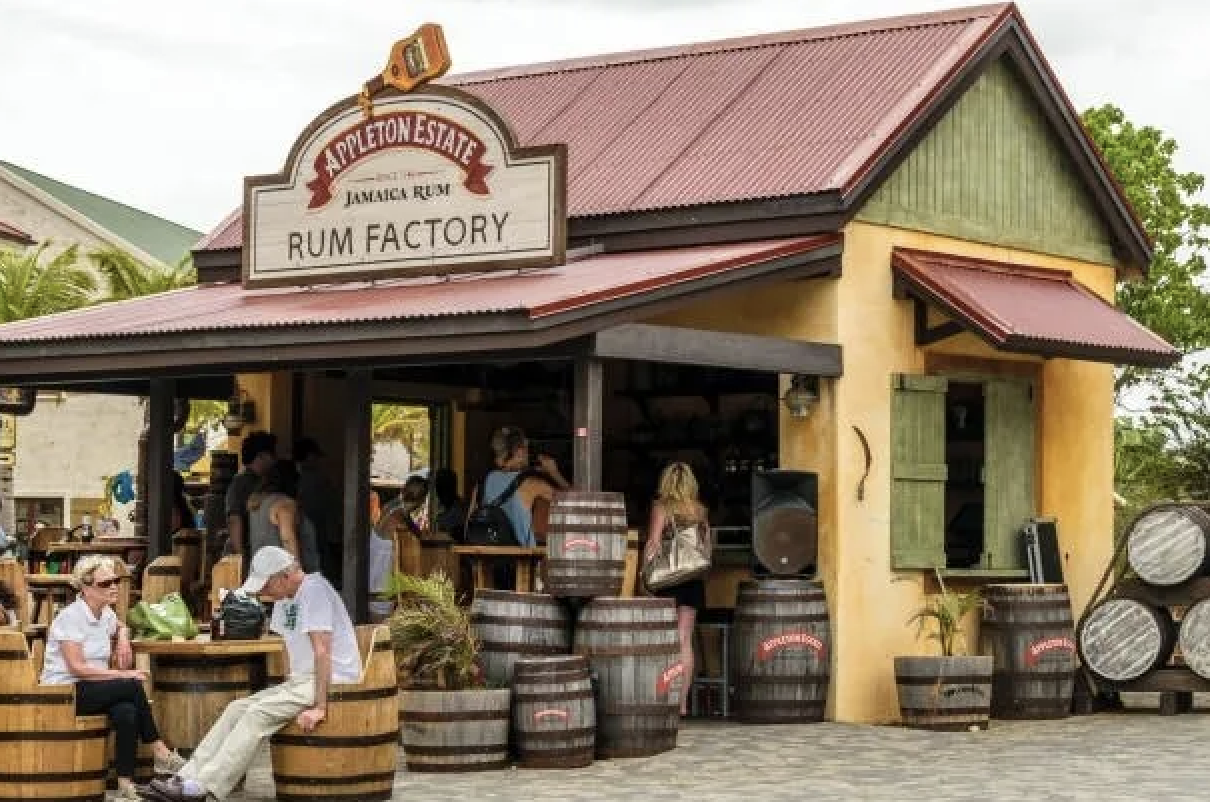
A couple sits on barrels outside the Appleton Estate Rum Factory in Jamaica

Enjoy a rum tasting. Jamaica’s rum is as iconic as Bond’s martini. Head to the Appleton Estate for a tasting that pairs perfectly with the island’s spy-worthy charm.

Jamaica inspired Bond’s world. Here, luxury meets intrigue, and every sunset feels like a cinematic finale. So put on your best Bond attitude, step onto the sand and live like 007 — if only for a moment.

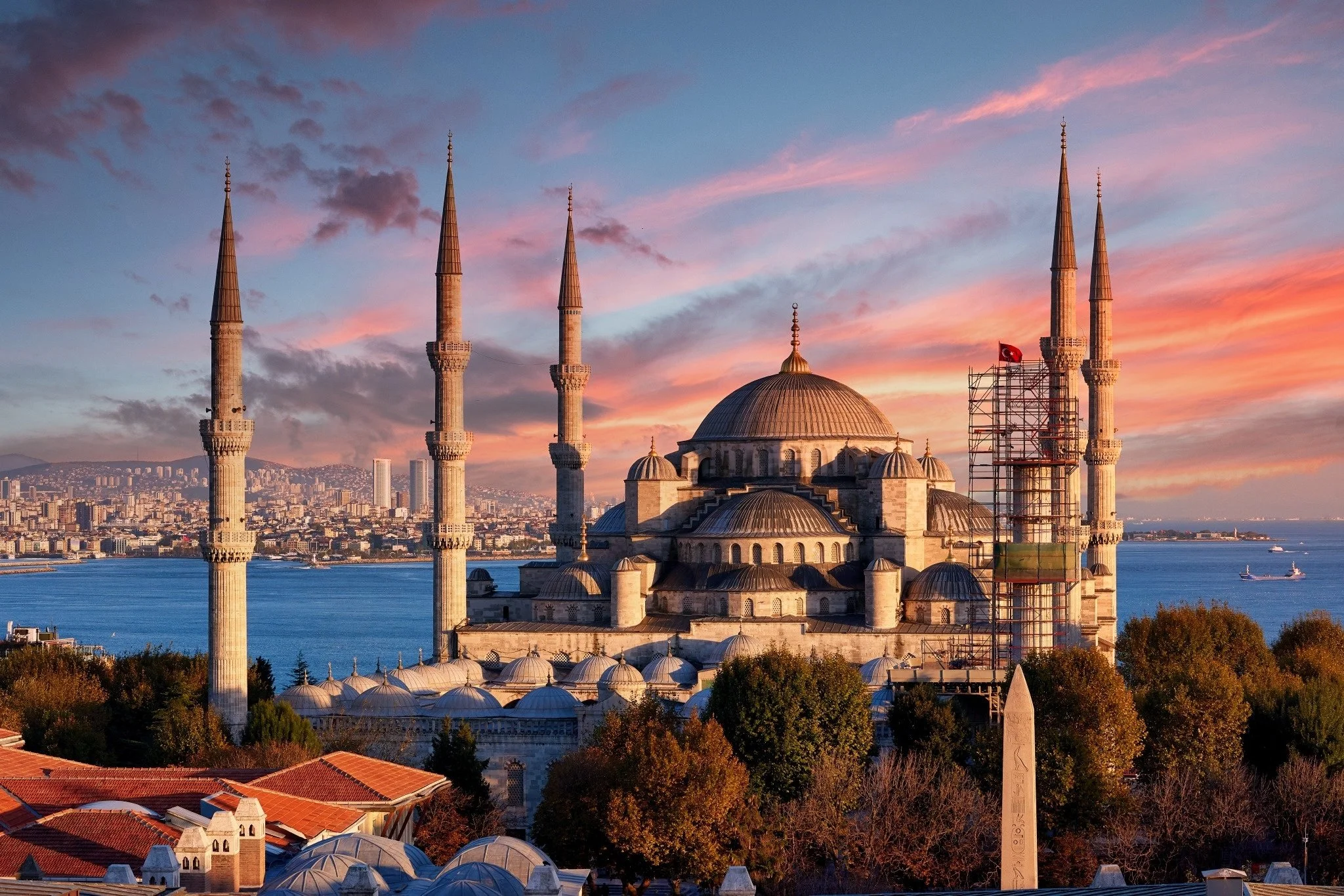
The Hagia Sophia at sunset in Istanbul, Turkey

Istanbul, Turkey: Where East Meets West and Espionage Thrives

Istanbul is a city of dualities, where the East kisses the West, and the ancient blends seamlessly with the modern. It’s no surprise this atmospheric metropolis has become a favorite Bond playground, featured in From Russia With Love and Skyfall. With its bustling bazaars, mysterious underground hideouts and breathtaking waterways, Istanbul is a place where intrigue is always just around the corner.

Your Mission

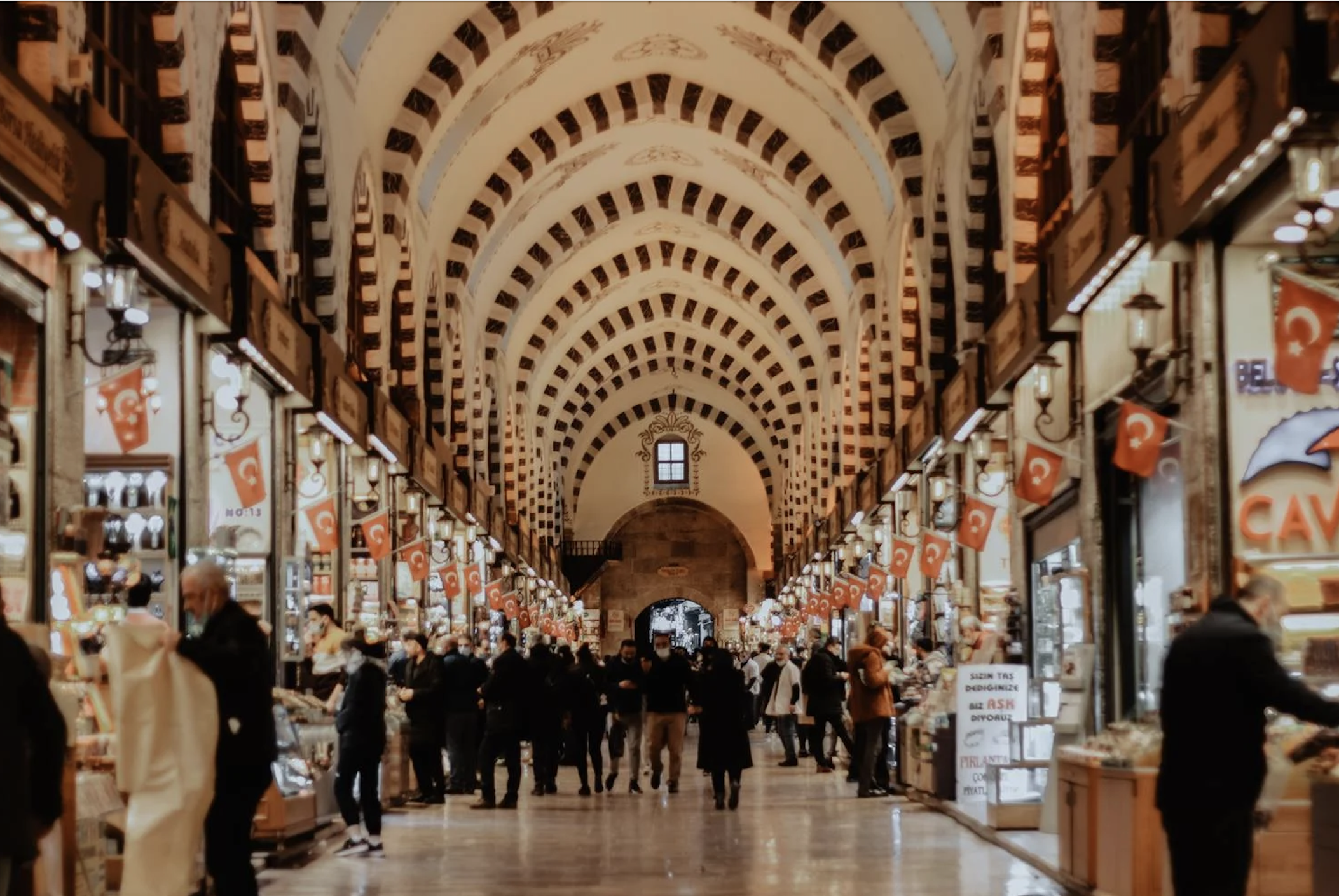
Red and white arches and lines of stalls inside the Grand Bazaar in Istanbul, Turkey

Explore the Grand Bazaar. Lose yourself in this sprawling market of winding alleys and hidden treasures. Keep an eye out for mysterious strangers — after all, this is where Bond did some of his finest shadowing.

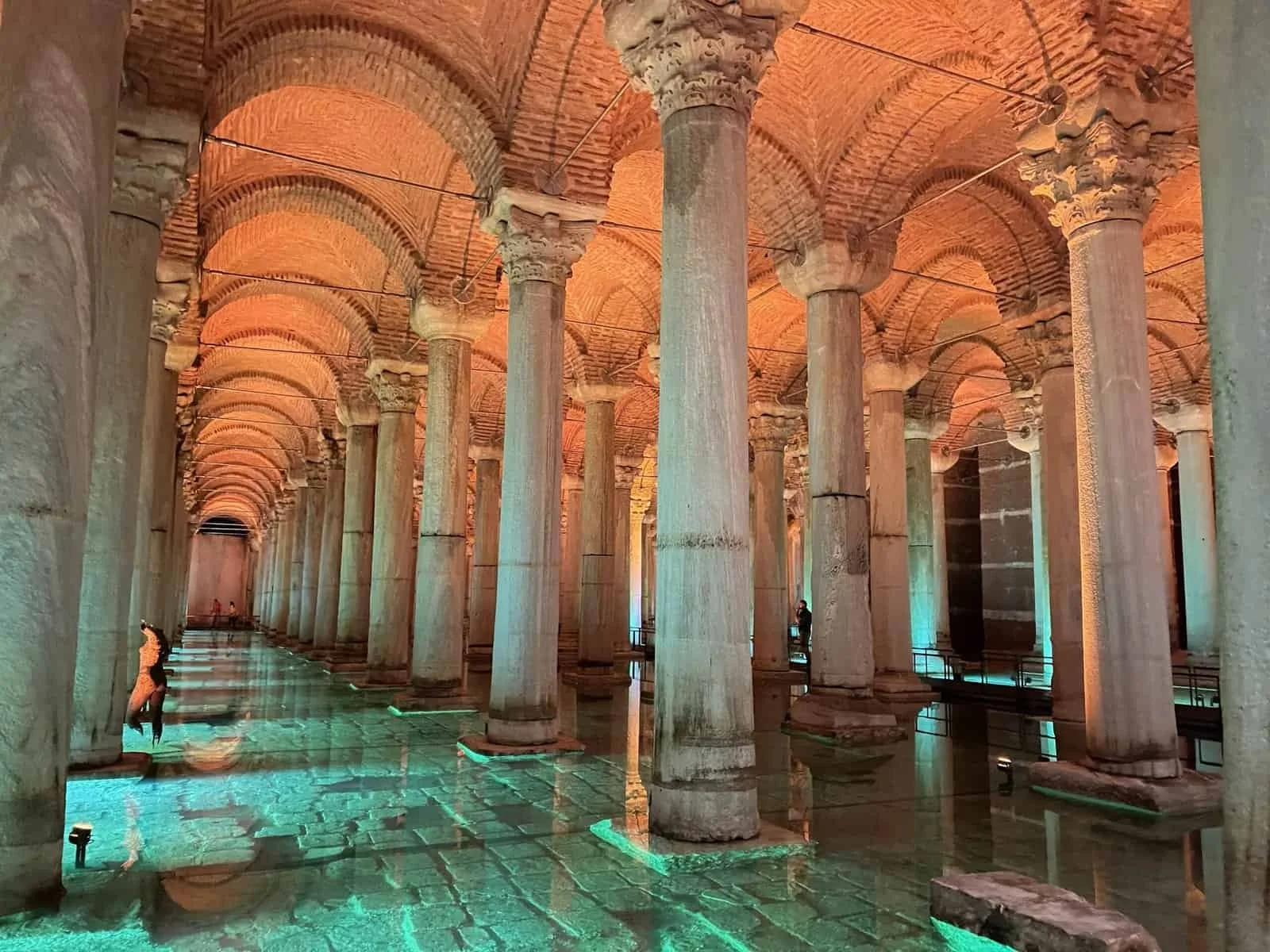
Columns, arches and turquoise-lit water in the Basilica Cistern in Istanbul

Visit the Basilica Cistern. Walk beneath the city in this haunting underground world, imagining yourself escaping danger like Bond and Tatiana. The eerie atmosphere feels like it was designed for espionage.

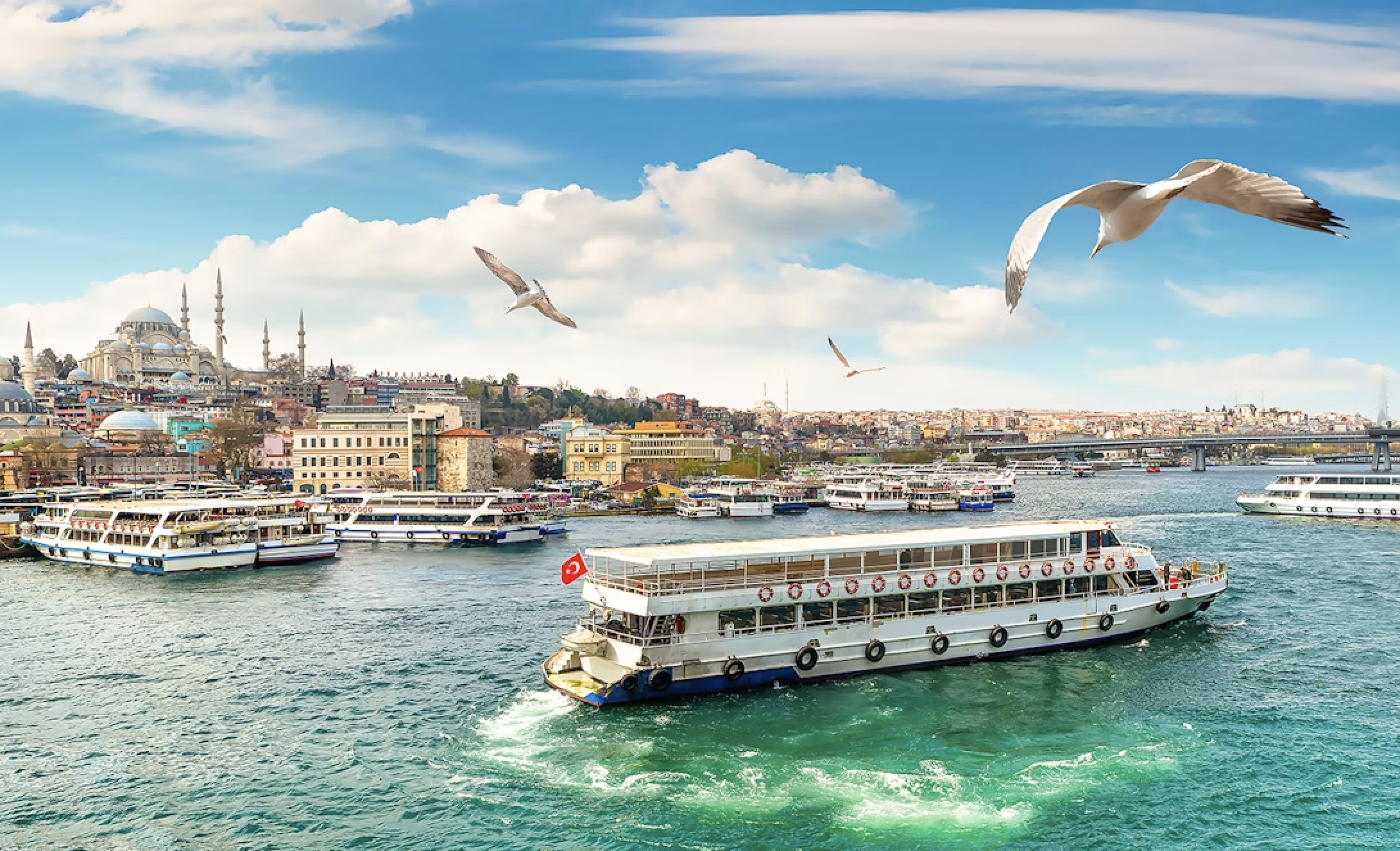
Large tourboats cruise the Bosphorus, with seagulls flying above

Take a Bosphorus cruise. Glide through the waters separating Europe and Asia, just as Bond might have done to evade a high-stakes pursuit. The views of Istanbul’s skyline will leave you as breathless as any car chase.

Inside the Hagia Sophia, with Arabic writing in large circles

Stop by the Hagia Sophia. Once a church, then a mosque, and now a museum, this architectural marvel is as layered as Bond himself. Stand in its quiet majesty and soak in centuries of history and mystery.

Istanbul is a city where every corner feels alive with secrets and stories. It’s no wonder Bond couldn’t resist its pull. Whether you’re bargaining for treasures in the bazaar or soaking in the view from the Bosphorus, you’ll feel as if the next twist in the plot is just waiting for you to discover it. Adventure doesn’t just happen in Istanbul — it’s built into its very fabric.

Green valleys with cabins and snow-topped peaks in the Swiss Alps

The Swiss Alps: Bond’s Snow-Covered Playground

Few places in the world capture the high-stakes drama of a Bond movie quite like the Swiss Alps. These snow-covered peaks have been a favorite backdrop for 007’s most daring escapades, offering equal parts adrenaline and breathtaking beauty. Featured prominently in On Her Majesty’s Secret Service and Goldfinger, the Alps bring Bond’s signature mix of luxury and danger to life.

Your Mission

The winding Furka Pass road through the Swiss Alps

Drive the Furka Pass. Put yourself in the driver’s seat and retrace Bond’s tire-squealing route. The sharp turns and jaw-dropping vistas make this one of the most thrilling roads in the world.

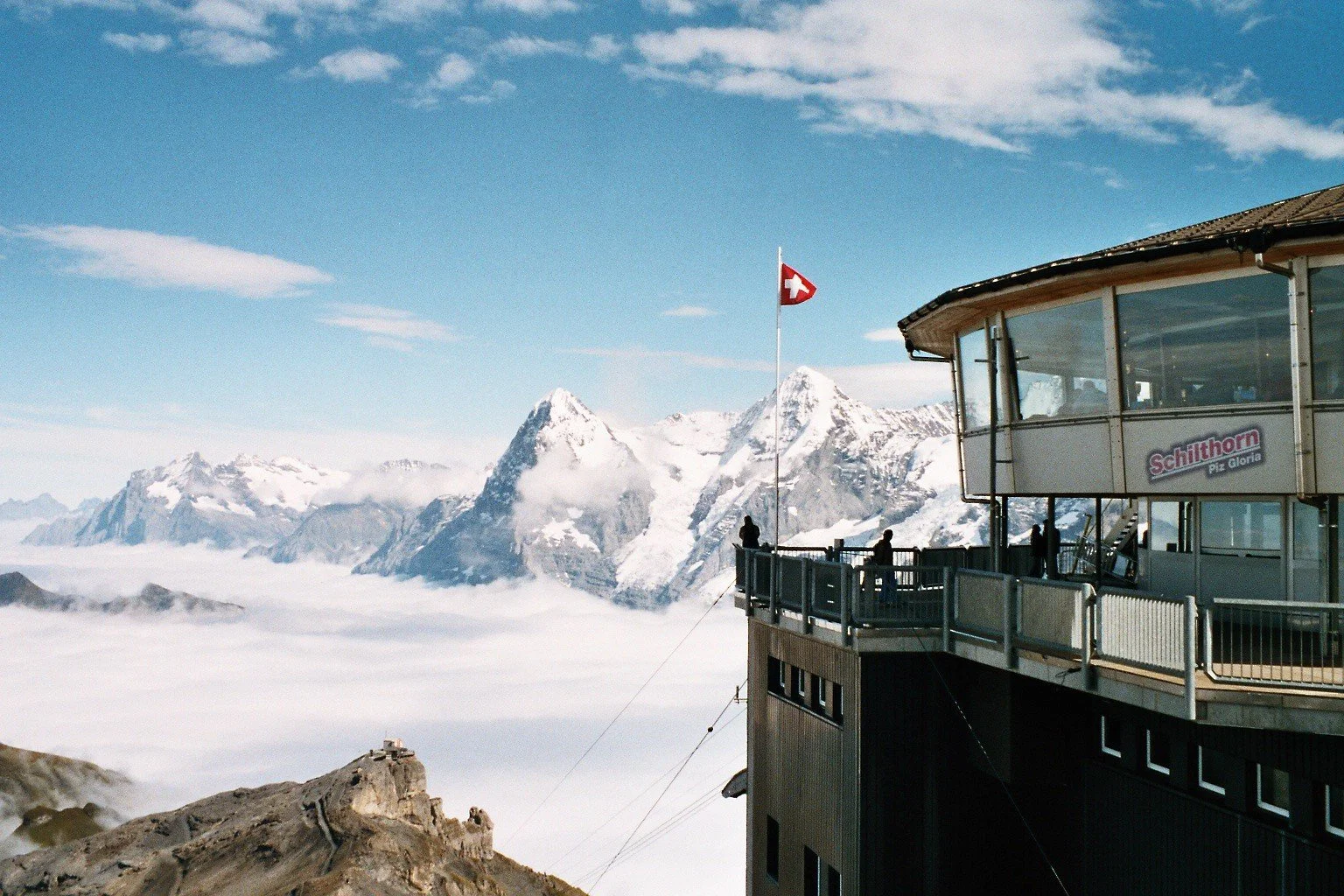
Piz Gloria restaurant at the top of the Schilthorn

Dine at Piz Gloria. Perched atop the Schilthorn, this revolving restaurant isn’t just a Bond filming location — it’s a full-on cinematic experience. Feast on the views, and don’t forget to toast with a martini as you imagine outsmarting Blofeld.

A skier skis the Swiss Alps

Ski the legendary slopes. Take to the pristine snowfields where Bond himself might have carved tracks. Whether you’re a seasoned skier or a first-timer, the Swiss Alps deliver thrills worthy of a 007 mission.

The snaking Rhone Glacier in the Swiss Alps

Visit the Rhône Glacier. Seen in Goldfinger, this icy wonderland offers a chilling dose of Bond-worthy drama and the perfect setting for an epic photo op.

The Swiss Alps embody everything Bond stands for: style, danger and a touch of the extravagant. Whether you’re carving down a mountainside or sipping cocktails with the peaks as your backdrop, this is one destination where you can truly live the Bond dream. Here, every moment feels like a high-stakes mission — and every scene, a masterpiece.

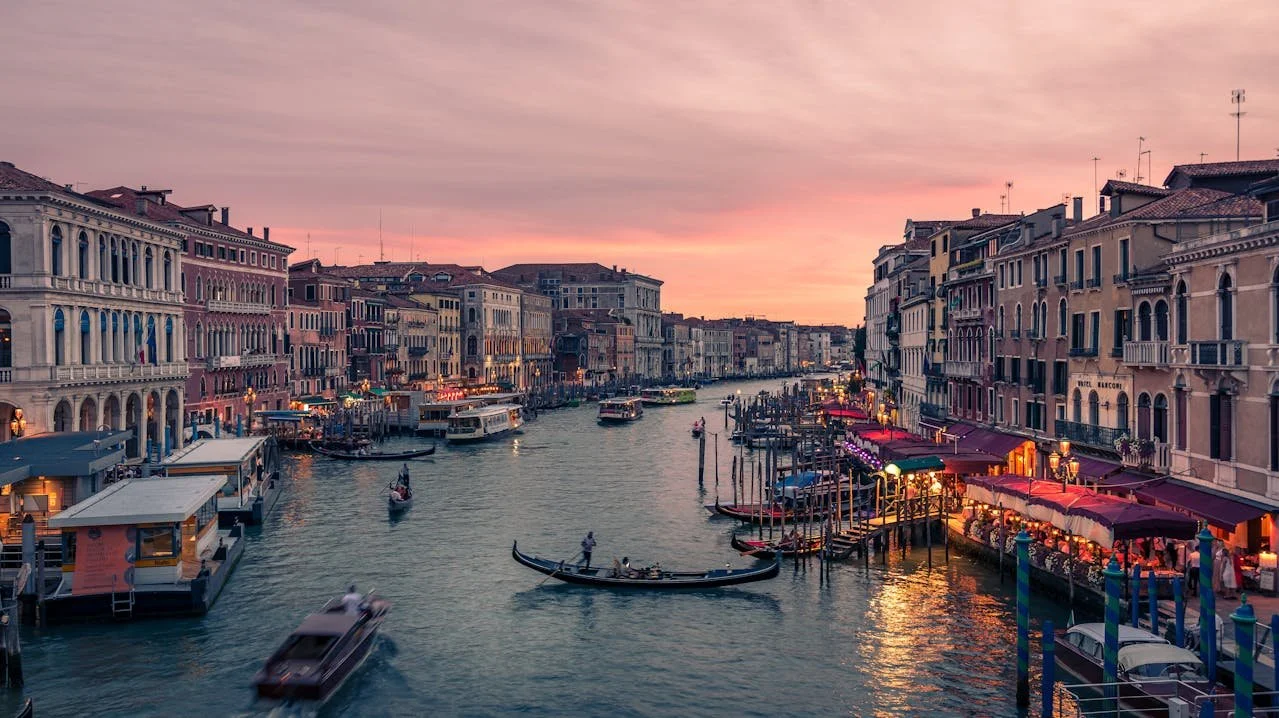
View of Venice at sunset, with buildings lining the canal, filled with gondolas and other boats

Venice, Italy: City of Romance and Intrigue

Few places in the world can match Venice’s blend of romance and mystery, making it the perfect stage for Bond adventures. Featured in Casino Royale and Moonraker, Venice’s timeless charm has hosted everything from dramatic escapes to deadly showdowns.

Your Mission

Gondolas in a canal in Venice, Italy

Glide through the canals. Take a gondola ride, but keep your eyes sharp — after all, danger can lurk even in the city’s most beautiful corners. Channel Bond’s suave coolness as you explore Venice’s iconic waterways.

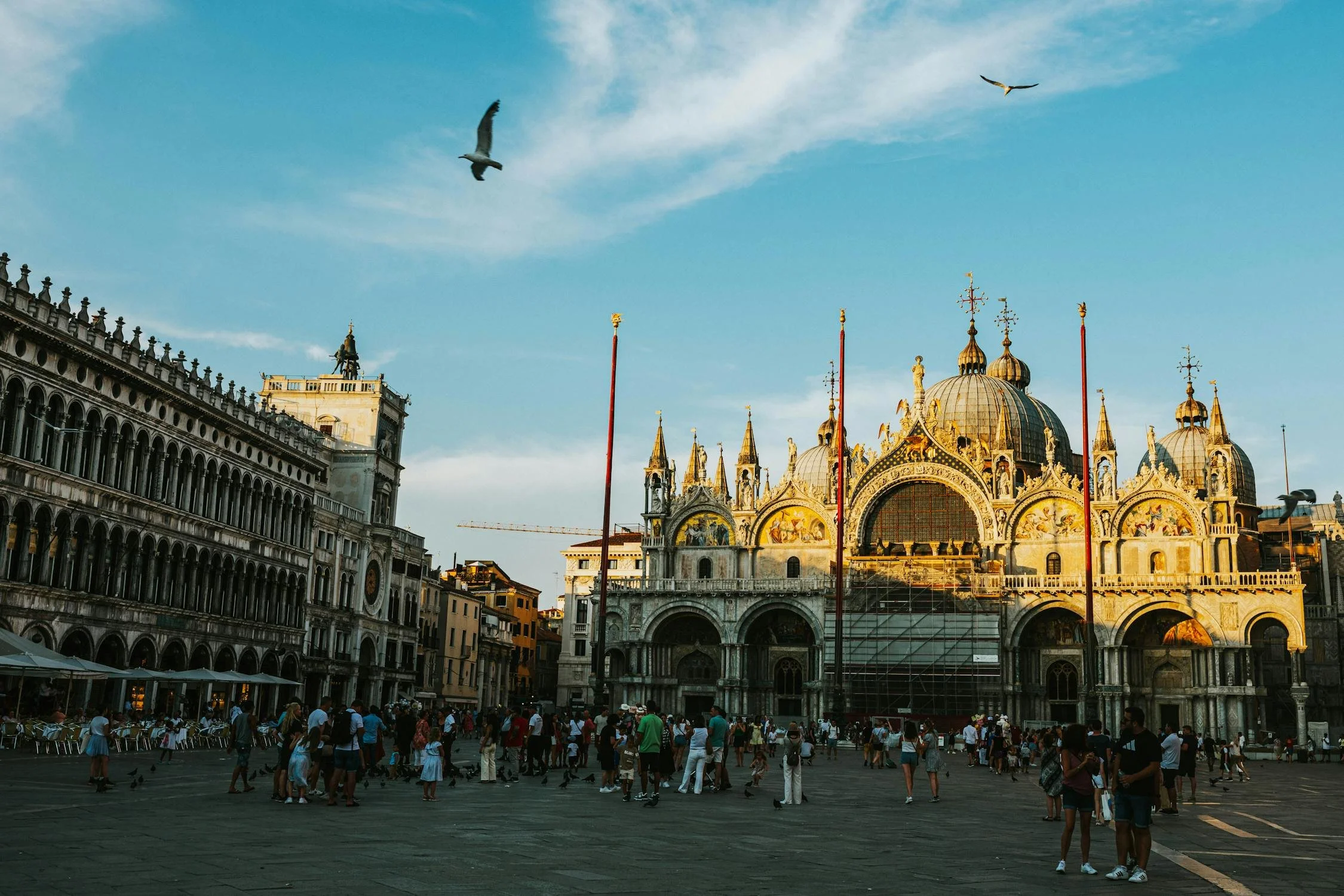
St. Marks Basilica and square filled with visitors in Venice, Italy

Visit Saint Mark’s Square. Stand where Bond’s gondola hovercraft made its dramatic entrance in Moonraker. The grandeur of this square, framed by centuries-old architecture, will have you feeling like the star of your own movie.

Exterior of the Palazzo Pisani along a canal in Venice, Italy

Explore the Palazzo Pisani. Step into cinematic history at this stunning Venetian palace, the setting of a fierce fight scene in Casino Royale. Its regal halls hold secrets and stories worthy of a spy.

Alley with arched entrances in Venice, Italy

Discover hidden corners. Venture into Venice’s labyrinthine alleys and quiet campos. Much like Bond’s missions, the city’s best finds are off the beaten path and shrouded in mystery.

Venice sets a stage where romance and danger waltz together under moonlit skies. Whether you’re sipping wine in a piazza or navigating the canals with Bond-like precision, this city offers intrigue in every shadow and thrill in every reflection. 

The  skyline of Hong Kong and its harbor

Hong Kong: The Neon Jungle of Danger and Deception

Hong Kong is a city of contrasts: Sleek skyscrapers rise alongside bustling street markets, and neon lights illuminate ancient traditions. It’s no wonder Bond found himself entangled in its electric energy in The Man with the Golden Gun. With its dazzling skyline and shadowy alleys, Hong Kong is a place where luxury and danger collide — a perfect playground for 007.

Your Mission

Lights trail past the facade of the Peninsula Hotel in Hong Kong

Stay at the Peninsula Hotel. Walk in Bond’s footsteps at this luxurious landmark. Order a martini at the rooftop bar, gaze out at the skyline and soak in the glamour of a classic Bond setting.

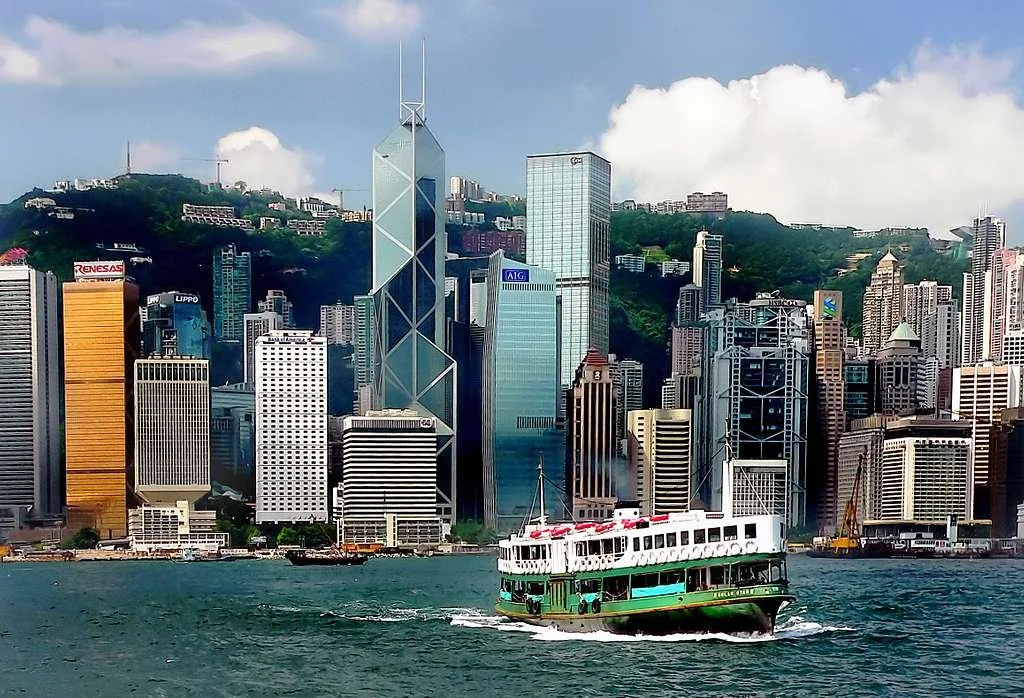
The Star Ferry cruises across Victoria Harbour in Hong Kong, past skyscrapers

Take the Star Ferry. Cruise across Victoria Harbour, imagining Bond slipping through the waters on a covert mission. The city’s skyline at sunset is as breathtaking as any Bond girl.

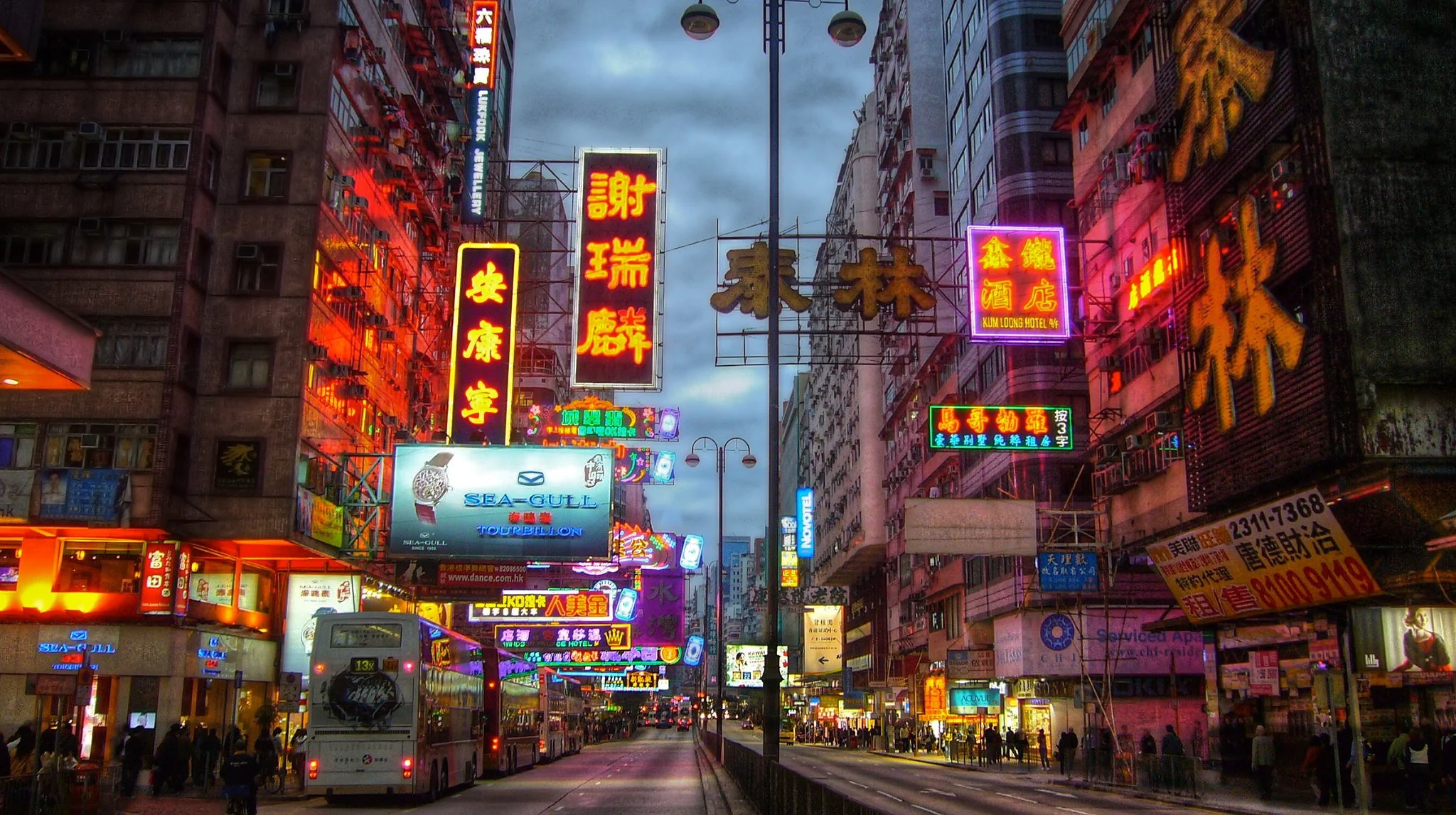
Neon signs light up a street in the Kowloon district of Hong Kong

Explore Kowloon’s streets. Wander the vibrant markets and alleyways where the city’s pulse beats the loudest. Channel your inner Bond as you navigate the chaos, always alert for the unexpected.

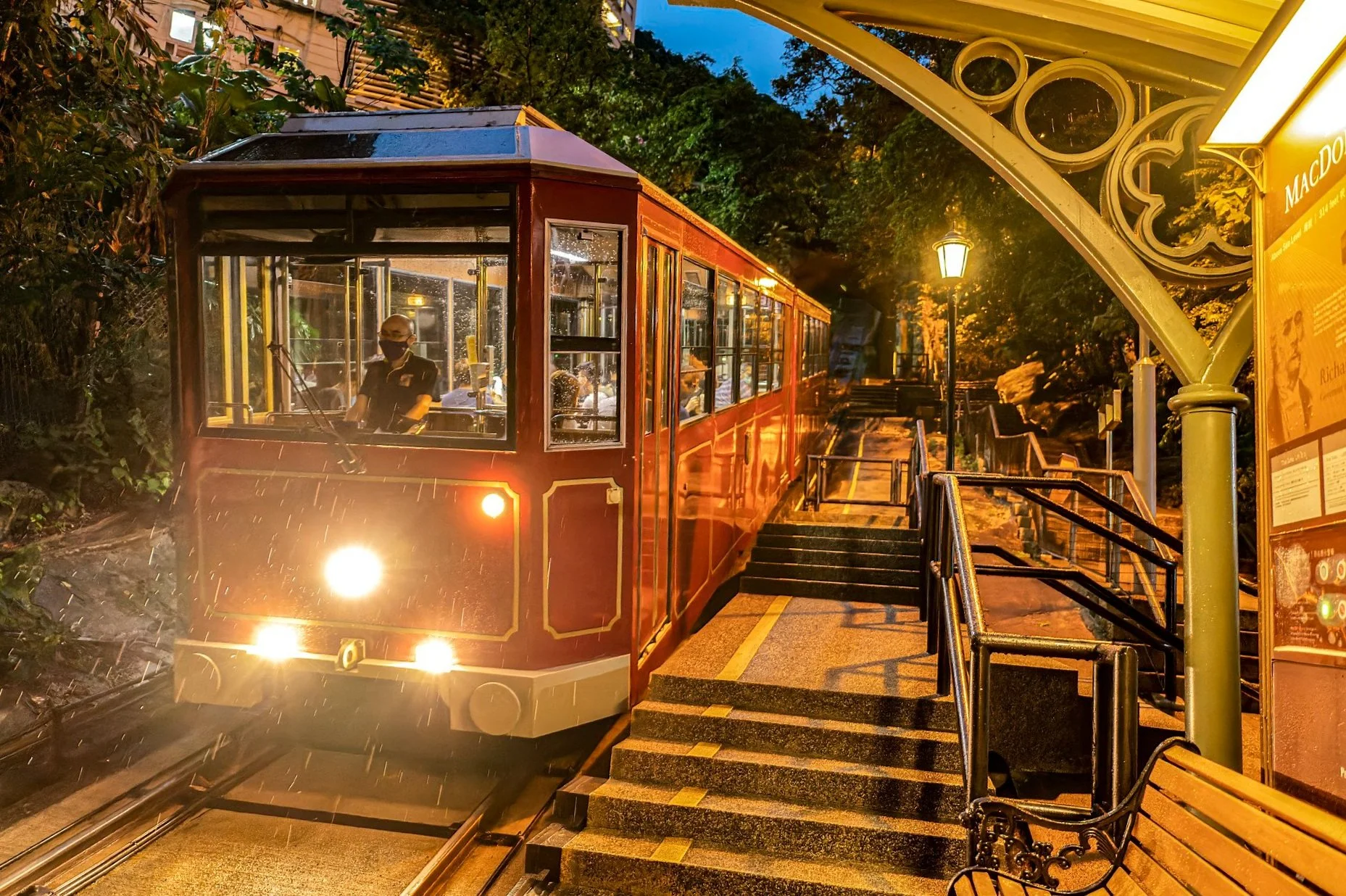
The Peak Tram at a station at night in Hong Kong

Ride the Peak Tram. Ascend to Victoria Peak for a bird’s-eye view of the city. The dizzying heights and sweeping vistas will have you feeling like Bond himself, strategizing your next move.

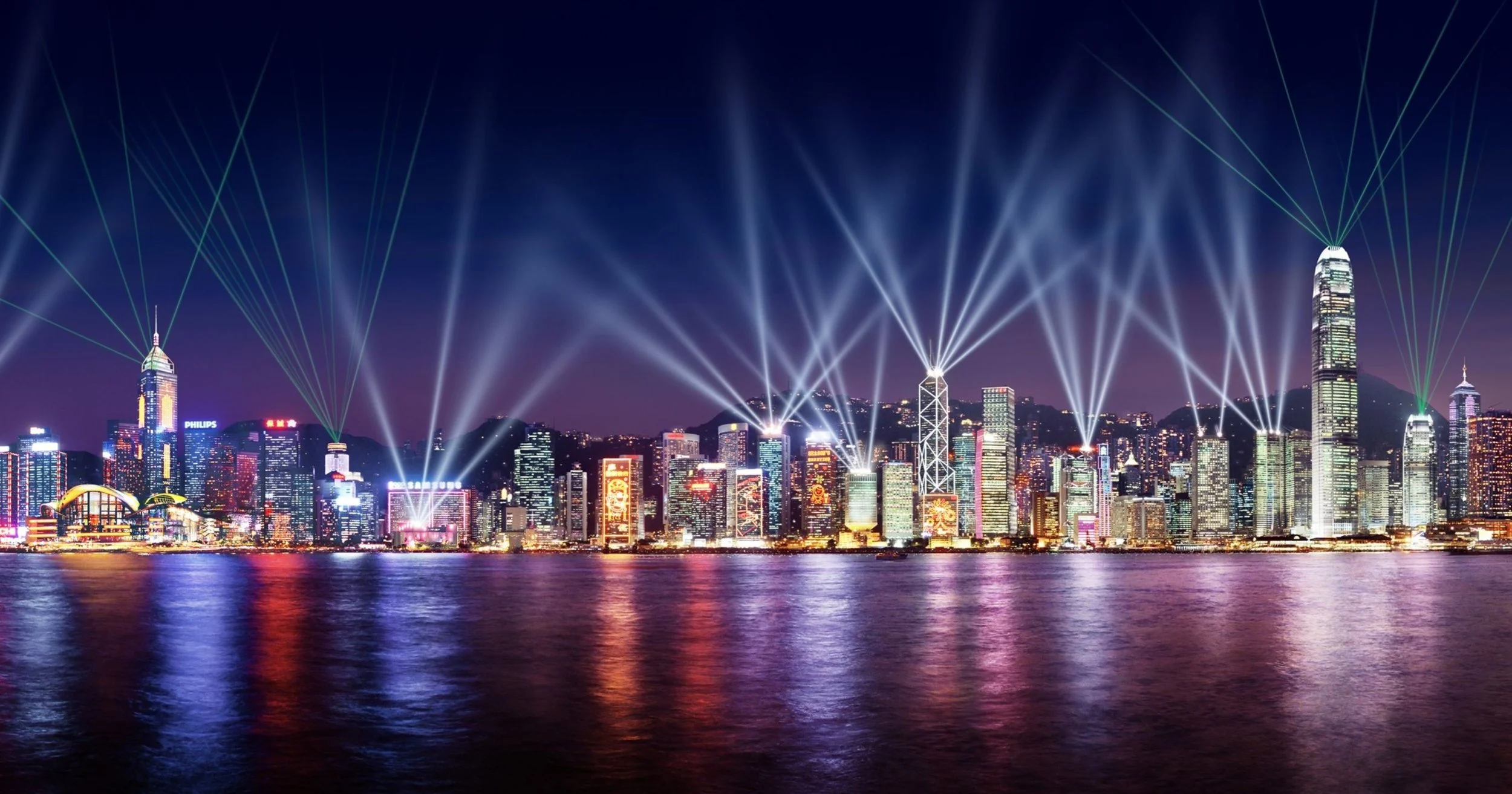
The Symphony of Lights, with white light beaming out of the skyscrapers of Hong Kong, seen across the water

Experience the Symphony of Lights. Watch the city’s skyline come alive in a dazzling light show — a modern spectacle that feels like it was made for a Bond film.

In Hong Kong, the line between luxury and danger blurs, creating a city as dynamic and unpredictable as Bond himself. Whether you’re sipping cocktails at a rooftop bar, navigating bustling markets or cruising the harbor, every moment feels charged with possibility. Here, the stakes are always high, and the thrill is never far behind.

Sean Connery as James Bond by river with stone bridges

007 Travel: A License to Thrill

These destinations let you step into the world of Bond, James Bond — where every turn promises intrigue, elegance and a dash of danger. But they’re not just for hardcore Bond fans; they’re for anyone craving a mix of high-octane adventure and cinematic charm.

So, pack your sharpest tuxedo, order your martini shaken, not stirred, and get ready to use your passport as a license to thrill. Whether you’re scaling the peaks of the Swiss Alps or gliding through Venice’s canals, every moment will feel like your own 007 mission.

Because for Bond — and now, for you — the world is never enough. But it’s one hell of a good place to start. –Ibrahim Oluwu


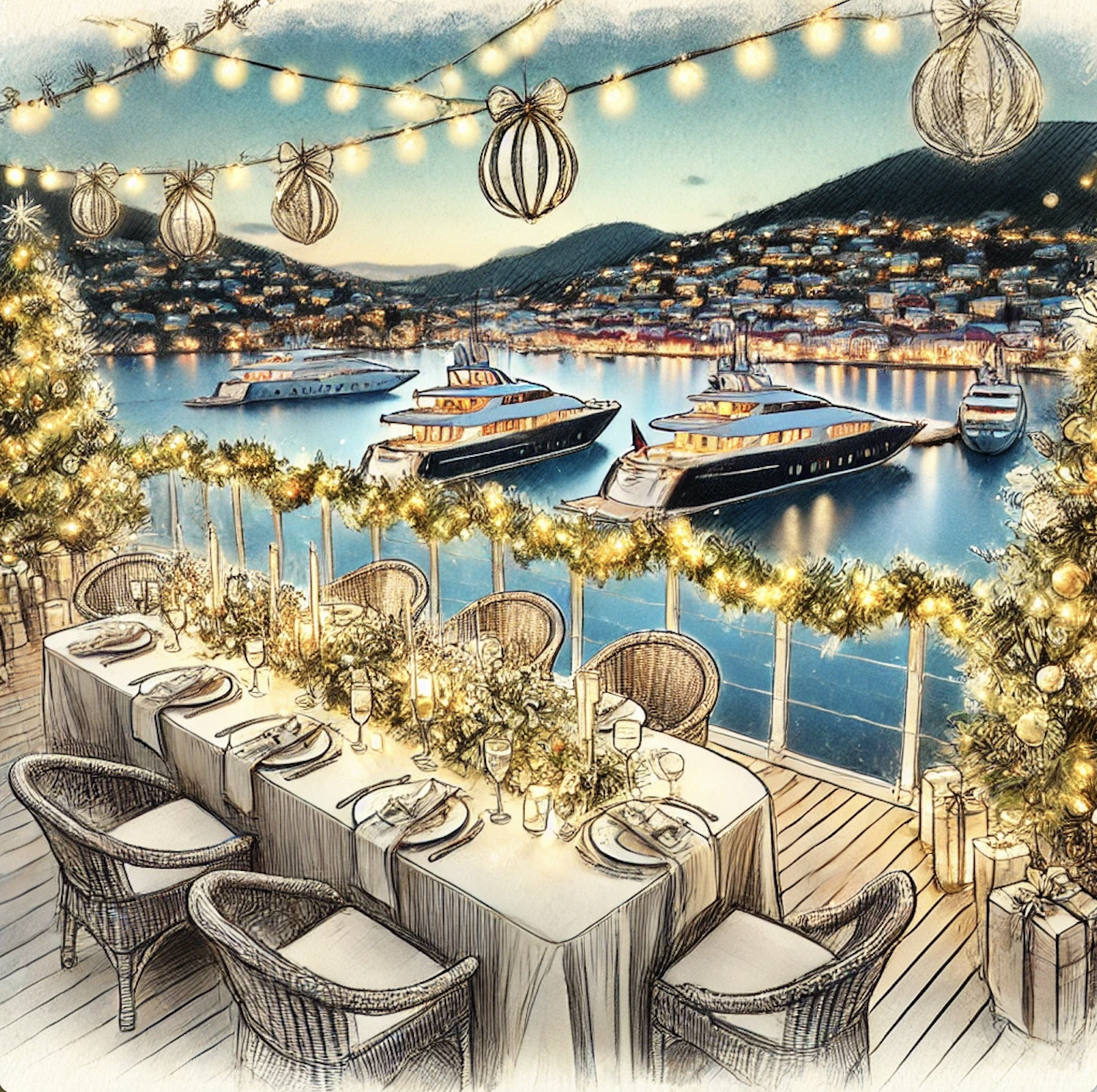
Holiday Ports of Call: The Best Christmas Destinations to Visit by Yacht

Set sail over the holiday season for an unforgettable Christmas adventure. From the shimmering lights of Monaco to the sun-soaked beaches of Sydney, discover the most enchanting stopovers for a luxurious and festive yacht getaway.

Ahoy, holidaymakers! This festive season, why not trade in the traditional for some Christmas luxury getaways? Embark on a yuletide voyage to some of the world’s most enchanting ports, where every sunset is a celebration. Imagine gathering around a tree in a scenic harbor, exchanging customized gifts while experiencing the magic of age-old traditions unique to the region. 

Let’s set sail to these unmissable Christmas destinations by yacht.

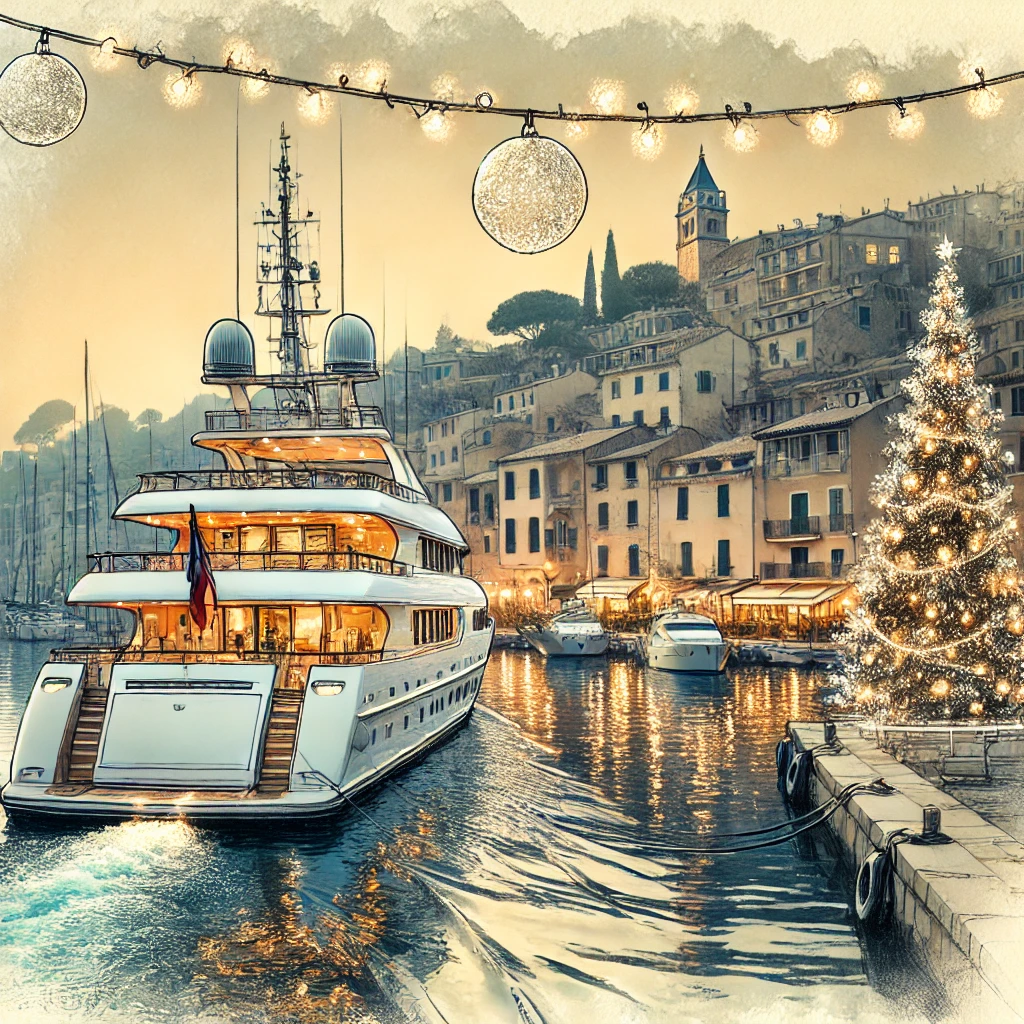
A yacht cruises into Monaco, past a Christmas tree

Mediterranean Magic: Christmas in Monaco

Picture this: the glimmering Mediterranean coastline, where Monaco transforms into a winter wonderland despite the absence of snow. Stroll through festive markets that hug the harbor, where the scent of mulled wine and artisan crafts fills the air. As the sun dips below the horizon, Monaco offers an ambiance that’s both cozy and opulent, perfect for a Christmas to remember.

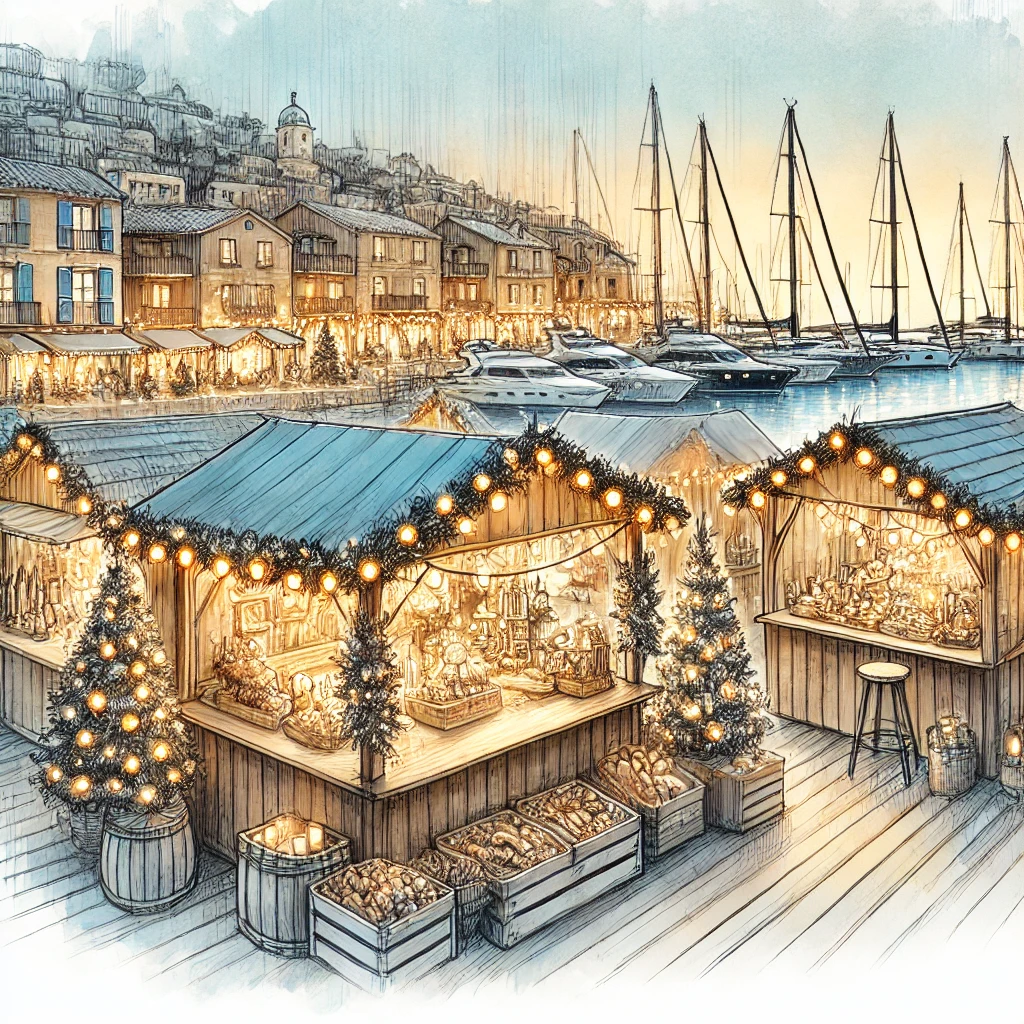
Festive Attractions: Monaco’s Christmas Village at Port Hercules is a treasure trove of festive cheer. Wooden chalets overflow with artisanal crafts, gourmet delicacies and charming holiday trinkets. The nearby Place du Casino is transformed into a dazzling holiday spectacle, complete with sparkling decorations and projections on the iconic Casino de Monte-Carlo.

Christmas markets in Monaco

Local Holiday Traditions: In Monaco, Christmas traditions reflect the principality’s blend of Mediterranean charm and Old-World Catholic traditions. The highlight of the season for many locals is the December Mass at the Saint Nicholas Cathedral. This historic cathedral, with its stunning Roman-Byzantine architecture, becomes the heart of spiritual and communal gatherings during the holidays.

Saint Nicholas, the inspiration for Santa Claus, is celebrated here with a focus on his role as a protector of children and sailors. Monaco’s seaside location makes this connection especially meaningful, with its port bustling with yachts decorated in dazzling holiday lights. 

Local Cuisine: Treat your taste buds to holiday specialties like fougasse, a soft and sweet bread adorned with oranges and nuts. Pair this with a glass of local wine for a festive culinary experience.

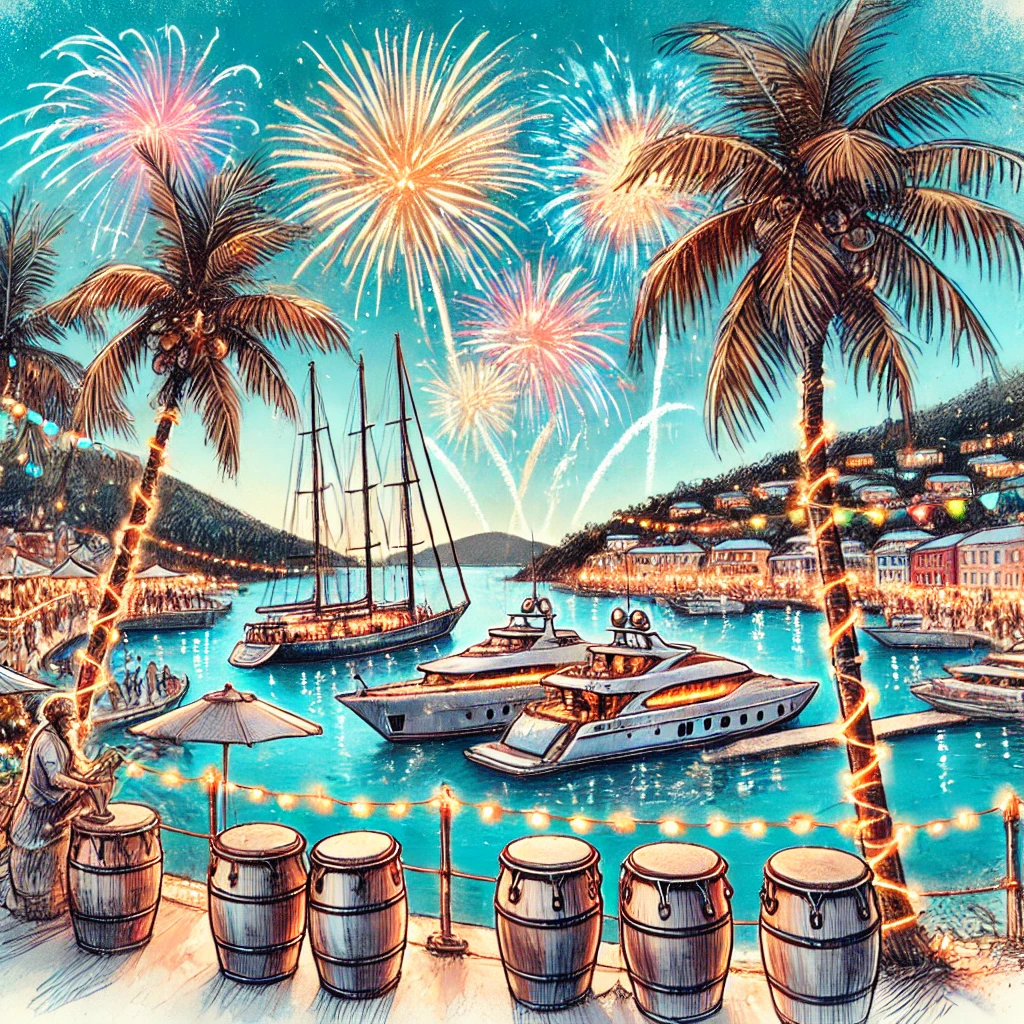
Fireworks explode above yachts and steel drums in St. Barts harbor

Tropical Escape: St. Barts for a French Caribbean Christmas

On this vibrant, sun-soaked island, Christmas is celebrated with a tropical twist. In St. Barts, the azure waters and swaying palm trees form the backdrop for a holiday filled with joy, fireworks and indulgence.

Festive Attractions: Gustavia Harbour is the heart of the celebration, with its fireworks display illuminating the tropical night sky. The harbor buzzes with energy as yachts light up in their holiday finery, and lively street parties spill into the early hours.

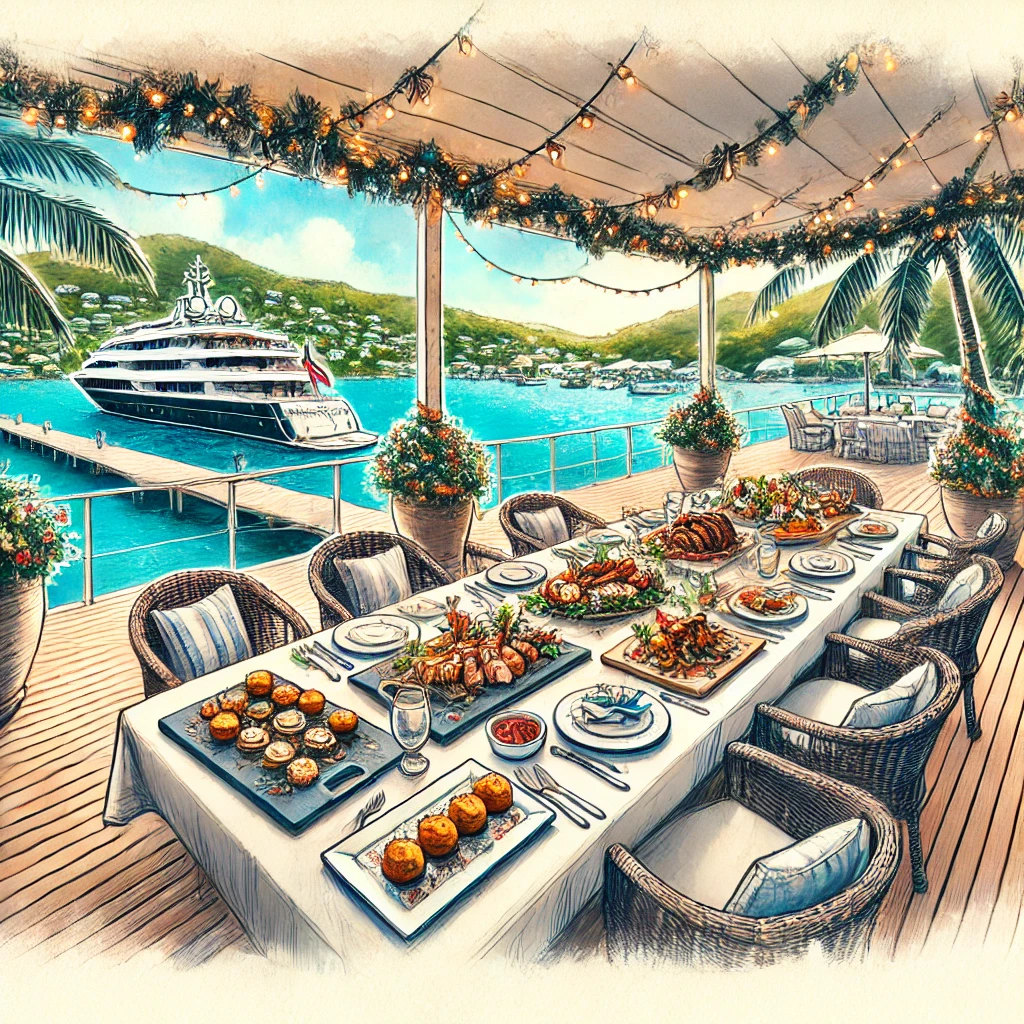
A Caribbean feast on a large table on a dock in St. Barts harbor

Local Holiday Traditions: In St. Barts, Christmas Eve is all about connecting with loved ones, often in open-air settings like courtyards or on the beach. The evening begins with shared meals, where traditional Creole dishes take center stage. As the night deepens, steel drums and guitars fill the air, often accompanied by impromptu dances that bring generations together.

Unlike the more commercialized parts of the world, St. Barts keeps holiday traditions grounded in family and community. Children might receive small gifts exchanged at midnight, but the focus is on the experience: the glowing lanterns, the delicious food and the joy of being surrounded by loved ones. It’s a celebration that captures the essence of island hospitality, where visitors are often welcomed as family, and the holiday spirit radiates through every laugh, song and shared bite of food.

Local Cuisine: Feast on Creole-inspired holiday dishes like roasted meats, fresh seafood and tropical desserts. Don’t miss the chance to try accras (salt cod fritters) or the island’s famous coconut tarts.

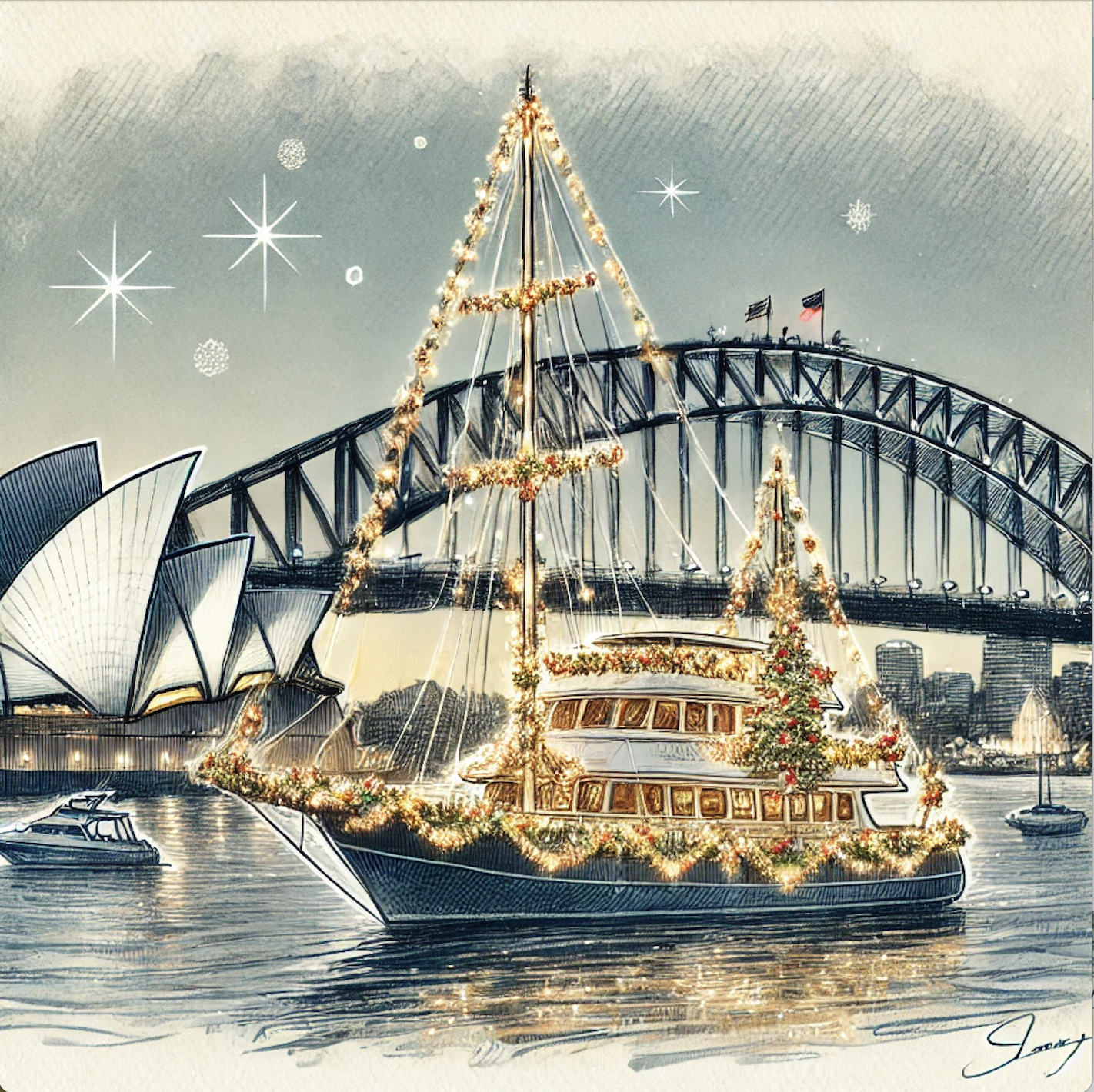
A sail yacht decked out for the holidays, with lights and a tree, heads past Harbour Bridge and the Opera House in Sydney, Australia

Christmas Down Under: Sydney, Australia

Trade snowy streets for sandy beaches in Sydney, where Christmas celebrations are drenched in sunshine. Anchor in Sydney Harbour, with iconic landmarks like the Opera House and Harbour Bridge providing the ultimate festive backdrop. 

Festive Attractions: Sydney’s Christmas markets are a feast for the senses, offering gifts, gourmet treats and a laidback Aussie vibe. Circular Quay comes alive with lights and decorations, while Darling Harbour hosts live performances and holiday events.

Santa holds a red and white striped skimboard on Bondi Beach in Sydney, Australia

Local Holiday Traditions: In Australia, Christmas lands in the peak of summer, flipping traditional holiday expectations on their head. Locals embrace the season with sunshine, sandy beaches and outdoor celebrations. In Sydney, the holiday spirit spills out of homes and into parks, backyards and beaches, where families and friends gather for barbecues and picnics.

At Bondi Beach, the festive vibe reaches its zenith on Christmas Day. The iconic shoreline becomes a buzzing hub of sun-soaked revelry, drawing both locals and travelers who make sandcastles instead of snowmen. Santa himself joins the fun, swapping his sleigh and reindeer for a surfboard. The beach is a kaleidoscope of activity, from families grilling fresh seafood and sausages on portable BBQs to groups playing beach cricket and volleyball.

Events like the famous Carols in the Domain draw thousands for an open-air sing-along under the stars, with a distinctly Australian twist: kids in Santa hats paired with swimmers and sunscreen.

Local Cuisine: Indulge in fresh-grilled seafood like prawns and lobster, paired with tropical fruits and chilled Australian wine. Dessert? Pavlova topped with passionfruit and berries is a must.

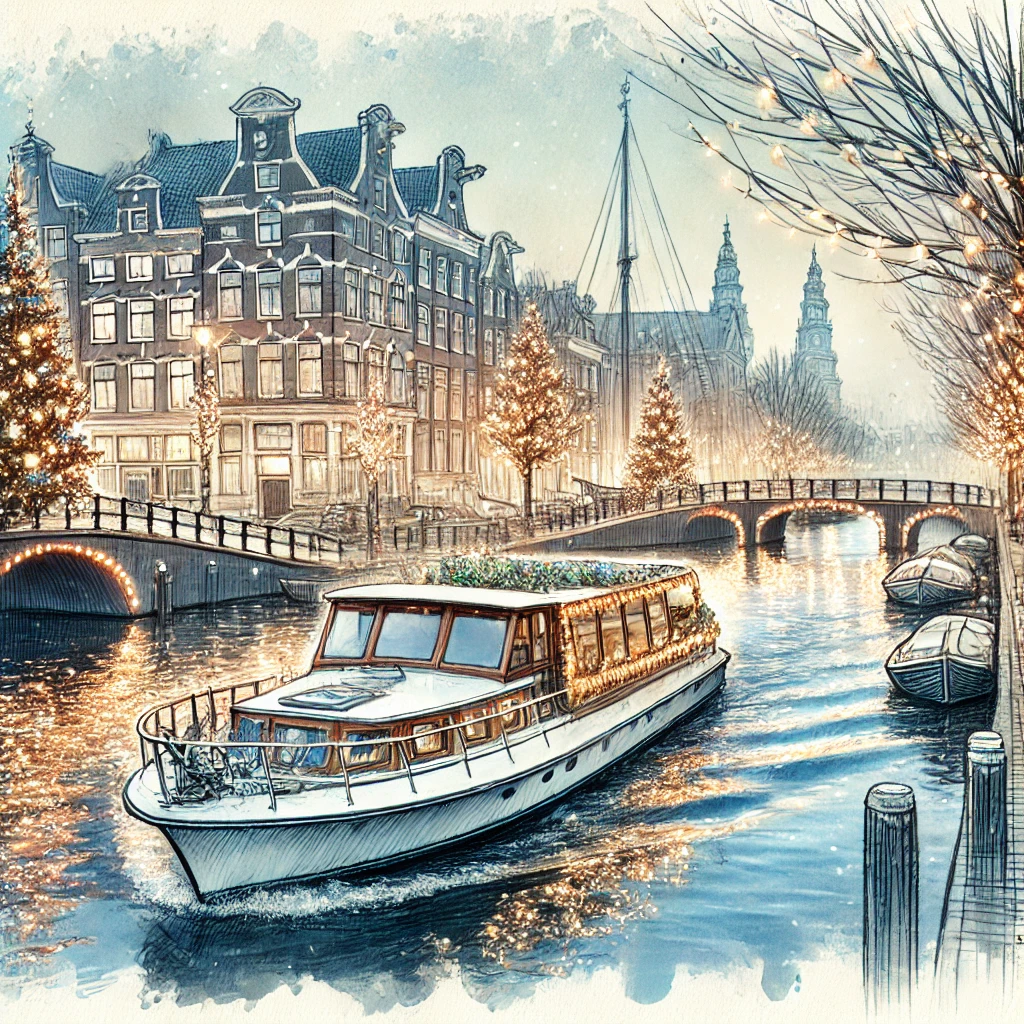
A boat cruises down a canal in Amsterdam with the city decorated for Christmas

Old-World Charm: Amsterdam, Netherlands

The shimmering reflections in Amsterdam’s canals double the charm of the city’s twinkling holiday lights. The scent of spiced cider and freshly baked oliebollen fills the air, while the sound of laughter echoes through cobblestone streets. Whether exploring Christmas markets or catching a glimpse of Saint Nicholas (Sinterklaas), Amsterdam offers a holiday steeped in tradition and wonder.

Festive Attractions: Amsterdam’s Christmas markets are a delightful mix of cozy and festive, featuring handmade crafts, gourmet food stalls and live music. For a unique experience, visit the floating market on the Singel canal. In Dam Square, a towering Christmas tree illuminates the city center.

A Christmas market in Amsterdam, with pastries on a stool and musicians playing

Local Holiday Traditions: At the heart of Dutch Christmas celebrations is Sinterklaas, the tall, stately figure dressed in red robes and a bishop’s mitre, who arrives in early December to bring gifts to children. Unlike Santa Claus, Sinterklaas doesn’t come from the North Pole; instead, he’s said to travel from Spain by steamship, a nod to the country’s maritime trading history.

And Sinterklaas doesn’t travel alone. He’s (in)famously accompanied by Zwarte Piet, aka Black Pete, a mischievous yet helpful character who assists in distributing gifts and sweets. Traditionally depicted in blackface (from chimney soot, supposedly), Zwarte Piet’s origins trace back to Dutch folklore, where he may have been inspired by Moorish servants or earlier tales of naughty spirits. While the depiction of Zwarte Piet has sparked debate in modern times, many communities have adapted the tradition with more inclusive interpretations, focusing on colorful costumes and cheerful antics.

The festivities truly come alive on Sinterklaasavond (Saint Nicholas Eve) on December 5, when children place their shoes by the fireplace, hoping to find small gifts or treats left by Sinterklaas and his helpers. Adults often join the fun with playful Sinterklaasgedichten — personalized rhymes poking gentle fun at the recipient, tucked inside wrapped presents.

Local Cuisine: Warm up with oliebollen, golden fried dough balls dusted with powdered sugar, or poffertjes, mini pancakes served with butter and syrup. Pair them with a hot cup of glühwein (mulled wine) for the ultimate festive treat.

The Northern Lights glow above a yacht in the snow in Tromso, Norway

Northern Lights: Tromsø, Norway

For a truly magical holiday, set your course north to Tromsø, where the Arctic sky lights up with the ethereal glow of the Northern Lights. Here, Christmas is a celebration of nature’s wonders, from snow-dusted landscapes to vibrant holiday markets. 

Festive Attractions: Tromsø’s Christmas markets are an enchanting blend of traditional crafts, local delicacies and festive lights. Don’t miss the chance to witness the Northern Lights from the comfort of your yacht.

Reindeer stew and glogg, with a reindeer in the distance, while the Northern Lights dance overhead in the snow

Local Holiday Traditions: In Tromsø, Christmas is a time where folklore meets the enchantment of the Arctic. Norway’s version of Santa, Julenissen, is a mix of the modern Santa and the nisse — a gnome-like guardian from Norse mythology. Families leave bowls of porridge with butter out for the nisse, honoring its role as a protector of farms and bringer of small gifts during Jul, the Scandinavian version of Christmas.  

Another beloved tradition is julebukk (Christmas goat), where children dress in costumes and sing carols door-to-door in exchange for treats. This echoes ancient customs tied to Thor’s goat-pulled chariot, blending pagan roots with modern festivities.

Local Cuisine: Savor reindeer steaks, hearty stews and lingonberry desserts, each offering a true taste of the Arctic. Warm up with mulled berry gløgg, a hot spiced and slightly sweet wine.

Yachts in a harbor with a table on the dock, all decorated for Christmas

Deck the Hulls: A Luxury Holiday Adventure Awaits

Embarking on a Christmas yacht journey offers a blend of luxury, adventure and cultural immersion. From the festive markets of Monaco to the Northern Lights of snowy Norway, each destination provides its own special brand of holiday cheer. Plan ahead, choose a yacht that caters to your desires and prepare for a holiday season that sails beyond the ordinary. –Joyce Veloso


MORE MAGIC OF THE SEASON: Christmas Around the World

The Most Famous Sports Memorabilia — and the Stories Behind Them

From a bitten-off ear to Air Jordans, these sports artifacts have become the stuff of legends, marking record-breaking achievements, infamous incidents and pivotal games by Michael Jordan, Pelé, Babe Ruth and more.

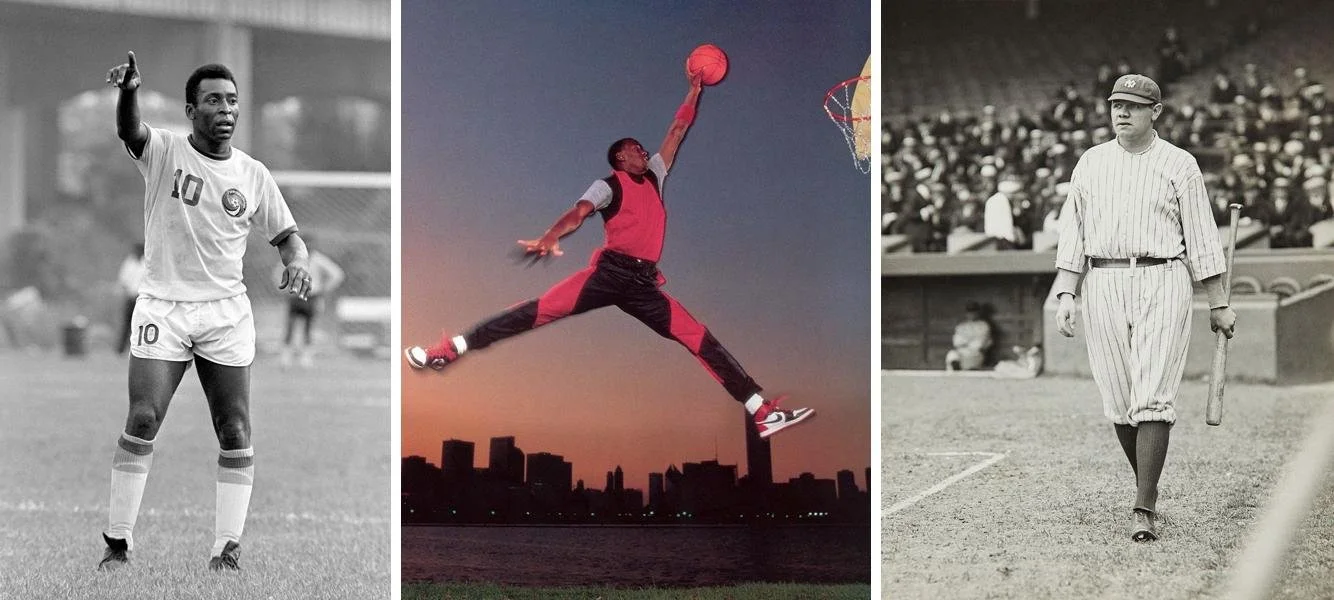
Pelé, Michael Jordan and Babe Ruth

Pelé, Michael Jordan and Babe Ruth are all connected with some of the world’s most famous (and sometimes strange) sports memorabilia.

Sports memorabilia offer a unique glimpse into the history of athletics, capturing moments of triumph, controversy and sheer oddity. From iconic game-worn gear to objects shrouded in superstition, these items tell the stories of the athletes and events that have left an indelible mark on sports history. 

Mike Tyson bites Evander Holyfield's ear on the left; Tyson with facial tattoo and gray beard in suit on right

Evander Holyfield’s Ear, Bitten Off by Mike Tyson

In one of the most shocking moments in boxing history, Mike Tyson went full-on Hannibal Lecter and bit off a piece of Evander Holyfield’s ear during their 1997 bout. After the chomp heard ’round the ring, the piece of ear was retrieved from the canvas and sent to the hospital with Holyfield — but doctors were unable to reattach it. This body part has become an infamous piece of sports memorabilia, symbolizing one of the sport’s most controversial incidents. Tyson was disqualified from the fight, and the resulting shock shook the boxing community to its core.

Barry Bonds in Giants uniform on left; the baseball where he hit the record-setting home run, with an asterisk because of claims he was on performance-enhancing drugs

Barry Bonds’ Controversial Asterisk Ball 

When Barry Bonds hit his 756th home run, surpassing Hank Aaron’s long-standing record, controversy wasn’t far behind. The ball, marked with an asterisk, represents the widespread debate over Bonds’ alleged use of performance-enhancing drugs. Still, the famous ball was purchased for $752,467 and later donated to the National Baseball Hall of Fame in Cooperstown, New York. The asterisk on the ball serves as a reminder of the era’s contentious legacy and the ongoing debate about Bonds’ place in baseball history.

Diego Maradona playing soccer on left; the Hand of God jersey on right

Diego Maradona’s “Hand of God” Ball and Jersey 

Diego Maradona’s “Hand of God” goal during the 1986 World Cup quarterfinals against England is one of soccer’s most legendary (and infamous) moments. Using his hand to punch the ball into the net, Maradona’s cheeky maneuver went unnoticed by the referees, leading to a goal that left England fuming and Argentina cheering. The ball and the jersey worn by Maradona during that match have become iconic artifacts. The jersey sold for $9.3 million at auction in 2022, while the ball fetched nearly $2.4 million the same year.

Paul "Bear" Bryant wearing his famous houndstooth hat

Paul “Bear” Bryant’s Houndstooth Hat 

Paul “Bear” Bryant, one of the most successful college football coaches, is often remembered for his signature houndstooth hat. This hat has come to symbolize Bryant’s legacy at the University of Alabama, where he won six national championships. The hat remains a cherished piece of memorabilia, representing Bryant’s enduring influence on college football. Where to see it? It’s on display at the Paul W. Bryant Museum at Bama in Tuscaloosa, Alabama.

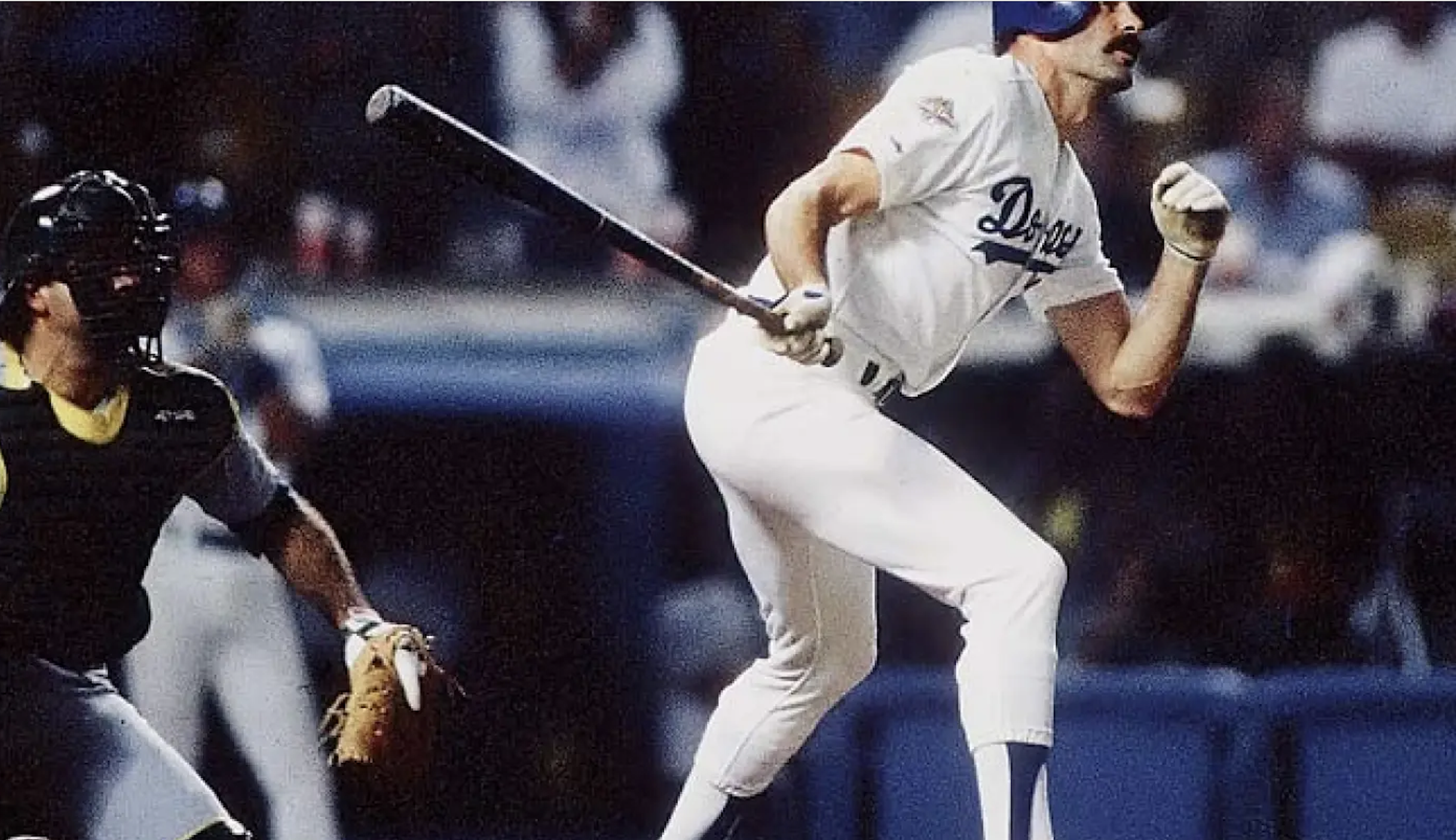
L.A. Dodger Kirk Gibson hits a home run in the 1988 World Series against the Oakland A's

Kirk Gibson’s Pine Tar Bat 

The L.A. Dodgers’ Kirk Gibson was called to pinch-hit in the bottom of the ninth with two outs during the 1988 World Series against the Oakland Athletics. Gibson, hobbling on injured legs — a strained left hamstring and a swollen right knee — hit a dramatic game-winning homer using a bat coated with pine tar for a better grip. The bat sold at an auction for $575,912 and is now a treasured piece of memorabilia symbolizing Gibson’s grit and determination in one of baseball’s most memorable moments​.

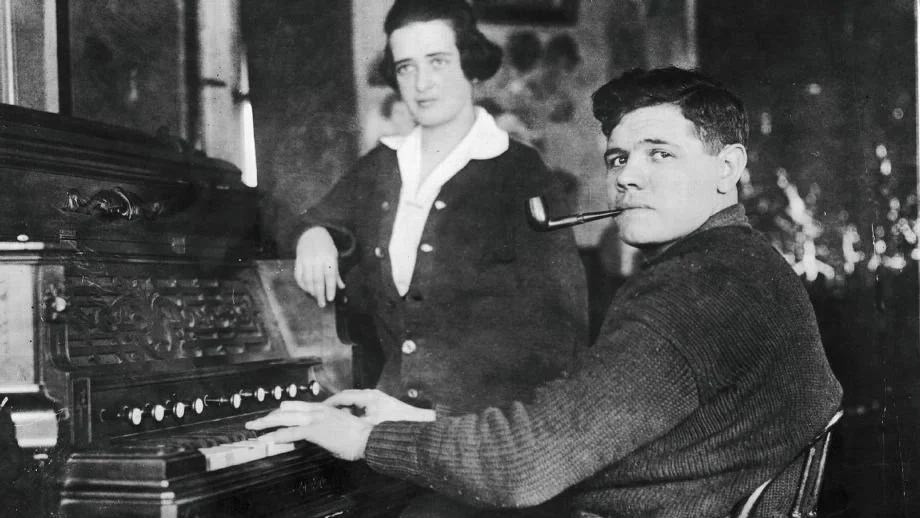
Babe Ruth smokes a pipe and plays a pianolike instrument, which his wife leans on

The “Curse of the Bambino” Piano 

Legend has it that in 1919, the Boston Red Sox made a fateful decision that would haunt them for nearly a century. They sold Babe Ruth, one of baseball’s greatest players, to the New York Yankees. This transaction not only shifted the balance of power in baseball but also gave rise to the infamous “Curse of the Bambino.” 

The curse began to weave itself into the very fabric of the Red Sox’s identity, as the team went without a World Series title for 86 long years. Superstition and folklore became intertwined with this narrative, with one of the strangest tales involving a piano. It’s rumored that Babe Ruth, in a fit of frustration, threw a piano into a pond on his Sudbury, Massachusetts farm. Despite various searches and efforts to locate it, the piano has never been found — but it has become a symbol that marks the beginning of the Red Sox’s misfortunes.

As fans look back on these monumental moments, many find that Massachusetts sports betting offers a new way to experience the games. It allows them to predict and partake in potential new chapters of success, much like spectators of the past who witnessed the curse’s end, when the Red Sox won the 2004 World Series.

Brazil's jersey from the World Cup in 1950 against Uruguay

Brazil’s Cursed Jersey of the 1950 World Cup

In one of the greatest upsets in World Cup history, Uruguay defeated Brazil in the 1950 final, an event forever etched in memory as the Maracanazo. Brazil, the overwhelming favorite, was left stunned by Uruguay’s shocking victory. The jersey worn by team Brazilian captain Augusto da Costa during this match is believed to be cursed, embodying the sorrow and anguish of an entire nation, a relic of a day when dreams were shattered at the Maracanã Stadium. The jersey can be found at the Museu do Futebol (Soccer/Football Museum) in São Paulo.

Michael Jordan sweats during his "flu game" and the black and red Air Jordans he wore then

Michael Jordan’s Flu Game Shoes 

During Game 5 of the 1997 NBA Finals, Michael Jordan played through severe flu-like symptoms to lead the Chicago Bulls to victory. The sneakers Jordan wore during this “Flu Game” (black and red size 13 Nike Air Jordan XIIs) are one of the most iconic pieces of sports memorabilia, sold at auction for $104,765. These shoes represent Jordan’s unparalleled willpower and legendary status in basketball history.

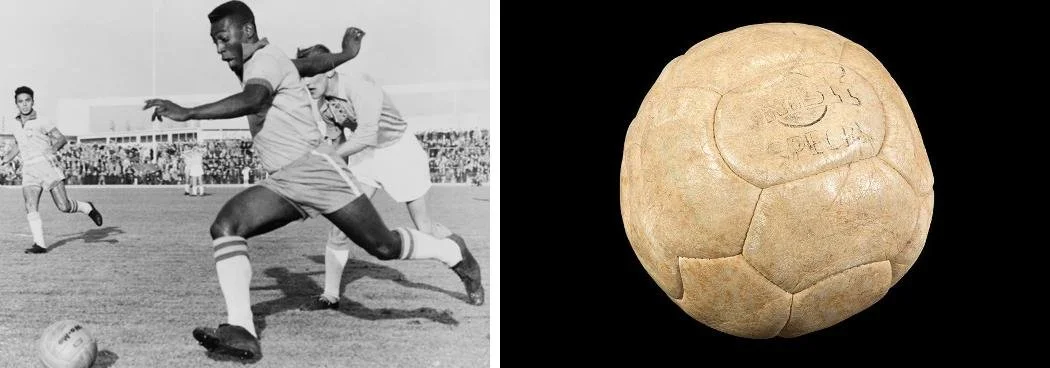
Pele plays soccer on left; his 1,000th goal ball on right

Pele’s 1,000th Goal Ball 

On the evening of November 19, 1969, the legendary Pelé, one of soccer’s greatest players, stood poised on the brink of history. The Maracanã Stadium in Rio de Janeiro buzzed with anticipation as Pelé’s team, Santos, faced off against Vasco da Gama. 

In the 34th minute, Pelé seized his chance. A perfectly placed pass found its way to his feet. With the grace and precision that defined his career, he danced past defenders and drove the ball into the net, scoring his 1,000th goal. The stadium erupted in celebration, a wave of euphoria washing over the crowd as Pelé, overwhelmed with emotion, lifted his arms in triumph.

The ball used in this historic moment isn’t just a piece of leather but a cherished artifact, celebrating Pelé’s incredible career and his indelible impact on the sport. It’s preserved at the Museu do Futebol (Museum of Football) in São Paulo, serving as a testament to the magic of that night and a beacon of Pelé’s legacy in the world of soccer.

Tony Hawk does a trick on a skateboard on left; his first skateboard on right

Tony Hawk’s First Skateboard 

On a summer evening in 1999, at the X Games in San Francisco, Tony Hawk etched his name into the annals of sports history: After nearly a dozen failed attempts, Hawk nailed the elusive 900, a trick that involves completing two and a half mid-air revolutions on a skateboard. He was the first skateboarder in history to do so in competition. 

Hawk’s first skateboard, a Bahne model given to him by his brother Steve in 1977, holds a special place in the Smithsonian National Museum of American History’s collection. This board, which Hawk learned to ride as a child, symbolizes his early beginnings and significant contributions to skateboarding. Before donating it, Hawk took one final ride on the board during the Innoskate festival, celebrating his innovative spirit and impact on the sport​ 

These pieces of sports memorabilia are more than just objects; they’re tangible connections to some of the most memorable and peculiar moments in sports history. Each item holds a story, encapsulating the passion, controversy and unforgettable events that continue to captivate fans around the world. –Eduardo Solano

Iconic Stadiums and Sporting Landmarks Around the World
From the Colosseum to Dodger Stadium, from Wembley to Yankee Stadium, we’ve got a winning itinerary of the planet’s most iconic sporting landmarks. Game on, sports fans!

Sports stadiums have been gathering spots for ages, where people have come to witness athletic feats, whether that’s a fight between gladiators in Ancient Rome or today’s games. From the deafening cheers to the hushed silences, these places have seen raw emotions on full display.

Now, get ready for a global journey for sports fans: We’ll be making stops at some of the world’s most iconic stadiums and sporting landmarks. From an ancient arena to modern architectural marvels, we’ll dig into their history and the architects who brought them to life, throw in some interesting facts, and even point out a few nearby attractions.

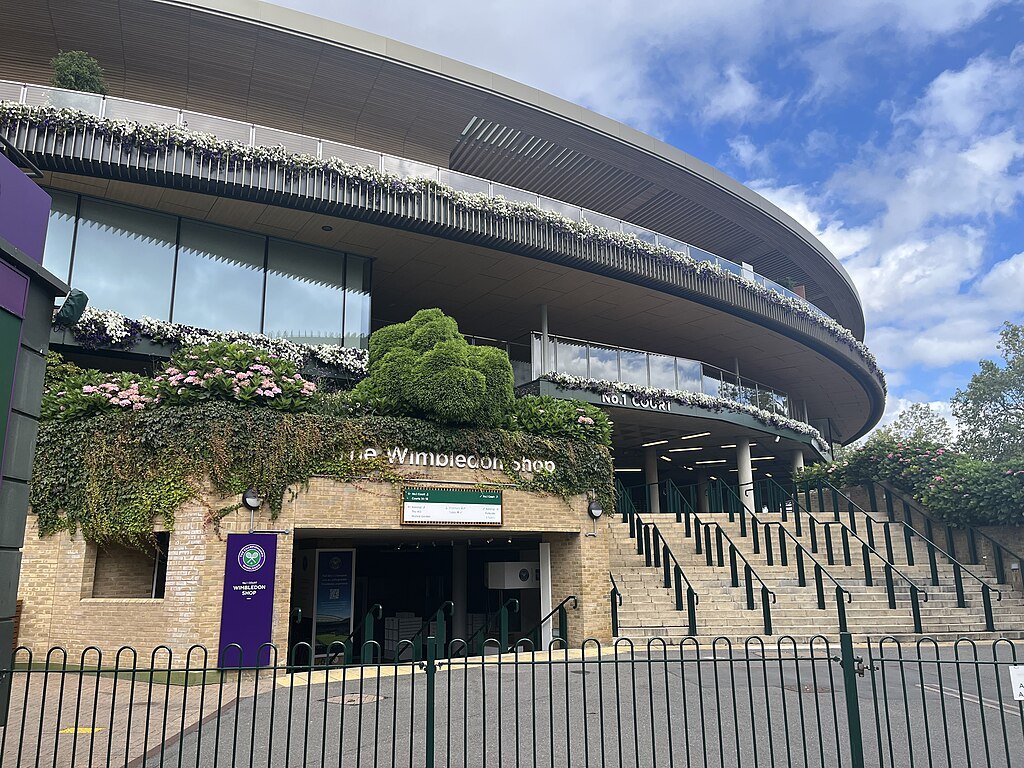
Entrance to All England Lawn Tennis and Croquet Club

All England Lawn Tennis and Croquet Club

This London site has hosted Wimbledon since 1877. The world famous tournament is one of the big four in professional tennis, commonly known as the Grand Slams. And when  tennis folk mention a “Grand Slam,” they mean winning all four major championships, held in Australia, France, the U.K. and the United States, in the same calendar season.

Empty pitch and seats at All England Lawn Tennis and Croquet Club

Architect: Stanley Peach

Fun fact: The retractable roof installed in 2009 ensures that play can continue even during the all-too-common English summer rain. 

Nearby attractions: Visit the Victoria & Albert, an amazing museum of art and design, or grab your baking buddies and live your Great British Bake Off fantasy at the Big London Bake.

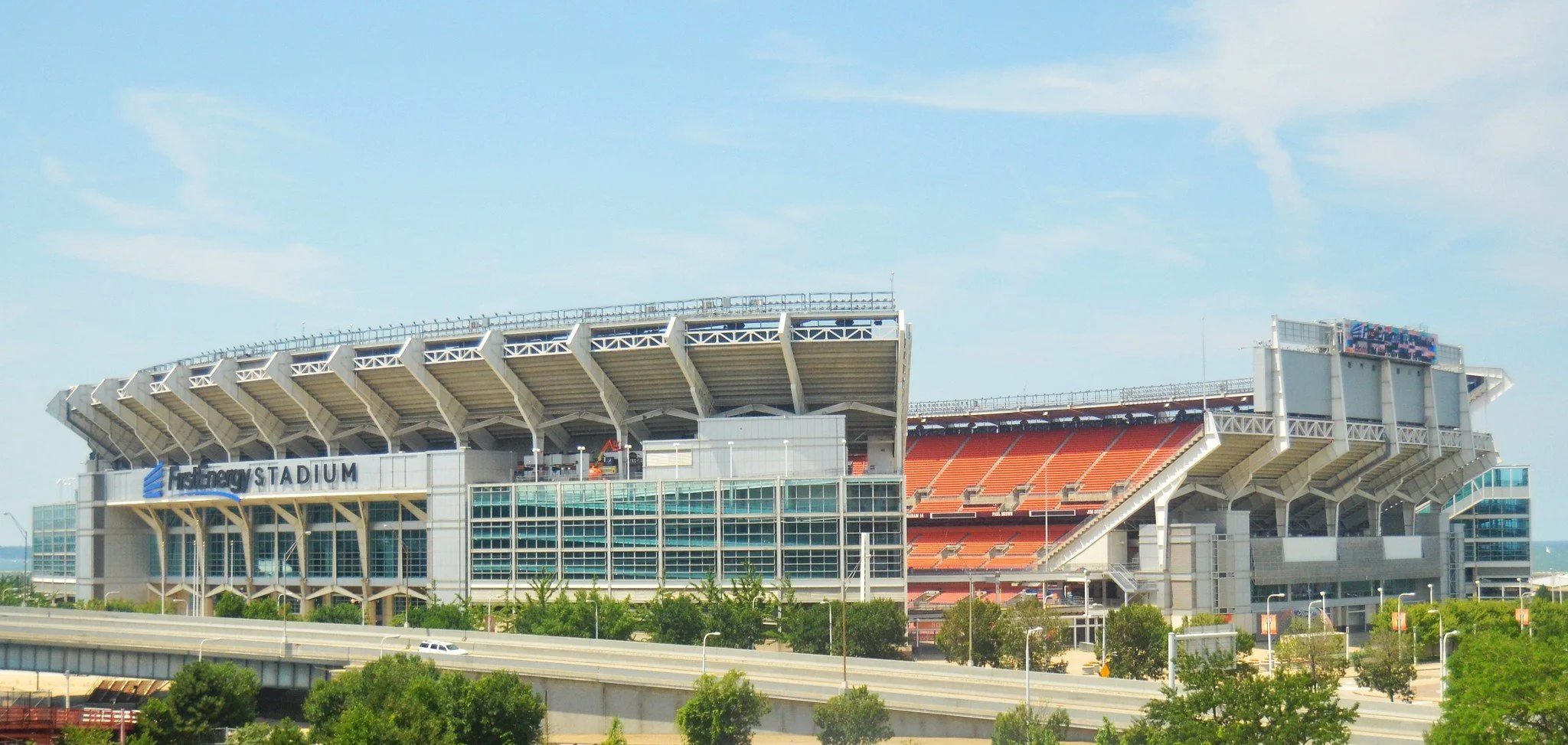
Exterior of Cleveland Browns Stadium

Cleveland Browns Stadium

For die-hard American football fans, this place is like sacred turf. When the players hit the field and the game intensifies, you’re in for all the highs and lows of a typical game. And if you’re looking to crank up the experience and try to win some money, hedge your bets with this deal.

Cleveland Browns Stadium packed with fans during a Browns game

Architect: Populous (formerly HOK Sport) 

Fun fact: The stadium was designed to give spectators unobstructed views of the city skyline and Lake Erie. 

Nearby attractions: Why not make a day of it? You can check out the Rock & Roll Hall of Fame or take a leisurely afternoon stroll through the Cleveland Botanical Garden.

Gorgeous picture of The Colosseum at sunset

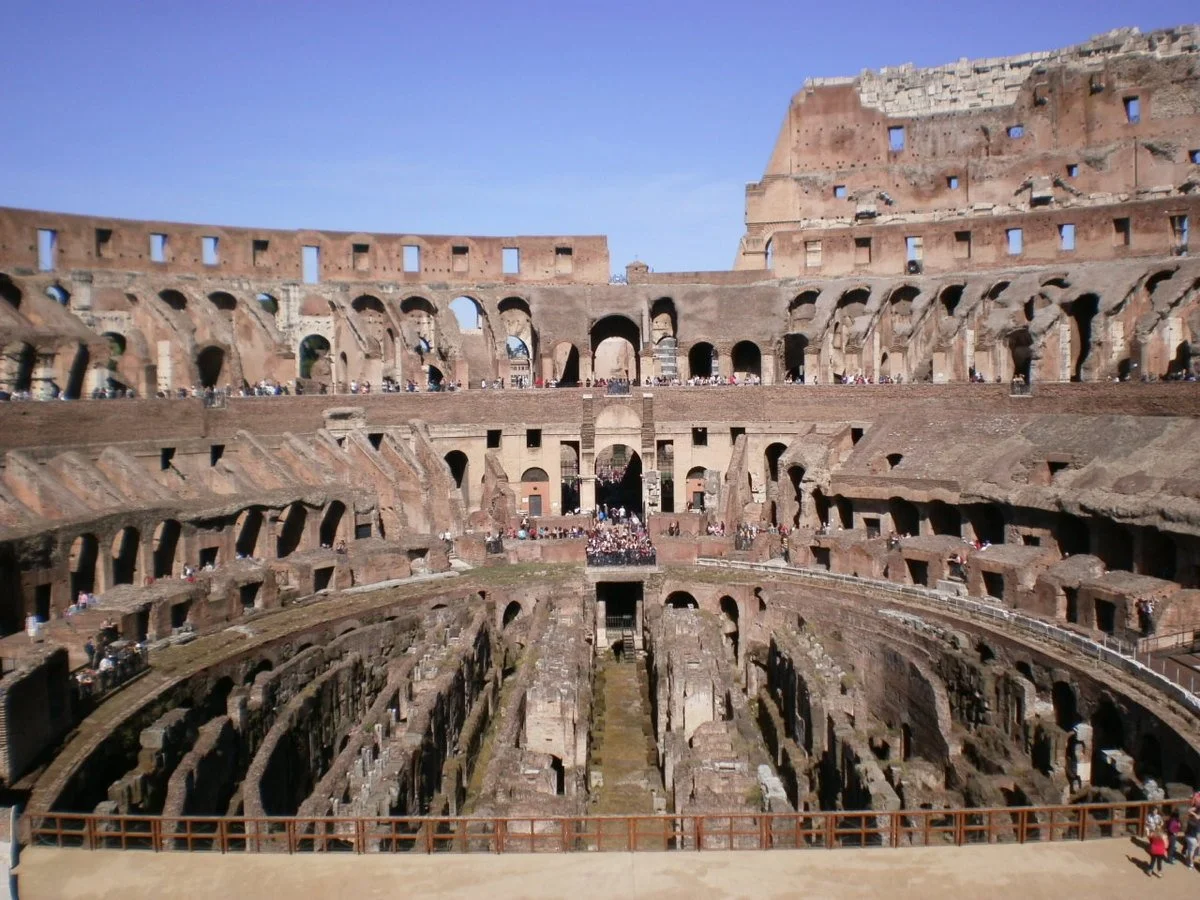
The Colosseum

The ancient world had its own versions of sporting arenas, but let’s be honest — none could quite rival the grandeur and infamy of Rome’s magnificent Colosseum. This colossal wonder serves as a testament to the might of the Roman Empire, along with its insatiable appetite for entertainment. The arena’s innovative elliptical shape laid the foundation for modern stadiums.

Constructed under the Flavian dynasty between 72 and 81 CE, the massive amphitheater could seat over 50,000 spectators. In addition to hosting animal hunts and gladiatorial battles, the arena could be flooded with water, where battles between ships would take place — all to the roaring approval or dismay of the audience.

Interior of the Colosseum in Rome

Architect: Commissioned by Emperor Vespasian and completed by his son Titus

Fun fact: Beneath the Colosseum’s floor was a vast subterranean substructure known as the hypogeum. This included a complex network of tunnels and chambers where gladiators, ferocious beasts and sinister contraptions for special effects were kept before fights. 

Nearby attractions: You won’t have to go far at all to dive into Ancient Roman history. Just a stone's throw away, you’ve got the Roman Forum and Palatine Hill, waiting to transport you back in time.

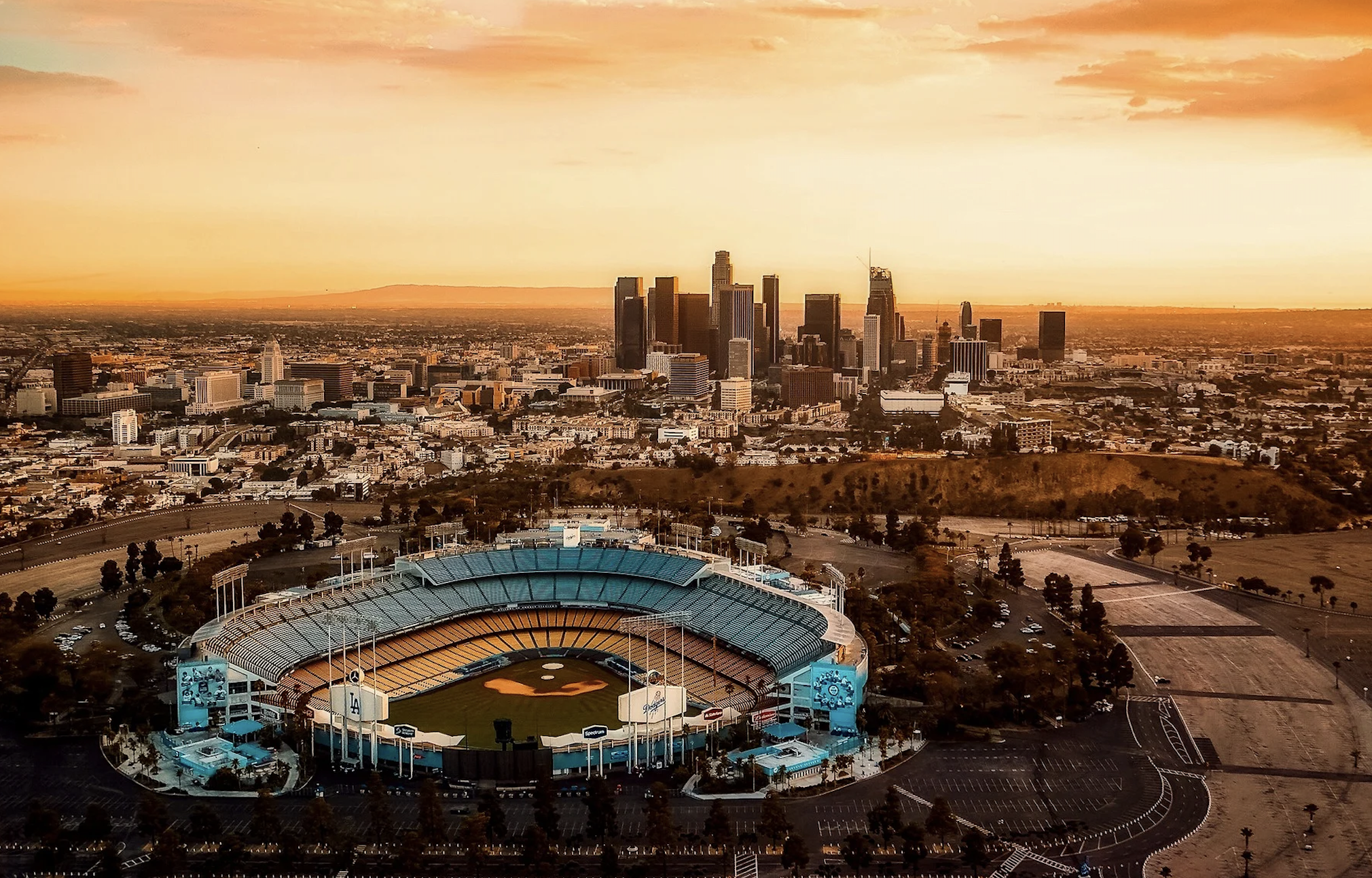
Aerial shot of Dodger Stadium with L.A. downtown in the background and orange sky

Dodger Stadium

SoCal vibes meet America’s so-called favorite pastime at Dodger Stadium. Serving as home base for the Los Angeles Dodgers, it’s been an integral part of the MLB (Major Baseball League) scene since it opened in 1962. Built in the valley of Chavez Ravine and set against the backdrop of the San Gabriel Mountains, its scenic beauty complements the thrilling baseball action. 

On the field with the Dodgers at Dodger Stadium

Architect: Emil Praeger 

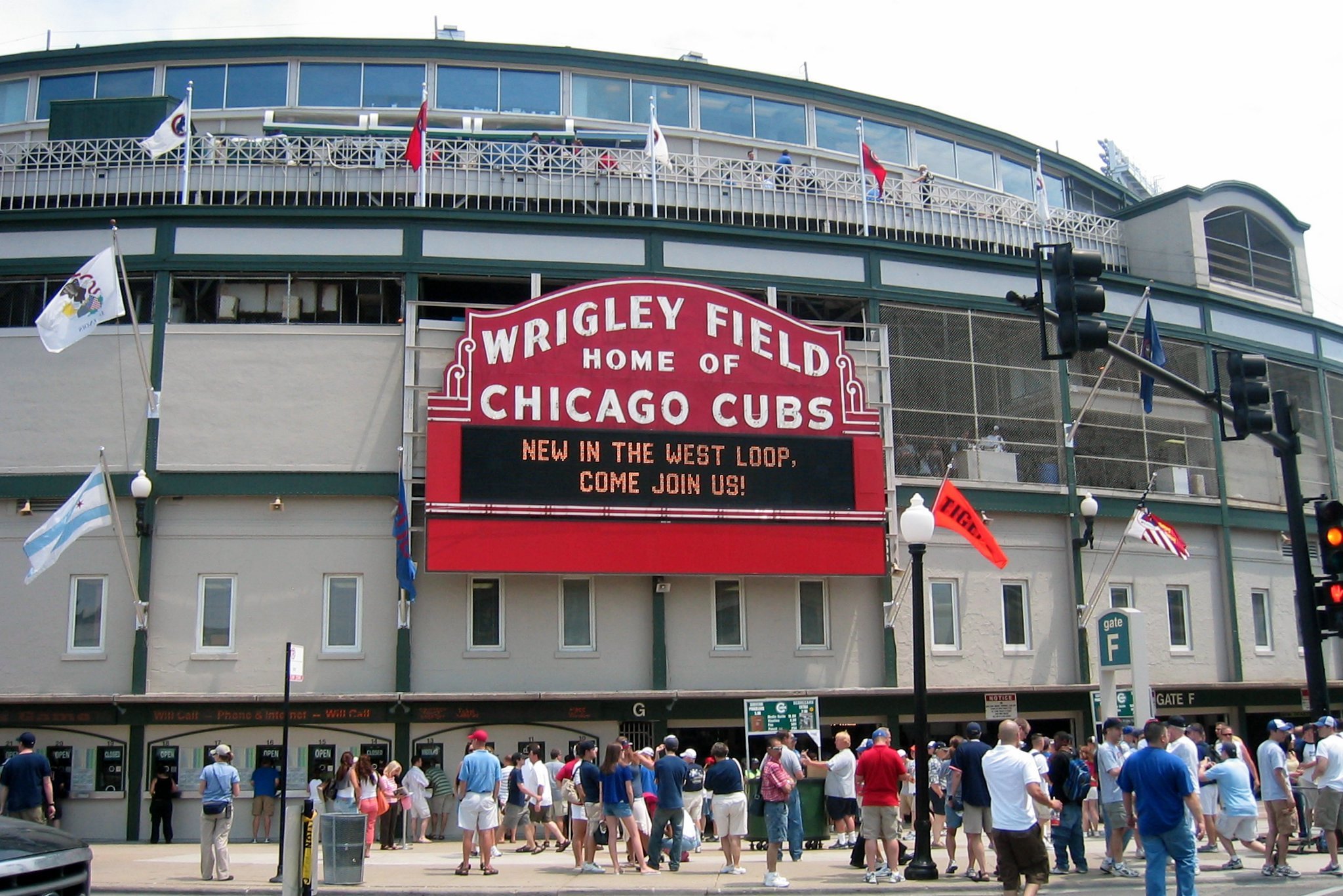
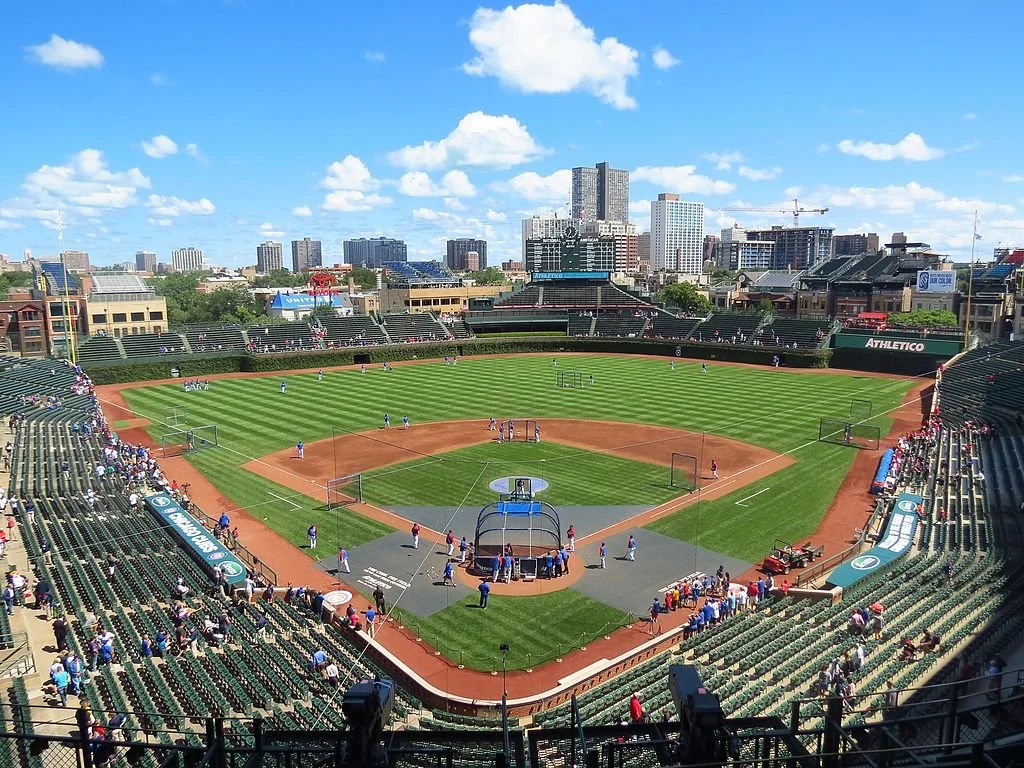
Fun fact: The concept for Dodger Stadium began to take shape in 1957, following the team’s relocation from Brooklyn, New York. Today, it holds the title as the oldest ballpark west of the Mississippi River and ranks as the third-oldest MLB ballpark, behind Boston’s Fenway Park and Chicago’s Wrigley Field. 

Nearby attractions: Reach for the stars at Griffith Observatory or visit historic Olvera Street, where you’ll find the colorful Mexican Marketplace. 

Exterior aerial shot of the round buildings of Estádio do Maracanã

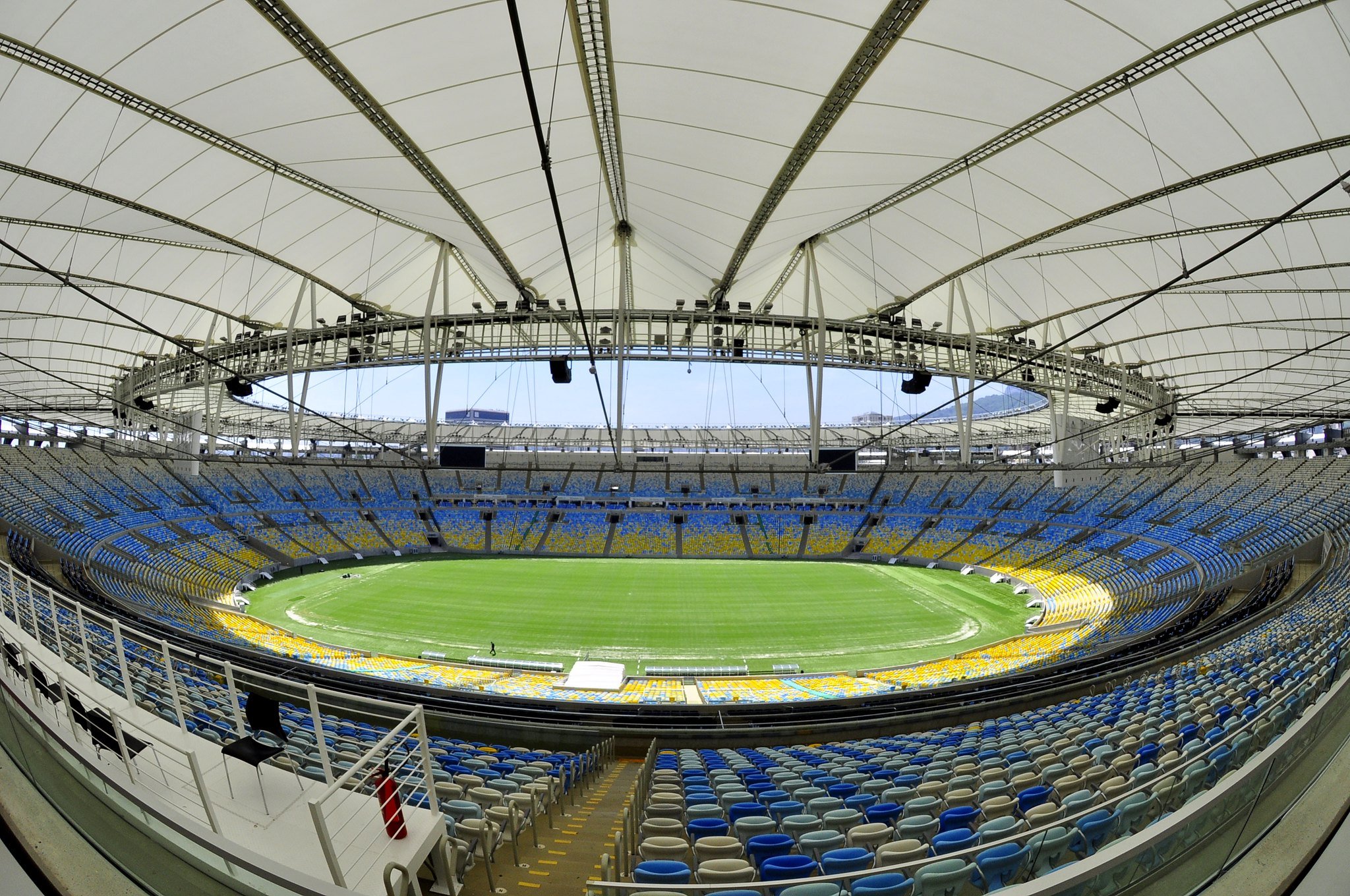
Estádio do Maracanã

Constructed to serve as the main venue for the 1950 World Cup, Rio de Janeiro’s Maracanã Stadium embodies Brazil’s unwavering passion for football (known to us Americans as soccer). This stadium has borne witness to some of the sport’s most historic moments, including the legendary Brazilian footballer Pelé scoring his 1,000th career goal here in 1969. 

Estádio do Maracanã field and seating with donut-shaped roof covering

Architect: Rafael Galvão and Pedro Paulo B. Machado 

Fun fact: The World Cup final held at Maracanã still holds the record for the highest attendance, with a crowd estimated at over 199,000.
Nearby attractions: Take the cog train to the top of Corcovado Mountain to reach the awe-inspiring Christ the Redeemer statue or visit the white sand beaches of Ipanema.  

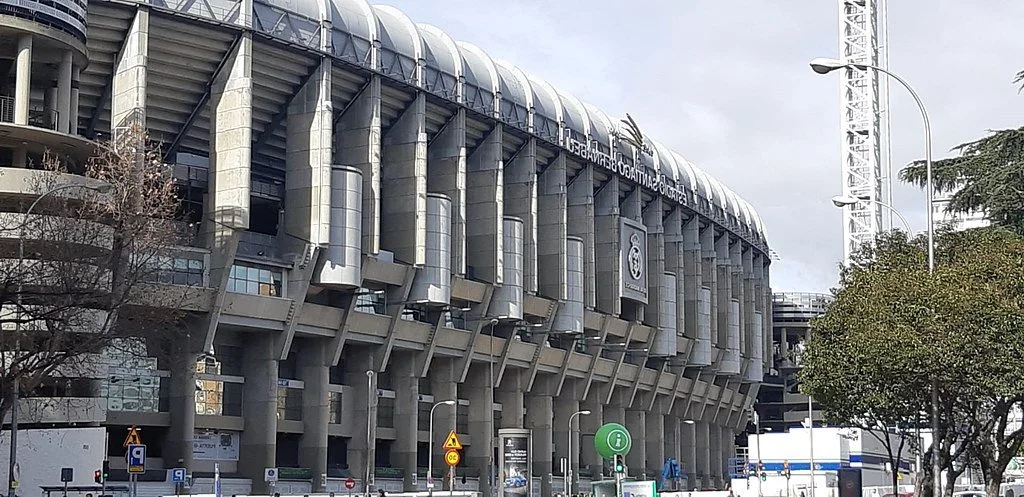
Exterior of Estadio Santiago Bernabéu

Estadio Santiago Bernabéu

Madrid’s Estadio Santiago Bernabéu stands as a monument to football royalty. It has hosted the final match of the UEFA Champions League on four occasions (1957, 1969, 1980 and 2010) and is the home of the Galácticos: the world’s priciest players signed to play for Real Madrid. From David Beckham to Alfredo Di Stéfano to Cristiano Ronaldo, this stadium has borne witness to legends and epic clashes.

Architect: Manuel Muñoz and Luis Alemany Soler, with a revamp by L35, Ribas & Riba, and GMP Architekten

Fun fact: The Bernabéu has an unusual vertical design, making it one of the steepest stadiums in the world, helping ensure that every fan has a great view. 

Nearby attractions: For those seeking a cultural experience, Madrid beckons with its treasures, such as the Prado Museum and the Royal Palace.

Fenway Park

As home to the Boston Red Sox, Fenway Park proudly holds the title of being the oldest ballpark in Major League Baseball. It boasts a 37-foot-high (11 meters) left field wall affectionately known by locals as the Green Monster. (It was added a couple of years after opening to deter curious passersby from sneaking a glimpse.)

Boston Red Sox night game at Fenway Park

Architect: James McLaughlin

Fun fact: The lone red seat that sits among the green right field bleachers commemorates the longest home run in Fenway Park history, which was hit by Ted Williams on June 9, 1946. Legend holds that Williams spotted a fan taking a nap and decided to wake him up by launching a ball at him.

Nearby attractions: After the game’s over, you’ve got some great options for entertainment. You can explore Boston's historic Freedom Trail or head over to the lively Quincy Market. 

Aerial view of Indianapolis Motor Speedway

Indianapolis Motor Speedway

Racing enthusiasts know that there’s no place quite like the Indianapolis Motor Speedway in Indiana. The thrill, the speed and the history — it’s all there. Traditionally, the race is held over the last weekend of May and stands as one of the oldest and largest single-day sporting events in the world.

Racecars speed around Indianapolis Motor Speedway

Architect: Not attributed to a specific architect or firm

Fun fact: Originally, this race was called the 500-Mile Sweepstakes, but its name went through quite a few changes over time. The “500” stuck around, though. Drivers hit 500 miles by going 200 laps around the 2.5-mile oval.

Nearby attractions: The Indianapolis Motor Speedway Museum offers an in-depth exploration of racing history. You can also discover artworks along the 100-acre riverfront Virginia B. Fairbanks Art & Nature Park. 

Exterior of Madison Square Garden

Madison Square Garden

New York City’s Madison Square Garden has been the stage for some of the 20th century’s greatest athletes, from boxing legend Muhammad Ali to hockey great Mark Messier. Nicknamed the World’s Most Famous Arena, the venue has witnessed a bit of everything — from Marilyn Monroe singing “Happy Birthday” to President John F. Kennedy at the 1962 Democratic Party fundraising dinner to the excitement of Knicks basketball and Rangers hockey games.

Empty interior of Madison Square Garden

Architect: Stanford White, Cass Gilbert and Charles Luckman

Fun fact: Madison Square Garden has been rebuilt a total of four times since 1879. Its current iteration was designed by American architect Charles Luckman in 1968, whose firm also designed the Prudential Tower in Boston and the Forum in Inglewood, California.

Nearby attractions: Explore the High Line, a public park built on a historic elevated rail line and watch the sunset over Manhattan from the 86th floor of the Empire State Building. 

Looking down into Melbourne Cricket Ground

Melbourne Cricket Ground

Over in Australia, you’ve got the Melbourne Cricket Ground, or MCG to locals. This place is like the crown jewel of Aussie sports venues, and it’s a big deal, as it’s the largest in the Southern Hemisphere. It was built to satisfy the continent’s cricket craze, and it was here that the world’s first test cricket match took place, in 1877. Test cricket is like the granddaddy of the sport, lasting a full five days, where two national teams take turns batting and bowling. It was a faceoff between Australia and England, and in the end, Australia came out on top, winning by 45 runs. 

Empty green stands at Melbourne Cricket Club

Architect: Various (the stadium has undergone multiple renovations)

Fun fact: The MCG’s six light towers are 75 meters high, equivalent to a 22-story building and are the tallest of any sporting venue in the world.

Nearby attractions: Take a leisurely stroll along the Yarra River or visit the National Sports Museum for a comprehensive exploration of Australia’s sports legacy. 

Strange industrial facade of San Siro Stadium 

San Siro Stadium 

Italy’s San Siro is one of the most legendary venues for football (soccer). It’s officially named Stadio Giuseppe Meazza in memory of Milanese footballer Giuseppe Meazza and is home to both Inter and AC Milan, two top professional teams.

AC Milan was founded in 1899, and Inter Milan followed nine years later in 1908. Interestingly, Inter’s formation was a result of a disagreement within AC Milan’s ranks, particularly regarding the signing of foreign players. A fierce rivalry emerged, cranking up the already electrifying atmosphere of the annual Milan Derby, which, as you might have guessed, takes place at none other than San Siro.

Pitch and fans at open-air San Siro Stadium in Milan

Architect: Ulisse Stacchini and Alberto Cugini

Fun fact: In preparation for the 1990 World Cup, architects Giancarlo Ragazzi and Enrico Hoffer, along with engineer Leo Finzi, designed the addition of the stadium’s third tier, suspended by its 11 spring-like towers and crisscrossed red steel girders. These enhancements were aimed at boosting San Siro’s seating capacity. 
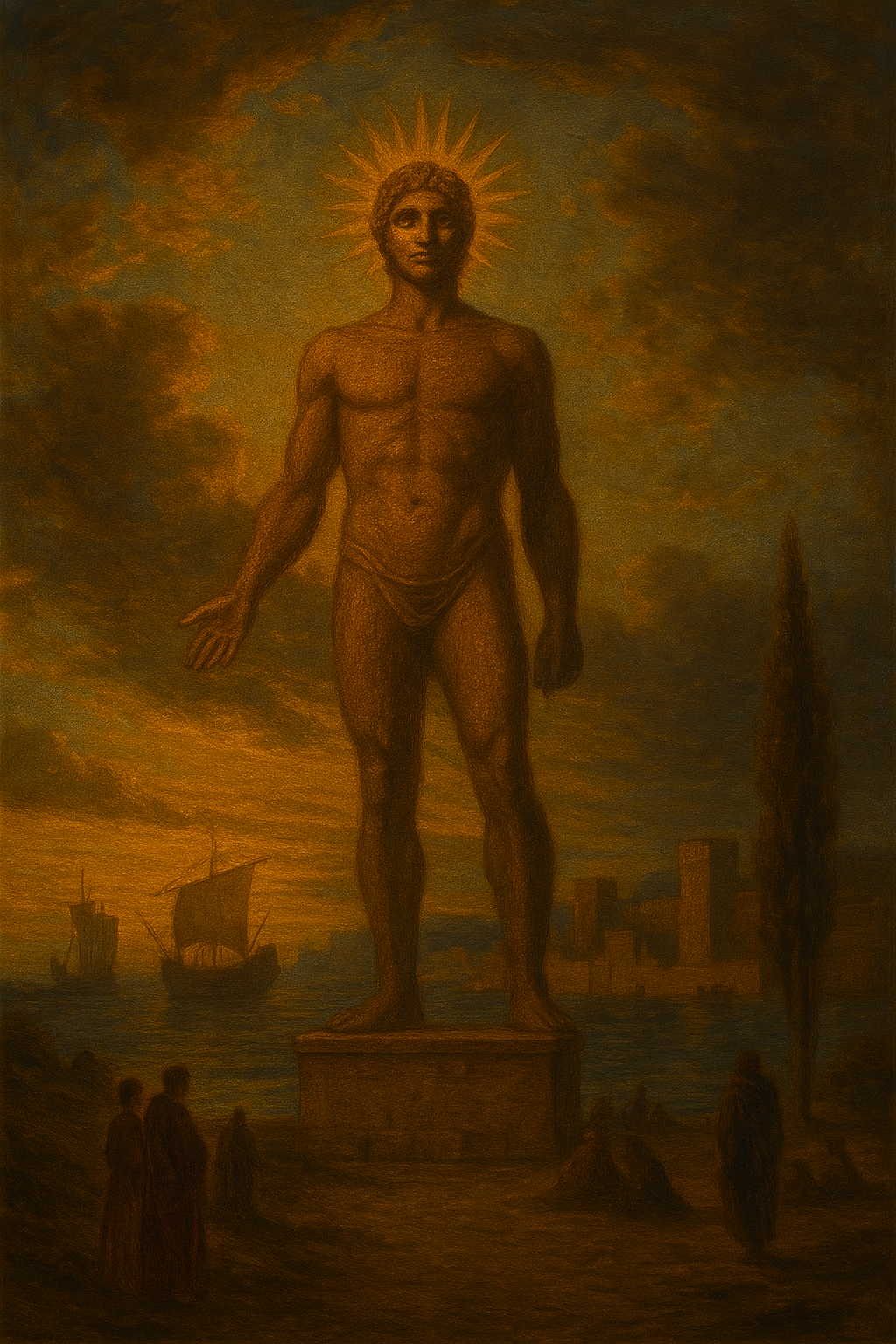
Nearby attractions: The Castello Sforzesco and the gorgeous Gothic-style Milan Cathedral, known as the Duomo, (the third largest church in the world) are situated in the heart of the city.

Exterior of SoFi Stadium in L.A. with water feature

SoFi Stadium

Home to the Los Angeles Rams and Chargers, this stadium sets the bar high with its innovative design and immersive state-of-the-art facilities. The 3.1-million-square-foot (288,000-square-meter) arena is the largest in the NFL. 

Field and empty seats at SoFi Stadium

Architect: HKS 

Fun fact: The stadium features the Oculus, an oval, double-sided infinity screen suspended 122 feet (37 meters) above the playing field. This massive display includes a 4K HDR video board and 27,000 embedded LED pucks capable of displaying images and videos in such high resolution that you can spot them from airplanes arriving at Los Angeles International Airport.

Nearby attractions: Take in a concert at the Kia Forum or grab a donut at Randy’s. The original shop features a massive 32-foot-tall donut on its roof, and has appeared in movies like Wayne’s World and Iron Man. 
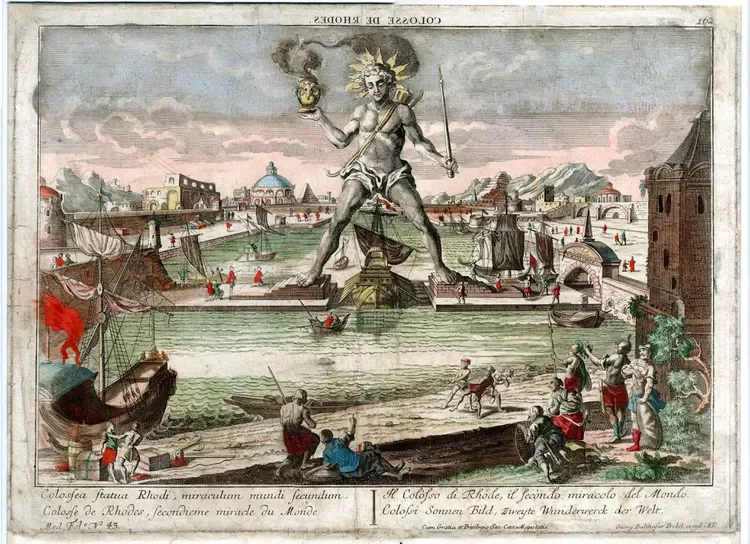
Aerial of Stade Roland-Garros

Stade Roland-Garros

Paris is home to this mecca for clay court tennis. It’s the place where the French Open goes down every year. For two action-packed weeks, the best international players, including Björn Borg and Rafael Nadal, gather to battle it out on its challenging courts. And there are 17 of them, including the central Philippe-Chatrier court, which has a retractable roof to keep the game going when it rains.

Looking down at the court and stands at Stade Roland-Garros

Architect: Louis Faure-Dujarric 

Fun fact: The stadium features an open-air courtyard dedicated to France’s Four Musketeers, or les Quatre Mousquetaires. It’s a nod to a quartet of iconic French players: Jean Borotra, Jacques Brugnon, Henri Cochet and René Lacoste, who made their country proud in the tennis scene during the 1920s and ’30s. Lacoste even got his nickname “the Crocodile,” thanks to his big grin and iron grip on his racket. And guess what? He later went on to create the clothing brand famous for that embroidered crocodile logo.

Nearby attractions: The enchanting Bois de Boulogne park is right next door, and the Eiffel Tower is a short distance away.

Field and red seats at open-air Wembley Stadium
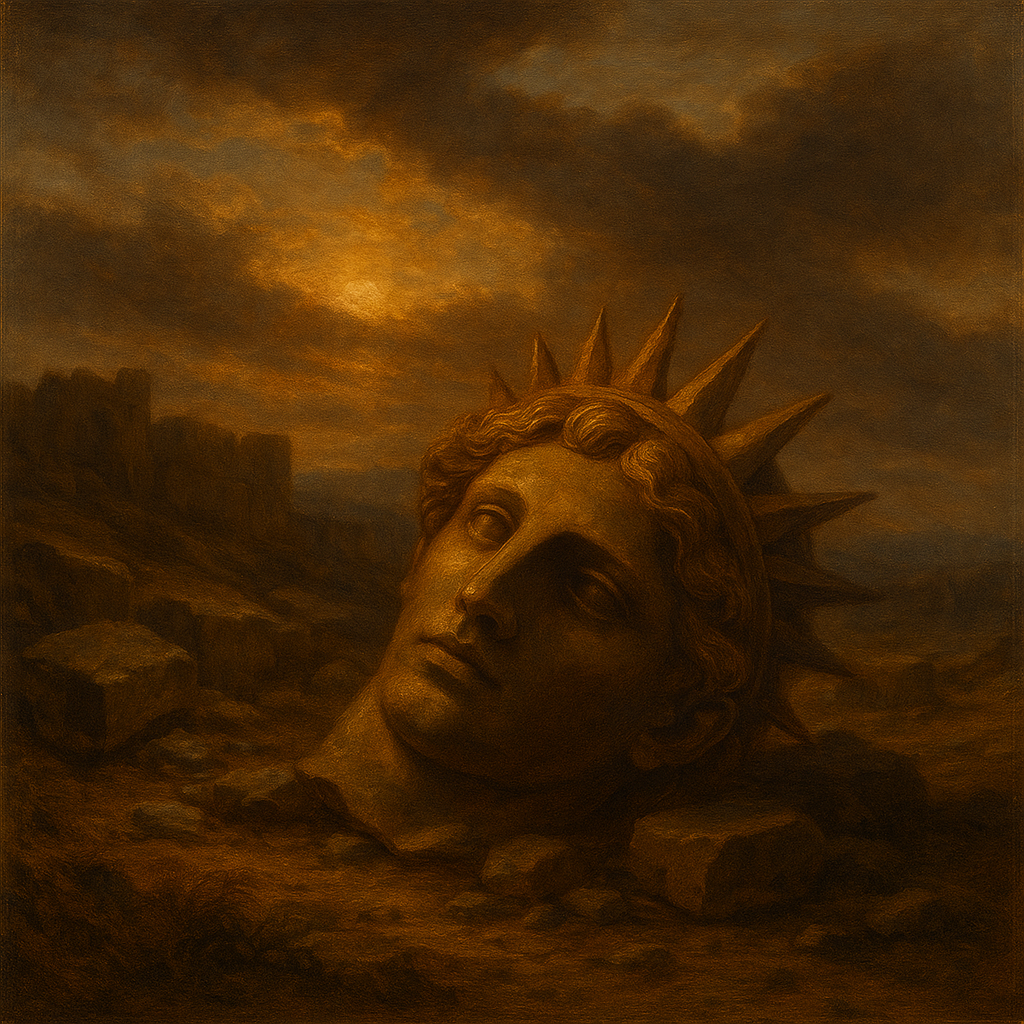

Wembley Stadium

Crossing over to the British Isles, Wembley Stadium in London is a pilgrimage site for football/soccer fans. The venue hosts major matches, including the home games of the England national football team and the Football Association Challenge Cup final as well as hosting concerts from bands like Green Day. 

Sir Robert McAlpine laid the foundation for the original, which was constructed for the British Empire Exhibition of 1924 and was quite a marvel, being the largest reinforced concrete building of its time. Its famous twin towers were symbols of the game and served as the backdrop for some of the most epic moments in football for over 75 years.

The new Wembley, designed nearly 16 years ago by Foster + Partners, is twice the size of the old one and comes with modern upgrades like a retractable roof for those unpredictable weather days and a soaring arch that’s taken over as the iconic replacement for the twin towers.

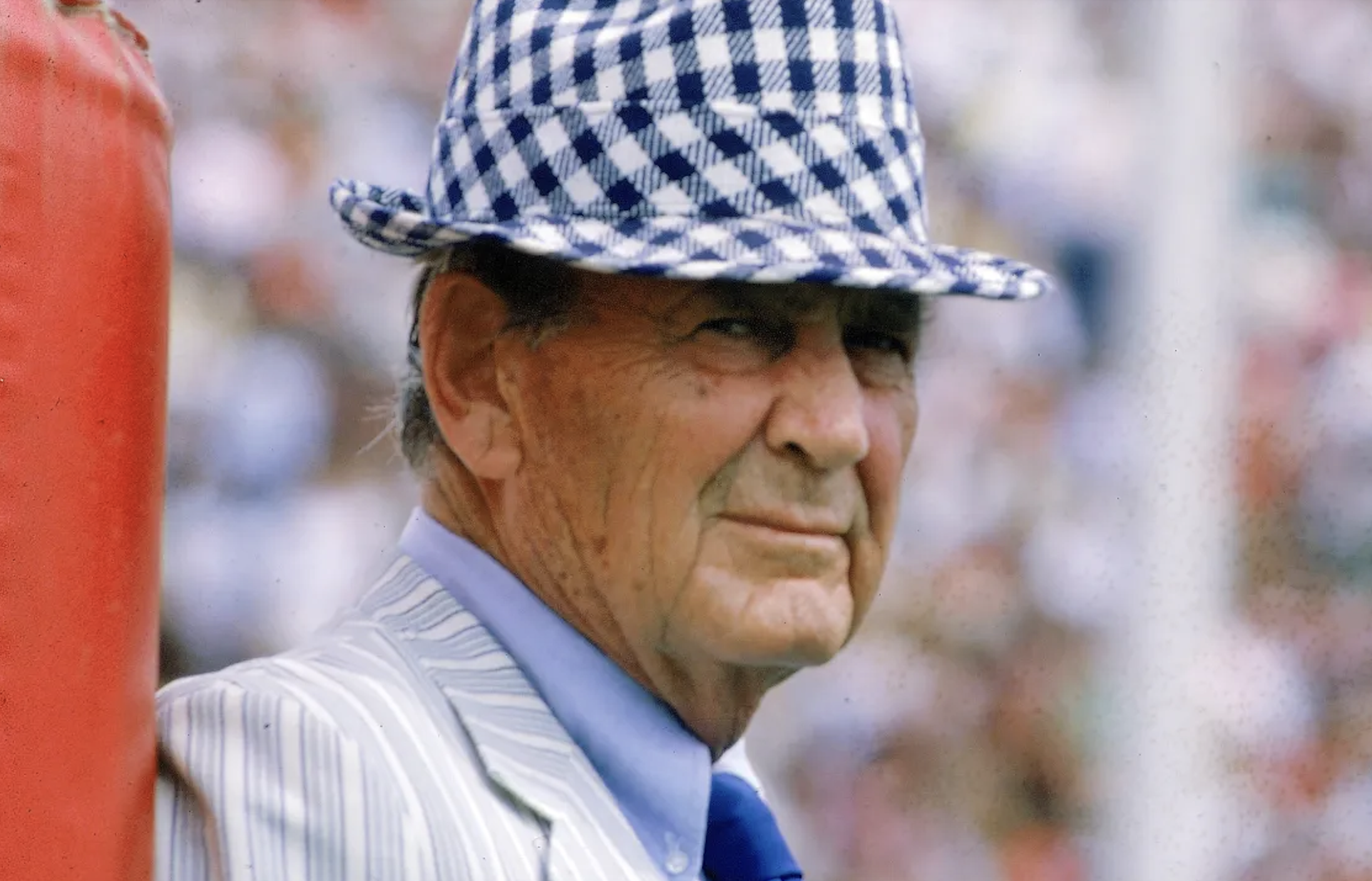
Absolutely packed Wembley Stadium while football game is played

Architect: Robert McAlpine, then Norman Foster

Fun fact: The Wembley Arch soars to a staggering height of 133 meters, equivalent to about 30 stories, and stretches 315 meters (over 1,000 feet), solidifying its status as the world’s longest single-span roof structure. It’s functional too, though: It bears the majority of the roof’s weight.

Nearby attractions: Located adjacent to the stadium, the London Designer Outlet (LDO) is a great place to get your shopping fix. Or you can spend a fun afternoon at the landmark Natural History Museum. They’ve got hands-on exhibits and even animatronic dinosaurs!

Fans mill about under historic Wrigley Field sign

Wrigley Field

If you breeze into Chicago, aka the Windy City, you’ve got to stop by Wrigley Field, America’s second-oldest Major League ballpark. If we’re talking about a stadium that can rival Boston’s Green Monster, Wrigley’s ivy-covered outfield wall is a strong contender. It’s so iconic, it’s got its own set of rules: If a baseball disappears into its vines, the batter (and all runners) are granted two bases. However, to make it official, an outfielder must raise his hand to signal that the ball is lost in the ivy. If he doesn’t, it’s considered fair play. 

Looking down on Wrigley Field with building of Chicago in the background

Architect: Zachary Taylor Davis

Fun fact: The neighborhood stadium was one of the last Major League ballparks to install lights for night games, which didn’t happen until 1988. The tale of these floodlights dates back to the early 1940s, when plans were set in motion, but a pivotal twist occurred after the attack on Pearl Harbor. In a patriotic gesture, Philip K. Wrigley, owner of the Cubs, diverted 165 tons of steel to support the war effort instead of installing the lights.

Nearby attractions: After the game, you can wander the lively Wrigleyville neighborhood. And if you’re up for more adventure, don’t miss the chance to explore the city’s legendary architecture by taking a boat tour along the Chicago River. 

Aerial view of Yankee Stadium

Yankee Stadium

The original Yankee Stadium was a massive horseshoe-shaped ballpark and one of the most beloved structures in the history of baseball. Its field witnessed legendary players like Babe Ruth, Lou Gehrig, Joe DiMaggio and Mickey Mantle rounding its bases, to name just a few.

In 2009, the torch was passed to the new Yankee Stadium. Inspired by the 1923 Bronx Stadium, the modern four-story limestone and granite-faced ballpark even re-created the arched Art Deco metal frieze that crowned the upper deck of its illustrious predecessor.

Looking down at Yankee Stadium with seats packed as baseball game is played

Architect: Populous (formerly HOK Sport)

Fun fact: The Yankees’ impressive HD display is about 103 feet (30 meters) wide and 58 feet (18 meters) tall — six times larger than the screen at the old stadium. 

Nearby attractions: Check out the Bronx Museum of the Arts and explore the impressive Victorian-era greenhouses of the New York Botanical Garden.


These stadiums and sporting venues are more than just places to watch a game — they are monuments to athletic achievement and the human spirit. Within their walls and on their fields, records have been broken, underdogs have triumphed, and fans have bonded over the shared passions of competition and community. Though styles and designs may change with the times, the thrill of cheering for the home team endures. The legends, memories and traditions attached to these landmarks will continue to inspire athletes and fans for generations to come. Wherever you are in the world, paying a visit to one of these iconic sporting meccas is a must for any true sports lover. –Taylor Miller