ancient greece

Who Is Hecate? The Ancient Goddess of Crossroads, Witchcraft and the Dark Moon

From Anatolian origins to garlic offerings left at shadowy intersections, the many-faced Hecate has spent thousands of years standing where worlds collide.
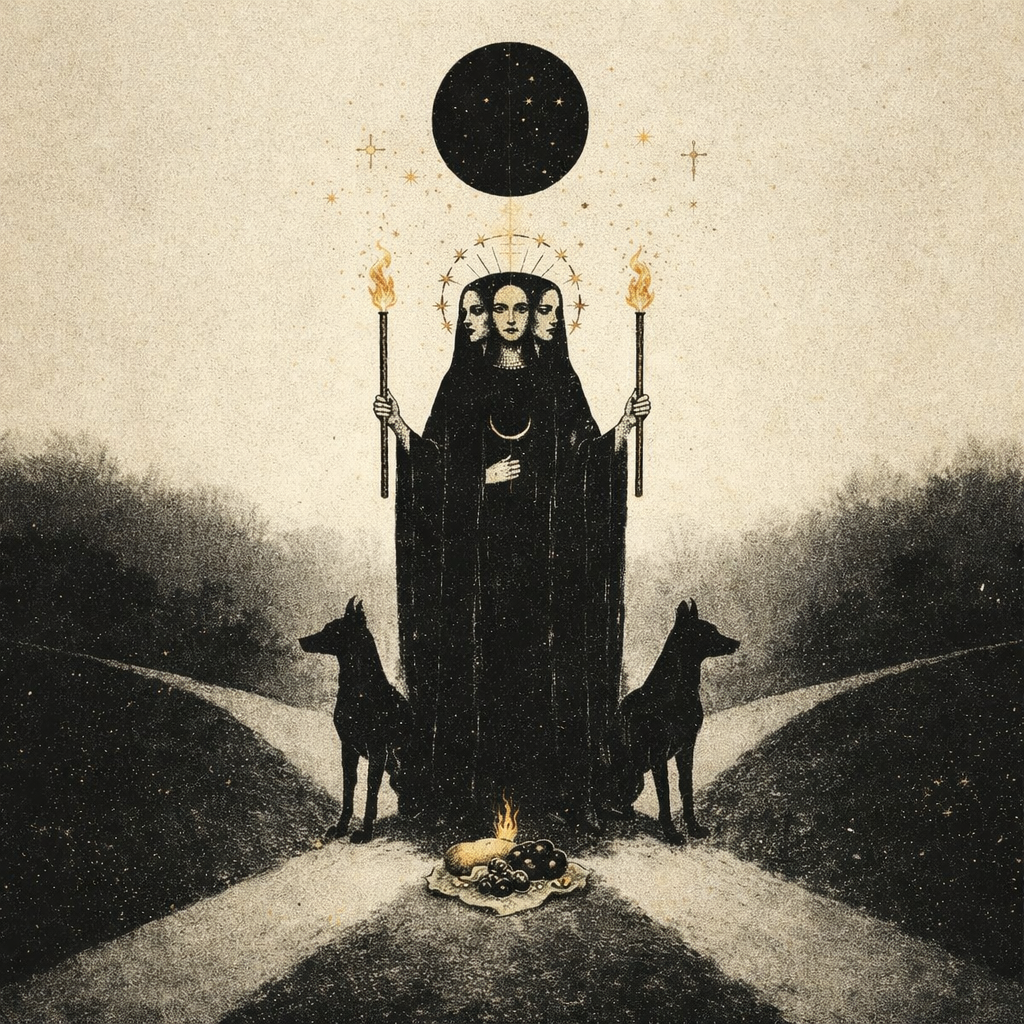
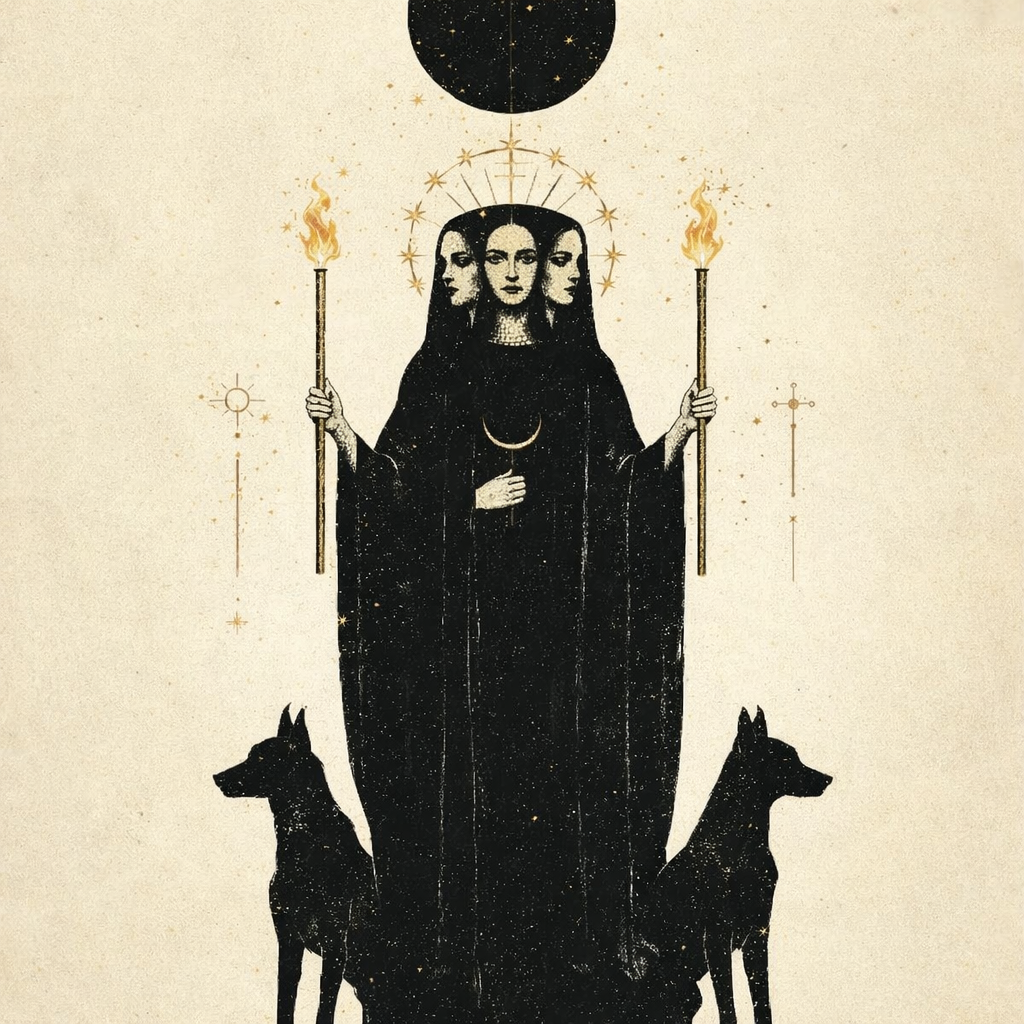
The goddess Hecate, with three faces, holding torches under a dark moon, with two dogs, ritual offerings, standing at a crossroads

The crossroads were quiet.

Not the peaceful kind of quiet — the kind that makes you feel like something might be watching just beyond the reach of the torchlight. In the ancient world, intersections were places where the living and the dead might brush shoulders. Spirits gathered there. Offerings were left there. And somewhere in the darkness, the goddess Hecate was listening.

Today she’s best known as the dark queen of witchcraft — a torch-bearing goddess with black dogs at her side and keys to the underworld dangling from her belt. But like many figures in Greek mythology, the story most people know about Hecate is only the final chapter of a much older and stranger history.

She was the goddess of life, death and everything in between.

She was just Goddess with a capital G.
— Wycke Maliway, co-owner of Malliway Bros.

As Wycke, the instructor of a recent class I attended on Hecate at the always delightful Malliway Bros. witchcraft store in Chicago, explained early on, the goddess doesn’t fit neatly into a single role.

First off, let’s clarify how you pronounce her name. Apparently, according to a Greek woman who attended the class, the proper pronunciation is “Eh-kah-tee,” though nowadays most people pronounce the H so it’s “Heh-kah-tee.”

Across centuries of mythology and folklore, Hecate has been described as a cosmic goddess honored by Zeus, a protector of childbirth and prosperity, a guide of the dead, a patron of witches and the mysterious guardian of crossroads. She appears in ancient poetry, magical spells and whispered folk traditions that span more than 2,000 years.

In other words, if you try to pin Hecate down to one job description, you’re going to have a hard time.
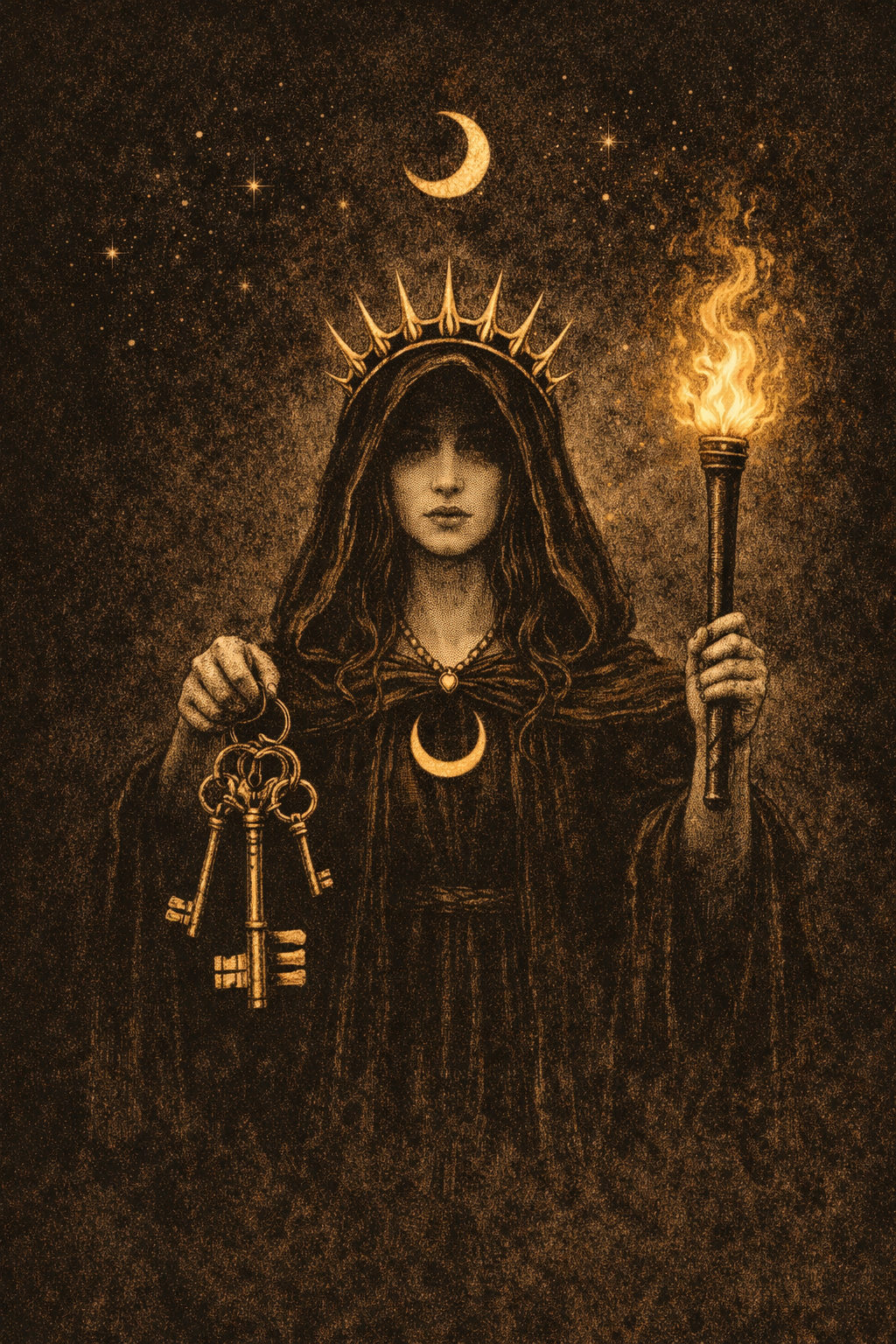
The goddess Hecate, wearing a crown, holding keys and a torch

Hecate’s Origins: A Powerful Anatolian Goddess

Unlike Zeus and other Olympians, Hecate probably didn’t originate in Greece at all. Scholars widely believe her cult began in Caria, a region of ancient Anatolia in what is now southwestern Turkey, before spreading into the Greek world. 

That foreign origin may explain why Hecate always seems slightly different from the Olympian crowd. Many Greek gods have tidy portfolios: war, love, wine, wisdom. Hecate, by contrast, feels like a bundle of powers that don’t quite belong together: childbirth and death, prosperity and ghosts, healing and witchcraft.

In her earliest form, she appears to have been something much bigger than the shadowy crossroads goddess we know today. As Wycke explained, early traditions describe her almost as a universal deity: “She was the goddess of life, death and everything in between,” Wycke said. “She was just Goddess with a capital G.”

That sweeping set of responsibilities might sound odd to modern readers, but in the ancient world the boundaries between those forces were far blurrier than they are today. Life and death were inseparable. Fertility meant both birth and the risks that came with it. Protection meant guarding both the home and the spiritual forces that might threaten it.

Seen through that lens, Hecate’s strange mixture of powers begins to make sense. She was something primal — a deity tied to the raw forces that governed life itself.

And when Greek religion absorbed her into its mythology, those ancient powers didn’t disappear.

They just took some unexpected forms.
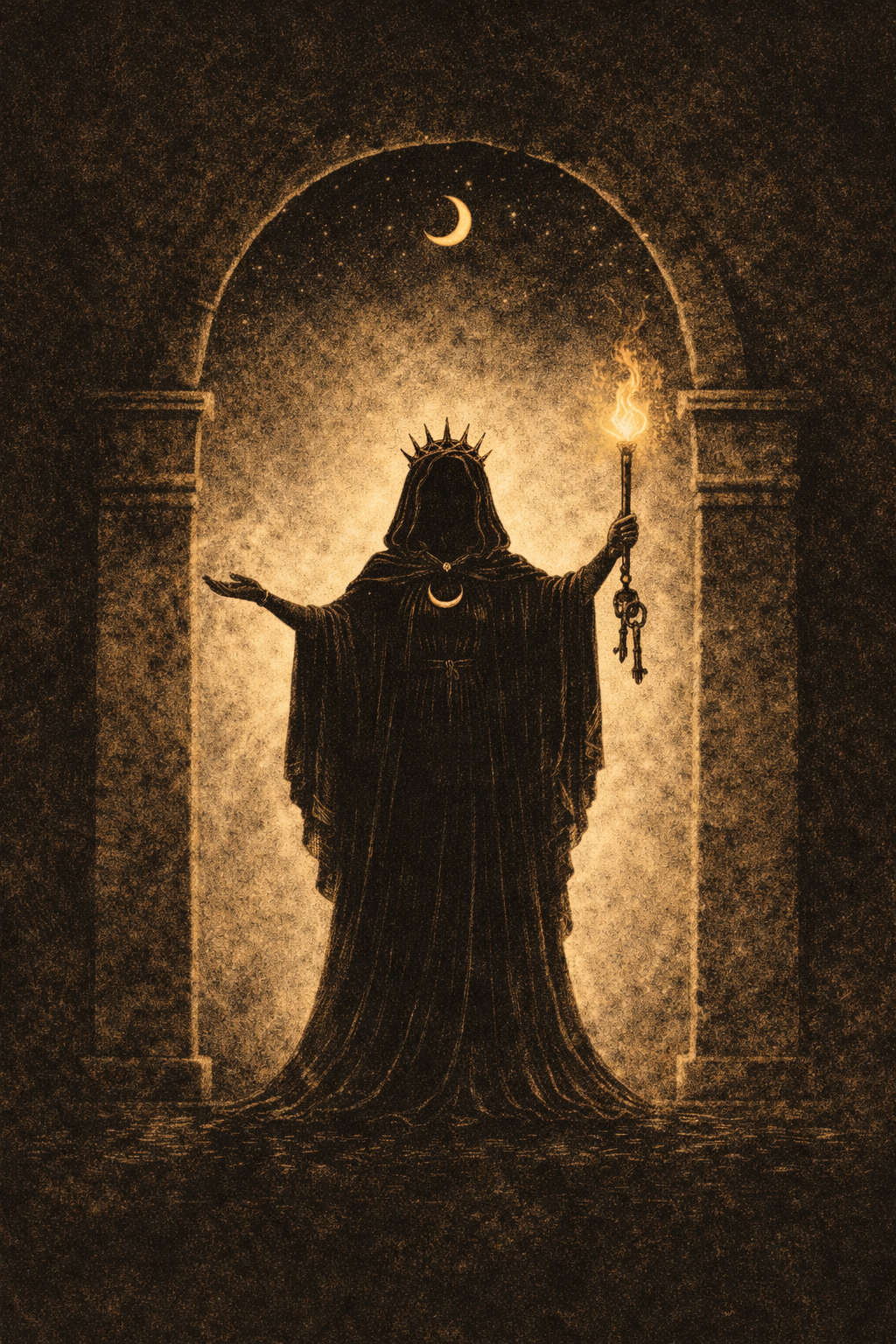
The darkened figure of the goddess Hecate, holding a torch and keys in an archway

Why Hecate Is the Space In-Between Things

One of the most interesting insights from the class came from a distinction that modern readers often miss when they look at Greek mythology.

We tend to treat titans and gods as basically the same thing — just different generations of divine beings. But in many traditions, they function very differently. 

Olympian gods typically preside over domains.

Poseidon rules the ocean.

Athena governs wisdom and strategy.

Ares represents war.

But titans embody the forces themselves.

The titan Oceanus isn’t simply the ruler of a river — he is the cosmic river surrounding the world.

Gaia isn’t the goddess of the Earth — she is the Earth.

Hecate belongs to that older category.

She isn’t simply a goddess who supervises crossroads from afar. She’s not a god who rules thresholds. She is the threshold.

That idea helps explain why Hecate shows up in so many strange places throughout mythology.

  • Doorways

  • City gates

  • Graveyards

  • Crossroads

  • Moments of transformation

  • The boundary between life and death

All of those spaces have something in common: They exist between worlds.

And if Hecate is the embodiment of thresholds, then every place where one reality meets another belongs, in some sense, to her.

Which is exactly why ancient worshippers left offerings where roads divided — and why people still whisper her name when they find themselves standing at a turning point.
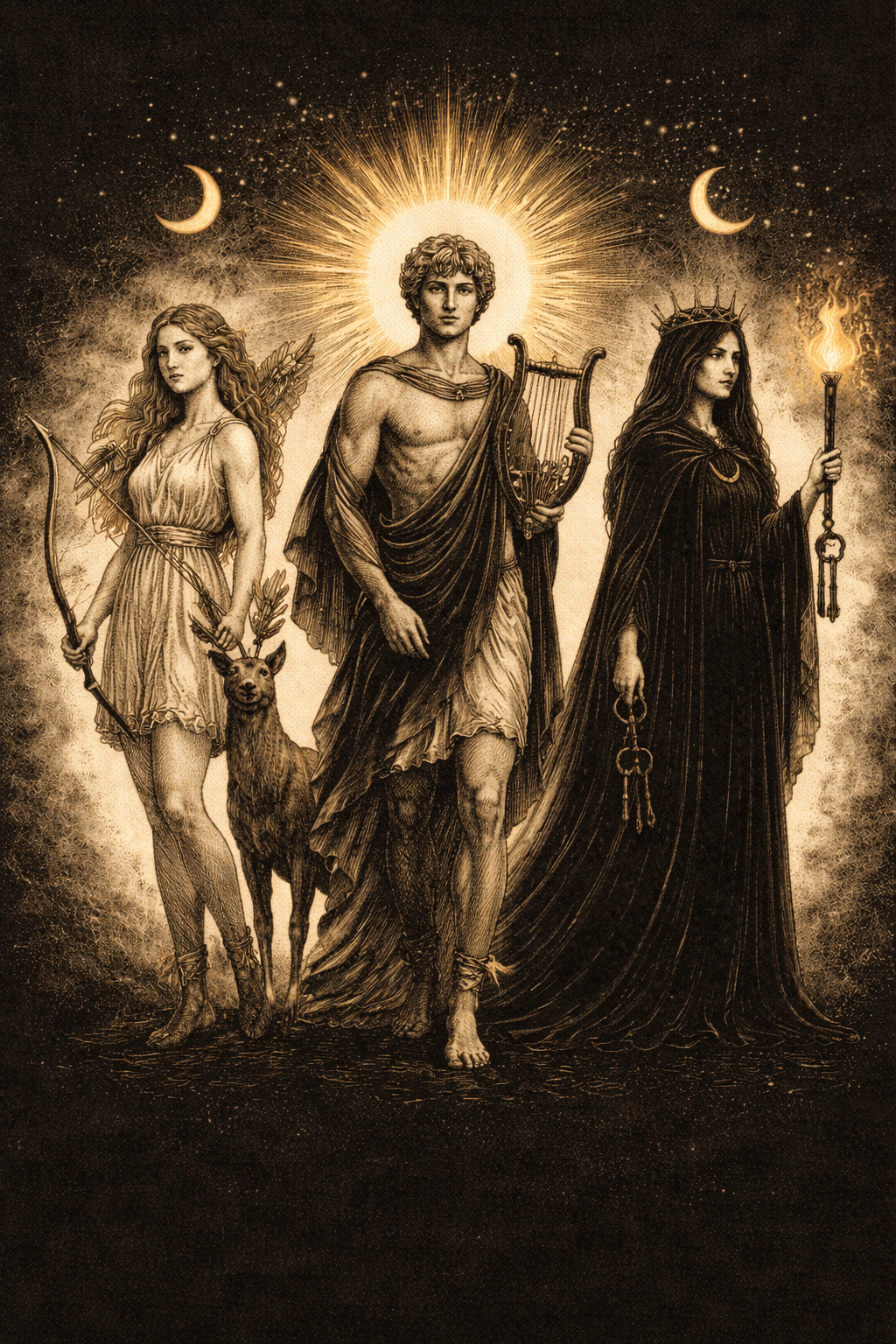
Artemis, with bow and arrows and a deer; Apollo shining bright with a lute; and Hecate, holding a torch and keys

The Origin of Hecate’s Name: A Connection to Apollo and Artemis 

Another intriguing clue to Hecate’s beginnings may lie in her name itself.

Scholars have suggested that the name Hecate may mean something like “influence from afar” or “the one who reaches far.” The meaning could reflect the belief that she came from a distant land before entering Greek religion, or that her power extended across many far-flung places and realms.

The name also closely resembles “Hekatos,” an epithet used for Apollo that means “Far-Reaching.” This similarity has led some scholars to speculate that Hecate may originally have been connected to Apollo’s twin sister, Artemis.

In this interpretation, Hecate could represent a darker or more mysterious aspect of Artemis herself. As Artemis, the goddess presided over purity, virginity and childbirth. As Hecate, she would have taken on the shadowed mantles of night, witchcraft and ghosts.
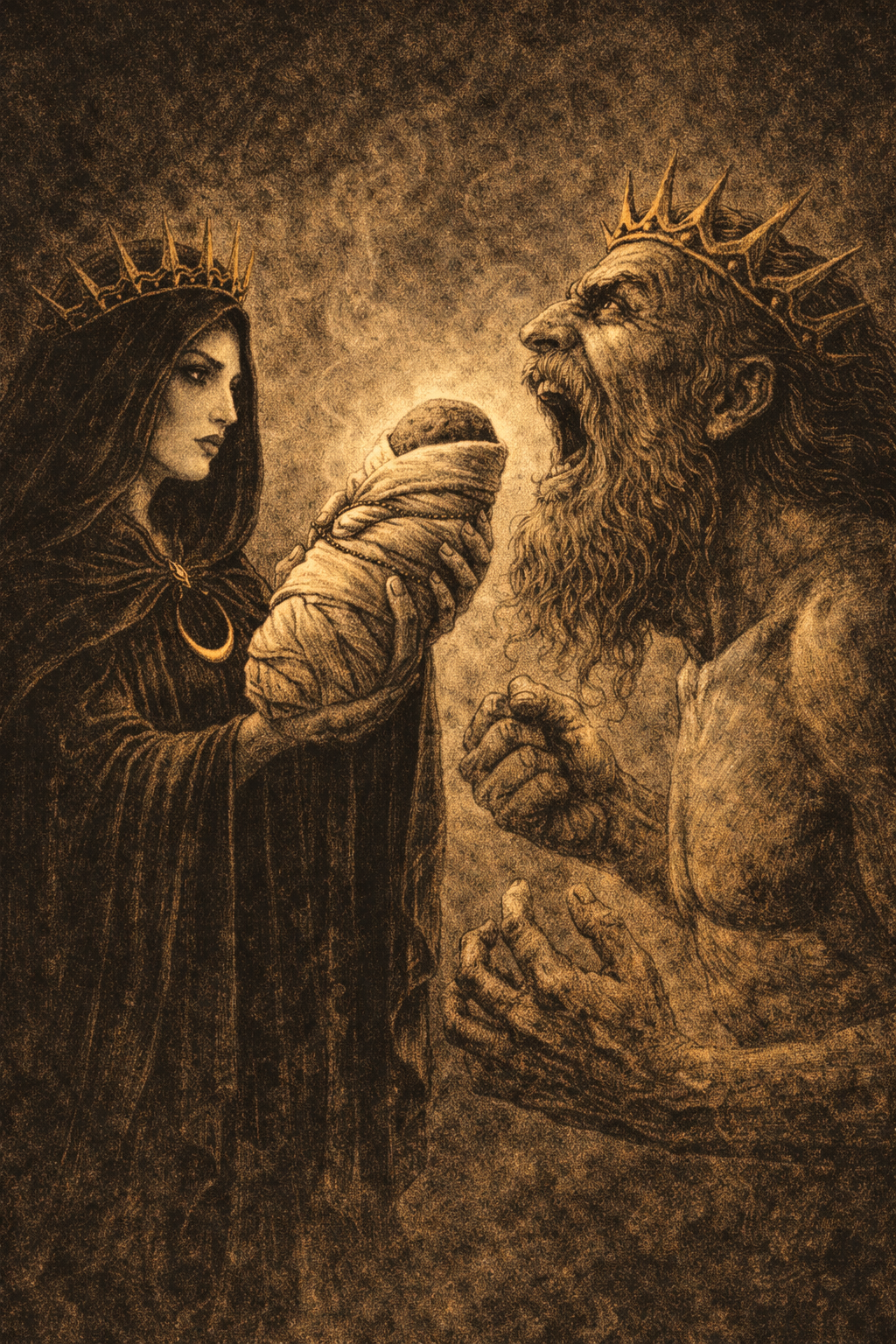
The titan Hecate offers Kronos a swaddled rock instead of the baby Zeus to swallow

Hecate in Hesiod: The Titan Zeus Refused to Sideline

Hecate’s first major appearance in Greek literature comes in the works of the poet Hesiod, writing around the 8th century BCE. And if you’re expecting her to show up as a shadowy witch lurking in graveyards, think again.

In Hesiod’s Theogony, Hecate is one of the most honored figures in the entire divine order.

According to the poem, after Zeus defeated the titans and reorganized the cosmos, he made a deliberate decision about Hecate: He left her powers untouched. While other titans lost influence, Hecate retained authority over vast portions of the world. Hecate is described as receiving honor in heaven, earth and sea, with the power to grant success in everything from warfare to athletic competition. If people pray to her, she can bestow victory, prosperity and good fortune.

In other words, long before she became the goddess of witches and crossroads, Hecate was something far more expansive — a cosmic figure who could influence almost any aspect of human life.

Why was Zeus so fond of her? According to Greek myth, the titan Kronos devoured each of his children at birth after learning of a prophecy that one of them would overthrow him. Desperate to save her youngest child, his wife, Rhea, devised a plan. When Zeus was born, she hid the infant and instead wrapped a stone in swaddling cloth, presenting it to Kronos as if it were the newborn child. Kronos swallowed the stone, believing he had eliminated the threat.

Later traditions add an intriguing twist to this famous deception.

A relief from Lagina, an important cult center of Hecate in ancient Caria, depicts the moment when the swaddled stone is given to Kronos — but in this version of the scene, the figure presenting the bundle is Hecate.

Because Hecate was also associated with childbirth, the image suggests she may have played a role as midwife in delivering the infant Zeus and helping orchestrate the trick that saved him. If Hecate helped ensure his survival, Zeus’s generosity toward her suddenly makes a lot more sense. 

For a goddess who would later become associated with ghosts, graveyards and midnight rituals, it’s a surprising beginning. But it also explains why Hecate never quite fits neatly into the Olympian system.

She didn’t start there.

She came from somewhere older — and she carried that ancient authority with her.
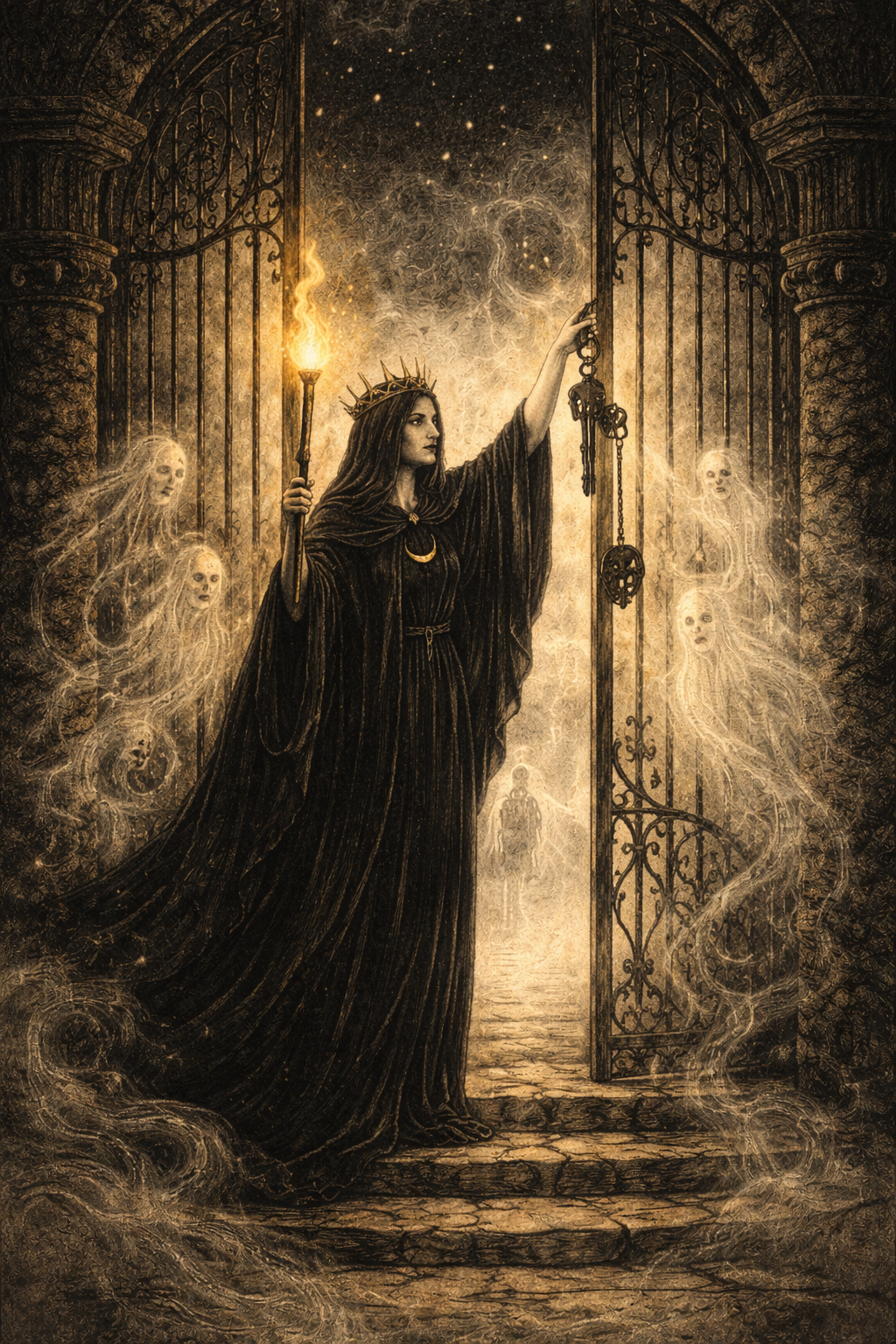
The goddess Hecate, holding a torch,  unlocking the gates to Hades, spirits floating around her

From Cosmic Goddess to Queen of the Crossroads

So how does a goddess honored by Zeus as a ruler of heaven, earth and sea end up haunting graveyards with a pack of black dogs?

The answer lies in one of the strangest shifts in Greek religion.

At some point in the centuries after Hesiod, Hecate’s role began to change. She increasingly became associated with places that made ancient people uneasy: crossroads, thresholds, graveyards and the restless spirits believed to linger there.

“The crossroads was a dangerous place,” Wycke said, “a place that was so liminal that anything could come out of that.”

In the ancient world, crossroads weren’t just intersections of roads. They were believed to be intersections of worlds. Travelers, spirits and unseen forces were all thought to move through them. Offerings were left there to appease wandering ghosts, and rituals were performed to ward off bad luck or spiritual danger.

If you needed a deity to watch over such a place, Hecate made perfect sense.

She was already associated with boundaries and transitions. Over time, that role expanded until she became the guardian of places where the ordinary rules of the world seemed to weaken. Roads that met in the dark. Doorways between houses and the street. The boundary between life and death.

Once Hecate became the goddess who ruled those spaces, new associations quickly followed. Ghosts. Necromancy. Witchcraft. The unseen forces that ancient people believed moved through the night.
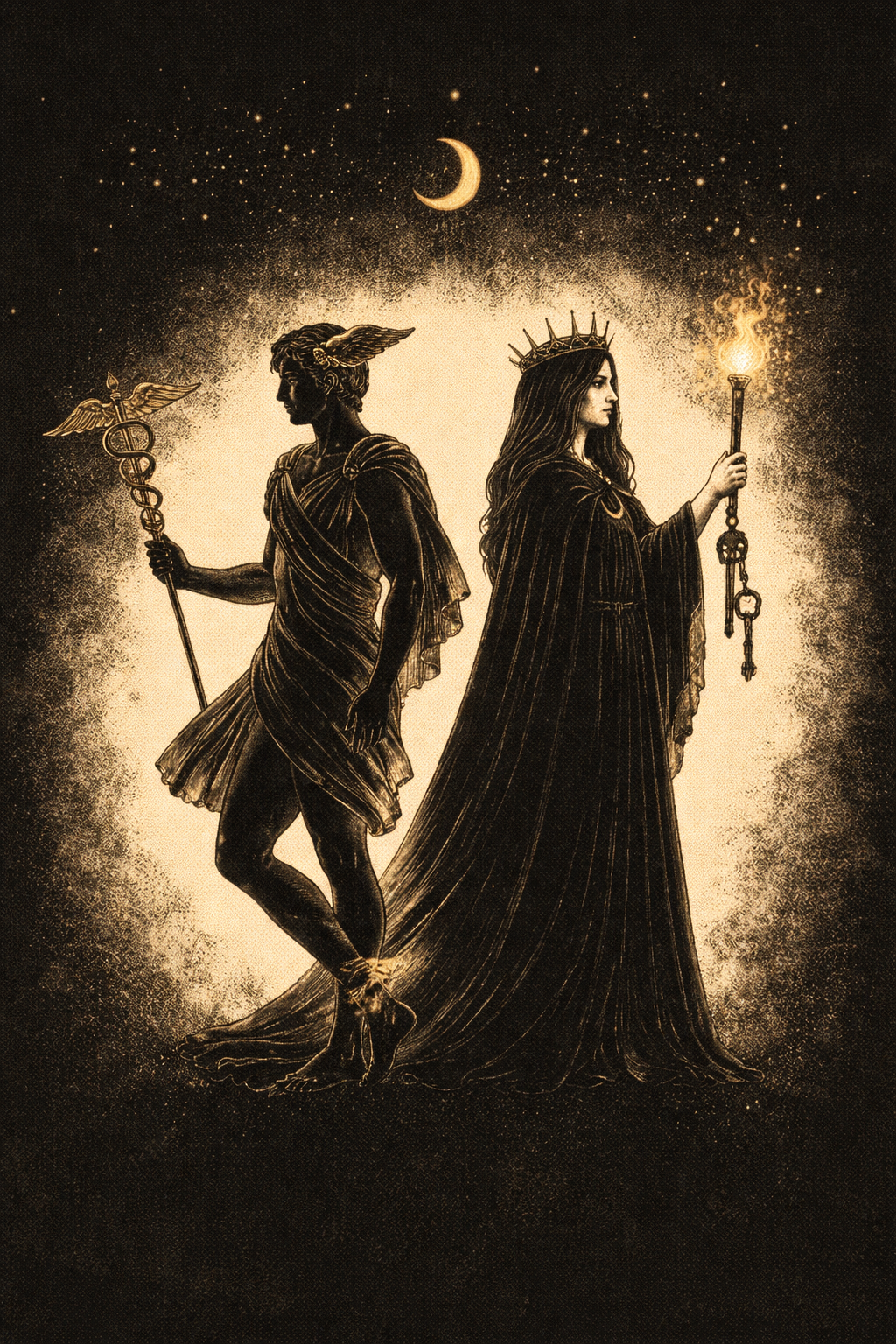
The Greek god Hermes with caduceus and the goddess Hecate with keys and a torch

Hecate and Hermes: Guardians of Roads and Boundaries

If Hecate ruled the crossroads, she wasn’t doing it alone.

Greek religion already had another deity deeply tied to roads, travel and the strange spaces between destinations: Hermes.

Hermes is famous as the fleet-footed messenger of the gods, but he also had a more mysterious job description. He was the patron of travelers, merchants and thieves — people constantly crossing boundaries. He guided souls to the underworld. And along ancient roads, travelers would often pass stone pillars known as herms, small statues dedicated to him that marked boundaries and intersections.

Both Hermes and Hecate move easily between worlds.

Over time, their paths diverged into two very different magical traditions. Hermes became associated with the philosophical and alchemical traditions later known as Hermeticism — the intellectual side of magic, full of symbols, texts and elaborate ritual systems. Hecate, meanwhile, became the patron of something far more earthy: crossroads offerings, herbal magic and the folk practices that would eventually evolve into modern witchcraft.

Two gods. Two roads.

Both watching the places where the worlds overlap.
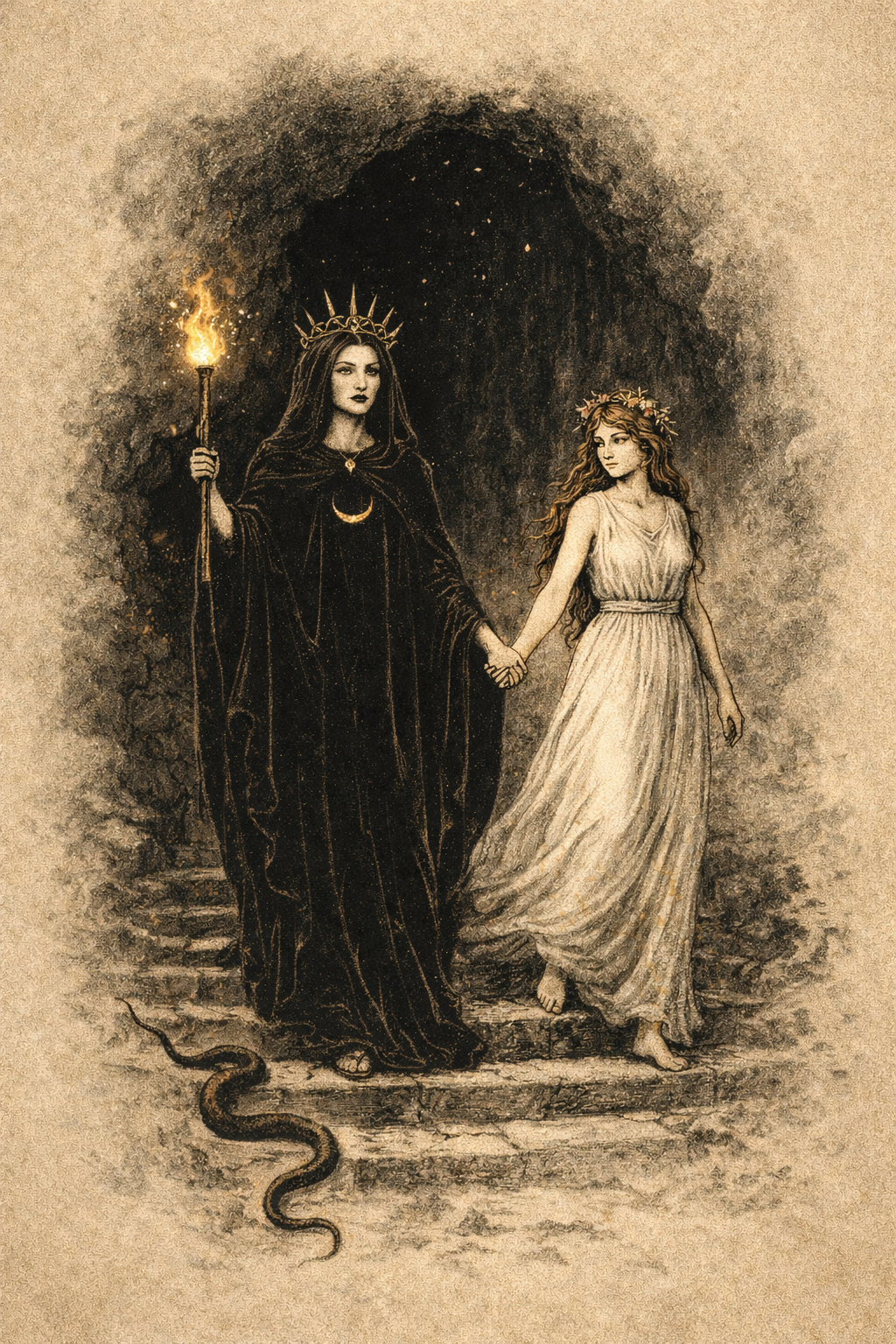
The goddess Hecate holds a torch and Persephone's hand, leading her out of Hades

Hecate and the Search for Persephone

One myth helped cement Hecate’s reputation as a goddess of the night.

When Persephone was abducted by Hades, the world plunged into crisis. Persephone’s mother, Demeter, wandered the earth in grief, searching desperately for her missing daughter. Crops failed. The Earth began to wither.

But someone had witnessed the crime.

Hecate.

In the myth, she approaches Demeter carrying two blazing torches and tells her that she heard Persephone cry out when she was taken. Together they go to the sun god Helios, who reveals the truth: Zeus allowed Hades to carry Persephone into the underworld as his bride.

Hecate’s role in the story may seem small at first, but once Persephone begins her yearly cycle between the underworld and the surface, Hecate becomes her companion and guide — a torch-bearing figure who helps her move between those realms.

The myth reinforced Hecate’s growing association with the boundary between life and death. If Persephone was the queen of the underworld, Hecate was the one who knew the road that led there.

It also strengthened her connection to torches, one of her most recognizable symbols. Ancient statues of Hecate often show her holding them aloft, illuminating the darkness of the crossroads and the shadowy paths between worlds.
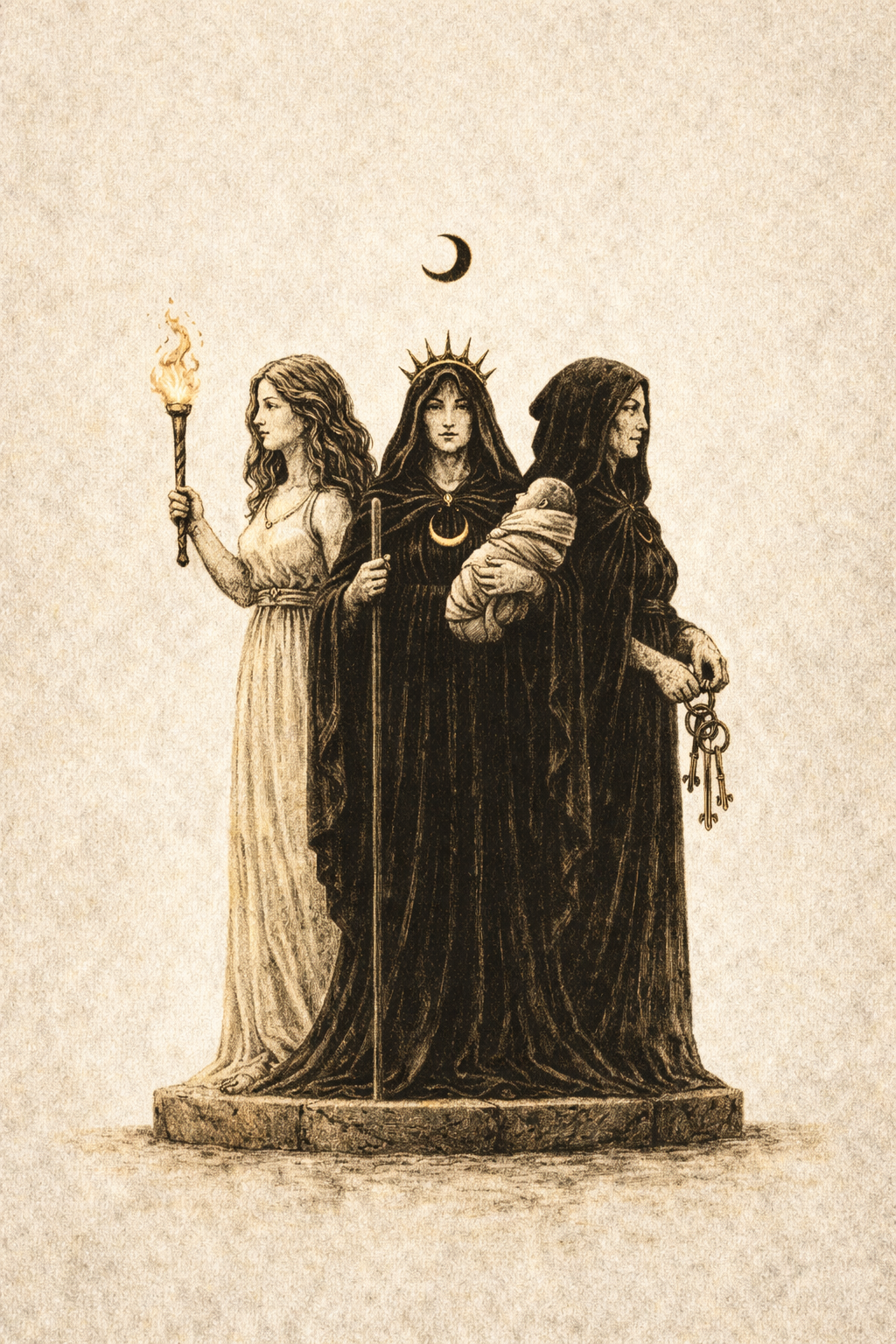
Hecate as the triple-form goddess: a maiden with a torch; a mother with staff and baby; and a crone holding a ring of keys

Hecate the Triple-Form Goddess

At some point in classical Greece, Hecate quite literally gained more faces.

By the 5th century BCE, statues of the goddess began appearing in a new and striking form: three bodies standing back to back, each facing a different direction. The earliest known version of this sculpture type is often credited to the Athenian artist Alcamenes, who created a triple statue of Hecate placed at a crossroads near the Acropolis.

The imagery made immediate sense.

A goddess who guarded crossroads needed to watch all directions at once.

Ancient writers sometimes described these statues as Hecate Triformis, the Three-Formed Hecate. Each figure looked outward toward a different road, symbolically guarding the point where the paths met.

But like many ancient symbols, the triple form quickly accumulated deeper meanings.

For some worshippers, the three faces represented the three realms Hecate had once ruled in Hesiod’s Theogony: heaven, earth and sea. Others associated them with the three phases of the moon — waxing, full and dark — linking Hecate to lunar cycles and night magic. Later traditions interpreted the three forms as representing life’s stages: maiden, mother and crone.

Whatever the explanation, the triple statue became one of Hecate’s most recognizable forms. These hekataia statues were often placed at crossroads, city gates and doorways, acting as protective guardians where different paths — and different possibilities — met.

And they reinforced something ancient worshippers already suspected about the goddess.

If you arrived at a crossroads in the dark, Hecate would see you coming no matter which road you took.
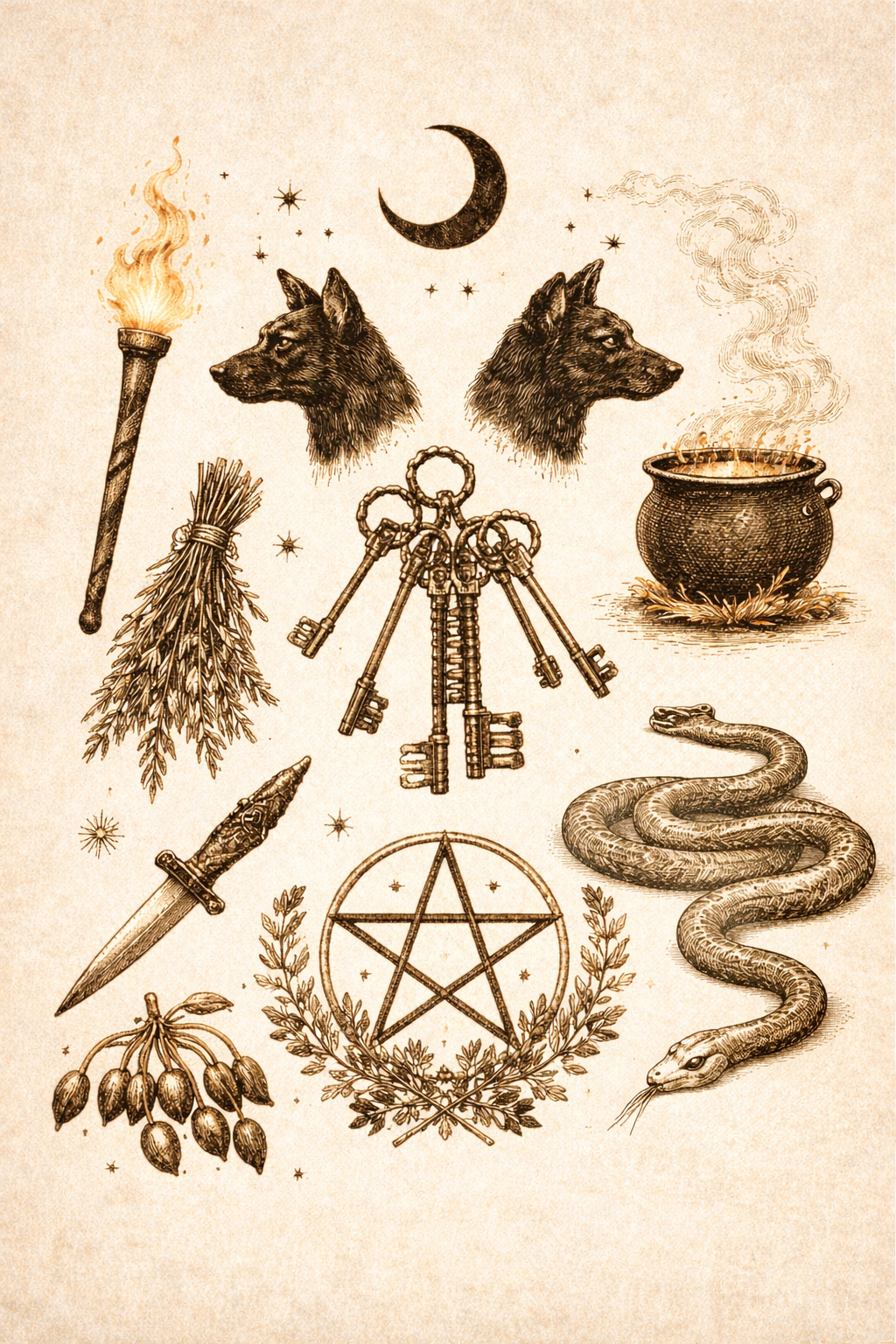
Symbols of the goddess Hecate: the dark moon, a torch, black dogs, herbs, keys, a snake, an athame, a caudron, pentacle and herbs

Symbols of Hecate: Torches, Keys and Howling Dogs

Like many ancient deities, Hecate’s identity was expressed through a set of objects and animals that quickly became unmistakably hers. If you saw a statue holding torches beside a pack of black dogs at a crossroads, you didn’t need a name carved into the base.

You were looking at Hecate.

The most famous of her symbols is the torch. In myth, she carries two blazing torches while helping Demeter search for the abducted Persephone. From that story onward, Hecate becomes the figure who lights the dark paths between worlds. Statues often show her raising the torches high, illuminating crossroads, doorways and the unseen roads traveled by spirits.

Another powerful symbol is the key. In ancient imagery, Hecate sometimes appears carrying large keys at her belt or in her hand. The meaning is straightforward: She’s the keeper of gates. If there’s a doorway between worlds — whether it leads to the underworld, the spirit realm or some other unseen threshold — Hecate holds the key.

And then there are the dogs.

In Greek and later magical traditions, the barking or howling of dogs was often interpreted as a sign that Hecate was near.

Black dogs in particular became strongly tied to Hecate’s imagery, appearing beside her in artwork and myth. In some stories they accompany her through the night like a supernatural hunting pack. In others they serve as guardians of the crossroads she protects.
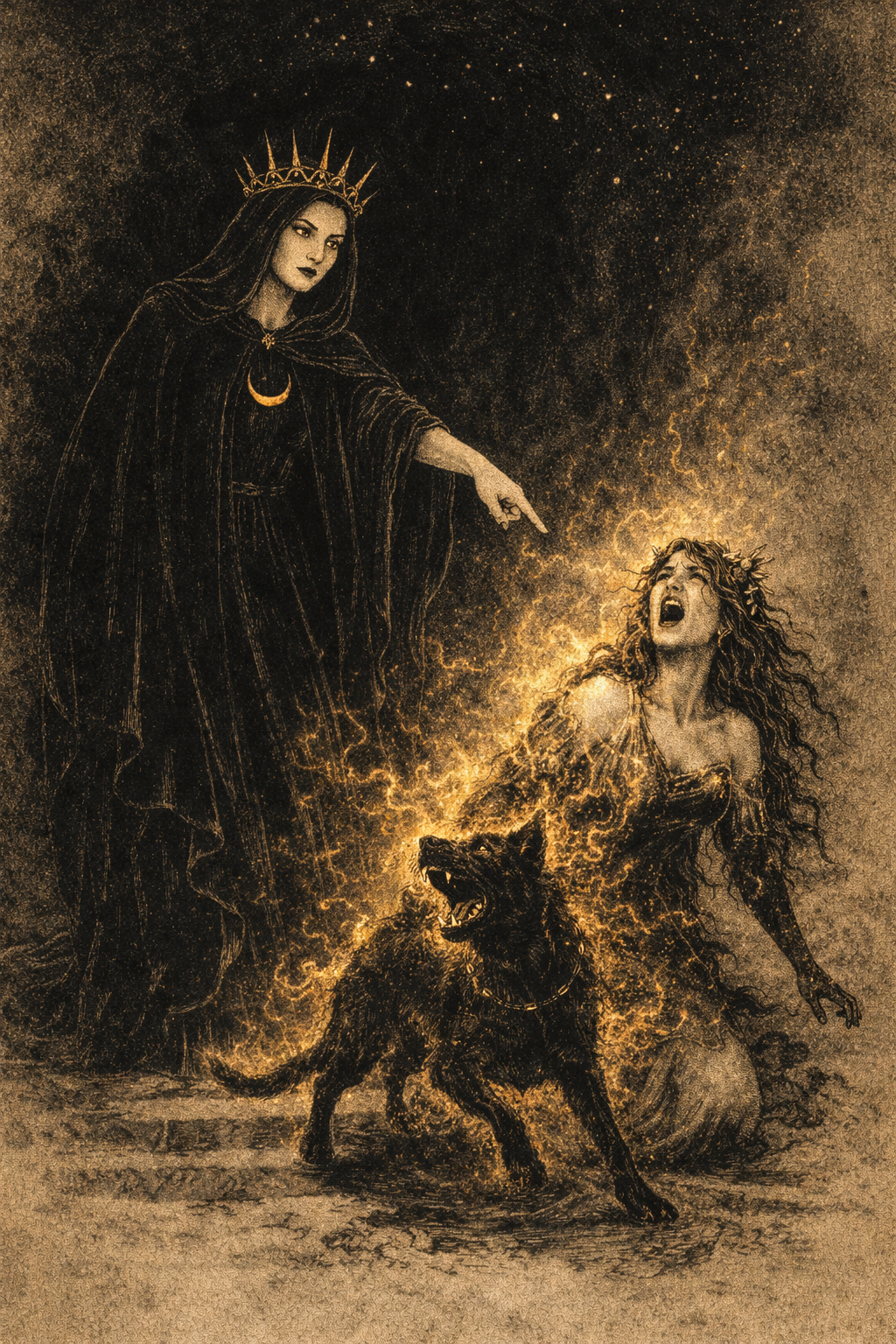
The goddess Hecate turns Hecuba, Queen of Troy, into a black dog

One explanation for this connection appears in a myth involving Hecuba, the tragic queen of Troy. After the fall of the city, Hecuba was taken captive by the Greeks. In some versions of the story, her grief and rage become so overwhelming that she transforms into a dog and throws herself into the sea. Other traditions say the transformation was an act of mercy from the gods — sometimes attributed to Hecate herself.

Hecate is also associated with snakes, animals that symbolized both death and renewal in the ancient world. Their ability to shed their skin made them natural emblems of transformation — another theme that runs through the goddess’s mythology.

They were also creatures of thresholds themselves — living close to the ground, emerging suddenly from holes and crevices, slipping between the visible world and the unseen spaces beneath it.

For a goddess who governs crossroads and transitions, the symbolism fits perfectly. Like the serpent, Hecate is a figure who moves easily between worlds, presiding over the moment when one state of being sheds its skin and becomes another. She’s often depicted with serpents coiling along her arms and waist. 

Another important symbol connected to Hecate is Hecate’s Wheel, sometimes called the Strophalos.

The exact meaning of the symbol has been partially lost over time, but many scholars believe it represented rebirth, divine thought and the movement of spiritual power. The wheel’s three spiraling arms are often interpreted as another expression of Hecate’s triplicity — echoing her threefold form and the three roads that meet at a crossroads.

Like much of Hecate’s imagery, the symbol suggests motion, transformation and the turning of unseen forces.

Hecate is also deeply connected to pharmakeia, the Greek term for a form of magic that works through herbs, poisons and medicines. The word itself sits at the root of our modern term pharmacy, but in the ancient world it carried a far more mysterious meaning. Practitioners of pharmakeia used plants to heal, curse, transform and alter fate — all practices that later traditions strongly associated with Hecate.

Because of this, the goddess became linked with a wide range of powerful plants.

Many were known for their medicinal or poisonous properties, including hemlock, aconite, mugwort, garlic, hellebore, belladonna and mandrake. Others carried symbolic ties to the underworld or liminal spaces, places that fall under Hecate’s influence. Plants such as dandelion, mint, yew, mullein, black poplar and willow were therefore also connected to her.

Taken together, these symbols reinforce the same theme that appears throughout Hecate’s mythology: she governs the forces that exist between categories — healing and poison, life and death, transformation and decay.
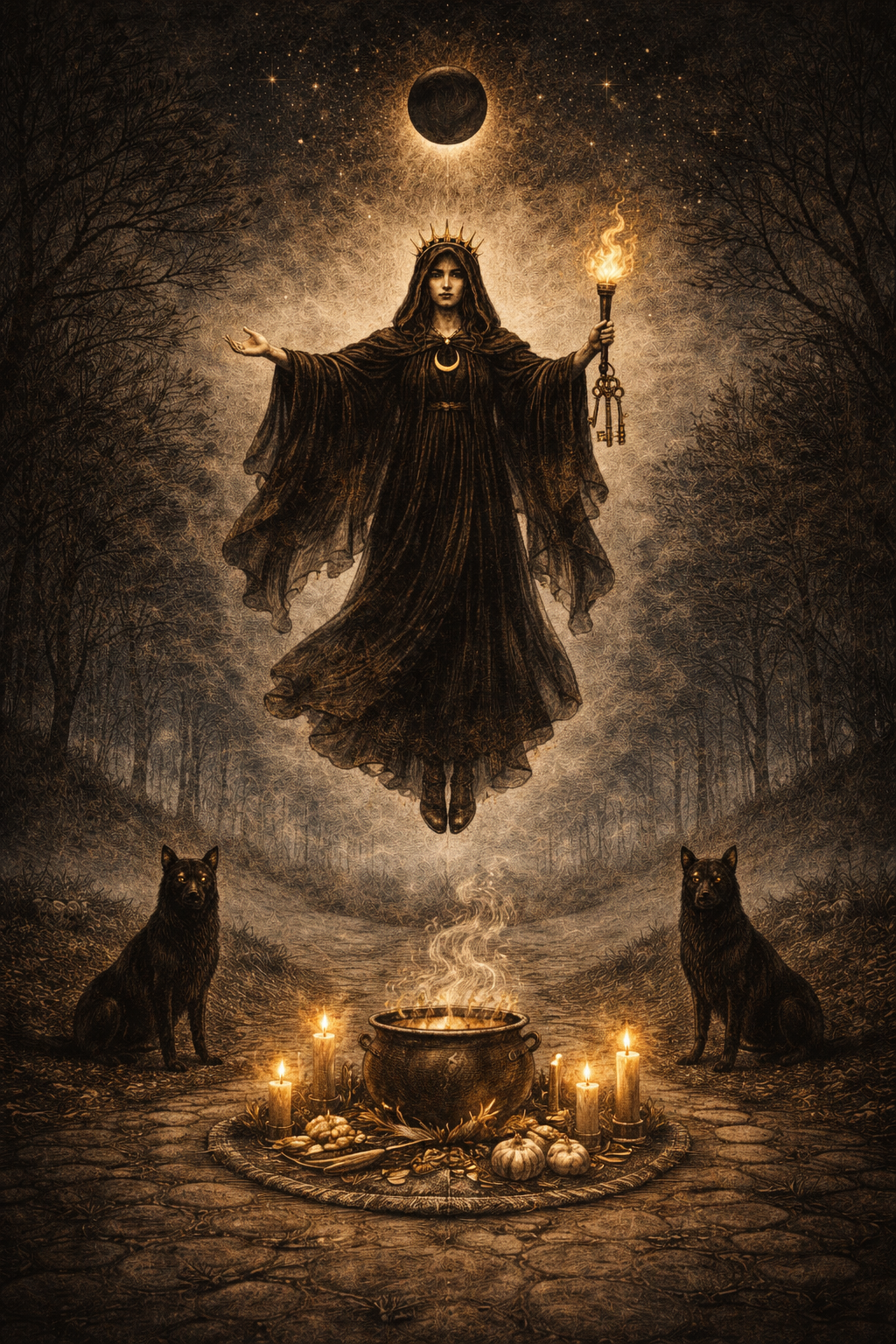
The goddess Hecate floats above a crossroads, where a cauldron simmers and people have left her a supper of garlic with candles, as two black dogs sit to either side

Hecate’s Supper: Offerings at the Crossroads

If you lived in the ancient Greek world and wanted to stay on good terms with Hecate, there was a simple solution.

Feed her.

Every month, on the night of the dark moon, households would leave offerings at crossroads in a ritual known as Hecate’s Supper. The food was placed at three-way intersections — the places most closely associated with the goddess.

The menu was humble but specific.

Offerings commonly included things like:

  • Garlic

  • Eggs

  • Bread or cakes

  • Fish

  • Cheese

  • Honey 

Garlic in particular shows up again and again in sources tied to Hecate. 

But the offerings weren’t just gifts. They served several purposes at once. One was appeasing wandering spirits believed to gather at crossroads. Another was purification — a way of symbolically casting off misfortune or spiritual pollution from the household.

Food placed at the crossroads could carry away the problems of the past month.

In some accounts, the offerings were also intended for the restless dead believed to travel with Hecate. The food was left behind as a gift for the goddess and her spectral companions.

Once the offerings were placed, the person who brought them walked away. No turning around. After all, if you looked back, you might see who had come to collect the meal.
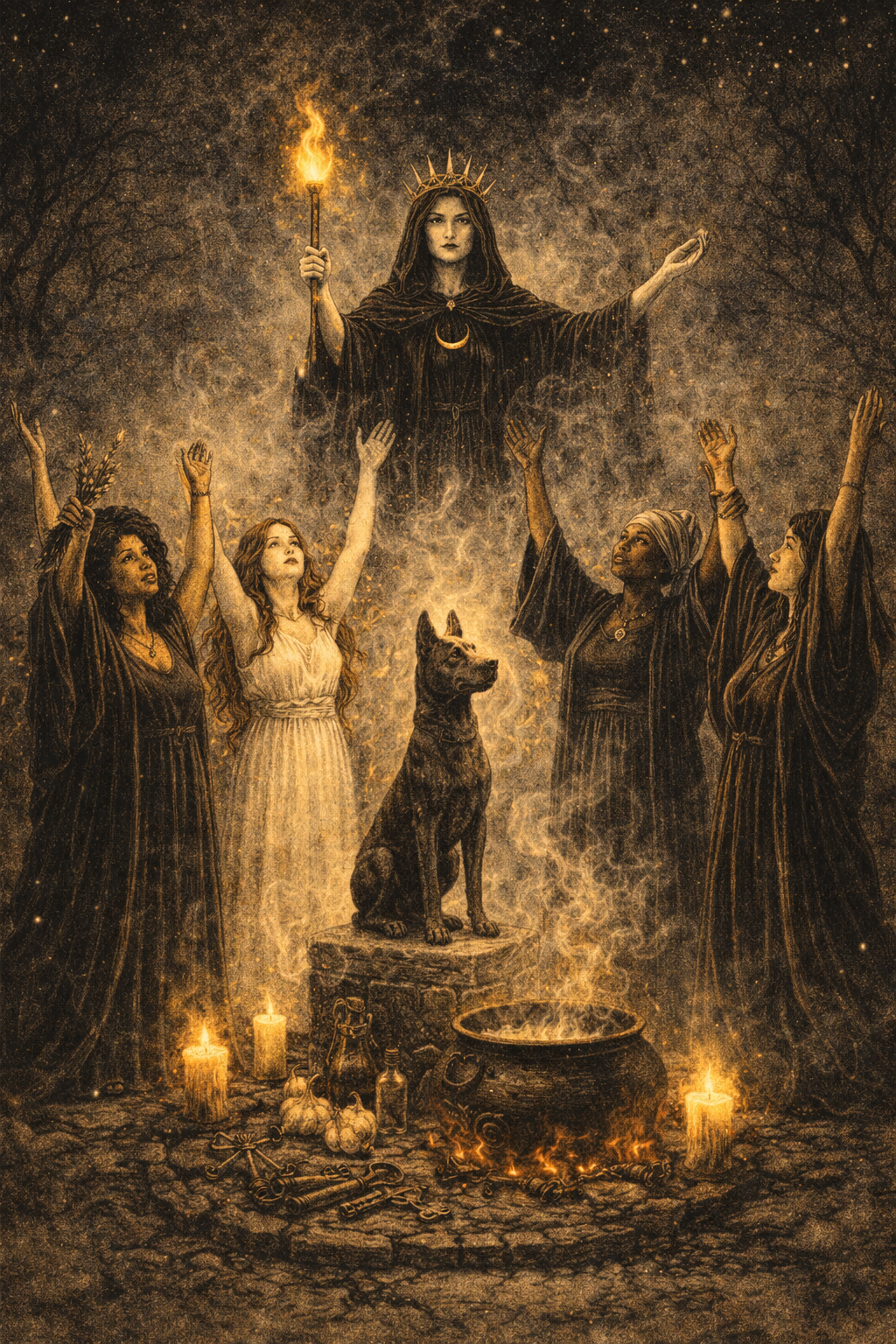
A group of witches perform a ritual by a statue of a dog, cauldron, keys, garlic and candles to invoke the goddess Hecate

A Ritual to Invoke Hecate in a Time of Dire Need

This ritual calls upon Hecate to intervene when life reaches a difficult turning point. It draws on many of the goddess’s traditional symbols — crossroads, bones, garlic, dogs and liminal herbs — and asks for her guidance when the road ahead feels uncertain.

You will need:

  • A dog statue

  • Two candles

  • A black bowl

  • Salt water

  • Red wine

  • Poisonous herbs

  • Healing herbs

  • Three keys

  • A long bone

  • A bulb of garlic

  • Graveyard dirt

  • Ritual blood

  • Hecatean incense (myrrh, mugwort, mullein and poplar)

Opening the Ritual Space

Begin by cleansing the space and casting the circle.

Participants form a circle while the ritual leader traces the boundary of the ritual space.

During this process, the group repeatedly chants:

Thout a tout tout, throughout and about.

As each participant joins the chant, visualize the ritual space forming — a circle that becomes a crossroads between worlds.

At the center of the altar, place the dog statue flanked by the two candles.

Before it place the three keys and the black dish.

The Libations of Life and Death

Take up the vessel of salt water and say:

By libation of sorrow,
And humor of death.

Pour the salt water into the black dish.

Next take up the red wine and say:

By libation of glory,
And humor of life.

Pour the wine into the dish.

Take up the poisonous herbs and say:

That which poisons—

Then take up the healing herbs and say:

Is that which heals.

Place both herbs into the dish.

Drawing Down the Realms

One participant lights the first candle and raises it high, saying:

Through Helios in sunlit trails,
Through Nyx among her blackened veils,
We call the heavens to the earth.
Moonlight, starlight, given worth.

Another participant lights the second candle and holds it low, saying:

Through Hades’ shroud of gold and wraith,
Through Kore harrowed by her faith,
We call the depths unto the earth.
Beyond its death is given birth.

The two candles are then placed beside the altar.

The ritual space now stands between heaven, earth and underworld.

Calling the Goddess

Burn incense of myrrh, mugwort, mullein and poplar.

The ritual leader stirs the waters in the black dish with a long bone and invokes Hecate:

Come to us, Infernal Queen,
You who stands at all between.
Who keeps her vigil at the gate

Presides in birth, and death, and fate.

You who poisons and who heals,
Who gives and takes and yet reveals.
Keeper of lost, fair and foul,
Herald of the black hound’s howl.

Three by the moon, the realm, and age,
Three by the roads that cross your stage.
By company of wayward ghost,
And night where witches seek your host.

In crown of oak and mantled snakes,
Hecate, we hail, we wake!
Enodian Hecate,
I invoke you Triodites,
Heavenly, Chthonian and of the sea!

The final words are repeated until the presence of the goddess is felt.

The dish is placed at the base of the dog statue, with candles on either side.

Opening the Crossroads

One participant takes the three keys.

Each key is pointed toward a different direction while saying:

Three by three by the witch’s fork,
Key by key to latch the work,
And cross the roads where shadows lurk.

Afterward, the keys are placed before the dish, each pointing down its direction.

The Garlic Offering

One participant lifts the garlic bulb before the dog statue.

The bulb may be marked with ritual blood and graveyard dirt while saying:

Pale as the moon in shining grace,
Red as the moon when Earth gives chase,
Black as the moon who hides its face.
From heaven, land and chthonic shade,
In dire time we call your aid.

Place the garlic at the center of the three keys.

Personal Supplication

Each participant approaches the altar.

They peel a clove of garlic and make a personal request or promise to Hecate.

The clove is then dropped into the black dish.

Seeking the Goddess’ Answer

The dish is stirred and the long bone is dropped into the water.

Ask whether Hecate accepts the offering.

Interpret the result:

  • Vertical bone: The answer is yes

  • Horizontal bone: The answer is no

If the answer is no, the rite continues until acceptance is granted.

Closing the Ritual

Once the offering is accepted, the circle is closed and the ritual space released.

The offering should later be taken and left at a crossroads as a gift to Hecate.
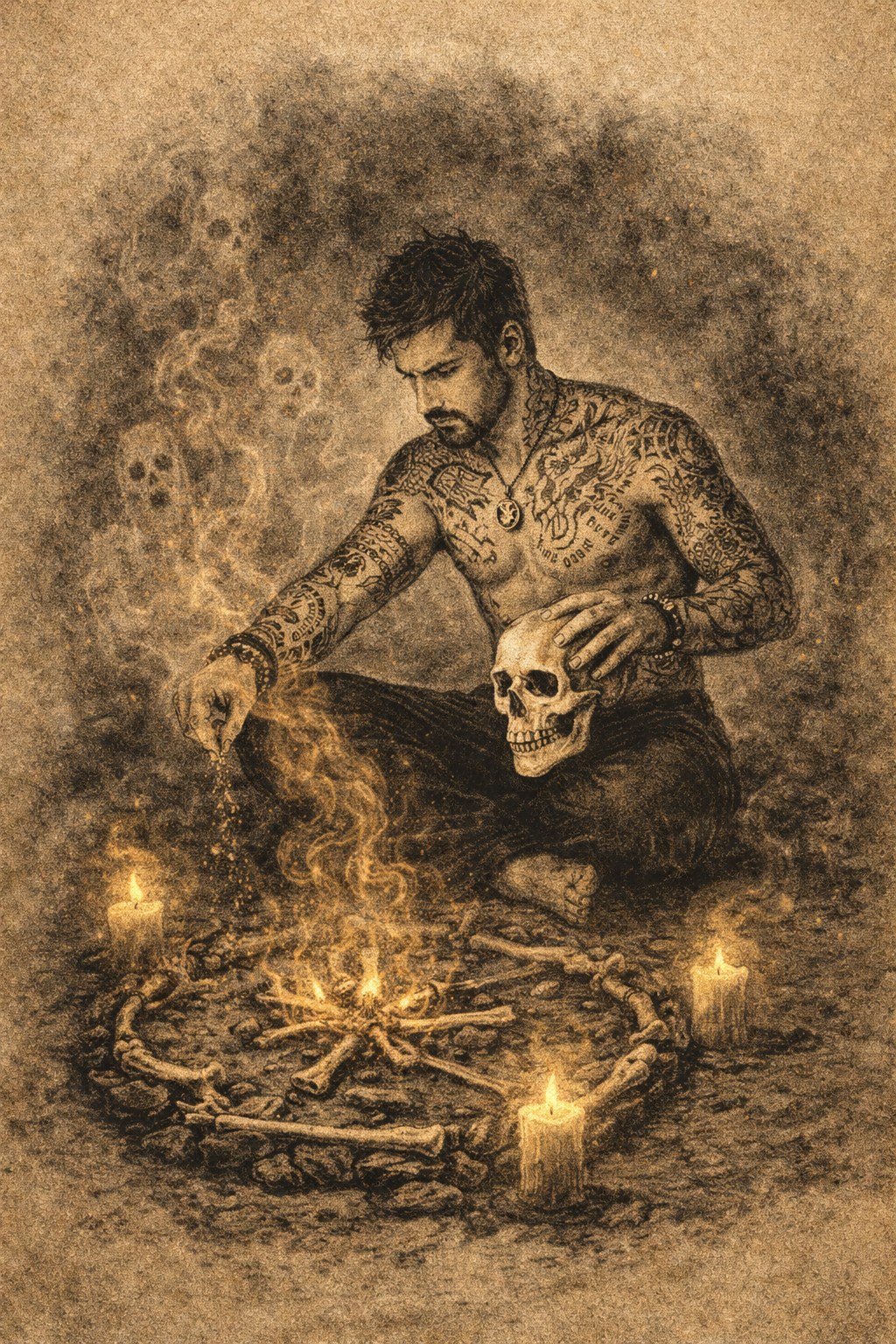
A shirtless man covered in tattoos holds a skull and performs a bone oracle necromantic divination to ask Hecate questions

Hecate’s Bone Oracle: A Method of Necromantic Divination

If you want an answer directly from Hecate, necromancy is one of her favored forms of divination.

Fill a black bowl with water and suspend a bone over its surface. Then say:

Goddess of darkness, bring life to this bone,
Raise death from ashes, dirt and stone.

White as the skull, black as the grave,
The moon shall tell us what we crave.

Call the spirit to our plea,
Let us see, let us see.

After speaking the invocation, ask your question to the goddess and drop the bone into the water.

Interpret the answer based on how the bone settles:

  • Horizontal: The answer is no

  • Vertical: The answer is yes

  • Diagonal: The answer is unclear or undecided

For further insight, burn mugwort and mullein above the bowl and watch the smoke carefully. Shapes and movements in the smoke may provide additional clues to the answer.

The ritual reflects Hecate’s long-standing connection with spirits, death and the hidden knowledge believed to exist at the boundary between worlds.
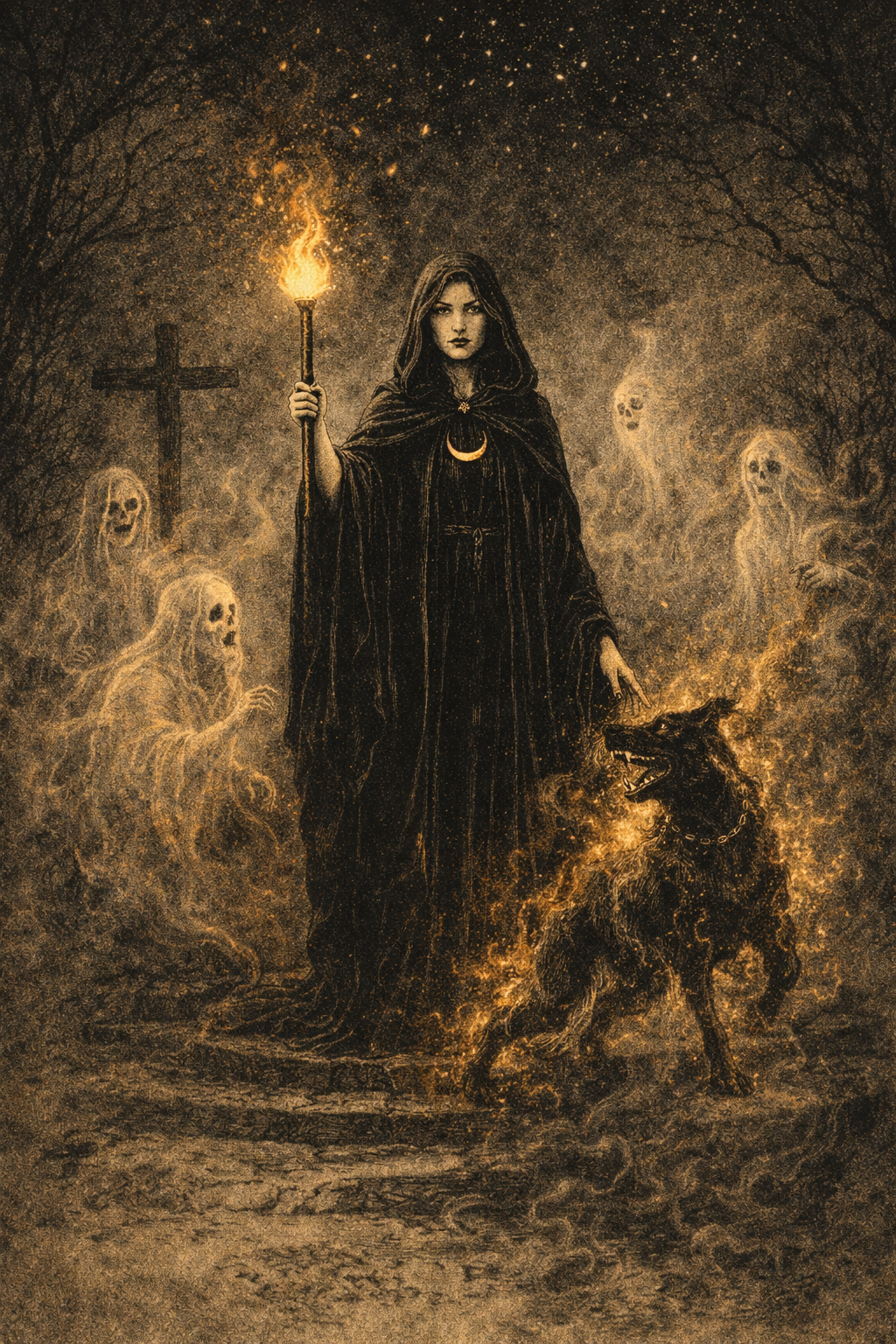
The goddess Hecate, with a flaming black dog, surrounded by ghosts, in her role as Queen of Ghosts and the Dead

Why Hecate Still Waits at the Crossroads

For a goddess whose cult stretches back thousands of years, Hecate feels strangely modern.

She isn’t a goddess of stability or comfort. She doesn’t promise an orderly world where everything stays exactly where it belongs. Hecate governs the places where certainty falls apart — the moments when something ends and something else has not quite begun.

Ancient people understood those moments as literal places. A three-way crossroads outside the city. A threshold between the house and the street. A graveyard at the edge of town where the living and the dead might brush past one another in the dark.

But crossroads don’t only exist on roads.

They show up in life all the time.

The end of a relationship.

A decision about where to go next.

The uneasy pause before stepping into something unknown.

In those moments, the symbolism of Hecate suddenly makes perfect sense. A goddess who carries torches. A keeper of keys. A figure who walks easily between worlds because she was never meant to belong entirely to any one of them.

Which is why Hecate isn’t simply a goddess of crossroads.

She is the crossroads.

And perhaps that’s why her mythology has survived so stubbornly across centuries of religion, folklore and modern witchcraft. Every human life eventually reaches a place where the road splits, the future grows dark and someone has to decide which direction to take.

When that moment arrives, it helps to imagine a torch burning somewhere ahead on the path.

And a goddess who has been standing there for a very long time. –Wally
Secrets of the Seven Wonders of the Ancient World

Author Bettany Hughes shares surprising truths about the Great Pyramid, the Hanging Gardens of Babylon and other Wonders of the Ancient World. 

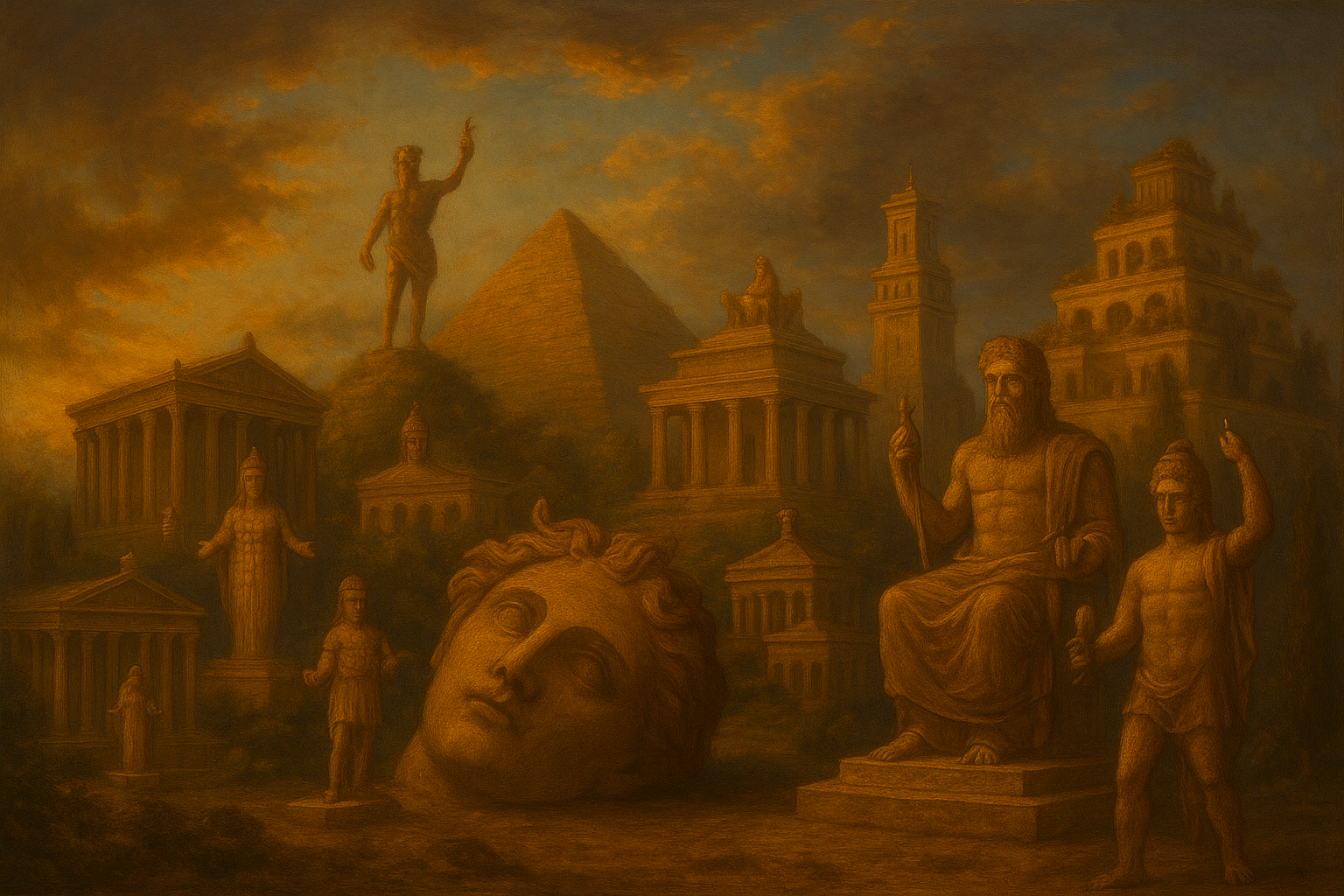
A collection of the Seven Wonders of the Ancient World, including the Pyramid of Giza, Mausoleum, Colossos, Hanging Gardens, statue of Zeus, Alexandria Lighthouse and Temple of Artemis at Ephesus

Quick — name the Seven Wonders of the Ancient World.

Struggling? You’re not alone.

Most people can’t list them all. Some guess the Colosseum or Stonehenge. Others don’t realize that only one still stands. 

These weren’t just impressive buildings and sculptures.

They were bold declarations of power — a Hellenistic highlight reel that reflected the ambition and reach of Alexander the Great’s world.

In her 2024 book The Seven Wonders of the Ancient World: An Extraordinary Journey Through History’s Greatest Treasures, historian Bettany Hughes peels back the mythology and reveals the politics, poetry and propaganda behind these wonders. These weren’t just impressive buildings and sculptures. They were bold declarations of power — a kind of Hellenistic highlight reel that reflected the ambition and reach of Alexander the Great’s world.

MORE: 3 Times Alexander the Great Wasn’t So Great

The oldest surviving version of the list was scribbled on a scrap of papyrus used to wrap a mummified body in Ancient Egypt. 

Most could be visited on a single, well-planned trip through the eastern Mediterranean. This was the ancient world’s first viral travel list — and its message was clear: Look upon our works, ye mortals, and marvel.

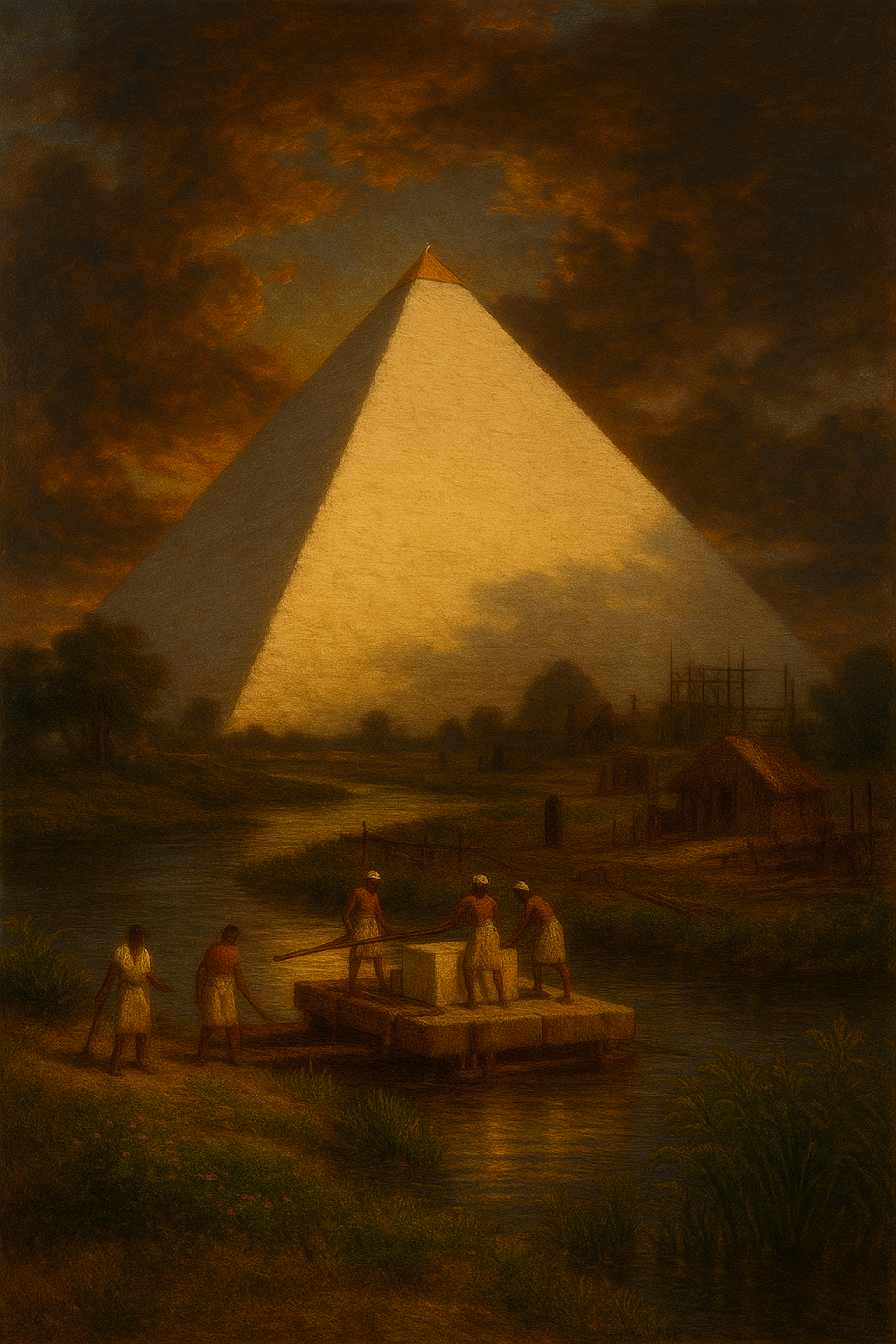
Workers transport limestone on the Nile to cover the Great Pyramid of Giza, seen with a metal capstone

1. The Great Pyramid of Giza: A Resurrection Machine by the Nile

If you visit the Great Pyramid today, you’ll likely see a heat-blasted monument rising from a stretch of ochre desert. But what if we’ve been picturing it all wrong? Hughes urges us to reimagine the Giza Plateau not as barren but as bursting with life: “Where we see desertion, imagine an abundance of clover and thousands of homes; where there are sands, waterways; where there is emptiness, tens of thousands of workers in loincloths and linen kilts. Where there are now neutral horizons, there was once hectic color; where piles of collapsed stone, dwarf-pyramids and sloping, mudbrick mastaba tombs. Where desert, gravid green.”

Built around 2550 BCE and once faced in polished white limestone, the Great Pyramid would have shimmered with a blinding brilliance. 

It wasn’t just a royal tomb; it was a “resurrection machine,” a literal launchpad to the afterlife. This machine served a higher cosmic purpose: to guarantee Egypt’s prosperity by ensuring the pharaoh’s rebirth. The fate of the world literally depended upon Khufu’s afterlife. 

And the engineering behind it still leaves modern minds gasping. Standing 480 feet tall and weighing in at roughly 6.5 million tons, the pyramid used about 2.3 million blocks of limestone, each hauled into place over a quarter of a century. Its interior space alone could swallow London’s St. Paul’s Cathedral, Westminster Abbey, St. Peter’s Basilica in the Vatican, and the cathedrals of Milan and Florence — with room to spare.

A historic etching of the construction of the Great Pyramid of Giza in Egypt, a Wonder of the Ancient World

Despite theories ranging from alien intervention to lost technologies, Hughes focuses on the human marvel of it all: tens of thousands of anonymous laborers working 10-hour days, 52 weeks a year, over decades — moving one block every two to three minutes. Current estimates suggest around 20,000 workers were active on the plateau at any given time, likely using a combination of sledges, rollers, ramps and perhaps even early hydraulic lifts. Still, the exact method remains elusive: “The engineering and construction of the Pyramid — the way these blocks were shaped, lifted and set in place — has confounded researchers for centuries, triggering miles’ worth of parchment and paper, and now volumes of iCloud storage,” Hughes writes. “It is a conundrum that obsesses the modern world — taxing the minds of engineers, architects, archaeologists, surveyors, even mediums.”

It’s also easy to forget that this was a riverfront wonder. In Khufu’s day, the Nile flowed much closer to Giza, hugging the Pyramid complex for most of the year, and sometimes lapping its very foundations. What we now see as isolation was once a place of movement and connection — a grand riverside attraction.

Capped with a golden or electrum pyramidion that caught the sun’s rays and hurled them back to the heavens, the Great Pyramid symbolized the original mound of creation — the divine moment when the world emerged from chaos. It was cosmic.

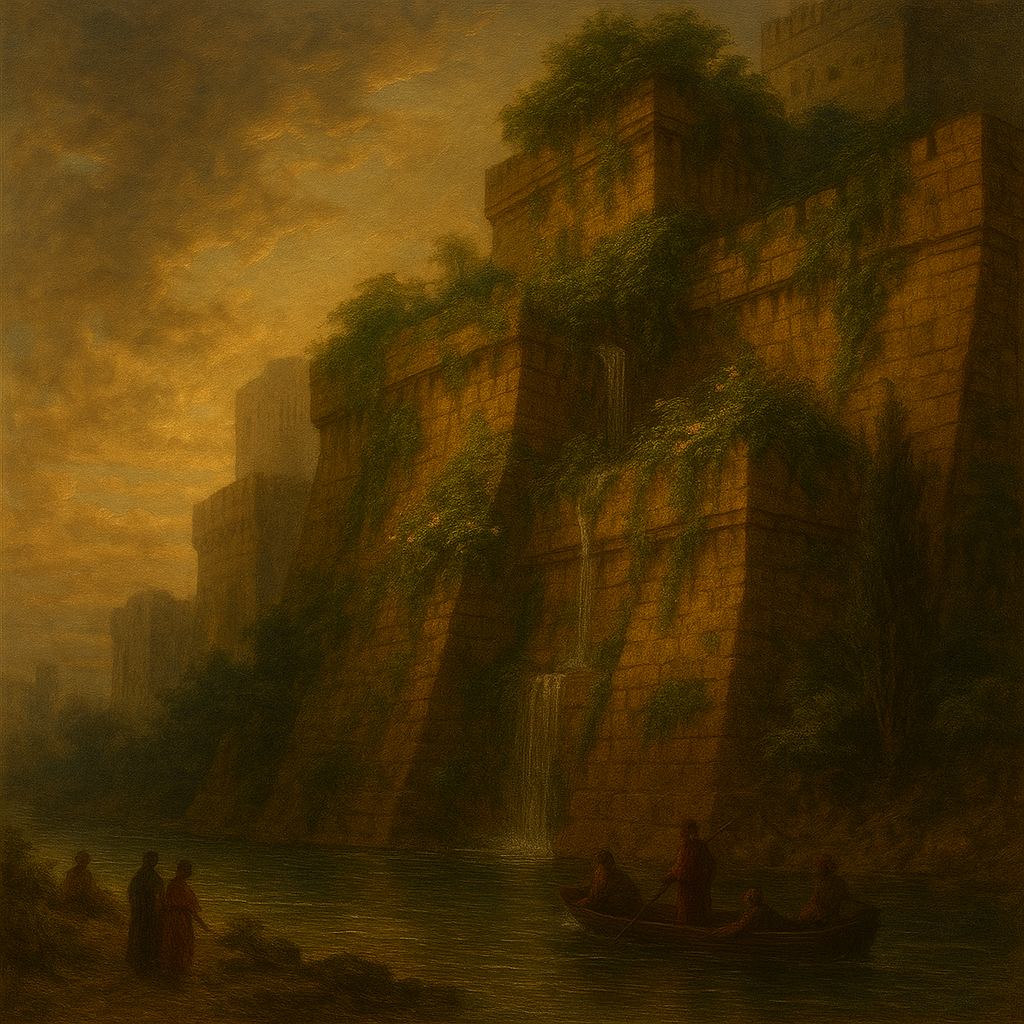
Greenery on the fortified walls known at the Hanging Gardens of Babylon, an Wonder of the Ancient World

2. The Hanging Gardens of Babylon: Myth, Monument or Mistranslation?

Of all the Seven Wonders, the Hanging Gardens of Babylon remain the most mysterious — and possibly the most fictional. Unlike the Great Pyramid, whose stones still scrape the sky, the Gardens leave us with no ruins, no universally agreed-upon site, and plenty of questions. Did they even exist?

If they did, the Hanging Gardens would have bloomed sometime in the 6th century BCE, during the reign of Nebuchadnezzar II — the great Babylonian king who ruled from 605 to 562 BCE and who is most often credited with their creation. That attribution, though, rests more on later tradition than contemporary evidence.

MORE: Nebuchadnezzar, King Josiah and the Formation of Jewish Law

And the evidence is where things get messy. Hughes lays out the problem clearly: Neither Herodotus nor Xenophon — Greek chroniclers who actually visited Babylon — mention the Gardens. Not once. That silence is thunderous. Even the East India House Inscription, a beautifully preserved 20-inch-wide slab chronicling the many accomplishments of Nebuchadnezzar II, makes no mention of them — no garden at all, hanging or otherwise.

So what gives?

Hughes suggests we may be looking for something too specific. What if the gardens weren’t separate from Babylon’s famed walls but were part of them — verdant terraces that flowed from the fortifications and palatial structures themselves? In many ancient lists, it’s actually Babylon’s walls that earn the “Wonder” designation, not the elusive Gardens. That ambiguity raises the possibility that what we now call the “Hanging Gardens” may have been a poetic misunderstanding — a mistranslated marvel.

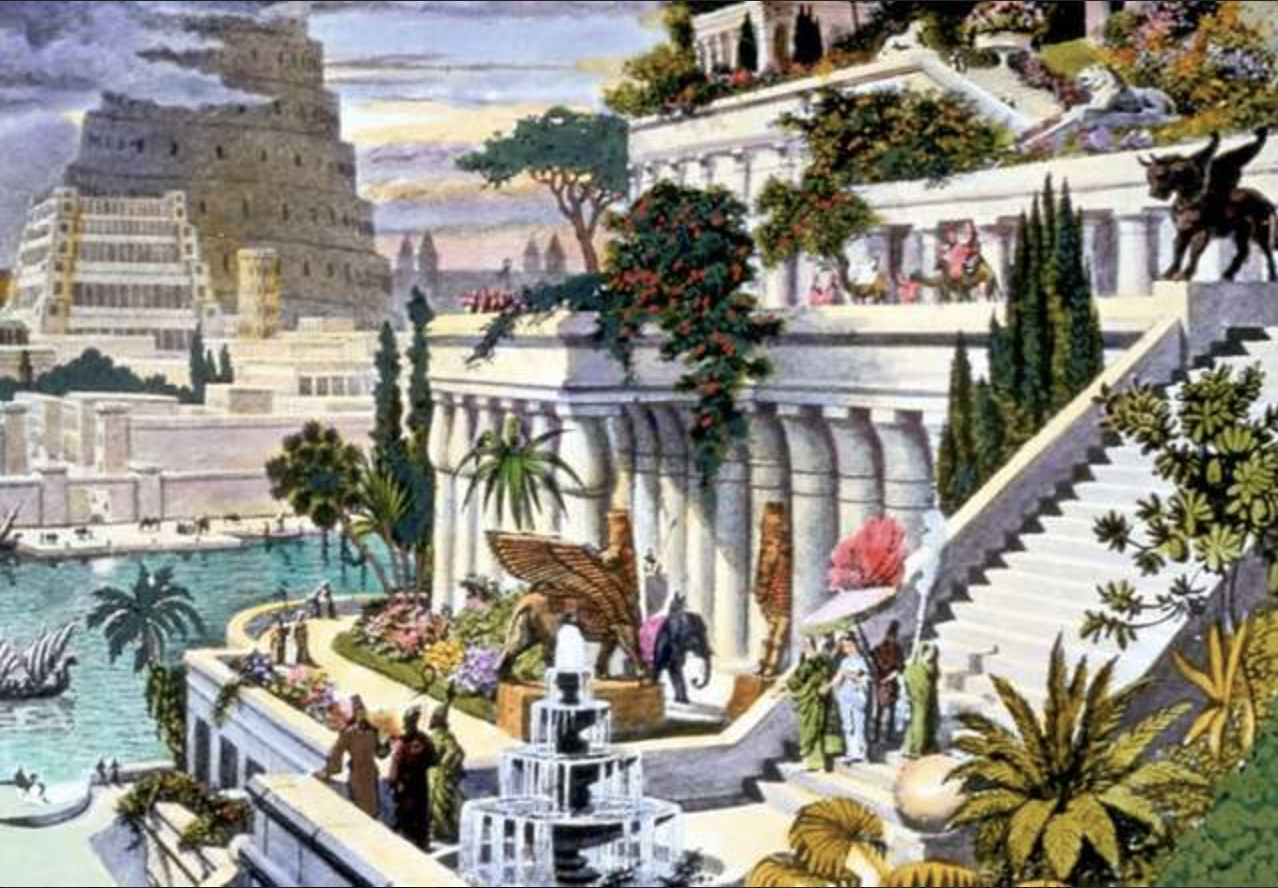
The Hanging Gardens of Babylon, with the Tower of Babel in the distance

And yet, the idea of the Gardens persists — not just because they would’ve been beautiful, but because they captured something deeper and darker about humanity’s emerging relationship with nature. These were not serene rooftop retreats. They were feats of engineering and control, power disguised as paradise.

“Whatever they were, however wondrous, the Hanging Gardens of Babylon would not have been idylls,” Hughes writes. “They would have been exquisite, exacting expressions of potency, expressions of belief, manifestations of ingenuity and the start of a dangerously dominating relationship with the natural world.”

Whether built in Babylon or borrowed from memories of Nineveh, the Hanging Gardens endure because they symbolize an idea: that nature could be bent into spectacle. And that idea, as Hughes suggests, has echoed through every empire since.

MORE: Controversial Theories About the Tower of Babel

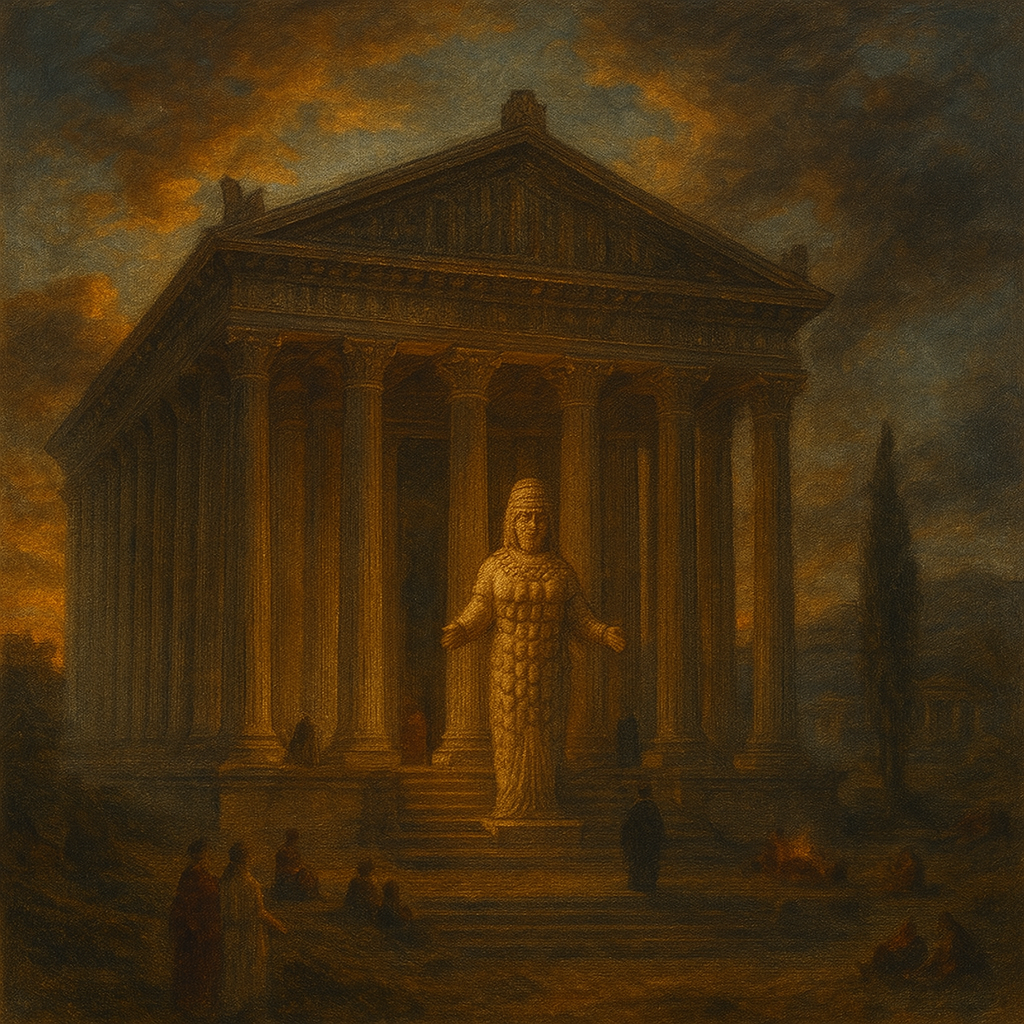
A multi-breasted statue of Artemis stands in front of her Temple at Ephesus, a Wonder of the Ancient World

3. The Temple of Artemis at Ephesus: Sanctuary of Stone and Wildness

Of all the ancient world’s architectural achievements, none left the poet Antipater of Sidon more breathless than the Temple of Artemis. Around 140 BCE, he wrote, “I have set eyes on the very wall of lofty Babylon, supporting a chariot road, and the [statue of] Zeus by the Alpheios [in Olympia], and the Hanging Gardens, and the Colossus of Helios, and the huge labor of the steep pyramids, and the vast tomb of Mausolos; but when I saw the temple of Artemis, reaching up to the clouds, these other marvels dimmed, they lost their brilliance, and I declared, ‘Look, apart from Olympus itself, the sun has never shone on anything that can compare to this!’”

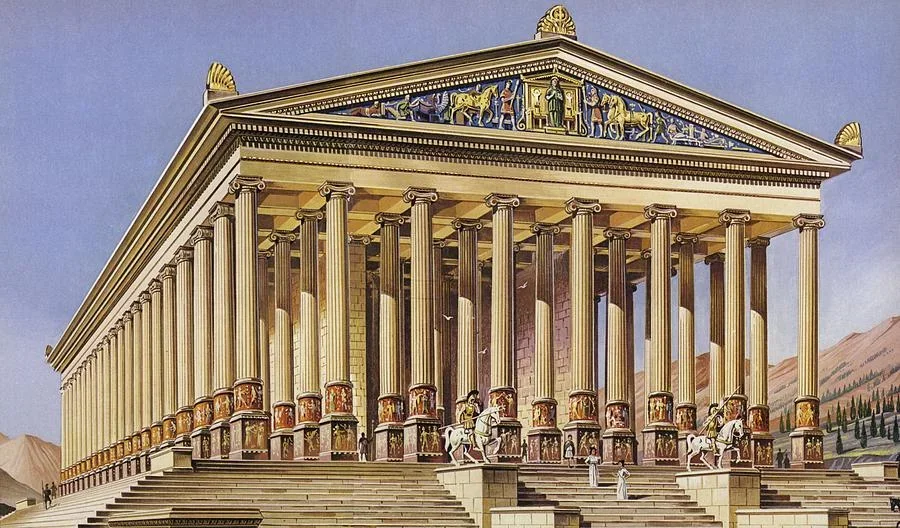
Constructed around 550 BCE and rebuilt in grander fashion after a devastating fire in 356 BCE, the Artemision — as it was called in classical sources — was the first of the Seven Wonders to be accessible to all people, not just royalty. And it was the only one where women, both mythic and mortal, stood at the center of its story.

The original temple was incinerated on a sweltering July night — the very night Alexander the Great was born. In fact, the Greek world couldn’t help but connect the two events: “Tongues wagged: Artemis — goddess of nature and childbirth — it was whispered, was so busy in northern Greece, super-birthing a world-class megalomaniac, she neglected her earthly temple home,” Hughes writes. 

MORE: Alexander the Great: 8 WTF Facts About His Early Life

The arsonist was a man named Herostratus, likely a desperate slave who torched the temple to immortalize his own name — and, ironically, succeeded. The Ephesians tried to erase him completely. Speaking his name was made a capital crime. But history, being what it is, remembered him anyway.

The rebuilt temple was a marvel: 425 feet long, 225 feet wide — nearly twice the size of the Parthenon that would follow it 150 years later. It featured 127 columns, each 60 feet high, and some capped by a skylight above the central cult statue. The structure marked the first true colonnaded Greek temple, laying the architectural blueprint for millennia to come.

The Temple of Artemis at Ephesus, with painted column bases and frieze at the top, a Wonder of the Ancient World

Here, Artemis wasn’t the graceful huntress of Louvre sculptures. She was Asiatic Artemis, a wild guardian of beasts, bearing the mystery and fertility of the Earth. She was a goddess of contradictions — pure yet primal, distant yet intimately present.

“Artemis in the mythology of the Greeks was an unusual goddess, a female figure who stood apart from the rutting sexuality that was the norm of ancient life and myth,” Hughes writes. “The story went that on the eve of her wedding, Artemis begged her father Zeus to allow her not to marry. In most cultures at this time, women were controlled, either by having to have sex, or by not being allowed to. Artemis’s agency, and her choice, makes her attractively odd. She was a virgin, whose sphere was consummation.”

Her image, kept hidden behind a curtain in the sanctuary, was likely a wooden plank known as a xoanon — treated as a living being. It was washed in seawater, anointed in fig milk or grape juice, adorned with clothes and gold, and lovingly cared for in a process called kosmeis — the root of our word cosmetics.

The cult of Artemis was largely female-led. Young women, or parthenoi, took part in the rites. But the high priests — the megabyzoi — were eunuchs, men who had castrated themselves in service to the goddess. Their female counterparts, the melissae, were the “honey women,” underscoring the deep associations between Artemis, fertility and nature’s sweetness.

Ephesus itself had become one of the largest and busiest cities in the ancient world, its port capable of hosting over 800 ships. That accessibility helped the temple’s fame spread far and wide. It was a religious sanctuary, a political hub and — crucially — a bank. Like many temples of the time, it safeguarded vast stores of wealth and knowledge. To violate the temple was to risk divine wrath.

The mythic presence of Amazons — female warriors who were said to have founded the site — was inescapable. Their likenesses adorned the temple’s façade, doorframes and rooftop sculptures. Bronze statues of Amazons stood with short chitons, bare breasts, crescent shields and battleaxes — some even depicted with wounds.

“The Temple of Artemis is a Wonder with diverse genetic makeup and influences from both East and West within its deity, its design and its dogma,” according to Hughes. “It is a work of mankind, trying to understand the power of the natural world and the power of women.”

And Artemis herself? Her statue was encrusted with bees, lions, griffins, cows, horses and sphinxes — a tapestry of creatures and symbols. Her front was thick with mysterious swellings: ostrich eggs? Pollen sacks? Breasts? Testicles? Bags of gold? The goddess resisted definition. She contained multitudes.

Topping her cylindrical polos crown was an image of the temple itself. A shrine of power, mystery and the wild feminine, the Artemision stood as a defiant celebration of life’s most primal forces.

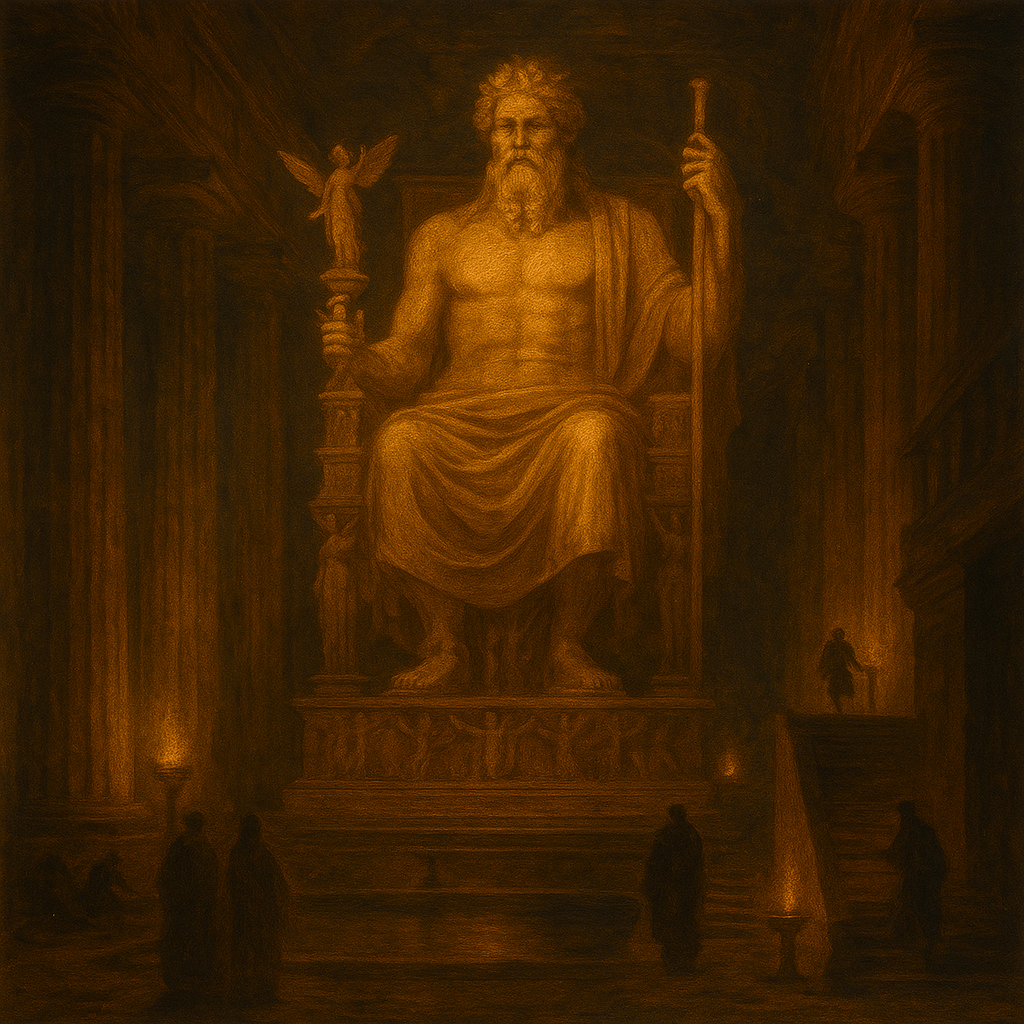
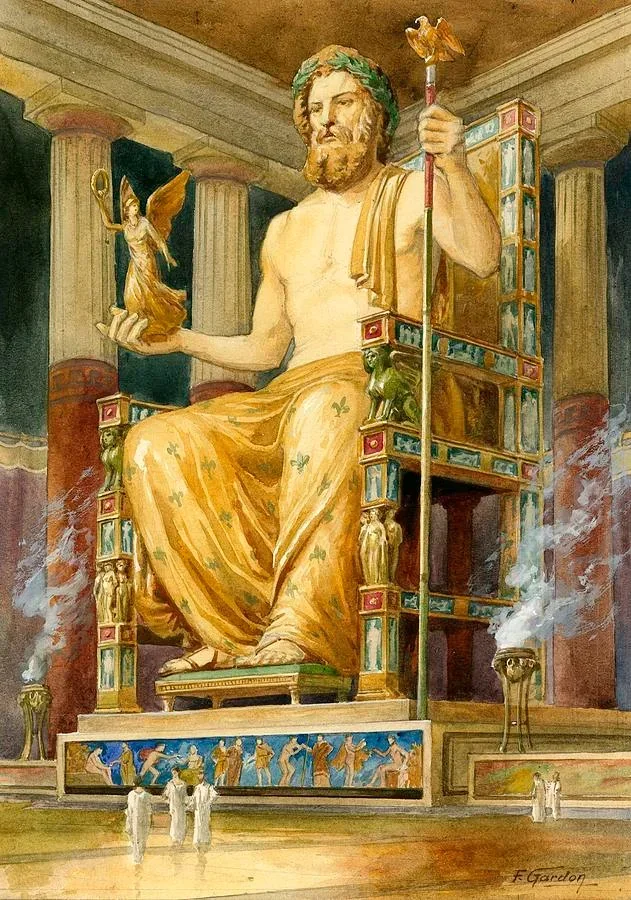
The massive seated statue of Zeus in his temple in Olympia, holding Winged Victory in one hand and a staff in the other

4. The Statue of Zeus at Olympia: God Made Monument

Epictetus, a Stoic philosopher, captured just how beloved the Statue of Zeus had become by the 1st century CE: “The wish to witness the ancient masterpiece of Phidias was so intense, that to die without having seen it was considered a huge misfortune,” he wrote in Discourses

The statue of Zeus at Olympia glowed with godly gravitas inside the sanctuary’s darkened temple. A creation of the sculptor Phidias, it was a divine father made colossal: Zeus, King of the Gods, father of Artemis and Apollo, products of the rape of the titaness Leto. The statue wasn’t meant to comfort. It was meant to awe.

“Of course, in a place where men were attempting to become godlike, the ultimate god took the form of the ultimate man,” Hughes writes. 

Built between 438 and 430 BCE, the statue was made of the most extravagant materials available: gleaming hippopotamus ivory for skin, gold for hair and beard, ebony, bone, polished stone and glass. 

The giant statue of Zeus at Olympia, a Wonder of the Ancient World

“Measuring the size of a three-story home (41 feet, on his pedestal rising over 44 feet tall), and yet seated, crouching, with his head skimming the ceiling, like Alice in Wonderland after taking her Drink Me spiked potion, the godhead must have seemed extraordinarily intimidating,” Hughes adds. “It was said that if he stood up, this Zeus would ‘unroof’ his temple-home.”

The throne featured six statues of Nike, the goddess of victory, marching up the legs. The arms of the seat were sobering sphinxes. The struts featured Herakles slaughtering Amazons to seize their queen’s girdle. The side panels showed Artemis and Apollo massacring Niobe’s children for her pride. And at Zeus’s feet? A stool supported by snarling lions — another Amazonian battlefield carved beneath.

“The message was clear: Olympia, and its Holy of Holies were, in every sense, somewhere that weakness was abhorred, for Zeus’s domain, there were only winners and losers,” Hughes explains. 

In Zeus’ right hand stood a 6-and-a-half-foot statue of Nike, also made of ivory and gold. In his left: a scepter topped by a gleaming eagle. His hair curled in heavy golden locks onto his shoulders, while his ivory skin was oiled daily to prevent cracking in the damp climate. That oil pooled in a limestone basin at his feet — creating a dark twin of the god.

The temple that housed Zeus at Olympia was a masterpiece of Doric architecture, designed by Libon of Elis and completed in 456 BCE with the spoils of war. Zeus’ likeness, modeled after Homer’s verses in The Iliad, captured the very image of cosmic authority. It was said Zeus could start an earthquake just by furrowing his brow. 

A wooden framework supported the ivory plating, carefully soaked in vinegar and sculpted into seamless sheets. Recent research by Kenneth Lapatin confirms the intricacy of this process — and the ingenuity of the ancients who achieved it.

When Roman Emperor Caligula ordered the statue’s decapitation in 41 CE so he could replace the god’s head with his own, Zeus reportedly laughed. The scaffolding collapsed, and days later, Caligula was assassinated — after having dreamed of the deity he sought to deface.

After standing for nearly 1,000 years, the statue was eventually moved to Constantinople, where it burned in a city-wide fire around 476 CE. Olympia’s pride, a masterpiece honored for generations, was reduced to ash.

And yet, Zeus lived on — not just in memory, but in iconography. The Byzantine depiction of Christ Pantokrator, “Ruler of All,” seated on a throne with glowering brow and commanding presence, bore a striking resemblance to Phidias’s Zeus. The divine father had been reborn.

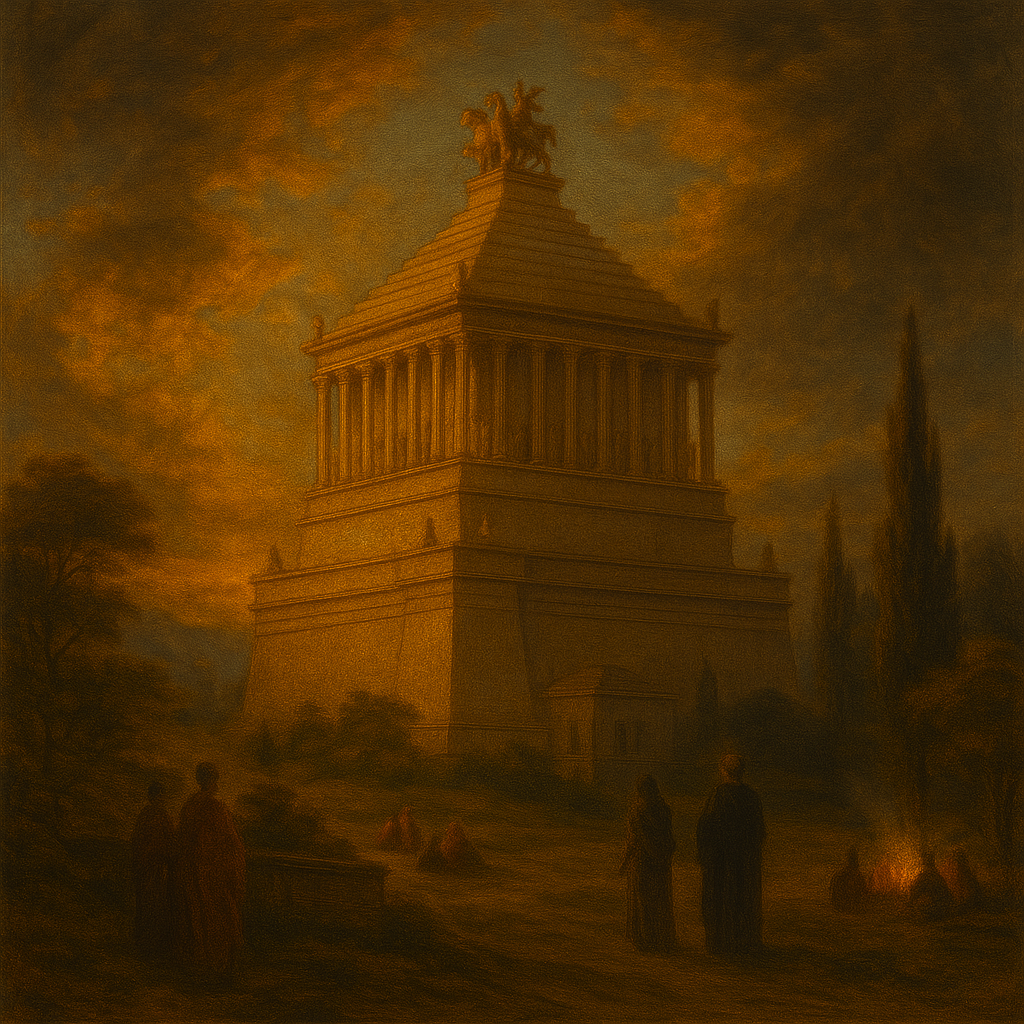
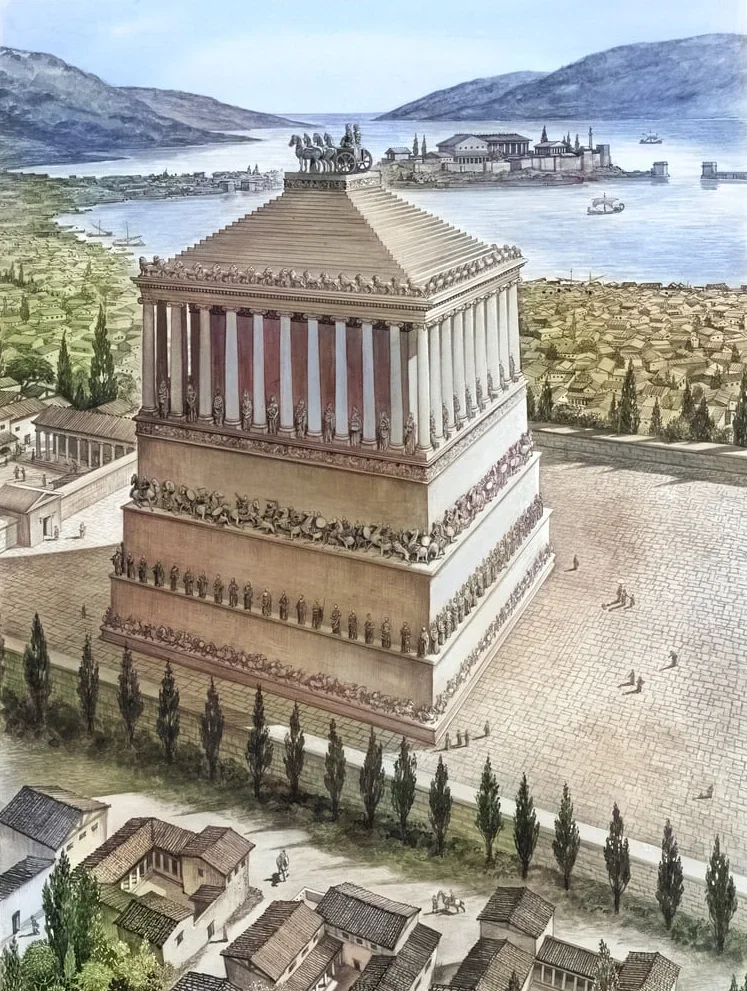
The impressive Mausoleum of Halikarnassos, with a large base, a temple-like structure, stepped pyramid and chariot on top

5. The Mausoleum of Halikarnassos: A Monument to Power, Grief and Glittering Excess

It was a tomb so grand it gave its name to every monumental tomb that followed. But the Mausoleum of Halikarnassos — final resting place of Mausolos, satrap-king of Karia — wasn’t just massive. It was mesmerizing. A collision of Greek elegance, Persian grandeur and Anatolian symbolism, built between 361 and 351 BCE on the sun-soaked coast of modern-day Turkey.

This Wonder fused the influences of East and West: Ionian and Doric architectural styles mingled with the dramatic scale and symmetry of Persian rock-cut tombs. Hughes notes that Karia, the region where Halikarnassos sat, was a culture of blendings — borrowing, reimagining and innovating in equal measure. And the Mausoleum was its masterpiece.

“This giant tomb came to be thought of as wonderful because it was trumpeted as embodying a faithful woman’s selfless devotion to her husband-brother, a sign that the brilliance of some men is to devastate women by dying,” she writes. 

Indeed, much of its fame came from the story of Artemisia II, Mausolos’ sister and wife, who reportedly grieved so hard she mixed his ashes into her wine. But beneath the romance lay a structure of staggering ambition: a 145-foot-tall marble confection built atop a limestone terrace stretching over 785 feet — about half the height of Big Ben, and nearly the length of two football fields.

The Mausoleum of Halikarnassos by the water, a Wonder of the Ancient World

The base consisted of a rectangular podium roughly 100 by 125 feet wide. Above that, 36 columns ringed the structure, echoing the layout of the Temple of Artemis. On top of the colonnade rose a stepped pyramid of 24 tiers, leading to a grand pedestal. And at the very top? A chariot drawn by four thrashing horses, almost certainly carrying statues of Mausolos and Artemisia themselves — a couple who have been put quite literally on a pedestal.

Designed by architect-sculptor Pytheos and possibly other elite artists of the day — Scopas, Bryaxis, Leochares and Timotheus among them — the Mausoleum was both a sculpture gallery and a piece of architectural theater. Its blocks were polished to a glass-like sheen. Carvings depicted Mausolos hunting, receiving ambassadors, honoring the gods and leading battles — scenes real and imagined. Life, as Mausolos wanted it remembered, in full pageantry. 

We tend to think of ancient structures as white, but many were actually a riot of color — and the Mausoleum certainly was. “Funerary monuments in particular favored color — there was a sense that the polychrome experience brought the dead back to some kind of life,” Hughes informs us. “Mausolos’ tomb would have been a firework in the sky.”

And what fireworks: white marble, then bluish limestone adorned with over 120 human and animal figures — all progressing toward a seated Mausolos before a great doorway. Was this his entrance to the afterlife? Above this level, imported white marble from Athens depicted brutal battle scenes, including — once again — Amazons, a recurring motif in Wonder architecture.

A ring of lions likely prowled the pyramid’s base. The decorative program celebrated domination, but also wildness and ritual. Priestesses in clinging, diaphanous dresses, their bodies visible beneath the folds, hint at ecstatic Bacchic rites. 

Skulls unearthed at the site suggest mass animal sacrifice during the burial — a slaughter of sheep, oxen, lambs, birds. Where now there are thistles and butterflies, there were once streams of blood.

Threads of gold found among the ruins may have once wrapped the king’s cremated remains. 

A spring near the site was famed in antiquity for its uncanny power to make men infertile or effeminate. That same spring inspired Ovid’s tale of the creation of Hermaphrodite: the son of Hermes and Aphrodite, lured into its waters by a nymph, merging into one being of two sexes.

The Mausoleum was a place where myth, sex, sacrifice, politics and grief all coalesced. A wonder of death, yes — but pulsing with the messy, lavish power of life.

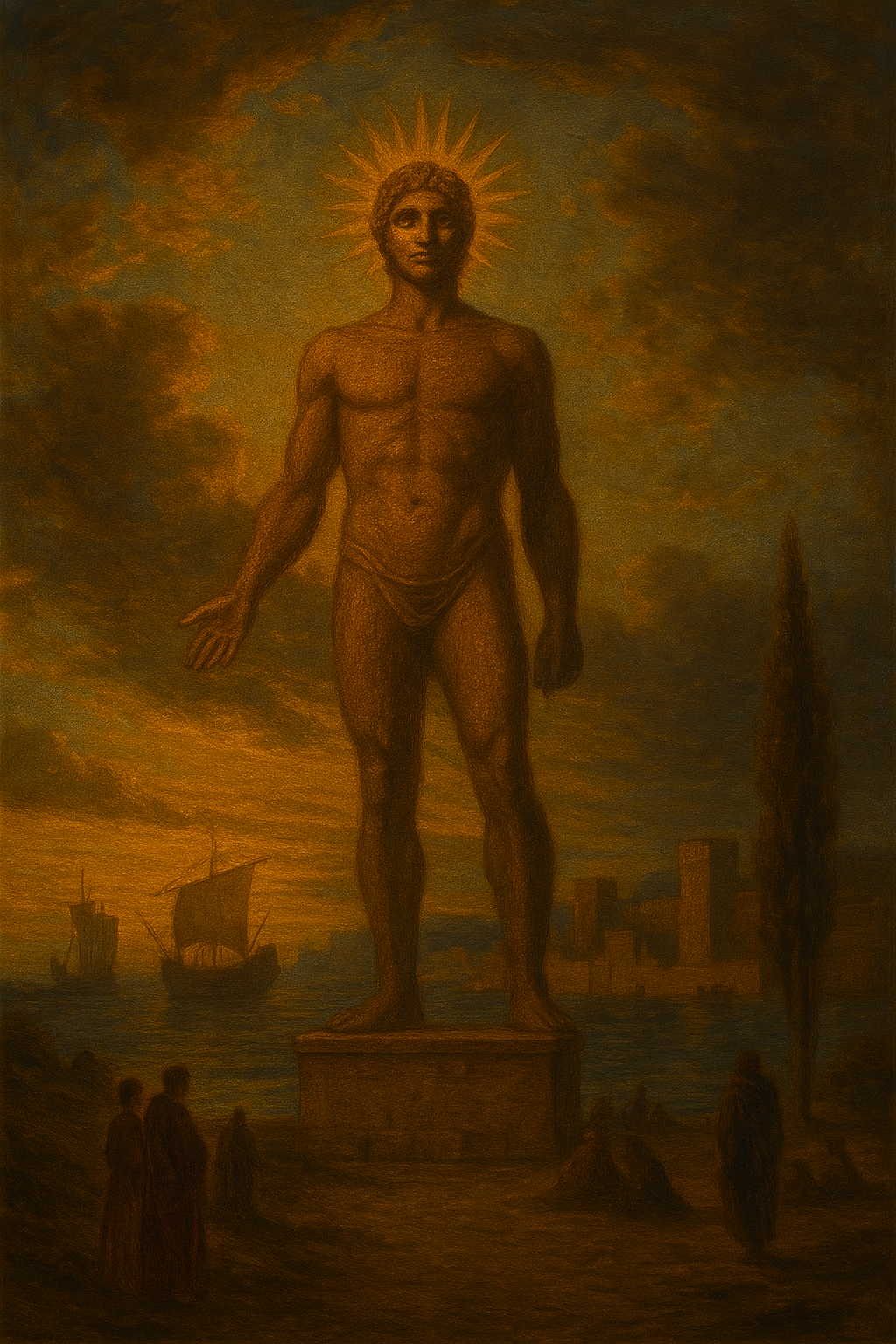
The giant statue of the Colossus of Rhodes, a sun god rising above the island's port

6. The Colossus of Rhodes: Bronze Giant, Fallen God

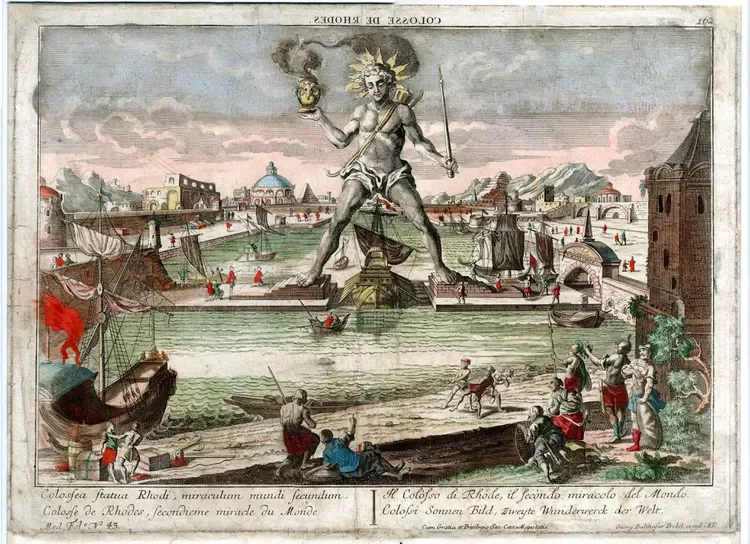
The Colossus of Rhodes is perhaps the most misunderstood Wonder. Popular imagination has long insisted it stood legs astride the harbor entrance, torch in hand, as ships passed beneath. But that towering figure, feet apart across a 390-foot waterway, is pure fantasy — a medieval myth that held the world’s imagination hostage for 800 years. (It even inspired the Titan of Braavos in George R.R. Martin’s Game of Thrones.)

In reality, the Colossus never straddled the harbor. It likely stood higher up, on the city’s acropolis, towering above the bustling port of Rhodes. This was Helios — the pre-Olympian sun god — cast in bronze and iron, gleaming in the Aegean light.

Standing an estimated 108 feet tall, the statue was a staggering feat of ancient engineering. Built in the early 3rd century BCE and completed around 280 BCE, it had a skeleton of iron and a polished bronze skin. Just one of its digits — a single toe, say — was said to be larger than most full-sized statues.

The Colossus of Rhodes, a Wonder of the Ancient World, seen straddling the harbor

Unlike Zeus’ patriarchal presence, Helios pulsed with youthful ambition. “Whereas the Zeus at Olympia thundered, his luxurious beard the signifier of a mature man in Greek culture, Rhodes’ Wonder, the un-bearded, tousled, soft-lipped Helios, had the dangerous energy of a young, unpredictable man poised to do great things,” Hughes writes. 

And given the era, it’s hard not to see the influence and inspiration of Alexander the Great in the statue’s features and commanding pose. Rhodes had resisted a siege by one of Alexander’s successors — and the Colossus was both a victory monument and a symbol of sun-blessed resilience.

Kolossos is a Greek word — possibly of Asiatic origin — that originally meant simply “statue.” But this statue rewrote the definition. It was never just a likeness. It was legend in metal, a city’s pride forged into form.

“This was a wonder that became legendary within weeks of its completion,” Hughes says. 

Created by the sculptor Chares of Lindos — and possibly influenced by the legendary Telchines, mythical inventors of metalwork — the statue took 12 years to complete. It was cast in sections, working from the feet upward. Each foot stood on a marble plinth around 60 feet wide and 10 to 15 feet thick.

And then it fell.

Around 227 BCE — just 60 or so years after it was completed — a devastating earthquake struck Rhodes. The city walls crumbled, the coastline dropped by 3 feet, and the Colossus came crashing down. It broke at the knees and was never re-erected. 

The fragments, enormous and awe-inspiring, lay scattered for centuries — longer than the statue ever stood. According to later sources, the tumbled Helios remained visible until the 7th century CE, when its remains were finally melted down for scrap. So much for immortality.

And that legend has never quite gone cold.

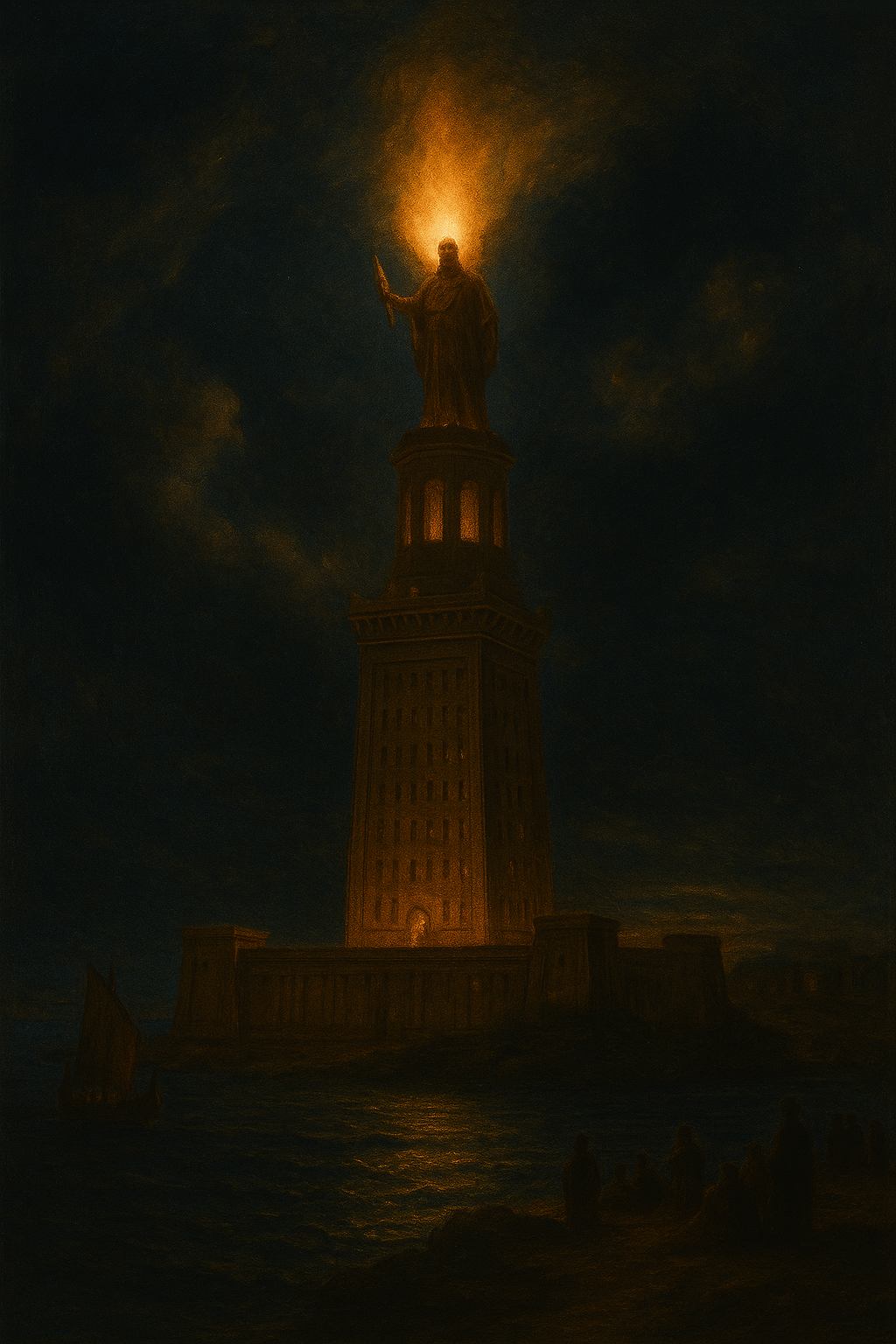
The Lighthouse of Alexandria, a Wonder of the Ancient World, at night, ablaze and topped by a statue of Zeus

7. The Lighthouse of Alexandria: Fire, Mirrors and the Edge of the World

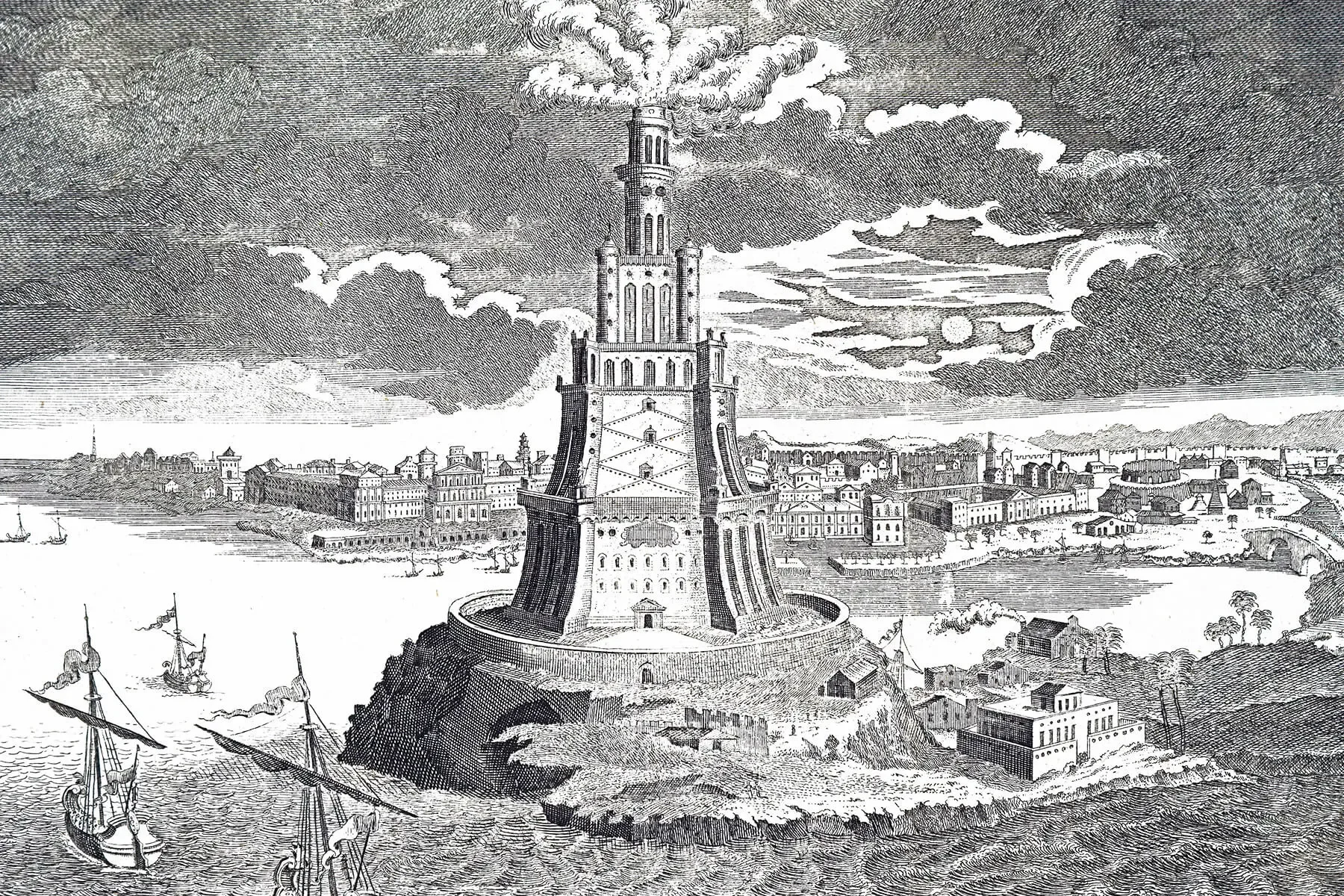
Unlike the short-lived Colossus of Rhodes, the Lighthouse of Alexandria stood tall for over 1,500 years — a marvel of geometry, ingenuity and sheer ambition. Built beginning around 297 BCE and completed over the course of 15 years, this towering wonder rose more than 400 feet above the bustling twin harbors of Alexandria, Egypt, making it the second tallest structure in the ancient world after the Great Pyramid.

It was astonishing. A stacked sequence of geometric forms — square, octagonal, circular — constructed from marble and local limestone, sheathed in red granite shipped down the Nile from the scorched quarries of Aswan. Some blocks stretched 36 feet long and weighed 75 tons. The tower was crowned with a 50-foot statue, almost certainly of Zeus Soter (Zeus the Savior), watching over the seas like a divine lighthousekeeper.

Its beacon could be seen for over 37 miles — a flaming furnace at night, and during the day, sunlight reflected off massive copper mirrors. It was both a feat of engineering and a performance of cosmic authority. Ships approaching Alexandria’s treacherous coast — battered by crosswinds, stalked by hidden rocks — were guided by this shimmering sentinel, the Pharos.

It was built of red granite, which is usually a dull pink, but could turn an iridescent purple  in desert light. “The ancients must have believed red granite brought with it some kind of sorcerer’s power,” Hughes muses. 

An engraving of the Lighthouse of Alexandria in Egypt, a Wonder of the Ancient World

The tower’s structure was just as beguiling: a 1,115-by-1,115-foot base with fortified brick walls and turrets; an interior ramp and hoist system to ferry fuel and supplies; and an eight-sided middle tier symbolizing the compass winds. Above that, a cylindrical chamber topped with the beacon — perhaps powered by naphtha and papyrus, possibly attended by pack animals climbing in pairs.

And the Pharos wasn’t just a lighthouse. It was also a proto-telecom tower, using flashing heliography — ancient Morse code — and possibly even mechanical sound effects. Sculpted Tritons (half-man, half-fish) stood around the structure, possibly blowing horns that served as early sirens, ancient animatronics that altered the city in times of danger.

The lighthouse was initially funded by Ptolemy I — one of Alexander the Great’s most successful generals — and completed under his son, Ptolemy II. It cost an estimated 800 silver talents — over $19 m

illion in today’s money. Built on the island of Pharos, which would lend its name to the structure and eventually become the word for “lighthouse” in multiple languages, the monument embodied Ptolemaic power and vision. It was a glowing stake in the sand, declaring Alexandria the gateway between Africa, Asia and the Mediterranean world.

And for centuries, it worked.

Until 1303 CE, when the Earth shook. An earthquake finally toppled the Pharos, reducing it to ruins and ending one of the longest-standing Wonders of the Ancient World.

MORE: The Major Egyptian Gods and Goddesses

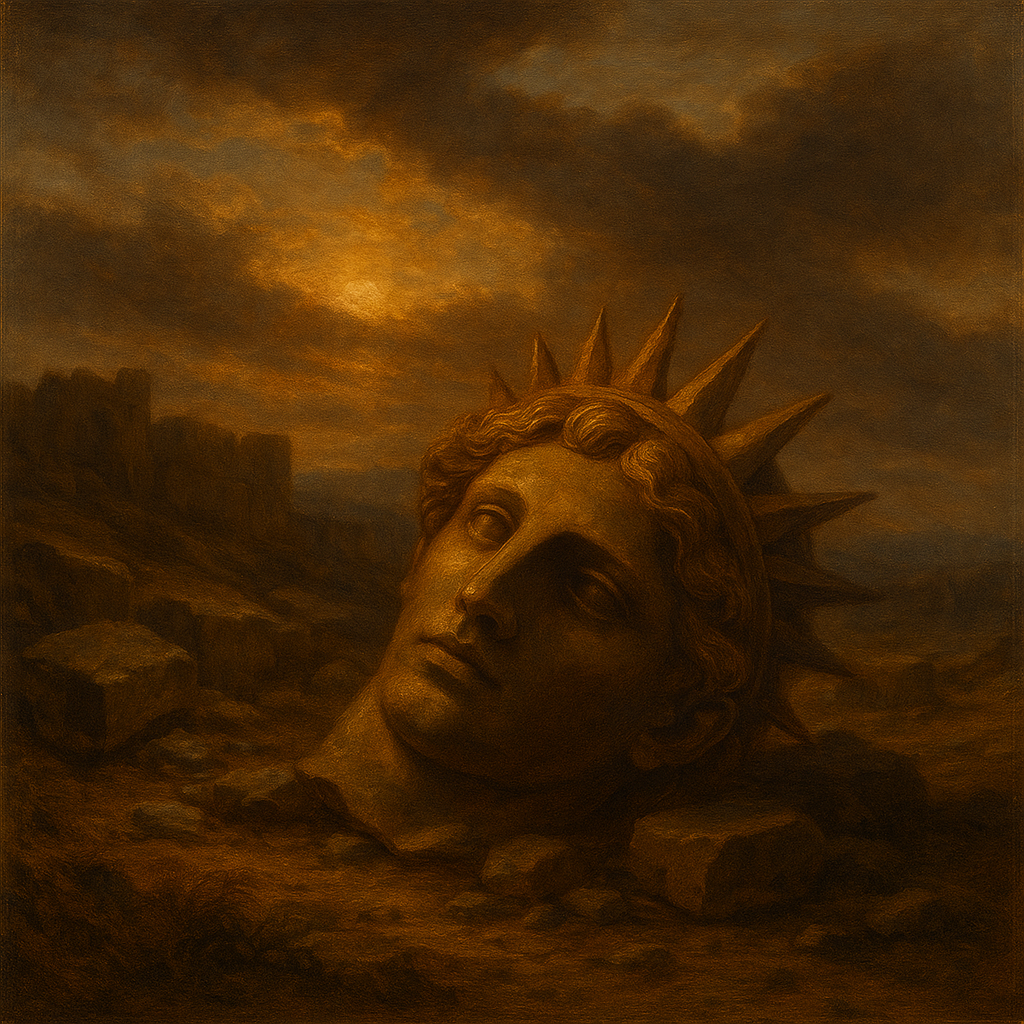
The head of the Colossus of Rhodes has fallen off and lies on the ground

Why the Seven Wonders of the Ancient World Still Matter

All but one of the original Seven Wonders may be long gone — toppled by earthquakes, scavenged for scrap, or buried beneath centuries of sand and myth. But as Hughes makes clear, their true legacy is that they weren’t simply monuments to kings or gods. They were monuments to us — to human ambition, ingenuity, imagination and the drive to build something bigger than ourselves.

The list was specific, political, proudly Hellenistic — showcasing a curated world seen through Greek eyes in the wake of Alexander the Great. And yet, the idea of a Wonder has endured far beyond its original moment.

“Wonders serve a rich triple purpose,” Hughes writes. “They were constructed partly to feed our need for wondrous tales — to experience and talk about the biggest, the best, the tallest, the most strange, the most bold. They encourage a saturation in the now, by submitting to a present, pure sensation of wonder. They remind us of our overwhelming desire to collaborate to create beyond the possibilities of the individual.” 

Even today, the concept of a “wonder” still fuels our storytelling, our bucket lists, our skyscrapers and our sci-fi dreams. Because deep down, we’re still looking to be amazed. Still looking to build what seems impossible. Still wondering. –Wally
MORE: What Was Daily Life Like in Ancient Egypt?