6 Litha Spells for Power, Passion and Peak Summer Magic

Harness the height of the sun with Summer Solstice spells for confidence, desire and strength — then learn how to carry that power forward as the wheel begins to turn toward Lammas.

A four-armed Apollo shines bright, holding a lyre, torch, jar of honey and open pomegranate, with a rooster and deer at his feet,

The Litha sun shines bright at its full power.

This is the longest day of the year, when light stretches itself to the breaking point and everything alive feels a little louder, a little bolder, a little harder to ignore. If Ostara magic was the careful planting — intention, balance, the quiet hope that something might grow — then Litha is what happens when it does. Wildly. Excessively. A little out of control.

But the Summer Solstice carries a secret most people skip over.

From this moment on, the light begins to fade.

Not dramatically. Not all at once. But enough. Enough that if you’re paying attention, you can feel the shift beneath the heat — the subtle turning of the Wheel toward Lammas, where what’s been growing must prove itself, be gathered, or be lost.

That’s what makes Litha powerful. It isn’t just abundance. It’s abundance with a clock on it.

These spells are designed to meet that moment directly. To use the energy at its peak, not just admire it. To claim confidence while it’s loud, desire while it’s burning, strength while it’s effortless — and to seal those things so they don’t slip through your fingers as the year moves forward.

Because the Wheel doesn’t stop here.

After Lammas comes Mabon, where light and dark balance again and the cost of growth becomes visible. Then Samhain, when the veil thins and what remains is all you carry with you. Even the quiet inward pull of Imbolc and the spark of beginning again at Ostara depend on what you choose to hold onto now.

Litha isn’t a pause in the cycle. It’s the moment you decide what survives it.

So step into the sun. Take what’s yours. And don’t expect the fire to wait.

Litha Spellbook

  1. Spell to Feel Confident and Seen

  2. Spell to Release What You’re Done With

  3. Spell to Say Yes to Desire

  4. Spell to Store Energy for Later

  5. Spell to Step Into Your Power

  6. Spell to Hold Onto Your Strength

A woman with long wavy white hair holds two mirrors reflecting versions of herself, while a fox looks up at her and the sun and phases of the moon are behind her head

1. Spell to Feel Confident and Seen

For confidence, visibility and stepping fully into your own light

You don’t ask for attention at Litha — you hold it.

This spell works with the sun at its peak, using reflection to amplify your presence rather than shrink it. Not quiet confidence. Not subtle charm. This is the kind that walks into a room and changes it.

Stand in direct sunlight — no shade, no half-measures.

Hold something reflective in your hand — a small mirror, the back of a spoon, even your phone screen — and angle it so the light hits your face and chest. Let it land there. Let it stay.

As the light settles on you, say:

Light above and light on me,
Let me be what others see.
Bright and bold, I claim my place,
No more shadow, none erased.

Repeat it slowly, letting the words sink in.

Now lift your chin slightly and adjust your posture — physically step into it.

Say it once more, louder.

Hold the light there for one more breath.

Then drop your hand.

You’re not chasing visibility after this. You’ve already taken it.

A cyclops with a nimbus and flower wreath uses a massive hammer to smash a mask

2. Spell to Release What You’re Done With

For cutting ties, clearing energy and letting something fully end

Some things don’t fade — they cling.

Old conversations, old versions of you, old attachments that should’ve burned out months ago but somehow keep finding oxygen. Litha is the moment to deal with them properly — not gently, not symbolically, but decisively.

You’ll need:

  • a small piece of paper

  • a pen

  • dried rosemary

  • a bay leaf

  • a candle (gold, yellow or white)

Sit down and write exactly what you’re done with. Not vague, not poetic — specific. A name, a pattern, a situation, a version of yourself. Fill the space. Mean it.

Once written, place the paper in front of you and crumble the rosemary between your fingers, letting it fall over the page. Tear the bay leaf once and place it on top.

Now roll the paper tightly into a small bundle — a little sun scroll — and hold it in both hands.

Light the candle.

Hold the bundle just above the flame — not touching yet — and begin the chant:

What once stayed now leaves my hand,
No return, no half-made stand.
Burn it down, make it done,
Ash remains — the tie is none.

Repeat it, a little faster this time.

On the third repetition, lower the scroll into the flame and let it catch.

Place it in a heat-safe dish and watch it burn. Don’t rush this part — but don’t drift either. Stay with it. This is the moment the thing actually ends.

When the flame dies out and only ash remains, take a pinch between your fingers and crush it deliberately.

Say:

Gone from root and gone from skin,
What was held is no longer in.

Then stand up and carry the ashes outside.

Release them into the air — or scatter them onto the ground — but don’t look back once you’ve done it.

A faun touches the chin of a nymph in the forest

3. Spell to Say Yes to Desire

For passion, pleasure and choosing what you actually want

Litha doesn’t whisper about desire — it turns it up.

This is the season of heat, ripeness, excess. Fruit splits open. Flowers don’t ask permission to bloom. And yet, somehow, people still hesitate. Still overthink. Still talk themselves out of what they want.

This spell breaks that pattern.

You’ll need:

  • one ripe piece of fruit (peach, plum or berries — something juicy, not polite)

  • a small pinch of cinnamon

  • a quiet outdoor space

Go outside and take the fruit with you. No utensils. No napkins. This is not meant to be neat.

Stand or sit where you feel the warmth of the day — even if the sun is starting to lower.

Hold the fruit in both hands and take a moment to look at it. Notice the color, the softness, the way it gives slightly under pressure. This is what desire looks like at Litha — ready, full, unapologetic.

Sprinkle the cinnamon over it.

Now say:

Heat in skin and heat in vein,
Call me close, don’t call me tame.
What I want, I will not hide,
I choose the pull I feel inside.

Repeat it, letting your voice build slightly each time.

Then take a bite.

A real one — let it be messy. Let the juice run over your fingers if it does. Don’t clean it immediately.

As you eat, stay present with it:

  • the sweetness

  • the texture

  • the fact that you’re choosing to experience it fully

Between bites, say quietly:

I say yes. I say yes. I say yes.

When the fruit is finished, lick the juice from your fingers or let it dry on your skin.

Then — and this matters — take one small, immediate action tied to desire:

  • send the message

  • make the plan

  • say yes to something you’ve been circling

Do it before you overthink it.

A gorgon holds a jar full of stored energy as part of a Litha spell

4. Spell to Store Energy for Later

For capturing Litha’s power and using it when you actually need it

Litha energy is loud, bright, almost excessive — which is great, until it isn’t.

Because you won’t feel like this forever.

This spell is about taking that peak energy and storing it, so when things slow down — when motivation dips, confidence wavers, or the light quite literally fades — you have something to reach for that still carries heat.

You’ll need:

  • a clear glass jar with a lid

  • water

  • a slice of orange

  • a pinch of rosemary

Fill the jar with water and drop in the orange slice and rosemary.

Hold it in both hands for a moment, then take it outside and place it in direct sunlight. Not partial shade — full exposure.

Before you set it down, say:

Light of sun, sink below,
Fill this glass with steady glow.
What burns bright, I draw and keep,
Held for when the days grow deep.

Leave the jar in the sun for at least an hour — longer if you can. Let it actually absorb something.

When you return, pick it up and give it one firm shake — this is what seals and activates it.

Hold it at eye level and watch the light move through it — the color, the way it shifts.

Say:

Stored in light and sealed in time,
When I call, this strength is mine.

Seal the jar and keep it somewhere you’ll see it.

When you need it later, shake it to wake it — bringing the stored energy back into motion.

  • Take a sip before something important to carry the energy within you — confidence, focus, momentum

  • Touch a drop to your wrists or chest to activate it externally, like a signal — I’m stepping into this now — especially useful before social situations, meetings or anything where presence matters

  • Add a small amount to a bath when you need to reset your energy and reconnect with that steadiness

An elf holds up  a glowing crown while shadowy people kneel in respect at his feet

5. Spell to Step Into Your Power

For claiming your authority and choosing yourself without hesitation

Litha doesn’t do subtle.

Everything is at full expression — bright, visible, undeniable. This is the moment to stop negotiating with yourself and step fully into your own authority, not just in your mind, but in a way your body can recognize and return to.

You’ll need:

  • fresh rosemary

  • a gold or yellow ribbon

  • a candle (gold or white)

Sit down with the rosemary and ribbon in front of you.

Take your time here.

Begin to twist the rosemary into a simple circlet, securing it with the ribbon as you go. It doesn’t need to be perfect. Let it be a little uneven, a little wild. You’re making something that holds energy, not something decorative.

As you work, say:

Crown of sun and crown of flame,
I step forward in my name.
What I am, I choose to be,
No more waiting — I am me.

Repeat it as you build, letting the rhythm guide your hands.

Once the circlet is complete, place it in front of you and light the candle.

Hold the crown just above the flame — close enough to feel the heat, not close enough to burn.

Say the chant once more, slower this time.

Then, deliberately, place the crown on your head.

Stand up. Move. Walk slowly. Turn. Take up space differently than you normally would. Let your posture shift. Let your presence follow. Stay in motion for a minute or two — not posing, not performing, just existing as someone who has already claimed themselves.

Then stop.

Take out your phone and take a photo of yourself wearing the crown. Not posed. Not perfected. Just real.

Look at it for a moment and say, quietly:

Seen like this, I stay this way.

Don’t delete it. Don’t fix it. Don’t overthink it. Keep it.

Then remove the crown and place it somewhere visible.

A blue-skinned demon with golden astrological tattoos holds a coin covered in dripping white wax

6. Spell to Hold Onto Your Strength

For keeping your power as the light shifts and the wheel turns

Litha is the height of everything — light, energy, momentum.

And right at that height… it begins to change.

Not all at once. Not dramatically. But enough that if you’ve lived through enough cycles, you know what comes next. The slow turn toward harvest, toward effort, toward needing to sustain what once felt effortless.

This spell is about deciding what doesn’t fade with the light.

You’ll need:

  • a small coin (gold or brass if possible)

  • a candle (gold, yellow or orange)

Sit down with the coin in your hand.

Hold it for a moment and think about what, exactly, you want to keep from this season. Not everything — be specific. Confidence. Momentum. Visibility. Desire. Choose one.

Light the candle.

Hold the coin near the flame — not in it, but close enough to feel the heat gather in the metal.

As you hold it there, say:

At the height, I claim what stays,
Not just fire — but steady blaze.
What I’ve built will not depart,
I seal this strength within my heart.

Repeat it, slower, letting the heat build.

Now tilt the candle and let wax drip directly onto the coin.

One drop. Then another.

Watch it pool and begin to set.

Before it fully hardens, press your thumb firmly into the wax — leaving a clear imprint.

Say:

Marked in heat and sealed by me,
What is mine will always be.

Hold the coin there for a moment longer.

Then pull it away and let the wax finish cooling.

Keep the coin with you — in your pocket, your bag, somewhere it moves with you.

When you feel yourself slipping — losing momentum, confidence, direction — take it out and press your thumb back into that mark. Not to remember the moment. To reclaim it.

Two men wearing laurel crowns hold a torch and a mirror reflecting the sun's light

Litha Magic

Litha magic is decisive.

This is the height of the sun, when energy is abundant, visible and almost impossible to ignore. Spells cast now don't need much coaxing or buildup. They move quickly, take hold easily and tend to manifest through action rather than waiting. It's one of the most powerful times on the Wheel of the Year for confidence work, attraction, visibility, passion and transformation that requires boldness.

But what makes Litha truly potent isn't just the strength of the light — it's the awareness that it won't last.

Unlike the renewal magic of Ostara, where intentions are planted like seeds in spring soil, Litha works with what is already growing. The seeds have sprouted. The path has revealed itself. Now comes the choice of what to strengthen.

And while Beltane magic often centers on attraction, fertility and drawing things toward you, Litha asks something different: What will you do with what has arrived? How fully are you willing to step into your own power?

That tension sharpens every spell cast at Midsummer. The days are long, the fields are green and the sun appears unstoppable, yet the wheel has already begun its turn toward the harvest. Lammas waits just over the horizon, ready to measure what was cultivated. Mabon magic will eventually bring balance and reckoning. But Litha belongs to the brief, brilliant moment before either arrives.

You’re not casting from lack or hope. You're casting from fullness, from a place where you can choose what to amplify, what to release and what to carry forward into the second half of the year. –Wally


Egypt Travel Tips: How to Experience Egypt Like a Local

Skip the tourist checklist and discover Egypt through local food, hidden gems, cultural traditions and authentic experiences with these practical Egypt travel tips.

Scenes from daily life in Egypt inside a woman's head and hair

Most travelers arrive in Egypt with a mental checklist already prepared: See the Pyramids. Take a photo with the Sphinx. Cruise the Nile. Buy something that may or may not be authentic papyrus.

And while there’s a reason those experiences top so many Egypt itineraries, they’re only part of the story.

If you’re looking for Egypt travel tips that go beyond the standard guidebook recommendations, the secret is simple: Spend less time checking off attractions and more time experiencing daily life.

The Egypt that stays with you long after your flight home isn’t always found among the country’s most famous monuments. It’s the smell of fresh bread drifting from a neighborhood bakery. It’s the old men gathered around a café table debating football with the intensity of world leaders negotiating a peace treaty. It’s the shopkeeper who insists you sit down for tea before discussing anything as trivial as a purchase.

A true traveler seeks cultural immersion. If you’re looking for Egypt travel tips that go beyond the standard guidebook recommendations, the secret is simple: Spend less time checking off attractions and more time experiencing daily life.

Here’s how to travel Egypt like a local and discover the authentic experiences many visitors miss.

Elements of Egyptian culture and daily life underneath one of the Pyramids

Go Beyond the Pyramids to Find Egypt’s Hidden Gems

The Pyramids deserve every bit of their fame. Standing before them is one of those rare travel moments that somehow lives up to centuries of hype.

But some of the best places to visit in Egypt besides the Pyramids are the ones that rarely make the front page of a guidebook.

Take Alexandria. Founded by Alexander the Great, Egypt’s second-largest city feels refreshingly different from Cairo. The Mediterranean breeze replaces the desert heat, seafood dominates menus, and locals spend evenings strolling the Corniche as the sun sinks into the sea.

Farther south, Aswan offers a completely different pace. The Nile seems calmer here, colorful Nubian villages line the riverbanks, and visitors can spend hours watching traditional feluccas drift past without feeling the need to rush anywhere.

Then there are places that feel almost disconnected from modern Egypt altogether. Desert oases, small villages and lesser-known archaeological sites often provide a far more personal experience than the country’s biggest attractions.

The best way to discover these Egypt hidden gems? Ask locals.

Whether you’re chatting with a hotel owner, café server or taxi driver, you’ll often receive recommendations that never appear in travel guides. Those conversations can lead to family-run restaurants, neighborhood markets and authentic things to do in Egypt that most tourists never experience.

A bowl of koshary as a hot air balloon, floating over feluccas on the Nile, past the Pyramids and a city with mosques

Eat Like a Local With Egyptian Street Food and Classic Dishes

Want to understand a country? Start with lunch.

One of the biggest mistakes travelers make is eating exclusively in restaurants designed for other travelers. If you really want to experience Egyptian culture, follow the crowds and look for the plastic chairs.

Wondering what to eat in Egypt? Start with koshary. This beloved Egyptian staple combines rice, lentils, pasta, tomato sauce and crispy onions into a dish that sounds like someone cleaned out their pantry and accidentally created perfection. It’s filling, inexpensive and found everywhere from Cairo side streets to neighborhood cafés in Alexandria.

Breakfast often revolves around foul medames, a savory fava bean dish that has fueled Egyptians for centuries. Pair it with taameya, Egypt’s version of falafel made from fava beans rather than chickpeas, and you’ll quickly understand why locals are so passionate about their food.

And when temperatures begin climbing, few things are more refreshing than a glass of freshly pressed sugarcane juice purchased from a street vendor.

The real magic of Egyptian food isn’t just the dishes themselves. It’s the experience. Meals are social events. Plates are shared. Conversations stretch long after the food is gone. Don’t be surprised if someone insists you try “just one more bite.” In Egypt, hospitality often arrives on a plate.

Two Egyptian men have a conversation instead of a teacup, along a street with the side of a building and a palm tree

Experience Egyptian Hospitality Firsthand

If ancient monuments like Dendara Temple, Abu Simbel and Karnak Temple are Egypt’s most famous attractions, its people are a close second.

Egyptians are known throughout the region for their warmth and hospitality. Visitors are often surprised by how quickly a simple question can turn into a lengthy conversation, a cup of tea or an invitation to sit and chat.

You might find yourself discussing local history with a shopkeeper, learning about family traditions from a restaurant owner or receiving detailed directions that include an enthusiastic personal escort halfway to your destination. It’s surprisingly easy to find common ground.

These interactions often become the stories travelers remember most.

For those seeking deeper cultural connections and local experiences, organizations like Inside Egypt help visitors move beyond traditional sightseeing and discover a more authentic side of the country through personalized experiences and local expertise.

The goal isn’t simply to see Egypt. It’s to meet it.

Explore Egypt’s Natural Wonders Beyond the Nile

The Nile deserves its legendary status. For thousands of years, it has shaped Egyptian civilization, agriculture and daily life.

But Egypt’s landscapes extend far beyond the riverbanks.

The White Desert looks like something from another planet. Wind and sand have sculpted chalk formations into bizarre shapes that rise from the desert floor like giant mushrooms, towers and frozen waves. Spending a night beneath the stars here is about as far from modern city life as you can get.

Then there’s the Red Sea coast. Places like Marsa Alam, Hurghada and Sharm El Sheikh attract divers and snorkelers from around the globe thanks to their crystal-clear waters and colorful coral reefs. Even travelers who have never touched a snorkel before often leave wondering why they waited so long.

For hikers and outdoor enthusiasts, the Sinai Peninsula offers rugged mountain scenery and dramatic desert landscapes that reveal a completely different side of the country.

Many visitors arrive expecting history. They leave surprised by nature.

Learn Egyptian Customs, Etiquette and Basic Arabic Phrases

One of the best pieces of Egypt travel advice has nothing to do with transportation, hotels or attractions: Be curious. Be respectful. Be willing to learn.

Egyptians generally appreciate visitors who make an effort to understand local customs. Dressing modestly when visiting mosques and religious sites shows respect and helps avoid unwanted attention. Women should cover their shoulders and knees, while men should avoid overly casual attire in sacred spaces.

Learning a few Arabic phrases can also transform interactions. A simple “shukran” for thank you or “salaam alaikum” as a greeting often earns an immediate smile. You don’t need to become fluent overnight. The effort itself is usually appreciated.

Dining customs are worth noting as well. Traditional etiquette encourages eating with the right hand, and refusing hospitality too quickly can sometimes seem impolite.

The good news? Egyptians are generally forgiving of honest mistakes. Respect and good intentions go a long way.

The Cairo Metro curves along the Nile

Use Public Transportation for a Glimpse of Everyday Life

Among the most useful Cairo travel tips is this: Ride the Metro. At least once.

No, it isn’t glamorous. It won’t appear on many Instagram feeds. But it offers something far more valuable: a glimpse into daily life.

The Cairo Metro is affordable, efficient and used by millions of residents. During a single ride, you might see students heading to class, families running errands and office workers making their daily commute.

If you’re researching how to get around Cairo, public transportation can be an excellent option for certain routes while also providing a more authentic perspective on the city.

For adventurous travelers, local minibuses offer an even deeper immersion into everyday life. They’re not always intuitive for first-time visitors, but they’re certainly memorable.

Sometimes the most interesting parts of a trip happen between destinations.

Music notes and people dancing at an Egyptian festival flow out of a lantern

Attend Local Events and Celebrate Egyptian Culture

Museums tell you about a country’s past. Festivals show you its present.

Egypt hosts a wide variety of cultural events throughout the year. The Cairo International Film Festival attracts filmmakers and movie lovers from around the world, while regional celebrations provide opportunities to experience traditional music, dance and food.

If you’re lucky enough to be invited to a family celebration, wedding or holiday gathering, say yes. These occasions often reveal more about Egyptian culture than any guidebook chapter ever could. The music gets louder. The food keeps coming. The dancing becomes contagious.

Before long, you may find yourself wondering whether you’re still a visitor at all.

Why Authentic Travel Experiences Make Egypt Unforgettable

The Pyramids are extraordinary. The temples are breathtaking. The ancient history is unlike anything else on Earth.

But years from now, the moments you’ll remember most may be entirely different: The café owner who taught you a few words of Arabic. The stranger who insisted on helping you find your destination. The plate of koshary that cost less than a cup of coffee back home but somehow became one of your favorite meals of the trip.

Those moments can’t be found on a map.

They’re what happen when you slow down, stay curious and allow yourself to experience Egypt as more than a collection of famous landmarks.

Traveling like a local isn’t about avoiding the iconic sights. It’s about discovering everything that exists around them.

And in Egypt, that’s where some of the best stories begin. –Antoine Fischer

5 Wedding Destinations in the U.S. Your Guests Will Actually Thank You For

The best destination weddings balance your dream day with a trip guests will genuinely enjoy. These five destinations do both.

A bride smiles up at the groom while posing by a horse-drawn carriage and flower-covered mansion in New Orleans' Garden District

Destination weddings get a bad rap. Mention one, and someone inevitably pictures draining their savings account to attend a ceremony on a remote beach, where the only available activity is awkward small talk with distant relatives.

But destination weddings don’t have to be an elaborate hostage situation disguised as a celebration.

Destination weddings don’t have to be a hostage situation disguised as a celebration.

The best ones strike a balance between what matters to you and what makes the trip enjoyable for everyone else.

The best ones strike a balance between what matters to you as a couple and what makes the trip genuinely enjoyable for everyone else. Because if you’re asking guests to use vacation days, book flights and figure out childcare, it helps if the destination itself feels like part of the gift. But before you arrange the room block for wedding guests, it’s key that you choose the right destination.

The good news? Some cities practically do the heavy lifting for you. Whether you’re prioritizing weather, logistics or making sure your wedding weekend becomes a trip people still talk about years later, these five destinations deliver.  

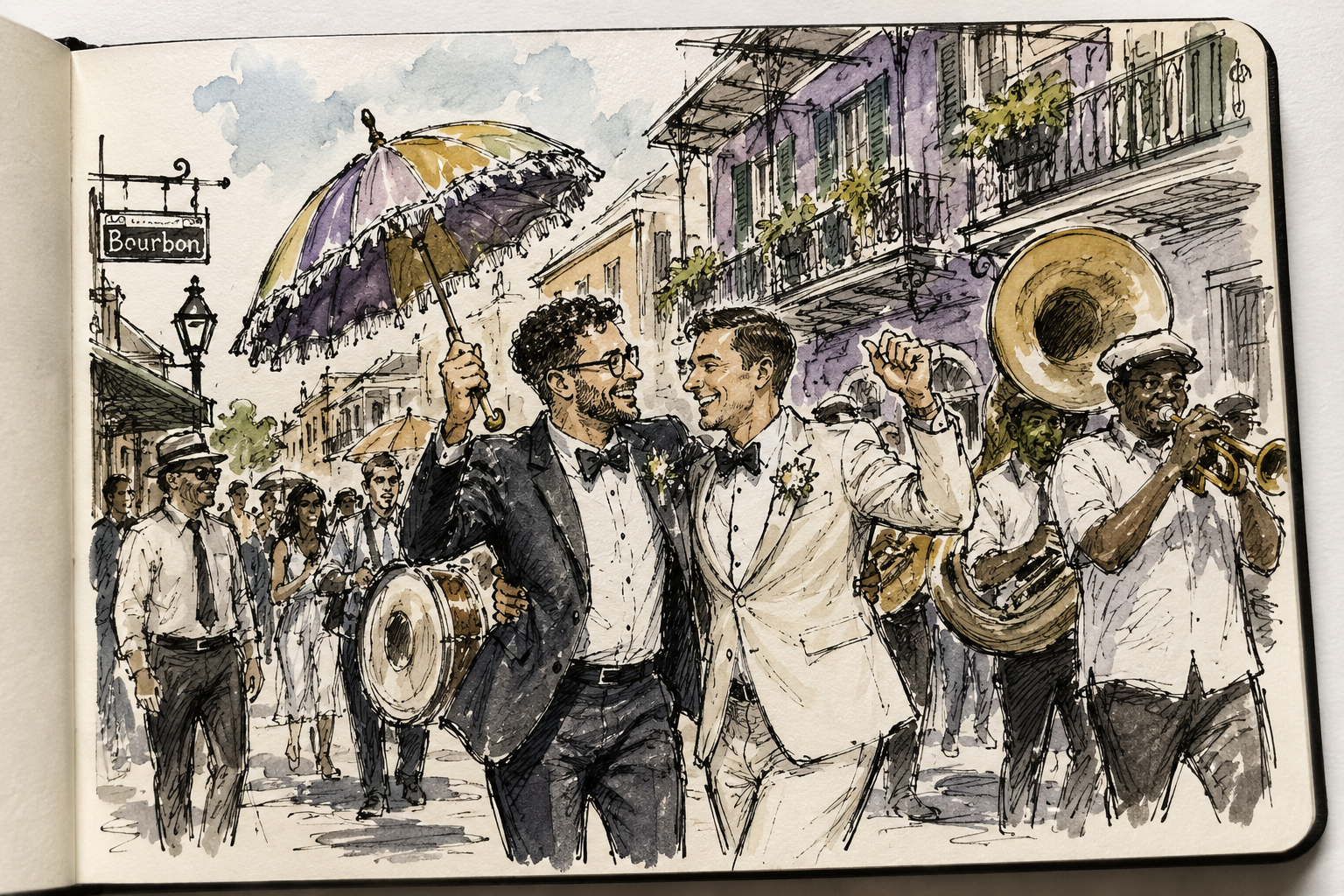
Two grooms, one holding a parasol, dance down the street at their wedding in the French Quarter of New Orleans with a jazz band playing

1. New Orleans: For Couples Who Want a Wedding With Personality

Some cities host weddings. New Orleans is the wedding.

Few places lean into celebration quite like the Big Easy. Picture exchanging vows in a hidden courtyard before leading guests through the French Quarter in a joyful second-line parade. Add Creole and Cajun cuisine that will ruin bland wedding chicken forever, and you’ve got the recipe for an unforgettable weekend.

The city practically creates the atmosphere for you.

  • The French Quarter offers historic romance and undeniable character.

  • The Warehouse District delivers a more contemporary, artsy vibe.

  • The Garden District surrounds guests with grand homes and lush gardens worthy of a Southern fairy tale.

Your guests may arrive for the wedding, but don’t be surprised if they leave planning a return trip.

Two women get married on the beach under a wood structure covered in white cloth and flowers in San Diego

2. San Diego: Because Nobody Wants to Gamble With the Weather

Wedding planning involves enough uncertainty. The forecast doesn’t need to be one of them.

With mild temperatures and sunshine most of the year, San Diego is one of the safest bets for couples hoping to avoid weather-related drama. The city’s laidback coastal vibe also means guests can easily turn the celebration into a mini vacation.

Beyond the postcard-worthy beaches, you’ll find elegant resorts, historic hotels and garden venues that stay beautiful year-round. Visitors can spend downtime exploring Balboa Park, strolling downtown or simply enjoying the coastline. There are also some underrated day trips from San Diego that might appeal.

A thoughtful bonus: Many beaches offer complimentary beach wheelchairs, making ocean access more inclusive for guests with mobility needs.

A few timing tips:

  • May through October: Classic Southern California beach weather with warm, sunny days

  • November through April: Cooler temperatures and fewer crowds create a more relaxed experience

  • January through March: The highest chance of rain, though still lower than many destinations

If predictability is your love language, San Diego may be your perfect match.

Newlyweds celebrate by neon signs, a pink convertible and a wedding chapel in Las Vegas

3. Las Vegas: Surprisingly Stress-Free

Las Vegas may be famous for impulsive weddings, but it’s also one of the easiest places to plan one intentionally.

The city has streamlined the process to an art form. Couples simply need to be over 18, provide government-issued identification and confirm they’re not currently married. There’s no waiting period, meaning you can obtain your marriage license and tie the knot the same day.

International couples especially appreciate how straightforward the process is. Marriages performed in Las Vegas are generally recognized worldwide, though additional documentation, including a certified marriage certificate and apostille, may be required, depending on your home country.

Best of all, Vegas knows exactly what it is. Guests have endless entertainment options, flights are plentiful, and venues range from delightfully over-the-top to surprisingly elegant. And yes, there are things to do in Vegas besides gamble. For one thing, it’s home to world-class restaurants.

If your priorities are simplicity, convenience and making sure nobody spends the reception complaining they’re bored, Vegas delivers.

A groom and bride raise their hands as they ride a rollercoaster in Orlando, Florida, with the Disney World castle and Epcot ball in the background

4. Orlando: For the Couple With a Guest List the Size of a Small Nation

Every family has that wedding guest list that somehow expands to include toddlers, grandparents, second cousins and people your parents insist you absolutely must invite.

Orlando handles that kind of logistical challenge exceptionally well.

As one of the country’s biggest tourist destinations, the city is designed to accommodate large groups. You’ll find venues ranging from botanical gardens and museums to luxury resorts and, yes, world-famous theme parks.

But Orlando’s real superpower is infrastructure.

Professional childcare services can accommodate both individual families and larger events. Transportation options make moving dozens of people around surprisingly manageable. And with a major international airport offering abundant flight options, getting everyone there becomes much less complicated.

When your biggest challenge is coordinating a crowd ranging from age 2 to 82, Orlando makes it feel almost easy.

A rockabilly couple get married in Nashville, Tennessee, by a black classic bar, a sign and downtown buildings, as a band plays

5. Nashville: Turn Your Wedding Into a Weekend Everyone Remembers

The best destination weddings don’t just create memorable ceremonies. They create memorable weekends.

Nashville excels at exactly that.

The city offers venues for nearly every aesthetic. Cheekwood Estate & Gardens delivers timeless elegance with its historic mansion and manicured grounds. Meanwhile, the Wedgewood-Houston district caters to couples seeking industrial-chic spaces with a creative edge.

But Music City’s biggest advantage happens between wedding events.

Guests can explore the Country Music Hall of Fame, discover local restaurants, wander Broadway’s legendary honky-tonks or stumble upon live music seemingly everywhere they go. The wedding becomes the centerpiece of the weekend rather than the only attraction.

For the best experience:

  • April through October generally offers the most pleasant weather.

  • Ceremonies held in Metro Parks require special event permits.

  • Events involving alcohol or amplified music require Park Board approval at least 60 days in advance.

A little planning goes a long way, leaving everyone free to enjoy the celebration.

A couple on their wedding night sit on a blanket on the beach, watching the sun set and drinking wine

The Secret to a Great Destination Wedding

The best destination weddings don’t happen because you picked the trendiest location on Instagram.

They work because you remembered that your guests are taking a trip, too.

When you choose a destination that solves your biggest concern — whether that’s weather, logistics or simplicity — while giving guests a place they’re genuinely excited to visit, everyone wins.

Years later, people probably won’t remember the centerpieces. They’ll remember dancing through New Orleans behind a brass band, watching the sunset in San Diego or discovering their new favorite honky-tonk in Nashville.

That’s the kind of wedding worth traveling for. –Sarah Sidney


Not quite at the stage where you’re planning the wedding? Here’s how to pick the perfect proposal destination.

Vegas Casino Myths Sound Better Than They Hold Up

Vegas runs on spectacle — and a whole lot of rumors. From oxygen myths to “hot” slots, here’s what’s real, what’s not, and what actually matters when you hit the floor.

No, the Bellagio doesn’t pump extra oxygen onto the casino floor, despite the hearsay. The rumor sounds far-fetched, which is probably why it sticks. And that’s the problem — Vegas is full of claims like that, repeated often enough that they start to feel true.

A recent myth-busting visit by our correspondent at Gambling.com put those stories to the test at Caesars Palace, Flamingo, Bellagio and the Cosmopolitan. They brought along an oxygen reader, asked some sharp questions, and spoke with Grant Rogers, vice president of casino operations at Rio Hotel & Casino. The approach was simple: Test what can be tested, then ask about the rest.

Strip those myths away, and the city gets easier to understand. What actually helps visitors is more straightforward — understanding game rules, reading pay tables, setting a budget and knowing how the floor works.

Myth: Casinos pump oxygen onto the floor.

In the test, an oxygen reader was used inside casinos. The readings stayed at 20.9% throughout — the standard oxygen level in normal air.

So why does this myth feel believable? Casino floors often smell distinctive, stay cool and remove obvious cues from the outside world. Add in signature scents and controlled lighting, and it’s easy to assume something more is happening.

It isn’t. It’s just design.

Myth: Attendants know which machines are “hot.”

At Caesars Palace, an attendant pointed to a Dragon Link penny slot with a max bet of $5. A $20 session turned into a $6.50 profit after four spins. That’s all it takes — a small result that feels like proof.

Staff do know which games get traffic, which machines people gather around, and where beginners might feel comfortable. But that’s not the same as knowing outcomes.

Slot machines are governed by random number generators. No one on the floor knows what a machine will do next.

For travelers who want something more useful than chasing “hot” machines, browsing Gambling.com’s complete list of top sweepstakes casinos is a better place to start.

Myth: Casinos remove clocks and windows to trap you.

This one is half true.

“You don’t see clocks on the casino floor,” Rogers said plainly. There’s a bit of psychological manipulation going on: When you remove time cues, people tend to stay longer.

Windows are less consistent. Some newer casinos have opened things up, using natural light and clear sightlines. Others still lean into a more enclosed environment.

There’s no single rule — just different ways of shaping how a space feels.

Myth: Casinos “tighten” or make machines pay out less when it gets busy.

Few ideas feel more convincing than this one — especially after a losing streak.

But Rogers dismissed it outright, pointing instead to strict regulation. Machines aren’t being adjusted behind the scenes depending on the crowd.

So why does it feel true? Because losing rarely feels random. After a few bad spins, it’s easy to believe something changed — that the machine feels stingy, or the timing shifted.

It didn’t. That’s just how variance works.

Myth: The best value is hidden somewhere tourists don’t look.

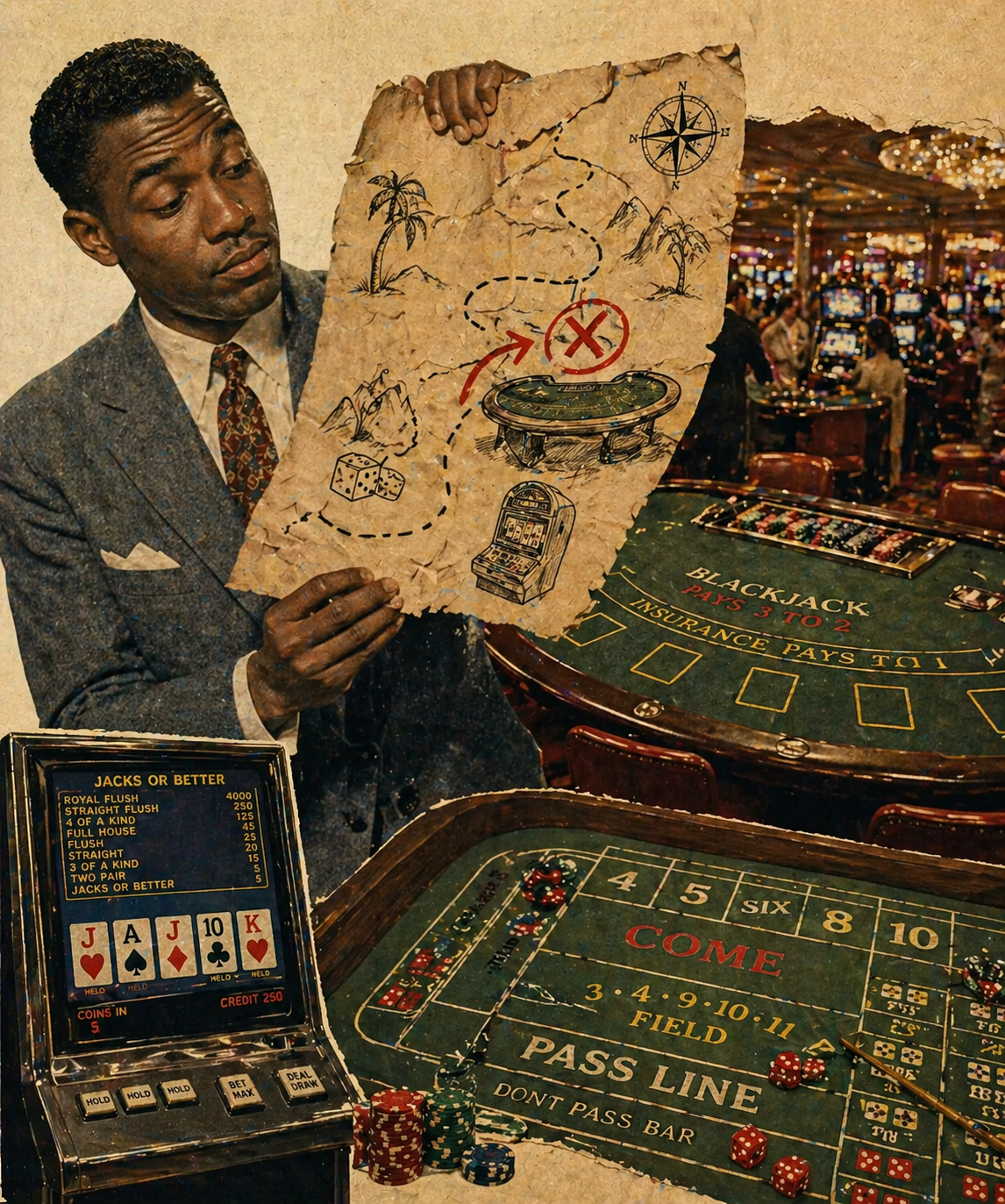
There’s no secret corner of the casino where the odds suddenly improve. The better plays are well known, just not as exciting.

Rogers pointed to three bets that quietly offer some of the best odds in any casino:

1.   3:2 blackjack, where the house pays out more on a natural blackjack than the stingier 6:5 tables that have crept onto most floors

2.   The pass line in craps, the foundational bet that most players at the table are making

3.   Full-pay video poker, machines programmed to return the highest possible percentage to the player.

None of that feels like insider knowledge, but it reflects how the math actually works.

What Actually Matters When You Step Onto the Casino Floor

Vegas is very good at making randomness feel meaningful. The environment is designed to keep you engaged — which makes it easy to see patterns where none exist.

Looking for gambling advice? Focus on the rules instead of the room, and everything shifts. The floor becomes easier to navigate, the myths lose their pull, and the experience starts to feel a lot more predictable — in the best way. –Samuel Clark

The Paperwork Nobody Posts About: How to Keep Visa and Entry Forms From Derailing a Trip

Master your travel paperwork with this comprehensive guide to entry forms, visas, and passport rules. 

Collage of a woman on a beach looking up at a large bird made of visas, passports and other travel documents

I love the moment a trip starts to feel real. Flights booked, a rough itinerary sketched out, a few restaurants saved. But if I’m honest, the part that has most often threatened to derail my plans isn’t weather or missed connections. It’s the quiet, easily overlooked admin: entry forms, proof of onward travel, passport validity rules, and the “one more thing” a border officer can ask for when you’re already exhausted.

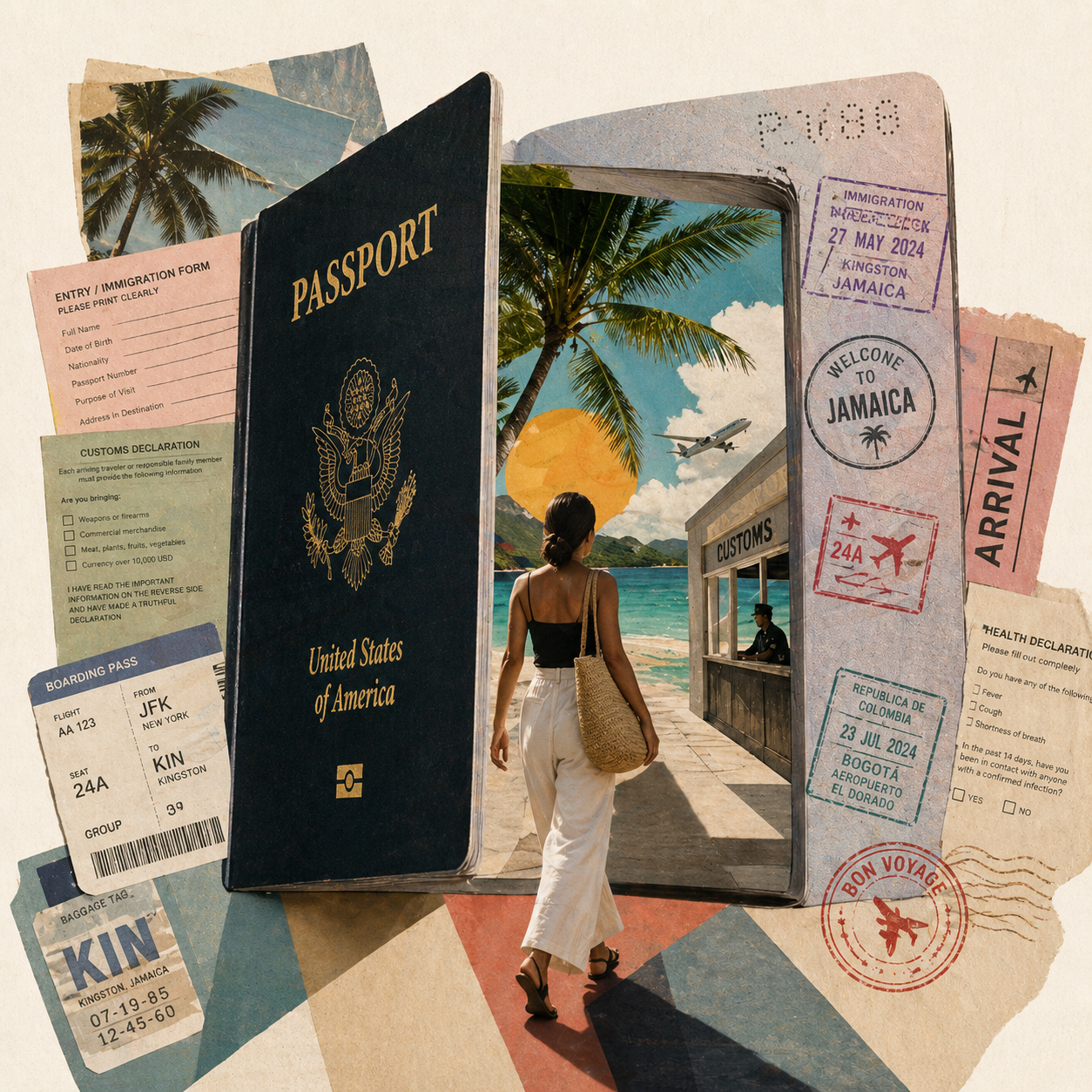
After a couple of hard-learned lessons, I now treat travel documents like packing: I start early, double-check details, and keep everything accessible. If you’re heading to the Caribbean, for example, one thing I sort out early is the Immigration Customs C5 Card for Jamaica, because arrival days go better when you’re not trying to type on airport Wi‑Fi with a low battery.

Collage of a traveler pulling a rolling suitcase covered in travel documents, including a passport

Why “Simple Entry” Still Comes With Real Admin

Even destinations that feel straightforward can have layers: different rules depending on nationality, transit points, length of stay, or whether you’re traveling for work versus tourism. And the rules don’t just live on one page. Airlines have their own checks, and requirements can shift with little notice.

I’ve found that it helps to think in categories rather than trying to memorize every country’s quirks:

  • Identity and validity: passport expiration rules (some places expect 3–6 months validity beyond your stay).

  • Permission to enter: visas, visa waivers or pre-travel authorizations

  • Arrival process: Customs and immigration forms, along with any required health checks or declaration procedures

  • Proof and backups: evidence of onward travel, your accommodation address and proof of sufficient funds (sometimes requested)

When I’m unsure, I start with official sources. The U.S. Department of State’s country pages are often a helpful reality check for requirements and safety updates.

Collage of two hands making a collage, holding a palm tree and a plane, over a seaside hotel, taxi, passport and other travel documents

My Travel Doc Checklist

Over time I’ve built a routine that keeps me calm in the week before departure. It’s not fancy, but it’s reliable, and it’s saved me from last-minute scrambles more than once.

1. I verify requirements from a primary source. 

I cross-check what I’ve heard from blogs or friends against an official site. If I’m traveling in or through the EU region, I’ll often reference the EU’s official travel portal. For the UK, I use the government’s “Check if you need a UK visa,” too.

This step is less about reading every line and more about confirming the big questions: Do I need a visa? Is there an online authorization? Is there an entry form? What’s the passport validity rule?

2. I map the “document moments” in the trip. 

Most people think about documents at immigration. But I plan for three checkpoints:

  1. Online: applications, uploads, confirmation emails, QR codes

  2. Airline check-in: Staff may verify eligibility before issuing a boarding pass

  3. Arrival: immigration and Customs forms, declarations, and the occasional follow-up question

This is where small things matter. If an arrival form asks for your first hotel address, I put it in my notes. If it asks for an emergency contact, I decide ahead of time who that is (and store the number in my phone).

3. I keep a clean travel folder that works offline.  

I keep digital copies and a couple of printed pages, because phones die and data roaming fails at the worst times. My usual set:

  • Passport photo page (scan or photo)

  • Visa and authorization confirmations (PDF or screenshot)

  • Return/onward ticket confirmation

  • First-night accommodation and address

  • Travel insurance certificate (if I’ve bought it)

For practical health guidance and destination-specific considerations, the World Health Organization’s travel advice hub is also worth bookmarking.

Collage of a man holding a folder, with a large head behind him made of travel documents, a passport, lightning and a clock

Where Third-Party Agencies Can Help

There’s a growing ecosystem of independent agencies that help travelers navigate applications and entry paperwork. Used well, they can reduce errors, help you interpret instructions, and keep your submission organized, especially if you’re juggling multiple travelers, tight timelines or unfamiliar requirements.

They operate as independent agencies (not government services), and the value they tend to offer is process support: helping you understand what information is needed, checking for common mistakes, and keeping track of steps so you don’t miss a detail.

That said, I keep my expectations grounded. No third party can “override” official eligibility rules or guarantee approval, and you still need to read what you’re agreeing to, confirm fees and validate deadlines. The smartest use of an agency is as a second set of eyes, not as a substitute for responsibility.

Collage of a woman with roller suitcase placing a submitted form onto a monster made of travel documents

Common Mistakes I See (and How I Avoid Them)

Most document problems aren’t dramatic. They’re tiny mismatches that become big at check-in: a typo, a rushed upload, a date format issue, a passport that’s valid but not valid “enough.” Here are the pitfalls I watch for:

  • Name mismatch: Make sure flight tickets match the passport exactly (including middle names if used)

  • Passport validity misread: Check validity rules for your destination and any transit countries

  • Last-minute form filling: Complete entry forms early, when you’re not tired or distracted

  • Unsupported documents: Confirm file type, size limits and photo requirements before uploading

  • No backup access: Store confirmations offline and bring at least one printed copy of essentials

Most travel stress isn’t caused by the unexpected. It’s caused by the predictable thing we put off.

It’s not a perfect system, but it’s a realistic one, and it scales whether I’m doing a short island break or a multi-country work trip.

Everything in Order: A Calmer Way to Arrive

Travel is always going to have a little friction, but document prep shouldn’t be the part that drains your energy before you even land. When I handle the essentials early, passport checks, any needed authorizations and arrival paperwork, I show up with more patience for the inevitable delays that actually are out of my control.

If you want one actionable takeaway: Pick a date this week to do a 30-minute document run-through, then create a simple offline folder you can access without a signal. 

This single habit has made my arrivals smoother, my check-ins faster, and my trips feel like they start when I leave home — not when I finally find the right form in a crowded arrivals hall. –Helena Capdevila

FAQ: David Byrne’s Theater of the Mind: A Spoiler-Free Guide to the Immersive Experience

A gif showing scenes from the house in the immersive experience Theater of the Mind

A neuroscience funhouse? Yes. A David Byrne concert? Absolutely not. Everything you need to know before you go — without spoiling any of the tricks. 

Here’s the pitch: David Byrne — Grammy winner, Talking Heads frontman, the man who once performed an entire Broadway show in an excessively broad-shouldered gray suit — has co-created an immersive experience in a century-old Chicago landmark building where a small group of strangers walks through a series of rooms and gets their perception of reality gently, gleefully dismantled. The New Yorker declared it “an ambitious addition to the genre of immersive art… a through-the-looking-glass fantasy.” 

We had to check it out. And we had about a thousand questions going in — most of which we’re going to answer for you here, without ruining any of the magic. Consider this your no-spoiler field guide.

Theater of the Mind

The Basics

Where Reid Murdoch Building
333 N. LaSalle St.
River North, Chicago
When Through July 12, 2026
Tues–Sun, timed entries
every 15 minutes
Duration 75 minutes
Group 16 people per session
Tickets $69–$99
goodmantheatre.org
312-443-3800
Ages Recommended 10+
Phones Off and stowed —
this means you

What is Theater of the Mind? Qu’est-ce c’est?

Theater of the Mind isn’t a play. It’s not a concert. It’s not an escape room, though the room-to-room structure might make you think so at first. The best working description: It exists somewhere in the margins of creepy festival funhouse meets cool high school science experiment.

More precisely: You follow a guide through a surreal 15,000-square-foot installation as a group of just 16 audience members. Over 75 minutes, you move through a series of rooms where you’ll participate in thought-provoking neuroscience experiences and learn how easily your own senses can deceive you. Byrne himself has called it a “neuro funhouse,” though he’s acknowledged it evolved into something more. 

Is it actually autobiographical? Are we watching David Byrne’s life story?

Sort of — and Byrne himself is delightfully ambivalent about it. “I wasn’t sure how I felt about the character being named David and having little elements of my life in it,” he said. “But I also thought, why not? A lot of the stuff is not exactly biographical or autobiographical.” 

That hedging is worth taking seriously, because the show plays deliberately with the line between real and invented. The guide’s mother, for example, dabbles in painting. In reality, it was Byrne’s late father who painted as a hobby. 

The show borrows from his life and then quietly rearranges the furniture.

What is real: Byrne was born in Dumbarton, Scotland, to a Catholic father and a Presbyterian mother — a combination that caused enough tension in the extended family that his parents eventually packed up and emigrated, first to Hamilton, Ontario, then to Arbutus, Maryland, where his father worked as an electronics engineer.

Byrne describes himself as having undiagnosed autism, calling it a superpower that lets him hyperfocus on creative work.

Go in ready to be a willing participant in a series of jaw-dropping perceptual experiments — and you’re going to have a great time.

The bigger theme running through the biographical material isn’t any single memory but the question of memory itself. “We like to think that our brains are recording machines,” Byrne has said. “But they’re not. Every time we remember, we’re kind of making things up, embellishing. Not intentionally lying, but if our identity is made up of ‘I’m the person that this happened to, who was born here, and this happened to me’ — does that mean our sense of identity is in question as well?”

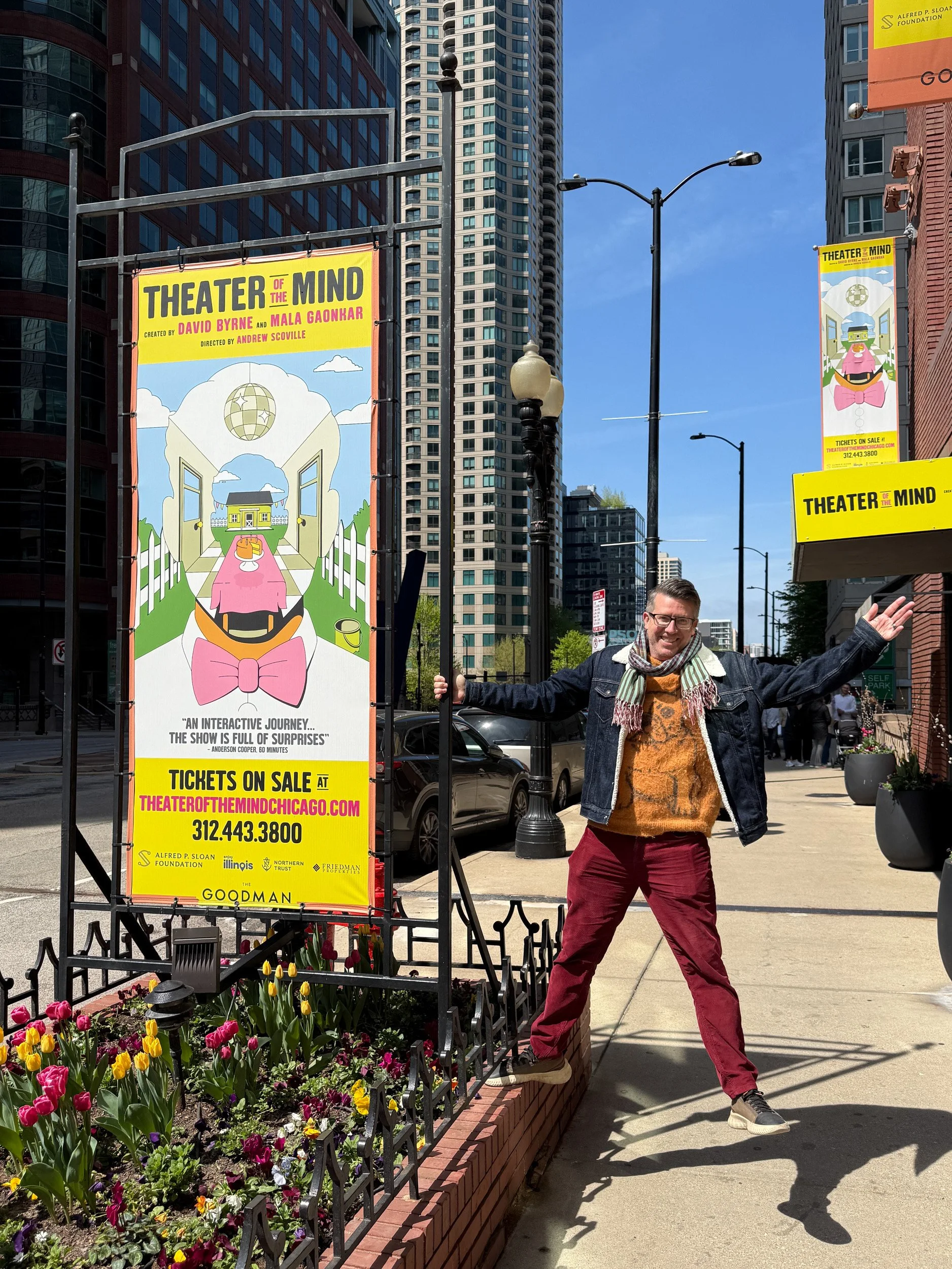
A man hangs off the sign for Theater of the Mind, an immersive experience by David Byrne, on a street in downtown Chicago

Is Theater of the Mind only for Talking Heads fans?

You certainly don’t need to be a Talking Heads fan for any of this to land. In fact, it might be better if you’re not — you’ll walk in with zero expectations to disappoint and zero nostalgia to protect.

Byrne himself has acknowledged that Talking Heads fans might show up expecting music and David. “I’m hoping the word gets out — that I’m not in it, that it’s not musical,” he said.

There is one original Byrne composition in the show — described by director Andrew Scoville as a “banger” — but this is not a concert, a jukebox or a nostalgia trip. It’s something genuinely new, which is either the most David Byrne thing imaginable, or the least.

Does David Byrne actually appear? Will I get to meet him?

Let’s be direct about this, because a lot of Talking Heads fans are going to show up expecting a concert cameo and we don’t want anyone to feel ambushed: David Byrne will not be performing in Theater of the Mind. He’s the co-creator, not the performer.

What do you actually do in there? What should I expect?

We’re not telling you. That’s the point. But here’s what we can say about the shape of it without ruining anything:

Some spaces may be dizzying or disorienting. The experience includes cognitive and sensory manipulations, including flashing and moving lights.

There’s a definite story, but if you go in expecting a tight narrative arc, recalibrate your expectations. Instead, go in ready to be a willing participant in a series of jaw-dropping perceptual experiments — and you’re going to have a great time.

One practical note worth passing along: Wear comfortable shoes. The experience requires a lot of walking, though the creative team builds in ample opportunities to sit along the way. You won’t be standing for 75 minutes straight.

I hate audience participation. Is this going to put me on the spot?

Reasonable fear. The answer is: No, not in the way you’re imagining. For those wary of immersive theater, don’t worry. The show doesn’t put audience members on the spot or ask them to improvise.

There is some audience participation, but the experience is interactive without being in your face. If you don’t want to say anything, you don’t have to. If you want to talk about that time you tripped on acid, well, your group will be happy to hear it.

Will my experience be the same as my friend’s? 

Because of the visceral, personal nature of immersive work, no two participants will have the same experience.

Part of that is by design: Different actors play the guide at different performances, and the audience’s own reactions and participation shape the way the narration unfolds. Part of it is the nature of neuroscience itself — the whole point is that our perceptions differ even when we’re standing in the same room.

Comparing notes afterward is basically required. Plan for a drink after.

Who’s Mala Gaonkar, and why does she co-get top billing?

Mala Gaonkar is an investor and philanthropist working at the intersection of finance, data science and human behavior. She and Byrne had been collaborating on ideas around neuroscience and perception for years before creating Theater of the Mind.

Their earlier collaboration, Neurosociety, translated cognitive science into interactive environments. Theater of the Mind builds on that work by weaving a series of experiments into a single narrative, shifting the role of the audience from observers to participants. Byrne brings the artistic vision, Gaonkar brings the scientific rigor, and the result is something neither would have made alone.

Any content warnings? What should I know before I go?

The experience includes flashing and moving lights, cognitive and sensory manipulations, some adult themes, and spaces that may be dizzying or disorienting. Recommended for ages 10 and up.

Cell phones, smartwatches and any wearable devices that light up must be completely turned off during the experience or left in a locker at the entrance. Not on silent. Off. (Yes, they mean it. No, this is not negotiable. Yes, you’ll survive.)

Also: Once the experience begins, there’s no late admittance, and refunds will not be issued for tardiness. Build in extra time. The Reid Murdoch Building is right on the river — treat the walk along the Chicago River as part of the experience.

If you have specific sensory concerns, the Goodman has a detailed sensory guide available (Note: It contains spoilers). Email Access@GoodmanTheatre.org for accommodations.

It’s been extended — how long do I actually have to see this?

Theater of the Mind runs through July 12, 2026, with multiple experiences per day at the Reid Murdoch Building. Timed entry slots begin every 15 minutes. Tuesday evenings through Sunday afternoons.

Tickets run $69–$99 and are available through the Goodman Theatre box office at 170 N. Dearborn or at theaterofthemindchicago.com. 

Is Theater of the Mind coming to a city near me?

For now, Chicago is it. The show had its world premiere in Denver in 2022-23, and Chicago is its second home. As of publication, there are no announced tour dates beyond the current run. 

OK, but was it actually worth $90?

Here’s the honest version: Cool? Yes. Mind-bending? Absolutely. Worth the price? That depends on you.

The 75 minutes goes fast — maybe faster than you’d like given what you paid. There are moments that will genuinely stop you in your tracks, and you’ll be talking about specific rooms for days. But if you’re someone who measures an evening by hours-per-dollar, you may walk out doing math you don’t love.

Here’s our actual recommendation: If you read this FAQ and thought, ‘that sounds intriguing’ — go. The people who get the most out of Theater of the Mind are the ones who show up curious and willing. If you’re already there mentally, you’ll leave glad you went. –Wally

From Airports to Hotels: The Complete Guide to Using VPNs for Safer Travel

Learn how to use a VPN for safer travel, from airports and hotels to cafés and public Wi-Fi. Discover smart tips to protect your privacy, accounts and personal data while traveling.

Travel is glamorous in the online world and mildly chaotic in real life. One moment you’re gliding through O’Hare International Airport with an overpriced latte, the next you are crouched beside a gate outlet at 12% battery, desperately joining a Wi-Fi network called FreeAirportGuest123. This is how horror stories begin.

When you move through airports, taxis, hotels, cafés and coworking spaces, you often rely on public internet. It’s convenient, yes. It’s also one of those modern travel traps people ignore until something weird happens to a credit card, email account or login. That’s where a VPN can earn its carry-on status.

A VPN, or virtual private network, helps encrypt your internet traffic and adds privacy when you browse, book tickets, check accounts or do the deeply personal act of Googling “best bakery near me.”

Why Travelers Should Care About Online Safety

At home, your Wi-Fi is usually familiar and controlled. On the road, you’re connecting to networks owned by airports, hotels, cafés, rental hosts or no one obvious at all.

Public networks can be less secure, especially if they’re open or poorly configured. That can create opportunities for bad actors to snoop on traffic, create fake login pages or harvest data from careless users.

Translation: The charming little coffee shop in Lisbon may have divine pastries, but its guest Wi-Fi may not be part of your wellness journey.

Using a VPN adds a layer of protection by encrypting your connection, which can make it harder for others on the same network to see what you’re doing.

Choose Your VPN Before the Wheels Go Up

Don’t wait until you’re stranded in an airport trying to download a VPN while your boarding group is mysteriously already boarding. Set it up before your trip. 

Find the best VPN. Look for one that:

  • Is easy to use on phone and laptop

  • Connects quickly without drama

  • Has servers in multiple countries

  • Supports streaming, browsing and booking sites smoothly

  • Has strong reviews and a solid reputation

  • Offers clear privacy policies

The best travel gear disappears into the background. Your VPN should do the same.

Public Wi-Fi: Convenient, Charming, Slightly Suspect

Free Wi-Fi at airports, train stations and malls feels like a public service. Sometimes it is. Sometimes it’s simply crowded, slow — and vulnerable.

Thousands of strangers may use the same network. Your personal information can be exposed and other risks increased, especially if you’re logging into banking apps, email or shopping sites. 

With a VPN switched on, your traffic is encrypted, which can help protect sensitive activity while you wait for a delayed flight and contemplate revenge.

Hotels, Resorts and Other Places With Decorative Pillows

Hotel Wi-Fi often feels safer because there’s a front desk and someone handed you a keycard. Sadly, trust is not a cybersecurity protocol.

Many hotels use shared guest networks designed for convenience first. In hostels, rental apartments or budget stays, network security may vary even more.

If you’re checking work email, accessing files, booking transport or logging into personal accounts, a VPN is a smart move. Especially if you’re working remotely from a balcony and convinced that counts as work-life balance.

Fake Networks and Other Travel Scams

Scammers know travelers are distracted, tired and one delayed train away from irrational decisions.

A common trick is creating fake Wi-Fi names that resemble legitimate networks: “Hotel Guest WiFi,” “Airport Free Internet,” “Cafe Customer Access.”

You connect. They watch. Nobody wins.

A VPN can’t stop every scam, but it can help shield your browsing traffic. Pair it with basic common sense:

  • Confirm the correct network name with staff

  • Avoid entering passwords on suspicious pop-ups

  • Use two-factor authentication

  • Keep software updated

  • If it feels sketchy, use mobile data instead

Even after a glorious day scuba diving in Bali, you may still need to book a ride, check maps or message your hotel. Those quick moments are exactly when people get sloppy.

Smart VPN Habits for Travelers

Using a VPN isn’t complicated. That’s the beauty of it.

Make it routine:

  • Turn it on before joining public Wi-Fi

  • Keep it active for banking, bookings and payments

  • Update the app regularly

  • Use it in airports, hotels, cafés and transit hubs

  • Treat it like sunscreen — easiest when applied early

A Small Habit That Can Save a Big Headache

Travel already includes enough surprises: gate changes, mystery fees, luggage roulette and the person in seat 22B who removes their shoes immediately.

Your internet connection shouldn’t be one of them.

A VPN is one of those boring, practical travel moves that becomes interesting only when you wish you had made it sooner. –Mian Azhar

The One Routine Digital Nomads Can’t Afford to Ignore

Digital nomads need more than Wi-Fi. Learn how a monthly reset with bookkeeping, budgeting and goal checks helps sustain life abroad.

Collage of woman without a face, drinking a cocktail, holding books, her lower body a globe, with a passport, airplane and receipt floating in the air

The dream of digital nomadism is usually painted with vibrant colors. It’s the laptop on a beach, the bustling café in Berlin, or the quiet mountain cabin in northern Thailand. We talk a lot about the freedom, the gear and the best travel insurance. But there’s a quieter, less glamorous side to this lifestyle that determines whether you stay on the road for six months or six years. It’s not about your Wi-Fi speed or your packing list of things not to forget. It’s about the rhythm you keep when the world around you is constantly changing.

Then there’s the logistics of moving abroad. When you live out of a suitcase, everything is fluid. Your timezone shifts. Your currency changes. Even the taste of the coffee is different. While that variety is exactly why we do this, it can also be our undoing. Without a solid anchor, the lack of structure eventually leads to burnout or financial stress. But there’s one specific routine that sits at the intersection of your professional success and your personal peace of mind: the monthly reset.


A collage of a man relaxing in a drawer packed with clothes and documents, with a hotel keyring, calendar date, luggage tag, sock and receipt in the air

Why the Monthly Reset Matters for Digital Nomads

Most people think of routines as daily things. We have our morning coffee or our evening stretching. For a nomad, daily routines are easily broken by a flight or a bad connection. A monthly routine, however, is a bird’s-eye view. It is your chance to stop being a passenger in your own life and start being the pilot again.

The monthly reset is a dedicated block of time where you look at your finances, your projects and your health. It’s the moment you acknowledge that you spent too much on ride-sharing apps in Mexico City or that you haven’t spoken to your best friend back home in weeks. It’s about catching the small leaks before they sink the ship.

A collage of a man whose legs are replaced with a stack of documents, a calendar and a cord

Financial Clarity on the Road

The most critical part of this routine is facing the numbers. It’s very easy to lose track of spending when you’re constantly converting prices in your head. One day you feel like a king, and the next, everything seems expensive and you’re wondering where your savings went.

Establishing a consistent habit for your finances is non-negotiable. This involves more than just checking your bank balance. It means categorizing your expenses and ensuring your taxes are being handled. Taking the time to follow a guide to monthly bookkeeping ensures that your business remains healthy while you explore. When you know exactly what’s coming in and what’s going out, the freedom of nomadism actually feels real because it’s backed by data.

A monthly routine is your chance to stop being a passenger in your own life and start being the pilot again.

The Mental Health Checkpoint

Nomadism is lonely. We don’t talk about that enough. You meet a lot of people — but you have very few deep roots. Part of your monthly routine should be an audit of your social and mental well-being.

Are you feeling burned out? Have you stayed in one place long enough to learn the name of the person at the grocery store? If the answer is no, your monthly reset is the time to pivot. Maybe the next month should be spent in a slower-paced town. Maybe it’s time to book a flight home for a visit. This routine gives you the permission to change your mind. It reminds you that the itinerary serves you, not the other way around.

A collage of a suitcase with an arm, laptop, cityscape, calendar, coins, receipts, passport, clocks, plane and coffee cup

Project and Goal Realignment for Digital Nomads

It’s easy to get distracted by the travel part of being a digital nomad and neglect the digital part. Your work provides the fuel for your journey. Every 30 days, you need to look at your professional goals.

Are you actually making progress, or are you just doing enough to get by? Use this time to clean up your digital desktop, archive finished projects, and set three major objectives for the coming month. This prevents the vacation mode creep that eventually kills many freelance careers. It keeps you sharp and professional, regardless of whether you’re working from a high-rise or a hostel.

A collage of a woman in a chair with an alarm clock for a head, drinking coffee, with another one spilling, with a laptop, plant, cord, coins and documents

How to Implement the Monthy Routine for Digital Nomads 

The best way to make this stick is to tie it to a specific date. Many nomads choose the first Sunday of every month. Wherever you are, that day is sacred. You don’t book tours. You don’t travel to a new city. You stay put.

Start by finding a quiet space with reliable internet. Open your spreadsheets, your calendar and your journal. Be honest with yourself about what worked and what didn't. This isn’t meant to be a punishment. It’s a gift to your future self. It’s the reason you will be able to keep living this incredible life while others have to pack it in and head back to a desk.

The Long-Term Reward

The nomads who last are the ones who treat their lifestyle with respect. They know that freedom requires a foundation. By implementing a monthly reset, you’re building that foundation. You’re creating a sense of home that exists within your habits rather than a physical building.

You deserve a life that feels as good on the inside as it looks on your social media feed. That feeling starts with the boring, quiet, essential work of checking in with yourself once a month. It’s the one financial independence routine you truly cannot afford to ignore. –Abdul Rehman Jr.


From Suitcases to Shipping Containers: The Real Logistics of Living Abroad

International relocation involves far more than booking a flight. From shipping timelines and customs requirements to temporary housing and settling in, here’s what moving abroad really takes.

There’s a version of moving abroad that exists almost entirely in the imagination. It’s made up of curated moments: airport departures, scenic arrivals, the promise of a clean slate somewhere new. In that version, the process feels light, almost cinematic. A suitcase, a plan, and everything else just… works out.

In reality, relocation has a bit more bureaucracy.

Moving abroad isn’t just a change of location. It’s a layered process that begins long before departure and lingers well after arrival. The experience isn’t defined by the destination so much as the decisions — and logistics — that make it possible.

The Distance Between Intention and Execution

At the outset, it’s easy to focus on what’s ahead: the new city, the opportunities, the subtle (or not-so-subtle) reinvention. Logistics feel like background noise. Something to deal with later.

But “later” has a way of showing up early.

Suddenly, practical questions pile up. What do you take? What do you leave? What’s worth shipping across an ocean, and what’s better left behind? Furniture becomes a dilemma. Documentation becomes urgent. Timelines stop being flexible and start being real.

What once felt abstract becomes operational — fast.

Reframing What You Carry Forward

One of the first challenges is also one of the most clarifying: You can’t take everything with you. And even if you could, you probably shouldn’t.

The process forces prioritization in a way few other experiences do. Your belongings stop being just stuff and start representing continuity, comfort, identity. Some things are replaceable. Others carry weight you didn’t quite notice until now.

A woman is moving from London, carrying a high stack of items, leaving an apartment building and a trail of moving boxes, with Big Ben, Saint Paul's Cathedral, a double decker bus and a plane in the background

The Complexity of International Logistics

What’s often underestimated is just how much coordination it takes to move across borders.

Shipping timelines. Customs requirements. Documentation. Regulations that vary by country and, sometimes, by the day. Delays aren’t unusual; they’re practically part of the package. Costs shift. Plans adjust. And if one piece falls out of sync, everything can start to feel chaotic.

Without a structured approach, it’s easy for the process to fragment.

That’s where organized support moves from “nice to have” to “absolutely necessary.” Many people turn to overseas moving services by Three Movers to bring some order to the chaos, helping manage transport, compliance and coordination in one place. It’s not just about efficiency; it’s about being able to move forward without constantly wondering what’s falling through the cracks.

Timing, Gaps and Transitional Living

In a perfect world, you arrive and your belongings follow right on cue. Your space is ready, your routines begin, and everything clicks into place.

In the real world, there’s usually a gap. Temporary housing becomes part of the story. You live out of a suitcase, prioritizing essentials while the rest of your life floats somewhere between ports. It’s a strange in-between phase — simplified, a little unsettled, occasionally frustrating.

But also, oddly revealing. You start to see what you actually need — and what you’ve been carrying out of habit.

Rebuilding Structure in a New Environment

Arrival feels like a finish line, but it’s really a pivot point. Unpacking becomes the first act of rebuilding. Familiar objects begin to anchor the space, offering small moments of recognition in an unfamiliar environment. Routines return — slowly, unevenly — shaped by both what’s new and what you’ve carried with you.

Some things settle quickly. Others take time. And a bit of patience.

A surprise woman sits on a conveyor belt, with boxes, stacks of paperwork, machine cogs and a giant hand with a stamp reading, "Denied"

Global Mobility and Ongoing Complexity

More people are moving across borders than ever before. According to the International Organization for Migration, global mobility continues to rise for professional, personal and lifestyle reasons.

But here’s the catch: The process hasn’t gotten simpler. Regulations remain complex. Requirements shift. Every move comes with its own set of variables. The dream of living abroad may be more accessible — but getting there still requires careful navigation.

What Becomes Clear in Retrospect

Looking back, most people realize the defining part of an international move wasn’t the departure or even the arrival.

It was everything in between. The planning. The trade-offs. The moments where expectation met reality (and reality politely declined to cooperate). Those are the pieces that shape the experience — and determine how smooth, or chaotic, the transition feels.

Beyond Arrival

It’s tempting to think of moving abroad as a series of moments: You leave, you arrive, you begin.

In truth, it’s an extended transition. The logistical phase doesn’t just happen in the background; it sets the tone for everything that follows. When handled well, it creates the conditions for a smoother landing and a more stable start.

A More Grounded View of Relocation

Relocating internationally is often framed as bold and transformative. And it is.

But it’s also detailed. Structured. Occasionally maddening.

It asks for planning and flexibility, optimism and realism — sometimes all at once. And the difference between a disjointed experience and a well-managed one often comes down to how those logistical pieces are handled.

Because living abroad isn’t just about where you’re going. It’s about how you get there — and how prepared you are when you arrive. –Ivana Babic

Why Some Places Feel Expensive Even When They’re Not

Some destinations feel expensive at first, but that’s not always true. See what shapes price perception and how habits change when you travel.

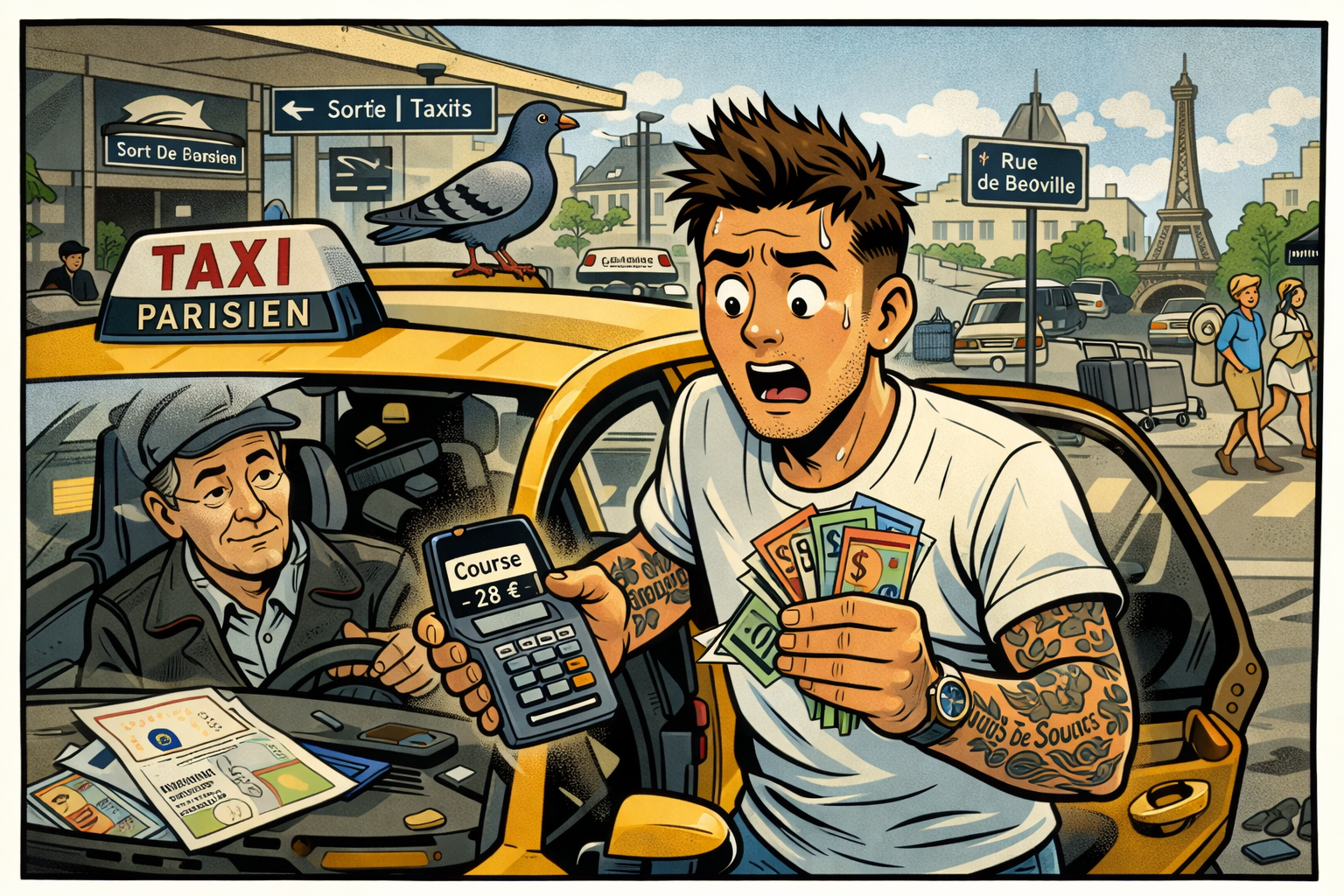
You arrive somewhere new, sit down and check the price of something simple: acoffee, a taxi, a quick meal.

It looks high. Not extreme, but enough to make you pause for a second. You do a quick conversion in your head. It still feels off.

After a few days, that feeling starts to shift. The numbers stay the same, but your reaction changes. You begin to notice that “expensive” doesn’t always mean what you thought it did.

First Impressions Are Almost Always Wrong

The first day in a new place rarely reflects reality. Everything feels unfamiliar. Prices look strange, and you rely on quick comparisons to your home currency. That usually leads to the wrong conclusion.

A meal might seem overpriced at first glance. A taxi ride might feel like too much for a short distance. After a few days, patterns start to appear.

You see what locals pay. You notice where people go. You realize that your first impression came from a lack of context, not the actual cost.

You Compare Everything to Home Without Realizing

Most people do the same thing when they travel. They convert every price into their own currency. It feels logical, but it creates a distorted view.

A €10 meal might seem cheap or expensive, depending on where you’re from. The number itself doesn’t explain much without context.

Your first impression comes from a lack of context, not the actual cost.

Over time, some travelers stop converting everything. They start paying attention to how money works within that place instead of comparing it to somewhere else.

That shift leads to a deeper understanding of value. For some, it even opens the door to concepts like forex trade, where currency differences and timing play a much bigger role than simple conversions.

Local Habits Change What “Normal” Means

What feels expensive often depends on what people around you consider normal. In some places, eating out every day is common. In others, it’s something people do occasionally. The same price can feel different, depending on how often it fits into daily life.

Transport works the same way. A short ride might seem costly, until you realize that most locals walk or use public options instead. Suddenly, the price reflects convenience rather than distance.

Watching how people live gives more insight than any price tag.

Small Costs Shape Your Overall Impression

Big purchases stand out, but small ones create the real impression.

A coffee in the morning. A snack in the afternoon. A short ride between locations. Each one feels minor on its own. By the end of the day, they add up.

That’s when a place starts to feel expensive, even if individual prices are reasonable. It’s the repetition that creates the feeling.

Once you notice this, your habits adjust naturally. You walk more, plan better, and pay attention to where your money goes without forcing it.

Comfort Often Feels More Expensive Than It Is

Tourist areas are built around ease. Everything sits close together, options are obvious, and choices require little effort. That convenience comes at a cost.

Step a few streets away, and prices often change. The same meal, the same coffee or the same service might cost less simply because it’s not designed for visitors.

Comfort creates a shortcut. It saves time, but it also shapes how you judge prices. When you move outside that comfort zone, your perception shifts again.

Frequently Asked Questions

Why do some places feel expensive even when they’re not?

It usually comes down to first impressions. Prices look unfamiliar, and quick comparisons don’t always help.

Do you need to convert prices every time you buy something?

At the beginning, yes. After a while, it becomes less useful. You start to understand value based on the place itself.

What’s the easiest way to understand prices in a new country?

Watch what people around you do: where they eat, how they move around, what they avoid. That gives more context than numbers.

Do exchange rates change how things actually cost or just how they feel?

Both, but the feeling usually changes first. Actual habits take a bit longer to adjust. –J. Quill