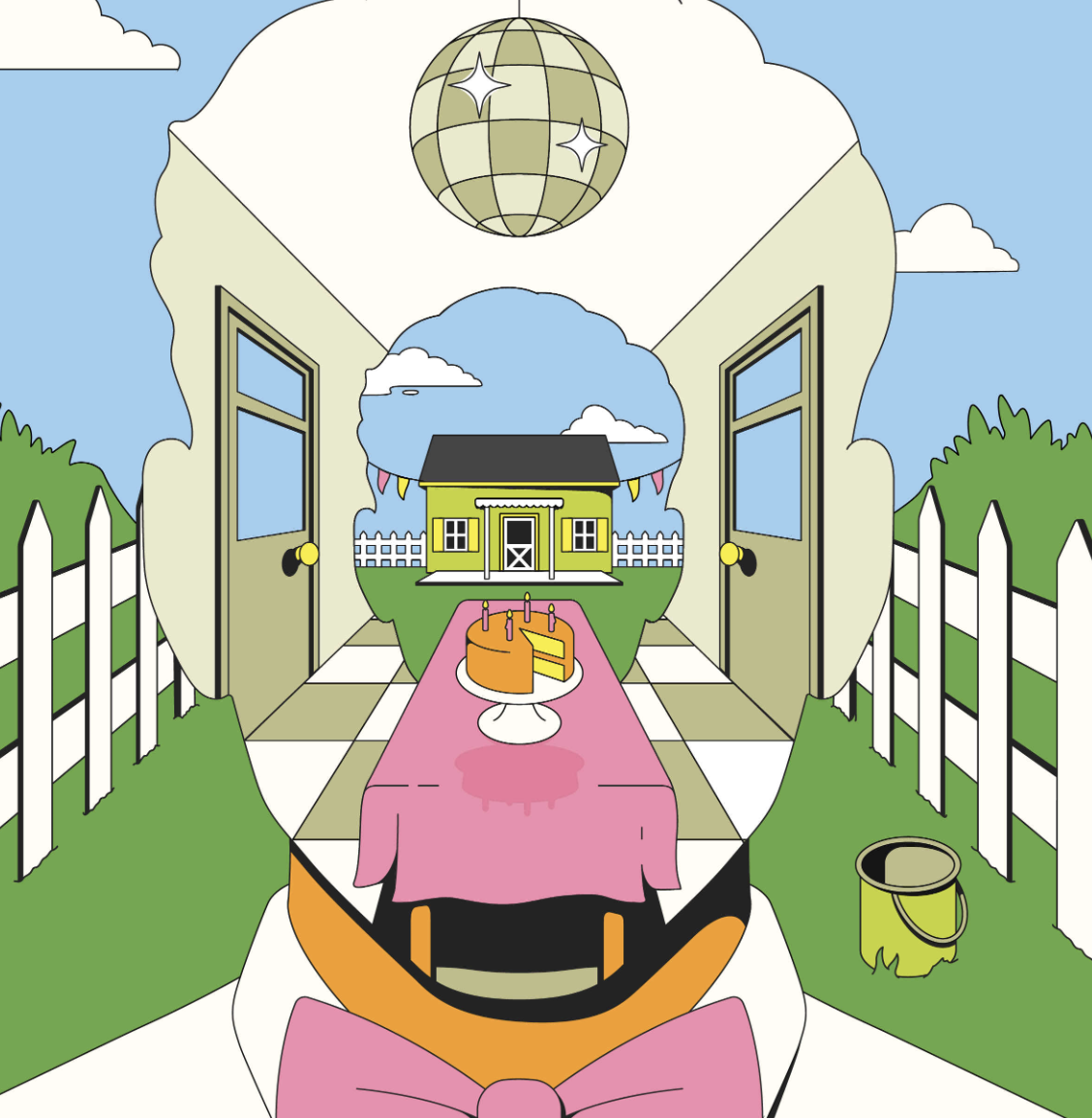
A neuroscience funhouse? Yes. A David Byrne concert? Absolutely not. Everything you need to know before you go — without spoiling any of the tricks.
Here’s the pitch: David Byrne — Grammy winner, Talking Heads frontman, the man who once performed an entire Broadway show in an excessively broad-shouldered gray suit — has co-created an immersive experience in a century-old Chicago landmark building where a small group of strangers walks through a series of rooms and gets their perception of reality gently, gleefully dismantled. The New Yorker declared it “an ambitious addition to the genre of immersive art… a through-the-looking-glass fantasy.”
We had to check it out. And we had about a thousand questions going in — most of which we’re going to answer for you here, without ruining any of the magic. Consider this your no-spoiler field guide.
Theater of the Mind
The Basics
| Where | Reid Murdoch Building 333 N. LaSalle St. River North, Chicago |
| When | Through July 12, 2026 Tues–Sun, timed entries every 15 minutes |
| Duration | 75 minutes |
| Group | 16 people per session |
| Tickets | $69–$99 goodmantheatre.org 312-443-3800 |
| Ages | Recommended 10+ |
| Phones | Off and stowed — this means you |
What is Theater of the Mind? Qu’est-ce c’est?
Theater of the Mind isn’t a play. It’s not a concert. It’s not an escape room, though the room-to-room structure might make you think so at first. The best working description: It exists somewhere in the margins of creepy festival funhouse meets cool high school science experiment.
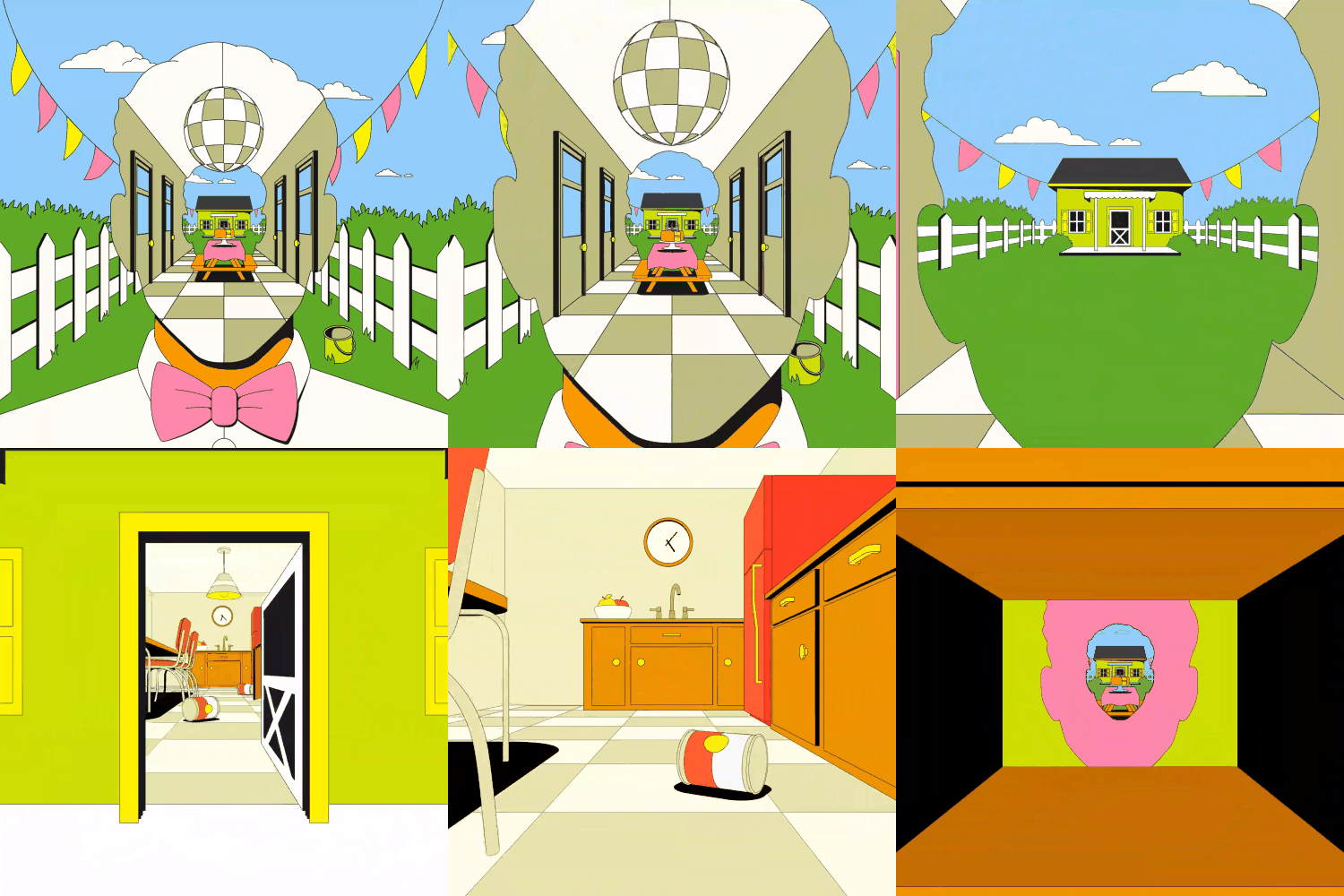
More precisely: You follow a guide through a surreal 15,000-square-foot installation as a group of just 16 audience members. Over 75 minutes, you move through a series of rooms where you’ll participate in thought-provoking neuroscience experiences and learn how easily your own senses can deceive you. Byrne himself has called it a “neuro funhouse,” though he’s acknowledged it evolved into something more.
Is it actually autobiographical? Are we watching David Byrne’s life story?
Sort of — and Byrne himself is delightfully ambivalent about it. “I wasn’t sure how I felt about the character being named David and having little elements of my life in it,” he said. “But I also thought, why not? A lot of the stuff is not exactly biographical or autobiographical.”
That hedging is worth taking seriously, because the show plays deliberately with the line between real and invented. The guide’s mother, for example, dabbles in painting. In reality, it was Byrne’s late father who painted as a hobby.
The show borrows from his life and then quietly rearranges the furniture.
What is real: Byrne was born in Dumbarton, Scotland, to a Catholic father and a Presbyterian mother — a combination that caused enough tension in the extended family that his parents eventually packed up and emigrated, first to Hamilton, Ontario, then to Arbutus, Maryland, where his father worked as an electronics engineer.
Byrne describes himself as having undiagnosed autism, calling it a superpower that lets him hyperfocus on creative work.
“Go in ready to be a willing participant in a series of jaw-dropping perceptual experiments — and you’re going to have a great time.”
The bigger theme running through the biographical material isn’t any single memory but the question of memory itself. “We like to think that our brains are recording machines,” Byrne has said. “But they’re not. Every time we remember, we’re kind of making things up, embellishing. Not intentionally lying, but if our identity is made up of ‘I’m the person that this happened to, who was born here, and this happened to me’ — does that mean our sense of identity is in question as well?”
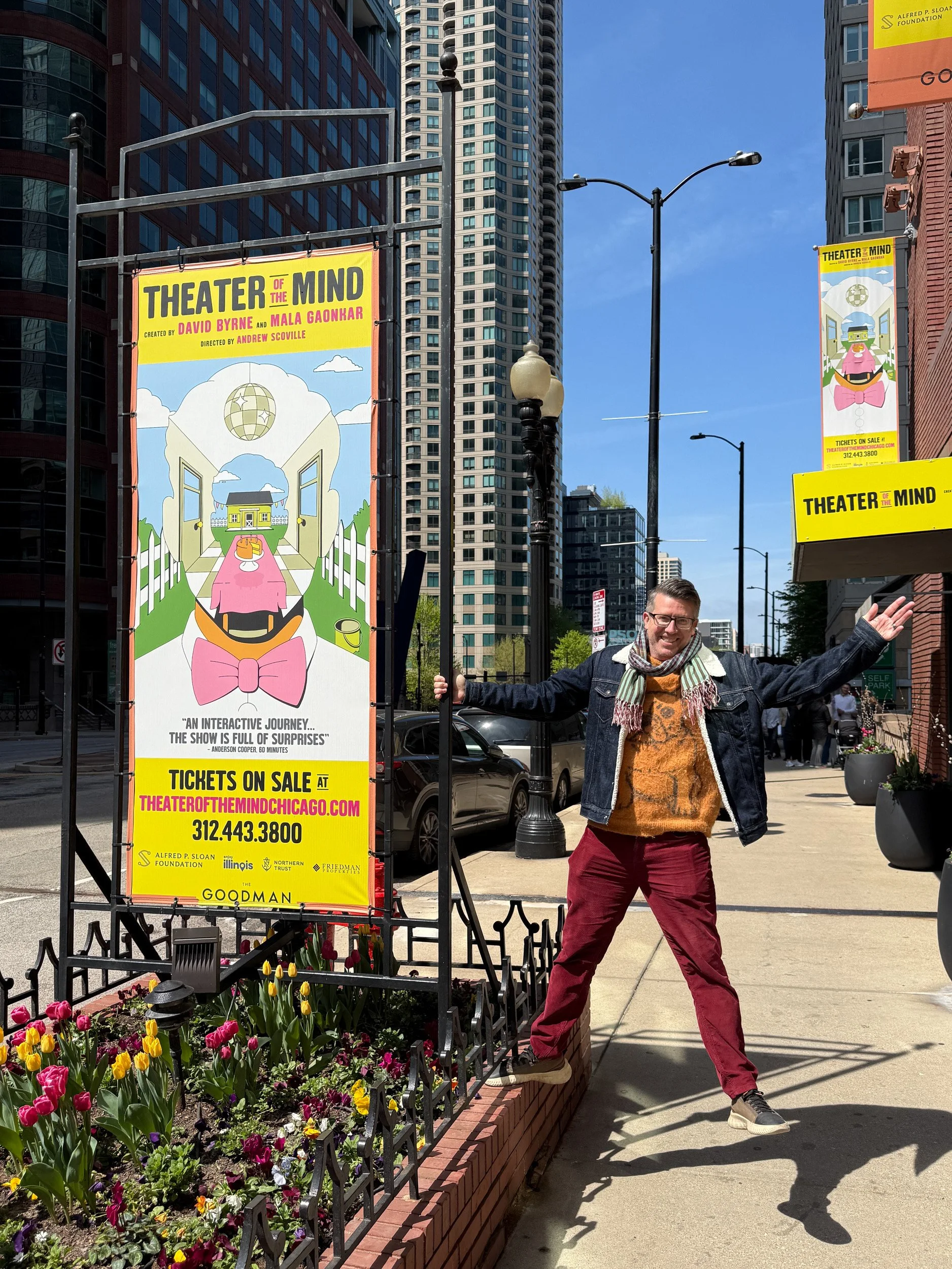
Is Theater of the Mind only for Talking Heads fans?
You certainly don’t need to be a Talking Heads fan for any of this to land. In fact, it might be better if you’re not — you’ll walk in with zero expectations to disappoint and zero nostalgia to protect.
Byrne himself has acknowledged that Talking Heads fans might show up expecting music and David. “I’m hoping the word gets out — that I’m not in it, that it’s not musical,” he said.
There is one original Byrne composition in the show — described by director Andrew Scoville as a “banger” — but this is not a concert, a jukebox or a nostalgia trip. It’s something genuinely new, which is either the most David Byrne thing imaginable, or the least.
Does David Byrne actually appear? Will I get to meet him?
Let’s be direct about this, because a lot of Talking Heads fans are going to show up expecting a concert cameo and we don’t want anyone to feel ambushed: David Byrne will not be performing in Theater of the Mind. He’s the co-creator, not the performer.
What do you actually do in there? What should I expect?
We’re not telling you. That’s the point. But here’s what we can say about the shape of it without ruining anything:
Some spaces may be dizzying or disorienting. The experience includes cognitive and sensory manipulations, including flashing and moving lights.
There’s a definite story, but if you go in expecting a tight narrative arc, recalibrate your expectations. Instead, go in ready to be a willing participant in a series of jaw-dropping perceptual experiments — and you’re going to have a great time.
One practical note worth passing along: Wear comfortable shoes. The experience requires a lot of walking, though the creative team builds in ample opportunities to sit along the way. You won’t be standing for 75 minutes straight.
I hate audience participation. Is this going to put me on the spot?
Reasonable fear. The answer is: No, not in the way you’re imagining. For those wary of immersive theater, don’t worry. The show doesn’t put audience members on the spot or ask them to improvise.
There is some audience participation, but the experience is interactive without being in your face. If you don’t want to say anything, you don’t have to. If you want to talk about that time you tripped on acid, well, your group will be happy to hear it.
Will my experience be the same as my friend’s?
Because of the visceral, personal nature of immersive work, no two participants will have the same experience.
Part of that is by design: Different actors play the guide at different performances, and the audience’s own reactions and participation shape the way the narration unfolds. Part of it is the nature of neuroscience itself — the whole point is that our perceptions differ even when we’re standing in the same room.
Comparing notes afterward is basically required. Plan for a drink after.
Who’s Mala Gaonkar, and why does she co-get top billing?
Mala Gaonkar is an investor and philanthropist working at the intersection of finance, data science and human behavior. She and Byrne had been collaborating on ideas around neuroscience and perception for years before creating Theater of the Mind.
Their earlier collaboration, Neurosociety, translated cognitive science into interactive environments. Theater of the Mind builds on that work by weaving a series of experiments into a single narrative, shifting the role of the audience from observers to participants. Byrne brings the artistic vision, Gaonkar brings the scientific rigor, and the result is something neither would have made alone.
Any content warnings? What should I know before I go?
The experience includes flashing and moving lights, cognitive and sensory manipulations, some adult themes, and spaces that may be dizzying or disorienting. Recommended for ages 10 and up.
Cell phones, smartwatches and any wearable devices that light up must be completely turned off during the experience or left in a locker at the entrance. Not on silent. Off. (Yes, they mean it. No, this is not negotiable. Yes, you’ll survive.)
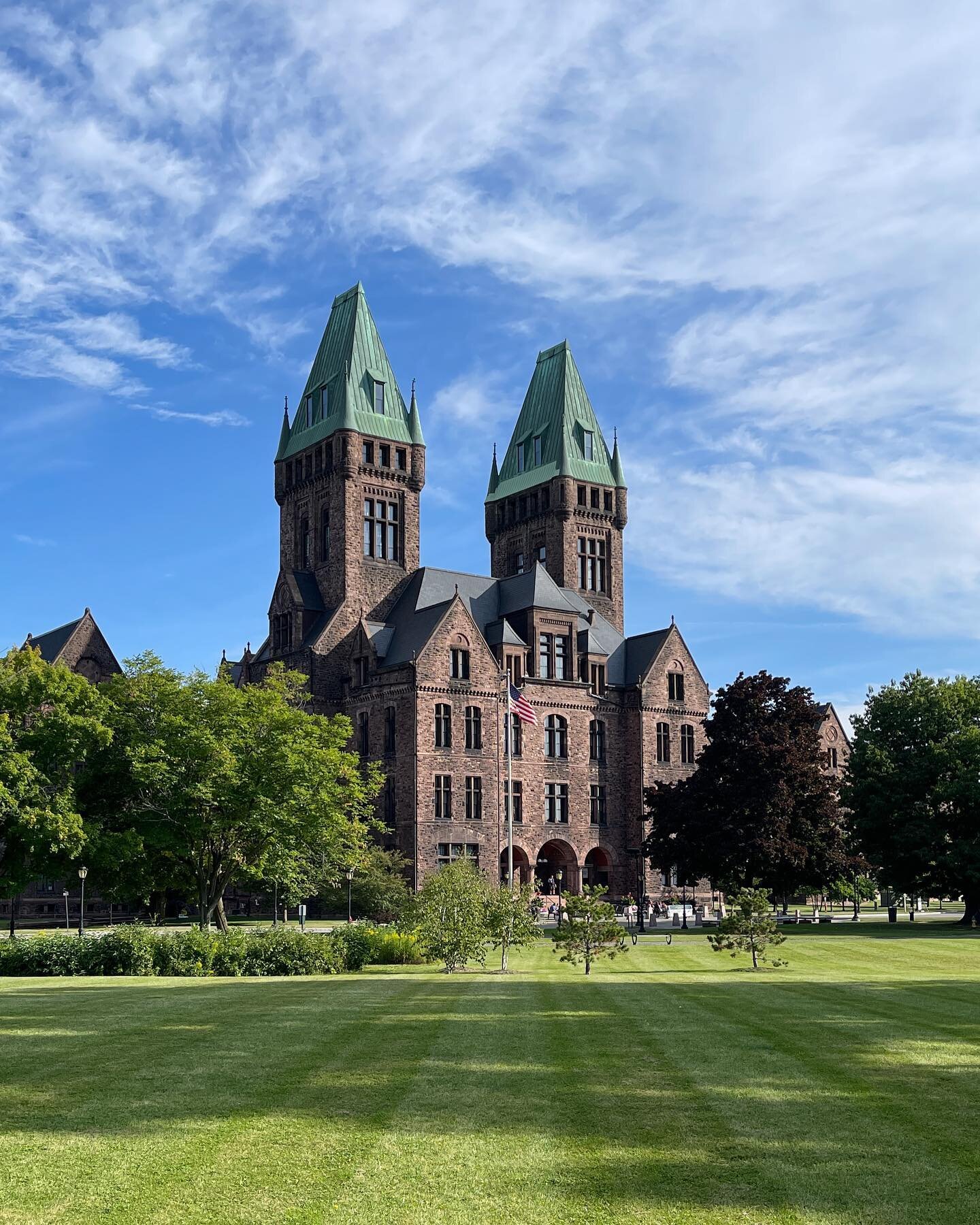
Also: Once the experience begins, there’s no late admittance, and refunds will not be issued for tardiness. Build in extra time. The Reid Murdoch Building is right on the river — treat the walk along the Chicago River as part of the experience.
If you have specific sensory concerns, the Goodman has a detailed sensory guide available (Note: It contains spoilers). Email Access@GoodmanTheatre.org for accommodations.
It’s been extended — how long do I actually have to see this?
Theater of the Mind runs through July 12, 2026, with multiple experiences per day at the Reid Murdoch Building. Timed entry slots begin every 15 minutes. Tuesday evenings through Sunday afternoons.
Tickets run $69–$99 and are available through the Goodman Theatre box office at 170 N. Dearborn or at theaterofthemindchicago.com.
Is Theater of the Mind coming to a city near me?
For now, Chicago is it. The show had its world premiere in Denver in 2022-23, and Chicago is its second home. As of publication, there are no announced tour dates beyond the current run.
OK, but was it actually worth $90?
Here’s the honest version: Cool? Yes. Mind-bending? Absolutely. Worth the price? That depends on you.
The 75 minutes goes fast — maybe faster than you’d like given what you paid. There are moments that will genuinely stop you in your tracks, and you’ll be talking about specific rooms for days. But if you’re someone who measures an evening by hours-per-dollar, you may walk out doing math you don’t love.
Here’s our actual recommendation: If you read this FAQ and thought, ‘that sounds intriguing’ — go. The people who get the most out of Theater of the Mind are the ones who show up curious and willing. If you’re already there mentally, you’ll leave glad you went. –Wally