wicca

Ancient Winter Solstice Myths That Shaped Yule

Long before twinkle lights and decorated trees, the Winter Solstice was a moment of cosmic suspense when the sun hovered at its weakest and people hoped for its return. Across cultures, people told strikingly similar stories about light slipping back into the world.

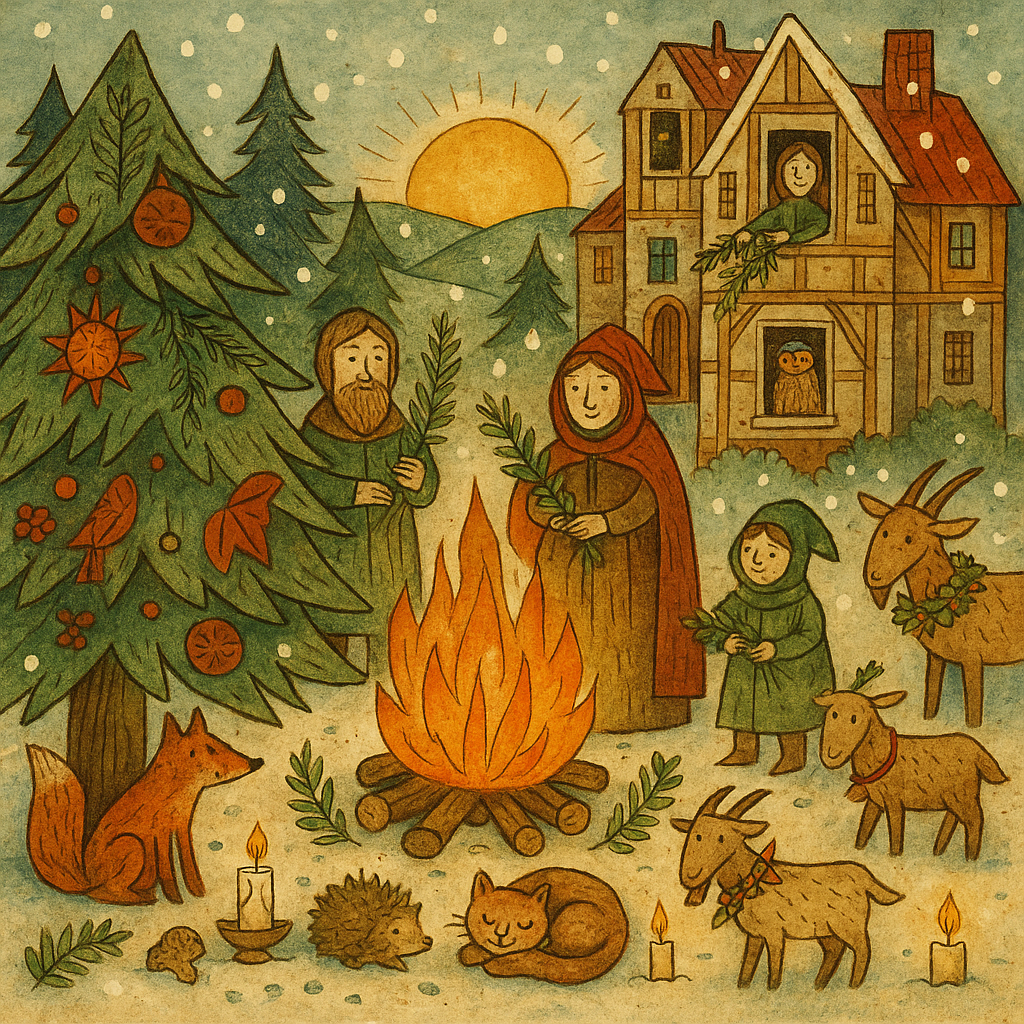
Villagers gather around a bonfire in the snow as the sun sets with animals—a fox, hedgehog, cat and goats—by a decorated evergreen tree, with a house in the background with people in the windows

The longest night arrives quietly. A sky as black as ink, a stillness so deep it feels ancient, a cold that settles into the bones. For early peoples this wasn’t just winter — it was the edge of everything. If the sun kept fading, if the darkness swallowed just a little more each day, what then?

So they watched the horizon, prayed to familiar gods, whispered old tales and waited for proof that the world was not ending but turning. And when the sun finally paused, then tipped toward brighter days, it wasn’t just an astronomical event. It was a miracle unraveling in real time.

The stories born from that fear and relief — of divine children, returning heroes and unconquered light — became the backbone of Yule lore and rituals that later threaded their way into traditions we still keep without realizing it.

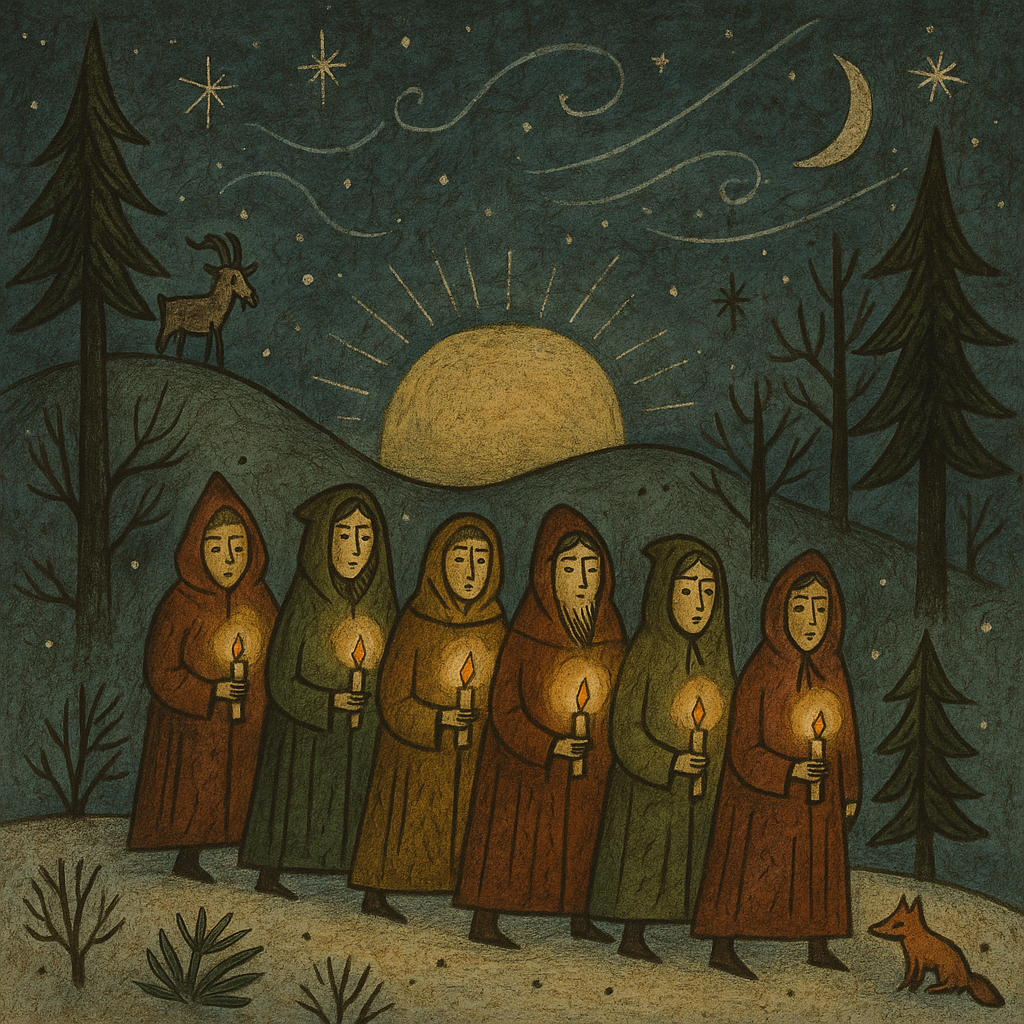
A row of robed celebrants carry candles through the trees past a fox on Yule

Yule: The Longest Night and the Eternal Return

As the year thinned toward winter, people watched the sun sink lower on the horizon and felt the days draining away. Farmers, priests and sky-watchers across the ancient world tracked its movements with care because the shrinking daylight meant colder nights, dwindling food and a long stretch of uncertainty before spring.

By the time the winter solstice arrived, the world felt paused. The sun hovered at its weakest point, rising late and setting early, and everything seemed to hold its breath with it. Homes glowed with firelight, animals stayed close and communities waited for proof that the darkness had reached its limit.

Then came the turning. The sun lingered at the edge of the sky, steadied and began — almost shyly — to climb again. That small increase in light was a promise that life would return. Relief blossomed into celebration, and storytelling followed: tales of gods reborn, heroes returning and divine children whose arrival signaled that the world still had a future.

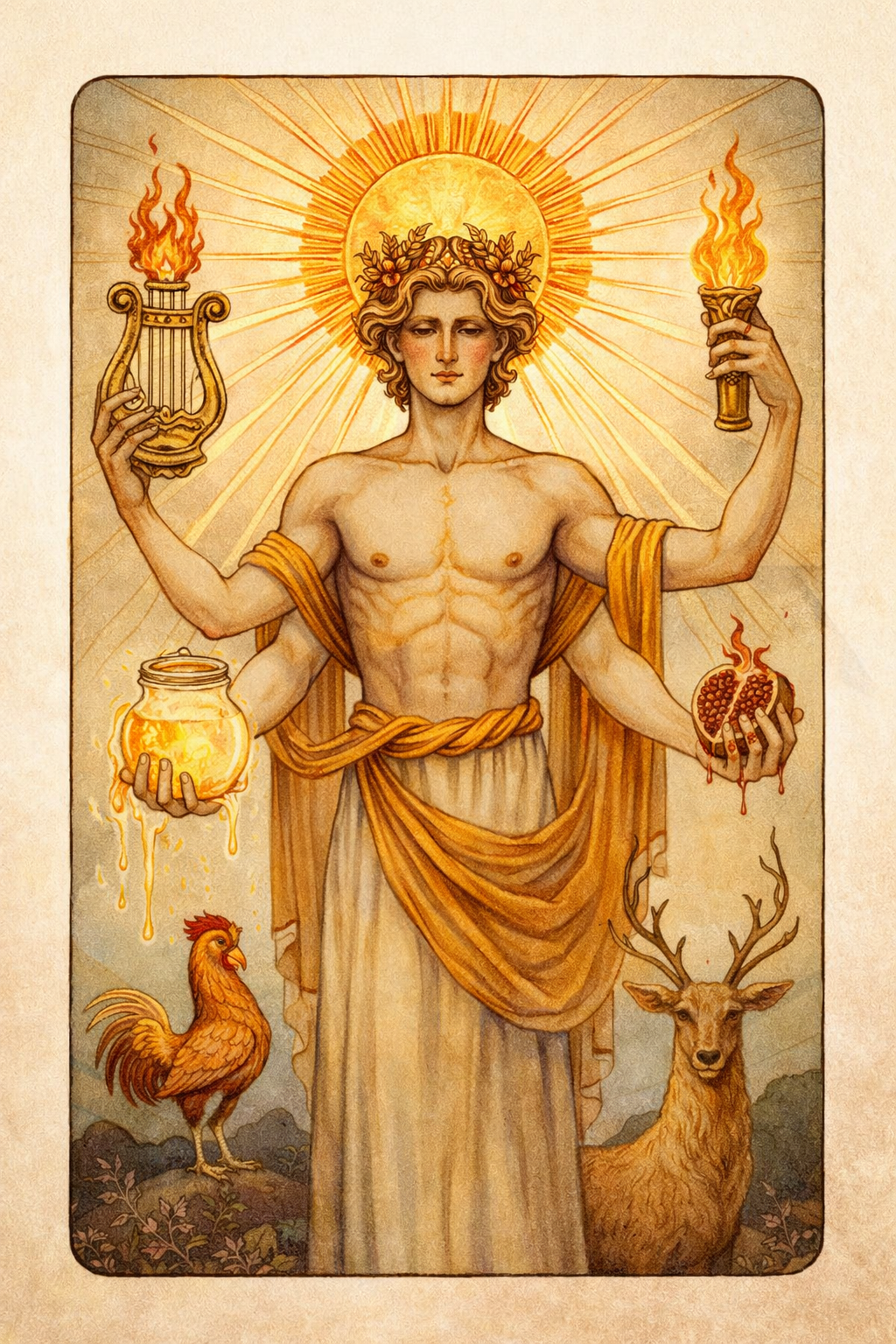
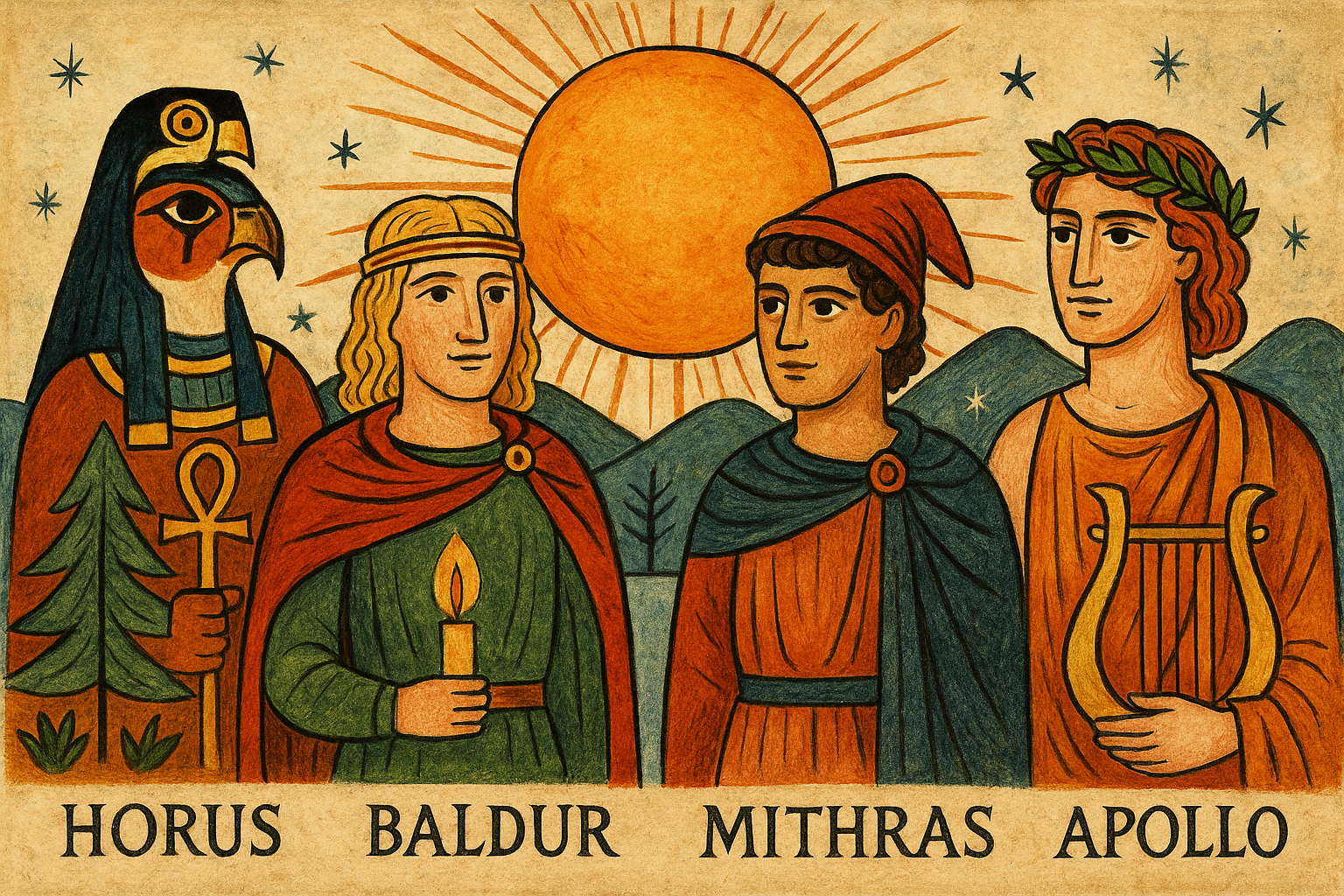
Yule sun gods, including eagle-headed Horus, Baldur, Mithras and Apollo with a lute

The Child of Light: Shared Myths Across Civilizations

Across the ancient world the returning sun inspired stories about divine children who arrived at the edge of winter. Their births weren’t simple celebrations — they were cosmological events meant to reassure people that warmth, growth and life would rise again.

Up north, in Norse mythology, the beloved Baldur shone so brightly he seemed made of early morning light. His death plunged the world into grief, but prophecies promised he would return after the final long winter, bringing renewal with him.

Along the Nile, in Ancient Egyptian mythology, Isis gave birth to Horus, a child linked to rising waters and the rebirth of the land. His survival against darkness became a symbol of resilience as the sun regained strength.

In the Mediterranean world, worshippers honored Mithras, the unconquered sun, whose birth signaled triumph over the darkest days of the year. Roman calendars placed his festival near the solstice when the first notch of returning daylight felt like victory.

Even Apollo, ever-youthful and radiant, was imagined returning from his winter journey to bring clarity and warmth back to the world. His reappearance echoed the same relief the sky delivered: The light had turned.

These stories weren’t copies of one another, but they shared a heartbeat. Each culture told its own version of the same truth the solstice revealed — darkness recedes, light returns and the world begins again.

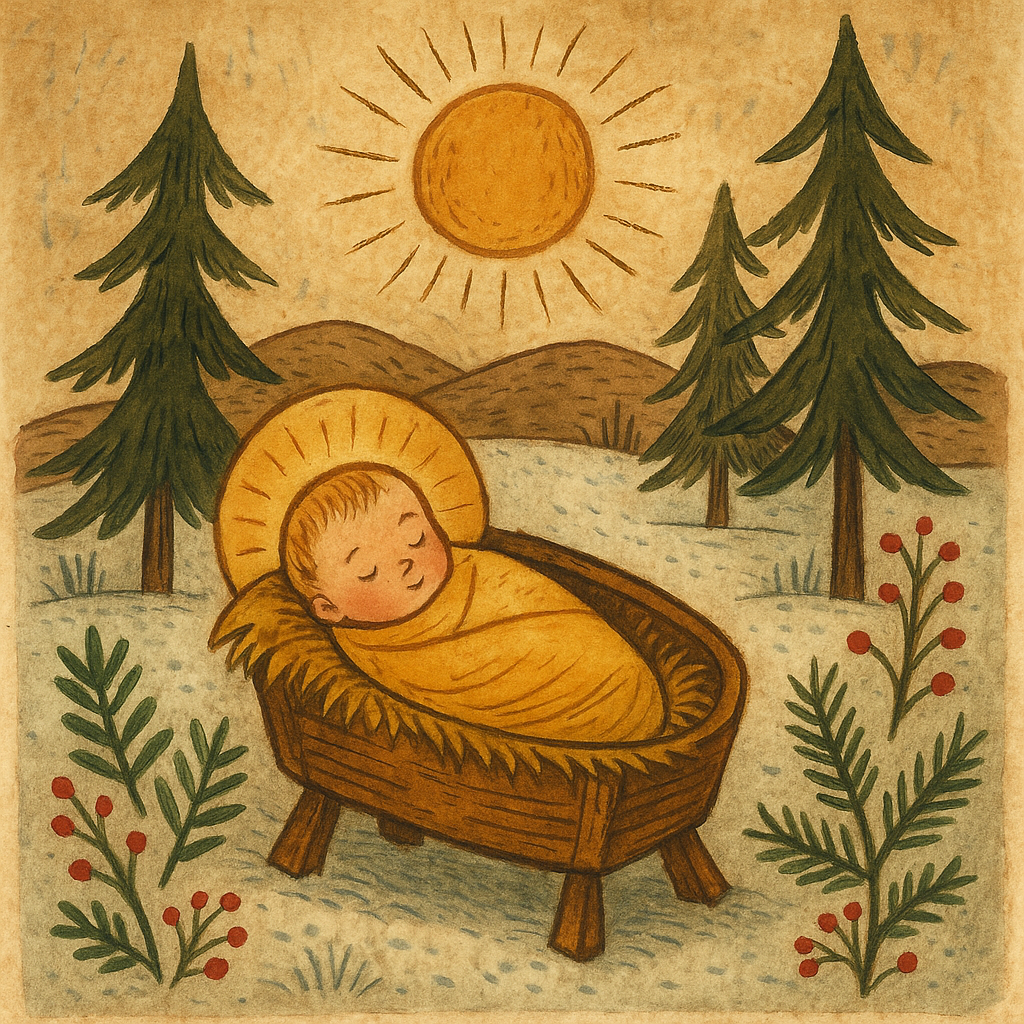
Baby Jesus in a manger by winter foliage as the sun shines upon him

The Christ Child and the Winter Solstice Shift

When early Christian leaders tried to establish a date for Jesus’ birth they didn’t choose one based on evidence. The Bible doesn’t give a season, let alone a day. Instead they looked around at the midwinter festivals that already drew huge crowds: Saturnalia in Rome, the solstice rites of the sol invictus (the unconquered sun), and the northern Yule traditions that celebrated the birth or return of divine light.

By the 4th century, the Church placed the Nativity on December 25, right beside these older celebrations. The timing wasn’t accidental. It allowed new converts to keep familiar midwinter customs while shifting the focus to a different holy child whose arrival also promised hope in the dark.

The symbolism lined up almost too well. A child of light born at the moment the sun begins to strengthen again fit neatly into the larger pattern people already understood. Over time those threads wove together: evergreens, candles, gift giving, even the idea of a miraculous birth when the world felt at its coldest.

In that sense, the Christ child became part of the same long tradition, another figure carrying the message that the darkness wouldn’t last.

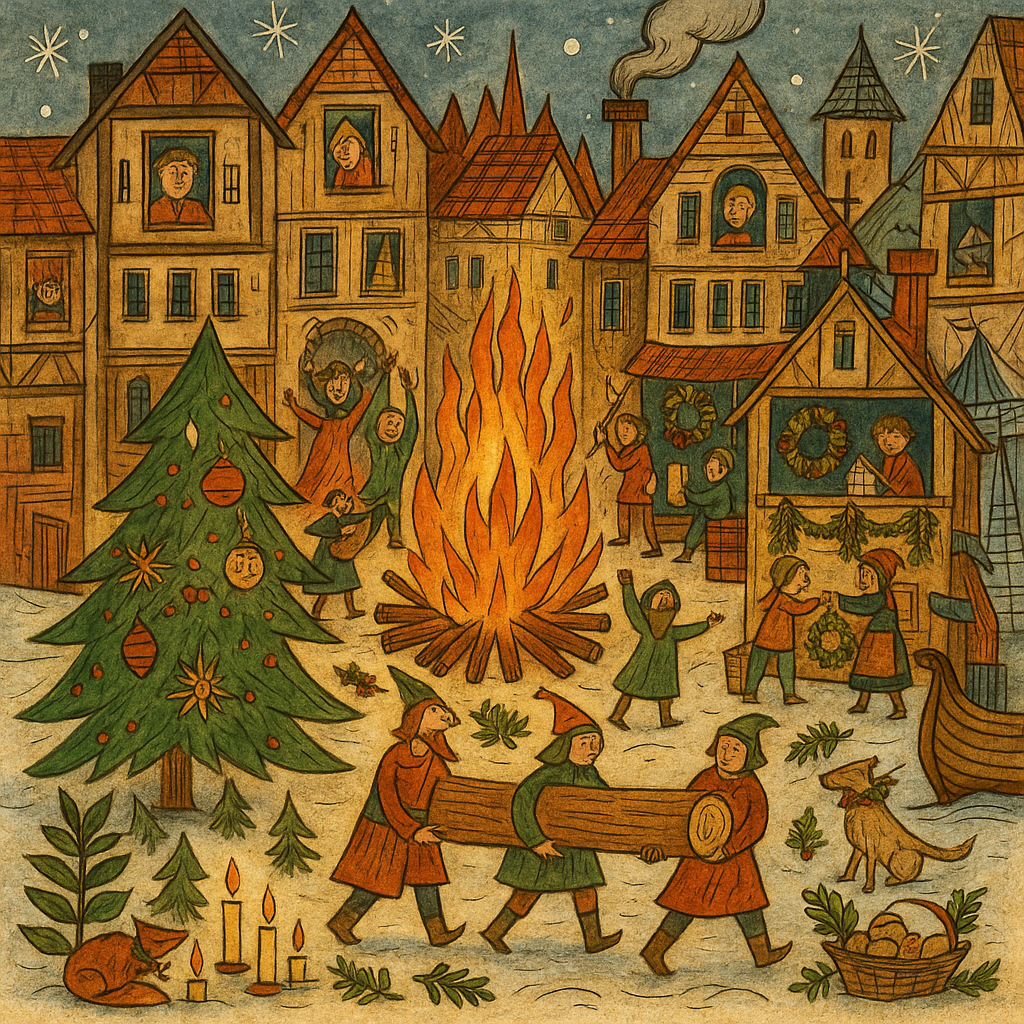
A bonfire burns in the square of a village decorated for Yule, as three men carry a large log

Fire and Evergreen: Yule Symbols That Refused to Die

When daylight wavered ancient communities turned to two symbols that never failed them: flame and evergreen. Both held their own stubborn kind of life, and both became anchors during the solstice when everything else felt fragile.

Fire mattered first. A single spark could warm a room, cook a meal or push back a night that seemed far too long. Solstice fires blazed across Northern Europe, and households saved embers from one year to light the next, carrying continuity through the cold. Candles flickered in windows not as decoration but as small suns, each one a promise that brightness would return.

Evergreens told a different story. While other trees surrendered their leaves, firs and pines stood unchanged, alive even in deep winter. People brought branches indoors to remind themselves that vitality could survive the freeze. Over time the practice grew into wreaths, boughs and eventually full trees decorated with symbols of protection and hope.

Together flame and evergreen formed a kind of winter vocabulary — living light and living green. They reassured people that nature was not finished, that renewal was already stirring, and that the season of returning warmth was on its way.

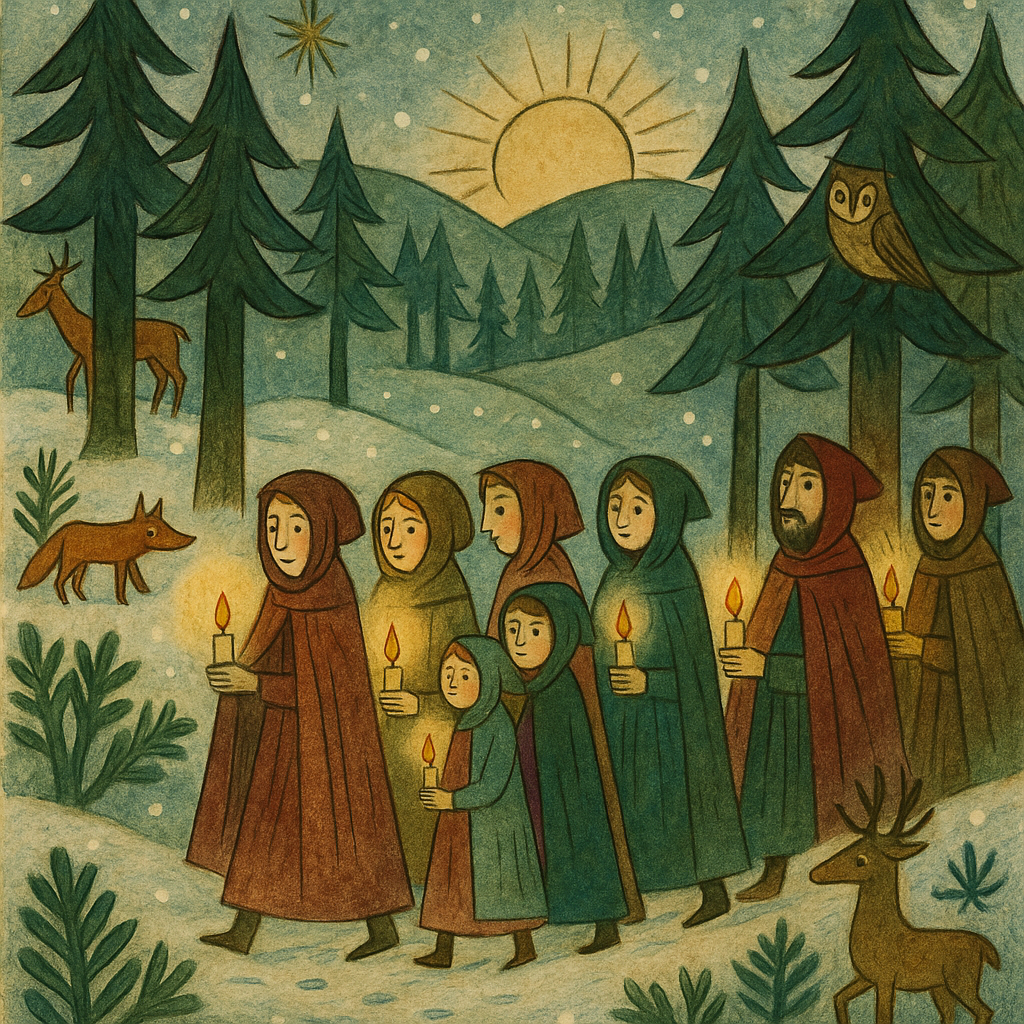
A group of people in cloaks walk through the snow in the woods at Yule, past an owl, deer and a fox

A Modern Rebirth at Yule: Inviting the Sun Back In

The solstice still carries that quiet threshold feeling, even if our winters come with central heating and streetlights. There’s a sense that the world pauses for a moment, holds its breath and waits for the slow return of something we can’t quite name. Yule rituals tap into that pause, using light and intention to mark the turning.

One simple practice begins before sunrise. Sit in the dim room, light a single candle and let its glow be the stand-in for the first spark of returning daylight. Breathe with it and think about what you want to coax back into your own life — confidence, momentum, joy, clarity, anything that feels like dawn.

If you keep evergreen in your home, hold a sprig or stand before your tree for a moment. That green resilience has been a solstice symbol for centuries. Let it remind you that growth often starts long before you can see it.

When the sun rises — even behind clouds — say a small rhyme to seal the moment:

“From darkest night the light is born,
I welcome back the rising morn.”

It’s simple, but that’s the point. Yule marks the return of light in the sky and in us, a slow brightening that starts with a spark.

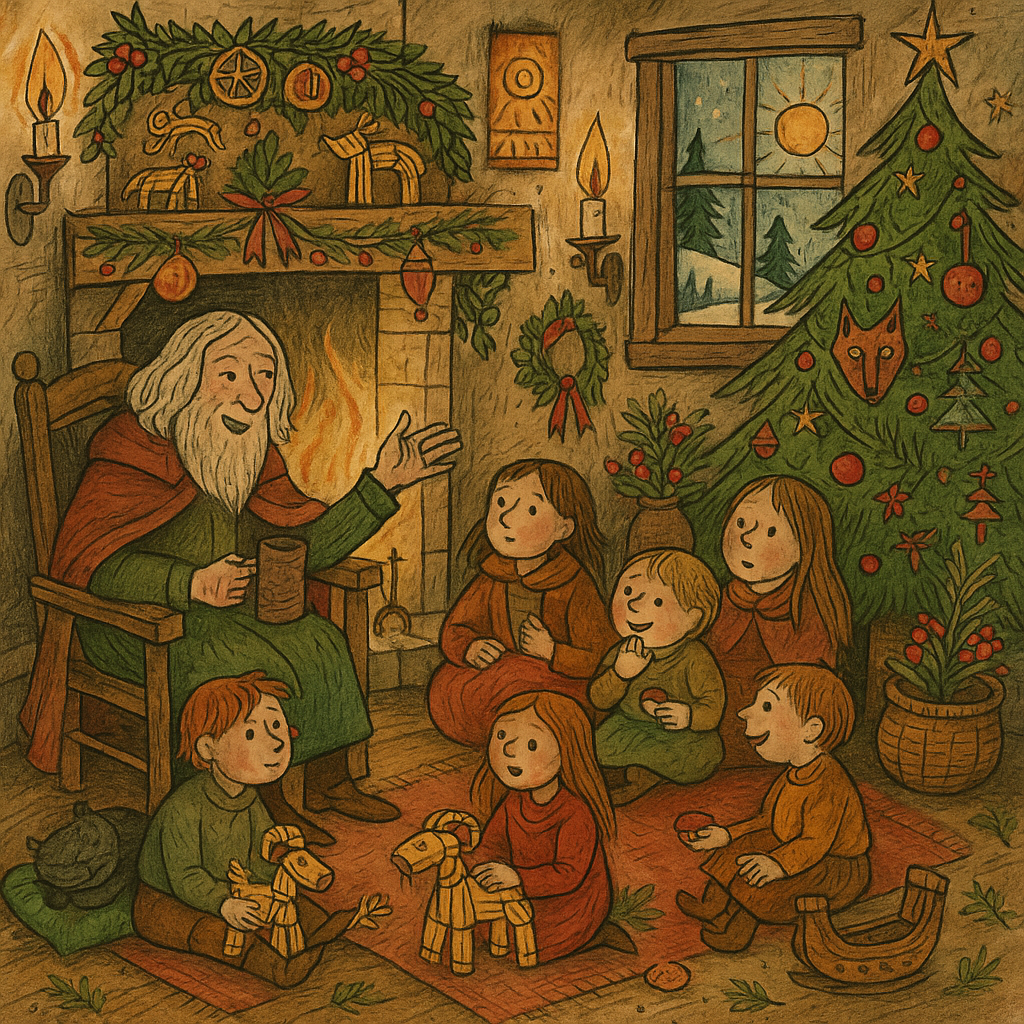
An old man sits by the fire drinking from a mug, telling a group of children a story, as they sit under the Christmas tree and play with toys

Yule Lore: Why We Keep Telling the Same Story

Every winter the world tilts into darkness, and every winter we wait for the moment it begins to turn back toward light. Ancient people explained that shift through stories of radiant children, brave returns and gods who refused to stay in the shadows. We still repeat those stories because the instinct behind them hasn’t changed.

The solstice reassures us that endings are rarely final, that light slips back even when it feels gone, and that renewal doesn’t need fanfare. It just needs time. That’s the heart of Yule — a promise written across the sky and retold every year when the night reaches its deepest point and then begins to lift. –Wally
Samhain Divination: Spooky Ways to See Beyond the Veil

Step into the shadowy world of Samhain divination. Discover the eerie Halloween rituals — candle scrying, mirror gazing and love charms — that promised glimpses of fate and fortune.

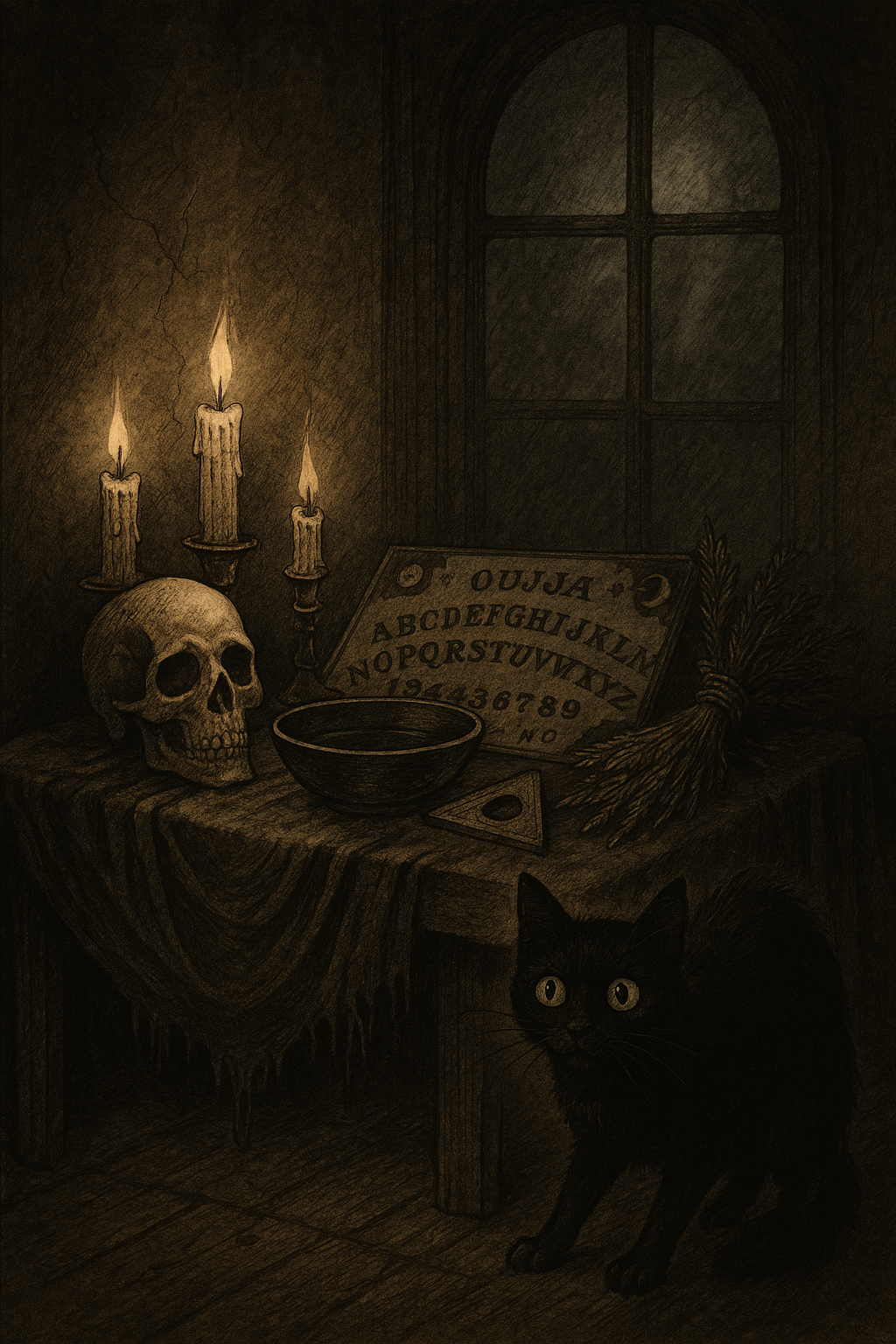
A skull, candles, bowl, sachet and Ouija board on altar at Samhain with black cat

On a night when the wind rattled the last leaves from the trees, the Celts gathered in the darkness. Samhain marked the final harvest — the moment the light surrendered to the long shadow of winter. But it was more than the year’s turning. It was the hinge of the seasons, when the Veil between worlds hung loose.

Fires roared on hilltops, and the smoke curled toward the Otherworld. People told stories of ancestors slipping through the mist, of the Fae wandering the fields, of spirits who could be welcomed — or warded off — with the right charms. And under the hush of night, away from the firelight, came the other part of Samhain: the asking.

Would the harvest last the winter? Would love come in the spring? Would danger walk the road ahead? The answers, they believed, could be coaxed from shadows, from flames, from the ripples of dark water. Samhain was a night for feasting and honoring the dead — but it was also a night for seeing what lay beyond.

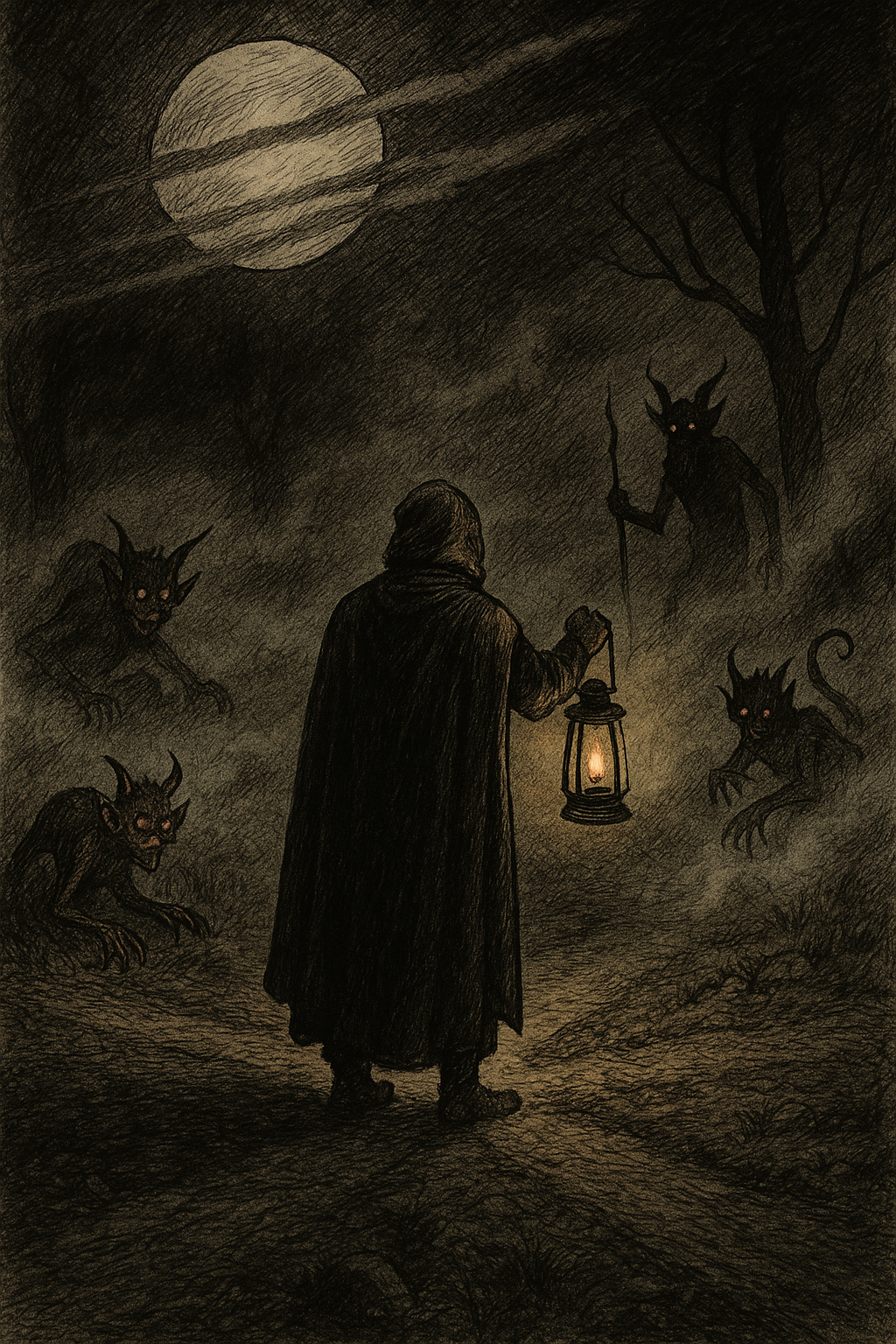
Demonic ghouls emerge from the mist to surround a lone walker in a cloak holding a lantern on Samhain

The Witch’s Hour: Midnight Magic

They called it the hour when the Veil thins to mere threads. Midnight on Samhain wasn’t for the faint of heart — the Celts believed it was when the Otherworld pressed closest, brushing against ours like a shadow across your skin. In later centuries, villagers in Ireland and Scotland would linger by the fire until the clock struck 12, then step outside, breath clouding in the cold, to test fate.

Some set a single candle in the window to draw their ancestors home. Others carried it to the crossroads to ask questions of the night — the flicker and sway of the flame said to be the spirits’ reply. 

Even now, witches and mystics mark the hour with divination: a one-card tarot pull for the year ahead, a pendulum swinging over a bowl of fresh spring water, or a simple candle-flame scrying.

If you try it yourself, remember the old caution: Always open with protection: salt at your threshold, a whispered blessing, a circle of light in your mind. The door you open to seek answers is the same one anything else could walk through.

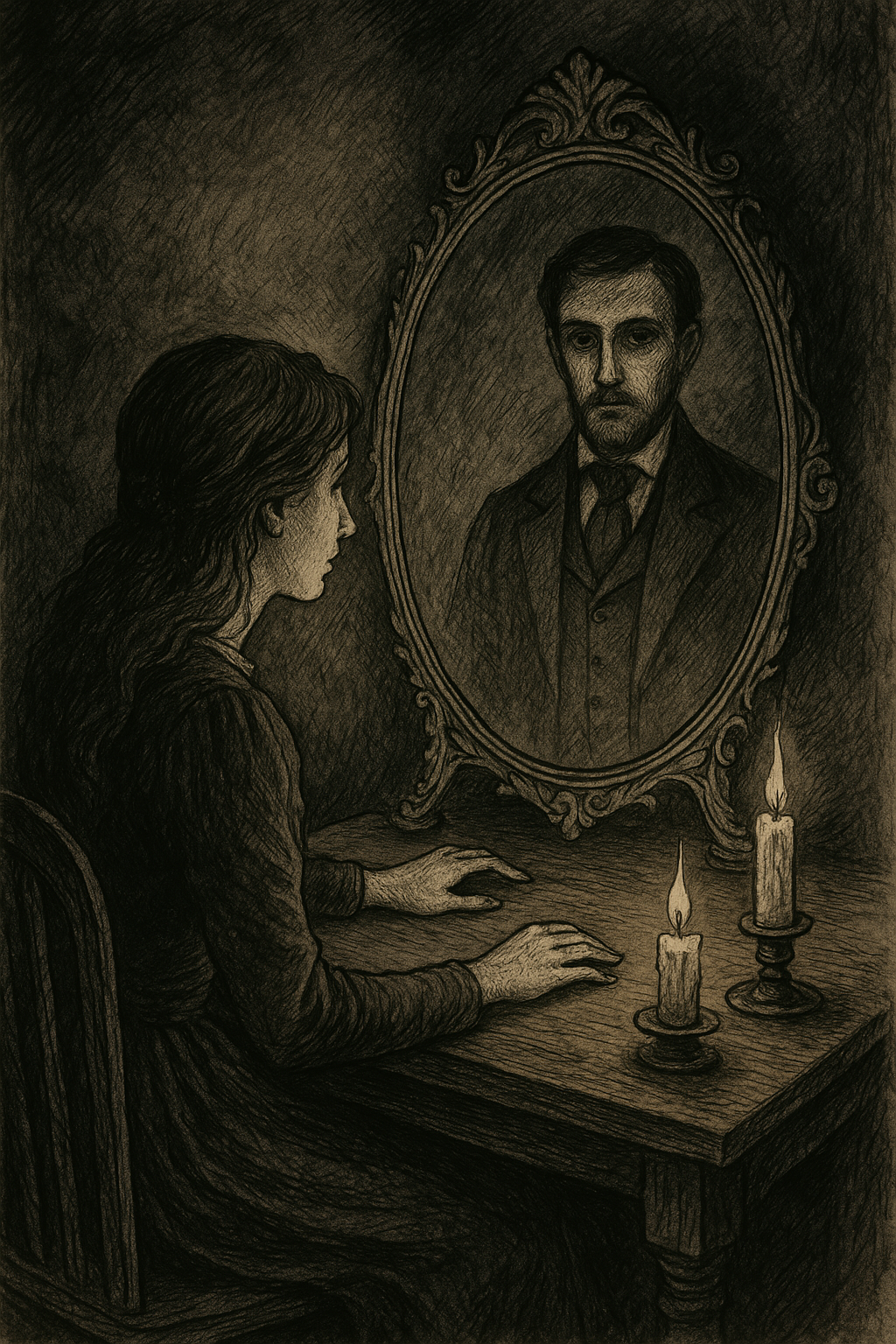
A woman does a Samhain love divination spell to see her future husband in a mirror

Mirror Magic

They say a mirror is more than glass; it’s a doorway, polished thin between worlds. On Samhain night, that doorway was thought to swing open, reflecting not just your face but the things that walked beside you. 

In Celtic lands, young women would sit alone in candlelight, staring into the glass to glimpse the man they’d marry. 

In Victorian parlors, Halloween party guests dared each other to walk backward into a darkened room, mirror in hand, to catch a fleeting vision of their future.

But the stories always came with a warning: The mirror will show you what is, not what you wish it to be. And if you look too long, you might not like what gazes back.

To try the old ways, place a candle on either side of a mirror and dim the rest of the lights. Focus on a question, soften your gaze, and wait. Shapes may stir in the shadows. Colors may shimmer at the edge of sight. Or nothing will come — which, on Samhain, might be its own kind of blessing.

If your reflection seems… different when you blow out the candles, remember to cover the glass. Every doorway needs to be shut.

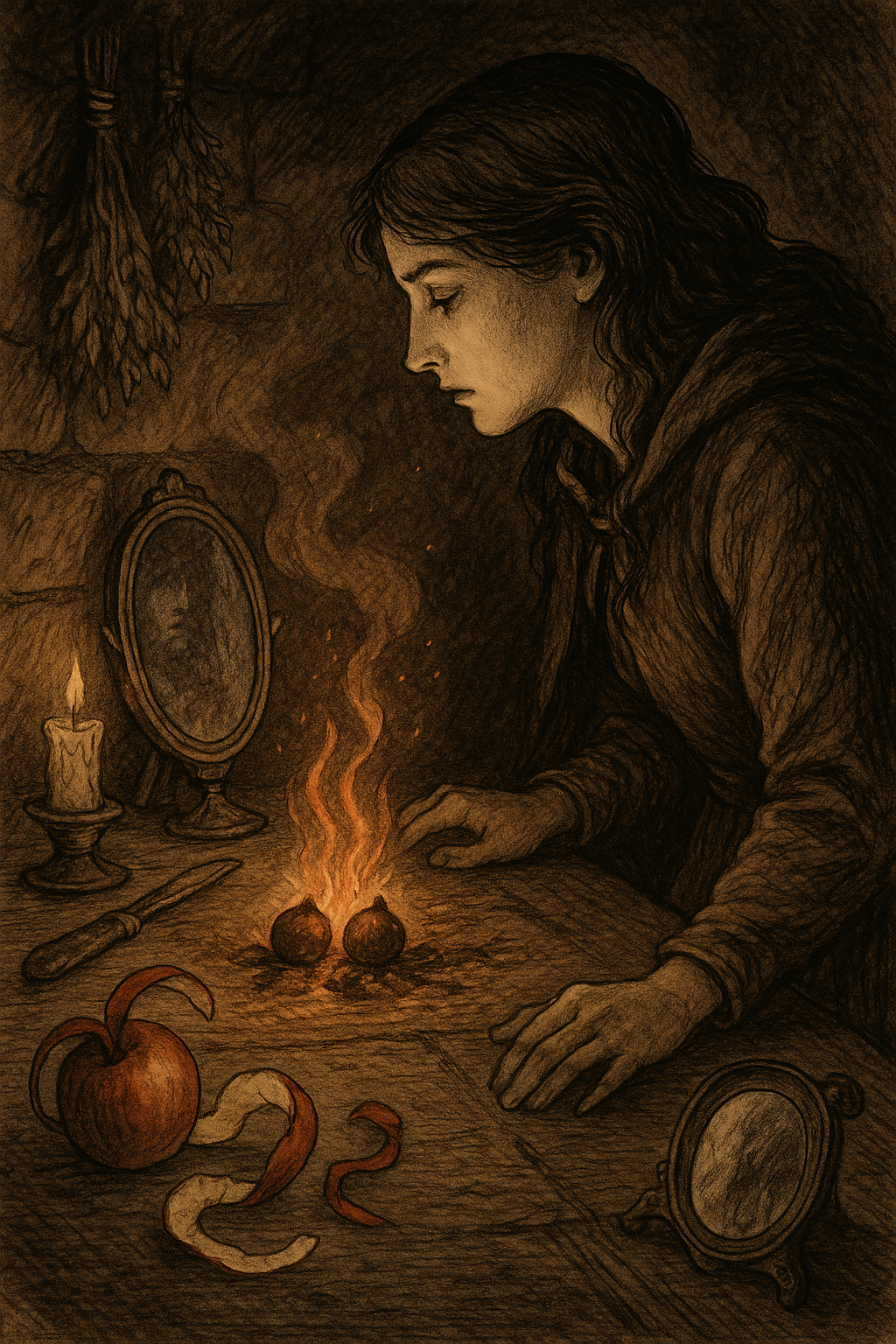
A woman performs love divination spells, with burning hazelnuts, a peeled apple, a candle and a mirror

Samhain’s Forgotten Love Spells

Not all Samhain divination was about warning of danger or calling the dead. Some of it was downright flirty — though with just enough edge to keep things interesting. In Ireland and Scotland, young women would peel an apple in one long strip, toss it over their shoulder, and squint at the shape it made on the floor — it was said to be the initial of their future love.

Others tossed two hazelnuts into the hearth fire — one for themselves, one for the person they fancied. If the nuts burned together, the match was true. If they popped apart, the romance was doomed. 

And then there was the mirror trick: Walk backward into a candlelit room holding a hand mirror, and your future spouse’s face would appear over your shoulder. Unless, of course, something else got there first.

These games mixed giddiness with a hint of danger — the thrill of asking the unknown about something as unpredictable as love. On Samhain night, the heart was fair game for the fates.


MORE: Try these Gypsy love spells


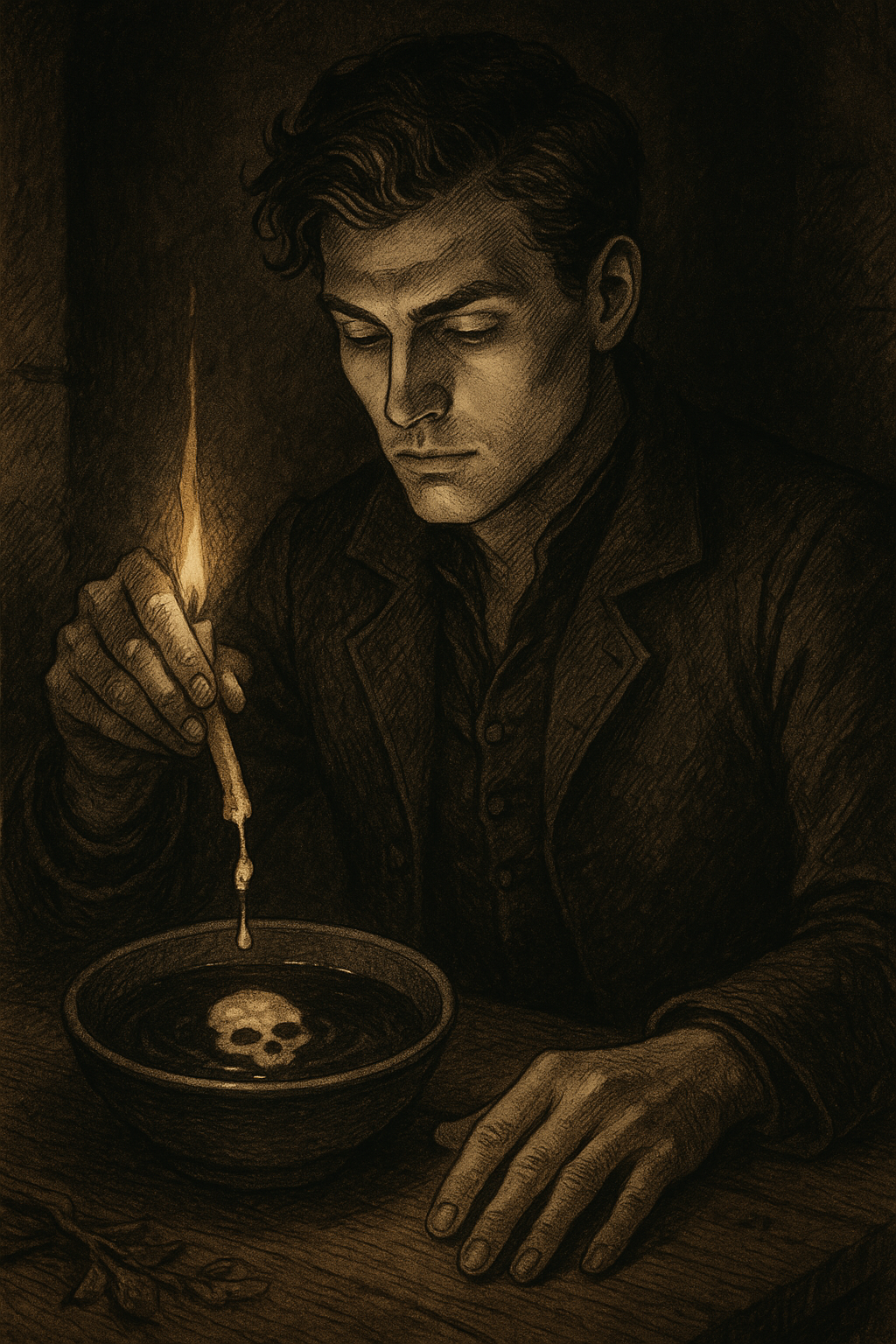
A man drips wax into a bowl as it forms a skull during a Samhain divination spell

Haunted Forms of Divination

Some tools are more powerful on Samhain night. The spirit or Ouija board, for example, had its great heyday in the early 1900s, when Halloween parties weren’t complete without one. Hands rested lightly on the planchette, waiting for it to slide toward letters and numbers, spelling out words no one dared to speak aloud. Whether the answers came from the subconscious or something far more sinister, people learned quickly to be careful about the questions they asked.

Others preferred scrying: gazing into a bowl of black water under moonlight until ripples of light and shadow shaped themselves into visions. 

In candle-wax reading, molten drops hit a waiting bowl of water, forming strange shapes said to hold meaning — a ship, a ring, a skull — each one a whisper from the unseen.

These methods carry the same rule the old folk gave for Samhain itself: Open your senses, but guard your spirit. What you invite in to answer may not be in a hurry to leave.

So when the last question has been asked and the candles have burned low, close the door between worlds with these words:

By flame and shadow, moon’s pale light,
I’ve heard the truths that walk the night.
Now shut the door, let silence keep,
And send all spirits back to sleep.

The night has spoken. You’ve seen through the Veil. Now bolt the door… before anything follows you home. –Wally 

MORE: Learn the freaky but fascinating history of Halloween

The Enchanting and Perilous World of the Fae

Explore the hidden world of fairies — from pixies and brownies to elves and gnomes. Discover why these mysterious beings captivate imaginations … and what secrets lie just beyond the mortal realm.

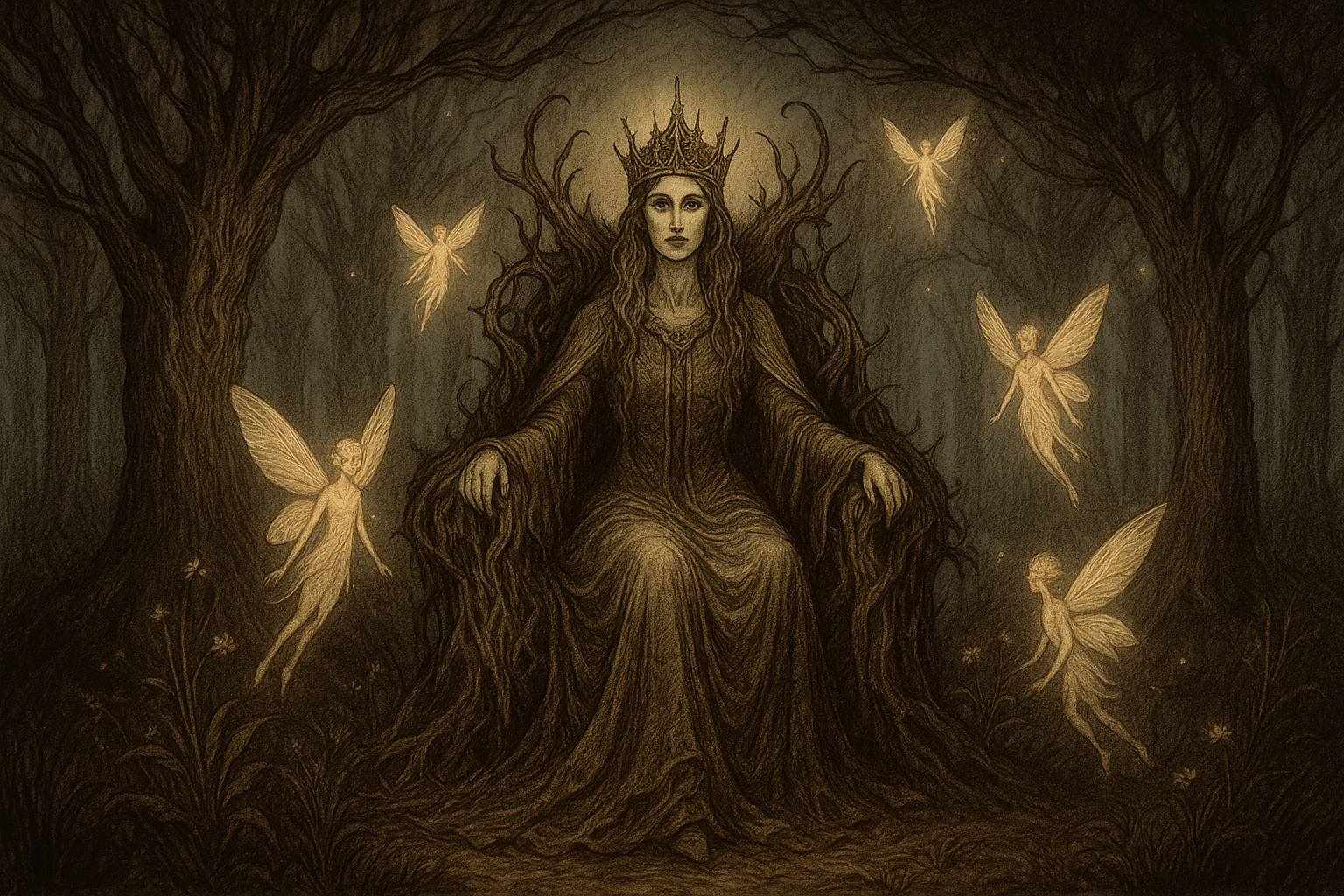
The Fae queen of the Seelie Court sits on her wooden throne, while smaller glowing fairies fly around her

The Seelie Queen on her thornwood throne

There are places in this world where the veil between realms grows thin: a lonely stretch of moorland, a glade deep in the woods, a ring of mushrooms. 

But beware, for the Fae are not the charming, glitter-winged sprites of modern fairy tales. They’re older than memory, creatures of wild magic, bound to no human morality. They can bless you with impossible luck or curse you with misfortune that lingers for generations. Some are beautiful beyond compare — slender and radiant, with eyes like moonlit pools. Others are twisted things, hunched and sharp-toothed, watching from the shadows.

To stumble upon the Fae is to risk losing yourself. Accept their gifts, and you may find they come at a terrible price. Eat their food, and you may never leave their world. Speak too freely, and they may steal your name, your shadow or your very soul. And if you are very unlucky or unwise — if the music lures you in, if the golden-haired stranger takes your hand — you may wake to find a hundred years have passed while you danced, and everyone you once knew is dust.

Yet still, we seek them out. We leave out offerings of milk and honey at Beltane, Litha and Samhain, whisper our wishes into the wind, and step just a little too close to the edge of the veil, hoping for a glimpse of something otherworldly.

Across the globe, countless myths and legends speak of these elusive beings, each culture shaping its own version of the Fae. Some are noble, some monstrous, some little more than a trick of the light. But one truth remains: The Fae are watching. And if you’re not careful, they may just take notice of you.

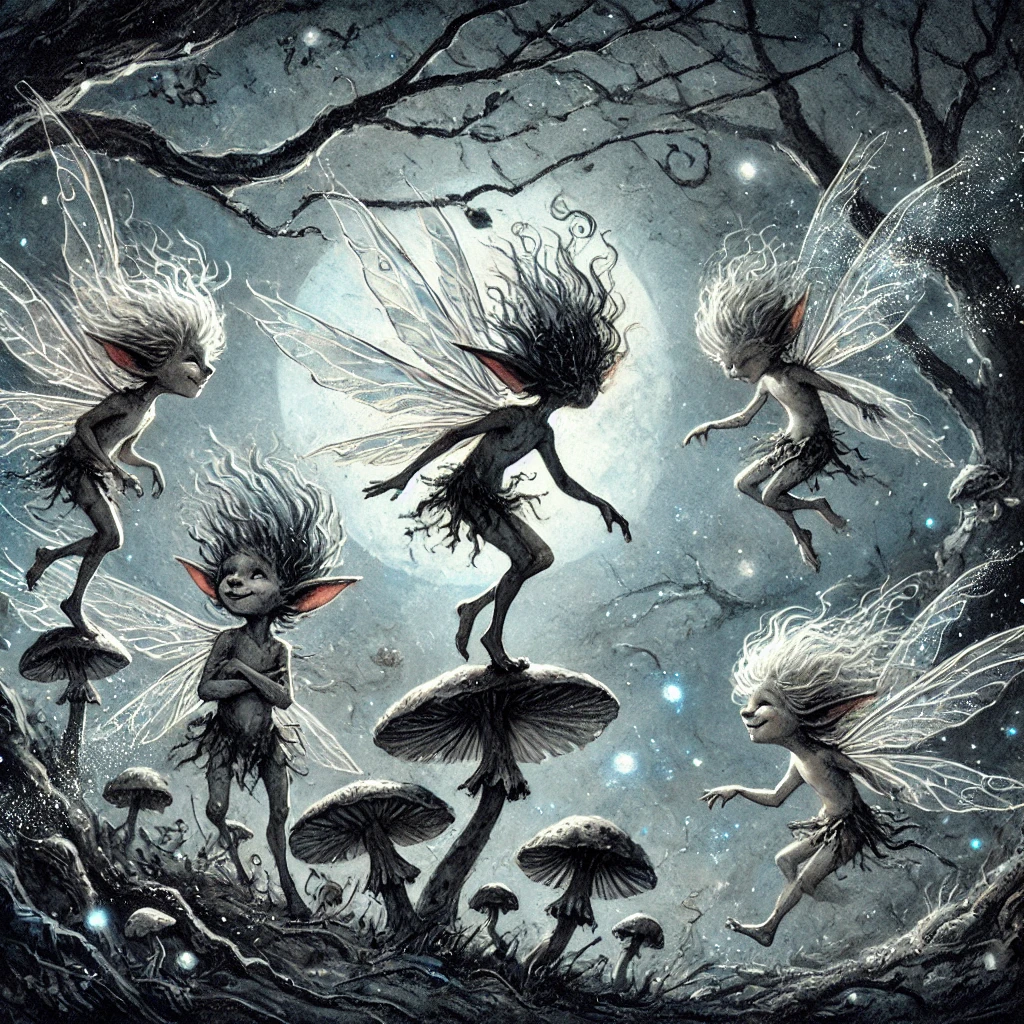
Small fairylike sprites fly under the light of a full moon in a forest with toadstools

Fairy Folklore Around the World

In different cultures, stories of the Fae take many forms — some enchanting, some terrifying, all captivating. Whether they’re the luminous Sidhe of Ireland, the cunning yōkai of Japan, or the water-dwelling rusalki of Slavic lore, fairies defy easy categorization. They’re both protectors and tricksters, wise beings and dangerous predators, granting favors with one hand and snatching them away with the other.

Let’s step into the shadowy glens and moonlit crossroads where the Fae linger, exploring how different cultures have imagined these otherworldly creatures — and where you might still find traces of them today.

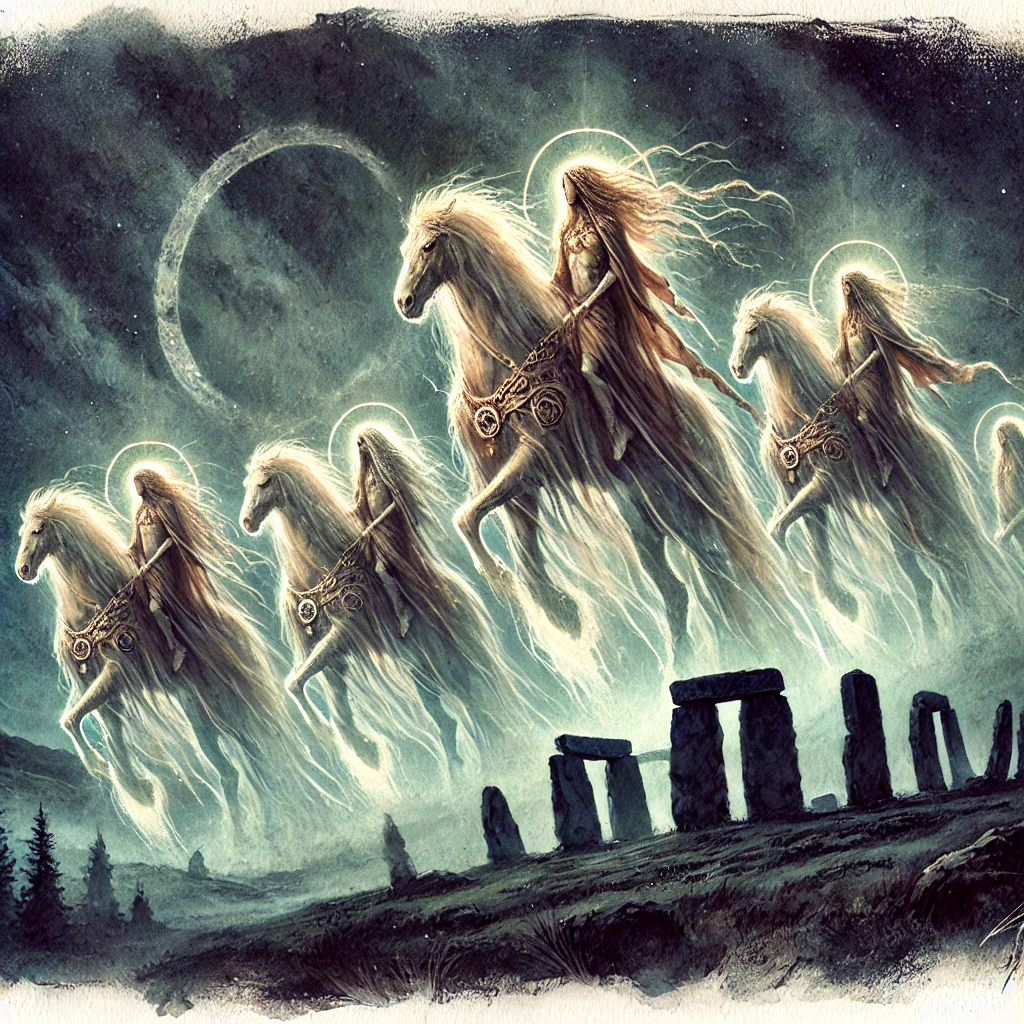
The Tuatha Dé Danann, or Sidhe, ride their spectral horses above Stonehenge

The Tuatha Dé Danann, or Sidhe, riding their spectral horses

The Tuatha Dé Danann and Irish Fairies

Beneath the rolling green hills of Ireland, hidden within ancient mounds and hollowed-out trees, dwell the Sidhe (pronounced “Shee”), the Shining Ones. These are no fluttering pixies, but tall, radiant beings, their beauty almost painful to behold. Clad in shimmering garments, their eyes hold the weight of centuries, and their voices carry the echoes of forgotten songs.

The Tuatha Dé Danann, Ireland’s old gods, were said to have retreated into the earth after their defeat, becoming the Sidhe of legend. They ride out on spectral horses, sweeping mortals away in a fever dream of music and revelry. Some who enter their world return, forever changed; others vanish without a trace.

Not all Irish fairies are so regal. The púca, a shapeshifter, appears as a sleek black horse with burning eyes, a rabbit, or even a goblin-like creature with long fingers and an unsettling grin. 

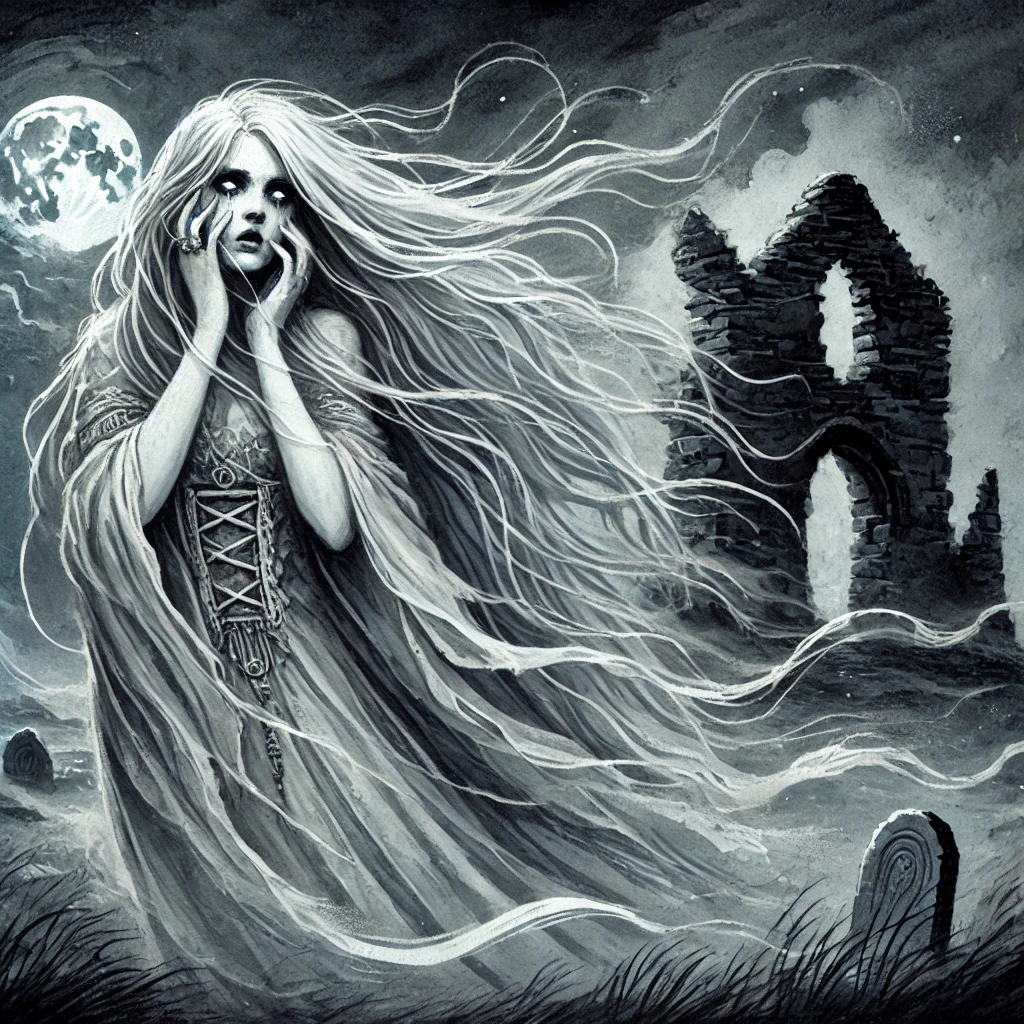
The banshee, with her silver hair and wailing cries, is a harbinger of death, while changelings — sickly, eerie children left in place of stolen human babies — are a reminder of the Fae’s more sinister tendencies.

A banshee with long flowing hair clutches her face at night by a ruined church and graveyard

A banshee’s wail means someone you love is about to die.

Irish Fae in Popular Tales

  • The Stolen Child by W.B. Yeats captures the allure of the fairies, calling children away to a land of “waters and the wild.”

  • In The Call by Peadar Ó Guilín, modern teenagers are abducted into the Grey Land of the Sidhe, where they must survive deadly hunts.

  • Jonathan Strange & Mr Norrell by Susanna Clarke presents a version of the Fae as manipulative and powerful, with the Gentleman with the Thistledown Hair embodying their eerie and unpredictable nature.

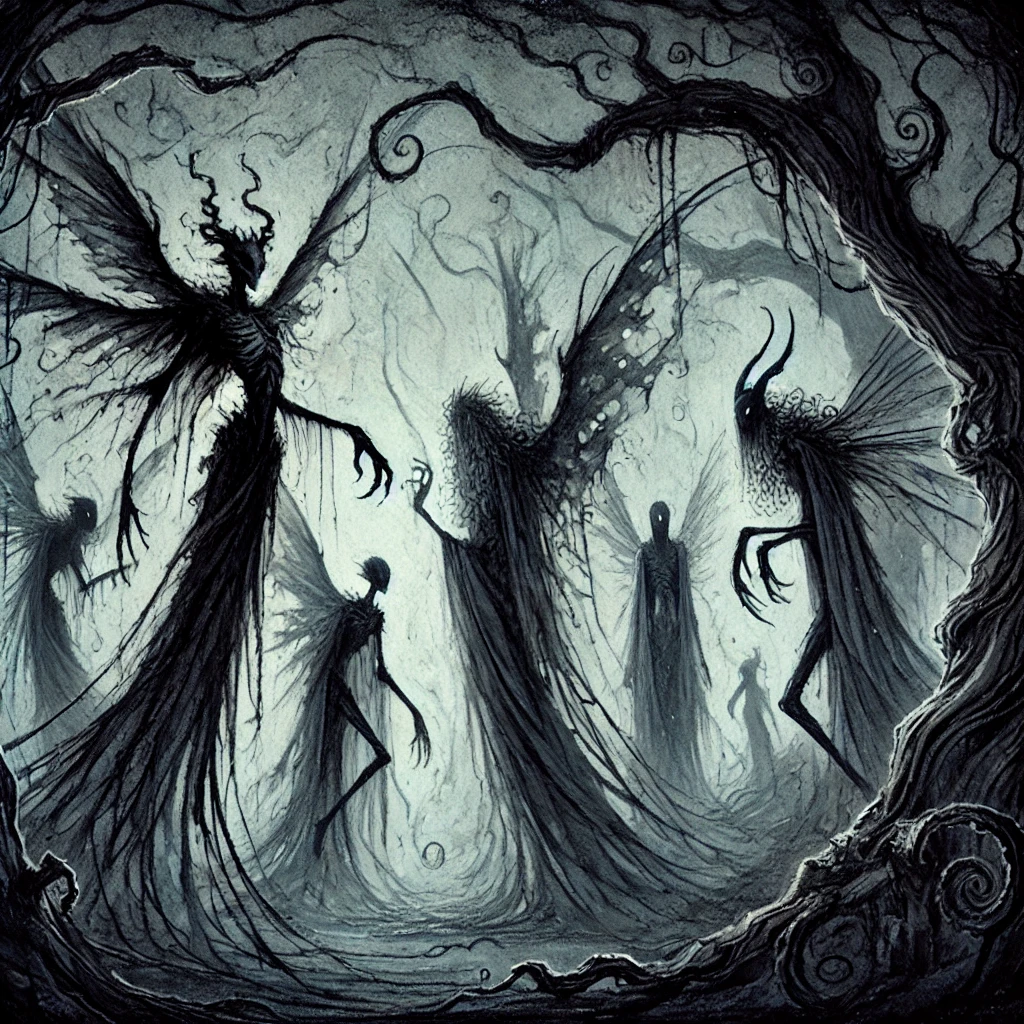
Dark, horned, spectral Fae in the woods of the Unseelie Court

The Unseelie Court is home to the more malevolent fairy folk.

Scottish Fairy Lore and the Seelie and Unseelie Courts

In Scotland, the fairy realm is split into two factions: the Seelie Court, filled with fairies who are mischievous but not entirely malevolent, and the Unseelie Court, where malevolence runs rampant.

Seelie fairies might grant favors to those who respect them, though their “gifts” often have unintended consequences. The Unseelie, however, are another matter entirely. These fairies lurk at crossroads and lonely moors, hunting in packs and carrying off travelers who wander too close to their domain.

Among them are the redcaps, murderous goblins that dwell in ruined towers, their caps stained with the blood of their victims. 

The kelpies, sleek black water-horses, lure riders onto their backs before dragging them into the depths. 

And the brownies, small, shaggy-haired house spirits, help with household chores — so long as they are respected and well fed.

A shaggy-haired brownie sweeps its home by a fire in the stove

A helpful brownie

Scottish Fae in Popular Tales

  • Tam Lin, a classic Scottish ballad, tells of a mortal man, stolen away by the Fairy Queen, who can only be rescued through a terrifying midnight ritual.

  • In The Falconer by Elizabeth May, Scottish fairies are reimagined as deadly creatures warring against humans.

  • The Unseelie Court’s dangerous and dark magic is woven into Holly Black’s The Cruel Prince series, where the Fae are as beautiful as they are treacherous.

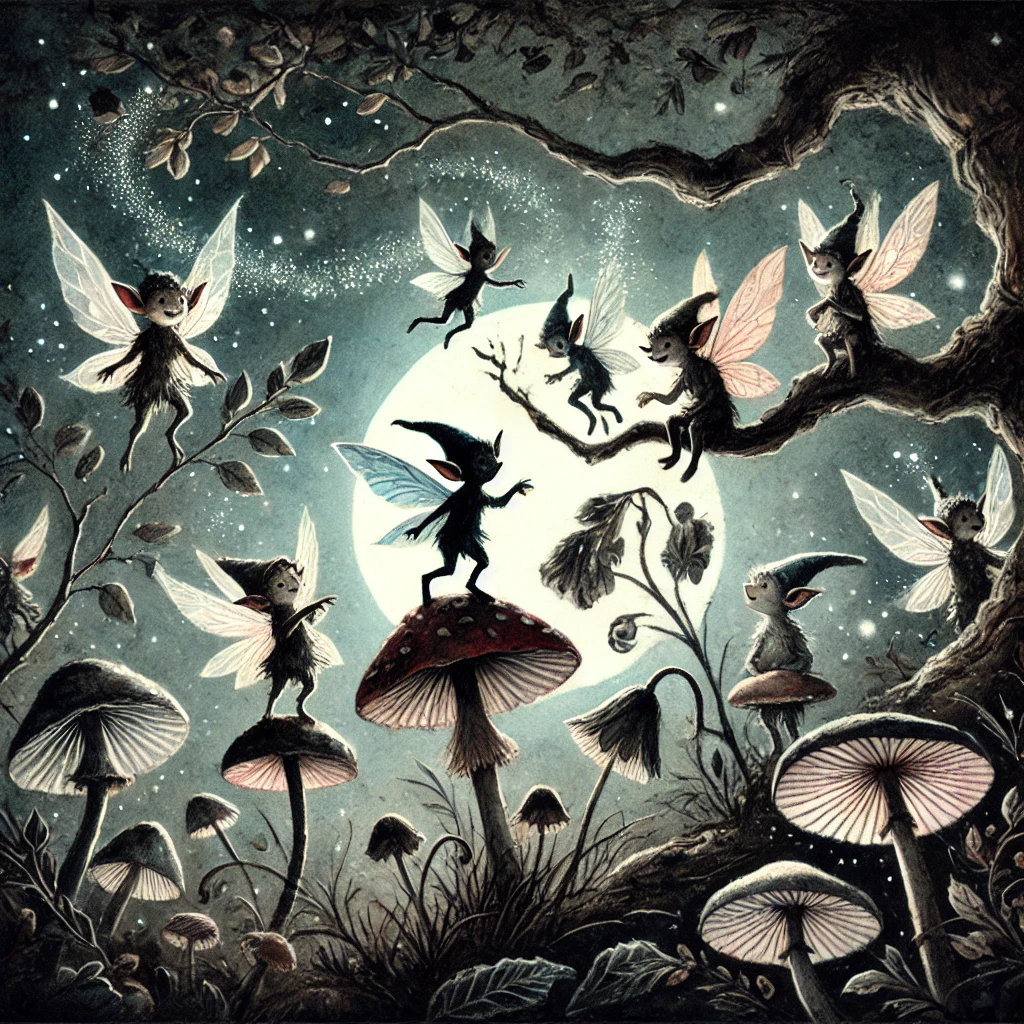
Pixies fly merrily by mushrooms and trees on a night with a full moon

A plague of pesky pixies

English and Welsh Fairies: Tricksters, Ghosts and the Wild Hunt

In the misty forests and moors of England and Wales, the fairy folk take on many forms — some charming, some terrifying, all deeply tied to the land.

The pixies of Devon and Cornwall are small, impish creatures with pointed ears and mischievous grins, known for leading travelers astray with will-o’-the-wisps or tangling horses’ manes into fairy knots. Unlike their Irish or Scottish counterparts, they’re more playful than malicious, though they can still cause trouble if insulted. 

But the Fae of England aren’t all harmless. The Wild Hunt, a spectral procession of ghostly riders led by a dark figure — sometimes the Devil himself, sometimes the mythic Herne the Hunter — thunders across the sky, sweeping up any mortal unlucky enough to cross its path. 

Meanwhile, the Green Children of Woolpit, a medieval legend, tell of two strange, green-skinned kids who appeared in a village, speaking an unknown language and claiming to be from an underground world. Were they lost fairies?

Even the land itself is said to be enchanted. The Fairy Paths, invisible roads used by the Fae, must never be obstructed by buildings, or bad luck will follow. 

The Fairy Godmothers of later fairy tales may have originated from old beliefs in household fairies, protective spirits who could bestow gifts or curses on infants.

British Fae in Popular Tales

  • Susanna Clarke’s The Ladies of Grace Adieu reimagines English fairy lore with eerie and elegant storytelling.

  • Terry Pratchett’s Lords and Ladies features fairies that are predatory and cruel, a nod to their older, darker origins.

  • The legend of the Wild Hunt plays a major role in Katherine Arden’s The Winter of the Witch and Hellboy comics. 

  • Pixies show up in the Harry Potter series and the game Harry Potter: Wizards Unite

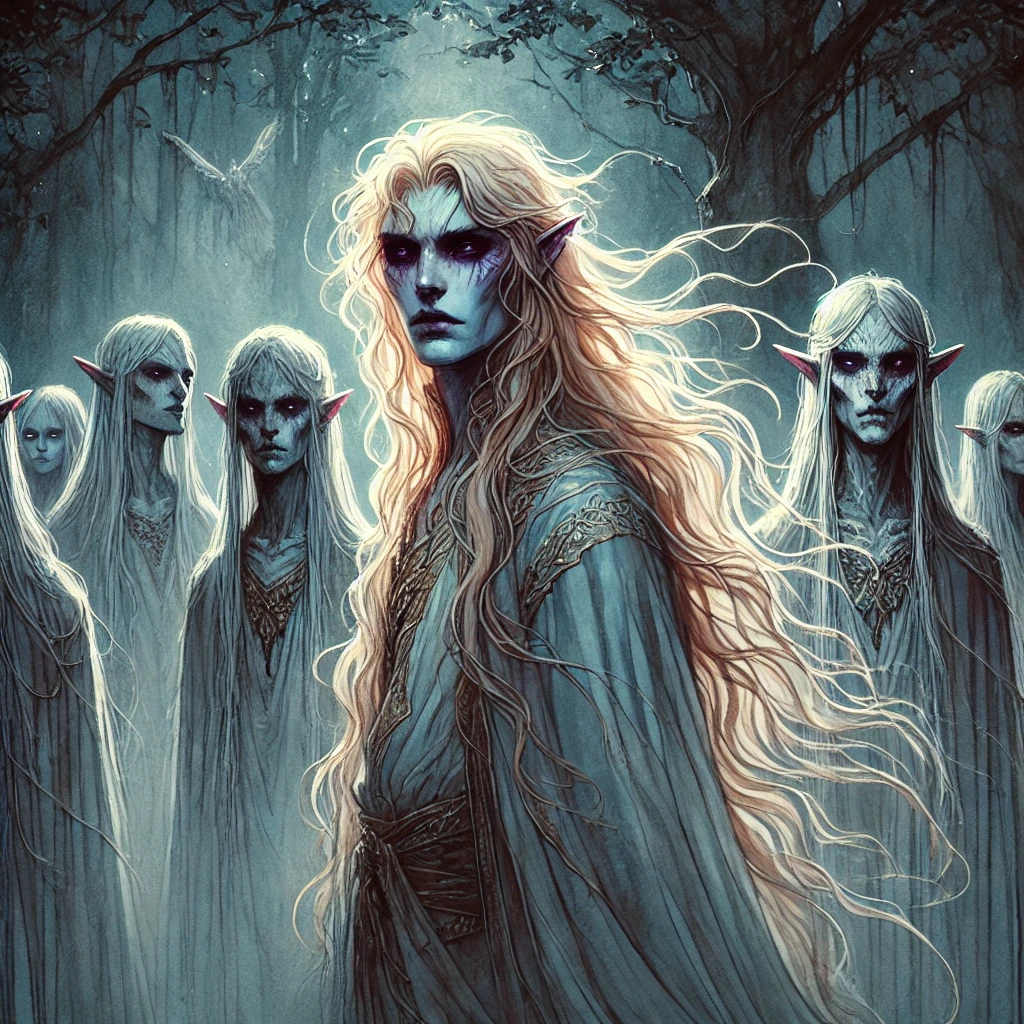
A group of Álfar, tall, thin elves with long light hair and pointed ears

The Álfar, tall, luminous, godlike entities, influenced the elves of Tolkien and D&D.

Norse and Germanic Fairies: Elves, Forest Spirits and the Nachtmahr

Long before fairies flitted through English gardens, the Norse and Germanic peoples told of the Álfar, or elves: tall, eerily beautiful beings who lived in hidden places and wielded great magic. Unlike later fairies, these elves were closer to minor gods, capable of both great kindness and great wrath. In some sagas, they were luminous, golden-haired beings; in others, they were pale and unsettling, dwelling in mist-shrouded groves and demanding offerings.

But not all the hidden folk were so noble. The nachtmahr, a twisted shadow spirit, crept into homes at night, sitting on the chests of sleepers and filling their dreams with terror; our word nightmare comes from this legend. 

The erlking, a malevolent woodland fairy, lured children to their doom with whispered promises, immortalized in Goethe’s haunting poem.

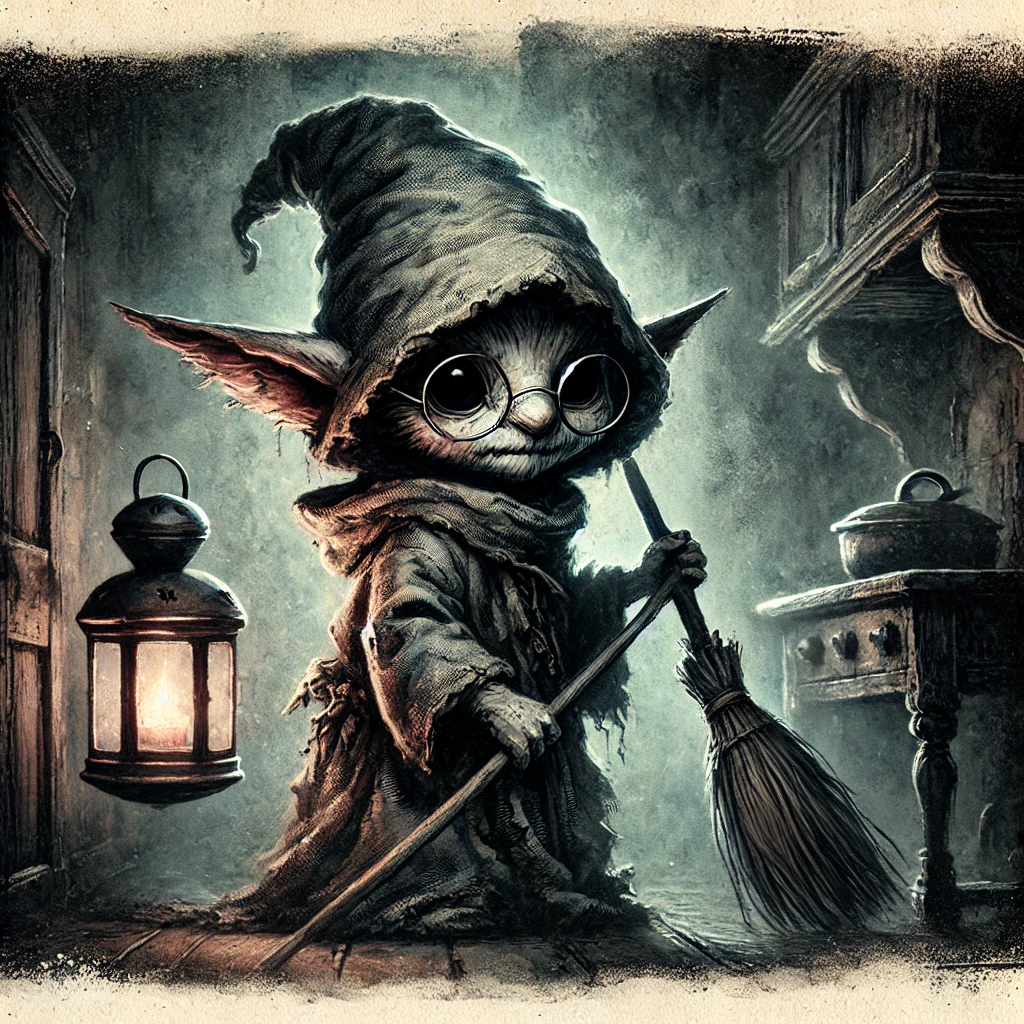
Then there were the kobolds, household spirits that could be either helpful or destructive. Resembling small, gnome-like figures, they lived in homes and ships, protecting the inhabitants if treated well, but turning mischievous or even vengeful if neglected. Some German miners believed kobolds lived in the mines, warning workers of cave-ins — or causing them.

A small kobold dressed in rags, a pointed hat and round glasses, holding a broom in his small home while a lantern floats next to him

The helpful kobolds of folklore and much different from the lizard-like monsters from D&D.

Norse and German Fae in Popular Tales

  • The erlking appears in literature from Goethe’s poetry to Jim Butcher’s Dresden Files, always as a chillingly powerful figure.

  • Tolkien’s elves, with their captivating beauty and ancient wisdom, owe much to Norse and Germanic fairy lore.

  • Neil Gaiman’s Norse Mythology explores the strange, otherworldly side of the Álfar. (Learn more about the Norse gods.)

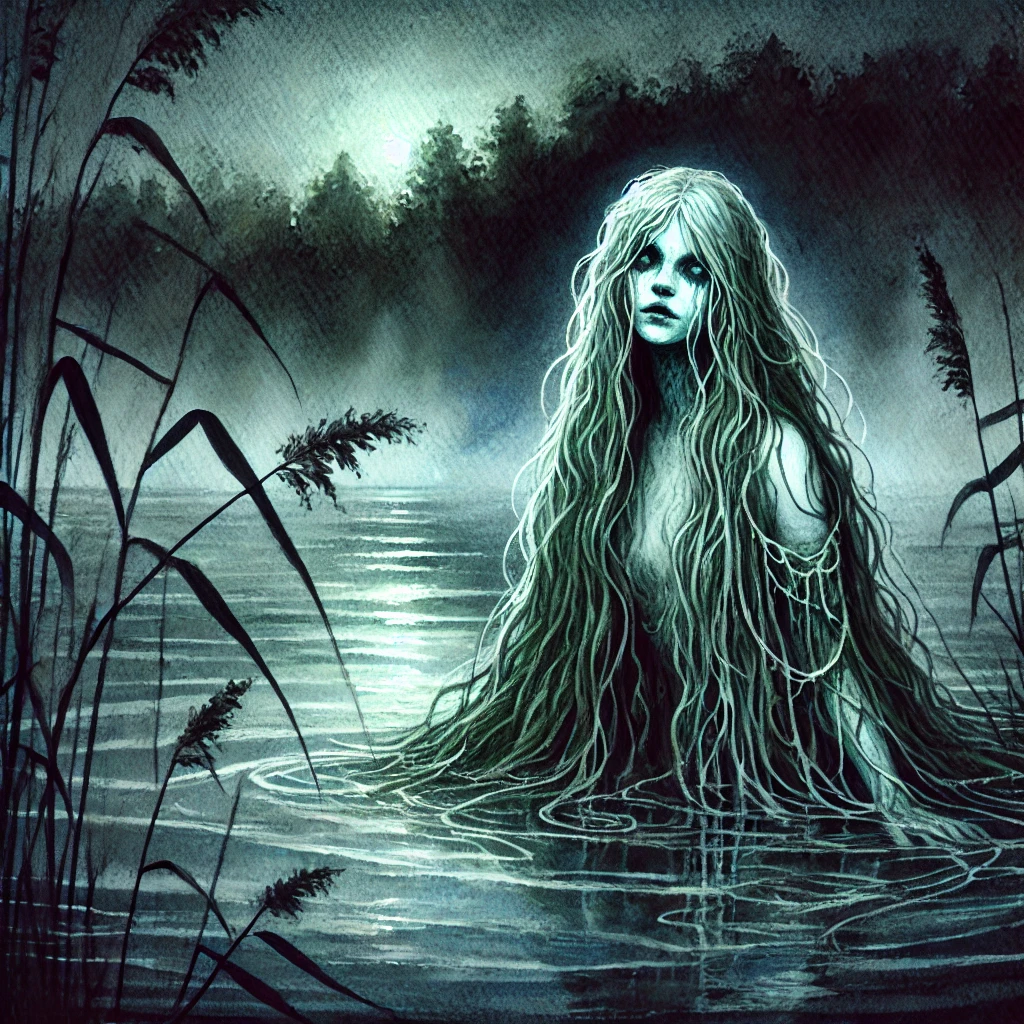
A rusalka, the spirit of a drowned young woman, with long hair, stands in the water at night

A rusalka, the spirit of a drowned young woman, wants men to share her fate.

Slavic Fairies and the Rusalka: Spirits of Water and Wood

Slavic folklore is thick with spirits, many of whom blur the line between fairy, ghost and demon. The rusalka is one of the most haunting: a drowned maiden with pale, luminous skin and long, green-tinted hair, she lingers near lakes and rivers, singing to lure men into the depths. Some legends say she’s vengeful, dragging victims under; others say she’s  simply lonely, forever searching for a lost love.

Then there are the domovoi, small, hairy house spirits with glowing eyes. Unlike the trickster fairies of the British Isles, a domovoi was a family guardian, keeping the household safe — so long as it was honored with milk, bread and respect. A neglected domovoi could become vengeful, making life miserable for the home’s inhabitants.

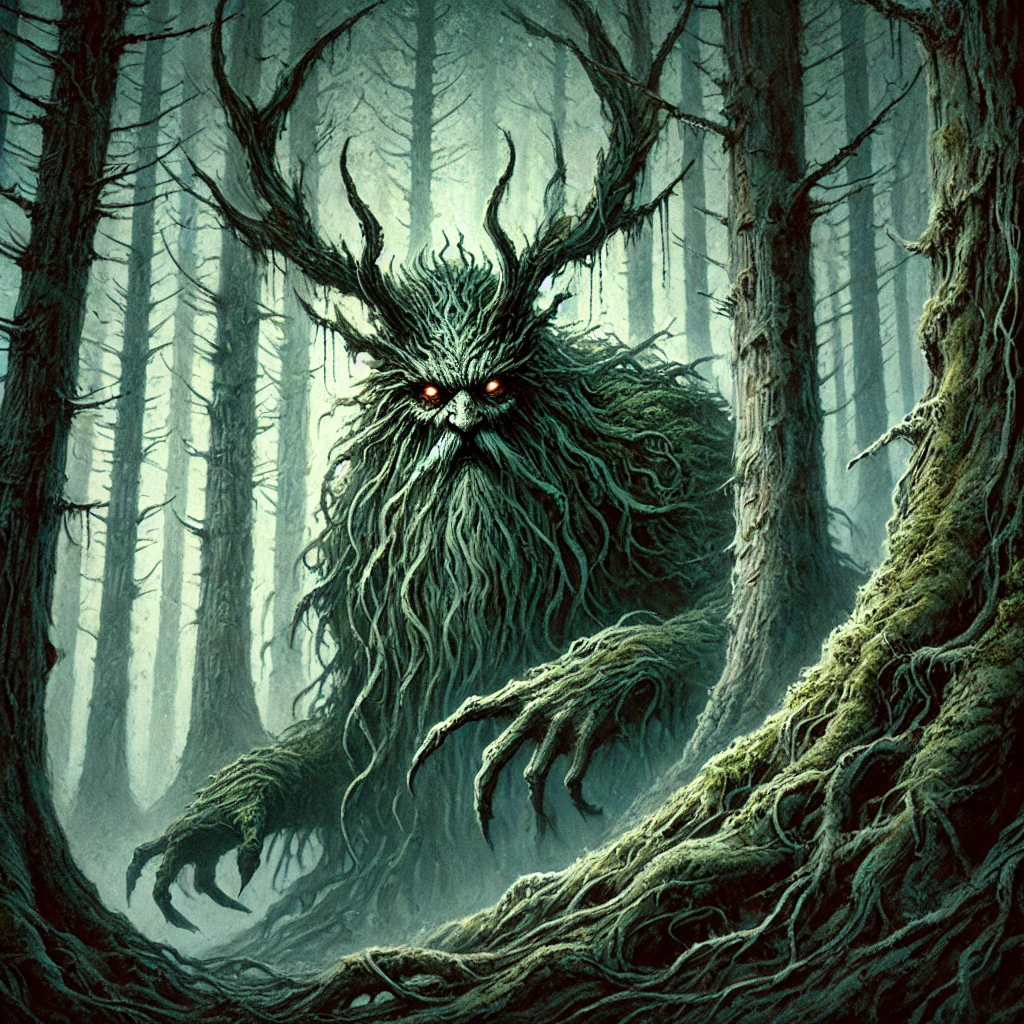
In the dark forests, the leshy reigns: a towering, moss-covered figure with bark for skin and eyes like glowing embers. He’s the master of the woods, able to shift size at will. Travelers who fail to pay their respects may find themselves lost for days, their paths twisting back on themselves under the leshy’s watchful gaze.

A leshy, large, gnarled like a tree, with glowing eyes and staglike horns

The leshy, shapeshifting master of the woods

Slavic Fae in Popular Tales

  • The Bear and the Nightingale by Katherine Arden weaves Slavic fairy spirits like the domovoi and rusalka into a lush historical fantasy.

  • The leshy appears in numerous Russian fairy tales and in modern fantasy, including The Witcher series.

  • The eerie, dreamlike world of the rusalka is captured in Alexander Pushkin’s poetry and Dvořák’s opera.

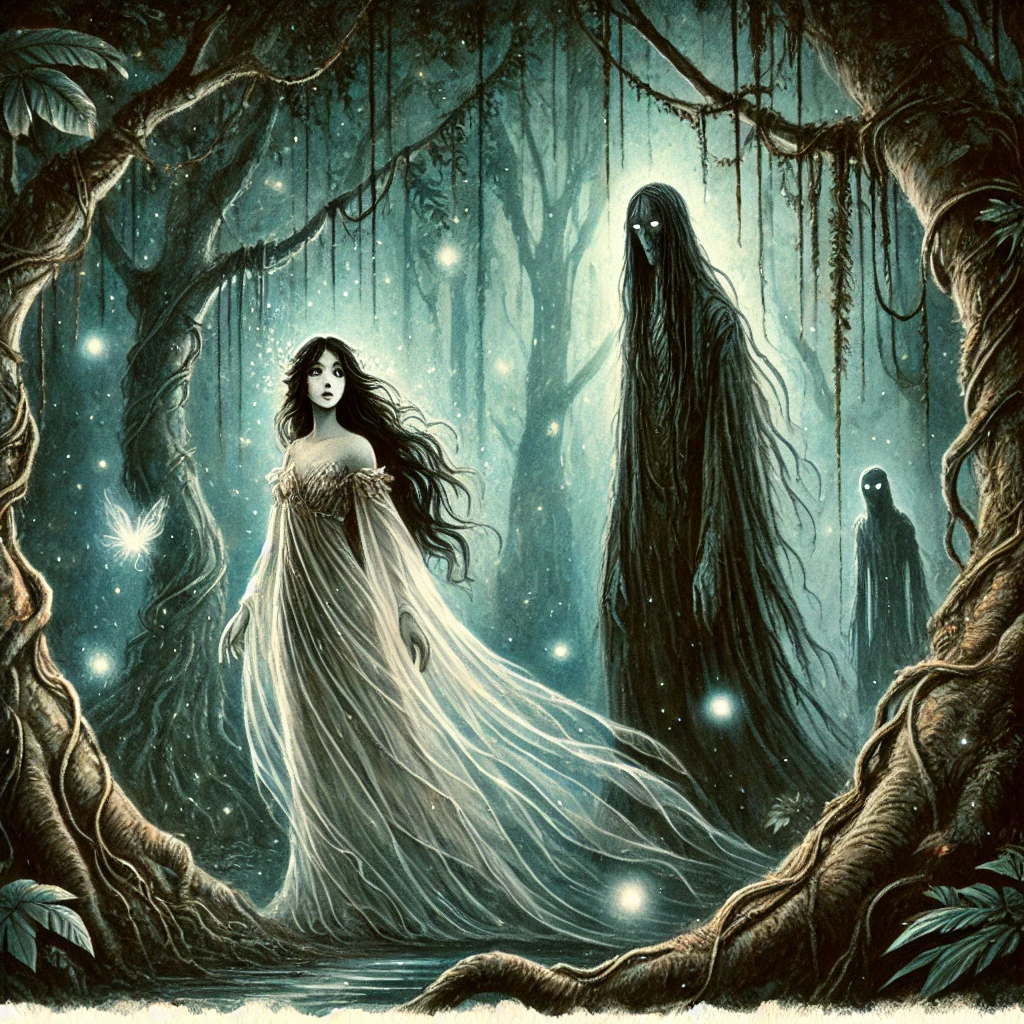
A diwata, a ghostly woman, and engkantos, a tall, thin, black, menacing spirit

The diwata and engkantos of the Philippines can be kind or cruel, depending on how you treat them.

The Fairies of Other Cultures

Fairy-like beings exist worldwide, often blending nature spirits, ancestral ghosts and mischievous tricksters.

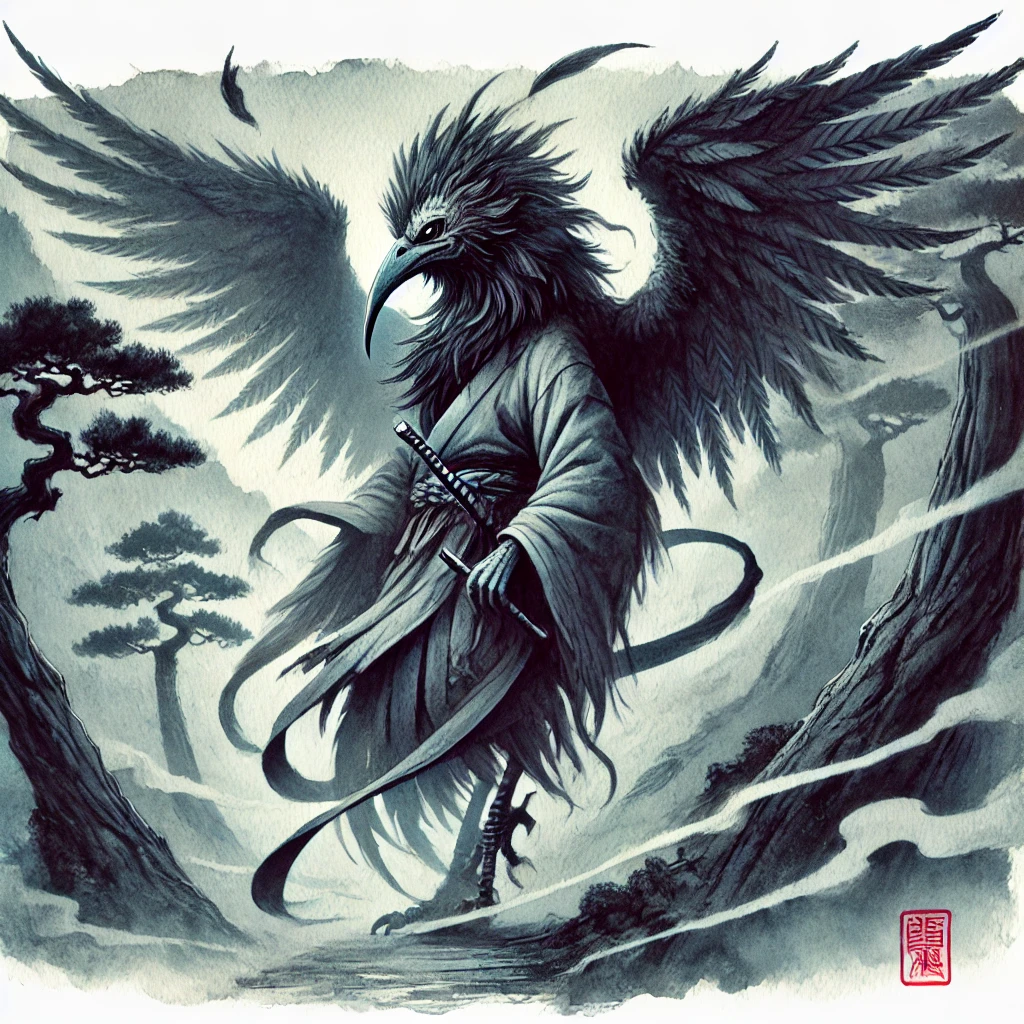
The tengu, a bird spirit dressed like a samurai by bonsai trees in the mist

Tengu love to mess with overly proud samurai — creating illusions, stealing weapons or dragging them into duels they can’t win. I

Japanese Yōkai: Creatures like kodama, tree spirits that live in ancient forests, or tengu, bird-like beings who trick travelers and test warriors, share many fairy-like qualities.

Filipino Diwata and Engkantos: Often compared to elves, these spirits of the forests and mountains can be either generous or cruel, depending on how they’re treated.

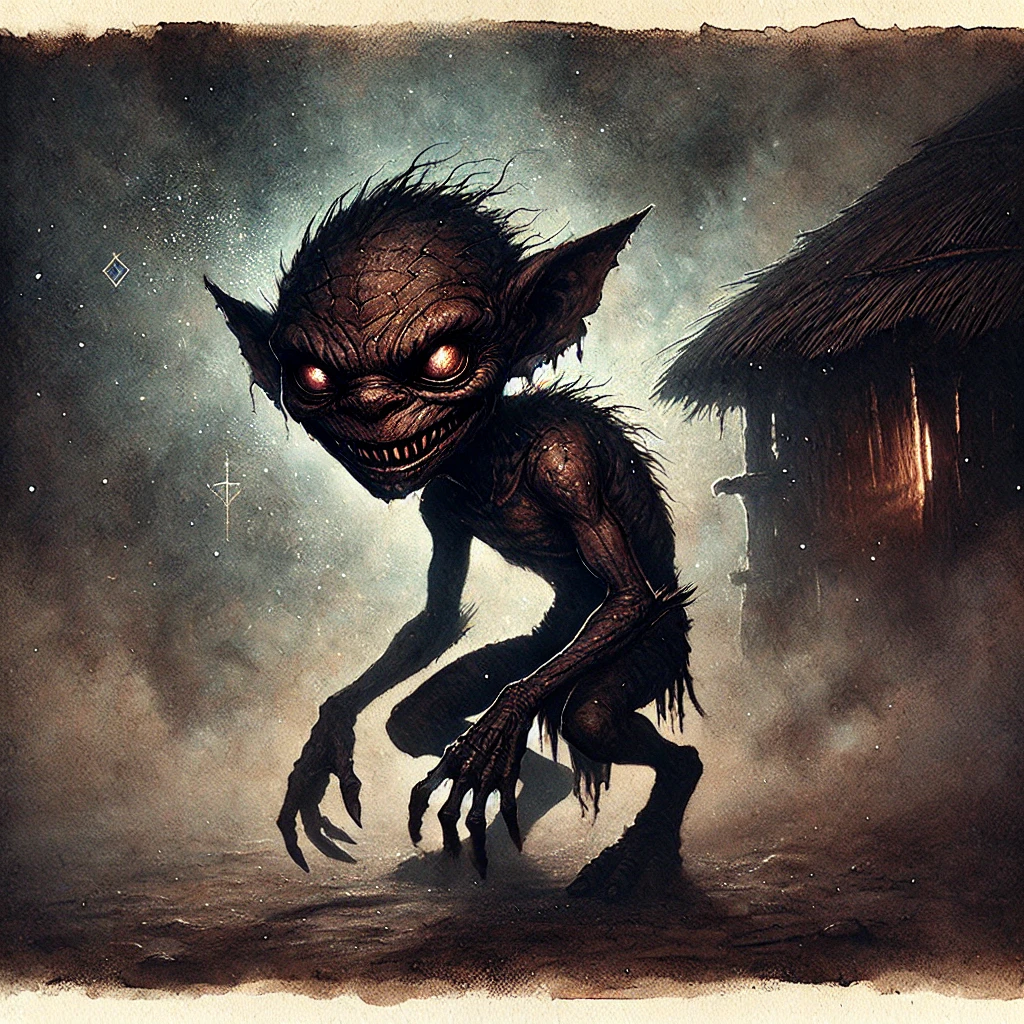
African and Caribbean Spirits: Figures like the tokoloshe in South Africa — a small, goblin-like trickster — bear similarities to European goblins and sprites.

A tokoloshe, a menacing gremlinlike creature with glowing eyes and a creepy smile, by a thatched-roof hut

The trickster tokoloshe from South Africa

Fae From Around the World in Popular Tales

  • Spirited Away, the Studio Ghibli film, is a masterful portrayal of Japanese fairies and spirits.

  • The Girl From the Well by Rin Chupeco draws on Japanese and Filipino ghost fairy traditions.

  • Nalo Hopkinson’s Brown Girl in the Ring weaves Caribbean folklore into a dystopian fairy tale.

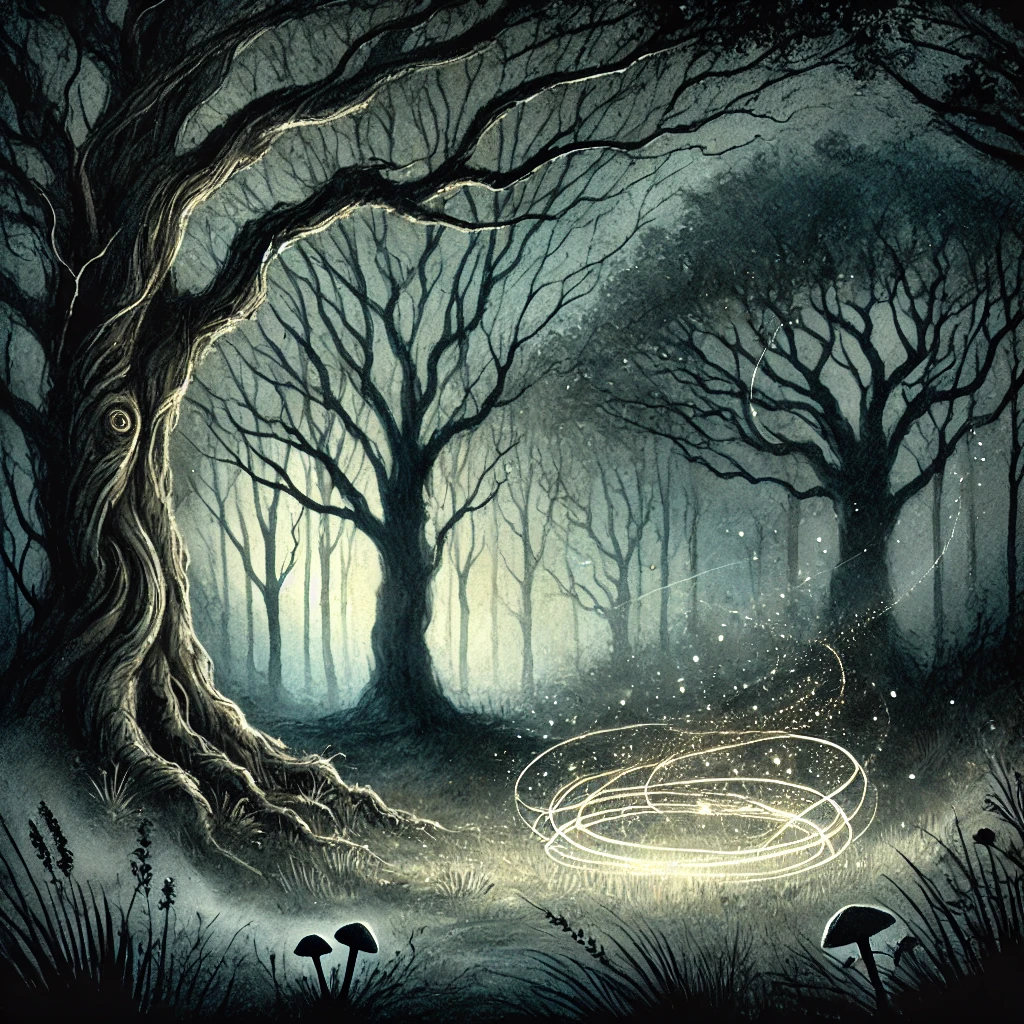
Fairy magic swirls in a forest at night

Fairy Rings, Time Distortion and Other Fae-Related Mysteries

Step carefully, traveler. A ring of mushrooms in the forest, a strange circle of scorched grass on the moors, an ancient oak with a hollow just large enough for a child to crawl through — these are signs that the Fae have been here. And if you cross into their domain, you may never leave the same.

The Danger of Fairy Rings

Fairy rings are among the most famous — and most feared — phenomena in fairy lore. These naturally occurring circles of mushrooms or oddly vibrant grass are said to be the sites of fairy gatherings. Some legends claim that at night, the Fae emerge from their hidden realm to dance under the moonlight, weaving enchantments into the earth.

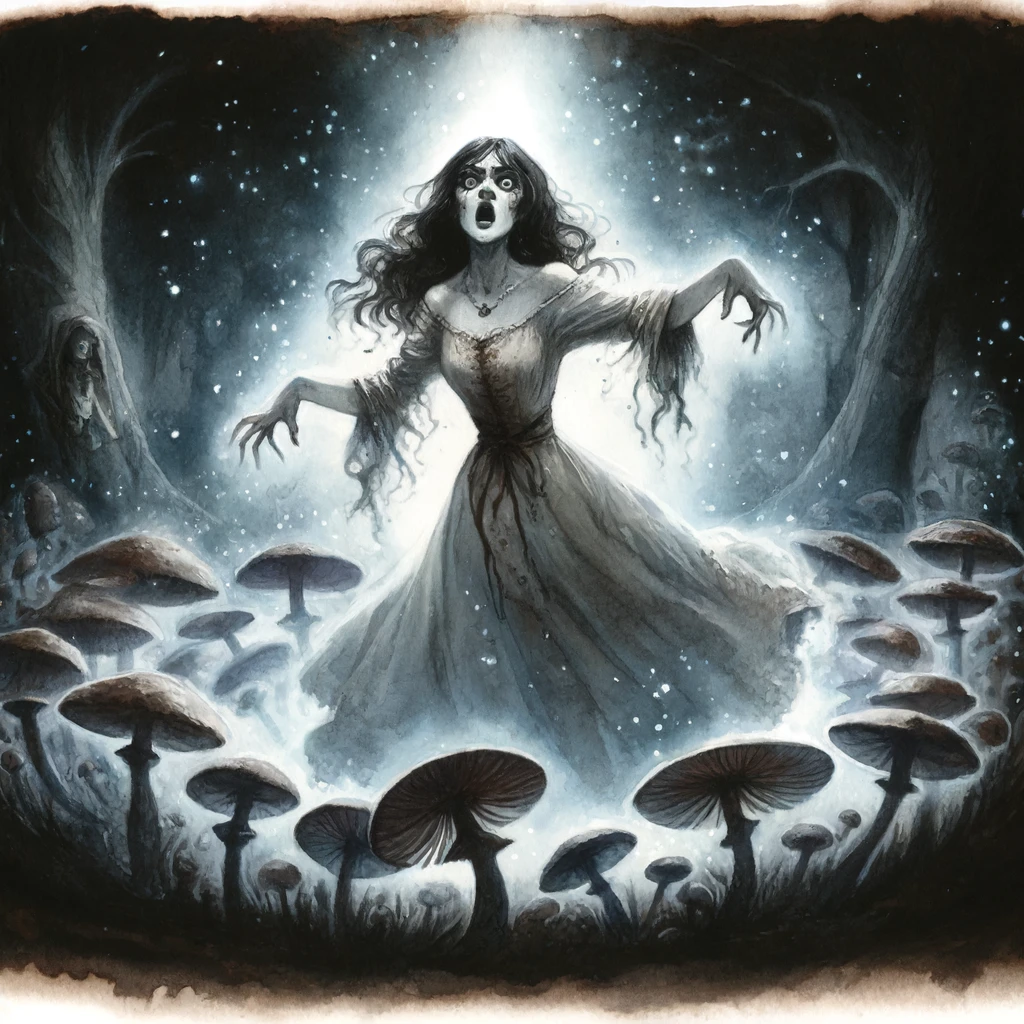
Stepping into a fairy ring, however, is a terrible mistake. Some say you’ll be forced to dance until you collapse from exhaustion, your mind lost in a delirium of music and light. Others warn that time within the ring doesn’t match the world outside. What feels like minutes to you might be years, decades, even centuries beyond the circle’s edge. Many a mortal has stepped inside, only to return as a withered husk or crumble into dust as soon as they leave.

A horrified woman dances without stop in a fairy ring of mushrooms

Even outside of fairy rings, the Fae’s ability to warp time is well known. Travelers who accept a fairy’s hospitality — feasting in their halls, drinking their wine — often find that what seemed like a single evening was, in truth, a hundred years. The legend of Oisín, the Irish warrior who rode away with a fairy queen and returned to find his homeland changed beyond recognition, is one of the most haunting examples.

Never Accept a Fairy’s Gift

The Fae are infamous for their tricks, and one of their cruelest is the giving of gifts. A fairy’s boon may seem like a blessing — a pouch of gold coins, an enchanted flute, a charm of protection — but such gifts always come with a price. Some mortals find their gold turns to dead leaves as soon as they step out of the fairy realm. Others find themselves bound by invisible contracts, compelled to serve the Fae for eternity.

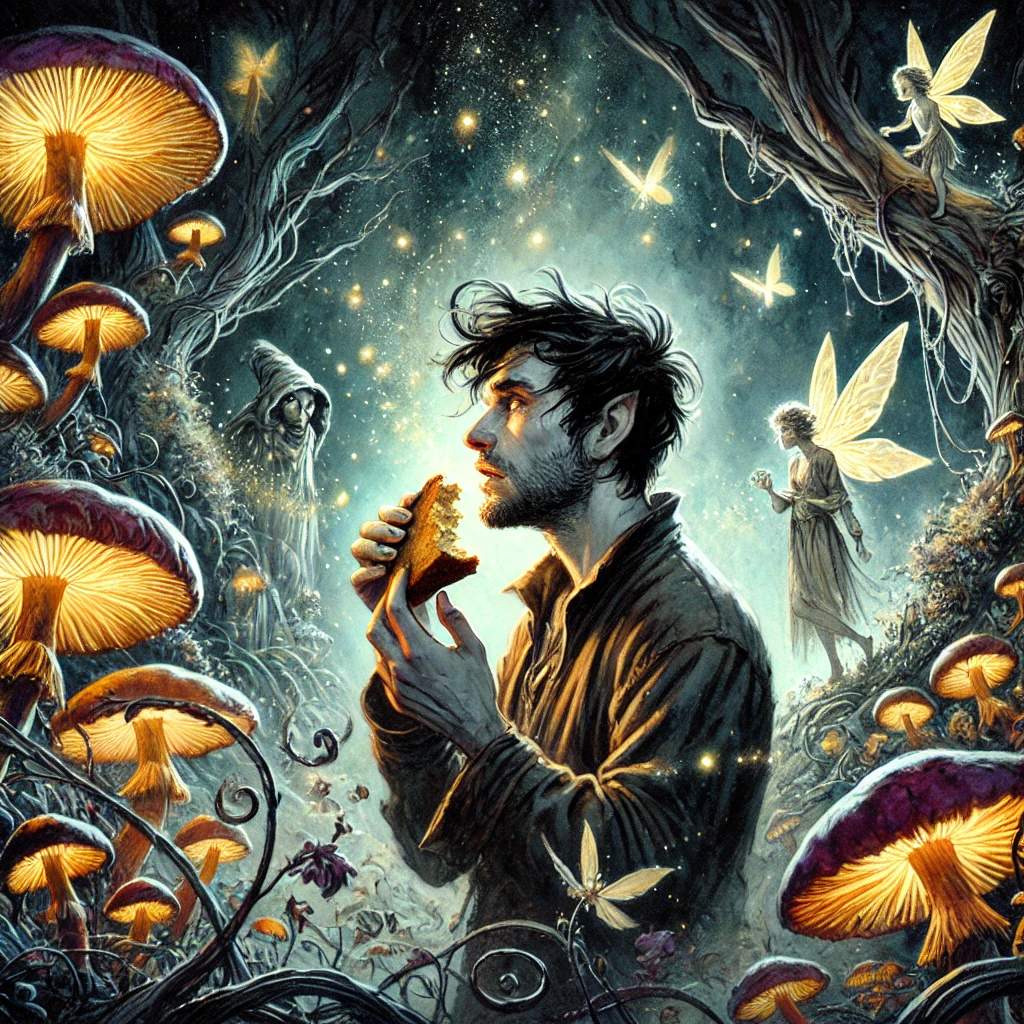
A man stupidly eats in the land of fairy, where mushrooms glow and creatures watch him

I don’t care how hungry you are — never eat anything in fairlyland.

Then there’s the matter of fairy food. It’s a well-known rule that no mortal must ever eat in the land of the Fae. To do so is to bind yourself irrevocably to their realm. Countless legends tell of mortals who took a single bite of fairy bread, only to find themselves unable to leave, their very souls woven into the fabric of that otherworldly place.

The Power of Fairy Music

Fairy music is unlike anything mortal ears have ever heard. It’s haunting, beautiful, impossible to resist. It can put a man into a trance, make a woman dance nonstop until dawn, or lull an entire village into a deep, dreamless sleep. Fiddlers and harpists in Celtic legend often claimed to have learned their skill from the Fae. But such a gift always came with a cost — many returned changed, unable to hear ordinary music without longing for the songs of the otherworld.

One of the most famous tales of fairy music is that of the Pied Piper of Hamelin, who lured away the town’s children with a tune so enchanting the kids followed him into the hills, never to be seen again. Was he simply a vengeful man — or something far older, a fairy trickster leading the children to another world?

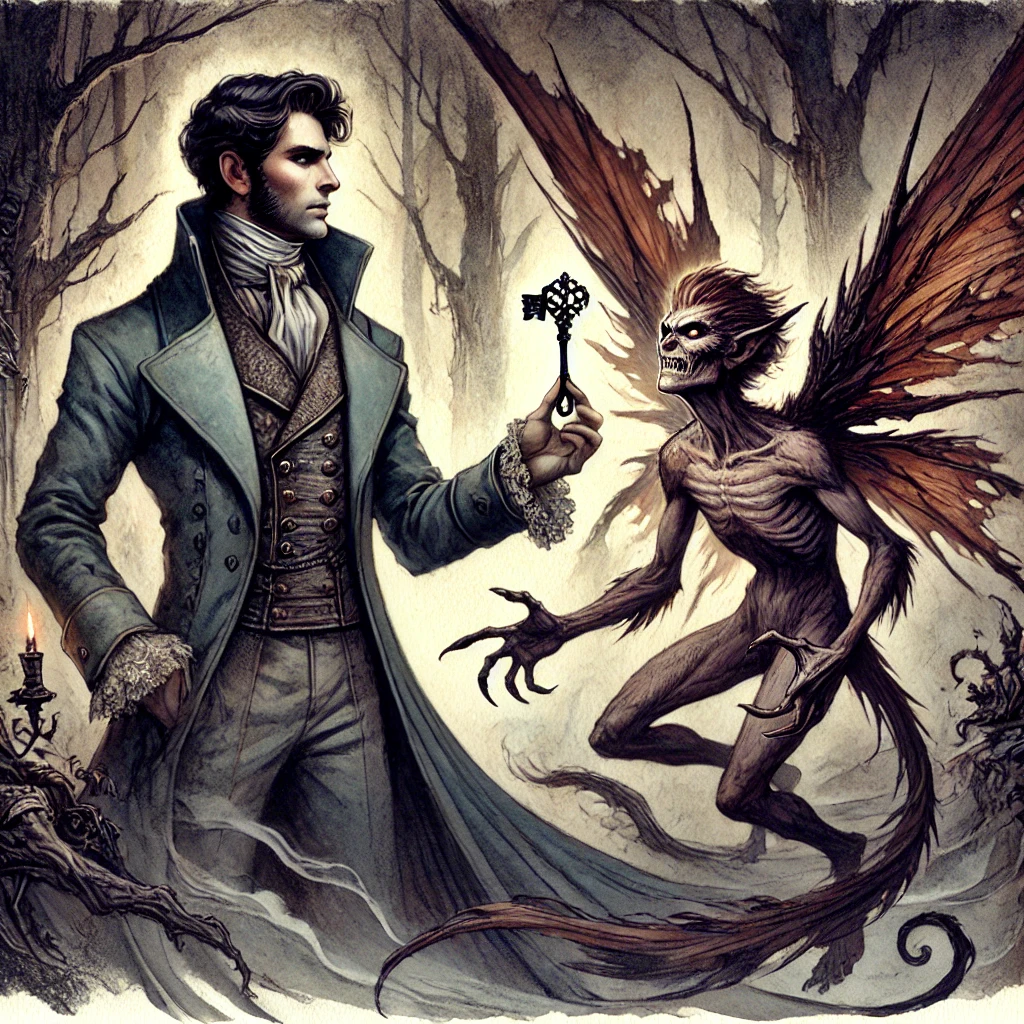
A well-dressed man holds up an iron key to keep a scary fairy at bay

How to Protect Yourself From the Fae

The Fae aren’t easily thwarted, but old wisdom offers a few tried-and-true defenses.

1. Iron is your best friend.

Iron is anathema to fairies, burning them like fire. A horseshoe over the door, iron nails driven into the threshold of a home, or even a simple iron key in your pocket can keep them at bay. Many believe that the industrial age — full of iron railways and steel buildings — was what finally drove the fairies into hiding.

2. Keep salt, rowan and red thread handy. 

A circle of salt around your home is said to keep fairies from crossing the boundary. Rowan wood, especially in the form of a staff or cross, is a sacred protector against fairy mischief. And red thread tied around your wrist or doorknob prevents enchantments and bewitchment.

3. Never give your name.

Names have power. If a fairy learns your true name, they can control you, call you to their realm at will, or steal your identity altogether. If you must interact with the Fae, use a false name, a nickname, or no name at all.

4. Watch what you say.

Forget those good manners instilled in you as a kid. Thanking a fairy is dangerous — it implies that a debt has been repaid, and fairies despise that. If a fairy grants you a favor, say, “This is well done” or “You have my respect,” but never, ever say “thank you.”

5. Avoid liminal spaces.

Fairies are strongest at twilight, dawn, and during the turning of the seasons (Beltane, Samhain, Midsummer). Crossroads, hollow hills and standing stones are all places where the veil is thin. Step too close, and you may step into their world without even realizing it.

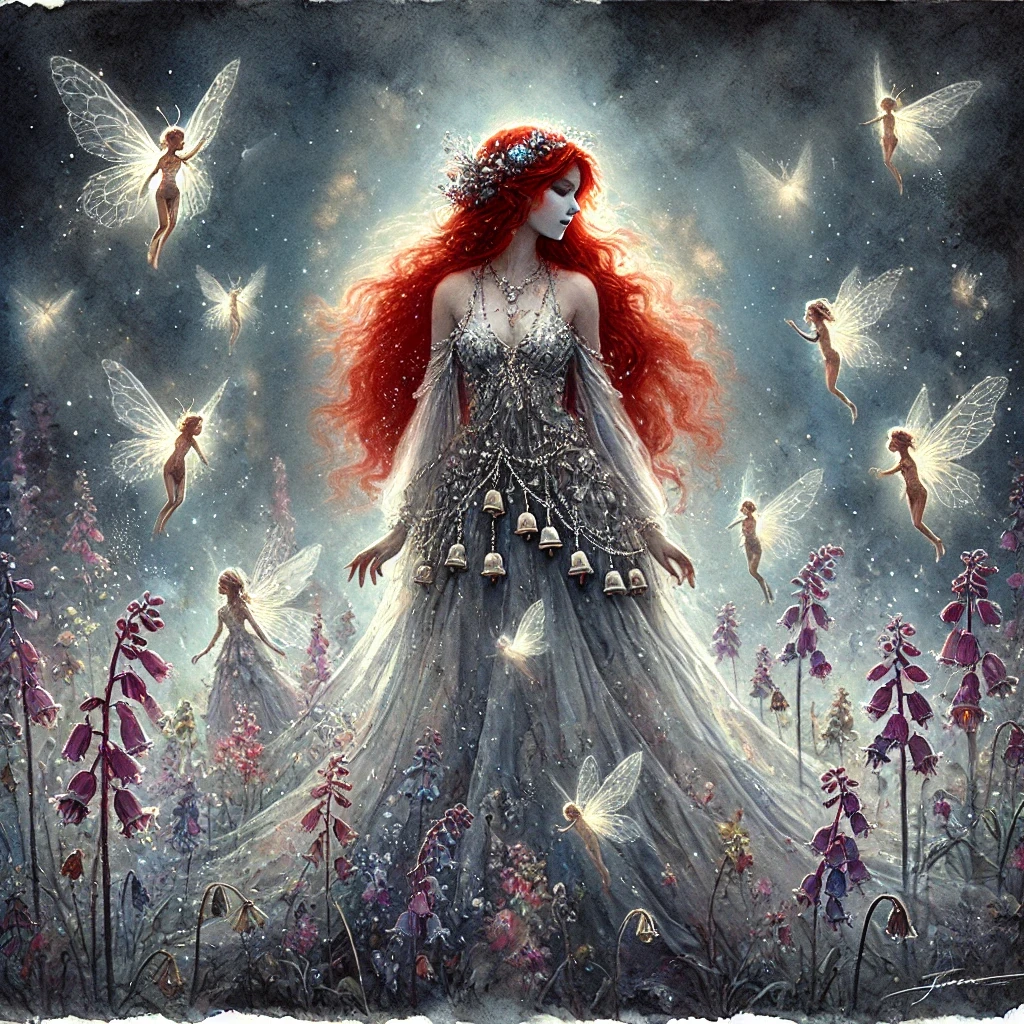
A red-haired woman wears a silvery dress and strings of bells to attract fairies, which surround her amid flowers

How to Attract Fairies

Not all fairies are malevolent. Some are simply mischievous, while others may be persuaded to lend a little magic to those who honor them properly.

1. Leave offerings.

Fairies appreciate small gifts: bowls of milk, honey, fresh-baked bread or mead. Leave these in a quiet outdoor space, particularly near a fairy ring, a tree hollow or a stream. But never check to see if they’ve been taken; that breaks the spell.

2. Keep a wild garden.

The Fae love untamed beauty. Gardens filled with wildflowers, overgrown ivy and hidden nooks are far more likely to attract them than neat, orderly beds. Plants like foxglove, lavender and thyme are said to be especially beloved by fairies.

3. Speak in riddles and poetry.

The Fae enjoy cleverness. Those who speak in riddles, offer playful banter or recite poetry may find themselves in their favor. Beware, though: If a fairy challenges you to a game of wits and you lose, the consequences will be strange, and sudden — and never fair.

4. Wear silver or bells.

Silver is associated with moonlight and magic, and fairies are drawn to it. Small bells, often worn on clothing, were once thought to please the Fae (though some say they keep trickster spirits away).

5. Celebrate Beltane and Samhain.

These two festivals are when the Fae are closest to the mortal world. Dancing, feasting and lighting candles in their honor may win their favor. Just be careful not to invite the wrong kind.

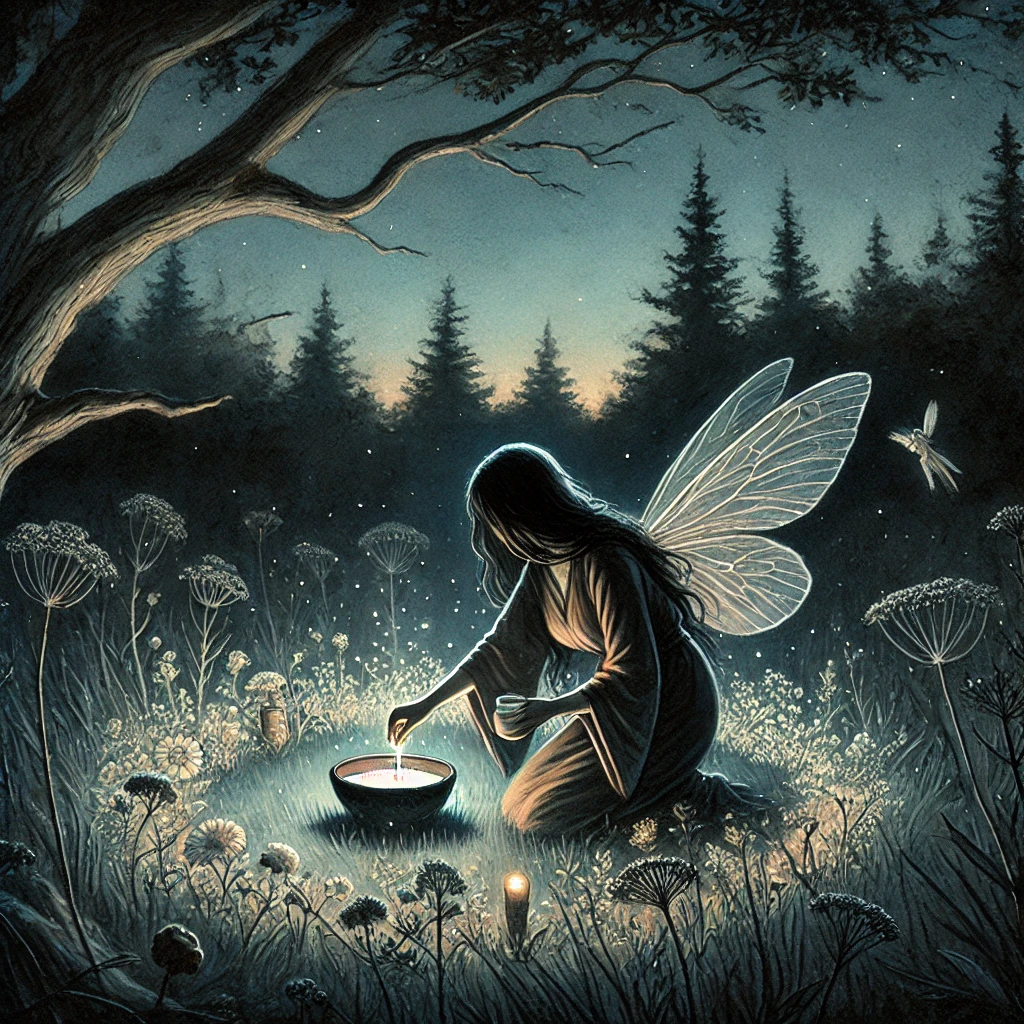
A Wiccan woman wearing fairy wings has a bowl with milk outside, performing a ritual to attract the Fae

A Spell to Connect With the Fae

If you wish to invite the presence of the Fae — gently, respectfully and understanding the risks involved — this simple spell will help you call upon their magic.

You’ll need:

  • A small bowl of milk and honey (a traditional fairy offering)

  • Fresh wildflowers (such as daisies, foxglove or lavender)

  • A silver coin

  • A candle (preferably green or white)

  • A quiet place in nature, preferably near a tree, stream or fairy ring

The Ritual

As twilight falls, take your offerings to a secluded, peaceful spot where you feel a connection to nature.

Arrange the wildflowers in a small circle and place the bowl of milk and honey in the center.

Set the silver coin beside the bowl as a token of respect.

Light the candle and focus your intent on reaching out to the Fae — not to command, but to invite.

Recite the following incantation:

O spirits fair, of earth and sky,
By moon’s soft glow and stars on high,
With gift of sweet and silver bright,
I call thee forth this sacred night.

If friend ye be, then come in grace,
With laughter light and wisdom’s trace.
No harm, no trick, no ill intent,
But blessings true and magic sent.

Let the candle burn for a few moments while you listen to the sounds of the evening. If the wind stirs, if a sudden hush falls, or if you feel a shift in the air — know that the Fae may be near.

Thank them silently, then leave the offerings behind as you depart. Never look back.

A final caution: The Fae don’t grant favors lightly, nor do they take kindly to broken promises. If you feel their presence, treat them with respect. If you receive a sign — a feather, a leaf falling on you, a strange dream — consider it a gift, not a debt to be repaid.

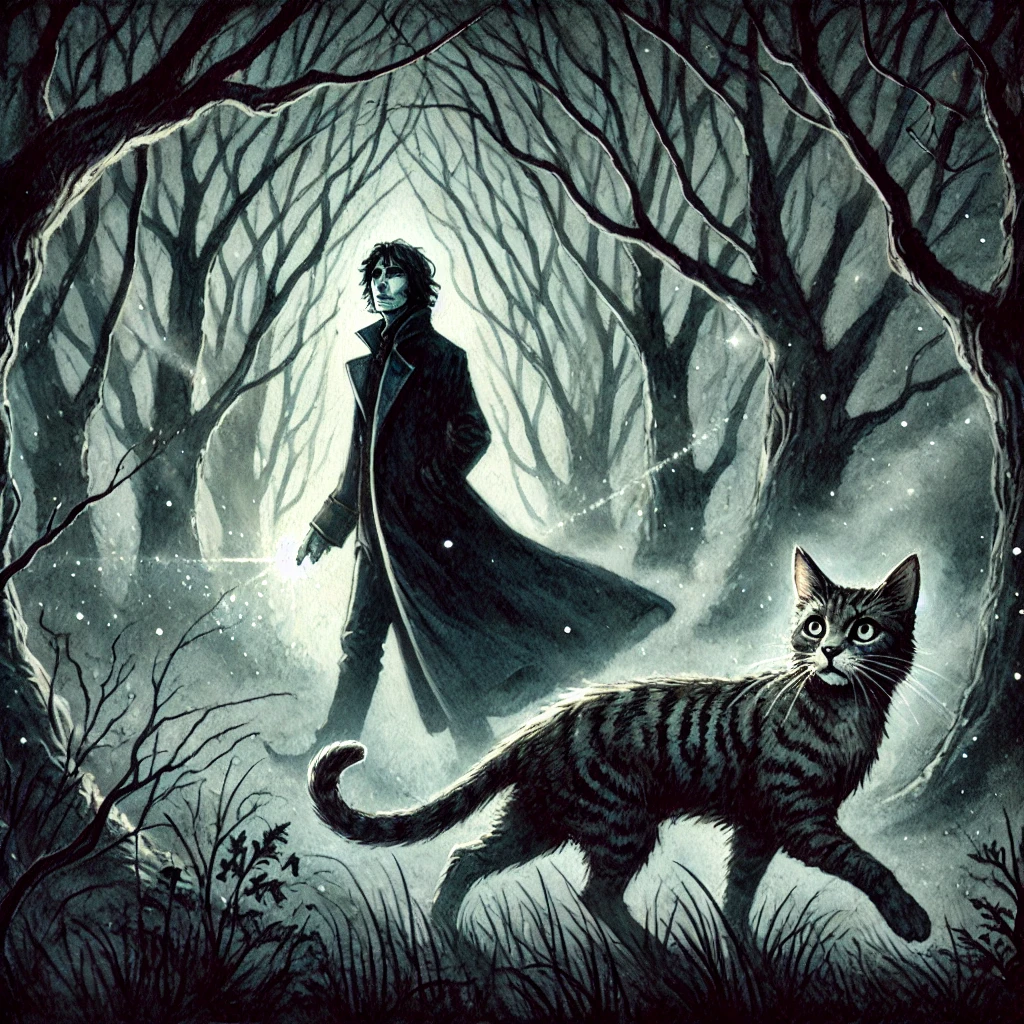
A man in a long coat walks through the woods at night with a tiger-striped cat

Tread Carefully in the Land of the Fae

The Fae are as fickle as the wind, as ancient as the stones, and as unpredictable as the tide. They’re neither wholly good nor wholly evil, existing in a realm beyond human morality. They can bring fortune or misfortune with a careless flick of a hand, charm you with laughter, or steal you away in a dance that never ends.

Yet still, we seek them. We whisper our wishes into the night, leave offerings on our windowsills, and tell their stories in hushed voices. Perhaps it’s because we, too, long for the hidden places, for the unseen world just beyond our reach.

But if you hear laughter from the trees when no one’s near, or see a flicker of light dancing in the mist, remember: Step lightly, choose your words carefully, and never, ever eat the food. –Wally
The Witch’s Guide to the Equinox: The Power of Balance at Mabon and Ostara

Discover how to use the Autumn and Spring Equinoxes in your Wicca practice with rituals, symbolism and spells.

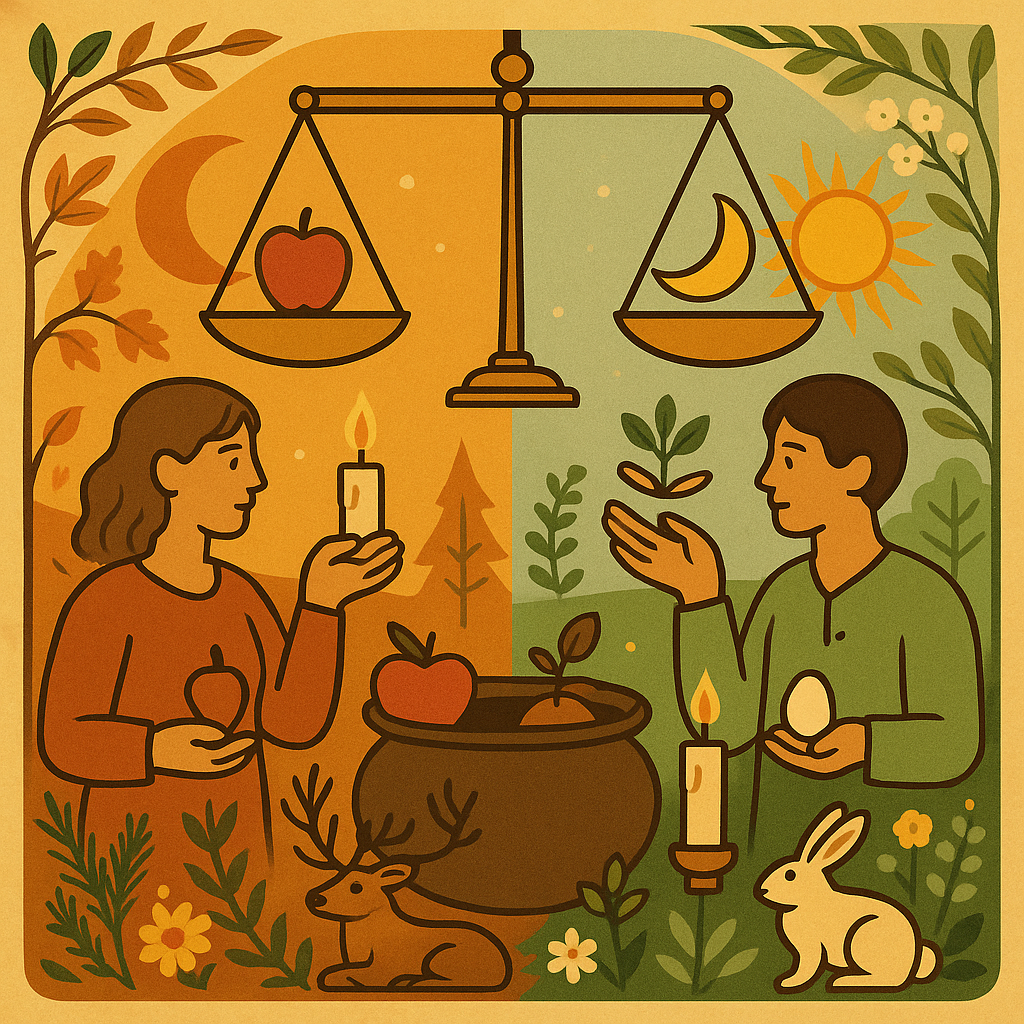
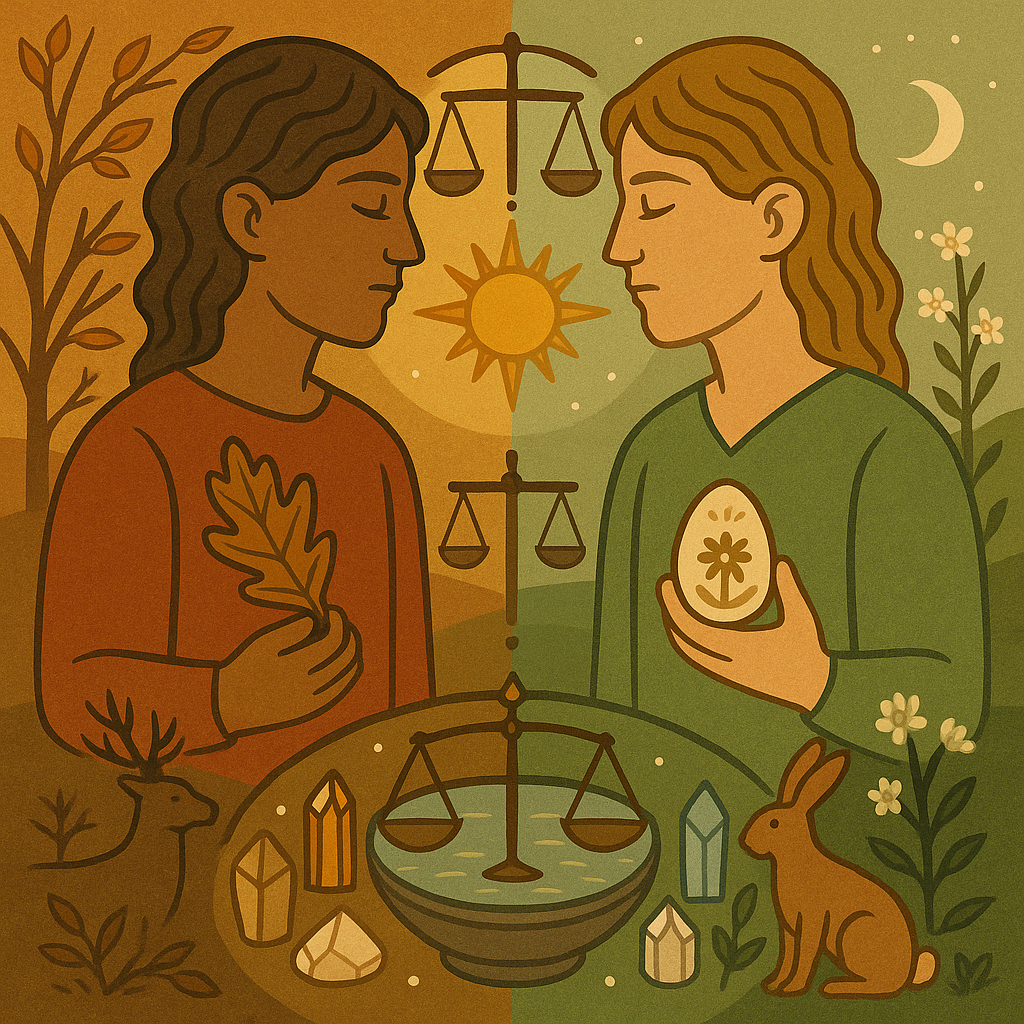
One half is a woman with symbols of Mabon, including apples and fall themes, with a man on the other half with symbols of Ostara, including a rabbit, egg and spring items, with a balance and cauldron between them

There’s an undeniable magic to the equinox. The sun doesn’t linger, and the shadows don’t fight for dominance. For one breath-held moment, they simply coexist. The world feels balanced.

Witches, pagans and stargazers alike have long marked this moment. Twice a year, day and night are in perfect equilibrium — neither winning, neither waning. It’s a rare kind of symmetry in a world that’s always one way or another.

The equinox is nature’s mirror. Whether you’re gathering what’s grown at Mabon or sowing what’s possible at Ostara, you’re standing at a point of balance — not static, but shifting. It’s a moment to notice what’s reflected back at you … and decide what belongs in the next season.

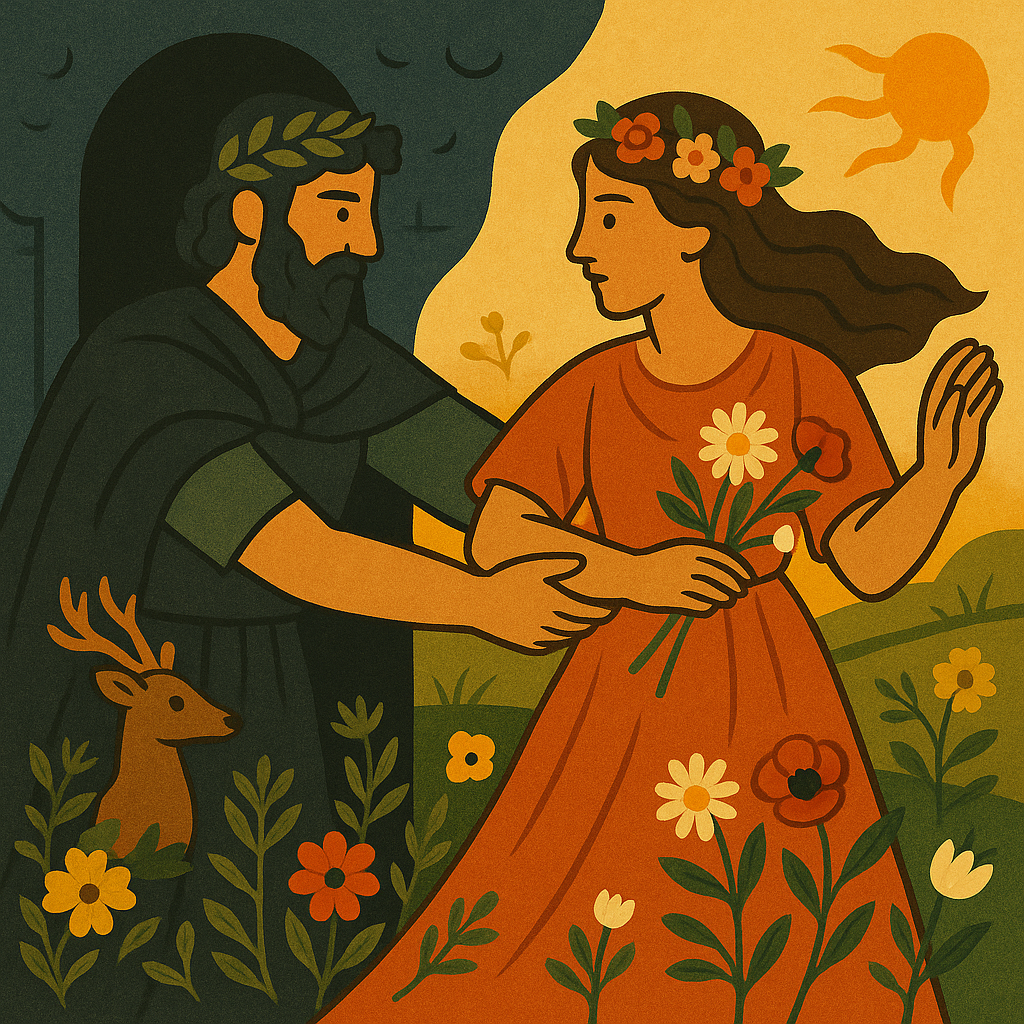
The Greek god Hades emerges from the Underworld to kidnap Persephone, goddess of the spring, as she gathers flowers

In the Greek myth, Hades abducts Persephone as she gathers flowers, spiriting her away to the land of the dead — a moment that marks the mythic turn from light to dark. The goddess of spring becomes Queen of the Underworld.

What Is an Equinox, Exactly? 

The word equinox comes from the Latin aequus (equal) and nox (night), and it refers to the two points in the year when the sun crosses the celestial equator. On these two days — typically around March 20 and September 22 — we experience nearly equal amounts of daylight and darkness, no matter where we live on Earth.

Think of it as a cosmic balancing act — a time when the tilt of the Earth gives everyone a moment of stillness before tipping toward longer nights (Mabon) or longer days (Ostara).

Ancient cultures noticed.

  • The Maya built temples like Chichén Itzá, where on the equinox, sunlight casts a serpent-like shadow that slithers down the pyramid’s steps — a dazzling tribute to the god Kukulkan.

  • The Greeks saw this season as the time when Persephone descended into the Underworld, tipping the world toward darkness and marking the start of autumn.

  • For Druids, the momentary balance between light and dark was more than symbolic; it was a spiritual threshold, when the veil between worlds thinned and subtle energies stirred.

So why do modern witches and pagans care about equinoxes?

Because balance is everything in magic.

The equinox invites you to stand in between two forces — light and shadow, growth and decay, action and rest — and find where you belong in that moment. It’s a sacred mirror for your own life’s rhythm.

Whether you’re closing a chapter or opening a new one, this is the time to ask:

  • What am I growing?

  • What am I releasing?

  • What needs to come into balance?

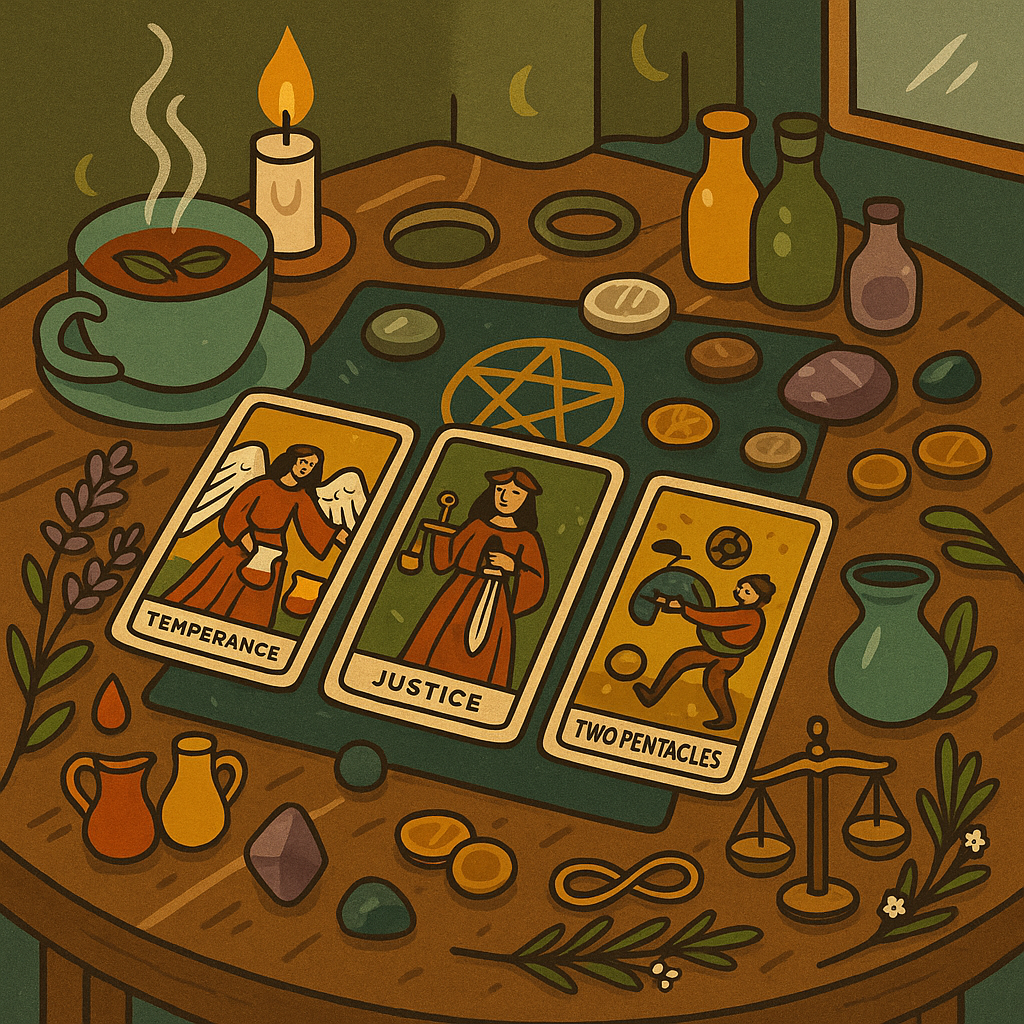
A table laid out with three tarot cards—Temperance, Justice and the Two of Pentacles—with coins, stones, bottles, a candle, a balance, herbs and a steaming cup of tea

What Equinox Energy Feels Like

There’s a quiet ache to the equinox — like standing at the threshold of a door you’re not quite ready to close, or opening one you’re not sure you deserve to walk through yet. It’s the tension of opposites, held not in conflict, but in coexistence.

This energy isn’t loud. It hums.

It invites reflection, not reaction.

Whether you’re in the golden hush of Mabon or the dew-sparkled stirrings of Ostara, the equinox is that sacred in-between where transformation happens. Think crossroads, dusk, dawn, the last leaf before the tree goes bare. That’s equinox energy: a spell of stillness before the turn.

Some witches use this time to:

  • Do shadow work (for Mabon) or intention setting (for Ostara)

  • Reorganize altars to reflect both sun and moon energy

  • Meditate with balance-themed tarot cards like Temperance, Justice or The Two of Pentacles

  • Perform rituals that honor duality: life and death, inner and outer, giving and receiving

This is a sacred pause in the wheel — the fulcrum where the year pivots. Don’t rush it. Feel it.

Two people divided with scales between them, and symbols of Mabon and fall on one side, and Ostara and spring on the other

Equinox Themes to Explore in Your Practice

The equinox is nature’s reminder that we’re never just one thing. We’re always becoming — shedding and growing, grieving and hoping, ending and beginning. Use this moment to align your practice with that energy of both/and rather than either/or.

Here are some core themes to work with:

1. Balance and duality

The obvious one — but also the most personal. What areas of your life feel lopsided? What would it feel like to give your joy and your grief equal space at the altar?

Ideas:

  • Do a two-column journal exercise (Light / Shadow, Give / Receive)

  • Meditate on the Justice or Temperance tarot cards

  • Create a visual altar with half sun, half moon symbolism

2. Shadow and light

This is the season of facing contradictions. At Mabon, the light is fading — you may feel a pull toward introspection, shadow work and letting go. At Ostara, light returns — bringing clarity, confidence and growth.

Ideas:

  • Light a candle and speak aloud one thing you’re releasing, one thing you’re embracing

  • Work with herbs that straddle light and dark, like mugwort or rosemary

  • Create an herbal sachet with both stimulating and calming properties

3. Harvest and seeding

If it’s Mabon, the second harvest is here — a time to gather, give thanks and prepare to rest.

If it’s Ostara, it’s all about preparing the soil for the bounty to come.

Ideas:

  • Write a gratitude list for everything you’ve “harvested” this year (lessons count!)

  • Do a seed planting ritual for a new project or intention

  • Bake bread or cook with seasonal produce as a sacred act

4. Thresholds and transitions

The equinox is a hinge — a pause in the wheel. Honor that stillness. Embrace that liminal magic.

Ideas:

  • Craft a charm bag for safe passage through change

  • Take a solitary walk at sunrise or sunset and listen for signs

  • Perform a cleansing ritual or floor wash to mark a new beginning

A group of Wiccans celebrate an equinox ritual

Wicca Rituals for Equinox Magic

The equinox isn’t about big dramatic gestures. It’s about the subtle magic of recalibration — aligning yourself with the rhythms of the Earth and asking, What do I need to feel whole right now?

These simple rituals are designed to help you honor the season, balance and your own inner turning.

Mabon Rituals for the Autumn Equinox, the Second Harvest

1. The Gratitude Altar

Gather apples, acorns, corn husks, dried herbs and anything that represents abundance in your life. Arrange them on your altar, and as you place each item, say aloud one thing you’re thankful for — no matter how small.

Bonus: Write each one on a bay leaf and burn them in a fire-safe dish or cauldron to send your thanks skyward.

2. Letting Go Fire Spell

Write down what you’re ready to release: habits, fears, bitterness. Fold the paper and place it beneath a black or brown candle. As it burns, whisper:

“As the sun wanes and leaves fall low,
I thank, I bless, I let it go.”

3. Sip the Season

Make a spiced cider, tea or wine. Stir in your intentions with cinnamon or star anise. As you sip, visualize warmth radiating from your center, grounding you for the darker months ahead.

A white cat sits by symbols of the spring equinox: a candle, decorated egg, flower and apple

Ostara Rituals for the Spring Equinox, the Season of Renewal

1. Seed Blessing

Take seeds (flowers, herbs or even just intentions written on paper). Hold them in your hands, breathe on them, and say:

“In fertile earth, I plant my will.
With sun and rain, I grow until
My dreams take root and rise anew —
As spring begins, so shall I, too.”

Plant them in soil — or in a small pot to nurture on your windowsill.

2. Sunrise Candle Spell

Wake early and light a white or pale yellow candle at sunrise. As the light grows, reflect on what’s coming to life in your own world. Whisper an affirmation with the first rays:

“With this light, I rise again.
Bright beginnings, banish pain.”

3. Equinox Egg Magic

Decorate eggs with symbols of your hopes and intentions. Bury them in the earth or crack them into compost to “feed” your magic into the world.

Symbols of Ostara and Mabon, the equinoxes: decorated eggs, apple, pumpkin, flowers, herbs and the moon and stars

Tools, Herbs and Symbols of the Equinox

Every witch knows that magic isn’t just in what you do; it’s in what you surround yourself with. The equinox invites you to work with items that embody balance, duality and seasonal shift. Whether you’re decorating your altar or crafting a spell, here’s what to reach for.

Crystals

Each of these stones balances opposing energies or helps you tune into the seasonal transition.

  • Labradorite: For embracing change and connecting with the magic between worlds

  • Citrine: Sunlight in solid form; promotes joy and confidence

  • Smoky quartz: Grounding, releasing, shadow-friendly

  • Moonstone: Especially for Ostara; honors intuition and cyclical energy

  • Obsidian: Especially for Mabon; helps surface buried truths

Place two on your altar — one for light, one for shadow — to physically embody balance.

Herbs and Foods

These herbs reflect both the season’s energy and the magical intentions tied to it.

For Mabon:

  • Rosemary: Memory, cleansing, protection

  • Mugwort: Dreamwork, thresholds, seeing beyond

  • Marigold: Protection and gratitude

  • Thyme: Courage to release and transition

  • Apples: Symbol of knowledge, love and the harvest (cut one crosswise to reveal the pentacle)

For Ostara:

  • Lavender: Clarity, calm and gentle growth

  • Nettle: Protection, transformation

  • Dandelion: Resilience and sunlight energy

  • Mint: Fresh starts and mental clarity

  • Eggshells: Crushed for warding and blessing soil

Brew into teas, burn as incense or scatter around your altar.

Colors

Think of your altar or ritual setup as a visual spell.

Mabon:

  • Deep red, burnt orange, gold, brown, plum

Ostara:

  • Pale green, pastel pink, cream, robin’s egg blue, yellow

Mix warm and cool tones to evoke the sense of transition and balance.

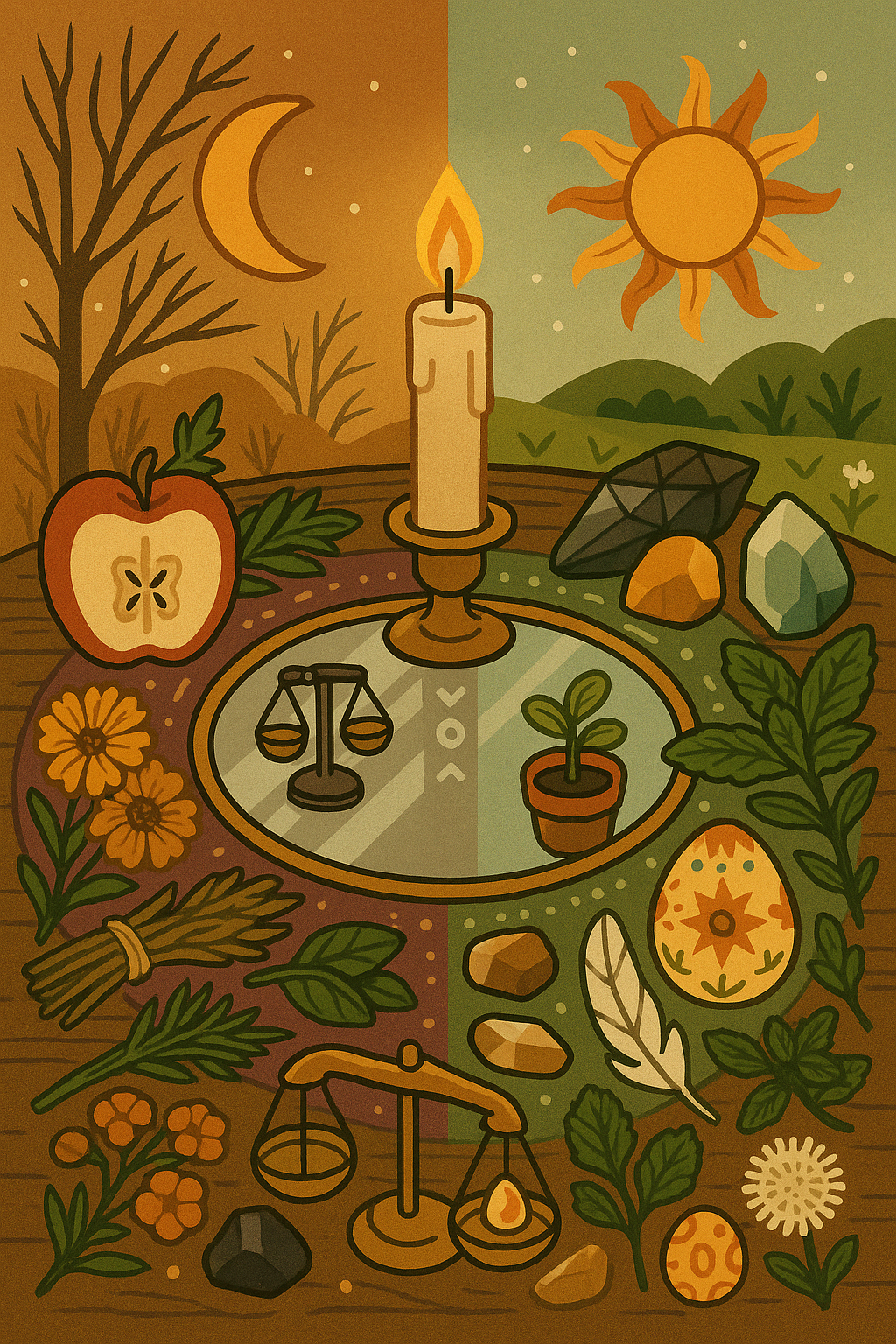
Tools for an equinox ritual: cut apple, bundles of herbs, crystals, a candle, scales, a plant and a mirror

Symbols and Objects

Simple items you likely already have can carry rich meaning.

  • Eggs: Fertility, potential, the mystery of beginnings (Ostara)

  • Scales or balance symbols: Literal or metaphorical

  • Fallen leaves or fresh flowers: Seasonal anchoring

  • Sun and moon imagery: Perfect visual shorthand for the equinox

  • Mirror: Self-reflection, shadow work, duality

Pro tip: For an easy equinox altar, use a mirror as your base, place a candle at the center, and arrange light/dark objects symmetrically.


All of these are suggestions. Let your practice be personal, intuitive and playful. You’re not trying to copy someone else’s ritual. You’re writing your own spellbook, one equinox at a time.

Equinox Spells for Balance and Renewal

These spells are written in rhyme — not just for beauty, but because rhythm makes magic easier to remember and recite. Speak them with intention, and let the words ripple out like a charm on the wind.

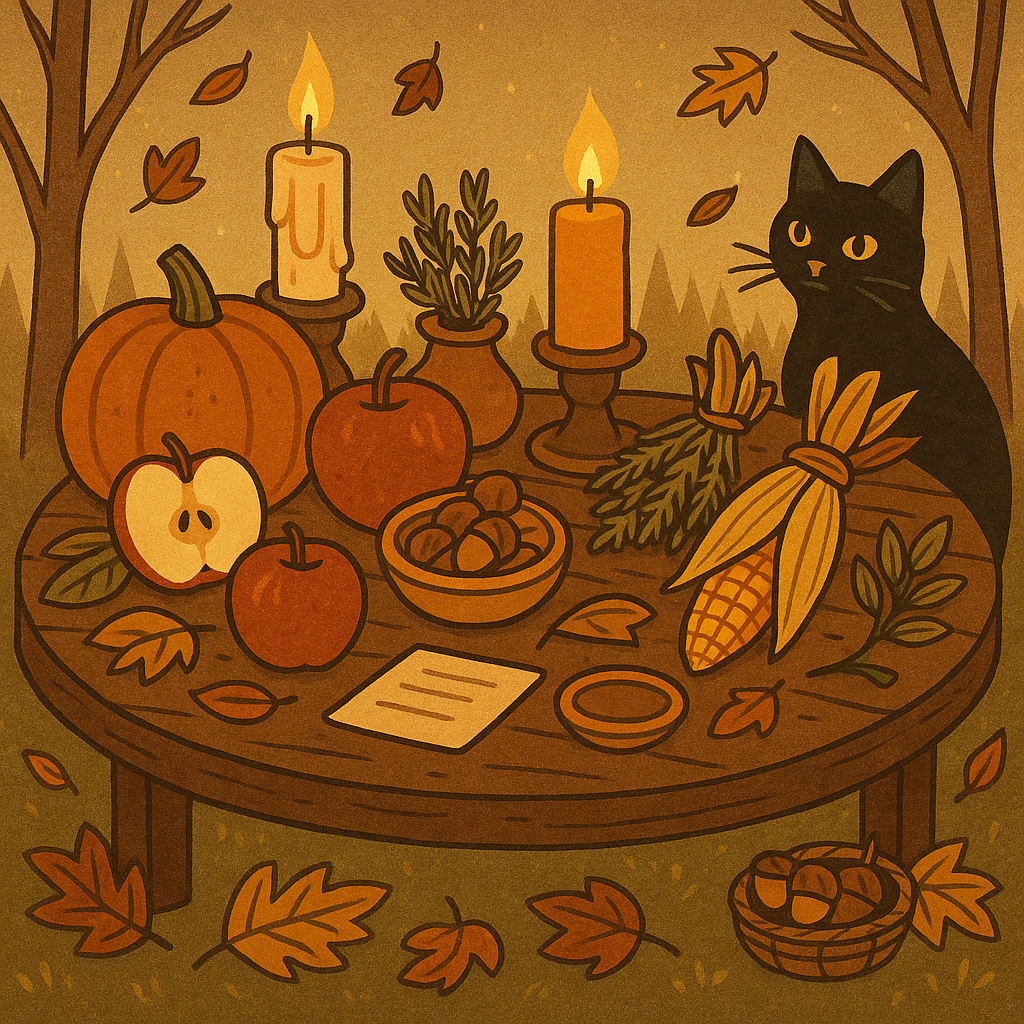
A black cat looks at a table covered with tools for a Mabon fall equinox ritual, including a pumpkin, rosemary, corn, acorns, apples and paper, as leaves fall

Mabon Spell: Letting Go and Giving Thanks

“Leaves fall low, the sun bows down,
The harvest ends in golden crown.
I give my thanks, I bless the past,
And set down burdens I held fast.

Dark and light in balance meet —
I stand with shadows at my feet.
What’s done is done; what’s mine, remains.
I open space for gentler gains.”

Speak this while lighting a candle and placing offerings on your altar — such as dried herbs, bay leaves or fruit. 

You can also whisper it during a walk through autumn woods as you scatter a handful of fallen leaves.

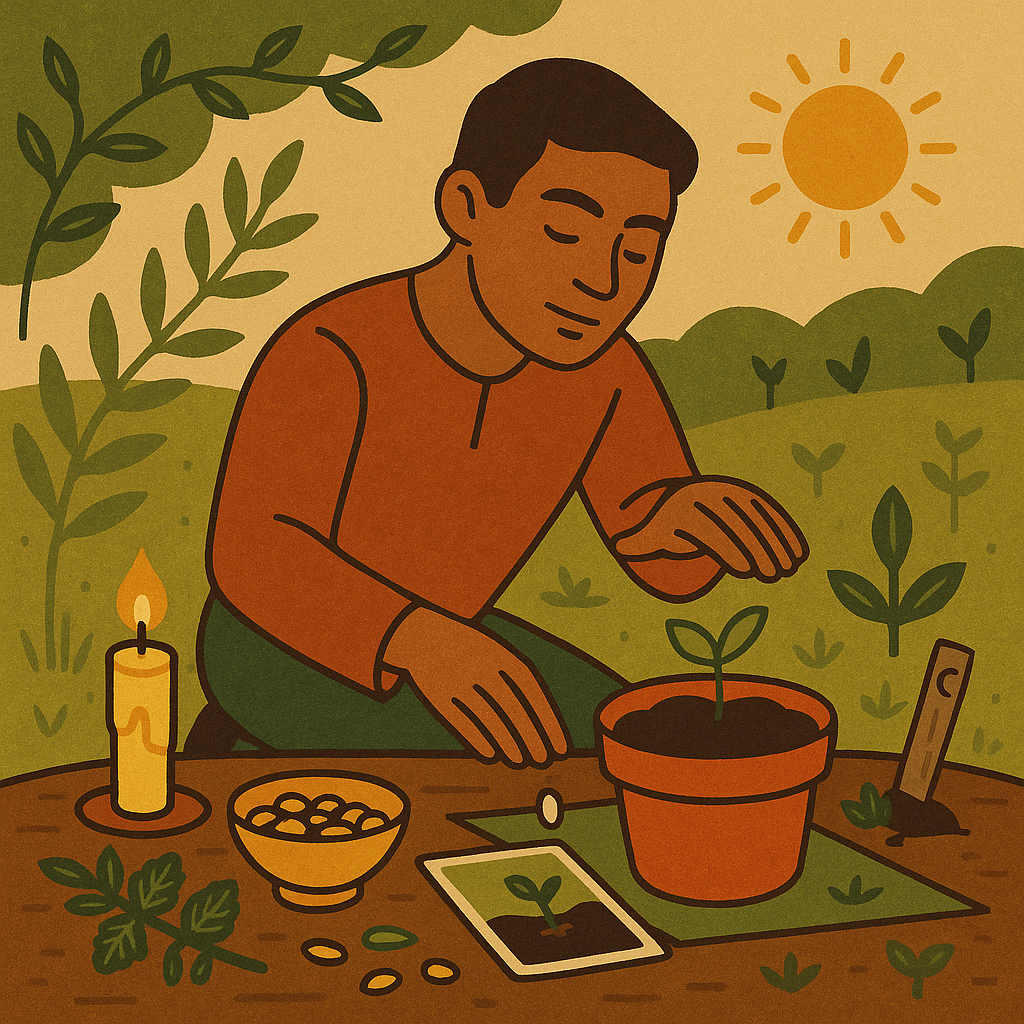
A man performs a spell to plant seeds of intention at the equinox

Ostara Spell: Planting Seeds of Intention

“Bright the bud, and bold the breeze,
Awake the roots, unbind the freeze.
With open hands and heart in bloom,
I stir the light, dispel the gloom.

Let what’s hidden start to grow,
From dream to leaf, from spark to glow.
In egg and soil my wishes lie,
To rise and bloom beneath spring’s sky.”

Use this while planting seeds or charging symbolic ones (paper, intentions, charms). Light a white or yellow candle and recite the spell while holding the seed or token in your palm.

A woman with one half in the light, with flowers and bees and the sun, and the other half in the darkness, with stars, the moon, a crystal ball and white flowers

Equal Parts Magic and Meaning

The equinox is the hush before the shift, the breath between words, the sacred pause that says, You can begin again.

Whether you’ve filled your altar with apples or planted your first spring seeds, this turning of the wheel invites you to stop and listen — to the Earth, to your spirit, to the balance you crave and the imbalance you’re ready to face.

Honor the balance. Gather what’s ripe, and set in motion what you most desire. –Wally
How to Celebrate Lammas and Lughnasadh: First Harvest Traditions, Ritual and Sun Magic

On August 1, Lammas — aka Lughnasadh — marks the first harvest on the pagan Wheel of the Year, with sun-drenched rituals honoring the Celtic god Lugh and bread. Lots of bread. 

A group of witches dance around a bonfire to celebrate Lammas

It still feels like summer — the kind that clings. The air is thick, the gardens are bursting, and the sun hasn’t yet given up its post. But something’s shifting. It’s not quite autumn, and not quite high summer, either. Just that in-between hum that says: Harvest time has started.

This is Lammas, also called Lughnasadh (this mouthful is pronounced “Loo-nah-sah”) — the first harvest festival of the pagan year. A time to gather what’s grown, bake bread in gratitude, and honor both the work and the letting go. It’s the season of full fields, tired hands, and sacred thank-yous whispered into the grain.

You may have lit fires for Beltane in the spring and danced under the high sun at Litha, but now the Wheel turns again. Lammas is where the wild energy slows — where intention meets outcome, and we pause to ask: What have I grown? What do I carry forward? And what do I leave behind?

A man looks at the sun, holding a sickle in a field of wheat

What Is Lammas and Lughnasadh?

Lammas, celebrated on August 1, is the first of three harvest festivals in the pagan Wheel of the Year — followed by Mabon (the autumn equinox) and Samhain (the final harvest). The name Lammas comes from “Loaf Mass,” a Christian-era term marking the blessing of the first bread made from the grain harvest. But its roots run deeper.

Before Lammas, there was Lughnasadh, a Gaelic festival honoring the Celtic god Lugh (pronounced like Lou), patron of skill, craftsmanship and light. According to legend, Lugh created the holiday to honor his foster mother, Tailtiu, who died after clearing the land so crops could grow. Think of it as a celebration born from sacrifice, labor and love (more on this below). 

Both versions of the festival celebrate the same thing: gratitude for the first fruits of the land, and the subtle turning toward darker days. You bake bread because the grain has ripened. You give thanks because survival is never guaranteed. And you celebrate with fire, feasting, games and offerings — not in fear of winter, but in honor of what you’ve managed to grow before it comes.

Today, whether you’re harvesting wheat, creative work or personal growth, Lammas is the time to pause, reflect and say thank you — out loud, with your hands full.

The Celtic god Lugh towers above people participating in the Tailteann Games

The Legend of Lugh

Long ago, when gods and giants still roamed Ireland, there was a queen named Tailtiu — a goddess of the earth, strong and steady, her hands always buried in the soil. She took one look at the wild, tangled forests of Ériu and saw potential. So she cleared the land. All of it. By hand.

For days and nights and then more days again, Tailtiu worked. She moved mountains. Pulled roots. Flattened fields. Until at last, the land was fertile, ready to feed a people who didn’t yet know how much they’d need it. Then she laid down, weary beyond words — and died.

But her foster son, Lugh, wouldn’t let her be forgotten.

Lugh was brilliant, golden, untouchable. A god of many talents: warrior, smith, poet, harpist, trickster, tactician. When the gods were recruiting for a battle against the monstrous Fomorians, they told him, “We already have someone for each skill.” So Lugh said, “Then find me someone who has all of them.” And the room went quiet.

It was Lugh — the sun-bright, many-skilled god — who declared a festival in Tailtiu’s honor. He called all the tribes together, not for mourning, but for celebration. He lit fires. He hosted games. He told stories and sang songs and held contests of strength, wit and beauty. Farmers brought their first grains. Poets spoke their sharpest lines. Lovers met in the tall grass. Oaths were sworn. Bread was broken.

This was Lughnasadh, the “Assembly of Lugh.” A wild, sun-drenched sendoff for a goddess who gave everything — and a reminder that nothing grows without effort or sacrifice.

The games were held at Tailtiu’s grave, where the grass grew thick and sweet over her resting place. 

And every August, when the sun ripens the wheat and the sickles gleam, Lugh’s voice echoes somewhere in the wind: “Honor her. Honor the harvest. Honor what it cost.”

Parishioners bring loaves of bread to church to be blessed by a priest on Lammas

The Rise of Lammas

As the centuries turned and the old gods quieted — or were quieted — the Church stepped in, as it often did, with a rebrand.

Lughnasadh, with its bonfires and boasting, its hilltop games and grain offerings, was a little too loud, a little too wild, and way too pagan. But people weren’t about to stop marking the first harvest — not when the fields were full and the bread was fresh and the land still whispered Tailtiu’s name.

So the Church gave it a new name: Lammas, short for “Loaf Mass.”

Gone were the sacred games and sun gods. In their place: a more palatable ritual. You’d bring the first loaf of bread to church, fresh from the newly milled grain, and the priest would bless it. A holy thank you, wrapped in linen and incense. No druids required.

It was still a festival of gratitude — just with more psalms and fewer hilltop flings.

But even as Lammas was woven into the Christian calendar, the old ways clung. You’d still find tales of Lugh passed around fires. You’d still hear of sacred wells visited on August 1. And in rural corners, some folks secretly kept baking bread in his name.

Today, Lammas and Lughnasadh blur together — one dressed in church robes, the other in sun-gold and shadow. Whether you honor Lugh or the loaf (or both), you’re stepping into a very old current when you mark this day.

Symbols of Lammas: wheat, bread, sun, sickle, blueberries and sunflower

Traditions of Lammas and Lughnasadh

Lammas and Lughnasadh come with a spread of traditions equal parts sacred, social and symbolic. These rites once marked the height of summer’s bounty and the first sigh of the waning sun. Some remain intact, others were reinvented, but they all echo that ancient truth: Nothing grows without gratitude.

Bread

The central act of Lammas is in the name itself: Loaf Mass. People once baked bread from the first harvested wheat and brought it to be blessed. Others offered it at the hearth or buried pieces in the fields for luck and fertility. In both Christian and pagan observance, the bread wasn’t just food; it was a sacred transaction between land, labor and spirit.

Fire and Feasting

Like many cross-quarter festivals, Lughnasadh came with fire. Bonfires were lit to honor the sun at its peak and to mark its slow retreat. Feasts were held beside the flames, using the first of the harvest: berries, fresh grains, garden produce, and anything ripening under the late summer sun.

The Tailteann Games

Held in ancient Ireland at the burial site of Tailtiu, these funeral games were athletic, artistic and social all at once. Tribes competed in races, wrestling, music, poetry and storytelling. Oaths were sworn, grievances aired, and couples even formed trial marriages — often lasting a year and a day, no commitment rings required.

Sacred Sites and Pilgrimages

People made pilgrimages to holy wells, hilltops and other sacred places, often leaving offerings or saying prayers for a good harvest and safe passage through the darker half of the year.

Harvest Rites and Grain Spirits

The grain had a spirit, a presence. The first and last sheaves were honored with care. Some communities crafted corn dollies from the final stalks, believing they housed the spirit of the field and brought protection through the winter. Others saved the last sheaf for spring planting, returning the spirit to the soil in a full-circle blessing.

Symbols of Lammas: corn dolly, bread, wheat, the sun, a sickle and more

Symbols of Lammas and Lughnasadh

Lammas is a festival of grain, gratitude and golden light — a turning point in the Wheel of the Year when we honor both abundance and impermanence. Its symbols reflect the rhythm of harvest and the sacred balance between effort and reward.

  1. Bread and grain
    The central symbol of Lammas is the loaf. Bread made from the first grain represents survival, sacrifice and the miracle of transformation — from seed to stalk to sustenance. Wheat, barley, rye and oats also carry protective and prosperity magic, often used in offerings or home blessings.

  2. The sickle
    The sickle or scythe represents the act of harvest — the moment of cutting away, of reaping what has been sown. It’s a symbol of hard work, mortality and the necessity of release. In ritual, it can mark endings, gratitude and readiness to let go.

  3. The corn dolly
    Often woven from the last sheaf of grain, the corn dolly (or harvest spirit) was kept through winter as a charm of protection and fertility. This figure represents the living spirit of the land — honored, protected and returned to the earth in spring to ensure next year’s growth.

  4. The sun
    Though its power is beginning to wane, the sun is still a dominant force at Lammas. It ripens the grain, warms the fields, and reminds us that even as light fades, it leaves behind nourishment. Sun symbols, gold tones and fire rituals all connect to this presence.

  5. Fire
    Lammas shares fire’s symbolism with many other sabbats, but here it carries a specific tone: Warmth giving way to shadow. Bonfires at Lammas honor the labor behind the light — not just passion, but perseverance. Candles and hearth fires evoke both celebration and quiet reverence.

  6. Wheels and circles
    The Wheel of the Year turns, and Lammas marks a visible shift. Circular symbols — from braided loaves to sun wheels — reflect this ongoing cycle of growth, harvest, decay and rebirth. They remind us that the work is never truly done, only transformed.

  7. The color gold
    Gold is the signature shade of Lammas. It’s the color of ripe wheat, late-summer sunlight and divine abundance. Wearing gold or decorating with yellow, orange and amber connects you to the energy of fullness, gratitude and transition.

A Wiccan man performs a Lughnasadh ritual, a sickle in one hand and wheat in the other, with a candle, bread and berries on the altar

A Lammas Ritual 

This ritual is designed to honor what you’ve harvested — creatively, emotionally or literally — while also making space for what must be cut away. It draws on the ancient symbolism of the sickle, bread and the turning sun. 
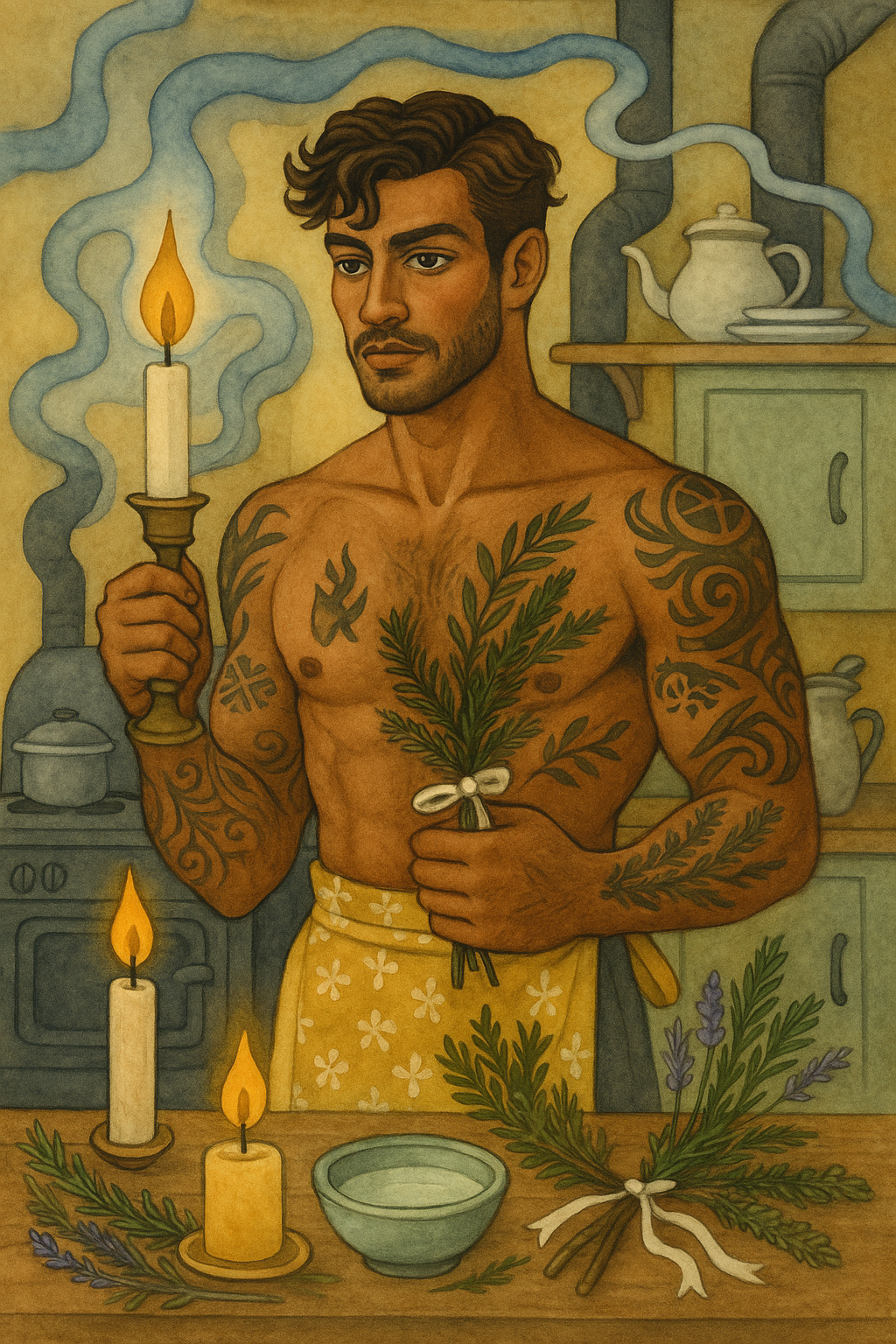
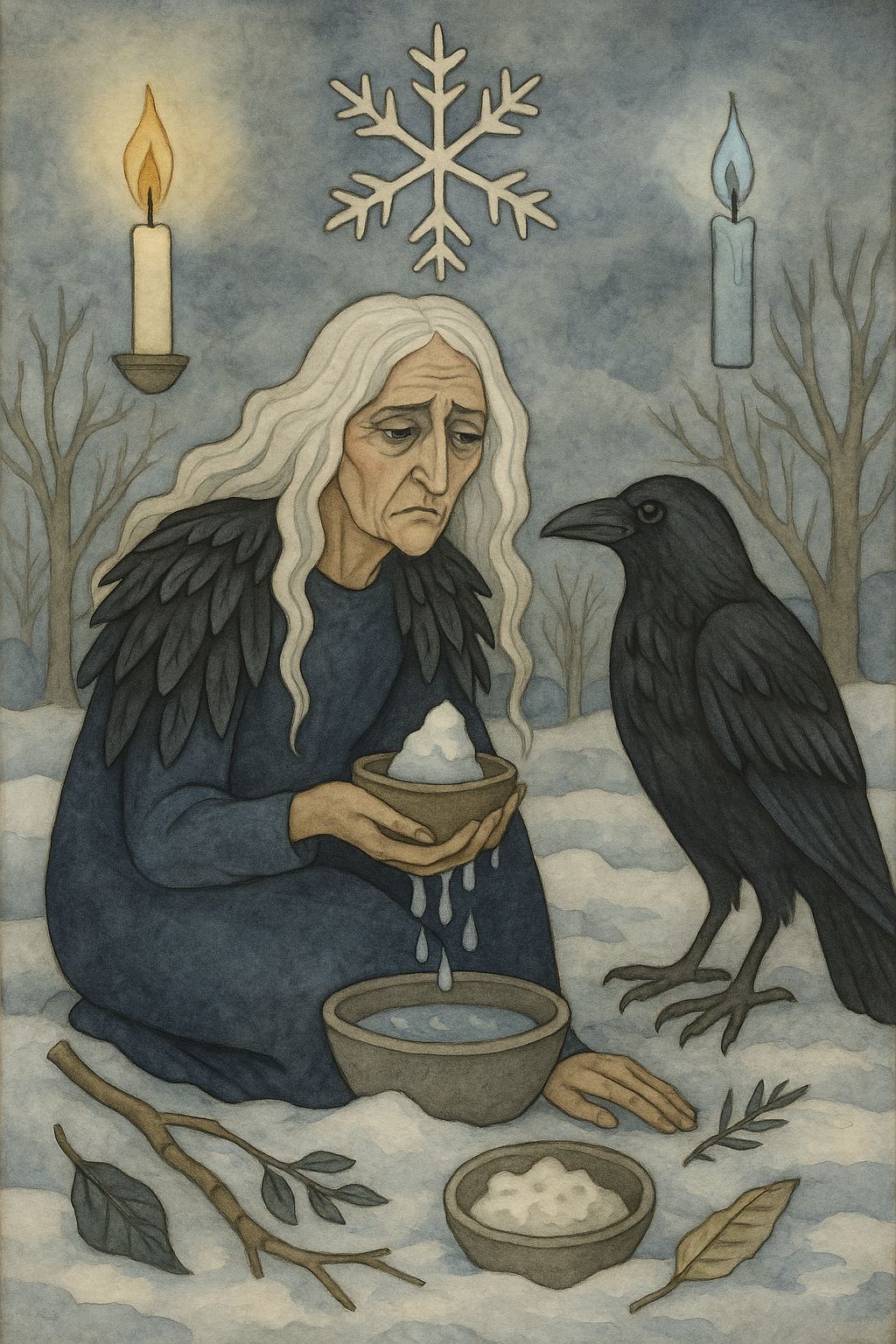
What you’ll need:

  • A small round loaf of bread (homemade or bakery-fresh)

  • A knife (symbolic sickle)

  • A gold, orange or brown candle

Step 1: Set the scene. 

Cast a magic circle if you’d like. 

Place your candle in front of the bread. Light it as the sun begins to lower — golden hour, if possible. Let this moment feel sacred, even if it’s just you and your cat on the kitchen counter.

Step 2: Declare your harvest before the flame.

Hold your hands over the bread. Say what you’ve harvested this season. Maybe it’s a job. A finished creative project. A hard conversation you finally had. Say it, name it, own it. 
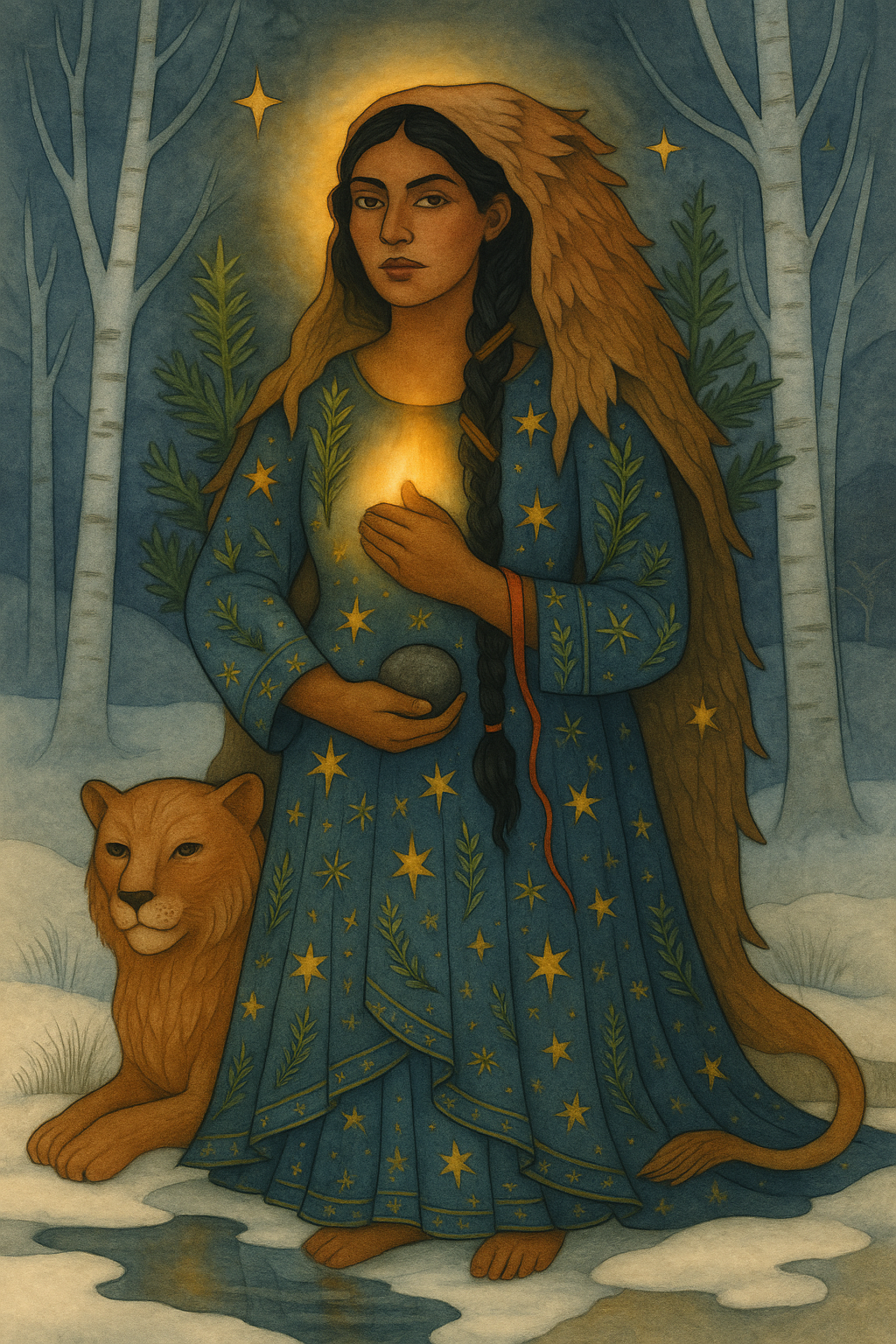
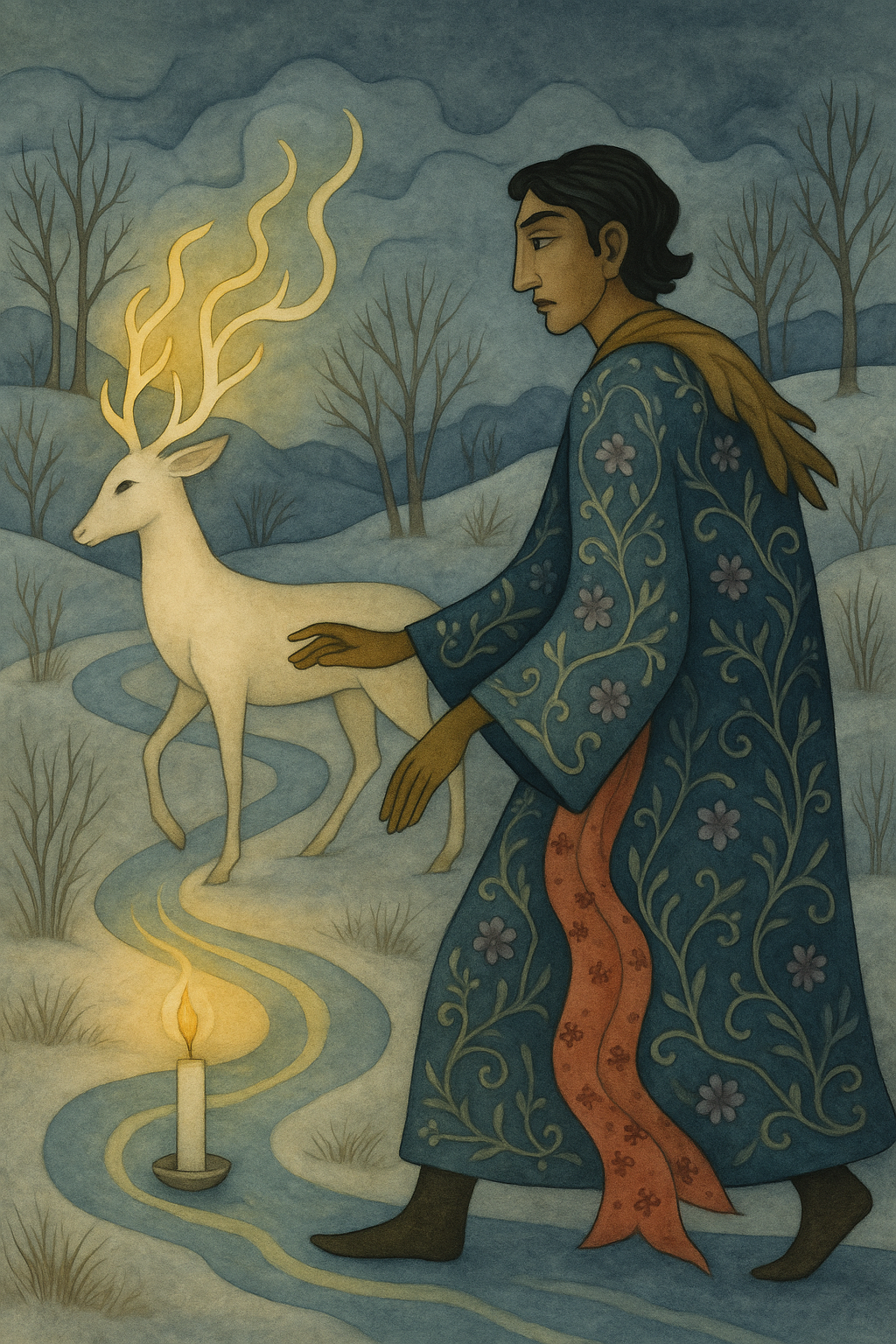
Then chant:

I’ve brought this to the table.
With work, with will, I’ve made it real.

Step 3: Cut the loaf. 

Use the knife to slice the bread. As you cut, envision what must be released to move forward: a habit, a fear, a stale version of you. Speak this next part as you slice:

The grain is grown, the blade is near,
I cut away what I outgrew this year.

What’s done is done. The stalk must fall.
I thank it — then I take it all.

Step 4: Chant. 

Break off a piece of bread, hold it to your heart, and chant this slowly — three times, each time a little louder:

Sun in the field and fire in the sky,
I feast, I thank, I say goodbye.
What once was seed is now my own.
I take the gift, I give it home.

Eat the bread slowly. Feel the warmth. Let yourself sit in that golden glow of satisfaction and release.

Step 5: Finish the ritual. 

Blow out the candle and scatter a few breadcrumbs outside for the spirits of the land, birds or anyone who could use a little magic.

A group of people enjoy a Lammas feast of bread, fruit, pie, corn and wheat

Feasting and Traditional Foods of Lammas and Lughnasadh

Lammas is the feast that says, we made it this far — and that’s worth celebrating. After months of planting, tending, sweating and hoping, the first harvest is finally in hand. That’s why this sabbat is one of the most delicious on the Wheel: It’s a table piled high with the fruits of your labor, both literal and symbolic.

Bread (non-negotiable)

Bread: the ultimate alchemy of flour, water, salt and time. At Lammas, a loaf represents gratitude, transformation and survival. Traditional loaves were round, sun-shaped, or braided into spirals and wheels. Some folks saved a portion for blessings, while others fed it to the fire or the fields in offering.

If you bake nothing else this year, bake for Lammas — with herbs from your garden, honey from the farmer’s market, or whatever feels sacred in your kitchen.

Grains of all kinds

Wheat may get the spotlight, but barley, oats, rye and corn are all Lammas royalty. Oatcakes, porridge, barley soup, cornbread — these are humble, grounding foods with ancient roots. They stick to your ribs and remind you that nourishment is a sacred act. 

Berries and first fruits

The late-summer hedgerows are bursting. Blackberries, raspberries, blueberries — if you can pick them yourself, even better. Early apples may also be ready, and orchard fruit carries special Lammas energy: juicy, generous, wild.

Preserving, canning or pie-making also fit the season’s vibe. You’re feasting — but you’re also storing for the winter to come.

Seasonal veggies

Zucchini, tomatoes, squash, corn on the cob, beans, fresh herbs — Lughnasadh is a love letter to the garden. Many traditional dishes were simple: roasted with oil and salt, cooked into stews, or eaten fresh with bread and cheese. Let the ingredients sing. They’ve worked hard to get here.

Ale, mead and herbal infusions

Fermentation is magic. Whether it’s homebrewed ale, golden mead, or sun tea steeped with mint and calendula, a Lammas drink should feel alive. It should warm the belly and honor the earth. Toast to Lugh, to the land, to the ones who cleared the fields before you.

A mom and her daughter make corn dollies for Lammas

Crafting and Activities for Lammas and Lughnasadh

Lammas is a working holiday. It honors labor — physical, creative, emotional. So the crafts of this sabbat aren’t just decorative; they’re symbolic acts of gratitude, protection and offering. Whether your tools are scissors, shears, flour or fire, this is the season to make something that gives back.

1. Make a corn dolly (and don’t make it cute). 

Corn dollies are traditional harvest figures woven from the last sheaf of grain. They house the spirit of the field through winter — think of it as spiritual life support for the land. You can use wheat, corn husks or even raffia. Don’t stress about perfection; these were never meant to be precious.

Once made, you can:

  • Keep it on your altar through the darker months

  • Bury or burn it at Imbolc to return the spirit to the earth

  • Add protective herbs or charms to empower its energy

2. Craft a sun wheel or grain braid. 

Braid together wheat stalks, dried grasses, or long herbs into a spiral or circle. These were once hung over doors and hearths for luck, abundance and protection. 

3. Press flowers and herbs from your garden. 

Take stock of what’s blooming or ripening around you. Press flowers and leaves between books or use them to make bookmarks, sachets or offering bundles. Lughnasadh is a time to capture the fleeting — before it fades.

4. Bake bread with intention. 

Shape your bread into suns, sheaves, spirals or wheels. Score it with sigils. Tuck in herbs, garlic or cheese. And if your bread flops? That’s part of the offering. You still get points for showing up.

5. Host your own mini Tailteann Games. 

Whether you host a poetry contest, an art swap or a backyard obstacle course, this tradition goes back to the festival’s roots. Celebrate what you (and your people) are good at — and don’t forget to crown someone “Champion of the Grain” or whatever glorious nonsense you come up with.

6. Create a harvest altar. 

Use things you already have: bread, fruit, dried herbs, a candle or two. Add in a symbol of something you’re proud to have “harvested” this year. You can dismantle it at Mabon, or let it linger as a visual reminder of all you’ve made possible.

A modern pagan man holds a chaff of wheat while holding a staff at Lughnasadh

Honoring the Spirit of Lammas and Lughnasadh

Whether you call it Lammas or Lughnasadh, this festival invites you to pause for reverence. Mark the moment between heat and harvest, between holding on and letting go. It’s a time to bake (and break) bread, give thanks, and honor your labor.

From corn dollies and feasts to fiery rituals and golden symbols, Lammas and Lughnasadh remind us that everything worth harvesting starts with a seed — and a little faith in the sun.

Happy first harvest. May your table be full, your spirit light, and your sickle sharp. –Wally

How to Celebrate Litha: A Wiccan Ritual, Traditions and the Magic of the Summer Solstice

Discover the meaning of Litha, the Wiccan sabbat that honors the summer solstice. Explore rituals, magical crafts, traditional foods, and ways to celebrate the longest day of the year with intention and sunlit joy.

The first rays of morning stretch across the sky like golden fingers, warming the dewy grass and painting the treetops in fire. Birds are already busy in the hedgerows, bees hum like a chant in the fields, and somewhere in the distance, a barefoot figure turns their face to the sky.

It’s the longest day of the year — the sun’s triumphant moment. Everything is blooming, buzzing, bursting with life. The air feels thick with enchantment. If you listen closely, you might even hear laughter just beyond the veil — the kind that flickers at the edge of dreams. Midsummer is here, and with it, Litha — the sun’s high holiday, a time to celebrate light, strength, and the sweet fullness of the season.

Whether you rise with the dawn or dance beneath the stars, this is a moment to honor your power, your path, and the magic of being alive in the height of summer.

The Origins and Meaning of Litha

Litha (pronounced Lee-tha or sometimes Lit-ah, depending on tradition) marks the summer solstice — the longest day and shortest night of the year. It falls around June 20 and 21 in the Northern Hemisphere, when the sun reaches its highest point in the sky.

For Wiccans and many modern pagans, Litha is the solar climax of the Wheel of the Year — a fiery, golden celebration of growth, joy, abundance and light. It’s a time to revel in nature’s bounty, to celebrate all that has blossomed since spring, and to honor the turning point as the days now begin, slowly, to shorten.

It follows Beltane, the fiery celebration of fertility and union, and comes before Lughnasadh (or Lammas), the first harvest festival. While Imbolc and Ostara sparked the light, and Beltane ignited passion, Litha is the sun in full blaze — a moment to honor life at its fullest, just before the wheel turns toward the waning half of the year. Like Mabon and Yule, its power lies in transition — and in the magic of balance shifting.

As such, Litha invites reflection as well as revelry — a pause in the sunlight to take stock of what you’ve grown, and where you’re headed.

Historically, midsummer festivals were marked with bonfires, dancing, and rituals to protect crops, cattle and communities. In Norse tradition, blazing wheels were rolled down hills to mimic the sun’s path. In ancient Rome, festivals for Juno and Vesta aligned with the solstice, while in Slavic countries, it was a time of fertility rites and water magic.

Every culture that watched the sun’s rise knew this moment mattered. And it still does.

Myths and Folklore of Midsummer Magic

Long before clocks and calendars, our ancestors watched the skies. They knew when the sun lingered a little longer, when shadows shrank and golden light stretched into the evening. And on that brightest day, they told stories — of gods who set the sky ablaze, of faeries who danced through ferns, of fires lit to keep chaos at bay.

One of the most enduring myths of the solstice is that epic battle between the Oak King and the Holly King — twin aspects of the Horned God. At Yule, the Oak King is born, gaining strength as the days lengthen. At Litha, he reaches his peak — and then falls in ritual battle to the Holly King, who rules the waning year. It’s a beautiful allegory of the natural cycle: Even at the height of power, change is inevitable. Even in light, shadow waits.

Elsewhere, the solstice shines with the brilliance of deities:

  • Lugh, the Celtic god of the sun and many skills, whose name means “Light.” Though more often honored at Lughnasadh, his energy pulses through Litha’s creative fire.

  • Amaterasu, the Japanese sun goddess, who once hid herself away in a cave, plunging the world into darkness — until the laughter of the gods lured her out, restoring light.

  • Ra, the Egyptian sun god, who sails across the sky each day in his solar barque, battling the chaos serpent Apep each night to rise again.

  • Apollo, golden-haired and lyre-strumming, who, in some tellings, carries the sun in his chariot, and lights the world with prophecy, music and flame.

And then there are the tales of midsummer Fae — the Good Folk who slip more easily between worlds on nights like these. In Celtic and Germanic folklore, Midsummer’s Eve was a time of enchantment, when doors opened between realms. People wove flower crowns to protect themselves, gathered St. John’s wort to banish spirits, and placed iron charms at thresholds to keep mischief out. But some sought the fairies, laying out milk and honey and dancing under the moon in hopes of catching a glimpse of their revels.

Even Shakespeare knew the magic of this night. A Midsummer Night’s Dream — with its mix of love, trickery and wild enchantment — captures the sense that on this night, anything might happen.

So if the air feels thick with possibility… if a shadow in the trees lingers longer than it should… you’re not imagining it. Midsummer is a time of stories — and you’re living in one.

Traditions of Litha

Litha traditions shimmer with light: fire, flowers, golden feasts, and the joy of long, lingering days. At the heart of it all is a sense of celebration: The Earth is alive, generous and radiant. And you’re invited to join the dance.

Across centuries and cultures, solstice traditions share one common thread: light triumphing over darkness, even if only for a moment. People built bonfires to mimic the sun, leapt through flames for luck and fertility, and crafted garlands and charms to honor nature in full bloom.

Here are some of the most common — and magical — ways to honor Litha:

Sunrise and Sunset Vigils

Start your celebration with intention: Rise with the sun, and greet it as it crests the horizon. Some Wiccans stay up through the night to watch it rise; others pause at noon to feel the day’s full power. As the sun sets, light candles or a small fire to carry the energy into the evening.

Bonfires and Solar Flames

Traditionally, solstice fires were lit on hilltops to honor the sun and strengthen crops. Today, lighting a candle, firepit or even a flame in your heart can serve the same purpose — a symbol of your inner fire and the light you carry forward.

Floral Crowns and Herb Bundles

Wear the season on your head — quite literally — by weaving flower crowns from midsummer blooms: sunflowers, daisies, chamomile, roses. Bundle herbs like St. John’s wort, rosemary and lavender for protection and clarity. Hang them by your door or burn them as offerings.

Rolling Sun Wheels

In some traditions, wooden wheels were set ablaze and rolled down hills to represent the sun’s journey. You don’t need to torch your garden cart, but making a sun wheel from grapevine or craft supplies and hanging it on your door brings the symbolism home.

Symbols and Correspondences of Litha

Colors:

  • Gold, yellow, orange for the sun and fire

  • Green for growth and abundance

  • Red for passion and vitality

Crystals:

  • Sunstone boosts confidence and leadership

  • Citrine for joy, abundance, and energy

  • Carnelian fires up creativity and motivation

  • Amber links to ancient sunlight and protective energy

Herbs and Plants:

  • St. John’s wort to ward off negativity

  • Chamomile brings peace and clarity

  • Rosemary for memory, cleansing

  • Lavender provides calm and spiritual connection

  • Oak leaves and acorns, sacred to the Oak King

Animals:

  • Bees represent industrious joy and sweet results

  • Stags for strength and the wild, sacred masculine spirit

  • Songbirds symbolize communication and delight

  • Dragons for the fire of transformation and protection

When you’re surrounded by sunflowers and the air hums with bees, it’s easy to understand why our ancestors paused to celebrate. Litha reminds us to honor our own light, too — to revel in what we’ve grown, and to shine brightly while we can.

A Litha Ritual to Ignite Your Inner Fire

Whether you’re practicing alone or with your coven, Litha calls for something joyful, golden and alive. This isn’t the time for subtlety — it’s the sun’s main act. So light a flame, crown your head in flowers, and step into your strength. Midsummer has long been considered one of the most powerful times of the year for magic. 

Below is a ritual designed to help you align with midsummer’s powerful energy. It culminates in a spell crafted to awaken your personal power and confidence — to help you shine as brightly as the solstice sun.

Before You Begin

Choose a time near sunrise, noon or sunset. A backyard, balcony or sunny window is ideal. Dress in sun-kissed colors (yellows, reds, golds and greens). Optional: Wear a floral crown, sun charm, or something that makes you feel radiant.

What You’ll Need

  • A yellow or gold candle (or a fire-safe bonfire or cauldron)

  • A fresh bay leaf (or oak leaf), and a gold or red pen

  • A bowl of water (preferably rainwater or spring water)

  • A small mirror

  • Any altar decorations you like — sunflowers, herbs, crystals, seasonal fruit or a solar deity image

Step 1: Prepare your altar and cast the circle.  

Arrange your altar in the center of your space. Add symbols of the season: a sunflower in a jar, a handful of cherries, a sprig of rosemary. Light your candle and say:

Brightest day and golden flame,
I call the sun by sacred name.
With fire and fruit, with song and cheer,
Litha’s light, be with me here.

Cast your magic circle as you normally do, walking clockwise and calling on the elements. Emphasize fire and air, the season’s dominant energies.

Step 2: Call on the sun and the self.

Face the sun (or your candle flame) and speak:

Great Sun, high above, I honor your strength.
You blaze at your peak, and so do I.
Shine through me — may your light awaken what I already carry.
Take a deep breath and feel that light fill your chest.

Step 3: Cast a spell of solar strength. 

Take your bay leaf. With your gold pen, write one word that represents the strength you wish to step into now:

Confidence. Boldness. Courage. Radiance. Truth.

Hold the leaf in both hands. Focus on it — not just the word, but what it would feel like to live it. Speak this chant:

Sun above and fire below,
Grant me strength to rise and glow.
Let fear fall off, let doubt grow dim,
My inner light outshines the grim.

If you’re using a mirror, hold the leaf to your heart and look yourself in the eye. Say:

This is the truth I now reveal—
I am whole, and I am real.

Then, drop the leaf into the bowl of water. Imagine that as the leaf moves, your power rises. The strength you called is already yours.

Finish with:

With sun’s embrace and sky’s wide dome,
My power stirs and finds its home.

Step 4: Close the circle and celebrate. 

Thank the elements and release your circle. Let the candle burn out safely or snuff it with intention.

Dispose of the leaf respectfully — bury it beneath a blooming plant, compost it, or pour the water into the soil. If you used a mirror, keep it on your altar for a few days as a reminder of the light you claimed.

Then eat something delicious. Dance barefoot. Watch the sunset. You just honored the height of the sun — and the fire inside you.

Feasting With the Sun: Foods of Litha

What better way to celebrate the fullness of life than with a feast bursting with summer’s brightest flavors? Litha is a festival of abundance — a time to honor the Earth’s generosity and the energy that ripens every fruit, herb and grain. Whether you’re throwing a solstice picnic or preparing a quiet sunlit brunch, let your table reflect the richness of the season.

Seasonal Staples

Litha food is sun food: golden, juicy, herbaceous and joyful.

Fruits:

  • Cherries, strawberries, blueberries, peaches — served fresh or baked into hand pies

  • Lemons and oranges for lemonade, tartlets or citrus-glazed cakes

Herbs:

  • Rosemary, basil, mint, lavender, thyme tossed into salads, folded into doughs, infused in syrups

  • St. John’s wort (not to ingest, but nice as a tea blend or altar offering)

Savory ideas:

  • Herbed flatbreads or focaccia with edible flowers

  • Grilled corn brushed with butter and smoked paprika

  • Honey-glazed chicken or lemon-rosemary roasted vegetables

  • Fresh greens with berries, goat cheese and sunflower seeds

Sweet treats:

  • Honey drizzled over everything, from toast to berries to cornbread

  • Sun cakes (round golden cakes flavored with honey or citrus)

  • Lavender shortbread cookies

  • Honey mead, lemonade or herbal sun tea brewed in a jar outside

Simple Recipe: Honey & Lavender Lemonade

You’ll need:

  • 1 cup fresh lemon juice

  • 3 to 4 tablespoons honey (to taste)

  • 2 teaspoons dried lavender

  • 4 cups water

Instructions:

1. In a small saucepan, heat 1 cup of water with the lavender and honey until the honey dissolves.

2. Let steep 10 to 15 minutes, then strain.

3. Mix the lavender-honey water with lemon juice and the remaining water. Chill and serve over ice with a sprig of mint or slice of lemon.

Bonus points if you brew this under the sun and stir it with intention.

Whether you eat alone, with loved ones, or leave an offering outside for the Fae, the act of feasting at Litha is a sacred one. That nourishment can be a spell in itself. That gratitude tastes best when shared.

Crafts and Offerings for the Solstice

At Litha, your hands can become an altar. Whether you’re weaving flowers, tying charms, or placing honey cakes in the garden, crafting is a form of spellwork — one that honors both the season and your own creative fire.

These are not just pretty pastimes. They’re echoes of ancient practices — ways to connect with the Earth, the sun and the unseen.

Make a sun wheel. 

This classic midsummer craft channels the ancient tradition of burning sun wheels rolled down hills. You can make a simple one from grapevine, willow branches or even embroidery hoops.

Decorate it with ribbons in gold, orange and red. Add sprigs of rosemary, wheat stalks or little sun charms. Hang it on your front door or above your altar as a symbol of light and strength.

Weave a flower crown. 

A floral crown is more than just a boho accessory — it’s a living halo. In old midsummer traditions, people wore garlands to protect against Fae mischief or attract blessings.

Use whatever blooms are local and seasonal — daisies, clover, lavender, marigolds, even wild herbs. As you weave each stem, speak a word of intention or blessing: joy, courage, abundance, love. Then wear your creation during your ritual or feast.

Create a fairy offering. 

Midsummer’s Eve is said to be one of the Fae’s favorite nights. If you’d like to stay on their good side (or invite a bit of their magic), prepare a small offering.

Ideas include:

  • A thimble of honey or mead

  • A slice of bread with butter and herbs

  • Wildflowers tied with twine

  • A shiny stone or tiny bell

Leave your offering at the base of a tree, beneath a fern, or on your windowsill. Whisper a wish as you walk away — and don’t look back.

Craft a solar sachet. 

Gather herbs associated with the sun — such as rosemary, chamomile, calendula and St. John’s wort — and tie them up in a yellow or gold cloth.

Hold it in your hands and say:

Sun in sky and fire in me,
Let this charm bring strength to be.

Keep it near your bed, your altar, or in your bag when you need a boost of solar energy.

These crafts may seem small — but they’re woven with meaning, intention and magic. And that’s the heart of Litha: turning sunlight into something sacred.

What Litha Teaches Us

Litha is a celebration of light — not just the kind that bathes the Earth in gold, but the kind that flickers in your chest when you laugh too hard, take a bold leap, or finally speak your truth out loud.

At the solstice, the sun stands still. Just for a breath. A golden pause between the rising and the falling. That stillness is a gift — an invitation to ask: What have I grown? What am I proud of? What do I carry forward into the next season of my life?

Because, after Litha, the light begins to wane. The wheel turns. The days shorten, slowly at first. So this moment — this fire-bright, blossom-heavy, bee-laced moment — is fleeting. And that’s what makes it sacred.

So wear the crown. Light the fire. Chant your name to the sky. Share the honeyed bread. Leave a gift for the Fae. And let yourself feel it all — the joy, the courage, the wild magic humming in your bones.

Because you, too, are made of sunlight.

And you were always meant to shine. –Wally
Curses and Consequences: What I Learned at a Black Magic Class

A curse class at Malliway Bros. in Chicago uncovers the truth about jinxes, hexes and curses, intent, consequences and protection. The dark arts, debunked.

Most people shy away from the idea of curses. We like to believe magic is all love, light and lavender-scented moon rituals. But what about the other side of the craft? The part that deals with justice, consequences and — let’s be honest — sometimes just good old-fashioned spite?

That’s why I found myself at Malliway Bros., a truly magical occult shop in Chicago’s Rogers Park neighborhood, sitting in a dimly lit room, about to learn the art of cursing. Not to throw hexes around willy-nilly, but to understand them. Because, as it turns out, curses aren’t always what we think they are.

Dark magic isn’t inherently evil, but it’s messy.
You have to be prepared for the consequences.

What Is a Curse?

Before diving into the how, we had to unpack the what. First up: learning the difference between a curse, a hex and a jinx. 

Jinx: “Jinxes are thought of as the lowest level of dark magic,” according to Wycke, one of the store’s owners — a guy who most definitely has some Fae in his blood. “It’s usually mischievous and causes minor and short-lived inconveniences. Quick bad luck, stubbed toes and stained clothing are some of the most common offenders. These are usually not cast with true spite and are used instead for silly inconveniences or minor retaliations.”

Hex: “Hex comes from the German word Hexe or Hexen meaning “witch” and originally would have just meant a spell,” he continued. “Now hexes are thought of as more serious forms of ill-wishing. These are usually harmful spells meant to teach a lesson and will often be undone once that lesson is learned.”

Curse: “Curses are the most dire form of maleficium,” Wycke said. “They are long lasting and cause serious harm. A curse is not always meant to justify a wrong and will instead do harm just to meet its caster’s satisfaction.”

One thing that surprised me? Curses aren’t always evil. Some practitioners use them for protection, to bind harmful people, or as a magical last resort. One example: a justice curse designed to make sure a person’s wrongdoings catch up with them. Turns out there’s a lot of gray areas when it comes to black magic. 

The Ethics of Maleficium

Malliway’s curse class raised the questions, “Should you?” Because no spell exists in a vacuum.

We talked about the Threefold Law (the belief that whatever you send out returns threefold) and the Wiccan Rede: “An it harm none, do what ye will.” 

But not all witches follow these principles. Some believe in justified cursing, especially when mundane justice fails. Others think magical consequences work on their own — curse someone unfairly, and you might get slapped back by the universe.

The class debated this: Is it ever okay to curse? Someone argued that curses are just another form of protection. Another felt they should be a last resort. And then there was the question of intent vs. action: Does wanting harm make you just as guilty as acting on it? Or what if your spell hurts someone, even though that wasn’t what you had planned?

The Risks of Dark Magic

Here’s where things got intense. Cursing isn’t just about what you do to others — it’s about what you invite in. If you decide to dabble in the dark arts, watch out for these possible consequences. 

  • Backfire is real. Misplace your intent, and you might hit the wrong target (including yourself).

  • Magical residue exists. Ever walked into a place that felt heavy? Curses leave behind energy, and if you don’t cleanse properly, it lingers.

  • Protection is key. Every good curse caster knows how to shield themselves. There are wards, protective symbols and cleansing techniques to avoid unwanted spiritual side effects.

One big takeaway: Dark magic isn’t inherently evil, but it’s messy. You have to be prepared for the consequences.

RELATED: How to Protect Yourself From Black Magic

Breaking Curses

Of course, we didn’t just learn how to make curses — we also learned how to break them.

Methods included:

  • Unbinding spells to reverse the intention

  • Cleansing rituals (smoke, salt or a bath) to remove lingering effects

  • Mirror spells to reflect the curse back

Keep in mind, though, that countercurses don’t always work the way you’d think. Sometimes, the best way to break a curse is simply to stop believing in it, and inadvertently fueling it.

Warding: A Shield Against Harm

While Defense Against the Dark Arts class at Hogwarts played it up with wand-waving and faux Latin, real spells aren’t far off — they still demand intent, ritual tools and words that cut like poetry.

Here’s a simple warding spell designed to shield against residual harmful energies. 

1. Plant your feet firmly on the ground and focus on its sturdiness. Say:

Iron as the blade, silver as the glass,
None what harms shall come to pass.

2. Make an X with your fingers in front of you. Say:

Not from afar. 

3. Keep your fingers linked, cross your forearms over each other. Say:

Nor on my par. 

4. Place both hands on opposite shoulders and say:

And none within may come to spar.

Visualize three crosses forming across your body — hard as iron, reflective as silver — locking into place for protection.

A Sundry of Spite: Cursing Methods From Folklore

Cursing techniques have been passed down through history. Some are simple but potent, requiring no special tools beyond one’s own energy and intent:

  • Spitting on someone or their belongings is considered a powerful curse. Some call this “witch’s venom.”

  • The Evil Eye can be cast simply by glaring at someone with jealousy or ill intent. This can be accidental but is dangerous when done deliberately.

  • Doing things in reverse can symbolically “undo” a person — writing their name backward, walking around their home counterclockwise, or dismantling their work in reverse order.

  • Collecting a taglock (a piece of hair, clothing or personal item) ensures a magical link to the target.

  • Tricking a victim into accepting a curse bypasses protections. Disguising a curse as a gift or using cleverly worded phrases can sneak past magical defenses.

  • Corrupting property with vinegar, urine or poison can attach harmful energies.

  • Foot track magic works by casting spells on a person’s footprints, shoes or the ground they regularly walk on.

The Hex of the Red Hand

This elaborate curse is designed to force someone to face the consequences of their actions — branding them with guilt and shame.

You’ll need:

  • A piece of paper

  • Red and black ink pens

  • Eyebright

  • Crash site soil

  • A red candle

  • Pins

  • Red cloth

  • Burdock burrs

  • Stinging nettle

  • Courthouse soil

  • Wood squill

  • A bowl of saltwater

  • A cauldron

Steps:

1. Write the victim’s name in red ink at the center of a square piece of paper.

2. Use black ink to surround their name with written records of their wrongdoings.

3. Mix eyebright and crash site soil in a bowl, chanting:

I see you with an eye unblinking. 
I mark you with your lies unlinking.

4. Scatter the mixture over the name and add any taglocks you have of the victim.

5. Fold the paper into a parcel and seal it with red candle wax.

6. Pierce the parcel with a pin, saying:

I pierce this hand,
And lay the brand.
Red as my fury and red as the crime.

7. Place the parcel on red cloth and scatter it with stinging nettle, burrs, courthouse soil and wood squill.

8. Tie the cloth into a bundle and suspend it between a burning kettle and a bowl of saltwater, chanting:

Burrs of burdock, unrelenting,
Stinging nettle, still tormenting.
With soil, guilt upon your name,
Wood squill bows your head in shame.
Burn and rue, burn and rue,
Mark the hand that earns its due!

9. Dunk the bundle back and forth between the fire and the saltwater, repeating the final lines.

The bundle can be kept and fed with saltwater to extend the curse’s duration.

A Minor Swifting: Cleansing After a Curse

Once a curse is cast, residual energy can linger, and it’s wise to cleanse yourself to avoid unintended consequences. The class provided this simple swifting ritual to wash away unwanted magical influence.

1. Prepare a bowl of saltwater and dip your fingers into it.

2. Anoint your palms and say:

My left, my right, by these two hands. 

3. Anoint your throat and say:

My voice, my words, to where I stand.

4. Pass sage smoke over yourself while repeating:

Hekas, hekas, este, bebeloi.
All that is unclean, evil or impeding to my ways,
From here, depart, depart, depart and be gone.

So, Should You Curse?

I’ve always heard that casting dark magic means it comes back to you threefold. I’m not sure the math checks out — but I do believe that if you’re fueled by anger and vengeance, putting that kind of negativity into the world increases the chances of it finding its way back to you. Just as we cast spells to manifest something good, the same principle applies to curses.

Here’s the thing: Magic isn’t good or bad. It’s a tool. Like fire, it can warm your home … or burn it down.

This class didn’t turn me into a wrathful hex-slinger, but it did change how I see magic. Curses aren’t just about revenge; they’re about intent, justice and power. And whether you choose to use them or not, it’s better to understand them than to fear them.

So next time someone warns you about the dangers of the dark arts, just remember: The real danger isn’t knowing too much. It’s knowing too little. –Wally

Interested in delving deeper into the mystical arts?

Malliway Bros. offers a variety of events at their shop, including tarot round robins, educational sessions, rituals and spell-casting workshops. Whether you’re a seasoned practitioner or simply curious, there’s something for everyone.

Explore their upcoming events


Malliway Bros. Magic & Witchcraft

1407 West Morse Avenue
Chicago, Illinois 60626
USA

How to Celebrate Beltane: A Wiccan Ritual, Traditions and the Magic of May Day

Discover the history, symbolism and traditions of this joyful May Day sabbat: a Beltane ritual, flower crowns, Maypoles, fire festivals and wild Fae magic. 

A Wiccan man celebrates Beltane, with tree decorations and a bonfire

The last breath of spring lingers in the air, thick with the scent of the first blooming flowers and fresh-cut grass. The world is humming — bees drowsily drift between blossoms, the sun lingers a little longer each day, and the Earth is alive with a feverish energy. By nightfall, bonfires will blaze, ribbons will wind around the Maypole, and laughter will ripple through the warm evening air. This is Beltane, the fire festival of passion, fertility and abundance.

Celebrated on May 1, Beltane is the great turning of the wheel that marks the transition from spring to summer. The name comes from the Celtic god Bel, meaning “Bright One,” and tene, meaning “fire” — a fitting name for this exuberant festival. As one of the most joyous (and sensual) of the Wiccan sabbats, Beltane calls for revelry, creativity and connection.

A disheveled man and woman are about to celebrate a greenwood marriage at Beltane

The History and Traditions of Beltane

Beltane is one of the four great Celtic fire festivals, alongside Samhain, Imbolc and Lughnasadh. It marks the transition from spring to summer, when the world bursts into life, and the veil between realms grows thin. 

For the ancient Celts, Beltane was a time of protection, purification and fertility. Great bonfires were lit, and livestock were driven between twin fires to ensure their health and prosperity for the coming season. These fires were believed to hold magical properties, warding off disease and evil spirits. People also leaped over the flames — sometimes for luck, love or fertility, and sometimes as a form of personal purification.

But Beltane’s most infamous tradition was the greenwood marriage. On this night, couples would disappear into the woods to celebrate the fertility of the land in a very literal way. These unions weren’t necessarily permanent marriages — some lasted only for the night, while others could become long-term partnerships. Children conceived during Beltane were sometimes referred to as “merry-begots”, and the festival itself was deeply tied to the idea of sacred union — both between human lovers and between the Earth and the Sun.

A table outdoors laden with Beltane treats and flowers

Beltane and the Rise of Christianity

Like many pre-Christian festivals, Beltane’s fiery revelry and fertility rites didn’t sit well with the Church. While Christianity was often willing to absorb and adapt certain pagan customs — like turning Yule into Christmas or Ostara into Easter — Beltane’s more uninhibited celebrations were harder to sanitize.

The festival’s bonfires, rituals and open expressions of sexuality were seen as dangerously pagan. The idea of couples disappearing into the woods for greenwood marriages clashed with Christian notions of monogamy and morality. By the Middle Ages, efforts were made to suppress Beltane practices, often by demonizing the festival as a time of witchcraft and devilry.

However, May Day traditions proved too beloved to fully erase. The Church allowed some aspects to remain, especially the Maypole dance, which was reframed as a community event rather than a fertility ritual. Meanwhile, Beltane’s bonfires persisted in rural areas, particularly in Scotland and Ireland, though they were often rebranded as local saint celebrations.

The Protestant Reformation, however, took a harsher stance. Many Beltane traditions, including fire-jumping and fertility rites, were outlawed, and in some cases, participating in these customs was enough to get someone accused of witchcraft. The association between Beltane and witches was strong — even in the 17th century, Scottish minister Robert Kirk wrote about the “Fairy Faith,” warning that Beltane was a time when spirits and witches roamed freely.

Despite centuries of suppression, Beltane never truly died. In the modern era, the festival has experienced a revival among Wiccans, Pagans and folklorists, who have reclaimed its joyful, fiery essence. Today, Beltane is once again celebrated with bonfires, dancing and rituals — a testament to the resilience of ancient traditions.

The god Bel, encircled by flames

Myths and Folklore of Beltane

Beltane’s fires burn in honor of Bel, the bright and shining god of light, often associated with Belenus, a solar deity worshiped across Celtic Europe. He was seen as a protector, guiding the transition from the gentle warmth of spring to the full power of summer. In some traditions, Bel’s fire was said to purify, bless and invigorate all who passed through it — hence the ancient tradition of driving cattle between Beltane bonfires for protection.

But Beltane isn’t just a time of fire — it’s also a time of Fae magic. Like Samhain, Beltane is a night when the veil between worlds is thin, making it easier for spirits and fair folk to slip through. Unlike Samhain, when ghosts and ancestors visit, Beltane belongs to the Fae. These aren’t your delicate, winged flower fairies; Beltane’s fae are wild, mischievous and often dangerous.

According to folklore, Beltane night is a time when:

  • The Sidhe (fairy folk) roam freely, seeking offerings and sometimes playing tricks on unsuspecting mortals.

  • Travelers may stumble into fairy rings and be spirited away for what seems like hours — but when they return, years have passed.

  • Leaving offerings of milk, honey or bread outside your door will appease the Fae and ensure they don’t cause trouble in your home.

Many old stories warn against speaking to or making deals with the Fae on Beltane, but others claim it’s the perfect night to seek their blessings — if you know how to ask. Whether you honor them with gifts or steer clear of their mischief, there’s no denying that Beltane is a night of wild, untamed magic.

A woman soars over a Beltane bonfire while others look on

Traditions of Beltane

Beltane is a festival of fire, fertility and revelry, celebrating the height of spring and the turning of the wheel toward summer. It’s a time to embrace passion, creativity and abundance — whether that’s through dancing, feasting or lighting sacred fires.

1. Jumping the Fire

Fire is at the heart of Beltane. In ancient times, cattle were driven between two great bonfires to protect them from illness and misfortune. People also leaped over the flames to bring luck, fertility or courage into their lives. Today, you can honor this tradition by lighting a candle, writing an intention and carefully passing it over the flame for a symbolic blessing. Or, heck, test your luck and jump over a bonfire. Just make sure it’s a small one, please. 

A group of people hold hands and dance around a Maypole in a field of flowers

2. The Maypole Dance

One of Beltane’s most iconic traditions, the Maypole dance is a celebration of energy and unity. Ribbons are woven around the pole, symbolizing the intertwining of masculine and feminine energies, though today it represents all forms of connection and creativity. If you don’t have access to a Maypole, you can braid ribbons into your hair, create a ribbon wreath, or tie ribbons to a tree as a personal tribute to the tradition.

A young woman wears a flower crown

3. Flower Crowns and Greenery

Beltane is bursting with life, love and fertility, making flowers an essential part of the celebration. Wearing a flower crown or weaving garlands honors the season’s energy, especially with hawthorn, marigolds and lilacs — traditional Beltane blooms.

A man and woman hold a ribbon among flowers as they take part in a handfasting or Wiccan wedding ceremony

4. Handfasting (Pagan Weddings)

Beltane has long been associated with sacred unions and handfastings, a form of marriage where couples’ hands are tied together with ribbon to symbolize their bond. In old traditions, these unions often lasted “a year and a day” before becoming permanent. Whether you’re renewing vows, celebrating love or simply embracing deeper connections, this is the perfect time to honor relationships.

5. Offerings to the Fae

Since Beltane is a time when the Fae walk among us, many leave offerings to stay in their good graces. Traditional gifts include milk, honey, fresh bread or mead, left outside overnight. If you’re wary of the Fae’s mischief, keeping iron or salt by your door is said to deter them.

6. Late-Night Walks and Wild Magic

Some Beltane traditions are a little more mysterious and playful. In ancient times, young couples would disappear into the woods for a night of “greenwood marriage” (ahem), returning at sunrise with flower-strewn hair and dewy skin. Others would walk barefoot in the grass at dawn, believing the morning dew held magical properties for beauty and good fortune.

Neopagan deities, the Green Man, by a bonfire, and the Goddess, by flowers

Symbols of Beltane

Beltane is a festival rich in fire, fertility and wild energy, and its symbols reflect the passion and abundance of the season. Each one carries deep meaning, whether for protection, celebration or invoking the magic of May.

1. Fire

At its core, Beltane is a fire festival. The flames represent purification, passion and transformation, clearing away stagnation and ushering in the full force of summer’s energy. Whether it’s a bonfire, candle or even the sun itself, fire is the most powerful symbol of this sabbat.

2. The Maypole

A towering pole wrapped in colorful ribbons, the Maypole symbolizes union, connection and the dance of life. The interwoven ribbons represent the intertwining of energies — historically seen as masculine and feminine but now recognized as a celebration of all forms of harmony and creativity.

3. Flowers and Greenery

Beltane is a time of full bloom, and flower crowns, garlands and fresh-cut blossoms embody the beauty and fertility of the earth.

  • Hawthorn (the “May tree”) is sacred to Beltane, representing protection and love.

  • Lilacs and marigolds bring joy and blessings.

  • Oak leaves and ivy symbolize strength and endurance.

A fairy flies above a candlelit table with bread, milk, honey and other Beltane foods

4. The Fae

Beltane is one of the two times of the year when the veil between worlds is thin, making the Fae and spirits of the land more active. Many leave offerings of milk, honey and bread to honor them, while others take precautions to avoid their mischief.

5. The Green Man and the Goddess

The union of earth and sky, god and goddess, life and fertility is a central theme of Beltane. The Green Man, a leafy-faced figure found in old carvings and myths, represents the wild, untamed energy of nature. His counterpart, often depicted as the May Queen or a flower goddess, embodies fertility, beauty and the earth’s abundant gifts.

6. Ribbons and Knots

Weaving, braiding and tying knots are common Beltane practices, symbolizing the intertwining of forces, whether in relationships, creativity or personal power. Many use ribbons in Maypoles, hair braids, handfasting ceremonies or small intention charms to honor the magic of the day.

7. The Color Red

Red is the color of passion, fire and vitality, making it the perfect hue for Beltane. Wearing red, lighting red candles, or using red flowers invokes the bold energy of the season, fueling creativity, love and courage.

A coven of Wiccans stand in a circle by a bonfire to celebrate Beltane

A Simple Beltane Ritual

This ritual honors Beltane’s fire, passion and fertility — whether that means love, creativity or personal growth. You’ll invoke the energy of the season with fire, flowers and a rhyming chant to set your intentions ablaze.

You’ll need:

  • A red or orange candle (or a small fire, if safe)

  • A ribbon (any color that calls to you)

  • A flower or sprig of greenery (hawthorn, lilac or oak if possible)

  • A small bowl of honey or milk as an offering

A wooden altar set up for a Beltane ritual, with candles, honey, greenery  and a ribbbon

The Ritual

1.Set the scene: Find a quiet place, indoors or outside. Cast a magic circle if you want. Light the candle and take a deep breath, imagining yourself surrounded by the warmth of a Beltane bonfire.

2. Call the fire’s blessing: Hold your hands over the flame (at a safe distance) and say:

Fire bright, passion’s light,
Burn away the dark of night.
Bless this time, this turning wheel,
With love and joy I dance and feel.

3. Tie your intention into the ribbon: Hold the ribbon in your hands and focus on your desire for love, creativity, fertility or abundance. Tie a knot for each wish, saying:

Bound in fire, sealed in light,
My wish takes root, my path burns bright.

4. Offer the flower and honey: Lay the flower beside your candle and leave the honey or milk as an offering to the spirits of the land or the Fae.

5. Let the fire carry your intention: Pass the ribbon briefly over the flame or simply hold it close, infusing it with Beltane’s energy. Keep the ribbon on your altar, tied to your wrist or beneath your pillow to let your wish grow.

6. Close with gratitude: Blow out the candle and whisper a final blessing:

Beltane’s fire, warm and bright,
Guide my heart through day and night.

People sit at a table filled with treats and floral arrangements for a Beltane feast

Feasting for Beltane

Beltane is a festival of abundance, passion and pleasure, making feasting an essential part of the celebration. Foods that are sweet, fiery and full of life embody the spirit of this sabbat, honoring both the earth’s bounty and the traditions of the past.

Traditional Beltane Foods

Honey Cakes and Mead: Honey is sacred to Beltane, representing fertility and sweetness. Bake honey cakes, oatcakes or shortbread, or sip on mead to honor the old ways.

Dairy and Fresh Cream: In Celtic traditions, milk was often offered to the spirits of the land for fertility and protection. Enjoy cheeses, whipped cream or even a glass of milk as a nod to the past.

Seasonal Fruit and Herbs: Spring’s fresh berries, cherries, citrus and edible flowers are perfect for Beltane. Try strawberries dipped in honey or a salad with basil, mint and violets for a fresh, magical touch.

Spiced and Fire-Infused Dishes: Beltane is a fire festival, so foods with a bit of heat — like spiced nuts, hot honey or roasted peppers — connect to the day’s energy.

Bannocks and Oat Breads: Traditionally baked on Beltane morning, these simple, rustic breads are symbols of prosperity. Serve with butter and honey for a warm, grounding feast.

Beltane Punch: Mix fruit juices, a splash of something bubbly (like sparkling water or champagne), and fresh herbs for a refreshing, celebratory drink.

A fairy flies above a honeycake, held out as an offering

A Simple Beltane Honey Cake Recipe

This easy honey cake is perfect for Beltane feasting. 

You’ll need:

  • 1½ cups flour

  • ½ cup honey

  • ½ cup butter (softened)

  • 1 egg

  • ½ teaspoon cinnamon

  • ½ teaspoon nutmeg

  • ½ teaspoon baking soda

  • ½ cup milk

Instructions:

1. Preheat the oven to 350°F (175°C).

2. In a bowl, mix the butter and honey until creamy.

3. Add the egg, then stir in cinnamon, nutmeg and baking soda.

4. Alternately add flour and milk, mixing well.

5. Pour into a greased pan and bake for 25-30 minutes, or until golden.

Serve warm with butter, honey or fresh fruit — and don’t forget to leave a small piece as an offering for the Fae!

People decorate a Beltane tree with flowers, ribbons and charms

Crafting for Beltane

Beltane is associated with creativity, making it the perfect time for hands-on magic. Whether you’re weaving flower crowns, braiding ribbons or crafting charms, these simple projects help infuse your celebration with personal intention and seasonal energy.

Make a Flower Crown

Beltane is a time of full bloom, and wearing a flower crown connects you to the beauty and abundance of nature.

You’ll need:

  • Fresh or dried flowers (hawthorn, lilac, marigold or whatever calls to you)

  • Flexible floral wire or a grapevine base

  • Green floral tape or twine

How to make it:

1. Shape the wire or vine into a circle that fits your head.

2. Use floral tape or twine to attach flowers, weaving them into the base.

3. Wear your crown during Beltane rituals or celebrations — or leave it as an offering for the Fae. 

Create a Beltane Fire Charm

This simple charm invokes passion, protection and transformation, perfect for Beltane’s fire energy.

You’ll need:

  • A small red or orange pouch or piece of fabric

  • Dried herbs (cinnamon for passion, rosemary for protection, thyme for courage)

  • A small stone (carnelian, garnet or sunstone)

How to make it:

1. Place the herbs and stone inside the pouch.

2. Hold it over a candle flame (briefly and safely) and say:

Fire bright, bless this charm,
Bring me passion, love and warmth.

3. Keep it on your altar or carry it for fiery inspiration.

Decorate a Beltane Tree

In ancient traditions, Beltane trees were adorned with ribbons, flowers and charms to honor nature’s energy.

How to do it:

1. Tie ribbons, bells or small trinkets to a tree in your yard or local park.

2. Whisper a wish or blessing as you tie each ribbon.

3. Leave an offering of honey, milk or bread for the spirits of the land.

A boy stands amid a group of fairies by mushrooms at a full moon

Celebrating Beltane: Fire, Passion and Magic

Beltane is a festival of fire, passion and abundance — a time to revel in the warmth of the season, dance with wild joy, and set intentions that burn as brightly as the bonfires of old. Whether you’re jumping the flames, weaving ribbons, feasting on honey cakes, or whispering wishes to the Fae, this sabbat invites you to embrace life’s pleasures and celebrate the magic of May.

So light a candle, sip something sweet, and let Beltane’s fire ignite your dreams, desires and creativity. The wheel is turning, the Earth is alive, and the night is filled with wild magic. –Wally

How to Celebrate Ostara: Wiccan Rituals, Traditions and the Magic of the Spring Equinox

This Wiccan holiday marks the balance of light and dark, where renewal, fertility and abundance flourish as the earth awakens to spring.

An image symbolizing Ostara, with the sun, spring flowers and bunnies, is divided in half like the equinox

The earth hums with energy as daylight and darkness meet in perfect harmony. Budding flowers stretch toward the sun, animals stir from hibernation, and the air carries the promise of growth. All around, nature beckons us to awaken, just as the wheel of the year tips toward the season of light and abundance.

This is Ostara, the spring equinox, celebrated between March 20 to 23. Named for the mysterious goddess Eostre, Ostara is a festival of fertility, renewal, and planting both literal and metaphorical seeds. With its themes of balance and rebirth, this sabbat bridges the cold stillness of winter with the full bloom of summer ahead. Its mirror opposite on the wheel of the year is Mabon, the fall equinox and it follows Imbolc, which celebrates the first sprouts of spring in the frozen earth. 

But while Ostara is deeply connected to Wiccan and pagan traditions, its origins are layered and mysterious. Let’s dive into its history, symbols and ways to celebrate this vibrant time of renewal.

The goddess Eostre, her hair flowing out around her, in a flowing floral gown, rabbits hopping at her feet, surrounded by flowers and eggs

The Meaning and Myth of Ostara

Ostara is widely believed to derive its name from the Anglo-Saxon goddess Eostre (also spelled Ostara). But here’s where it gets controversial: The primary historical source for Eostre’s existence comes from Bede, an 8th century monk, who wrote that her festival was celebrated in “Eosturmonath” (April). According to Bede, pagan feasts in her honor were eventually replaced by Christian celebrations of Easter.
And yet, no other historical records corroborate Bede’s account. Was Eostre a real goddess — or a poetic invention? Modern scholars debate this fiercely. While there’s no definitive proof of Eostre’s worship, her association with dawn, fertility and renewal fits neatly into broader pagan traditions. It’s possible that she embodies older, more universal myths tied to fertility goddesses like Freyja, Demeter and Persephone.

Regardless of historical certainty, modern Wiccans and pagans embrace Eostre as a symbol of spring’s arrival. Her imagery — rabbits, eggs and flowers — feels timeless, resonating deeply with the themes of balance, growth and new life celebrated at Ostara. Even Christians have co-opted these symbols in modern celebrations of Easter, including the Easter Bunny himself.

An ancient Ostara ritual, with oversized eggs, as a group of worshippers stand around a stone altar in the woods

Ostara Traditions Through Time

Ostara’s modern observance blends ancient seasonal rituals with contemporary creativity. These traditions connect us to nature’s rhythms and honor the balance of light and dark.

Eggs and Hares: Eggs and rabbits didn’t start with Easter — these fertility symbols were likely part of pre-Christian spring rituals. Eggs symbolize potential and the rebirth of life, while hares, sacred to Eostre (according to legend), represent abundance and connection to the divine.

A fun surprise? Ancient pagan stories suggest the hare was seen as a lunar creature, tied to moon cycles and magical energy. Some even believed hares laid eggs — an idea that later inspired whimsical springtime myths.

Equinox Celebrations: The spring equinox, when day and night are perfectly balanced, was observed by many ancient cultures. The Druids celebrated Alban Eilir, the “Light of the Earth,” and decorated eggs to honor fertility. And ancient Greeks marked Persephone’s return from the Underworld, signaling the earth’s rebirth.

Seasonal Planting: Spring has always been a time to sow seeds — both in the earth and in life. Farmers honored this time with blessings for fertile fields, while modern pagans plant both gardens and intentions, infusing the act with magic.

The symbols of Ostara, including a rabbit, decorated eggs and spring flowers

Symbols of Ostara

Ostara is filled with rich imagery that captures the essence of spring’s renewal. These symbols are perfect for decorating altars, crafting or inspiring seasonal rituals.

Eggs: Eggs represent fertility, creation and the promise of new beginnings. Try decorating them with symbols like spirals, suns or runes for added magical energy.

Hares: Hares, sacred to Eostre, symbolize vitality and fertility. Including figurines or images of hares on your altar connects you to the season’s abundant energy.

Seeds and Flowers: Seeds carry the potential for growth, while spring flowers like daffodils, tulips and crocuses embody renewal and beauty.

The Colors of Spring: Green for growth, yellow for sunlight, and pastel tones reflect the gentle awakening of the earth.

Long-haired male Wiccan performs an Ostara ritual with a bowl, bunny and candle, surrounded by flowers

Ostara Ritual: A Spell for Balance and Growth

At Ostara, Wiccans can align with the equinox’s energy by casting a spell to invite balance, harmony, and the promise of new growth into their lives.

What you’ll need (it’s OK to improvise if you have to):

  • Two candles (one white, one green)

  • A bowl of soil or seeds

  • A small dish of water

  • A flower or sprig of fresh herbs

  • A bell or chime

Step 1: Prepare the space. 

Set your altar or sacred space with the candles, bowl of soil and dish of water. Dim the lights and play soft music to create a peaceful atmosphere. Cast a magic circle if you wish.

Step 2: Light the candles. 

Light the white candle, symbolizing light and renewal, and the green candle, representing growth and fertility. Focus on the balance they create together. Say:

Light and dark, in harmony they meet,
Balance returns, the cycle complete.

Step 3: Plant your intention. 

Hold the bowl of soil or seeds in your hands. Visualize your intentions for the coming season: goals, projects or qualities you wish to grow. Speak your intentions aloud as you sprinkle the seeds into the soil. Say:

Seeds of potential, planted with care,
Grow with the season, strong and fair.
Earth below and sun above,
Balance returns, life and love.

These seeds I sow with hope anew,
Blessed by spring, they shall come true.

Step 4: Bless with water. 

Dip your fingers into the water and sprinkle it over the soil, blessing it with the promise of nourishment. Say:

By water’s flow and earth’s embrace,
Growth and balance fill this space.

Step 5: Seal the spell. 

Ring the bell or chime to signal the spell’s completion. Thank the elements and Eostre for their guidance. Extinguish the candles and keep the bowl of seeds in a sunny spot, tending to it as your intentions grow.

An Ostara feast laid out on a table, with eggs, greens, flowers, bread and other springtime dishes

Ostara Feasts

Celebrate Ostara with a feast that honors spring’s abundance and the promise of growth.

Fresh Greens: Nothing says spring like bright, fresh salads, featuring ingredients like spinach, arugula and edible flowers.

Egg-Centric Dishes: Quiches, deviled eggs or frittatas bring fertility and renewal to the table.

Seeded Breads: Baking bread with seeds, like sunflower or poppy, represents planting and abundance.

Spring Sweets: Consider desserts infused with honey, lavender or lemon for a refreshing touch.

Easter eggs dyed in natural colors, with red onions, cabbage and spices, and spring flowers in the background

Ostara Crafts

Ostara is the perfect time to channel your creativity and celebrate the themes of renewal and balance through hands-on projects. These crafts connect you to the energy of spring while incorporating natural, sustainable materials and a dash of magic.

Naturally Dyed Eggs
Decorating eggs is one of Ostara’s most beloved traditions, symbolizing fertility and the promise of new life. Skip the chemical dyes and craft vibrant, all-natural colors from items in your kitchen.

What you’ll need:

  • Eggs (white eggs will give you the brightest results)

  • Large pots for boiling

  • Ingredients for natural dyes (see below)

  • White vinegar

Natural Dye Ingredients and Colors:

Red: Beetroot, pomegranate juice or hibiscus tea

Yellow: Turmeric or onion skins

Blue: Red cabbage leaves

Green: Spinach or parsley

Orange: Paprika or more onion skins

How to make the dyes:

  1. Place your chosen ingredient in a pot with 2–3 cups of water. The more material you use, the richer the color.

  2. Add 1–2 tablespoons of white vinegar to the pot to help set the dye.

  3. Bring the mixture to a boil, then simmer for 20–30 minutes. Strain the liquid into a bowl and let it cool.

  4. Submerge hard-boiled eggs in the cooled dye for at least 30 minutes—or leave them overnight in the fridge for deeper colors.

Pro tip: Wrap leaves, flowers or herbs around the eggs before dyeing and secure them with nylon stockings for a beautiful stenciled effect.

Making herb-infused candles, with rosemary, lavender and other ingredients, as a hand holds a spoon dripping melted wax

DIY Herb-Infused Ostara Candles

Candles are central to Ostara rituals, representing the growing sunlight and the goddess Eostre’s energy. Craft your own herb-infused candles to bring the scents and symbols of spring into your home.

What you’ll need:

  • Soy wax flakes or beeswax

  • Candle wicks

  • Small glass jars or tins

  • Dried herbs (lavender, rosemary, chamomile or mint work well)

  • Essential oils

  • A double boiler or heat-safe bowl over a pot of boiling water

How to make them:

  1. Melt the wax in a double boiler, stirring gently until fully liquified.
  2. Sprinkle a small amount of dried herbs into the bottom of your jars or tins.

  3. Attach the wick to the center of the jar using a bit of melted wax or wick stickers.

  4. Once the wax has melted, add a few drops of essential oil for extra fragrance. 

  5. Carefully pour the wax into the jar, covering the herbs, and let it set.

  6. Trim the wick to about ¼ inch before lighting.

Pro tip: Use herbs that align with your intentions: rosemary for protection, lavender for peace or chamomile for balance.

A springtime mobile with a branch, feathers, crystals and small charms

Springtime Mobile

A spring-themed mobile adds a touch of whimsy and Ostara magic to your space. Use natural materials to represent the elements and the energy of renewal.

What you’ll need:

  • A sturdy branch or piece of driftwood

  • Twine or fishing line

  • Seasonal items: feathers, flowers, leaves, small crystals, seashells and charms

  • Scissors

How to make it:

  1. Clean and dry your branch or driftwood.

  2. Tie lengths of twine or fishing line to the branch.

  3. Attach your chosen items to the dangling twine. Feathers can symbolize air, flowers represent earth, and crystals amplify energy.

  4. Hang the branch horizontally in a window, above your altar, or in a garden to honor the balance and beauty of spring.

Pro tip: Use biodegradable materials if you plan to hang the mobile outdoors.

Terracotta pots painted with swirling Art Deco designs, holding spring flowers like tulips and daffodils

Painted Terracotta Pots

Ostara is a season for planting, so why not decorate your garden pots with symbols of growth and renewal?

What you’ll need:

  • Terracotta pots

  • Acrylic or outdoor paint

  • Paintbrushes

  • Stencils or masking tape for patterns

How to make them:

  1. Clean and dry the pots to ensure paint adheres properly.

  2. Use stencils or masking tape to create patterns or designs. Think spirals for growth, sun symbols for light, or runes for magical intentions.

  3. Paint the pots, letting each layer dry before adding the next.

  4. Seal the design with a clear outdoor sealant if the pots will be exposed to the elements.

Pro tip: Use these pots to plant seeds during your Ostara ritual and watch your intentions grow alongside the seedlings.

Someone makes small balls of wildflower seed "bombs" in a meadow

Wildflower Seed Bombs

Seed bombs are a fun and eco-friendly craft that lets you spread the beauty of Ostara wherever you go. They’re great for attracting pollinators and adding bursts of color to bare patches of earth.

What you’ll need:

  • Wildflower seeds (native species are best)

  • Compost or potting soil

  • Powdered clay (available at garden centers)

  • Water

How to make them:

  1. Mix 2 parts compost, 1 part powdered clay, and your wildflower seeds in a bowl.

  2. Slowly add water, mixing until the mixture holds together like dough.

  3. Roll the mixture into small balls (about the size of a marble).

  4. Let the seed bombs dry for 24–48 hours.

  5. Scatter them in your garden, along trails, or in unused spaces to spread beauty and life.

Pro tip: Include a mix of flowers that bloom at different times to extend the season’s vibrancy.

Crafting at Ostara is a way to honor the energy of spring, connect with nature, and bring magic into your life. Whether you’re dyeing eggs with kitchen magic, crafting candles or scattering seed bombs, these projects celebrate the season’s themes of balance, fertility and renewal.

Four women in floral dresses dance in a flowery meadow to celebrate Ostara

Embracing the Magic of Ostara

Ostara is an invitation to align with the rhythms of nature, balance your life, and plant the seeds of your dreams. Whether through rituals, crafting, feasting or simply soaking in the spring air, this sacred celebration connects us to the cycles of life, death and rebirth.

May your Ostara be filled with harmony, hope, and the vibrant energy of spring. Blessed be. –Wally

How to Celebrate Imbolc: Wiccan Ritual, Traditions and the Magic of Brigid’s Day

This Wiccan holiday marks the season of light, where renewal, inspiration and magic bloom as the first signs of spring begin to stir beneath the frost.

Two male Wiccans perform a ritual for Imbolc, with milk and candles

The world still slumbers under winter’s icy grip, but hints of change are stirring. The days, though cold, grow perceptibly longer. A fragile light dances across frosted fields, promising renewal. Somewhere, deep beneath the snow-covered earth, life begins its quiet return.

This is Imbolc, a sacred pause between the chill of Yule and the burgeoning energy of Ostara. It’s a time to kindle hope, purify the hearth, and honor Brigid, the Celtic goddess of fire, poetry and creation. Her spirit ignites the spark within us, encouraging us to shed the darkness and prepare for what’s to come.

Imbolc reminds us that even in the coldest winters, warmth and light are waiting to emerge.

It’s a celebration of small, quiet beginnings — the first breath of spring.

As the wheel of the year turns once more, Imbolc reminds us that even in the coldest winters, warmth and light are waiting to emerge. It’s a celebration of small, quiet beginnings — the first breath of spring.

Flame-haired Celtic goddess Brigid in green dress by flaming brazier and fireplace

The Meaning and Myth of Imbolc

Imbolc, pronounced “Im-bolk” or “Im-bolg,” derives its name from the Old Irish word for “in the belly,” symbolizing the pregnancy of ewes and the promise of new life. It marks the turning point when the earth begins to stir, and winter loosens its icy hold, making way for the first signs of spring.

A pregnant women in Celtic dress holds her pregnant belly by a pregnant ewe, the origin of Imbolc

At the heart of Imbolc is Brigid, the Celtic goddess of hearth and home, poetry and healing, fertility and fire. Known as a triple goddess, she embodies creation, transformation and inspiration. Legends say she was born with a flame rising from her head, forever tying her to the power of fire. For centuries, her sacred flame was tended by priestesses in Kildare, Ireland, representing eternal light and life.

Myths tell of Brigid’s transformative power: She turned water into beer (my kind of gal), healed the sick and inspired poets with her words. As a protector of livestock and bringer of fertility, she was revered by farmers and families alike. Even after Ireland’s Christianization, Brigid’s essence was woven into the figure of Saint Brigid, whose feast day on February 1 coincides with Imbolc.

Imbolc is also a time of purification and preparation, as people cleanse their homes, bless their hearths, and light candles to invite the sun’s growing strength. It’s a celebration of potential — aa sacred moment to honor the seeds lying dormant in the earth and within ourselves, waiting to bloom.

Fire, candles, white flowers and Celtic knots as symbols of Imbolc

Imbolc Traditions Through Time

Imbolc carries with it the energy of renewal, light and quiet preparation for the coming spring. These traditions, passed down through centuries, offer both a nod to the past and inspiration for modern celebrations.

1. Lighting the Flame

The act of lighting candles or hearth fires is central to Imbolc, symbolizing the returning warmth of the sun and the goddess Brigid’s eternal flame. In ancient Ireland, hearths were relit as a symbol of cleansing and starting anew. Today, people light candles in their homes or place them in windows, creating a glow that mirrors the lengthening days.

2. Blessing the Hearth and Home

Traditionally, homes were purified as part of Imbolc rituals. Sweeping away the old, literally and spiritually, was a way to prepare for growth and prosperity. Modern spring cleaning practices might include smudging with sage, sprinkling saltwater, or reorganizing and decluttering spaces.

A man performs candle divination at Imbolc, while a groundhog watches

3. Divination and Weather Lore

Imbolc is a time for seeking guidance about the year ahead. In Celtic traditions, weather omens played a key role — similar to the modern custom of Groundhog Day. Watching the behavior of animals or observing flame patterns were common ways to divine whether winter’s grip would loosen. Candle divination, in particular, remains a popular way to connect with the energies of this season.

4. Honoring Brigid

As the goddess of fire, poetry and fertility, Brigid is at the heart of Imbolc. Her altar might include candles, seeds, white flowers or symbols of fire. Offerings of milk, honey or baked goods are made in her honor, while poetry or creative acts are seen as gifts to her essence.

Imbolc traditions encourage connection to the rhythms of nature and the spark of inspiration within, making this a deeply personal and transformative celebration.

Milk, dairy products and bread to celebrate the Wiccan holiday of Imbolc

Symbols of Imbolc

Imbolc is rich with symbols that reflect its themes of light, renewal and connection to nature. These symbols not only tie to ancient traditions but also inspire modern celebrations, making them versatile tools for rituals, altars or simple seasonal decorations.

1. Candles and Fire

Representing the growing light of the sun and the goddess Brigid’s eternal flame, candles are central to Imbolc. Fire symbolizes purification, inspiration and the spark of creativity that comes with the return of warmth.

2. Milk and Dairy

As a time when ewes begin to lactate, milk represents nourishment, fertility and abundance. Dairy products, like milk, butter and cheese, are traditional offerings to Brigid and reminders of the life-sustaining power of nature.

3. Seeds and Grain

Seeds symbolize potential and the promise of new growth. Grains, like oats and barley, represent sustenance and the cycles of planting and harvest. These are often included in rituals or placed on altars to honor the turning of the seasons.

4. Snowdrops and White Flowers

Snowdrops, among the first flowers to bloom after winter, embody hope and renewal. White flowers in general are associated with purity and Brigid herself, adding beauty and meaning to any Imbolc altar or space.

5. Brigid’s Cross

The cross, woven from rushes or straw, is one of Imbolc’s most iconic symbols. It represents protection, the four elements, and the turning of the seasons.

6. The Color White

White is associated with purity, cleansing and the snowy landscapes of this time of year. It’s often used in altar cloths, candles and flowers to reflect the themes of the season.

A man in Celtic dress kneels before an altar outside with a Celtic cross, candles and jug of milk

Imbolc Ritual: Casting a Spell for Inspiration and New Beginnings

At Imbolc, Wiccans can honor the first whispers of spring and cast a spell to awaken creativity, clarity and the promise of new growth. This spell draws upon the energy of Brigid, the goddess of inspiration, to kindle the spark within and set the stage for the year ahead.

What you’ll need:

  • A white candle

  • A bowl of milk or water 

  • A sprig of rosemary

  • A small jar of seeds

  • A silver coin

  • A small piece of green fabric or pouch

  • A bell or chime

An altar for an Imbolc ritual, with white flowers, candles, a silver coin, seeds and Celtic cloth

Step 1: Set the space.

Prepare your altar or sacred space with the items listed. Arrange the candle in the center and place the bowl of milk or water beside it. Scatter the seeds and rosemary around the bowl. Dim the lights, light incense, and play soft music to create a focused and magical atmosphere.

Cast a magic circle if you wish. Hold the white candle in your hands. Close your eyes and visualize its flame as a beacon of inspiration and hope. Light the candle and say:

Brigid’s flame, so pure and bright,
I call upon your guiding light.
Inspire my heart, my mind, my soul,
And help me make my spirit whole.

Step 2: Charge the seeds.

Take a pinch of seeds and hold them in your hands, focusing on your goals and dreams for the coming months. Visualize them sprouting into reality, nurtured by your efforts and Brigid’s blessings. Sprinkle the seeds into the bowl of milk or water while saying:

Seeds of potential, nourished and blessed,
Grow with abundance, bring me your best.
By earth and water, by sun and flame,
Bring forth the promise in Brigid’s name.

Step 3: Create a charm of inspiration.

Place the rosemary sprig, the silver coin, and a small handful of seeds into the green fabric or pouch. Tie it closed while focusing on the qualities you wish to invite into your life: clarity, creativity and prosperity. As you tie the charm, chant:

By this charm, I call to me
Creativity, prosperity.
By Brigid’s light, by fire’s glow,
Through this year, may inspiration flow.

Hold the pouch over the flame of the candle (without burning it) to infuse it with energy, then place it near your heart and visualize its power filling you with Brigid’s light.

Step 4: Seal the spell.

Ring the bell or chime to close the ritual, signaling to the universe that your intentions have been set. Hold your hands over the bowl of milk or water and say:

This spell is cast, this charm is true,
Blessed by Brigid’s flame anew.
The wheel has turned, my path is clear,
I walk with hope through this new year.

Dip your fingers into the bowl and anoint your forehead, hands and heart as a sign of cleansing and renewal.

Step 5: Close the circle.

Extinguish the candle, thanking Brigid and the elements for their guidance. Take the charm you’ve created and keep it near your creative workspace or carry it with you to inspire you throughout the season. Pour the milk or water into the earth, offering it as thanks to the land for its nourishment and potential.

A group of people sit around a large table for an Imbolc feast

Feasting for Imbolc

Feasting at Imbolc is a celebration of nourishment, fertility and the subtle shift toward spring. Traditional foods honor the season’s natural rhythms, focusing on simple, wholesome ingredients that reflect the energy of renewal and growth. Whether hosting a feast or preparing a small meal for yourself, these ideas connect to the spirit of the season.

1. Dairy Delights

Imbolc is closely tied to the lactation of ewes, making dairy a symbolic staple. Incorporate milk, cream, butter and cheese into your feast to honor Brigid as the goddess of fertility and nourishment. Consider dishes like:

  • Creamy potato soup or leek and potato soup

  • Freshly baked bread with homemade butter

  • Cheesy casseroles or savory tarts

2. Warm Grains and Breads

Grains symbolize abundance and the promise of new growth. Baking bread is a traditional way to honor the hearth and Brigid, who is associated with fire and the home. Ideas include:

  • Oatcakes or soda bread

  • Barley or oat porridge sweetened with honey

  • Seeded loaves to symbolize planting and fertility

3. Seasonal Vegetables

Root vegetables are perfect for Imbolc feasts, reflecting the connection to the earth’s stored energy and the first hints of new life. Serve roasted carrots, parsnips or turnips, or prepare a hearty stew featuring seasonal produce.

4. Sweet Treats

Honey and other natural sweeteners reflect the nurturing energy of the season. Create desserts that bring warmth and joy, such as:

  • Honey-glazed scones

  • Rice pudding with cinnamon

  • Custards or panna cotta

5. Herbal Teas and Milk-Based Drinks

Infused drinks are a lovely way to conclude your feast, offering warmth and comfort. Consider:

  • Chamomile or rosemary tea for clarity and calm

  • Warm milk with honey and cinnamon for a soothing, symbolic nightcap

  • Mulled cider or spiced wine for a celebratory touch

The goddess Brigid accepts an offering of milk, bread and rosemary by a fireplace

Creating a Feast for Brigid

Dedicate your meal to Brigid by setting a small portion aside as an offering. This can be placed on your altar or returned to the earth to honor the goddess and the cycles of nature. Light candles during your meal to reflect the growing light, and invite your loved ones to share their intentions or blessings for the year ahead.

Feasting at Imbolc is about more than food—it’s a moment to pause, nourish your body and spirit, and celebrate the promise of renewal in the turning of the seasons.

A woven Brigid's cross, with a candle, coin and white flowers

Crafting for Imbolc

Imbolc is a time to honor creativity and the spark of inspiration, making it the perfect occasion for hands-on crafting. Channel Brigid’s energy as the goddess of creation by making meaningful items that celebrate the season’s themes of renewal, protection and potential.

1. Brigid’s Cross

What you’ll need:

  • About 16-20 pieces of straw, rushes (or yarn, strips of paper, pipe cleaners, etc. 

  • Scissors

  • Thread, string or rubber bandsSeeds symbolize potential and growth, making them a powerful tool for setting intentions.

Braiding a Brigid’s Cross is a traditional Irish craft often associated with Imbolc and the goddess Brigid. It’s made by weaving rushes, straw or other flexible materials into a distinct cross shape with a square center and four arms.

How to make it:

  • Soak natural materials like straw or rushes in water for a few hours to make them more pliable.

  • If using pipe cleaners or paper, ensure they are cut to equal lengths (about 10-12 inches).

  • Start the center: Hold one straw vertically in your left hand. Fold a second straw in half and place it over the first, forming an “L” shape.

  • Add the Alarms: Rotate the cross clockwise. Fold a third straw in half and lay it horizontally over the second straw, enclosing the vertical straw. Rotate again and fold a fourth straw over the last one.

  • Repeat this process, rotating and adding straws until you achieve the desired thickness for the center.

  • Secure the arms: Once the center is complete, you’ll have four arms extending outward.

  • Group the ends of each arm and tie them tightly with string or rubber bands to hold the shape.

  • Trim the ends to make them even. 

  • Place the completed Brigid’s Cross on an altar, hang it above a door, or use it as a protective charm.

  • Symbolism: The square center symbolizes balance and the hearth, central to Brigid’s domain. The four arms represent the elements (earth, air, fire, water) and the cyclical nature of life.

  • Traditionally, the cross was hung in homes to invoke Brigid’s blessings and protection for the year ahead.

Seed jars of intention for an Imbolc project

2. Seed Jars of Intention

What you’ll need:

  • A small glass jar

  • Seeds (for herbs, flowers or vegetables)

  • Small slips of paper

  • A pen

Seeds symbolize potential and growth, making them a powerful tool for setting intentions.

How to make it:

  • Write your goals or wishes for the coming season on small slips of paper.

  • Place the seeds in the jar, layering them with the slips of paper.

  • Seal the jar and place it on your altar as a reminder of the intentions you’ve planted.

When the season is right, plant the seeds as a symbolic act of manifesting your goals.

Candleholders made of jars with ribbons and woven twigs for an Imbolc craft project

3. Imbolc Candleholders

What you’ll need:

  • Glass jars or small bowls

  • Natural materials (twigs, dried herbs, ribbons)

  • Glue or twine

  • Tea lights or votive candles

These simple, decorative candleholders symbolize the growing light of the sun and Brigid’s eternal flame.

How to make it:

  • Decorate the outside of a glass jar or bowl using twigs, dried herbs or ribbons.

  • Secure the materials with glue or twine.

  • Place a tea light or votive candle inside, and light it during your Imbolc rituals or feasts.

A wreath made of rosemary, flowers and a green ribbon

4. Rosemary Wreaths

What you’ll need:

  • Fresh rosemary sprigs

  • Floral wire or twine

  • Dried flowers and ribbons

Rosemary is a traditional herb for purification and protection, making it a perfect addition to Imbolc crafting.

How to make it:

  • Form a small wreath shape with the rosemary sprigs, securing them with wire or twine.

  • Add dried flowers or ribbons for decoration if desired.

  • Hang the wreath near your front door or in your sacred space to cleanse and protect.

Crafting as a Sacred Act

Crafting at Imbolc is a way to weave your intentions into tangible forms. Whether you’re making a Brigid’s Cross for protection or a seed jar to nurture your goals, these crafts connect you to the themes of Imbolc and the power of the goddess Brigid herself.

A coven of witches in Celtic garb form a circle around a bonfire to celebrate Imbolc

Embracing the Light of Imbolc

As the wheel of the year turns, the Wiccan holiday of Imbolc offers a moment to pause and honor the quiet transformations happening within and around us. It’s a time to kindle the first sparks of inspiration, to nurture the seeds of what’s to come, and to invite light and warmth back into our lives.

Whether through rituals, feasting, crafting or simply reflecting on the promise of spring, Imbolc encourages us to celebrate the potential of new beginnings. By embracing the season’s themes of renewal, creativity and connection, we align ourselves with the cycles of nature and the guiding light of Brigid.

As you step into the growing light of the season, may you carry with you the hope and inspiration that Imbolc brings. Blessed be. –Wally