Once home to hundreds of theology students, Ben Youssef Madrasa in Marrakech is now a hypnotic maze of cedarwood, tilework, tiny dormitories and tourists trying to stage the perfect Instagram reel.
En route to Ben Youssef Madrasa, you wind through the medina past scooters, cats, more cats, hanging lanterns, leather bags and shopkeepers trying to lure you into buying everything from slippers to saffron. The alleys feel compressed and chaotic — until suddenly they open up. Around a corner: a doorway. You’ve arrived.
You step into the entrance, pay for your ticket — and then!
“There were moments when the madrasa felt less like a historic site and more like the set of multiple simultaneous influencer campaigns.”
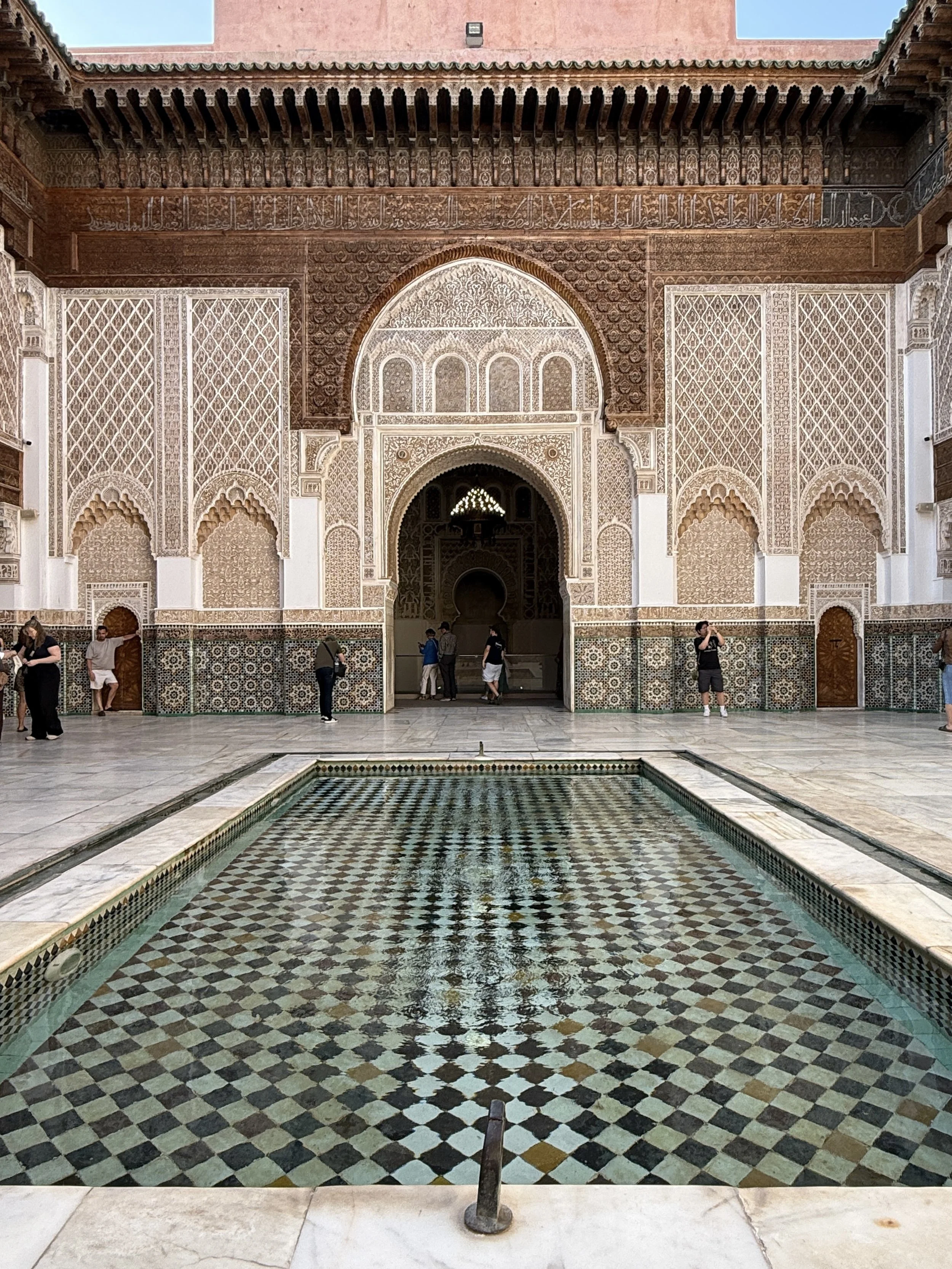
The courtyard is almost absurdly intricate. Cedarwood curls across the ceilings in impossible patterns. Geometric zellige tilework climbs the walls with mathematical precision. Light bounces off the reflecting pool while visitors slowly circle the space trying to take it all in.
Or, in many cases, trying to take themselves in. During our visit, there were moments when the madrasa felt less like a historic site and more like the set of multiple simultaneous influencer campaigns. One woman posed dramatically at the edge of the reflecting pool while her friend shot video from approximately 14 different angles. Another visitor appeared to be filming a luxury perfume commercial involving slow-motion twirling. At one point, someone became visibly irritated that tourists were daring to walk through a public building during her photoshoot.
Which is unfortunate, because this place deserves your actual attention.
Planning Your Visit
Ben Youssef Madrasa
Rue Assouel, Marrakesh Medina, Morocco
9 a.m. to 7 p.m.
Ramadan: 9 a.m. to 4:30 p.m.
50 dirhams (~$5) — foreign adults
20 DH — Moroccan adults
10 DH — children under 12
30 DH — groups of 21+
Plan for at least 45 minutes to an hour.
Modest clothing is best — shoulders and knees covered out of respect for the site.
Long before it became one of the most photographed spots in Marrakech, Ben Youssef Madrasa was one of the great centers of Islamic learning in North Africa. Built in its current form during the 16th century under the Saadian dynasty, the school once housed hundreds of students studying theology, law and philosophy within these walls. And despite the crowds, despite the cameras and despite the occasional accidental appearance in a stranger’s TikTok, there are still moments where the building completely silences you.
Especially once you wander upstairs into the tiny student dormitories and realize the people who lived here were just young scholars sleeping in cramped little rooms beneath some of the most astonishing craftsmanship in Morocco.
The History of Ben Youssef Madrasa
Before it became one of Marrakech’s most photographed attractions, Ben Youssef Madrasa was built for something far less glamorous: studying.
The madrasa was connected to the nearby Ben Youssef Mosque, which was originally founded in the 12th century during the Almoravid dynasty under Sultan Ali Ben Youssef, the ruler the complex is ultimately named after. At the time, Marrakech was emerging as a major political, religious and intellectual center, and institutions like this helped establish the city as one of the most important hubs of Islamic scholarship in the region.
What visitors see today, however, mostly dates to a later reconstruction ordered by the Saadian Sultan Abdallah al-Ghalib in the 1560s. And the Saadians, to put it mildly, weren’t interested in subtlety.
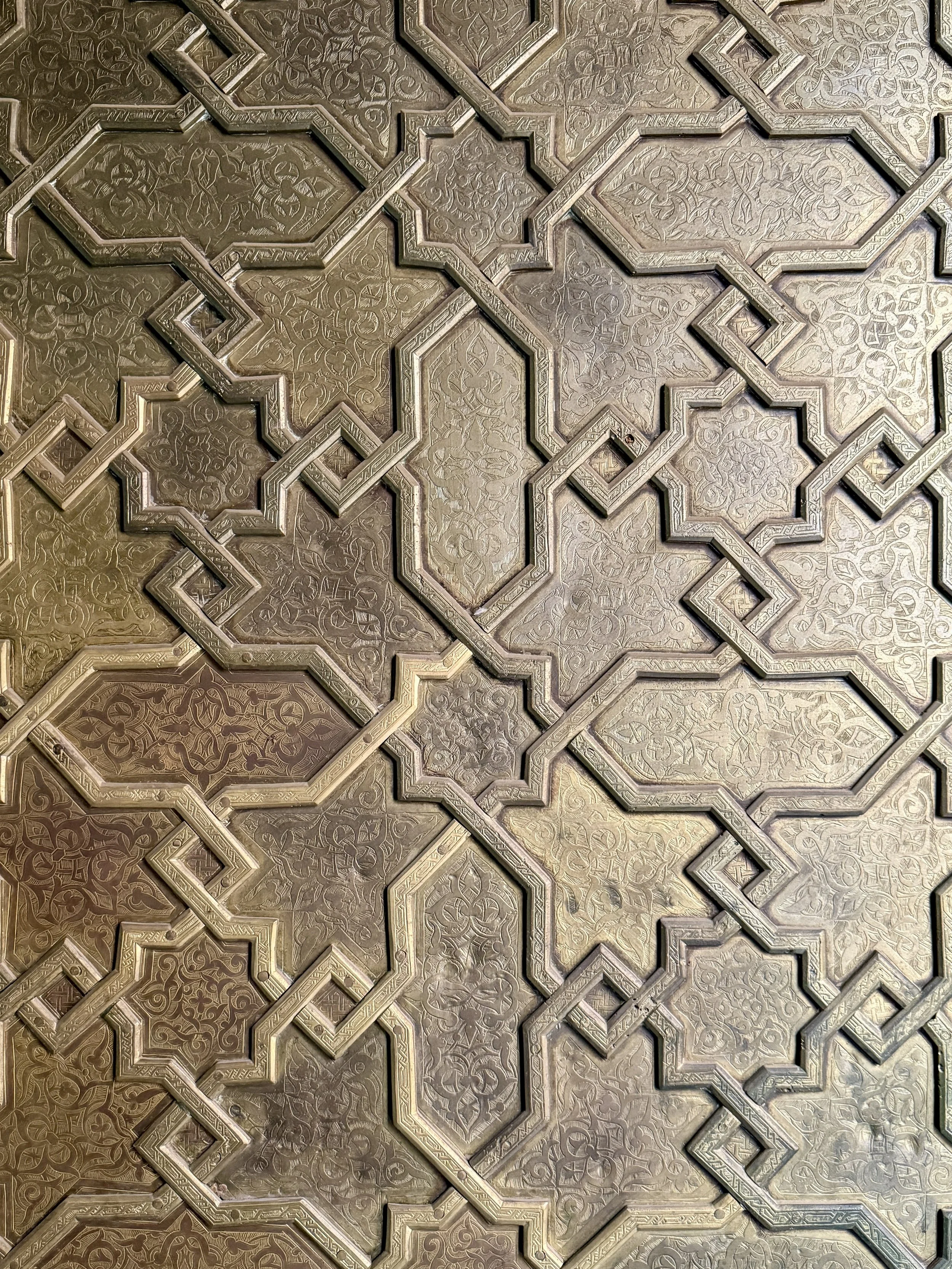
The rebuilt madrasa was enormous for its time. Historians believe it housed as many as 900 students living in its 130 dormitory cells, and shared a single communal bathroom. Young men traveled here from across Morocco to study Qur’anic interpretation, theology, law and other religious sciences. Some likely arrived after journeys that took days or even weeks by foot or caravan, only to end up sleeping in rooms roughly the size of a walk-in closet — just three square meters, or about nine by nine feet.
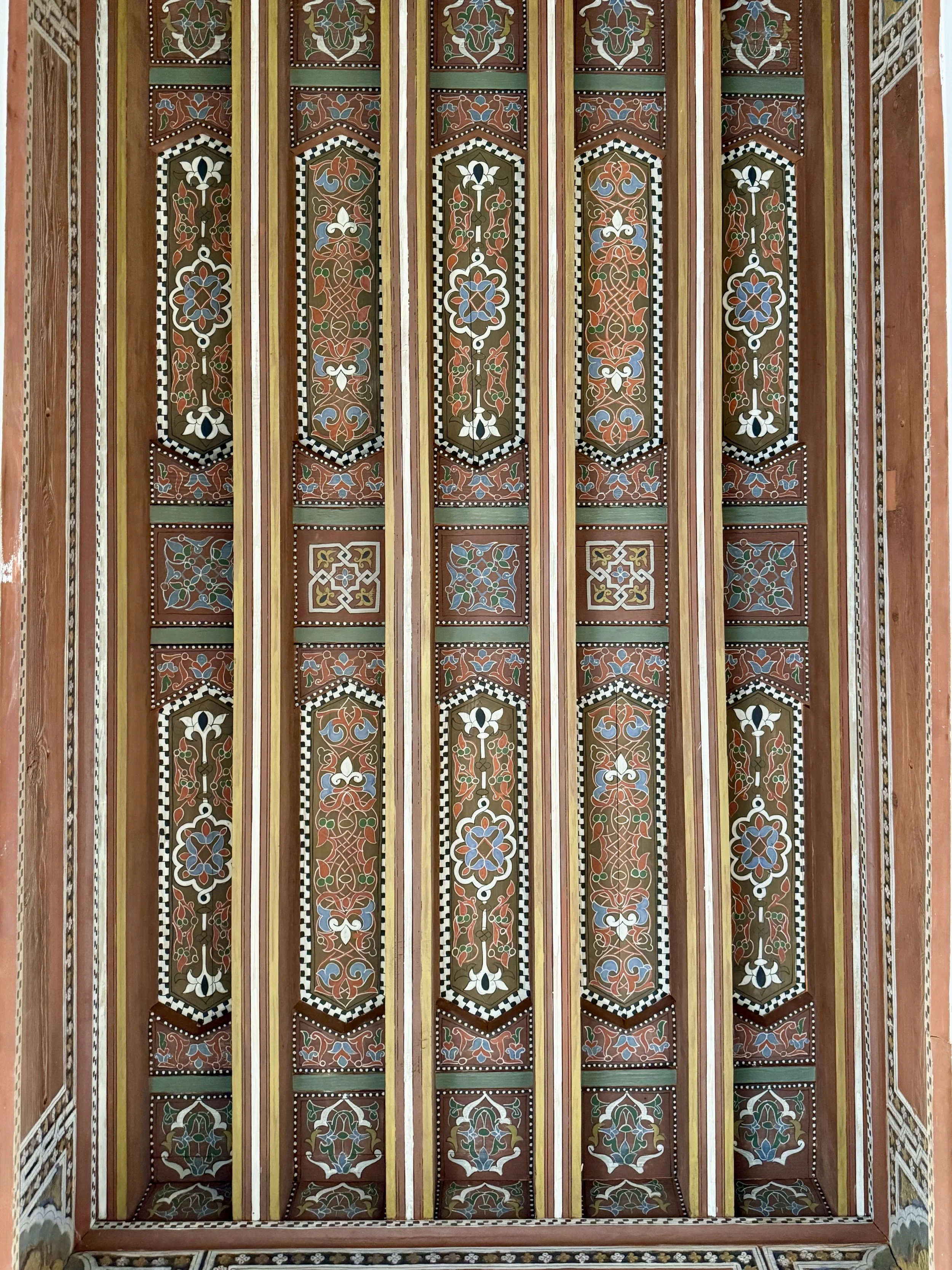
Which is part of what makes the place so fascinating today. Every visible surface seems carved, painted or tiled. The cedarwood ceilings resemble something pulled from a fantasy novel. The geometric mosaics are so precise they start to make your brain hurt if you stare too long. Yet the actual student quarters upstairs are tiny and more austere, built for discipline rather than comfort.
It’s a striking contrast — and very intentional. Islamic madrasas often placed beauty in communal and sacred spaces rather than personal luxury. The architecture itself became part of the educational experience, reflecting ideas about harmony, mathematics, craftsmanship and divine order.
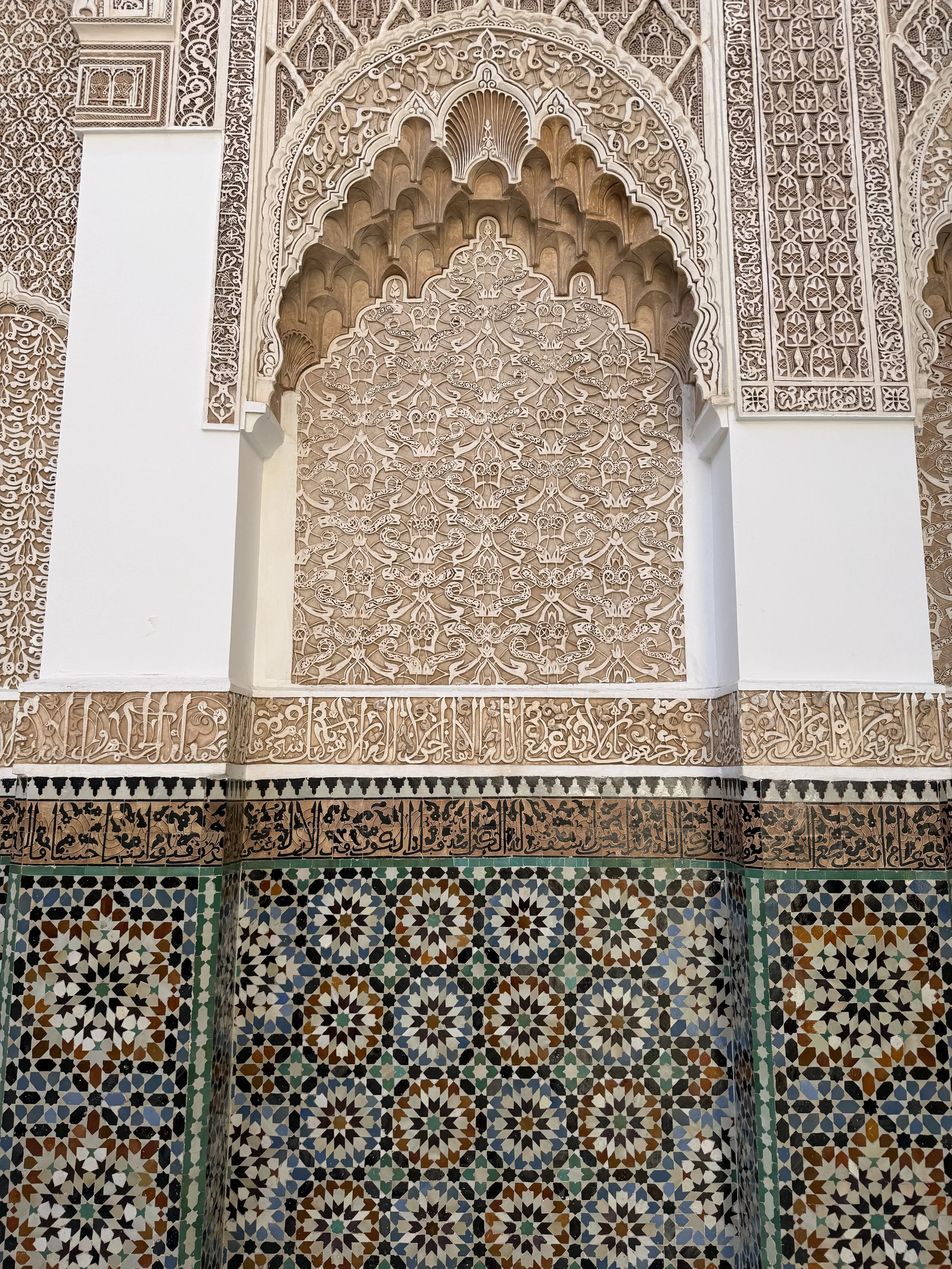
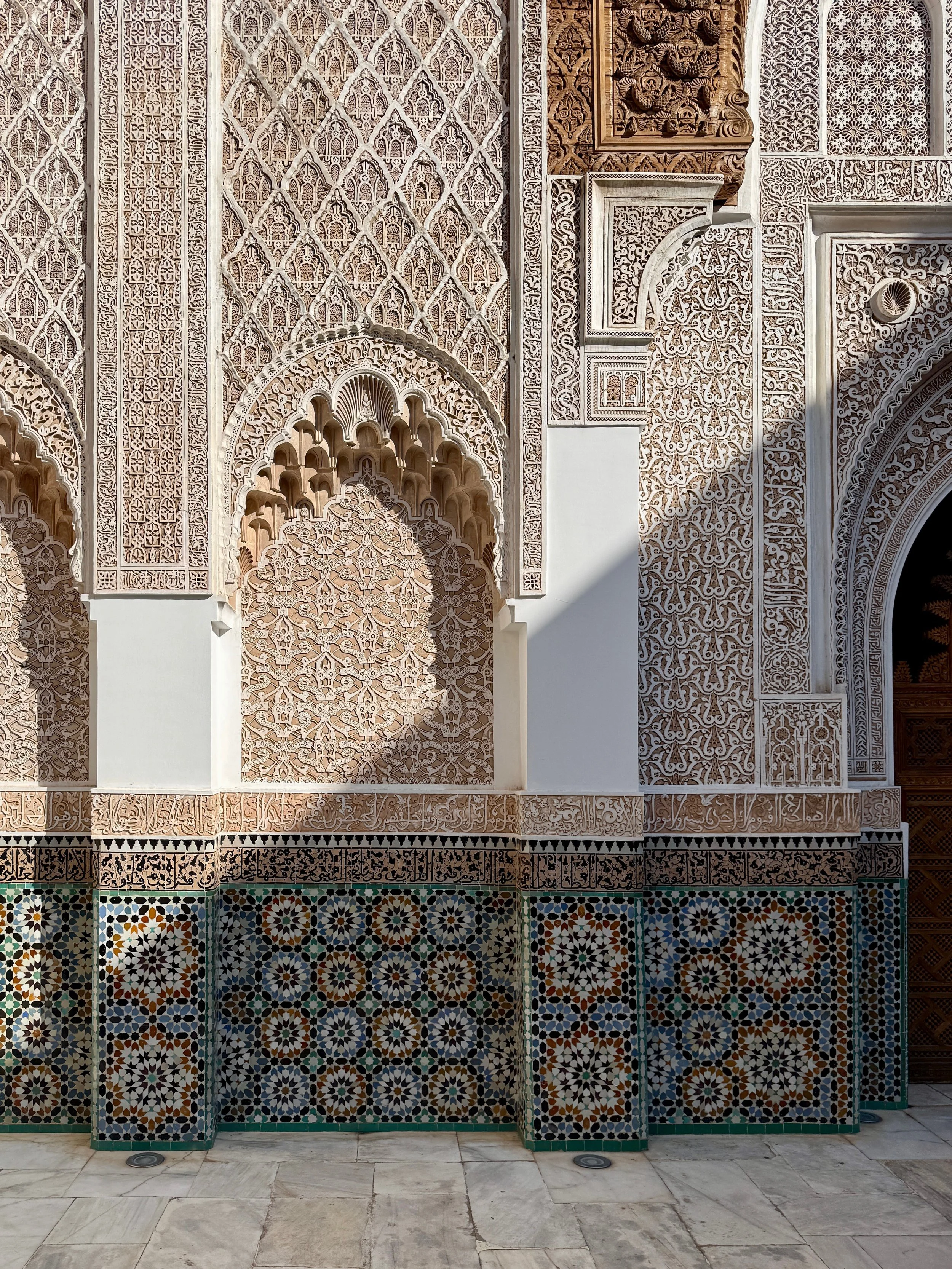
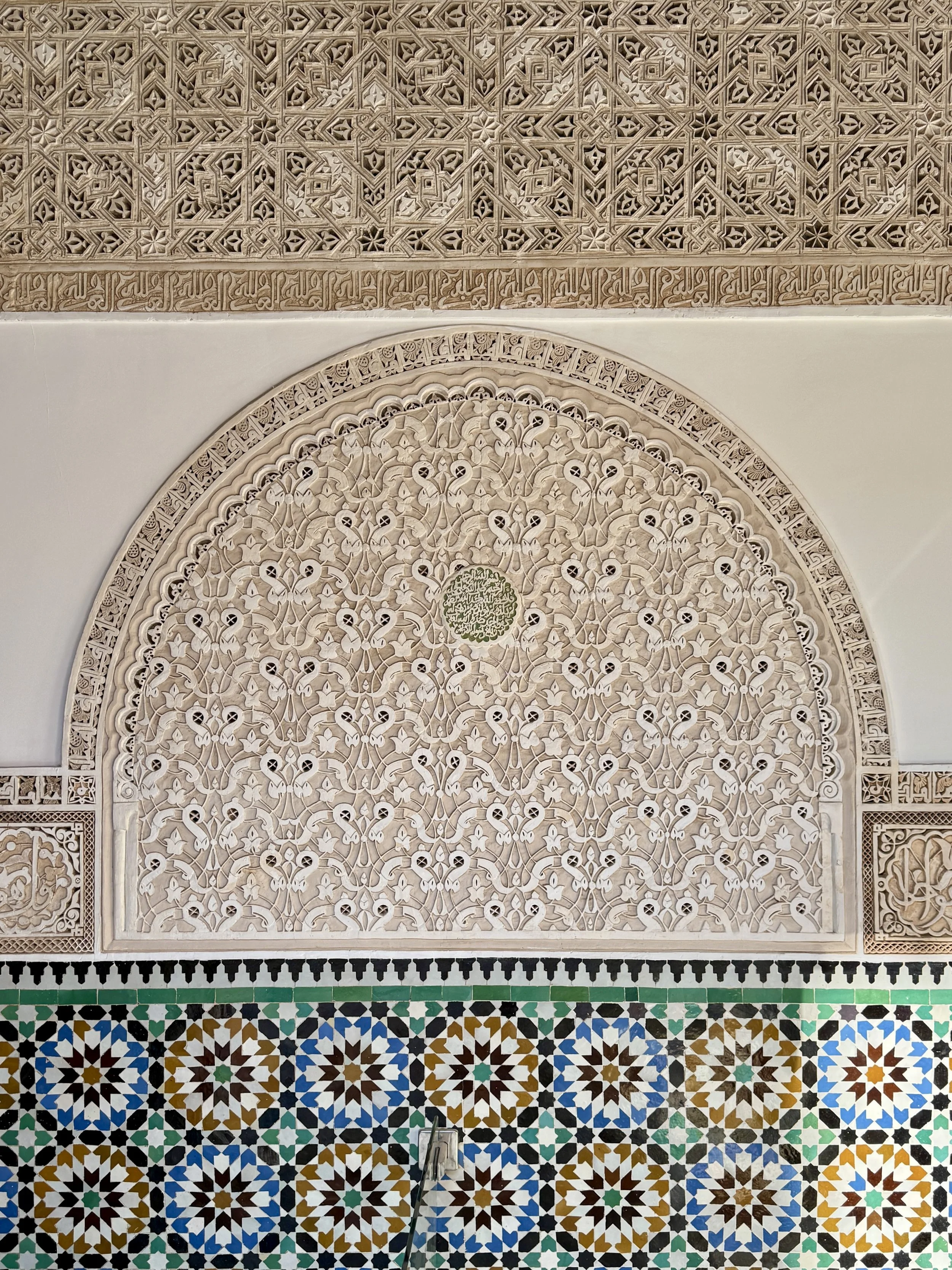
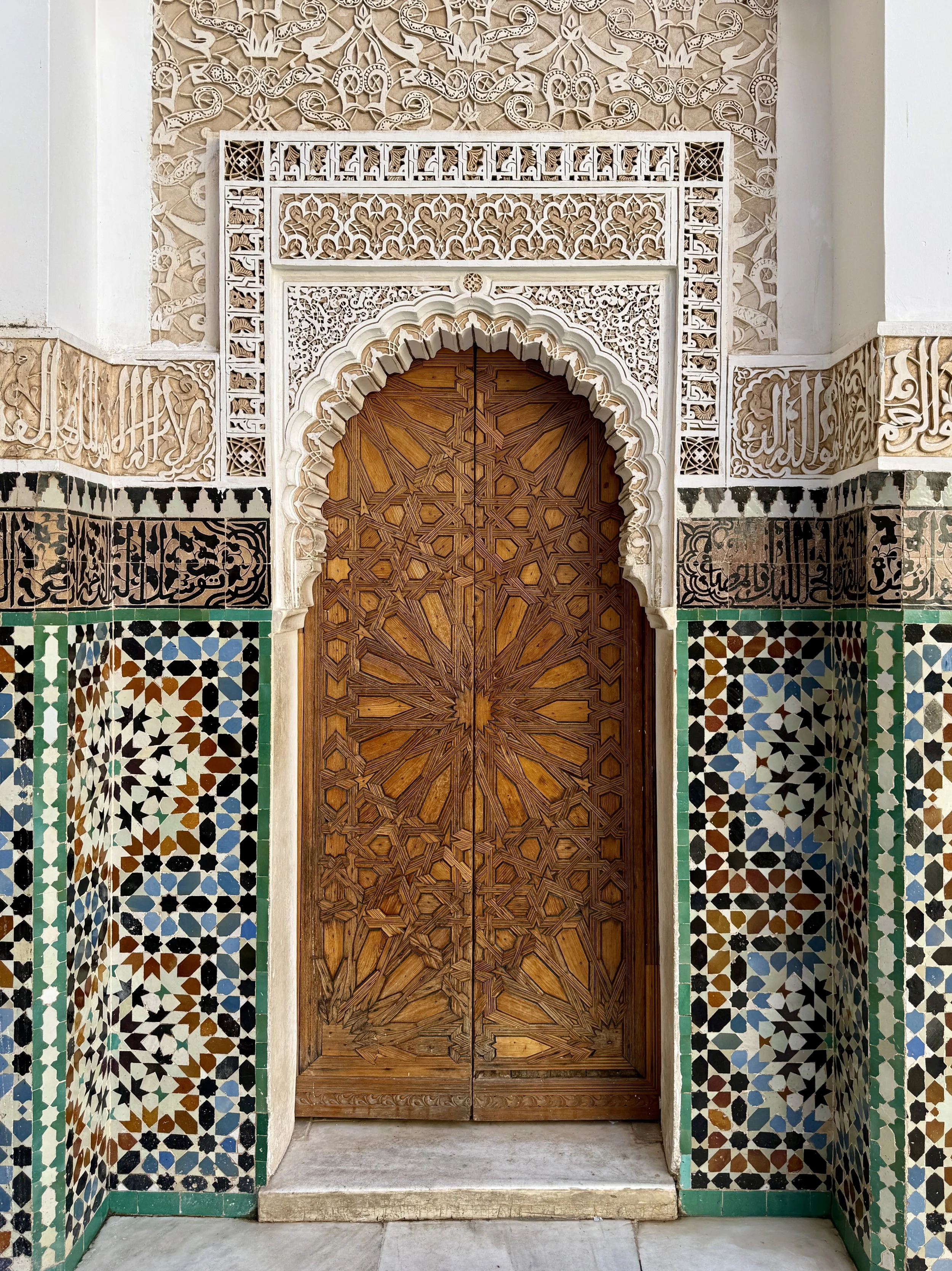
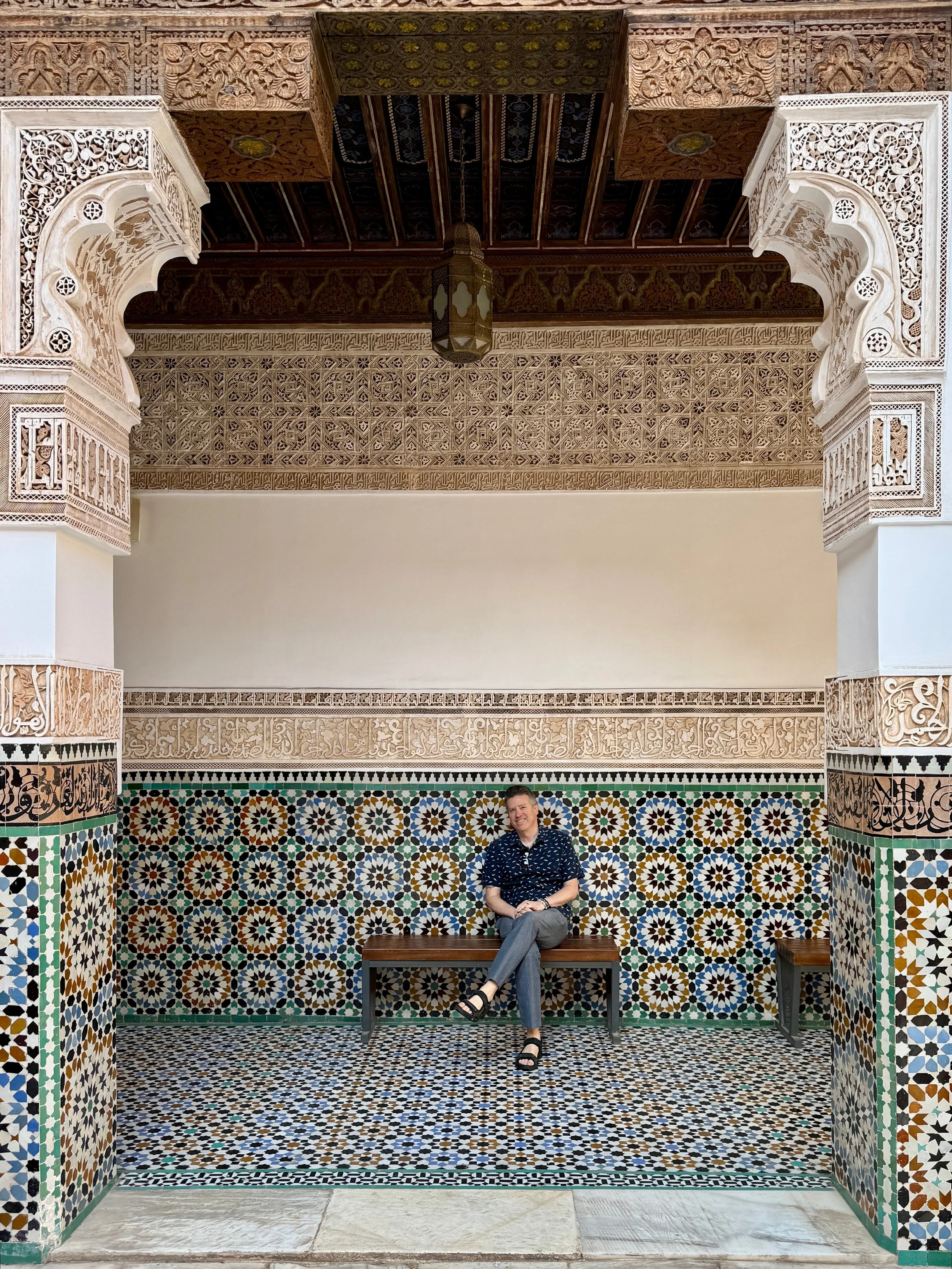
And the craftsmanship here is genuinely staggering. The zellige tilework was assembled by hand, piece by piece. The carved stucco contains Arabic calligraphy and religious inscriptions woven into floral and geometric patterns. Massive cedar beams from the Atlas Mountains were transformed into intricately carved ceilings that somehow still look delicate centuries later.
The madrasa continued operating as a school until 1960 before eventually closing and later undergoing restoration. Today, instead of students memorizing scripture by oil lamp, the building is filled with tourists whispering “oh my God” while trying not to accidentally walk into someone’s selfie shoot.
The Courtyard: The Big Reveal
There’s a very specific moment that happens when people enter the central courtyard of Ben Youssef Madrasa.
They stop.
Not politely. Abruptly. Like their brains need a second to process what they’re looking at.
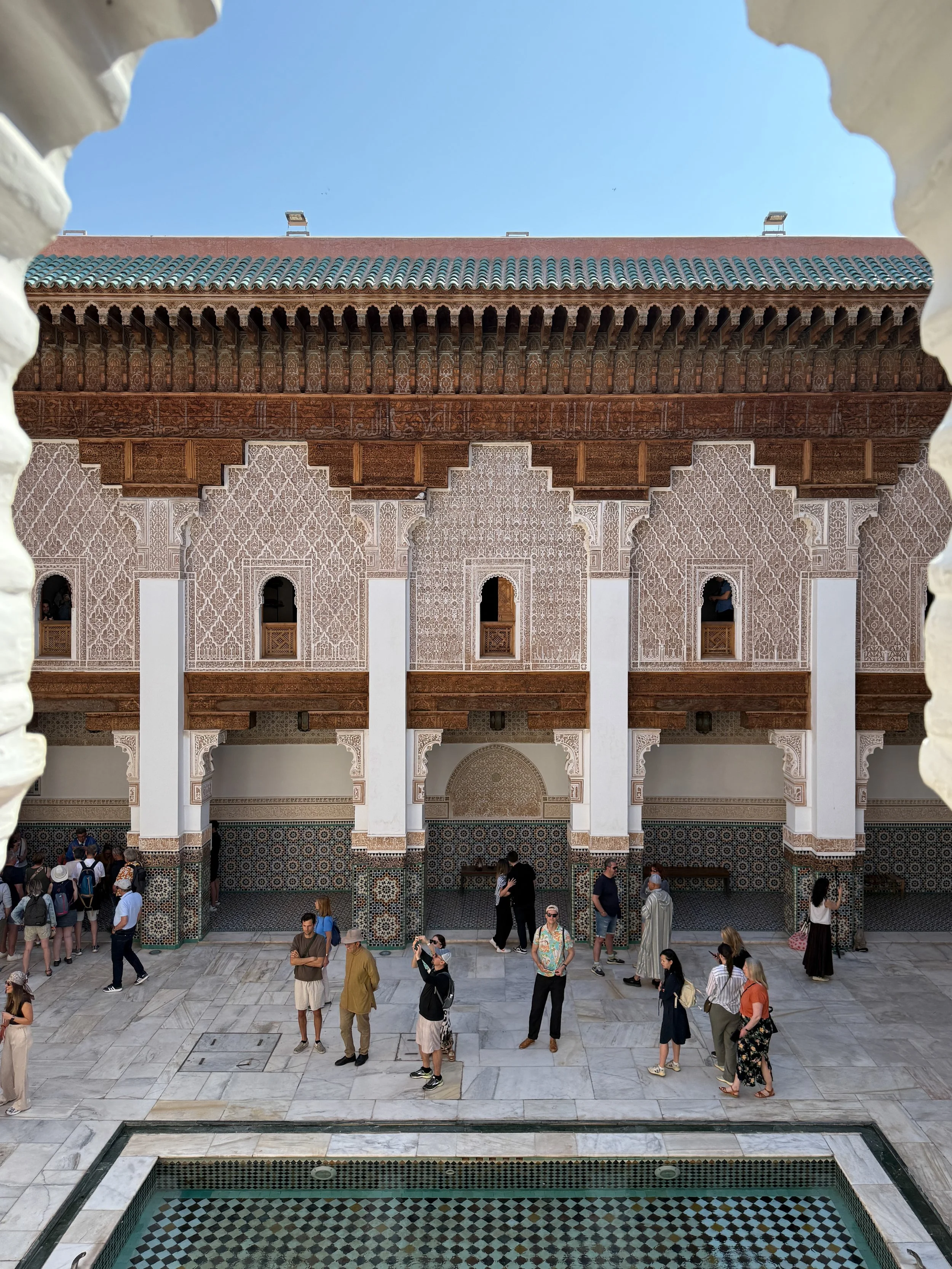
The courtyard is the heart of the madrasa and the space most people picture when they think of Ben Youssef: the reflecting pool stretching down the center, the carved cedar balconies overhead, the walls wrapped in geometric tilework so intricate it barely seems possible that human hands made it. Every surface appears obsessed with detail. Even the empty spaces feel designed.
And somehow it never quite becomes visual overload.
Part of that comes down to symmetry. Islamic architecture often uses repeating geometric patterns to create a sense of balance and harmony, and Ben Youssef Madrasa leans into that philosophy hard. Your eyes keep finding echoes of shapes and lines repeating across the courtyard — arches mirroring arches, tiles reflecting tiles, carvings folding endlessly into themselves. It creates this strange feeling where the space feels both calming and hypnotic at the same time.
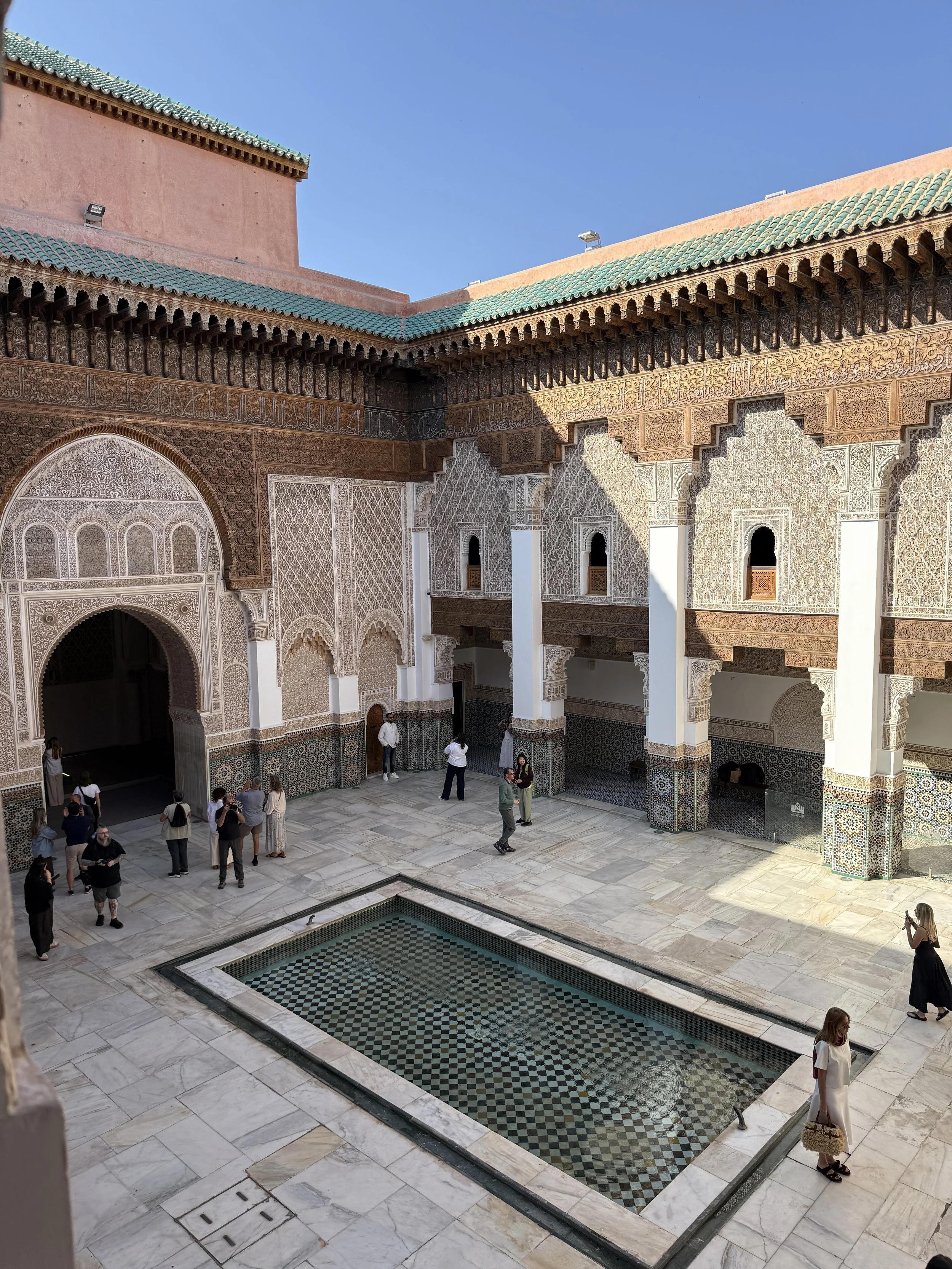
Then there’s the reflecting pool, which anchors the entire courtyard. Water plays an important symbolic role in Islamic architecture, representing purity and paradise while also helping cool the surrounding space. Here, the pool acts almost like a visual pause button amid all the detail. Of course, today it also serves another important function: becoming the exact spot where every tourist wants their photo taken.
At one point during our visit, there was an unofficial queue forming for people to stand dramatically beside the water while their companions directed increasingly elaborate poses. Gazing up thoughtfully. Turning slowly toward the camera. Looking over their shoulder. Touching the brim of their sun hat. It’s a terrible trend, and you’ll see it all over Marrakech.
Meanwhile, the actual architecture remains the real star of the show.
It’s the kind of place where you keep spotting details long after you think you’ve fully taken it in.
And honestly, the best thing you can do here is occasionally stop trying to photograph every inch of it and just stand still for a minute. The courtyard was designed to inspire awe long before anyone invented Instagram. Sixteenth-century students probably walked through here every day and still found themselves impressed by the craftsmanship.
Though thankfully, they were less likely to block an entire archway for a slow-motion video.
The Prayer Hall and Ablution Basin
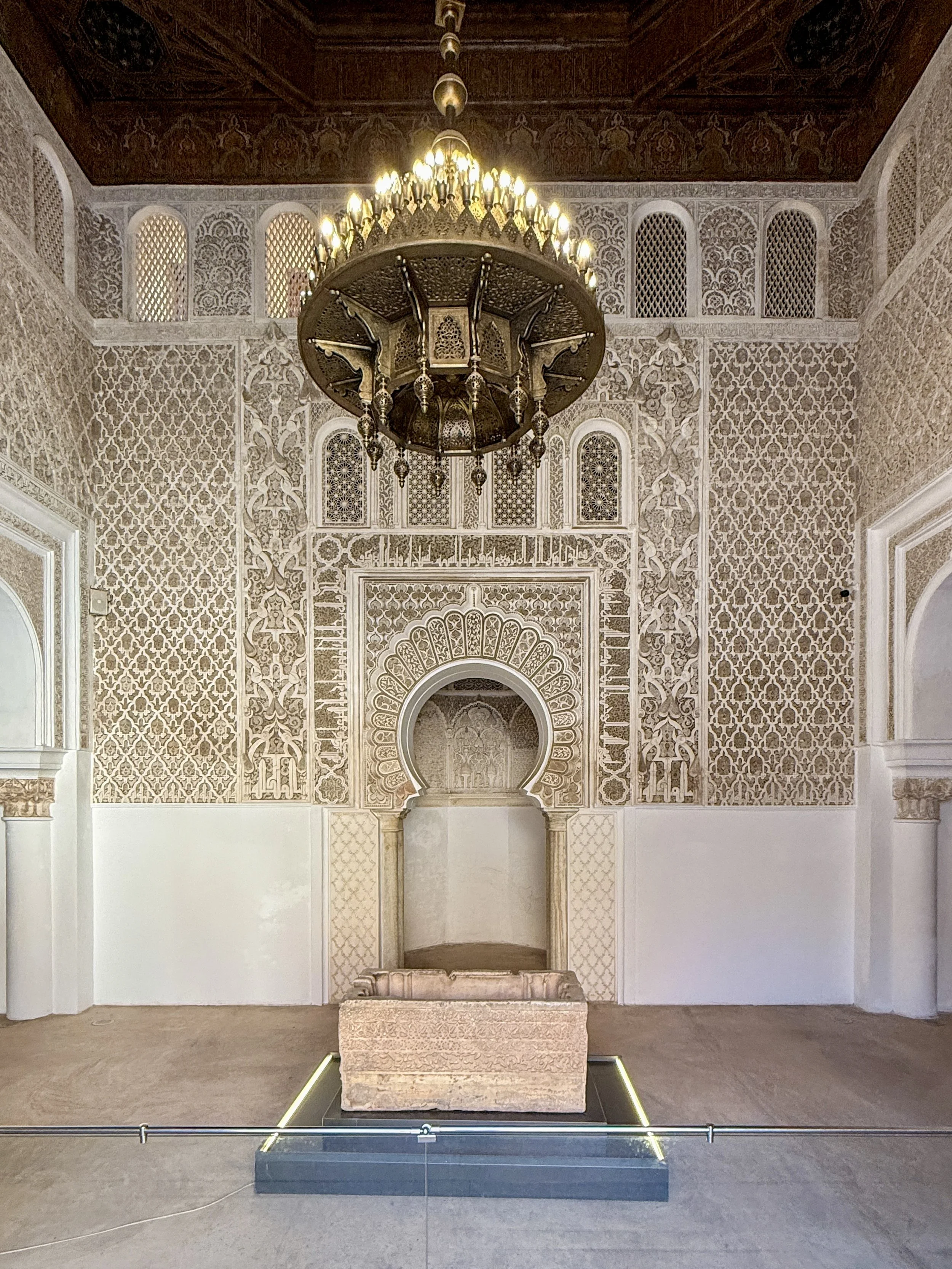
Off the main courtyard is the prayer hall, though “hall” may make it sound grander than the visitor experience actually feels. You can look into it, but you can’t fully wander through the space, so it reads more like a richly decorated room just beyond the courtyard rather than a major stop on its own.
The entrance is framed by two finely decorated marble panels, while the arch leading into the entrance bay is embellished with palm leaves and pineapples. The mihrab, which indicates the direction of Mecca, has a pentagonal plan and an arched frame supported by four marble columns, with palm leaves and intertwining floral motifs worked into the design.
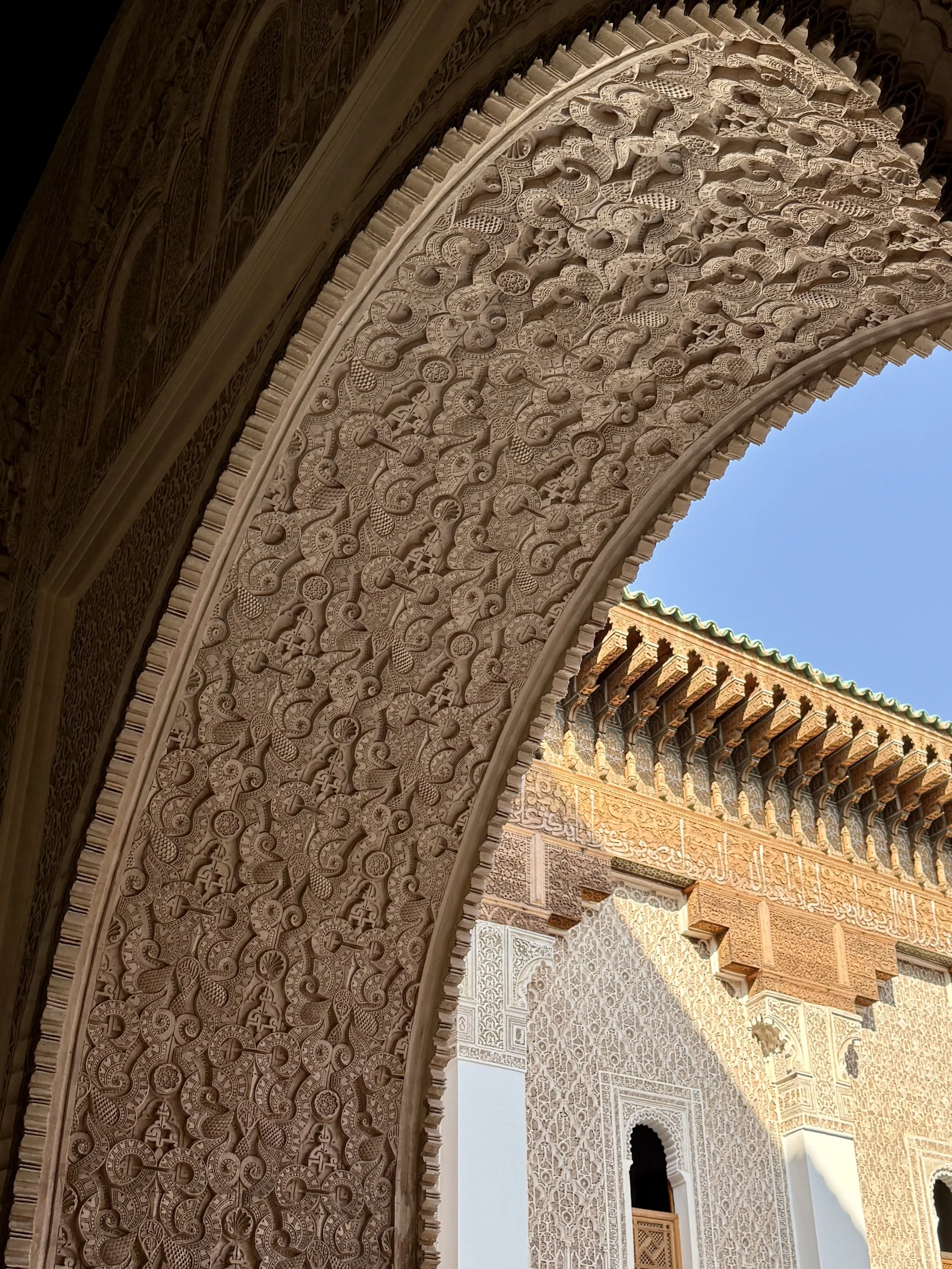
Dominating the space is the ablution basin, which once served as a fountain for ritual washing before prayer. Its faces carry a partly legible Kufic inscription naming its patron, Abd al-Malik, son of the powerful Andalusian vizier Al-Mansur. The basin was imported from Andalusia by the Almoravid sovereign Youssef Ben Tachfine — a reminder that medieval Marrakech and Islamic Spain were deeply interconnected worlds, with artistic styles, craftsmen and ideas moving back and forth across the Strait of Gibraltar. Visitors who have explored places like the Alhambra in Granada or the Mezquita in Córdoba will likely recognize some of the same geometric motifs, carved stucco work and architectural sensibilities here.
The basin itself is decorated with floral and geometric motifs, along with carefully depicted animals including birds and fish. That detail is especially interesting because people often assume Islamic art avoids animal imagery entirely.
Upstairs in the Dormitories
A surprising number of visitors to Ben Youssef Madrasa never spend much time upstairs. I’m not even sure we ventured up there on our first visit more than a decade ago.
Most people walk through the courtyard, take approximately 400 photos in front of the reflecting pool, glance into the prayer hall and move on. Which is a shame, because the upper level changes your understanding of the building.
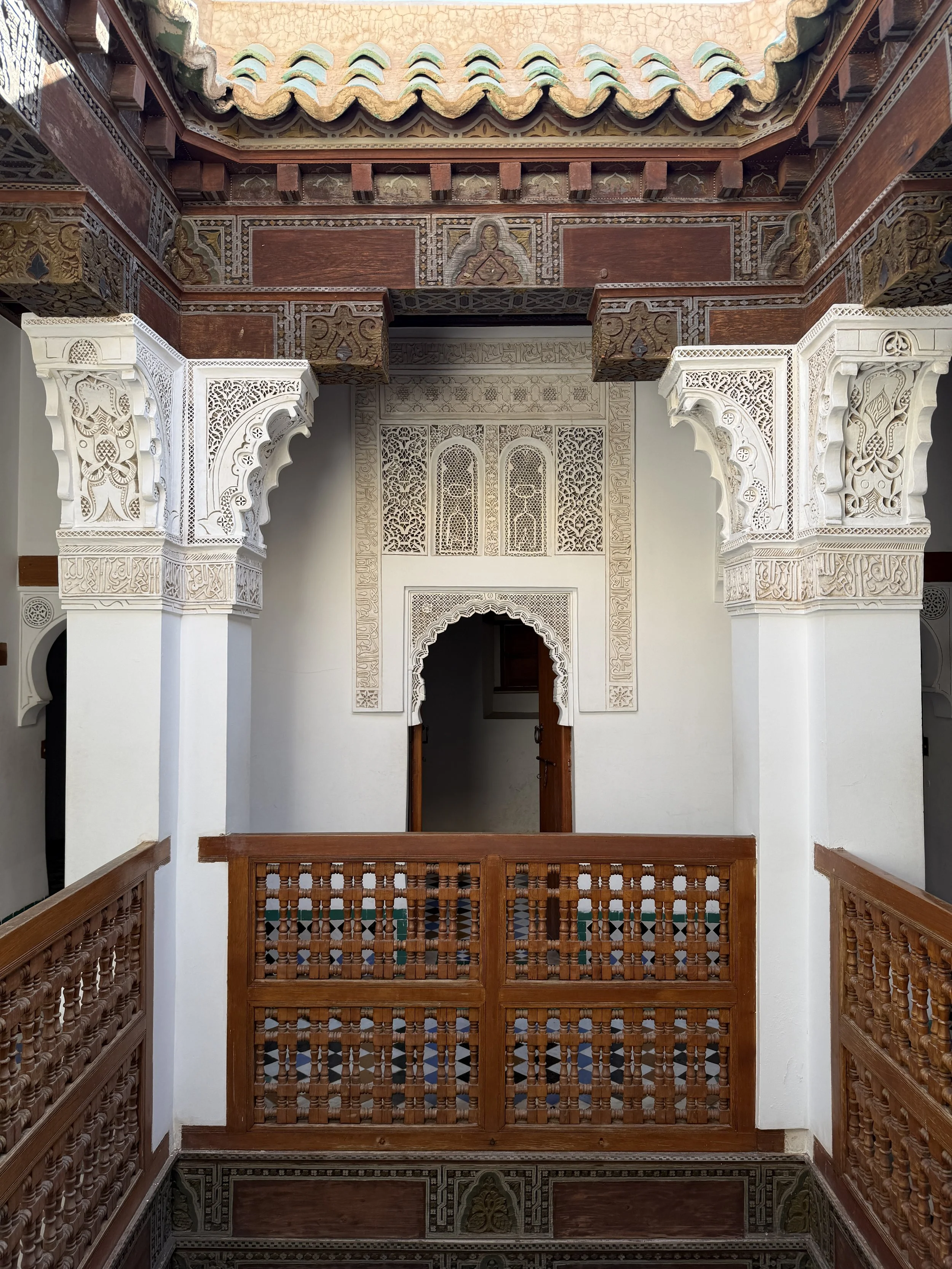
The staircase leads into a maze of narrow corridors lined with tiny student rooms, and the contrast is immediate. Downstairs feels grand and ceremonial. Upstairs feels practical. Human. A bit severe.
Some of the dormitory cells are shockingly small — little more than sparse chambers with enough room for about six young boys to get packed in like sardines to sleep and study. After the extravagance of the courtyard below, the simplicity is almost startling. These students lived surrounded by extraordinary beauty without actually living luxuriously themselves.
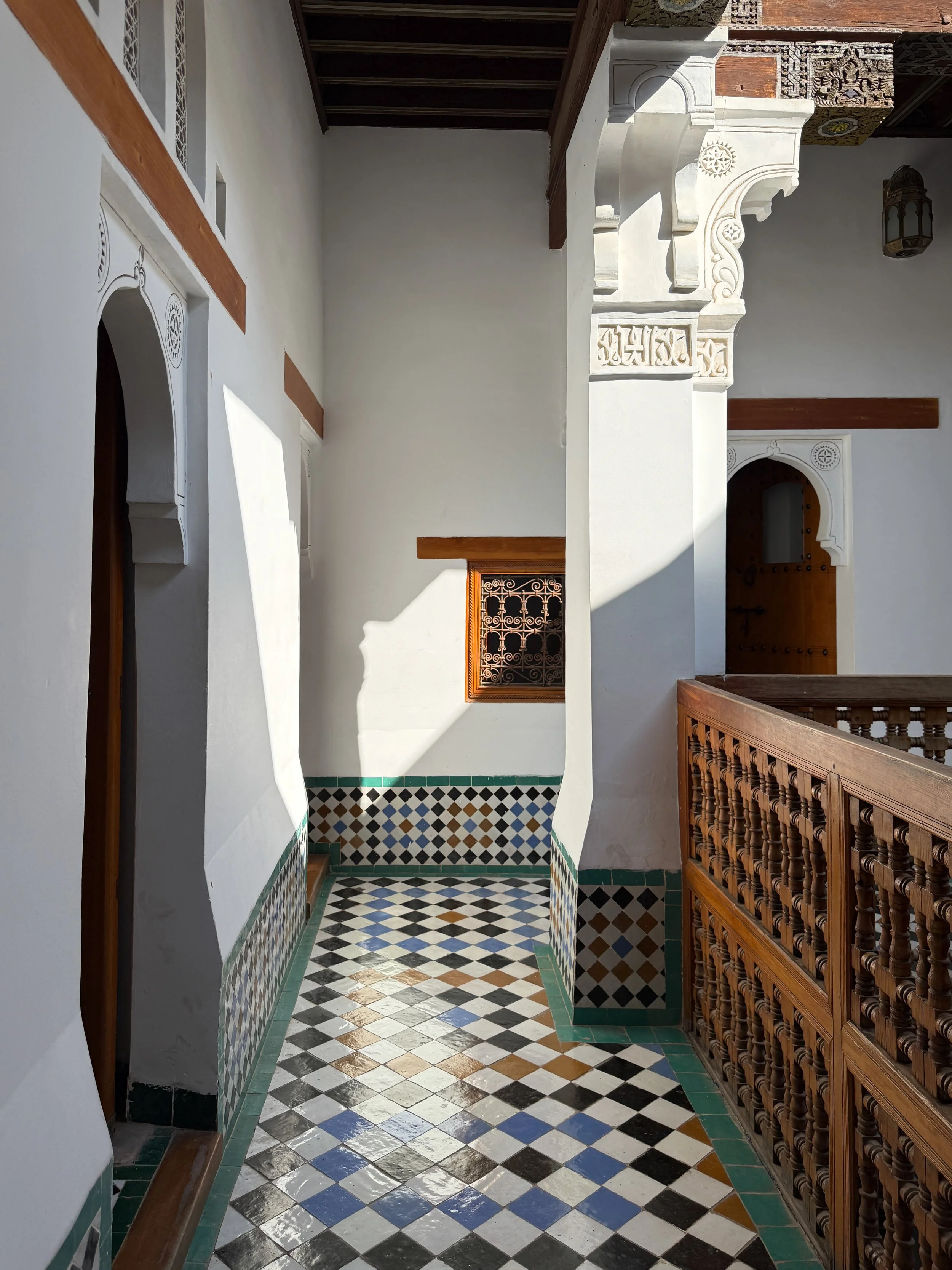
The architecture downstairs wasn’t designed to pamper students. It reflected larger ideas about knowledge, faith, harmony and discipline. Meanwhile, the dormitories emphasized modesty and focus. You can easily imagine young scholars sitting cross-legged in these tiny rooms late into the evening, memorizing religious texts by lamplight while the sounds of the courtyard drifted upward through the open galleries.
The upstairs level also gives you some of the best views in the building.
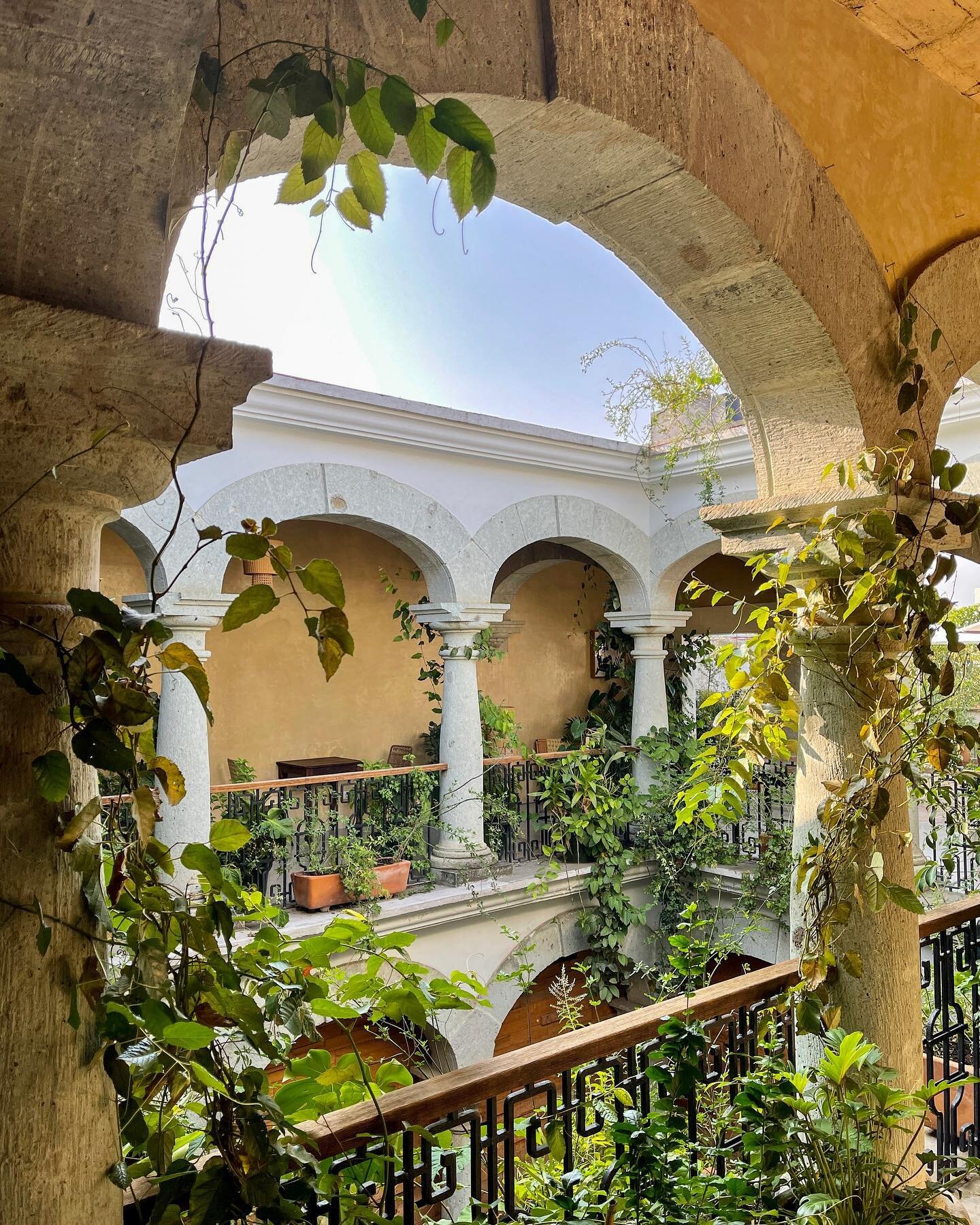
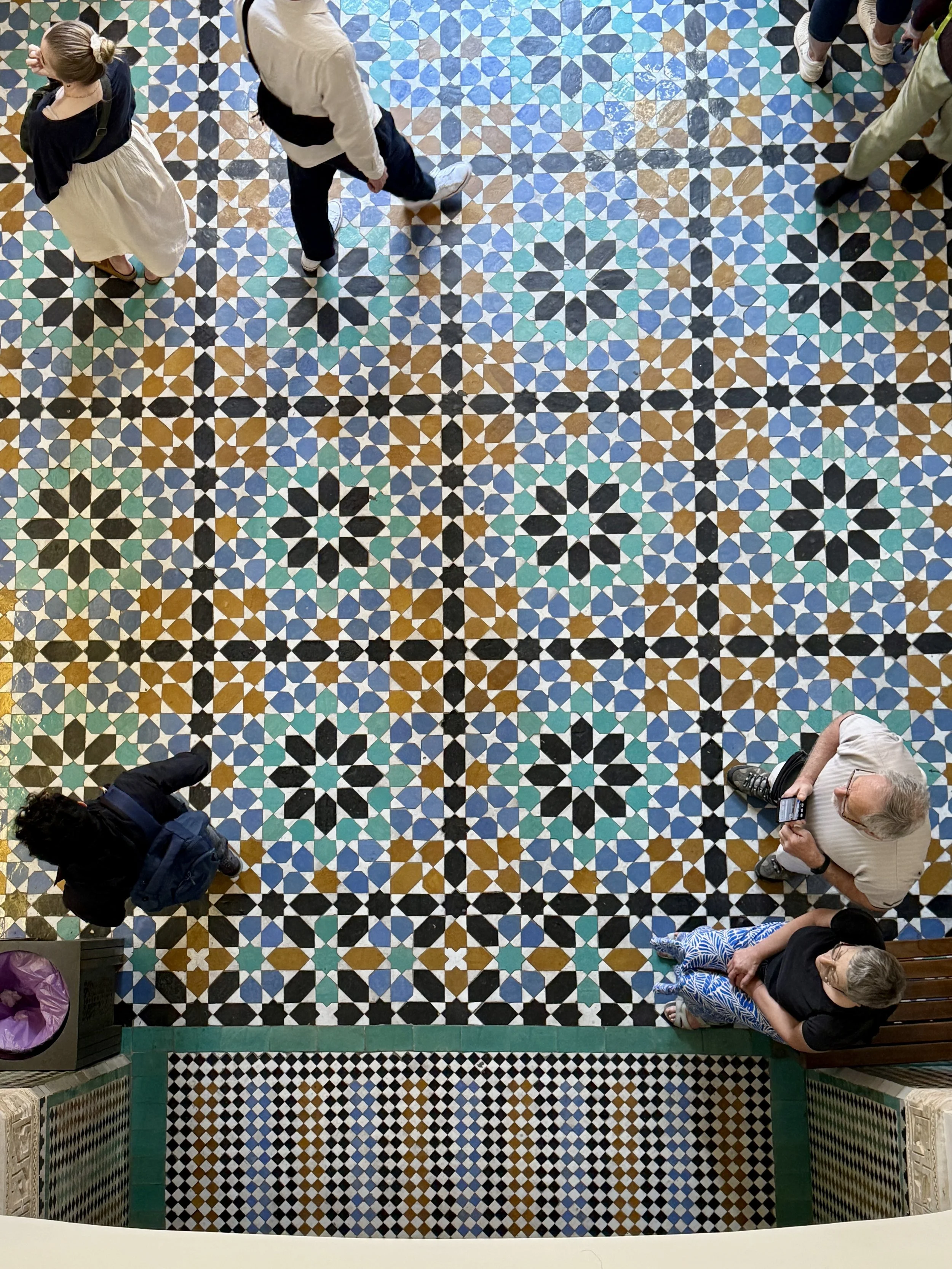
From the balconies, you can look down into the courtyard and see the geometry of the madrasa as a complete composition. The reflecting pool stretches like a spine through the center while visitors below move slowly through the space like pieces on a game board.
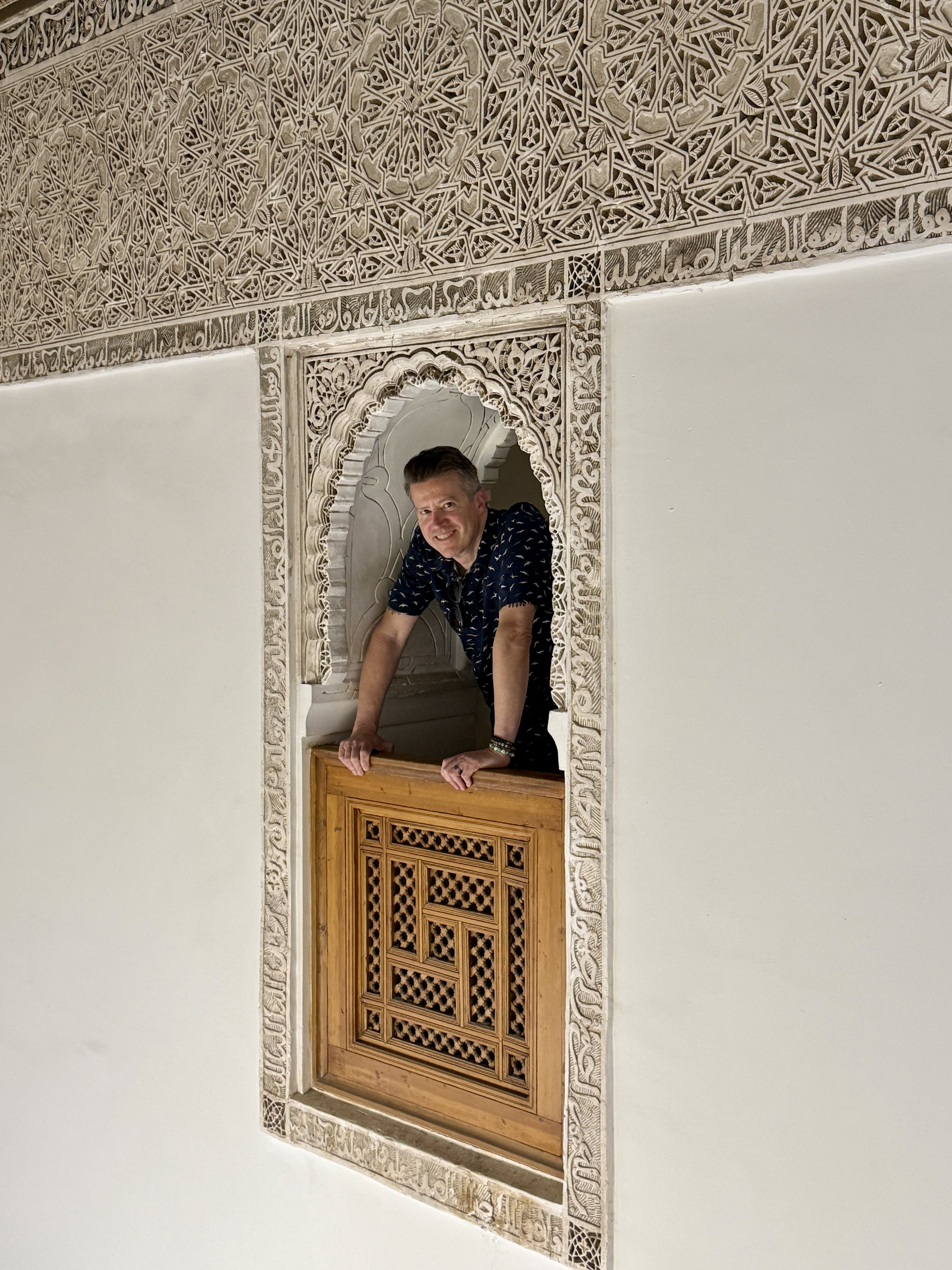
And I hate to say this since it could draw more influencer wannabes upstairs, but there are some nice photo opps up here. Station a photographer in one arched window while the subject poses on the balcony across the way.
For now, the upper floor feels calmer overall. Fewer people linger there for long, which means you occasionally get rare moments where the building becomes quiet. It’s upstairs that Ben Youssef Madrasa stops feeling merely impressive and starts feeling inhabited.
Fascinating Details Most Visitors Miss at Ben Youssef Madrasa
It’s easy to walk through Ben Youssef Madrasa in a kind of architectural daze. But beneath the obvious beauty are dozens of small details that make the madrasa even more fascinating once you slow down enough to notice them.
The student rooms were intentionally austere.
The contrast between the lavish courtyard and the tiny dormitory cells upstairs wasn’t accidental. Islamic madrasas often emphasized communal beauty and spiritual reflection over personal comfort. Students lived simply even while surrounded by extraordinary craftsmanship.
The cedarwood ceilings are functional, not just decorative.
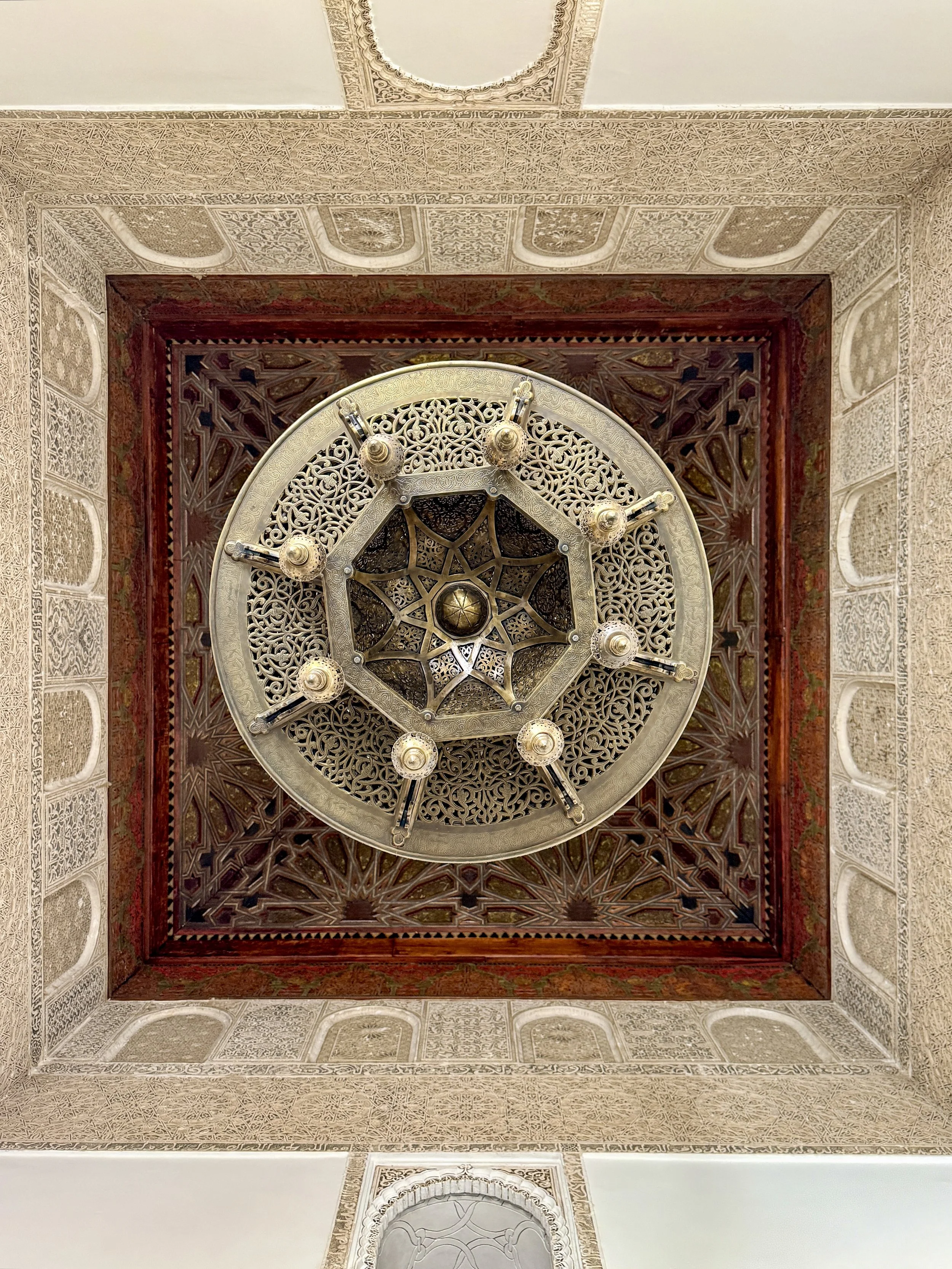
Many of the carved cedar elements came from Atlas Mountain cedar, prized not only for its beauty but also because cedar naturally resists insects and rot. Which means the ceilings weren’t just stunning — they were practical engineering.
The tilework is assembled piece by piece.
The geometric mosaics, known as zellige (or zellij), are not painted patterns or prefabricated panels. Artisans individually cut and placed tiny pieces of glazed tile by hand into elaborate mathematical designs. Looking closely at the edges makes the craftsmanship feel even more impressive.
The reflecting pool was never meant for swimming.
This may sound obvious, but judging by modern tourist behavior worldwide, it apparently needs to be stated occasionally. The water feature was symbolic and architectural, helping reflect light, cool the courtyard and create a sense of harmony.
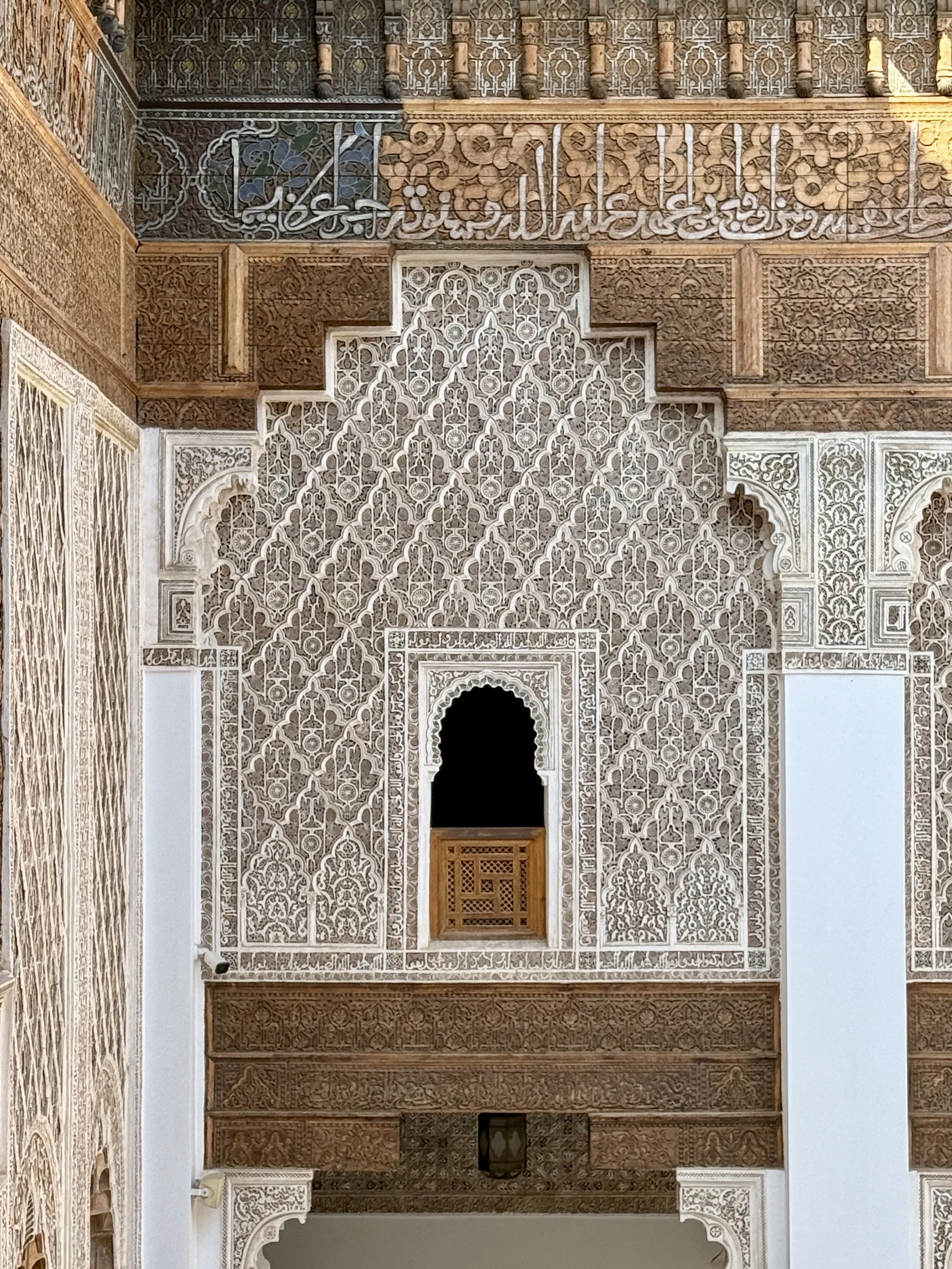
The calligraphy is saying something.
Many visitors admire the carved Arabic inscriptions without realizing they contain Qur’anic verses, blessings and religious phrases woven directly into the decoration. The building itself is essentially layered with sacred text.
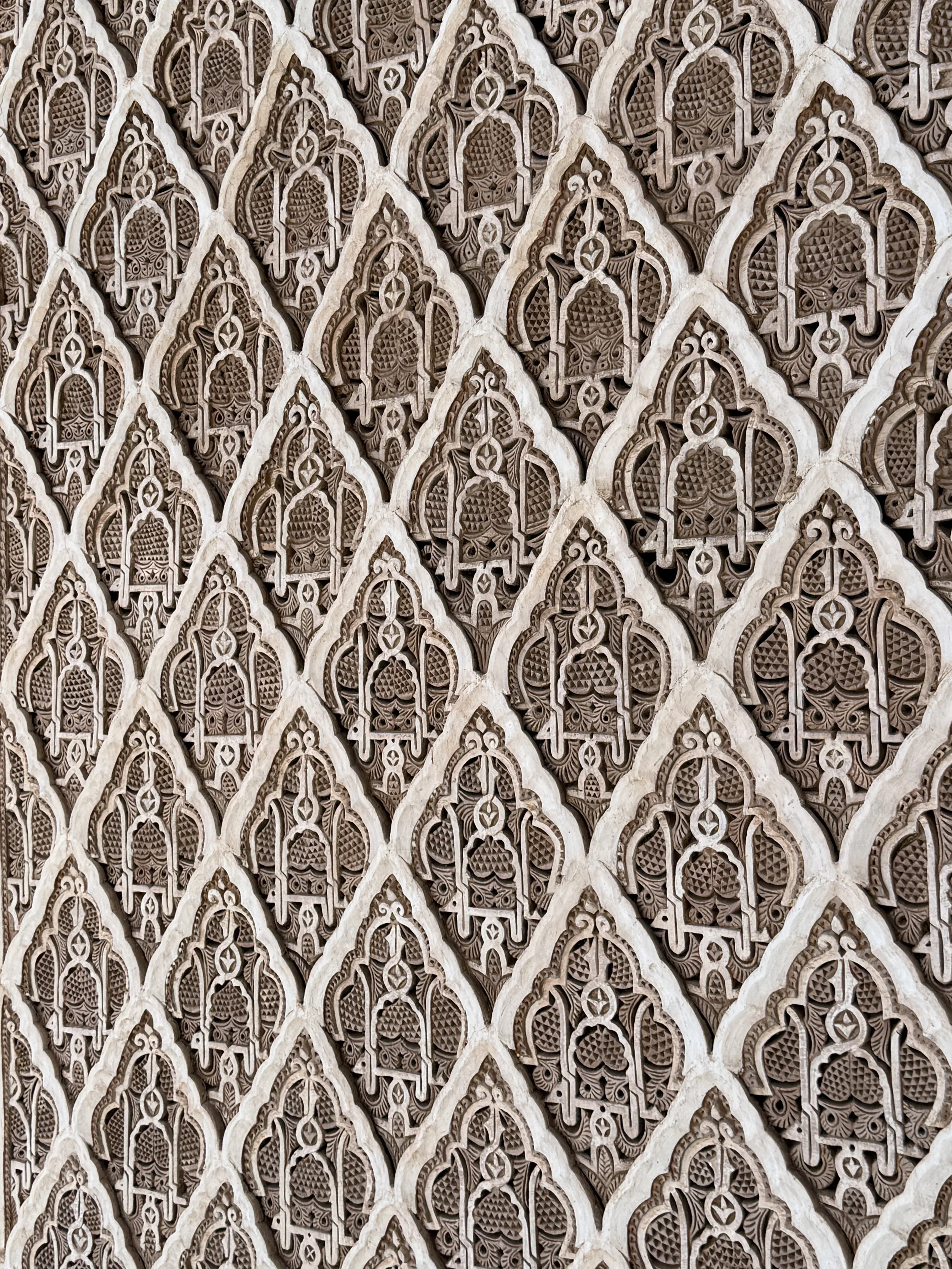
The architecture manipulates your experience on purpose.
The medina streets outside are noisy and enclosed. Then the madrasa suddenly opens into a bright symmetrical courtyard. That dramatic reveal is part of the experience. The building was designed to create emotional impact from the moment you entered.
It remained an active school until surprisingly recently.
Ben Youssef Madrasa only stopped functioning as a college in 1960. Which means this isn’t some distant medieval relic disconnected from modern history. People were still studying here within living memory.
Upstairs is quieter because many tourists skip it.
The dormitories tend to thin out the crowds significantly. If you want a calmer experience, go upstairs and linger longer than everyone else.
The acoustics are incredible.
Even small sounds carry through the courtyard and hallways in unexpected ways. Footsteps echo softly across the tile. Conversations drift upward into the galleries.
Visitor Tips for Ben Youssef Madrasa
Go early.
This is one everyone’s must-see list.
By mid-morning, Ben Youssef Madrasa can become extremely crowded, especially in the central courtyard. Arriving earlier gives you softer light, slightly cooler temperatures and at least a fighting chance of seeing the reflecting pool without six simultaneous photoshoots unfolding around it.
Keyword: slightly.
But maybe not right at opening.
We haven’t tested this out, but I wonder if maybe it’s not actually wise to go right when these attractions open. Because inevitably there are other others with the same idea, and you guarantee you’re entering with a crowd.
I’m wondering if maybe it would calm down even just a bit a half an hour or an hour after opening. But again, it’s just a theory.
Don’t just do the courtyard.
Some of the best details are actually around the edges: carved doorways, quieter side chambers, shadow patterns in the hallways and the transitions between rooms.
The madrasa rewards wandering.
Go upstairs — seriously.
A surprising number of people barely explore the dormitory level, which is unfortunate because it completely changes how the building feels. The upstairs corridors are quieter, more atmospheric and far more revealing about what daily life here might actually have been like.
Plus, the views overlooking the courtyard are fantastic.
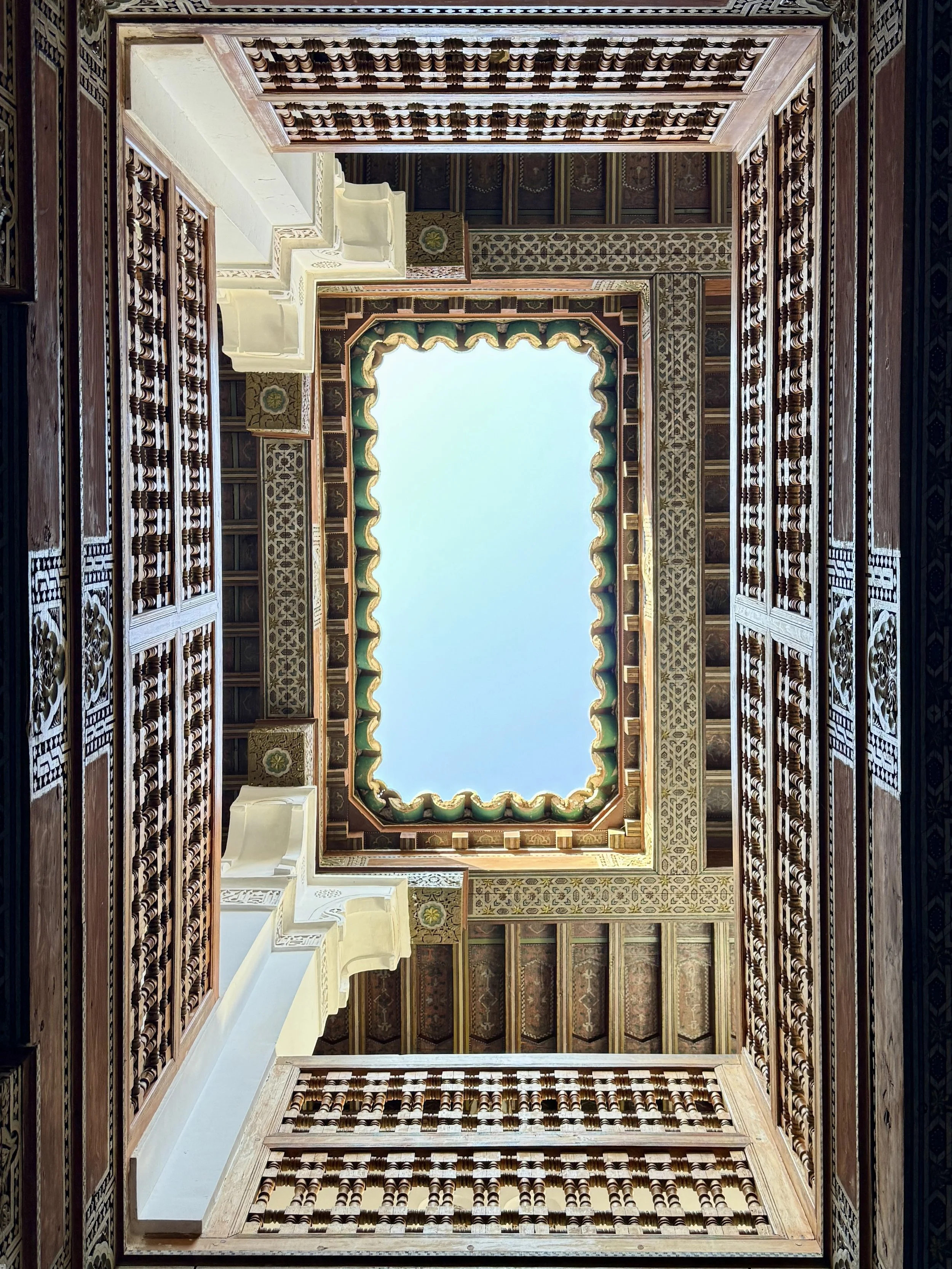
Look up constantly.
This is good advice for Marrakech in general. Duke is obsessed with Moroccan ceilings, and for good reason.
The walls get most of the attention, but some of the most astonishing craftsmanship is overhead. The cedar ceilings are unbelievable and easy to miss if you stay focused at eye level.
Your neck may eventually resent you for this advice.
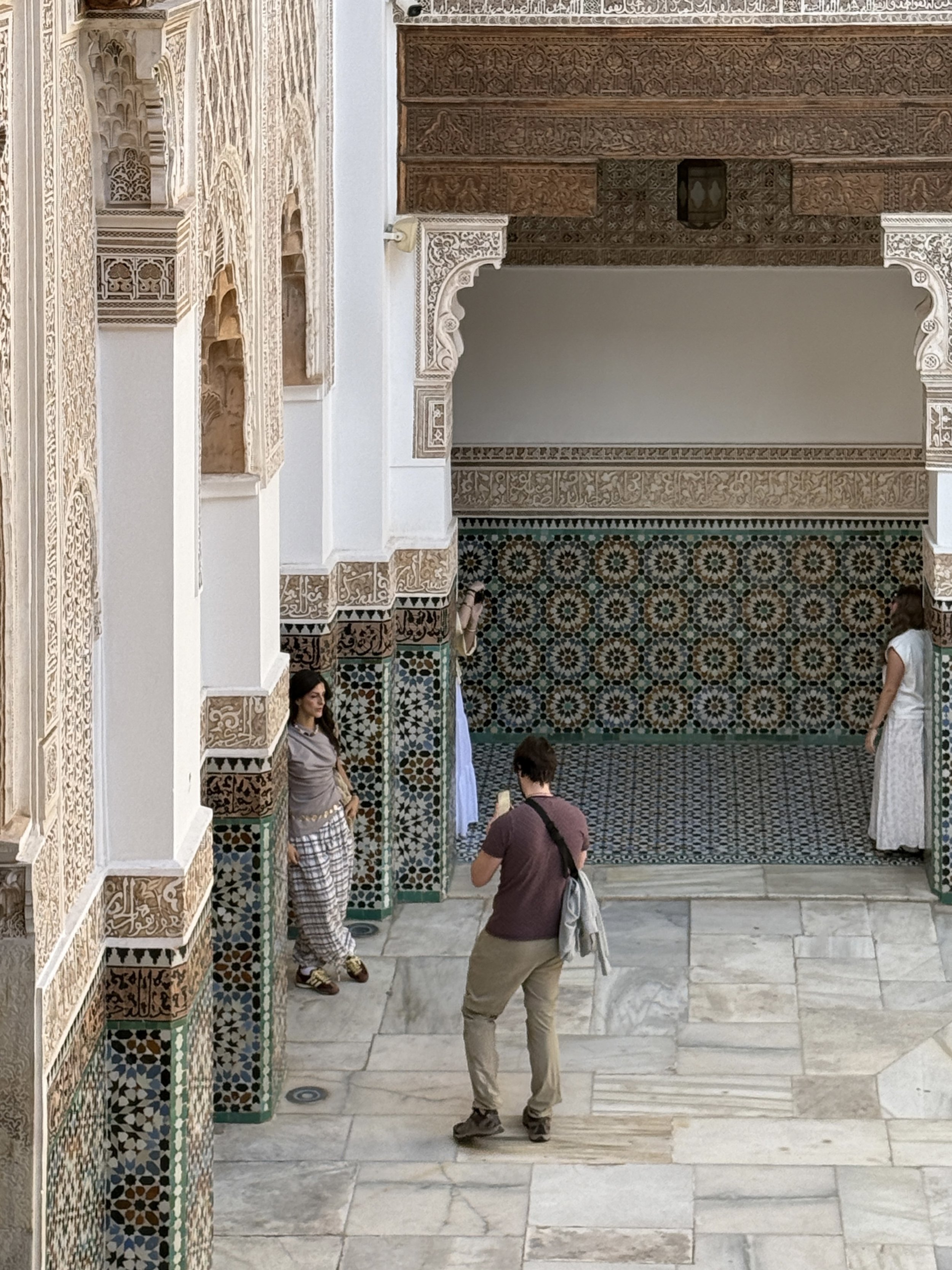
Be prepared for the influencer culture.
You’re going to encounter people filming elaborate content. It’s sadly unavoidable.
Some visitors behave as though they’ve rented the entire madrasa for a private campaign shoot. You can roll your eyes, but getting frustrated will only ruin your own experience.
Pair the madrasa with other nearby sites.
Ben Youssef Madrasa works especially well alongside other attractions in the vicinity:
Dar El Bacha Museum of Confluences
Le Jardin Secret
Rahba Kedima spice square
The surrounding souks
Together they create a fuller picture of Marrakech beyond just checking famous landmarks off a list. –Wally