FOLKLORE

Monster Theory: A Q&A With Liz Gloyn

Beware! Medusa, the Sphinx, Cerberus and other monsters reveal the greatest fears of a society. 

Saint Martha Taming the Tarasque, circa 1500

Saint Martha Taming the Tarasque, circa 1500

There’s young Wally, curled up on the loveseat in the living room (the one his mother constantly tells him not to sit on), with D’Aulaires’ Book of Greek Myths or the D&D Monster Manual

The original Monster Manual used to play Dungeons & Dragons

The original Monster Manual used to play Dungeons & Dragons

From an early age, I’ve always loved monsters. Of course I imagined myself as a hero, and that often entailed slaying monsters — usually with magic. But I always found something sympathetic about monsters. To me, they often seemed misunderstood and maligned. Yes, the Minotaur devoured innocent youths. But did he ask to be born a vicious half-breed, trapped in the Labyrinth? 

The monsters of myth continue to have a mass appeal, as evidenced by the vampire craze (think True Blood, Twilight, Interview With the Vampire and The Vampire Diaries). 

As my friend Heather’s little boy, Gulliver, explained to me about the Batman villain Two-Face, “He’s a likable baddie.” He paused, then continued, “He’s a baddie — but he’s a goodie to me.”

Couldn’t have said it better myself. 


While scrolling though episodes of The History of Ancient Greece podcast, I was intrigued to see one that had an interview with Liz Gloyn, senior lecturer in Classics at Royal Holloway at the University of London and author of Tracking Classical Monsters in Popular Culture. Upon listening, I couldn’t help but wonder: Why didn’t my college offer courses on monster theory?!

Liz Gloyn, author of Tracking Classical Monsters in Popular Culture

Liz Gloyn, author of Tracking Classical Monsters in Popular Culture

I reached out to Dr. Gloyn, and she graciously agreed to answer some questions about monster theory and her obsession with things that go bump in the night. –Wally

What drew you to monsters in the first place?

To be perfectly honest, I got cross! I had come up with an idea about how the original Clash of the Titans film used monsters and wanted to read what people had said on this subject, but when I went to look at the existing literature, there was nothing there. I could have read all I wanted to on the representation of the famous Greek heroes — Perseus, Theseus, Hercules and the rest — but monsters got treated as if they were scenery. That didn’t make any sense to me, so after I had finished with the piece I wanted to write about Clash of the Titans, I decided it was time for the monsters to get some proper attention of their own. 

The Italian movie poster for the original Clash of the Titans, which came out in 1981

The Italian movie poster for the original Clash of the Titans, which came out in 1981

It’s noticeable how many monsters turn out to be women — or, if they’re male, they’re hypersexualized and hyperviolent, reflecting what happens without the controlling influence of civilization.
— Liz Gloyn, University of London

What is monster theory?

Monster theory is the field of academic studies which seeks to explain and understand the function of monsters. It’s based on a very influential piece by a medievalist, Jeffrey Jerome Cohen, who set out seven theses of monster culture, or seven ways in which monsters manifest and make themselves known. 

Few could dream up creepy creatures like Hieronymus Bosch, who painted up horrorscapes in the late 1400s and early 1500s

Few could dream up creepy creatures like Hieronymus Bosch, who painted up horrorscapes in the late 1400s and early 1500s

Monster theory argues that monsters are cultural creations — that is, the particular fears and concerns of a given culture will generate monsters which reflect those fears and concerns. They might be about the “other,” whether you define that in terms of gender, sexuality, ethnicity or something else; they might be about behavioral taboos which need to be observed to keep society safe. And however hard a culture tries to banish a monster, it always comes back. 


How has the perception of monsters changed over the years?

In the ancient world, monsters were very much known by how they looked — you could spot a monster a mile off, although it was also possible to bump into one by accident if you were wandering around the forest not paying attention. 

What we’ve seen since antiquity is a move away from a monstrous outside necessitating a monstrous inside. The break begins with Mary Shelley’s Frankenstein, where the Creature is initially an innocent and only becomes monstrous when people treat him badly because of his appearance. 
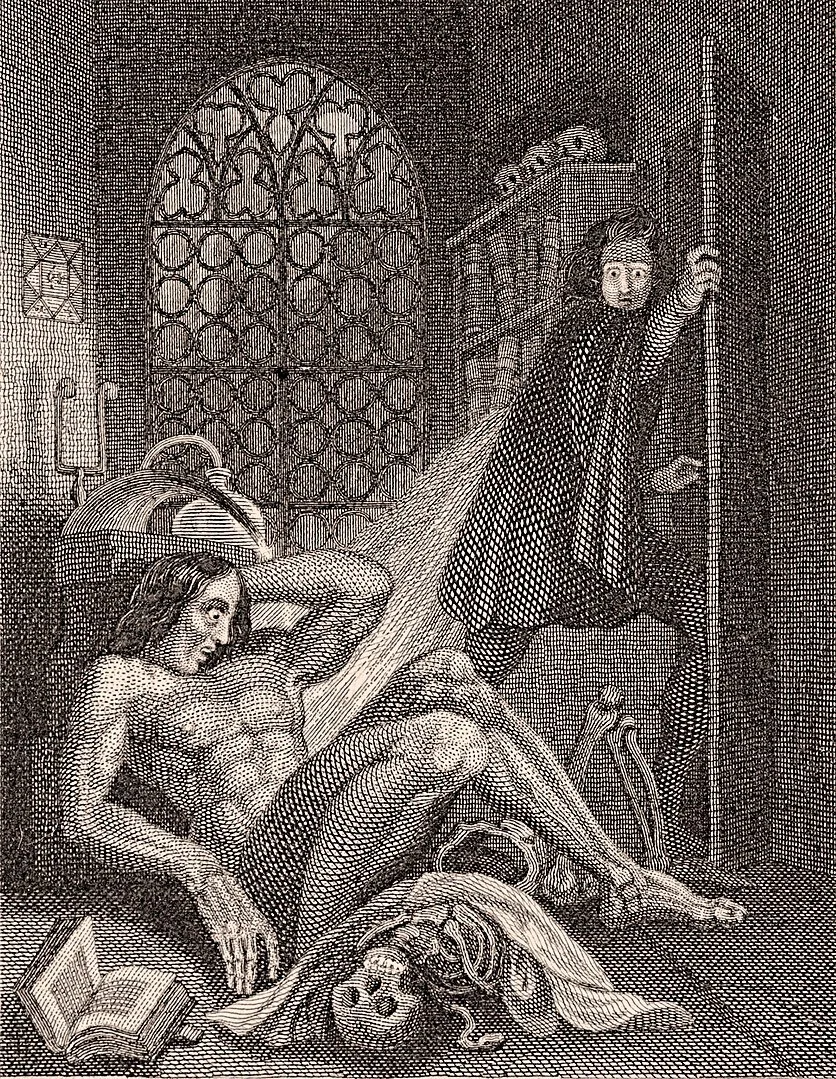
The frontispiece to an 1831 edition of Mary Shelley’s Frankenstein

The frontispiece to an 1831 edition of Mary Shelley’s Frankenstein

What we’re seeing in the 21st century is a major anxiety over not being able to spot a monster on sight — we fear things like the serial killer, the faceless evil government corporation and the imperceptible virus carrying a gruesome disease. That’s what makes the presence of classical monsters in popular culture even more interesting — they’re still immediately recognizable, and so out of step with more modern kinds of monstrosity, yet still have considerable appeal.

What’s the most surprising finding from your research on monsters?

I think what I’ve been most surprised by is the sheer range of modern interpretations of classical monsters out there. When people know you’re working on this stuff, they pass on every example that they come across, and some of the things that have been shared with me are really amazing: tattoos, bar signs, graffiti, as well as places you might expect to find them like computer games, films and books. 

Dr. Gloyn didn’t know Wally has a Medusa tattoo — though she’d hardly be surprised

Dr. Gloyn didn’t know Wally has a Medusa tattoo — though she’d hardly be surprised

I’ve been particularly interested to find how popular Medusa tattoos are. As a monster that can turn people to stone with a glance, she’s not the most obvious thing to have permanently inked on your arm, but she’s clearly been a very important choice for a lot of people. 

Head of Medusa by Peter Paul Rubens and Frans Snyders, circa 1618. Not too many people know that Medusa was a rape victim punished by being transformed into a monster

Head of Medusa by Peter Paul Rubens and Frans Snyders, circa 1618. Not too many people know that Medusa was a rape victim punished by being transformed into a monster

What monster has been most maligned in your opinion?

Historically, it does have to be Medusa — her origin myth as told to us by Ovid in his poem The Metamorphoses is pretty explicit that the transformation happens after Poseidon has raped her, specifically as a punishment from Athena.

When you hear Medusa’s story, you can’t help but feel some sympathy for her and be pleased that she’s such a badass, even after death

When you hear Medusa’s story, you can’t help but feel some sympathy for her and be pleased that she’s such a badass, even after death

Ovid’s version has been the most read and most influential in post-classical cultures, but until recently Medusa’s rape was translated away as “seduction” or a similar euphemism. Thankfully, as Latin literature has been opened up to a wider audience and stopped being the province of elite white men, we’re starting to see more versions of the story which grapple with Medusa’s identity as a survivor of sexual violence, so that aspect of the myth is beginning to get the coverage it should have.

Centaurs were wild creatures hardly more civilized than the wild beasts attacking them in this mosaic

Centaurs were wild creatures hardly more civilized than the wild beasts attacking them in this mosaic

What does monster theory tell us about how women are perceived? Men? Any other groups?

Monster theory argues that monsters come into existence in order to help society articulate fears and concerns about people not belonging to the dominant group — so, given the social structures of patriarchy, it has quite a lot to say about how society monsters women! Particularly in Greek myth, it’s noticeable just how many monsters turn out to be women — or, if they’re male, like centaurs, they’re hypersexualized and hyperviolent, reflecting what happens without the controlling influence of civilization. 

The Rape of Hippodamia by Peter Paul Rubens, 1638. Drunken centaurs tried to carry off the bride at her wedding feast

The Rape of Hippodamia by Peter Paul Rubens, 1638. Drunken centaurs tried to carry off the bride at her wedding feast

What looking at monsters that map on to different groups of people really tells us is what kind of threat they are supposed to hold. We see this, for instance, in the demonization of sexually active women in figures like the Sirens, or the way that villains in Hollywood are so often queer-coded, even in films made this century. 

Every society and every time period will react to these threats differently, so while there are some patterns we can spot which repeat, each monster reflects back the particular concerns of the society that generated it.  

The Victorious Sphinx by Gustave Moreau, 1886. You had only one chance to get the riddle of the Sphinx right

The Victorious Sphinx by Gustave Moreau, 1886. You had only one chance to get the riddle of the Sphinx right

What’s your favorite monster, and why?

I have a soft spot for Medusa, as you may already have noticed, but I’m going to say the Sphinx.

Oedipus and the Sphinx by Gustave Moreau, 1864. The wandering hero solves the riddle, so upsetting the Sphinx, she kills herself

Oedipus and the Sphinx by Gustave Moreau, 1864. The wandering hero solves the riddle, so upsetting the Sphinx, she kills herself

Before Oedipus shows up and solves her riddle, she has been patiently sitting on the road to Thebes, saying her piece to every passing traveller and then, when they don’t listen to her properly and instead try to mansplain her riddle to her, eating them. I admit that this might be a slightly free interpretation of the myth, but it does strike me that Oedipus solves the riddle because he’s the first person to actually pay attention to what the Sphinx is saying, as opposed to all her previous victims who just thought that they’d understood her. 

Hercules and Cerberus by Peter Paul Rubens, 1637. Bad doggie! The three-headed pooch Cerberus guards the gates of Hell, but is caught by Hercules as one of his tasks

Hercules and Cerberus by Peter Paul Rubens, 1637. Bad doggie! The three-headed pooch Cerberus guards the gates of Hell, but is caught by Hercules as one of his tasks


What monster would you least like to encounter?

Cerberus. I’m just not a dog person, let alone a three-headed dog person. 

Lesser-Known Egyptian Gods

Nut, Geb, Bes and Ptah, oh my! A who’s who of Egyptian deities.

tawaretgoddess.jpg

Even if you’re familiar with the stars of the Ancient Egyptian pantheon like Osiris and Re, you probably don’t know some of their colorful cohorts. Meet the less well-known but still batshit crazy gods and goddesses who sport the head of a lion, crocodile, dung beetle and other creatures.


aten.png

Aten

Aka: Aton

Domain: The sun

Description: The sun with a uraeus (the sacred asp) at its base, with rays of light that each end in outstretched hands, some of which hold ankhs when shining upon anyone in the royal family.

Strange story: Historians believe that Pharaoh Akhenaten’s decree to abandon the old gods and worship only the Aten is the first instance of monotheism — and could very well have influenced the Jewish religion.

bes.jpg

Bes

Aka: Aha

Domain: Protector of children and pregnant women

Description: A dwarf with a large head featuring bulging eyes, a protruding tongue, a beard and a lion’s mane. Sometimes depicted with a large belly and sagging breasts

Consort: Beset 

Strange story: Pilgrims would spend the night in incubation chambers covered with images of Bes and Beset to cure themselves of infertility or impotence.

geb.png

Geb

Domain: Personification of the Earth, healing — colds, fevers and scorpion stings in particular

Description: A man lying on his side, one arm supporting himself, beneath his spouse, Nut, the personified sky. Grain sprouts from his ribs and vegetation from his back.

Consort: Nut

Strange story: His laughter is what causes earthquakes.

hapi.png

Hapi

Aka: Hapy

Domain: The yearly flooding of the Nile

Description: A man with a swollen belly, long hair and pendulous female breasts, sometimes with a cluster of papyrus on his head

Strange story: One ancient text relates that 1,089 goats were sacrificed to Hapi in a fertility rite.

khepri.png

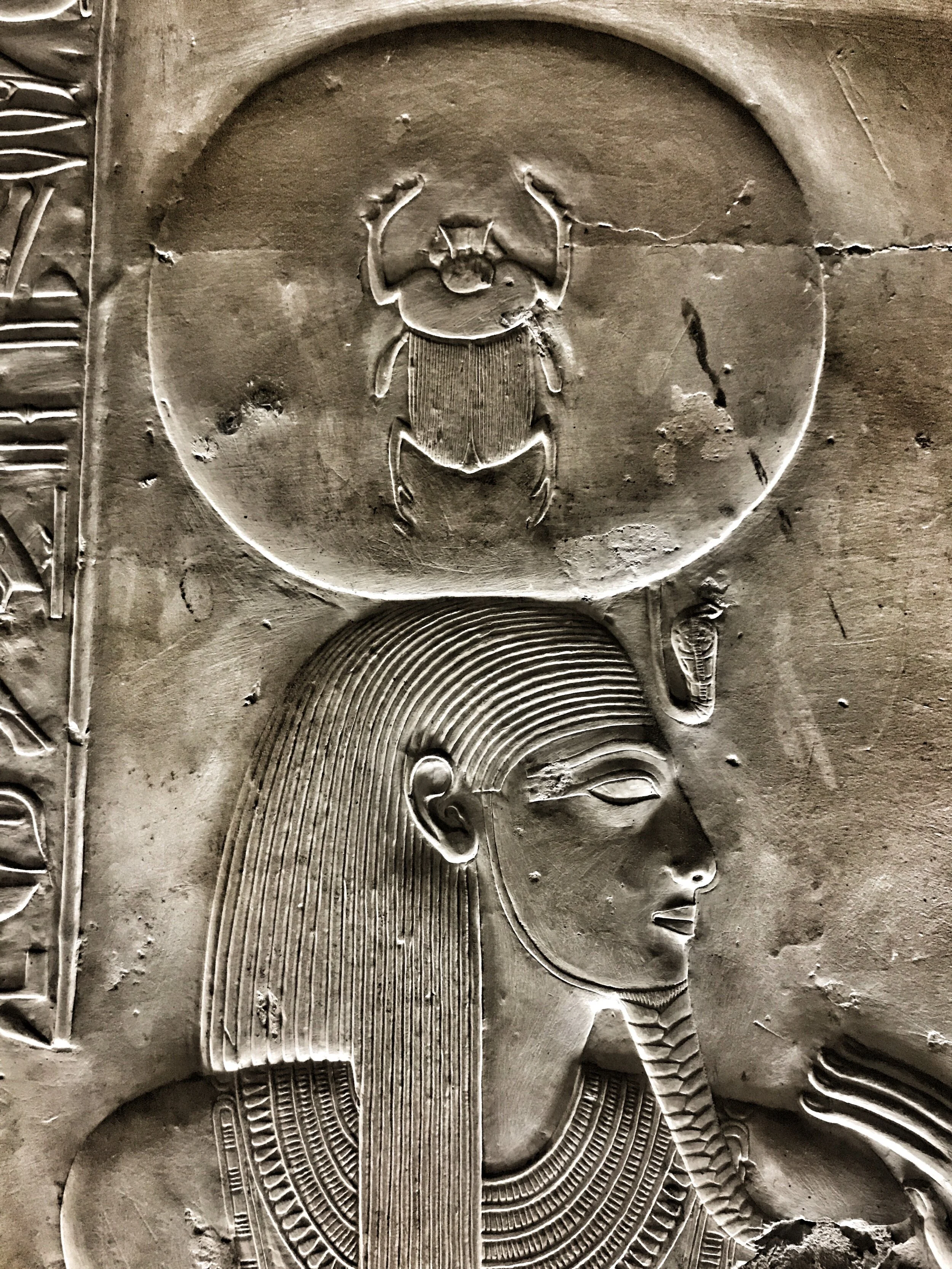
Khepri

Domain: The sun

Description: A black scarab, or dung beetle, or a man with one for his head.

Strange story: Male scarabs push around small balls of dung. Ancient Egyptians believed that the sun, in turn, was pushed through the sky every day by Khepri.

min.jpg

Min

Aka: Amun-Min

Domain: Male virility

Description: A black mummified man who holds his wrappings in his right hand and his hard-on in his left, though he’s often shown with only one arm and one leg

Strange story: Offerings to Min depicted lettuce, a symbol of sex due to its semen-like milky sap.

neith.jpg

Neith

Domain: War, creation, motherhood and the funerary process

Description: One of the oldest of the Egyptian pantheon, Neith’s iconography shifted through the centuries. She’s sometimes shown as a woman holding an ankh and was scepter or wearing the Red Crown of Lower Egypt. She’s also depicted holding a bow and arrow or a harpoon. As the mother of Sobek, she’s shown suckling a small crocodile at each breast. The goddess could also appear in the guise of a serpent or fish.

Strange story: She’s so wise that even the sun god Re comes to her for counsel. But if you don’t follow her advice, she gets so angry she’ll make the sky fall. 

nut.jpg

Nut

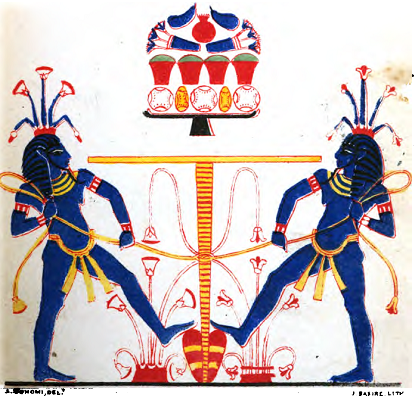
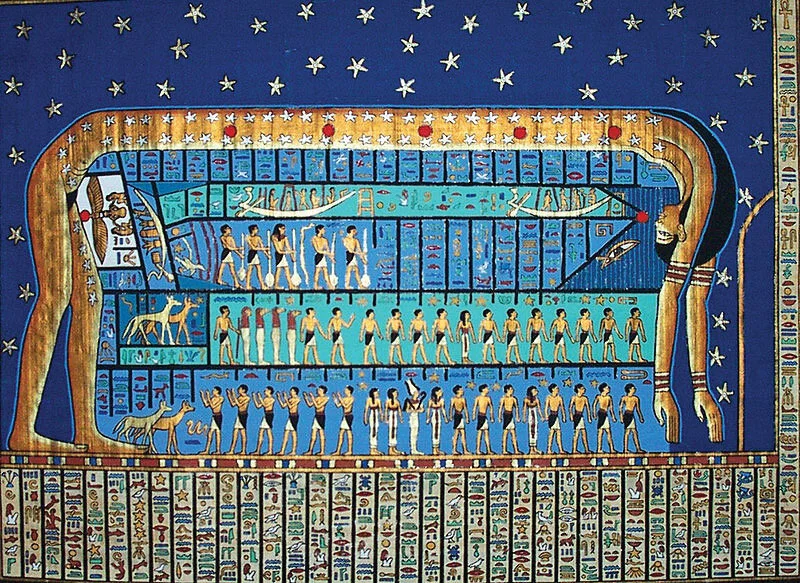
Domain: The sky

Description: A naked woman bending over to form the heavens, her feet and hands on the horizon below. She’s sometimes depicted as a cow or sow.

Strange story: Every night, she swallows the sun, giving birth to it in the morning.

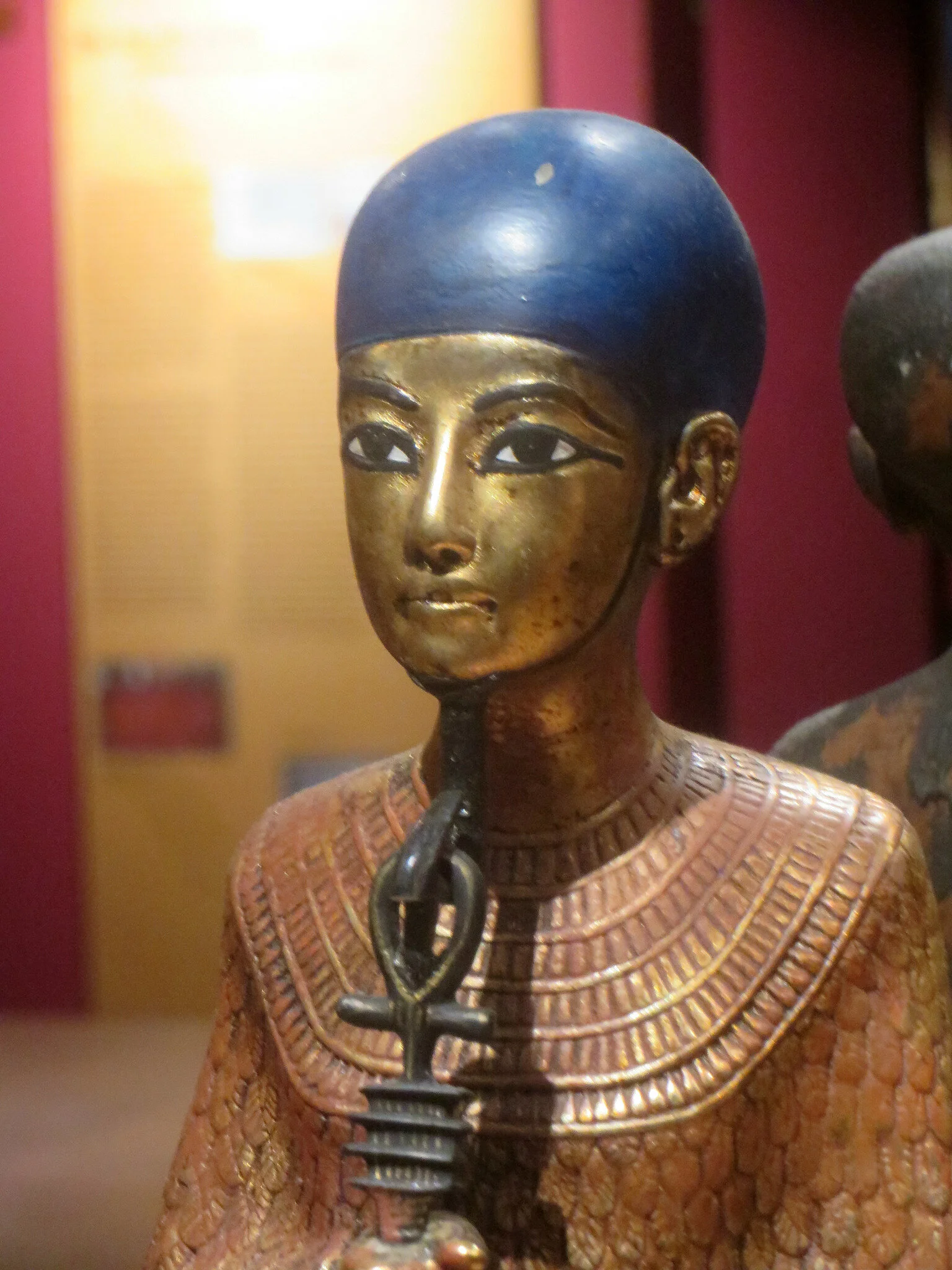
ptah.jpg

Ptah

Aka: Ptah-Nun

Domain: Creation and craftsmanship

Description: A mummified man with a long, thin erection, wearing a skull cap and false beard and carrying a scepter

Consort: Sekhmet

Strange story: While some believed that Ptah created the world on his potter’s wheel, others credited him with thinking or speaking the world into existence.

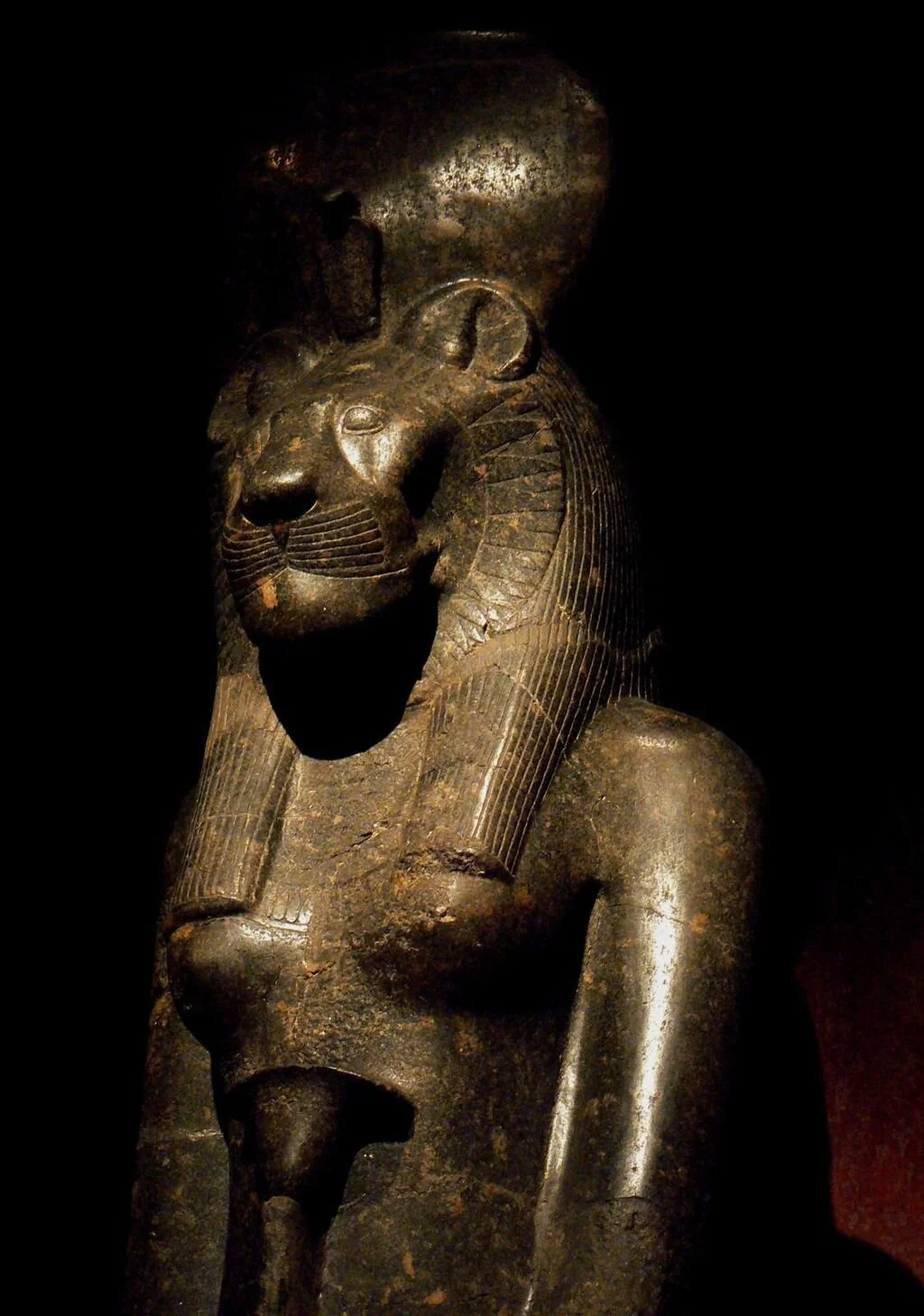
sekhmet.jpg

Sekhmet

Domain: Violence and healing

Description: A lion-headed woman

Consort: Ptah

Strange story: When the sun god Re grew old, his subjects plotted against him. To punish them, Re sent Sekhmet, who, in a destructive frenzy, went on a rampage, breathing fire and nearly wiping out the entire human race.

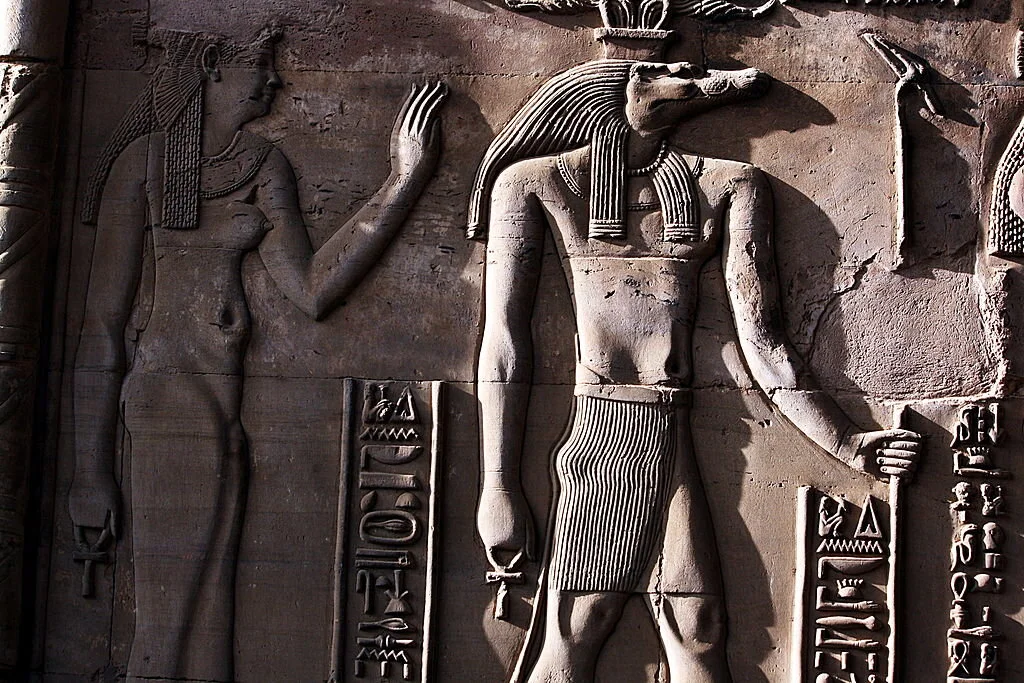
sobek.jpg

Sobek

Domain: Water

Description: A man with a crocodile head, sometimes wearing a headdress with tall feathers, horns and the sun

Strange story: Watch out, ladies! Sobek’s nickname is the Raging One because he’s known to “take women from their husbands whenever he wishes according to his desire.”

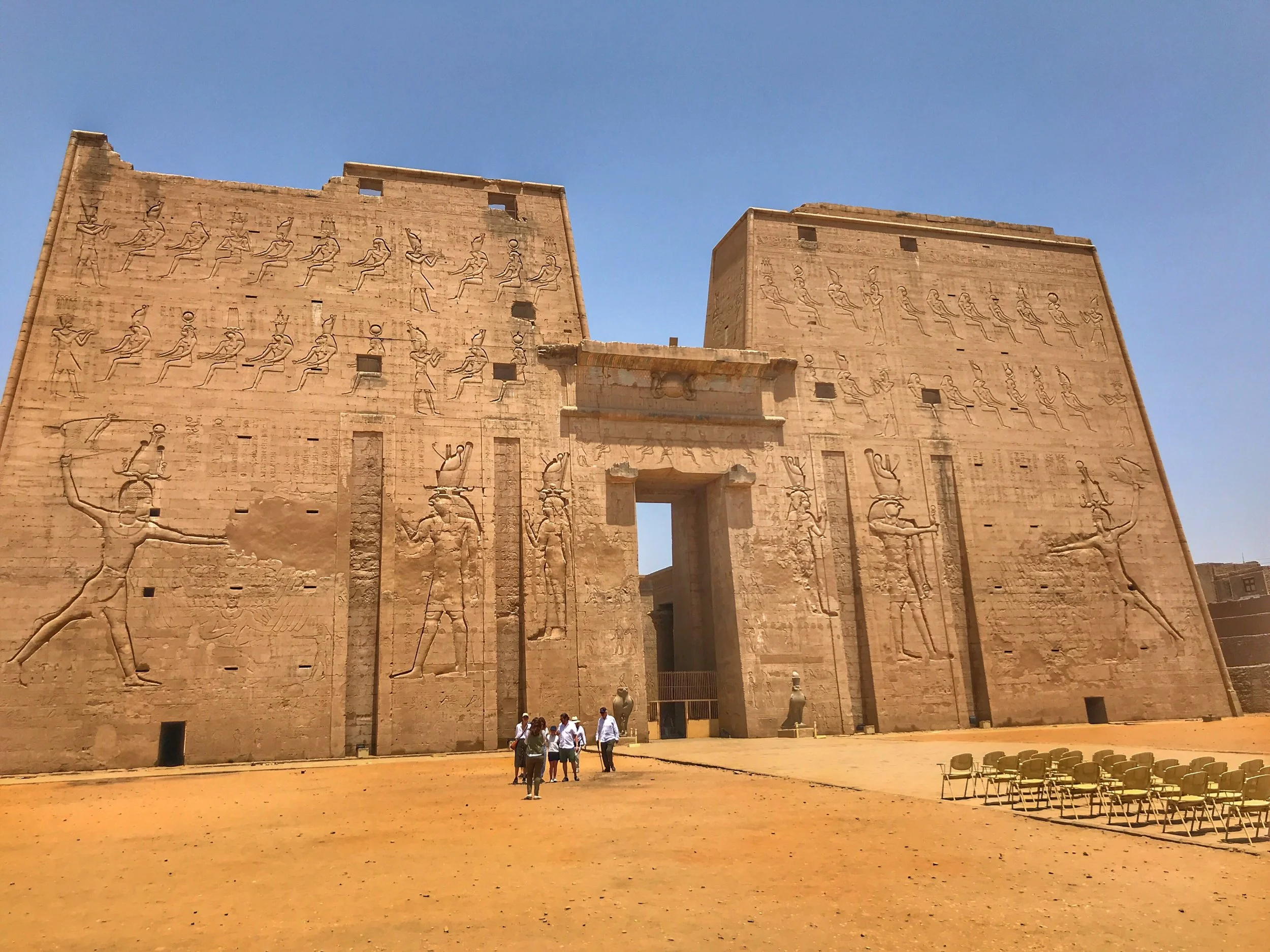
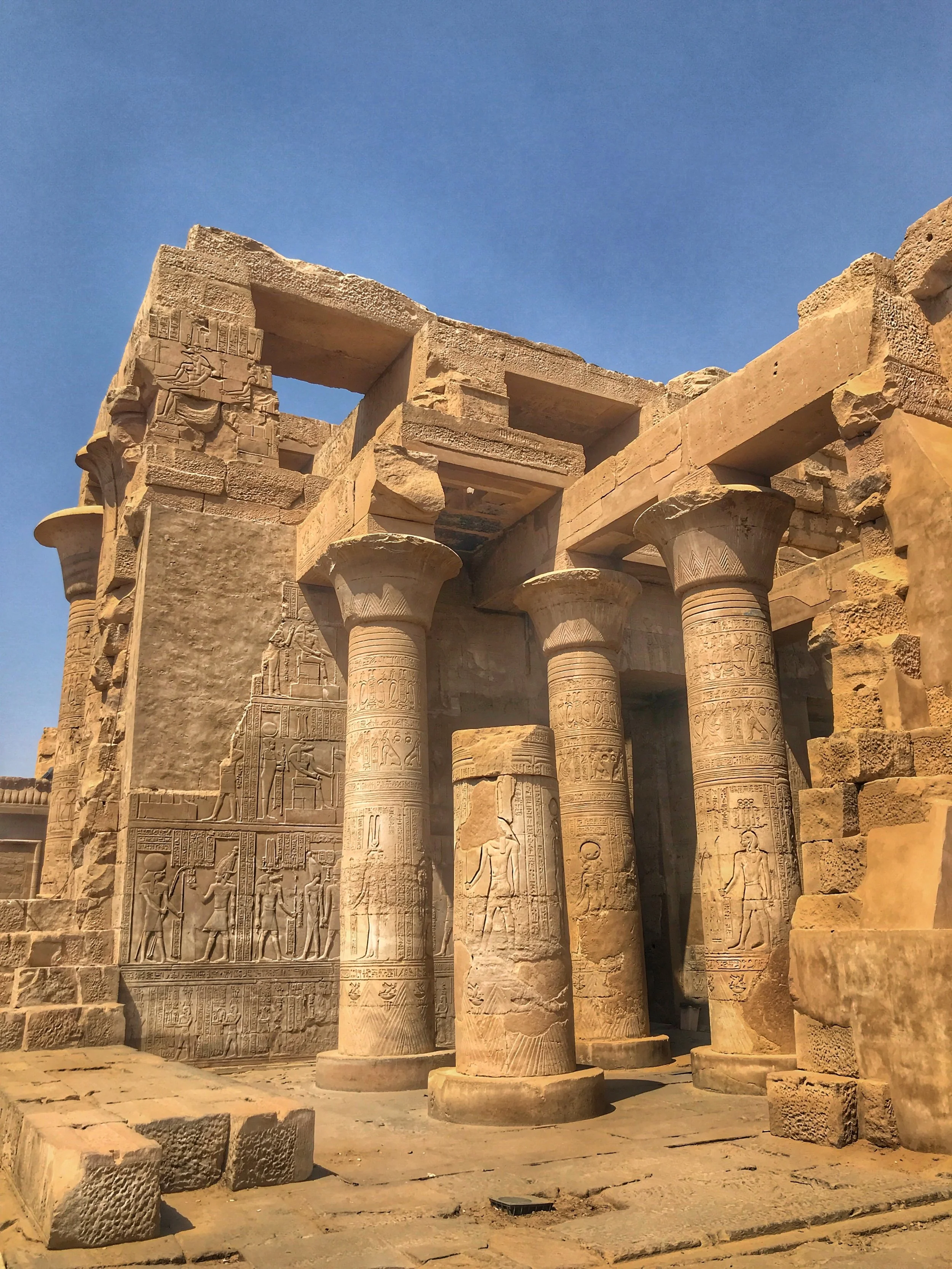
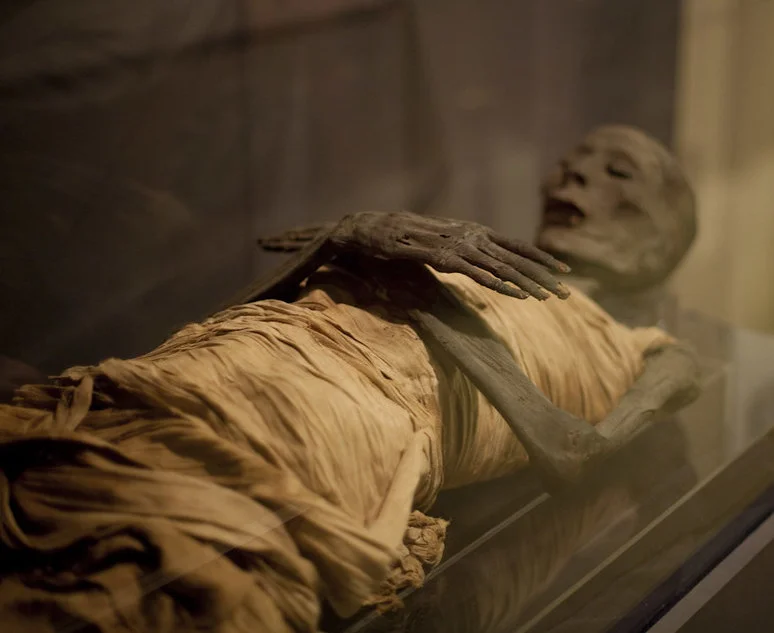
Pro tip: One of the less-visited temples in Egypt, Kom Ombo, is dedicated to Sobek and has a museum of mummified crocodiles next door.

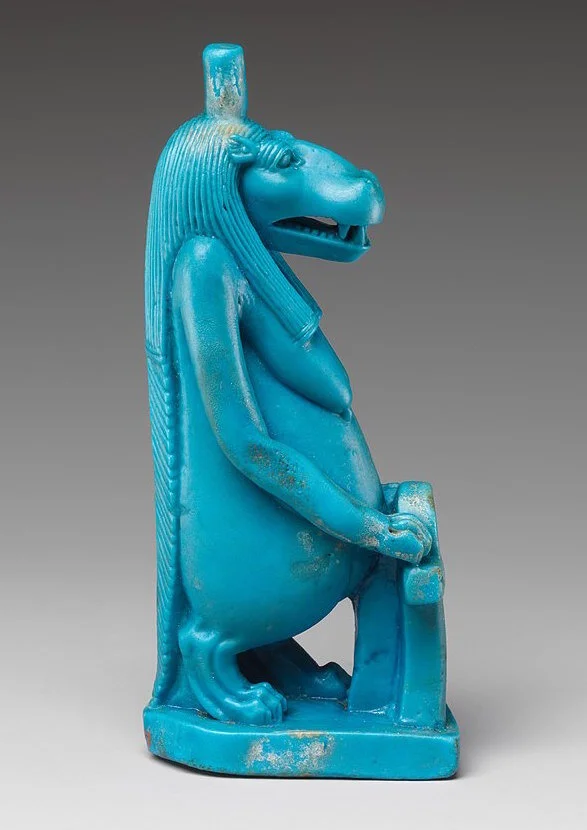
taweret.jpg

Taweret

Aka: Tawaret

Domain: Motherhood

Description: A grimacing hippo with sagging tits and a pregnant belly

Consort: Seth or Bes

Strange story: Containers made of faience were shaped like Taweret to hold breast milk. Two holes in the nipples allowed the milk to be poured out for magic rituals. –Wally

The Major Egyptian Gods and Goddesses

Who the heck were Anubis, Osiris, Thoth and Amun? Learn about Egyptian deities and the crazy stories of Egyptian mythology.

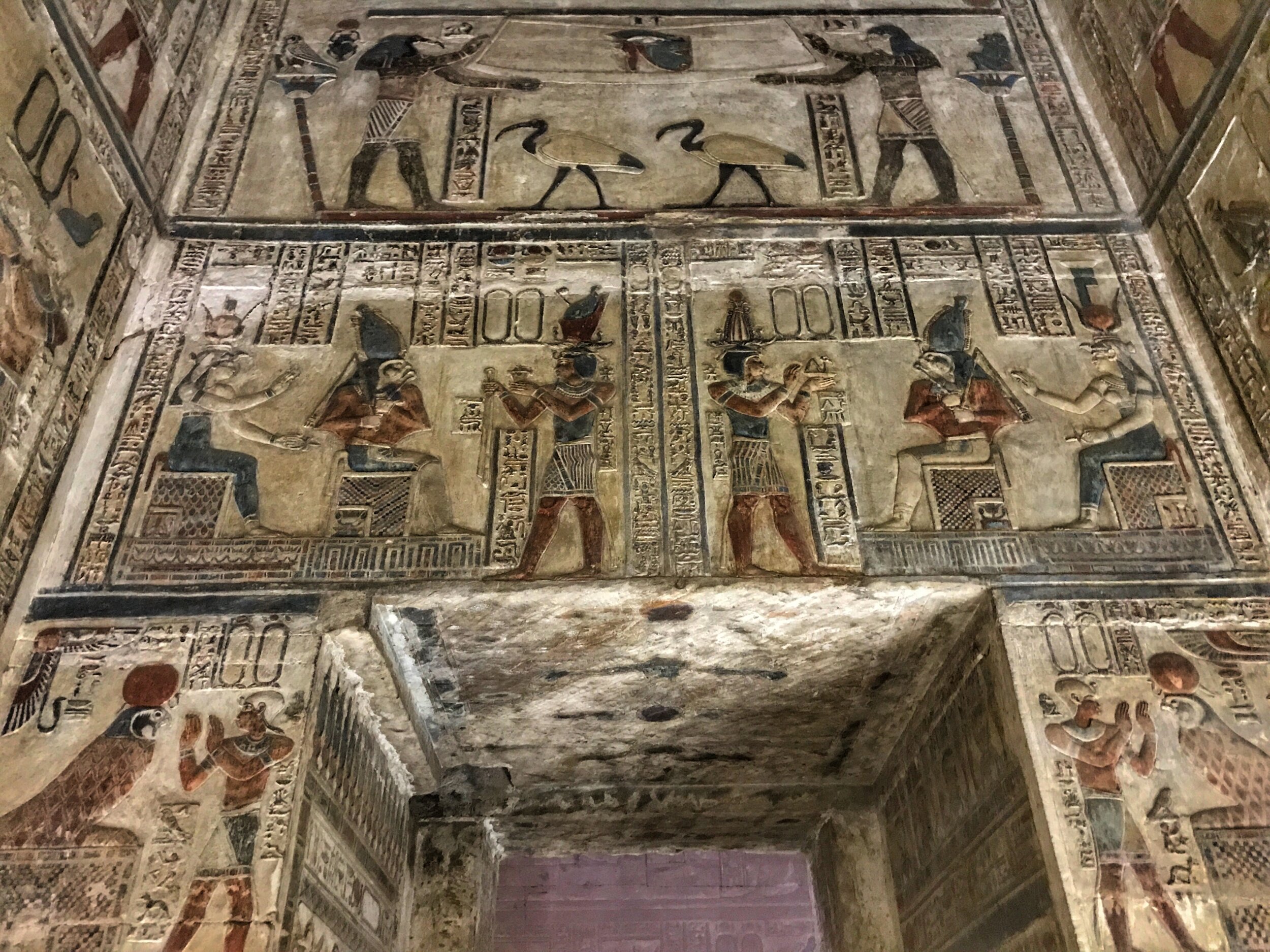
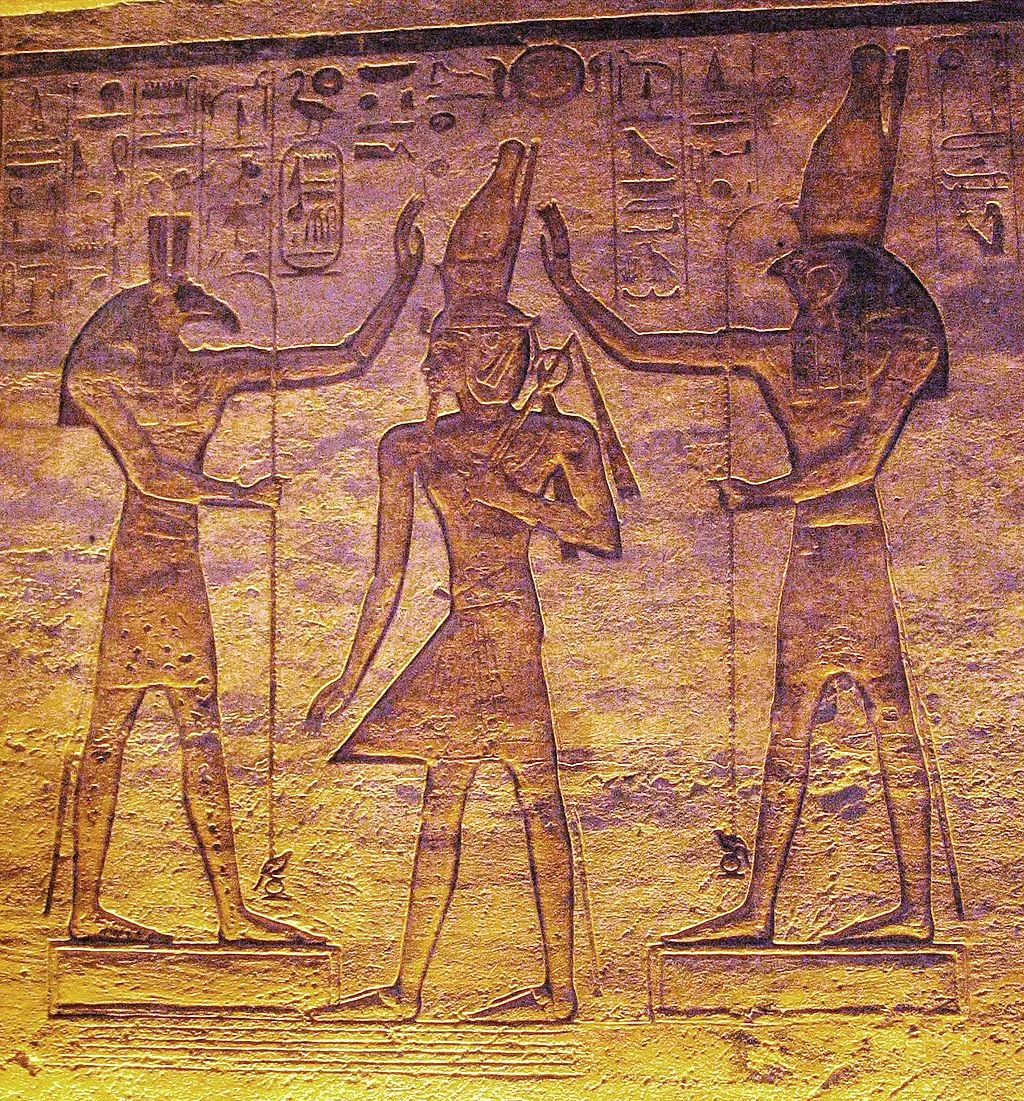
Look for the various deities from Egyptian mythology as you explore temples like Dendera, with this colorful wall featuring Thoth, Horus, Isis and others

Look for the various deities from Egyptian mythology as you explore temples like Dendera, with this colorful wall featuring Thoth, Horus, Isis and others

As a kid, I loved mythology (still do) — but I hated how many different versions there were of every tale. Couldn’t they all just agree upon one story and stick with it?

Of course, now, as an adult, I realize things aren’t that simple. Deities begin as one thing and evolve into something else. They get conflated with other gods. Their worship extends to a new region, where they take on new aspects. 

If you’re planning a trip to see the wonders of Egypt, it’s helpful to know a bit about the gods and goddesses beforehand. Temple carvings can blur together after a while, so it’s more fun to be able to spot the deities in the images: Hey! I know that green-skinned mummy-looking dude! That’s Osiris, lord of the afterlife! 

Here’s a primer on this often-bizarre pantheon, mostly culled from The Complete Gods and Goddesses of Ancient Egypt by Richard H. Wilkinson. (And be sure to check out our glossary of the lesser-known Ancient Egyptian gods, too!)

amun.jpg

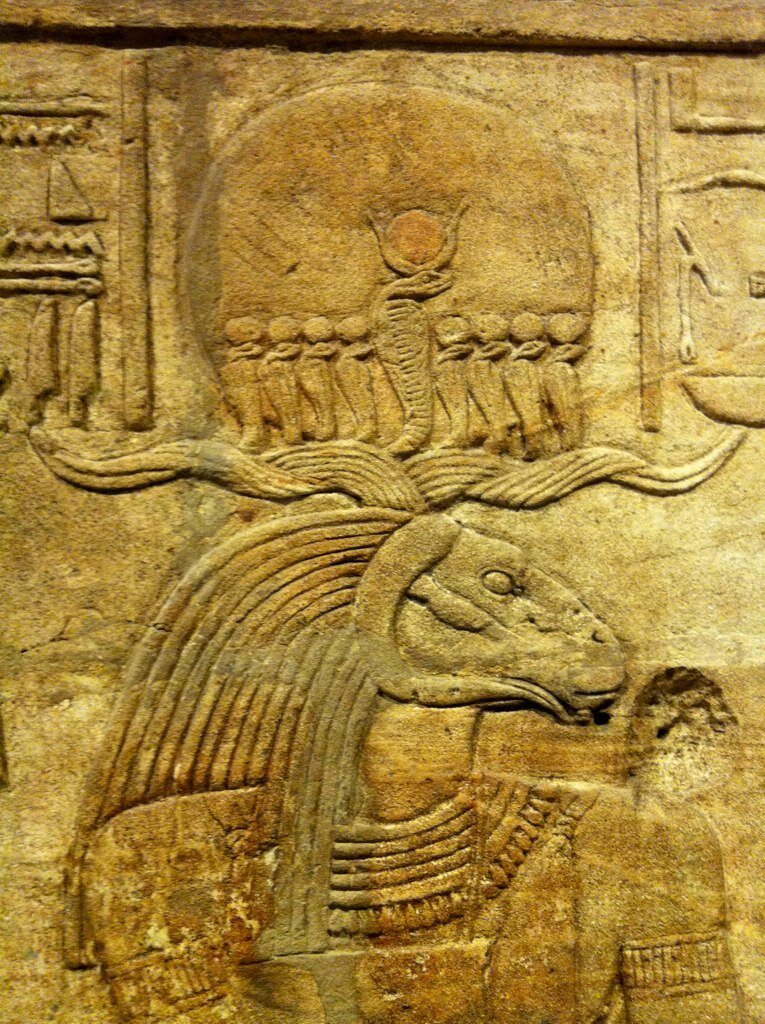
Amun

Aka: Amon, Amen, Amun-Re

Domain: The sun and fertility. As the supreme god of the Egyptian pantheon, he’s also credited in some tales for thinking the world into being.

Description: A human male, often with the head of a ram

Consort: Mut

Strange story: A young daughter of the reigning pharaoh was given the role of divine wife of Amun. Her duties including rubbing the phallus of the god’s statue until she felt it “orgasm.”

anubis.jpg

Anubis

Domain: Mummification, death and the afterlife

Description: A man with a black jackal head

Strange story: Anubis mostly likely got this head because desert canines would scavenge the shallow graves in early cemeteries, and people sought protection from the very creature that would threaten their eternal peace.

bastet.jpg

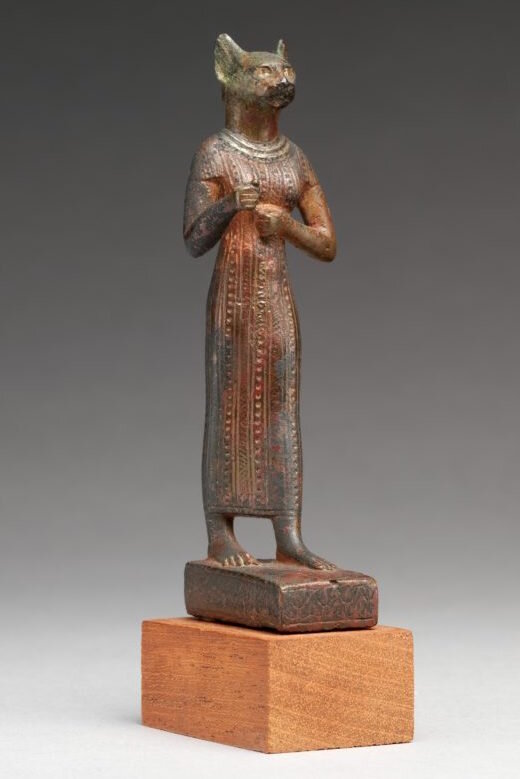
Bastet

Aka: Bast

Domain: Cats and pregnancy

Description: A woman with the head of a cat, or simply a cat itself

Strange story: Entire cemeteries at Saqqara and elsewhere are filled with cat mummies killed as offerings to the goddess.

hathor.jpg

Hathor

Domain: Women, female sexuality and motherhood, as well as music and happiness

Description: A woman with bovine features, usually cow ears, as can be seen atop Hathor columns. Sometimes depicted as a cow or a woman wearing a vulture cap.

Consort: Hathor is, alternately, the mother and wife of Horus.

Strange story: One of her nicknames is Mistress of the Vagina. When the sun god Re was depressed, Hathor flashed her pussy at him. It did the trick: Re laughed and rejoined his fellow gods.

horus.jpg

Horus

Aka: Re-Horakhty

Domain: The sky, sun and kingship

Description: A falcon-headed man or infant

Strange story: During an epic battle with his Uncle Seth, Horus climbed a mountain with his mother Isis’ decapitated head. He fell asleep, and Seth snuck up and gouged out Horus’ eyes and buried them. Lotuses sprouted from the eyes, and the goddess Hathor restored Horus’ sight by pouring gazelle milk over the sockets.

isis.jpg

Isis

Domain: The cosmos, magic, mourning and the dead

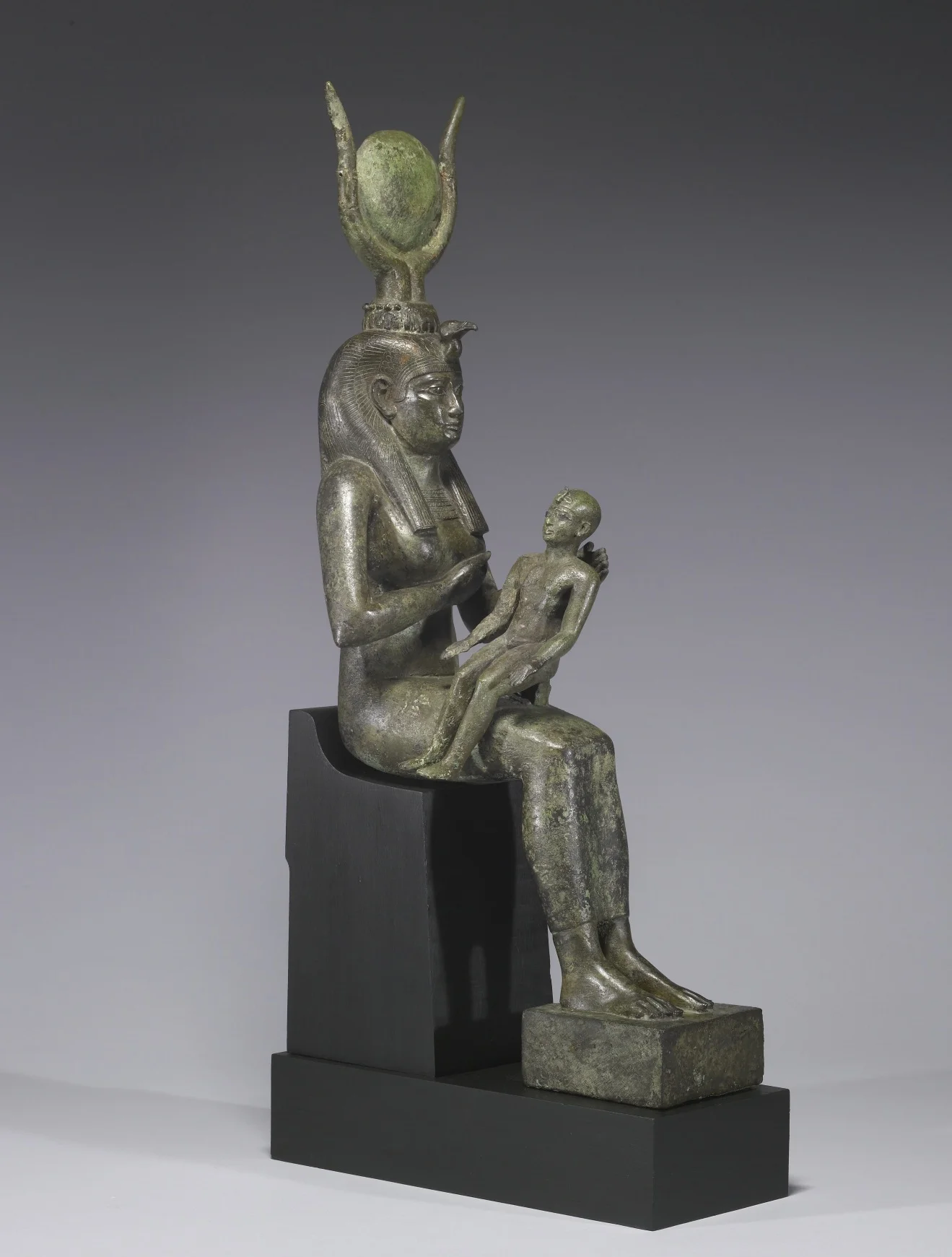
Description: A woman with large horns and the solar disc atop her head, sometimes with wings

Consort: She’s the sister and wife of Osiris, with whom she had Horus.

Strange story: A popular way to depict Isis was to show her breastfeeding Horus. Because pharaohs were the living incarnation of Horus, Egyptian kings were said to drink Isis’ breast milk as well.

maat.jpg

Maat

Aka: Ma’at

Domain: Truth, justice and the cosmic order

Description: A woman with a bird’s tail feather atop her head, sometimes shown with wings under her arms

Consort: Thoth

Strange story: Upon death, the heart was placed upon a scale. If it weighed less or the same as the feather of Maat, the person had led a virtuous life and could go on to the afterlife. If not, they’d be devoured by the demoness Ammit, who was part lion, hippo and crocodile. 

mut.jpg

Mut

Domain: Motherhood

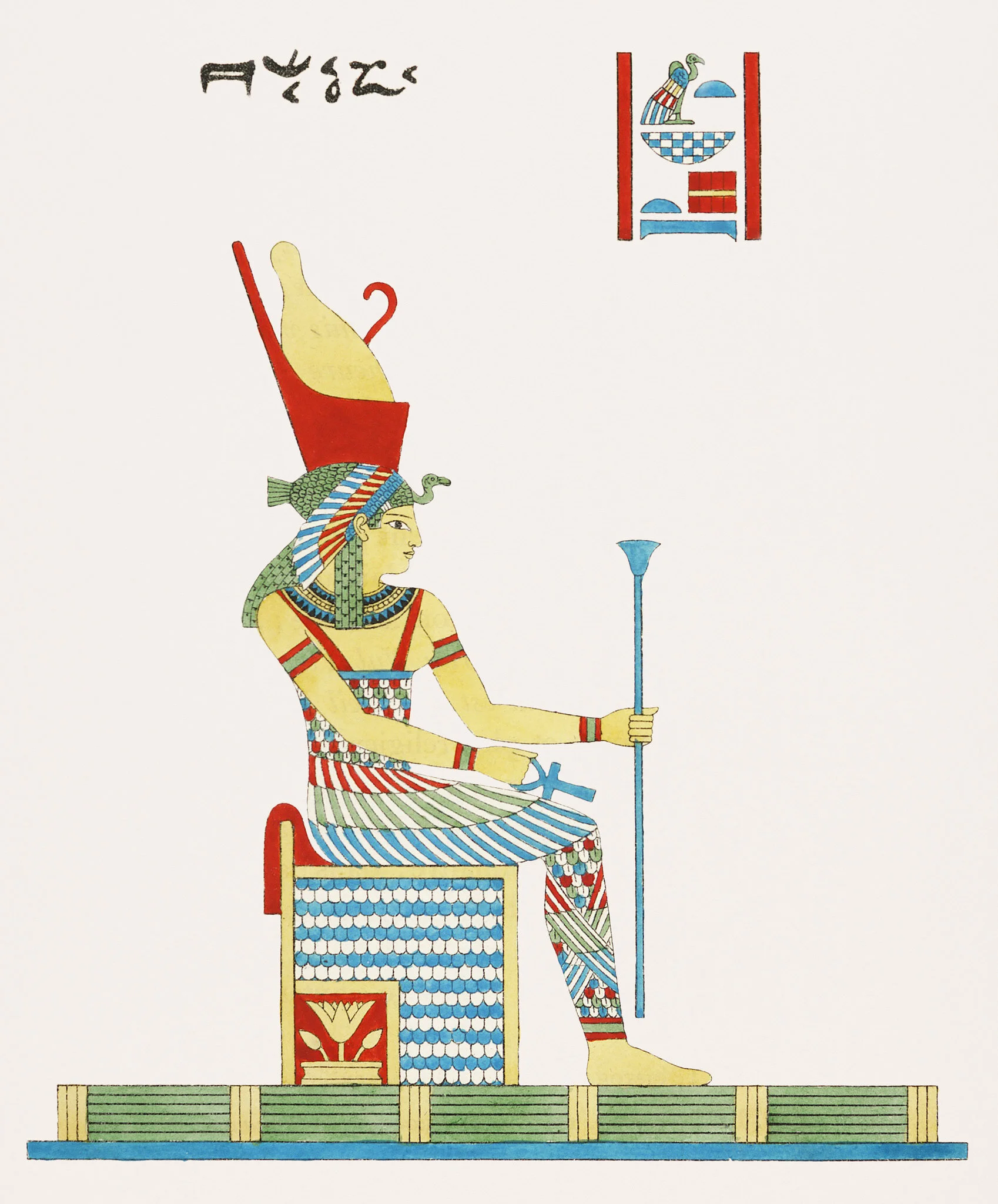
Description: Early depictions show her with the head of a lioness, but she’s most often shown as a woman in a feathered dress wearing either the White Crown of Upper Egypt or the Double Crown of the Two Lands.

Consort: Amun

Strange story: Mut was sometimes shown with an erection and three heads — those of a vulture, lion and human. In this aspect, she was said to be “mightier than the gods.”

osiris.jpg

Osiris

Domain: Ruling over death, resurrection and fertility, he’s the lord of the underworld.

Description: A green mummy holding the crook and flail, symbols of Egyptian royalty, and wearing the atef crown, a white bowling pin-like headpiece flanked by two tall feathers

Consort: Isis

Strange story: His jealous brother Seth murdered him and chopped him into pieces, hiding the body parts all over Egypt. Osiris’ dutiful wife, Isis, hunted down and found all the pieces, save one: his pecker.

re2.JPG

Re

Aka: Ra (though he merged with many other deities as well, including Amun and Horus)

Domain: The sun

Description: The sun, encircled by a cobra, sometimes with wings. He has a falcon head in his Re-Horakhty version.

Strange story: In one myth, Re created the world. When he “cut” his cock, possibly a reference to circumcision, two deities sprang from the drops of blood: Hu (Authority) and Sia (Mind).

seth.jpg

Seth

Aka: Set

Domain: Violence, chaos, confusion, cunning and storms

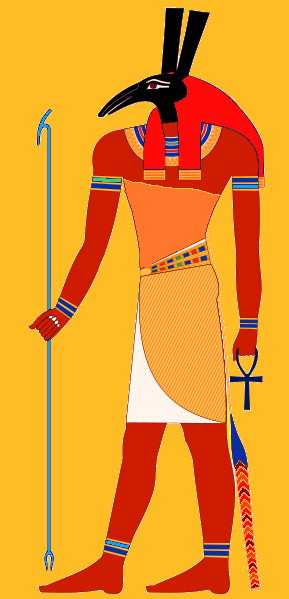
Description: A man with a long tail and a strange curved animal head that has tall, squared-off ears

Strange story: He molested his nephew Horus but then lost the throne of Egypt when he unwittingly ate lettuce that had Horus’ jizz on it

thoth.jpg

Thoth

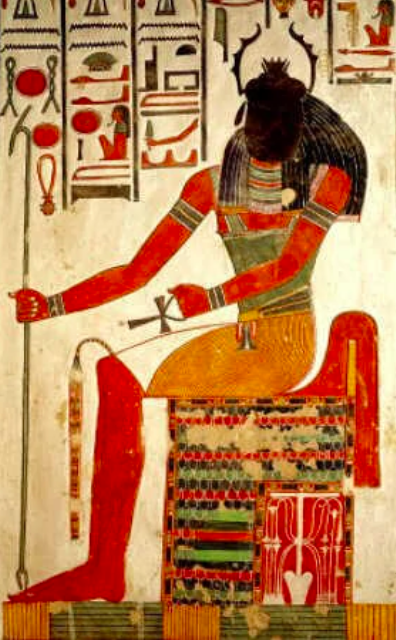
Domain: Knowledge and the moon

Description: A man with the head of an ibis, a now-extinct bird with a long, thin, curved beak. Sometimes also shown as a baboon

Strange story: Thoth invented writing and is the Lord of Time, recording history. Scribes would pour out a drop of water for him from their brush pot as a libation at the beginning of each day. –Wally


Bes, the Egyptian God Who’s Part Dwarf, Part Lion

As unlikely as it might seem, the ugly demon Bes was a much-loved guardian of the home and childbirth. Heck, he could even cure impotence.

Look for this block carving of Bes in the courtyard of Dendera.

Look for this block carving of Bes in the courtyard of Dendera.

We liked him instantly — perhaps because he’s so unlike all of the other gods and goddesses of Ancient Egypt we had seen carved onto temple walls and painted in the dark, narrow tombs. And since most of those deities feature animal heads, that’s saying something.

Even so, Bes is perhaps the most unique character in the Ancient Egyptian pantheon. I’d try to come up with my own colorful description, but once Duke read this to me, I figured why bother? I can’t top Alastair Sooke’s write-up in Frieze, who describes this “grotesque little fellow” so evocatively:

His physique is squat and stocky, with flabby man-boobs, pronounced buttocks and a pot-belly. He crouches as though he is about to defecate, so that his genitals dangle, prominently, between bandy legs. A wild beard frames his gargoyle’s face, along with a lion’s mane. Yet, his ferocious visage also has a playful aspect, since he sticks out his tongue, like a clown pulling a crude face.

I realized part of Bes’ uniqueness among his fellow Egyptian gods is that, aside from cow-eared Hathor, Bes is the only other deity depicted face-on. The rest of the pantheon are always shown in profile. 

Bes was a popular guardian deity, popping up on household items and amulets like this one.

Bes was a popular guardian deity, popping up on household items and amulets like this one.

The Household Guardian

For some reason, the ugly little bugger became a common household apparition. Artisans and craftsmen carved him onto beds and headrests, mirrors and makeup containers. His likeness is even found in the ruins of Amarna, where Pharaoh Akhenaten forbid all worship besides that of the sun disk, Aten. Bes was so popular that people might have been risking their lives to keep this protective imp in their homes.

Bes guarded households, much like gargoyles on a Catholic church or the hideous monsters outside a Thai temple. The name Bes came later, a logical choice given his role — besa means “to protect.”

A cosmetic jar shaped like Bes. Both sexes wore makeup, in part to protect from the sun and insects, so the connection to a protector god makes sense.

A cosmetic jar shaped like Bes. Both sexes wore makeup, in part to protect from the sun and insects, so the connection to a protector god makes sense.

His worship goes back at least as far as the 1700s BCE, Egypt’s Middle Kingdom, though some scholars think Bes originated even earlier, in a more lionlike form. 

Bes, a conglomeration of numerous gods and monsters, was a fighter, protector, partier and clown.

Bes, a conglomeration of numerous gods and monsters, was a fighter, protector, partier and clown.

Bes’ popularity was aided by the fact that he was also a god of humor, music and dancing. He knew how to have a good time. There weren’t any temples to Bes, he had no high priests or priestesses — and yet he was a favorite god across all classes, from the royal family down to the poorest laborer. There is evidence that someone would don a Bes costume during religious ceremonies. 

Priests might have dressed in a lionlike Bes costume during some rituals.

Priests might have dressed in a lionlike Bes costume during some rituals.

Ten or so deities and demons that shared characteristics with Bes became conflated with him, an ever-evolving leonine dwarf deity. In one of these earlier forms, Bes was known as Aha, or Fighter, and is shown strangling snakes with his bare hands. This explains why his image appears on knives as a protection charm for the wielder.

Aha, the god or demon who later morphed into Bes

Aha, the god or demon who later morphed into Bes

By the New Kingdom, Aha had merged into Bes, when he was sometimes given an elaborate feathered headdress.

Bes developed moobs (man boobs) and a potbelly to evoke characteristics of a pregnant woman.

Bes developed moobs (man boobs) and a potbelly to evoke characteristics of a pregnant woman.

Protector of Pregnant Women and Childbirth

Bes also shows up on magic wands designed to help infants come into this world, and for the dead to leave it for the afterlife. The dwarf became associated with childbirth, protecting pregnant women. In fact, two magical spells mention a “dwarf of clay” that was placed on the belly of a woman in labor — giving birth was a particularly dangerous process back then, and women and newborns needed all the help they could get. Bes would dance, shout and shake his rattle to scare off evil spirits. 

In these depictions, Bes is shown with a protruding belly and fleshy breasts, probably to connect him to his role as protector of pregnant women. He was sometimes said to be the husband of Taweret, the hippo goddess of childbirth.

If a baby laughed or smiled for no reason, it was said that Bes must be nearby, making funny faces.

Bes mania spread throughout the Mediterranean, where he became, um, quite well endowed, to represent his connection to virility.

Bes mania spread throughout the Mediterranean, where he became, um, quite well endowed, to represent his connection to virility.

Incubation Chambers to Cure Infertility and Impotence

As a protector of the pregnant, it’s not too far a stretch to imagine why Bes later became associated with fertility and sexuality. The imp was given a nude female companion named Beset during the Ptolemaic Period (332‒30 BCE), and mud plaster images of them decorated “incubation chambers” at Saqqara. Pilgrims would spend the night here, hoping for erotic dreams to cure them of infertility or impotence.

Bes and Beset, his nude female companion, decorated incubation chambers, where pilgrims would sleep, praying to be cured of infertility or impotence.

Bes and Beset, his nude female companion, decorated incubation chambers, where pilgrims would sleep, praying to be cured of infertility or impotence.

Prostitutes were known to get tattoos of Bes on their thighs in the hope that he’d help prevent them from getting STDs. Other women might have gotten a similar tattoo to increase fertility.

Maybe you should get a tattoo on your thigh of Bes, like this carving at Philae, to protect you from venereal diseases!

Maybe you should get a tattoo on your thigh of Bes, like this carving at Philae, to protect you from venereal diseases!

The god even found his way to Pompeii, where he’s depicted in this fresco.

The god even found his way to Pompeii, where he’s depicted in this fresco.

Simply the Bes

The Bes craze reached its peak during the Roman era. He became part of the Horus myth, protecting the falcon-headed infant from his murderous uncle Set. Worship of the tiny troll spread all around the Mediterranean. 

In another protector role, the dwarf god adorned mammisi, the birth houses that honored infant deities such as Horus. 

Who’d have known that this ugly squatting dwarf who’s sticking out his tongue would capture the hearts of so many for so long?

Who’d have known that this ugly squatting dwarf who’s sticking out his tongue would capture the hearts of so many for so long?

Bes became a mascot for the military, as well. Roman legionnaires put Bes in armor and gave him a sword and round shield. 

True to his origins as a war god, Bes became a mascot of Roman legionnaires.

True to his origins as a war god, Bes became a mascot of Roman legionnaires.

It wasn’t until after the advent of Christianity that Bes finally got his own priesthood — oracles at Abydos, where he was said to have guarded the corpse of the death god Osiris. The cult of Bes drew an impressive crowd, until Emperor Constantius II shut down the operation around 359 CE. 

Bes confronts a sphinx in this bas relief from the Ptolemaic era.

Bes confronts a sphinx in this bas relief from the Ptolemaic era.

While you’re exploring the ancient temples of Egypt, be on the lookout for this merry prankster, the dwarf Bes, with his genitals exposed and his curlicue beard adorning his oversized head. He’ll be sticking his tongue out at you, making you giggle even as he protects you from harm. –Wally

Horus vs. Seth: Homosexuality, Hippos and Familial Violence

The Egyptian myth described in The Contendings of Horus and Seth is as graphic as it is bizarre.

The young falcon-headed god Horus battles his evil uncle Seth to become pharaoh of Egypt

The young falcon-headed god Horus battles his evil uncle Seth to become pharaoh of Egypt

Osiris ruled as pharaoh of Egypt with his sister-wife Isis, bringing peace and prosperity to the land. But his elder brother, Seth (or Set), became insanely jealous and led Osiris to a watery death after tricking him into a perfectly fitted coffin.

The story of how he chopped his brother into pieces, which Isis hunted down to reassemble, is a tale for another blog post. This one deals with the power struggle that ensued between the two contenders for the throne: the murderous Seth and Osiris’ son, the falcon-headed Horus. The story is told in the Chester Beatty Papyrus No. 1, The Contendings of Horus and Seth, which dates back to the early Middle Kingdom (2040-1674 BCE). The myth most likely has origins even earlier than that.

Be warned: Parts of this twisted tale get quite graphic.

Seth argues that Horus cannot be king because his breath stinks — an allusion to Horus breastfeeding from his mother, Isis, and a dig at his youth

Seth argues that Horus cannot be king because his breath stinks — an allusion to Horus breastfeeding from his mother, Isis, and a dig at his youth

The Battle to Become Pharaoh of Egypt

As the son of Osiris, Horus presented his claim to the throne to a tribunal of three of the most powerful deities in the Egyptian pantheon: the sun god Ra (aka Re); Thoth, the god of wisdom; and Shu, the god of air.

Thoth and Shu declared Horus the rightful ruler of Egypt, but Ra argued that Seth was more powerful and therefore deserved the throne.

“The throne is mine by virtue of my strength,” Seth said. “‘Let Horus prove that he is better than I, and he can have the throne!”

“Challenge me to what you will. I will prove you the weaker!” Horus declared.

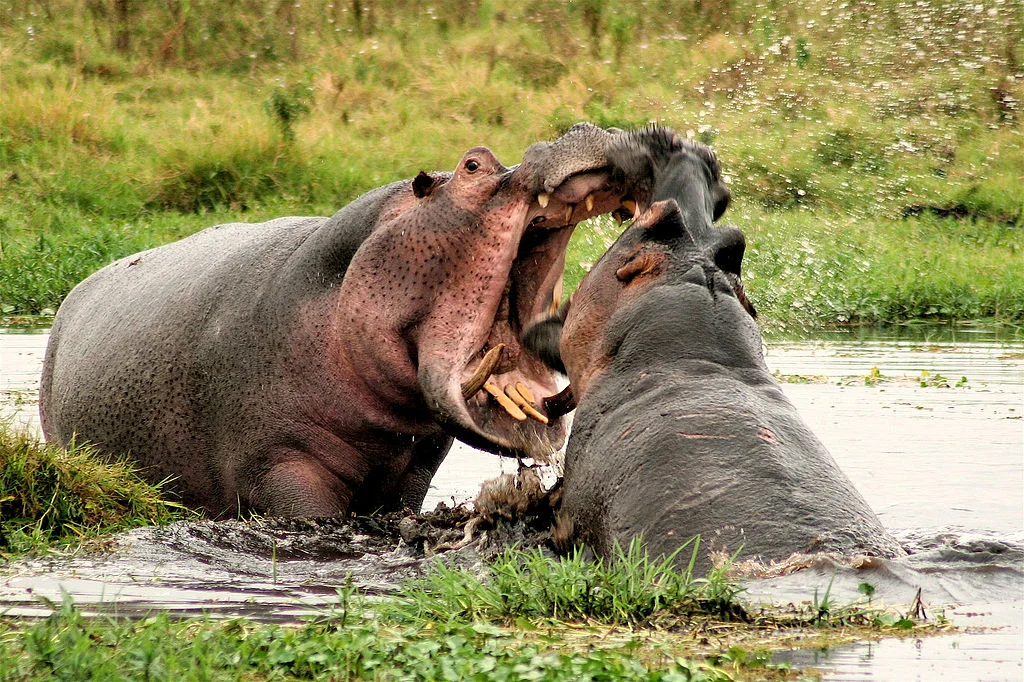
Much like the shapeshifting Egyptian gods Horus and Seth, these hippos battle for dominance

Much like the shapeshifting Egyptian gods Horus and Seth, these hippos battle for dominance

Hippos Holding Their Breath

Seth decided that the first feat of strength would be to have them both turn into hippopotami and sit on the bottom of the Nile. The first to come up for air would lose.

Isis, desperately wanting her son to be pharaoh, magically created a copper harpoon, which she threw into the water. Her aim was off, though, and she hit Horus instead of Seth. Realizing this, she pulled free the harpoon and cast it back into the water. This time it sunk into the body of Seth.

But the injured god appealed to Isis as her brother, and she caved and helped him. Horus, enraged, emerged from the water. He wasn’t worried about losing the first challenge — he was focused on taking revenge on his mother for what he felt was a betrayal. Horus cut off Isis’ head, carried it up a mountain and tossed it away. Talk about mommy issues!

Fear not, though: Thoth picked up Isis’ head and reunited it with her body.

Seth really liked salad — only that wasn’t ranch dressing on it!

Seth really liked salad — only that wasn’t ranch dressing on it!

Homosexual Incest and Semen-Covered Lettuce

Tired from decapitating his mother, Horus went to sleep on the mountaintop. Seth snuck up and gouged out his nephew’s eyes, burying them in the ground. Overnight, they grew into lotuses. Taking pity on the blinded boy, the cow-headed goddess Hathor came to Horus’ aid, pouring gazelle milk on his wounds and restoring his sight.

The judges wanted the two gods to make amends. They did reconcile, but the wily Seth decided to seduce his nephew.

Seth wasn’t discriminate in his liaisons. In the world of Ancient Egypt, there wasn’t any real conception of homosexuality. What mattered was who was the top (the one who was doing the penetrating), as that proved dominance over the other person.

Now afterward, [at] evening time, bed was prepared for them, and they both lay down. But during the night, Seth caused his phallus to become stiff and inserted it between Horus’ thighs. Then Horus placed his hands between his thighs and received Seth’s semen. Horus went to tell his mother Isis: “Help me, Isis, my mother, come and see what Seth has done to me.” And he opened his hand[s] and let her see Seth’s semen.

She let out a loud shriek, seized the copper [knife], cut off his hand[s] that were equivalent. Then she fetched some fragrant ointment and applied it to Horus’ phallus. She caused it to become stiff and inserted it into a pot, and he caused his semen to flow down into it.

So to sum this up: Seth intended to humiliate his nephew by fucking him up the ass — but Horus secretly caught Seth’s semen in his hands. When young Horus showed his mother, Isis, what had happened, she cut off her son’s hands, aroused him and jerked him off into a jar. Not quite a Disney movie.

Isis then tossed Seth’s semen into the marshes of the Nile and devised a plan to deceive him:

Isis at morning time went carrying the semen of Horus to the garden of Seth and said to Seth’s gardener: “What sort of vegetable is it that Seth eats here in your company?” So the gardener told her: “He doesn’t eat any vegetable here in my company except lettuce.” And Isis added the semen of Horus onto it. Seth returned according to his daily habit and ate the lettuce, which he regularly ate. Thereupon he became pregnant with the semen of Horus.

Seth approached the tribunal and declared with confidence, “Let me be awarded the office of Ruler … for as to Horus, the one who is standing [trial], I have performed the labor of a male against him.”

This drawing on a shard of pottery shows that Ancient Egyptians had a gay old time

This drawing on a shard of pottery shows that Ancient Egyptians had a gay old time

Semen Calling

Horus spoke up: “All that Seth has said is false. Let Seth’s semen be summoned that we may see from where it answers, and my own be summoned that we may see from where it answers.”

Thoth put his hand on Horus’ shoulder and said, “Come out, you semen of Seth.” It answered him instead from the marsh along the Nile, where Isis had dumped it.

The god then put his hand on Seth’s shoulder and said, “Come out, you semen of Horus.” Because it had been ingested with the lettuce leaves, it answered from inside Seth’s stomach.

Deeming itself too important to flow out of Seth’s ear, the divine seed emerged from his head in the form of a golden solar disk. Thoth snatched it away and placed it as a crown upon his own head.

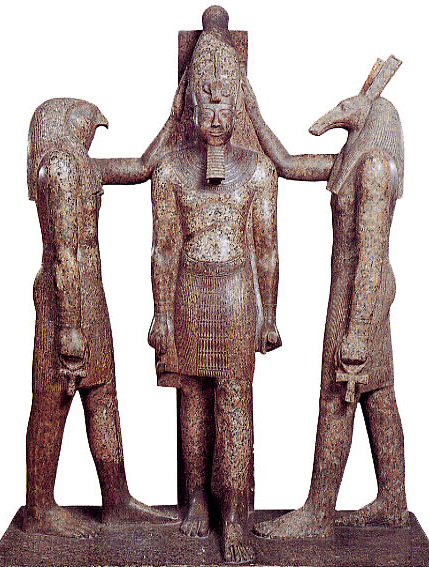
At some point, Horus and Seth seem to have made up, for here they are both adoring a ruler of Ramesside period

At some point, Horus and Seth seem to have made up, for here they are both adoring a ruler of Ramesside period

The Stone Ship Race

Despite this damning evidence, Seth somehow convinced the trio of judges to stage one more contest: a race of stone ships down the Nile. That didn’t seem like the wisest choice, since Seth’s boat sunk instantly. But Horus’ floated along the water — for he had tricked everyone by making his boat out of pine and covering it in gypsum, a sort of plaster, so that it looked like it was made of stone.

In a rage, Seth once again transformed into a hippopotamus and bashed his head into Horus’ ship. It came apart in splinters, exposing the young god’s deceit.

This back-and-forth had now gone on for 80 years. Seeking a final verdict, the judges decided to appeal to Osiris, who now ruled the underworld. Not surprisingly, Osiris argued that his son, Horus, deserved to be pharaoh, and Seth, in chains as a prisoner, finally conceded. –Wally

The Legend of Rangda, Bali’s Queen of the Demons

The origin of the queen who became a child-eating witch goddess fated to battle Barong, the King of the Spirits, for eternity.

The wild woman known as Randga, the Widow, is the personification of evil for the Balinese

The wild woman known as Randga, the Widow, is the personification of evil for the Balinese

When my husband, the king, died, his people began to call me Rangda, which means “widow.” As if my entire life should be reduced to the loss of a single thing, namely a feckless spouse.

It’s ironic that my name would be tied to him for eternity, for he cast me aside to marry another woman. Was I even still officially his wife?

Ours had been a strategic alliance to unite two kingdoms. I was born Mahendradatta, princess of Java, and when I came of age, my father arranged for my marriage to King Udayana and shipped me off to the neighboring isle of Bali.

I never let silly romantic fantasies enter my mind. As a royal, I had a job to do, a responsibility to my people.

As a queen, though, I didn’t have much power. My marriage would politically tie Java to Bali, and that was all that was required of me, aside from making sure I provided heirs.

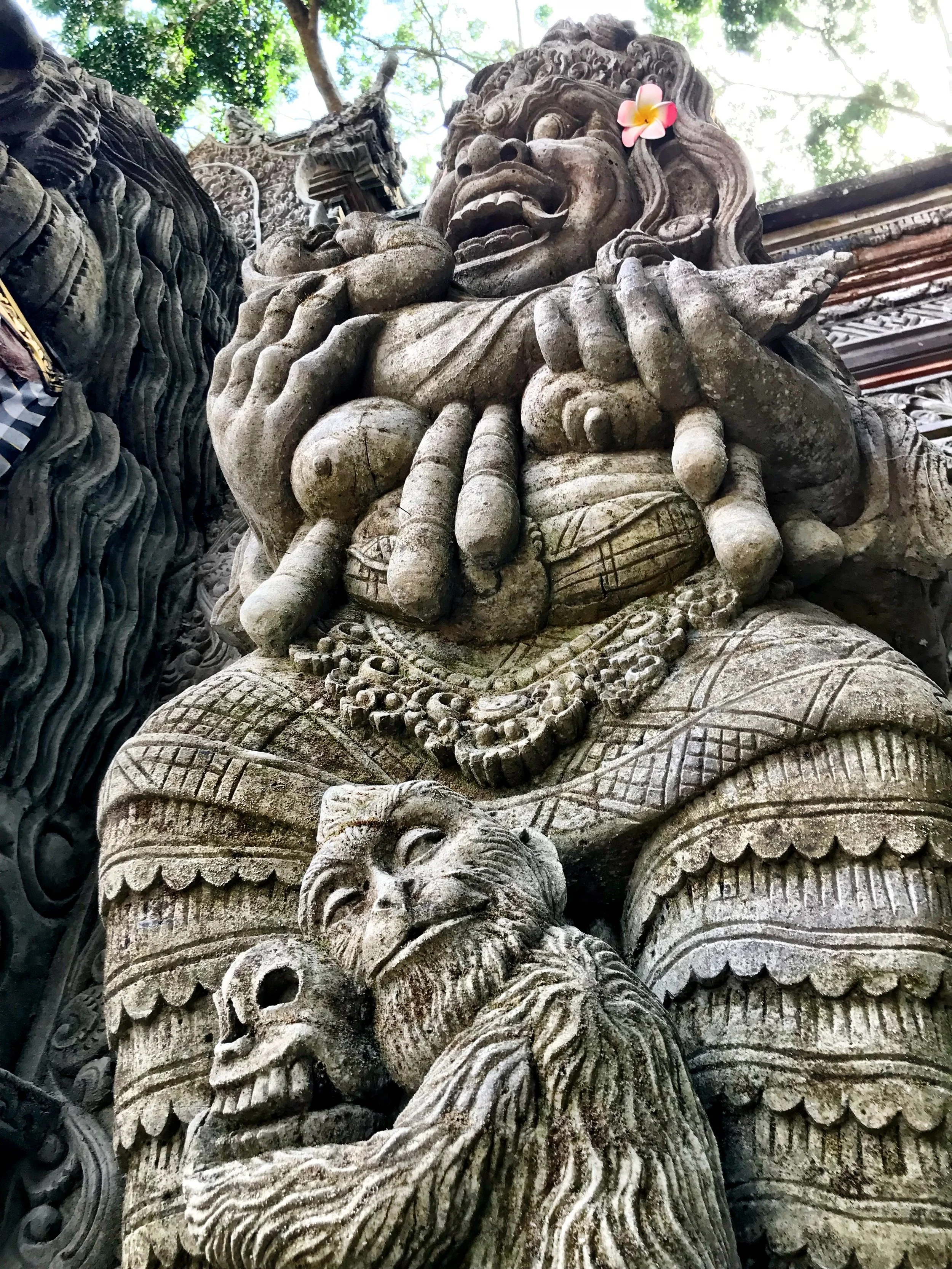
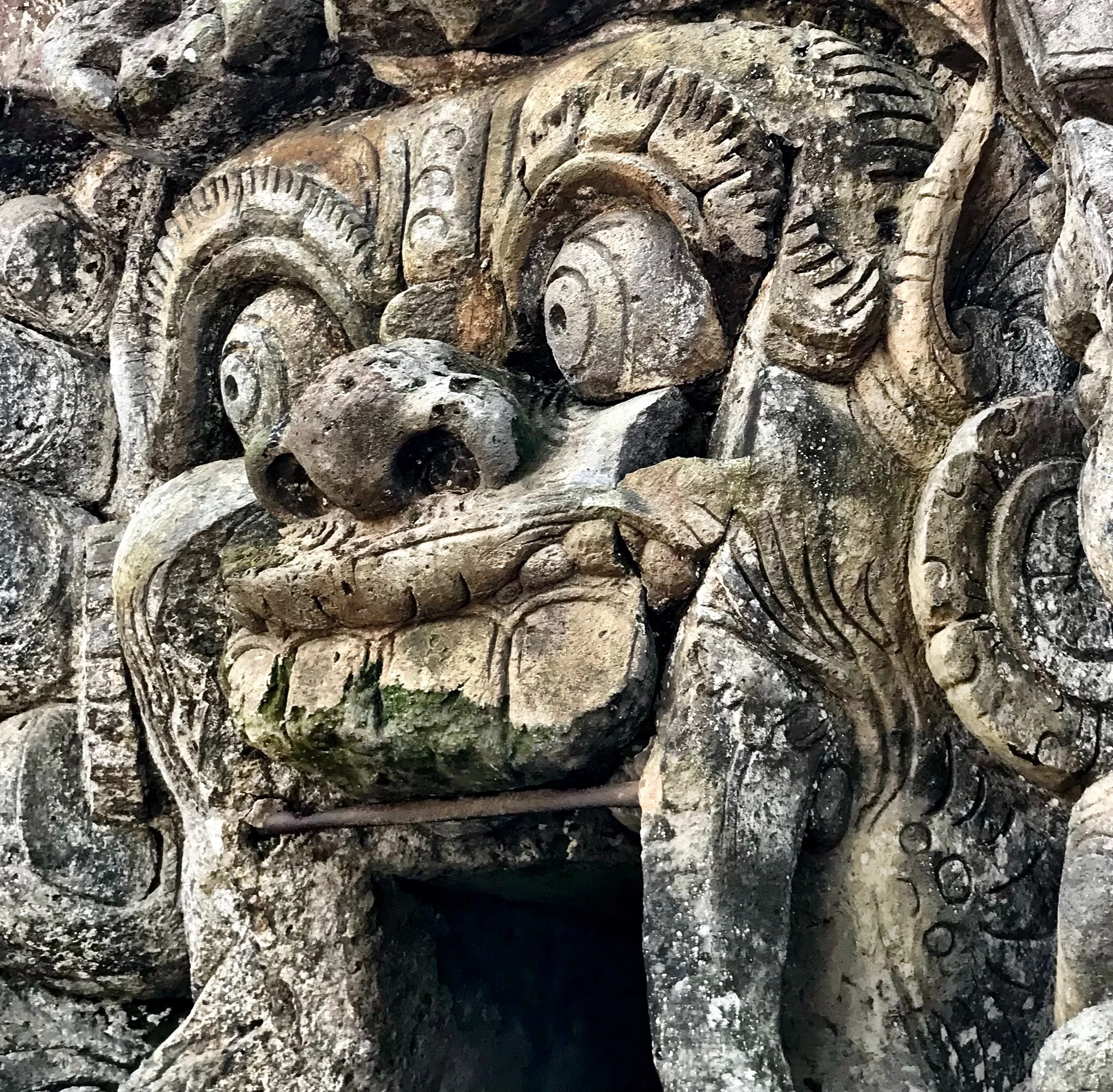
All over Bali, you’ll see statues of me holding innocent babes, the instant before I devour them.

Try not to judge me too harshly. If I am to act as a profane foil to all that is sacred, I must corrupt that which is most holy.

(That their tender, plump bodies taste even more delicious than suckling pig is just an added bonus.)

But I craved power; I yearned to be strong. Hindus have hundreds of deities, but the one I focused my prayers on was the goddess Durga, whom I had always emulated. Such a strong woman, a fierce warrior, her many arms clutching weapons, riding upon a snarling tiger. Yes, this was who I wanted to be.

I had few options. With little power of my own, I decided to harness the strength of others. I turned to witchcraft, learning how to control demons, those dim-witted ground-dwellers, to do what I demanded of them. If someone displeased me, I would inflict a horrific illness upon them.

At last, power coursed through my veins, an intense, almost orgasmic feeling.

But secrets never last long in a palace. Someone, hoping to gain favor with the king, told my husband what I was up to at night in my open-air chamber that faced the graveyard at the edge of the sea. Udayana called the court together and stood upon the sacred platform and shouted, “Mahendradatta, you have brought shame upon this kingdom. You have let evil into Bali. You are no longer my queen! I exile you!”

And before I knew what was happening, his guards had grabbed me and dragged me out of the palace, abandoning me in the dark jungle amidst the screeching of monkeys. I had only the clothes on my back. No food or supplies. A woman left exposed in the wild — Udayana assumed I would soon die, and everyone could forget all about me and the shameful fact that I had corrupted this island with the introduction of witchcraft.

The nocturnal sounds of the jungle filled my ears. I could hear animals moving stealthily through the foliage, stalking their prey. But I was no weak woman. I called upon Durga and the demons to protect me.

After a week or so, some villagers had learned of my exile and went into the jungle to seek me out. They heeded the alluring call of the dark arts; they wanted me to teach them how to enslave demons. Bitter souls who wanted to curse others, who wanted to spread sickness among their enemies.

These were my first students, my first leyaks, or witches. No longer the Queen of Bali, I became Queen of the Leyaks, and eventually, Queen of Demons.

Randga statues can be found out front of temples of death, like the one in Ubud

Randga statues can be found out front of temples of death, like the one in Ubud

A Son’s Betrayal, A Daughter’s Shame

One of the demons I used to spy on the court returned one evening, slithering along the ground to inform me that my husband planned to remarry.

Fury filled my breast. Who was Udayana to replace me, the mother of his children, the woman who brought his son, Erlangga, the king-to-be, into the world?

I screamed in rage, a horrific cry that wilted the plants around me and sent the animals scurrying away in fright. Trembling with anger, I sent a message to Erlangga to meet me at the edge of the jungle.

I saw the prince sneaking down the path for our illicit rendezvous, his eyes darting in every direction, worried he might be seen.

“My son, my son,” I called, a whisper that carried on the wind to his ears.

“Mother,” he said, looking at the ground. He would not meet my eyes.

“I have called you here to request a favor. Convince your father that he must not remarry. I will not be replaced.”

“I cannot,” he said after a time. “I cannot.” Erlangga turned from me and fled back to the palace.

If he had looked upon me — by this time I was a rather frightening sight, unbathed, my clothes in tatters, my hair matted — things might have turned out differently.

But it seemed Erlangga feared his father more than he feared me. That would be the biggest mistake of his life.

On top of my firstborn’s betrayal, I learned that my daughter, Princess Ratna Menggali, a young maiden known for her loveliness (this is not just a mother’s pride speaking), couldn’t find a single suitor. No one of high caste wanted to marry a daughter of mine. My association with witchcraft had tainted my poor daughter.

I found Ratna running through the jungle in tears, not seeming to notice or care about the branches that scratched her beautiful face.

I gathered her to me and held her against my chest.

“Come, daughter,” I told her. “You have a place here. Your life is not over, but just beginning.”

Ratna became my pupil, one of my most powerful leyaks.

“We shall make them pay,” I told her, seething at the wrong we had both suffered.

Randga is Queen of the Witches and brings doom to many

Randga is Queen of the Witches and brings doom to many

A young girl from the village wandered too far into the jungle one misty morning, and Ratna snatched her and brought her to me. While the child trembled and sobbed in fear, I dragged my claw-like nails across her throat.

“Take this innocent blood as an offering, Durga, O Invincible One!” we chanted.

The goddess heeded our call. The sea rose in a rush of water, a black tide that flooded the entire village. The crops became unharvestable, homes destroyed.

The success of the sacrifice sparked an idea. On Bali, babies are holy, for they have only recently left the spirit realm. In fact, for months, the Balinese do not let their newborns even so much as touch the ground. For that, you see, is where my minions must stay. Demons are relegated to the dirty, profane earth, where only the filthiest of body parts, the feet, should touch.

Whenever we learned of a child’s death, I would send Ratna and the other leyaks on a mission to dig up and steal the tiny corpse for our black rituals.

Even today, all over Bali, you’ll see statues of me holding innocent babes, the instant before I devour them. Try not to judge me too harshly. If I am to act as a profane foil to all that is sacred, I must corrupt that which is most holy. (That their tender, plump bodies taste even more delicious than suckling pig is just an added bonus.)

My patron deity Durga, pleased with my drive and my devotion, granted me immortality and full dominion over the demons. I felt as if I were on fire, as my mortal essence burned away. I had become a goddess.

Erlangga Enlists the Aid of Barong

One day, years later, I learned that Udayana had died and Erlangga was now king. I refused to forgive him for not defending my honor. He had abandoned his own mother and he would pay the price.

Erlangga knew of the danger of my wrath. Reports of desecrated graves had spread, of a wild woman of the jungle and her pet demons, which wreaked havoc on the people of Bali.

While my son mustered an army to fight me, I sent a foul plague creeping throughout the kingdom. Within days, half of the population lay dead.

Erlangga fretted. What chance would mortal men have against a goddess and her army of witches and demons?

As Queen of Bali, Randga was exiled for practicing witchcraft. She later became the goddess of evil and ruler of demons

As Queen of Bali, Randga was exiled for practicing witchcraft. She later became the goddess of evil and ruler of demons

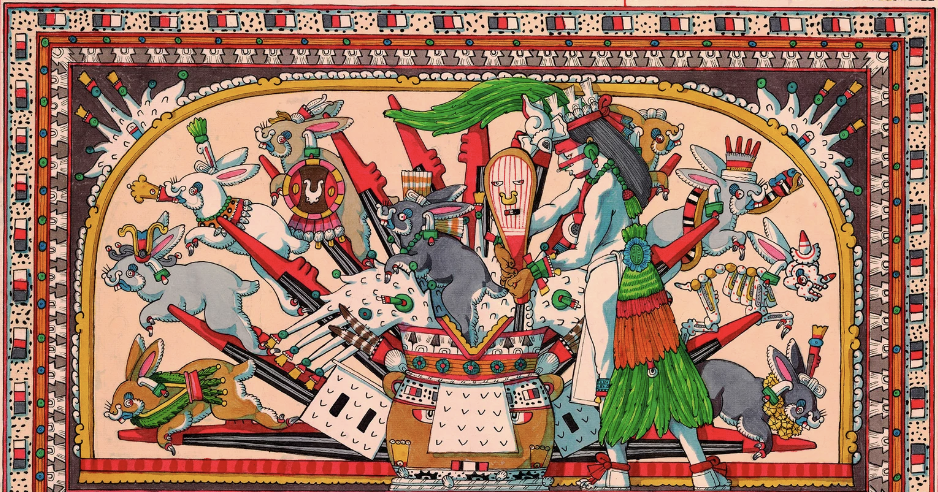
My son called upon Empu Pradah, a legendary holy man, and asked him how to defeat me. He was told to seek the aid of another god, Barong, the King of the Spirits, a mighty shape-shifting beast. He sometimes takes the form of a boar, sometimes an elephant, sometimes a tiger — though the lion guise is his favorite.

Barong ambles along clumsily. But don’t let that fool you — when it comes time to fight, he becomes as fierce as any of my demons. People don’t like to think of him as a monster, but that’s what he is.

Erlangga’s army approached, carrying wavy silver knives called keris, the tips coated with poison.
Let’s give them a taste of their own medicine, I thought.

All of the soldiers were suddenly consumed with an overwhelming desire to turn the keris upon themselves, to commit suicide by stabbing the toxic blades into their own hearts.

But just as the daggers were about to pierce their skin and become inflamed with the poison the soldiers meant for me and my demons to suffer, Barong reared up and cast a counterspell. Instantly, the skin of Erlangga’s soldiers became impenetrable. The keris were deflected. The army was saved.

My frustrated shriek caused the men to cover their ears, to tremble in fear. But I had gone.

Barong, on the left, is the representation of good on Bali and, as such, is the yin to Rangda’s yang

Barong, on the left, is the representation of good on Bali and, as such, is the yin to Rangda’s yang

The Balance of Good and Evil

For, you see, a realization had dawned on me, like a bright light piercing the darkness. This was my role for eternity: Barong and I were to engage in a never-ending battle. Neither good nor evil could win.

Of course, Barong’s battle is seen as necessary. The Balinese love him. He is their benevolent hero. His violence is forgiven, while mine is reviled. So be it. The minute we are done battling, Barong is back to his docile self, lumbering along like a puppy dog. He knows how to play to his audience.

By the time I had gained immortality, I had become an old woman. I let my hair grow long and wild; it became a mass of tangled white strands, some matted into dreadlocks. For the most part, I stopped bothering to wear clothes — what was the point? I was a fearsome deity. My breasts drooped farther and farther, until they swung across my stomach when I snarled. My teeth continued to grow as well, forming fangs that curved outward like a boar’s. I let my fingernails lengthen until they were razor-sharp claws. And I stretched out my tongue to demonstrate my insatiable hunger. A sense of horror overwhelms all who see me.

People call the spirits over which I reign “evil.” But do you feel evil when you are consumed by grief or pain? Is it evil to feel fear or hopelessness? To be sick? Unloved?

I quickly realized that without my army of so-called evil demons, people would not realize the joy brought about by my counterpart, Barong, and his legion of spirits.

The world must remain in balance, and I must do my part. Do not wish for a paradise. Utopias are dull places, for how can you know what happiness is if that’s all there is? How would you know peace without there being stress to escape from? Paradise, as humans naïvely imagine it, is the epitome of boredom, not pleasure.

Does this sound strange to you? It is no more strange than the fact that Christians pray to a demigod dying in agony. There, too, you have the balance of good and evil.

Perhaps I am wrong about the Balinese. Perhaps they do realize I have an essential part to play.

I, too, crave worship. The usual fruit and flowers will do. But sacrifice a rooster if you want me to ensure your fertility. And once you conceive, maybe, just maybe, I’ll keep away from that tasty little morsel. –Wally

Barong, King of the Spirits on Bali

What is Barong? Or should we say, who is Barong? The Balinese personification of good fights an eternal battle with the demon queen Rangda.

The mythical creature Barong represents all that is good in the world

The mythical creature Barong represents all that is good in the world


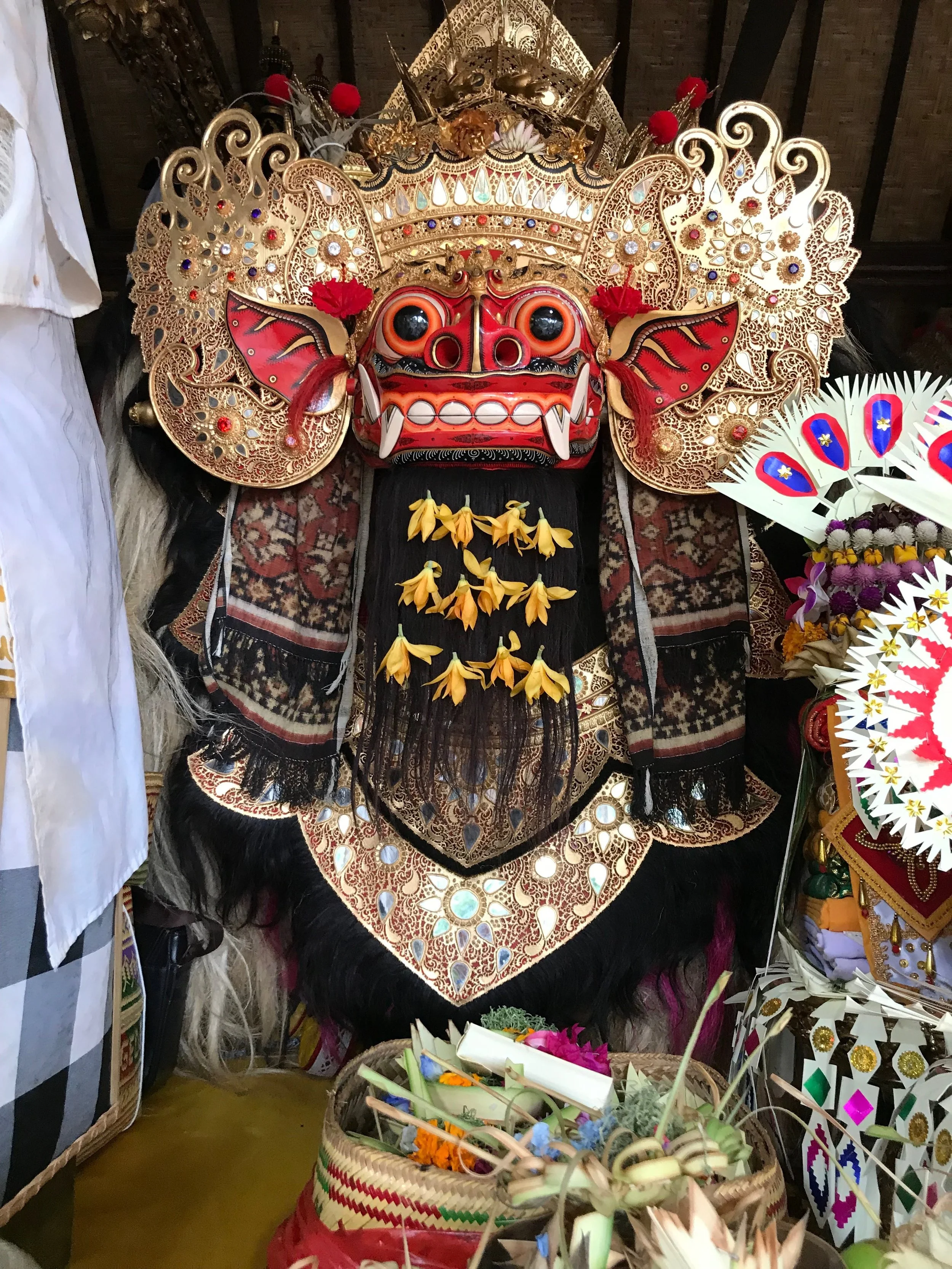
I fell in love with Barong the first time I saw him. And really, who could resist his charm? He’s most often depicted as a bright red, playful creature who gallops along good-naturedly like a playful Labrador retriever. Somehow his bug eyes and fangs don’t detract from his cuteness.

While Barong’s name supposedly comes from a word meaning “bear,” it’s difficult to pinpoint exactly what type of creature he is. He looks a lot like a Chinese fu dog, which to me has always seemed a muddling of a lion and a Pekingese.

Barong bids visitors farewell in this mural at the Denpasar airport

Barong bids visitors farewell in this mural at the Denpasar airport

If an epidemic rages through a village, the local priest will dip the beard of the Barong mask into a bowl of water, which will imbue it with white magic that will heal the populace.
A popular figure on the island, Barong pops up everywhere, such as this street art in Ubud

A popular figure on the island, Barong pops up everywhere, such as this street art in Ubud

The Barong Ket, or Lion Barong, is the most popular, though the creature sometimes takes other forms:

  • Barong Celeng: Boar

  • Barong Macan: Tiger

  • Barong Naga: Dragon or Serpent

  • Barong Gajah: Elephant

Wally and Duke make some new friends, including Barong and Rangda, which they watched battle in a dance

Wally and Duke make some new friends, including Barong and Rangda, which they watched battle in a dance

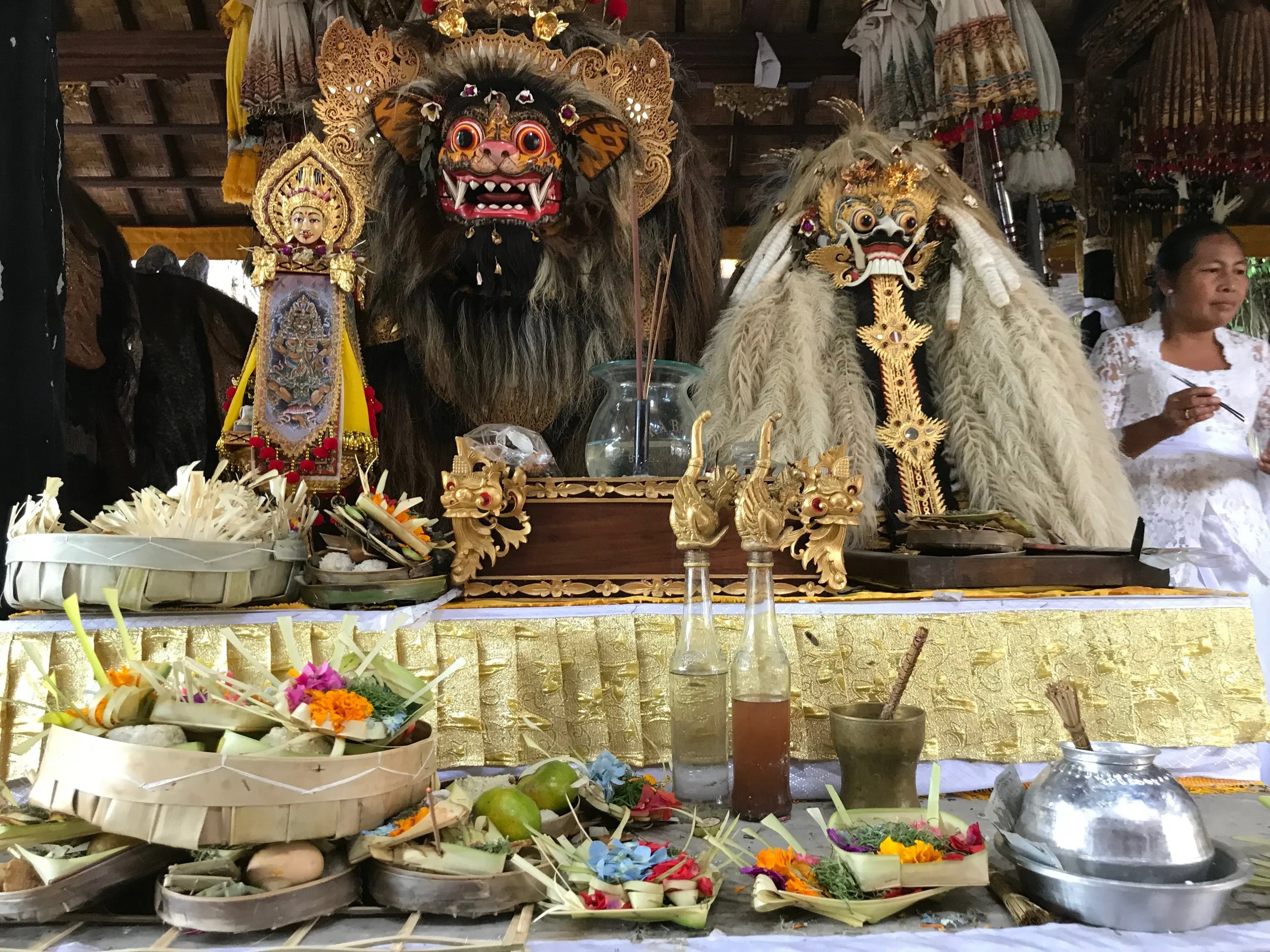
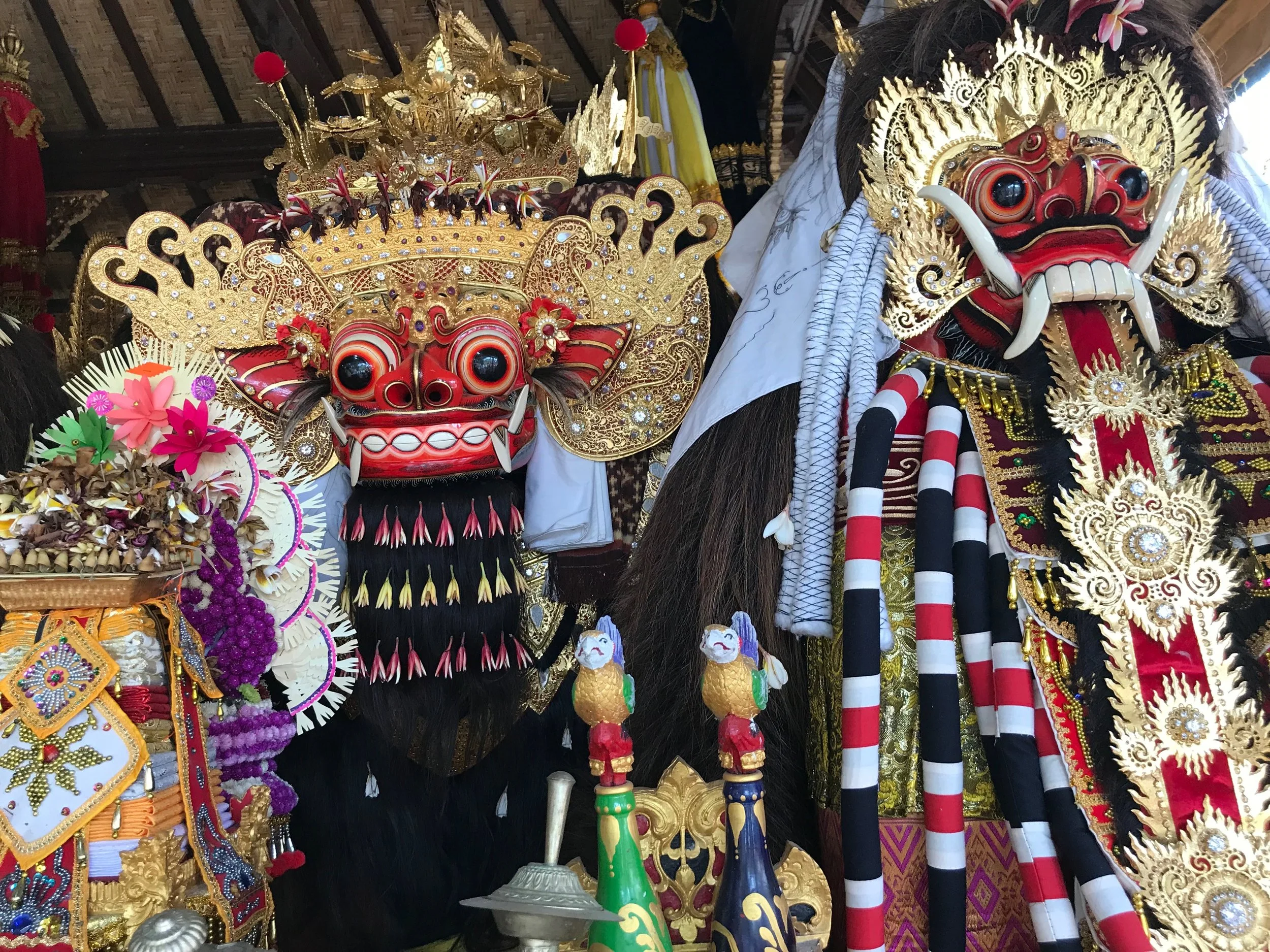
It helps that Barong is essentially all that is good in the world. He protects the Balinese in their villages. Barong is represented by a mask, its dark beard usually made of human hair. The mask is often kept in the village’s pura dalem, the temple of death, or in a small shrine near the bale banjar, the meeting hall.

An entire pavilion at the temple of Samuan Tiga is filled with Barong masks

An entire pavilion at the temple of Samuan Tiga is filled with Barong masks

Barongs come in various shapes, including that of a celang, or boar, as seen in the middle

Barongs come in various shapes, including that of a celang, or boar, as seen in the middle

The Hindus of Bali offer flowers and fruit to thank Barong for protecting them. The mask on the left is the form of a macan, or tiger

The Hindus of Bali offer flowers and fruit to thank Barong for protecting them. The mask on the left is the form of a macan, or tiger

If, for instance, an epidemic rages through a village, the local priest will dip the beard of the Barong mask into a bowl of water, which will imbue it with white magic that will heal the populace. Oil dripping from the mask’s eyes has even been said to cure scabies.


puradalemrangda.jpg

His worship predates Hinduism and is a relic of animism, the belief that animals have supernatural protective powers.

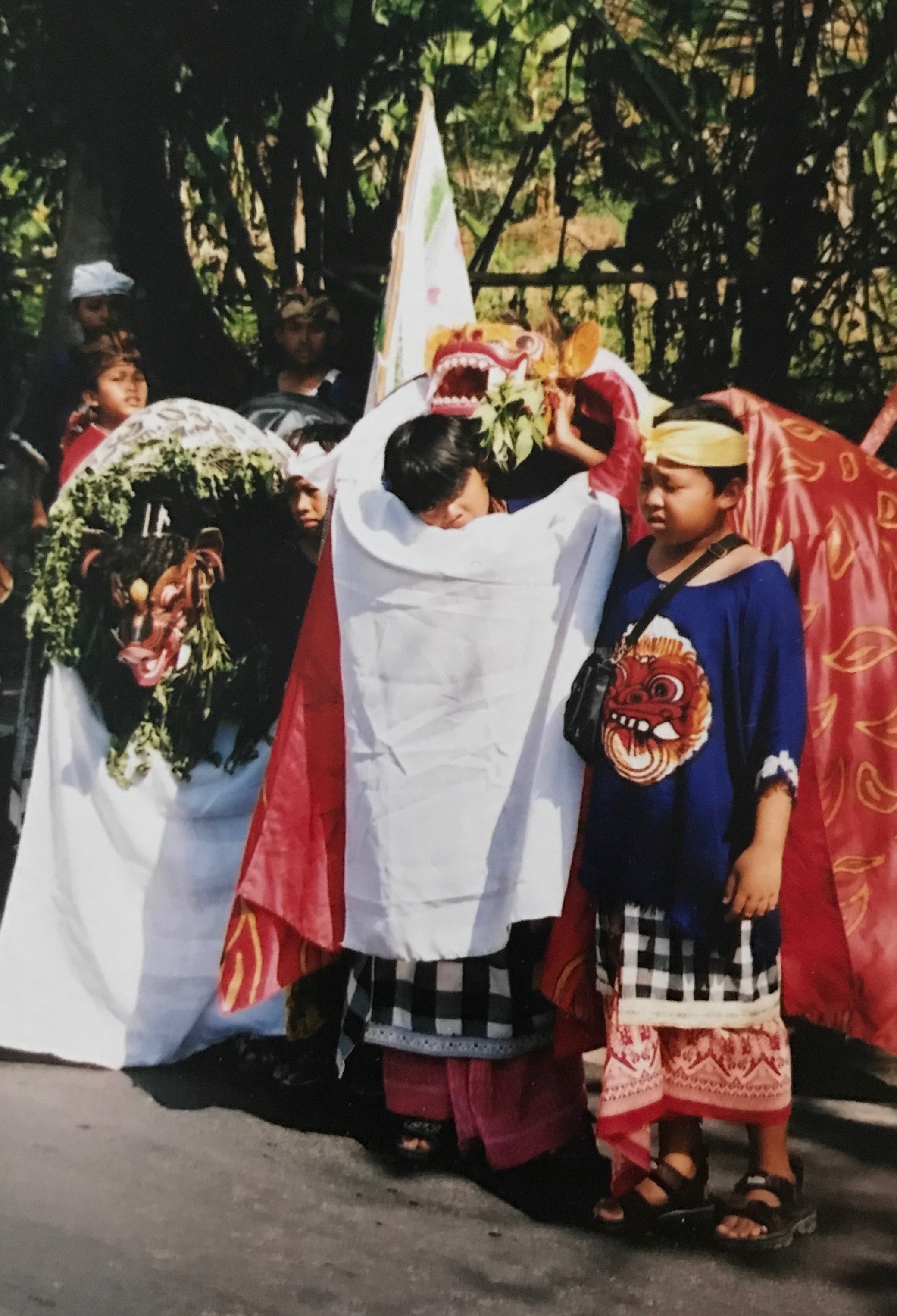
During the Galungan festivities, boys don the Barong mask and parade through town, looking for sweets

During the Galungan festivities, boys don the Barong mask and parade through town, looking for sweets

Galungan Guise

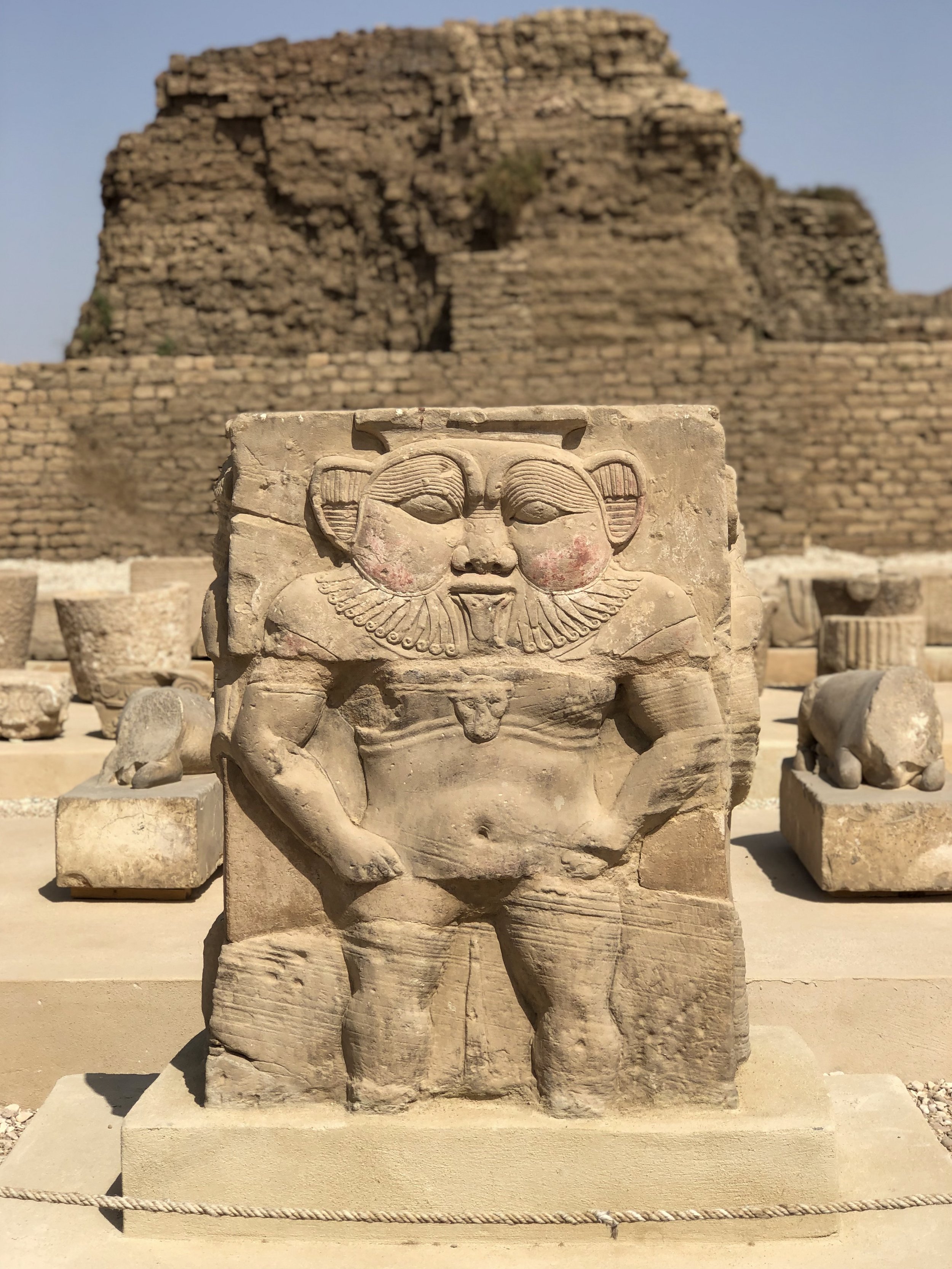
When I first visited Bali, we arrived in September during the Galungan Festival. It struck us the Balinese version of Halloween. All through the town of Ubud, we’d hear the clanging of metal percussion instruments, and would gawk as a strange creature approached. This was Barong, its wooden jaw opening and closing with a loud thok. One boy worked the mask, with its golden, mirrored crown, while others hid under a sheet to form the bumpy body that moved jerkily along the street. The kids, in their Barong costume, would stop at various business and receive sweets or coins. We later learned that Galungan was the most holy of holidays for the Hindus of Bali.

During the galungan holidays, the island was suddenly filled with magnificent masked beasts. With glaring eyes and snapping jaws, with elaborate golden crowns, great hairy bodies bedecked with little mirrors, and tails that rose high in the air to end in a tassel of tiny bells, they pranced and champed up and down the roads from village to village to the sound of cymbals and gongs, as though they had newly emerged, like awakened dragons, from caves and crevices in which for months they had been lying dormant.

This was the barong, a beautiful composite animal, lion, said some, bear, said others, Ruler of the Demons, said still others. …

These creatures were high-spirited and full of whims, dancing a strange ballet, coquettish and playful one moment, rolling on the ground like a puppy, and suddenly and unaccountably ferocious the next, snapping and stamping in fine fury as the two dancers within the body synchronized their steps and movements with beautiful coordination.
–Colin McPhee, A House in Bali

Barong engages in a never-ending fight with the Demon Queen, Rangda, in the middle

Barong engages in a never-ending fight with the Demon Queen, Rangda, in the middle

Barong vs. Rangda, the Battle Between Good and Evil

As the king of the good spirits, Barong fights a never-ending battle with the demon queen Rangda.

His nemesis is more human-like, a hideous half-nude witch with sagging breasts, disheveled hair and a long tongue lolling out of her fanged mouth. Barong and Rangda, like yin and yang, cannot exist with the other; there is no good without evil. Unlike in our Western lore, where people often tend to live happily ever after, in Balinese legend, neither Barong nor Rangda ever truly win. Their battle is the subject of a favorite dance on Bali. The forces of good and evil, of order and chaos, must remain in balance. –Wally


More Myths From Bali and Java

The Legend of Bandung Bondowoso and the Slender Virgin of Prambanan

Princess Loro Jonggrang didn’t want to marry the magician who killed her father. So she came up with a clever plan to deceive his demon helpers.

An Indonesia stamp commemorates the legend of Roro (aka Loro) Jonggrang and the magician Bandung Bondowoso, who summoned demons to perform a seemingly impossible task

An Indonesia stamp commemorates the legend of Roro (aka Loro) Jonggrang and the magician Bandung Bondowoso, who summoned demons to perform a seemingly impossible task

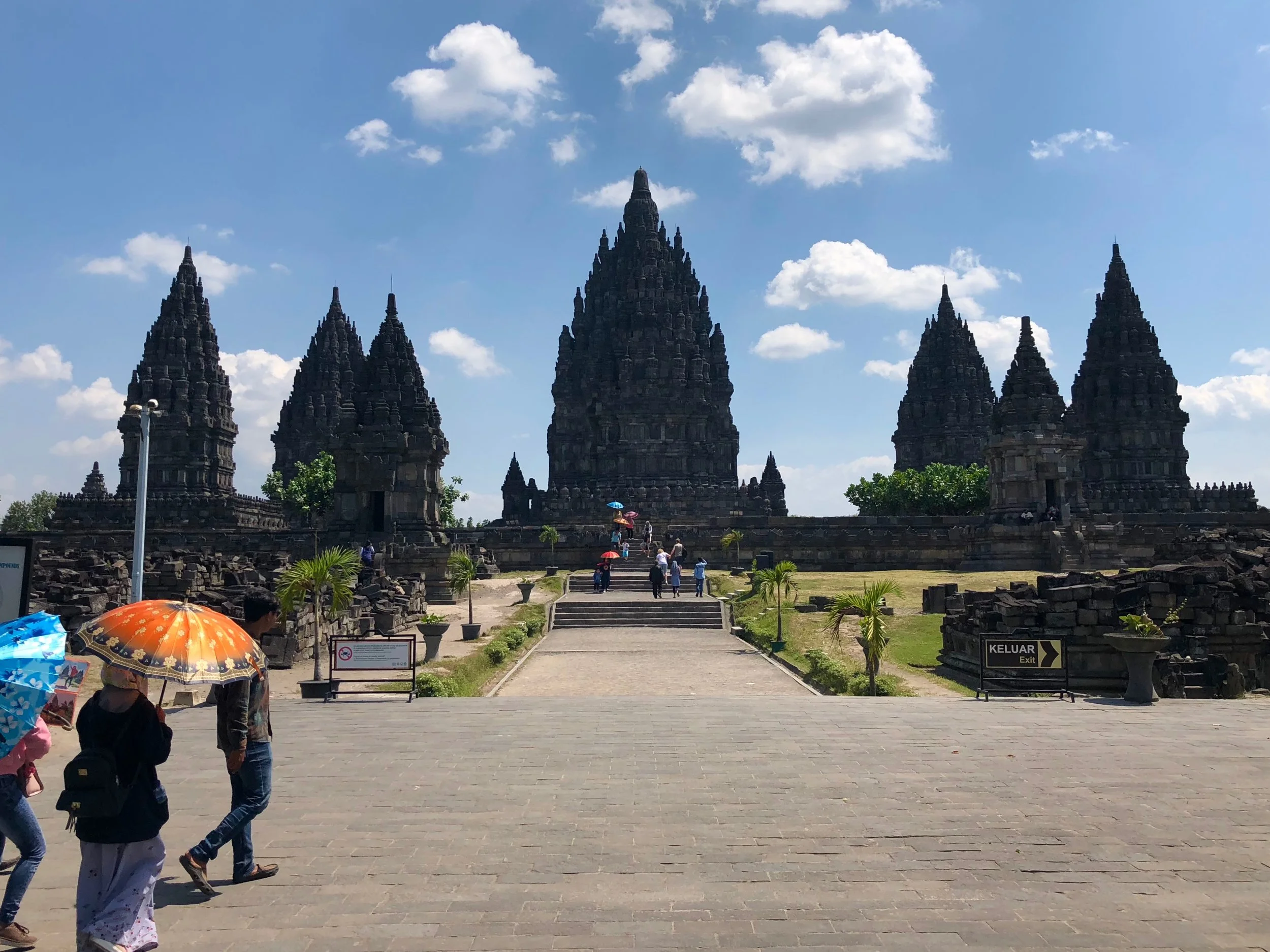
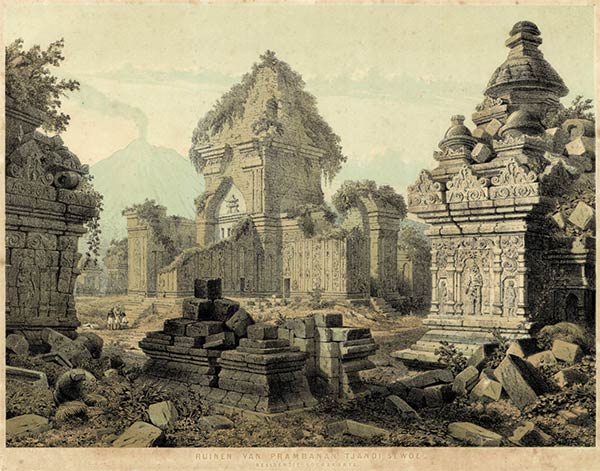
The massive towers and reliefs of the Hindu temple complex of Prambanan in Java, Indonesia flourished in the late 9th century. A marvel of ancient engineering, the dark volcanic stone structures took decades to complete — though local lore holds that the complex was built in single night by nocturnal spirits.

The temples of Prambanan on Java in Indonesia are the setting of a legend involving demons and a princess trapped in stone

The temples of Prambanan on Java in Indonesia are the setting of a legend involving demons and a princess trapped in stone

According to a stone tablet found while excavating the ruins of Prambanan, the temple was built to honor Lord Shiva, one of the most important gods in the Hindu pantheon. The compound’s original name was Shivgarh, the House of Shiva, when it was constructed around 850 CE by Rakai Pikatan, a king of the Sanjaya dynasty. It later took the name Prambanan, after the village where it’s located.

The princess’ deceit angered the magician, and he cursed her.

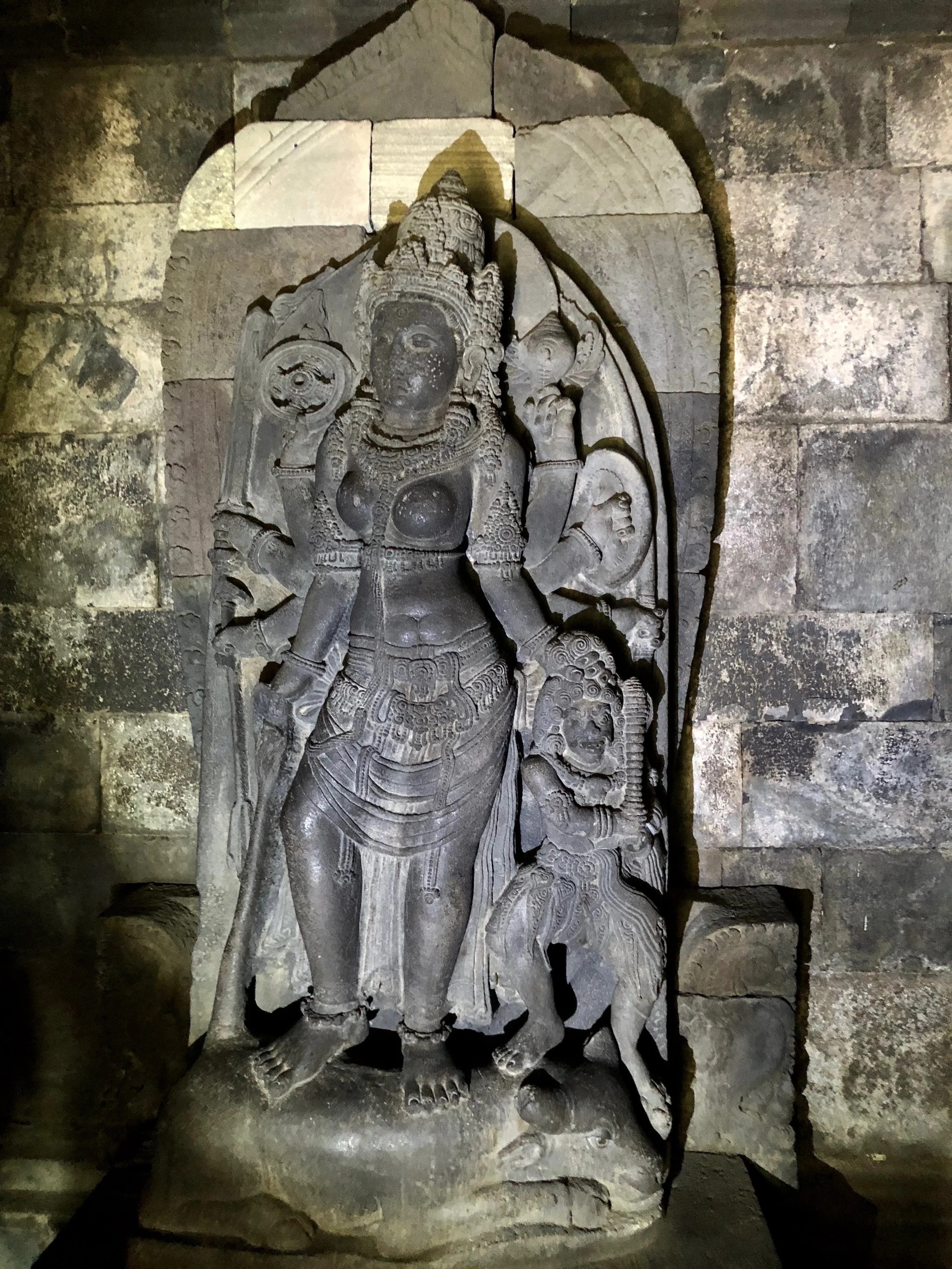
She was turned into a statue of the goddess Durga and remains enshrined in the central spire of Prambanan.

Although the temples were abandoned and reclaimed by the jungle, they were never completely forgotten. The origin myth popular among the Javanese tells of the story of the Slender Virgin, Roro or Loro Jonggrang, which is set in Prambanan. Like most stories told in the oral tradition, many variations exist, but its conclusion is generally the same.

Bandung Bondowoso and Loro Jonggrang

Long ago, in feudal Java, there were two neighboring kingdoms, Pengging and Prambanan. The kingdom of Pengging was prosperous and wisely ruled by Prabu Damar Maya. The other, Prambanan, fell under the reign of a wrathful and wicked half-demon king named Prabu Ratu Boko. Although he lived in a massive stone palace, he grew envious and devised a plan to take the kingdom of Pengging by force.  

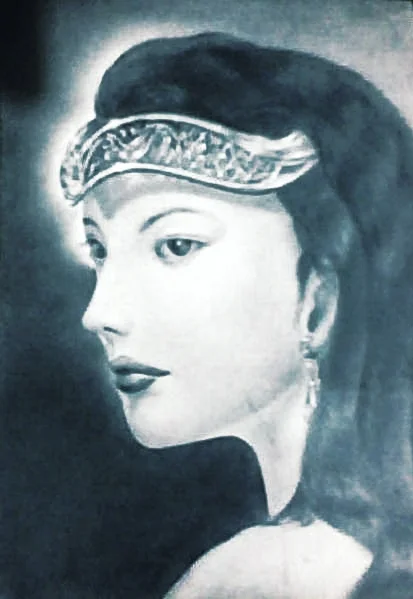
Loro Jonggrang was so beautiful, the man who killed her father wanted to marry her

Loro Jonggrang was so beautiful, the man who killed her father wanted to marry her

The troops of Damar Maya put up a good fight, but were no match for the supernatural armies of Ratu Boko. Fearing he would lose his kingdom, Damar Maya consulted his chief brahmin priest, whose nephew, Bandung Bondowoso, was skilled in dark magic and was able to summon demons. Bondowoso created a supernatural arrow and climbed to the highest vantage point in Pengging to assess the enemy. When he saw Ratu Boko, he drew his bow back and shot the arrow straight through the demon king’s heart, killing him instantly.

Ratu Boko’s army retreated to Prambanan and delivered the news of the king’s death to his daughter, Princess Loro Jonggrang, whose name translates as “Slender Virgin.” Her beauty was known throughout the land, and like her father, she was willful and arrogant. The princess asked who had slain Ratu Boko and was told that it was a man named Bandung Bondowoso.

Loro Jonggrang arranged an elaborate ceremony to cremate the remains of her father on the palace grounds and extended an invitation to Bondowoso. Not only was she slender and beautiful, but she was also a graceful dancer. At the ceremony, accompanied by her court dancers, Loro Jonggrang glided out into the audience hall to perform a dance in homage to her father. Grief made her even more striking, and Bondowoso fell under her spell, determined to marry her.

Demons are said to have built 1,000 temples in a single night

Demons are said to have built 1,000 temples in a single night

Some days after, he sent a small delegation to request her hand in marriage. The princess reluctantly agreed, but set a seemingly impossible challenge: She would only marry Bondowoso if he were able to build 1,000 temples in a single night. The magician accepted her unusual request, and as the sun set, summoned an army of nocturnal spirits and demons. They worked tirelessly and quickly.

As punishment for her deceit, the princess became the statue of Durga in the Shiva Temple at Prambanan

As punishment for her deceit, the princess became the statue of Durga in the Shiva Temple at Prambanan

Not wanting to marry the man who had killed her father, Loro Jonggrang conceived of a plan to trick the supernatural beings. She enlisted the help of her servants and ordered the women of the village to fill their stone mortars with dried rice stalks and pound the grains from their stems, a task performed daily at dawn. The princess then sent her servants out to the east to burn the dried paddies. The combination of noise and firelight prompted the confused roosters to crow. Alarmed, the spirits fled back to the underworld, thinking the sun was rising and leaving the final temple incomplete.

The badass Durga, riding her tiger mount, defeats an evil buffalo demon

The badass Durga, riding her tiger mount, defeats an evil buffalo demon

Loro Jonggrang’s deceit angered Bondowoso, and he cursed her, uttering the words, “There’s only one temple left — let you be the one to complete it!” The princess was turned into a statue of the goddess Durga the Inaccessible, now known as the Slender Virgin. The statue remains enshrined in the north chamber of the central spire of Prambanan, presumably the 1,000th temple. –Duke

The Demon Lilith and the Ghost of Doc Benton

The monsters of Supernatural, Season 3, Episodes 15 & 16 include Adam’s first wife and a Dartmouth urban legend.

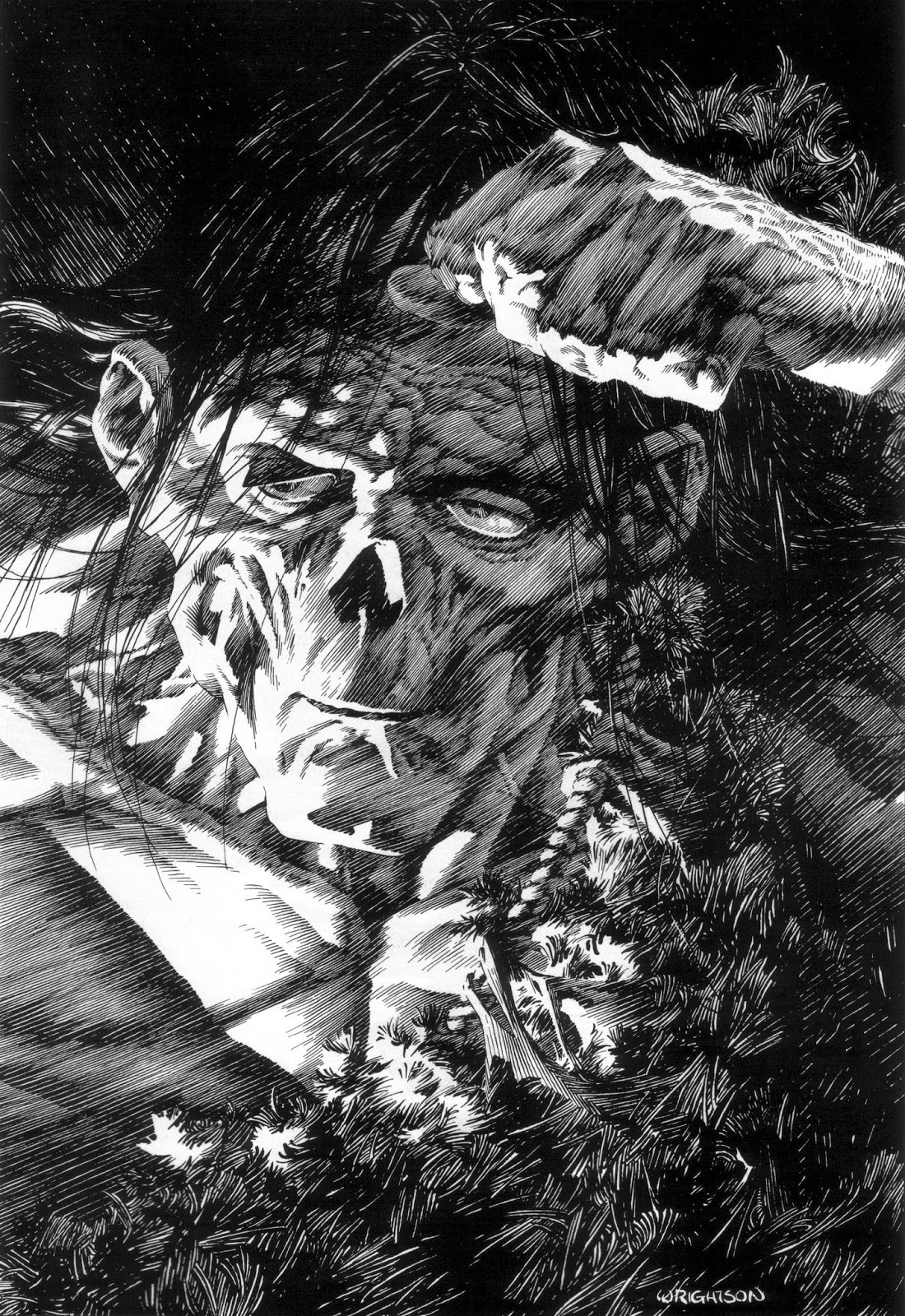
To ensure his immortality, Doc Benton steals body parts from other people, and over the years has come to resemble Frankenstein’s monster

To ensure his immortality, Doc Benton steals body parts from other people, and over the years has come to resemble Frankenstein’s monster

S3E15: “Time Is on My Side”

Monster: Doc Benton

Where it’s from: Moosilauke Ravine Lodge in the White Mountains of New Hampshire, owned and operated by Dartmouth College

Moosilauke Ravine Lodge in New Hampshire, where unsuspecting Dartmouth students stay — not knowing they could be the next victims of Doc Benton!

Moosilauke Ravine Lodge in New Hampshire, where unsuspecting Dartmouth students stay — not knowing they could be the next victims of Doc Benton!

Description: On the show, Doc Benton is cobbled together from various people’s body parts, like Frankenstein’s monster.

What it does: Doc Benton is the star of a ghost story used to scare freshmen. He was an insane recluse who kidnapped a girl named Mary. Benton threw her off a cliff, and when locals examined her corpse, they noticed a scratch behind her ear and a red dot on her head. Doc Benton became obsessed with the idea of living forever, and figured out a way to do so by stealing the vital organs of healthy young specimens (like Dartmouth freshmen, for instance). He has beaten death for centuries now, and can continue to commit his sick surgeries for eternity.

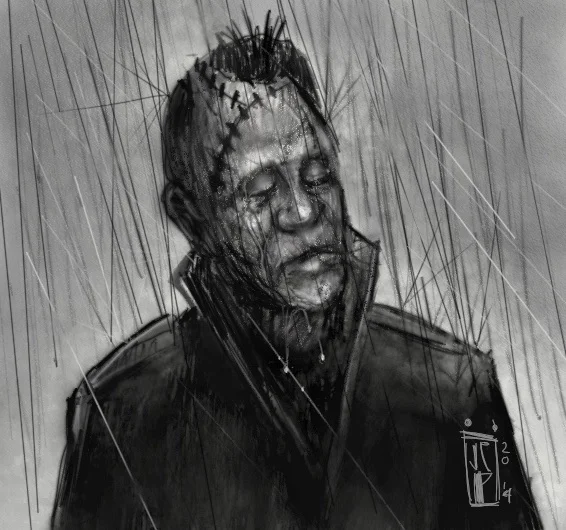
Doc Benton has been stitched up numerous times over the centuries. Don’t go near him if you want to keep that kidney!

Doc Benton has been stitched up numerous times over the centuries. Don’t go near him if you want to keep that kidney!

On Supernatural, a dead man’s fingerprints are all over a guy’s stomach, but only his liver was removed — surgically.

“Zombies do like the other other white meat,” Dean quips.

Another victim is missing his kidney. He’s sewn up with silk, which was used for sutures in the 18th century. And maggots are placed on the wound to eat infected tissue and leave the good — a startling practice still used today, if you can believe it.

The snarkiest of the Winchester Brothers, of course, has some great nicknames for Doc Benton: Slicey McHacky and Dr. Quinn, Zombie M.D.

Doc likes to set up shop in the middle of the woods near a river — a good place to dump intestines, fecal matter and whatnot.

Reading the mad doctor’s medical notes, the Winchester Brothers realize that he has discovered the secret to eternal life.

“Drink blood out of a baby’s skull?” Dean asks.

No black magic, Sam says. Just science.

Sammy gets kidnapped by Benton, who’s about to scoop out his eye with a Victorian-era melon baller. Eww!

How to defeat it: Doc Benton tells Dean and Sam that Daddy Winchester cut out his heart. “That was very inconvenient,” he adds.

You can’t run him over. And you can’t shoot him. “What part of immortality don’t you understand?” the phantom asks.

So they dip a knife in chloroform to knock out the not-so-good doctor and bury him alive.


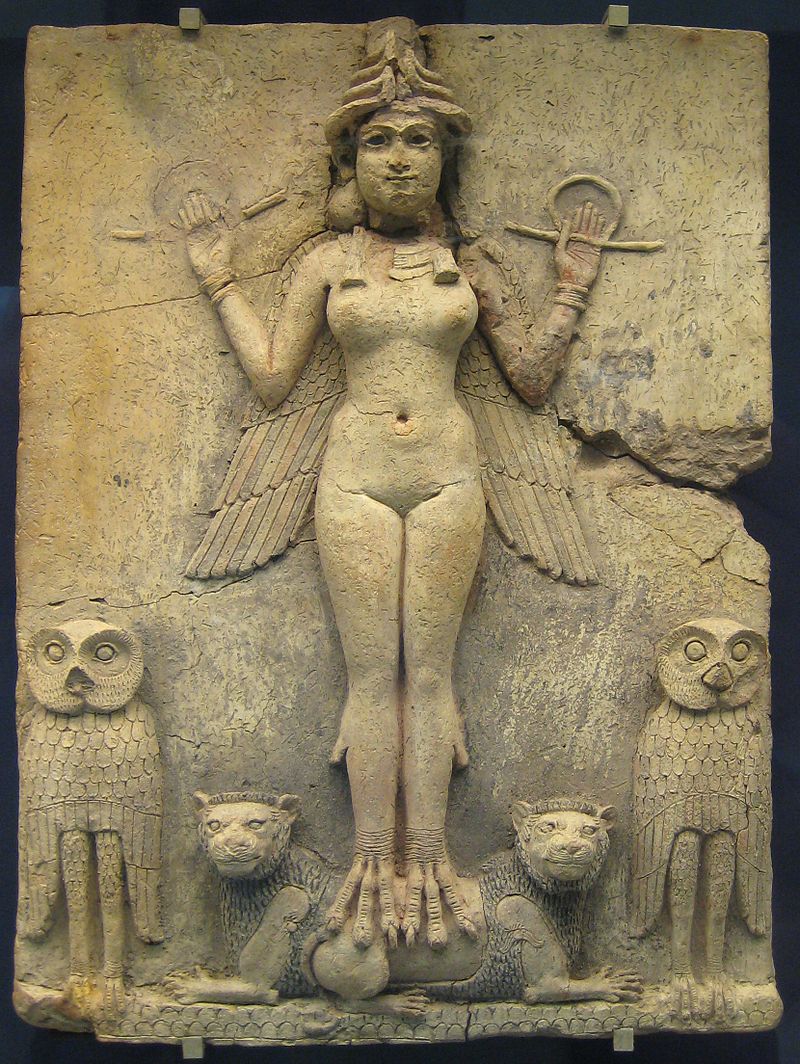
This terra cotta carving from Mesopotamia is called The Queen of the Night and possibly depicts the demon Lilith

This terra cotta carving from Mesopotamia is called The Queen of the Night and possibly depicts the demon Lilith

S3E16: “No Rest for the Wicked”

Monster: Lilith

Description: On the show, Lilith takes the incarnation of a little girl. It’s a solid choice and scores high marks on the creepiness scale. Especially when her dress is covered in blood cuz her pet Freckles was mean to her — along with the babysitter lying dead nearby.

Where it’s from: The Near East, especially in what is now Iraq

What it does: Lilith has been described as the most notorious demon in Jewish tradition. She was the first woman and was Adam’s wife before Eve. Lilith is particularly dangerous to pregnant women and newborns, and her breasts are filled with poison instead of milk.

Lilith was Adam’s first wife in Jewish lore. When she refused to be subservient to him, she was demonized, and Eve was created to take her place

Lilith was Adam’s first wife in Jewish lore. When she refused to be subservient to him, she was demonized, and Eve was created to take her place

Her name means “Night,” and she embodies all that goes along with that: terror, sensuality and unbridled freedom.

The Babylonian Talmud says, “It is forbidden for a man to sleep alone in a house, lest Lilith get hold of him.” That’s because Lilith fertilizes herself with unsuspecting men’s sperm to give birth to other demons. Some of us might be demon baby daddies and not even know it!

How to defeat it: This demon is best avoided. She’s one badass bitch: “Lilith would have peeled the meat from your pretty, pretty faces,” the Winchesters are told. That would’ve been a shame; they do have such pretty, pretty faces.

Sam and Dean get the demon-killing knife from Ruby, but she warns them that to Lilith it would be a mere “pig sticker.”

Dean can see demons’ true forms as his time on Earth nears its end. But how are they going to convince others that the child is a powerful demon? It’s not like they can sneak in, grab a 10-year-old girl and give her a Colombian necktie (a slash across the throat and the resulting bloodbath).

Dean has a deadline: At midnight his time is up — and sure, enough, once the clock strikes 12, he gets torn apart by hellhounds. Bad doggies! –Wally


READ MORE SUPERNATURAL EPISODE RECAPS

The Crocotta and Other Monsters

The villains of Supernatural, Season 3, Episodes 12-14 include the old standbys demons and ghosts, as well as Thomas Edison’s spirit phone.

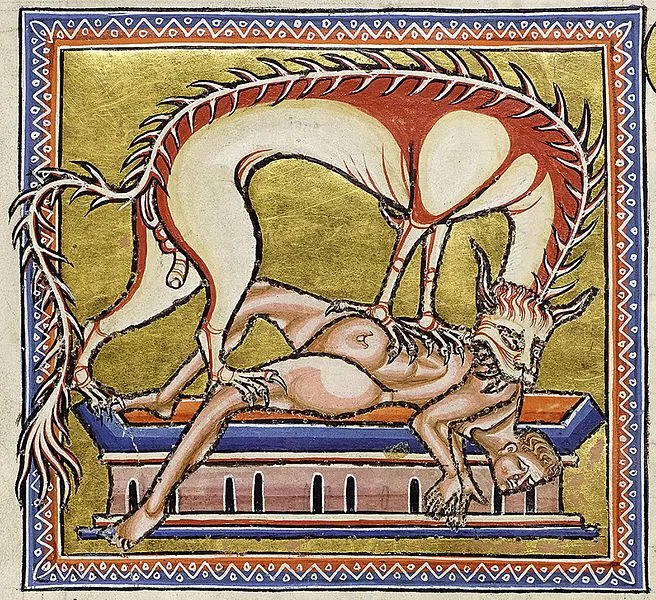
The crocotta, seen in this illustration from the Aberdeen Bestiary, lures its victims by sounding like someone they know in need of help

The crocotta, seen in this illustration from the Aberdeen Bestiary, lures its victims by sounding like someone they know in need of help

Rip out the crocotta’s crystal eyes, put them under your tongue — and you’ll be able to tell the future!
A demon found at Ostia, as depicted in Demonology and Devil-Lore

A demon found at Ostia, as depicted in Demonology and Devil-Lore

S3E12: “Jus in Bello”

Monster: Demon

Where it’s from: All over the world

Description: There’s something demonic in even the most appealing of gods, argues Moncure Daniel Conway, in his 1879 work Demonology and Devil-Lore. “Man found that in the earth good things came with difficulty, while thorns and weeds sprang up everywhere,” he writes. “The evil powers seemed to be the strongest. The best deity had a touch of the demon in him. The sun is the most beneficent, yet he bears the sunstroke along with the sunbeam, and withers the blooms he calls forth.” In fact, “deity and demon are from words once interchangeable,” Conway points out.

What it does: We’ve covered demons before, and their propensity for possessing people.

In this episode, demons are beelining for the Winchester boys, surrounding the sheriff’s office they’re in. “It’s like we got a contract on us,” Dean says, adding, “I think it’s ’cause we’re so awesome.”

How to defeat it: You can get matching pentagram sun tattoos, like Dean and Sam. They’re cheesy as hell, but hey: They keep you from being possessed.

A snouted demon, also from Demonology and Devil-Lore

A snouted demon, also from Demonology and Devil-Lore

You can also use a rosary to make holy water in the toilet. And, of course, there’s good old salt. Which leads to this funny exchange with the FBI agent:

Henriksen: Fighting off monsters with condiments. So, turns out demons are real.

Dean: FYI, ghosts are real, too. So are werewolves, vampires, changelings, evil clowns that eat people.

Henriksen: Okay, then.

Dean: Makes you feel better, Bigfoot’s a hoax.

Henriksen: It doesn’t.

The boys learn about a “big new up-and-comer” named Lilith. “And she really, really wants Sam’s intestines on a stick.” Grilled sausage, anyone?

Dean and Sam contemplate a spell that will vaporize all demons in a square radius — but it requires the sacrifice of a “person of virtue,” which is just another way of saying “virgin.” Not up to cutting Nice Nancy’s heart out of her chest, the Winchester Brothers decide to fight their way out, with the help of an exorcism over the PA system.

Demon Ruby gives them black mojo bags to throw Lilith off their trail. For now…

Some ghosts are trapped in continuous loops that play out their deaths

Some ghosts are trapped in continuous loops that play out their deaths

S3E13: “Ghostfacers”

Monster: Ghost

Where it’s from: Morton House, a haunted house possibly in Benton Harbor, Michigan

Description: This ghost looks remarkably lifelike.

What it does: The phantom returns every four years. Some call it the Leap Year Ghost. A crew of ghost hunters is filming an episode of their show Ghostfacers, and of course the Winchester boys show up masquerading as police to take on the evil spirit as well.

An apparition of a gangster gets gunned down. It’s a death echo, Dean explains. They seem to be an invention of the show, though there are plenty of reports of ghosts caught in neverending loops.

The Ghostfacers crew has some competition, including Josh Burger and Stan Maczek, shown using an electromagnetic field (EMF) detector

The Ghostfacers crew has some competition, including Josh Burger and Stan Maczek, shown using an electromagnetic field (EMF) detector

There are multiple death echoes, including a man hit by a train. These people didn’t die in Morton House, though. So why are their spirits trapped there?

Turns out the home’s last owner, Daggett, was a janitor at the hospital. He brought the bodies home “to play with them.”

Sam disappears. He and Corbett the intern are in some creepy kitchen while “It’s my party, and I’ll cry if I want to” plays over and over. Poor Corbett, who was in love with Ed, one of the Ghostfacer crew, gets poked through the neck and dies.

Daggett is wearing a party hat. He gets lonely, you see. But Dean has no sympathy. “He’s never heard of a RealDoll?” he quips.

How to defeat it: “You gotta be gay for that poor dead intern,” the other Ghostfacer host tells Ed. He concedes and is able break Corbett out of the death echo and convince his spirit to take down Daggett. Remember, people, as Ed says, “Gay love can pierce through the veil of death and save the day.”

The crocotta looks like a big wolf-hyena hybrid, seen in the illuminated manuscript the Rochester Bestiary

The crocotta looks like a big wolf-hyena hybrid, seen in the illuminated manuscript the Rochester Bestiary

S3E14: “Long-Distance Call”

Monster: Crocotta

Where it’s from: India and Ethiopia

Description: In folklore, the crocotta is a mishmash of animals, often described as a giant wolf-like hyena with cloven hooves. On the show, though, it’s a humanoid who lives in filth. In both versions, the monster has a unique means of luring its victims: It can mimic human speech and will call out someone’s name and other personal information, pretending to be someone in trouble. It then devours the poor suckers with the bone ridges it has instead of teeth.

Fun fact: Rip out its crystal eyes, put them under your tongue — and, by Merlin, you can tell the future!  

What it does: A man gets a call on the phone from a woman named Linda. She wants him to join her. They love each other. He pulls the phone out of the wall, but it still rings. “Okay, Linda, you win,” he says. And blows his brains out.

The man’s wife confesses that she picked up the phone during one of these calls — and she only heard static.

The caller ID on the phone reads, SHA33. It’s actually a phone number that’s over a century old. Ten different homes all got calls from that number in the past two weeks, including Dean, who spoke with what sounded like his dead dad.

Which leads us to a red herring — but a fascinating one nonetheless. The Winchester boys are in Milan, Ohio, the birthplace of Thomas Edison. The inventor told The American Magazine in 1920 that he had been working on a spirit phone, “building an apparatus to see if it is possible for personalities which have left this earth to communicate with us.” He thought that a scientific device could detect the “life units” that get scattered throughout the universe when we die.
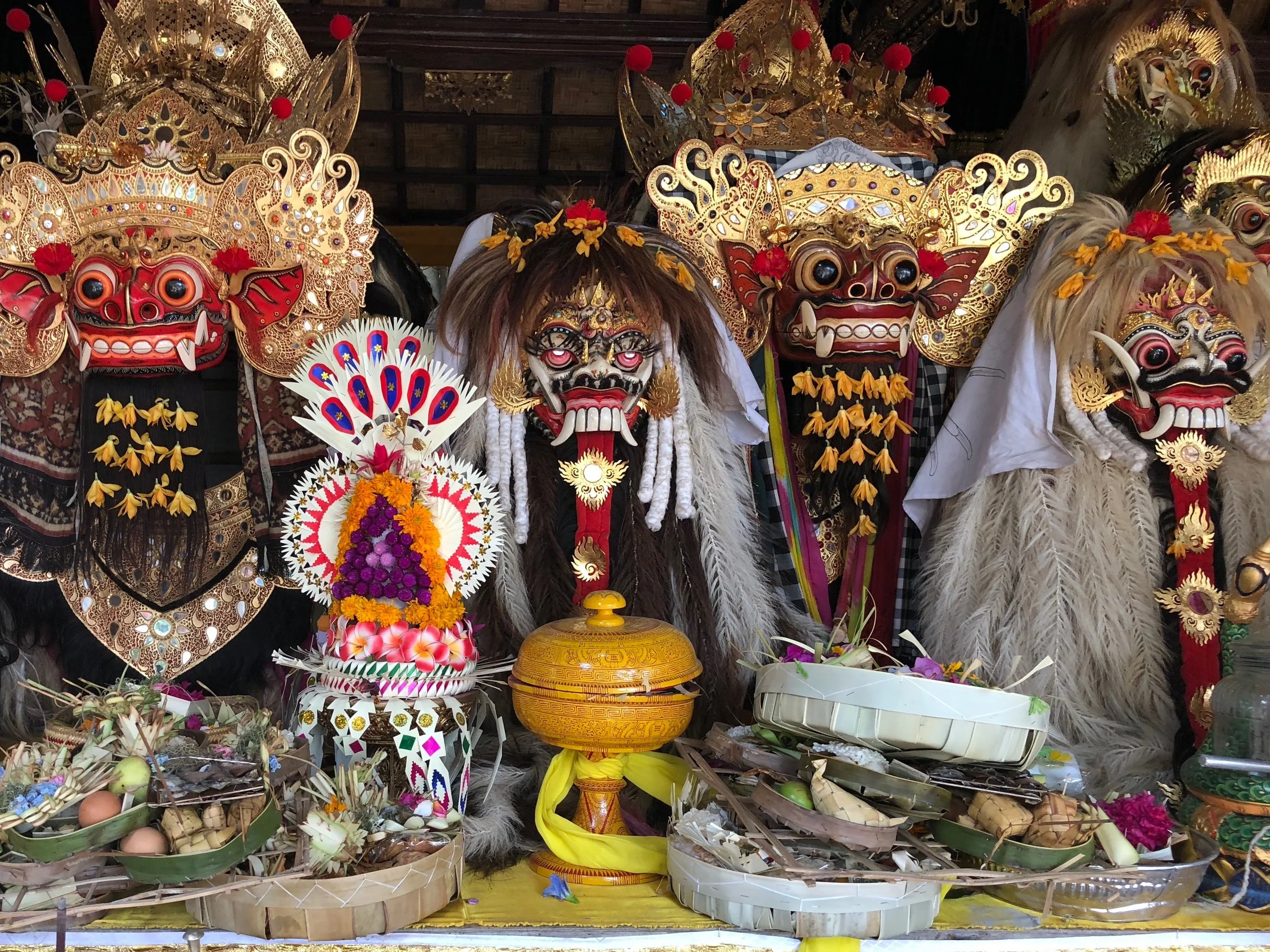
Thomas Edison tried to invent the spirit phone, which would let us speak with the dead

Thomas Edison tried to invent the spirit phone, which would let us speak with the dead

The killings all turn out to be the work of a crocotta: in this case, a man at the phone company. He’s a bit of a Luddite, offering up this meditation on the modern condition: “You’re all so connected. But you’ve never been so alone.” Preach!

How to defeat it: Ramming its head into a metal hook will do the trick. –Wally