ART

The First Homosexuals at Wrightwood 659: Rewriting Art History With a Queer Lens

This powerful global exhibition traces the emergence of queer identity through more than 300 artworks — at a time when LGBTQ+ visibility matters more than ever.

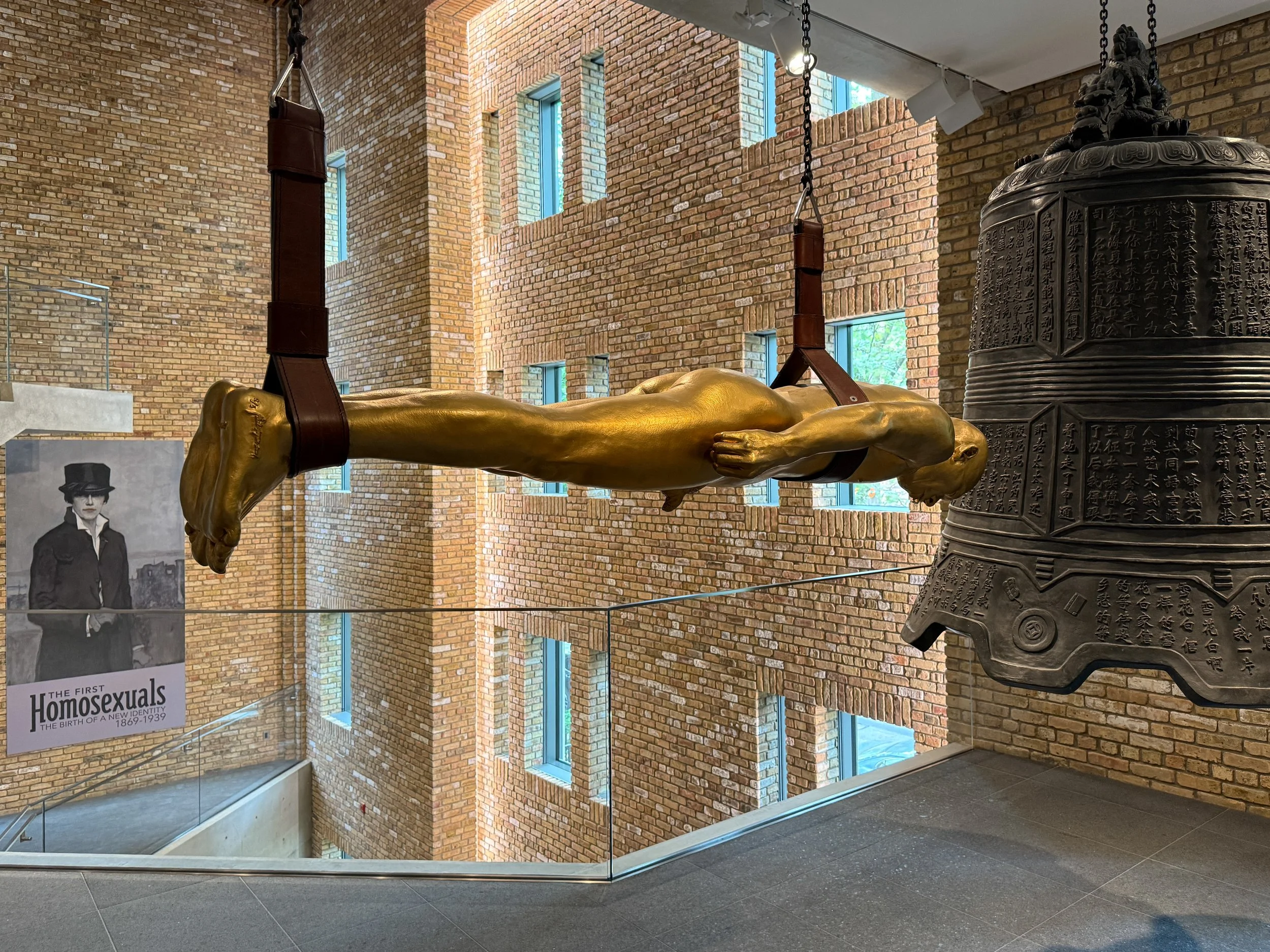
Peace 1 by Zhang Huan, a sculpture of a nude golden man about to ring a large metal bell, at Wrightwood 659 in Chicago, during The First Homosexuals exhibit

Peace 1 by Zhang Huan, 2001

When Wally and I heard about The First Homosexuals: The Birth of a New Identity, 1869–1939 at Wrightwood 659, we were immediately intrigued. We had missed the first iteration, which ran in 2022. This new presentation promised to be larger in scale, and suggested something truly ambitious — a visual journey recontextualizing art history by presenting a wide range of works through a queer lens. 

This exhibition is especially important because it comes at a perilous time when LGBTQ+ voices are increasingly under attack across political and cultural spheres. In the face of bans, restrictions on school curricula, and renewed efforts to limit or erase queer visibility, The First Homosexuals reclaims that space by affirming that queer identity has an enduring, complex and creative legacy. 

“The First Homosexuals” is especially important because it comes at a perilous time when LGBTQ+ voices are increasingly under attack across political and cultural spheres.

I was reminded of Masculin/Masculin, a provocative exhibition Wally and I saw at the Musée d’Orsay in 2013. Drawing primarily from European painting and sculpture, the show turned the traditional male gaze on its head — shifting the focus from the female form, so often idealized in art, to the male nude. By presenting works from 1800 to the early aughts, the show invited viewers to reconsider the male body, not just as a symbol of strength or virility but as an object of desire.

While Masculin/Masculin traced the idealization of the male body in European art, it didn’t place those depictions within the broader context of queer history. The First Homosexuals at Wrightwood 659 takes that next step, expanding the lens across five continents and inviting viewers to consider queerness as something shaped by history, society and culture — often coded, but always present. 

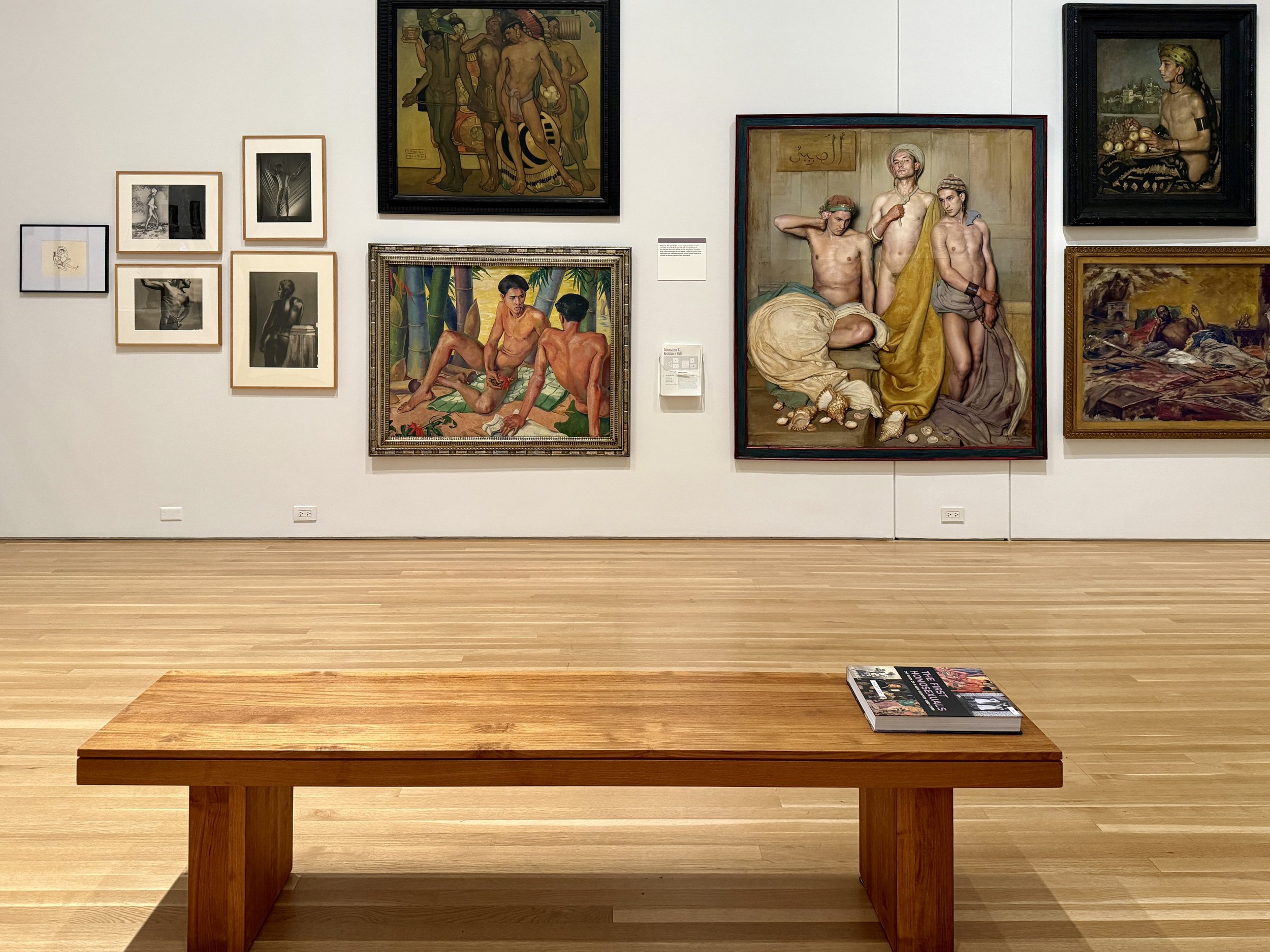
One of the gallery walls with a bench at The First Homosexuals exhibit at Wrightwood 659 in Chicago

The First Homosexuals included more than 300 works by 125 queer artists from 40 countries.

Its point of departure is 1869, when Karl-Maria Kertbeny, an Austrian-Hungarian writer and activist, introduced the term “homosexual” anonymously in a German pamphlet advocating reform of Prussian sodomy laws — a linguistic turning point that shifted same-sex love from act to identity. 

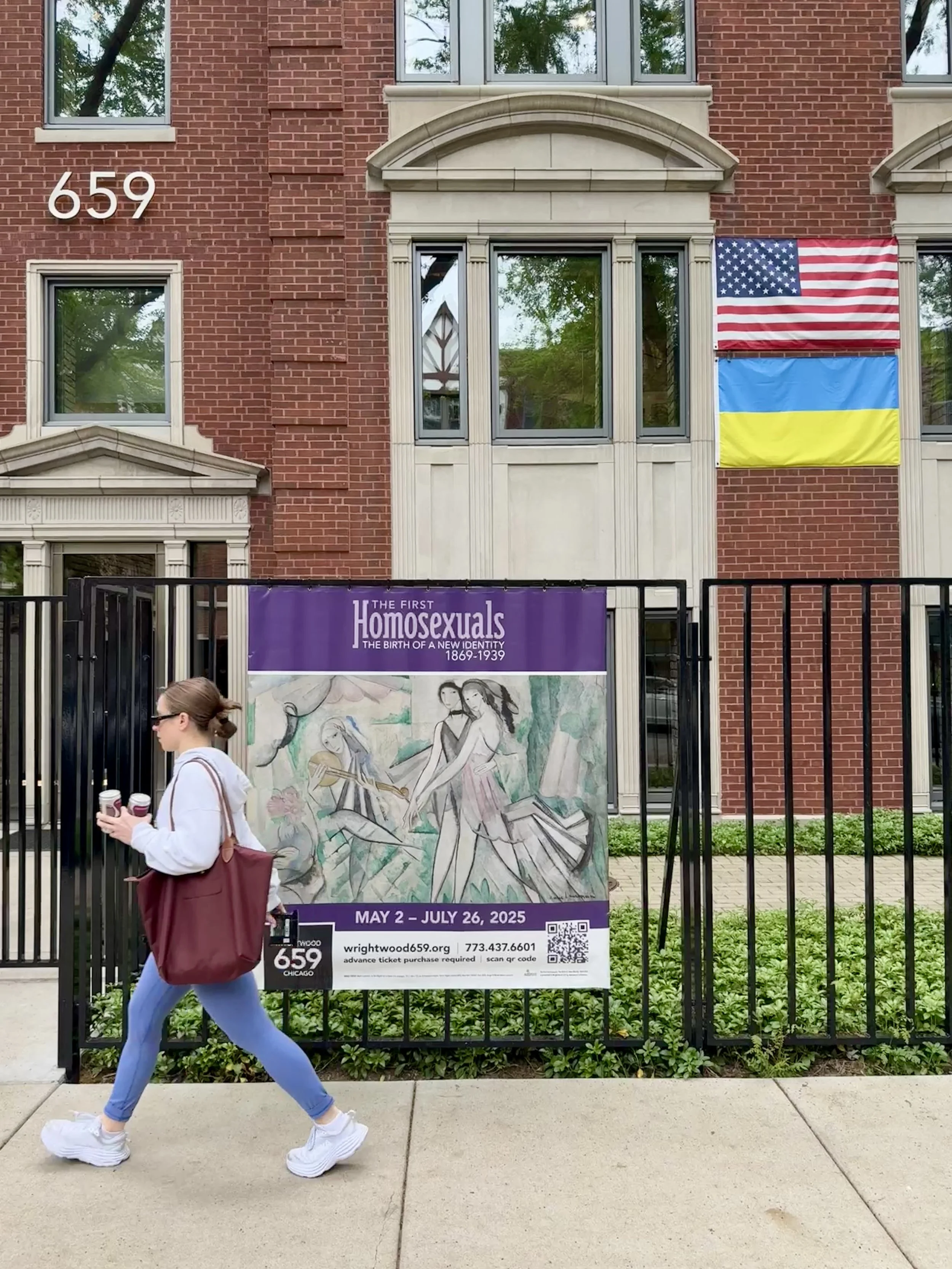
A woman passes by Wrightwood 659, which has U.S. and Ukraine flags and a sign promoting The First Homosexuals exhibit

You’ll definitely need to book ahead (and book early) when you see a show at Wrightwood 659.

Our Arrival at Wrightwood 659 in Lincoln Park

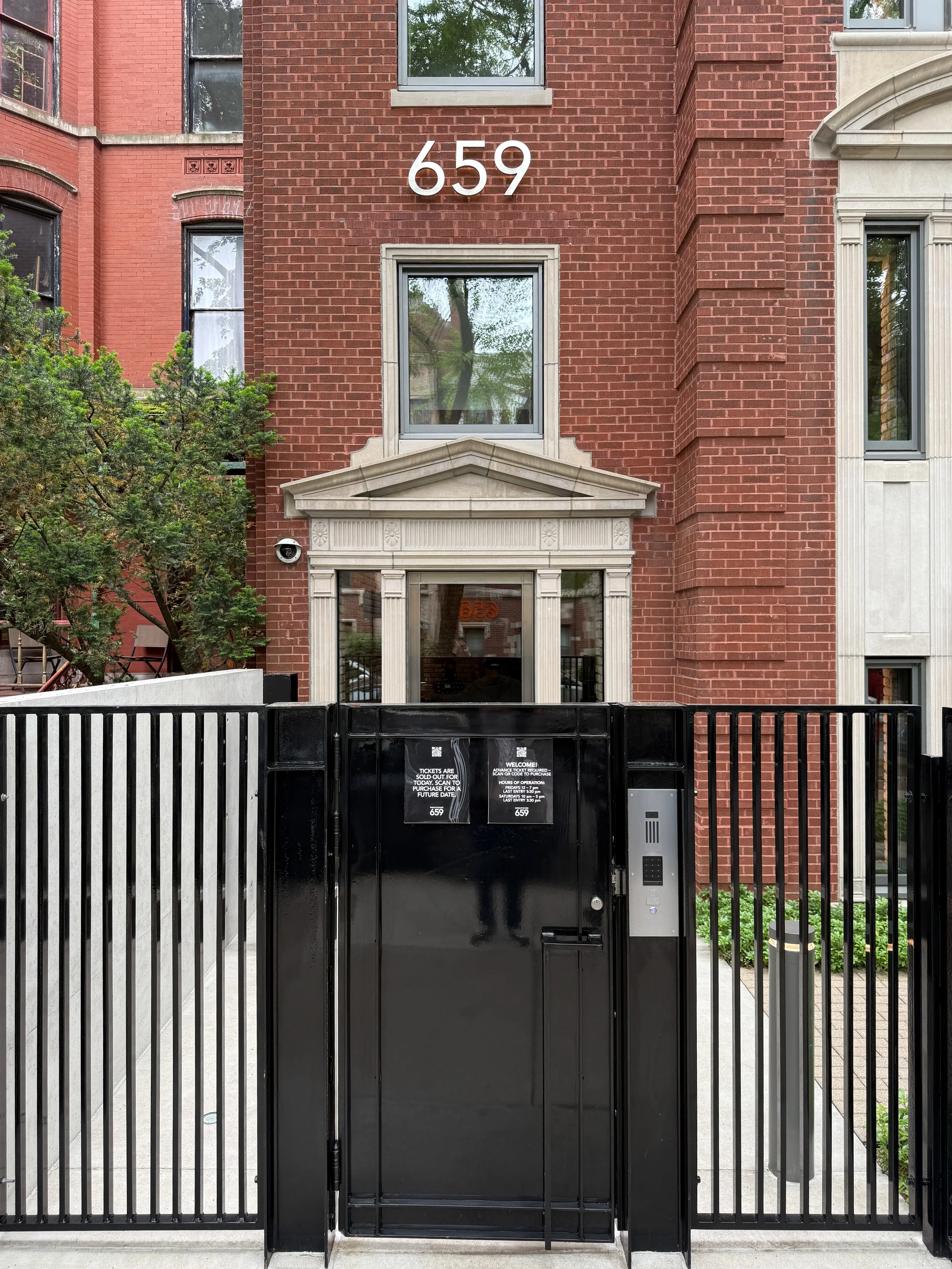
After breakfast at one of our favorite spots, the Bourgeois Pig, Wally and I strolled up the leafy stretch of Wrightwood Avenue in Chicago’s Lincoln Park. We were surprised to find a modest four-story red brick façade at 659. But the small group forming outside and a sign promoting the exhibition reassured us that we were in the right place.

The modern home next to Wrightwood 659 in Chicago

The modern concrete building attached to the exhibit space is actually the home of one of the cofounders of Wrightwood 659.

I initially assumed the gallery’s entrance was through the modern concrete cube next door — but that was actually the private residence of media entrepreneur and philanthropist Fred Eychaner and his husband, Danny Leung. Eychaner is the founder of the Alphawood Foundation, a charitable organization, and cofounder of Wrightwood 659.

Inside, a docent greeted us in the light-filled atrium and explained that the building was constructed in the 1920s as an apartment complex. Despite its external appearance, the interiors have been stripped and radically reimagined by Japanese architect Tadao Ando.

Two floors of Wrightwood 659 with exposed brick and concrete, with the sculpture Peace 1 by Zhang Huan visible

A historic apartment building was reimagined as a striking modern art gallery.

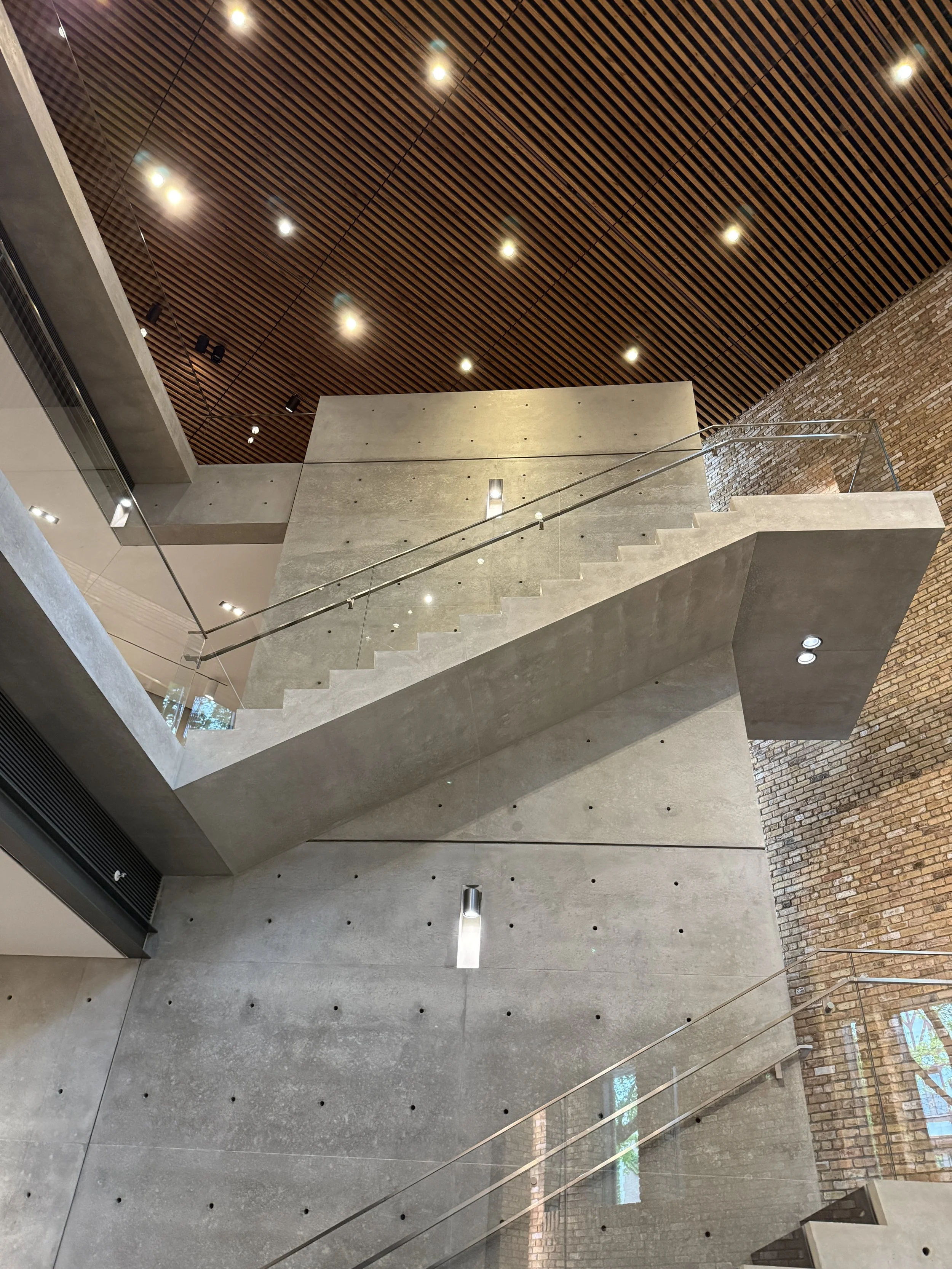
The Tadao Ando-designed stairwell at Wrightwood 659 in Chicago

Architect Tadao Ando transformed the interior with his minimalist design.

We stood in awe of the space’s understated tranquility. Ando preserved the outer walls, which are clad in irregular, weathered Chicago common brick, an earthy contrast to the interior’s sleek geometric simplicity. 

In the far corner, an Escher-like concrete staircase begins its ascent. More than just a functional connector between levels, it serves as a kind of contemplative path, guiding visitors upward in a calm, deliberate rhythm. It’s a signature Ando gesture: structure becoming experience, architecture becoming journey.

Dance to the Berdash by George Catlin

Dance to the Berdash by George Catlin, 1837

Before the Binary: Origins of Queerness

The exhibition unfolds gradually across three floors and eight thematic sections, beginning with “Before the Binary.” This gallery sets the stage for the installation’s sweeping journey, inviting viewers to reconsider how same-sex love and gender diversity have been expressed and celebrated throughout history, long before  queer identity emerged in the form we recognize today.

Prior to the subjugation brought by European colonization, many non-Western cultures regarded same-sex behavior as a fluid part of life rather than a fixed identity. This changed dramatically with the arrival of colonial powers, who introduced prejudices and legal systems and cultural prejudices that criminalized same-sex relationships. Along with this intolerance came a new binary: homosexual and heterosexual — categories rooted in 19th century European science and psychology. These labels spread globally reshaping how people understood desire, identity and themselves.

George Catlin’s painting, Dance to the Berdash, depicts a ceremonial dance performed by the Sac and Fox Nation honoring a “two-spirit” individual. The term berdache, used by Catlin, is an outdated and derogatory French term historically applied to two-spirit people. 

In his journals, Catlin describes the scene as “very funny and amusing,” and expresses bewilderment where a “man dressed in woman’s clothes … driven to the most servile and degrading duties” would be celebrated and “looked upon as medicine and sacred.”

Despite his evident bias, Catlin’s work offers a rare glimpse into the deeply spiritual and cultural roles that two-spirit or third-gender individuals have historically held in many Native American communities.

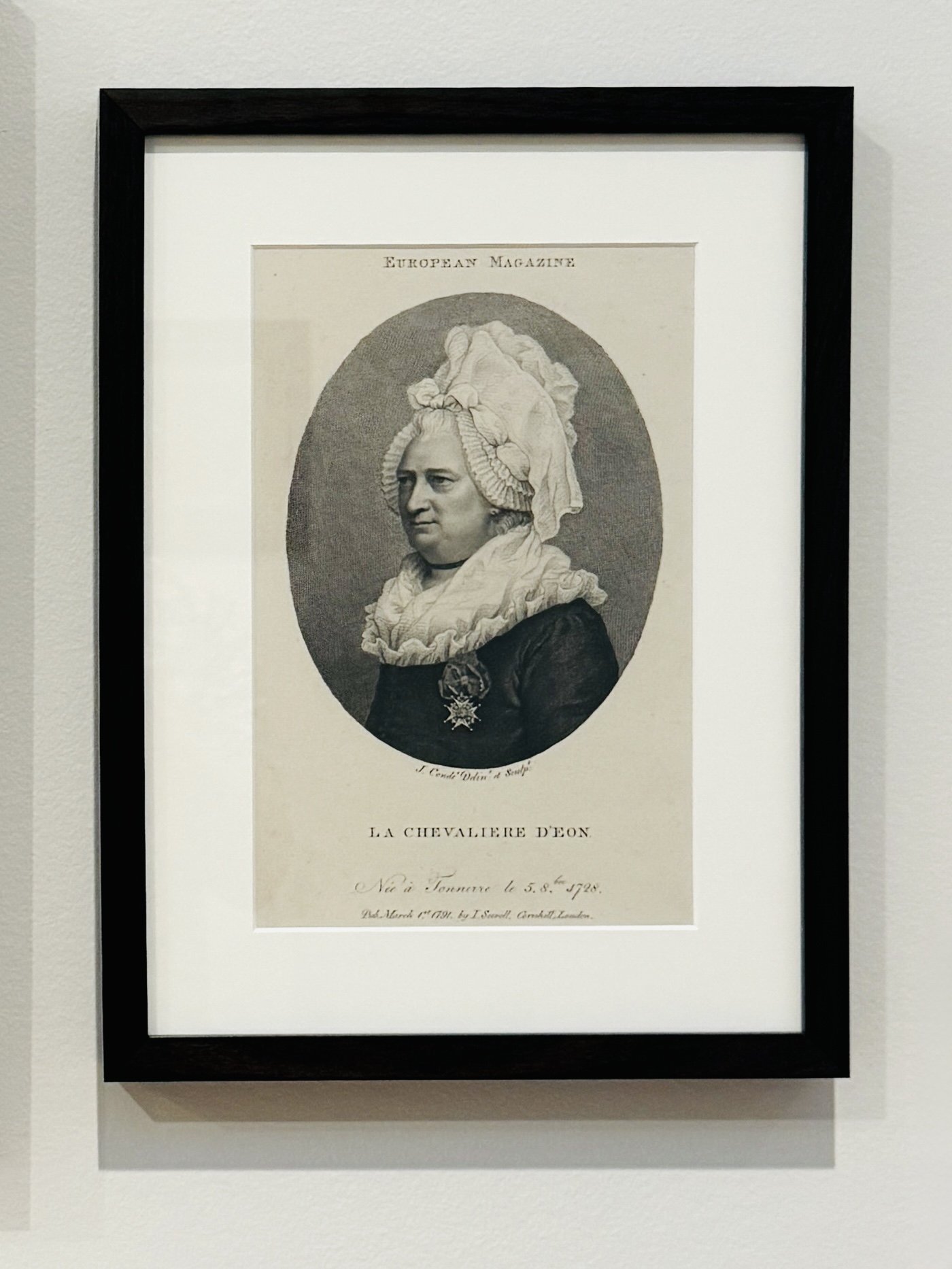
Portrait of Chevalier d'Eon by Jean Condé

Portrait of Chevalier d'Eon by Jean Condé, published by John Sewell in a 1791 issue of The European Magazine

The Chevalière or Chevalier d’Éon (1728-1810), was an early gender-nonconforming figure and a French diplomat, spy and soldier. 

In 1755, while presenting as a man, d’Éon was sent to Russia disguised as Mademoiselle Lia de Beaumont to persuade Empress Elizabeth I of Russia to ally with France against England and Prussia. From 1777 onward, d’Eon lived publicly as a woman and was officially recognized as such by King Louis XVI.

In this print, d’Éon is portrayed as a middle-aged woman wearing a dark dress with a chemisette, a lace cap and the star of the Order of St. Louis, an honor awarded for distinguished military service and espionage.

As evidence of the shifting political and cultural landscape of the era, d’Éon spent much of her adult life in London, where her gender identity was the subject of constant speculation. It was even the subject of a court trial declaring d’Éon to be a woman, though a surgeon later attested on her death certificate she had “male organs.”

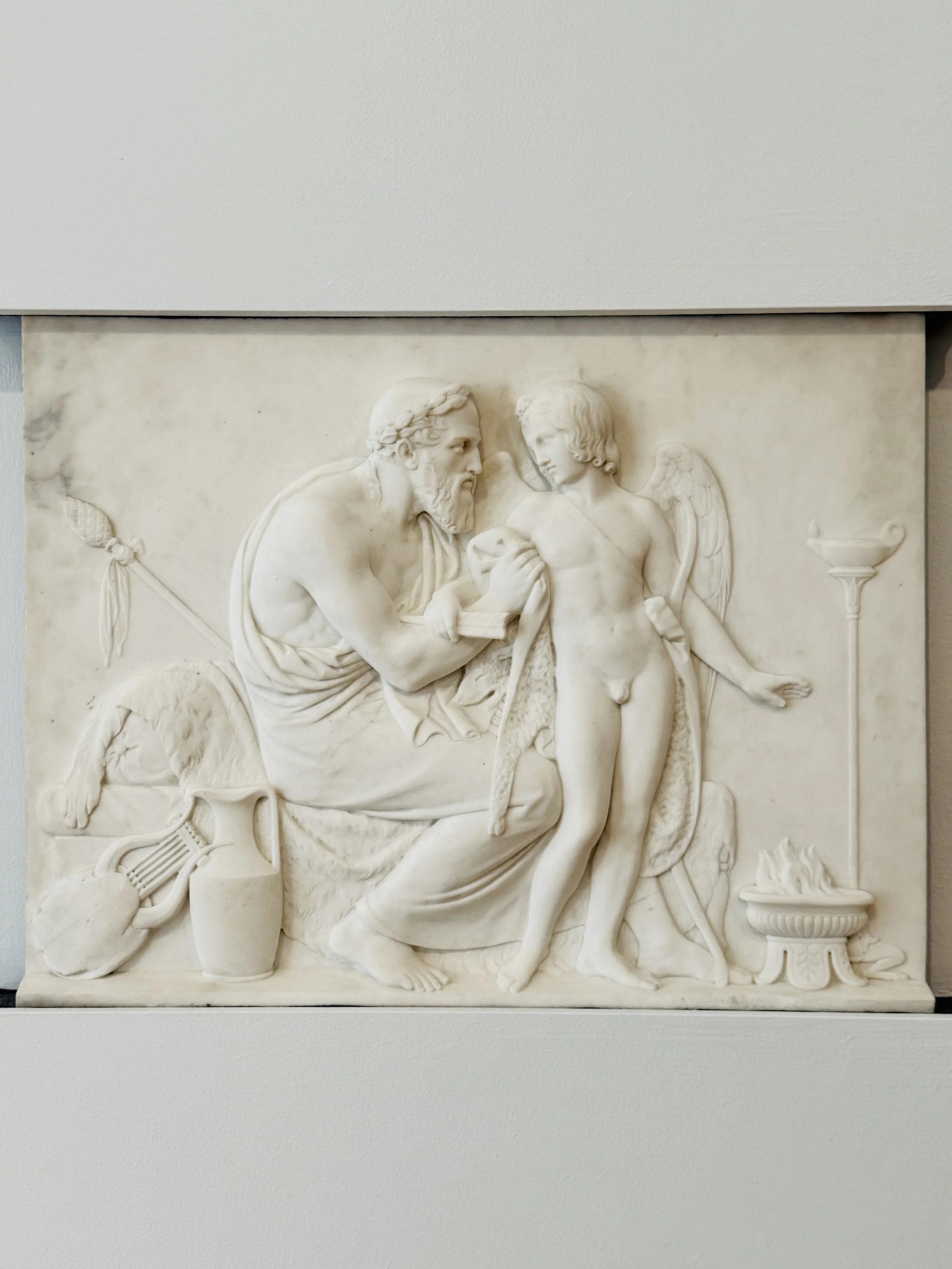
Anacreon and Cupid by Bertel Thorvaldsen

Anacreon and Cupid by Bertel Thorvaldsen, 1824

Bertel Thorvaldsen’s neoclassical Anacreon and Cupid depicts the Ancient Greek poet Anacreon being struck by Cupid’s arrow, causing the older man to fall in love with the youthful god of love. The relief is inspired by Anacreon’s text, Ode III, which ends with Cupid flying away, satisfied he can still attract love with his arrows, while the poet is left alone with his longing. 

The term homosexual didn’t yet exist, and art about the classical past enabled the representation of same-sex eroticism under the guise of historical reference. 

The artist’s nearby ink and graphite sketch literalizes the erotic element of the sculpture, portraying Cupid fondling the poet’s groin. 

In Ancient Greece, the ideal same-sex relationship was seen as one between an older man and a teenage boy. This kind of relationship was tied to ideas about teaching the younger generation how to be good citizens. Same-sex desire was accepted — but only in ways that supported the male-dominated social system.

Portrait of Rosa Bonheur by Anna Klumpke

Portrait of Rosa Bonheur by Anna Klumpke, 1898

Portraits: Icons and Outlaws

“Portraits” features artists who dared to make homosexuality visible long before it was safe or legal to do so. 

American artist Anna Klumpke’s tender pastel portrait captures her partner, Rosa Bonheur, in the final years of the celebrated French painter’s life. The two met in 1895, when Klumpke was 39 and Bonheur was 73. They soon moved in together, and their relationship endured until Bonheur’s death in 1899.

Rosa Bonheur was one of the most renowned animal painters of the 19th century. An independent woman and openly lesbian, she famously obtained official permission from the Paris police to wear men’s clothing — a permit she justified by explaining that traditional women’s attire was impractical for working in stables and slaughterhouses, where she sketched animals for her work.

By the way, there’s a delightful bar, Rosa Bonheur, in Paris, named after this icon. 

Retrato de un Anticuario (Portrait of an Antiquarian) by Robert Montenegro
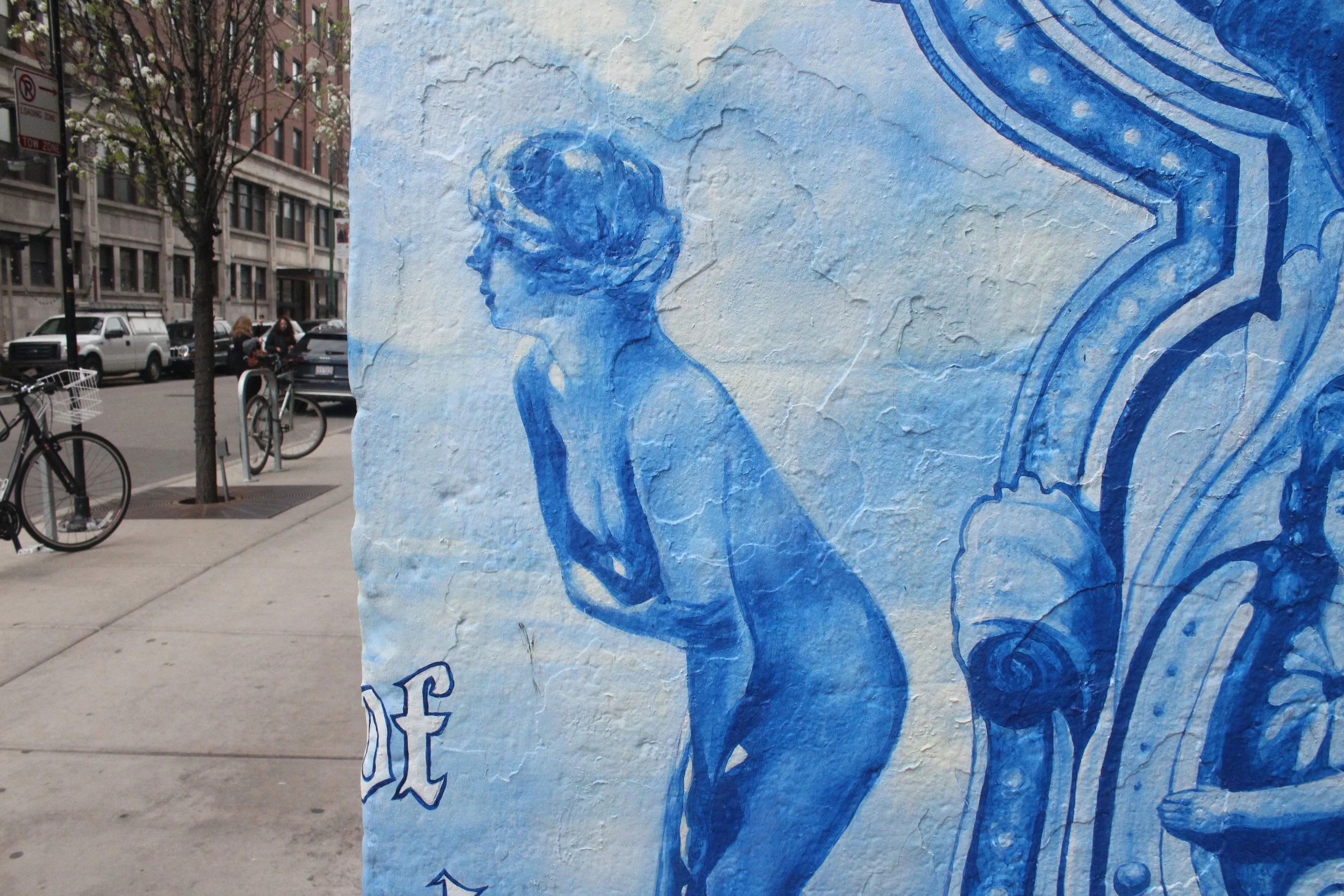
Retrato de un Anticuario (Portrait of an Antiquarian) by Robert Montenegro, 1926

Roberto Montenegro’s 1926 portrait of antiques dealer Chucho Reyes is rich with visual codes that still resonate in queer iconography today — a limp wrist, a tilted chin and a wry smile. In the foreground, a silver ball subtly reflects the artist’s own face, a quiet but unmistakable act of self-insertion and queer affirmation.

An early figure in the Mexican muralist movement, Montenegro often pushed against the boundaries of revolutionary aesthetics. In a mural for the Secretaría de Educación Pública in Mexico City, his depiction of a nude, androgynous Saint Sebastian drew criticism for being out of step with official nationalist values. 

Montenegro was ultimately compelled to repaint it. In his private commissions, however, he enjoyed greater artistic freedom — freedom he fully embraced in this intimate and symbolically coded portrait.

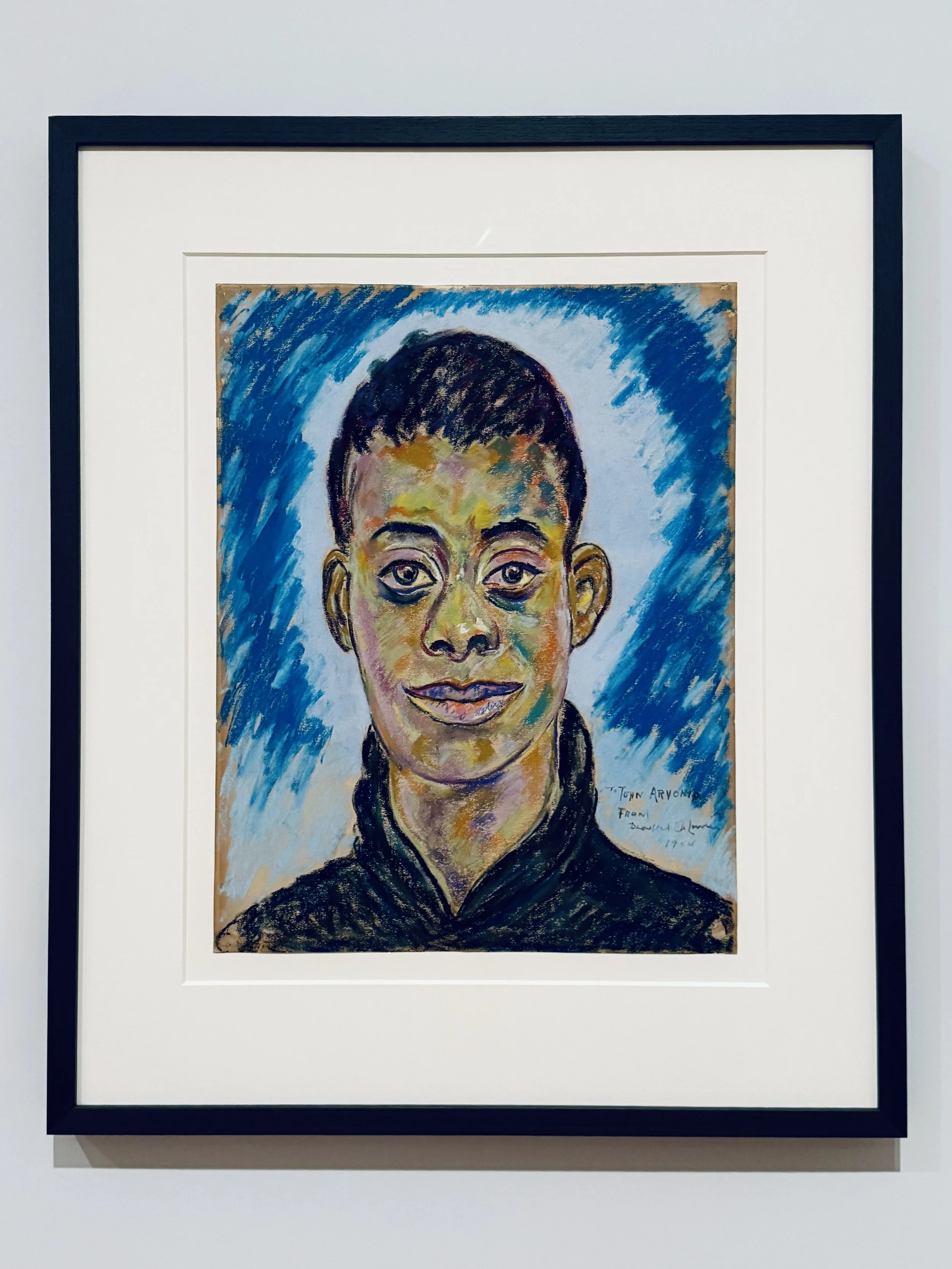
Portrait of James Baldwin by Beauford Delaney

Portrait of James Baldwin by Beauford Delaney, 1944

In this vibrant portrait, Beauford Delaney depicts the 20-year-old African American author James Baldwin before the writer’s rise to literary fame. Delaney renders Baldwin’s face in expressive strokes of green, yellow and purple, capturing not just likeness but inner light. The two men, both openly gay and trailblazing artists of color, shared a profound, formative bond. 

Baldwin regarded Delaney as a mentor and father figure. Reflecting on Delaney’s influence, he wrote, “The reality of his seeing caused me to begin to see.” 

Though Baldwin would become a powerful voice in the civil rights movement, his open sexuality often left him marginalized within the movement’s leadership.

He went on to become one of the most influential gay writers of the 20th century, penning such landmark works as Giovanni’s Room (1956).

Profile of a Man With Hibiscus Flower (Felíx) by Glyn Philpot

Profile of a Man With Hibiscus Flower (Felíx) by Glyn Philpot, 1932 

This intimate portrait features Felíx, a French Caribbean model who sat for the British artist Glyn Philpot several times in 1932. The composition, with its flattened perspective and floral motif, recalls Paul Gauguin’s canvas Jeune Homme à la Fleur, evoking themes of sensuality and exoticism. While the painting echoes colonial-era visual tropes, Philpot’s broader oeuvre is distinguished by its empathetic and often dignified representations of Black subjects, challenging the stereotypes prevalent in early 20th century European art. 

The Elegant Ball, The Country Dance by Marie Laurencin

Le Bal élégant, La Danse à la campagne (The Elegant Ball, The Country Dance) by Marie Laurencin, 1913

Relationships: Intimate Worlds

The section titled “Relationships” explores the personal and social dimensions of queer lives. From Marie Laurencin’s sensual and playful female imagery to Andreas Andersen’s portrait of his younger brother and his friend, their works reflect the sheer diversity and joy of queer intimacy. 

La Danse (The Dance) by Marie Laurencin

La Danse (The Dance) by Marie Laurencin, 1919

Marie Laurencin (1883-1956), a French Cubist, created an idiosyncratic body of work that excluded men and placed women at the center, something truly revolutionary considering that she worked in Paris, in an environment dominated by male artists. A member of Pablo Picasso’s gang, Laurencin’s unique take on Cubism is particularly evident in The Elegant Ball, The Country Dance, a fragmented and angular portrayal of two women dancing front and center. 

The canvas The Dance illustrates Laurencin’s departure from Cubism and marks the development of her own visual language, one that embraces a softer, more fluid style in which women’s bodies seem to merge and dissolve into one another. Laurencin’s dreamlike, ethereal compositions represent a feminist counterpoint to the stylistic tendencies of the male-dominated Cubist avant-garde.

Interior With Hendrik Andersen and John Briggs Potterin Florence by Andreas Anderson

Interior With Hendrik Andersen and John Briggs Potter in Florence by Andreas Anderson, 1894

The Norwegian painter Andreas Andersen depicts his younger brother, Hendrik and their friend, American painter John Briggs Potter, when the trio were living together in Florence in 1894. To our modern eyes, this is a stunning image of a homosexual relationship — but the reality is that men of this era didn’t think that loving or having sex with other men was abnormal or put them into a sexual category. 

Potter, who eventually married a woman, was close to Isabella Stuart Gardner of the eponymous Boston museum. The exact relationship between Hendrik and Potter isn’t known, though Potter was painted by a number of known queer painters and himself painted portraits of handsome men.

Sueño marinero (Sailor’s Dream) by Gregorio Prieto

Sueño marinero (Sailor’s Dream) by Gregorio Prieto, 1932

Gregorio Prieto was a member of the influential Spanish cohort known as the Generation of ’27, alongside the poet

Federico García Lorca. While his work is well known in Spain, it hasn’t received the recognition it merits. 

Prieto’s two paintings exhibited at Wrightwood exemplify his use of the mannequin as a surrealist trope. Prieto employed mannequins as a metaphor for homoerotic love. Indeed, Sailor’s Dream seems to insinuate the act of oral sex, while Full Moon implies stimulation by hand.

Le Sommeil de Manon (Manon’s Sleep) by Madeleine-Jeanne Lemaire, 1907

Le Sommeil de Manon (Manon’s Sleep) by Madeleine-Jeanne Lemaire, 1907

Changing Bodies, Changing Definitions: Redefining Beauty 

The exhibit then pivots to “Changing Bodies, Changing Definitions, where we witness how the nude evolved in art in relation to shifting conceptions of sexuality. In the 19th century, artists often depicted ambiguously gendered adolescents — but by the early 20th century, those figures gave way to striking portraits of well-muscled men and women. Romaine Brooks’ androgynous nude of her female lover sits alongside Tamara de Lempika’s muscular female nude. 

The French novelist Marcel Proust and his lover, Reynaldo Hahn, referred to Madeleine-Jeanne Lemaire as Maman, or Mother, acknowledging her centrality to queer relationships and networks. Lemaire hosted a regular salon well attended by homosexuals, including Proust, Hahn and others such as Sarah Bernhardt, whose work is also featured in this exhibition.

The close-knit queer relationships that defined Lemaire’s social circle also come through in her painting. While many of her female contemporaries avoided overt eroticism, Lemaire’s Manon’s Sleep presents a nude figure who is neither orientalized nor classicized, her sensuality left unapologetically unframed by allegory or genre.

The recently discarded clothes in the left-hand corner appear to take the shape of a female figure lounging in a chair, perhaps watching the nude woman sleep. Lemaire’s soft color palette, decadent textiles and languid figure also seem to emulate Rococo aesthetics, perhaps in a nod to the genre’s own scenes of erotic subversion.

Nackte Schiffer (Fischer) und Knaben am grünen Gestade (Naked Boatmen [Fishermen] and Boys on the Green Shore by Ludwig von Hofmann

Nackte Schiffer (Fischer) und Knaben am grünen Gestade (Naked Boatmen [Fishermen] and Boys on the Green Shore by Ludwig von Hofmann, 1900

Ludwig von Hofmann enjoyed a prominent career as a painter in the late 19th and early 20th centuries. At the time, Germany — newly unified — looked to Ancient Greece as a cultural model, embracing public nudity as a sign of health, virtue and classical refinement. This free body culture (abbreviated as FKK in German) encouraged public nudity as a sign not of prurient interest, but of health and moral virtue.

Segregated from urban homosexual culture by questions of class and occupation, this image of nude boys and men, while undeniably homoerotic, works hard to de-emphasize its inherent suggestive qualities through a committed attention to labor.

Wrestlers by Thomas Eakins

Wrestlers by Thomas Eakins, 1899

Thomas Eakins, celebrated along with Winslow Homer as two of the finest 19th century American painters, here produced a study for an even bigger painting of a gymnasium featuring, among other scenes, two young men wrestling.

While depicting an actual wrestling move, the painting allows two men a moment of full-body contact that escapes inscription as homosexual. They are, moreover, curiously relaxed, even inert, in what is ostensibly a battle for dominance.

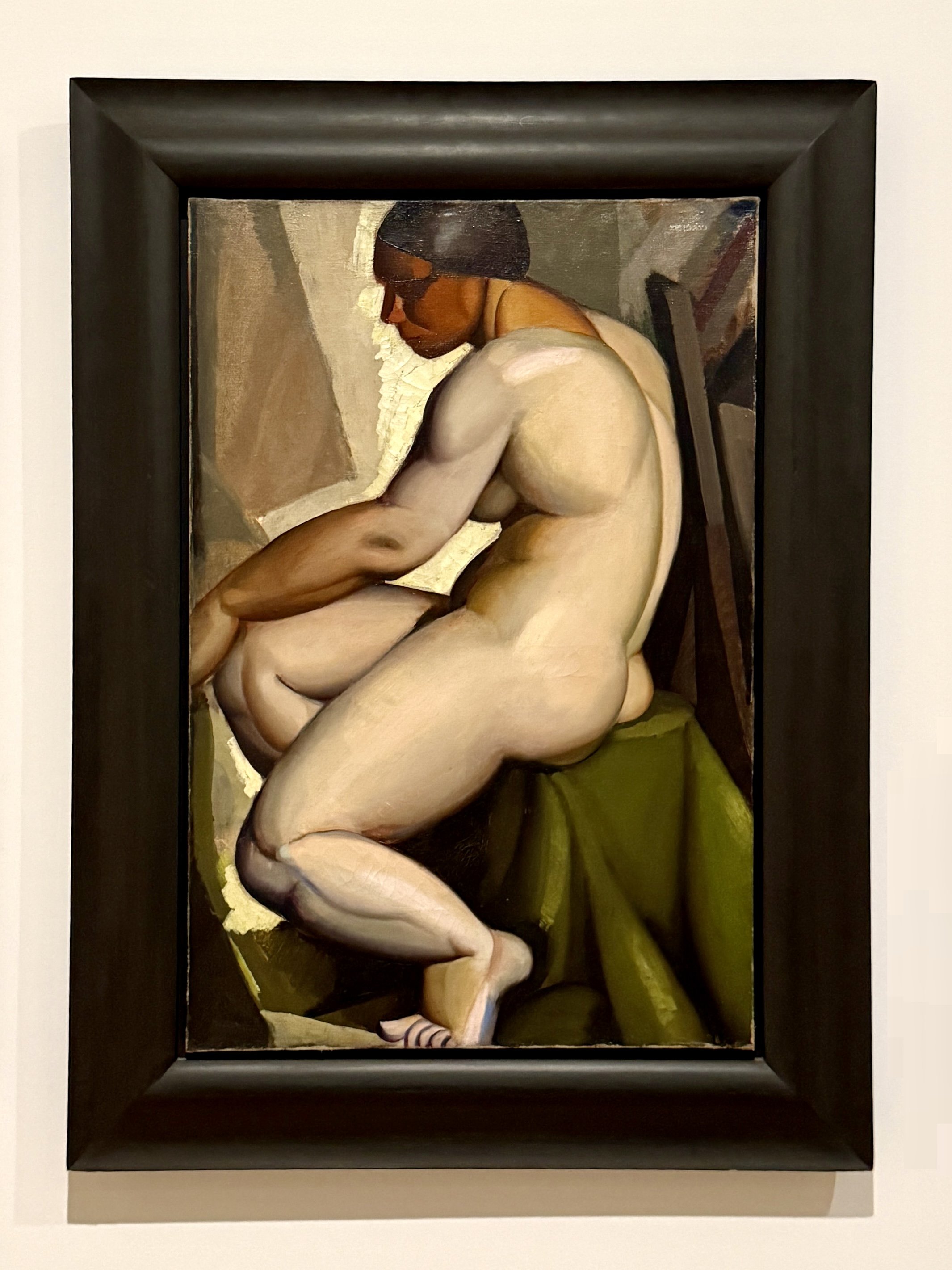
Nu Assis de Profil (Seated Nude in Profile) by Tamara de Lempicka

Nu Assis de Profil (Seated Nude in Profile) by Tamara de Lempicka, 1923

Tamara de Lempicka’s seated nude exists in a space of gender nonconformity, much like the artist herself. The figure’s heavily muscled body and tanned face suggest a masculine presence, perhaps shaped by outdoor labor, while the visible breast and porcelain skin point to a more traditionally feminine traits. The body is angled away from the viewer so as to heighten this sense of indeterminacy.

After moving from Poland to Paris in 1918, Lempicka gained recognition for her Art Deco portraits of glamorous, androgynous figures. Her style and subjects reflect her social circle, which included queer women like the writers Vita Sackville-West and Colette, and her own experiences as an openly bisexual woman.

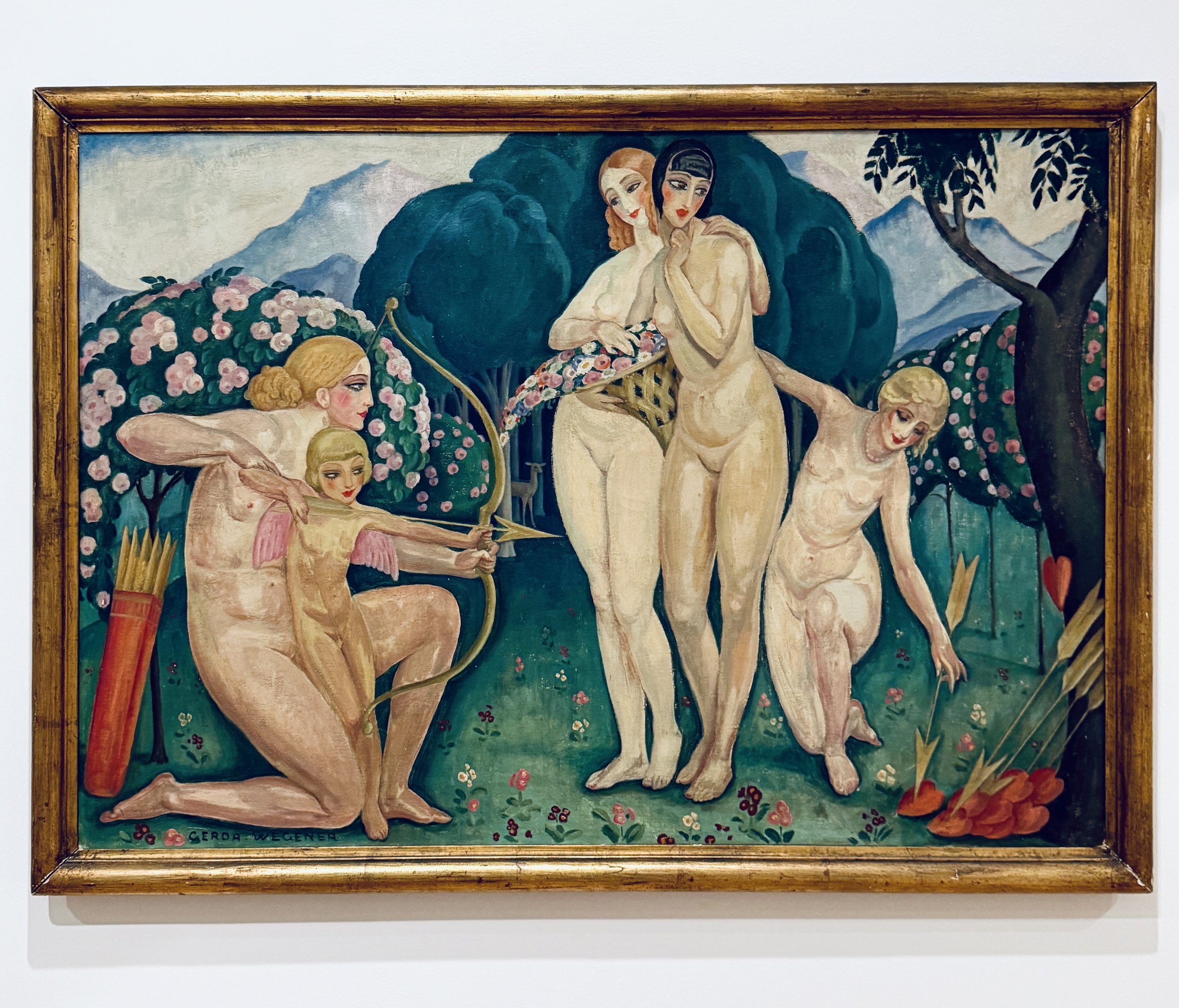
Venus and Amor by Gerda Wegener

Venus and Amor by Gerda Wegener, 1920

History: Echoes of Antiquity 

One of the most powerful sections, “History,” features works that portray an idealized classical past as an alibi to depict homoerotic imagery. Hans Von Marées’ Five Men in a Landscape feels suspended in a timeless queer utopia, while Rupert Bunny’s muscular Hercules takes on both dragons and sexual subtext. 

Venus and Amor is Gerda Wegener’s vision of lesbian Arcadia. In her uniquely Art Deco style, Wegener depicts a garden populated by the Three Graces, Cupid and Venus, the latter helping Cupid draw his bow. Cupid is represented as distinctly nonbinary, with rosy cheeks and nascent breasts. Like the figure of Puck in Shakespeare’s A Midsummer Night’s Dream, Wegener seems to suggest Cupid’s mischievous nature is connected to his gender transgression. 

When this canvas was completed, Wegener was so popular in France that the government bought three of her works for the Louvre, which are now in the Centre Pompidou collections. 

Sadly, she spent her later years in poverty and died in 1940, shortly after Nazi Germany invaded Denmark.

The Joy of Effort by Robert Tait McKenzie, 1912

The Joy of Effort by Robert Tait McKenzie, 1912

Robert Tait McKenzie was a Canadian physician, educator, athlete and sculptor who became director of athletics at the University of Pennsylvania. He donated hundreds of bronze homoerotic images of athletic young men to UPenn, where many are still on display. 

He was a key figure in sports medicine and rehabilitative medicine, designing prosthetics for wounded soldiers. He extolled the value of exercise early, especially for those who worked primarily with their minds. Despite the undeniable homoeroticism in his work, he was married, as the norms of his time dictated.

Cumulonimbus by Kotaro Nagahara

Cumulonimbus by Kotaro Nagahara, 1909

Kotaro Nagahara (1864-1930) was one of the early innovators of yōga, or Western-style painting, in late 19th-century Japan. The relatively conservative style of his male nudes (note the lack of visible genitals) may reflect the impact of the “nude debate” (ratai ronso) in Japanese art circles in the 1890s. The influence of Western nude painting fueled an intense debate among Japanese artists about the nature of propriety and indecency, and some yoga painters like Kuroda Seiki caused controversy for displaying nude paintings to the public. In this cultural atmosphere, it’s not surprising that Nagahara took a more discreet approach here in obscuring the figure’s genitalia.

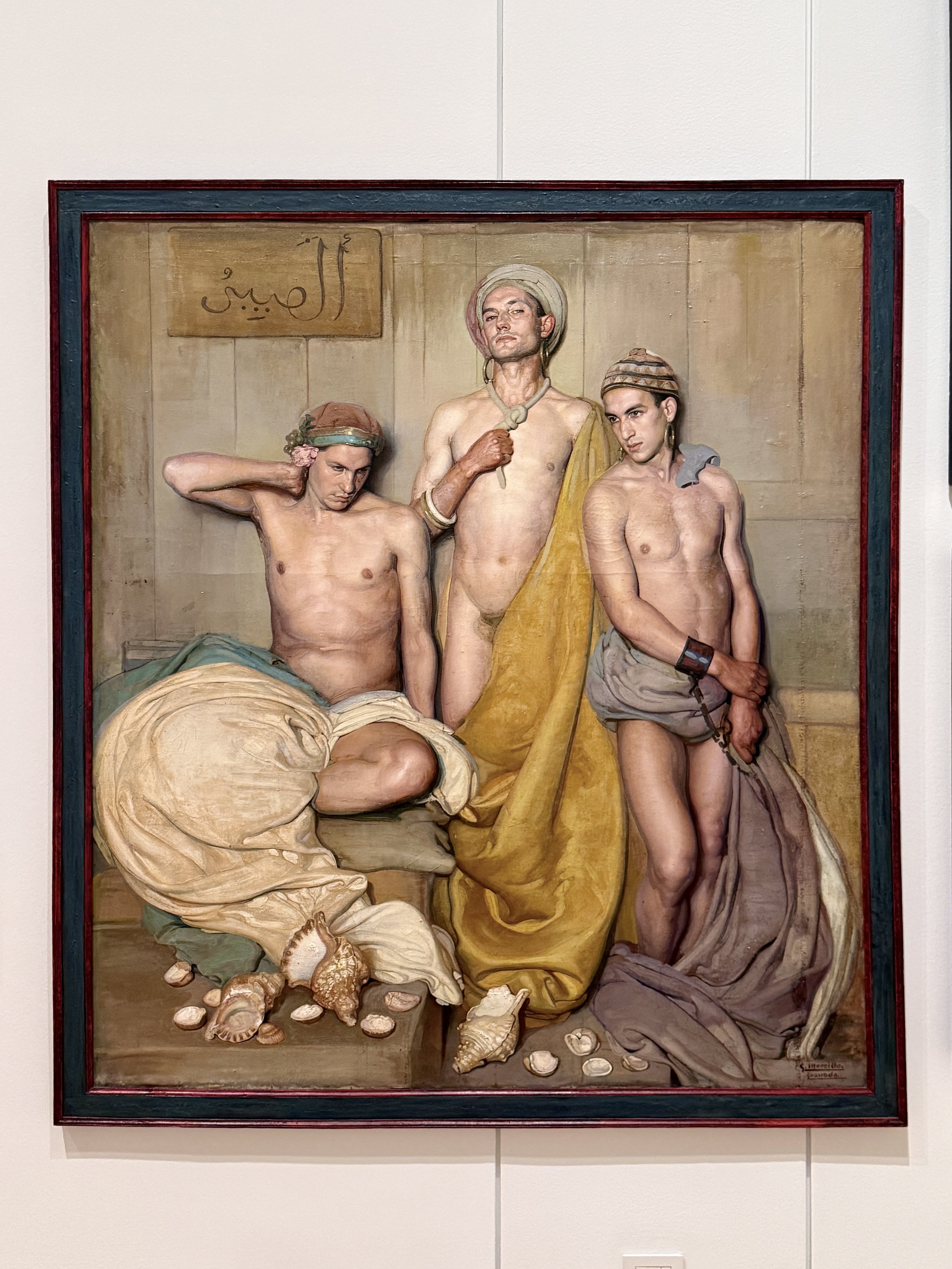
Slaves by Gabriel Morcillo

Slaves by Gabriel Morcillo, 1926

Colonialism and Resistance: Imported Shame, Native Pride

But art is never just about aesthetics. In “Colonialism and Resistance,” the exhibition explains how Western imperialism often coded queerness as foreign or degenerate, while simultaneously fetishizing it. A pernicious side effect of colonialism was that Western suppressive ideologies on homosexuality were imposed on conquered lands — many of which went from respecting same-sex relations to writing homophobic laws into their legal codes. 

Gabriel Morcillo’s painting Slaves is a striking example of how Orientalist aesthetics were often used to veil overt homoeroticism. Like many artists of his era, Morcillo employed the exoticized imagery of the so-called “East” to explore themes of male beauty and sensuality, subjects that were daring and even dangerous to depict in the 1920s and early ’30s. He later experienced both the favor and the fallout  of political affiliation: Between 1950 and 1955, he was commissioned by dictator Francisco Franco to paint several portraits, both standing and on horseback. With the arrival of Spain’s democratic Transition, Morcillo was classified as a Francoist, and his work largely vanished from art history books, despite its considerable artistic merit.

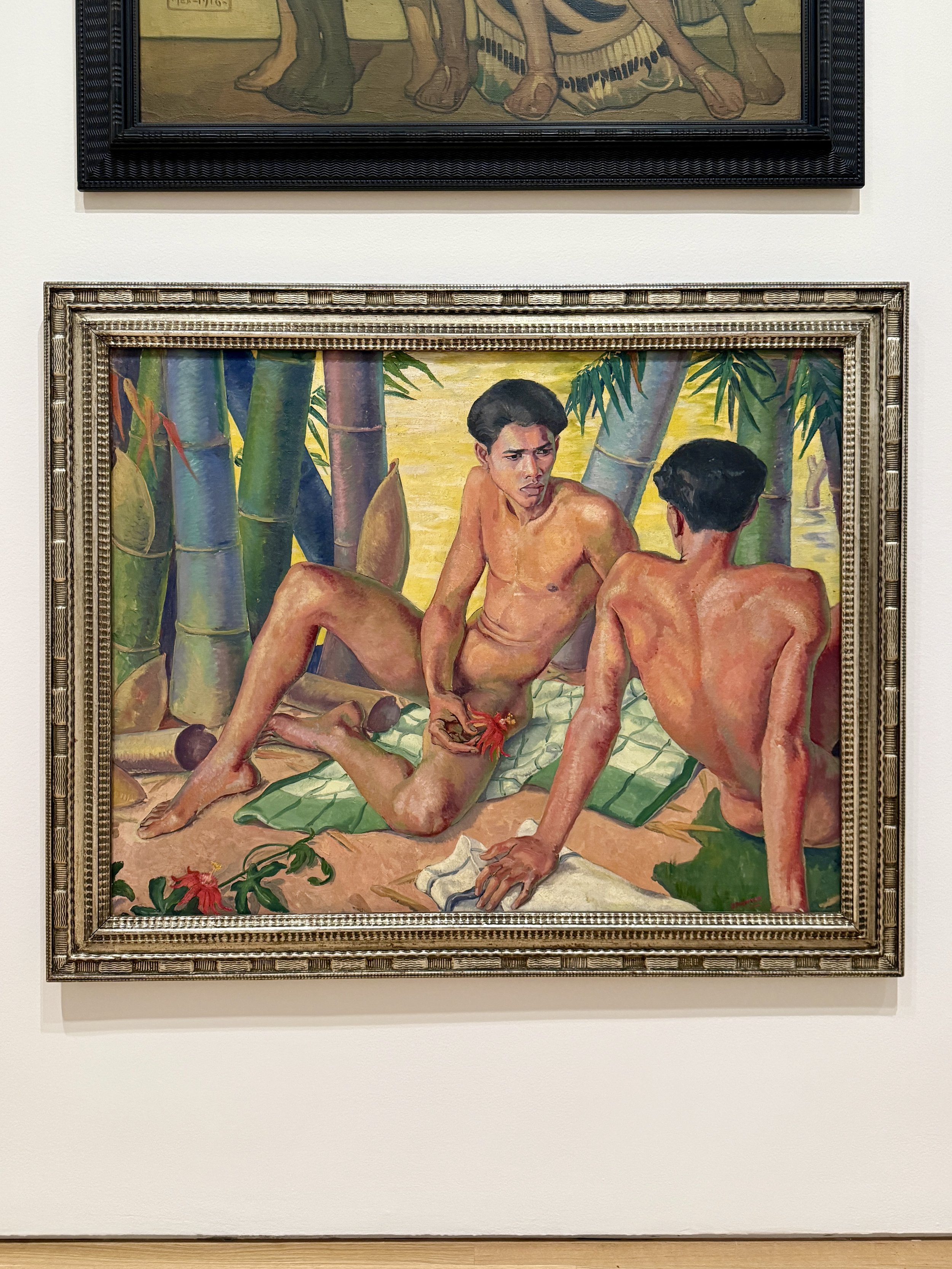
L’après-midi (In the Afternoon) by David Paynter

L’après-midi (In the Afternoon) by David Paynter, 1935

David Paynter’s In the Afternoon offers a rare and quietly radical vision of male intimacy in early 20th century South Asian art. Born in 1900 in Sri Lanka (then Ceylon), Paynter was known for merging Western classical techniques with South Asian subjects, often weaving subtle references to same-sex desire into his work.

In this painting, two young men share an intimate gaze, one delicately holding a flower — echoing the sensuality of Gauguin’s Polynesian women but recast through a defiantly queer lens. The image stands in quiet resistance to colonial-era moral codes that had, by that time, already begun to reshape attitudes toward sexuality across South Asia.

Before the British imposed Section 377 of the Indian Penal Code in 1861 — which criminalized “carnal intercourse against the order of nature” — many Asian cultures held more fluid and nuanced understandings of gender and sexuality. Paynter’s work gestures toward that precolonial cultural memory, reclaiming tenderness between men as both natural and beautiful.

La Danza (Dance) by Elisàr von Kupffer

La Danza (Dance) by Elisàr von Kupffer, 1918

Beyond the Binary: Gender, Reimagined

Finally, “Beyond the Binary” delivers what may be the show’s most revelatory section. Featuring more than 60 works, it draws direct connections between early queer and trans identities. 

Among the highlights is one of the first self-consciously trans representations in art: Gerda Wegener’s 1929 portrait of her spouse Lili Elbe. 

This section also includes paintings from the Elisarion, a utopian queer villa in Switzerland. One of these images is believed to depict the first same-sex wedding scene in art history.

Elisàr von Kupfer, who preferred to be called Elisarion, founded a spiritual movement he named Clarism, which rejected the gender binary as a perversion of divine will. Proud of his own feminine physical features, von Kupfer adorned his temple in Minusio, Switzerland, with paintings of similarly androgynous and nonbinary figures. While von Kupffer was a pioneer in challenging gender and sexual norms, he was also a white supremacist, and his work was influenced by Aryanism. He sought to engage Adolf Hitler in correspondence, though there is no evidence that the dictator ever replied. 

In von Kupffer’s utopia, gender was fluid and inclusive — but race, clearly, was not. His example shows how radical views in one realm did not necessarily extend to others.

Untitled (kuchi-e [frontispiece] with artist’s seal Shisen) by Tomioka Eisen

Untitled (kuchi-e [frontispiece] with artist’s seal Shisen) by Tomioka Eisen, 1895

This image was made as an illustration for the novel Sute obuna, an adaptation of the mystery novel Diavola (1885) by the British author Mary Braddon. From the 1880s onward, many European mystery stories were translated into Japanese and adapted to Japanese contexts. This could have the effect of producing unique and humorous juxtapositions between the Japanese characters and their Western mannerisms, as seen in this moment of unexpected male intimacy. Tomioka Eisen was a prolific illustrator during the Meiji Period, trained in ukiyo-e methods. He also produced a small number of erotic works, which were circulated privately.

Lili med fjerkos (Lili With a Feathered Fan) by Gerda Wegener, 1920

Lili With a Feathered Fan by Gerda Wegener depicts her husband, Einar Wegener (who later became Lili Elbe), holding a green feather fan. The painting is significant as an early example of transgender representation in art, created during a period when Lili was beginning to express her gender identity more openly. 

Lili first emerged in 1904 when Gerda asked Einat to pose in women’s clothing after one of her female models failed to show up. This moment marked the beginning of a public and private transformation. In the early ’20s, Lili began living more fully as a woman, and in 1930 she underwent one of the first known gender-affirming surgeries. 

Their relationship inspired the 2015 film The Danish Girl. Tragically, Lili died in 1931 from complications following the final stages of her surgeries. 

Peter (A Young English Girl) by Romaine Brooks

Peter (A Young English Girl) by Romaine Brooks, 1923

Romaine Brooks’ work from this period captures early 20th century lesbian life, with portraits of friends, lovers and fixtures of the queer world she inhabited. Here, Brooks depicts the nonbinary British artist known as Gluck, who also went by the name Peter. Gluck insisted on being addressed as “Gluck, no prefix, suffix or quotes” — rejecting any gendered association with their identity.

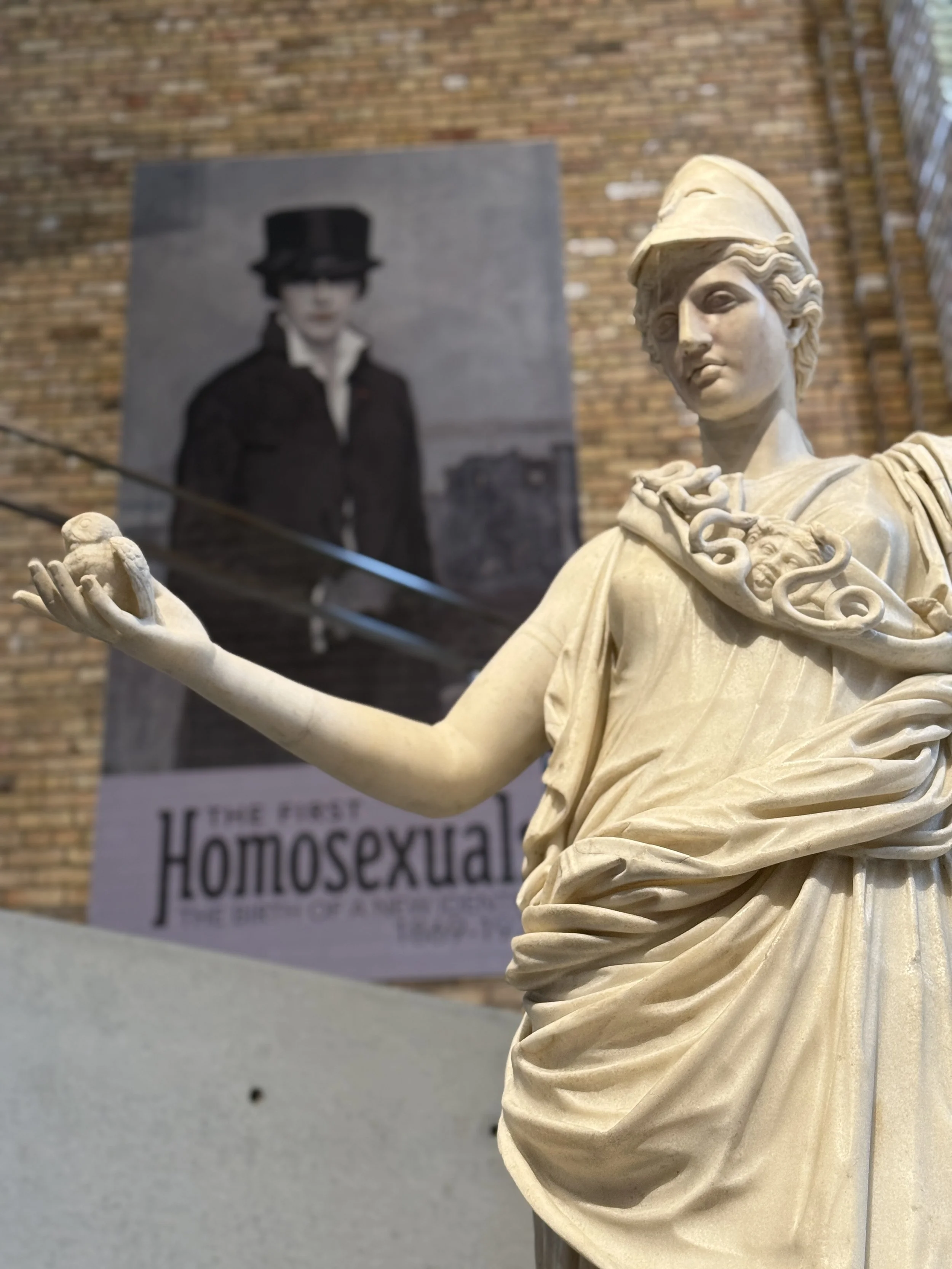
Statue of the goddess Athena by a stairwell at The First Homosexuals at Wrightwood 659 in Chicago

Amazing architecture, powerful art, dedicated docents and a relaxed, uncrowded flow make Wrightwood 659 well worth a visit.

Wrightwood 659 Does It Right 

Wrightwood 659 intentionally limits the number of visitors and requires timed-entry tickets purchased in advance. This keeps exhibitions intimate and uncrowded, allowing visitors to reflect deeply without distraction.

The First Homosexuals brings together more than 300 works by 125 queer artists from 40 countries, drawn from over 100 museums and private collections around the globe. Each loaned piece contributes to a sweeping, multifaceted narrative of queer identity, resilience and creativity. 

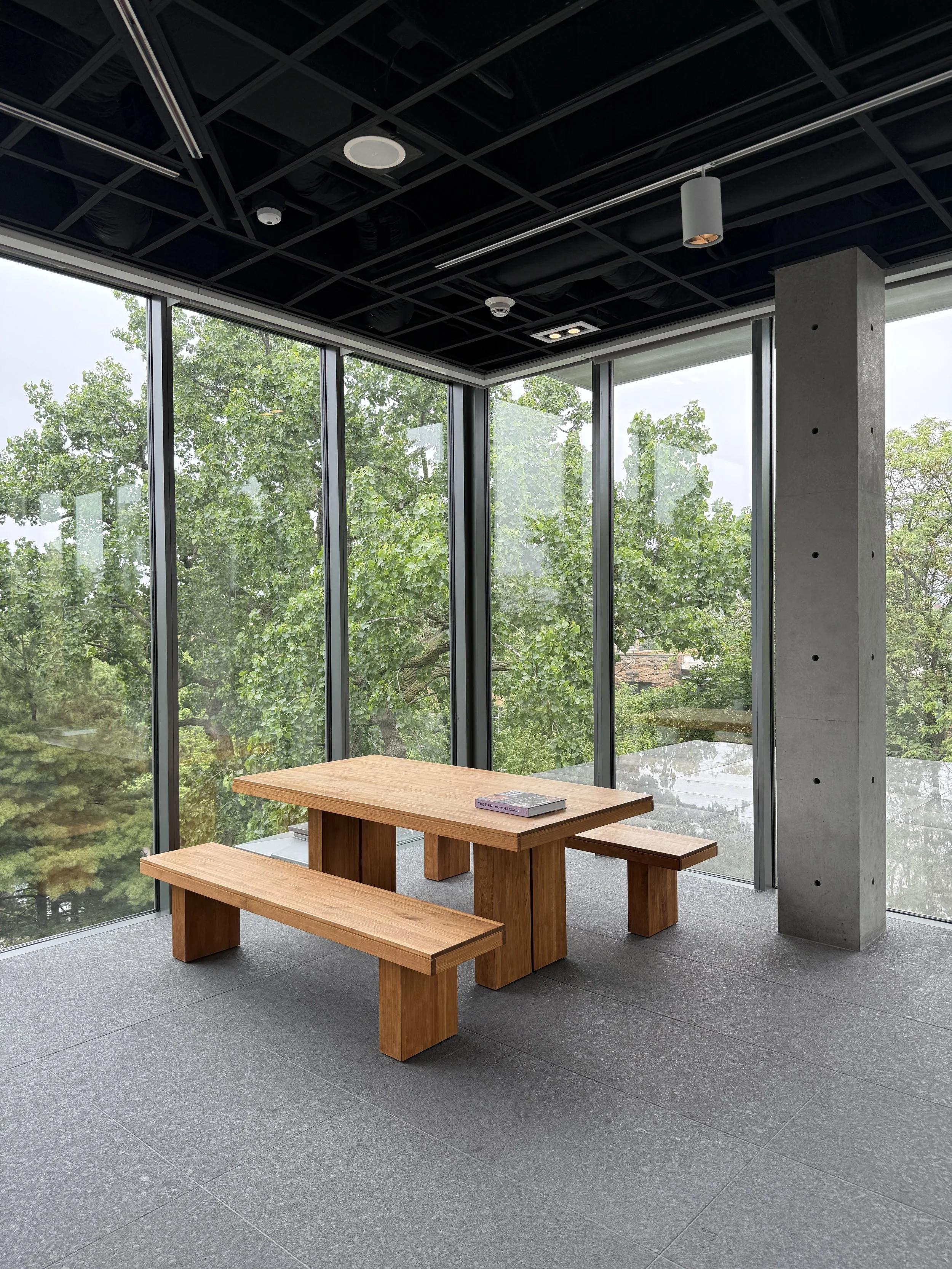
A table and benches by big windows in a quiet nook at Wrightwood 659 in Chicago

A quiet nook with a view at Wrightwood 659

Wally and I were struck not only by the scale of the exhibition, but by the obvious care with which it was assembled. Every element — from the curation of individual works to the flow of the galleries — felt deeply considered, designed to honor the artists, their histories and the communities they reflect.

We had the added privilege of visiting on a day when docents were present, enriching the experience with personal reflections and deeper context about the artists and their work. Their stories added an intimate, human layer to an already powerful presentation. –Duke

The entrance to Wrightwood 659 gallery

Wrightwood 659

West Wrightwood Avenue
Chicago, Illinois 
USA 


10 Divine Ways Roman Women Were Deified

From mimicking gestures to fertility-loaded iconography, these imperial women followed a set of rules to prove they were literal goddesses. 

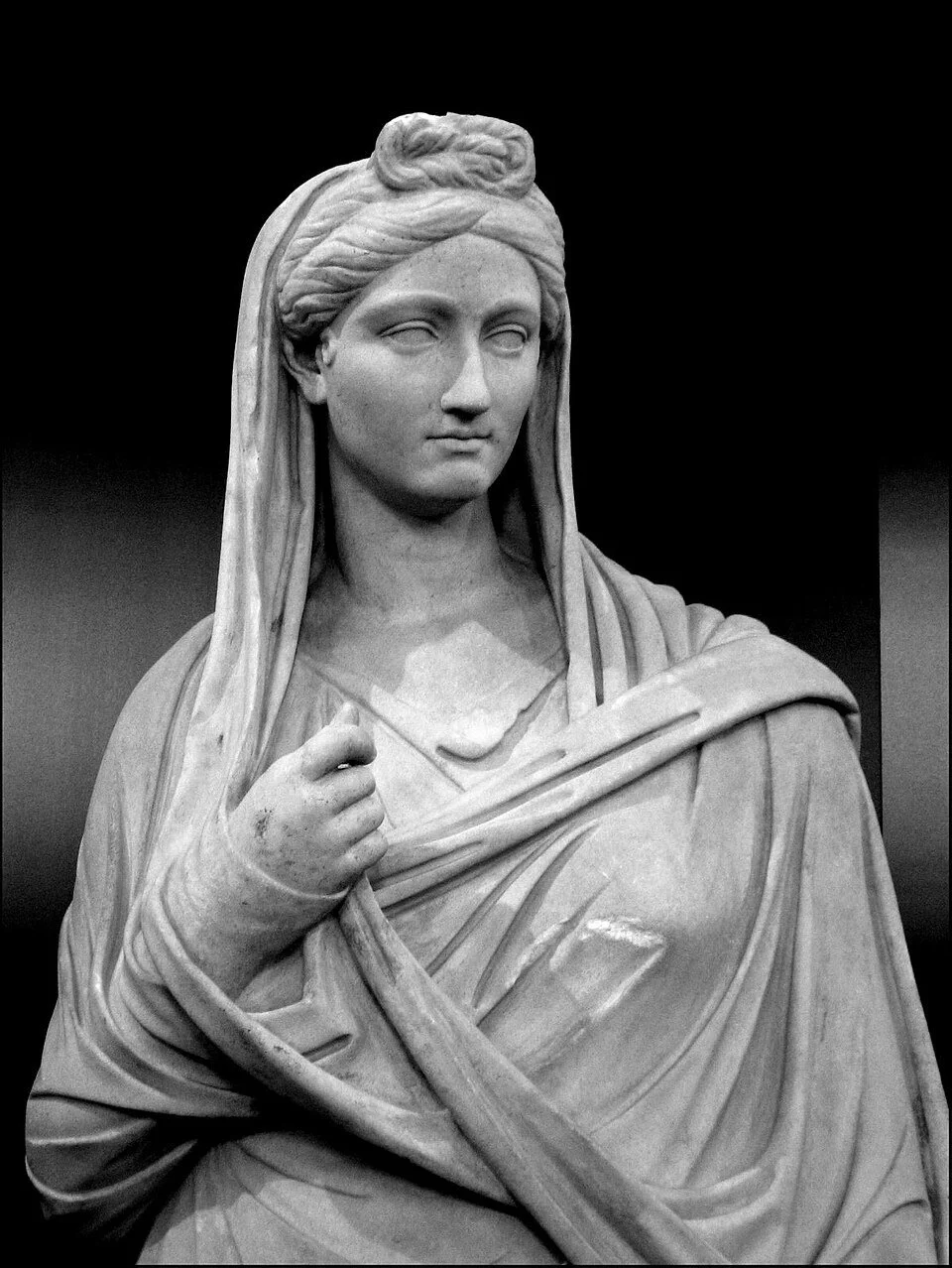
Statue of Vibia Sabina, wife of Hadrian

Vibia Sabina, looking every bit the empress — and maybe the goddess. Hadrian gave her honors in death…if not warmth in life.

Questionable hairdos, divine mimicry and the occasional eagle ride to the afterlife — being an imperial woman in Ancient Rome came with flair. Drawing from You Look Divine: Deifying Women in the Roman Empire, a lecture by archaeologist C. Brian Rose at the Art Institute of Chicago, I’m breaking down how Rome turned its empresses into literal goddesses.

A select few imperial women didn’t stop at empress; they were turned into goddesses after death, in a process called apotheosis. And Rose didn’t just walk us through Roman history — he charioted us straight to the heavens. Through sculpture, coinage and other dramatic iconography, here are the most divine highlights.

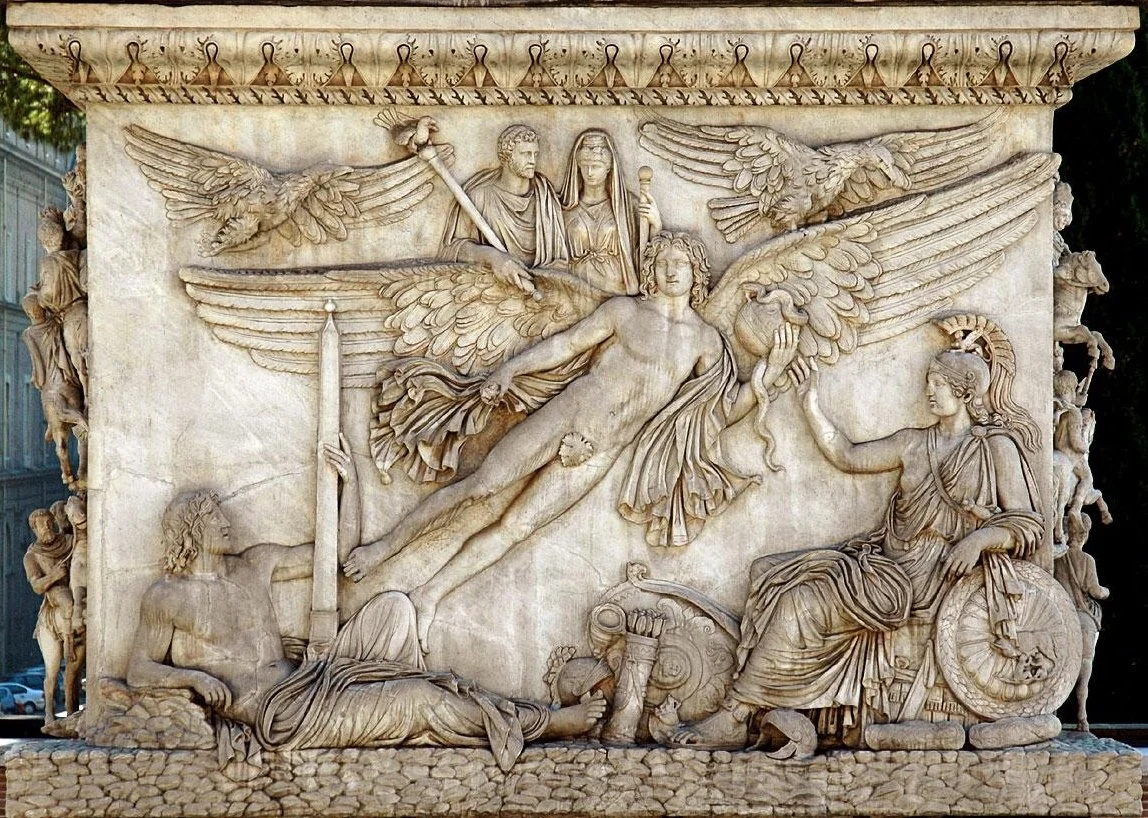
Apotheosis of Antoninus Pius and Faustina, where the imperial couple ascends to the heavens atop the wings of Eternity

Apotheosis of Antoninus Pius and Faustina, where the imperial couple ascends to the heavens atop the wings of Eternity

How to Become a Goddess (in Ancient Rome)

1. Ride an eagle — or Eternity herself — into the heavens. 

When an empress died, art often showed her literally taking off for the heavens. The preferred transportation? The oldest Roman custom was to depict the soul carried up by an eagle, symbolizing the late empress’ apotheosis (ascension to godhood).

There was another method of transport, though: On the monumental Column of Antoninus Pius, for example, Faustina the Elder, wife of Antoninus, is shown being whisked heavenward by none other than a winged figure of the personification of Eternity (often depicted as a woman but here as a man), with two eagles in tow. Talk about traveling in style!

In short, if you wanted to advertise that a Roman woman became a goddess, you put her on a first-class feathered flight straight to the stars.

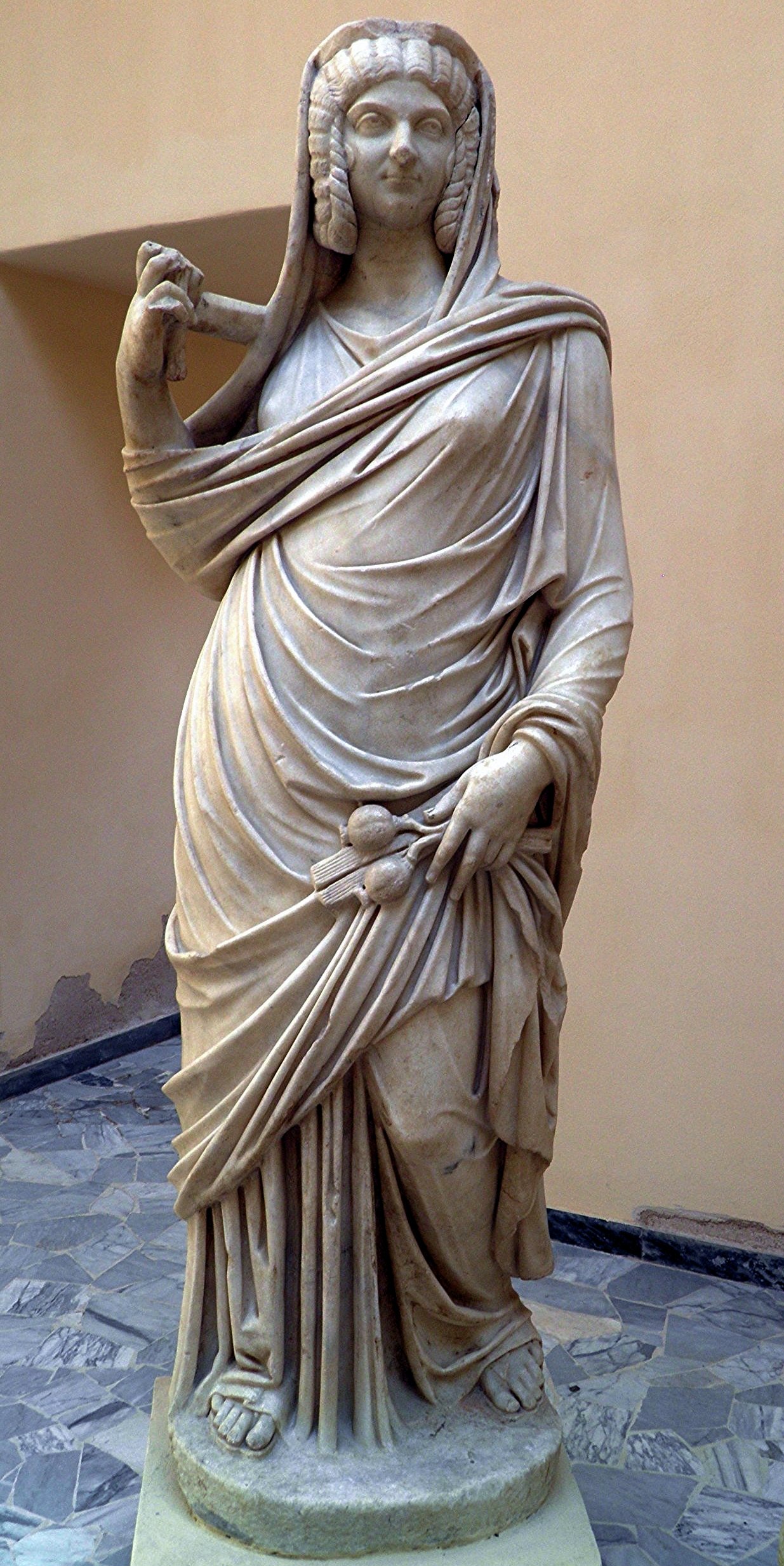
Statue of Julia Domna as Ceres, goddess of grain

Julia Domna as Ceres, goddess of grain — serving up imperial fertility with a side of wheat

2. Recycle the pose of a goddess, become a goddess. 

Imitation is the sincerest form of flattery — and in Rome, it was a fast track to divinity. Empresses would borrow the bodies of goddesses (at least in marble). 

Statues of imperial women often copied the poses and symbols of deities so closely that only the heads and inscriptions differed. Julia Domna, for instance, had a statue in Ostia holding wheat and poppies, just like Ceres, goddess of agriculture. In fact, her statue’s body was so generic-goddess that another statue of Empress Sabina used almost the exact same body with a different head and hairdo. 

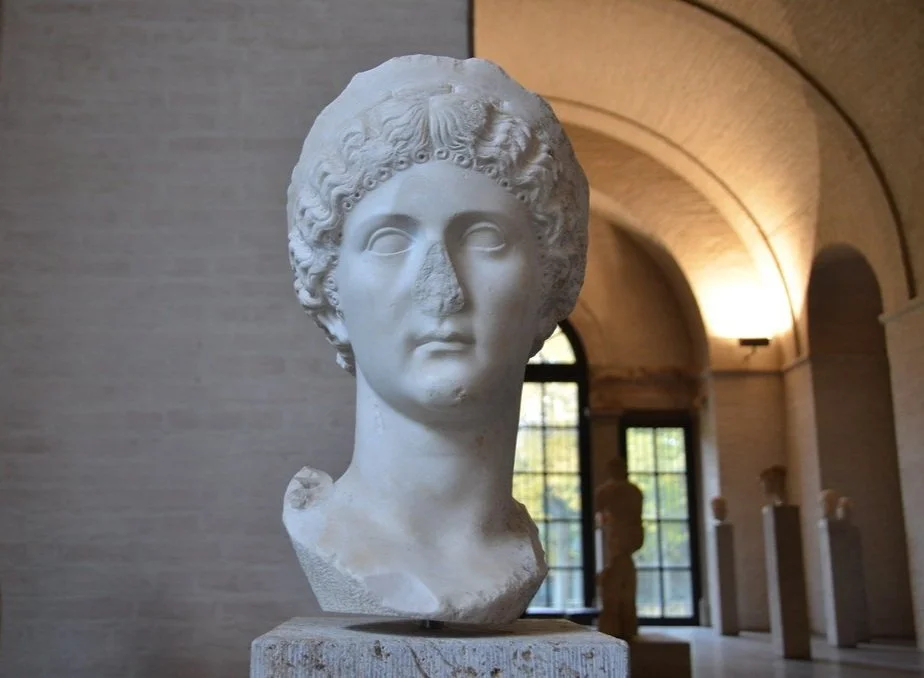
Statue of the head of Drusilla, Caligula’s sister, sans nose

Drusilla, Caligula’s sister, favorite — and, if whispers are to be believed, something more. After her death, he made her a goddess.

3. Get deified by a doting brother (thanks, Caligula!). 

Sometimes it’s all about who your family is. If your brother happens to be emperor and is just a tiny bit obsessed with you, you might skip the whole virtuous life part and go straight to goddess. 

Case in point: Caligula and his sister Drusilla. When Drusilla died in 38 CE, Caligula was so heartbroken (and unhinged) that he had the Senate declare her a goddess. He bestowed on her the name Diva Drusilla Panthea, meaning “the Divine Drusilla, the All-Goddess.” 

She was the first woman in Roman history to be officially deified by an emperor’s decree.  It didn’t hurt that Caligula fancied himself a living god, too — nepotism at its peak. 

Drusilla’s fast-pass to Mount Olympus shows that in Rome, having a god-maker in the family (even a certifiably crazy one) could trump all other qualifications.

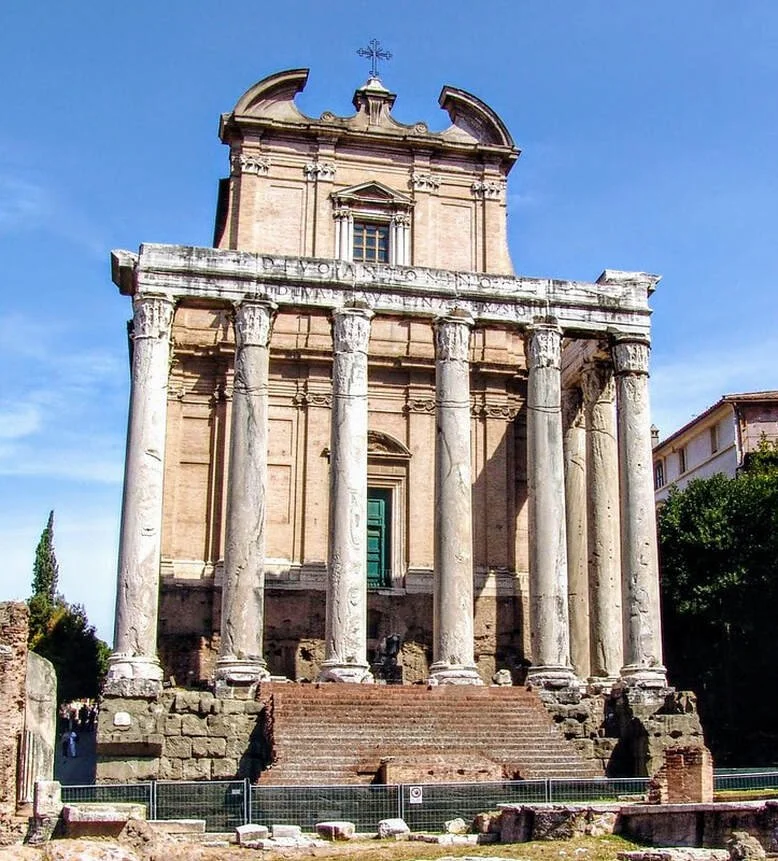
Temple of Antoninus and Faustina in the Roman Forum

Built for Faustina, rededicated to Antoninus — this temple is what happens when a Roman emperor can’t quit his empress, even after death.

4. If you’re really special, you get a temple of your own. 

When an empress was truly exceptional, the Romans gave her the ultimate posthumous honor: a temple on prime real estate. Think of it as the architectural equivalent of landing the cover of Vogue, but for eternity. 

Faustina the Elder was the first to score this distinction. After her deification, Emperor Antoninus Pius built the Temple of Faustina in the Roman Forum in 141 CE, complete with a grand colonnade and priests offering sacrifices in her name.

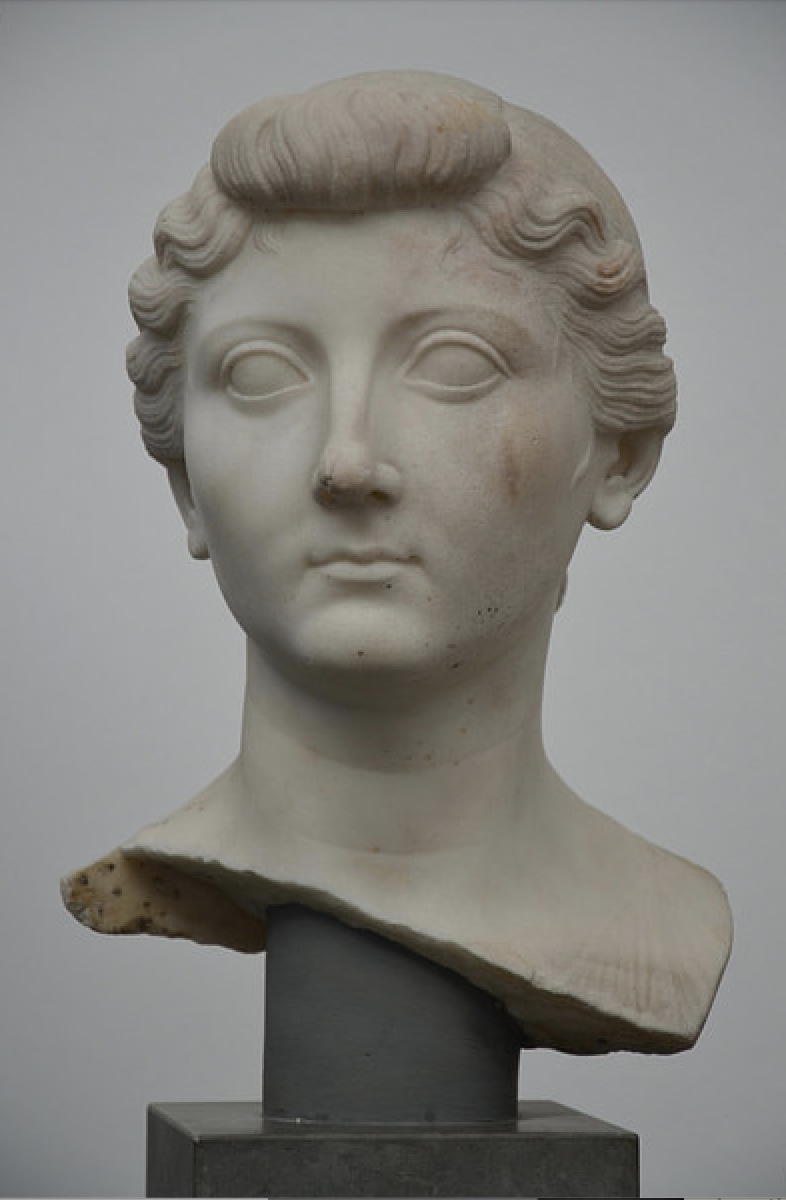
Statue of the head of Julia Augusta aka Livia

Julia Augusta (Livia) rocking the nodus — a hairstyle so serious it doubled as a public statement: “I’m chaste, powerful and one step from godhood.”

5. Be so virtuous, your hairstyle becomes a symbol of moral purity.

In Roman iconography, a woman’s hairstyle shouted her values to the world. Take Livia Drusilla, Augustus’ wife and the first First Lady of Rome. She pioneered the “nodus” hairstyle — a pudgy roll of hair over the forehead with the rest tied in a bun. 

It looks simple, but it spoke volumes. By choosing the nodus style, Livia presented herself as the embodiment of traditional Roman feminine virtues like pudicitia (modesty) and pietas (duty). 

That conservative ’do was basically a halo of humility. And it caught on: Women across the empire copied it for two or three generations, signaling that they too were modest, dutiful matrons. 

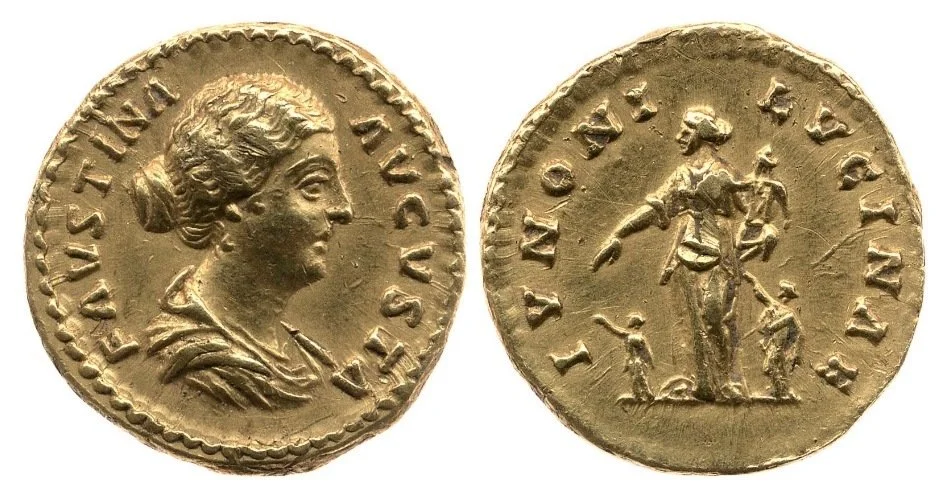
Golden ancient Roman coin with Faustina the Younger and Juno Lucina, goddess of childbirth

Faustina the Younger paired with Juno Lucina, goddess of childbirth — because bearing heirs was a divine duty and a full-time job

6. Fertility becomes your superpower. 

In the Roman imperial playbook, making imperial babies wasn’t just family planning — it was practically a divine service. An empress’ ability to bear children (preferably future emperors) was glorified as a literal superpower that kept Rome strong. 

Many empresses obliged, but Faustina the Younger outdid them all. She and Marcus Aurelius had at least 14 children (yes, 14), including two sets of twins. 

Her prolific motherhood was celebrated far and wide. Upon one daughter’s birth, the mint issued coins depicting Faustina as Juno Lucina, goddess of childbirth. The message was clear: The empress isn’t just having babies, she’s basically a fertility goddess herself. 

Imperial artists would show empresses with a cornucopia to symbolize fruitfulness — and the longer the better. Sometimes a woman was so fertile, she’d be deprived with a double cornucopia. 

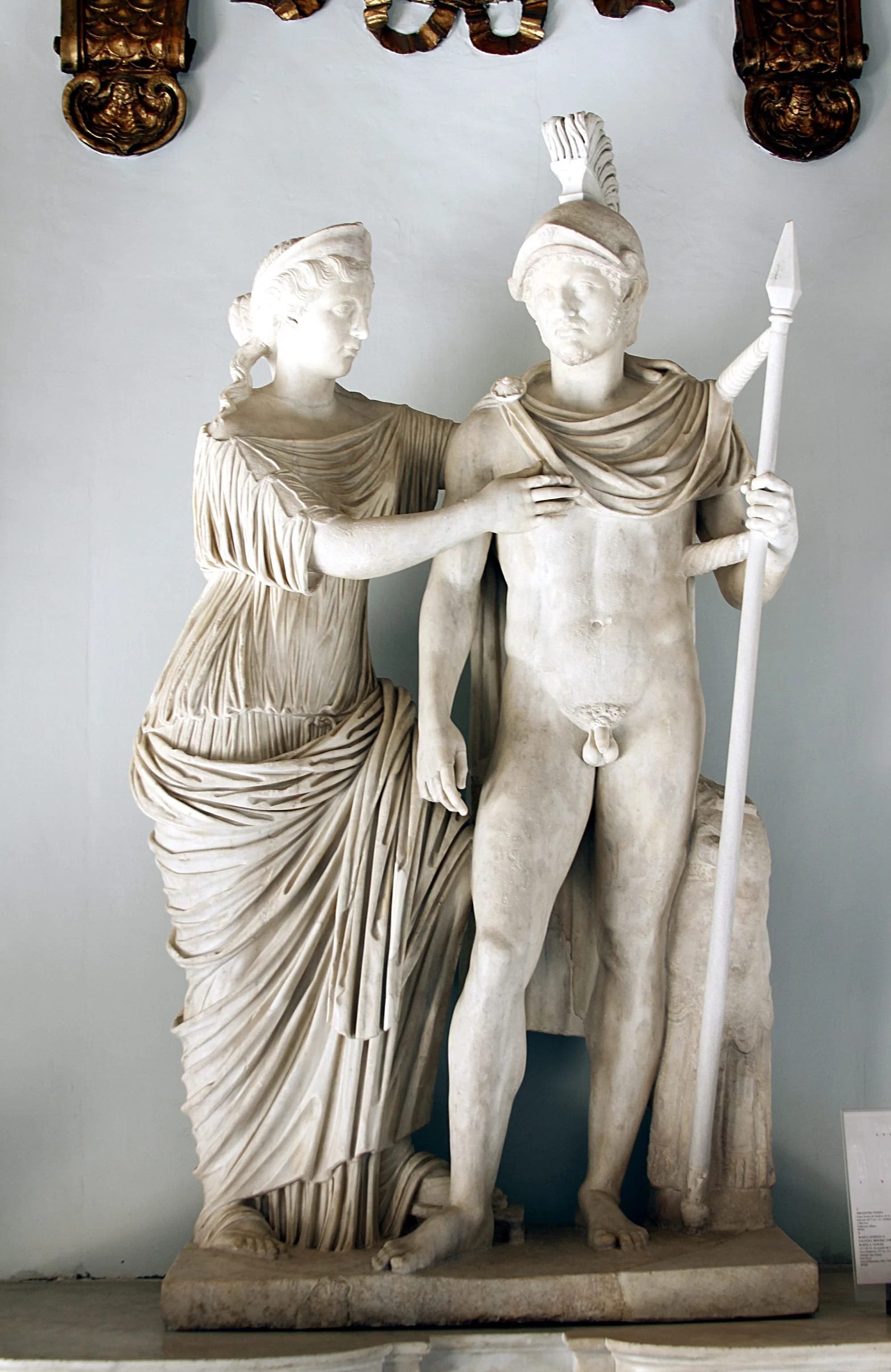
Statue of Faustina the Younger as Venus and Marcus Aurelius as Mars

Faustina the Younger as Venus and Marcus Aurelius as Mars — Rome’s ultimate power couple, cast as the gods of love and war

7. Victory and motherhood were a package deal. 

In the Roman mindset, a great empress could multitask on a cosmic level. She wasn’t just Mother of the Imperial House; she could be Mother of the Army, too. 

The idea was that an empress’ virtues off the battlefield (loyalty, fecundity, stability) magically contributed to victory on the battlefield. It sounds like a stretch, but the Romans leaned in. 

Faustina the Younger even got an official title for it: Mater Castrorum, “Mother of the Camp.” In 174 CE, she accompanied Marcus Aurelius to war in the wilds of Central Europe. The honorific implied that Faustina’s motherly care extended to the Roman army, boosting their morale and, by extension, Rome’s victories. 

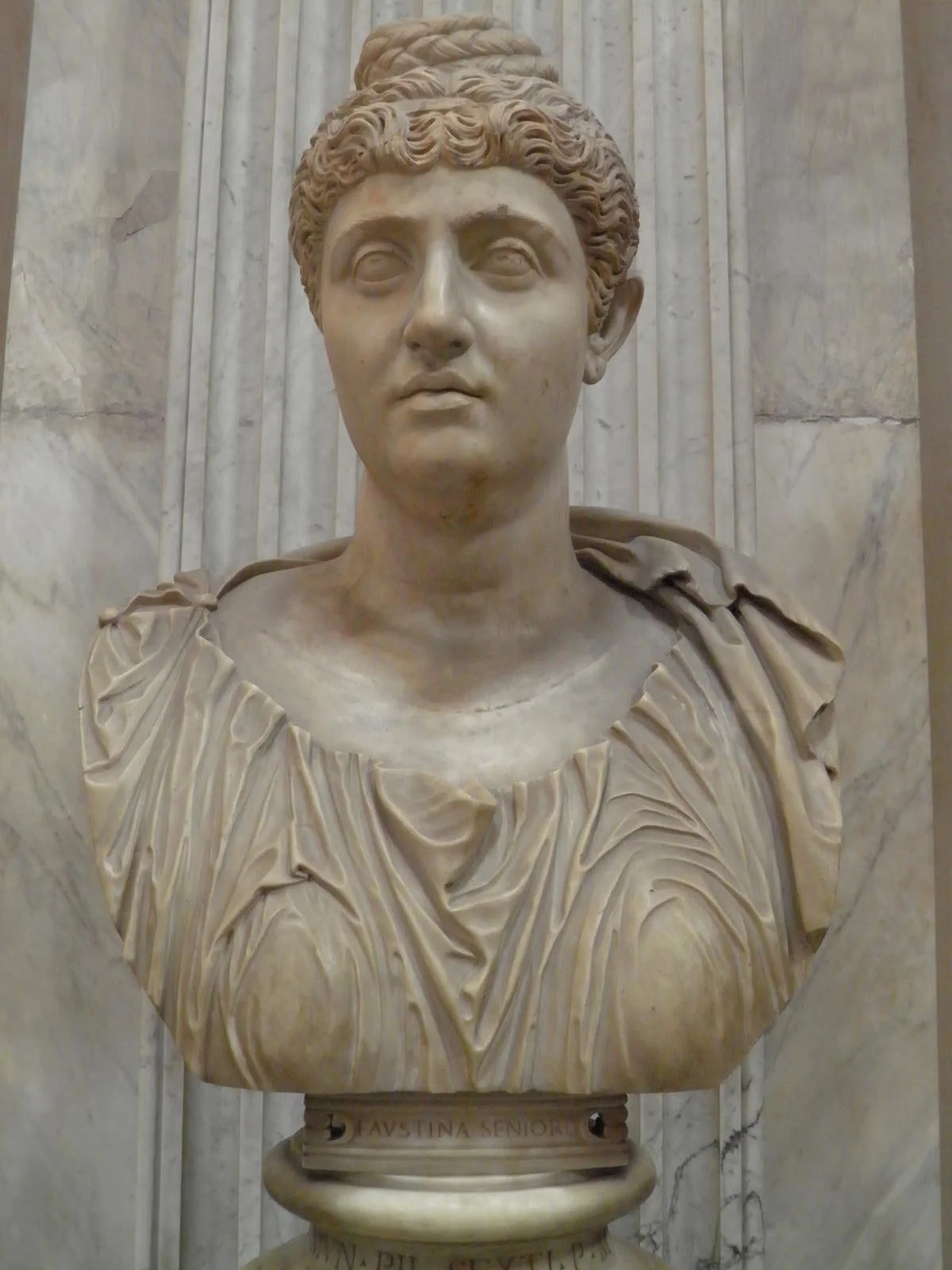
Bust of Faustina the Elder

Faustina the Elder had courier guilds renaming themselves after her and stage performers dedicating altars — all while she was still alive. Beyoncé who?

8. Gain a cult following (literally) in the provinces. 

If you really wanted a head start on divinity, it helped to have people worshipping you before you died. 

In the eastern provinces of the empire, where imperial cults were all the rage, communities sometimes treated the empress as a living goddess — with the emperor’s blessing, of course. This was savvy PR: It spread loyalty and flattered Rome’s rulers. 

Faustina the Elder enjoyed this rockstar status. In her lifetime, a courier guild in Ephesus renamed itself after her, and over in Puteoli, Italy, a group of stage performers (the scabillarii, who used foot clappers to keep rhythm) went so far as to dedicate an altar in her honor while she was still alive. 

Essentially, Faustina had fan clubs doing daily devotions to her across the empire. Incense, altars, maybe even occasional sacrifices — all for the living empress. 

These provincial admirers weren’t saying she was on par with Jupiter or Juno (let’s not get crazy), but they were laying the groundwork for her eventual deification.

By the time Faustina died and was officially consecrated as Diva, half the empire was already used to treating her as divine. 

Ancient Roman coin of Emperor Galba and Livia as the goddess Diva Augusta

Galba had no dynastic ties, so he borrowed some cred — appearing on a coin with Livia as Diva Augusta, Rome’s eternal empress.

9. Coins acted as your dynastic propaganda. 

Silver denarius of 69 CE: the deified Livia (Diva Augusta) standing with scepter and patera on the reverse. If you wanted to spread a message in ancient Rome, you stamped it on a coin. 

Imperial women found had their new goddess status broadcast through pocket change across the empire. Every coin was like a tiny billboard screaming, “The imperial family is sacred and stable!” 

One dramatic example: in 68–69 CE, during a chaotic civil war, Emperor Galba desperately needed legitimation. So what did he do? He minted coins showing Augusta Livia — wife of Augustus, long dead and deified — on the reverse, with the legend “the divine Augusta.”

By flaunting the protection of Grandma Livia’s divine spirit, Galba hoped to borrow her clout and calm everyone’s nerves about his usurpation. 

Living empresses appeared on coins with allegorical goddesses (Fecunditas, Pietas, Venus Victrix and the like) to nudge the public toward certain conclusions (e.g., “She’s as fruitful as a goddess!” or “She’ll bring victory!”). 

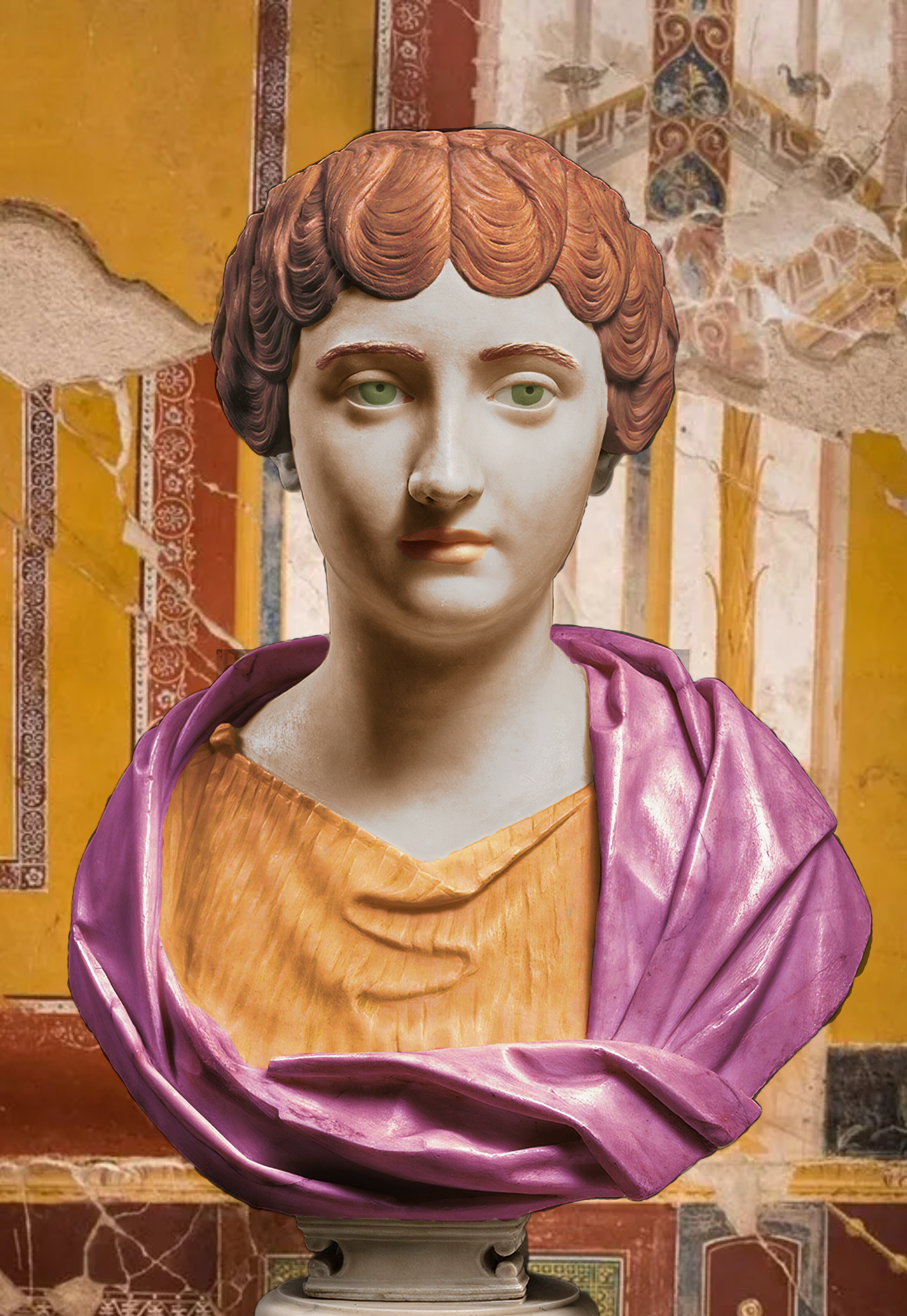
Painted bust of Faustina the Younger

To Roman eyes, Faustina the Younger was more than marble. She was a living presence — painted, perfumed and draped in cloth like the goddess she had become.

10. Your statues get painted and perfumed. 

Those ghost-white marble busts we see in museums? In Ancient Rome, they were painted in full color and sometimes even scented to smell divine. 

Romans treated the images of their gods (and deified emperors or empresses) almost like living beings. Recent research reveals that many Greco-Roman sculptures were not only brightly painted, draped in real cloth, and adorned with jewelry, and even doused in perfumes and fragrant oils. 

So imagine walking into a temple of the deified Empress Faustina: You’d see a statue of her with rosy skin tones and gilded accessories, maybe with her hair painted the rich brown of the real Faustina. The statue might be wearing an actual diadem on her carved marble curls. And the air would be thick with the scent of imported incense or floral oils anointing the statue’s surface. 

Roman statues were multisensory experiences; they looked alive and even smelled “heavenly.” This was all part of maintaining the illusion (or reality, to believers) that the deified woman’s spirit was present and watching. If you were deemed a goddess, you got the full spa treatment for eternity. By

In the end, the Romans believed the gods got around to everyone deserving. An empress could ascend swiftly on a funeral pyre’s eagle, or slowly on the wings of her lasting reputation – either way, divinity was destiny for the worthiest of Roman women. –Wally


Frida Kahlo in Paris

André Breton lured Frida to be in a Surrealist show, but she found herself misled, miserable and mad as hell — until Mary Reynolds stepped in.

A man stands in front of a wall that reads, "Frida Kahlo's Month in Paris" with a depiction of her painting The Frame at the Art Institute of Chicago

An exhibition at the Art Institute of Chicago covers Frida’s turbulent time in Paris in 1939.

Paris was supposed to be her big moment. But when Frida Kahlo landed in the so-called City of Light in 1939, all she found was a hospital bed, missing paintings, and a bunch of filthy Surrealists who couldn’t get their act together.

Thanks to an interesting lecture by Alivé Piliado Santana, curatorial associate at the National Museum of Mexican Art (where we check out the Day of the Dead ofrendas every year) and Tamar Kharatishvili, research fellow in modern art at the Art Institute of Chicago, I’ve come away with a far deeper — and far juicier — understanding of this chapter of Frida’s life I didn’t previously know about.

They are so damn ‘intellectual’ and rotten that I can’t stand them anymore .... I [would] rather sit on the floor in the market of Toluca and sell tortillas, than have anything to do with those ‘artistic’ bitches of Paris.
— Frida Kahlo, writing about the Surrealists in a letter to her lover, Nikolas Muray
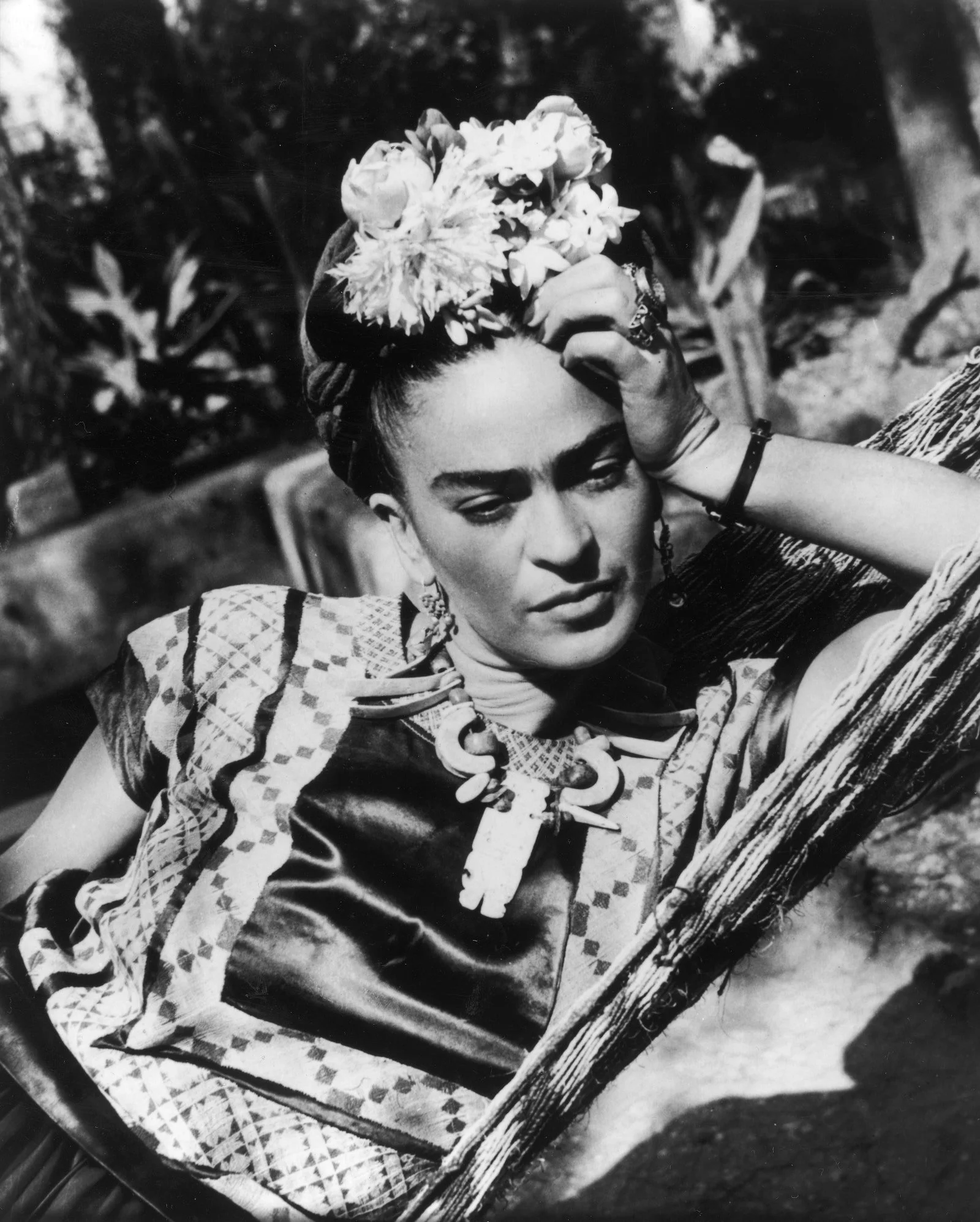
A photos of a smoking, topless Frida Kahlo with a floral headband

Wild child Frida in 1938

Here’s what I learned about the messy, maddening and frankly fascinating story of Frida’s Parisian misadventure, the forgotten women of Surrealism, and how a kindred spirit named Mary Reynolds helped turn Frida’s time in Paris into something meaningful. 

Surrealist André Breton places a hand to his forehead and looks off to the right

André Breton, leader of the Surrealists and organizer of the 1939 Mexique exhibition — though “organizer” might be generous, considering Frida arrived to find no gallery, no show, and her paintings stuck in customs.

Frida’s Disastrous Arrival in Paris

It all began with an invitation that felt like a breakthrough. André Breton — the self-appointed “pope of Surrealism” — had reached across the Atlantic with a tantalizing offer. Frida Kahlo’s paintings, he declared, belonged on the world stage. He wanted her to come to Paris for a major exhibition he was organizing called Mexique.

Frida was excited for a chance to showcase her work in the artistic capital of the world, among the greats. It felt like a turning point — a chance to step out from her hubby Diego Rivera’s shadow and claim her place in the international art scene.

But somewhere along the way, wires got crossed. Frida thought Mexique would be a solo show. 

It wasn’t.

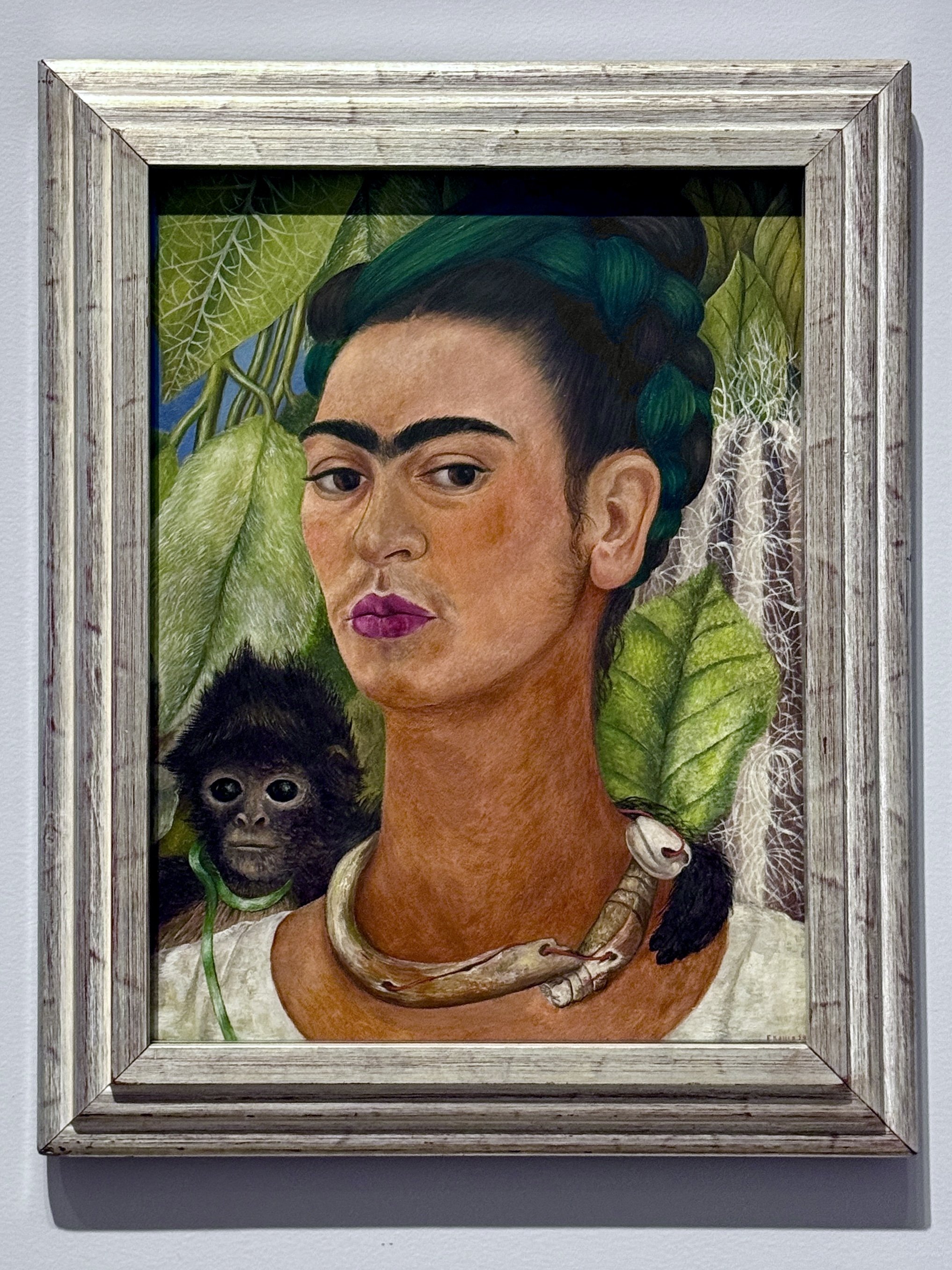
Self-Portrait With Monkey by Frida Kahlo from 1938

Self-Portrait With Monkey, painted by Frida Kahlo, posing with one of her pets, in 1938 right before she left for Paris.

Frida prepared for the journey with cautious excitement. Before she left, photographer Nikolas Muray, with whom she was having a passionate affair, captured her in a series of now-iconic portraits: defiant, radiant and ready for her European closeup. 

She could never have predicted how quickly things would unravel.

The troubles began before she even set foot in Paris. Her paintings, packed carefully for the voyage, were held up in customs. Instead of gliding smoothly into galleries, they sat in bureaucratic limbo, tangled in red tape. But there was still hope. Surely, Breton — the grand architect of the Surrealist movement — would have everything else ready.

He didn’t.

Frida arrived in Paris only to find chaos. There wasn’t even a gallery chosen for her show. No opening date on the calendar. No buzz of anticipation. Breton had made grand promises — but had done nothing to deliver on them.

A photo of Frida Kahlo taken by her lover Nikolas Muray

A portrait of Frida taken by Nikolas Muray before she left for Paris

A Hospital Stay

On top of the professional humiliation, Frida’s health collapsed. She hadn’t arrived in perfect shape to begin with — just before leaving Mexico, she had undergone spinal surgery to try to ease the constant pain from an earlier accident. The long journey, the cold Paris winter, the stress of a botched exhibition, and the miserable conditions she found herself in were a brutal combination.

Part of her fury stemmed from Breton’s own visit to Mexico, where she and Diego had opened their home (now the Diego Rivera and Frida Kahlo House-Studio Museum) to him and his wife — only to find that in Paris, Breton offered no such hospitality in return.

Almost as soon as she arrived, Frida developed a raging kidney infection, with a spiking fever that landed her in the hospital. She was exhausted, furious and rapidly losing faith in the promises that had brought her to Paris in the first place. 

She pinned her illness squarely on the Surrealists’ squalor, convinced that their slovenly habits had done her in.

When she was discharged, still weak and recovering, she faced the grim reality of her accommodations: a dingy hotel, damp and depressing, in a city that felt far from the glamorous art capital she had imagined.

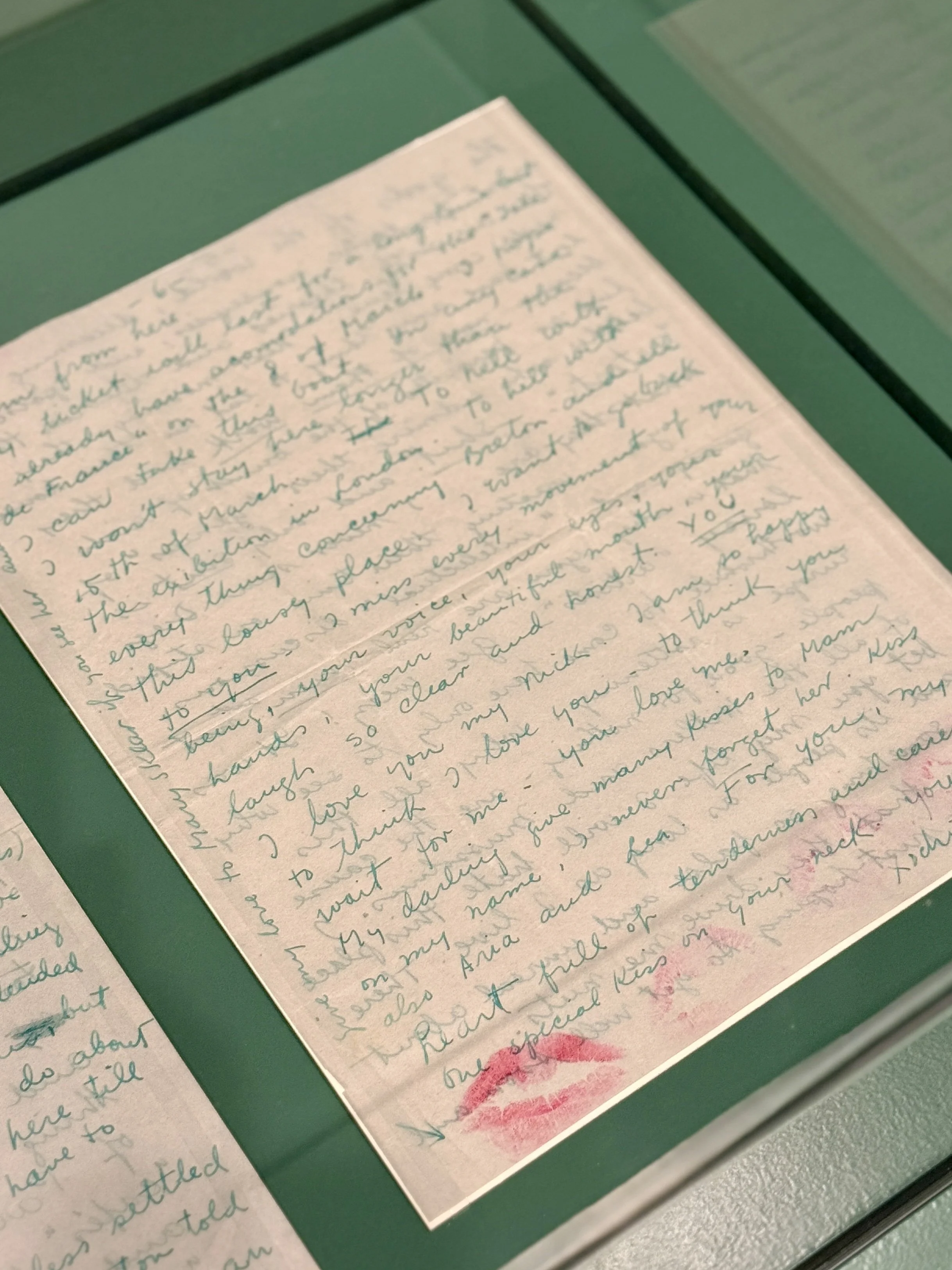
The last page of a letter written in English from Frida Kahlo to her lover Nikolas Muray, which she closes with a lipstick kiss

The final page of one of Frida’s letters to Muray. She didn’t exactly fall for Paris: “to hell with everything concerning Breton and all this lousy place,” she wrote, sick of the Surrealists and ready to go home.

She didn’t hold back. In a letter to Muray, she unloaded: “They are so damn ‘intellectual’ and rotten that I can’t stand them anymore .... I [would] rather sit on the floor in the market of Toluca and sell tortillas, than have anything to do with those ‘artistic’ bitches of Paris.” She thought the Surrealists were puffed up with self-importance yet utterly useless when it came to helping her. Only Marcel Duchamp, she noted acidly, “has his feet on the earth.” The rest, in her eyes, were pompous windbags throwing parties while her paintings languished in customs and her health deteriorated. And at the center of this mess, of course, was Breton himself, whose grand promises had led her straight into disaster.

What was meant to be her grand European debut had turned into a perfect storm of illness, neglect and bitter disappointment. She was stranded in Paris, her art trapped in customs, her patience wearing thin — and the Surrealists, led by Breton, had left her to flounder.

Avant-garde bookbinder Mary Reynolds

A photo booth pic of Mary Reynolds

Enter Mary Reynolds: An Unexpected Friendship

Just when Frida might have written off Paris entirely, in stepped Mary Reynolds — artist, bookmaker and all-around lifeline.

Unlike the aloof Surrealist men swanning around Paris, Reynolds opened her doors and, more importantly, her heart. Frida, still recovering from illness and spiraling frustration, moved out of her bleak hotel and into Reynolds’ home at 14 rue Hallé.

It wasn’t just a change of address — it was a change of atmosphere. Where Breton had offered chaos, Reynolds offered comfort. Her house in the southern part of Paris was a hub of creativity, conversation and, during the darkening shadow of World War II, quiet resistance.

Mary Reynolds, holding a tape measure, with her partner, Marcel Duchamp, looking like his head has been chopped off

Mary Reynolds with her partner, Marcel Duchamp

Mary Reynolds: The Unsung Hero of Surrealism

Reynolds deserves far more credit than she usually gets. A fiercely independent artist herself, Reynolds was a master of bookbinding — her works were collected by her partner, Marcel Duchamp (the guy who turned a urinal into modern art’s most notorious statement and further shocked audiences with Nude Descending a Staircase, No. 2), along with other avant-garde heavyweights of the time.

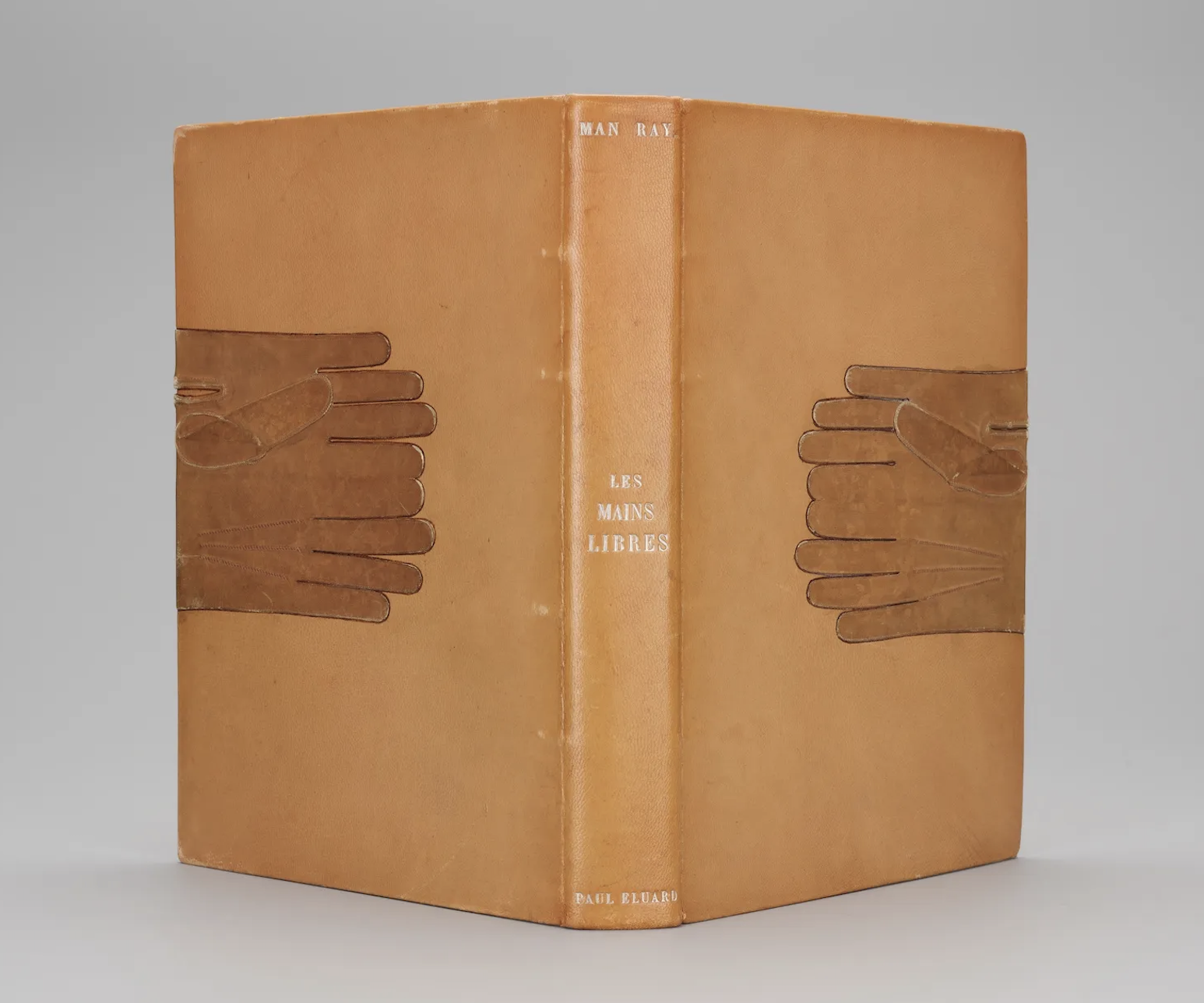
Reynolds took bookbinding to a whole new, surreal level: She used objects on the covers like kid gloves for Free Hands (Les Mains Libres), a thermometer in A Harsh Winter (Un Rude Hiver), and a teacup handle in Saint Glinglin — a nod to a scene where a character smashes plates with a golf club.

cover of Les mains libres (Free Hands) by Paul Éluard, with glove-like cutouts designed by Mary Reynolds

Reynolds was a genius when it came to bookbinding. Here’s the striking cover of Les mains libres (Free Hands) by Paul Éluard, with glove-like cutouts.

Her house was a living, breathing collage of Surrealist art and ideas. Duchamp, Alexander Calder and countless others had left their fingerprints — and actual works — all over her walls. 

For Frida, Reynolds’ home was proof some Surrealists weren’t all talk and no action. Here was a woman making her own art, supporting her peers, and backing it all up with real-world bravery.

A drawing of Mary Reynolds with multiple cats crawling over her, by Alexander Calder

A delightful drawing of Mary Reynolds and her cats by Alexander Calder, the American modern sculptor best known for his mobiles

Kahlo and Reynolds: Finding Solidarity

The connection between Frida and Reynolds was electric. Both women were navigating the male-dominated art world on their own terms, refusing to be footnotes in movements led by men.

Their bond also feels emblematic of something bigger: a reminder that amid all the philosophical posturing of Surrealism, real solidarity happened where women supported each other, shared ideas, and, frankly, kept the whole thing afloat.

In Frida’s letters, you can almost feel the tone shift once she moves into Reynolds’ home. It’s not quite relief — her Parisian experience remained fraught — but there’s a spark of light. Reynolds gave Frida what Breton could not: genuine human connection in a city that had otherwise let her down. She stayed at Reynolds from February 22 to March 25, 1939.

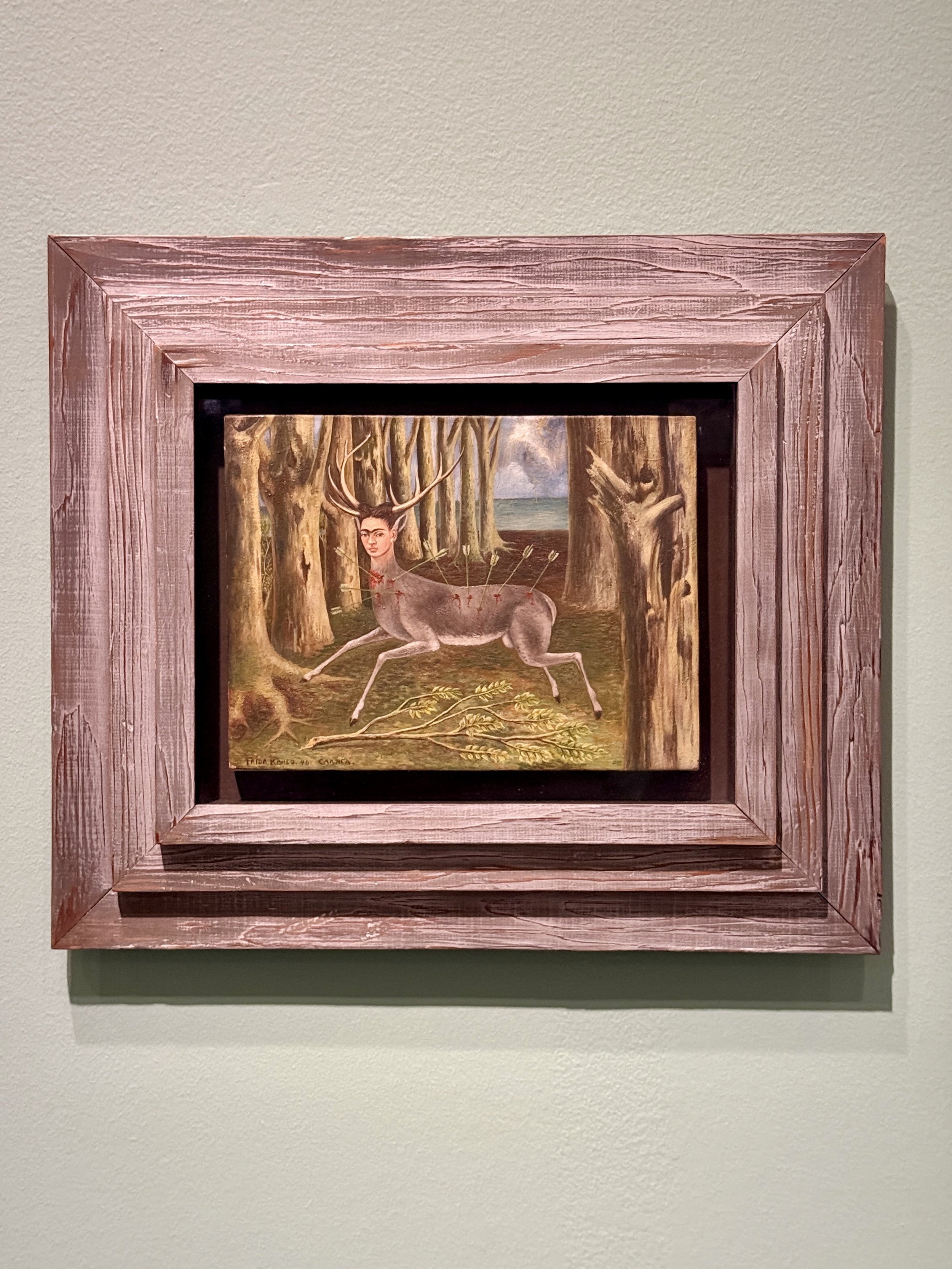
The Wounded Deer by Frida Kahlo, 1946

The Wounded Deer from 1946, painted after yet another failed surgery, this haunting self-portrait shows Frida as a deer riddled with arrows, calm-eyed in the face of relentless pain.

Frida and Surrealism: A Love-Hate Relationship

Here’s the irony: While the Surrealists were practically falling over themselves to claim Frida Kahlo as one of their own, Frida herself wanted nothing to do with the label.

Breton had famously declared her work “a ribbon around a bomb” — which, to be fair, is a great line. But Frida saw things differently. She didn’t consider herself a Surrealist at all. “I never painted dreams,” she once said. “I painted my own reality.”

Frida’s work, raw and visceral, didn’t need the Surrealist manifesto to explain it. Where the Surrealists dabbled in subconscious symbolism and found objects, Frida’s paintings were autobiographical to their core — her pain, her identity, her relationships all laid bare.

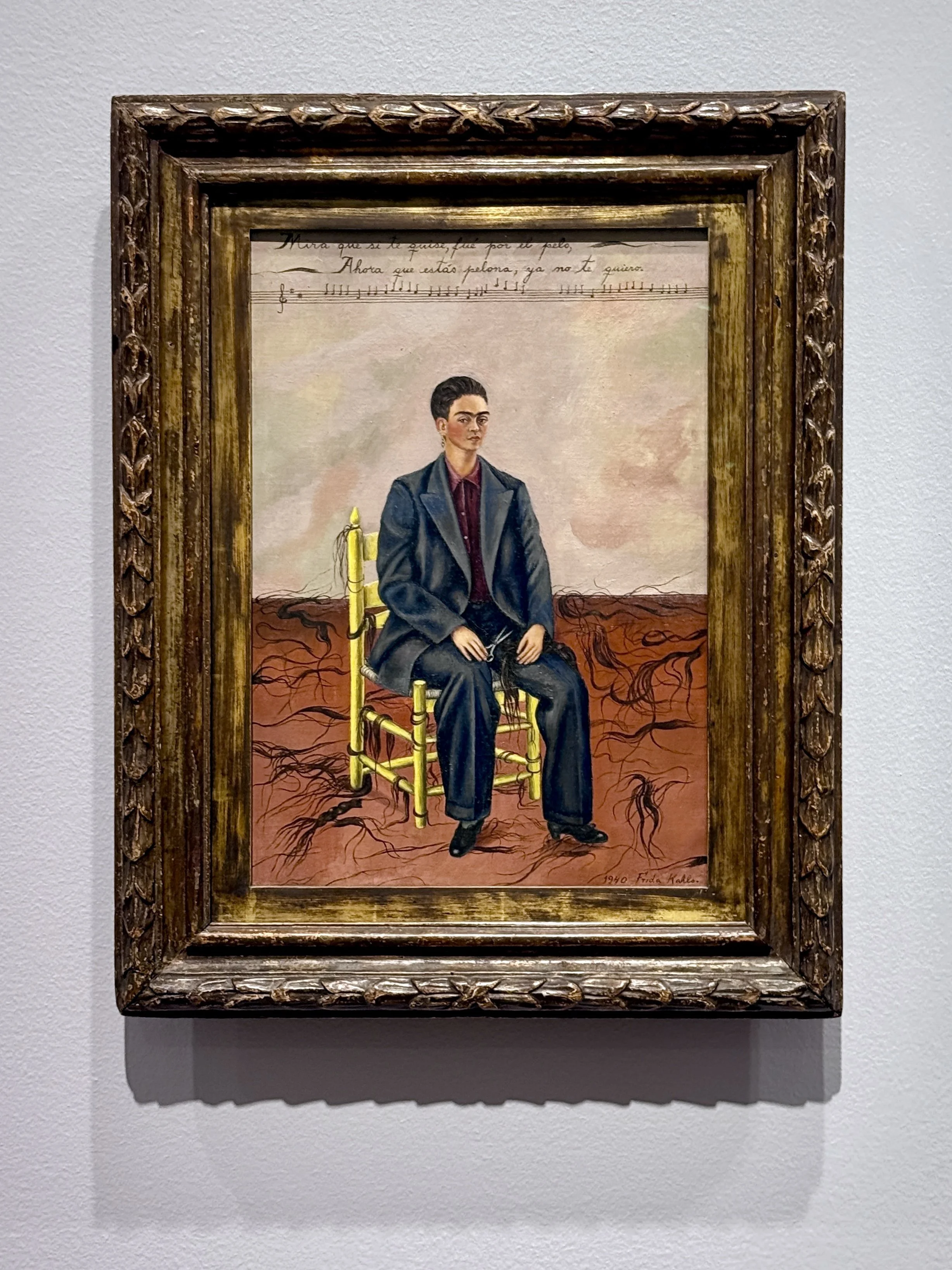
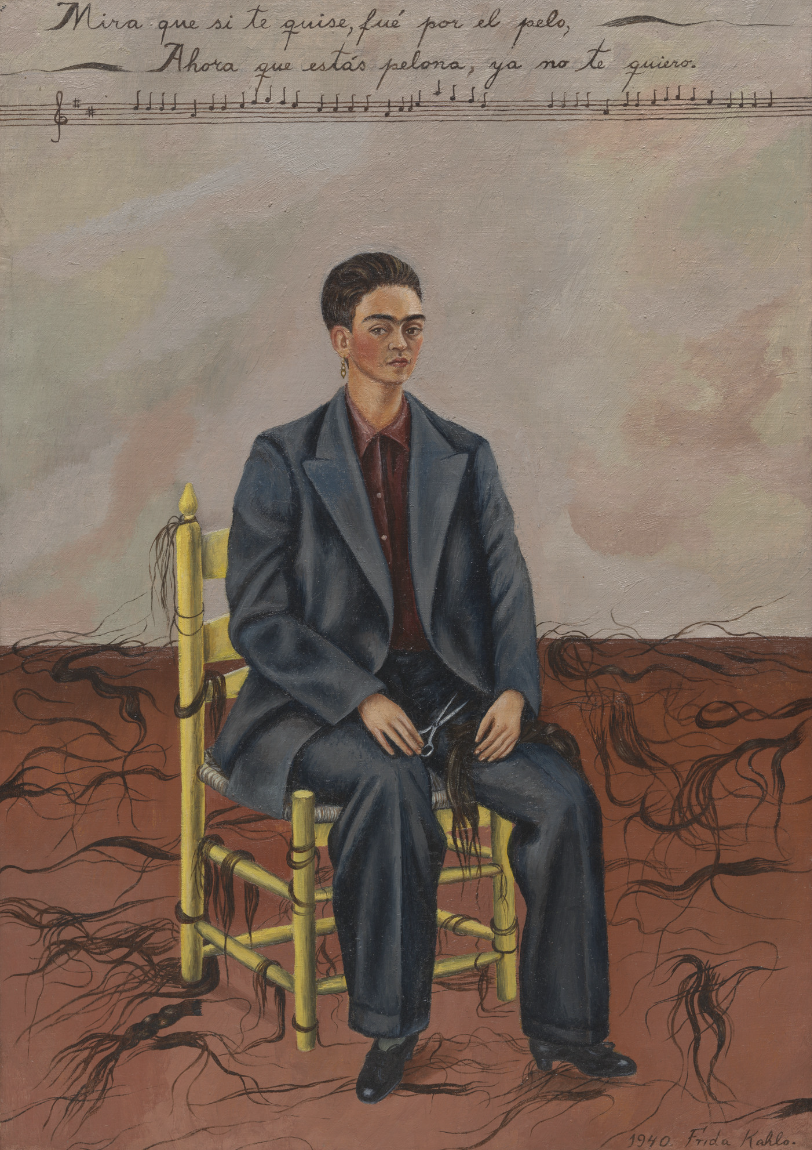
Self-Portrait With Cropped Hair by Frida Kahlo, 1940

Self-Portrait With Cropped Hair from 1940. Freshly divorced, Frida depicts herself as wearing one of Diego’s suits, scissors in hand, her hair in clumps on the floor.

The Surrealists saw her as exotic, a muse from afar who fit their aesthetic fantasies. But Frida wasn’t interested in playing that role. She wasn’t a curiosity or a symbol — she was an artist, plain and simple. Her use of indigenous Mexican motifs, her explorations of physical and emotional suffering — these weren’t Surrealist exercises; they were her lived truth.

Still, despite her reluctance, Frida’s art undeniably aligned with many Surrealist themes. Dreams and reality intertwining, the use of found materials, the exploration of identity — it was all there, just coming from a much grittier, more personal place. 

And she did, after all, agree to be a part of a Surrealist show in Paris. Which, by the way, finally came together. It ran at the Galerie Renou et Colle from March 10 to 25, 1939. Frida’s take on her fellow Mexican artists that Breton chose to showcase with her work? In one of her letters to Muray, she described them as “all of this junk.”

Photographer Nikolas Muray and Frida Kahlo

Photographer Nikolas Muray and Frida Kahlo had a passionate affair, and he was her confidante during her bad experience in Paris.

Nikolas Muray: The Confidant Behind the Letters

Long before Paris turned into a disaster, Frida had another anchor: Nikolas Muray. Photographer, Olympic fencer (yes, really) and one of her many lovers, Muray was one of the few people Frida trusted enough to confide in during her Paris ordeal.

Her letters to him are the sharpest, funniest and most brutally honest accounts we have of her time in France. She wrote to Muray not just to update him, but to release steam — to unload her frustrations about the Surrealists, the filth of the city, her failing health, and her utter disappointment in Breton’s empty promises.

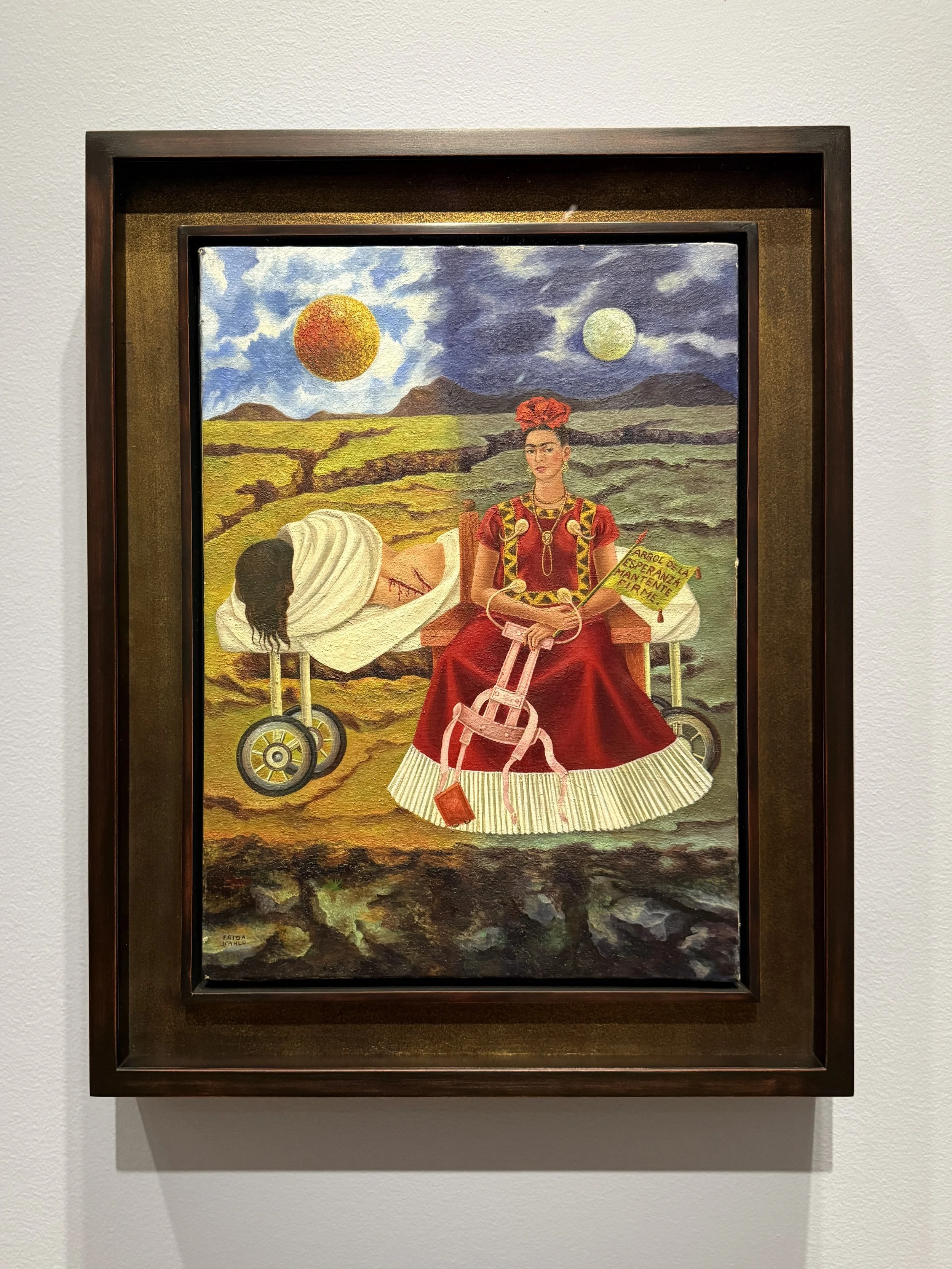
The Tree of Hope, Remain Strong, painted in 1946 by Frida Kahlo

The Tree of Hope, Remain Strong, painted in 1946 after spinal surgery. This double self-portrait splits her in two: One body lies wounded on a hospital gurney, while the other sits upright, dressed and defiant, clutching a back brace.

What Happened After: A Brief, Blazing Connection

For all the depth and warmth of their connection in Paris, Frida and Reynolds’ friendship seems to have been brief. After that whirlwind winter of 1939, there’s no evidence they kept up correspondence. Aside from one endearing letter where Reynolds talks about how empty the house felt without Frida, there aren’t any further exchanges that we know of.

Life pulled the two women in different directions. Frida returned to Mexico, her health still fragile but her art beginning to gain traction. 

Reynolds, meanwhile, risked her life in the French Resistance. Her Paris home, once a haven for artists and thinkers, became a literal refuge for those fleeing Nazi persecution. She didn’t leave Paris until 1942, escaping across the Pyrenées on foot and finding a flight to New York. But she never stopped fighting for what mattered.

Their paths never formally crossed again, at least not that we can prove. But their legacies continued to intertwine, quietly and profoundly, through the art they made and the communities they helped build. 

The Frame, an oil painting on tin with a vibrant folk art border, from 1938. Frida’s Paris show wasn’t a total disaster — the Louvre bought this piece for their colletion.

A Happy Ending to Frida’s Time in Paris

In spite of it all, Frida’s Paris disaster managed to end on a high note. Against the odds, her work finally made it onto the walls of a gallery — and not just any gallery. By the end of the show, the Louvre itself (yes, the Louvre) purchased one of her paintings, The Frame, making Frida the first 20th century Mexican artist in the museum’s holdings. Today (when not loaned out to travel), this emblematic self-portrait is part of the Musée National d’Art Moderne’s collection at the Centre Pompidou in Paris. 

DID YOU KNOW? The Pompidou has a branch in Málaga, Spain?

Even more surprising, amid the wreckage of her Surrealist experience, Frida forged real friendships with a few kindred spirits. Man Ray, Duchamp and some others proved to be exceptions to the pompous crowd she had loathed. Some Surrealists were pas mal, after all. –Wally

The Other Art Fair: Where Emerging Artists Take the Spotlight

Forget the gallery gatekeepers. The Other Art Fair puts power back in the hands of artists. 

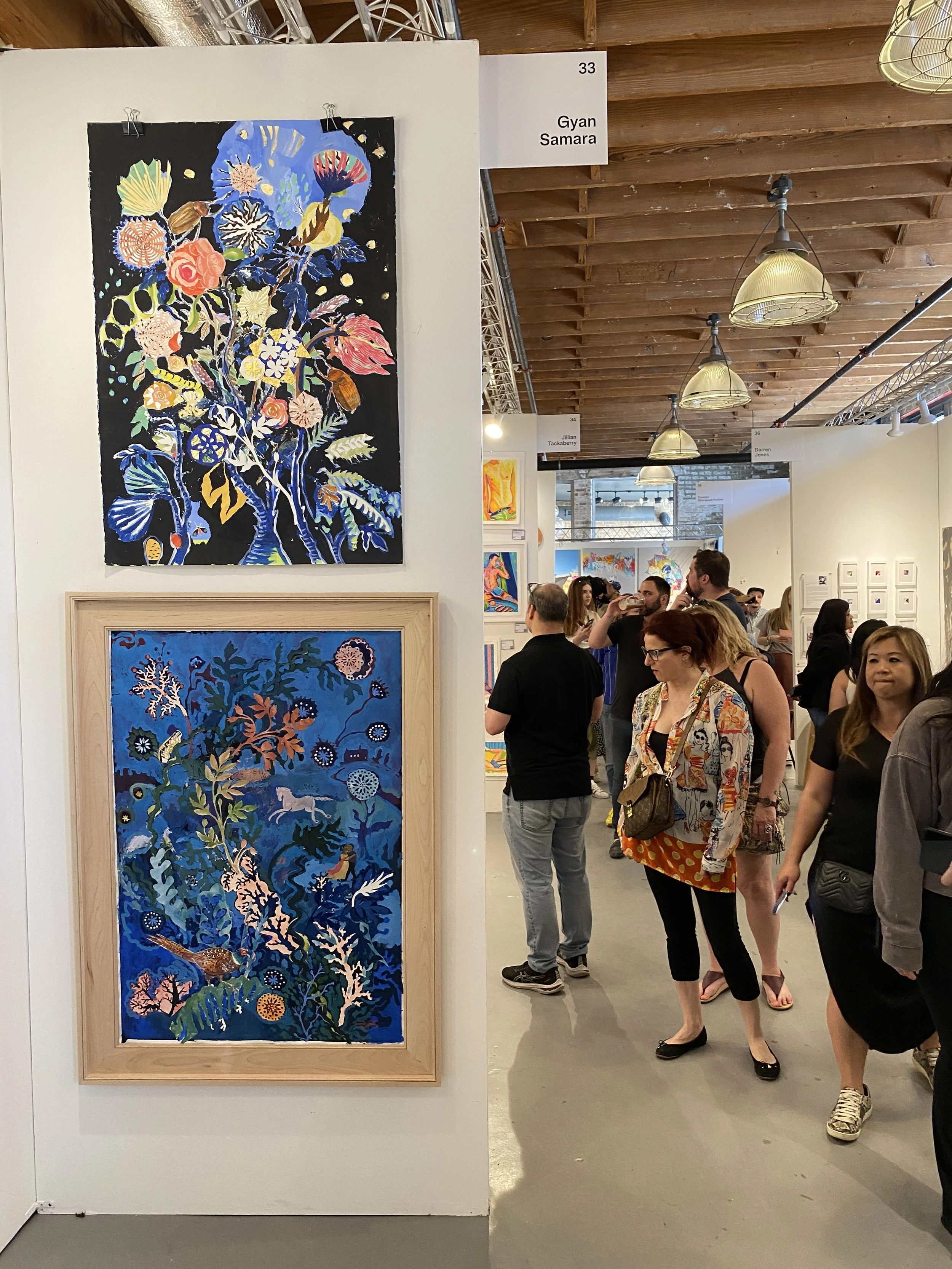
People look at the art for sale at the Other Art Fair in Chicago

Chicago is no stranger to art fairs. On one end, you have the Glenwood Avenue Arts Fest, a laidback neighborhood event where amateur artists and community creatives put their work out into the world. At the other end, there’s the Old Town Art Fair, where fine artists showcase classic styles in painting and photography, all with an air of prestige.

And then, right in that sweet spot in the middle, you’ve got the Other Art Fair — a vibrant, avant-garde showcase where emerging artists take bold creative swings, and the weird and the wonderful find a home.

In addition to Chicago, the Other Art Fair shows in Los Angeles, Brooklyn, Dallas, London, and Melbourne and Sydney, Australia.  

Two paintings, one of a creepy head with a gun in its mouth, and the other of a distorted mother and children at the Other Art Fair

Why Is It Called the Other Art Fair?

It’s all in the name. The Other Art Fair was designed to be, well, other — a counterpoint to the traditional art world, where established galleries and curators act as gatekeepers, deciding which artists get exposure and which ones don’t.

Founder Ryan Stanier saw this firsthand. “The concept was born from a realization of the disparity between a London audience eager to discover the next big thing and talented artists struggling to gain recognition,” he told Fad Magazine

Stanier wanted an alternative to a lot of conventional art fairs featuring artists represented by galleries. But the Other Art Fair removes those barriers. Here, artists apply directly, and if accepted, showcase and sell their work themselves — no gallery middleman needed.

But don’t mistake accessibility for a free-for-all.

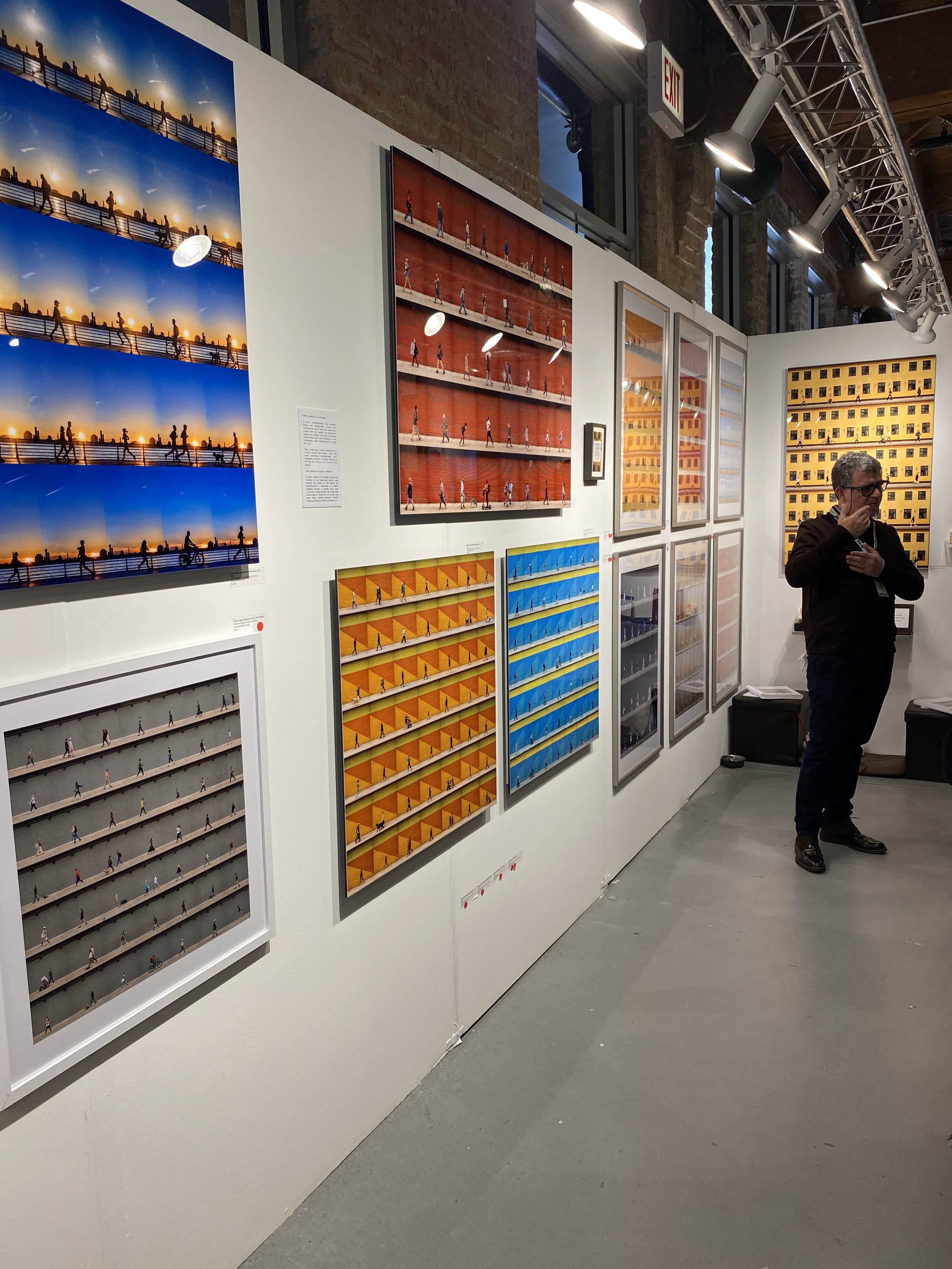
An artist stands by his photo collage works at the Other Art Fair in Chicago

How Do Artists Get Selected?

While the Other Art Fair prides itself on openness, not just anyone can exhibit. Every artist goes through a curated selection process to ensure that the work on display is fresh, compelling and high-quality.

A committee of art experts reviews applications, evaluating artists based on originality, technical skill and artistic voice. The goal isn’t to enforce a particular style — quite the opposite. The fair thrives on diversity, pulling together artists who push boundaries and bring something new to the table.

For emerging artists, this is a game-changer. Many traditional fairs require gallery representation, but here, artists get to engage with buyers directly, tell their own stories, and make sales on their own terms.

A mannequin with a sequined deer head by small bejeweled bunnies at the Other Art Fair in Chicago

The Vibe of the Other Art Fair

This isn’t your standard art fest. The Other Art Fair is a true experience. Every event is curated with immersive installations, interactive elements and a venue that sets the tone.

In Chicago, that means Artifact Events, a restored industrial space in Ravenswood that screams “effortlessly cool.” The exposed brick, the high ceilings, the perfect blend of grit and polish — it all adds to the magic.

“We’re challenging convention, breaking rules and bringing everyone along for the ride,” the Other Art Fair organizers declare on their website. “Here, art is for everyone.”

Who’s Showing?

The fair features a mix of painters, sculptors, photographers and mixed-media artists, all selected through that rigorous application process.

Yes, some artists don’t make the cut. But the goal isn’t exclusivity — it’s quality. Walking through the fair, you won’t feel like you’re seeing the same rehashed styles you’ve experienced a dozen times before. The fair is about discovery, surprise and bold creative voices.

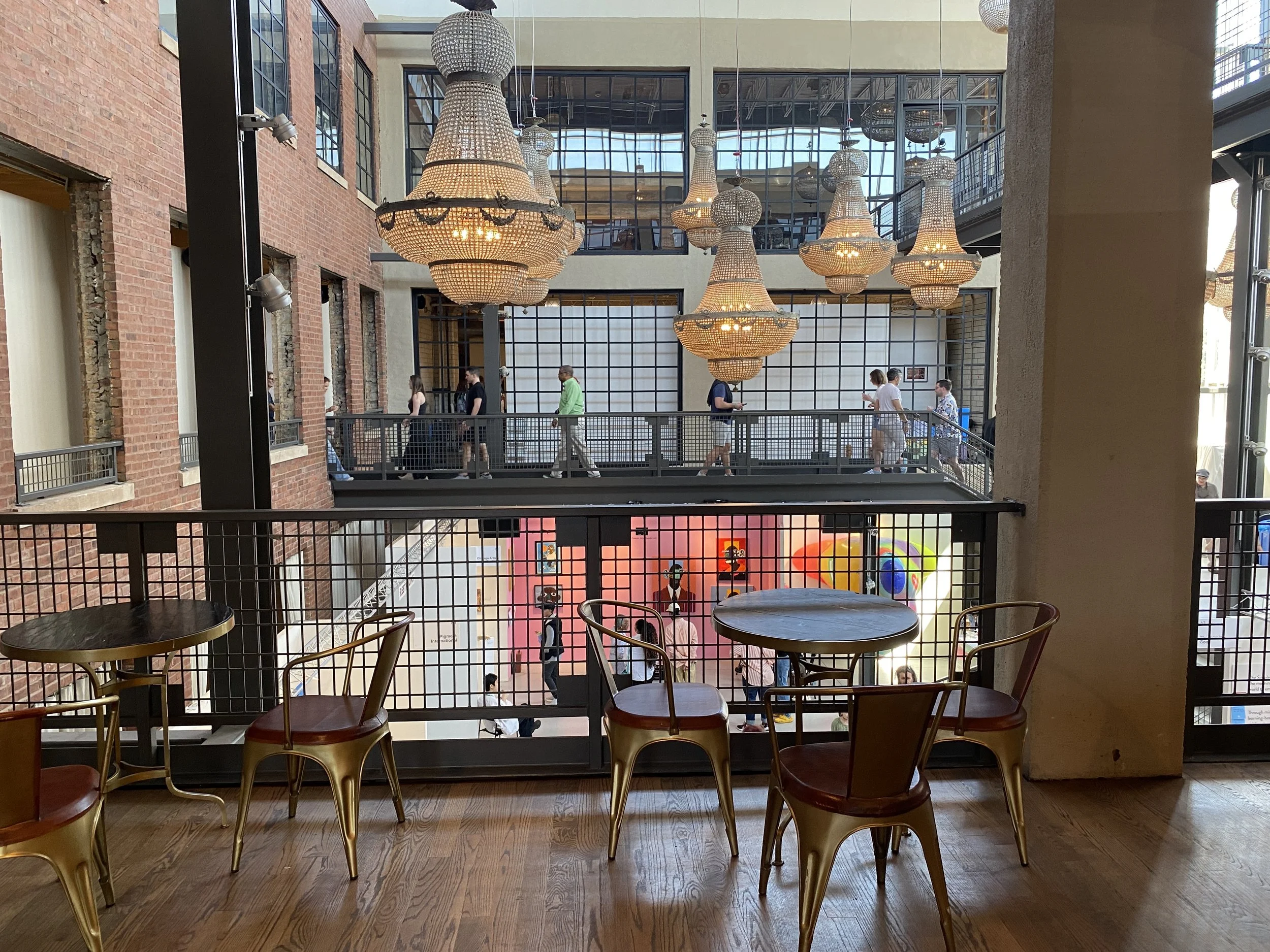
Tables, chairs and chandeliers in the bar area of Artifact Events during the Other Art Fair in Chicago

Beyond the Booths

Sure, the art is the main event, but the Other Art Fair also features live performances, interactive installations, maybe even a pop-up tattoo parlor (it’s happened before).

The courtyard at Artifact Events has food and drink stands, making it easy to grab a refreshment and process all the wild creativity around you. 

There’s also a cool bar upstairs, where you can have a booze-fueled discussion of your favorite pieces.

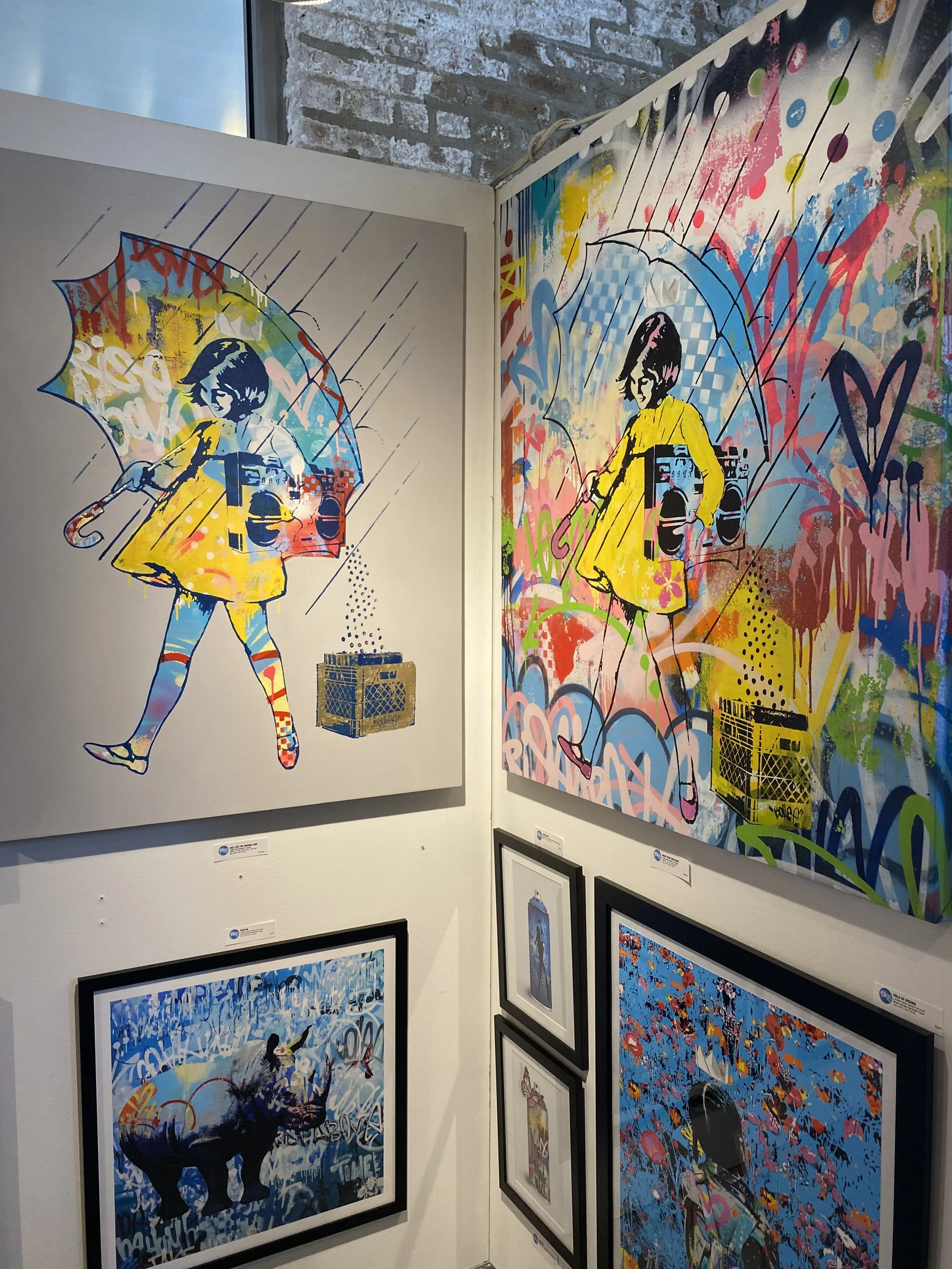
Paintings of the Morton Salt Girl for sale at the Other Art Fair in Chicago

Planning Your Visit to the Other Art Fair

Dates and Venue: The fair is scheduled for March 27 to 30, 2025, at Artifact Events, located in the Ravenswood neighborhood at 4325 North Ravenswood Avenue. 

Tickets: Opening night tickets are $40 to $45; other dates are $20 to $25. Keep an eye on their website for updates.

Transportation: There’s quite a bit of free street parking along Ravenswood Avenue. Public transit is a great option too, with the Montrose Brown Line, Ravenswood Metra station, and bus lines including the #9 Ashland, all nearby. 

Accessibility: The venue is fully accessible, featuring wide entrance doors, elevators to every level and ADA-compliant restrooms. Service dogs are welcome, and staff at the welcome desk will be available to assist as needed.

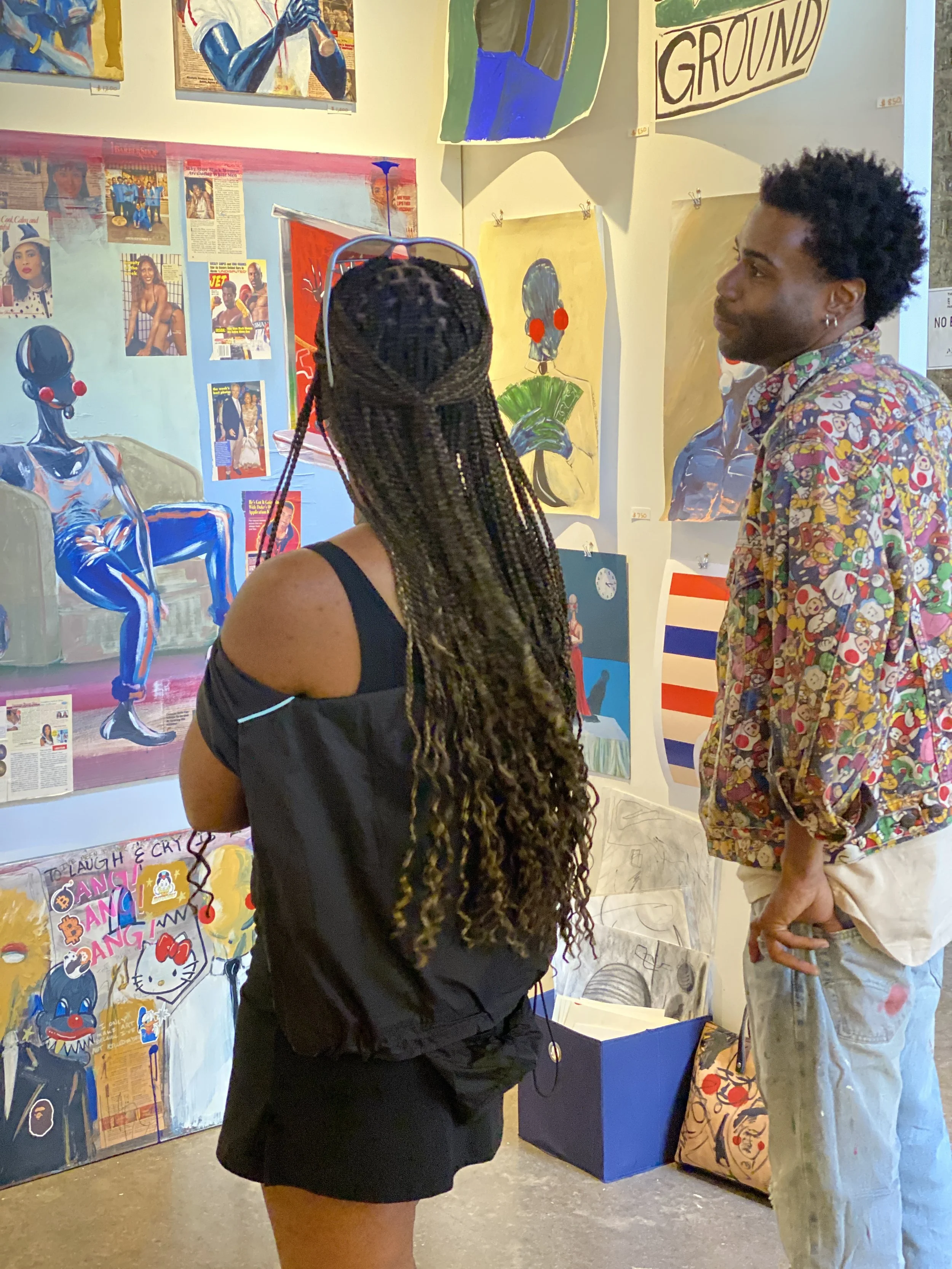
Two people look at paintings at the Other Art Fair in Chicago

Tips for Visitors

Plan ahead. Review the list of participating artists and special installations before you go. That way, you can prioritize what excites you most.

Don’t be shy — talk to the artists. They want to talk about their work. Ask questions, learn about their process, and maybe even take home a piece that means something to you.

Set a budget. The fair includes everything from affordable finds to higher-end collector pieces. Know your spending limit — and stay open to falling in love with something unexpected.

Respect the art. Unless an artist explicitly invites you to touch a piece, assume it’s hands-off. No one wants to be that person.

Ask before taking photos. Some artists are cool with pictures, some aren’t. Always get permission before snapping away.

Take in more than just the art. See what performances and workshops are on. And grab a cocktail at the stylish bar or a bite at the food court. 

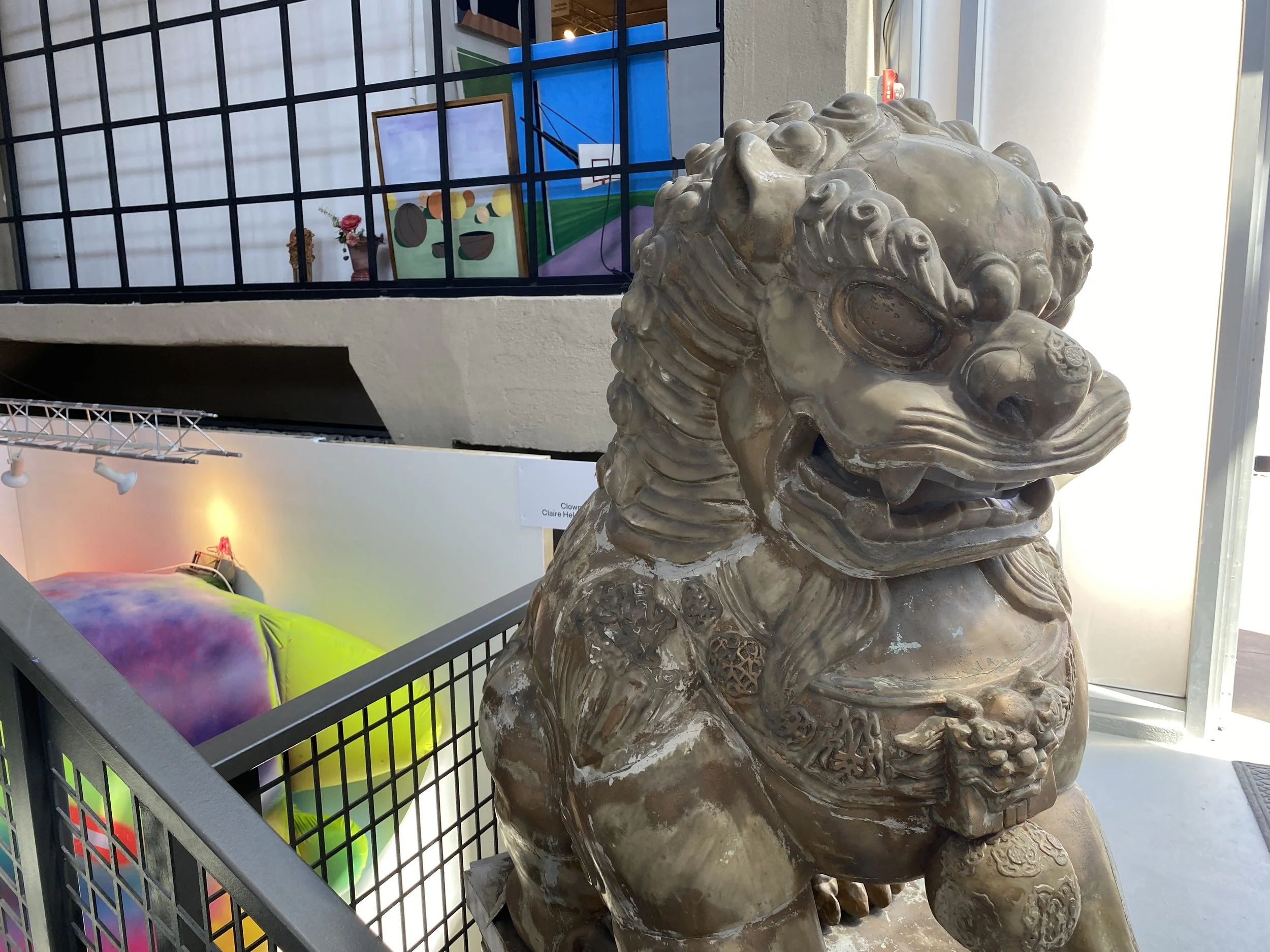
A fu dog at Artifact Events during the Other Art Fair in Chicago

There’s No Other Fair Like It

If you’re the kind of person who prefers an art fair with an edge, where discovery is the point, then the Other Art Fair is your scene.

I went in 2024, and I have to say: It’s probably the coolest art fair I’ve been to.

You can feel the Other Art Fair’s mission at every turn. It’s truly a showcase of edgy, unexpected and boundary-pushing creativity. 

Whether you’re a serious collector or just someone who appreciates creative expression, there’s something thrilling about stepping into a space where anything feels possible. –Wally

Saints and Social Change: A Q&A With Artist Laurie Buman

Discover how Laurie Buman’s art, heavily influenced by her travels in Mexico, shines a light on social issues through her captivating saint and botanical series.

Saint Monarca of the Milkweed, artwork featuring butterflies by Laurie Buman

Saint Monarca of the Milkweed

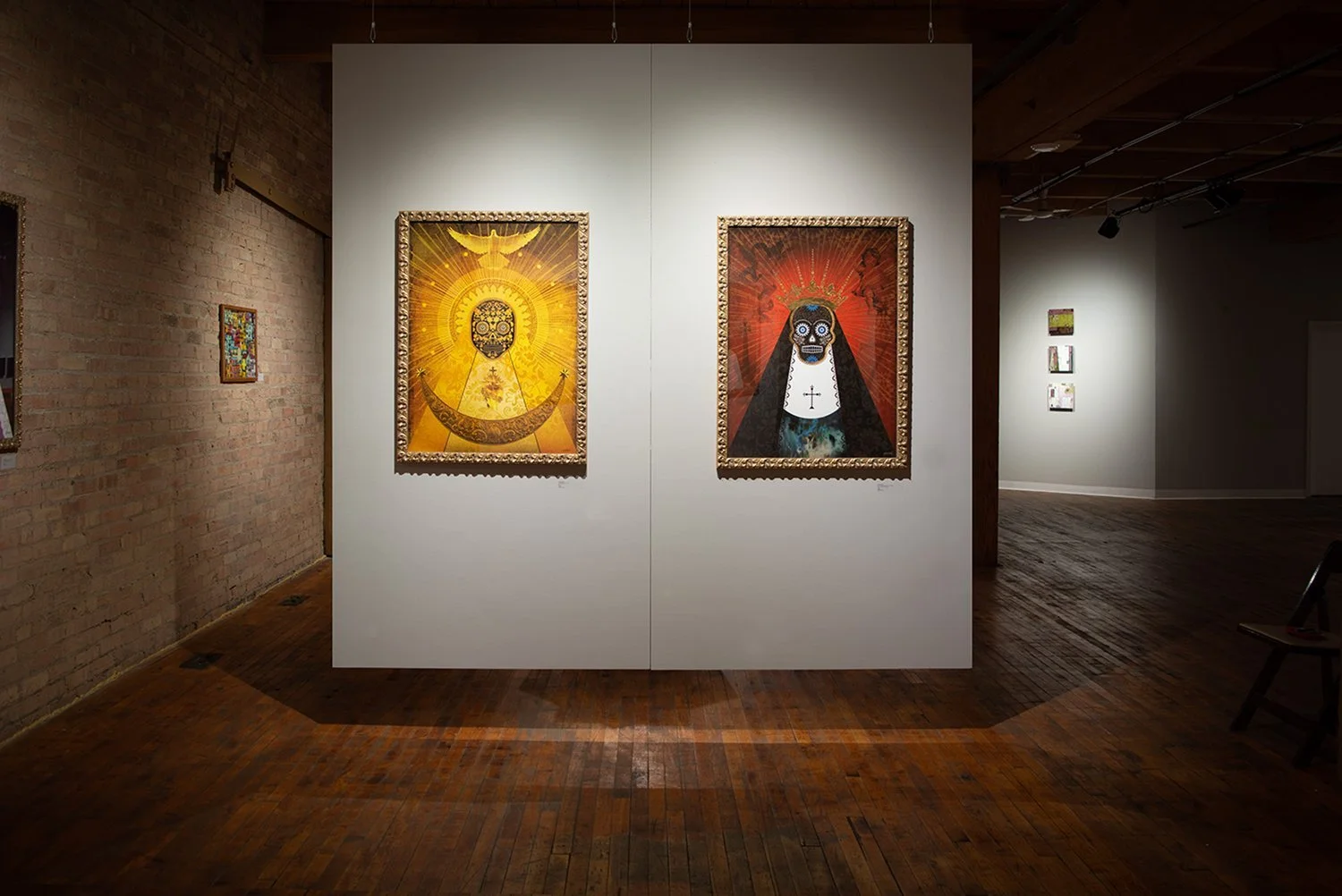
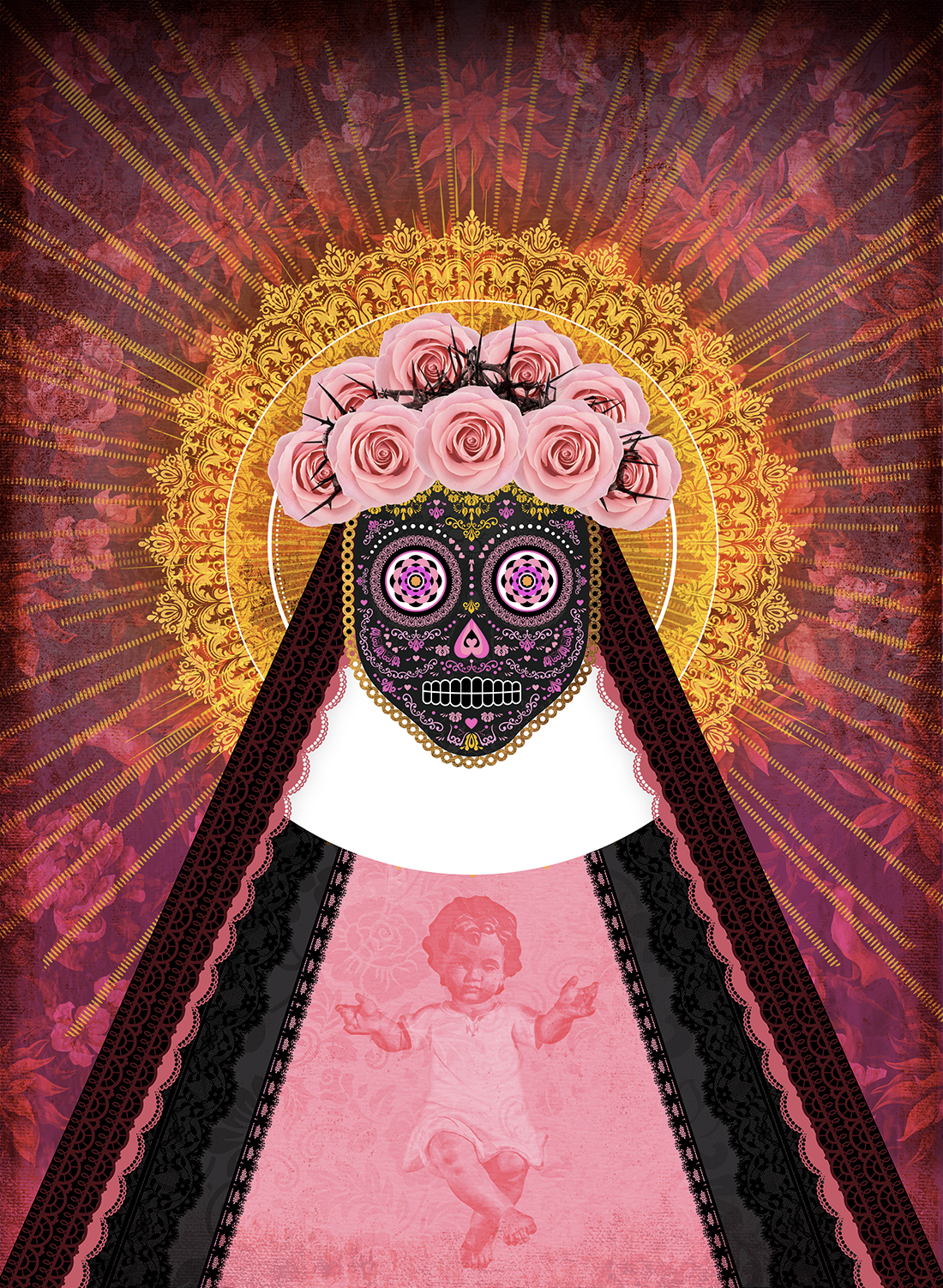
Duke and I popped into Everybody’s Coffee in our neighborhood of Uptown in Chicago — and were instantly captivated by the striking art gracing the walls. Laurie Buman’s works are a visual feast: wide-eyed saints with a hint of steampunk flair and Day of the Dead influences, each collage exuding a powerful spirituality. Among the holy figures were unique creations like a holy canine and the butterfly-infused Saint Monarca of the Milkweed, canonized straight from Buman’s imagination. We couldn’t help but be intrigued by the stories each piece told.

We reached out to Laurie a few months ago to learn more about her artwork and process. –Wally

Artist Laurie Buman

Let’s start from the beginning. What inspired you to become an artist and develop your style?

Since I was little, I knew I was an artist. I would draw from around 4 years old and always loved coloring and drawing. My parents noticed I had a natural ability to draw realistically, so they nurtured that talent. I received an art scholarship to the Milwaukee Institute of Art & Design and later finished my degree at the University of Milwaukee. Over the years, I took continuing education courses in design and art, earning a BFA [bachelor of fine arts degree]. I spent many years working as a designer full time, which consumed a lot of my time, but I’ve gradually increased the time I spend in my studio.

Day of the Dead type artwork of Saint Cabrini of the River by Laurie Buman

Saint Cabrini of the River

How does Mexico influence your art?

I’ve been traveling to Mexico since I was 17. My first trip was for Day of the Dead, and I was captivated by the landscape’s beauty and the culture. It’s very unlike Wisconsin, where I grew up. The people in Mexico are so welcoming and inviting, and their culture is rich in history, color and ritual. It draws you in. My art was influenced by these experiences, especially my Day of the Dead photography.

What are some of your favorite places in Mexico?

Oaxaca is very dear to my heart, with its intense culture and natural beauty. I also love Mexico City and Mérida. I’m excited to visit Chiapas in spring 2025, which has a rich indigenous culture.

Day of the Dead like artwork of Saint Catherine of Bologna the Artist's Muse by Laurie Buman

Can you tell us more about your saint series?

The series started with Saint Catherine of Bologna, an incorruptible saint whose body did not decompose. I channeled her and created my first saint piece, and the series grew from there. I've created pieces addressing social issues like femicide and mental illness, each piece becoming a shrine where people can put their thoughts and prayers. The process is therapeutic for me, as it allows me to bring light into the darkness.

What’s your artistic process like?

I spend months thinking about a particular saint. I do extensive research, layer images in Photoshop, and bring in original photography and found objects that add dimension and meaning. For example, I use rosaries and milagros in my pieces and top them with hand-applied gold leaf.

Day of the Dead type artwork of Saint Kateri Tekakwitha of the Indigenous by Laurie Buman

Saint Kateri Tekakwitha of the Indigenous

What other themes do you explore in your work?

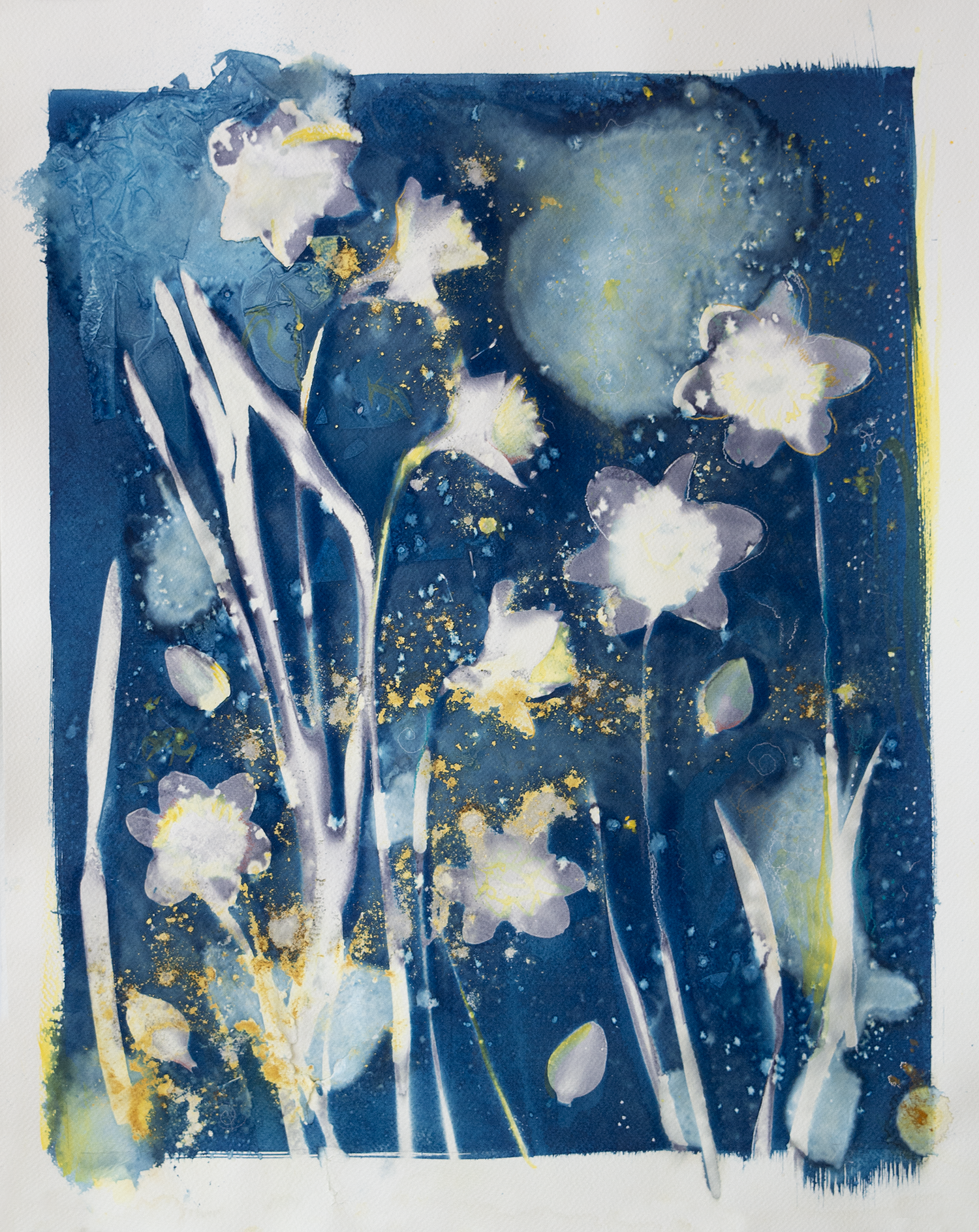
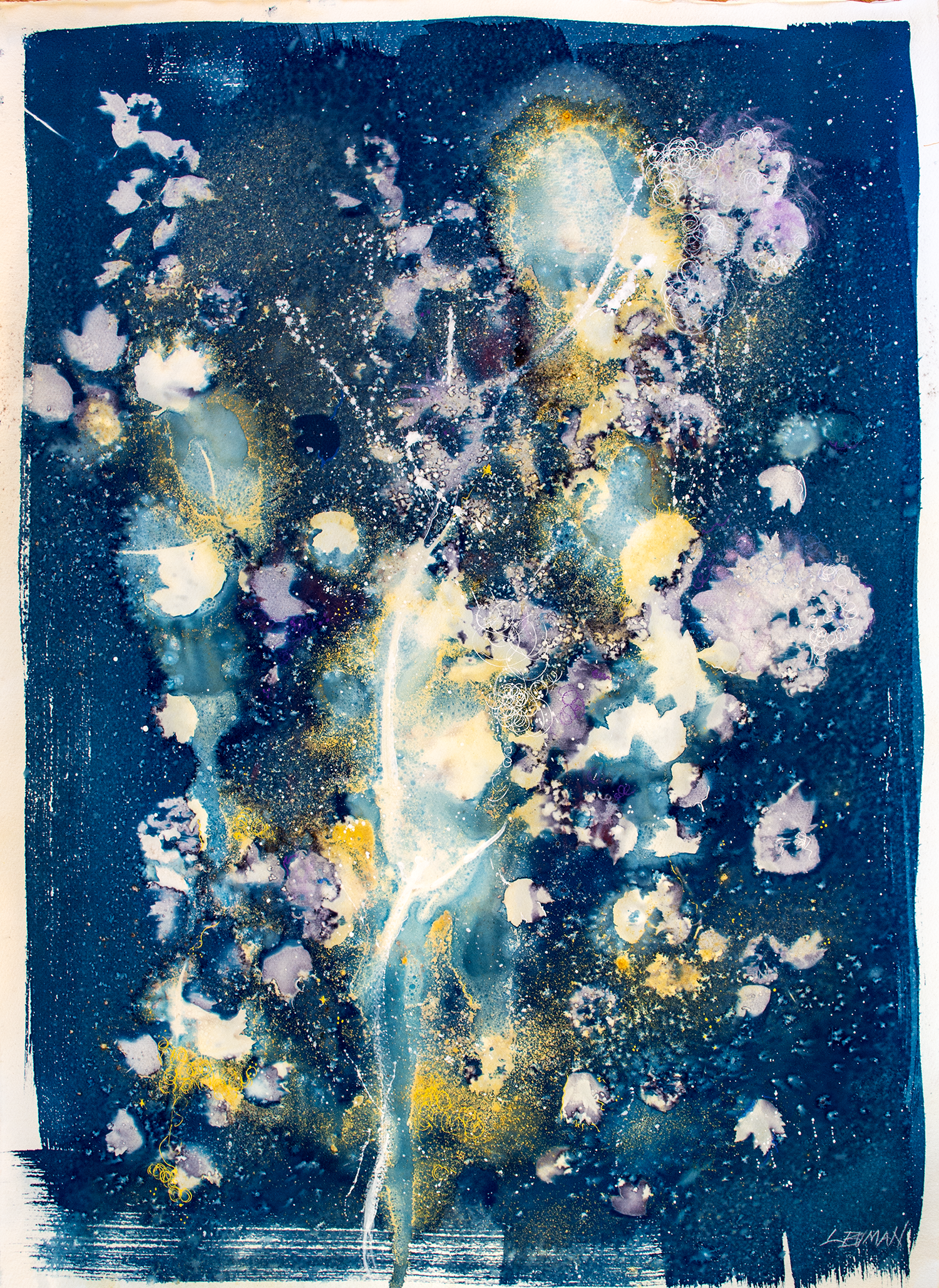
In the past two years, I’ve been focusing on the environment and global warming, creating pieces about monarch butterflies and bees. My latest work, Saint Kateri Tekakwitha, the first Native American saint, celebrates ecology. I’ve also been working on botanicals and cyanotypes, exploring themes of nature and spontaneity.

What are some of the biggest challenges you face as an artist, and how do you overcome them?

Keeping momentum can be challenging, especially when starting. Making connections and finding venues to show my work helps. Having a studio at the Bridgeport Art Center provides a monthly audience and a supportive community. It’s vital to share your work and feel inspired by those around you.

Tell us about 3rd Fridays at the Bridgeport Art Center.

All the resident artists open their studios, and there are galleries on the third and fourth floors. We always have a show or two going on. I have a small gallery called Galería Azul, where I feature a guest artist every two months.

Cyanotype artwork called Daffodils + Fireflies by Laurie Buman

Daffodils + Fireflies

How has your work evolved over the years?

As I’ve aged and grown more confident, my work has become more expressive. My experiences at the University of Chicago and the Bridgeport Arts Center have elevated my work and given me the confidence to be myself and share my ideas.

Cyanotype and spice artwork by Laurie Buman named Night Sky

Night Sky

What do you hope people take away from your art?

With my saint series, I hope people feel compassion towards the subject matter and think about social issues. With my botanical pieces, I want people to delight in spontaneous moments and appreciate the beauty of our world, realizing how precious our planet is.

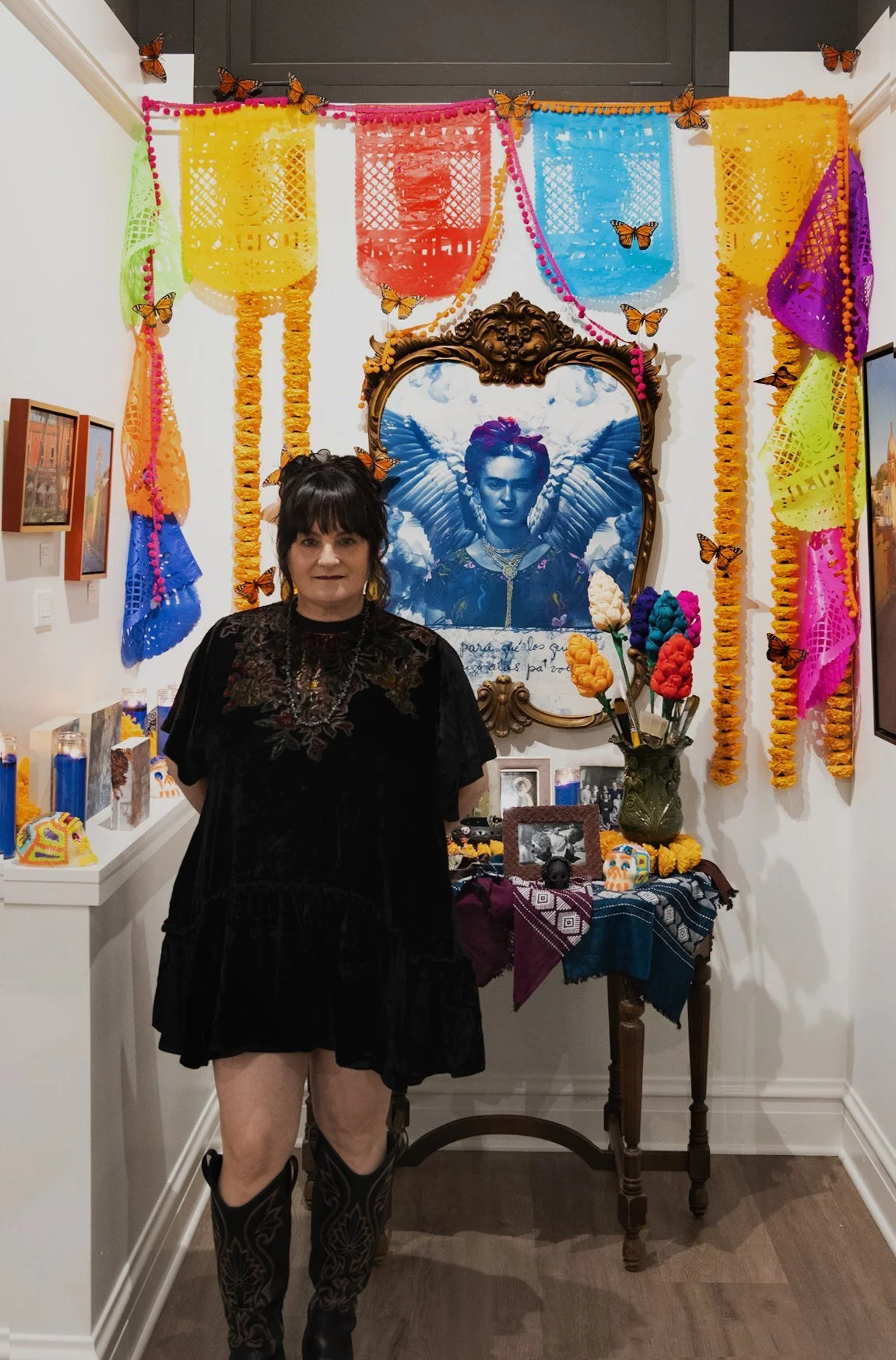
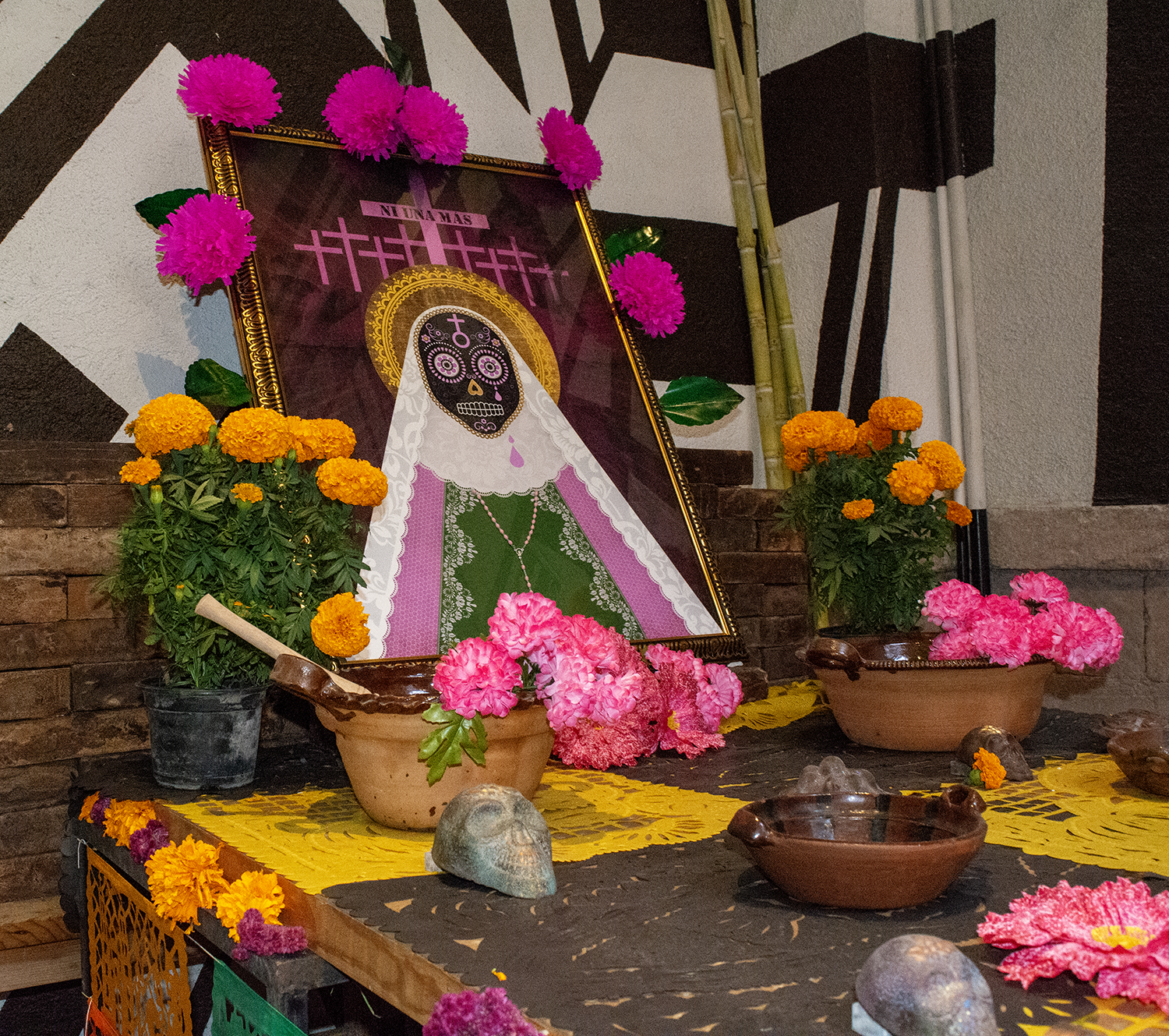
Laurie Buman's Day of the Dead ofrenda at the Chocolate Museum in Mexico City, featuring Saint Agatha of the Forgotten Daughters

A Day of the Dead ofrenda by Buman at the Chocolate Museum in Mexico City, featuring Saint Agatha of the Forgotten Daughters

Are there any upcoming projects or exhibitions you’re excited about?

Yes, I have a Day of the Dead show at the Patrician Gallery in Wilmette and a potential show in December at the Chocolate Museum in Mexico City. 

A mixed media work of art showing a pit bull as saint by Laurie Buman

Infant Saint Ben of the Pit Bulls

Is there a particular piece that holds significant personal meaning for you?

All my pieces are special, but Saint Ben of the Pit Bulls is very dear to me. I used to do pit bull rescue, and this piece commemorates a pit bull named Ben who had a significant impact on my life.

Day of the Dead type artwork named The Black Madonna of Light by Laurie Buman

The Black Madonna of Light

What legacy would you like to leave as an artist?

I hope to have brought attention to social issues, brought light into the world and added beauty. If people said I reminded them of Frida Kahlo, that would be a great honor.

Anything else you’d like to share?

Just that I’m grateful for this opportunity to share my story. I love connecting with others who share a passion for travel and culture.


Why Vitellius, the Little-Known Roman Emperor, Haunts Artistic Masterpieces

The legendary glutton pops up in numerous works of art throughout the centuries. Renowned classicist Mary Beard unravels the mysteries behind Vitellius’ ubiquitous appearances in artworks and sheds light on the significance of his portrayal. 

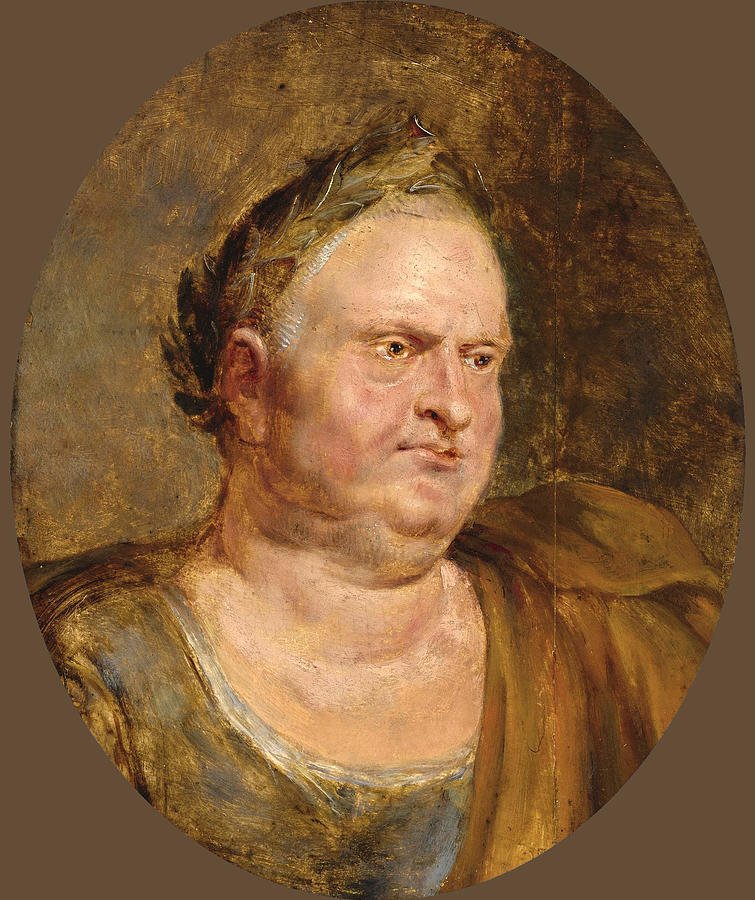
Painting of Emperor Vitellius wearing laurel crown

Most people nowadays aren’t familiar with Emperor Vitellius — but he was once well known as a depraved glutton.

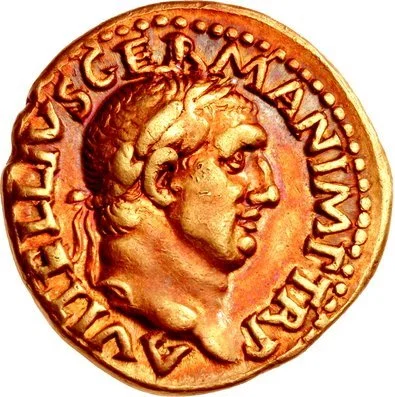
Chances are you’ve never heard of Emperor Vitellius — he ruled the Roman Empire for just eight months in 69 CE during the civil wars that followed the overthrow of Nero. 

But despite his brief reign, Vitellius left a lasting impression — though not necessarily a positive one. Of course, that’s nothing out of the ordinary when it comes to Roman emperors. 

Like many of his cohorts, Vitellius was known for his vices, particularly his gluttony. His signature dish, the Shield of the Goddess Minerva, was a concoction that included livers of pipefish, peacock brains, flamingo tongues and lamprey innards. Umm, I’ll pass, thanks. 

Not surprisingly, the adjective “Vitellian” was once commonly used to describe something that was over-the-top and outlandish.

In addition to his gluttony, Vitellius was reputed to be a sadist, quoted as having said, “The stench of a dead enemy is wonderful. The stench of a dead fellow citizen is even better.” 

Classicist Mary Beard in floral coat with long white hair, peeking between columns

Mary Beard, a famous classicist, and author of the new book Emperor of Rome: Ruling the Ancient Roman World

And “in his spare time, he was a sexual pervert,” quipped Mary Beard, one of the most renowned classics scholars and author of the book SPQR, during a lecture at the Art Institute of Chicago. 

Beard didn’t get into it, but let’s just say Tiberius gave Vitellius the nickname Tight Ass — and it had nothing to do with being stingy. 

The Feast in the House of Levi by Paul Veronese, 1573

The painting has not one but two figures modeled after Emperor Vitellius!

Vitellius: The Where’s Waldo of the Ancient World

Despite his lackluster reputation, Vitellius’ image has been copied, reinvented and reincorporated into Western art for centuries. Beard explored the significance of this often-overlooked figure and why he continues to pop up in art even today.

Take, for example, Paul Veronese’s painting The Feast in the House of Levi from 1573. Painted in Venice for a religious order, it was originally intended to depict the Last Supper. But when the Inquisition objected to this representation because it included animals, a jester, Germans and a server with a bloody face, Veronese changed its name to another feast from the Bible.

Beard pointed out a figure in the painting who’s gazing across at Jesus, utterly transfixed. It’s none other than Vitellius. So what’s he doing in there? 

It’s revealing a major coup for Christ. “Here, Jesus is converting one of the most despicable, immoral Roman emperors ever,” she explained. 

But, strangely enough, that’s not the only Vitellius in the artwork. His face also shows up as a server. “This is a clever spin on Vitellius’ gluttony because here we see one of Rome’s biggest overconsumers being turned into a server himself,” Beard said. 

A debauched scene depicted in Thomas Couture's painting The Romans in Their Decadence

If you want to show depravity, as Thomas Couture did in his 1847 work The Romans in Their Decadence, you need look no further than Emperor Vitellius, whose face can be found below the topless woman on the left.

In Thomas Couture’s painting The Romans in Their Decadence (nicknamed The Orgy) from 1847, Vitellius creeps up again. He’s shown in the midst of a pile of drunken revelers, so comatose he doesn’t even notice the naked woman near him.

An American magazine declared this work “the greatest sermon in paint ever rendered,” Beard told us. It was even suggested that a reproduction of it should be displayed prominently in every school in the United States — naked woman and all.

The canvas is filled with sprawling, drunken revelers in various states of undress. While it’s showing a graphic depiction of Ancient Rome’s moral decline, there was also a contemporary message to it: People viewed it as an attack on the disparities of wealth in France at the time and the blatant immorality of the bourgeoisie.

Vitellius dragged through the streets of Rome, Georges Rochegrosse (1883)

Vitellius Dragged Through the Streets of Rome by Georges Rochegrosse, 1883

The emperor ruled only briefly, and met a gruesome end — beaten, impaled on a hook and thrown into the Tiber River.

“If you knew what happened to Vitellius at the very end, when he’d lost power — dragged through the streets, tortured, beaten to death, impaled on a hook and thrown into the Tiber — if you knew that, I think you’d see in this figure a strong hint that this scene of debauchery and the modern lifestyle it evoked was doomed,” Beard said. “A very nasty punishment was around the corner.”

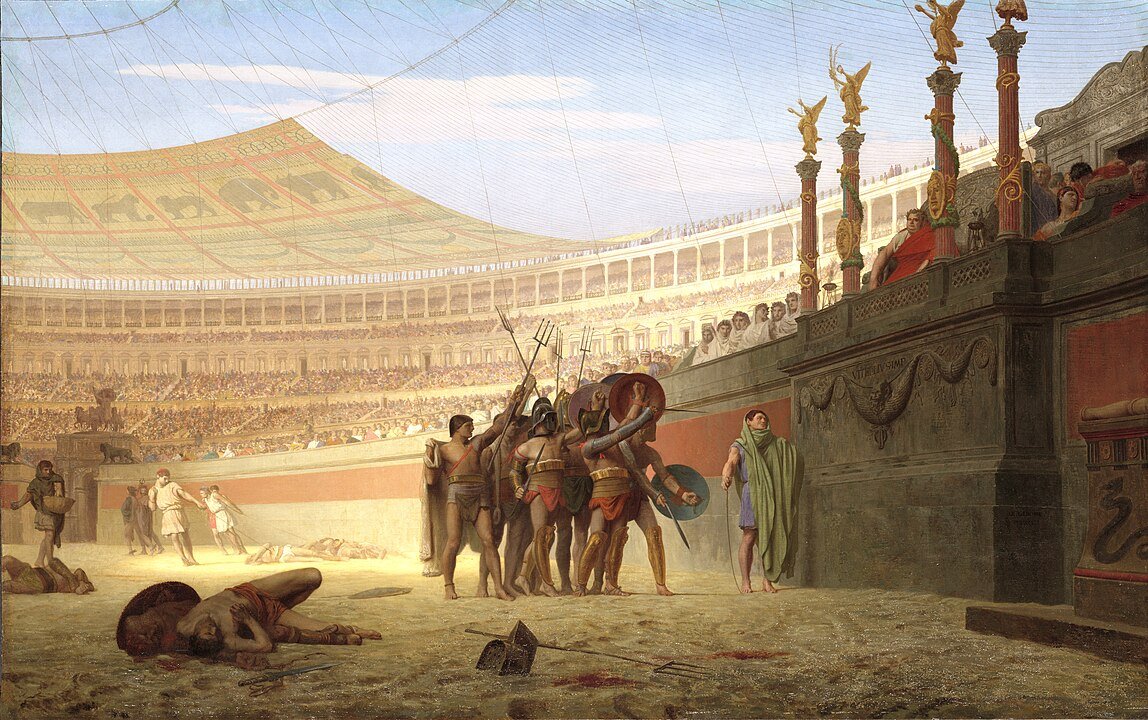
Painting of a gladiatorial match originally known as Hail, Caesar! We Who Are About to Die Salute You by Jean-Leon Gerome

This painting, by Jean-Léon Gérôme, was once known as Hail, Caesar! We Who Are About to Die Salute You — until it was spotted that the emperor was actually Vitellius.

And there’s Jean-Léon Gérôme’s 19th century painting of the gladiatorial games — a representation that’s said to have inspired director Ridley Scott’s Gladiator. It’s a painting known as Hail, Caesar! We Who Are About to Die Salute You. But if you zoom in on the emperor, it’s — sure enough — none other than Vitellius. There’s no doubt; it’s even got his name painted below him. 

The title changed to Gladiators Before Vitellius. “Now, learned pedants, of which I know there are some in the audience, may have spotted a historical problem here,” Beard said, “which is this is clearly in the Coliseum, but the Coliseum wasn’t yet built by the reign of Vitellius.”

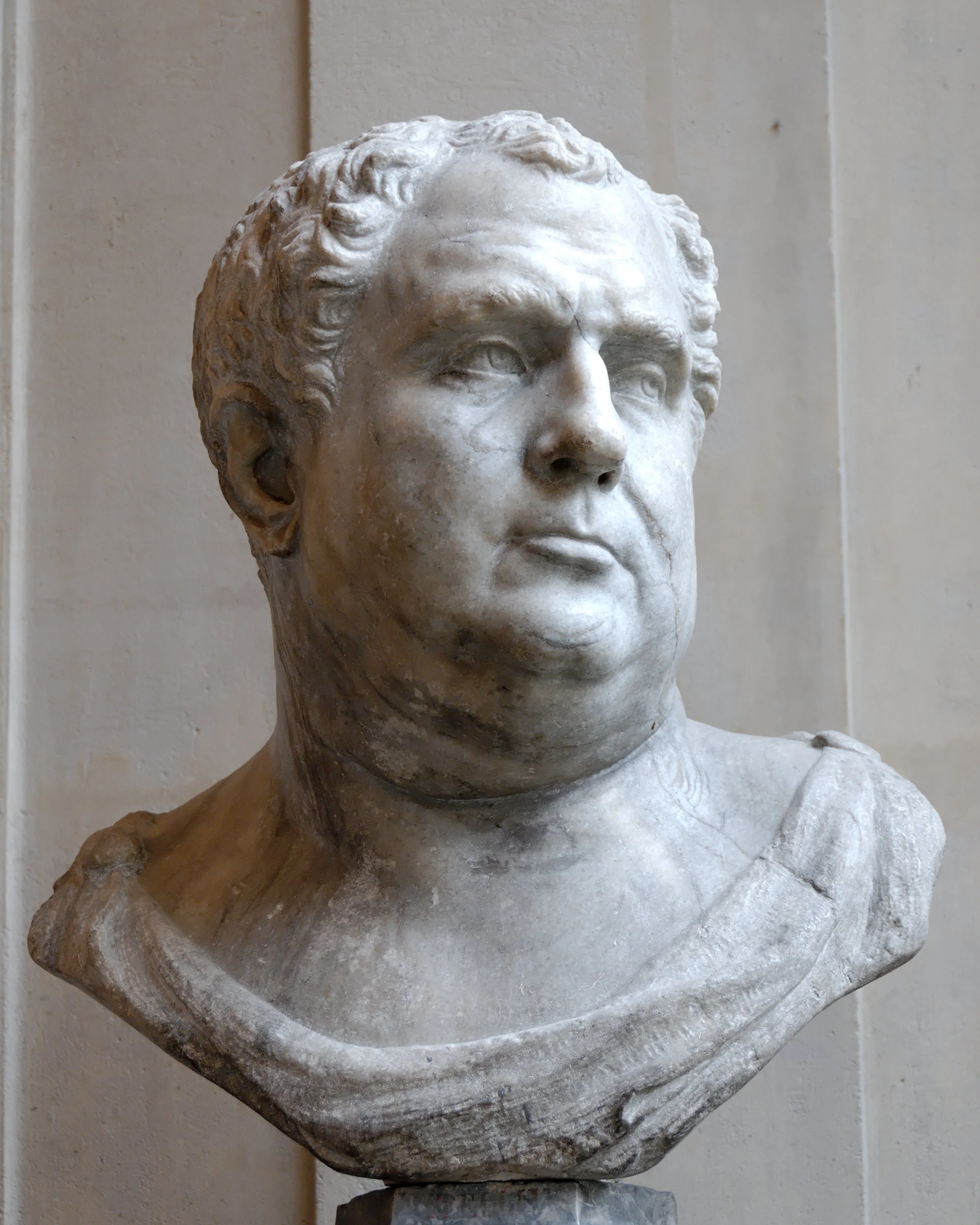
The Grimani Vitellius, a bust of the corpulent emperor

The legendary Grimani Vitellius, which pops up in numerous paintings, has a shocking secret.

Busted! The Grimani Vitellius

So why does Vitellius keep showing up in artworks? 

For the most part, we can thank a bust that’s become known as the Grimani Vitellius.  

This famous ancient image of Vitellius was excavated in Rome in the early 16th century under the direction of Cardinal Domenico Grimani and was bequeathed by him to the city of Venice upon his death in 1523.

“Now, I am by no means the first to spot how ubiquitous the Grimani Vitellius is,” Beard continued. But what was the significance? “Why copy this image of Vitellius? What extra does it bring to your painting if you include him? What ideological or moral register is at work?”

The Grimani Vitellius bust became the perfect symbol of an amoral glutton — which is why it has been copied hundreds of times from the 15th century on.

Painting of Boy Drawing Before the Bust of a Roman Emperor by Michael Sweerts

Boy Drawing Before the Bust of a Roman Emperor by Michael Sweerts, circa 1660

The bust itself even appears in paintings, such as Boy Drawing Before the Bust of a Roman Emperor by Michael Sweerts, from the mid-1600s.

“You can say this is just a convenient visual source to copy,” Beard said. “But I think you miss a lot if you don’t also think `Vitellius.’ When people use recognizable faces in paintings, they usually do it for a reason. And they expect you to recognize it.”

There could be a darker intent in this work, Beard suggested. “Anyone who knew anything would surely have said, Why on Earth did they put this little innocent lad to draw that sexually perverted monster — even if he is the acme of the craft of sculpture. And I can’t help thinking … there are bigger questions about the potentially corrupting force of art.”

But that fat fuck is having the last laugh. The Grimani Vitellius isn’t even a portrait of Vitellius! Technical details, such as the way the eyes have been drilled, make it clear that it dates from the 2nd century and cannot possibly be Vitellius. 

The bust, also known as the Pseudo-Vitellius, actually depicts an unknown Roman probably from the 120s or 130s CE who, by coincidence, was unfortunate enough to look very much like the coin portrait of the emperor. 

Roman gold coin depicting Emperor Vitellius

A gold coin depicting Vitellius. The emperor’s depiction is what led to the mislabeling of the Pseudo-Vitellius bust.

Emperor Vitellius: The Art World’s Fascination With an Infamous Ruler

It’s fascinating to think that this bust, which was not even of Vitellius, spread like wildfire and has had such a lasting impact in art. 

So the next time you’re wandering through an art gallery or museum, keep an eye out for Vitellius. Thanks to Beard, I predict he’ll have a comeback. –Wally

3 Chicago Muralists Share Their Secrets

How is a mural made? That was the idea behind a recent exhibit at the Chicago Cultural Center. We did a Q&A with each of the featured artists: Cecilia Beaven, Miguel A. Del Real and Anna Murphy. 

Duke and I have always appreciated murals, but didn’t know a whole lot about what went into their creation. Are they gridded out? Are they done freehand? Do they use spray paint? Or are all these things, as I imagine, dependent upon the artist?

That’s why it was so cool to visit the Chicago Cultural Center and see Exquisite Canvas: Mural Takeover, an onsite installation sponsored by the Department of Cultural Affairs and featuring the talent of three local artists: Cecilia Beaven, Miguel A. Del Real and Anna Murphy. The experiential exhibit was held on the first floor galleries and invited visitors to meet the artists and watch their progress as they completed their works. (The exhibit ran from June 10, 2023 and closed on September 3).

Miguel A Del Real paints his mural of Aztec jaguar at an exhibit at the Chicago Cultural Center

Part of the idea behind Exquisite Canvas at the Chicago Cultural Center was to show the artists’ process of creating their murals.

Pro tip: In our opinion, you have a better chance of seeing an impressive art exhibit at the Cultural Center, which is free, versus the often disappointing and even laughable works displayed at the Museum of Contemporary Art.

The first room of the exhibit had a brightly colored geometric mural titled Perspectiva Perpetua by Miguel, who has a tattoo and calligraphy background. It depicted a man in the middle, staring intently ahead, with an Aztec jaguar on one side and a woman in profile with her eyes closed and her head tilted upwards on other other. Miguel was working on his mural the day we visited. It was pretty cool to have the opportunity to chat with him briefly. 

Perspectiva Perpetua, a mural with a man, woman and jaguar by Miguel A. Del Real at the Chicago Cultural Center

Miguel A. Del Real working on Perspectiva Perpetua

We admired his mural as well as the other two by Cecilia and Anna. Cecilia’s piece, Moon Bloom, references tenangos, a colorful style of embroidery that originated in the Tenango de Doria municipality in the Mexican state of Hidalgo.

Moon Bloom, a mural of dancing humans and animal-headed people and plants, by Cecilia Beaven at the Chicago Cultural Center

Moon Bloom by Cecilia Beaven

Anna’s concept, Awakening, featured a resting tiger,  symbolizing the inner strength in each of us. She’s known for her photorealistic style and use of blue and gold paint.

Awakening, a blue and gold mural showing a lying tiger and flowers, by Anna Murphy at the Chicago Cultural Center

Awakening by Anna Murphy

Seeing Miguel at work gave us a glimpse into the making of a mural, but we still had a lot of questions. So we decided to reach out to the artists to learn more. 

Fortunately, all three took the time to answer our questions, and their Q&As provided a fascinating glimpse into their creative process. –Wally

Artist Cecilia Beaven in front of one of her murals

Cecilia Beaven

How did you get into art?

I remember drawing since I remember being myself. Creating images has always been an activity that fascinates me and it’s my favorite form of communication or expression. I started taking art classes when I was a kid, and I started doing art more professionally right after highschool when I went to art college.

Artwork by Cecilia Beaven showing pink and green flowers and female figures

How do you get your ideas for murals? What subjects do you cover?

I explore mythology through a very playful lens that allows for experimentation and speculation. I draw from Aztec and other Mesoamerican stories and combine their archetypal elements with fiction in a seamless way. I also include a self-representative character that inhabits these narratives and allows for reflection on my place in the making of culture and participation in it.

Which character is that?

The character that represents me is the woman figure with a big nose and short hair that you can see in a lot of my pieces.

Are they entirely planned out in advance?

They usually are. I do lots of sketches, color tests, and planning ahead of time, so when I’m on site creating a mural I know what steps to follow. There are a few decisions that get modified once I’m in front of the actual wall, but not many.

Artist Cecilia Beaven in front of a floral mural she painted at the restaurant Esme

Do you draw them out on the wall?

Yes. The sketching technique depends on the project, resources available, and time limitations. Sometimes I work traditionally and follow a grid, sometimes I project my sketch, and sometimes I just freehand recreate my sketch.

Tell us more about your technique and the process of creating your murals.

I create a loose sketch on a sketchbook using non-photo blue pencil. Once I like where it's going, I ink it. Then I scan my drawing and get rid of the blue. I use photoshop to do color tests and once I’m happy with the color palette, I print it. I then mix paints that match my tones. 

On the mural site, I recreate my sketch on the wall (using a grid, freehand, or with a projector, depending on the project) and then start to apply my colors from the background to the foreground.

How long does it typically take to create a mural?

The time depends on the size of the wall and how detailed it is. But I work pretty fast, so I’ve completed small murals in one day and the largest ones in two or three weeks. 

Artwork by Cecilia Beaven showing drooling yellow snails with psychedelic shells with a puking dead woman between them

How would you describe your style?

Playful, cartoony, absurd, mythological, self-reflective, bold.

What’s your favorite part about creating a mural?

I love using my whole body to create an image, to see something as big as me, or bigger, take shape as I move my body. I also love being on ladders, scaffoldings, and lifts. And I enjoy the mindset that creating a mural puts me in, I feel calm and focused.

What is your least favorite part?

Painting the lower part of the walls that require bending, kneeling or even lying down on the floor.

What message do you want people to get from your murals?

Ideally, I want people to experience happiness and a sense of hope.

ceciliabeaven.com

Instagram: @samuraiceci


Miguel A. Del Real

How did you get into art?

It wasn’t until second or third grade. I was trying to replicate the Ninja Turtles, and I think that’s what really got me into drawing. And then around seventh or eighth grade and throughout high school, I got into doing graffiti letters. 

I stopped for a little bit when I went to Northern Illinois University, but then I came back into the city and started hanging out with old friends. And I started getting back into the arts, like with graffiti murals. 

I would say that’s what helped develop me as an artist, those years doing experimental work — that’s what led me to be taken a little bit more seriously as a professional artist. 

Mural by Miguel A Del Real showing Mesoamerican woman holding a bird, with sun shining through the trees and a white house behind it

How do you get your ideas for murals? What subjects do you cover?

That’s tough. You do want to be respectful to where you’re painting, And I feel like that approach is what has helped shape some of the ideas or concepts. 

These past couple years, I’ve been experimenting more with the sense of consciousness. I don’t want to say spirituality or anything like that. But it’s just been more like depicting dreams, combining some abstract elements with figurative elements, patterns, heavy line work. 

A mural by Miguel A Del Real of purple and blue swirls under green overpass with bikes in front

Are they entirely planned out in advance?

I like to leave some breathing room. So I would say, when it’s a job that really requires that they’re more hands-on, they want everything planned out.

This particular one that the cultural center, they allowed a lot of flexibility, where I just gave them a rough sketch. And then out of that, I was able to change it and add things as I went, inspired by the space. 

Do you draw them out on the wall? Tell us about your technique and the process of creating your murals.

I just start sketching. Like at the cultural center, I sketched it with pencil. They wanted it with a brush — I couldn’t use any aerosol. Then you start blocking out sections with paint and color, and then you move on to details. 

When it’s a mural outside, I can use spray paint and I start sketching with the paint itself, just blocking in shapes. 

Blue and purple mural by Miguel A. Del Real with woman in the middle, wearing floral headress and top, glasses and holding a red bowl

How long does it typically take to create a mural?

As fast as two and a half weeks to a month and a half.

How would you describe your style?

With my background in graffiti lettering, I use the chisel qualities of a brush, from thick to thin, combined with sacred geometry with shapes like circles, squares, triangles. 

What’s your favorite part about creating a mural?

It’s definitely the painting. Once you have the sketch done, the coloring of it — even though that’s where I struggle the most, where I go back and forth with colors. This is when it really starts coming to life. 

Mural by Miguel A Del Real of green woman with an open head and a monarch butterfly perched behind her

What is your least favorite part?

The sketching, because everything needs to be locked in precisely. So if something looks wrong, then that throws off the whole mural — everything needs to be mathematically divided. 

What message do you want people to get from your murals?

The common theme that I have, regardless of the different institutions and corporations that I’ve painted for, it’s always the message of transformation, evolving. Man fusing with spirit or nature.

delrealink.com

Instagram: @delrealink


Artist Anna Murphy paints a blue and white floral mural

Anna Murphy

How did you get into art?

I received a BFA in painting from the University of Louisville in 2011. After many years creating fine art oil paintings on canvas, I painted my first mural in 2018, and fell in love with the large scale and community aspect of public art.

Blue and gold mural by Anna Murphy, with woman in elaborate headdress, with a fox on one side and tiger on the other, as cherubs and bees fly about

How do you get your ideas for murals? What subjects do you cover?

The central themes of my work include celebrating nature’s wondrous beauty and the divine connection we share with one another, Mother Earth and the animal kingdom. My spirituality is the driving force of my life and my art.

Are they entirely planned out in advance? Do you draw them out on the wall? 

Yes, I design the layout in PhotoShop, then project a line drawing of my design onto the wall. With a small paintbrush, I paint the outline of the design onto the wall.

Blue profile of woman with flowers, bees and cherub against gold bricks by Anna Murphy

How would you describe your style? 

With a traditional painting background, I merge the worlds of fine art and street art by bringing an emphasis on intricate detail into my large-scale public murals.

Tell us about your technique and the process of creating your murals. 

Hand-painted with brushes, my painting style uses a process similar to watercolor, building up thin layers of washes to create depth, texture and a lifelike quality.

Detail of blue mural by Anna Murphy showing a nude woman bending over a bit and covering herself, with bikes and city street in distance

What’s your favorite part about creating a mural?

Knowing that it will bring joy and inspiration to those who see it, for years to come.

What is your least favorite part?

Spiders.

Mural by Anna Murphy on the corner of Soho House in Chicago of sleeping blue tiger with bee, butterfly and cherub and gold background

What message do you want people to get from your murals?

The metallic gold background reflects our own divinity and the sacredness of life. The cobalt blue, a symbol of Earth, like Heaven and Earth together, this combination portrays the connection between the human and the divine. The cherubs are also a symbol of our connection to the divine, and guardians of our pure and spiritual nature. The bees act as a symbol of a higher frequency, community and a connection to all things. The flowers and plants, a symbol of Mother Nature’s beauty, represent a paradise that can also be found within.

annapmurphy.com

Instagram: @annapmurphy


Chicago Cultural Center 

78 East Washington Street
Chicago, Illinois
USA

Artistic Depictions of the Virgin Mary: The Surprising Origins of Marian Iconography

The enigmatic allure of the Virgin Mary: From divine purity to unsettling symbolism, we explore the captivating myths and enduring appeal of the original Madonna. 

Closeup of the face of a statue of the Virgin Mary with tears

The Virgin Mary takes many guises in art over the centuries, from Queen of Heaven to the Sorrowful Mother whose tears have miraculous properities.

In art, God is often portrayed as an ancient, white-bearded man in flowing robes, a benevolent figure who watches over humanity from on high. Jesus, meanwhile, is typically depicted in various key moments from his life, such as his birth, crucifixion and resurrection. He walks on water and performs other miracles and has his Last Supper. 

But the Virgin Mary is a complex and enigmatic figure who wears many guises. Often cloaked in modesty, she’s seen as a symbol of hope, love and sacrifice. She’s portrayed as the ultimate role model for Christian women, the daughter of God, the bride of her own son and a regal queen. Her story is a richly woven tapestry of myths and symbols, each thread imbued with meanings that have been interpreted in countless ways throughout history.

As we delve into the realm of religious art and symbolism, we find her as a fertility goddess known as the Black Madonna, along with a loving mother whose tears and breast milk have magical healing powers. Amid the varied representations through the centuries, one thing remains certain: Mary’s enduring appeal as a divine figure. 

Mary, Queen of Heaven by the Master of the Saint Lucy Legend, showing the Virgin Mary surrounded by colorful angels

Mary, Queen of Heaven by the Master of the Saint Lucy Legend, circa 1495

Maria Regina: Queen of Heaven

Mary, the paragon of purity, couldn’t be left to rot in the grave like a mere mortal. So, the early Church fathers devised a bold solution: They declared that she had been taken up to Heaven in an event known as the Assumption, where she now reigns as a celestial queen. 

Popes viewed the Virgin Mary as a powerful propaganda tool. With their ties to the Queen of Heaven, they could legitimize their authority on earth and cemented the strong tie between Mary and Catholicism, centered in Rome: “The more the papacy gained control of the city, the more veneration of the mother of the emperor in heaven, by whose right the Church ruled, increased,” explains Marina Warner in her 1976 book Alone of All Her Sex: The Myth and the Cult of the Virgin Mary

The Coronation of the Virgin by Diego Velázquez, showing Mary being crowned in the clouds by Jesus and God, with cherubs below

The Coronation of the Virgin by Diego Velázquez, 1636

John VII was the first pope to have himself painted in prostration at the feet of the Virgin, in the basilica of Santa Maria in Trastevere in Rome. 

Icon of Virgin Mary as Maria Regina, Queen of Heaven, with angels, baby Jesus and Pope John VII prostrating himself from the church of Santa Maria in Trastevere in Rome

Madonna della Clemenza icon from the church of Santa Maria in Trastevere in Rome, 8th century. It’s the first to show a pope, John VII, prostrating himself at her feet (though it’s hard to make out now).

The coronation of Mary was first depicted in the 12th century, from an apse mosaic at Santa Maria to niches of French cathedrals, and became a favorite theme of Christendom. Christ is shown crowning his mother, switching the moment of her triumph from the Incarnation (when she conceived the son of God) to the Assumption (when she was taken up to Heaven). 

Coronation of the Virgin by Fra Angelico, showing people watching Jesus put a crown on the Virgin Mary as they float on a cloud

Coronation of the Virgin by Fra Angelico, 1435

The imagery of a divine queen worked well to legitimize not only popes but royalty and its system of inequality as well. “For by projecting the hierarchy of the world onto heaven, that hierarchy — be it ecclesiastical or lay — appears to be ratified by divinely reflected approval; and the lessons of the Gospel about the poor inheriting the earth are wholly ignored,” Warner writes. 

“It would be difficult to concoct a greater perversion of the Sermon on the Mount [Christ’s ethical code, focusing on compassion, selflessness, etc.] than the sovereignty of Mary and its cult, which has been used over the centuries by different princes to stake out their spheres of influence in the temporal realm,” Warner continues, “to fly a flag for their ambitions like any Maoist poster or political broadcast; and equally difficult to imagine a greater distortion of Christ’s idealism than this identification of the rich and powerful with the good.”

The Coronation of the Virgin With Angels and Four Saints by Neri di Bicci, showing Mary kneeling by Jesus as he crowns her while they're surrounded by angels and holy men

The Coronation of the Virgin With Angels and Four Saints by Neri di Bicci, circa 1470

The Bride of Christ: Incest Is Best?

As shocking as it may seem, the Virgin Mary was, for a while, depicted as the bride of her own son, Jesus. 

How could this have come about? Warner suggests the influence of Middle Eastern mystery religions, which played up males forming unions with females. The Canaanite god Baal coupled with his sister, Anat. In Syria, the shepherd Tammuz became the lover of the sky goddess Ishtar. The Phrygian cult featured Cybele and Attis, who died castrated under a tree. And Egyptian mythology tells the tale of Osiris, the god of the dead, who was chopped into pieces and put back together by his sister-wife, Isis. 


RELATED: A pictorial glossary of the so-called pagan gods of the Old Testament


The nuptials of these divine beings mirrored the joining of earth and sky at the dawn of creation.

Jesus puts his arm around his mother, the Virgin Mary, who is also his bride, with angels around them

You wouldn’t marry your mother, would you — even if she was the Virgin Mary?!

“Thus marriage was the pivotal symbol on which turned the cosmology of most of the religions that pressed on Jewish society, jeopardizing its unique monotheism,” Warner writes. “It is a symptom of their struggle to maintain their distinctiveness that the Jews, while absorbing this pagan symbol, reversed the ranks of the celestial pair to make the bride God’s servant and possession, from whom he ferociously exacts absolute submission.”

From this foundation, Cyprian of Carthage, in the 3rd century, accused virgins who flirted of committing adultery against their true husband, Christ.  

And then, of course, there are nuns, whose consecration ceremony includes getting a ring that designates them as a bride of Christ. Talk about polygamy on a mass scale!

But it wasn’t really until 1153, when Bernard of Clairvaux gave multiple sermons on the Old Testament’s Song of Songs — “that most languorous and amorous of poems,” as Warner calls it. In one of these, Bernard preached, speaking of Christ and the Virgin Mary:

But surely will we not deem much happier those kisses which in blessed greeting she receives today from the mouth of him who sits on the right hand of the Father, when she ascends to the throne of glory, singing a nuptial hymn and saying: “Let him kiss me with the kisses of his mouth.”

Pagan influences aside, I’m puzzled as to how this incestuous idea ever caught on among Christians.

The Virgin and Child by Dirk Bouts, showing Mary offering her breast to baby Jesus in a medieval room

The Virgin and Child by Dirk Bouts, circa 1465

Maria Lactans: The Milk-Squirting Mary

While Mary was exempt from Eve’s punishment of bearing children in pain, there was one biological function allowed her: breastfeeding. “From her earliest images onwards, the mother of God has been represented as nursing her child,” Warner says. 

The Virgin Mary depicted with squirting breasts?! This is one iconography I’ve got to milk for all its worth.

Where did this idea come from? “The theme of the nursing Virgin, Maria Lactans, probably originated in Egypt, where the goddess Isis had been portrayed suckling the infant Horus for over a thousand years before Christ,” Warner explains. 


RELATED: In the New Testament, Mary wasn’t mentioned as being a virgin. Find out why early Christians insisted upon Mary being pure.


Madonna Nursing the Child (Maria Lactans) by Erasmus Quellinus the Younger, with the Virgin Mary leaning down to offer her exposed breast to a reclining Baby Jesus

Madonna Nursing the Child (Maria Lactans) by Erasmus Quellinus the Younger, circa 1614

Part of this symbolism derives from a mother providing much-needed nourishment: “For milk was a crucial metaphor of the gift of life,” Warner continues. “Without it, a child had little or no chance of survival before the days of baby foods, and its almost miraculous appearance seemed as providential as the conception and birth of the child itself.”

And, not surprisingly, Mary’s milk was miraculous. A favorite medieval tale, including a version in French by Gautier de Coincy, tells how a faithful monk was dying of a putrid mouth filled with ulcers. He reproached the Madonna for neglecting him, and chastened, she appears at his bedside: 

With much sweetness and much delight,
From her sweet bosom she drew forth her breast, 
That is so sweet, so soft, so beautiful,
And placed it in his mouth, 
Gently touched him all about,
And sprinkled him with her sweet milk.

As Warner writes, “Needless to say, the monk was rendered whole again.”

The Virgin Mary holds baby Jesus on her lap while she squirts milk from her breast into St. Bernard's mouth in an illuminated manuscript

According to a 14th century legend, Saint Bernard prayed before a statue of Mary. It came to life, and the Virgin placed her breast in Bernard’s mouth, nursing him as she did the baby Jesus.

The Madonna’s miracle milk became a nearly ubiquitous relic in Europe. “From the thirteenth century, phials in which her milk was preserved were venerated all over Christendom in shrines that attracted pilgrims by the thousands. Walsingham, Chartres, Genoa, Rome, Venice, Avignon, Padua, Aix-en-Provence, Toulon, Paris, Naples, all possessed the precious and efficacious substance,” Warner says.

John Calvin, the church reformer, had a scathing opinion about these claims. “There is no town so small, nor convent … so mean that it does not display some of the Virgin’s milk,” he wrote in his Treatise on Relics. “There is so much that if the holy Virgin had been a cow, or a wet nurse all her life she would have been hard put to it to yield such a great quantity.”

The idea of a breastfeeding mother of God waned in the Renaissance, when high-born women found it indecent to do the job themselves and outsourced the task to wetnurses. Plus, it was deemed indecorous to depict Mary with her breast exposed with the increasing idea that a woman’s body was shameful. Mary, with the Immaculate Conception, was born without original sin and therefore avoided Eve’s curse — and by the 16th century, that included being exempt from suckling the Christ child.

Madonna in Sorrow by Juan de Juni, a colorful statue of the Virgin Mary leaning back on her knees, clutching her breast and looking heavenward, with a silver nimbus around her head

Madonna in Sorrow by Juan de Juni, 1571

Mater Dolorosa: The Sorrowful Mother

The caregiving image of Mary gave way to a mother mourning her dead son, what’s known as the Mater Dolorosa. The cult began in the 11th century, reaching full fruition in the 14th century in Italy, France, England, the Netherlands and Spain. The culmination of this iconography? Michelangelo’s La Pietà.

La Pietà by Michelangelo, the famous statue of Mary holding the dead body of Christ

La Pietà by Michelangelo, 1499

Again, we have Ancient Egypt, and the surrounding region’s myths, to thank for this representation. The Egyptian goddess Isis sorrowfully wandered the land, collecting the pieces of her dismembered brother-husband, Osiris. When she finds his coffin, she caresses Osiris’ face and weeps. 

And she’s not the only weeping woman of the ancient Middle East. Dumuzi, the shepherd and “true son” of Sumerian myth, was sacrificed to the underworld, tortured by demons (much like Christ later, during his Passion and descent into Hell). The goddess Inanna, the Queen of Heaven, weeps for him.

It seems likely that Christians picked up this iconography — spurred on by the horrors of the Black Death, when the bubonic plague swept the continent, wiping out one-fifth of the entire population. “It aroused penitential fever in a way never seen before, and gave the image of the Mater Dolorosa weighty contemporary significance,” Warner points out. 

Madonna in Sorrow by Titian, a painting showing the Virgin Mary crying, her hands up, palms facing each other

Madonna in Sorrow by Titian, 1554

Once again, Mary’s bodily fluids have healing properties. “The tears she sheds are charged with the magic of her precious, incorruptible, undying body and have the power to give life and make whole,” Warner explains. 

This cult has lasted to the present day. Many of us have heard stories of statues of the Virgin that miraculously weep. 

“Contemporary prudishness has tabooed the Virgin’s milk, but her tears have still escaped the category of forbidden symbols, and are collected as one of the most efficacious and holy relics of Christendom,” Warner says. “They course down her cheeks as a symbol of the purifying sacrifice of the Cross, which washes sinners of all stain and gives them new life, just as the tears of Inanna over Dumuzi fell on the parched Sumerian soil and quickened it into flower.” 

The Virgin of Greater Pain and Transfer of Great Power closeup of the Virgin's face with lace headdress and tears, on a statue from Spain

The Virgin of Greater Pain and Transfer of Great Power


The Black Madonna of Monserrat, a statue of the Virgin Mary and Jesus with dark skin and gold robes and crowns, with Mary holding an orb

The Black Madonna of Monserrat

The Black Madonna: Our Lady of Montserrat

Most Western depictions of Mary present her skin as lily-white, untouched by corruption, despite the fact that she is undeniably Middle Eastern. So it’s all the more surprising to see the emergence of the Black Madonna, a dark-skinned version that became popular among the medieval Benedictine monks in Montserrat, Spain. 

The monks saw the lushness of their mountain as a mirror of Mary. As such, her icon took on aspects of a fertility goddess. 

But in a bizarre twist (or perhaps not, given that Mary was a Jew from Judea), the Virgin had dark skin, which led to her being known as the Black Madonna. In fact, she’s known locally as La Moreneta, the Little Dark One. The depiction spread to other places of worship, among them Chartres, Orléans, Rome and Poland. 

The Black Madonna of Częstochowa, Poland, with baby Jesus

The Black Madonna of Częstochowa, Poland

“The Church often explains their blackness in allegorical terms from the Song of Songs: ‘I am black, but comely, O ye daughters of Jerusalem’ (Song of Solomon 1:5),” Warner writes. “[B]ut another theory about their color is even more prosaic: that the smoke of votive candles for centuries has blackened the wood or the pigment, and when artists restored the images, they repainted the robes and jewels that clothe the Madonna and Child but out of awe left their faces black.”

The shrine at Montserrat is one of the longest continuous cults of Mary, especially popular with newly married couples. Here she has dominion over marriage, sex, pregnancy and childbirth — odd for a virgin but not for a fertility goddess. 

The Black Madonna at St. Mary’s Church in Gdansk, Poland

The Black Madonna at St. Mary’s Church in Gdansk, Poland

A gruesome legend illustrates Mary’s power. A woman gives birth to a lump of dead flesh. But when she prays to Our Lady of Montserrat, it begins to move and is transformed into a beautiful baby boy. 

Madonna della Misericordia by Benedetto Bonfigli, showing the Virgin spreading her cloak to protect masses of people, while holy figures surround her, including weapon-wielding angels

Madonna della Misericordia by Benedetto Bonfigli, circa 1470

Madonna della Misericordia: Our Lady of Mercy

In a merging of her roles as mother and queen, a new depiction of Mary emerged in Umbria, Italy at the end of the 13th century. The Virgin was given a massive cloak which she wrapped over the poor souls gathered at her feet. Towering over them and offering protection, this was the Madonna della Misericordia, Our Lady of Mercy. 

Madonna of Mercy by Sano di Pietro, showing the Virgin Mary towering above a group of praying nuns as she envelops them with her green-lined robe

Madonna of Mercy by Sano di Pietro, circa 1440s

After the desolation of the Black Death in the late 1340s, this iconography of Mary became the most popular. Monks and laypeople alike would pray to this aspect of the Virgin, asking her to keep them safe from harm. 

The Virgin of the Caves by Francisco de Zurbarán showing the Virgin Mary in a red dress touching the heads of two kneeling monks from a group covered by her blue cloak, held up by cherubs

The Virgin of the Caves by Francisco de Zurbarán, circa 1655

This Mary is often preternaturally large — and her son, Christ, isn’t anywhere to be found, “suggesting that her mercy, directly given, could save sinners,” Warner writes. But that cuts God and Jesus out of the equation and makes the Virgin a goddess in her own right. 

So while Our Lady of Mercy spread throughout Europe in the 14th and 15th centuries, it was officially declared heterodox (not in accordance with the accepted Catholic doctrine) and banned by the Council of Trent in the mid-1500s.

Dormition of the Virgin fresco by Frangos Katelanos, showing the Virgin Mary dead with Jesus and other holy figures around her

Dormition of the Virgin fresco by Frangos Katelanos, 1548

Divine Dominion Over Death 

The Virgin Mary has worn many guises over the years, from a gentle breastfeeding mother to imperial queen to tutelary goddess. 

“If travelers from another planet were to enter churches, as far flung as the National Shrine of the Immaculate Conception in Washington, D.C., or the Catholic cathedral in Saigon, or the rococo phantasmagoria of New World churches, and see the Virgin’s image on the altar, it would be exceedingly difficult for them to understand that she was only an intercessor and not a divinity in her own right,” Warner points out. 

There are surely many factors that have led to Mary’s enduring appeal, starting with her co-opting of ancient mythology like the Egyptian goddess Isis. Many cultures find it fitting to worship the female spirit — something glaringly missing in the often-misogynistic views of Christianity. 

Detail from Assumption of Mary by Peter Paul Rubens showing the Virgin Mary in red dress and blue cloak flying up to Heaven surrounded by cherubs

Detail from Assumption of Mary by Peter Paul Rubens, circa 1617

But Warner has a theory: “For although the Virgin is a healer, a midwife, a peacemaker, the protectress of virgins, and the patroness of monks and nuns in this world; although her polymorphous myth has myriad uses and functions for the living, it is the jurisdiction over her death accorded her in popular belief that gives her such widespread supremacy.”

She could be on to something. Think of the final words of the Hail Mary, the best-loved prayer in Catholicism: “Holy Mary, Mother of God, pray for us sinners now and at the hour of our death.” –Wally

Frida Kahlo and Diego Rivera’s Fascinating Connections to Fallingwater

A seduction at the iconic Frank Lloyd Wright home. The influence of Frida’s home, the Casa Azul. Juan O’Gorman’s insulting mural project. And the Kaufmanns’ role in the Mexican artists’ success. We explore the artistic ties that bind these fascinating personalities.  

Frida standing with The Two Fridas

Imagine visiting Fallingwater, Frank Lloyd Wright’s iconic masterpiece. You’re surrounded by stunning natural beauty, and the architecture is simply breathtaking. 

But what if I told you that two of the most famous Latin American artists, Diego Rivera and Frida Kahlo, were also friends with the Kaufmann family, who commissioned and lived in the home? It’s a story that’s as fascinating as the house itself.

When [Levy] returned to his bedroom, there was Frida — waiting for him!
— Hayden Herrera in "Frida: A Biography of Frida Kahlo"
Edgar sr., Edgar jr. and Liliane Kaufmann standing on the balcony at Fallingwater outside of Pittsburgh, PA

E.J., Edgar jr. and Liliane Kaufmann at Fallingwater, their now-legendary weekend home designed by Frank Lloyd Wright

The Kaufmanns: A Family of Taste and Distinction

Edgar Jonas Kaufmann, or E.J. to his friends, was the head of a well-known Pittsburgh department store family. He was a highly respected businessman, aesthete and philanthropist who, along with his wife, Liliane, turned the family retail empire into a center of culture and fashion. 

Fun fact: The surname Kaufmann fittingly means “merchant” in German. 

As lifelong patrons of the arts, E.J. and Liliane enjoyed spending time with architects, artists and other creatives. Their only child, Edgar Kaufmann jr. (the lowercase “jr.” was his preferred abbreviation), inherited his parents’ love of art. He was particularly interested in modernist design, and he believed that functional objects could also be works of art.

Diego Rivera stands by a study of the mural Man at the Crossroads, which was commissioned by Rockefeller

Diego Rivera standing with a study of his mural-that-was-never-to-be, Man at the Crossroads. Rockefeller, who commissioned it, found it to be a bit too Communist for his tastes.

The family’s weekend home, Fallingwater, was filled with a formidable collection of artworks and objects. If the Kaufmanns weren’t already familiar with the socialist works of Mexican artist Diego Rivera, they most certainly became aware of him when his unfinished mural, Man at the Crossroads, caused a major controversy in 1933. The mural, which featured a portrait of Vladimir Lenin, was commissioned by the Rockefeller family, but they were so outraged by the inclusion of the Marxist leader that they had the mural destroyed. (Rivera’s re-creation, Man, Controller of the Universe, is on display at the Palacio de Bellas Artes in Mexico City.)

Frida Kahlo sits in a chair while her husband, Diego Rivera, stands next to her, with a hand on her shoulder

Frida Kahlo and Diego Rivera had a lot to thank the Kaufmann family for in helping them gain fame.

When the Kaufmanns Met Frida and Diego

It’s possible that the Kaufmanns were introduced to Rivera by John McAndrew, the newly minted curator of the Department of Architecture and Industrial Art at New York’s Museum of Modern Art, aka MoMA. McAndrew visited Fallingwater in 1937 to document the house for the upcoming exhibit, A New House by Frank Lloyd Wright on Bear Run.

A waterfall runs below Fallingwater, the iconic Frank Lloyd Wright house in Western Pennsylvania

Fallingwater has a surprising connection to Frida Kahlo and Diego Rivera.

It’s not hard to imagine that McAndrew would have talked about Rivera to the Kaufmanns during his visit to Fallingwater. McAndrew had previously traveled and studied architecture in Mexico, where he was inspired by the country’s rich cultural heritage. 

E.J. and Liliane were drawn to the rustic charm of Casa Azul, Kahlo’s childhood home in the Coyoacán neighborhood of Mexico City. The Kaufmanns saw it as an antidote to city life and wanted to create a similar sense of peace and tranquility at their weekend home, Fallingwater.

Frida Khalo, wearing shawl and white dress, standing in the garden of her home and studio, the Casa Azul

Frida Kahlo at her home, Casa Azul, which provided inspo for Liliane Kaufmann.

They appreciated the objects that Kahlo had filled her home with, including sculptures by the self-taught Mexican artist Mardonio Magaña. Four of these sculptures are on display at Fallingwater, and a reproduction of one is available for purchase at the Fallingwater museum store. (Completing the loop, a photograph of Fallingwater hangs in the permanent collection at Casa Azul.)

Small sculpture of four people in a circle by Mardonio Magaña at Fallingwater

One of the works by Mexican artist Mardonio Magaña found at Fallingwater

In the 1930s, E.J. and Liliane became patrons of Rivera, and later of Kahlo, his wife. For nearly two years, E.J. provided Rivera with a monthly stipend of $250, totaling $5,000. That’s equivalent to about $86,000 in today’s dollars. Although Rivera never ended up being commissioned to paint anything by the Kaufmanns, he and the couple were friends, and two of his works are on display at Fallingwater.

Profile of a Man Wearing a Hat by Diego Rivera hanging above the red bed in the guest bedroom at Fallingwater

Look for Diego Rivera’s Profile of a Man Wearing a Hat hanging in the guest bedroom at Fallingwater.

Torrid Siesta (El Sueño) by Diego RIvera, of a young girl laying on the ground, hanging at Fallingwater

Torrid Siesta (El Sueño) by Diego Rivera, in the passageway that leads out to the guesthouse at Fallingwater

Profile of a Man Wearing a Hat originally hung in E.J.’s private Wright-designed office at Kaufmann’s sprawling Pittsburgh department store. And Torrid Siesta (El Sueño) was first placed in E.J.’s study on the third floor of the house but was later relocated to its current location on the enclosed bridge that leads out to the guesthouse.

Liliane Kaufmann found Frida Kahlo to be “most interesting.”

A Love of Latin America 

The Kaufmanns’ interest in Latin American culture grew, and in May 1938, Edgar jr. and Liliane took their first trip to Mexico City. The newly reestablished government of Mexico was eager to forge a national identity that promoted its pre-Hispanic heritage to American tourists. 

While there, Junior and Liliane visited Diego and Kahlo at their home and studio in the neighborhood of San Ángel, a modernist structure designed and built by their mutual friend, Juan O’Gorman. It was a place of creativity and conflict. While the couple were both artists, they had very different approaches to their work. Rivera was a well-known and successful muralist, while Kahlo was a more private painter who focused on self-portraits. 

Liliane wrote:

Yesterday we visited Diego Rivera at his home in San Ángel. It is a very interesting house inside and he is a very simple charming man. He showed us a lot of things and took us over to meet his wife who was most interesting. She paints also, very delightfully, and we had a swell time.

At the home and studio, Kahlo played the role of dutiful wife. She also served as Rivera’s secretary, entertaining and courting patrons for him. While Rivera enjoyed socializing with high society, Kahlo resented it. 

Frida Kahlo, wearing lots of rings and a floral headpiece, has her hand on her face and looks down in a sad manner

Don’t be sad, Frida! You’re about to catch a big break!

Frida Kahlo’s Big Break 

It was during this period that Kahlo retreated to Casa Azul, where she developed her commanding signature style. She had a difficult life. She contracted polio when she was 6, which left one leg thinner than the other. And when she was 18, she was in a bus accident that left her severely injured. She hid this by wearing long ruffled skirts, boxy shirts to conceal her surgical corsets and adorned herself with jewelry. Inspired by traditional Mexican indigenous clothing, her style came to represent a patriotic identity and a defiance of traditional gender roles.

Kahlo’s first big break occurred a short time after Liliane and Junior’s visit. In the summer of 1938, Hollywood actor and art collector Edward G. Robinson, famous for playing gangster types in film noirs, purchased four of Kahlo’s paintings for $200 each while vacationing in Mexico City. 

Film still of Edgar G. Robinson clutching his arm by shop window riddled with bullet holes

Edgar G. Robinson might have played tough types in the movies, but he was blacklisted in Hollywood as a Communist and helped launch Kahlo’s art career.

At the time, Kahlo was virtually unknown in the United States and she was always a bit shocked when anyone liked her work. She had often given it away for free, and she later wrote of the Robinson sale:

For me it was such a surprise that I marveled and said, this way I am going to be able to be free; I’ll be able to travel and do what I want without asking Diego for money.

When the French writer and founder of the Surrealist movement, André Breton, included Kahlo among its canon, she refused the label. She said, “I never painted dreams; I painted my own reality.” 

But she did understand the power of marketing. Breton introduced her to Julien Levy, a New York gallery owner who specialized in being the first to present avant-garde artists to American viewers. When Kahlo met him, she knew that he could help her reach a wider audience.

We wish we could see your reaction to Frida Kahlo’s My Birth.

In November 1938, Kahlo’s first solo show at Julien Levy Gallery in New York marked a shift in her artistic career. E.J. and Liliane were in attendance and purchased two of her paintings: My Birth (1932) and Remembrance of an Open Wound (1938). The latter was lost in a fire at the country home of Edgar jr. and his companion, Paul Mayén, sometime in the 1980s. The exhibition was a great success, and Time noted that it was “the flutter of the week in Manhattan.”

The Kaufmanns invited Kahlo and Levy to visit Fallingwater. Biographer Hayden Herrera recounts that Kahlo’s visit was one for the books:

Julien Levy, gallery owner in NYC

The gallery owner Julien Levy, who seems to have gotten lucky with Frida Kahlo at Fallingwater

Once Levy took Frida to Pennsylvania to visit his client and friend Edgar Kaufmann Sr., who, Levy said, wanted to be Frida’s patron. The train ride was everything train rides are supposed to be — a slow but inexorable buildup of erotic anticipation. When they arrived, however, Frida flirted not just with Levy, but with their elderly host and son as well. She was very cavalier with her men, Levy recalled. She liked to play one off against the other, and she would pretend to one suitor that she thought the other was a nuisance or a bore. At bedtime, Levy and the senior Kaufmann tried to wait each other out so as to spend the last moments of the evening in romantic solitude with Frida. When she retired, Fallingwater’s complicated double stairway [the exterior steps up to the guest room] served as the stage for the evening’s drama. After biding his time until he thought everyone was peacefully asleep, Levy emerged from his room and started up one side of the staircase. Much to his astonishment, he found his host climbing the stairs on the other side. Both retreated. The same confrontation took place several times. In the end, Levy gave up. But when he returned to his bedroom, there was Frida — waiting for him!

Liliane and Junior’s continued travels to Mexico laid the groundwork for the fittingly titled Below the Rio Grande, a shoppable exhibit at Kaufmann’s flagship store, which introduced consumers to Mexican antiques and folk art. Some of these items were later incorporated into Fallingwater’s décor. 

Nearly a dozen small pre-Columbian objects can be found in the guesthouse. These were likely gifted to the Kaufmanns by Rivera, who was a passionate collector of pre-Columbian art. During his lifetime Rivera amassed over 50,000 pieces, many of which are housed at the must-visit Anahuacalli Museum in CDMX. 

Landscape: Jalapa, Mexico by José María Velasco hangs in the bedroom of the guesthouse at Fallingwater

Landscape: Jalapa, Mexico by José María Velasco hangs in the bedroom of the guesthouse at Fallingwater.

One of the guesthouse bedrooms features a large oil painting by José María Velasco, a mentor to Diego. The work, entitled Landscape: Jalapa, Mexico, hangs over the bed. Velasco’s artistic endeavors are so esteemed that the Mexican government considers them national monuments. This painting was acquired by the Kaufmann family around 1937 for $500. In 1954, it was hanging in E.J.’s suite at the William Penn Hotel in Pittsburgh, and was moved to its current location by Edgar jr. in 1960.

The Mexican artist Juan O'Gorman, wearing glasses and holding a cigar, leans on a railing

Juan O’Gorman, whose mural commissioned by Edgar Kaufmann Sr. featuring prominent Pittsburgh tycoons below a toilet, was deemed too controversial for the Young Men’s and Women’s Hebrew Association

Kaufmann’s Rockefeller Dreams and Botched Mural

Pittsburgh society was dominated by wealthy families like the Carnegies and Mellons. This made it difficult for the Kaufmanns, who were Jewish, to achieve positions of power and influence. Despite lobbying for many public works projects throughout his life, E.J. saw few of them come to fruition. 

In 1940 he invited the socialist architect, painter and muralist O’Gorman to Pittsburgh to submit a proposal for murals for the interior walls of the Young Men’s and Women's Hebrew Association, of which he was president. 

As a guest of the Kaufmann family, O’Gorman spent a weekend at Fallingwater, which he later described as “one of the most beautiful buildings in the world.” 

When it came to the mural, though, O’Gorman clearly missed the brief: His preparatory sketches for the project portrayed Pittsburgh tycoons Andrew Carnegie, Henry Clay Frick and George Westinghouse as the kings of a polluted plutocracy that arose from consumer capitalism. As if that wasn’t enough, O’Gorman further emphasized his sentiments by prominently featuring an open toilet and a roll of toilet paper above the tableau. 

O’Gorman’s proposed mural was clearly at odds with the organization’s mission to celebrate the moral development of youth. As a result, the project was rejected and O’Gorman returned to Mexico City. As compensation for the failed project, E.J. sent the artist a check to subsidize a mural at the Biblioteca Gertrudis Bocanegra in the town of Pátzcuaro, Mexico. 

Juan O'Gorman's mural at a library in Patzcuraro, Mexico

Even though he kiboshed Juan O’Gorman’s Pittsburgh mural, Edgar Kaufmann footed the bill for this astounding mural in Mexico.

Divided into four sections, the mural vividly depicts the history of the Purépecha people. The first shows the indigenous people before the Spanish conquest; the second, the arrival of the Spanish and the beginning of the conquest; the third shows life after the conquest, when the Purépecha were forced to adopt Spanish customs and religion; and the fourth shows Gertrudis Bocanegra, the martyred heroine of the 1820 War of Independence, her white dress smeared with blood from her execution by firing squad. 

Frida Kahlo's What the Water Gave Me, a painting with her feet in a bathtub filled with imagery, including a volcano and nude women

Frida Kahlo’s What the Water Gave Me

Edgar Jr.’s Artful Encounters, From MoMA to Madonna

Edgar jr. traveled with McAndrew to Mexico in 1939, looking for works of art to include in the MoMA exhibit Twenty Centuries of Mexican Art. The pair recognized Kahlo’s talent, and the show, which opened on May 15, 1940, featured no fewer than three of her paintings: The Two Fridas (1939), What the Water Gave Me (1938) and The Wounded Table (1940). 

The Wounded Table by Frida Kahlo, a painting with Frida seated at a table with her hair lifted and a giant skeleton, children, a deer, blood spatterings and a giant with a tiny head

The Wounded Table by Frida Kahlo

In 1943 Junior purchased and donated Self Portrait With Cropped Hair to the MoMA. The painting is part of the museum’s permanent collection and was conceived shortly after Kahlo’s divorce from Rivera. It’s thought to be a reflection of her feelings of anger, sadness and independence after the separation. Kahlo’s oversized charcoal gray suit (surely Rivera’s) and short haircut are symbols of her rejection of traditional femininity, while the scissors she holds suggest her decision to take control of her own life.

Frida Kahlo's Self Portrait With Cropped Hair, in which the artist wears a gray suit like her ex-husband Diego Rivera's, and has short hair

Self Portrait With Cropped Hair by Frida Kahlo shows the artist after her divorce from Diego Rivera, wearing one of his suits and having chopped off her locks to resemble his hairstyle.

After his parents died, Junior brought Kahlo’s My Birth to his apartment in New York City. The painting is a deeply personal and imaginative work of art, depicting Kahlo’s birth from a dead mother.

According to Fallingwater director Justin Gunther, Edgar jr. had a dry, ironic sense of humor. Case in point: He kept the painting hidden in a closet in his New York apartment, and would only reveal it to his guests at the most unexpected moments. He loved to see the look of surprise on their faces when they saw it for the first time.

Madonna in front of her painting My Birth by Frida Kahlo

Madonna purchased My Birth from Edgar jr. She says you can’t be friends with her if you don’t like it.

In 1987 Edgar jr. sold the painting through his dealer to the pop star Madonna. Although worldly, he didn’t know who she was when he met her, and had planned on selling My Birth to her for just a little more than what his parents had originally paid for it. But his dealer told him, "We can do better than that,” and quoted a much higher figure.

Madonna was later quoted in Vanity Fair saying, “If somebody doesn’t like this painting, then I know they can’t be my friend.” –Duke

Gio Swaby’s Fresh Take on Textile Portraits

The Bahamian artist is redefining portraiture — and Black women representation at museums like the Art Institute of Chicago — one stitch at a time. 

Textile portrait of Black woman in long pink coat by the artist Gio Swaby

Gio Swaby’s textile portraits feature confident Black women, mixed fabrics and loose strings to juxtapose strength with so-called imperfections.

When you think of portraits, a few formats probably spring to mind: painting, photography, life drawing. But textiles?

That’s the medium Gio Swaby is rocking. The Bahamian artist uses textiles to create stunning portraits of powerful Black women. 

Textiles are a great way to connect with people because they’re so familiar.

Everyone has some sort of relationship with textiles, whether it’s through clothing or bedding or whatever. It’s something that we can all relate to on some level.
— Gio Swaby
New Growth Second Chapter 11 by Gio Swaby, a silhouette of a woman's head composed of different floral patterns

New Growth Second Chapter 11 from 2021

"New Growth Second Chapter 9" by Gio Swaby, a silhouette of a Black woman's head with floral pattern green and pink textile

New Growth Second Chapter 9

Textiles were in part chosen for their familiarity, their approachability. Museum-goers can feel intimidated by fine art paintings, Swaby explains. The average person often thinks that they haven’t learned how to “properly” view a work of art. 

But textiles don’t have that baggage. They’re comfortable; they’re part of our everyday lives. 

“I think that textiles are a great way to connect with people because they’re so familiar,” Swaby says. “Everyone has some sort of relationship with textiles, whether it’s through clothing or bedding or whatever. It’s something that we can all relate to on some level.”

The Gylavantin’ series created in 2021

A Love Letter to Black Womanhood 

Born in 1991 in Nassau, Bahamas, Swaby grew up with a seamstress mother who taught her how to sew and inspired her artistic vision. She studied art at the University of the Bahamas, Emily Carr University of Art and Design and OCAD University, and now lives and works in Toronto, Ontario in Canada. 

Swaby has described her work as a love letter to Blackness and womanhood, a celebration of personal style and identity, and a challenge to the stereotypes and expectations that often limit the representation of Black women in art. Her exhibition Fresh Up, which we saw recently at the Art Institute of Chicago, is her first solo museum show. 

With each stitch and thread, Swaby masterfully brings to life the beauty and complexity of Black women in a way that’s both breathtaking and empowering. 

Another Side to Me Second Chapter 3 from 2021

Flipping Embroidery on Its Head 

How does Swaby create her portraits? It all starts with a photo session. Swaby meets with her subjects, who are mostly Black women she knows personally or admired from afar, and engages them in a conversation about their lives, their dreams, their struggles and their joys. She then captures them on camera in a moment of self-awareness and empowerment, using natural light and simple backgrounds to highlight their features and expressions. She also impresses upon the subjects that the hairstyle, clothing and jewelry are essential elements of their personal style and identity.

“An important aspect for me is to ask the sitter to choose their own outfit,” Swaby tells us. “I think it’s so important to make that person feel comfortable. I want them to choose what they feel the most beautiful in and what makes them feel the most powerful.”

Going Out Clothes 3 by Gio Swaby, a textile portrait of a young Black woman with pink glasses, yellow sweater and floral pants in oval frame

Going Out Clothes 3 from 2020

Once an image is chosen, Swaby transfers the images to fabric using a sewing machine. Yes, she actually does it all on a sewing machine! She uses a freehand technique that allows her to improvise and experiment with different colors and textures of thread. 

“If I am feeling energized, I’ll start with the face or the hands,” Swaby says. “And if I’m not feeling the vibes, I will start with something that’s a little bit easier. Like if there’s a lot of stripes on the outfit. That’s pretty straightforward.”

Portrait made of textiles by Gio Swaby in the Gylavantin’ series, showiong Black woman  with large hoop earrings, floral top, yellow coverup, striped shorts, hand on hip

Detail from the Gylavantin’ series

She also uses different types of fabric, such as cotton, denim, silk and velvet, to create contrast and depth. 

Swaby says that she works intuitively and quickly. “I don’t like to overthink things. I like to just go with what feels right in the moment. What I want to capture is their true essence.”

"Another Side to Me" by Gio Swaby, a portrait of young Black woman sewn with thread with loose threads hanging down

Another Side to Me 2 from 2020

The final step is to flip the fabric over and present the reverse side of her work. This is where Swaby’s process becomes radical. Instead of hiding the stitching process, she exposes it and celebrates it. 

“I wanted to have some moments of surprise, a new appreciation for the irregularities, the loose threads, the places where I lifted up the canvas before moving on to another area,” Swaby says. “I think there is beauty in imperfection. Why not celebrate it?” 

Pretty Pretty 7 by Gio Swaby, a sewn portrait of young Black woman wearing skirt and combat boots, with loose strings hanging down

Pretty Pretty 7 from 2021

She explains that this is a way of honoring the labor and care that goes into each portrait, as well as embracing the vulnerability and humanity of her subjects. It’s a way of challenging the expectations and stereotypes that often limit the representation of Blacks in art. She wants to show them as they are: beautiful but not idealized, complex but not exoticized, powerful but not threatening.

Pretty Pretty 5 by Gio Swaby, a portrait of a young Black woman in overalls and floral work boots, created with sewing machine and showing loose strings

Pretty Pretty 5

The first time she displayed the underside of a stitched rendering was with her Another Side to Me series. “As textile-based makers, this is the part of our work that we tend to conceal,” she says. “I’ve always found a kind of beauty in these ‘flaws.’” 

10 silhouettes of heads from the New Growth series by Gio Swaby with colorful fabrics as part of the Fresh Up exhibit at the Art Institute of Chicago

The New Growth series on display at the Fresh Up exhibit in Chicago

A Fresh Take on Collaboration for Fresh Up

Swaby’s exhibition Fresh Up is not just a collection of her works, but also a reflection of her vision and involvement. Swaby collaborated with the curators of the Art Institute of Chicago to create a show that showcases her range and diversity as an artist. The exhibition brings together seven of Swaby’s recent series, such as Love Letters and Pretty Pretty, along with approximately 15 new works, including her largest work to date, a commission for the U.S. embassy in Nassau.

An illustrated catalogue includes an interview between Swaby and Pulitzer Prize-winning journalist Nikole Hannah-Jones, as well as essays by the curators and contributions from Swaby herself. 

Swaby joined the Art Institute team to stage the show and write the descriptions of the art. At the talk Duke and I attended with our friend, Ivan, the museum’s staff kept gushing about how awesome it was to work with a living artist, to have the opportunity to install an exhibit with the artist’s input. 

The feeling was mutual: “Being able to work with the conservation team was one of the most exciting parts about having this exhibition here and being able to be here in person to see how it all works,” Swaby says. 

Love Letter 8 by Gio Swaby, a portrait of a confident Black woman in silhouette, with orange floral dress and floral high heeled boots

Love Letter 8 from 2021

The title of the exhibit, Fresh Up, is a Bahamian phrase used as a way to compliment someone’s style or confidence — elements Swaby wants to highlight in her subjects. It’s a phrase that exudes positivity, joy and self-love. 

“Life has so many variations — why not have this moment of representing and being able to celebrate many different kinds of people and also highlight the fact that Black women are not monolithic?” Swaby says. “We are all different, unique individuals.” 

Sew true! –Wally