tours

Choosing the Right Wine Tour in Bordeaux

A guide to exploring Saint-Émilion’s vineyards, village and tasting rooms — and how to pick a wine tour that matches your style.

A gay couple toasts red wine glasses at a table by a vineyard in Bordeaux, France, with a chateau in the background

If you’re heading to Bordeaux, you’re probably already dreaming of rolling vineyards, sleepy stone villages, and a wine glass that magically refills itself. But with so many Saint-Émilion wine tours on offer, picking the right one can feel like uncorking a bottle without a corkscrew — possible, but not exactly desirable.

Bordeaux Wine Pilgrim takes the guesswork out of it. Their tours are made for travellers who want clear explanations (not wine snob lectures), beautiful estates, and an easy, stress-free way to sip their way through France’s most legendary reds. And Saint-Émilion — all medieval lanes, limestone caves and Merlot-rich soils — is the crown jewel.

A vineyard in the Bordeaux region of France, with a white and red-roofed home in the background

Why Choose Bordeaux Wine Pilgrim

Some wine tours throw you into a bus with 40 strangers and hope you can hear the guide over the hum of the air conditioning. This is not that.

Bordeaux Wine Pilgrim’s tours are led by trained guides who know their Médoc from their Merlot — and can explain it without making you regret not studying oenology in college. They’re ranked number 1 for Saint Emilion wine tours. Every experience is curated to be informative, relaxed and approachable, whether you’re a seasoned sipper or still learning to say “Saint-Émilion” without panicking. (For the record, it’s essentially: “San Eh-mee-lee-on.”)

Expect confirmed château visits, smooth logistics, comfortable transport, and itineraries that leave room to breathe (and browse and taste).

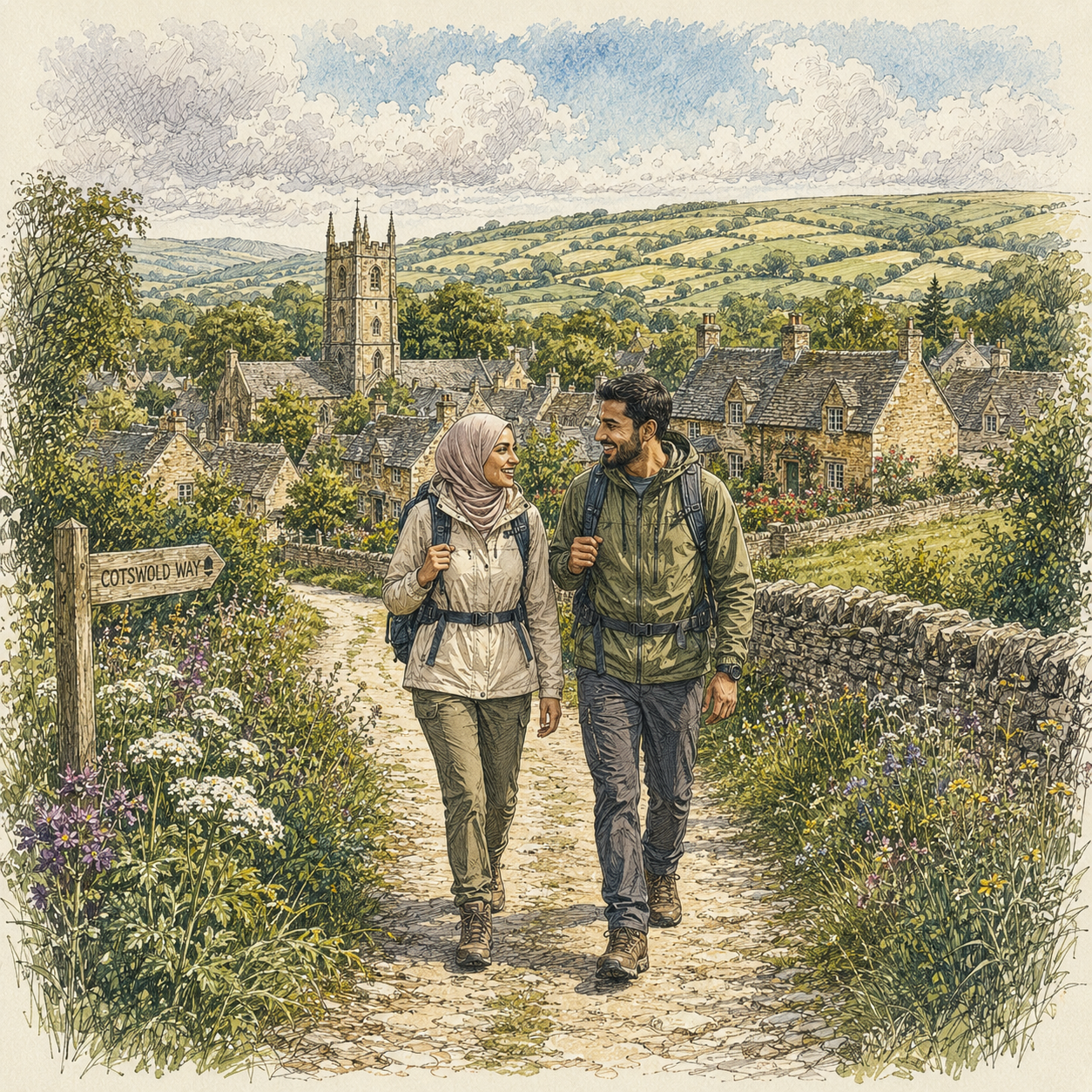
A couple walks with their arms around each other through a vineyard in Bordeaux, France

Group or Private Saint-Émilion Wine Tours

Small-group tours

Perfect for solo travellers, couples or anyone who loves meeting fellow wine pilgrims along the way. These tours follow a route with estates chosen for great storytelling, strong wines and photogenic views. Think: effortless, sociable and ideal for a first visit.

Private tours

More flexibility, more control, and more time to linger wherever your heart (or palate) desires. Want to focus on small family-run estates? Prefer grand château architecture? Need extra time for photos or for climbing the village’s bell tower? Private tours make that easy.

Both formats include pre-booked tastings so you won’t be stuck knocking on winery doors like a character in a French fairy tale.

A guide gives a tour to a couple, with the woman holding two wine glasses, in a cask-filled cellar of a winery in Bordeaux, France

Confirmed Château Visits

In Saint-Émilion, château access is everything. Many estates require advance bookings — sometimes weeks ahead — and Bordeaux Wine Pilgrim handles all of it. You’ll visit respected producers, from family-owned estates tucked into the limestone to classified growths with centuries of history.

Some appointments are tasting-only; others include in-depth technical tours through vineyards, cellars and barrel rooms. Either way, you get reliable access, without the headache of arranging it yourself.

A man rides a bike along a winding path through a vineyard, with a church in the distance, in Bordeaux, France

Transport and Comfort

Saint-Émilion is about 45 minutes from Bordeaux, but figuring out transit — especially if you’re already deep into wine mode — can be a buzzkill.

Bordeaux Wine Pilgrim includes transport from Bordeaux or Saint-Émilion in air-conditioned vans with clear meeting points and a schedule that doesn’t feel rushed. 

If you prefer something more active, they also offer e-bike tours, which are as dreamy as they sound: gentle hills, quiet country roads, and vineyard views gliding past at exactly the right speed.

Wine Expertise and Storytelling

A great wine guide doesn’t just pour; they tell the story behind the pour.

Bordeaux Wine Pilgrim’s guides break down the essentials: grape varieties, how Saint-Émilion’s limestone affects flavor, why the classification system matters, and what makes each estate distinct. Tastings are presented step-by-step so even beginners feel confident identifying aromas beyond “red wine” and “more red wine.”

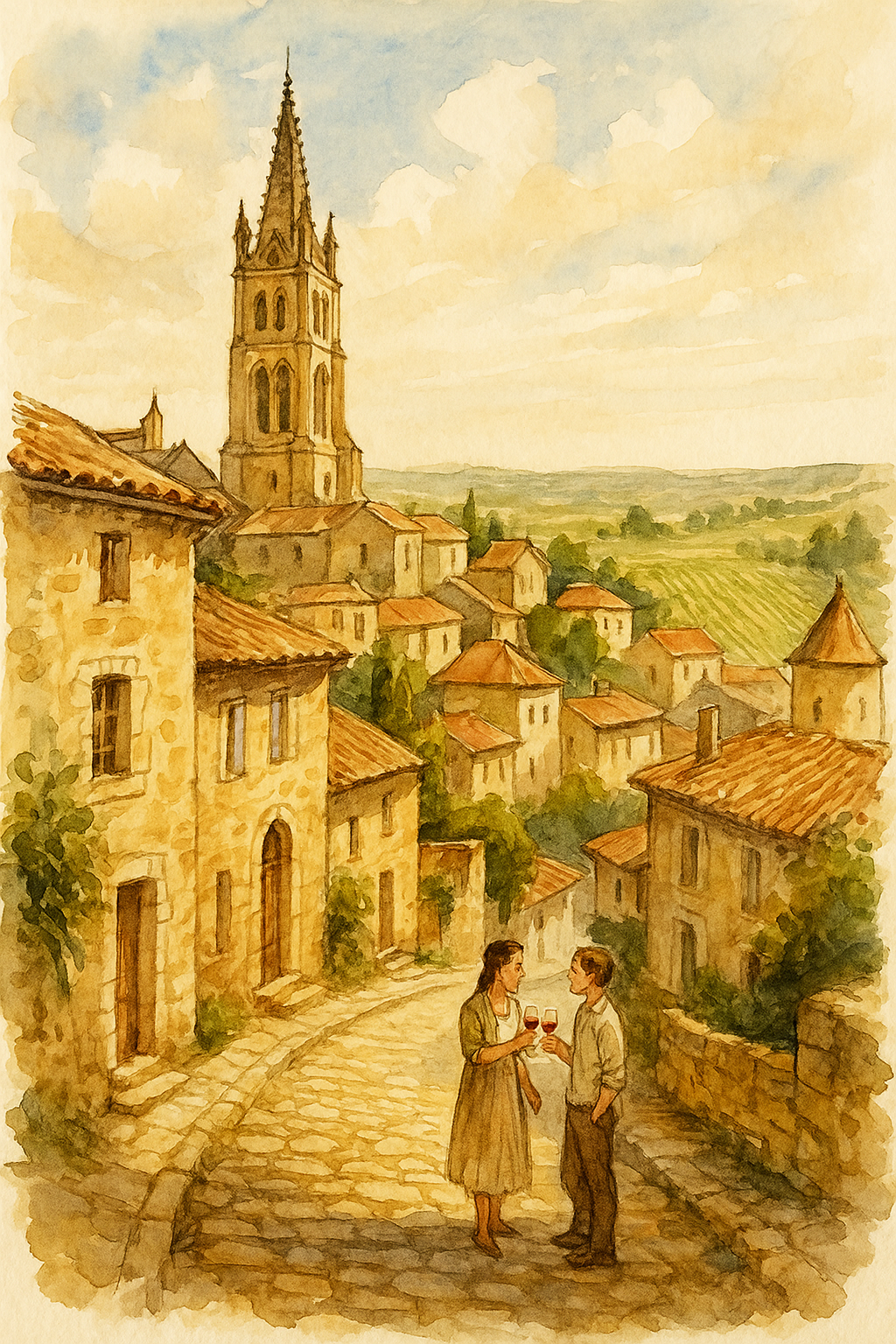
Two people talk and drink Merlot on a cobblestone street in the town of Saint-Émilion, Bordeaux, France

The Experience in the Village

Saint-Émilion itself is a UNESCO fever dream — steep cobblestones, honey-colored stone, and vineyard views that look straight out of a wine label.

Bordeaux Wine Pilgrim gives you time to wander: explore the medieval lanes, visit the monolithic church (carved entirely out of rock), hunt for macarons from the village’s historic bakers, or sip a coffee on a terrace overlooking the vines. A well-planned tour should always include these options, and theirs does.
A family drinks wine and cider at a table in Bordeaux, France, by a vineyard and chateau

FAQs About Choosing a Saint-Émilion Wine Tour With Bordeaux Wine Pilgrim

How long are the tours?

Half-day tours run about four hours with one or two estates. Full-day tours last seven to eight hours with multiple tastings and time in the village.

Are the tours suitable for beginners?

Absolutely. Guides explain everything in approachable, straightforward language — no jargon, no intimidation.

Can I request specific châteaux?

Yes, for private tours. Small-group tours follow a set itinerary with confirmed visits.

Do I need to organize my own transport?

No. Transport is included from Bordeaux or Saint-Émilion, depending on the tour.

When is the best time to visit?

Spring and autumn offer perfect vineyard scenery. Summer is lively and sunny; winter brings quieter roads and more château availability.

Is lunch included?

Some full-day tours include a restaurant stop or free time for lunch in the village. Certain itineraries offer picnic options, too.

Are the tours family-friendly?

Yes — especially private tours. Some estates even offer grape juice tastings for younger travellers.

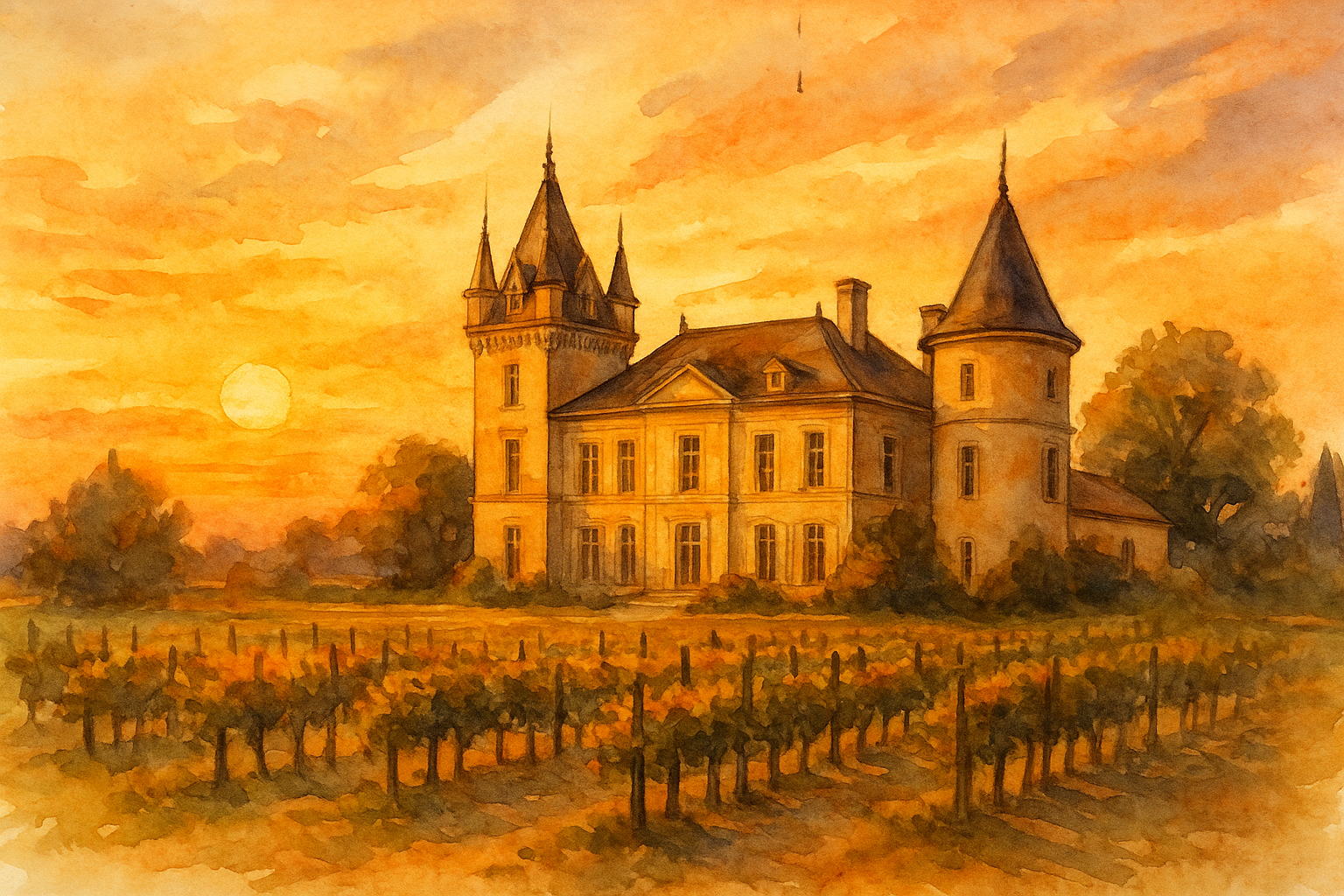
A chateau and vineyard at sunset in the Bordeaux region of France

If you want a Saint-Émilion wine tour that blends beautiful landscapes, real expertise and a level of organisation that lets you simply enjoy the day, Bordeaux Wine Pilgrim is a solid pick — whether you’re there for the wine, the history or just the chance to live your best “I’m in France drinking Merlot at 2 p.m.” life. –Sophia Martin

Frank Lloyd Wright’s Burnham Block: Milwaukee’s Forgotten Vision for Affordable Homes

Wright’s American System-Built Homes still stand on Burnham Block, a quiet testament to his dream of housing for the middle class.

Frank Lloyd Wright's Burnham Block in Milwaukee, Wisconsin

Well before he designed Fallingwater in Pennsylvania, Wright poured his energy into a very different kind of project — producing more than 900 drawings and over 30 standardized model variations for the American System-Built Homes: a line of modest, affordable houses for America’s middle-class families.

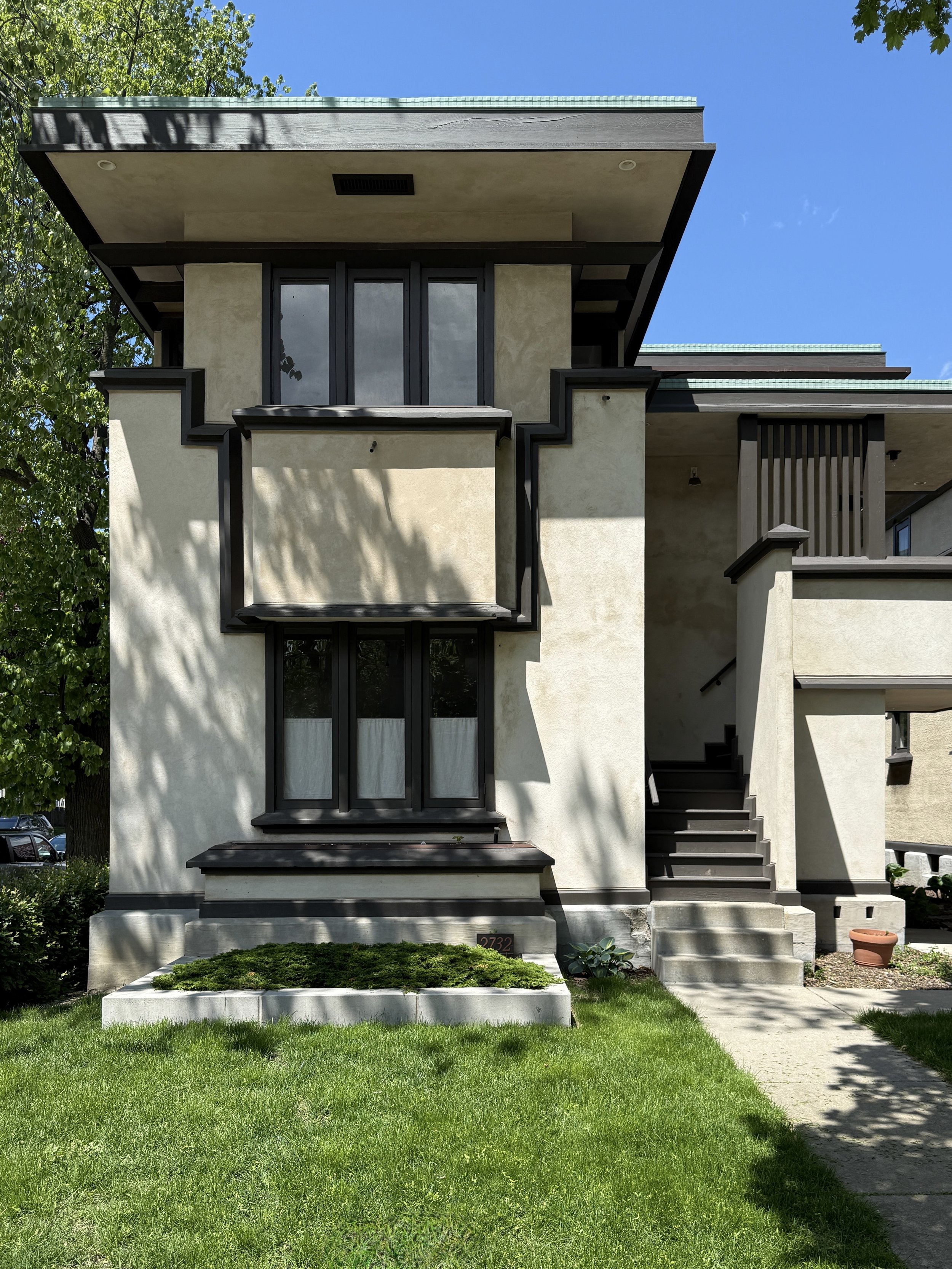
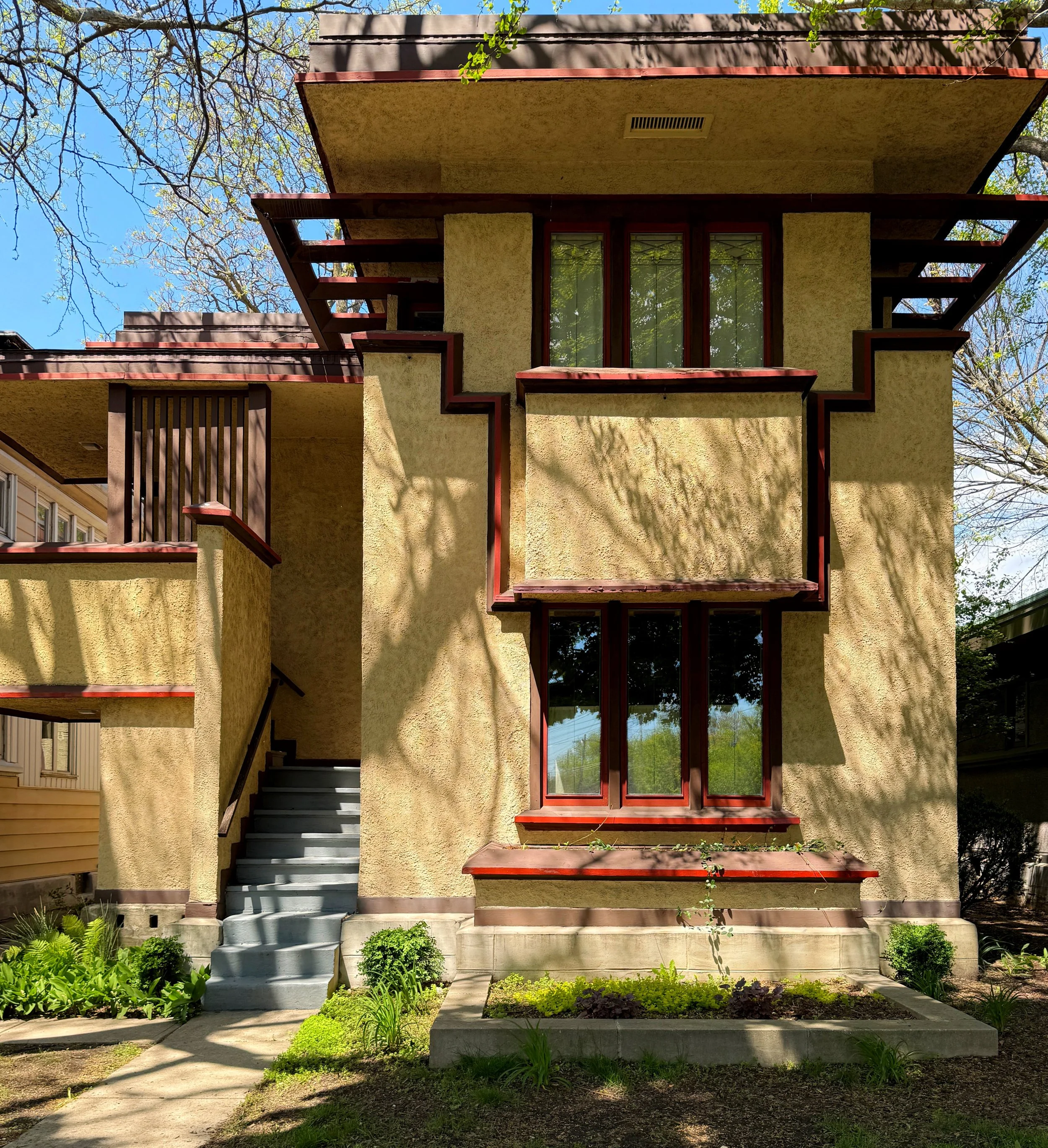
So when Wally and I planned a long weekend in Milwaukee, one of our top priorities was visiting the Burnham Block. Tucked between 27th Street and Layton Boulevard, this quiet stretch of West Burnham Street is home to six of Wright’s homes — examples of one of the most ambitious design efforts of his career and the largest collection of this housing style in the country. 

At just 805 square feet, it’s the smallest of any house Wright designed.

Fun fact: The thoroughfare was named after George Burnham, a brick manufacturer and real estate investor in the city. The cream-colored bricks his company produced helped give Milwaukee its nickname, the Cream City. 

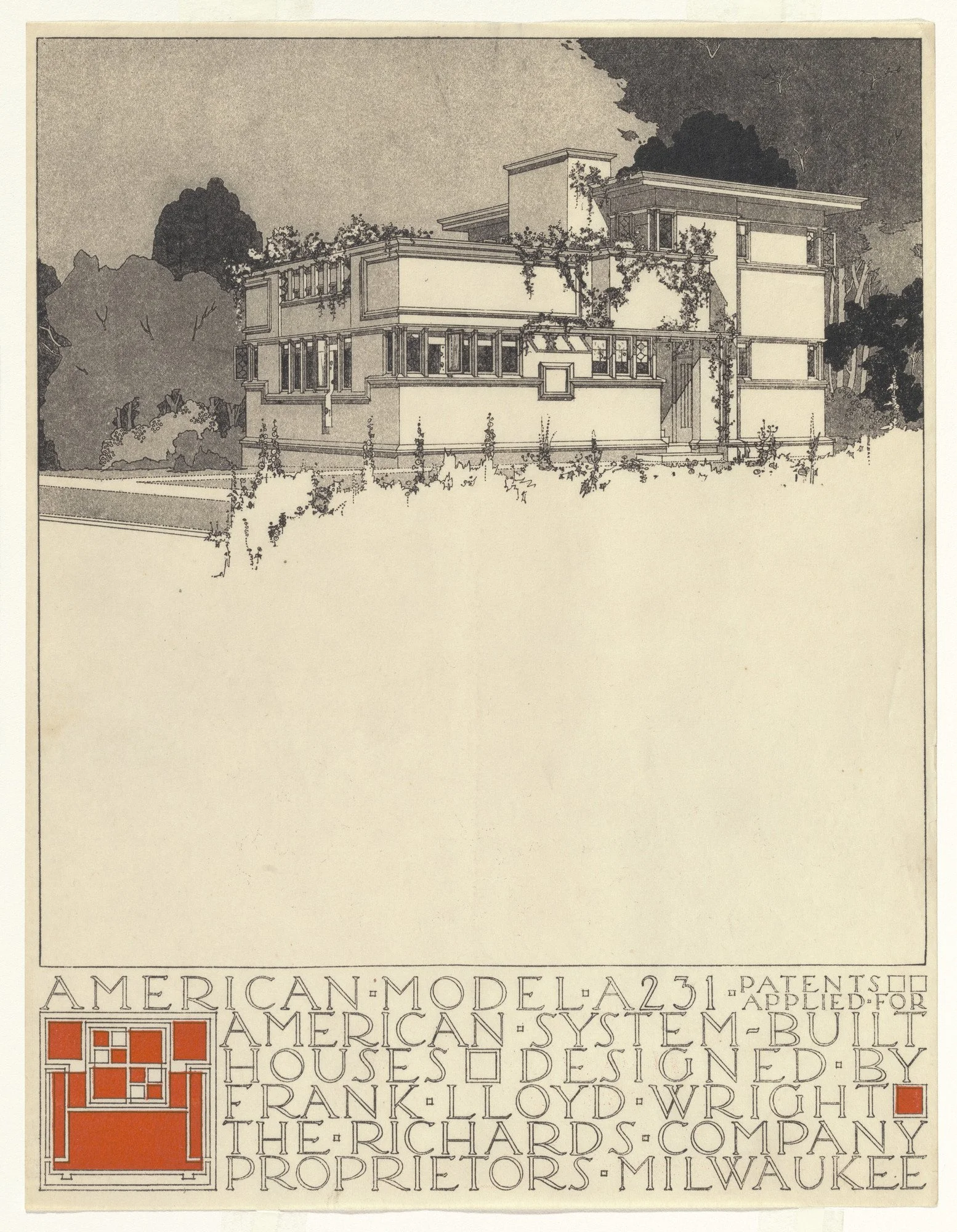
Architectural drawing in an ad for American System-Build Houses on Frank Lloyd Wright's Burnham Block

“An American Home” 

After snapping a few photos outside, Wally and I ducked into the gift shop at the back of one of the duplexes currently undergoing restoration. From there we made our way to the front room to join our tour group and meet our docent, Rhonda. Once everyone was settled in, she broke the ice by asking where we were all from, and to our surprise, one family had traveled all the way from Italy.

She asked the group to imagine what a real estate ad might highlight today, and we quickly called out the usual features: square footage, number of bedrooms, location and price — basically everything related to the building itself. 

Holding up a full-page advertisement that ran in the Chicago Tribune in July 1917, titled “You Can Own an American Home” and attributed to then-copywriter Sherwood Anderson, she read the following excerpt aloud:

“There’s a bright, cheerful home waiting for you and your family — better built, excellently planned, far more livable. More beautiful? Yeah, it’ll have that rare thing: genuine architectural beauty, designed by a leader among architects. You select your plan; it’s built to your order. Constructed by a system that guarantees a high-grade building at a known price. In short, an American home.”

Rhonda pointed out that it wasn’t really about any of the features we had mentioned; it was about selling a lifestyle. And one big thing the ad omitted? Wright’s name — and that was no accident. 


A man drapes his arm around a lifesize cutout of Frank Lloyd Wright

Wally’s last name is also Wright, but, sadly, he’s never found a familial link to Frank.

When “Wright” Was a Bad Word

By 1915, the architect’s personal life had become tabloid fodder. In 1909 he had famously abandoned his wife and six children to run off to Europe with Mamah Borthwick Cheney — the wife of a former client and the woman at the center of a scandalous, widely publicized affair. 

Both were still married to their respective spouses when they left. Mamah got a divorce from her husband when they returned, but Wright wouldn’t officially be divorced from his wife, Catherine, for another six years. 

The scandal deepened in 1914, when a servant at Taliesin — Wright’s home and studio in Wisconsin — set fire to the building and axed down Mamah, her two children, and four others as they fled the flames. The tragedy made front-page headlines and further tarnished Wright’s reputation.

Rhonda went on to explain that what most people don’t realize is just how deeply Wright believed in what he called “democratic architecture.” To him the idea was simple: If you had a good job, you should also be able to afford a thoughtfully designed home. But Wright, for all his vision, didn’t quite know how to make that dream scalable. 

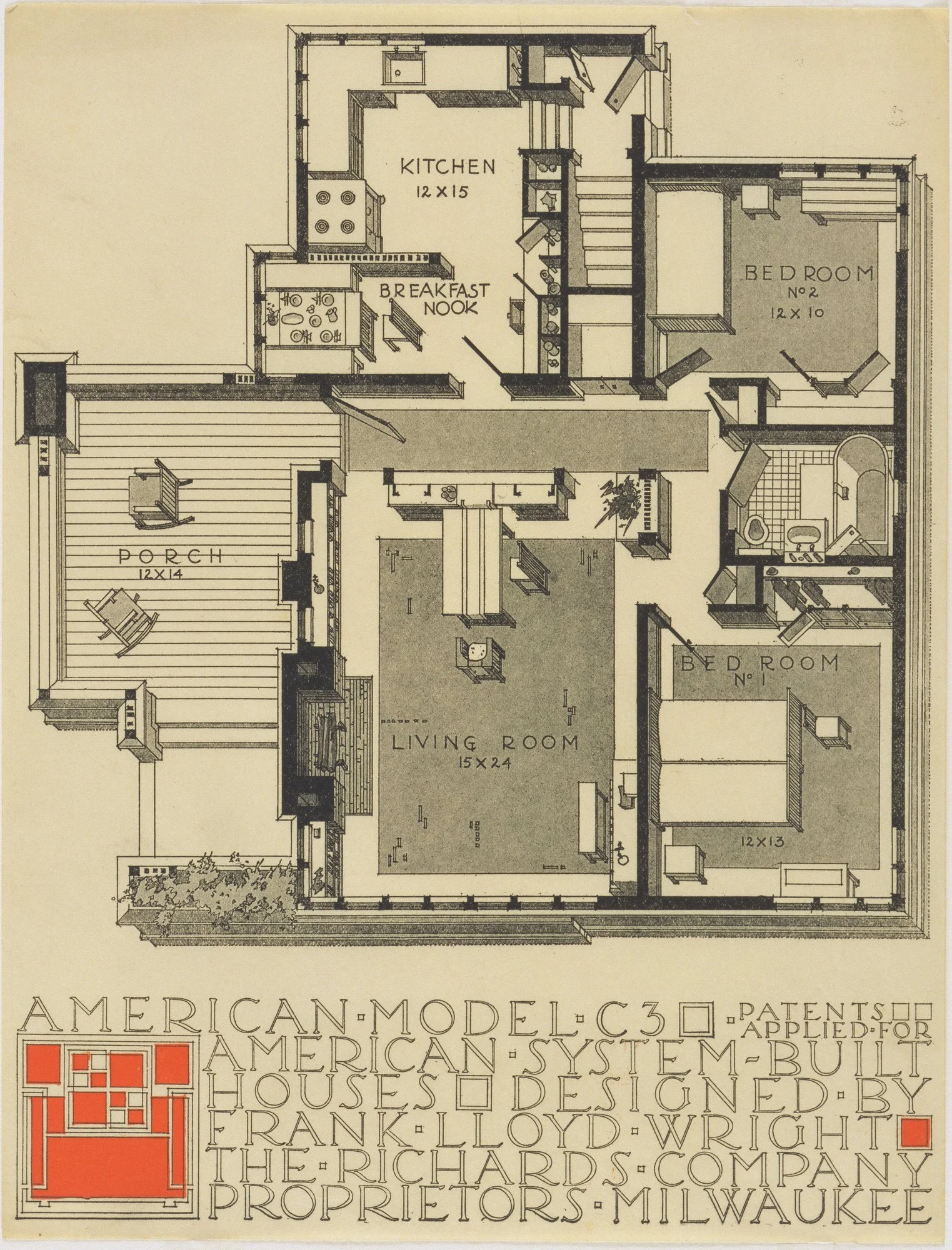
A floorplan for the homes along Frank Lloyd Wright's Burnham Block

A Partnership With Arthur Richards

That's where Milwaukee developer Arthur L. Richards came in. He had previously collaborated with Wright on the Hotel Geneva, a lakeside resort that once stood on the shores of Lake Geneva, Wisconsin. Richards had the resources and business network Wright lacked, and he was able to turn the architect's vision into a viable housing project. 

Assuming the advertisement piqued your curiosity, your next stop would be to visit a local distributor. At the time, many young families were buying homes from the pages of mail-order catalogs — think Craftsman-style kits sold by Sears, Roebuck and Co. 

But Wright’s American System-Built Homes were different. They were modern, meticulously detailed, and built to his exacting standards. Customers could choose from roughly 30 standardized models, each offering a range of customizable options, including the floor plan, roof style (flat, hip or gable), custom furniture and art glass windows. You added up your choices, saw the total at the bottom, and that’s what you paid. 

Prices started at $1,875 and rose to about $3,500 once completed — remarkably modest for any home, much less a Wright-designed one, especially given his reputation for commissions that routinely ran over budget. It may sound like a lot for 1915, but homes of comparable size and quality typically sold for 10% to 15% more. This relative affordability was largely due to Richards, whose oversight kept costs down and brought Wright’s designs to a broader market.

To achieve this, the Richards Company pre-cut lumber and other materials in a mill and shipped them to the build site by rail — a method that offered greater efficiency and quality control than traditional site-built construction.

Exterior of the office and gift shop at Frank Lloyd Wright's Burnham Block in Milwaukee

Preserving a Legacy: Restoration Efforts at Burnham Block

Once we had a sense of the project's background, Rhonda led us outside and enthusiastically shared more about this row of homes’ history and significance. Built on speculation between October 1915 and July 1916 the block includes four two-family Flat C (Model 7A) duplexes and two single-family bungalows: one Model B1 with a flat roof and one Model C3 with a hipped roof. 

She highlighted the importance of ongoing preservation efforts, noting that five of the six houses are now owned by Frank Lloyd Wright’s Burnham Block, a nonprofit organization dedicated to the care and stewardship of these historic structures.

“There’s no paid staff,” she told us. “We’re all volunteers. Every single dollar you spend, whether it’s on admission, in the gift shop or as a donation goes directly toward the care of these buildings.”

She went on to explain that the exterior of Duplex 4, the building we had just exited, was restored in 2013 and 2014 with the help of a Save America’s Treasures matching grant. The grant was awarded by the Department of the Interior and is managed by the National Park Service to support the preservation of nationally significant historic sites. Work on the interior, she noted, is still underway. 

“We did get a grant from the government,” she added. “But we’re unsure if we’ll actually receive that money. So for now, we’re kind of on hold, waiting to see what happens.” The hope is that they’ll be able to start restoration efforts on Bungalow Model C3 this year. 

When Richards selected the site for the housing project, it was considered the edge of town — still largely rural and known for its celery fields. An electric streetcar line ran along Burnham Street, connecting the area to the rest of the city. The City Service line provided access to downtown Milwaukee, while the Interurban line extended as far as East Troy. At the time, most people didn’t own cars, but they had access to mass transit, one of the key reasons these homes were built here.  

2720 West Burnham Street, part of Frank Lloyd Wright's Burnham Block in Milwaukee

We paused for a moment in front of 2720 West Burnham Street — the only duplex on the block that isn't owned by the nonprofit.

Rhonda gave us a quick rundown of its history, explaining that a young couple who knew the legacy of the two-flat purchased the property in the early 1980s and converted it into a single-family home with three bedrooms, two bathrooms and a modern kitchen. She added that they installed the art glass windows and red square, a visual element found in many of Wright's designs. Nearly 30 years later, it was sold to its current owner, who now rents it out on Vrbo.

“I’ve been told it sleeps about nine — so if you decide to rent it, don’t forget to invite me!” Rhonda added with a chuckle. 

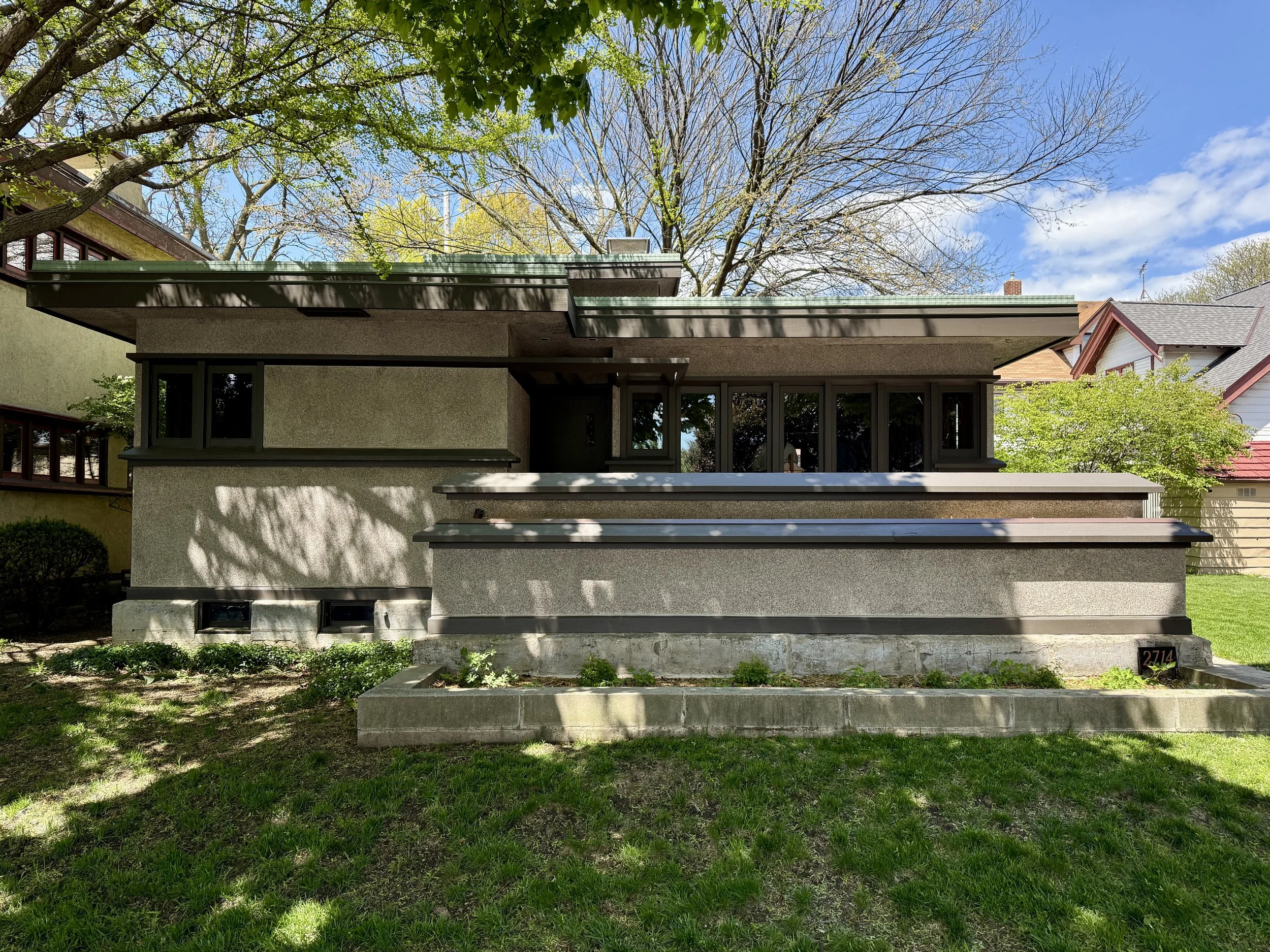
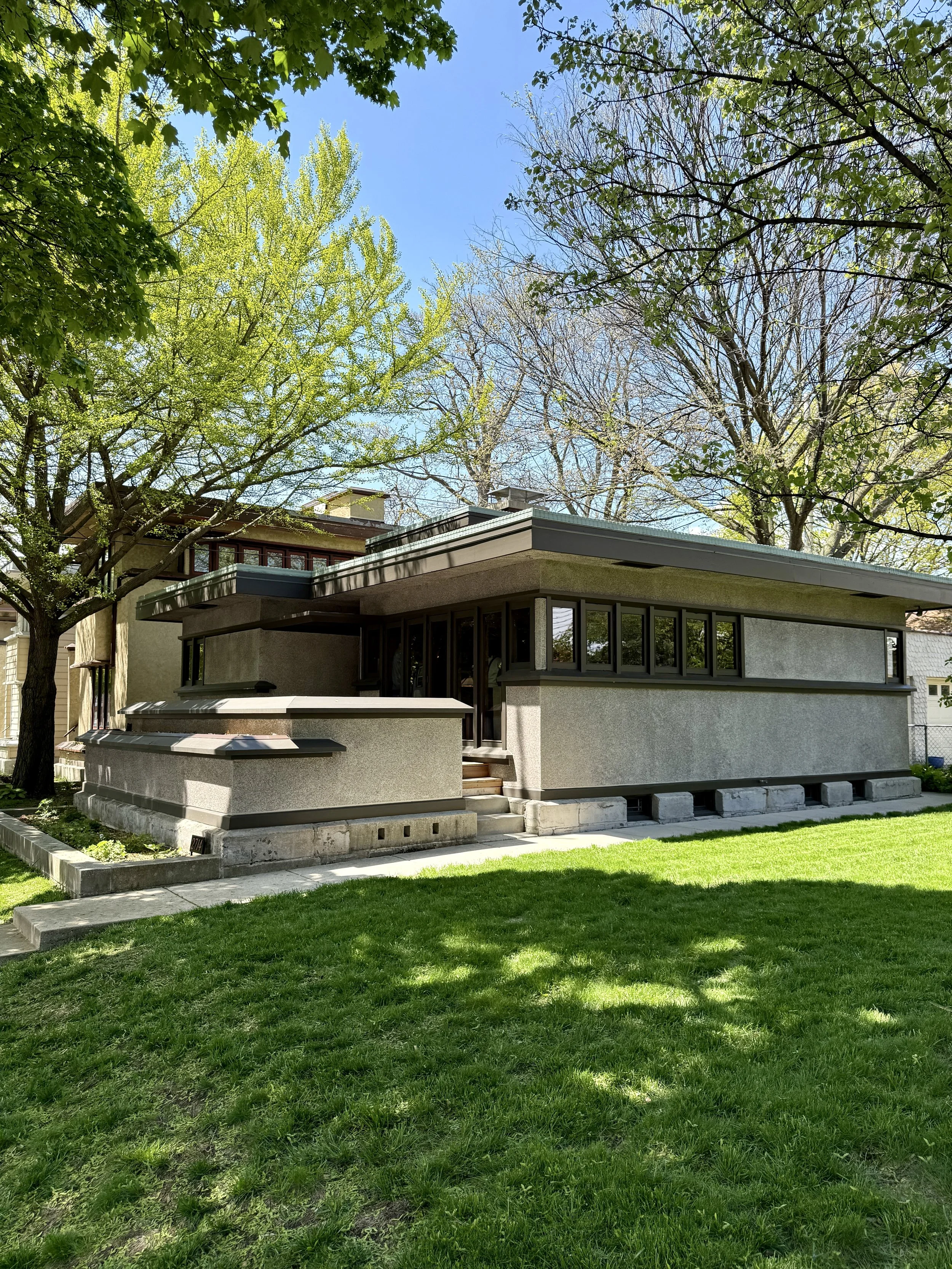
The exterior of the Model B1 home on Frank Lloyd Wright's Burnham Block in Milwaukee

A Tour of Model B1

A short walk later, we found ourselves standing outside Model B1 at 2714 West Burnham Street. Rhonda affectionately referred to it as the “baby bungalow,” and at just 805 square feet, it’s the smallest of any house Wright designed. It was purchased in 2004 and fully restored to its 1916 appearance in 2008 and 2009. Today, it’s open to the public as a house museum. 

Rhonda shared that the home’s original exterior, like the others, was finished with a material called Elastica stucco. It was manufactured in Chicago and promoted at the time as an affordable and durable option. Initially praised for its smooth appearance, it later proved unreliable and was found to contain asbestos, requiring careful remediation during restoration.

Today, the exterior has been refinished with Pebble Dash — a type of stucco embedded with small stones that are sprayed onto the surface while it’s still wet. The result is a tactile, durable façade that honors the original intent while complying with modern safety standards.

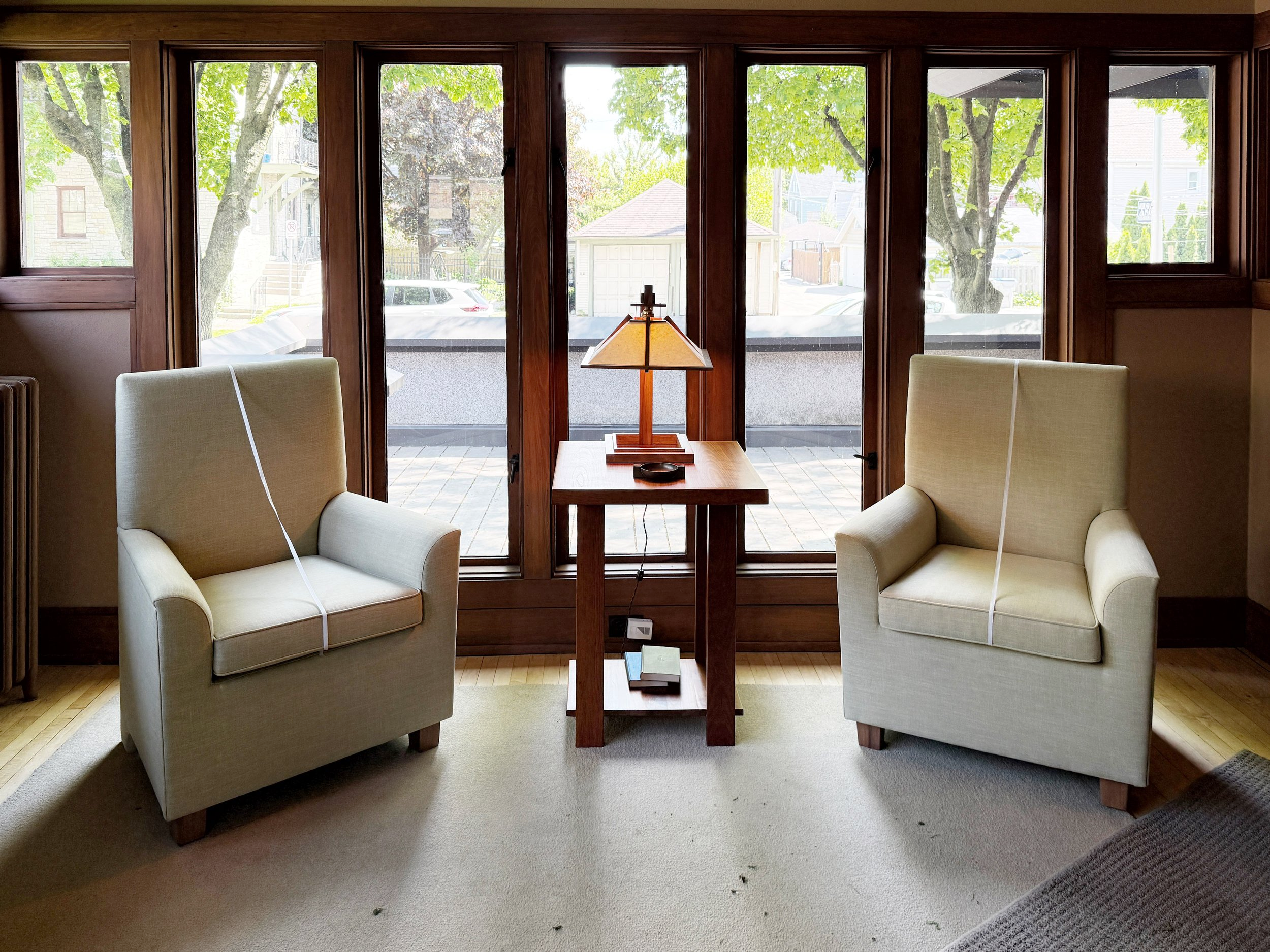
The front room with a small table, lamp and two chairs in Model B1 on Frank Lloyd Wright's Burnham Block

Wright’s Bag of Tricks

Before we even stepped through the front door, we passed beneath a low overhang that extended above the entrance, an unmistakable hallmark of Wright’s design philosophy. It was a classic example of his compress-and-release technique: a moment of spatial compression at the threshold that heightened the sense of openness and volume once inside. 

Crossing that threshold, we entered the living room, the heart of the home, where a central hearth commanded attention. More than just a source of warmth, it was another signature of Wright’s architecture: a symbolic and literal centerpiece meant to anchor family life.

The brick and wood hearth in Model B1 at Frank Lloyd Wright's Burnham Block in Milwaukee

At the front of the room, floor-to-ceiling windows brought in natural light and made the space feel larger. Thanks to the height and placement of the front porch, anyone seated inside could enjoy a sense of openness and connection with the outdoors while still maintaining a sense of privacy, as the porch blocks direct views from passersby. 

This sense of openness was made possible, in part, by Wright’s innovative use of balloon-frame construction, a technique where long vertical studs run continuously from the foundation to the roof. In the American System-Built Homes, these studs are spaced 24 inches apart — wider than the typical 16 inches — based on a 2-foot modular grid. This grid made it easier for Richards’ team of builders to position them with greater flexibility, without needing to rework the structure of the walls.

Built-in shelving and dining table in Model B1 of Frank Lloyd Wright's Burnham Block

Rhonda pointed out that Wright’s design pulled out all the stops to make this tiny house feel larger than it is. By cleverly “stealing space,” the walls flanking the wraparound hearth draw the eye back toward the foyer and the hallway beyond, creating a sense of depth and openness.

She also noted that most of the woodwork inside the house is original. While telling us about the built-in cabinetry in the living room, she explained that it not only acts as a partition but also cleverly accommodates a dining table that can be tucked away or pulled out — transforming the living room into a dining area as needed. 

To the right of the built-in, a doorway leads to the breakfast nook and kitchen. Vertical wooden slats separate the nook, offering a sense of division without fully enclosing the space, another subtle feature that reinforces an overall feeling of openness. 

The kitchen was fitted with wood cabinetry and the most adorable tiny oven I’d ever seen.

A small oven and stovetop in the kitchen of Model B1 on Frank Lloyd Wright's Burnham Block

Rhonda added that the glass fronts on the upper cabinets were intentional: designed to catch and reflect light, they help create the illusion of a larger, airier room.

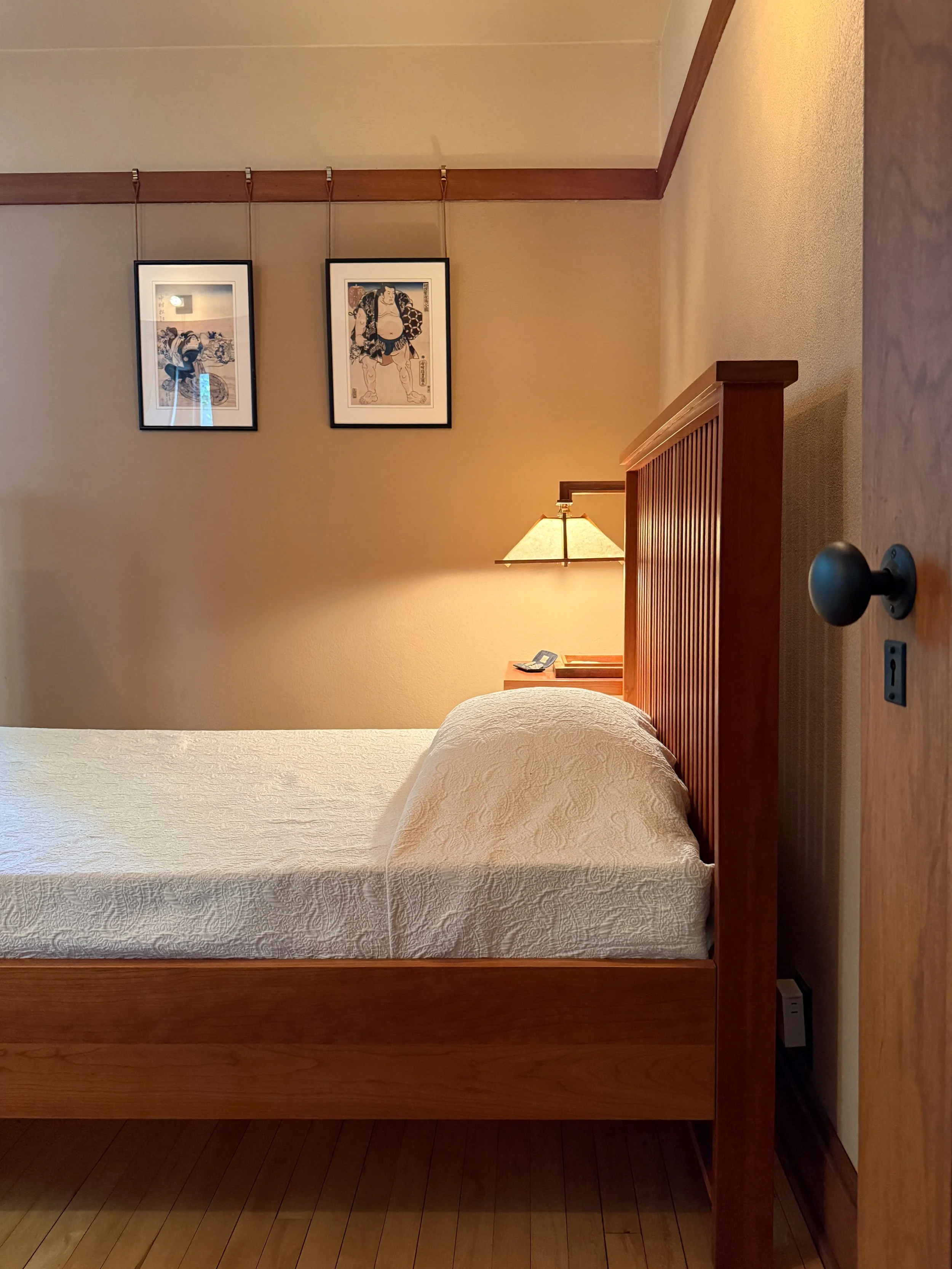
The private space of the home includes the primary bedroom, a children’s bedroom, a bathroom, and both coat and linen closets (a rare feature in a Wright home). A central light well draws natural light into the core of the house, brightening the interior. 

The main bedroom at Model B1 of Frank Lloyd Wright's Burnham Block
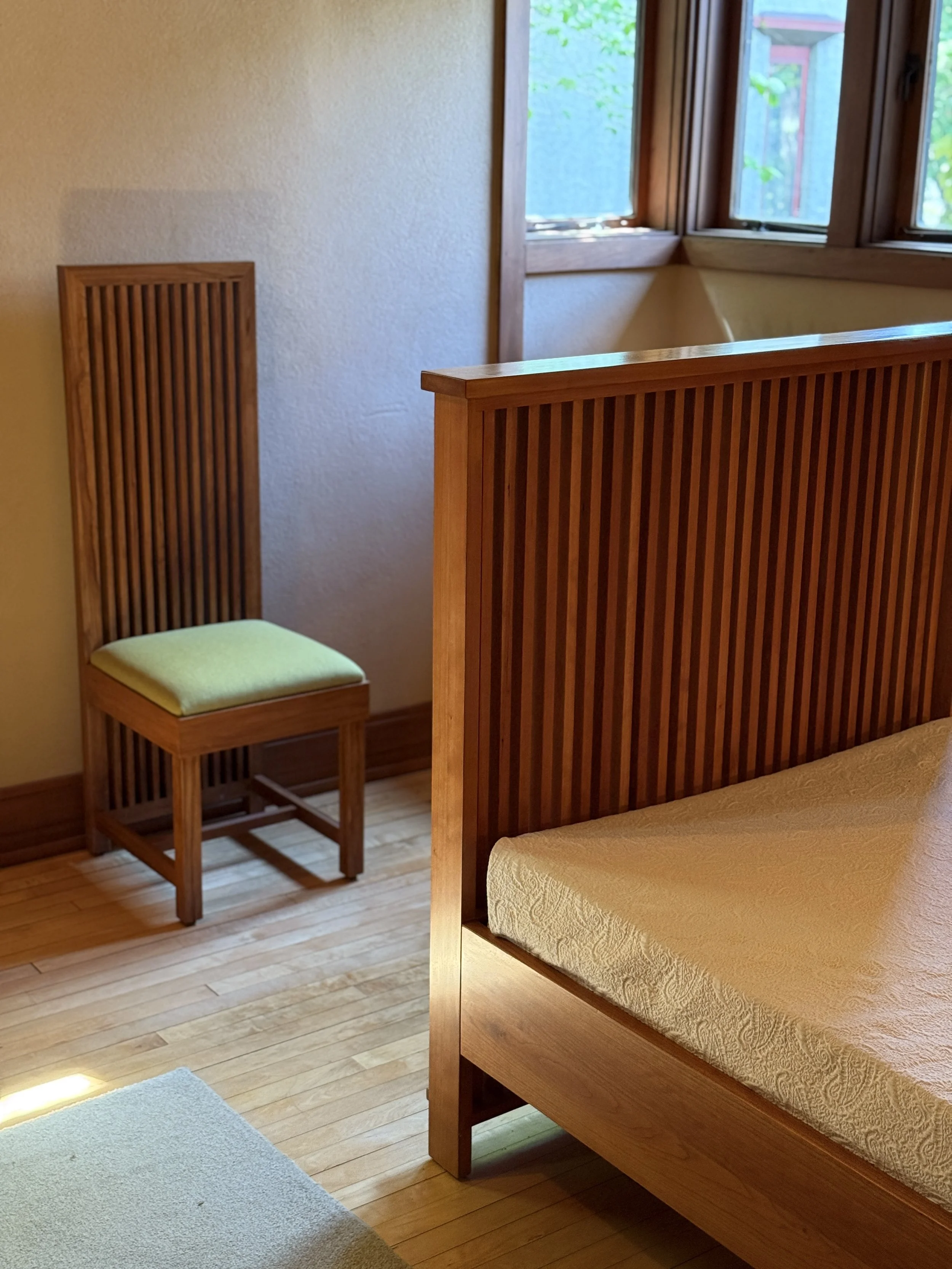
The foot of the bed and a chair in a bedroom of Model B1 at Frank Lloyd Wright's Burnham Block

In the primary bedroom, ukiyo-e Japanese woodblock prints reflect Wright’s long-standing admiration for Japanese art and design, while the children’s room features charming illustrations created by his younger sister, Maginel Wright Enright. 

The exterior side view of Model B1 of Frank Lloyd Wright's Burnham Block in Milwaukee

An American Dream That Never Caught On

This development embodied a bold vision of the American Dream. These homes weren’t just places to live; they were a blueprint for how entire neighborhoods of affordable, well-designed housing might take shape across the country. 

That vision extended far beyond this single block. Wright was never one to think small, and he and Richards imagined these homes not as a one-off experiment but as the beginning of something far-reaching. They envisioned entire subdivisions filled with variations on these models, stretching across the U.S. and into Canada. If everything went according to plan, the project could generate more than a million dollars in revenue. 

The six homes on Burnham Street were completed on July 5, 1916 — just 10 days before Milwaukee hosted a massive Preparedness Parade in support of U.S. involvement in World War I. But the war would soon derail Wright and Richards’ ambitious plans. As building materials were diverted to the war effort and the housing market grew uncertain, their grand project ground to a halt. 

In the end, only about a dozen American System-Built Homes were ever constructed — six on Burnham Street and a handful of others scattered throughout the Midwest. Eventually, Wright and Richards had a falling out, culminating in Wright successfully suing Richards for non-payment. Under their agreement, Wright was to receive royalties for each house sold. But a major flaw in the arrangement was that Richards wasn’t required to report each sale to Wright, making it impossible for Wright to know how many homes were actually built. That lack of transparency, combined with missed payments, led to growing mistrust and ultimately ended their partnership. 

Although the Burnham Block is listed on the National Register of Historic Places, discovering the homes felt like stumbling upon a hidden gem. These aren’t the Wright homes that capture a lot of attention.

Tours are available by reservation only and are led by trained docents who offer insight into the history and design of the homes. –Duke


Before You Go

Phone: 414-368-0060

Admission: $20; children under 16 free

Times: Tours at 11 a.m., 12 p.m., 1 p.m. and 2 p.m.

Tours last about one hour.

Homes along Frank Lloyd Wright's Burnham Block in Milwaukee, Wisconsin

Frank Lloyd Wright’s Burnham Block

2732 West Burnham Street
Milwaukee, Wisconsin
USA


Laughs, Lessons and Local Life: A Real-World Egypt Family Adventure

From camel chaos to temple adventures, this Egypt family travel story blends ancient sites, kid-powered mishaps and heartfelt local moments into one unforgettable trip.

There’s nothing quite like watching your 8-year-old barter for papyrus scrolls with a Cairo street vendor. His tactic? Dramatic sighing and a mournful “But I only have 10 pounds.” (It worked, by the way.) 

And so began our deep dive into the chaos, charm and contradictions of Egypt, a land where ancient monuments meet honking tuk-tuks, and your kid suddenly becomes a pint-sized negotiator.

We discovered that letting go — of schedules, expectations, WiFi — leads to the kinds of memories you can’t make in a classroom or on a screen.

We hadn’t planned on falling in love. Egypt had been one of those “Well, it’s educational” destinations, a check-the-box history lesson for the kids. But within 24 hours of landing, our agenda unraveled. Not in a bad way, but in that glorious, sun-drenched, sand-between-your-toes kind of way where plans give way to experiences. Opting for one of the curated Egypt tours packages turned out to be our greatest travel hack, providing structure where we needed it, and freedom where we craved it.

Feluccas, Falafel and Family Chaos

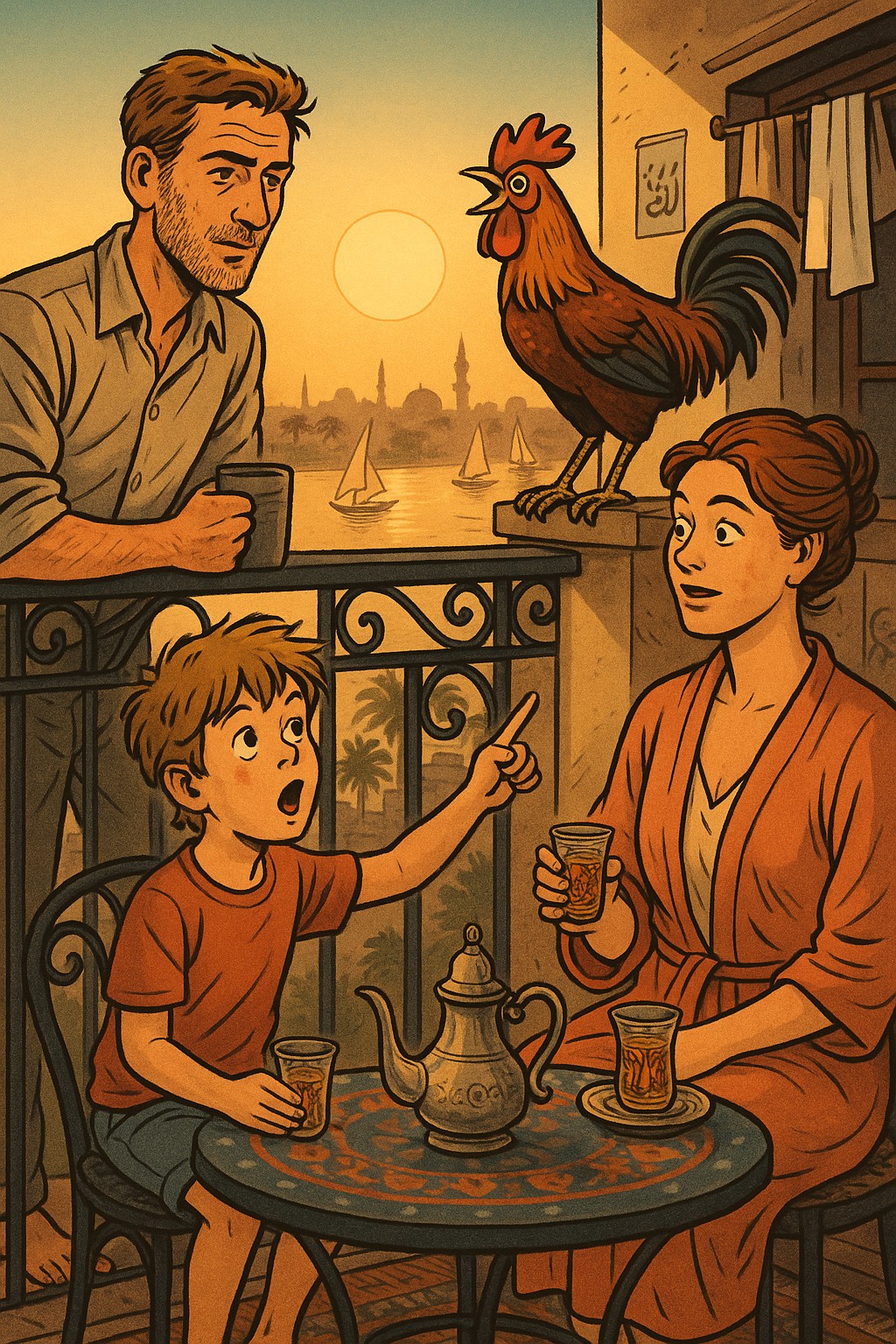
Our first Nile-side morning began with mint tea and a hotel balcony view that could humble even the most screen-addicted teen. The Nile shimmered like it knew it was important. Down below, feluccas caught the morning light, while a rooster (somehow on the sixth floor?) reminded us that alarm clocks are overrated.

Breakfast was a lesson in logistics, three kids, four plates of ful medames, and one very opinionated guide named Amira, who declared, “Today we walk like Egyptians.” Cue eye rolls from the teenagers. Cue “Walk Like an Egyptian” humming from dad. Cue me silently questioning my life choices.

Yet by midday, we were temple-hopping with the best of them. Karnak left us speechless, partly because of its scale, and partly because we were playing “spot the gods” while sweating profusely. The kids learned to recognize Horus and Anubis like old cartoon characters. I learned that wearing white linen isn’t just stylish; it’s survival.


Family rides camels by the Pyramids of Giza, the father's hat flying off

Kids, Camels and Culture Shock

Camel rides? Predictably chaotic. Our youngest named his camel Beyoncé. Beyoncé had opinions. Mostly about not walking straight. Still, nothing beats watching your children burst into uncontrollable laughter as their parents bounce wildly through the desert like disjointed marionettes.

But it wasn’t all slapstick. Somewhere between Giza and Aswan, the lessons snuck in. Our middle child, who rarely looks up from her phone, asked if we could visit a Coptic church “just to see.” Later, our eldest scribbled down notes about hieroglyphs, claiming it was “for a school project.” (Sure it was.) And all of us, parents included, began saying “Inshallah” with frightening regularity.
A family sits on the floor by their Egyptian hostess, various bowls of food on a mat, a young boy spilling lentils

The Food That Made Us Stay a Little Longer

Egyptian food is like that cousin who insists you try just one more bite. And then five more. Shawarma wraps became our lunch religion. Koshari, a carb-on-carb-on-carb masterpiece, had the kids questioning everything they thought they knew about dinner. And don’t even get me started on the desserts: basbousa, konafa — sticky, sweet, and somehow always appearing just when you said you were full.

One night, our guide invited us for a home-cooked meal with her extended family. We sat on floor cushions, passed dishes around with our hands, and managed to communicate with smiles, hand gestures, and the universal language of children upending a bowl of lentils.

What We Took Home (Besides Sand in Our Socks)

Travel doesn’t always go as planned. You miss a train. Someone gets food poisoning. You accidentally offend a shopkeeper by declining tea. (Pro tip: Just drink the tea.) But in Egypt, those moments weren’t failures; they were the trip.

Our youngest now claims he wants to be an archaeologist. The middle one added “learn Arabic” to her birthday wish list. And we, the tired grownups, discovered that letting go — of schedules, expectations, WiFi — leads to the kinds of memories you can’t make in a classroom or on a screen.

So if you’re thinking of going, with kids, with chaos, with curiosity, Egypt’s got room for it all. Just pack extra patience, an open heart, and maybe a few 10-pound notes for some persuasive bargaining practice. –Jarno van Bazel


Diego Rivera and Frida Kahlo House-Studio Museum

The studio and home of prolific artists Diego Rivera and Frida Kahlo at the Museo Casa Estudio Diego Rivera y Frida Kahlo wows as a striking example of 1930s Mexican modernist architecture. 

Fence post cacti lined up in front of Diego Rivera's modern white and red studio and home in the San Angel neighborhood of Mexico City

You definitely have to tour Casa Azul and Anahuacalli Museum — but this site is also worth visiting if you have time.

When Wally and I talk to friends about our travels in CDMX, the conversation often turns to the places we’ve seen, and the places on our list for our next trip. 

One of the places I’d been wanting to visit was the Museo Casa Estudio Diego Rivera & Frida Kahlo, the former home and studio of two of the city’s most revered artists — though I’d argue that Frida has eclipsed Diego in fame since their deaths in the 1950s. It felt like a fitting comeuppance for how he treated her. But more on that later. 

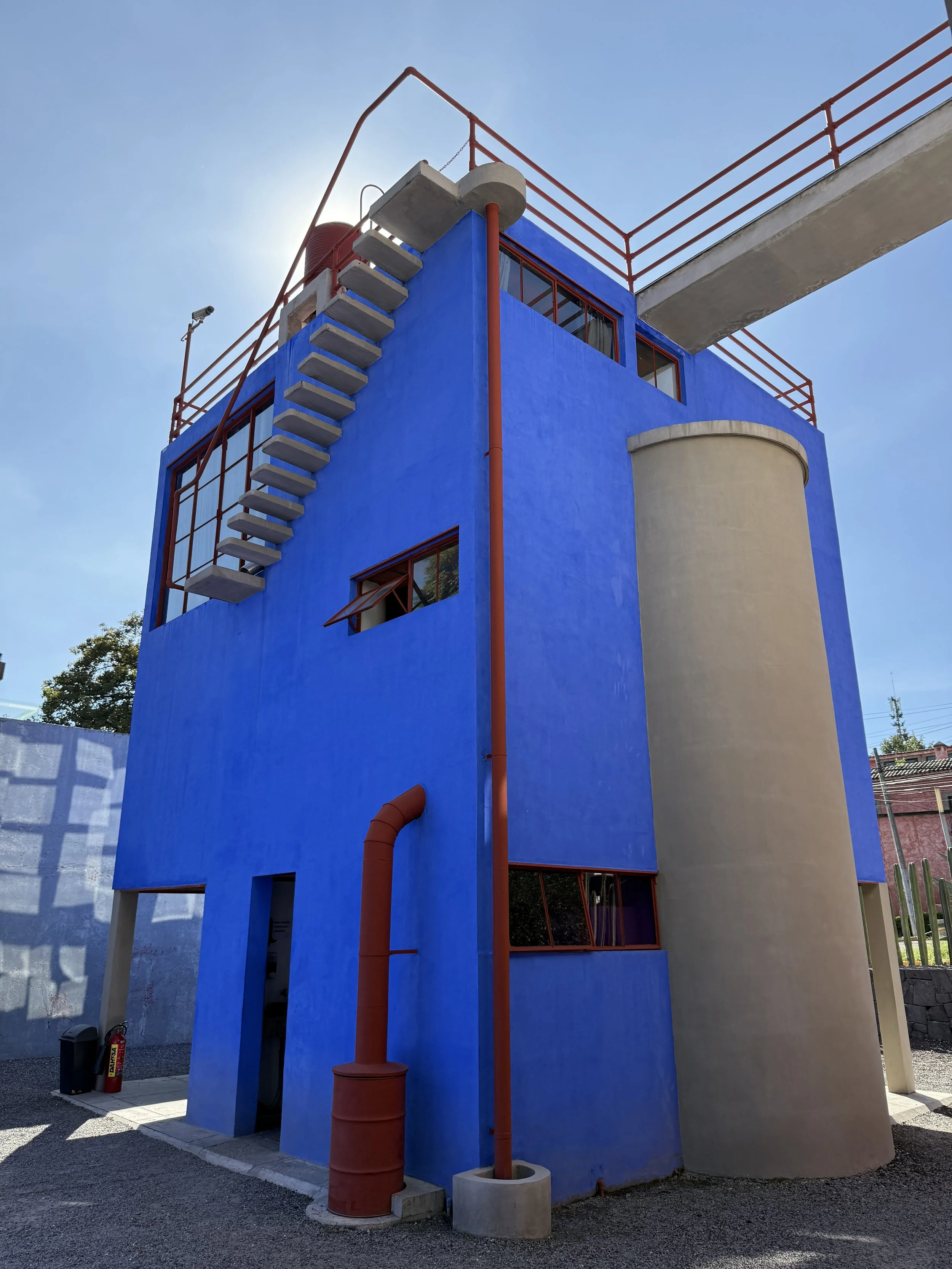
Whenever Frida wanted to visit Diego, she had to pull herself up an exterior floating staircase and cross a narrow footbridge.

Diego had specifically requested this to make it difficult for Frida to enter his studio (and see his adulterous dalliances). 

Their tumultuous relationship undoubtedly checked the “it’s complicated” box.

San Ángel: An Escape From the City

The historic house museum is located in San Ángel, an enchanting neighborhood southwest of Mexico City. Once a separate municipality, San Ángel served as a retreat for wealthy families who built grand country homes to escape the chaos of city life during the rise of the Industrial Revolution. Ancient lava flows shaped this rugged terrain, where its cobbled streets and colonial estates were eventually consumed by the ever-expanding sprawl of Mexico City.

Duke and Wall stand on the rooftop terrace of Diego's house and the walkway that leads to Frida's

Duke and Wally stand on the terrace by the walkway that connected Diego’s home to Frida’s.

We planned our visit to coincide with the Bazar Sábado, a weekly market held on Saturdays, where artists and artisans set up shop and sell their wares. 

Our Uber driver dropped us off at the museum’s entrance on Calle Diego Rivera. As we waited for our guide, we couldn’t help but notice valets dressed in traje de charro, the traditional attire of mariachis, running past us in pairs. They were undoubtedly heading to the entrance of the nearby San Ángel Inn to park arriving cars. Known for its restaurant, the historic inn is a favorite dining spot for both locals and tourists, especially on weekends.

Museo Casa Estudio Diego Rivera y Frida Kahlo, with Diego's white home connected to Frida's blue one by high walkway

O'Gorman's Mexican fence post cactus barriers (and modern aesthetic) pissed off his traditional neighbors.

Wally and I walked to the front of the property, which faces Avenida Altavista. In our opinion, the best view of the two buildings is from across the avenue. On the left is the big house, a boxy white and red structure with a distinctive sawtooth roof and water tanks, which once served as the residence and studio of the plus-sized muralist Rivera. 

It’s linked at roof level by a narrow walkway and contrasted by the little house, the vivid blue home on the right, which belonged to his unibrowed surrealist painter wife, Kahlo.

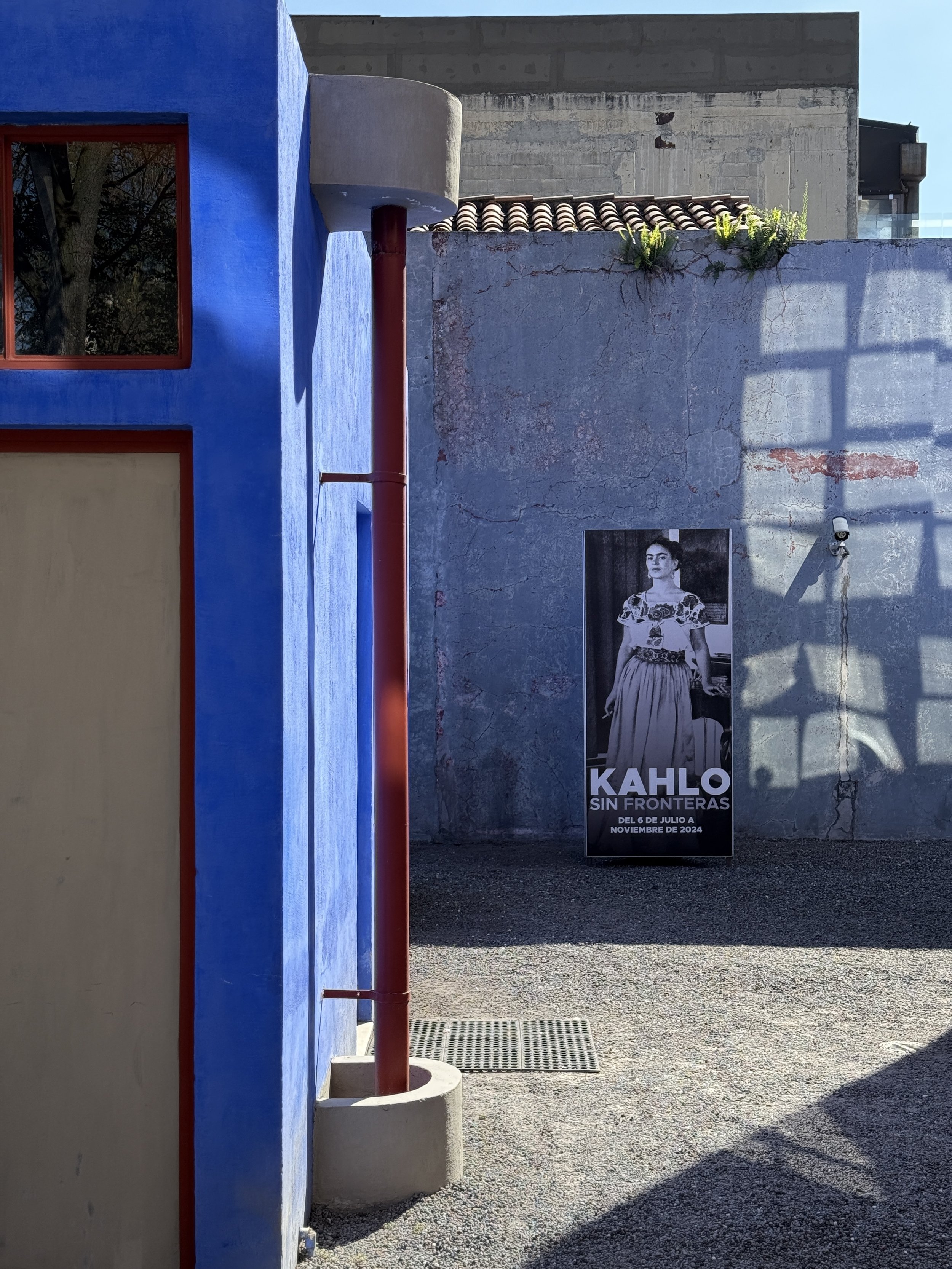
The bathroom and a poster of Frida at Museo Casa Estudio Diego Rivera y Frida Kahlo in CDMX

The building that now serves as the restrooms originally functioned as a darkroom for Kahlo’s father, Guillermo.

Not the Blue House: The History of Diego and Frida’s San Ángel Studio Home

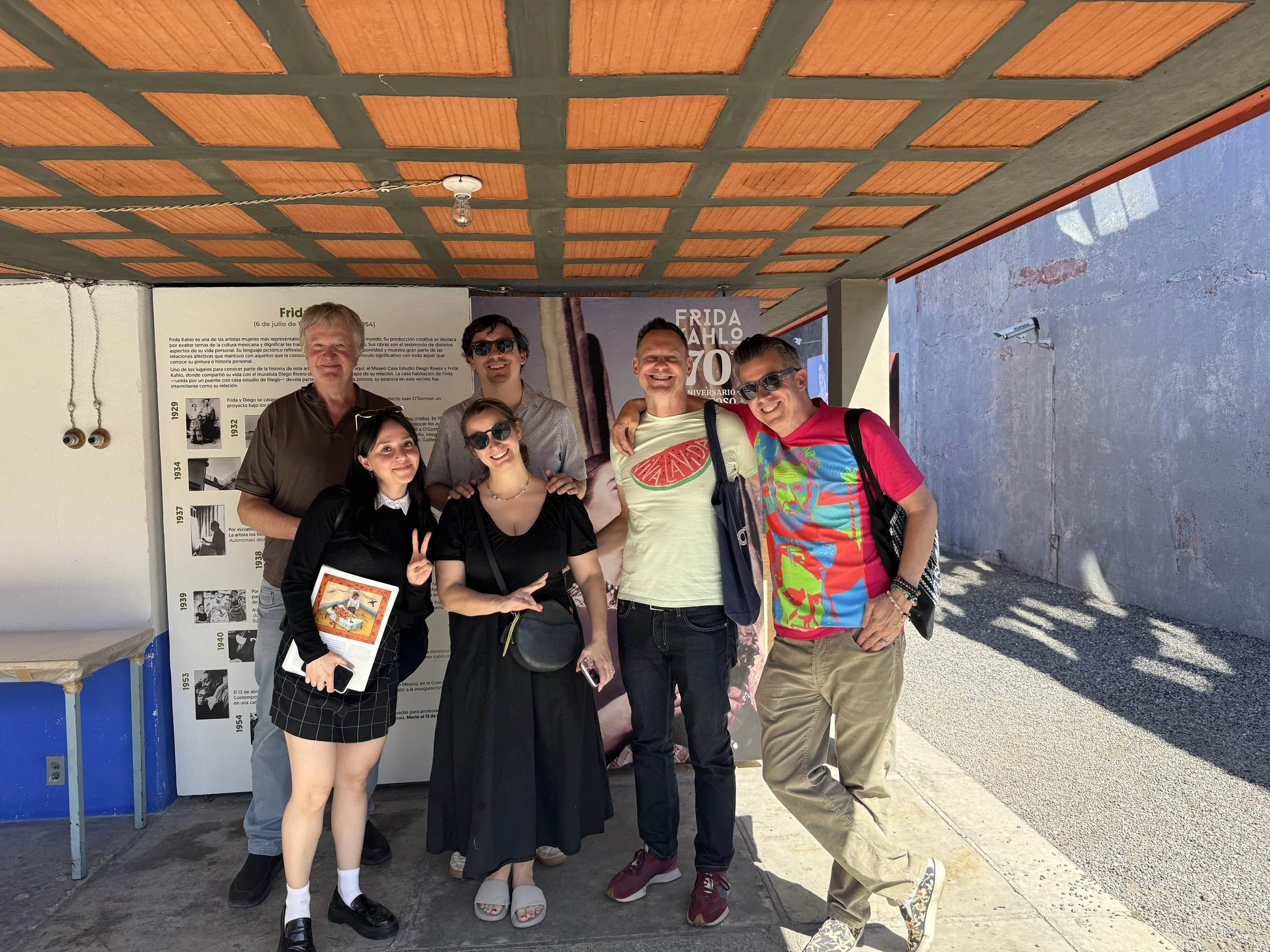
When the site opened at 10 a.m., we met our guide, Fernanda, in the museum’s courtyard. She resembled a proto-punk Japanese schoolgirl, with her nose ring and dressed in a long-sleeve white shirt under a black sweater, grid-pattern miniskirt fastened with oversized buttons and shiny black loafers. Joining us were a couple from Alabama celebrating their pandemic-postponed honeymoon and a towering white-haired man on a business trip from Germany who had added a day for sightseeing. 

Before the tour began, Fernanda asked how many of us had visited Casa Azul, Kahlo’s family home in the boho Coyoacán neighborhood. She explained that a lot of visitors show up here thinking they’re about to see the Blue House.

“It’s important to understand the difference,” Fernanda explained, “because that’s the house where she was born and where she returned after divorcing Rivera in December 1939.” 

She continued, “Here, there isn’t much furniture — it’s more of a photographic history. But what makes this site significant is the architecture of these three buildings.”

Fernanda, a tour guide at the Museo Casa Estudio Diego Rivera y Frida Kahlo in San Angel Inn, CDMX

Our charming tour guide, Fernanda, was an expert on O’Gorman, Rivera and Kahlo.

Kahlo only lived here for six years. The couple moved into the home in January 1934 after Rivera was essentially forced to return to Mexico following the controversy surrounding his mural at Rockefeller Center, Man at the Crossroads. The mural, which included a depiction of Vladimir Lenin, led the Rockefellers to order its destruction and terminate Rivera’s commission. Rivera later re-created the mural in Mexico City. This version, titled Man, Controller of the Universe, can be seen at the Palacio de Bellas Artes murals in Mexico City.

Kahlo and Rivera remarried in December 1940, a year after their divorce, at San Francisco City Hall in California; however, she never returned to San Ángel. Her declining health made it more practical for her to remain in the beloved house of her childhood, la Casa Azul, which now serves as a popular attraction. This house offers a comprehensive glimpse into her life, showcasing her furniture and personal belongings. Rivera, however, lived in the studio home until his death in 1957.

In 1981, the National Institute of Fine Arts (INBA) acquired the houses from Rivera’s daughter, Ruth Rivera Marín, and, after nearly 16 years of restoration, it opened to the public. And three decades later, INBA acquired the Cecil O’Gorman House and incorporated it into the museum campus.

A wall of windows, pilotis and a curving exterior staircase at the Cecil O'Gorman House

You can imagine Juan O’Gorman’s bold modernist design didn’t go over so well with the neighbors, who lived in colonial-style homes.

Cecil O’Gorman House 

Thanks to his interest in sports, Juan O’Gorman was the first to discover that the pair of tennis courts belonging to the San Ángel Inn were for sale.

In 1929, the aspiring 24-year-old architect purchased the plot at 81 Las Palmas, now Calle Diego Rivera, using money he had earned as chief draftsman at Carlos Obregón Santacilla’s atelier. 

He then began constructing a revolutionary dwelling inspired by Swiss architect Le Corbusier, whose work he had studied at the Universidad Nacional Autónoma de México (UNAM). The design adhered to the principle that buildings should be created solely based on their purpose and function. 

Nearly a century later, the structure remains one of the earliest examples of functionalist architecture in Latin America. Its stripped-back, utilitarian design was radical for its time, standing in sharp contrast to the surrounding 18th century colonial homes.

A closeup of the exterior concrete staircase at the O'Gorman House in San Angel Inn, CDMX

An exposed concrete spiral staircase swirls up the side of O’Gorman’s house.

By 1930, O’Gorman had completed the Cecil O’Gorman House, which, according to his autobiography, he designed as a home and studio for his father. 

But that’s not the whole story. 

His father, the Irish painter Cecil Crawford O’Gorman, was an avid collector of colonial art and antiques. He already owned a spacious hacienda nearby and had no interest in downsizing to the modernist glass box that his son had built. In reality, it’s likely that O’Gorman designed the house to showcase his architectural ideas and intended it to serve as a prototype for low-income housing, though the project never came to fruition.

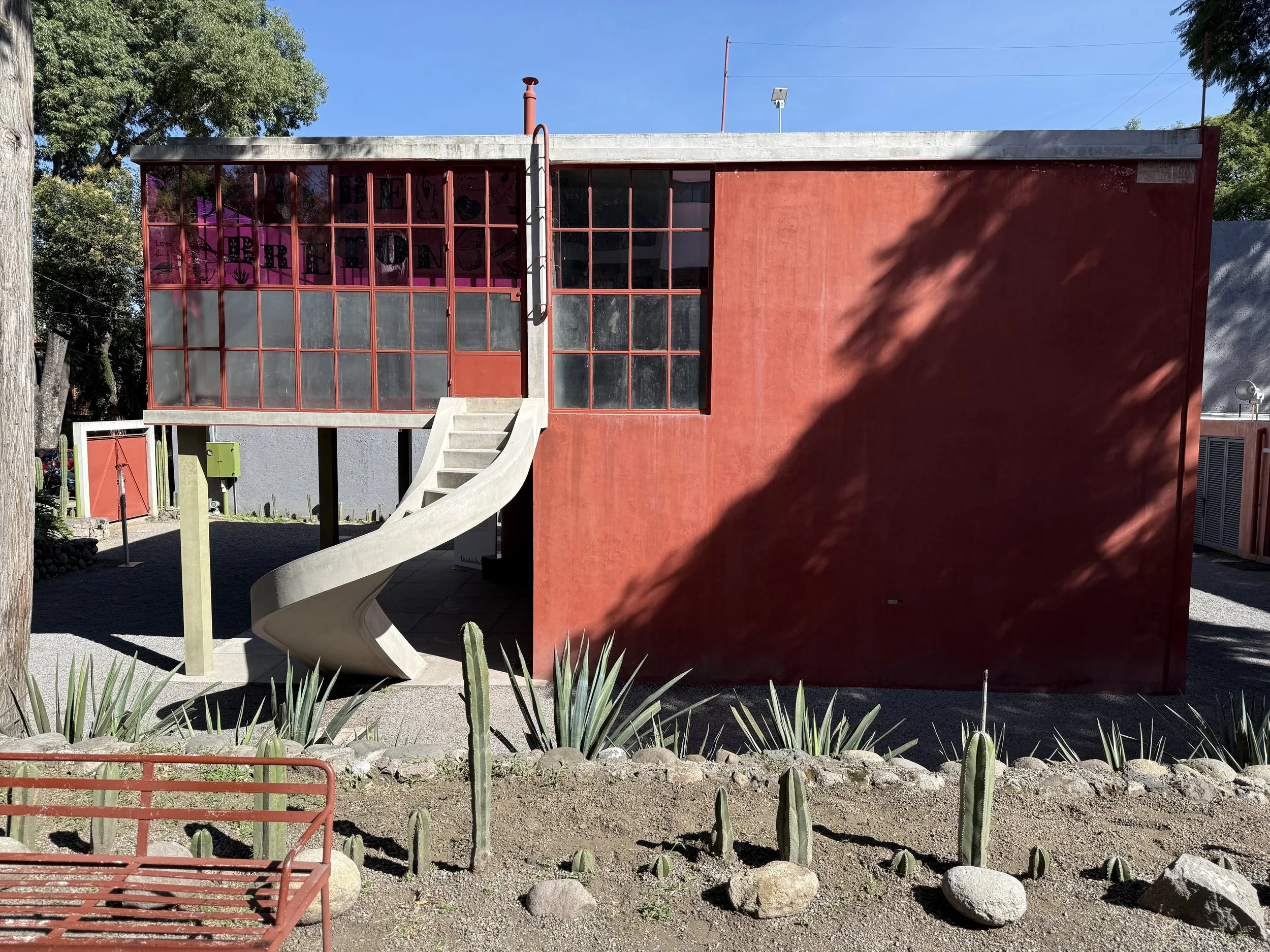
Elevated on pilotis, slender columns that raise the reinforced concrete structure off the ground, this innovative construction method eliminated the need for traditional load-bearing walls, allowing O’Gorman to incorporate an entire wall of articulated glass windows. 

Access to the second floor is provided by an external spiral staircase, but unfortunately, it was closed during our visit due to the installation of an upcoming exhibition.

Side view of the brick red Cecil O'Gorman House in CDMX

We weren’t able to go upstairs in the O’Gorman House because they were setting up for a new exhibition.

Like Rivera, O’Gorman had socialist inclinations and sought to challenge the norms of his time. He wasn’t just building a home — he was making a declaration of functionalist design amid the traditional architecture that characterizes much of San Ángel.

The neighbors were said to be outraged, demanding that his architectural degree be revoked. 

The locals didn’t care for the home’s curb appeal, either. Enclosed by Pachycereus marginatus, a tall columnar cactus, also known as Mexican fence post cactus, and landscaped with agaves, it reflected the aesthetic of an indigenous Mexican village rather than the prevailing manicured European style.

Rivera, on the other hand, appreciated O’Gorman’s vision. He commissioned him to construct a similar pair of homes for himself and his wife, Kahlo, on the adjacent lot. 

A model of the Museo Casa Estudio Diego Rivera y Frida Kahlo complex inside the O'Gorman House

A model of the property inside the O’Gorman House.

Inside, what formerly served as the dining room and kitchen now holds a glass case with a scale model of the trio of buildings as well as a series of photographs by Cristina Kahlo-Alcalá, Kahlo’s grandniece. Among the photos are images of the hospital gowns Kahlo wore during her stays at the American British Cowdray Hospital in Mexico City, on which she often used to wipe excess paint from her brushes while she painted.

Prepatory sketch on the wall of the mural Entre Filosofia y Ciencia in the O'Gorman House in CDMX

These doodles became the mural Entre Filosofía y Ciencia by O’Gorman.

In 2012, the museum’s restoration team uncovered the sinopia, or preparatory sketch, for the fresco Entre Filosofía y Ciencia (Between Philosophy and Science) on a layer of lime plaster beneath where the completed mural by O’Gorman originally stood. The fresco was purchased by Banco Nacional de México in 1957 and, when it’s not traveling, can be found in the Museo Foro Valparaíso.

The floating exterior staircase and walkway at Frida's blue house at the Museo Casa Estudio Diego Rivera y Frida Kahlo, CDMX

Recall that Frida had leg and back issues, and imagine her having to walk up and down this floating staircase onto her roof and then across the walkway to get to Diego’s house.

Frida and Diego’s Complicated Relationship 

After we exited the Cecil O’Gorman House, Fernanda directed our attention to the floating staircase perched on the exterior of Kahlo’s house. Its tubular steel handrail leads from the second floor studio windows to the rooftop terrace. We couldn’t believe anyone would have used those stairs — especially Kahlo, whose chronic health issues significantly impaired her mobility. 

As a child, Kahlo contracted polio, which left her right leg weakened and deformed. Then, as a teenager, she was in a horrific accident when the bus she was riding collided with a trolley car. The impact left her with a fractured spine, and a handrail pierced her body, entering through her back and exiting through her pelvis.

RELATED: 9 Fascinating Facts About Frida

Yet, whenever she wanted to visit Rivera, she had to pull herself up those stairs and cross the narrow footbridge. Rivera had specifically requested this particular feature from O’Gorman to make it difficult for Kahlo to enter his studio (and see his adulterous dalliances). 

Their tumultuous relationship undoubtedly checked the “it’s complicated” box. It was a marriage strained by mutual jealousy and infidelity. Rivera didn’t fit society’s standards of handsome — Kahlo nicknamed him el Sapo-Rana (Toad-Frog) — but his fame, confidence and charisma made him irresistible to many women. 

Some visitors in the small courtyard in front of Diego's studio and house at the Museo Casa Estudio Diego Rivera y Frida Kahlo

Tour groups meet in the small courtyard in front of Diego’s house.

Rivera’s House and Studio

In my opinion, the most fascinating part of the museum is Rivera’s house. It still contains some of the original furniture and artwork from when he lived there. 

The bedroom has a set of small windows high on the wall, which limited the amount of direct sunlight and helped keep the room cool. Next to the bed, there’s a pair of shoes, an enamel bedpan and a leather suitcase sitting atop the woven coverlet, awaiting its next trip. An articulated gooseneck task lamp and a small bust of Chairman Mao sit on the olive green-painted nightstand, with a watercolor landscape by Rivera hanging above it.

Diego's bedroom at the Museo Casa Estudio Diego Rivera y Frida Kahlo, CDMX

Diego’s bedroom

Like his bedroom, the studio was mostly left as it was at the time of Rivera’s death. The main section, with its double-height space, was perfect for large works and transportable murals. The design facilitated easy handling of the panels, allowing them to be moved in and out of the studio through the folding windows.

Our favorite pieces among the personal items were Rivera’s collection of larger-than-life cartonería (papier-mâché) figures. Known in Mexico as Judases, these brightly colored effigies, with features like oversized or abnormally small heads and stubby limbs, commanded the room with their massive presence. Originally, these figures were depictions of Judas Iscariot, the apostle who betrayed Jesus Christ. Rivera’s collection includes devils, skeletons and other fantastical creatures, which were traditionally burned, exploded or flogged on the Saturday before Easter. 

Diego's papier-mache Judases at the Museo Casa Estudio Diego Rivera y Frida Kahlo

Some of Diego’s collection of papier-mâché Judases in his studio

Many of these larger-than-life-sized effigies were created by the Mexican folk artist Carmen Caballero Sevilla. One Holy Week, Rivera visited the Mercado Abelardo Rodríguez and was impressed with Sevilla’s Judas figures and invited her to work in his studio in San Ángel. (He admired the working class, which is why he often wore overalls.)

Metal skeletons on the wall in Diego's studio at the Museo Casa Estudio Diego Rivera y Frida Kahlo

Cool metal skeletons covered the walls.

Two of Diego's Judas figures in his studio at the Museo Casa Estudio Diego Rivera y Frida Kahlo

Diego collected handicrafts like these Judases.

Brushes and trays with reserves of dried paint remain exactly as Rivera had left them, offering a glimpse into his creative process. Among them were shelves with jars of pigments that reflect his color palette — including Paris Green, a highly toxic emerald green powder made from copper and arsenic. 

Glass jars of colorful powders used to make paint in Diego's studio at the Museo Casa Estudio Diego Rivera y Frida Kahlo

Diego’s paints line the shelves of his studio but have long since dried up.

There are bookcases filled with pre-Hispanic and indigenous folk art. On one of the easels was a painting of the Latin American actress Dolores del Río, who was rumored to have slept with both Rivera and Kahlo. 

A painting of Dolores del Rio by Diego stands by a work table in Rivera's studio at the Museo Casa Estudio Diego Rivera y Frida Kahlo

Diego painted Dolores del Rio, a beautiful Latin American actress who is said to have slept with his as well as Frida.

Fernanda pointed out a papier-mâché torito, a little bull, hanging high above us. She explained that this tradition dates back to the mid 19th century. These creations are mounted on a kind of scaffolding that rests on the wearer’s shoulders, stuffed with fireworks like roman candles and bottle rockets, which are set alight as part of the annual festival in the town of Tultepec honoring Saint John of God, the patron saint of (what else?) fireworks makers. 

Sound dangerous? It sure is — but that didn’t stop Fernanda’s brother from participating in one. And he has the burns to prove it. 

Our group followed Fernanda up the staircase to the second floor, where we could take in a full view of the studio. Fernanda explained that this was the very spot where Kahlo discovered Rivera with her younger sister Cristina — an incident that became the proverbial last straw, which led to their separation and brief divorce. It wasn’t Rivera’s or Kahlo’s numerous indiscretions that caused the rift; it was the fact that Rivera was having an affair with her closest confidant.

Just off the landing, we entered Rivera’s private office, a space with a desk and a typewriter and additional bookcases filled with pieces from his prolific collection of pre-Hispanic artifacts, an obsession that can be seen at the Anahuacalli Museum in Coyoacán

A small gray typewriter sits on a desk with shelves of pre-Columbian artifacts in Diego's office at the Museo Casa Estudio Diego Rivera y Frida Kahlo

Diego’s typewriter and some of the pre-Columbian artifacts he loved to collect.

From Rivera’s office, a door opened onto the rooftop terrace and the narrow bridge connecting his former residence to Kahlo’s. However, Fernanda quickly dismissed any thoughts of taking the infamous floating stairs. Instead, we followed her back through Rivera’s office and down the staircase to the courtyard below.

Side view of the blue home where Frida lived at the Museo Casa Estudio Diego Rivera y Frida Kahlo

Frida’s house leaves much to be desired — but at least O’Gorman painted it the vibrant blue of her beloved family home, Casa Azul.

Kahlo’s House

Our group paused outside Kahlo’s house as Fernanda pointed out an interesting feature: a carnelian red painted garbage chute extending from the second floor, connected to a steel drum barrel. Its purpose? To collect kitchen waste.

By this time, the site had grown much busier, with dozens of visitors streaming in and out of the buildings.

The rooms inside Kahlo’s house were noticeably smaller and compact than those in Rivera’s, in large part because there wasn’t an open studio space. Unlike her husband’s residence, Kahlo’s house was devoid of decorative objects or furniture, leaving the space feeling even more austere.

The tiny kitchen exemplified functional design, featuring a concrete countertop with a gas cooktop, a small sink, and the opening of the chute that connected to the steel barrel outside. 

Wally leans against the blue wall of Frida's house by the kitchen garbage chute at the Museo Casa Estudio Diego Rivera y Frida Kahlo

A man from Germany insisted Wally pose for a picture in his bright T-shirt to contrast with the blue of Frida’s house, next to the kitchen garbage chute.

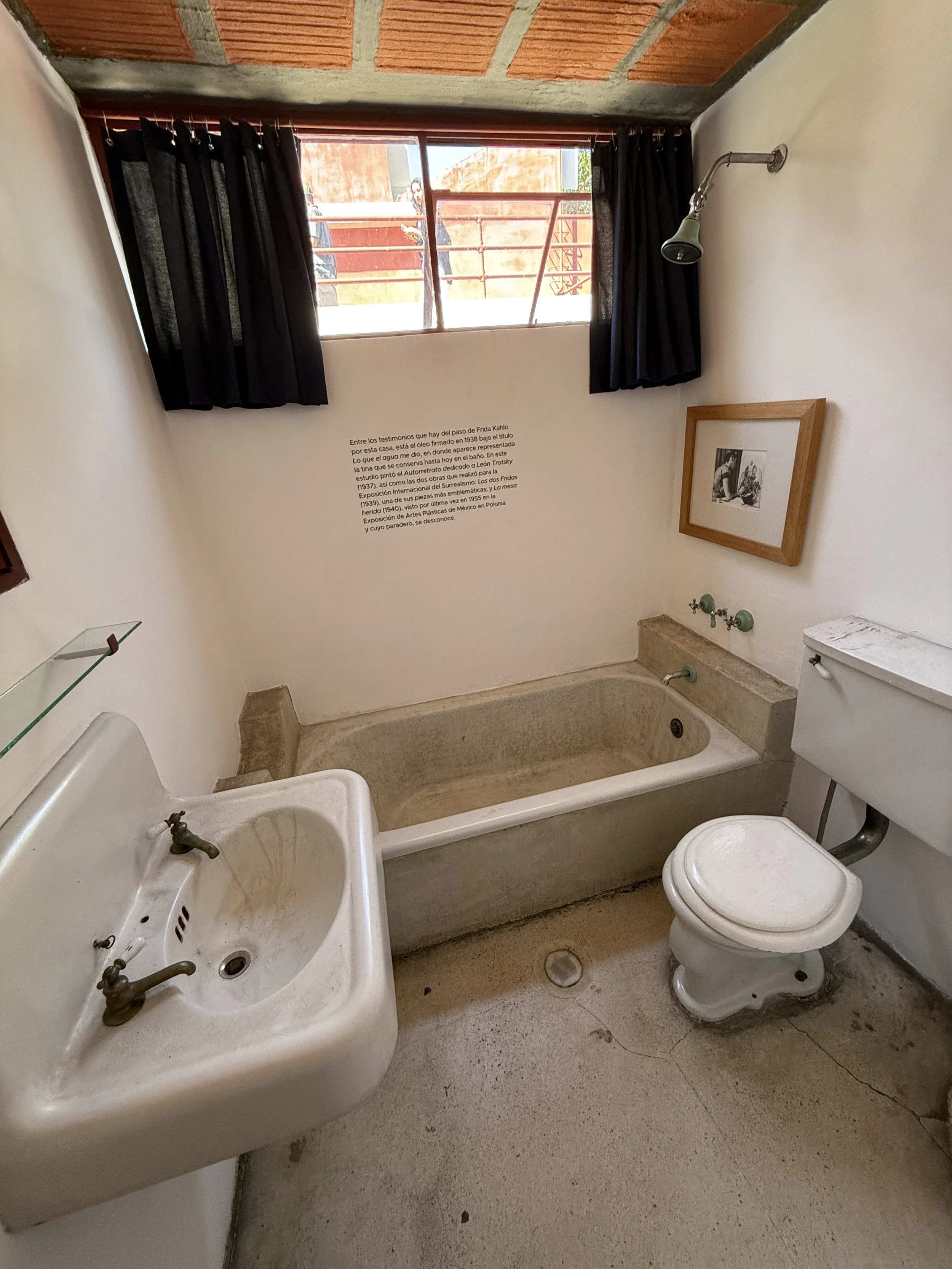
We peeked into the modest bathroom, the very space where Kahlo’s 1938 oil painting, Lo que el agua me dio (What the Water Gave Me), was conceived. Fernanda told us that there weren’t any good spaces for Frida to paint in her home, so she chose the bathroom, which had better lighting. 

The bathroom in Frida's house at the Museo Casa Estudio Diego Rivera y Frida Kahlo in San Angel, CDMX

Frida’s home is small and dark, so she preferred to paint in the bathroom. One of her most famous works, Lo que el agua me dio, came from this period.

Wally paused in front of a framed letter that Kahlo had written to Hungarian-born photographer Nickolas Muray, with whom she shared a decade-long, on-again, off-again relationship, and read this poignant sentence aloud: “Please forgive me for having phoned you that evening. I won’t do it anymore.”

One of the glass cases in Kahlo’s house displays an open copy of the book Complete Anatomy of Man by Martín Martínez, and included a handwritten dedication from Kahlo to Dr. Juan Farill, the surgeon who performed seven spinal surgeries on her. 

The final room we explored was her small bedroom — a fitting conclusion to our visit. The room was concealed behind thick black drapery that we had to pull aside to enter. Inside, an installation by Cristina Kahlo-Alcalá features numerous lightboxes  illuminating Kahlo’s medical records from the American British Cowdray Hospital. The air in the room felt heavy and still, with the slow rhythmic sound of a heartbeat emanating from a hidden speaker. 

We knew beforehand about Diego and Kahlo’s turbulent relationship. But standing in the dark, claustrophobic space Diego had O'Gorman design as her home was a different kind of gut punch. It was hard not to feel the weight of it — the realization that someone as fiercely powerful as Kahlo could be confined like this by a man who claimed to love her. It really shook us, and we didn’t linger.

A tour group and their guide pose under the entrance to Frida's house at the Museo Casa Estudio Diego Rivera y Frida Kahlo

Our group poses under the entrance to Frida’s house.

Know before you go

We purchased tickets prior to our trip through a site called Tiqets. At $30 per person it’s definitely more than the $2 price of general admission, but we felt it was worth it. 

Our guide, Fernanda, was charming and incredibly knowledgeable, offering all the insights we could have hoped for about the site. She didn’t shy away from discussing the complexities of Rivera and Kahlo’s relationship either. And even though the tour was scheduled to last an hour, she stayed with us for an hour and 45 minutes, never once making us feel rushed.

The museum is open Tuesday through Sunday from 10 a.m. to 5:30 p.m.

Admission is 40 pesos for adults, while children under 13 and seniors can enter for free. On Sundays, admission is free for everyone. –Duke

A view of the brick red exterior and wall of windows at Diego's house at the Museo Casa Estudio Diego Rivera y Frida Kahlo

Floor-to-ceiling windows opened wide to allow transport of Rivera’s large-scale mural panels into and out of his studio. 

Museo Casa Estudio Diego Rivera y Frida Kahlo

Diego Rivera s/n
San Ángel Inn
Álvaro Obregón
01060 CDMX
Mexico


The Art of Olive Oil Production at LA Organic

From ancient groves to modern architecture: Take a tour of LA Organic, dedicated to the production of award-winning organic olive oils and co-founded by Philippe Starck.

Four friends stand in front of a large olive tree at LA Organic in Ronda, Spain

José, Wally, Duke and Jo enjoyed learning about olive oil production at LA Organic — and tasting the goods afterward.

When I reflect on our time in the South of Spain, particularly our culinary adventures spent with our friends Jo and José, aceite de oliva, aka olive oil, immediately springs to mind — it’s essentially the foundation of Andalusian cooking.

It takes about five years for an olive tree to mature. They typically yield between 33 to 44 pounds of olives, resulting in 2 to 5 liters of oil each year.

Each morning starts with a humble piece of toasted bread, drizzled with olive oil and topped with grated tomato, to accompany a morning cup of coffee. Jo and José always had fresh molletes, a traditional ciabatta-like bread that they picked up from a local shop near their flat in Málaga

Not to mention boquerones, a shareable and delicious appetizer of tender anchovy filets marinated in vinegar and olive oil that we consumed with gusto — something my younger self would have ignorantly declined.

Olive groves at LA Organic and a view of Philippe Starck’s avant-garde La Almazara, a mill museum

A view of Philippe Starck’s avant-garde La Almazara, a mill museum that was partially built when we visited

A Starck Contrast

During our visit to Ronda, after visiting the church of Santa María la Mayor, Jo and José arranged for the four of us to take a guided tour of LA Organic (pronounced like the Californian city). The artisanal producer in the Andalusian countryside is located about two miles (three kilometers) outside of the charming town of Ronda, and was originally established in the 1990s as La Amarilla. It has since developed into an impressive full-scale business.

This collaboration involves Spanish investment banker Pedro Gómez de Baeza, whose family owns LA Amarilla, French designer Philippe Starck, and renowned oenophile Michel Rolland. Gómez de Baeza and Starck met in Madrid during the opening of Beatriz, a former theater converted into a restaurant. The interior was reimagined by the designer, and the pair became fast friends.

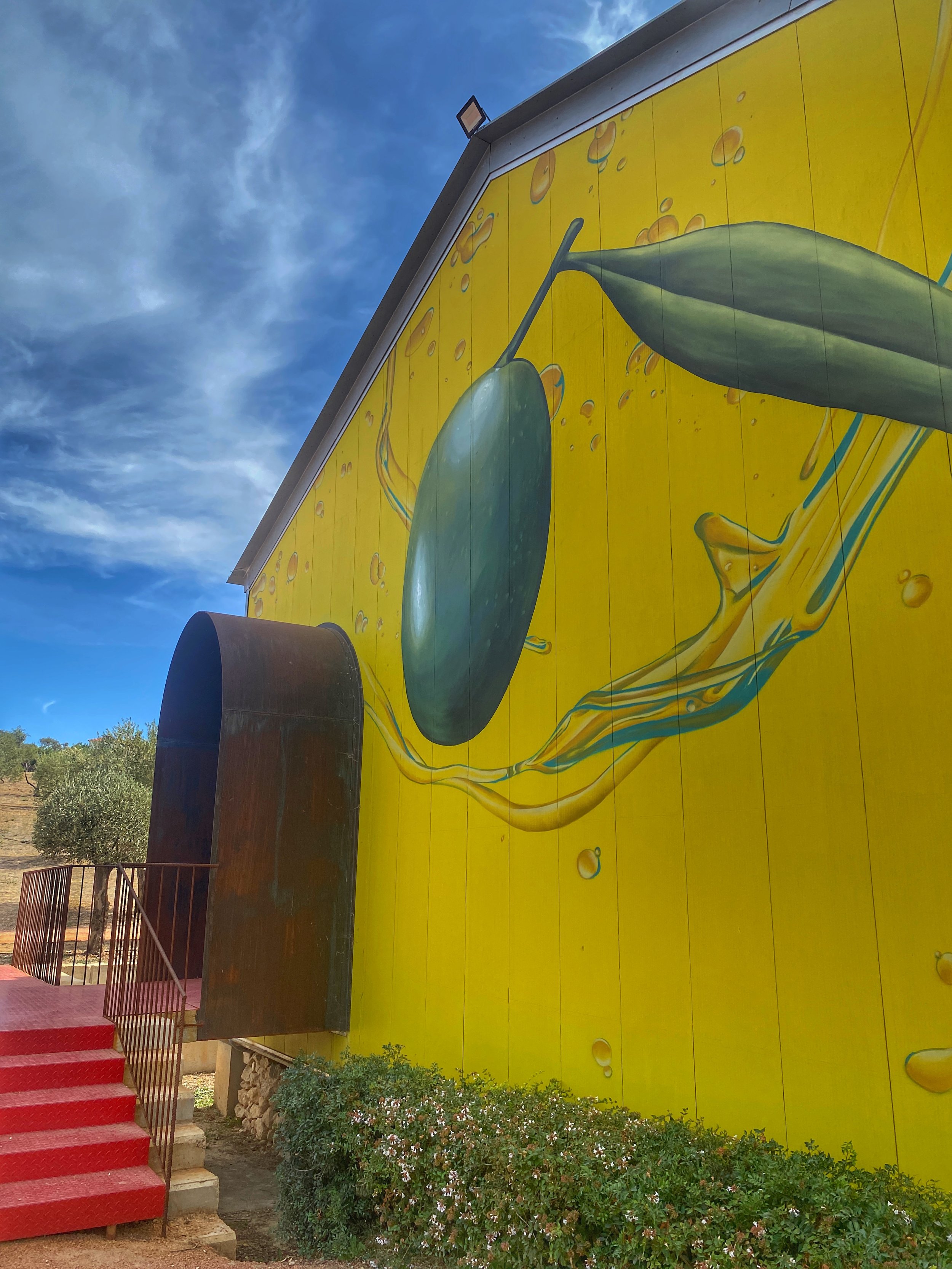
The bright yellow entrance with an olive painted on it at the Greenhouse at LA Organic in Ronda, Spain

The sunny yellow entrance to the Greenhouse at LA Organic features an oversized single green olive and leaf, the same design used on their packaging, which was created by Starck in 2009.

LA Organic: What’s in a Name?

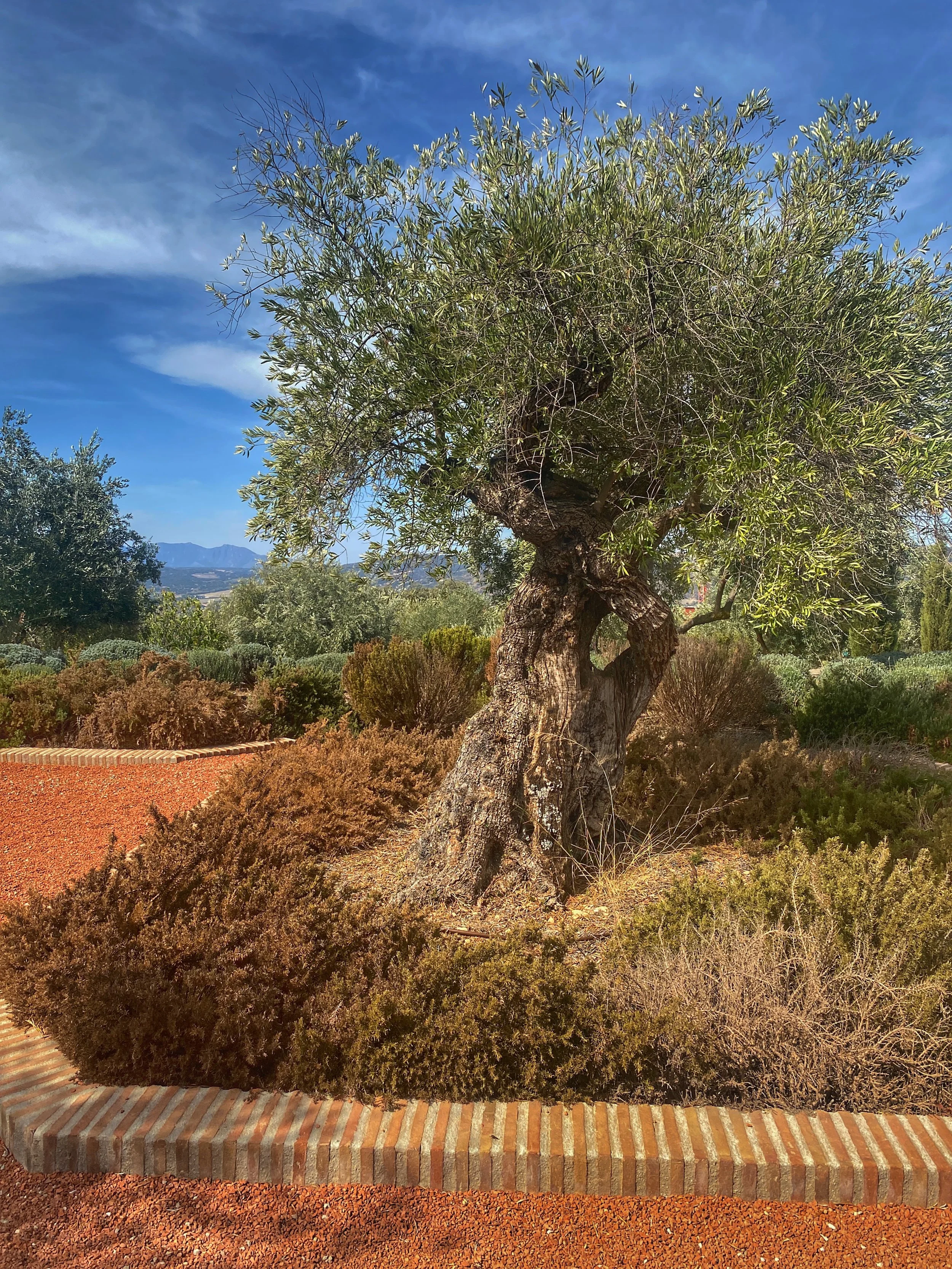
The “LA” in its name refers to La Amarilla, one of the centuries-old fincas (farms) within the sprawling complex, where more than 200 years ago, a small sisterhood of nuns lived, harvested and produced olive oil from the fruit of its ancient grove, some 800 years old — a tradition that the Gómez de Baeza family continues to this day.

Red glass doors at the entrance to LA Organic in Ronda, Spain

Part of the interior the Greenhouse will have you seeing red — an homage to the local passion for bullfighting.

LA Organic Tour

After pulling into the red dirt parking lot and stepping out of the car, we exchanged curious glances, and a smile spread across my face. In the distance, among the neat rows of gnarled, knotted olive tree trunks, stood a crane and a large cuboid building, with an expressive eye peeking out from its terracotta-colored façade — the avant-garde future mill and museum of LA Organic, designed by Starck. It’s officially called La Almazara (The Mill), but nicknamed “El Toro” due to the huge horn planned to be added to its exterior.

The four of us took the red dirt path leading from the parking lot to a bright yellow building emblazoned with a massive green olive, the same one that appears on its packaging. I would later learn that this building is known as the Greenhouse, but to my eyes it looked more like a barn. 

Olive trees and the back patio of the Greenhouse at LA Organic in Ronda, Spain

The back of the long, narrow Greenhouse has an outdoor patio.

Inside, we were provided with wireless headsets to help us hear our guide during the walking tour. We also watched a short video that recounted the origins of “liquid gold” in the Mediterranean and outlined the educational vision of LA Organic.

Once the video ended, our group followed our guide Úrsula outside. She began by telling us that the estates of LA Organic encompass 64 acres (26 hectares) and, in addition to the aforementioned ancient olive grove of La Amarilla, has over 6,000 different varieties of olive trees. 

Man looks in a large mirror in the groves of LA Organic

There are art installations by Starck in the groves.

Two men stand by mirror art installation at LA Organic in Ronda

Duke and Wally loved the giant mirror on the grounds.

As we followed Úrsula through the groves, she explained that it takes approximately five years for an olive tree to mature. During this time, each tree typically yields between 33 to 44 pounds (15 to 20 kilograms) of olives, resulting in 67 to 269 fluid ounces (2 to 5 liters) of oil per year.

A stone guardaviña in the groves of LA Organic in Ronda, Spain

A rustic guardaviña, a stone building used for storing tools and providing shelter during the heat of the day, as well as protection from rain, stands among the olive groves.

Olive Oil Production at LA Organic 

We learned about the painstaking process of producing their exceptional organic olive oil. Úrsula explained that on harvest day, which would be happening in November, workers use 22-foot-long (7-meter) wooden sticks, known as a vareo, to beat the branches. Nets are spread beneath the trees to catch and prevent the falling fruit from landing on the ground, which would taint the harvest. 

The oldest tree, a gnarled olive oil variety, at LA Organic in Ronda, Spain

This majestic, olive tree is the oldest on the property — ringing in at 800 or so years!

The olives are then collected from the nets, transported to the Almazaras de la Subbética, a mill just under an hour away, and pressed shortly thereafter to preserve the integrity of the flavor. This results in an olive oil with the lowest possible acidity, without any chemical additives or fertilizers. 

One of the varieties at LA Organic, the hojiblanca olive tree is typical of central Andalusia and is characterized by the white tone on the underside of its leaves. 

Like a Virgin

Seven organic varieties grown here are used for production, including the soft and fruity arbequina, grassy hojiblanca, briny manzanilla, peppery pajarera, slightly bitter picual (named for its pointy shape), herbaceous picudo and verdial. Rolland applies his wine skills to masterfully blend these varieties, depending on the desired intensity of the oil.

Like coffee and wine, weather, terrain and soil conditions play a crucial role in determining both the quantity and quality of olives at LA Organic, with the most fruitful groves cultivated in the fertile hills. 

Úrsula explains how drought has been a big problem of late, with decreased yields driving up the price of olive oil across Spain. (P.S. Using an umbrella is a good idea, with much of the tour exposed in the blazing heat.)

Dealing With Drought

Olive oil production in Spain dropped by about one-third in 2023 due to a prolonged drought caused by a string of heatwaves and nearly three years of reduced rainfall. 

As the world’s leading producer of olives and olive oil, Spain supplies approximately 40% of the global output, with around 75% coming from the Andalusian region. Jo and José told us that, with the price of this cooking staple increasing, locals had resorted to stealing oil from restaurants.

Úrsula explains how olives are processed at LA Organic using the cold press extraction method. 

More Than a Splash in the Pan

The tour culminated where it began, at the Greenhouse, with a tasting of their oils. LA Organic specializes in extra virgin olive oil (EVOO), which means that all their oils undergo a single pressing, using the cold-press extraction method. 

This process involves crushing the olives into a pulp while keeping the temperature no higher than 80.6 degrees Fahrenheit or 27 degrees Celsius (the “cold” part of the process), followed by centrifugation to separate the oil from the pulp. Lower-quality oils — those that aren’t extra virgin — are often crushed multiple times and at higher temperatures to extract more oil from the fruit.

How to Taste Olive Oil

The tasting session featured four different kinds of olive oil, which we sampled both with and without bread. Our instructions were to pour a small amount of oil into our tasting cups and swirl it gently to release its aroma. We lifted the cups to our nose and took a deep inhalation, noting the differences in smell between the mild arbequina and picudo, intense yet smooth picual, hojiblanca and arbequina blend, as well as the grassy 100% hojiblanca oil. 

Our tasting spread

When tasting olive oil, take a small sip and allow it to coat your mouth. Pay attention to the flavors and aromas present. It’s common to experience a peppery sensation in the throat, as well as notes of grassiness and bitterness, which are indicative of high-quality oil. 

Inside the Greenhouse, where you can taste the oils, order drinks and nibblies, and buy some bottles to take home.

We bought a couple of bottles of the milder LA Organic Suave and a bottle of organic balsamic with sherry vinegar to take back to Chicago with us. (We’re ashamed to say that the bottle of olive oil we purchased as a gift ended up being used in our kitchen.)

A corten steel structure featuring a square cutout frames a stunning view of the Grazalema Sierra mountains.

The Deets

I highly recommend a tour of LA Organic as a way to learn about the cultivation and production of Andalusia’s most important export. 

The walking tour and tasting cost $21 (20€) per person and lasted approximately 45 minutes, with an additional 45 minutes spent sampling their oils. 

Our guide, Úrsula, spoke both English and Spanish fluently. She was friendly, enthusiastic and patient, taking the time to share her knowledge and answer all of our questions. We left feeling inspired by their commitment to sustainability and were impressed by the quality of LA Organic’s olive oils. –Duke

LA Organic 

Carretera Ardales Ronda A 367
Kilometro 39,5
29400 Ronda, Málaga
Spain


Rick Bayless Garden Tour: A Flavorful Experience

Join the renowned Topolobampo and Frontera Grill chef in his Bucktown garden on an unforgettable Chicago culinary tour. And be sure to try the begonias. 

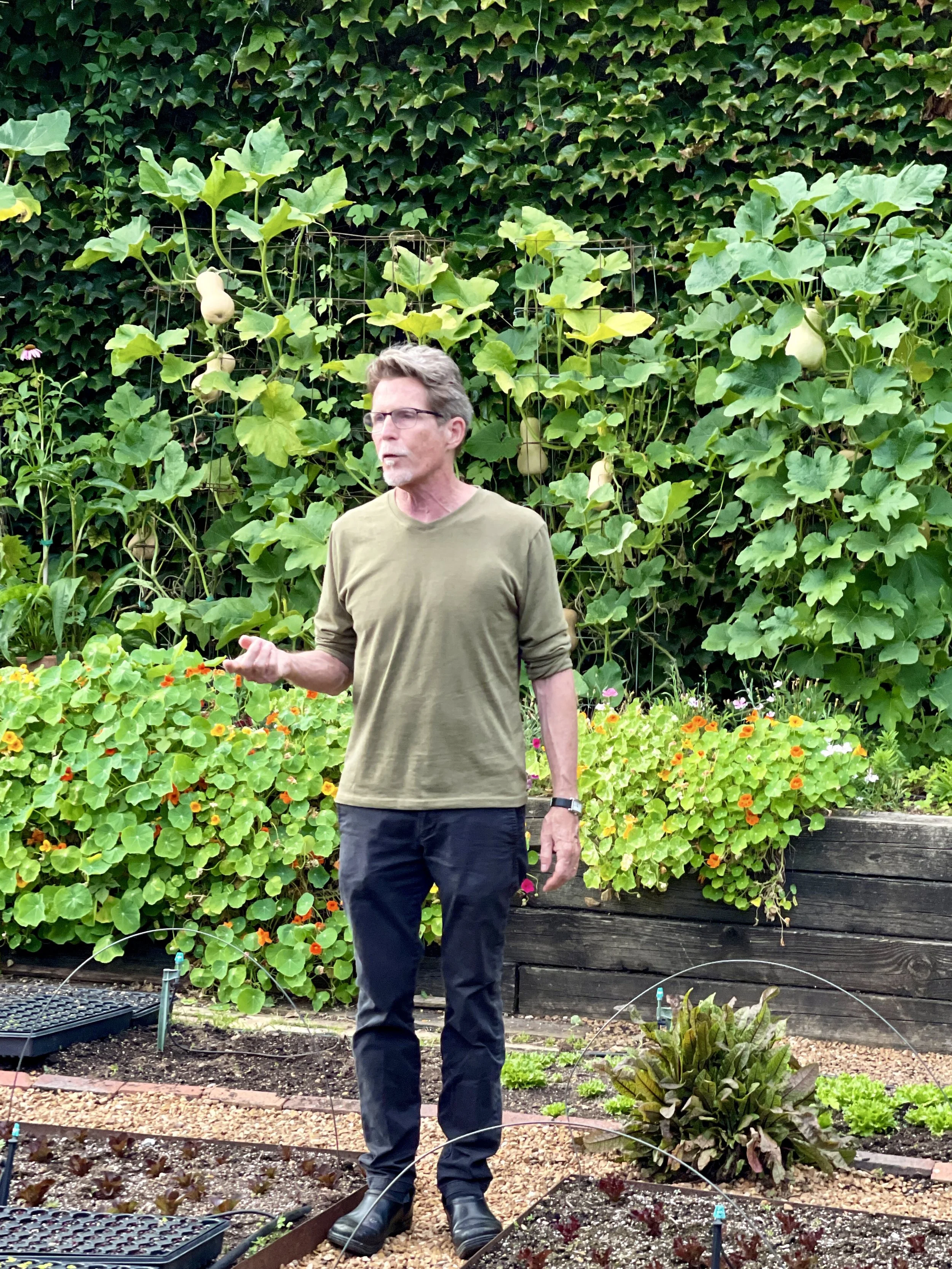
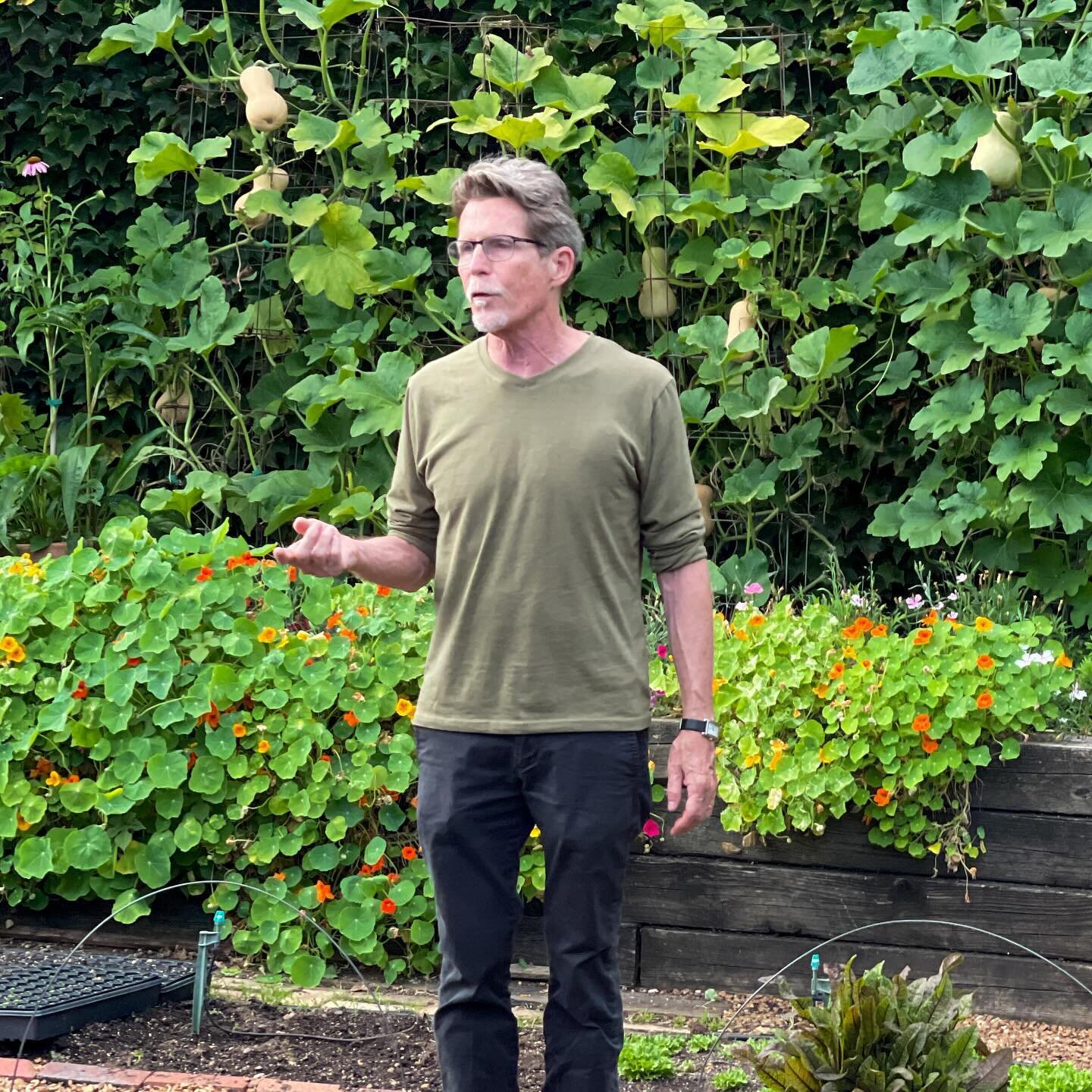
When celebrity chef Rick Bayless opens up his urban garden for tours, snatch up tickets — they go fast.

One of the many things that I love about Chicago is that you can be a tourist in your own city. There’s so much to see and explore. So when I received an email announcing the opportunity to take a tour of Chef Rick Bayless’ urban production garden, I immediately texted my husband, Wally, to gauge his interest. Thankfully he was as excited as I was, and we were able to secure a late August visit through the Tock app. 

Front door of Bayless home with potted plants

The Bayless home’s front door

We arrived about 15 minutes early and joined the other guests waiting outside the Bayless residence in a quiet street in Chicago’s Bucktown neighborhood. It’s situated adjacent to the 606, an elevated park that used to be a rail line.

Because we had a little extra time, Wally and I went up onto the 606 and stood on our tiptoes to get an aerial view of Rick’s garden. 

Looking down into Rick Bayless' Bucktown, Chicago garden

You can catch a peek of Bayless’ garden from the 606 elevated park.

After the previous tour group left, we entered through the side gate and gathered around the outdoor kitchen. The late afternoon sunlight cast a warm glow over the patio as Wally and I eagerly awaited the start of the tour. We were served classic shaken margaritas and I must admit that I was somewhat awestruck as Rick himself appeared, warmly welcoming us and sharing the fascinating history of his home.

Margaritas on white tablecloth for Rick Bayless Garden Tour

The “welcome” margaritas were too pretty not to photograph. 

Polly’s Polka Lounge

He began by telling us that he and his wife, Deann, had been looking for a property in the city where they could live and cultivate a production garden for their restaurants, Frontera Grill and Topolobampo. After three years of searching, they were discouraged and had nearly given up. So when their real estate agent excitedly called and said, “I found your place!” Rick admitted to us that he was initially skeptical, adding that they waited three days before scheduling an appointment to see it.

At the time of the Baylesses’ viewing, a cheap plastic Old Style beer sign with the name Polly’s Polka Lounge still hung outside of the two-story brick building. Built in 1895, it was originally a tavern that served the community of Eastern European immigrants who had settled in Bucktown. “First of all you have to understand what a tavern was in 1895,” Rick said. “We think of a tavern as synonymous with a bar today, but it wasn’t back then.”

It served as a social hub, where residents could gather and connect with others who shared the same language and traditions. In an era when many families lived in small efficiency apartments with limited space to cook, taverns like this one played a crucial role in providing meals. These establishments were equipped with a full kitchen and served up the familiar, comforting dishes of their homeland. 

The garden adheres to organic and biodynamic principles, meaning that no pesticides, herbicides or chemical fertilizers are ever used.

Rick recounted how he walked into the main room of the former tavern and thought, “This is where I want to live.” He was captivated by the open floor plan, 14-foot-high tin-plate-covered ceiling and terrazzo floor, which bore a beautiful patina from decades of beer dripping onto the floor where the bar once stood. 

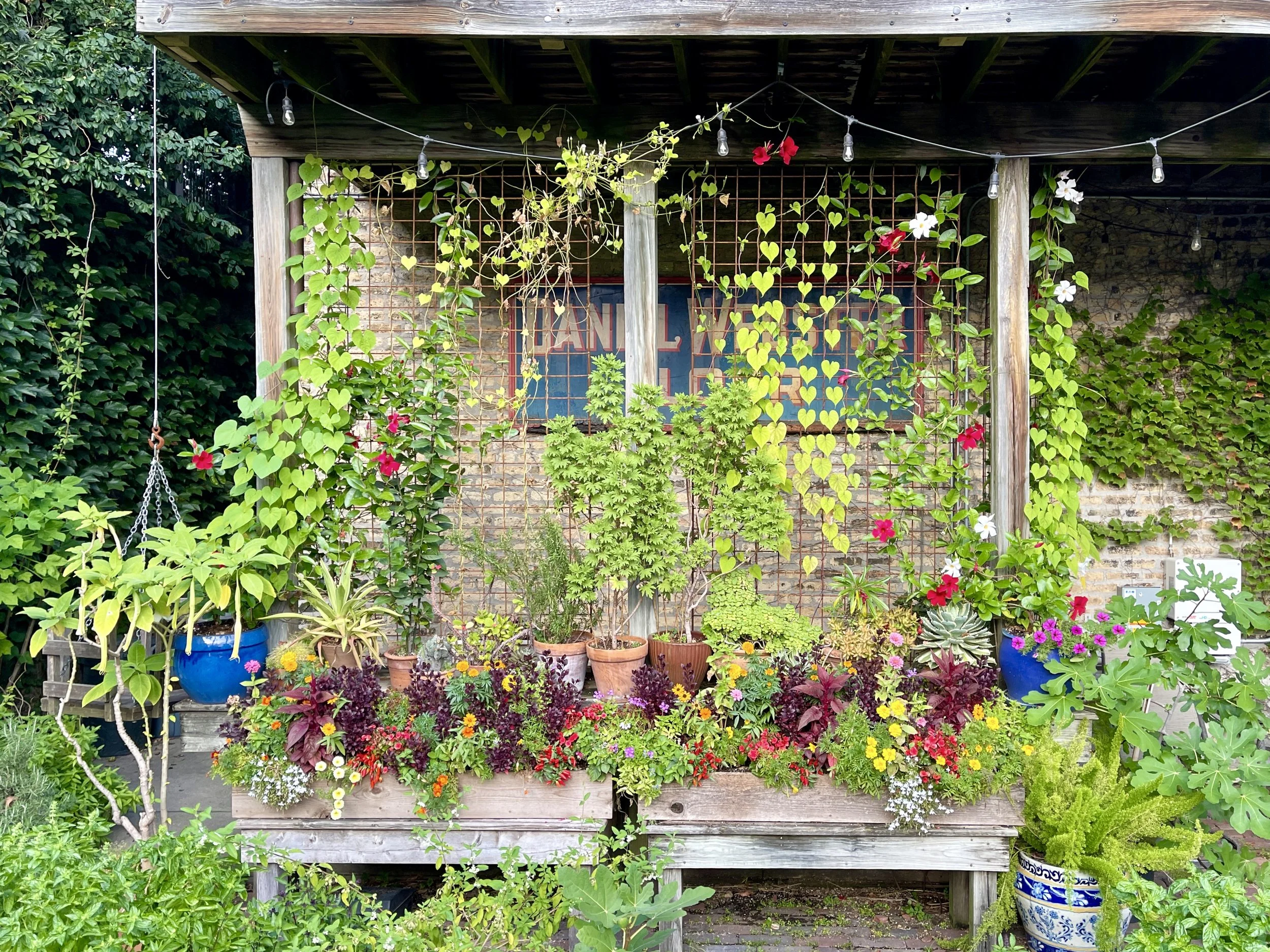
Climbing vines and potted plants on the back porch of the Bayless home

Many of the flowers in the garden are edible.

Fun fact: When Rick asked the owners where the bar was now, he was told that it was sold to a buyer in Ireland, who had it dismantled, shipped across the Atlantic and reconstructed. He mused about the curious journey of a bar made in Chicago by Eastern Europeans now residing in a pub somewhere in Ireland. 

When Rick saw the outdoor area, which is the size of three city lots, he fell even more deeply in love with the property, and he and Deann immediately put in an offer. 

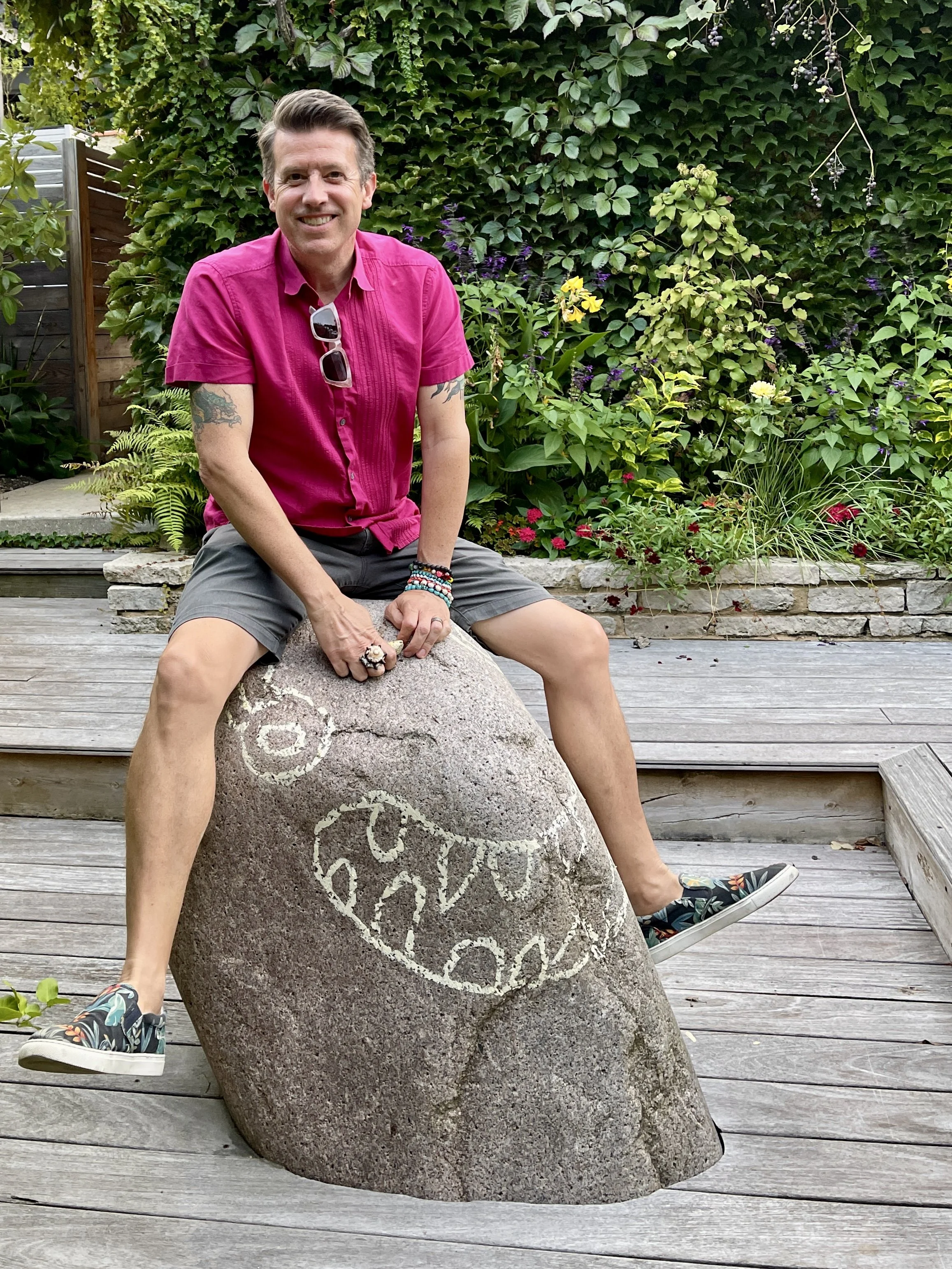
Man in pink shirt and gray shorts sits atop rock with smiling face drawn on it

A boulder behind the adjoining property had a face drawn on it by the Baylesses' granddaughter — which Wally, of course, couldn’t resist sitting on.

Man in pink shirt puts arm around man in floral t-shirt in chef Rick Bayless' garden

Wally and Duke think the garden tour is worth the price of admission. And if you’re lucky, you’ll have Rick himself as your guide!

They’ve now lived there for nearly three decades, and as Rick tells it, it was kismet. “This is just amazing because I have always been in the hospitality business,” he said. “My parents, grandparents, aunts and uncles were all in the restaurant business, and I grew up in it and then got into it myself.” 

In addition to the former tavern where Rick and Deann reside, there’s also a three-flat next door, where their daughter, son-in-law and granddaughter live.

Chef Rick Bayless talks to a tour group in his Bucktown garden in Chicago

Bayless tells us about the behind-the-scenes drama of the pibil episode of his show.

The Pitfalls of Pit Cooking in Chicago

Before we left the grilling area, Rick pointed out an earthen rock-lined pit. This traditional pre-Hispanic cooking method involves adding firewood to heat the rocks to a temperature between 800° and 900°F. Historically, people would dig a pit, line it with rocks, build a fire, add meat wrapped in aromatic leaves and bury it to prevent oxygen from getting in. The protein cooks underground over a period of six to eight hours, using the residual heat of the rocks. Rick explained that on the Yucatán Peninsula, this method is used for making cochinita pibil, while in Southern and Central Mexico, it’s used for barbacoa. 

Rick recounted how he wanted to feature this method on his PBS cooking show, Mexico: One Plate at a Time. He got his television crew excited, and they started digging at 8:00 in the morning. However, he had overlooked one crucial detail: the shallow roots of the maple trees growing in that part of the yard. He proceeded to tell us that what appears to be him single-handedly digging the hole was actually a labor-intensive effort involving three men wielding pickaxes for nearly six hours to tackle the stubborn roots. 

“When you watch any kind of television, especially reality television, don’t believe it,” Rick added. “There’s a lot going on behind the scenes that you don’t see.”

Profile of celebrity chef Rick Bayless

Bayless’ local restaurants include Topolobampo, Frontera Grill and Xoco.

Garden Party With Rick Bayless

We followed our host to the heart of the garden, which features a grapevine-covered pergola that yields between 250 to 300 pounds of sweet, juicy Concord grapes annually (the same variety used in Welch’s Grape Juice). Once harvested, the thick-skinned grapes are laboriously processed through a food mill, cooked down and sweetened with sugar. The resulting pulp is used in sorbets and pies at Frontera and Topolobampo. 

Concord grapes in Rick Bayless' garden

The Concord grapes adorning the pergola are used in sorbets and pies.

Adjacent to the pergola is a plot dedicated to growing hoja santa, which translates to “holy leaf” in Spanish. The large heart-shaped leaves are extensively used in Mexican cuisine as a wrapper for tamales, poultry, meat and seafood, which are then steamed or baked. Its flavor is reminiscent of black licorice and root beer, and in Texas, where it grows wild, it’s known as the sarsaparilla plant.

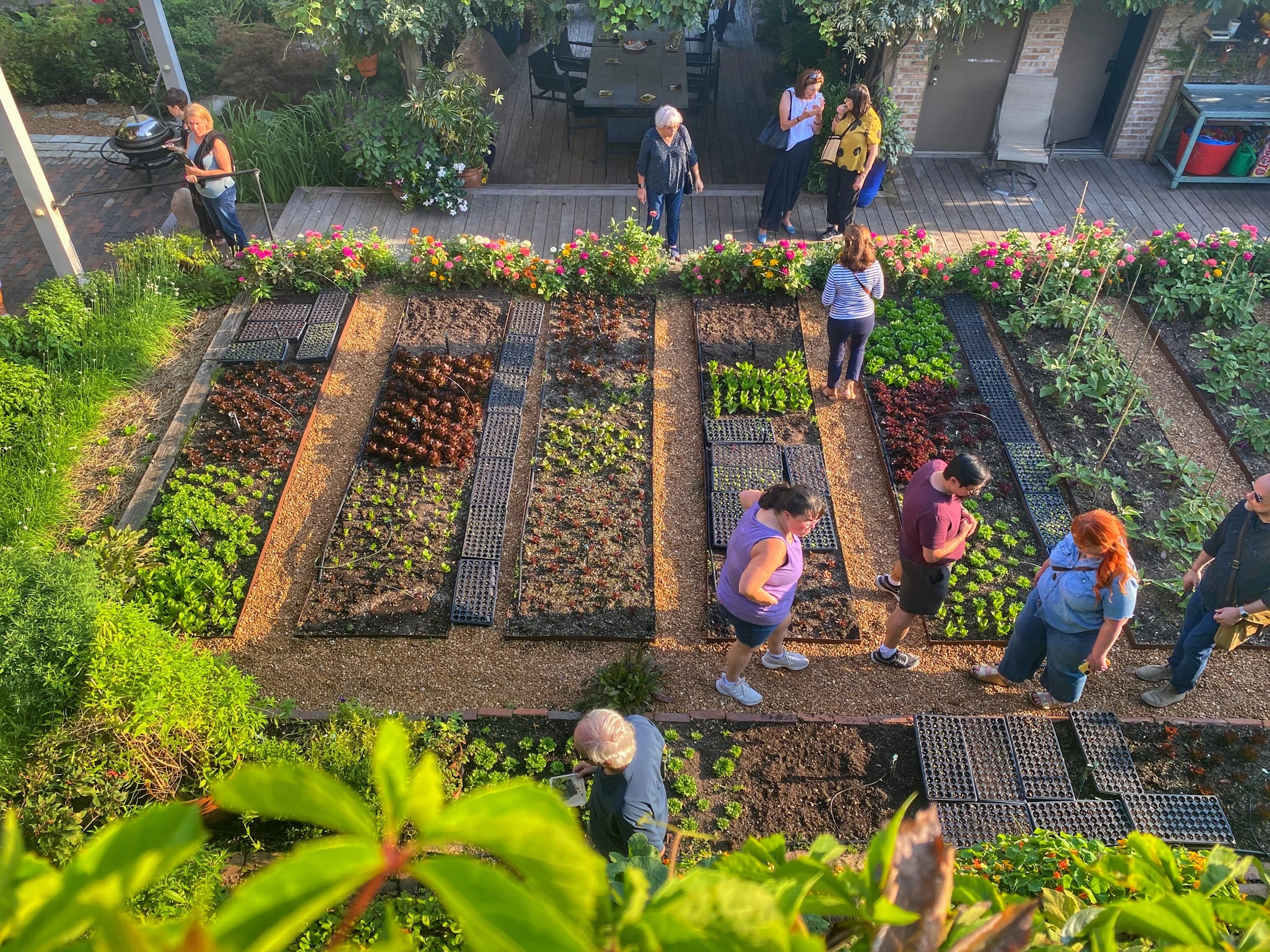
Rick gave us an overview of the main production garden, which holds a combination of raised beds, traditional beds and containers. A few of the raised beds produce salad greens, continuously replanted throughout the season, along with aromatic herbs such as basil, lavender, lemon verbena, marjoram, spearmint and thyme. These provide the restaurants with an array of seasonal, locally sourced produce. 

Rick Bayless' home and backyard garden

Many of the fruit, veggies, herbs and flowers are used in dishes at Bayless’ restaurants.

The garden adheres to organic and biodynamic principles, meaning that no pesticides, herbicides or chemical fertilizers are ever used, and it emphasizes the holistic relationship between plants, animals and soil. Additionally, there are two resident chickens, Grace and Frankie, and a small pond that’s not filled with koi but with goldfish from PetSmart, as well as an apiary buzzing with honeybees. 

Colorful zinnias growing in chef Rick Bayless' garden

Colorful zinnias

These cacti are resilient enough to survive harsh Midwestern winters. Bayless planted a single paddle years ago that has since grown to this size.

Raspberries add a burst of color and flavor, not to mention Mexican sunflowers, nopal cactus and butternut squash, grown for both their blossoms and fruit. These thrive alongside hanging baskets of Begonia boliviensis, whose edible red flowers pack a delightful sour citrus punch. 

Man in pink shirt smiles while chomping on a begonia flower

Wally couldn’t believe how tasty the begonias were. It was like something Willy Wonka would create. (He went back for seconds.)

Rick urged us to sample anything from his garden, which we did, and by far, our favorite ended up being the surprisingly tart begonia blossoms. 

Fun fact: According to Rick, the cilantro we’re familiar with today originated in Southeast Asia and was introduced to Mexico by Spanish conquistadors in the 1800s. However, this doesn’t mean there wasn’t a cilantro-like herb already in existence south of the border. In the garden, you’ll discover an indigenous aromatic, the grass-like pipicha, native to Southern Mexico, with a flavor akin to cilantro.

After exploring the gardens, we used the bathroom and snuck a peek of the kitchen, where Mexico: One Plate at a Time is filmed. It’s filled with well-loved pots and pans, plant-covered windowsills and cabinets lined with souvenirs from Rick’s travels.

I found Rick to be a sincere and passionate teacher. It was a privilege to visit and experience his excitement about his garden as he spoke with us — if only for a magical hour and a half. –Duke

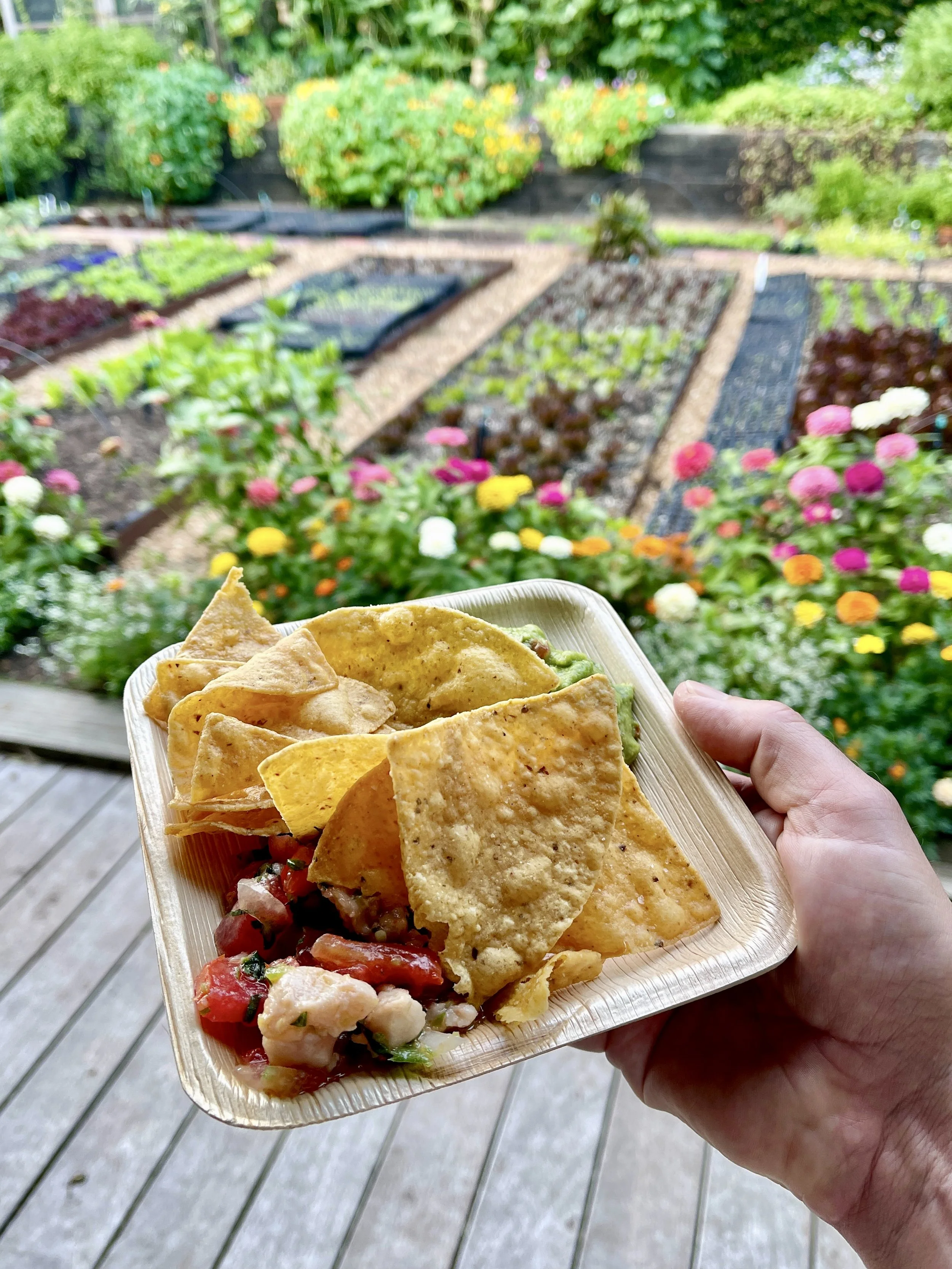
Disposable dish with tortilla chips, ceviche and guacamole with colorful flowers in garden

We were served guacamole and ceviche — which Bayless wittily clarified wasn’t made using the goldfish in the garden pond.

Rick Bayless Garden Tour

The highlights

  • Guided tour of the garden (we’ve heard his gardener, a charismatic young man, often leads these, but we were lucky enough to have had Rick Bayless himself as our host)

  • Welcome cocktail and light Mexican bites (we had guacamole and ceviche)

  • Learn about the history of the home and garden and its role in Rick’s restaurants.

  • See the diverse array of fruit, vegetables and herbs grown in the garden.

  • Gain insights into Rick’s sustainable gardening practices.

  • Eat as much flora as you want!

A woman and man finish prepping food in chef Rick Bayless' kitchen in Bucktown, Chicago

The kitchen in Bayless’ home is the one featured on his cooking show.

The details

Cost: $75 per person

Duration: Approximately 90 minutes

Availability: Select dates throughout the year

Location: Rick Bayless’ private residence in Bucktown in Chicago

Visit Tock to book a tour — if they’re available. 

Note:

  • Tours sell out quickly, so snatch up a spot as soon as possible.

  • The tour isn’t wheelchair accessible.

  • Children under the age of 12 aren’t permitted.

Mayhem, Madness and Mystery at the Abandoned Buffalo State Asylum

Unveiling the dark secrets that haunt the halls of the former insane asylum on an unforgettable tour with Preservation Buffalo Niagara at the Richardson Olmsted Campus. 

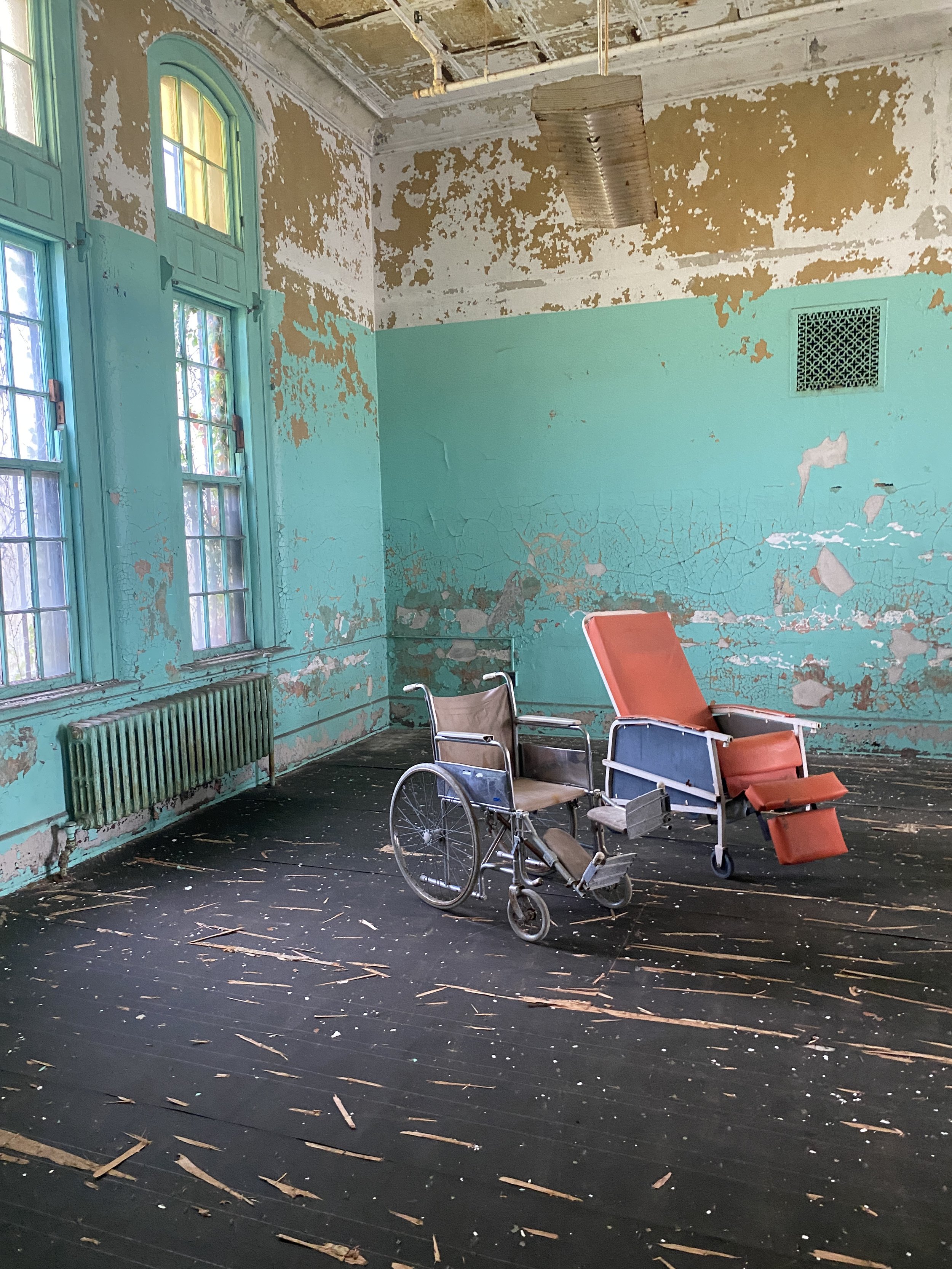
Two wheelchairs in a room with crumbling aqua paint at the abandoned Buffalo State Asylum

If you like creepy settings and learning about the history of mental illness treatments, book a tour of the Buffalo State Asylum for the Insane the next time you’re in that neck of the woods.

As mentioned in our previous post, Wally and I were staying overnight at the Richardson Hotel. So, of course, we couldn’t resist the chance to explore the vacant buildings of the decommissioned asylum the following morning. I eagerly awaited the release of tickets for the docent-led tour on the Preservation Buffalo Niagara website — and when they became available, I quickly purchased our tickets for the two-hour in-depth tour ($30 each at the time of publication).

After a quick breakfast at Café Calvert, we arrived about 15 minutes early and gathered with the other attendees inside the Lipsey Architecture Center gallery, which hosts a small museum of artifacts, where you can delve into the institution’s history. Once we checked in, we signed the necessary safety release forms and were provided with hard hats. 

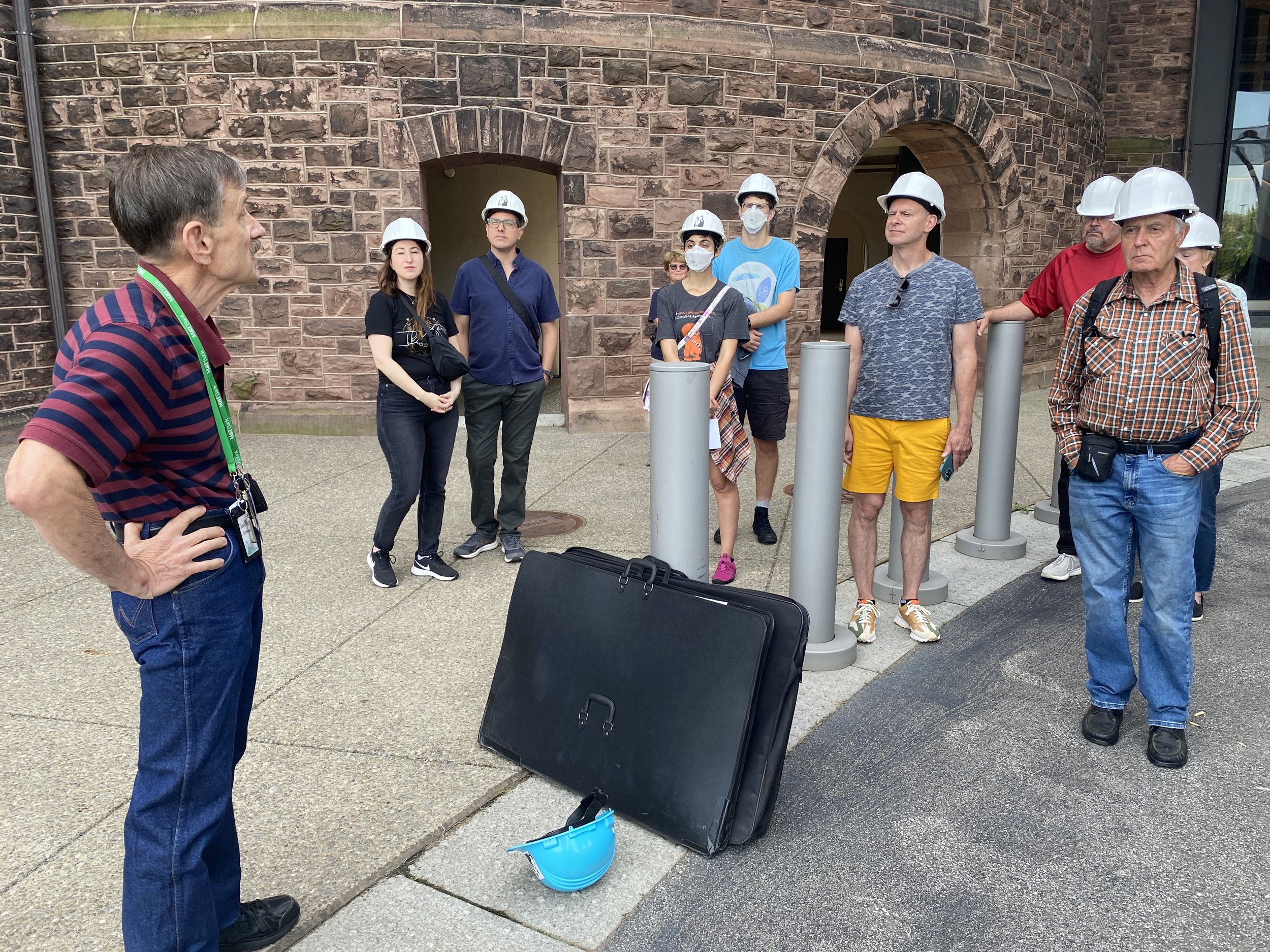
A tour guide talks with a group of people in white hard hats at the Richardson Hotel in Buffalo, New York

Geoffrey has been giving tours for a long time and knows an impressive amount about the facility.

Our guide, Geoffrey, introduced himself and warmly welcomed us on behalf of the Richardson Center Corporation, the nonprofit organization entrusted with preserving the historic structures on the Richardson Olmsted Campus. He began the tour by introducing the key figures who were involved in the construction of the buildings we were about to explore. He also laid out some ground rules: no photography, unauthorized video recording, high-tech ghost-tracking gadgets, smoking, or vaping allowed. (Wally and I had gotten special permission to take a few images inside to accompany this post.)

In the interest of safety, Geoffrey requested that we all stay close together. The buildings and floors we toured have been stabilized for future use — though we saw at least one closed-off area that had a hole through the floor. Someone who wandered into off-limits areas could find themselves plummeting to the floor below. 

The Richardson Hotel and a large expanse of green grass in Buffalo, New York

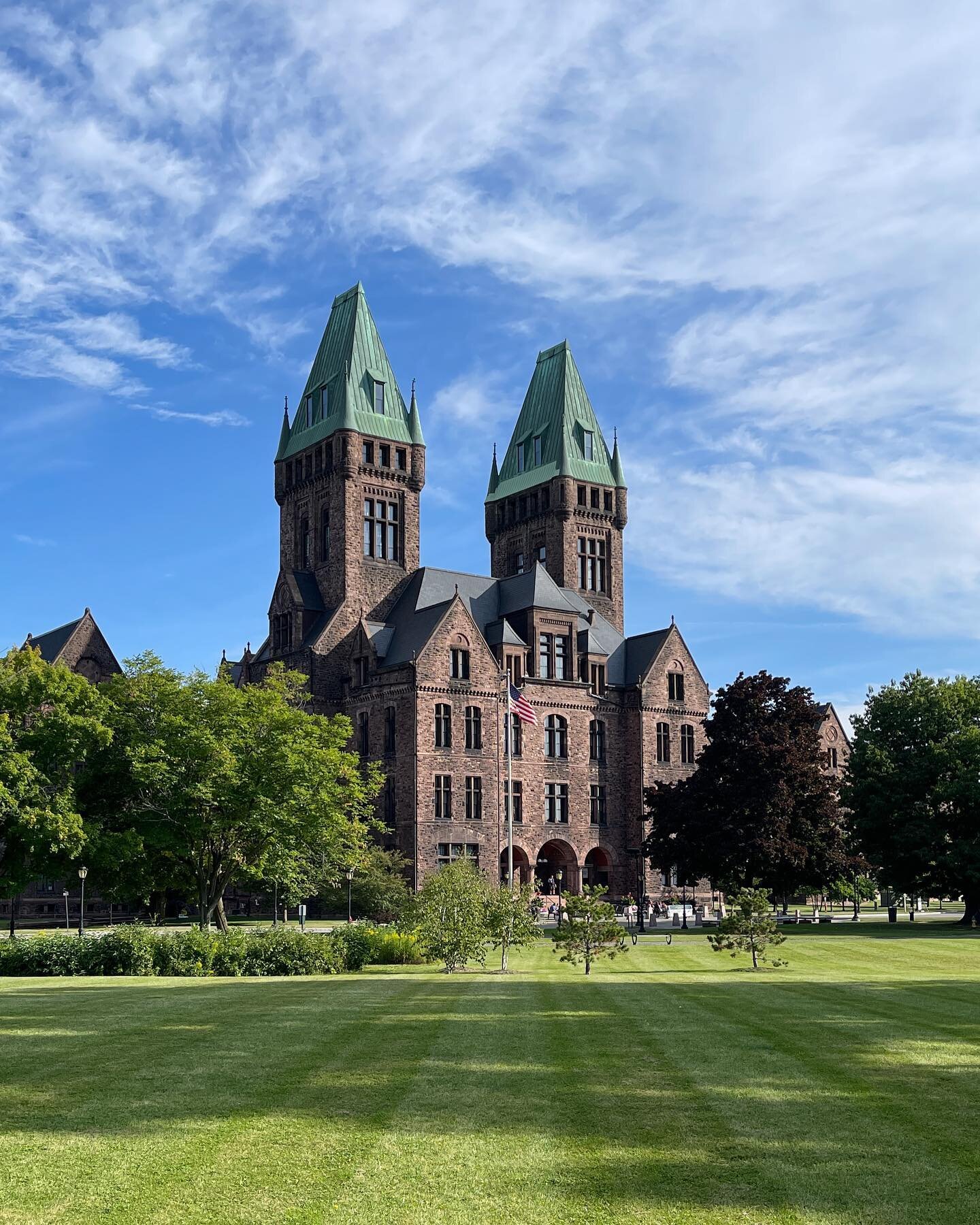
The asylum was the largest commission of Richardson’s brief career. His vision for the hospital reflected the Kirkbride philosophy to create a holistic environment for the recovery of mentally ill patients. The central part is now a hotel.

Paging Doctor Kirkbride

The first of three figures Geoffrey introduced us to was Dr. Thomas Story Kirkbride, a Quaker physician and alienist who served as the superintendent of the Pennsylvania Hospital for Mental and Nervous Diseases. 

Kirkbride was a pioneer in advocating for the moral treatment of the mentally ill, and his influential opus, On the Construction, Organization, and General Arrangements of Hospitals for the Insane, With Some Remarks on Insanity and Its Treatment, was published in 1854. It laid the foundation for a standardized concept for these specialized institutions. 

Topics covered in his book included the roles of the staff, putting the superintendent firmly in charge of decision-making — perhaps reflecting the importance he placed on his role at the Pennsylvania Hospital. 

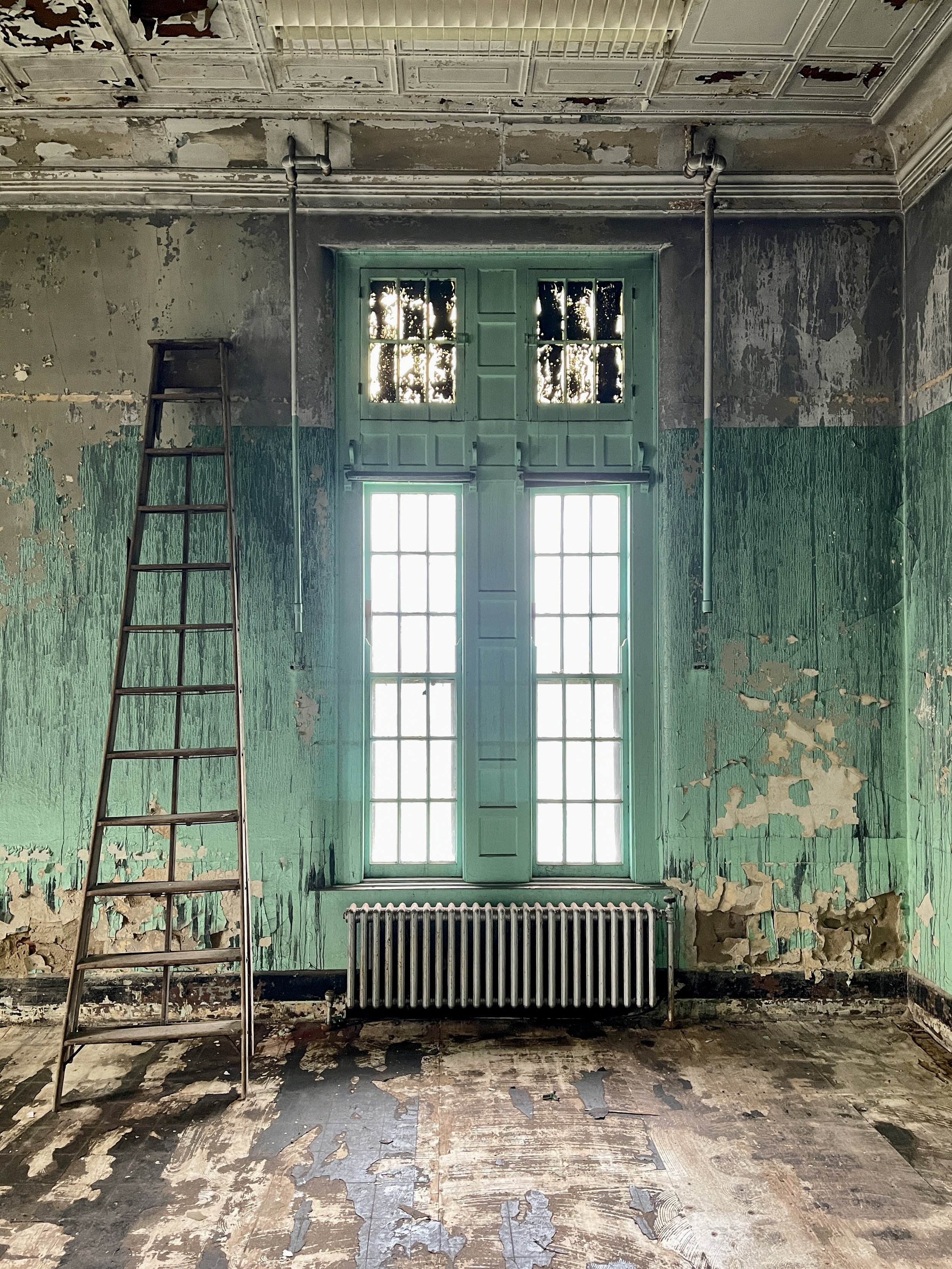
Ladder leaning against the wall by window and radiator with greenish-blue peeling paint in the abandoned Buffalo State Asylum

The entire complex took a quarter of a century to complete due to a lack of funds. After a 10-year delay the five women’s wings were finally completed, in 1886.

Kirkbride proposed that these mental facilities not exceed 250 patients, a baseline that was frequently disregarded and likely contributed to their failures. Case in point: When the east wing of the Buffalo State Asylum for the Insane accepted its first patients on November 15, 1880, it was already pushing the limits. It was designed by Richardson to accommodate 300 patients, 50 more than Kirkbride’s maximum.

This codified method of asylum construction became known as the Kirkbride Plan and included a central administration building with patient wings on either side.

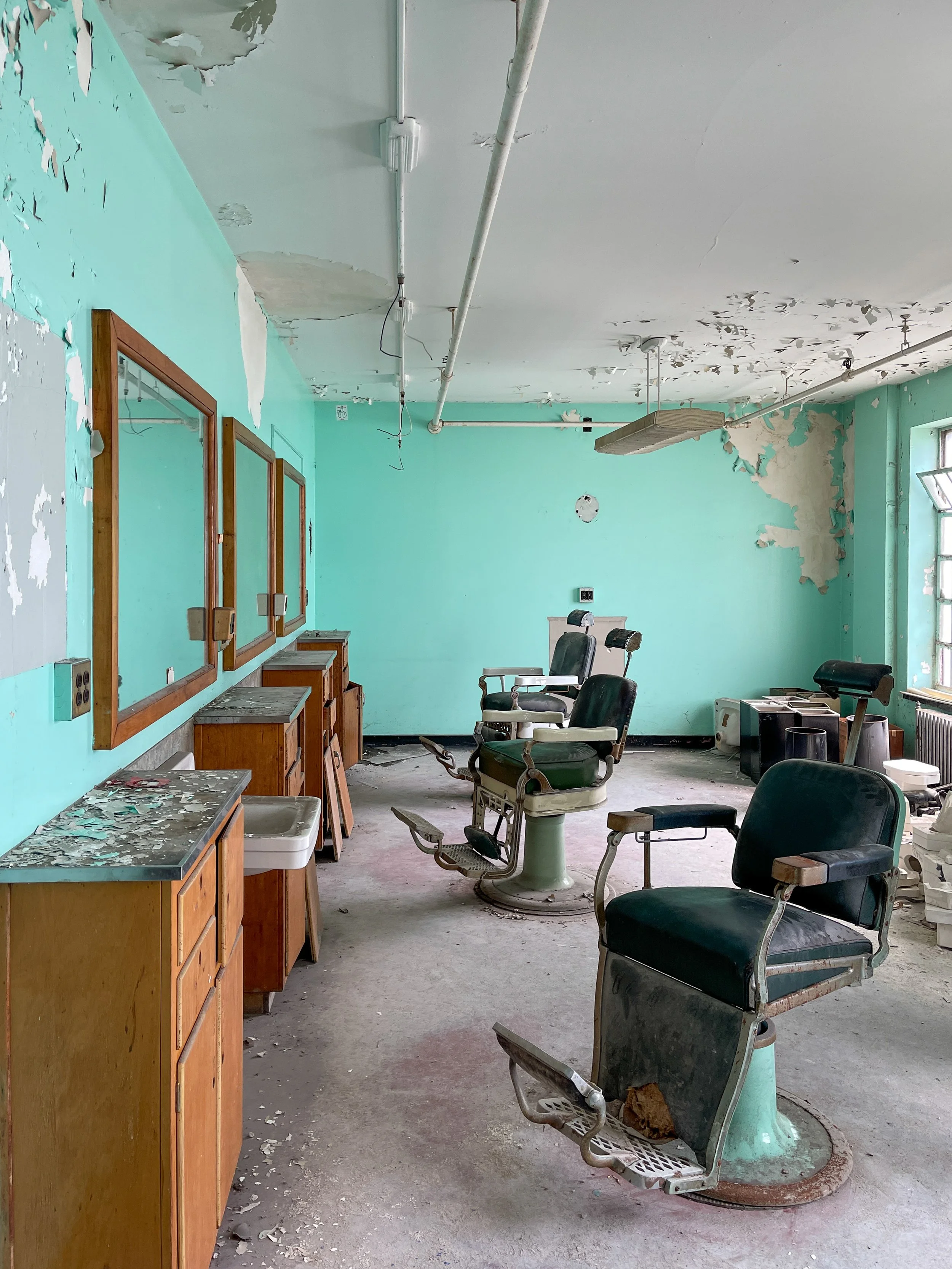
The men’s ward included a barbershop. One side ended up becoming a repository for plaster molds used to make ceramic Christmas-themed figurines that were sold in an onsite shop.

Buffalo Gets Its Wings

Geoffrey pointed out that when the state of New York decided to build a mental asylum in Buffalo, they sought the expertise of Dr. John Gray, the superintendent of the New York State Lunatic Asylum at Utica. At its inception, the site spanned 203 acres of farmland on the outskirts of the budding city, stretching all the way to the banks of Scajaquada Creek.

The second key figure to be introduced to us by Geoffrey was a familiar one: architect Henry Hobson Richardson. Although his career was brief — he died at the age of 47 of kidney failure — he’s remembered as the father of American architecture. Richardson was responsible for the design and construction of the residence of William Dorsheimer, a prominent lawyer and citizen of Buffalo. When the time came to select an architect for the asylum, Dorsheimer suggested Richardson.

According to Geoffrey, the structure is Richardsonian in certain ways, but Richardson wasn’t allowed to do exactly what he wanted. The state continually made modifications to Richardson’s designs, and the structure we see today was actually the seventh iteration. Gray improved upon the asylum’s design, including the introduction of short, curved corridors, which discouraged the placement of additional patient beds that would lead to overcrowding.

Frederick Law Olmsted’s Impact on Buffalo State Asylum’s Landscape Transformation

By now our group had followed Geoffrey through an underground passage and assembled on the outer edge of the South Lawn, facing the central twin-towered Administration Building (now the Richardson Hotel). Our guide proceeded to tell us that the third person involved in the development of the former state asylum was none other than the renowned American landscape architect Frederick Law Olmsted. Kirkbride’s treatment approach emphasized the vital role of the environment, deemed crucial for recovery.

Olmsted and his partner Calvert Vaux were invited to Buffalo in 1868 to design a public park system. In anticipation of the construction of the Buffalo State Asylum for the Insane, the duo laid out plans for the pastoral grounds during their visit.

The original plans were lost, and the partnership between Olmsted and Vaux came to an end. However, Olmsted returned to Buffalo in 1879, just as construction was nearing completion and devised a fresh design. He oversaw the planting of around 150 trees and 2,000 shrubs intended to be enjoyed on afternoon walks. Regrettably, only two of these plantings are what remain of Olmsted’s original work: a lone swamp white oak whose heavy limbs are supported by wooden scaffolding and a white ash tree.

The entire complex functioned as a self-sustaining community, with its own blacksmith, bakery and railroad line. Additionally, there was a farm on the northern part of the site, which was designed, along with the extensive walkways and paths, by Olmsted. 

The Richardson Olmsted Corporation enlisted Andropogon Associates, a prominent Philadelphia-based landscape architecture firm, to rehabilitate and re-landscape the South Lawn for public use. Their efforts included the elimination of asphalt parking lots, which were recycled and repurposed to create pathways.

A door with a screen is partially open in a room with peeling blue paint at the abandoned Buffalo State Asylum

Beware! You never know what lurks behind that door!

Inside the Abandoned Mental Institution

Our interior explorations began with the male ward. These spaces exuded precisely what one might envision in an abandoned former psychiatric facility. The peeling walls were painted aqua blue, and the floors were littered with plaster that had gradually detached from the cavernous lath and plaster ceilings 16 feet overhead. Geoffrey enlightened us about the original wall color of the ward – a pale yellowish pink accented by burgundy trim.

Vents were placed higher up on the walls in the male wards because Kirkbride believed that male patients were prone to gathering around them and treating them as makeshift spittoons.

Plaster on the ground and doors leaning against the wall in the spooky abandoned Buffalo State Asylum

There’s a substantial amount of work ahead, with various ideas being considered for the future use of these spaces.

Quieting Schizophrenia’s Demons With Controversial Treatments

Our group paused at the end of a corridor where three basketballs sat forlornly and listened intently as Geoffrey discussed the details of insulin coma therapy, an experimental treatment from the late 1920s that laid the foundation for lobotomies and electroshock therapy. 

This method was used to treat patients with severe schizophrenia and involved the administration of small doses of insulin, which were gradually increased over several sessions, until the patient entered a comatose state for a minimum of one hour. The procedure did come with some risks, though, including heart failure and irreversible brain damage. 

While patients might have experienced temporary relief, doubts lingered regarding whether insulin coma therapy delivered lasting improvements. Despite these concerns, it remained a widely employed treatment for schizophrenia throughout the 1940s and ’50s.

Three basketballs sit by two radiators and windows at the end of a crumbling green corridor in the abandoned Buffalo State insane asylum

One of the most evocative images Duke captured that day: the light streaming into the crumbling corridor, with three basketballs sitting forlornly beside a pair of long-dormant radiators at the end of the hall.

We exited the male wards, walking past the central building to reach the female ward. Geoffrey directed our attention to a brick structure adjacent to the Richardson Hotel’s HVAC system, which once served as the kitchen for the female ward. 

The crumbling, graffited women's ward at the abandoned Buffalo State Asylum with peeling yellow paint

When patients weren’t farming or doing occupational therapy, they spent their time in the light-filled corridors, which acted as day rooms. They were 210 feet (64 meters) long and 15 feet (4.5 meters) wide. Fun fact: One was included in the Robert Redford film The Natural.

Exploring the Women’s Ward

As we ascended a set of metal steps, Geoffrey told us that many of the brick structures on the campus (those not built using Medina sandstone) were unstable and at risk of collapsing. 

The ceilings were made of tinplate, and although they’ve acquired a rusty patina, they’ve fared much better than the lath and plaster used in the male ward. You can still see traces of the original caramel-colored paint underneath the other layers. 

There were clear indications that the corridor we passed through had experienced a fire, which had charred the towering ceilings, likely in the late 1970s or ’80s. This fire, in conjunction with the graffiti scattered throughout the space, was the consequence of squatters gaining access to the property during a period when it was unused and largely forgotten by the city. Thankfully, the fire was contained and didn’t spread throughout the building.

Green window in room with exposed brick, crumbling walls and ceiling and radiator at the abandoned Buffalo State Asylum

Despite its current state of decay, this room retains a sense of its former grandeur.

When one of the visitors in our group asked if there had been any interesting patients over the years, Geoffrey paused to share a story. He held up an enlarged black-and-white photograph of a woman in a white dress seated in a chair in one of the ward’s corridors.

Evidently, she’d been accused of murder. Following her conviction, she was sent to the Buffalo State Asylum, where she received a diagnosis of epilepsy. She stayed there for three years before somehow convincing the superintendent to release her. Geoffrey mentioned that after leaving the psychiatric center, she vanished without a trace and reintegrated into society. It remains unknown whether she was involved in any more acts of violence.

Brick fireplace by peeling yellow walls in women's ward at the abandoned Buffalo State Asylum

The sexes were separated at the asylum, and only the women could enjoy fireplaces — the men weren’t to be trusted with fire.

A notable contrast with the male ward was the presence of sitting rooms with large fireplaces, which were conspicuously missing on the other side. Geoffrey commented that female patients were deemed responsible enough to handle fire. He then quipped that the decorative wall grates in the women’s ward were positioned lower because, according to Kirkbride, women were less inclined to spit.

Each three-story wing had areas where patients would spend their days when they weren’t enjoying leisurely walks in the green spaces or tending to tasks on the asylum’s farm. Floors were equipped with a reception room, a parlor, a dining room, single lodging rooms, an attendants’ chamber, two or more bathrooms, and a room with bathtubs — patients were expected to take a bath once a week.

Pipes on the ground in the basement level of the the abandoned Buffalo State Asylum

Unfortunately, there’s nothing left of the tracks that help deliver food from the nearby kitchens to the dining halls.

A dolly was used to transport meals from the kitchens via a railway system that extended throughout the entire hospital, leading to a large dumbwaiter. This dumbwaiter, in turn, was used to deliver the food to the patient dining rooms on each floor.

A political cartoon from 1884 depicts Grover Cleveland and references story that he had an illegitimate child (whose mother he had committed to an insane asylum).

Grover Cleveland’s Problem Child 

The discussion shifted to the subject of patients who had been involuntarily committed, and Geoffrey drove this point home with a story of politics and power in Buffalo.

On July 21, 1884 the Buffalo Evening Telegraph published a salacious story alleging that Grover Cleveland, then governor of New York, had fathered a child out of wedlock a decade earlier with a widow named Maria Halpin. She gave birth to a baby boy on September 14, 1874, in a hospital for unwed mothers in Buffalo. The child was given the name Oscar Folsom Cleveland in honor of Cleveland’s closest friend.

Following the child’s birth, Cleveland used his political influence to request that County Judge Roswell L. Burrows remove the child from Halpin’s care. It was reported that Cleveland’s associates then forcibly escorted the understandably confused and distraught widow to the Providence Lunatic Asylum, known today as Sisters Hospital. However, after a comprehensive evaluation, the hospital’s superintendent confirmed the woman’s sanity and acknowledged her as a victim of political manipulation. She was released a few days later.

Cleveland's reaction? He refuted the allegations and initiated an aggressive smear campaign against Halpin, portraying her as an alcoholic and a woman of questionable character. Ultimately, Cleveland went on to win the presidency, and despite a 27-year age gap, he married Frances, the 21-year-old daughter of his deceased friend Folsom. But that’s a tale for another time. 

Bathroom with old toilets, aqua stalls, peeling paint in the abandoned Buffalo State Asylum

Some of the bathrooms still have toilets and sinks. High windows allowed natural light to enter without compromising privacy — a practical feature in the era before electricity.

Downfall by Design: The Inevitable Failure of the Kirkbride Plan

Geoffrey delved deeper into the Kirkbride model. His institutions were constructed like grand estates — lavish and expensive to operate. Their goal was to cater to the patients’ affluent relatives, who were encouraged to visit, see how lovely they were and end up convinced they were worth the hefty price tag. 

Tables stacked on each other in room with nature picture on the wall and crumbling pale blue walls at the abandoned Buffalo State Asylum

The tables have quite literally turned, and there’s still a significant amount of work ahead, as the rest of the complex awaits redevelopment. 

These hospitals primarily served as acute care facilities where patients received treatment for short-term episodes of hysteria and conditions such as disagreeable, rebellious or eccentric behavior. By today’s standards, these conditions would likely be categorized as behavioral issues. With patients coming and going quickly, the asylum reported a high cure rate. It’s not surprising, considering that most of the patients who were admitted weren’t clinically insane to begin with.

Patient populations at county-run almshouses that were already over capacity were emptied and transferred to state-run institutions. It was a mix of conditions like dementia and schizophrenia. The Kirkbride model was applied — but there weren’t any wealthy patrons to foot the bill. The more serious cases were never cured, and the wealthier patients who had been financing these facilities switched to private hospitals. Kirkbride hospitals, like the one in Buffalo, became overcrowded and eventually fell into disrepair.

Row of sinks and squares where mirrors once were in green bathroom in the abandoned Buffalo State Asylum

Overcrowded and underfunded, the mental institution finally closed in 1974.

By the 1960s, the Buffalo State Hospital, since renamed, was struggling to accommodate 3,000 patients, despite being built for 600. In response, the institution constructed the Strozzi Building and the Butler Recovery and Treatment Center, both of which remain in operation as part of the campus.

Room filled with wheelchairs, desk chairs, large duct and peeling paint in the abandoned Buffalo State Asylum

Powerful vignettes like this show the eeriness of the abandoned facility — as if the staff and patients all left suddenly, en masse.

Our tour lasted about a couple of hours and our guide Geoffrey provided us with a glimpse into the fascinating history of these structures. He was engaging and displayed a deep knowledge of the subject matter. If you’re visiting Buffalo and are interested in touring this singular (and delightfully creepy) National Historic Landmark, book your tour ahead of time. They only run from June through October. –Duke

The Charnley-Persky House in Chicago: America’s First Modern Home?

Louis Sullivan and Frank Lloyd Wright collaborated on this sleek, minimal home that defied the ostentatiousness of the Gilded Age. Step back in time and tour this innovative but little-known architectural gem.

Facade of the limestone and brick Charnley-Persky House in Chicago, designed by Louis Sullivan and Frank Lloyd Wright

Imagine what people thought of a home like this — sleek, modern, horizontal — at a time when Victorians were all the rage. Photo by Leslie Schwartz

When dealing with such legendary icons of the architectural world as Louis Sullivan and Frank Lloyd Wright, it’s not surprising that towering egos and intense rivalry come into play. But with the iconic Charnley-Persky House in Chicago’s Gold Coast neighborhood, who actually deserves the accolades?

Wright wrote that he had designed the Charnley-Persky House entirely on his own.

The claim couldn’t be refuted, as Sullivan had passed away, and the firm’s records had burned in a fire.
Helen Charnley in dark dress sitting at table with book

Helen Charnley

The Charnleys Want a “Country” Home

Let’s start at the beginning to try to unravel this mystery. In 1891, Sullivan, 34, and his then-23-year-old apprentice, Wright, teamed up to design a residential masterpiece on Astor Street for their wealthy clients, James and Helen Charnley.

The couple were members of the one-percenters of the Gilded Age. James was a banker who made his fortune in lumber, and Helen’s father was president of the Illinois Central Railroad. 

At the time, Sullivan and his partner, Dankmar Adler, were basically the cool kids of the architecture world. They had designed the Auditorium Theater Building in 1889, which is still world-renowned for its acoustics. Business was good.

While many of Adler & Sullivan’s 180-some commissions were for commercial spaces, they also designed about 60 residences. Unfortunately, most of them are no longer standing. In fact, the Charnley-Persky House is the only residence designed by Sullivan that you can still tour today.

So how did the Charnleys manage to snag Sullivan as their architect? Well, it turns out that James’ brother, Albert, was an executive at the Illinois Central Railroad. As our guide, Jean, joked, “The rich like to hang out with other rich people.” 

Adler & Sullivan’s architectural drawing of the James Charnley home

But why did the Charnleys choose this location? They were ahead of the curve. While the Gold Coast is now an affluent neighborhood, at the time it wasn’t exactly a hot spot. In fact, even though it’s not that far north of downtown, it was considered the countryside.

Three-quarters of a mile in one direction, you would reach the Chicago River. Go three-quarters of a mile in the other direction, and you’d find yourself in a notorious slum charmingly known as Little Hell. It was gnamed for the smell of sulfur from the coal gas furnaces that permeated the air. It was so dangerous that even the police wouldn’t go there, Jean told us. (What did that neighborhood eventually become? The infamous Cabrini Green housing project.)

So how did this land become prime real estate? Well, Potter Palmer, Chicago’s richest resident at the time, had a lot to do with it. He built his own home on the corner of Lake Shore Drive, spending a whopping $1 million back in 1882. The house was called “the Castle” for its size and design. 

“Of course, it raised the value of all the land around it,” Jean said. “And so it started to get developed very quickly after that.”

Historic photo of the Palmer Castle in Chicago's Gold Coast neighborhod

You can see why the Palmer home was called the Castle. It helped make the Gold Coast a hot new housing market.

Sadly, no one could afford to keep up the Castle, and it was razed in 1950. 

Before that, this area was owned by the archdiocese, with parts of it acting as a Catholic cemetery, and the only other building in sight was the archbishop’s residence.

The Charnleys' first home in the Gold Coast neighborhood of Chicago, at Division and Lake Shore Drive

The Charnleys’ first home in the undeveloped Gold Coast neighborhood of Chicago was a site of heartbreak. Note the Palmer Castle under construction in the background.

The Charnleys Join the Neighborhood 

The Charnleys built their first home on Division and Lake Shore Drive, but lost their two young daughters (ages 4 and 6) to diphtheria shortly after moving in. The memories of that house weren’t happy, so they decided to have this one built instead. It was never intended to be a family home. They had larger homes in the suburbs of Lake Forest and Evanston, so this was simply their pied-à-terre in the city, Jean explained.

Even today, it stands out from its neighbors with its modern design, a product of Sullivan’s experimental phase.

After the Charnley’s departure, the house went through several owners, including the Waller family, who had a member living there until 1969. Skidmore, Owings & Merrill (SOM) bought the house next for the headquarters of the Chicago Institute for Architecture and Urbanism and restored it. 

“They didn’t stay here long. But fortunately, they had deep pockets,” Jean said. “So they were able to restore the structure to the way it was, which no private owner could do before them.”

Philanthropist Seymour Persky later bought the house and let the Society of Architectural Historians (SAH) move their headquarters there from Philadelphia. This allowed the house to continue to stand and be appreciated for its architectural significance. As a token of its gratitude, the society added Persky’s name to the home. 

History photo of bustling crowded State Street in Chicago

Bustling State Street in the 1890s, when Chicago was one of the fastest-growing cities in the world

Gilded Age Chicago

To put the time period into context, Chicago underwent exponential growth and development during the late 19th and early 20th centuries. 

In 1880 the city’s population was 500,000; in 1890 it had doubled to 1 million; and in 1910 it had doubled yet again to 2.2 million. 

“At that time, the turn of that century, it was the fastest-growing city in the world,” Jean said. “Of course, that’s a thing of the past now. But it was a very new, vibrant, lively, energetic city with lots of money, lots of wealth, lots of disease, lots of extremes.”

Rudyard Kipling visited Chicago around this time and declared, “I urgently desire never to see it again. It is inhabited by savages.” Rude. 

In 1889, the Chicago Sanitary District was formed to reverse the flow of the Chicago River, which had been dumping waste into Lake Michigan and contaminating the city’s drinking water. A New York Times article from the time said that the water in the Chicago River “now resembles liquid.” (Sorry, St. Louis!)

As Jean pointed out, the tail end of the Gilded Age in Chicago was a time of juxtaposition, when typhoid epidemics and inaugural symphony concerts were happening simultaneously. 

The basement of the Charnley-Persky House Museum, home to the visitors center, with a large sink and fireplace with metal hood

Start your tour of the Charnley-Persky House Museum where the servants used to spend most of their time, in the basement. Photo by Leslie Schwartz

The Basement/Visitors center of the Charnley-Persky House 

Our tour of the Charnley-Persky House began in the basement, which is the visitors center. This floor was strictly for the servants’ use, so the family had no reason to come down here.

The basement contains a kitchen, boiler room, laundry room, bathroom, root cellar and butler’s pantry with a dumbwaiter.

The soapstone sink has a concrete basin. “I think the reason it’s still here is because it’s too heavy to move,” Jean speculated. “Some things are just too inconvenient to destroy.”

Overall, the house presented some design challenges, starting with its narrow footprint. It has 4,500 square feet spread across four floors — but it’s only 25 feet deep from one wall to the other. It’s essentially designed in the space of a row house, but with the entrance on the long side instead of the short side. 

What’s impressive is how Sullivan and Wright got creative with elements of the home’s design. Originally, another house was planned to be built against the back wall, so there were no windows on that side. The architects added interior windows to bring light into the space. How sweet of them to consider the welfare of the servants.

The Charnleys were lucky (err, rich) enough to have hot water in the home. When it came to heating, Sullivan and Wright went against the norm by hanging the hot water radiator below the floor — and saved a lot of room in the dining room upstairs.

Wooden feature on the ceiling that hides the radiator by the stairwell in the basement of the Charnley-Persky House

This genius feature hides the radiator and saves all that space from making the dining room above more cramped. Photo by Leslie Schwartz

There’s a door off to the side of the main room that leads to the coal cellar. It’s actually built under the sidewalk, and a manhole out front offered access for delivery men to shovel coal in.

The exterior of the Charnley-Persky House in Chicago's Gold Coast neighborhood, with trees and a car out front

Higher-end Roman bricks were used on the front of the home, with cheaper Chicago common bricks at the back. Photo by Leslie Schwartz

The Façade of the Charnley-Persky House

Most of the homes in the Gold Coast neighborhood are grandiose 19th century Victorian row houses with sharp vertical lines and elaborate ornamentation on their windows, doors, porches — basically everywhere. Many are made of rusticated brownstone and sport an asymmetrical design.

So one thing that sets the Charnley-Persky House apart is its horizontal layout.

“There’s nothing like it anywhere around here — even now,” Jean pointed out. 

Chicago was a brick-making center in the 1890s, manufacturing about 600 million bricks a year. This house reflects that. On the back side, Chicago common brick was used. Uneven in color and crumbly, they were made from clay in the Chicago River. They were also much cheaper than other types of brick. However, the front and sides of the home feature more expensive Roman brick and natural limestone.

The front door and symmetrical windows with circular elements by limestone facade of the Charnley-Persky House in Chicago

The front door of the house. You can see the importance of horizontal planes and symmetry in the home’s design. Photo by Leslie Schwartz

In the design, Sullivan exaggerated the horizontal planes. The natural limestone goes all the way across the front section and the side. There’s a balcony that spans the front. It has pillars, but they are short and squat. The Roman brick is narrow. And you can’t see the low-hipped roof at all.

The design is notable for its lack of ornamentation around the windows and doors. “Sullivan wanted the mass of the building itself to be present to us, and not to cover it up with all kinds of frills and doodads — that’s the architectural term,” Jean joked.

Also in stark contrast to its neighbors, the house is completely symmetrical, with the front door and balcony in the center and the same number of windows on each side. 

The balcony of the Charnley-Persky House in Chicago, a putty color with metalwork by Sullivan, in eye shapes

The house is devoid of decoration, aside from the metalwork on the balcony, which features some of Sullivan’s recurring motifs. Photo by Leslie Schwartz

Looking at the design of the Charnley-Persky House, there are a few key motifs worth noting. One of these is the incised pattern on the balcony, which can be seen throughout the building, including the front door. Sullivan loved to incorporate organic shapes and patterns into his work, and he often referred to the pointed oval motif as a seed pod. 

“He put them on every single thing he designed,” Jean said. “Everything, even down to the tombs in Graceland Cemetery.”

Sullivan was certainly ahead of his time with this house. He was so proud of it that he advertised it in architecture magazines in England, promoting it as the first American modern design. 

Louis Sullivan, on the left, most likely designed the Charnley-Persky House — but that didn’t stop Wright, on the right, from taking credit later in life.

The Sullivan and Wright Controversy 

Wright was working as a draftsman for Sullivan at the time the Charnley-Persky House was built. Evidence shows that Adler and Sullivan, well-established architects at the peak of their business, would design the entire plan of the house, including the decoration and wood choices. Then, Wright would fill in some of the details. 

“So, while there are some unique elements that may be Wright’s additions, the overall design was likely a collaboration between the three architects,” Jean informed us. 

But that’s not what Wright claimed. In his 1932 autobiography, Wright wrote that he had designed the house entirely on his own. And the claim couldn’t be refuted, as Sullivan had passed away in 1924, and the firm’s records had burned in a fire. 

“Sullivan and Wright were very close, until they weren’t,” Jean said. “They both had very big egos.”

Wright left Adler & Sullivan in 1893. He claimed he was fired for moonlighting, building other houses on his own.

“But evidence suggests Sullivan didn’t care,” Jean went on. “I think Sullivan said, ‘You’re fired.’ And Wright said, ‘You can’t fire me — I quit.’ It was one of those situations. I think Wright had reached a point where he had the skills and the confidence to leave and go on his own.”

Jean added that Sullivan was an alcoholic and very difficult to get along with, while Wright was brilliant and visionary. 

The foyer of the Charnley-Persky House, with rounded details by the stairs and cabinets, with fireplace in the center, sporting red and blue overlapping ovals in its design

The narrow entrance hall at the home, where the fireplace takes center stage. Photo by Leslie Schwartz

Inside the Charnley-Persky House: The Foyer

Step inside, and the first thing you notice is the foyer fireplace, which boasts original mosaic designs that echo flickering flames. The flue is hidden underneath the stairs and goes up the back. The fireplace has no mantel, which allows for an unobstructed view and emphasizes those horizontal lines that are a hallmark of Sullivan’s style.

Sullivan incorporated elements of the Arts and Crafts movement, which highlighted craftsmanship and natural materials. The use of wood as the main decorative element and the incorporation of organic motifs, such as oak leaves and acorns, were typical of this style.

Wide, expensive white oak panels feature prominently. Remember, Charnley was in the lumber biz. 

The stairwells and landings at the Charnley-Persky House, lit by rectangular skylights

Those skylights illuminating the stairwell and landings is something you’d typically find in commercial buildings — not a family home. Photo by Leslie Schwartz

The design of the Charnley-Persky House reflects Sullivan’s experience with commercial buildings, as well as his innovative approach to residential design. The atrium and skylight, which were more commonly found in commercial buildings, allowed for natural light and air to flow through the home. This was a departure from the typical dark, closed-off interiors of Victorian homes.

To either side of the door are cozy alcoves. The Charnleys didn’t leave any letters, diaries or photos, so we have no idea how the family used these spaces. However, there’s only one sitting room, so it’s possible that these alcoves served as small reception areas for guests before entering the dining room.

Archways lead into the dining room and small alcove by the front door at the Charnley-Persky House

No one’s quite sure what the Charnleys used the alcoves to either side of the front door for. Photo by Leslie Schwartz

According to the 1900 census, the Charnley family had two live-in Swedish servant girls. “You know,” Jean said. “You’re a servant girl until you’re at least 80.” The “girls” did the cooking, cleaning and everything else that needed to be done around the house.

The dining room at the Charnley-Persky House, with a table, chairs and fireplace

The dining room at the Charnley-Persky House was much less elaborate than most in the Gilded Age. Photo by David Schalliol

The Dining Room

Wide, beaded paneling was all the rage back then. You could buy strips of beaded wood and simply glue them onto a surface. Sullivan kept the room plain and modern, aside from the fireplace. The richly carved mahogany mantle with a stylized four-point seed pod motif, surrounded by a vegetal pattern, is set above African rose marble tiles imported from England.

“I don’t know why they’re not from Chicago. We made everything else,” Jean mused. “But anyway, that’s where they’re from.”

Rose marble tiles and elaborate woodwork on fireplace in dining room at the Charnley-Persky House in Chicago, with chair nearby

The rose marble tiles of the fireplace in the dining room came from Britain, while pretty much everything else was locally sourced.

The buffet isn’t original, but the woodwork suggests that there was probably a built-in piece of furniture there at some point. So the folks at SOM custom-designed one to fit in. Look closely: Its design mimics that of the house exterior.

Unusual for the more-is-more Gilded Age, there are no parquet floors or ledges to be filled with statues, crystal and the like.

The Charnleys were quiet folk who didn’t entertain much. In addition to the deaths of their daughters, James was diagnosed with Bright’s disease in the mid-1890s. This chronic kidney inflammation had no treatment or cure — it was a one-way ticket to the grave. He survived only 10 years after his diagnosis.

Unfortunately, the Charnleys couldn’t catch a break. James’ brother and sister-in-law ran off with $100,000 from the Fourth Presbyterian Church. Their two sons felt such shame at their parents’ actions that they both committed suicide.

“Money really cannot buy you everything,” Jean said.

But there’s a glimmer of happiness in this sad tale. Enter Seymour Persky, the philanthropist who swooped in and saved the mansion from demolition. He was a lawyer-turned-developer who made a fortune and then dedicated his life to collecting architectural artifacts, bless his heart.

The butler's pantry at the Charnley-Persky House, a narrow space with glass cabinets, long drawers, and a sink

The servants would do prep work in the butler’s pantry, where they could stay out of sight but still keep an eye on how dinner was progressing.

Off the dining room is the butler’s pantry. My favorite detail: the narrow window in the door, where the help could keep an eye on the diners’ progress. 

“During the Victorian era, they say children should be seen and not heard. I think servants were supposed to be neither seen nor heard,” Jean said. “They just sort of floated in when they needed to take a plate away.”

The sitting room at the Charnley-Persky House, with round table, chairs and bookshelves, now home to the SAH library

The Charnleys’ sitting room is now home to the Society of Architectural Historians library.

The Sitting Room

The highlight of the sitting room (now the SAH library) is the gorgeous tiger stripe white oak paneling. It’s called “tiger stripe” because it looks like, well, a tiger’s stripes. The wood didn’t come cheap. It’s cut from quarter-sawn wood, which is basically like slicing a citrus fruit into wedges. This is wasteful, but it brings out the beautiful and distinct grain pattern. Keep in mind, though: Charnley was a lumber baron, and wood was certainly an area where he could splurge.

At the time, the biggest commodities in Chicago were meat, wheat and lumber. While at least 200 lumber schooners entered the Chicago River every day, the industry had started to decline. The northern forests of white oak in Michigan and Wisconsin had been depleted. And on the day of the Chicago Fire, there was also a huge fire in Peshtigo, Wisconsin, a lumber mill town, which burned to the ground.

People switched to Southern yellow pine, and the industry dispersed instead of being centralized in Chicago.

The benches, cabinets and leaded glass in the sitting room are all original.

There’s another beautiful fireplace in here, this one with carved oak leaves. And again, African rose marble. 

Scrolling leaves with thin geometric design carved into the sitting room woodwork at the Charnley-Persky House

Those scrolling leaves are pure Sullivan, but it’s believed that the geometric design in the middle of the sitting room fireplace woodwork was most likely a Wright touch.

One detail that experts believe came from Wright is the geometric ornamentation of the fireplace panels. It’s unlikely that Sullivan would have conceived the pointed arches and flat, almost Gothic stylized leaves, as this is an arrangement that one would expect from Wright.

Wood slat screen covering the staircase and perforated woodwork on the landing at the Charnley-Persky House

The star of the show: The amazing screen that somewhat hides the staircase is one of the elements attributed to Wright in the home’s design.

Upstairs: The Staircase, Bedrooms and Balcony

In my opinion, the most striking part of the home is the staircase. The stairs are set back a bit behind a screen of slender oak spindles, so they appear to be floating. “It’s a beautiful way to illuminate the stairs without closing them off,” Jean said, adding that scholars believe this may have been a Wright touch as well.

The second floor balcony of the Charnely-Persky House, with its perforated woodwork railing over the stairwell, and looking into one of the bedrooms

Upstairs are two bedrooms, access to the balcony and beautiful (if a bit precarious) woodwork looking down to the first floor. Photo by Leslie Schwartz

The bedrooms are now offices for the architectural society. The rooms themselves aren’t overly impressive, with small unadorned fireplaces ordered from a catalog. There was no need to impress others, you see; it’s the idea of private vs. public space. But they do boast unheard-of amenities at the time: Each has an en-suite bathroom and walk-in closet. 

One interesting tidbit: Unlike most homes of the wealthy at the time, James and Helen shared a bedroom. But we knew they had modern sensibilities when they hired Sullivan to design the home.

Another staircase in the back corner of the landing leads all the way from the basement to the fourth floor, where the servants’ bedrooms were located. They were about half the size of the other bedrooms. While you might think the servants had it nice since the top floor has the best view, just remember that there wasn’t any air conditioning — and heat rises.

Columns and an open door on the balcony at the Charnley-Persky House in Chicago

The only real outdoor space found at the Charnley-Persky House is the front balcony. Photo by Leslie Schwartz

The balcony was the only outdoor space. Because the house is close to the lake (and this is the Windy City, after all) there’s always a nice breeze. It looks west, to what was a shop across the street. “Not much was going on,” Jean said. “And then Little Hell. So you didn’t need to see too far.”

That pinkish-putty brown color (Jean’s not a fan) matches the original hue of the balcony.

The house was given to the SAH, but unfortunately, there’s no endowment to support its upkeep. Tours, donations and the efforts of the architectural society subsidize the preservation of this magnificent house so that it can continue to be enjoyed for generations to come. 

If you are a Chicagoan interested in architecture or history, or are visiting Chicago and looking for something to do after you’ve seen the Bean, book a tour to experience the birth of the modern home, designed by two of the world’s most famous architects.

The home is open for docent-led tours every Wednesday and Saturday at noon year round. There’s an additional Saturday tour at 10 a.m. from April to October. Tours are free on Wednesdays and cost $10 on Saturdays. Reservations are required and tours are limited to 10 people. –Wally

Looking north at the Charnley-Persky House, with a metal gate, where visitors go to start their tours

Look for this fence to enter the small sunken courtyard that leads to the visitors center to start your tour. Photo by Leslie Schwartz

Charnley-Persky House Museum

1365 North Astor Street
Chicago, Illinois 60610
USA


Twisted Tours at Trundle Manor in Pittsburgh

This roadside oddity is a neighborhood haunt worthy of a detour. A fun combination of the weird and the macabre, the home includes a secret passage, a tumor that serenades visitors and plenty of other strange delights. 

Trundle Manor with yellow-eyed, fanged alien creature out front

The approach to Trundle Manor has a Bates family home feel to it — and then there’s the scary alien monster and the barrel of nuclear waste.

While Wally and I were looking for things to do in Pittsburgh, he stumbled upon Trundle Manor, a house of oddities and a museum of the bizarre. The quirky roadside attraction has been a fixture of the quiet residential neighborhood of Swissvale since 2009.

Intrigued, Wally sent an email to the proprietors and received a reply from the mysteriously named Mr. ARM, who asked when we’d like to stop by for a tour. “With a name like that we have to go,” Wally said, and decided then and there to schedule our visit.

Purple alien with giant eyes and four legs by silver truck in front yard of Trundle Manor in Pittsburgh

One of the cute friends you’ll meet in the front yard

My parents, who we were traveling with, are up for anything. So we decided to throw caution to the wind and tell them we had a surprise for them. I asked my dad to set the GPS to 7724 Juniata Street. As we pulled up to the curb, we saw a colorful hand-painted sign at street level that read, “Trundle Manor,” beckoning visitors in (or warning them off). 

Not far from the sign was a yellow barrel stenciled with a hazardous waste symbol oozing green goo. When we looked up, we saw a two-story Victorian manor sitting atop a steep hill. The brick house looked a bit ominous, not unlike the Bates family house in Alfred Hitchcock’s movie Psycho.

Woman acting shocked under old-fashion salon hair dryer

Mima has a hair-raising and electrifying experience on the front porch.

Small piano, sign reading, "Happy Halloween From Trundle Manor," bust of Dracula, taxidermied heads and other items on front porch of roadside oddity Trundle Manor

The manor got its name from one of the couple’s epic Halloween parties. They invented the fictitious Trundle Graves Funeral Home and Taxidermy Service as part of the party’s theme, and the name stuck.

Man in sunglasses hugging the neck of a Nessie Loch Ness Monster ride by mailbox in front of Trundle Manor

Wally takes a ride on the Loch Ness Monster.

My mom and dad exchanged looks, but they didn’t say anything. They’re used to our strange sensibilities. We got out of the car and walked up the steps leading to the front door. I rang the doorbell, and a moment later, the door was opened by our hostess, Velda von Minx. From the moment we saw her, Wally and I knew she was a kindred spirit. 

Velda von Minx in black dress amid the oddity-stuffed Trundle Manor in Pittsburgh

Our charming hostess, Velda von Minx, spun a nonstop tapestry of twisted tales.

Velda had blunt bangs, long wavy blonde hair, smoky eyes and an infectious laugh. She explained to us that her name is a sort of mashup of Zelda Fitzgerald, wife of author F. Scott Fitzgerald, and B-list actresses. It works. 

Her husband’s moniker, Mr. ARM, is an acronym using his initials. Sadly, he was indisposed. He had stayed up late the previous night and was sleeping during our visit. (Outside the manor, the couple are otherwise known as Rachel Rose Rech and Anton Raphael Miriello.)

The oddity-packed dining room at Trundle Manor in Pittsburgh

This is what you can expect at Trundle Manor — strange and creepy items everywhere you look.

Here Comes Trundle

We were ushered into Trundle Manor and followed Velda into the dining room, which was decorated in a Victorian style, while muddled old-timey music crackled in the background.

Mima: We thought the taxidermied bird outside was telling us to go home. 

“Oh no!” Velda exclaimed. “But I’m glad you’re here. Welcome to Trundle Manor, our personal collection of weird and dead stuff.”

We looked around. The room was packed with oddities. 

Taxidermied bear with cymbals and cat in its arms in the oddity-filled Trundle Manor dining room

Most of the taxidermied creatures at Trundle Manor have some sort of whimsical elements, like this bear, with his cymbals and marching band hat.

“About 15 years ago, we decided to open our house to the public and show off our collection,” Velda continued. “Anton grew up as a weird little kid, always bringing home dead things. His parents are both artists, and they encouraged him and would take him to flea markets, where they collected antiques and Art Deco pieces. He would always find something else to add to his collection.”

“Are you still collecting?” Mima asked. 

“Always! It’s hard to stop!” Velda chuckled. “People bring us things all the time, which is nice. It’s like our own personal museum drop-off. If they know you as someone who collects unusual things, they’ll often bring you items that they’ve inherited or that make them uncomfortable. I guess it’s a way for them to get rid of something that they don’t want, but also know that it’ll be appreciated by someone who loves weird stuff. We say it’s great to know people in different professions. Especially if you have friends in the funeral home industry, medical industry, veterinary technicians, people who clean out houses or even theater people — you’ll likely find that they have all sorts of cool things that they’re willing to part with.”

A small glass jar with something ashen inside and the name “H.H. Holmes” written on it, caught my eye. I asked Velda if they were the ashes of H.H. Holmes, the notorious serial killer at the center of Erik Larson’s brilliant book The Devil in the White City.

“It’s grave dirt,” she said with a smile. “From our favorite serial killer — if one needs a favorite serial killer. He was hanged at Moyamensing Prison in South Philadelphia in 1896 and buried in Holy Cross Cemetery in Yeadon, Pennsylvania, but his grave is unmarked. A local historian friend of ours got us some of the dirt from his grave.

“We also have grave dirt from some other famous people,” Velda added. “Like Rod Serling, Patsy Cline and Edgar Allan Poe. On the wall behind you is a jar of Bela Lugosi’s grave dirt. If it’s Dracula-related, we must have some of the earth he was buried in.”

I asked if the three bronze faces on the wall were of Lugosi. 

“They’re actually of Boris Karloff, Bela Lugosi and Vincent Price.” Velda replied. “We have Vincent Price’s autograph. My grandmother met him in Dayton, Ohio in 1972 during a summer production of Oliver! We also got to meet John Astin, the actor who played the original Gomez Addams, on The Addams Family,” she added.

Astin is an idol of Miriello’s, and the couple met him about 10 or 11 years ago when they drove out to Baltimore and pretended to be acting students at Johns Hopkins University, where  Astin was a director of the theater arts until his retirement in 2021.

Four people are visibly scared sitting in the parlor of Trundle Manor in Pittsburgh

Papa, Mima, Duke and Wally are only pretending to be scared. They loved their visit to this kooky home.

Velda eyed Wally’s iPhone with the chubby cat on the back. “I love your case,” she said. “Who’s the cat?”

“That’s our cat, Bowzer,” I replied. “He’s a bit of a chubster, but he’s a sweetheart.”

“Our cat was 25 pounds,” Velda said. “He was the ring bearer at our wedding. We had to weld together a little circus cage to carry him, because you can’t train a cat to walk down the aisle. We gently escorted him down the aisle, and he did a great job.

Wally laughed. “That sounds like a memorable wedding,” he said. “So, are you Mrs. ARM now?”

Velda smiled. “I guess so,” she said. “I always go by Velda von Minx, but of course I’ll take Mrs. ARM! We had a very unique wedding. We got married at the Braddock Carnegie Library, which was the first Carnegie Library in America. There’s a big Victorian-era music hall attached. We wanted a party wedding, so we had 12 bands, five belly dancers, a gourmet waffle buffet and an all-day open bar with an absinthe fountain. It was like a 14-hour event. That’s my wedding gown in the tall case.”

“Did you say an absinthe fountain? With real wormwood?" Papa asked.

“Not enough to make you hallucinate — but enough to make you good and drunk!” Velda chuckled. 

Wedding poster for the owners of Trundle Manor, Mr. ARM and Velda von Minx with the couple in the center, surrounded by taxidermied heads, dynamite, a bear trap and octopus tentacles

The couple’s wedding was an epic event, featuring multiple bands, a belly dancer and an absinthe fountain.

“And here we have our collection of medical oddities," she continued, gesturing to a nearby table. “Embalming equipment, vintage syringes, anal speculums, trepanation tools and a whole platter of gynecological tools that came in a box with a handwritten note that said, ‘Sorry, ladies.’ We had to have that.

Pile of metal old-school gynecological tools, anal speculums and trepanation devices amid taxidermied hybrid creatures and other oddities at Trundle Manor

Sorry, ladies! This tray holds a frightening mix of old-school medical devices once used for gynecological checkups, anal probes and trepanation.

“When we visit antique shops, we make it our mission to find the most upsetting things to buy. Like this embalming machine, used to pump fluid into a cadaver by a mortician. It would take a lot of cleaning, but I could totally see it as a margarita machine.

“Or this dental X-ray machine from the 1920s. It was used in a dentist’s office in Beaver Falls, Pennsylvania, up until the 1990s. There’s a sticker inside that says, ‘CAUTION: Radiation When…’ but the rest of the text has fallen off. Needless to say, we’re not going to plug it in.

“All of our taxidermy is real. We don’t  hunt or kill anything ourselves. We prefer the very old, kind of hungover-looking ones.”

“I love that one!” I said, pointing to a taxidermied fox sitting atop a cabinet wearing a tiny tiara and a pink ribbon.

“The Princess Fox?” Velda asked. “That’s our oldest, from the 1890s. And this is one of our creations: a werewolf-mermaid, or mer-wolf. The top half is our friend’s Rottweiler that died of natural causes and was donated to us. The bottom half is a carp. There are mahi-mahi fins and glass eyes from a blind human.”

A bunch of taxidermied specimens, including a fox in a cap and another wearing a pink ribbon around its neck and a tiara

Princess Fox, to the right in a tiara, is the couple’s oldest specimen, dating to the 1890s.

Velda directed our attention to a pair of hybrid creatures.

"This is also one of ours,” she said. “These fighting catfish are part cat and part fish, and they’re always fighting. We’re not expert taxidermists. We just have a glass of absinthe and see what happens. We’re influenced by gaffs, which are fake creatures pieced together from real animals. Think P.T. Barnum’s traveling sideshow stuff and the FeeJee Mermaid.”

She regaled us with a great story about one of her and Miriello’s adventures:

“One time, we saw what we thought was a cat that had been hit by a car on the main road. We felt really bad, so we pulled over to see if we could help. It turned out that it was actually a skunk. We had a kill kit in the back of our car, a briefcase with a cleaver and a bunch of Ziploc bags. I was wearing an evening gown, as I often do, squatting and holding open a bag, while Anton chopped off its head with the cleaver. We looked across the street and saw a little 10-year-old boy watching us. We were like, ‘Oh, sorry.’”

Wally asked, “What did you do with that skunk head?”

Velda replied with one eyebrow arched, “It’s sitting on a shelf somewhere in that cabinet.”

Wally asked Velda if she could share any stories of paranormal activity or spooky experiences involving their house.

“Technically, our house should be haunted,” Velda said. “The previous owner, Charlie, committed suicide in 2006, and we’re the first people to live here since. We learned from our neighbors that he didn’t have many people in his life, was a member of Mensa, and a bit of a hoarder. So, we like to think that he’s living vicariously through us.”

Velda continued. “Everyone who comes here is good-natured, whether they’re a friend, family member or guest at one of our parties. There’s always positive energy, and we get to see people’s best days. We like to think that we’re providing him with entertainment, if nothing else. When we go out of town, we ask Charlie to look after the house.”

Wally asked what the rest of the house was like beyond the museum. Velda replied, “There’s a total of four rooms that are open to the public. The upstairs is where we live, and it's more retro rockabilly. There’s a pinball machine, our Lego collection and a ’50s diner booth.”

She continued, “I should also mention that our most priceless item in this room is a tiger pelt from Indonesia. It was donated to us by a man who was cleaning out his mother’s home after she passed away. He told us that the pelt came from a small village in Indonesia where his father was born. Sometime in the 1950s, a young Sumatran tiger was spotted lurking near a densely populated residential area. Concerned that the tiger might attack or kill their children, the father shot it and had its pelt made into a rug.”

Sumatran tiger rug over cabinet holding the wedding dress worn by Velda von Minx, co-proprietor of Trundle Manor in Pittsburgh

A Sumatran tiger that was killed in the 1950s and made into a rug was donated to Trundle Manor, and became their most priceless part of the collection.

So how did Trundle Manor come to be?

“What started out as a party space for friends and family, photo shoots, art shows, movie screenings and burlesque shows has turned into a roadside attraction. We now do about a dozen tours a week.”

Steampunk contraption to hold belly dancer's tumor at Trundle Manor

Behold! Olivia’s Singing Tumor! One of the stars of the collection, this tumor came from their belly dancing friend, who still pops by to visit her erstwhile body part.

The Singing Tumor and Counterfeit Cash

Velda guided us out of the dining room and into the vestibule. 

“In our entryway, we have a human reliquary altar.” Typically, a reliquary is a container for religious relics that include the remains of saints, such as bones or pieces of clothing. “Ours contain parts of people that they’re no longer using anymore,” our charming tour guide continued. “We have my husband’s first mustache, in case his face melts off and I need to bandage him up and glue it back on. We also have a jar with a red lid that contains most of what’s left of a human brain. It was a wedding gift from our tattoo artist friend who received it as payment from a medical waste employee instead of cash. The original jar got thrown at him and shattered against a wall and is the reason why it’s incomplete. We also have a jar with a couple of months’ worth of skin flakes from our friend with psoriasis.”

Prosthetics, statue arm holding a torch, image of Jesus on the cross and other oddities in the entryway at Trundle Manor

A collection of prosthetic legs, lost to injury or illness, came from a friend who works at a retirement home. One from the 1940s has toes carved into the wooden foot.

Mima picked up some bills. “What’s this?” she asked. 

“We make our own money,” Velda explained, “because we loved the idea of having drawers full of cash like the Addams Family. We’re not rich, but we do have our own currency. I’m on the $3 bill, Mr. ARM is on the $13 bill, and our beloved cat, Little Devil, is on the $666 bill.”

Velda removed the covering from an object with a flourish to reveal the crown jewel of their collection. Floating within a custom-made steampunk brass and glass vessel (built by Mr. ARM) was a fist-sized mass. It wouldn’t look out of place among the contraptions of Captain Nemo’s submarine the Nautilus. This curiosity is Olivia’s Singing Tumor, bequeathed to them by their belly dancing friend, who still performs around Pittsburgh.

“This was a benign tumor on her uterus about 15 years ago,” Velda told us. “Hospitals typically don’t allow patients to keep surgical specimens, but Olivia was persistent, and they were able to freeze the tumor and give it to her in a Tupperware container.”

The assemblage sits upon an oak phonograph pedestal, complete with a pair of metal horns to amplify its “singing” — a song whose chorus Velda informed us is, appropriately, “I want my mommy.” Olivia occasionally comes to visit her tumor, Velda added. 

Also occupying the space is a bug-eyed, mustachioed 4-foot-tall animatronic Santa Claus wearing wire-rimmed glasses. It’s been remade into a likeness of Mr. ARM. It stands silently in the entryway. “We tinkered with it and re-recorded its voice to announce the collection,” Velda said. “But it malfunctioned after it got rained on and started singing ‘Jingle Bells’ in a rather demonic voice.”

Red walled parlor at Trundle Manor with portrait of a cat, moose head, chandelier and other strange items at Trundle Manor

The parlor at Trundle Manor has a bit more room — but don’t worry: It’s still stuffed to the gills with weird shit.

The Freeze-Dried Cat and a Gremlin Named Nigel in the Parlor

The four of us exited the entryway and followed Velda into the parlor, the largest of the rooms at Trundle Manor. 

“We can accommodate 12 to 15 people when we screen movies, which we do about once a month,” she told us. There’s a pull-down screen and a projector mounted to the ceiling. A couple of Velda’s favorites flicks include pre-code Hollywood horror movies such as Frankenstein (1931) and Mystery of the Wax Museum (1933). 

A portrait of Velda von Minx and Mr. ARM in the style of holy icons holds a pride of place on one of the walls. When I asked Velda about it, she told us that Anton’s parents are both artists who specialize in saint iconography painting.

“They’re not religious people,” Velda said. “But they’ve been painting saint icons since the 1970s. His dad paints the bodies and backgrounds, while his mom does the faces and hands.”

Velda added that the portrait was a wedding gift from her in-laws.

Velda von Minx and Mr. ARM painted as saint icons by crossed scythes and other items on the red walls at Trundle Manor

The painting of the couple was religious icons was done by Mr. ARM’s parents as a wedding gift.

I don’t think any of us were prepared for what Velda told us next about their dearly departed black cat, Little Devil. “We had him freeze-dried and preserved, and  placed him in a special glass box with a lid that unlocks so we can still reach in and pet him. We bought him a tiny top hat at the oldest hat shop in the world in London, where the royal family has had custom hats made for over 300 years. I’m surprised they let us through the front door!”

Freeze-dried black cat in top hat inside glass case in the parlor at Trundle Manor

This handsome fellow is Little Devil, the couple’s cat, which has been freeze-dried. Gulp.

The fantastical throne in the parlor is a collaboration between Mr. ARM and his friend The Admiral. It’s their interpretation of the Eldritch Seat of R’lyeh and is an homage to H.P. Lovecraft’s octopus-èsque monster Cthulhu. The back piece was first sculpted in clay and then cast in plastic and treated to look like wood.

“We also built a birdcage with a miniature replica of the parlor inside,” Velda continues. Amazingly, she hadn’t run out of stories yet. “For a time, we thought we might have a gremlin, as we kept losing things in the house, only to find them again in places that neither of us had left them.

“So Mr. ARM and I decided to give our gremlin a place to hang out that we knew he would appreciate. We filled the decoy with real tiny dead specimens, a reading lamp, miniature Poe and Lovecraft books, custom leather furniture, a coffin to sleep in and my personal favorite: a fully stocked bar with bottles of absinthe, moonshine and an 18-year-old scotch. We named him Nigel, and if he is real, he’s living it up!”

Birdcage filled with miniature furniture, paintings, etc. at Trundle Manor

One of the birdcages has a miniature setup of the room to keep the home’s gremlin, Nigel, so contented he won’t get up to mischief.

Wally noticed a birdcage themed like the Black Lodge from Twin Peaks and asked about it.  

“We adore Twin Peaks,” Velda said, scoring even more points with Wally. “That’s how we spent most of the pandemic, in the parlor watching David Lynch on repeat. There’s even a little cherry pie and miniature cup of coffee. Although I still need to finish making the curtains!”

Pointing to the wall, Velda said, “The moose is our biggest friend. We purchased him at an antique shop in central Pennsylvania. When we brought him home, we didn’t realize that he wouldn’t fit through the front door. We had to saw off his left antler in order to get him inside and reattached it upside down, because that’s how Pierre, the stuffed moose head in The Addams Family, had his antlers.

“Over in the corner,” Velda gestures, “and sitting atop a table near Little Devil is a fawn with a blonde wig that we call the Nudie Cutie. I don’t know why a taxidermist would have wanted a baby deer to look like a sexy pinup girl, but they did. I made her a bikini, and added false eyelashes and a wig.

“The big guy in the corner with the wooden leg and the ribs was something that my husband made when he was 15. His parents told him that he couldn’t have a dog, so he built one. It’s got the head of an alligator, deer bones and chicken wire. He would take it outside and drag it down the road on a leash.”

Strange creature made of animal skulls, bones and tail and chicken wire on display at Trundle Manor

This creepy creature was Anton’s first creation, when he started playing Doctor Frankenstein at the age of 15.

In the barrister bookcase are two mummified cats. “Our neighbor found one under his porch and thought it would be a great gift for his wife, but when he gave it to her, she was horrified. The other one came from our friend who makes movie props. She found it when she was cleaning out her warehouse. She also gave us a dental chair from the 1930s and a perm machine from the 1920s. We call the perm machine our ‘feminine electric chair.’ The metal clips would attach to wet hair, and electricity would flow through its wires to cook it into being curly. The machine says: 115 volts/15 amps. One amp could electrocute a person.

Velda von Minx by one of her husband's vamped-up cars like something out of Tarantino's Death Proof

Velda saw Mr. ARM tooling around town in his hot rods, stalked him on social and got herself invited over. It was love at first taxidermy lesson.

“My other favorite thing in the parlor is the two squirrels getting married,” Velda said with a smile. “They’re part of our love story.” 

For years Anton was part of the Drifters Car Club of Pittsburgh, a vintage motorsport club. “I would see him around town with his hot rods and sort of started stalking him on social media. And that’s how we met because I got myself invited over. That first night he said, ‘I’ve got a freezer full of dead squirrels. Do you want to learn taxidermy in my basement?’ To which I replied, ‘Of course!’”

Talk about a meet-cute! 

Wooden covers with bars and locks that cover the cabinets in the kitchen at Trundle Manor

Nothing is as it seems in the Trundle Manor kitchen. Every cabinet opens to reveal a surprising mad scientist take on kitchen appliances.

That’s the Kitchen?!

Our final stop was the laboratory/gift shop/kitchen. The entrance is hidden behind a moveable display case in the dining room. It has all the typical appliances — they’re just concealed by panels, doors, buttons, switches, wheels and blinking lights that transform the room into a mad scientist’s laboratory. There’s even a device with an electric current that Mr. ARM uses to light cigars. 

Old-fashioned tourism postcard that reads, Greetings from Trundle Manor, a World of Death!

Wish you were here?

Home, Strange Home

To some, Trundle Manor may seem a little disquieting and strange. But to its owners, Mr. ARM and Velda von Minx, it’s a labor of love. Their strange and wonderful collection fills every nook and cranny of the downstairs of their circa-1910 home.

Velda was kind, playful and genuine. Tours take about 45 minutes and are by appointment only. Velda von Minx and Mr. ARM accept donations of cash, booze or oddities in exchange for guided tours. 

If you’re planning a trip to Pittsburgh and are fans of oddities, as we are, it’s well worth making a reservation for a jaunt to this fascinating home. You’ll come away with numerous stories that begin, “You won’t believe this…” Obviously, Wally and I loved it, and my parents did, too. –Duke

Sign for Trundle Manor by flowering bush in the Swissvale neighborhood of Pittsburgh

Trundle Manor’s tagline is: The most unusual tourist trap in the world meets the most bizarre private collection on public display!

And we gotta say, that about sums it up.

Trundle Manor 

7724 Juniata Street 
Pittsburgh, Pennsylvania 15218
USA


The Pabst Mansion in Milwaukee: Hopped Up on History

Take a tour of the historic home of the preeminent beer baron, Captain Frederick Pabst — an architectural gem from the Gilded Age that’s sure to quench your thirst for fun things to do in Milwaukee. 

Exterior of the Pabst Mansion in Milwaukee

“Could you tell whoever put up that cell tower to move it, please?” Wally asked our tour guide, Roxie. “It’s ruining my shot.”

My parents are always up for an adventure. Whenever they come to visit us, we find a fun day trip to take. Since they typically drive to see us and only spend a few days, the maximum distance for these excursions is about two hours away. When we visited my family in the fall, we toured Graycliff, the summer residence built for Darwin Martin’s wife Isabelle and designed by Frank Lloyd Wright. 

Next up: the Pabst Mansion in Milwaukee. Like Graycliff, it’s a historic property that had been acquired, adaptively reused and inadvertently saved by the occupation of a religious organization. Milwaukee is 92 miles, or about an hour and a half away, from Chicago, where we live, so the opportunity to tour the former home of a beer baron and his family made for an intoxicating destination. 

The Pabst Mansion cost $254,000 in the early 1890s — a figure equivalent to about $8.4 million today.
Bust of Captain Pabst, beer baron, in his mansion in Milwaukee

A bust of the beer baron

A Brief History of the Pabst Mansion 

In 1890 Captain Johann Gottlieb Friedrich “Frederick” Pabst commissioned architects George Bowman Ferry and Alfred Charles Clas to create a 20,000-square-foot residence on what was then Grand Avenue (now Wisconsin Avenue). The home was one of the finest of the 19th century mansions built on Milwaukee’s premier residential street. 

The project was completed two years later at a cost of $254,000, which included the home, furnishings and artwork — a figure equivalent to about $8.4 million today. Pabst had 8,000 square feet of the house for himself, his wife, Maria, and the four children who survived to adulthood. The remainder was used as living quarters and service areas for the staff. The Pabsts employed up to 15 servants, who ran the day-to-day operations of the house.

The residence was modern for the time and one of the first to be wired for electricity, 10 years after this new-fangled energy source had arrived in Milwaukee. Additionally, the home boasted 10 full baths and a state-of-the-art central forced-air heating system. 

Elaborately decorated pillars in front of Pabst Mansion entrance in Milwaukee

You’ll notice a theme that runs throughout the tour: elaborate decoration.

Face Value: The Exterior of the Pabst Mansion

Built in the Flemish Revival style, the mansion’s striking cream-colored brick façade features terracotta ornamentation and corbie gables, stepped triangular peaks, which reflect 17th century Northern European architectural forms. The gables have spires that were replicated and replaced as the originals had been destroyed by lightning sometime in the 20th century. 

Group of people standing in front of the Pabst Mansion in Milwaukee

Our gang taking a group shot in front of the landmark

Beneath the loggia and flanking the mansion’s double doors are a pair of ornate hand-forged ironwork window grilles emblazoned with the initials FP, for Frederick Pabst, of course. They feature delicate scrollwork and rosettes and were made by Austrian-born blacksmith Cyril Colnik. Captain Papst met Colnik at the 1893 Columbian Exposition in Chicago and encouraged him to come to Milwaukee. Colnik agreed, and set up a successful studio, where he worked until his retirement in 1955. Considered the “Mozart of Metal” for his skill at sculpting with iron, he achieved national fame as one of the foremost metal craftsmen of his time. 

Pastoral Greek mural above pink-curtained doorway looking into the foyer of the Pabst Mansion

The beautiful murals throughout the Pabst Mansion were painted over when the Catholic church took possession of the house. Thankfully, the restoration team was able to remove the offending coat of white and preserve the scenes beneath like this one.

Altar(ed) States: The Church’s Ownership — and the Battle to Save the Pabst Mansion

Following the death of their mother, Maria, in 1906, Gustave and Frederick Pabst Jr. put the palatial family home up for sale. After a couple of years had passed without any prospects, the boys sold the property to the Roman Catholic Archdiocese of Milwaukee for $97,000 as a residence for the archbishop and offices. The sale included the furniture of the ladies parlor, music room and formal dining room. 

By 1974 the archdiocese had outgrown the mansion, and the last archbishop to live there, William Edward Cousins, moved out. It’s difficult to comprehend, but the mansion’s future was at risk. The property was sold to a real estate developer whose sole interest was to demolish the historic home in favor of a parking lot for his neighboring business, the Coach House Motor Inn. 

Black woman in blue dress with colorful coat and necklace acting as tour guide at the Pabst Manion

Our tour of the home was led by the fabulous Roxie.

Thanks to the advocacy of a citizens’ preservation group, Wisconsin Heritages Inc. (WHI), now known as Pabst Mansion Inc., the historic home was saved. They secured a mortgage, and in 1979 the Pabst Mansion was recognized on the National Register of Historic Places and opened for public tours shortly thereafter. As for the Coach House Motor Inn, it has since been absorbed into Marquette University and serves as Mashuda Hall, a coed residence for freshmen and sophomores. 

Copper domed Pavilion at Pabst Mansion with elaborate statuary on the facade

We were bummed we couldn’t tour the Beaux Arts Pavilion off to the side of the mansion. It’s undergoing restoration.

From Pabst to Present: The Pavilion

To start our tour, we followed our colorful and delightful guide, Roxie, from the Welcome Center next door to the front of a small structure known as the Pavilion. The elaborate Beaux Arts confection designed by Otto Strack extends to the east of the mansion and connects to the home via a covered walkway. The pavilion was originally the Pabst’s display at the 1893 Chicago Columbian Exposition. 

After the fair ended, it was dismantled and transported to Milwaukee, where it was incorporated into the beer baron’s home. Made almost entirely of terracotta, its exterior is ornamented with motifs, including steins, cherubs riding swans and figures representing the god and goddess of wheat and barley. 

The Pavilion at the Pabst Mansion, with it's arched window, statue-covered facade and copper roof, seen from under tree

The Pavilion began as the Pabst’s display at the Columbian Expo in Chicago, then became a conservatory, chapel and visitors center.

Originally, it was used by the Pabst family as a conservatory for rare and tropical plants. Every summer during the family’s occupancy, their gardener would bring one of their palm trees outside in spring and plant it in the yard, providing a bit of exotic flair. 

Shortly after the occupancy of the archdiocese, the Pavilion was converted into a private chapel for the archbishop. Stained glass windows were added as well as the cross crowning the copper-domed pavilion. 

Unfortunately, at the time of our visit, we were unable to go inside as the structure was undergoing restoration. Buildings constructed for expositions aren’t meant to weather the elements year after year (read the fascinating The Devil in the White City), so the plan is to completely dismantle and reconstruct the Pavilion.  

The reception hall at Pabst Mansion, with warm wood tones, chairs and antler and iron chandelier

Off to a good start! The reception hall at the Pabst Mansion has seating, warm-toned wood and a cool antler and iron chandelier.

Making an Entrance: The Reception Hall

Our group followed Roxie through the front doors and into the reception hall of the grand home. I’d describe it as more of a room than a foyer and can only imagine how visitors felt when they arrived. Influential guests at the residence included Teddy Roosevelt before he became president of the United States, while he toured Milwaukee in one of Captain Pabst’s carriages. 

Looking up, I admired the coffered wood ceiling and wrought iron and elk antler chandelier, the focal point of the hall. Sadly, the original, which was fabricated by Colnik, had been removed and purchased by Karl Lotharius for his German tavern Von Trier before WHI had acquired the property. The group enlisted master craftsman Dan Nauman of Bighorn Forge Iron Works to reproduce the fixture and restore the exterior window grilles. A smaller, less ornate chandelier hangs in the musician’s nook. 

Foyer of the Pabst Mansion with fireplace, paintings, bust of Captain Pabst and deer antler chandelier

Note the wall covering in the reception hall — it’s a costly embossed linen imported from London known as Tynecastle canvas. 

The original art collection by Captain Pabst and Maria featured some of the best artists of the time. Notable works in the room include Halt Before a Wallachian Station, painted by Christian Adolf Schreyer, above the fireplace, and the haunting marble bust of Captain Pabst by Gaetano Trentanove, an Italian sculptor who emigrated to America for the World’s Columbian Exposition of 1893. Like Colnik, Trentanove settled in Milwaukee and opened a studio, which led to a steady stream of portrait commissions from the city’s elite. 

Elaborately carved wooden clock with antelope atop it

A nook used by musicians to play for guests during parties is situated to the back of the reception hall. It holds an elaborate Black Forest clock and an intricately hand-tooled leather chair. 

Before we proceeded, Roxie provided us with a few basics about the Pabst Mansion: The ground floor was dedicated to entertaining guests and is divided into distinct public and private areas, including the reception hall, two parlors, a formal dining room, a smoking room and Pabst’s study. 

Wally’s favorite room was the ladies’ parlor. He’d have been sneaking in there all the time.

Fit for a Queen: Maria Pabst’s Ladies’ Parlor

The first room we entered off of the reception hall was the elegant ladies’ parlor, where Maria received her society friends. It’s decorated in the Rococo Revival style and showcases gilded curvilinear plasterwork that seems to swell and bloom as if blown by gentle gusts of wind. Fuchsia silk wall panels, curtains and tufted upholstery have been reproduced using samples taken from the original chairs. 

“This feels like a room Marie Antoinette would have had at Versailles,” I whispered to Wally. 

“Yes,” he said. “Only a lot smaller.”

The bright pink floral fabric, which covers chairs and wall panels, certainly makes a statement and helps brighten the cream-colored room.

Bust of woman by pink curtain at Pabst Mansion

Bust of Marie Pabst Goodrich by Gaetano Trentanove

Painting of Selecting the Fabric by Frederick Solacroix on pink floral wall

Selecting the Fabric by Frederick Solacroix

Hand-painted lilac on ceiling decoration at Pabst Mansion

Hand-painted lilac on the ceiling medallion

While we were admiring the details, Roxie told us about the horrific modifications made while the home was occupied by the church. Most of these were made during the tenure of Archbishop Cousins, who lived in the home from 1959 to 1974. 

For starters, the ladies parlor, along with the rest of the home’s interior walls, ceilings and woodwork, were painted white. This meant covering up some beautiful murals, evoking gasps of horror by our tour group. 

Cousins also had cream-colored wall-to-wall carpeting installed in the first and second floors. 

As Roxie was telling us this, my mind couldn’t process why the archdiocese would have done this to such a magnificent home — especially considering how opulent the interiors of cathedrals can be. 

Thankfully, restoration workers found that the paint used by the church came right off, and the original murals could be preserved.  

The music room was a favorite hangout space for the family and their guests. None of the Pabsts learned to play the piano, though, strangely enough.

Perfect Pitch: The Music Room 

The Pabsts used the less formal Renaissance Revival style parlor for family use and to entertain guests. The walls feature low mahogany wainscot panels and faux ebony twisted columns. Other noteworthy items include a baby grand piano with two stools for duets and a mechanical music box. Although none of the Pabsts apparently knew how to play the piano, the couple welcomed touring performers, undoubtedly appearing at their Pabst Theater, to play for a small audience of friends. 

Their youngest daughter, Emma, married Rudolph Nunnemacher in this room in 1897. The elaborate ceremony was held under a canopy of white and gold silk with pink electric lights on a raised dais.

Fun fact: the Pabst Mansion logo was inspired by their wedding invitations, which featured hand-painted watercolor scenes taken from photographs of Rudolph’s global travels, paired with the couple’s initials. 

Piano and floral-patterned chair and stools in the music room of the Pabst Mansion

Touring pianists would entertain the family.

Bronze statue of Cupid holding bow and arrow by curling woodwork

Love it! A statue of Cupid

Portrait of Captain Pabst on gold  decorated wall

Portrait of Captain Pabst by Charles James Fox

Another fun fact: Apparently, Captain Pabst always wanted a brown Jersey cow. (I guess that answers the query, What do you get the man who has everything?) According to a local newspaper, on Pabst’s last Christmas, in 1904, his two sons, Frederick Jr. and Gustave, surprised him by wheeling a cow into the music room. Sadly, the Captain bought the farm, so to speak, six days later, on New Year’s Eve. 

Dining table under chandelier in room with paintings and floral wallpaper at Pabst Mansion

The dining table was set up for 10 but could extend to seat 22!

A Seat at the Table: The Formal Dining Room 

Roxie told us that the dining table, chairs, built-in cabinets and mirrors were all custom-made by the Milwaukee-based Matthew Brothers Manufacturing Company, one of the most prominent furniture manufacturing houses in the United States during the 19th century. When fully extended, the dining table can seat 22 people. 

She continued by sharing an interesting story about the light fixture that hangs above the table. It was considered a marvel of modern engineering at the time, as it was equipped to use gas, kerosene and electricity. 

Landscape paintings above the doors were painted over by the archdiocese but were also able to be restored.  

Dining table at Pabst Mansion with table service, fireplace and chandelier

The formal dining room is on the first floor of the mansion.

Chair and plants in pale yellow tiled conservatory at the Pabst Mansion

A small pale yellow tiled conservatory is attached to the dining room.

Fun fact: The darkly humorous actor Vincent Price filmed a commercial while seated at the Pabsts’ dining room table, ready to tuck into a submarine sandwich from Cousins Subs. 

Letter from Captain Pabst to his children with old-fashioned pen and old books

On Captain Pabst’s desk is a letter he wrote to his children telling them that a good name is more important than riches, and imploring them to be generous and honest.

Hidden Assets: Captain Pabst’s Study

The Captain’s study is the most Germanic and elaborate of the rooms: tooled leather, trophies and an ornately carved armchair with lion-headed arms. I couldn’t help but admire the room’s highly detailed walnut and oak woodwork. Roxie explained that the interiors were inspired by the 17th century German Renaissance, and an antiquing technique was used to appear older than they really are. 

Fun fact: The study contains 14 hidden compartments that are accessed by catch levers. The Captain concealed books, important documents and cigars in his humidor. 

Painting of Plowing in Saxony by Richard Lorenz and horn drinking vessels above fireplace in Capt. Pabst's study

The oil painting over the fireplace, Plowing in Saxony by Richard Lorenz, is thought to have reminded Pabst of the village where he was born. 

Intricately carved cabinets with hidden compartments in Captain Pabst's study

The elaborately carved cabinets held secret compartments.

Window with circles of mouth-blown glass with yellow lion in the center

The window features “breath of life” marks left by the glass blower.

A small secondary desk in the study

The leaded glass windows are composed of uniform panes spun into circular shapes known as rondels. Because they’re mouth-blown and produced one at a time, each disk has a slightly irregular pontil mark left behind from the detachment of the blowpipe that’s referred to as the breath of life. 

On top of the desk is a copy of a letter written by Captain Pabst in 1899 to his children. It was included with his will, and I found the following passages to be particularly moving:

“Be generous and unselfish to each other in case of need, and above all, be honest and noble in all your dealings, not only with each other, but with the World. 

I want you to always have a good name. It is better than riches, and your greatest happiness will come from the knowledge of doing right.”

The ceiling panels of the study were painted by Louis Mayer, who ingeniously used different-colored stains to emulate the appearance of inlaid wood. Be sure to look up at the wood coffered ceiling with hand-painted panels inscribed with German proverbs.

The main staircase with warm wood, paintings on the wall and Oriental runners at the Pabst Mansion

The archway under the stairs held a telephone closet.

Step Up: The Grand Staircase Hall

Pabst embraced new technology: The home had its own telephone room, which is located in a small closet beneath the grand staircase. 

My mom, who Wally and I call Mima, remarked that she thought it was where Harry Potter lived, a reference to the cupboard under the stairs where the beloved boy wizard was forced to stay with his aunt and uncle, which made Roxie laugh. 

Carved cow skull panel looking down staircase at landing with two chairs at Pabst Mansion

A cattle skull detail on the landing, looking down at the first floor.

Bronze statue of nude man raising his arm by the staircase in the Pabst Mansion

The Pabst home was filled with statues and paintings.

The finials that adorn each of the grand staircase’s nine newel posts were cleverly designed to replicate hops buds. A stained glass skylight tops the stairwell and fills it with natural light. 

Second floor landing at Pabst Mansion, with fireplace, octagonal table, small statue, chandelier and stained glass doorway

The landings at Pabst Mansion served as rooms themselves. And check out the stained glass doorway to granddaughter Elspeth’s room!

The Sum of Its Arts: Second Floor Foyer 

We ascended the staircase and stopped on the second floor. This is where several of the family’s bedrooms are located.  

Roxie had mentioned earlier that Captain Pabst was a humble man who never forgot where he came from. This is evident in the artwork he and Maria collected. The painting Farewell to the Homeland by Wilhelm Koller depicts immigrants on a ship about to set sail, most likely on their way to America. A few of the subjects are looking back in despair, not knowing where they were going, while others are sharing a drink and are expressing a sense of hope. 

Emma had quite the setup, with a desk and vanity in her bedroom.

Austen-tacious: Emma’s Pabsts Regal Bedroom 

The first bedroom we toured belonged to daughter Emma, who lived in the mansion until 1897, when she married. Her room is decorated in the Regency style, which is reflected in the ormolu swag and tassel design on the fireplace mantle. The motif is repeated in the wall coverings, which were replicated for the room. If you look closely, the design depicts what appears to be swans drinking from a fountain. 

Emma’s room is the only one in the home that has all of the original bathroom fixtures and the fanciest toilet tank I’ve ever seen — it has an embossed and gilt laurel wreath and garland motif. The tub, with its oak rim, had been removed and relocated to the basement by the archdiocese. 

Dark wood bed with white and green classical bedspread and wallpaper with painting at the Pabst Mansion

The Pabsts weren’t scared of mixing patterns, we’ll give them that!

Our group paused in front of a portrait of eldest daughter, Elizabeth Pabst von Ernst. Roxie told us about her tragic passing: During construction of the home, Elizabeth became ill after the birth of her daughter, Emma Marie, and died six months later from appendicitis. She was only 26 years old. Rumor has it that the Pabsts blamed her death on her husband, the German painter Otto von Ernst. 

Roxie went on to tell us that the Pabsts approached their son-in-law to discuss Emma Marie, their granddaughter: “Look, we would like to adopt her,” they said. “We feel that we can provide her with a better life and would like to make sure that she receives the inheritance that her mother would have gotten.” Otto agreed. Captain Pabst gave him $10,000, told him to leave, and he did. After the proceedings had taken place, her name was changed from Emma Marie to Elsbeth in remembrance of her mother, Elizabeth. 

Portrait of young Elsbeth Pabst on a yellow wall above white fireplace with clock and knickknacks in her room at the Pabst Mansion

It seems a bit strange to have a large portrait of yourself as a focal point in your bedroom, but hey. That’s a painting of Elsbeth Pabst by Caesar Phillip in the young girl’s bedroom.

True Blue: Elsbeth’s Room

Elsbeth was the only small child to grow up in the Pabst Mansion, and she was spoiled accordingly — she was given the most elaborately decorated room in the home. It’s richly ornamented in Rococo style and includes carved pilasters, silk wall coverings and a Venetian glass chandelier. Her room was further enhanced with a fine hand-painted frieze of floral wreaths and ribbons.

Orange striped bed, yellow walls, oil painting and tour guide in Elspeth's room at the Pabst Mansion

Roxie tells our group about Elspeth, whose father was paid off so she could live in the Pabst Mansion.

Fun fact: During restoration of the bathroom, Dave Strickland, the owner of Affiliated Artists, removed 11 layers of paint and made the discovery that the walls had originally been painted a light blue. While that color is now paired with baby boys, it used to be the opposite: Blue was for girls, and, believe it or not, pink was for boys.  

Photo of Maria Pabst above wood fireplace with clock and other photos on the mantel, screen and trunk at Pabst Mansion

That’s a portrait of Maria Pabst above the fireplace in her sitting room.

A Cozy Retreat: Maria’s Sitting Room 

Maria’s sitting room is more casual than the opulent bedrooms of Emma and Elsbeth. With its floral wallpaper, cherry woodwork and comfortable furniture, it provided a retreat where the lady of the house could read and attend to her correspondence. 

Raised wooden platform with chair by stained glass windows and nature painting and desk in Mrs. Pabst's sitting room

The raised platform was where Maria would try on dresses — and do needlepoint when she had insomnia.

Roxie informed us that Mrs. Pabst suffered from insomnia. Unlike Wally, who conks immediately after putting on an audiobook, Maria would often get up in the middle of the night and come into the sitting room to do needlepoint. 

Round table covered with lace with two figurines, green and white carpet, fireplace and stained glass windows in master sitting room at Pabst Mansion

The sitting room for Captain Pabst is, honestly, pretty unimpressive compared to the other family members’.

Separate Beds: The Master Bedroom 

Roxie pointed out that the master bedroom had two double beds on either side of the room. This prompted the following conversation:

Wally: So they slept in separate beds?

Roxie: But you know they got together sometime, right?

Wally: Well, they did have 10 kids!

A curious piece of art now hangs in the room that was taken from the brewery office of Captain Pabst. The painting features children as the main subjects and is titled The Art of Brewing by Hermann Michalowski. In it, alarmingly young kids are shown drinking beer. Roxie explained to us that the artist’s intent was to depict the purity of the product, and of course children are traditionally viewed as good and kind. 

Be sure to check out The Art of Brewing by Hermann Michalowski to see depictions of toddlers boozin’ it up.

Painting of little blond boy in dress standing on tiger rug and leaning on a green chair

Why was Erik Heyl, Lisette’s grandson, painted wearing a dress? Roxie told us that it made it easier for kids to go to the bathroom before they were potty trained. 

Fun fact: Marie’s steamer trunk was returned to the Pabst Mansion after it was picked up from a collector who found it sitting on the curb outside of the private men’s hangout, the Milwaukee Club. The institution had been decluttering and was unaware that the unassuming trunk belonged to the famous beer baron’s wife. It’s marked MP on the top and M. Pabst on the bottom. 

Third floor landing at the Pabst Mansion with wood archway and chair

The third floor landing

Troubles of the Pabst

At this point, Roxie pointed out that every family has problems, and for Captain and Mrs. Pabst, one was their eldest son, Gustave. In the summer of 1892, he met the freshly divorced Shakespearian actress Margret Mather. The pair fell madly in love and eloped. It wasn’t long before Captain and Mrs. Pabst found out, and they were not pleased. 

Three years later, the couple was seen arguing. A piece circulated in the national news reporting that Margret chased after and struck Gustave with a horsewhip. Although both parties denied this publicly, their marriage ended shortly thereafter. At the time, it was the largest divorce settlement in Wisconsin: Margret received $30,000 from Captain Pabst to not contest the suit. She took the money, and in 1898 she staged her theatrical comeback in a production of Cybelline, collapsed onstage in the middle of a performance and died later that evening. 

Servants' dining room with small table, wood hutch and blue and white Delft tiles

The servants had a tiny table — but they had some pretty Delft tiles to admire.

Rewarding Hard Work: The Servants Dining Room

The final room on the tour was the servants dining room. A mutual respect existed between Captain Pabst and his staff, which is reflected in the servants quarters. Their dining room includes hand-painted delft tile featuring idyllic scenes. The stenciled frieze along the top of the wall mimics the motif of the three tulips in the tile work. 

The Captain was known for his work ethic — evident in the motivational saying in a stained glass window here: Guter Mut ist halbe Arbeit (A good attitude is half the work).

Delft tile wall, marble squares, coffee pot, books and bread item in kitchen of Pabst Mansion

A vignette in the kitchen

Saving Grace: Reacquiring Furnishings 

Thanks to a number of donors, the museum has managed to reacquire many of the original furnishings, artwork, glassware and ephemera that were part of the Pabst family’s personal effects. 

Early on, the WHI negotiated with the Archdiocese of Milwaukee to purchase three rooms of furniture that originally filled the principal rooms on the first floor. Many of these pieces were slated to be auctioned off and were saved by supporters, who aided by purchasing one chair or table at a time. 

Over the years, many more original items have been returned, helping in the effort to restore the home to its original state. 

Adult tickets are $12, and docent-led tours are about 75 minutes long. I encourage anyone with an interest in a glimpse into a bygone era, architecture, art or learning more about the Pabst legacy to visit. Help preserve an impressive landmark building. –Duke

Exterior of the Gilded Age Pabst Mansion in Milwaukee, Wisconsin

The Pabst Mansion

2000 West Wisconsin Avenue 
Milwaukee, Wisconsin
USA