wisconsin

Frank Lloyd Wright’s Burnham Block: Milwaukee’s Forgotten Vision for Affordable Homes

Wright’s American System-Built Homes still stand on Burnham Block, a quiet testament to his dream of housing for the middle class.

Frank Lloyd Wright's Burnham Block in Milwaukee, Wisconsin

Well before he designed Fallingwater in Pennsylvania, Wright poured his energy into a very different kind of project — producing more than 900 drawings and over 30 standardized model variations for the American System-Built Homes: a line of modest, affordable houses for America’s middle-class families.

So when Wally and I planned a long weekend in Milwaukee, one of our top priorities was visiting the Burnham Block. Tucked between 27th Street and Layton Boulevard, this quiet stretch of West Burnham Street is home to six of Wright’s homes — examples of one of the most ambitious design efforts of his career and the largest collection of this housing style in the country. 

At just 805 square feet, it’s the smallest of any house Wright designed.

Fun fact: The thoroughfare was named after George Burnham, a brick manufacturer and real estate investor in the city. The cream-colored bricks his company produced helped give Milwaukee its nickname, the Cream City. 
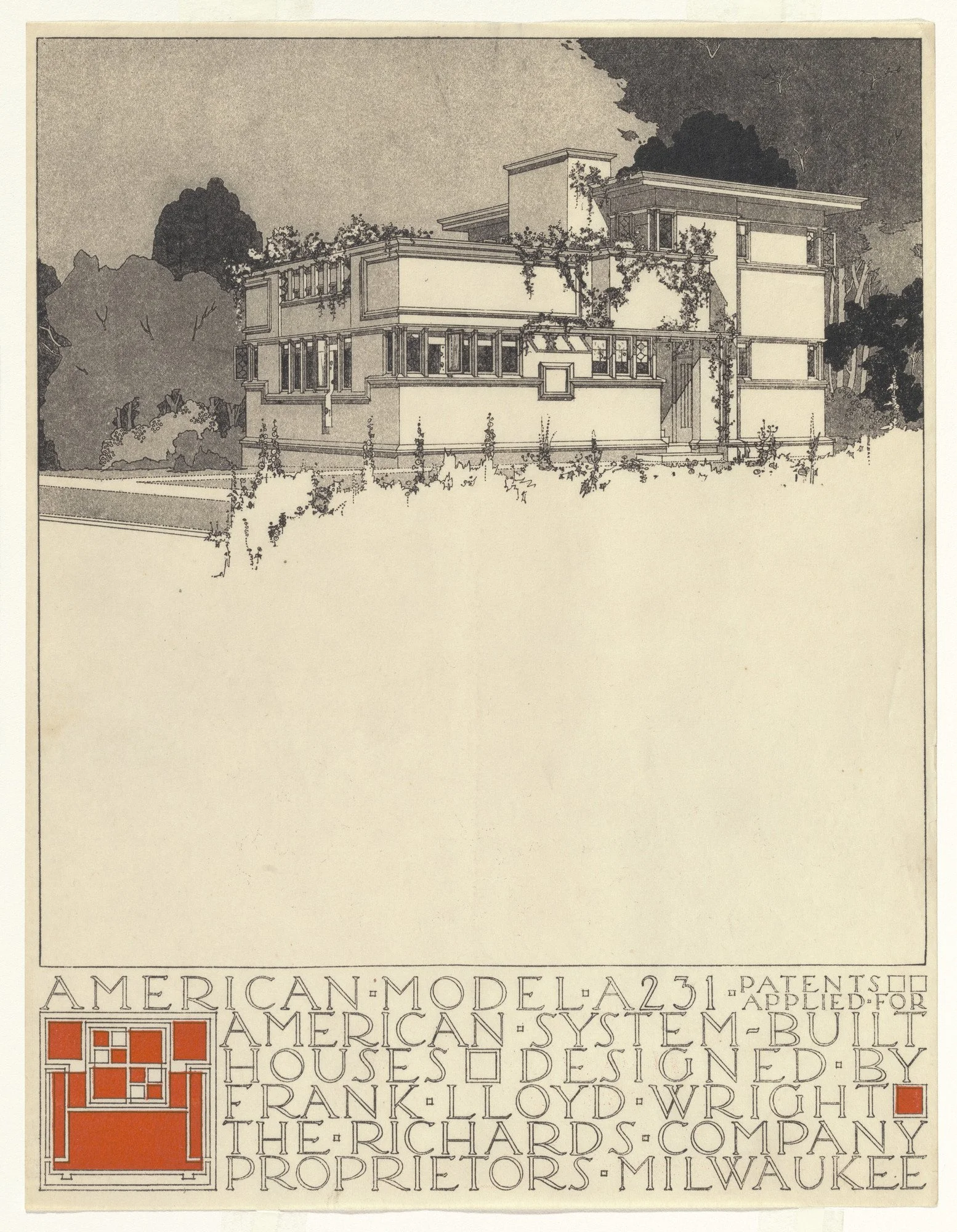
Architectural drawing in an ad for American System-Build Houses on Frank Lloyd Wright's Burnham Block

“An American Home” 

After snapping a few photos outside, Wally and I ducked into the gift shop at the back of one of the duplexes currently undergoing restoration. From there we made our way to the front room to join our tour group and meet our docent, Rhonda. Once everyone was settled in, she broke the ice by asking where we were all from, and to our surprise, one family had traveled all the way from Italy.

She asked the group to imagine what a real estate ad might highlight today, and we quickly called out the usual features: square footage, number of bedrooms, location and price — basically everything related to the building itself. 

Holding up a full-page advertisement that ran in the Chicago Tribune in July 1917, titled “You Can Own an American Home” and attributed to then-copywriter Sherwood Anderson, she read the following excerpt aloud:

“There’s a bright, cheerful home waiting for you and your family — better built, excellently planned, far more livable. More beautiful? Yeah, it’ll have that rare thing: genuine architectural beauty, designed by a leader among architects. You select your plan; it’s built to your order. Constructed by a system that guarantees a high-grade building at a known price. In short, an American home.”

Rhonda pointed out that it wasn’t really about any of the features we had mentioned; it was about selling a lifestyle. And one big thing the ad omitted? Wright’s name — and that was no accident. 


A man drapes his arm around a lifesize cutout of Frank Lloyd Wright

Wally’s last name is also Wright, but, sadly, he’s never found a familial link to Frank.

When “Wright” Was a Bad Word

By 1915, the architect’s personal life had become tabloid fodder. In 1909 he had famously abandoned his wife and six children to run off to Europe with Mamah Borthwick Cheney — the wife of a former client and the woman at the center of a scandalous, widely publicized affair. 

Both were still married to their respective spouses when they left. Mamah got a divorce from her husband when they returned, but Wright wouldn’t officially be divorced from his wife, Catherine, for another six years. 

The scandal deepened in 1914, when a servant at Taliesin — Wright’s home and studio in Wisconsin — set fire to the building and axed down Mamah, her two children, and four others as they fled the flames. The tragedy made front-page headlines and further tarnished Wright’s reputation.

Rhonda went on to explain that what most people don’t realize is just how deeply Wright believed in what he called “democratic architecture.” To him the idea was simple: If you had a good job, you should also be able to afford a thoughtfully designed home. But Wright, for all his vision, didn’t quite know how to make that dream scalable. 
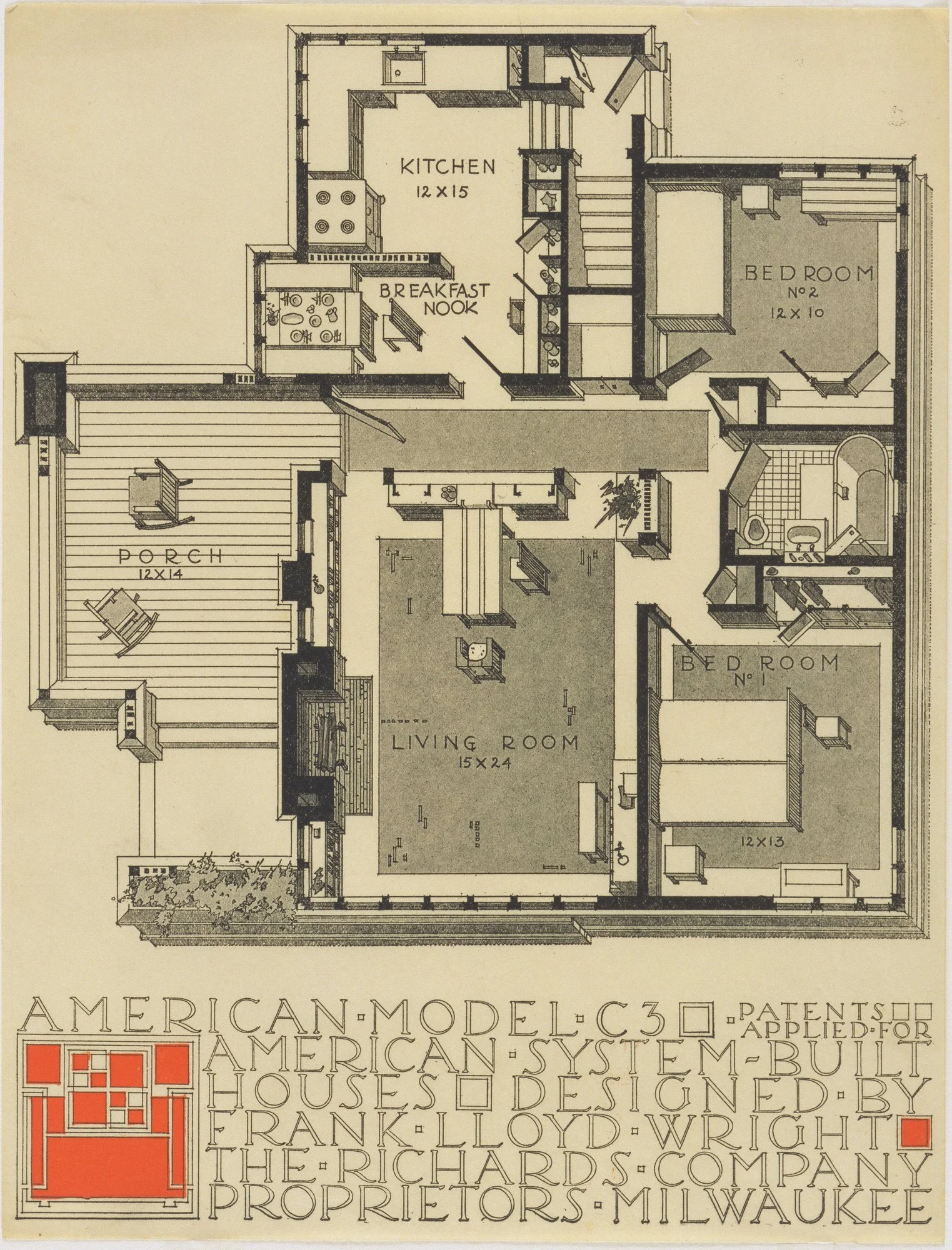
A floorplan for the homes along Frank Lloyd Wright's Burnham Block

A Partnership With Arthur Richards

That's where Milwaukee developer Arthur L. Richards came in. He had previously collaborated with Wright on the Hotel Geneva, a lakeside resort that once stood on the shores of Lake Geneva, Wisconsin. Richards had the resources and business network Wright lacked, and he was able to turn the architect's vision into a viable housing project. 

Assuming the advertisement piqued your curiosity, your next stop would be to visit a local distributor. At the time, many young families were buying homes from the pages of mail-order catalogs — think Craftsman-style kits sold by Sears, Roebuck and Co. 

But Wright’s American System-Built Homes were different. They were modern, meticulously detailed, and built to his exacting standards. Customers could choose from roughly 30 standardized models, each offering a range of customizable options, including the floor plan, roof style (flat, hip or gable), custom furniture and art glass windows. You added up your choices, saw the total at the bottom, and that’s what you paid. 

Prices started at $1,875 and rose to about $3,500 once completed — remarkably modest for any home, much less a Wright-designed one, especially given his reputation for commissions that routinely ran over budget. It may sound like a lot for 1915, but homes of comparable size and quality typically sold for 10% to 15% more. This relative affordability was largely due to Richards, whose oversight kept costs down and brought Wright’s designs to a broader market.

To achieve this, the Richards Company pre-cut lumber and other materials in a mill and shipped them to the build site by rail — a method that offered greater efficiency and quality control than traditional site-built construction.
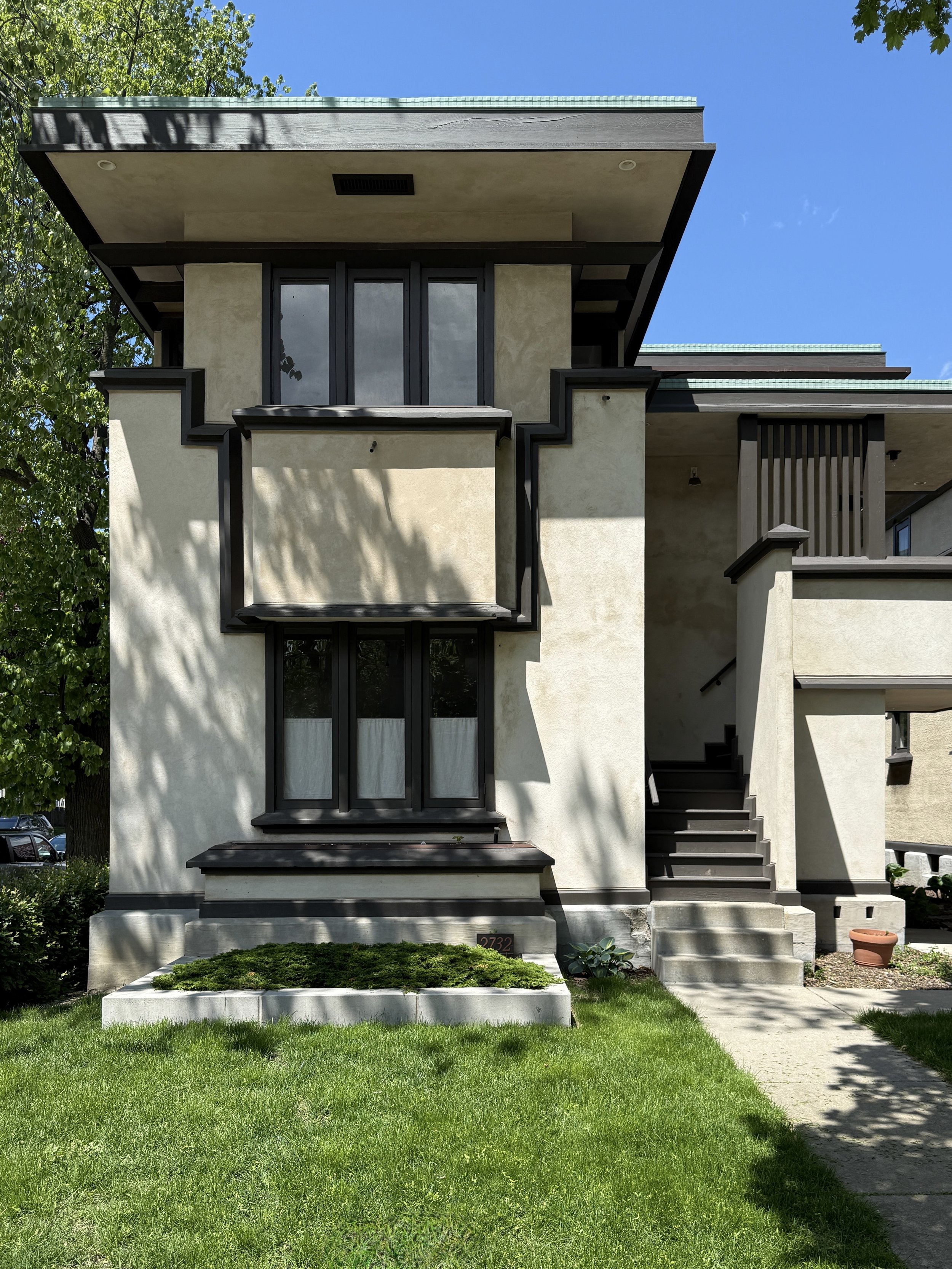
Exterior of the office and gift shop at Frank Lloyd Wright's Burnham Block in Milwaukee

Preserving a Legacy: Restoration Efforts at Burnham Block

Once we had a sense of the project's background, Rhonda led us outside and enthusiastically shared more about this row of homes’ history and significance. Built on speculation between October 1915 and July 1916 the block includes four two-family Flat C (Model 7A) duplexes and two single-family bungalows: one Model B1 with a flat roof and one Model C3 with a hipped roof. 

She highlighted the importance of ongoing preservation efforts, noting that five of the six houses are now owned by Frank Lloyd Wright’s Burnham Block, a nonprofit organization dedicated to the care and stewardship of these historic structures.

“There’s no paid staff,” she told us. “We’re all volunteers. Every single dollar you spend, whether it’s on admission, in the gift shop or as a donation goes directly toward the care of these buildings.”

She went on to explain that the exterior of Duplex 4, the building we had just exited, was restored in 2013 and 2014 with the help of a Save America’s Treasures matching grant. The grant was awarded by the Department of the Interior and is managed by the National Park Service to support the preservation of nationally significant historic sites. Work on the interior, she noted, is still underway. 

“We did get a grant from the government,” she added. “But we’re unsure if we’ll actually receive that money. So for now, we’re kind of on hold, waiting to see what happens.” The hope is that they’ll be able to start restoration efforts on Bungalow Model C3 this year. 

When Richards selected the site for the housing project, it was considered the edge of town — still largely rural and known for its celery fields. An electric streetcar line ran along Burnham Street, connecting the area to the rest of the city. The City Service line provided access to downtown Milwaukee, while the Interurban line extended as far as East Troy. At the time, most people didn’t own cars, but they had access to mass transit, one of the key reasons these homes were built here.  
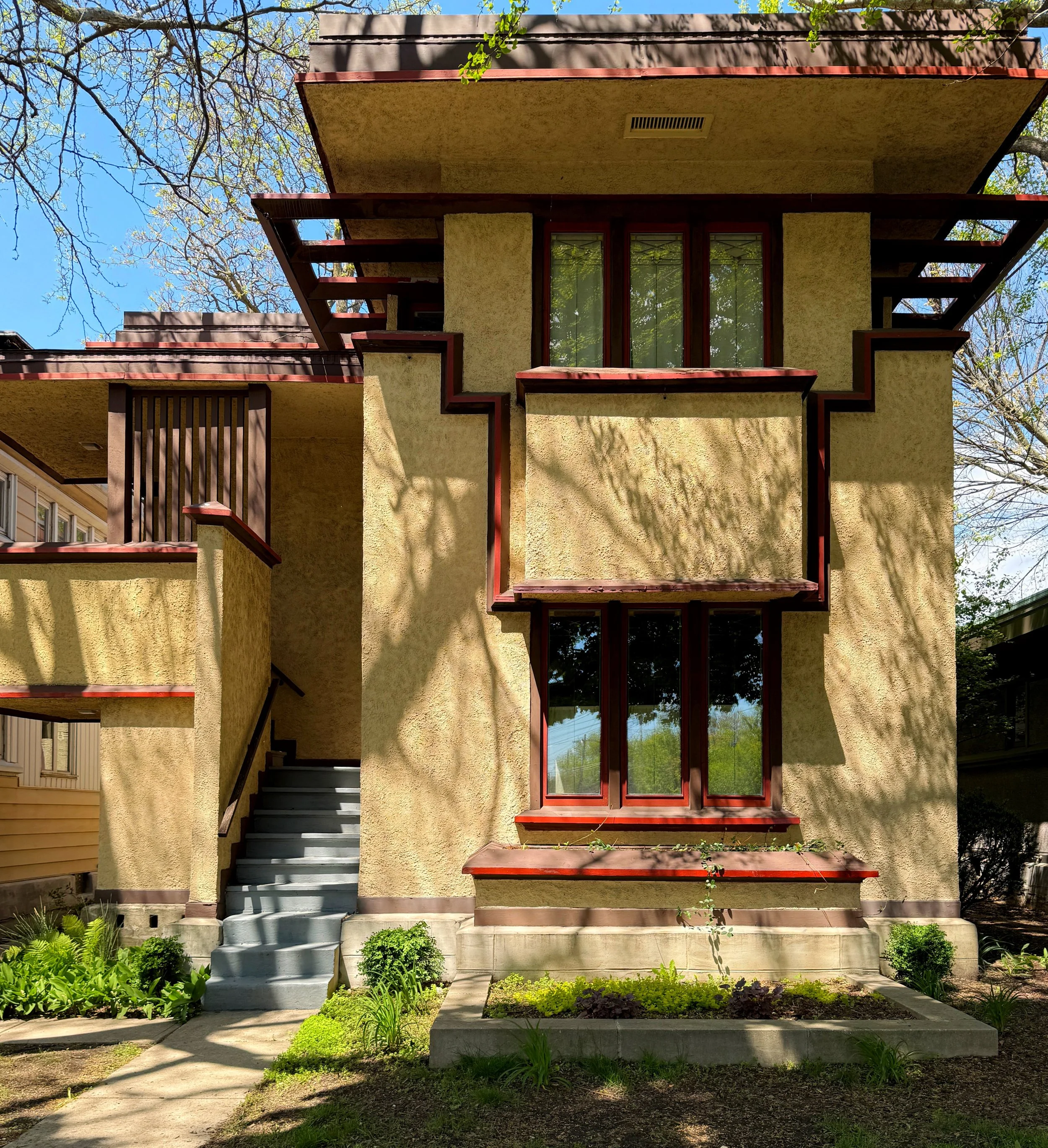
2720 West Burnham Street, part of Frank Lloyd Wright's Burnham Block in Milwaukee

We paused for a moment in front of 2720 West Burnham Street — the only duplex on the block that isn't owned by the nonprofit.

Rhonda gave us a quick rundown of its history, explaining that a young couple who knew the legacy of the two-flat purchased the property in the early 1980s and converted it into a single-family home with three bedrooms, two bathrooms and a modern kitchen. She added that they installed the art glass windows and red square, a visual element found in many of Wright's designs. Nearly 30 years later, it was sold to its current owner, who now rents it out on Vrbo.

“I’ve been told it sleeps about nine — so if you decide to rent it, don’t forget to invite me!” Rhonda added with a chuckle. 
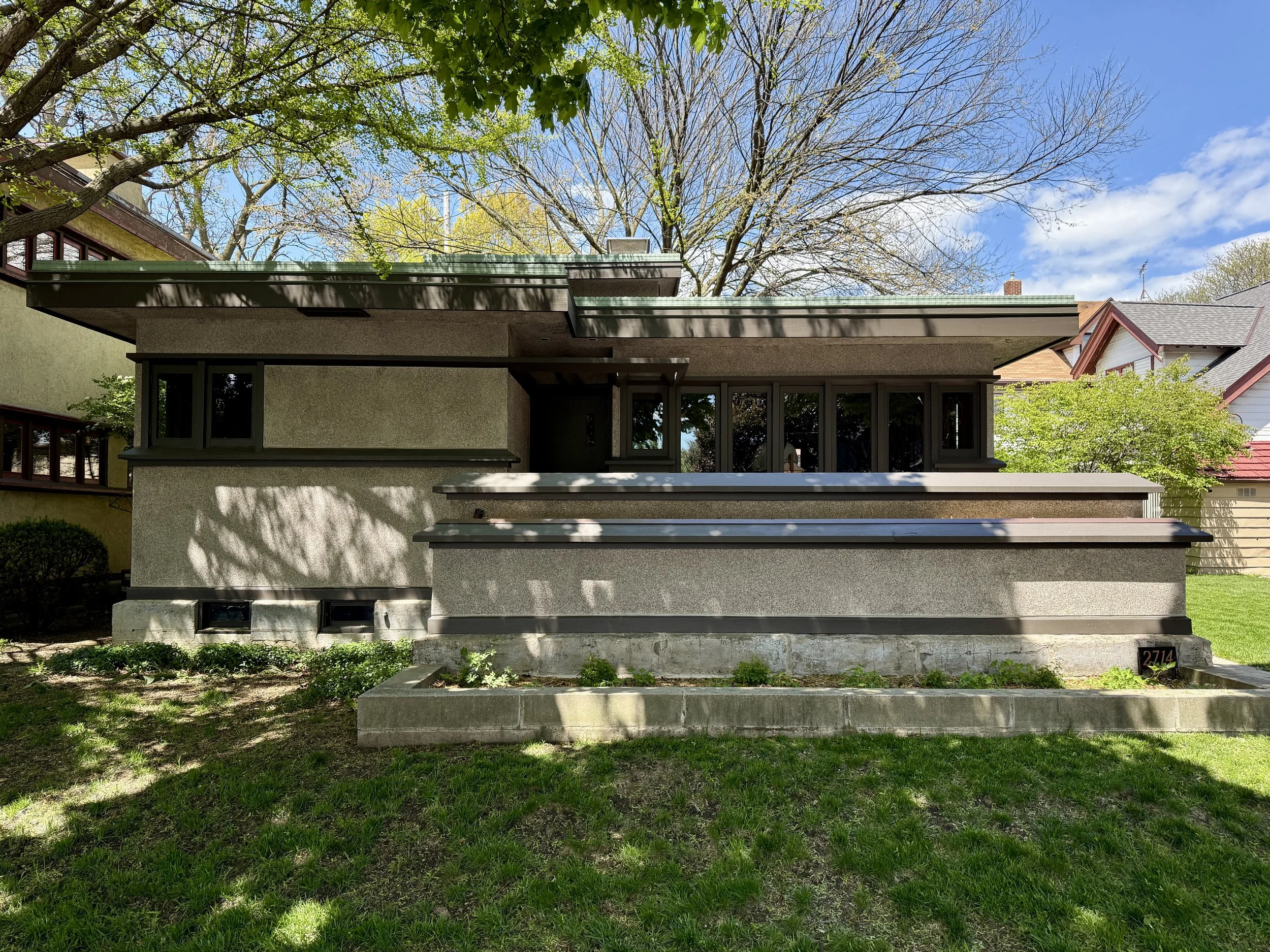
The exterior of the Model B1 home on Frank Lloyd Wright's Burnham Block in Milwaukee

A Tour of Model B1

A short walk later, we found ourselves standing outside Model B1 at 2714 West Burnham Street. Rhonda affectionately referred to it as the “baby bungalow,” and at just 805 square feet, it’s the smallest of any house Wright designed. It was purchased in 2004 and fully restored to its 1916 appearance in 2008 and 2009. Today, it’s open to the public as a house museum. 

Rhonda shared that the home’s original exterior, like the others, was finished with a material called Elastica stucco. It was manufactured in Chicago and promoted at the time as an affordable and durable option. Initially praised for its smooth appearance, it later proved unreliable and was found to contain asbestos, requiring careful remediation during restoration.

Today, the exterior has been refinished with Pebble Dash — a type of stucco embedded with small stones that are sprayed onto the surface while it’s still wet. The result is a tactile, durable façade that honors the original intent while complying with modern safety standards.
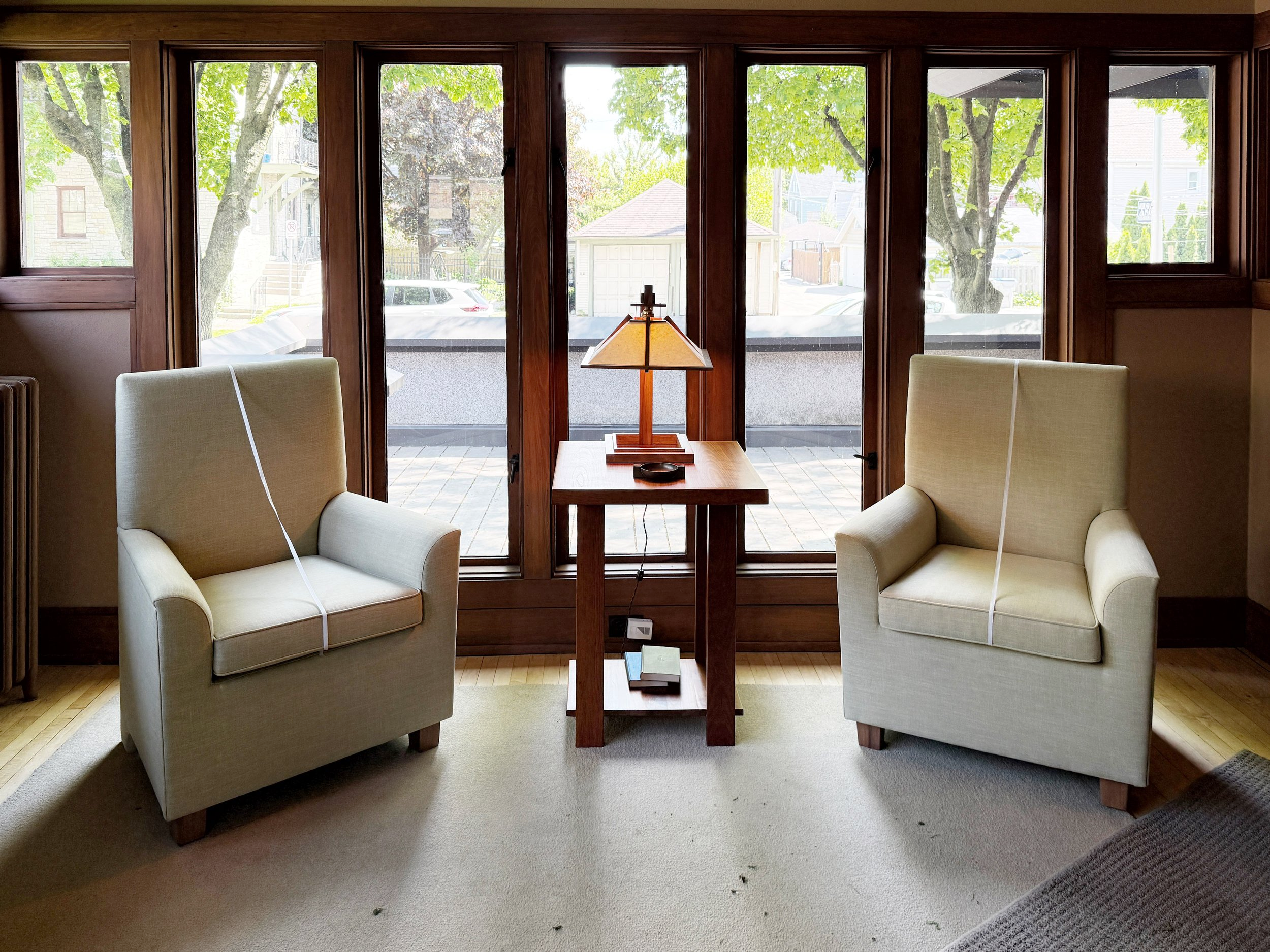
The front room with a small table, lamp and two chairs in Model B1 on Frank Lloyd Wright's Burnham Block

Wright’s Bag of Tricks

Before we even stepped through the front door, we passed beneath a low overhang that extended above the entrance, an unmistakable hallmark of Wright’s design philosophy. It was a classic example of his compress-and-release technique: a moment of spatial compression at the threshold that heightened the sense of openness and volume once inside. 

Crossing that threshold, we entered the living room, the heart of the home, where a central hearth commanded attention. More than just a source of warmth, it was another signature of Wright’s architecture: a symbolic and literal centerpiece meant to anchor family life.

The brick and wood hearth in Model B1 at Frank Lloyd Wright's Burnham Block in Milwaukee

At the front of the room, floor-to-ceiling windows brought in natural light and made the space feel larger. Thanks to the height and placement of the front porch, anyone seated inside could enjoy a sense of openness and connection with the outdoors while still maintaining a sense of privacy, as the porch blocks direct views from passersby. 

This sense of openness was made possible, in part, by Wright’s innovative use of balloon-frame construction, a technique where long vertical studs run continuously from the foundation to the roof. In the American System-Built Homes, these studs are spaced 24 inches apart — wider than the typical 16 inches — based on a 2-foot modular grid. This grid made it easier for Richards’ team of builders to position them with greater flexibility, without needing to rework the structure of the walls.

Built-in shelving and dining table in Model B1 of Frank Lloyd Wright's Burnham Block

Rhonda pointed out that Wright’s design pulled out all the stops to make this tiny house feel larger than it is. By cleverly “stealing space,” the walls flanking the wraparound hearth draw the eye back toward the foyer and the hallway beyond, creating a sense of depth and openness.

She also noted that most of the woodwork inside the house is original. While telling us about the built-in cabinetry in the living room, she explained that it not only acts as a partition but also cleverly accommodates a dining table that can be tucked away or pulled out — transforming the living room into a dining area as needed. 

To the right of the built-in, a doorway leads to the breakfast nook and kitchen. Vertical wooden slats separate the nook, offering a sense of division without fully enclosing the space, another subtle feature that reinforces an overall feeling of openness. 

The kitchen was fitted with wood cabinetry and the most adorable tiny oven I’d ever seen.

A small oven and stovetop in the kitchen of Model B1 on Frank Lloyd Wright's Burnham Block

Rhonda added that the glass fronts on the upper cabinets were intentional: designed to catch and reflect light, they help create the illusion of a larger, airier room.

The private space of the home includes the primary bedroom, a children’s bedroom, a bathroom, and both coat and linen closets (a rare feature in a Wright home). A central light well draws natural light into the core of the house, brightening the interior. 
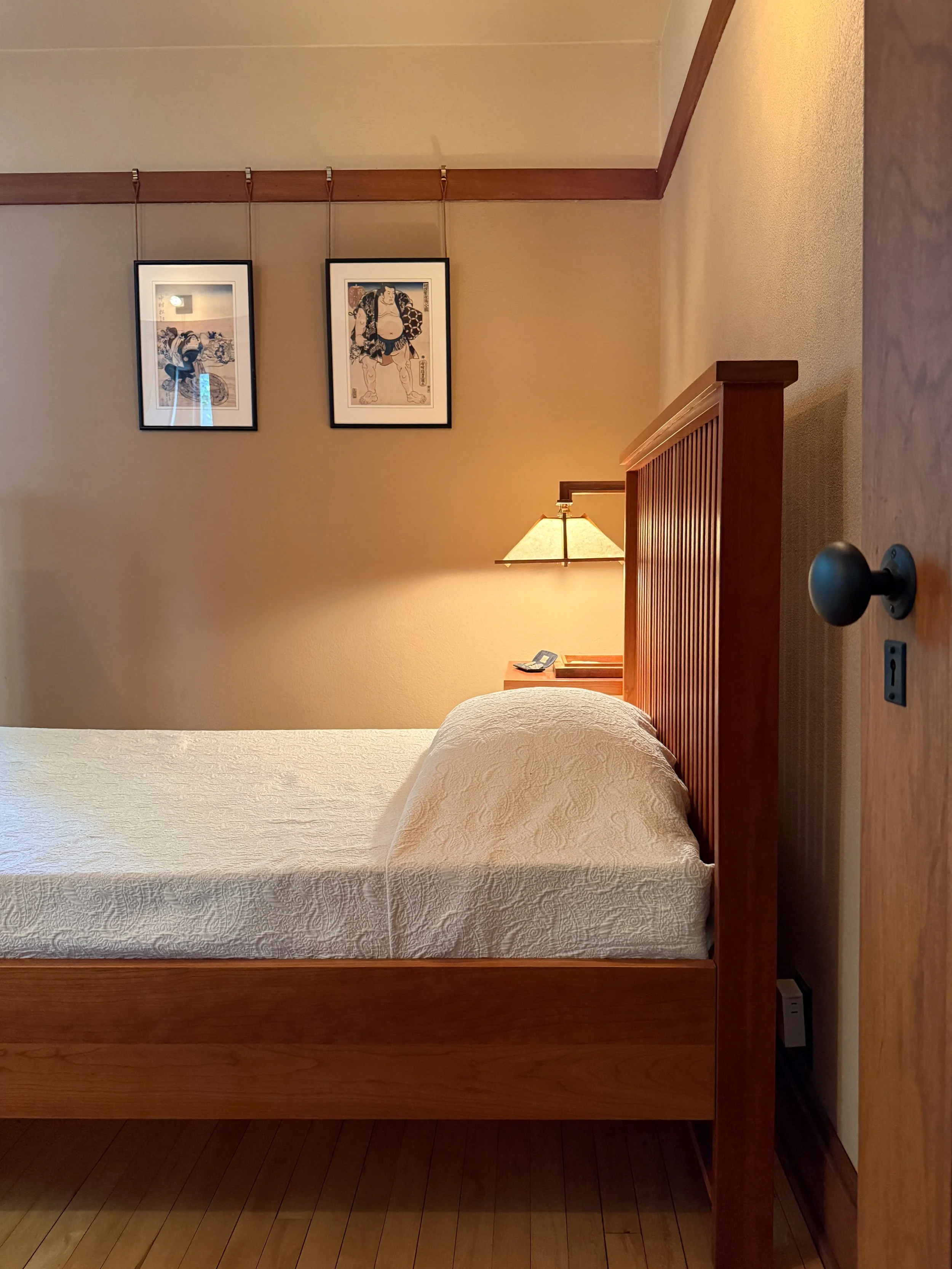
The main bedroom at Model B1 of Frank Lloyd Wright's Burnham Block
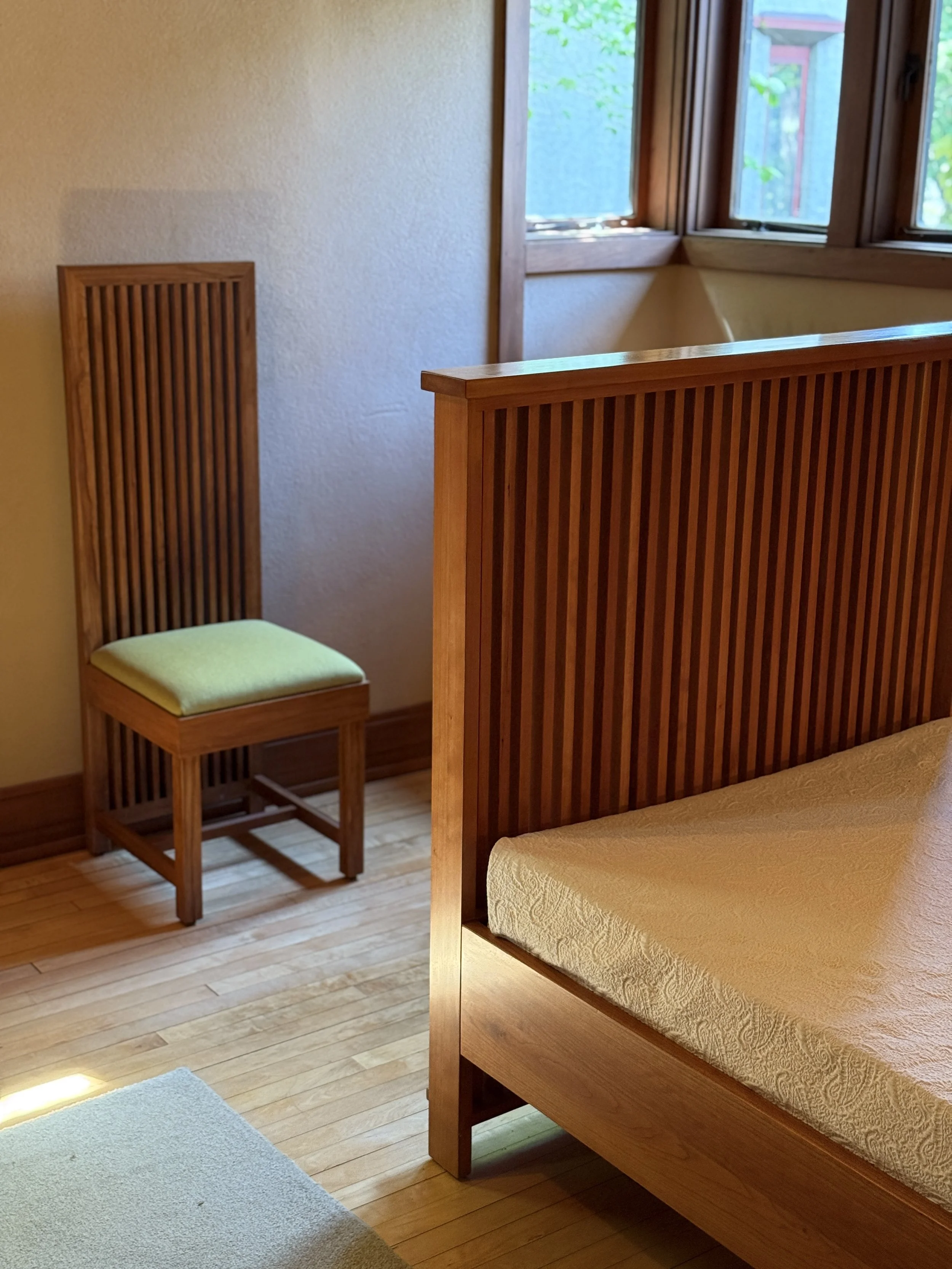
The foot of the bed and a chair in a bedroom of Model B1 at Frank Lloyd Wright's Burnham Block

In the primary bedroom, ukiyo-e Japanese woodblock prints reflect Wright’s long-standing admiration for Japanese art and design, while the children’s room features charming illustrations created by his younger sister, Maginel Wright Enright. 
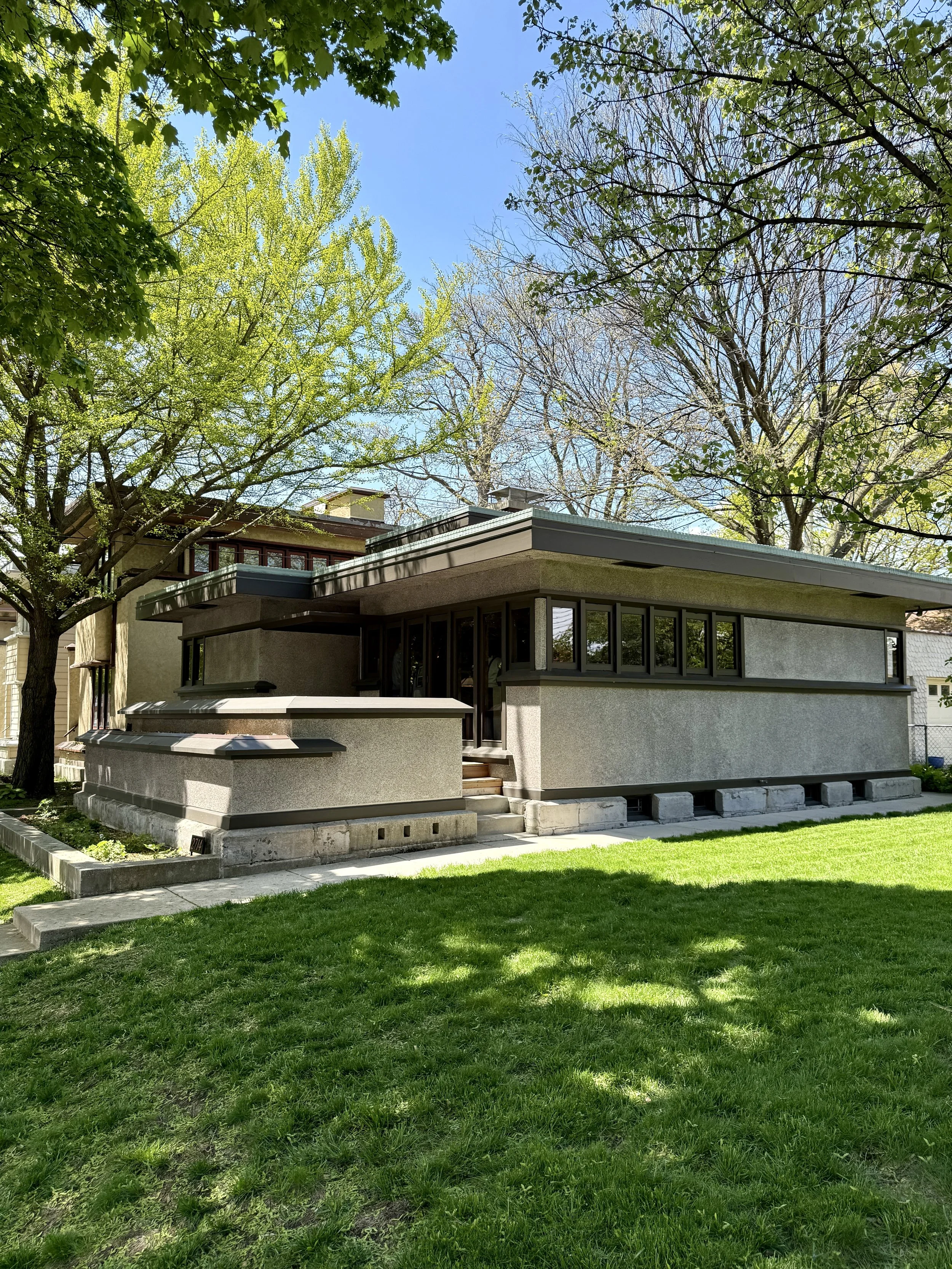
The exterior side view of Model B1 of Frank Lloyd Wright's Burnham Block in Milwaukee

An American Dream That Never Caught On

This development embodied a bold vision of the American Dream. These homes weren’t just places to live; they were a blueprint for how entire neighborhoods of affordable, well-designed housing might take shape across the country. 

That vision extended far beyond this single block. Wright was never one to think small, and he and Richards imagined these homes not as a one-off experiment but as the beginning of something far-reaching. They envisioned entire subdivisions filled with variations on these models, stretching across the U.S. and into Canada. If everything went according to plan, the project could generate more than a million dollars in revenue. 

The six homes on Burnham Street were completed on July 5, 1916 — just 10 days before Milwaukee hosted a massive Preparedness Parade in support of U.S. involvement in World War I. But the war would soon derail Wright and Richards’ ambitious plans. As building materials were diverted to the war effort and the housing market grew uncertain, their grand project ground to a halt. 

In the end, only about a dozen American System-Built Homes were ever constructed — six on Burnham Street and a handful of others scattered throughout the Midwest. Eventually, Wright and Richards had a falling out, culminating in Wright successfully suing Richards for non-payment. Under their agreement, Wright was to receive royalties for each house sold. But a major flaw in the arrangement was that Richards wasn’t required to report each sale to Wright, making it impossible for Wright to know how many homes were actually built. That lack of transparency, combined with missed payments, led to growing mistrust and ultimately ended their partnership. 

Although the Burnham Block is listed on the National Register of Historic Places, discovering the homes felt like stumbling upon a hidden gem. These aren’t the Wright homes that capture a lot of attention.

Tours are available by reservation only and are led by trained docents who offer insight into the history and design of the homes. –Duke


Before You Go

Phone: 414-368-0060

Admission: $20; children under 16 free

Times: Tours at 11 a.m., 12 p.m., 1 p.m. and 2 p.m.

Tours last about one hour.

Homes along Frank Lloyd Wright's Burnham Block in Milwaukee, Wisconsin

Frank Lloyd Wright’s Burnham Block

2732 West Burnham Street
Milwaukee, Wisconsin
USA
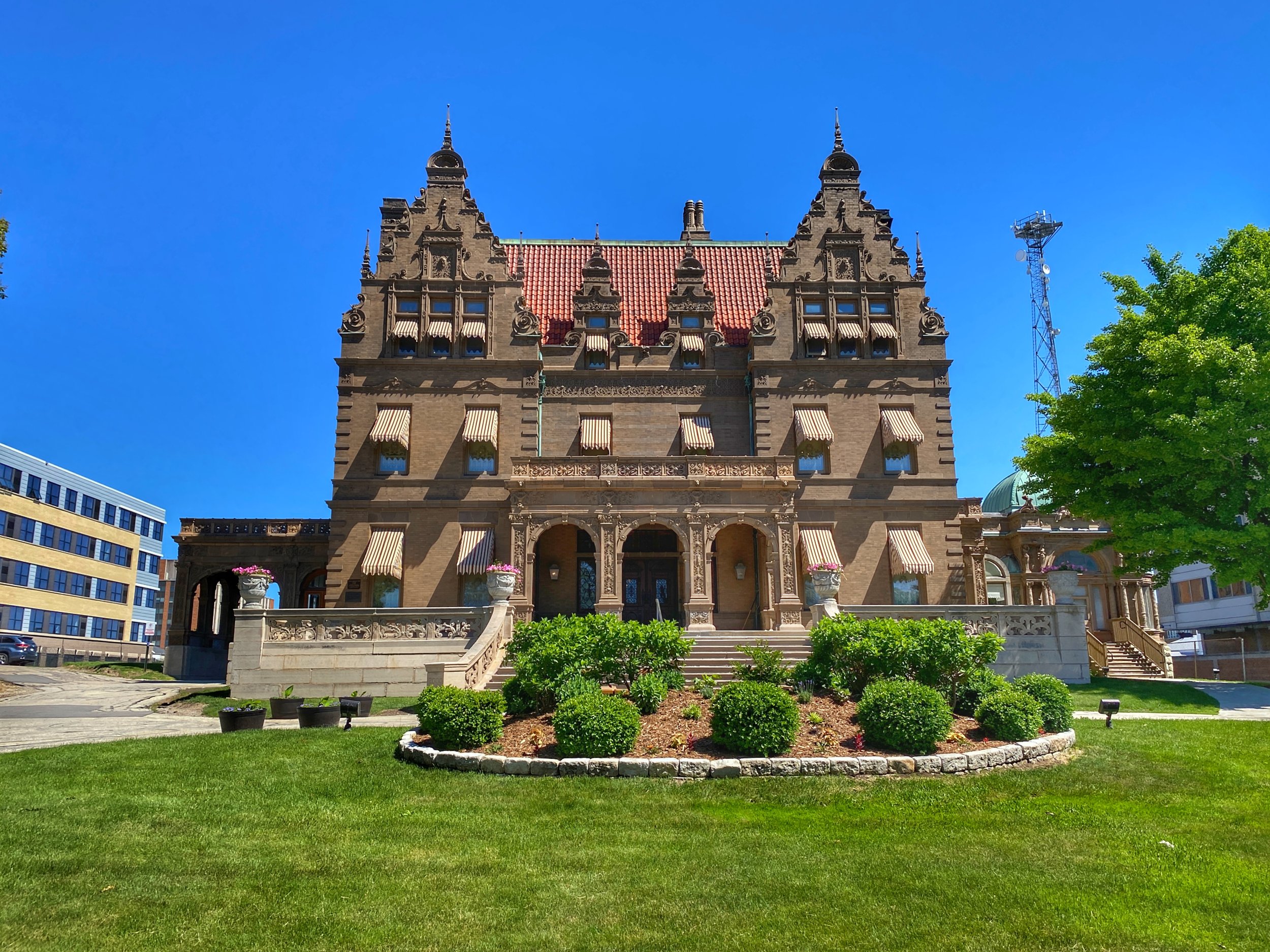
 

The Pabst Mansion in Milwaukee: Hopped Up on History

Take a tour of the historic home of the preeminent beer baron, Captain Frederick Pabst — an architectural gem from the Gilded Age that’s sure to quench your thirst for fun things to do in Milwaukee. 

Exterior of the Pabst Mansion in Milwaukee

“Could you tell whoever put up that cell tower to move it, please?” Wally asked our tour guide, Roxie. “It’s ruining my shot.”

My parents are always up for an adventure. Whenever they come to visit us, we find a fun day trip to take. Since they typically drive to see us and only spend a few days, the maximum distance for these excursions is about two hours away. When we visited my family in the fall, we toured Graycliff, the summer residence built for Darwin Martin’s wife Isabelle and designed by Frank Lloyd Wright. 

Next up: the Pabst Mansion in Milwaukee. Like Graycliff, it’s a historic property that had been acquired, adaptively reused and inadvertently saved by the occupation of a religious organization. Milwaukee is 92 miles, or about an hour and a half away, from Chicago, where we live, so the opportunity to tour the former home of a beer baron and his family made for an intoxicating destination. 

The Pabst Mansion cost $254,000 in the early 1890s — a figure equivalent to about $8.4 million today.
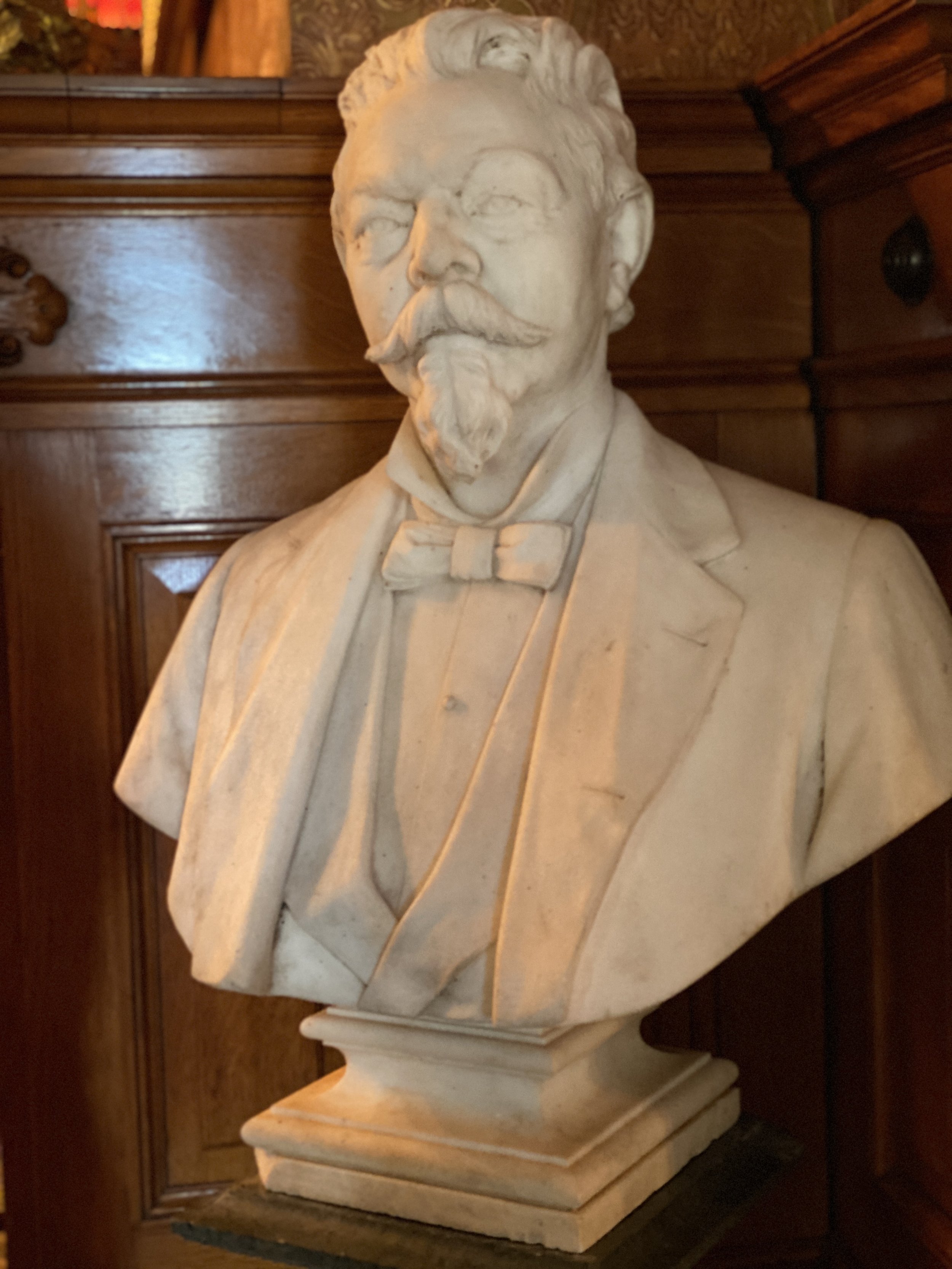
Bust of Captain Pabst, beer baron, in his mansion in Milwaukee

A bust of the beer baron
A Brief History of the Pabst Mansion 

In 1890 Captain Johann Gottlieb Friedrich “Frederick” Pabst commissioned architects George Bowman Ferry and Alfred Charles Clas to create a 20,000-square-foot residence on what was then Grand Avenue (now Wisconsin Avenue). The home was one of the finest of the 19th century mansions built on Milwaukee’s premier residential street. 

The project was completed two years later at a cost of $254,000, which included the home, furnishings and artwork — a figure equivalent to about $8.4 million today. Pabst had 8,000 square feet of the house for himself, his wife, Maria, and the four children who survived to adulthood. The remainder was used as living quarters and service areas for the staff. The Pabsts employed up to 15 servants, who ran the day-to-day operations of the house.

The residence was modern for the time and one of the first to be wired for electricity, 10 years after this new-fangled energy source had arrived in Milwaukee. Additionally, the home boasted 10 full baths and a state-of-the-art central forced-air heating system. 

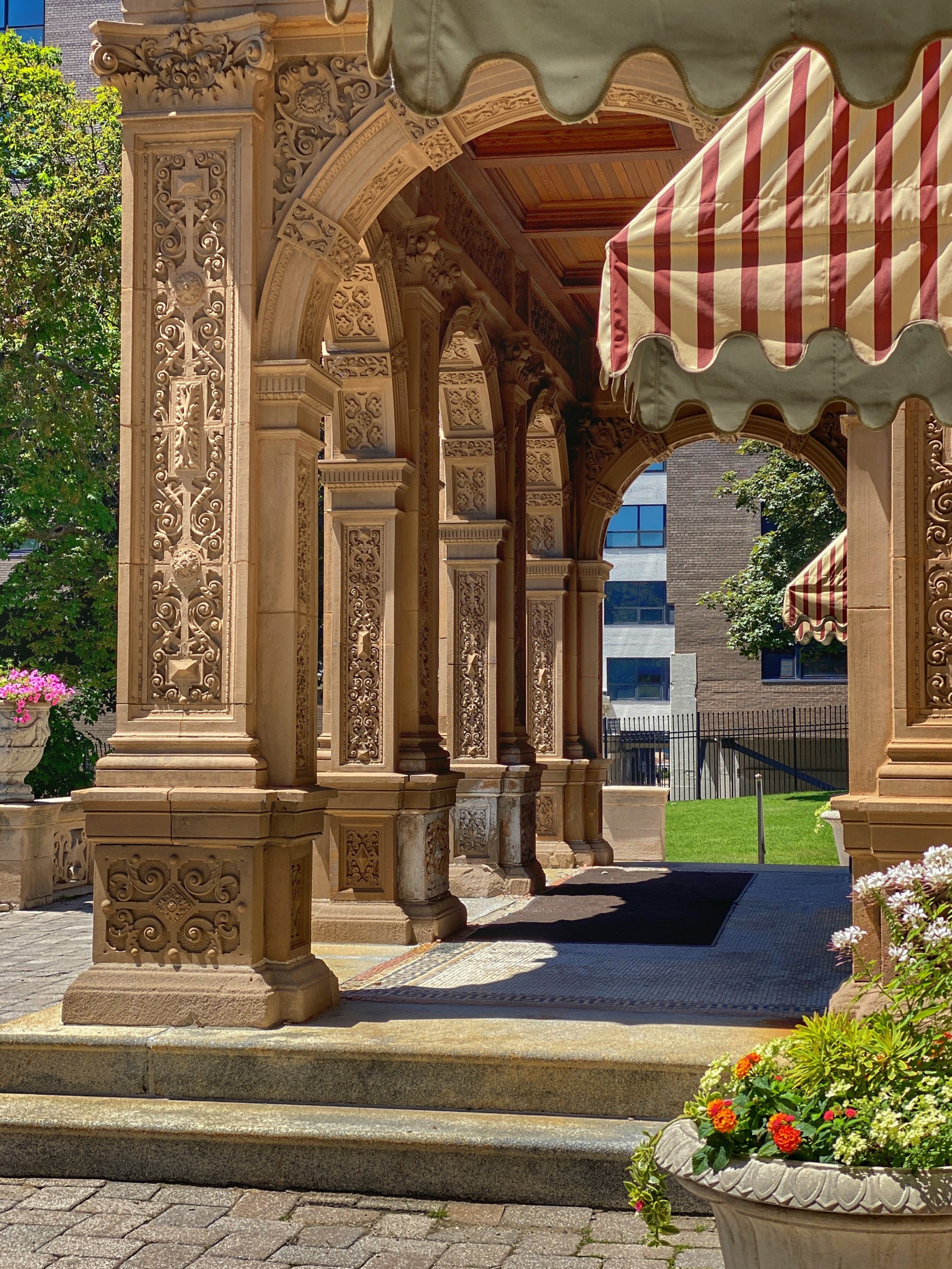
Elaborately decorated pillars in front of Pabst Mansion entrance in Milwaukee

You’ll notice a theme that runs throughout the tour: elaborate decoration.

Face Value: The Exterior of the Pabst Mansion

Built in the Flemish Revival style, the mansion’s striking cream-colored brick façade features terracotta ornamentation and corbie gables, stepped triangular peaks, which reflect 17th century Northern European architectural forms. The gables have spires that were replicated and replaced as the originals had been destroyed by lightning sometime in the 20th century. 

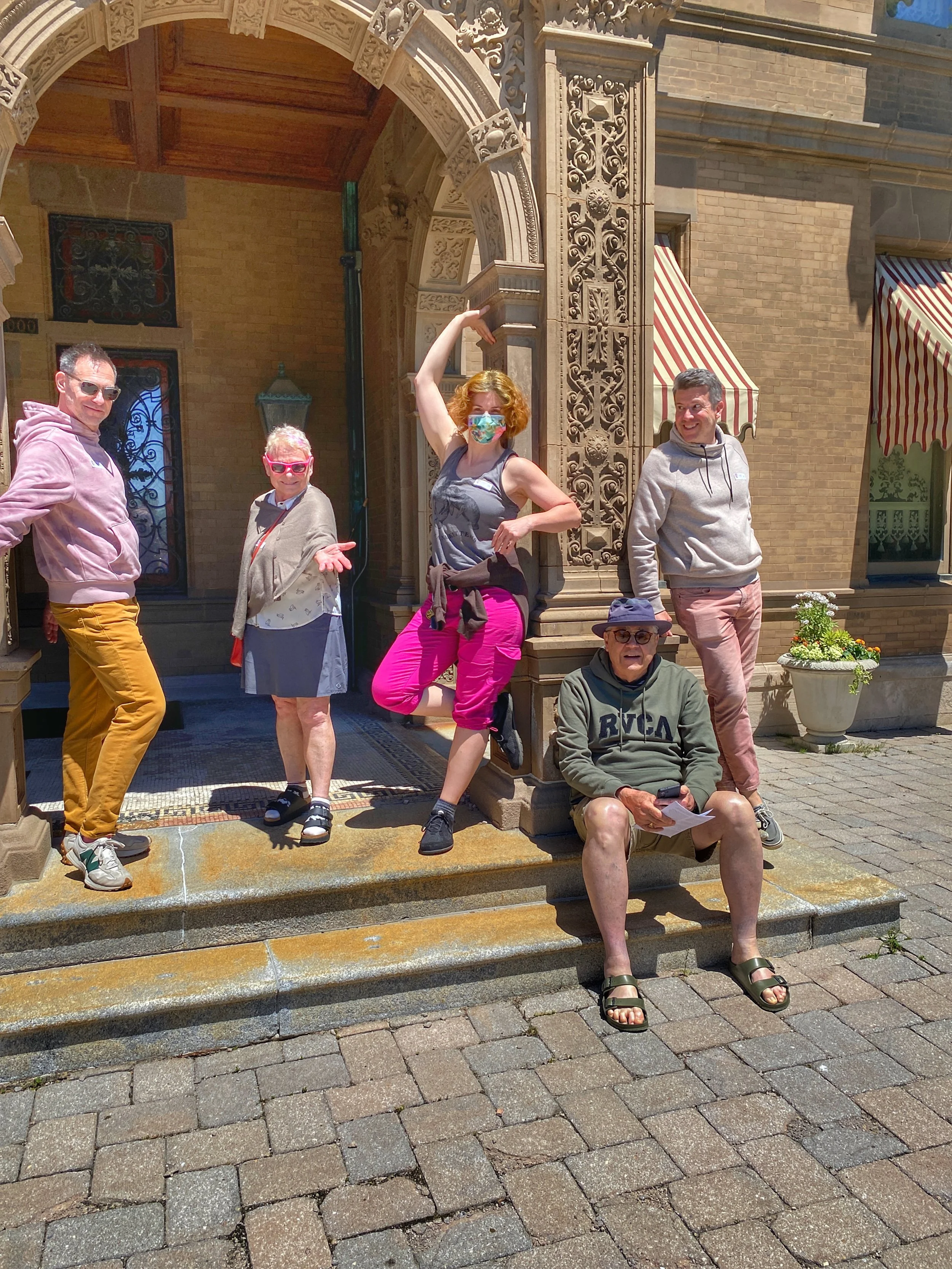
Group of people standing in front of the Pabst Mansion in Milwaukee

Our gang taking a group shot in front of the landmark

Beneath the loggia and flanking the mansion’s double doors are a pair of ornate hand-forged ironwork window grilles emblazoned with the initials FP, for Frederick Pabst, of course. They feature delicate scrollwork and rosettes and were made by Austrian-born blacksmith Cyril Colnik. Captain Papst met Colnik at the 1893 Columbian Exposition in Chicago and encouraged him to come to Milwaukee. Colnik agreed, and set up a successful studio, where he worked until his retirement in 1955. Considered the “Mozart of Metal” for his skill at sculpting with iron, he achieved national fame as one of the foremost metal craftsmen of his time. 

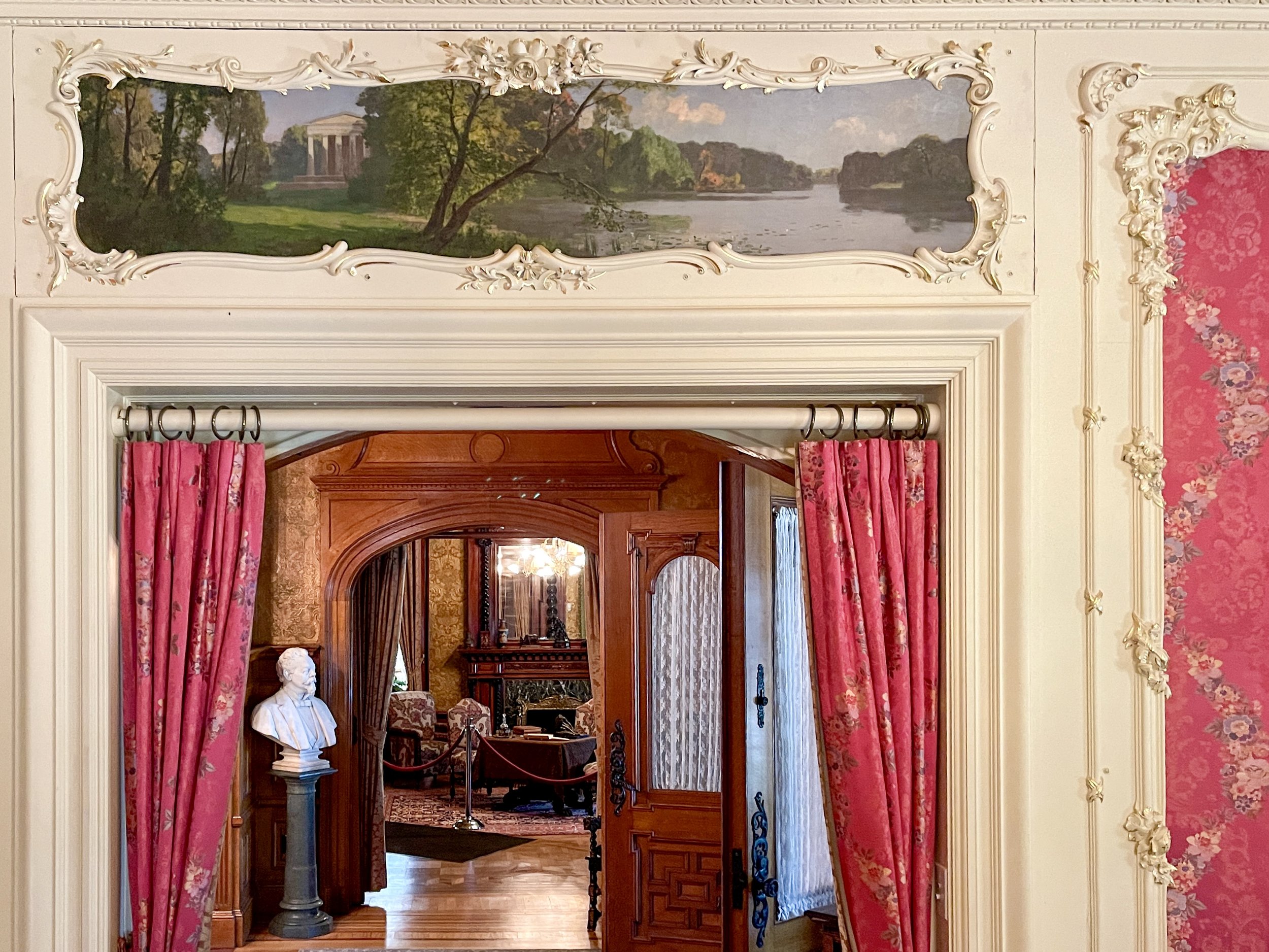
Pastoral Greek mural above pink-curtained doorway looking into the foyer of the Pabst Mansion

The beautiful murals throughout the Pabst Mansion were painted over when the Catholic church took possession of the house. Thankfully, the restoration team was able to remove the offending coat of white and preserve the scenes beneath like this one.

Altar(ed) States: The Church’s Ownership — and the Battle to Save the Pabst Mansion

Following the death of their mother, Maria, in 1906, Gustave and Frederick Pabst Jr. put the palatial family home up for sale. After a couple of years had passed without any prospects, the boys sold the property to the Roman Catholic Archdiocese of Milwaukee for $97,000 as a residence for the archbishop and offices. The sale included the furniture of the ladies parlor, music room and formal dining room. 

By 1974 the archdiocese had outgrown the mansion, and the last archbishop to live there, William Edward Cousins, moved out. It’s difficult to comprehend, but the mansion’s future was at risk. The property was sold to a real estate developer whose sole interest was to demolish the historic home in favor of a parking lot for his neighboring business, the Coach House Motor Inn. 

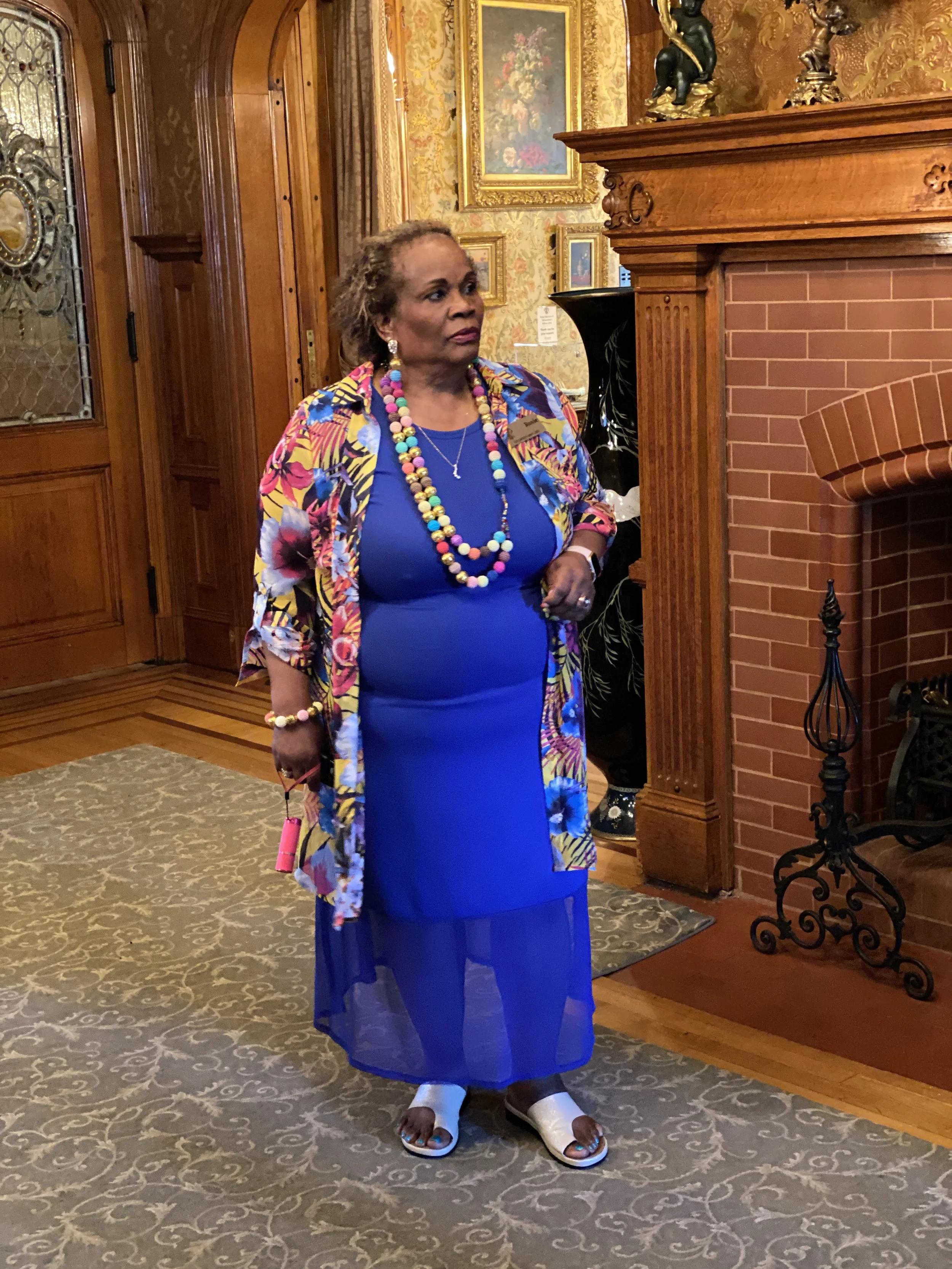
Black woman in blue dress with colorful coat and necklace acting as tour guide at the Pabst Manion

Our tour of the home was led by the fabulous Roxie.

Thanks to the advocacy of a citizens’ preservation group, Wisconsin Heritages Inc. (WHI), now known as Pabst Mansion Inc., the historic home was saved. They secured a mortgage, and in 1979 the Pabst Mansion was recognized on the National Register of Historic Places and opened for public tours shortly thereafter. As for the Coach House Motor Inn, it has since been absorbed into Marquette University and serves as Mashuda Hall, a coed residence for freshmen and sophomores. 

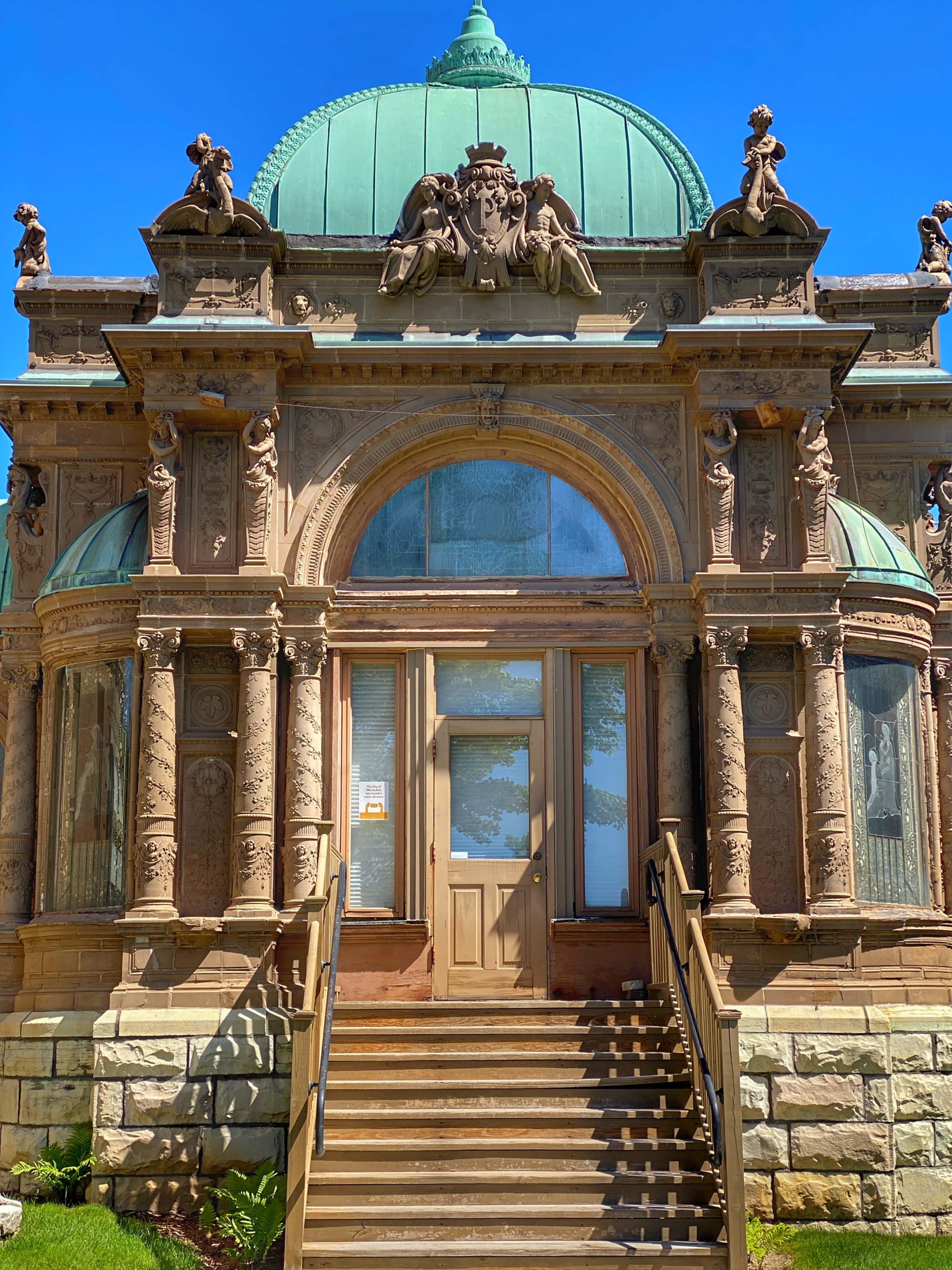
Copper domed Pavilion at Pabst Mansion with elaborate statuary on the facade

We were bummed we couldn’t tour the Beaux Arts Pavilion off to the side of the mansion. It’s undergoing restoration.

From Pabst to Present: The Pavilion

To start our tour, we followed our colorful and delightful guide, Roxie, from the Welcome Center next door to the front of a small structure known as the Pavilion. The elaborate Beaux Arts confection designed by Otto Strack extends to the east of the mansion and connects to the home via a covered walkway. The pavilion was originally the Pabst’s display at the 1893 Chicago Columbian Exposition. 

After the fair ended, it was dismantled and transported to Milwaukee, where it was incorporated into the beer baron’s home. Made almost entirely of terracotta, its exterior is ornamented with motifs, including steins, cherubs riding swans and figures representing the god and goddess of wheat and barley. 

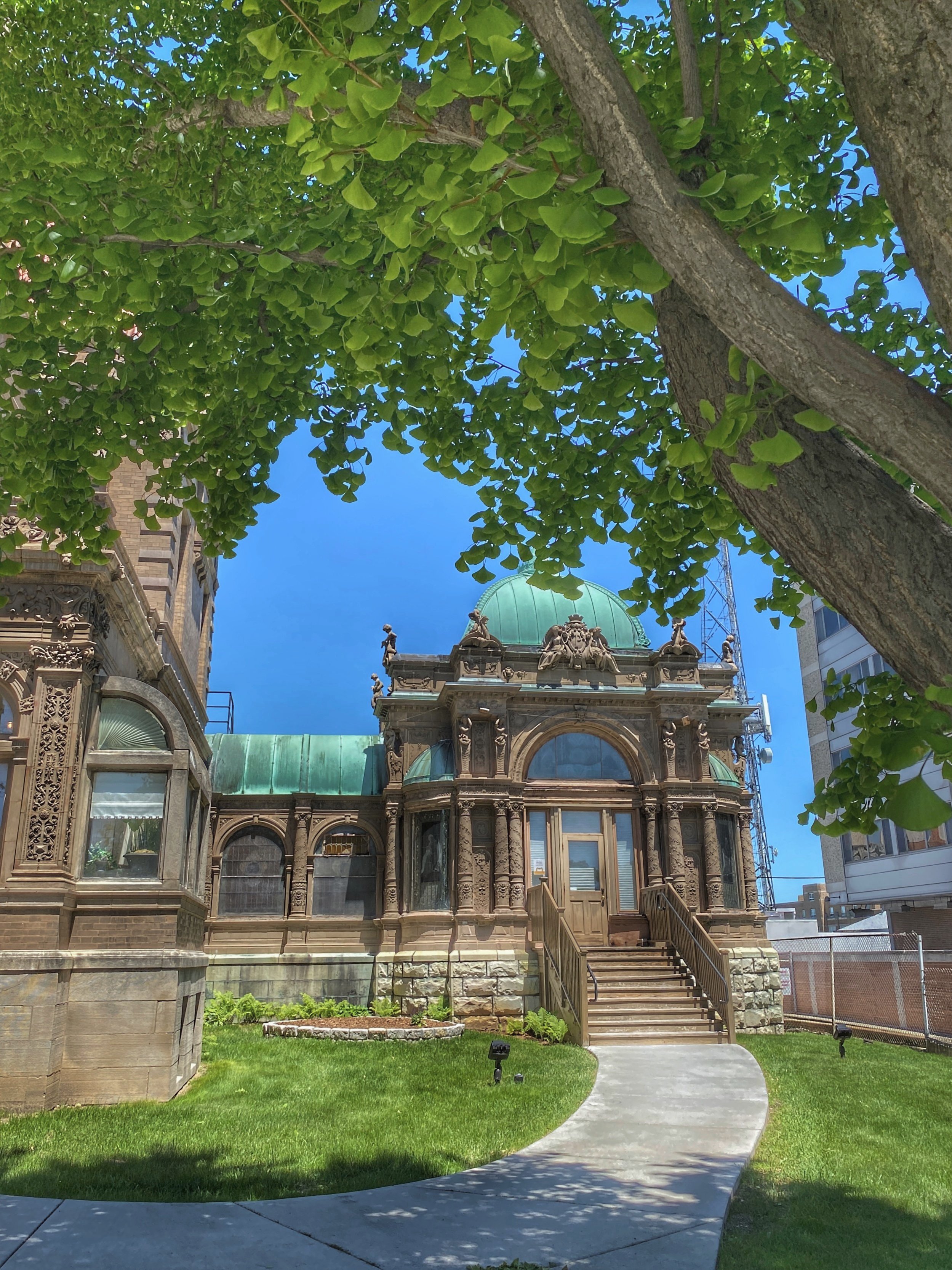
The Pavilion at the Pabst Mansion, with it's arched window, statue-covered facade and copper roof, seen from under tree

The Pavilion began as the Pabst’s display at the Columbian Expo in Chicago, then became a conservatory, chapel and visitors center.

Originally, it was used by the Pabst family as a conservatory for rare and tropical plants. Every summer during the family’s occupancy, their gardener would bring one of their palm trees outside in spring and plant it in the yard, providing a bit of exotic flair. 

Shortly after the occupancy of the archdiocese, the Pavilion was converted into a private chapel for the archbishop. Stained glass windows were added as well as the cross crowning the copper-domed pavilion. 

Unfortunately, at the time of our visit, we were unable to go inside as the structure was undergoing restoration. Buildings constructed for expositions aren’t meant to weather the elements year after year (read the fascinating The Devil in the White City), so the plan is to completely dismantle and reconstruct the Pavilion.  

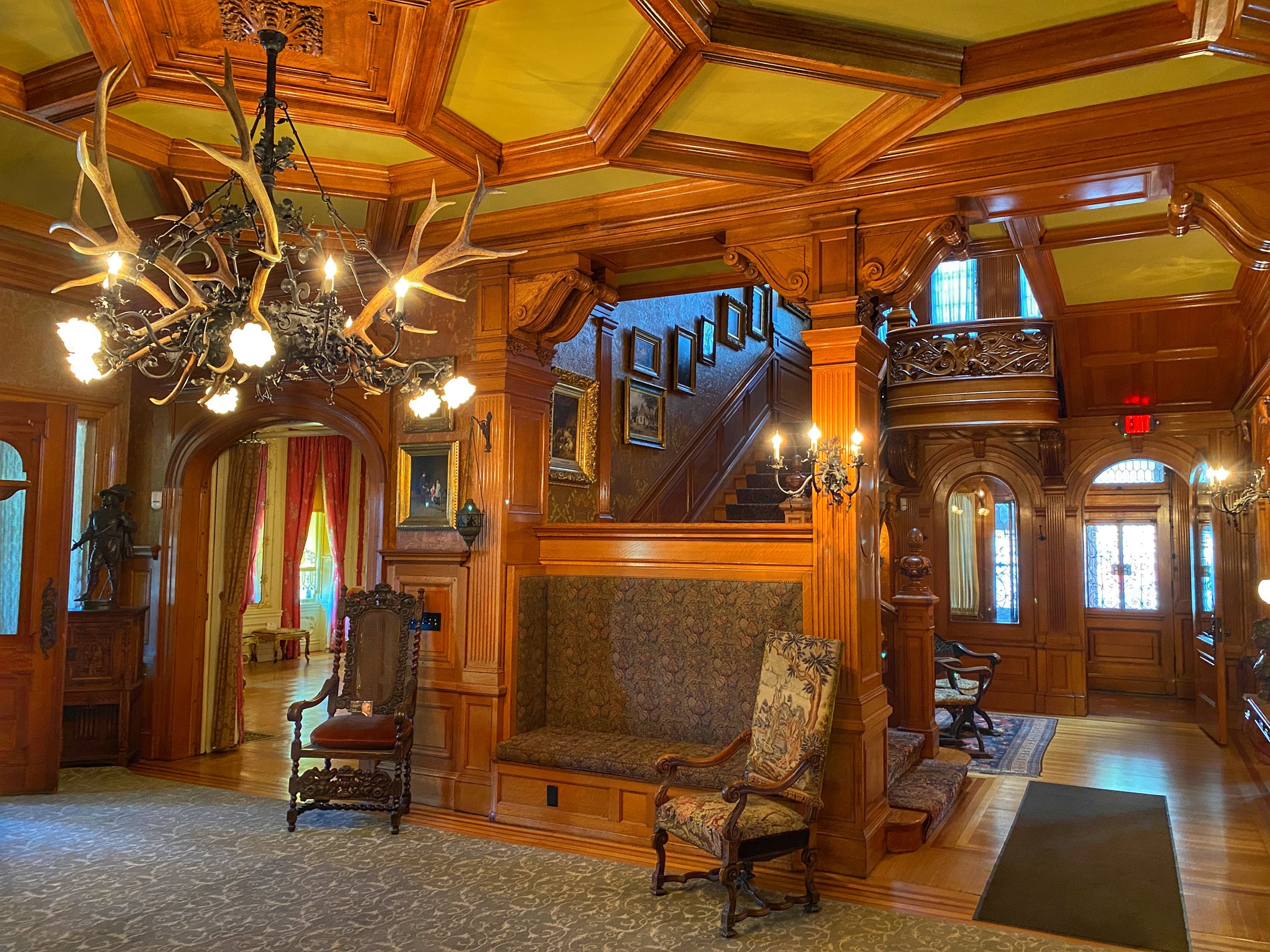
The reception hall at Pabst Mansion, with warm wood tones, chairs and antler and iron chandelier

Off to a good start! The reception hall at the Pabst Mansion has seating, warm-toned wood and a cool antler and iron chandelier.

Making an Entrance: The Reception Hall

Our group followed Roxie through the front doors and into the reception hall of the grand home. I’d describe it as more of a room than a foyer and can only imagine how visitors felt when they arrived. Influential guests at the residence included Teddy Roosevelt before he became president of the United States, while he toured Milwaukee in one of Captain Pabst’s carriages. 

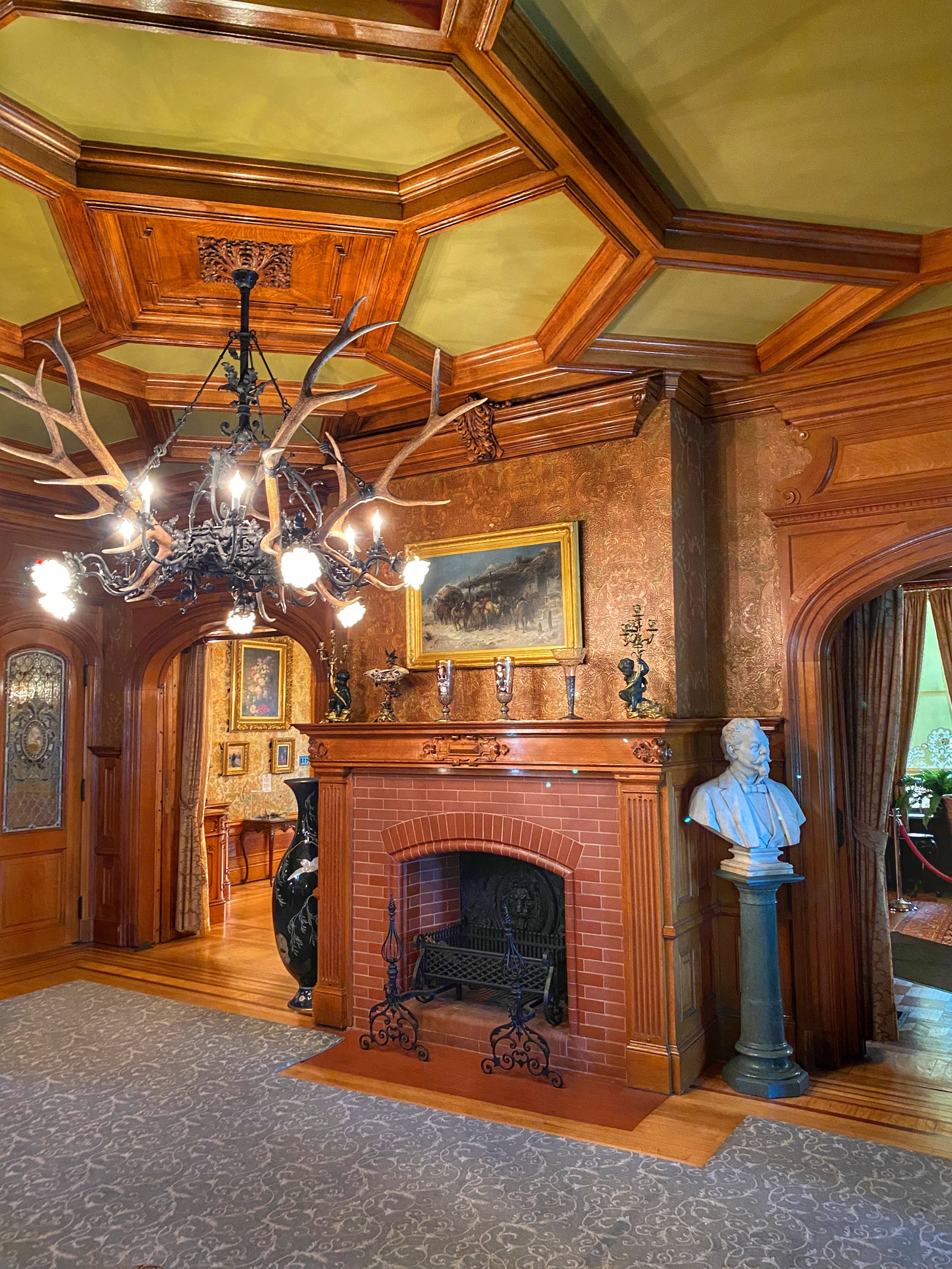
Looking up, I admired the coffered wood ceiling and wrought iron and elk antler chandelier, the focal point of the hall. Sadly, the original, which was fabricated by Colnik, had been removed and purchased by Karl Lotharius for his German tavern Von Trier before WHI had acquired the property. The group enlisted master craftsman Dan Nauman of Bighorn Forge Iron Works to reproduce the fixture and restore the exterior window grilles. A smaller, less ornate chandelier hangs in the musician’s nook. 

Foyer of the Pabst Mansion with fireplace, paintings, bust of Captain Pabst and deer antler chandelier

Note the wall covering in the reception hall — it’s a costly embossed linen imported from London known as Tynecastle canvas. 

The original art collection by Captain Pabst and Maria featured some of the best artists of the time. Notable works in the room include Halt Before a Wallachian Station, painted by Christian Adolf Schreyer, above the fireplace, and the haunting marble bust of Captain Pabst by Gaetano Trentanove, an Italian sculptor who emigrated to America for the World’s Columbian Exposition of 1893. Like Colnik, Trentanove settled in Milwaukee and opened a studio, which led to a steady stream of portrait commissions from the city’s elite. 

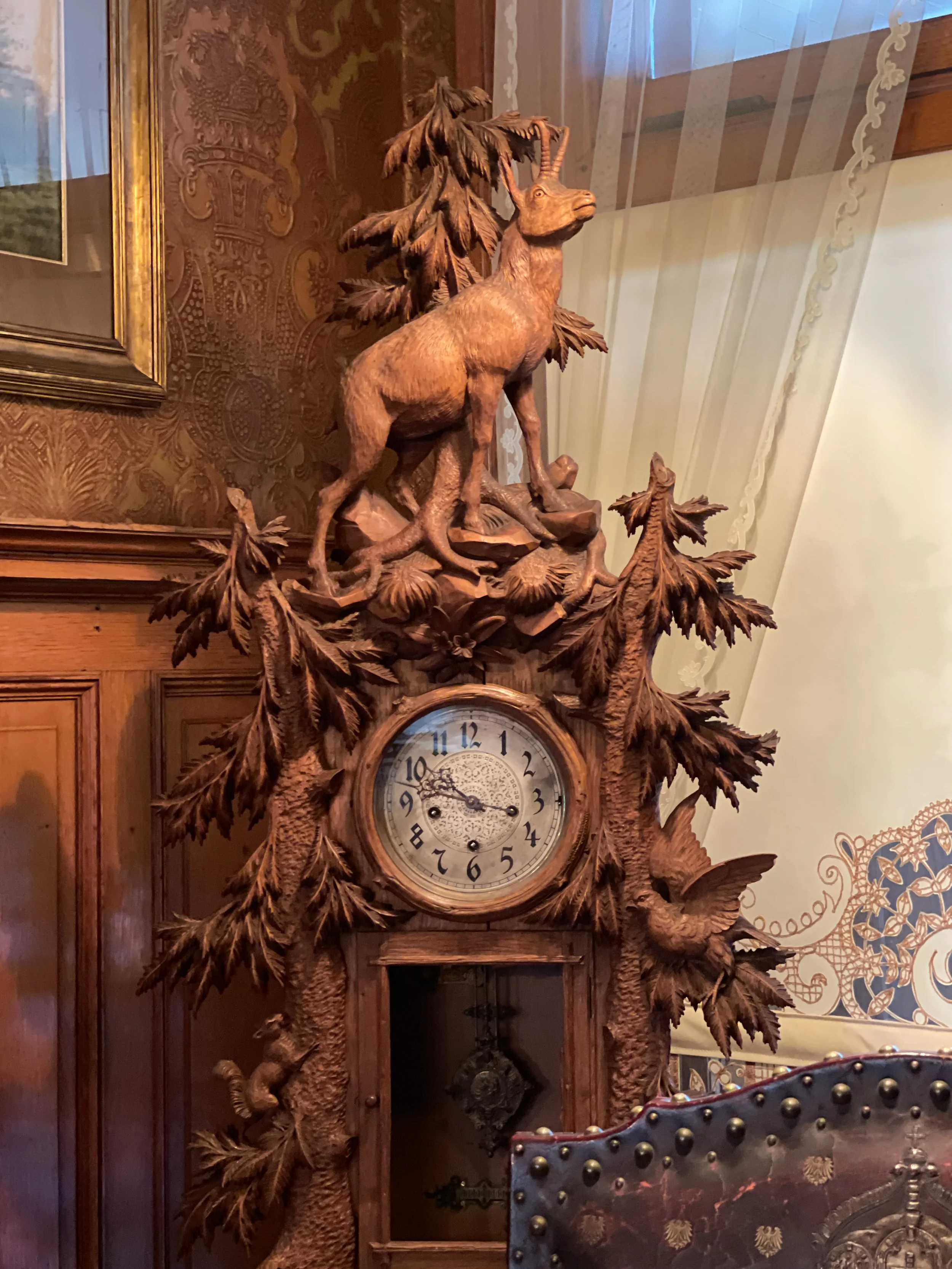
Elaborately carved wooden clock with antelope atop it

A nook used by musicians to play for guests during parties is situated to the back of the reception hall. It holds an elaborate Black Forest clock and an intricately hand-tooled leather chair. 

Before we proceeded, Roxie provided us with a few basics about the Pabst Mansion: The ground floor was dedicated to entertaining guests and is divided into distinct public and private areas, including the reception hall, two parlors, a formal dining room, a smoking room and Pabst’s study. 

Wally’s favorite room was the ladies’ parlor. He’d have been sneaking in there all the time.

Fit for a Queen: Maria Pabst’s Ladies’ Parlor

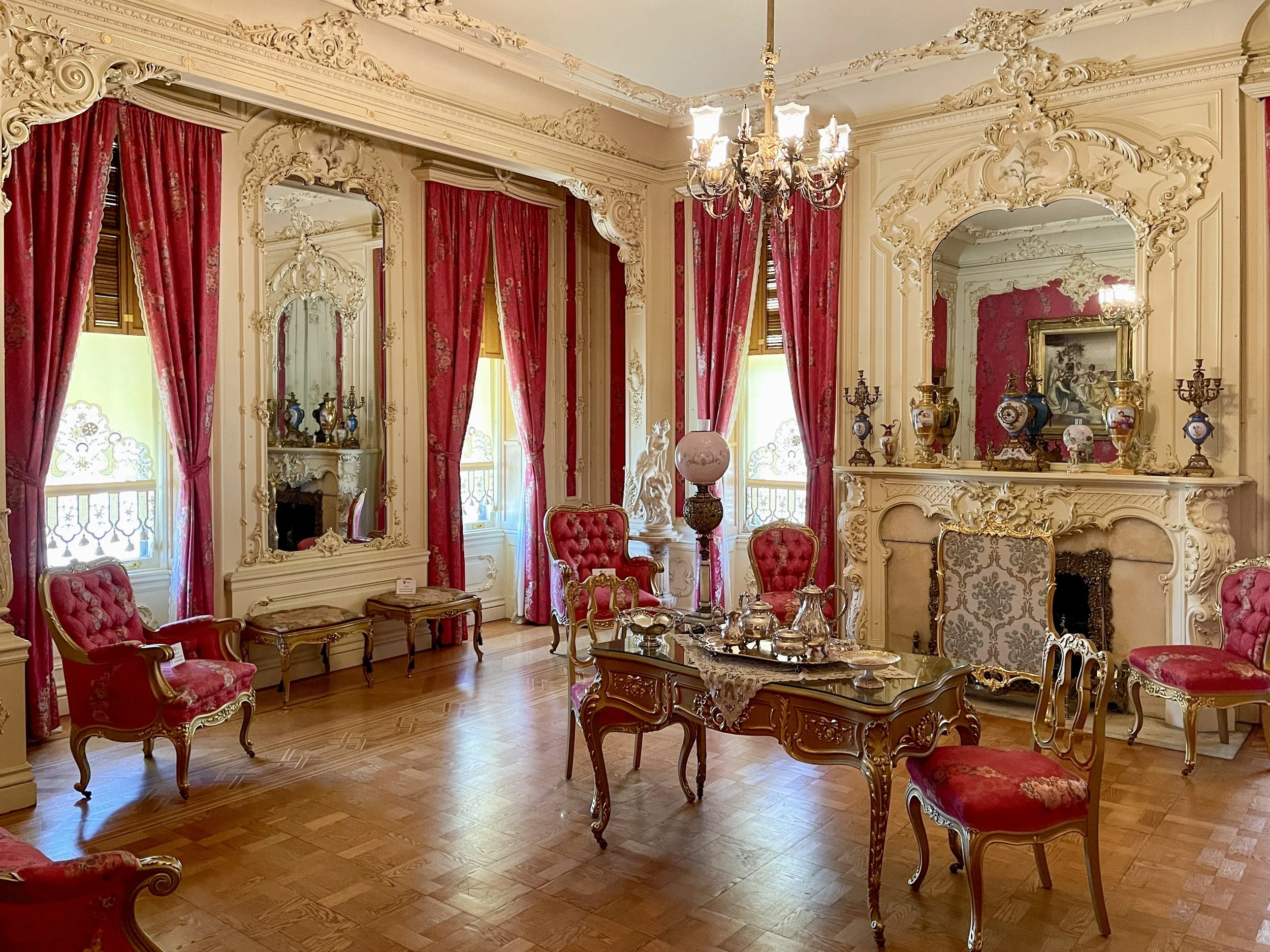
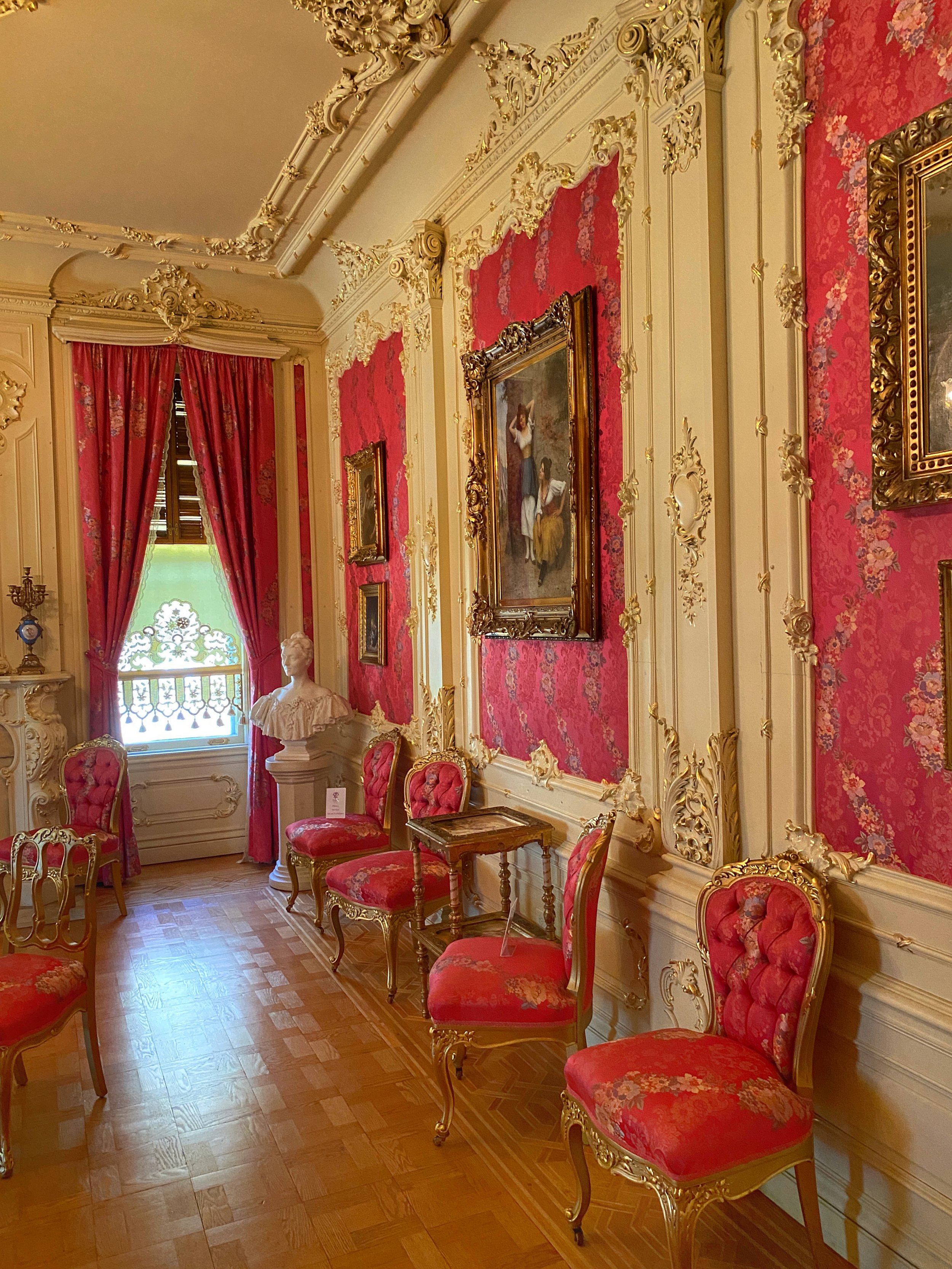
The first room we entered off of the reception hall was the elegant ladies’ parlor, where Maria received her society friends. It’s decorated in the Rococo Revival style and showcases gilded curvilinear plasterwork that seems to swell and bloom as if blown by gentle gusts of wind. Fuchsia silk wall panels, curtains and tufted upholstery have been reproduced using samples taken from the original chairs. 

“This feels like a room Marie Antoinette would have had at Versailles,” I whispered to Wally. 

“Yes,” he said. “Only a lot smaller.”

The bright pink floral fabric, which covers chairs and wall panels, certainly makes a statement and helps brighten the cream-colored room.

Bust of woman by pink curtain at Pabst Mansion

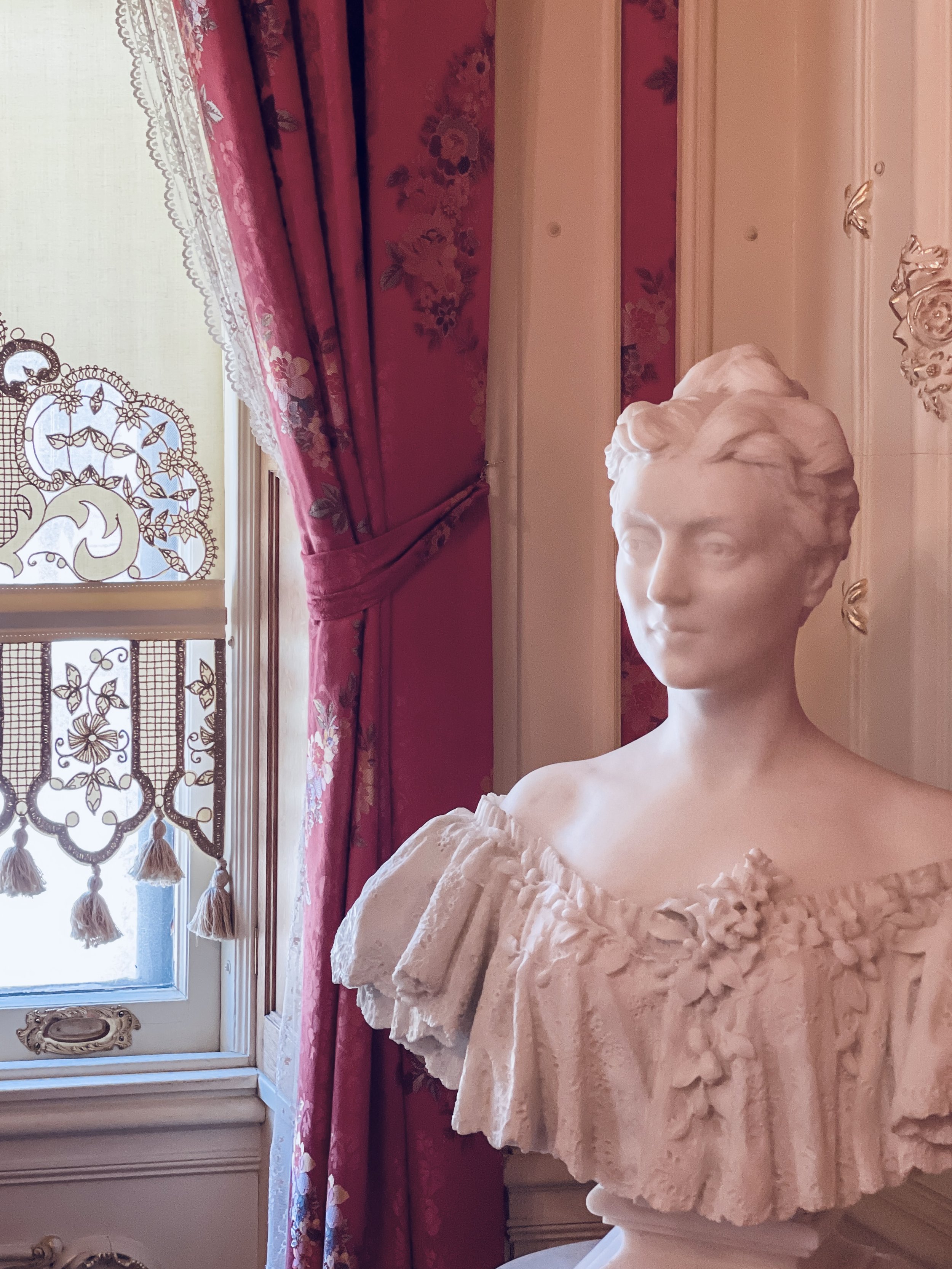
Bust of Marie Pabst Goodrich by Gaetano Trentanove

Painting of Selecting the Fabric by Frederick Solacroix on pink floral wall

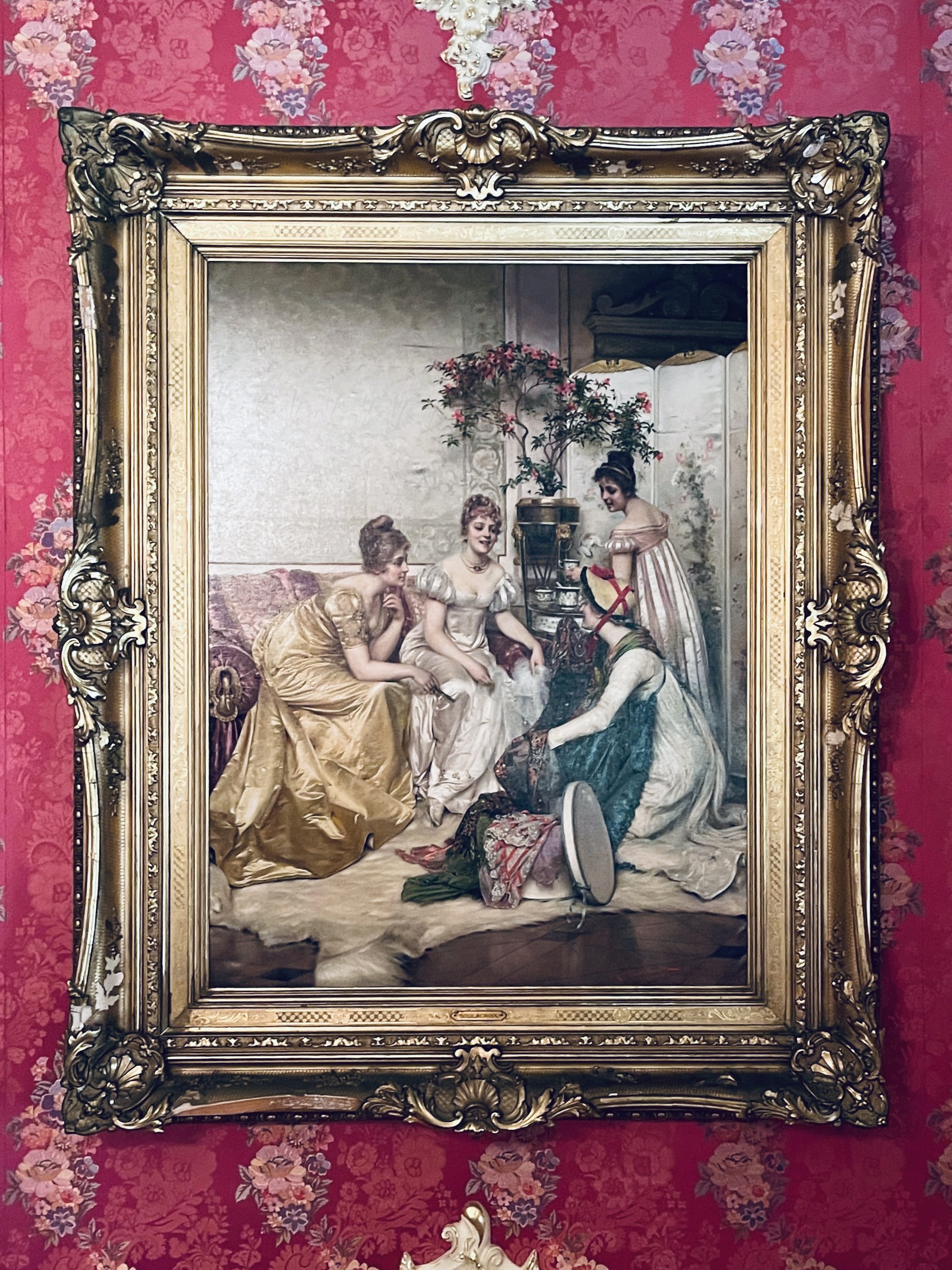
Selecting the Fabric by Frederick Solacroix

Hand-painted lilac on ceiling decoration at Pabst Mansion

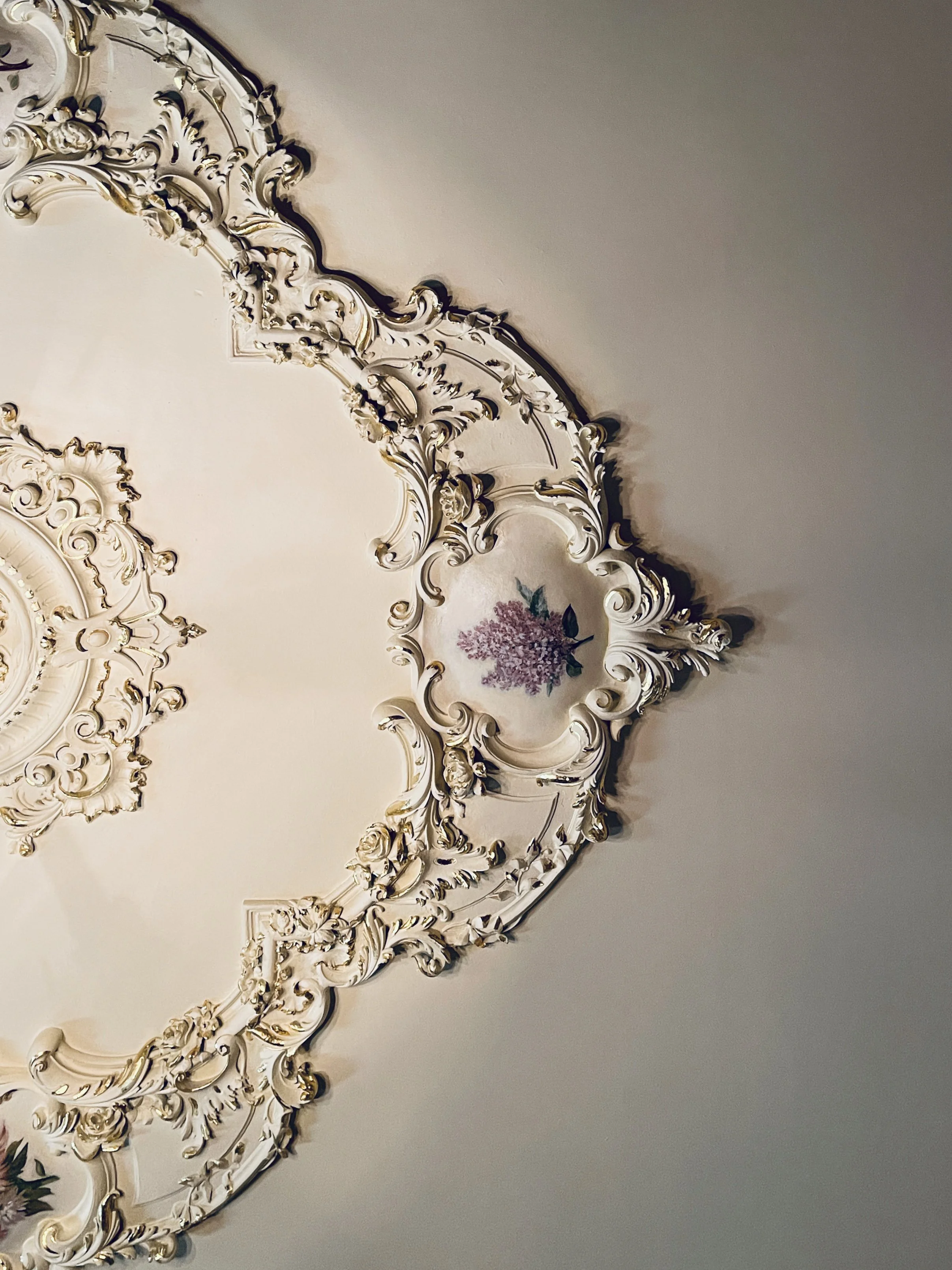
Hand-painted lilac on the ceiling medallion

While we were admiring the details, Roxie told us about the horrific modifications made while the home was occupied by the church. Most of these were made during the tenure of Archbishop Cousins, who lived in the home from 1959 to 1974. 

For starters, the ladies parlor, along with the rest of the home’s interior walls, ceilings and woodwork, were painted white. This meant covering up some beautiful murals, evoking gasps of horror by our tour group. 

Cousins also had cream-colored wall-to-wall carpeting installed in the first and second floors. 

As Roxie was telling us this, my mind couldn’t process why the archdiocese would have done this to such a magnificent home — especially considering how opulent the interiors of cathedrals can be. 

Thankfully, restoration workers found that the paint used by the church came right off, and the original murals could be preserved.  

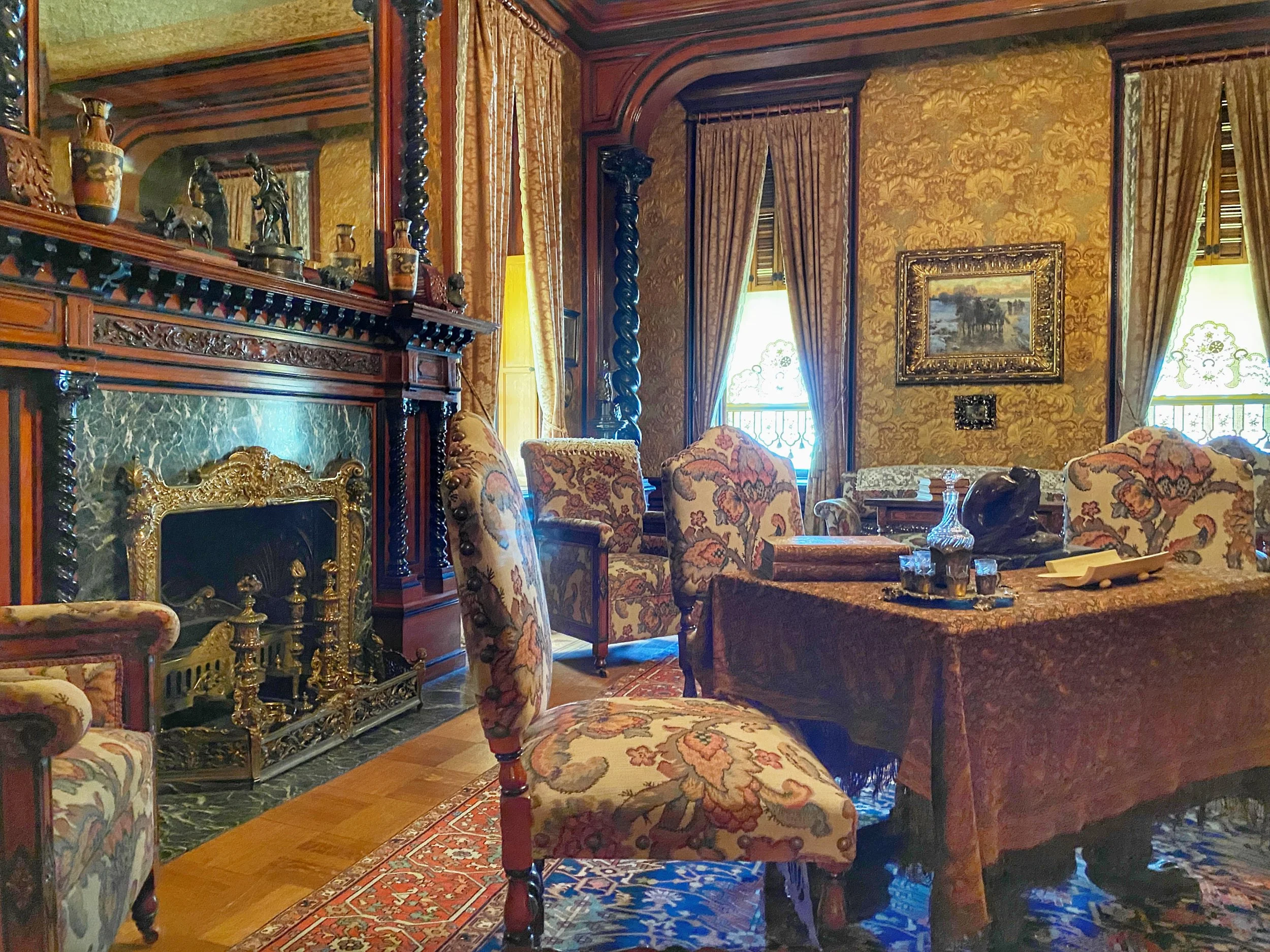
The music room was a favorite hangout space for the family and their guests. None of the Pabsts learned to play the piano, though, strangely enough.

Perfect Pitch: The Music Room 

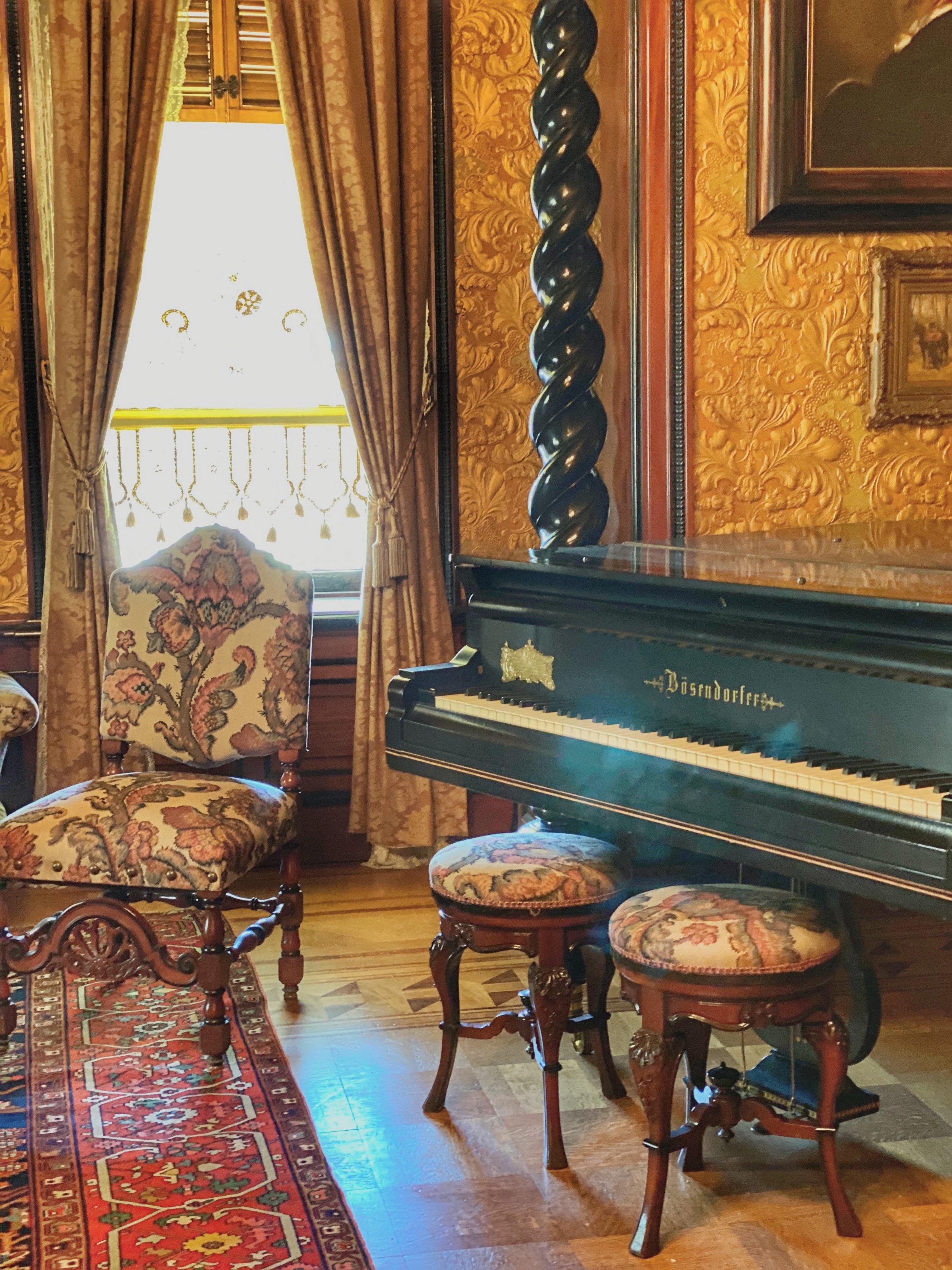
The Pabsts used the less formal Renaissance Revival style parlor for family use and to entertain guests. The walls feature low mahogany wainscot panels and faux ebony twisted columns. Other noteworthy items include a baby grand piano with two stools for duets and a mechanical music box. Although none of the Pabsts apparently knew how to play the piano, the couple welcomed touring performers, undoubtedly appearing at their Pabst Theater, to play for a small audience of friends. 

Their youngest daughter, Emma, married Rudolph Nunnemacher in this room in 1897. The elaborate ceremony was held under a canopy of white and gold silk with pink electric lights on a raised dais.

Fun fact: the Pabst Mansion logo was inspired by their wedding invitations, which featured hand-painted watercolor scenes taken from photographs of Rudolph’s global travels, paired with the couple’s initials. 

Piano and floral-patterned chair and stools in the music room of the Pabst Mansion

Touring pianists would entertain the family.

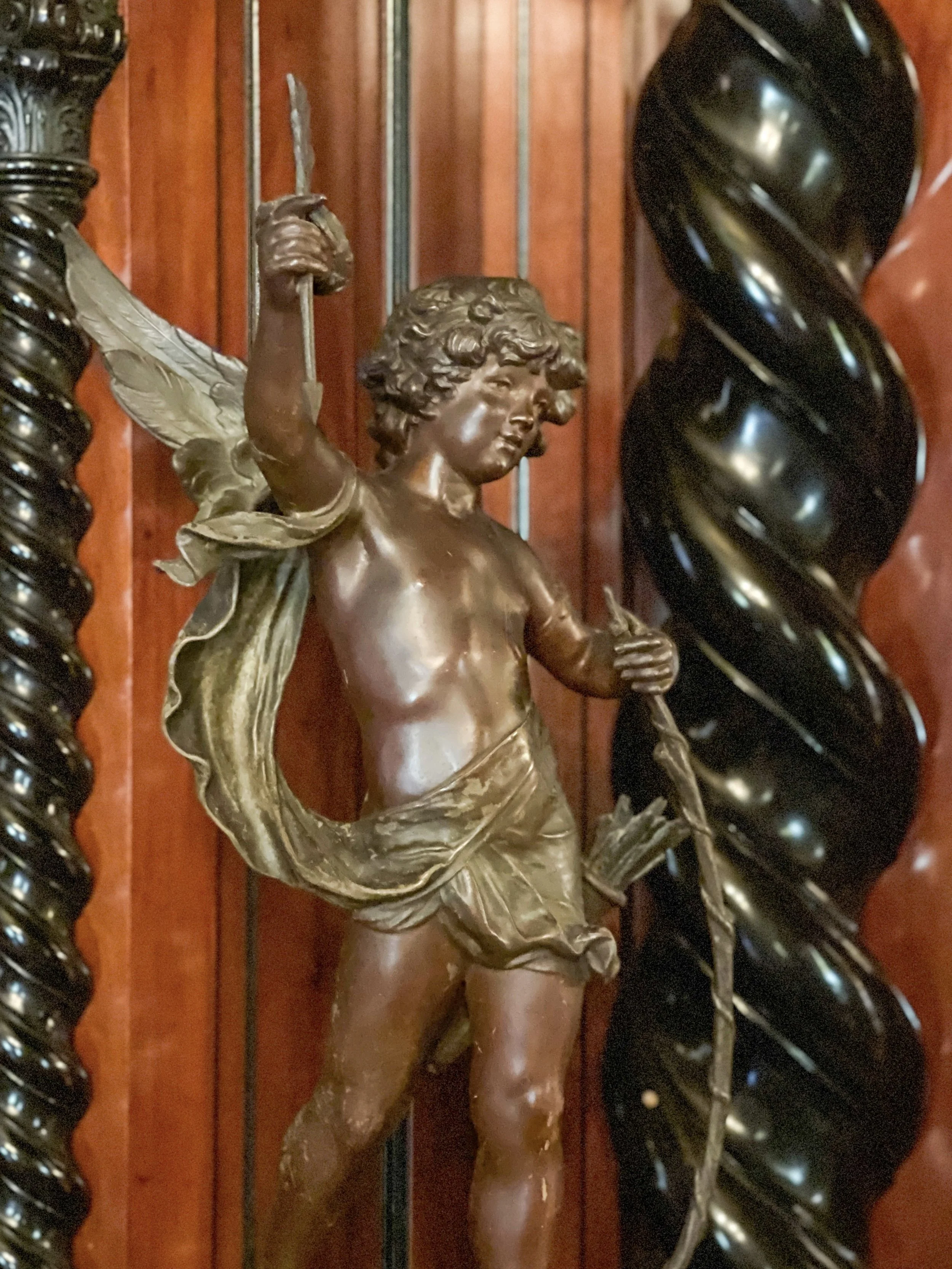
Bronze statue of Cupid holding bow and arrow by curling woodwork

Love it! A statue of Cupid

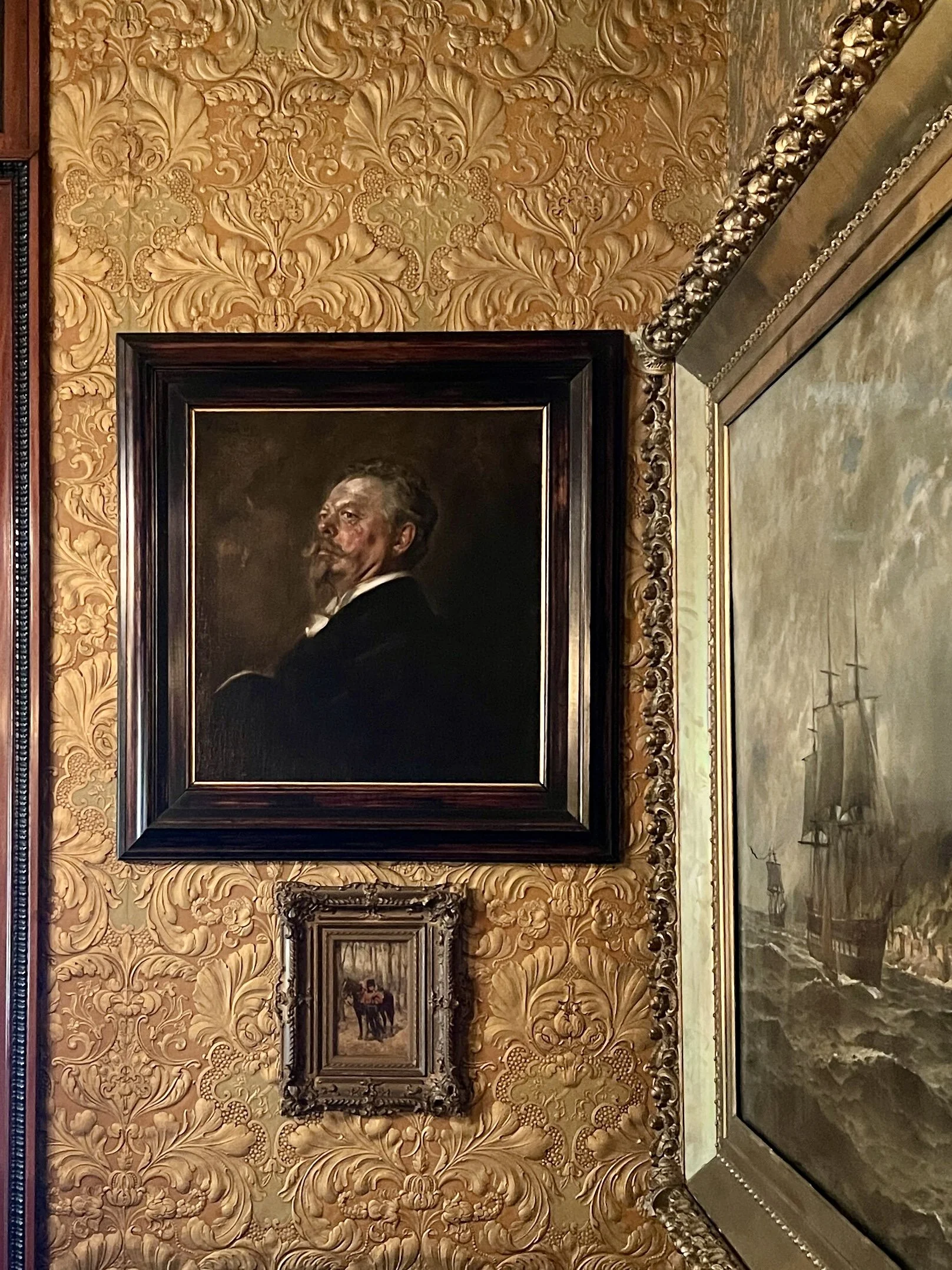
Portrait of Captain Pabst on gold  decorated wall

Portrait of Captain Pabst by Charles James Fox

Another fun fact: Apparently, Captain Pabst always wanted a brown Jersey cow. (I guess that answers the query, What do you get the man who has everything?) According to a local newspaper, on Pabst’s last Christmas, in 1904, his two sons, Frederick Jr. and Gustave, surprised him by wheeling a cow into the music room. Sadly, the Captain bought the farm, so to speak, six days later, on New Year’s Eve. 

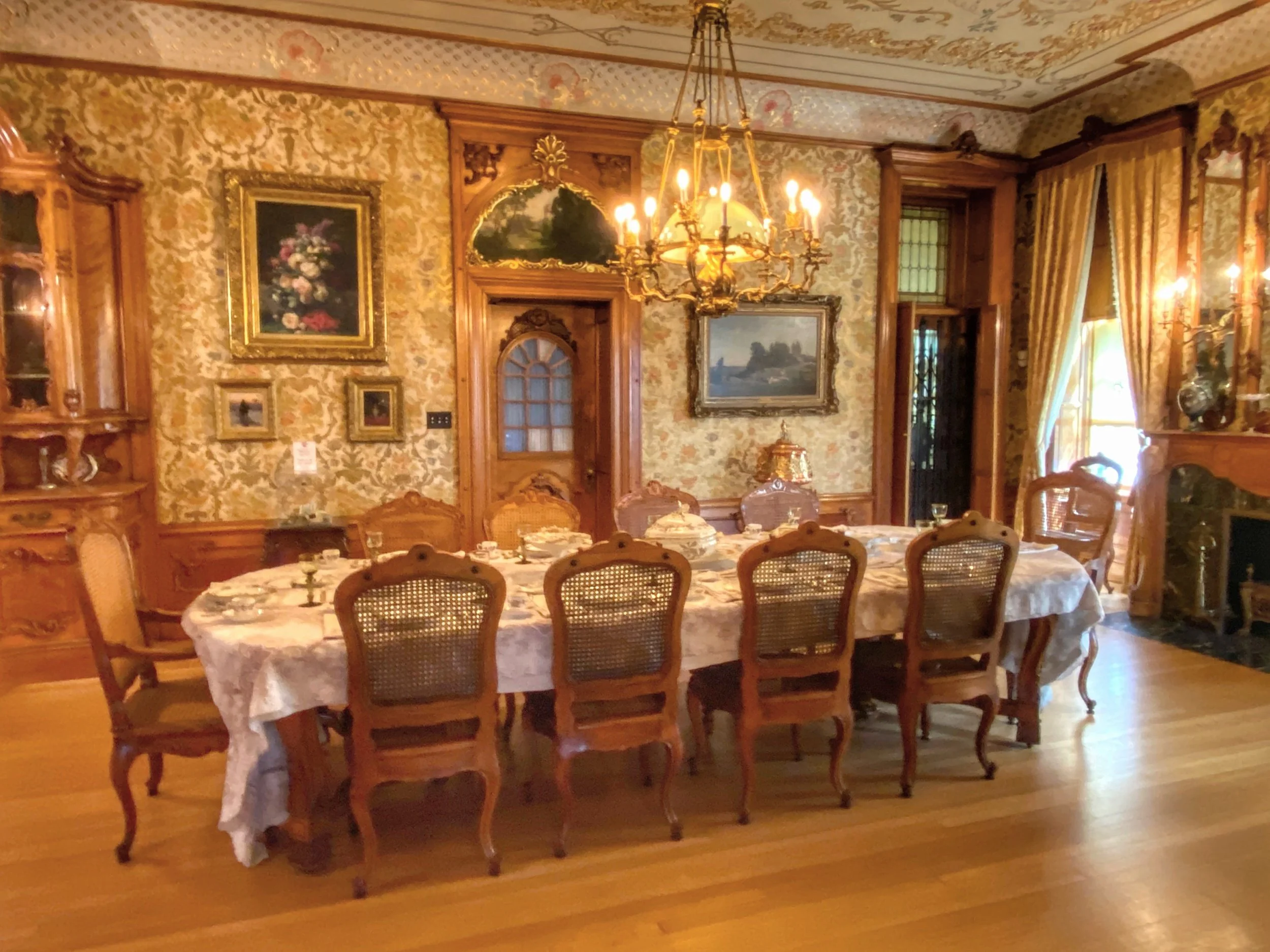
Dining table under chandelier in room with paintings and floral wallpaper at Pabst Mansion

The dining table was set up for 10 but could extend to seat 22!

A Seat at the Table: The Formal Dining Room 

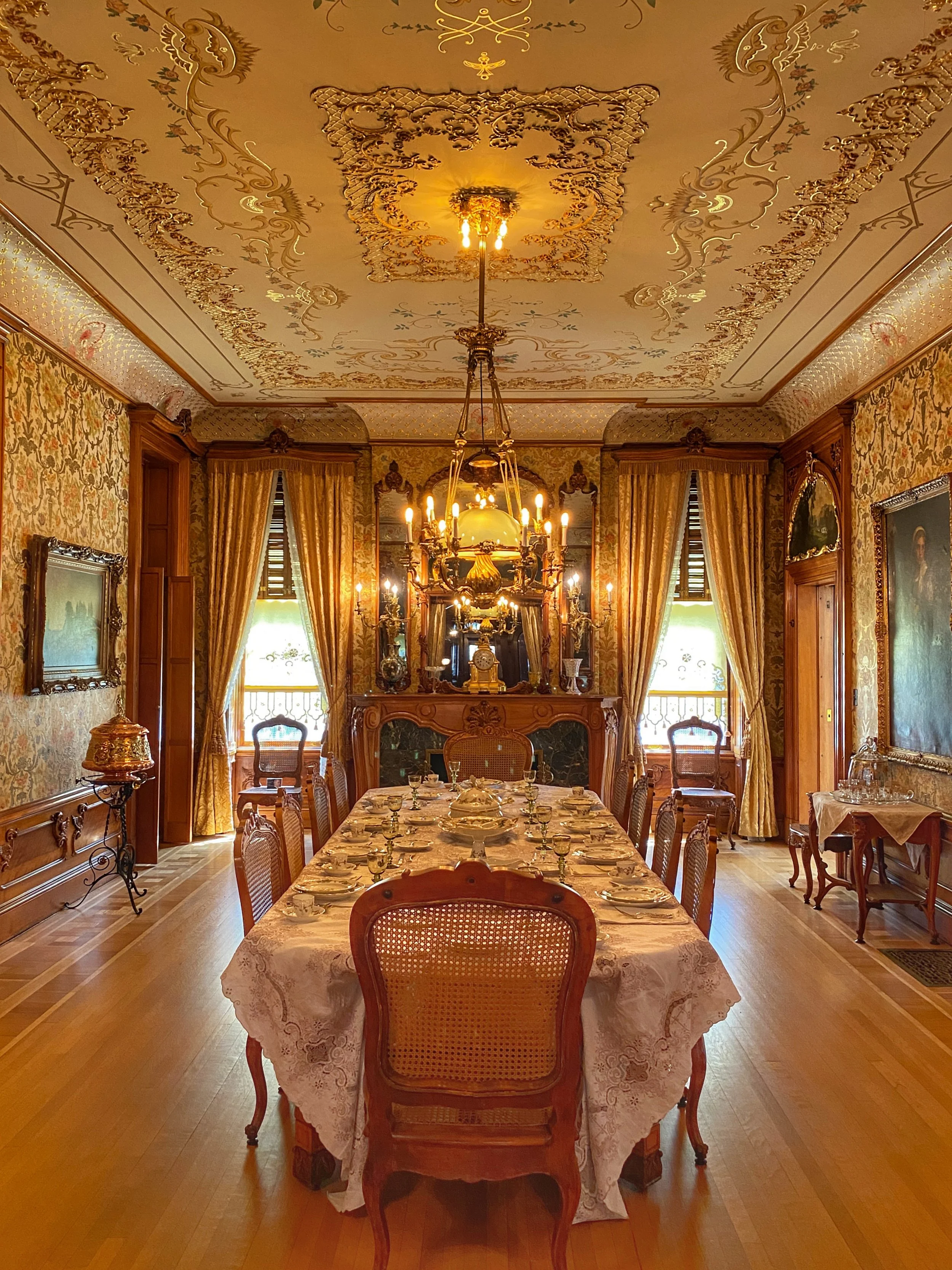
Roxie told us that the dining table, chairs, built-in cabinets and mirrors were all custom-made by the Milwaukee-based Matthew Brothers Manufacturing Company, one of the most prominent furniture manufacturing houses in the United States during the 19th century. When fully extended, the dining table can seat 22 people. 

She continued by sharing an interesting story about the light fixture that hangs above the table. It was considered a marvel of modern engineering at the time, as it was equipped to use gas, kerosene and electricity. 

Landscape paintings above the doors were painted over by the archdiocese but were also able to be restored.  

Dining table at Pabst Mansion with table service, fireplace and chandelier

The formal dining room is on the first floor of the mansion.

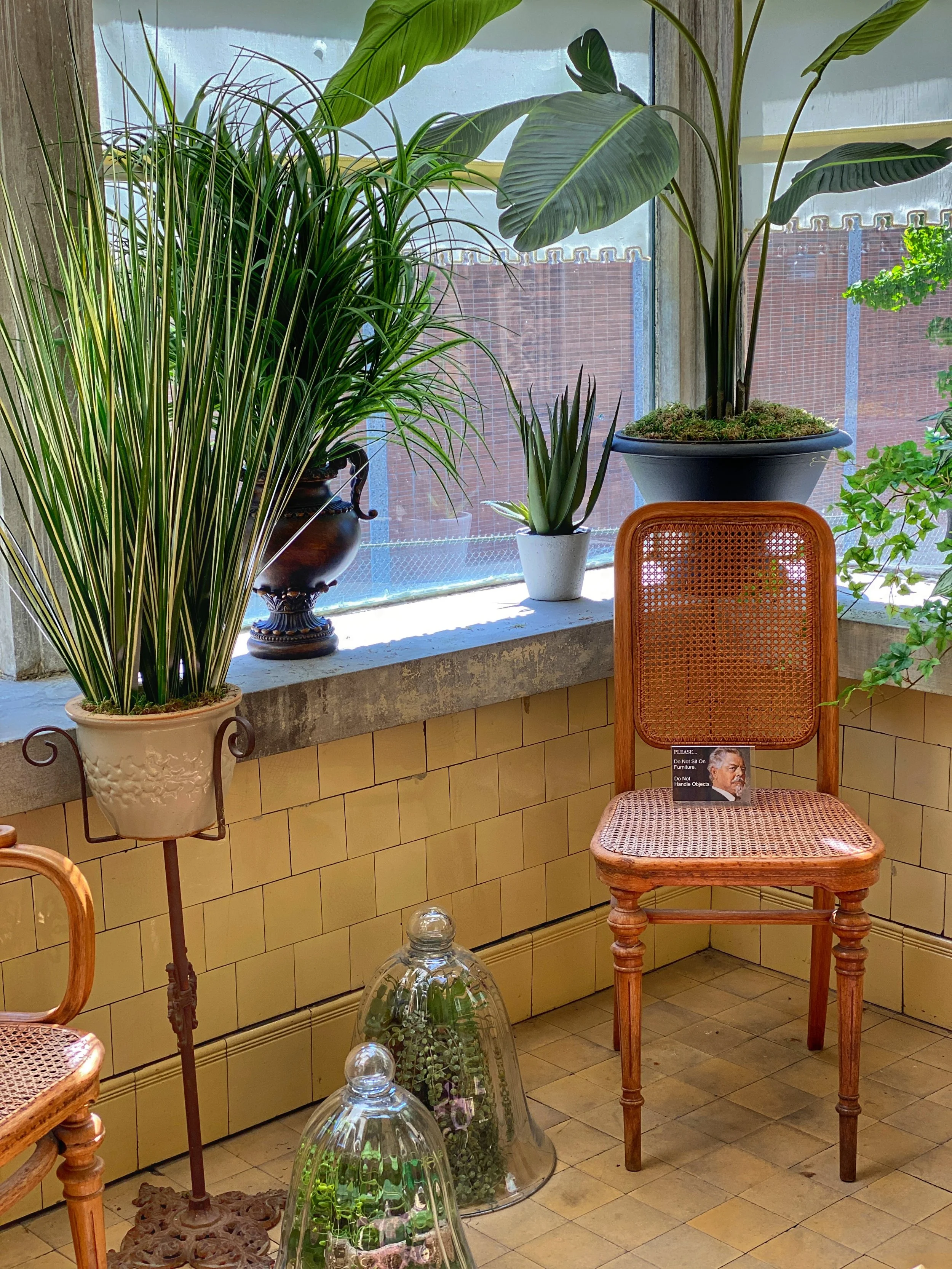
Chair and plants in pale yellow tiled conservatory at the Pabst Mansion

A small pale yellow tiled conservatory is attached to the dining room.

Fun fact: The darkly humorous actor Vincent Price filmed a commercial while seated at the Pabsts’ dining room table, ready to tuck into a submarine sandwich from Cousins Subs. 

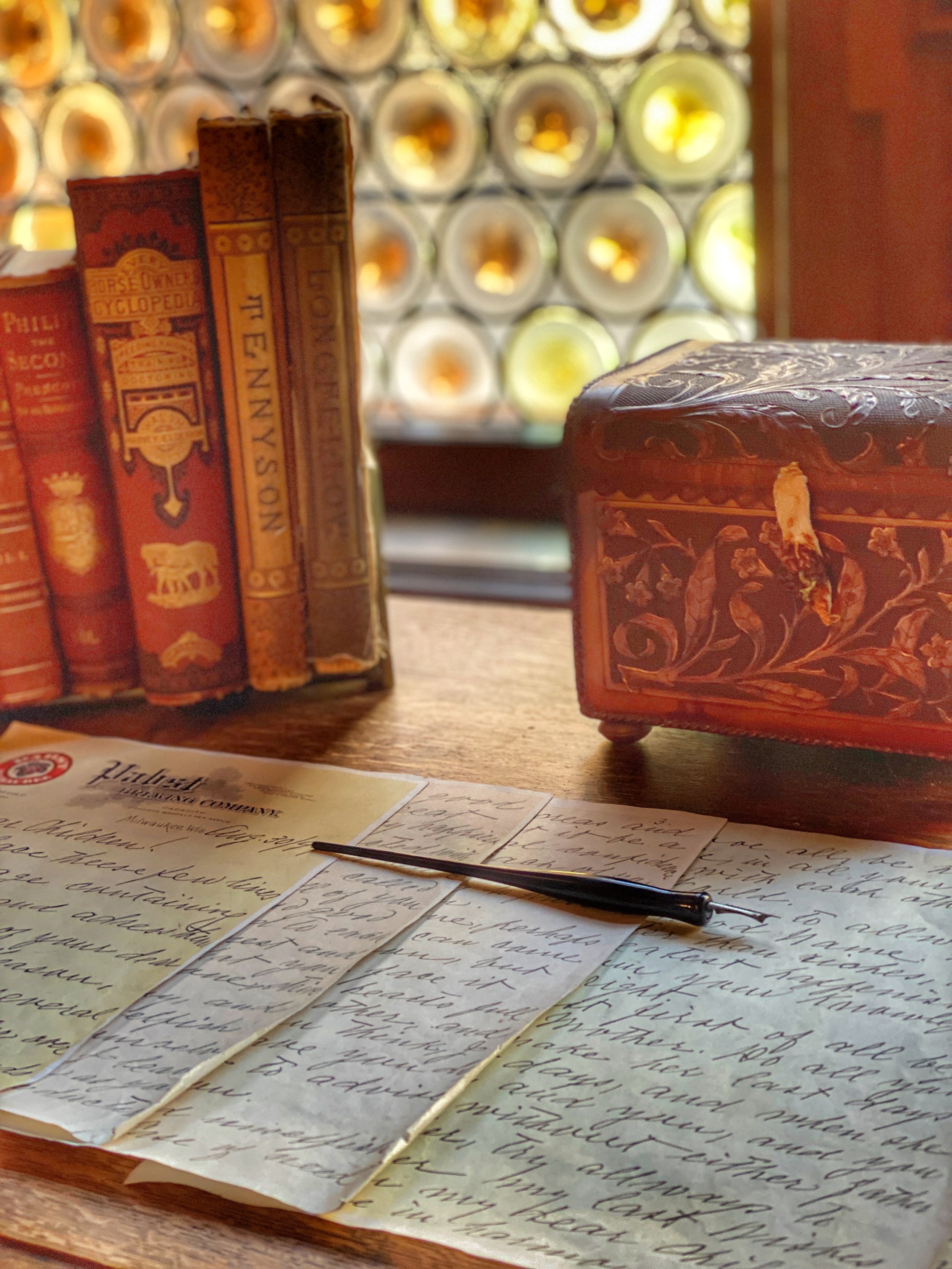
Letter from Captain Pabst to his children with old-fashioned pen and old books

On Captain Pabst’s desk is a letter he wrote to his children telling them that a good name is more important than riches, and imploring them to be generous and honest.

Hidden Assets: Captain Pabst’s Study

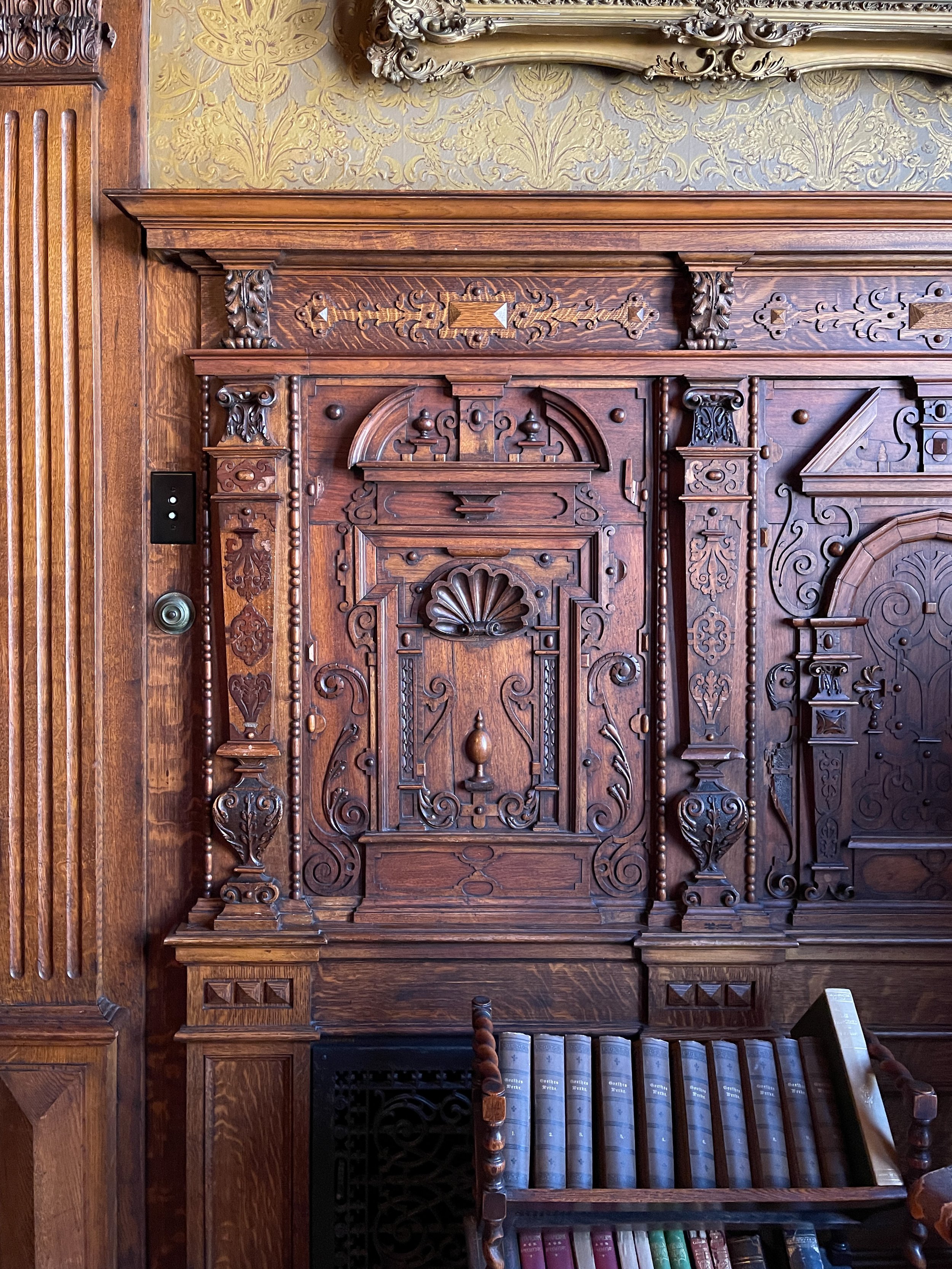
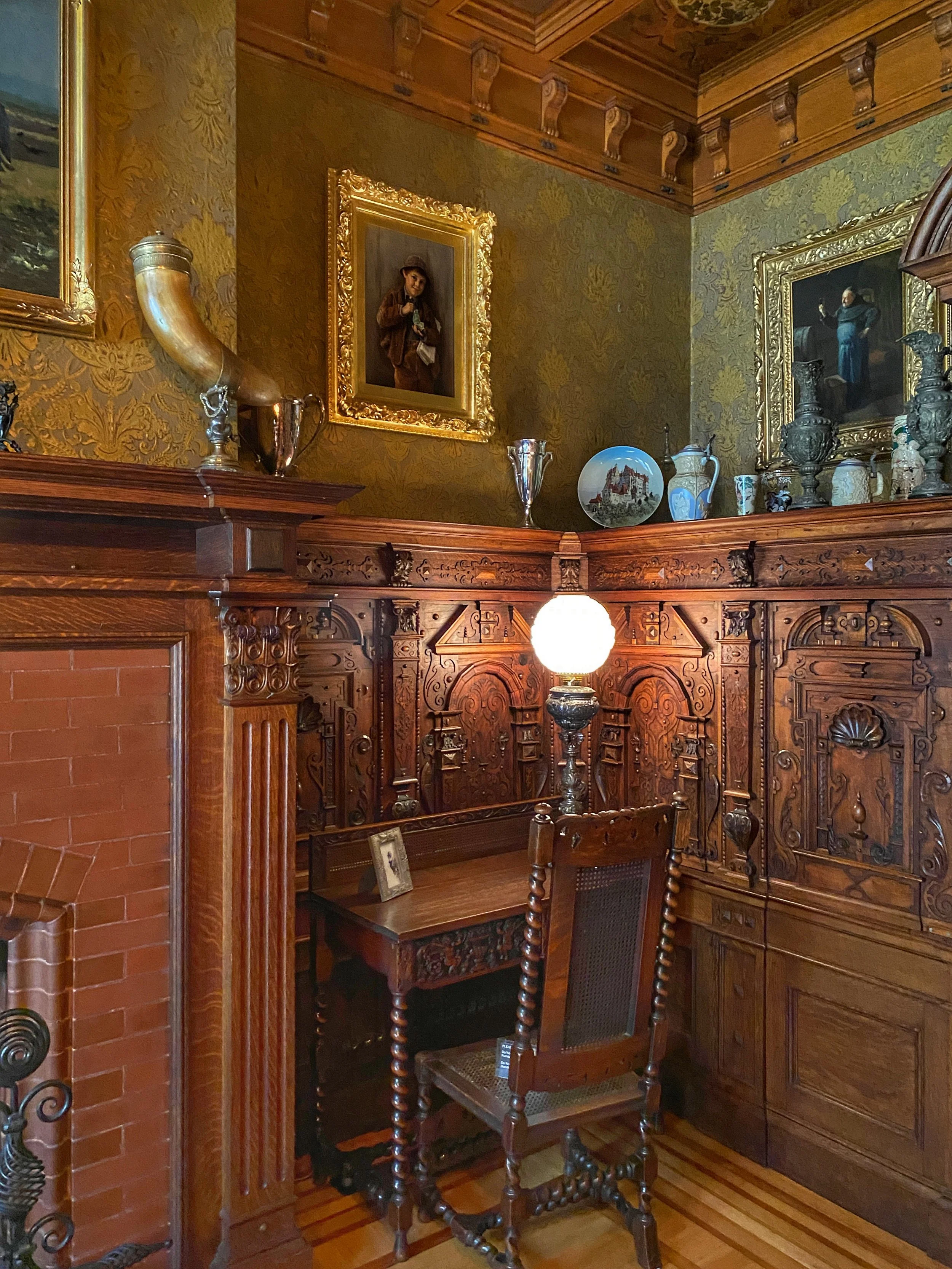
The Captain’s study is the most Germanic and elaborate of the rooms: tooled leather, trophies and an ornately carved armchair with lion-headed arms. I couldn’t help but admire the room’s highly detailed walnut and oak woodwork. Roxie explained that the interiors were inspired by the 17th century German Renaissance, and an antiquing technique was used to appear older than they really are. 

Fun fact: The study contains 14 hidden compartments that are accessed by catch levers. The Captain concealed books, important documents and cigars in his humidor. 

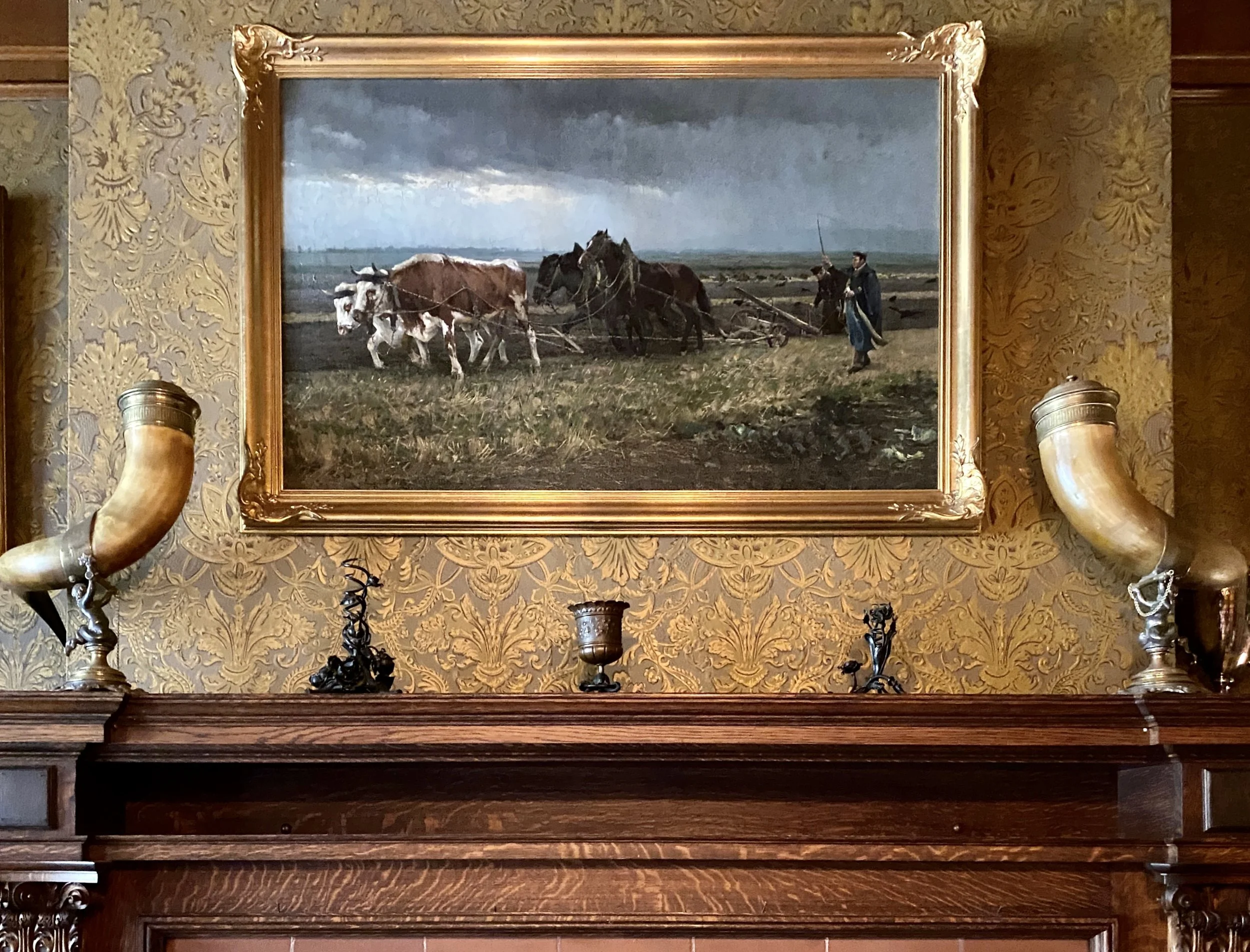
Painting of Plowing in Saxony by Richard Lorenz and horn drinking vessels above fireplace in Capt. Pabst's study

The oil painting over the fireplace, Plowing in Saxony by Richard Lorenz, is thought to have reminded Pabst of the village where he was born. 

Intricately carved cabinets with hidden compartments in Captain Pabst's study

The elaborately carved cabinets held secret compartments.

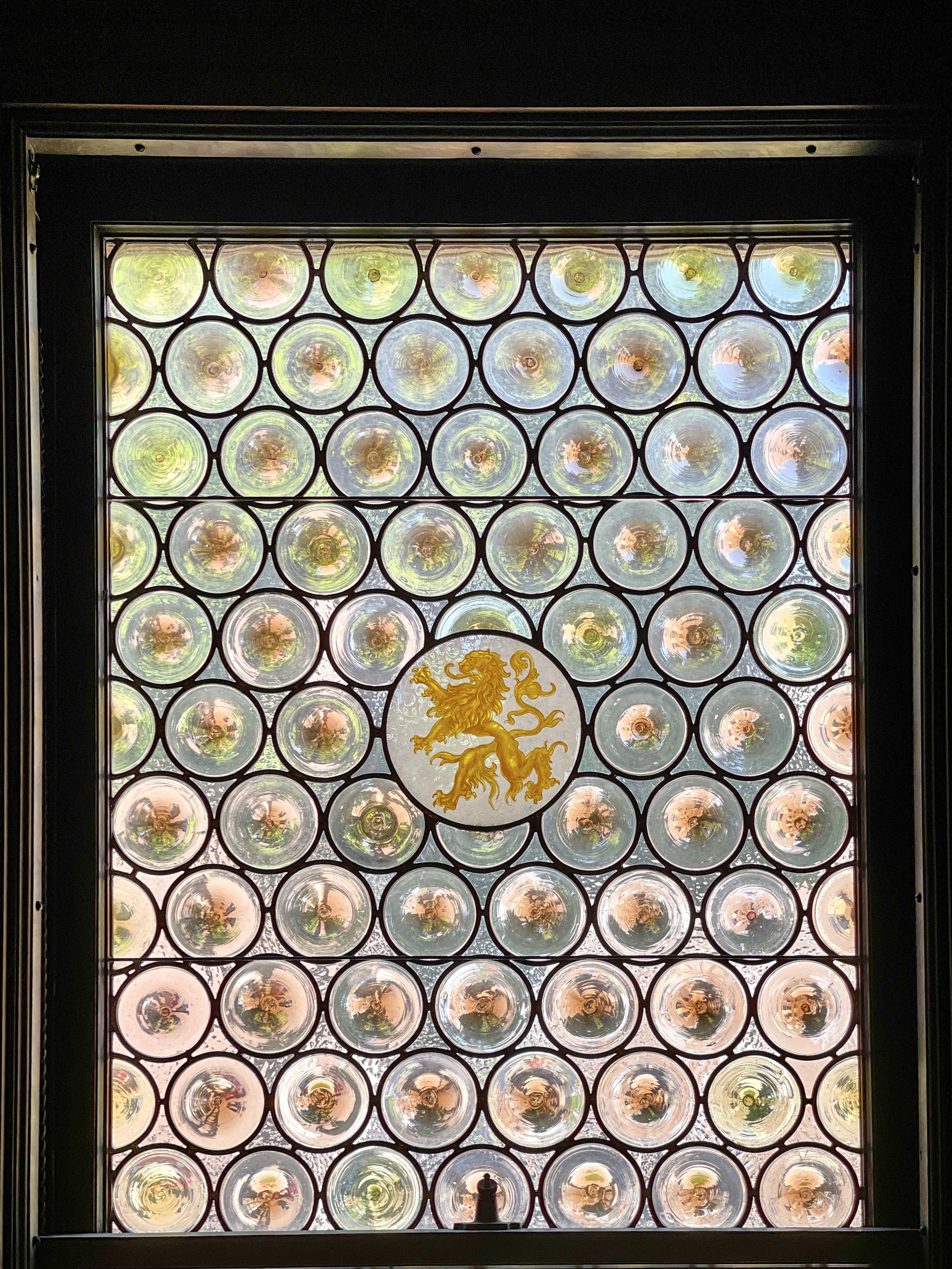
Window with circles of mouth-blown glass with yellow lion in the center

The window features “breath of life” marks left by the glass blower.

A small secondary desk in the study

The leaded glass windows are composed of uniform panes spun into circular shapes known as rondels. Because they’re mouth-blown and produced one at a time, each disk has a slightly irregular pontil mark left behind from the detachment of the blowpipe that’s referred to as the breath of life. 

On top of the desk is a copy of a letter written by Captain Pabst in 1899 to his children. It was included with his will, and I found the following passages to be particularly moving:

“Be generous and unselfish to each other in case of need, and above all, be honest and noble in all your dealings, not only with each other, but with the World. 

I want you to always have a good name. It is better than riches, and your greatest happiness will come from the knowledge of doing right.”

The ceiling panels of the study were painted by Louis Mayer, who ingeniously used different-colored stains to emulate the appearance of inlaid wood. Be sure to look up at the wood coffered ceiling with hand-painted panels inscribed with German proverbs.

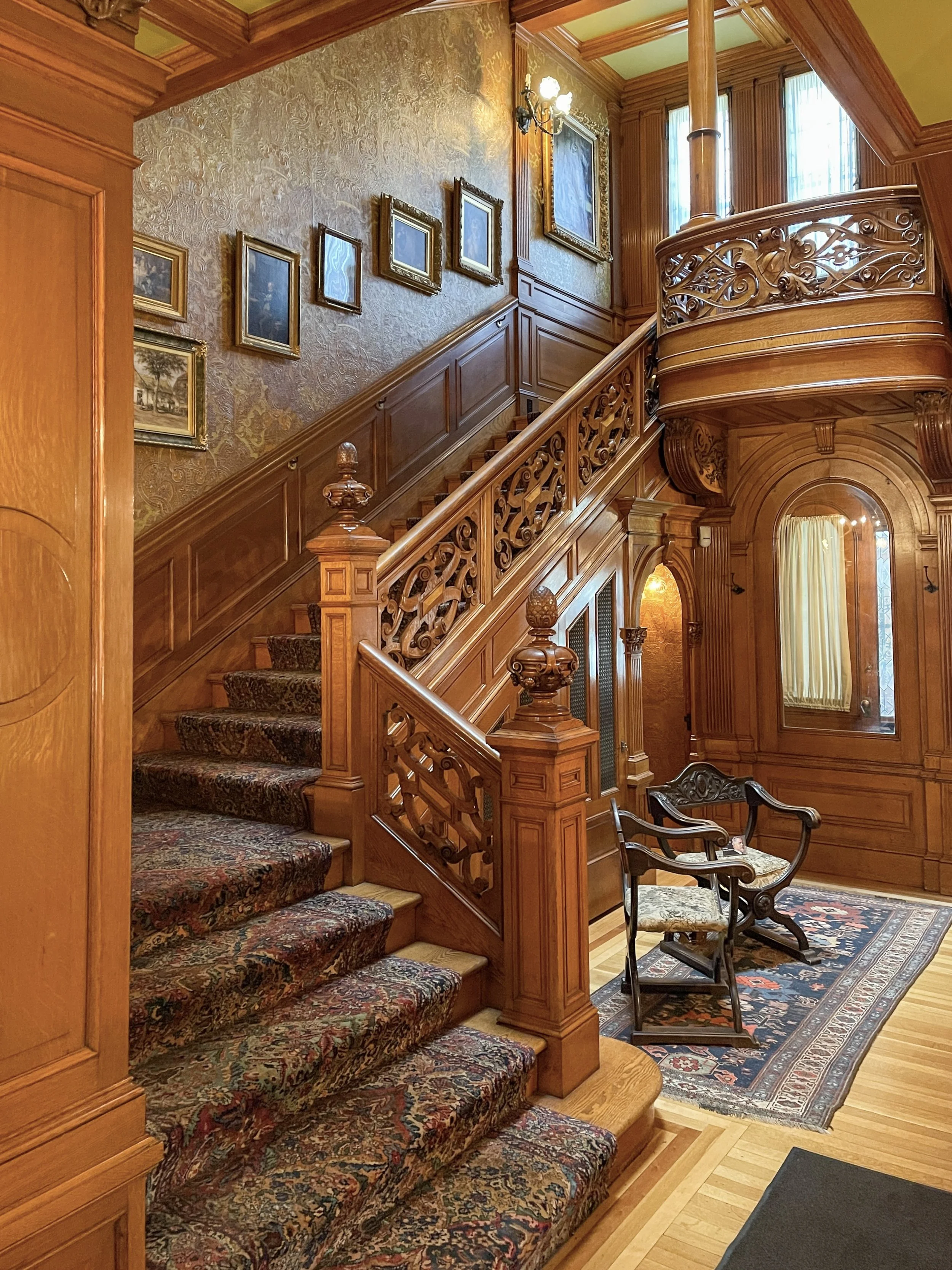
The main staircase with warm wood, paintings on the wall and Oriental runners at the Pabst Mansion

The archway under the stairs held a telephone closet.

Step Up: The Grand Staircase Hall

Pabst embraced new technology: The home had its own telephone room, which is located in a small closet beneath the grand staircase. 

My mom, who Wally and I call Mima, remarked that she thought it was where Harry Potter lived, a reference to the cupboard under the stairs where the beloved boy wizard was forced to stay with his aunt and uncle, which made Roxie laugh. 

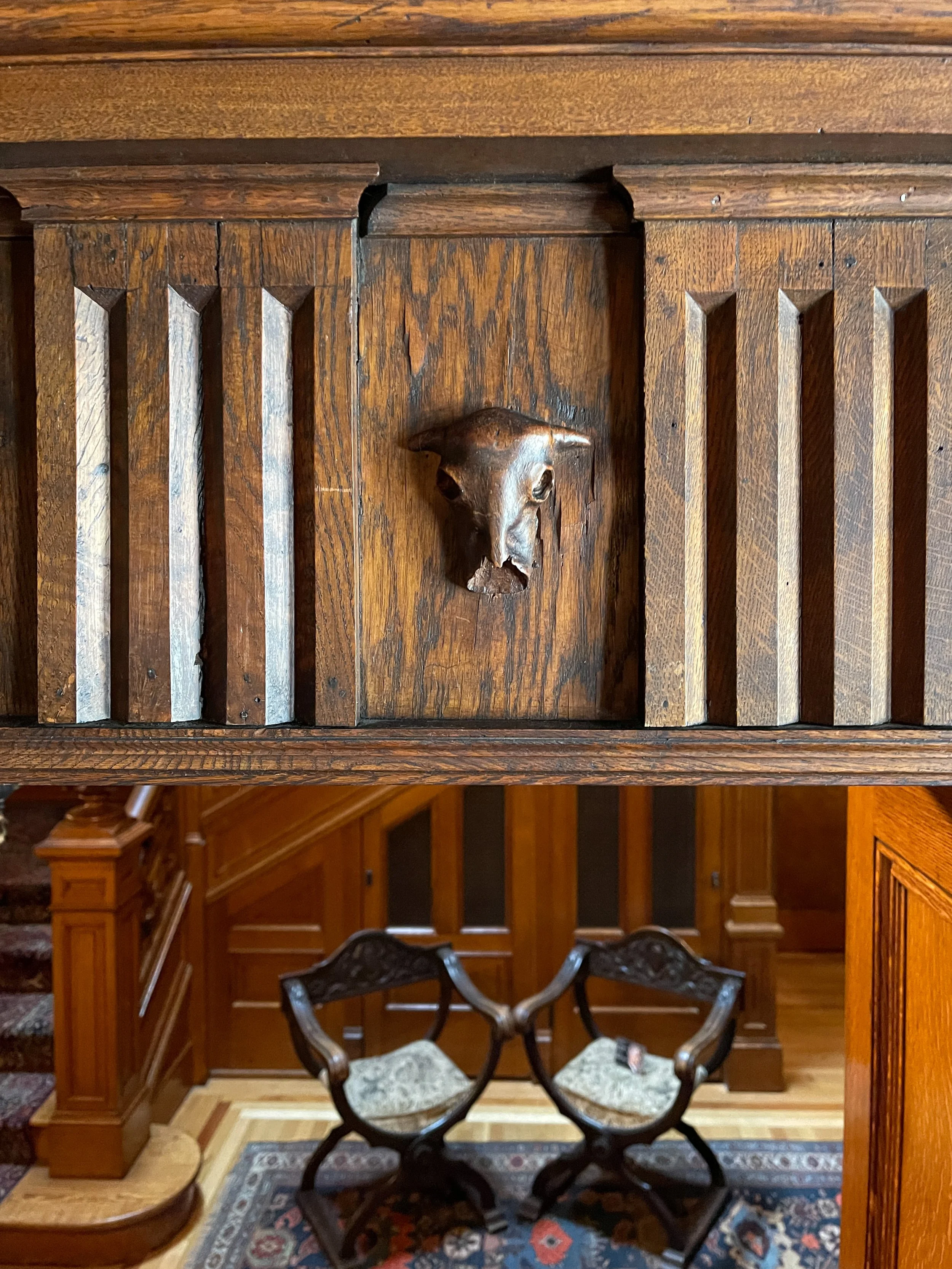
Carved cow skull panel looking down staircase at landing with two chairs at Pabst Mansion

A cattle skull detail on the landing, looking down at the first floor.

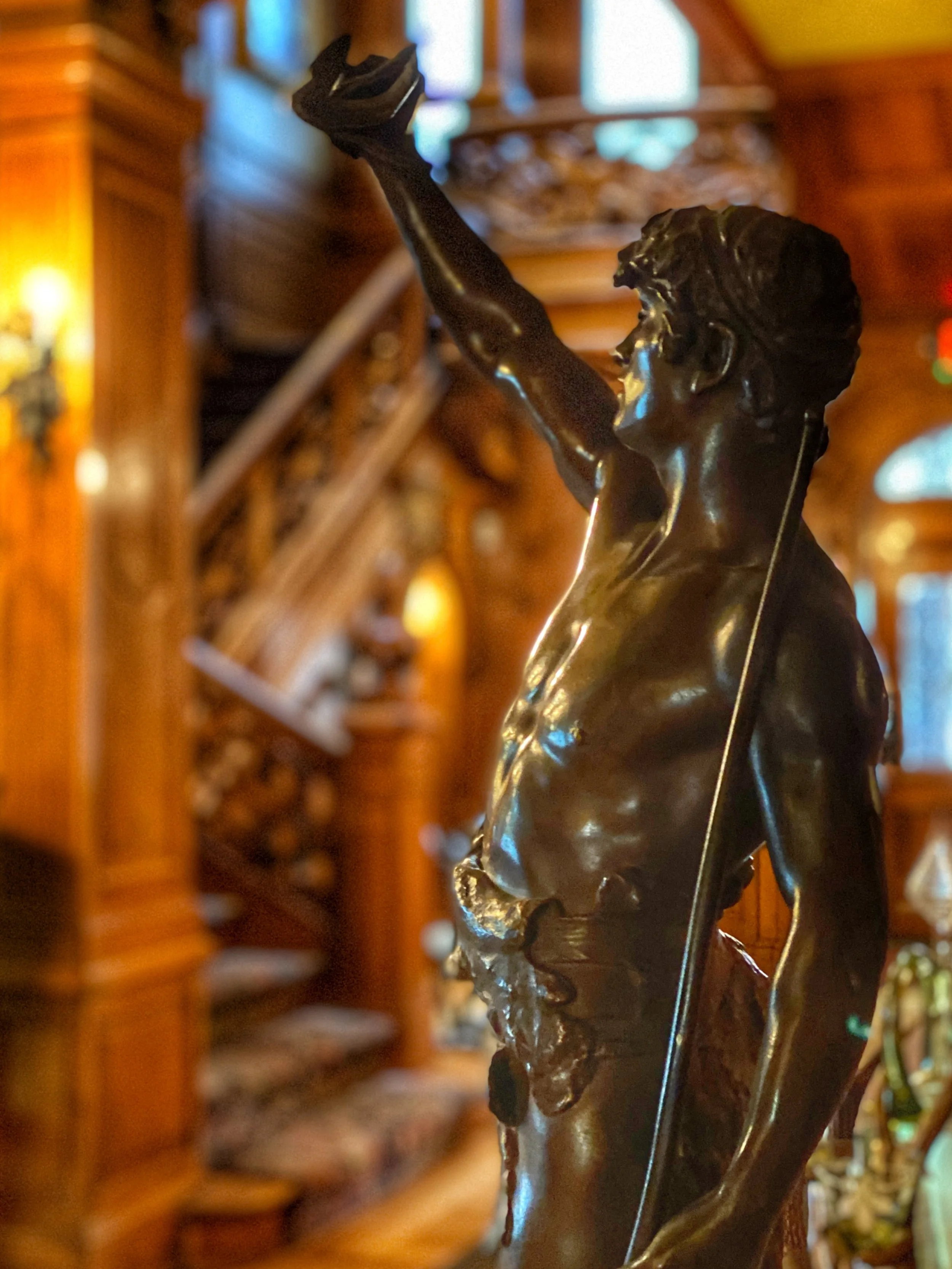
Bronze statue of nude man raising his arm by the staircase in the Pabst Mansion

The Pabst home was filled with statues and paintings.

The finials that adorn each of the grand staircase’s nine newel posts were cleverly designed to replicate hops buds. A stained glass skylight tops the stairwell and fills it with natural light. 

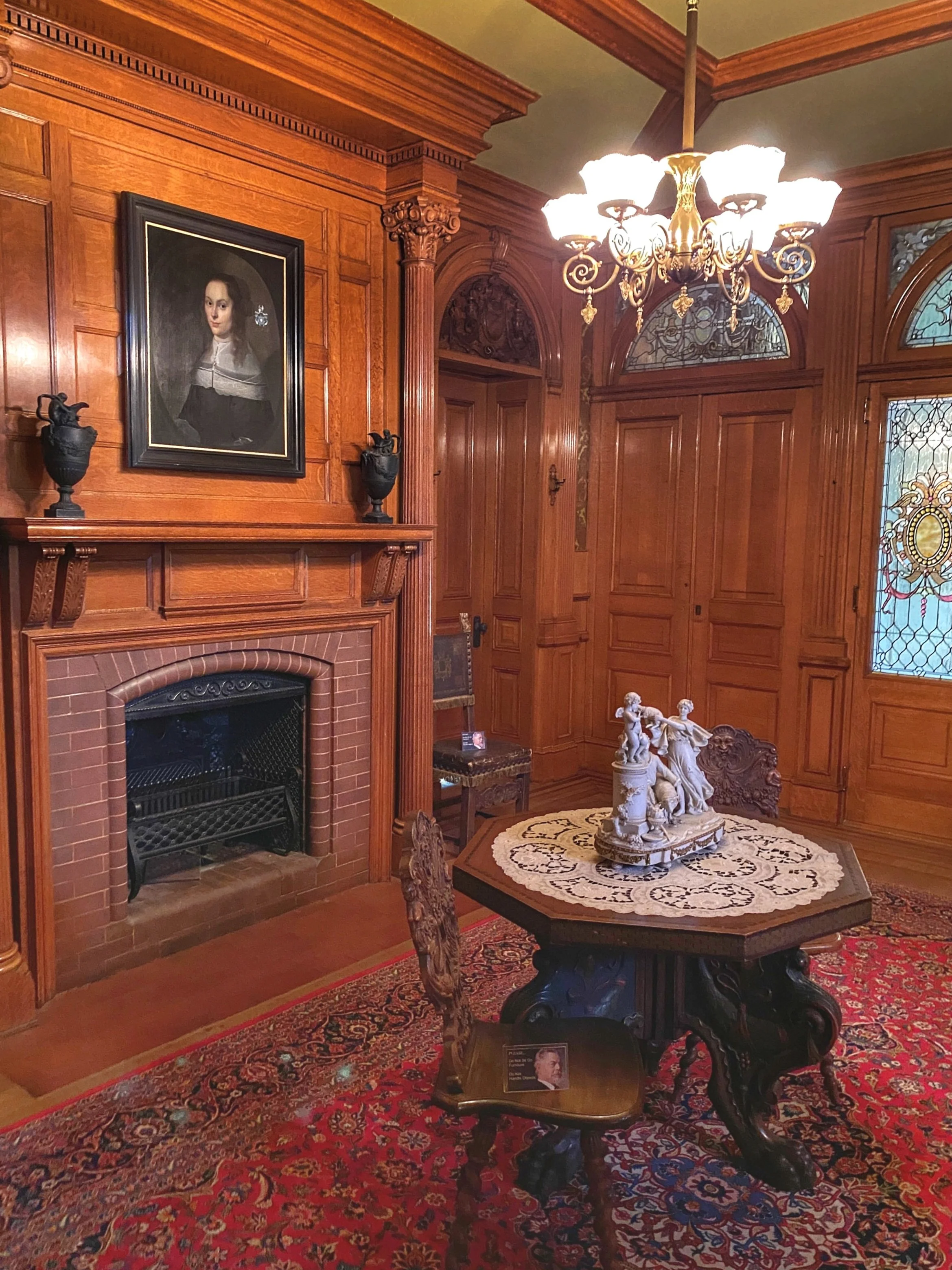
Second floor landing at Pabst Mansion, with fireplace, octagonal table, small statue, chandelier and stained glass doorway

The landings at Pabst Mansion served as rooms themselves. And check out the stained glass doorway to granddaughter Elspeth’s room!

The Sum of Its Arts: Second Floor Foyer 

We ascended the staircase and stopped on the second floor. This is where several of the family’s bedrooms are located.  

Roxie had mentioned earlier that Captain Pabst was a humble man who never forgot where he came from. This is evident in the artwork he and Maria collected. The painting Farewell to the Homeland by Wilhelm Koller depicts immigrants on a ship about to set sail, most likely on their way to America. A few of the subjects are looking back in despair, not knowing where they were going, while others are sharing a drink and are expressing a sense of hope. 

Emma had quite the setup, with a desk and vanity in her bedroom.

Austen-tacious: Emma’s Pabsts Regal Bedroom 

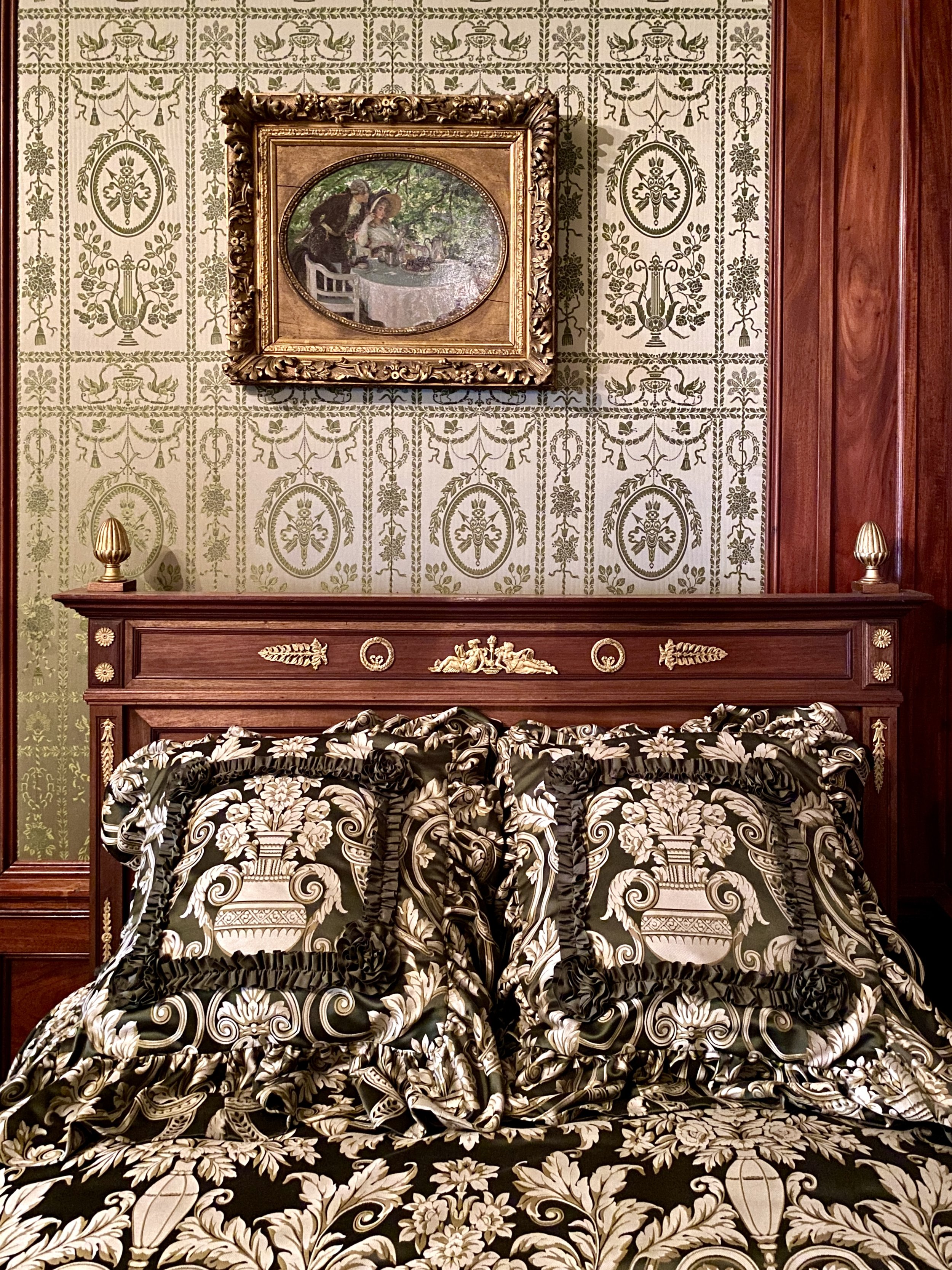
The first bedroom we toured belonged to daughter Emma, who lived in the mansion until 1897, when she married. Her room is decorated in the Regency style, which is reflected in the ormolu swag and tassel design on the fireplace mantle. The motif is repeated in the wall coverings, which were replicated for the room. If you look closely, the design depicts what appears to be swans drinking from a fountain. 

Emma’s room is the only one in the home that has all of the original bathroom fixtures and the fanciest toilet tank I’ve ever seen — it has an embossed and gilt laurel wreath and garland motif. The tub, with its oak rim, had been removed and relocated to the basement by the archdiocese. 

Dark wood bed with white and green classical bedspread and wallpaper with painting at the Pabst Mansion

The Pabsts weren’t scared of mixing patterns, we’ll give them that!

Our group paused in front of a portrait of eldest daughter, Elizabeth Pabst von Ernst. Roxie told us about her tragic passing: During construction of the home, Elizabeth became ill after the birth of her daughter, Emma Marie, and died six months later from appendicitis. She was only 26 years old. Rumor has it that the Pabsts blamed her death on her husband, the German painter Otto von Ernst. 

Roxie went on to tell us that the Pabsts approached their son-in-law to discuss Emma Marie, their granddaughter: “Look, we would like to adopt her,” they said. “We feel that we can provide her with a better life and would like to make sure that she receives the inheritance that her mother would have gotten.” Otto agreed. Captain Pabst gave him $10,000, told him to leave, and he did. After the proceedings had taken place, her name was changed from Emma Marie to Elsbeth in remembrance of her mother, Elizabeth. 

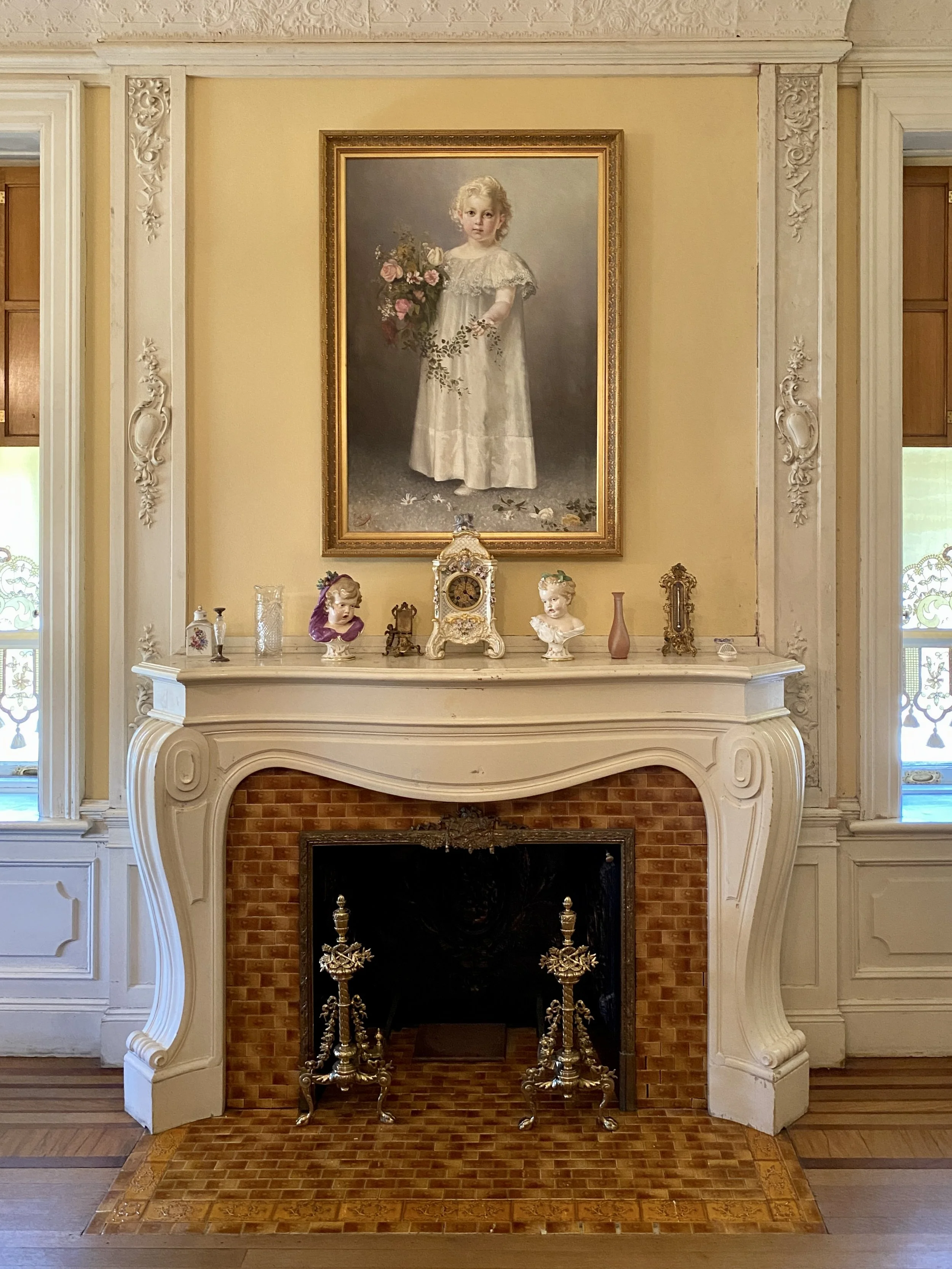
Portrait of young Elsbeth Pabst on a yellow wall above white fireplace with clock and knickknacks in her room at the Pabst Mansion

It seems a bit strange to have a large portrait of yourself as a focal point in your bedroom, but hey. That’s a painting of Elsbeth Pabst by Caesar Phillip in the young girl’s bedroom.

True Blue: Elsbeth’s Room

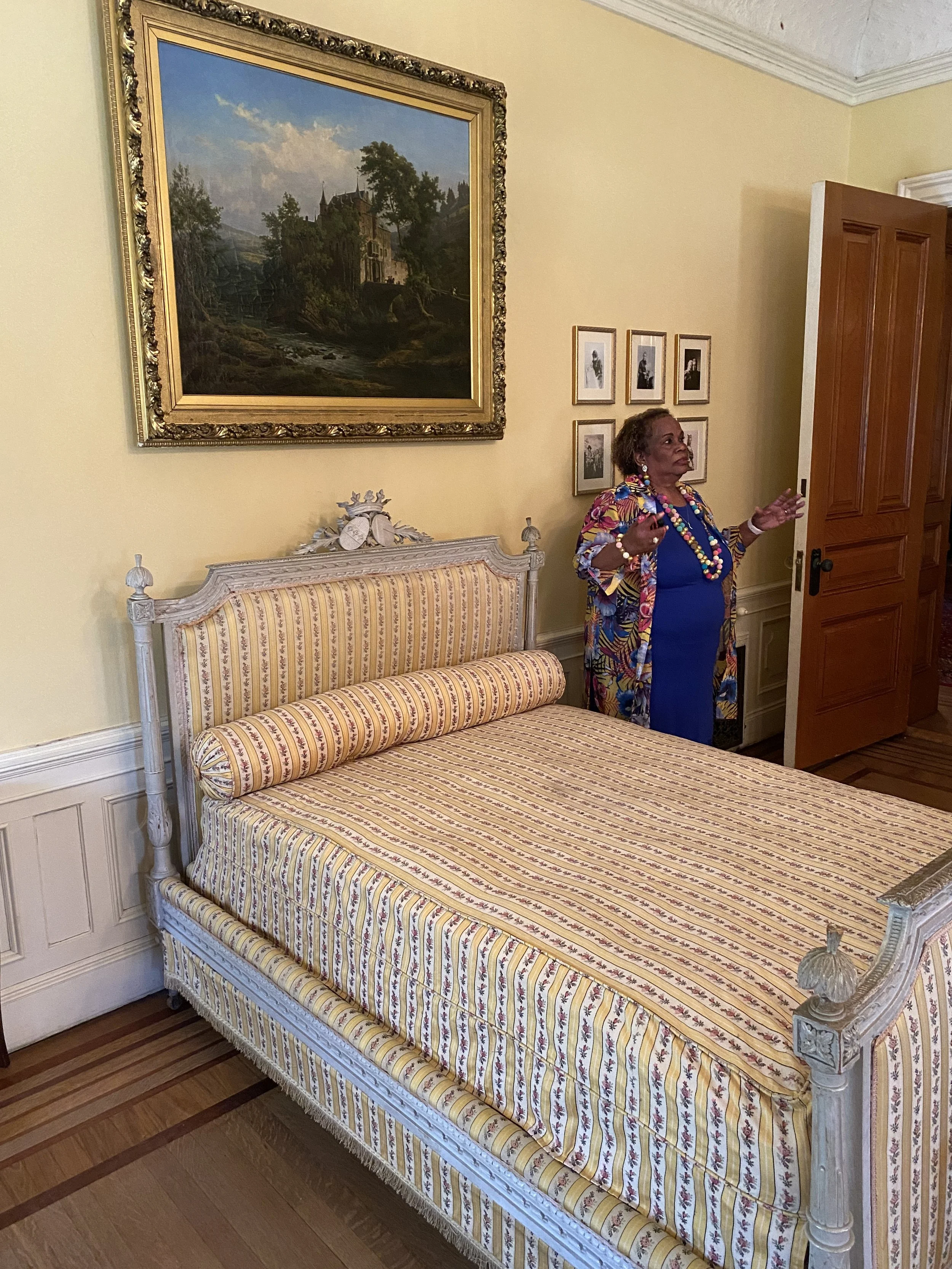
Elsbeth was the only small child to grow up in the Pabst Mansion, and she was spoiled accordingly — she was given the most elaborately decorated room in the home. It’s richly ornamented in Rococo style and includes carved pilasters, silk wall coverings and a Venetian glass chandelier. Her room was further enhanced with a fine hand-painted frieze of floral wreaths and ribbons.

Orange striped bed, yellow walls, oil painting and tour guide in Elspeth's room at the Pabst Mansion

Roxie tells our group about Elspeth, whose father was paid off so she could live in the Pabst Mansion.

Fun fact: During restoration of the bathroom, Dave Strickland, the owner of Affiliated Artists, removed 11 layers of paint and made the discovery that the walls had originally been painted a light blue. While that color is now paired with baby boys, it used to be the opposite: Blue was for girls, and, believe it or not, pink was for boys.  

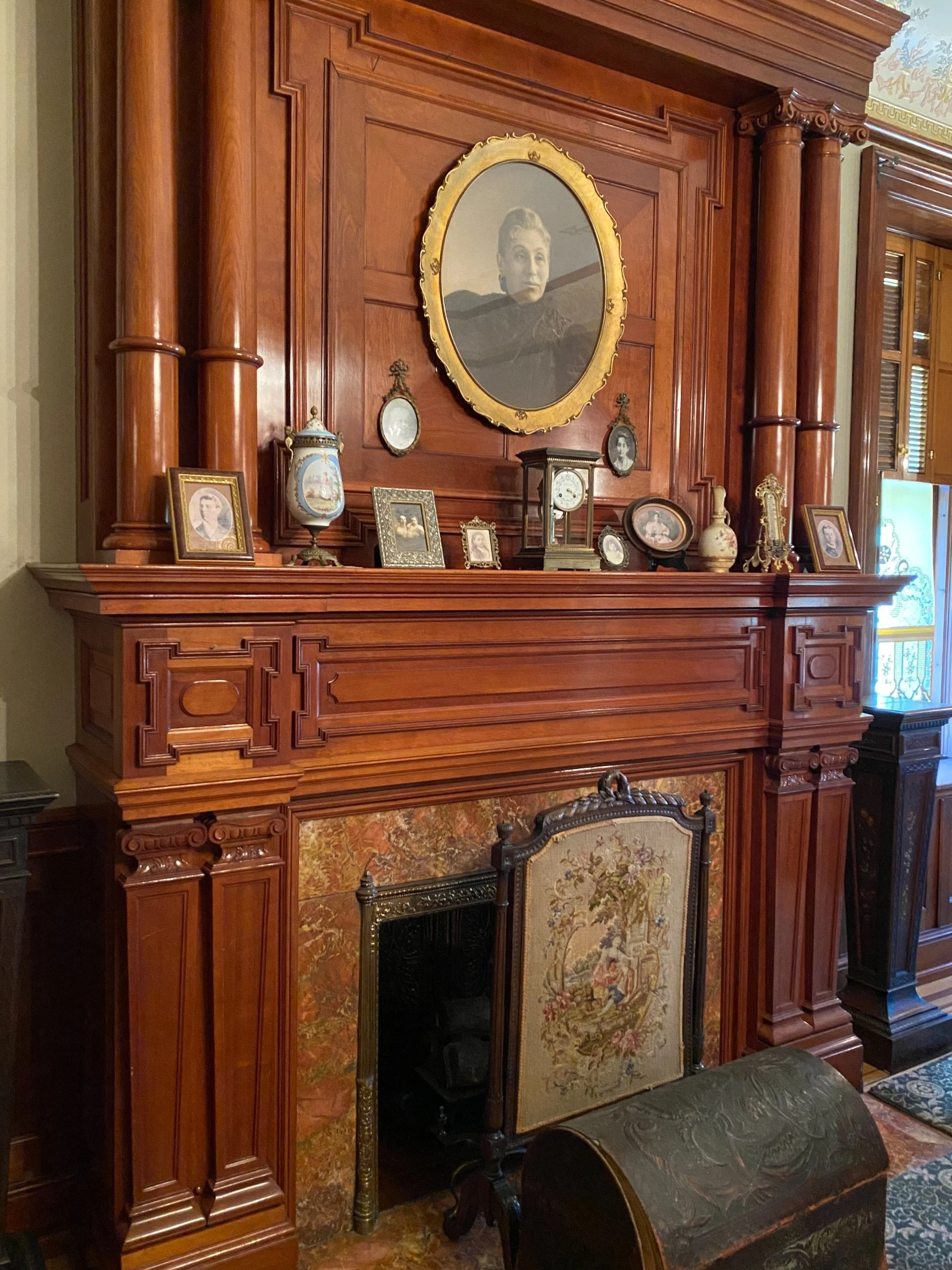
Photo of Maria Pabst above wood fireplace with clock and other photos on the mantel, screen and trunk at Pabst Mansion

That’s a portrait of Maria Pabst above the fireplace in her sitting room.

A Cozy Retreat: Maria’s Sitting Room 

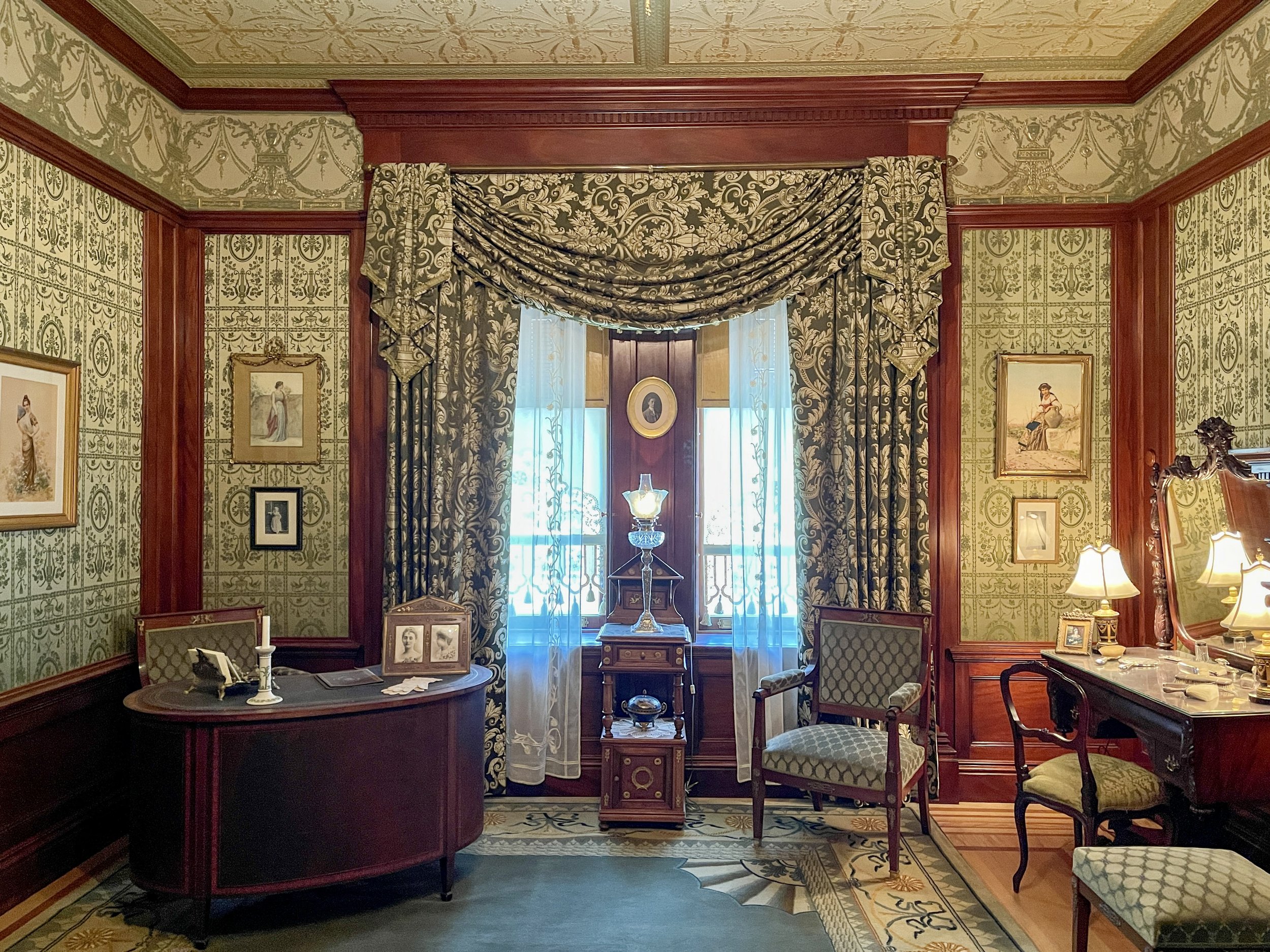
Maria’s sitting room is more casual than the opulent bedrooms of Emma and Elsbeth. With its floral wallpaper, cherry woodwork and comfortable furniture, it provided a retreat where the lady of the house could read and attend to her correspondence. 

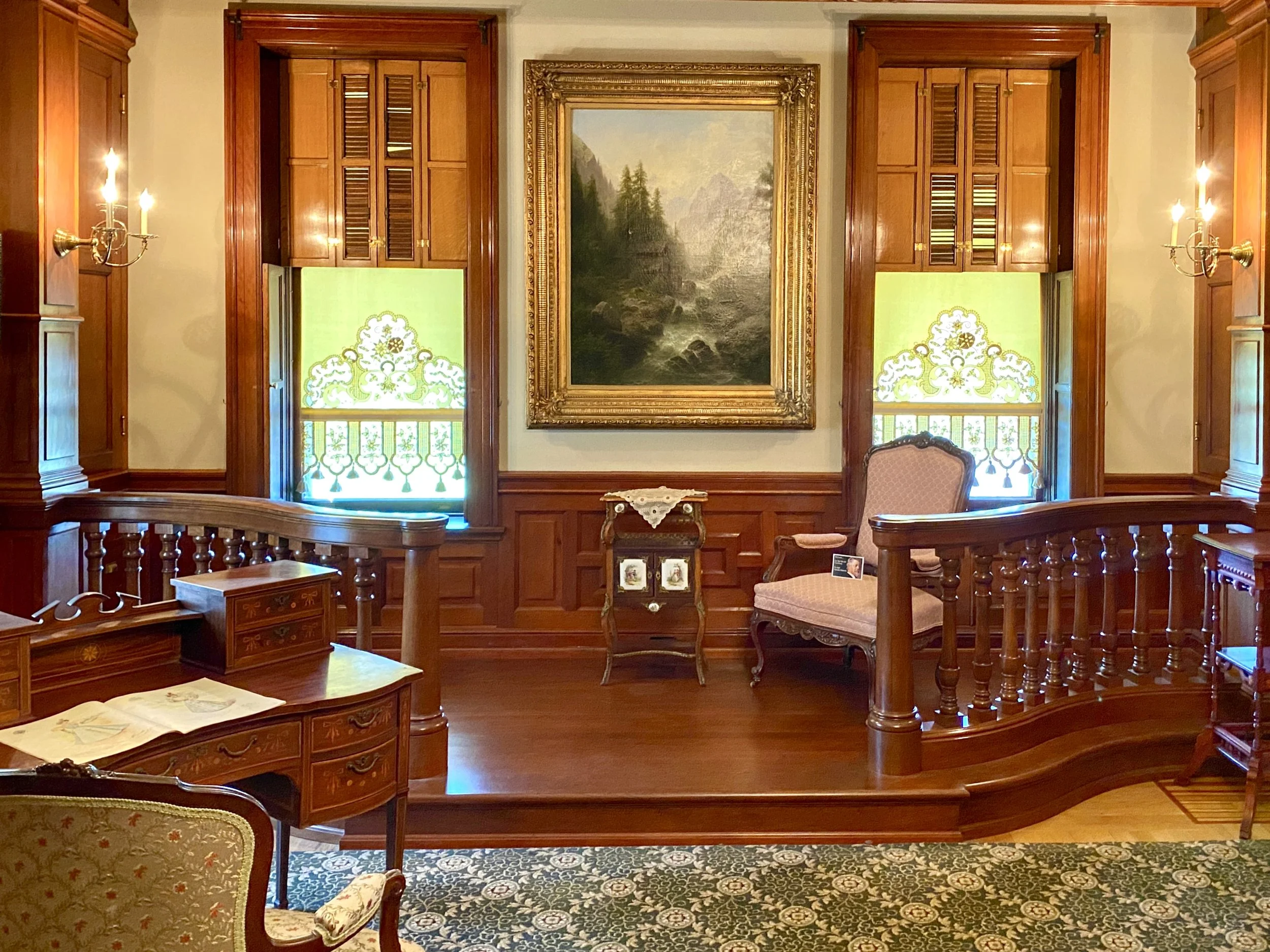
Raised wooden platform with chair by stained glass windows and nature painting and desk in Mrs. Pabst's sitting room

The raised platform was where Maria would try on dresses — and do needlepoint when she had insomnia.

Roxie informed us that Mrs. Pabst suffered from insomnia. Unlike Wally, who conks immediately after putting on an audiobook, Maria would often get up in the middle of the night and come into the sitting room to do needlepoint. 

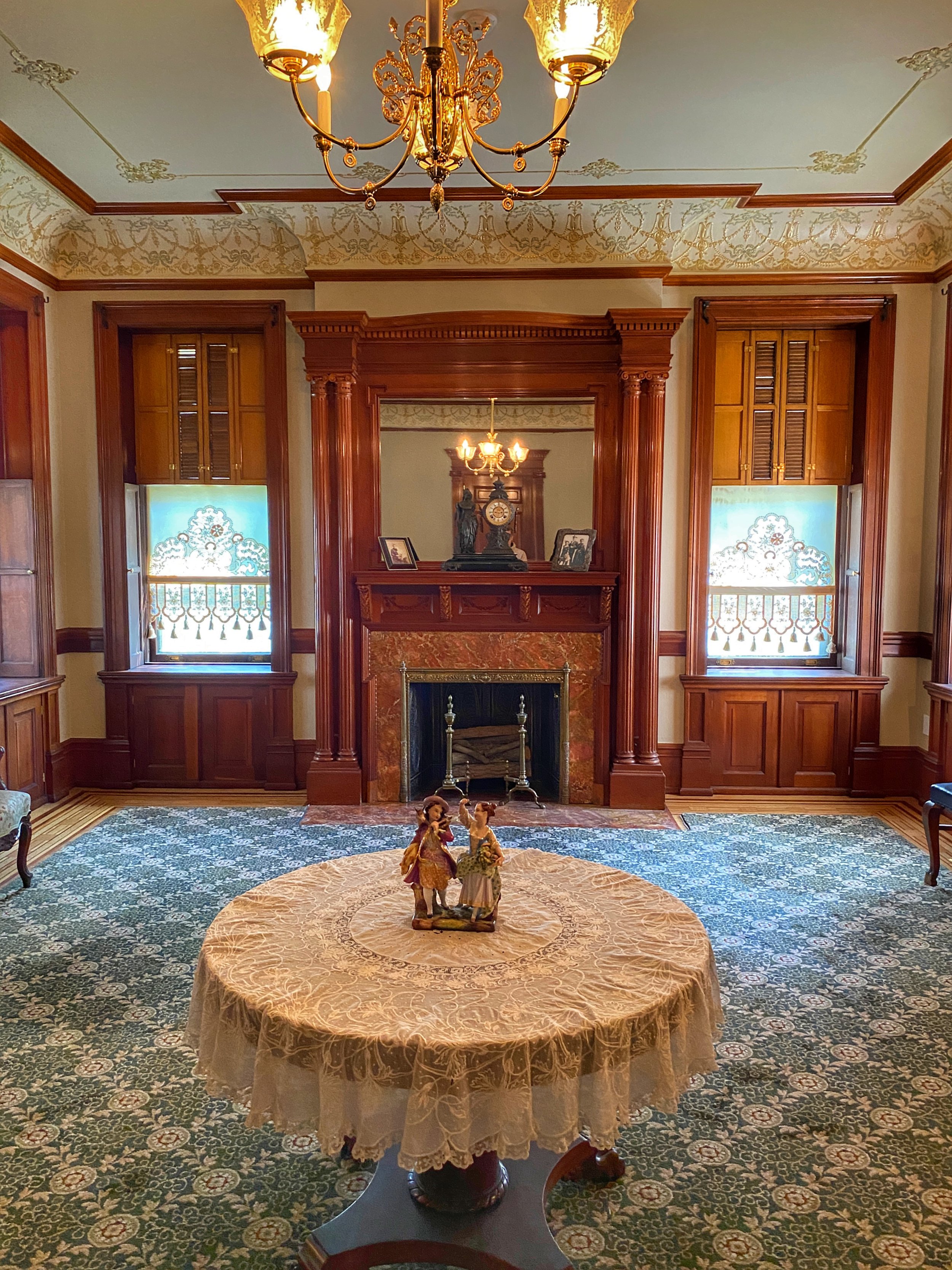
Round table covered with lace with two figurines, green and white carpet, fireplace and stained glass windows in master sitting room at Pabst Mansion

The sitting room for Captain Pabst is, honestly, pretty unimpressive compared to the other family members’.

Separate Beds: The Master Bedroom 

Roxie pointed out that the master bedroom had two double beds on either side of the room. This prompted the following conversation:

Wally: So they slept in separate beds?

Roxie: But you know they got together sometime, right?

Wally: Well, they did have 10 kids!

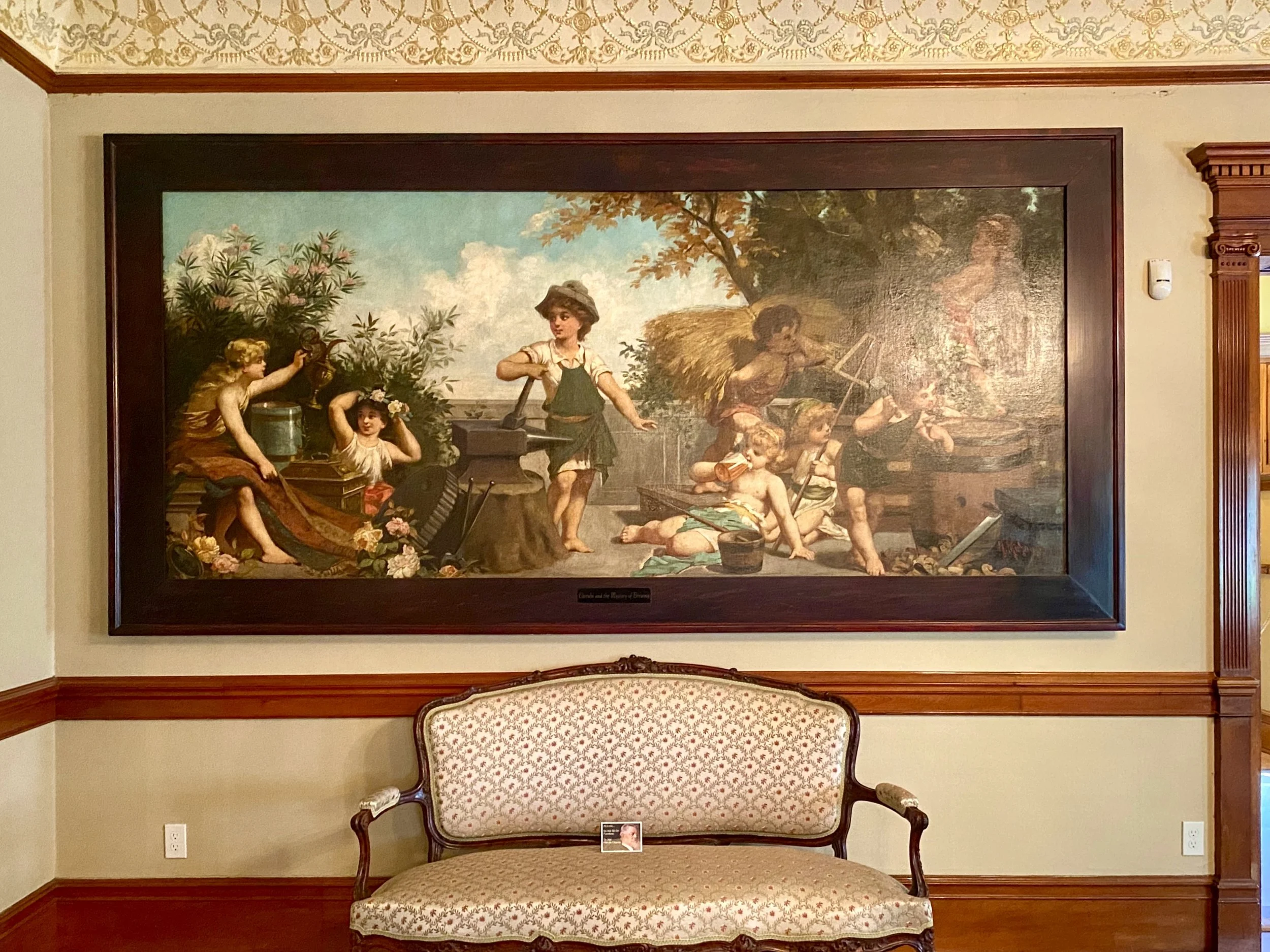
A curious piece of art now hangs in the room that was taken from the brewery office of Captain Pabst. The painting features children as the main subjects and is titled The Art of Brewing by Hermann Michalowski. In it, alarmingly young kids are shown drinking beer. Roxie explained to us that the artist’s intent was to depict the purity of the product, and of course children are traditionally viewed as good and kind. 

Be sure to check out The Art of Brewing by Hermann Michalowski to see depictions of toddlers boozin’ it up.

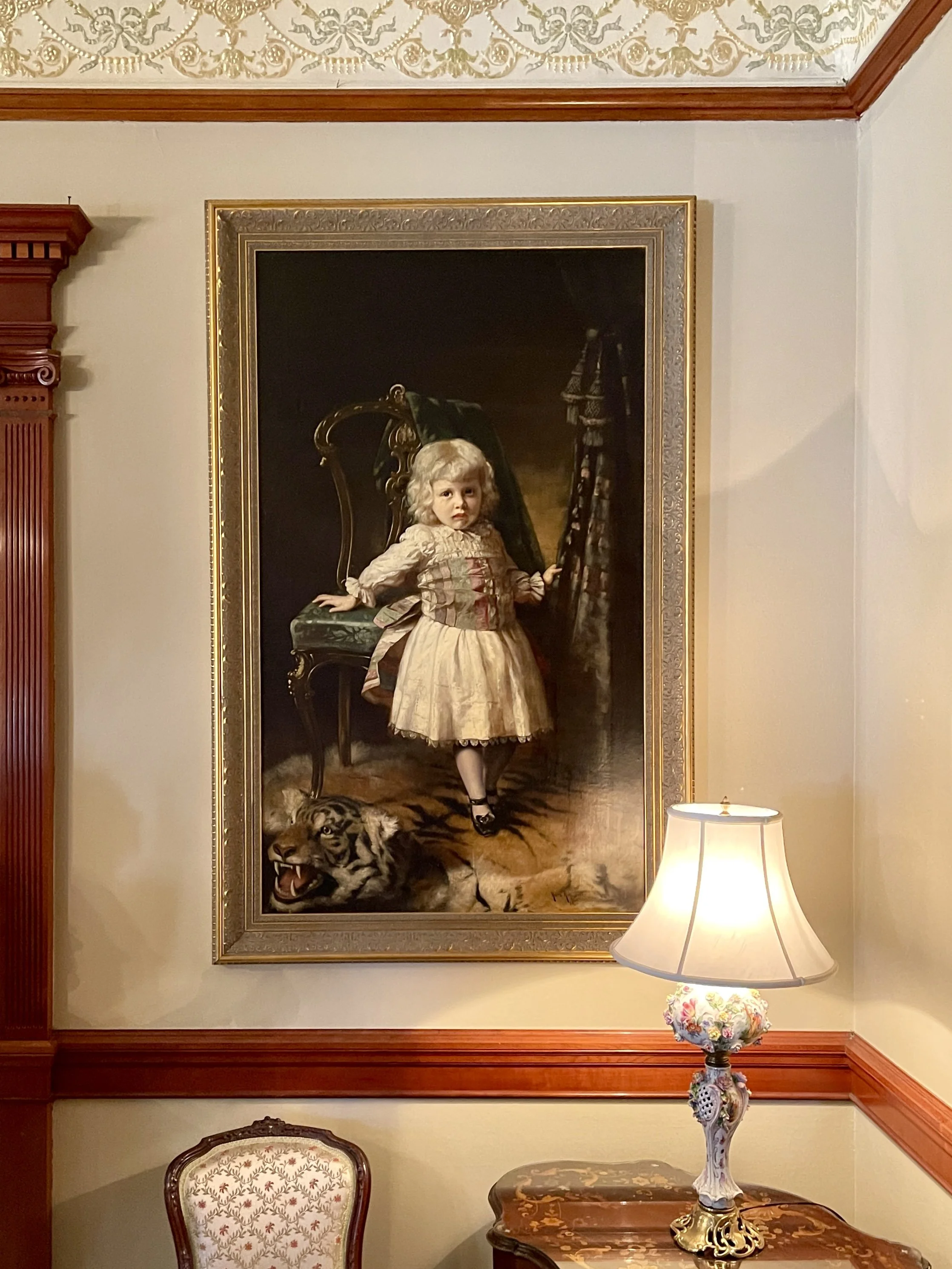
Painting of little blond boy in dress standing on tiger rug and leaning on a green chair

Why was Erik Heyl, Lisette’s grandson, painted wearing a dress? Roxie told us that it made it easier for kids to go to the bathroom before they were potty trained. 

Fun fact: Marie’s steamer trunk was returned to the Pabst Mansion after it was picked up from a collector who found it sitting on the curb outside of the private men’s hangout, the Milwaukee Club. The institution had been decluttering and was unaware that the unassuming trunk belonged to the famous beer baron’s wife. It’s marked MP on the top and M. Pabst on the bottom. 

Third floor landing at the Pabst Mansion with wood archway and chair

The third floor landing

Troubles of the Pabst

At this point, Roxie pointed out that every family has problems, and for Captain and Mrs. Pabst, one was their eldest son, Gustave. In the summer of 1892, he met the freshly divorced Shakespearian actress Margret Mather. The pair fell madly in love and eloped. It wasn’t long before Captain and Mrs. Pabst found out, and they were not pleased. 

Three years later, the couple was seen arguing. A piece circulated in the national news reporting that Margret chased after and struck Gustave with a horsewhip. Although both parties denied this publicly, their marriage ended shortly thereafter. At the time, it was the largest divorce settlement in Wisconsin: Margret received $30,000 from Captain Pabst to not contest the suit. She took the money, and in 1898 she staged her theatrical comeback in a production of Cybelline, collapsed onstage in the middle of a performance and died later that evening. 

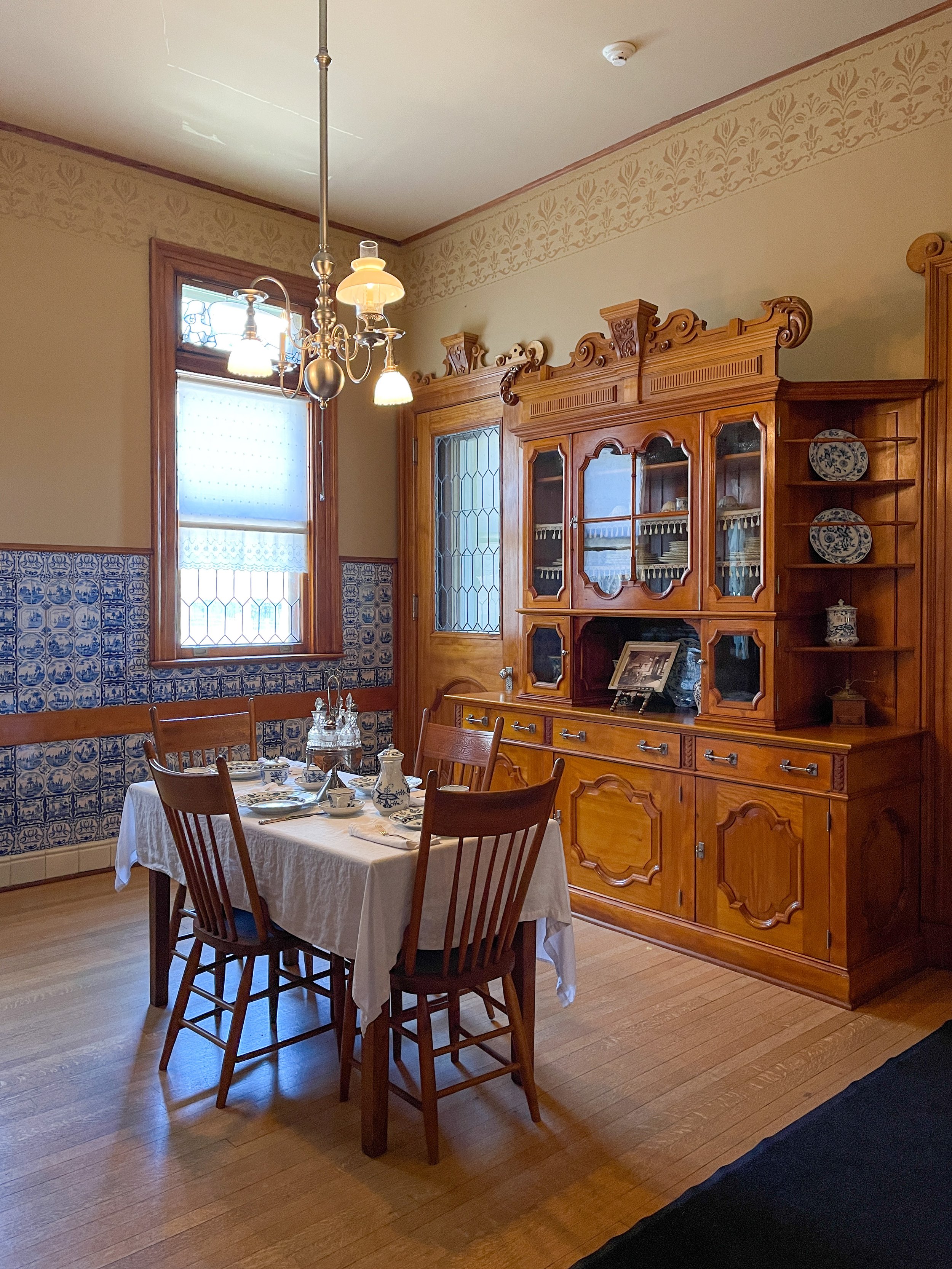
Servants' dining room with small table, wood hutch and blue and white Delft tiles

The servants had a tiny table — but they had some pretty Delft tiles to admire.

Rewarding Hard Work: The Servants Dining Room

The final room on the tour was the servants dining room. A mutual respect existed between Captain Pabst and his staff, which is reflected in the servants quarters. Their dining room includes hand-painted delft tile featuring idyllic scenes. The stenciled frieze along the top of the wall mimics the motif of the three tulips in the tile work. 

The Captain was known for his work ethic — evident in the motivational saying in a stained glass window here: Guter Mut ist halbe Arbeit (A good attitude is half the work).

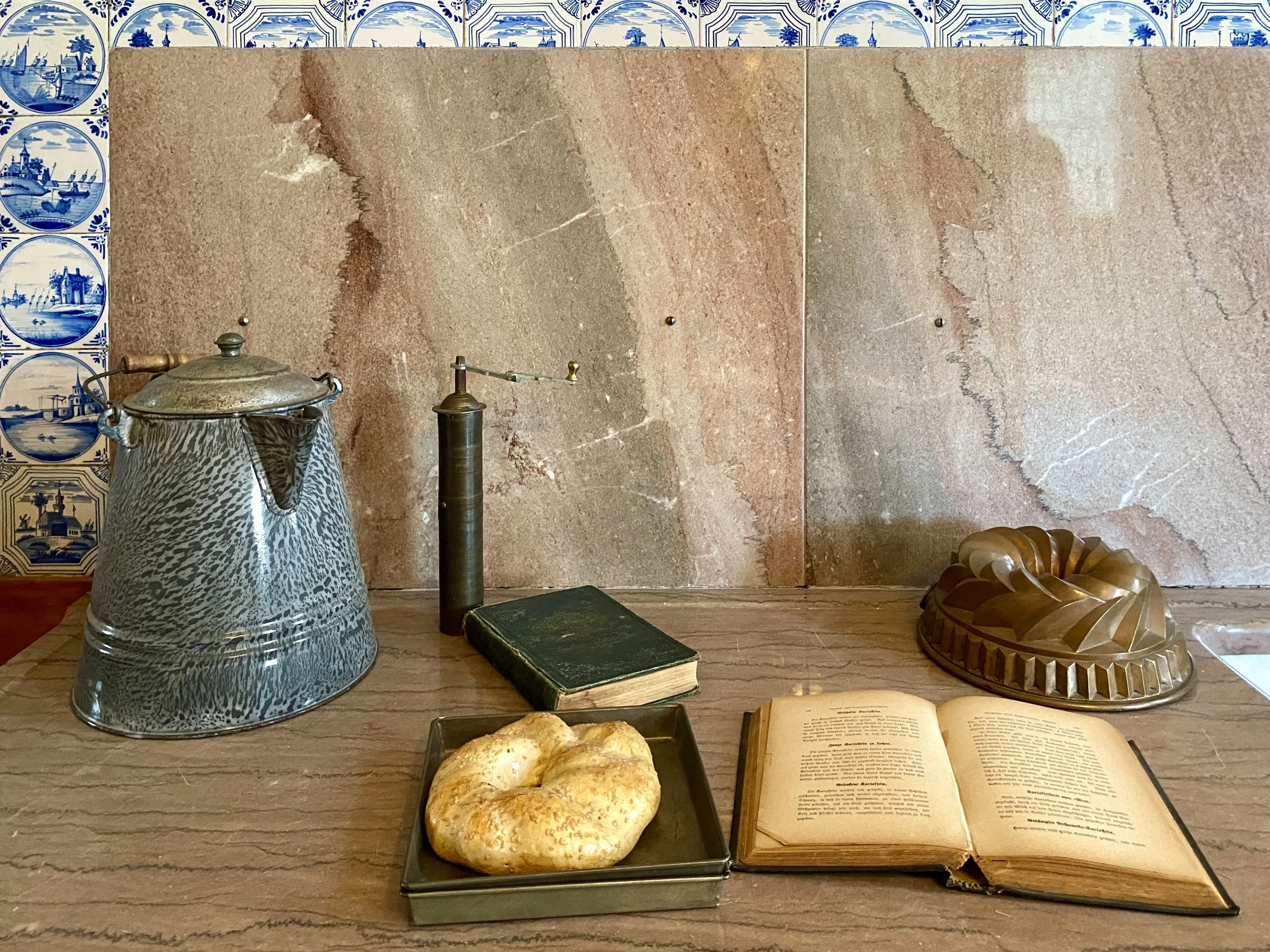
Delft tile wall, marble squares, coffee pot, books and bread item in kitchen of Pabst Mansion

A vignette in the kitchen

Saving Grace: Reacquiring Furnishings 

Thanks to a number of donors, the museum has managed to reacquire many of the original furnishings, artwork, glassware and ephemera that were part of the Pabst family’s personal effects. 

Early on, the WHI negotiated with the Archdiocese of Milwaukee to purchase three rooms of furniture that originally filled the principal rooms on the first floor. Many of these pieces were slated to be auctioned off and were saved by supporters, who aided by purchasing one chair or table at a time. 

Over the years, many more original items have been returned, helping in the effort to restore the home to its original state. 

Adult tickets are $12, and docent-led tours are about 75 minutes long. I encourage anyone with an interest in a glimpse into a bygone era, architecture, art or learning more about the Pabst legacy to visit. Help preserve an impressive landmark building. –Duke

Exterior of the Gilded Age Pabst Mansion in Milwaukee, Wisconsin

The Pabst Mansion

2000 West Wisconsin Avenue 
Milwaukee, Wisconsin
USA