norse

The Enchanting and Perilous World of the Fae

Explore the hidden world of fairies — from pixies and brownies to elves and gnomes. Discover why these mysterious beings captivate imaginations … and what secrets lie just beyond the mortal realm.
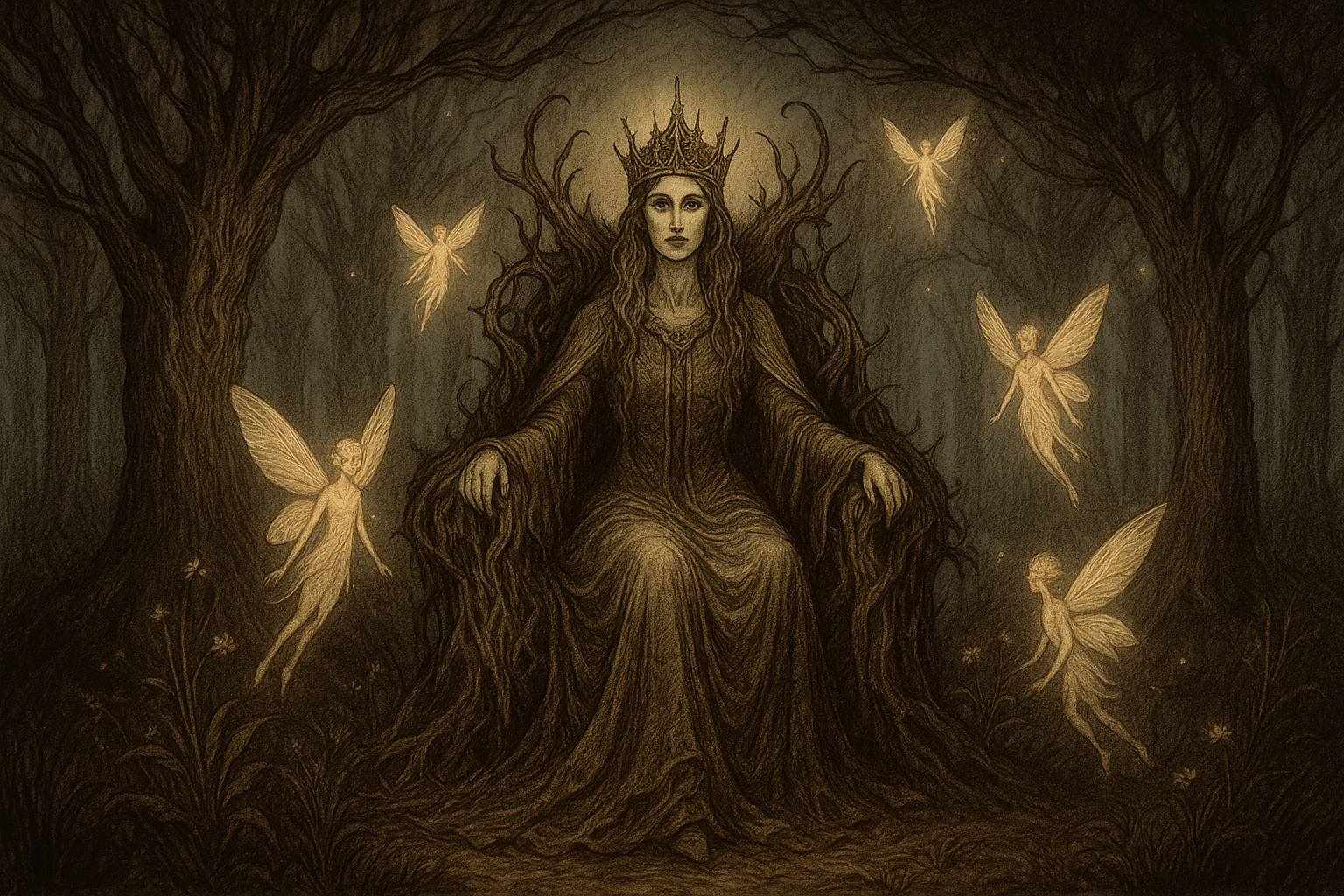
The Fae queen of the Seelie Court sits on her wooden throne, while smaller glowing fairies fly around her

The Seelie Queen on her thornwood throne

There are places in this world where the veil between realms grows thin: a lonely stretch of moorland, a glade deep in the woods, a ring of mushrooms. 

But beware, for the Fae are not the charming, glitter-winged sprites of modern fairy tales. They’re older than memory, creatures of wild magic, bound to no human morality. They can bless you with impossible luck or curse you with misfortune that lingers for generations. Some are beautiful beyond compare — slender and radiant, with eyes like moonlit pools. Others are twisted things, hunched and sharp-toothed, watching from the shadows.

To stumble upon the Fae is to risk losing yourself. Accept their gifts, and you may find they come at a terrible price. Eat their food, and you may never leave their world. Speak too freely, and they may steal your name, your shadow or your very soul. And if you are very unlucky or unwise — if the music lures you in, if the golden-haired stranger takes your hand — you may wake to find a hundred years have passed while you danced, and everyone you once knew is dust.

Yet still, we seek them out. We leave out offerings of milk and honey at Beltane, Litha and Samhain, whisper our wishes into the wind, and step just a little too close to the edge of the veil, hoping for a glimpse of something otherworldly.

Across the globe, countless myths and legends speak of these elusive beings, each culture shaping its own version of the Fae. Some are noble, some monstrous, some little more than a trick of the light. But one truth remains: The Fae are watching. And if you’re not careful, they may just take notice of you.
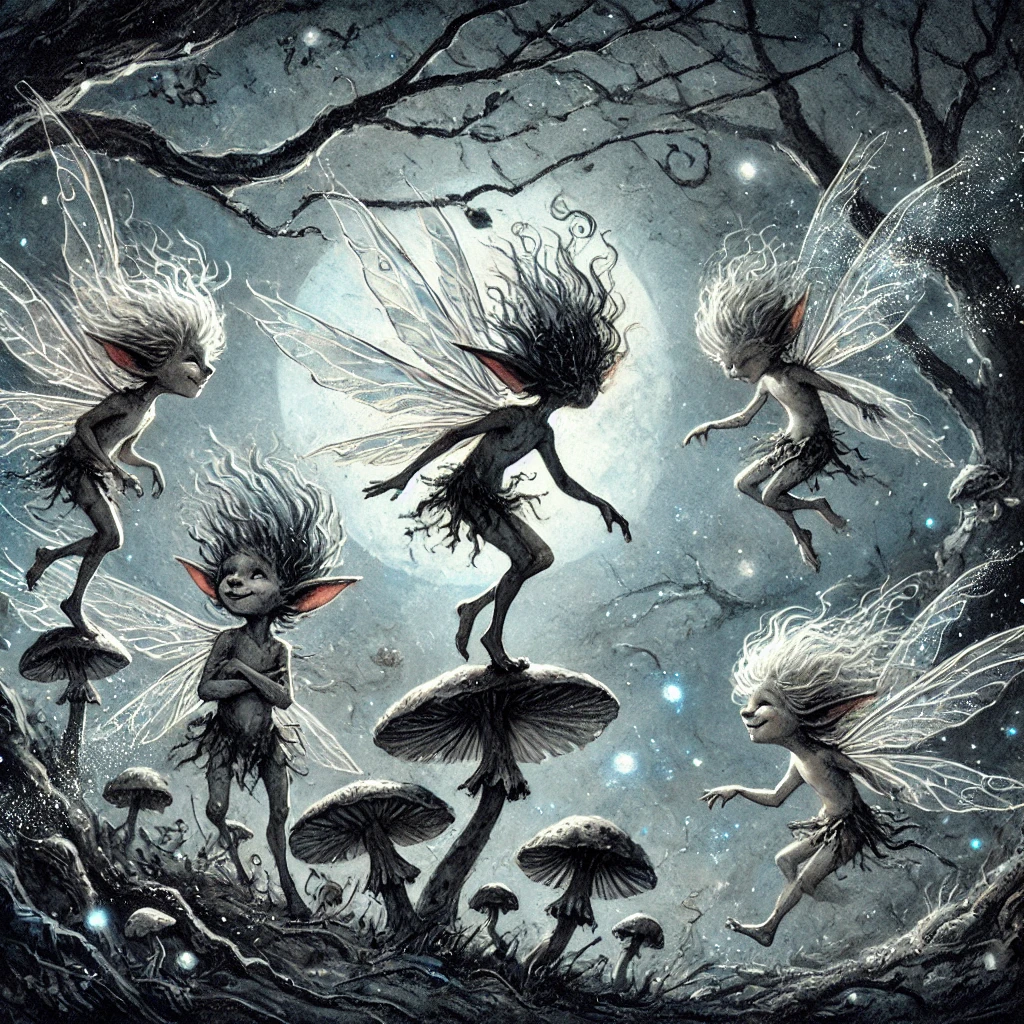
Small fairylike sprites fly under the light of a full moon in a forest with toadstools

Fairy Folklore Around the World

In different cultures, stories of the Fae take many forms — some enchanting, some terrifying, all captivating. Whether they’re the luminous Sidhe of Ireland, the cunning yōkai of Japan, or the water-dwelling rusalki of Slavic lore, fairies defy easy categorization. They’re both protectors and tricksters, wise beings and dangerous predators, granting favors with one hand and snatching them away with the other.

Let’s step into the shadowy glens and moonlit crossroads where the Fae linger, exploring how different cultures have imagined these otherworldly creatures — and where you might still find traces of them today.
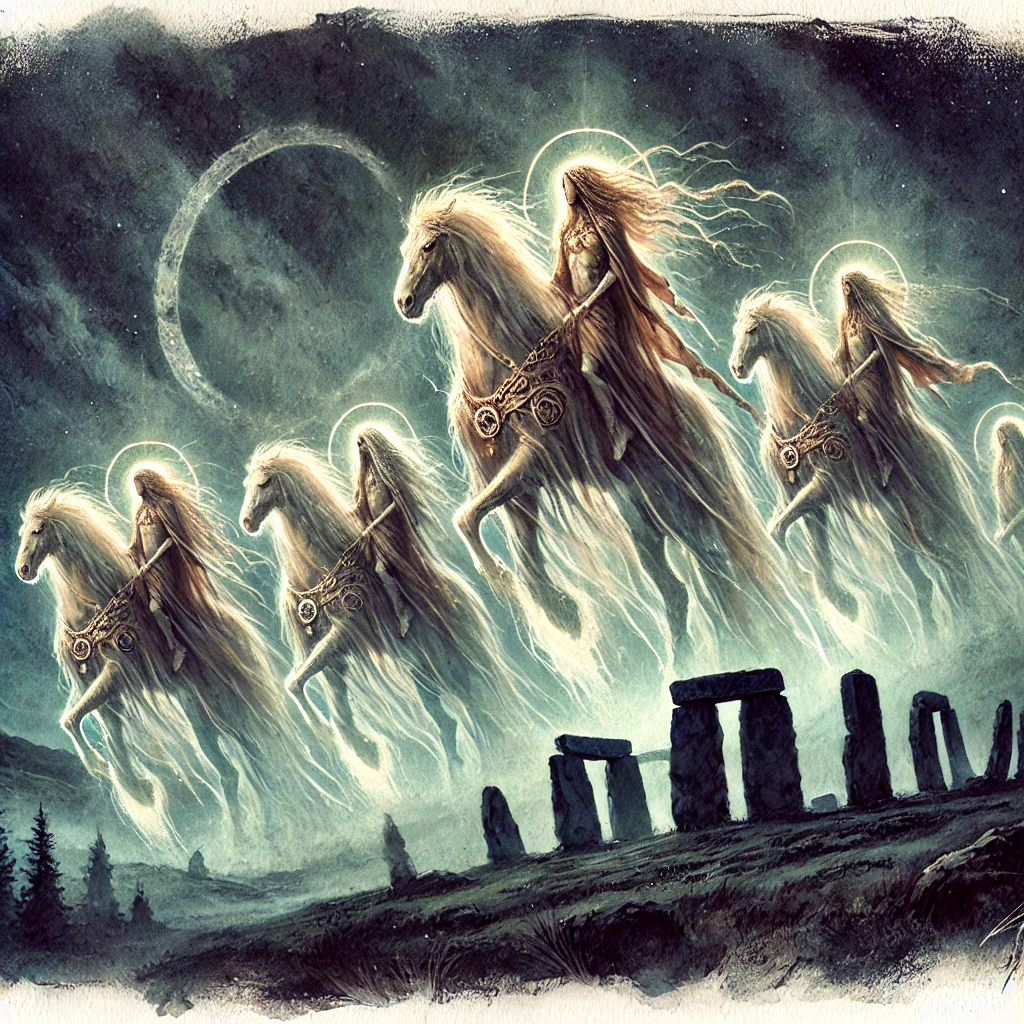
The Tuatha Dé Danann, or Sidhe, ride their spectral horses above Stonehenge

The Tuatha Dé Danann, or Sidhe, riding their spectral horses

The Tuatha Dé Danann and Irish Fairies

Beneath the rolling green hills of Ireland, hidden within ancient mounds and hollowed-out trees, dwell the Sidhe (pronounced “Shee”), the Shining Ones. These are no fluttering pixies, but tall, radiant beings, their beauty almost painful to behold. Clad in shimmering garments, their eyes hold the weight of centuries, and their voices carry the echoes of forgotten songs.

The Tuatha Dé Danann, Ireland’s old gods, were said to have retreated into the earth after their defeat, becoming the Sidhe of legend. They ride out on spectral horses, sweeping mortals away in a fever dream of music and revelry. Some who enter their world return, forever changed; others vanish without a trace.

Not all Irish fairies are so regal. The púca, a shapeshifter, appears as a sleek black horse with burning eyes, a rabbit, or even a goblin-like creature with long fingers and an unsettling grin. 

The banshee, with her silver hair and wailing cries, is a harbinger of death, while changelings — sickly, eerie children left in place of stolen human babies — are a reminder of the Fae’s more sinister tendencies.
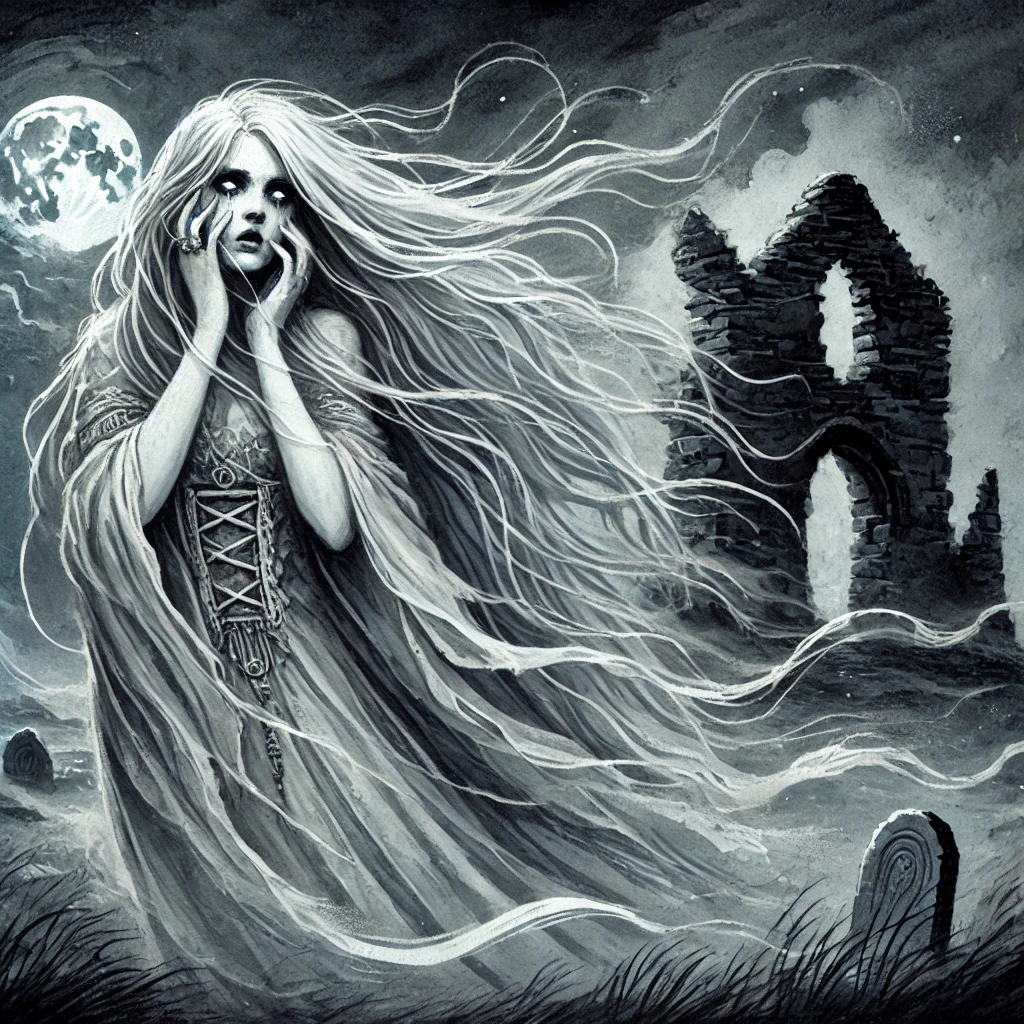
A banshee with long flowing hair clutches her face at night by a ruined church and graveyard

A banshee’s wail means someone you love is about to die.

Irish Fae in Popular Tales

  • The Stolen Child by W.B. Yeats captures the allure of the fairies, calling children away to a land of “waters and the wild.”

  • In The Call by Peadar Ó Guilín, modern teenagers are abducted into the Grey Land of the Sidhe, where they must survive deadly hunts.

  • Jonathan Strange & Mr Norrell by Susanna Clarke presents a version of the Fae as manipulative and powerful, with the Gentleman with the Thistledown Hair embodying their eerie and unpredictable nature.
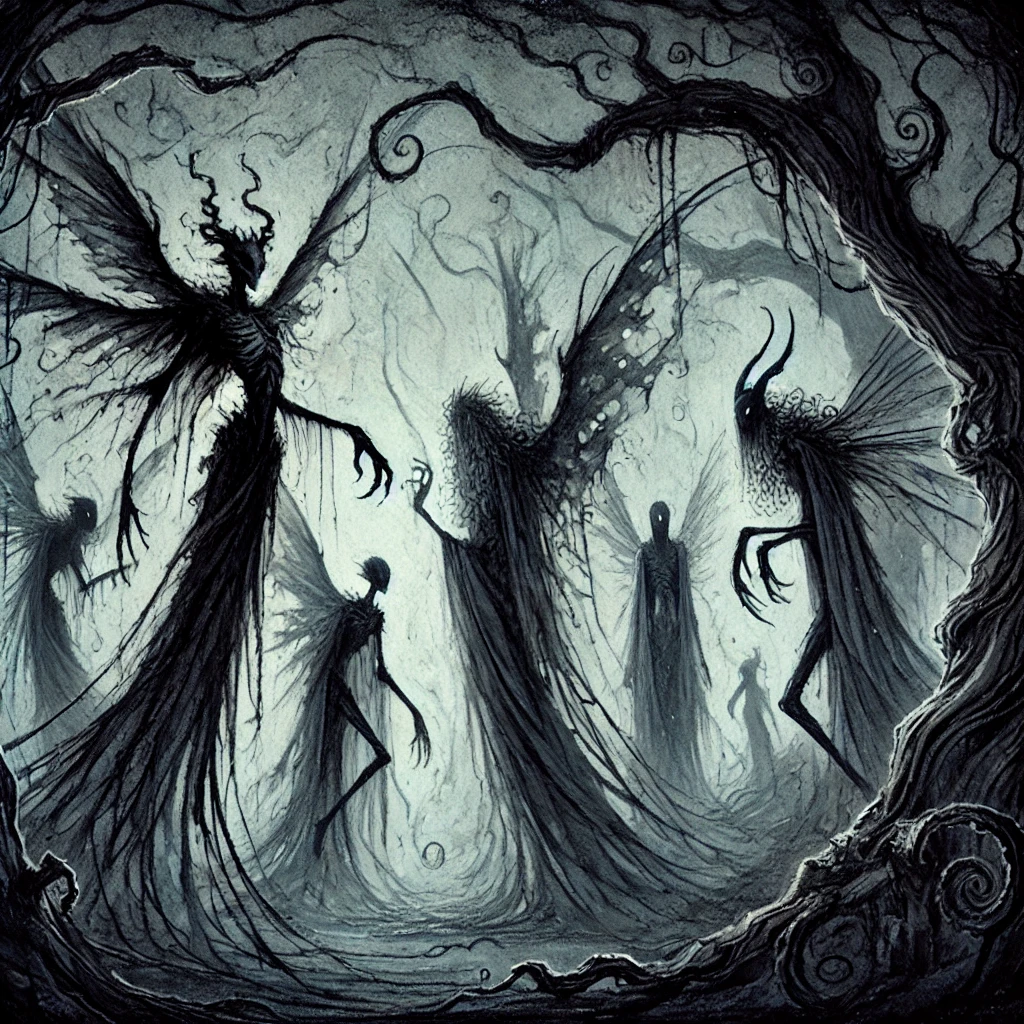
Dark, horned, spectral Fae in the woods of the Unseelie Court

The Unseelie Court is home to the more malevolent fairy folk.

Scottish Fairy Lore and the Seelie and Unseelie Courts

In Scotland, the fairy realm is split into two factions: the Seelie Court, filled with fairies who are mischievous but not entirely malevolent, and the Unseelie Court, where malevolence runs rampant.

Seelie fairies might grant favors to those who respect them, though their “gifts” often have unintended consequences. The Unseelie, however, are another matter entirely. These fairies lurk at crossroads and lonely moors, hunting in packs and carrying off travelers who wander too close to their domain.

Among them are the redcaps, murderous goblins that dwell in ruined towers, their caps stained with the blood of their victims. 

The kelpies, sleek black water-horses, lure riders onto their backs before dragging them into the depths. 

And the brownies, small, shaggy-haired house spirits, help with household chores — so long as they are respected and well fed.

A shaggy-haired brownie sweeps its home by a fire in the stove

A helpful brownie

Scottish Fae in Popular Tales

  • Tam Lin, a classic Scottish ballad, tells of a mortal man, stolen away by the Fairy Queen, who can only be rescued through a terrifying midnight ritual.

  • In The Falconer by Elizabeth May, Scottish fairies are reimagined as deadly creatures warring against humans.

  • The Unseelie Court’s dangerous and dark magic is woven into Holly Black’s The Cruel Prince series, where the Fae are as beautiful as they are treacherous.
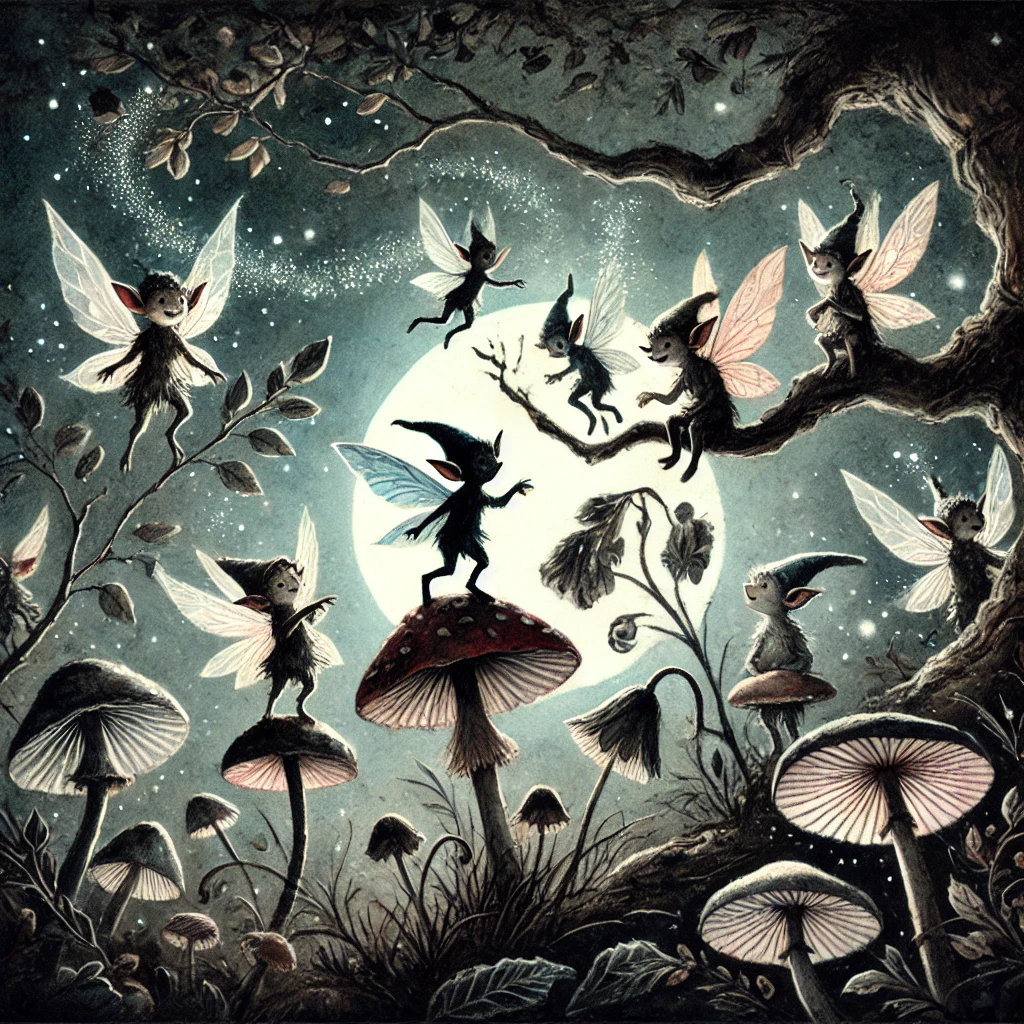
Pixies fly merrily by mushrooms and trees on a night with a full moon

A plague of pesky pixies

English and Welsh Fairies: Tricksters, Ghosts and the Wild Hunt

In the misty forests and moors of England and Wales, the fairy folk take on many forms — some charming, some terrifying, all deeply tied to the land.

The pixies of Devon and Cornwall are small, impish creatures with pointed ears and mischievous grins, known for leading travelers astray with will-o’-the-wisps or tangling horses’ manes into fairy knots. Unlike their Irish or Scottish counterparts, they’re more playful than malicious, though they can still cause trouble if insulted. 

But the Fae of England aren’t all harmless. The Wild Hunt, a spectral procession of ghostly riders led by a dark figure — sometimes the Devil himself, sometimes the mythic Herne the Hunter — thunders across the sky, sweeping up any mortal unlucky enough to cross its path. 

Meanwhile, the Green Children of Woolpit, a medieval legend, tell of two strange, green-skinned kids who appeared in a village, speaking an unknown language and claiming to be from an underground world. Were they lost fairies?

Even the land itself is said to be enchanted. The Fairy Paths, invisible roads used by the Fae, must never be obstructed by buildings, or bad luck will follow. 

The Fairy Godmothers of later fairy tales may have originated from old beliefs in household fairies, protective spirits who could bestow gifts or curses on infants.

British Fae in Popular Tales

  • Susanna Clarke’s The Ladies of Grace Adieu reimagines English fairy lore with eerie and elegant storytelling.

  • Terry Pratchett’s Lords and Ladies features fairies that are predatory and cruel, a nod to their older, darker origins.

  • The legend of the Wild Hunt plays a major role in Katherine Arden’s The Winter of the Witch and Hellboy comics. 

  • Pixies show up in the Harry Potter series and the game Harry Potter: Wizards Unite

A group of Álfar, tall, thin elves with long light hair and pointed ears

The Álfar, tall, luminous, godlike entities, influenced the elves of Tolkien and D&D.

Norse and Germanic Fairies: Elves, Forest Spirits and the Nachtmahr

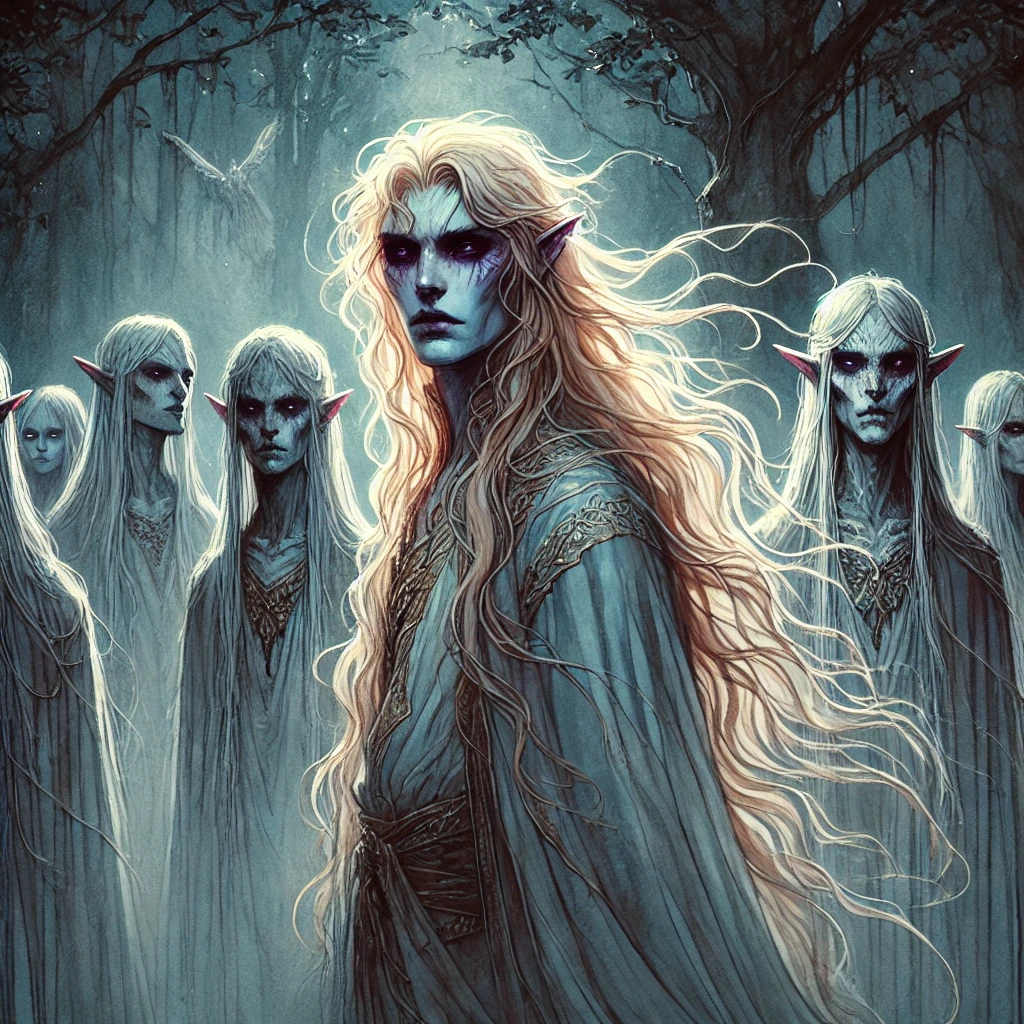
Long before fairies flitted through English gardens, the Norse and Germanic peoples told of the Álfar, or elves: tall, eerily beautiful beings who lived in hidden places and wielded great magic. Unlike later fairies, these elves were closer to minor gods, capable of both great kindness and great wrath. In some sagas, they were luminous, golden-haired beings; in others, they were pale and unsettling, dwelling in mist-shrouded groves and demanding offerings.

But not all the hidden folk were so noble. The nachtmahr, a twisted shadow spirit, crept into homes at night, sitting on the chests of sleepers and filling their dreams with terror; our word nightmare comes from this legend. 

The erlking, a malevolent woodland fairy, lured children to their doom with whispered promises, immortalized in Goethe’s haunting poem.

Then there were the kobolds, household spirits that could be either helpful or destructive. Resembling small, gnome-like figures, they lived in homes and ships, protecting the inhabitants if treated well, but turning mischievous or even vengeful if neglected. Some German miners believed kobolds lived in the mines, warning workers of cave-ins — or causing them.
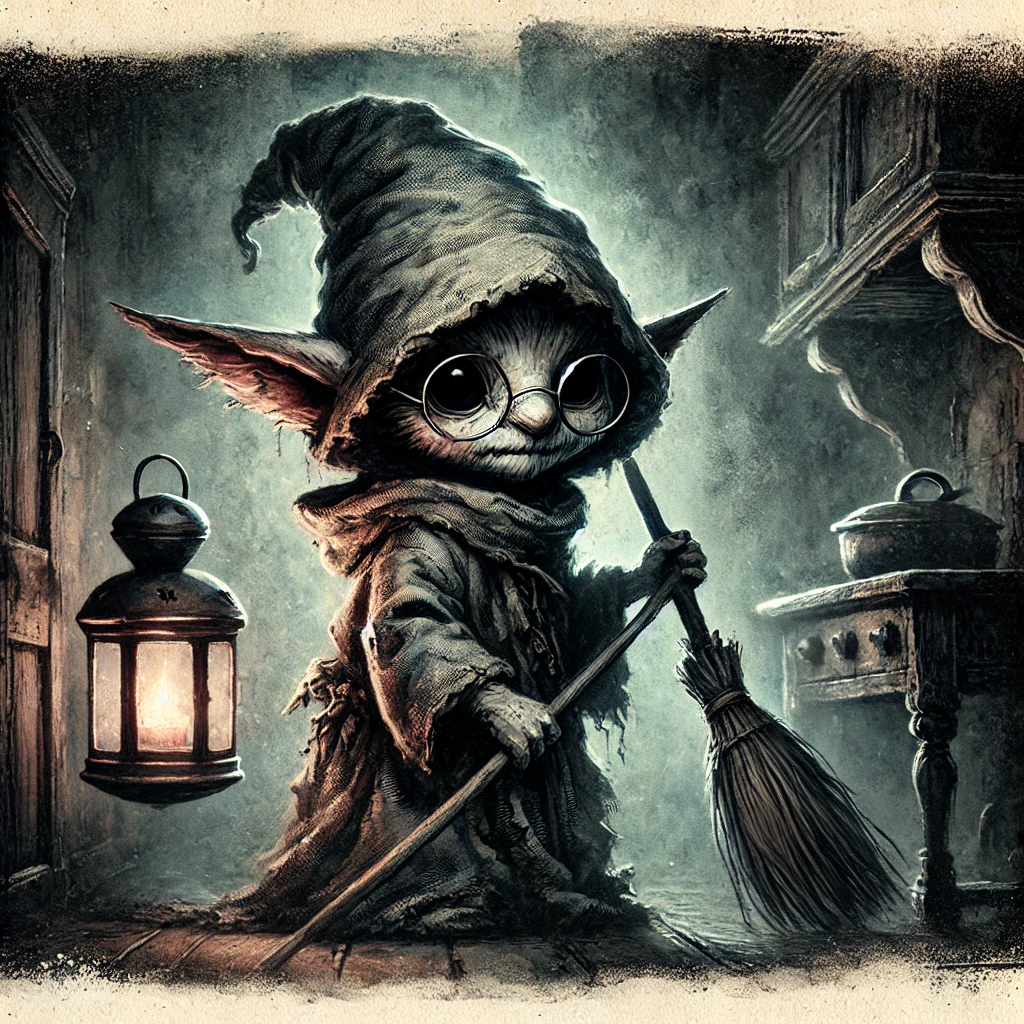
A small kobold dressed in rags, a pointed hat and round glasses, holding a broom in his small home while a lantern floats next to him

The helpful kobolds of folklore and much different from the lizard-like monsters from D&D.

Norse and German Fae in Popular Tales

  • The erlking appears in literature from Goethe’s poetry to Jim Butcher’s Dresden Files, always as a chillingly powerful figure.

  • Tolkien’s elves, with their captivating beauty and ancient wisdom, owe much to Norse and Germanic fairy lore.

  • Neil Gaiman’s Norse Mythology explores the strange, otherworldly side of the Álfar. (Learn more about the Norse gods.)
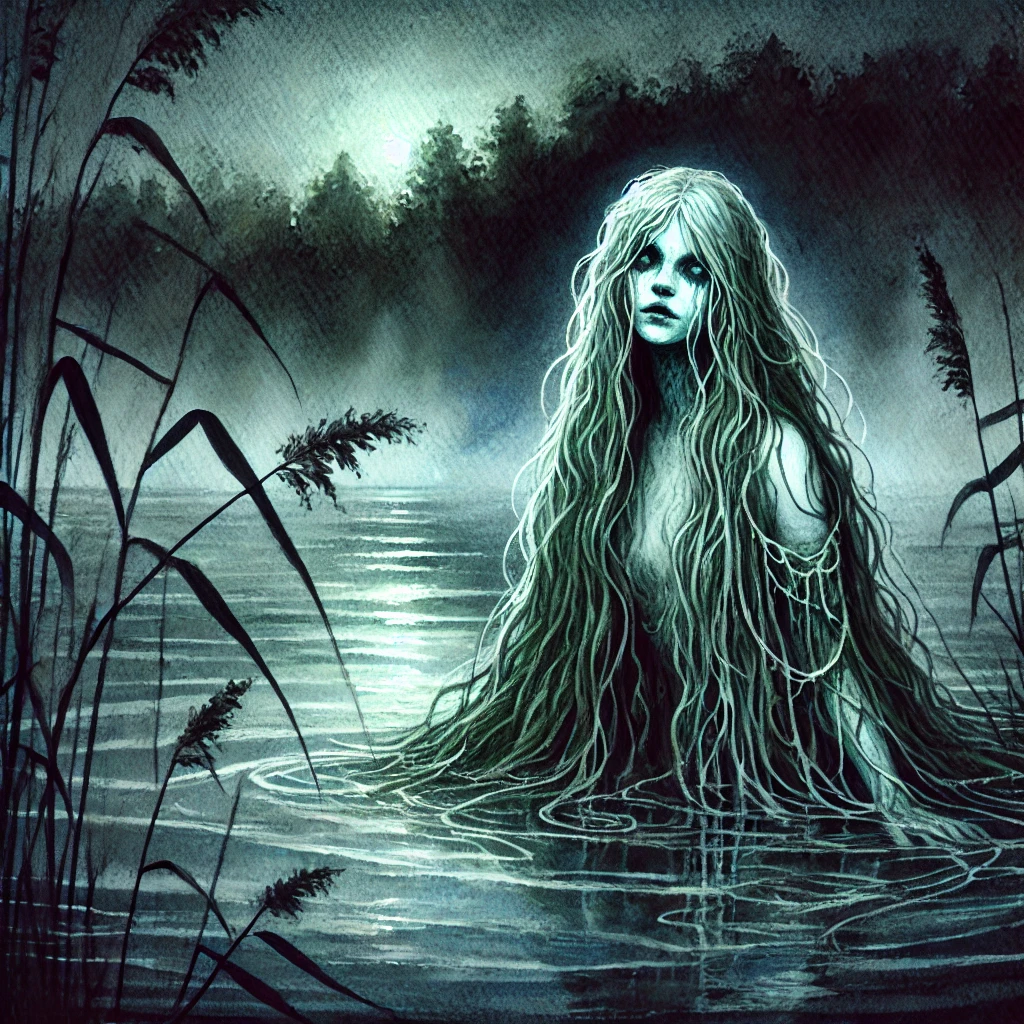
A rusalka, the spirit of a drowned young woman, with long hair, stands in the water at night

A rusalka, the spirit of a drowned young woman, wants men to share her fate.

Slavic Fairies and the Rusalka: Spirits of Water and Wood

Slavic folklore is thick with spirits, many of whom blur the line between fairy, ghost and demon. The rusalka is one of the most haunting: a drowned maiden with pale, luminous skin and long, green-tinted hair, she lingers near lakes and rivers, singing to lure men into the depths. Some legends say she’s vengeful, dragging victims under; others say she’s  simply lonely, forever searching for a lost love.

Then there are the domovoi, small, hairy house spirits with glowing eyes. Unlike the trickster fairies of the British Isles, a domovoi was a family guardian, keeping the household safe — so long as it was honored with milk, bread and respect. A neglected domovoi could become vengeful, making life miserable for the home’s inhabitants.

In the dark forests, the leshy reigns: a towering, moss-covered figure with bark for skin and eyes like glowing embers. He’s the master of the woods, able to shift size at will. Travelers who fail to pay their respects may find themselves lost for days, their paths twisting back on themselves under the leshy’s watchful gaze.
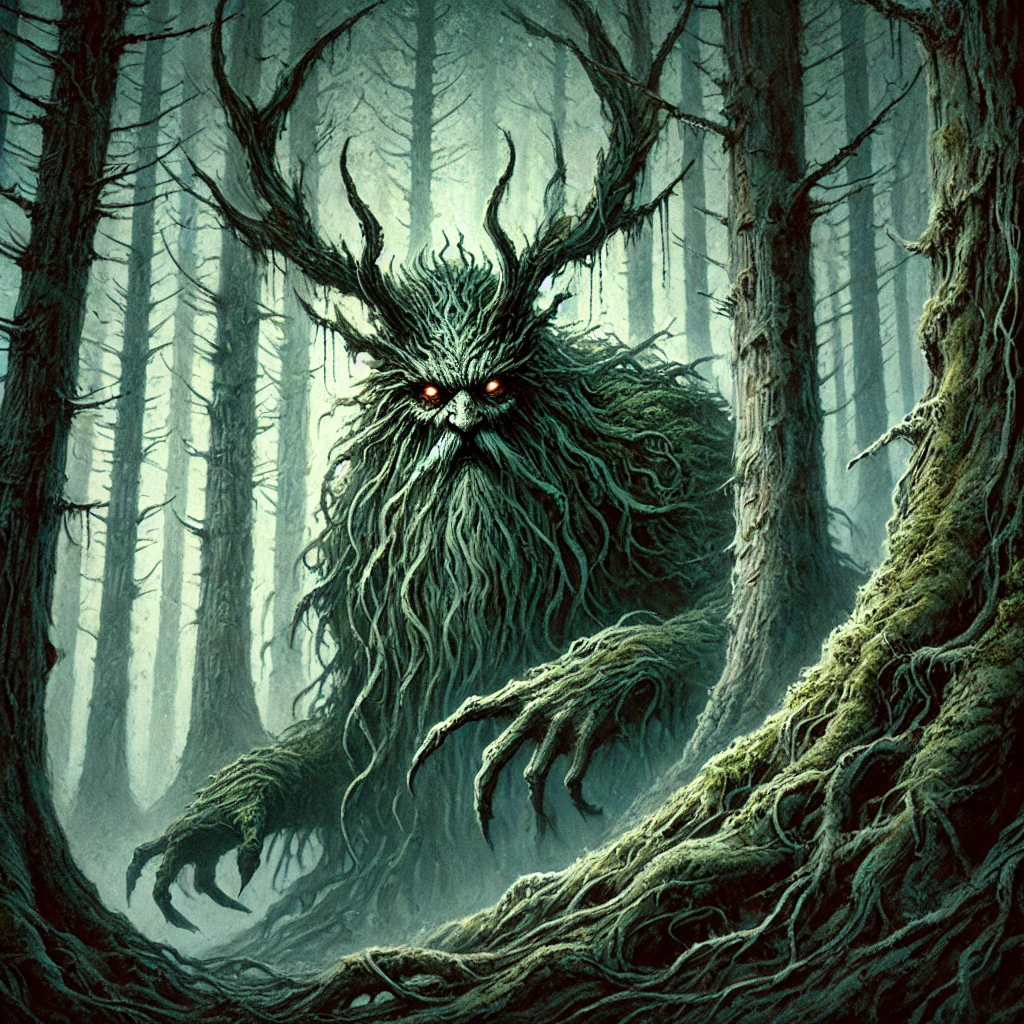
A leshy, large, gnarled like a tree, with glowing eyes and staglike horns

The leshy, shapeshifting master of the woods

Slavic Fae in Popular Tales

  • The Bear and the Nightingale by Katherine Arden weaves Slavic fairy spirits like the domovoi and rusalka into a lush historical fantasy.

  • The leshy appears in numerous Russian fairy tales and in modern fantasy, including The Witcher series.

  • The eerie, dreamlike world of the rusalka is captured in Alexander Pushkin’s poetry and Dvořák’s opera.
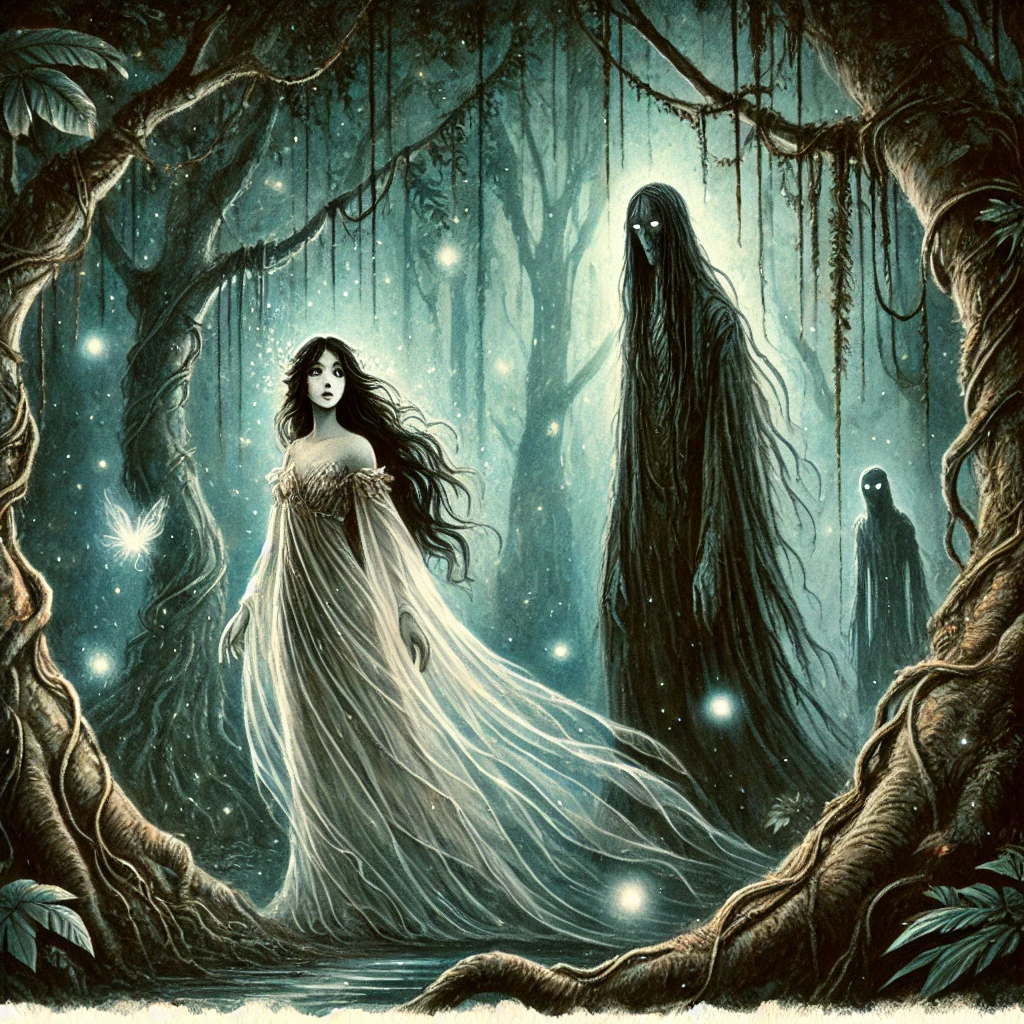
A diwata, a ghostly woman, and engkantos, a tall, thin, black, menacing spirit

The diwata and engkantos of the Philippines can be kind or cruel, depending on how you treat them.

The Fairies of Other Cultures

Fairy-like beings exist worldwide, often blending nature spirits, ancestral ghosts and mischievous tricksters.
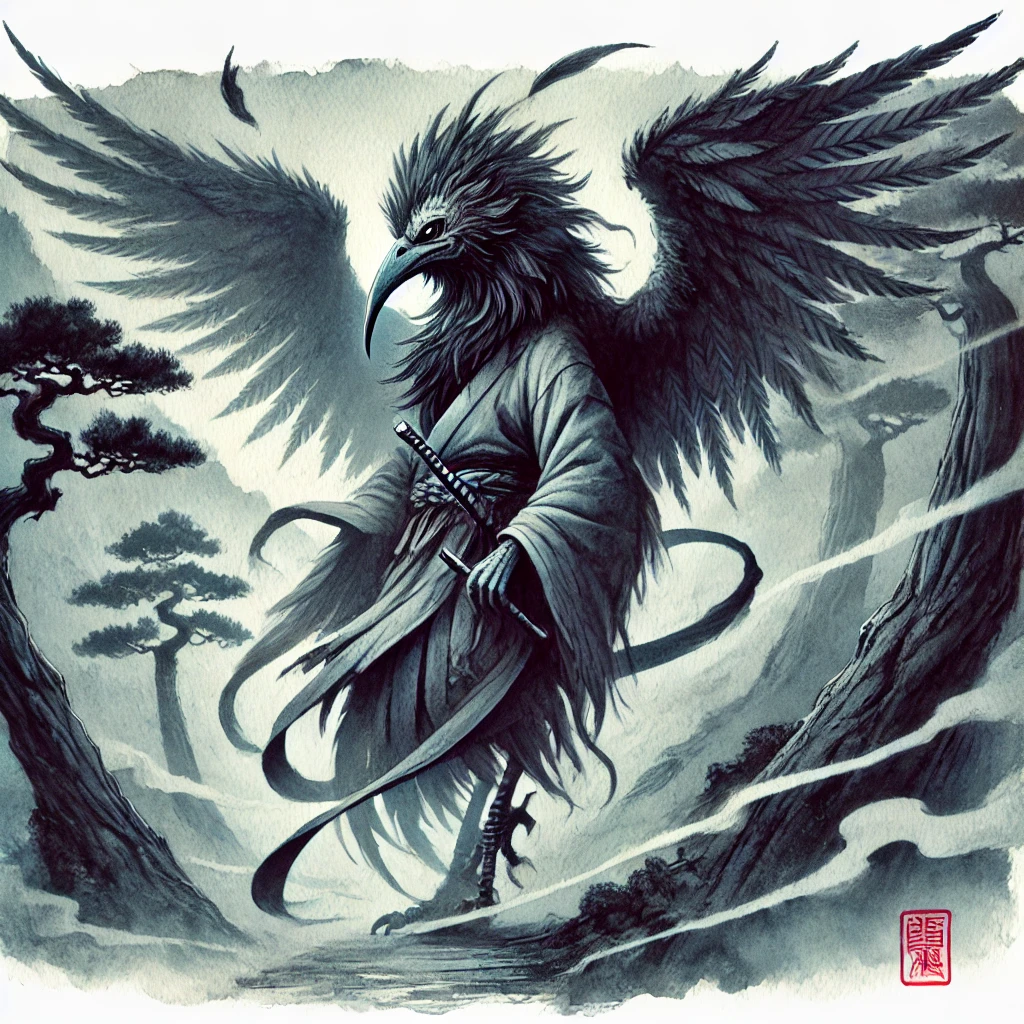
The tengu, a bird spirit dressed like a samurai by bonsai trees in the mist

Tengu love to mess with overly proud samurai — creating illusions, stealing weapons or dragging them into duels they can’t win. I

Japanese Yōkai: Creatures like kodama, tree spirits that live in ancient forests, or tengu, bird-like beings who trick travelers and test warriors, share many fairy-like qualities.

Filipino Diwata and Engkantos: Often compared to elves, these spirits of the forests and mountains can be either generous or cruel, depending on how they’re treated.

African and Caribbean Spirits: Figures like the tokoloshe in South Africa — a small, goblin-like trickster — bear similarities to European goblins and sprites.
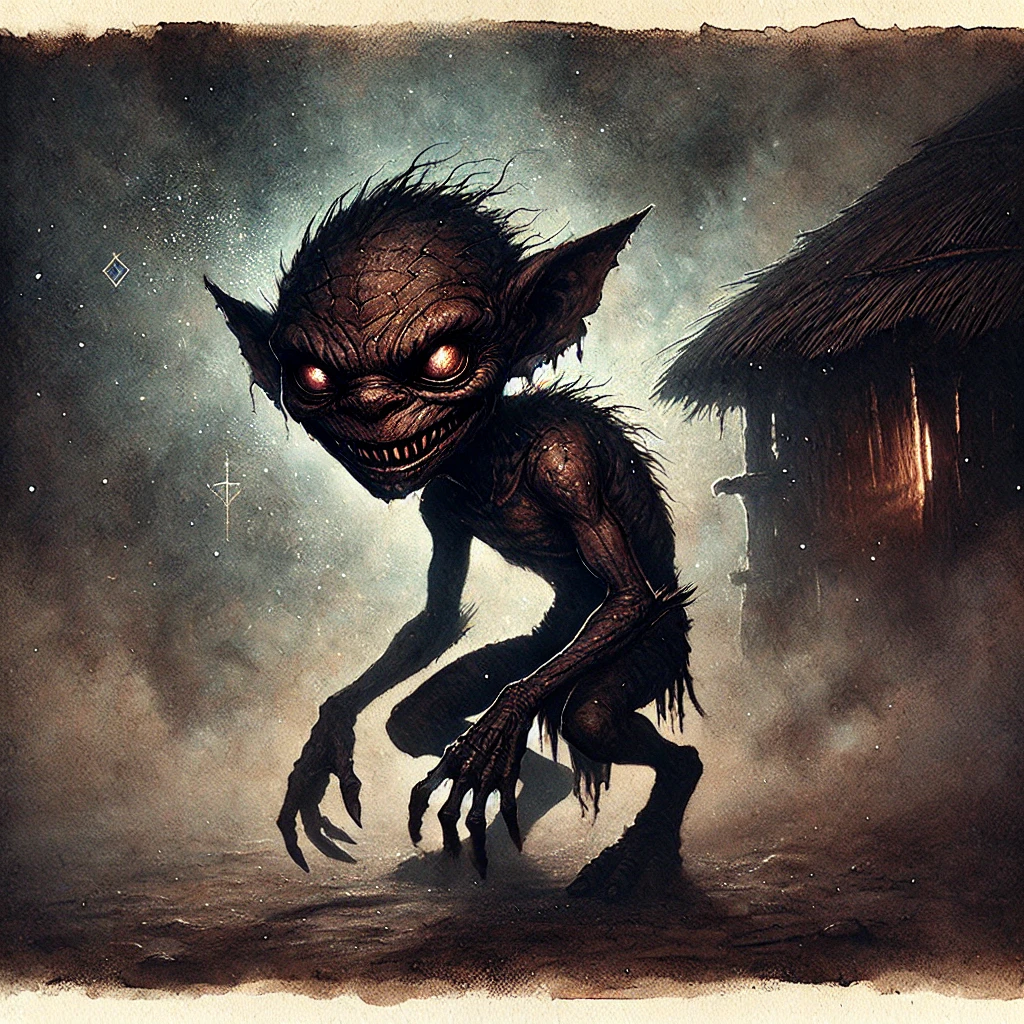
A tokoloshe, a menacing gremlinlike creature with glowing eyes and a creepy smile, by a thatched-roof hut

The trickster tokoloshe from South Africa

Fae From Around the World in Popular Tales

  • Spirited Away, the Studio Ghibli film, is a masterful portrayal of Japanese fairies and spirits.

  • The Girl From the Well by Rin Chupeco draws on Japanese and Filipino ghost fairy traditions.

  • Nalo Hopkinson’s Brown Girl in the Ring weaves Caribbean folklore into a dystopian fairy tale.
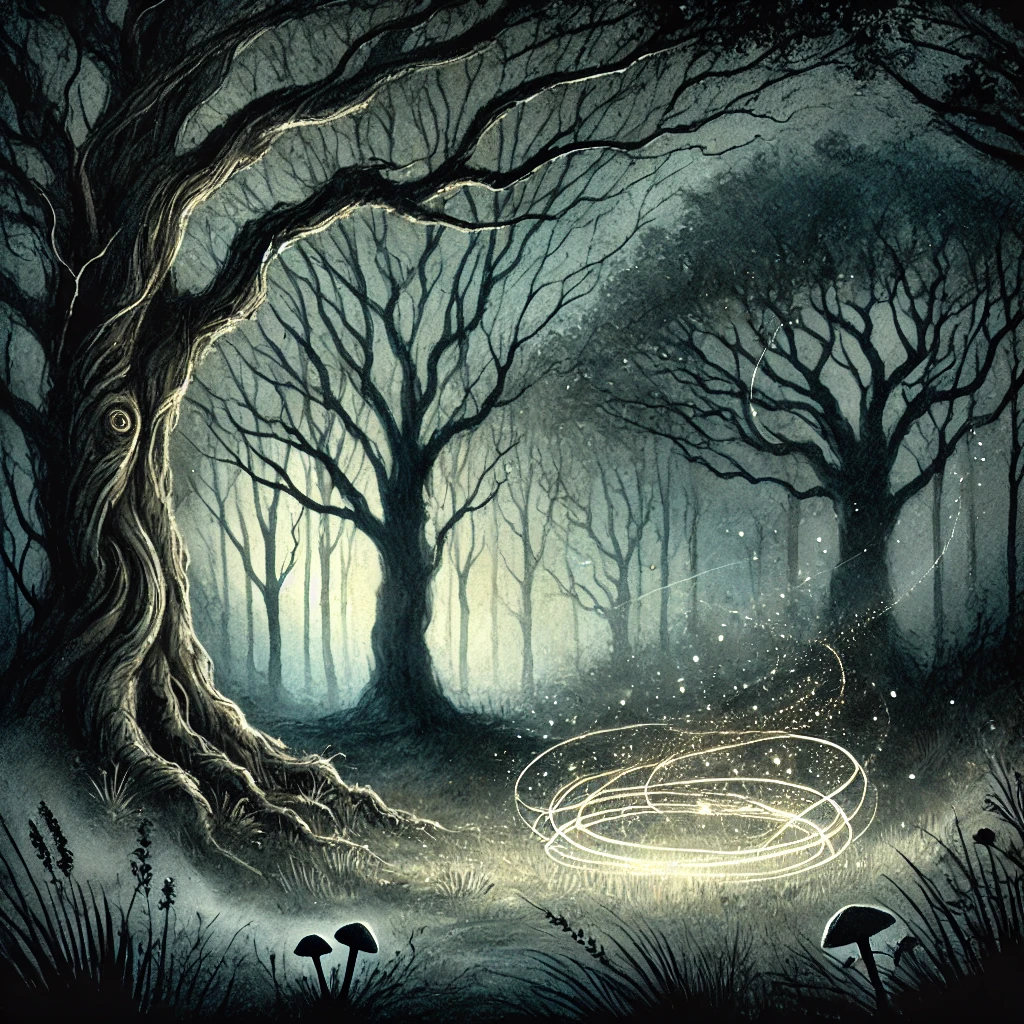
Fairy magic swirls in a forest at night

Fairy Rings, Time Distortion and Other Fae-Related Mysteries

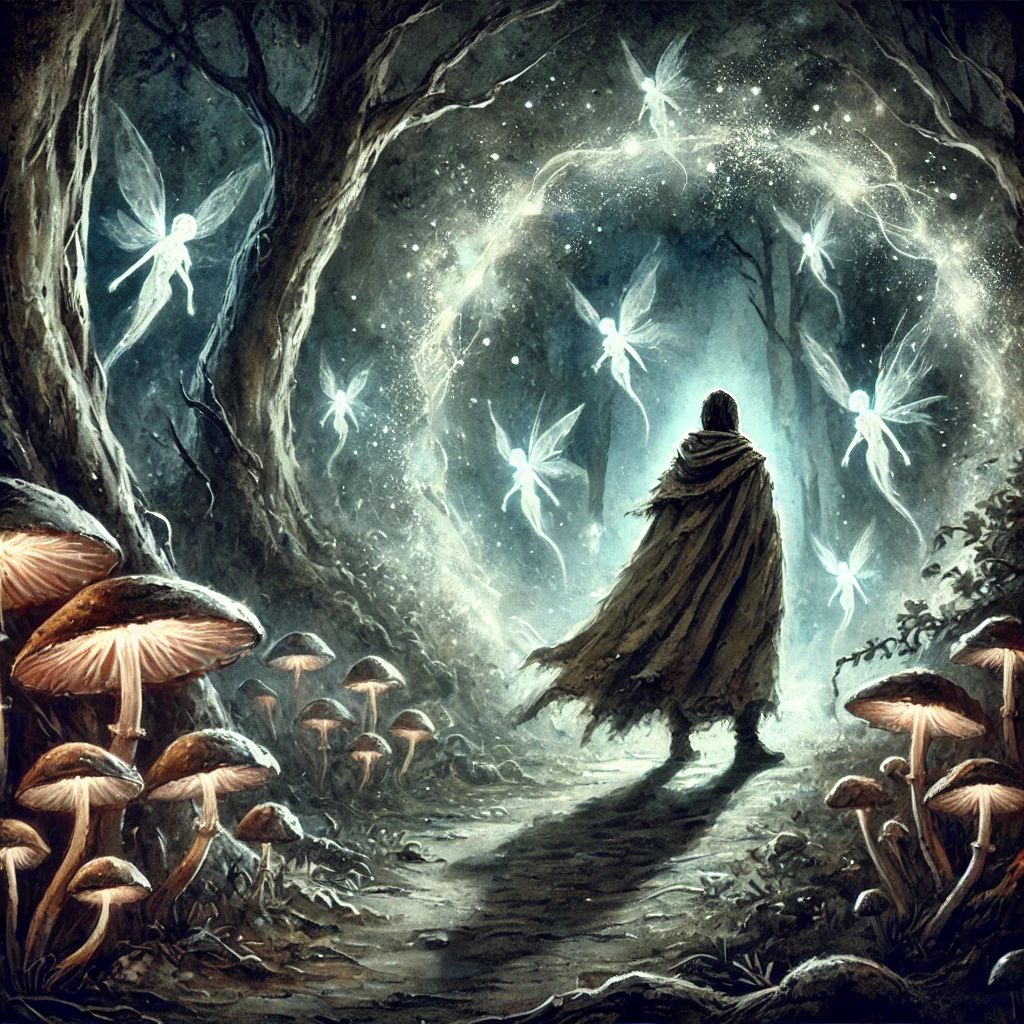
Step carefully, traveler. A ring of mushrooms in the forest, a strange circle of scorched grass on the moors, an ancient oak with a hollow just large enough for a child to crawl through — these are signs that the Fae have been here. And if you cross into their domain, you may never leave the same.

The Danger of Fairy Rings

Fairy rings are among the most famous — and most feared — phenomena in fairy lore. These naturally occurring circles of mushrooms or oddly vibrant grass are said to be the sites of fairy gatherings. Some legends claim that at night, the Fae emerge from their hidden realm to dance under the moonlight, weaving enchantments into the earth.

Stepping into a fairy ring, however, is a terrible mistake. Some say you’ll be forced to dance until you collapse from exhaustion, your mind lost in a delirium of music and light. Others warn that time within the ring doesn’t match the world outside. What feels like minutes to you might be years, decades, even centuries beyond the circle’s edge. Many a mortal has stepped inside, only to return as a withered husk or crumble into dust as soon as they leave.
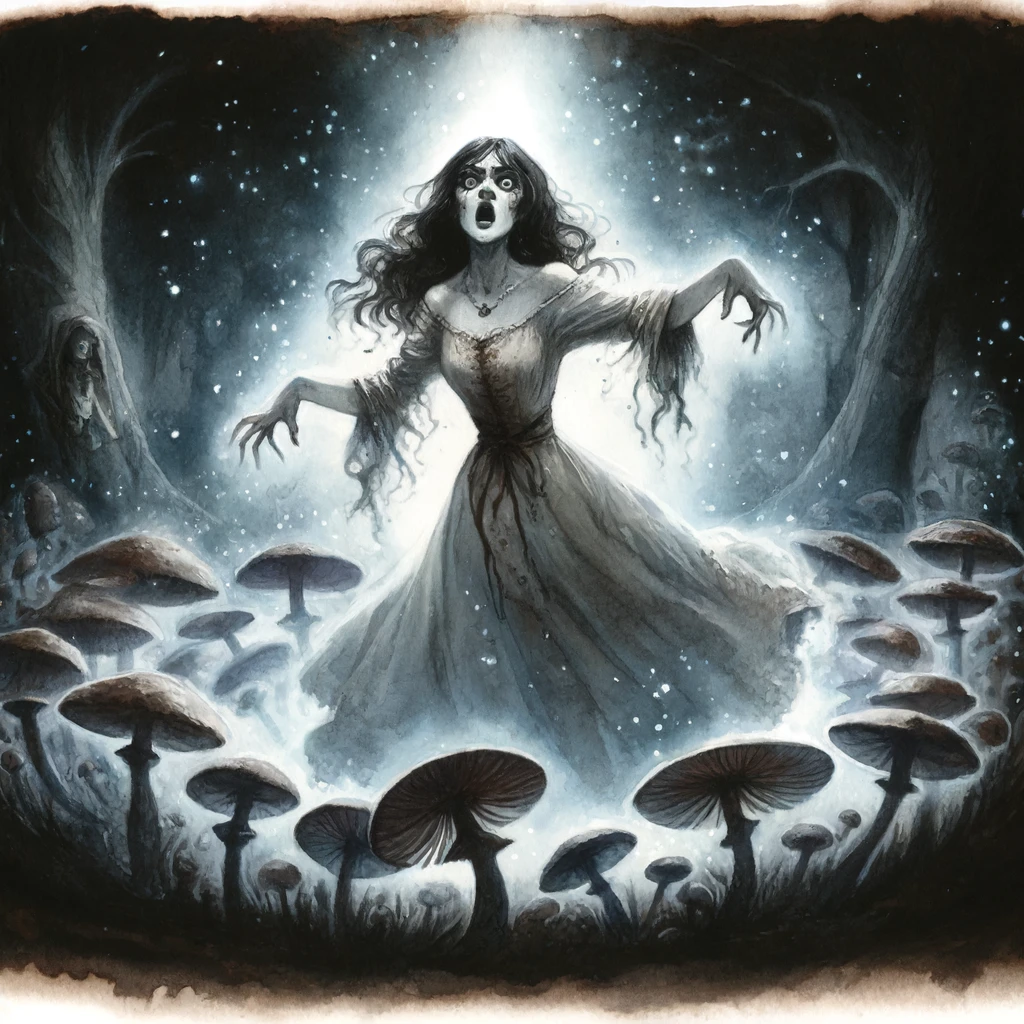
A horrified woman dances without stop in a fairy ring of mushrooms

Even outside of fairy rings, the Fae’s ability to warp time is well known. Travelers who accept a fairy’s hospitality — feasting in their halls, drinking their wine — often find that what seemed like a single evening was, in truth, a hundred years. The legend of Oisín, the Irish warrior who rode away with a fairy queen and returned to find his homeland changed beyond recognition, is one of the most haunting examples.

Never Accept a Fairy’s Gift

The Fae are infamous for their tricks, and one of their cruelest is the giving of gifts. A fairy’s boon may seem like a blessing — a pouch of gold coins, an enchanted flute, a charm of protection — but such gifts always come with a price. Some mortals find their gold turns to dead leaves as soon as they step out of the fairy realm. Others find themselves bound by invisible contracts, compelled to serve the Fae for eternity.
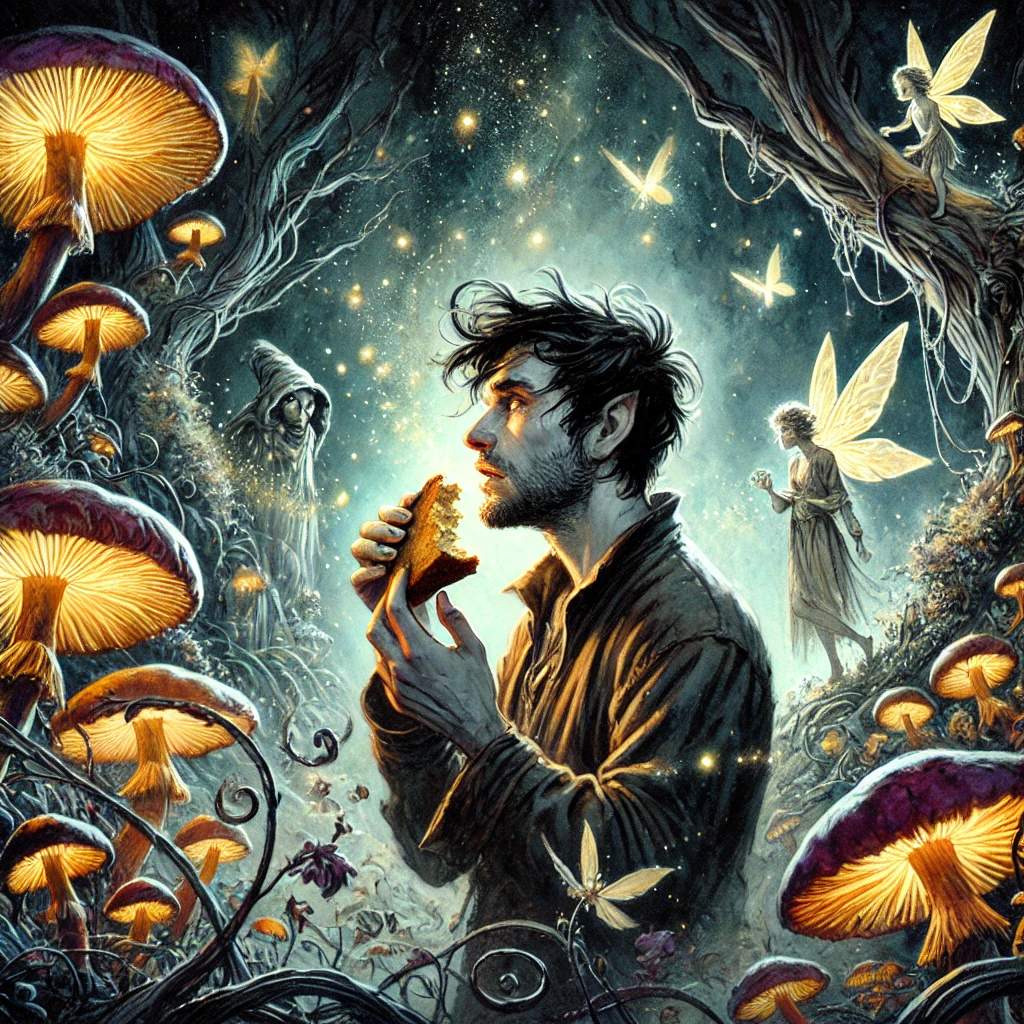
A man stupidly eats in the land of fairy, where mushrooms glow and creatures watch him

I don’t care how hungry you are — never eat anything in fairlyland.

Then there’s the matter of fairy food. It’s a well-known rule that no mortal must ever eat in the land of the Fae. To do so is to bind yourself irrevocably to their realm. Countless legends tell of mortals who took a single bite of fairy bread, only to find themselves unable to leave, their very souls woven into the fabric of that otherworldly place.

The Power of Fairy Music

Fairy music is unlike anything mortal ears have ever heard. It’s haunting, beautiful, impossible to resist. It can put a man into a trance, make a woman dance nonstop until dawn, or lull an entire village into a deep, dreamless sleep. Fiddlers and harpists in Celtic legend often claimed to have learned their skill from the Fae. But such a gift always came with a cost — many returned changed, unable to hear ordinary music without longing for the songs of the otherworld.

One of the most famous tales of fairy music is that of the Pied Piper of Hamelin, who lured away the town’s children with a tune so enchanting the kids followed him into the hills, never to be seen again. Was he simply a vengeful man — or something far older, a fairy trickster leading the children to another world?
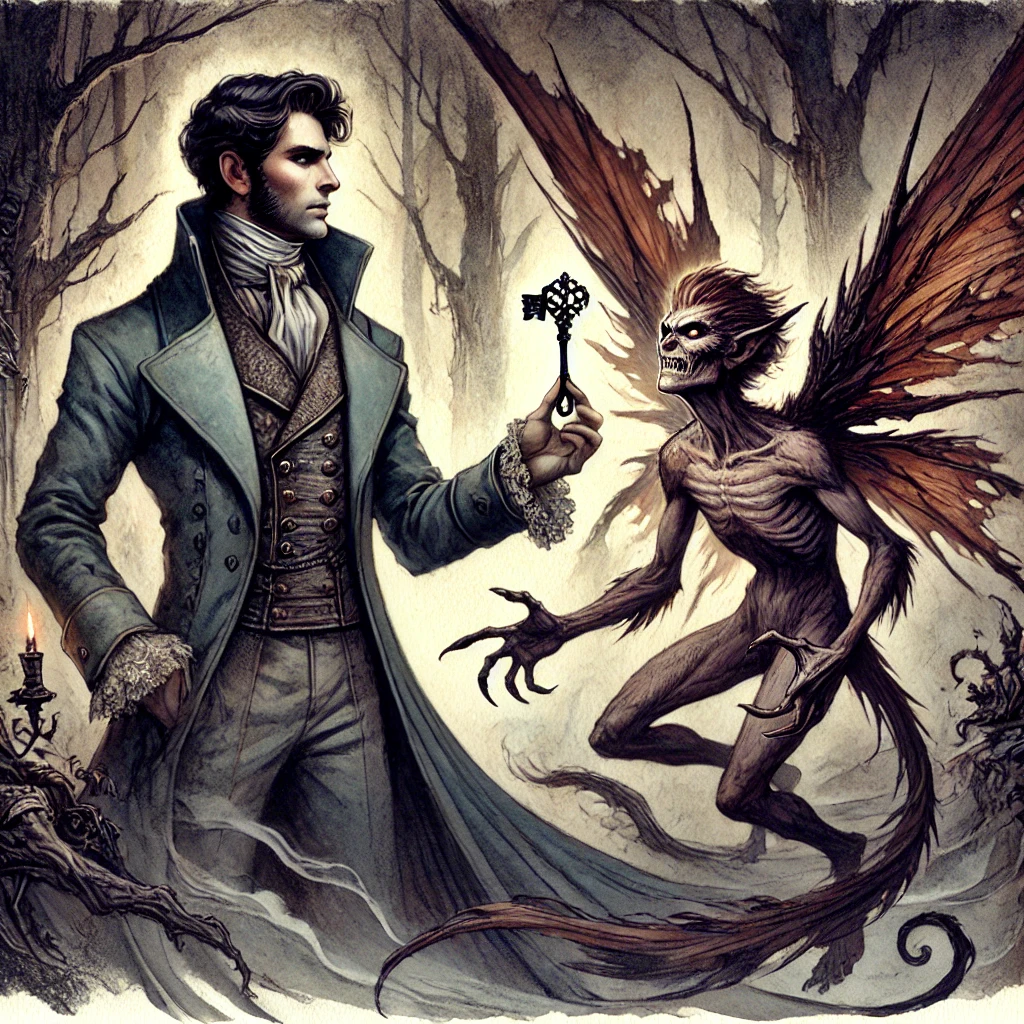
A well-dressed man holds up an iron key to keep a scary fairy at bay

How to Protect Yourself From the Fae

The Fae aren’t easily thwarted, but old wisdom offers a few tried-and-true defenses.

1. Iron is your best friend.

Iron is anathema to fairies, burning them like fire. A horseshoe over the door, iron nails driven into the threshold of a home, or even a simple iron key in your pocket can keep them at bay. Many believe that the industrial age — full of iron railways and steel buildings — was what finally drove the fairies into hiding.

2. Keep salt, rowan and red thread handy. 

A circle of salt around your home is said to keep fairies from crossing the boundary. Rowan wood, especially in the form of a staff or cross, is a sacred protector against fairy mischief. And red thread tied around your wrist or doorknob prevents enchantments and bewitchment.

3. Never give your name.

Names have power. If a fairy learns your true name, they can control you, call you to their realm at will, or steal your identity altogether. If you must interact with the Fae, use a false name, a nickname, or no name at all.

4. Watch what you say.

Forget those good manners instilled in you as a kid. Thanking a fairy is dangerous — it implies that a debt has been repaid, and fairies despise that. If a fairy grants you a favor, say, “This is well done” or “You have my respect,” but never, ever say “thank you.”

5. Avoid liminal spaces.

Fairies are strongest at twilight, dawn, and during the turning of the seasons (Beltane, Samhain, Midsummer). Crossroads, hollow hills and standing stones are all places where the veil is thin. Step too close, and you may step into their world without even realizing it.
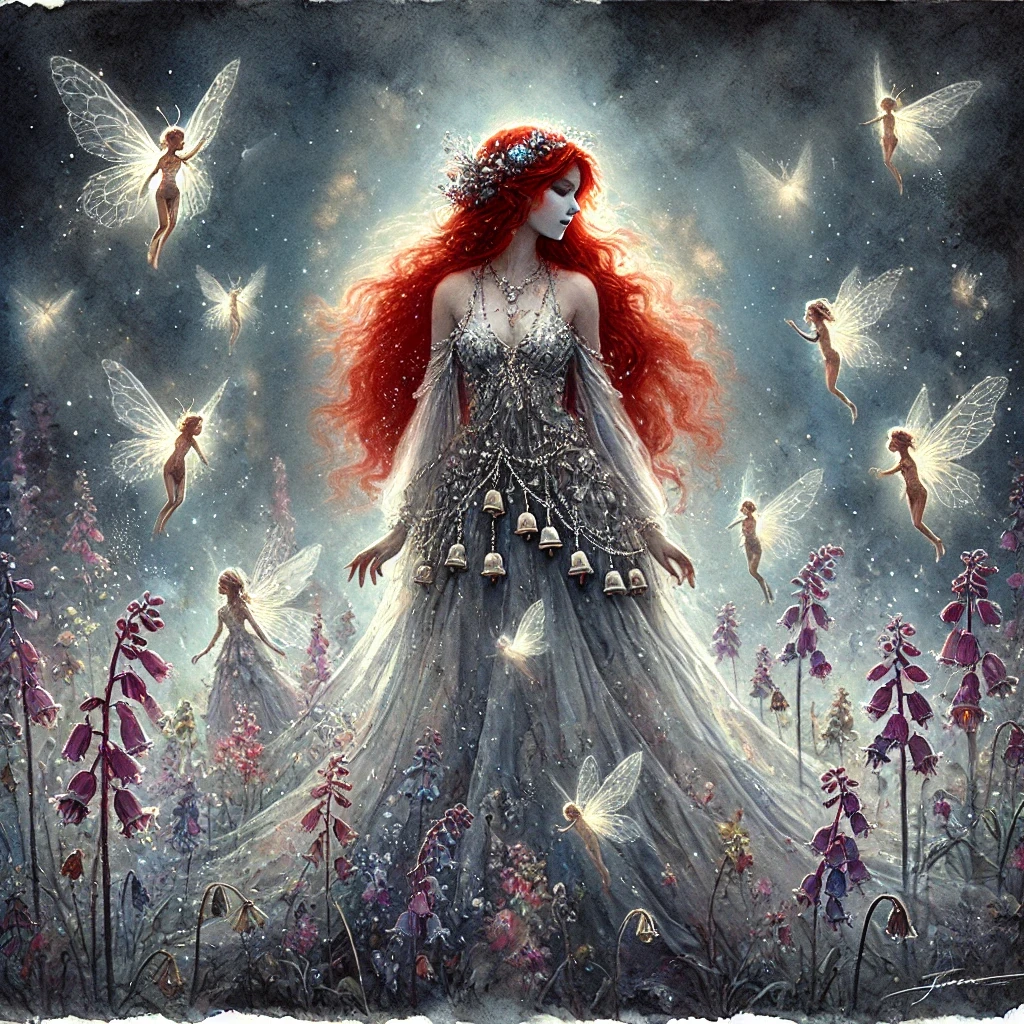
A red-haired woman wears a silvery dress and strings of bells to attract fairies, which surround her amid flowers

How to Attract Fairies

Not all fairies are malevolent. Some are simply mischievous, while others may be persuaded to lend a little magic to those who honor them properly.

1. Leave offerings.

Fairies appreciate small gifts: bowls of milk, honey, fresh-baked bread or mead. Leave these in a quiet outdoor space, particularly near a fairy ring, a tree hollow or a stream. But never check to see if they’ve been taken; that breaks the spell.

2. Keep a wild garden.

The Fae love untamed beauty. Gardens filled with wildflowers, overgrown ivy and hidden nooks are far more likely to attract them than neat, orderly beds. Plants like foxglove, lavender and thyme are said to be especially beloved by fairies.

3. Speak in riddles and poetry.

The Fae enjoy cleverness. Those who speak in riddles, offer playful banter or recite poetry may find themselves in their favor. Beware, though: If a fairy challenges you to a game of wits and you lose, the consequences will be strange, and sudden — and never fair.

4. Wear silver or bells.

Silver is associated with moonlight and magic, and fairies are drawn to it. Small bells, often worn on clothing, were once thought to please the Fae (though some say they keep trickster spirits away).

5. Celebrate Beltane and Samhain.

These two festivals are when the Fae are closest to the mortal world. Dancing, feasting and lighting candles in their honor may win their favor. Just be careful not to invite the wrong kind.
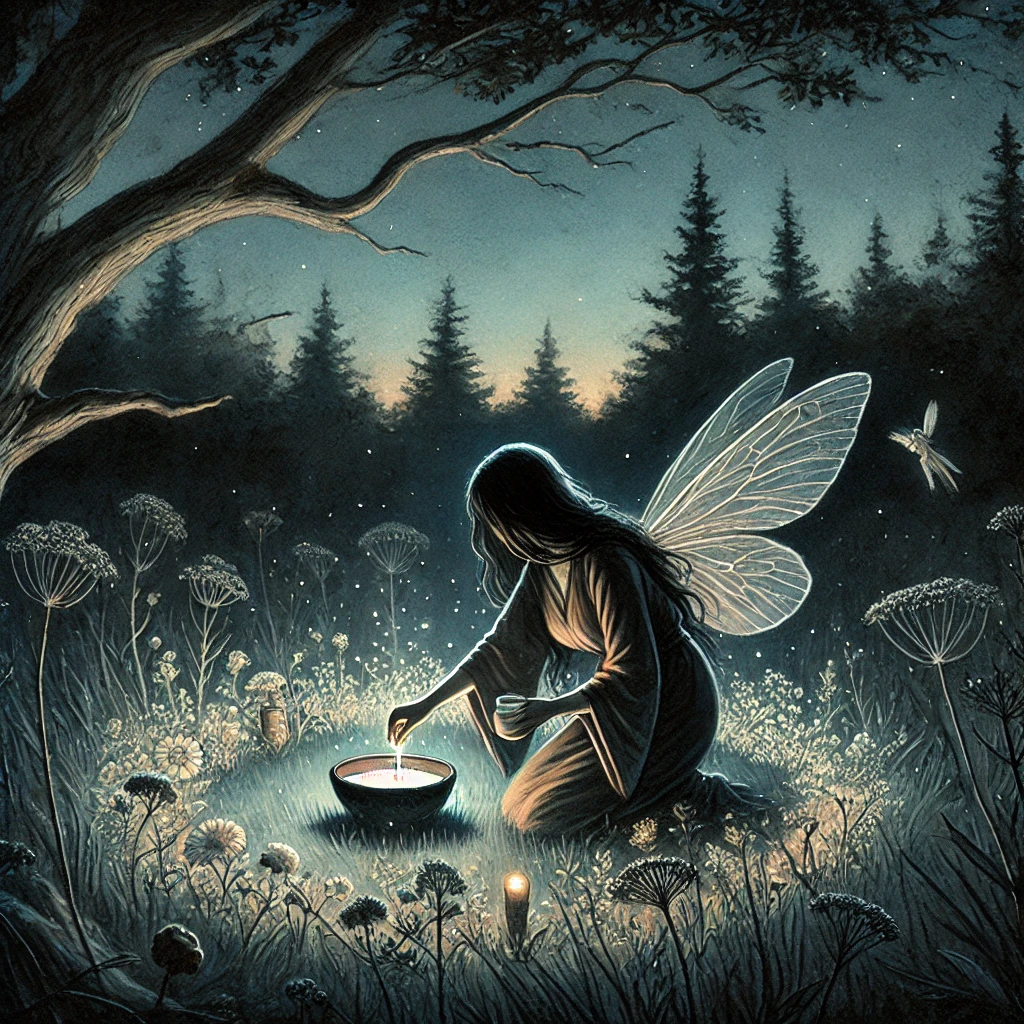
A Wiccan woman wearing fairy wings has a bowl with milk outside, performing a ritual to attract the Fae

A Spell to Connect With the Fae

If you wish to invite the presence of the Fae — gently, respectfully and understanding the risks involved — this simple spell will help you call upon their magic.

You’ll need:

  • A small bowl of milk and honey (a traditional fairy offering)

  • Fresh wildflowers (such as daisies, foxglove or lavender)

  • A silver coin

  • A candle (preferably green or white)

  • A quiet place in nature, preferably near a tree, stream or fairy ring

The Ritual

As twilight falls, take your offerings to a secluded, peaceful spot where you feel a connection to nature.

Arrange the wildflowers in a small circle and place the bowl of milk and honey in the center.

Set the silver coin beside the bowl as a token of respect.

Light the candle and focus your intent on reaching out to the Fae — not to command, but to invite.

Recite the following incantation:

O spirits fair, of earth and sky,
By moon’s soft glow and stars on high,
With gift of sweet and silver bright,
I call thee forth this sacred night.

If friend ye be, then come in grace,
With laughter light and wisdom’s trace.
No harm, no trick, no ill intent,
But blessings true and magic sent.

Let the candle burn for a few moments while you listen to the sounds of the evening. If the wind stirs, if a sudden hush falls, or if you feel a shift in the air — know that the Fae may be near.

Thank them silently, then leave the offerings behind as you depart. Never look back.

A final caution: The Fae don’t grant favors lightly, nor do they take kindly to broken promises. If you feel their presence, treat them with respect. If you receive a sign — a feather, a leaf falling on you, a strange dream — consider it a gift, not a debt to be repaid.
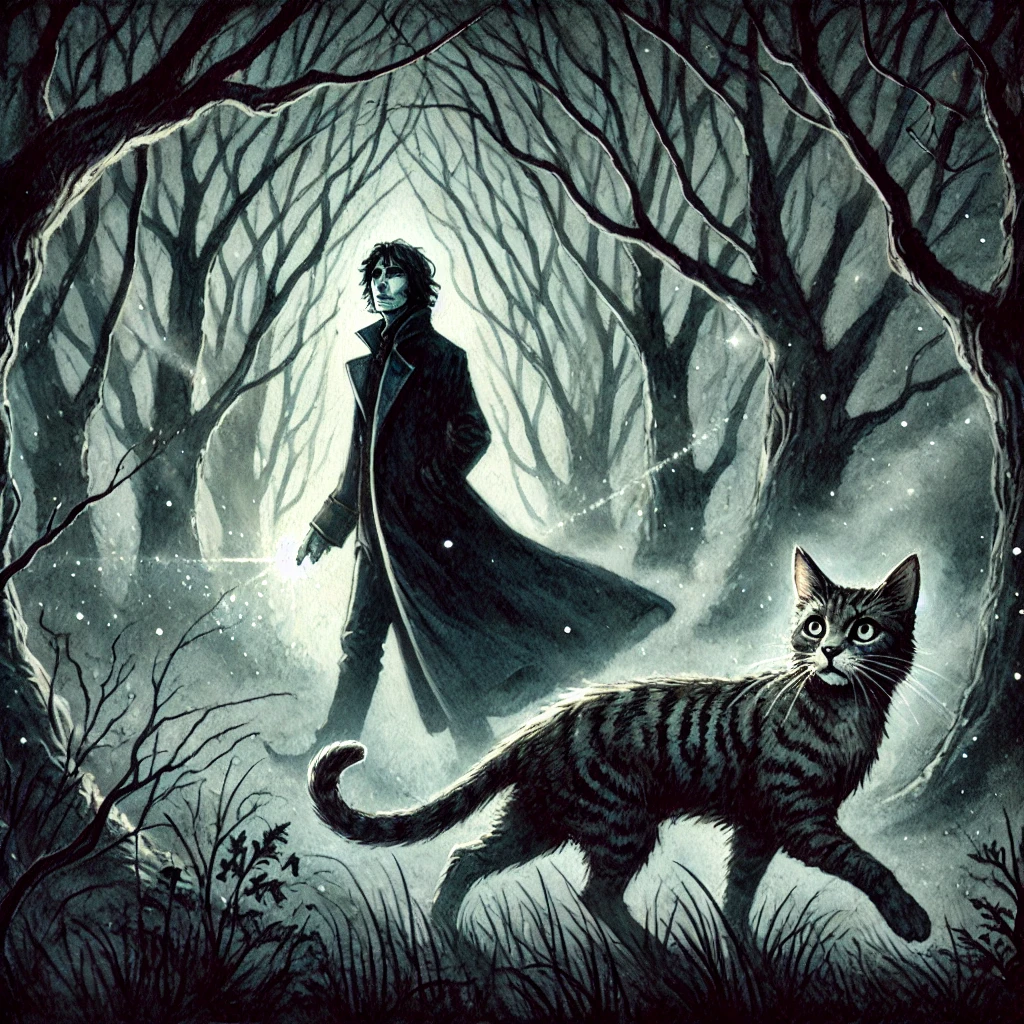
A man in a long coat walks through the woods at night with a tiger-striped cat

Tread Carefully in the Land of the Fae

The Fae are as fickle as the wind, as ancient as the stones, and as unpredictable as the tide. They’re neither wholly good nor wholly evil, existing in a realm beyond human morality. They can bring fortune or misfortune with a careless flick of a hand, charm you with laughter, or steal you away in a dance that never ends.

Yet still, we seek them. We whisper our wishes into the night, leave offerings on our windowsills, and tell their stories in hushed voices. Perhaps it’s because we, too, long for the hidden places, for the unseen world just beyond our reach.

But if you hear laughter from the trees when no one’s near, or see a flicker of light dancing in the mist, remember: Step lightly, choose your words carefully, and never, ever eat the food. –Wally
The Norse Gods: The Deities Who Knew They Would Die

Meet the Norse gods: a fierce pantheon of warlike deities, doomed heroes and mischief-makers. Learn about Odin, Thor, Loki, Freyja, and Ragnarök, the end of the world they can't escape.

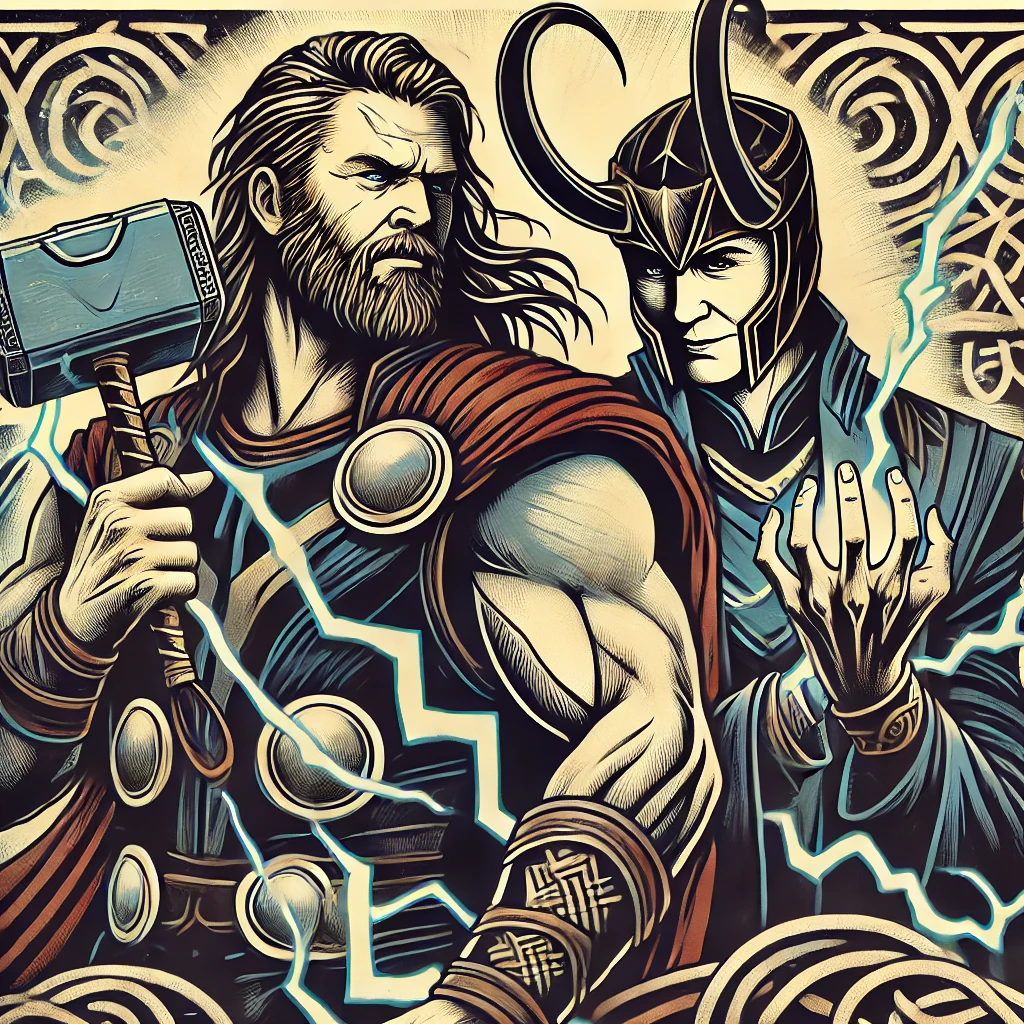
Thor holds his hammer and Loki works his magic

The Norse gods don’t rule from some shining eternal paradise. They sit in Asgard, a realm of feasting halls and battle scars, knowing full well that doom is coming. They drink, they fight, they love, and they scheme — but above all, they live with the knowledge that one day, it all ends in fire and ruin. 

The Norse gods aren’t distant, perfect figures sitting on golden thrones.

They struggle, they fail, they sacrifice, and they rage against the inevitable. They’re larger than life — until they die. 

Unlike the gods of other mythologies, the Norse deities aren’t immortal in the traditional sense. They age, they can die, and they know how the story ends: Ragnarök, the final battle, where most of them are fated to perish.

But until then? They shape the cosmos, meddle in human affairs, and prove that gods the world over have complicated relationships, questionable choices and a flair for the dramatic.

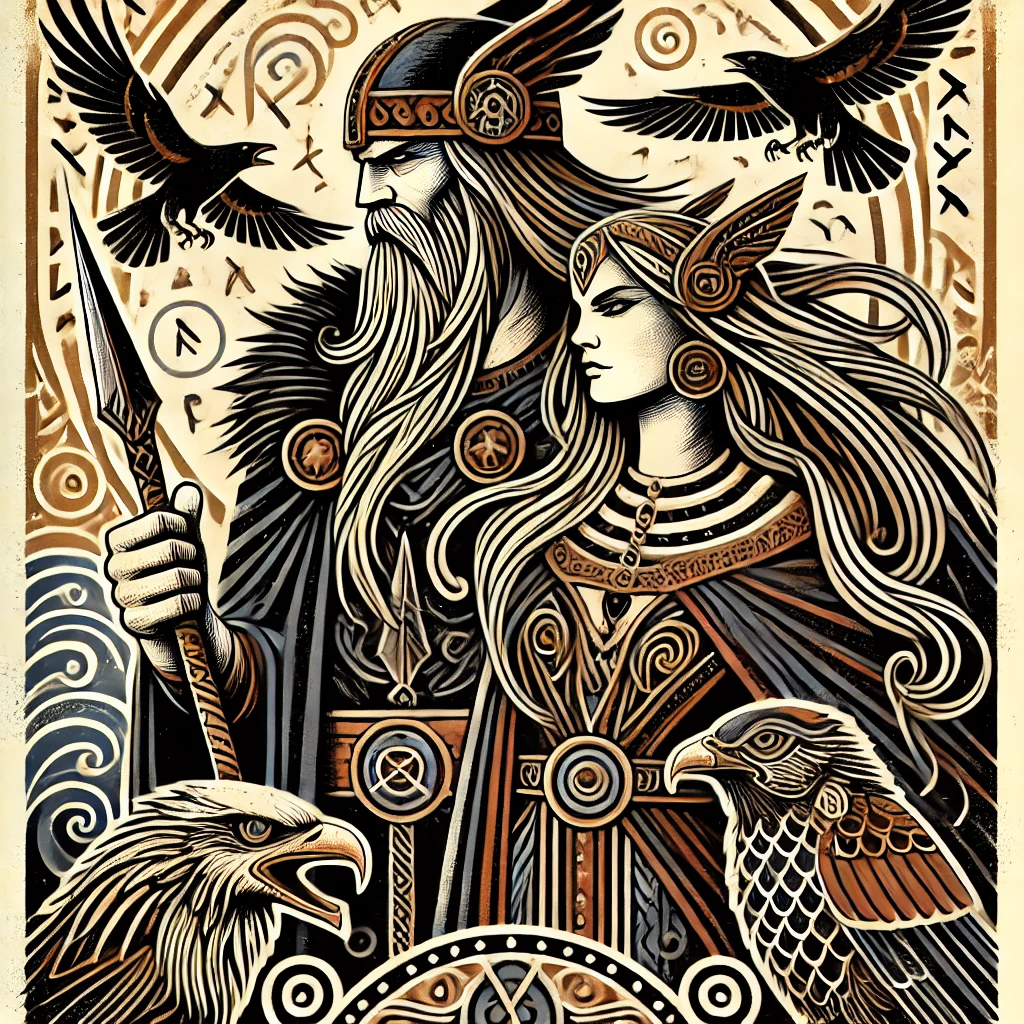
A Norse god and goddess look fierce, with ravens and eagles around them

A Tale of Two Tribes: The Aesir and the Vanir

The Norse gods are divided into two distinct groups:

The Aesir: The warlike, ruling gods of Asgard. Odin, Thor and Loki belong to this camp, focusing on battle, wisdom and power.

The Vanir: The gods of nature, fertility and prosperity. Freyja, Freyr and Njord are part of this mysterious older group.

The two groups weren’t always allies. They started out as enemies, locked in a brutal war that ended in a truce and an exchange of hostages. The Aesir and Vanir eventually merged into a single pantheon, but their differences remain: One is bound by war and fate; the other by nature’s cycles.

Now, let’s meet the major players.

Norse gods and the animals associated with them, including a raven and wolf

The Norse Pantheon: A Who’s Who of the Gods of Norse Mythology 

ODIN

Dominion: Wisdom, war, death

Gave up an eye for knowledge

THOR

Dominion: Thunder, strength, protection

Wields the hammer Mjölnir

LOKI

Dominion: Trickery, shapeshifting

Fathered a giant wolf, serpent and eight-legged horse

FREYJA

Dominion: Love, magic, battle

Slept with four dwarves to get a necklace

FREYR

Dominion: Fertility, prosperity, peace

Has a golden boar and a self-fighting sword

TYR

Dominion: Justice, law, sacrifice

Lost his hand to the giant wolf Fenrir

BALDER

Dominion: Light, beauty, hope

Was killed by a mistletoe arrow

HEIMDALL

Dominion: Guardianship, perception

Has golden teeth and guards the Rainbow Bridge

FRIGG

Dominion: Fate, foresight, motherhood

Can see the future but doesn't speak of it

NJORD

Dominion: Sea, wind, wealth

Hated living in the mountains with his wife

HODR

Dominion: Darkness, mystery

Accidentally killed his brother Balder

HEL

Dominion: Death, the underworld

Rules over those who die of illness or old age

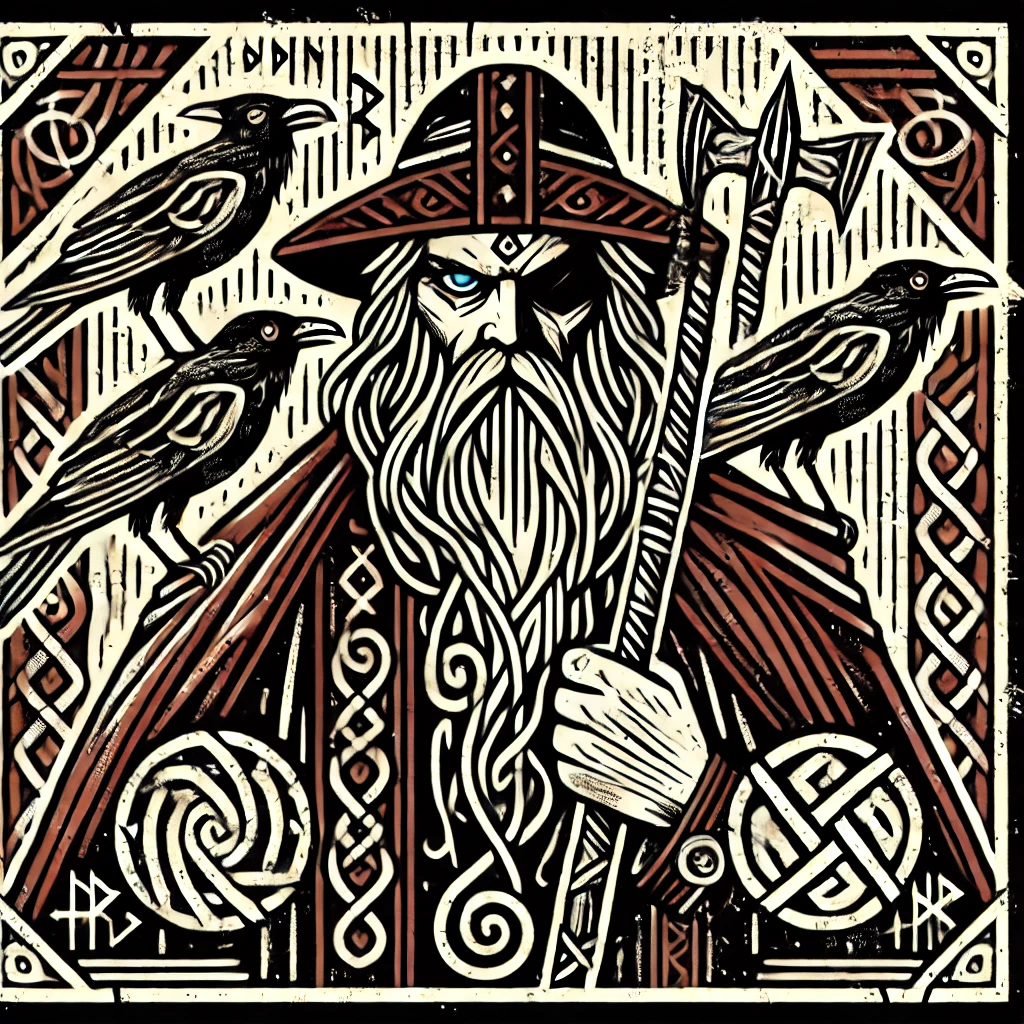
The Norse god one-eyed Odin with his ravens around him

Odin

Divine Dominion: Wisdom, war, poetry, death and generally knowing more than everyone else

Temperament and Tendencies: Odin isn’t your typical benevolent all-father. He’s the kind of guy who trades his own eye for knowledge and thinks that’s a fair deal. He wanders the world in disguise, testing mortals with riddles and cryptic wisdom, all while hoarding every scrap of magical power he can get his hands on. He’s half battle god, half poetry nerd, and 100% obsessed with avoiding his own fate — though deep down, he knows it’s inevitable.

Signature Style:

  • Gungnir, a spear that never misses its mark

  • Huginn and Muninn, his two ravens who fly across the world gathering intel. Basically, his personal spy network

  • Sleipnir, an eight-legged horse that is technically his grandchild, thanks to Loki’s … creative approach to problem-solving

Inner Circle:

  • Frigg, his wife, who knows the future but refuses to tell him

  • Thor, his muscle-bound son who solves everything with his hammer

  • Loki, his brother and occasional worst enemy

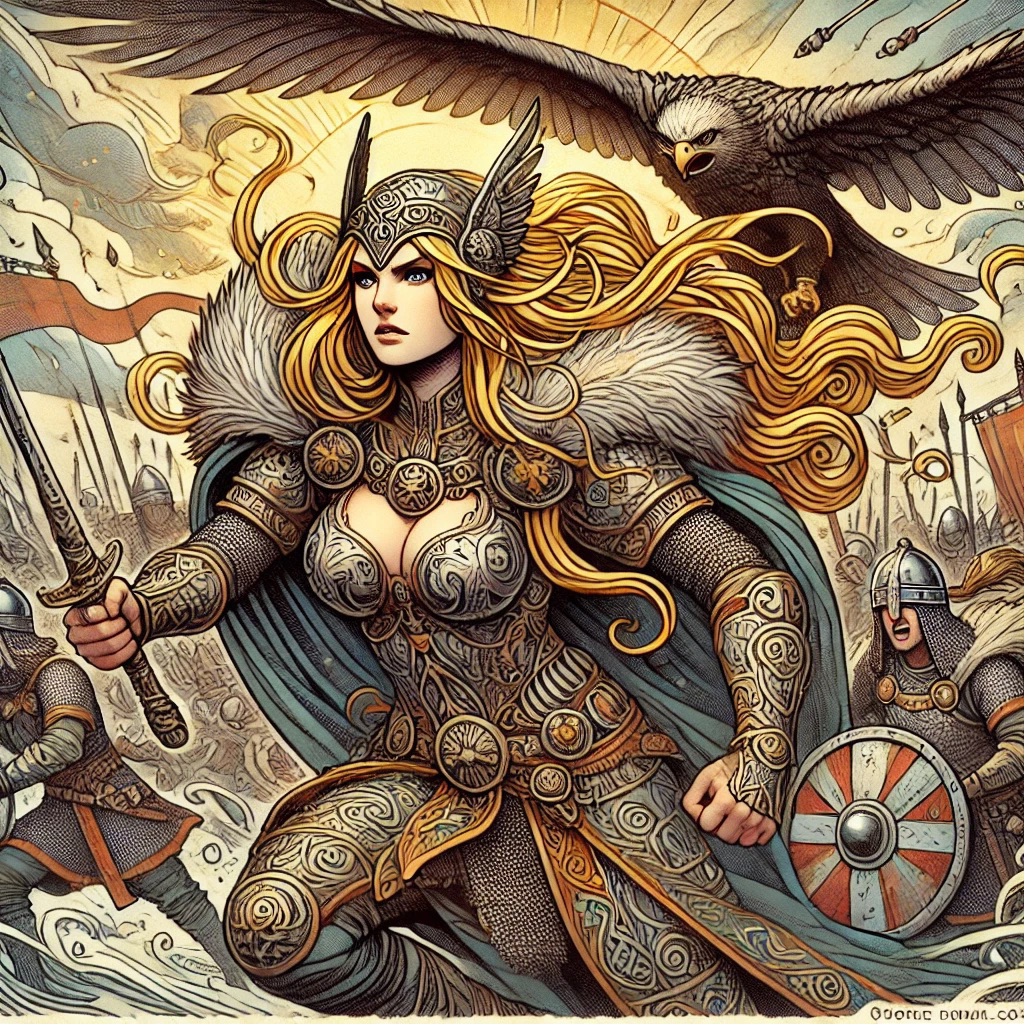
  • The Valkyries, his elite warrior-maidens who collect the souls of fallen fighters for the heavenly hall of Valhalla

Saga-Worthy Moment: He once hanged himself from the World Tree for nine days just to unlock the secrets of the runes. Talk about commitment.

Ragnarök Status: Doomed. He’ll go head-to-head with Fenrir, the giant wolf, and it will not end well for him.

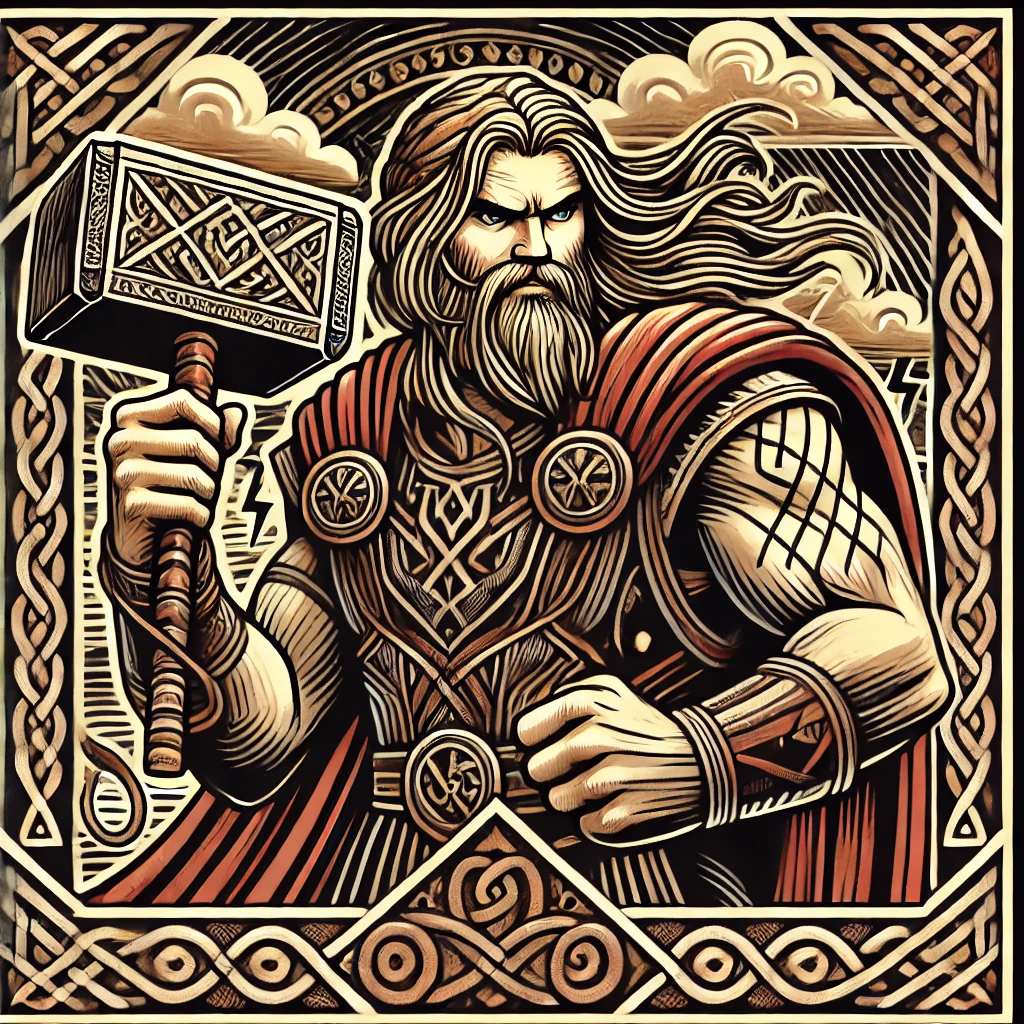
The Norse god Thor, holding his hammer in a border of runes

Thor

Divine Dominion: Thunder, strength, protection and smashing things really hard

Temperament and Tendencies: Thor is the kind of guy who kicks down doors instead of knocking. He’s loud, boisterous, fiercely loyal and completely incapable of subtlety. He’s the gods’ first line of defense against giants, trolls and anyone who looks at Asgard funny. Despite being a god of war, he has a soft spot for mortals — probably because they cheer the loudest when he shows up swinging his hammer.

Signature Style:

  • Mjölnir, his hammer, which always returns to his hand after being thrown

  • A magic belt that doubles his strength

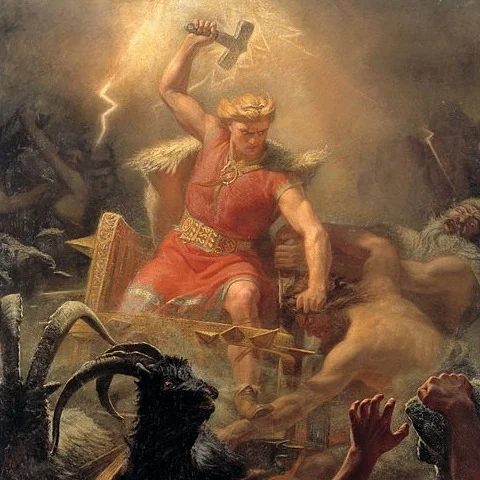
  • A chariot pulled by two immortal goats, which he occasionally eats and then resurrects the next day

Inner Circle:

  • Sif, his wife, best known for her golden hair (which Loki once shaved off, and somehow survived)

  • Odin, his complicated father figure

  • Loki, his on-again, off-again adventure buddy who causes 95% of his problems

Saga-Worthy Moment: Once had to disguise himself as a bride to retrieve his stolen hammer. It ended in a massacre — but not before some very uncomfortable moments with the groom.

Ragnarök Status: Will go down swinging against Jörmungandr, the world-serpent — he kills it but dies shortly after from its venom

MORE: Norse Mythology That the Movie Thor: Ragnarok Got Wrong

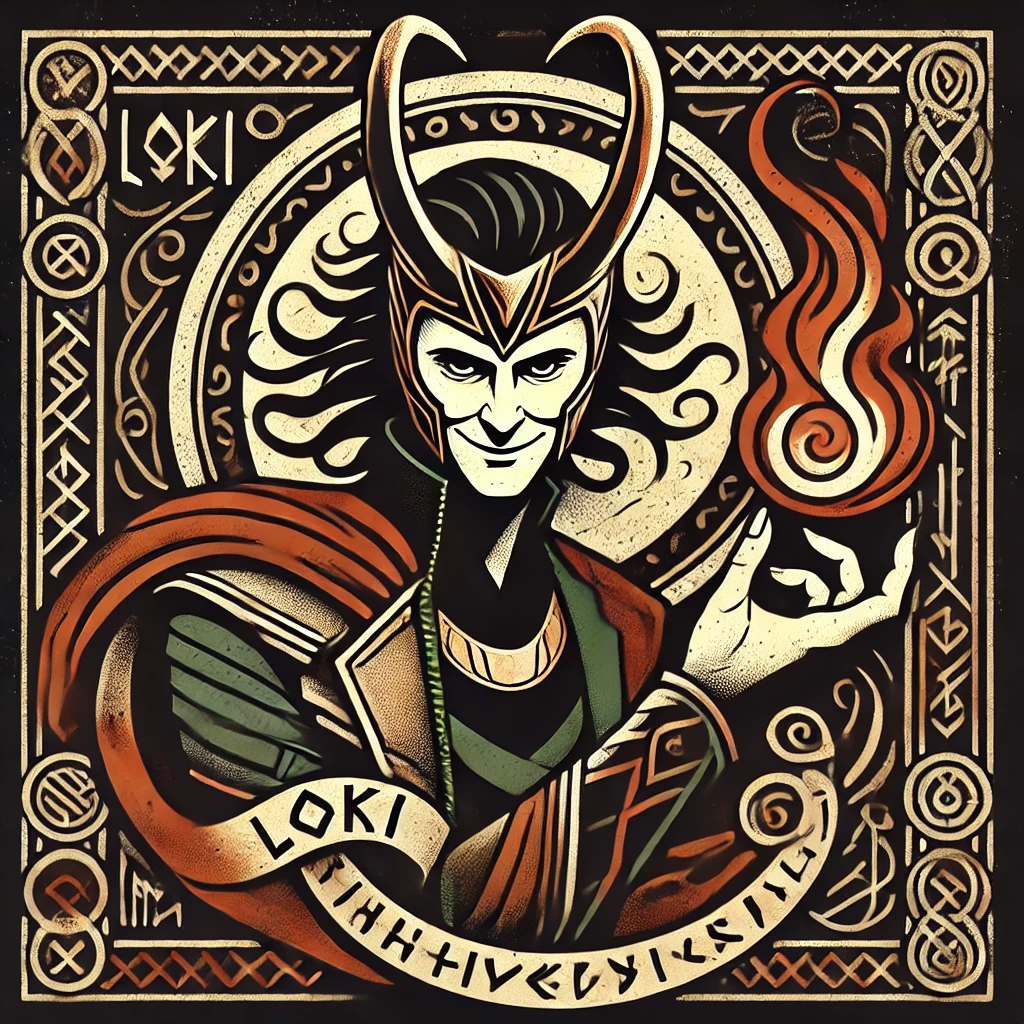
Loki, the Norse trickster god, wearing his horned helmet and conjuring fire in his hand, smiling mischievously

Loki

Divine Dominion: Trickery, chaos, fire and making bad decisions seem fun

Temperament and Tendencies: Loki is equal parts hilarious and horrifying. One minute he’s pulling off an elaborate prank on Thor, and the next, he’s indirectly responsible for the downfall of the gods. He’s a shapeshifter, a smooth talker and a chaos magnet. He’s technically Odin’s brother but doesn’t really fit in with the rest of the Aesir — probably because he keeps switching sides.

Signature Style:

  • Shapeshifting into literally anything, from a fish to a fly to, infamously, a female horse. (Yes, this is how Odin’s eight-legged horse was born. No, we don’t talk about it)

  • A silver tongue, which gets him both into and out of trouble

  • A flair for the dramatic, because being subtle is boring

Inner Circle:

  • Odin, when they’re on good terms

  • Thor, when they’re not trying to kill each other

  • His wife, Sigyn, who’s way too patient for her own good

Saga-Worthy Moment: Loki once gatecrashed a feast at the underwater hall of the giant and master brewer Ægir, where he insulted every god in attendance, bragged about sleeping with half of them, and aired everyone’s dirty laundry in verse — all while very drunk. When Thor finally stormed in and threatened to hammer Loki into paste, the trickster decided it was probably time to leave. This delightful trainwreck of a roast is known as Lokasenna, or Loki’s Flyting. 

Ragnarök Status: Will lead the charge against the gods and go down in a final showdown with Heimdall.

THINK NORSE MYTHOLOGY IS CRAZY? Wait’ll you get a load of this tale of incest, lettuce and jizz from Egyptian mythology!

The Norse goddess Freyja, with a raven and cat

Freyja

Divine Dominion: Love, beauty, war, magic and getting whatever she wants

Temperament and Tendencies: Freyja’s not your typical love goddess. Sure, she’s beautiful and enchanting — but she’s also a battle-hardened warrior who rides into combat and takes half the fallen warriors before Odin gets his pick. She’s also the queen of sorcery, which makes her both alluring and utterly terrifying.

Signature Style:

  • Brísingamen, a dazzling necklace that she definitely didn’t have to sleep with four dwarves to obtain. (Except she did)

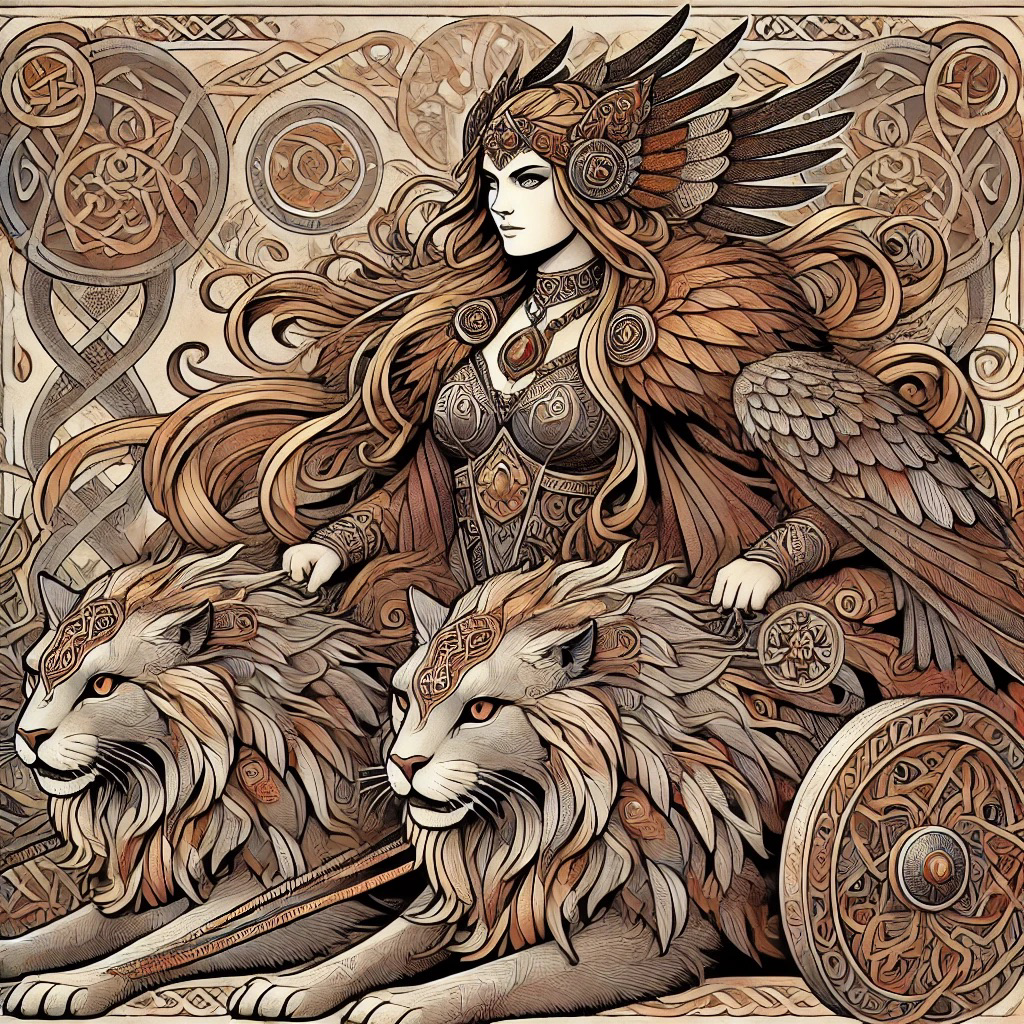
  • A chariot pulled by two big cats, because dogs are overrated

  • A falcon-feathered cloak, allowing her to fly

Inner Circle:

  • Freyr, her twin brother, also associated with fertility and prosperity

  • Odin, who learned magic from her

  • A lot of broken-hearted lovers

Saga-Worthy Moment: Once turned down a marriage proposal from a giant so dramatically that Thor had to step in and smash things.

Ragnarök Status: Unclear. She might survive — because no one tells Freyja what to do.

LEARN MORE about Freyja

The Norse god Freyr smiles and pets his golden boar while his swords floats next to him

Freyr

Divine Dominion: Fertility, prosperity, peace and romantic decisions that haunt you forever 

Temperament and Tendencies: Freyr is one of the Vanir, a fertility god with a soft spot for beautiful women and good harvests. Unlike his battle-happy Aesir cousins, Freyr prefers peace, feasting and abundance — but when love strikes, he goes full disaster romantic.

Signature Style:

  • A magic sword that fights on its own (which he gave away to impress a girl… Great call)

  • Gullinbursti, a glowing golden boar that pulls his chariot

  • An aura of extremely fertile energy — the kind that makes crops grow just by being near them

Inner Circle:

  • Freyja, his twin sister and occasional partner-in-crime

  • Njord, their laidback sea god dad

  • Gerðr, the giantess he fell for so hard, he handed over his magic weapon

Saga-Worthy Moment: At Ragnarök, Freyr goes into battle unarmed because of that whole sword-for-love swap, and gets absolutely wrecked by Surtr, the fire giant.

Ragnarök Status: Heroic, but very dead

The Norse god Tyr clutches his sword, looking stern, surrounded by runes

Tyr

Divine Dominion: Justice, law, honorable combat and making the ultimate sacrifice

Temperament and Tendencies: Tyr is the god you call when things need to be done the right way. He’s honorable, courageous, and possibly the only Norse god who actually thinks before acting. Unlike Thor, who solves problems with a hammer blow, and Odin, who solves them with riddles, Tyr solves them with logic and sheer willpower — and sometimes, by personally sacrificing body parts.

Signature Style:

  • A missing hand, courtesy of Fenrir the giant wolf. (More on that in a second)

  • A sword, because even a god of justice needs a way to back it up with force

  • An aura of quiet competence, which makes him stand out in a pantheon full of drama

Inner Circle:

  • Odin, when things need a legal expert

  • The other gods, when they need someone to do the hard job

  • Not Fenrir, for obvious reasons

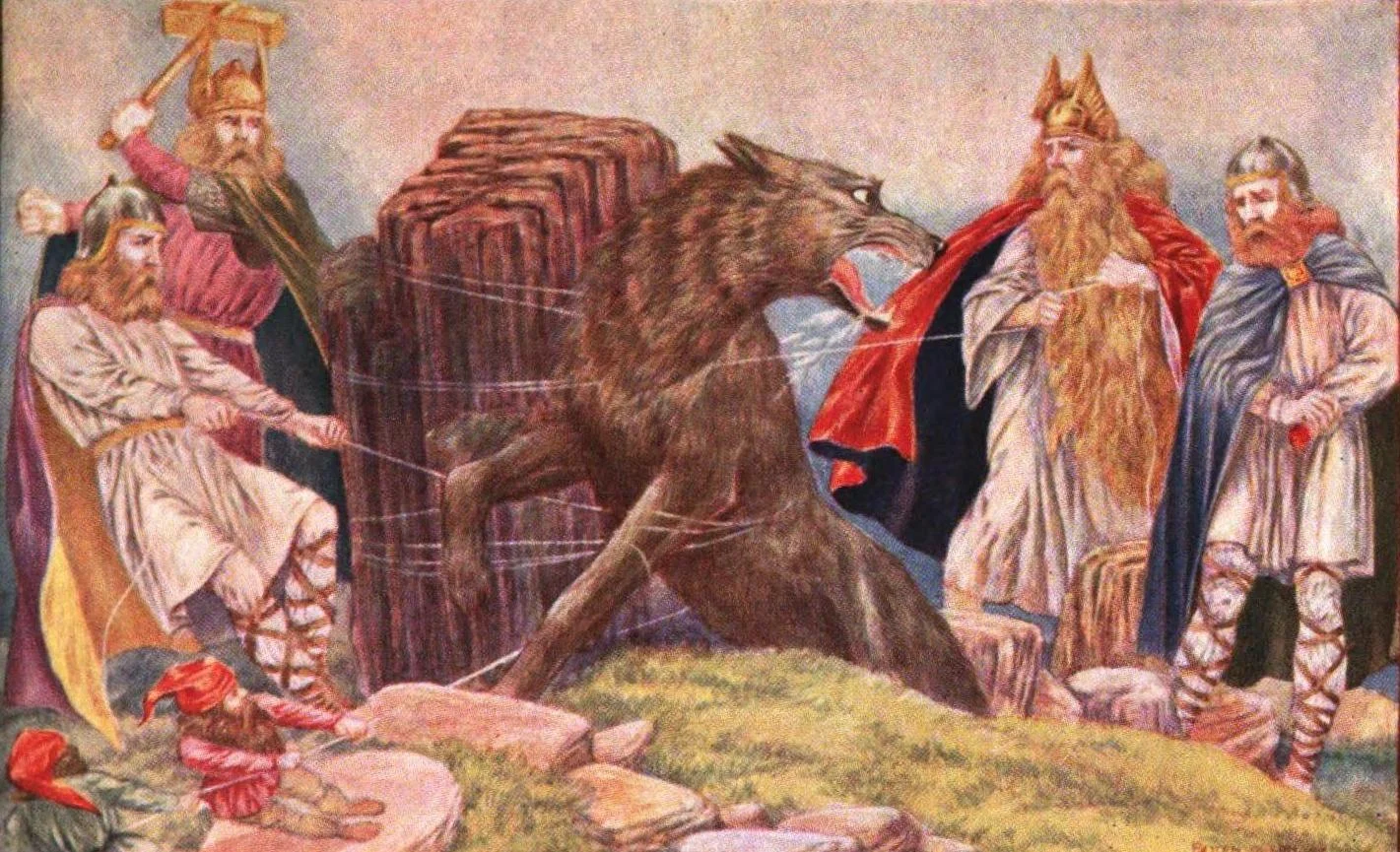
Saga-Worthy Moment: The gods needed to bind Fenrir, the monstrous wolf who would one day help destroy the world. The wolf, being somewhat intelligent, refused to let them tie him up unless one of them put their hand in his mouth as collateral. Tyr immediately stepped up, fully aware of how this was going to end. Sure enough, the second Fenrir realized he was tricked, he bit down — and Tyr didn’t even flinch.

Ragnarök Status: Will fight Garm, the underworld’s monstrous hound, in a final battle. The result? Mutual destruction. But honestly, that’s just how Tyr rolls.

The golden Norse god Balder, ringed by runes

Balder

Divine Dominion: Light, purity, joy and making everyone love him (too much)

Temperament &land Tendencies: Balder is the golden boy of the Norse pantheon — literally. He’s charming, kind, handsome and basically too good for this world (which, spoiler alert, is a problem). Everyone adores him: gods, mortals, even inanimate objects — except for Loki, of course.

Signature Style:

  • Glowing with divine radiance, because normal beauty isn’t enough

  • Wearing the best armor ever, because Frigg, his mother, made everything in existence promise not to harm him. (Again, almost everything)

  • Being the center of attention, mostly because the gods liked to throw things at him just to watch them bounce off

Inner Circle:

  • Frigg and Odin, his doting parents

  • Hodr, his blind twin brother

  • Literally everyone (again, except Loki)

Saga-Worthy Moment: Thanks to his mother’s magical oath, nothing in existence could hurt Balder. The gods turned this into a game, throwing weapons at him and laughing as they bounced off. Enter Loki, who found the one thing Frigg forgot to make swear an oath: mistletoe. He handed a mistletoe-tipped arrow to Balder’s blind brother, Hodr, and guided him to shoot. Balder died instantly, and everyone lost their minds.

Ragnarök Status: Already dead, but he’ll make a glorious return after the world ends, because Balder always gets a happy ending.

Heimdall, the Norse god, wears a helmet with horns curving down and holds his horn

Heimdall

Divine Dominion: Guardianship, foresight and being literally the most alert being in existence

Temperament and Tendencies: Heimdall is the guy who never sleeps. He’s the guardian of Bifröst, the rainbow bridge, and his one job is to watch for any threats to Asgard. And he does it very well — his hearing is so sharp he can hear grass grow, and his vision is so good he can see across the realms. Basically, he’s the divine equivalent of a security system cranked up to 11.

Signature Style:

  • The Gjallarhorn, the horn he will blow when Ragnarök begins

  • Golden teeth, cuz why not?

  • A sword — he’s not just standing guard for fun

Inner Circle:

  • Odin, because somebody has to be responsible

  • The other gods, when they actually listen to his warnings

Saga-Worthy Moment: One day, when the world finally starts crumbling, Heimdall will blow the Gjallarhorn, signaling the beginning of the end. And after a lifetime of standing guard, he’ll finally step into battle against Loki himself in a legendary duel where both will die.

Ragnarök Status: As mentioned, he’ll go out in the ultimate grudge match against Loki. No survivors.

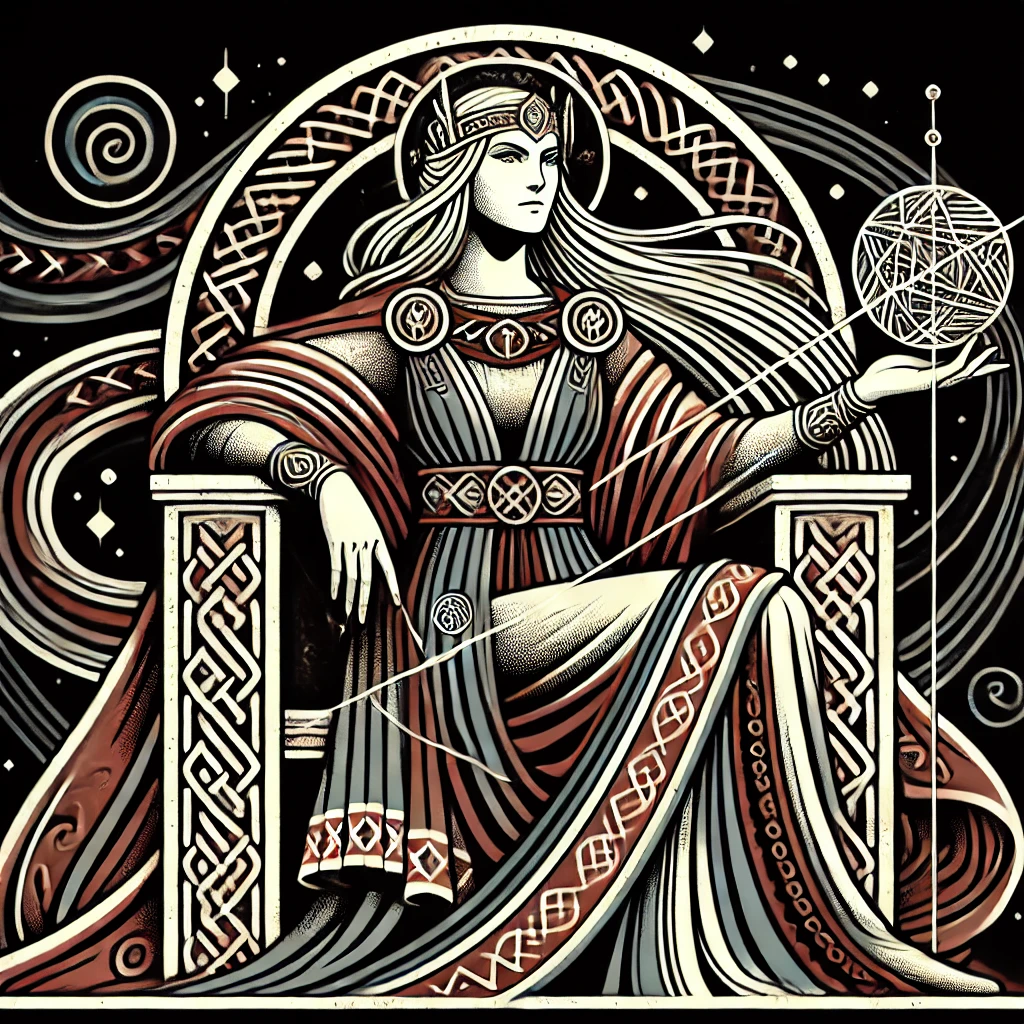
The Norse goddess Frigg sits regally in her throne, weaving fate itself

Frigg

Divine Dominion: Fate, motherhood, marriage and knowing absolutely everything — but keeping it to herself

Temperament and Tendencies: Frigg is the ultimate quiet power player. As Odin’s wife and queen of the Aesir, she has the gift of foresight; she knows exactly how everything will end. But does she share this knowledge? Absolutely not. Instead, she spends her time weaving the threads of fate and occasionally trying (and failing) to save her golden boy, Balder. 

Signature Style:

  • A spindle and distaff, because fate doesn’t weave itself

  • A throne right next to Odin, where she sees everything

  • A talent for making oaths happen, which works great — until Loki finds a loophole

Inner Circle:

  • Balder, her beloved son (RIP)

  • Odin, her mysterious, wandering husband

  • A host of minor goddesses who help her manage fate

Saga-Worthy Moment: She got everything in existence to swear an oath not to harm Balder … except for mistletoe. That one oversight set off the entire apocalypse countdown.

Ragnarök Status: Survives (but she already knew that) 

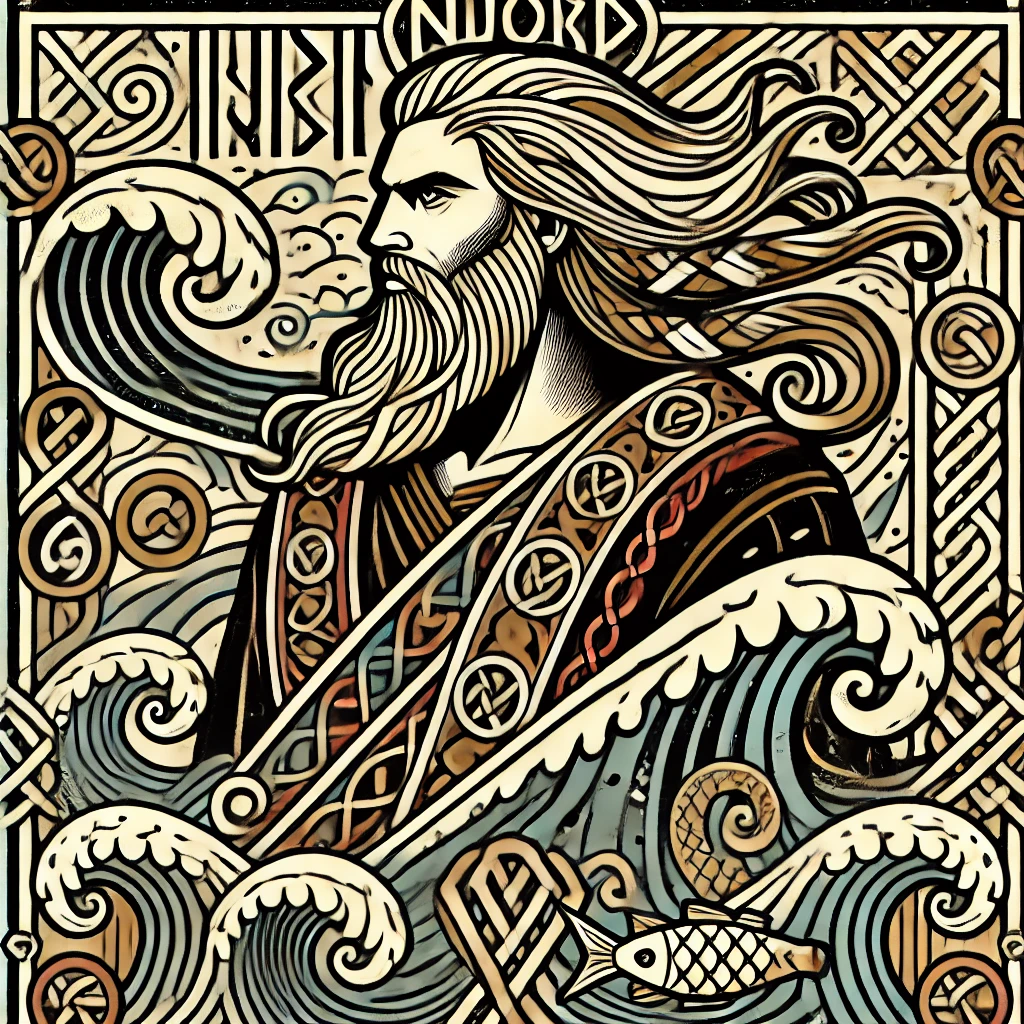
The Norse god of the sea, Njord, stands amid waves and runes

Njord

Divine Dominion: The sea, wealth, boats and awkward family vacations

Temperament and Tendencies: Njord is chill. He’s a sea god who just wants everyone to be rich, happy and sailing the open waves. But thanks to an arranged marriage with Skadi, a snow-loving giantess, his life is one long compromise between the beach and the mountains. Spoiler: Nobody’s happy.

Signature Style:

  • A ship that can sail on land if needed

  • An eternal tan, because sea gods don’t do SPF

  • A lot of treasure — the sea is a profitable business

Inner Circle:

  • Freyr and Freyja, his beloved kids

  • Skadi, his extremely outdoorsy ex

Saga-Worthy Moment: He and his wife, Skadi, agreed to split their time between his beach house and her mountain lodge. Both hated each other’s homes, so they split up, making Njord the god of divine irreconcilable differences.

Ragnarök Status: Not really a fighter, so he might just float off into the sunset

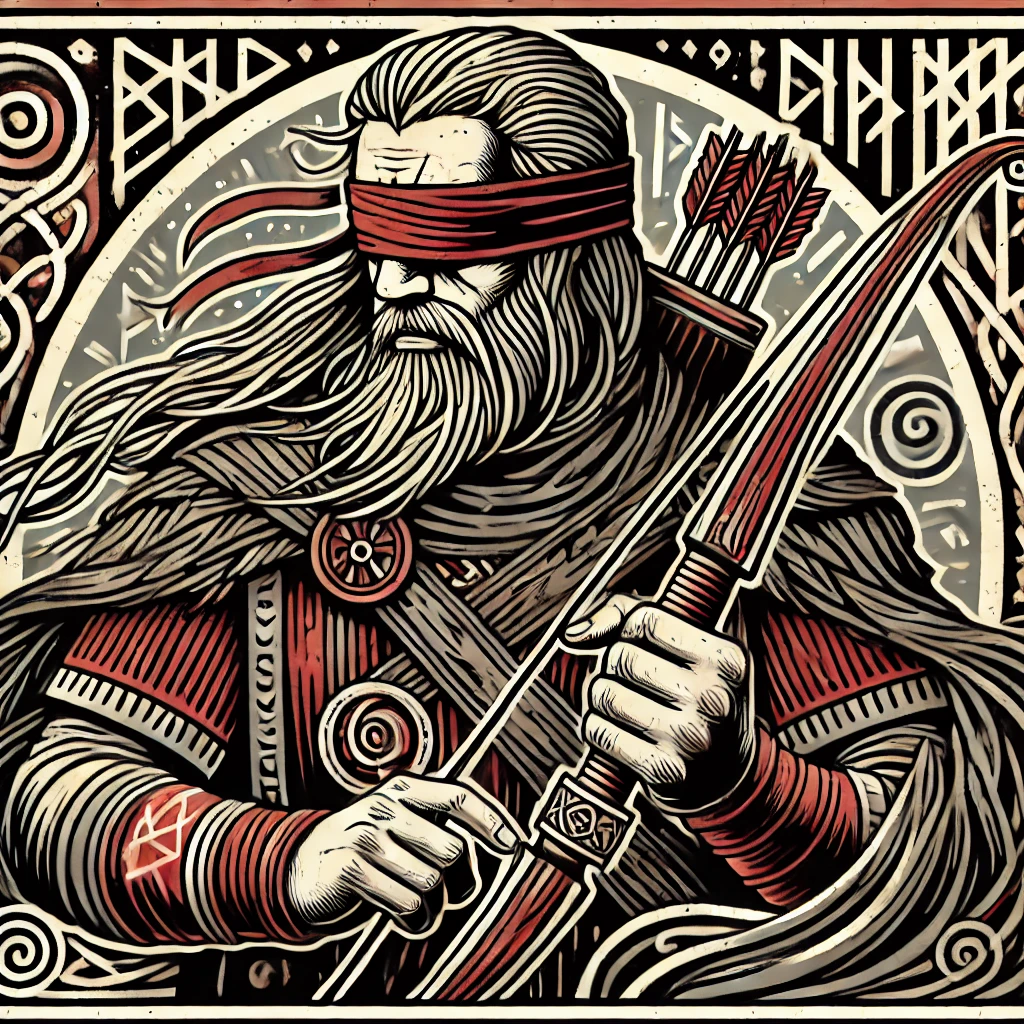
The blindfolded and blind Norse god Hodr, holding his bow

Hodr

Divine Dominion: Darkness, tragic accidents and being way too trusting of Loki

Temperament and Tendencies: Hodr is kind-hearted but doomed, born blind and destined to kill his own brother Balder — which is super-awkward because they actually liked each other. But the gods don’t even blame him. They all know it was Loki’s fault.

Signature Style:

  • A bow and arrow, because nothing could possibly go wrong handing that to a blind guy

  • A general vibe of tragic inevitability

  • Being the saddest pawn in the whole mythology game

Inner Circle:

  • Balder, his ill-fated brother

  • Frigg, his mom, who really tried her best

  • Loki, who hands him the murder weapon like some cosmic prank gone too far

Saga-Worthy Moment: When the gods played their “let’s throw stuff at Balder” game, Hodr got handed a mistletoe-tipped arrow by Loki, who kindly helped him aim. Instant tragedy.

Ragnarök Status: Already dead before Ragnarök even starts. A true overachiever in cosmic misfortune.

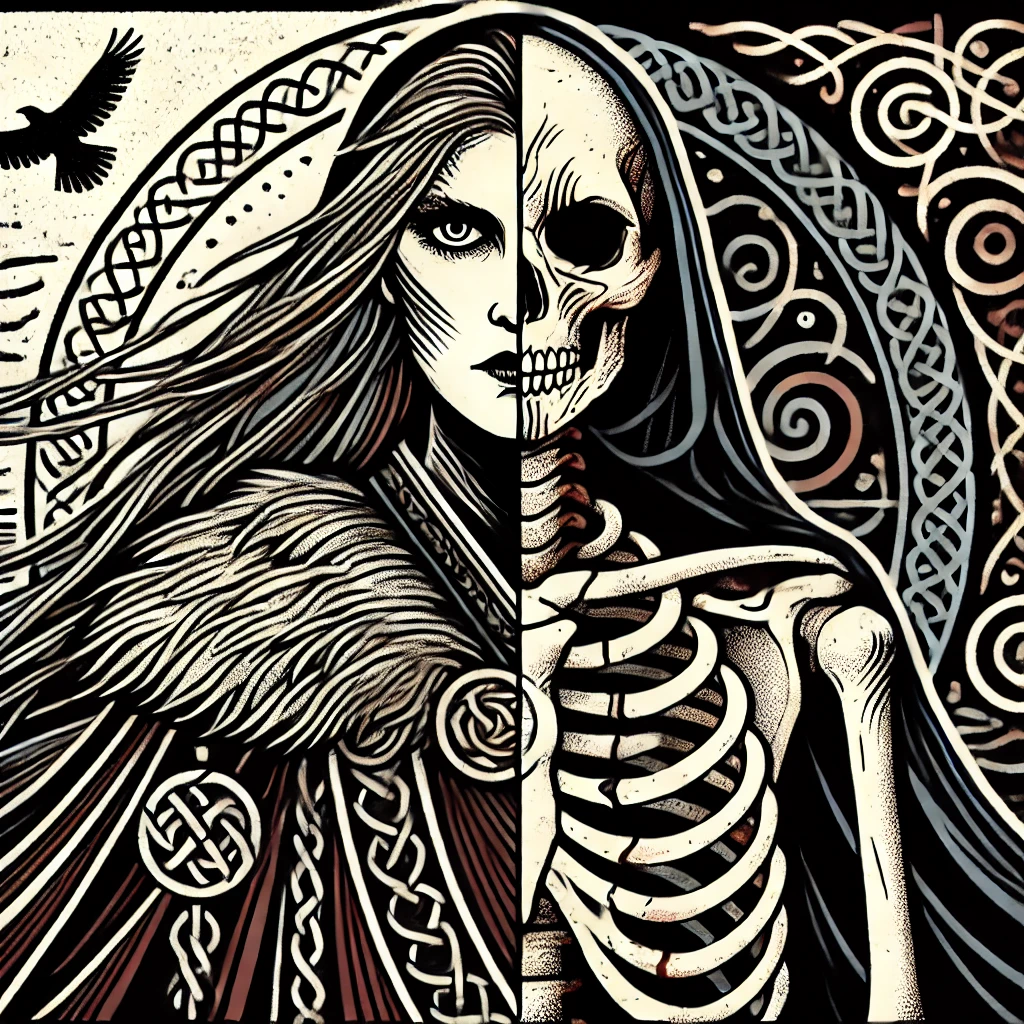
Hel, the Norse goddess of the underworld, half beautiful woman, half skeleton

Hel

Divine Dominion: The underworld, death, and giving zero fucks about your feelings

Temperament and Tendencies: Hel is half living woman, half rotting corpse, which really sets the tone. Unlike the fiery torment of some afterlives, Helheim is more of a cold, dreary waiting room for souls who didn’t die in battle. Hel’s not really cruel; she just doesn’t give a shit.

Signature Style:

  • A kingdom named after herself, because branding matters

  • An expression that says, “This meeting could’ve been an email.”

  • A general air of “why are you bothering me?”

Inner Circle:

  • Loki, her dad, who barely visits

  • The dead, who don’t exactly have options

Saga-Worthy Moment: When Balder died, Hermod (Odin’s other son) rode into Helheim to beg Hel to release him. Hel said sure — if literally everything in the world would weep for him. When one giantess (Loki in disguise, naturally) refused, she slammed the gates shut and went back to not caring.

Ragnarök Status: Stays put in Helheim, because she has a kingdom to run, thank you very much.

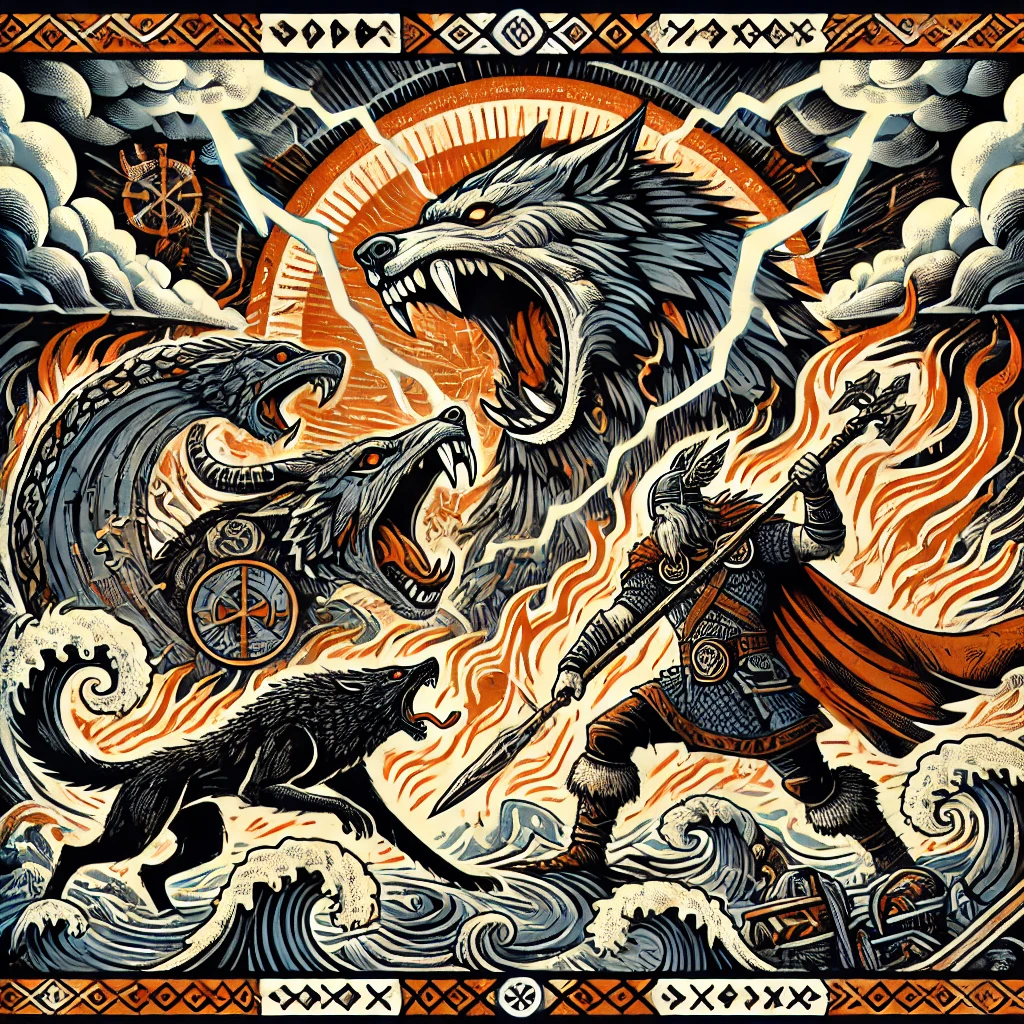
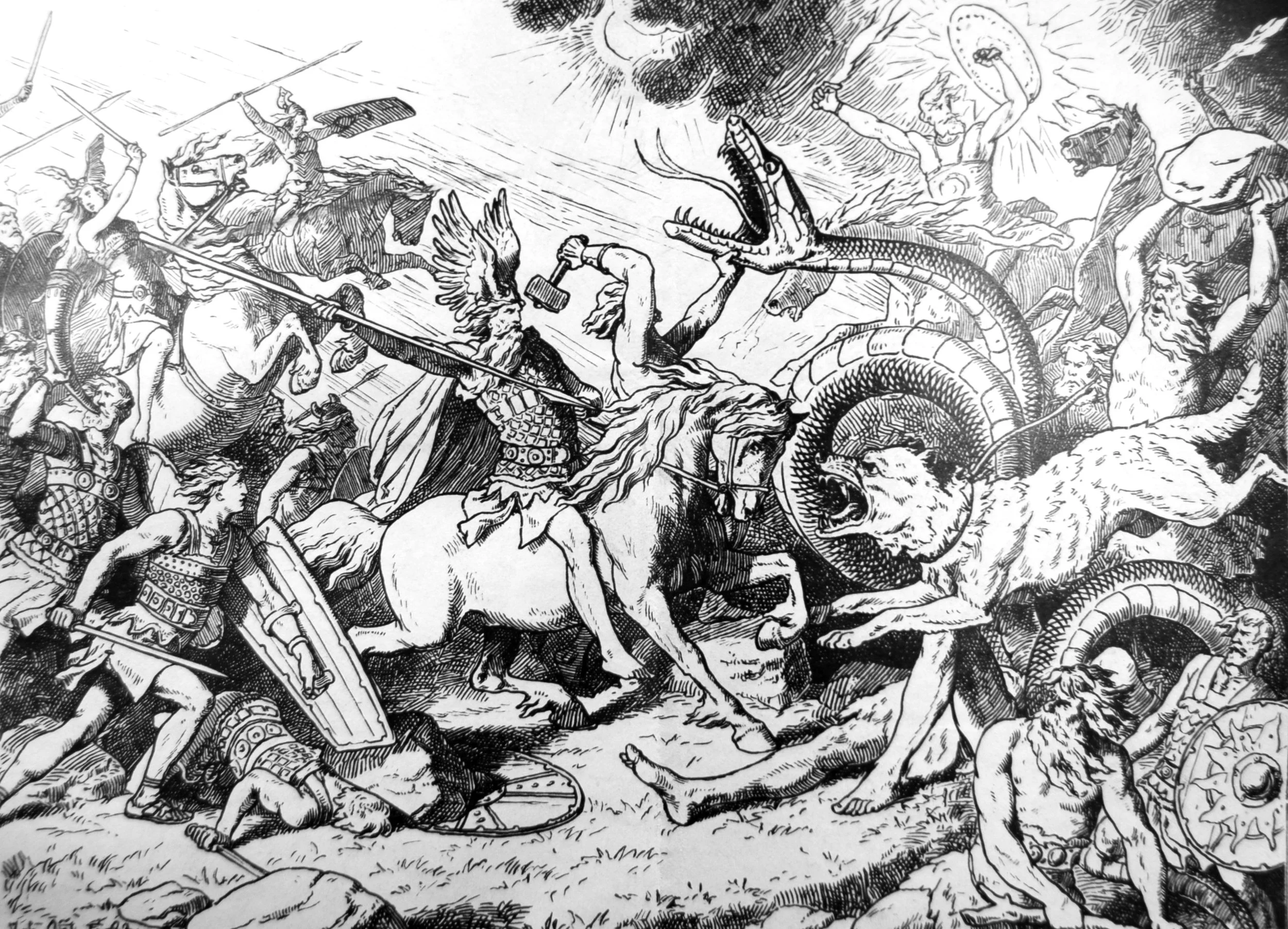
The Norse gods battle monsters, including giant wolves and serpents during Ragnarök, the end of the world

The Norse Pantheon: Gods of Glory and Doom

The Norse gods are a paradox: mighty yet mortal, powerful yet doomed. Unlike the serene and eternal deities of other mythologies, they live in the shadow of an ending they can’t escape. 

But rather than despair, they fight harder, love wilder and drink deeper. They’re warriors, tricksters, rulers and seers, but above all, they’re beings who embrace their fate and make every moment count.

And maybe that’s what makes them so compelling. The Norse gods aren’t distant, perfect figures sitting on golden thrones. They struggle, they fail, they sacrifice, and they rage against the inevitable. They’re larger than life — until they die. 

So raise a horn of mead, toast to the Aesir and Vanir, and remember: Even gods can fall, but legends live forever. –Wally

Who Is Freyja? The Fierce and Enigmatic Goddess of Norse Mythology

Duality defines Freyja, the Norse goddess of love and war, beauty and death. She’s also a powerful sorceress, wielding seid — magic tied to fate, transformation and prophecy.

The Norse goddess Freyja with her falcon garb and armor in her chariot drawn by two big cats

Duke and I adopted a cat from a shelter named Freya — and quickly fell under her spell. I was always more of a Greek and Roman mythology buff than Norse, so my curiosity was piqued — I wanted to know more about the goddess our new kitty was named after. I dove into learning about the goddess, and it soon became clear that our Freya is every bit as beautiful, fierce and wild as her divine namesake, with both embodying a blend of grace, power and an untamed spirit.

Freyja (as it’s most commonly spelled), the Norse goddess of love, beauty, war and magic, both captivates and unnerves. 

Freyja stands as one of the most captivating figures in Norse mythology — a goddess of dualities who embodies beauty and ferocity, love and war, magic and mystery.
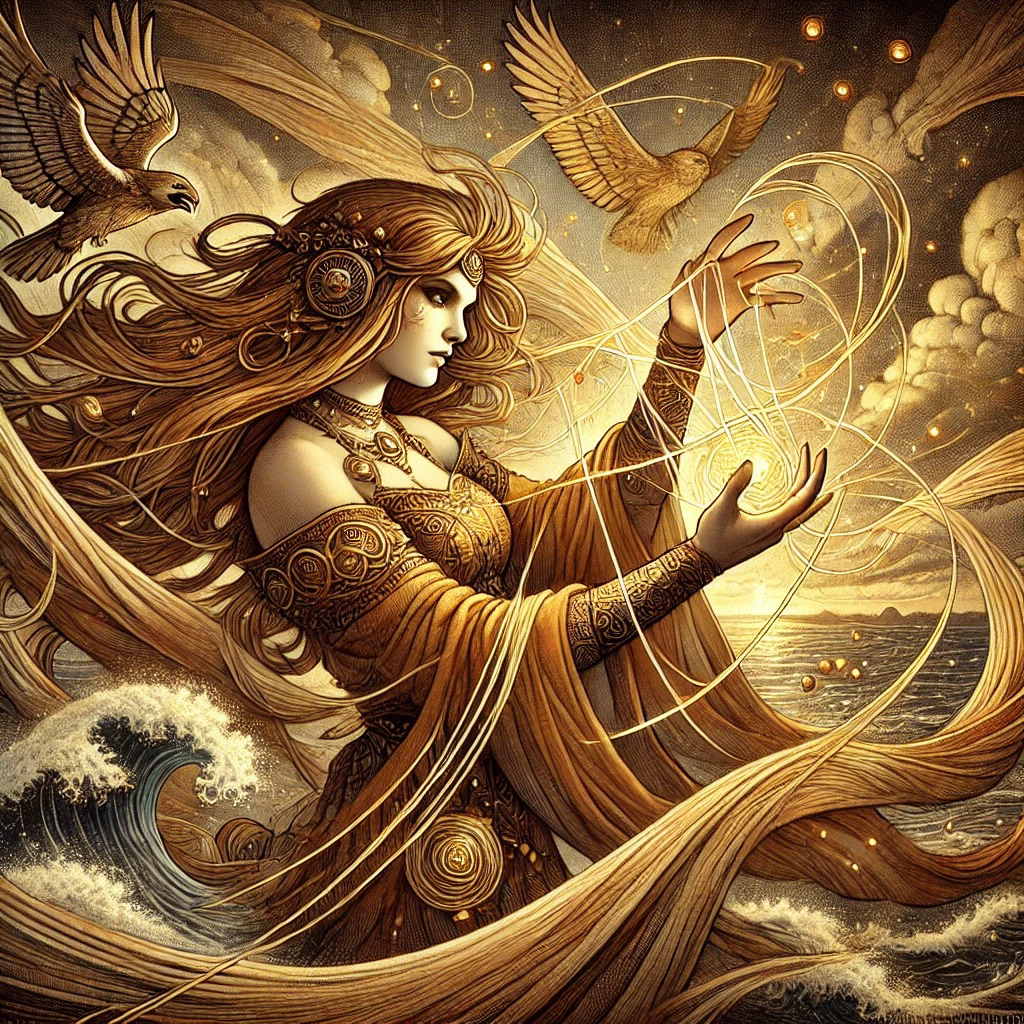
Falcons fly by at the Norse goddess Freyja casts a magic spell by the water

What Does Freyja Look Like?

She’s draped in a cloak of falcon feathers, shimmering with the colors of the sunrise — golden and russet hues that catch the light as she moves. 

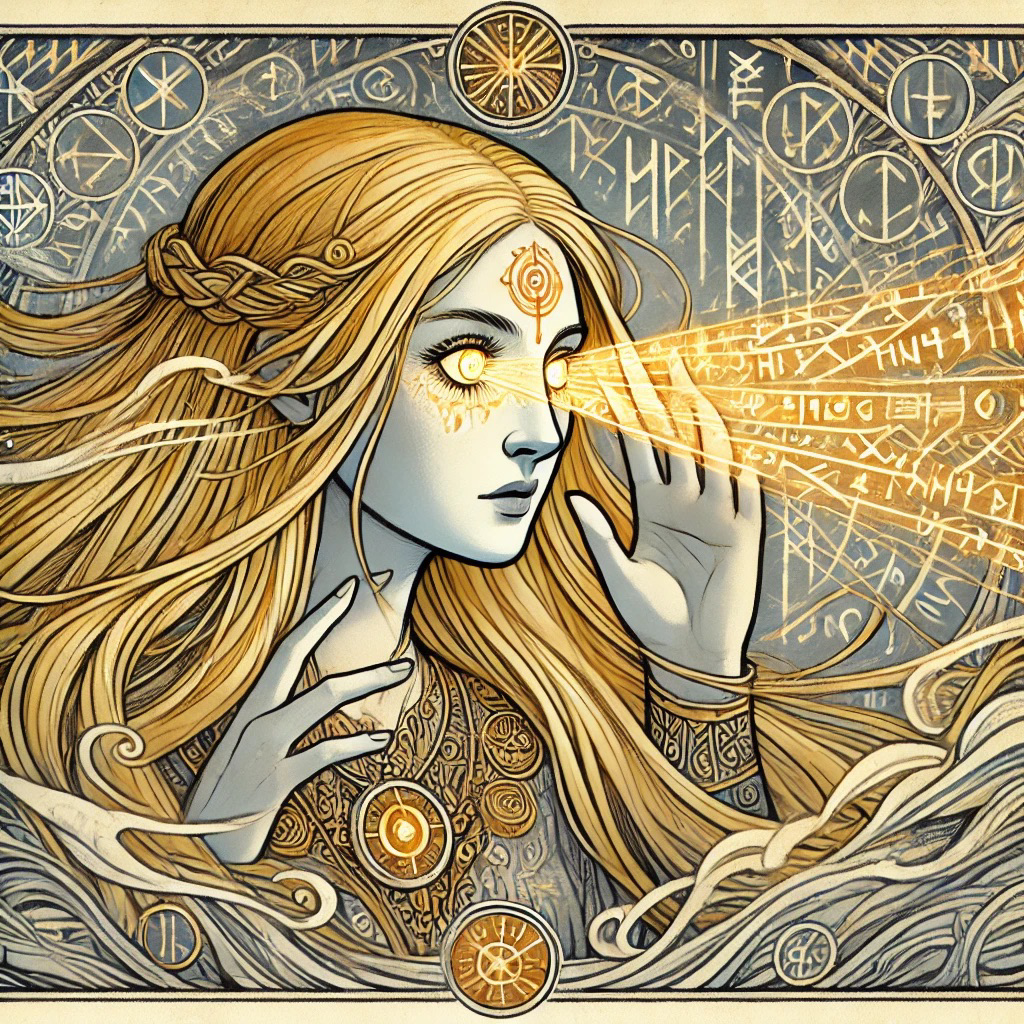
Her hair, long and flowing like streams of molten amber, contrasts with eyes that seem to hold the mysteries of the cosmos. 

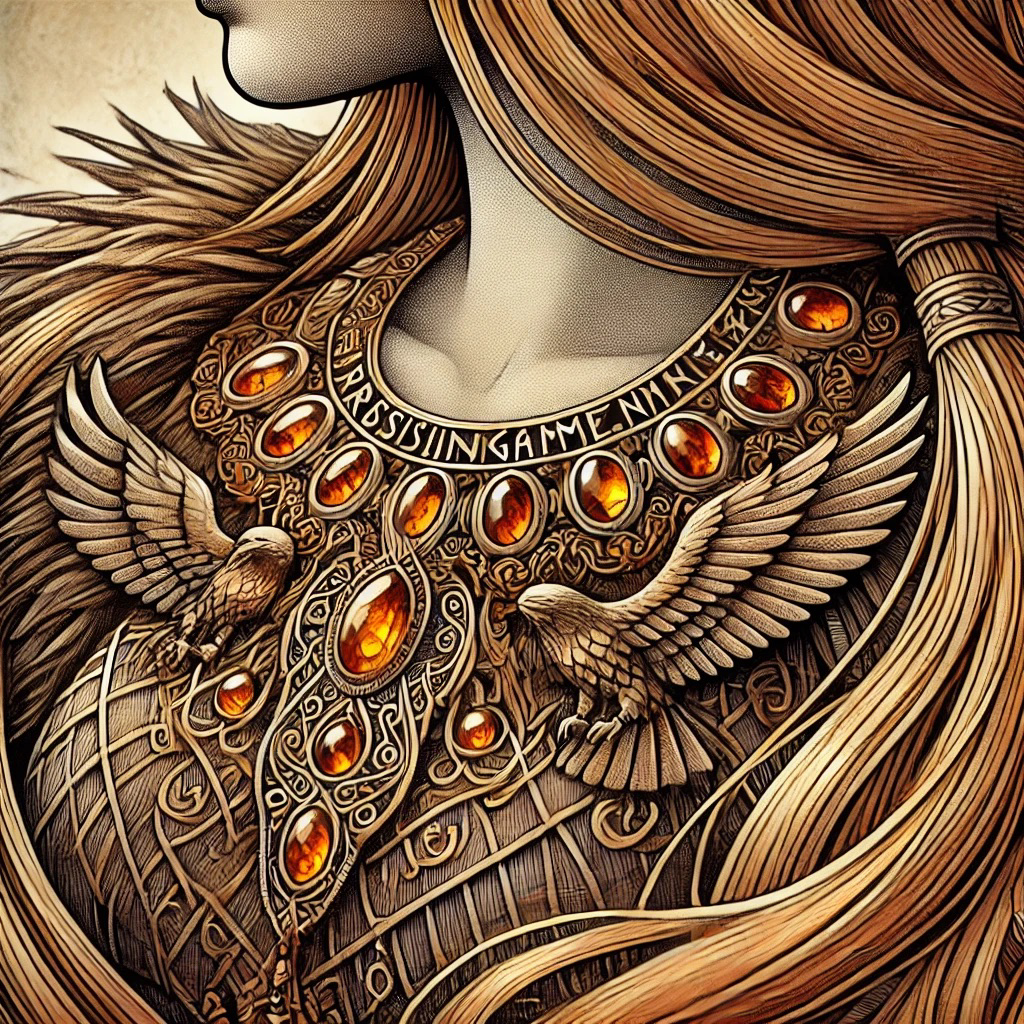
Adorning her neck is Brísingamen, the legendary necklace forged by dwarves in the depths of the Earth. (See the full myth of the necklace below, in which Freyja whores herself out to dwarves.)

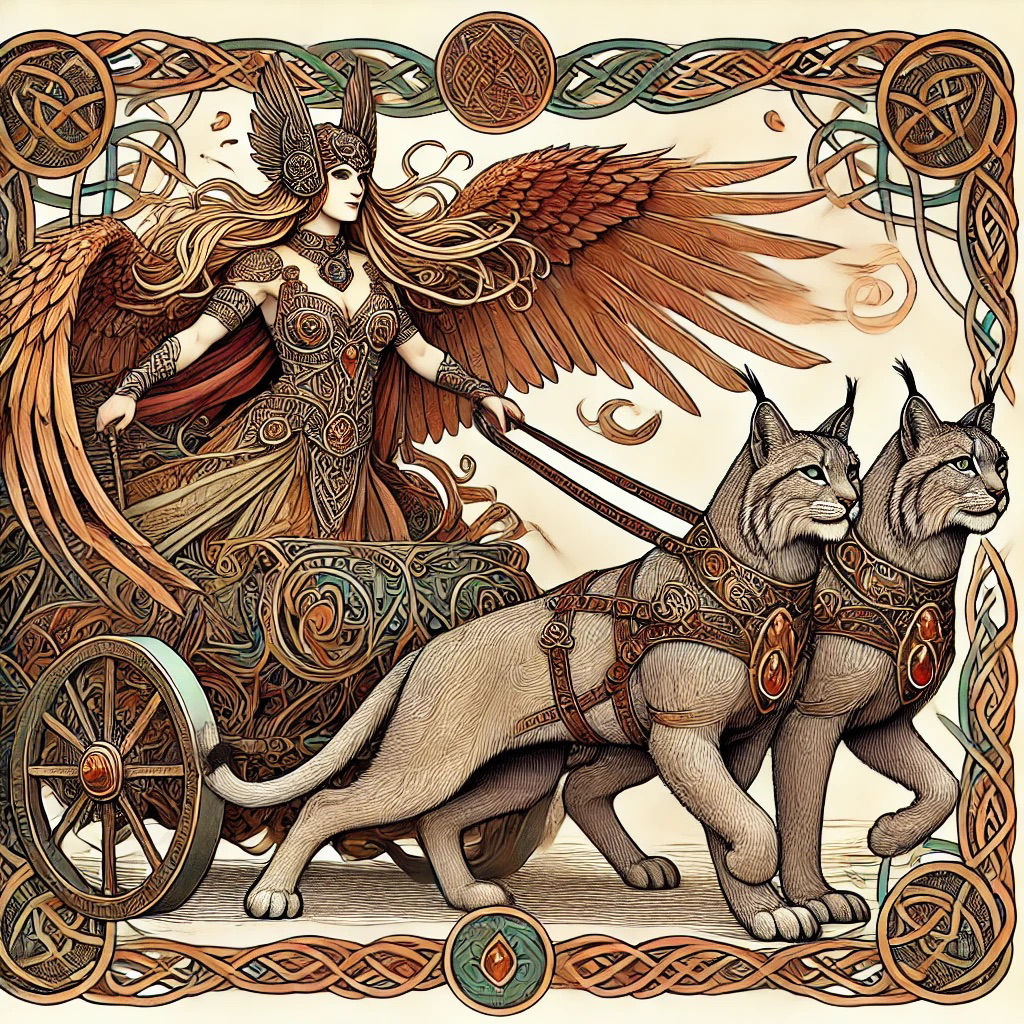
The Norse goddess Freyja with wings spread, rides in her chariot, drawn by two lynx-like cats

Freyja’s Chariot

She commands a chariot drawn by two formidable big cats. These silver-furred creatures, known as Bygul and Trjegul, glide with the grace of wild predators, their eyes glowing with the sharp intelligence and cunning of the goddess they serve. 

The chariot moves as if weightless, whether it glides across the earth or soars through the sky. 

The origin of the Norse goddess Freyja, emerging from the sea at dawn

The Origin of Freyja

Back when the cosmos were still untamed, swirling in chaotic mists and shadows, the Vanir emerged from this primal void — gods and goddesses intrinsically tied to nature’s cycles, ancient and wild. Among them was Freyja, born of the sea god Njörðr and sister to Freyr. 

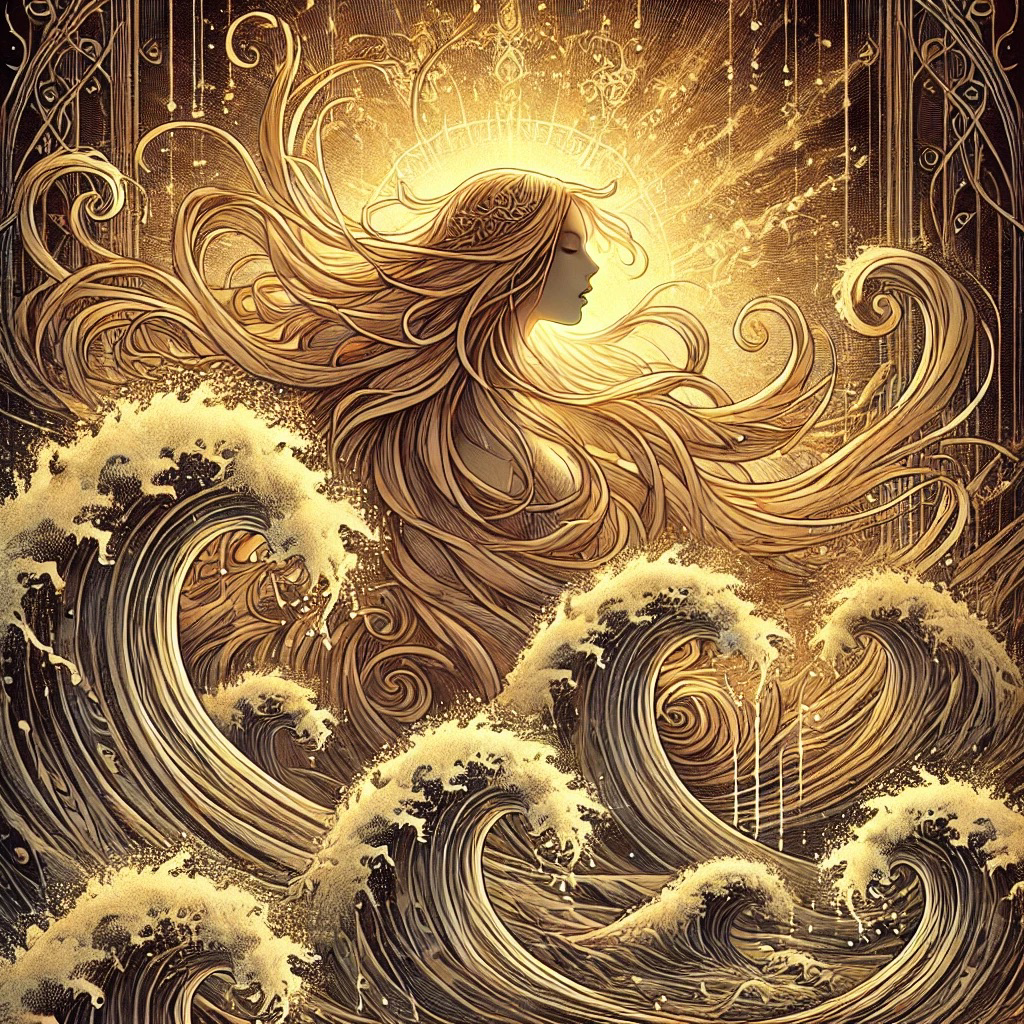
But Freyja’s birth was unlike any other — rumor has it that she emerged from the crashing waves, fully grown, as the saltwater mixed with the dawn’s first light, setting her hair aglow with a golden sheen. (Sounds quite a bit like Aphrodite, doesn’t it?)

From the very start, Freyja carried a duality within her: a grace that could soothe even the most troubled hearts, and a ferocity that could shake the heavens. 

As she grew, her allure was unmatched, yet it was her wisdom in seiðr, the mysterious Norse magic, that truly set her apart. It was said that she could weave the very threads of fate, bend reality to her will and command the elements themselves. Her presence could sway the tides of war, and her tears, when shed, turned into precious amber, glittering tokens of her sorrow and joy.

The Vanir, Freyja’s original tribe, went to war with the Æsir in a conflict that shook the Nine Realms. To establish peace, Freyja played a key role as a mediator. As part of the truce, the Vanir sent Freyja and her family to live with the Æsir — a gesture that underscored her immense value and the high stakes of the agreement.

She craved adventure, adored beautiful things and was never afraid to wield her formidable powers to get what she wanted. This was a goddess who is as multifaceted as the jewels she wears — beautiful and fearsome, compassionate and unyielding, with a touch of mischievous charm. Just like our cat.

Freyja in full armor, holding a sword on a battlefield, as the Norse goddess of war

Goddess of Love and War

Freyja is a goddess of dualities, straddling seemingly opposing forces with effortless grace. She’s most commonly associated with love, beauty and fertility, but she’s far from a simple goddess of romance. Freyja’s love is fierce and complex, reflecting both the sweetness of new beginnings and the passion that can lead to conflict and heartache. 

Her beauty is more than skin deep, tied to the power she wields and the control she exercises over those who desire her favor. Her role in fertility isn’t just about the growth of crops or even the bearing of children — it’s about the vital force of life itself, the energy that sustains both the Earth and its people.

But Freya’s also a goddess of war, presiding over the battlefield in a role similar to that of Odin. Half of those who die in battle are claimed by Freyja, who takes them to her hall, Fólkvangr, while the other half go to Valhalla. This dual role reflects the Norse view of death, where even in war, the concepts of love, honor and sacrifice are deeply intertwined. Freyja’s warriors are chosen not just for their valor but for the passion with which they lived and fought.

Fólkvangr, the hall of the dead ruled over by the Norse goddess Freyja

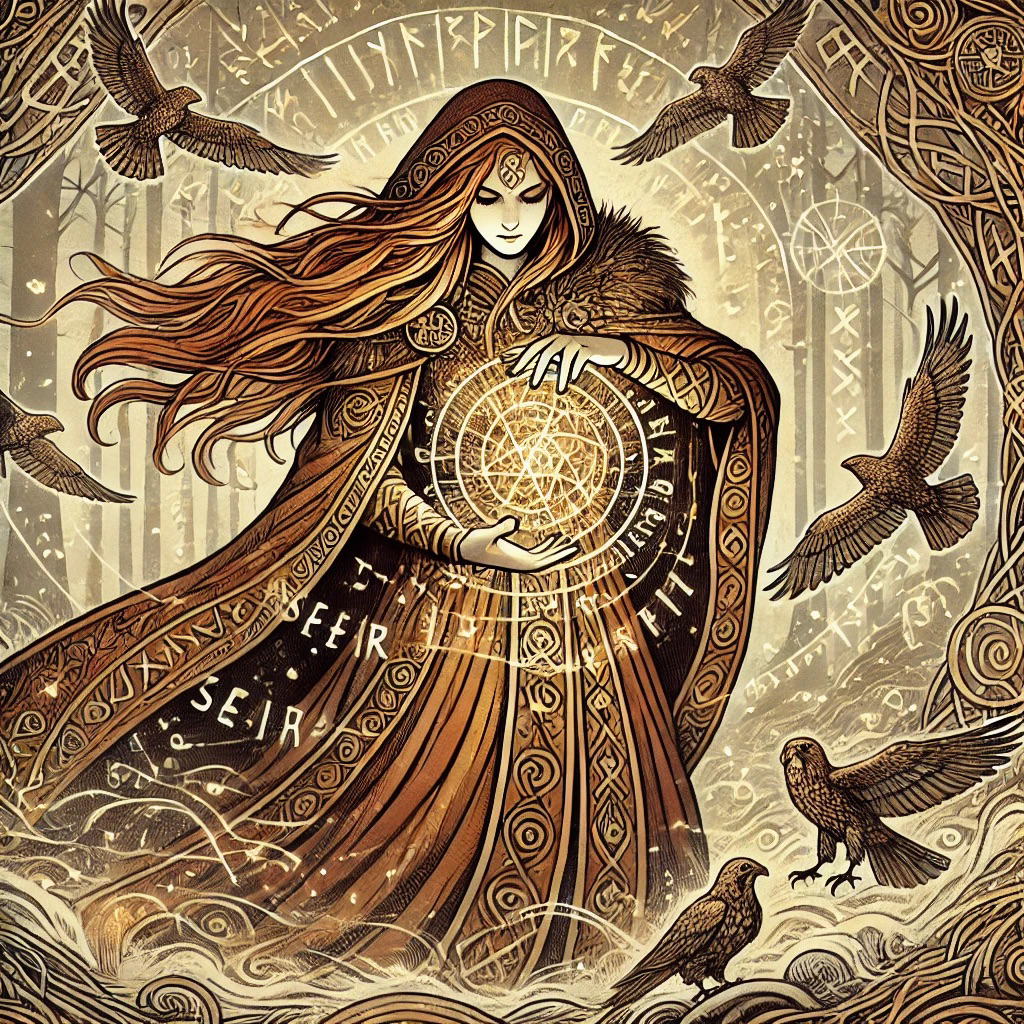
Freyja’s power also extends into the realm of magic, specifically seiðr — a type of Norse sorcery associated with fate, transformation and prophecy. She’s said to have taught this art to Odin, a significant detail that underscores her mastery of one of the most feared and revered practices in Norse culture. Seiðr allowed her to manipulate the threads of destiny, control the elements and see into the future, making her both respected and dreaded.

Norse goddess Freyja holds dominion over magic, as runes swirls around her as well as falcons
Norse goddess Freyja, surrounded by runes, sees into the future

Freyja’s Symbols and Associations 

Freyja’s symbols further reflect her complex nature. Brísingamen, her radiant necklace, is a source of power and authority. The cats that draw her chariot embody her independence and mystery, as felines have long been associated with both sensuality and cunning. Her falcon cloak, which allows her to take the form of a bird and fly, represents her ability to traverse the boundaries between worlds — between life and death, love and war, magic and reality.

Finally, Freyja’s association with gold and amber, symbolized by the tears she sheds for her missing husband, ties her to the earth’s treasures. These tears, said to be found along the shores of rivers and forests, show how deeply her emotions are connected to the natural world. 

Freyja’s domains make her one of the most complex figures in Norse mythology — her influence extends across all realms, and through her associations, we see a goddess who embodies the full spectrum of human and divine experience.

Brísingamen, the Norse goddess Freyja's gorgeous necklace

Freyja’s Necklace, Brísingamen

It’s a masterpiece of craftsmanship — each link in the chain engraved with ancient runes of power and protection, glowing with an otherworldly radiance. Inset with gemstones that flicker between deep amber and blood-red, it pulses in time with Freyja’s heartbeat, amplifying her beauty and authority, making even gods and giants bow in awe. And like any good Norse artifact, it has its own name: Brísingamen.

The tale of how Freyja came to possess Brísingamen is a perfect blend of ambition, desire and a touch of scandal — exactly the kind of tale you’d expect from the goddess of love and war.

One evening, Freyja was wandering through the forests of Midgard when her eye caught the glimmer of something extraordinary: a necklace unlike any she had ever seen. It was Brísingamen, forged by four dwarves deep within the earth, and it shone with a brilliance that rivaled the stars. Instantly captivated, Freyja knew she had to have it. But dwarves are a tricky bunch — they aren’t easily bribed with gold or treasures. No, these craftsmen had something else in mind.

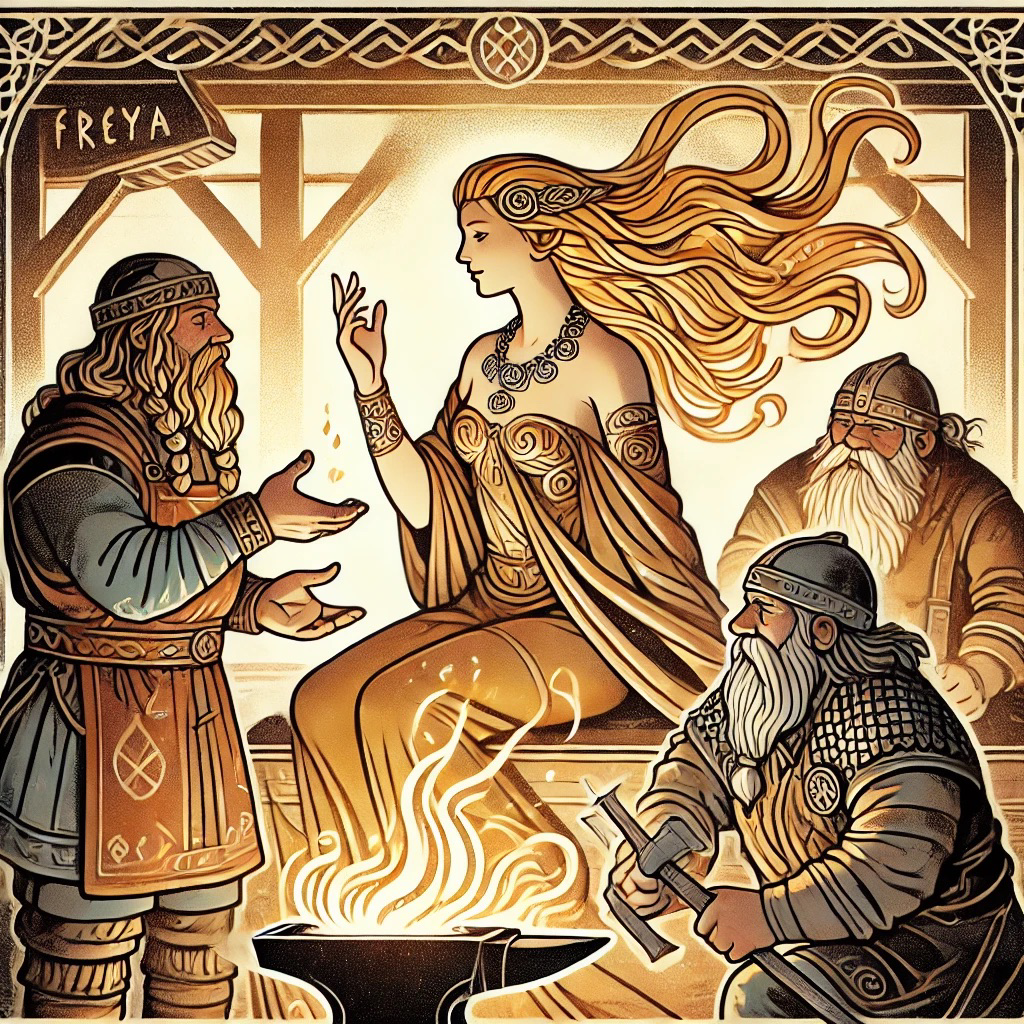
When Freyja approached them, the dwarves, grinning slyly, made their offer: sleep with each of them, and the necklace would be hers. Now, Freyja isn’t one to shy away from a deal — especially when something as dazzling as Brísingamen is at stake. She weighed her options, considered the price, and agreed. The deal was struck, she had sex with each dwarf in turn — and the necklace was hers, glittering proudly around her neck. 

Norse goddess Freyja offers herself up dwarves in return for the neckace Brísingamen

But not everyone was thrilled by Freyja’s deal.

Loki, the trouble-making trickster, caught wind of the arrangement and couldn’t resist stirring up trouble. He went straight to Odin, gleefully spilling the beans about how Freyja had “negotiated” for her new accessory. Odin was outraged and demanded the necklace be taken from her as a lesson in humility.

Loki, looking a lot like Tom Hiddleston, steals the necklace Brísingamen from Freyja

Loki, always ready to stir the pot, snuck into Freyja’s hall, slipped past her defenses and stole Brísingamen right from under her nose. When Freyja discovered the theft, she didn’t take it lightly. She stormed into Asgard, confronting Odin with a fury that shook the heavens. 

Odin decreed that if Freyja wanted her precious necklace back, she would have to incite a war. And even if Freyja wasn’t particularly keen on Odin’s terms, she knew she wasn’t walking away from Brísingamen. 

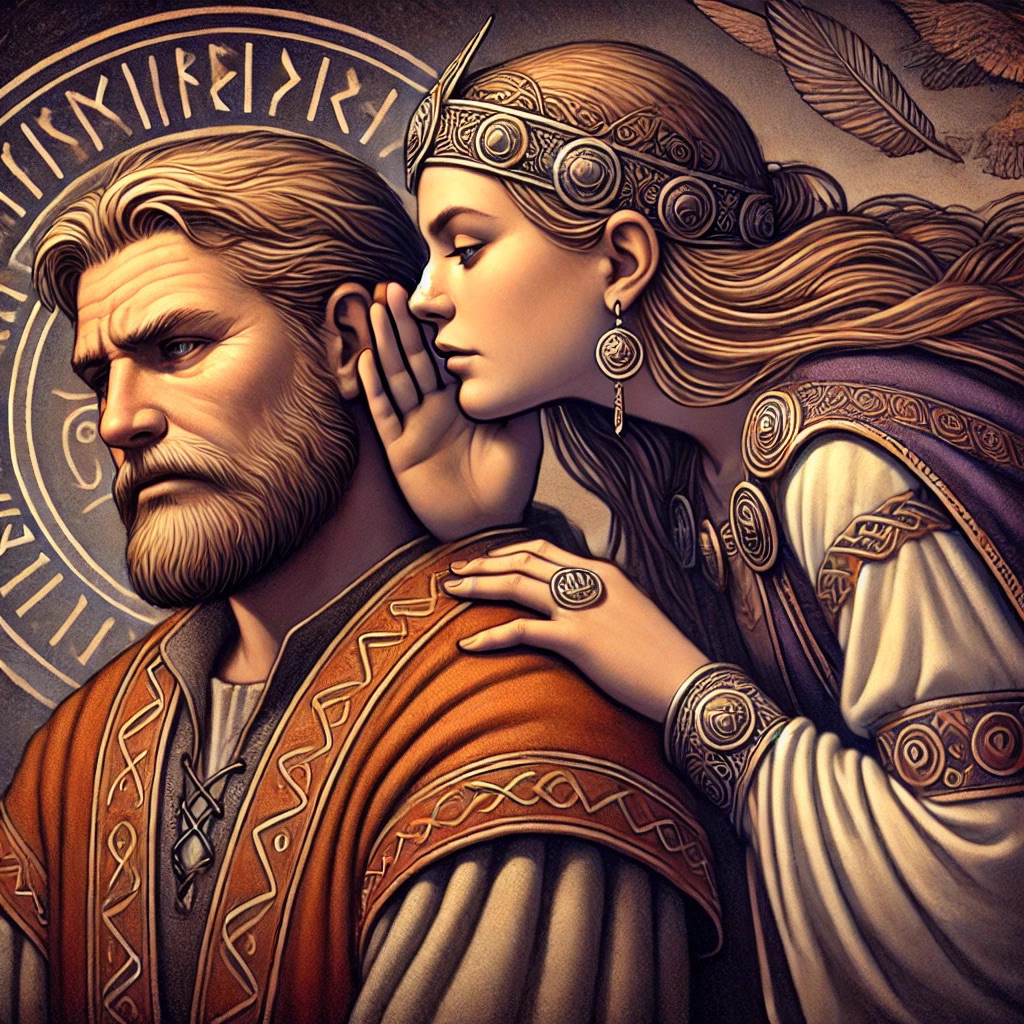
The Norse goddess Freyja whispers into a bearded man's ear to start a war

Now, how to start a war? Freyja took a surprisingly subtle approach. She traveled through villages and courts, planting seeds of jealousy, rivalry and greed. Her whispers acted like a slow poison, and soon, those tiny sparks of discord ignited into flames. Neighbor turned against neighbor, tribes clashed over petty slights, and kings sought expansion through conquest. War was declared, and Freyja got her necklace back. 

The giant Thrym holds up Mjölnir, Thor's hammer, which he has stolen

Freyja and Thor’s Hammer

In another myth, Thor woke up one day to find that his beloved hammer, Mjölnir, had vanished. Now, losing Mjölnir isn’t like misplacing your car keys — it’s a catastrophic event that leaves Asgard vulnerable to all sorts of enemies. 

As Thor fumed and threatened to smash anything in sight, Loki (who else?) volunteered to investigate. Using his usual cunning, Loki discovered that the hammer had been stolen by Thrym, a giant with a particularly thick skull and a bad case of greed. Thrym wasn’t interested in riches or glory, though — he had his eyes set on something far more valuable: Freyja.

Thrym sent a message to the gods: “You want the hammer back? Fine, but I want Freyja as my bride in exchange.” 

When Freyja heard the demand, her face turned scarlet, her eyes blazed, and she unleashed a roar so powerful that it caused the very foundations of Asgard to tremble. 

“Do you really think I’d let myself be bartered off like some prize cow?” she thundered, sending all the gods scrambling for cover. 

With Freyja’s refusal made perfectly clear, the gods had to get creative. They hatched a hairbrained plan that could only work in the world of Norse mythology: Thor would disguise himself as Freyja and trick Thrym into giving back Mjölnir. 

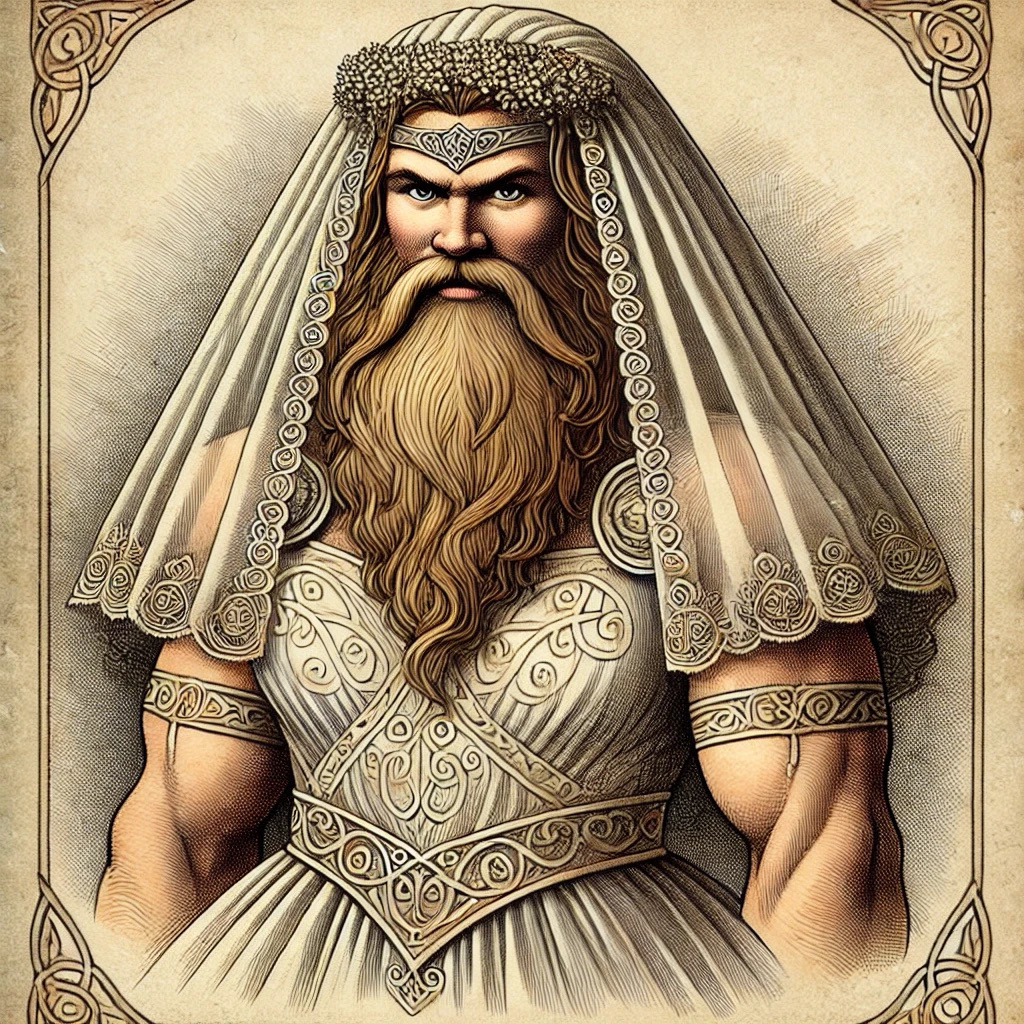
So there he was — Thor, the mighty god of thunder, his bulging muscles squeezed into a bridal gown, wearing a veil that barely concealed his thick beard. Loki, never one to miss out on a prank, gleefully played the role of Thor’s maid of honor and accompanied him to Thrym’s hall.

Thor dressed up as a bride to fool the giant Thrym

When Thrym saw his “bride,” he was thrilled — though a little confused by Freyja’s sudden appetite, as she devoured platter after platter of food and drained barrels of ale in one sitting. Loki, quick on his feet, explained that Freyja hadn’t eaten in days, out of excitement for her wedding. Dim-witted Thrym was sold and brought out the hammer as part of the wedding ceremony.

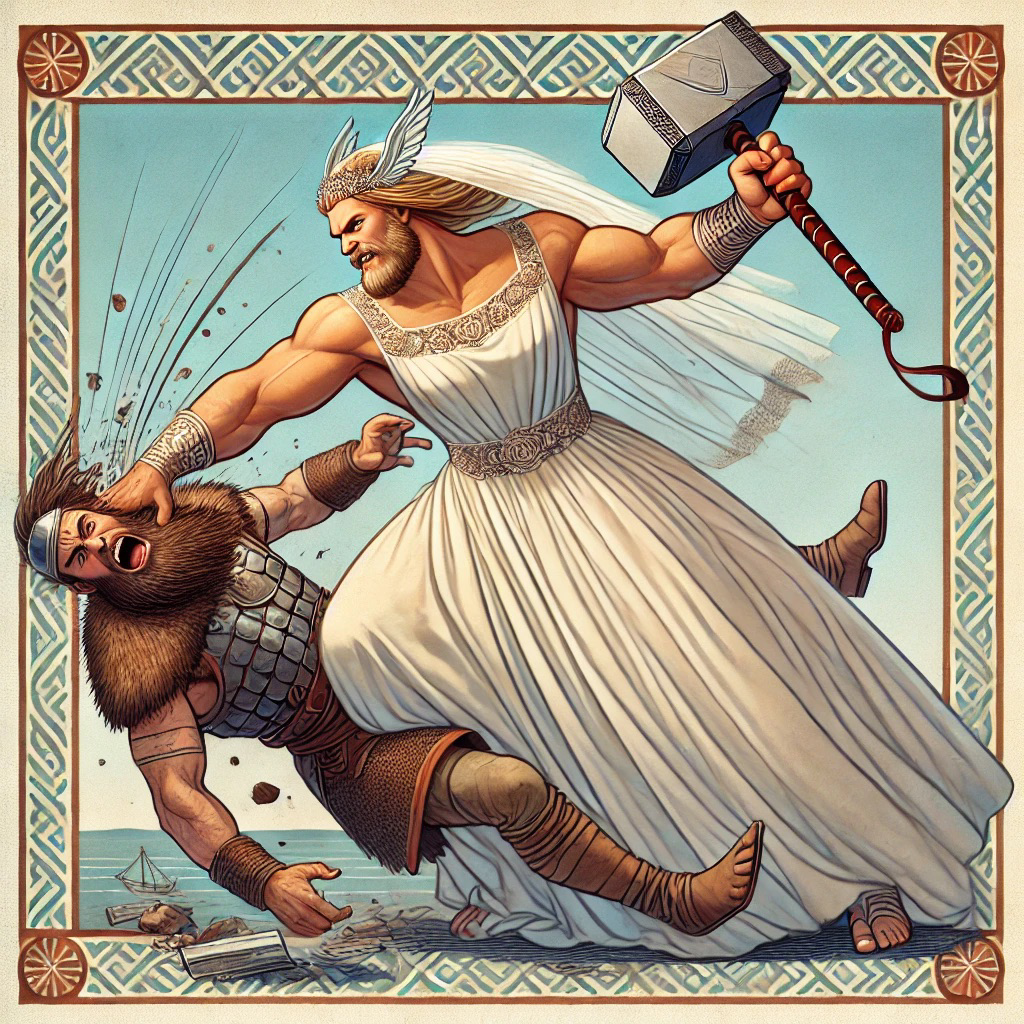
The moment Mjölnir was placed in “Freyja’s” lap, the charade was over. Thor ripped off his veil, seized the hammer, and with a single swing, sent Thrym and his cronies flying. The feast turned into a battlefield, with Thor gleefully smashing his way through the giant’s hall while Loki cackled in the background.

Thor, dressed in a wedding dress as Freyja, used Mjölnir, his hammer, to kill the giant Thrym

The gods returned to Asgard victorious, hammer in hand and no bride sacrificed. And Freyja? She watched the whole spectacle from afar with an amused smirk. 

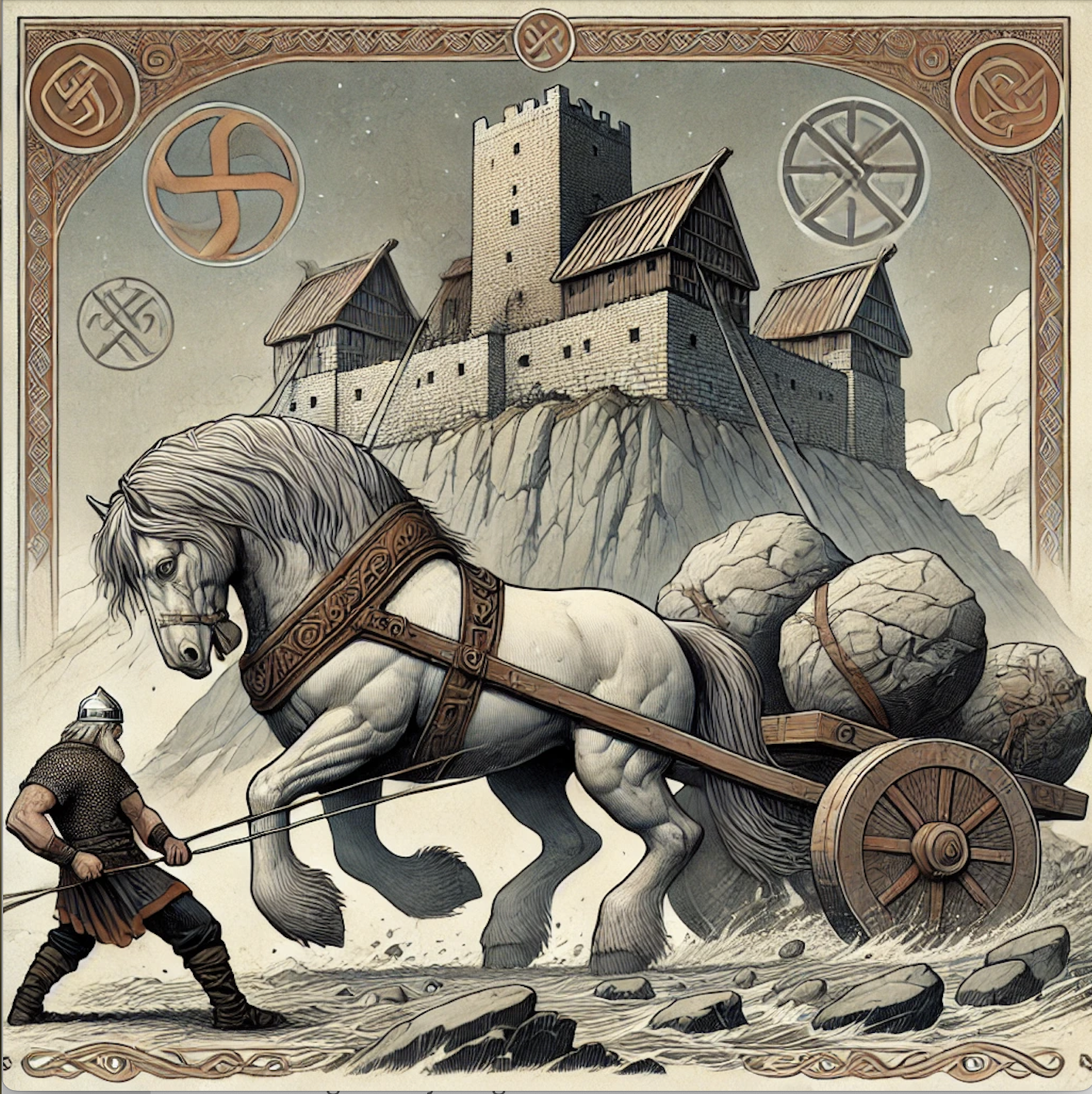
A giant uses the stallion Svadilfari to build Asgard's defences

Freyja as the Price of Asgard’s Defences

As we have seen, Freyja’s beauty and allure were legendary, which made her a target for unwanted attention — particularly from giants, who always seemed to be scheming for ways to get their hands on her. One such tale involves a giant who came to Asgard with an offer the gods couldn’t refuse…or so he thought.

The giant approached the gods with a bold proposition: He would build a wall around Asgard strong enough to keep out any enemy — an impenetrable fortress that could withstand even the fiercest of attacks. In return, he demanded three things: the sun, the moon and — most importantly — Freyja as his bride. Now, the gods weren’t exactly thrilled about the idea of losing the sun and moon, but the thought of handing over Freyja? Unthinkable.

Still, they figured they could outsmart the giant. After all, he was offering a monumental task, and they were confident that no one could complete such a project in the tight deadline they’d impose. The gods agreed to the deal but insisted that the wall had to be finished within a single season. Thinking they’d bought themselves an easy win, they relaxed…until the giant started making serious progress.

What they hadn’t anticipated was that the giant had a secret weapon: his powerful stallion, Svadilfari, who was hauling massive stones at lightning speed. As the deadline drew near, the gods realized they were in deep trouble. Freyja, fuming at the thought of being handed over like a prize, made it clear that if this deal went south, heads would roll. Literally.

Desperate for a solution, the gods turned to Loki, the trickster they could always count on for a scheme, however unconventional.

Loki didn’t disappoint. “Leave it to me,” he said with a sly grin, already hatching a plan.

That night, under the cover of darkness, Loki transformed himself into a sleek, graceful mare. His shimmering coat caught the moonlight as he trotted toward Svadilfari, the giant’s powerful stallion, who was tirelessly hauling massive stones for the wall.

Svadilfari, enchanted by the sight of this new and alluring horse, immediately lost interest in his work. Loki, in mare form, whinnied coyly, flicked his tail, and galloped into the forest. The stallion, spellbound, followed without hesitation.

The Norse trickster god Loki, disguised as a mare, seduces the stallion Svadilfari, luring him into the woods

What happened in the woods isn’t certain, but let’s just say Loki as a mare was just a bit too entrancing. He ended up pregnant and gave birth to Sleipnir, an extraordinary eight-legged horse with unmatched speed and strength. Sleipnir would go on to become Odin’s trusted steed, capable of crossing realms and outrunning the wind itself.

Meanwhile, with the horse gone, the giant’s progress slowed to a crawl. 

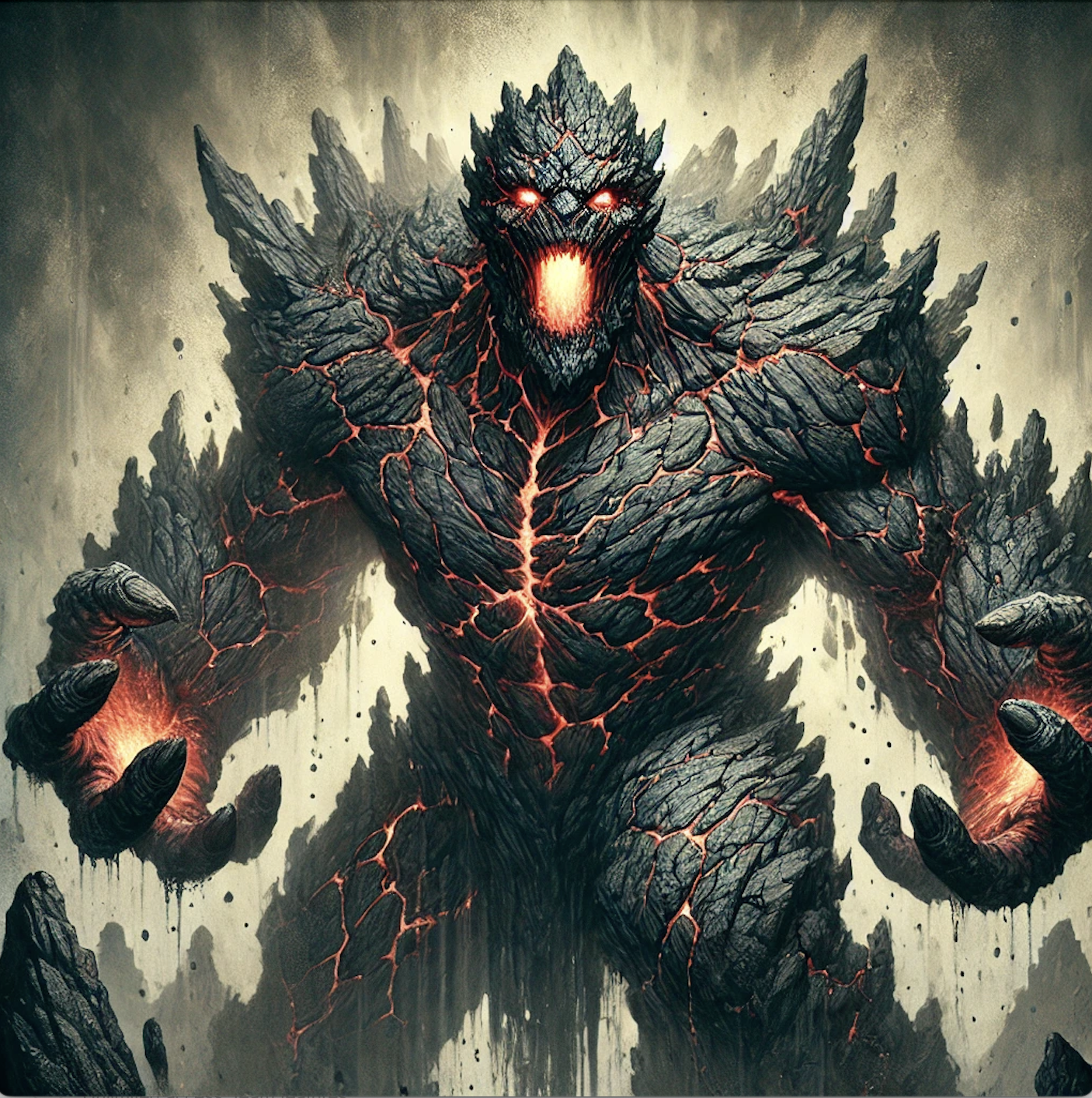
Enraged and realizing he’d been duped, the giant revealed his true form. It was terrifying to behold: His once humanoid features twisted and expanded, his body swelling to an immense size. His skin turned a dark, stony gray, cracked and weathered like ancient rock, with jagged ridges jutting from his shoulders and spine. His eyes burned like molten lava, seething with fury, and his hands became massive, clawed appendages capable of crushing stone. Veins of fiery red pulsed across his body, as if his rage was fueling him from within, and his voice thundered like an earthquake as he roared his fury, shaking the very ground beneath him.

A giant of Norse myth in its true form of jagged rocks and molten lava

But before he could make a move, Thor swooped in and took care of the problem the way he usually does — with a swift blow from Mjölnir, turning the giant into rubble. Crisis averted, the gods celebrated, and Freyja remained free, much to her relief.

Óðr, husband of the Norse goddess Freyja, wandering the worlds

Óðr, Freyja’s Wandering Husband

Freyja is married to Óðr (pronounced “Oh-thur”), a figure shrouded in mystery. His identity has long been debated by scholars. Some suggest that he’s another aspect of Odin, given the similarity in their names and roles as wanderers. If that’s true, it would make Freyja and Frigg — Odin’s wife, and a wise, reserved goddess of domestic life — two sides of the same coin, representing different aspects of a single goddess. 

Óðr, a mysterious figure even by Norse standards, was known for his wanderlust. For reasons unknown, he left Freyja, vanishing into the far reaches of the world. Heartbroken but determined, Freyja set out on a relentless quest to find him, traveling through every corner of the Nine Realms.

In her search, Freyja disguised herself many times, using her falcon cloak to fly over mountains, seas and distant lands. Her journey took her through realms of both gods and mortals, and wherever she went, she asked after Óðr. Yet her search was filled with more questions than answers, and with every door she knocked on, the trail seemed to grow colder. As the days turned into months and the months into years, Freyja’s sorrow became legendary.

The tears she shed in her search turned into shimmering gold or amber as they hit the ground. These tears were found scattered across forests and shores, becoming treasured jewels sought after by mortals and gods alike. Even in her despair, Freyja’s presence brought beauty into the world, a fitting symbol for a goddess whose love and pain are intertwined.

The Norse goddess Freyja cries as she searches for her husband, Óðr, walking past a stream

Despite the depth of her love and the lengths she went to, Freyja’s search for Óðr was ultimately fruitless. Whether he ever returned or remained lost to her, the myths don’t say clearly. What they do tell us, though, is that Freyja’s longing became a part of who she is: a goddess who, despite her formidable powers and fierce independence, knows the sting of loss. It’s this complexity that makes Freyja one of the most relatable figures in Norse mythology. She’s both the mighty goddess who commands the battlefield and the grieving wife searching for the one she loves.

Interestingly, despite her marriage, Freyja remains a goddess whose love is sought after by many. Giants, gods and dwarves alike have tried to win her hand or bargain for her favor. Yet, even when she strikes deals, it’s always on her terms, showcasing her autonomy and power within relationships. Whether she’s using her beauty to achieve her goals or fiercely guarding what she holds dear, Freyja’s never reduced to just a love interest. 

The tale of Freyja’s search for her lost husband, Óðr, is one of longing, resilience, and the deep, bittersweet love that lies at the heart of her myth. Unlike the larger-than-life battles or witty escapades of other gods, this story reveals a more poignant side of the fierce goddess, one that resonates with the universal pain of losing someone dear.

The Norse goddess of beauty, war and magic, Freyja

Freyja, Goddess of Dualities

Freyja stands as one of the most captivating figures in Norse mythology — a goddess of dualities who embodies beauty and ferocity, love and war, magic and mystery. Her stories remind us that power comes in many forms: the strength to fight, the wisdom to weave destiny, and the resilience to seek what’s lost. Much like our own Freya, who prowls the house with a mix of wild grace and playful charm, the goddess Freyja continues to enchant and inspire. –Wally

Norse Mythology "Thor: Ragnarok" Got Wrong

Learn the truth about Thor, Hela, Ragnarok, Loki, Odin and Valkyries.

There’s a lot going on during Ragnarok, the Norse version of the apocalypse. In fact, practically everyone dies — before the world is engulfed in flames

There’s a lot going on during Ragnarok, the Norse version of the apocalypse. In fact, practically everyone dies — before the world is engulfed in flames.

While Thor: Ragnarok was a surprisingly funny intergalactic romp, Marvel’s version doesn’t quite match up to the actual Norse mythology. Here’s a look at some of the big themes from the movie, and how they differ from the legends.

Be warned: Spoilers below.

Hel, the goddess of death, is actually Loki’s daughter, not his sister

Hel, the goddess of death, is actually Loki’s daughter, not his sister.

Who was Hela really?

Cate Blanchett’s badass bitch is more commonly called simply Hel (which means “Hidden”) in Norse mythology. And while she is indeed the goddess of death — an extremely powerful one at that — she’s not Thor and Loki’s older sibling. In fact, she’s Loki’s daughter, her mom being the giantess Angrboda, whose name has the pleasant translation of She Who Brings Grief. Hel’s siblings are the monstrous wolf Fenrir and Jormungand, the Midgard Serpent.

Hel’s putrid stink is a sure sign she’s in the vicinity.
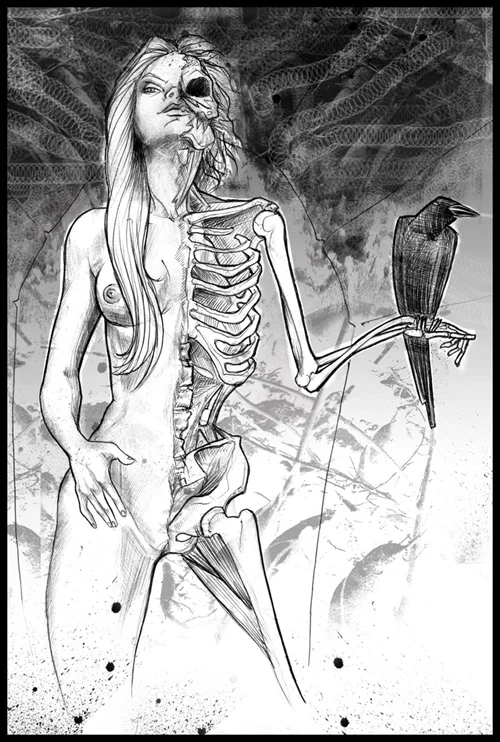
Hel is half a beautiful woman, half a rotting, skeletal corpse

Hel is half a beautiful woman, half a rotting, skeletal corpse.

The goddess doesn’t have Blanchett’s steely beauty — well, at least half of her doesn’t. Hel is usually depicted as being split down the middle, with one half a young woman, the other half a rotting skeleton, according to Northern Tradition Paganism. Hel’s putrid stink is a sure sign she’s in the vicinity.

Hel rules over a dominion that shares her name (much like Hades in Greek mythology). It’s this word that inspired the Christian version of Hell.

The fire giant Surtur leads the army that battles the Asgardian gods during Ragnarok

The fire giant Surtur leads the army that battles the Asgardian gods during Ragnarok.

Who’s Surtur the fire giant?

Perhaps not surprisingly, he’s Loki’s godfather, having helped raise that little troublemaker.

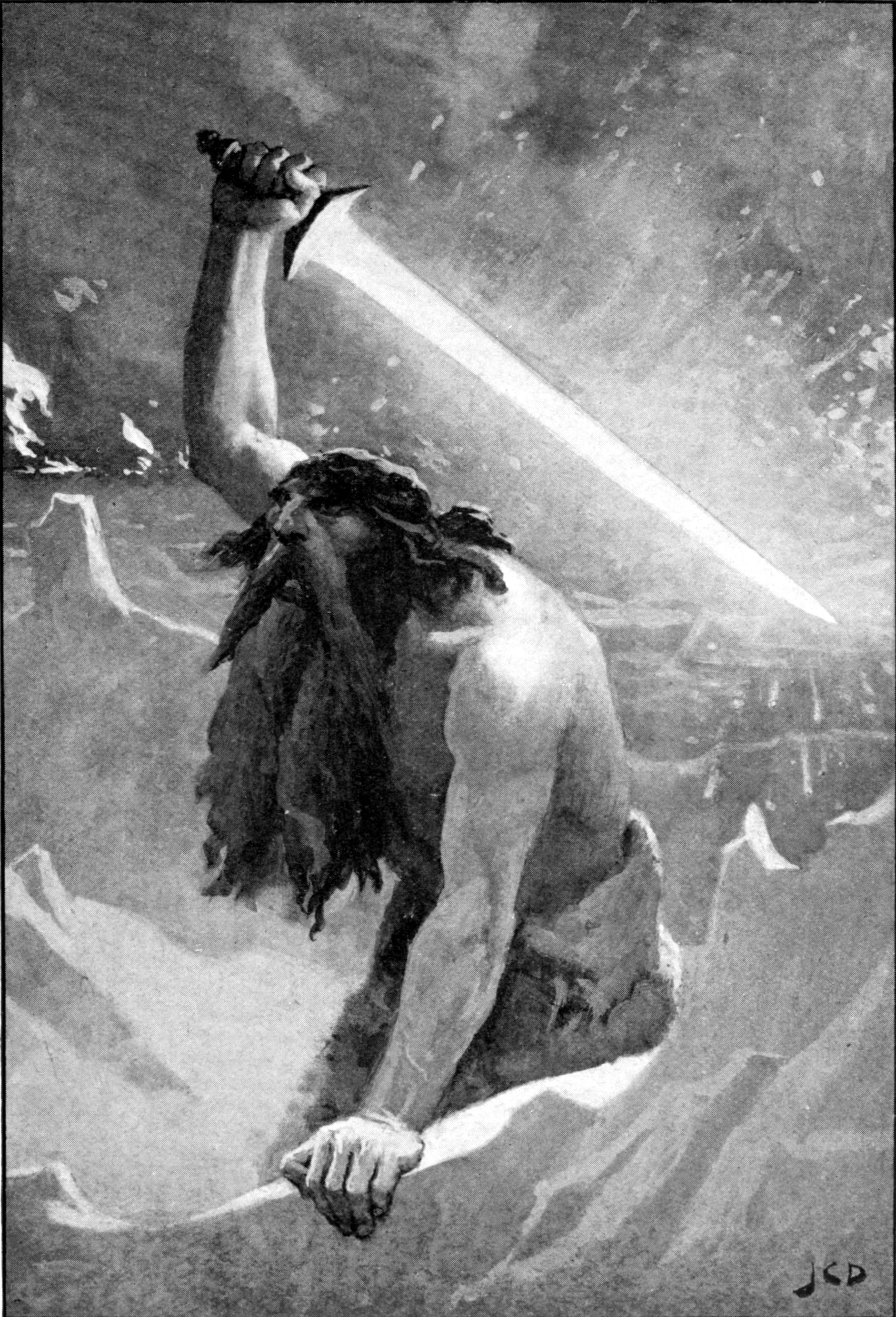
The fire giant is more commonly called Surt (“Black”) due to his charred appearance. Instead of being a cool flaming demon as he’s depicted in Thor: Ragnarok, he’s more humanlike in Norse mythology, with a flowing beard.

He carries a flaming sword and has a destiny to fulfill (everyone in Norse myths seems to be playing out preordained roles): Lead his kin and Hel’s undead minions into battle against the gods of Asgard during Ragnarok, the cyclical destruction of the cosmos. Surt sweeps his sword across the earth, leaving nothing but an inferno. He killed the god Freyr, who in turn offed him. Few survived Ragnarok.

Everyone seems to kill each other during Ragnarok, including Thor and the Midgard Serpent

Everyone seems to kill each other during Ragnarok, including Thor and the Midgard Serpent.

What exactly is the Ragnarok prophecy?

The “Doom of the Gods” is an appropriate name for the Norse version of the end of the world.

Like the Christian apocalypse described in the book of Revelation in the Bible, Ragnarok, too, is foretold by a series of omens, starting with a Great Winter (how very Game of Thrones) that lasts for three years, brought on after humans and even the gods have sunk into nihilism.

Then come the three cocks. One red rooster warns the giants that Ragnarok has begun, while a second alerts the dead. The third, which resides in Valhalla, the majestic drinking hall afterlife for heroes, lets the divine partiers know their fun has come to an end.

Even though Odin could foresee that there was no defeating Surt and his army, he and the gods still fought valiantly. During this epic war, the world is utterly destroyed and sinks into the sea. The end.

And yet it’s not the end. A new world rises from the depths of the water, and two mortals will repopulate the Earth.

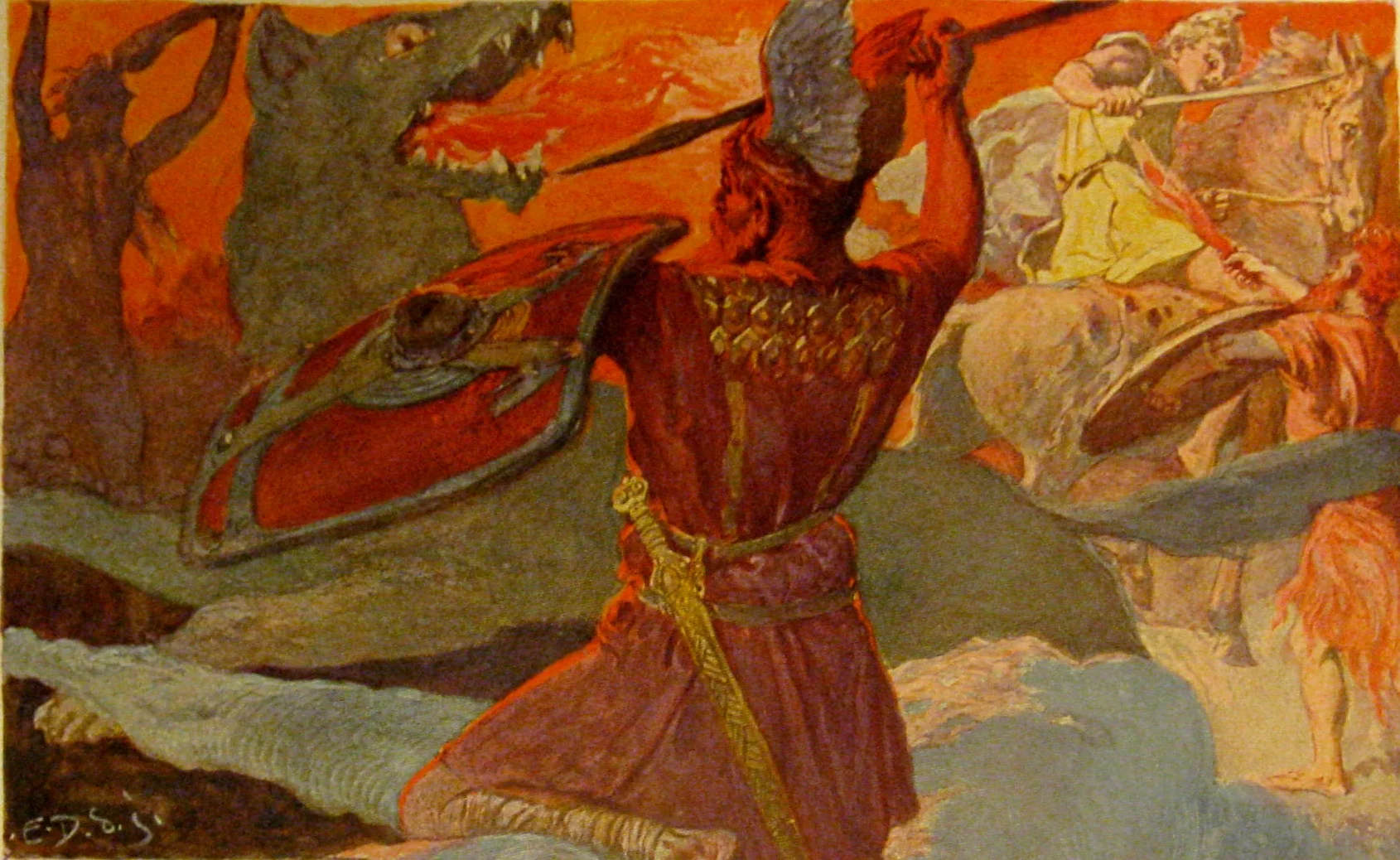
The giant wolf Fenrir kills Odin, swallowing him whole during Ragnarok

The giant wolf Fenrir kills Odin, swallowing him whole during Ragnarok.

How does Odin really die?

Though he was prone to wander, Odin doesn’t go off to Norway to die (after his rest home gets destroyed) and dissolve into gold dust. Instead, he perishes during the battle of Ragnarok.

The naughty Fenrir was kept chained up — until he escaped to wreak havoc during Ragnarok

The naughty Fenrir was kept chained up — until he escaped to wreak havoc during Ragnarok.

Fenrir, the massive wolf who’s Loki’s son and Hel’s brother, has been a bit too wild and has been chained up by the gods. He escaped, though, and “ran across the land with his lower jaw on the ground and his upper jaw in the sky, consuming everything in between. Even the sun itself was dragged from its height and into the beast’s stomach,” according Norse Mythology for Smart People. He also swallows Odin whole, ending the life of the Father of the Gods.

You wouldn’t want to fight Thor, especially when he’s armed with his hammer Mjollnir

You wouldn’t want to fight Thor, especially when he’s armed with his hammer Mjollnir.

Do Loki and Thor have a troubled relationship?

In a word, hell yes — though they did bond once in a cross-dressing ruse to win back Thor’s hammer, Mjollnir.

Thor and Loki did bond once in a cross-dressing ruse to win back Thor’s hammer, Mjollnir.
Loki convinces the manly Thor to dress up as a woman to pretend to be the goddess Freya (it’s a long story)

Loki convinces the manly Thor to dress up as a woman to pretend to be the goddess Freya (it’s a long story).

Loki is a trickster, so you never know what to expect. He’s likely to cause damage — in fact, at the time of Ragnarok in Norse mythology, he’s been chained inside a mountain as punishment for his involvement in the death of the god Balder, a favorite of the Asgardians. (Loki gave his blind brother Hod a mistletoe dart — the only thing that could harm Balder — and guided his aim so it struck and killed the deity.)

But Loki’s also known to actually help the gods as well. The Marvel universe has captured his mercurial spirit; you never know if he’s on Thor’s side — and you know you should never fully trust him.

During Ragnarok, Loki breaks free of his chains and launches an attack on his Asgardian brethren, sailing on a ship that’s somehow constructed of dead men’s nails. Eww.

In some versions of the myth, it’s Loki and not his daughter Hel who leads the army of the undead.

Thor defeats the massive serpent Jormungand — but perishes from its poison right after

Thor defeats the massive serpent Jormungand — but perishes from its poison right after.

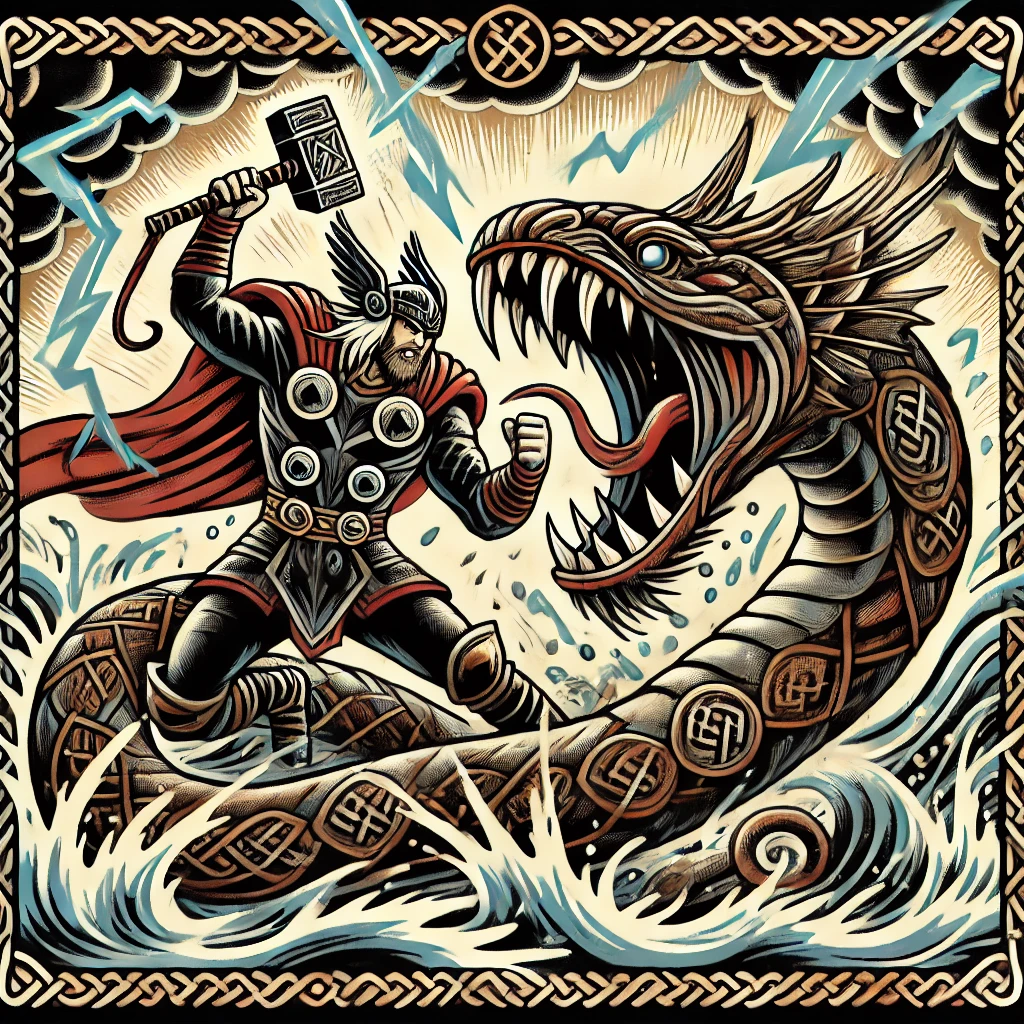
Loki’s offspring Jormungand and the god of thunder have an intertwined destiny. The two have always been bitter enemies, and the serpent is a formidable foe: He’s so large that he encircles the Earth, biting his own tail — what’s known as an ouroboros. During the apocalyptic war of Ragnarok, Thor kills the Midgard Serpent — only to die from its poison. There’s a lot of these double deaths going around.

The Valkyries choose who lives and dies in battles

The Valkyries choose who lives and dies in battles.

What’s the truth about the Valkyries?

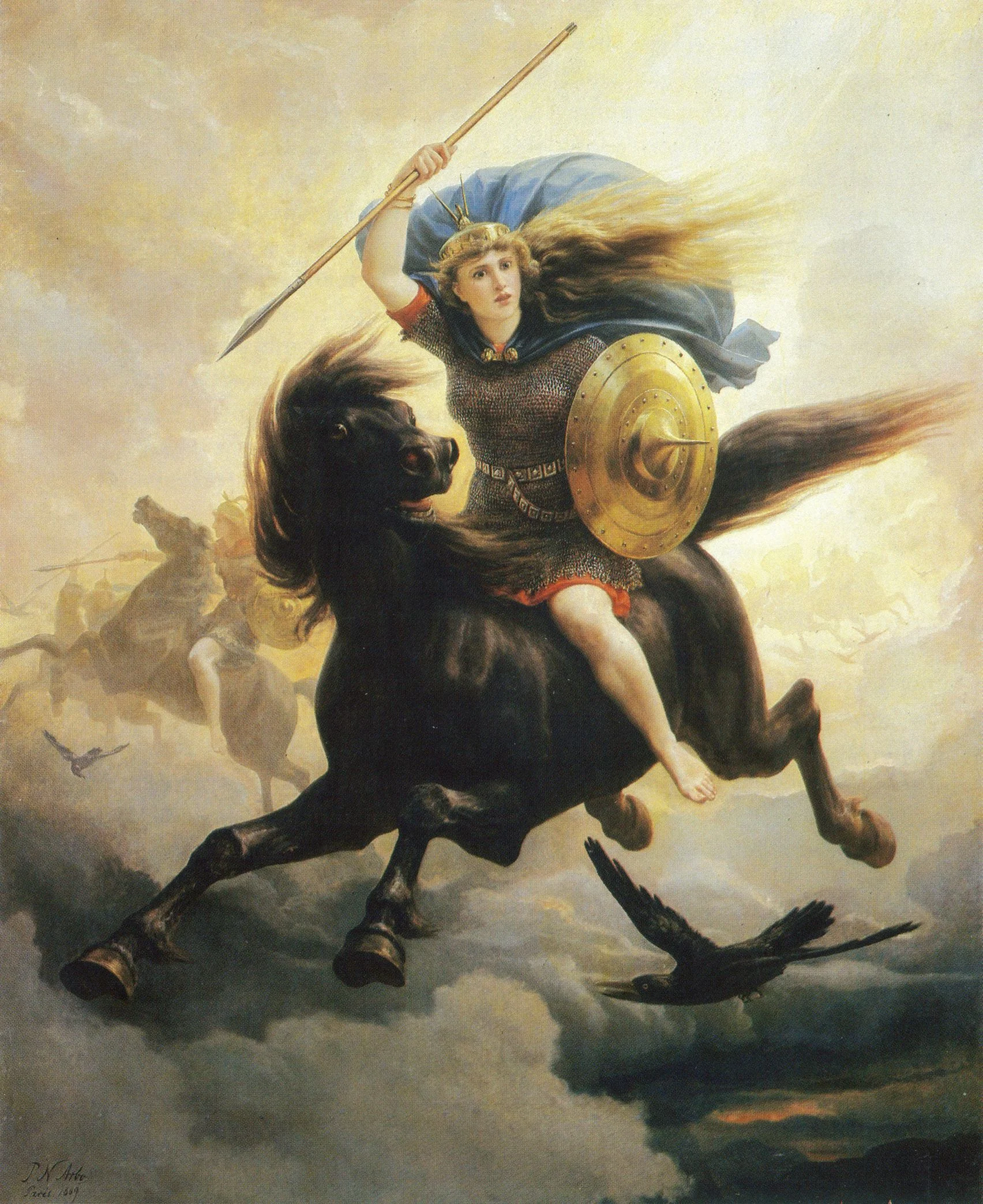
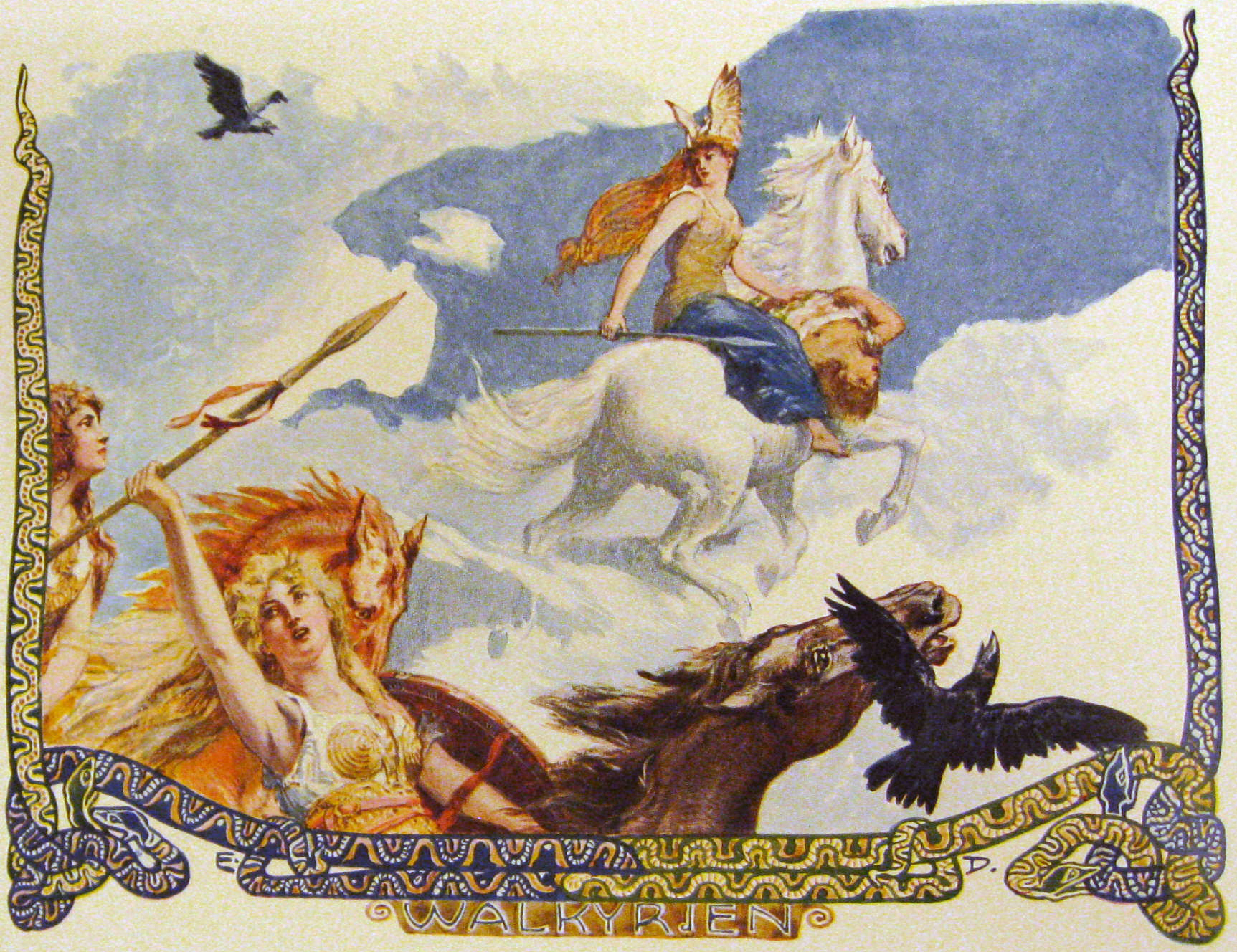
These fierce, beautiful maidens ride in groups of nine upon flying horses and guide fallen heroes to Valhalla for Odin.

Scandinavians in the Middle Ages believed the gorgeous streaks of the Northern Lights, or Aurora Borealis, were the Valkyries sweeping across the night sky, according to Credo.


LEARN MORE ABOUT THE NORTHERN LIGHTS: Why You Should Consider Visiting Iceland


A common misconception is that the Valkyrie are warriors — probably because they’re decked out in armor, are often depicted holding spears and like to hang out on battlefields.

“The meaning of their name, ‘choosers of the slain,’ refers not only to their choosing who gains admittance to Valhalla, but also to their choosing who dies in battle and using malicious magic to ensure that their preferences in this regard are brought to fruition,” writes Norse Mythology for Smart People.

The Valkyries were fierce woman who soared over battlefields on flying horses — until they were relegated to waitresses at Valhalla

The Valkyries were fierce woman who soared over battlefields on flying horses — until they were relegated to waitresses at Valhalla.

While they started out as dark angels of death swooping over the slaughter of a battlefield, the Valkyries later became associated as Odin’s shield maidens, lovely virgins with golden hair and snow-white skin who serve an all-you-can-eat-and-drink buffet of mead and meat in the great feasting hall in the sky. Dead heroes remained there until called to fight by Odin’s side during Ragnarok.

Marvel’s version of Ragnarok might be a bit off-base, but it’s still a fun one nevertheless. And as much as I’d love to have seen Loki captaining that ship of yellowed fingernails and toenails, I’m glad that hottie Chris Hemsworth’s Thor survives to star in another movie. –Wally
During Ragnarok, Loki launches an attack on Asgard, sailing on a ship constructed of dead men’s nails. Eww.

The Monsters of “Supernatural,” Season 2, Episodes 13-15

Are angels real? Meet Archangel Michael, Archangel Raphael and Beelzebub as well as tricksters like Loki, Anansi, Hermes and Reynard the Fox.

Angels, like Raphael, aren’t typically depicted in artwork as badass and intimidating like the Bible describes them

S2E13: “Houses of the Holy”

Monster: Avenging angel

Where it’s from: Israel and other parts of the Middle East

Description: There’s no such thing as angels, Dean argues. But Sam points out that there’s more folklore about angels than anything else they hunt.

“You know what?” Dean responds. “There’s a ton of lore on unicorns, too. In fact, I hear that they ride on silver moonbeams and they shoot rainbows outta their ass!”

“You mean there’s no such things as unicorns?” Sam jokes. These two should take their comedy act on the road.

“There’s some legends you file under bullcrap,” Dean says.

Despite this contention, 72 percent of Americans said they believe in angels, in a 2016 Gallup poll. I don’t know why that high number surprises me: After all, most Americans think a woman who never had sex gave birth to a man who came back from the dead.

The angels known as seraphim actually have six wings

We have a conception of angels as humanlike creatures with large feathered wings sprouting out of their backs. But there are different orders of angels described in the Old Testament, with seraphim, “the Burning Ones,” at the top of the hierarchy. They’re often depicted as red-skinned and wielding flaming swords. Seraphim have six wings: two for flight, two to cover their faces (for even though they fly above the throne of Heaven, they can’t handle looking upon God’s face) and two to cover their feet (so they don’t step on holy ground — though some scholars think this might actually translate to “genitals”), according to whyangels?com.

This illuminated manuscript depicts a six-winged seraphim above the crucifixion of Christ

In another Bible verse, Daniel 10:5-6, the prophet describes an angel in this manner:

I looked up and there before me was a man dressed in linen, with a belt of fine gold from Uphaz around his waist. His body was like topaz, his face like lightning, his eyes like flaming torches, his arms and legs like the gleam of burnished bronze, and his voice like the sound of a multitude.

This doesn’t look like the cute little cherubs we’re used to!

And we know cherubim, or cherubs, as Cupid-esque chubby toddlers with wings. Turns out they’re actually powerful guardians that also carry flaming swords.

Angels are neither male nor female, though they always appear with men’s bodies and never women’s, according to What Christians Want to Know.

Dean’s not buying Sam’s claim that they’re hunting an angel. “You didn't see any fluffy white wing feathers?” the smartass asks.

Many angels, Raphael included, are God’s means of justice and punishment

What it does: When someone’s visited by the angel in Supernatural, the surroundings shake, and the person is filled with religious ecstasy. They’re then driven to kill because it’s “God’s will.”

That’s actually somewhat in keeping with biblical lore: Angels are God’s agents for “bringing punishment and displaying His holy wrath,” according to What Christians Want to Know.

Take that, Satan! The Archangel Michael defeats the Devil

How to defeat it: In the church, Sam points to a painting of Saint Michael, the slayer of demons. He’s almost always depicted in artwork as stepping on a cringing Devil.

In this episode, Father Gregory died a violent death, and the other priest didn’t get a chance to administer last rites.

Father Gregory’s grave is covered in wormwood, which we learn is a sign of a spirit not at rest. Wormwood is a bitter herb that’s a key ingredient in absinthe, which has been banned because it supposedly causes hallucinations. In witchcraft, it’s used to increase psychic powers and perform exorcisms.

If you want to communicate with spirits, a séance is the way to go

Sam performs a séance ritual based on early Christian rites that involves white candles and a large black candle. It’s in Latin, of course.

In the end, Dean just might be right: This isn’t an angel at all. It turns out to be a vengeful spirit that thinks it’s an angel.

Father Reynolds finally performs last rites and puts the spirit to rest. “I call upon the Archangel Raphael, Master of the Air, to make open the way,” the priest chants. “Let the fire of the Holy Spirit now descend, that this being might be awakened to the world beyond.”

Raphael’s name translates to “God Heals,” from the story in the apocryphal Book of Enoch (the apocrypha are the stories that for some reason didn’t jibe with those who chose what would go into the official Bible.) In Enoch, Raphael heals the Earth after it was defiled by the fallen angels, according to Catholic Online.

So maybe there really aren’t such things as angels. It’s still OK for me to believe in unicorns, though, right?


I’ve warned you that demons are usually horrifyingly disgusting

S2E14: “Born Under a Bad Sign”

Monster: Sam?! (Possessed by a demon)

Where it’s from: All over the world

Description: Demons are powerful perversions of nature. We’ve covered them before here and here.

Beelzebub, Lord of the Flies, spreads disease and rules Hell

One of the most famous demons in the Judeo-Christian tradition is Beelzebub. He’s usually depicted as a monstrous giant fly, which goes along with his title, Lord of the Flies. Because flies are nasty creatures that hang out on shit and corpses, it shouldn’t come as a shock that Beelzebub spreads disease.

He’s also associated with tempting people with the deadly sin of pride.

In the Gospel of Nicodemus, another apocryphal text, Jesus gave Beelzebub dominion over Hell because the demon freed Adam and other unbaptized saints, allowing them to go up to Heaven. Satan was not pleased.

What it does: Demons like to possess people, manipulating them like puppets. And while the Yellow-Eyed Demon doesn’t seem like much fun, some demons are better to be possessed by than others.

Even ol’ Beelzebub has been known to possess people now and them. Back in 1611, in Aix-en-Provence, France, a Father Louis Gaufridi was accused of making a pact with the Devil, in which a group of Ursuline nuns were possessed by Beelzebub.

The priest was burned at the stake. His executioners used bushes instead of logs because they burn slower and hotter. During the execution, onlookers said they saw flies rising from Father Gaufridi’s body.

How to defeat it: Holy water will burn that mofo. If you can slip it into a beer, all the better!

Watch out for a binding link scar. (The one Sam’s got looks a whole lot like a Q.) To break it, destroy the connection. You could try branding over it with a hot poker — just know it’s gonna hurt!

What’s the secret to fighting off a demonic possession? The answer is surprisingly simple: “If I told them to swing a black cat by its tail over their head at midnight, they would do that,” said Father Vincent Lampert, the designated exorcist for the Archdiocese of Indianapolis, Indiana. “People think they have to do something extraordinary, but it is actually the very ordinary things that build up graces and offer protection. If a Catholic is praying, going to Mass and receiving the sacraments, then the Devil is already on the run,” he told the National Catholic Register.

Loki, the tricker god of Norse mythology as played by Tom Hiddleston, is one of the best villains in the Marvel universe

S2E15: “Tall Tales”

Monster: Trickster

Where it’s from: All over the world

Hermes, the Greek god of travel and thieves, is also a trickster

Description: Religions and folktales all around the globe include a trickster deity. The Norse had Loki, while the Greeks worshiped Hermes. In West Africa, there was the spider Anansi. European folklore includes tales of the mischievous Reynard the Fox. And Native Americans tell stories of the Raven and Coyote.

The African trickster Anansi is the star of a well-known children’s book

“Almost all non-literate mythology has a trickster-hero of some kind,” the famous mythologist Joseph Campbell said in An Open Life. “And there’s a very special property in the trickster: He always breaks in, just as the unconscious does, to trip up the rational situation. He’s both a fool and someone who’s beyond the system. And the trickster represents all those possibilities of life that your mind hasn’t decided it wants to deal with. The mind structures a lifestyle, and the fool or trickster represents another whole range of possibilities. He doesn’t respect the values that you’ve set up for yourself, and smashes them.”

Sounds like they’re essentially rebels, eager to disrupt the social order. No wonder I’ve always had a soft spot for Hermes.

Reynard the Fox is surely up to no good, preaching to these birds

What it does: In this episode, urban legends are coming true. A girl’s ghost seduces a lecherous professor, then sends him out the window and down four stories to his death. A sexed-up ET abducts a hazing-crazed frat boy, who’s anally probed again and again. (“Some alien made you his bitch,” Dean says. But it got worse, the boy adds: It made him slow dance to “Lady in Red.”) A shiny watch down a drain lures a researcher who tests on animals to end up mauled to death by a crocodile in the sewers.

Thing is, it only happens to dicks who you could argue deserve punishment. The trickster is getting his ideas from Weekly World News. These deities thrive on chaos and mischief. And it played the boys like fiddles, fellow hunter Bobby tells them.

Loki, like many tricksters, is able to shapeshift

Tricksters are shapeshifters, sometimes taking human form. They can conjure anything out of thin air.

In a climactic final battle, lingerie-wearing vixens on a round bed with red silk sheets toss Dean around while Barry White’s “Can’t Get Enough of Your Love, Babe” plays. Meanwhile, Sam and Bobby get attacked by chainsaw-wielding psychopaths like something out of a horror flick.

There goes Reynard the Fox, showing off again

How to defeat it: Try tricking the trickster. Sam and Dean fake a fight and then end up staking the trickster. The reality it has constructed fades away.

But this is only temporary. After all, tricksters, being gods, are immortal. –Wally
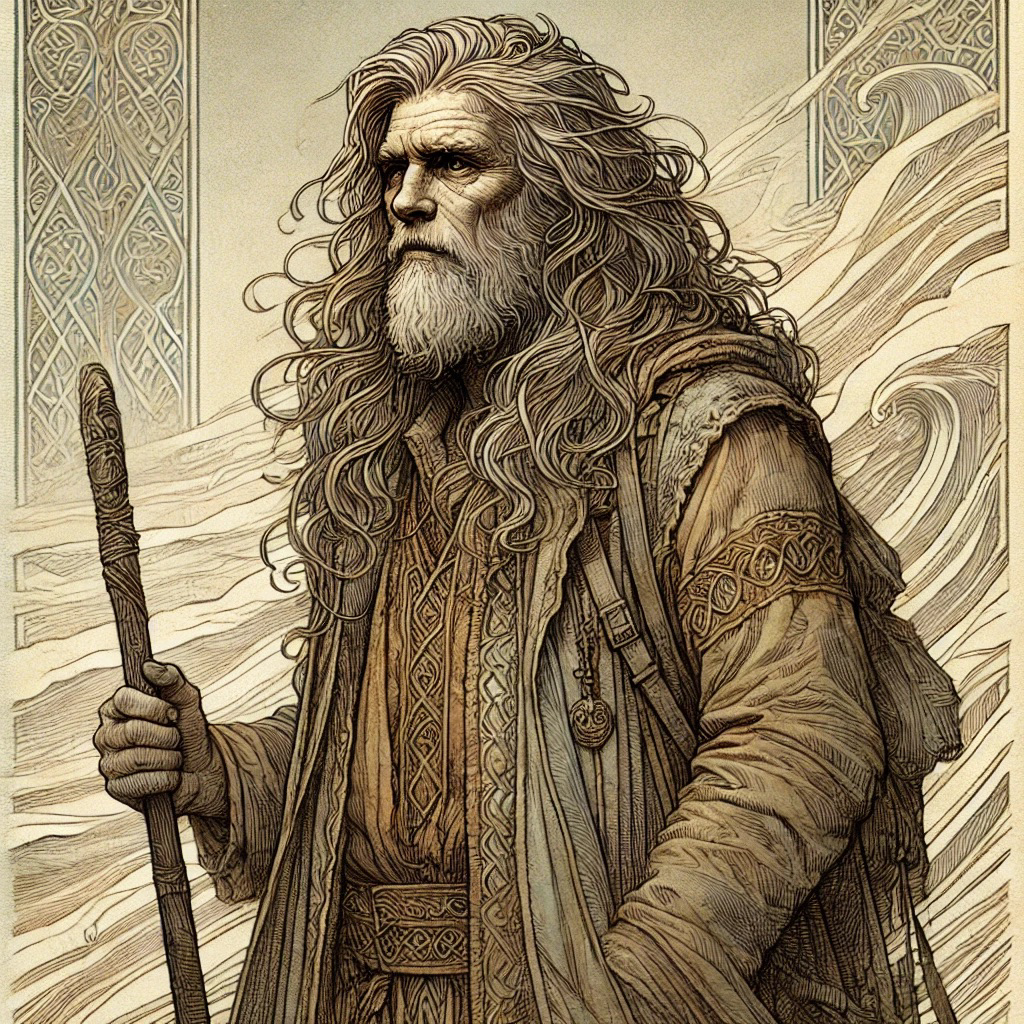
The Monsters of “Supernatural,” Season 1, Episodes 10-12

Learn witchcraft spells to protect yourself from ghosts, pagan gods demanding human sacrifice and Death itself.

It really is kind of effed-up what English teachers sic upon impressionable young minds. I read Shirley Jackson’s short story “The Lottery” when I was 15, and it has stuck with me ever since. I was intrigued by the idea of a modern town ritually sacrificing one of its members, based on a pagan tradition so far in the past they’ve simply ceased to question it. And the final scene, where even the poor woman’s own son is given pebbles to help stone his mother to death, shook me to the core.
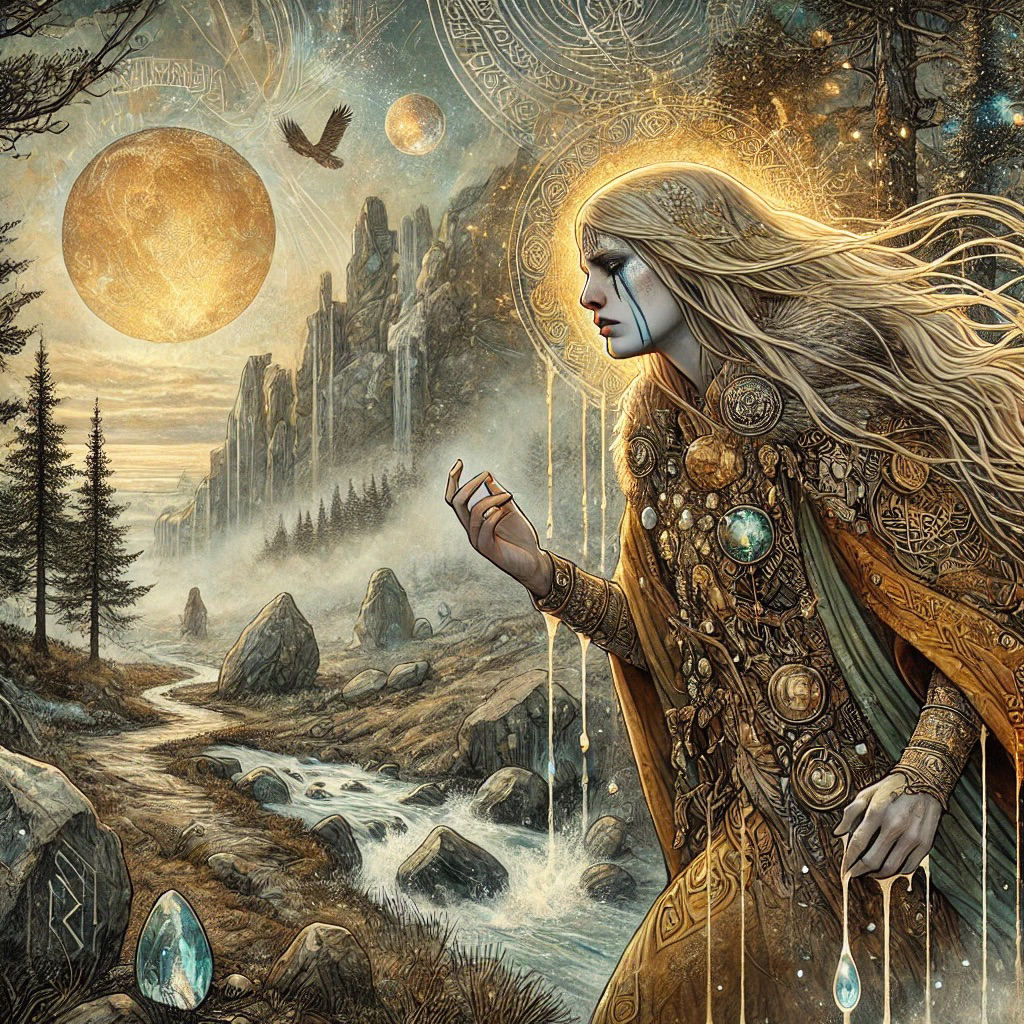
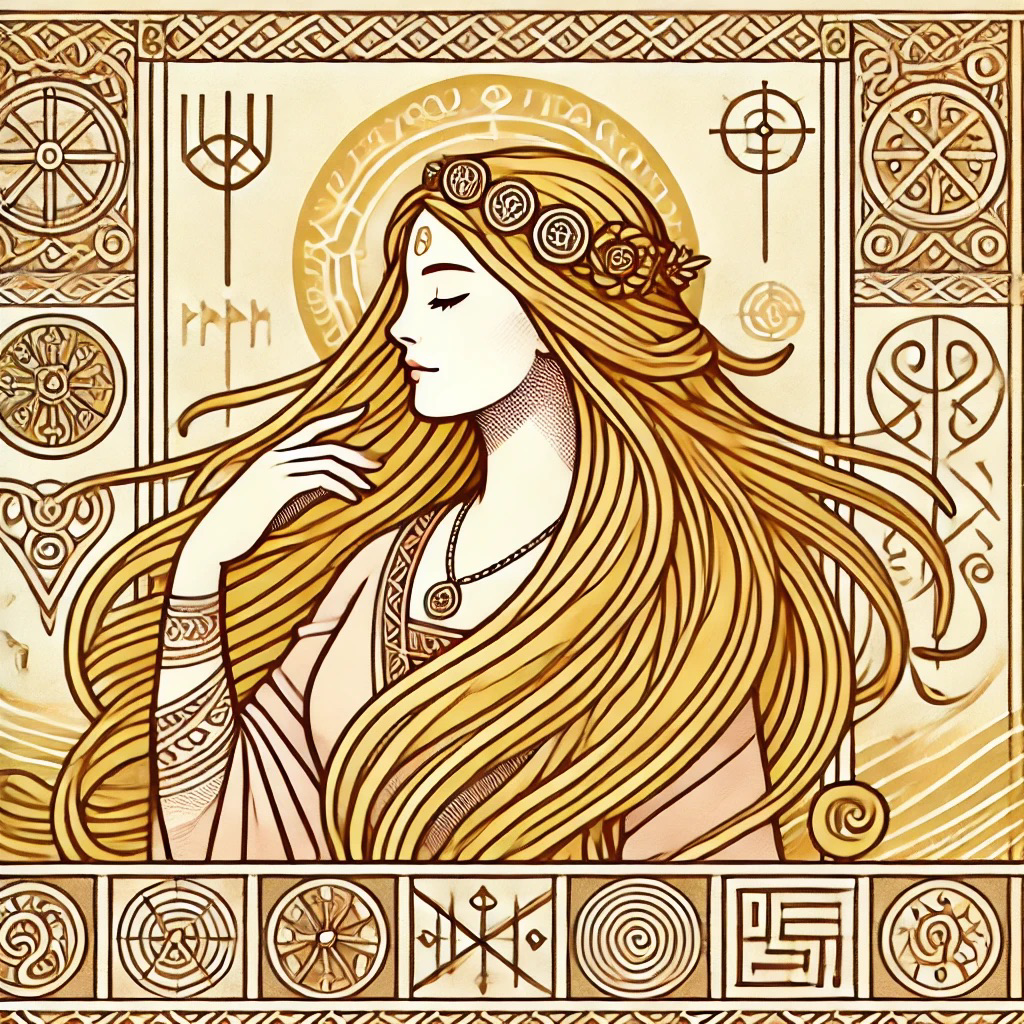
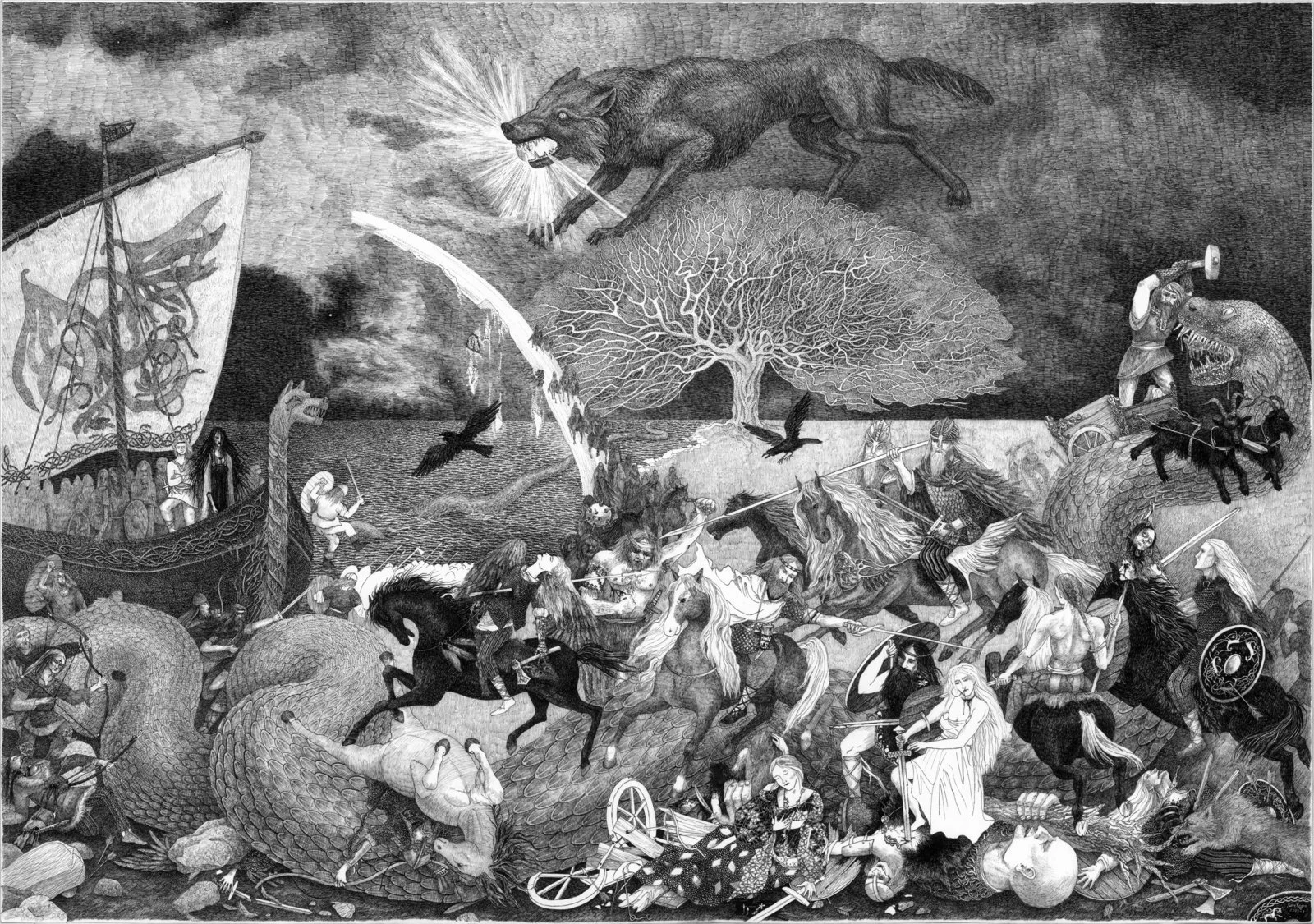
There’s a similar type situation in this roundup of Supernatural monsters. And we’ll also meet Death himself.

Symptoms of ghostly possession can include oily skin, rashes, feeling like your eyes are being pulled inside, migraines, the sensation of being strangled, loss of appetite (or increased appetite), tics and miscarriages.

There were only two people posing for this pic!

Apparently, ghostly possession is way more common than we think

S1 E10: “Asylum”

Monster: Ghost

Where it’s from: All over the world. About 30% of the world’s population is possessed by ghosts, according to the Spiritual Science Research Foundation, which I’m sure is totally legit.

Description: This particular spirit possesses people and feeds off their rage.

Encountering a ghost? Don’t panic — we’ve got you covered

What it does: Symptoms of ghostly possession can include oily skin, rashes, feeling like your eyes are being pulled inside, migraines, the sensation of being strangled, loss of appetite (or increased appetite), tics and miscarriages. In this particular case, those possessed turn murderous and then suicidal.

How to defeat it: A rifle loaded with rock salt can repel the ghost. Salt has a long history of protective properties.

To fully destroy the ghost and restore those who are possessed to themselves, Dean and Sam Winchester have to find the original corpse and burn it.


That scarecrow could come to life with the murderous spirit of a pagan god

That scarecrow could come to life with the murderous spirit of a pagan god

S1 E11: “Scarecrow”

Monster: Vanir, a pagan Norse god

Where it’s from: Northern Germany and Scandinavia

Freya is the goddess of beauty (and a bit of a slut, turns out)

Freya is also the goddess of war and death

Description: This branch of the Norse gods holds in its ranks Freya, goddess of love, beauty, sex, gold, war and death (busy gal), accused by Loki of having slept with all the elves and gods, including her brothers.

Pagans would offer sacrifices to Freyr, the Norse god of fertility

Freyr’s power over fertility is symbolized by his giant phallus, as depicted in this idol

Speaking of which, her brother Freyr, god of fertility, was a popular guy. People’s well-being and prosperity depended upon him, including bountiful harvests. This was apparently symbolized by his “enormous, erect phallus.”

What it does: Freyr was a frequent recipient of sacrifices, including the celebration of a harvest. Instead of offering up the traditional sacrifice of his favored animal, the boar, the townsfolk in the episode lured one male and one female to their deaths. With the sacrifice, the town assures a good harvest and general happiness.

The personification of this Vanir takes on the form of a living scarecrow, which actually has more of a connection to the Celts and their wicker man.

Julius Caesar wrote about the Gallic practice of burning humans alive in a giant wicker man

This sick ritual was described by none other than Julius Caesar in Book Six of The Gallic War:

“The whole Gallic race is addicted to religious ritual; consequently those suffering from serious maladies or subject to the perils of battle sacrifice human victims. … Some weave huge figures of wicker and fill their limbs with humans, who are then burned to death when the figures are set afire. They suppose that the gods prefer this execution to be applied to thieves, robbers and other malefactors taken in the act, but in default of such they resort to the execution of the innocent.”

How to defeat it: In Norse mythology, Yggdrasil is the mythical tree that connects the nine worlds, which include Asgard, where Thor and his relations live, and Midgard, their term for Earth.

In Norse mythology, the sacred tree Yggdrasil connects the nine worlds

In this episode, there’s a sacred tree that’s tied to the Vanir. Once the Winchester Brothers chopped it down, the god — and his blessings — abandon the village.

Our personification of death as the Grim Reaper began in Ancient Greece


S1 E12: "Faith"

Monster: Reaper

Where it’s from: All over the world, especially the United States and Europe

An old tarot Death card from Germany depicts a reaper

An old tarot Death card from Germany depicts a reaper

The reaper uses its scythe to chop up bodies

Description: The Grim Reaper is the personification of death. He’s most often depicted as a skeletal figure wearing a black hooded robe and carrying a large scythe. In some parts of Europe, his robe is white.

Ancient Greeks worshiped Thanatos, or Death, who was portrayed as an attractive, bearded man with wings and an extinguished flame (what vivid symbolism!). Departed souls had to pay the ferryman Charon to get across the River Styx into the underworld. Some sources described Charon as a skeletal figure much like today’s Grim Reaper.

What it does: On the show, reapers can stop time — and only their victims can see them coming for them.

How to defeat it: As the altar Sam discovers attests, you can gain control over a reaper with a binding spell.


Poppet Binding Spell

This spell is best worked on a waning or dark moon.

Cut two layers of black cloth in the rough shape of the person or creature you wish to bind and sew together to create a small poppet. Leave part of the head unstitched.

Fill the poppet with earth, a smoky quartz and an amethyst. Also include hair or nail clippings, or a photograph or sample of handwriting of the person you wish to bind.

Create a sacred circle, then take an altar candle and a black candle. Hold the poppet out in front of you and say:

Creature of cloth thou art,
Now creature of flesh and blood you be.
I name you [name of the person or creature you are binding].
No more shall you do me harm,
No more shall you spread false tales,
No more shall you interfere in my life,
Nor in the lives of my loved ones.
By the power of the gods and by my will,
So mote it be.

Draw an invoking pentagram over the poppet.

Now take some black ribbon or wool and begin to wrap the poppet like a mummy, leaving no space unwrapped and say:

I bind your feet from bringing you to harm me.
I bind your hands from reaching out to harm me.
I bind your mouth from spreading tales to harm me.
I bind your mind from sending energy to harm me.
If you continue to do so, let all negative energy be cast directly back at you!

Tie off the ribbon and hold the poppet in front of you. Visualize all the negative energy this person has sent you being cast back at them.

Wrap the poppet in a piece of black cloth and tie with a black ribbon. Say:

Great Mother, I have bound this person
From harming me and my loved ones.
By the powers of three times three,
By Earth and Fire, Air and Sea,
I fix this spell, then set it free,
’Twill give no harm to return on me,
As I will, so mote it be!

Let the candle burn out while the poppet sits at its base.

Then take the poppet and the remains of the candle and bury them in the ground or toss them in the ocean. Walk away without looking back.


Now, it’s not always possible to get nail clippings and the like from your enemy (does Death even have fingernails?!), so this spell from Free Witchcraft Spells might work better. It takes some time; so hopefully you can avoid the reaper in the meantime!


Black Candle Binding Spell

Anoint a black candle with sandalwood oil while you concentrate on the person or creature you want to get out of your life.

Wrap a piece of black thread around the candle until you use the whole length, then tie it tightly.

Repeat this, with a piece of black yarn. Then, on top of that, wind around a piece of rough twine of the same length. The exact lengths of the cords don’t matter — just use the same for all three. About 18 inches works well.

Light the candle, and let it burn out completely. Try to do this spell in the evening, letting the candle burn down overnight. Keep it somewhere safe and flameproof because the strings might catch fire as the candle burns down. I’ll burn candles in a small cauldron for my peace of mind.

You can try, but there really is no escaping death


Give it a go, but let’s face it: If your time has come, Death will find you. Have the Final Destination movies taught us nothing? –Wally