USA

The First Homosexuals at Wrightwood 659: Rewriting Art History With a Queer Lens

This powerful global exhibition traces the emergence of queer identity through more than 300 artworks — at a time when LGBTQ+ visibility matters more than ever.
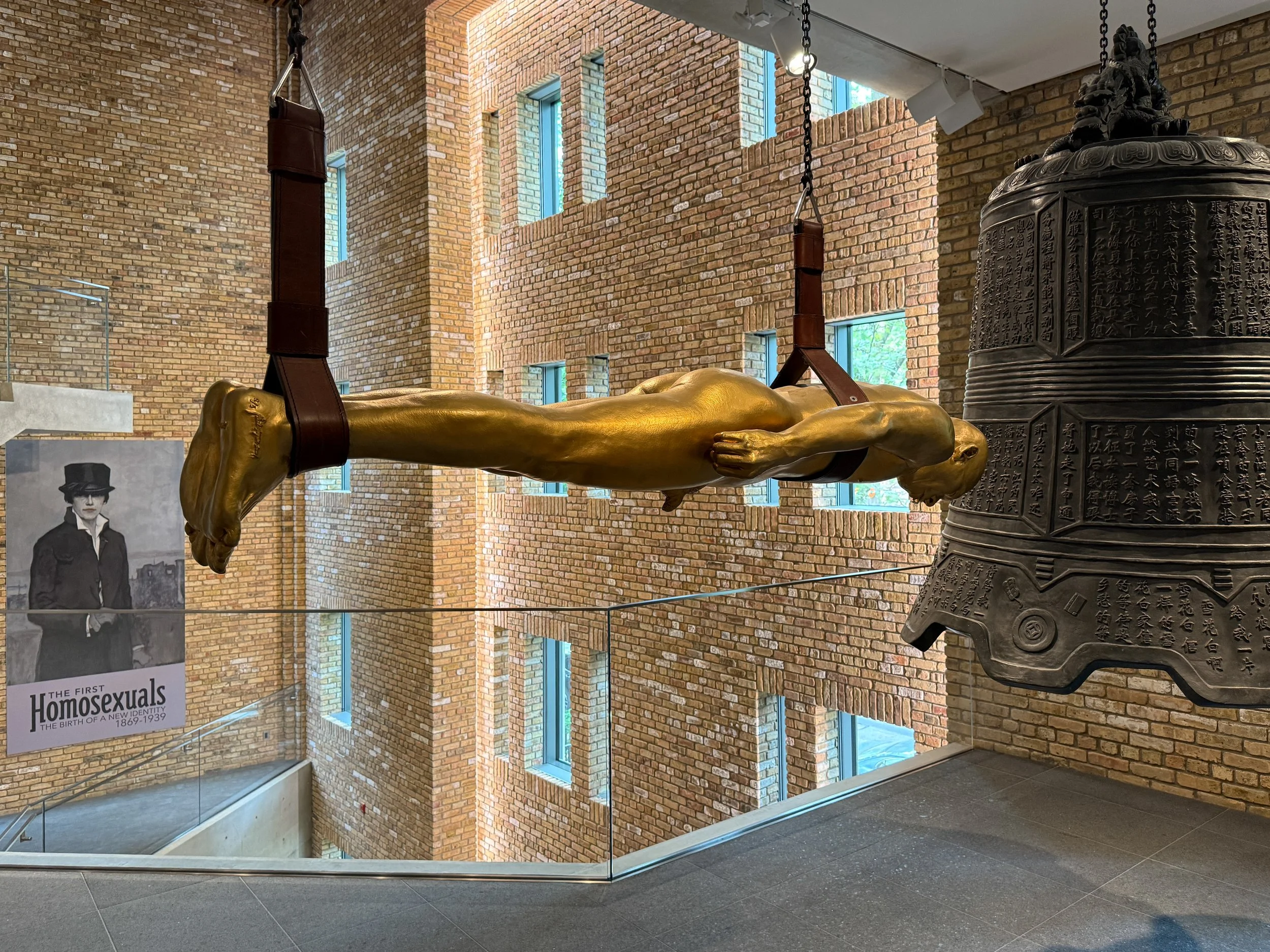
Peace 1 by Zhang Huan, a sculpture of a nude golden man about to ring a large metal bell, at Wrightwood 659 in Chicago, during The First Homosexuals exhibit

Peace 1 by Zhang Huan, 2001

When Wally and I heard about The First Homosexuals: The Birth of a New Identity, 1869–1939 at Wrightwood 659, we were immediately intrigued. We had missed the first iteration, which ran in 2022. This new presentation promised to be larger in scale, and suggested something truly ambitious — a visual journey recontextualizing art history by presenting a wide range of works through a queer lens. 

This exhibition is especially important because it comes at a perilous time when LGBTQ+ voices are increasingly under attack across political and cultural spheres. In the face of bans, restrictions on school curricula, and renewed efforts to limit or erase queer visibility, The First Homosexuals reclaims that space by affirming that queer identity has an enduring, complex and creative legacy. 

“The First Homosexuals” is especially important because it comes at a perilous time when LGBTQ+ voices are increasingly under attack across political and cultural spheres.

I was reminded of Masculin/Masculin, a provocative exhibition Wally and I saw at the Musée d’Orsay in 2013. Drawing primarily from European painting and sculpture, the show turned the traditional male gaze on its head — shifting the focus from the female form, so often idealized in art, to the male nude. By presenting works from 1800 to the early aughts, the show invited viewers to reconsider the male body, not just as a symbol of strength or virility but as an object of desire.

While Masculin/Masculin traced the idealization of the male body in European art, it didn’t place those depictions within the broader context of queer history. The First Homosexuals at Wrightwood 659 takes that next step, expanding the lens across five continents and inviting viewers to consider queerness as something shaped by history, society and culture — often coded, but always present. 
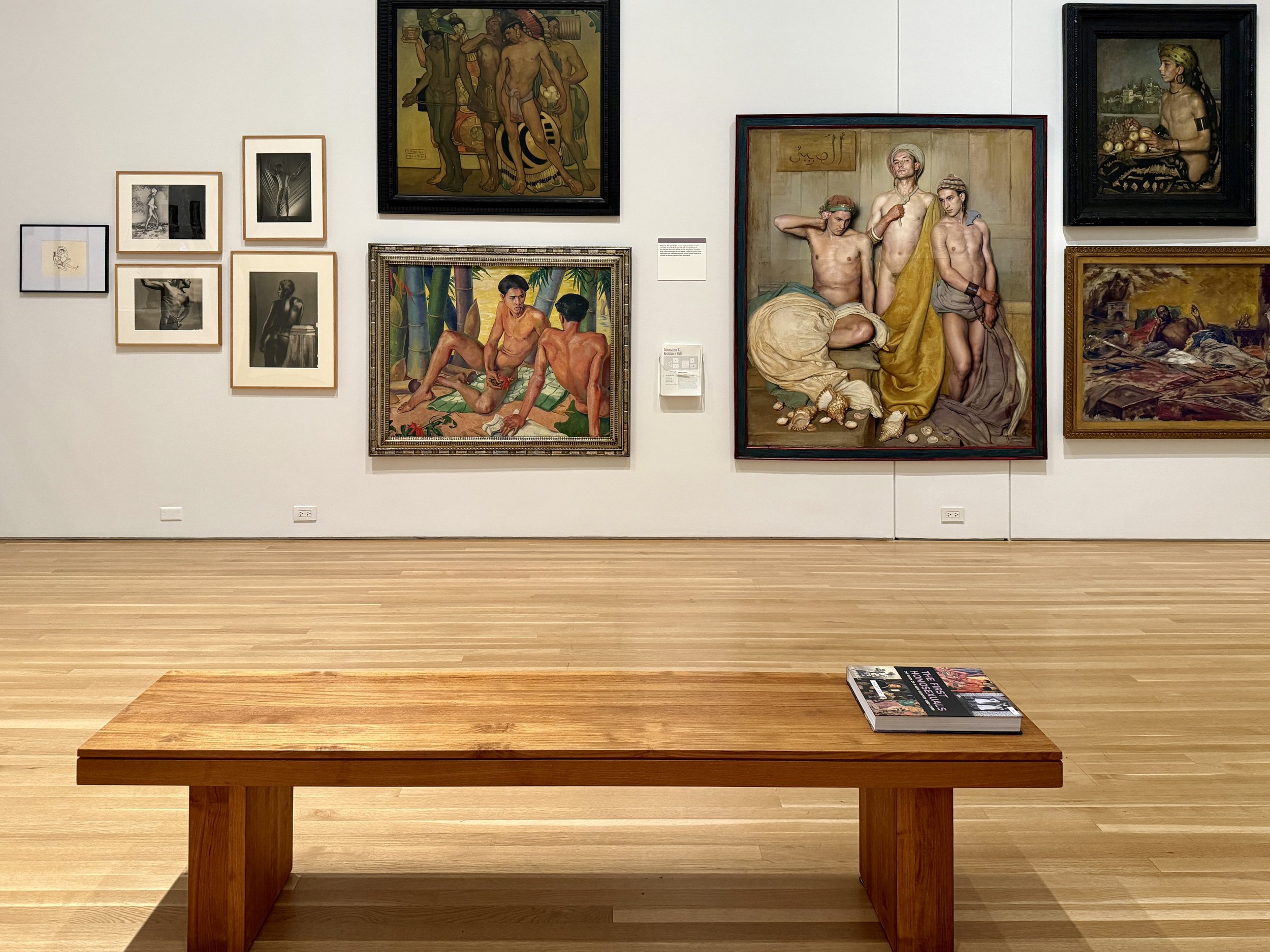
One of the gallery walls with a bench at The First Homosexuals exhibit at Wrightwood 659 in Chicago

The First Homosexuals included more than 300 works by 125 queer artists from 40 countries.

Its point of departure is 1869, when Karl-Maria Kertbeny, an Austrian-Hungarian writer and activist, introduced the term “homosexual” anonymously in a German pamphlet advocating reform of Prussian sodomy laws — a linguistic turning point that shifted same-sex love from act to identity. 
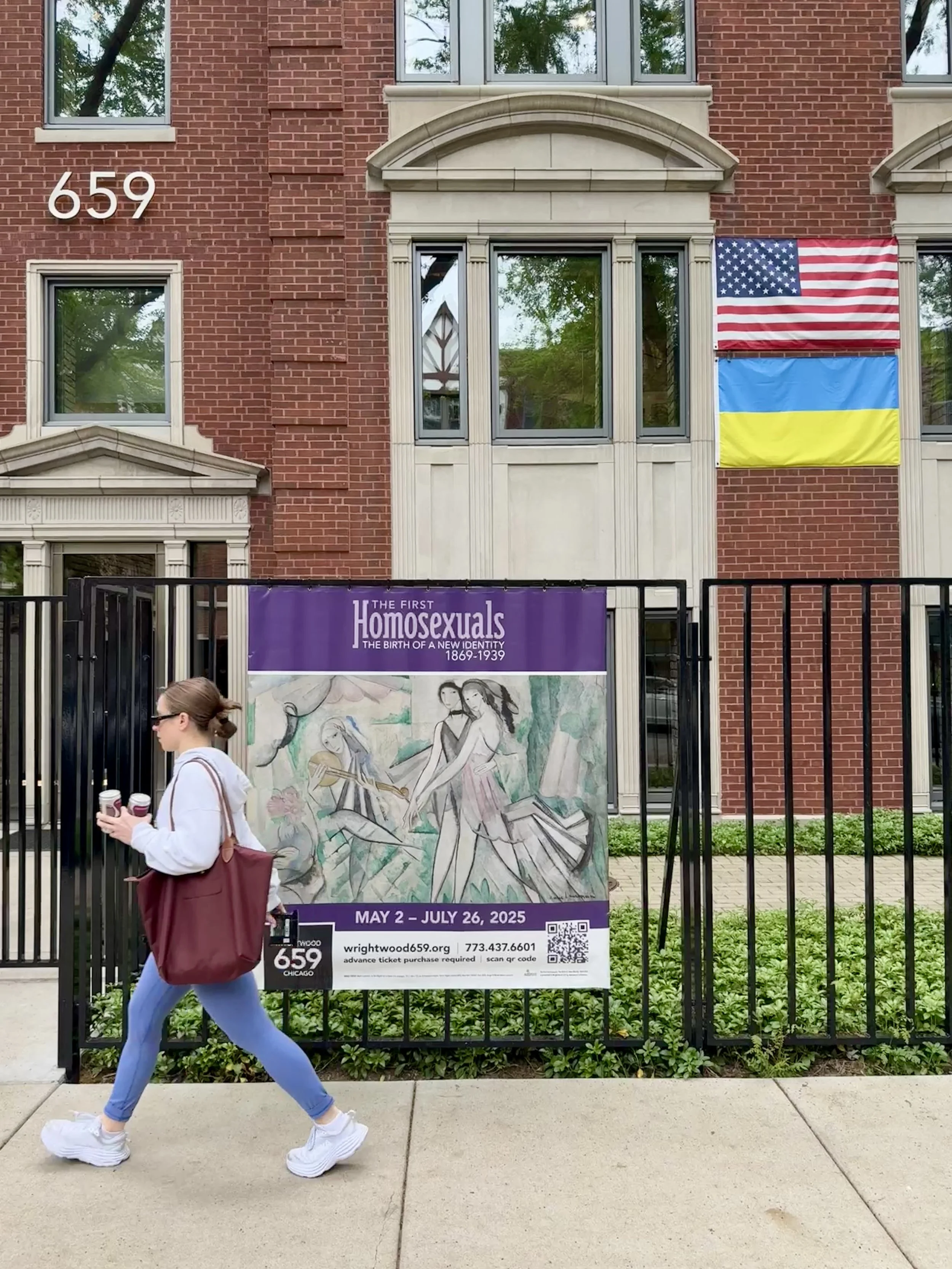
A woman passes by Wrightwood 659, which has U.S. and Ukraine flags and a sign promoting The First Homosexuals exhibit

You’ll definitely need to book ahead (and book early) when you see a show at Wrightwood 659.

Our Arrival at Wrightwood 659 in Lincoln Park

After breakfast at one of our favorite spots, the Bourgeois Pig, Wally and I strolled up the leafy stretch of Wrightwood Avenue in Chicago’s Lincoln Park. We were surprised to find a modest four-story red brick façade at 659. But the small group forming outside and a sign promoting the exhibition reassured us that we were in the right place.

The modern home next to Wrightwood 659 in Chicago

The modern concrete building attached to the exhibit space is actually the home of one of the cofounders of Wrightwood 659.

I initially assumed the gallery’s entrance was through the modern concrete cube next door — but that was actually the private residence of media entrepreneur and philanthropist Fred Eychaner and his husband, Danny Leung. Eychaner is the founder of the Alphawood Foundation, a charitable organization, and cofounder of Wrightwood 659.

Inside, a docent greeted us in the light-filled atrium and explained that the building was constructed in the 1920s as an apartment complex. Despite its external appearance, the interiors have been stripped and radically reimagined by Japanese architect Tadao Ando.

Two floors of Wrightwood 659 with exposed brick and concrete, with the sculpture Peace 1 by Zhang Huan visible

A historic apartment building was reimagined as a striking modern art gallery.
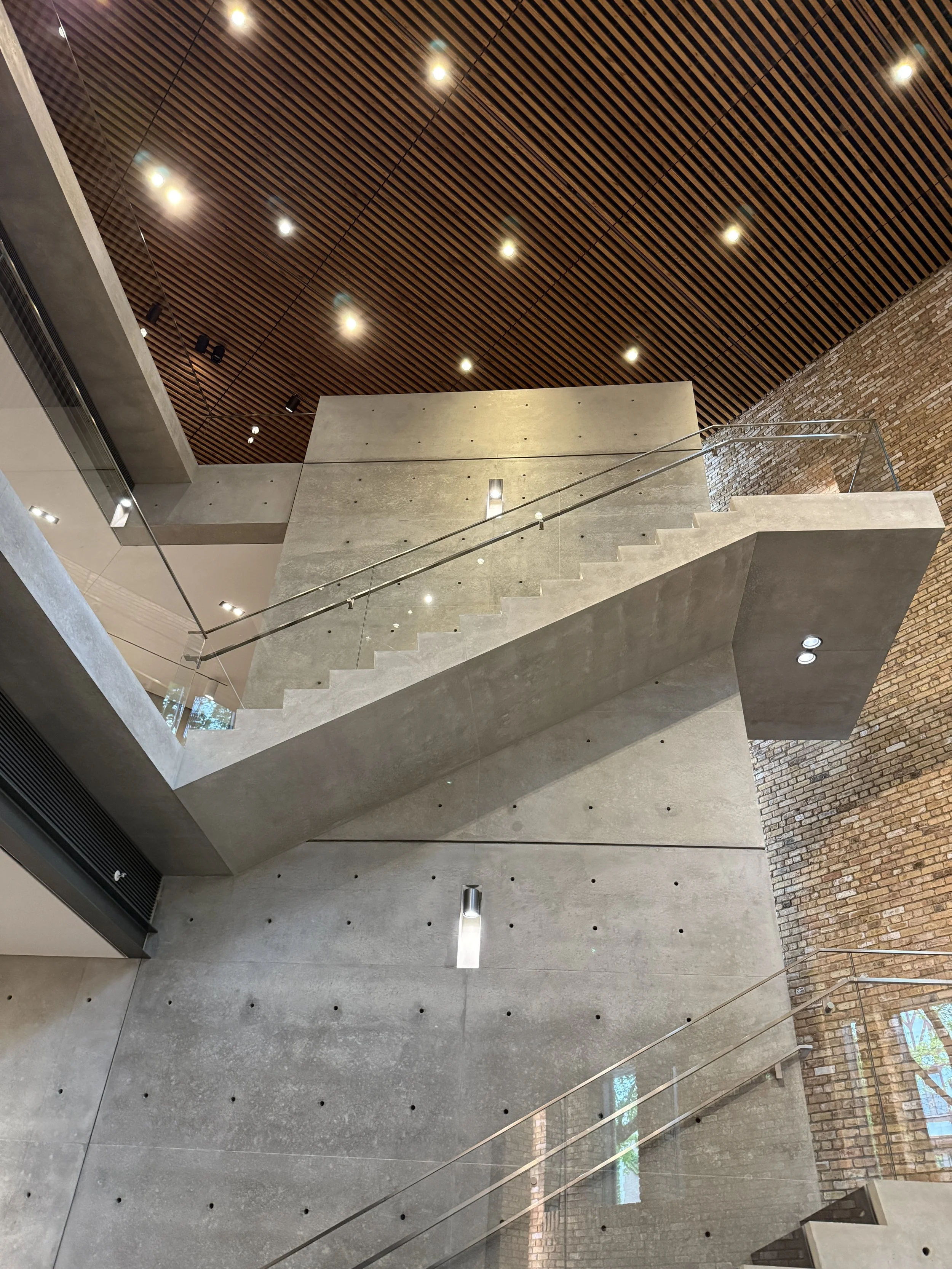
The Tadao Ando-designed stairwell at Wrightwood 659 in Chicago

Architect Tadao Ando transformed the interior with his minimalist design.

We stood in awe of the space’s understated tranquility. Ando preserved the outer walls, which are clad in irregular, weathered Chicago common brick, an earthy contrast to the interior’s sleek geometric simplicity. 

In the far corner, an Escher-like concrete staircase begins its ascent. More than just a functional connector between levels, it serves as a kind of contemplative path, guiding visitors upward in a calm, deliberate rhythm. It’s a signature Ando gesture: structure becoming experience, architecture becoming journey.

Dance to the Berdash by George Catlin

Dance to the Berdash by George Catlin, 1837

Before the Binary: Origins of Queerness

The exhibition unfolds gradually across three floors and eight thematic sections, beginning with “Before the Binary.” This gallery sets the stage for the installation’s sweeping journey, inviting viewers to reconsider how same-sex love and gender diversity have been expressed and celebrated throughout history, long before  queer identity emerged in the form we recognize today.

Prior to the subjugation brought by European colonization, many non-Western cultures regarded same-sex behavior as a fluid part of life rather than a fixed identity. This changed dramatically with the arrival of colonial powers, who introduced prejudices and legal systems and cultural prejudices that criminalized same-sex relationships. Along with this intolerance came a new binary: homosexual and heterosexual — categories rooted in 19th century European science and psychology. These labels spread globally reshaping how people understood desire, identity and themselves.

George Catlin’s painting, Dance to the Berdash, depicts a ceremonial dance performed by the Sac and Fox Nation honoring a “two-spirit” individual. The term berdache, used by Catlin, is an outdated and derogatory French term historically applied to two-spirit people. 

In his journals, Catlin describes the scene as “very funny and amusing,” and expresses bewilderment where a “man dressed in woman’s clothes … driven to the most servile and degrading duties” would be celebrated and “looked upon as medicine and sacred.”

Despite his evident bias, Catlin’s work offers a rare glimpse into the deeply spiritual and cultural roles that two-spirit or third-gender individuals have historically held in many Native American communities.
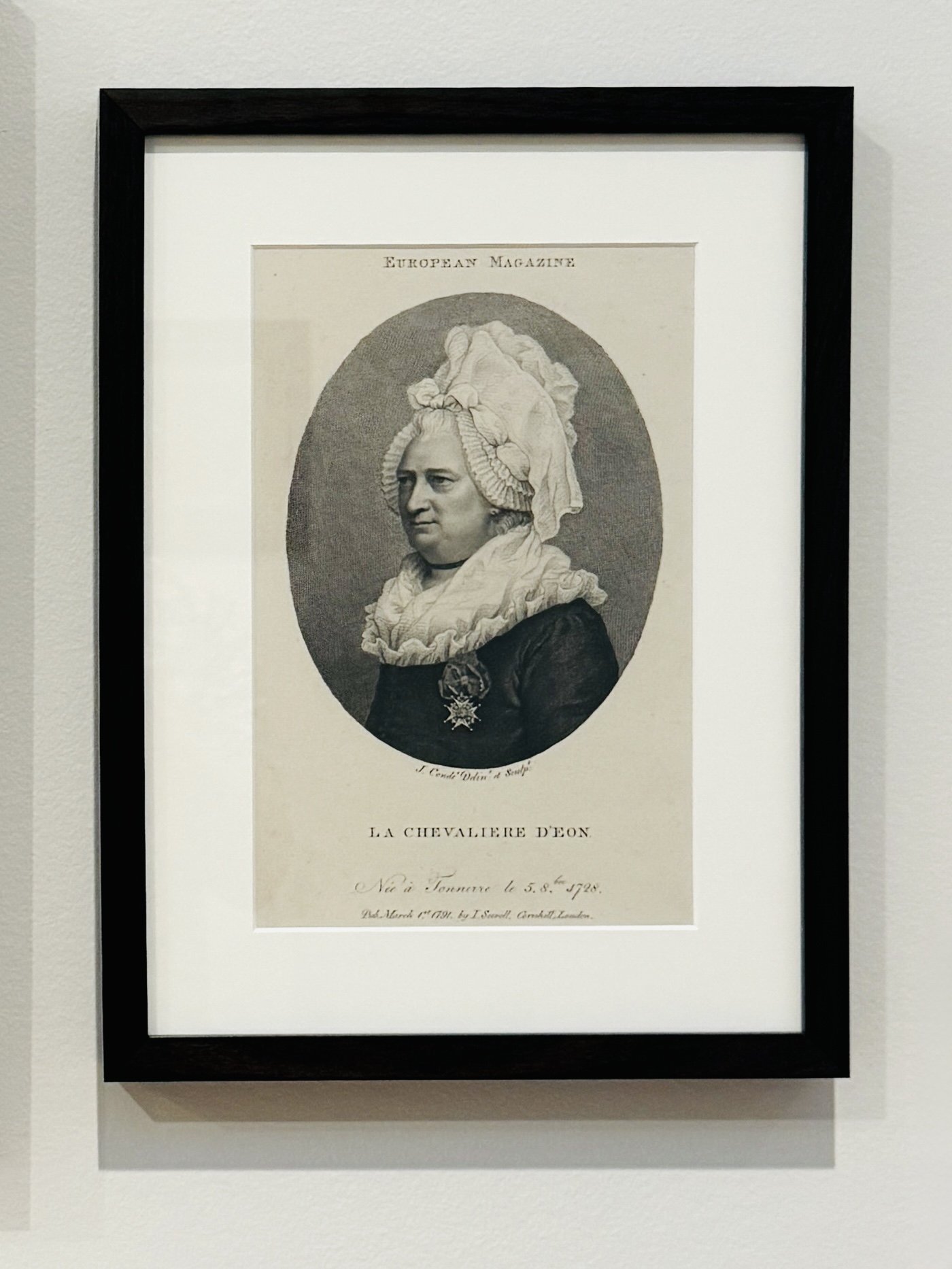
Portrait of Chevalier d'Eon by Jean Condé

Portrait of Chevalier d'Eon by Jean Condé, published by John Sewell in a 1791 issue of The European Magazine

The Chevalière or Chevalier d’Éon (1728-1810), was an early gender-nonconforming figure and a French diplomat, spy and soldier. 

In 1755, while presenting as a man, d’Éon was sent to Russia disguised as Mademoiselle Lia de Beaumont to persuade Empress Elizabeth I of Russia to ally with France against England and Prussia. From 1777 onward, d’Eon lived publicly as a woman and was officially recognized as such by King Louis XVI.

In this print, d’Éon is portrayed as a middle-aged woman wearing a dark dress with a chemisette, a lace cap and the star of the Order of St. Louis, an honor awarded for distinguished military service and espionage.

As evidence of the shifting political and cultural landscape of the era, d’Éon spent much of her adult life in London, where her gender identity was the subject of constant speculation. It was even the subject of a court trial declaring d’Éon to be a woman, though a surgeon later attested on her death certificate she had “male organs.”
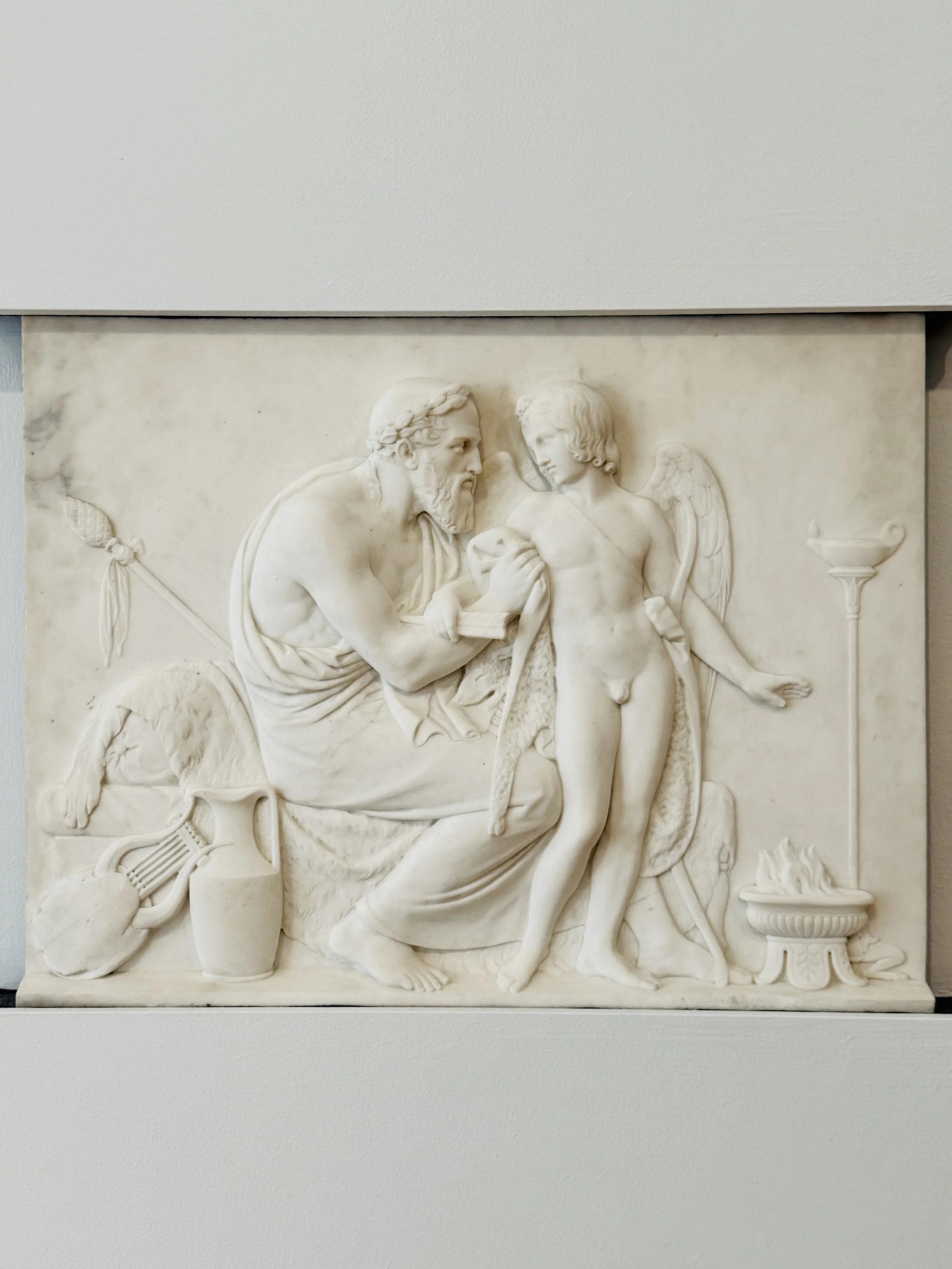
Anacreon and Cupid by Bertel Thorvaldsen

Anacreon and Cupid by Bertel Thorvaldsen, 1824

Bertel Thorvaldsen’s neoclassical Anacreon and Cupid depicts the Ancient Greek poet Anacreon being struck by Cupid’s arrow, causing the older man to fall in love with the youthful god of love. The relief is inspired by Anacreon’s text, Ode III, which ends with Cupid flying away, satisfied he can still attract love with his arrows, while the poet is left alone with his longing. 

The term homosexual didn’t yet exist, and art about the classical past enabled the representation of same-sex eroticism under the guise of historical reference. 

The artist’s nearby ink and graphite sketch literalizes the erotic element of the sculpture, portraying Cupid fondling the poet’s groin. 

In Ancient Greece, the ideal same-sex relationship was seen as one between an older man and a teenage boy. This kind of relationship was tied to ideas about teaching the younger generation how to be good citizens. Same-sex desire was accepted — but only in ways that supported the male-dominated social system.

Portrait of Rosa Bonheur by Anna Klumpke

Portrait of Rosa Bonheur by Anna Klumpke, 1898

Portraits: Icons and Outlaws

“Portraits” features artists who dared to make homosexuality visible long before it was safe or legal to do so. 

American artist Anna Klumpke’s tender pastel portrait captures her partner, Rosa Bonheur, in the final years of the celebrated French painter’s life. The two met in 1895, when Klumpke was 39 and Bonheur was 73. They soon moved in together, and their relationship endured until Bonheur’s death in 1899.

Rosa Bonheur was one of the most renowned animal painters of the 19th century. An independent woman and openly lesbian, she famously obtained official permission from the Paris police to wear men’s clothing — a permit she justified by explaining that traditional women’s attire was impractical for working in stables and slaughterhouses, where she sketched animals for her work.

By the way, there’s a delightful bar, Rosa Bonheur, in Paris, named after this icon. 

Retrato de un Anticuario (Portrait of an Antiquarian) by Robert Montenegro

Retrato de un Anticuario (Portrait of an Antiquarian) by Robert Montenegro, 1926

Roberto Montenegro’s 1926 portrait of antiques dealer Chucho Reyes is rich with visual codes that still resonate in queer iconography today — a limp wrist, a tilted chin and a wry smile. In the foreground, a silver ball subtly reflects the artist’s own face, a quiet but unmistakable act of self-insertion and queer affirmation.

An early figure in the Mexican muralist movement, Montenegro often pushed against the boundaries of revolutionary aesthetics. In a mural for the Secretaría de Educación Pública in Mexico City, his depiction of a nude, androgynous Saint Sebastian drew criticism for being out of step with official nationalist values. 

Montenegro was ultimately compelled to repaint it. In his private commissions, however, he enjoyed greater artistic freedom — freedom he fully embraced in this intimate and symbolically coded portrait.
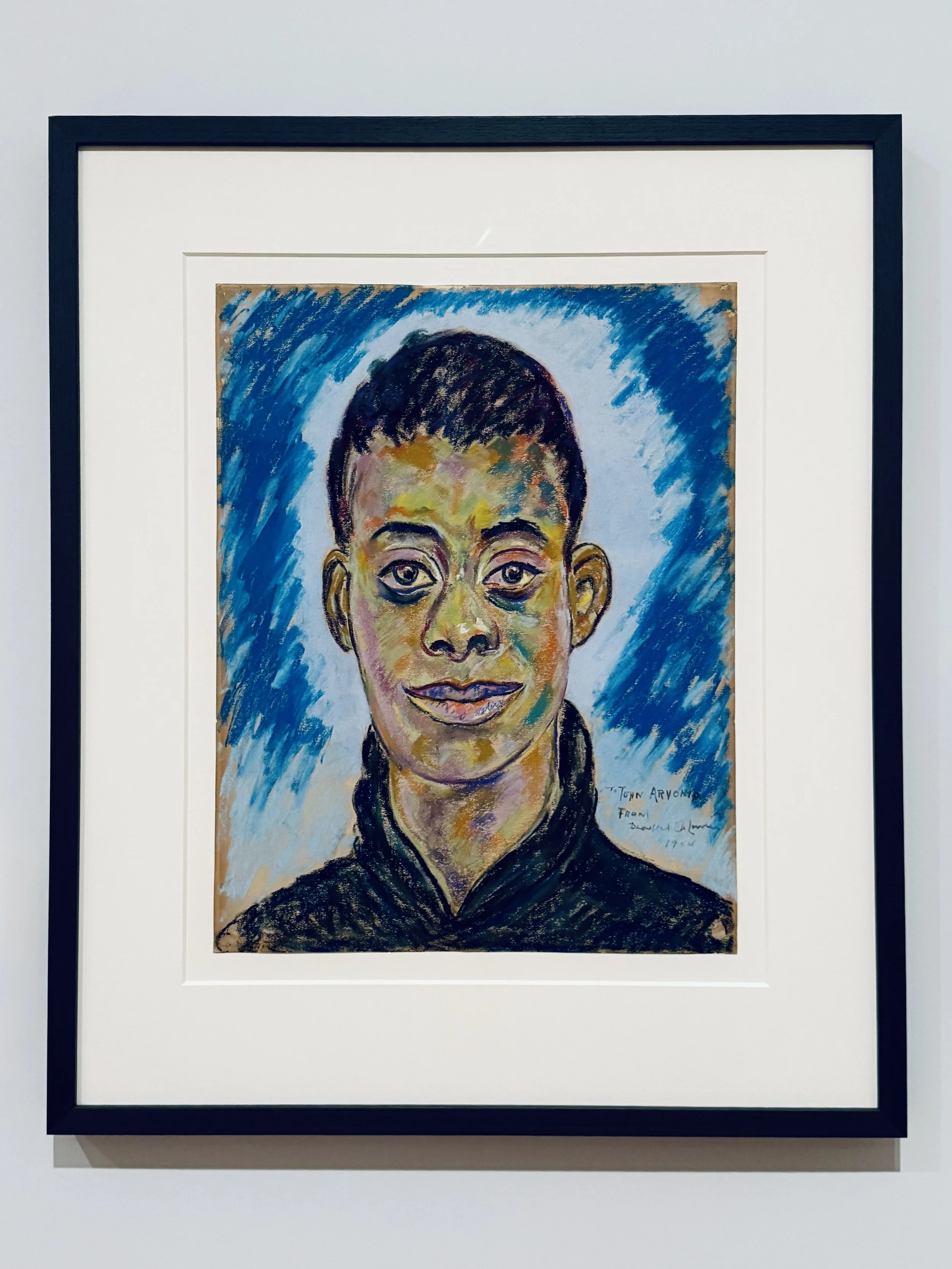
Portrait of James Baldwin by Beauford Delaney

Portrait of James Baldwin by Beauford Delaney, 1944

In this vibrant portrait, Beauford Delaney depicts the 20-year-old African American author James Baldwin before the writer’s rise to literary fame. Delaney renders Baldwin’s face in expressive strokes of green, yellow and purple, capturing not just likeness but inner light. The two men, both openly gay and trailblazing artists of color, shared a profound, formative bond. 

Baldwin regarded Delaney as a mentor and father figure. Reflecting on Delaney’s influence, he wrote, “The reality of his seeing caused me to begin to see.” 

Though Baldwin would become a powerful voice in the civil rights movement, his open sexuality often left him marginalized within the movement’s leadership.

He went on to become one of the most influential gay writers of the 20th century, penning such landmark works as Giovanni’s Room (1956).

Profile of a Man With Hibiscus Flower (Felíx) by Glyn Philpot

Profile of a Man With Hibiscus Flower (Felíx) by Glyn Philpot, 1932 

This intimate portrait features Felíx, a French Caribbean model who sat for the British artist Glyn Philpot several times in 1932. The composition, with its flattened perspective and floral motif, recalls Paul Gauguin’s canvas Jeune Homme à la Fleur, evoking themes of sensuality and exoticism. While the painting echoes colonial-era visual tropes, Philpot’s broader oeuvre is distinguished by its empathetic and often dignified representations of Black subjects, challenging the stereotypes prevalent in early 20th century European art. 

The Elegant Ball, The Country Dance by Marie Laurencin

Le Bal élégant, La Danse à la campagne (The Elegant Ball, The Country Dance) by Marie Laurencin, 1913

Relationships: Intimate Worlds

The section titled “Relationships” explores the personal and social dimensions of queer lives. From Marie Laurencin’s sensual and playful female imagery to Andreas Andersen’s portrait of his younger brother and his friend, their works reflect the sheer diversity and joy of queer intimacy. 

La Danse (The Dance) by Marie Laurencin

La Danse (The Dance) by Marie Laurencin, 1919

Marie Laurencin (1883-1956), a French Cubist, created an idiosyncratic body of work that excluded men and placed women at the center, something truly revolutionary considering that she worked in Paris, in an environment dominated by male artists. A member of Pablo Picasso’s gang, Laurencin’s unique take on Cubism is particularly evident in The Elegant Ball, The Country Dance, a fragmented and angular portrayal of two women dancing front and center. 

The canvas The Dance illustrates Laurencin’s departure from Cubism and marks the development of her own visual language, one that embraces a softer, more fluid style in which women’s bodies seem to merge and dissolve into one another. Laurencin’s dreamlike, ethereal compositions represent a feminist counterpoint to the stylistic tendencies of the male-dominated Cubist avant-garde.

Interior With Hendrik Andersen and John Briggs Potterin Florence by Andreas Anderson

Interior With Hendrik Andersen and John Briggs Potter in Florence by Andreas Anderson, 1894

The Norwegian painter Andreas Andersen depicts his younger brother, Hendrik and their friend, American painter John Briggs Potter, when the trio were living together in Florence in 1894. To our modern eyes, this is a stunning image of a homosexual relationship — but the reality is that men of this era didn’t think that loving or having sex with other men was abnormal or put them into a sexual category. 

Potter, who eventually married a woman, was close to Isabella Stuart Gardner of the eponymous Boston museum. The exact relationship between Hendrik and Potter isn’t known, though Potter was painted by a number of known queer painters and himself painted portraits of handsome men.

Sueño marinero (Sailor’s Dream) by Gregorio Prieto

Sueño marinero (Sailor’s Dream) by Gregorio Prieto, 1932

Gregorio Prieto was a member of the influential Spanish cohort known as the Generation of ’27, alongside the poet

Federico García Lorca. While his work is well known in Spain, it hasn’t received the recognition it merits. 

Prieto’s two paintings exhibited at Wrightwood exemplify his use of the mannequin as a surrealist trope. Prieto employed mannequins as a metaphor for homoerotic love. Indeed, Sailor’s Dream seems to insinuate the act of oral sex, while Full Moon implies stimulation by hand.

Le Sommeil de Manon (Manon’s Sleep) by Madeleine-Jeanne Lemaire, 1907

Le Sommeil de Manon (Manon’s Sleep) by Madeleine-Jeanne Lemaire, 1907

Changing Bodies, Changing Definitions: Redefining Beauty 

The exhibit then pivots to “Changing Bodies, Changing Definitions, where we witness how the nude evolved in art in relation to shifting conceptions of sexuality. In the 19th century, artists often depicted ambiguously gendered adolescents — but by the early 20th century, those figures gave way to striking portraits of well-muscled men and women. Romaine Brooks’ androgynous nude of her female lover sits alongside Tamara de Lempika’s muscular female nude. 

The French novelist Marcel Proust and his lover, Reynaldo Hahn, referred to Madeleine-Jeanne Lemaire as Maman, or Mother, acknowledging her centrality to queer relationships and networks. Lemaire hosted a regular salon well attended by homosexuals, including Proust, Hahn and others such as Sarah Bernhardt, whose work is also featured in this exhibition.

The close-knit queer relationships that defined Lemaire’s social circle also come through in her painting. While many of her female contemporaries avoided overt eroticism, Lemaire’s Manon’s Sleep presents a nude figure who is neither orientalized nor classicized, her sensuality left unapologetically unframed by allegory or genre.

The recently discarded clothes in the left-hand corner appear to take the shape of a female figure lounging in a chair, perhaps watching the nude woman sleep. Lemaire’s soft color palette, decadent textiles and languid figure also seem to emulate Rococo aesthetics, perhaps in a nod to the genre’s own scenes of erotic subversion.

Nackte Schiffer (Fischer) und Knaben am grünen Gestade (Naked Boatmen [Fishermen] and Boys on the Green Shore by Ludwig von Hofmann

Nackte Schiffer (Fischer) und Knaben am grünen Gestade (Naked Boatmen [Fishermen] and Boys on the Green Shore by Ludwig von Hofmann, 1900

Ludwig von Hofmann enjoyed a prominent career as a painter in the late 19th and early 20th centuries. At the time, Germany — newly unified — looked to Ancient Greece as a cultural model, embracing public nudity as a sign of health, virtue and classical refinement. This free body culture (abbreviated as FKK in German) encouraged public nudity as a sign not of prurient interest, but of health and moral virtue.

Segregated from urban homosexual culture by questions of class and occupation, this image of nude boys and men, while undeniably homoerotic, works hard to de-emphasize its inherent suggestive qualities through a committed attention to labor.

Wrestlers by Thomas Eakins

Wrestlers by Thomas Eakins, 1899

Thomas Eakins, celebrated along with Winslow Homer as two of the finest 19th century American painters, here produced a study for an even bigger painting of a gymnasium featuring, among other scenes, two young men wrestling.

While depicting an actual wrestling move, the painting allows two men a moment of full-body contact that escapes inscription as homosexual. They are, moreover, curiously relaxed, even inert, in what is ostensibly a battle for dominance.
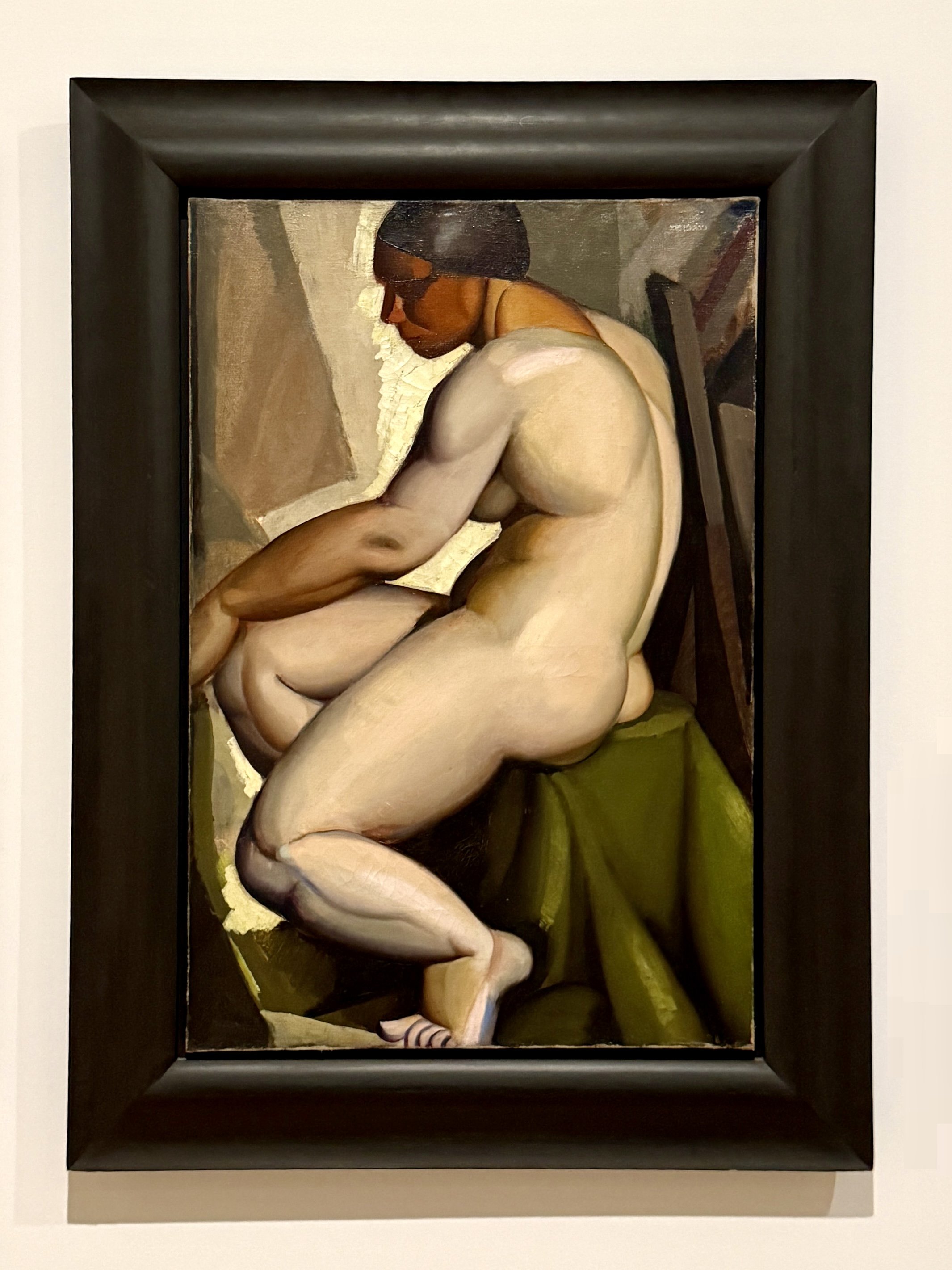
Nu Assis de Profil (Seated Nude in Profile) by Tamara de Lempicka

Nu Assis de Profil (Seated Nude in Profile) by Tamara de Lempicka, 1923

Tamara de Lempicka’s seated nude exists in a space of gender nonconformity, much like the artist herself. The figure’s heavily muscled body and tanned face suggest a masculine presence, perhaps shaped by outdoor labor, while the visible breast and porcelain skin point to a more traditionally feminine traits. The body is angled away from the viewer so as to heighten this sense of indeterminacy.

After moving from Poland to Paris in 1918, Lempicka gained recognition for her Art Deco portraits of glamorous, androgynous figures. Her style and subjects reflect her social circle, which included queer women like the writers Vita Sackville-West and Colette, and her own experiences as an openly bisexual woman.
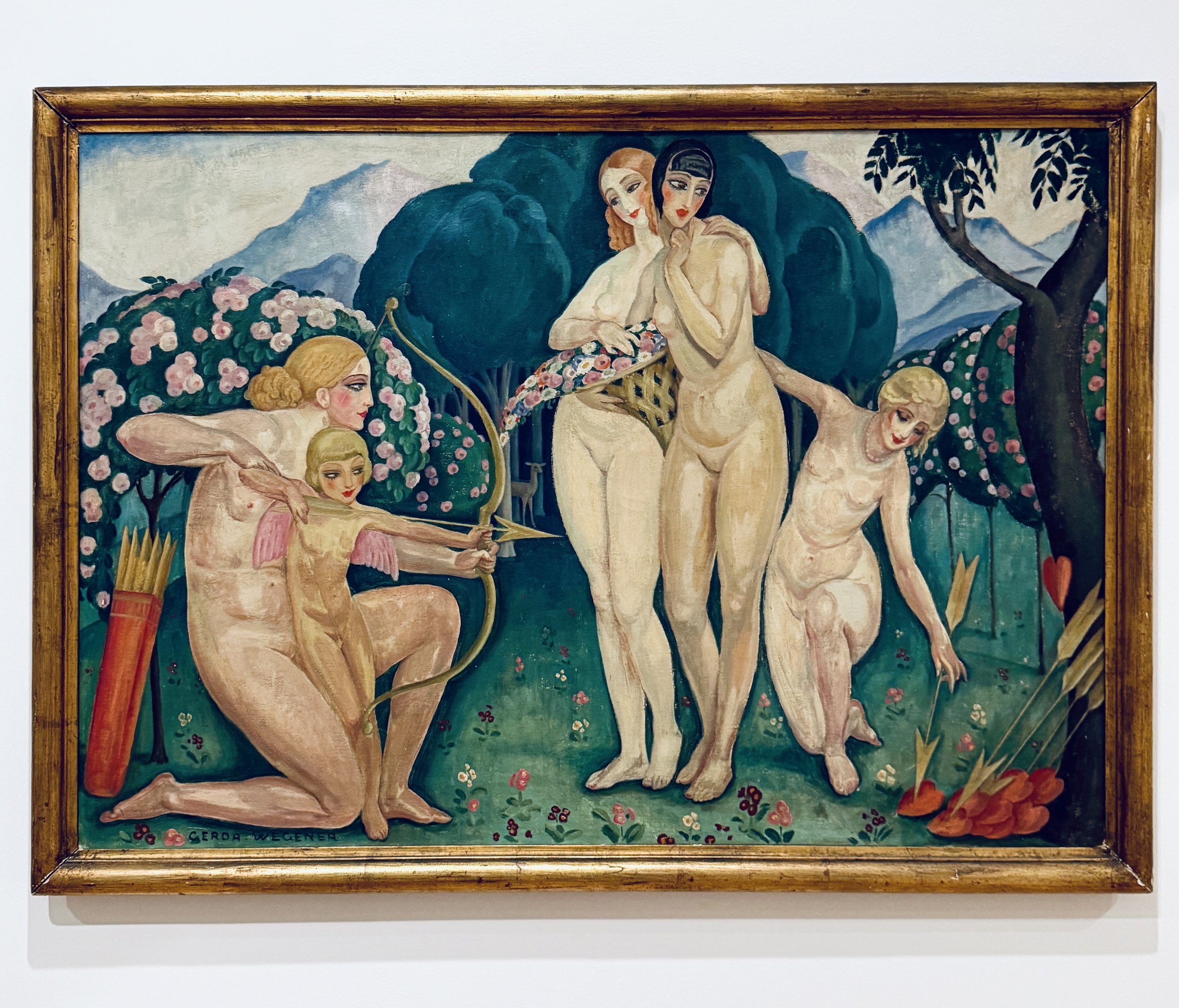
Venus and Amor by Gerda Wegener

Venus and Amor by Gerda Wegener, 1920

History: Echoes of Antiquity 

One of the most powerful sections, “History,” features works that portray an idealized classical past as an alibi to depict homoerotic imagery. Hans Von Marées’ Five Men in a Landscape feels suspended in a timeless queer utopia, while Rupert Bunny’s muscular Hercules takes on both dragons and sexual subtext. 

Venus and Amor is Gerda Wegener’s vision of lesbian Arcadia. In her uniquely Art Deco style, Wegener depicts a garden populated by the Three Graces, Cupid and Venus, the latter helping Cupid draw his bow. Cupid is represented as distinctly nonbinary, with rosy cheeks and nascent breasts. Like the figure of Puck in Shakespeare’s A Midsummer Night’s Dream, Wegener seems to suggest Cupid’s mischievous nature is connected to his gender transgression. 

When this canvas was completed, Wegener was so popular in France that the government bought three of her works for the Louvre, which are now in the Centre Pompidou collections. 

Sadly, she spent her later years in poverty and died in 1940, shortly after Nazi Germany invaded Denmark.

The Joy of Effort by Robert Tait McKenzie, 1912

The Joy of Effort by Robert Tait McKenzie, 1912

Robert Tait McKenzie was a Canadian physician, educator, athlete and sculptor who became director of athletics at the University of Pennsylvania. He donated hundreds of bronze homoerotic images of athletic young men to UPenn, where many are still on display. 

He was a key figure in sports medicine and rehabilitative medicine, designing prosthetics for wounded soldiers. He extolled the value of exercise early, especially for those who worked primarily with their minds. Despite the undeniable homoeroticism in his work, he was married, as the norms of his time dictated.

Cumulonimbus by Kotaro Nagahara

Cumulonimbus by Kotaro Nagahara, 1909

Kotaro Nagahara (1864-1930) was one of the early innovators of yōga, or Western-style painting, in late 19th-century Japan. The relatively conservative style of his male nudes (note the lack of visible genitals) may reflect the impact of the “nude debate” (ratai ronso) in Japanese art circles in the 1890s. The influence of Western nude painting fueled an intense debate among Japanese artists about the nature of propriety and indecency, and some yoga painters like Kuroda Seiki caused controversy for displaying nude paintings to the public. In this cultural atmosphere, it’s not surprising that Nagahara took a more discreet approach here in obscuring the figure’s genitalia.
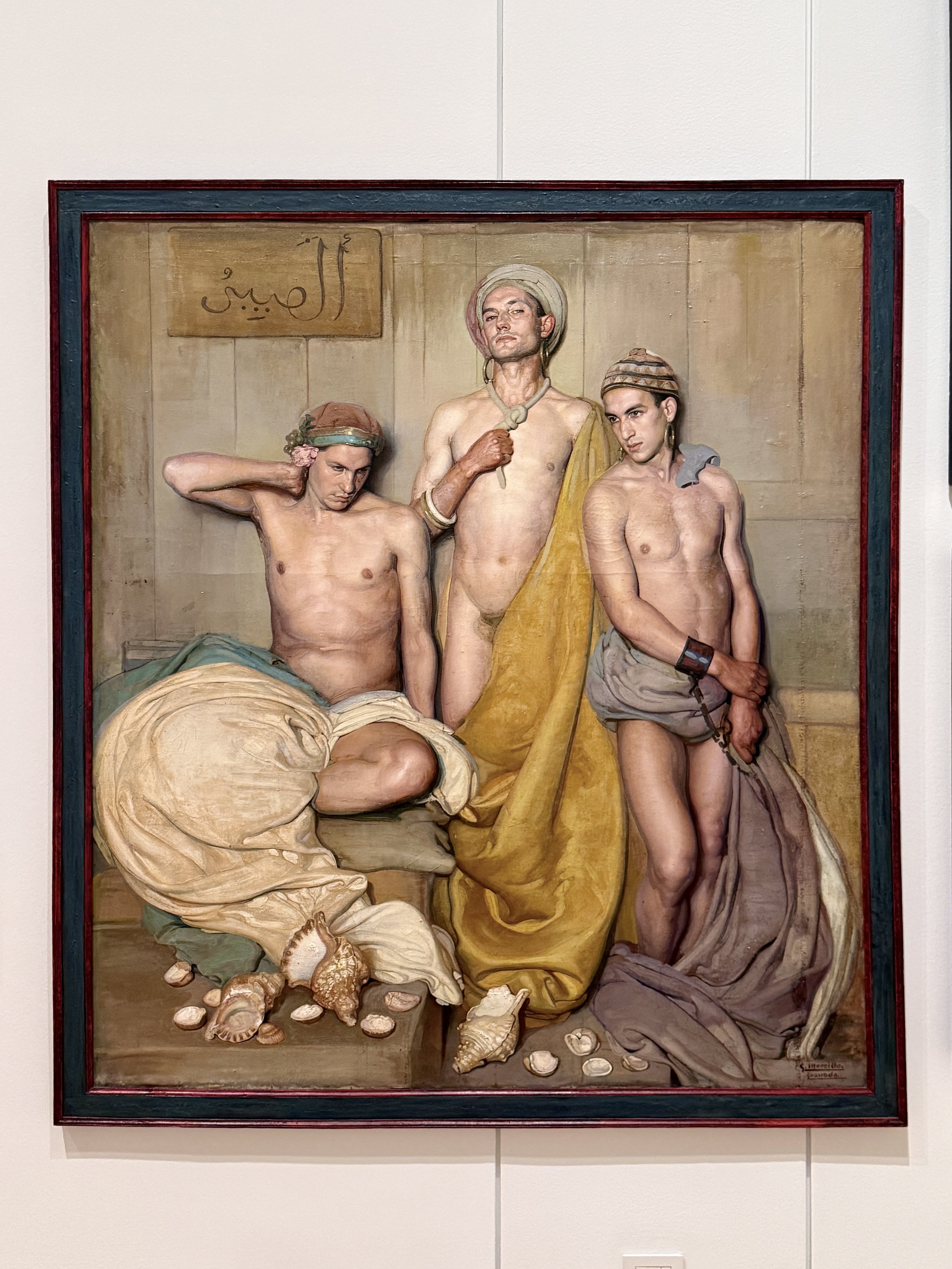
Slaves by Gabriel Morcillo

Slaves by Gabriel Morcillo, 1926

Colonialism and Resistance: Imported Shame, Native Pride

But art is never just about aesthetics. In “Colonialism and Resistance,” the exhibition explains how Western imperialism often coded queerness as foreign or degenerate, while simultaneously fetishizing it. A pernicious side effect of colonialism was that Western suppressive ideologies on homosexuality were imposed on conquered lands — many of which went from respecting same-sex relations to writing homophobic laws into their legal codes. 

Gabriel Morcillo’s painting Slaves is a striking example of how Orientalist aesthetics were often used to veil overt homoeroticism. Like many artists of his era, Morcillo employed the exoticized imagery of the so-called “East” to explore themes of male beauty and sensuality, subjects that were daring and even dangerous to depict in the 1920s and early ’30s. He later experienced both the favor and the fallout  of political affiliation: Between 1950 and 1955, he was commissioned by dictator Francisco Franco to paint several portraits, both standing and on horseback. With the arrival of Spain’s democratic Transition, Morcillo was classified as a Francoist, and his work largely vanished from art history books, despite its considerable artistic merit.
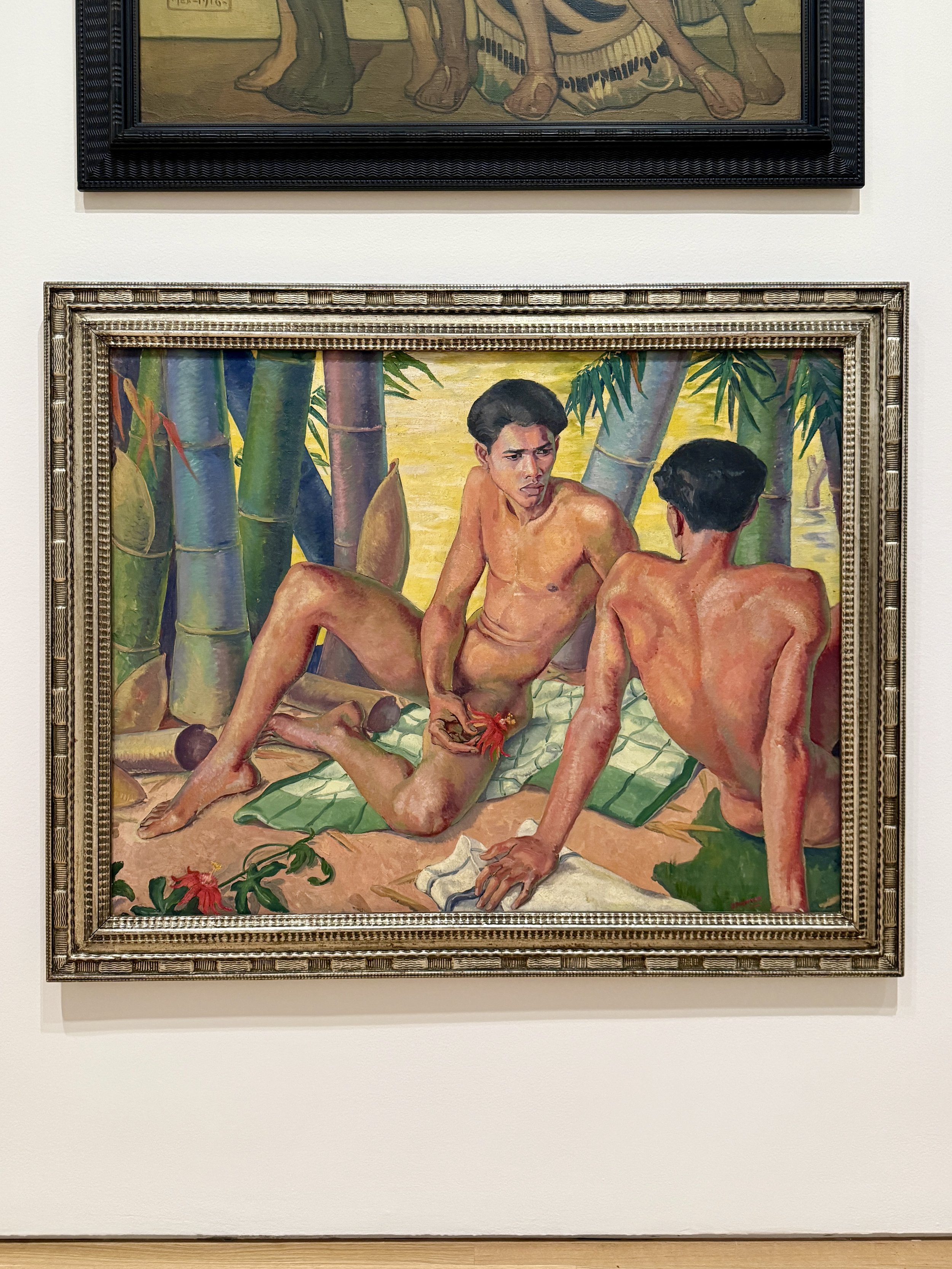
L’après-midi (In the Afternoon) by David Paynter

L’après-midi (In the Afternoon) by David Paynter, 1935

David Paynter’s In the Afternoon offers a rare and quietly radical vision of male intimacy in early 20th century South Asian art. Born in 1900 in Sri Lanka (then Ceylon), Paynter was known for merging Western classical techniques with South Asian subjects, often weaving subtle references to same-sex desire into his work.

In this painting, two young men share an intimate gaze, one delicately holding a flower — echoing the sensuality of Gauguin’s Polynesian women but recast through a defiantly queer lens. The image stands in quiet resistance to colonial-era moral codes that had, by that time, already begun to reshape attitudes toward sexuality across South Asia.

Before the British imposed Section 377 of the Indian Penal Code in 1861 — which criminalized “carnal intercourse against the order of nature” — many Asian cultures held more fluid and nuanced understandings of gender and sexuality. Paynter’s work gestures toward that precolonial cultural memory, reclaiming tenderness between men as both natural and beautiful.

La Danza (Dance) by Elisàr von Kupffer

La Danza (Dance) by Elisàr von Kupffer, 1918

Beyond the Binary: Gender, Reimagined

Finally, “Beyond the Binary” delivers what may be the show’s most revelatory section. Featuring more than 60 works, it draws direct connections between early queer and trans identities. 

Among the highlights is one of the first self-consciously trans representations in art: Gerda Wegener’s 1929 portrait of her spouse Lili Elbe. 

This section also includes paintings from the Elisarion, a utopian queer villa in Switzerland. One of these images is believed to depict the first same-sex wedding scene in art history.

Elisàr von Kupfer, who preferred to be called Elisarion, founded a spiritual movement he named Clarism, which rejected the gender binary as a perversion of divine will. Proud of his own feminine physical features, von Kupfer adorned his temple in Minusio, Switzerland, with paintings of similarly androgynous and nonbinary figures. While von Kupffer was a pioneer in challenging gender and sexual norms, he was also a white supremacist, and his work was influenced by Aryanism. He sought to engage Adolf Hitler in correspondence, though there is no evidence that the dictator ever replied. 

In von Kupffer’s utopia, gender was fluid and inclusive — but race, clearly, was not. His example shows how radical views in one realm did not necessarily extend to others.

Untitled (kuchi-e [frontispiece] with artist’s seal Shisen) by Tomioka Eisen

Untitled (kuchi-e [frontispiece] with artist’s seal Shisen) by Tomioka Eisen, 1895

This image was made as an illustration for the novel Sute obuna, an adaptation of the mystery novel Diavola (1885) by the British author Mary Braddon. From the 1880s onward, many European mystery stories were translated into Japanese and adapted to Japanese contexts. This could have the effect of producing unique and humorous juxtapositions between the Japanese characters and their Western mannerisms, as seen in this moment of unexpected male intimacy. Tomioka Eisen was a prolific illustrator during the Meiji Period, trained in ukiyo-e methods. He also produced a small number of erotic works, which were circulated privately.

Lili med fjerkos (Lili With a Feathered Fan) by Gerda Wegener, 1920

Lili With a Feathered Fan by Gerda Wegener depicts her husband, Einar Wegener (who later became Lili Elbe), holding a green feather fan. The painting is significant as an early example of transgender representation in art, created during a period when Lili was beginning to express her gender identity more openly. 

Lili first emerged in 1904 when Gerda asked Einat to pose in women’s clothing after one of her female models failed to show up. This moment marked the beginning of a public and private transformation. In the early ’20s, Lili began living more fully as a woman, and in 1930 she underwent one of the first known gender-affirming surgeries. 

Their relationship inspired the 2015 film The Danish Girl. Tragically, Lili died in 1931 from complications following the final stages of her surgeries. 

Peter (A Young English Girl) by Romaine Brooks

Peter (A Young English Girl) by Romaine Brooks, 1923

Romaine Brooks’ work from this period captures early 20th century lesbian life, with portraits of friends, lovers and fixtures of the queer world she inhabited. Here, Brooks depicts the nonbinary British artist known as Gluck, who also went by the name Peter. Gluck insisted on being addressed as “Gluck, no prefix, suffix or quotes” — rejecting any gendered association with their identity.

Statue of the goddess Athena by a stairwell at The First Homosexuals at Wrightwood 659 in Chicago

Amazing architecture, powerful art, dedicated docents and a relaxed, uncrowded flow make Wrightwood 659 well worth a visit.

Wrightwood 659 Does It Right 

Wrightwood 659 intentionally limits the number of visitors and requires timed-entry tickets purchased in advance. This keeps exhibitions intimate and uncrowded, allowing visitors to reflect deeply without distraction.

The First Homosexuals brings together more than 300 works by 125 queer artists from 40 countries, drawn from over 100 museums and private collections around the globe. Each loaned piece contributes to a sweeping, multifaceted narrative of queer identity, resilience and creativity. 
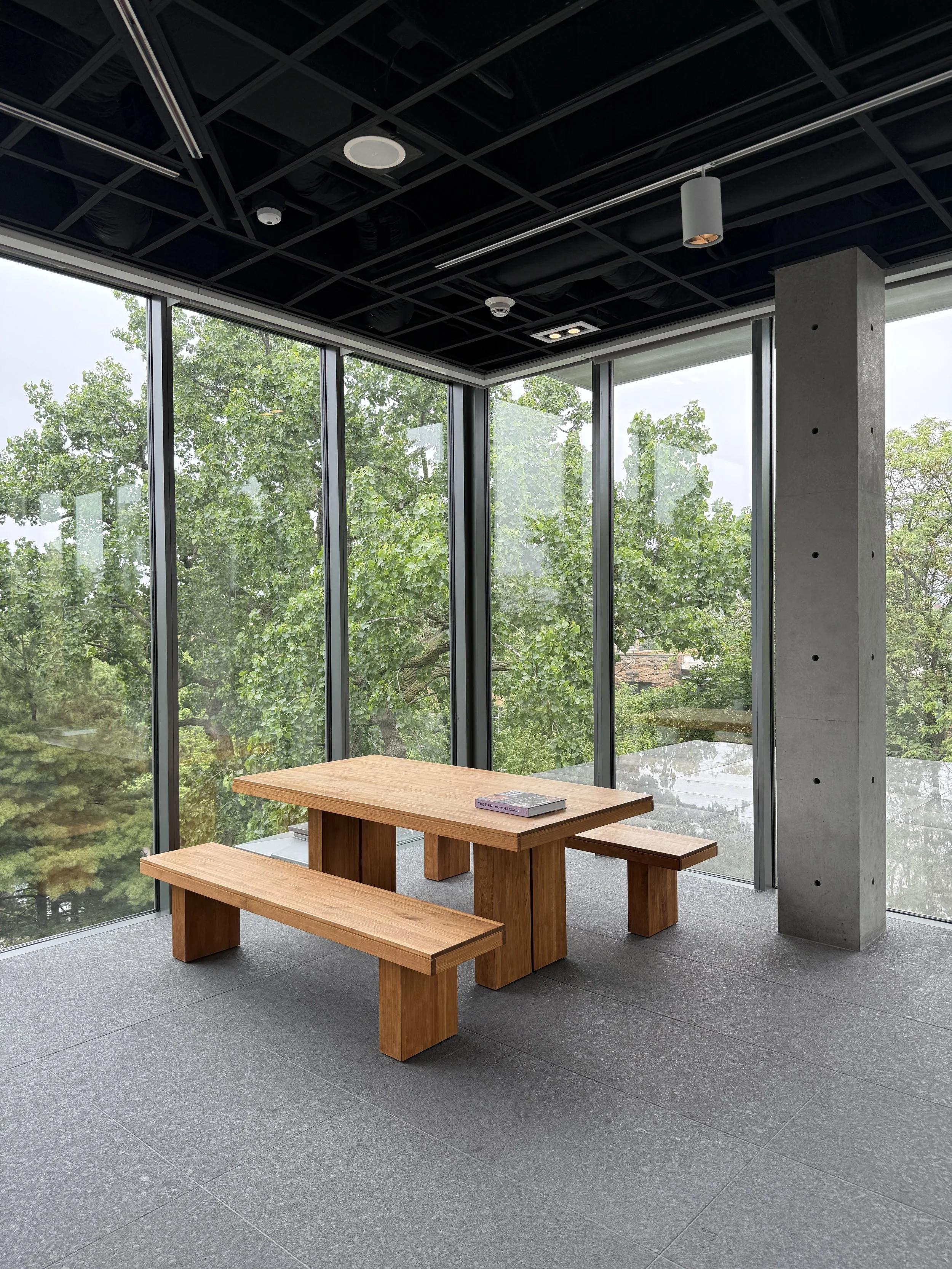
A table and benches by big windows in a quiet nook at Wrightwood 659 in Chicago

A quiet nook with a view at Wrightwood 659

Wally and I were struck not only by the scale of the exhibition, but by the obvious care with which it was assembled. Every element — from the curation of individual works to the flow of the galleries — felt deeply considered, designed to honor the artists, their histories and the communities they reflect.

We had the added privilege of visiting on a day when docents were present, enriching the experience with personal reflections and deeper context about the artists and their work. Their stories added an intimate, human layer to an already powerful presentation. –Duke
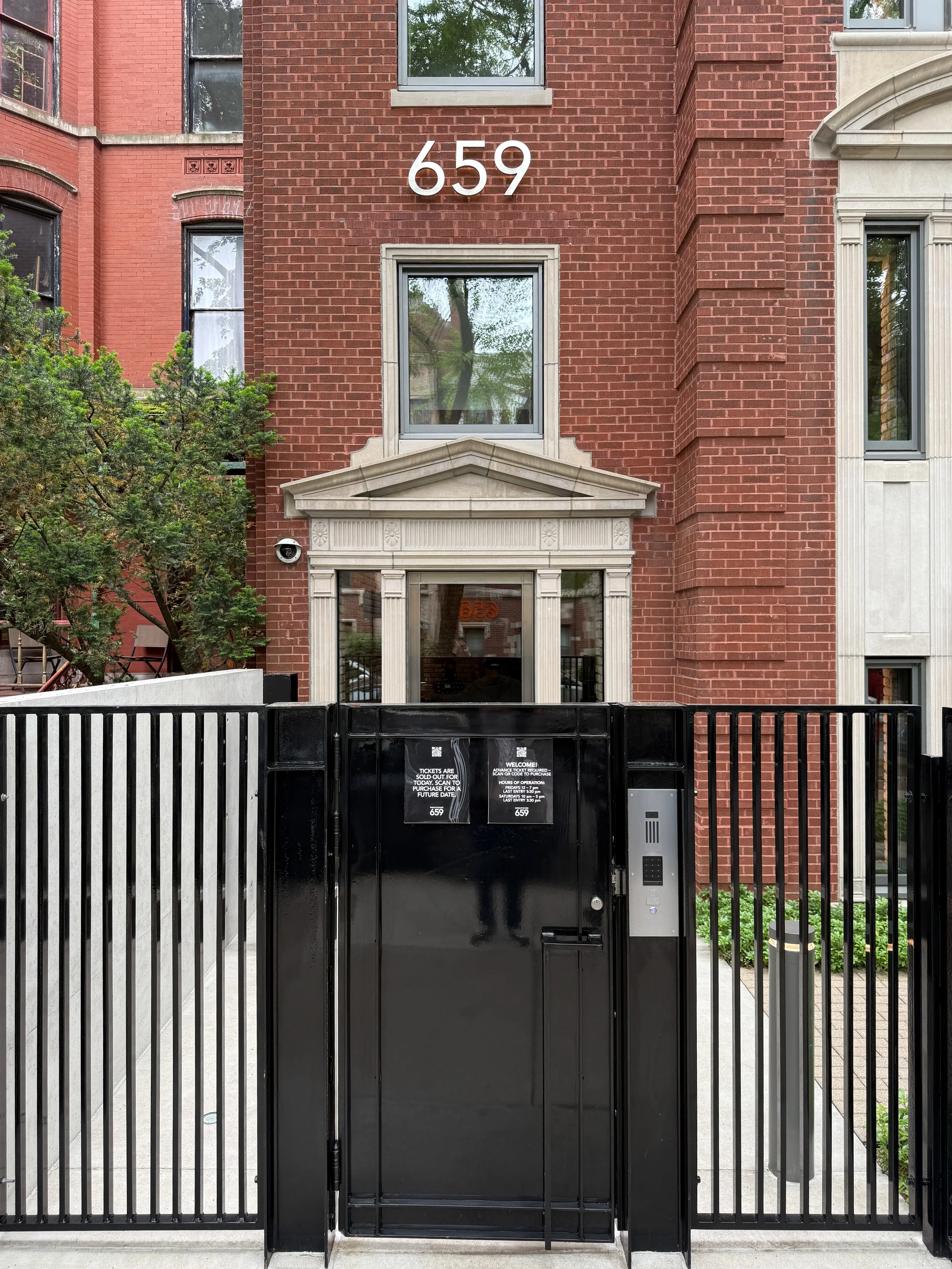
The entrance to Wrightwood 659 gallery

Wrightwood 659

West Wrightwood Avenue
Chicago, Illinois 
USA 
 

What to Know Before You Go to Meow Wolf’s Radio Tave in Houston

At Radio Tave, reality takes a coffee break. Here are 10 tips to get the most of this kaleidoscopic wormhole of art, lore and immersive weirdness. 

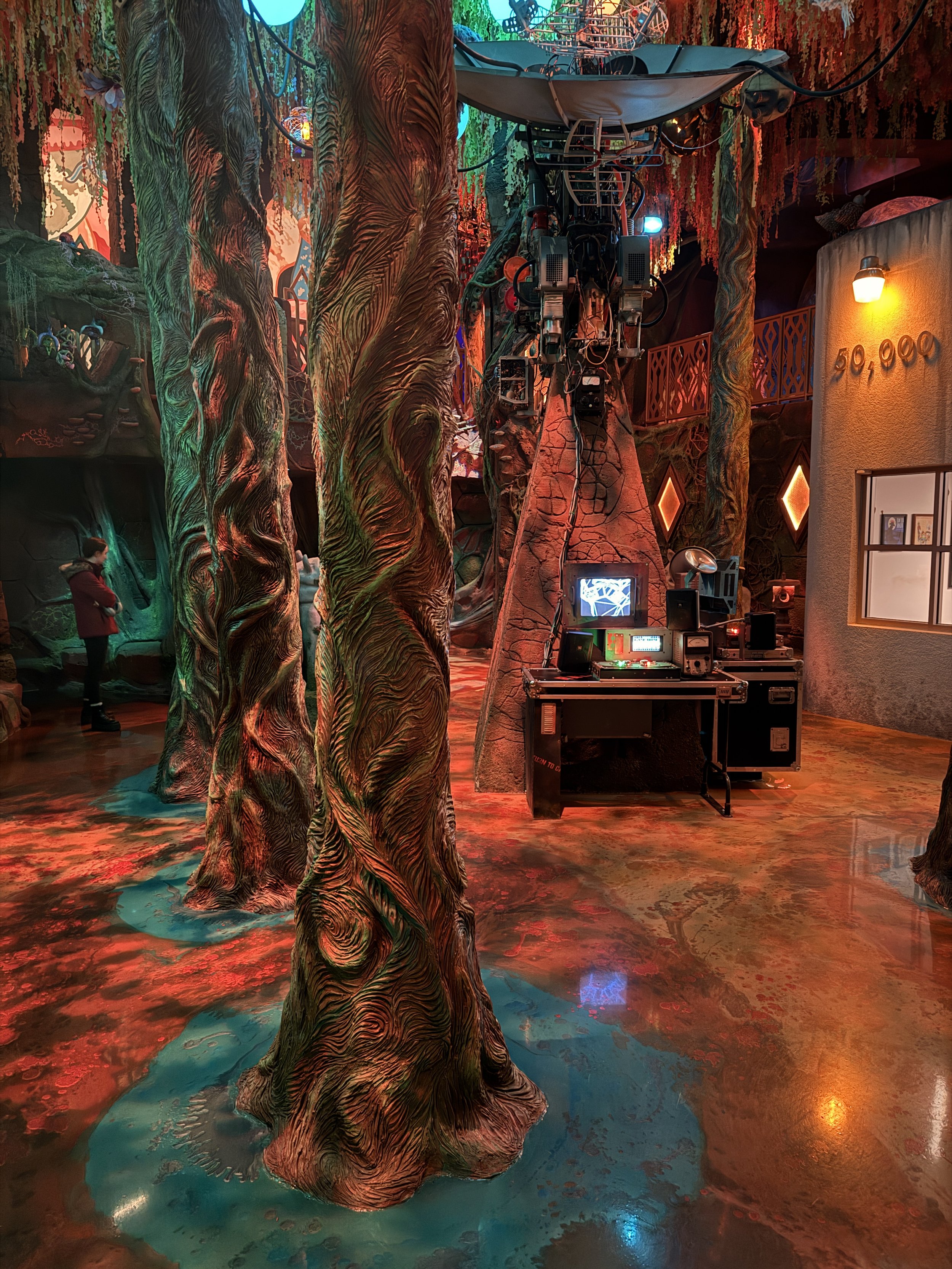
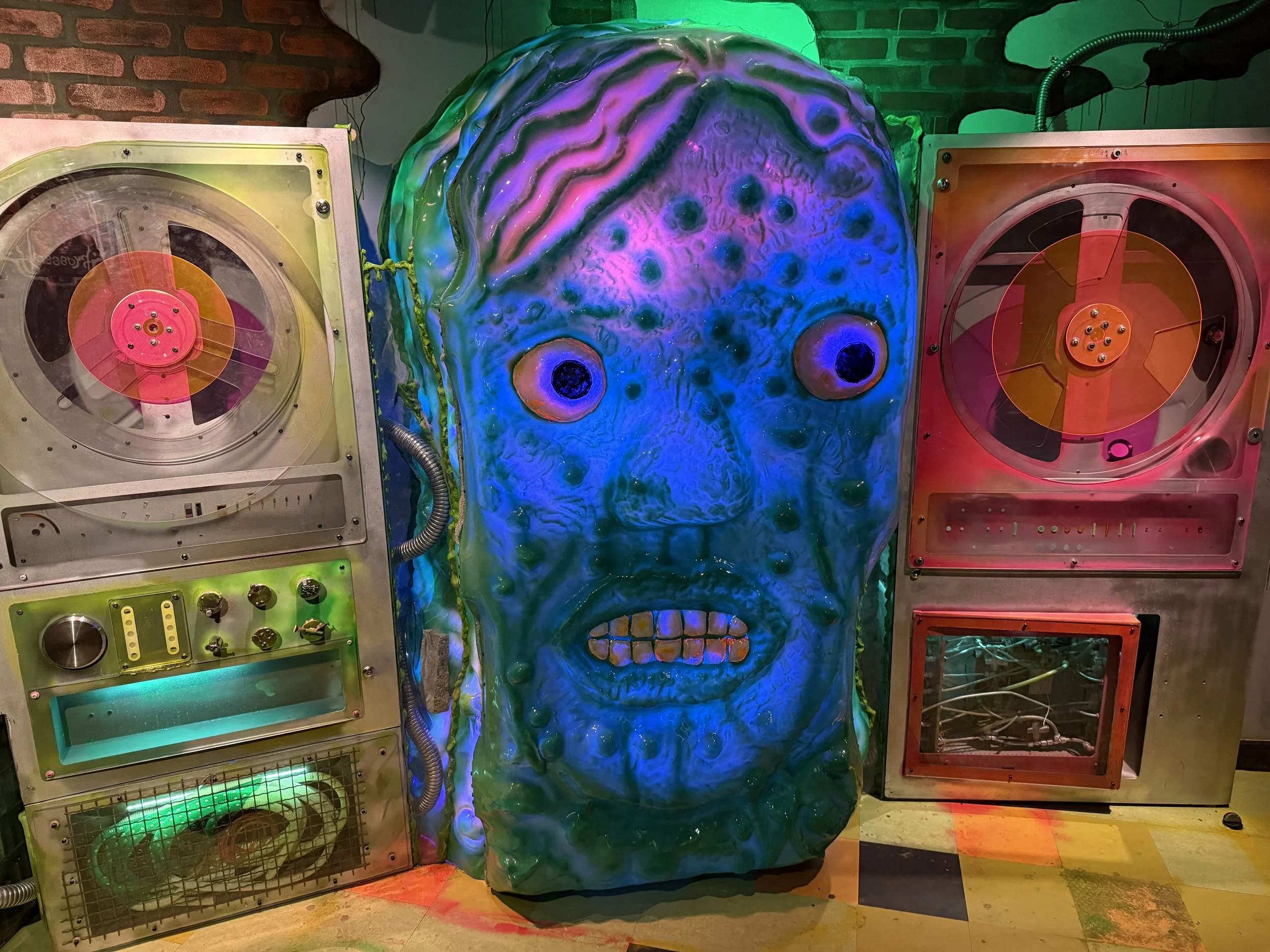
Retro audio equipment by a giant blue head at Meow Wolf Radio Tave in Houston, Texas

Imagine stepping into a radio station from another dimension — one where the airwaves are alive, nothing is quite what it seems, and reality twists like a pretzel. That’s Meow Wolf’s Radio Tave, a 29,000-square-foot mind-bending, neon-drenched fever dream where the usual rules of physics, logic and personal space don’t apply. It’s like doing shrooms without actually doing shrooms — trust me, you don’t need psychedelics to feel like your brain is melting … in the best way possible.

Before heading in, prepare yourself. You might think you’re just visiting a trippy art exhibit, but Radio Tave has other plans. Here’s what you need to know before you tumble down the rabbit hole.

Trust me, you don’t need psychedelics to feel like your brain is melting … in the best way possible.

Note: This post contains spoilers of a sort, as well as images of Meow Wolf Radio Tave. 

Strange trees and computer stations at Meow Wolf Radio Tave in Houston, Texas

1. Engage fully. When in doubt, touch it, open it … and question reality. 

This isn’t a museum. You’re not just here to admire at a safe distance. You’re here to get lost, touch everything, and probably question your grip on reality.

If something seems slightly off, investigate. You might discover a hidden passage, a surreal transmission or a funky relic from another dimension. If that radio sounds like it’s whispering secrets directly into your soul … it absolutely is.

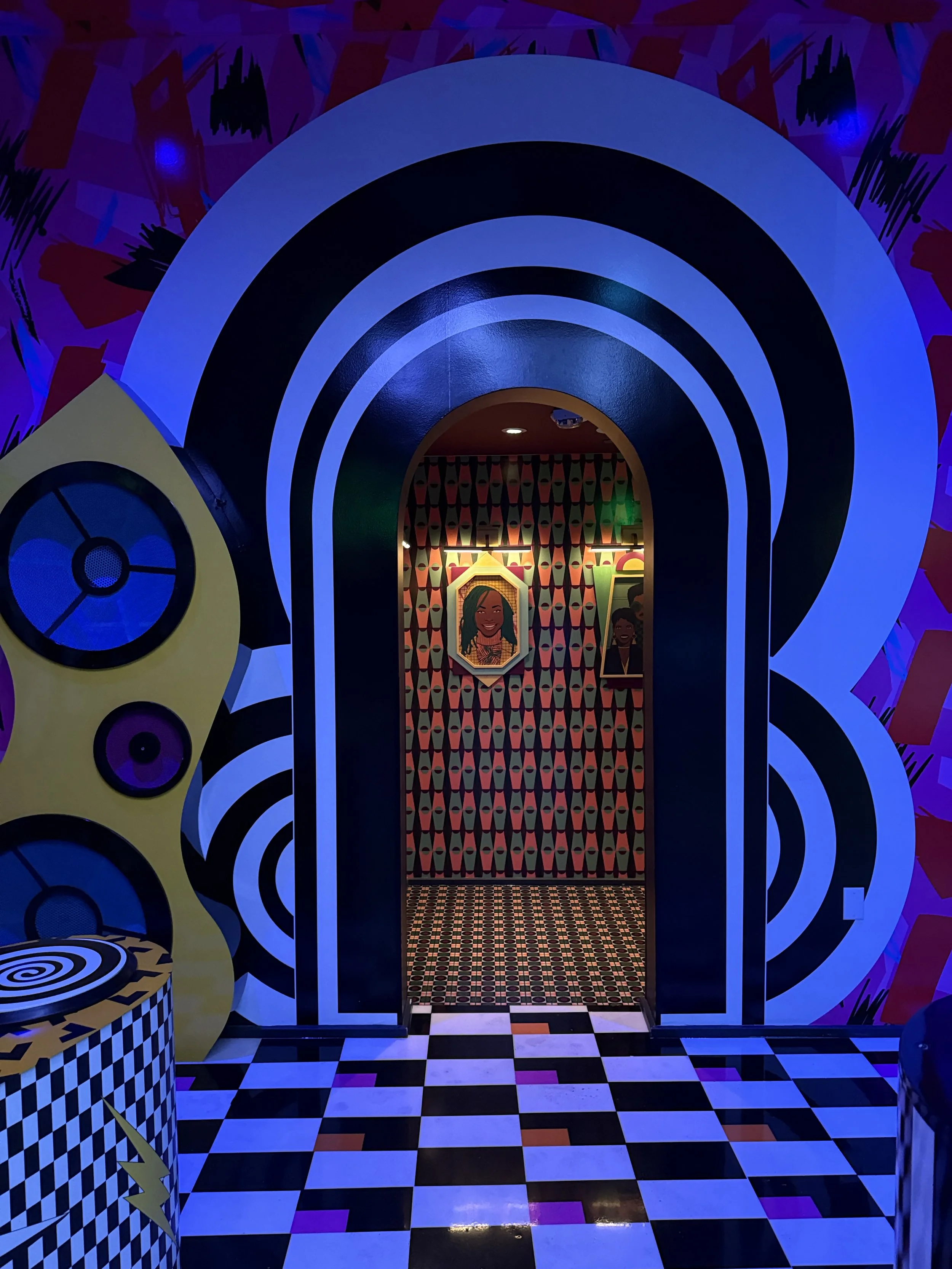
A psychedelic room with an arched entry into a hallway with portraits on the wall

2. Always look for a door (even if it’s not a door). 

In the world of Radio Tave, exits are illusions and illusions are exits. Sometimes a doorway is painted into a mural. Sometimes the handle to another world is just sitting there, waiting for you to open it.

If you find yourself in a room with no way out, take a breath. The escape route is probably hiding in plain sight — maybe inside an everyday object.

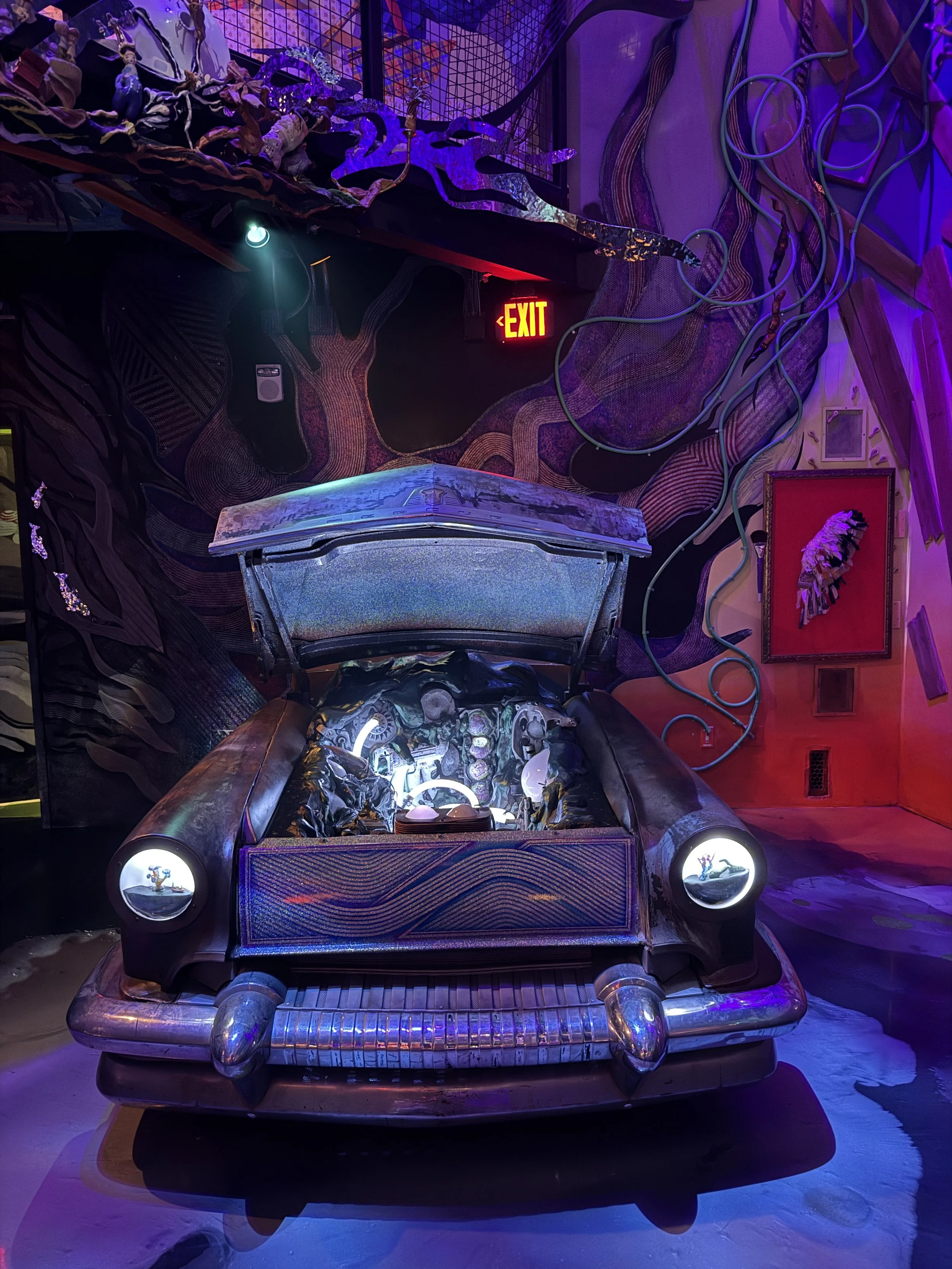
A strange car with its hood open at Meow Wolf Radio Tave in Houston, Texas

3. The mystery’s there … but don’t drive yourself crazy trying to solve it. 

There’s lore here. A lot of lore. Something about a radio station lost in time and space, a mysterious force manipulating the airwaves, and an entire reality gone sideways. You can follow the clues if you want to unravel the mystery, but spoiler alert: You’ll never get a full answer.

The designers left about 60% of the story intentionally vague, meaning you’ll pick up eerie transmissions, weird artifacts and cryptic messages that hint at something much bigger … but never quite give you the full picture.

We asked a couple of staffers if there was an official solution to the mystery, and they all sort of looked at us blankly.

So go ahead and chase the story, but don’t stress if you leave with more questions than answers. That’s half the fun.

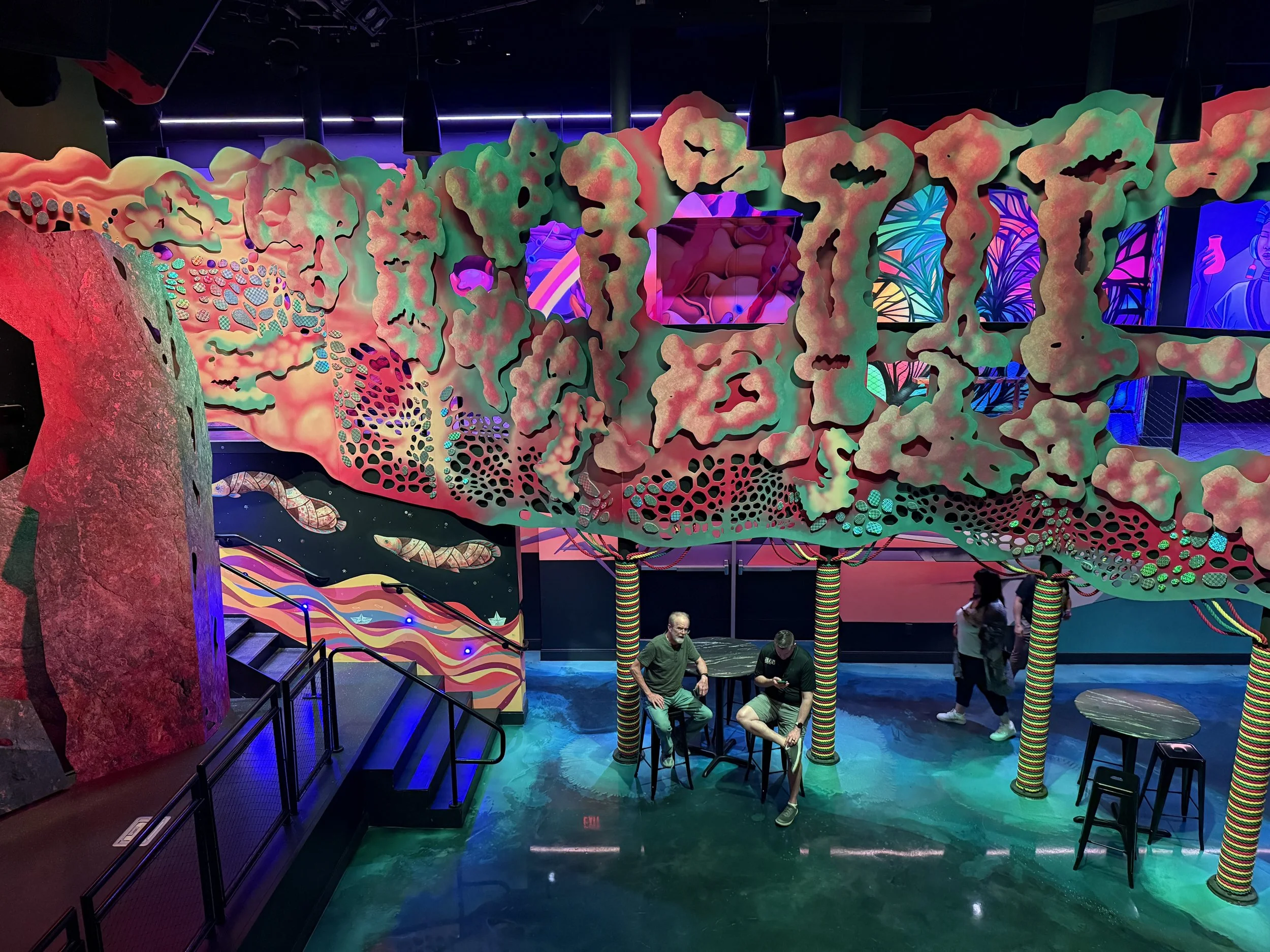
Looking down at a table and stool space with colorful murals at Meow Wolf Radio Tave in Houston, Texas

4. Try to avoid the crowds — and don’t worry if you get separated.  

Entry is staggered, which helps keep things from feeling too crowded. Show up on time, or risk having to wait for another entry slot.

If you’re with friends, don’t panic if you get separated. This place has a way of pulling people in different directions, and honestly? That’s part of the experience. Make a loose plan, but embrace the chaos. Maybe you’ll end up meeting in the break room — or at the dimension-tearing tornado. 

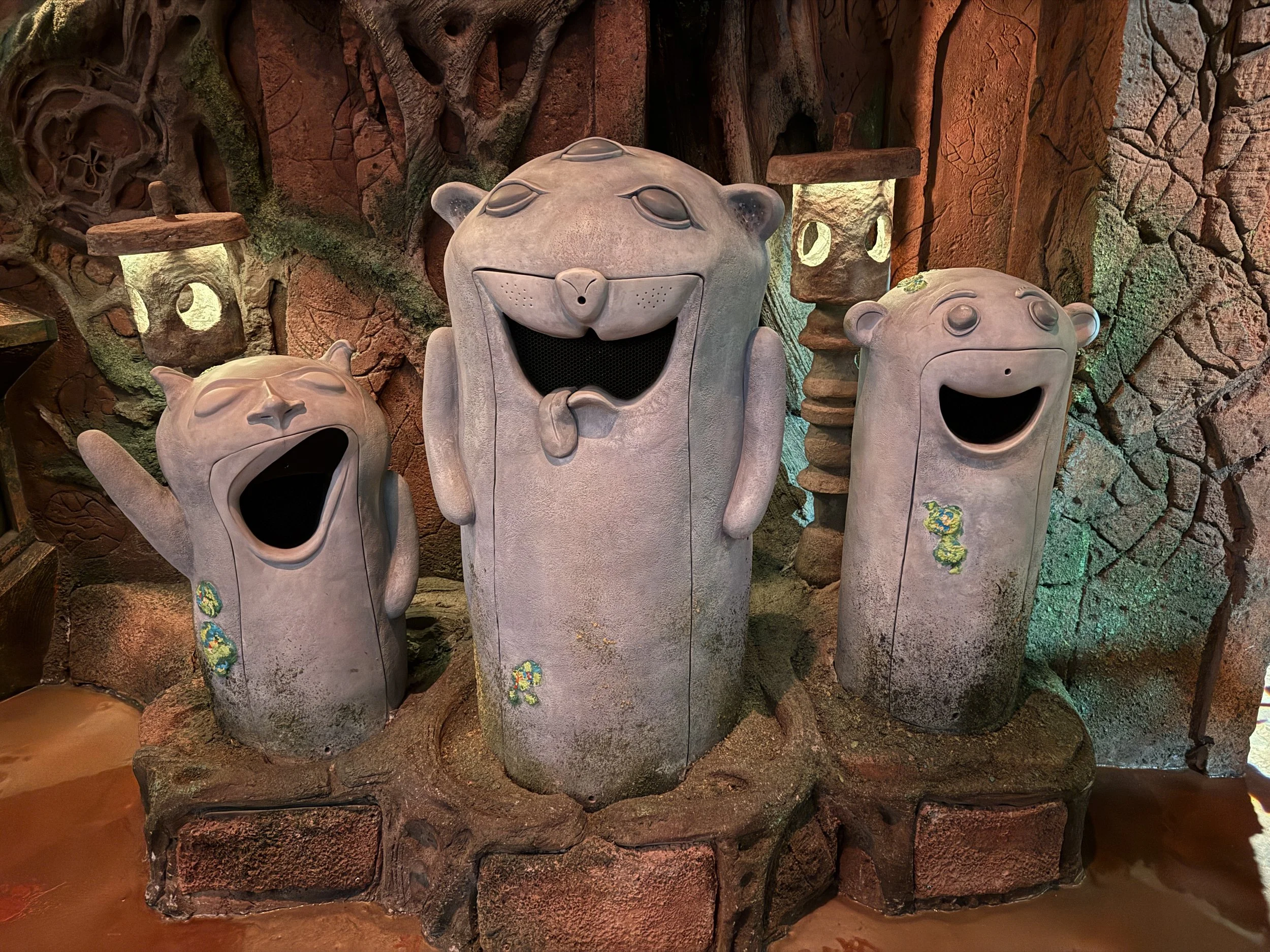
A trio of cute open-mouthed creatures at Meow Wolf Radio Tave in Houston, Texas

5. Prioritize comfort (your feet will thank you). 

Shoes matter. If you show up in stilettos or flimsy sandals, you’re going to regret it. Stick to sneakers or other comfortable shoes — you’ll be wandering, climbing stairs, and possibly stepping into alternate dimensions.

Mobility-wise, most of the space is accessible, but there are a few places where you might have to step over low thresholds or navigate tight areas. Take the elevator at least once. It’s fun to see where you end up. 

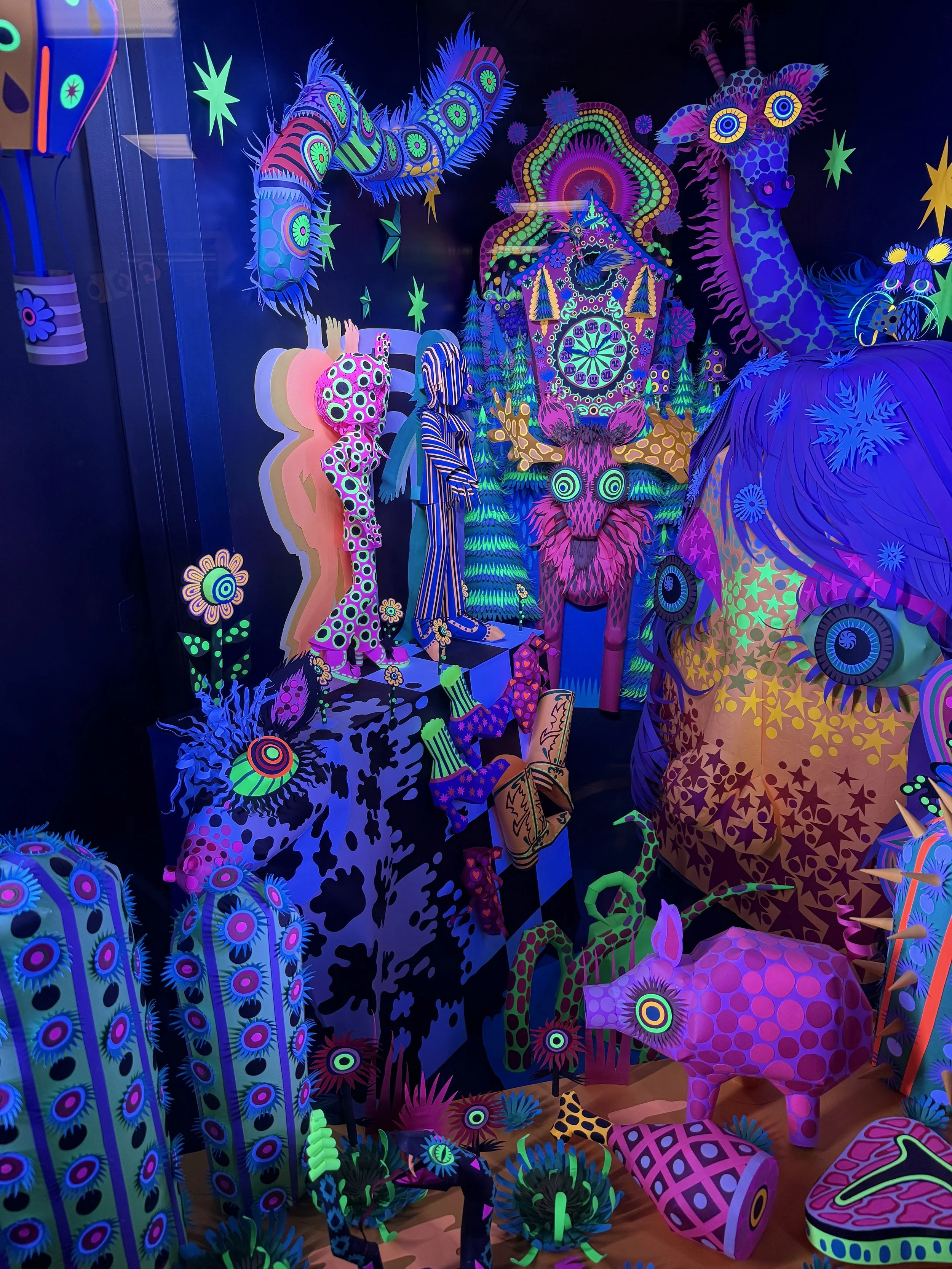
Whimsical neon-lit creatures at Meow Wolf Radio Tave in Houston, Texas

6. Pony up for the glasses. 

Fork over the 2 bucks to get a pair of Chromadepth 3D glasses — and while you don’t have to wear them the entire time, they’re worth pulling out at the right moments.

Some of the painted walls have low-key 3D effects, but that’s just the warmup.

The real magic happens in the more mind-bending spaces, where the glasses crank up the intensity and make everything feel deeper, weirder and way more immersive.

Wear them when you want extra visual chaos, then take them off when you need a break. 

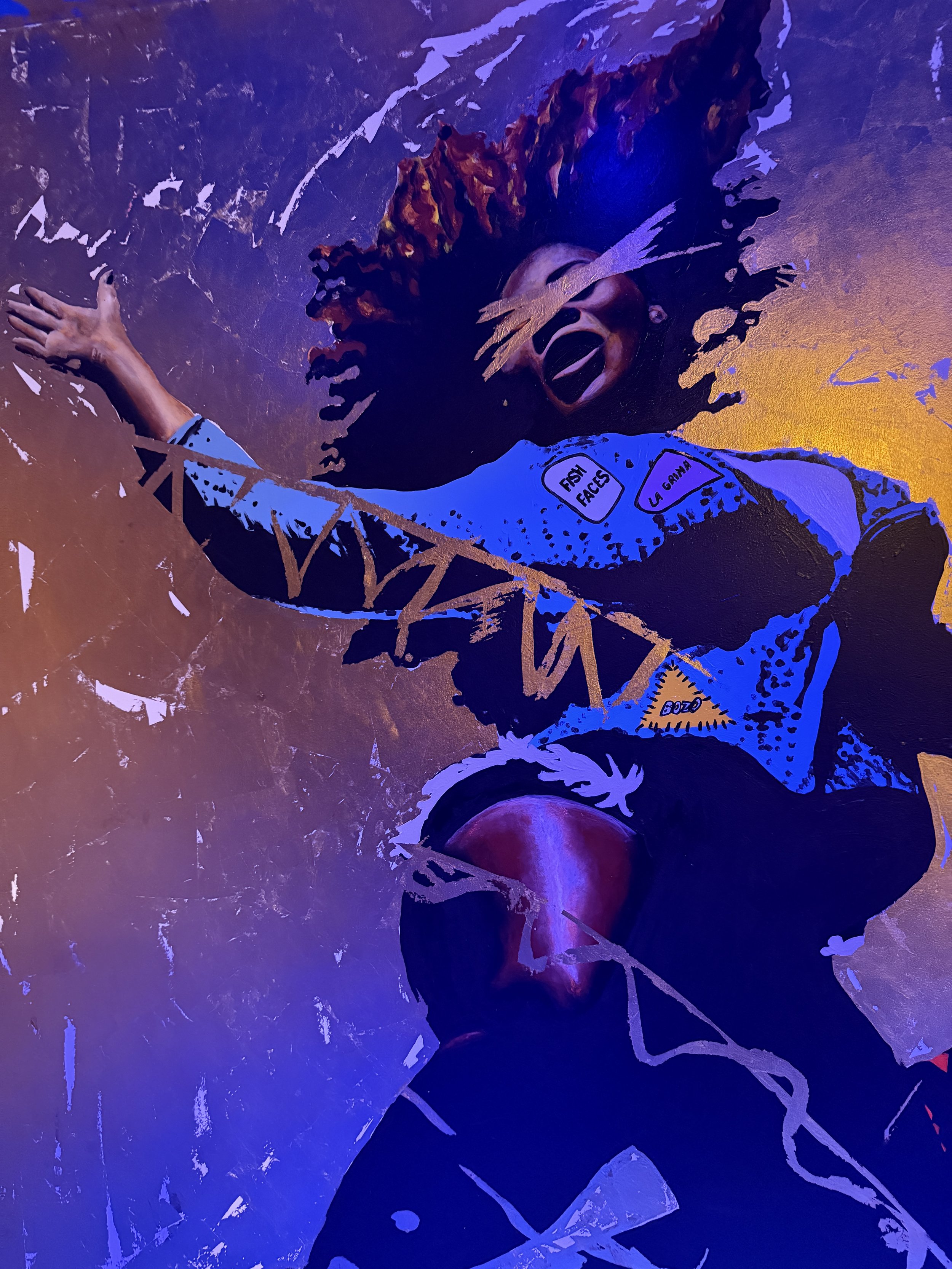
Artwork of dancing woman with eyes crossed out at Meow Wolf Radio Tave in Houston, Texas
A cool chick dancing in a mural at Meow Wolf Radio Tave in Houston, Texas

7. Savor the experience (i.e., put your phone down for a minute!)

Yes, you’re going to want photos. The colors are otherworldly, the visuals are trippy, and if you don’t take at least one deeply confused selfie, did you even go?

But also — be in the moment. Some of the most surreal parts of the experience can’t be captured in a picture or video. The way the sound shifts as you walk through a portal, the eerie sensation of a voice whispering something maybe just for you, the feeling that you’re being watched by something just outside the edge of perception…

Take some shots, sure. But also just let yourself be immersed in the bizarre.

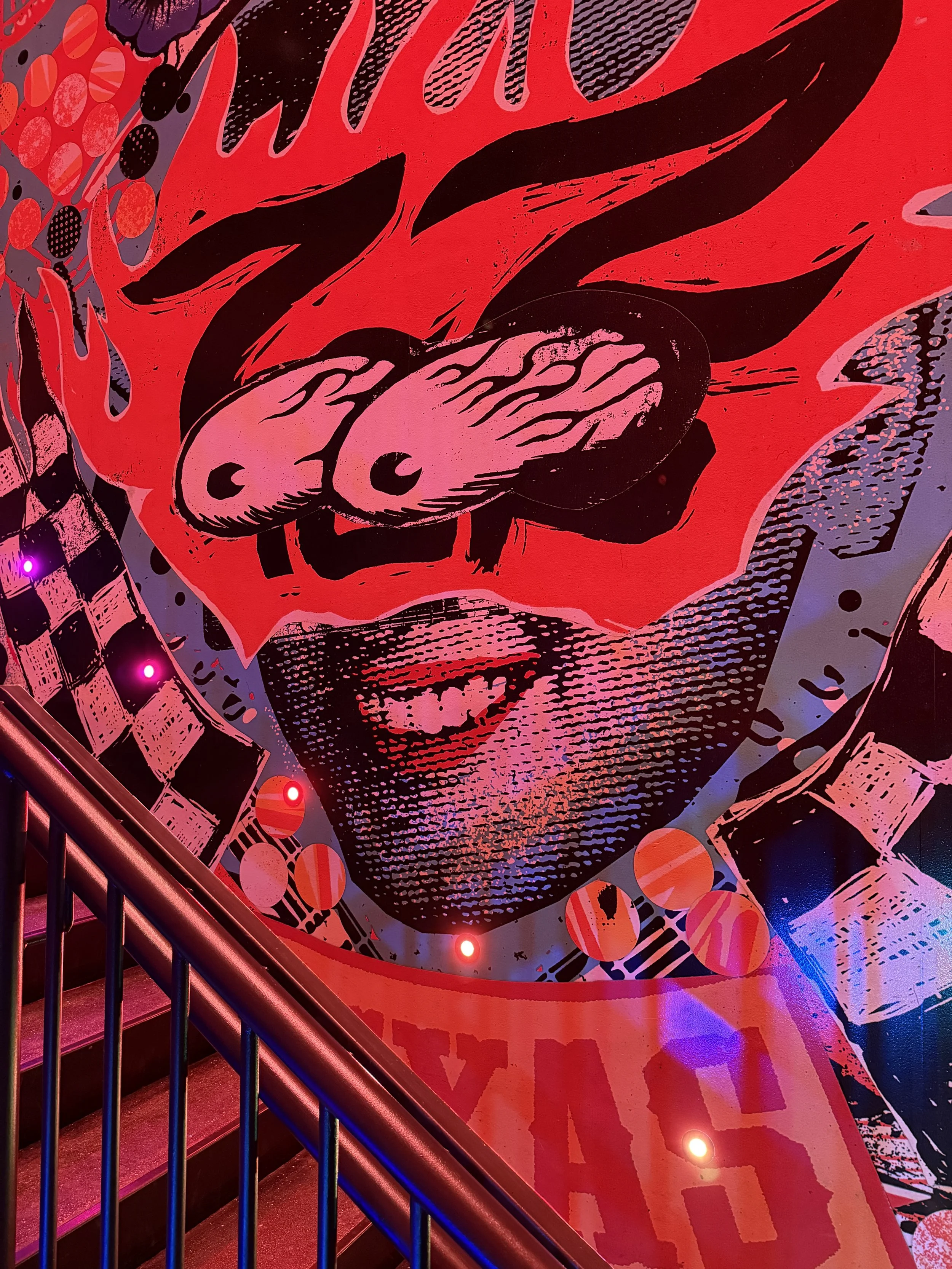
Artwork on the wall of a head with black tears and flaming eyes at Meow Wolf Radio Tave in Houston, Texas
Red collage artwork of bulging eyes by a staircase at Meow Wolf Radio Tave in Houston, Texas

8. Admire the work of local artists. 

Over 100 artists contributed to various aspects of Radio Tave, with more than 50 coming right from Texas.

Keep an eye out for the work of Sam Lao, Dawn Okoro, El Franco Lee II, Gonzo247, Jasmine Zelaya, Loc Huynh and Trenton Doyle Hancock — their murals and installations add another layer of brilliance, storytelling and local soul to the already surreal experience.

If you find yourself staring at a piece of art for an uncomfortably long time, congrats! You’re experiencing Meow Wolf correctly.

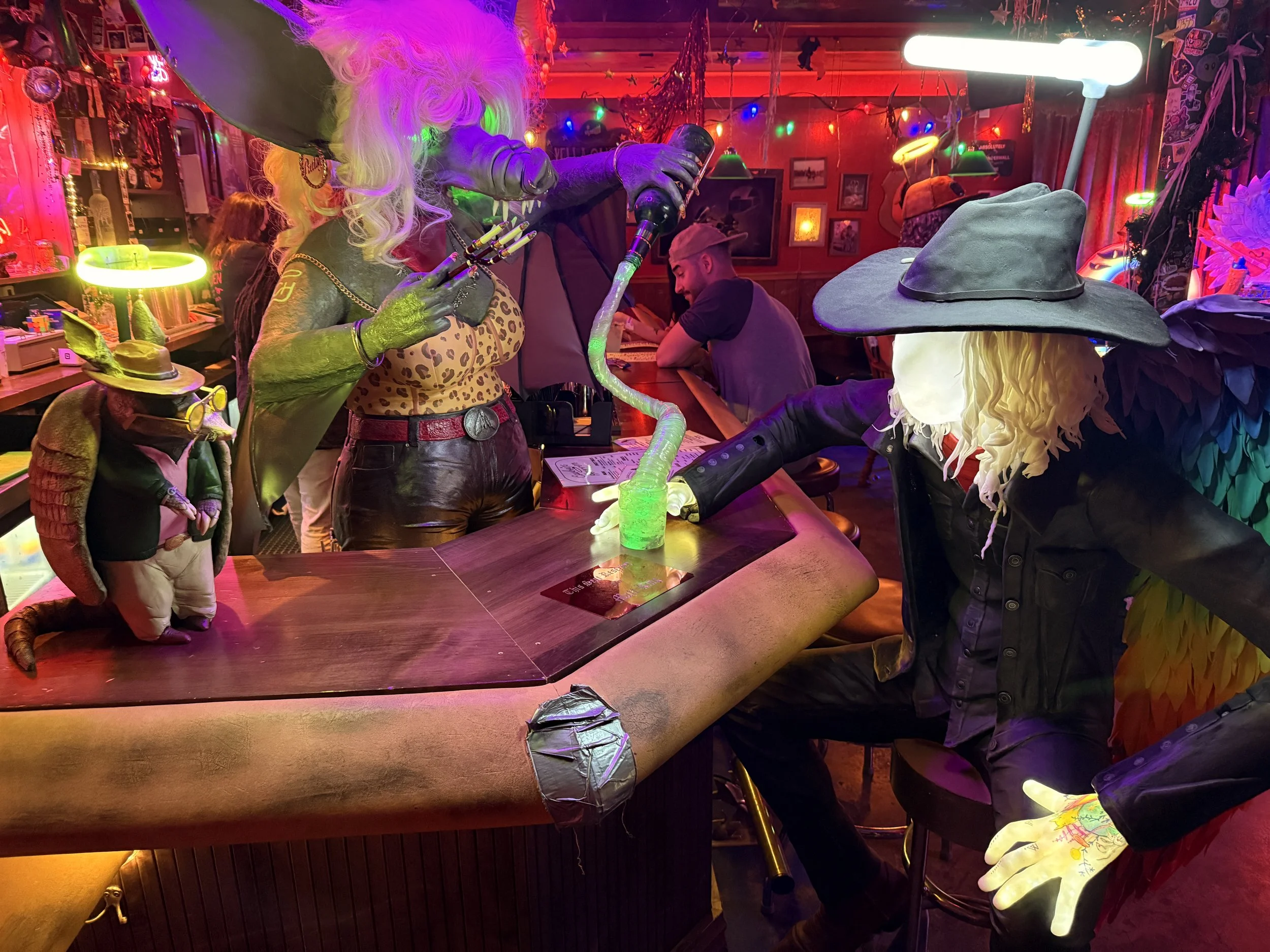
Bizarre alien mannequins at the bar at Cowboix Hevven at Meow Wolf Radio Tave in Houston, Texas

9. Get a drink at the Cowboix Hevvven saloon (you’ll need one). 

Inside Radio Tave, you’ll find Cowboix Hevvven, an interdimensional saloon with themed drinks and a chill, quirky vibe. If you need to process what just happened (or just want to sip something colorful in a surreal setting), this is the place. You should definitely stop by — if you’ve ever wanted to step into the Star Wars cantina, this might be the closest you’ll ever get.

An artistic floral mannequin in the main passageway at Meow Wolf Radio Tave in Houston, Texas

10. Exit through the gift shop. 

Let’s be real: The gift shop is pricey. But if you want a souvenir from your brain-melting trip through another dimension, this is your shot.

There are weird and wonderful trinkets, exclusive artwork and surprisingly stylish clothing. My friend got a sweater and socks; I got some stickers.

Even if you don’t buy anything, it’s worth a look — just in case you need a memento of the time you accidentally slipped into another reality and lived to tell the tale.

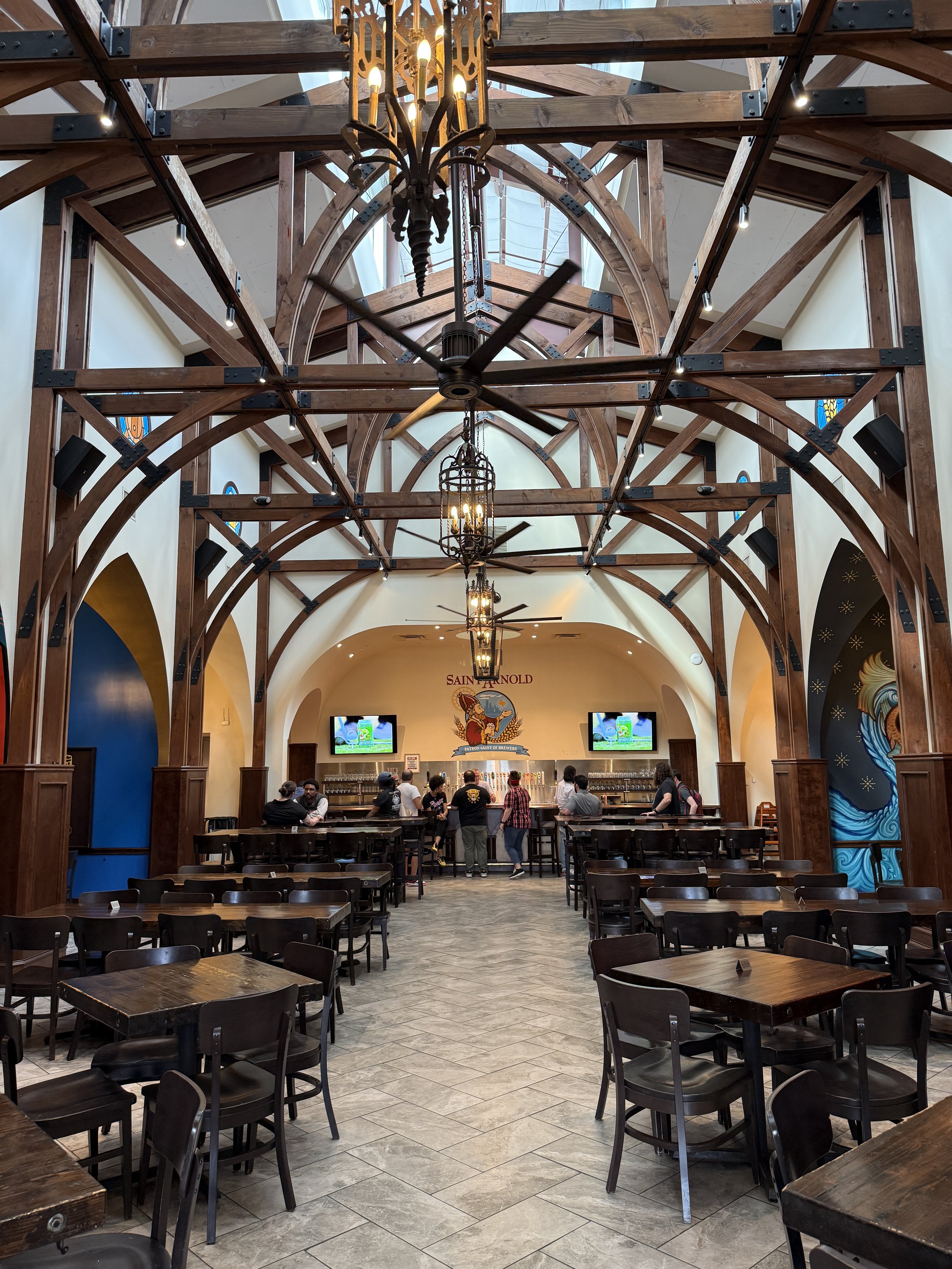
The cathedral-like beamed ceiling at Saint Arnold microbrewery in Houston, Texas

Bonus tip: Hit Saint Arnold’s before (or after) your journey through the multiverse. 

Whether you need to fuel up before stepping into the unknown or decompress after tumbling through time and space, Saint Arnold Brewing Company is a perfect stop — and it’s right across the street. 

This Houston institution is Texas’ oldest craft brewery, serving up a stellar lineup of beers alongside a menu of hearty eats.

The vibe? A mix of laidback beer garden meets quirky art installation, complete with a funky fleet of decorated cars that feel like they could roll straight into Meow Wolf without missing a beat.

It’s the ideal place to gather your crew, sip something refreshing, and prepare (or recover) from the mind-bending experience that is Radio Tave.

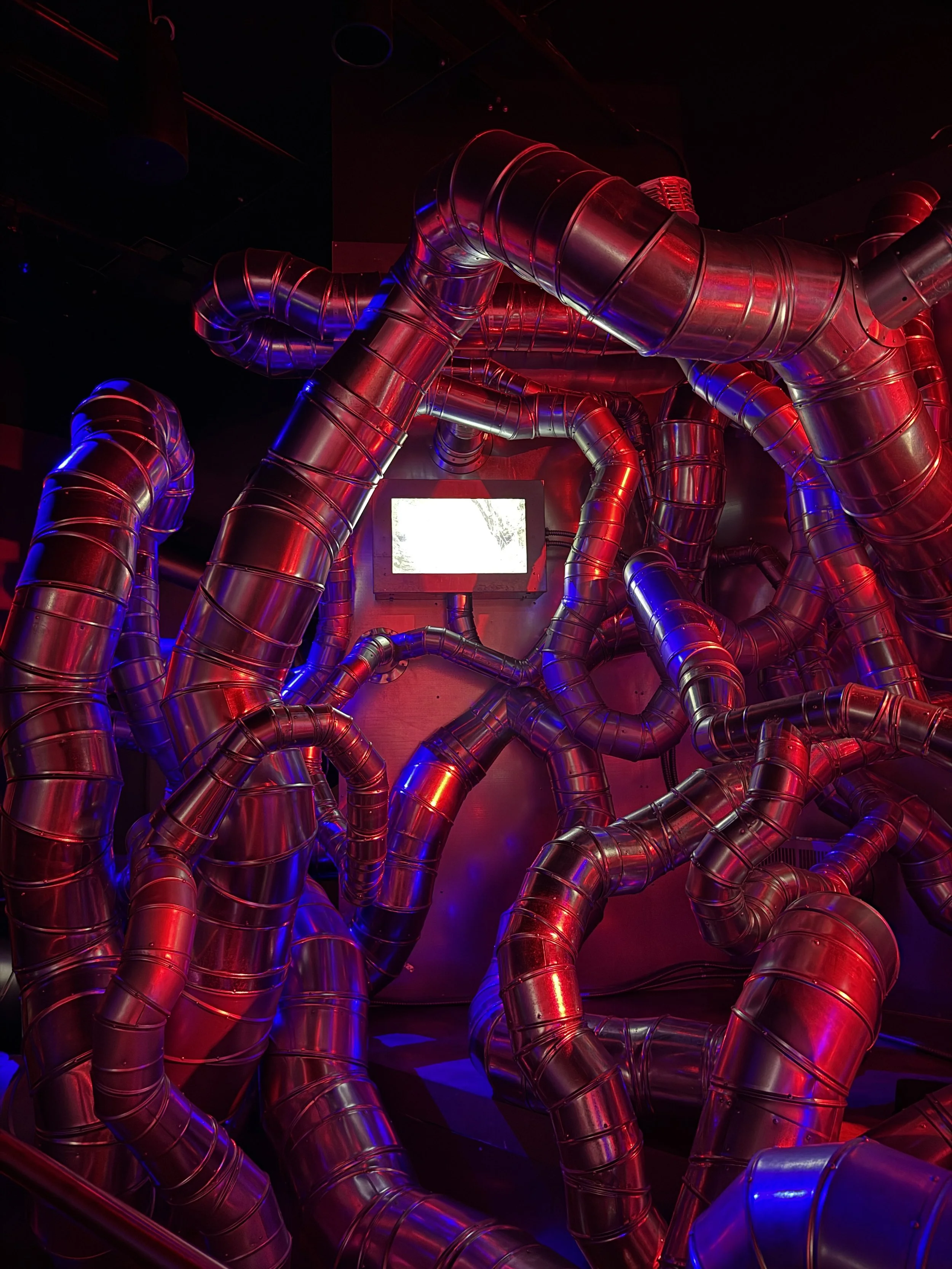
Ductwork snaking in every direction around a monitor at Meow Wolf Radio Tave in Houston, Texas

Radio Tave: Tune In and Trip Out

Radio Tave is hard to describe. It’s more than an art exhibit — it’s an experience. It’s part scavenger hunt, part fever dream, part “Wait, am I actually here or did I just astral-project?”

Whether you dive headfirst into the lore, obsess over the hidden doors, or just vibe with the neon-lit absurdity of it all, you’re in for a wild ride.

So go in with an open mind, comfortable shoes, and absolutely no expectations of logic or reason — and have the time of your (possibly multidimensional) life. –Wally

The exterior of Meow Wolf Radio Tave in Houston, Texas

Meow Wolf Houston: Radio Tave

2103 Lyons Avenue
Building 2
Houston, Texas
USA


Arizona’s Most Unexpected Museums, Collections and Curiosities You Never Knew You Needed

From Phoenix to Flagstaff and Tucson, Arizona’s quirkiest museums celebrate the strange, the surprising and the downright delightful — including castles, miniatures and a spaceship you can sleep in.

Two aliens by the bar at the Space Age Restaurant in Arizona

Space Age Restaurant

Arizona is full of surprises. Beyond the epic landscapes of the Grand Canyon and the saguaro cacti standing tall under desert skies, the state is hiding treasures of a much quirkier variety. Tucked into small towns and side streets are museums that challenge convention, redefine curiosity and embrace the downright odd. 

From tiny worlds that feel magically alive to reptilian tributes and intergalactic roadside stops, these spots don’t just entertain — they leave you marveling at the sheer weirdness and wonder of it all.

And for those travelers tracking both road miles and game day scores, Arizona sportsbooks offer a modern way to stay connected to the action — even while exploring copper cookware collections or UFO-themed motels.

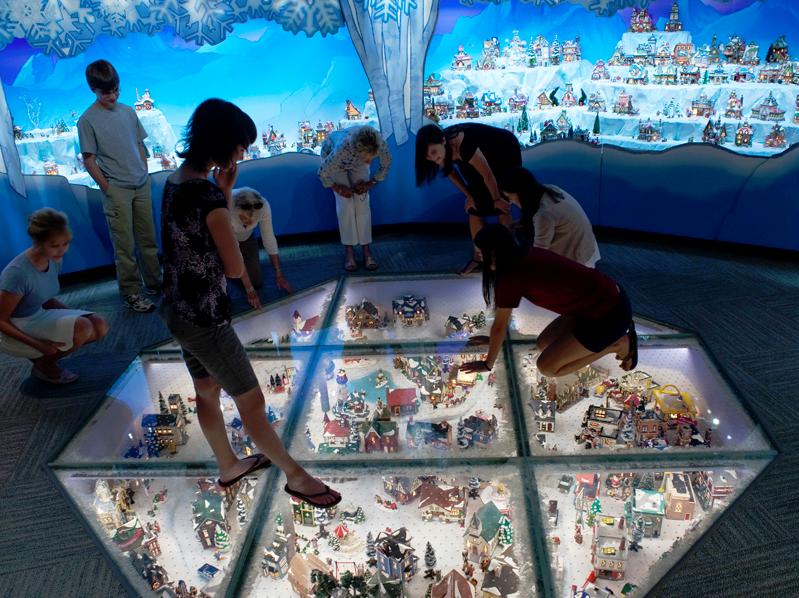
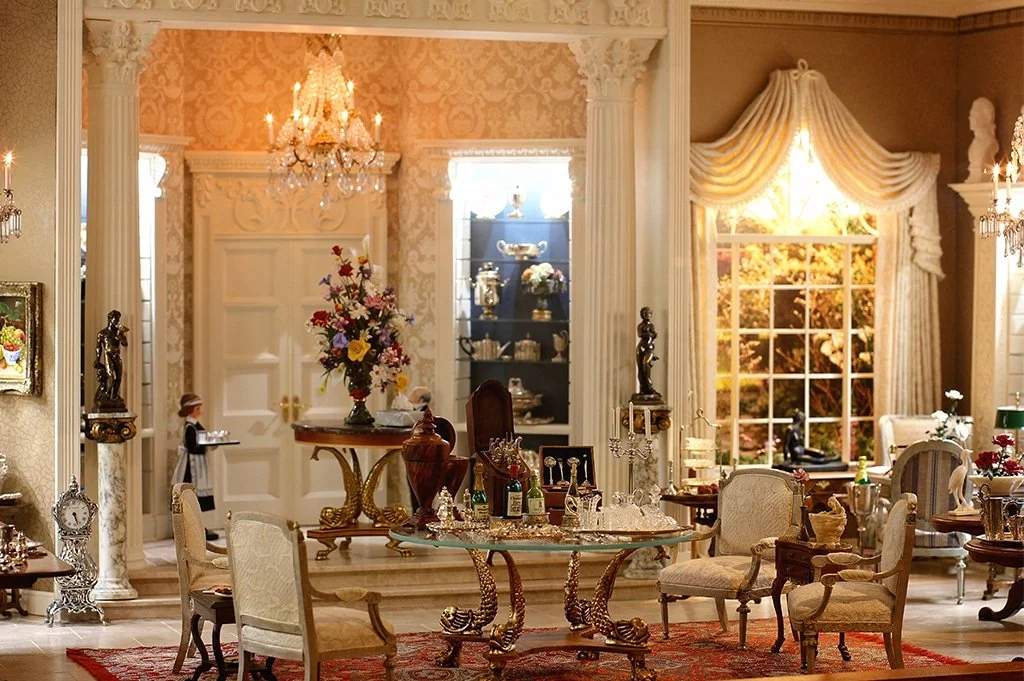
Kids look down at a miniature scene in an octagon on the floor at the Mini Time Machine Museum of Miniatures in Arizona

The Mini Time Machine Museum of Miniatures

Tucson’s Mini Time Machine Museum of Miniatures is a marvel of detail and nostalgia, welcoming visitors into a labyrinth of over 500 tiny scenes that span genres, time periods and fantastical dimensions. Inside, entire Victorian parlors are re-created on a scale that fits in your palm. 

You’ll wander past whimsical fairytale dioramas, snowy holiday villages, pirate coves and medieval castles so intricately constructed you might mistake them for real historical ruins, if not for their size.

The Silver Queen exhibit with a fancy setting at the Mini Time Machine Museum of Miniatures in Tucson, Arizona

Every room in the museum becomes a portal: One minute you’re peeking into a perfectly replicated 18th century salon; the next you’re gazing at a futuristic cityscape with hover cars no bigger than buttons. 

Whether you’re a seasoned collector or a wide-eyed child, it’s impossible not to leave without a new appreciation for craftsmanship at its smallest scale. And somewhere between the dollhouse graveyards and tiny saloons, grownups find themselves grinning like they’re 6 again.

The Mini Time Machine Museum of Miniatures

Phone: 520-881-0606


4455 East Camp Lowell Drive
Tucson, AZ 85712


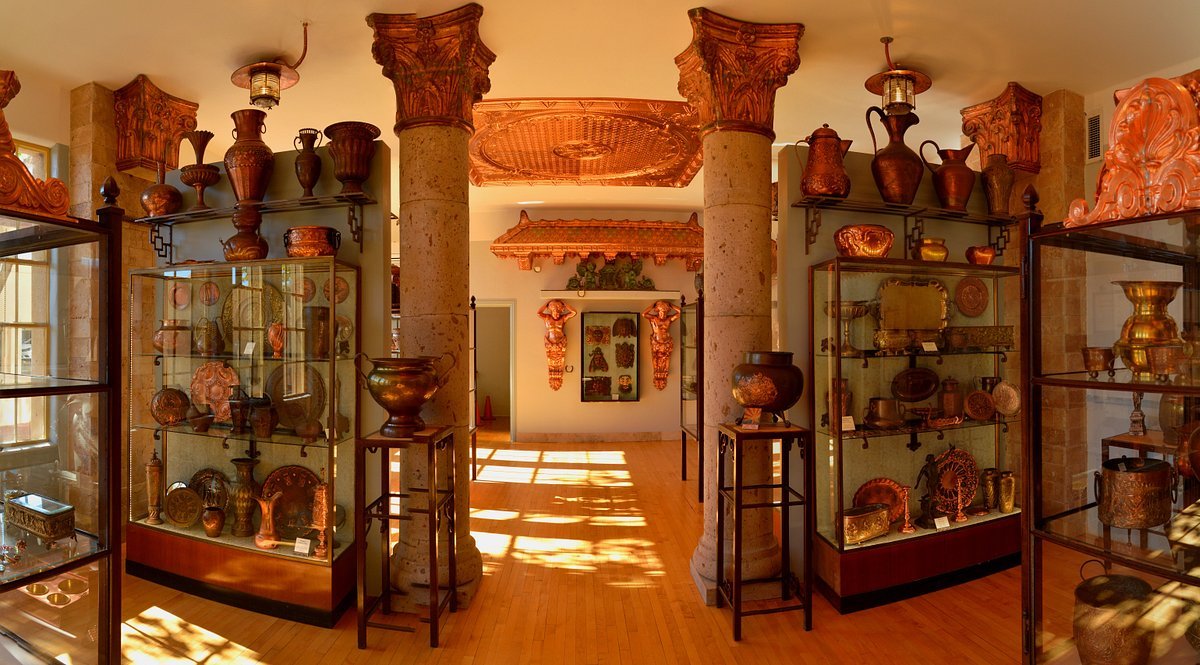
Copper cookware hanging from the ceiling and other displays at the Arizona Copper Art Museum

Arizona Copper Art Museum

Clarkdale’s Arizona Copper Art Museum celebrates the state’s mining legacy. The sprawling collection features pieces ranging from medieval copper armor and royal cookware to champagne buckets, fireman’s nozzles and intricate decorative tiles. What ties them all together is copper — glinting under soft museum lights, speaking to both history and metallurgy.

Pitchers and other copper items on display at the Arizona Copper Art Museum

Exhibits are curated in ways that surprise and delight. One hallway presents antique kitchen wares gleaming like modern art. Another showcases battlefield gear worn by knights, side-by-side with World War-era artillery shells. It’s a reminder that this reddish metal didn’t just fuel Arizona’s economy — it shaped global culture, war, art and survival.

Every gleam and shimmer is an invitation to reflect on how something so industrial could also be so beautiful.

Arizona Copper Art Museum

Phone: 928-649-1858

849 Main Street
Clarkdale, AZ 86324

The exterior of the Best Western Space Age Lodge in Arizona at sunset

Best Western Space Age Lodge 

Out in Gila Bend, just off I-8, rises one of Arizona’s most delightfully kitschy landmarks: the Best Western Space Age Lodge. With its retro-futuristic design, spaceship signage and UFO murals, it’s part motel, part time capsule — and all in on the space theme.

Palms by the pool at the Best Western Space Age Lodge in Gila Bend, Arizona

Originally opened in the 1960s during the height of the Space Race, the lodge has leaned into its Jetsons-style charm ever since. The rooms are named after celestial bodies, the onsite Space Age Restaurant serves comfort food under a flying saucer ceiling, and the whole place lights up at night like a sci-fi movie set that never quite made it to Hollywood.

You’ll get an affordable stay with a side of pure Americana that’s out of this world. It’s not Area 51 — but it’s arguably the next best thing if you’re cruising through the Arizona desert and want a photo op with an alien.

Best Western Space Age Lodge 

Phone: 928-683-2273

401 East Pima Street
Gila Bend, AZ 85337

The stone exterior of The Museum of Indigenous People in Arizona

The Museum of Indigenous People

The former Smoki Museum in Prescott is both a tribute and a reckoning. Originally founded by a group of White locals who imitated Native American ceremonies, the museum has since undergone a profound transformation. Today, it works to honor and accurately represent indigenous cultures, particularly those from the Southwest.

A clay figure of a woman holding a lot of children, with more on her legs from The Museum of Indigenous People in Arizona

Artifacts include baskets, jewelry and ceremonial dress — displayed with proper context and respect. Educational panels address the museum’s problematic origins head-on, encouraging visitors to reflect on cultural appropriation, reconciliation and responsibility. It’s one of Arizona’s most thought-provoking and evolving cultural centers.

The Museum of Indigenous People

Phone: 928-445-1230

147 North Arizona Avenue
Prescott, AZ 86301

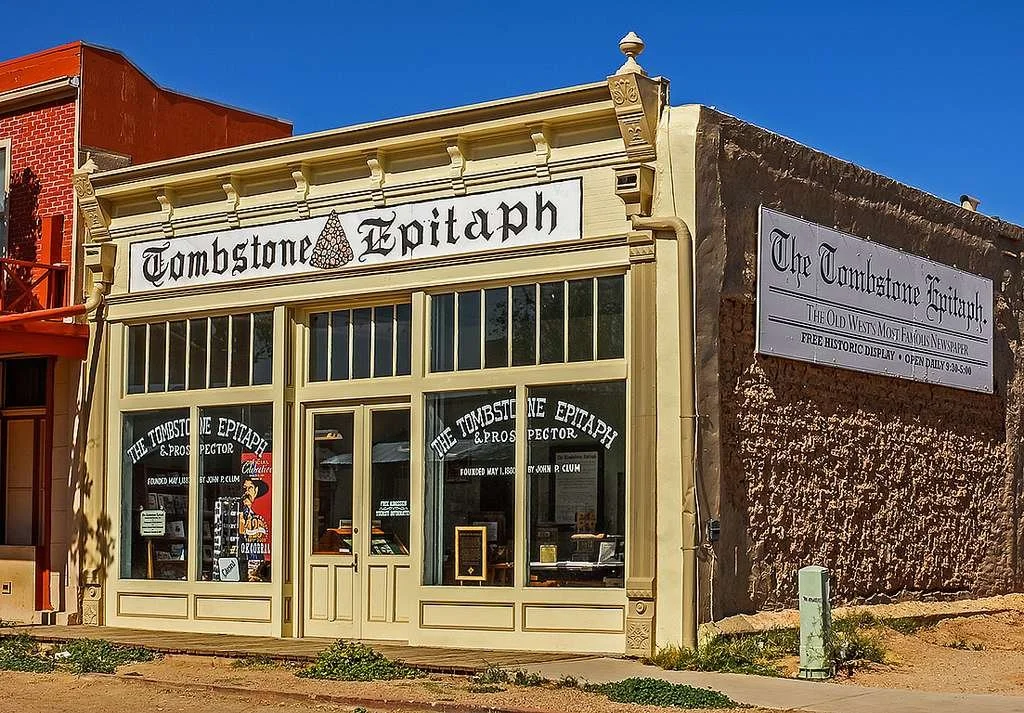
Exterior of The Tombstone Epitaph Newspaper and Museum

The Tombstone Epitaph Newspaper and Museum

In Tombstone — the town too tough to die — you’ll find the Epitaph museum, chronicling one of the most famous newspapers of the Old West. This isn’t just a collection of dusty front pages. It’s a walk through Arizona’s journalistic grit, with stories of gunfights, outlaws and frontier justice printed with inky pride.

A man stands by the printing press at The Tombstone Epitaph Newspaper and Museum as a horse goes by outside

You can see the original press, learn about the life and times of editor John Clum, and even buy reprints of iconic headlines, including coverage of the legendary O.K. Corral shootout. It’s a slice of media history served with a shot of whiskey-flavored nostalgia.

The Tombstone Epitaph Newspaper and Museum

Phone: 520-457-2211

11 South 5th Street
Tombstone, AZ 85638

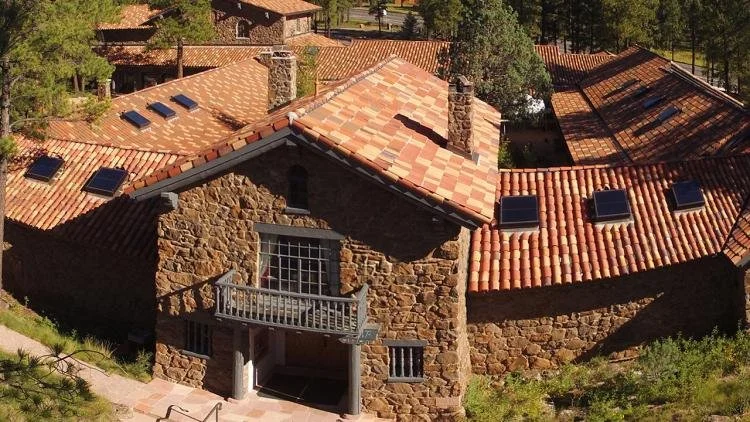
The sprawling complex of the Museum of Northern Arizona

Museum of Northern Arizona

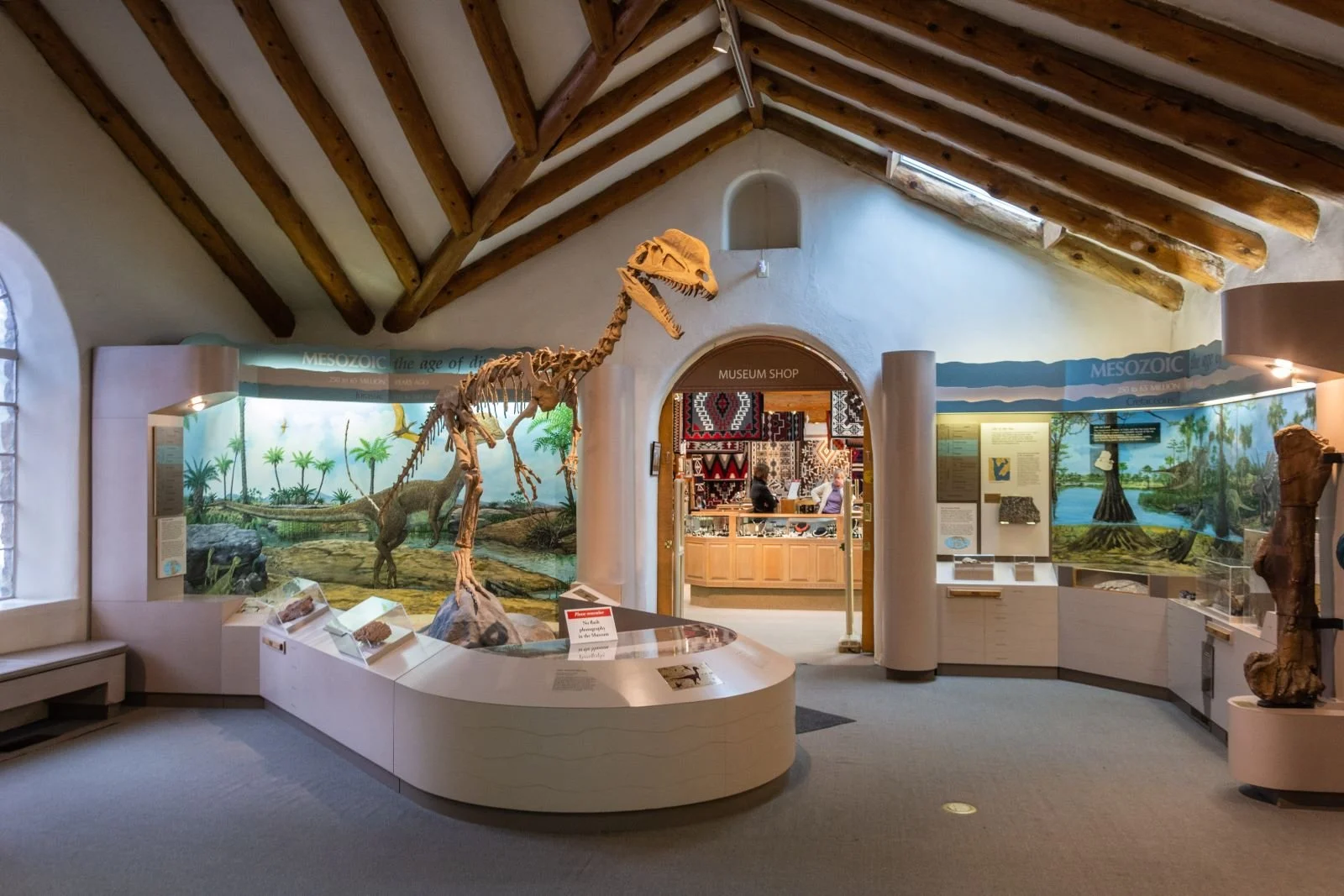
The Museum of Northern Arizona sits at the edge of the San Francisco Peaks, offering a blend of anthropology, biology and indigenous heritage. From ancient Hopi pottery to fossils of Triassic creatures, the exhibits build a timeline that connects people and planet in an unforgettable arc.

A dinosaur skeleton and other items on display at the Museum of Northern Arizona in Flagstaff

Highlights include breathtaking Navajo textiles, intricate Zuni carvings, and live geology demonstrations that reveal how this rugged terrain came to be. For travelers looking to balance their oddball adventures with a dose of scholarly wonder, this stop in Flagstaff is a must.

Museum of Northern Arizona

Phone: 928-774-5213

3101 North Fort Valley Road
Flagstaff, AZ 86001

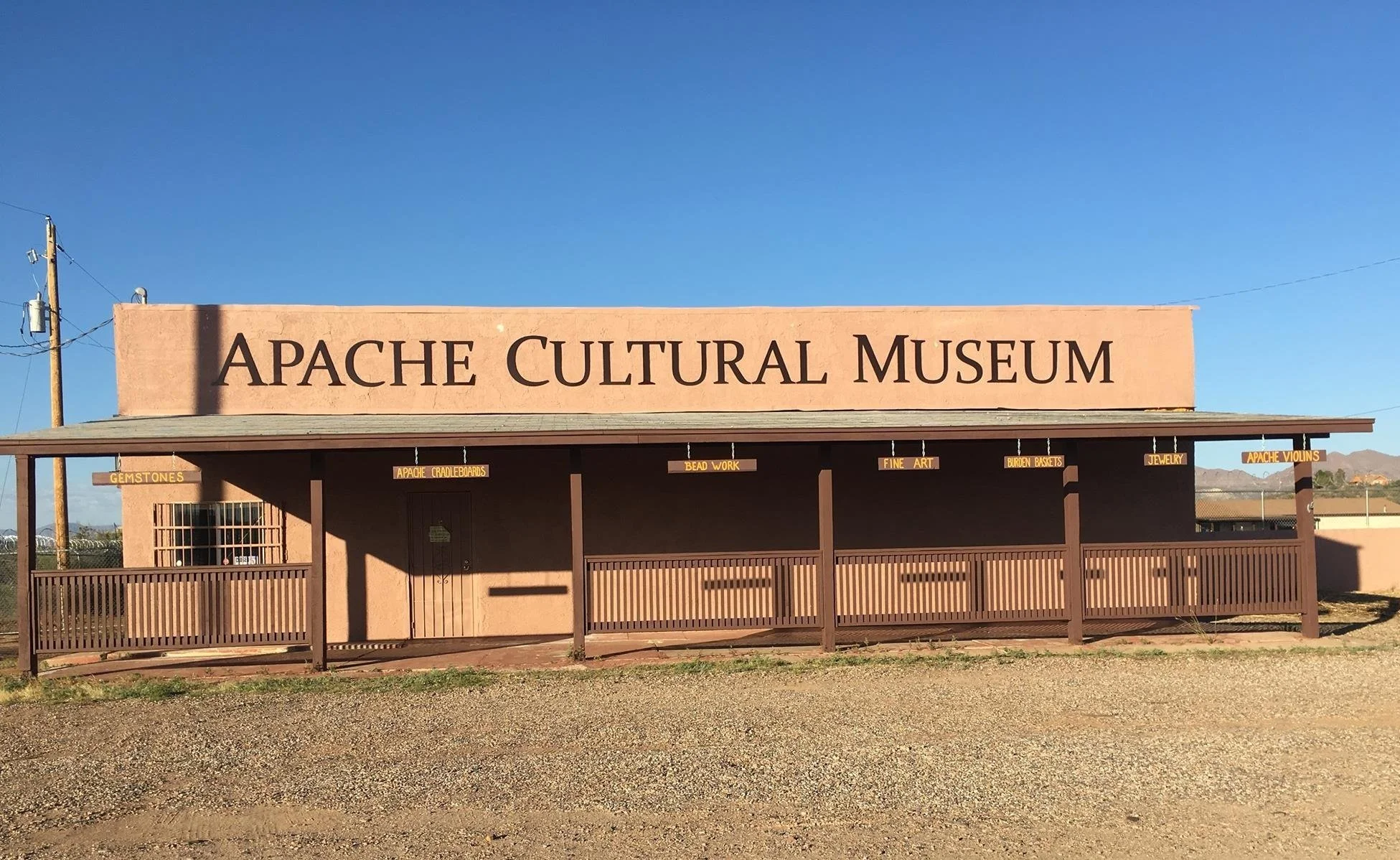
Exterior of the Apache Cultural Museum

San Carlos Apache Cultural Museum

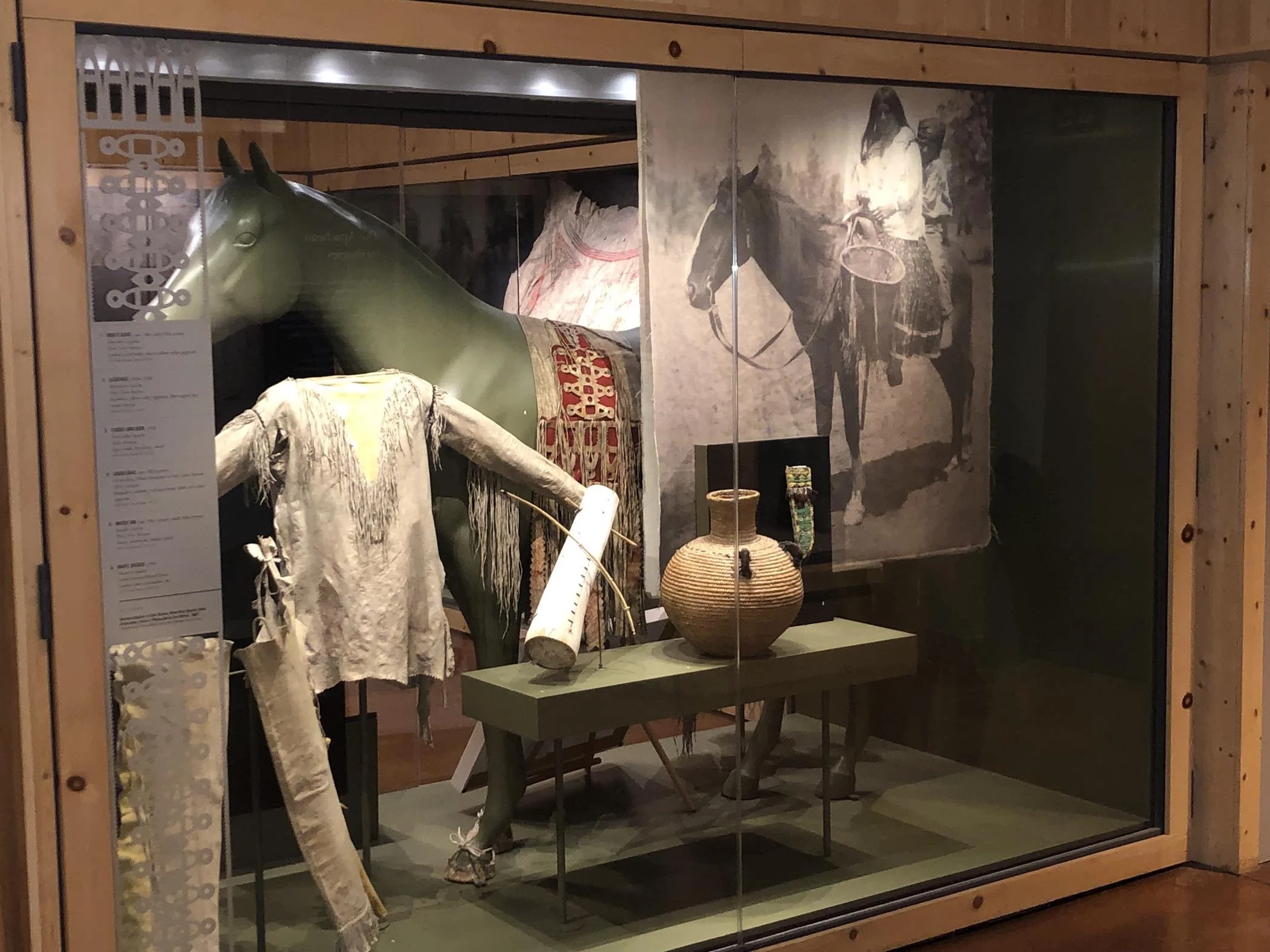
The Apache Cultural Museum provides an intimate, deeply personal look at this indigenous band’s history and heritage. Unlike larger institutions, it’s run by local Apache people, and that authenticity pulses through every artifact and story.

Apache artifacts, including a shirt and bowl, on display at the Apache Cultural Museum in Arizona

Weapons, cradleboards, beadwork and historical photos line the walls. But it’s the oral histories — passed from elder to youth — that give the space its heartbeat. Visitors leave not just with facts, but with faces and names, and a deeper respect for what it means to carry cultural identity through centuries of struggle and survival.

San Carlos Apache Cultural Museum

Phone: 928-475-2894

Mile Marker 272
Highway 70
Peridot, AZ 85542

Cacti and yellow flowers at the Tovrea Castle at Carraro Heights in Phoenix, Arizona

Tovrea Castle at Carraro Heights

Tovrea Castle looms over Phoenix like a three-tiered cake sculpted by whimsy and desert dreams. Built in the 1930s by Italian immigrant Alessio Carraro, the structure was intended as a hotel but quickly became a curiosity. Surrounded by 44 acres of cactus gardens, it looks like something out of a surrealist Western film.

A frieze of a woman bending over backwards above a stone fireplace at Tovrea Castle at Carraro Heights in Arizona

Tours are available by reservation only, adding to its air of exclusivity and mystery. Inside, guests get a look at vintage furnishings and learn the strange history of the Carraro family’s ambitions — and how this castle became one of Arizona’s most iconic roadside silhouettes.

Tovrea Castle at Carraro Heights

Phone: 602-256-3221

5025 East Van Buren Street
Phoenix, AZ 85008

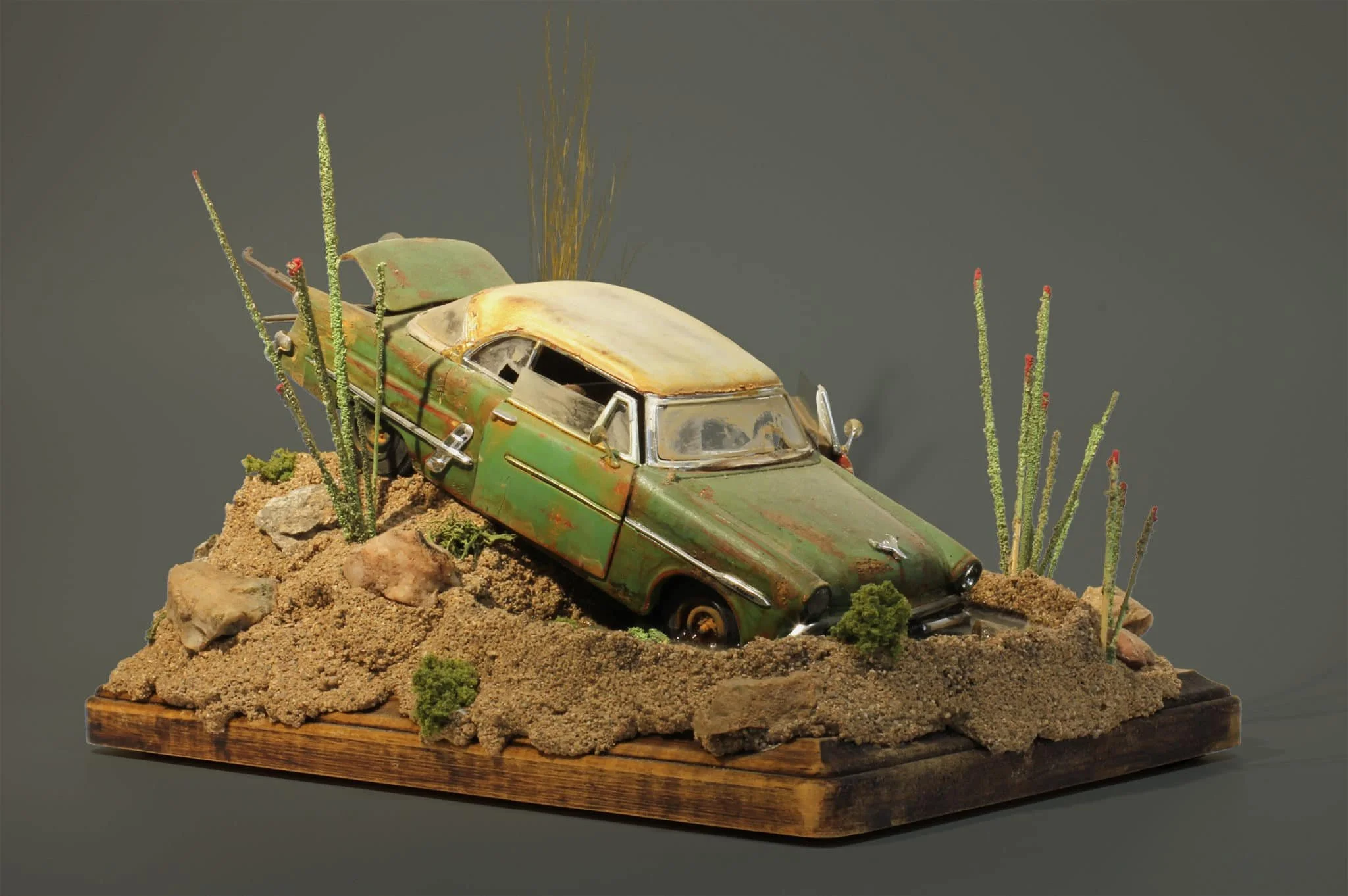
A model of a classic green car sunken in the water as part of Jim Roark's Metal Monsters exhibit at the Museum of Miniatures in Arizona

From Jim Roark’s Metal Monsters exhibit at the Museum of Miniatures

Arizona’s Weird Is Wonderful

Arizona doesn’t hide its oddities. It flaunts them. Each museum, collection or offbeat roadside stop is a love letter to curiosity, eccentricity and stories that don’t fit into mainstream museum walls. Whether you’re marveling at miniature furniture, learning about indigenous customs, or debating alien contact with a man in a tinfoil hat, you’re taking part in a state-sized celebration of the unexpected.

So load up the car, keep your eyes peeled for copper armor and friendly E.T.s, and embrace the wild, weird wonder that’s Arizona’s museum scene.

Frank Lloyd Wright’s Burnham Block: Milwaukee’s Forgotten Vision for Affordable Homes

Wright’s American System-Built Homes still stand on Burnham Block, a quiet testament to his dream of housing for the middle class.

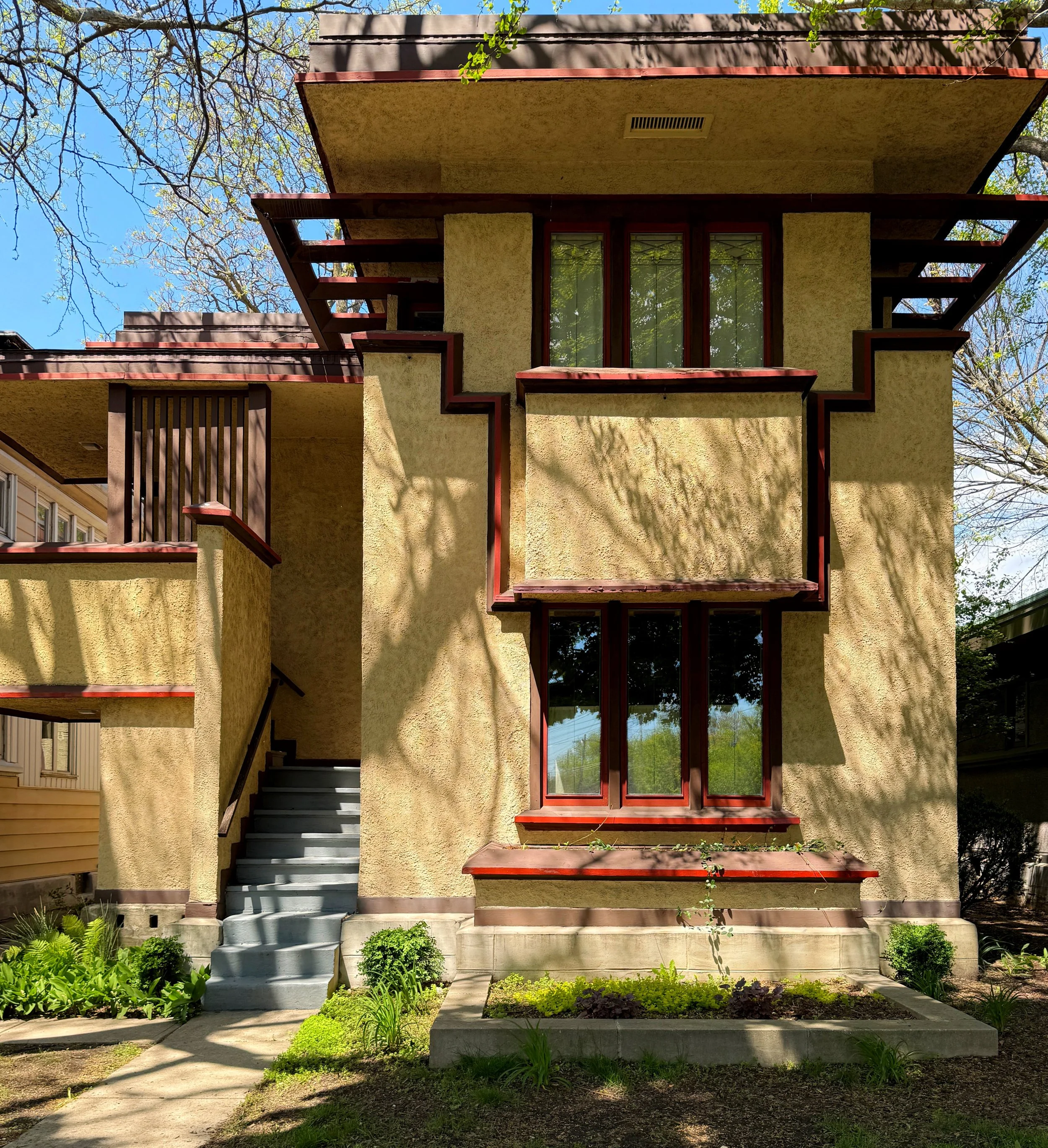
Frank Lloyd Wright's Burnham Block in Milwaukee, Wisconsin

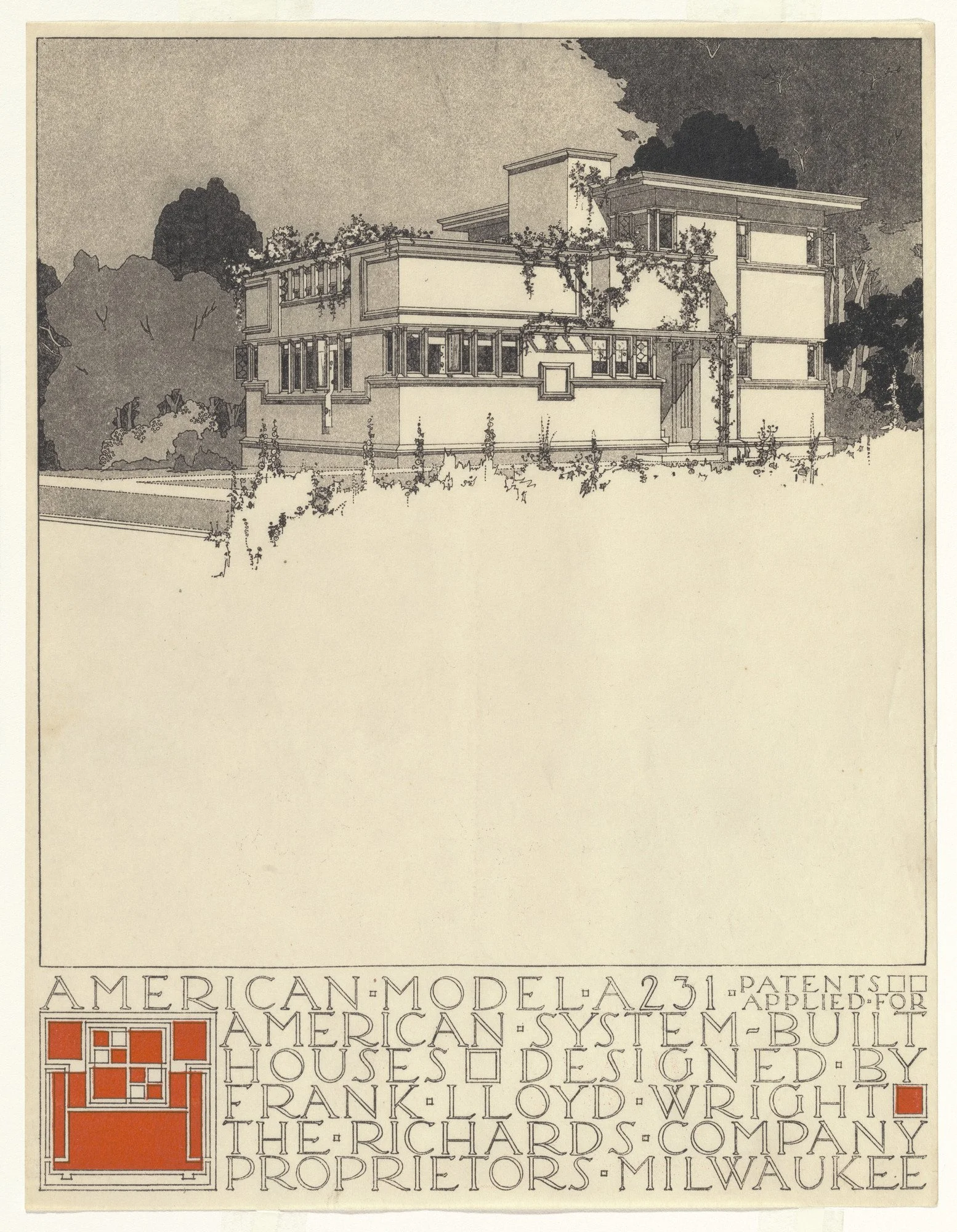
Well before he designed Fallingwater in Pennsylvania, Wright poured his energy into a very different kind of project — producing more than 900 drawings and over 30 standardized model variations for the American System-Built Homes: a line of modest, affordable houses for America’s middle-class families.

So when Wally and I planned a long weekend in Milwaukee, one of our top priorities was visiting the Burnham Block. Tucked between 27th Street and Layton Boulevard, this quiet stretch of West Burnham Street is home to six of Wright’s homes — examples of one of the most ambitious design efforts of his career and the largest collection of this housing style in the country. 

At just 805 square feet, it’s the smallest of any house Wright designed.

Fun fact: The thoroughfare was named after George Burnham, a brick manufacturer and real estate investor in the city. The cream-colored bricks his company produced helped give Milwaukee its nickname, the Cream City. 

Architectural drawing in an ad for American System-Build Houses on Frank Lloyd Wright's Burnham Block

“An American Home” 

After snapping a few photos outside, Wally and I ducked into the gift shop at the back of one of the duplexes currently undergoing restoration. From there we made our way to the front room to join our tour group and meet our docent, Rhonda. Once everyone was settled in, she broke the ice by asking where we were all from, and to our surprise, one family had traveled all the way from Italy.

She asked the group to imagine what a real estate ad might highlight today, and we quickly called out the usual features: square footage, number of bedrooms, location and price — basically everything related to the building itself. 

Holding up a full-page advertisement that ran in the Chicago Tribune in July 1917, titled “You Can Own an American Home” and attributed to then-copywriter Sherwood Anderson, she read the following excerpt aloud:

“There’s a bright, cheerful home waiting for you and your family — better built, excellently planned, far more livable. More beautiful? Yeah, it’ll have that rare thing: genuine architectural beauty, designed by a leader among architects. You select your plan; it’s built to your order. Constructed by a system that guarantees a high-grade building at a known price. In short, an American home.”

Rhonda pointed out that it wasn’t really about any of the features we had mentioned; it was about selling a lifestyle. And one big thing the ad omitted? Wright’s name — and that was no accident. 


A man drapes his arm around a lifesize cutout of Frank Lloyd Wright

Wally’s last name is also Wright, but, sadly, he’s never found a familial link to Frank.

When “Wright” Was a Bad Word

By 1915, the architect’s personal life had become tabloid fodder. In 1909 he had famously abandoned his wife and six children to run off to Europe with Mamah Borthwick Cheney — the wife of a former client and the woman at the center of a scandalous, widely publicized affair. 

Both were still married to their respective spouses when they left. Mamah got a divorce from her husband when they returned, but Wright wouldn’t officially be divorced from his wife, Catherine, for another six years. 

The scandal deepened in 1914, when a servant at Taliesin — Wright’s home and studio in Wisconsin — set fire to the building and axed down Mamah, her two children, and four others as they fled the flames. The tragedy made front-page headlines and further tarnished Wright’s reputation.

Rhonda went on to explain that what most people don’t realize is just how deeply Wright believed in what he called “democratic architecture.” To him the idea was simple: If you had a good job, you should also be able to afford a thoughtfully designed home. But Wright, for all his vision, didn’t quite know how to make that dream scalable. 

A floorplan for the homes along Frank Lloyd Wright's Burnham Block

A Partnership With Arthur Richards

That's where Milwaukee developer Arthur L. Richards came in. He had previously collaborated with Wright on the Hotel Geneva, a lakeside resort that once stood on the shores of Lake Geneva, Wisconsin. Richards had the resources and business network Wright lacked, and he was able to turn the architect's vision into a viable housing project. 

Assuming the advertisement piqued your curiosity, your next stop would be to visit a local distributor. At the time, many young families were buying homes from the pages of mail-order catalogs — think Craftsman-style kits sold by Sears, Roebuck and Co. 

But Wright’s American System-Built Homes were different. They were modern, meticulously detailed, and built to his exacting standards. Customers could choose from roughly 30 standardized models, each offering a range of customizable options, including the floor plan, roof style (flat, hip or gable), custom furniture and art glass windows. You added up your choices, saw the total at the bottom, and that’s what you paid. 

Prices started at $1,875 and rose to about $3,500 once completed — remarkably modest for any home, much less a Wright-designed one, especially given his reputation for commissions that routinely ran over budget. It may sound like a lot for 1915, but homes of comparable size and quality typically sold for 10% to 15% more. This relative affordability was largely due to Richards, whose oversight kept costs down and brought Wright’s designs to a broader market.

To achieve this, the Richards Company pre-cut lumber and other materials in a mill and shipped them to the build site by rail — a method that offered greater efficiency and quality control than traditional site-built construction.

Exterior of the office and gift shop at Frank Lloyd Wright's Burnham Block in Milwaukee

Preserving a Legacy: Restoration Efforts at Burnham Block

Once we had a sense of the project's background, Rhonda led us outside and enthusiastically shared more about this row of homes’ history and significance. Built on speculation between October 1915 and July 1916 the block includes four two-family Flat C (Model 7A) duplexes and two single-family bungalows: one Model B1 with a flat roof and one Model C3 with a hipped roof. 

She highlighted the importance of ongoing preservation efforts, noting that five of the six houses are now owned by Frank Lloyd Wright’s Burnham Block, a nonprofit organization dedicated to the care and stewardship of these historic structures.

“There’s no paid staff,” she told us. “We’re all volunteers. Every single dollar you spend, whether it’s on admission, in the gift shop or as a donation goes directly toward the care of these buildings.”

She went on to explain that the exterior of Duplex 4, the building we had just exited, was restored in 2013 and 2014 with the help of a Save America’s Treasures matching grant. The grant was awarded by the Department of the Interior and is managed by the National Park Service to support the preservation of nationally significant historic sites. Work on the interior, she noted, is still underway. 

“We did get a grant from the government,” she added. “But we’re unsure if we’ll actually receive that money. So for now, we’re kind of on hold, waiting to see what happens.” The hope is that they’ll be able to start restoration efforts on Bungalow Model C3 this year. 

When Richards selected the site for the housing project, it was considered the edge of town — still largely rural and known for its celery fields. An electric streetcar line ran along Burnham Street, connecting the area to the rest of the city. The City Service line provided access to downtown Milwaukee, while the Interurban line extended as far as East Troy. At the time, most people didn’t own cars, but they had access to mass transit, one of the key reasons these homes were built here.  

2720 West Burnham Street, part of Frank Lloyd Wright's Burnham Block in Milwaukee

We paused for a moment in front of 2720 West Burnham Street — the only duplex on the block that isn't owned by the nonprofit.

Rhonda gave us a quick rundown of its history, explaining that a young couple who knew the legacy of the two-flat purchased the property in the early 1980s and converted it into a single-family home with three bedrooms, two bathrooms and a modern kitchen. She added that they installed the art glass windows and red square, a visual element found in many of Wright's designs. Nearly 30 years later, it was sold to its current owner, who now rents it out on Vrbo.

“I’ve been told it sleeps about nine — so if you decide to rent it, don’t forget to invite me!” Rhonda added with a chuckle. 

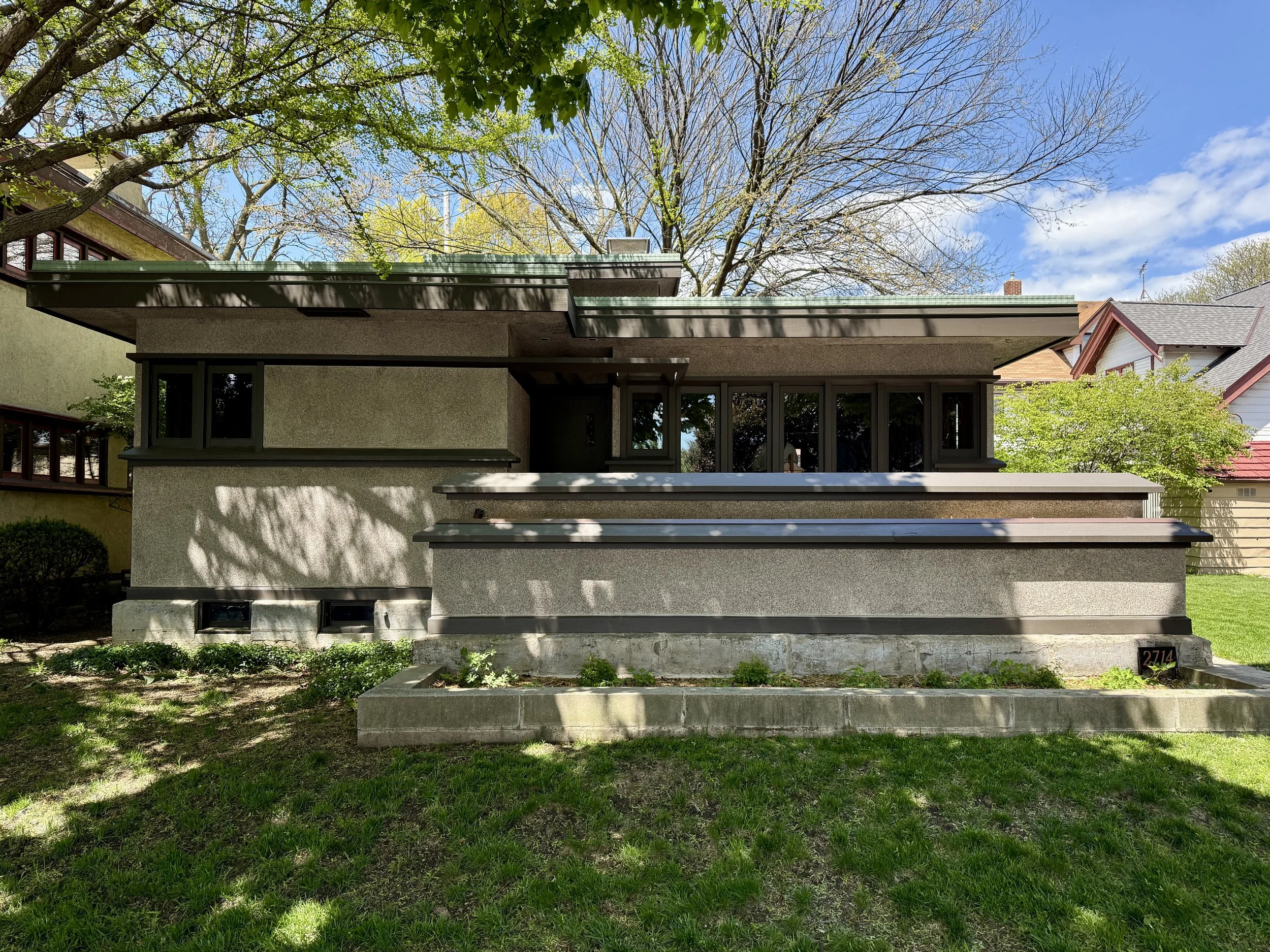
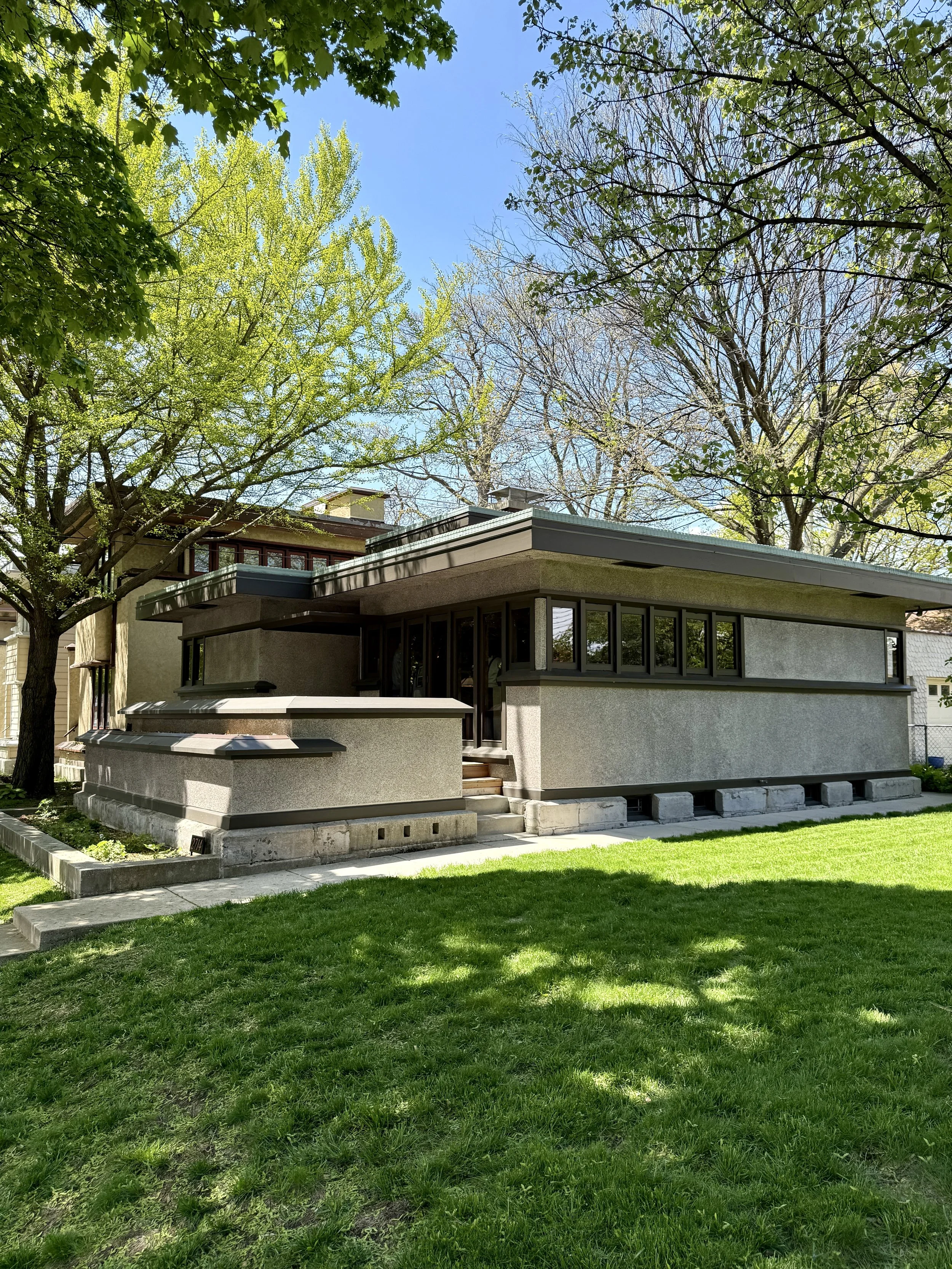
The exterior of the Model B1 home on Frank Lloyd Wright's Burnham Block in Milwaukee

A Tour of Model B1

A short walk later, we found ourselves standing outside Model B1 at 2714 West Burnham Street. Rhonda affectionately referred to it as the “baby bungalow,” and at just 805 square feet, it’s the smallest of any house Wright designed. It was purchased in 2004 and fully restored to its 1916 appearance in 2008 and 2009. Today, it’s open to the public as a house museum. 

Rhonda shared that the home’s original exterior, like the others, was finished with a material called Elastica stucco. It was manufactured in Chicago and promoted at the time as an affordable and durable option. Initially praised for its smooth appearance, it later proved unreliable and was found to contain asbestos, requiring careful remediation during restoration.

Today, the exterior has been refinished with Pebble Dash — a type of stucco embedded with small stones that are sprayed onto the surface while it’s still wet. The result is a tactile, durable façade that honors the original intent while complying with modern safety standards.

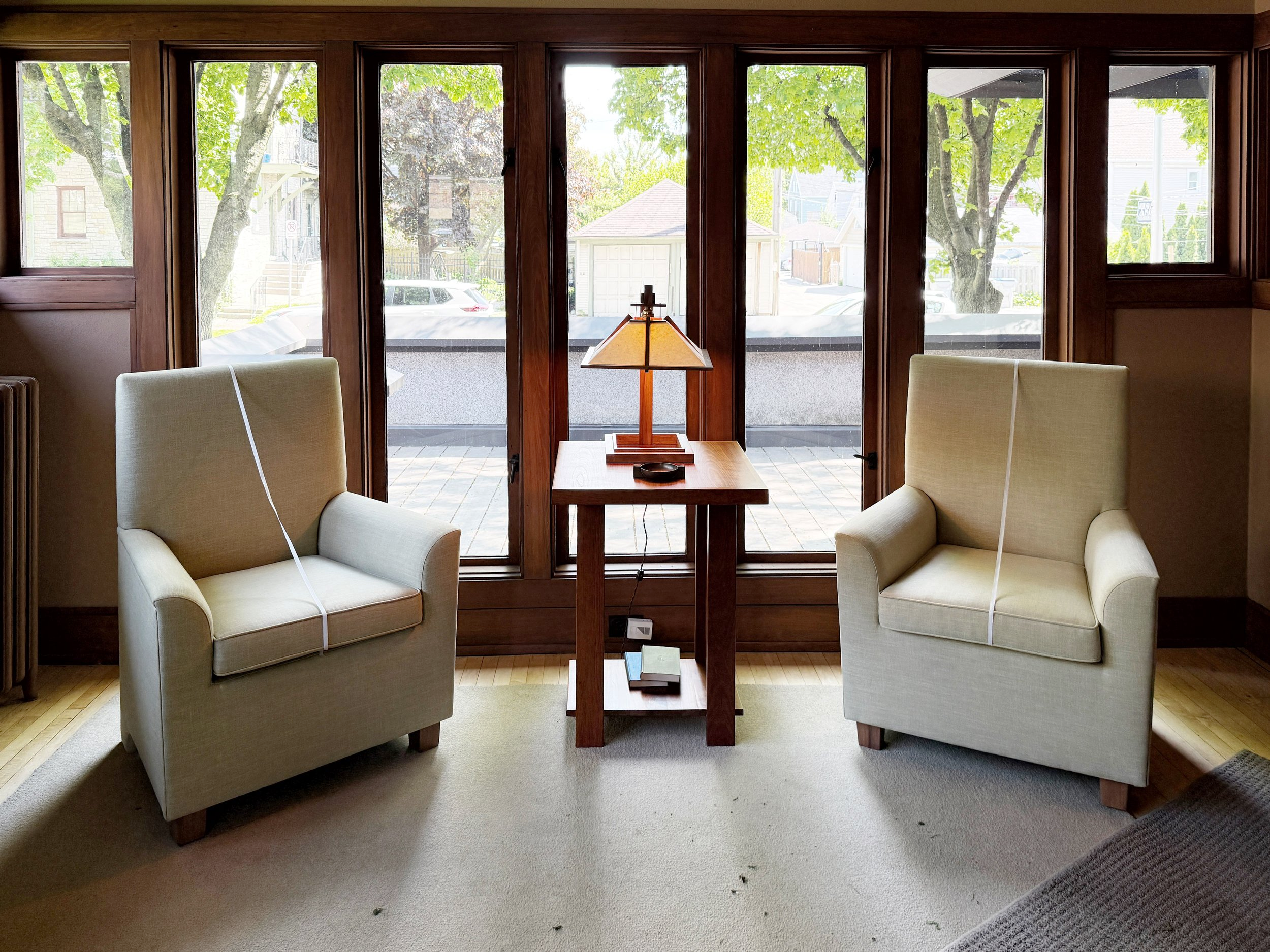
The front room with a small table, lamp and two chairs in Model B1 on Frank Lloyd Wright's Burnham Block

Wright’s Bag of Tricks

Before we even stepped through the front door, we passed beneath a low overhang that extended above the entrance, an unmistakable hallmark of Wright’s design philosophy. It was a classic example of his compress-and-release technique: a moment of spatial compression at the threshold that heightened the sense of openness and volume once inside. 

Crossing that threshold, we entered the living room, the heart of the home, where a central hearth commanded attention. More than just a source of warmth, it was another signature of Wright’s architecture: a symbolic and literal centerpiece meant to anchor family life.

The brick and wood hearth in Model B1 at Frank Lloyd Wright's Burnham Block in Milwaukee

At the front of the room, floor-to-ceiling windows brought in natural light and made the space feel larger. Thanks to the height and placement of the front porch, anyone seated inside could enjoy a sense of openness and connection with the outdoors while still maintaining a sense of privacy, as the porch blocks direct views from passersby. 

This sense of openness was made possible, in part, by Wright’s innovative use of balloon-frame construction, a technique where long vertical studs run continuously from the foundation to the roof. In the American System-Built Homes, these studs are spaced 24 inches apart — wider than the typical 16 inches — based on a 2-foot modular grid. This grid made it easier for Richards’ team of builders to position them with greater flexibility, without needing to rework the structure of the walls.

Built-in shelving and dining table in Model B1 of Frank Lloyd Wright's Burnham Block

Rhonda pointed out that Wright’s design pulled out all the stops to make this tiny house feel larger than it is. By cleverly “stealing space,” the walls flanking the wraparound hearth draw the eye back toward the foyer and the hallway beyond, creating a sense of depth and openness.

She also noted that most of the woodwork inside the house is original. While telling us about the built-in cabinetry in the living room, she explained that it not only acts as a partition but also cleverly accommodates a dining table that can be tucked away or pulled out — transforming the living room into a dining area as needed. 

To the right of the built-in, a doorway leads to the breakfast nook and kitchen. Vertical wooden slats separate the nook, offering a sense of division without fully enclosing the space, another subtle feature that reinforces an overall feeling of openness. 

The kitchen was fitted with wood cabinetry and the most adorable tiny oven I’d ever seen.

A small oven and stovetop in the kitchen of Model B1 on Frank Lloyd Wright's Burnham Block

Rhonda added that the glass fronts on the upper cabinets were intentional: designed to catch and reflect light, they help create the illusion of a larger, airier room.

The private space of the home includes the primary bedroom, a children’s bedroom, a bathroom, and both coat and linen closets (a rare feature in a Wright home). A central light well draws natural light into the core of the house, brightening the interior. 

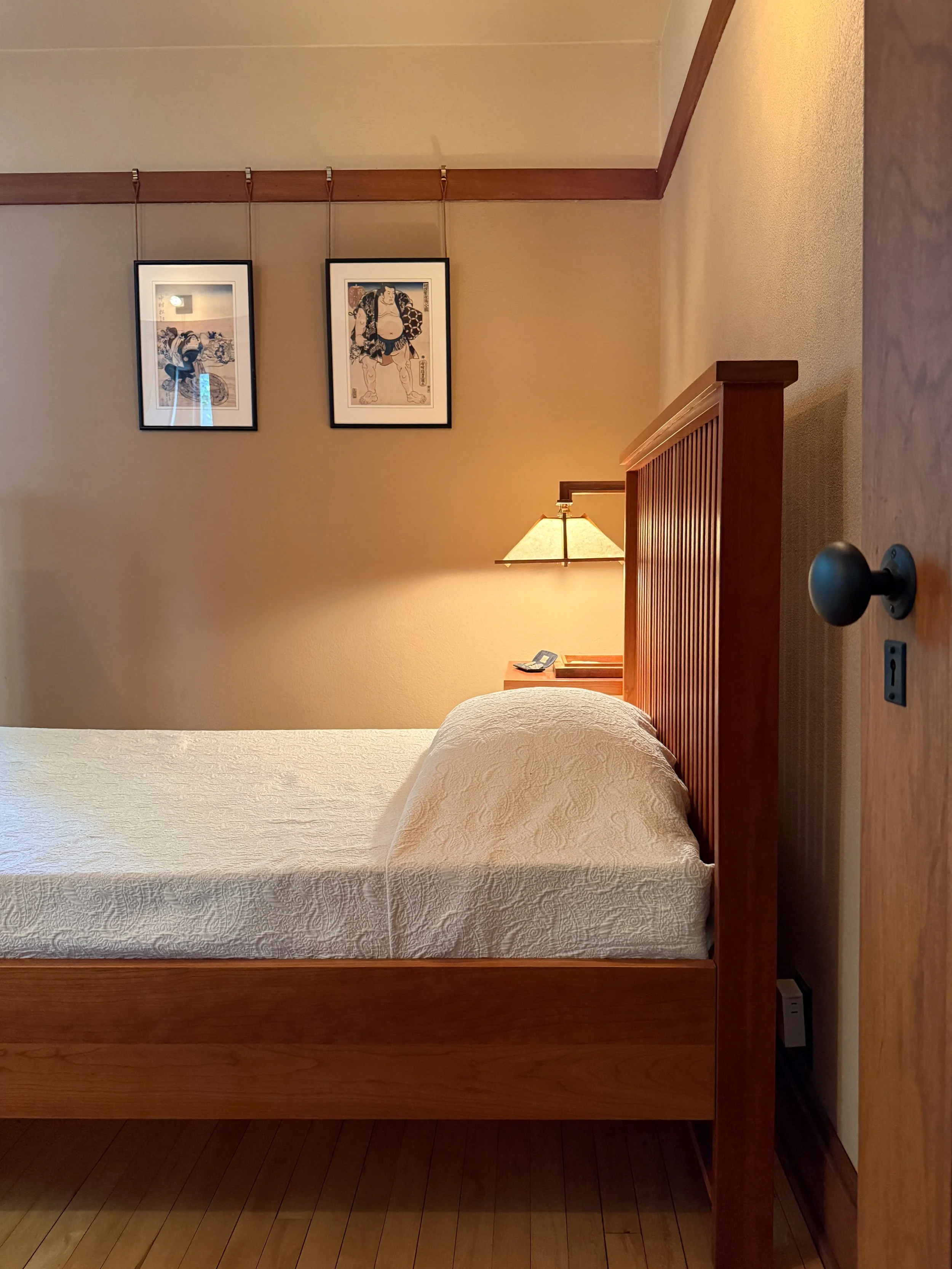
The main bedroom at Model B1 of Frank Lloyd Wright's Burnham Block
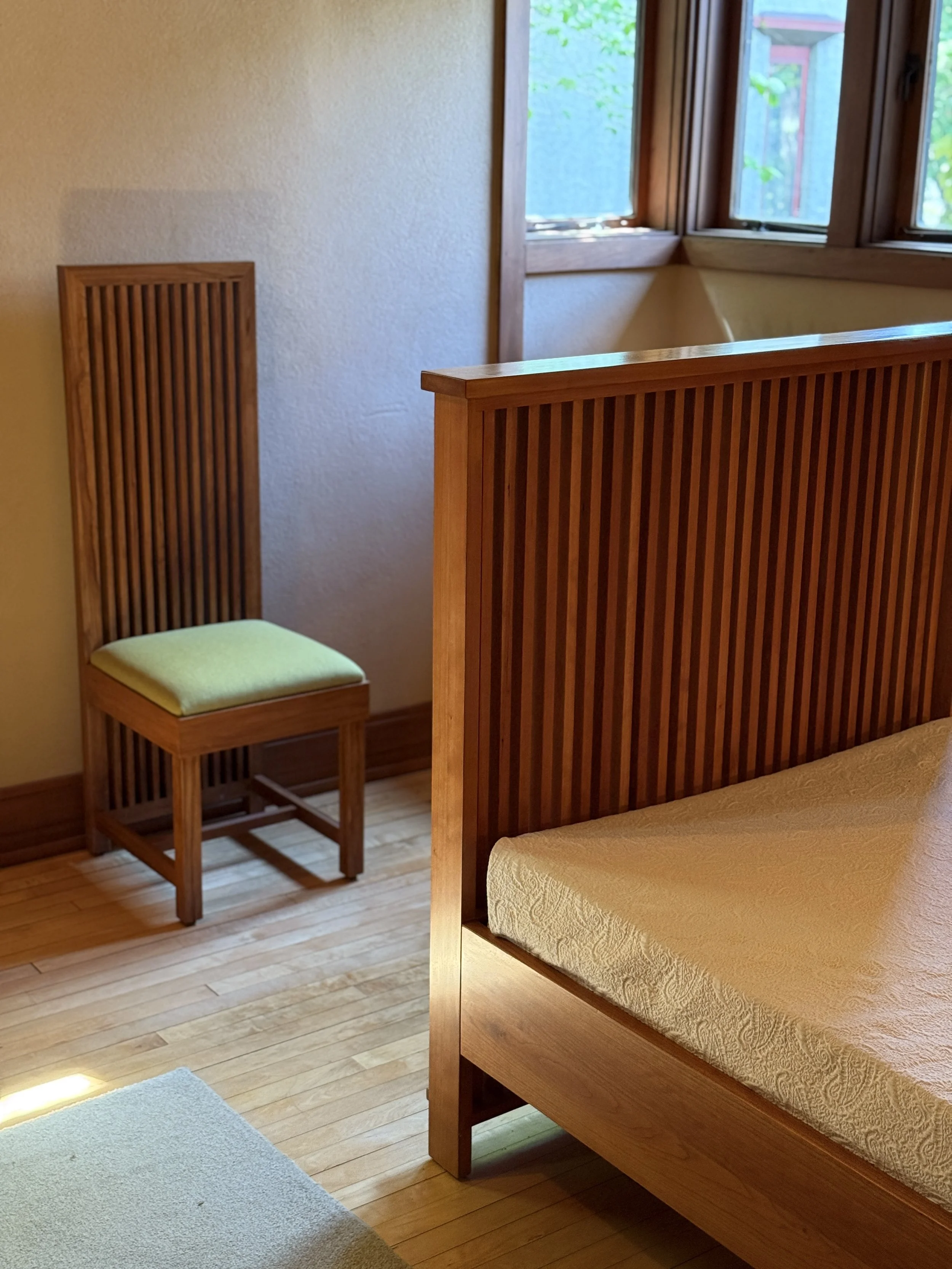
The foot of the bed and a chair in a bedroom of Model B1 at Frank Lloyd Wright's Burnham Block

In the primary bedroom, ukiyo-e Japanese woodblock prints reflect Wright’s long-standing admiration for Japanese art and design, while the children’s room features charming illustrations created by his younger sister, Maginel Wright Enright. 

The exterior side view of Model B1 of Frank Lloyd Wright's Burnham Block in Milwaukee

An American Dream That Never Caught On

This development embodied a bold vision of the American Dream. These homes weren’t just places to live; they were a blueprint for how entire neighborhoods of affordable, well-designed housing might take shape across the country. 

That vision extended far beyond this single block. Wright was never one to think small, and he and Richards imagined these homes not as a one-off experiment but as the beginning of something far-reaching. They envisioned entire subdivisions filled with variations on these models, stretching across the U.S. and into Canada. If everything went according to plan, the project could generate more than a million dollars in revenue. 

The six homes on Burnham Street were completed on July 5, 1916 — just 10 days before Milwaukee hosted a massive Preparedness Parade in support of U.S. involvement in World War I. But the war would soon derail Wright and Richards’ ambitious plans. As building materials were diverted to the war effort and the housing market grew uncertain, their grand project ground to a halt. 

In the end, only about a dozen American System-Built Homes were ever constructed — six on Burnham Street and a handful of others scattered throughout the Midwest. Eventually, Wright and Richards had a falling out, culminating in Wright successfully suing Richards for non-payment. Under their agreement, Wright was to receive royalties for each house sold. But a major flaw in the arrangement was that Richards wasn’t required to report each sale to Wright, making it impossible for Wright to know how many homes were actually built. That lack of transparency, combined with missed payments, led to growing mistrust and ultimately ended their partnership. 

Although the Burnham Block is listed on the National Register of Historic Places, discovering the homes felt like stumbling upon a hidden gem. These aren’t the Wright homes that capture a lot of attention.

Tours are available by reservation only and are led by trained docents who offer insight into the history and design of the homes. –Duke


Before You Go

Phone: 414-368-0060

Admission: $20; children under 16 free

Times: Tours are offered many Saturdays, but double-check and make reservations.

They start at 11 a.m., 12 p.m., 1 p.m. and 2 p.m.

Tours last about one hour.

Homes along Frank Lloyd Wright's Burnham Block in Milwaukee, Wisconsin

Frank Lloyd Wright’s Burnham Block

2732 West Burnham Street
Milwaukee, Wisconsin
USA
 

72 Hours in Miami: A Sun-Soaked Escape Done Right

From cafecito in Little Havana to sunset strolls on South Beach, this three-day Miami itinerary covers Wynwood, Biscayne Bay, Coconut Grove and more.

The Miami skyline at night

There’s something about Miami that makes you feel like the main character. Maybe it’s the ocean breeze that hits just right, or the way the sunlight bounces off pastel buildings and into your soul. Whatever it is, it only took one weekend to realize I’d be coming back — and doing it right from the jump.

This is how I made the most of 72 hours in Miami. No fluff, no tourist traps — just beaches, bites and a few well-earned naps.

Two of the Art Deco hotels in South Beach, Miami, Florida, one with blue neon, the other red

Day 1: Landing, Rolling and Recharging

We landed late morning, bleary-eyed but buzzing. Instead of standing in line for rideshares or fumbling with apps, I’d pre-booked a rental — best move I made all trip. Cheap car rental services in Miami aren’t just affordable, they’re freedom on four wheels. Within 30 minutes, we were driving down Collins Ave with the windows down and reggae on the speakers.

The sign of Versailles Restaurant, serving Cuban cuisine, in Little Havana, Miami, Florida

First stop: Versailles Restaurant in Little Havana for a welcome-to-Miami cafecito and some ropa vieja. That hit different after a travel day. The elderly Cuban men playing dominoes outside felt like a scene from a movie, their animated conversations punctuating the afternoon heat.

We checked into a boutique hotel in South Beach, dropped our bags, and wandered the Art Deco district until sundown — neon reflections dancing off wet sidewalks after a surprise storm. The pastel buildings looked like candy in the golden hour light. Then: mojitos, shrimp tacos, and live music at a tucked-away bar that felt more Havana than Florida. The bassist had this infectious energy that had everyone swaying by the second set.

A person stands on a rocky promontory watching the sunrise over the ocean in Miami, Florida

Day 2: Sunrise, Sand and Spontaneity

I woke up early, restless in the best way. Threw on shorts, grabbed a pastelito from a corner café, and hit the sand solo while the city still slept. Watching the sun rise over the Atlantic in Miami is like pressing reset on your nervous system. The beach was empty, except for a few joggers and early fishermen casting their lines into the pink-tinged waves.

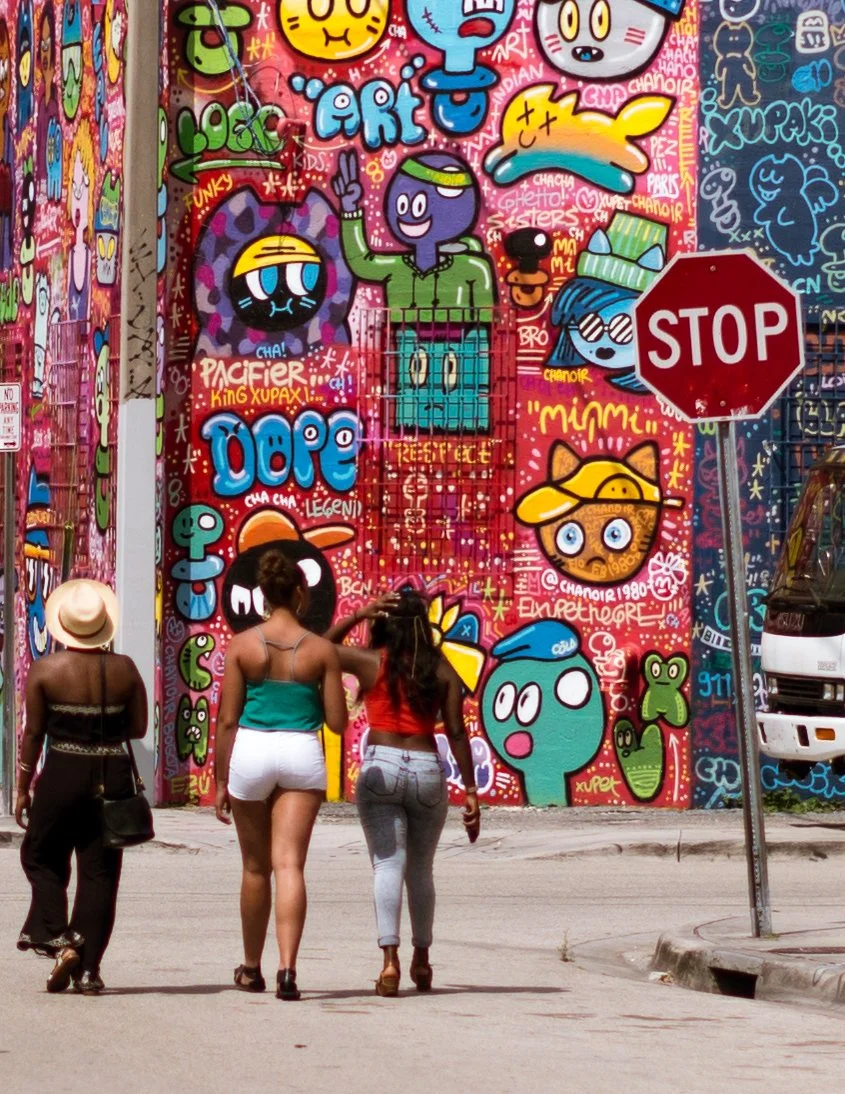
Three women walk past colorful murals in Wynwood in Miami, Florida

Later, we drove across the causeway to Wynwood — all murals and matcha. There’s a spot called Panther Coffee that became our HQ for a couple hours before we strolled into local shops and stumbled into a pop-up vinyl fair. Street artists were working on fresh pieces, and the smell of spray paint mixed with the aroma of Cuban coffee created this uniquely Miami sensory cocktail.

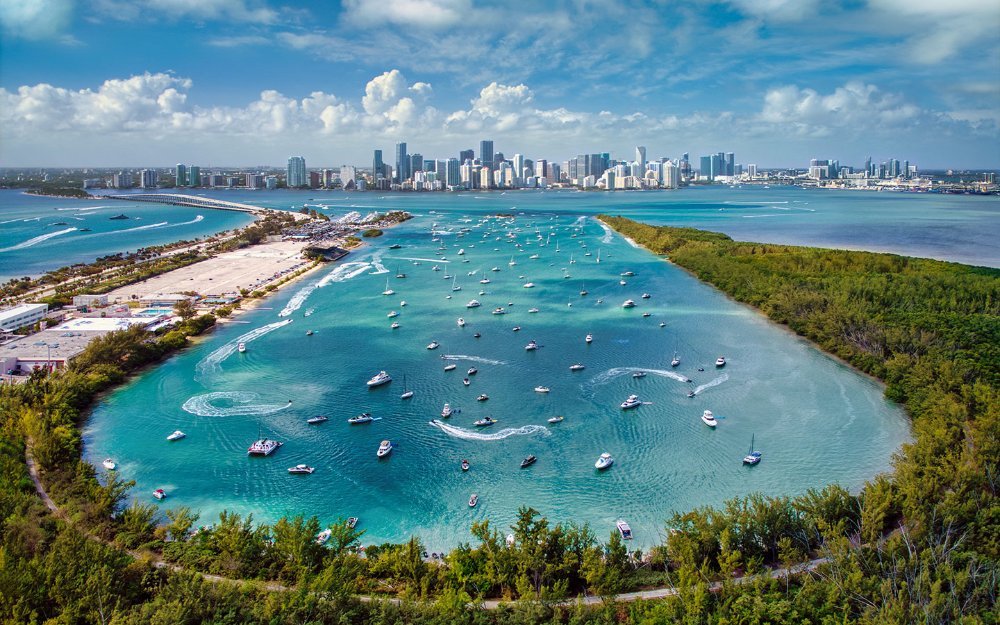
An aerial view of Key Biscayne, filled with motorboats, with Miami's skyline in the distance

Because we had the car, we made an impulsive drive down to Key Biscayne. I swear, 30 minutes out of downtown and you feel like you’re on a completely different planet: mangroves, stillness — the kind of quiet that recalibrates you. We spent an hour just walking barefoot along Crandon Park Beach, collecting shells and watching pelicans dive for fish.

A couple of people eat at Greenstreet Cafe in Coconut Grove, Miami, under an ivy-covered peak

Day 3: Brunch, Beaches and One Last Lap

We kicked off our final day with brunch at Greenstreet Café in Coconut Grove. Miami brunch hits different when you’ve got nowhere to be — no timelines, just good food and a table in the shade. The eggs Benedict was perfect, but honestly, it was the people-watching that made the meal memorable — locals walking their dogs, families speaking three languages at once, that effortless Miami energy everywhere.

Powerboats line the canal at Bal Harbour near Miami, with hotels and skyscrapers

Afterward, we took one last drive — just aimless, top 40 hits on shuffle, cruising up the coast past Bal Harbour. I wanted to stretch those final hours as far as they’d go. We stopped at a roadside stand for fresh coconut water, the vendor cracking it open with a machete right in front of us. These are the moments that make a trip unforgettable.

Returning the car was just as smooth as picking it up — no stress, no wasted time. Honestly, it’s one of the biggest travel hacks I’ve picked up lately. If you’re coming to Miami, skip the overpriced taxis and just grab a set of wheels. It’ll change how you experience the city.

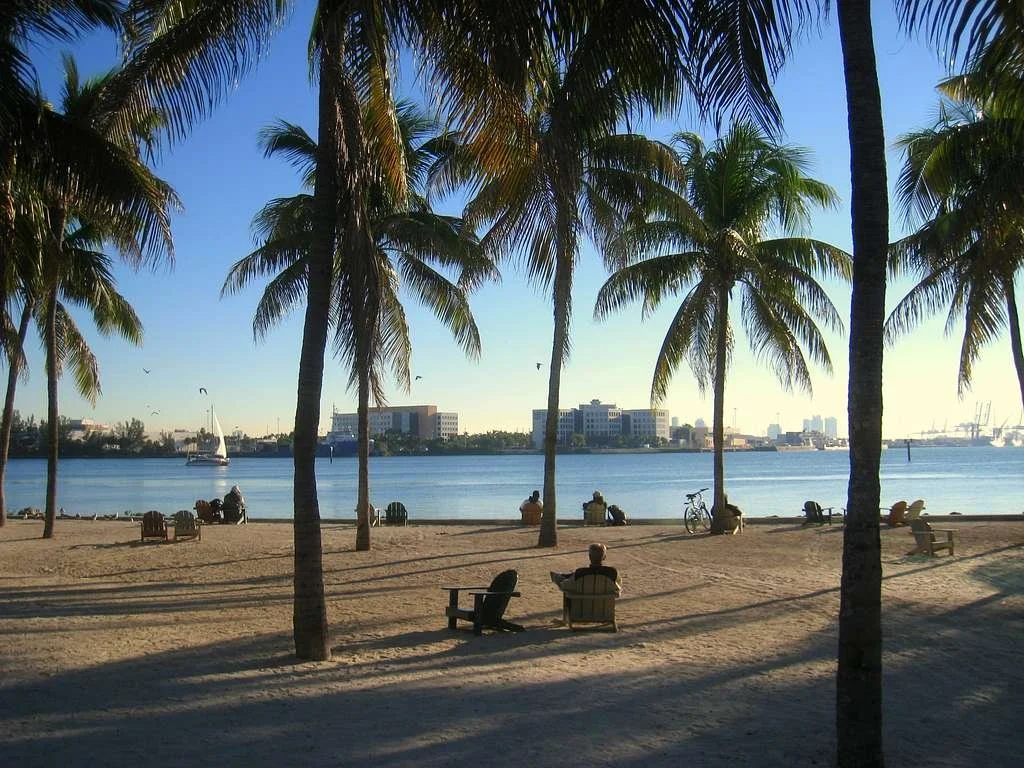
People sit under palm trees on the water at a park in Miami, Florida

Miami Nice

Miami doesn’t ask you to do much. Just to show up, stay open, and let the rhythm of the place move through you. If you do it right, even a short trip can feel like a deep breath for your entire being. The city rewards spontaneity and punishes rigid itineraries, so leave room for magic to happen.

And if you’re wondering whether it’s worth renting a car down here? I’ll say this: Three days wasn’t enough. But with the freedom to move, we lived like locals, not visitors. We discovered hidden gems that no guidebook mentioned and created memories that’ll last long after the tan fades.

That’s the whole point. –Graham Waller


The Creepiest Places to Visit in the United States

From a haunted prison to a hotel with its own morgue, here are five terrifyingly popular U.S. destinations for ghost hunters, thrill seekers and paranormal tourists.

Dilapidated crumbling hallway in the Eastern State Penitentiary in Philadelphia

Eastern State Penitentiary in Philadelphia, where solitary confinement originated

For those of us who like our vacations with a side of dread, the U.S. has you covered. Cursed plantations? Check. Derelict prisons? Yep. A floating hotel with a body count? You bet. These are the kinds of places where whispers echo in empty rooms, photos blur for no reason, and something unseen always seems to tug at your shirt.

Whether you’re a seasoned ghost hunter or just want to say you slept in the most haunted hotel in America, these are the must-visit spots that will make your heart race — and maybe stop.

1866 Crescent Hotel & Spa in Eureka Springs, Arkansas

1866 Crescent Hotel & Spa in Eureka Springs, Arkansas

Where the cancer cures were fake, but the bodies were real.

Originally built in 1886, the Crescent Hotel started as a luxury resort — and quickly spiraled into something much darker. After a short-lived first act, it was purchased in 1937 by Norman Baker, a con artist who turned the building into a sham cancer hospital. He operated without a license, performed grotesque procedures, and stored bodies in a basement morgue that still exists.

Women in white dresses and hats stand on the steps of the 1866 Crescent Hotel & Spa in Eureka Springs, Arkansas when it was a college for women

Back when the property was the Crescent College for Women

Guests and ghost hunters report sightings of Baker himself, nurses in old-timey uniforms, and figures wandering the halls at night. Want proof? You can join nightly ghost tours that take you to the most haunted corners of the property — including Baker’s old morgue.

1886 Crescent Hotel & Spa
75 Prospect Avenue
Eureka Springs, Akansas​

The castlelike Eastern State Penitentiary in Philadelphia, Pennsylvania at twilight

Eastern State Penitentiary in Philadelphia, Pennsylvania

Solitary confinement never really ends … if your ghost sticks around.

Once home to over 85,000 inmates — including Al Capone — this Gothic fortress pioneered solitary confinement, which sounded humane in theory and turned out to be more of a psychological torture chamber. The prison operated from 1829 to 1971 and is now a National Historic Landmark.

Historic photo of a worker standing in a cellblock of Eastern State Penitentiary in Philadelphia, Pennsylvania

Its crumbling halls, rusted doors and echoing cellblocks give off a presence that’s hard to ignore. Visitors report disembodied voices, cell doors slamming on their own, and shadowy figures pacing inside locked cells. Cellblock 12 and the guard tower are said to be the most active — if you believe in that sort of thing. And even if you don’t, you’ll probably walk faster through them.

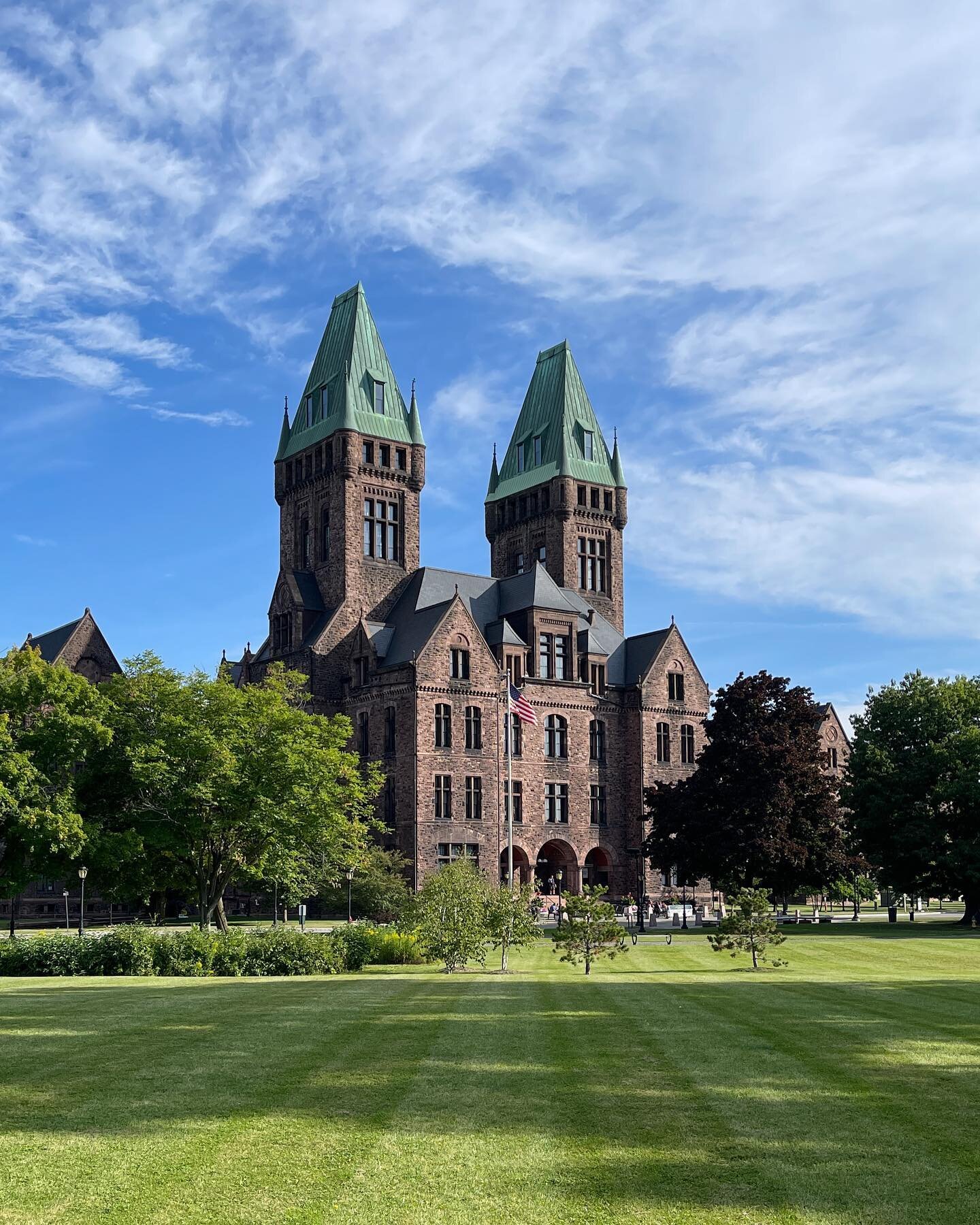
Sounds a bit like the derelict insane asylum attached to the Richardson Hotel in Buffalo, New York, which is also worth touring. 

If you’re also going to Pittsburgh, be sure to creep yourself out at Trundle Manor

Eastern State Penitentiary
2027 Fairmount Avenue
Philadelphia, Pennsylvania

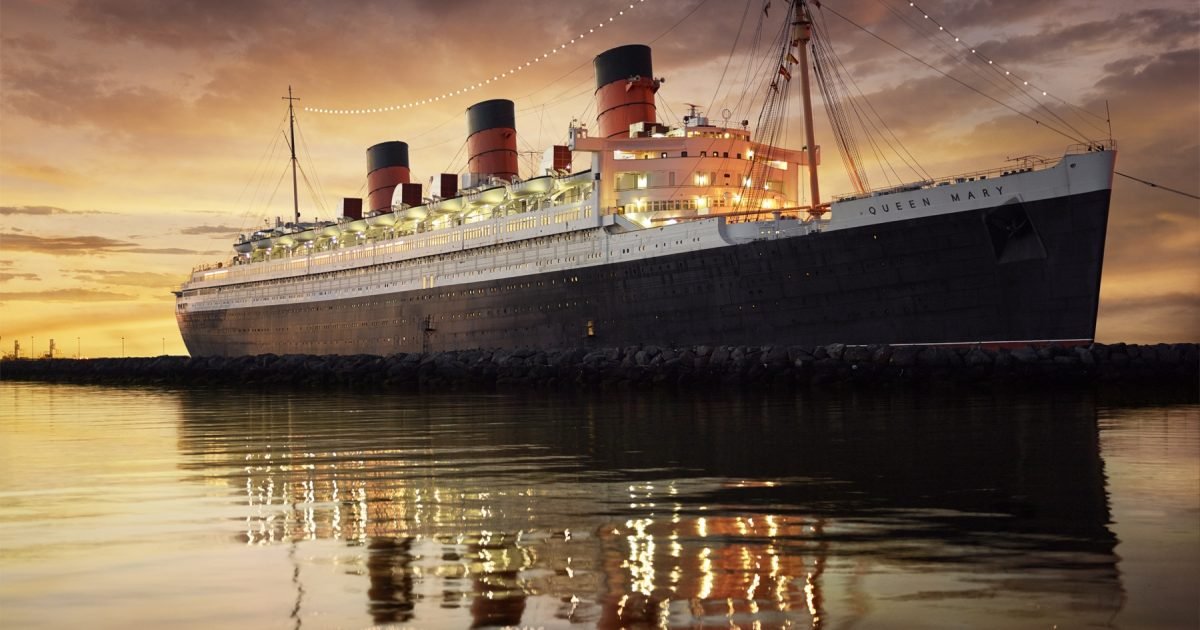
The ocean liner Queen Mary in Long Beach, California at sunset

The Queen Mary in Long Beach, California

All aboard — for a cruise you’ll definitely want to disembark from.

This ocean liner hosted royalty, celebrities and WWII troops — and now ghosts. Docked permanently in Long Beach, the Queen Mary is considered one of the most haunted ships in the world.

A girl is dressed up like the ghost of Jackie, a girl who drowned in the pool on the Queen Mary ship

Say hi to Jackie! She drowned in the pool but now giggles through the hallways.

Visitors regularly report paranormal activity, including screams, slamming doors and the ghost of a crewmember who was crushed by a watertight door in the engine room. Then there’s Jackie, the little girl who allegedly drowned in the pool and now giggles through the halls — creepy kid laughter being the ultimate test of your fight-or-flight response.

If you visit around Halloween (known to witches as Samhain), don’t miss the ship’s Dark Harbor event — a screamfest that brings its haunted legends to life.

​​The Queen Mary
1126 Queens Highway
Long Beach, California

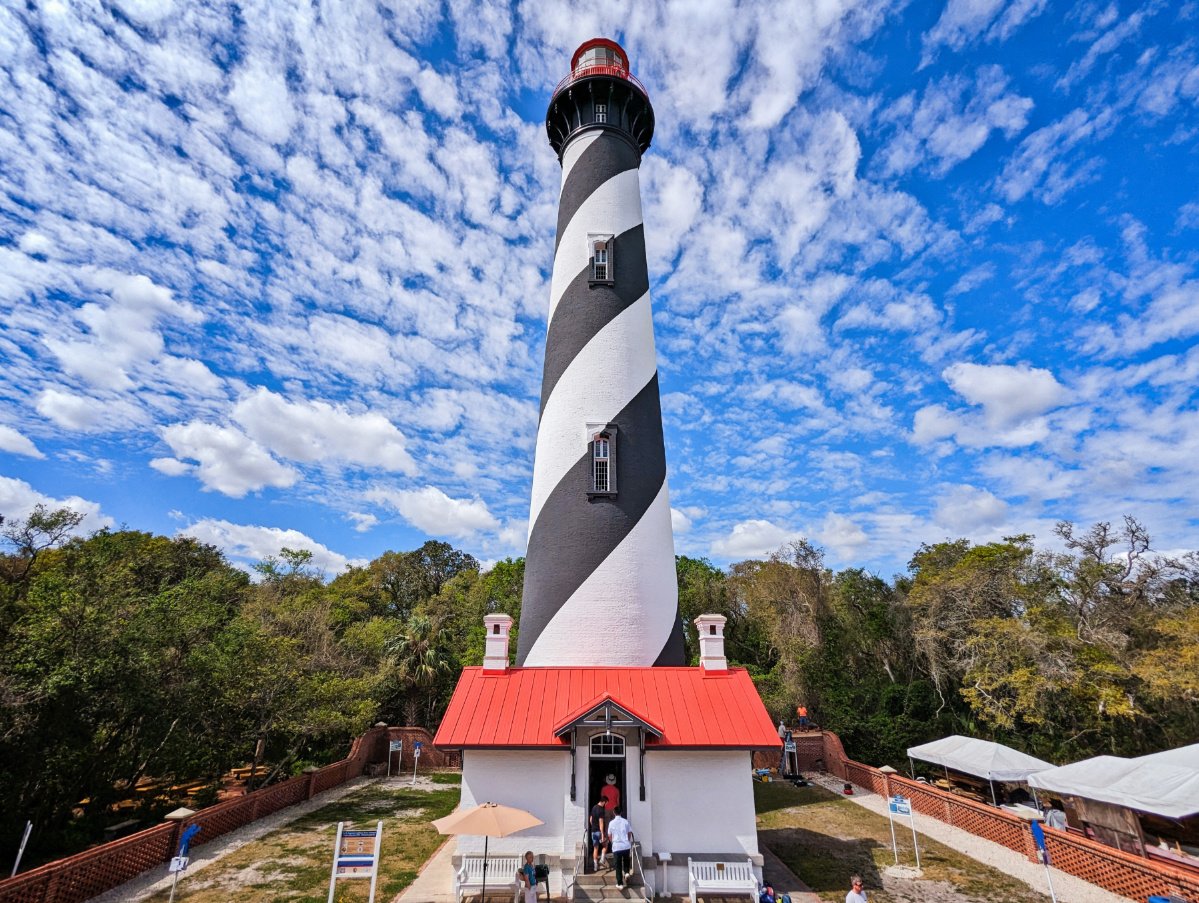
Black and white diagonally striped St. Augustine Lighthouse in St. Augustine, Florida

St. Augustine Lighthouse in St. Augustine, Florida

Helping ships find the shore — and maybe helping spirits climb the stairs.

The current lighthouse was completed in 1874 — but the land has a longer, darker history. Tragedy struck during construction, when two young daughters of the superintendent drowned in the bay. Ever since, strange sightings have haunted the tower.

The spiral staircase inside St. Augustine Lighthouse in St. Augustine, Florida

Visitors report hearing footsteps on the spiral stairs, catching glimpses of shadowy figures, and even being touched by something unseen. The Dark of the Moon tour takes you up the tower at night — just you, a flashlight … and your frazzled nerves.

St. Augustine Lighthouse & Maritime Museum
100 Red Cox Drive
St. Augustine, Florida

Exterior of Myrtles Plantation in St. Francisville, Louisiana

Myrtles Plantation in St. Francisville, Louisiana

Cursed ground, murder and ghosts with unfinished business. Southern hospitality not guaranteed.

The Myrtles has everything you could want in a haunted Southern plantation: hidden pasts, murder, mystery and a good chance of ghostly encounters. Built in 1796, the property is said to be cursed from the start, allegedly located on an indigenous burial ground. Several people died violently here, and stories of hauntings are as thick as the Spanish moss out front.

A grainy photo Chloe, the ghost at Myrtles Plantation in St. Francisville, Louisiana

The enlarged section of this image is said to be the plantation’s famous ghost, a former slave named Chloe.

The most infamous ghost? Chloe — a formerly enslaved woman who was reportedly mutilated for eavesdropping and later hanged after poisoning members of the household. Her apparition has supposedly been caught in photos and is said to still roam the grounds. 

Other spirits include William Winter, shot on the porch in 1871, and his young daughter, who died of yellow fever.

The Myrtles Plantation
7747 U.S. Highway 61
St. Francisville, Louisiana

An aerial view of Eastern State Penitentiary in Philly

An aerial view of Eastern State Penitentiary, which is no longer operational — just attracting visitors who appreciate the macabre.

Haunted Hotspots

Some people go to the beach — others go looking for the ghosts of 19th century criminals. These haunted destinations deliver the perfect mix of history and horror, where the stories are real, the wallpaper is peeling, and the room you booked might come with a ghost you didn’t. –Armughan Zaigham

The Isabella Stewart Gardner Museum: A Breathtaking Artistic Oasis in Boston

A Venetian-style palazzo — the scene of an infamous unsolved art heist — houses eclectic art and lush seasonal gardens. 

The courtyard of the Isabella Stewart Gardner Museum was designed to evoke the ambiance of a 15th century Venetian palace.

I was flicking through Instagram (something I do way too often), and my finger stopped mid-scroll on a stunning palazzo. “Italy?” I thought. “Maybe India?” 

Nope. It was the Isabella Stewart Gardner Museum — in Boston, of all places.

Boston?! I’d be there the next day for work. It felt like fate.

Isabella Stewart Gardner’s will specified that nothing could be moved, ensuring her vision stayed exactly as she intended.

Gorgeous tilework in the Spanish Cloister — nearly 2,000 tiles from 17th century Mexico, that is

The Isabella Stewart Gardner Museum: A Hidden Gem in the Heart of Boston

Boston has its usual suspects when it comes to tourist spots: Fenway Park, the Freedom Trail, Faneuil Hall. But have you heard of the Isabella Stewart Gardner Museum?

It’s not usually the first stop on a Boston itinerary, but it absolutely should be. Tucked into the city’s Fenway neighborhood, this museum feels like a secret treasure waiting to be discovered. And, believe me, it’s worth it — from its jaw-dropping architecture to its captivating art (and even its unsolved mystery).

The Veronese Room is named for the grand painting on its ceiling, The Coronation of Hebe, attributed to Paolo Veronese and his studio, painted in the 1580s.

The Tapestry Room features 10 Flemish tapestries.

Isabella Stewart Gardner was a rule-breaker, a collector and someone who knew how to make an impression.

Take her grand parties: She once attended a symphony in a white headband that simply said, “Oh, you Red Sox” in bold letters. She was as bold as her taste, building her museum as a Venetian-style palazzo (originally called Fenway Court) right in Boston and filling it with treasures from around the world.

“Years ago I decided that the greatest need in our country was art,” she once said. “So, I determined to make it my life’s work if I could.” 

Mission accomplished. 

In the Chinese Loggia, Stewart Gardner placed a statue of the Madonna and child opposite a Buddhist stele to spark contemplation about shared spiritual themes.

Walking through the museum feels like wandering through the home of someone fabulously wealthy and wildly eclectic. You’ll spot everything from a Rembrandt self-portrait to Japanese lacquered boxes, all lovingly placed as Isabella herself arranged them over a century ago.

A Roman mosaic floor featuring the head of Medusa that was crafted between 117 and 138 CE takes center stage in the courtyard.

The Infamous Art Heist: Mystery in 81 Minutes

The Gardner Museum holds the title for the greatest unsolved art heist in history. The story is something straight out of Hollywood.

It all began in the early hours of March 18, 1990. Two men dressed as Boston police officers buzzed at the museum’s doors, claiming they were responding to a disturbance. The night guards, unsuspecting, let them in.

Big mistake.

The Gardner Museum holds the title for the greatest unsolved art heist in history.

On March 18, 1990, two men dressed as Boston police officers strolled out of the museum with over $500 million worth of art.

The “officers” handcuffed the guards, duct-taped their mouths, and left them in the basement. Over the next 81 minutes, they raided the galleries, carefully cutting 13 priceless works from their frames. They strolled out with art worth over $500 million, including:

  • Rembrandt’s Storm on the Sea of Galilee (his only seascape)

  • Vermeer’s The Concert, valued at $250 million

  • Manet’s Chez Tortoni

  • A Chinese gu (ancient ceremonial vessel)

  • A bronze eagle finial from a Napoleonic flag

When the guards were finally freed, the thieves — and the art — were long gone.

To this day, the empty frames hang in their original spots as a silent reminder of the loss. The museum still offers a $10 million reward for information, but the case remains cold.

Intrigued? Check out the Netflix docuseries This Is a Robbery, which dives deep into the mystery of the stolen masterpieces.

A portrait of Isabella Stewart Gardner by John Singer Sargeant depicts the remarkable woman as a pagan goddess.

Isabella Stewart Gardner: The Original It Girl

Born in 1840, Isabella wasn’t your typical socialite. After her son Jackie died young, followed by miscarriage in her 20s, she fell into depression — until her doctor prescribed travel. That single recommendation changed her life.

Isabella and her husband, Jack, explored the world, visiting Egypt, Italy and Japan. Along the way, she discovered a passion for art, collecting everything from tapestries to ancient manuscripts.

Back in Boston, she became known for her unconventional style. She defied the strict social norms of the time, pairing pearls with turbans at baseball games and opening her home to artists, writers and musicians.

The Blue Room at the Isabella Stewart Gardner Museum offers an intimate glimpse into Isabella’s personal world, showcasing her close connections with contemporary artists and intellectuals.

A lion attacking a man forms the base of a column in the North Cloister, from 12th century Tuscany.

The works in the Tapestry Room came from Brussels, Belgium and were created in the mid-16th century.

Her museum was her life’s crowning achievement, built in 1903 to house her collection and inspire the public. Even in death, she had the last word: Her will specified that nothing could be moved, ensuring her vision stayed exactly as she intended.

A view of the modern wing

The Museum Today: Tradition Meets Modernity

In 2012, the museum unveiled its sleek new Renzo Piano-designed wing, adding modern flair while preserving Isabella’s original palazzo. The various rooms include: the Dutch Room, Rafael Room, Tapestry Room, Titian Room, Veronese Room and Gothic Room. 

Wandering from room to room feels less like visiting a museum and more like stepping into Isabella’s home — because, in a way, you are. Each space is curated exactly as she intended, as if she’s just stepped out, leaving you to explore her private collection of treasures from around the world.

The new space hosts concerts, lectures and temporary exhibits, creating a dynamic blend of old and new.

The courtyard itself might be the most beautiful work of art here. This statue is believed to represent Persephone, the goddess of spring who became queen of the underworld.

And while the art is breathtaking, don’t overlook the ever-changing courtyard. Seasonal displays like orchids, hydrangeas and chrysanthemums transform the space into a living masterpiece.

Grab a bite at Café G in the new wing of the museum.

Café G

Upon arriving at the Isabella Stewart Gardner Museum, I was famished and made a beeline for Café G, the museum’s onsite eatery. The sleek, glass-enclosed space was designed by Renzo Piano, offering serene views of the surrounding gardens — a tranquil setting to relax before delving into the museum’s treasures.

The menu features dishes that highlight seasonal, local and organic ingredients. 

The Raphael Room features Italian Renaissance art.

A Museum Like No Other  

Whether you’re an art lover, a history buff or just someone looking for a little magic in Boston, the Isabella Stewart Gardner Museum is a must-see. It’s a time capsule, a mystery and a testament to one woman’s indomitable spirit. –Wally

At the end of the Long Gallery in the Chapel hangs a High Gothic stained glass window titled Scenes From the Lives of Saint Nicasius and Saint Eutropia, crafted around 1205 for the Soissons Cathedral in France.

The Deets: Plan Your Visit

Hours:

  • Wednesday to Monday: 11 a.m. to 5 p.m. 

  • Thursdays: 11 a.m. to 9 p.m. 

  • Closed: Tuesdays, Thanksgiving, Christmas and New Year’s Day

Admission:

  • Adults: $20

  • Seniors (65+): $18

  • Students with ID: $13

  • Free: Members, children under 18, and anyone named Isabella (yes, really!)

Isabella Stewart Gardner Museum

25 Evans Way
Boston, Massachusetts
USA

Paws and Poke: 4 Dog-Friendly Restaurants in Hawaii You’ll Love

Sip, snack and stay paw-sitive! From craft brews to oceanfront views, these 4 dog-friendly spots in Hawaii — Brew’d, Oli’s, Lava Java and Appetito — welcome you and your pooch.

A woman with a flower behind her ear and a blue and white sundress eats on a waterfront patio in Hawaii at sunset

Picture this: You and your pup, paws in the sand, the salty breeze in your hair (or fur), soaking up that island magic. Hawaii isn’t just a paradise for sun-seekers — it’s a dog’s dream, too. From sandy beaches where tails wag freely to trails that welcome four-legged explorers, the Aloha State rolls out the red carpet for those who travel with pets.

And when it’s time to refuel? You don’t have to leave your furry best friend behind. Hawaii is home to plenty of dog-friendly restaurants where you can sip, snack and savor the moment — pup in tow. Whether you’re after craft beer, oceanfront coffee or a pizza-and-wine night, these four spots make dining with dogs in paradise a breeze. Bone appétit!

A man with beard and tattoo sleeves drinks a beer at a brew pub, his pomeranian on the table with him

1. Brew'd Craft Pub

📍 3441 Waialae Avenue
Suite A 
Honolulu, Hawaii
USA
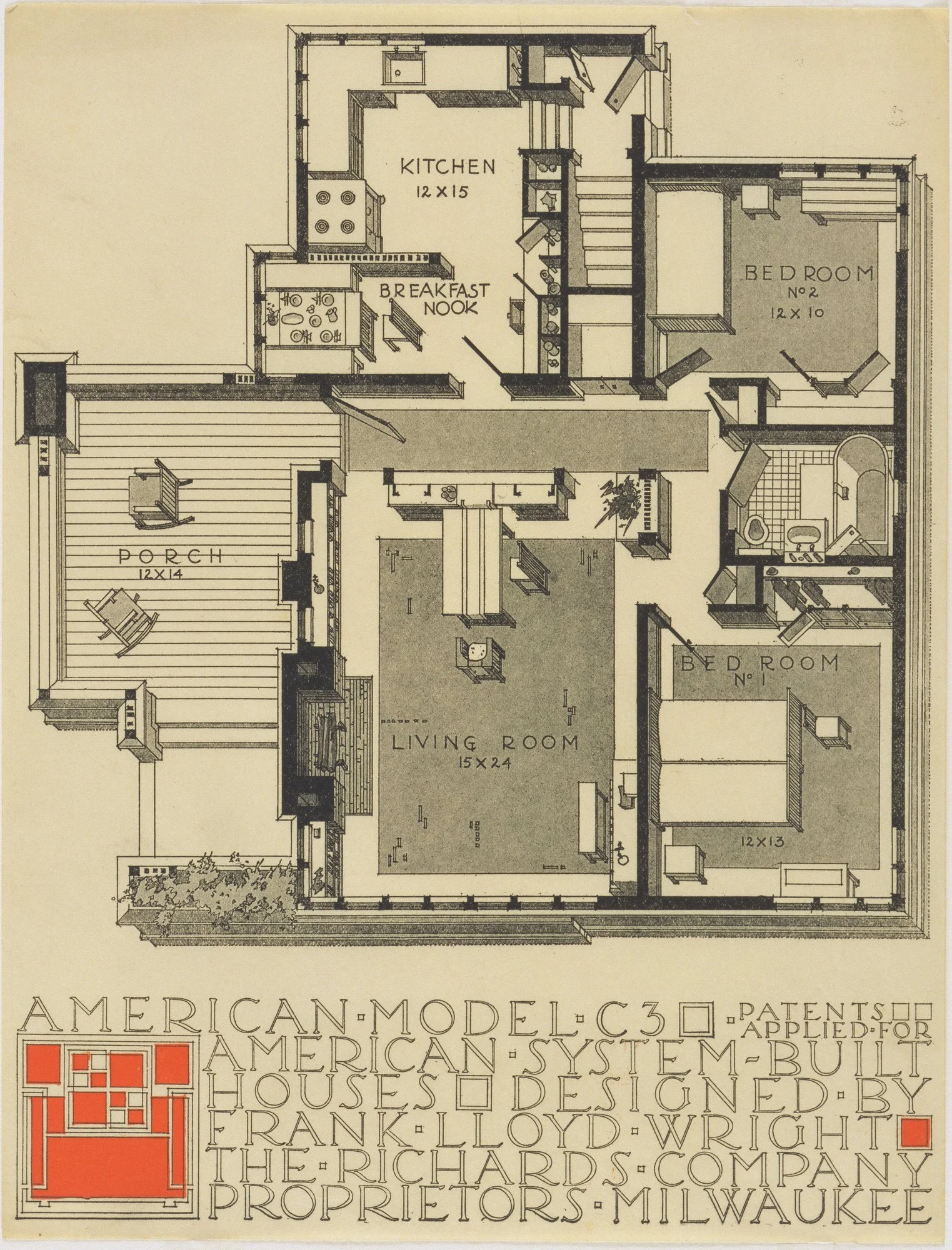
808-732-2337

Looking for a paws-itively great pub experience in Hawaii? Brew’d Craft Pub is the ulti-mutt spot for beer lovers and their four-legged besties. With over 20 taps and more than 30 different beers, your toughest decision will be what to sip first.

Not a beer person? No worries — this spot has something for every taste, including local ciders, seltzers and a signature cocktail menu that’ll have you wagging your tail.

But let’s get one thing straight — this isn’t just a watering hole. Brew’d has a menu that goes beyond basic pub grub. Sink your teeth into fish tacos, prime rib or classic fish & chips. Veggie lovers can dig into the Szechwan cauliflower, and if you’re after a sidekick to your meal, the smoked brisket and spicy chicken sliders are top dog.

Brew’d doesn’t just tolerate pups — it rolls out the red carpet for them. The pub’s owner makes it clear on social media (and in real life): dogs are welcome! The staff is always ready to serve you and your furry plus-one, and with a spacious outdoor seating area—complete with shade and a short fence to keep things cozy — you and your pup can kick back in style.

So, if you’re sniffing around for a laid-back pub with great drinks, tasty bites, and a dog-friendly attitude, Brew’d Craft Pub is the place to be. Cheers, and give your good boy (or girl) a treat from us! 

Two men eat at a white-walled cafe with their dog in Hawaii

2. Oli’s Kitchen

📍 1009 University Avenue
Suite MP2 
Honolulu, Hawaii
USA
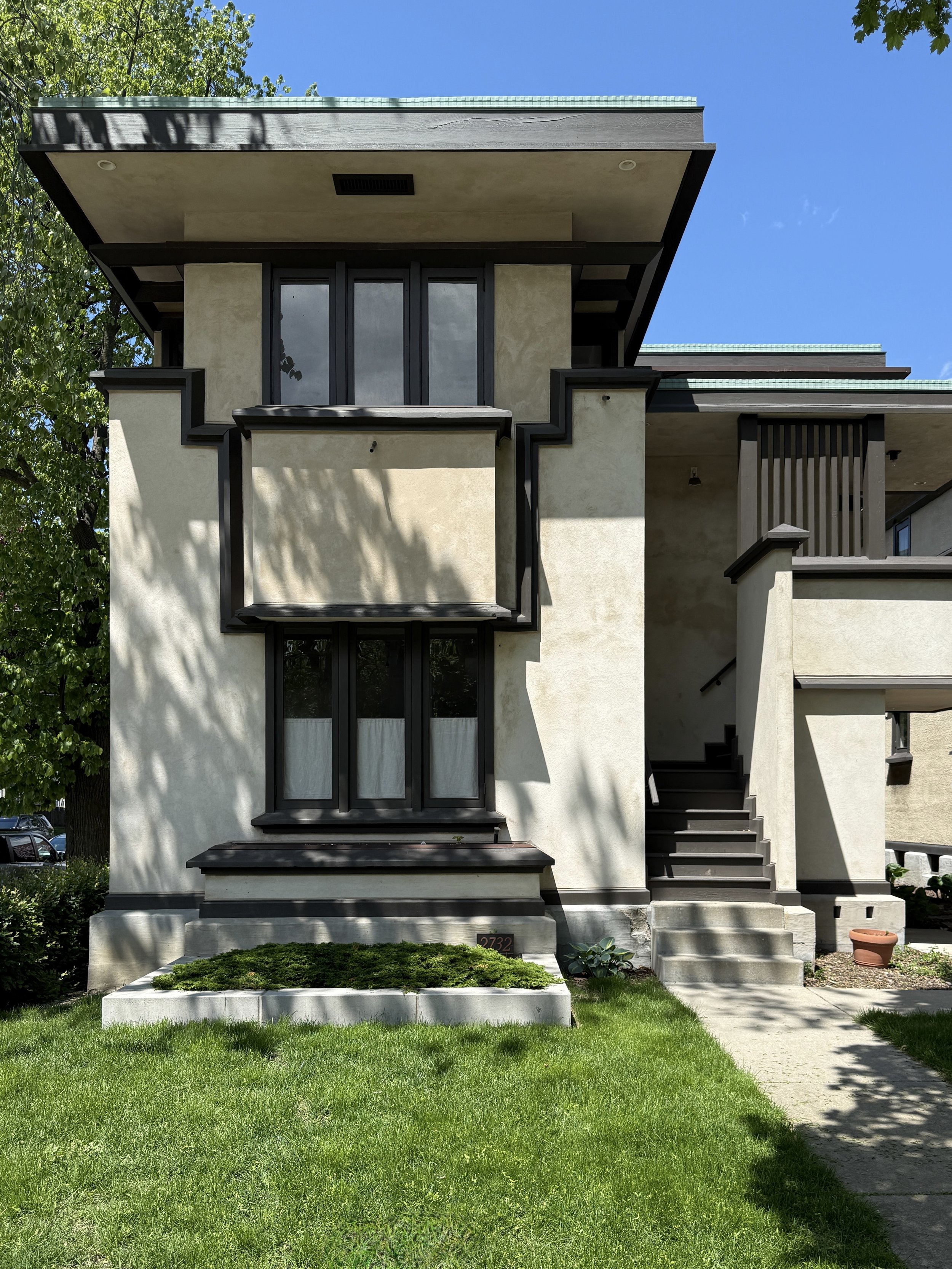
808-387-0457

Looking for a spot where you and your pup can dig in without any side-eye? Oli’s Kitchen, a locally owned gem that opened in 2024, is already fetching rave reviews. Tucked near Puck Alley in the heart of Honolulu, this laidback eatery serves up local flavors that’ll have both visitors and locals drooling (hopefully just metaphorically).  

Oli’s is all about fresh, island-sourced ingredients, ensuring every bite brings a real taste of Hawaii. The menu? A paws-itively delicious lineup featuring crowd favorites like breakfast burritos and the peanut butter banana stuffed French toast — because why should Elvis have all the fun?  

The bright, airy interior means you won’t feel like you’re playing a game of musical chairs with your fellow diners. And yes, dogs are welcome — as long as they’re on a leash. With plenty of room to stretch out, your pup won’t have to squeeze under the table like the sneaky little snack thief they probably are.  

Bonus? It’s BYOB all day, every day. Just note that a cork and ice fee may apply — because even paradise comes with fine print.  

Regulars keep barking about Oli’s friendly service, relaxed vibe, and refreshingly low noise levels. Whether you’re fueling up for an adventure or winding down after a day of tail-wagging fun, this is one Honolulu hotspot you’ll want to sit and stay at.  

A barefoot woman in a flowing coverup sits with her pug in the evening on a restaurant patio, with lights strung overhead

3. Island Lava Java

📍 75-5801 Ali'i Drive
Building 1 
Kailua, Hawaii
USA
808-300-5672

If you’re looking for a meal with a view and a seat for your doggie, Island Lava Java in Kailua-Kona is a great choice. This family-owned, dog-friendly hotspot has built a reputation on fresh, locally sourced ingredients and a warm, welcoming atmosphere.  

Start your day with their 100% estate-grown Kona coffee, paired with house-baked pastries and desserts so fresh, even your pup might be tempted to beg. The menu is packed with Hawaiian goodness, featuring free-range Big Island chicken, grass-fed beef and organic goat cheese, all sourced directly from local farmers.  

The real treat? Dining on the breezy outdoor patio with its stunning ocean views. Each table comes with an umbrella for shade, so you and your four-legged friend can kick back in comfort. The staff here are paws-itively accommodating — don’t be surprised if they bring out a bowl of water for your dog before you even ask.  

Whether you’re fueling up for an adventure or just looking to soak in the ocean air with your best friend by your side, Island Lava Java is a must-visit for coffee lovers, foodies and dog devotees alike.  

Two chic women drink red wine and eat pizza with their chow chow at a restaurant in Hawaii

4. Appetito Craft Pizza & Wine Bar

📍 150 Kaiulani Avenue
Honolulu, Hawaii
USA
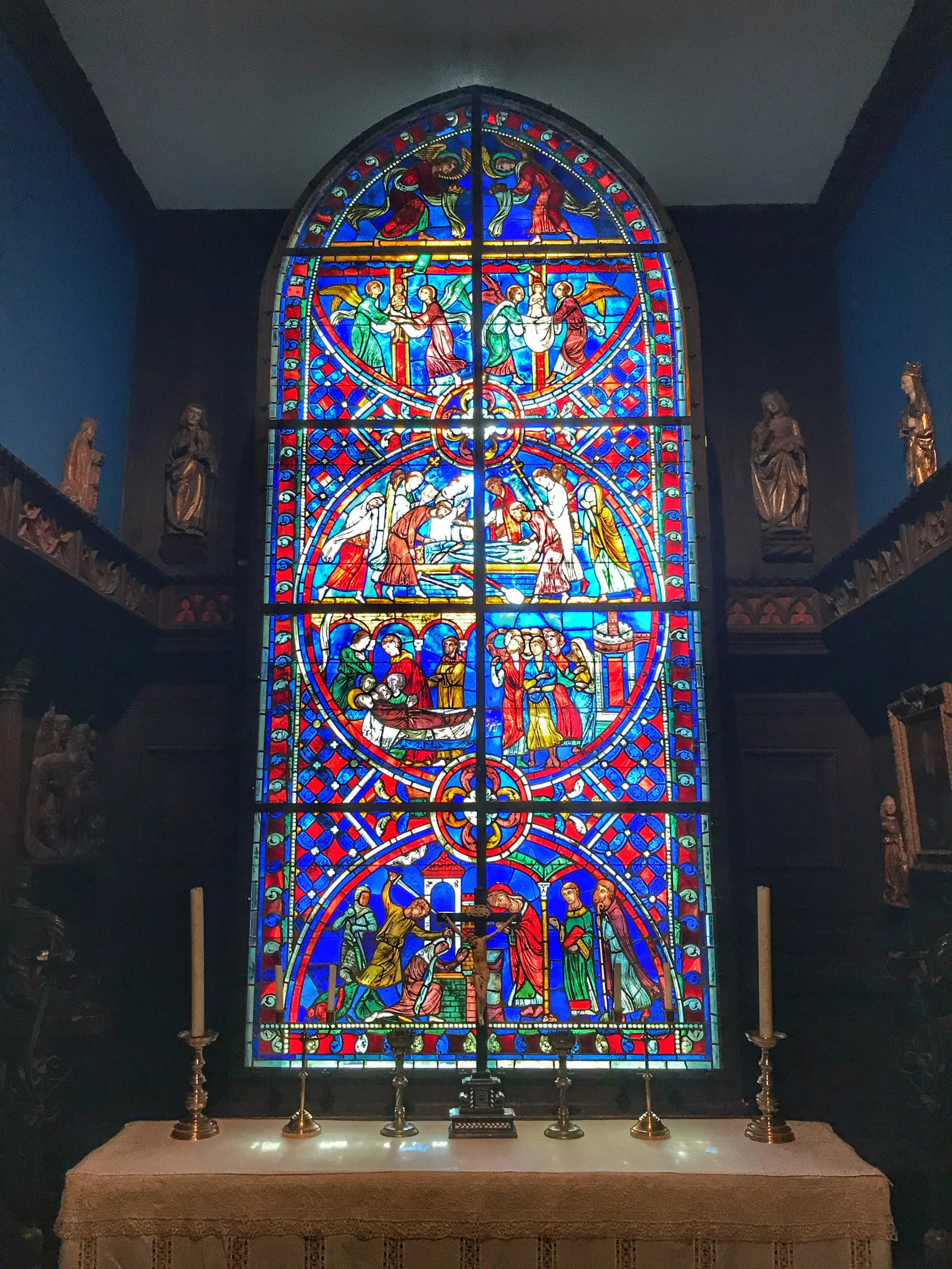
808-922-1150

Looking for a stylish night out without leaving your furry best friend behind? Appetito, located on the first floor of the Outrigger Ohana East Hotel on Kaiulani Avenue, serves up elevated Italian cuisine in a chic, laidback setting — with a dog-friendly twist.  

The outdoor seating area is as impressive as the menu, making it the perfect spot for a romantic dinner, a classy night out, or just treating yourself to some top-notch pizza and pasta — all with your four-legged dining companion by your side.  

Despite its casual vibe, Appetito doesn’t skimp on elegance. From the attentive service to the beautifully plated dishes, everything here is served with a touch of sophistication. The menu is stacked with crave-worthy options like Margherita pizza, steak frites with garlic sauce, spicy meatballs and Italian salami pizza — each as delicious as the next.  

And if you think an upscale spot like this wouldn’t do happy hour, think again. Appetito offers a generous three-hour happy hour from 3 p.m. to 6 p.m., so you can sip on wines, cocktails and more without breaking the bank.  

With free Wi-Fi, a welcoming atmosphere for kids and dogs alike, and the option to reserve your table ahead of time, Appetito is proof that you can have fine dining, fantastic drinks and a fido-friendly experience — all in one spot.

A man sips a drink on a restaurant patio in Hawaii, with the ocean in the background, palm trees overhead, sun umbrellas and a golden retriever
Paradise for Pups and Their People

Hawaii isn’t just a dream destination for humans — it’s a tail-wagging paradise for dogs, too. With its breezy beaches, scenic trails and dog-friendly patios, the Aloha State makes it easy to explore with your four-legged travel buddy by your side.

Of course, a well-behaved pup makes for an even smoother trip. Many visitors take advantage of Hawaii dog training services to ensure their companions stay confident and well mannered on new adventures. Programs like Sit Means Sit help dogs brush up on their skills, making everything from beach strolls to restaurant patios a breeze. Details available here.

Whether you’re hiking volcanic trails, lounging oceanside or sipping cocktails at a dog-friendly café, Hawaii offers an unforgettable experience for both you and your pooch. After all, the best adventures are the ones you can share. –Taylor Reed

Starland District: Savannah’s Funky, Artsy Playground

Savannah’s coolest neighborhood, the Starland District, is a quirky haven brimming with creativity. 

I love Broughton Street — don’t get me wrong. This upscale thoroughfare, with shops like the Paris Market, the Savannah Bee Company and Urban Outfitters, has an undeniable charm. 

But I wanted something edgier, fresher and a little less polished. Enter the Starland District, a neighborhood born from the bones of an old dairy at the end of the ’90s and now pulsing with creativity.

The Starland District: a neighborhood born from the bones of an old dairy and now pulsing with creativity.
A mural of flowers saying, "Am I dreaming?" in the Starland District in Savannah

History of the Starland District

In 1999, two SCAD (Savannah College of Art and Design) graduates, Patrick Shay and Eric Saller, stumbled upon the derelict Starland Dairy, a once-bustling pasteurized milk plant that had been abandoned for years. The dairy, established in the early 1900s and adorned with an iconic red star, had become a canvas for graffiti and a symbol of neglected Savannah. 

Rather than tearing it down, like any good SCAD student, they saw potential in its crumbling walls and industrial charm. With a love for historic preservation, they bought the two-block complex for a modest sum and set to work.

Their vision was simple yet radical: transform the decaying dairy into a community space for artists, creatives and entrepreneurs. Over time, the Starland Dairy became a hub for studios, galleries and workshops, injecting new life into the surrounding neighborhood. The district took its name from this centerpiece, with the “Starland” moniker honoring the dairy’s heritage.

A signpost pointing to various attractions in the Starland District in Savannah, Georgia

Today, the Starland District remains an eclectic haven where SCAD students, local artists and Savannah’s quirkier residents converge. It’s colorful, messy in the best way and delightfully rebellious. Between the murals, mismatched furniture on café patios and the unmistakable hum of creativity, this neighborhood feels alive in a way that’s entirely its own. Exactly what I was craving.

Highlights of the Starland District 

Facade of Starland Strange & Bazaar, with it's pink exterior and vibrant painting path and stairs

Starland Strange & Bazaar

📍 17 West 41st Street

“It’s less curiosity shop and more Anthropologie,” I told Duke as we peered through the window of Starland Strange & Bazaar, closed for the day (Monday, for those taking notes). Instead of shrunken heads and oddities, we spotted racks of stylish women’s clothing and tables with boho-chic housewares. And because Starland loves a quirky twist, there’s also an ice cream shop inside.

Exterior of Graveface Records in the Starland District in Savannah, Georgia

Graveface Records & Curiosities

📍 5 West 40th Street

Part record store, part curiosity shop, Graveface is a delightful Wonderland of vinyl and weirdness. The records I was interested in were all around $20 to $30), but it was the curiosities that grabbed our attention: vintage taxidermy, antique Ouija boards and other objects you can’t decide if they’re creepy or cute. It’s like stepping into your cool goth cousin’s attic. 

African masks and quirky antiques at Graveface Records in the Starland District in Savannah, Georgia
A bust of a man with four eyes and mustache at Graveface Records in the Starland District in Savannah, Georgia
A fishman looking like the Creature from the Black Lagoon on a shelf at Graveface Records in Savannah (not for sale)

Note: The Graveface Museum, located across town and owned by the same guy, showcases a fascinating collection of horror-themed artifacts, vintage pinball machines and true crime memorabilia.

The facade of Flora and Fauna cafe, with blue window frames and aqua tiles in the Starland District in Savannah, Georgia

Flora and Fauna

📍 2401 Bull Street

This French-inspired café sits right on the corner and feels like a postcard come to life. The Jessica’s chicken salad sandwich was great, but let me tell you about Duke’s mushroom conserve baguette: earthy, savory, life-changing. It wasn’t just a sandwich; it was a spiritual experience. Pair it with a latte and one of their delectable pastries, and soak in the sunny, vintage vibes. It’s the kind of place where you make new friends standing in line and time seems to slow down (until you realize you’ve devoured the entire baguette in under five minutes).

Facade of Starlandia art supply store, with magenta paint, yellow stars and a rainbow flag in Savannah, GA

Starlandia

📍 2438 Bull Street

Forget those fancy-schmancy overpriced art stores; this place is an artist’s paradise. Starlandia lets you buy and sell used art supplies, so it’s a treasure hunt every time. Brushes, paints, canvases, elastic to make bracelets — they’ve got it all, often for a fraction of the cost. I even found a stash of gently used books. Oh, and don’t forget to say hi to the tiny shrimp swimming around in their tank by the register. 

Facade of Lite Foot Company in the Starland District in Savannah, Georgia

Lite Foot Company

📍 2400 Bull Street

Going green has never looked so stylish. We weren’t quite sure what the Lite Foot Company was — but we certainly didn’t realize it was a go-to for eco-friendly everything. Think reusable straws, biodegradable glitter and chic tote bags that state, “I care about the planet.” It’s the kind of place that makes you want to upcycle your life and live sustainably ever after.

Exterior of the Wormhole dive bar in the Starland District in Savannah, Georgia

The Wormhole

📍 2307 Bull Street

A dive bar with personality, the Wormhole is a no-frills spot where you can catch all sorts of live music, comedy or the occasional karaoke night. It’s the kind of place where the drinks are strong, the crowd is diverse, and the vibe is unpretentious. Their lineup is always surprising — one night, it’s punk rock, the next, stand-up comedians testing their material.

Brick facade of Arts Southeast in the Starland District in Savannah, Georgia

Arts Southeast

📍 2301 Bull Street

Carrying the Starland torch, Arts Southeast is a dynamic hub for the city’s creative community. Established in 2014 by local artists, it offers 26 private artist studios, the Ellis Gallery for rotating exhibitions, and the On::View Artist Residency, which provides artists with high-visibility studio space to engage with the public. This nonprofit organization is  dedicated to making Savannah a cultural destination, hosting community events like the monthly First Friday Art March, fostering a vibrant and supportive environment for both emerging and established artists.

Glass facade of the Water Witch tiki bar in the Starland District in Savannah, Georgia

Water Witch

📍 2220 Bull Street

Water Witch tiki bar, named after the ill-fated U.S.S. Water Witch — a Civil War-era gunboat with a reputation for attracting bad luck — channels its legendary spirit into bold cocktails and an unforgettable atmosphere. Whether you’re in the mood for a classic Mai Tai or something bold and original, this is where your taste buds get to travel. Soak in the island-inspired charm, perfect for date night or catching up with friends — no SPF required. 

Teal painted facade with cream columns of the Vault in an old bank building in Savannah, GA

The Vault Kitchen & Market

📍 2112 Bull Street

Housed in a renovated historic bank building, the Vault effortlessly blends industrial charm with sleek modern design. The menu is just as inspired as the setting, featuring everything from sushi rolls to dumplings to creative entrées that leave your tastebuds begging for more. Whether you’re here for the incredible cocktails or the vibe, the Vault delivers. Perfect for date night or a lunch with friends, this spot is as chic as it is delicious.

Facade of Stump plant shop, with brick and a tree out front in Savannah

Stump

📍 1612 Bull Street

Plant lovers, rejoice! Stump is a boutique plant shop specializing in rare and gorgeous greenery. Whether you’re looking for a monstera that’ll take over your living room or a low-maintenance succulent, they’ve got you covered. The staff is knowledgeable, so even if you’re a notorious plant killer, they’ll set you up for success. 

Stump also offers First Friday workshops, where plant lovers can get hands-on tips for caring for greenery, create their own terrariums, or learn the art of plant styling in a fun and welcoming setting.

Exterior of Woof Gang pet supply shop in Savannah, with pink below and turquoise up top

Woof Gang

📍 1601 Bull Street

If you’re traveling with a furry friend — or have a special dog in your life — this place is a must. Woof Gang offers gourmet treats (think dog-friendly cupcakes), premium toys and grooming services. It’s basically a day spa for your pet.

Annex of gingerbread Victorian house that's now E. Shave Booksellers in the Starland District in Savannah, Georgia

E. Shaver Booksellers

📍 1919 Bull Street

This bookstore is a reader’s paradise. The shelves are divided into well-curated sections, and there’s a small bar in the back serving coffee and cocktails. Bonus: It’s an annex of a historic gingerbread-style home, giving it an extra layer of charm. It’s the kind of place you’ll “stop by for five minutes” and emerge from two hours later with a pile of books and a latte (or prosecco) buzz.

Interior of E. Shaver Bookseller, with tables and shelves filled with books, and tables and chairs, in Savannah, Georgia

They host a variety of monthly book clubs by genre, including sci-fi and fantasy, romance, mystery, graphic novels and even one devoted to Jane Austen.  

Additionally, their podcast, Pull Your Shelf Together, features co-owners Melissa Taylor and Jessica Osborne discussing their latest reads and offering book recommendations.

Front of Foxy Loxy Cafe, with a glowing Open sign, and small round black tables and chairs in Savannah, GA

Foxy Loxy Cafe

📍 1919 Bull Street

A sister establishment to the bookstore, the café offers Tex-Mex-inspired bites, craft coffee and a selection of wines. What sets it apart is the spacious backyard, complete with twinkling lights and fire pits — perfect for sipping a cortado or enjoying their famous tacos al fresco. They often host live music and s’more-themed Fire & Wine Saturdays, making it a true community gem.

Facade of With Love Tattoo in a brightly painted Victorian house in the Starland District in Savannah, Georgia

With Love Tattoo

📍 1917 Bull Street, Suite A

Most tattoo parlors embrace the edgy in their iconography, but this one leans into the cutesy. With Love Tattoo is where artistry meets ink. Known for its diverse team of talented artists, the studio specializes in creating custom pieces tailored to each client’s unique vision — whether you’re into delicate line work, bold traditional designs or intricate black-and-grey realism. The shop’s warm, welcoming vibe makes it as inviting for first-timers as it is for tattoo veterans. Even if you’re not ready for ink, the artwork on display is worth a visit.

Exterior of Neighborhood Comics, with a discount cart out front, in Savannah, Georgia

Neighborhood Comics

📍 1205 Bull Street

Neighborhood Comics caters to hardcore collectors and casual readers alike, with a mix of indie comics, graphic novels and pop culture merchandise. The staff is passionate and always ready to help you find your next fave read. Quirky displays are set up throughout the store — Wally was particularly smitten with the one of Deadpool as Forrest Gump.

Wally gazes lovingly up at Deadpool dressed as Forrest Gump, in Neighborhood Comics in Savannah, Georgia

They also feature a monthly artist-in-residence program, giving local and visiting comic artists a space to create, showcase their work and connect with fans.

Henny Penny Art Space & Cafe

📍 1514 Bull Street

This family-friendly café is equal parts cozy coffeeshop and creative playground. There’s a full menu of specialty coffees and baked goods, including vegan donuts. They regularly host art classes for kids, so parents can sip a latte while their little ones explore their inner Picasso. The art on display is often created by local children, giving the place a sweet, community-focused vibe.

Mural of flowers, lasso and bull that reads, "Grab life by the horns" in Starland, Savannah, Georgia

Star Attractions of Starland in Savannah 

Starland District is Savannah at its quirkiest and most creative. It’s a hood where every corner holds a surprise — and possibly a new friend. So skip the usual downtown haunts and come see what all the buzz is about. –Wally

From Freaks to Serial Killers: The Dark Wonders of Graveface Museum

Dive into a world of roadside oddities, taxidermy curiosities, cult memorabilia and chilling true crime tales — including the legacies of Ed Gein and John Wayne Gacy — at Graveface Museum.

A tall red devil face forms the entrance to the Graveface Museum in Savannah, Georgia

The devil’s in the details: the iconic entrance to the Graveface Museum

If your idea of the perfect afternoon includes taxidermied animals, Church of Satan memorabilia, paintings made by a serial killer, and an arcade filled with vintage monster-themed pinball machines, then the Graveface Museum might just be your new happy place. Tucked away in Savannah, Georgia’s historic Byck building along the cobblestoned Factors Walk, this one-of-a-kind museum is a must-visit for enthusiasts of the macabre, the mysterious and the downright bizarre.

Originally, Duke and I had planned a day trip to Savannah with my mom, but she decided to sit this one out due to the blustery, cold winter weather. With just the two of us making the trip, we decided to explore some of the city’s more unusual shops and attractions. 

We took an Uber from Hilton Head, South Carolina and had the driver drop us off in the artsy Starland district. It was here among the shops that we stumbled upon Graveface Records & Curiosities, a combination vinyl and oddities shop founded by Ryan Graveface — a musician, record label owner and lifelong collector of all things peculiar. (Something tells me he would get along well with Ryan and Regina Cohn, whom we’ve dubbed the King and Queen of Oddities.)

After exploring the Starland district and other aspects of quirky Savannah, we made our way to Bay Street. The Graveface Museum is tucked away in the historic Byck building at 420 East Factors Walk, a cobblestone thoroughfare sandwiched between River Street and Bay Street. Keep an eye out: This hidden gem isn’t as obvious as the tourist stops along the river — but that only adds to its allure. 

Wooden cutout of a Tattooed Lady at the Graveface Museum in Savannah, Georgia

The museum pays homage to all things creepy or unusual.

A Grave Undertaking 

The museum opened in February 2020 (right before the pandemic hit, gulp) as a passion-project-turned-immersive-experience. Given that Ryan’s last name is Graveface, an affinity for the macabre seems inevitable. With a mission to preserve and showcase the stranger aspects of history, he’s curated an eclectic mix of roadside attractions, true crime artifacts, cult memorabilia and secret society paraphernalia, among other peculiarities.

Highlights include the largest private collection of John Wayne Gacy’s paintings, artifacts from Ed Gein’s notorious crimes, and exhibits on topics ranging from Satanism to UFO cults. The museum also features a free pinball arcade, offering visitors a chance to unwind after exploring its darker displays.

Deer heads and multicolored geometric design cover the walls of the gift shop at the Graveface Museum in Savannah

The eclectic gift shop

Enter Through the Gift Shop

Your journey into the macabre begins in a gift shop that’s as offbeat as the museum itself. Part retail space, part curiosity cabinet, it’s stocked with horror-themed merchandise, oddities and hilariously gory painted movie posters from Ghana, Africa. It’s an appetizer for the weirdness that lies ahead.

Old cloth masks of Ernie and Bert (wearing a fez) from Sesame Street at the Graveface Museum gift shop in Savannah, GA

Sunny days…with a side of terror: Ernie and Bert masks up front

The $25 entrance fee might seem a bit steep, but if you’re into all things weird, it’s worth it. The staff is brimming with enthusiasm, eager to share their knowledge of the unusual. With your ticket in hand, you’re ready to step into a world where the bizarre, the dark and the fascinating collide. Step right up — into the gaping maw of a bright red devil.

Taxidermied remains and sideshow poster of Spiderfawn, a malformed baby deer with two heads and six legs, at the Graveface Museum in Savannah

The first room of the museum houses medical oddities like the Spiderfawn.

The Tour Begins: Roadside Oddities

The first room welcomes you into a world of roadside curiosities — an homage to the kitschy, the creepy and the oddly endearing. Here, you’ll find displays of “freaks of nature”: a taxidermied faun with two heads and extra legs, and Clementine, a calf with five legs — a mix of biology gone awry and human fascination with the unnatural.

But not everything is what it seems. This room dives into the art of Homer Tate, nicknamed the “King of Gaffes” for devising grotesque, cobbled-together creations that once dazzled and duped carnival-goers, including a few variations of the infamous Fiji mermaid. Our favorite was the one called Fish Girl, which incorporated the red hair of Tate’s wife and a cat’s teeth. 

Fish Girl, a gaffe by Homer Tate, a Fiji mermaid hoax with red hair, at the Graveface Museum in Savannah, Georgia

This Fiji mermaid is a hoax by Homer Tate, who used his wife’s hair and his cat’s teeth.

Apparently, Tate also produced shrunken heads — some fake, some real! — and was arrested for grave robbing. However, since he was the town sheriff, he didn’t spend have to worry about spending time behind bars.

Also in this first room are dioramas of taxidermied critters that reveal a peculiar Victorian obsession: crafting miniature scenes featuring preserved animals in quirky, anthropomorphic roles. These whimsical displays, once popular showpieces for the 19th century elite, straddle the line between charming and unsettling. Our favorite? A tiny circus featuring prematurely born kittens as the star performers — walking the tightrope, balancing on balls and delighting an imaginary crowd. What else would you expect from the generation that created death photography?


Taxidermy and old poster of Clementine, the 5-Legged Cow, at the Graveface Museum in Savannah

Cute l’il Clementine was born with five legs. You can see the purple mirrored chamber about Heaven’s Gate and alien abductions.

Alien Abductions and Heaven’s Gate

From roadside oddities, you’re transported into a small, mirrored room that feels like stepping into another dimension. This space is dedicated to UFO lore, alien abductions, and one of the most infamous cults of modern times: Heaven’s Gate. A  video loop of its founder anchors the exhibit and offers a chilling glimpse into the cult, whose members believed they would ascend to an alien spacecraft trailing the Hale-Bopp comet. 

The room’s mirrors amplify the eerie vibe, reflecting the otherworldly artifacts and making you feel like you’ve entered a cosmic echo chamber.


Two mannequins on either side of a fireplace, one of a blonde woman in black, the other of Anton LaVey, founder of the Church of Satan, at the Graveface Museum, Savannah

The mannequin on the right is of Anton LaVey, who founded the Church of Satan.

Satanism and Secret Societies

The next stop on our journey delved into the forbidden, the misunderstood and the hidden corners of belief systems. 

One room is dedicated to Satanism, with a focus on the Church of Satan and its theatrical founder, Anton LaVey, whose philosophy challenged societal norms and fueled decades of controversy. Sexual liberation played a major part in LaVey’s teachings, and he encouraged members to embrace it. LaVey contended that living in a society in which we repress our natural urges and instincts results in unhappiness. 

From there, we entered a room dedicated to Christianity and secret societies like the international Order of Oddfellows. Artifacts from these groups reveal a fascinating interplay between faith, ritual and mystery. 

The juxtaposition of these belief systems — one often feared and the other foundational to Western culture — invites you to ponder the fine line between the sacred and the profane.

Row of pinball machines inside the Graveface Museum in Savannah, GA

Stop and play some pinball to prep yourself for a (serial) killer ending.

The Pinball Arcade

Just when the heavy, dark vibe starts to settle in, the museum offers a much-needed breather: a room filled with vintage pinball machines. It’s a welcome shift in atmosphere, adding a playful, nostalgic charm to the experience.

Of course the lineup features creepy classics like The Addams Family, Dracula, and Halloween, a perfect nod to the museum’s macabre aesthetic. Best of all? These machines are free to play. Whether you’re a seasoned pinball wizard or just looking for a moment to decompress, this quirky arcade is the perfect palate cleanser before diving back into the dark history waiting around the corner.

Red light showing a headless female mannequin hanging upside down to show Ed Gein's final victim in the Graveface Museum in Savannah

This macabre display is a re-creation of Ed Gein’s final murder, where he decapitated a woman’s head and mutilated her genitals.

Haunted House: Ed Gein’s World

From pinball nostalgia, you’re thrust into the unsettling world of Ed Gein, aka the “Butcher of Plainfield” — a man whose gruesome crimes blurred the line between true crime and urban legend. The guided tour through Gein’s macabre legacy busts some of the myths that have grown around his name. No, there weren’t lampshades made of human skin or a “nipple belt.” (Gein didn’t even have electricity, and that infamous accessory was a hoax made out of latex.) But yes, he really did use skin to upholster the seat of a chair, and he carried around a nifty keychain made from a piece of his mom’s scalp and hair. 

Book and yellow bust of Ed Gein, serial killer

Ed Gein inspired numerous villains in horror movies, including Psycho, The Silence of the Lambs and The Texas Chain Saw Massacre.

Gein, who robbed graves and murdered two women, is the inspiration for countless fictional killers, from Norman Bates to Buffalo Bill and Leatherface. The exhibit doesn’t flinch in showing the grisly details, including a diorama of his final victim. She’s depicted hanging upside down, her head cut off, and her genitals mutilated, revealing the true depravity of his crimes. This was to me the most disturbing aspect of the museum. 

We followed our guide up a staircase lined with grisly black and white crime scene photos of mob hits that reminded me of the work of Weegee. 

And yet, as shocking as it all is, there’s something oddly captivating about Gein himself. The small town simpleton obviously had horrific hidden depths. 

Picture of Pogo the Clown, John Wayne Gacy's alter ego, on the wall at the Graveface Museum in Savannah

John Wayne Gacy dressed up like a clown…when he wasn’t torturing and murdering young men and boys.

Upstairs: John Wayne Gacy’s Disturbing Legacy

Climbing the stairs to the section dedicated to John Wayne Gacy, the infamous “Killer Clown,” felt like stepping into an even darker realm of horror. In this room, our guide, her tuna fish can earrings jangling as she spoke, recounted the grim tale of Gacy. He was a seemingly ordinary married man from suburban Norwood, Illinois, who, during the 1970s, tortured, sexually assaulted and murdered (not necessarily in that order) 33 boys and young men. Gacy's preferred method of killing was strangulation, chillingly referred to as his "rope trick." 

One wall of the museum is dedicated to the faces of Gacy’s known victims — a haunting tribute to the young men whose lives he stole. Seeing their photos lined up, it’s impossible not to picture the unimaginable horrors they endured.

Paintings of the Seven Dwarves by serial killer John Wayne Gacy

Many of Gacy’s paintings were of the Seven Dwarves — a reflection of a childhood obsession

But what sets this room apart is the strange, surreal focus on Gacy’s art. Displayed prominently are his original paintings, including a series of the Seven Dwarves (Snow White is notably absent). Gacy’s clown paintings are equally unnerving, given his former role as a community entertainer in full clown getup.

A list of prices reveals that back in the 1990s, you could pick up a Gacy painting for a mere 100 bucks (or $270 nowadays). Today, their value has skyrocketed as collectors clamor for a piece of true crime infamy — a disquieting reminder of our society’s fascination with killers.

Keep an eye out for a documentary the Graveface gang is working on about Gacy. 

Man makes funny face by old circus sign that reads, "Side Show: Freaks, Oddities, Pecurliar — Why? Alive" at Graveface Museum in Savannah

Wally put his best freak on to try out to be a permanent exhibit at the Graveface Museum.

A Must-See for Oddities Enthusiasts 

The Graveface Museum isn’t for the faint of heart — if you’re squeamish or prefer your history without a macabre twist, it’s best to give this one a pass. But for those intrigued by the intersection of the bizarre and the dark, it promises a one-of-a-kind experience.

From taxidermied curiosities and cult artifacts to the unsettling tales of Ed Gein and John Wayne Gacy, the Graveface Museum balances horror with history, never veering into exploitation, but refusing to shy away from the unsettling truths of human nature And let’s not forget about the free pinball!

Whether you walk away fascinated, haunted or simply grateful for the ordinary comforts of your own life, one thing is certain: The Graveface Museum will stick with you long after you’ve left its eerie halls. –Wally


SEE ALSO:
The Oddities Flea Market

Death masks and other delights!


The Deets

Brick exterior of Freemasons Hall in Savannah, Georgia, with a fountain of a lion spouting water out front

When yoiu see Freemasons’ Hall, you’re close. Find the fittingly creepy Lower Factors Walk between Bay and River.

Location

The Graveface Museum is tucked away at 410 East Lower Factors Walk, a strange little in-between street near Savannah’s waterfront. It’s not quite street level and not quite below it, but rather a cobblestone thoroughfare sandwiched between River Street and Bay Street. 

If you’re driving, nearby parking can be tricky, so plan ahead or prepare to walk a bit.

Admission
Tickets cost $25 per person, which includes access to all exhibits and the free-play pinball arcade. 

Hours of Operation
Monday through Saturday: 11 a.m. to 7 p.m.
Sunday: 12 p.m. to 6 p.m.

Hours may vary, so it’s always a good idea to check their website or call ahead before visiting.

Graveface Museum

410 East Lower Factors Walk
Savannah, Georgia 31401
USA