savannah

Savannah’s Telfair Academy: Classical Casts, Impressionism and the Bird Girl

Housed in an 1818 Regency-style mansion, the Telfair Academy is the oldest art museum in the South. A can’t-miss stop in Savannah for art lovers, history buffs and fans of Midnight in the Garden of Good and Evil.
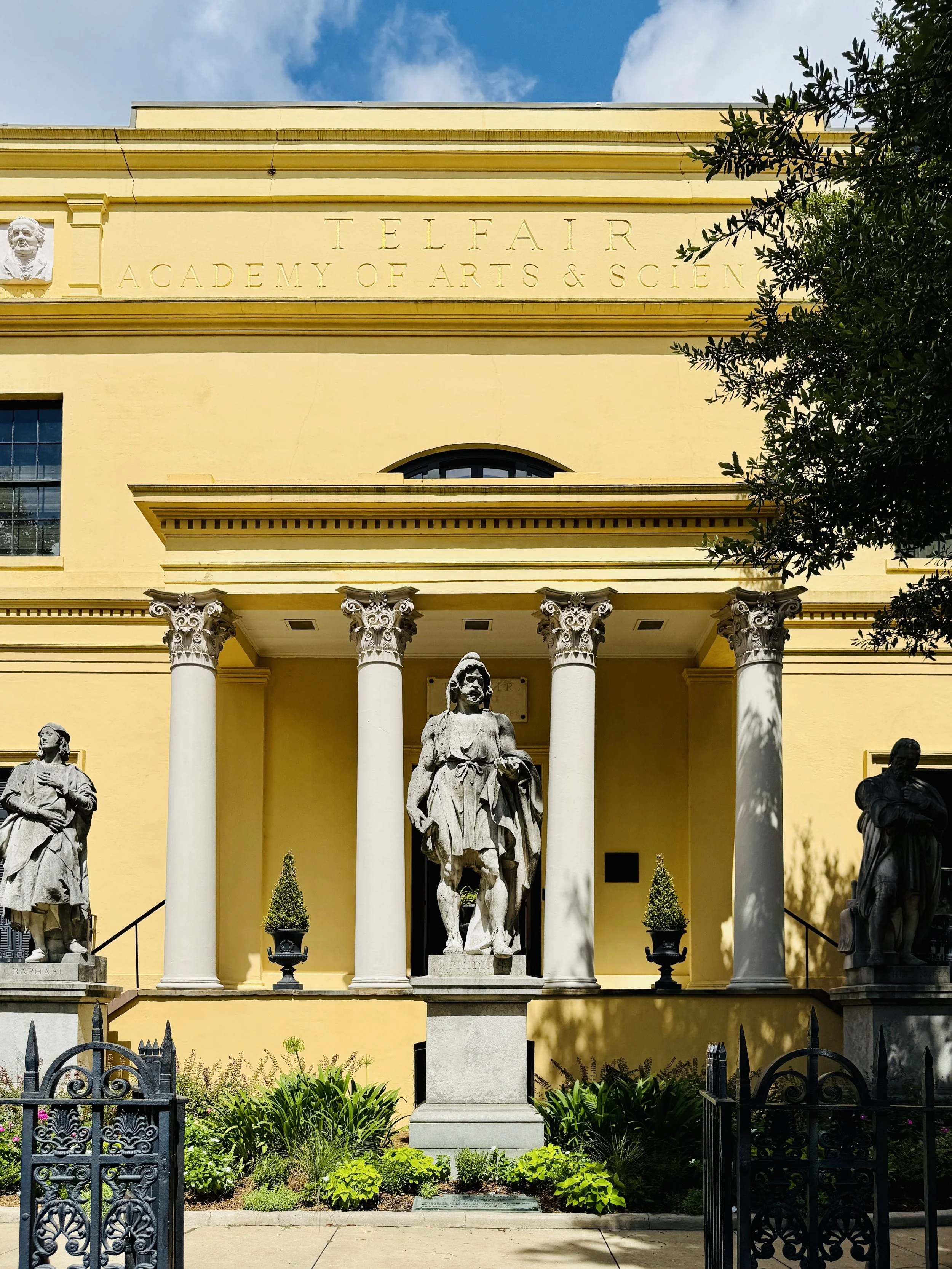
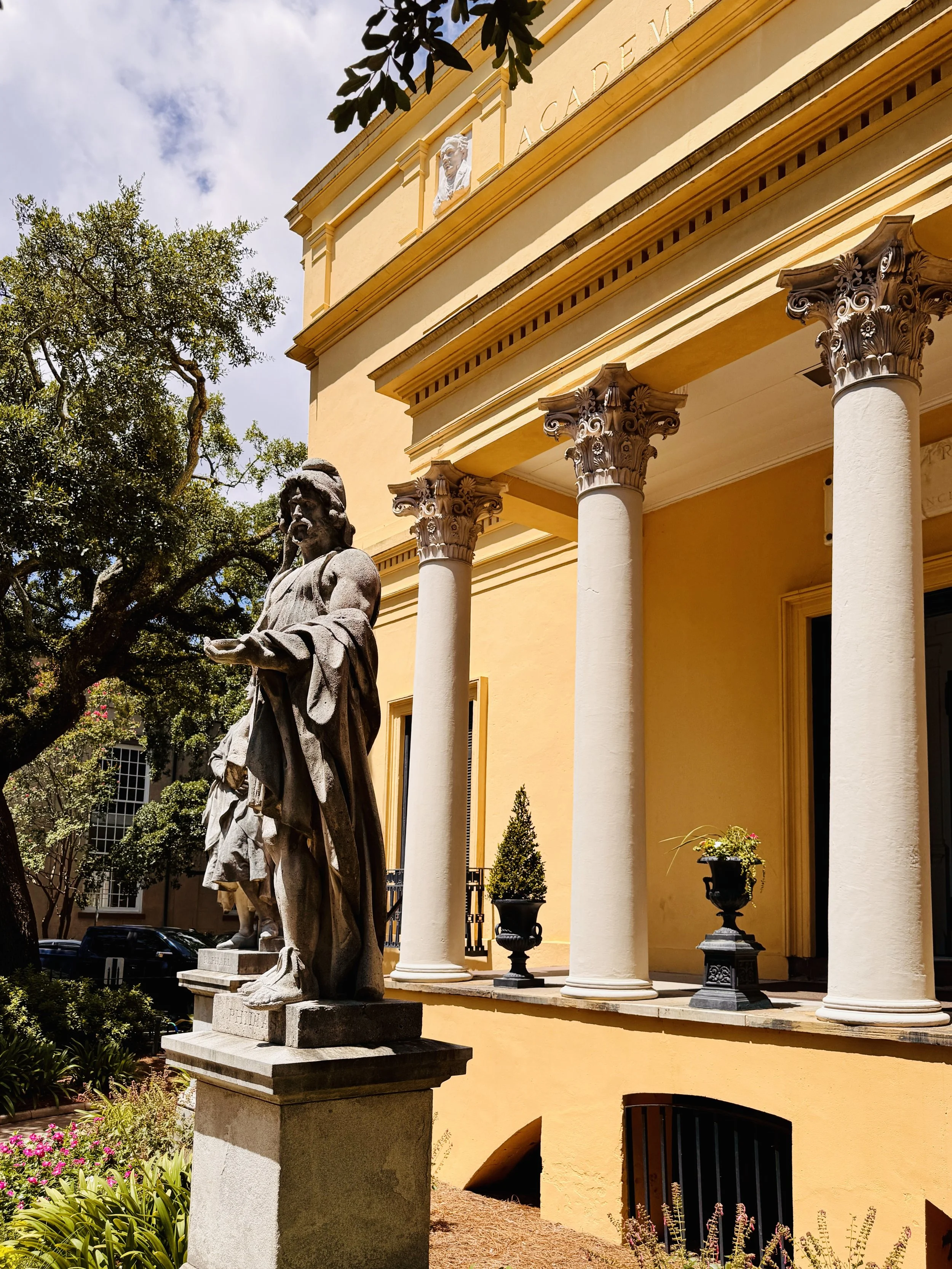
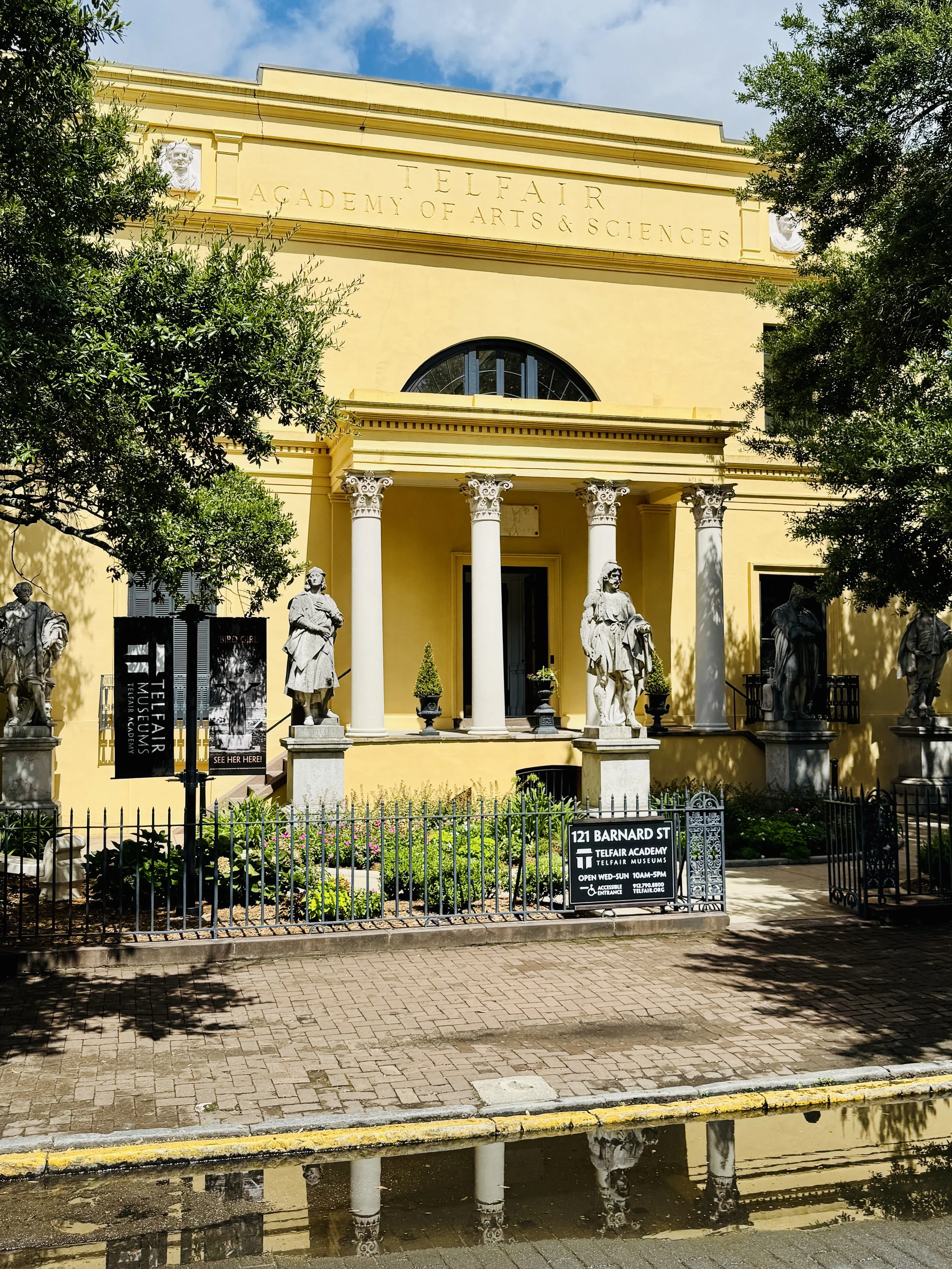
The yellow facade of the Telfair Academy in Savannah, Georgia, with statues of famous artists and classical columns

The Telfair Academy sits on the east side of Telfair Square, and is a short walk from West Broughton Street.

There’s just something about Savannah, Georgia: the moss-draped live oaks, the historic squares, and the beautiful architecture always draw us back. It’s a living, breathing city that honors its past while still looking toward the future.

Wally and I had visited Savannah many times before — wandering through the artsy, emerging Starland District, strolling up and down Broughton, and popping into the SCAD gift shop more than once. This time though, we decided to visit the Telfair Museums, which included the Telfair Academy and the Owens-Thomas House & Slave Quarters

When we arrived at the Telfair Academy of Arts and Sciences, we were greeted by the towering sculptures of Phidias, Michelangelo, Raphael, Rembrandt, and Rubens. Hewn from limestone by Austrian sculptor Viktor Tilgner, each figure stands seven feet, six inches tall. Their commanding presence at the entrance to the stately edifice set the perfect tone for what awaited us inside.

We ascended the steps of the central porch and purchased our tickets at the museum gift shop, which included admission to all three museums: the Telfair Academy, the Jepson Center & Telfair Children’s Art Museum , and the Owens-Thomas House.
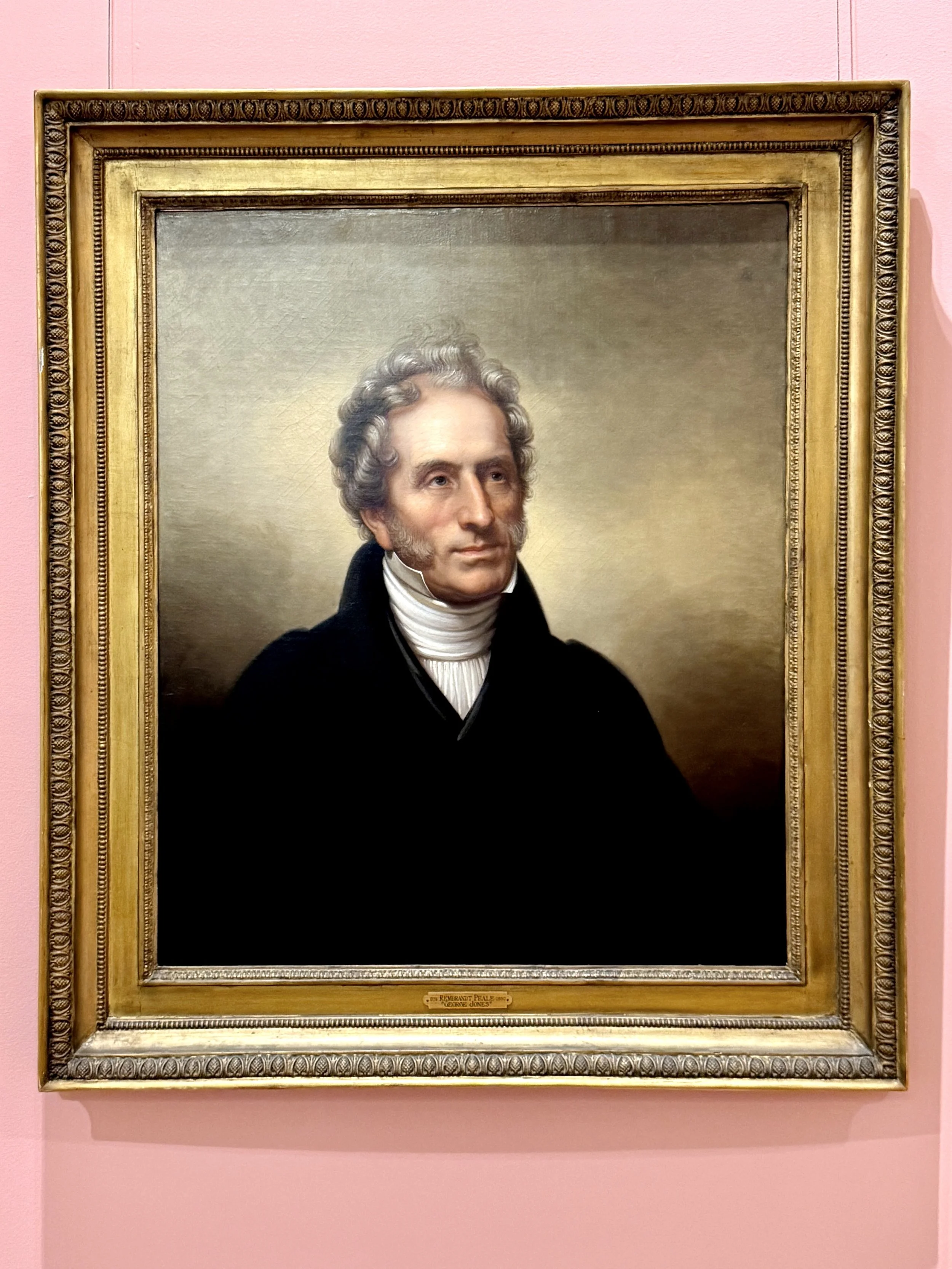
Portrait of Dr. George Jones by Rembrandt Peale, 1834

Portrait of Dr. George Jones by Rembrandt Peale, 1834

The History of the Telfair Academy of Arts and Sciences

The story of the South’s oldest public art museum begins with the death of Mary Telfair, the last surviving member of one of Savannah’s most prominent antebellum families. When she passed away on June 2, 1875, at the age of 84, she entrusted her Regency-style residence and its contents, along with a generous portion of her personal fortune, to the Georgia Historical Society. Her will stipulated that the home be converted into an institution dedicated to introducing art and culture to the public.  

Fun fact: Mary Telfair’s bequest establishing the Telfair Academy preceded the idea for New York City’s Metropolitan Museum of Art by just one month, which was conceived by a group of men in Paris on July 4, 1866.

But instead of opening its doors, the house stood silent, caught in legal limbo for nearly a decade. Distant relatives challenged her will, alleging that she was not of sound mind. The dispute dragged on until it reached the U.S. Supreme Court, which ultimately upheld her wishes in Jones v. Habersham in 1883.

With the legal hurdles cleared, the Society’s board appointed the academically trained Carl Ludwig Brandt as the museum’s first director. A German-born painter who had crossed the Atlantic in 1852, Brandt was a trusted friend of Mary’s younger sister, Margaret Telfair Hodgson. In 1874, she commissioned him to paint a portrait of her late husband, William Brown Hodgson. That painting was unveiled at the 1876 dedication ceremony for Hodgson Hall, which Margaret had built in her husband’s memory to house the Society’s collections and library.  

Perhaps it was this connection that convinced the board, and Brandt found himself tasked with the daunting job of converting the home into a cultural institution. He was given $20,000 (about $640,000 today) and passage across the Atlantic to procure works that would shape the museum’s permanent collection: engravings, oil paintings, full-scale plaster replicas of classical statuary, and casts of the Parthenon frieze and east pediment.

When Brandt returned, the board brought on architect Detlef Lienau to enlarge and adapt the home for its new purpose. Lienau removed the original staircase, raised the roofline, expanded the skylight, and effectively doubled the building’s size. Where the garden and former slave quarters once stood, he added a sculpture gallery at street level, topped by a rotunda to showcase the works Brandt had acquired in Europe.

On May 3, 1886, the former family residence officially reopened as the Telfair Academy of Arts and Sciences, marking a bold new chapter in Southern cultural history as the first museum in the United States to be founded by a woman.
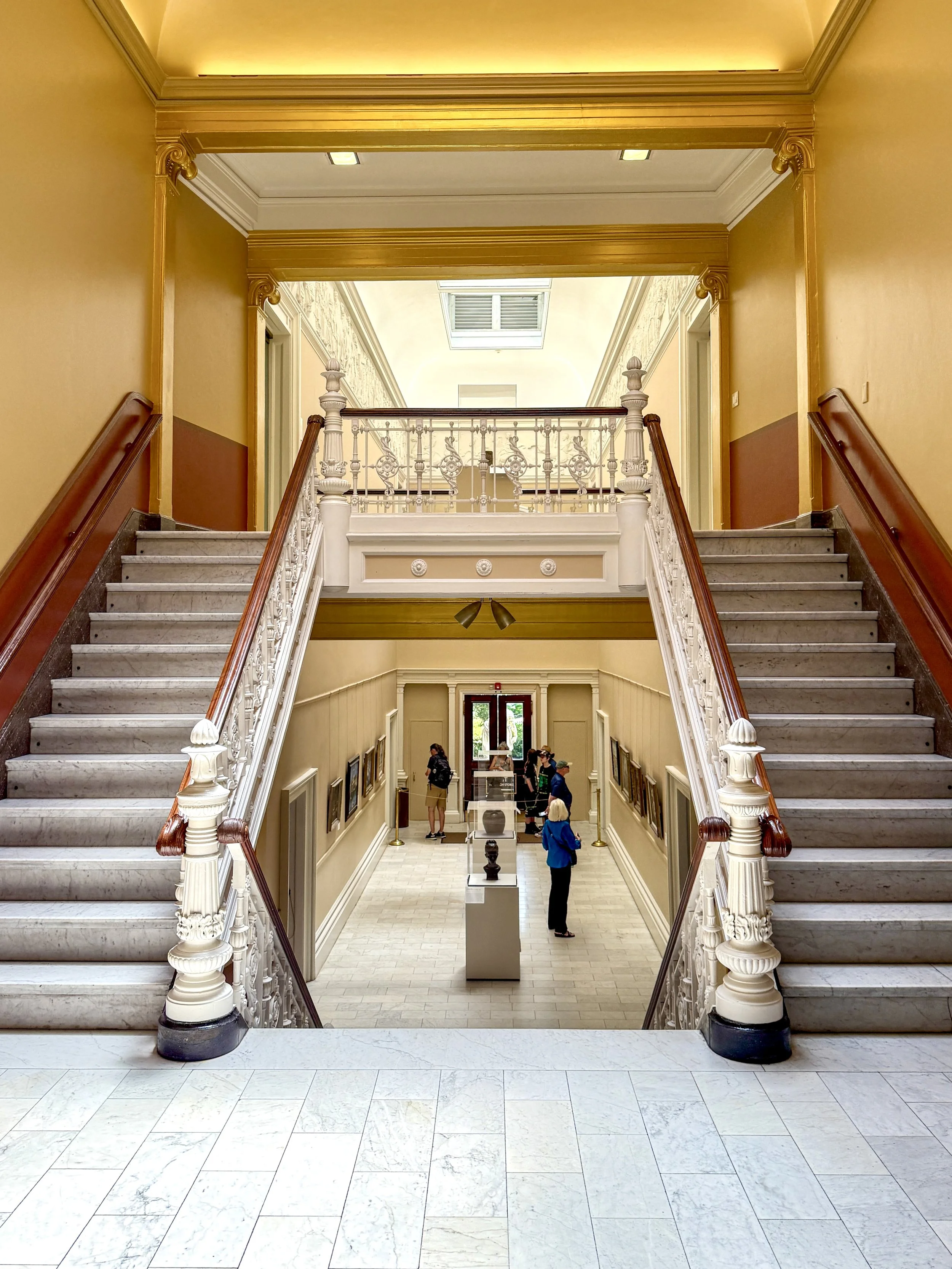
Staircases at the Telfair Academy in Savannah, Georgia,, and visitors looking at paintings in the hallway

Entrance Hall and Octagon Reception Room

The entrance hall of the Academy bears little resemblance to the original house. Lienau replaced the pine floors with marble and widened the passage to allow guests to move freely through what had once been a private residence. Today, the central corridor displays a range of works — from Harriet Hyatt Mayor’s 1915 bronze sculpture Art and Science to notable examples of 20th century American and French Impressionism and beyond.  
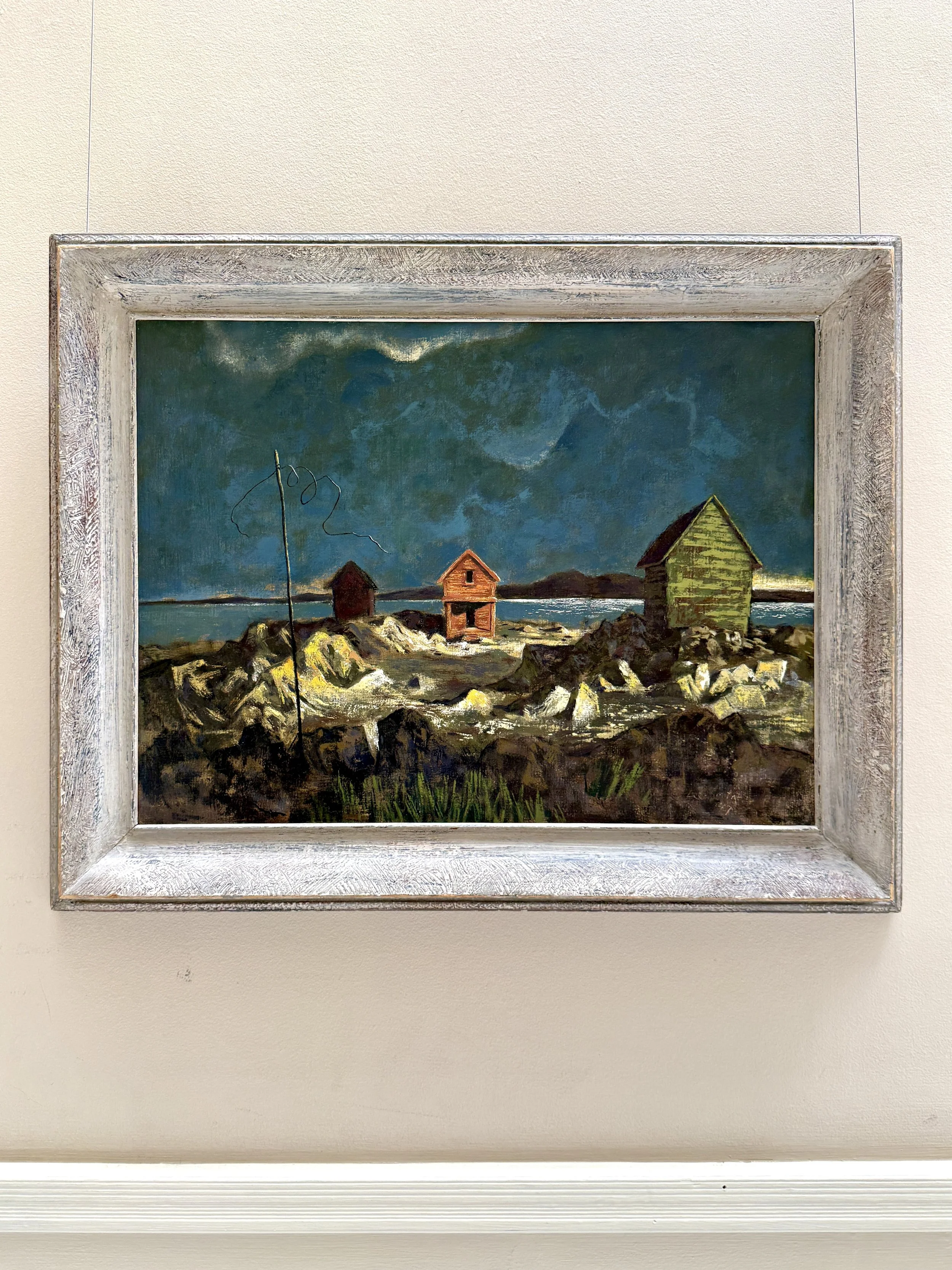
Three Shack Landscape by Hughie Lee-Smith, 1947

Three Shack Landscape by Hughie Lee-Smith, 1947

Hughie Lee-Smith’s haunting surrealistic painting Three Shack Landscape depicts three weathered shacks — one dark brown, one red and one green — standing along a desolate, rocky shoreline beneath heavy blue and gray clouds. A burst of light cuts through, illuminating the dunes and stones around them, while in the foreground a lone pole with a twisted wire juts toward the sky, heightening the sense of isolation.

Lee-Smith was born in Eustis, Florida in 1915 and spent part of his youth in Atlanta before moving to Ohio, where he graduated from the Cleveland School of Art in 1938. After a brief stint in the Navy stationed on the Great Lakes Naval Training Center during World War II, he briefly taught art in South Carolina before settling in Detroit, where economic opportunities for African Americans were more abundant. 

Lee-Smith moved to New York City in 1958, where he taught at the Art Students League. In 1967, he reached a milestone as the second Black artist to be elected to full membership in the National Academy of Design.
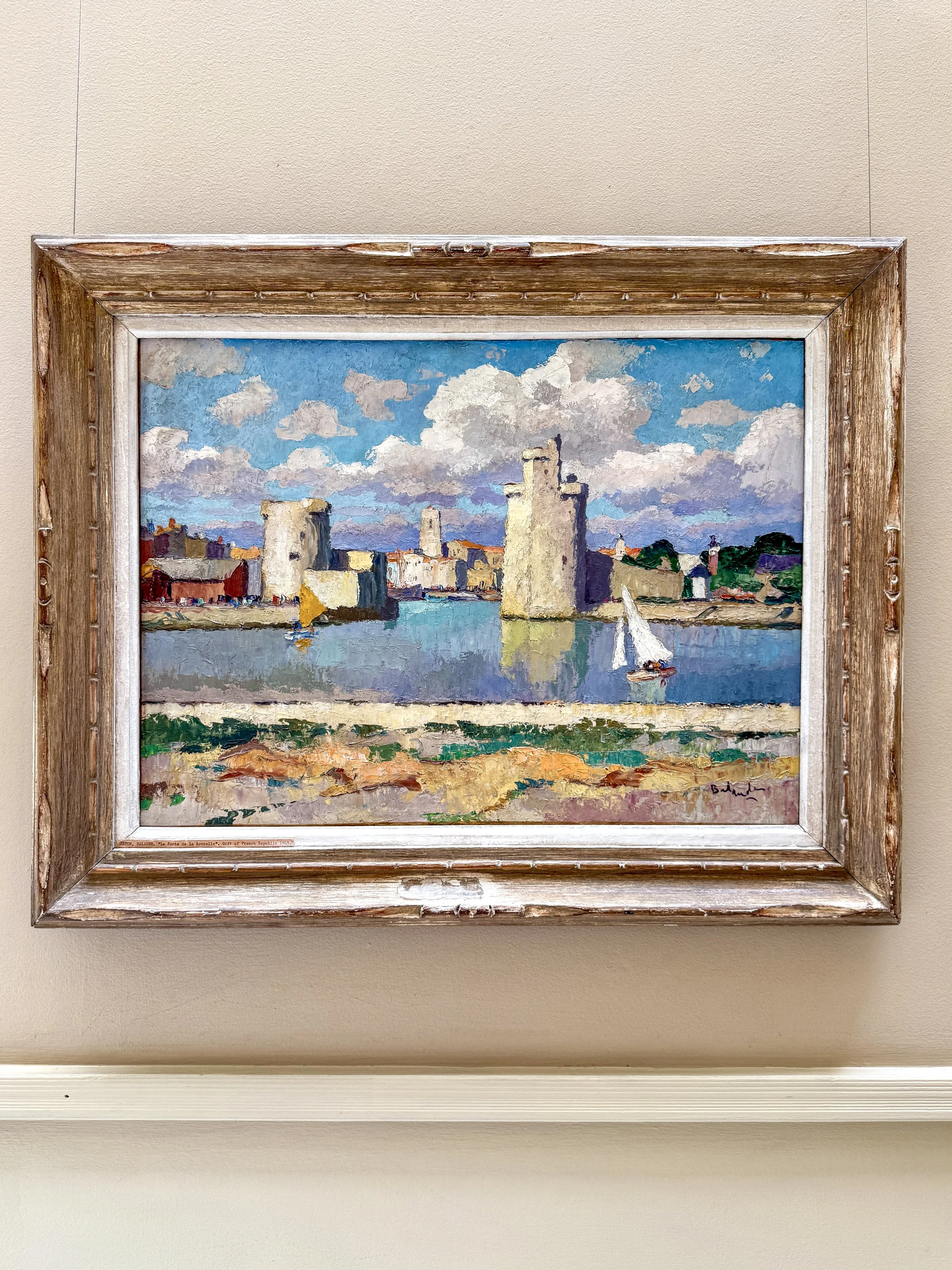
Le port de la Rochelle by Gaston Balande, 1949

Le port de la Rochelle by Gaston Balande, 1949

French impressionist painter Gaston Balande’s Le port de la Rochelle captures a lively view of the harbor in La Rochelle, a historic seaport on France’s Atlantic coast. Painted around 1949, the piece reflects the influence of Paul Cézanne, particularly in his exploration of color, line, and form. Rather than relying on traditional perspective and chiaroscuro, light and shade techniques that defined Western art since the Renaissance, Balande used these elements to create depth and solidity. 
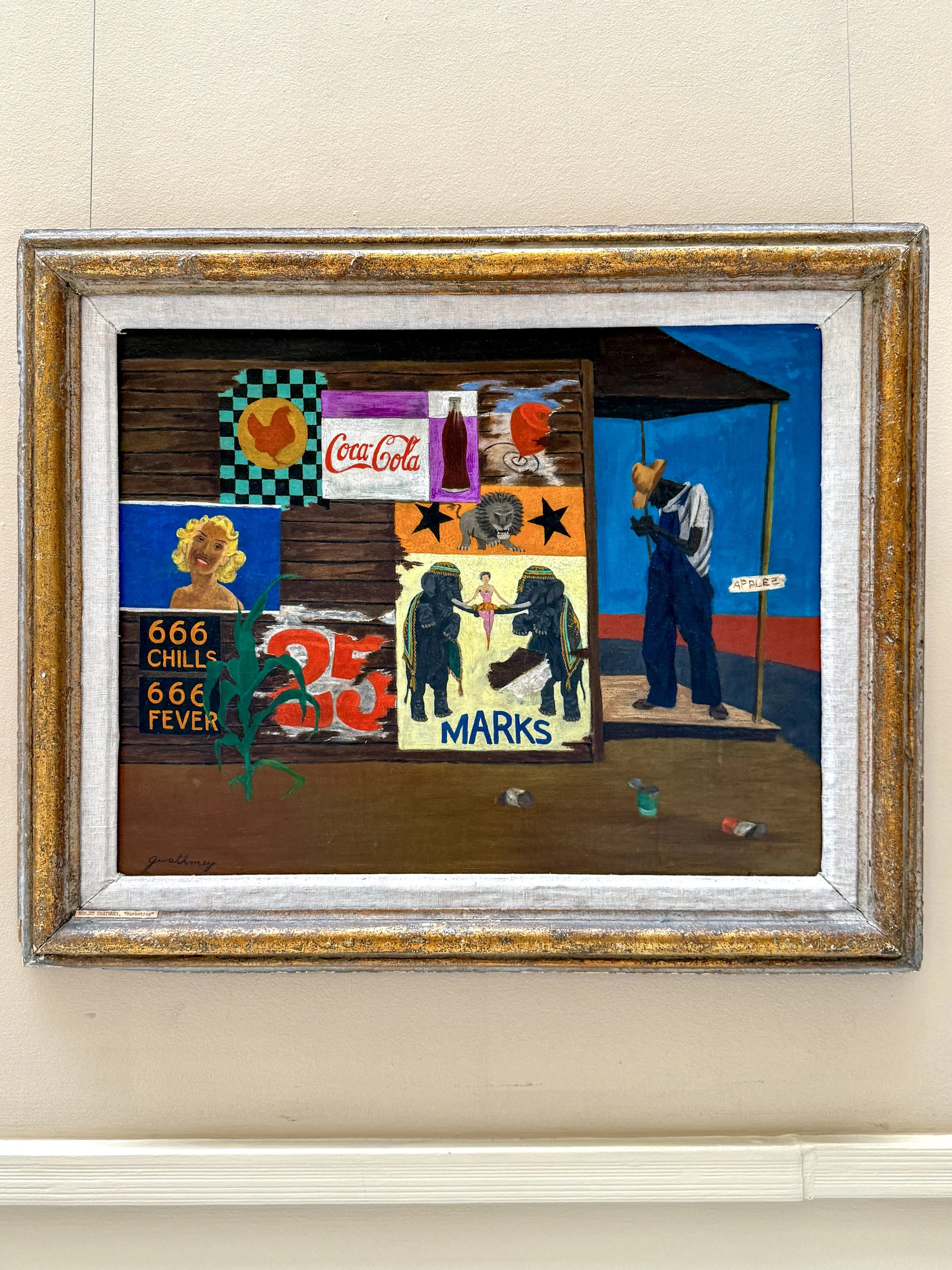
Marketing by Robert Gwathmey, 1943

Marketing by Robert Gwathmey, 1943

Robert Gwathmey was an American social realist painter known for his depictions of rural life in the American South, particularly the plight of African American sharecroppers. Born in Richmond, Virginia, in 1903, Gwathmey was deeply influenced by his experiences and observations of the South. In 1944, he spent time working alongside sharecroppers in Rocky Mount, North Carolina, to better understand their lives and challenges. 

Like his contemporaries Jacob Lawrence and Ben Shahn, Gwathmey developed an abstracted figurative style. He utilized bold geometric shapes, flat planes of vibrant color, and minimal shading to convey his social commentary. This approach emphasized form and composition over naturalistic detail, giving his works a powerful and visually striking impact. 
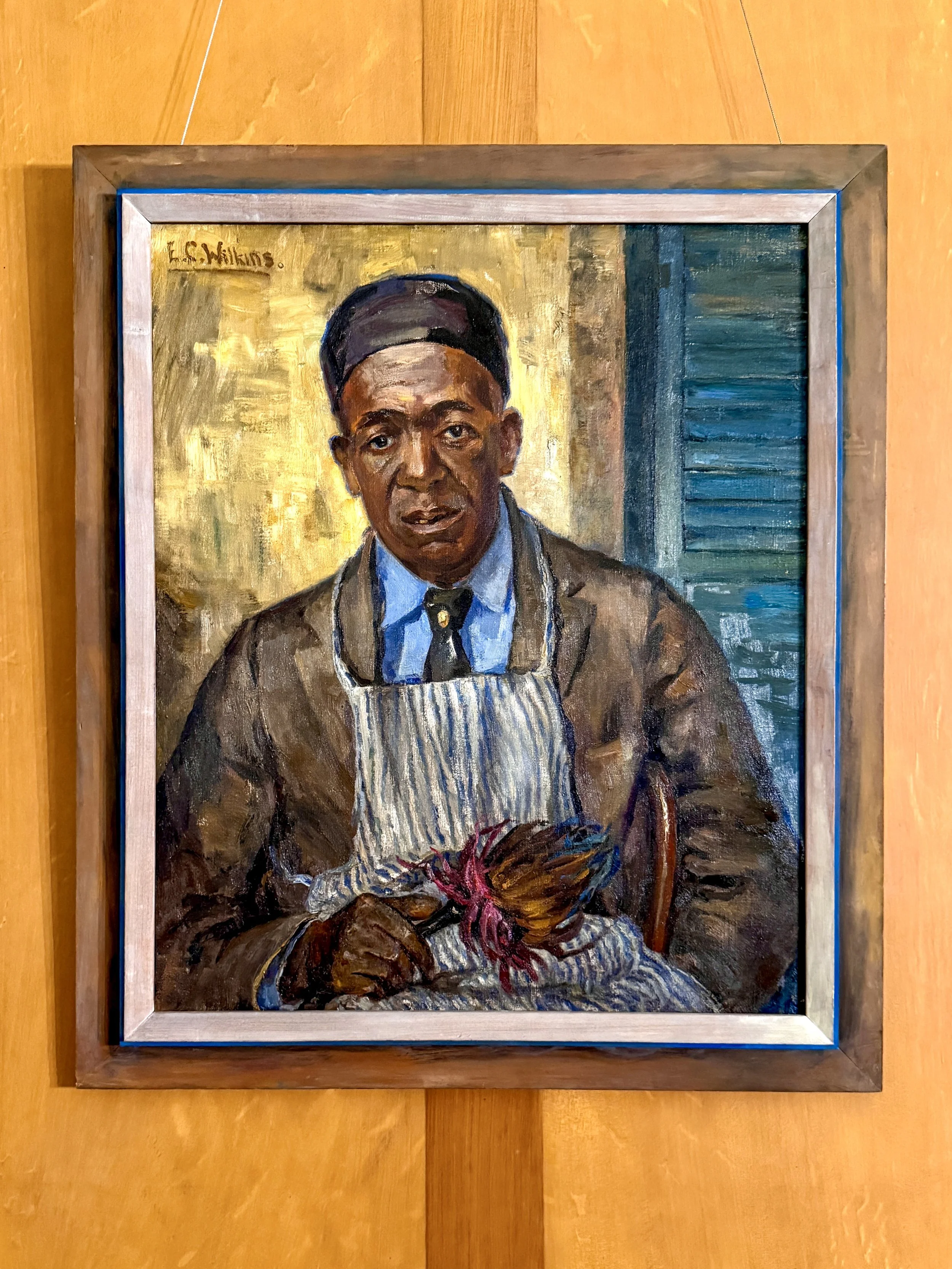
Jerry by Emma Cheves Wilkins, 1944

Jerry by Emma Cheves Wilkins, 1944

Octagon Reception Room

At the front of the Academy is the Octagon Reception Room. Once a traditional period room, it’s been reimagined to host the exhibition One Museum, Many Facades: Telfair Through the Ages. The walls still feature a rare, surviving example of early 19th century trompe-l'œil wood graining, a highly realistic, illusionistic painting technique that was popular when the mansion was built in 1818. 

The room’s sparse décor makes the portrait of Jerry Dickerson above the fireplace mantle all the more special. Savannah artist Emma Cheves Wilkins painted it around 1942, shortly before Dickerson’s retirement after more than 25 years as a janitor at the Academy. This work captures him in his recognizable work attire: a collared shirt, tie, pin, apron and feather duster in hand. He lived in the basement offices, the former slave quarters and carriage house for the mansion.

After leaving the Octagon Reception Room, we passed the former Dining Room, which was undergoing restoration. Continuing down the hall, we came upon a set of staircases with ornate iron railings.
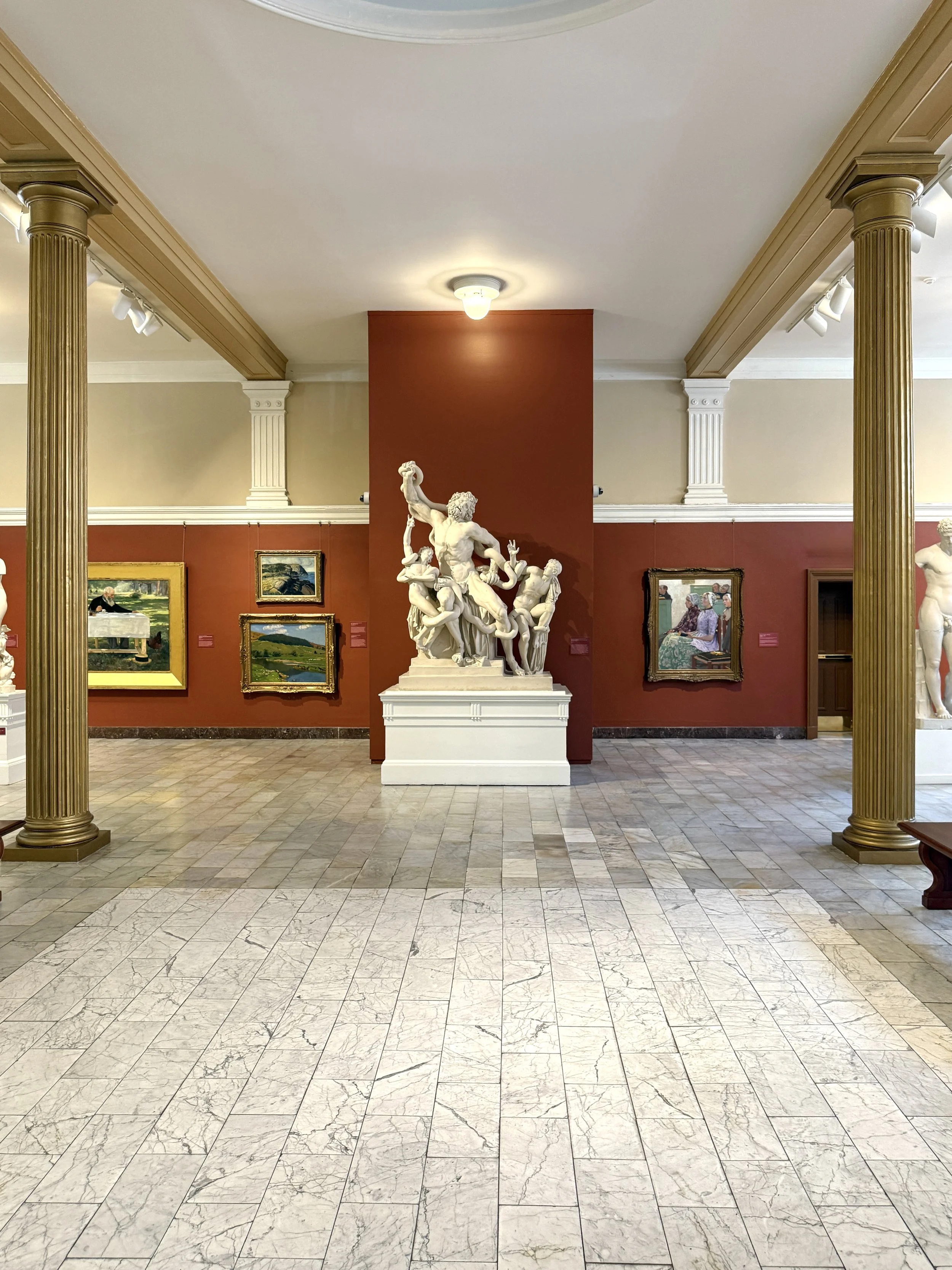
The Sculpture Gallery at the Telfair Academy in Savannah, Georgia, with a lighter section of the floor where a fountain once stood, and a statute of Laocoön and His Sons against the wall

The view of the Sculpture Gallery from the top of the stairs reveals a subtle distinction in the flooring. The lighter-colored area on the marble floor marks the spot once occupied by a fountain installed in 1966 and removed in 1973. 

The Sculpture Gallery

One set of stairs leads to the upper level, while the other descends into the Sculpture Gallery. We took the latter, and the moment we entered, my eyes were drawn to the dramatic plaster cast of Laocoön and His Sons — a copy of the famous Hellenistic masterpiece, which dominates the center of the gallery. Discovered in Rome in 1506 and now housed in the Vatican Museums, the sculpture depicts the Trojan priest Laocoön and his sons, Antiphantes and Thymbraeus, locked in a desperate struggle against deadly sea serpents.

When it first opened, the gallery displayed more than 70 plaster cast reproductions of classical sculptures, including the colossal Toro Farnese, which depicts the myth of Dirce, a cruel queen who was tied to a wild bull and dragged to her death by Amphion and Zethus for their mistreatment of their mother, Antiope.

There’s an unverified rumor that sometime in the 1970s, an Academy curator hosted a “sledgehammer party,” where guests were invited to destroy several of the institution’s large plaster casts. While it makes for a colorful story, there’s no proof to support it.

What almost certainly did happen is less dramatic: artistic tastes changed, and as the museum acquired more original works, the collection was gradually reduced, and in some cases destroyed, due to the high cost of maintaining them.

Top part of a statue of Pudicita, 1st century BCE (cast made before 1893) at Telfair Academy

Pudicita, 1st century BCE (cast made before 1893)

Many of the works now displayed on the walls of the Sculpture Gallery were acquired through the efforts of Julius Garibaldi “Gari” Melchers, an American artist who served as the Academy’s fine arts advisor after Brandt. During his tenure, he acquired more than 70 works for the permanent collection, including many of the museum’s most treasured American Impressionist and Ashcan School paintings.
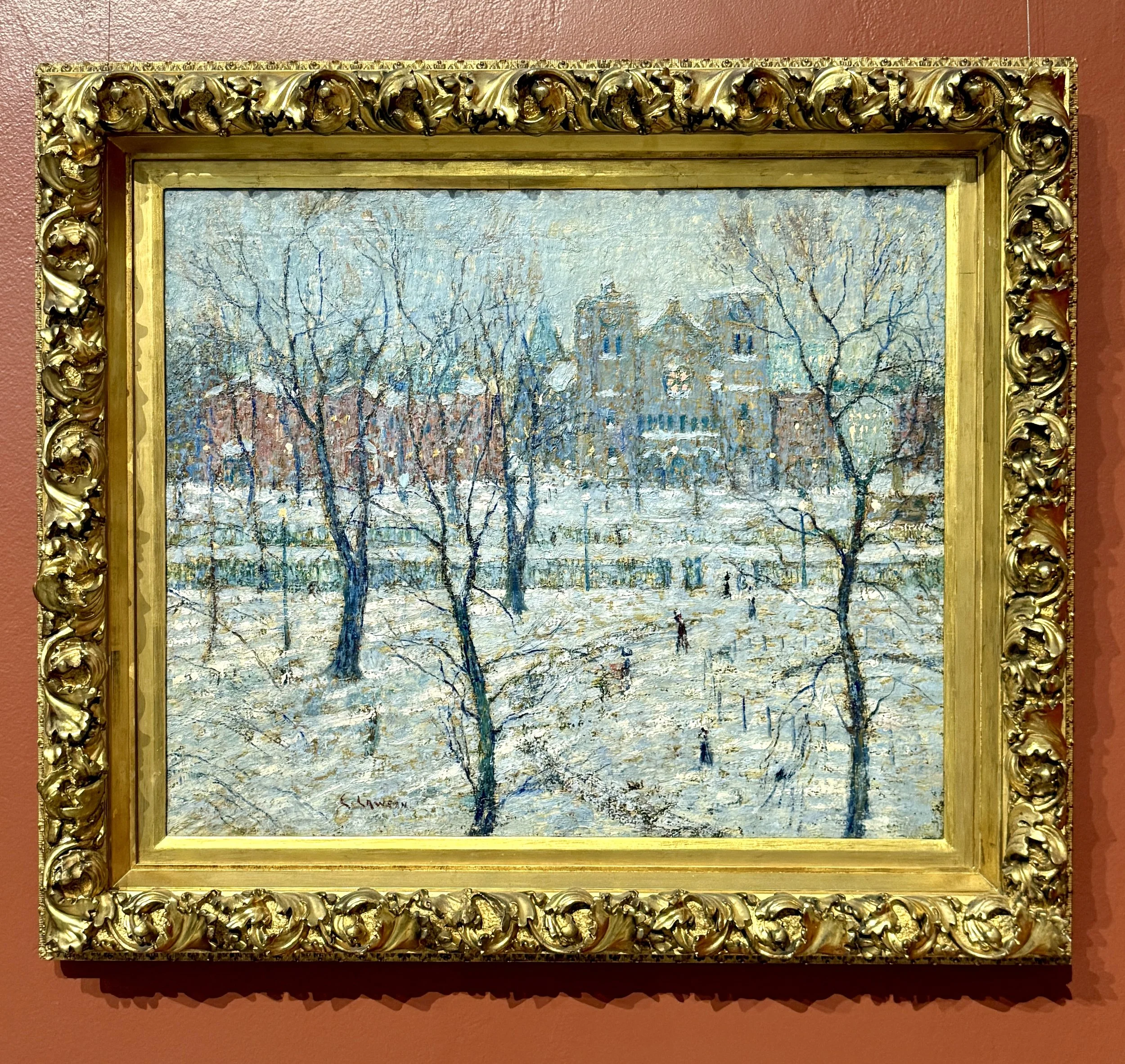
Stuyvesant Square in Winter, by Ernest Lawson, 1907
Stuyvesant Square in Winter, by Ernest Lawson, 1907

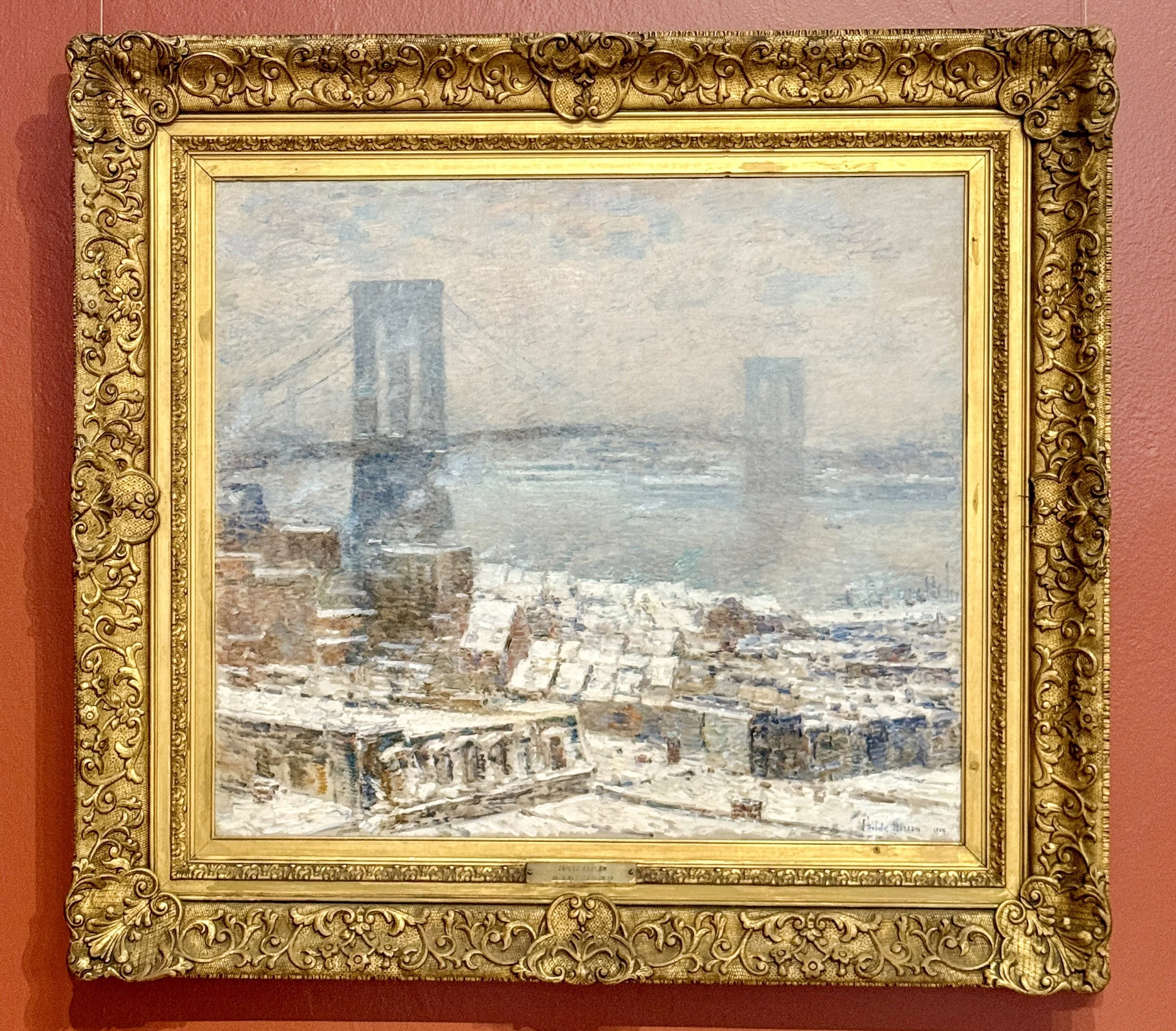
Brooklyn Bridge in Winter by Childe Hassam, 1904

Brooklyn Bridge in Winter by Childe Hassam, 1904

After returning from Paris in 1889, American Impressionist painter Childe Hassam frequently turned his attention to New York City as a subject of his art. The city’s dynamic urban life provided ample inspiration for his work. In Brooklyn Bridge in Winter, Hassam employs pastel colors, a high vantage point, and broken brushstrokes — formal elements characteristic of Impressionism. This style, which he adopted during his time studying in Paris, emphasizes capturing the fleeting effects of light and atmosphere. Like the French Impressionists, Hassam was committed to portraying contemporary subjects drawn from daily life, and New York’s vibrant streets offered him endless material.
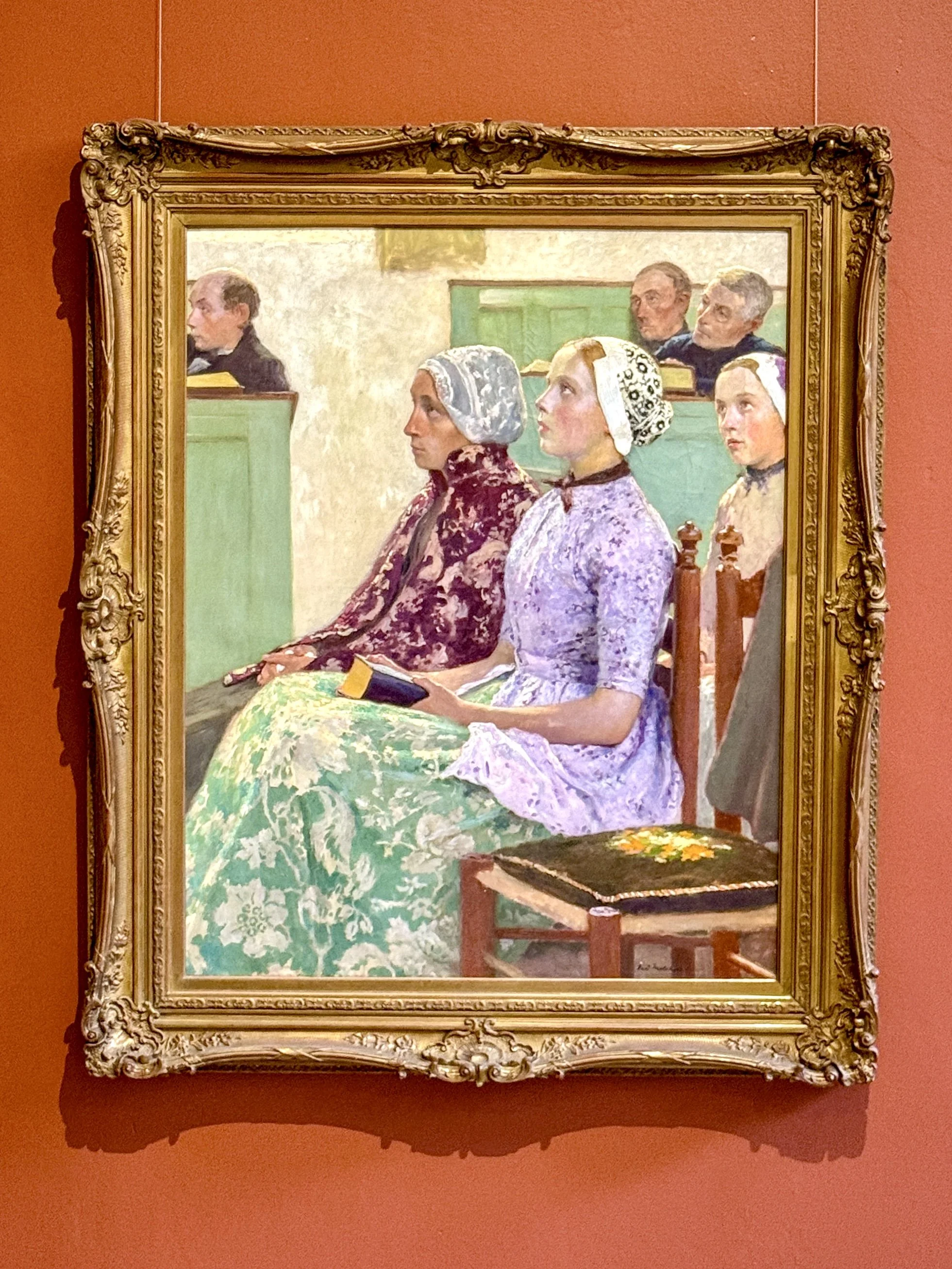
Vespers by Gari Melchers, 1892

Vespers by Gari Melchers, 1892

Vespers contains all the hallmarks of  Melchers’s early work: rural Dutch subject matter, a vibrant and colorful palette, and a keen interest in decorative pattern and texture. In this painting Melchers portrays Dutch villagers as hardworking, strong, and devout, tapping into a nostalgic yearning for traditional rural life during a time of rapid industrialization. The painting was originally owned by Walther Rathenau, an industrialist, writer and politician from Berlin who helped found the German Democratic Party.
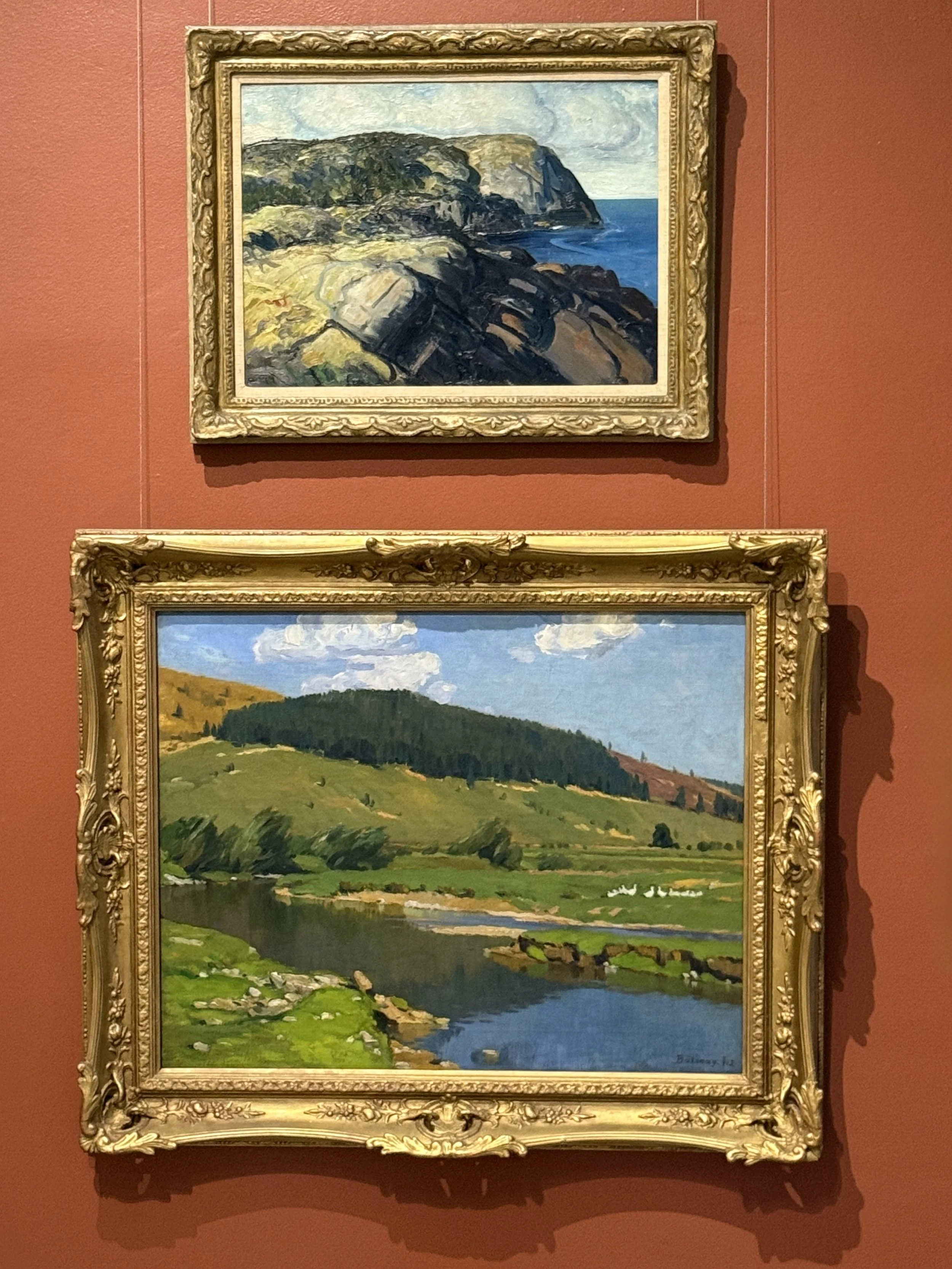
Landscape grouping, with Shaghead by George Wesley Bellows and By the River by István Boznay, 1913 
Landscape grouping, with Shaghead by George Wesley Bellows and By the River by István Boznay, 1913 

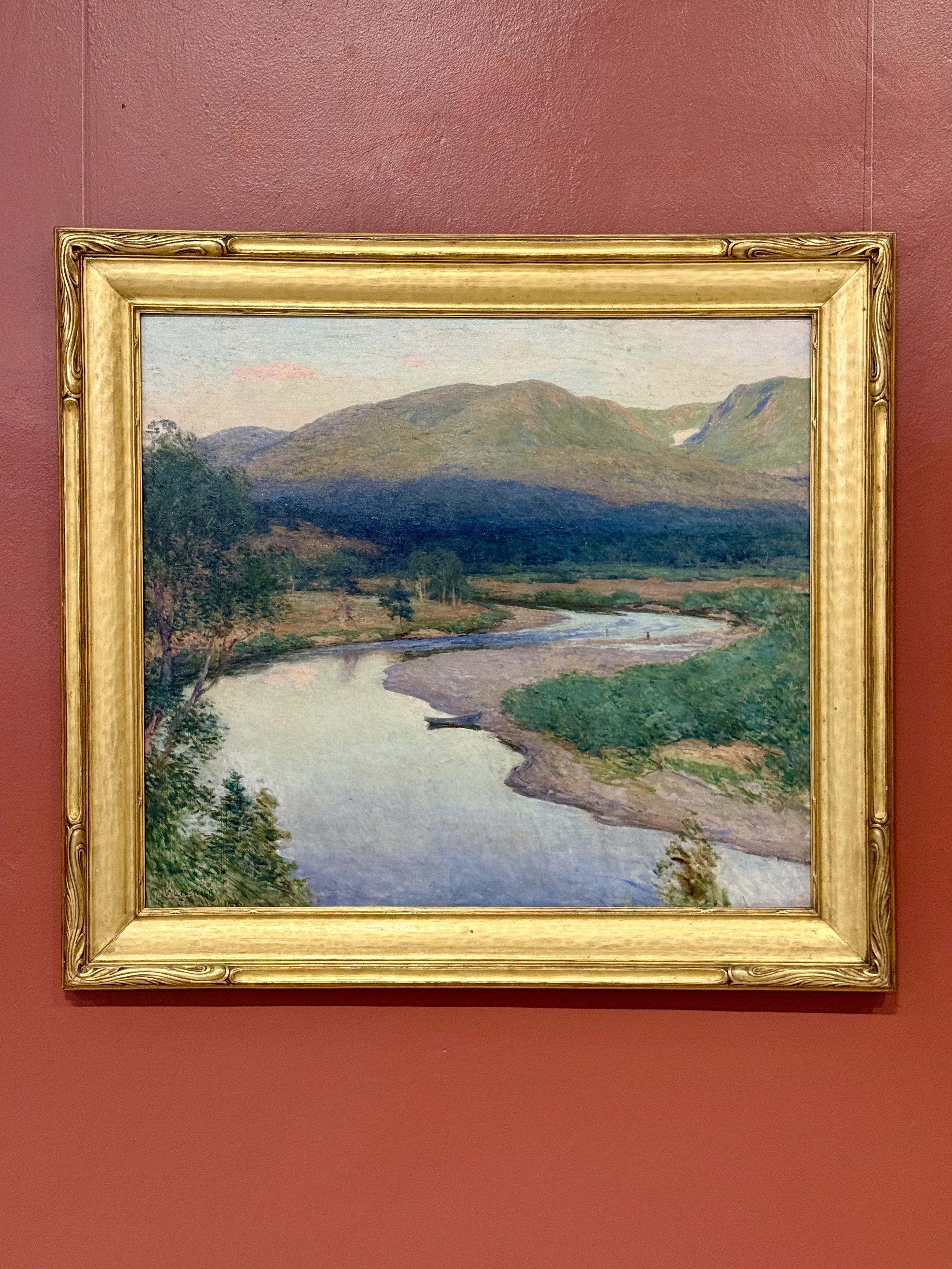
Lingering Snows by Willard Leroy Metcalf, 1924

Lingering Snows by Willard Leroy Metcalf, 1924

In this panoramic view of mountains and a stream, Willard Leroy Metcalf captures the serene beauty of a New England spring. The painting showcases his signature Impressionist style, characterized by subtle harmonies of green and purple tones that evoke the gentle light of the season. This relatively large canvas was likely painted on site in Woodstock, Vermont, on the Ottauquechee River. Metcalf employs quick, textured brushstrokes, allowing the canvas to show through, to define the trees and left shore. Thicker paint applied with a palette knife in a blend of salmon and lime represents the sky, while soft, lightly mottled colors depict the river, the right shore, and the deep blue mountain shadow. Most striking is the irregular patch of snow resting in the upper right mountain dale, its whiteness matched only by the reflected white clouds in the river.
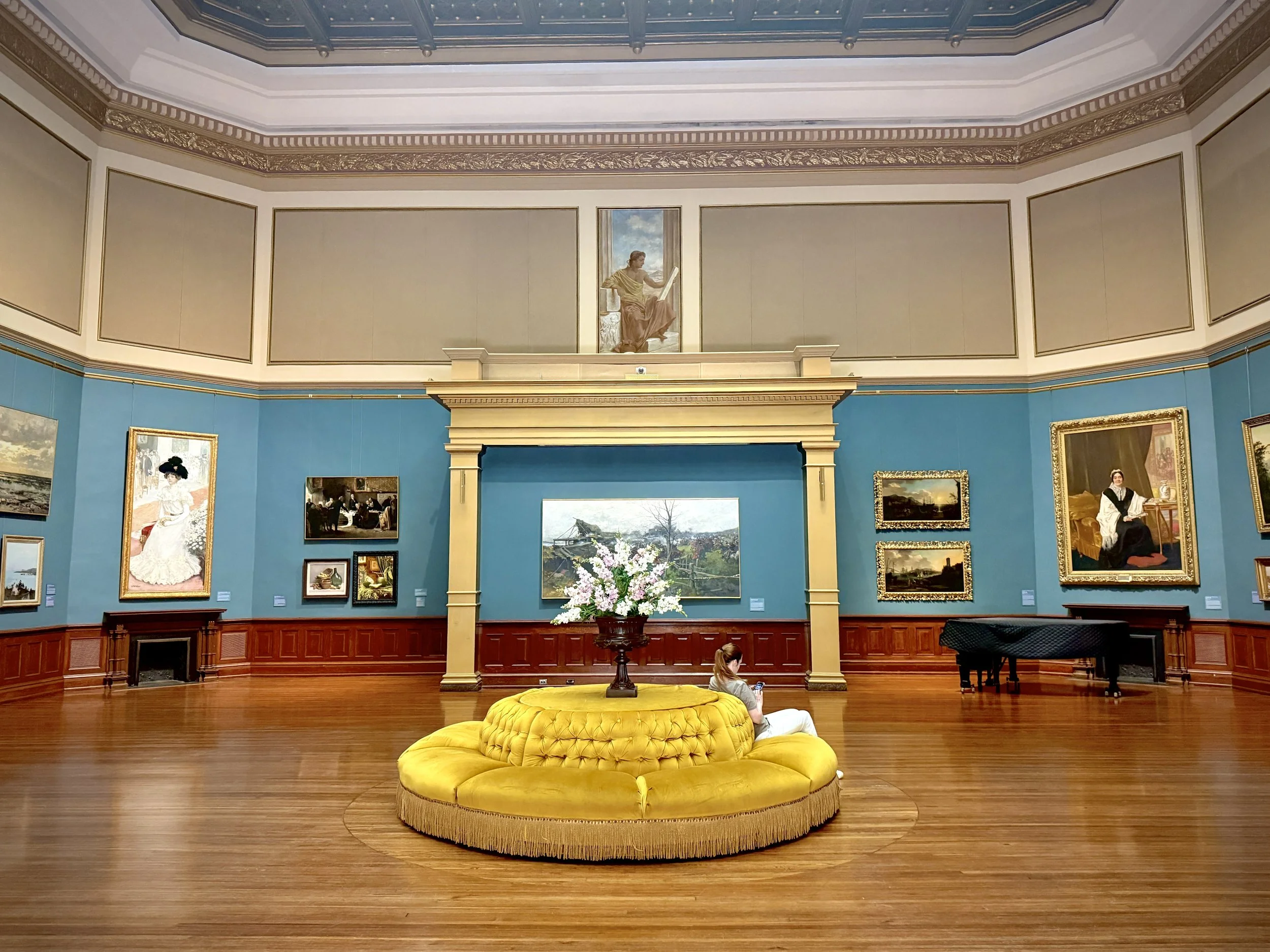
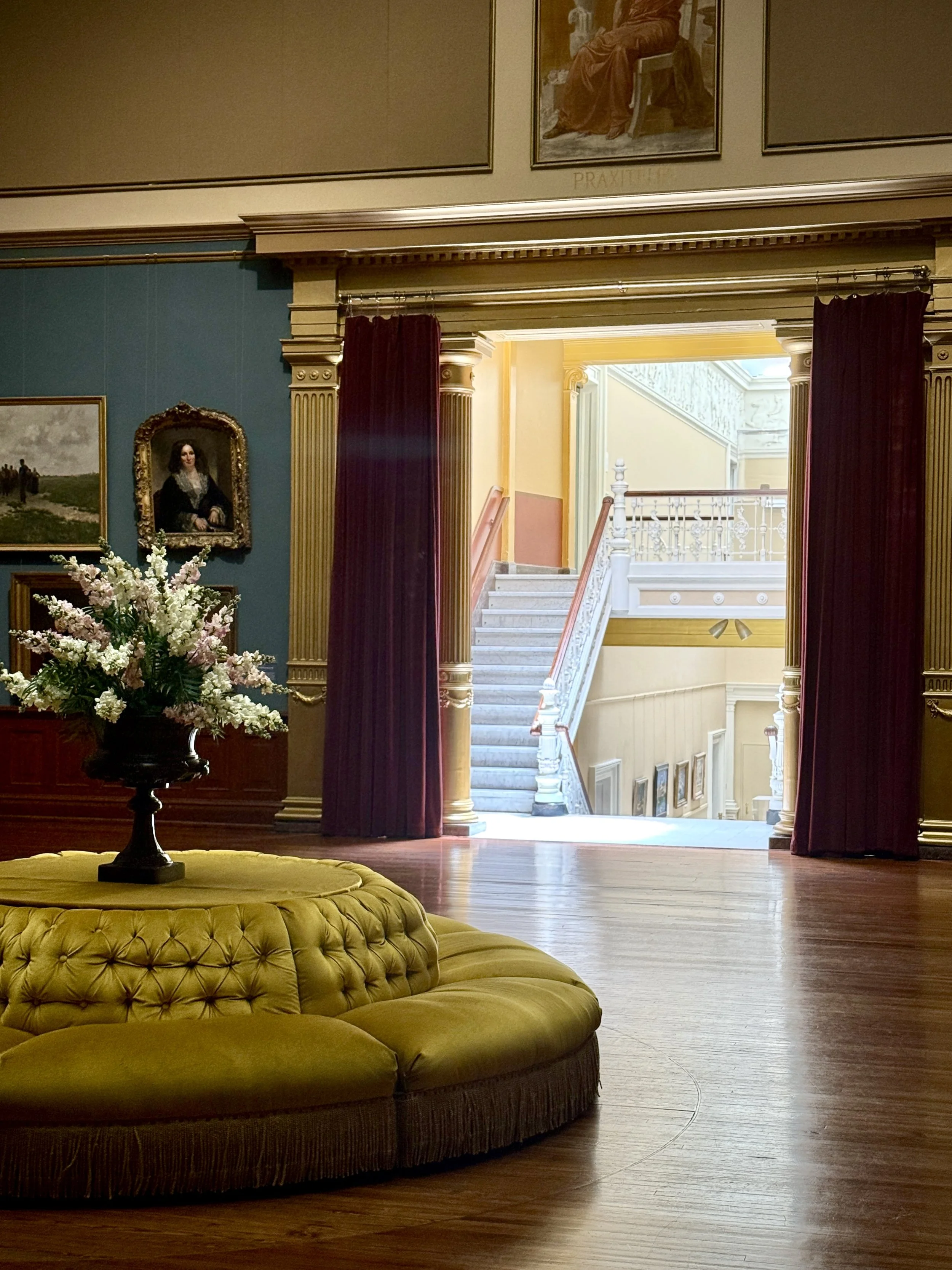
The Rotunda Gallery at the Telfair Academy in Savannah, Georgia, with blue walls covered with paintings, and a yellow circular settee with a vase of flowers atop it and a woman sitting on it, looking at her phone

The Rotunda Gallery

We made our way back up the stairs and into the Rotunda Gallery: a breathtaking, spacious two-story room designed by Brandt and Lienau to emulate the grandeur of a 19th century European salon. Artworks in this style are hung close together on the walls, as opposed to being spaced out individually. 
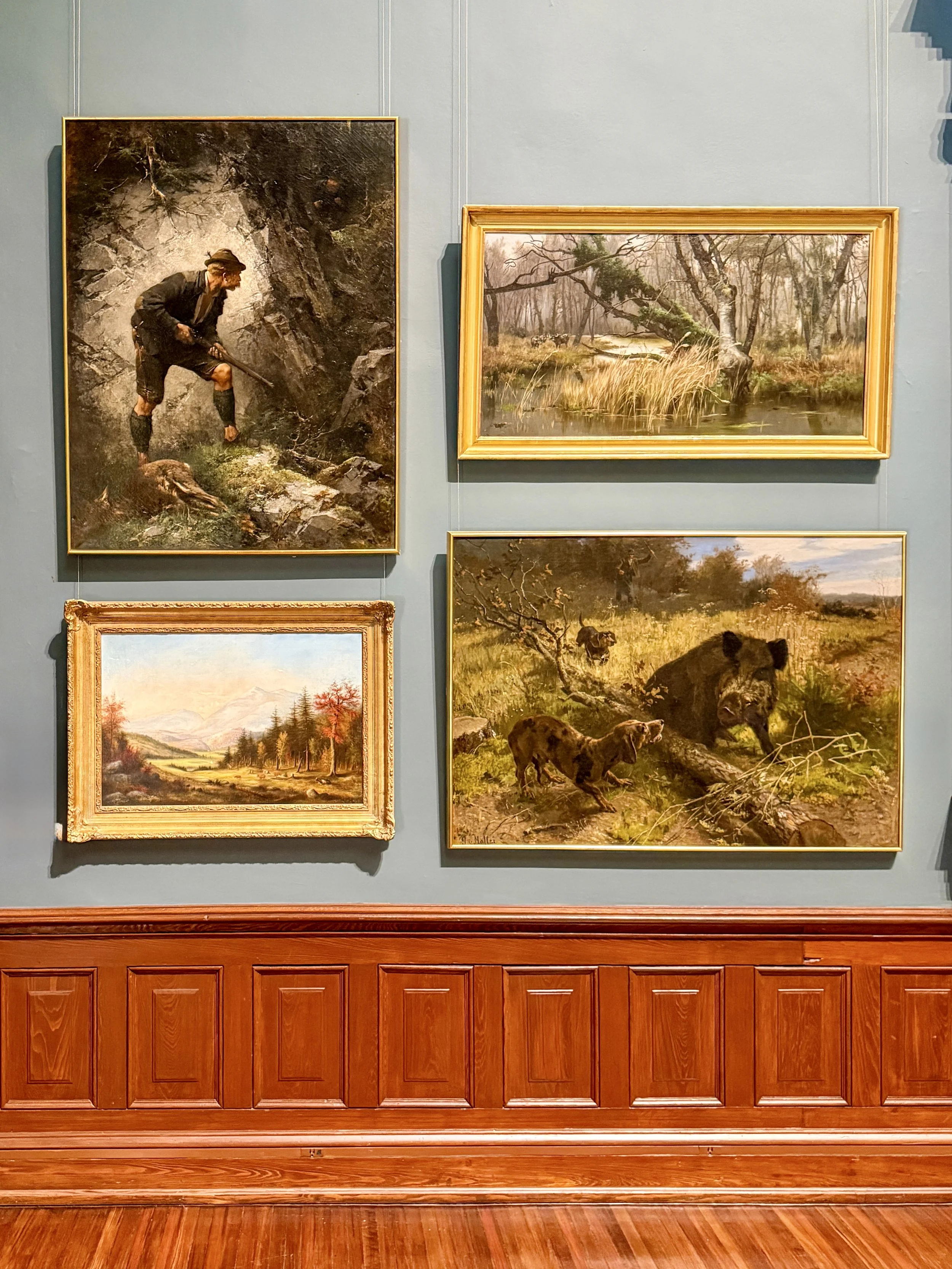
Grouping featuring works by Adolf Lüben, Robert Seldon Duncanson, George Majewicz and Guido Von Maffei

Grouping featuring works by Adolf Lüben, Robert Seldon Duncanson, George Majewicz and Guido Von Maffei

Look up, and you’ll see four paintings by Brandt positioned at the cardinal points of the gallery. Each work depicts a master of one of the four primary art forms, according to his view: Apelles for painting (west), Iktinos for architecture (north), Praxiteles for sculpture (east), and Albrecht Dürer for printmaking (south). The inclusion of three Ancient Greek artists reflects the late 19th century reverence for classical art and culture.
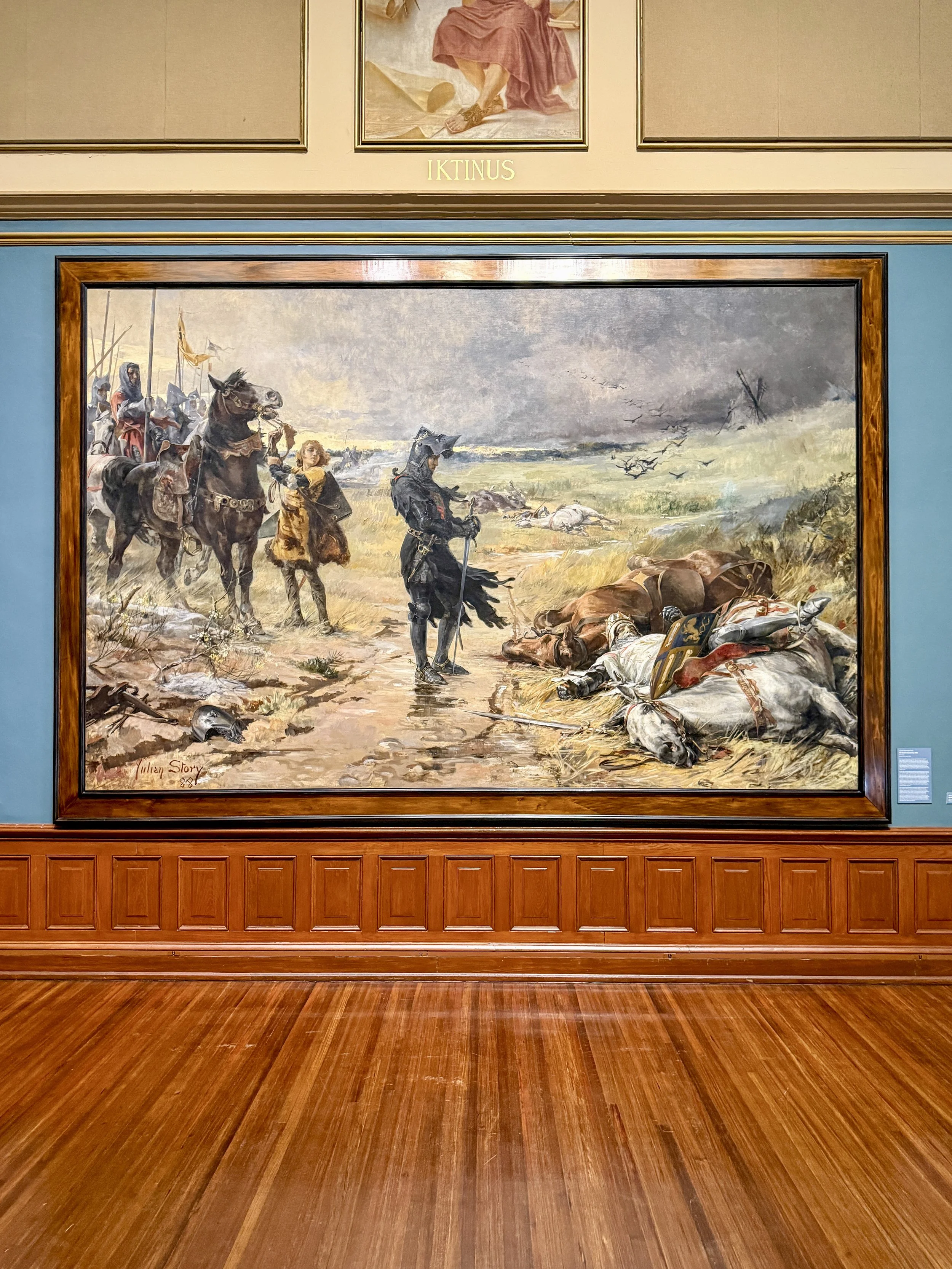
The Black Prince at Crécy by Julian Russell Story, 1888

The Black Prince at Crécy by Julian Russell Story, 1888

Brandt purchased the impressive The Black Prince at Crécy from the artist Julian Story in 1889. Brandt acquired the painting with his own funds and donated it to the museum upon his death. The dramatic work portrays the aftermath of the Battle of Crécy during the Hundred Years’ War, and contrasts the historic figure of the Black Prince (the Prince of Wales) with the lifeless body of the fallen King John of Bohemia, highlighting the clash of heroism and tragedy on the battlefield.

La Parabola by Cesare Laurenti, 1895

La Parabola by Cesare Laurenti, 1895

Cesare Laurenti was born near Ferrara, Italy, but spent most of his life in Venice — the setting of La Parabola. In Laurenti’s day, German artists nicknamed the work Lebensbrücke, or Bridge of Life

In a letter to Brandt, Laurenti explained that the painting was meant to reflect the course of human life, “the race toward pleasure, until clouds of weighty thoughts and sorrow come to disturb the serenity of the young soul.” 

The first part of the scene is a lively celebration: two young men invite a group of young women to join in songs and laughter. At a doorway, a suitor representing Love kisses a girl’s cheek as she steps inside. 

But the mood soon darkens. The same girl, now pensive, appears behind a window, her youth already fading. The scene then shifts to the entrance of a church, where “poor suffering souls seek relief.” Here, Laurenti wrote, “one can see the man, who, clad in priestly garments, represents Faith.”
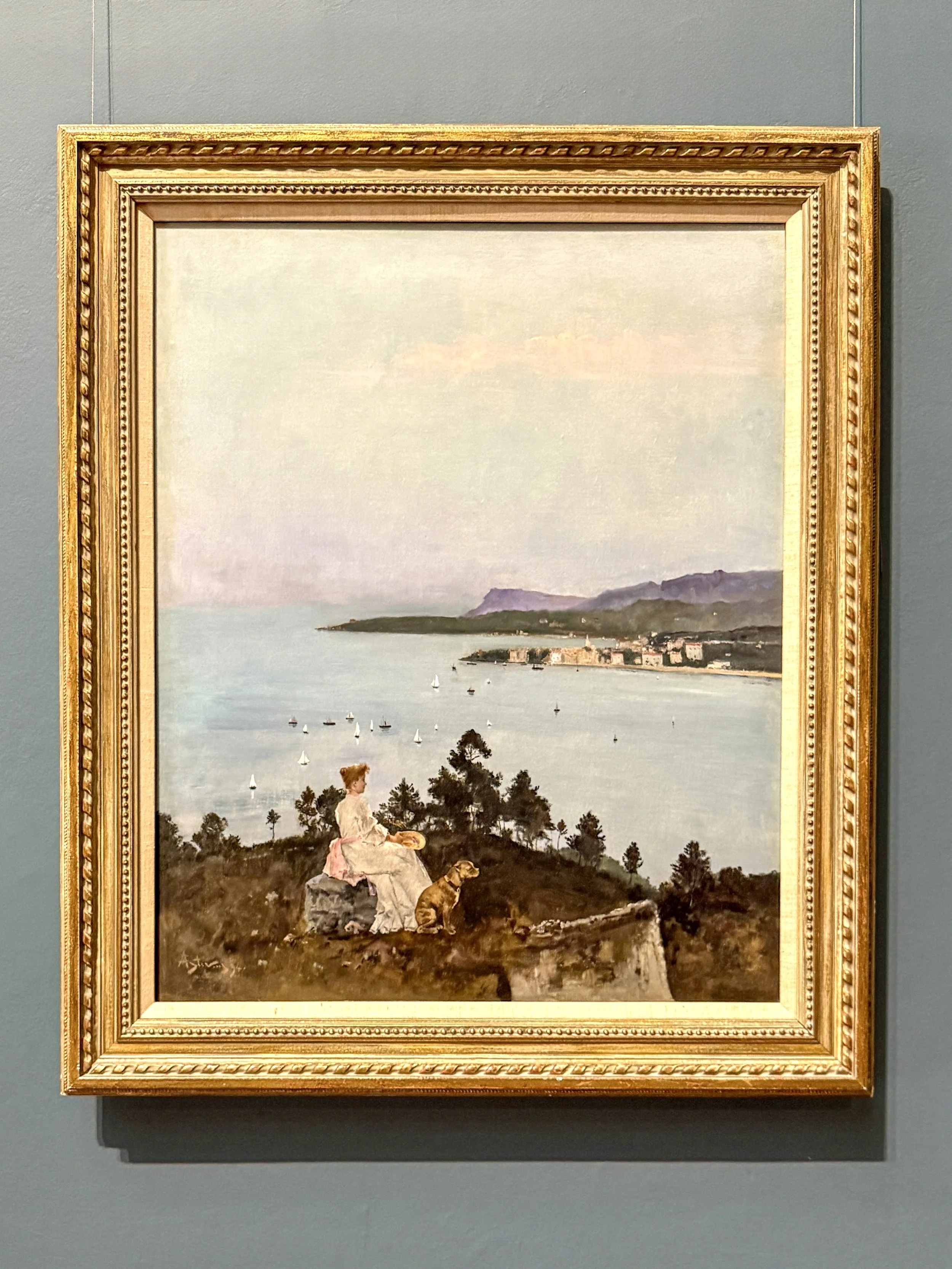
Jour de régates, Menton (Regatta Day, Menton) by Alfred E. Stevens, 1894
Jour de régates, Menton (Regatta Day, Menton) by Alfred E. Stevens, 1894

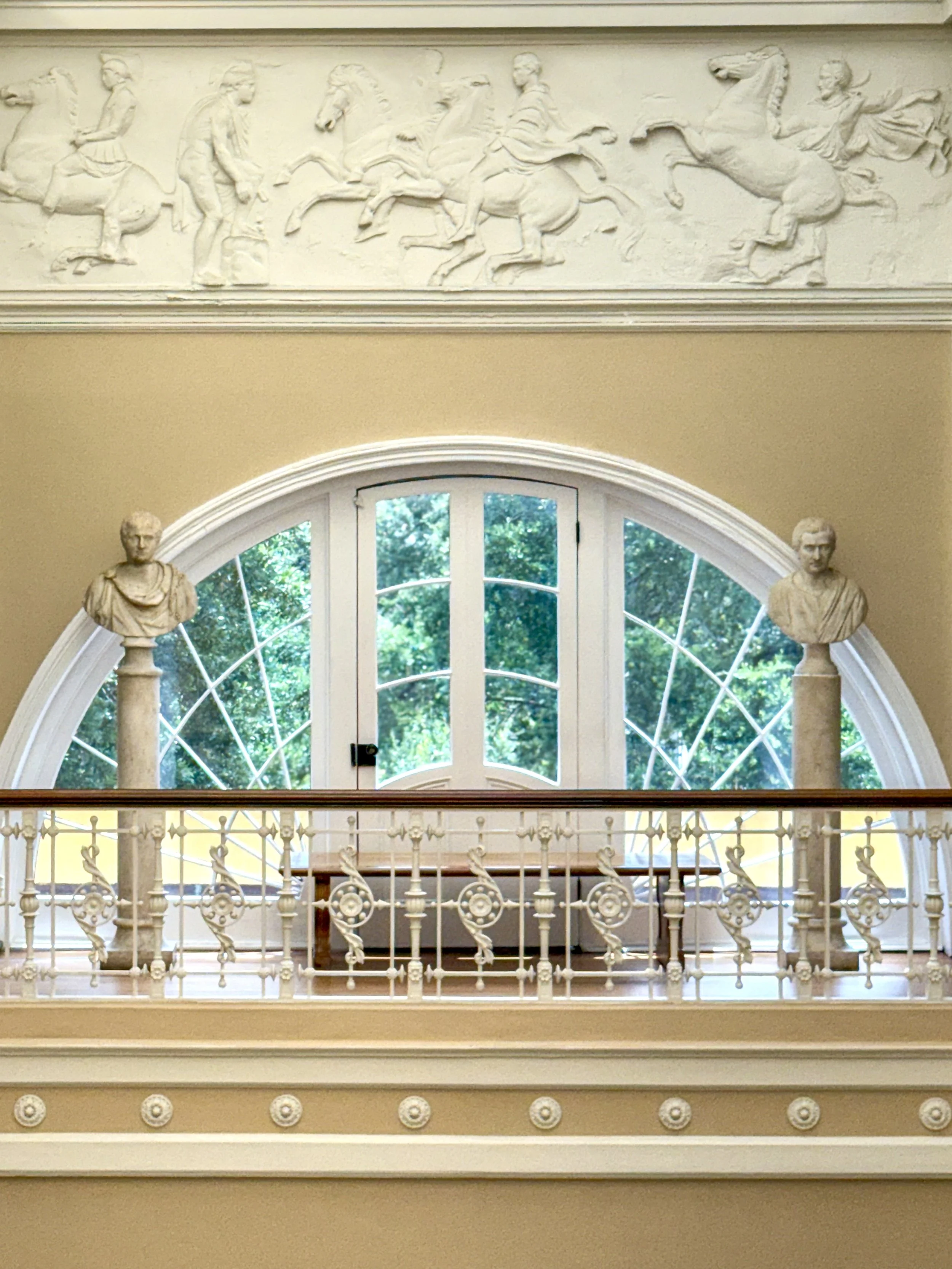
A view of the upper gallery of the Telfair Academy in Savannah, Georgia, with a plaster casting of part of the frieze from the Parthenon in Athens, Greece

A view of the upper gallery, with a plaster casting of part of the frieze from the Parthenon in Athens, Greece

Second Floor Galleries 

Upstairs, the rooms that once served as the Telfair family’s bedrooms were converted into galleries and feature works from the Academy’s permanent collections as well as temporary exhibitions. To make space for hanging art, original features like windows and fireplaces were covered up, leaving wide, uninterrupted walls for display.

The first two galleries held the ongoing exhibit Craft Along the Coast and included works from Telfair’s permanent collection that date from the 18th to the late 20th centuries. The first gallery presents examples of woodworking, ceramics and painting, while the second focuses on Savannah’s silversmithing traditions. Both galleries tell stories of markets and craft legacies, helping to draw lines of continuity through a dynamic history.
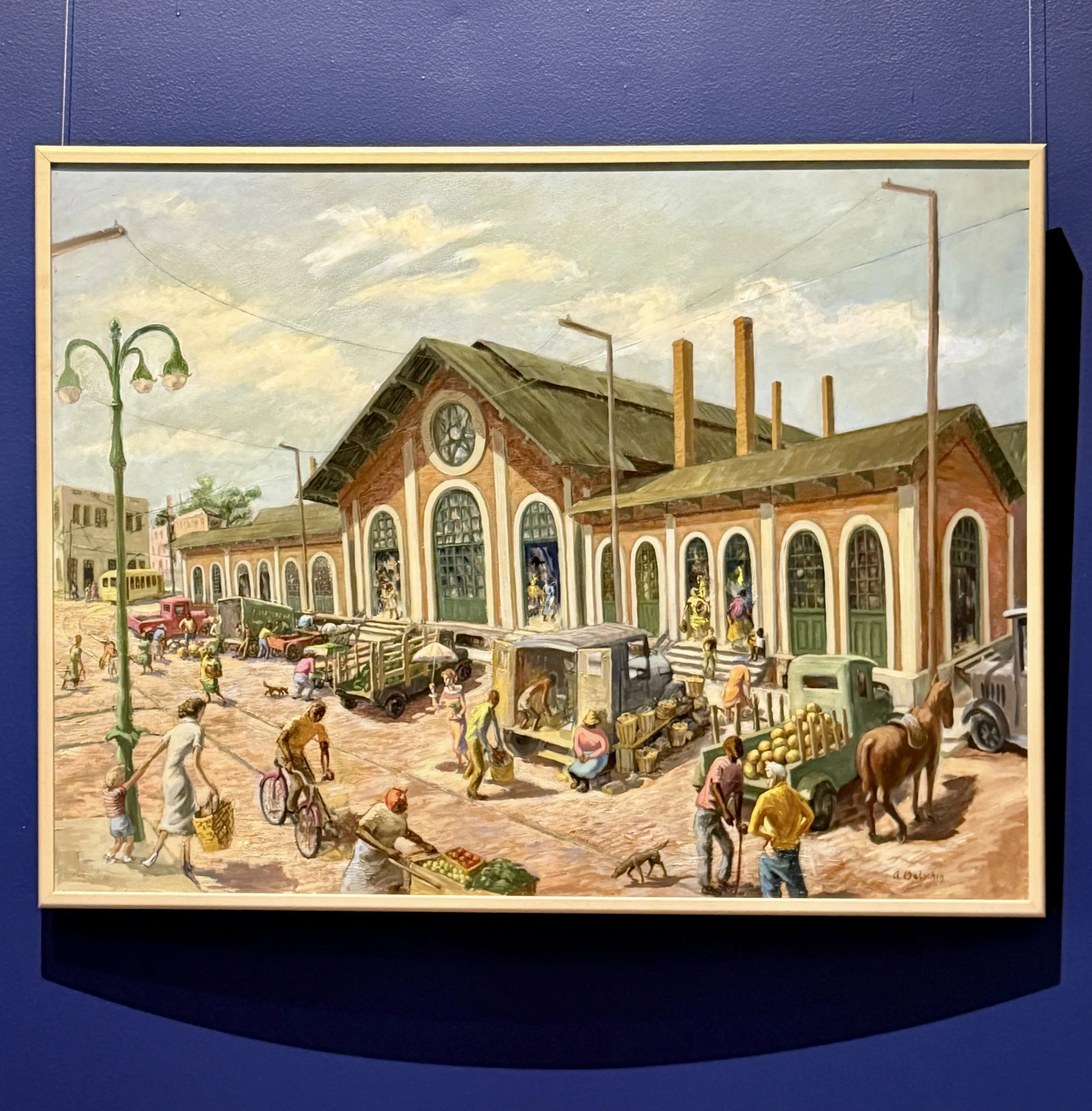
Old City Market by Augusta Denk Oelschig, 1950

Old City Market by Augusta Denk Oelschig, 1950

Savannah native Augusta Denk Oelschig painted Old City Market, a lively portrayal of the City Market building that occupied Ellis Square from about 1872 to 1953. In the scene, the market pulses with life: Shoppers, vendors, produce stands and even animals are in motion across the square. 

When the building was razed in 1954, the loss galvanized the community, and helped spark the creation of the Historic Savannah Foundation the next year, which continues to protect and preserve the city’s historic architecture. 

In 1947, during a trip to Mexico, Oelschig met muralists Diego Rivera and José Clemente Orozco, whose work left a lasting impression on her. Inspired by the political and social themes in their art, she returned to Savannah with plans for a mural depicting the history of Georgia. Intended for the Savannah High School, her drafts included imagery of Ku Klux Klan members whipping African Americans and a reference to a politician later associated with the the Klan. Unsurprisingly, the school’s conservative officials rejected the proposal.
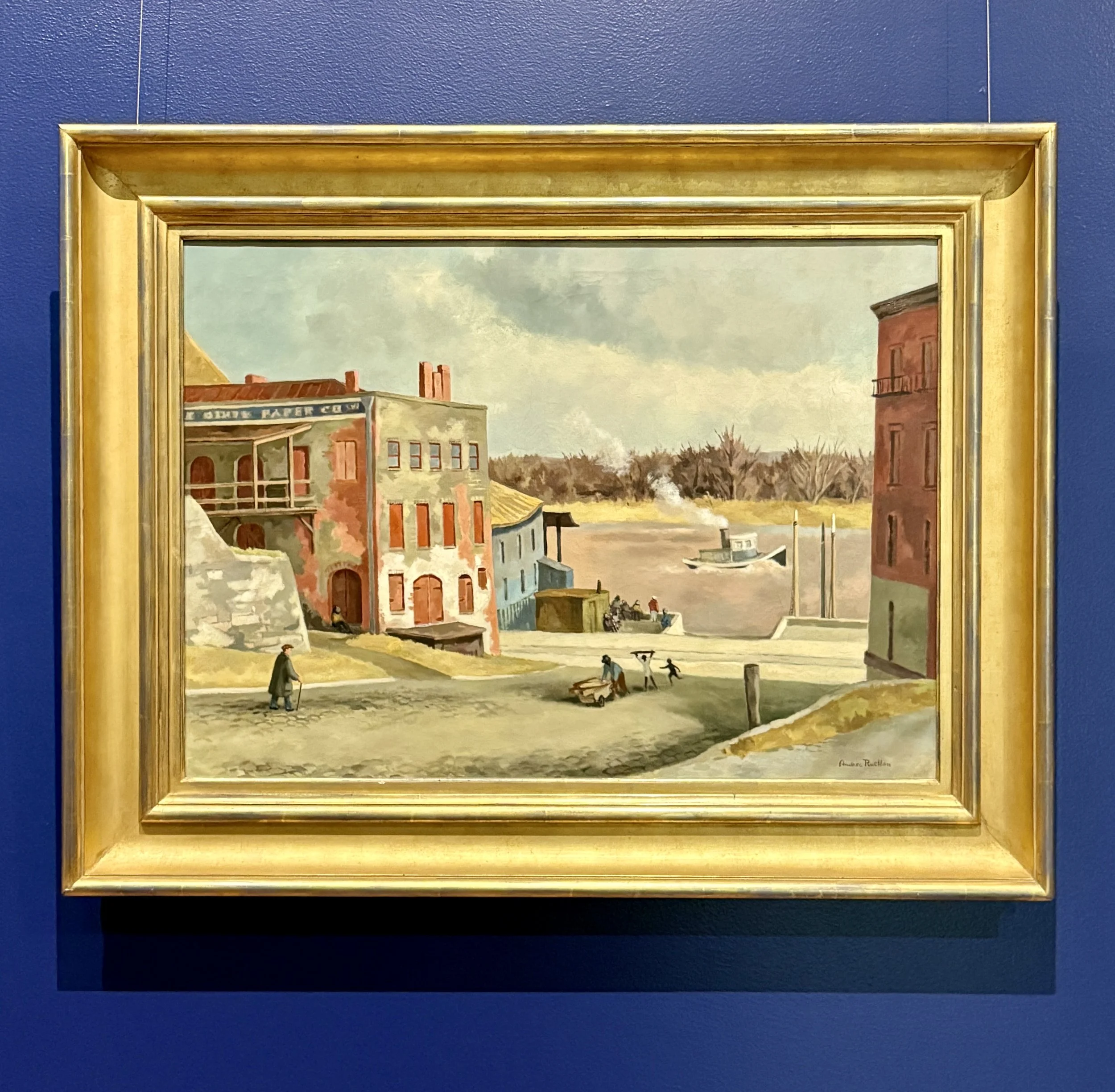
Savannah by Andrée Ruellan, 1942

Savannah by Andrée Ruellan, 1942

In Savannah, Andrée Ruellan captures the view of the river seen between buildings and down a cobblestone ramp that leads to the wharves. The painting’s small figures (including a man with a cane and a vendor with children) evoke the quiet, everyday life of the waterfront rather than a bustling port. 

Savannah’s riverfront historically relied on ramps (Barnard, Bull, Abercorn, Lincoln, etc.) down to River Street and its wharves, which is exactly the kind of setting Ruellan sketched. The waterfront was also a center for local craft traditions; Savannah has a documented history of woodcarving and walking-stick makers.  
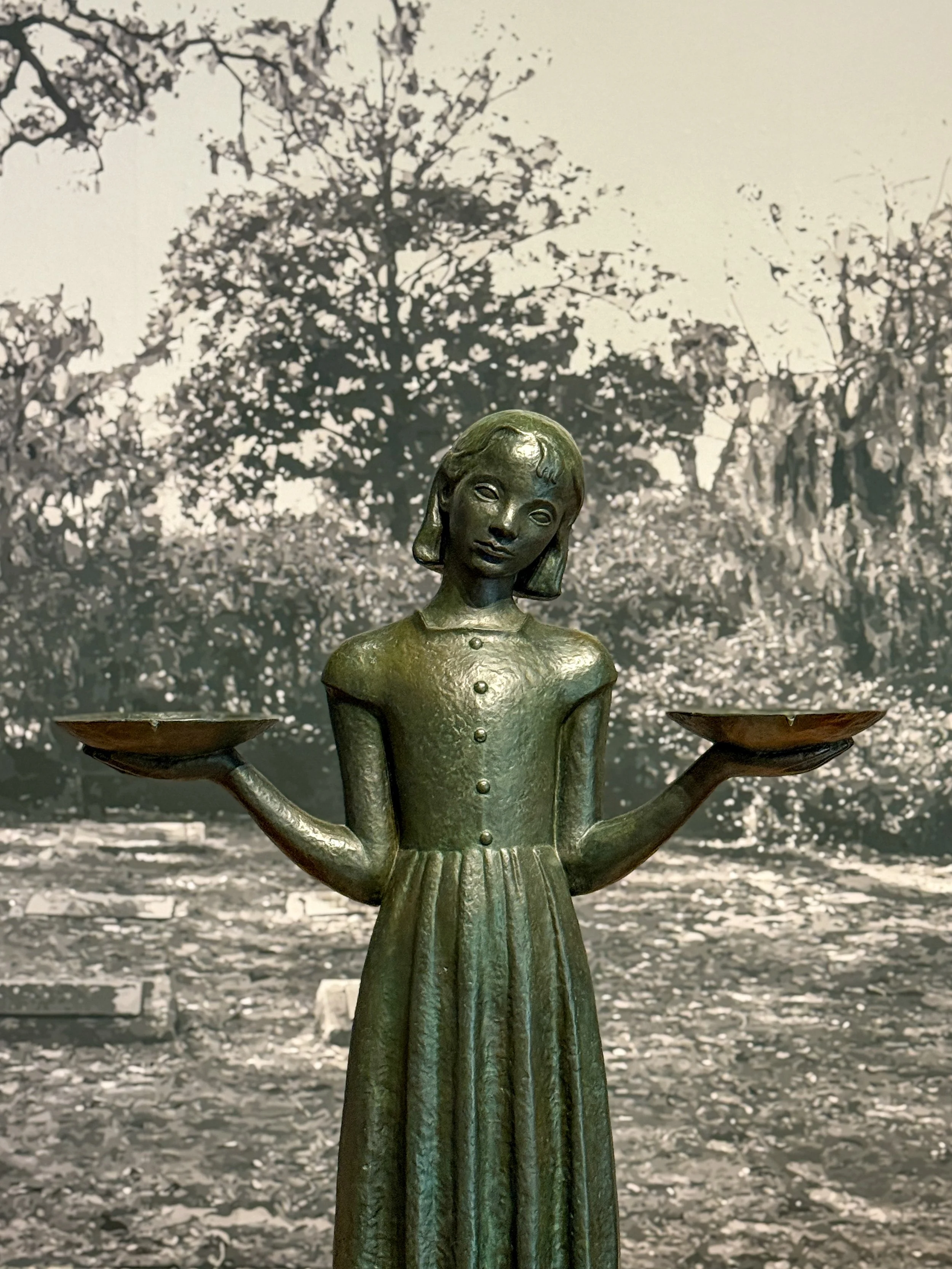
The statue of the Bird Girl statue, holding two bowls in her hands, in an exhibit at the Telfair Academy in Savannah, Georgia

The iconic Bird Girl. Her outstretched arms don’t actually symbolize the weighing of good and evil — the shallow bowls in her upturned hands were intended to hold water and birdseed. 

The Bird Girl of Midnight in the Garden of Good and Evil Fame

I was especially intrigued by the gallery featuring Before Midnight: Bonaventure and the Bird Girl. It showcases artwork from Bonaventure Cemetery, including the famous statue. 

Created in 1936 by Sylvia Shaw Judson, a sculptor from Lake Forest, Illinois, Bird Girl was first exhibited in 1938 at the Art Institute of Chicago under the title Girl With Bowls. Judson originally cast six versions, one in lead and five in bronze, but later stated that only four bronze casts were ever made. 

One of the original bronzes was purchased by Savannah native Lucy Boyd Trosdal and installed in her family’s plot in Bonaventure Cemetery, where it was affectionately nicknamed “Little Wendy.”

For decades, the statue remained largely unnoticed — until photographer Jack Leigh captured its haunting image at dusk for the cover of John Berendt’s bestselling nonfiction novel Midnight in the Garden of Good and Evil, thrusting “Little Wendy” and the city into the national spotlight. Concerned about the crowds it began to attract, Trosdal removed the statue from the cemetery and loaned it to the Academy, ensuring it would be protected for future generations.

Fun fact: Jim Williams, the central figure in Midnight in the Garden of Good and Evil, wasn’t just a successful antiques dealer and historic preservationist — he also served as president of the Telfair Academy.
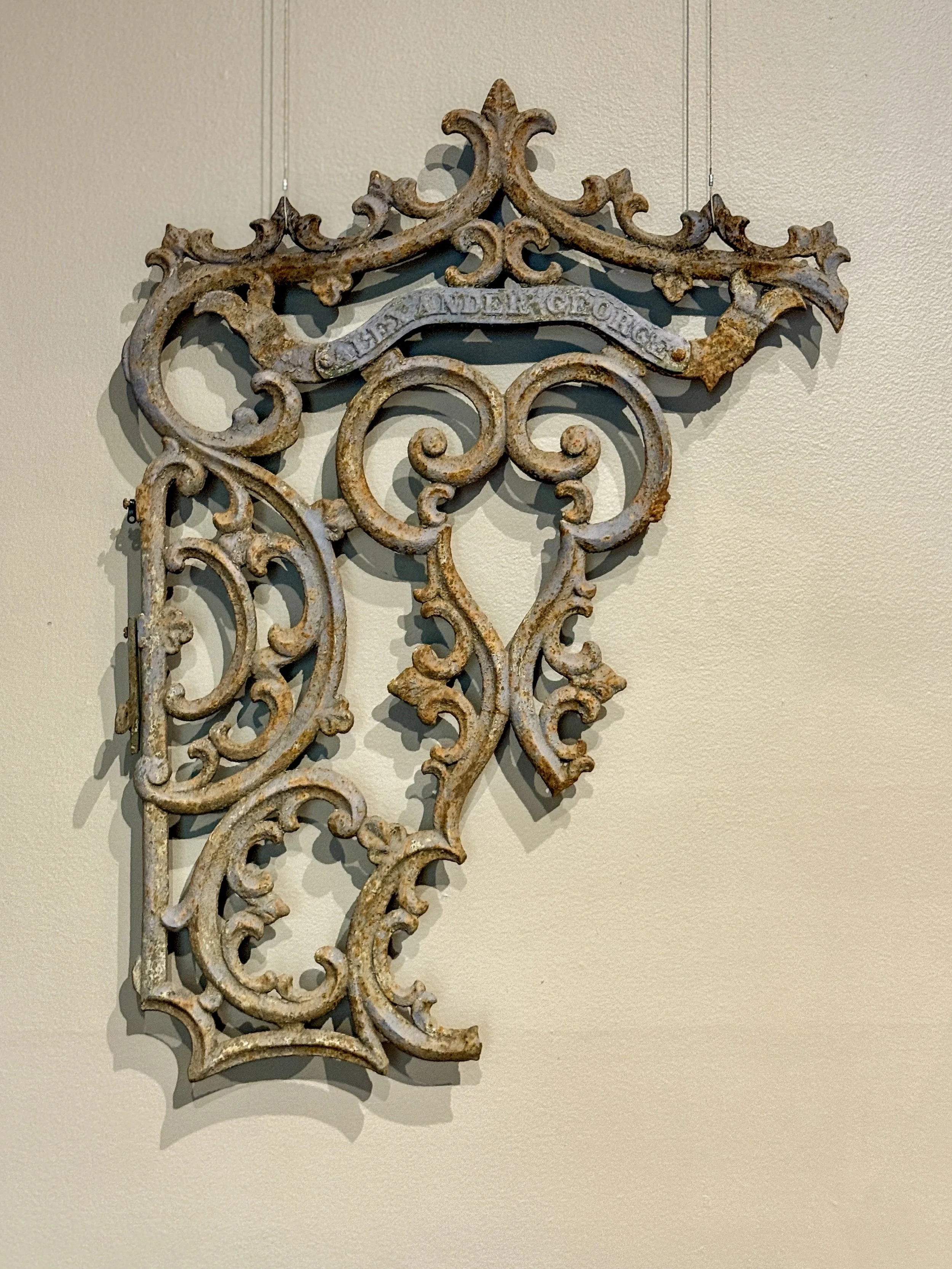
An iron gate fragment from Bonaventure Cemetery hangs on the wall at Telfair Academy in Savannah, Georgia

An iron gate fragment from Bonaventure Cemetery hangs on the wall. 
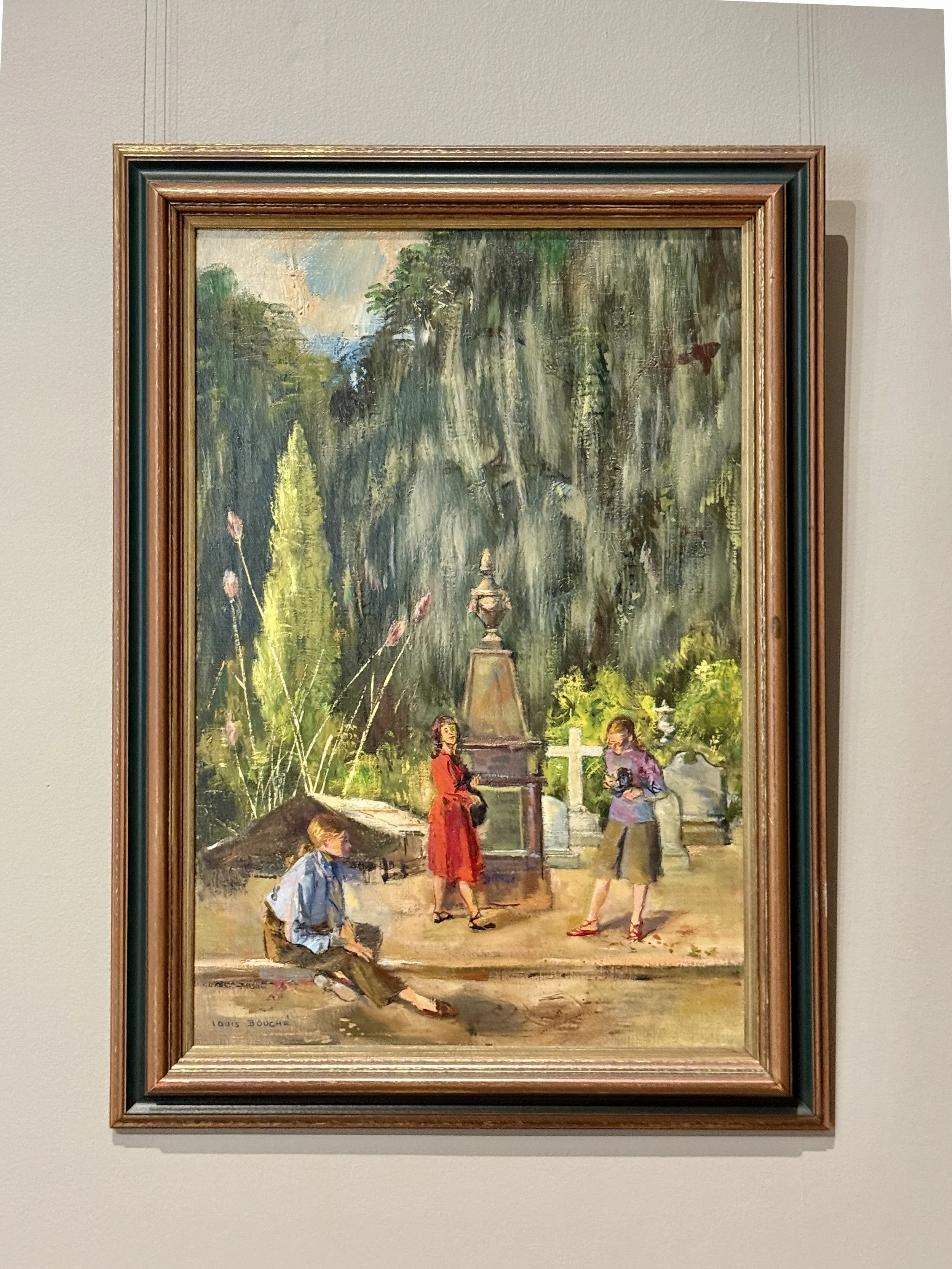
Bonaventure by Louis Bouché, 1969

Bonaventure by Louis Bouché, 1969

Bonaventure Cemetery by Henry Clernewerck, 1860

Bonaventure Cemetery by Henry Clernewerck, 1860

Plaster bust of the Telfair Academy’s first director, Carl Brandt, by John Walz, 1891, in Savannah, Georgia

Plaster bust of the Academy’s first director, Carl Brandt, by John Walz, 1891

Stay Awhile: Interiors in Art 

The last gallery featured a selection of paintings from the Academy’s permanent collection that focused on interior settings. 

Rather than emphasizing a specific narrative, the labels beside each painting encouraged visitors to form their own interpretations of the works. 
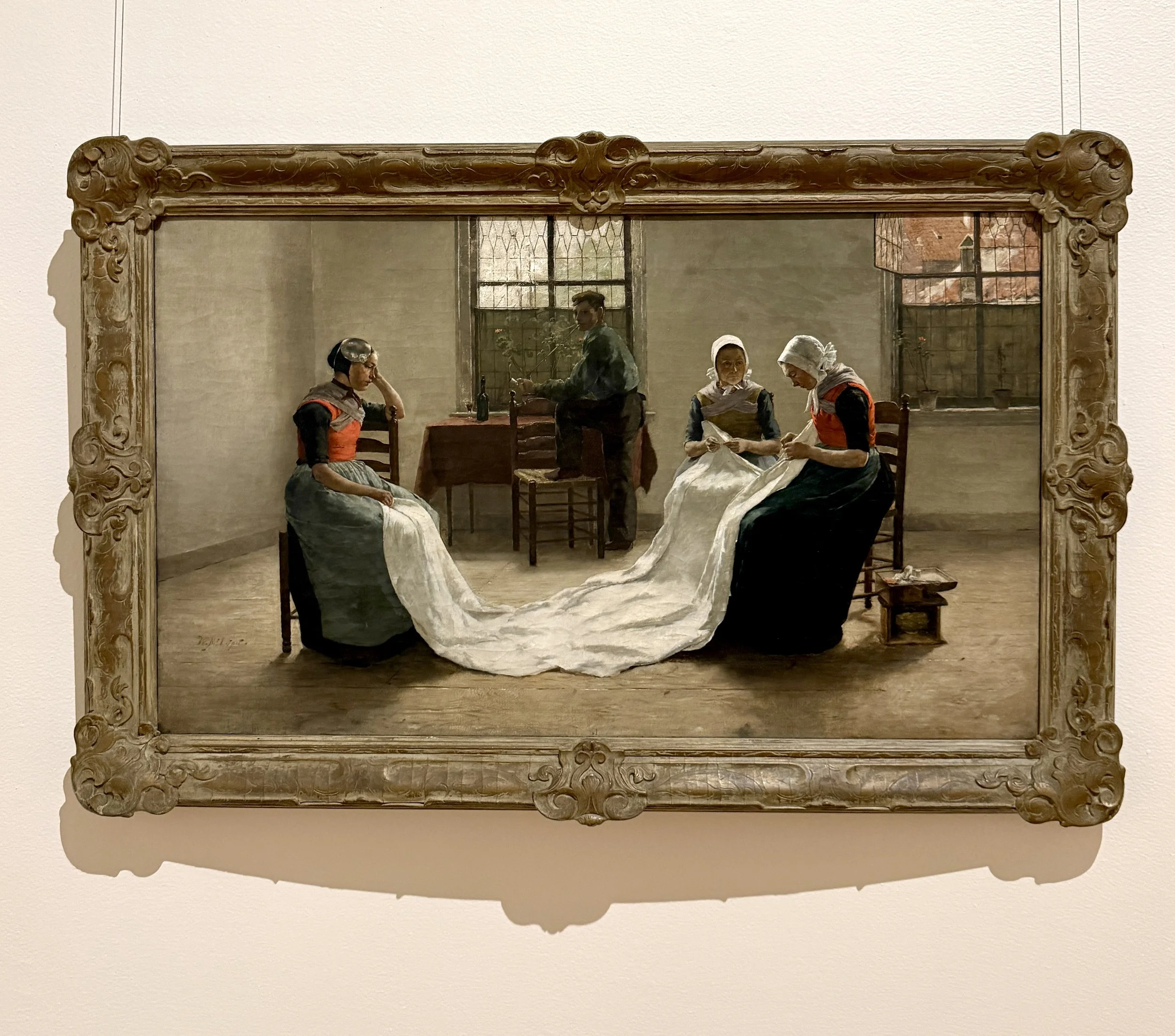
The Lacemakers by Walter MacEwen, 1900

The Lacemakers by Walter MacEwen, 1900

In The Lacemakers, three seated Dutch women are engaged in tatting the edges of a large piece of white fabric. Behind them, a man stands by a window, smoking a pipe and staring at the woman on the left, who seems lost in thought. The palette is dominated by muted, silvery tones, enlivened by the bright red bodices of two of the women and the tiny potted flowers on the windowsills.

A native of Chicago, Walter MacEwen had originally planned to pursue a career in business, but an unexpected event changed the course of his life.

When a destitute painter asked MacEwen for a small loan, the artist left his paint and brushes as collateral. He never returned to collect them, and MacEwen began to experiment with the abandoned materials.

By 1877 he had departed for Europe, where he studied under Frank Duveneck at the Royal Academy in Munich, and later at the Académie Julian in Paris. By the mid-1880s, MacEwen had established studios in Paris and Holland spending sixty years in Europe before returning to the United States in 1939. 

Café Fortune Teller by Mary Hoover Aiken, 1933 

Café Fortune Teller by Mary Hoover Aiken, 1933 

The style of Café Fortune Teller evokes elements of American scene painting, characterized by its focus on everyday life and its narrative quality. The work was completed on the island of Ibiza prior to the outbreak of the Spanish Civil War and depicts the artist reading her own fortune amidst the bustle of a café. In 1936, Mary Hoover met the Savannah-born poet Conrad Aiken, whom she married in 1937. Her later works included portraits of famed author T.S. Eliot and British painter Edward Burra, and she also had solo exhibitions at the Telfair in 1964 and 1975.

Wally and I visited on a weekday and spent about 90 minutes exploring the galleries and browsing the gift shop. Admission for adults was $30, valid for seven days from the date of purchase and offers access to all three museums. –Duke
Telfair Academy Visitor Information

Hours of Operation

Open Wednesday through Monday, 10 a.m. to 5 p.m.  
Closed on Tuesdays  

Admission Fees

Tickets grant unlimited access to all three Telfair museums (Telfair Academy, Jepson Center and Owens-Thomas House) for seven days from the date of purchase. 

Adult: $30  
Senior (65+): $27  
Active military (with ID): $27  
Student (ages 13 to 25, with ID): $20  
Child (ages 6 to 12): $10  
Child (5 and under): Free  

Accessibility and Visitor Services

Wheelchair accessible: Yes. Entrance is on the south side facing President Street (with nearby accessible parking and elevator access).  

Sketching: Allowed with pencil only; sketchbooks no larger than 8½ by 11 inches. No easels or sitting on the floor.  

Photography: Non-flash photography is permitted for personal use unless otherwise posted. Tripods, selfie sticks, lights and other gear are prohibited.  

Checkroom policy: Bags larger than 11 by 14 inches must be checked. Laptops and luggage are not accepted.  

Strollers: Restricted in the historic Telfair Academy and Owens-Thomas House but welcome at the Jepson Center.  
Why You Should Visit the Telfair Academy

Historical significance: Established in 1886, it’s one of the first public art museums in the U.S. and the first in the South.  

Architectural beauty: A Regency-style mansion designed by English architect William Jay (built 1818 to 1820).  

Collections and highlights: 19th and 20th century American and European art, restored period rooms, decorative arts and the famed Bird Girl statue.  
Telfair Academy 

121 Barnard Street 
Savannah, Georgia 31401
USA


Starland District: Savannah’s Funky, Artsy Playground

Savannah’s coolest neighborhood, the Starland District, is a quirky haven brimming with creativity. 

I love Broughton Street — don’t get me wrong. This upscale thoroughfare, with shops like the Paris Market, the Savannah Bee Company and Urban Outfitters, has an undeniable charm. 

But I wanted something edgier, fresher and a little less polished. Enter the Starland District, a neighborhood born from the bones of an old dairy at the end of the ’90s and now pulsing with creativity.

The Starland District: a neighborhood born from the bones of an old dairy and now pulsing with creativity.
A mural of flowers saying, "Am I dreaming?" in the Starland District in Savannah

History of the Starland District

In 1999, two SCAD (Savannah College of Art and Design) graduates, Patrick Shay and Eric Saller, stumbled upon the derelict Starland Dairy, a once-bustling pasteurized milk plant that had been abandoned for years. The dairy, established in the early 1900s and adorned with an iconic red star, had become a canvas for graffiti and a symbol of neglected Savannah. 

Rather than tearing it down, like any good SCAD student, they saw potential in its crumbling walls and industrial charm. With a love for historic preservation, they bought the two-block complex for a modest sum and set to work.

Their vision was simple yet radical: transform the decaying dairy into a community space for artists, creatives and entrepreneurs. Over time, the Starland Dairy became a hub for studios, galleries and workshops, injecting new life into the surrounding neighborhood. The district took its name from this centerpiece, with the “Starland” moniker honoring the dairy’s heritage.

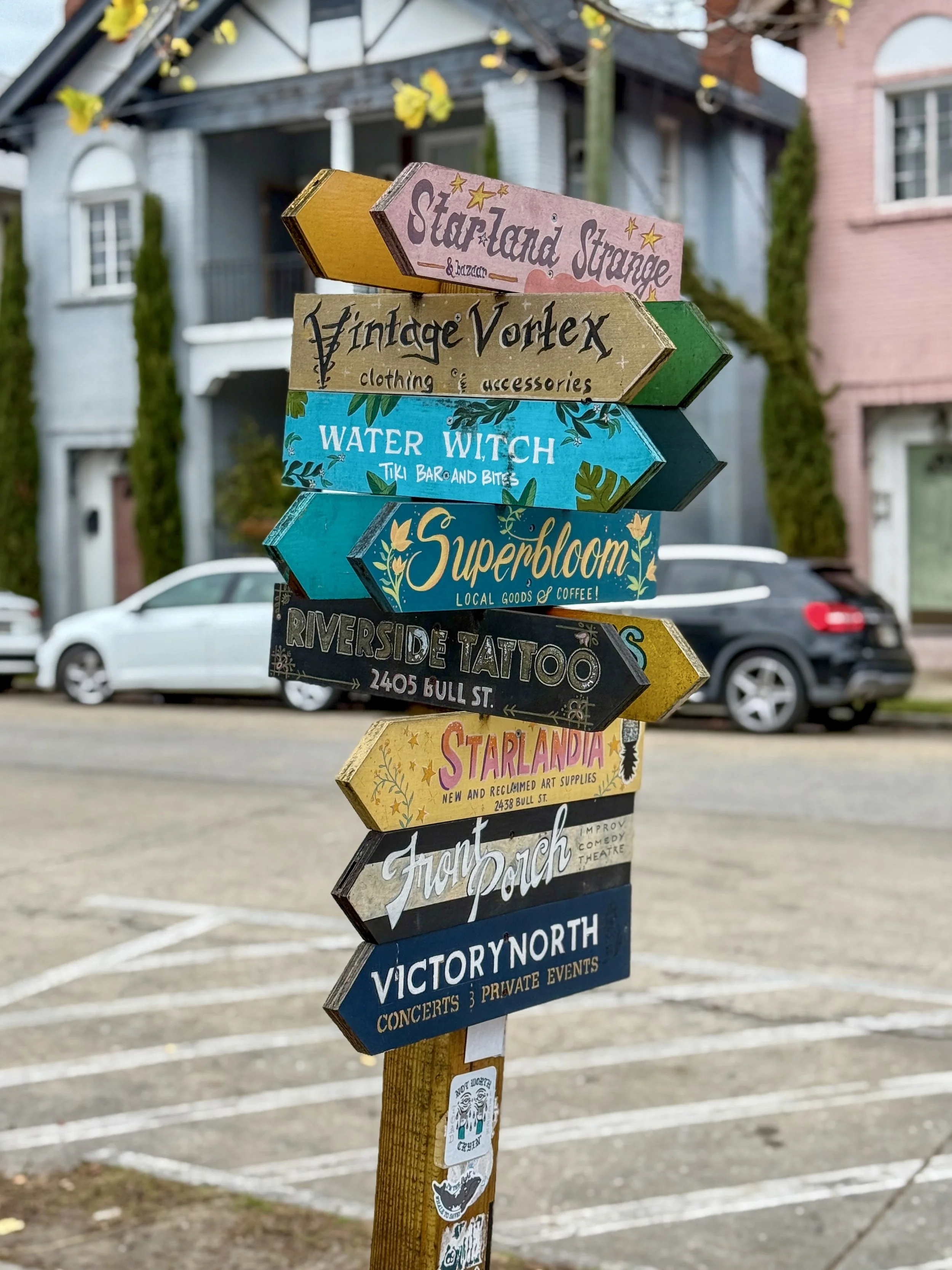
A signpost pointing to various attractions in the Starland District in Savannah, Georgia

Today, the Starland District remains an eclectic haven where SCAD students, local artists and Savannah’s quirkier residents converge. It’s colorful, messy in the best way and delightfully rebellious. Between the murals, mismatched furniture on café patios and the unmistakable hum of creativity, this neighborhood feels alive in a way that’s entirely its own. Exactly what I was craving.

Highlights of the Starland District 

Facade of Starland Strange & Bazaar, with it's pink exterior and vibrant painting path and stairs

Starland Strange & Bazaar

📍 17 West 41st Street

“It’s less curiosity shop and more Anthropologie,” I told Duke as we peered through the window of Starland Strange & Bazaar, closed for the day (Monday, for those taking notes). Instead of shrunken heads and oddities, we spotted racks of stylish women’s clothing and tables with boho-chic housewares. And because Starland loves a quirky twist, there’s also an ice cream shop inside.

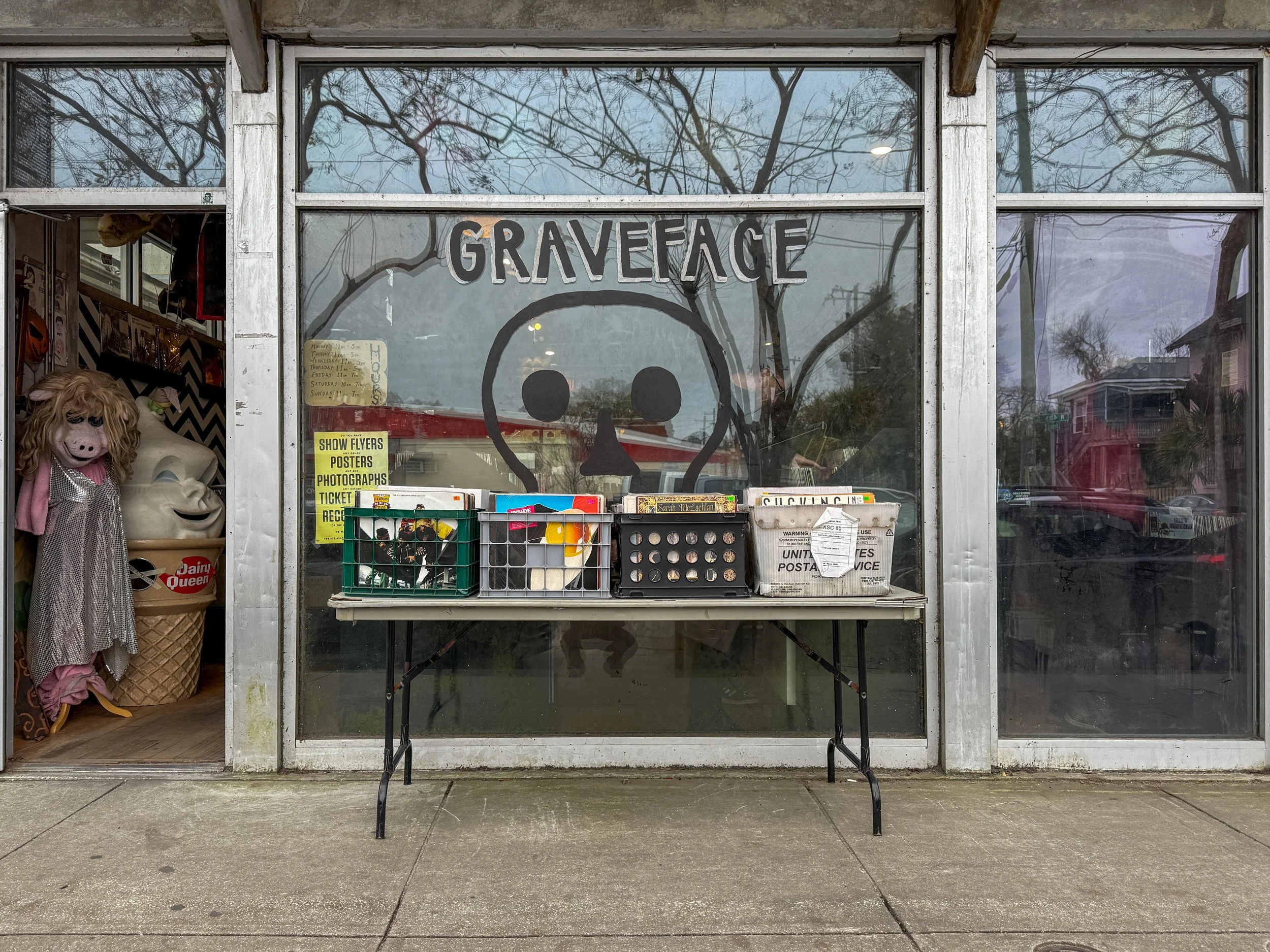
Exterior of Graveface Records in the Starland District in Savannah, Georgia

Graveface Records & Curiosities

📍 5 West 40th Street

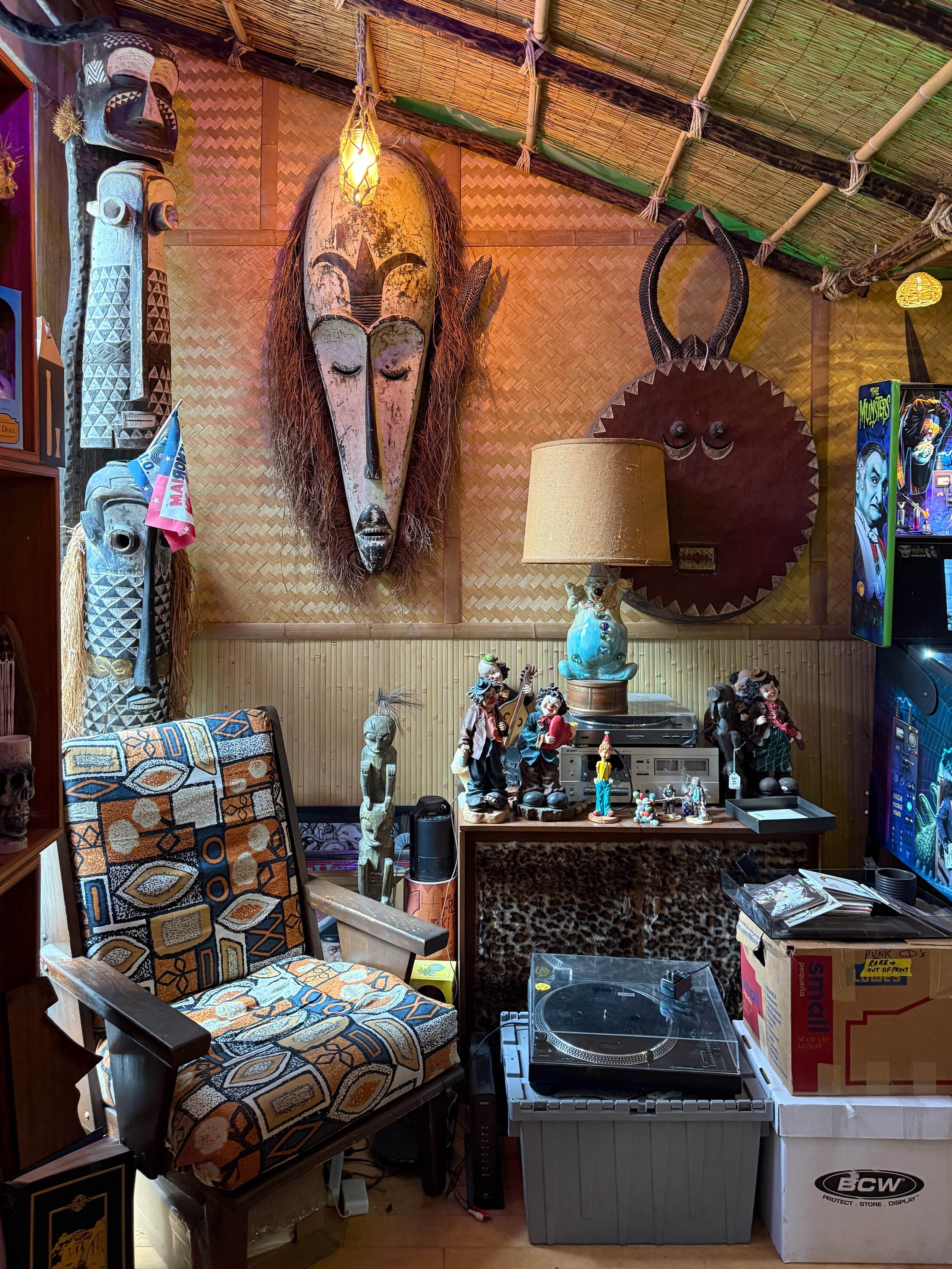
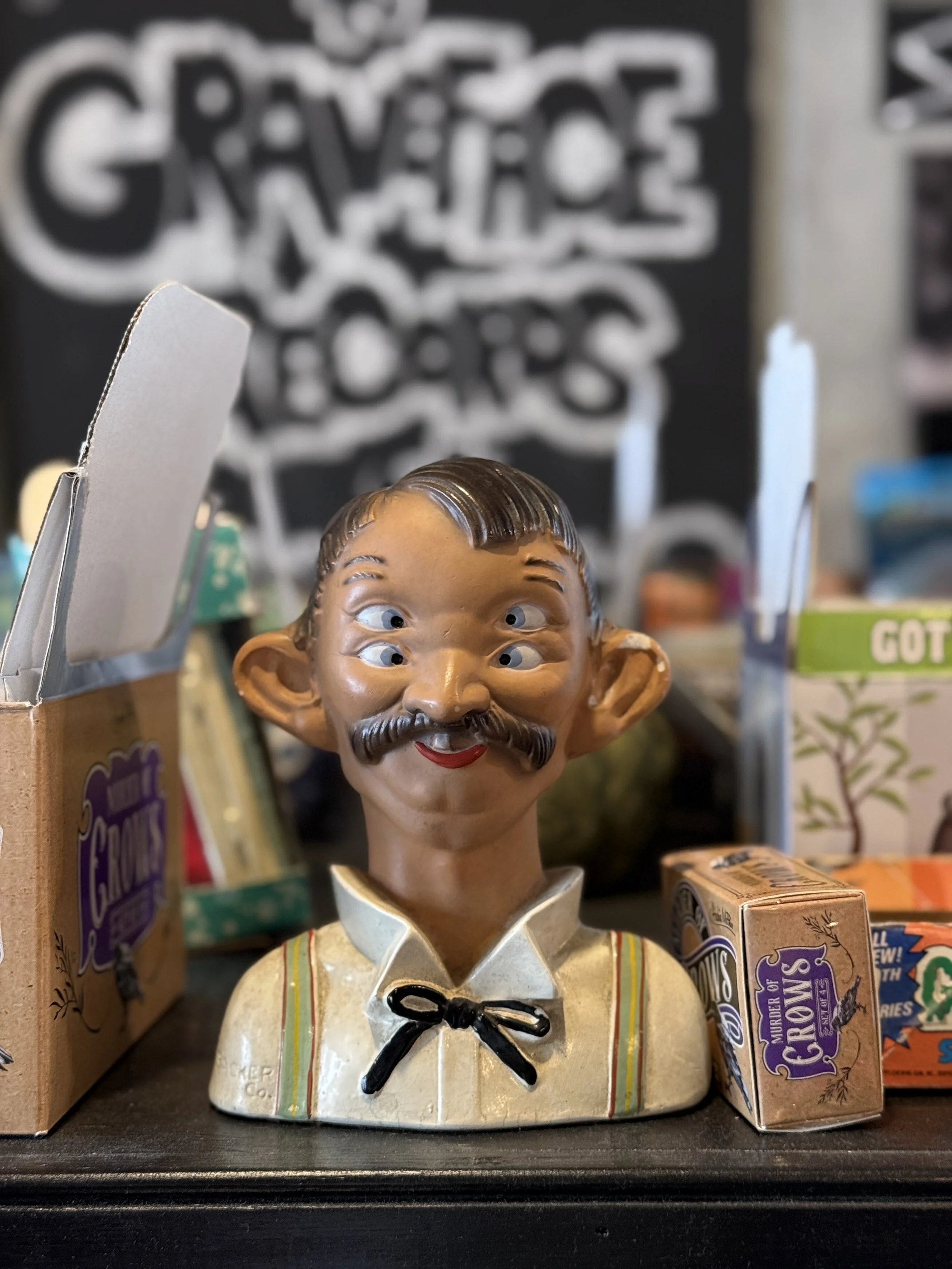
Part record store, part curiosity shop, Graveface is a delightful Wonderland of vinyl and weirdness. The records I was interested in were all around $20 to $30), but it was the curiosities that grabbed our attention: vintage taxidermy, antique Ouija boards and other objects you can’t decide if they’re creepy or cute. It’s like stepping into your cool goth cousin’s attic. 

African masks and quirky antiques at Graveface Records in the Starland District in Savannah, Georgia
A bust of a man with four eyes and mustache at Graveface Records in the Starland District in Savannah, Georgia
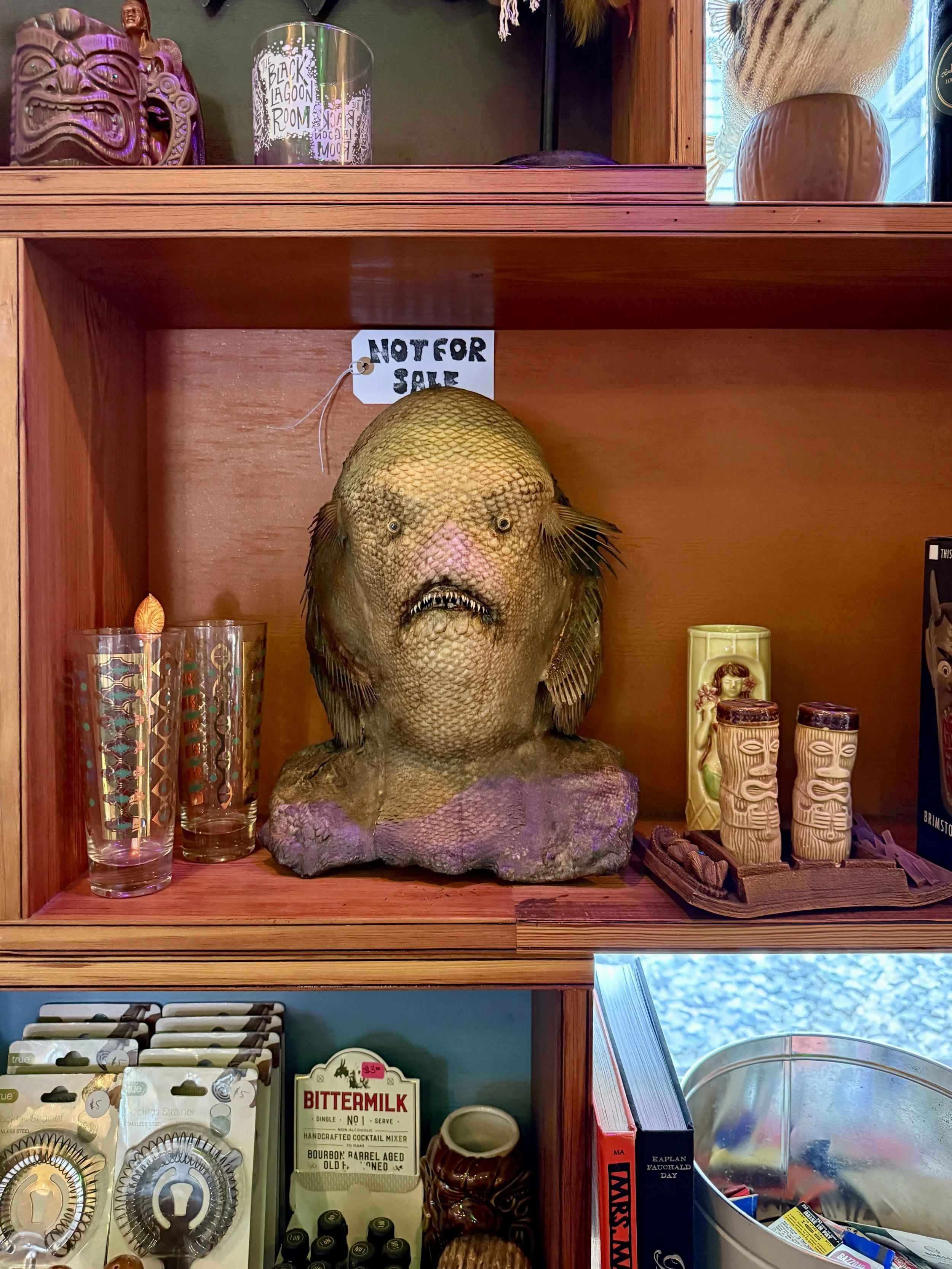
A fishman looking like the Creature from the Black Lagoon on a shelf at Graveface Records in Savannah (not for sale)

Note: The Graveface Museum, located across town and owned by the same guy, showcases a fascinating collection of horror-themed artifacts, vintage pinball machines and true crime memorabilia.

The facade of Flora and Fauna cafe, with blue window frames and aqua tiles in the Starland District in Savannah, Georgia

Flora and Fauna

📍 2401 Bull Street

This French-inspired café sits right on the corner and feels like a postcard come to life. The Jessica’s chicken salad sandwich was great, but let me tell you about Duke’s mushroom conserve baguette: earthy, savory, life-changing. It wasn’t just a sandwich; it was a spiritual experience. Pair it with a latte and one of their delectable pastries, and soak in the sunny, vintage vibes. It’s the kind of place where you make new friends standing in line and time seems to slow down (until you realize you’ve devoured the entire baguette in under five minutes).

Facade of Starlandia art supply store, with magenta paint, yellow stars and a rainbow flag in Savannah, GA

Starlandia

📍 2438 Bull Street

Forget those fancy-schmancy overpriced art stores; this place is an artist’s paradise. Starlandia lets you buy and sell used art supplies, so it’s a treasure hunt every time. Brushes, paints, canvases, elastic to make bracelets — they’ve got it all, often for a fraction of the cost. I even found a stash of gently used books. Oh, and don’t forget to say hi to the tiny shrimp swimming around in their tank by the register. 

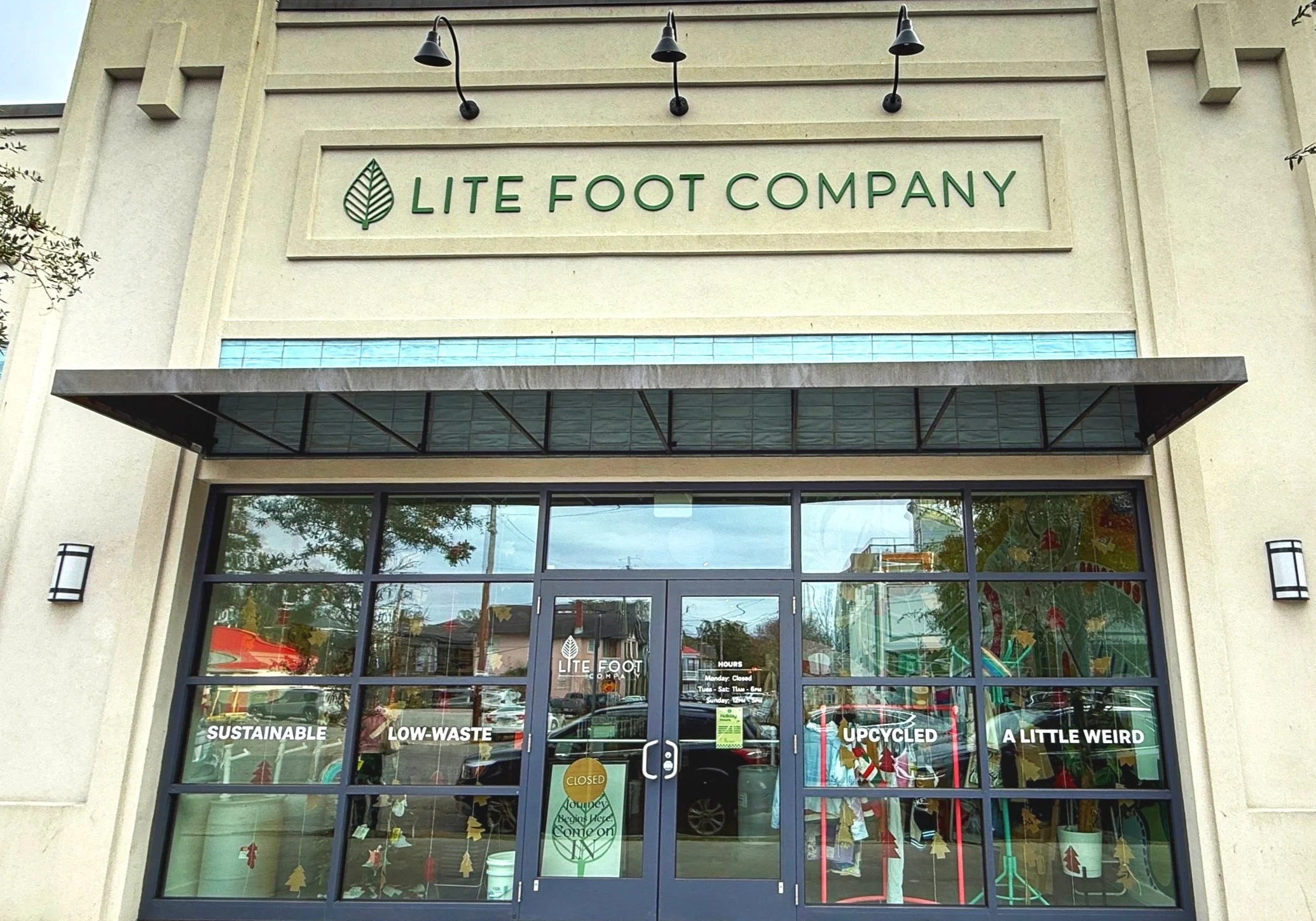
Facade of Lite Foot Company in the Starland District in Savannah, Georgia

Lite Foot Company

📍 2400 Bull Street

Going green has never looked so stylish. We weren’t quite sure what the Lite Foot Company was — but we certainly didn’t realize it was a go-to for eco-friendly everything. Think reusable straws, biodegradable glitter and chic tote bags that state, “I care about the planet.” It’s the kind of place that makes you want to upcycle your life and live sustainably ever after.

Exterior of the Wormhole dive bar in the Starland District in Savannah, Georgia

The Wormhole

📍 2307 Bull Street

A dive bar with personality, the Wormhole is a no-frills spot where you can catch all sorts of live music, comedy or the occasional karaoke night. It’s the kind of place where the drinks are strong, the crowd is diverse, and the vibe is unpretentious. Their lineup is always surprising — one night, it’s punk rock, the next, stand-up comedians testing their material.

Brick facade of Arts Southeast in the Starland District in Savannah, Georgia

Arts Southeast

📍 2301 Bull Street

Carrying the Starland torch, Arts Southeast is a dynamic hub for the city’s creative community. Established in 2014 by local artists, it offers 26 private artist studios, the Ellis Gallery for rotating exhibitions, and the On::View Artist Residency, which provides artists with high-visibility studio space to engage with the public. This nonprofit organization is  dedicated to making Savannah a cultural destination, hosting community events like the monthly First Friday Art March, fostering a vibrant and supportive environment for both emerging and established artists.

Glass facade of the Water Witch tiki bar in the Starland District in Savannah, Georgia

Water Witch

📍 2220 Bull Street

Water Witch tiki bar, named after the ill-fated U.S.S. Water Witch — a Civil War-era gunboat with a reputation for attracting bad luck — channels its legendary spirit into bold cocktails and an unforgettable atmosphere. Whether you’re in the mood for a classic Mai Tai or something bold and original, this is where your taste buds get to travel. Soak in the island-inspired charm, perfect for date night or catching up with friends — no SPF required. 

Teal painted facade with cream columns of the Vault in an old bank building in Savannah, GA

The Vault Kitchen & Market

📍 2112 Bull Street

Housed in a renovated historic bank building, the Vault effortlessly blends industrial charm with sleek modern design. The menu is just as inspired as the setting, featuring everything from sushi rolls to dumplings to creative entrées that leave your tastebuds begging for more. Whether you’re here for the incredible cocktails or the vibe, the Vault delivers. Perfect for date night or a lunch with friends, this spot is as chic as it is delicious.

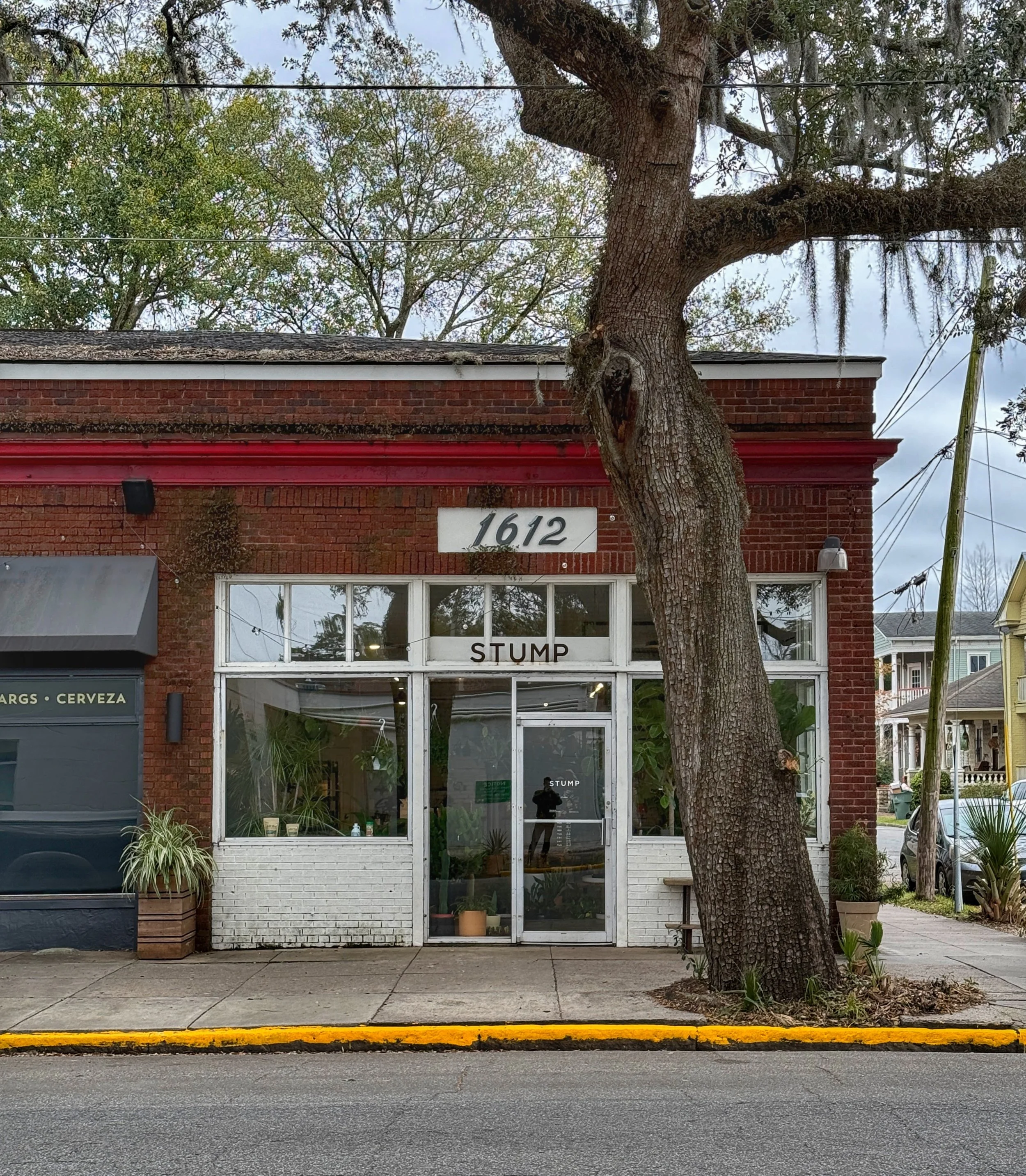
Facade of Stump plant shop, with brick and a tree out front in Savannah

Stump

📍 1612 Bull Street

Plant lovers, rejoice! Stump is a boutique plant shop specializing in rare and gorgeous greenery. Whether you’re looking for a monstera that’ll take over your living room or a low-maintenance succulent, they’ve got you covered. The staff is knowledgeable, so even if you’re a notorious plant killer, they’ll set you up for success. 

Stump also offers First Friday workshops, where plant lovers can get hands-on tips for caring for greenery, create their own terrariums, or learn the art of plant styling in a fun and welcoming setting.

Exterior of Woof Gang pet supply shop in Savannah, with pink below and turquoise up top

Woof Gang

📍 1601 Bull Street

If you’re traveling with a furry friend — or have a special dog in your life — this place is a must. Woof Gang offers gourmet treats (think dog-friendly cupcakes), premium toys and grooming services. It’s basically a day spa for your pet.

Annex of gingerbread Victorian house that's now E. Shave Booksellers in the Starland District in Savannah, Georgia

E. Shaver Booksellers

📍 1919 Bull Street

This bookstore is a reader’s paradise. The shelves are divided into well-curated sections, and there’s a small bar in the back serving coffee and cocktails. Bonus: It’s an annex of a historic gingerbread-style home, giving it an extra layer of charm. It’s the kind of place you’ll “stop by for five minutes” and emerge from two hours later with a pile of books and a latte (or prosecco) buzz.

Interior of E. Shaver Bookseller, with tables and shelves filled with books, and tables and chairs, in Savannah, Georgia

They host a variety of monthly book clubs by genre, including sci-fi and fantasy, romance, mystery, graphic novels and even one devoted to Jane Austen.  

Additionally, their podcast, Pull Your Shelf Together, features co-owners Melissa Taylor and Jessica Osborne discussing their latest reads and offering book recommendations.

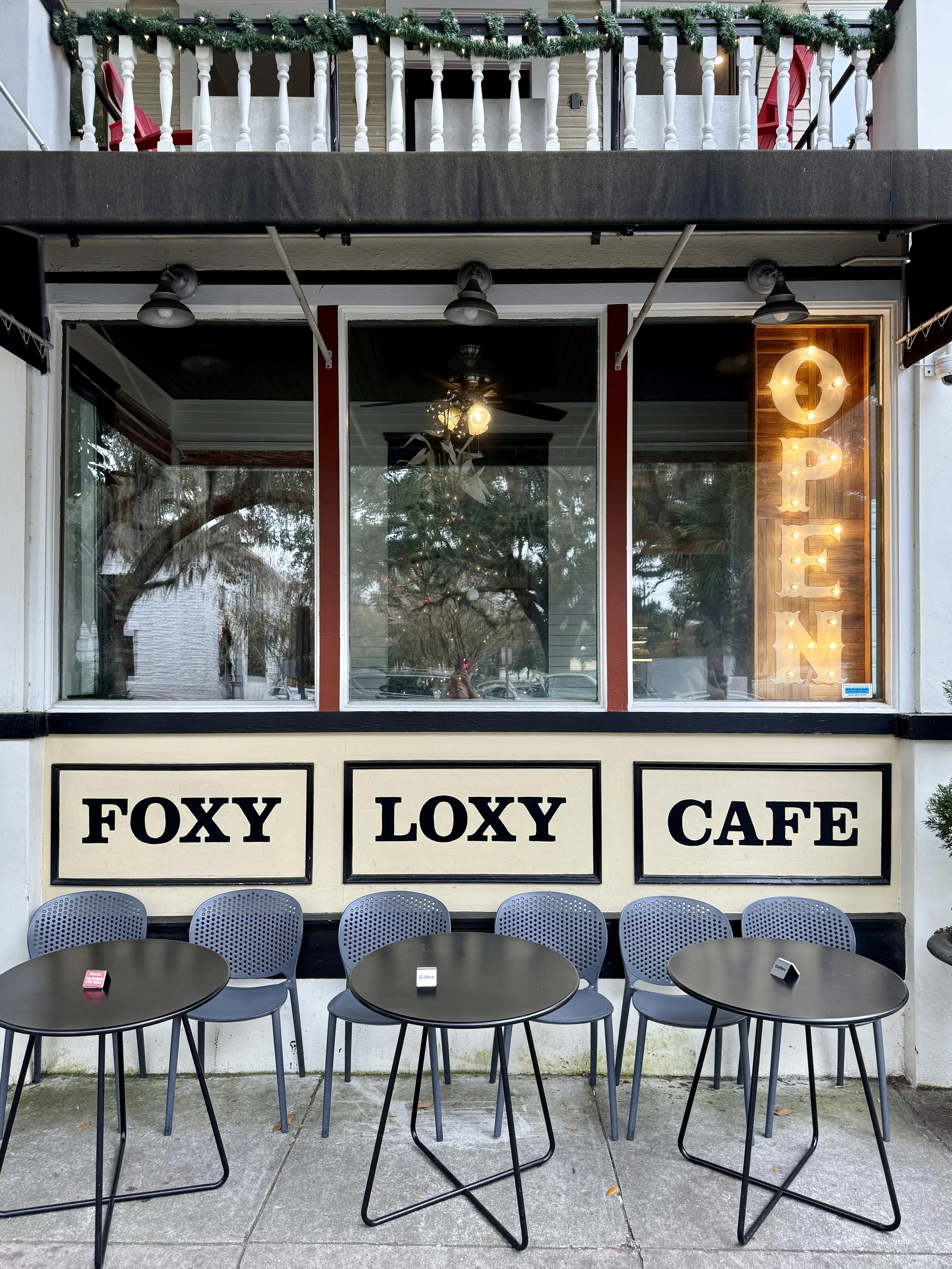
Front of Foxy Loxy Cafe, with a glowing Open sign, and small round black tables and chairs in Savannah, GA

Foxy Loxy Cafe

📍 1919 Bull Street

A sister establishment to the bookstore, the café offers Tex-Mex-inspired bites, craft coffee and a selection of wines. What sets it apart is the spacious backyard, complete with twinkling lights and fire pits — perfect for sipping a cortado or enjoying their famous tacos al fresco. They often host live music and s’more-themed Fire & Wine Saturdays, making it a true community gem.

Facade of With Love Tattoo in a brightly painted Victorian house in the Starland District in Savannah, Georgia

With Love Tattoo

📍 1917 Bull Street, Suite A

Most tattoo parlors embrace the edgy in their iconography, but this one leans into the cutesy. With Love Tattoo is where artistry meets ink. Known for its diverse team of talented artists, the studio specializes in creating custom pieces tailored to each client’s unique vision — whether you’re into delicate line work, bold traditional designs or intricate black-and-grey realism. The shop’s warm, welcoming vibe makes it as inviting for first-timers as it is for tattoo veterans. Even if you’re not ready for ink, the artwork on display is worth a visit.

Exterior of Neighborhood Comics, with a discount cart out front, in Savannah, Georgia

Neighborhood Comics

📍 1205 Bull Street

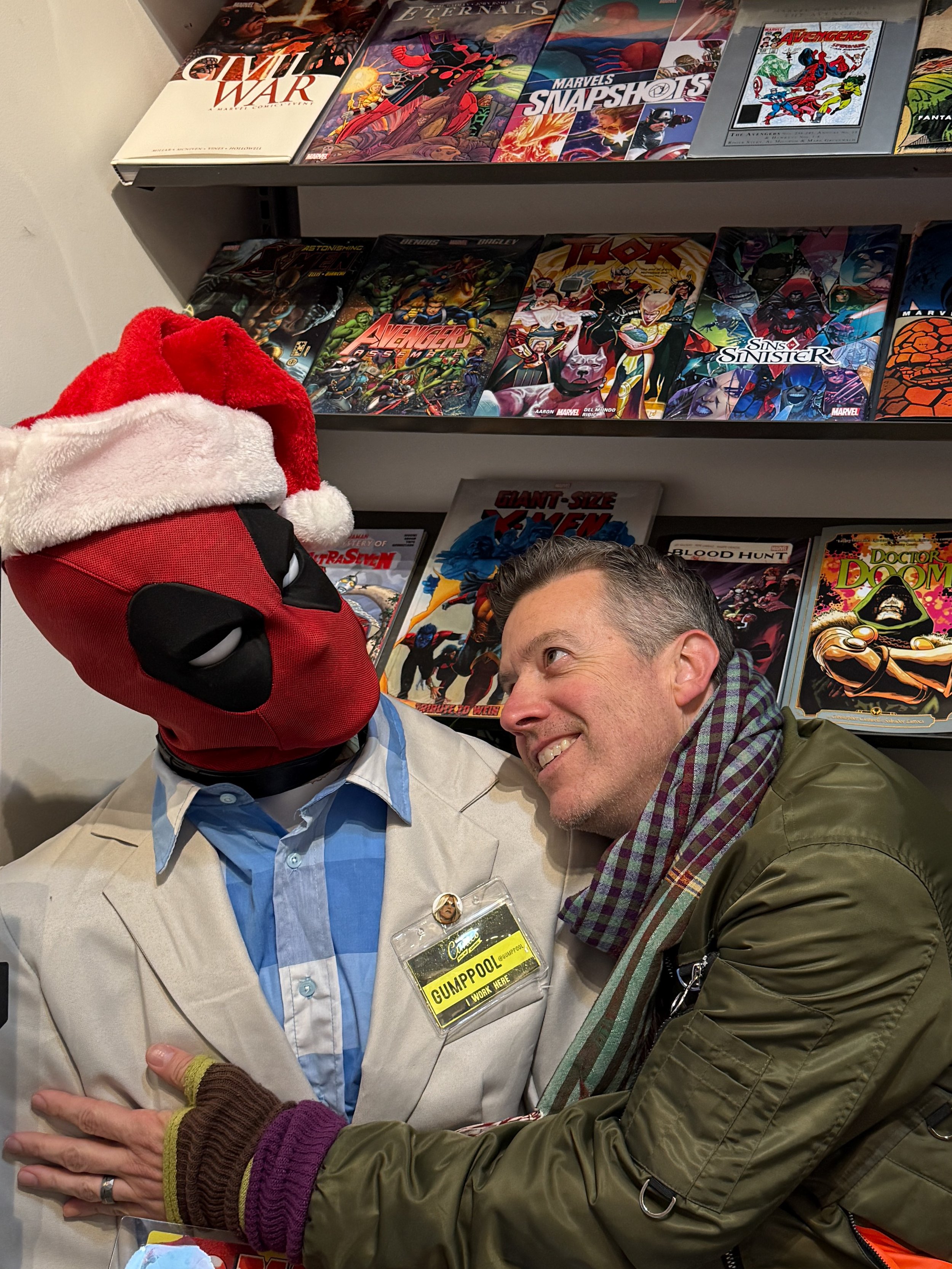
Neighborhood Comics caters to hardcore collectors and casual readers alike, with a mix of indie comics, graphic novels and pop culture merchandise. The staff is passionate and always ready to help you find your next fave read. Quirky displays are set up throughout the store — Wally was particularly smitten with the one of Deadpool as Forrest Gump.

Wally gazes lovingly up at Deadpool dressed as Forrest Gump, in Neighborhood Comics in Savannah, Georgia

They also feature a monthly artist-in-residence program, giving local and visiting comic artists a space to create, showcase their work and connect with fans.

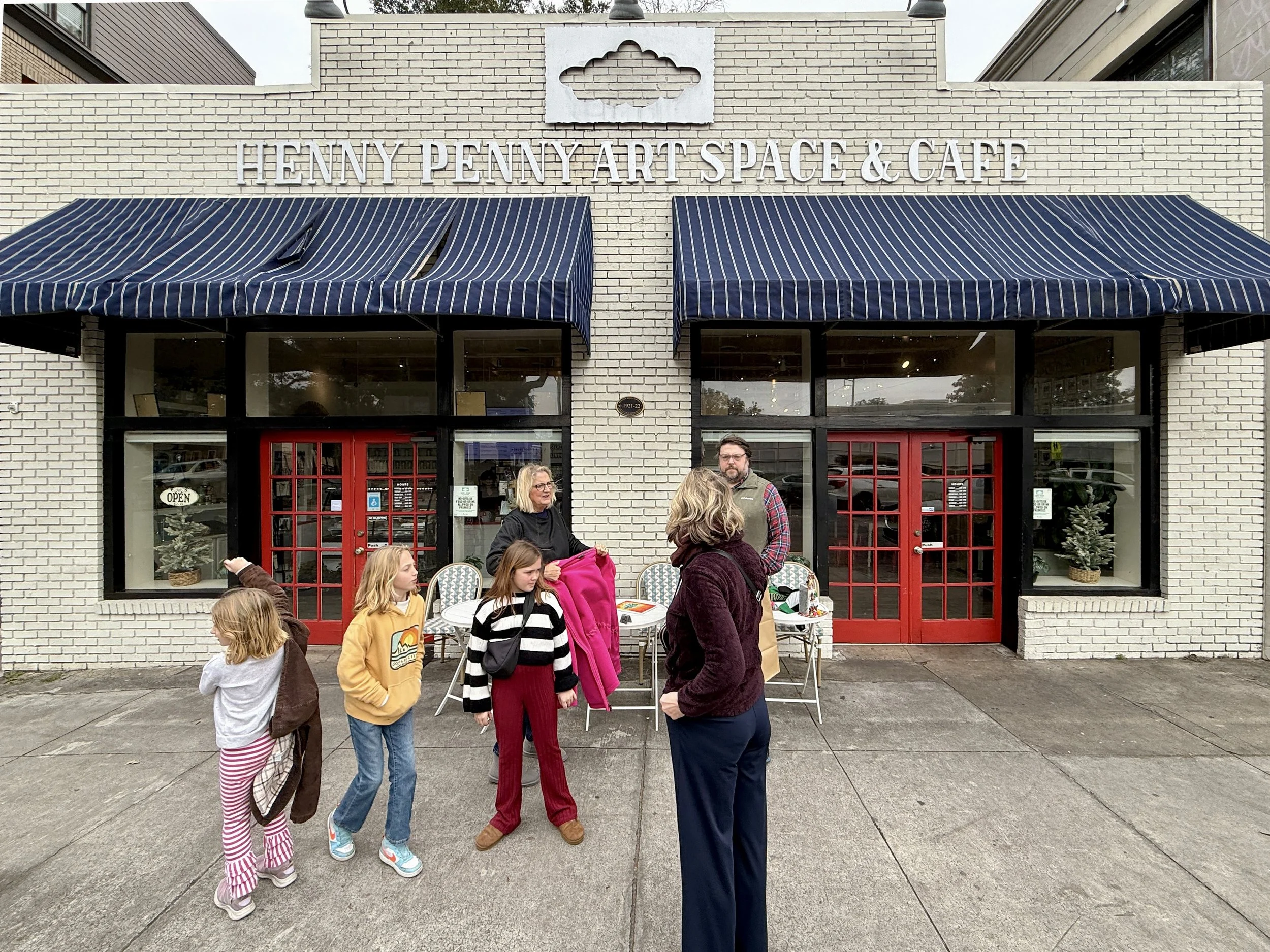
Henny Penny Art Space & Cafe

📍 1514 Bull Street

This family-friendly café is equal parts cozy coffeeshop and creative playground. There’s a full menu of specialty coffees and baked goods, including vegan donuts. They regularly host art classes for kids, so parents can sip a latte while their little ones explore their inner Picasso. The art on display is often created by local children, giving the place a sweet, community-focused vibe.

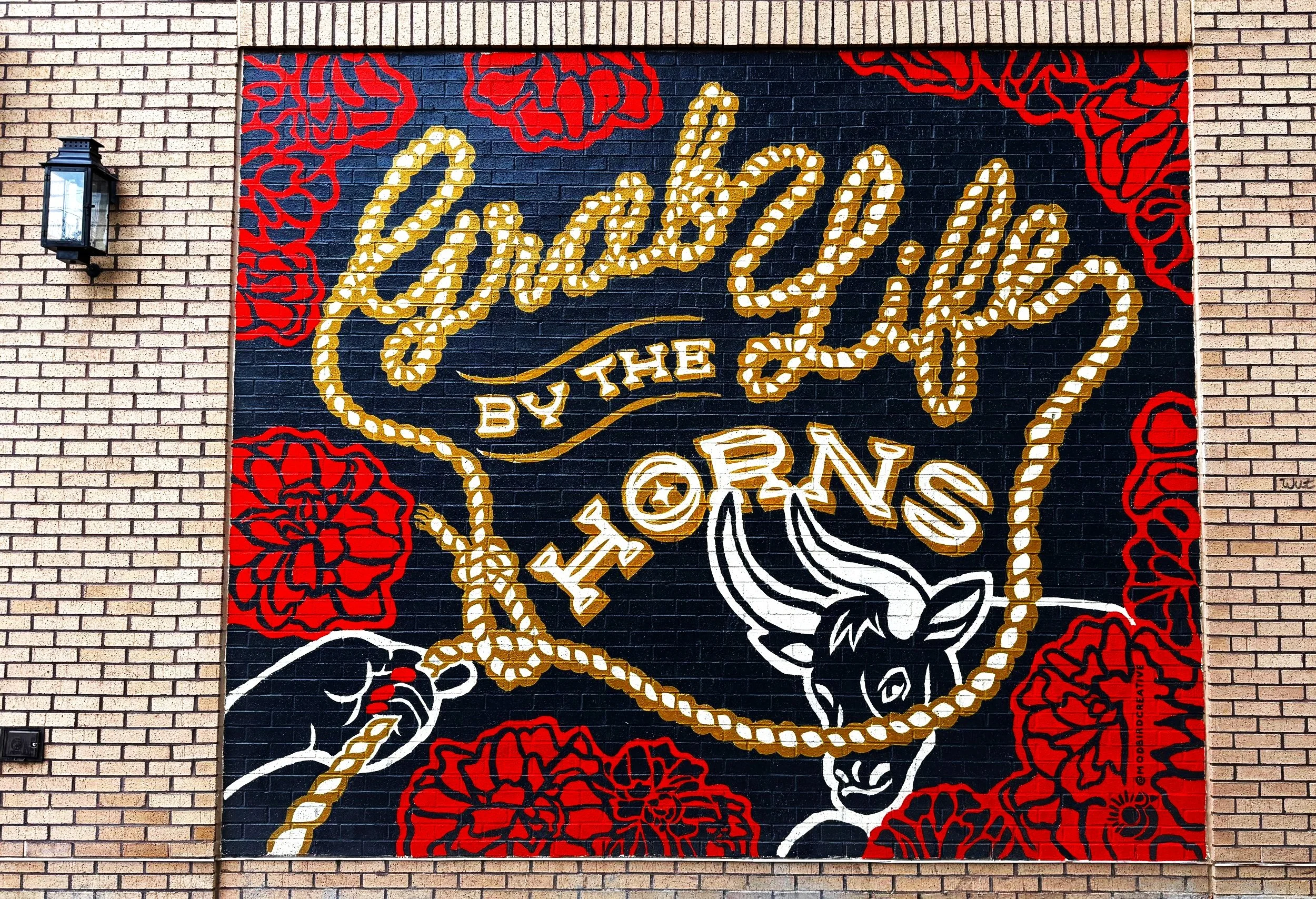
Mural of flowers, lasso and bull that reads, "Grab life by the horns" in Starland, Savannah, Georgia

Star Attractions of Starland in Savannah 

Starland District is Savannah at its quirkiest and most creative. It’s a hood where every corner holds a surprise — and possibly a new friend. So skip the usual downtown haunts and come see what all the buzz is about. –Wally

From Freaks to Serial Killers: The Dark Wonders of Graveface Museum

Dive into a world of roadside oddities, taxidermy curiosities, cult memorabilia and chilling true crime tales — including the legacies of Ed Gein and John Wayne Gacy — at Graveface Museum.

A tall red devil face forms the entrance to the Graveface Museum in Savannah, Georgia

The devil’s in the details: the iconic entrance to the Graveface Museum

If your idea of the perfect afternoon includes taxidermied animals, Church of Satan memorabilia, paintings made by a serial killer, and an arcade filled with vintage monster-themed pinball machines, then the Graveface Museum might just be your new happy place. Tucked away in Savannah, Georgia’s historic Byck building along the cobblestoned Factors Walk, this one-of-a-kind museum is a must-visit for enthusiasts of the macabre, the mysterious and the downright bizarre.

Originally, Duke and I had planned a day trip to Savannah with my mom, but she decided to sit this one out due to the blustery, cold winter weather. With just the two of us making the trip, we decided to explore some of the city’s more unusual shops and attractions. 

We took an Uber from Hilton Head, South Carolina and had the driver drop us off in the artsy Starland district. It was here among the shops that we stumbled upon Graveface Records & Curiosities, a combination vinyl and oddities shop founded by Ryan Graveface — a musician, record label owner and lifelong collector of all things peculiar. (Something tells me he would get along well with Ryan and Regina Cohn, whom we’ve dubbed the King and Queen of Oddities.)

After exploring the Starland district and other aspects of quirky Savannah, we made our way to Bay Street. The Graveface Museum is tucked away in the historic Byck building at 420 East Factors Walk, a cobblestone thoroughfare sandwiched between River Street and Bay Street. Keep an eye out: This hidden gem isn’t as obvious as the tourist stops along the river — but that only adds to its allure. 

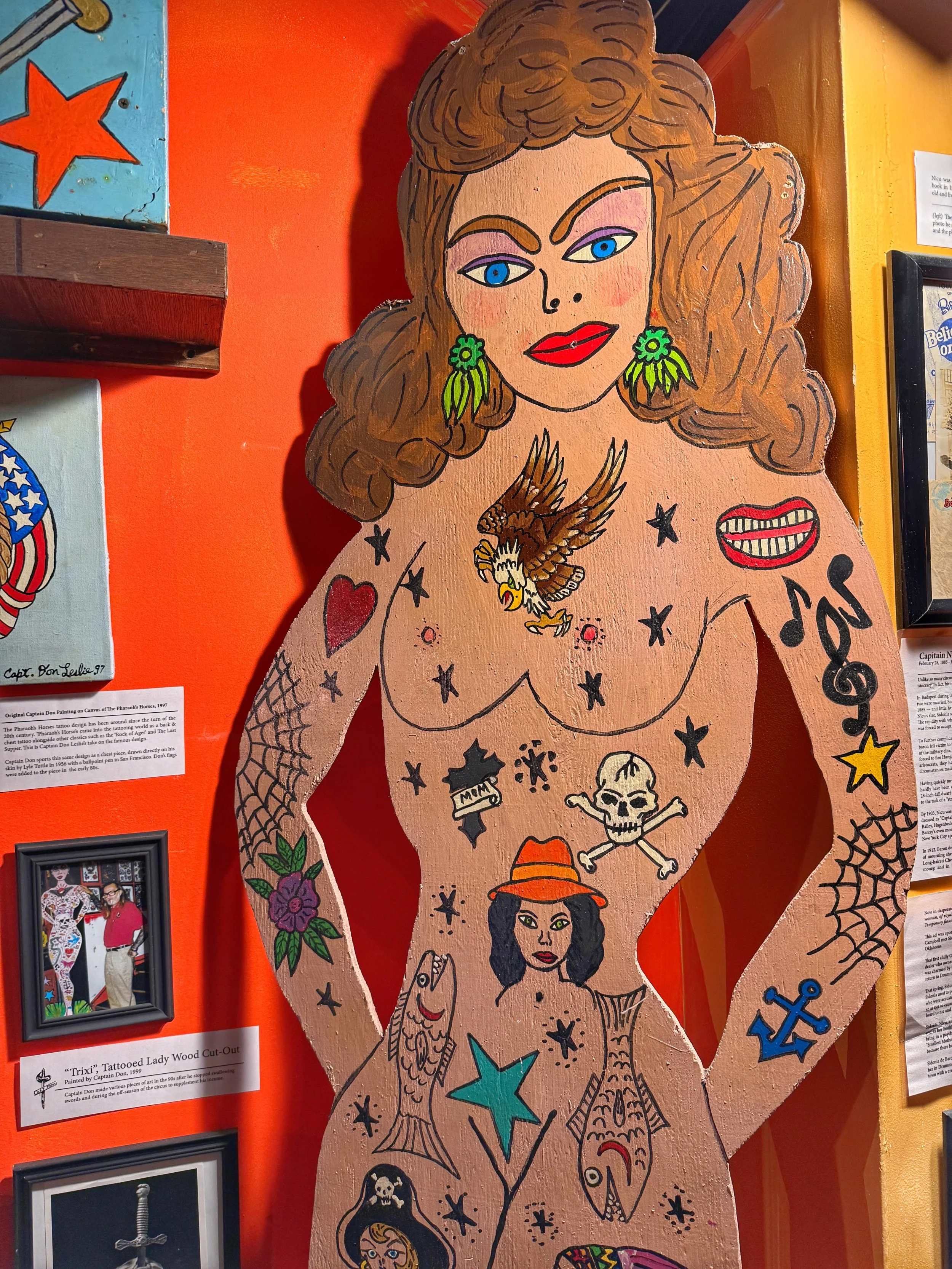
Wooden cutout of a Tattooed Lady at the Graveface Museum in Savannah, Georgia

The museum pays homage to all things creepy or unusual.

A Grave Undertaking 

The museum opened in February 2020 (right before the pandemic hit, gulp) as a passion-project-turned-immersive-experience. Given that Ryan’s last name is Graveface, an affinity for the macabre seems inevitable. With a mission to preserve and showcase the stranger aspects of history, he’s curated an eclectic mix of roadside attractions, true crime artifacts, cult memorabilia and secret society paraphernalia, among other peculiarities.

Highlights include the largest private collection of John Wayne Gacy’s paintings, artifacts from Ed Gein’s notorious crimes, and exhibits on topics ranging from Satanism to UFO cults. The museum also features a free pinball arcade, offering visitors a chance to unwind after exploring its darker displays.

Deer heads and multicolored geometric design cover the walls of the gift shop at the Graveface Museum in Savannah

The eclectic gift shop

Enter Through the Gift Shop

Your journey into the macabre begins in a gift shop that’s as offbeat as the museum itself. Part retail space, part curiosity cabinet, it’s stocked with horror-themed merchandise, oddities and hilariously gory painted movie posters from Ghana, Africa. It’s an appetizer for the weirdness that lies ahead.

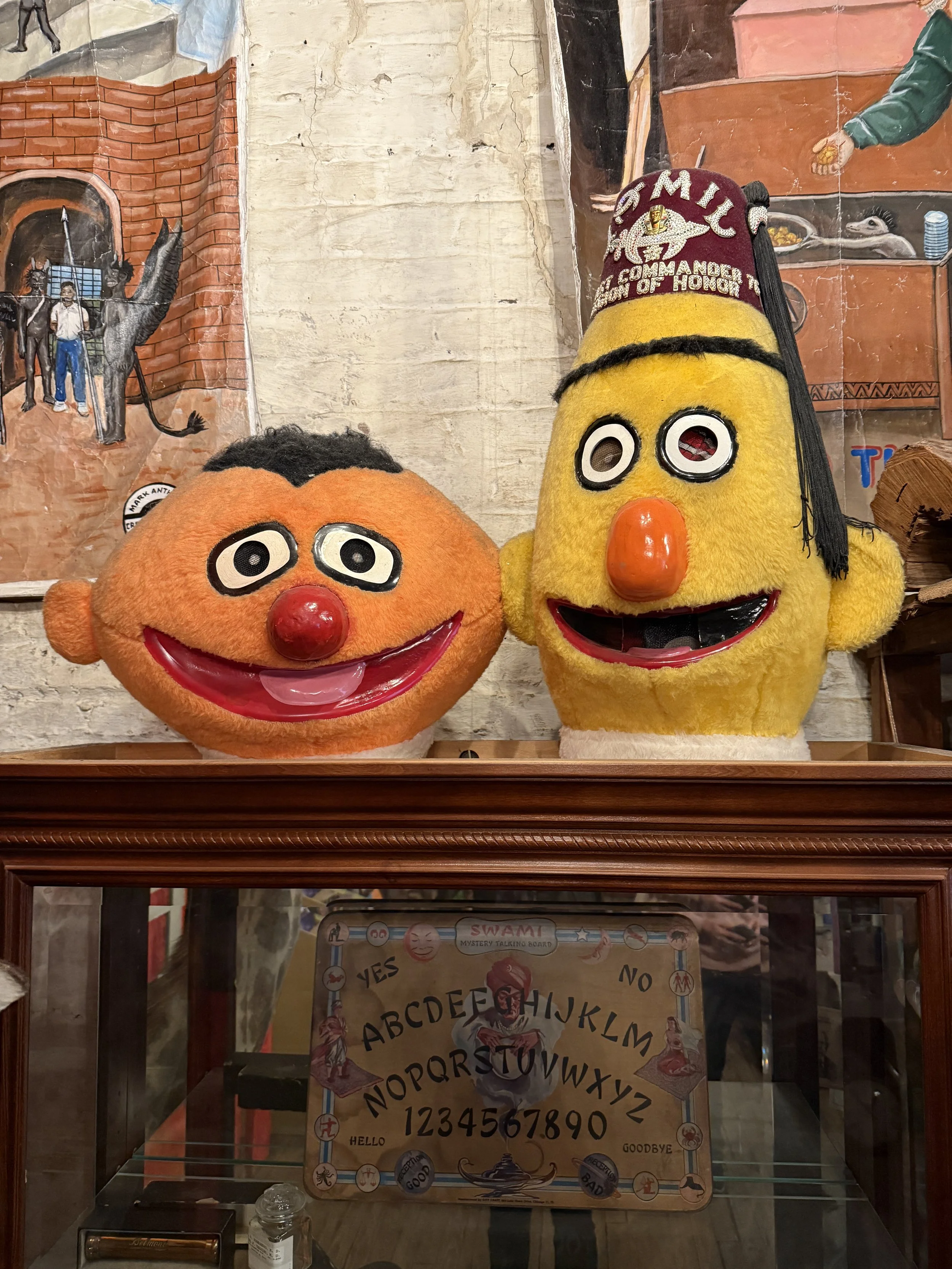
Old cloth masks of Ernie and Bert (wearing a fez) from Sesame Street at the Graveface Museum gift shop in Savannah, GA

Sunny days…with a side of terror: Ernie and Bert masks up front

The $25 entrance fee might seem a bit steep, but if you’re into all things weird, it’s worth it. The staff is brimming with enthusiasm, eager to share their knowledge of the unusual. With your ticket in hand, you’re ready to step into a world where the bizarre, the dark and the fascinating collide. Step right up — into the gaping maw of a bright red devil.

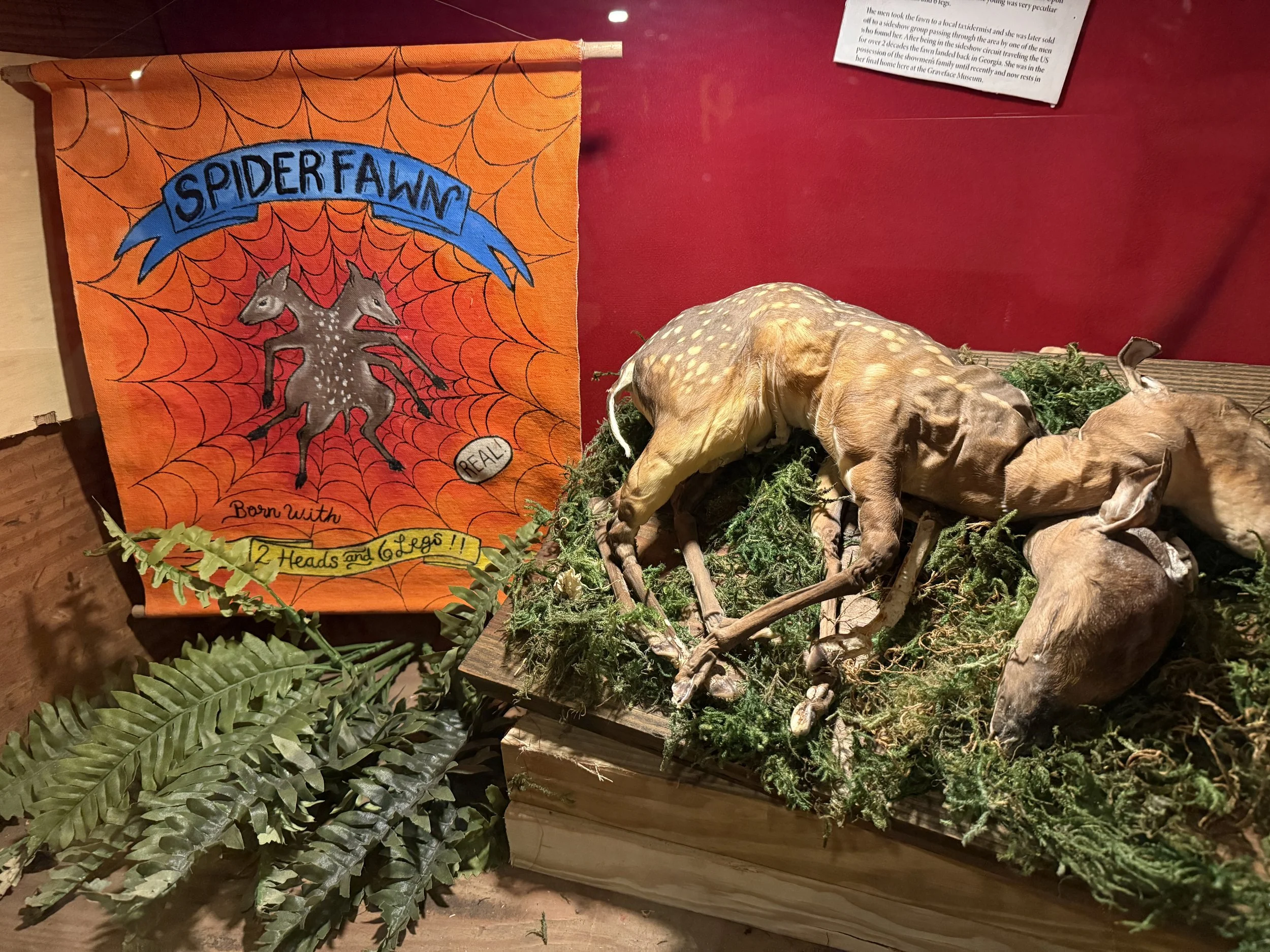
Taxidermied remains and sideshow poster of Spiderfawn, a malformed baby deer with two heads and six legs, at the Graveface Museum in Savannah

The first room of the museum houses medical oddities like the Spiderfawn.

The Tour Begins: Roadside Oddities

The first room welcomes you into a world of roadside curiosities — an homage to the kitschy, the creepy and the oddly endearing. Here, you’ll find displays of “freaks of nature”: a taxidermied faun with two heads and extra legs, and Clementine, a calf with five legs — a mix of biology gone awry and human fascination with the unnatural.

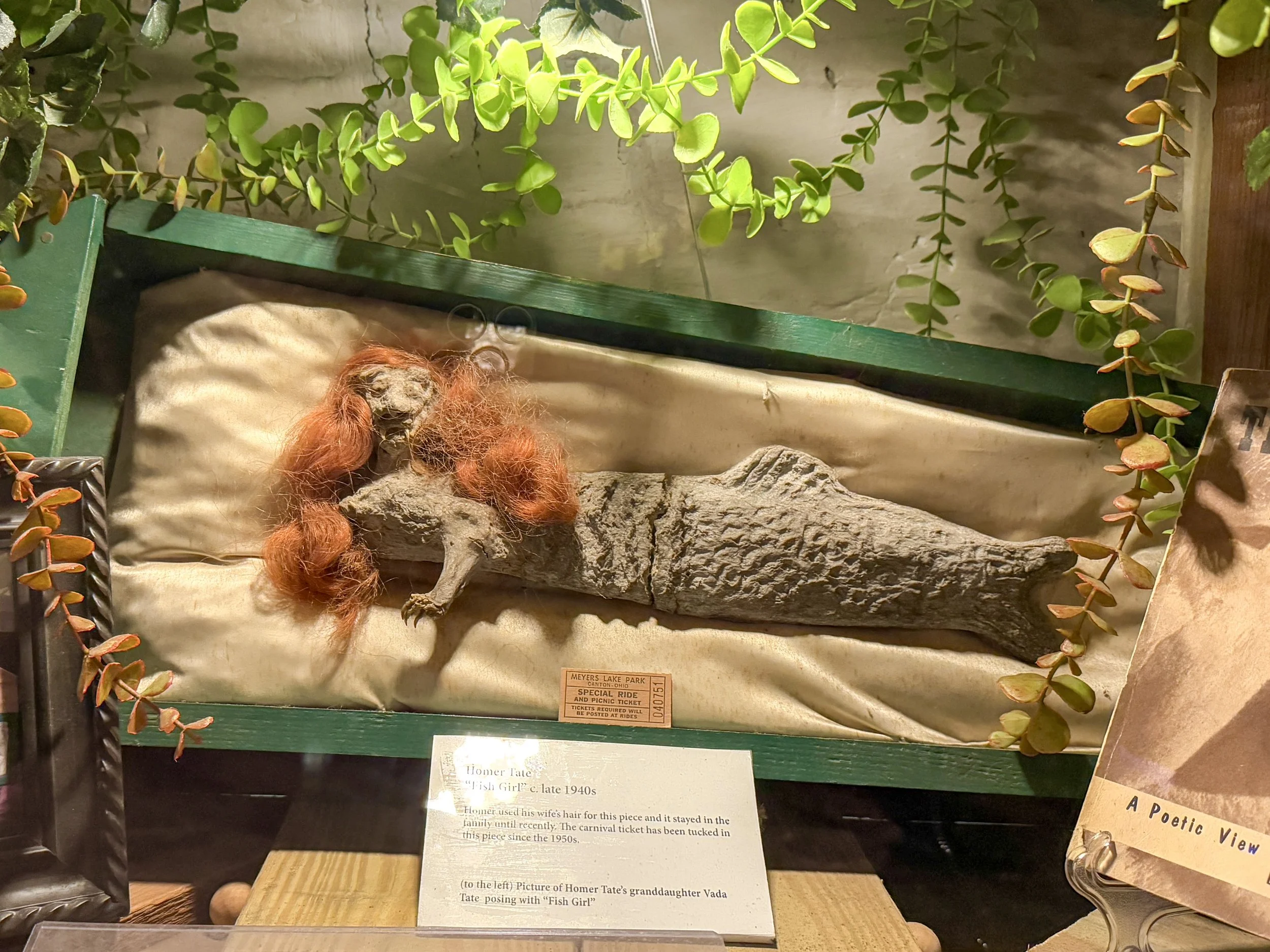
But not everything is what it seems. This room dives into the art of Homer Tate, nicknamed the “King of Gaffes” for devising grotesque, cobbled-together creations that once dazzled and duped carnival-goers, including a few variations of the infamous Fiji mermaid. Our favorite was the one called Fish Girl, which incorporated the red hair of Tate’s wife and a cat’s teeth. 

Fish Girl, a gaffe by Homer Tate, a Fiji mermaid hoax with red hair, at the Graveface Museum in Savannah, Georgia

This Fiji mermaid is a hoax by Homer Tate, who used his wife’s hair and his cat’s teeth.

Apparently, Tate also produced shrunken heads — some fake, some real! — and was arrested for grave robbing. However, since he was the town sheriff, he didn’t spend have to worry about spending time behind bars.

Also in this first room are dioramas of taxidermied critters that reveal a peculiar Victorian obsession: crafting miniature scenes featuring preserved animals in quirky, anthropomorphic roles. These whimsical displays, once popular showpieces for the 19th century elite, straddle the line between charming and unsettling. Our favorite? A tiny circus featuring prematurely born kittens as the star performers — walking the tightrope, balancing on balls and delighting an imaginary crowd. What else would you expect from the generation that created death photography?


Taxidermy and old poster of Clementine, the 5-Legged Cow, at the Graveface Museum in Savannah

Cute l’il Clementine was born with five legs. You can see the purple mirrored chamber about Heaven’s Gate and alien abductions.

Alien Abductions and Heaven’s Gate

From roadside oddities, you’re transported into a small, mirrored room that feels like stepping into another dimension. This space is dedicated to UFO lore, alien abductions, and one of the most infamous cults of modern times: Heaven’s Gate. A  video loop of its founder anchors the exhibit and offers a chilling glimpse into the cult, whose members believed they would ascend to an alien spacecraft trailing the Hale-Bopp comet. 

The room’s mirrors amplify the eerie vibe, reflecting the otherworldly artifacts and making you feel like you’ve entered a cosmic echo chamber.


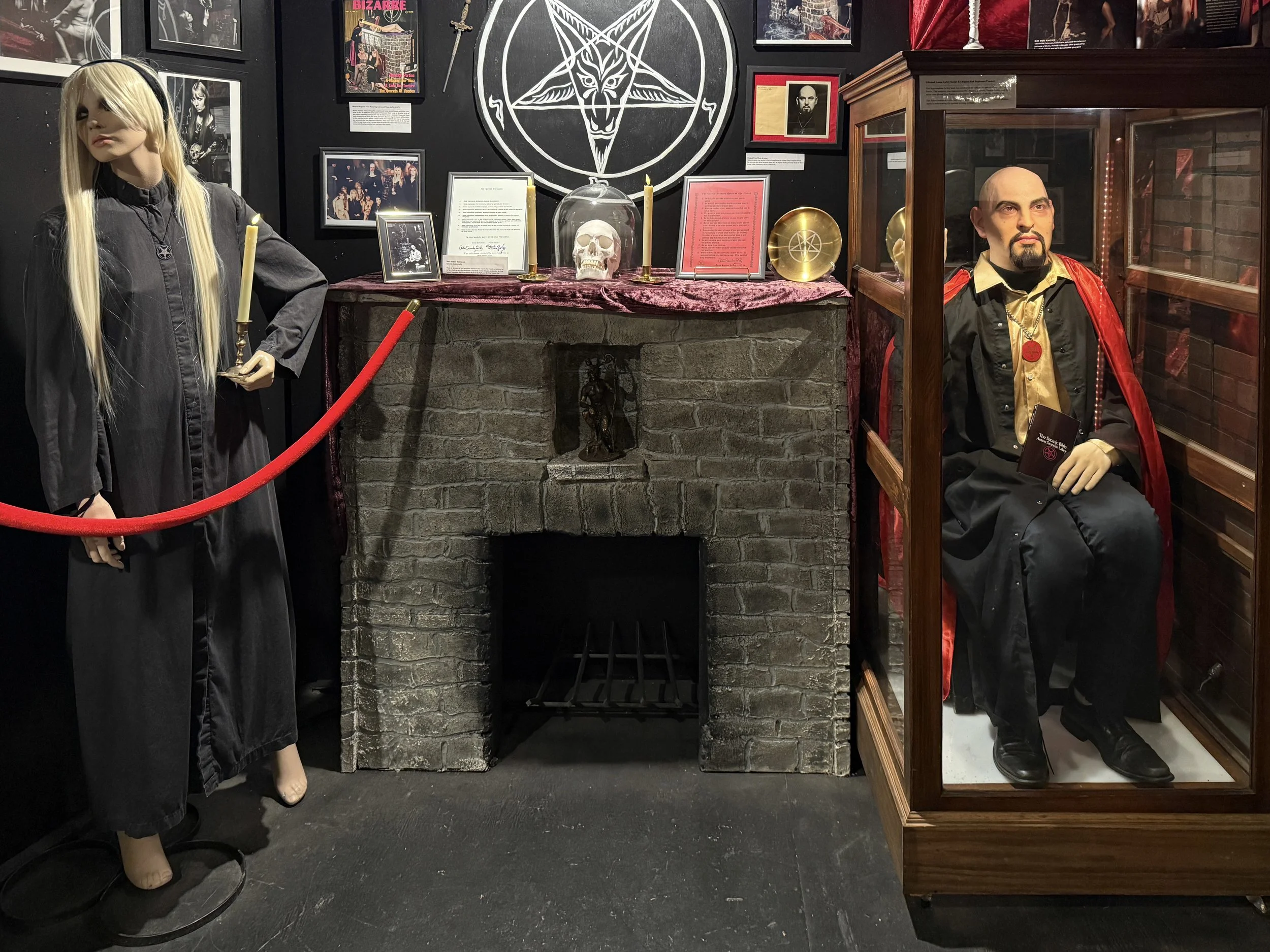
Two mannequins on either side of a fireplace, one of a blonde woman in black, the other of Anton LaVey, founder of the Church of Satan, at the Graveface Museum, Savannah

The mannequin on the right is of Anton LaVey, who founded the Church of Satan.

Satanism and Secret Societies

The next stop on our journey delved into the forbidden, the misunderstood and the hidden corners of belief systems. 

One room is dedicated to Satanism, with a focus on the Church of Satan and its theatrical founder, Anton LaVey, whose philosophy challenged societal norms and fueled decades of controversy. Sexual liberation played a major part in LaVey’s teachings, and he encouraged members to embrace it. LaVey contended that living in a society in which we repress our natural urges and instincts results in unhappiness. 

From there, we entered a room dedicated to Christianity and secret societies like the international Order of Oddfellows. Artifacts from these groups reveal a fascinating interplay between faith, ritual and mystery. 

The juxtaposition of these belief systems — one often feared and the other foundational to Western culture — invites you to ponder the fine line between the sacred and the profane.

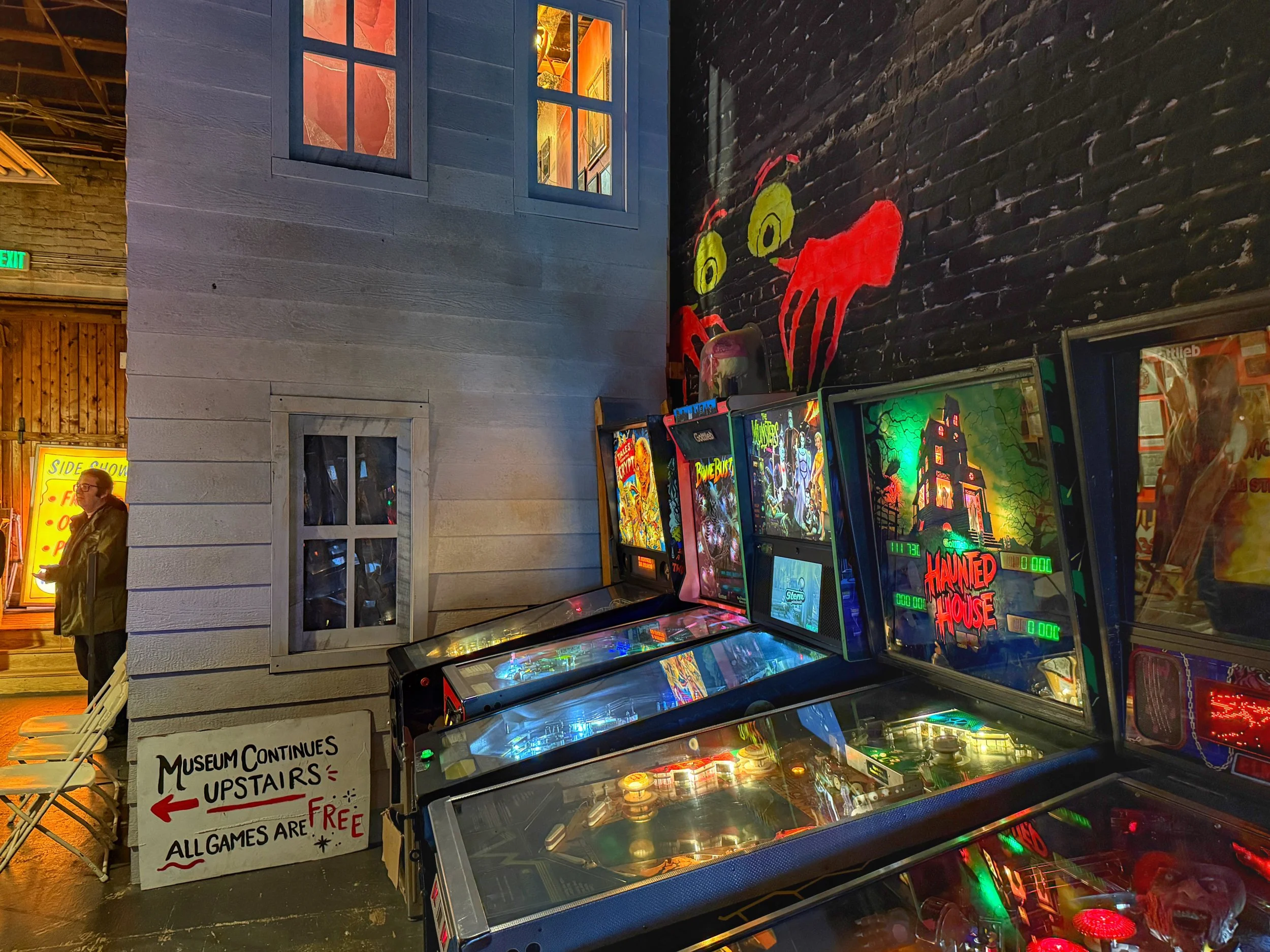
Row of pinball machines inside the Graveface Museum in Savannah, GA

Stop and play some pinball to prep yourself for a (serial) killer ending.

The Pinball Arcade

Just when the heavy, dark vibe starts to settle in, the museum offers a much-needed breather: a room filled with vintage pinball machines. It’s a welcome shift in atmosphere, adding a playful, nostalgic charm to the experience.

Of course the lineup features creepy classics like The Addams Family, Dracula, and Halloween, a perfect nod to the museum’s macabre aesthetic. Best of all? These machines are free to play. Whether you’re a seasoned pinball wizard or just looking for a moment to decompress, this quirky arcade is the perfect palate cleanser before diving back into the dark history waiting around the corner.

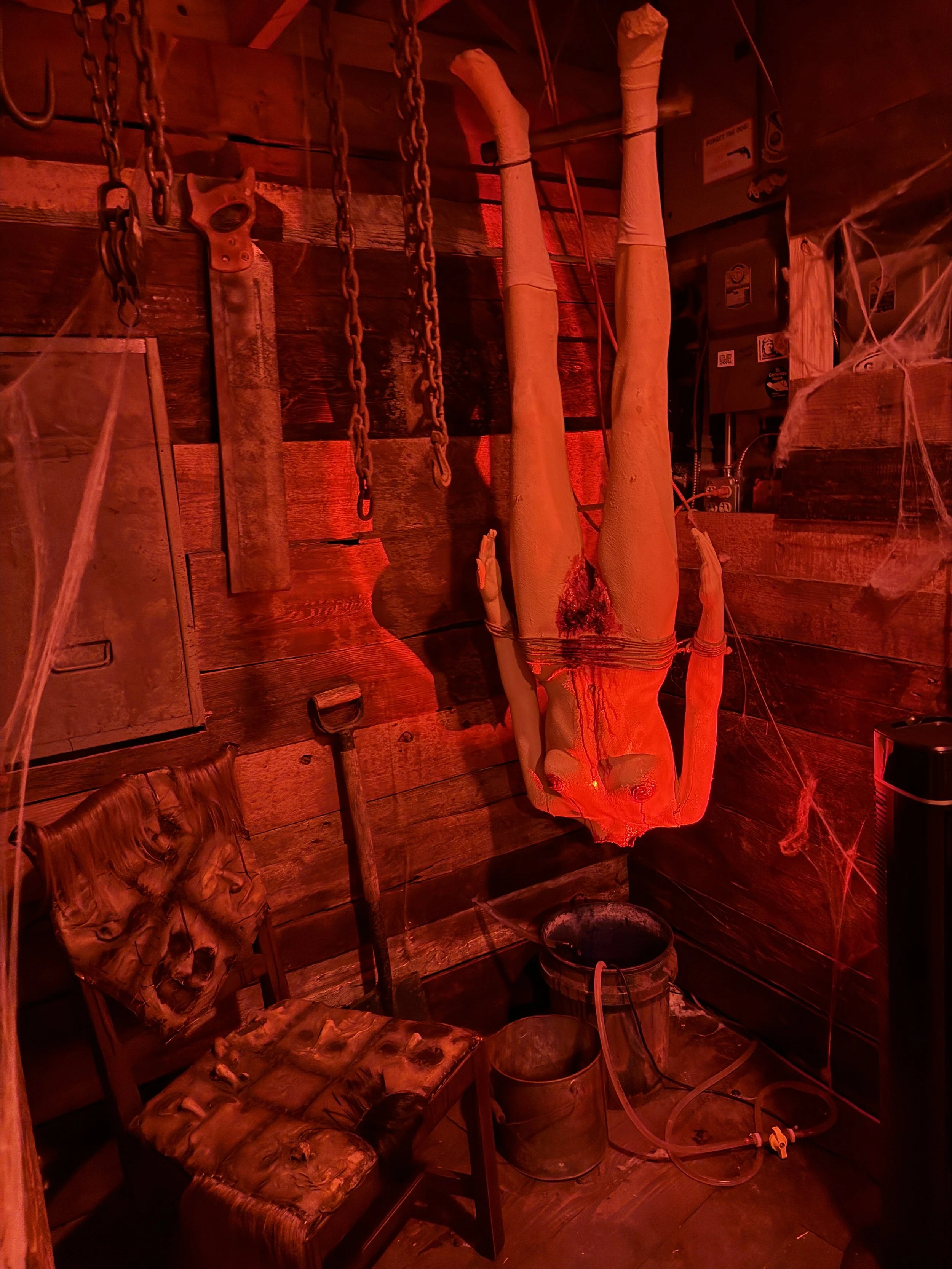
Red light showing a headless female mannequin hanging upside down to show Ed Gein's final victim in the Graveface Museum in Savannah

This macabre display is a re-creation of Ed Gein’s final murder, where he decapitated a woman’s head and mutilated her genitals.

Haunted House: Ed Gein’s World

From pinball nostalgia, you’re thrust into the unsettling world of Ed Gein, aka the “Butcher of Plainfield” — a man whose gruesome crimes blurred the line between true crime and urban legend. The guided tour through Gein’s macabre legacy busts some of the myths that have grown around his name. No, there weren’t lampshades made of human skin or a “nipple belt.” (Gein didn’t even have electricity, and that infamous accessory was a hoax made out of latex.) But yes, he really did use skin to upholster the seat of a chair, and he carried around a nifty keychain made from a piece of his mom’s scalp and hair. 

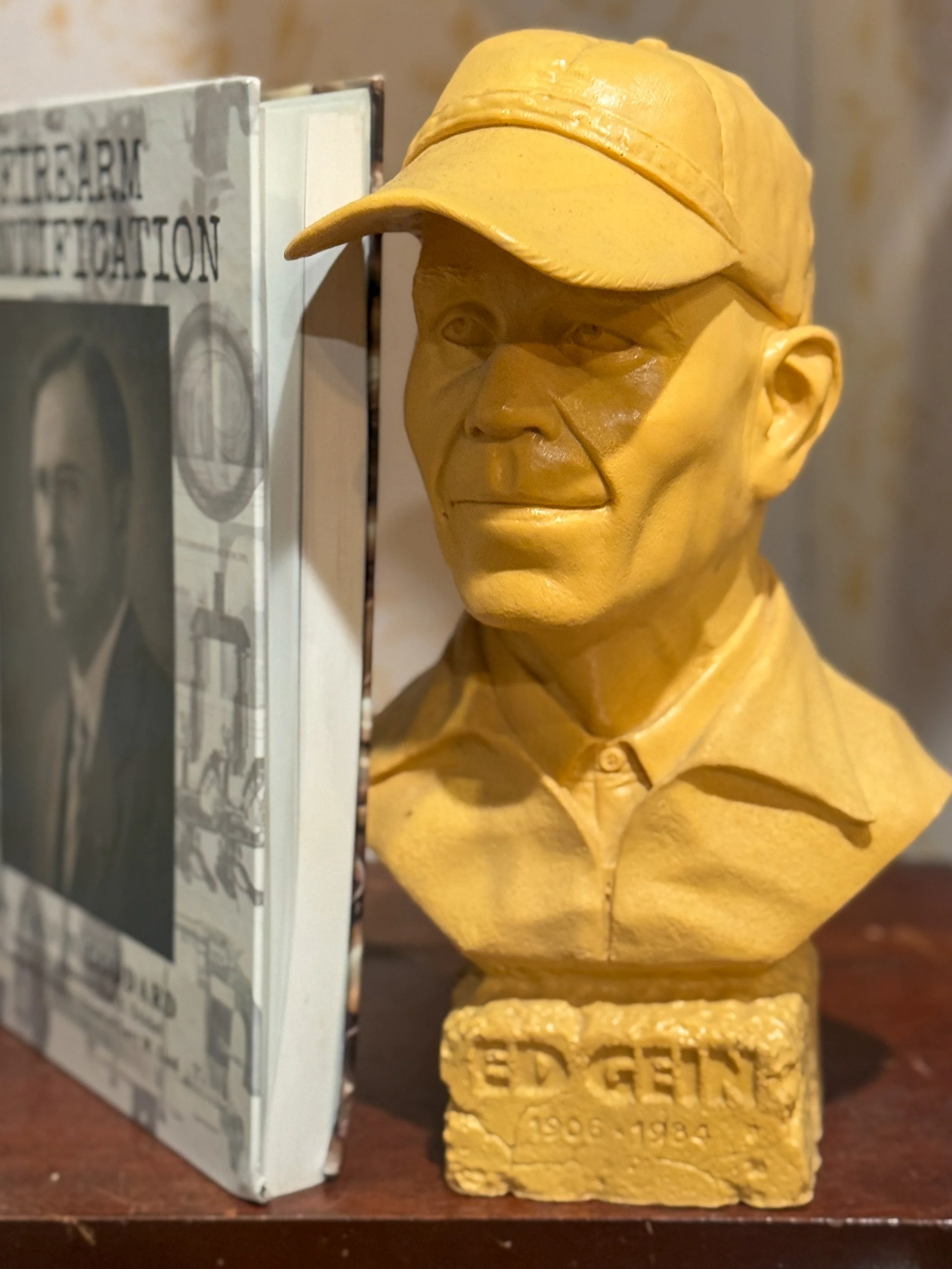
Book and yellow bust of Ed Gein, serial killer

Ed Gein inspired numerous villains in horror movies, including Psycho, The Silence of the Lambs and The Texas Chain Saw Massacre.

Gein, who robbed graves and murdered two women, is the inspiration for countless fictional killers, from Norman Bates to Buffalo Bill and Leatherface. The exhibit doesn’t flinch in showing the grisly details, including a diorama of his final victim. She’s depicted hanging upside down, her head cut off, and her genitals mutilated, revealing the true depravity of his crimes. This was to me the most disturbing aspect of the museum. 

We followed our guide up a staircase lined with grisly black and white crime scene photos of mob hits that reminded me of the work of Weegee. 

And yet, as shocking as it all is, there’s something oddly captivating about Gein himself. The small town simpleton obviously had horrific hidden depths. 

Picture of Pogo the Clown, John Wayne Gacy's alter ego, on the wall at the Graveface Museum in Savannah

John Wayne Gacy dressed up like a clown…when he wasn’t torturing and murdering young men and boys.

Upstairs: John Wayne Gacy’s Disturbing Legacy

Climbing the stairs to the section dedicated to John Wayne Gacy, the infamous “Killer Clown,” felt like stepping into an even darker realm of horror. In this room, our guide, her tuna fish can earrings jangling as she spoke, recounted the grim tale of Gacy. He was a seemingly ordinary married man from suburban Norwood, Illinois, who, during the 1970s, tortured, sexually assaulted and murdered (not necessarily in that order) 33 boys and young men. Gacy's preferred method of killing was strangulation, chillingly referred to as his "rope trick." 

One wall of the museum is dedicated to the faces of Gacy’s known victims — a haunting tribute to the young men whose lives he stole. Seeing their photos lined up, it’s impossible not to picture the unimaginable horrors they endured.

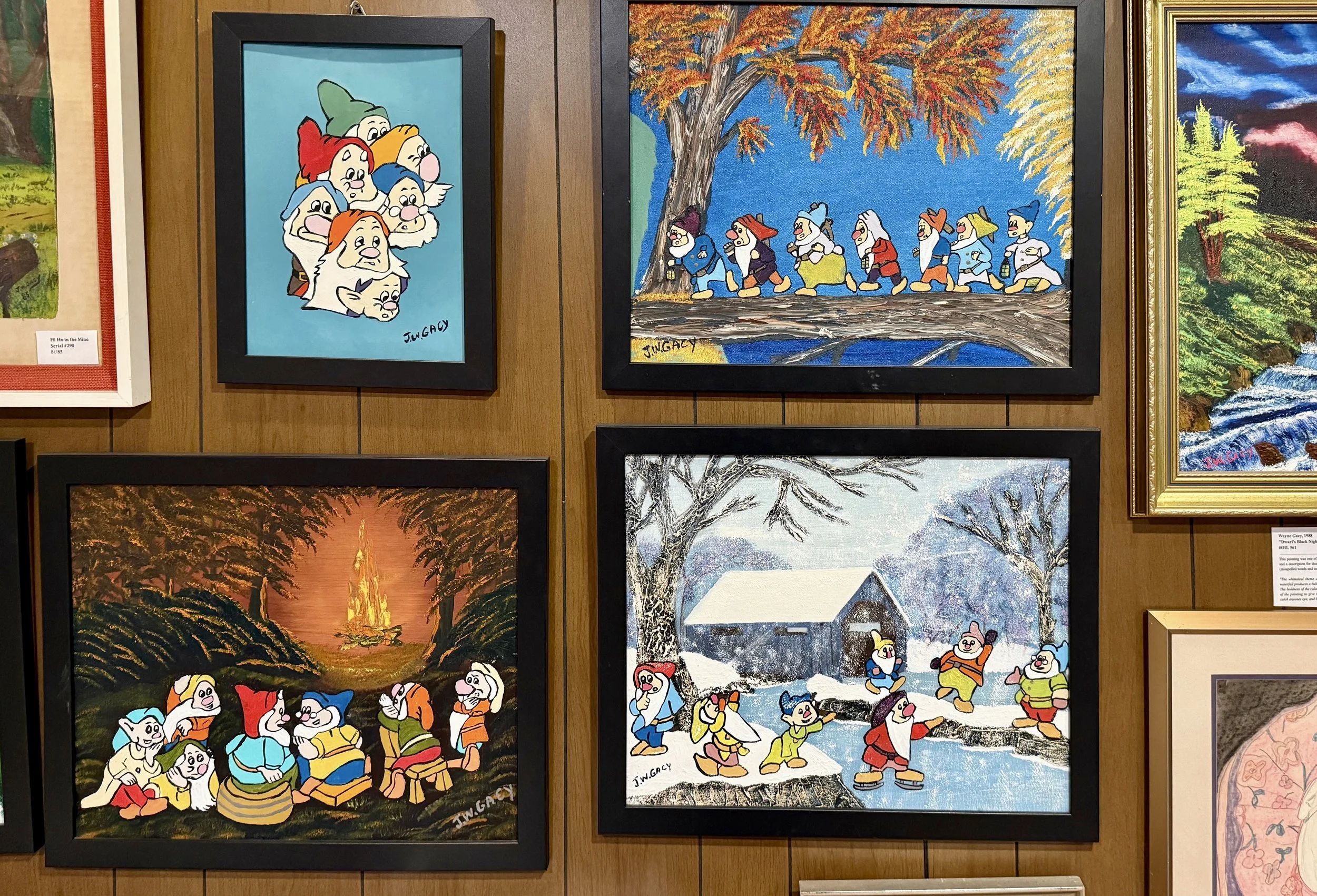
Paintings of the Seven Dwarves by serial killer John Wayne Gacy

Many of Gacy’s paintings were of the Seven Dwarves — a reflection of a childhood obsession

But what sets this room apart is the strange, surreal focus on Gacy’s art. Displayed prominently are his original paintings, including a series of the Seven Dwarves (Snow White is notably absent). Gacy’s clown paintings are equally unnerving, given his former role as a community entertainer in full clown getup.

A list of prices reveals that back in the 1990s, you could pick up a Gacy painting for a mere 100 bucks (or $270 nowadays). Today, their value has skyrocketed as collectors clamor for a piece of true crime infamy — a disquieting reminder of our society’s fascination with killers.

Keep an eye out for a documentary the Graveface gang is working on about Gacy. 

Man makes funny face by old circus sign that reads, "Side Show: Freaks, Oddities, Pecurliar — Why? Alive" at Graveface Museum in Savannah

Wally put his best freak on to try out to be a permanent exhibit at the Graveface Museum.

A Must-See for Oddities Enthusiasts 

The Graveface Museum isn’t for the faint of heart — if you’re squeamish or prefer your history without a macabre twist, it’s best to give this one a pass. But for those intrigued by the intersection of the bizarre and the dark, it promises a one-of-a-kind experience.

From taxidermied curiosities and cult artifacts to the unsettling tales of Ed Gein and John Wayne Gacy, the Graveface Museum balances horror with history, never veering into exploitation, but refusing to shy away from the unsettling truths of human nature And let’s not forget about the free pinball!

Whether you walk away fascinated, haunted or simply grateful for the ordinary comforts of your own life, one thing is certain: The Graveface Museum will stick with you long after you’ve left its eerie halls. –Wally


SEE ALSO:
The Oddities Flea Market

Death masks and other delights!


The Deets

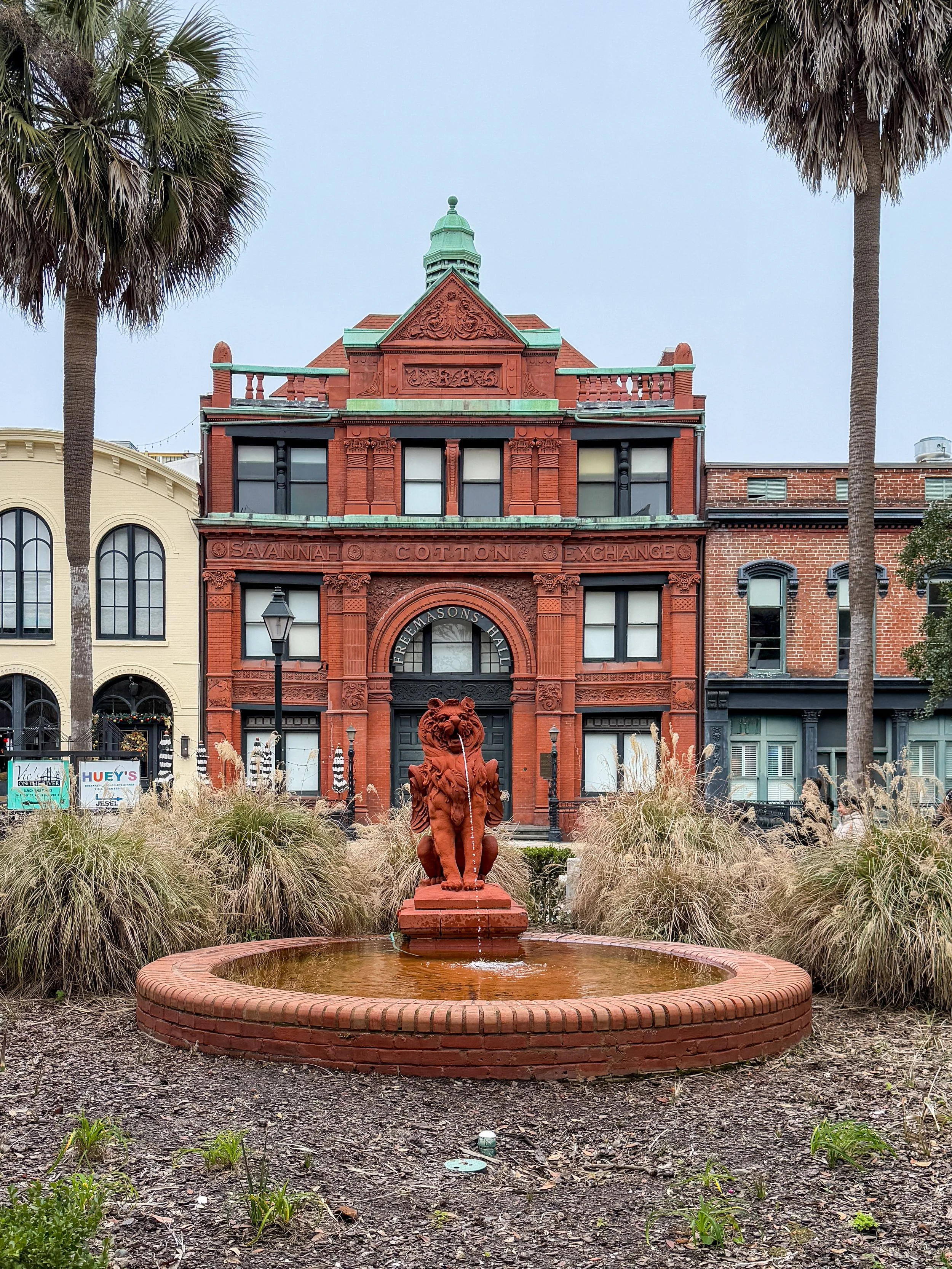
Brick exterior of Freemasons Hall in Savannah, Georgia, with a fountain of a lion spouting water out front

When yoiu see Freemasons’ Hall, you’re close. Find the fittingly creepy Lower Factors Walk between Bay and River.

Location

The Graveface Museum is tucked away at 410 East Lower Factors Walk, a strange little in-between street near Savannah’s waterfront. It’s not quite street level and not quite below it, but rather a cobblestone thoroughfare sandwiched between River Street and Bay Street. 

If you’re driving, nearby parking can be tricky, so plan ahead or prepare to walk a bit.

Admission
Tickets cost $25 per person, which includes access to all exhibits and the free-play pinball arcade. 

Hours of Operation
Monday through Saturday: 11 a.m. to 7 p.m.
Sunday: 12 p.m. to 6 p.m.

Hours may vary, so it’s always a good idea to check their website or call ahead before visiting.

Graveface Museum

410 East Lower Factors Walk
Savannah, Georgia 31401
USA