The Seussian Whimsy of Gaudi’s Park Güell

If this colorful city park overlooking Barcelona is what failure looks like, sign us up!
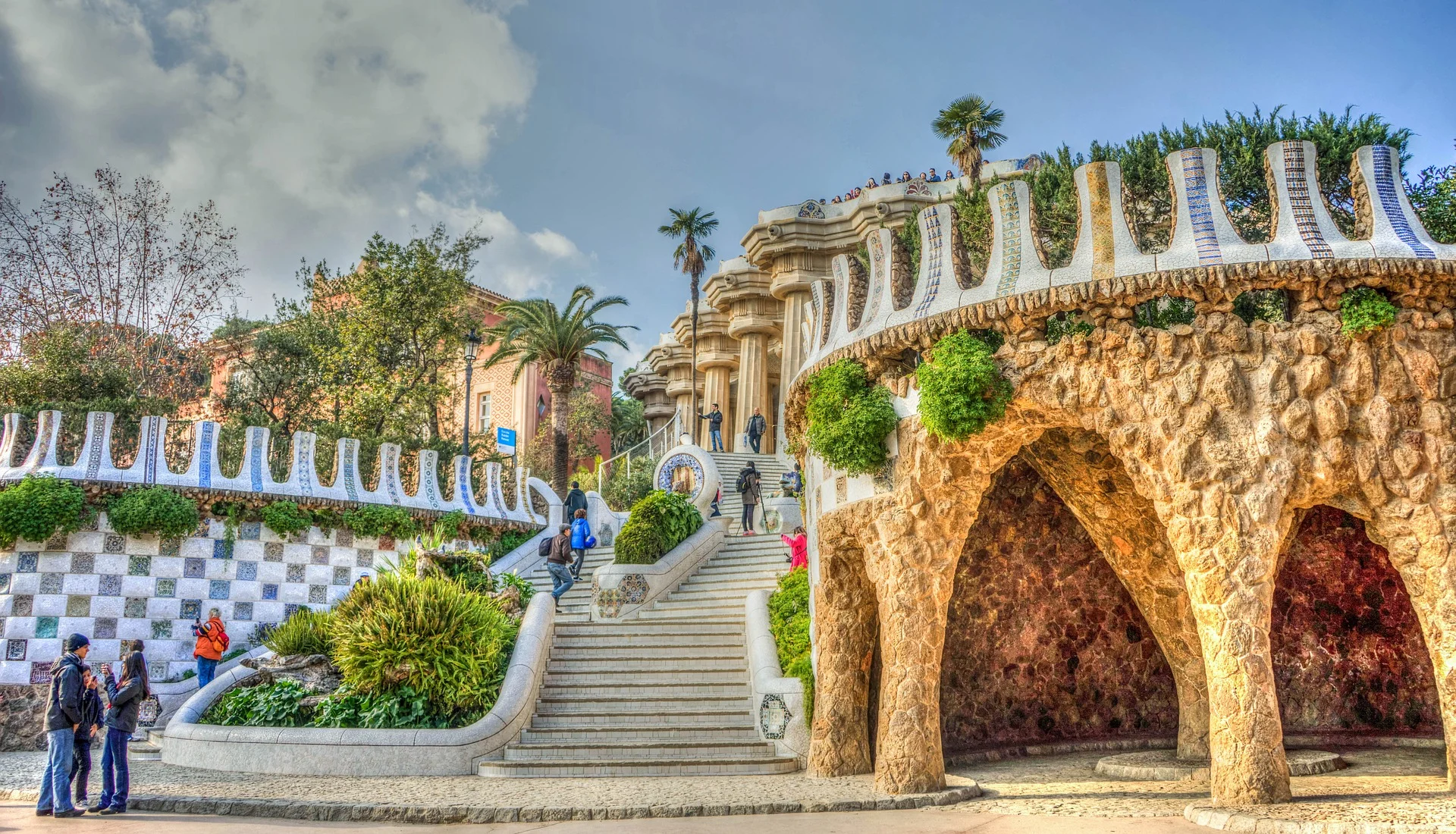
The colorful curves of Park Güell are like something out of a Dr. Seuss book

The colorful curves of Park Güell are like something out of a Dr. Seuss book

When industrialist Count Eusebi Güell needed help transforming Montaña Pelada, Bald Mountain, into a one-of-a-kind residential enclave, he called upon his friend Antoni Gaudí. The two shared similar ideological beliefs: Gaudí was a spiritual man whose distinctive style was influenced by his great appreciation of nature as God’s creation. His structural forms mimicked the natural world and imbued life into his architectural masterpieces.

That collaboration led to Park Güell, which was not originally designed to be a municipal park. It was conceived as a luxury residential development with 60 plots just to the north of Barcelona’s city limits by Güell, who made his fortune from the textile industry.

Güell, whom the park is named after, was inspired by the garden city movement popularized in 20th century England, which is why the English word Park was used, rather than the Catalan equivalent, Parc.

He commissioned Gaudí, the Catalan architect responsible for some of the Barcelona’s most iconic landmarks, to create the parklike neighborhood. Gaudí made the most of the site’s uneven terrain, using organic shapes paired with symbolic references to Christianity and Catalan nationalism shared by his patron, Güell. Immediately noticeable when you enter the park is the administrator’s building, with its towering blue and white chimney topped with a gothic cross flower.

The administrative building and caretaker’s lodge are two gingerbread-like houses on the park grounds

The administrative building and caretaker’s lodge are two gingerbread-like houses on the park grounds

Making an Entrance

Wally and I arrived at the park early in the morning and were easily able to purchase tickets, which are limited to 400 people every half hour, to avoid overcrowding. A full price ticket costs 8 euros (or 7.50€ if you purchase them in advance here).

The park is limited to 400 people every half hour

The park is limited to 400 people every half hour

Just inside the entrance are a pair of whimsical lodges that look like lifesize gingerbread houses from the fairy tale “Hansel and Gretel.” These structures, known as the caretaker’s lodge and administration building were designed to attract potential investors. The caretaker’s lodge includes an imaginatively embellished cupola, decorated with upside-down white ceramic coffee cups and supposedly was Gaudí’s way of telling the world he had giving up drinking coffee.

We paused to take a photo with a man dressed as the park’s mascot and symbol of Barcelona, the multi-colored mosaic gecko, known as El Drac, the Dragon (for a small fee, of course).
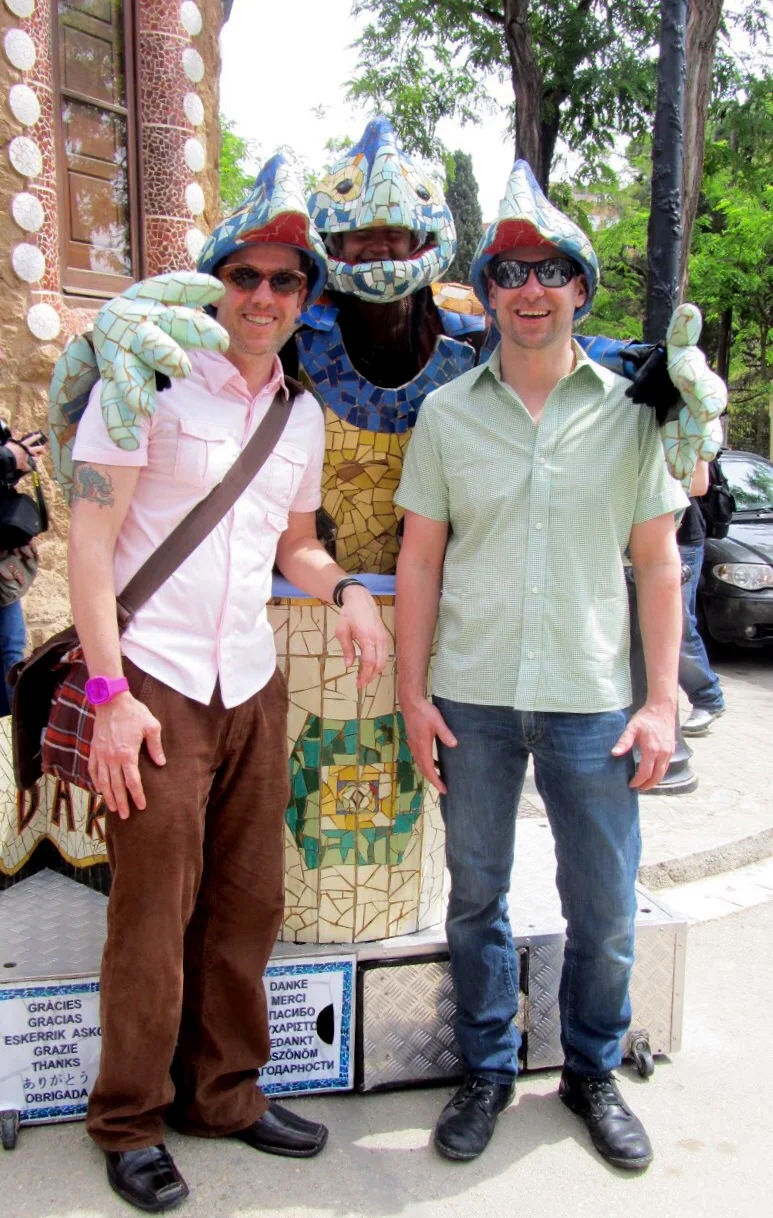
Wally and Duke pose with El Drac, the park’s reptilian mascot

Wally and Duke pose with El Drac, the park’s reptilian mascot

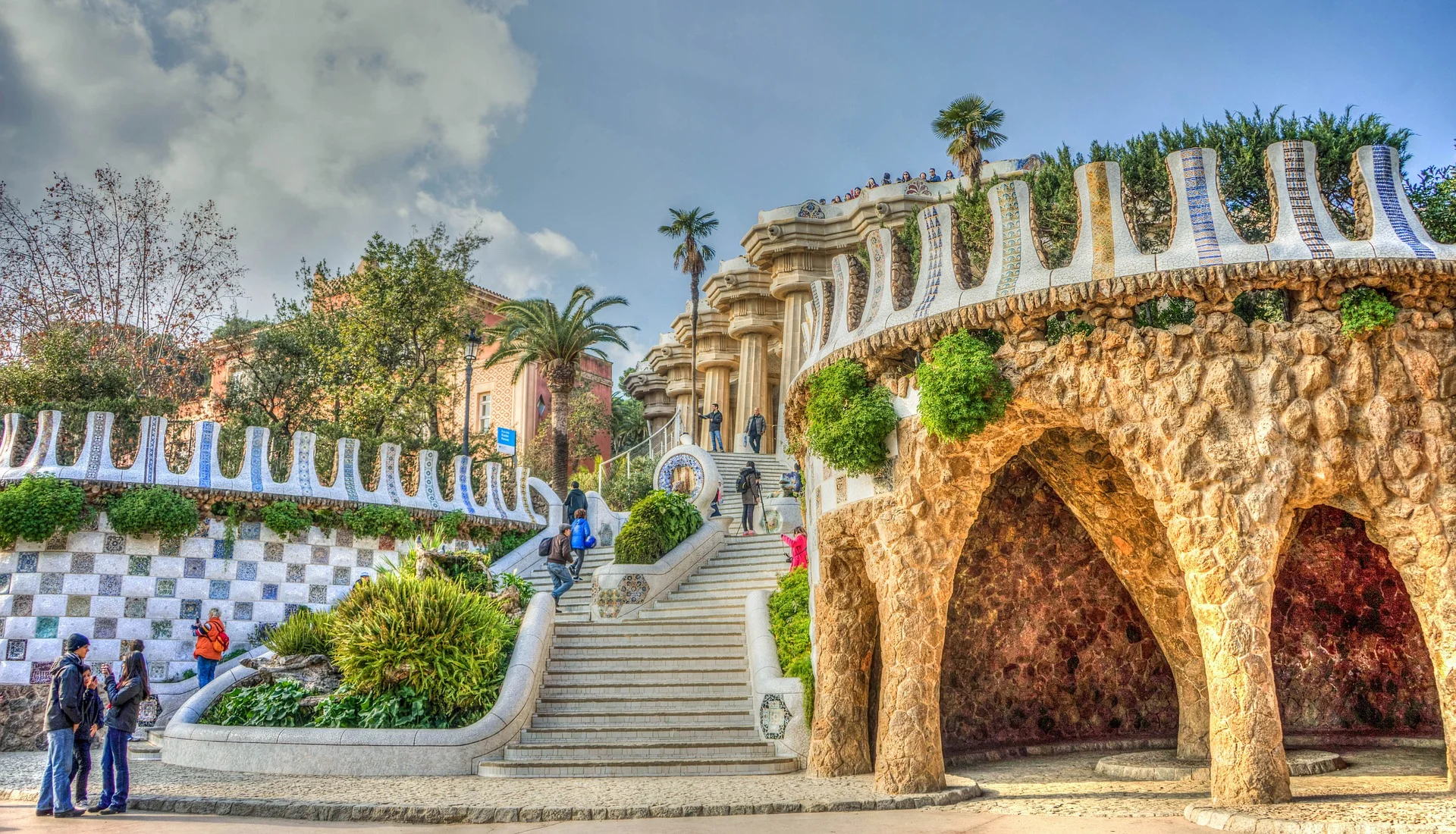
Immediately before us was the magnificent grand staircase. A riot of color, its balustrade and steps are covered with shards of ceramic tiles using a technique known as trencadísis, popular with the Modernisme movement. These fragments were discarded at a nearby factory and selected with great care. The predominant blue, yellow and green tiles symbolize faith, hope and charity, and each fragment is no more than 8 to 10 inches in size.

A mosaic sculpture of El Drac, Gaudí’s gecko — now a symbol of Barcelona

A mosaic sculpture of El Drac, Gaudí’s gecko — now a symbol of Barcelona

Perched at the base of the steps is a depiction of the beloved El Drac, created with frequent Gaudí collaborator Josep Maria Jujol. It’s plausible that Gaudí’s obsessive use of this mythological creature in his designs was influenced by his devout Catholic faith — in particular, the legend of St. George and the Dragon, symbolizing the struggle between good and evil. The likeness of the iconic El Drac is a popular souvenir choice from Barcelona, and you can purchase a variety of items inspired by Gaudí’s gecko throughout the city.
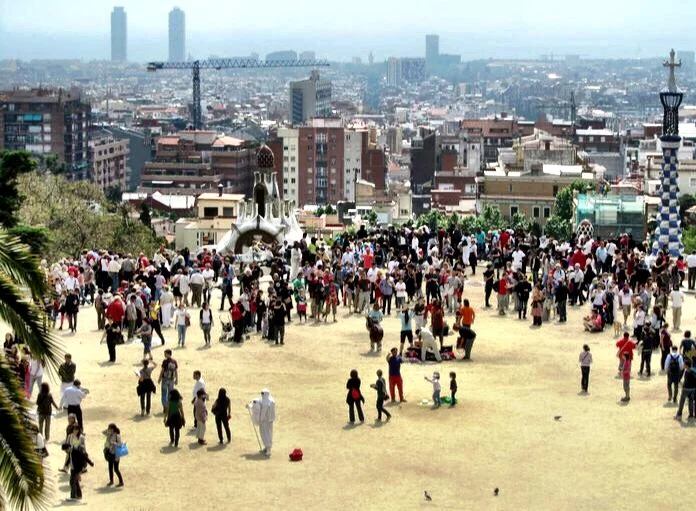
The square above the columned grotto gets crowded with all sorts of interesting people

The square above the columned grotto gets crowded with all sorts of interesting people

The Hall of 100 Columns

After climbing the first flight of steps, Wally and I entered the Sala Hipóstila, Hall of 100 Columns, referred to by Gaudí as the Greek Theater. The pavilion is a forest of 86 columns in the Greek Doric style, mimicking trees, made of mortar and rubble simulating marble. Each of the columns leans slightly and supports the upper plaza terrace above. Rainwater is filtered through the layer of stone and sand from the terrace square and runs through drainage pipes ingeniously concealed within the columns to be collected in a cistern below.
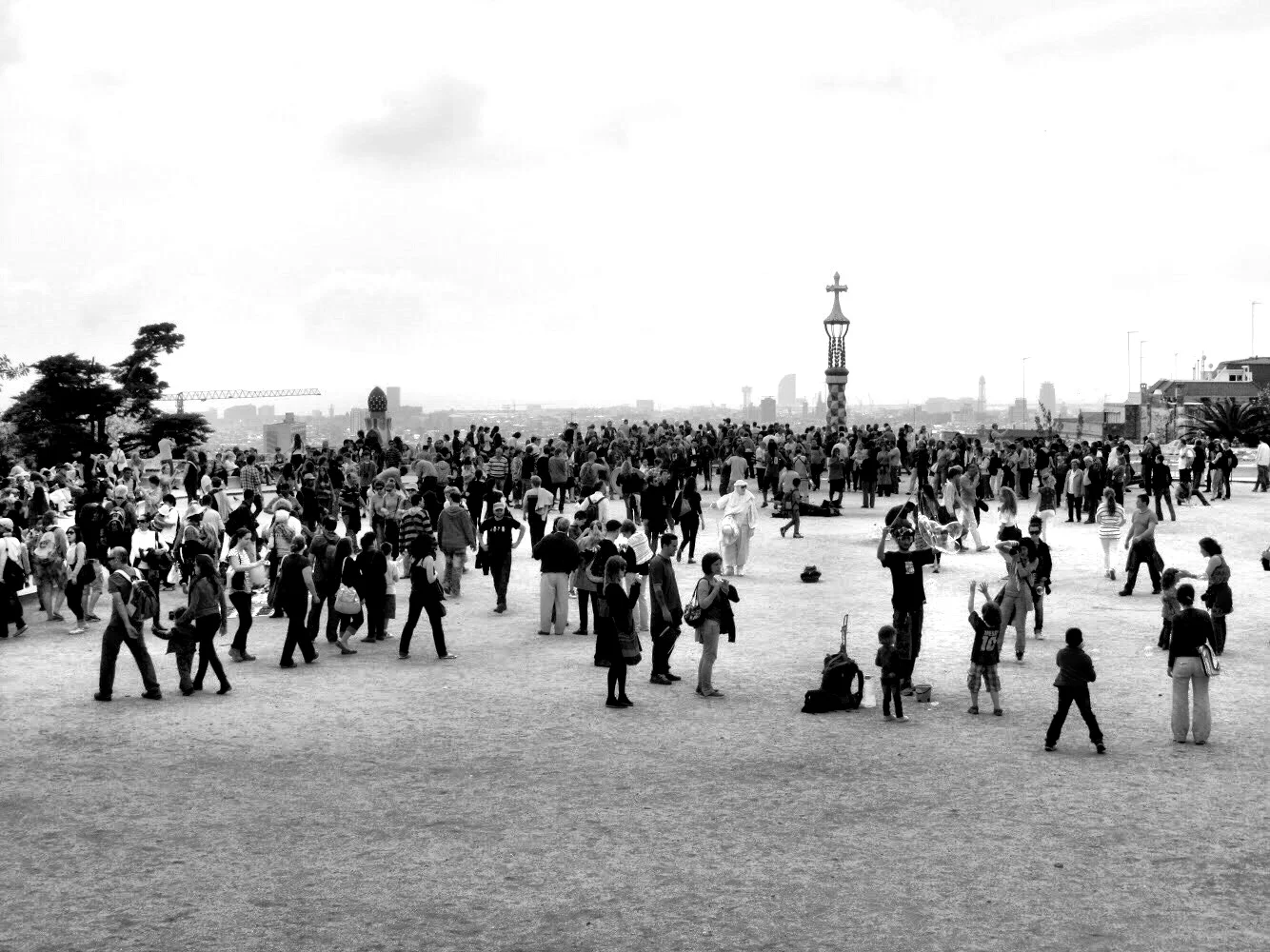
Amorous couples, tourists, kids playing ball and street performers all gather in Park Güell’s piazza

Amorous couples, tourists, kids playing ball and street performers all gather in Park Güell’s piazza

The entire ceiling consists of domes covered with white trencadís as well as brightly colored mosaic circles representing the four seasons and the lunar cycles.
Although this room was originally designed to hold the community’s market, today it is often used as a concert hall, due its impressive acoustics.
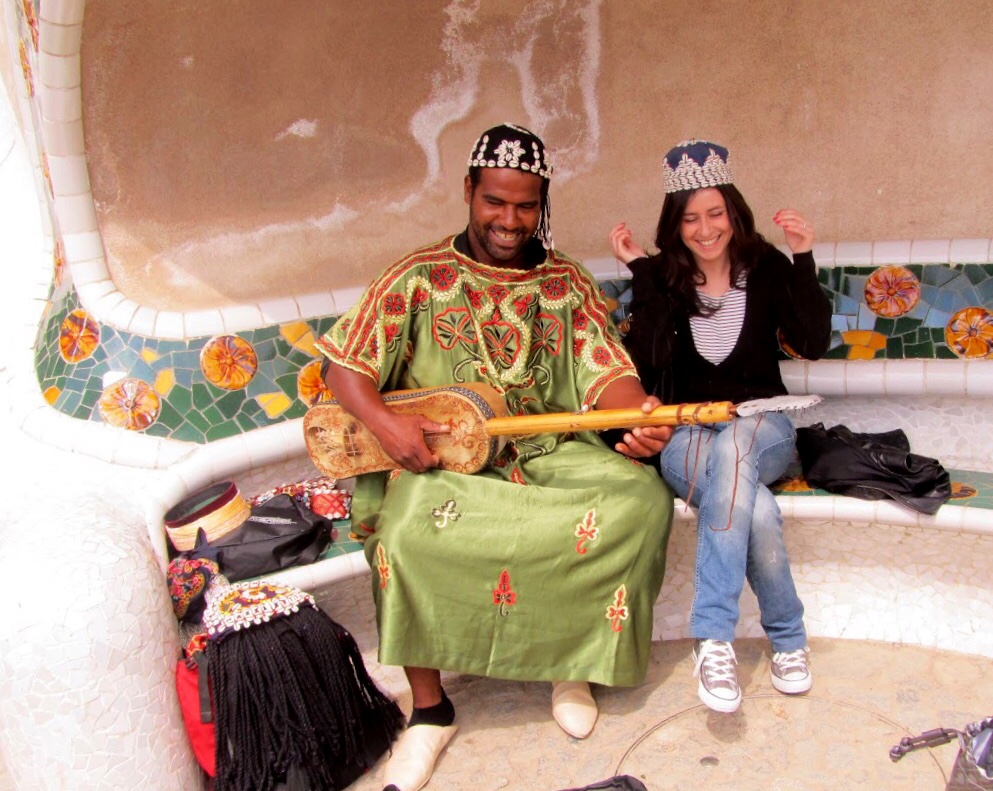
An African man in traditional garb and his new friend test out the aucustics of the Hall of 100 Columns

An African man in traditional garb and his new friend test out the aucustics of the Hall of 100 Columns

The public square, an open earthen terrace, located above the hall is framed by the Banc de Trencadís, a mosaic-tiled bench curving sinuously around its perimeter.
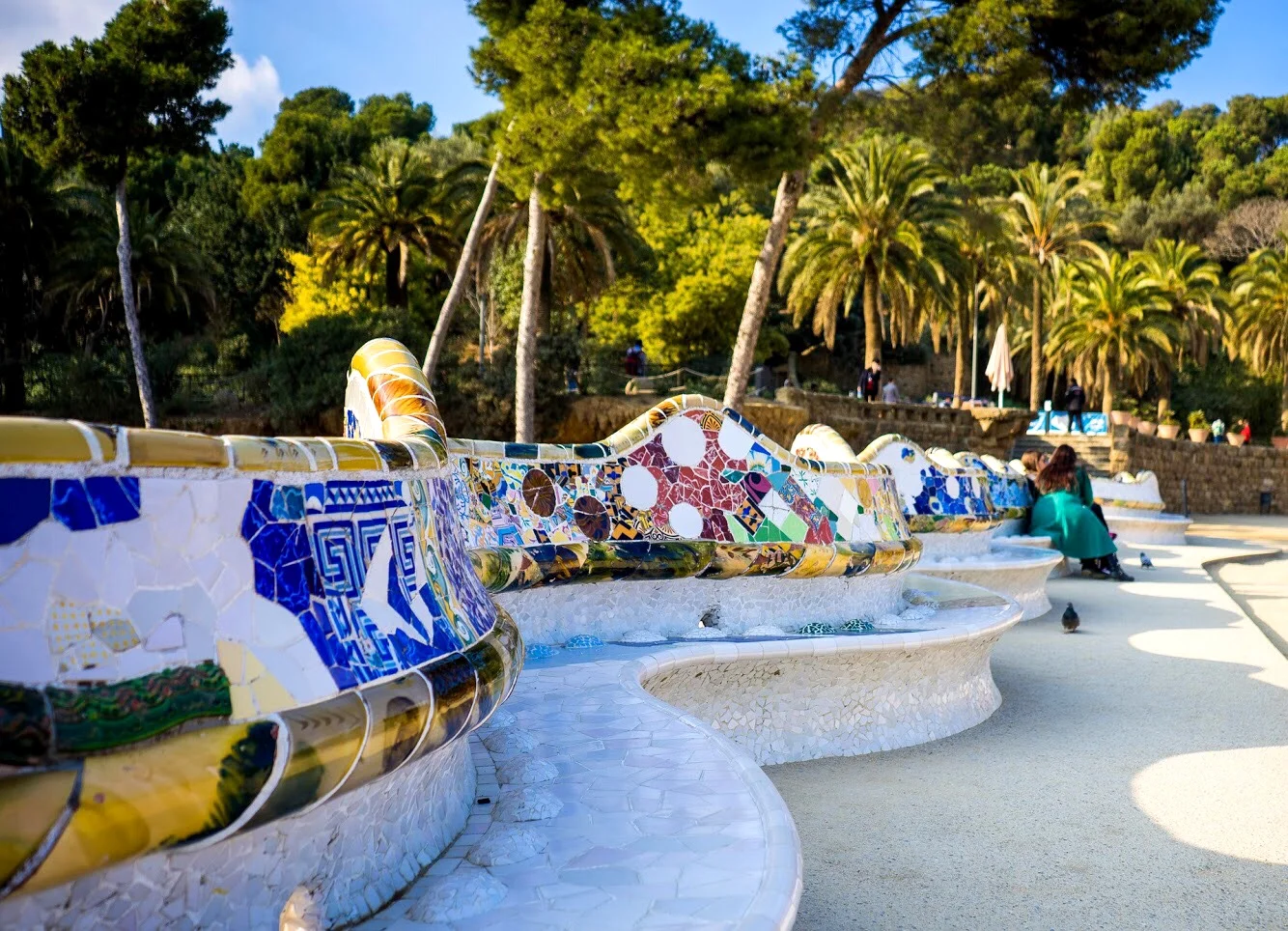
The undulating Banc de Trencadís is a great place to look out over the city

The undulating Banc de Trencadís is a great place to look out over the city

Wally and I stopped at the kiosk and purchased a couple beers. We found a shady spot to sit and take in the spectacular view of Barcelona before us, with the amazing La Sagrada Familia church, still under construction, in the background.

Wally couldn’t believe they sold beer at the park

Wally couldn’t believe they sold beer at the park

Duke says, “Salud to España and Gaudí’s fun aesthetic!’

Duke says, “Salud to España and Gaudí’s fun aesthetic!’

Incidentally, it’s also a great place to people-watch, and we dubbed one of the visitors Catalan Mema, as she was petite and quirky and had a shock of short white blonde hair like my mother. She was also having her hand kissed by an invisible man. Only at Park Güell!
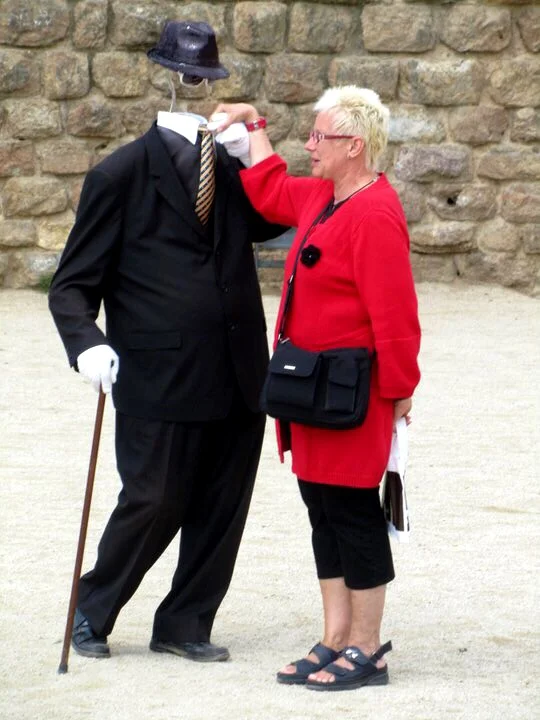
The park is full of colorful characters, including a woman who resembles Duke’s madre — and her invisible man suitor

The park is full of colorful characters, including a woman who resembles Duke’s madre — and her invisible man suitor

The back of the terrace is formed by a row of stone viaducts, remnants of the project’s original design, intended to provide residents access to their individual plots of land.

By 1914, the project was deemed a commercial failure: Not enough people wanted high-class housing so far from the city center.
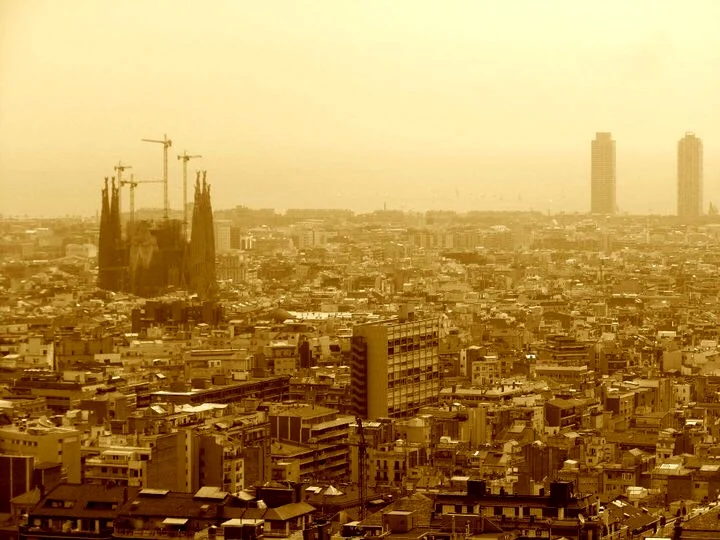
Barcelona — including la Sagrada Familia Church — stretches out below the park

Barcelona — including la Sagrada Familia Church — stretches out below the park

All that remained were the buildings described, as well as an irrigation system and meandering paths created by Gaudí in his inimitable manner. Guëll convinced Gaudí to purchase the park’s model home, designed by Gaudí’s assistant and friend Francesc Berenguer.

Despite its failings as a housing complex, the city purchased the estate in 1922 for use as a public park. But it wasn't until Gaudí’s death in 1926, that Park Guëll officially opened. If you’re visiting Barcelona and looking for an enchanting place to spend an afternoon in this remarkable city, look no further than this surreal architectural landmark. –Duke
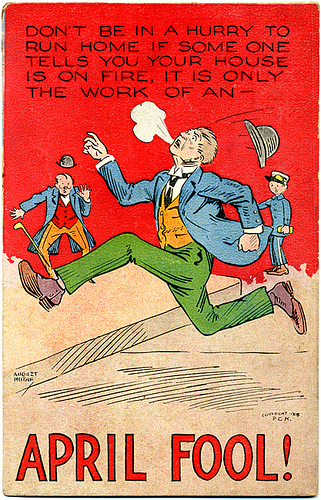
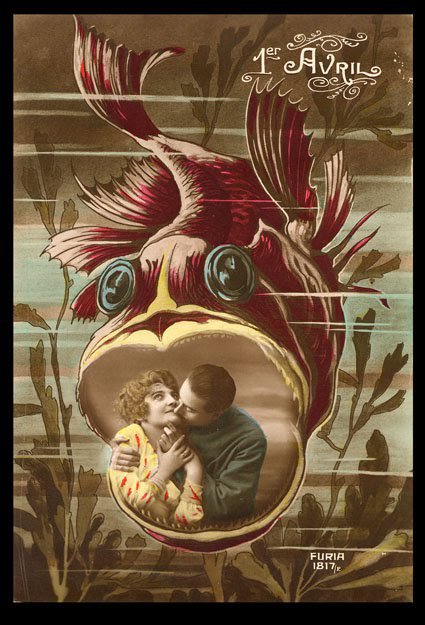
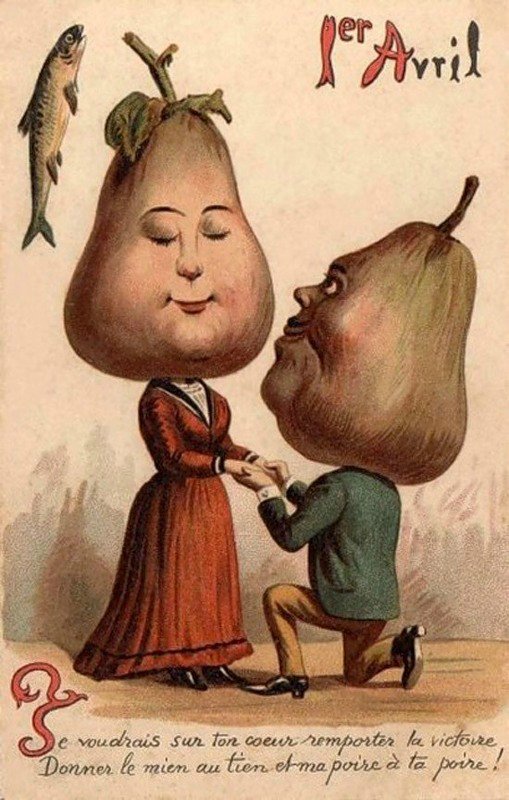
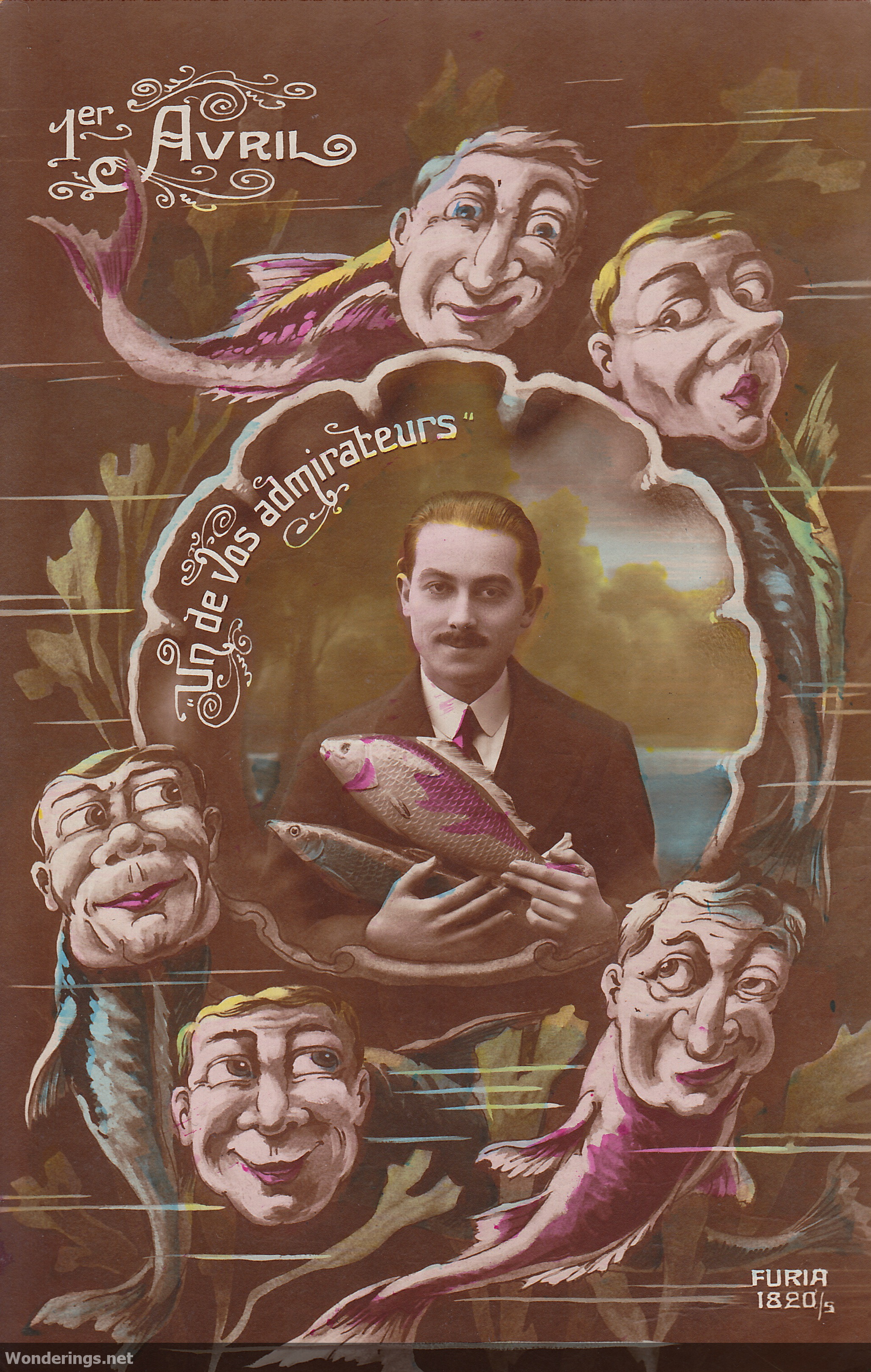
No Fooling: The History of April Fool’s Day and Poisson d’Avril

Learn the origin of April Fool’s pranks — and check out these bizarre vintage April Fool’s Day cards.

I’m not making this up: No one’s 100% sure how April Fool’s Day started, but it probably began when the New Year moved dates

I’m not making this up: No one’s 100% sure how April Fool’s Day started, but it probably began when the New Year moved dates

The flowers begin to bud, robins appear, and a few gorgeously warm days start to sneak their way in. Springtime in Chicago is wonderful — though Duke and I will never forget that early April trip we took to Switzerland, when they were harvesting the spaghetti from the trees. Our timing was perfect; one more week and the limp noodles hanging from the branches would no longer be al dente.

Coincidentally, Easter falls on April 1 this year, as it did in 1957, when the BBC aired a three-minute segment showing people plucking strands of spaghetti from trees. Some viewers even called the BBC, wanting to know where they could purchase their very own spaghetti tree. Of course, it was just an elaborate prank — the first televised April Fool’s Day hoax.

Because spaghetti doesn’t grow on trees, silly.

The Amusingly Mysterious Origins of April Fool’s Day

This isn’t a joke: No one’s completely sure where and when April Fool’s Day started, but they’ve got some pretty good ideas.

A favorite theory is that it has to do with the switch from the Julian calendar, which was introduced by Julius Caesar, to the Gregorian calendar, named for Pope Gregory XIII. The decision was made in 1563 at the Council of Trent. That meant the New Year shifted from the end of March to January 1.

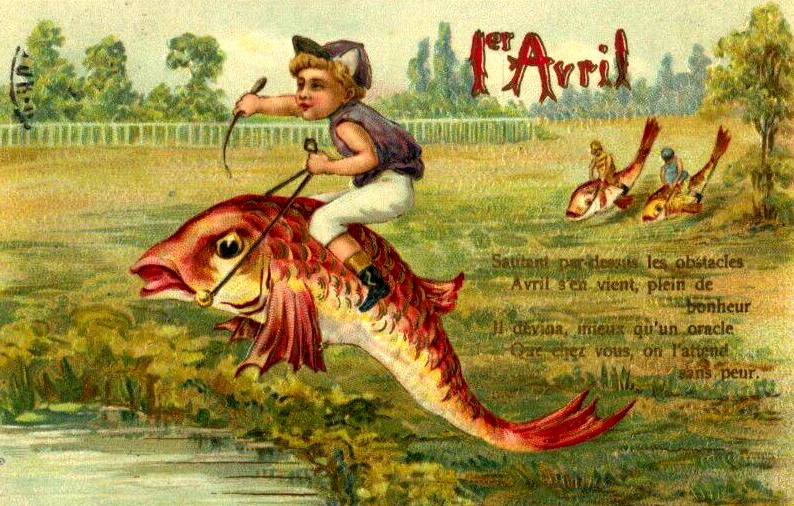
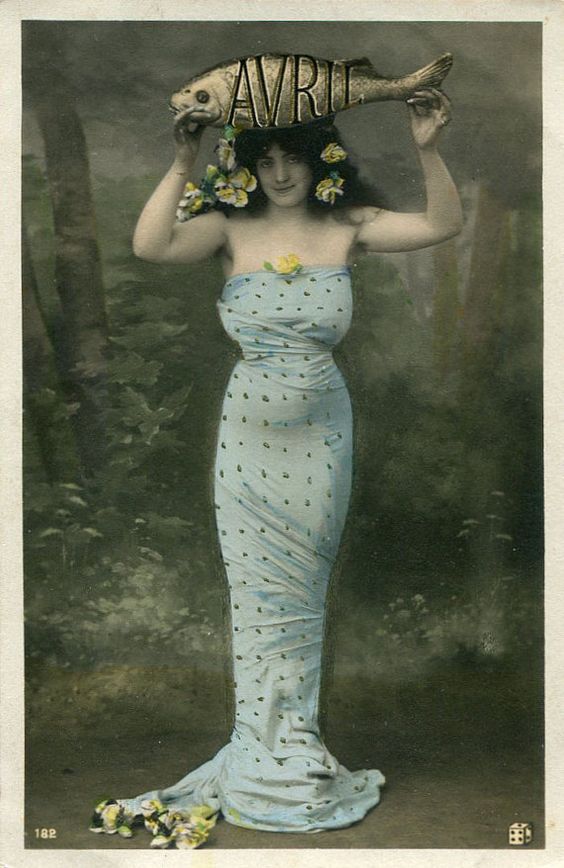
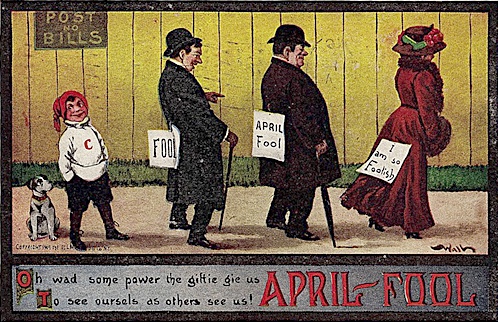
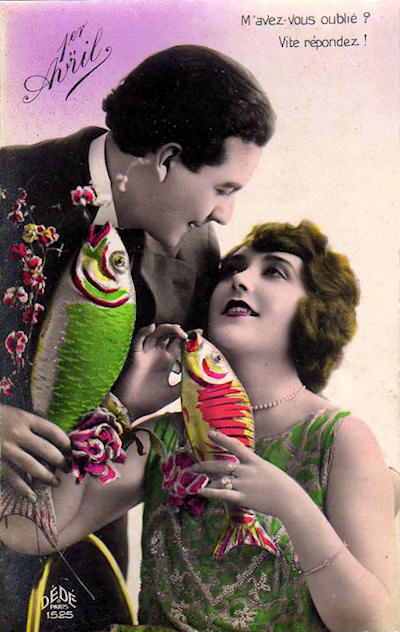
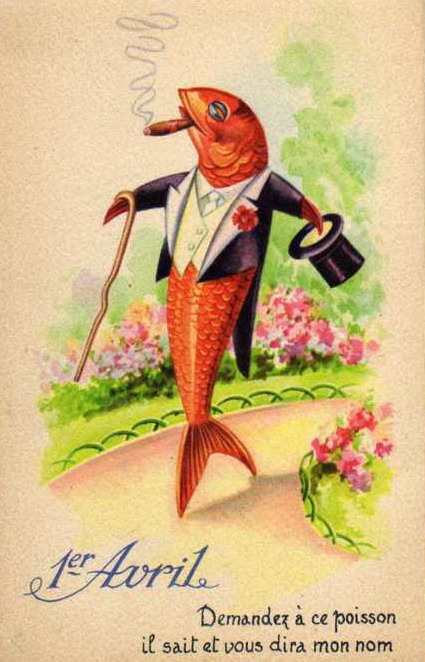
A poisson d’avril symbolized an easily caught fish and, by extension, a gullible person.

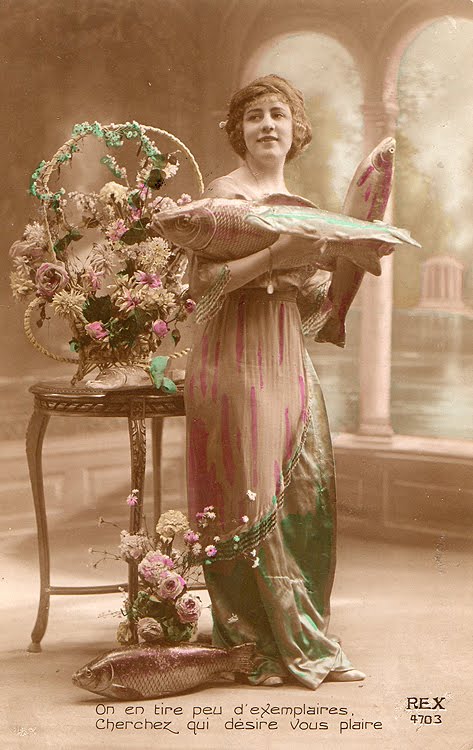
Some years later, in 1582, the French made the calendar switch. Those who didn’t get the memo or refused to play by the new rules were poked fun at and had paper fish (poisson d’avril, or April fish) sneakily placed on their backs. A poisson d’avril symbolized an easily caught fish and, by extension, a gullible person.

It’s also thought that the ancient Greco-Roman festival known as Hilaria (the Day of Joy) is a precursor to April Fool’s Day. This pagan celebration began on March 25, shortly after the Vernal Equinox, to honor Cybele, Mother of the Gods, and the resurrection of her castrated lover (and in some tellings, her son!), Attis.

The festivities conclude on April 1, accompanied by feasts, games, masquerades and practical jokes — hence the association to April Fool’s Day.

Even the Indian holiday Holi, which takes place around this time of year, involves much mischief-making. Associated with the Hindu demoness, Holika, people celebrate the triumph of good over evil by throwing brightly colored powder on each other.

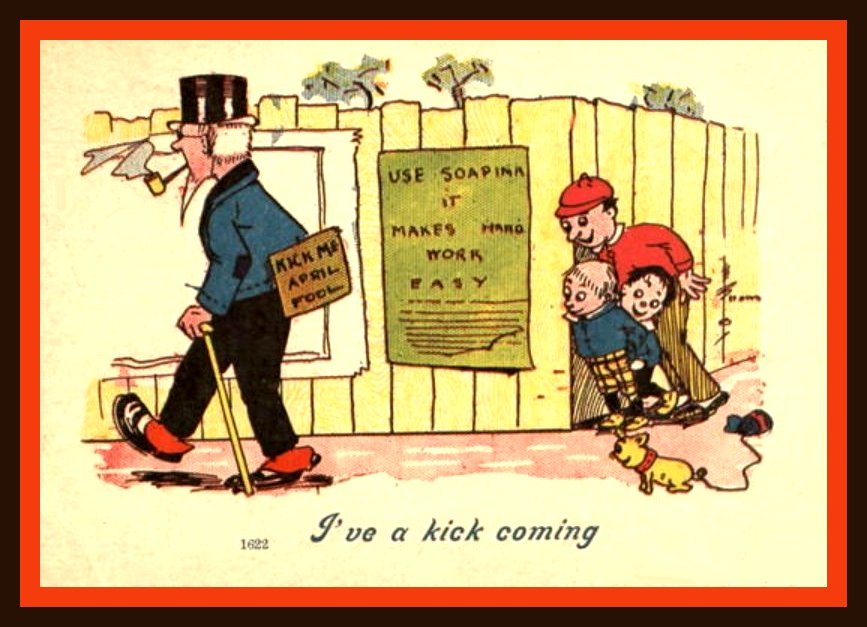
During the 18th century, April Fool’s Day caught on in Britain. The Scottish celebrated a two-day event that started with “hunting the gowk” (a word for the cuckoo, which represents a fool), during which people are sent on wild goose chases. This was followed by Tailie Day, where the butts of jokes had fake tails or Kick Me signs pinned to their backsides.

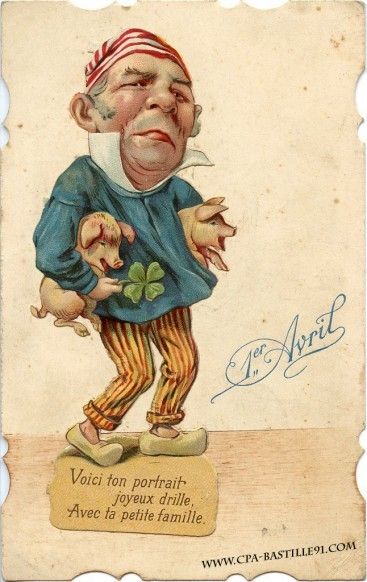
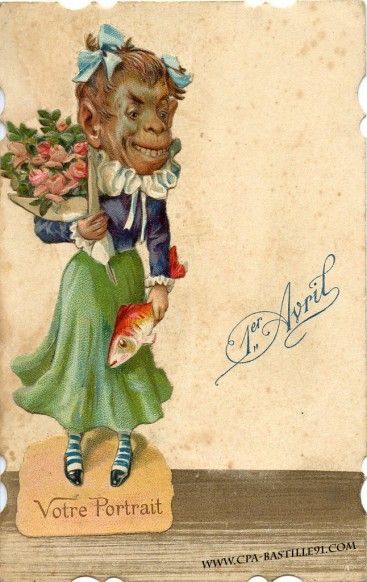
Have a laugh at these hilarious (and bizarre) vintage April Fool’s and poisson d’avril cards. –Wally

Dan Brown’s “Origin” Tour of Spain

Follow Robert Langdon’s itinerary, from Bilbao to Barcelona, with stopovers in Madrid and Seville.

The whimsical Park Guëll in Barcelona is just one stop on an Origin-inspired itinerary of Spanish sights

The whimsical Park Guëll in Barcelona is just one stop on an Origin-inspired itinerary of Spanish sights

You can always count on Dan Brown to serve up a whirlwind tour of a European country in his edge-of-your-seat thrillers. He’s got a formula: Robert Langdon, symbologist stud, and some attractive female companion follow a frenzied trail of clues, narrowly escaping death at every stop. What I like best about a Brown novel is that you’ll learn about religious history, conspiracy theories, art, architecture and technology along the way.

While The Da Vinci Code had Langdon darting from one Parisian landmark to another, Brown’s latest work, Origin, offers a tour of Spain, from Bilbao to Barcelona.

It wouldn’t be a Dan Brown novel without learning about a surprising but real-life controversial religious order.

Here are the main sites Langdon visits in his frenzied night trying to discover nothing less than the origin of our species — and what’s next in our evolution.


Bilbao

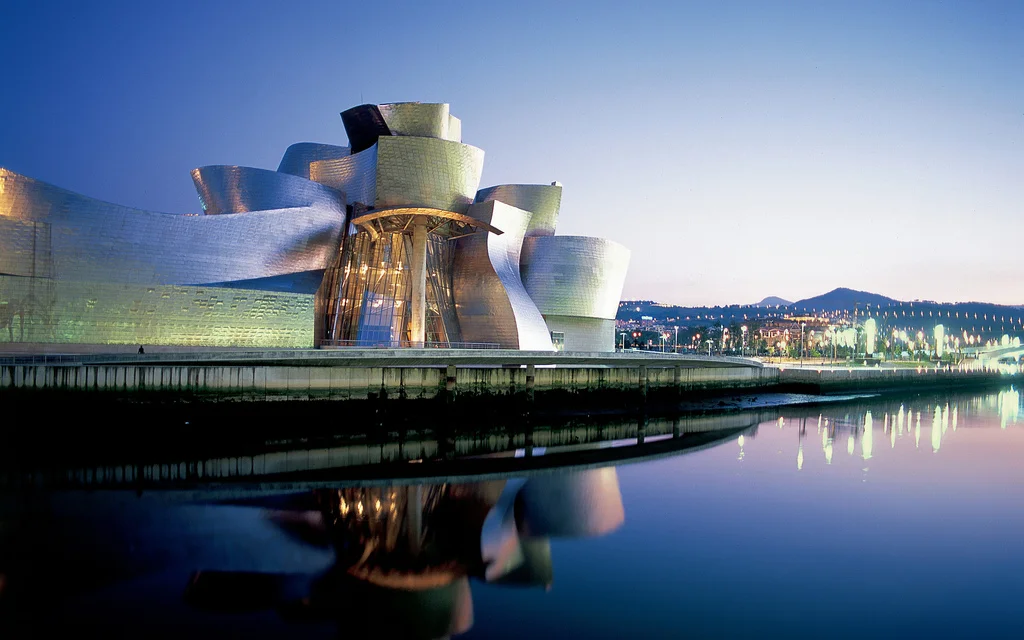
guggenheimmuseum.jpg

Guggenheim Museum Bilbao

The story kicks off at this famous museum, designed by Frank Gehry in his signature style, consisting of massive, curving metallic strips. The Guggenheim Bilbao opened in 1997 and has helped draw tourists to what was a fading industrial port city.

Brown mentions a few of the museum’s more interesting artworks, including:

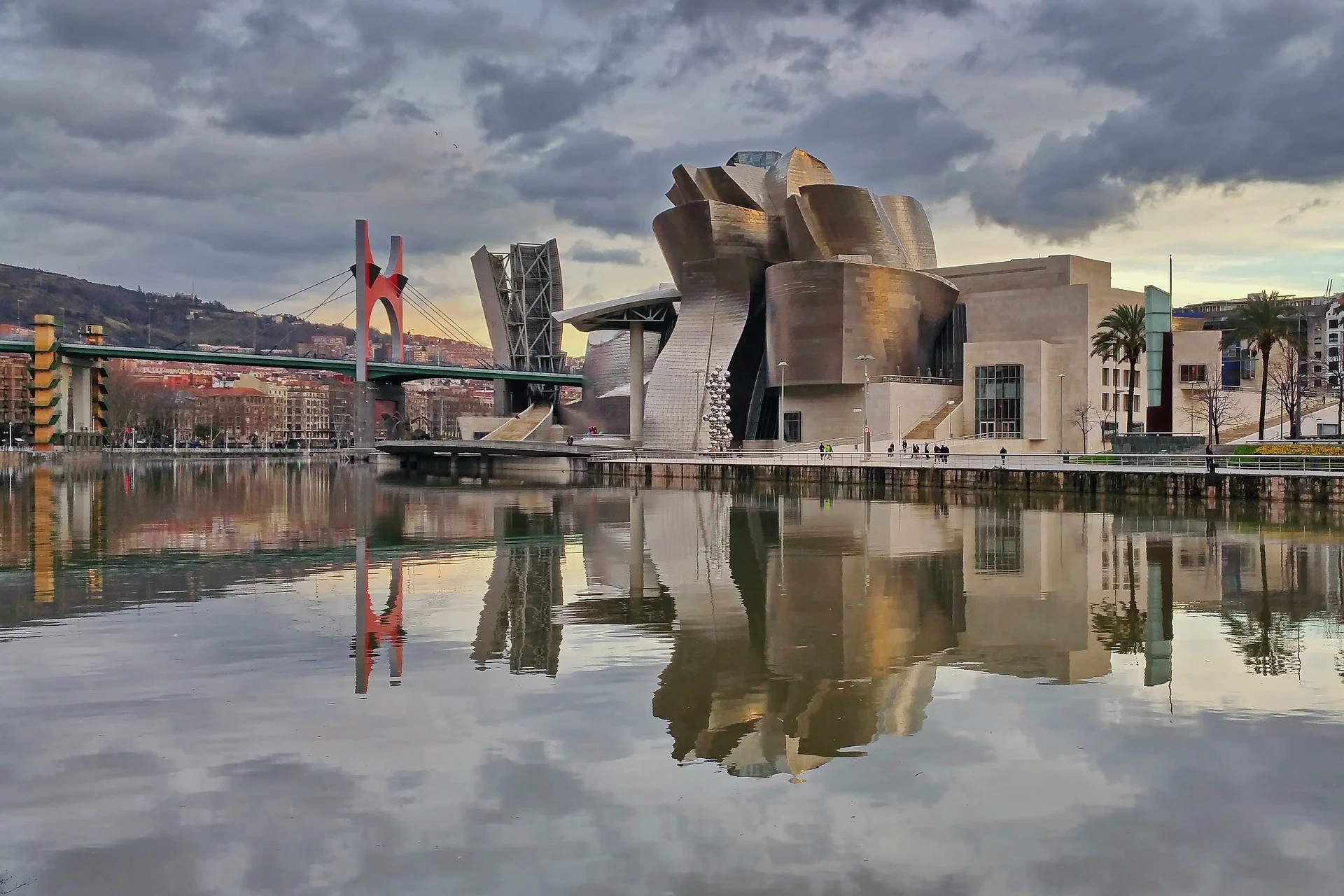
guggenheimbilbao.jpg

La Salve Bridge, constructed in the early 1970s, now leads right to the Guggenheim. For the museum’s 10th anniversary, the bridge got an additional adornment, l’Arc Rouge (the Red Arch) by French artist Daniel Buren.

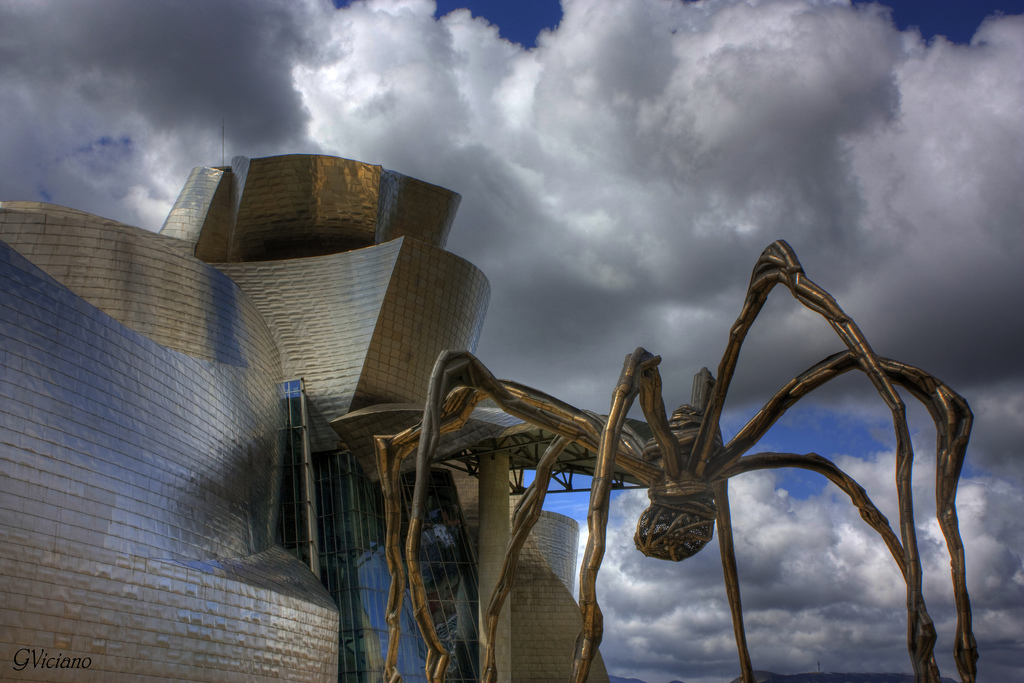
mamanguggenheim.jpg

Maman, a creepy metal spider sculpture by Louise Bourgeois that’s about 30 feet tall. The name means Mom, and the piece, built in 1999, is a (questionable) tribute to Bourgeois’ mother, who was a weaver.

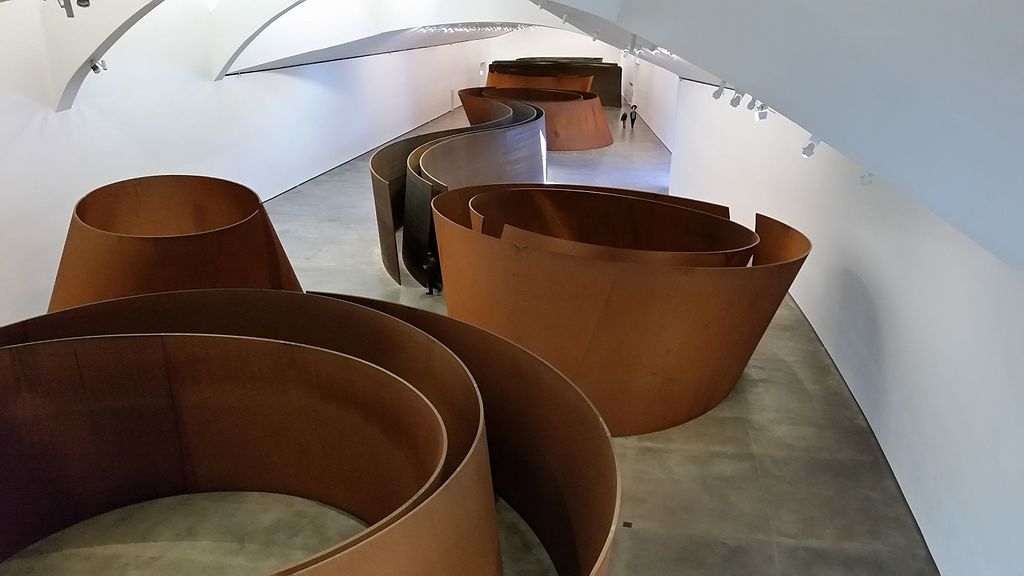
matteroftimeguggenheim.jpg

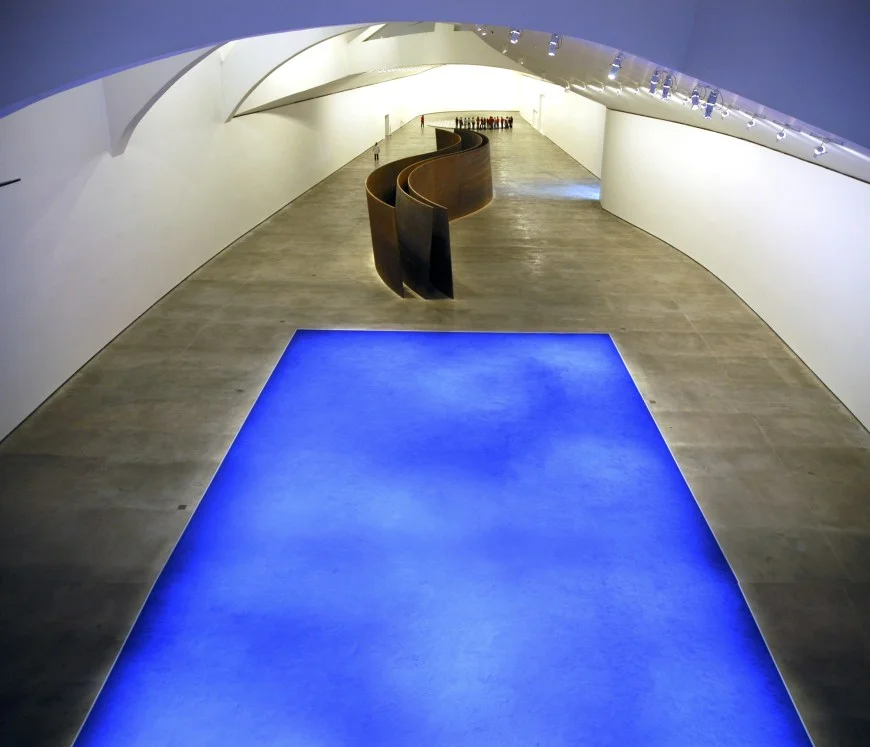
The Matter of Time, a massive spiraling, interactive sculpture that takes up an entire corridor at the Guggenheim. The immersive artwork by Richard Serra was created between 1994-2005.

yveskleinguggenheim.jpg

Yves Klein Exhibition, a tribute to yet another French artist. The enormous rectangle painted on the floor resembles an intense cobalt blue swimming pool. The artist patented the color, International Klein Blue, stating that it represents the cosmic energy that floats in the air.


Etxanobe2.jpg
EtxanobeFood.jpg

Etxanobe

While you’re in Bilbao, enjoy a dinner at this Michelin-starred restaurant. The glass dining room has tufted light fixtures and a fabric-covered ceiling, hidden away in the Palacio Euskalduna. The food at Etxanobe is the star of the show, prepared by Fernando Canales, a local hotshot chef. It looks as if it’s one of those modern restaurants where you get served large plates that hold small, gloopy food prepared with the most recent gastronomic techniques and decorated with artistic splashes. Most people seem to recommend the chef’s tasting menu.


Madrid

royalpalacemadrid.jpg

Royal Palace

Much of the intrigue in Origin takes place in the Palacio Real de Madrid. Once the site of a fortress built to protect the Muslim rulers from invading Christians, the palace that stands today was begun in 1738 and took 17 years to complete. That’s no surprise, given that there are more than 3,000 rooms inside, including the Royal Armoury and the Painting Gallery, in which Salome With the Head of John the Baptist by Caravaggio hangs.


almudenacathedral.jpg

Almudena Cathedral

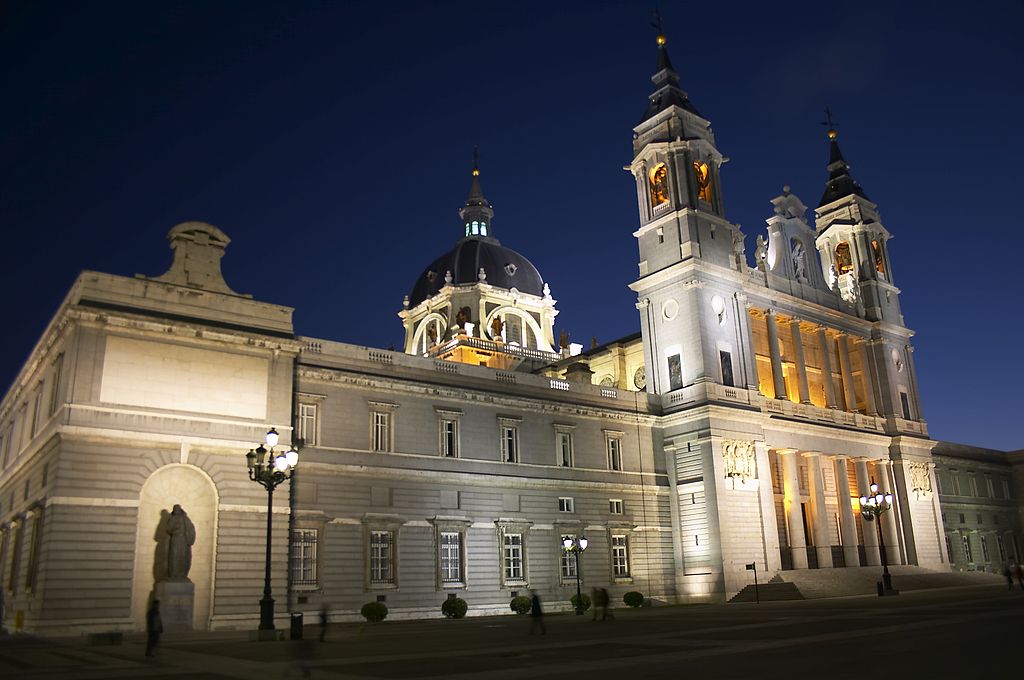
Adjacent to the Royal Palace, this religious institution is dedicated to the Virgin of Almudena, a medieval icon that serves as the patroness of Madrid. Like many European cathedrals, construction of the Santa Iglesia Catedral de Santa María la Real de la Almudena (phew!) came in fits and starts. While it began in 1879, it wasn’t fully completed until 1993!


MuseoReinaSofiaMadrid.jpg

Reina Sofía Museum of Modern Art

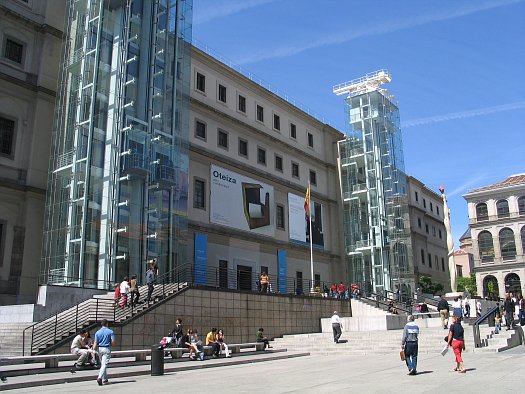
The building that houses the Museo Nacional Centro de Arte Reina Sofía, which opened in 1986, first served as the San Carlos Hospital.

Here are some of the famous works Brown calls out:

guernica.jpg

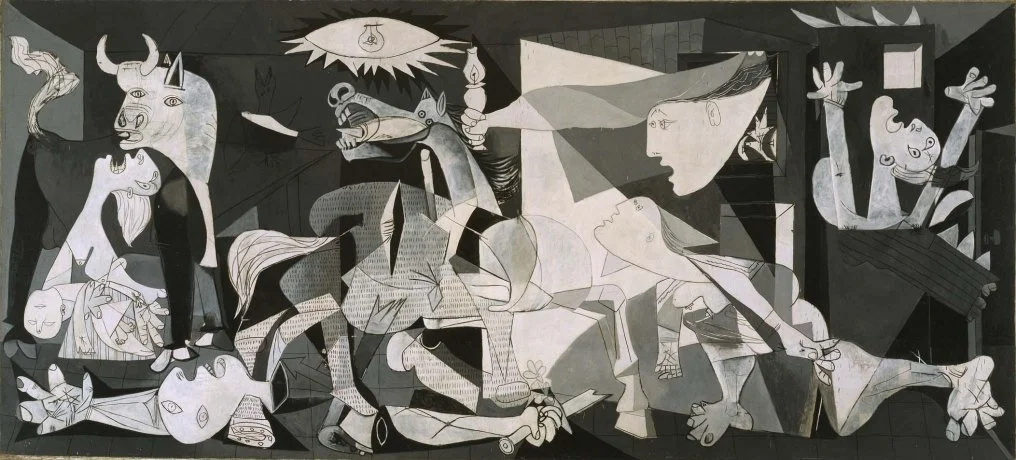
Guernica by Picasso is, undoubtedly, the star of the museum. A 1937 Cubist masterpiece in shades of gray, the mural was a reaction to the Nazis’ bombing practice on the Basque town of Guernica during the Spanish Civil War.

laverbena.jpg

La Verbena, or The Fair, by Maruja Mallo, painted in 1927, is a riot of color and activity. There’s almost a movement to the painting, with sailors, a test-your-strength game, a cyclops in a headdress, a deformed beggar and what might be a magician about to cut a woman in half, all tucked into various nooks.


elescorial.jpg

El Escorial

Built from 1563-1584, the Royal Site of San Lorenzo de El Escorial is said to be the most important architectural monument of the Spanish Renaissance. King Philip II wanted the building to be a place to bury his father, Charles V, as well as a monastery and palace. The complex is 28 miles northwest of Madrid. Be sure to visit the Pantheon of the Kings, where 28 kings and queens of Spain are entombed.


elescorial.jpg

Valley of the Fallen

Near El Escorial is el Valle de los Caídosa, a controversial memorial commissioned by General Francisco Franco, the dictator of an authoritarian regime that lasted for 36 years. A massive cross sits atop a basilica and crypt that have been carved into the mountainside. The site honors those who died in the Spanish Civil War and contains the tomb of Franco himself.
 

Seville

Cathedralelpalmar.jpg

Palmarian Catholic Church

It wouldn’t be a Brown novel without learning about a surprising but real-life controversial religious order. The Christian Palmarian Church of the Carmelites of the Holy Face (Iglesia Católica Palmariana) in El Palmar de Troya, 28 miles south of Seville, is so crazy, you’d think Brown made it up. But this far-right cult actually has declared its own pope dedicated to undermining the reforms of Pope Francis and worshippers pray to a host of new saints, including, shudder, Adolf Hitler.


Barcelona

parkguell.jpg

Park Güell

Barcelona is one of my favorite cities — in a large part because of Antoni Gaudí’s whimsical genius. His colorful aesthetic is on display in Park Güell, a large public space at the north end of the city. Mosaics decorate this park, including the winding benches on a large terrace overlook, where it’s as fun to admire the view of Barcelona spreading out before you as it is to people-watch.

lasagradafamilia.jpg
lasagradainterior.jpg

La Sagrada Família

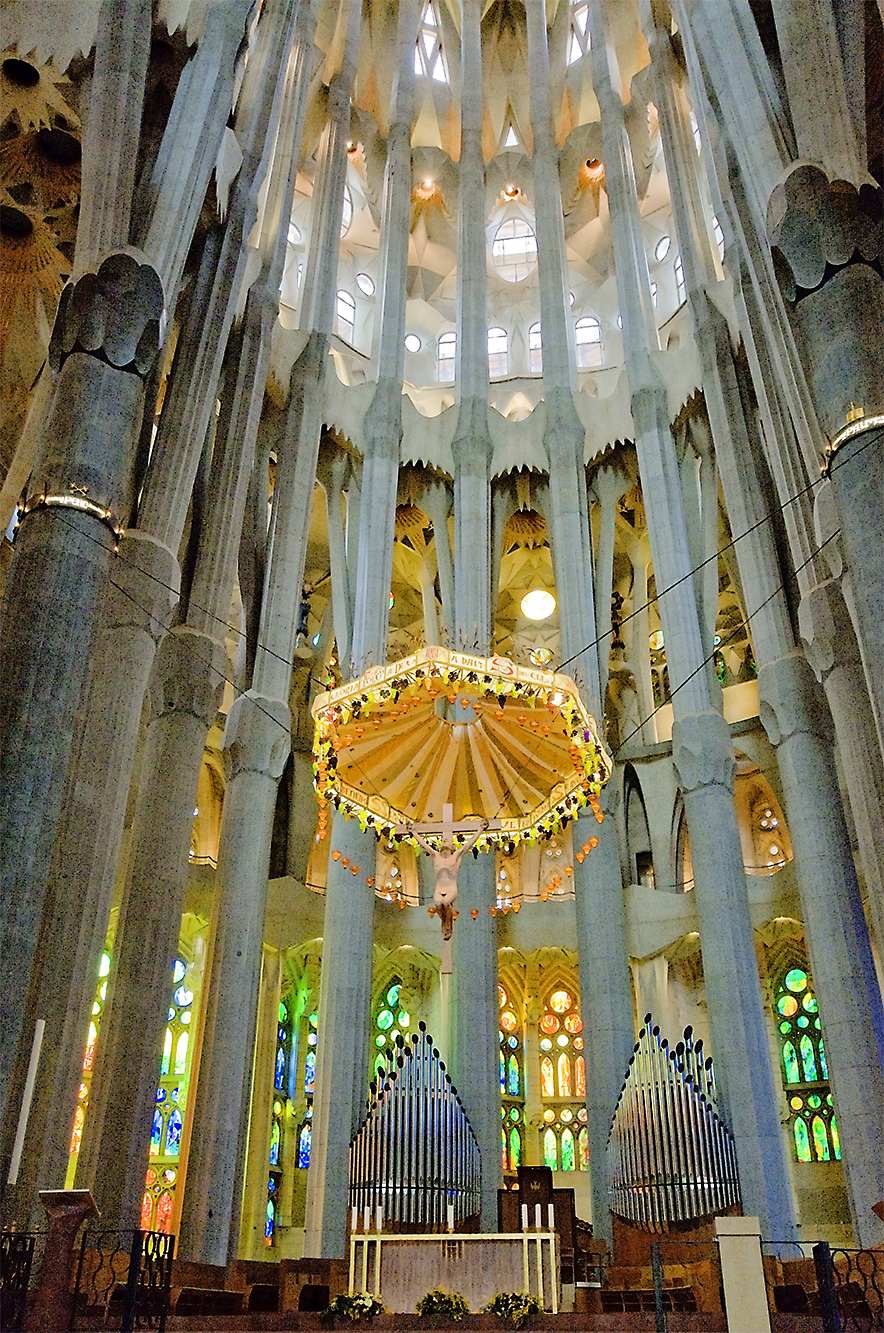
I can say with confidence that you’ve never seen a church like this before. The façade evokes a towering sandcastle, while the interior features sprawling treelike columns dappled in rainbow hues as sunlight hits the stained glass windows. La Basílica i Temple Expiatori de la Sagrada Família is so otherworldly, I felt as if I were inside a spaceship. Oh, and it’s still being built.


casamila.jpg

Casa Milà

It’s hard to miss Casa Milà, known as La Pedrera, or the Stone Quarry: Its undulating pale façade is what gave the building its nickname. The apartment complex, designed by Guadí, was built between 1906-1912 and now houses a museum highlighting the architect’s work on its top floor. Be sure to visit the rooftop, dotted with giant chimneys shaped like the helmets of soldiers.


barcelonasupercomputing.jpg

Barcelona Supercomputing Center

Leave it to Brown to weave quirky sites like this into his stories. The Centro Nacional de Supercomputación is indeed a research facility housed in the former Chapel Torre Girona. Its star supercomputer, MareNostrum, consists of neat rows of metallic towers encased in a glass box that fills the interior of the sanctuary.


As you work your way through this itinerary, following in Langdon’s footsteps, here’s hoping there’s not a murderous former naval admiral on your heels. –Wally

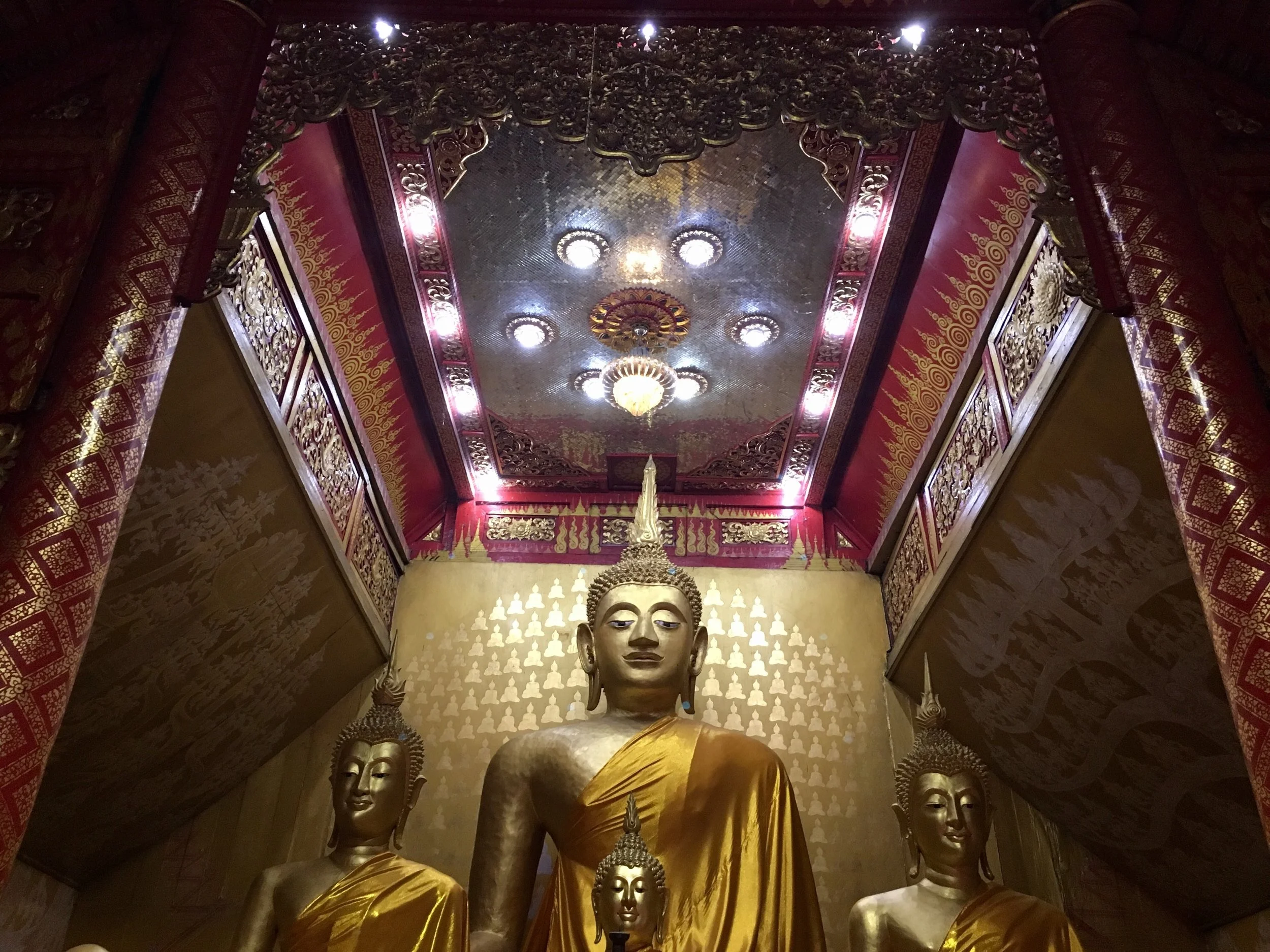
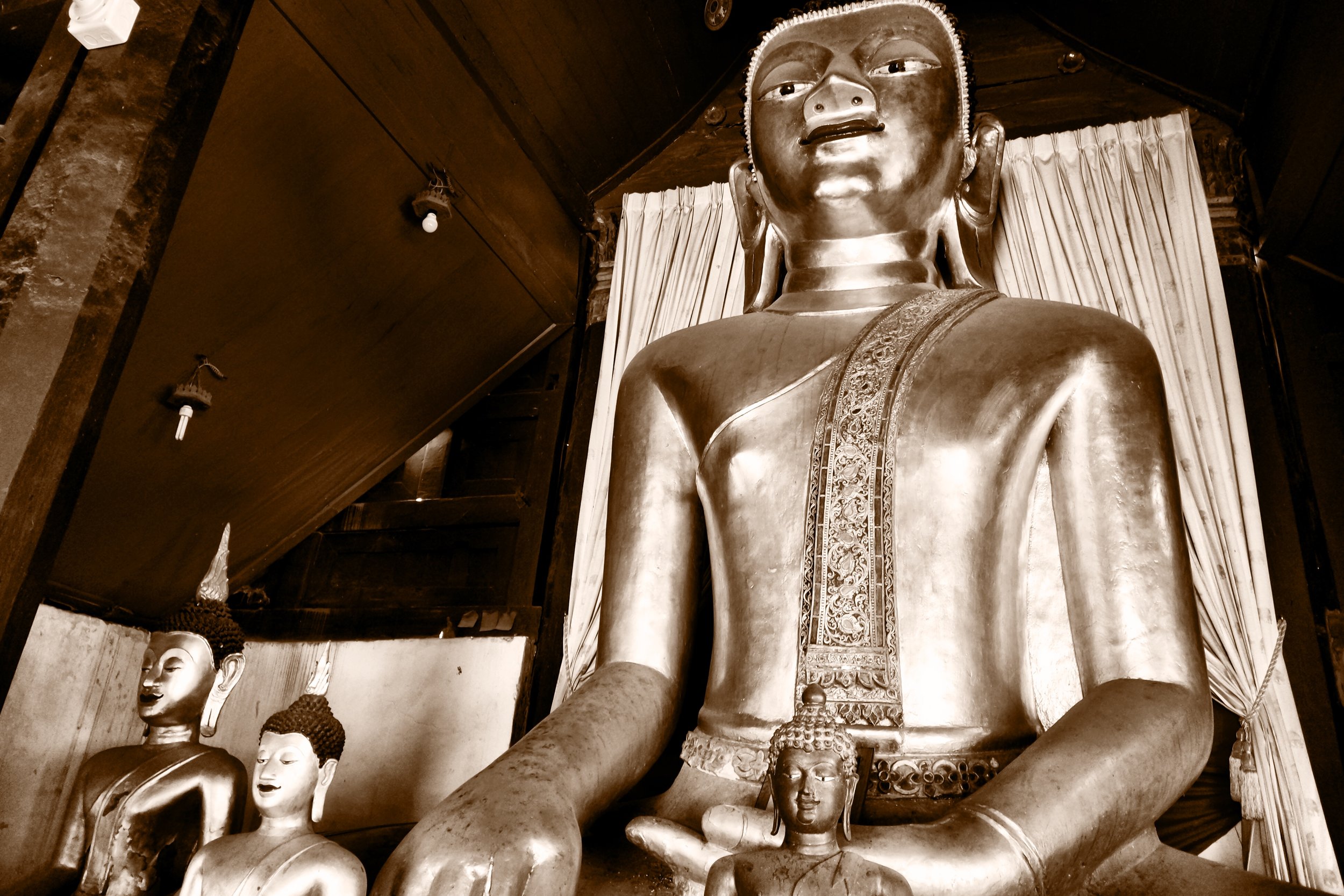
The Buddhas of Chiang Mai

Looking for things to do in Chiang Mai? Search out the different Buddhas at the Buddhist temples around the city.

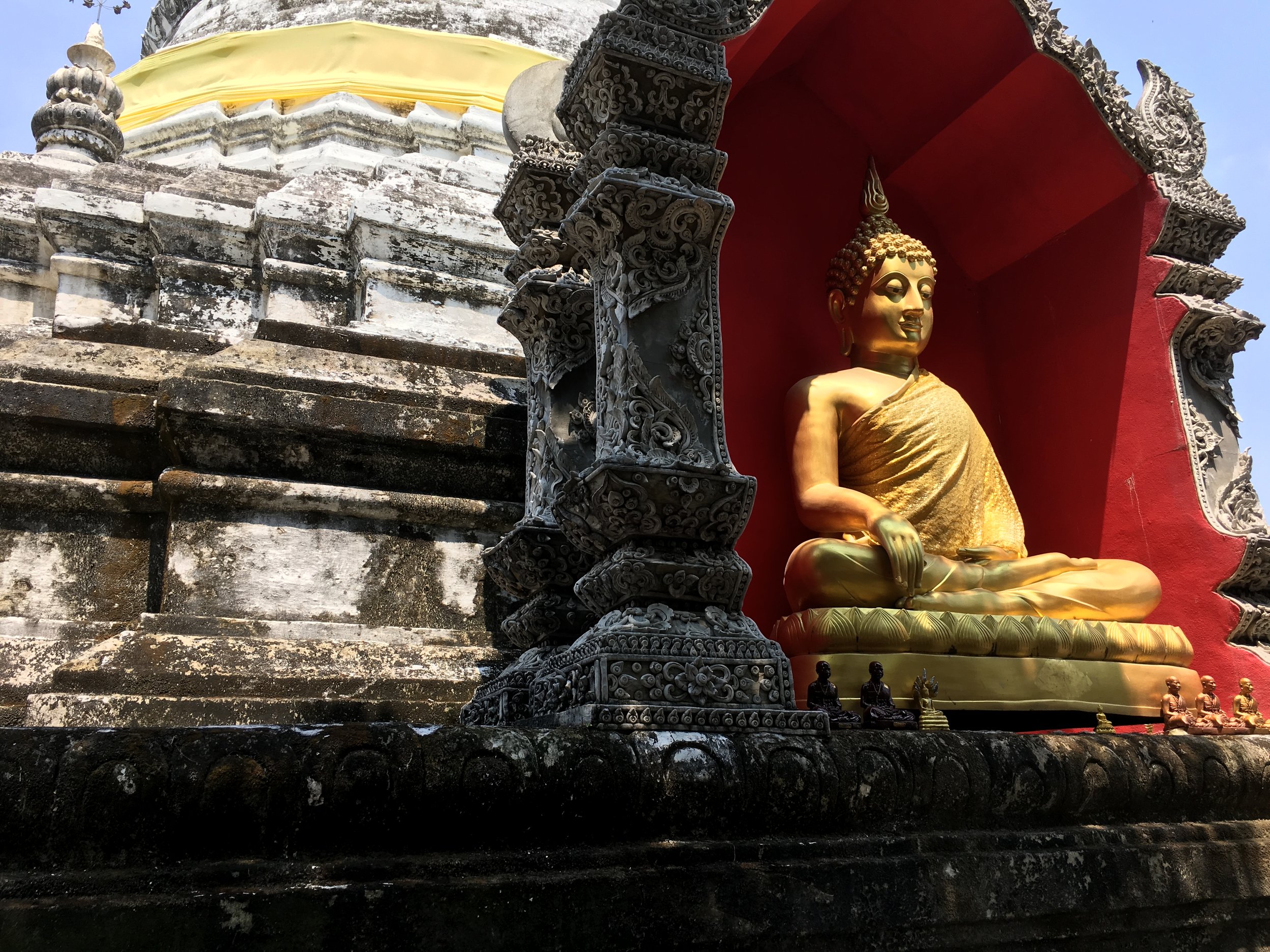
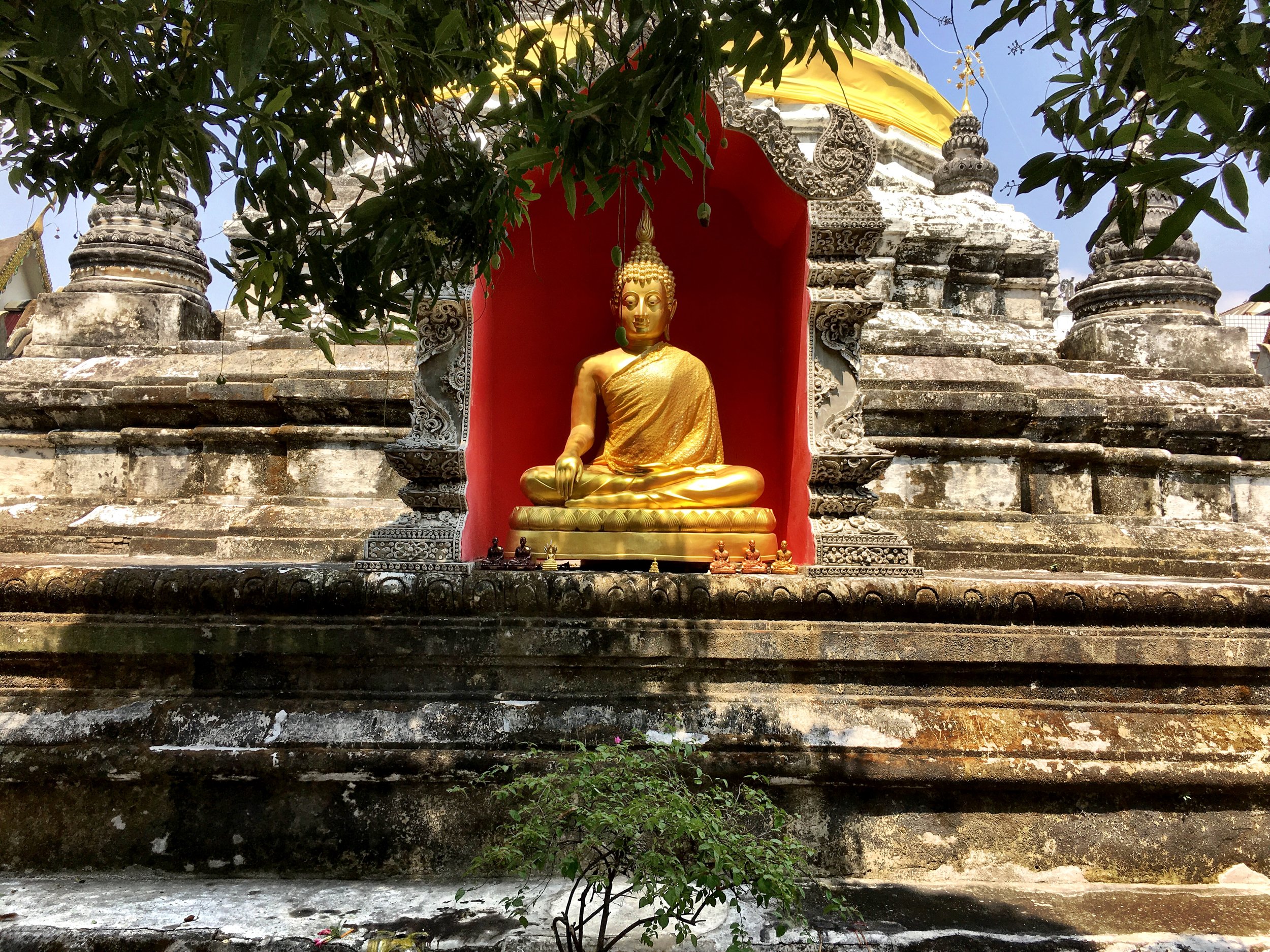
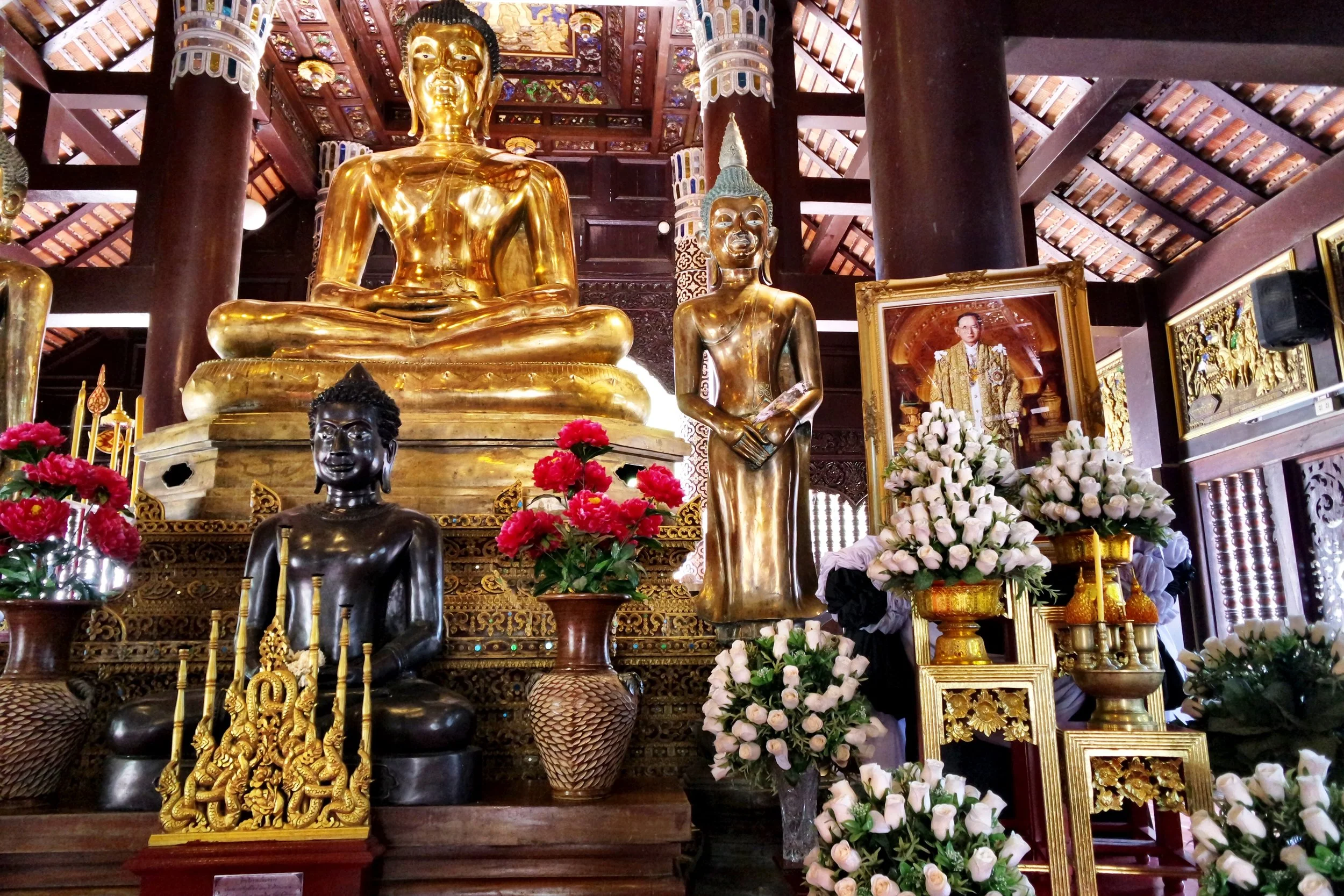
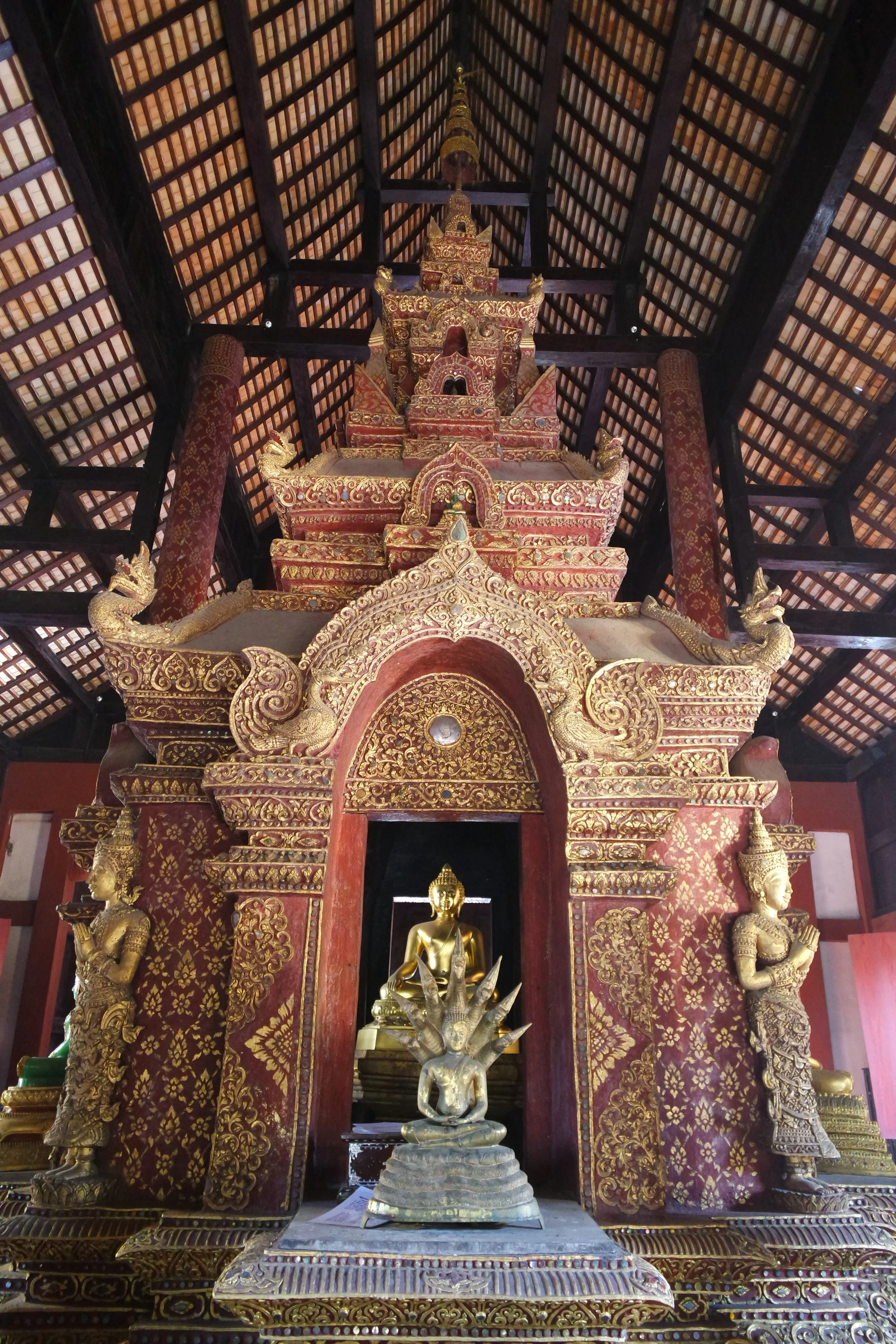
A Buddha inside a niche at the chedi of Wat Buppharam

A Buddha inside a niche at the chedi of Wat Buppharam

It’s said that Chiang Mai is home to 300 temples (wats in Thai). Duke and I did our best to hit them all — though after a week or so, we only crossed about a dozen off our list.

In the vein of our the Cats of Marrakech and Cats of Fès posts, I figured we could do one on the Buddhas of Chiang Mai.

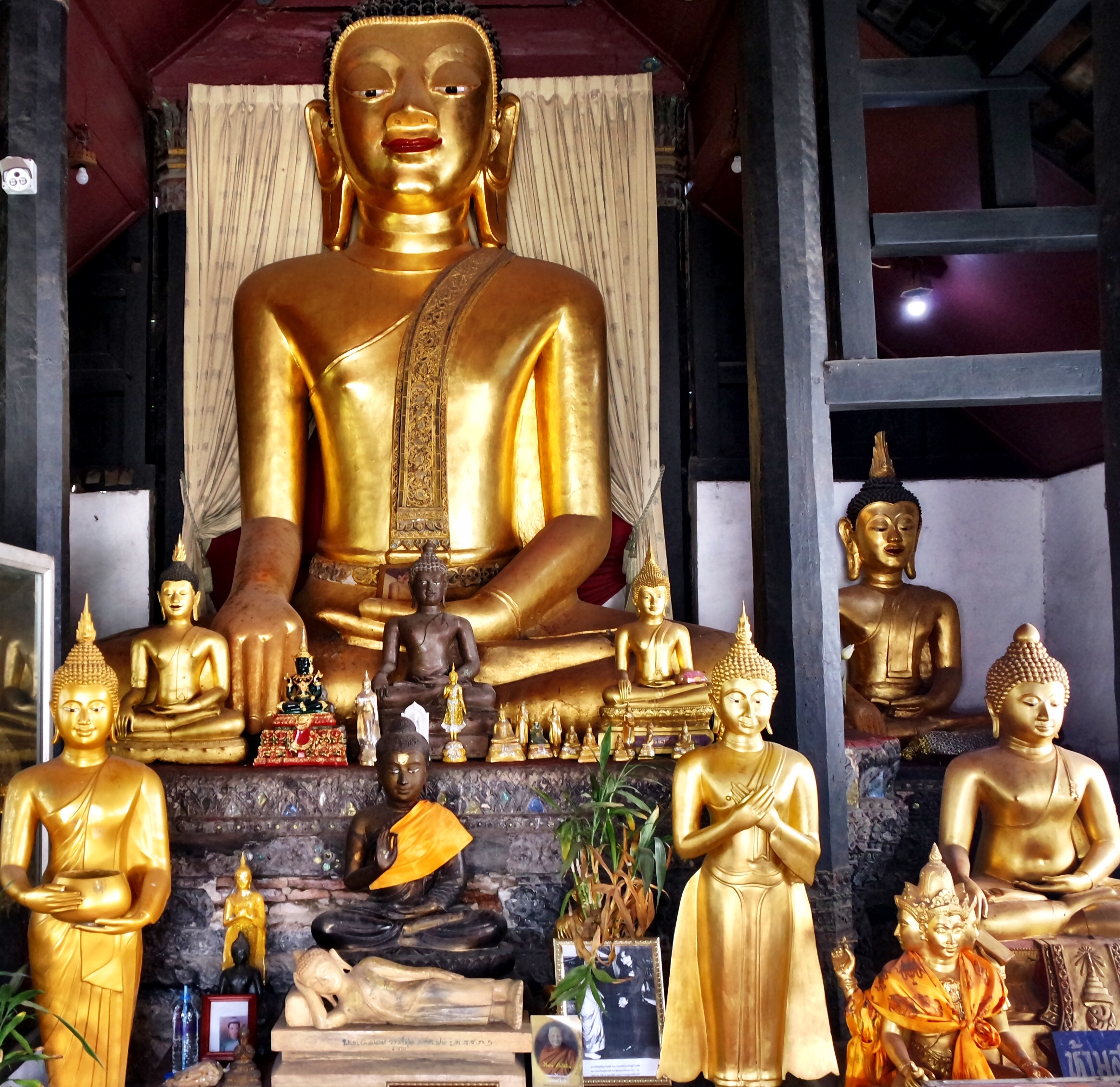
The ears are always elongated, like those kids who had spacers but took them out, only to have their stretched-out lobes flop back and forth.

The idea is that the Buddha is then able to hear all that’s needed in the world.

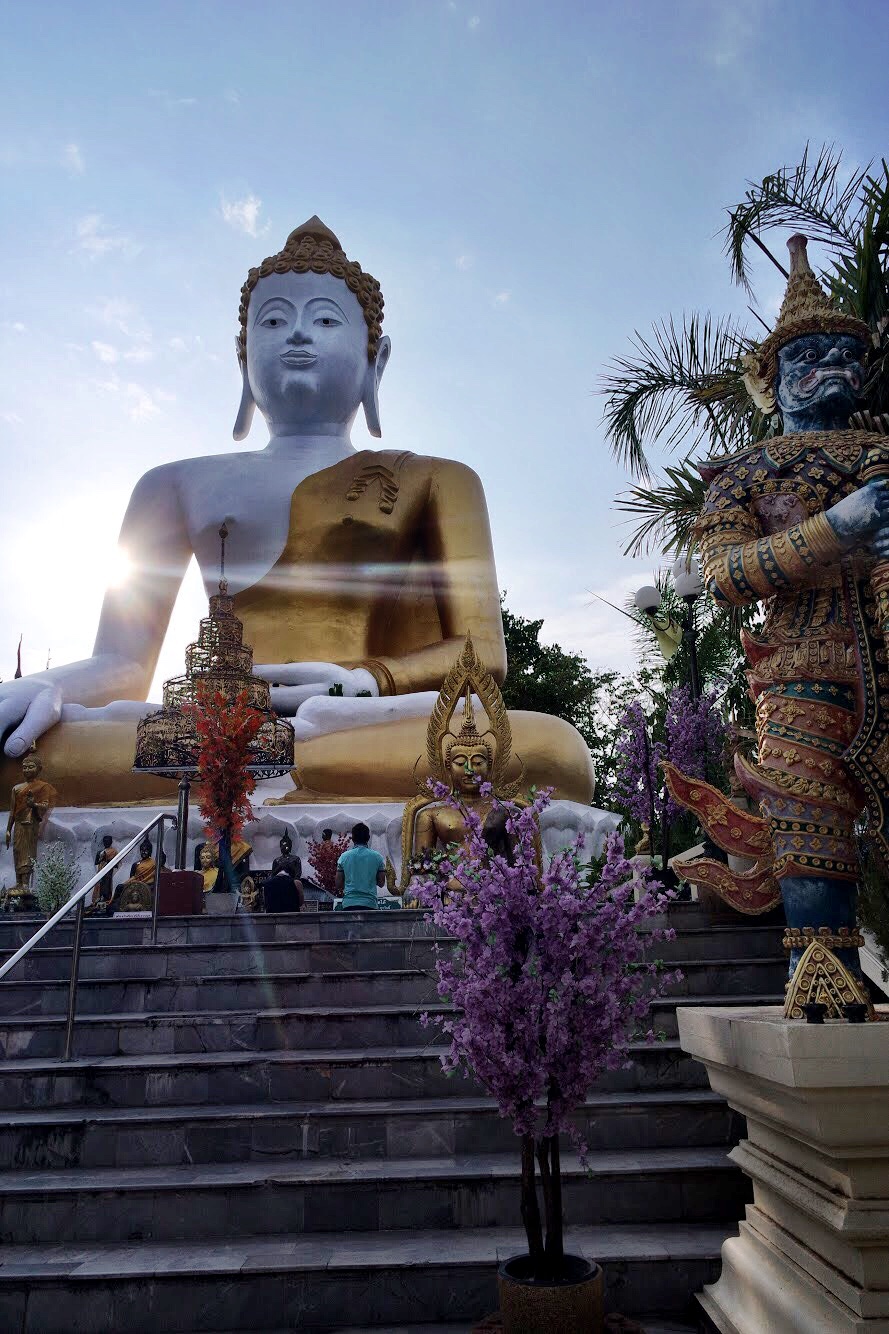
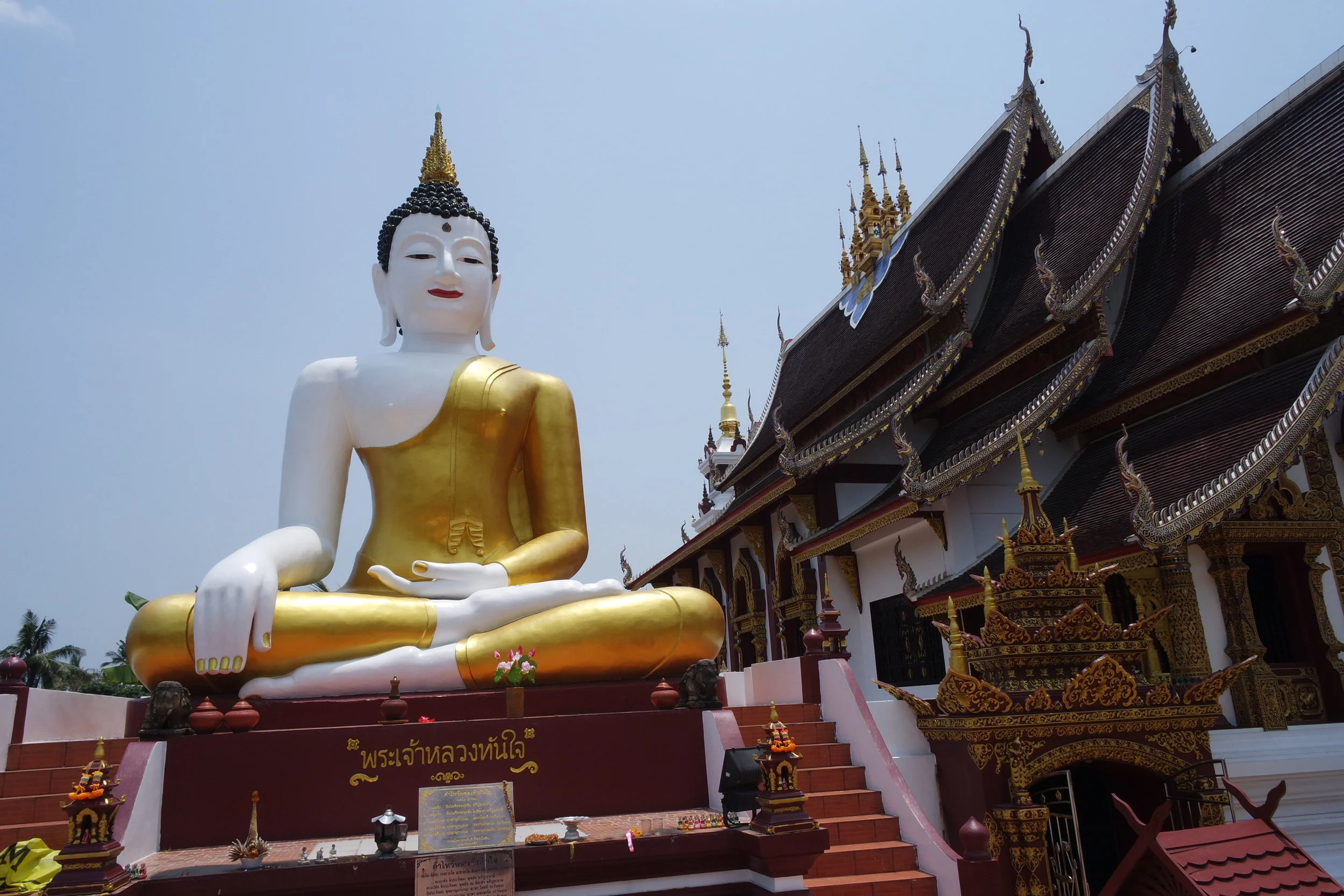
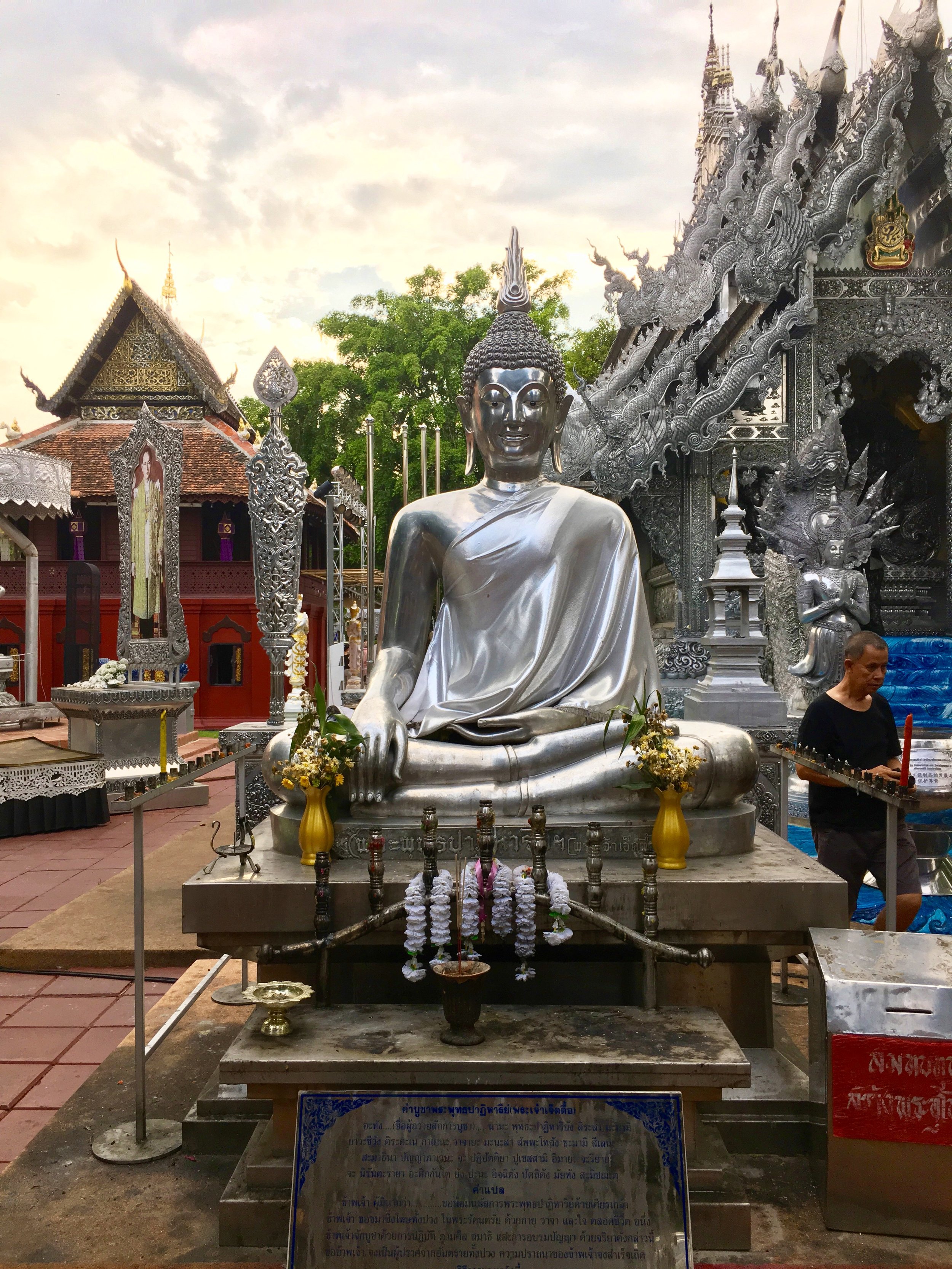
Most of the Buddhas you’ll encounter at these wats are in the Chiang Saen or Lanna style from 11th and 18th centuries. At the time, Northern Thailand was part of the Lanna kingdom. The Buddhas of this second-largest city in Thailand tend to have round faces with Mona Lisa smiles.

Because Buddhist monks shave their heads, I’ve always thought of the Buddha as having set the original example. But depictions of the Buddha actually show tight curls framing his head.

His nose can be on the long and narrow side — or even a bit pig-like (at least when seen from below).

The ears are always elongated, like those kids who had spacers but took them out, only to have their stretched-out lobes flop back and forth. You can tell that I’m not the biggest fan of this look, but the idea is that the Buddha is then able to hear all that’s needed in the world.

His torso tends to be on the slightly plump side, tapering to a narrower waist.

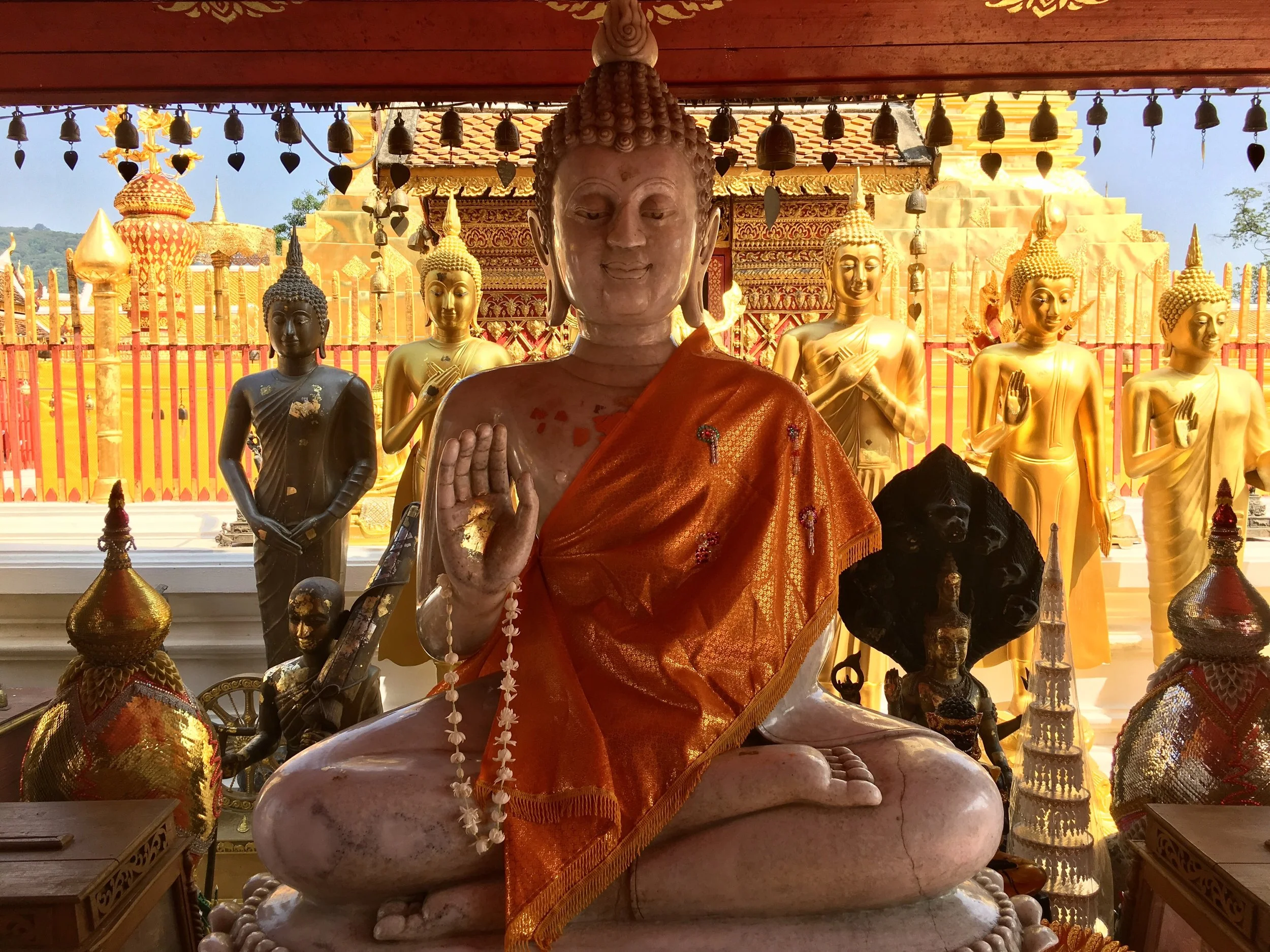
In some depictions, the Buddha is bare-chested and sometimes draped in a saffron cloth. Other Buddhas have this one-shouldered robe as part of their design.

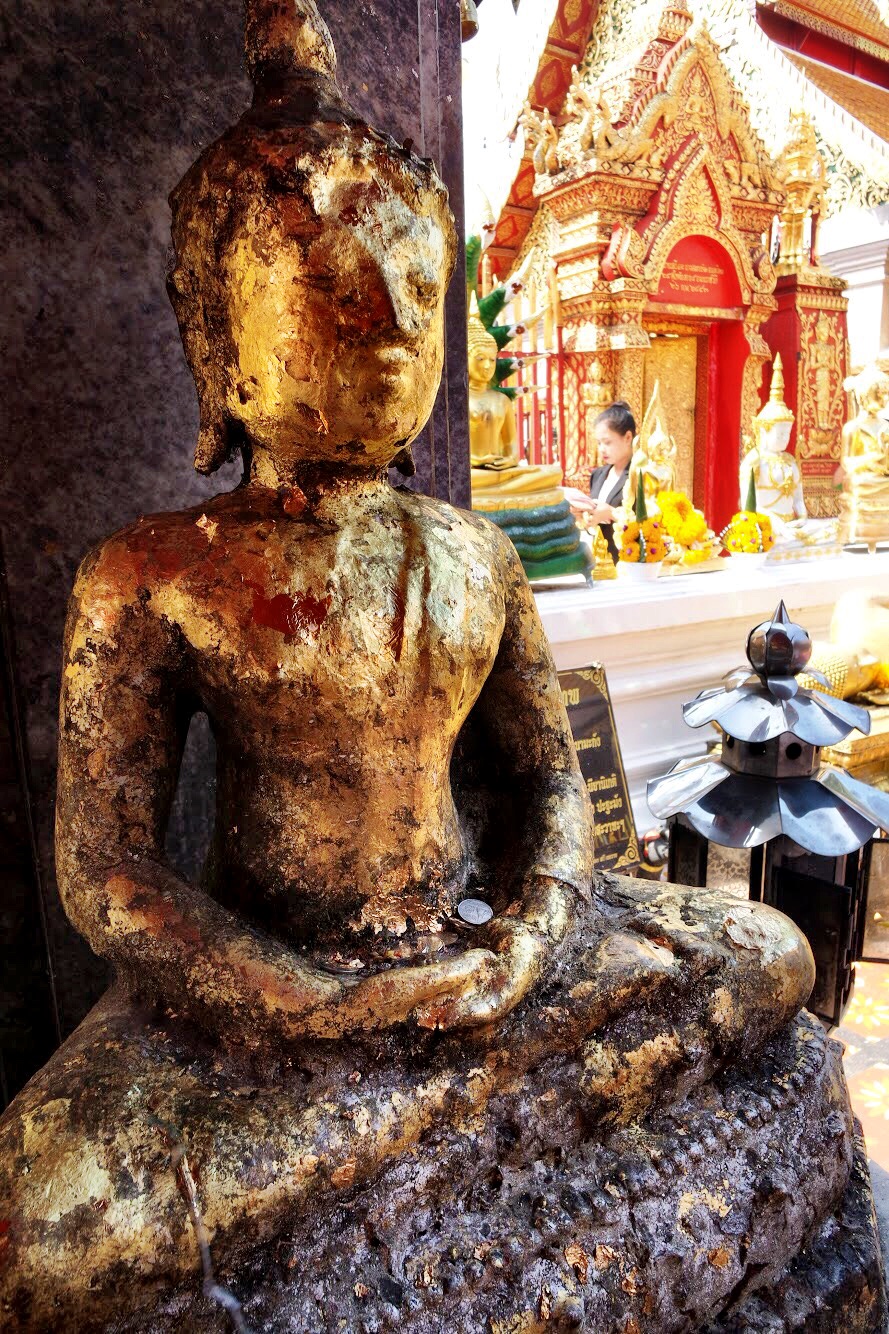
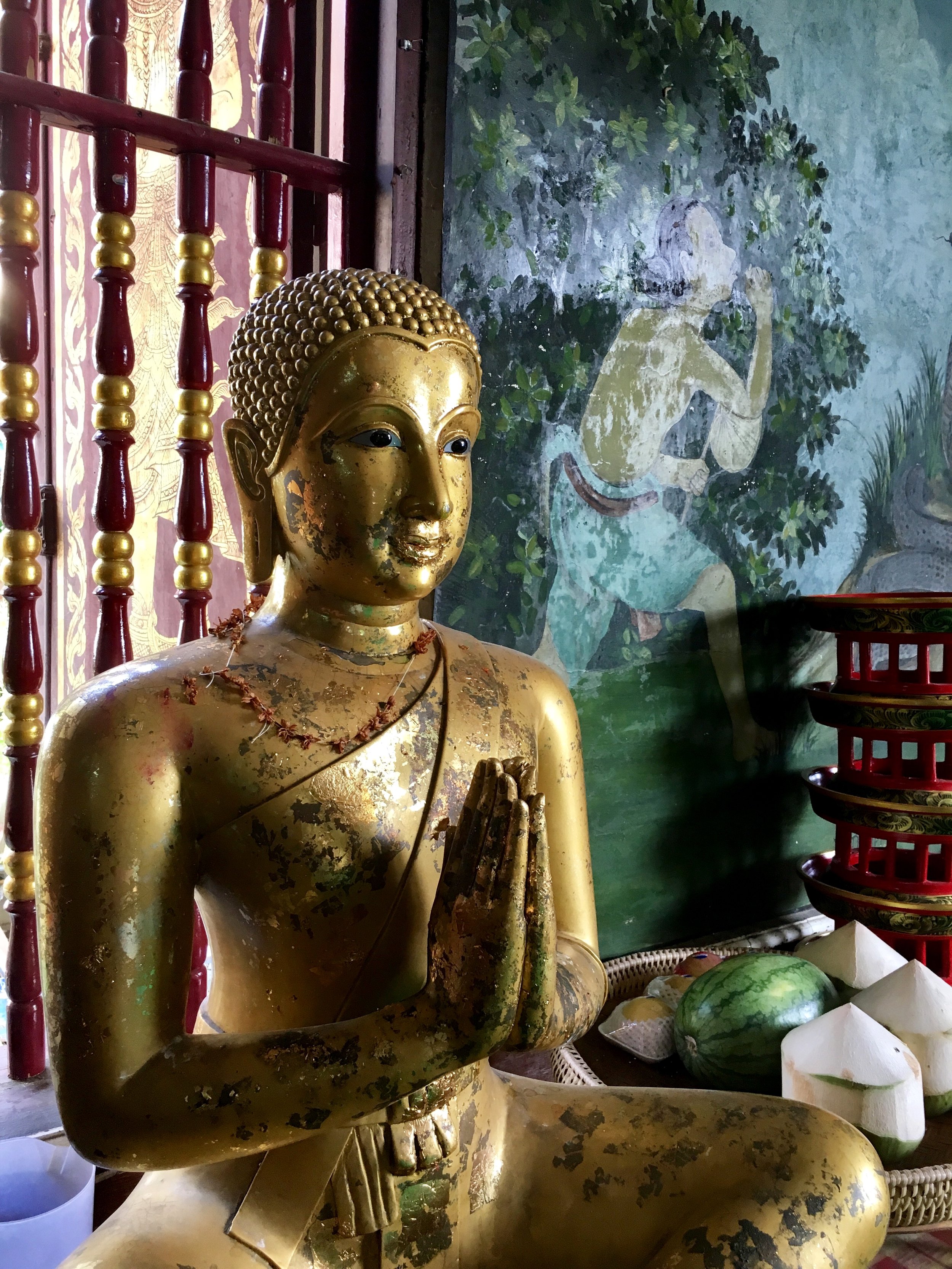
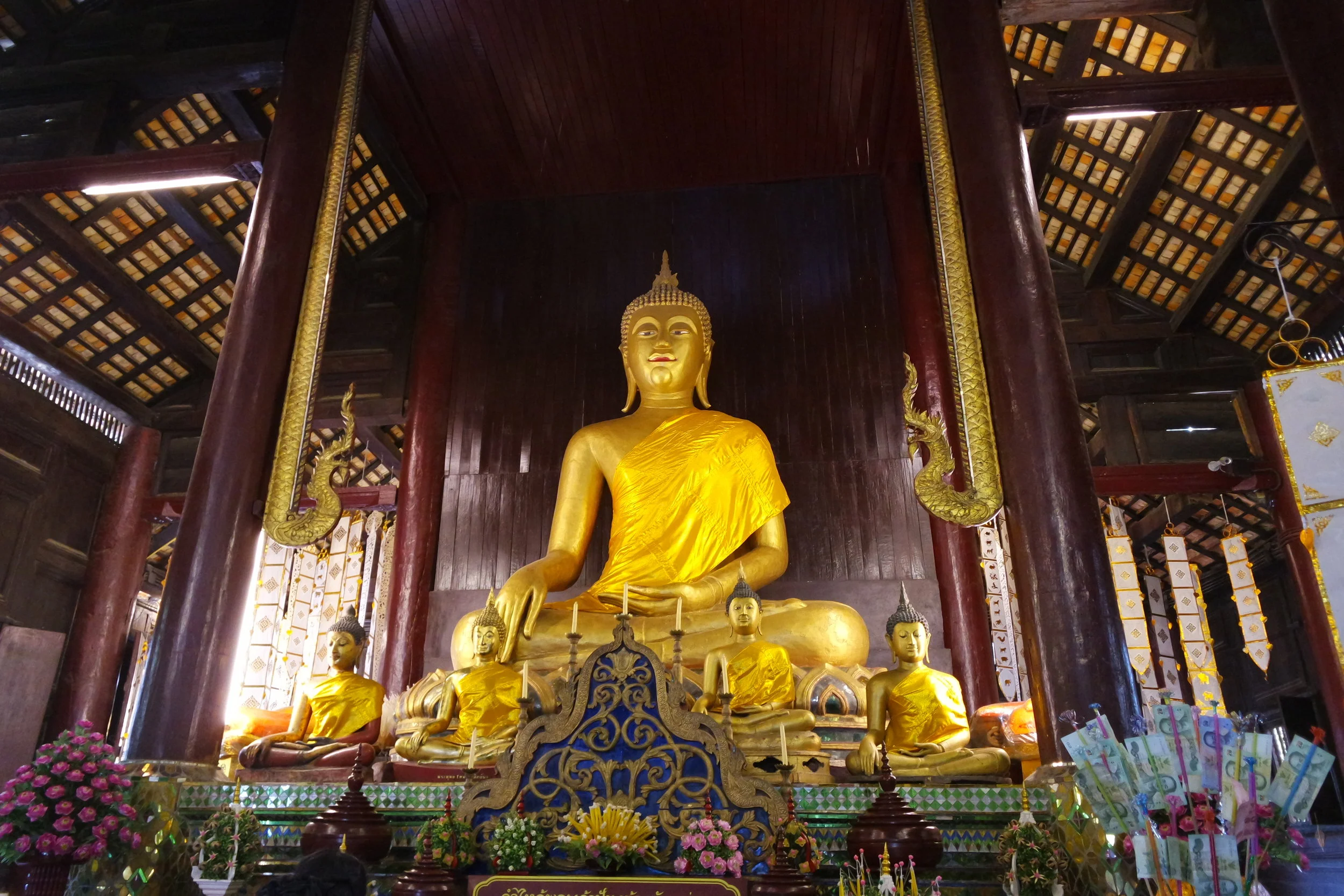
Now and then, especially on smaller Buddhas that aren’t the central focus of a viharn (the main area of worship at a temple), you’ll see Buddhas covered in gold leaf.

Wat Bupphararam

Wat Bupphararam

Buddha Meaning for Each Day of the Week

Statues of the Buddha feature various poses, eight of which are tied to days of the week:

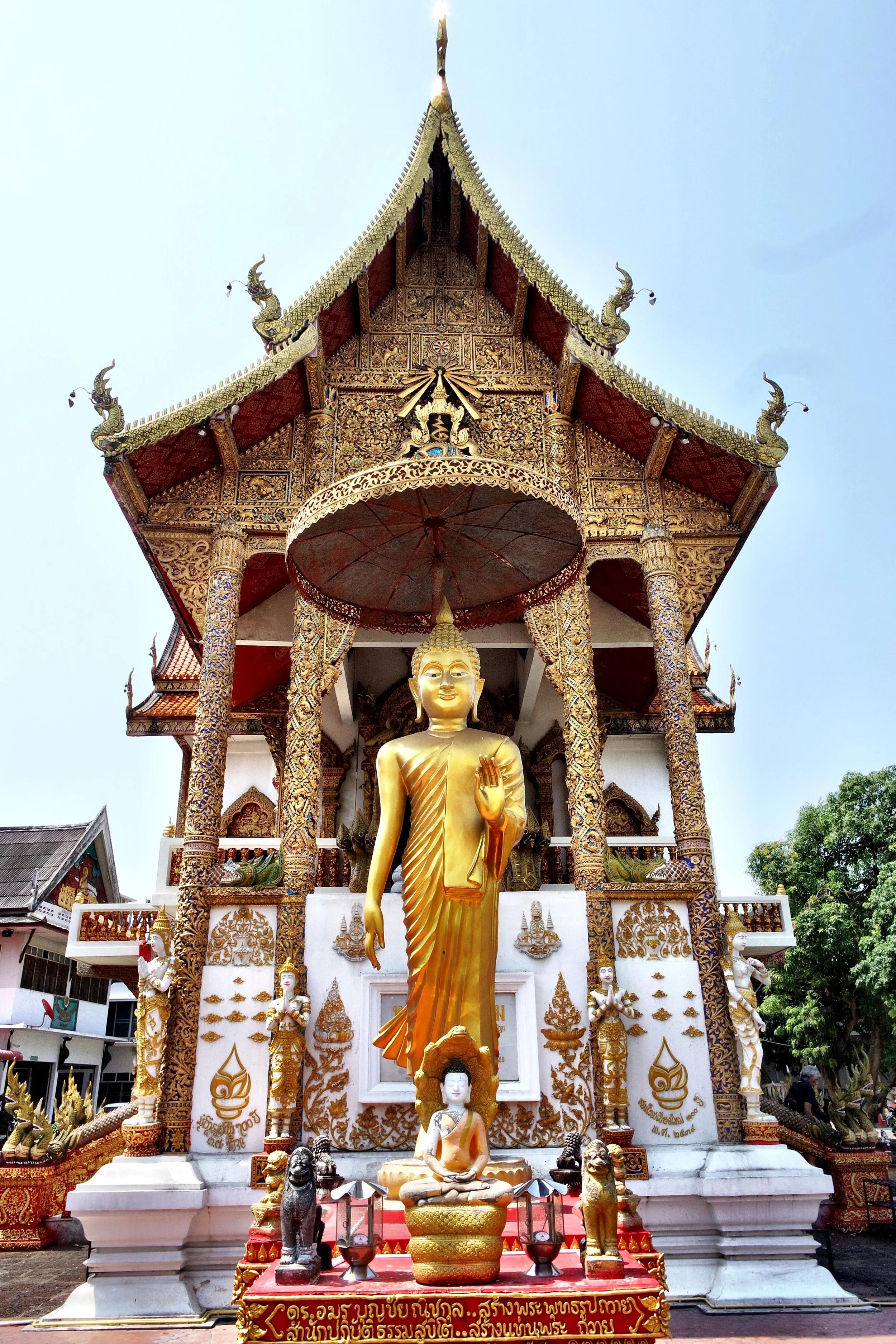
Sunday: The Open-Eye Posture, standing, as he did under the bodhi tree, for seven days after reaching enlightenment, contemplating the suffering of all living things.

Monday: Preventing Calamities, standing, causing torrential rain to fall upon the city of Vesali, which was invaded by devils that feasted on the living and the dead.

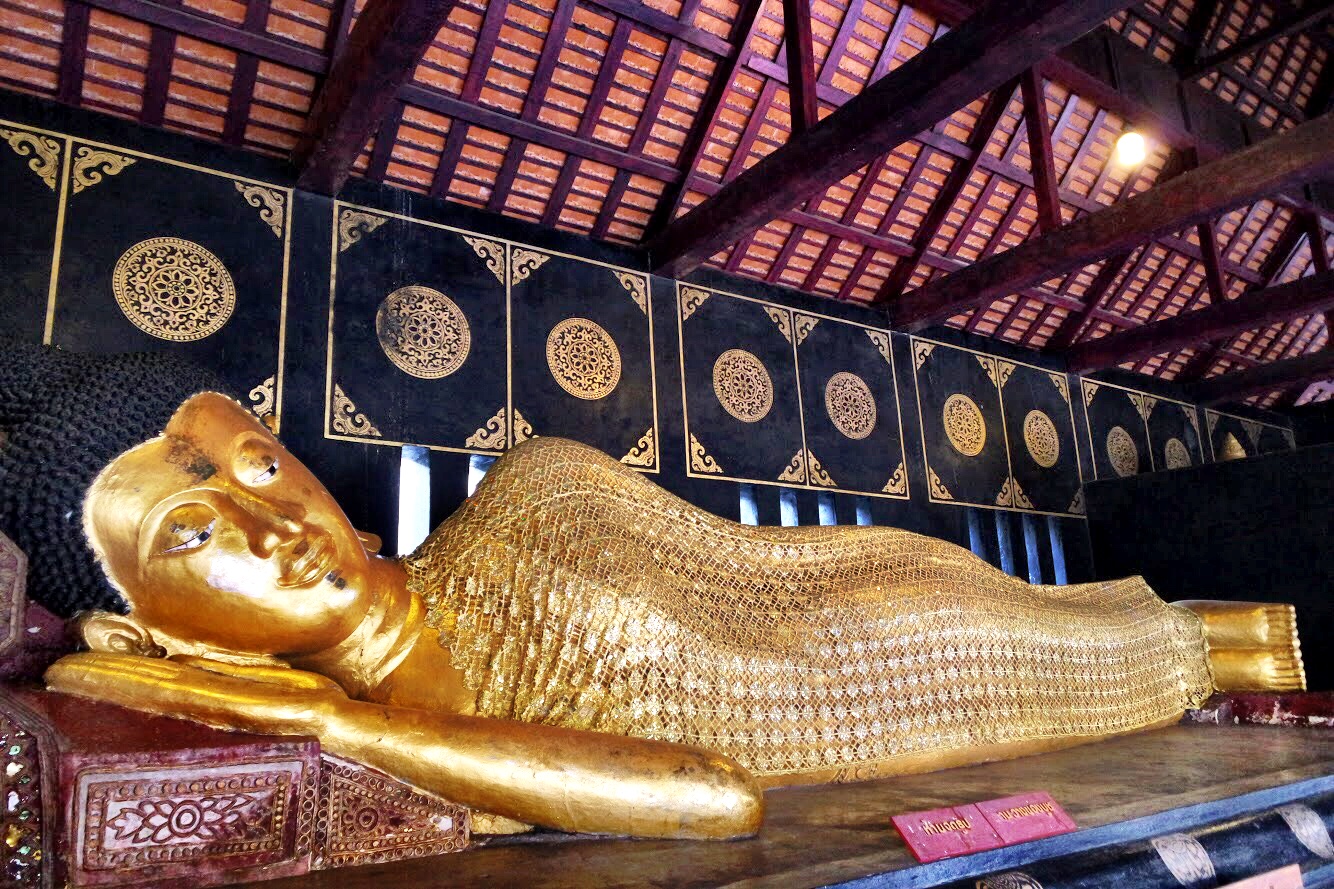
Tuesday: The Reclining Buddha, humbling a proud giant named Asurindarahu.

Wednesday: This day is divided into two poses, depending on the time of day.

Before noon: Holding an Alms Bowl, standing, collecting the food for the day — a practice still performed by Buddhist monks.

After noon: Resting With a Monkey and an Elephant, seated, seeking refuge from arguing monks in the Palilayaka, or Palelai, Forest. The monkey offers the Buddha a beehive, while the elephant presents a water pot.

Thursday: Meditation, sitting in a yoga posture, when the Buddha vowed not to leave his spot on the grass until he reached enlightenment.

Friday: Contemplation, standing, under the banyan tree, wondering how the heck he’ll explain his teachings, or dharma, about the cause of suffering.

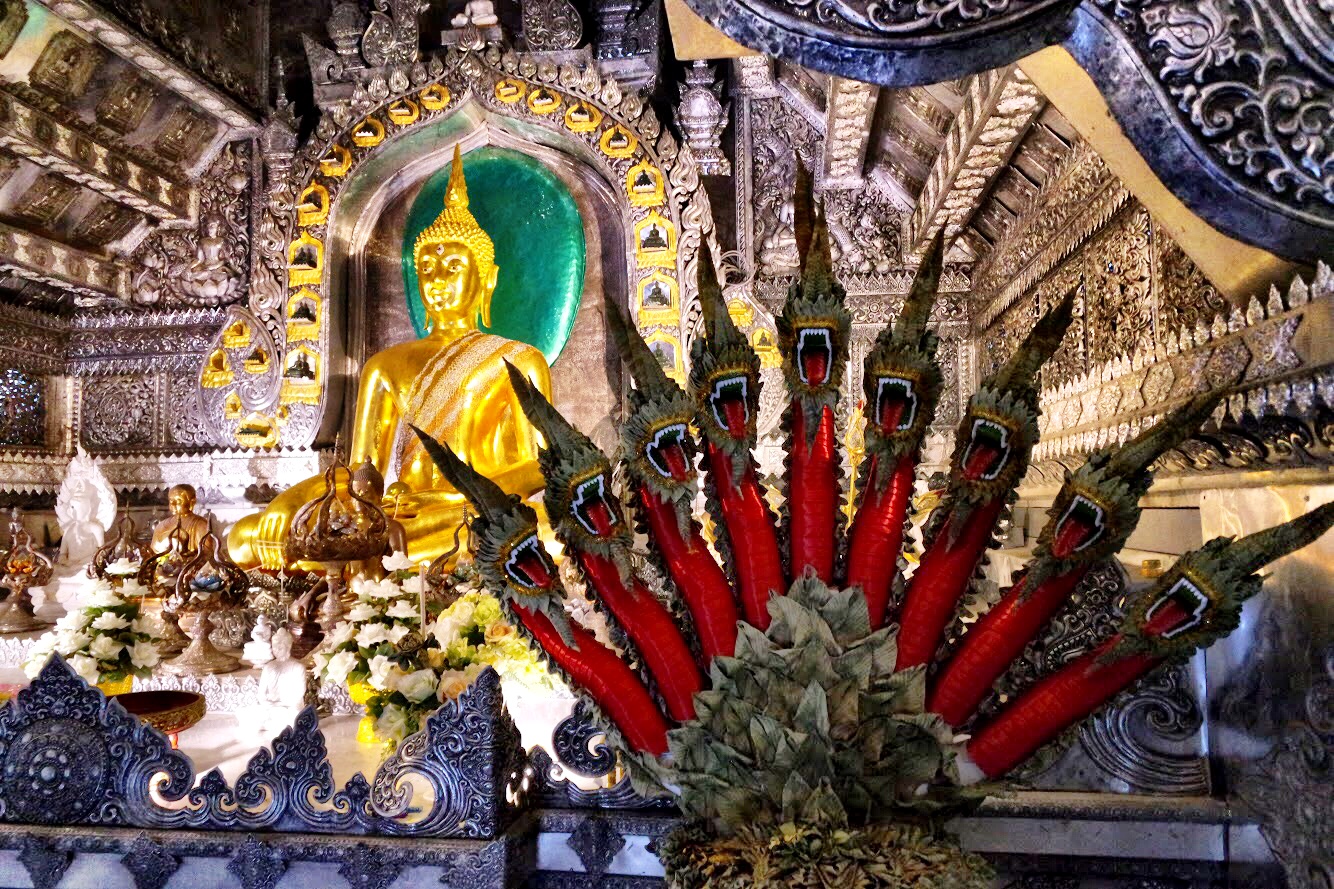
Saturday: Seated Under the Naga Hood, meditating and protected from rain by Mucalinda, the seven-headed King of the Naga.

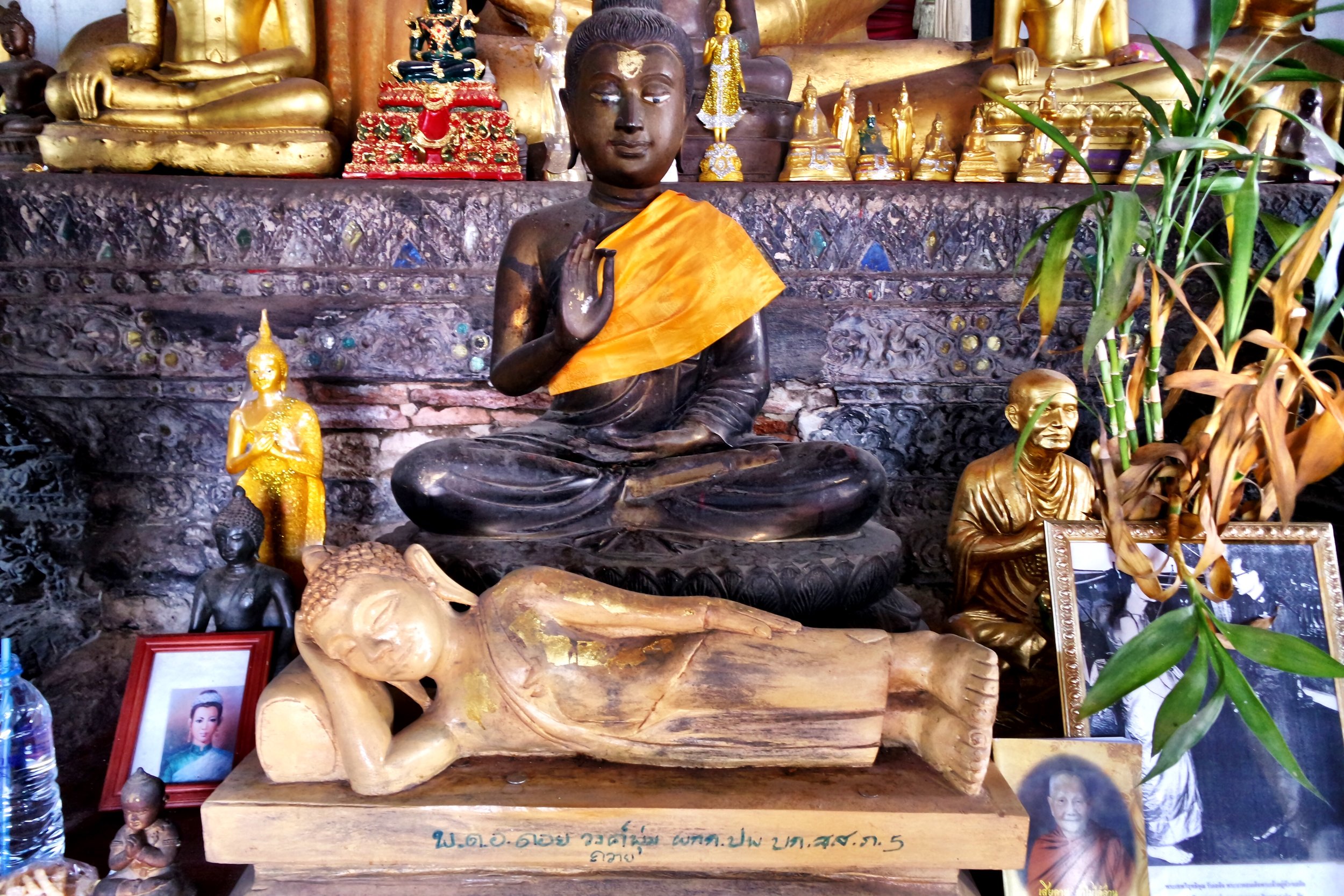
Wat Doi Suthep

Wat Doi Suthep

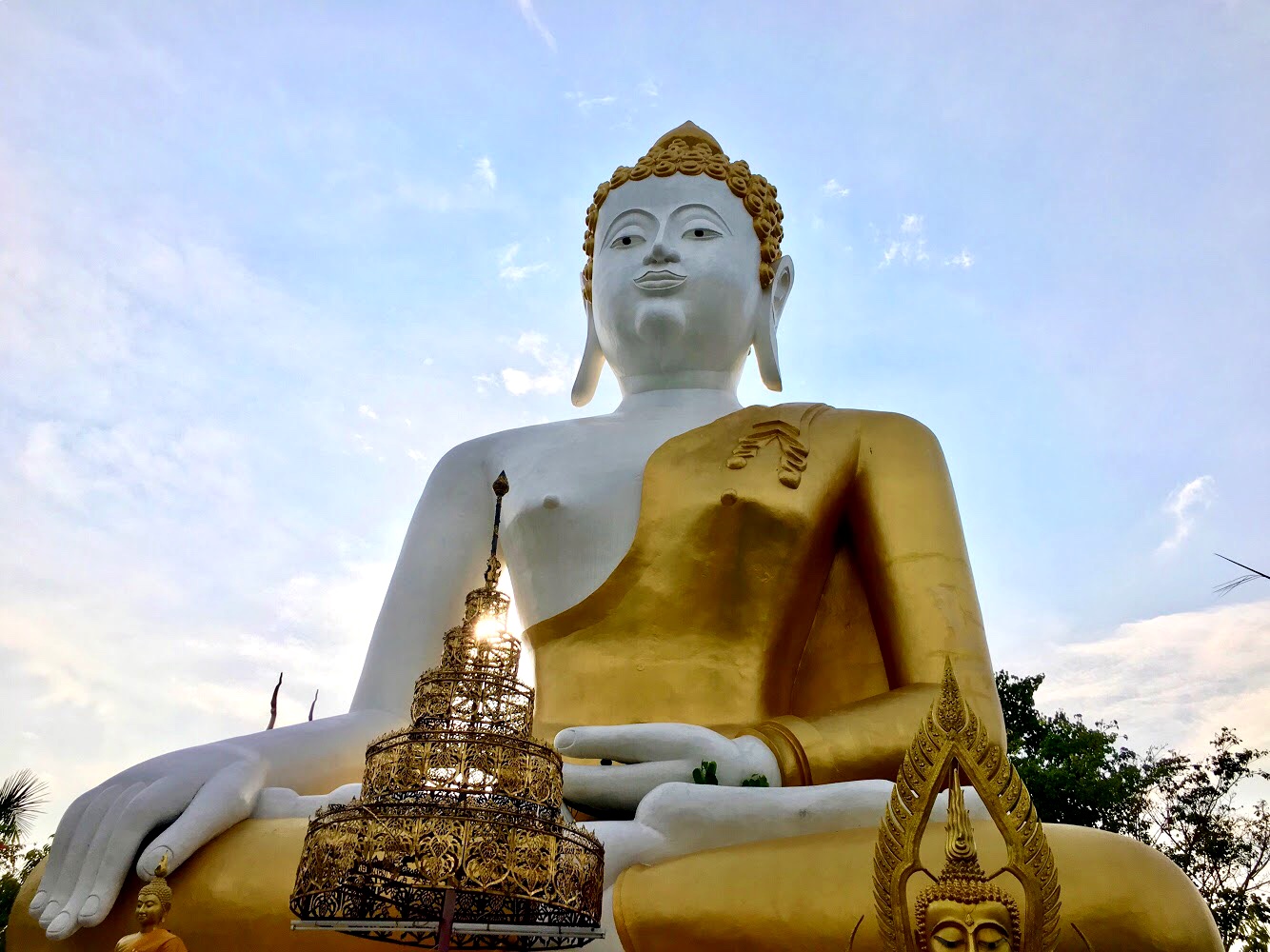
As the central image in a wat, more often than not, the Buddha is sitting cross-legged, one leg on top of the other, with one hand in his lap, palm upward, and the other draped downward over his leg. This is the Calling the Earth to Witness position, which symbolized the Buddha’s moment of enlightenment.

Some of the Buddhas are standing, and you’ll also find a few Reclining Buddhas, which I personally like to call Sleepy-time Buddhas.

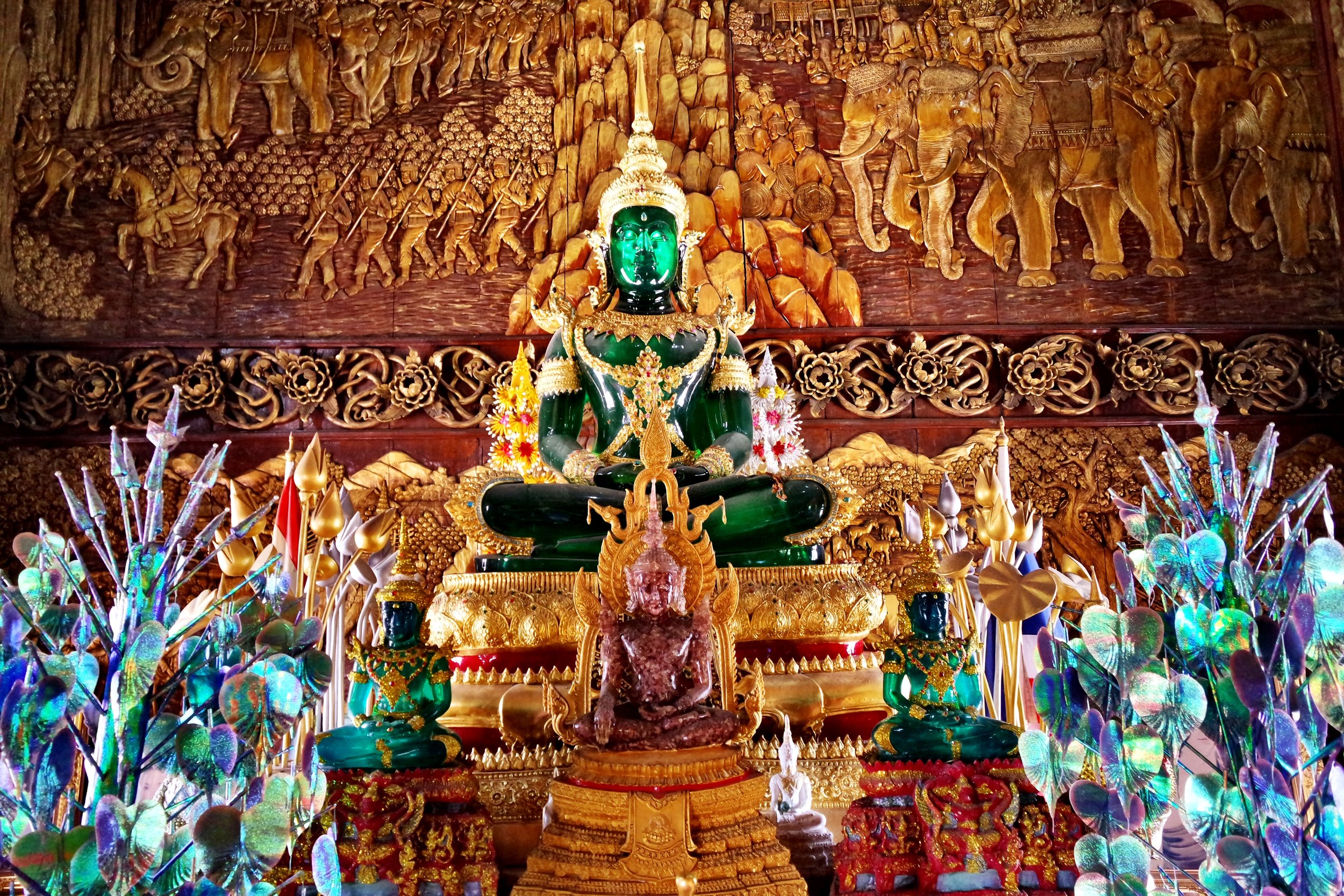
Around the 16th century, the statues of the Buddha were made of a thin alloy, though some were even cast with gold.

Here’s a sampling of the Buddhas we found around town. –Wally

Wat Buppharam

Wat Buppharam

Wat Buppharam

Wat Buppharam

Wat Buppharam

Wat Buppharam

Wat Buppharam

Wat Buppharam

Wat Chedi Luang

Wat Chedi Luang

Wat Chedi Luang

Wat Chedi Luang

Wat Chedi Luang

Wat Chedi Luang

Wat Doi Kham

Wat Doi Kham

Wat Doi Suthep

Wat Doi Suthep

Wat Doi Suthep

Wat Doi Suthep

Wat Upakut

Wat Upakut

Wat Upakut

Wat Upakut

Wat Jet Lin

Wat Jet Lin

Wat Kuan Kama

Wat Kuan Kama

Wat Lok Molee

Wat Lok Molee

Wat Palad

Wat Palad

Wat Rajamontean

Wat Rajamontean

Wat Sri Suphan

Wat Sri Suphan

Wat Sri Suphan

Wat Sri Suphan

Wat Sri Suphan

Wat Sri Suphan

8 Frightening Facts About Sultan Moulay Ismail Ibn Sharif

He’s the most gruesome character in the history of Morocco. The country’s own Vlad the Impaler has some dubious claims to fame — including fathering more kids than anyone else in history.

Sultan Moulay Ismail Ibn Sharif believed he was a descendent of the Prophet Mohammed — and used that as an excuse for some very bad behavior

Sultan Moulay Ismail Ibn Sharif believed he was a descendent of the Prophet Mohammed — and used that as an excuse for some very bad behavior.

Sultan Moulay Ismail Ibn Sharif was propelled to the throne of Morocco in 1672. His brother had been riding horseback after a victory banquet and was killed when his horse galloped beneath the low-hanging branches of the palace orchard.

Ismail’s reign as sultan, from 1672-1727, was longer than any other ruler in Moroccan history. Whether he should be remembered more for his beautiful creations or his cruel tyranny is a matter of dispute — but everyone agrees that Ismail was one of the most important rulers in Moroccan history.

Men who merely glanced at one of his wives or concubines were punished by death.

Here are some of the things that made the sultan so infamous.


1. He killed his servants at whim.

Ismail was not, by any accounts, a very nice man. In fact, he’s been quoted as having said, “My subjects are like rats in a basket, and if I do not keep shaking the basket, they will gnaw their way through.”

It’s estimated that 30,000 poor souls met their deaths at the hands of the sultan — often for no reason. He was well known to kill people during fits of rage. According to one story, the sultan lopped off the head of a slave who had been adjusting his stirrup as he was mounting his horse. They didn’t call him “the Bloodthirsty” for nothing.

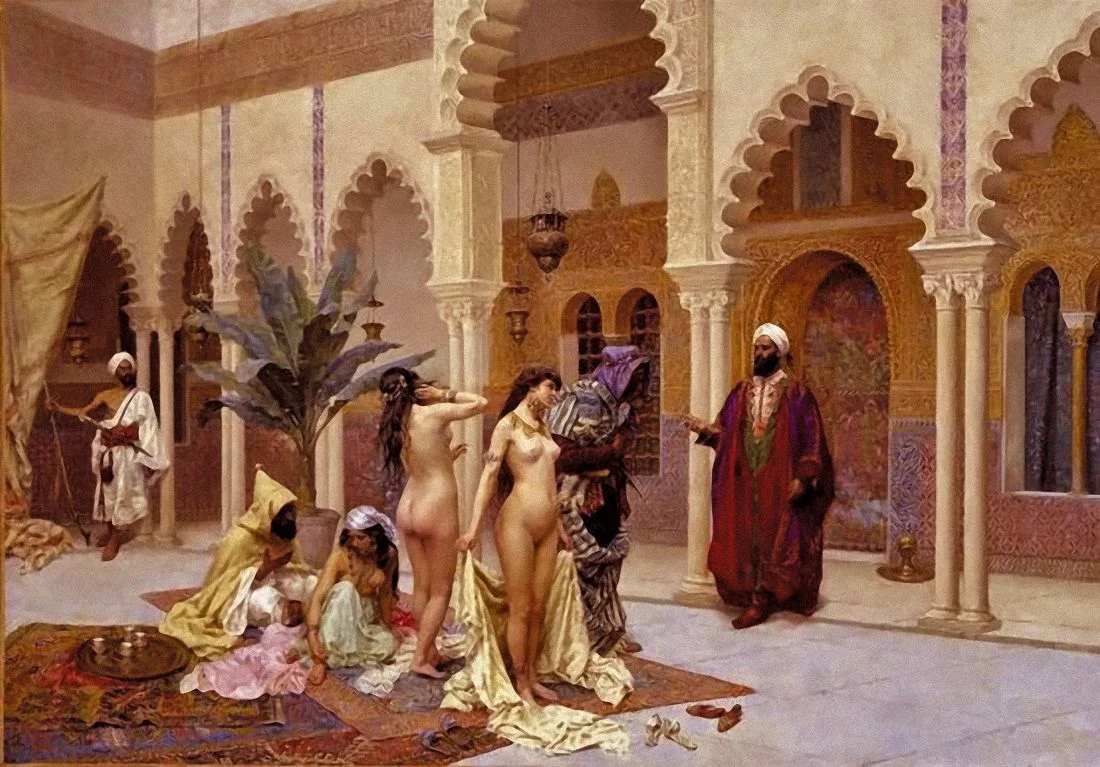
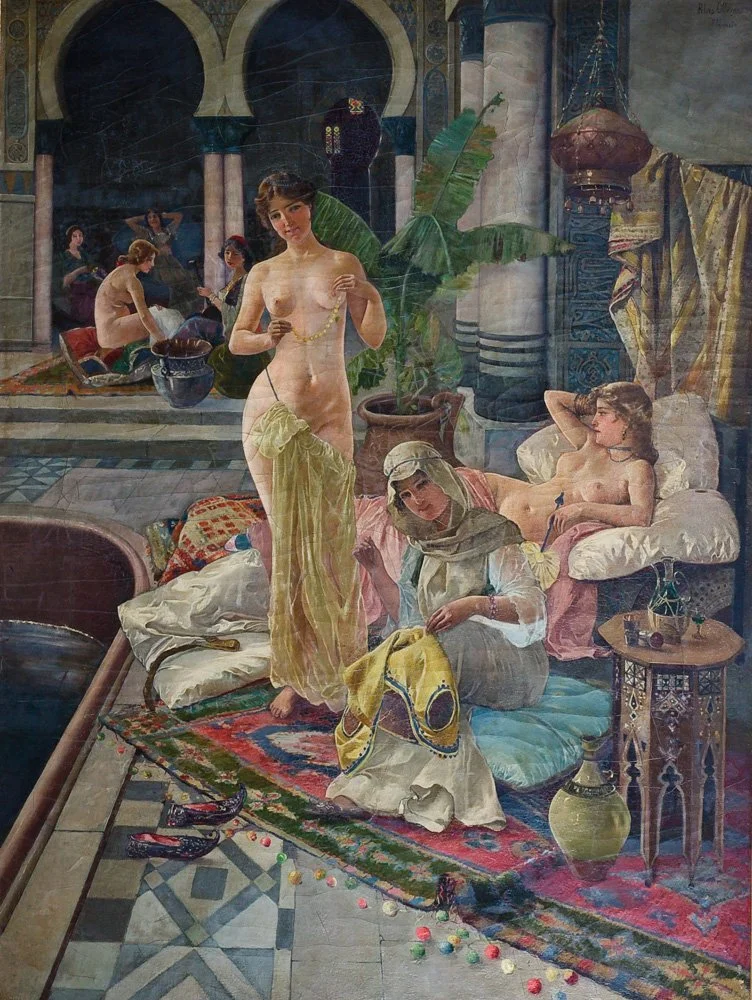
Legend has it that Ismail had sex every single day — which wouldn’t be too tough to do if you had over 500 women to choose from

Legend has it that Ismail had sex every single day — which wouldn’t be too tough to do if you had over 500 women to choose from.

2. Ismail was a sex addict — and fathered more children than anyone else in history.

Ismail was well-known for siring hundreds of children. According to the Guinness Book of World Records, he fathered 888 children — the highest number of offspring for anyone throughout history that can be verified.

Each of the 500 concubines in Ismail’s harem had their own eunuch and handmaiden

Each of the 500 concubines in Ismail’s harem had their own eunuch and handmaiden.

3. He had 500 concubines, which no one else could even look at.

He was fiercely protective of his four wives and 500 concubines. Whenever a tribe surrendered to Moulay Ismail, the leader was forced to offer his most beautiful daughter to the sultan as a gift.

The women were treated like Ismail’s favorite toys. Each concubine was granted a personal eunuch, a castrated male slave, and an odalisque, or female attendant.

The lake-like Bassin de l’Agdal in Meknès served as an emergency source of water in times of war and a pool for his concubines in times of peace.

Men who merely glanced at one of his wives or concubines were punished by death. It’s said that men who encountered the sultan’s women laid facing the ground, so as to avoid any accusation of having looked upon them.

If any of Ismail’s harem were suspected of adultery, they were severely punished or put to death. The women were either strangled by the sultan himself or had their breasts cut off or teeth extracted.

Ismail fathered at least 888 kids — more than anyone else in recorded history!

Ismail fathered at least 888 kids — more than anyone else in recorded history!

4. The Sharif family claims to be descendants of the Prophet Mohammed.

Ismail succeeded the throne at the age of 26 and established Meknès as the capital of the kingdom. He was a member of the Sharif dynasty, which claimed to be descendants of the Prophet Mohammed, the founder of Islam.

Ismail used this pretense to justify his actions, both cruel and kind. His subjects bowed in his presence, and were not allowed to look him in the eye.

During his 55-year reign, he managed to create magnificent and enormous construction projects. His palace was built exclusively by European slaves, aided by bands of local criminals. The palace was four miles in circumference, and its walls were 25 feet thick.

As soon as he finished one project, he’d start on another. If he didn’t like something, he would order it demolished and a new one rebuilt.

Ismail killed people for the slightest offense, including even just looking at one of his concubines

Ismail killed people for the slightest offense, including even just looking at one of his concubines.


5. The sultan’s favorite wife was once a concubine who convinced him to punish his son in a horrific manner.

Ismail’s favorite wife and queen of the palace was a black woman who started out as a concubine. Her name was Lalla Aisha Mubarka, or Zaydana, the name she acquired after giving birth to the sultan’s first son, Zaydan.

She held sway over Ismail and hatched a scheme to depose his favorite son, Mohammed al-Alim, suggesting that he intended to proclaim himself the sultan of Morocco. For his punishment, Ismail had his son’s left arm and right leg amputated for supposedly having rebelled against him. This was intended to send a message that any disobedience would mean severe punishment or death. Not surprisingly, Al-Alim died from blood loss.

Ismail’s Black Guard, made up of captured sub-Saharan slaves, acted as the sultan’s personal bodyguards

Ismail’s Black Guard, made up of captured sub-Saharan slaves, acted as the sultan’s personal bodyguards.

6. Ismail created a massive self-generating army.

The formidable Black Guard was comprised of slave warriors acquired from sub-Saharan Africa. Considered loyal, as they no longer had any tribal affiliation, the Black Guard were Ismail’s personal guards and servants.

By the end of his reign, he had raised a powerful army of more than 150,000 men. These men had families and lived in communities of their own, but essentially belonged to Ismail. The boys were raised to serve in his army, which helped Ismail maintain his position and conquer the whole of Morocco from European kingdoms. The girls would marry, have children and continue the cycle.

The Black Guard exists to this day, though its name was changed to the Moroccan Royal Guard after the country gained its independence in 1956.


7. He also had an astoundingly large prison that mostly held Christians.

The Habs Qara (Prison of Christian Slaves) was a large subterranean prison beneath the city of Meknès. At its height, it held an estimated 60,000 prisoners, 40,000 of them believed to have been Christian sailors captured at sea by Barbary pirates. The Christians were used as slave labor to build the city during the day and were shackled to the prison walls in the evening and forced to sleep standing up.

Rumors of the existence of secret tunnels leading from the royal palace to the prison persist, despite lack of evidence.

Louis XIV, the Sun King of Versailles

Louis XIV, the Sun King of Versailles

8. The sultan and the Sun King were allies.

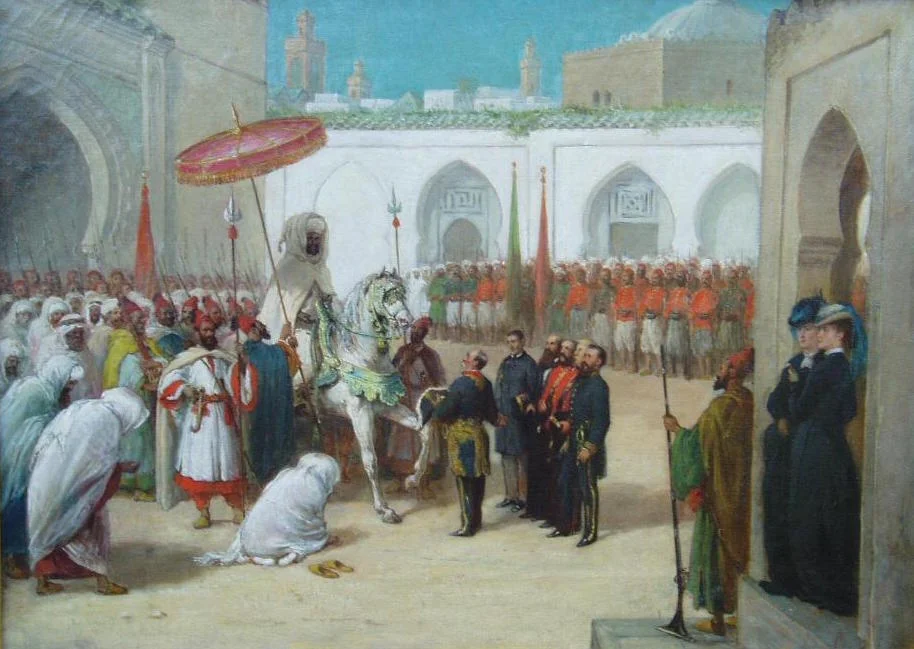
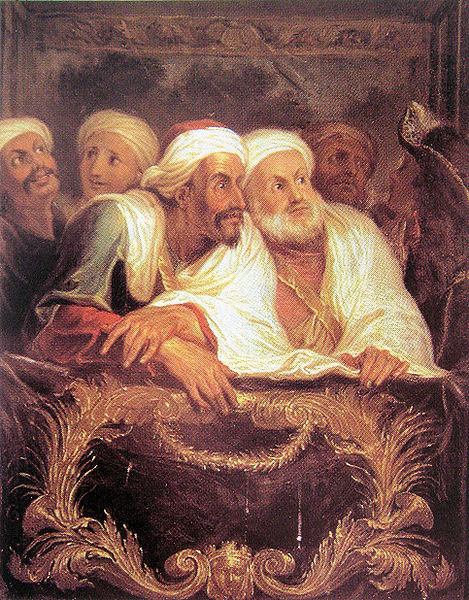
Ismail, the second ruler of the Alaouite dynasty, presided over Morocco at the same time that Louis XIV, the Sun King, ruled France. He and Louis XIV were close allies, and in 1682, Ismail sent Mohammed Tenim, the governor of Tétouan, to be his ambassador in France to sign a treaty of friendship and negotiate the release of Moroccan captives. French Baroque painter Charles Antoine Coypel depicted the Moroccan ambassador’s visit in his painting titled Mohammed Tenim, Ambassadeur du Maroc à la Comédie Italienne.

Mohammed Tenim, Ambassadeur du Maroc à la Comédie Italienne by Charles Antoine Coypel, 1682

Mohammed Tenim, Ambassadeur du Maroc à la Comédie Italienne by Charles Antoine Coypel, 1682

Ismail proposed to Princess Marie Anne de Bourbon but was rejected

Ismail proposed to Princess Marie Anne de Bourbon but was rejected.

Ismail sent his ambassador with a marriage proposal to Marie Anne de Bourbon, the eldest legitimized daughter of the king and his mistress Louise de La Vallière, but she declined. Thankfully, it didn’t lead to an international incident. –Duke
Gruesome Grimm Fairy Tales

Bettelheim’s Freudian analysis of “Cinderella,” “Little Red Riding Hood,” “Hansel and Gretel” and “The Three Little Pigs” helps understand the monster of Supernatural, Season 3, Episode 5.

A little girl’s spirit makes fairy tales come true in this episode of Supernatural — revealing just how violent these stories truly are

A little girl’s spirit makes fairy tales come true in this episode of Supernatural — revealing just how violent these stories truly are.

S3E5: “Bedtime Stories”

Monster: Spirit that makes fairy tales come true

Where it’s from: Fairy tales were collected by Charles Perrault in France in 1697, then later in Germany by the Brothers Grimm from 1812-1857. 

Description: A cute little girl wearing a white dress that has a red bow with a red ribbon in her hair.

What it does: Something tears apart two brothers, devouring their innards. They were arguing about how to build houses — like the Three Little Pigs. “Actually, those guys were a little chubby,” Dean says with a smirk.

Many adults today tend to take literally the things said in fairy tales, whereas they should be viewed as symbolic renderings of crucial life experiences.
— Bruno Bettelheim, “The Uses of Enchantment”

Talk of fairy tales always makes me break out Bruno Bettelheim’s seminal work The Uses of Enchantment: The Meaning and Importance of Fairy Tales. And sure, he’s extremely Freudian — his analysis is filled with oral fixations and oedipal complexes — but he helps get at the root of these stories and why they resonate with children on a subconscious level.

“Many adults today tend to take literally the things said in fairy tales, whereas they should be viewed as symbolic renderings of crucial life experiences,” Bettelheim writes.

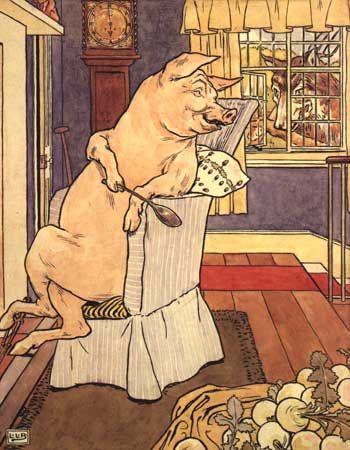
“The Three Little Pigs” reveals the dangers of following the pleasure principle

“The Three Little Pigs” reveals the dangers of following the pleasure principle.

“The Three Little Pigs”

Bettelheim explains how this fairy tale teaches children that they have to tame their id as they move into adulthood:

The littlest pig built his house with the least care out of straw; the second used sticks; both throw their shelters together as quickly and effortlessly as they can, so they can play for the rest of the day. Living in accordance with the pleasure principle, the younger pigs seek immediate gratification, without a thought for the future and the dangers of reality. … Only the third and oldest pig has learned to behave in accordance with the reality principle: He is able to postpone his desire to play, and instead acts in line with his ability to foresee what may happen in the future.

The third Little Pig acted like a sensible adult — and was able to keep the wolf at bay

The third Little Pig acted like a sensible adult — and was able to keep the wolf at bay.

Of course, the bad guys are something within us, according to Bettelheim:

The wolf’s badness is something the young child recognizes within himself: his wish to devour, and its consequences — the anxiety about possibly suffering such a fate himself. So the wolf is an externalization, a projection of the child’s badness — and the story tells how this can be dealt with constructively.

“Hansel and Gretel” plays upon kids’ dominant fear, according to Bettelheim: being deserted by their parents

“Hansel and Gretel” plays upon kids’ dominant fear, according to Bettelheim: being deserted by their parents.

“Hansel and Gretel”

A little old lady invites in two lost hikers — they’re “deep in the woods,” just like Hansel and Gretel — and drugs their cherry pie. Then she grabs a knife, slits the man’s throat and stabs him repeatedly, smiling all the while like a sweet grandma.

Outside the window, the little girl watches, pleased.

“The fairy tale expresses in words and actions the things which go on in children’s minds,” Bettelheim explains.

In terms of the child’s dominant anxiety, Hansel and Gretel believe that their parents are talking about a plot to desert them. A small child, awakening hungry in the darkness of the night, feels threatened by complete rejection and desertion, which he experiences in the form of fear of starvation.

The parents in “Hansel and Gretel” attempt to abandon their children. It’s hard not to imagine Bettelheim is referring to breastfeeding here:

It is the child’s anxiety and deep disappointment when Mother is no longer willing to meet all his oral demands which leads him to believe that suddenly Mother has become unloving, selfish, rejecting. Since the children know they need their parents desperately, they attempt to return home after being deserted.

The gingerbread house, as seen in this old advertisement, is actually a symbol of…a good mother, who offers up her breast for nourishment?!

The gingerbread house, as seen in this old advertisement, is actually a symbol of…a good mother, who offers up her breast for nourishment?!

There’s a lot of symbolism packed into that gingerbread house, according to Bettelheim:

Carried away by their uncontrolled craving, the children think nothing of destroying what should give shelter and safety. …

The child recognizes that, like Hansel and Gretel, he would wish to eat up the gingerbread house, no matter what the dangers. …

A gingerbread house, which one can “eat up,” is a symbol of the mother, who in fact nurses the infant from her body. Thus, the house at which Hansel and Gretel are eating away blissfully and without a care stands in the unconscious for the good mother, who offers her body as a source of nourishment.

While the fairy tale is scary, children appreciate the fact that Hansel and Gretel ultimately trick and kill the witch

While the fairy tale is scary, children appreciate the fact that Hansel and Gretel ultimately trick and kill the witch.

And then there’s that cannablistic witch:

The witch, who is a personification of the destructive aspects of orality, is as bent on eating up the children as they are on demolishing her gingerbread house. …

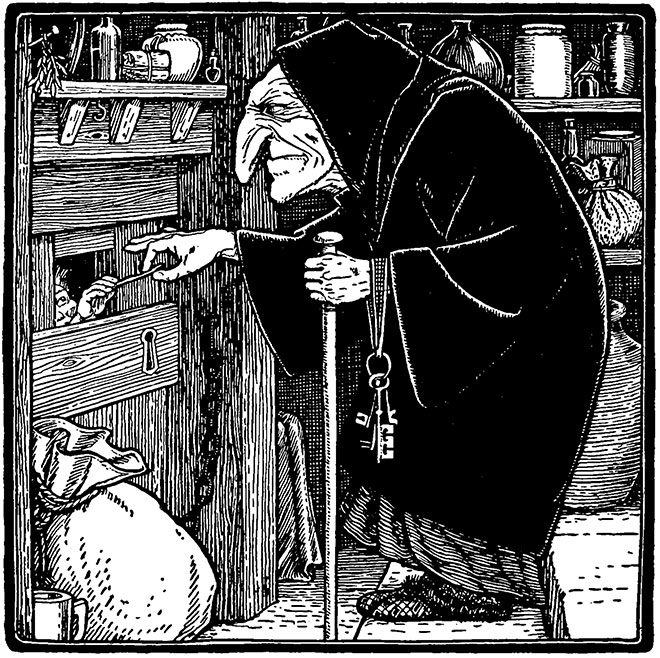
A witch as created by the child’s anxious fantasies will haunt him; but a witch he can push into her own oven and burn to death is a witch the child can believe himself rid of. As long as children continue to believe in witches — they always have and always will, up to the age when they no longer are compelled to give their formless apprehensions humanlike appearance — they need to be told stories in which children, by being ingenious, rid themselves of these persecuting figures of their imagination.

The murders on Supernatural are obviously connected to these fairy tales. And in the originals, there weren’t happily-ever-afters; the Grimm tales are gruesome. Originally they had sex, violence and cannibalism. “It got sanitized over the years,” Sam says, “turned into Disney flicks and bedtime stories.”

There’s a frog on the path in front of them. Dean’s finally convinced, though he adds, “I’ll tell you one thing: There’s no way I’m kissing a damn frog.”

When Sam sees a pumpkin and a mouse, he thinks of Cinderella’s carriage. “Dude, could you be more gay?” Dean says. I hope he has to make out with the frog for that comment.

A young woman is handcuffed in the kitchen. Her stepmother went crazy and abused her. Sound familiar?

Children relate to Cinderella, whose place is in the ashes of the hearth, because they, too, like to get dirty — and they feel guilty about their oedipal desires

Children relate to Cinderella, whose place is in the ashes of the hearth, because they, too, like to get dirty — and they feel guilty about their oedipal desires.

“Cinderella”

“Cinderella” has its origins in China even before the 9th century, when it was first written down. Bettelheim points out that that particular Asian country has had a controversial past involving foot fetishism and abuse of women:

The modern hearer does not connect sexual attractiveness and beauty in general with extreme smallness of the foot, as the ancient Chinese did, in accordance with their practice of binding women’s feet.

The conflict in “Cinderella” involves her nasty stepsisters, which Bettelheim justifiably ties to sibling rivalry.

Despite the name “sibling rivalry,” this miserable passion has only incidentally to do with a child’s actual brothers and sisters. The real source of it is the child’s feelings about his parents. …

Fearing that in comparison to [a child’s sisters or brothers] he cannot win his parents’ love and esteem is what inflames sibling rivalry. This is indicated in stories by the fact that it matters little whether the siblings actually possess greater competence.

Cinderella acquires her name by hanging out in the cinders of the hearth. Bettelheim posits that children connect with this uncleanliness:

Some of the child’s pervasive feelings of worthlessness have their origin in his experiences during and around toilet training and all other aspects of his education to become clean, neat and orderly. … As clean as a child may learn to be, he knows that he would much prefer to give free rein to his tendency to be messy, disorderly and dirty.

At the end of the oedipal period, guilt about desires to be dirty and disorderly becomes compounded by oedipal guilt, because of the child’s desire to replace the parent of the same sex in the love of the other parent.

It makes every child identify with Cinderella, who is relegated to sit among the cinders. Since the child has such “dirty” wishes, that is where he also belongs. … This is why every child needs to believe that even if he were thus degraded, eventually he would be rescued from such degradation and experience the most wonderful exaltation — as Cinderella does.  

Then again, there might be something actually noble and desirable about Cinderella’s station by the fire:

We are so accustomed to thinking of living as a lowly servant among the ashes of the hearth as an extremely degraded situation that we have lost any recognition that, in a different view, it may be experienced as a very desirable, even exalted position. In ancient times, to be the guardian of the hearth — the duty of the Vestal Virgins — was one of the most prestigious ranks, if not the most exalted, available to a female.

Bettelheim adds that “in many societies ashes were used for ablutions as a means of cleansing oneself.”

The Fairy Godmother gives Cinderella the means to attend the ball in style — but she has to leave early to keep her virginity intact

The Fairy Godmother gives Cinderella the means to attend the ball in style — but she has to leave early to keep her virginity intact.

And it wouldn’t be a Freudian reading of “Cinderella” if there wasn’t a stand-in for the vagina, right?

A tiny receptacle into which some part of the body can slip and fit tightly can be seen as a symbol of the vagina. Something that is brittle and must not be stretched because it would break reminds us of the hymen; and something that is easily lost at the end of a ball when one’s lover tries to keep his hold on his beloved seems an appropriate image for virginity. … Cinderella’s running away from this situation could be seen as her effort to protect her virginity.

The godmother’s order that Cinderella must be home by a certain hour or things will go very wrong … is similar to the parent’s request that his daughter must not stay out too late at night because of his fear of what may happen if she does.

Then again, maybe the shoe means a marriage commitment:

[I]n many stories it is the prince who slips the shoe on. This might be likened to the groom’s putting the ring on the finger of the bride as an important part of the marriage ceremony, a symbol of their being tied together henceforth.

Bettelheim saw the glass slipper as symbolic of a vagina — more specifically, a hymen

Bettelheim saw the glass slipper as symbolic of a vagina — more specifically, a hymen.

And there’s a creepy ending to “Cinderella” that Disney decided to leave out:

For the last time the stepsisters, with the active help of the stepmother, try to cheat Cinderella out of what rightly belongs to her. Trying to fit their feet into the shoe, the stepsisters mutilate them. …

They engaged in symbolic self-castration to prove their femininity; bleeding from the place on the body where this self-castration occurred may be another demonstration of their femininity, as it may stand for menstruation.

Back on Supernatural, the creepy little girl is there, but flickers and disappears, leaving a shiny red apple where she was standing. That’s symbolic of Snow White’s long sleep — sort of like the coma the doctor’s daughter is in.

Turns out he’s reading her Brothers Grimm fairy tales. Why aren’t we surprised? When he reads “Little Red Riding Hood,” the Big Bad Wolf (well, the dude with the Wile E. Coyote tattoo, that is) attacks a grandmother and kidnaps her granddaughter, who happens to be wearing a red hoodie.

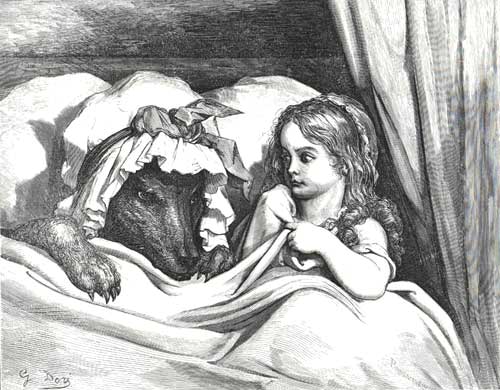
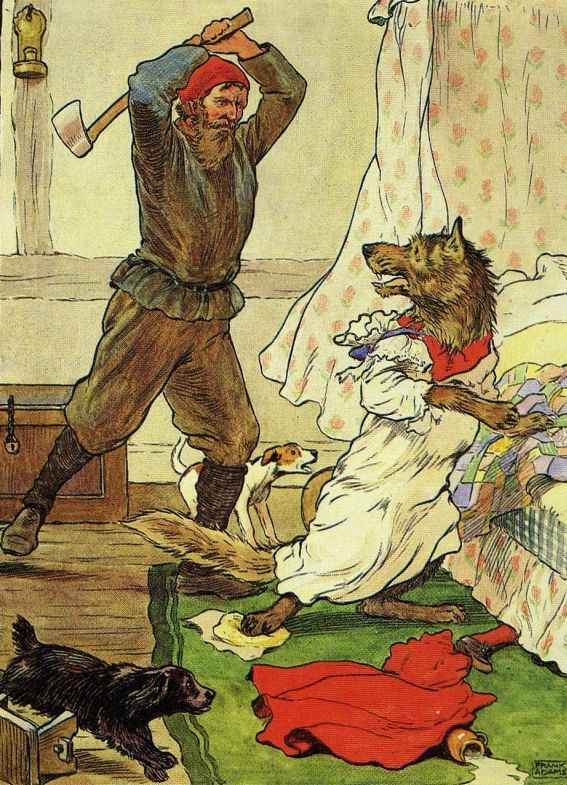
Little Red Riding Hood is given a red cloak, which shows she’s been sexualized at too young an age — leaving her prey to the Big Bad Wolf, a stand-in for lustful men

Little Red Riding Hood is given a red cloak, which shows she’s been sexualized at too young an age — leaving her prey to the Big Bad Wolf, a stand-in for lustful men.

“Little Red Riding Hood,” or “Little Red Cap”

In the famous tale, Little Red Riding Hood wanders off the path, is tricked by the Big Bad Wolf and gets swallowed whole. Bettelheim sees this as a coming of age story, rife with sexual metaphors:

Little Red Cap tries to understand, when she asks Grandmother about her big ears, observes the big eyes, wonders about the large hands, the horrible mouth. Here is an enumeration of the four senses: hearing, seeing, touching, and tasting; the pubertal child uses them all to comprehend the world.

“Little Red Cap” in symbolic form projects the girl into the dangers of her oedipal conflicts during puberty, and then saves her from them, so that she will be able to mature conflict-free.

It’s ultimately a story about young women coming to terms with men, who are

split into two opposite forms: the dangerous seducer who, if given in to, turns into the destroyer of the good grandmother and the girl; and the hunter, the responsible, strong, and rescuing father figure.

It is as if Little Red Cap is trying to understand the contradictory nature of the male by experiencing all aspects of his personality: the selfish, asocial, violent, potentially destructive tendencies of the id (the wolf); the unselfish, social, thoughtful and protective propensities of the ego (the hunter).

Little Red Cap is universally loved because, although she is virtuous, she is tempted; and because her fate tells us that trusting everybody’s good intentions, which seems so nice, is really leaving oneself open to pitfalls.

It’s no coincidence that our heroine is wearing red:

All through “Little Red Cap,” in the title as in the girl’s name, the emphasis is on the color red, which she openly wears. Red is the color symbolizing violent emotions, very much including sexual ones. The red velvet cap given by Grandmother to Little Red Cap thus can be viewed as a symbol of a premature transfer of sexual attractiveness. …

Little Red Cap’s danger is her budding sexuality, for which she is not yet emotionally mature enough.

Bettelheim, channeling Freud, gets creepy when he starts talking about how Red, standing in for all little girls, really wants to be seduced by her father:

The story on this level deals with the daughter’s unconscious wish to be seduced by her father (the wolf). …

It is this “deathly” fascination with sex — which is experienced as simultaneously the greatest excitement and the greatest anxiety that is bound up with the little girl’s oedipal longings for her father, and with the reactivation of these same feelings in different form during puberty. …

“Little Red Cap” externalizes the inner processes of the pubertal child: The wolf is the externalization of the badness the child feels when he goes contrary to the admonitions of his parents and permits himself to tempt, or to be tempted, sexually. When he strays from the path the parent has outlined for him, he encounters “badness,” and he fears that it will swallow up him and the parent whose confidence he betrayed. But there can be resurrection from “badness,” as the story proceeds to tell.

When Little Red Riding Hood is cut out of the wolf’s belly, it’s a metaphor for her being reborn as a young woman

When Little Red Riding Hood is cut out of the wolf’s belly, it’s a metaphor for her being reborn as a young woman.

I suppose it makes sense that kids would see a pregnant woman (such as Mommy) and think that the baby has to be cut out of her:

Little Red Cap has to be cut out of the wolf’s stomach as if through a Caesarean operation; thus the idea of pregnancy and birth is intimated. With it, associations of a sexual relation are evoked in the child’s unconscious.

By the end of the fairy tale, Red has undergone the sort of hero’s journey Joseph Campbell wrote of:

Little Red Riding Hood’s childish innocence dies as the wolf reveals itself as such and swallows her. When she is cut out of the wolf’s belly, she is reborn on a higher plane of existence; relating positively to both her parents, no longer a child, she returns to life a young maiden.

How to defeat it: Listen to the spirit. Once the message is received, the killings will stop.

Bet you’ll never read (or watch) a fairy tale the same way you did before, will you? –Wally

A History of Meknes, Morocco, the Bab Mansour and Heri es Souanifoot

Explore the historic gate, stables and medina on this day trip from Fès that can be paired with Volubilis.

Meknès, with its ruined stables, granary, gate and markets, makes for a fun afternoon after touring the ancient Roman mosaics of Volubilis.

Meknès, with its ruined stables, granary, gate and markets, makes for a fun afternoon after touring the ancient Roman mosaics of Volubilis.

One of Morocco’s four old imperial cities, Meknès lies west of Fès, in the foothills of the Middle Atlas Mountains. Our driver, Hafid, suggested we make a stop after our amusing guided tour of Volubilis.

Isamil was given the epithet “the Bloodthirsty” for his legendary cruelty. To intimidate rivals, he once ordered that the walls of Meknès be adorned with 10,000 heads of slain enemies.
A woman sells dates off of the main square.

A woman sells dates off of the main square.

There weren’t as many cats in Meknès as there are in Fès and Marrakech, much to Duke and Wally’s dismay.

There weren’t as many cats in Meknès as there are in Fès and Marrakech, much to Duke and Wally’s dismay.


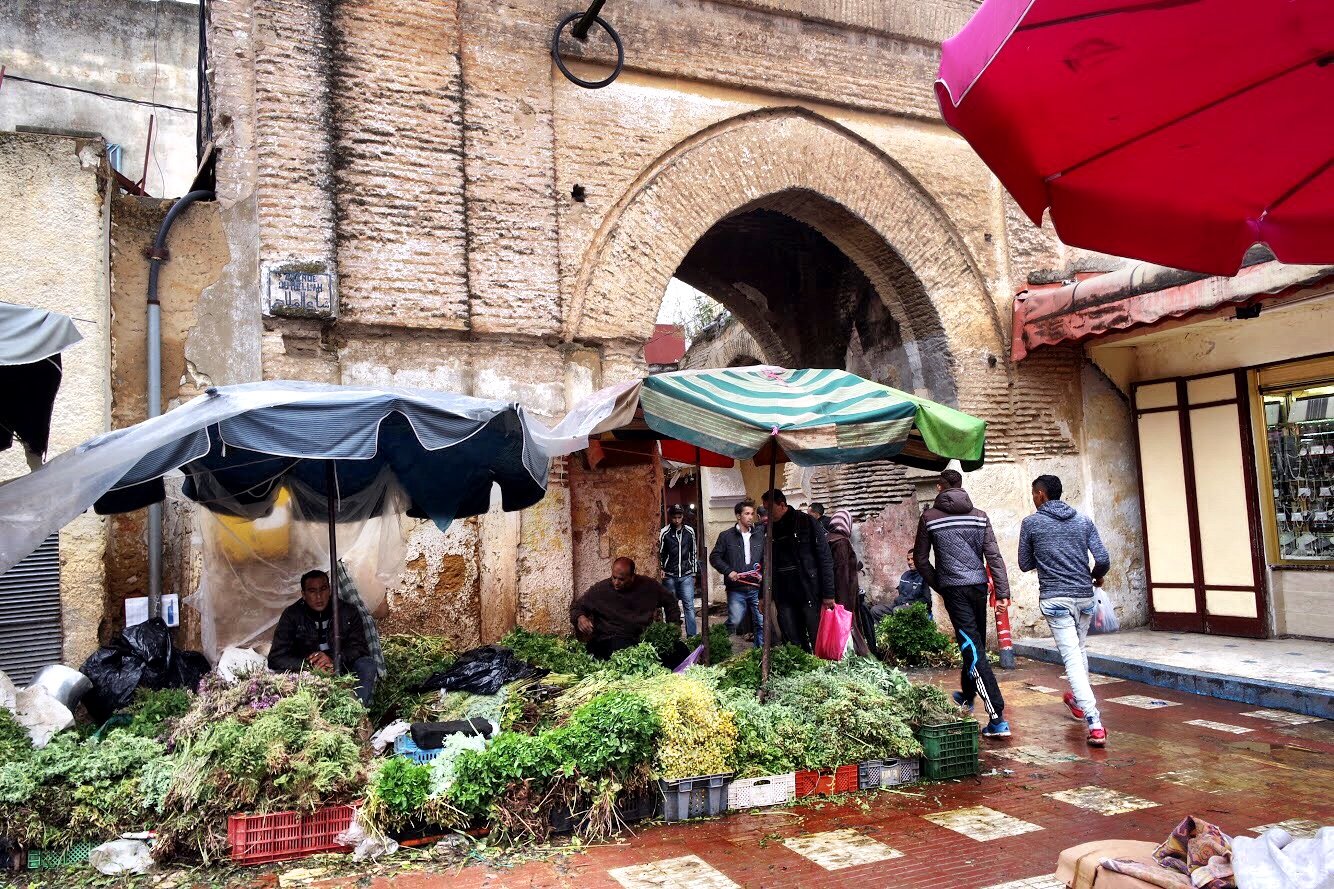
A vendor sells greens near one of the arches of the old city.

A vendor sells greens near one of the arches of the old city.

Meknès was founded and settled in the 11th century by the Almoravids, a Muslim Berber dynasty, as a military settlement and received UNESCO World Heritage Site designation in 1996. The city has retained many of its historic elements, which can be attributed to the ambitious 17th century transformation and monuments constructed under the rule of Sultan Moulay Ismail Ibn Sharif.

A stamp depicting Moulay “the Bloodthirsty” Ismail Ibn Sharif

A stamp depicting Moulay “the Bloodthirsty” Ismail Ibn Sharif

The second sultan of the Alaouite dynasty (the current Moroccan royal family), Ismail ascended the throne at the age of 26, after the death of his half-brother Moulay al-Rashid, who died after a fall from his horse. A descendent of the Prophet Mohammed, Ismail moved from Tafilalt and made Meknès the capital, intent on a creating a grand city on a scale rivalling Versailles in France. It’s believed that Ismail enlisted over 25,000 Christian prisoners and over 30,000 criminals as laborers in the construction of Meknès. Some of the stones were taken from the ancient Roman ruins of Volubilis, a highlight of this area.

Meknès is much less touristy — and much easier to navigate — than Fès.

Meknès is much less touristy — and much easier to navigate — than Fès.


The market displays, like those of this fruit and veggie vendor, are works of art and riots of color.

The market displays, like those of this fruit and veggie vendor, are works of art and riots of color.

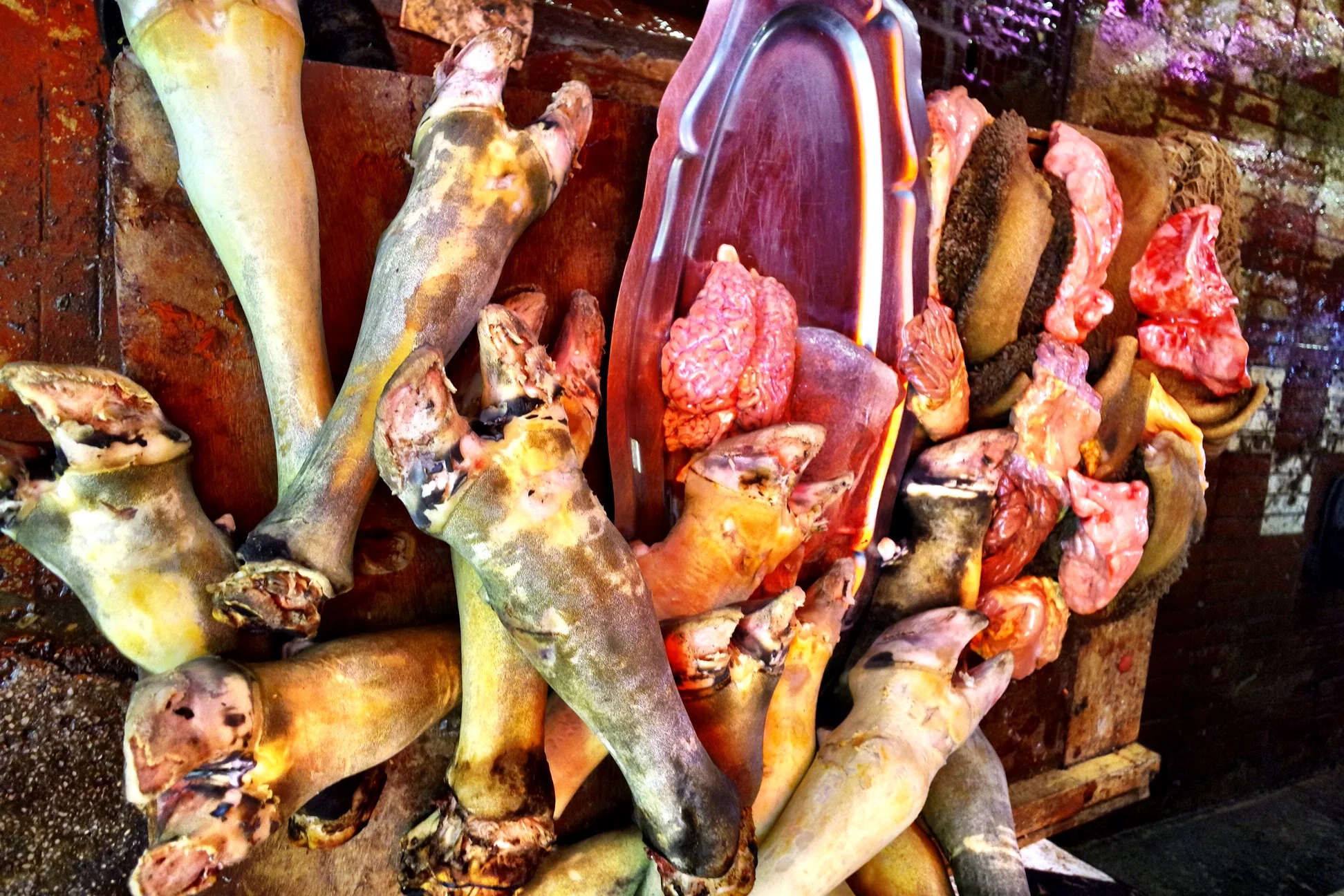
Off to one side of the main square, a doorway leads into a teeming local market.

Off to one side of the main square, a doorway leads into a teeming local market.

Ismail is remembered as one of the greatest and most notorious monarchs of Morocco. His reign lasted 55 years, from 1672 to 1727 — longer than any other ruler in Moroccan history — and left an indelible mark on Meknès. He was given the epithet “the Bloodthirsty” for his legendary cruelty. To intimidate rivals, Ismail once ordered that his city walls be adorned with 10,000 heads of slain enemies. Legends of the ease in which Ismail could behead or torture laborers or servants he thought to be lazy are numerous. During the half century of Ismail's rule, it’s estimated he killed 30,000 people.

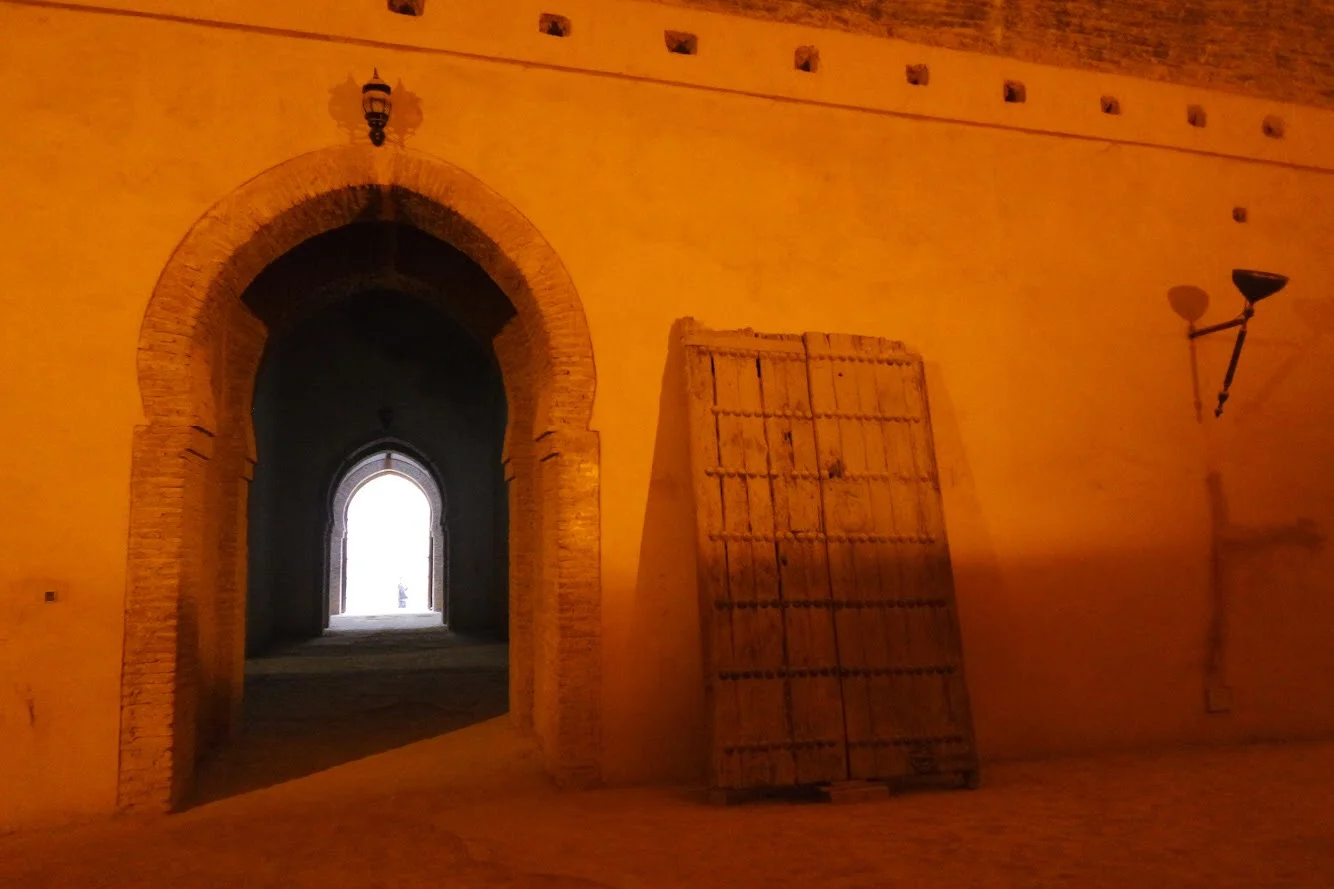
The Bab el-Mansour gate was constructed to impress visitors — and doesn’t really lead anywhere.

The Bab el-Mansour gate was constructed to impress visitors — and doesn’t really lead anywhere.

Bab el-Mansour, the Gate to Nowhere

As a tourist in Meknès, you’ll feel like you’re stepping back in time. One of the most well-preserved and beautiful historic landmarks of the city is the Bab el-Mansour. The elaborate horseshoe-arched gate and its 52-foot-high wooden doors is located off the sprawling el-Hedim square and provides a glimpse of Ismail’s grand vision. The monumental gate bears an Arabic inscription that translates as “I am the most beautiful gate in Morocco. I’m like the moon in the sky. Property and wealth are written on my front.” What’s truly interesting though, is that unlike other gates we’ve encountered in Morocco, this one is a folly that leads nowhere and was commissioned by Ismail simply to impress visitors. It’s now the entrance to a building that features art exhibits.

Could the gate be more beautiful? Probably.

Could the gate be more beautiful? Probably.

To further illustrate his cruelty, one popular legend tells the tale of Ismail asking Mansour Laleuj, the architect responsible for the impressive city gate if he could have made the gate more beautiful. When Laleuj responded yes, the sultan immediately had him beheaded. This is unlikely, though, as the gate was completed by Ismail’s son, Moulay Abdallah, in 1732 — five years after his father’s death. However, the notion that the sultan would act so impetuously at the slightest offense makes for a great story.

Nature has taken over the massive stable complex.

Nature has taken over the massive stable complex.

Stable Conditions

Equally impressive is the Heri es-Souani, the former imperial granary and royal stables. A remarkable engineering feat, the massive stable yard was constructed to comfortably house no less than 12,000 royal horses. I can only imagine the amount of shit there was to shovel! It has been said that Ismail was a fanatic about his horses, and two slaves were employed to look after each horse to ensure that all their needs were met.

The granary complex was an architectural marvel of its day.

The granary complex was an architectural marvel of its day.

The granary was empty when we visited, lending it a creepy vibe.

The granary was empty when we visited, lending it a creepy vibe.

Underground cisterns kept the granary nice and cool.

Underground cisterns kept the granary nice and cool.

One Great Granary

We entered the complex and found ourselves in a cool, barrel-vaulted structure. The chambers are constructed of 13-foot-thick adobe walls with small rectangular windows overhead for circulation. Many chambers have their original cedar doors.

Be sure to look for the noria, a water wheel half submerged in the sandy floor, where horses were once used to raise buckets of water from an underground reservoir connected to the nearby Bassin de l’Agdal.

A series of cisterns beneath the granary kept the floors cool, perfect conditions for storing provisions to feed the city and the sultan’s precious horses.

The stables are impressive — because the sultan who built them pampered his horses.

The stables are impressive — because the sultan who built them pampered his horses.

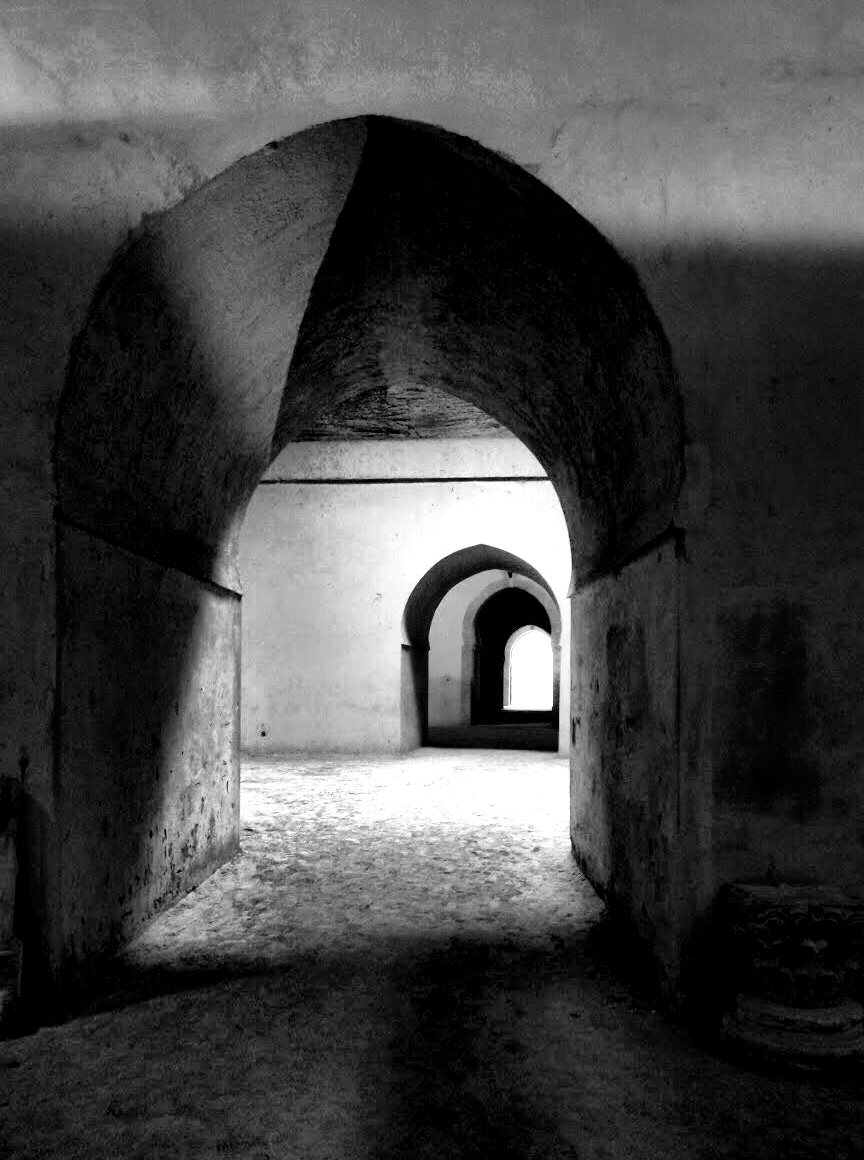
Sturdy stone arches once supported the roof of the stables.

Sturdy stone arches once supported the roof of the stables.

Duke ponders the M.C. Escher-esque labyrinth.

Duke ponders the M.C. Escher-esque labyrinth.

Golden Arches

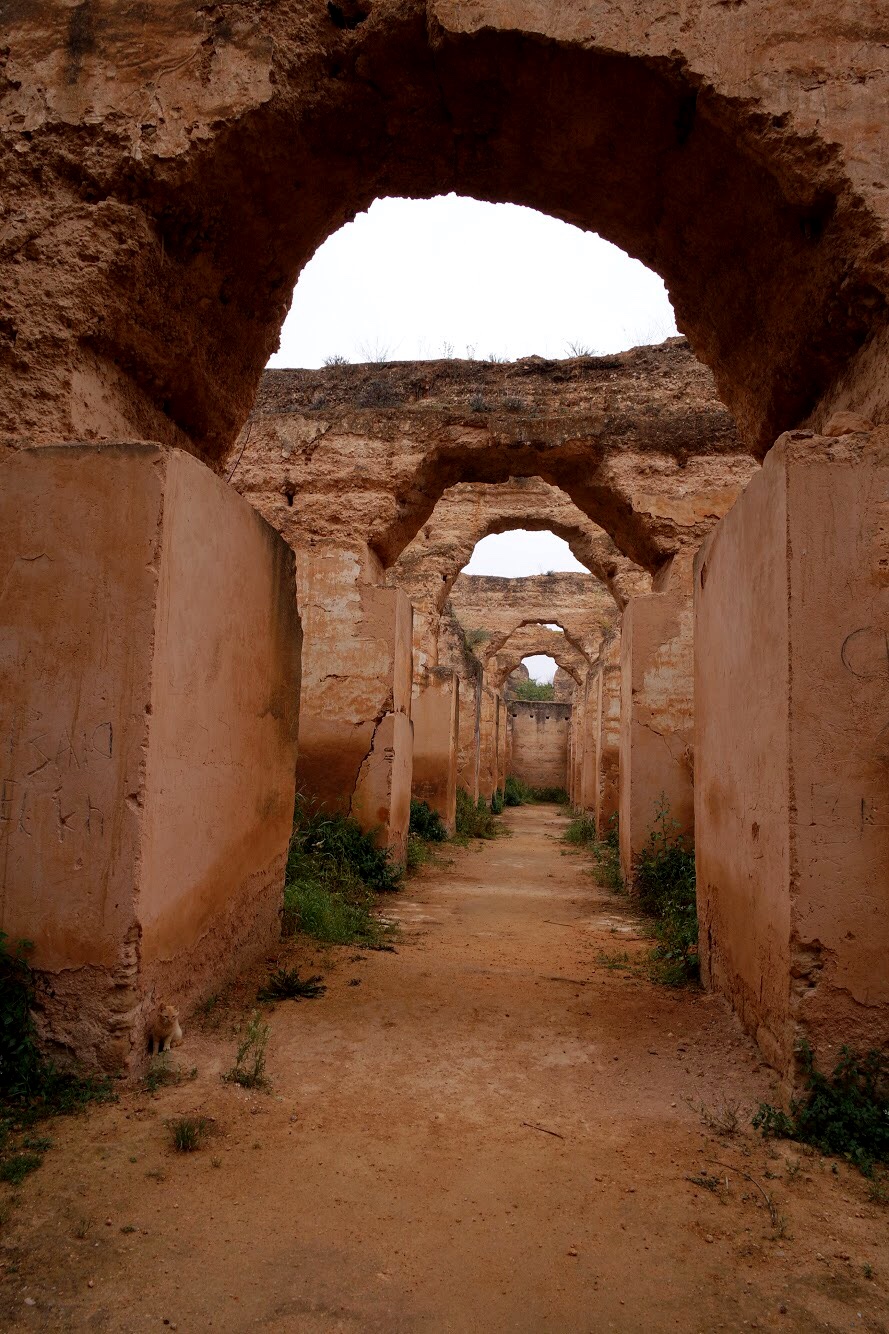
Stretching beyond the granary are the ruins of the royal stables. The wooden beams are long gone due to the seismic waves that radiated from the Lisbon Earthquake of 1755. Nary a horse in sight, its walls remain intact with a great forest of columns and open-air arches forming the arcades of the massive stable. Nature, as well as a few cats, have taken over, lending an otherworldly quality to the ruins.

Wally likes to pretend that he’s playing real-life Dungeons & Dragons in settings like this.

Wally likes to pretend that he’s playing real-life Dungeons & Dragons in settings like this.

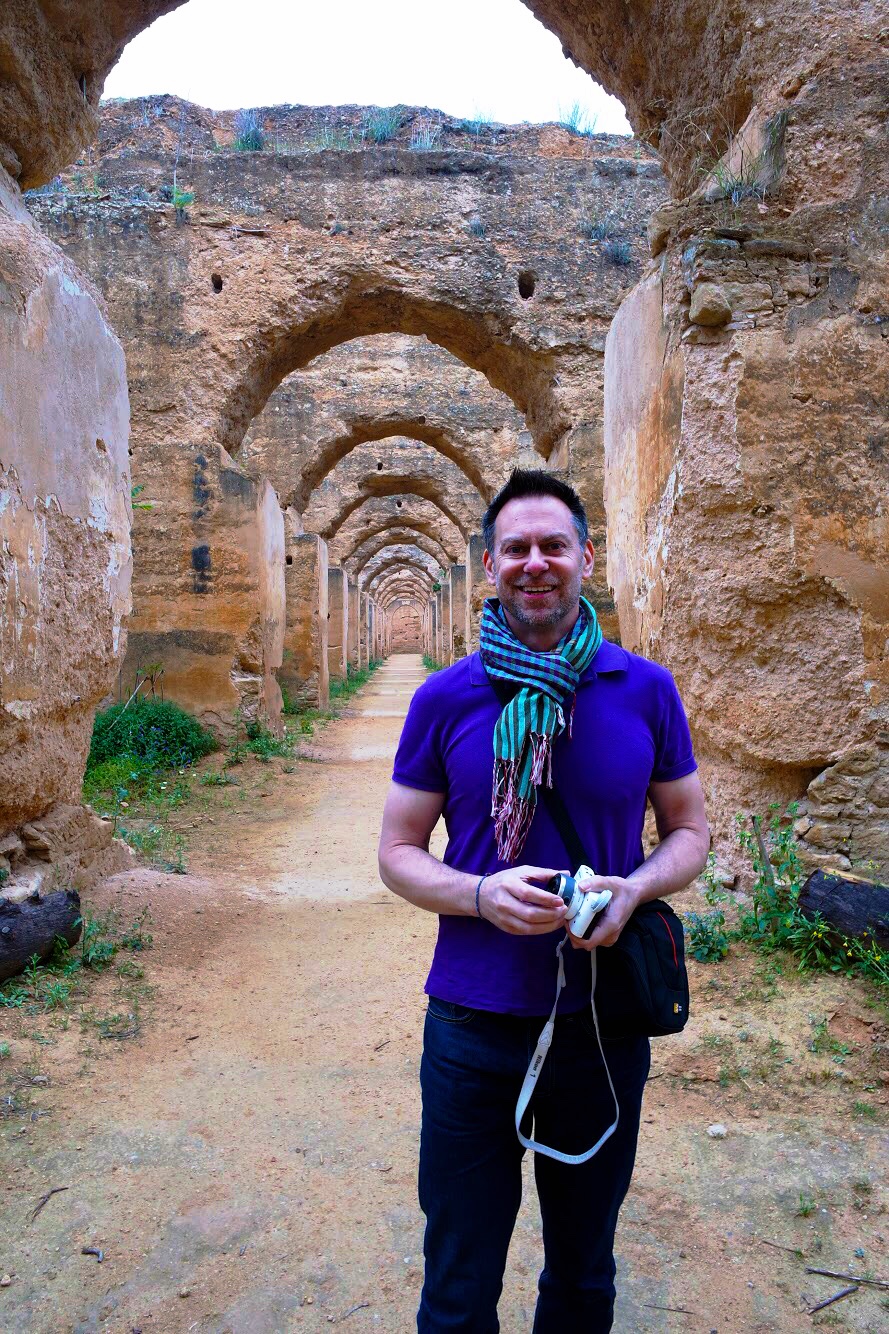
Duke thinks the seemingly neverending archways are a photographer’s delight.

Duke thinks the seemingly neverending archways are a photographer’s delight.

Regarded as one of Ismail’s finest architectural achievements, the stables are a testament to his immense wealth and the great lengths he went to ensure that his horses lived comfortably.

The ruins of the stables are a favorite with film scouts.

The ruins of the stables are a favorite with film scouts.

Additionally, filmmakers are drawn to this amazing structure. The site has been featured in Ishtar, The Jewel of the Nile and The Last Temptation of Christ.

The medina in Meknès pales in comparison to Fès’.

The medina in Meknès pales in comparison to Fès’.

If you’re looking for a day trip from Fès, Meknès makes for an interesting place to spend an afternoon exploring. –Duke

 

Wat Chom Thong and Vipassana Meditation Retreat

A Thai Buddhist temple dedicated to those born in the Year of the Rat at the base of Doi Inthanon known for its free meditation courses.

Wat Phra That Si Chom Thong houses a holy relic: fragments of the Buddha’s skull

Wat Phra That Si Chom Thong houses a holy relic: fragments of the Buddha’s skull

En route to Doi Inthanon to see its waterfalls and soaring modern pagodas, our driver Tommy asked us if we wanted to stop at a temple at the base of the mountain.

The wat he wanted to share with us is about an hour and a half from Chiang Mai and is dedicated to those born in the Year of the Rat.

“That’s my sign,” I told Tommy, excited about that fact for the first time in my life.

“That’s lucky!” he exclaimed.

The temple is one of the most revered in all of Northern Thailand because it supposedly holds bits of the right side of the Buddha’s skull.
The temple is dedicated to those born in the Year of the Rat — like this fancy fellow

The temple is dedicated to those born in the Year of the Rat — like this fancy fellow


Learn More About the Chinese and Thai Zodiac


The names of Thai temples tend to be mouthfuls. This wat, Phra That Si Chom Thong Woraviharn, is no exception.

This misshapen statue is supposed to be of a lion

This misshapen statue is supposed to be of a lion

Holy Skull Fragments

It was built in the mid-1400s atop a hill, Doi Chom Thong, which the Buddha is said to have visited. In fact, he supposedly even stated that the site would one day be home to one of his holy relics.

This small shrine, or mondop, is where the holy relic of Chom Thong is kept

This small shrine, or mondop, is where the holy relic of Chom Thong is kept

That prediction came true, and the wat is one of the most revered in all of Northern Thailand because it supposedly holds bits of the right side of the Buddha’s skull. The relic was found in 1452 and is described as being smooth and the size “of jujube seeds” and the off-white color of “dried medlar flowers.”

At most Buddhist temples, relics are stored in chedis like these — but not at this one

At most Buddhist temples, relics are stored in chedis like these — but not at this one

The oldest structure at the wat is the golden chedi. What’s interesting is that the pagodas known as chedis don’t house the relics as at most Thai temples. Instead, they’re stored within a mondop, a small temple-like shrine framed by tall thin columns.

The Buddha’s skull fragments are taken out of the mondop on important Buddhist holidays for devotees to pay homage to them.

The viharn is the main building on site

The viharn is the main building on site

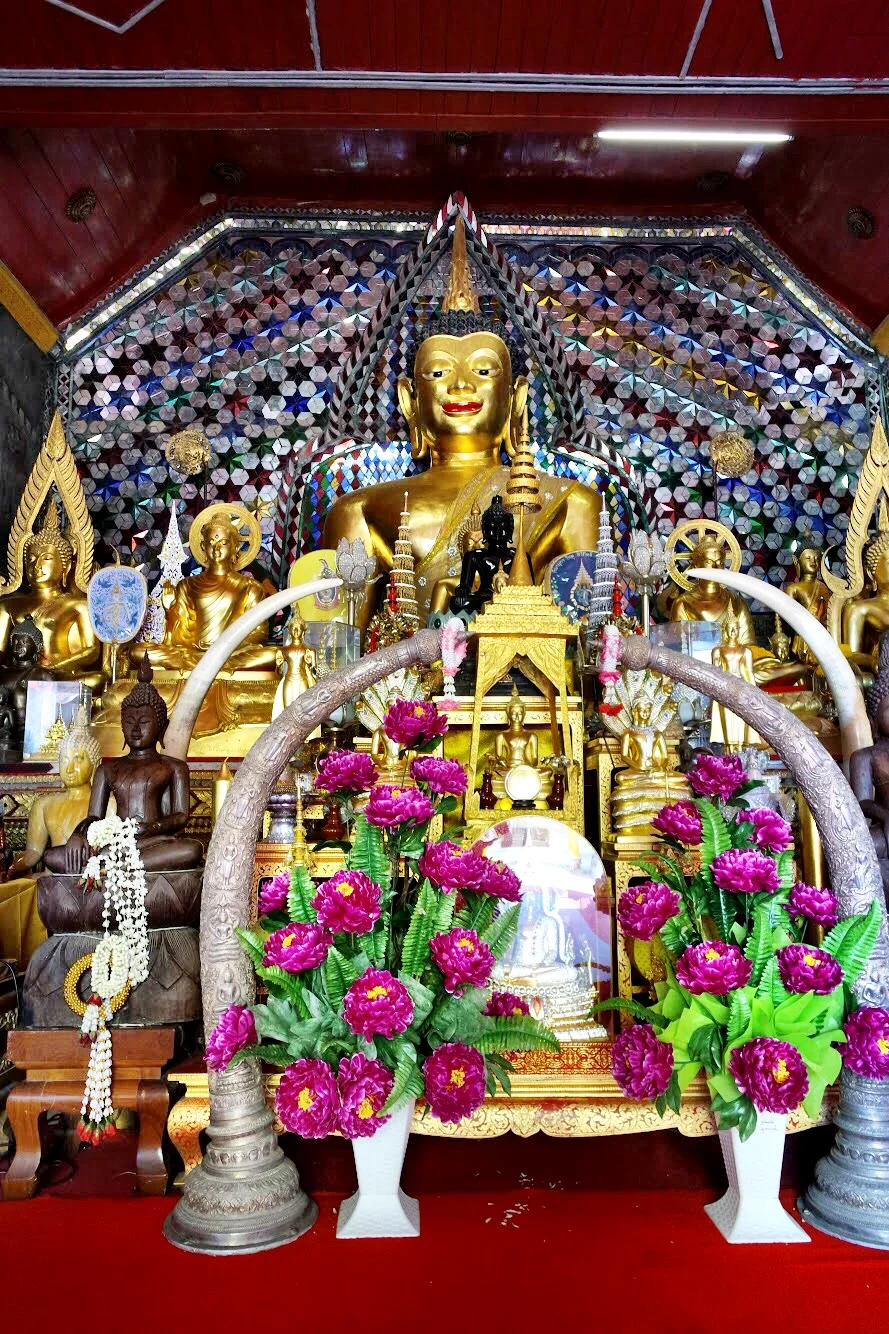
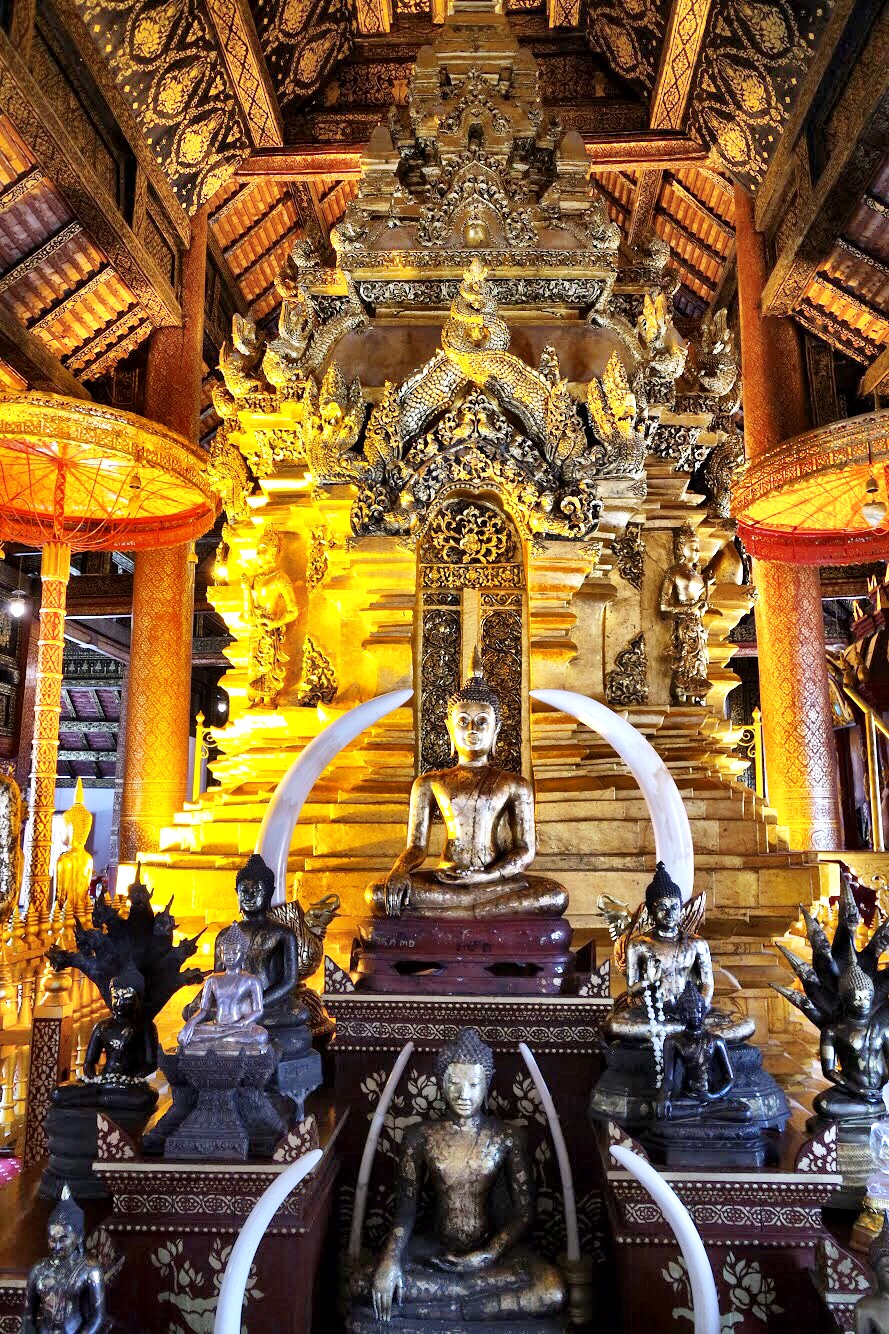
The focal point of the assembly hall features numerous Buddhas, elephant tusks and an elaborately carved centerpiece

The focal point of the assembly hall features numerous Buddhas, elephant tusks and an elaborately carved centerpiece

Visiting the Viharn

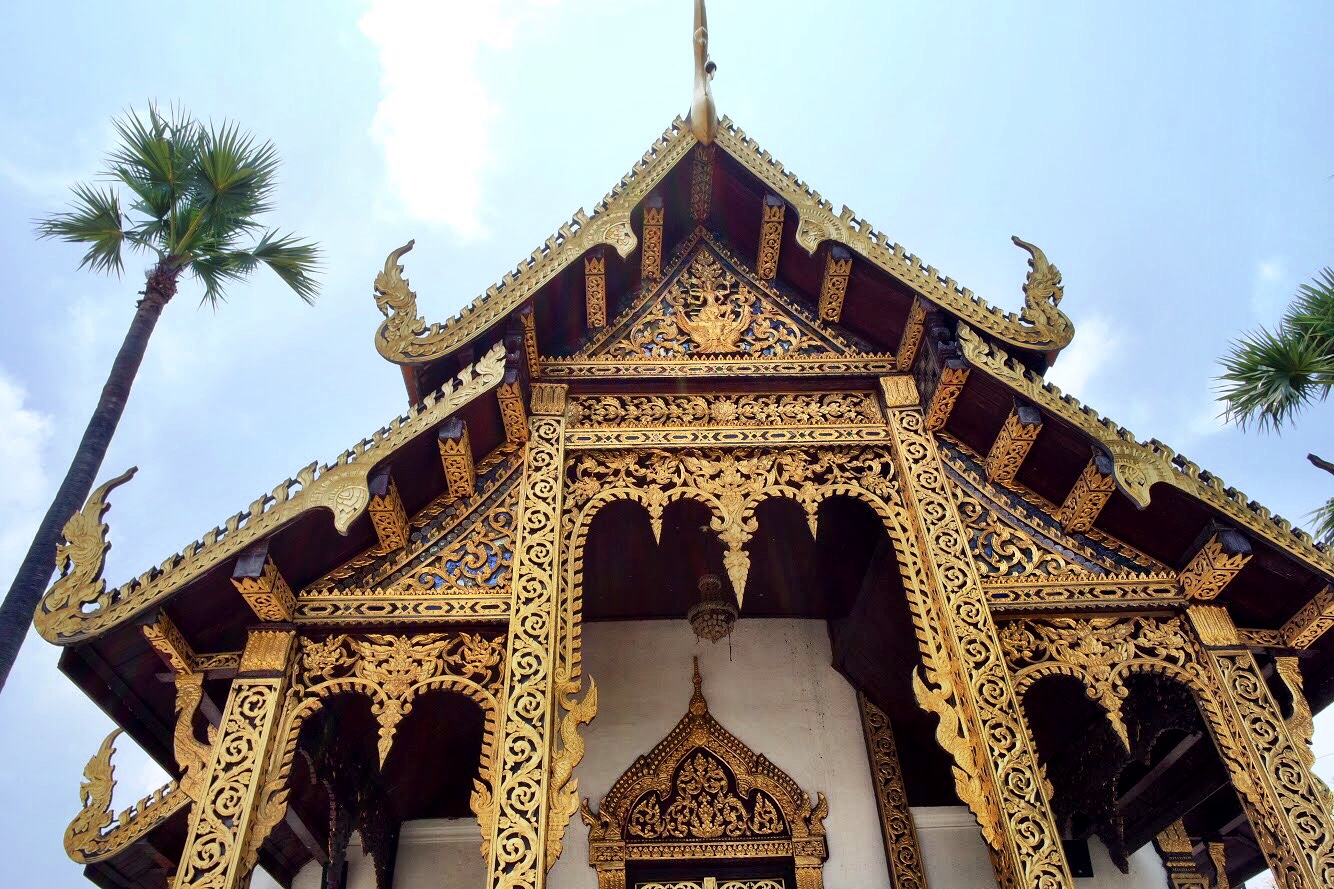
The main building on the wat grounds is the Lanna-style viharn, which contains gorgeous wood carvings. The statues, many of which are gold or are covered in gold leaf, the teak beams, the intricately carved shrine, the light diffused through the bright orange umbrellas, which symbolize enlightenment and are compared to halos in the Christian tradition — they all lend the space a warm, intense glow.

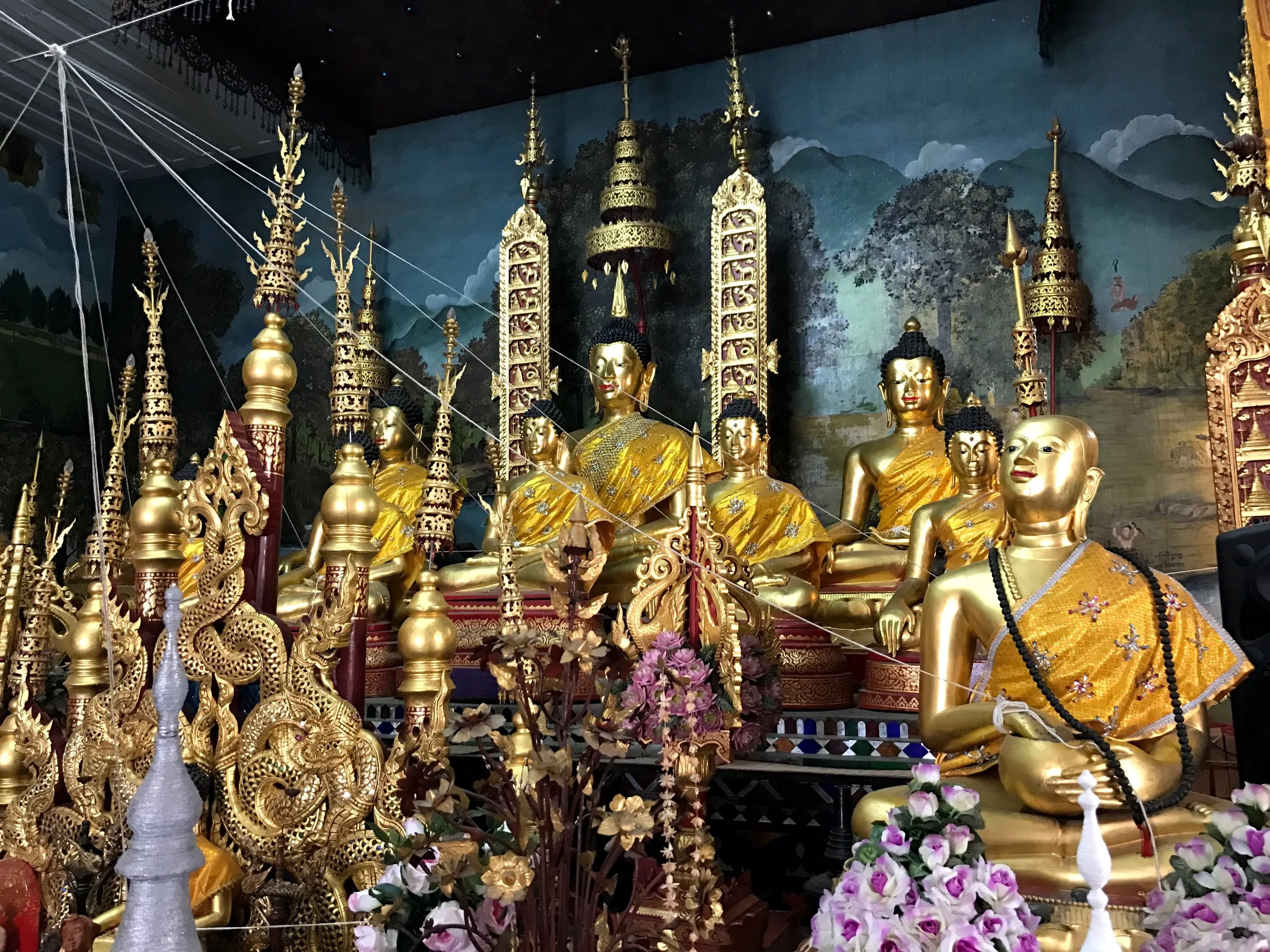
It’s not unusual for viharns to have multiple statues of the Buddha

It’s not unusual for viharns to have multiple statues of the Buddha

Some of the statues are covered in gold leaf

Some of the statues are covered in gold leaf

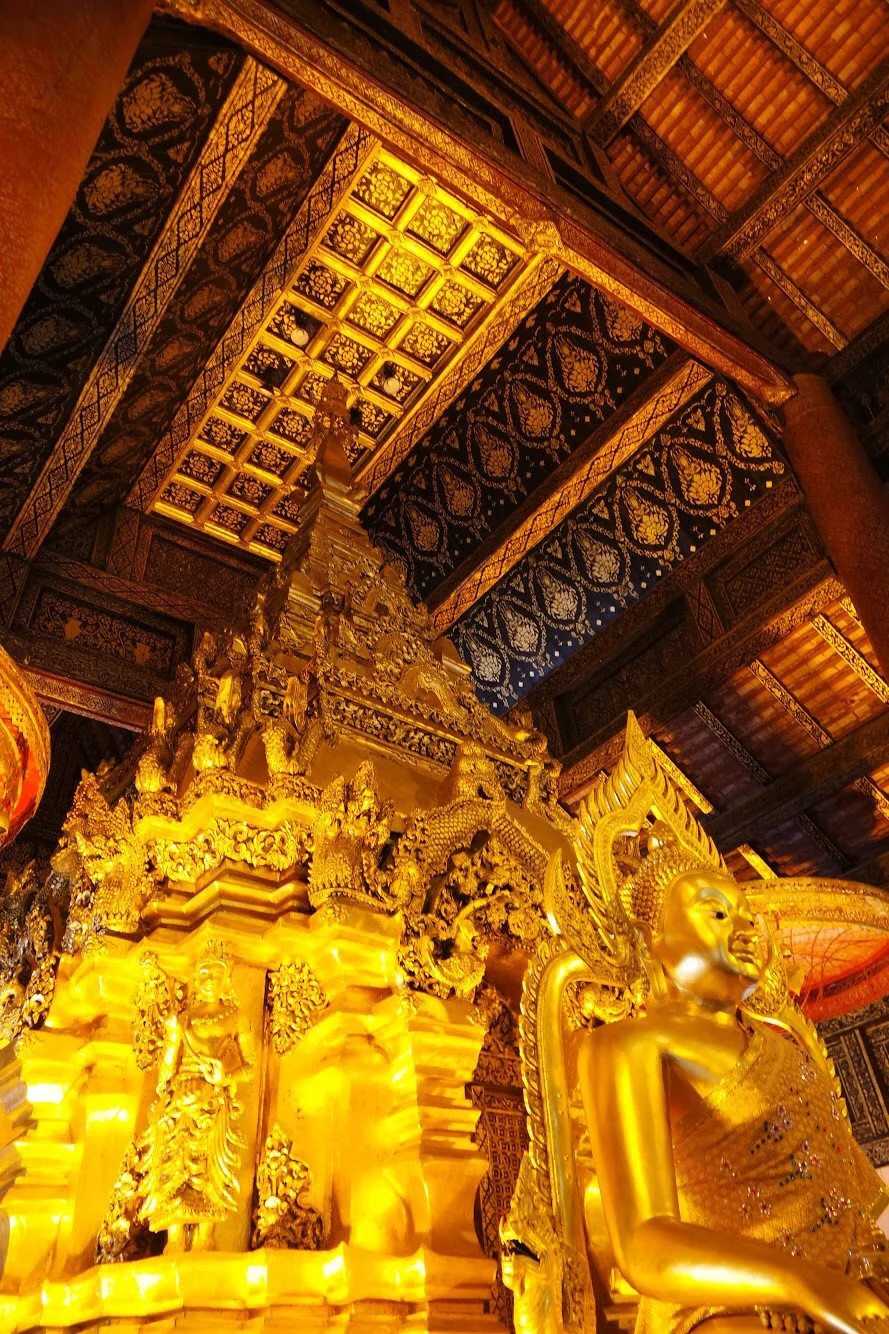
Look up — even the teak ceiling is elaborately painted 

Look up — even the teak ceiling is elaborately painted 

Walk around the altarpiece — it’s so elaborate it should be seen from every angle

Walk around the altarpiece — it’s so elaborate it should be seen from every angle

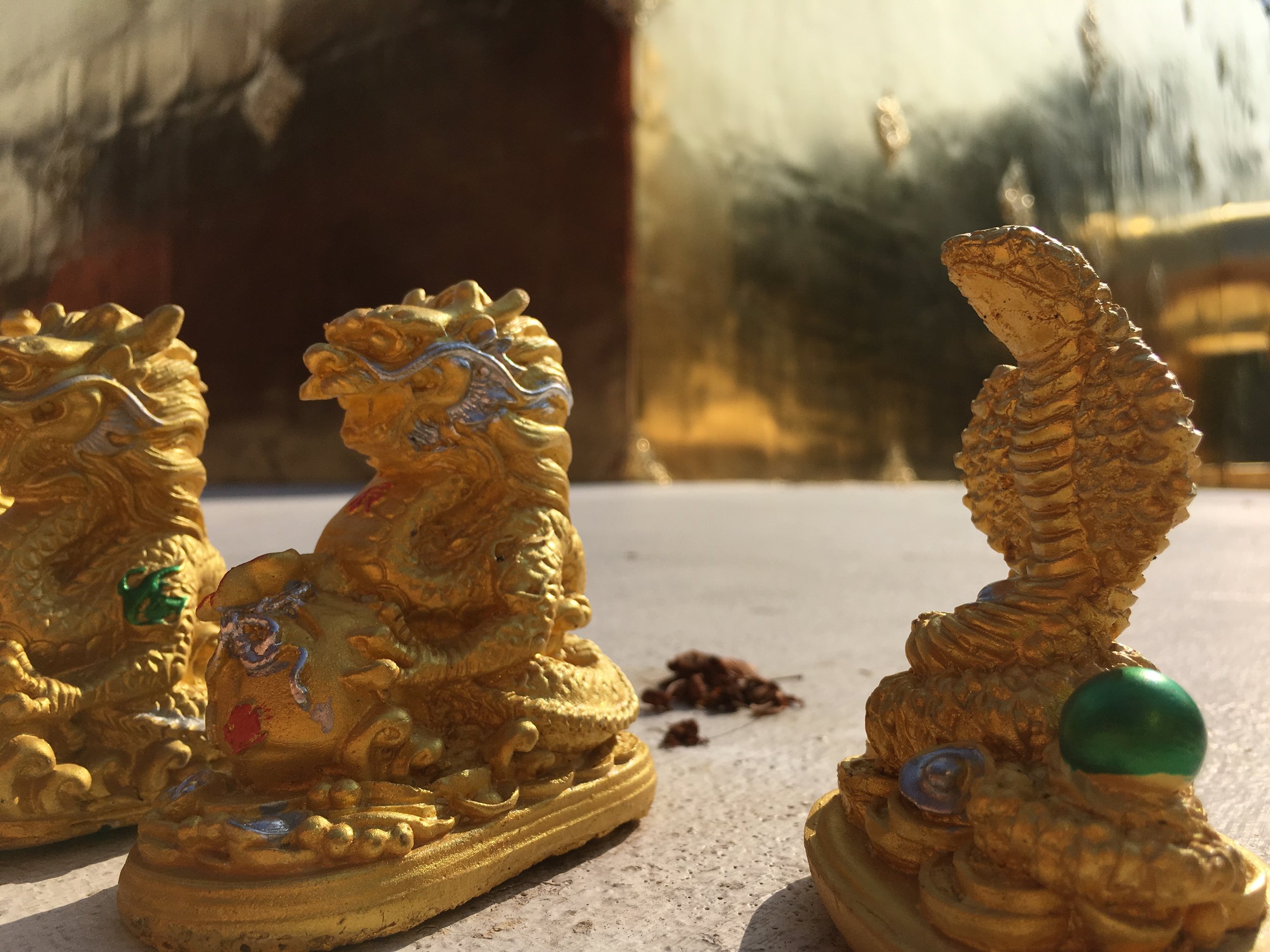
On our way out of the wat, Duke and I stopped by a vendor’s table near the entrance to buy a small ceramic rat to put in the shrine in our bedroom.
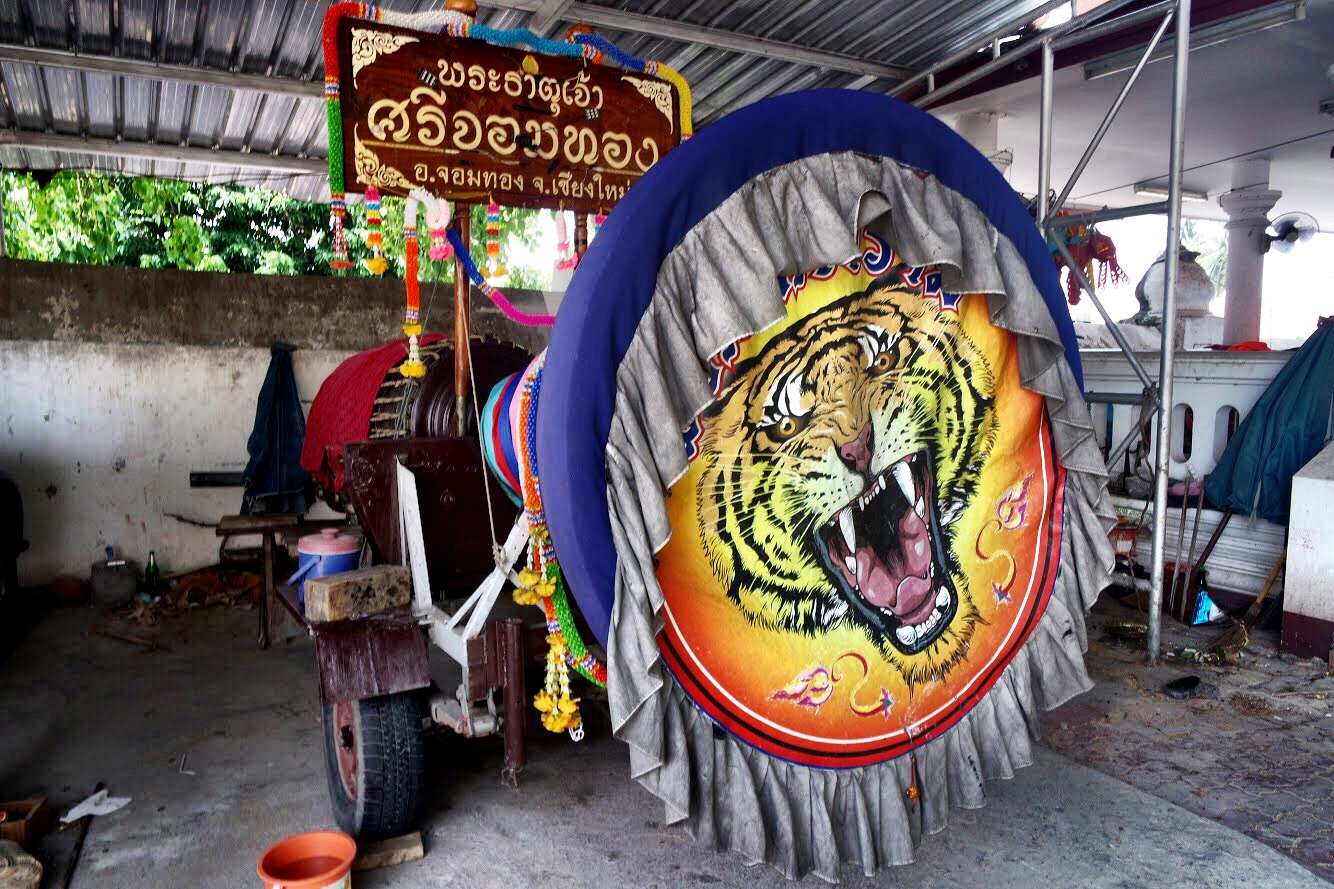
We found a garage-like building out back with this strange contraption

We found a garage-like building out back with this strange contraption

The temple is also home to the Insight Meditation Center, founded in 1991 by Phra Dhammungkalajarn Vi (aka Phra Ajaan Tong Sirimangalo). Our chauffeur Tommy proudly informed us that his cousin is the director of the meditation center. If you’re in no hurry and are intrigued by, or already a practitioner of meditation, here’s more information about this fascinating option.

Those staying at the meditation retreat wear white

Those staying at the meditation retreat wear white

Q&A About the Insight Meditation Center at Chom Tong

Where’s the meditation center located?

Behind the main temple. Look for the CMQ Lanna International Library.


What happens at the meditation retreat?

Students receive individual instruction in vipassana meditation. Your guide will educate you in an intensive form of a technique developed by Mahasi Sayadaw, a Burmese monk, with sequences of mindful prostrations, walking and sitting meditation following the teachings of Ajaan Tong Sirimangalo, a local monk.

Exercises are led in English and Thai, and work to apply mindfulness to the body, feelings, mind and “mind-objects,” known as the Satipatthana, the Four Foundations of Mindfulness.

The Four Foundations of Mindfulness are a device that stops evil, stops bad deeds, stops defilement. … We will have pure hearts always.
— Ajaan Tong Sirimangalo

What is vipassana meditation?

Vipassana is a word from Pali (the classic language of Theravada Buddhism) that means seeing clearly or seeing through. It’s often translated as “insight,” and practitioners of vipassana meditation attempt to see through the true nature of reality.

Vipassana strives for a clear awareness of exactly what is happening as it happens. Practitioners bring their minds to rest, focusing on only one item and not allowing them to wander. When this is accomplished, a deep calm pervades the body and mind. It’s also described as using concentration as a tool by which your awareness can chip away at the wall of illusion that cuts us off from the living light of reality so you can see the impermanence, unsatisfactoriness and selflessness of physical phenomena.

It takes years to master, but one day the meditator is said to chisel through that wall and tumble into the presence of light. This transformation is called liberation and is permanent.

The vipassana meditation technique was developed by a couple of Buddhist monks

The vipassana meditation technique was developed by a couple of Buddhist monks

Umbrellas, like the one in the viharn, symbolize enlightenment

Umbrellas, like the one in the viharn, symbolize enlightenment

Why should I go?

There have been studies recently that show the benefits of meditation in reducing everything from anxiety to depression to pain.

“Why should we be mindful?” asks Sirimangalo, who still teaches at Chom Thong. “The Four Foundations of Mindfulness are a device that stops evil, stops bad deeds, stops defilement. … during the time when we are mindful, evil won’t enter in to reach our hearts. We will have pure hearts always. It is like dark and shining light. Mindfulness is a shining light; all defilements, all evil states, are like darkness. When the bright light shines, the darkness disappears. For this reason, we should be mindful at all times — our mind will be bright, clean and peaceful all of the time.”


How do I go about reserving space at the retreat?

Make a reservation in advance — otherwise they can’t guarantee that space will be available. They ask that people arrive around 1 p.m. You can email the International Department at reservationchomtong@yahoo.com.


What’s the dress code?

The retreat is affiliated with the wat (temple) and follows their rules of modesty. Men can wear T-shirts, but tank tops and sweats aren’t allowed. Shorts should cover the knees. For women, shirts should cover their shoulders, not expose their chests and should be at least elbow-length. Skirts or pants should reach the ankles. They also would like you to limit your makeup and perfume use.

That being said, while you’re at the retreat, they ask that you wear white clothing that fits their sense of decorum. You can bring your own, borrow some from the center or buy some at vendors just off the temple grounds.

In the winter, especially December and January, it can get quite cold. You’ll want a sweatshirt  or jacket and socks if you visit then.


What should I bring?

  • Toiletries, including toothpaste and soap
  • Toilet paper
  • Passport
  • Digital alarm clock and/or timer
  • Flashlight
  • Flip-flops or sandals
  • Water bottle
  • Insect repellent


How long will the course be?

While you’re welcome to stay for as long or as short as you like, they recommend 21 days for the basic course. Once you’ve taken that, you can do a 10-day retreat. No previous experience with meditation is necessary and all courses are individual, so they start the day you arrive. Keep in mind that if they’re fully booked, those who are staying longer are given preference.

On your first day, you’ll be given an introduction to the course and will meet with your teacher.


How much will this cost me?

Nothing — though the organization does run on donations, in line with the Buddhist principle of dana (generosity). Donations to the center help pay for electricity, water and general maintenance. Donations to the teachers cover their living expenses, as they’re all volunteers and don’t make a salary. Donations for food pay for the two meals a day prepared by nuns in the temple. –Wally

Rats! You’ll see lots of depictions of them at Wat Chom Thong

Rats! You’ll see lots of depictions of them at Wat Chom Thong

Wat Phra That Si Chom Thong Worawihan
Ban Luang
Chom Thong District
Chiang Mai 50160, Thailand

Must-See Chiang Mai: Wat Phra Singh

One of the best examples of Lanna architecture, the Lion Buddha Temple features golden chedi, gorgeously decorated buildings and some hellish murals.

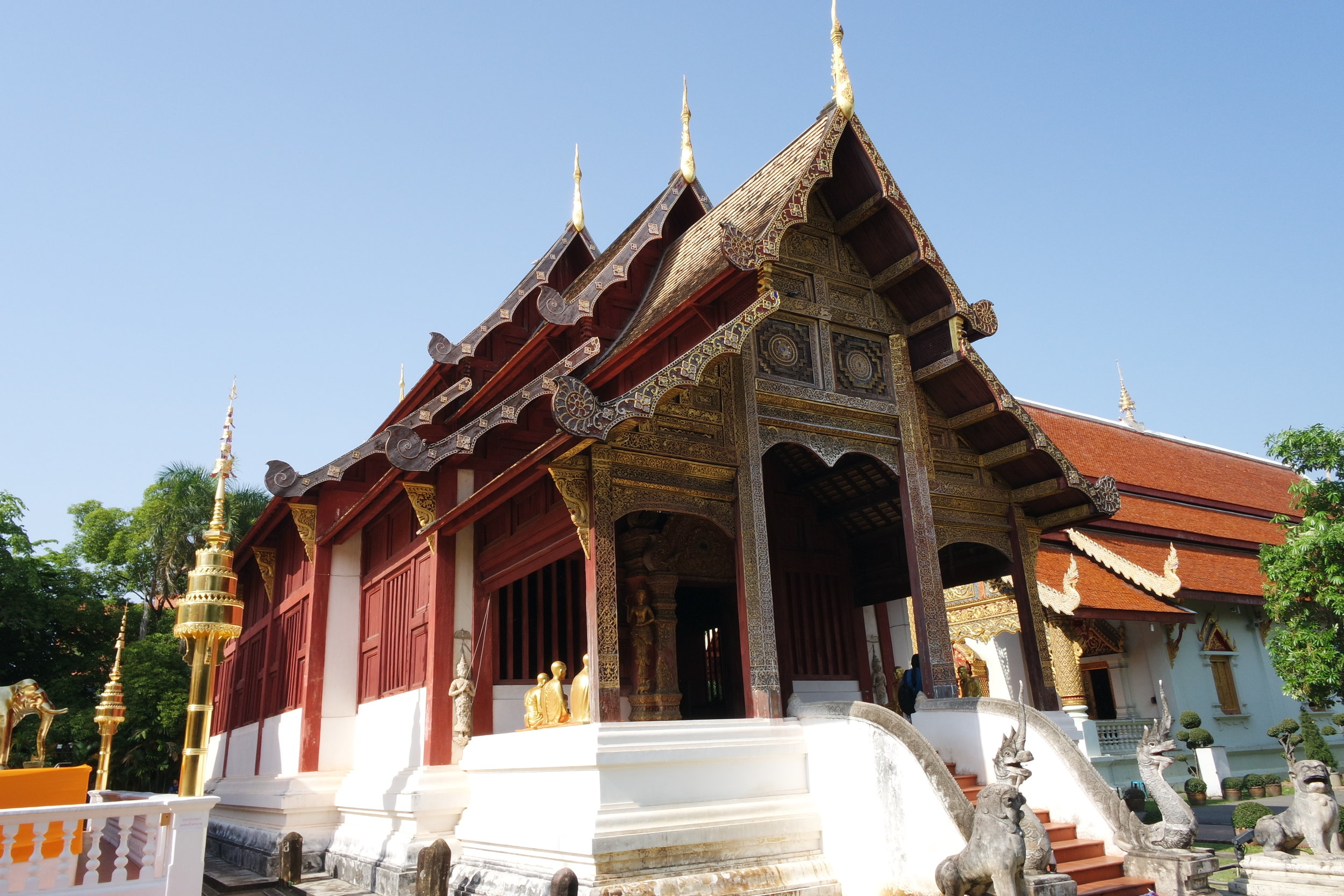
Wat Phra Singh is held up as one of the best examples of Lanna architecture

Wat Phra Singh is held up as one of the best examples of Lanna architecture

Wat Phra Singh is one of the most popular tourist attractions in Chiang Mai. And while it’s an impressive temple — that’s a short walk to Wat Chedi Luang, another spot travelers always hit — Duke and I sometimes prefer exploring some of the more off-the-beaten-path wats.
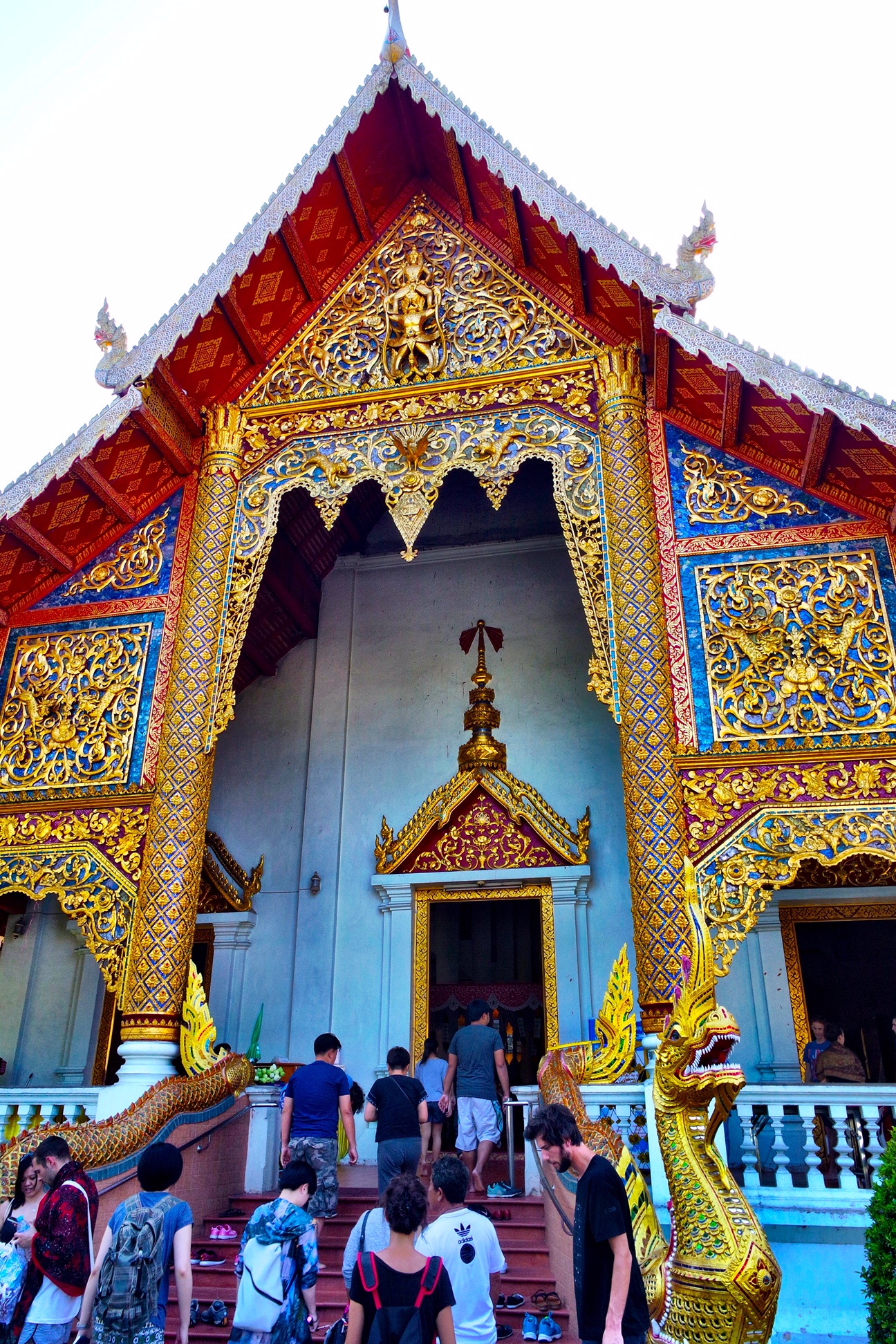
The temple is one of the most popular stops for tourists staying in Chiang Mai

The temple is one of the most popular stops for tourists staying in Chiang Mai

That being said, travelers should definitely add Wat Phra Singh to their itinerary. Parts of the wat, which translates to the Lion Buddha Temple, were built in the mid-1300s and renovated in the early 1800s.

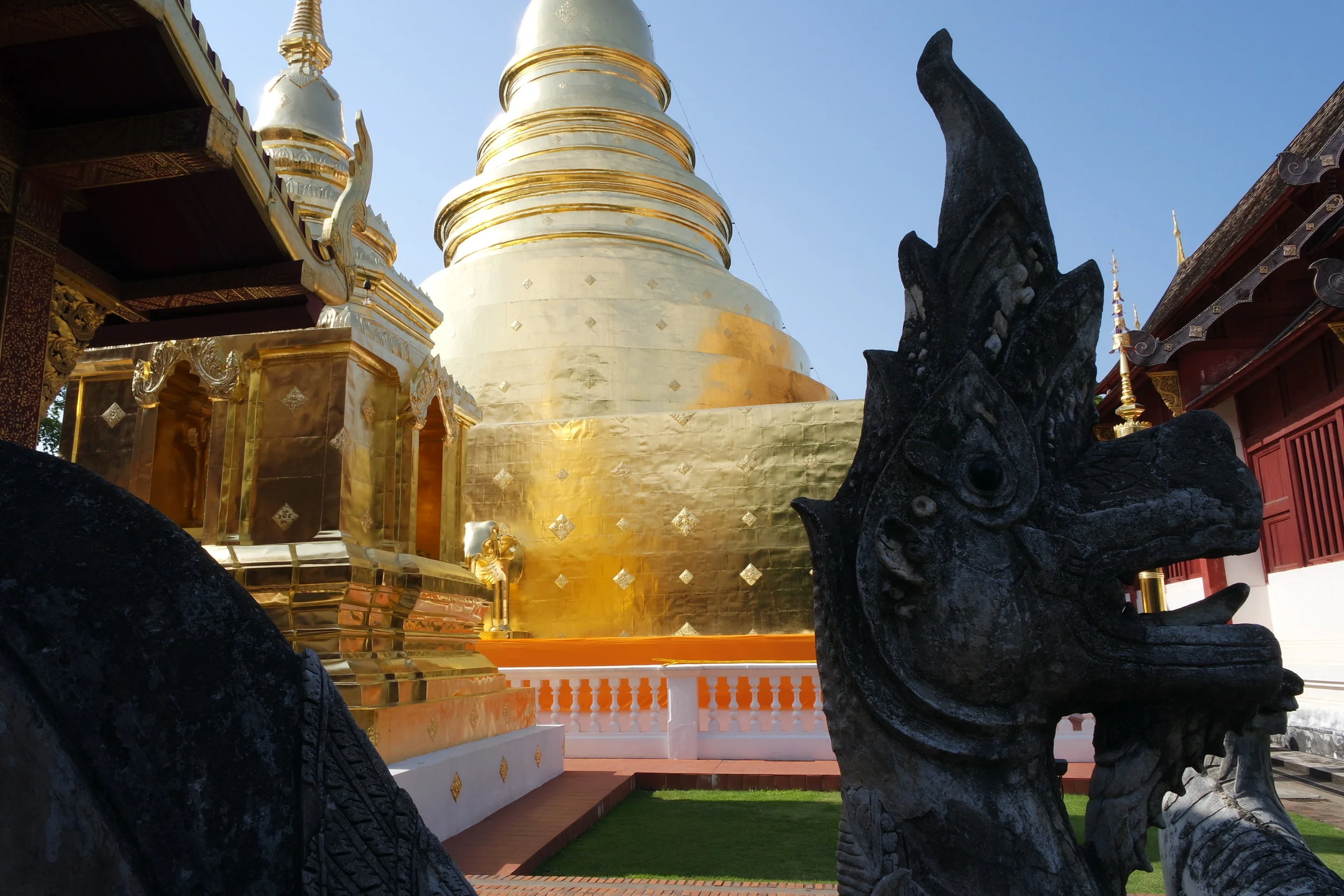
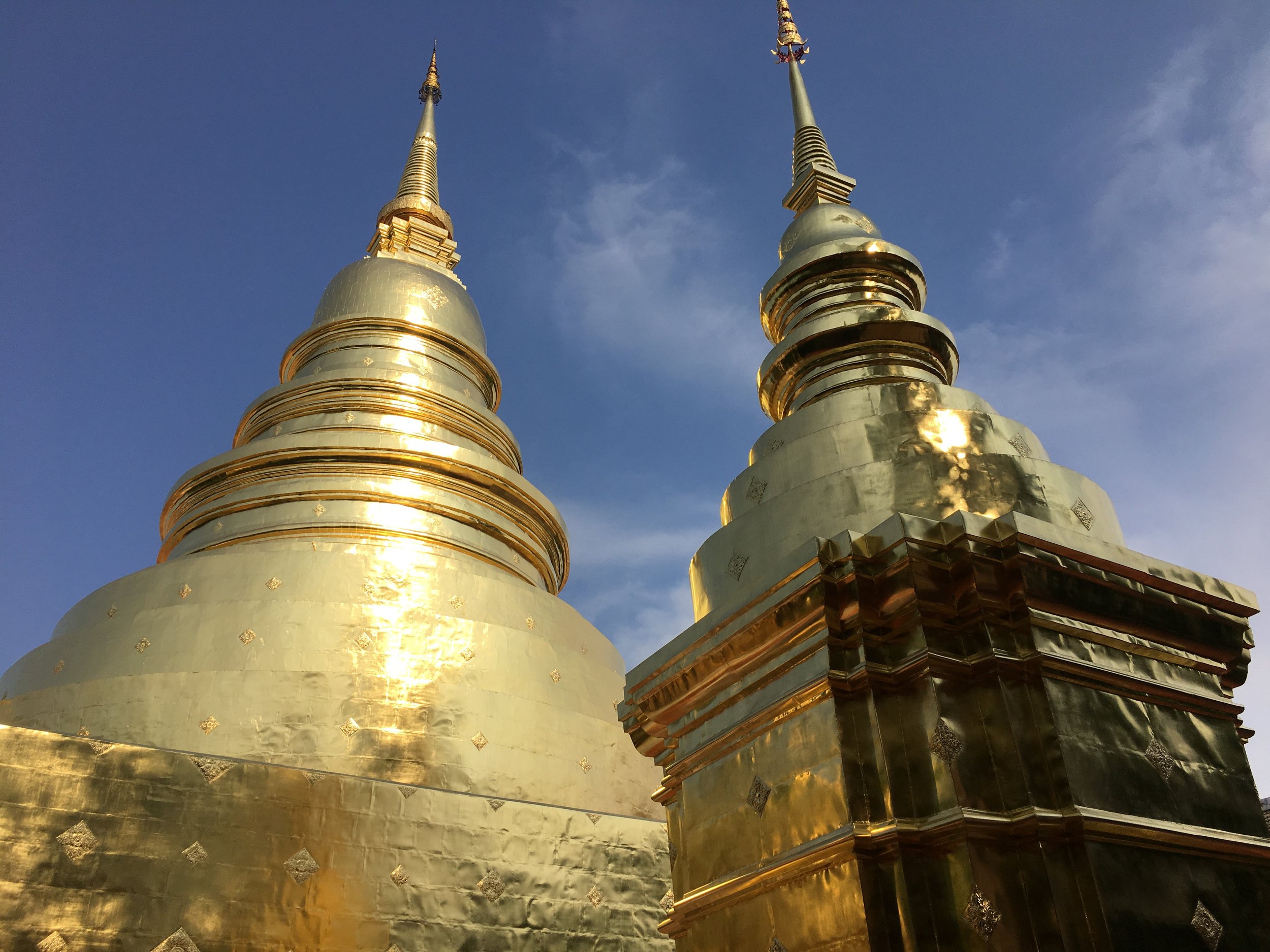
There’s no shortage of glittering gold on many Thai temples — and Wat Phra Singh is no exception

There’s no shortage of glittering gold on many Thai temples — and Wat Phra Singh is no exception

The temple complex’s buildings are gorgeously gilded, with their telltale Lanna-style rooftops, layered like feathers on wings about to spread and soar into the heavens. In fact, Wat Phra Singh is held up as one of the finest examples of Lanna architecture.
The famous Lion Buddha, the star of the Thai New Year parade/water fight, lost its original head

The famous Lion Buddha, the star of the Thai New Year parade/water fight, lost its original head

Viharn Lai Kham: Marvelous Murals and the Headless Lion Buddha

At the back of the walled-in compound is the Viharn Lai Kham (the Gilded Hall), an assembly hall that features fading murals from the 1820s. The paintings depict scenes from the Jataka tales, native to India, which tell of the previous lives of the Buddha. Another source says the murals show local ways of life. To be honest, it was hard to make much out.

This is where the namesake Lion Buddha, a treasure from the 14th century, is housed. Local lore says the statue came from Sri Lanka, though some historians say it looks suspiciously as if it was made locally. (There’s no direct connection to a lion, leading some to posit that the Singh in its name is actually a corruption of Sri Lanka.) In 1922 someone dared to steal the head right off the Lion Buddha! Talk about bad karma!

During the Thai New Year festival, Songkran, the Lion Buddha is carried through Chiang Mai, and people splash water on it for good luck.

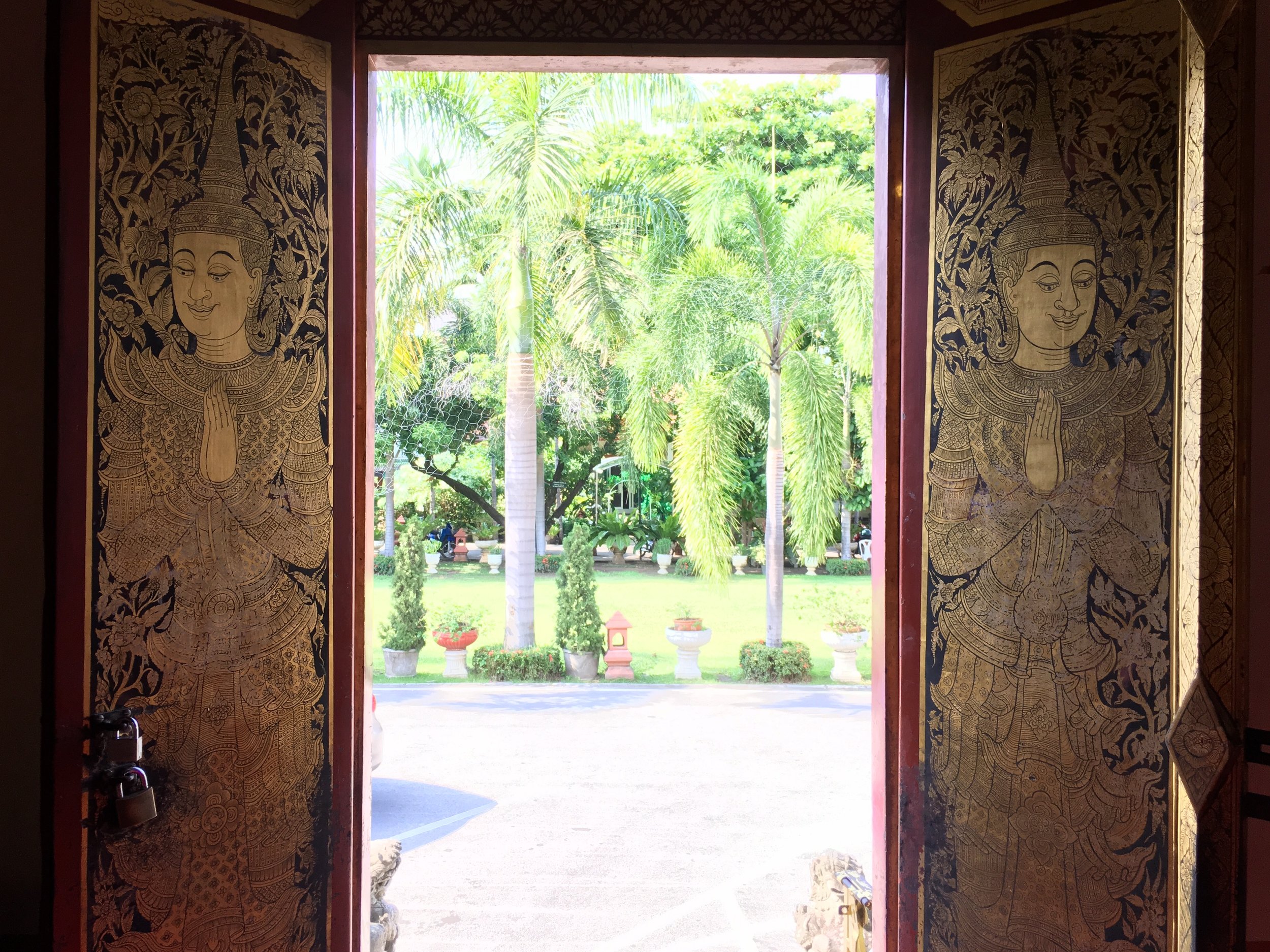
The beautiful doors at the Viharn Lai Khan hint at what its name translates to: the Gilded Hall

The beautiful doors at the Viharn Lai Khan hint at what its name translates to: the Gilded Hall

While we admired the interior of the viharn, a couple of Thai students came over and asked if they could interview Duke. From their broken English and Duke’s attempts to speak about the murals without knowing much about them…well, let’s just say I don’t think the documentary will be scoring any prizes at Sundance.

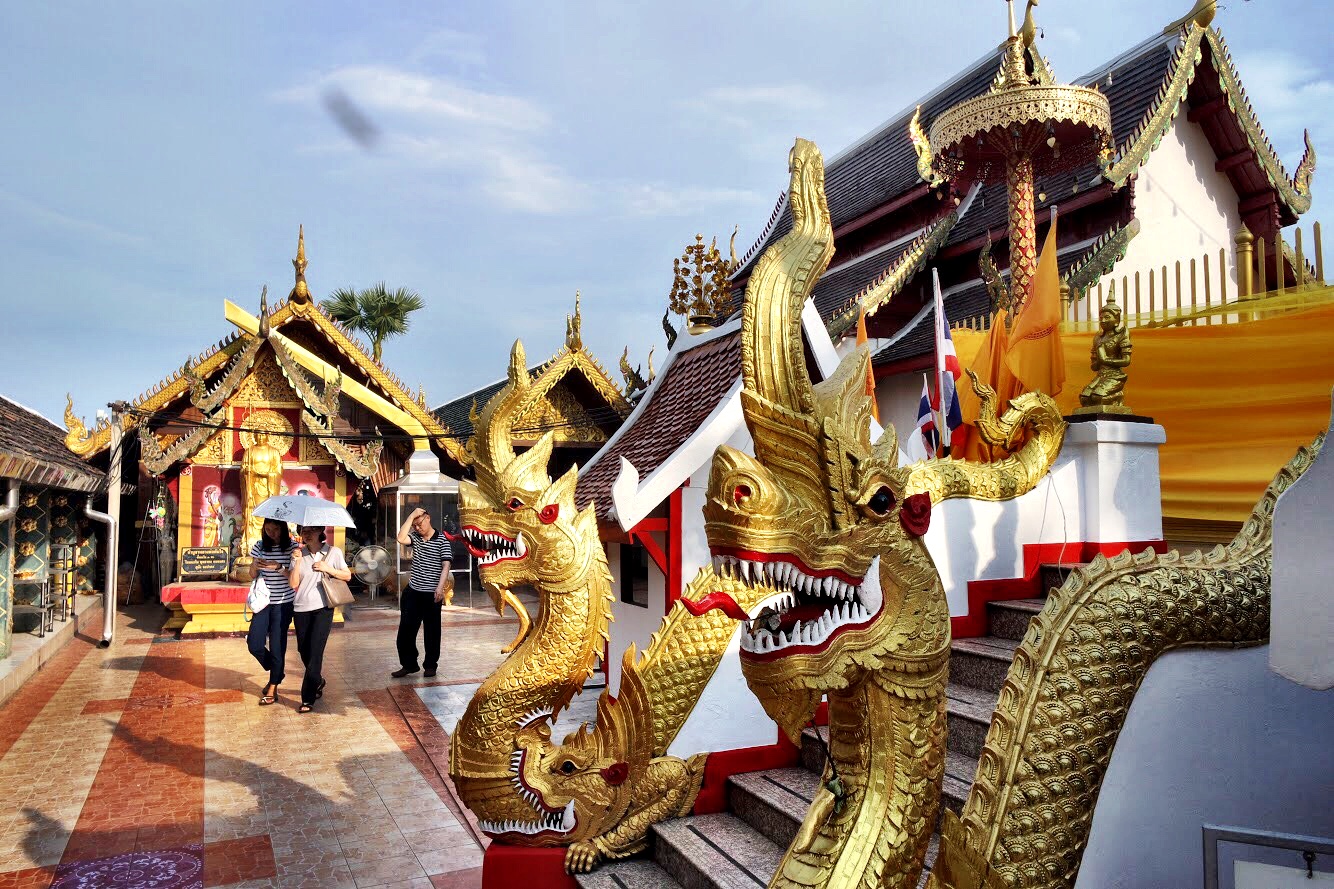
There aren’t any lions on the grounds of Phra Singh that we could see — but you’ll always find plenty of giant snakes called nagas

There aren’t any lions on the grounds of Phra Singh that we could see — but you’ll always find plenty of giant snakes called nagas

The pagodas found on Thai temple grounds hold some sort of sacred relic

The pagodas found on Thai temple grounds hold some sort of sacred relic

Elephants sticking out of the golden spire make this a one-of-a-kind chedi in Chiang Mai

Elephants sticking out of the golden spire make this a one-of-a-kind chedi in Chiang Mai

Golden Chedi With Elephant Adornments

The oldest structure on site is the main chedi, which was constructed in 1345 by King Pha Yu to enshrine the ashes of his father, King Kham Fu. The golden yellow chedi is blindly bright in the sunlight. Elephants are depicted as emerging from the chedi, the front halves of their bodies poking out of the shiny copper.

While you’re here, maybe say a prayer that you don’t go to Naraka to be tortured 

While you’re here, maybe say a prayer that you don’t go to Naraka to be tortured 

Viharn Luang: A Vision of Heaven and Hell

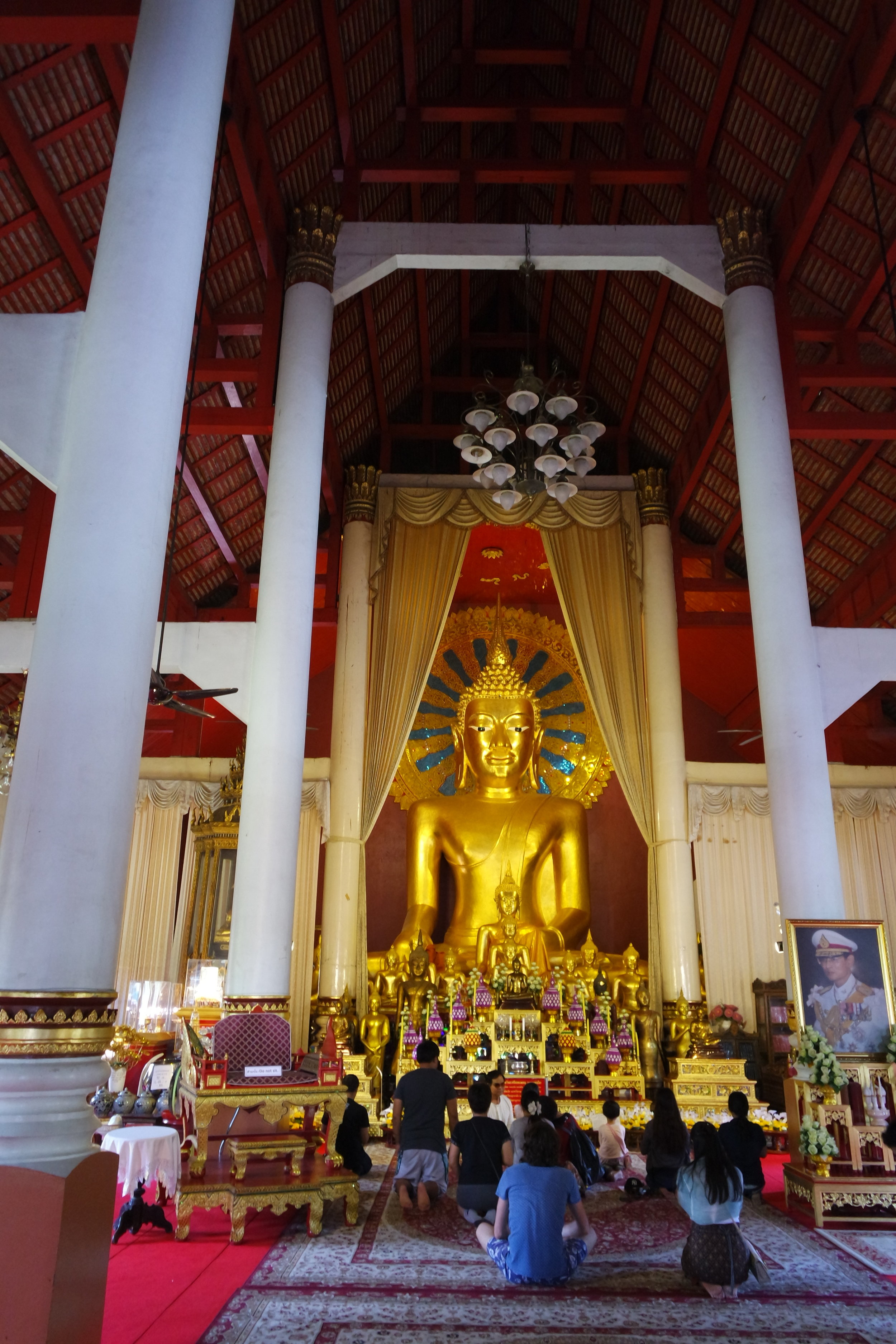
The largest building on the grounds is the Viharn Luang. The current structure replaced the original in 1925. There’s another highly venerated Buddha image inside. Referred to as Phra Chao Thong Tip, it was cast in gold and copper back in 1477. The Buddha is seated and has his hands gesturing in the Subduing Mara mudra, which calls back to when the demon Mara tried to distract the Buddha as he sat under the bodhi tree, about to reach enlightenment.

A polite worshipper shows that you never point your feet toward an image of the Buddha (though I’m not sure you should take bath in a viharn)

A polite worshipper shows that you never point your feet toward an image of the Buddha (though I’m not sure you should take bath in a viharn)

While we were looking at the line of smaller Buddhas off to the right (one for each day of the week), we heard behind us, “Excuse me, but I think I know you.”

I turned around and saw a dark-haired girl with large geek-chic glasses looking over at Duke.

“Lali!” he exclaimed.

Turns out Duke and Lali used to work together, before she went off to Korea to teach English.

That job had ended, and Lali and her new friend Hailey had just returned from a week volunteering with the Elephant Nature Park in the jungle near a Karen tribe village, living amongst wild elephants. Completely cut off from their phones and the internet, both of them described the experience as life-changing, spiritual.

In the main viharn are depictions of Naraka, the Buddhist Hell

In the main viharn are depictions of Naraka, the Buddhist Hell

What the Hell? Who’s hungry?

What the Hell? Who’s hungry?

The girls rushed off to Chedi Luang for a monk chat, while Duke and I walked up front. We couldn’t believe our eyes — painted along the front right side of the viharn are the strangest scenes we’ve seen at a wat: human bodies with the heads of various animals, including a duck, a rooster, a cow and a boar, being boiled alive in a giant cauldron; a man and a woman tied to a post while what look like circular saws dig into their skulls, dripping blood onto their torsos. We were certainly intrigued. Turns out these depict Naraka, the Buddhist version of Hell. (It’s telling that Naraka translates literally to “of man.”)

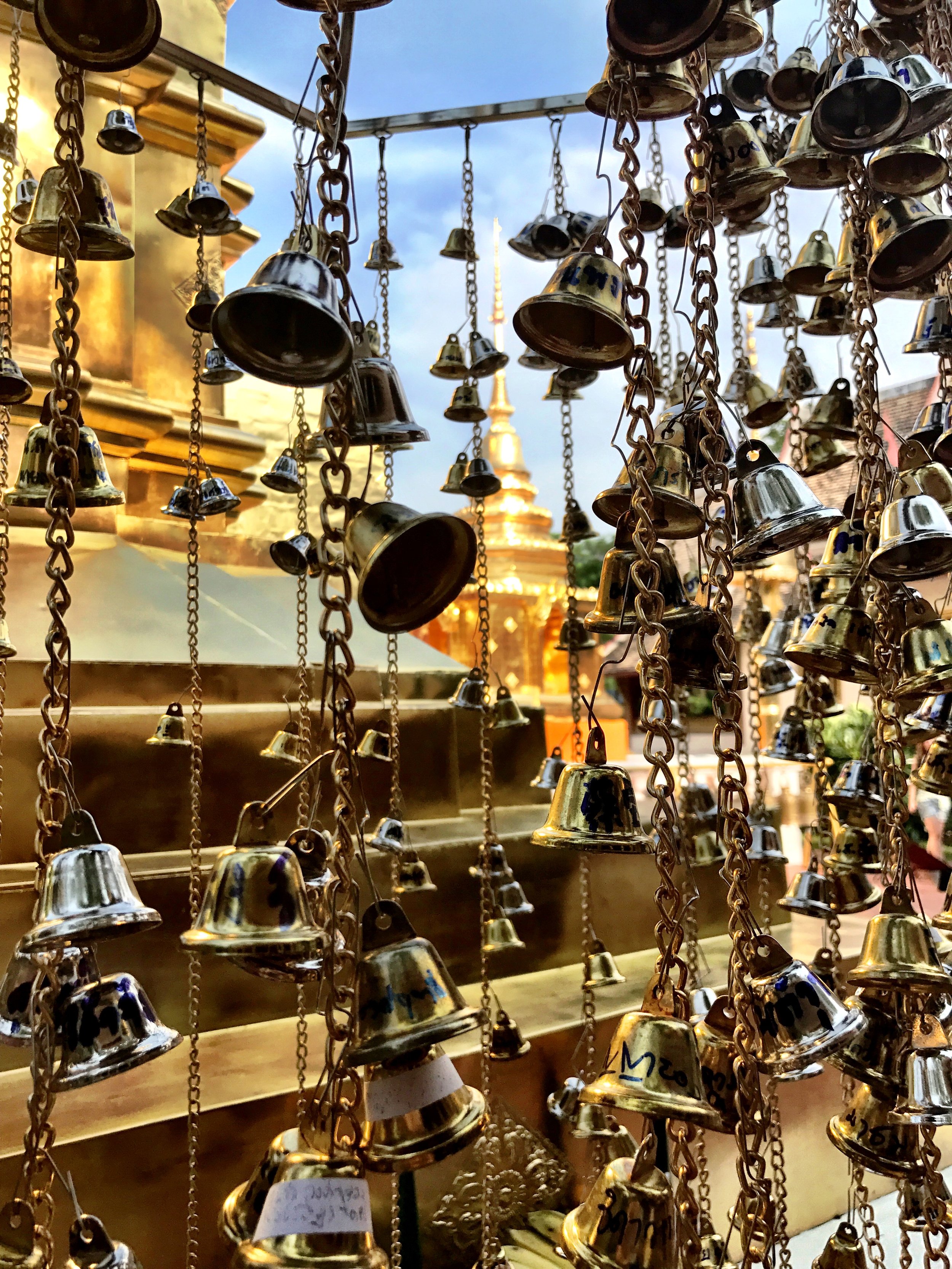
Strands of bells hang behind the chedi

Strands of bells hang behind the chedi

Snack Break!

Off to the side of the complex is an adjoining park with a small ramshackle plaza. We ordered ice cream from the booth and licked it quickly, as it melted almost instantly in the heat.

The 700 or so monks at the wat would have been ordained in the ubosot

The 700 or so monks at the wat would have been ordained in the ubosot

Ubosot: Creepy Wax Figures

You’ll find a couple of other noteworthy buildings on site as well, including the ubosot, where monks get ordained. (There are said to be 700 monks in residence at this temple!) It’s a wooden structure with an amazing lattice-work ceiling built in 1806.

The Buddha of the Phra Singh ubosot

The Buddha of the Phra Singh ubosot

A gorgeously gilded multi-story altarpiece

A gorgeously gilded multi-story altarpiece

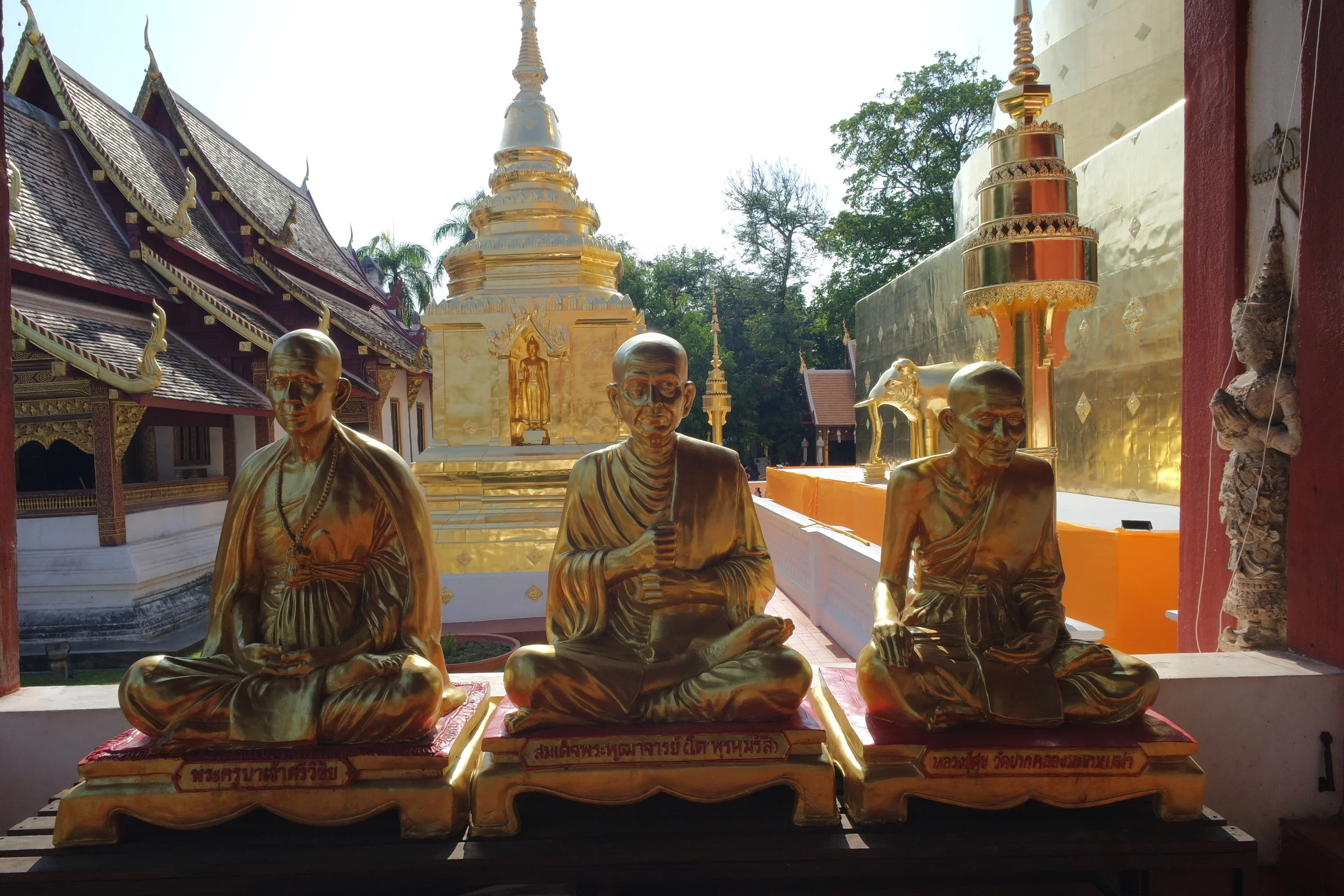
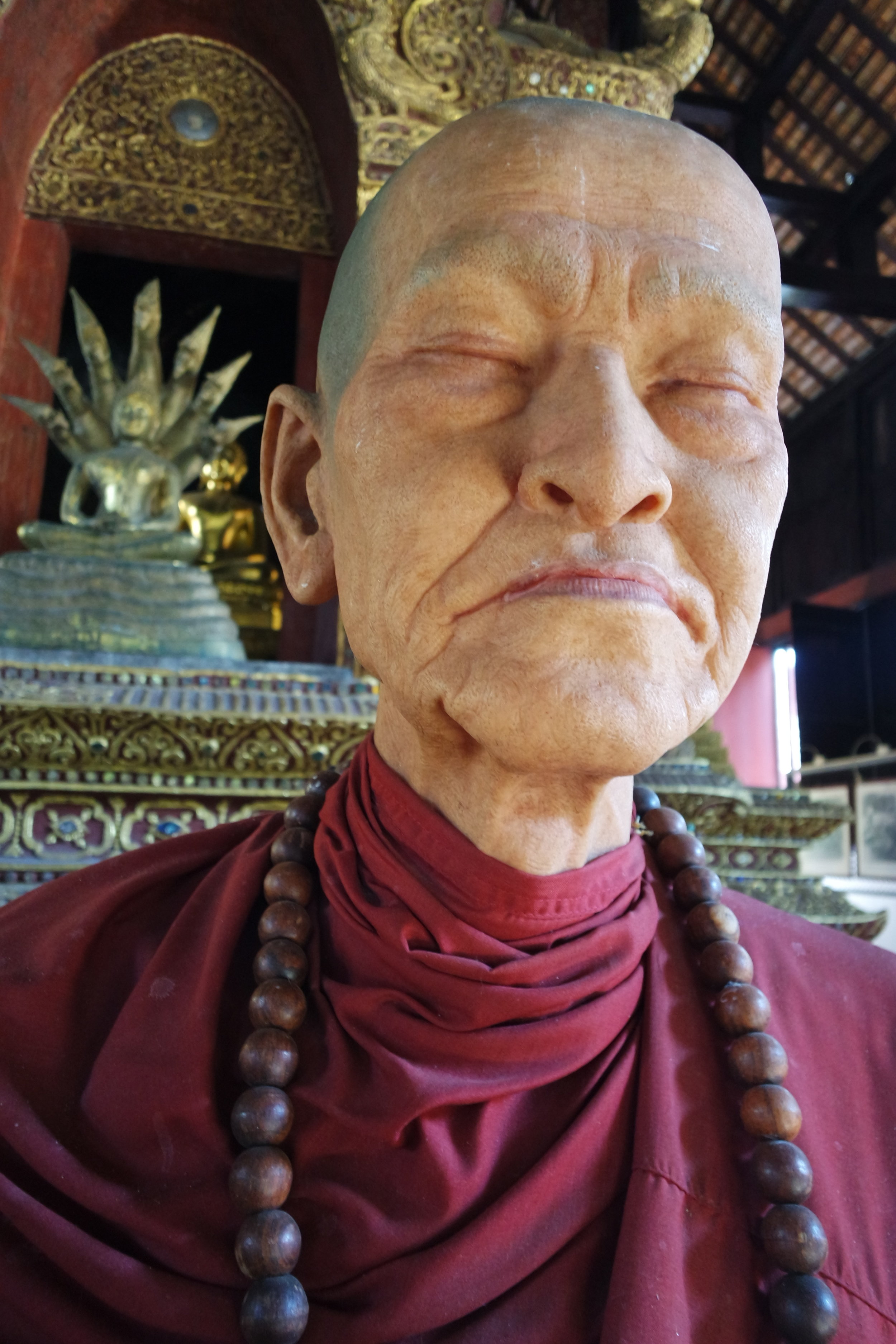
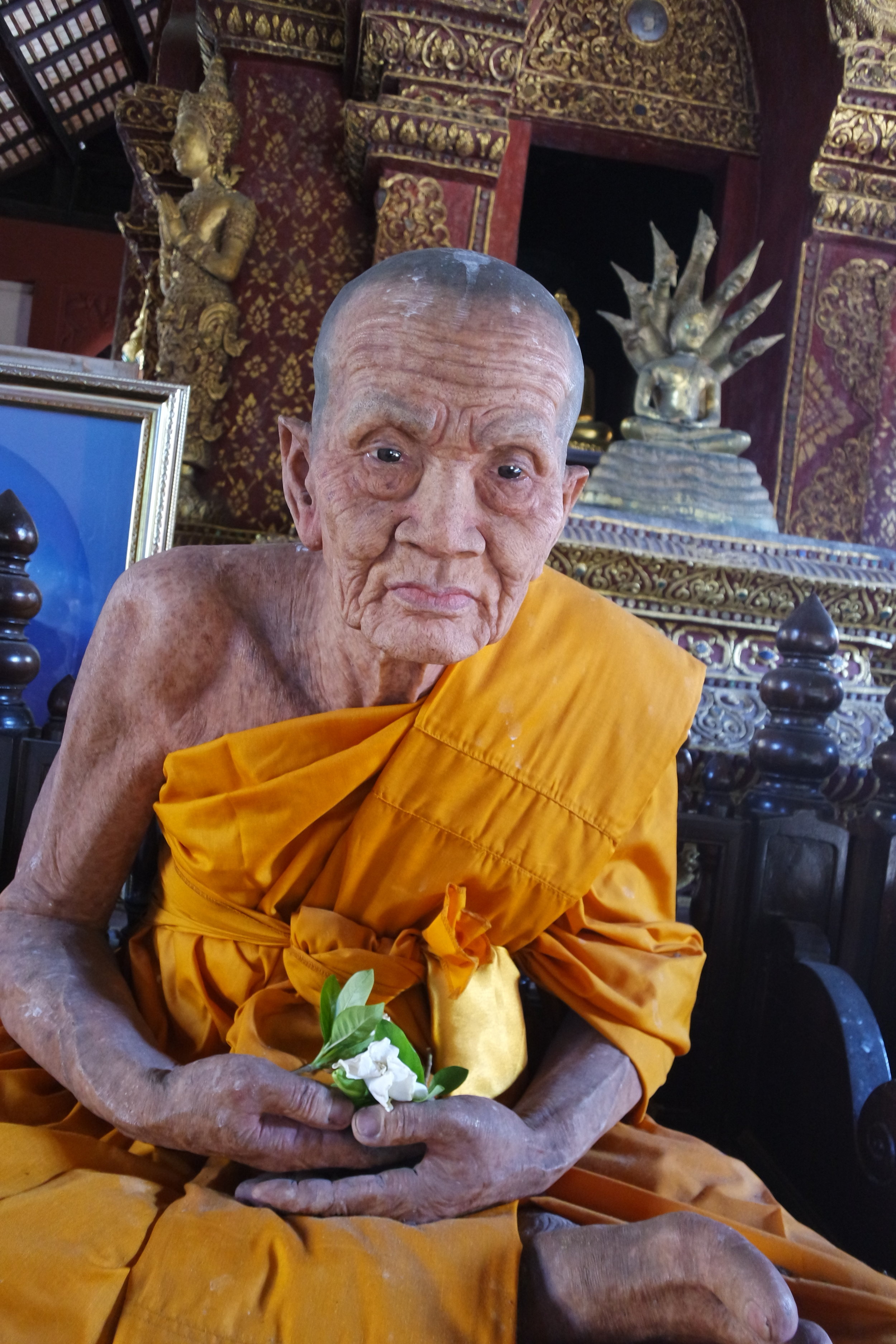
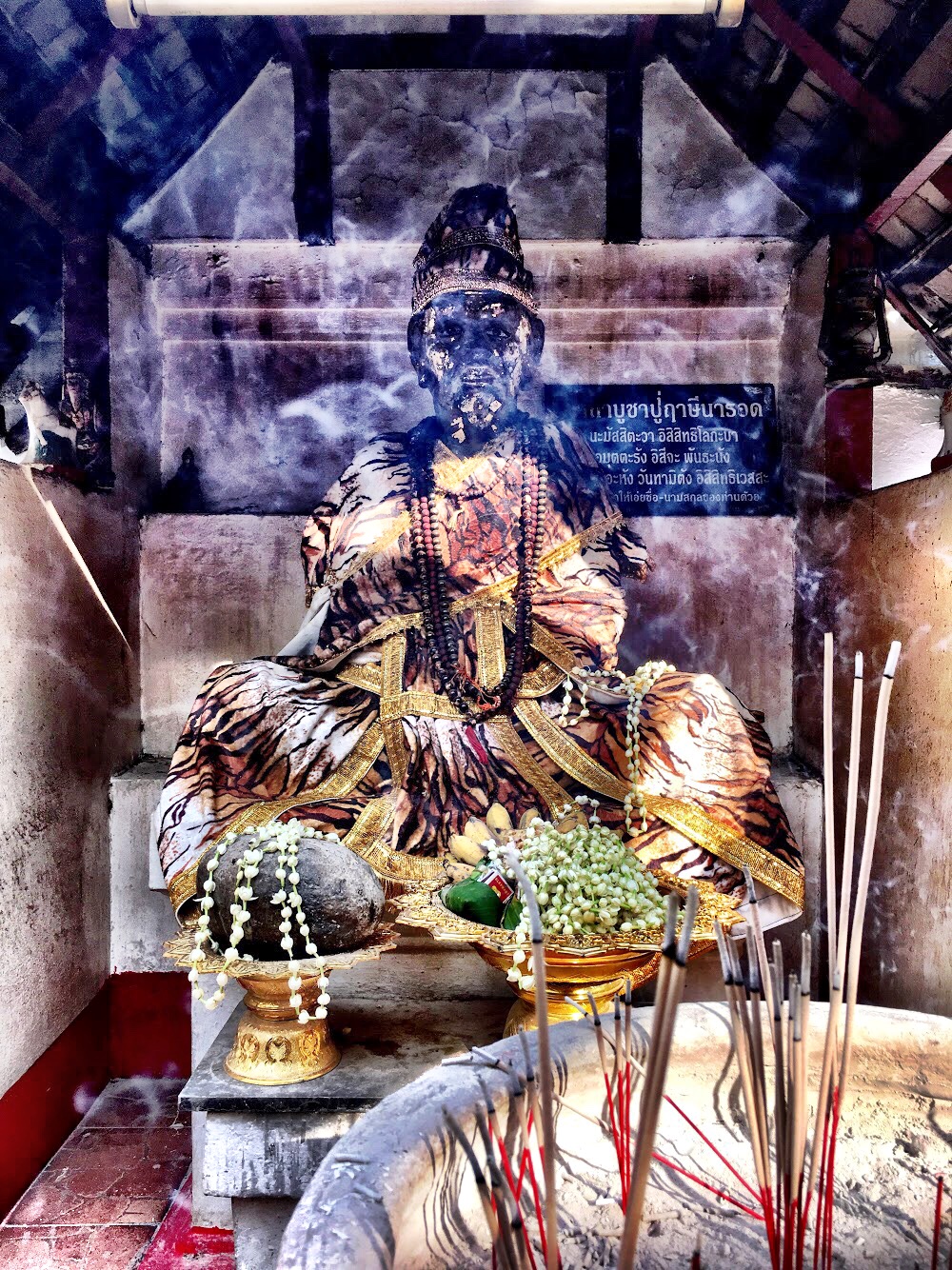
The interior is awash in a deep burgundy covered with elaborate gold detailing. It’s quite striking — as are the frighteningly lifelike monk figurines. I swear, the first time I saw one I honestly thought it was a monk sitting perfectly still, meditating. These creepy replicas of actual deceased monks can be found in many of the wats in Chiang Mai.

These monks sure can sit still

These monks sure can sit still

It wasn’t until we got up close that we realized the monks weren’t real

It wasn’t until we got up close that we realized the monks weren’t real

Get used to seeing creepy replicas of famous monks — quite a few temples in the Chiang Mai area have them

Get used to seeing creepy replicas of famous monks — quite a few temples in the Chiang Mai area have them

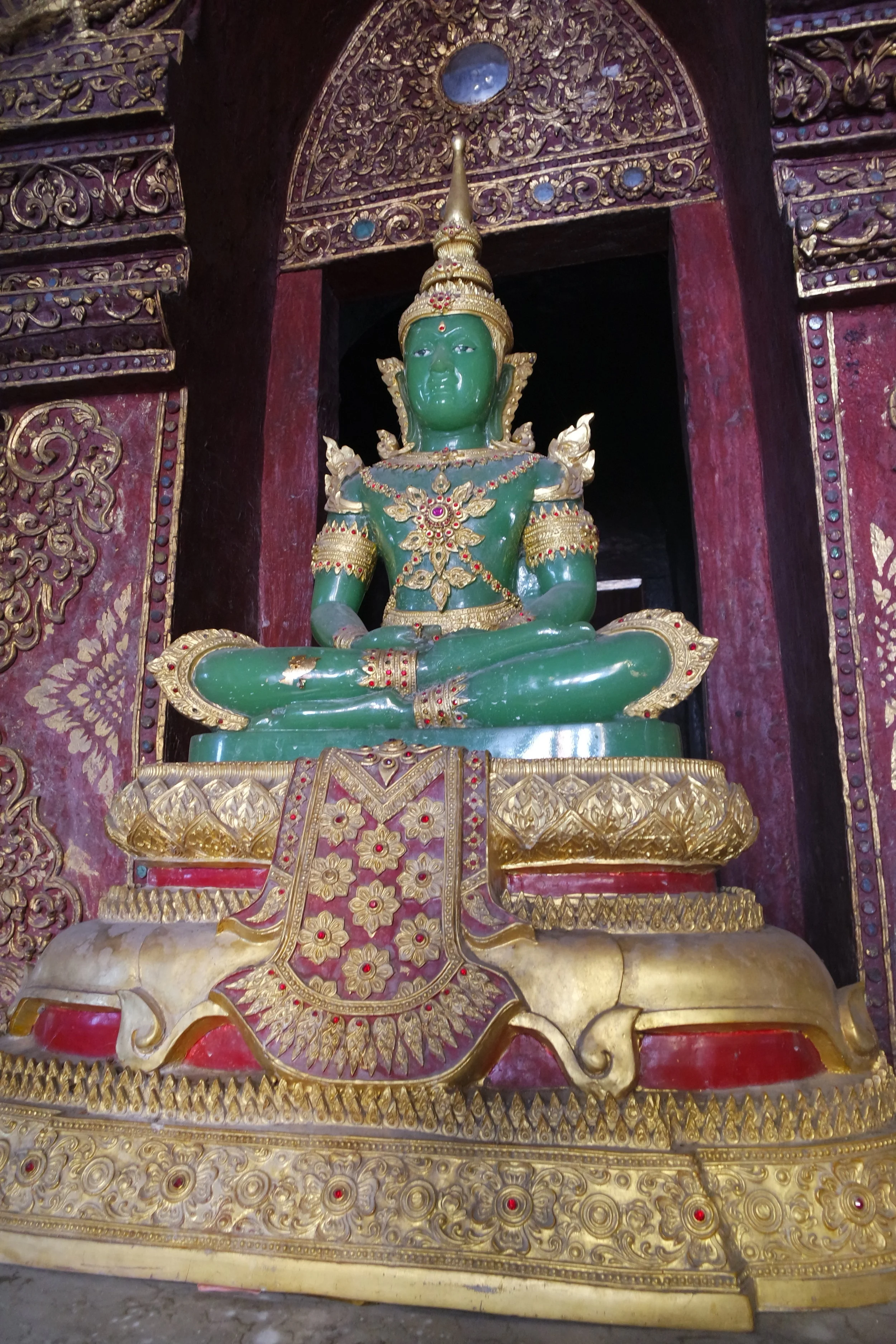
This Emerald Buddha is a replica — the real one’s in Bangkok

This Emerald Buddha is a replica — the real one’s in Bangkok

At one end is yet another copy of the revered Emerald Buddha (the original has its own temple, Wat Phra Kaew, in Bangkok).

The library is raised off the ground to help protect the scriptures it houses

The library is raised off the ground to help protect the scriptures it houses

Ho Trai: A Library Guarded by Demonic Spirits

The ho trai, or library, built in 1477, is easy to spot — it’s raised upon a stone platform to help protect the ancient Buddhist scriptures stored within from floods and insects. All around the exterior are fearsome depictions of devatas, who guard the contents of the library. Duke and I slowly worked our way around the base, marveling at the strange creatures.

The library is lined with strange devatas, or spiritual creatures, like this fellow

The library is lined with strange devatas, or spiritual creatures, like this fellow

Maybe you’re supposed to ring the bells along the path…but we didn’t want to take the chance

Maybe you’re supposed to ring the bells along the path…but we didn’t want to take the chance

End your adventure exploring Wat Phra Singh with a stroll down the bizarre bamboo walkway

End your adventure exploring Wat Phra Singh with a stroll down the bizarre bamboo walkway

Along the Bamboo Path

At the back of the complex, saffron flags with red mandalas stuck out in clusters from a grassy knoll. To end our adventure at Wat Phra Singh, Duke and I walked along a noisy bamboo walkway lined with red posts bearing silver bells and topped by red umbrellas. The path wound its way along a pitch-black moat. As the path joined the road out front, we passed a dog happily gnawing a bone as the sun began setting, casting its golden glow upon the world. –Wally

mopedsflags.jpg
phrasinghdog.JPG

Wat Phra Singh
Si Phum
Mueang Chiang Mai District
Chiang Mai 50200, Thailand

Wat Phra That Doi Kham: The Lucky Lottery Temple of Chiang Mai

Admire the big Buddha and offer flowers to have a wish come true at the Golden Mountain Temple, popular with locals and home to the giants Pu Sae and Ya Sae.

The seated Buddha at Wat Phra That Doi Kham rises over five stories high

The seated Buddha at Wat Phra That Doi Kham rises over five stories high

It’s not one of the typical tourist stops, but that’s what we loved about our driver, Tommy. He got to know Duke’s and my preferences, and quickly realized we wanted to experience as many temples as we could, including those more popular with local residents than travelers.

And when Duke mentioned a folktale he had read involving two human-munching giants, Tommy knew the spot.

Just outside of the city of Chiang Mai, this temple complex is popular with locals but not with tourists

Just outside of the city of Chiang Mai, this temple complex is popular with locals but not with tourists


To hire Tommy as a driver — which we highly recommend — email him at t.tommy2556@gmail.com.


Gold, red and white dominate the temple, which is filled with typical Thai flourishes

Gold, red and white dominate the temple, which is filled with typical Thai flourishes

Wat Phra That Doi Kham, the Golden Mountain Temple, is perched on the slopes of Mount Kham and will give you a glimpse of how a traditional Thai temple operates. Everywhere you look are small stands, pavilions and statues brightly painted white, yellow and red. There are market stalls, where you can purchase offerings and souvenirs (I bought a beaded bracelet). Numerous small shrines encircle the chedi spire.

Khun Luang Viranka tried unsuccessfully to woo the queen who built the temple — and ended up wearing her dirty panties on his head with a spear through the heart

Khun Luang Viranka tried unsuccessfully to woo the queen who built the temple — and ended up wearing her dirty panties on his head with a spear through the heart

In one of the shrines there’s a statue of a man holding a spear. This is Khun Luang Viranka, who wanted to marry Queen Chamadevi. She, along with her twin sons, are the ones who had the temple built. Chamadevi told Viranka that if he could throw his spear from Doi Suthep and into her walled city, Lamphun, 15 miles away, she would accept his proposal.

She didn’t want to marry him, though, and was concerned that he might succeed. So she sent a cursed gift to him, a hat fashioned from one of her undergarments, soiled by menstrual blood. He put the hat on, and when it came time to throw the spear, it thudded to the ground, only having traveled a measly few feet.

Distraught, he threw his spear up into the air. It came hurtling back straight down — right through his chest.

Instead of hats made of soiled panties, people offer Viranka fruit placed on a silver platter, figurines of elephants by his feet or jasmine garlands hung from his wooden spear.

The goddess of compassion, Kwan Yin, and her handmaidens accessorize with white and pink necklaces. They just can’t get enough!

The goddess of compassion, Kwan Yin, and her handmaidens accessorize with white and pink necklaces. They just can’t get enough!

There’s a shrine devoted to Queen Chamadevi, flanked by a pair of monkeys, while another features figurines of Chinese-styled women, one of whom is Kwan Yin, the goddess of compassion. These statues are weighed down with cheap beaded necklaces.

The big Buddha can be found at one end of the wat, closest to the parking area

The big Buddha can be found at one end of the wat, closest to the parking area

The enormous seated Buddha statue overlooking the entrance to the temple complex is said to be the largest in the Chiang Mai area, rising 56 feet — the rough equivalent of a five-story building.

Make a Wish

The most popular offerings at Wat Phra That Doi Kham are pretty garlands of small white jasmine flowers. These, Tommy told us, are for a special part of the temple, where people pray to the Luang Por Tan Jai Buddha, the Buddha of Success, in hopes of having their wishes granted. When someone won the lottery after praying here, the temple became the go-to place to say a prayer for a quick financial windfall. And, of course, near the parking area, you’ll see numerous vendors holding what look like briefcases filled with pads of lottery tickets for sale.

Piles of jasmine garlands are offered by those who pray for a wish to come true — and by those whose wish did come true

Piles of jasmine garlands are offered by those who pray for a wish to come true — and by those whose wish did come true

“Dear Buddha, please let me win the lottery.”

“Dear Buddha, please let me win the lottery.”

You can spot lottery vendors by their briefcase-like containers filled with tickets

You can spot lottery vendors by their briefcase-like containers filled with tickets

To pray to the Luang Por Tan Jai Buddha, find the crowded open-air pavilion filled with piles of flowers. State your wish, your name —  and how many jasmine garlands you’ll offer after the Buddha grants your wish.

The giant Pu Sae, who reluctantly gave up eating humans so long as a water buffalo is sacrificed once a year

The giant Pu Sae, who reluctantly gave up eating humans so long as a water buffalo is sacrificed once a year

Ya Sae, the female giant, converted to Buddhism like her husband

Ya Sae, the female giant, converted to Buddhism like her husband

Pu Sae and Ya Sae: They Might Be Giants

The oldest part of the temple is the chedi, which dates back to 687. This is where Duke’s folktale comes in. Thousands of years ago, two giants, Pu Sae, and his wife, Ya Sae, rampaged the slopes of Doi Suthep with their son, Sudeva, taking great delight in eating human flesh. (They’re typically described as cannibals, and one theory is that they were actually humans — part of the Lawa people who still live in these mountains.)

Once, when the Buddha was traveling the area, the fierce family followed his trail, intending to make a meal of him. While meditating, the Buddha became aware of their intentions, and stamped his foot into a boulder so hard it left an impression that remains to this day and has become a shrine.

This display of power terrified the giants so much, they (mostly) gave up their rapacious ways and converted to Buddhism. At first, they begged to be allowed to eat just one tasty human a year, but Buddha naturally refused. They then begged to be allowed to eat human flesh only once every seven years. They were refused again, and finally agreed that they’d settle for an annual sacrifice of a water buffalo. This gruesome practice is part of a yearly festival to ensure plentiful rain.

The Buddha plucked out one of his hairs to put inside the chedi. (Whenever you see a temple with “Phra That” as part of its name, it’s an indication that the chedi houses a relic of the Buddha.)

In some versions of the tale, the giants are actually shapeshifting Hindu demons, rakshasas, who try to eat the Buddha. He kills them with kindness, so to speak, and they revered him and swore off eating human flesh.

The giants are now said to protect the temple. They don’t do the best job, apparently, since the chedi collapsed in 1966 after heavy rains. Though, of course, that could have all been part of the plan. Ancient Buddha images were unearthed, leading to a revitalization of the temple.

Today you can find shrines to this famous couple, the gold leaf on their faces peeling off, giving them an appropriately gruesome look. Though we’re not sure why, it seems that worshippers place folded dress shirts still wrapped in plastic upon their laps as offerings. Holy shirt!

Smoke from incense gives the Hermit’s shrine an otherworldly look

Smoke from incense gives the Hermit’s shrine an otherworldly look

The Hermit and the Queen

The giants’ son, known alternately as the Ruesi, Lersi, Suthep Hermit or Sudeva, gave up meat forever, shaved his head and became a Buddhist monk. The cave where he took up residence is atop Doi Suthep, the mountain that later took his name.

We were excited to deduce that the likeness of the bearded man wearing a tiger skin at Doi Kham (as well as at Wat Phra That Doi Suthep) was the hermit we sought.

Another shrine to the Ruesi, or Hermit, at Doi Kham. You can spot him by his tiger skin cloak

Another shrine to the Ruesi, or Hermit, at Doi Kham. You can spot him by his tiger skin cloak

This fellow was living his solitary life, when one day he found the young princess who would become Queen Chamadevi, sitting atop a giant lotus. He raised the girl, who went on to marry a prince of the Mon kingdom in Central Thailand. The king later sent her up north to establish a new city and a sister kingdom for the Mon people, who were the first to bring Buddhism to the area.

The festive plaza that overlooks the countryside at one end of the temple

The festive plaza that overlooks the countryside at one end of the temple

The Panoramic Overlook

The rear of the temple complex feels like a city square and offers a spectacular view of the surrounding countryside. We came from the parking lot in the opposite direction, but you can access the terrace and wat by climbing a massive stairwell lined with undulating golden nagas, the mythical serpents found everywhere in Thai architecture and iconography.

Golden naga undulate up the hill, leading to the panoramic overlook

Golden naga undulate up the hill, leading to the panoramic overlook

Duke and Wally pose on the love bench on the enormous back patio

Duke and Wally pose on the love bench on the enormous back patio

Duke and I sat on a bench beneath numerous artificial red and white roses woven into a vaguely heart-shaped arch. It was silly and sweet.

“Could you imagine anything like this at a church?” I asked Duke.

That’s part of what I love about temples. They’re places to pray, but they’re also communal spaces with an air of festivity about them.

Part elephant, part human, part bird, these creatures guard an entrance to the heart of the temple

Part elephant, part human, part bird, these creatures guard an entrance to the heart of the temple

The back patio is guarded by two strange elephant-headed, bird-legged creatures to either side of a stairway that leads to the temple.


If you’ve got some extra time in Chiang Mai and want to see a temple that’s more popular with locals (hoping to win big in the lottery), swing by Doi Kham, perhaps as part of a day trip to Doi Suthep. Just be sure to make plans to return to offer jasmine garlands if your wish comes true. –Wally

Bells and nagas fill Wat Phra That Doi Kham

Bells and nagas fill Wat Phra That Doi Kham

Wat Phra That Doi Kham
Mu Ban Chiang Mai Lake Land Road
Tambon Su Thep
Amphoe Mueang Chiang Mai
Chang Wat
Chiang Mai 50200, Thailand