Angkor Wat, a Little Bit of Heaven in Siem Reap

Discover why this is our favorite ancient Hindu and Buddhist temple complex and a must-experience part of Cambodia tourism.

The legendary Angkor Wat

I was well into adulthood before taking my first international trip abroad. When I was growing up, I often daydreamed about exotic destinations, visiting the library and collecting travel brochures from AM&A’s, one of the local department stores that had an in-store travel agency. I even remember draping wild grapevines from the rafters of our family’s basement and pretending I was somewhere in the Italian countryside.

Buddhist monks in saffron robes cross the bridge that leads to the giant temple

I’m not the most spiritual individual — I tried to smuggle a communion wafer out of church when I was growing up; I wanted to see what the body of Christ looked like, after all. But when the ancient and magnificent temple of Angkor Wat lay before us, I was awestruck by its jaw-dropping scale and grandeur. It’s believed to be the largest religious structure in the world. It’s no wonder UNESCO named Angkor Wat a World Heritage Site in 1992.

Some believe that Angkor Wat appeared overnight, constructed by divine forces.

Translated from Khmer, the name Angkor Wat literally means “City Temple.” Built by King Suryavarman II, it was the former capital of the Khmer empire and has remained in continuous use since its completion in the early 12th century. It was originally constructed as a Hindu temple dedicated to Vishnu but eventually shifted to Theravada Buddhism in the 14th century.

The complex is oriented to the west, which has led several historians to believe that Suryavarman intended it to be his tomb. Symbolically, west is the direction of the setting sun and death, but is also associated with Vishnu, who the temple was originally dedicated to. Suryavarman’s devotion is also shown in the posthumous name he was given, Paramavishnuloka, which means “He Who Is in the Supreme Abode of Vishnu.” Whether this anecdote is true or not, it does makes for an interesting theory.

Our group poses in front of Angkor Wat, the largest religious structure in the world. Take that, Saint Peter’s!

Wat an Adventure!

Angkor Wat is composed of a series of elevated towers, covered galleries, chambers, porches and courtyards on different levels linked by stairways. The most famous and best preserved of the temples located within the Angkor Archeological Park, it has been featured on Cambodia’s national flag since 1863.

Four of the five towers represent the peaks surrounding Mount Meru, the home of Hindu gods, with the larger central shrine tower acting as the mythic mount itself. According to local lore, the temple was ordered by the deity Indra, the King of the Gods, to act as an earthly palace for his son Precha Kat Mealea. Some even believe that it appeared overnight, constructed by divine forces.

Originally a Hindu temple, you now find shrines to the Buddha tucked into various nooks throughout Angkor Wat

The concentric galleries represent the outer lands, with the inner courtyard containing the central tower. This was the most sacred part of the complex and most likely held a statue of Vishnu.

The moat surrounding Angkor Wat, fed by a canal from the Siem Reap River,  simulates the ocean encircling Mount Meru. It provided water to the city’s inhabitants and was an integral part of their agrarian culture — it served to irrigate rice fields, and the crops were used as a form of currency.

Many of the bas-relief carvings at Angkor Wat depict warfare

The stone causeway leading to the temple is flanked by a naga balustrade whose ends culminate with its seven raised snake heads.

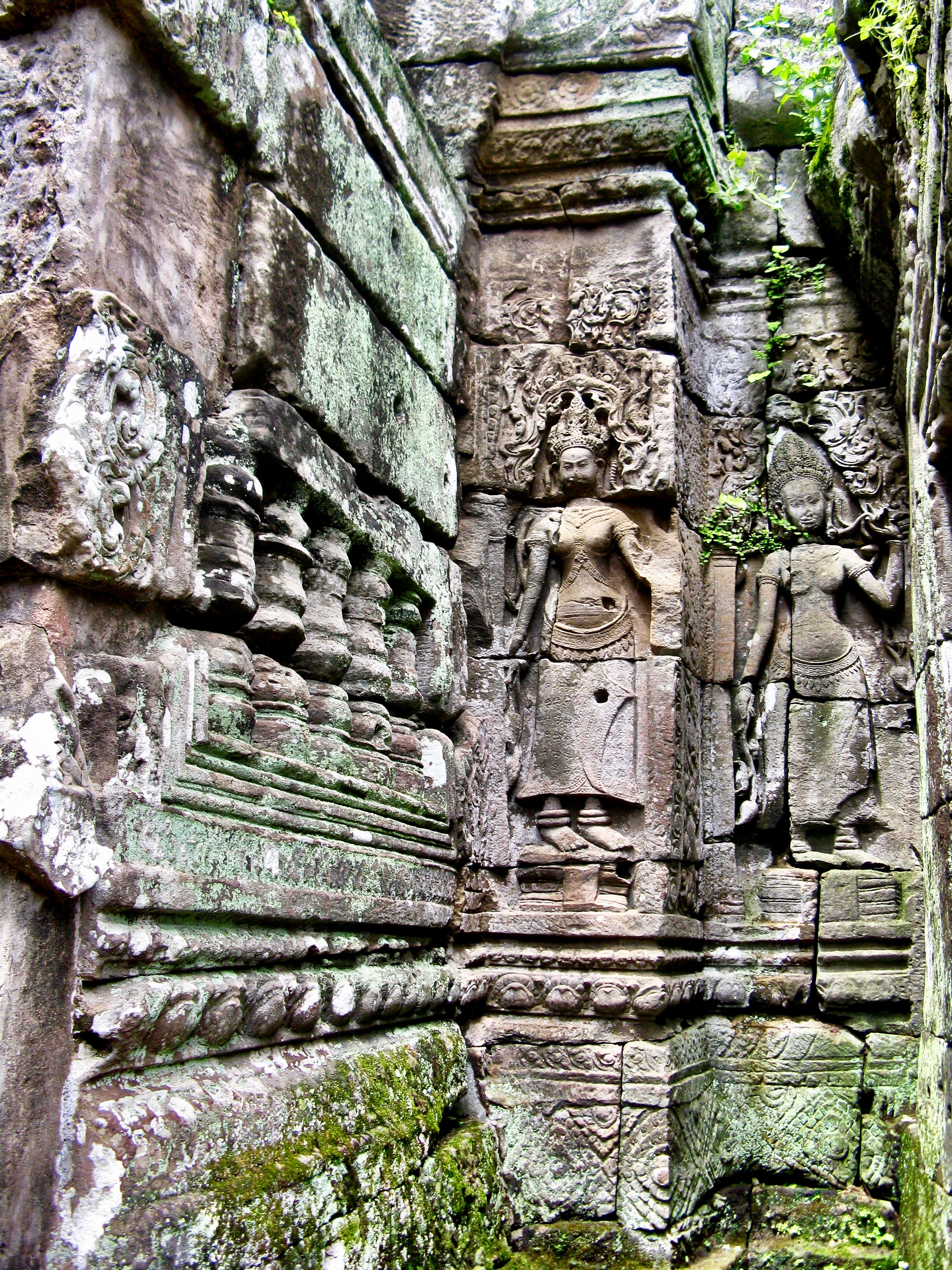
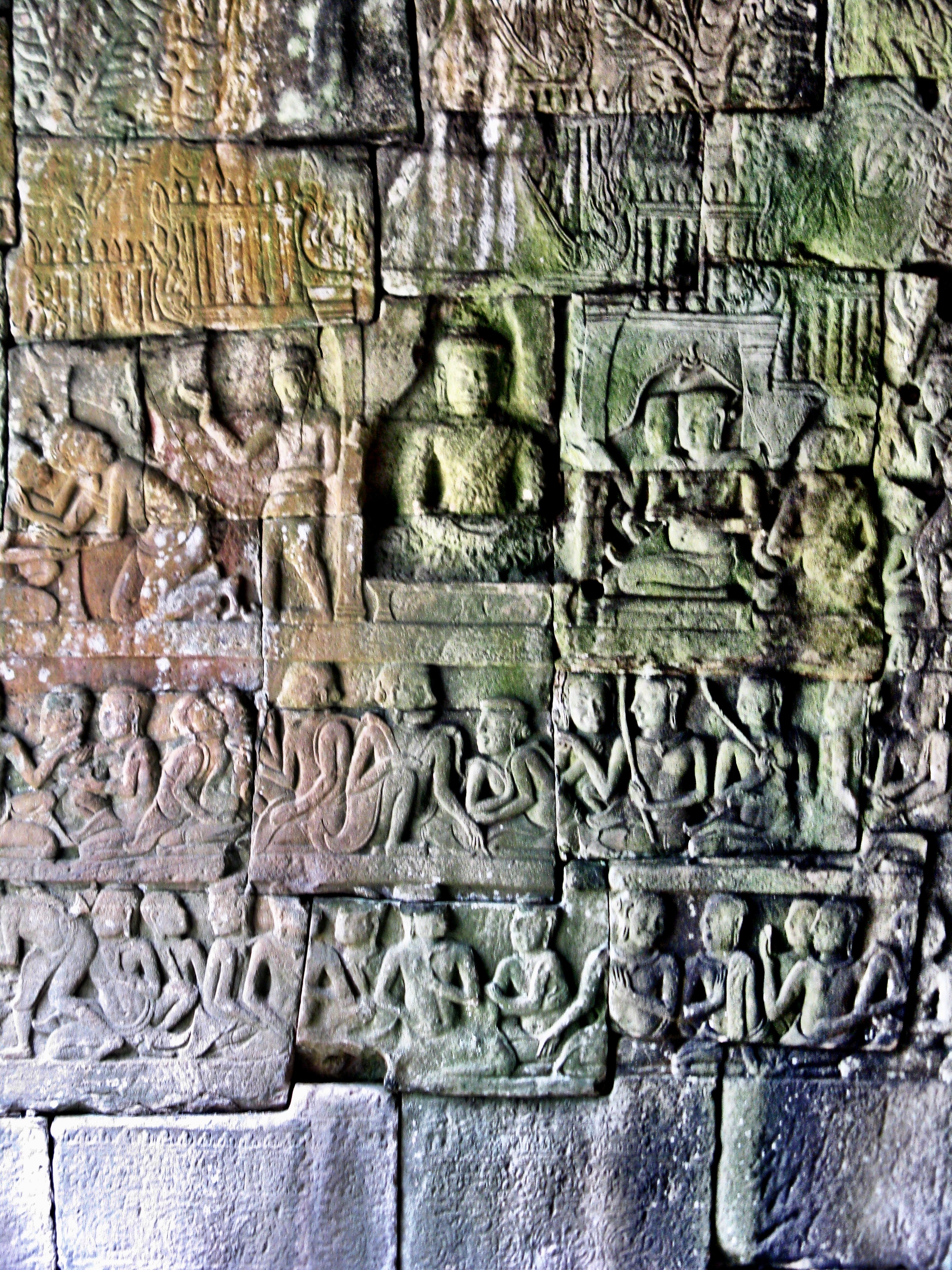
The outer gallery of Angkor Wat contains intricate bas-relief carvings depicting historical events and stories from Hindu mythology. It has more than 3,000 representations of heavenly nymphs known as apsaras carved into its walls. Each apsara is unique, from its elaborate headdress to its plaited hair and jewelry.

Three of the 3,000 depictions of buxom celestial spirits known as apsaras

A sandstone structure located within the heart of the temple complex is believed to have served as one of the libraries at Angkor Wat. The symmetrical cruciform structure would have held sacred manuscripts. Some of the columns have been replaced with cement copies for structural support.

An eight-armed statue of Vishnu stands to the south of the central tower, which may originally have been enshrined within. The statue is known as Ta Reach, and it is worshipped by Hindu visitors and Buddhist locals as well, as its head was replaced by that of a Buddha.

Sugiva, the Monkey King, and his army of warriors

The centuries-old Angkor Wat temple is an integral part of the Khmer legacy and worthy of spending several hours wandering through. Be sure to head there early to avoid the crowds. –Duke


Take a virtual tour of Angkor Wat!


Courtesy of www.AirPano.com

The Most Incredible 360 Panorama Virtual Reality Pics Ever

AirPano’s aerial photography and VR videos of the world’s most famous landmarks reveal sights you'd never see otherwise.


Courtesy of www.AirPano.com

Iguazu Falls, on the border of Argentina and Brazil, are the largest waterfalls in the world. The AirPano photographers said that filming them has been one of the highlights of the project.

The photos are immersive. They engulf you. You almost feel as if you’re there. You can swoop around a famous site you’ve always wanted to see — only now it’s as if you’ve developed the ability to fly as well as teleport.

These 360-degree aerial panoramas are thanks to AirPano, a Russian not-for-profit that features 3,000 of these impressive images.

Two of AirPano’s photographers, Sergey Semenov and Sergey Rumyantsev, answered some questions about this ambitious, one-of-a-kind project. –Wally


How did the AirPano project get started?

In 2006, we learned how to take spherical panorama shots on land. In those years, this was not an easy task: It required a special panoramic tripod head, a sufficiently deep knowledge of shooting panoramas, and it demanded a lot of manual work.

At that time, we also had a lot of experience in photography from helicopters and airplanes, and suddenly Oleg Gaponyuk, the founder of the AirPano project, got an idea: Why not break all of the existing laws of taking panorama shots on land, and try to do it in the air?

We figured out how to take a spherical shot in the sky, where it is impossible to use a high-precision panorama head, because the helicopter can shift by many meters while shooting, due to the blowing of the wind.

After several unsuccessful attempts, we finally figured it out, and the result exceeded all of our expectations. The effect was stunning, and the viewer felt like they were sitting in the helicopter and seeing the surrounding landscape with their own eyes.

The AirPano team


What's AirPano’s mission?

When we realized what a stunning impression aerial panoramas produce, we decided to do a project called “100 Places on the Planet Which You Should See From a Bird’s-Eye View.”

We wanted to share with the audience fantastic, awesome, incredible impressions, inaccessible to most people.

After shooting the first 100 places, we didn’t stop there, and now on our website you can find panoramas of more than 300 places of our planet — from the North Pole to Antarctica.
 

Why is this project so passionate for you?

Few people have the opportunity to see the most interesting places on our planet from a bird’s-eye view.

First of all, it would require a significant amount of time spent traveling. Secondly, the best spots are far from civilization, in places with no airplanes or helicopters nearby. Thirdly, the most popular places have restrictions on flying, and lastly, it’s too expensive. Our project gives this opportunity to everyone, regardless of their location or wealth.

As photographers, we have visited over 100 countries around the world, and we have seen unbelievable scenery with our very own eyes. When it became clear that everything can be shown to people in a new way, we decided that we should do it. But back in 2006, Andrei Zubetz and Gaponyuk, the founders of AirPano, had no idea that the project would be so successful.


How has the project grown?

In the beginning we had a goal to capture the most 100 beautiful places of the world from above. We have captured all of them and we couldn’t stop. So our current goal is to keep shooting.

Technology evolves, so we come back to places where we’ve already been, but capture them in new format with high resolution. For example, we have now created 360-degree videos of some of our favorite waterfalls.

Victoria Falls, on the border of Zambia and Zimbabwe


How do you get those amazing panoramic photos and videos?

We shoot our air panoramas in a variety of ways: large helicopters and a radio-controlled “flying” camera. We use a typical SLR camera with a wide-angle lens. The process is not very long and it takes 30 seconds to shoot a single sphere.


Courtesy of www.AirPano.com

Antarctica


What’s the most interesting thing that has happened on your travels?

We’ve been in 300 places around the world, so it’s difficult to choose the most interesting thing in all these journeys. We’ve been on the Drake Passage on the way to Antarctica, on South and North Pole. We’ve seen a volcano eruption. And we’ve also created aerial panoramas from the stratosphere.


Were you ever in any danger?

Yes. We’ve walked by lava pipes. We’ve captured footage of wild animals on the Kamchatka Peninsula in Russia and in Africa. We’ve met angry elephant in the savanna, who were following our car. When we were capturing rafting on the Zambezi River, one of our operators fell from the boat.


Courtesy of www.AirPano.com

The Raja Ampat archipelago in Indonesia


We’ve embedded footage of your favorite spots. What did you like best about them?

We are landscape photographers; we love beautiful views. There are the most spectacular views from above and from the ground of these places. There is a powerful energy and untouched nature.


Where would you love to go that you haven't yet?

The main places where we’d like to go are the United Kingdom and Japan. We have tried a lot to get there, but we have problems with getting permissions for aerial shooting. Also we love volcanoes, waterfalls and tropical beaches, so all these directions interest us.


Bayon Temple: The Star of Angkor Thom

Angkor Wat’s rival features serenely smiling giant faces and a battle between gods and demons.

The smiling heads that are found throughout the Bayon Temple complex most likely depict the king — not the Buddha as many assume

Growing up, I was fascinated by ancient cultures. I remember a book series I had from National Geographic on lost civilizations. On the cover of one of them was the image of a mysterious smiling stone face, which I would later discover belonged to the Bayon Temple, located in the Angkor Archeological Park in Cambodia.

I spent a lot of time playing in the fields surrounding my childhood home, pretending one day that I was a calligrapher from the Ming Dynasty and the next that the concrete foundation of an old barn was actually an undiscovered Roman temple. That’s why our visit to the Angkor complex was a dream come true.

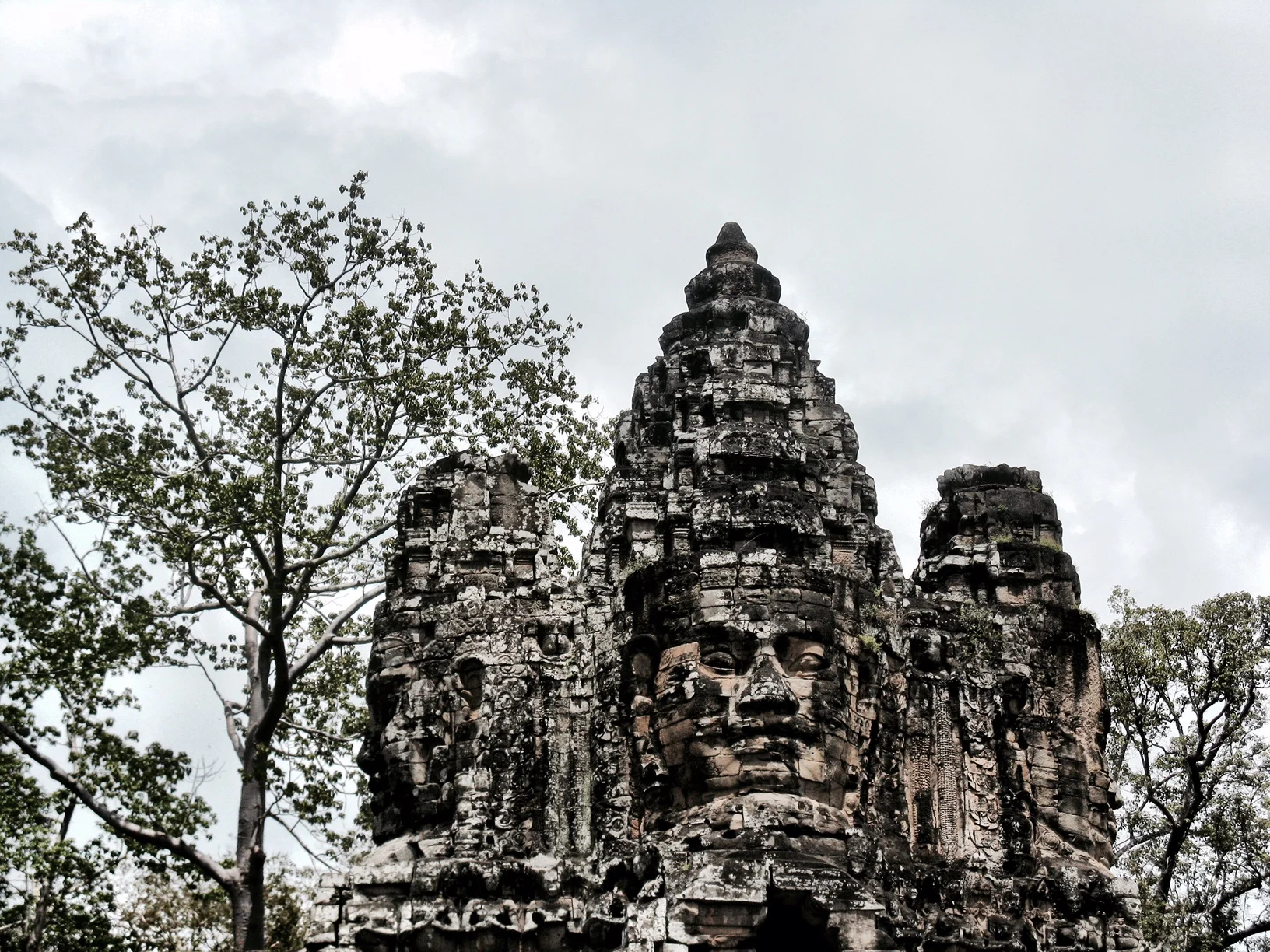
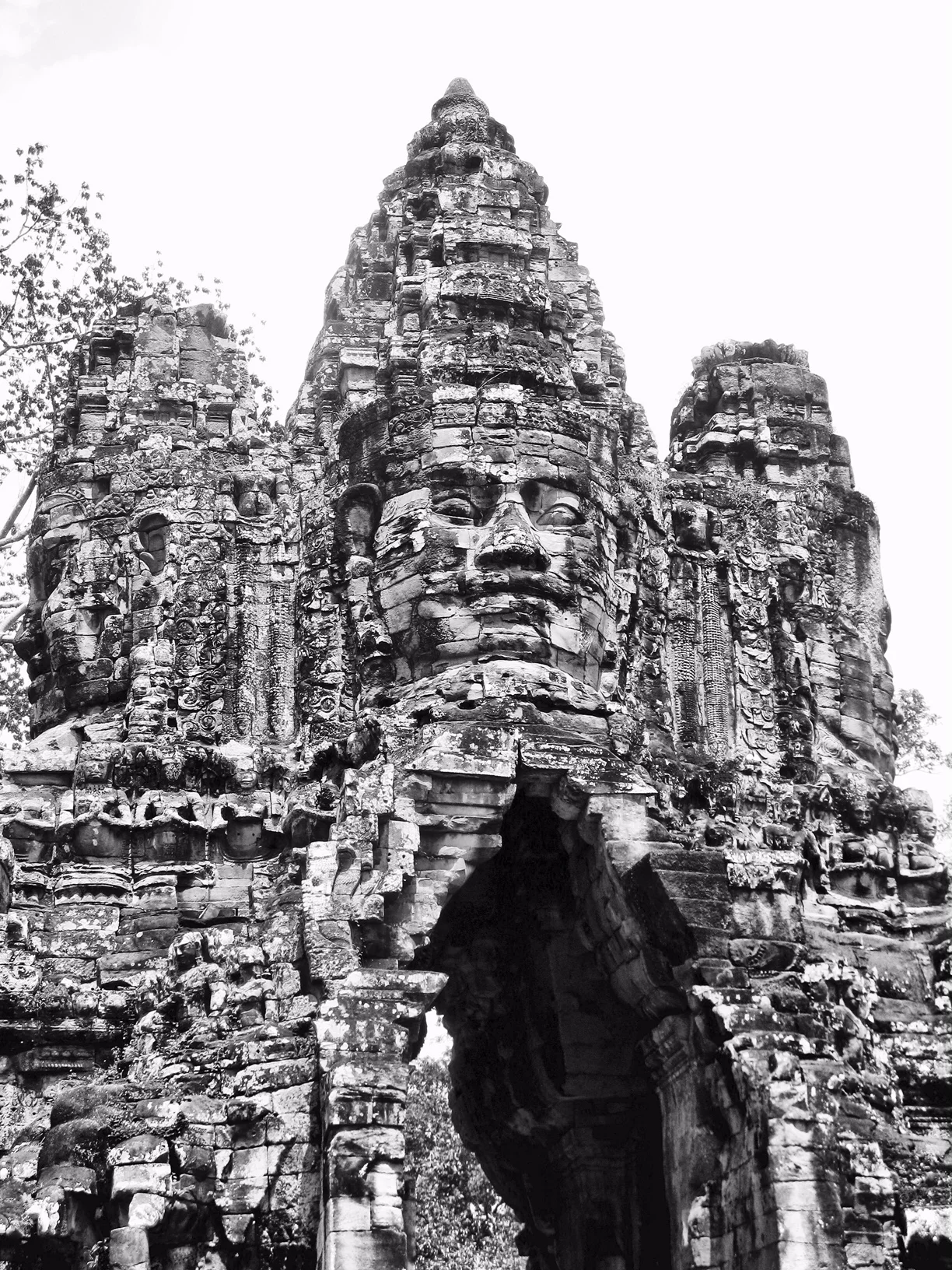
Over 200 large stone faces with almond-shaped eyes and enigmatic smiles are carved into the towers.

After a quick breakfast at our favorite spot in Siem Reap, Blue Pumpkin, a French patisserie, our group departed for Angkor Thom, the 12th century capital of the Khmer Empire. Indeed, its name means “Great City.”

We arrived shortly after 9 a.m. and were delighted to see that there were not yet many other tourists circulating amongst the ruins.

Duke and Wally were giddy kicking off their exploration of Angkor wandering Bayon, with its intricately carved bas reliefs and giant stone faces

The Battle for the Nectar of Immortality

The bridge approaching Bayon is flanked by a combined total of 108 guardian deities. To the left are 54 giant figures of devas (gods) and on the right asuras (demons) whose faces have an expressive range of emotions. Both rows are holding a naga (serpent) as if they were engaged in a tug of war. Some of the heads on these figures are copies; the original ones have been removed and are at the Angkor Conservancy in Siem Reap.

On one side of the bridge leading into Angkor Thom, demons called asuras use a giant snake to churn out the Nectar of Immortality. Gods do the same on the left. Which side do you think Wally and I liked most?

According to Hindu mythology, the sculptures are a narrative depicting the Churning of the Sea of Milk. At the suggestion of the god Vishnu, the devas and asuras, consummate enemies, worked together for a millennium to churn the ocean by pulling on the body of Vasuki, the king of the serpents, to release amrita. This is defined as “the Nectar of Immortal Life,” which, curiously, is also the Sanskrit term for female ejaculate. That must be the longest session of tantric sex in the history of the world!

When the amrita finally emerged, along with several other treasures, the devas and asuras fought over it. However, Vishnu, in the form of Mohini the Enchantress, managed to lure the asuras into handing over the amrita, which she then distributed to the devas.

Rahu, an asura, disguised himself as a deva and tried to drink some amrita himself, but Surya (the sun god) and Chandra (the moon god) alerted Vishnu to this deception. Vishnu then decapitated Rahu just as he started to swallow the nectar, leaving only his head immortal.

Prasat Bayon

Angkor Thom is encircled by a moat, now dry, that surrounds the fortified city and was said to have been filled with crocodiles to deter potential invaders.

A UNESCO World Heritage site since 1992, Prasat Bayon served as the state temple and stood at the geographical center of King Jayavarman VII’s new capital, Angkor Thom. Built primarily as a Mahayana Buddhist shrine dedicated to Avalokitesvara, the bodhisattva of compassion, some historians believe the faces to be of Jayavarman himself, thus allowing the king to take on the attributes of someone whose capable of reaching enlightenment but delays it to save others from suffering.

The massive gate pavilion topped with large carved faces watches approaching visitors

The Bayon Temple complex was built under the direction of the Mahayana Buddhist ruler Jayavarman VII, who ascended to the Khmer kingdom’s throne at Angkor in 1181 CE. He erected the site for Buddhist worship, although it later was renovated and used as a Hindu temple. Various forms of Hindu and Buddhist worship were practiced side-by-side and successively in the ancient royal courts of Southeast Asia.

Classical Khmer kings promoted the concept of divine kingship that was transferred to the Buddhist kings. Usually the Hindu god chosen for this personal identification was Shiva, but sometimes it was Vishnu, or, for some, a godly image of Buddhist origins. Khmer temples thus often portray the ruling king incarnated as the god, whose shrines are within a monument on Earth that models the design of the cosmos and heavens.

After the death of Jayavarman, some of the features of Bayon were altered according to the religious belief of his successors. The pineapple-shaped towers are an architectural representation of the peaks of Mount Meru, the abode of gods. The complex contains Hindu and Theravada Buddhist elements that were not part of the temple’s original plan.

An intricately detailed bas relief of dancing apsaras, celestial nymphs

The ground level gallery of the complex is full of intricately carved bas reliefs. The absence of a wooden roof above these pillars bathes the reliefs with sunlight. Some of the carvings depict scenes of epic battles between the Khmer and Cham warriors. Others are of everyday life: bookies taking bets at a cockfight, men fishing in Tonlé Sap or monks trying to remove the sarong of a young girl. Scandalous!

Prasat Bayon is the purrfect place for a catnap


Don’t Lose Your Head

Describing a visit to Bayon in 1912, the French novelist Pierre Loti wrote:

“I looked up at all those towers, rising above me, overgrown in the greenery and suddenly shivered with fear as I saw a giant frozen smile looming down at me … and then another smile, over there in another tower … and then three, and then five, and then ten.”

As you climb up to the top level, you reach the central tower and sanctuary, or prasat, which is believed to have once been covered in gold. Over 200 large stone faces of the Avalokitesvara with their almond-shaped eyes and enigmatic smiles are carved into the 54 towers, giving this temple its majestic character.

A couple of officers decided to join our group photo at Bayon in Cambodia

The iconic face towers of Prasat Bayon were distinct among the many Angkor temples and made me feel like being a kid again. It’s no wonder our guide kicked off our tour of Angkor with this stunning ruin. –Duke

Banteay Srei, Angkor’s Pretty in Pink Temple

Delicate carvings and animal-headed guardians make this intimate citadel one of the must-see Siem Reap attractions.

Banteay Srei, with its carvings from Hindu mythology on its pink walls, is like something out of a storybook

We all called it the Pink Temple because of the rose-hued sandstone used to build it. Somehow it’s fitting that this was the only temple not built for a king — and, in fact, only women could enter its inner sanctum, our guide Kimsan told us.

You can imagine the statues springing to life should anything threaten this gorgeous fairytale complex.

Banteay Srei was a citadel for women that housed libraries

Its real name is Banteay Srei, the Women’s Citadel, though some translate this as Citadel of Beauty. Located about half an hour from the tourist base of Siem Reap, Cambodia, it’s a definite inclusion on any itinerary of the area. Completed in 967 CE and expanded until the 14th century, it’s one of the best-preserved structures in the Angkor Wat region. It wasn’t rediscovered until 1914.

The Pink Temple’s rosy-hued sandstone allowed for elaborate carvings

Banteay Srei is a Hindu temple, primarily to worship Lord Shiva the Destroyer, though the northern buildings are dedicated to Vishnu the Preserver. It’s said to be the most Indian-influenced of all the temples, and the carvings were the most ornate we saw on our trip.

In this image, the demon king Ravana tries to lift Mount Kailash, where Lord Shiva is meditating, and bring it back to his own kingdom

Part of the fun of exploring Banteay Srei is crossing the wide moat on the narrow footpath.

The temple was built to honor the Hindu god of destruction, Shiva

Once you make that crossing, you’re transported to another world. The pinkish structures are now tinged with green lichen, calling to mind a forgotten palace from a Hindu epic.

Gods called devatas pose in niches, guarded by animal-headed warriors

The most impressive part of Banteay Srei is the exterior decoration. The walls are covered with curlicues and flourishes that evoke climbing vines. Nestled in niches throughout are gods and goddesses known as devatas. Both sexes are topless, the women with breasts as large and perfectly round as melons.

In 1923, an art thief named André Malraux stole four of the figures, but he was caught shortly thereafter, and the devatas were returned to Banteay Srei to pose for tourists and pilgrims once again.

Most of the walls of Banteay Srei are covered with complex carved ornamentation

Some of the buildings in this intimate complex once housed libraries. Guess those women were smart.

These statues keep watch over the interior of Banteay Srei citadel

My personal favorite part of Banteay Srei are its guardians. Humanlike creatures with the heads of animals are found throughout the inner part of the complex. They’re resting in a pose that's somehow between sitting and kneeling. Some have what I thought to be the head of an eagle, like the Hindu deity Garuda — though they also could have been monkeys. Others sport what might be the head of a lion, though it’s hard to say. And some just look like dudes with cheesy mustaches.

Some of the guardians have the heads of animals, and some just have mustaches

These are the citadel’s protectors, and you can imagine them springing to life should anything threaten this gorgeous fairytale complex. –Wally


Gambling Advice

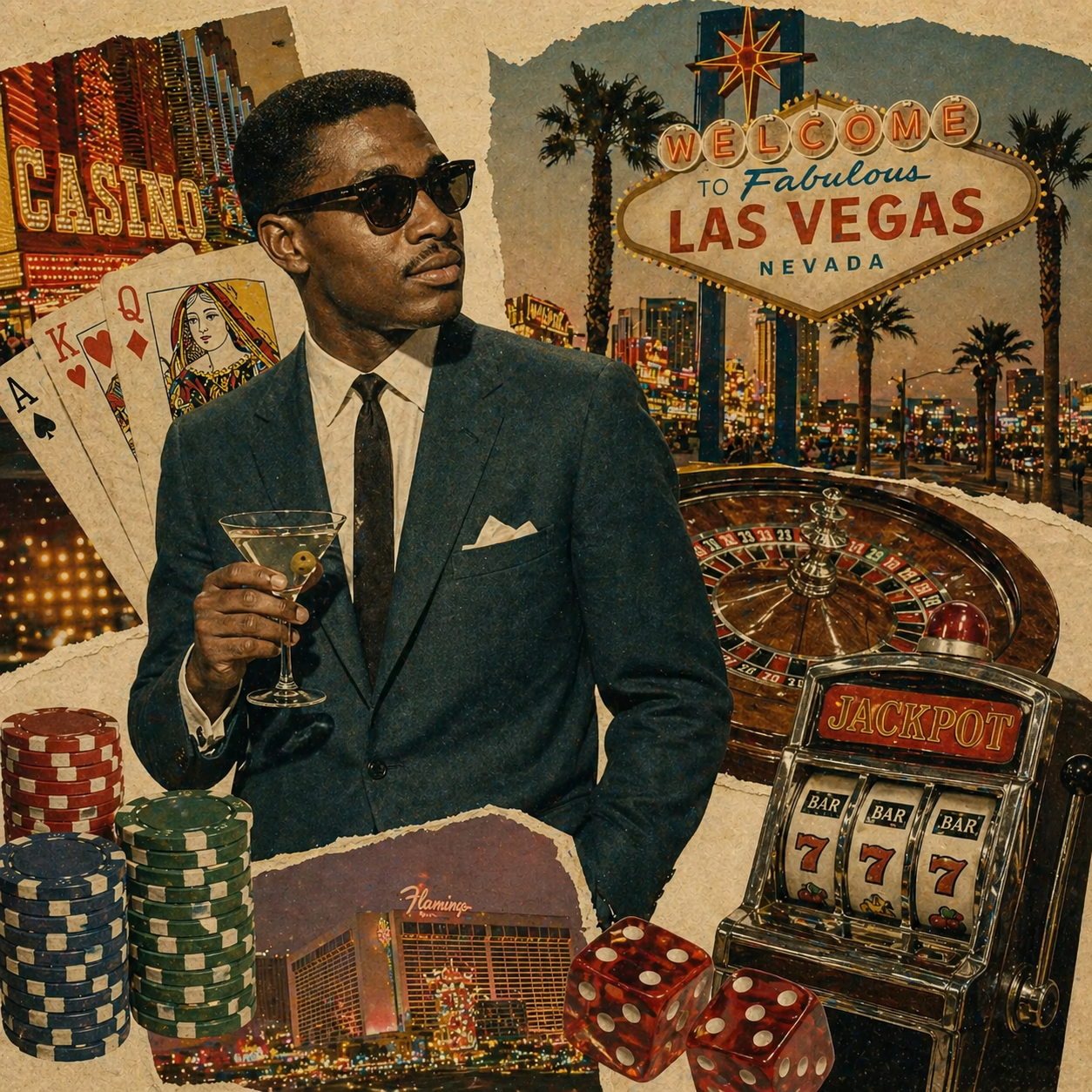
Before you hit the casinos in Vegas, these gambling tips could improve your odds. We’d be willing to bet on it.

No matter what your game, we’ve got some tips to help you get started gambling — and they just might help you hit the jackpot

When in Rome…you drink wine and visit ancient ruins.

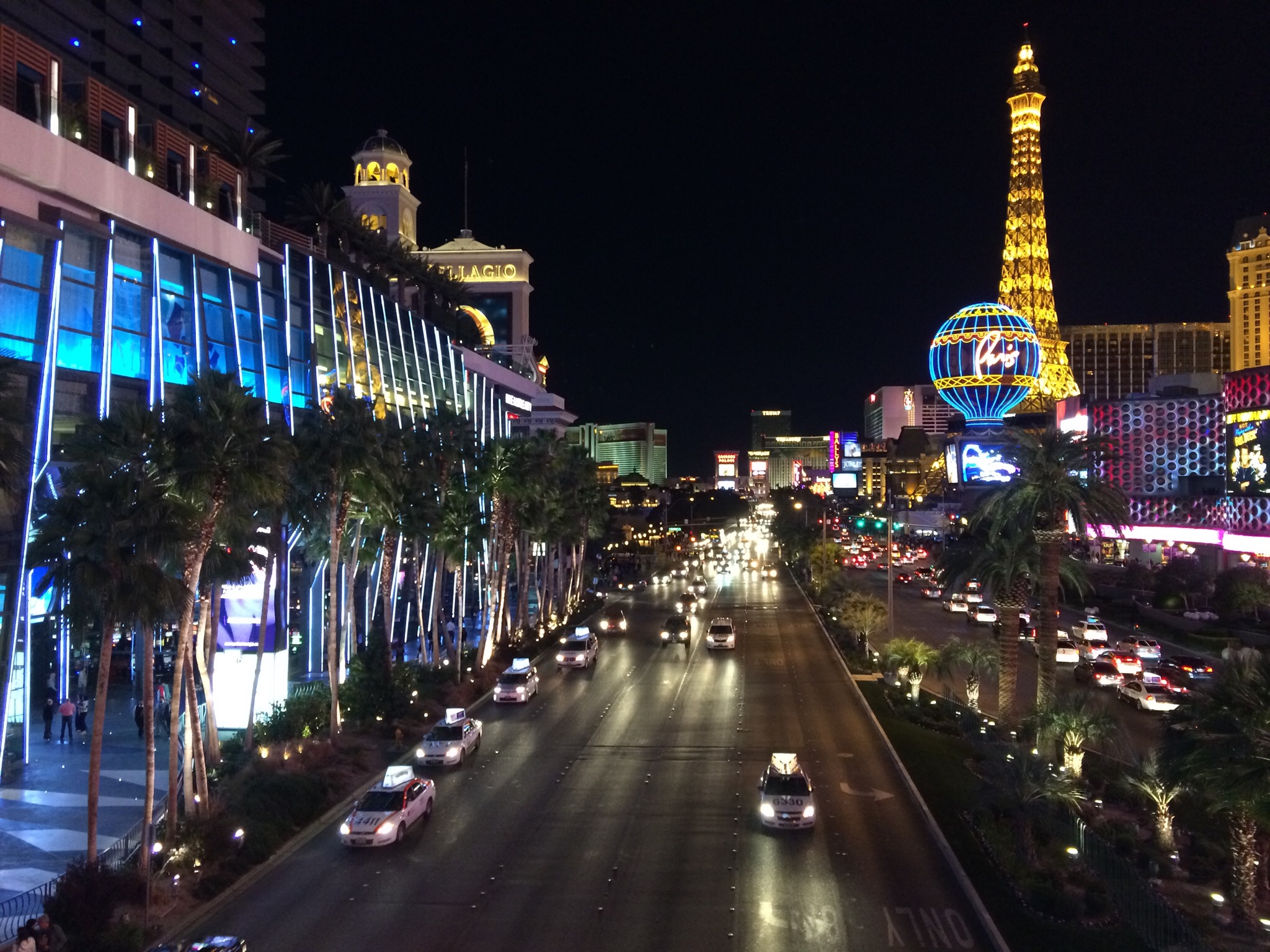
When in Vegas…you might as well try your hand at gambling. Brandon knows his way around a casino. It’s not all about luck. Here’s his advice.

If you want to win a jackpot, you’ll have to play max bet. And the higher the pull, the better the payout — but the more potential to lose your money quickly.


Brandon cruises the Strip like a badass — but he’s a high roller in the casinos

Start early.

Brandon has a routine that begins early every morning (10 a.m.is early in Vegas) with a trip to the sports bet. Because of the time zone difference, the games are played earlier in Vegas. So he gets his free Jack & Coke, sits at the sports book and places a few bets. He checks back after lunch to collect his winnings, which he’ll then use toward his gambling efforts in the evenings…


Remember: high risk, high reward.

For slots, you’ll want to bet between $2-$3 a pull so you don’t lose your money quickly, while still having the potential to win a decent pot.

If you want to win a jackpot, you’ll have to play max bet. And the higher the pull, the better the payout — but the more potential to lose your money quickly.


Don't go during prime time.

As for tables, they can be intimidating if you’re not usually a table player. Brandon recommends getting to the tables at an off-hour. That’s basically any time during the day, especially on weekdays. Sunday nights are good, too. Because the tables aren’t busy, the dealers are typically super nice and will show you how to play.

Brandon’s love affair with craps started one Sunday night at a table at the Wynn…


Booze it up.

And whenever you’re gambling, remember the drinks are free. While you don’t have to tip, if you leave your server a nice tip, she’ll usually be sure to find you and bring you drinks with better liquor.


Good luck — and if you still lose big, please don’t blame us. –Wally

Secrets of the Hijra: India’s Little-Known Transsexuals

Prostitution, curses and dangerous sex change operations are a way of life for this marginalized community.

A group of hijras, India’s legally recognized third sex, in Bangladesh

With Caitlyn Jenner and bathroom debates making front-page news, trans people are now part of the American consciousness. And yet most of the world doesn’t know about the hijra, India’s transsexuals, who are officially recognized as a third sex in a country where homosexuality is illegal.

For many gay Indian men, they have two choices. They can ignore their homosexuality and live in repression, get married to a woman and try to raise a family. Or they could undergo a castration to live their life as a transsexual woman in the hijra community.

A very tight cord is wrapped around your penis and balls so you cannot pass urine. You become bloated, like you’re pregnant. You’re in a lot of pain.

In India, the latter is often the most appealing option.

“The way it works in this culture is it’s more socially acceptable to dress up in a sari and pretend you’re a woman than it is to be a man who likes other men,” said my friend George, who lived in Vadodara, India for the past couple of years before he fell off his roof and died late last year.

There’s not a lot of information out there about hijras. Their customs are shrouded in mystery. Here are some surprising facts about this little-known subset of Indian society. Granted, this isn’t the most flattering portrait of a trans group, and there are exceptions to every generalization — but it’s a tough life for hijras and their reality doesn’t paint the prettiest of pictures.

Many think it’s easier to live life as a trans woman than as a gay man in India

Hijras have the ability to bless — or curse.

If you’re about to be married or have recently given birth to a son, watch out. The hijras in your neighborhood will appear outside your home one day, singing, dancing and doing their signature clap, touching the base of the palms together in a dramatic flourish.

When money doesn’t come quickly enough, hijras lift their dresses to flash their often-mutilated genitalia.This is seen as the ultimate proof of their hijrahood.

Some refer to these actions as begging or bestowing a blessing — but just as many Indians think of it as a curse or, at the very least, a major societal embarrassment, wanting the hijras to leave as quickly as possible.

In this manner, a group of hijras can collect alms that total 2,000 rupees a day, according to George — and that’s a substantial sum. The hijras split the earnings among their group — but it still ends up much more than the typical Indian’s 180-rupee-a-day salary (the equivalent of $2).

“One of the hijra houses we went to had business cards,” said George, who hosted a British student writing her dissertation on this trans community, sitting in on many of her research interviews. “They go to the hospital and bribe the nurses to give them the addresses of homes where there has been a boy born recently.”

The hijra are most commonly found begging on trains, though, George said.


Once revered, hijras are now feared.

“Their communities across Southeast Asia date back more than 4,000 years, and they appear in ancient texts as bearers of luck and fertility,” according to the U.K.’s Daily Mail. There are mentions of hijra in the sexual position guide the Kama Sutra as well as the Hindu epic Mahabharata.

And while Muslims tend to be traditionalists in terms of gender roles as well, they also have a longstanding tradition of holding eunuchs in the highest regard. In ancient times, Mughal rulers had eunuchs guard their most prized and holy objects as well as serve as advisors. Eunuchs were seen as pure, uncorrupted; they had sexual temptation removed from the equation.

Today, though, hijras face discrimination and outright abuse.

“If you were to ask a middle-class or upper-class boy what they think about hijras, they’ll tell you they’re scared of them,” George told us. “Because they remember being that little boy and being exposed. It’s kind of an evil Santa Claus. You see this clown-looking thing in a sari flashing your parents. And they won’t go away until you give them money.”

When George invited hijras to a party he hosted, many of the guests promptly left, asking how he could associate with such “filthy, diseased, lower-class” scum.


The sex-change surgeries are barbaric.

Most castrations (known as “nirvan,” which is awfully close to “nirvana”) aren’t performed in hospitals. It’s part of a 40-day ritual of self-emasculation, according to the Daily Mail.

The surgery is, essentially, a rebirth. It happens in the morning, with the rising of the sun.

A very tight cord is wrapped around your penis and balls so you cannot pass urine. You become bloated, like you’re pregnant. You’re in a lot of pain.

The village midwife then comes in with a knife. “She takes a swipe up and a swipe down. No anesthesia,” George said, though there are stories of hijras being dosed with opium first.

As the blood and urine come gushing out, “it’s supposed to be your male essence is leaving your body,” George told us.

The hijra is supposedly presented with her castrated parts, which she buries next to a tree as a sacrifice.

“After the castration, you cannot work for almost one and a half months,” a hijra named Abhina Aher told NPR. “It was not an easy task — it was a journey of pain.”

You can get the operation done in a hospital — if you can bribe a doctor willing to take the risk — though it doesn’t sound much more safe.

“It happens in a dingy room, a 10-by-10 probably,” Aher said, describing her procedure. “Immediately after the castration, two hours, the hijra is asked to leave that place, because it is illegal. The operations are normally done by quacks, and a lot of hijras die because of that.”


Hijra prostitutes sell their services for the equivalent of about 50 cents (not that that’s what these two are!)

Many hijras get involved in sex work. Sometimes during traffic jams.

Prostitution “is a given” for hijras, according to George.

Hijra sex workers sell themselves for 300 rupees, which translates to about 50 cents, he told us.

They often take advantage of situations that present themselves. “If you’re in a traffic jam anywhere in India, look out the window and you’ll see all the trucks are stopped and can’t go anywhere,” George said. “The hijras come running onto the freeway. They go inside those cabins — five minutes later they’re leaving and going into another truck. They’re going from cabin to cabin to cabin to get 30 rupees, 30 rupees, 30 rupees. They know these are horny truckers who have been on the road for months without their wives, and a real woman prostitute can cost 200 to 500 rupees. And here’s a hijra for 30 rupees. Which one are you gonna take?” he asked.


Becoming a hijra is seen as one of the only options for young, desperate gays.

Hijras live in communal houses, where a mother figure, or guru, runs the show, taking care of her chelas, or daughters.

“First, hijras make a pledge to hand over all earnings to the guru, who in exchange supports them inside what is effectively an alternative home, as most hijras are runaways or evicted by their families,” NPR reports.

For many in this ostracized population, these homes are a haven. But they can also be the only option for young gay boys kicked out of their homes.

“Hijras pick them up off the street and say, ‘Come and live with us,’” George explained. “And they start off by feeding you — recruiting you, basically. Then they start dressing you in a sari and selling you to clients.”


The hijra have turf wars — and bizarre ways of insulting each other.

“I can sum up the hijra in three words,” George told us. “Gangs wearing saris.”

Each house has its own territory. And if you intrude on their turf, there are gang wars. Guns aren’t the weapon of choice, though. They’ll flash their genitals, pull hair, and beat each other with sticks or their sandals, which is the ultimate insult since the feet are considered the dirtiest part of the body.

George heard tales of hijras being hanged or doused with gasoline and lit afire.

And those who pretend to be hijras as a means to earn money will be badly beaten by genuine hijras if found out.


The patron goddess of hijras, Bahuchara Mata, rides around on a giant rooster and cursed a bandit with impotence

Hijras worship a goddess who cut off her breasts and rides around on a rooster.

Bahuchara Mata was traveling with her sisters in a caravan, when they were raided by a bandit named Bapiya. Part of a warrior caste that promoted suicide over death at the hands of an enemy, Bahuchara decided instead to cut off her breasts. As the source of a mother’s life-sustaining milk, breasts represent womanhood in India.

She then cursed the bandit with impotence — a horrific punishment in a culture that puts so much importance in carrying on the family name. The only way Bapiya could overcome this hex was to pay homage to Bahuchara Mata by dressing and behaving like a woman.

Bahuchara has become the patron goddess of hijras and is depicted as riding atop a rooster, a symbol of innocence.

Keep in mind that not all transgendered people in India are part of the hijra community, and that not all hijras fall under these general attributes. But those that do resort to prostitution, intimidation and crassness do so because they have no other options in a paradoxical society that recognizes their legal status but discriminates against them. –Wally


The Monsters of “Supernatural,” Season 1, Episodes 17-19

Meditation creates a golem-like tulpa from Tibet. A shtriga, a vampire witch from Albania, sucks out the souls of children. And a real-life haunted painting, The Hands Resist Him, leads to mysterious deaths. 


Christians, Muslims and Jews pray to God. Wiccans cast spells. Many people practice the power of positive thinking.

Personally, I believe that, for the most part, you get what you put out into the universe. That’s why I try to be as upbeat as possible and why I distance myself from too much negativity.

Is it possible that our thoughts could be so powerful that they become tangible objects? Some Tibetans think so. And if enough people believe that, could it make it actually happen? Will this cycle of belief and creation go on forever?!

Hopefully your brain doesn’t hurt as much as mine. Let’s just dive right into some Supernatural eps.


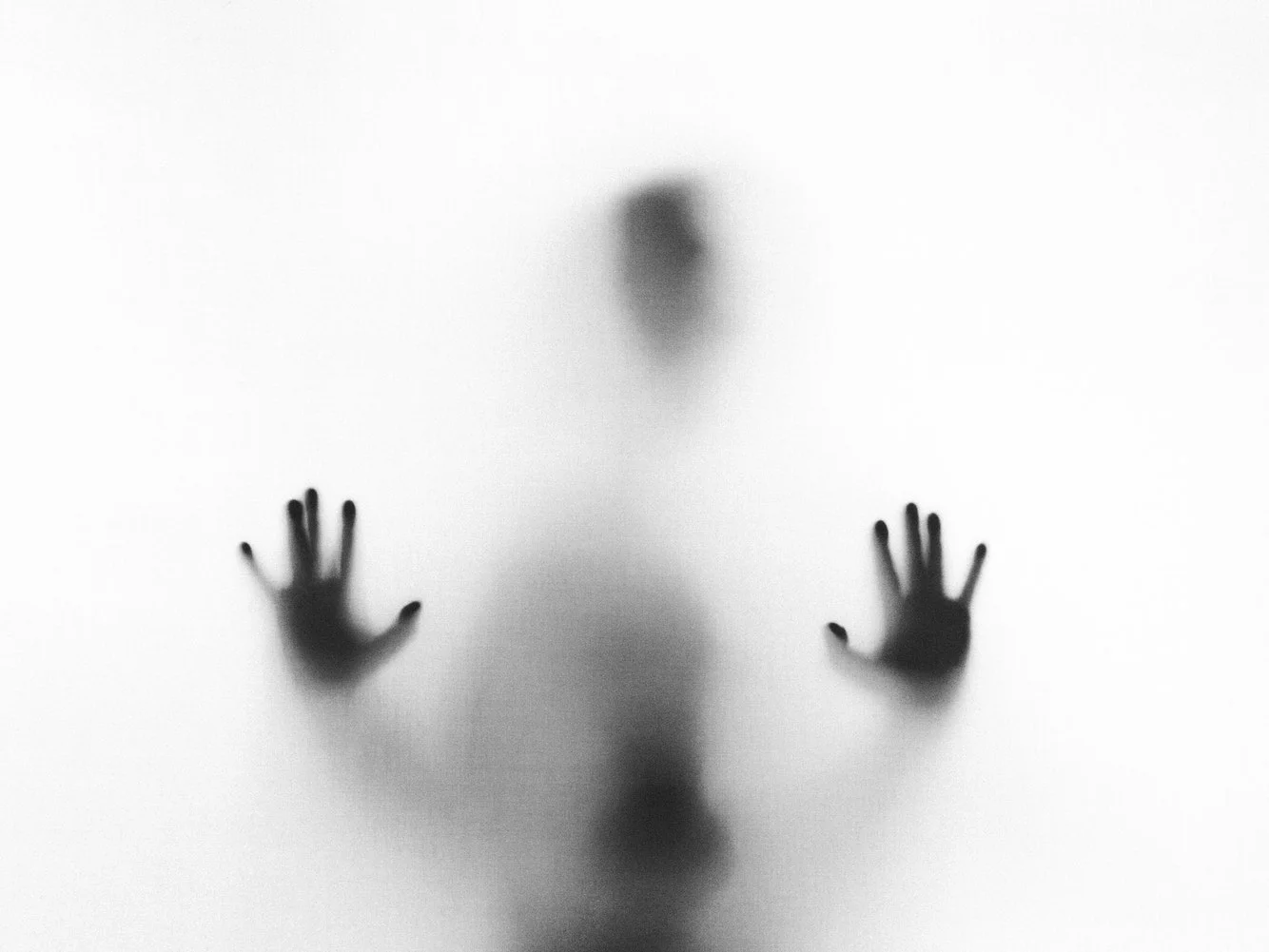
Perhaps these are tulpas, thought forms that have taken on a physical reality

S1E17: “Hell House”

Monster: Tulpa, a malevolent spirit

Where it’s from: Tibet

Description: It’s a thought that takes on a physical form.

What it does: “Once the tulpa is endowed with enough vitality to be capable of playing the part of a real being, it tends to free itself from its maker’s control,” Alexandra David-Néel writes in Magic and Mystery in Tibet, published in 1932. “This, say Tibetan occultists, happens nearly mechanically, just as a child, when his body is completed and able to live apart, leaves its mother’s womb. Sometimes the phantom becomes a rebellious son, and one hears of uncanny struggles that have taken place between magicians and their creatures, the former being severely hurt or even killed by the latter.”

Upon completing its task, instead of returning to the magician who constructed it, a tulpa sometimes pursues its own whims as a “half-conscious, dangerously mischievous puppet,” she writes.

The Tibetan explorer Alexandra David-Néel with her adopted son, Lama Aphur Yongden. David-Néel wrote about her creation of a tulpa that became more and more evil

Incidentally, David-Néel supposedly created a tulpa, in the form of a diminutive Friar Tuck-like monk that started out as jolly. Over time, it became thinner and took on a sinister demeanor. She eventually decided it had to be destroyed.

In this episode of Supernatural, the tulpa is created unintentionally — enough people believe the tales on a blog of a haunted house that they will the ghost into existence.

“The belief is not unlike more popular concepts of today like The Secret — belief in something gives it energy, which in turn helps to manifest it,” argues Psychic Universe. Some people bring about love; others, evil murderous ghosts.  

How to defeat it: Meditation is the place to begin when you have decided to destroy a tulpa, advises Psychic Universe. Sit in a quiet place with soft or dim lighting and go into a meditative state. You need to summon your tulpa to you by calling it in your mind. Depending on how strong it has become and how much of a mind of its own it has developed, this could prove difficult and may take a few attempts. Keep doing it though; remember, no matter how strong it gets, you’re still the creator and you’re still in charge.

Envision your tulpa surrounded by a force field of sorts — a field of white light. This light will protect you from its attempts to stop you. You can envision this light breaking down and reabsorbing the energy of the tulpa, which you can then absorb back into your own spiritual aura. Again, this can take a few sessions, but you’ll see your tulpa readily weakening.

Once you’ve dispersed and reabsorbed the energy, cleanse yourself to transform it into something more positive and get rid of the negative. Avoid thinking of your tulpa any further so you don’t accidentally re-create it; remember to keep your thoughts positive.

David-Néel said it took her six months of hard work to destroy her tulpa.
 

This vampiric witch from Albania, known as a shtriga, especially loves to feast upon the life essences of sleeping children

S1E18: “Something Wicked”

Monster: Shtriga

Where’s it’s from: Albania

Description: The witch in this episode looks like Emperor Palpatine — a dark-hooded figure with a pale, withered face. According to legend, shtrigas appear as old women during the day but have the power to morph into a bee, moth or fly. Some shtriga are also able to turn into owls.

What it does: The shtriga is a vampiric creature — she feeds off of the spiritus vitae (breath of life) or blood, particularly favoring children while they sleep.

How to defeat it: “A shtriga always vomits the blood she has sucked,” writes M. Edith Durham in High Albania and Its Customs in 1908. “You must secretly track a woman you suspect to be a shtriga when she goes out to vomit the blood. You must scrape some of it up on a silver coin and wear it, and then no shtriga can harm you.”

If you have been drained by a shtriga, the only cure is to have her spit into your mouth. Sounds pretty disgusting, but hey, if it works… Not sure how you’ll convince her to do this, though. Maybe French kissing would be enough?

If you happen to have a shtriga in a church, and it happens to be Easter Sunday, make a cross out of pig bones and hang it over the threshold. The shtriga will be unable to leave — and you’ve got one hell of an excuse not to go to church!

Dean and Sam discover that you can only defeat a shtriga if you catch her while she’s having a snack — that is, sucking the lifeforce out of someone. Fire her full of consecrated iron rounds. Just make sure you’ve got good aim.


S1E19: “Provenance”

Monster: Haunted painting

Description: This looks like a typical work of art — but suddenly you’ll notice one of the people in the painting have disappeared.

What it does: The spirit leaves the painting and commits murder.

The Hands Resist Him, a haunted painting tied to at least two deaths

It’s not the only haunted painting out there. There’s an infamous one titled The Hands Resist Him, painted by Bill Stoneham in 1974.

The owner of the gallery where the painting was first displayed and the art critic who reviewed the show died within a year of seeing the painting. And one seller on eBay wrote in the product description: “One morning our 4 1/2-year-old daughter claimed that the children in the picture were fighting and coming into the room during the night.”

Perception Gallery in Grand Rapids, Michigan bought The Hands Resist Him for $1,025. It now sits in storage.

How to defeat it: Pure iron has a long history of bringing about good luck and repelling evil. But in this case it’s not enough to banish the spirit of the haunted painting for good.

The Winchester boys use one of their go-to methods of destroying baddies: “Burn the bones,” as they like to say. Trouble is, that doesn’t work for them this time. That is, until they realize it’s not the father’s spirit committing the murders — it’s that of the little girl.

To kill the spirit, Sam and Dean had to destroy the doll that was made in the girl’s image because it had some of her hair. It was pretty creepy-looking anyway. –Wally

Ta Phrom, the Tomb Raider Temple

A wild, overgrown must-see stop on a visit to Angkor Wat.

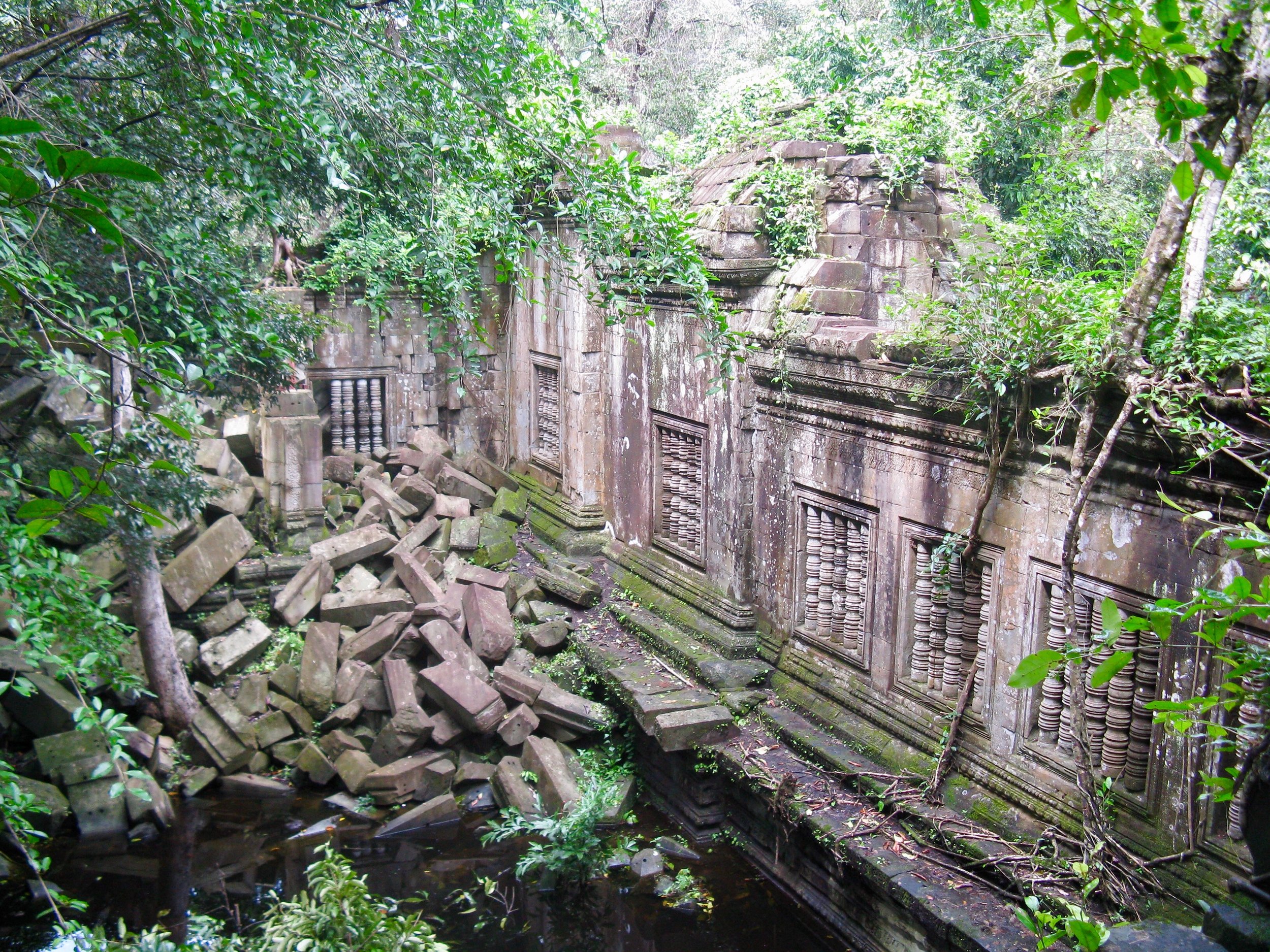
The jungle has reclaimed parts of Ta Prohm temple, which makes it a fun one to explore

The sacred temple of Ta Phrom caught the attention of location scouts and served as the setting for an epic scene in the cinematic adaptation of Lara Croft: Tomb Raider.

Since its debut on the big screen in the summer of 2001, Ta Phrom is now commonly referred to as the Tomb Raider Temple. The sprawling and atmospheric ruins are located about two miles northeast of the Angkor Wat Archeological Park in Cambodia.

The strangler figs’ sinuous, gnarled roots spread out and over the temple walls like the tentacles of a kraken.

Like an episode of the television series Life After People, the jungle didn’t waste time in reclaiming the structure after it was abandoned in the 15th century. The towering strangler fig trees that have become an iconic and integral part of the ruins share a symbiotic relationship with the structure — their sinuous, gnarled roots spread out and over its walls like the tentacles of a kraken.

An obligatory photo of our group taken underneath the roots of the towering strangler fig tree in the inner courtyard at Ta Phrom, where Angelina Jolie’s Lara Croft picked a jasmine flower before falling into the catacombs of the temple

It’s easy to see why this temple was featured as one of the settings in the action-adventure film Tomb Raider — in which actress Angelina Jolie portrayed the popular video game heroine Lara Croft, battling the secret society of the Illuminati to recover powerful ancient artifacts. Incidentally, we picked up a copy of the DVD at the Angkor Night Market and watched it when we returned from our trip. Not the best movie, in my humble opinion, but it was fun to see Ta Phrom get the Hollywood treatment, and Jolie appeared to enjoy herself.

As an interesting aside, our guide Kimsan told us that Jolie was one of the last Americans to legally adopt a child from Cambodia. Her son Maddox was born in the northwest province of Battambang and was 7 months old at the time. Kimsan explained that Cambodia was suffering from the illegal opportunistic trafficking and exploitation of children. As a result, the Cambodian government has put a ban on expatriate adoptions, grappling with the complicated issues of its overrun, unregistered and unregulated orphanages.

The western entrance pavilion contains a towering gate, with four large serene faces overlooking the cardinal directions

A Mother of a Memorial

Ta Phrom was built as a monastery by King Jayavarman VII in the Bayon style during a time when Mahayana Buddhism was the state religion. As Jayavarman saw himself as the devaraja, a mortal god-king, it’s only fitting that the temple’s primary deity, the Bodhisattva Prajnaparamita (the Perfection of Transcendent Wisdom), was fashioned in the likeness of his mother.

Walking onto the jungle path, Ta Phrom left me with a childlike sense of wonder. Unlike the majority of Angkor’s restored temples, it has been left largely as it was found. Partially cleared of jungle vegetation, it wasn’t difficult to imagine how French botanist Henri Mahout felt when he rediscovered these ruins in 1860. An excerpt from his posthumously published journal breathlessly noted:

“There are … ruins of such grandeur … that, at the first view, one is filled with profound admiration, and cannot but ask what has become of this powerful race, so civilized, so enlightened, the authors of these gigantic works?”

Half-hidden, intricately carved reliefs lie strewn about the site like jigsaw puzzle piece

Here before us lay the low expansive enclosures of Ta Phrom, with fig, banyan and kapok trees spreading their roots amongst the lichen-covered sandstone pillars that lined the passageways. An otherworldly mist hung about the ruins, even though it was quite humid — or perhaps that was just how I remember it.


Courtesy of www.AirPano.com

Laterite and sandstone were used in the construction of Ta Phrom. Quarried locally in the Kulen Mountains, sandstone worked well for the extensive carvings that adorned the walls. The temple includes a prasat, a square sanctuary tower with a chamber, over which a multitiered tower rises. Four doorways open into the chamber, which once housed the sacred idol.

Undeniably spectacular, the jungle setting of Ta Phrom is easy to explore and has all of its galleries at ground level. –Duke

The Monsters of “Supernatural,” Season 1, Episodes 13-16

Want to develop your telekinesis powers? Stuck battling a Zoroastrian demon? Is that ghost truck a big ol’ racist? This post is for you!

Zoroastrianism, a little-known religion still practiced today, originated in Iran and focuses on opposites

Zoroastrianism gets a bum rap, in my opinion. It’s one of the oldest monotheistic religions in the world, having started about 3,500 years ago in ancient Persia (what’s now Iran). But do you ever hear about Zoroastrianism? Nope. It’s all Christianity, Judaism and Islam all the time.

Sure, it’s a mouthful to say. But I bet most people don’t even know that people still practice Zoroastrianism — if they’ve even heard of it in the first place.

I had never met a Zoroastrian before my coworker Alma (who helped out with a post on what it’s like to visit Iran). They don’t have official places of worship, choosing instead to say their prayers at home or in the open air — always facing a source of light.

It’s high time we start spreading the word about this religion, which has a cool concept of dualism. For every good, there’s an evil. For every light, there’s a corresponding darkness. We’ll touch upon one of the religion’s personifications of shadow in this month’s Supernatural roundup.

Telekinetics are known as “spoon benders.” They can do neat tricks like having knives hover in the air millimeters from someone’s eyeball.

It’s bad enough having a phantom truck try to run you down, but it might turn out to be racist, too!

S1E13: “Route 666”

Monster: Phantom truck

Where it's from: United States

Description: This vehicle moves on its own, without a driver.

What it does: Dean and Sam Winchester reference the Flying Dutchman, which refers to a legendary ghost ship and/or its captain. He was a stubborn drunkard, who refused to heed his crew’s pleas and rounded the Cape of Good Hope during a terrible storm.

The crew mutinied, and the captain shot and killed its leader. He then tossed the corpse overboard. When the body hit the water, a shadowy figure appeared on deck.

The feisty captain shot at it — but the gun exploded in his hand.

The spectral figured cursed the Flying Dutchman to sail the seas as a ghost ship with a crew of skeletons, and any who catch sight of it are doomed to die.

The Flying Dutchman, as seen in the Pirates of the Caribbean movies

The cursed vessel has been spotted periodically since then, including by a German sub in World War II.

This particular ghost truck happens to be racist. Yes, the phantom truck is racist. What a jerk. (That reveal has led some to include this episode on a list of the worst Supernaturals ever.)

How to defeat it: Lure it onto hallowed ground — and the ghost truck should vanish.


S1E14: “Nightmare”

A rare moment of telekinesis caught on film!

Monster: Telekinesis

Where it’s from: People all over the world could have this power.

Description: Two Greek words combine to mean “distant movement” — telekinesis is the ability to move objects with your mind. Think of one of Stephen King’s most famous characters, the traumatized Carrie, whose telekinetic powers get out of control.

There’s not a lot of scientific evidence to back up the existence of telekinesis, though a researcher from Duke University named J.B. Rhine thought he could prove the power of the mind — and especially the idea that many people could collectively influence outcomes solely through the power of thought.

Later researchers have been unable to duplicate his results and have found errors in his methods.

What it does: Telekinetics are known as “spoon benders.” They can do neat tricks like having knives hover in the air millimeters from someone’s eyeball.

How to defeat it: Try giving a telepath a taste of his or her own medicine!


The horror flick Carrie demonstrates that you never want to piss off a telepath

Telekinesis 101

Hold the top of a necklace between your thumb and forefinger. Make sure the pendant is still.

Shut out all outside thoughts and focus. Imagine energy flowing through your arm and hand and then through the necklace. Picture the pendant swinging in little circles, speeding up as the energy flows. You should see tiny swinging movements.

Concentrate as hard as you can, all the while keeping the image in your mind. Try to imagine what it would look like in real life, starting slow and speeding up.

You’ve still got a long way before you’ve got Carrie-type powers, but you’ve gotta start somewhere!


Telekinesis 201

The first method of telekinesis training is becoming one with an object.

To do so, light a candle and stare at the flame. Focus on the inner flame — not just the flame you see.

Close your eyes and keep the inner flame in your mind, visualizing it growing, shortening, waving, dancing. Practice five to 10 minutes a day.

The second method of telekinesis training is using energy.

Start small. Blow up a balloon. Put it on a floor with little friction (apparently something like linoleum works best). Sit down in a comfortable position and try to do some breathing exercises to clear your mind. Then create a ball of energy and mentally push it into the balloon, making it move without touching it.

The final step of telekinesis training is bending.

You can use any utensil — though, let’s face it, it’s more poetic to use a spoon. Hold it in a way that’s comfortable to you. Sit in a relaxed position and do breathing exercises to clear your mind.

Focus on the utensil. Close your eyes and slowly rub the spoon to get the feeling of it. Feel the energy, the molecules and the atoms of it become one with you.

With years of practice, you’ll be bending spoons in no time!


S1E15: “The Benders”

Monster: Humans who hunt people for sport

Man, these guys are worse than that racist phantom truck! But we’re sticking to monsters. So, ’nuff said.

Good battles evil in many Zoroastrian myths

S1E16: “Shadow”

Monster: Daeva, Zoroastrian demon

Where it’s from: Zoroastrianism was one of the first monotheistic religions and dealt a lot with the battle between good and evil, darkness and light. It developed in ancient Persia, in what is now Iran.

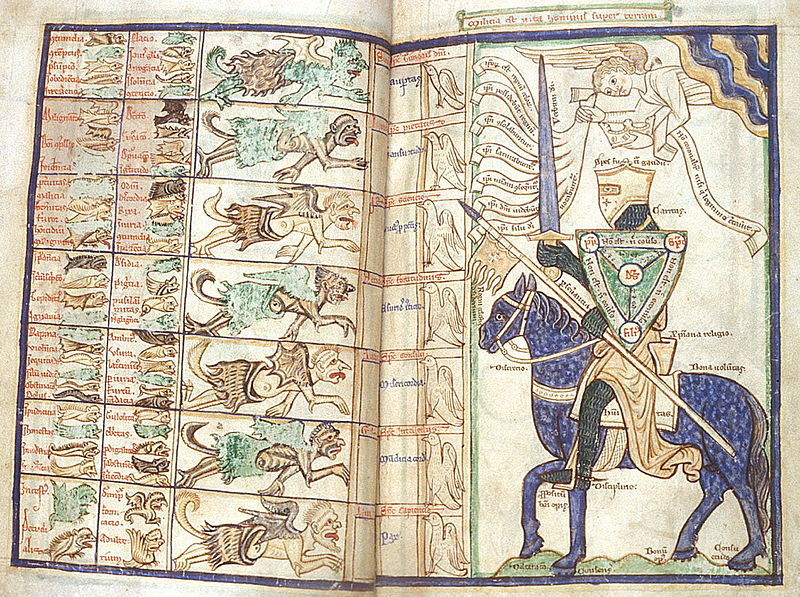
The prophet Zoroaster battles two daevas

Description: As Sam Winchester says, “They’re Zoroastrian demons, and they’re savage. They’re animalistic. You know, nasty attitudes, kinda like, uh, demonic pitbulls.”

Daevas “are the counterparts and mirror opposites of the amesha spentas,” Rosemary Ellen Guiley writes in The Encyclopedia of Demons & Demonology. “They personify all diseases, sins and distresses suffered by humanity. Most daevas are male.”

The daevas were created from the evil thoughts of Ah-Riman, the Destructive Spirit of the Zoroastrian religion, “for the purpose of waging war against goodness and humanity. Though spirits, they can appear in human form,” she continues.

They hide beneath the earth, lurking about, waiting for someone vulnerable to attack. “They are attracted to unclean places and like to spend time in locations where corpses are exposed,” according to Guiley.

What it does: These are some powerful mofos. On the show, the daeva’s victims are shredded to death by its claws. Dean and Sam get their faces sliced up by the shadowy demon. (But fear not! Their pretty faces will heal with nary a scar.)

How to defeat it: Find and destroy the altar where it’s worshipped.

If a deava is attacking you, shine light upon it — as personifications of darkness, they cannot stand brightness. That includes flares, if you’ve got some handy. –Wally

9 Tips for Navigating the Fes Medina — and Making It Out Alive

OK, that’s a bit dramatic. But Fez, Morocco is an intense city to explore. Read these tips before you go.

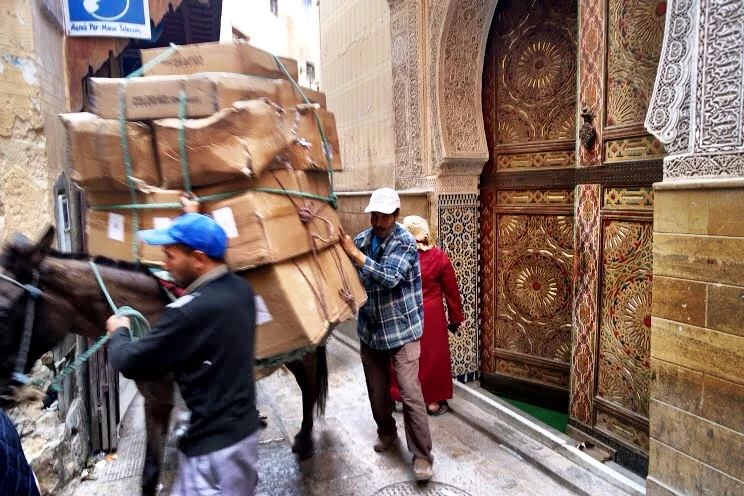
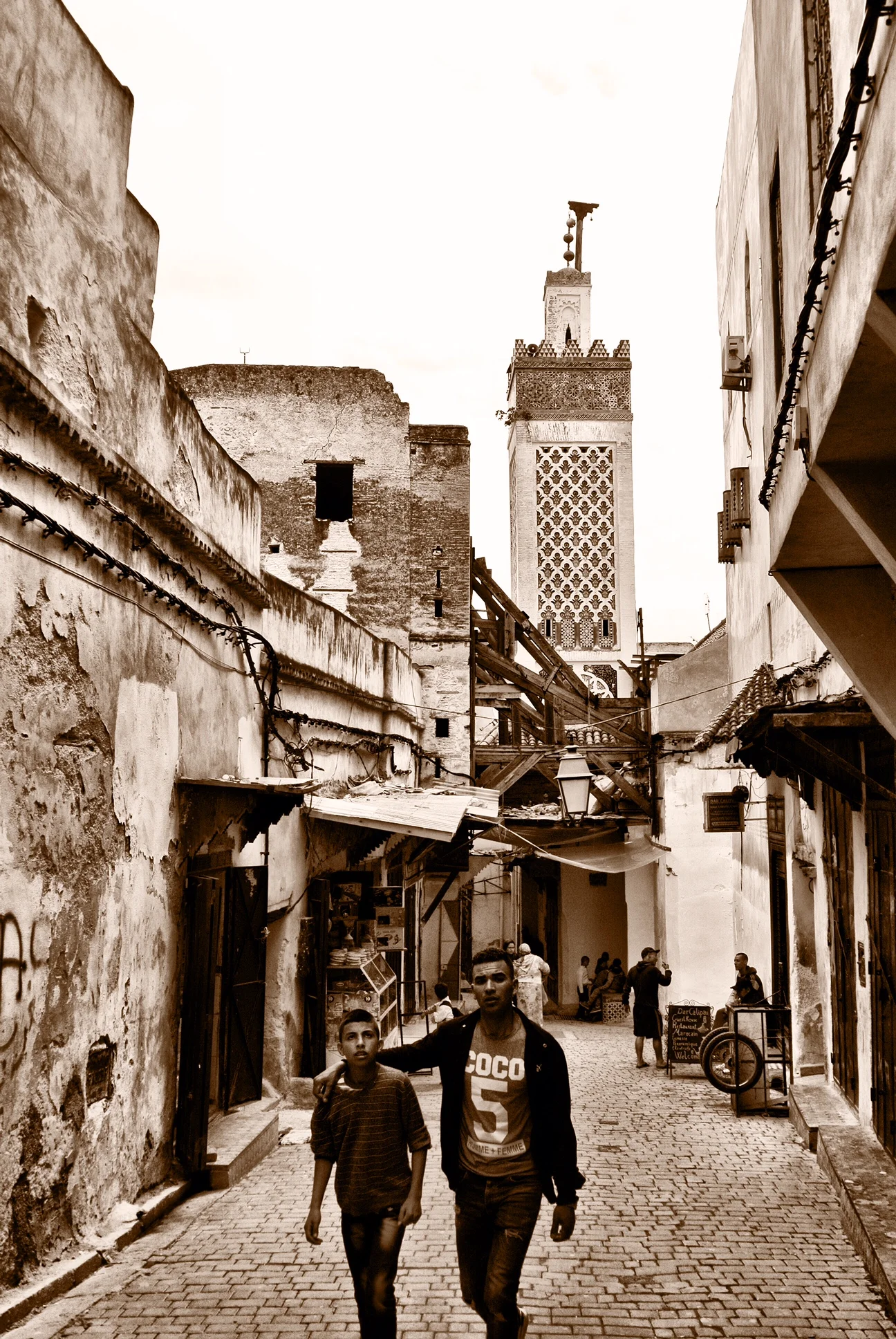
A donkey overpacked with boxes is about as much of a traffic jam you’ll encounter in the Fès medina.

Fès is a city of discoveries. You never know what lies around the next corner. You cannot imagine the beauty that hides behind a plain wall once that wooden door opens.

As such, though, it can be intimidating as well. I’m not gonna lie: That first day we had booked to explore the medina on our own, we were hesitant to leave the riad. We really had to work up our courage. Because once you step foot outside the door, you have to be prepared to not only get lost, but also to deal with local men making snide comments, hoping to get you to pay them to act as guides.

For the most part, it worked, and we were able to follow the trail back, like Hansel and Gretel.

Landmarks like mosque towers don’t really help you find your way around the medina — there are lots of them, and once you turn a corner, they’re gone.

1. Get a guide on your first day.

It’s nice to put yourself in someone else’s hands on your first day in Fès. Our guide, Abdul, was fantastic, and we just followed him around as he led us to the major sites. It’s nice to get them out of the way, know you’ve ticked the “important” stuff off your list, and that you have nothing left but to shop and eat (and hit a hammam for a spa day).

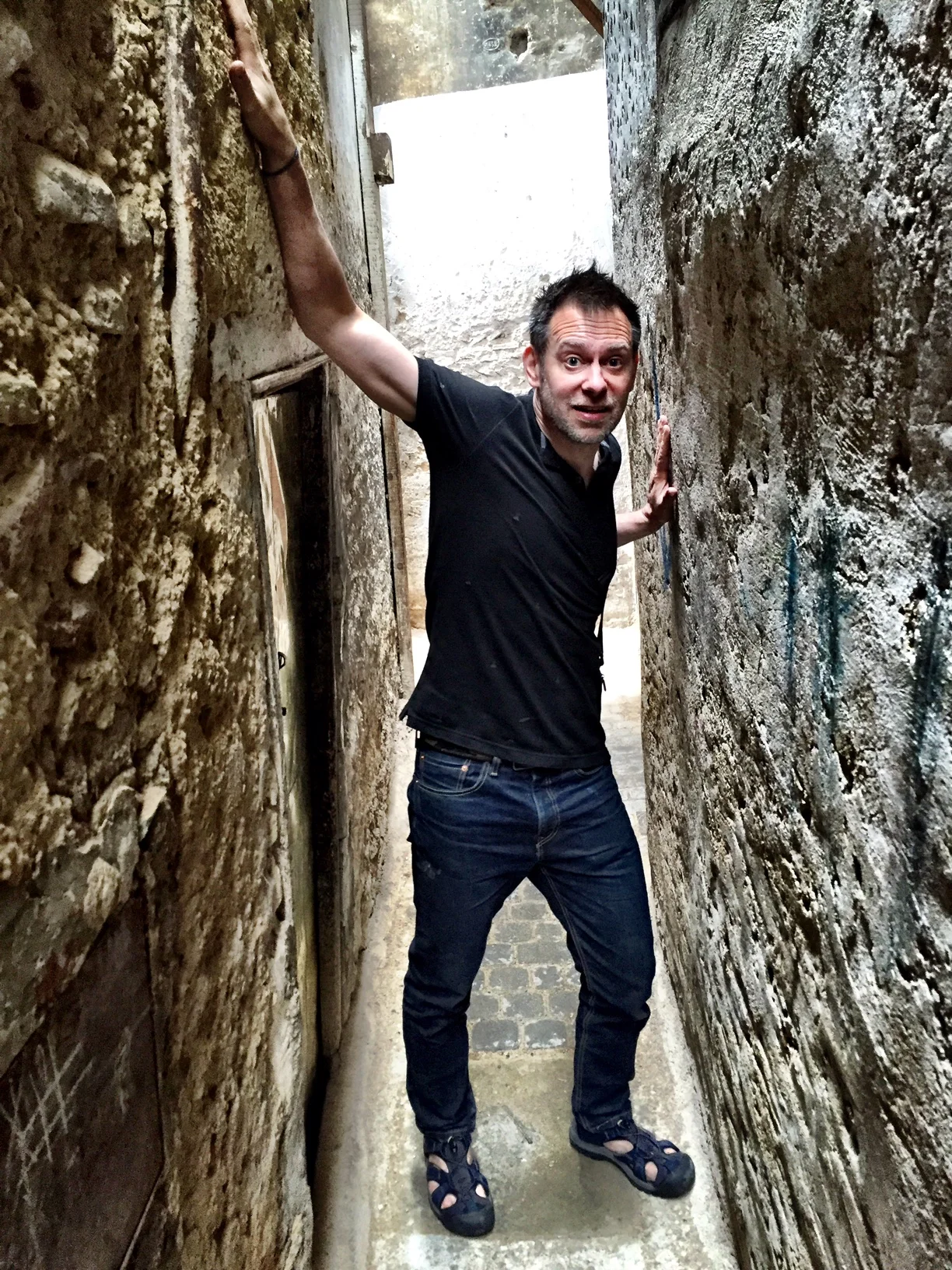
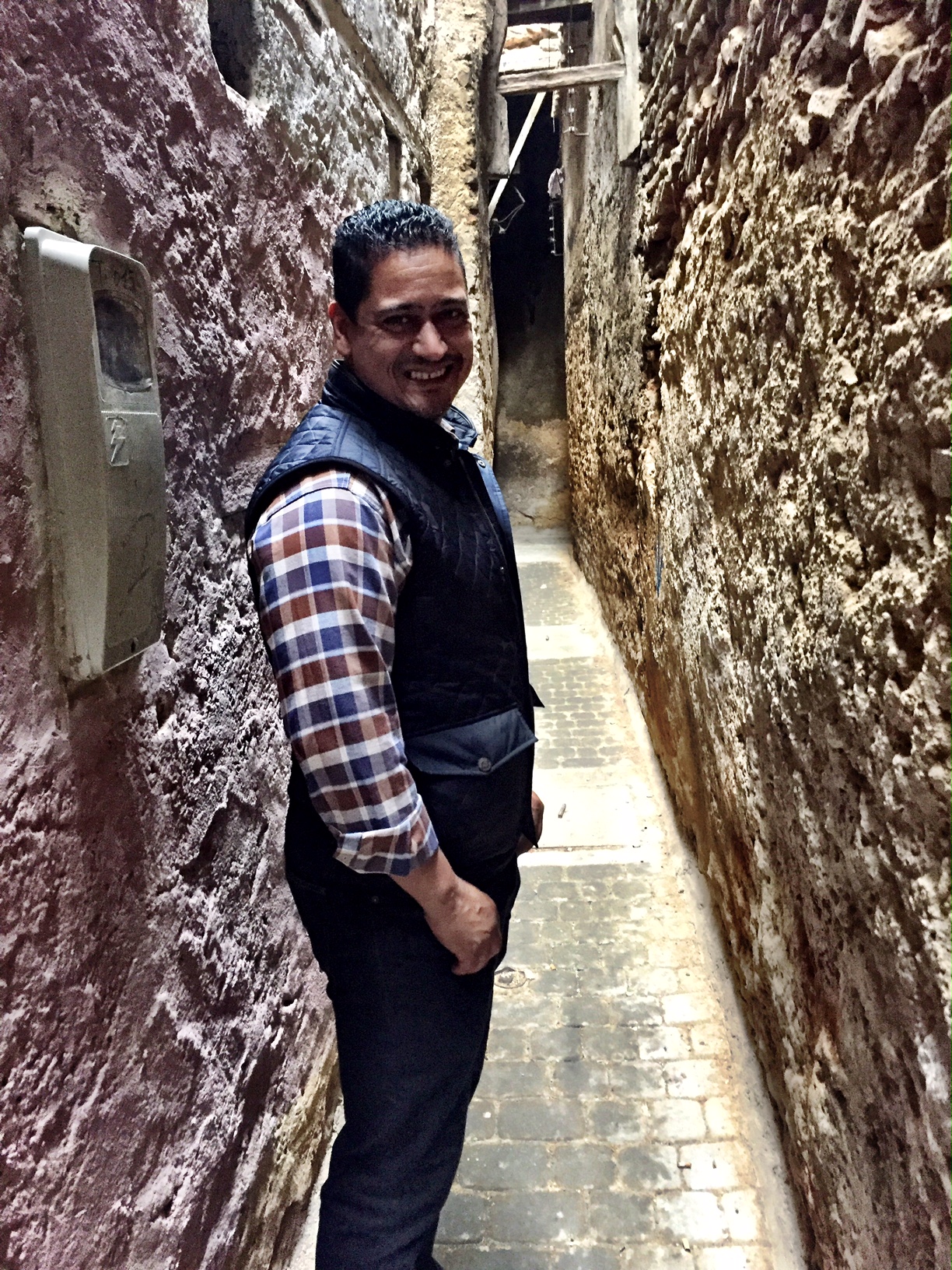
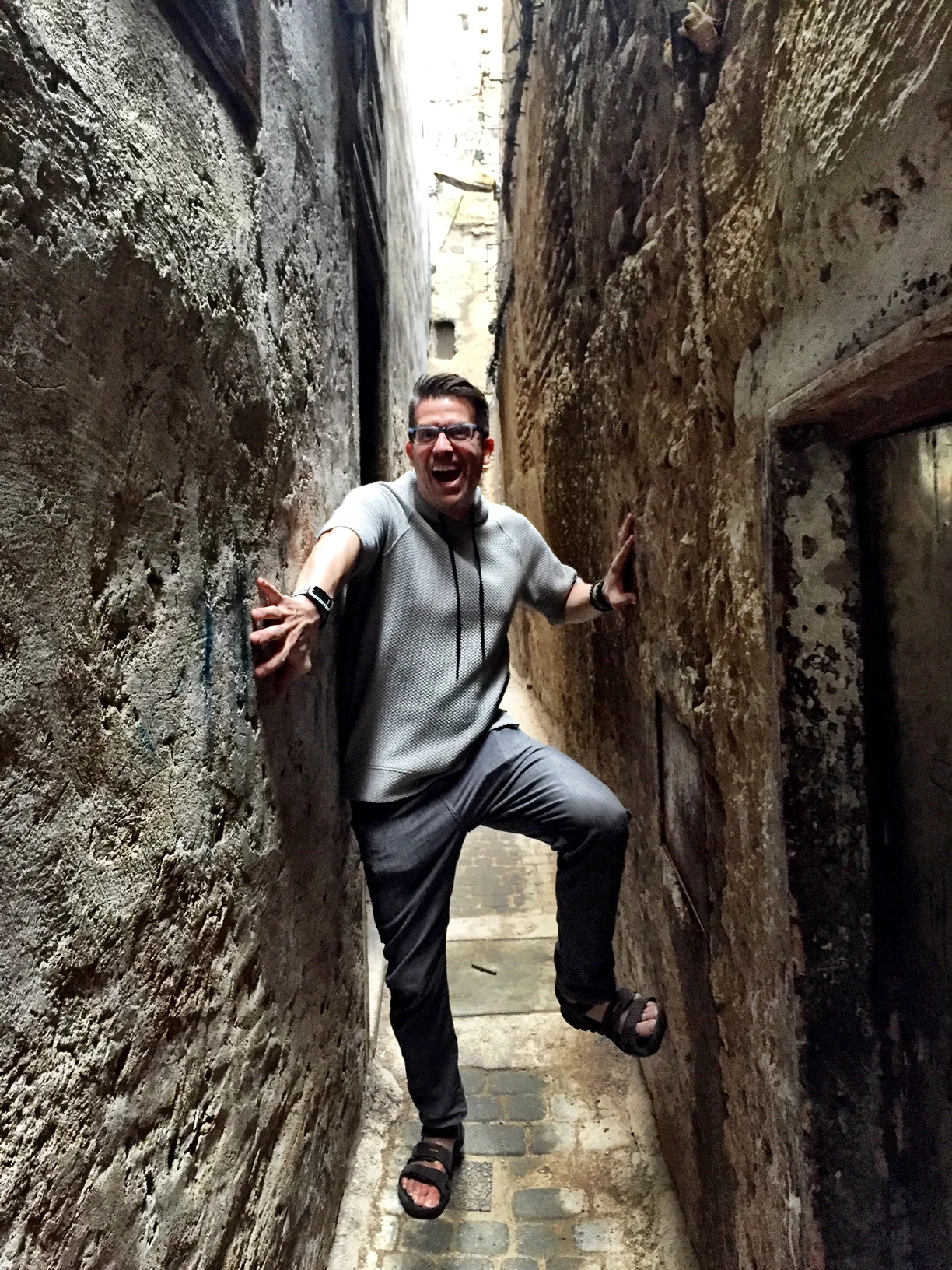
Abdul took us to the narrowest street in the medina:

2. Pay close attention to how to get to the Blue Gate.

It all comes back to the Blue Gate, it seems. We took a daytrip to the Roman ruins and mosaics of Volubilis, and had a guide from the riad lead us to the Blue Gate just outside of the medina to meet our driver (there aren’t any cars allowed in the medina — and anyway they wouldn’t fit on the narrow twists and turns).

I literally just kept track of the major turns we made: left, left, right, right, right. And that was all we needed to retrace our steps the following day. Sure, we took a turn too soon a couple of times, but just backtracked once we hit a dead end. We got back to the Blue Gate eventually. And from there you can hit one of the major thoroughfares of the medina.

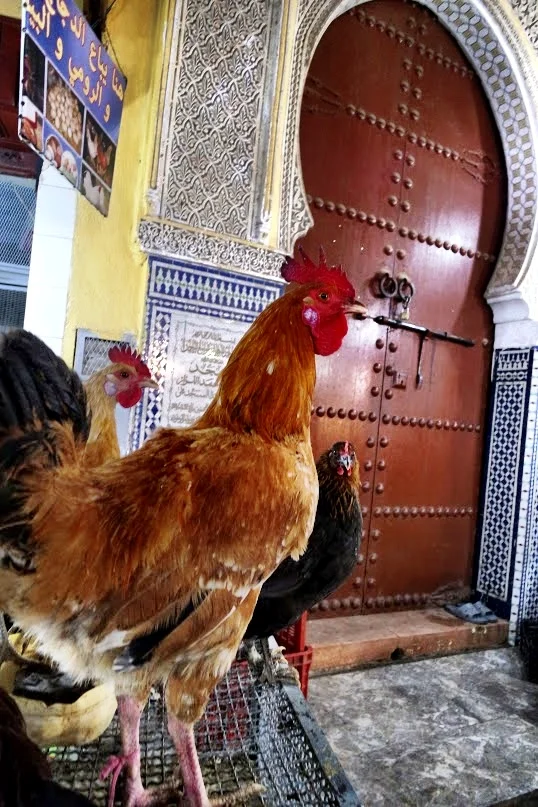
You never know what lies around the next corner in Fès. It might be a bunch of roosters tied to a cage in front of a gorgeous doorway.

3. Ignore the hustlers.

As mentioned, you’ll pass young men every so often who want to con you into paying them to act as guides. “There’s nothing that way,” they’ll tell you. “The Blue Gate isn’t down there,” they’ll say. Don’t pay them any mind. Unless, of course, you truly are hopelessly lost. And then agree to a reasonable fee before you have them lead you back to your hotel or guesthouse.

We didn’t end up having to do this in Fès but did so twice in Marrakech (though we hired young boys to guide us there).


4. Chat with your fellow travelers over breakfast.

Because we talked with a lovely British couple, Susan and Colin, our first morning at our amazing riad, Dar Bensouda, we learned about the gardens (which happened to be closed for the Sacred Music Festival, but still) and the tapas bar across the street, Mezzanine (a welcome change from couscous and tagines).

They also told us about the Ruined Garden, which was close to our riad, and ended up being our favorite restaurant in Fès.


5. Follow the signs.

One of the best ideas Fassi business owners ever had was to put up small rectangular signs throughout the medina. Coming back from the souks or the Blue Gate, we started noticing signs for nearby dars and riads (guesthouses). After a day or so, we knew which ones would lead us close enough to our own lodgings that we could find our way.

We also knew that there were signs that led from Riad Dar Bensouda to the Ruined Garden. So once we passed that, we followed the signs back to our temporary home. This gets a bit tricky — you have to turn a corner and then glance back to make sure there’s a sign pointing back to the restaurant. But for the most part, it worked, and we were able to follow the trail back, like Hansel and Gretel.

6. Walk with confidence.

This was advice given to us by Susan and Colin. It really did help put some of the would-be guides in their place. They’d look at us, walking with a purpose, and then go back to their conversations.

To help get you into the mindset, imagine yourself a local. Or at least someone who’s been in the city for some time.

This was harder to do when we made a wrong turn, hit a dead end and had to walk back past a group of men. But fake it till you make it. If they say something, just tell them, “We’re good.”


7. Try your smartphone.

We didn’t have a data plan abroad, so we didn’t use use our phones. But fellow travelers said that there were Google Maps or another app that was surprisingly helpful for navigating the medina. I’m a bit skeptical, given the labyrinthian nature of this ancient city — but it certainly wouldn’t hurt to try it out.

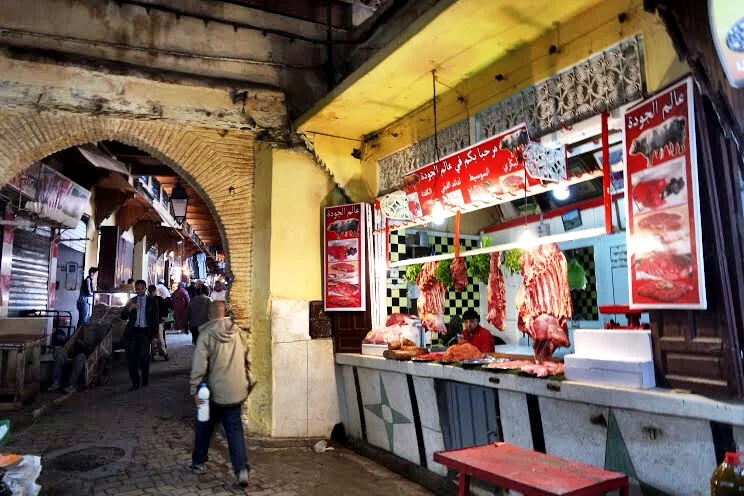
A butcher in one of the more-populated areas of the medina

8. Let yourself get lost.

Everyone doles out this advice. And it’s all well and good, as long as you’re not trying to find something specific. For our third day in Fès, we had nothing planned but wandering the medina and shopping. And that was the day we didn’t worry if we didn’t know where we were going — just so long as we were back in the safety of our riad by dark.


9. Friday is a great day to wander a less-crowded Fès.

This is the day of worship for Muslims. So wandering on Friday is actually a lot more chill. You’ll get hassled less, as mosques keep many of the people away. As an added bonus, shops that are open are often willing to give a good deal since business will be slow.


As I mentioned, the Fès medina can be intimidating. But by following this advice, you should be able to navigate the seemingly endless twists and turns on your own…somewhat successfully. –Wally