From Anatolian origins to garlic offerings left at shadowy intersections, the many-faced Hecate has spent thousands of years standing where worlds collide.
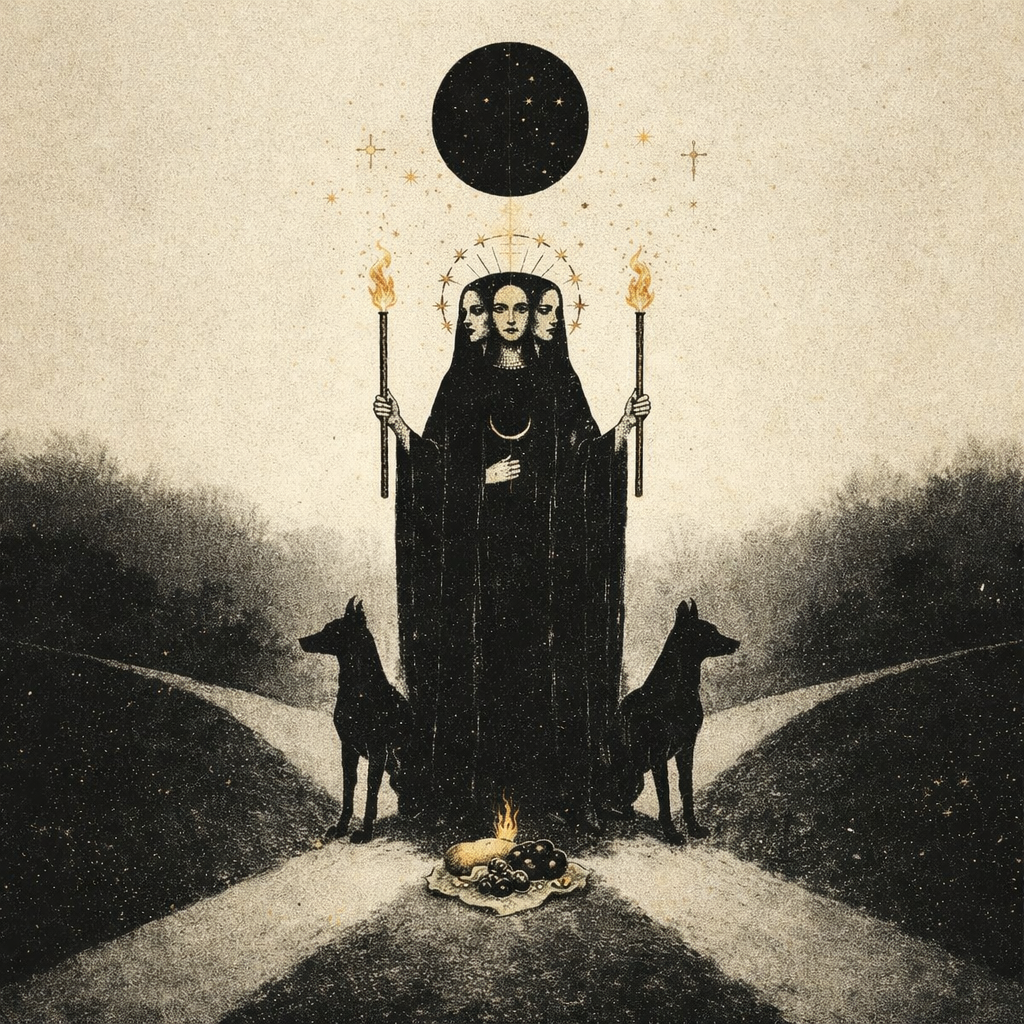
The crossroads were quiet.
Not the peaceful kind of quiet — the kind that makes you feel like something might be watching just beyond the reach of the torchlight. In the ancient world, intersections were places where the living and the dead might brush shoulders. Spirits gathered there. Offerings were left there. And somewhere in the darkness, the goddess Hecate was listening.
Today she’s best known as the dark queen of witchcraft — a torch-bearing goddess with black dogs at her side and keys to the underworld dangling from her belt. But like many figures in Greek mythology, the story most people know about Hecate is only the final chapter of a much older and stranger history.
“She was the goddess of life, death and everything in between.
She was just Goddess with a capital G.”
As Wycke, the instructor of a recent class I attended on Hecate at the always delightful Malliway Bros. witchcraft store in Chicago, explained early on, the goddess doesn’t fit neatly into a single role.
First off, let’s clarify how you pronounce her name. Apparently, according to a Greek woman who attended the class, the proper pronunciation is “Eh-kah-tee,” though nowadays most people pronounce the H so it’s “Heh-kah-tee.”
Across centuries of mythology and folklore, Hecate has been described as a cosmic goddess honored by Zeus, a protector of childbirth and prosperity, a guide of the dead, a patron of witches and the mysterious guardian of crossroads. She appears in ancient poetry, magical spells and whispered folk traditions that span more than 2,000 years.
In other words, if you try to pin Hecate down to one job description, you’re going to have a hard time.
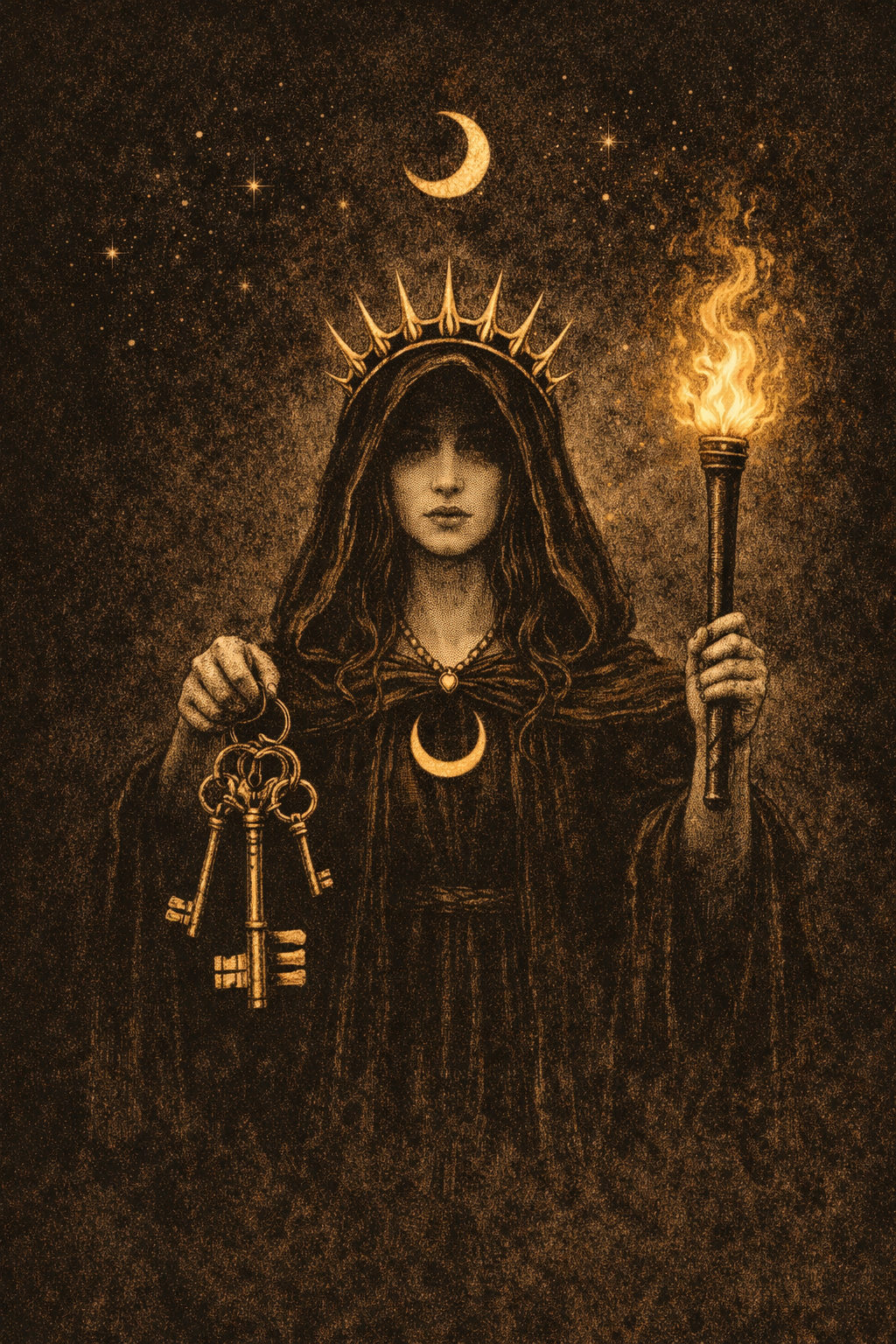
Hecate’s Origins: A Powerful Anatolian Goddess
Unlike Zeus and other Olympians, Hecate probably didn’t originate in Greece at all. Scholars widely believe her cult began in Caria, a region of ancient Anatolia in what is now southwestern Turkey, before spreading into the Greek world.
That foreign origin may explain why Hecate always seems slightly different from the Olympian crowd. Many Greek gods have tidy portfolios: war, love, wine, wisdom. Hecate, by contrast, feels like a bundle of powers that don’t quite belong together: childbirth and death, prosperity and ghosts, healing and witchcraft.
In her earliest form, she appears to have been something much bigger than the shadowy crossroads goddess we know today. As Wycke explained, early traditions describe her almost as a universal deity: “She was the goddess of life, death and everything in between,” Wycke said. “She was just Goddess with a capital G.”
That sweeping set of responsibilities might sound odd to modern readers, but in the ancient world the boundaries between those forces were far blurrier than they are today. Life and death were inseparable. Fertility meant both birth and the risks that came with it. Protection meant guarding both the home and the spiritual forces that might threaten it.
Seen through that lens, Hecate’s strange mixture of powers begins to make sense. She was something primal — a deity tied to the raw forces that governed life itself.
And when Greek religion absorbed her into its mythology, those ancient powers didn’t disappear.
They just took some unexpected forms.
Why Hecate Is the Space In-Between Things
One of the most interesting insights from the class came from a distinction that modern readers often miss when they look at Greek mythology.
We tend to treat titans and gods as basically the same thing — just different generations of divine beings. But in many traditions, they function very differently.
Olympian gods typically preside over domains.
Poseidon rules the ocean.
Athena governs wisdom and strategy.
Ares represents war.
But titans embody the forces themselves.
The titan Oceanus isn’t simply the ruler of a river — he is the cosmic river surrounding the world.
Gaia isn’t the goddess of the Earth — she is the Earth.
Hecate belongs to that older category.
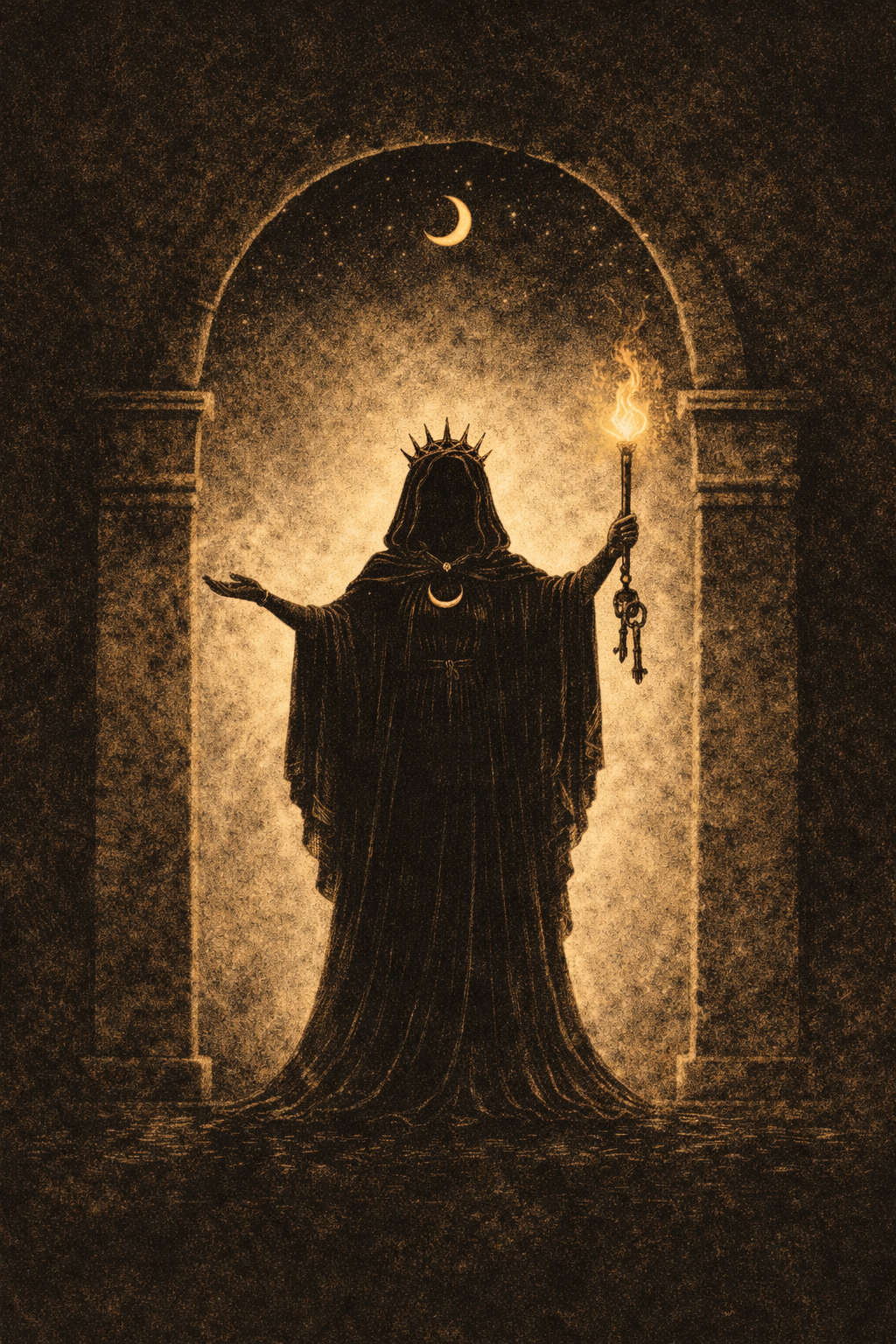
She isn’t simply a goddess who supervises crossroads from afar. She’s not a god who rules thresholds. She is the threshold.
That idea helps explain why Hecate shows up in so many strange places throughout mythology.
Doorways
City gates
Graveyards
Crossroads
Moments of transformation
The boundary between life and death
All of those spaces have something in common: They exist between worlds.
And if Hecate is the embodiment of thresholds, then every place where one reality meets another belongs, in some sense, to her.
Which is exactly why ancient worshippers left offerings where roads divided — and why people still whisper her name when they find themselves standing at a turning point.
The Origin of Hecate’s Name: A Connection to Apollo and Artemis
Another intriguing clue to Hecate’s beginnings may lie in her name itself.
Scholars have suggested that the name Hecate may mean something like “influence from afar” or “the one who reaches far.” The meaning could reflect the belief that she came from a distant land before entering Greek religion, or that her power extended across many far-flung places and realms.
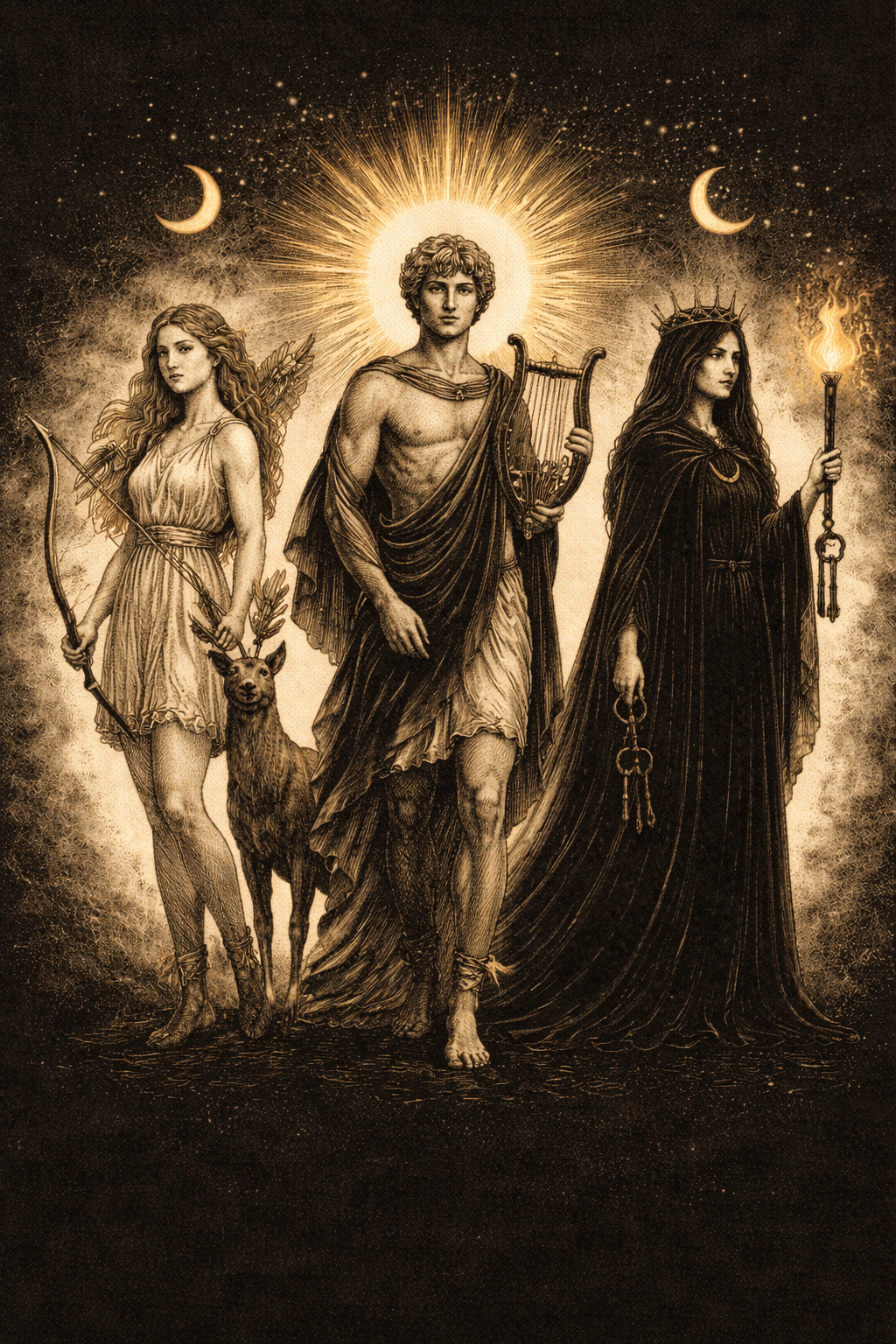
The name also closely resembles “Hekatos,” an epithet used for Apollo that means “Far-Reaching.” This similarity has led some scholars to speculate that Hecate may originally have been connected to Apollo’s twin sister, Artemis.
In this interpretation, Hecate could represent a darker or more mysterious aspect of Artemis herself. As Artemis, the goddess presided over purity, virginity and childbirth. As Hecate, she would have taken on the shadowed mantles of night, witchcraft and ghosts.
Hecate in Hesiod: The Titan Zeus Refused to Sideline
Hecate’s first major appearance in Greek literature comes in the works of the poet Hesiod, writing around the 8th century BCE. And if you’re expecting her to show up as a shadowy witch lurking in graveyards, think again.
In Hesiod’s Theogony, Hecate is one of the most honored figures in the entire divine order.
According to the poem, after Zeus defeated the titans and reorganized the cosmos, he made a deliberate decision about Hecate: He left her powers untouched. While other titans lost influence, Hecate retained authority over vast portions of the world. Hecate is described as receiving honor in heaven, earth and sea, with the power to grant success in everything from warfare to athletic competition. If people pray to her, she can bestow victory, prosperity and good fortune.
In other words, long before she became the goddess of witches and crossroads, Hecate was something far more expansive — a cosmic figure who could influence almost any aspect of human life.
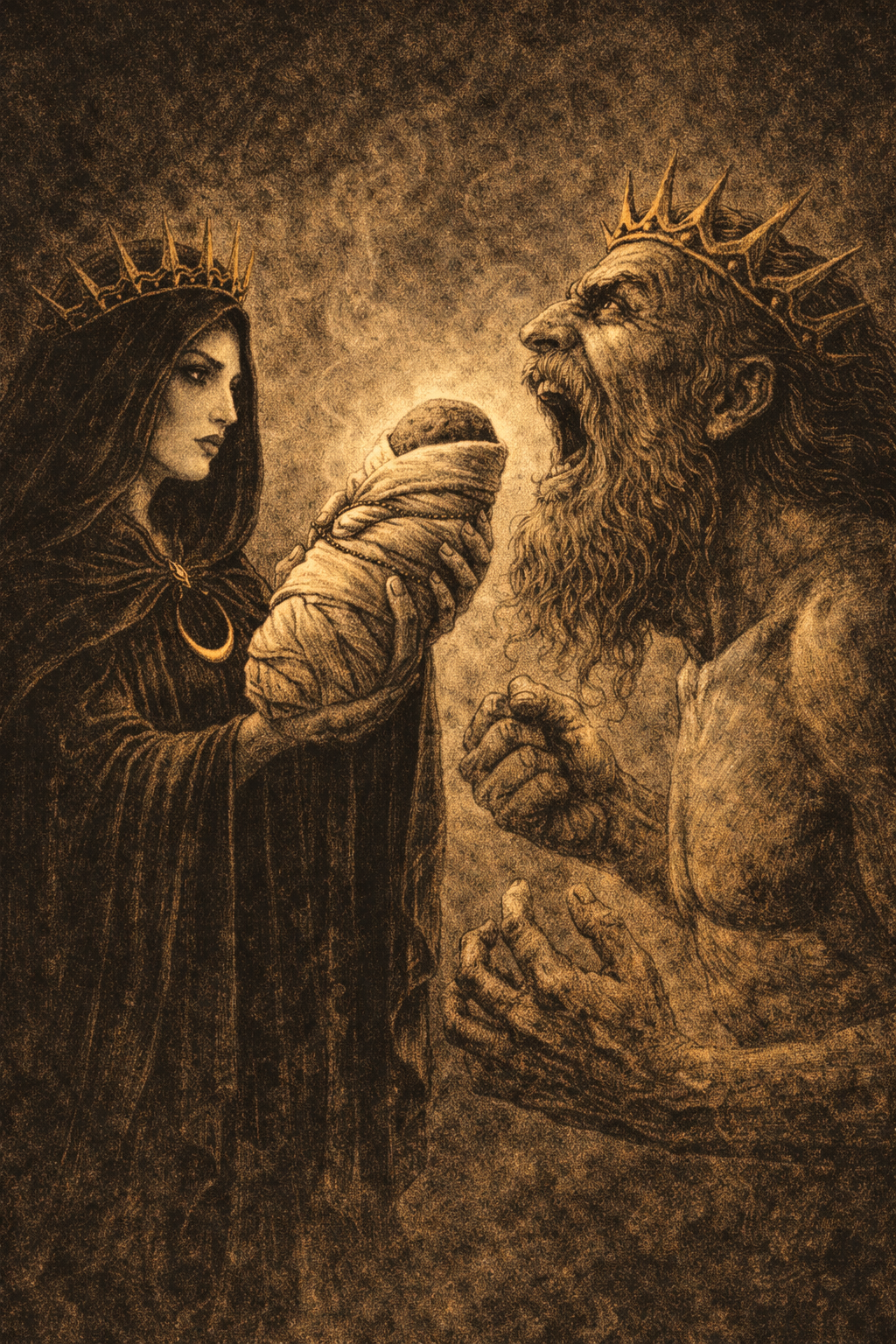
Why was Zeus so fond of her? According to Greek myth, the titan Kronos devoured each of his children at birth after learning of a prophecy that one of them would overthrow him. Desperate to save her youngest child, his wife, Rhea, devised a plan. When Zeus was born, she hid the infant and instead wrapped a stone in swaddling cloth, presenting it to Kronos as if it were the newborn child. Kronos swallowed the stone, believing he had eliminated the threat.
Later traditions add an intriguing twist to this famous deception.
A relief from Lagina, an important cult center of Hecate in ancient Caria, depicts the moment when the swaddled stone is given to Kronos — but in this version of the scene, the figure presenting the bundle is Hecate.
Because Hecate was also associated with childbirth, the image suggests she may have played a role as midwife in delivering the infant Zeus and helping orchestrate the trick that saved him. If Hecate helped ensure his survival, Zeus’s generosity toward her suddenly makes a lot more sense.
For a goddess who would later become associated with ghosts, graveyards and midnight rituals, it’s a surprising beginning. But it also explains why Hecate never quite fits neatly into the Olympian system.
She didn’t start there.
She came from somewhere older — and she carried that ancient authority with her.
From Cosmic Goddess to Queen of the Crossroads
So how does a goddess honored by Zeus as a ruler of heaven, earth and sea end up haunting graveyards with a pack of black dogs?
The answer lies in one of the strangest shifts in Greek religion.
At some point in the centuries after Hesiod, Hecate’s role began to change. She increasingly became associated with places that made ancient people uneasy: crossroads, thresholds, graveyards and the restless spirits believed to linger there.
“The crossroads was a dangerous place,” Wycke said, “a place that was so liminal that anything could come out of that.”
In the ancient world, crossroads weren’t just intersections of roads. They were believed to be intersections of worlds. Travelers, spirits and unseen forces were all thought to move through them. Offerings were left there to appease wandering ghosts, and rituals were performed to ward off bad luck or spiritual danger.
If you needed a deity to watch over such a place, Hecate made perfect sense.
She was already associated with boundaries and transitions. Over time, that role expanded until she became the guardian of places where the ordinary rules of the world seemed to weaken. Roads that met in the dark. Doorways between houses and the street. The boundary between life and death.
Once Hecate became the goddess who ruled those spaces, new associations quickly followed. Ghosts. Necromancy. Witchcraft. The unseen forces that ancient people believed moved through the night.
Hecate and Hermes: Guardians of Roads and Boundaries
If Hecate ruled the crossroads, she wasn’t doing it alone.
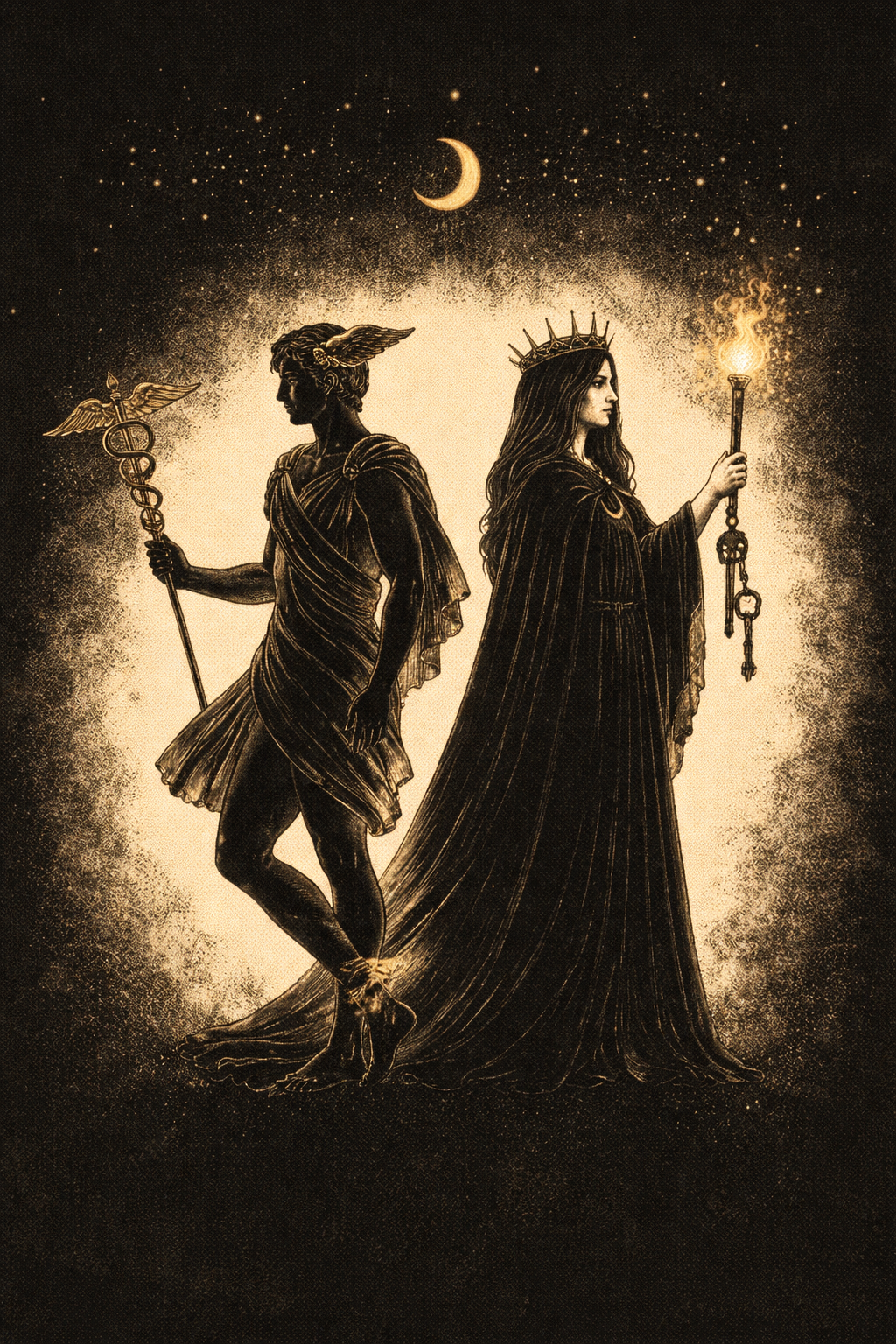
Greek religion already had another deity deeply tied to roads, travel and the strange spaces between destinations: Hermes.
Hermes is famous as the fleet-footed messenger of the gods, but he also had a more mysterious job description. He was the patron of travelers, merchants and thieves — people constantly crossing boundaries. He guided souls to the underworld. And along ancient roads, travelers would often pass stone pillars known as herms, small statues dedicated to him that marked boundaries and intersections.
Both Hermes and Hecate move easily between worlds.
Over time, their paths diverged into two very different magical traditions. Hermes became associated with the philosophical and alchemical traditions later known as Hermeticism — the intellectual side of magic, full of symbols, texts and elaborate ritual systems. Hecate, meanwhile, became the patron of something far more earthy: crossroads offerings, herbal magic and the folk practices that would eventually evolve into modern witchcraft.
Two gods. Two roads.
Both watching the places where the worlds overlap.
Hecate and the Search for Persephone
One myth helped cement Hecate’s reputation as a goddess of the night.
When Persephone was abducted by Hades, the world plunged into crisis. Persephone’s mother, Demeter, wandered the earth in grief, searching desperately for her missing daughter. Crops failed. The Earth began to wither.
But someone had witnessed the crime.
Hecate.
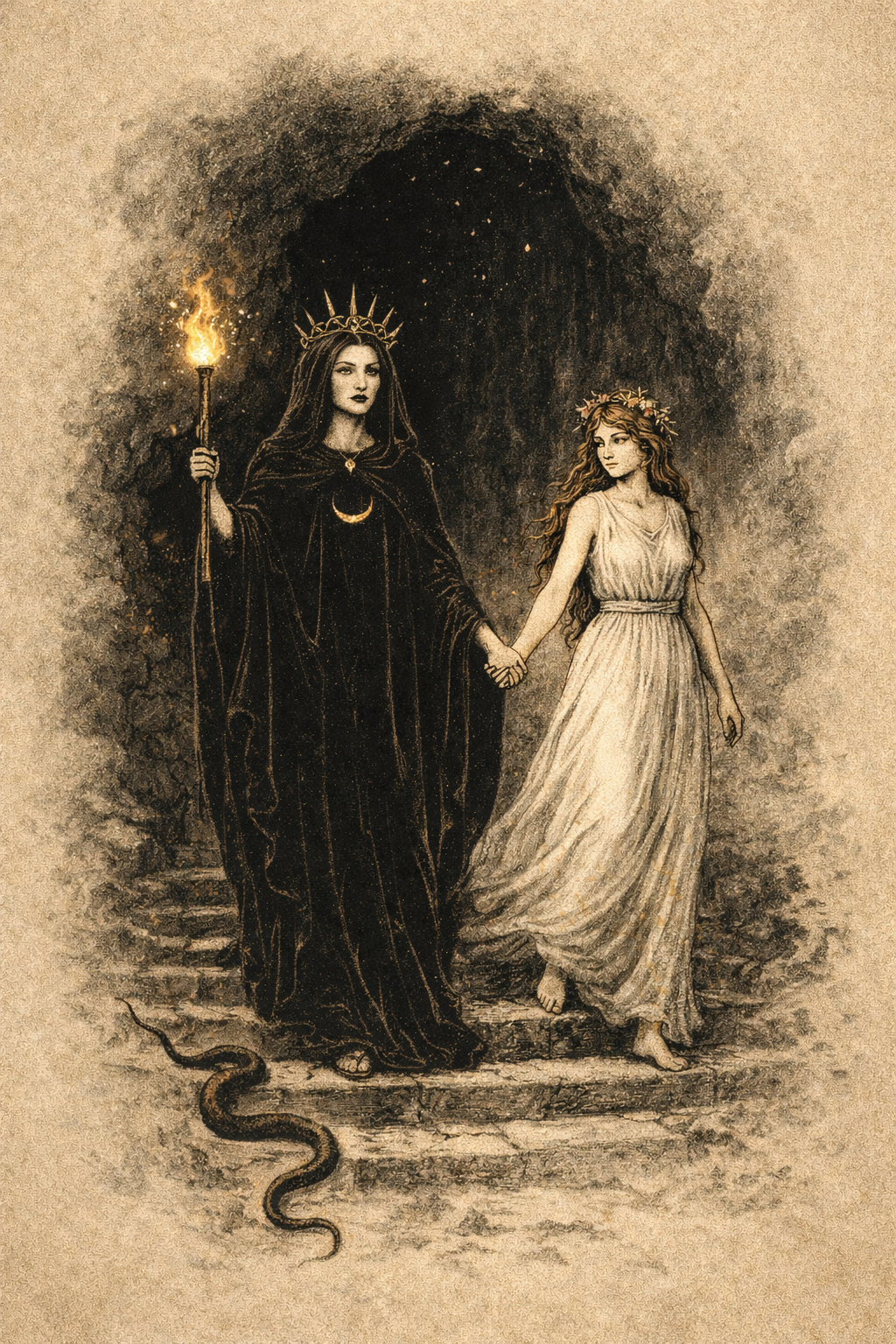
In the myth, she approaches Demeter carrying two blazing torches and tells her that she heard Persephone cry out when she was taken. Together they go to the sun god Helios, who reveals the truth: Zeus allowed Hades to carry Persephone into the underworld as his bride.
Hecate’s role in the story may seem small at first, but once Persephone begins her yearly cycle between the underworld and the surface, Hecate becomes her companion and guide — a torch-bearing figure who helps her move between those realms.
The myth reinforced Hecate’s growing association with the boundary between life and death. If Persephone was the queen of the underworld, Hecate was the one who knew the road that led there.
It also strengthened her connection to torches, one of her most recognizable symbols. Ancient statues of Hecate often show her holding them aloft, illuminating the darkness of the crossroads and the shadowy paths between worlds.
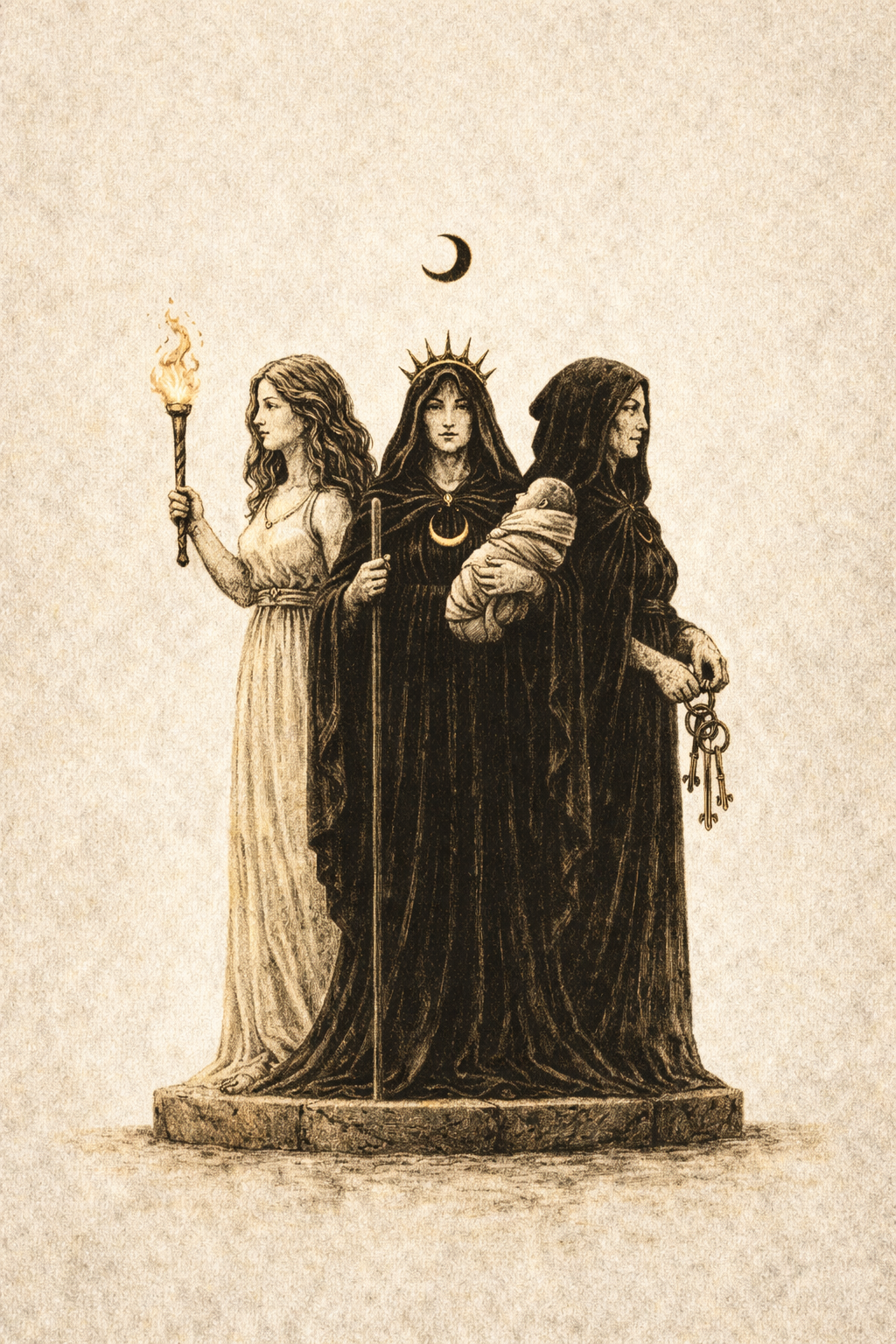
Hecate the Triple-Form Goddess
At some point in classical Greece, Hecate quite literally gained more faces.
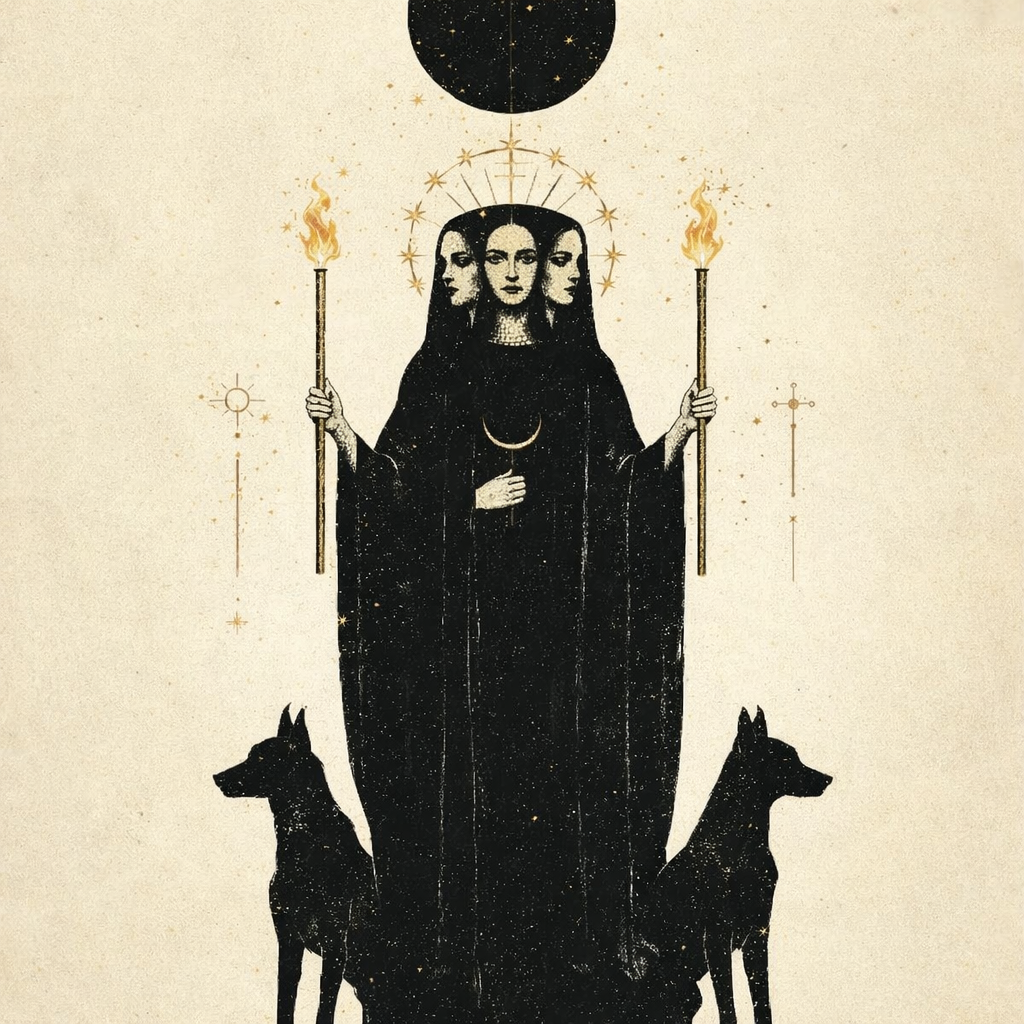
By the 5th century BCE, statues of the goddess began appearing in a new and striking form: three bodies standing back to back, each facing a different direction. The earliest known version of this sculpture type is often credited to the Athenian artist Alcamenes, who created a triple statue of Hecate placed at a crossroads near the Acropolis.
The imagery made immediate sense.
A goddess who guarded crossroads needed to watch all directions at once.
Ancient writers sometimes described these statues as Hecate Triformis, the Three-Formed Hecate. Each figure looked outward toward a different road, symbolically guarding the point where the paths met.
But like many ancient symbols, the triple form quickly accumulated deeper meanings.
For some worshippers, the three faces represented the three realms Hecate had once ruled in Hesiod’s Theogony: heaven, earth and sea. Others associated them with the three phases of the moon — waxing, full and dark — linking Hecate to lunar cycles and night magic. Later traditions interpreted the three forms as representing life’s stages: maiden, mother and crone.
Whatever the explanation, the triple statue became one of Hecate’s most recognizable forms. These hekataia statues were often placed at crossroads, city gates and doorways, acting as protective guardians where different paths — and different possibilities — met.
And they reinforced something ancient worshippers already suspected about the goddess.
If you arrived at a crossroads in the dark, Hecate would see you coming no matter which road you took.
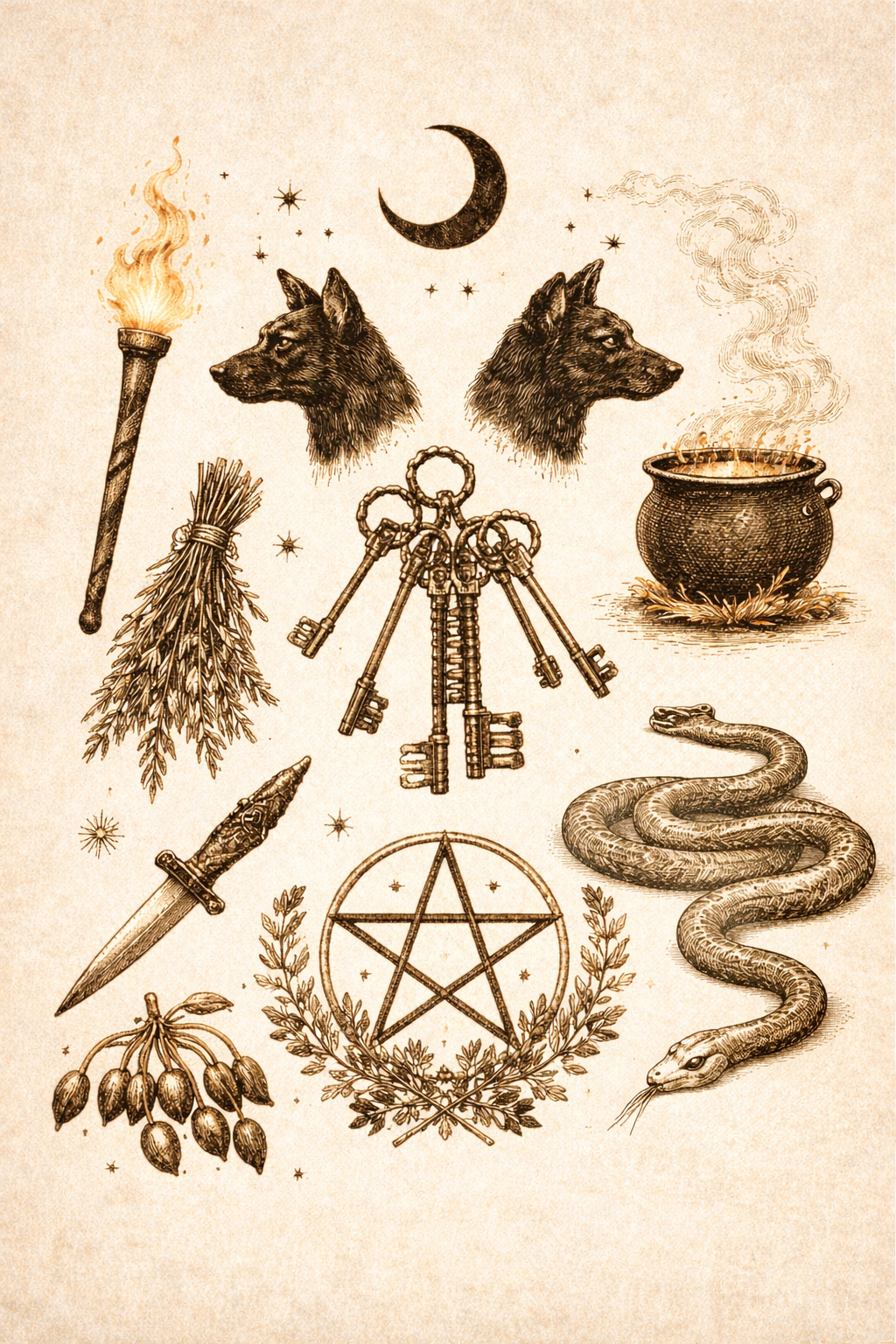
Symbols of Hecate: Torches, Keys and Howling Dogs
Like many ancient deities, Hecate’s identity was expressed through a set of objects and animals that quickly became unmistakably hers. If you saw a statue holding torches beside a pack of black dogs at a crossroads, you didn’t need a name carved into the base.
You were looking at Hecate.
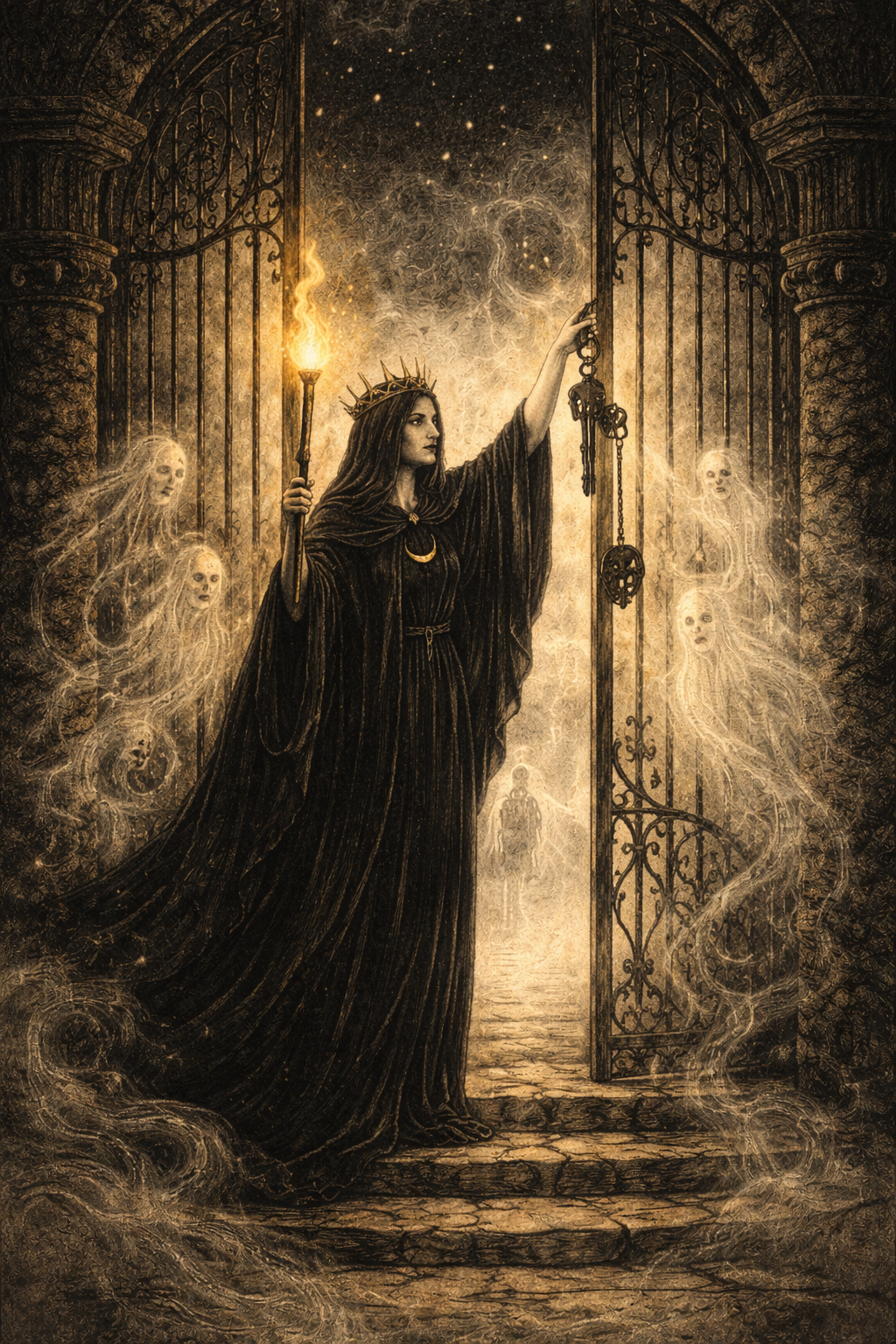
The most famous of her symbols is the torch. In myth, she carries two blazing torches while helping Demeter search for the abducted Persephone. From that story onward, Hecate becomes the figure who lights the dark paths between worlds. Statues often show her raising the torches high, illuminating crossroads, doorways and the unseen roads traveled by spirits.
Another powerful symbol is the key. In ancient imagery, Hecate sometimes appears carrying large keys at her belt or in her hand. The meaning is straightforward: She’s the keeper of gates. If there’s a doorway between worlds — whether it leads to the underworld, the spirit realm or some other unseen threshold — Hecate holds the key.
And then there are the dogs.
In Greek and later magical traditions, the barking or howling of dogs was often interpreted as a sign that Hecate was near.
Black dogs in particular became strongly tied to Hecate’s imagery, appearing beside her in artwork and myth. In some stories they accompany her through the night like a supernatural hunting pack. In others they serve as guardians of the crossroads she protects.
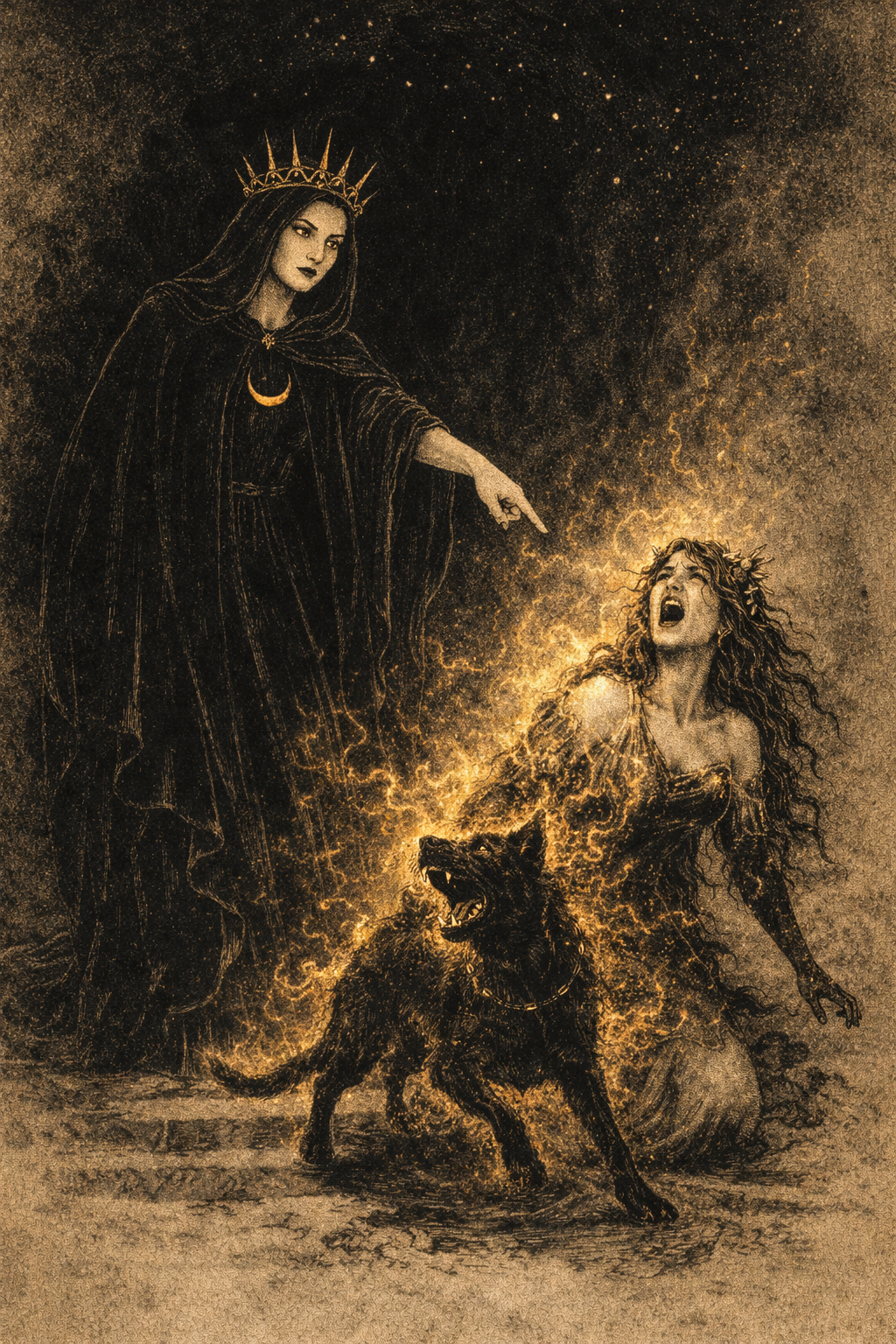
One explanation for this connection appears in a myth involving Hecuba, the tragic queen of Troy. After the fall of the city, Hecuba was taken captive by the Greeks. In some versions of the story, her grief and rage become so overwhelming that she transforms into a dog and throws herself into the sea. Other traditions say the transformation was an act of mercy from the gods — sometimes attributed to Hecate herself.
Hecate is also associated with snakes, animals that symbolized both death and renewal in the ancient world. Their ability to shed their skin made them natural emblems of transformation — another theme that runs through the goddess’s mythology.
They were also creatures of thresholds themselves — living close to the ground, emerging suddenly from holes and crevices, slipping between the visible world and the unseen spaces beneath it.
For a goddess who governs crossroads and transitions, the symbolism fits perfectly. Like the serpent, Hecate is a figure who moves easily between worlds, presiding over the moment when one state of being sheds its skin and becomes another. She’s often depicted with serpents coiling along her arms and waist.
Another important symbol connected to Hecate is Hecate’s Wheel, sometimes called the Strophalos.
The exact meaning of the symbol has been partially lost over time, but many scholars believe it represented rebirth, divine thought and the movement of spiritual power. The wheel’s three spiraling arms are often interpreted as another expression of Hecate’s triplicity — echoing her threefold form and the three roads that meet at a crossroads.
Like much of Hecate’s imagery, the symbol suggests motion, transformation and the turning of unseen forces.
Hecate is also deeply connected to pharmakeia, the Greek term for a form of magic that works through herbs, poisons and medicines. The word itself sits at the root of our modern term pharmacy, but in the ancient world it carried a far more mysterious meaning. Practitioners of pharmakeia used plants to heal, curse, transform and alter fate — all practices that later traditions strongly associated with Hecate.
Because of this, the goddess became linked with a wide range of powerful plants.
Many were known for their medicinal or poisonous properties, including hemlock, aconite, mugwort, garlic, hellebore, belladonna and mandrake. Others carried symbolic ties to the underworld or liminal spaces, places that fall under Hecate’s influence. Plants such as dandelion, mint, yew, mullein, black poplar and willow were therefore also connected to her.
Taken together, these symbols reinforce the same theme that appears throughout Hecate’s mythology: she governs the forces that exist between categories — healing and poison, life and death, transformation and decay.
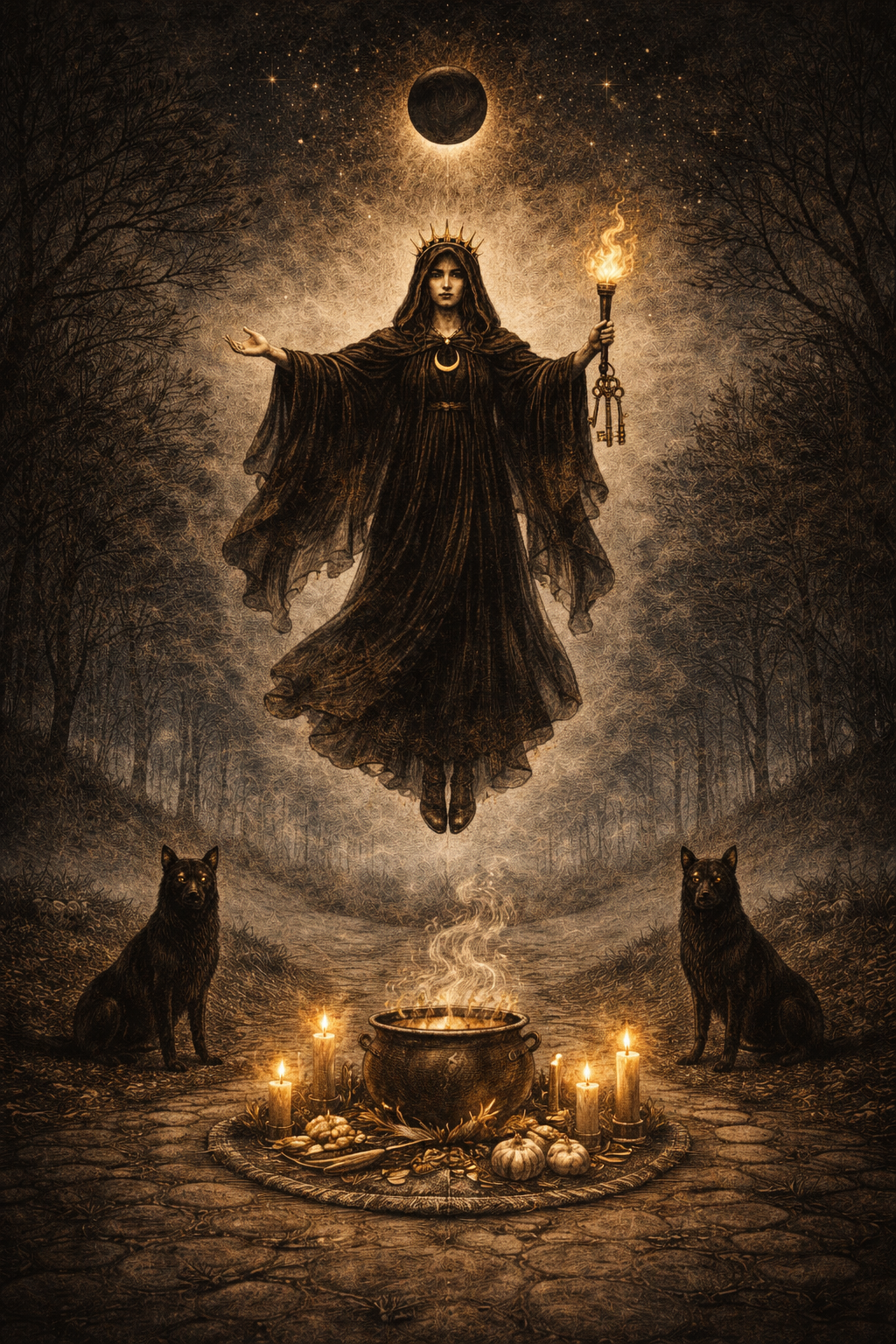
Hecate’s Supper: Offerings at the Crossroads
If you lived in the ancient Greek world and wanted to stay on good terms with Hecate, there was a simple solution.
Feed her.
Every month, on the night of the dark moon, households would leave offerings at crossroads in a ritual known as Hecate’s Supper. The food was placed at three-way intersections — the places most closely associated with the goddess.
The menu was humble but specific.
Offerings commonly included things like:
Garlic
Eggs
Bread or cakes
Fish
Cheese
Honey
Garlic in particular shows up again and again in sources tied to Hecate.
But the offerings weren’t just gifts. They served several purposes at once. One was appeasing wandering spirits believed to gather at crossroads. Another was purification — a way of symbolically casting off misfortune or spiritual pollution from the household.
Food placed at the crossroads could carry away the problems of the past month.
In some accounts, the offerings were also intended for the restless dead believed to travel with Hecate. The food was left behind as a gift for the goddess and her spectral companions.
Once the offerings were placed, the person who brought them walked away. No turning around. After all, if you looked back, you might see who had come to collect the meal.
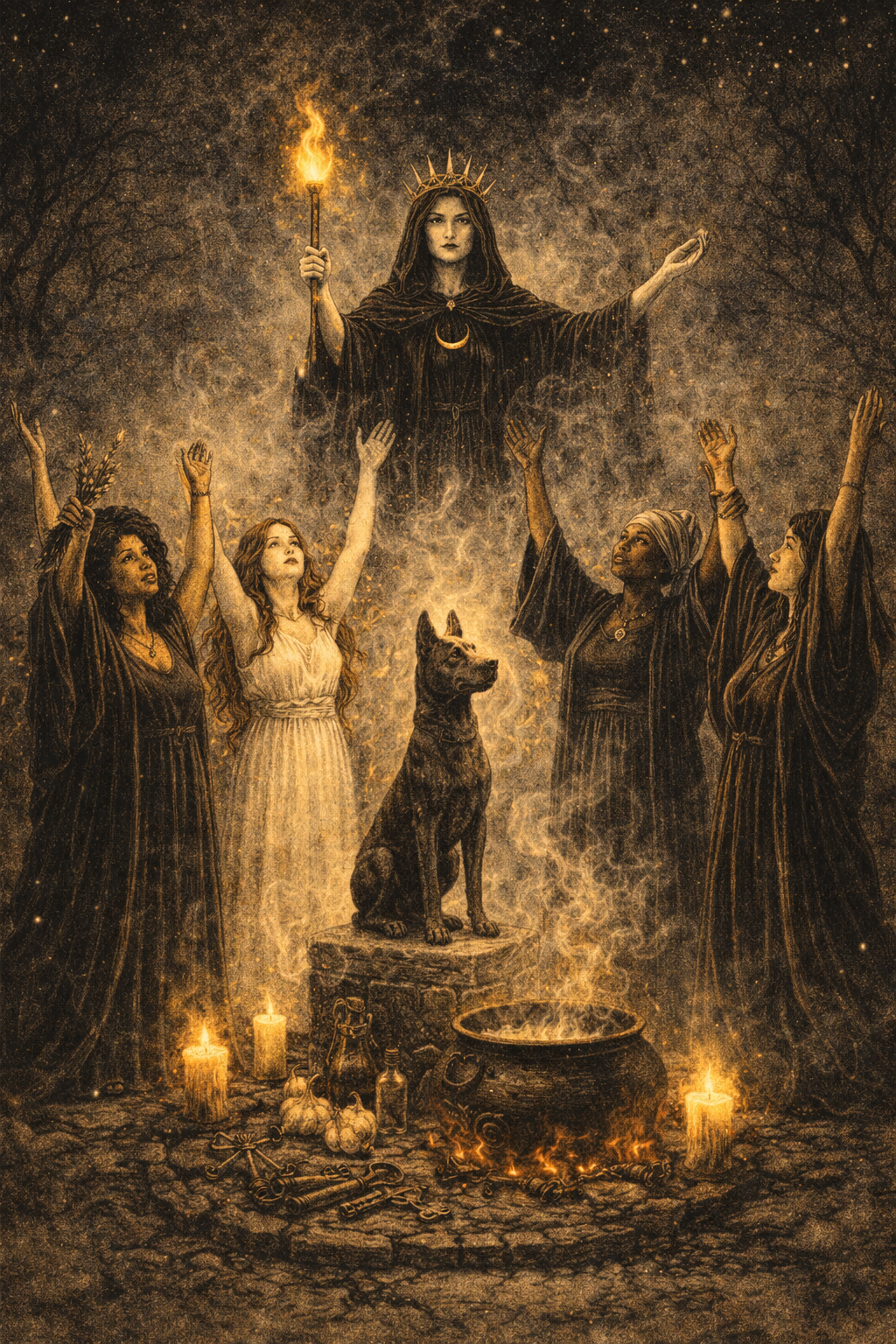
A Ritual to Invoke Hecate in a Time of Dire Need
This ritual calls upon Hecate to intervene when life reaches a difficult turning point. It draws on many of the goddess’s traditional symbols — crossroads, bones, garlic, dogs and liminal herbs — and asks for her guidance when the road ahead feels uncertain.
You will need:
A dog statue
Two candles
A black bowl
Salt water
Red wine
Poisonous herbs
Healing herbs
Three keys
A long bone
A bulb of garlic
Graveyard dirt
Ritual blood
Hecatean incense (myrrh, mugwort, mullein and poplar)
Opening the Ritual Space
Begin by cleansing the space and casting the circle.
Participants form a circle while the ritual leader traces the boundary of the ritual space.
During this process, the group repeatedly chants:
Thout a tout tout, throughout and about.
Thout a tout tout, throughout and about.
As each participant joins the chant, visualize the ritual space forming — a circle that becomes a crossroads between worlds.
At the center of the altar, place the dog statue flanked by the two candles.
Before it place the three keys and the black dish.
The Libations of Life and Death
Take up the vessel of salt water and say:
By libation of sorrow,
And humor of death.
Pour the salt water into the black dish.
Next take up the red wine and say:
By libation of glory,
And humor of life.
Pour the wine into the dish.
Take up the poisonous herbs and say:
That which poisons—
Then take up the healing herbs and say:
Is that which heals.
Place both herbs into the dish.
Drawing Down the Realms
One participant lights the first candle and raises it high, saying:
Through Helios in sunlit trails,
Through Nyx among her blackened veils,
We call the heavens to the earth.
Moonlight, starlight, given worth.
Another participant lights the second candle and holds it low, saying:
Through Hades’ shroud of gold and wraith,
Through Kore harrowed by her faith,
We call the depths unto the earth.
Beyond its death is given birth.
The two candles are then placed beside the altar.
The ritual space now stands between heaven, earth and underworld.
Calling the Goddess
Burn incense of myrrh, mugwort, mullein and poplar.
The ritual leader stirs the waters in the black dish with a long bone and invokes Hecate:
Come to us, Infernal Queen,
You who stands at all between.
Who keeps her vigil at the gate
Presides in birth, and death, and fate.You who poisons and who heals,
Who gives and takes and yet reveals.
Keeper of lost, fair and foul,
Herald of the black hound’s howl.Three by the moon, the realm, and age,
Three by the roads that cross your stage.
By company of wayward ghost,
And night where witches seek your host.In crown of oak and mantled snakes,
Hecate, we hail, we wake!
Enodian Hecate,
I invoke you Triodites,
Heavenly, Chthonian and of the sea!
The final words are repeated until the presence of the goddess is felt.
The dish is placed at the base of the dog statue, with candles on either side.
Opening the Crossroads
One participant takes the three keys.
Each key is pointed toward a different direction while saying:
Three by three by the witch’s fork,
Key by key to latch the work,
And cross the roads where shadows lurk.
Afterward, the keys are placed before the dish, each pointing down its direction.
The Garlic Offering
One participant lifts the garlic bulb before the dog statue.
The bulb may be marked with ritual blood and graveyard dirt while saying:
Pale as the moon in shining grace,
Red as the moon when Earth gives chase,
Black as the moon who hides its face.
From heaven, land and chthonic shade,
In dire time we call your aid.
Place the garlic at the center of the three keys.
Personal Supplication
Each participant approaches the altar.
They peel a clove of garlic and make a personal request or promise to Hecate.
The clove is then dropped into the black dish.
Seeking the Goddess’ Answer
The dish is stirred and the long bone is dropped into the water.
Ask whether Hecate accepts the offering.
Interpret the result:
Vertical bone: The answer is yes
Horizontal bone: The answer is no
If the answer is no, the rite continues until acceptance is granted.
Closing the Ritual
Once the offering is accepted, the circle is closed and the ritual space released.
The offering should later be taken and left at a crossroads as a gift to Hecate.
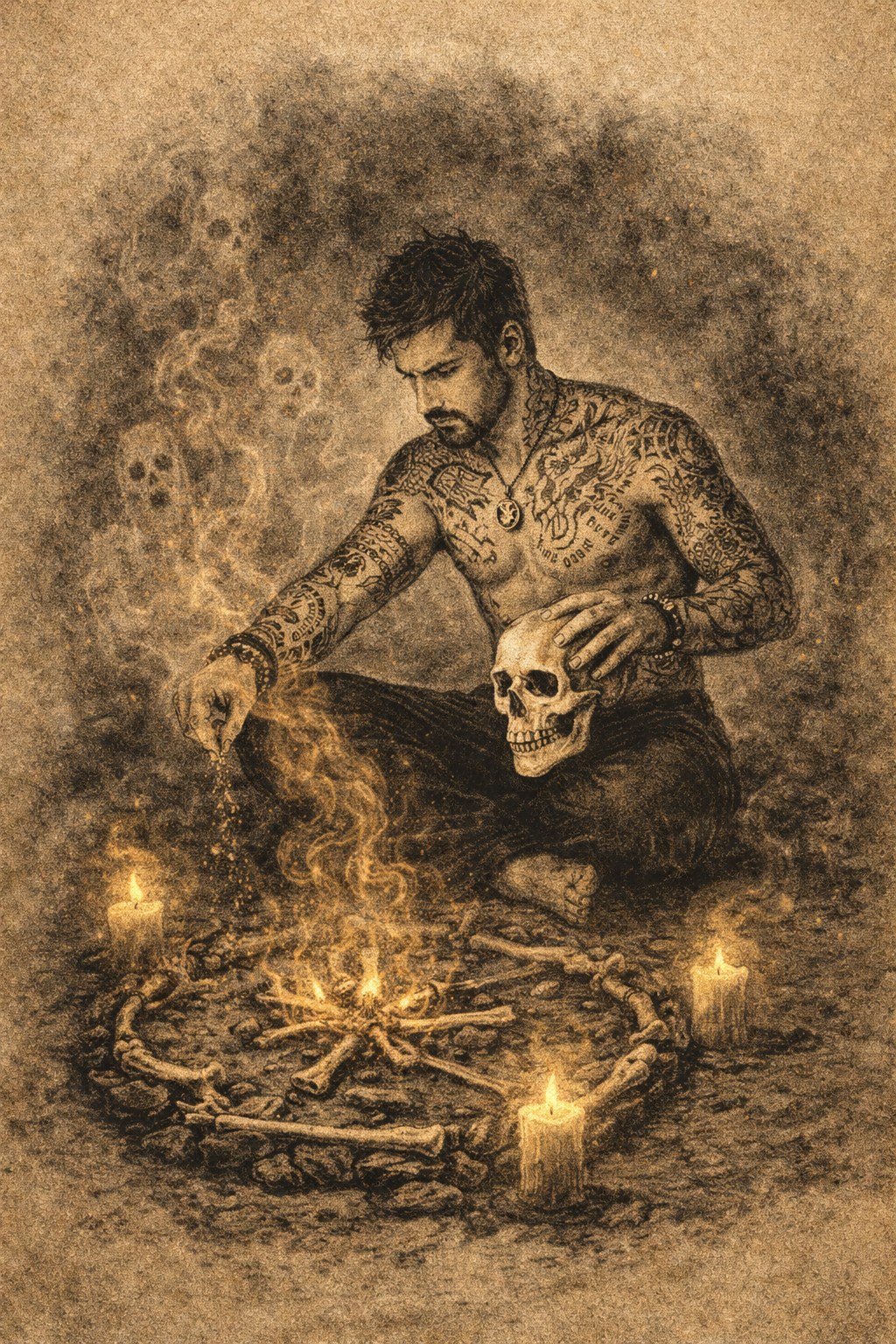
Hecate’s Bone Oracle: A Method of Necromantic Divination
If you want an answer directly from Hecate, necromancy is one of her favored forms of divination.
Fill a black bowl with water and suspend a bone over its surface. Then say:
Goddess of darkness, bring life to this bone,
Raise death from ashes, dirt and stone.White as the skull, black as the grave,
The moon shall tell us what we crave.Call the spirit to our plea,
Let us see, let us see.
After speaking the invocation, ask your question to the goddess and drop the bone into the water.
Interpret the answer based on how the bone settles:
Horizontal: The answer is no
Vertical: The answer is yes
Diagonal: The answer is unclear or undecided
For further insight, burn mugwort and mullein above the bowl and watch the smoke carefully. Shapes and movements in the smoke may provide additional clues to the answer.
The ritual reflects Hecate’s long-standing connection with spirits, death and the hidden knowledge believed to exist at the boundary between worlds.
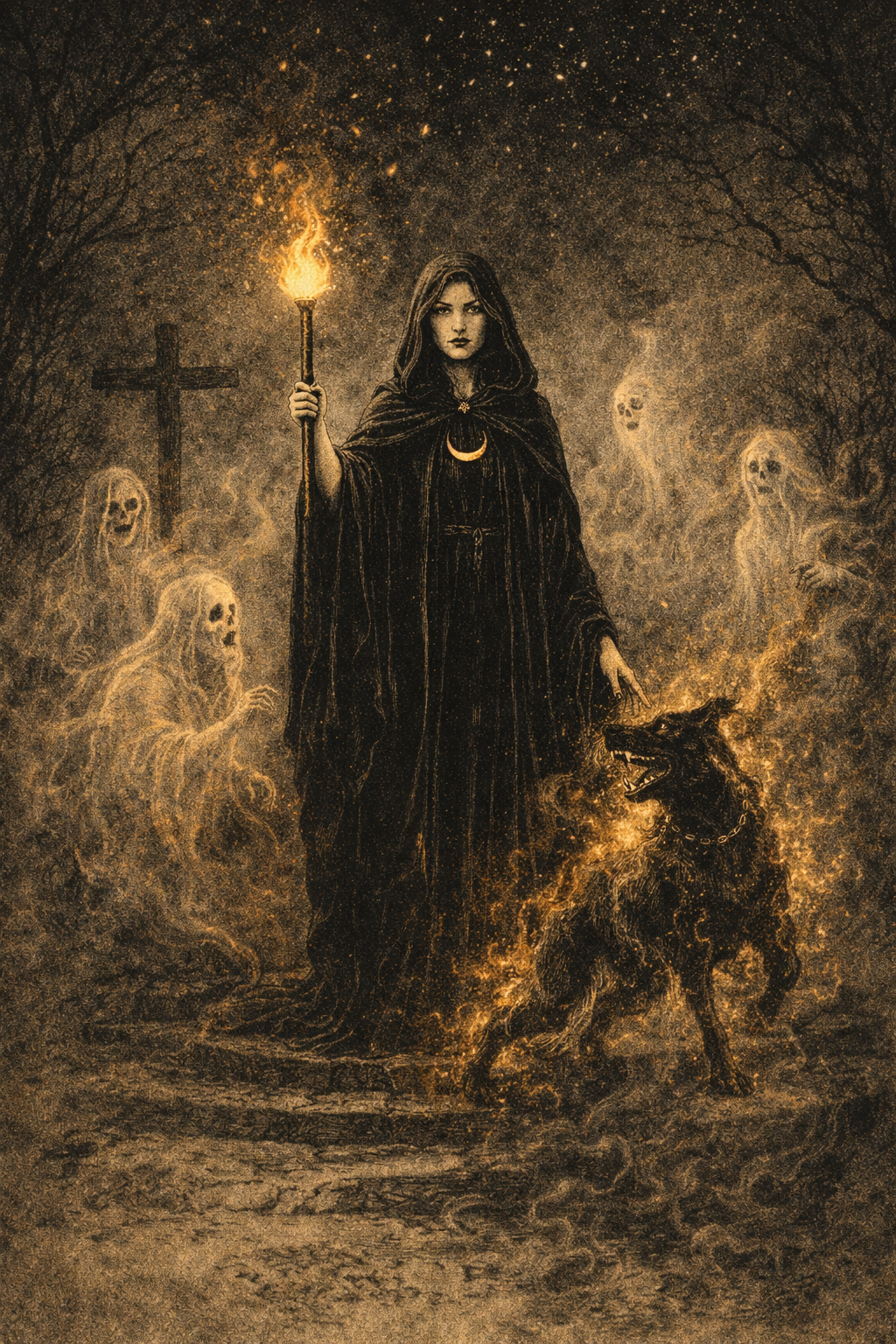
Why Hecate Still Waits at the Crossroads
For a goddess whose cult stretches back thousands of years, Hecate feels strangely modern.
She isn’t a goddess of stability or comfort. She doesn’t promise an orderly world where everything stays exactly where it belongs. Hecate governs the places where certainty falls apart — the moments when something ends and something else has not quite begun.
Ancient people understood those moments as literal places. A three-way crossroads outside the city. A threshold between the house and the street. A graveyard at the edge of town where the living and the dead might brush past one another in the dark.
But crossroads don’t only exist on roads.
They show up in life all the time.
The end of a relationship.
A decision about where to go next.
The uneasy pause before stepping into something unknown.
In those moments, the symbolism of Hecate suddenly makes perfect sense. A goddess who carries torches. A keeper of keys. A figure who walks easily between worlds because she was never meant to belong entirely to any one of them.
Which is why Hecate isn’t simply a goddess of crossroads.
She is the crossroads.
And perhaps that’s why her mythology has survived so stubbornly across centuries of religion, folklore and modern witchcraft. Every human life eventually reaches a place where the road splits, the future grows dark and someone has to decide which direction to take.
When that moment arrives, it helps to imagine a torch burning somewhere ahead on the path.
And a goddess who has been standing there for a very long time. –Wally