USA

Graycliff: Frank Lloyd Wright’s Ode to Lake Erie

This impressive estate perched above the water was built for Isabelle Martin and shows the birth of Wright’s organic architecture.
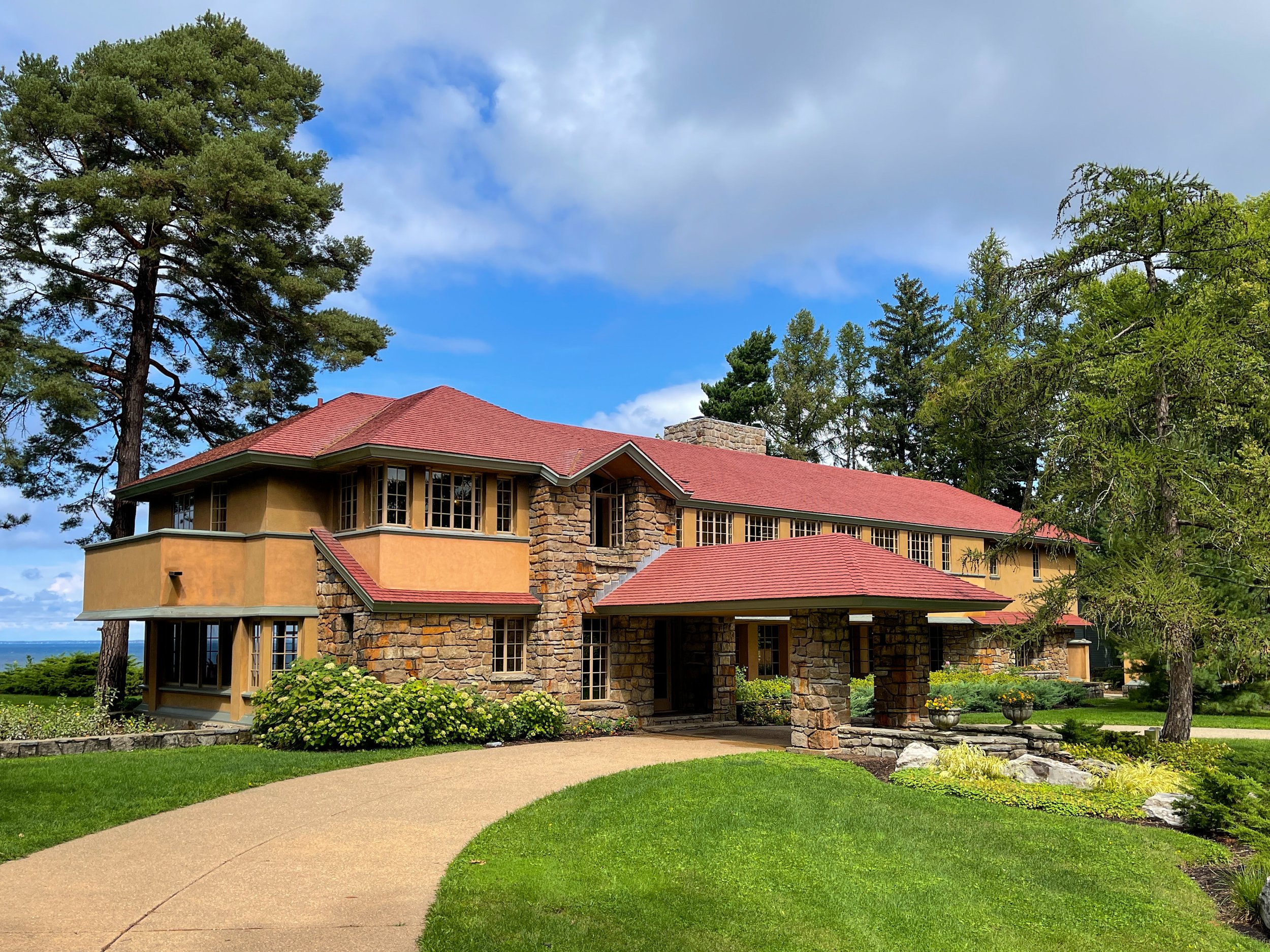
Frank Lloyd Wright's Graycliff

Frank Lloyd Wright built Graycliff, a summer residence for the Martins, from 1926 to 1929 — just in time for the family to lose their great wealth.

Frank Lloyd Wright had to grow on me. Actually, more accurately, I had to experience his work firsthand to develop an appreciation for it. Because, to me at least, his exteriors can seem monolithic, the windows small, the horizontal planes somewhat uninteresting. 

But when you enter one of his homes, it’s like you’ve entered a magical realm — the unassuming wardrobe that opens into the fantastical realm of Narnia, if you will. Wright transports you to another world, a cozy space where nature is invited in, often in surprising ways. You develop a great respect for the thought and vision that went into each of his homes. The environment connects to the site with a palette inspired by, and often using, materials sourced from the immediate area. 

When the Martins complained about the additions, Wright replied, “You don’t need them — but the house does.”
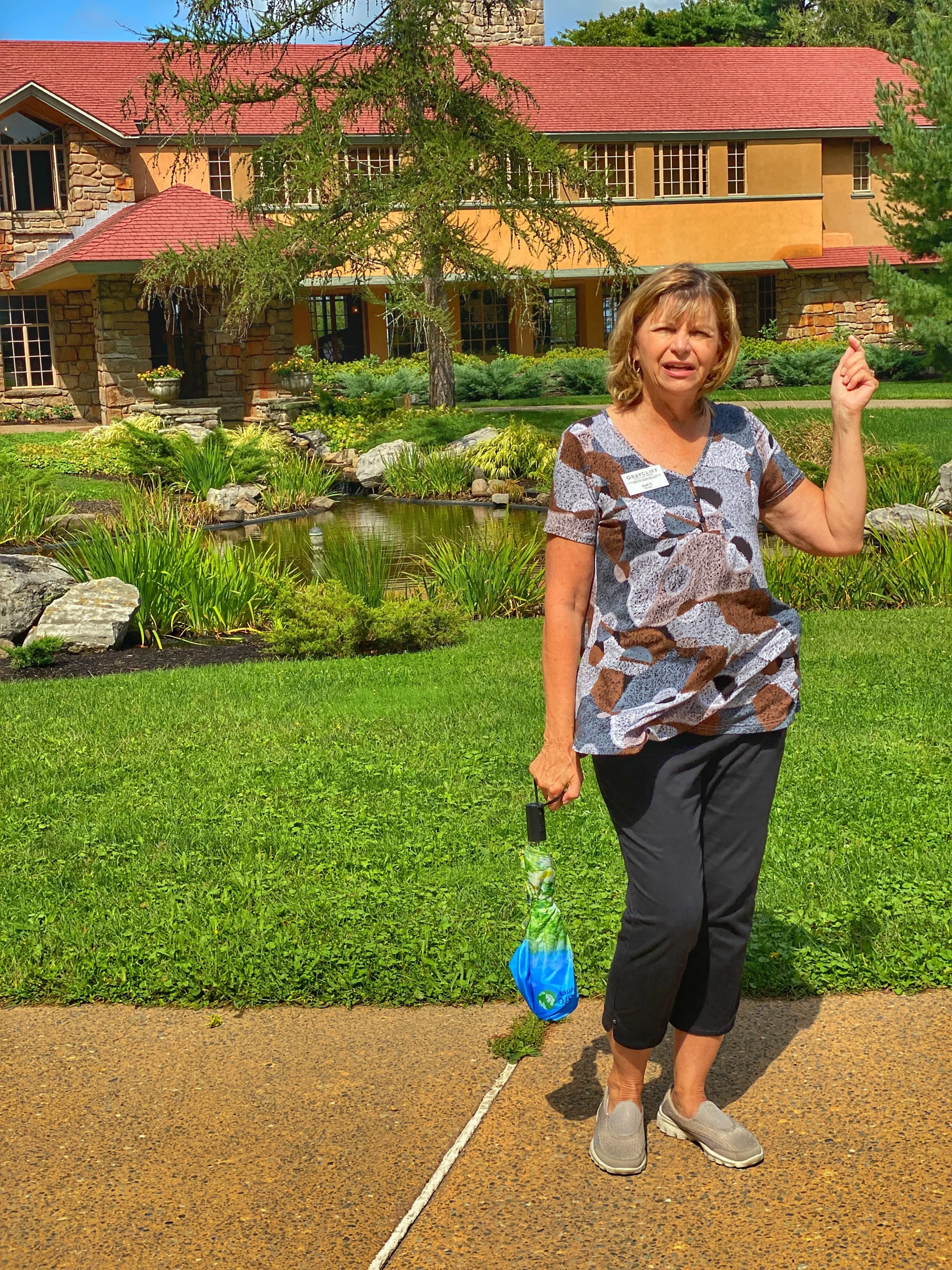
Woman giving tour of Wright's Graycliff

Our docent, Gail, was extremely knowledgeable about Graycliff and its colorful history.

The Martin Family and the History of Graycliff

Graycliff was the lakeside haven and summer home of Isabelle and Darwin Martin. Darwin was a wealthy executive at the Larkin Soap Company and first met Wright at his Oak Park studio in 1902 to discuss the commission of a Larkin Administration Building. He later commissioned Wright to design and build the home that would become Graycliff. The estate is perched atop a 50-foot bluff overlooking Lake Erie in the town of Derby, New York, about 20 miles south of Buffalo. In the distance, you can see the Point Abino Lighthouse and the Welland Canal in Canada. 

The Larkin Soap Company was a massive mail-order business, and Darwin one of the highest paid executives at the time (worth the equivalent of $40 million nowadays). This accounts for his ability to build not only Graycliff but the family home in Buffalo (known as the Martin House) with Wright — an architect notorious for not letting a budget get in the way of his vision. 

But all of that changed when the stock market crashed in 1929, ushering in the Great Depression. Darwin had heavily invested in a number of his son’s business ventures, including 800 West Ferry, a luxury apartment high-rise in Buffalo. Due to these underperforming investments, the Martins’ fortunes eroded. 

Darwin sustained a series of mild strokes and a more serious episode on December 17, 1935, resulting in his death. 

It was reported that upon hearing of Darwin’s death, Wright stated that he had lost his best friend and most influential patron. Over the years, Darwin loaned Wright approximately $70,000. None of it was ever repaid. 

Isabelle continued to spend summers at Graycliff until about 1941. When she could no longer afford to keep the main house open, she moved into the apartment above the garage in the Foster House, before passing away on February 22, 1945 at the age of 75. 
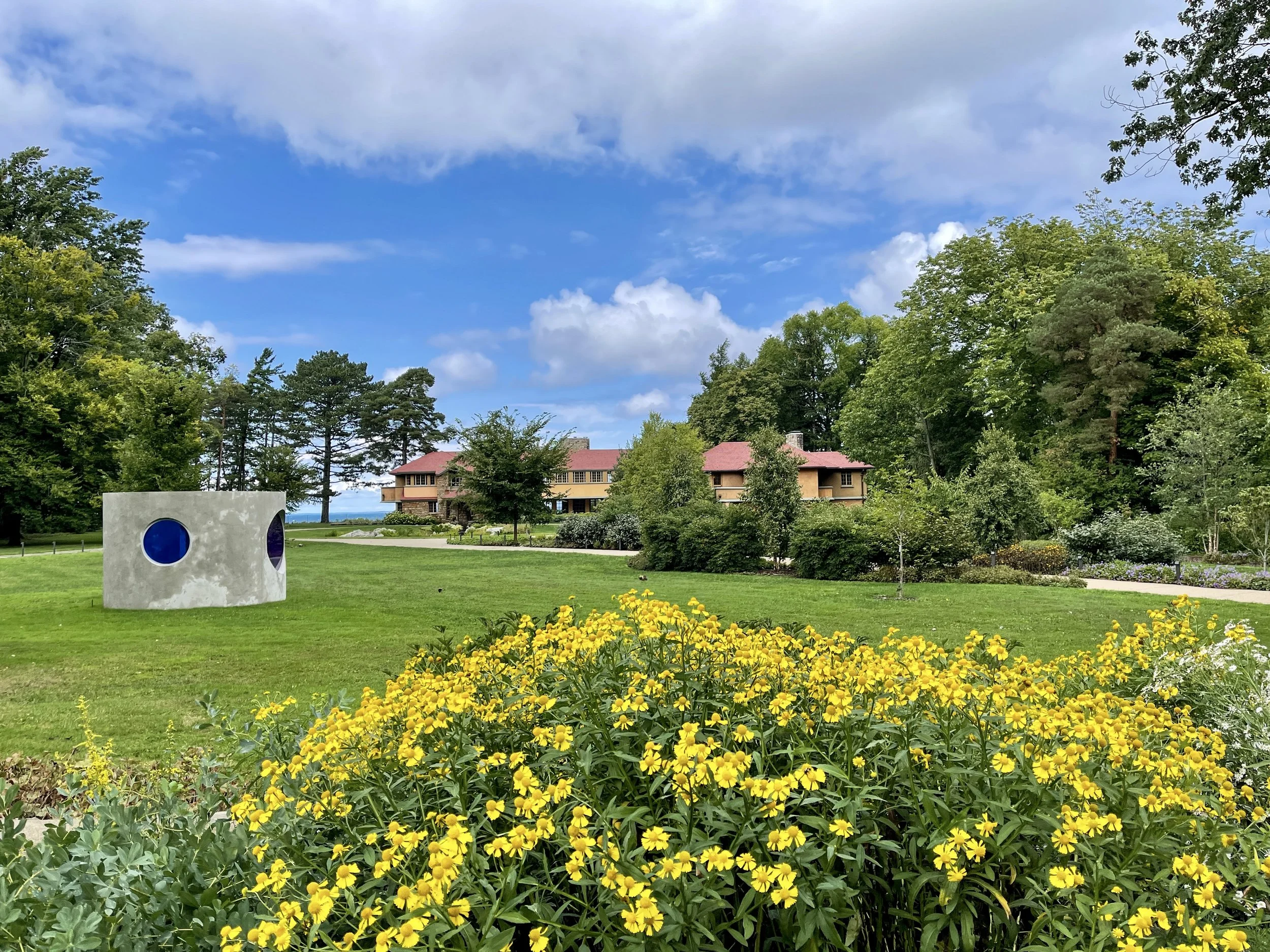
Braman's Sit sculpture by yellow flowers at Graycliff

Wright probably never imagined a modern sculpture sitting on the lawn at Graycliff — but we like to think he’d approve.

Wright’s Vision for Graycliff

Construction of the estate began in 1926 and was a gift from Darwin to Isabelle, upon his retirement from the Larkin Soap Company. The Martins were able to spend their first summer there in 1929, though the grounds weren’t completed until 1931. 

The complex comprises the main house, a sunken boiler house (called the Heat Hut) and the Foster House, originally conceived as the chauffeur’s quarters, so named because it was used as the summer residence of Isabelle’s daughter, Dorothy Martin Foster, her son-in-law, James, and their two children. 

Graycliff is named for the natural feature that forms the overlook it’s perched upon, and despite sounding a bit dour, the house is actually bright and airy. Not only did Wright want to provide views of Lake Erie, he had another reason to fill the house with natural light: Isabelle suffered from scleritis, a condition that causes chronic eye pain and light sensitivity. According to correspondence sent from the Martins to Wright, Isabelle needed a place that was flooded with “light and sunshine” — the opposite of their city home, which was dark and difficult for her to navigate. 
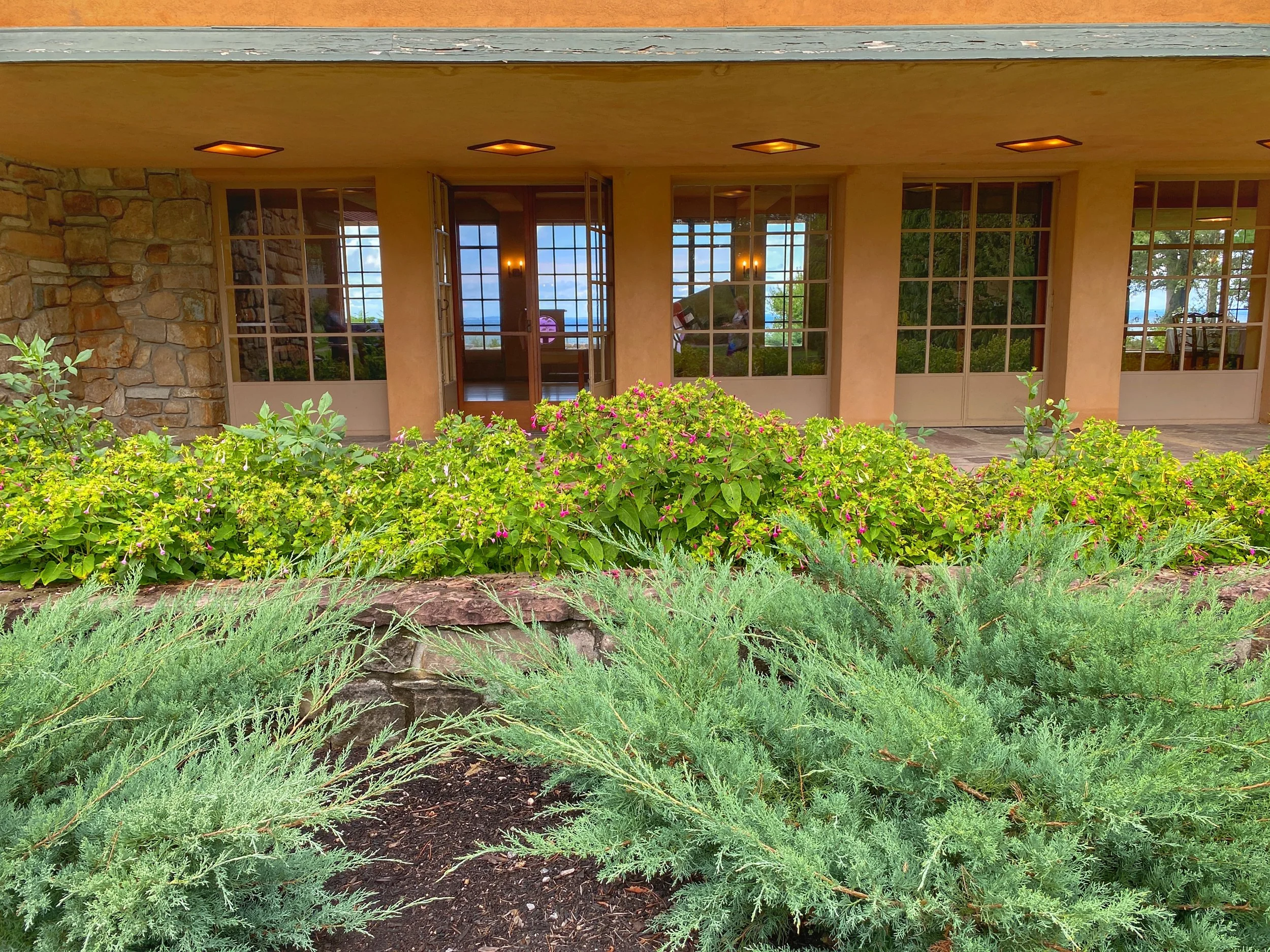
Windows that go from the front of Graycliff through the house to show Lake Erie

The view of the lake through the home was destroyed for a while when the Piarist priests put their chapel here.

The Piarist Priests: The Other Owners of Graycliff

In the 1950s, the Martin descendants sold the property to the Piarist Fathers, a Roman Catholic teaching order from Hungary. The Piarist edict being education for every child, they formed Calasanctius High School in Buffalo and needed residences for 24 priests and a boarding home for 48 underprivileged students.

When the priests purchased the property, they also needed a chapel to accommodate the large Hungarian community in the area. So they tore out a wall to create a new entrance and replaced the windows of the cantilevered porch with colored glass — thereby cutting off the view of the lake through the house and destroying Wright’s main vision for Graycliff. 

The story goes that when Wright was 91, he visited Graycliff, unannounced, with some protégés. 

The architect pulled up, and the head priest, recognizing the fancy car, ran out to greet him. Taking one look at the alterations, the first thing Wright says is, “Who did this? This is not my work.”

“We needed a chapel,” the priest stammered.

“Well, I can design you one,” Wright said. 

Ignoring the priest, he turned to his colleagues and said, “Come on. I’ll show you the house.” And in they walked, uninvited. 

Wright never got to design that chapel, as he died a few months later. But he’d be happy to learn the property has been restored. 
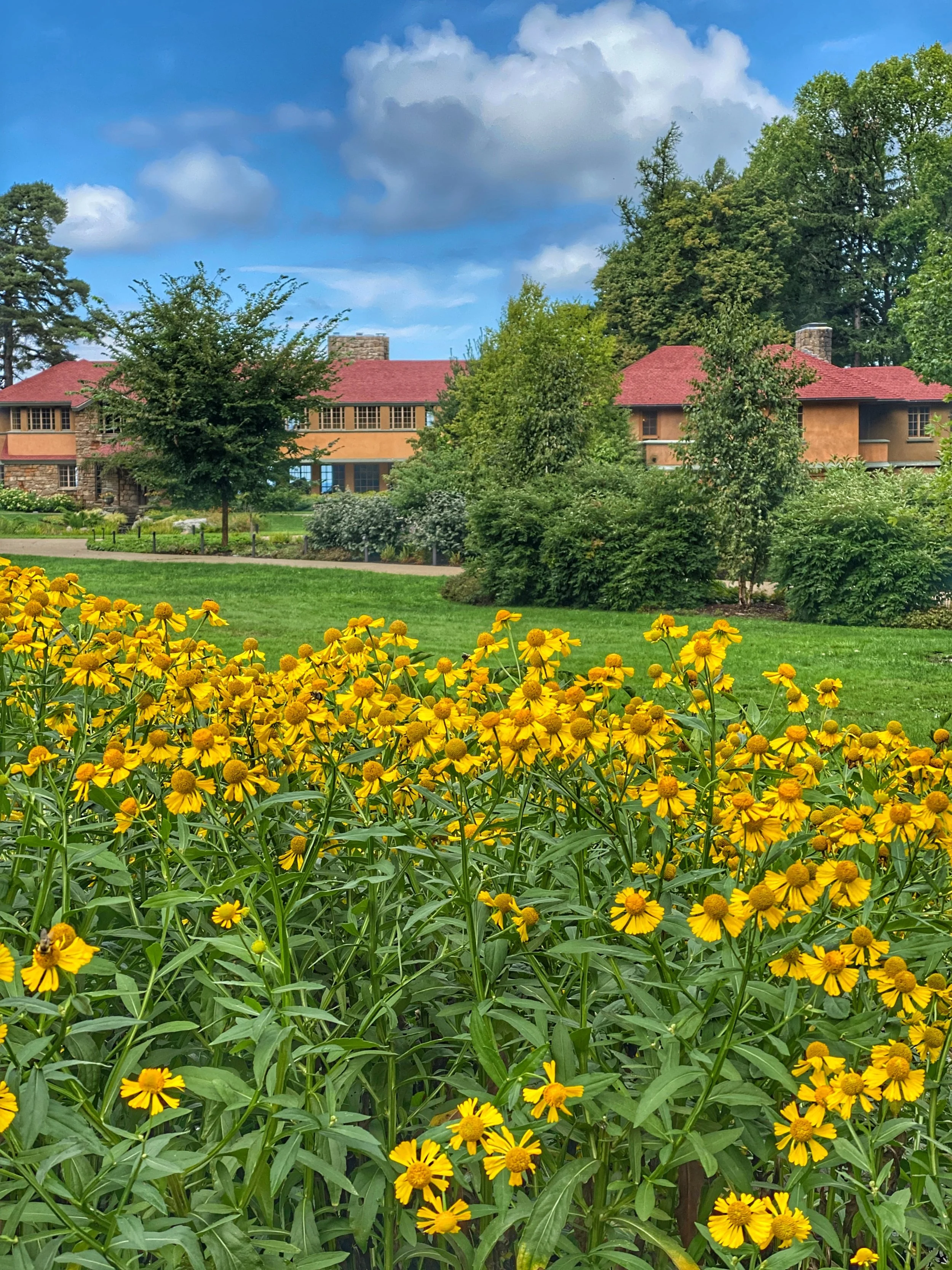
Yellow flowers in front of Graycliff

Isabelle liked to create flower arrangements, so Wright planted a cutting garden for her in front of the home.

The Cutting Garden

Our tour began with a walk through Isabelle’s garden. She was noted for her flower arrangements, so Wright designed gardens to accommodate her hobby. 

Eventually, the Martins hired landscape architect Ellen Biddle Shipman, renowned for her naturalistic style, to revise Wright’s landscaping scheme. Shipman enhanced the garden for Isabelle, giving her flowers that would bloom in rotation from spring through fall. 

The site also includes pine trees, which reminded Isabelle of summers at the Lake Placid Club in the Adirondack Mountains. 

Beyond the cutting garden were the vegetable gardens, orchards for apple and pear trees and grapevines. 
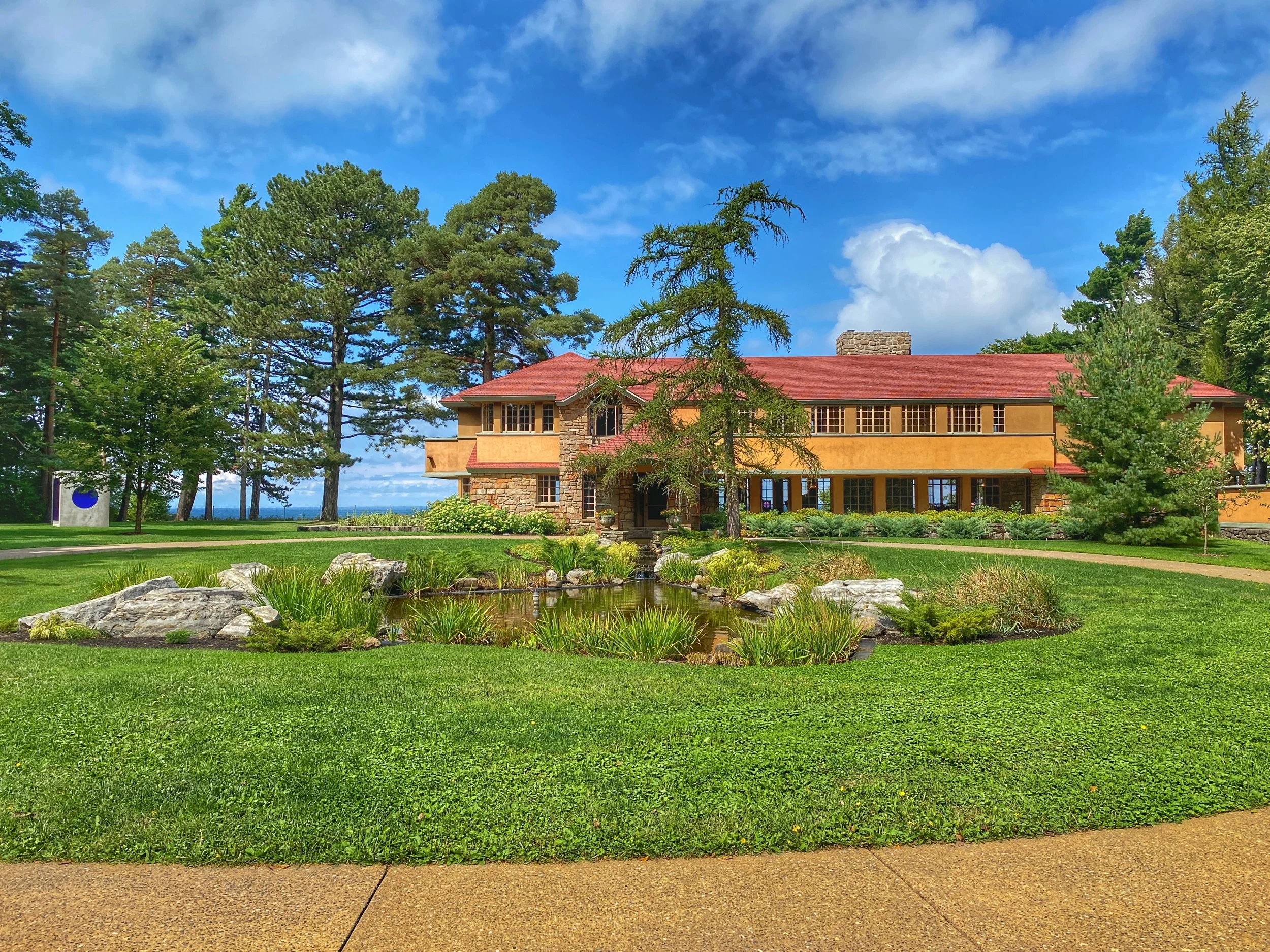
Small pond in front of Graycliff

The house was approached from a diagonal driveway, which faced the sunset and helped make the narrow home appear larger.

The First Glimpse of Graycliff

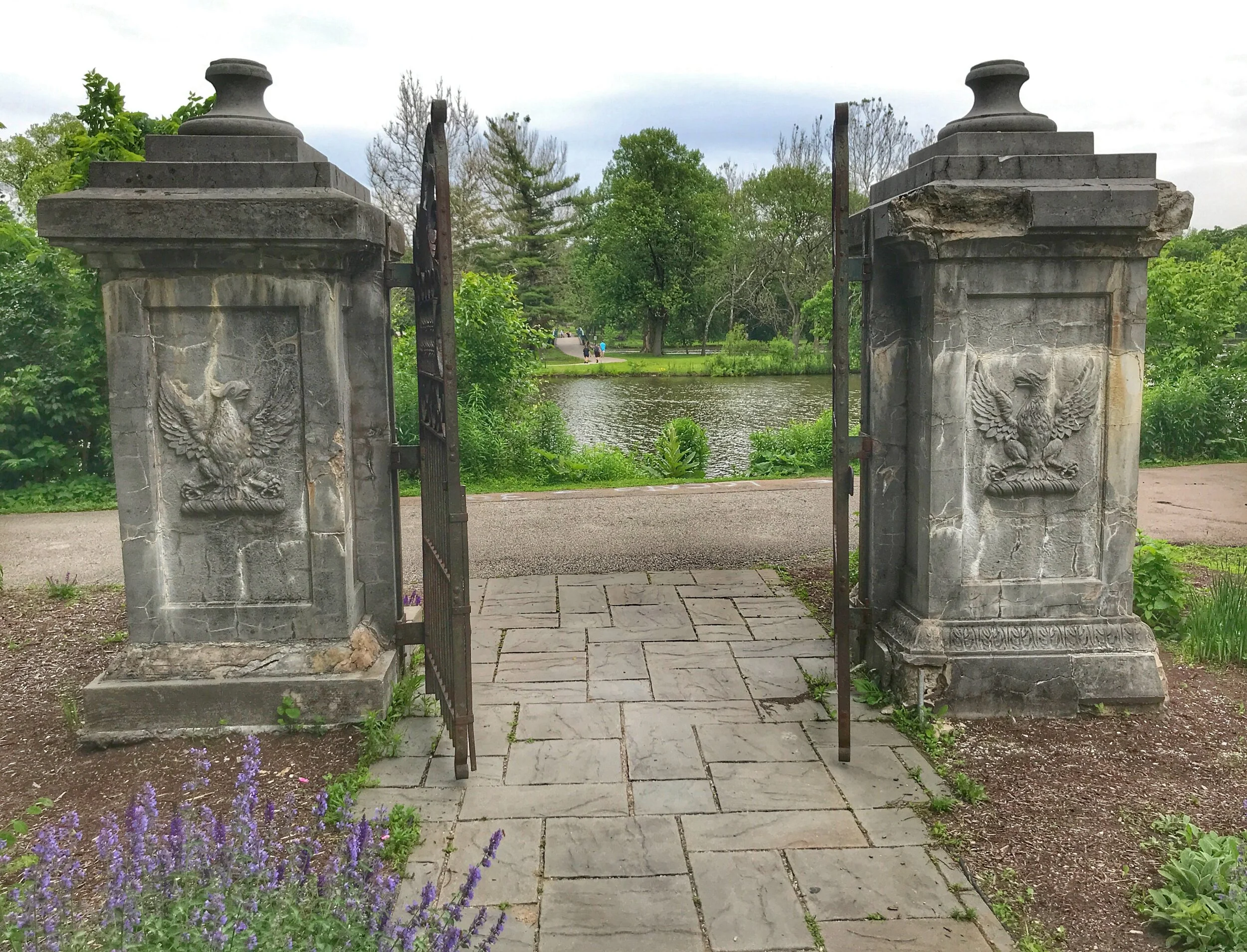
Our initial view of the house took place between two stone markers, the original location of the driveway that led to the house. 

The family owned eight and a half acres, but the plot where they wanted their summer home was two and a half acres. Further complicating matters, the spot atop the limestone bluff was just 250 feet wide. That’s very narrow for a 6,500-square-foot house. 

But there was nothing Wright liked so much as a challenge. And one of the cool, oh-so-Wright elements is that you approach Graycliff at an angle. The Martins bought the adjoining property from their next-door neighbors, the well-to-do Rumseys. The driveway branches off of the Rumseys’ and perfectly faces the setting sun, which would be a vision for visitors arriving for a summer soirée. 

The turnabout was made of yellow gravel — to complement the gold of the setting sun, of course. 

Approaching from an angle had an added bonus: It made the narrow façade seem more stately and grand. 

But the house itself wasn’t the main focus: Wright wanted the first glimpse to be of the lake; that was the true star of the show.

Horizontal lines almost always play a prominent role in Wright’s designs. For him, they draw a parallel to the ground, and in particular at Graycliff, the horizon and the surface of Lake Erie. The house becomes one with nature. 

The roof is made with cedar shake shingles, each hand-painted. Wright didn’t like gutters, so the house doesn’t have any. He never was one to let practicality get in the way of aesthetics. 

By creating a glass box of sorts, visitors could see through the home’s rectilinear form right out to the lake. At the time Graycliff was built, the area was undeveloped farmland, with nothing obstructing the view of the water. 

The driveway curves around an artificial pond, but that wasn’t part of Isabelle’s plan. Once again, she wanted something that would evoke her beloved Adirondacks, and she requested a small hill covered with bushes and low trees. But Wright cleverly played the money card, and insisted that the pond would be less expensive. The idea is that this water feature would be an extension of the lake. Wright almost always got his way.

A large part of Wright’s design aesthetic involves incorporating colors and materials from the surrounding area. At Graycliff, sand from the shores of Lake Erie was mixed into the stucco to add another layer of texture, and the home’s red roof is meant to evoke the ferrous oxide in the Tichenor limestone on the cliff behind the house that bleeds a rust color. 
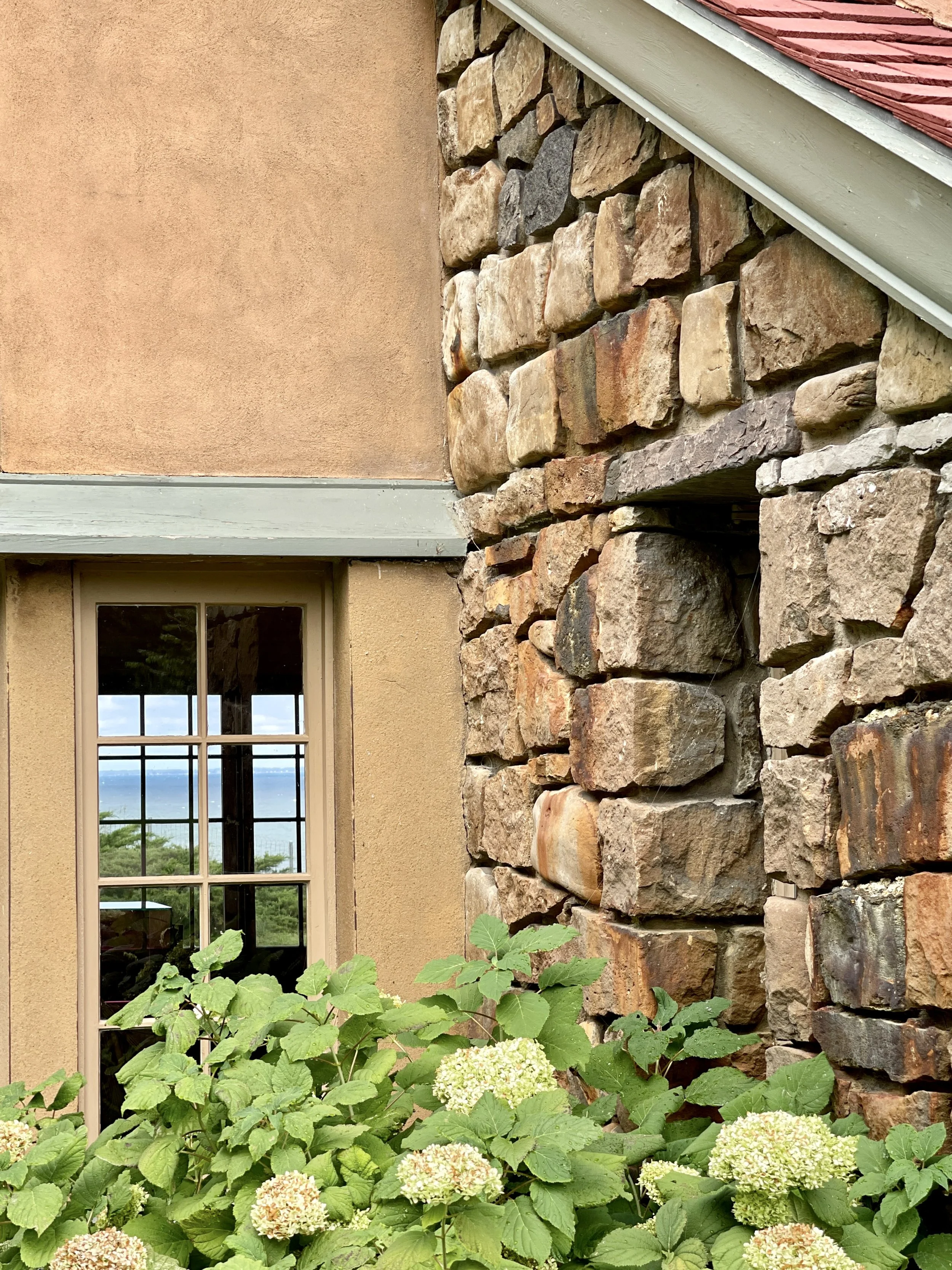
Stucco and stone facade of Graycliff

Sand from the beach was added to the stucco façade and inspired its yellow hue. The cliff’s limestone, bleeding a rusty red that carries into the color of the roof, was also used to build the home.

Another design motif favored by Wright was cantilevers — and at Graycliff, he wanted to evoke the layers of limestone on the bluff. 

His plans called for various additions, but his clients weren’t sold. 

“The Martins were concerned about money, and they said to him, ‘We really don’t need this balcony; we don’t need the stone porch; we don’t need the porte cochère. Just a little awning would be great,’” our guide Gail tells us. “And then they go away on a trip — and when they come back, all that’s in process.”

When the Martins complained about these additions, Wright replied, “You don’t need them — but the house does.” Ever the egotist, Wright was always right, and he bristled whenever someone questioned his vision. 
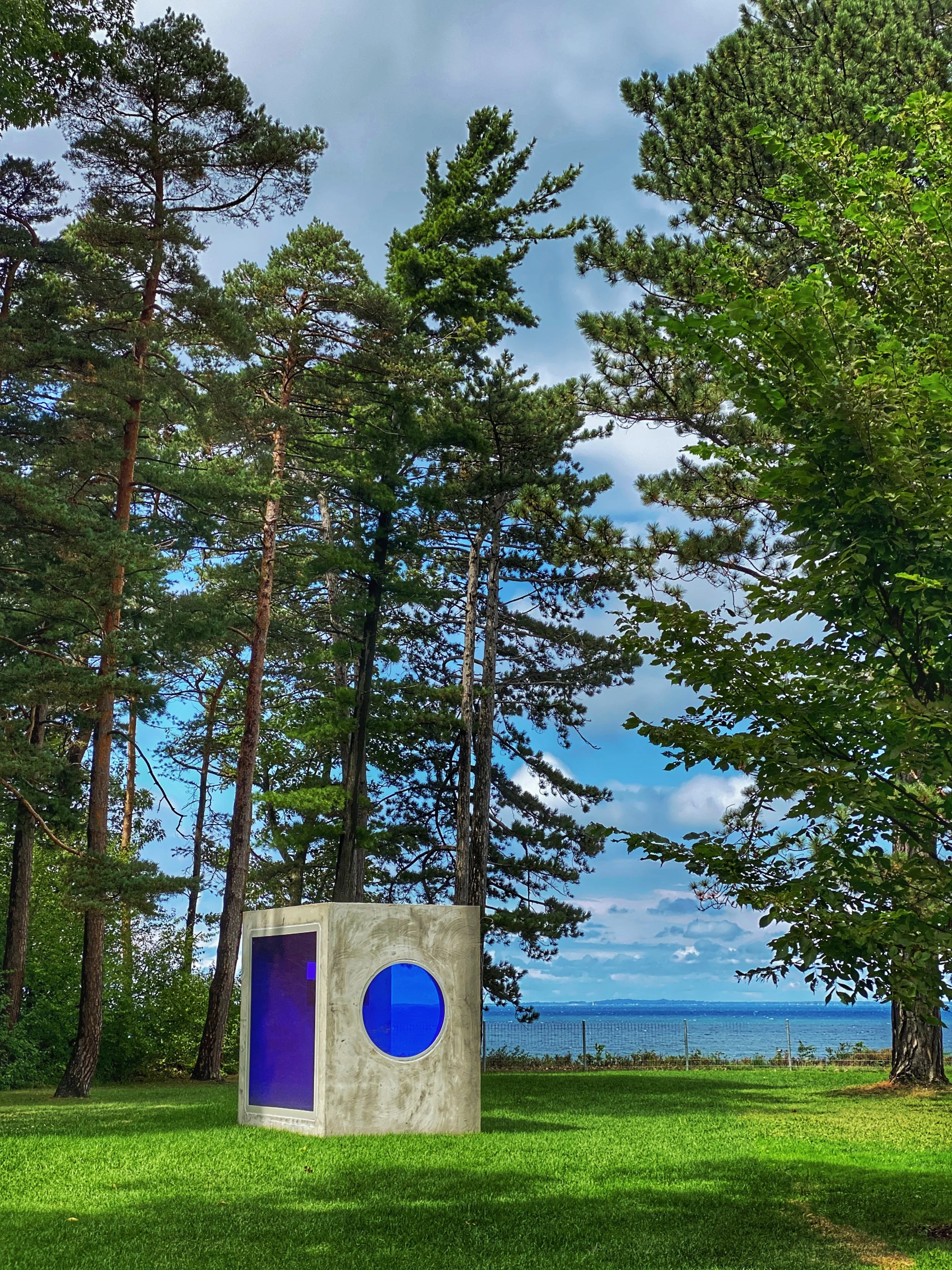
A concrete and blue glass sculpture named Stay by Sarah Braman at Graycliff

Stay by Sarah Braman, 2022, on the grounds of Graycliff

Sarah Braman: Finding Room

When we visited Graycliff, monumental modern sculptures by Sarah Braman were scattered about the grounds. These large geometric shapes made of concrete and brightly colored glass added a vibrant element of visual interest to the landscape. We enjoyed them, and hope that Wright would have appreciated them as well.
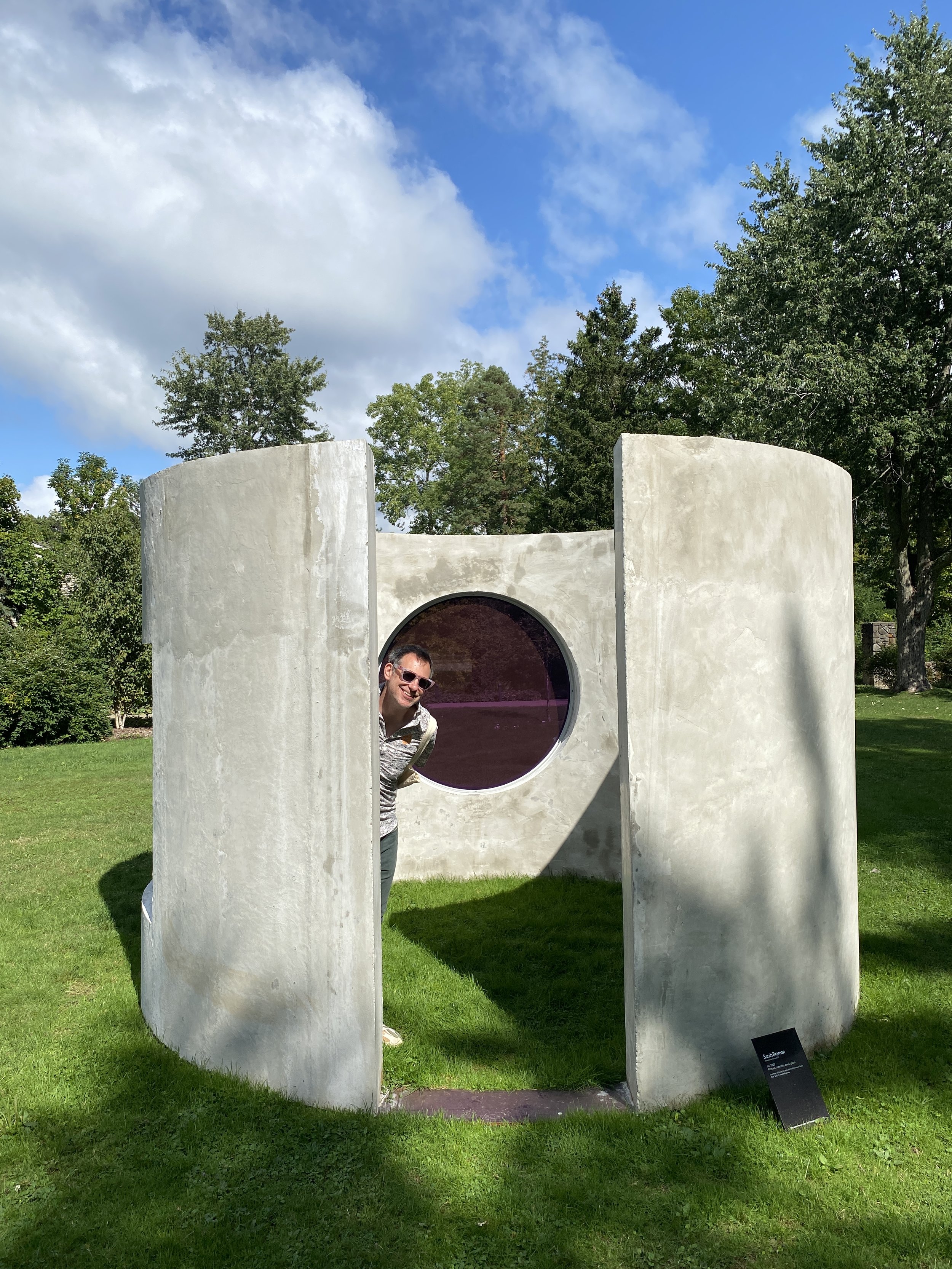
Man peeks out of Sarah Braman's Sit concrete sculpture

Duke peeks out of Sit, a 2022 sculpture by Braman — the first of her works we saw during our visit to Graycliff
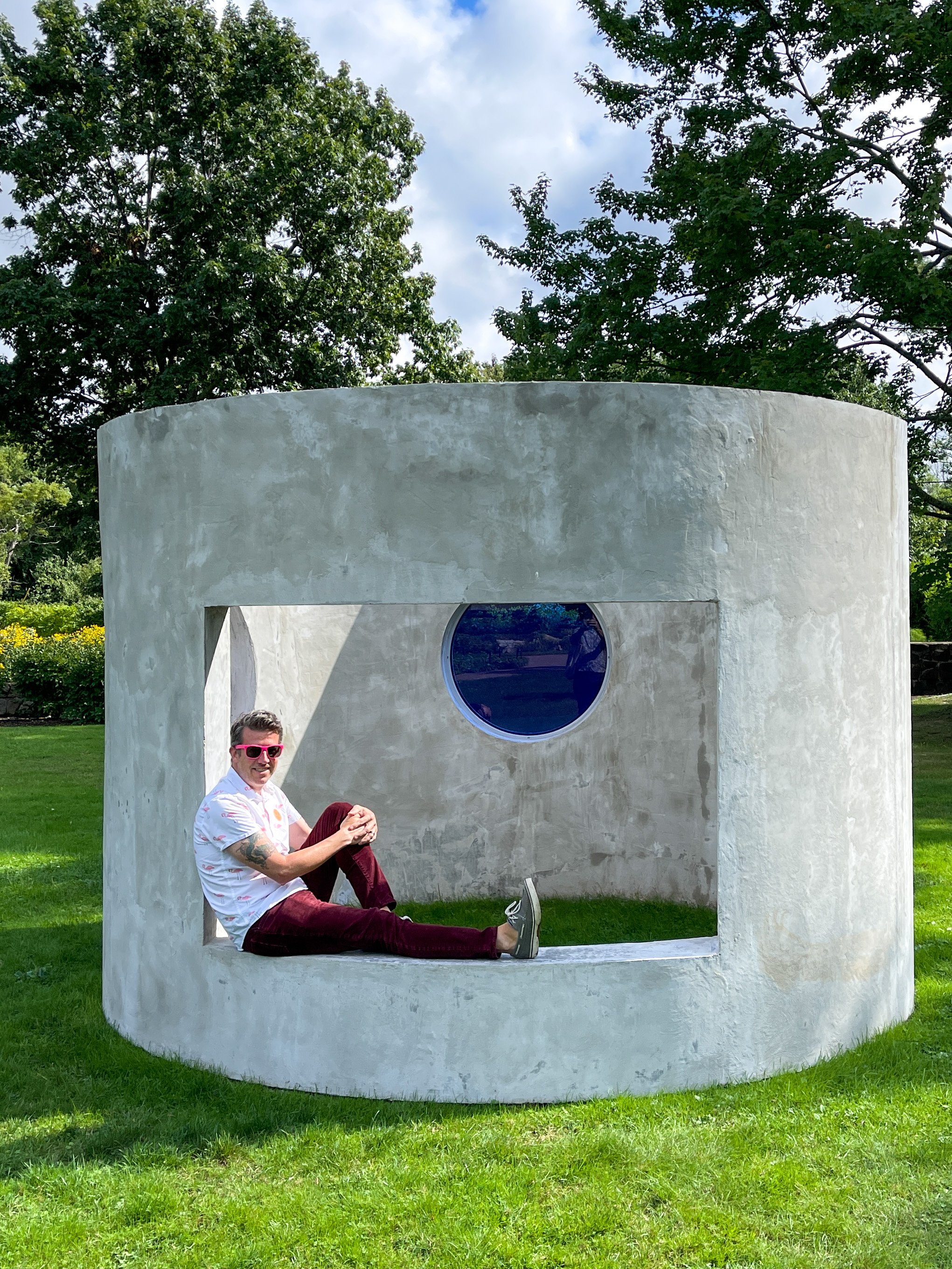
Man sits in cutout of Braman's Sit sculpture

Wally takes the name of the sculpture, Sit, literally.

That being said, we could have done without a couple of the ones inside the house. We’d have preferred to see the living room set up as it would have been when the Martins lived here — not emptied of some pieces of furniture to make way for Braman’s smaller-scale sculptures of domestic items and found objects, which struck us as disjointed. 
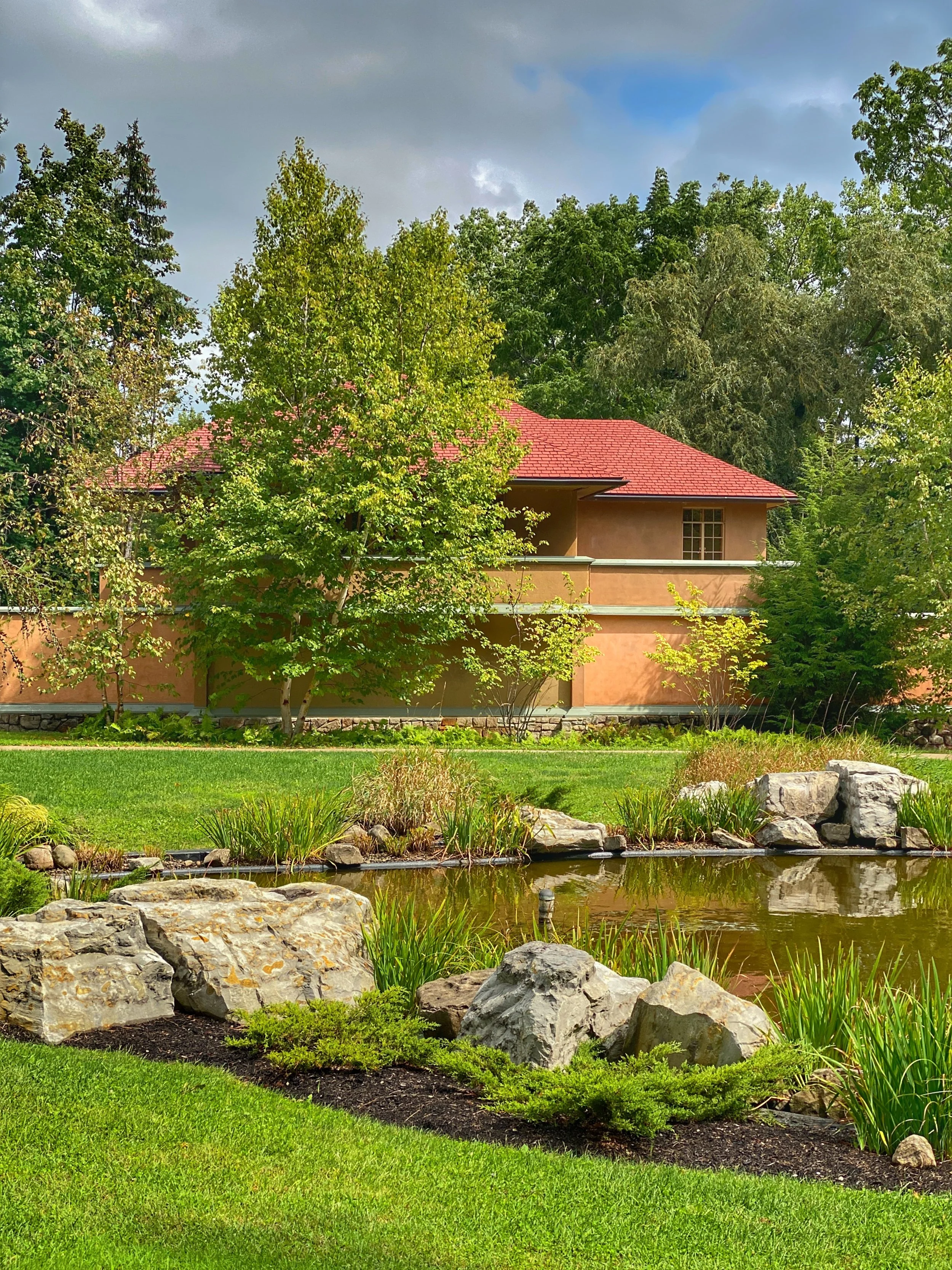
Pond surrounded by rocks and grass in front of Wright's Graycliff house

The client actually wanted a hill here with trees — but Wright insisted on a small pond that would connect to the lake out back.

Entering Graycliff

Upon arrival, we passed through the porte cochère and entered the foyer. Immediately, you’ll notice one of Wright’s signature architectural techniques, known as compression and release. In the entry, the ceiling is low, and the smaller scale of the room creates a tension that propels you to move beyond it, into the larger living room, an open space with higher ceilings. To create the expansive double-height space, Wright used beams from nearby Bethlehem Steel. 

Unlike Wright’s Prairie-style homes, which were concentric, with one large room off of which the others flowed, Graycliff is rectilinear. One room follows another, and Wright used compression to define transitions between these spaces without walls. By this time, he was moving into a style he referred to as organic architecture.

The stucco-covered walls used on Graycliff’s exterior continue into the interior, and provide a visual connection between the outdoors and indoors. 

When the Graycliff Conservancy purchased the property in 1999, very few of the original furnishings remained. Many are reproductions, including the willow and reed pieces throughout the home. This type of furniture was very popular during the late ’20s and is thought to be similar to what Darwin and Isabelle saw when they vacationed in the Adirondacks. –Wally 
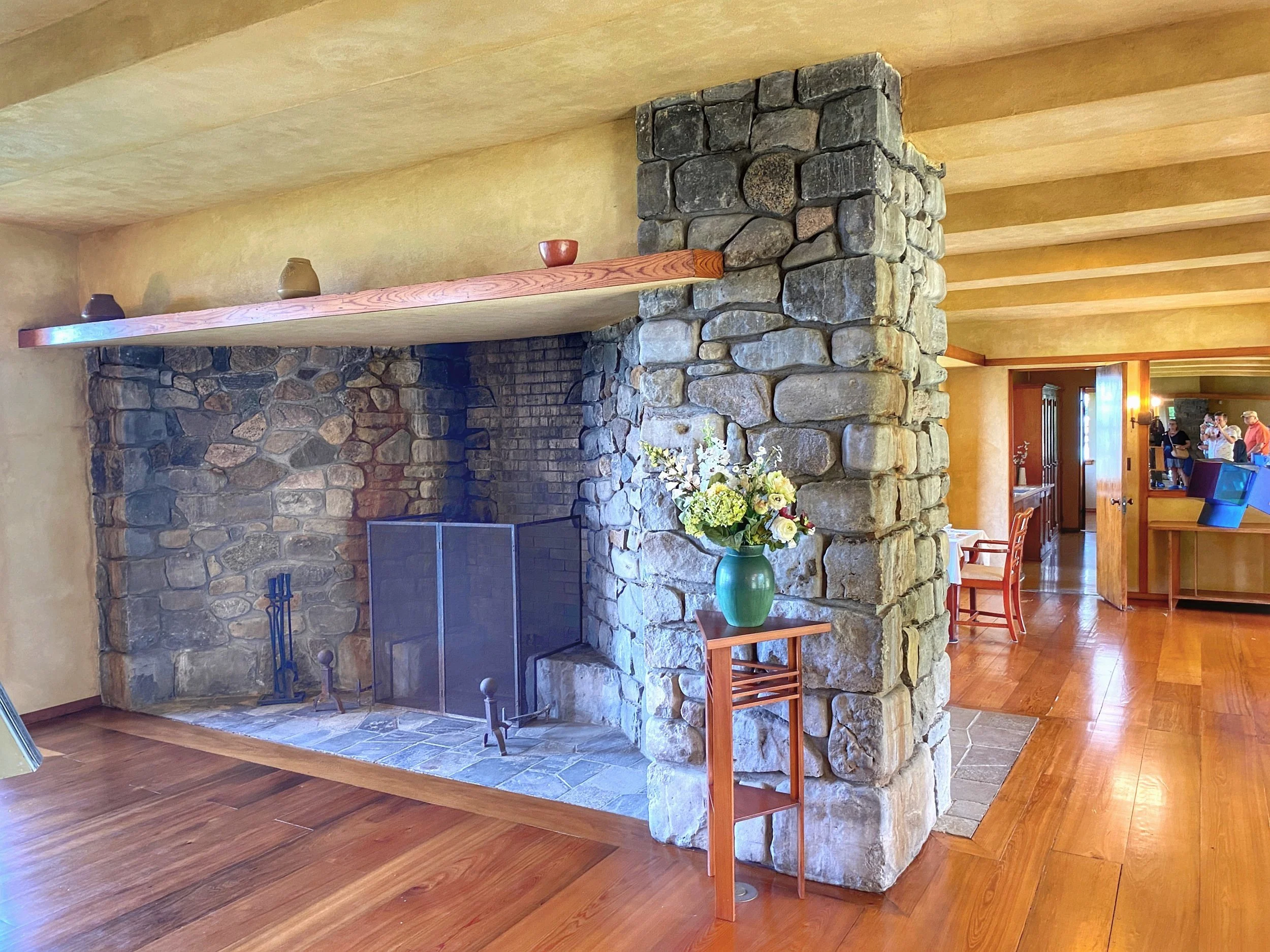
Adirondack style stone fireplace in living room at Graycliff

Wright felt fireplaces were the heart of a home, and this one was built in the Adirondack style.

A Room-by-Room Tour of Graycliff

The Living Room

The living room is center stage. Floor-to-ceiling windows and doors open onto the front terrace and the backyard and span the length of the house. These walls of glass provide gorgeous views of Lake Erie and fill the interior with plenty of natural light. The focal point of the room is the monumental Adirondack-style stone fireplace with a mantle that nearly covers the north wall. Wright believed that the fireplace was the heart of the home. An unusual feature to this type of hearth is that logs were stacked on end, vertically. As a fire burned, it created a dramatic plume of flames. 

One of the few materials used in the home that was not sourced locally was the cypress heartwood flooring from Florida — most likely chosen for its durability and beauty.
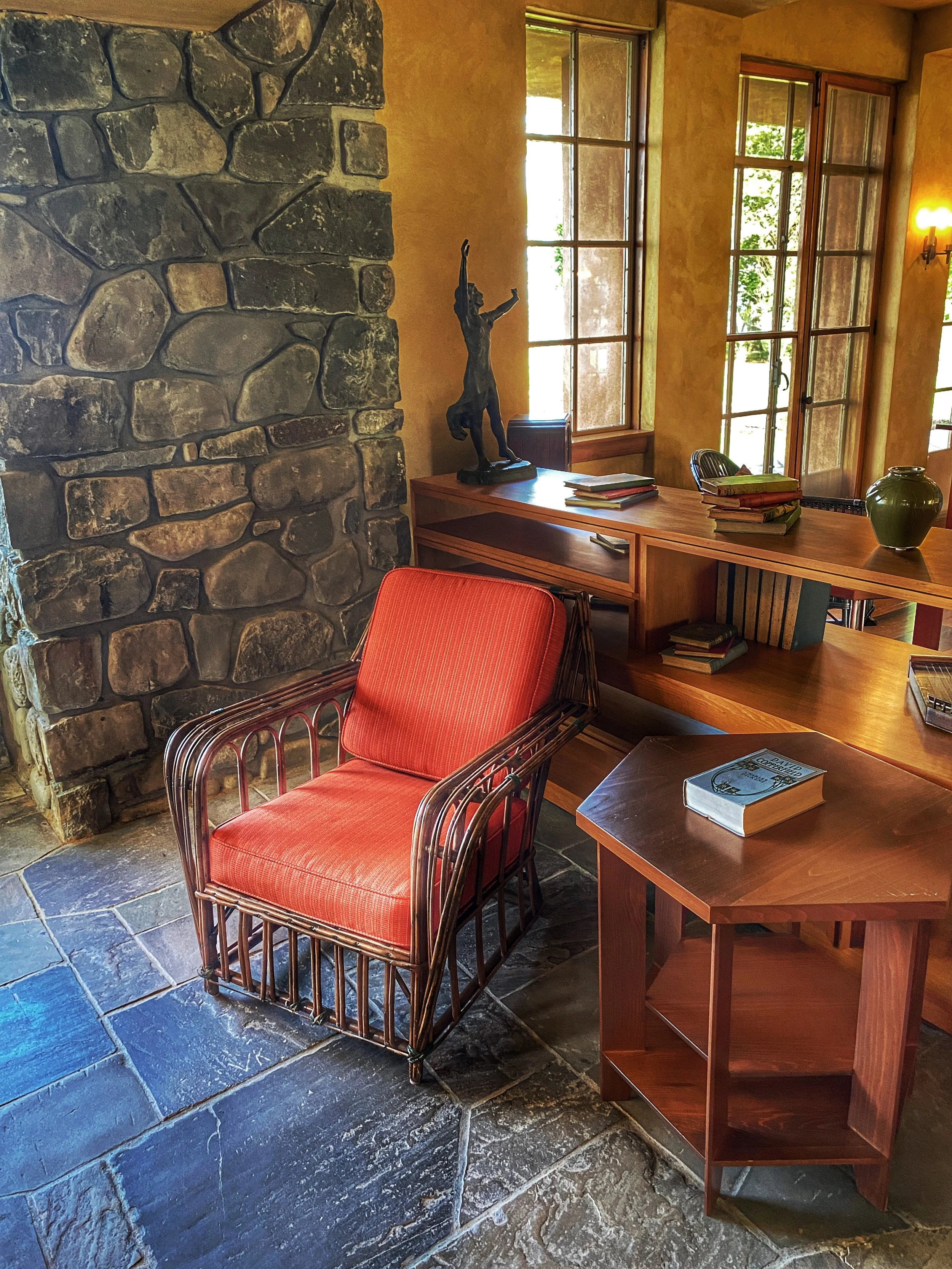
Red chair, table and bookcase in Fern Room at Graycliff

Curl up with a good book in the Fern Room, a cozy nook off of the living room.

The Fern Room

Adjacent to the living room is a cozy nook that served as a library and is known as the Fern Room — a great spot to curl up with a good book and admire the incredible views of the lake. The ceiling is lower here to establish a more intimate space. The floor is covered in flagstone that came from the city of Buffalo, which was, at the time, replacing its stone walkways with concrete. 

Wright proposed that the window glass meet at the corners so as not to obstruct the view, but the Martins didn’t see the need for that additional expense. (He would later get his way at Fallingwater, a home built for Edgar and Liliane Kaufmann between 1936-1937 in Mill Run, Pennsylvania.)

The Sunporch

Beyond this, the floorplan flows into the sunroom, with rubber floor tiles. Originally a screened-in porch, cypress-framed windows were added to shield occupants from the intense winds coming off the lake. 

The room functioned primarily as a music room. Isabelle had a paid companion who lived at Graycliff by the name of Cora Herrick, though the children called her Aunt Polly. She played the piano — one of the few original pieces of furniture remaining in the home. According to Gail, Darwin wrote in his diary how much he loved hearing music being played while he was working at his desk above. 
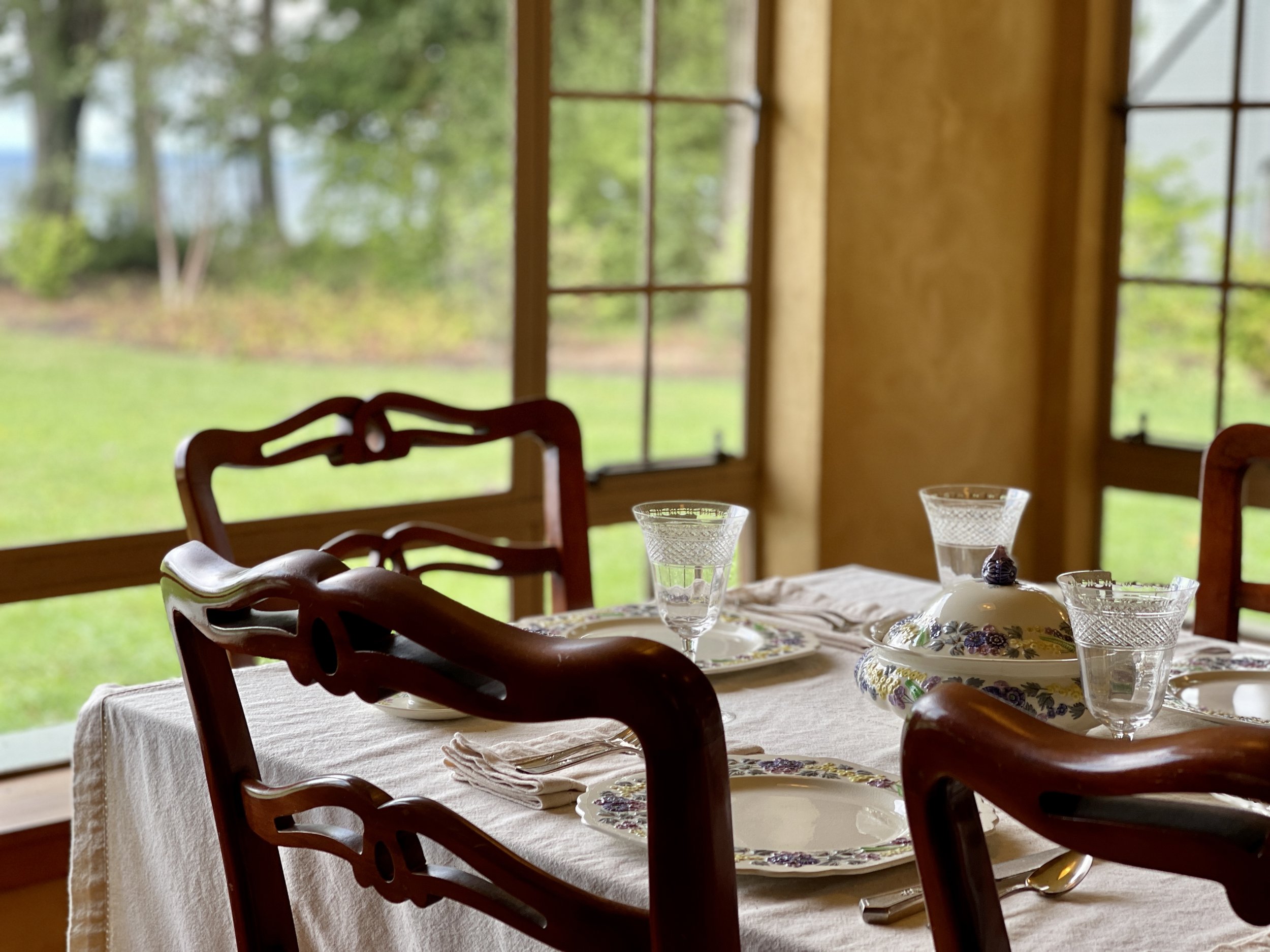
Detail of the dining table and place settings at Graycliff

Diners had great views at Graycliff — and got to avoid errant sparks flying out of the fireplace.
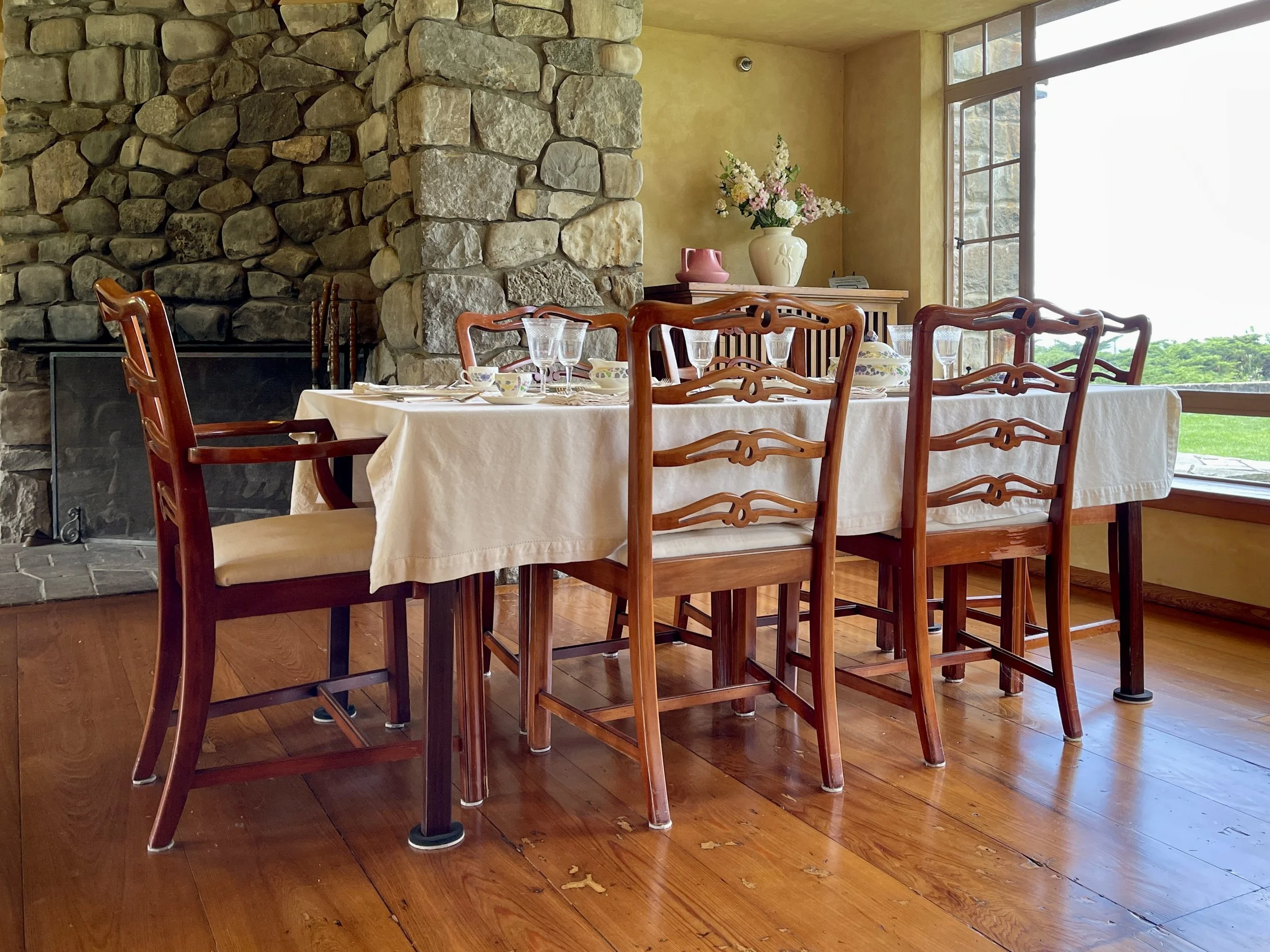
Dining table at Graycliff

The dining room at Graycliff is around the corner from the living room.

The Dining Room

On the other side of the living room is an area that served as the dining room. 

The table is positioned parallel to the wall so that guests could easily turn to enjoy the view of the lake — and also to avoid the errant sparks and embers that occasionally popped out of the fireplace. 
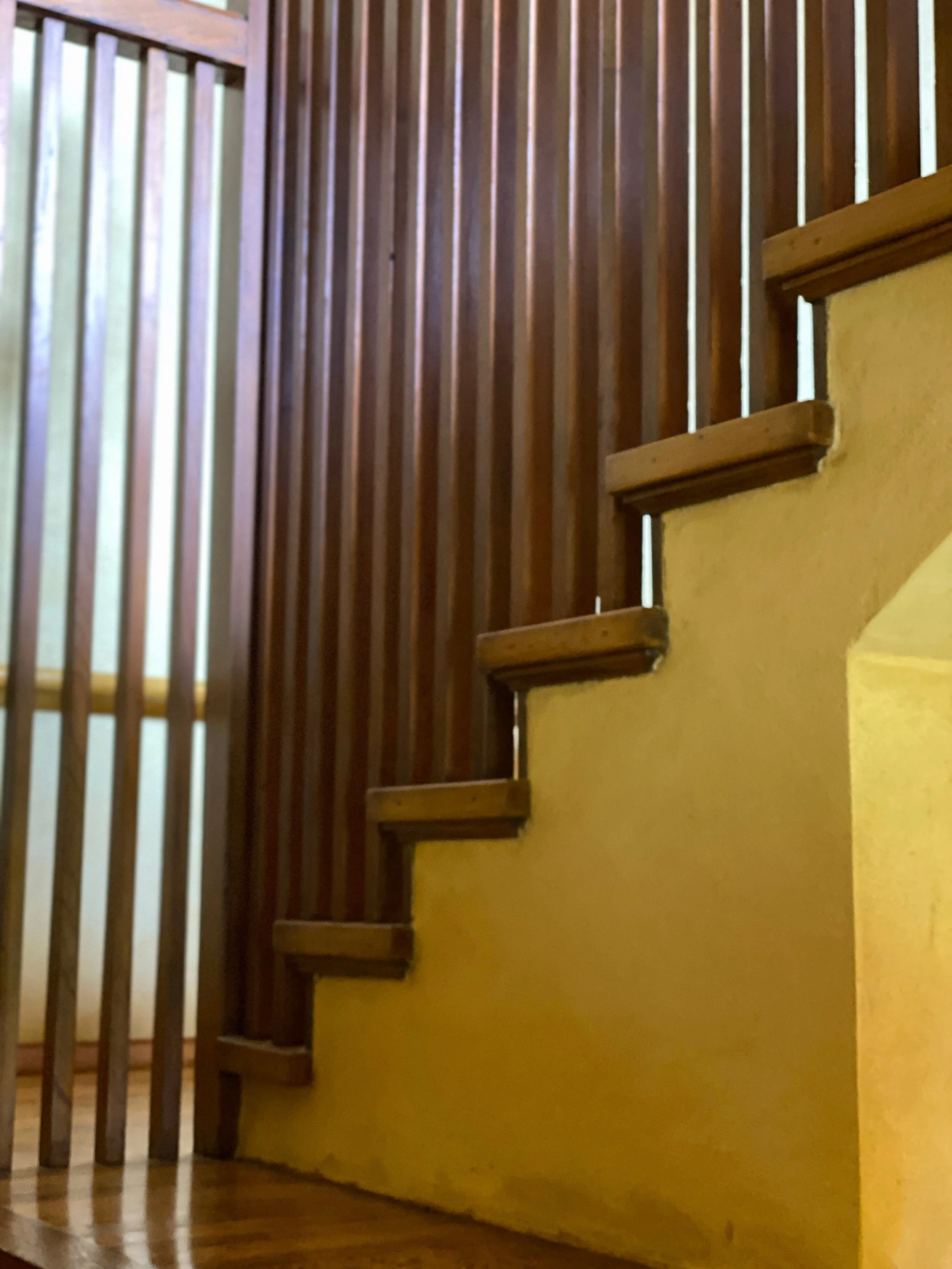
Wood and yellow stucco staircase at Graycliff

All six bedrooms are found upstairs.

The Staircase

A cascading waterfall staircase made of maple leads to the home’s bedrooms on the second floor. This type of passage consists of two parallel flights of stairs joined by a landing that creates a 90-degree turn. 
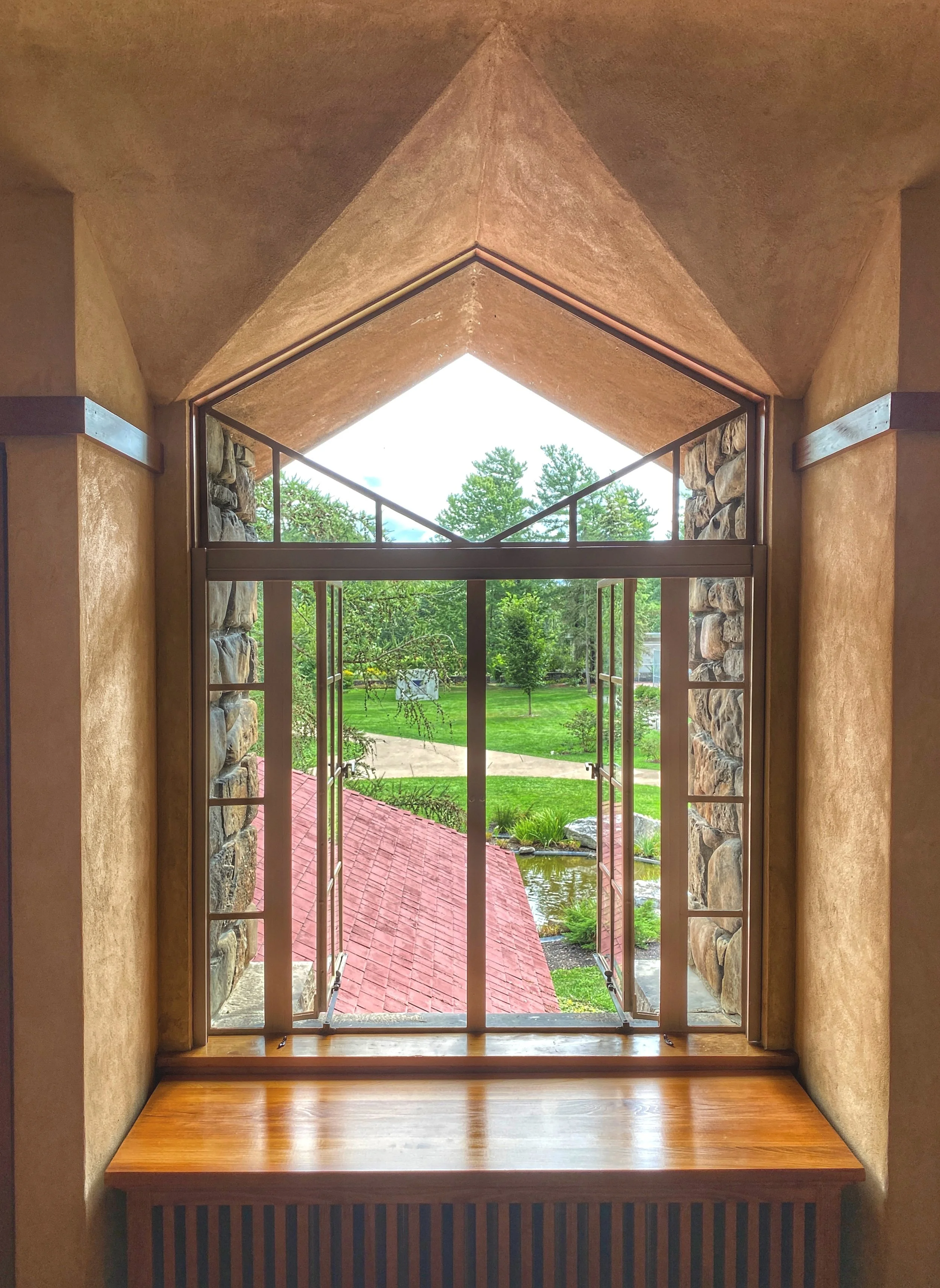
Window looking out to the front yard at Graycliff

A dramatic window with a diamond shape at the top of the stairs

The architect’s signature use of rhythmic repetition can be seen in the home’s details. Wright noticed that the local limestone breaks off in geometric forms, so he gave a nod to these in subtle ways: octagonal door knobs and a diamond-shaped window at the apex of the staircase as well as light fixtures. This brings order and visual harmony to Graycliff. 
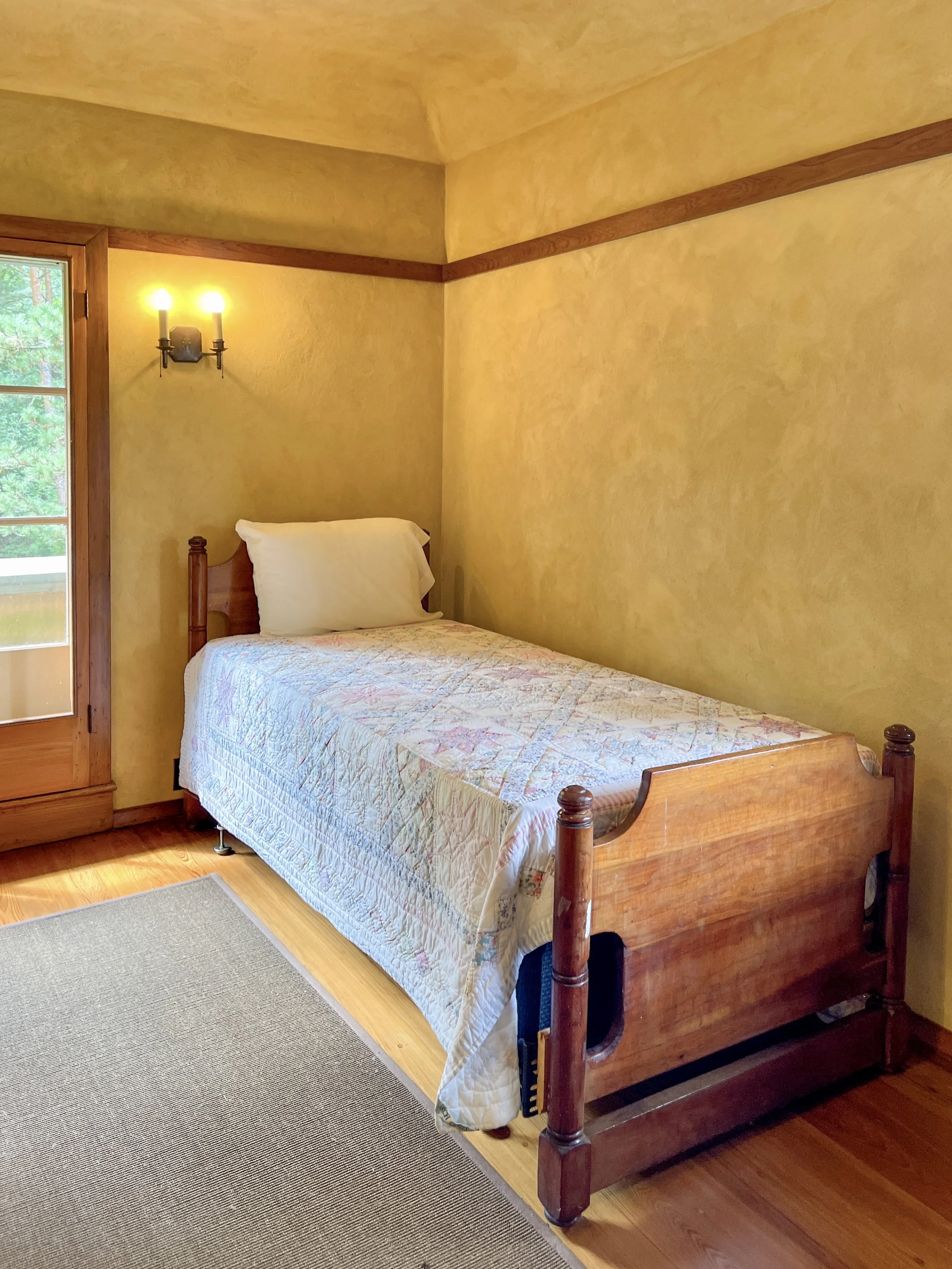
Single bed in Darwin Martin's room at Graycliff

Poor Darwin got stuck with the worst bedroom of the bunch.
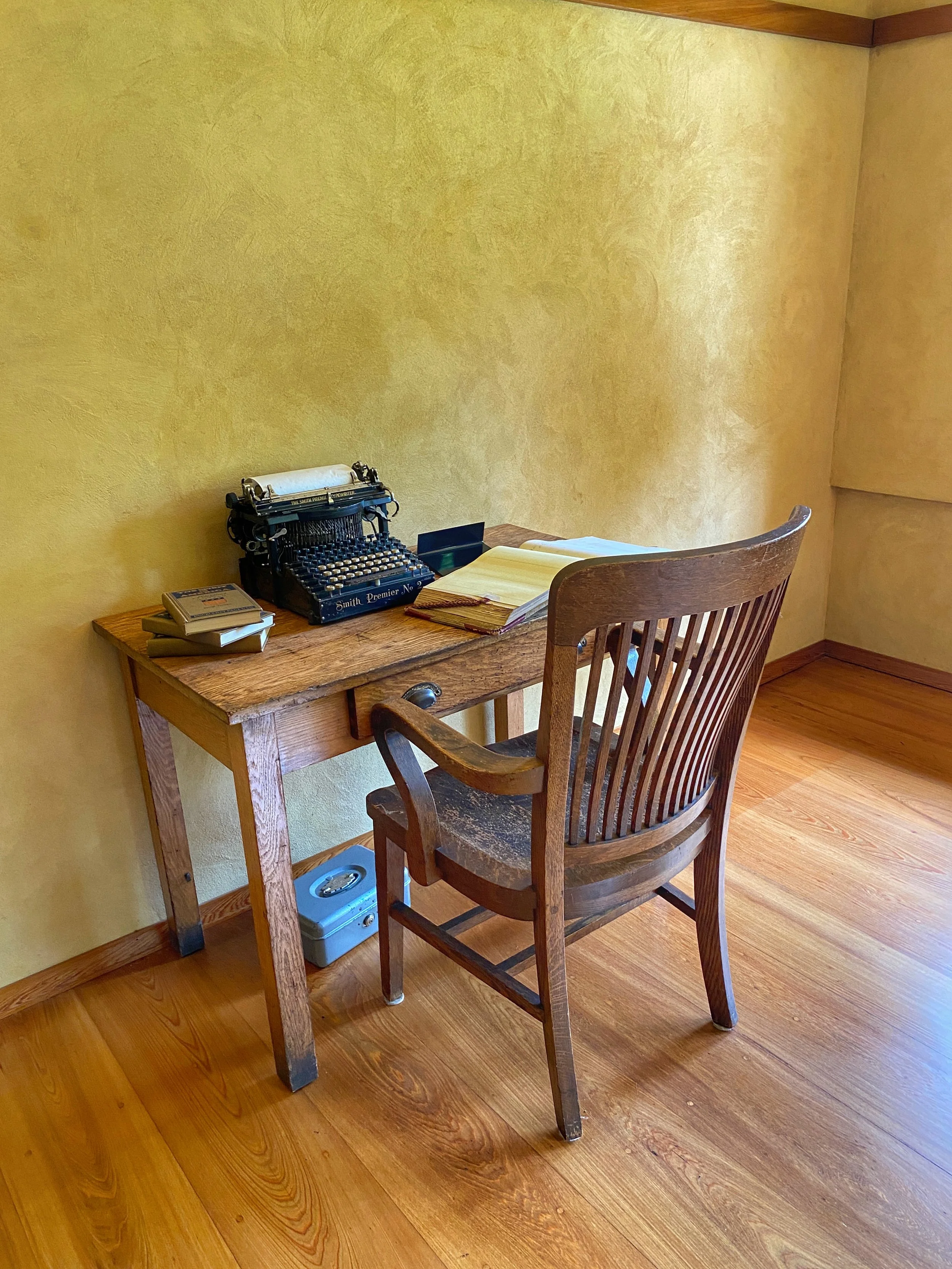
Desk and chair at Graycliff

Darwin, a workaholic, converted his porch into an office.

Darwin Martin’s Bedroom

Upon climbing the stairs, Darwin’s bedroom can be found to the right. Not only did Darwin not share a room with his wife, he was also assigned the worst of the bunch, to our minds. It’s smaller than most of the other bedrooms, though it does contain a small bathroom and sleeping porch.

Darwin converted the porch into an office, as he was a notorious workaholic.

The bedrooms feature one of the innovations at the time: olive knuckle hinges patented by Stanley Company that allow a recessed door to open all the way flat to the wall. 

Upstairs gallery leading to bedrooms at Graycliff

This sparse hallway led to the bedrooms and the back staircase.
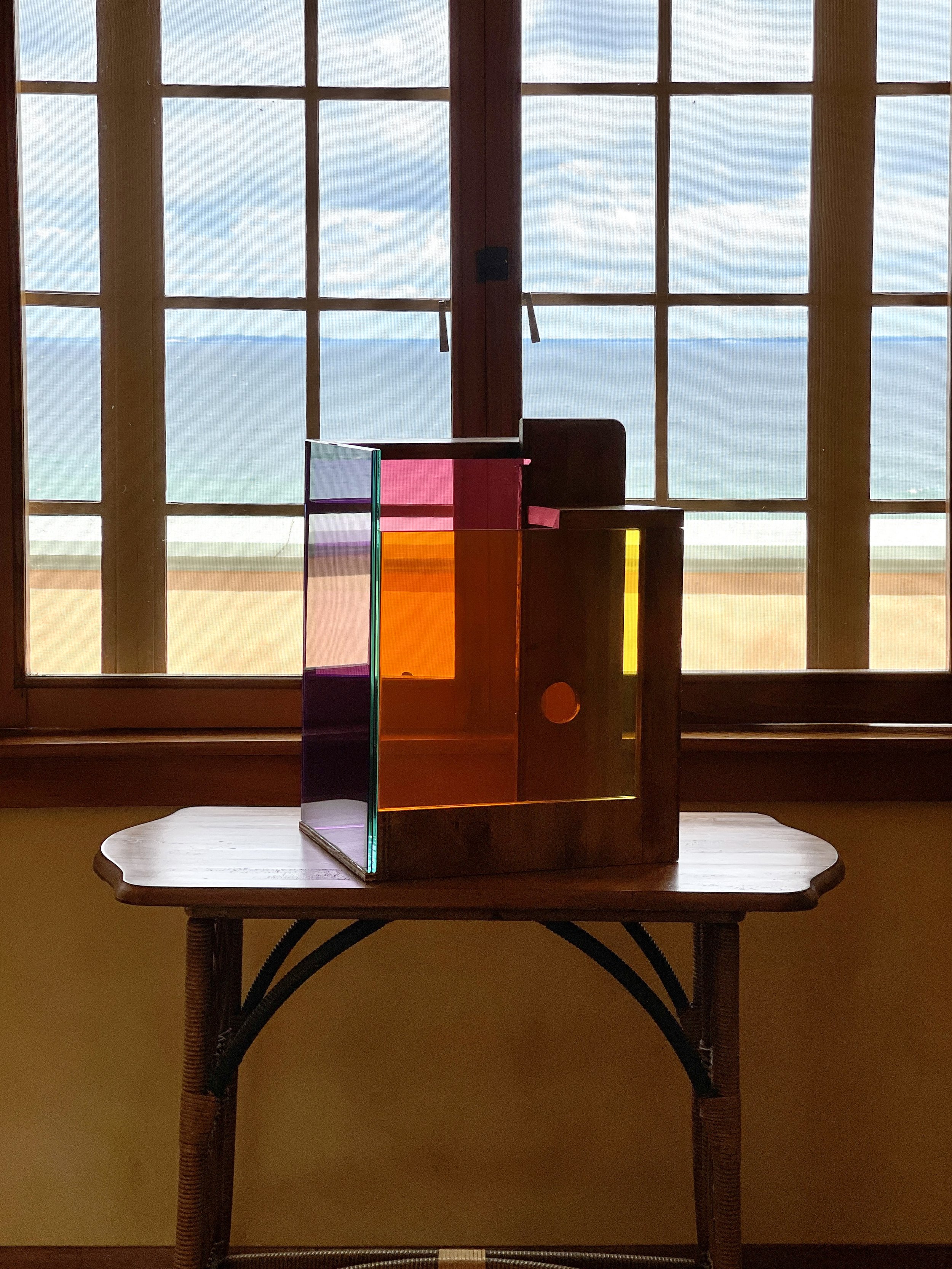
Her House, a small sculpture with orange and pink glass by Sarah Braman in Isabelle's room at Graycliff

We really liked Braman’s Her House (2019), which sat in Isabelle’s room, as it evoked the larger pieces on the lawn.
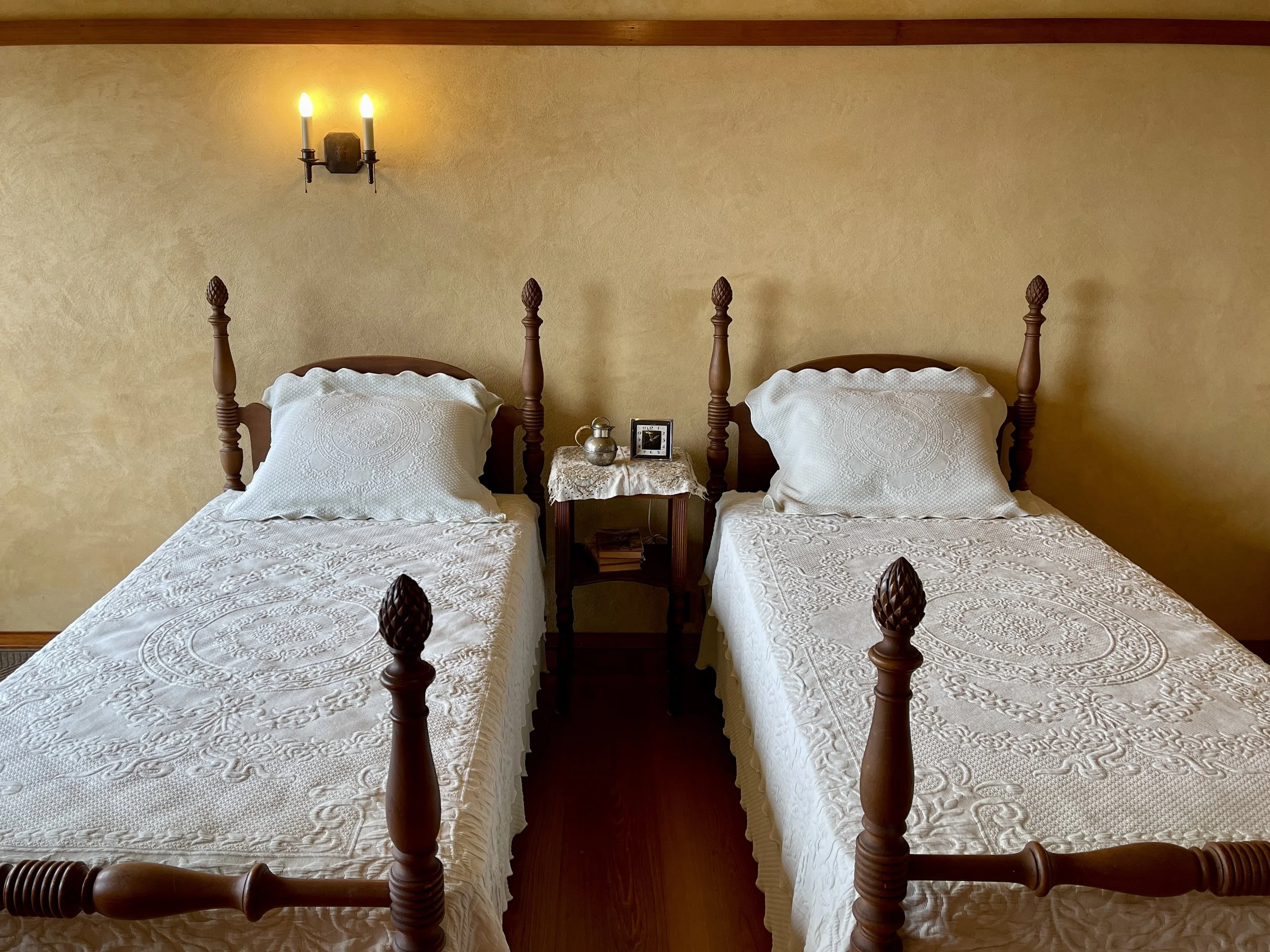
Twin beds in the guest room at Graycliff

A guest room next to Isabelle’s room offered twin beds — and gorgeous views of Lake Erie.
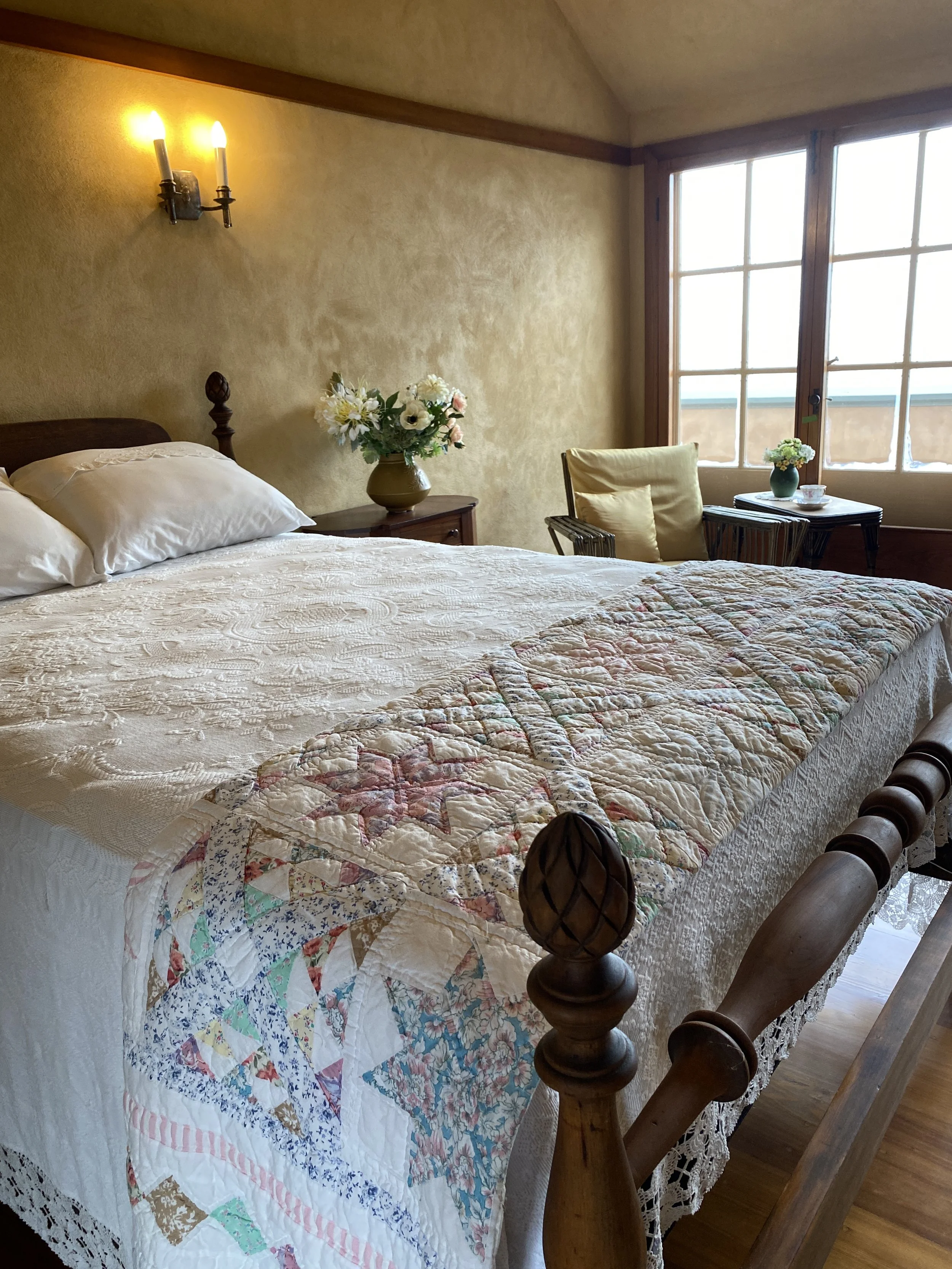
Double bed in Isabelle's bedroom at Graycliff

Isabelle’s room had its own bathroom, a door out to a balcony and a walk-in closet — unheard-of in a Wright home!

Isabelle Martin’s Bedroom 

At the top of the stairs and looking to the left is a monastic gallery, which has a similar set of windows as the living room below, and leads to a private wing with bedrooms. The first is a nice guest room, with Isabelle’s bedroom next door.

Wright despised closets. However, Isabelle was the client of record for the house and insisted he provide her with one. Her bedroom includes a walk-in closet where the bathroom was originally planned. But Isabelle wanted her bathroom to have a window, so it had to go on the lake side and required Wright to cut a hole into the chimney to accommodate her request. 

A private terrace is accessible from Isabelle’s room, and she probably spent evenings there as direct sunlight would have been too much for her eyes to bear. 
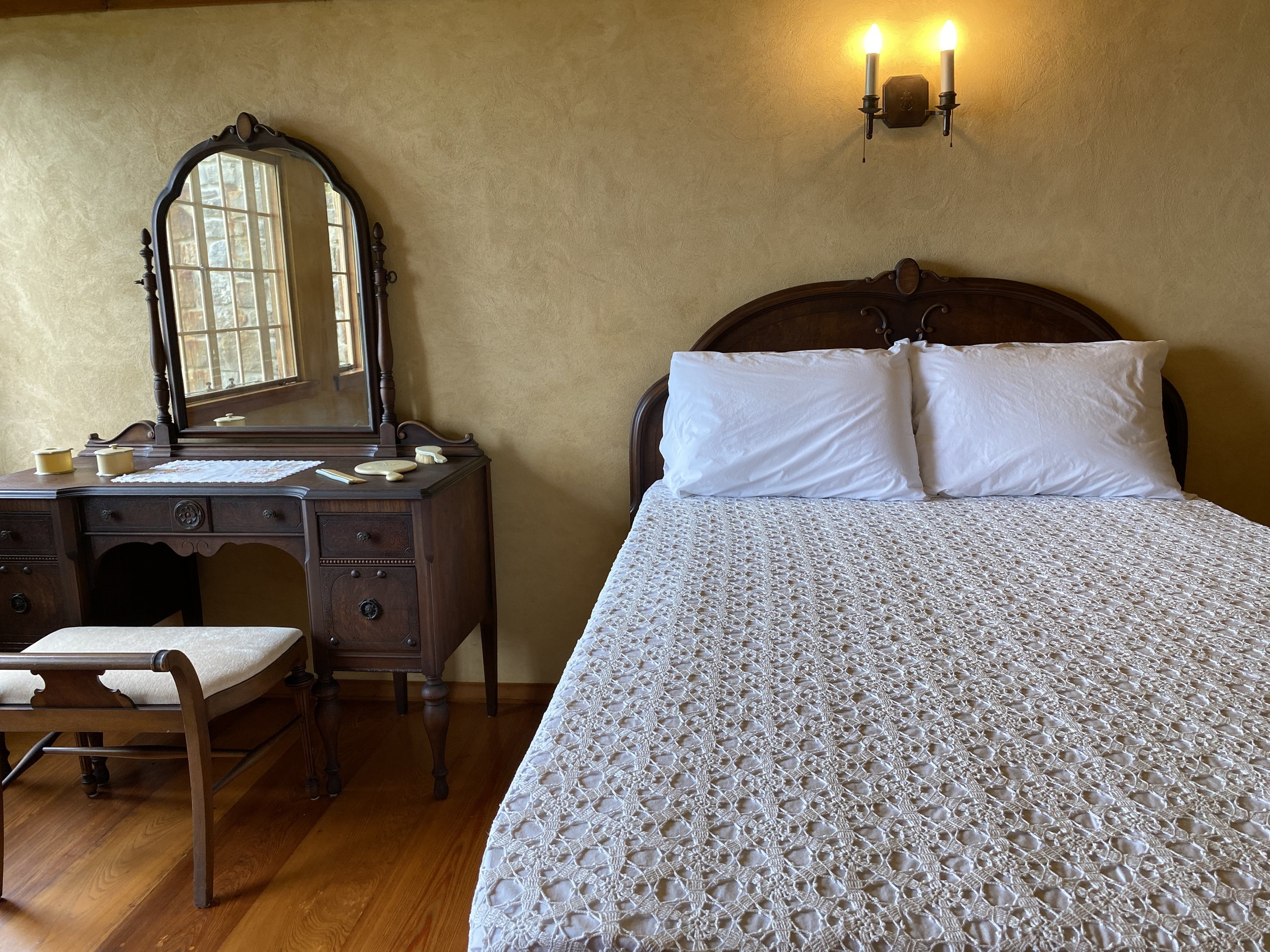
Double bed and vanity in Aunt Polly's room at Graycliff

She might have been the hired help, but Aunt Polly sure had nice digs at Graycliff.

Aunt Polly’s Room 

While she did get a nice bedroom, Aunt Polly was technically the help. Her room is a transitional space from that of the immediate family to the staff. 

Cora remained in service from 1911 until Isabelle’s death in 1945. In 1929, when the Martins could no longer afford to pay her, Cora stayed on for room and board. After their mother’s death, the children took care of their dear Aunt Polly. 
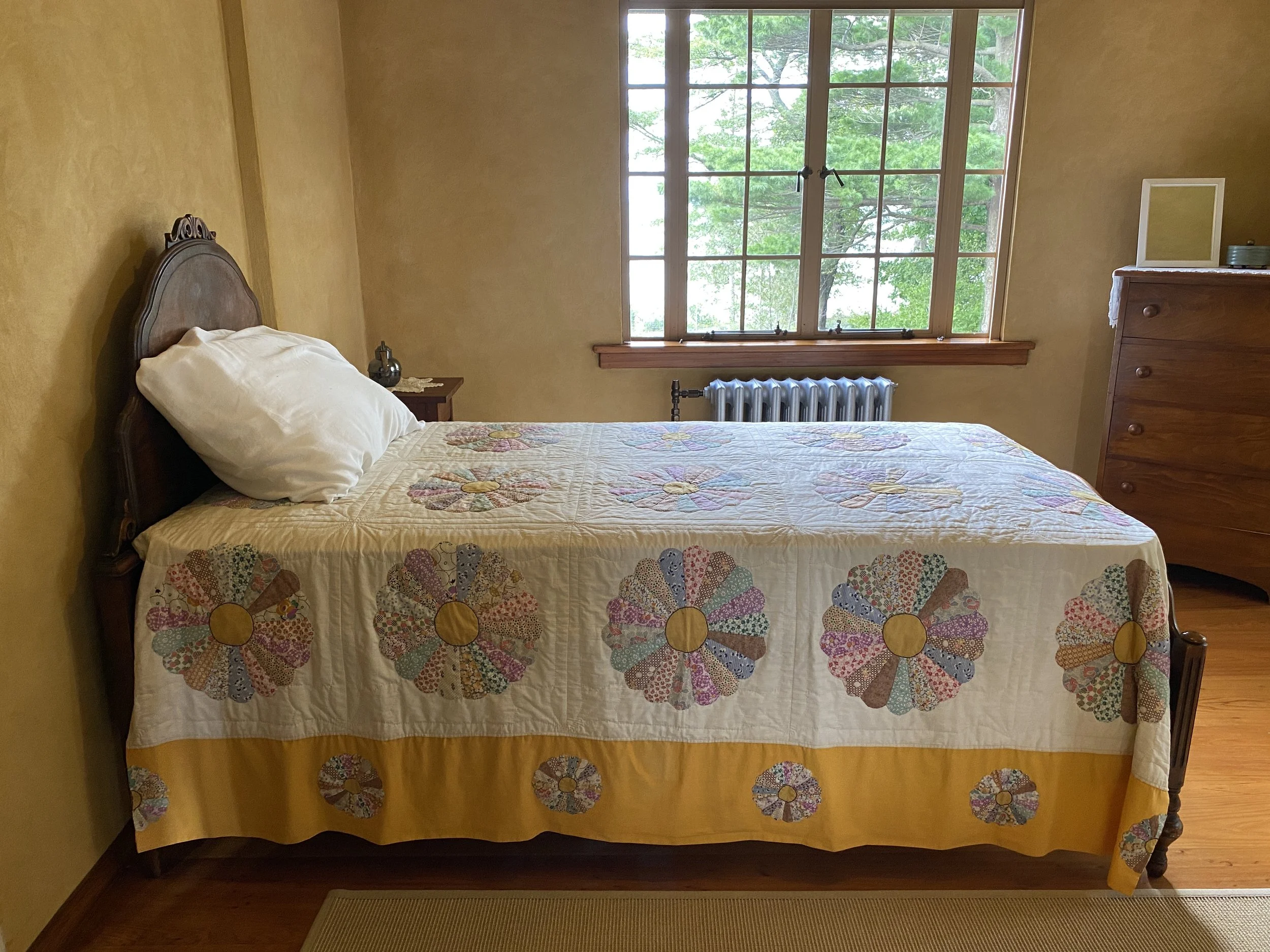
Colorful quilt over bed in servant's room at Graycliff

Even the servants had cute rooms at Graycliff.
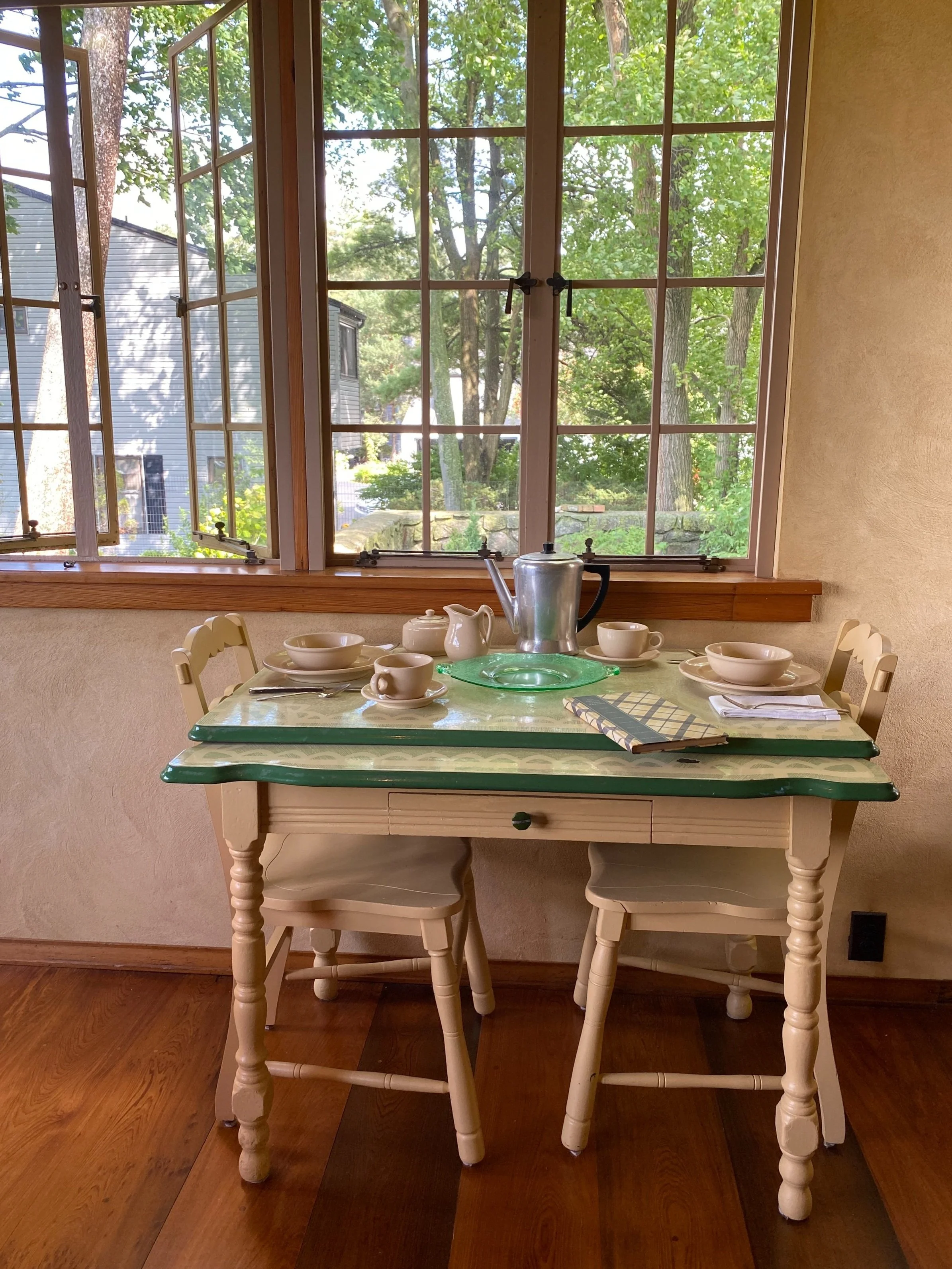
Small table and chairs for servants in sunroom at Graycliff

The servants had their meals in a sunroom at the back of the house.
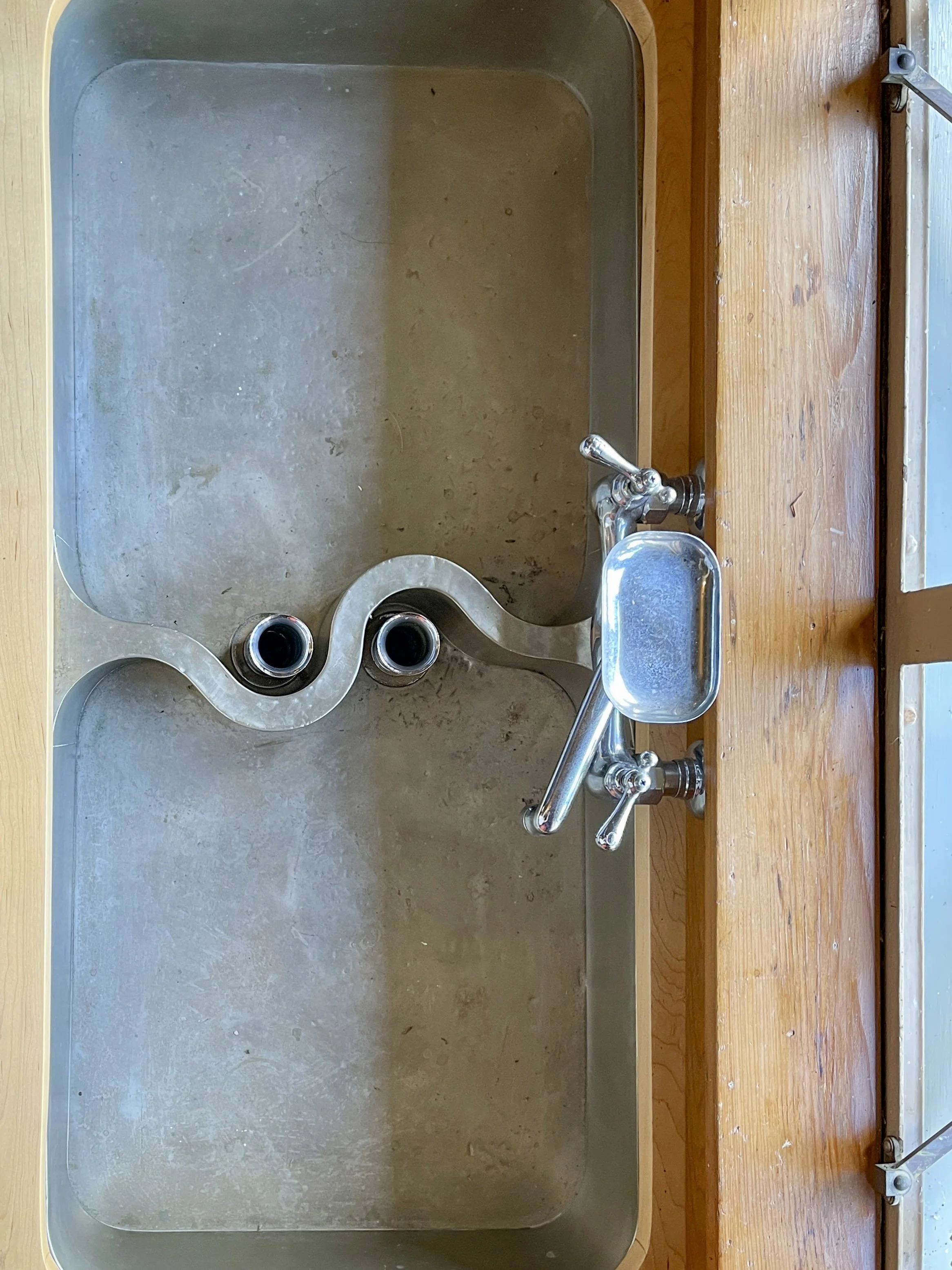
Metal sink with wavy divider at Graycliff

This cool sink came from Europe and was used exclusively by Isabelle for her flower arrangements.

The Pantry and Kitchen 

Farther down the corridor are two bedrooms for the staff, as well as the back staircase that leads down to the staff sunporch and kitchen area.

The hammered metal sink in the pantry was imported from Europe and was used solely by Isabelle to arrange flowers from her cutting garden. The cook had to use the one in the adjacent kitchen, which faced the front yard instead of the lake. 

On display within the built-in cabinets, another Wright trademark, behind Isabelle’s sink, are Larkin Soap products, including Buffalo china. Elbert Hubbard was Darwin’s brother-in-law and started the Arts and Crafts Roycroft movement in East Aurora, New York. He suggested to Larkin that consumers would be incentivized to purchase their product if they received a piece of china along with it. He was right, and the pottery ended up being quite successful. 

In the cabinets, there’s also the Martins’ red and white wedding china and Indian Tree pattern china, which were gifted to the conservancy by the couple’s grandchildren. 
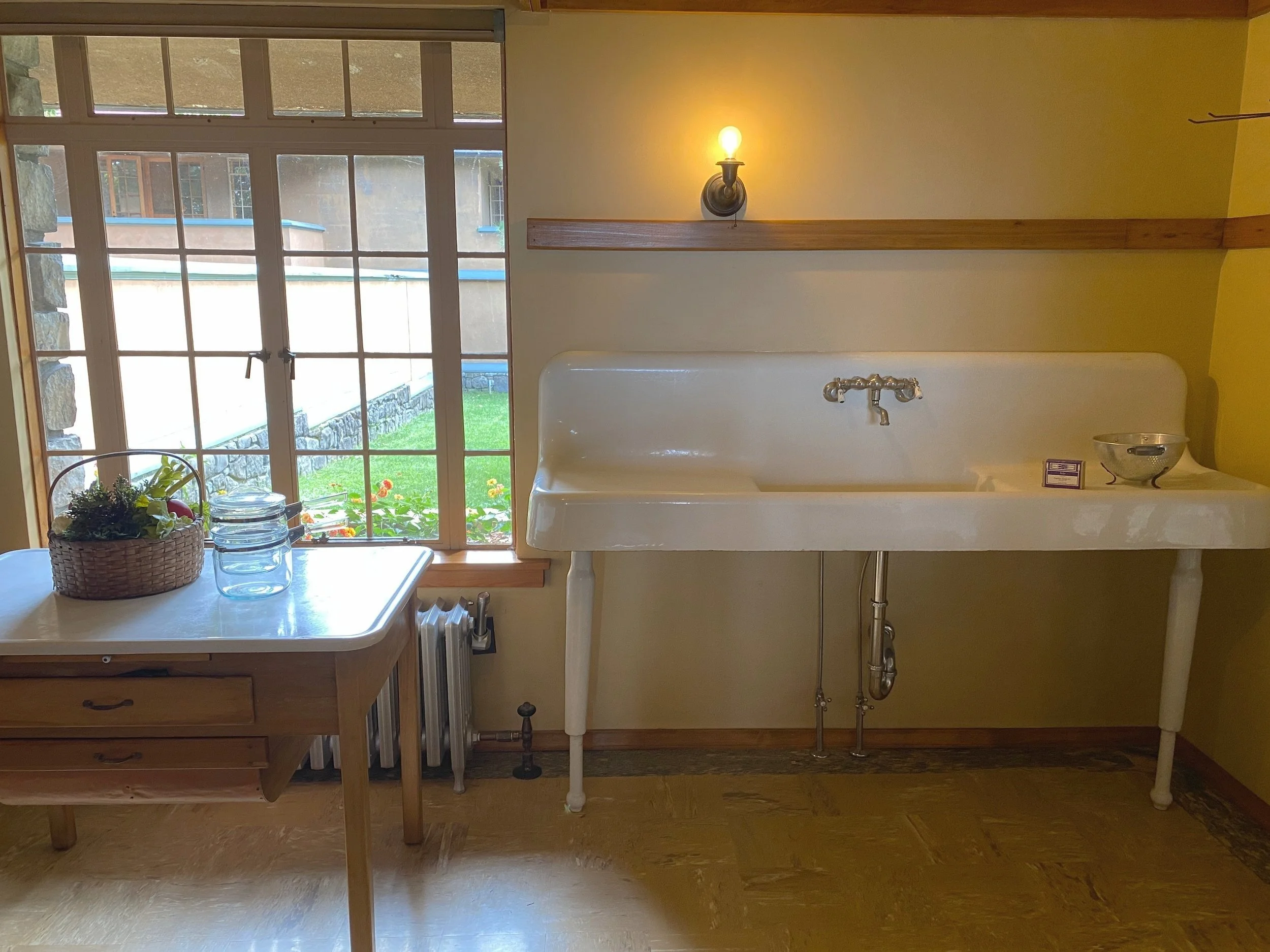
Kitchen sink and table at Graycliff

Here’s the sink the cook used in the kitchen off of the pantry.
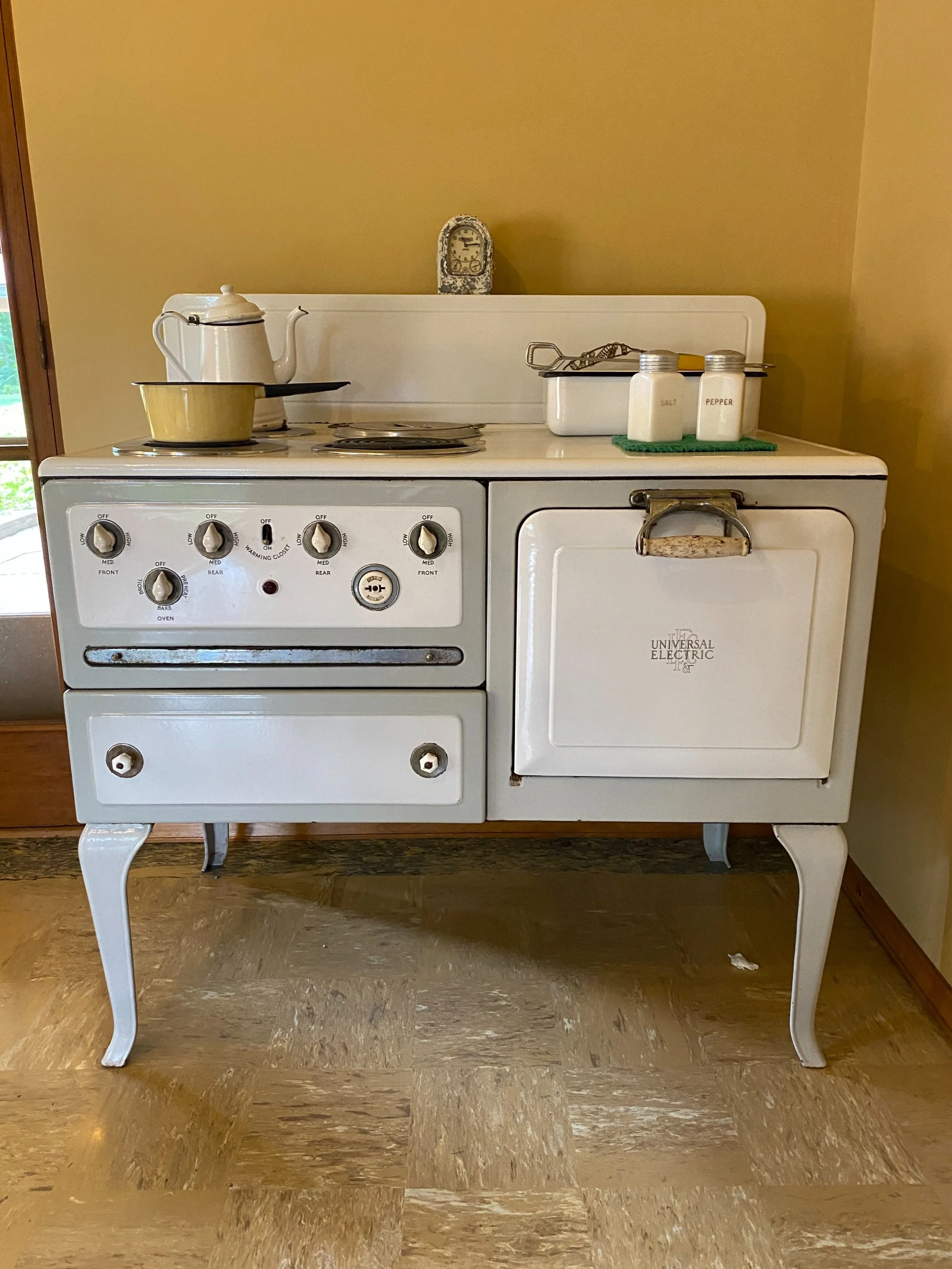
White old-fashioned oven and stove in the kitchen at Graycliff

The stovetop and oven were all part of one piece of furniture.

The small yet functional kitchen contains another original piece, a hulking fridge from the Jewett Refrigeration Company, along with a freestanding prep station, sink and porcelain-glazed stove. 
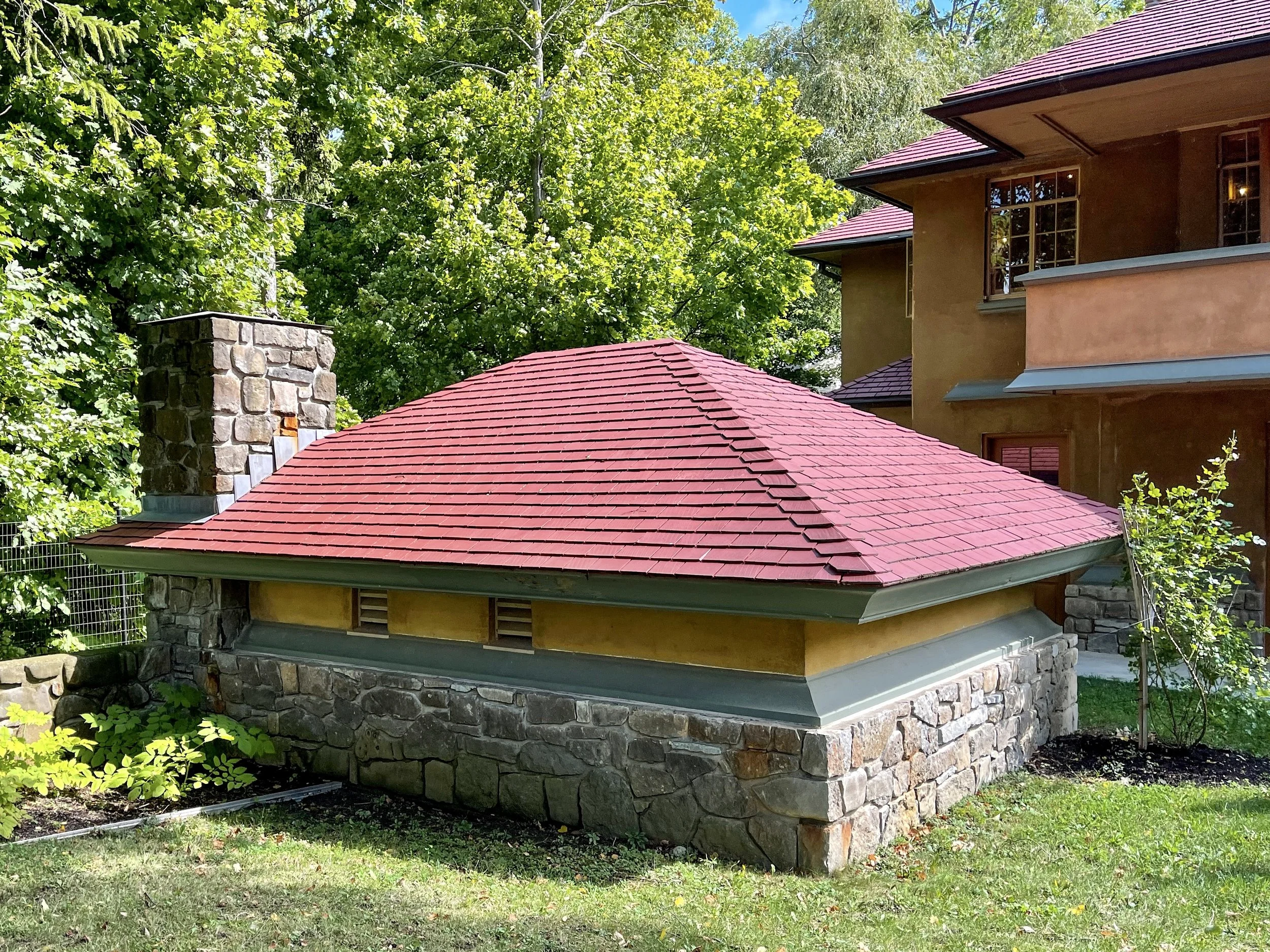
Red-roofed Heat Hut at Graycliff

The Heat Hut held a boiler to heat both Graycliff and the Foster House. Then the priests used it to store wine and honey.

The Heat Hut

Sitting between the main home and the Foster House is the sunken red-roofed Heat Hut. The structure once held an oil boiler that provided steam heat to both houses. According to Gail, the Piarist priests used it to store wine and honey from the bees they kept on the property. 
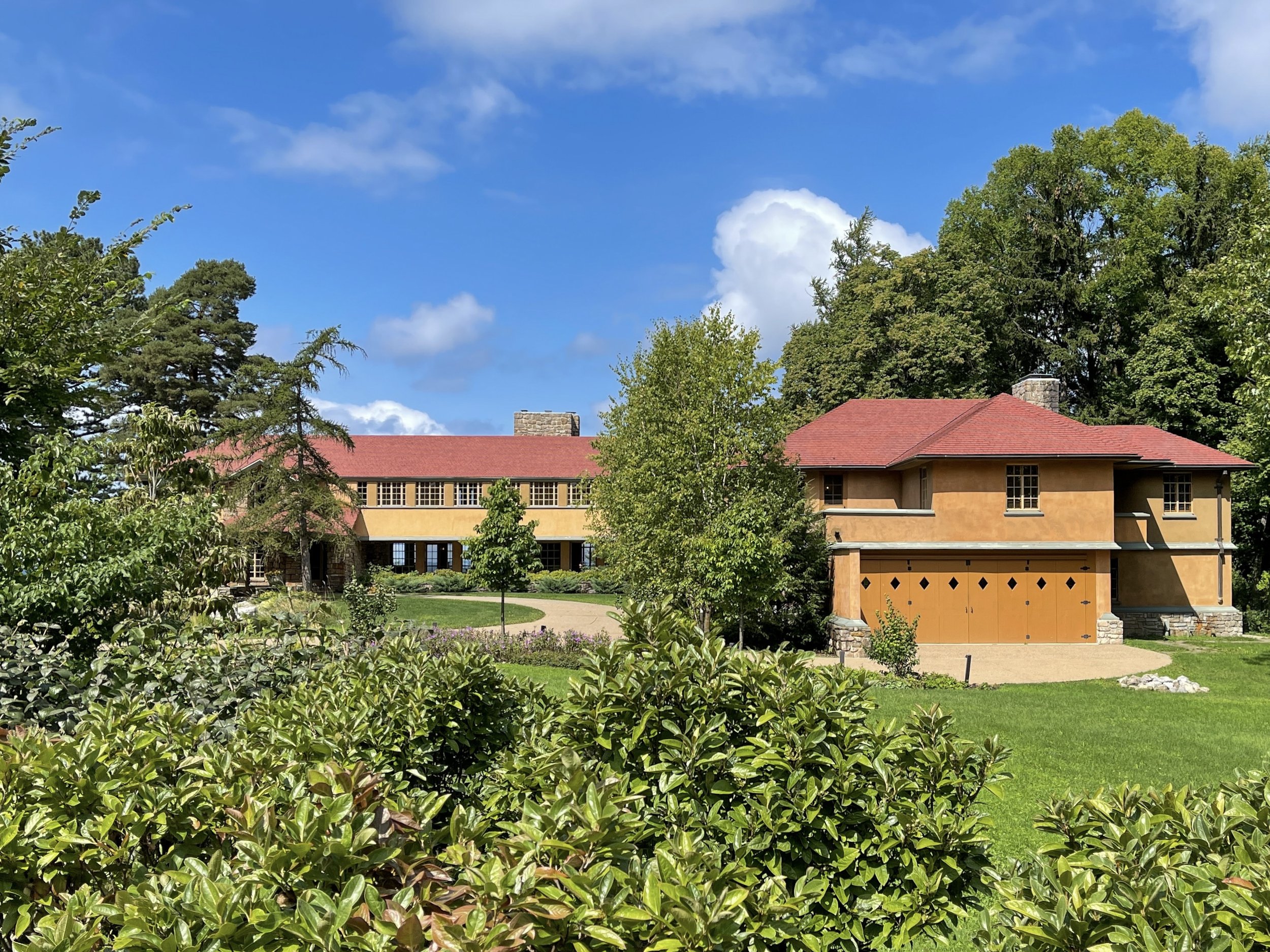
Foster House and garage at Graycliff

The Foster House, part of the garage at the Graycliff estate, was originally used by the chauffeur and his family.

The Foster House

The apartment above the garage was built for the chauffeur and his family. The original design was flipped so that the cantilever balcony would afford its inhabitants unobstructed views of the lake. 

Shortly after the stock market crashed, the Martins couldn’t afford to keep the chauffeur out at Graycliff, so they sent him back to Buffalo, and their daughter Dorothy, and her husband, James Foster, moved in, spending summers there with their two children until 1941. 
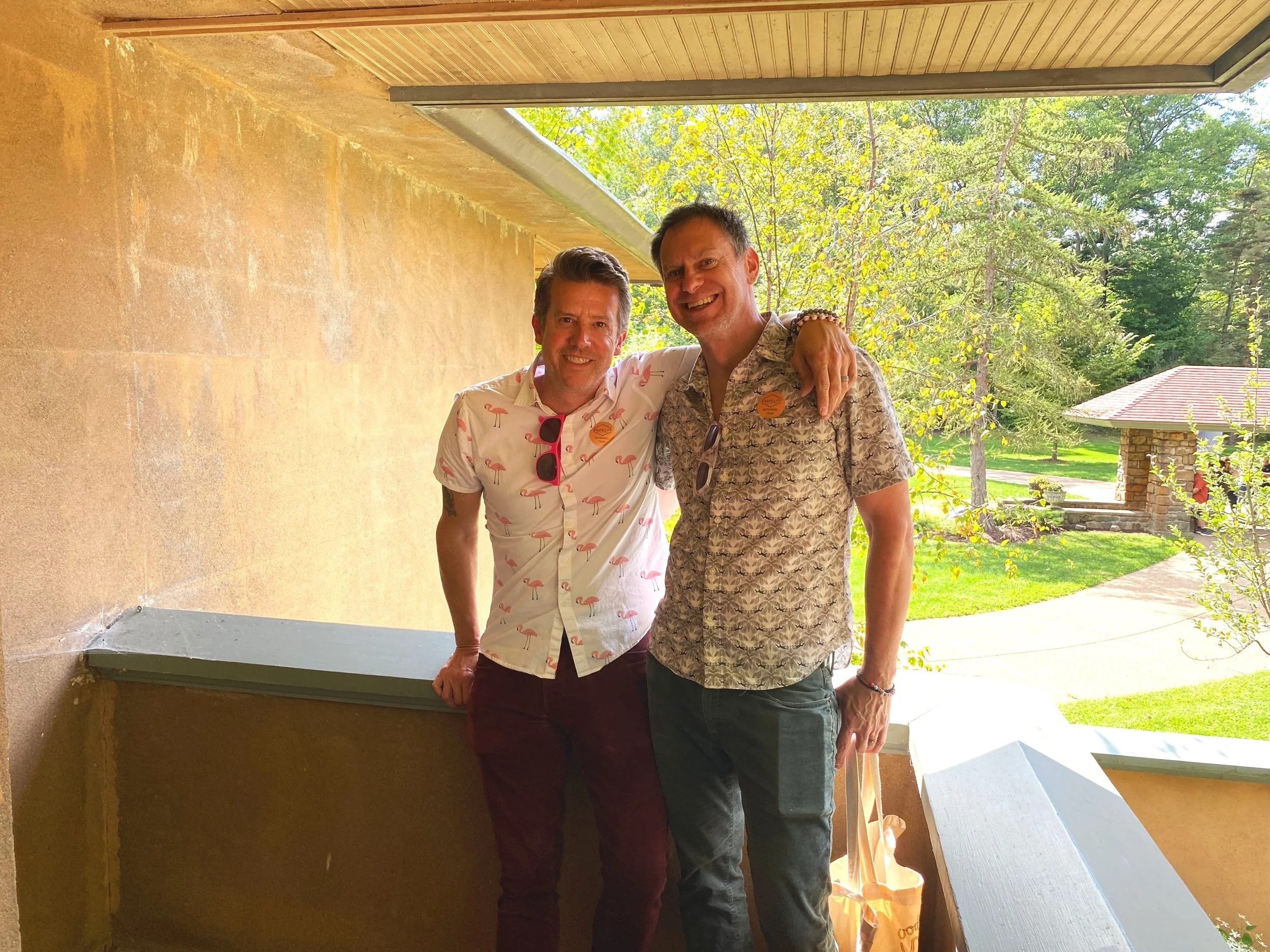
Two men standing on a balcony at the Foster House

Wally and Duke on a balcony of the Foster House
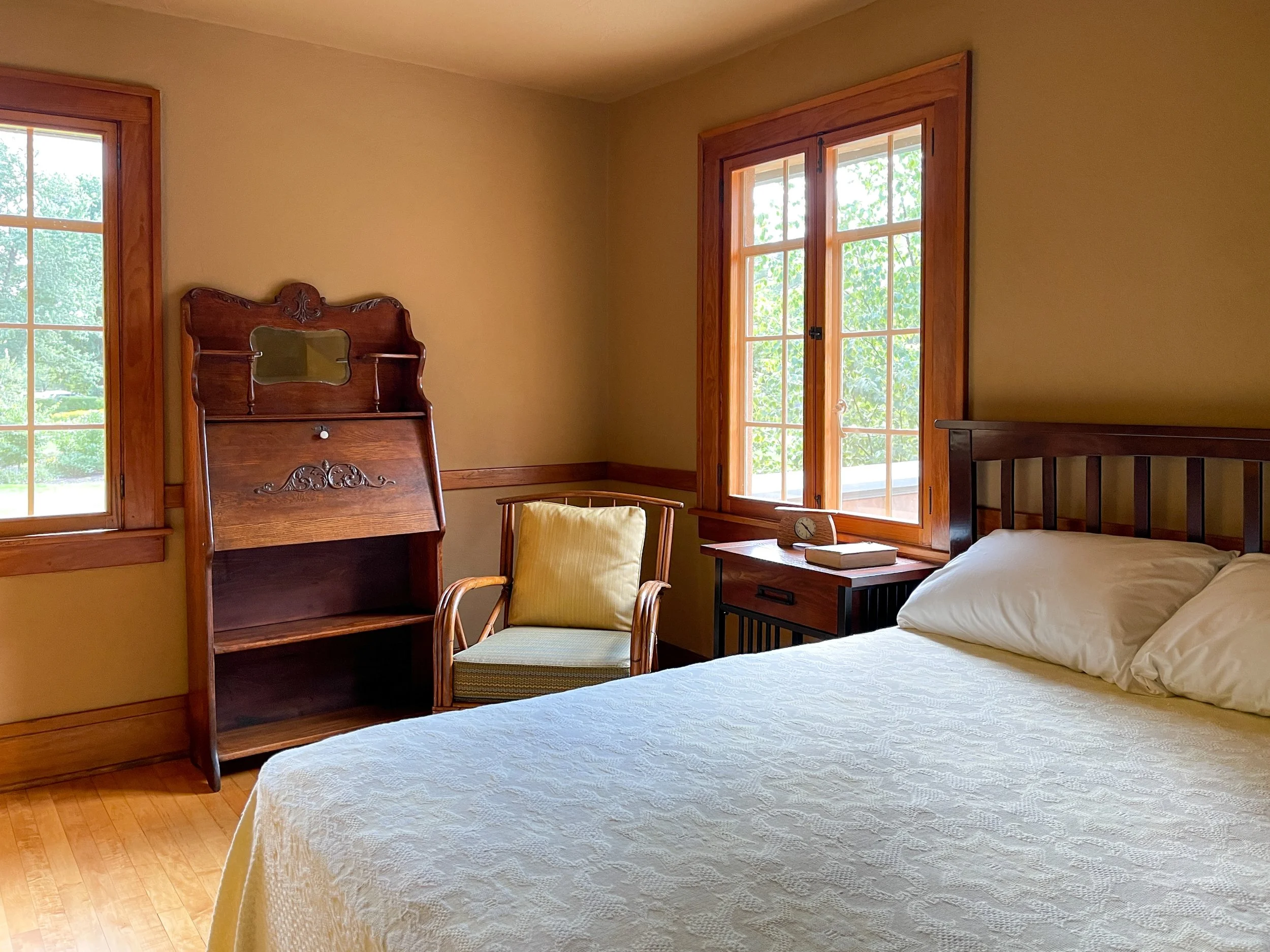
Bed, chair and desk in bedroom at the Foster House

There are quite a few bedrooms in the Foster House — but not much else, aside from a small sitting room and kitchen.

After Darwin’s death and the family’s financial troubles, Isabelle moved into the Foster House, staying in what was the gardener’s room, which had its own bathroom. The ever-particular woman liked to sit on the balcony — but she didn’t appreciate seeing the cars pull into and out of the garage. She contacted Wright, who acquiesced and moved the garage doors to the side and extended the wall.
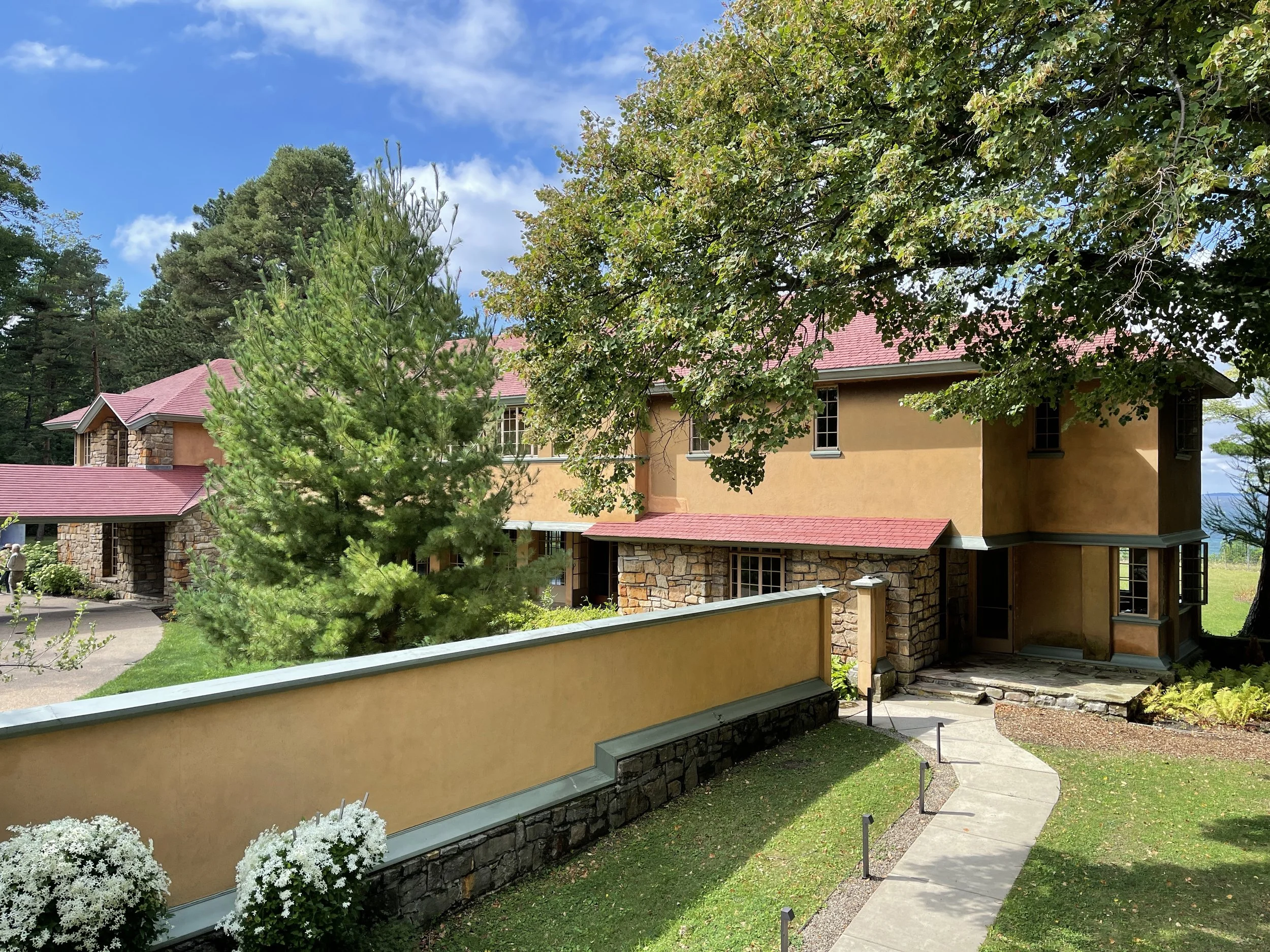
Yellow wall at Graycliff

Wright extended a wall to block out the view of cars coming and going from the garage for Isabelle.

“And she says, ‘While you’re at it, can you make me another bedroom up there?’” Gail tells us. So the apartment now has four bedrooms and a couple more balconies. Isabelle seems to have been the one person who could charm Wright into altering his original plans.
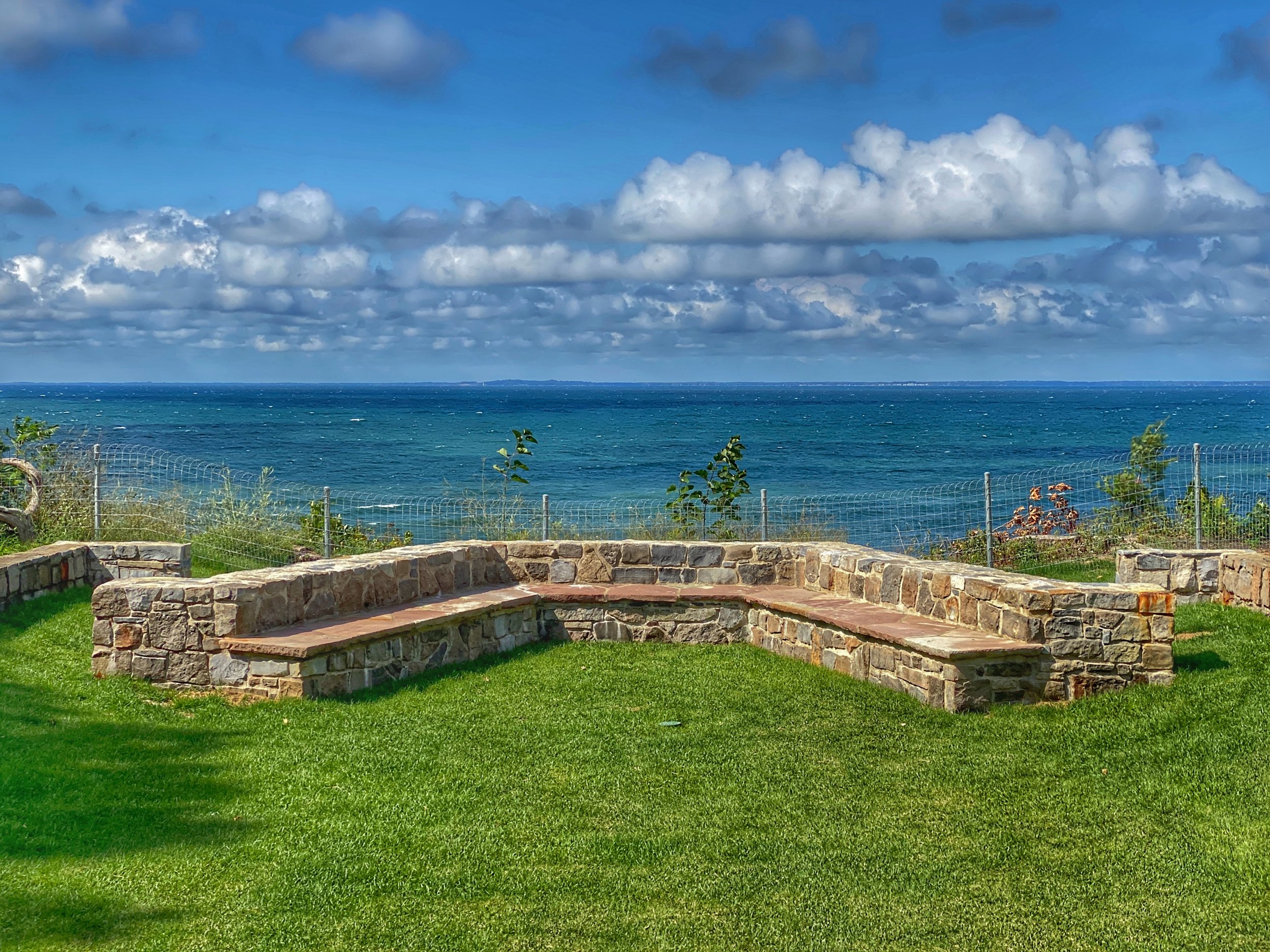
Stone seating area on cliff above Lake Erie

The seating out back helped hide the servants carrying picnic items down to the beach and back.

The Esplanade 

Wright’s idea for the esplanade was to build a reflecting pool, cascading terraces and steps that led all the way down to the beach. But when the architect left the premises, Darwin contacted his friends at Bethlehem Steel to request a metal tower with steps like those his neighbors had. Not as pretty as Wright’s vision but certainly practical. It deteriorated, so there’s no longer any way down the beach.
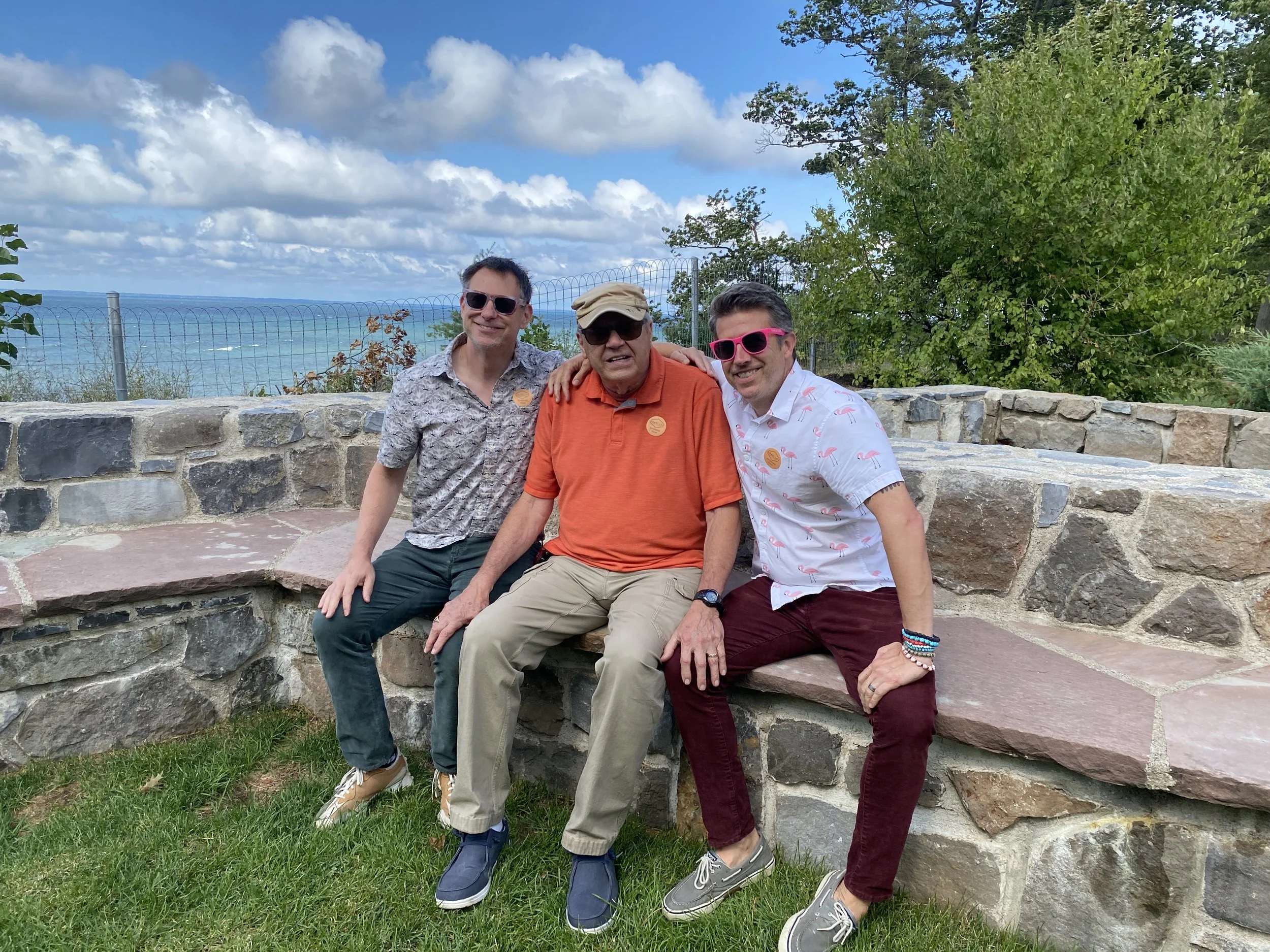
Three men on stone seating in the backyard of Graycliff

Duke, Poppa and Wally enjoy the gorgeous day at Graycliff.

The access to the stair tower was visible, though, and again Isabelle complained about the view. When she was out on her terrace, she could see the servants coming and going. She felt this was unseemingly — that’s why they had a rear staircase, after all — so Wright constructed the overlook seating in such a way that the help could go about their business while remaining out of sight. 

Saving Graycliff 

When the Martin family decided to sell the property, the person who wanted to buy it was a developer who built the condominiums that are now next door. He planned to demolish Graycliff — who needs a historic home when you can get top dollar for lakefront condos? 

Thankfully, a group in Buffalo came to the rescue, forming the Graycliff Conservancy. In 1999 they received a grant, and the conservancy was able to purchase the property. 

The renovations began, wrapping up in 2019 and costing about $10 million. 

There are plans to build a new eco-friendly visitors center to replace the current one, which was built by the priests as a gymnasium for the children.

Restored back to its 1926 splendor, Graycliff exemplifies Wright’s philosophy of living in harmony with nature. If you’re in the Buffalo area, stop by for a visit. As with all of Wright’s homes, they have to be seen to be fully appreciated. –Duke
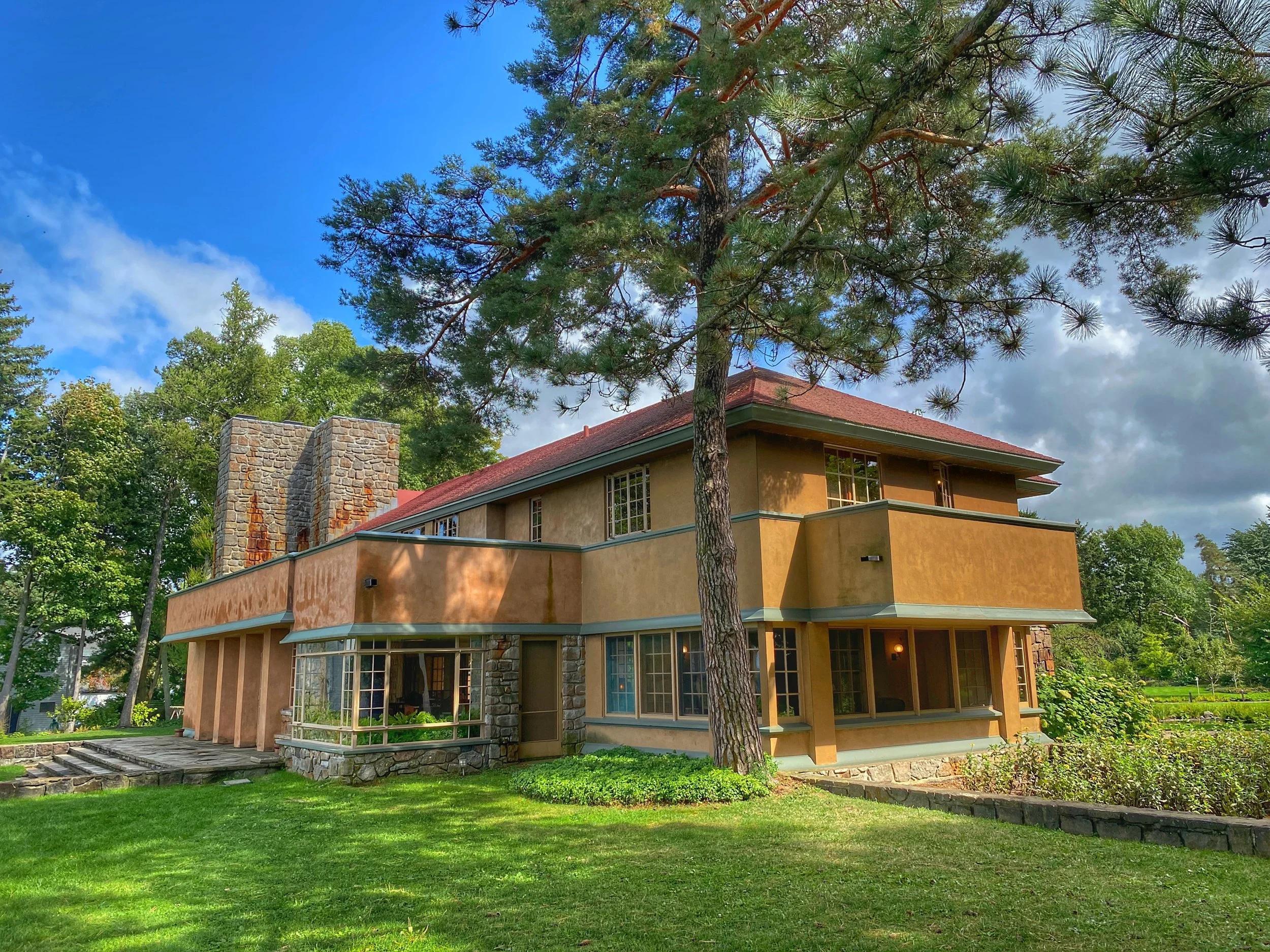
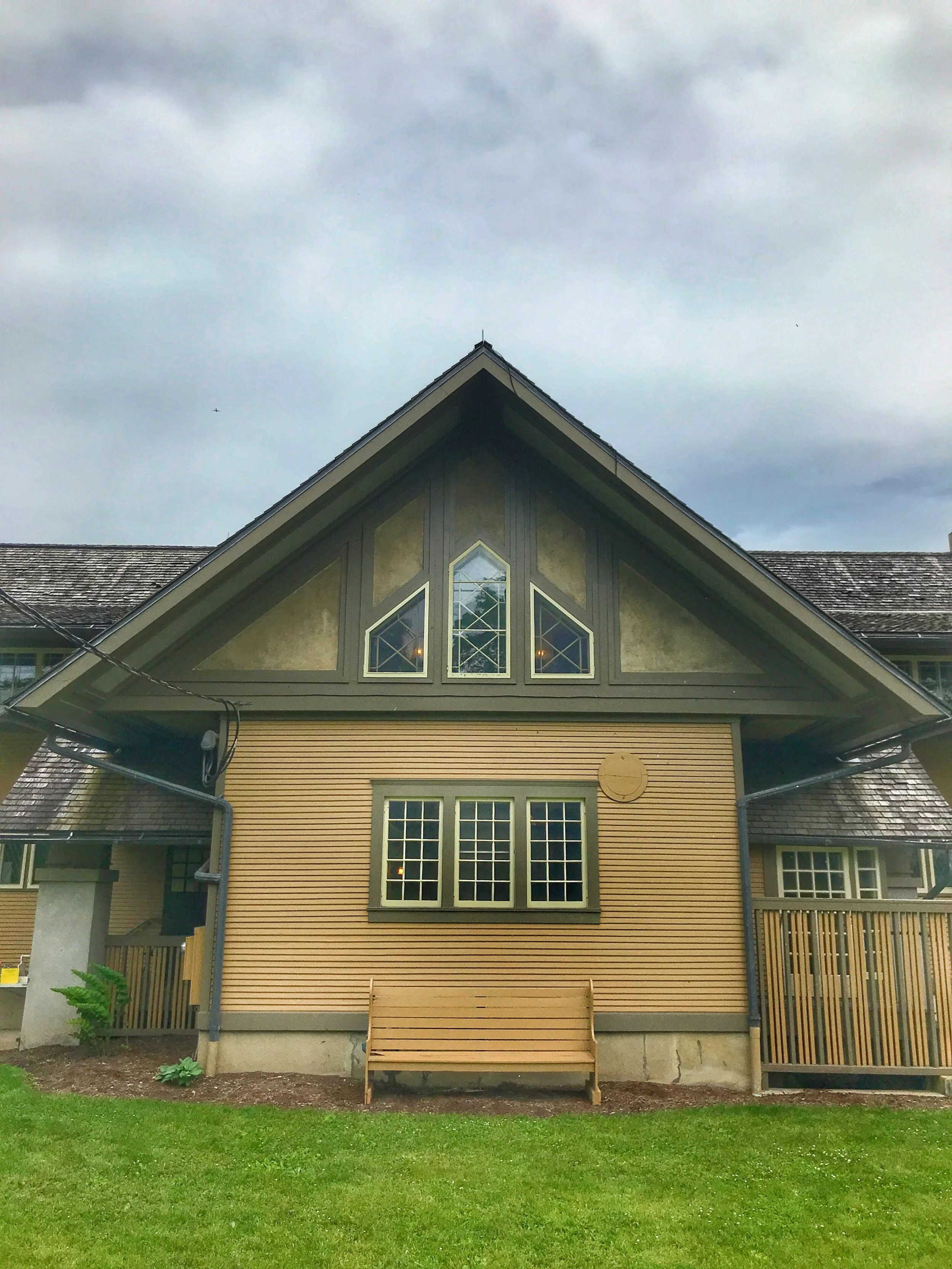
The back and side view of Frank Lloyd Wright's Graycliff

Frank Lloyd Wright’s Graycliff

Graycliff

6472 Old Lake Shore Road
Derby, New York 14047
USA
 

Pilgrimage to Marfa, Texas

Seeking spirituality in the mystical town that modern artist Donald Judd helped build. 

Marfa, Texas street

Sleepy Marfa, Texas: Try the sotol at the Marfa Spirit Co. (on the left) and get your caffeine fix at the Sentinel coffee shop (to the right).

On Sunday we wake to our alarms set for 7:30 a.m. We crawl out of bed, run to the bathroom, throw on clothes — no time to brush teeth or make coffee. We’re not leaving town just yet. In fact, this is one of the reasons we arrived in the first place. I draw the bedroom curtains open in a panic. Phew. Okay, we’re okay — we have time. The sky is still an indigo gradient spreading across the Davis Mountains in the distance. And of course it is: The sun doesn’t rise until 7:50 something. 

We’re headed across town to the Chinati Foundation for an annual sunrise viewing of Donald Judd’s 15 untitled works in concrete. 

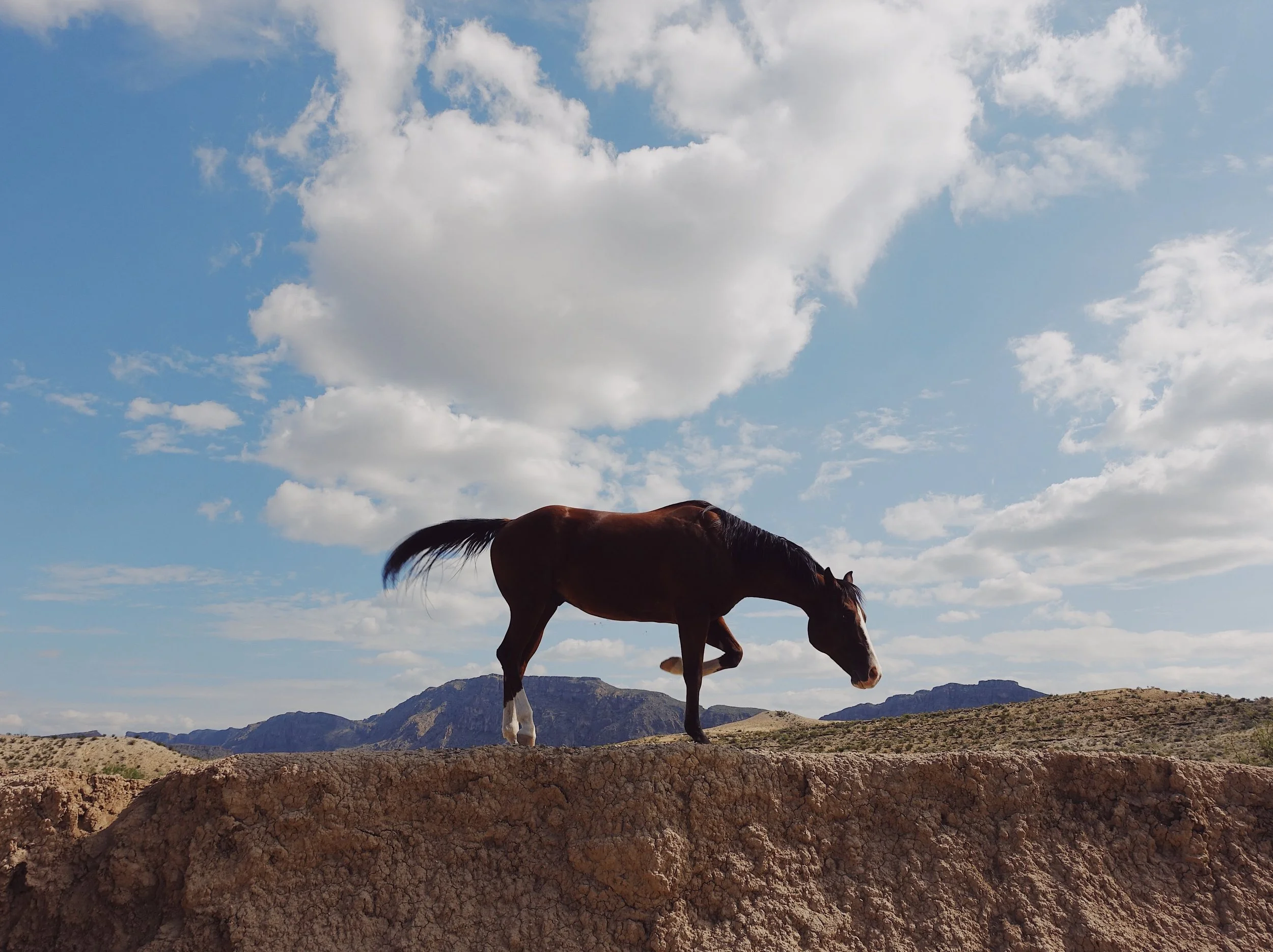
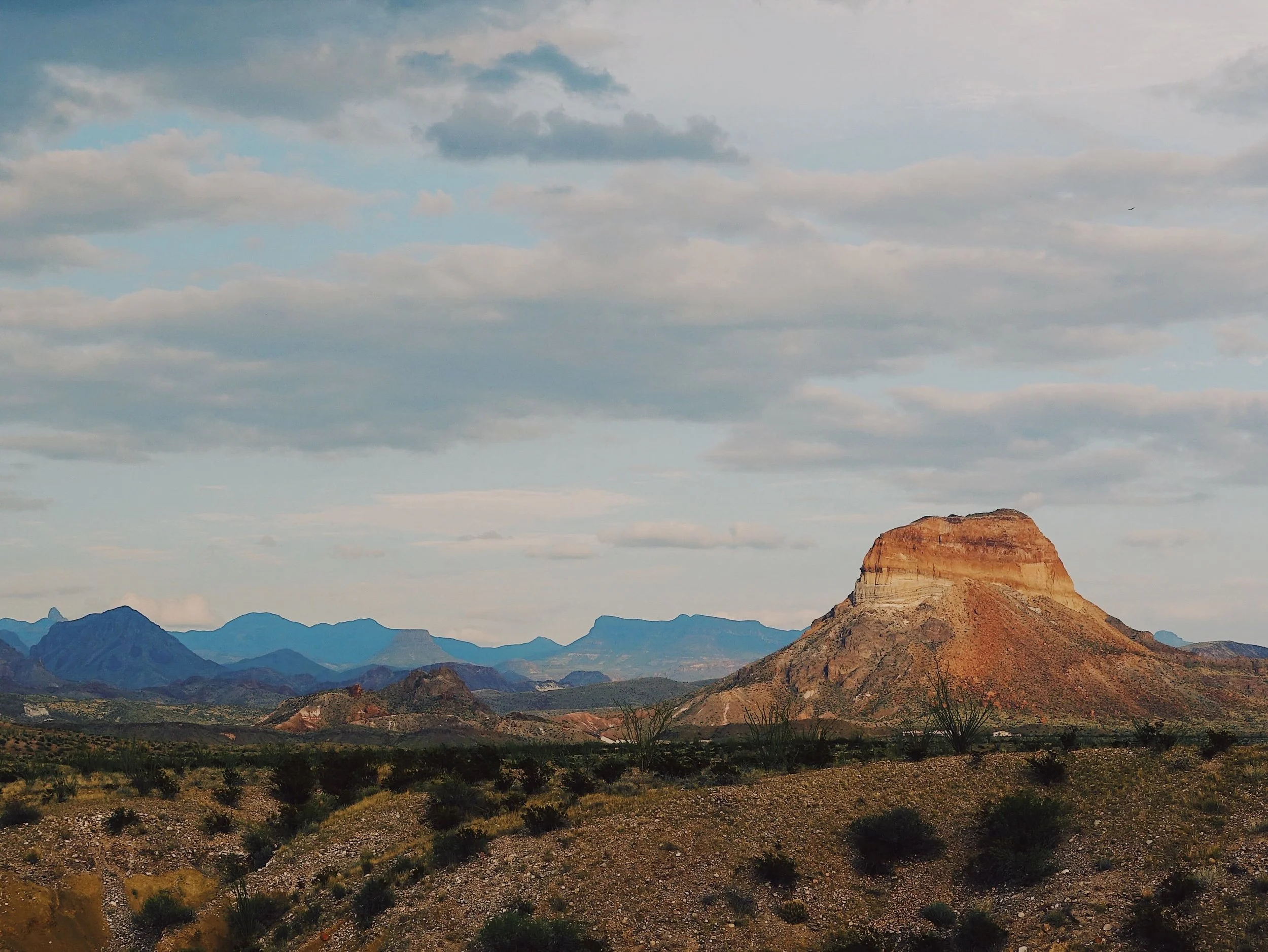
Horse outside of Big Bend National Park in Texas

A ranch horse outside of Big Bend National Park

It’s all about the light.
— A random mom to her child, at the Chinati Foundation

All sense of anxiety — to be on time — flees once we arrive. Folks park their cars along the main road leading to the foundation’s gates. People seem to be getting out of their cars and making their entrance in slow motion. Maybe they’re hungover from the free booze at the arena last night. Maybe they also had to skip the coffee this morning. Or maybe this place is just demanding our slow presence, asking us to be aware. 

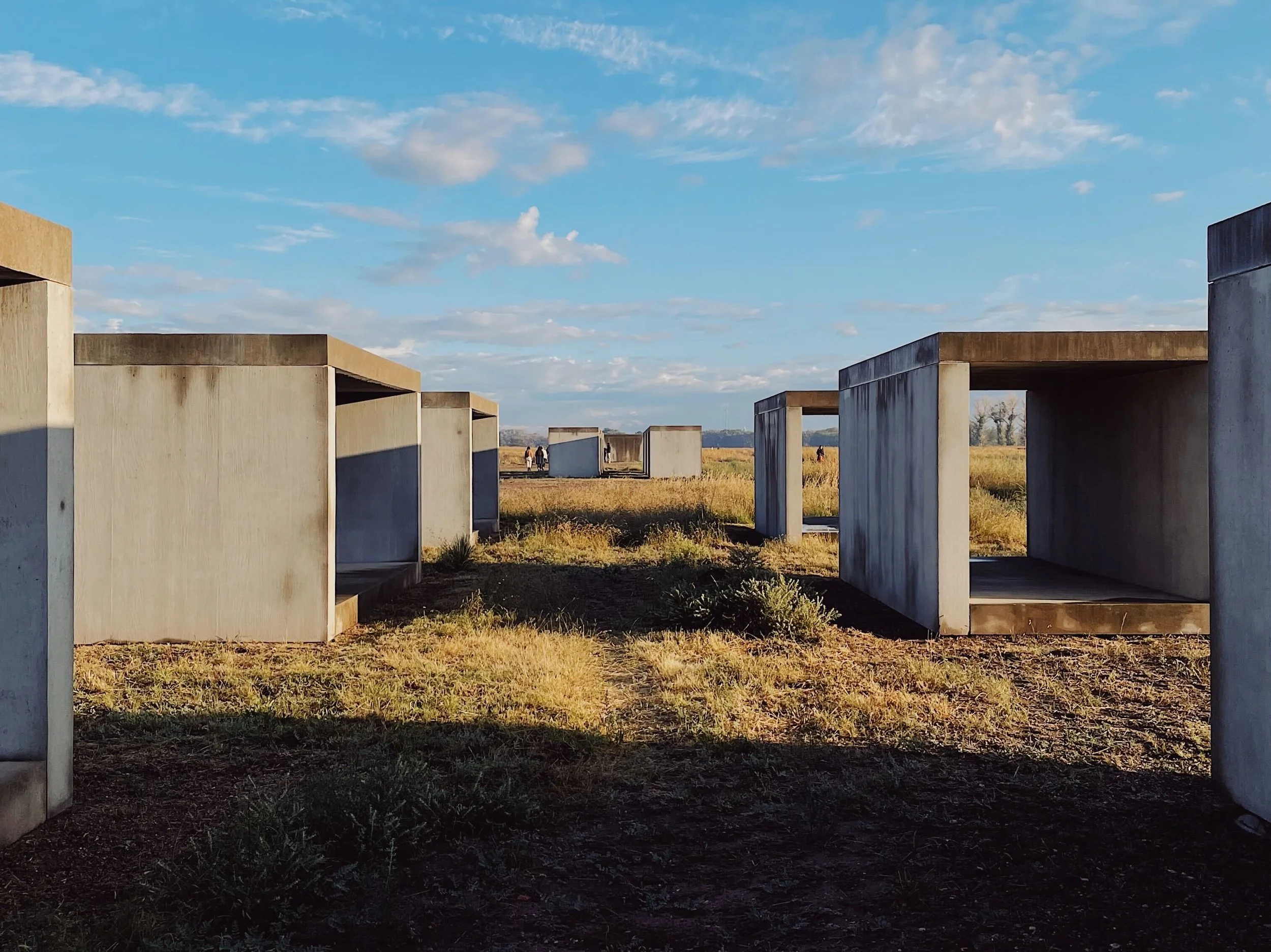
The 15 works in concrete are actually 15 separate arrangements of concrete rectangular prisms stretching north to south in a straight one-kilometer line. There are 60 boxes in total. Each unit contains the same dimensions, 2.5 by 2.5 by 5 meters, and is built with concrete slabs 25 centimeters thick. Each work plays with shape and light — some with units arranged into triangles and others into rectangular patterns; some with three in a group, others with six. Throughout the works, the individual units showcase variety. Some are completely closed boxes and others allow light and air to permeate: sometimes on the long sides, sometimes on the short ends. 

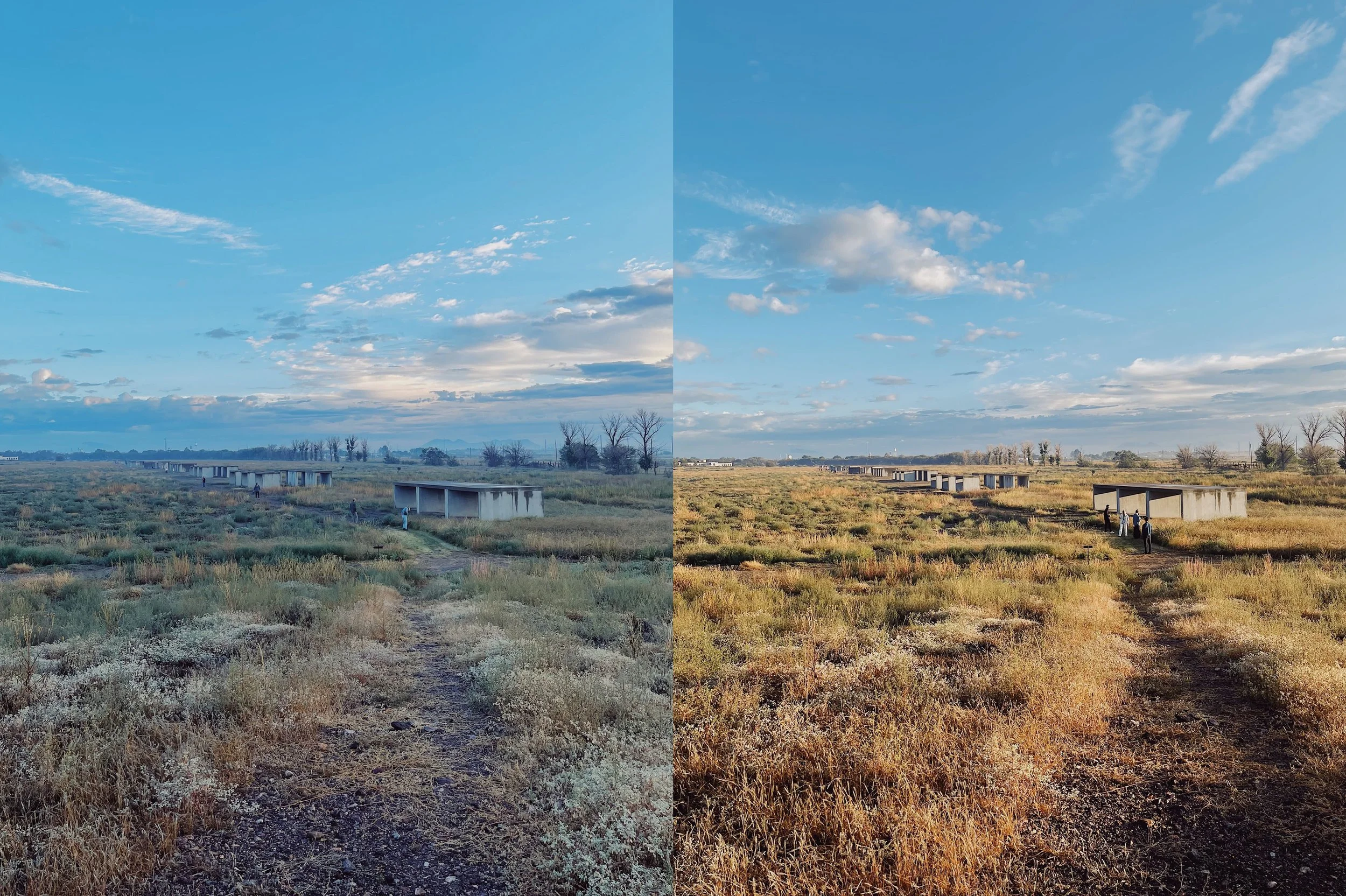
Two images of Donald Judd's concrete works in Marfa, Texas, in different light

The light changes everything when viewing Donald Judd’s untitled concrete works in Marfa, Texas.

There’s a stillness in the air this morning. Not creepy or eerie. Just still. Calm. As we descend the path leading to the sculptures — every step leaving new, prickly grass burs stuck to our boots — I can tell the sun has broken above the horizon. I can’t see it behind the pony wall of clouds, but I know it. The once-indigo sky is getting brighter and lighter by the moment. Fog in the distance is becoming more obvious and the dew on the desert grass is catching the light. 

Donald Judd's minimalism concrete arches in Marfa, Texas

Judd’s works, finished in 1984, can be found on a former military compound.

Once we get down to the long line of concrete boxes, I know I want us to walk south. There’s a small hill at the end. It’s the only place on campus where you can see all 15 works at once. On a mission, in a race against time — I wasn’t sure how quickly the sun would rise above the clouds — we led the march atop the hill. And then we just stood there. Watching other observers and observing ourselves. Resting. Waiting. I wanted this perspective for when the light rose above the clouds and spilled out onto the land and through the sculptures. 

Butte and Davis Mountains seen from Big Bend National Park in Texas

The gorgeous scenery in nearby Big Bend National Park

Donald Judd’s Mission and My Personal Pilgrimage 

For a long time I’ve struggled with what it means for something to be spiritual or to be a spiritual person. I’ve identified as nonreligious since my early 20s, shortly after coming out. I think growing up in an evangelical family made me believe that anything spiritual was inherently related to God. And when I left the Southern Baptist church, I had no intention of going back or being associated with religion ever again. I didn’t want to talk about spirituality, much less think about it — it was all tied up in terrible church experiences.

Though, the first time I watched the sun creep above the horizon, stretch its golden light across the surfaces of the Judd pieces and pour a warm glow throughout the Texas desert, it clicked. I thought, “This is spiritual.”

Entrance to Chinati Foundation Chamberlain Building in Marfa, Texas

The entrance to the Chinati Foundation’s John Chamberlain Building

Throughout his career, Judd was interested in ideals of autonomy (a key principle of minimalism), both for the artist and for the artist’s works, hence his anti-museum philosophy and developing this middle-of-nowhere campus for creating and showing his work and that of his contemporaries. For the sculptures, though, a driving concept was his interest in space — how an object takes up and contains space and how an object can be permanent and site-specific. Or as Judd put it, he was interested in “specific objects.” I interpret “specific” to mean both mathematical but also unique to the space in which the object resides.

All of Judd’s sculptures demand your awareness of the space around them, either through scale, texture, color, reflective qualities, placement or some mixture of attributes. 

I’m so drawn to the concrete works because they practically beg you to fall in love with the light and land around them. The Brutalist forms cast geometric shadows, sharp lines amid desert grasses, prickly Texas dirt and a soft view of the Davis Mountains on the horizon. It’s an emotional juxtaposition asking you to consider yourself against the land, by way of the art itself. It’s a manmade proposition with an unavoidable spiritual consequence. 

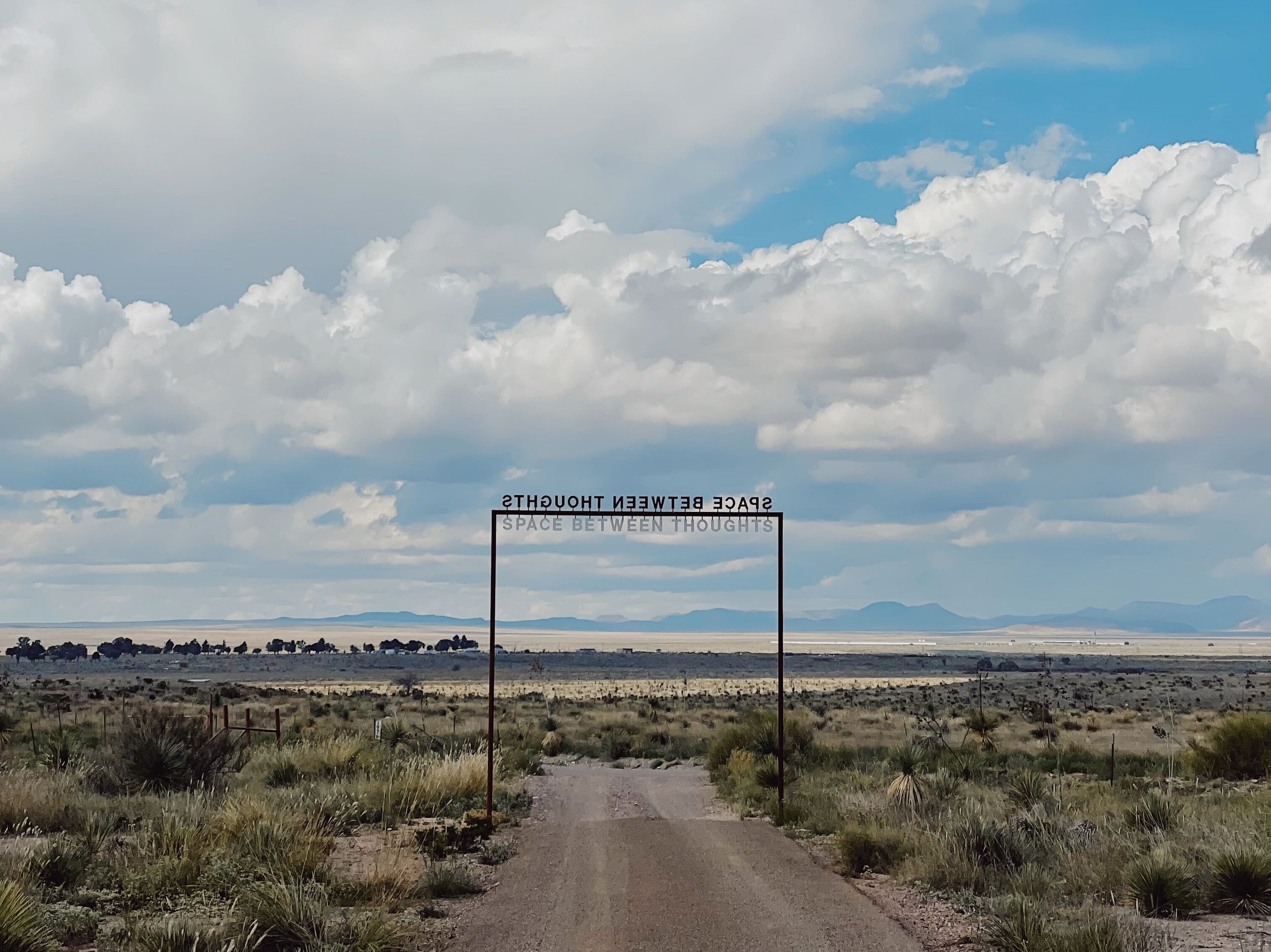
Inflection Point by Darren Almond in Marfa, Texas

Inflection Point by Darren Almond (2022) frames the entrance to the Hetzler Marfa gallery property.

If you get the opportunity to visit Marfa, here are tips from someone who has visited five times since 2015.

4 Tips to Get the Most Out of Marfa

1. Get the full Judd experience.

Some people are drawn to Marfa by the quirky allure of a small art town in the middle of nowhere, or by the iconic Prada Marfa installation (26 miles outside of town, LOL), or by the rentable bohemian trailers and yurts of El Cosmico. And many of them have no clue about the Chinati Foundation or who Donald Judd was. It’s sad not just because they’re missing out on a key contribution to modern art history, but also because without Judd’s arrival, Marfa would likely still be in collapse after Fort D.A. Russell was decommissioned in 1949 (the main site of Judd’s campus).

Judd Foundation exterior

The Judd Foundation

I love visiting Marfa during the annual Chinati Weekend, when the foundation opens its doors to the public for self-guided tours, and the town’s shops and galleries hold special hours for the influx of visitors. 

Outside of that early October weekend, I do recommend visiting when Chinati hosts a sunrise or sunset viewing and also making an appointment for a full collection tour (a four-and-a-half-hour experience).

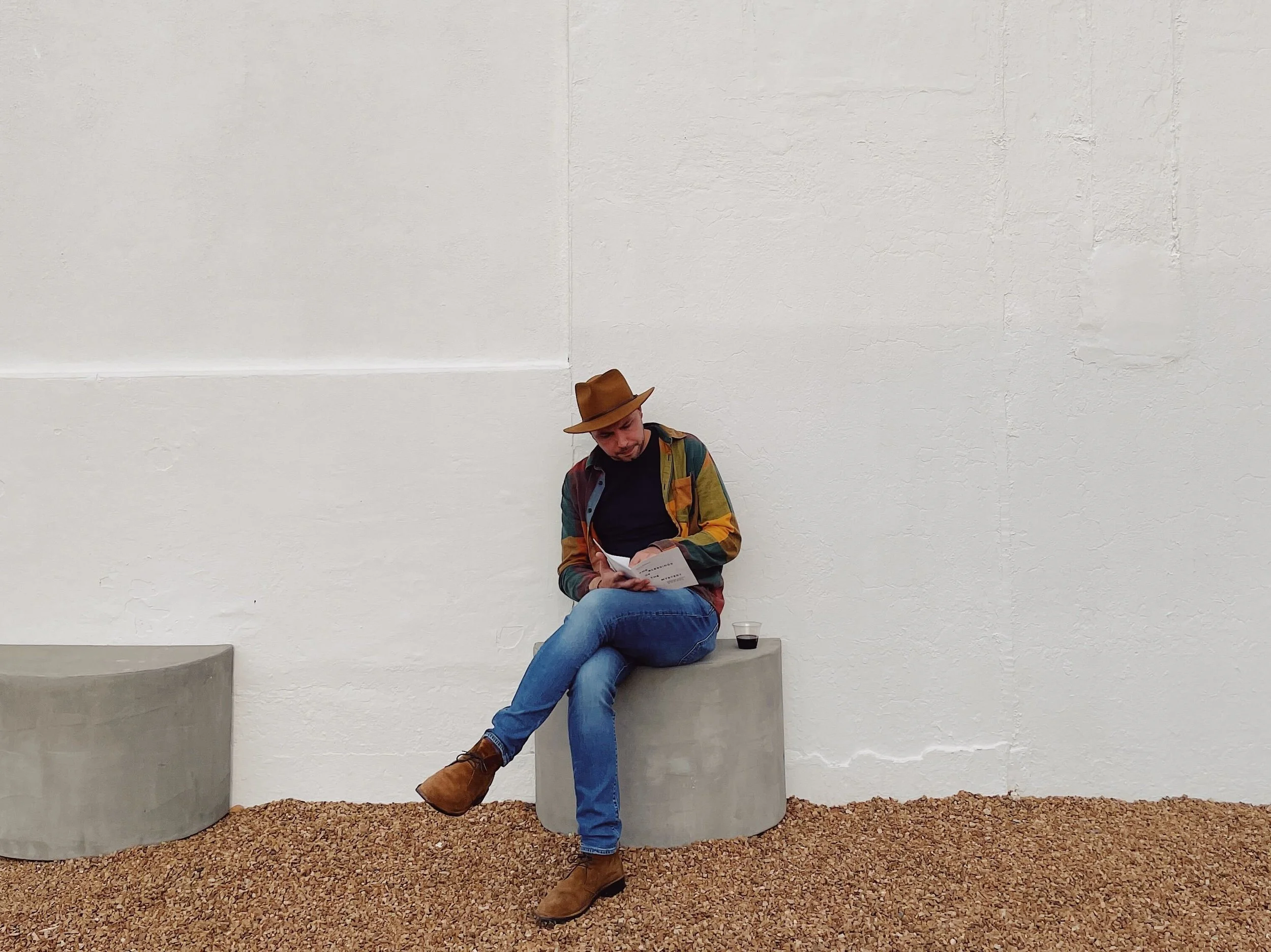
Man reading on concrete seat at Ballroom Marfa

Caleb’s husband, Brennan, reading the exhibition guide at Ballroom Marfa gallery during Chinati Weekend Open House in 2022

The Judd Foundation — the organization charged with preserving Judd’s living and working spaces, libraries and archives in NYC and Marfa — also provides rich tours of the artist’s other sites throughout town.  

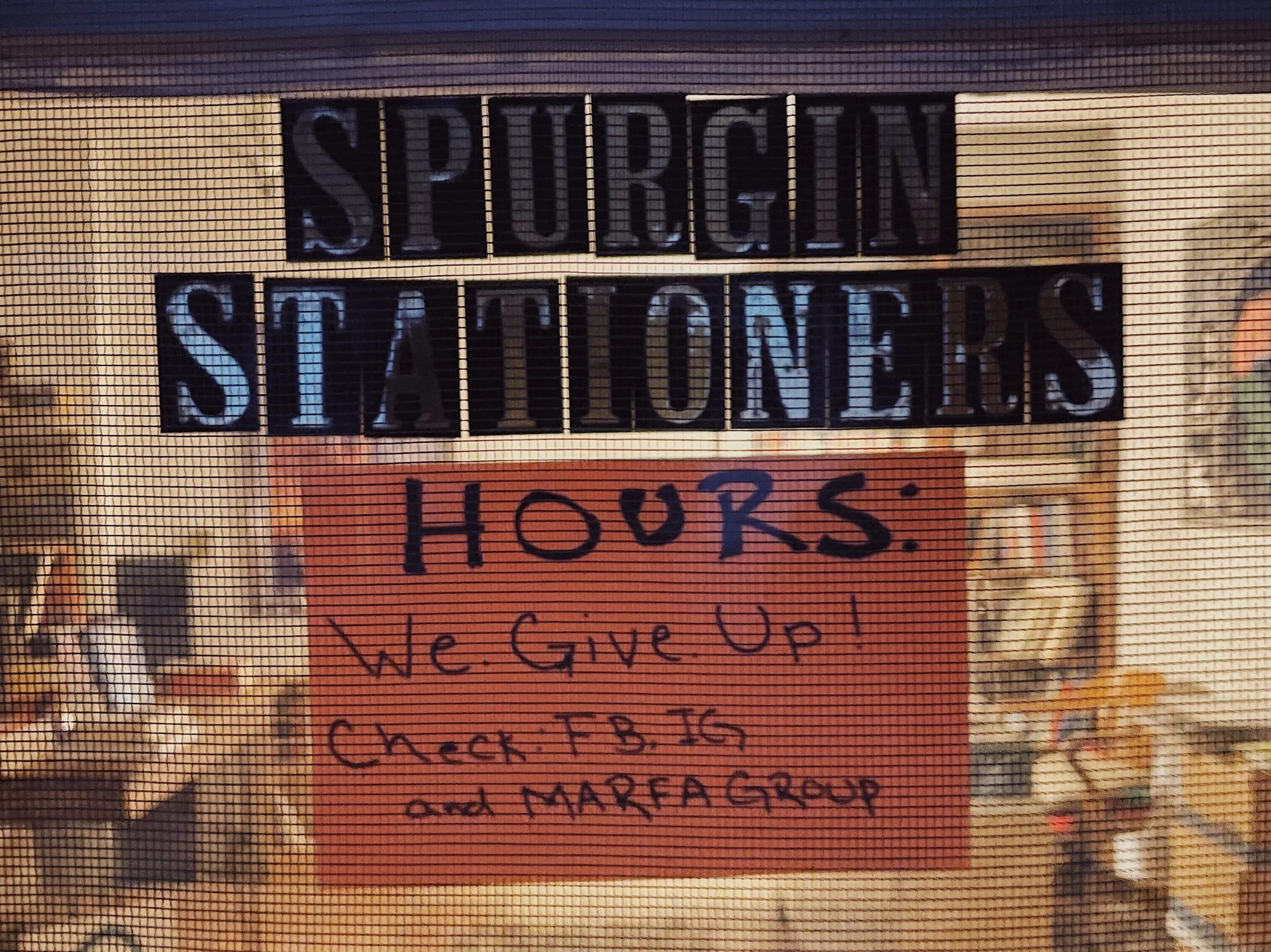
Sign on door of Marfa, Texas shop that reads, "Hours: We Give Up! Check FB, IG and Marfa Group"

Slow down and forgo your expectations. You’re on Marfa time.

2. Know that Marfa operates on Marfa time, and the town is always changing.

Planning for trips is not in my nature. I hate it. But your trip to Marfa needs planning. For one, there is a limited number of places to eat, drink and stay (see also: gentrification in Marfa). Second, that list of places is always changing. If you read a list of things to do from this year, I can guarantee it will be outdated in less than 12 months. And finally, a business’ hours of operation are far from predictable. We passed a bookshop with a posted sign reading, “Hours: We Give Up! Check: FB, IG and Marfa Group” (a private forum on Facebook). That’s the vibe everywhere — don’t trust Google, or even a business’ website. Check their social.

Desert at sunrise from an Airbnb in Marfa, Texas

Sunrise in Marfa, Texas, from Caleb and Brennan’s Airbnb

3. Dress for the desert.

Think of those early fall days when you’re excited to wear layers. Because that’s what you’ll need: layers. Hot days and cool nights, because desert. Buy your cowboy hat before you visit. They’re cheaper outside of town. And consider making the two-hour drive south to Big Bend National Park. If you go, be prepared for a hike, literally.  

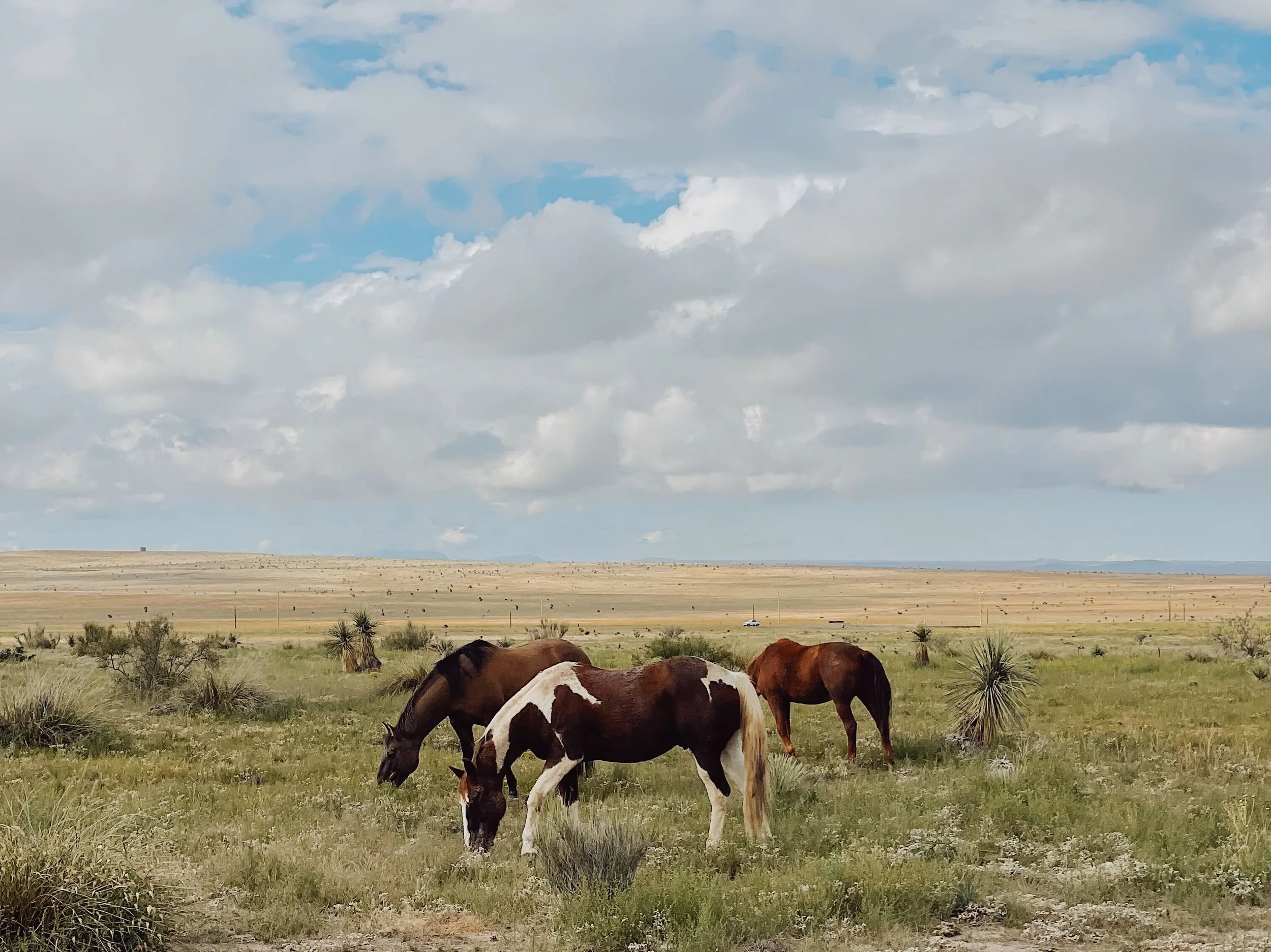
Horses grazing outside of Marfa, Texas

Horses seen on a run just west of town

4. Realize that getting there is a beautiful trek. 

Jenny Moore, Chinati’s former director, said, “You can get from New York to Paris, seated and eating dinner, faster than you can get from New York to Marfa. So, you got to make the commitment to come here.” That’s the truth. The two closest major airports, El Paso and Midland-Odessa, are each about a three-hour drive north. Whether you fly into El Paso or make the six-and-a-half-hour drive from Austin, Interstate 10 is bound to be on your route, taking you through the Chihuahuan Desert. Take it all in: the grasslands, the basins and plateaus; and watch the sky reach from one end of the Earth to the other. –Caleb Fox

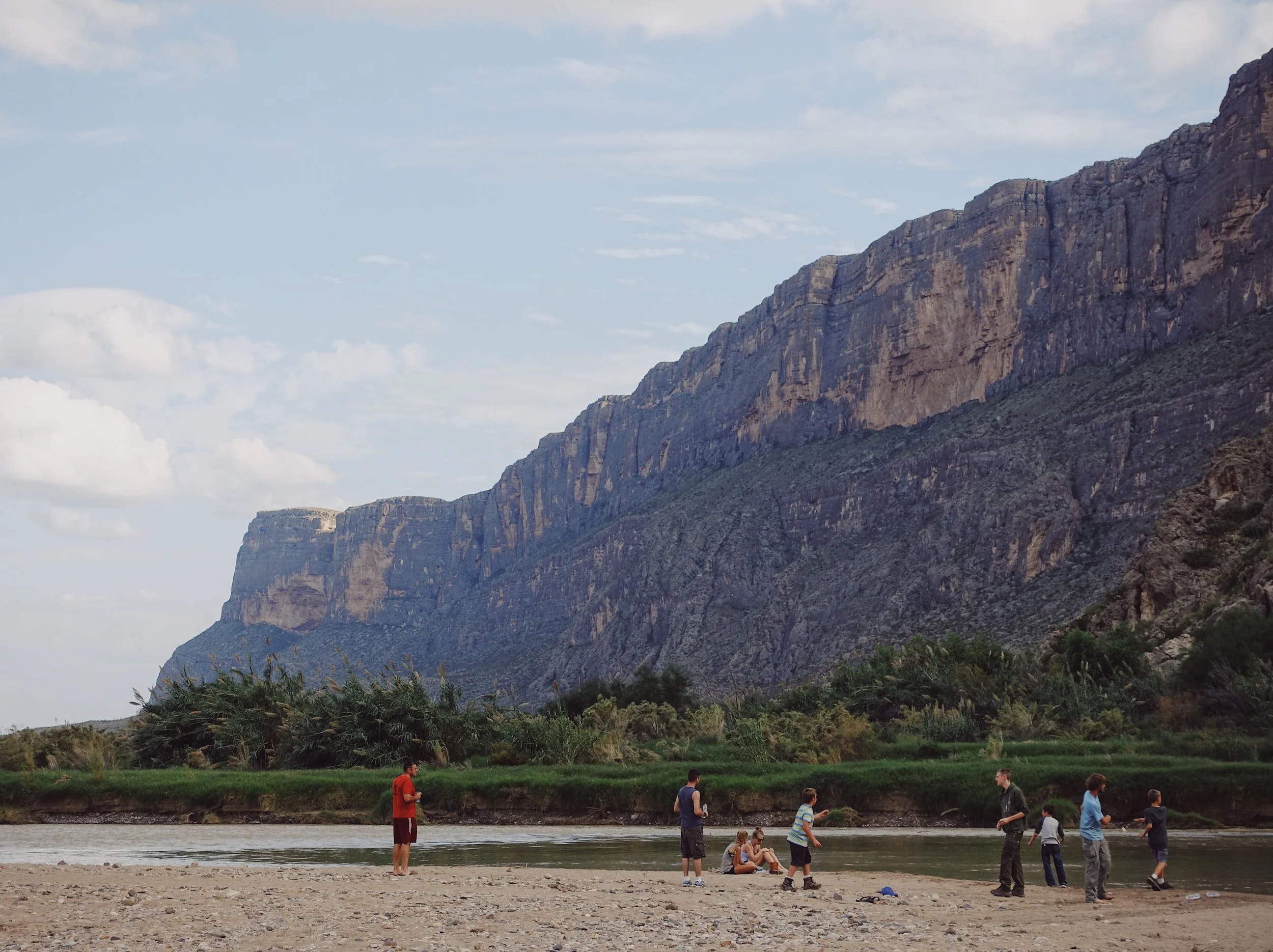
Families playing in the Rio Grande River in Big Bend National Park

Families playing by the Rio Grande river at Big Bend National Park

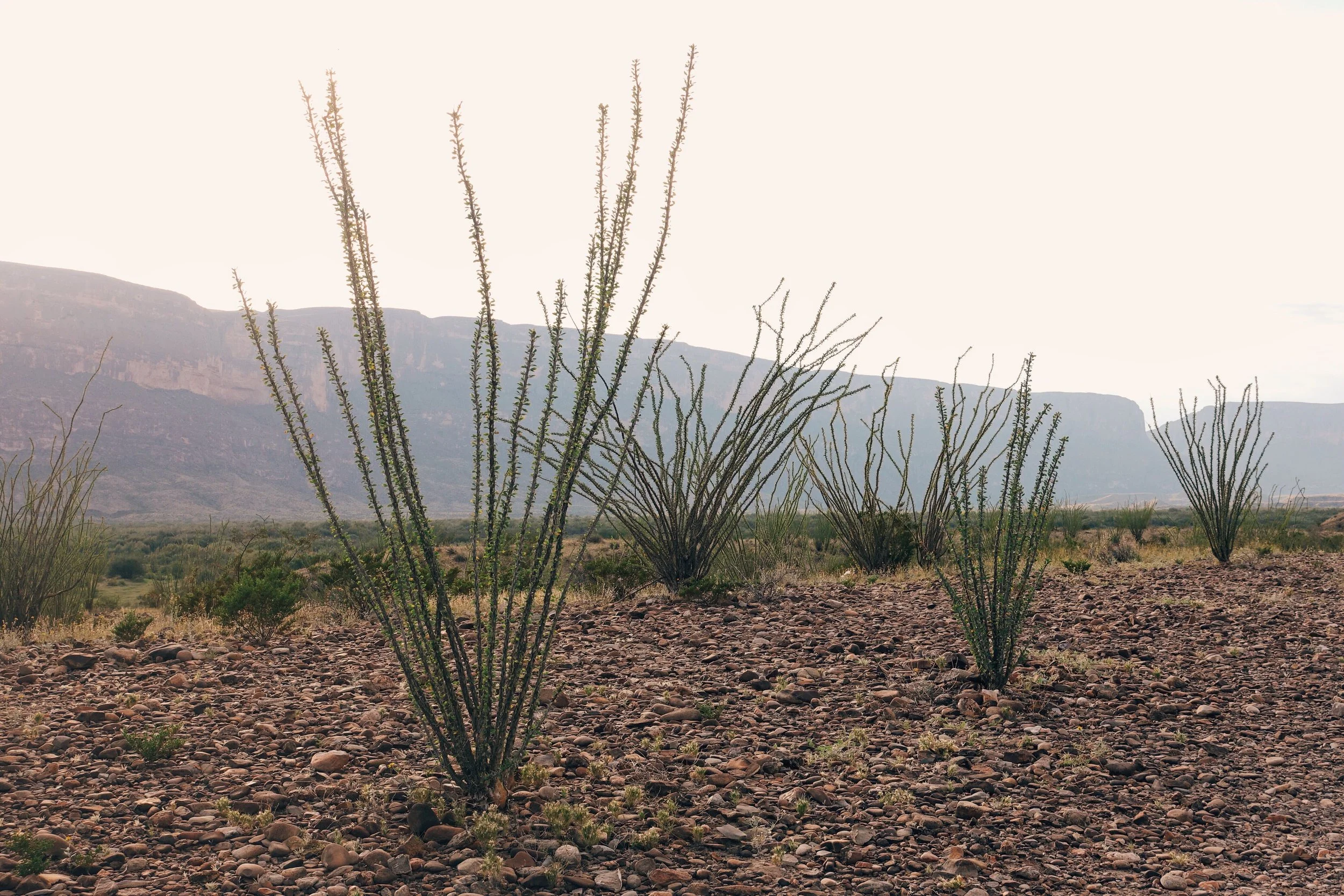
Ocotillo plants in the desert at Big Bend National Park, Texas

One of Caleb’s favorite desert plants, the ocotillo, at Big Bend National Park


Hubbard Street Murals: Chicago’s Street Art Gallery

Wanna see some cool murals in Chicago? This stretch of Hubbard features street art done by artists from around the world. 

Pilsen or West Loop? Find out where the best murals in Chicago are.

Pilsen or West Loop? Find out where the best murals in Chicago are.

Duke and I are obsessed with street art. We hunt it down and take pics of it wherever we go. 

But, as amazing as it would be to share your art with the world, it also strikes me that it must also be heartbreaking how ephemeral street art can be. Buildings get demolished (or simply change ownership), and the artists have no claim to their work. And how awful it would be to have your work obliterated — which definitely seems to be a trend, at least in Chicago at hip venues like Soho House and the Violet Hour. In many cases, we view murals nowadays as temporary canvases, able to shine all too briefly before they are painted over and another takes its place.

One of Wally’s favorite murals on Hubbard Street

One of Wally’s favorite murals on Hubbard Street

I work near Fulton Market (West Loop is Best Loop, as we say), and on my lunch break, I will often walk along Hubbard Street, from Halsted to Ogden, to admire and photograph the murals. The one downside is that there’s no real path along the street — at times you’ll be trekking through weeds and bushes to see the sights.

Even the underpasses along Hubbard are covered with cool graffiti.

Even the underpasses along Hubbard are covered with cool graffiti.

At first there were many remnants from the ’70s, faded and less artistic than the amazing works done by today’s muralists. But now, every time I pass by, more and more of the original murals have been painted over, replaced by more modern artworks. Hubbard Street acts as an amazing outdoor gallery, an open-air museum of some of the most talented street artists from around the world. 

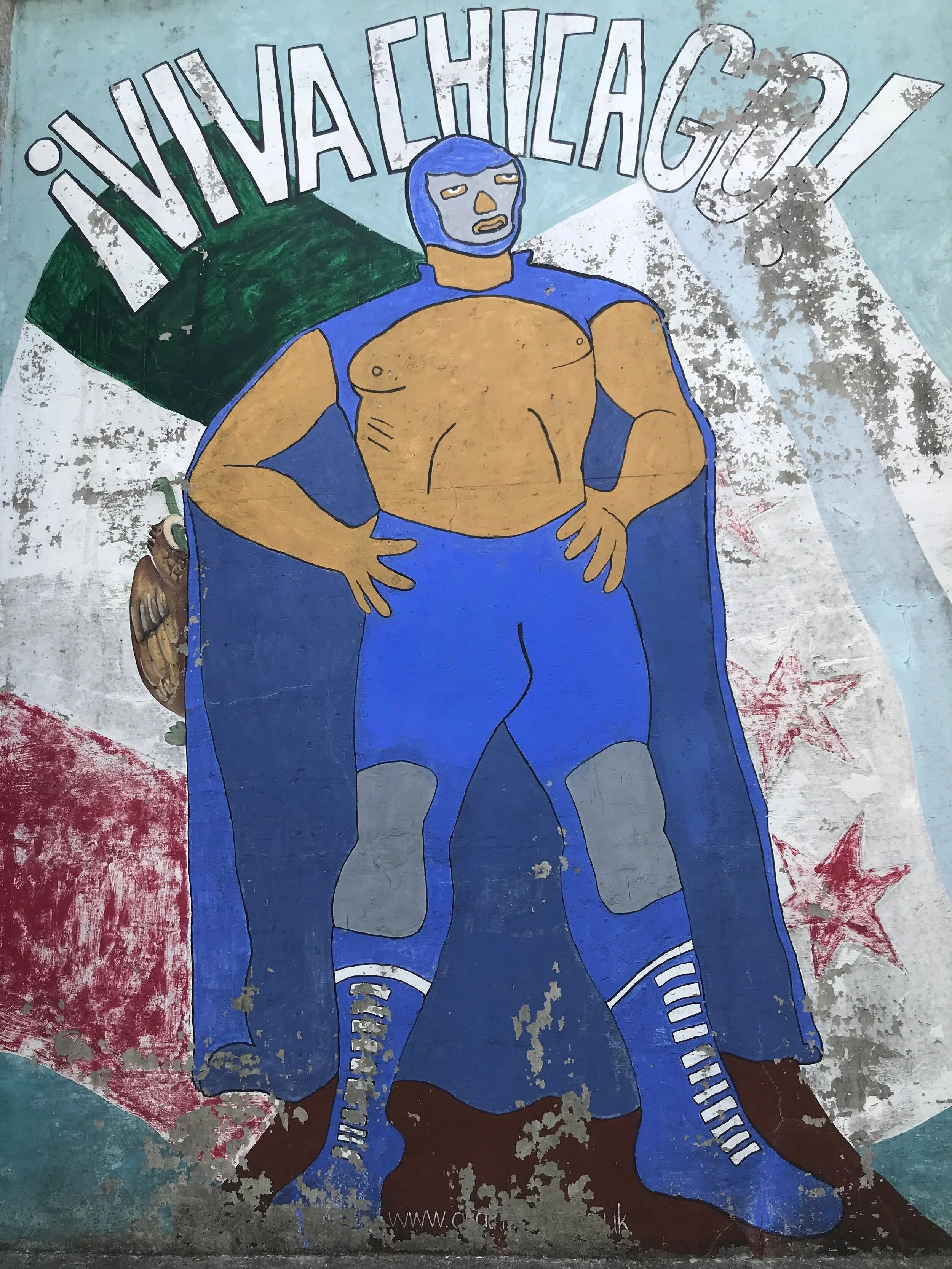
¡Viva Chicago indeed! A fading luchador mural

¡Viva Chicago indeed! A fading luchador mural

The Hubbard Street murals blow Duke’s mind.

The Hubbard Street murals blow Duke’s mind.

Great street art really packs a wallop for Wally.

Great street art really packs a wallop for Wally.

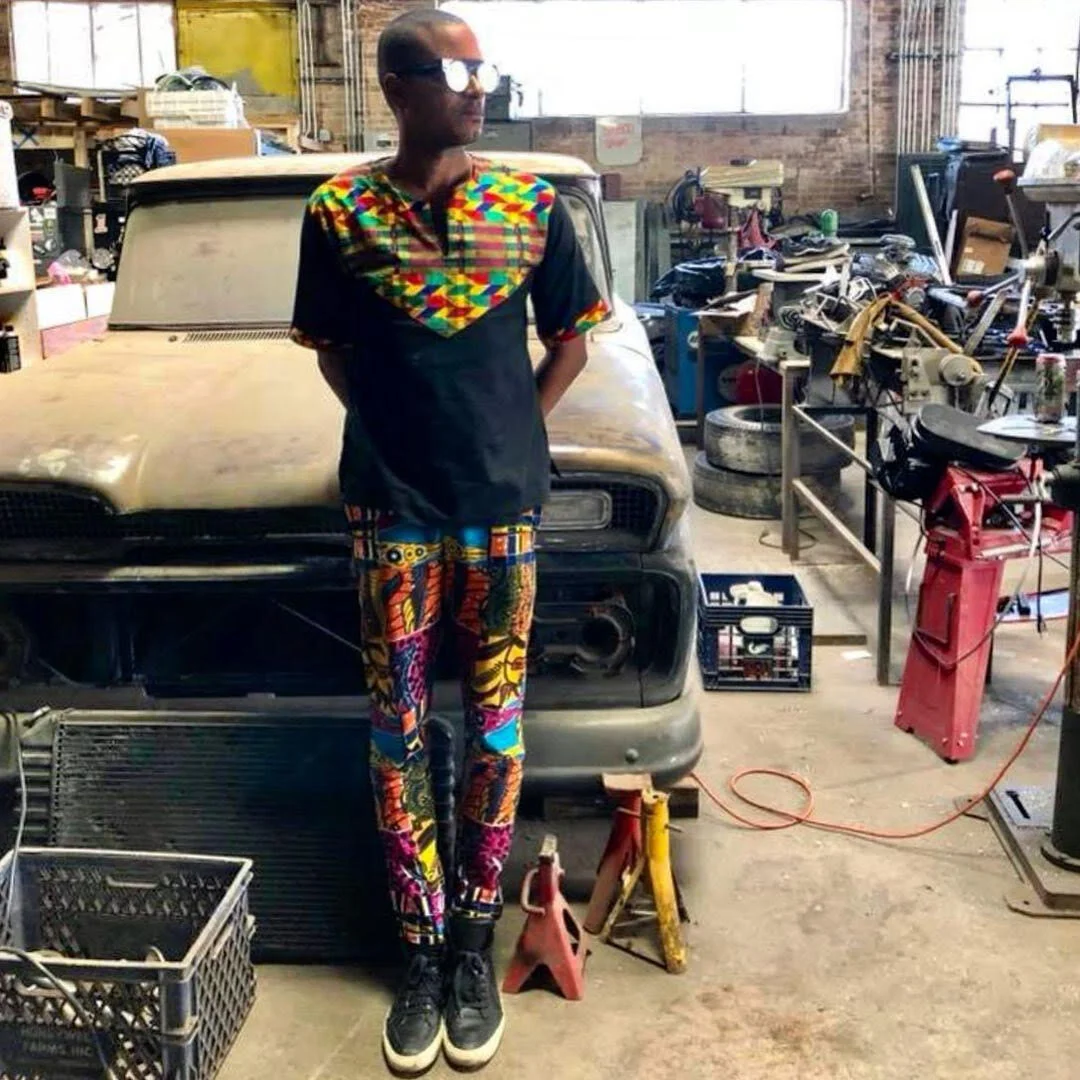
I caught up with Levar Hoard, chief curator and managing director of the B_Line, a mile-long corridor of public art in Chicago’s Fulton Market District, who was kind enough to answer a few questions for us.

Levar Hoard heads up the Hubbard Street Murals project.

Levar Hoard heads up the Hubbard Street Murals project.

A Q&A With Levar Hoard of the B_Line

Tell us about the original project. When did it begin and what was its mission?

The original founder/curator was Ricardo Alonzo. When the murals started in 1971 (this year is our 50th anniversary), they were dedicated to environmental causes (pollution initially, then endangered animals). That went on to include many concepts like Mexican native art, abstract and other styles.

How did B_Line get involved?

We became the sole curators in 2017 after years of research and negotiation with the private train company that owns the walls (it's not a city project), and we legally assumed the license in perpetuity from Ricardo that was signed in 1971 with the railroad.

How do you find the artists? What’s the process with them?

We fly the world's most renowned artists to Chicago and also find Chicago’s best muralists, and discover new muralists, who we give their first commission to. 

As a privately run and funded organization, we subjectively select artists based on skill level, demonstrated competence with techniques and materials, and aesthetics. 

One of the artists flown in to create a mural

One of the artists flown in to create a mural

How do you decide where each artist is to paint, and when it’s time to paint over an existing mural?

It’s based on the condition of the wall. Most of the murals from 1971 are long gone, and we work to preserve or restore them where possible. Where it’s not possible or worthwhile, we recondition the wall and usher in a new era of art and artists that reflect the time we now live in — the M.O. of street art. 


What’s your favorite thing about the mural project? 

Meeting thousands of people that visit the murals weekly. 


Be sure to check out B_Line’s Instagram feed for video interviews about their many projects and history: @blinechicago.

To learn more about the history of the Hubbard Street Murals, read this Reader article.

We also reached out to a couple of the street artists behind our favorite murals along the stretch of Hubbard. Here are their stories.

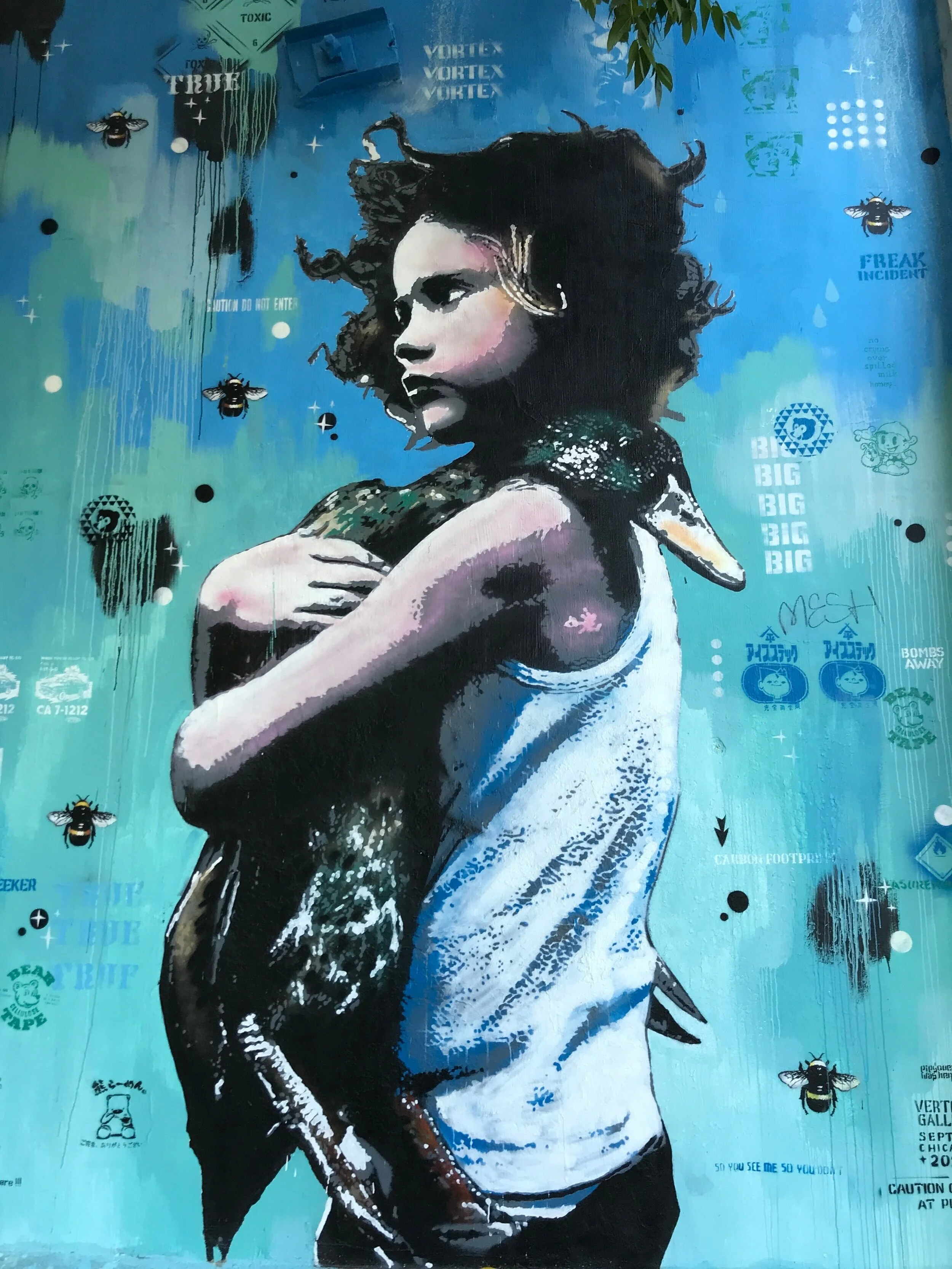
Nurture or Nature by the street artist duo Pipsqueak Was Here!!!

Nurture or Nature by the street artist duo Pipsqueak Was Here!!!

A Q&A With Pipsqueak Was Here!!!

The Amsterdam, Netherlands-based street artist duo known as Pipsqueak Was Here!!! told us about their experience with the Hubbard Street Murals:

We were in Chicago for a show with Vertical Gallery and had a few days to play around. Patrick Hull, who runs the gallery, introduced us to Levar Hoard, who curates the B_Line paintings. He helped us out with two ladders, and Patrick provided us with some paint.

We painted a girl holding a duck, a stencil we had with us because we planned to do a mural for the RAW Project, an incredible collective to improve the environment of elementary schools around the USA.

Our painting is called Nurture or Nature. The work, like most of our paintings, is a combination of a child with an animal. We combine these two to depict the relationship between human beings and the remaining natural environment. Most of our work is about how we treat the world and how, in return, it treats us.

Nurture or Nature poses the question, should we protect what is left or should we let nature take its course, whatever the consequences may turn out to be?

We really enjoyed being part of this wonderful project, as we found it incredible to see that they included and restored some of the paintings over 40 years old. It was an honor to contribute to such a rich tradition, and we were really helped by Lavar, Patrick and Margaux Comte, who took photographs while we worked.

We had an overwhelming response to this painting, and it really was fun being able to do something like this on such short notice.

Here’s a short time-lapse video of the mural creation.

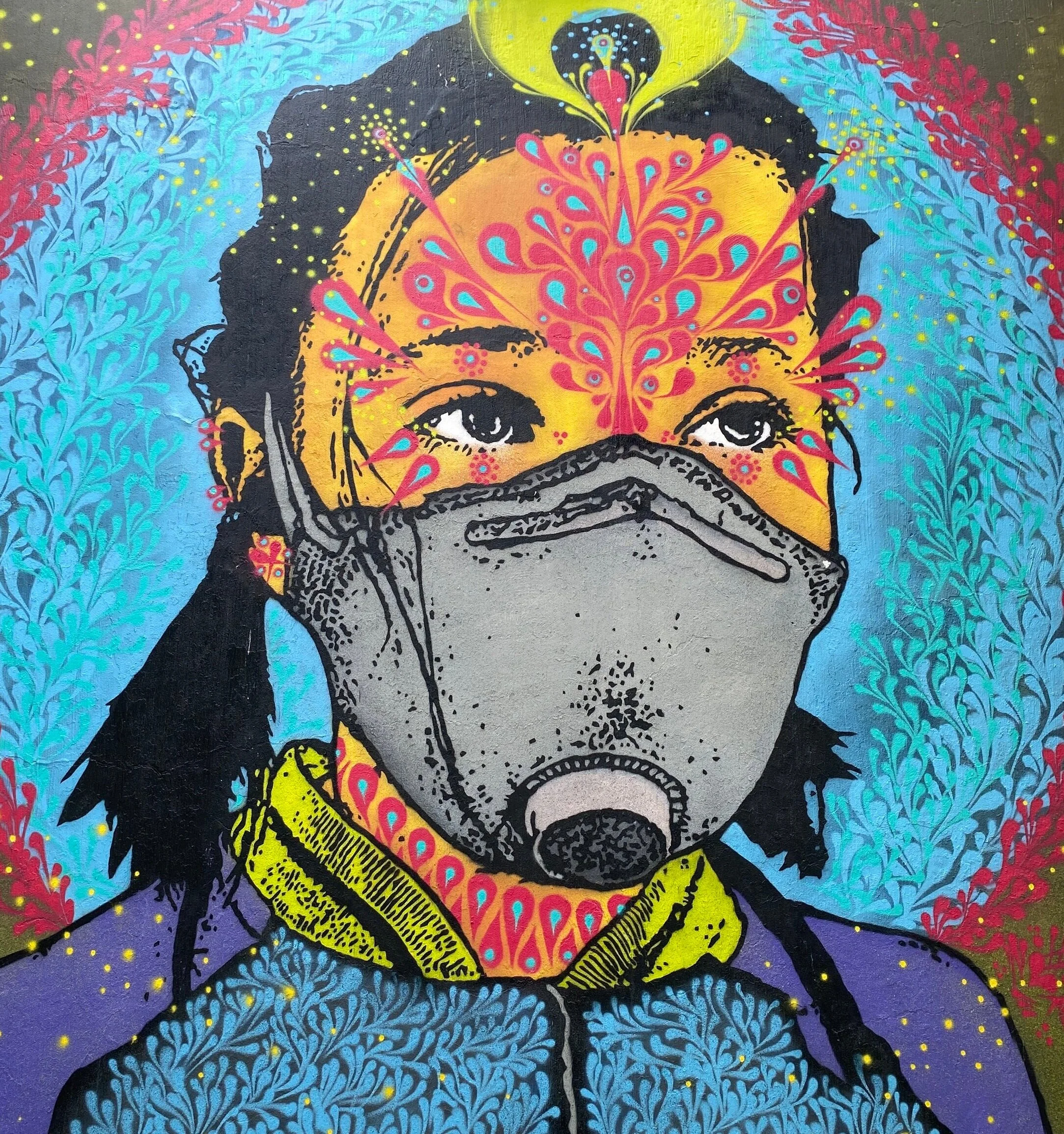
The Hubbard Street mural painted by Stinkfish

The Hubbard Street mural painted by Stinkfish

A Q&A With Stinkfish

The artist known as Stinkfish told us: 

I got involved by an invitation by B_Line and through my gallery in Chicago, Vertical Gallery. 

I used a portrait of a girl in a workshop I did in Vienna, Austria. She had the mask because we were using spray paint. 

Then came COVID, and the piece took on another relevance and meaning. 

It was a good experience. It’s a nice place to paint. The project gave me the opportunity to see different styles, techniques and messages in the same place. 


If you’re a fan of murals, you can’t miss the Hubbard Street corridor. This might be a controversial view, but I prefer these murals to those on 16th Street in Pilsen, another legendary stretch of street art in Chicago. With new artists constantly creating works of art, a walk along Hubbard is never quite the same, even just weeks apart. –Wally

Fabyan Villa Museum and Its Frank Lloyd Wright Connection

Tour the picturesque Riverbank estate, with the Fabyan Forest Preserve, a Japanese garden, a windmill, quirky curios (a suspect mummy!) — and a codebreaking legacy.

The Fabyan Villa can thank Frank Lloyd Wright for its cruciform shape. The house and its grounds are worth exploring if you want a day trip from Chicago.

The Fabyan Villa can thank Frank Lloyd Wright for its cruciform shape. The house and its grounds are worth exploring if you want to take a day trip from Chicago.

Before my parents make their annual visit to Wally and me in Chicago, we plan an interesting day trip, do a little research and look for something quirky to do. Typically it’s somewhere a bit farther afield since neither of us has a car. I can’t recall how we settled on the Fabyan Villa in Geneva, Illinois. It’s entirely possible that I came across it on the Atlas Obscura website, given Wally’s and my proclivity for attractions that don’t always make their way into guidebooks. Or it could've had something to do with Frank Lloyd Wright, the Japanese garden or the circa-1850 Dutch-style windmill located on the grounds of the sprawling estate. 

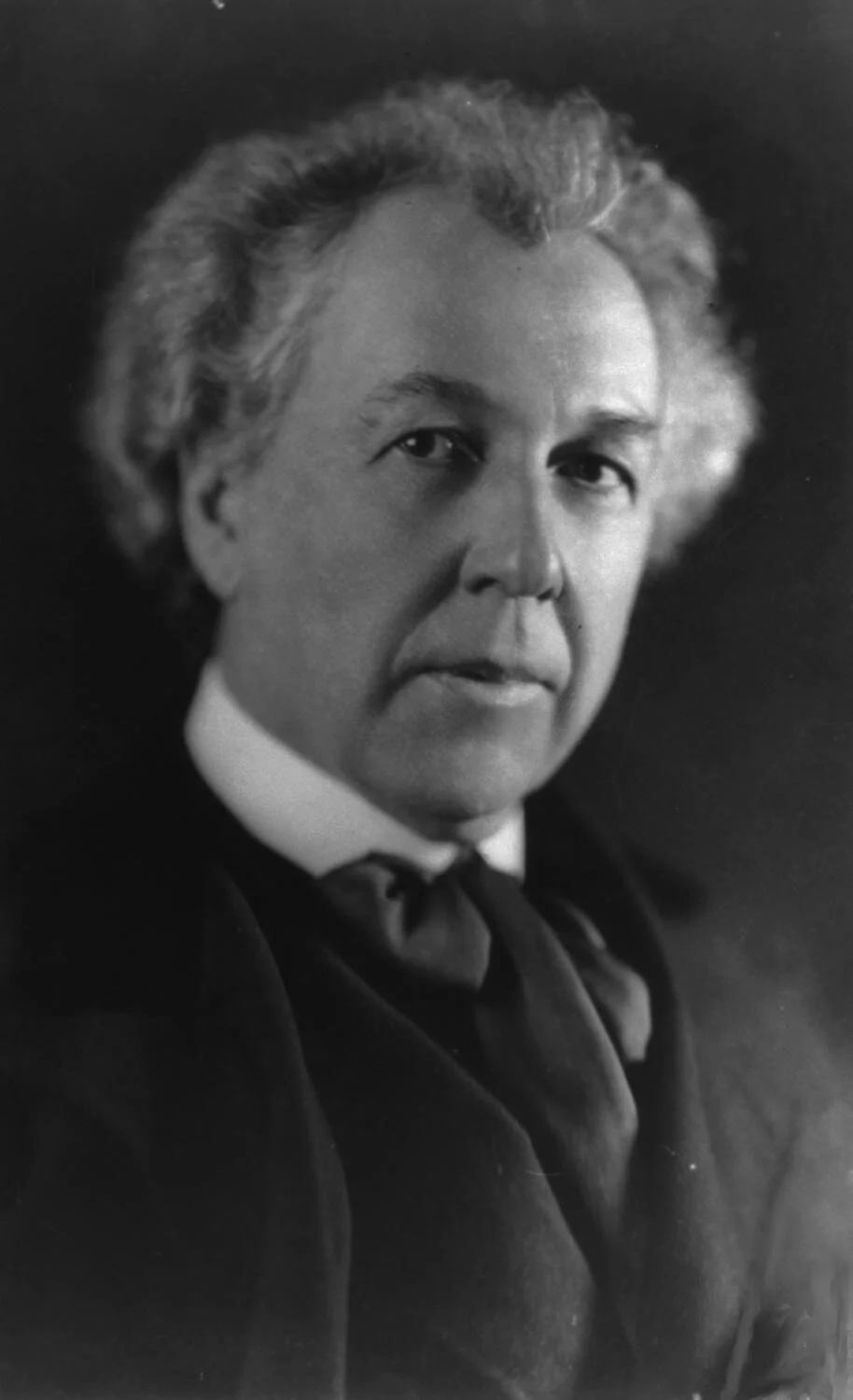
Colonel George Fabyan

Colonel George Fabyan

George Fabyan, Country Squire of Riverbank

In 1905, Colonel George and Nelle Fabyan purchased 10 acres of land in Geneva, including a Victorian-style farmhouse, as a country retreat from their residence in Chicago. Fabyan (pronouced like Fay-bee-yen) came from a wealthy and prominent Boston family. His father was a co-partner at Bliss, Fabyan and Company, one of the country’s largest dry goods and textile merchants, known for Ripplette, a lightweight, crinkly fabric similar to seersucker, which needed no to minimal ironing after washing. 

Fabyan inherited his father’s wealth — around $2 million dollars (equivalent to over $57 million today). He acquired an additional 300-plus acres over the next 20 years and named the estate Riverbank. 

George and Nelle indulged in a variety of unconventional interests, including cryptology, Japanese gardening and the construction of a scientific laboratory complex that let them pursue their research interests.

Some rich men go in for art collections, gay times on the Riviera or extravagant living. But they all get satiated.

That’s why I stick to scientific experiments, spending money to discover valuable things that universities can’t afford. You can never get sick of too much knowledge.
— Colonel George Fabyan
The Fabyan Villa Museum

The Fabyan Villa Museum

A Tour of Fabyan Villa

The four of us arrived at the forest preserve, parked the car and followed the steps leading up to the house, which sits on a hillside overlooking the Fox River. We purchased tickets ($10 per person) and met a docent from the Preservation Partners of Fox Valley (PPFV) outside who told us about the historic home. In 1907, the Fabyans commissioned architect Frank Lloyd Wright to enlarge and remodel the existing farmhouse in the Prairie style. While it’s no Fallingwater or even Graycliff, it has its charms.

Additions included the two-story south wing, which added symmetry to the dwelling’s long, low cruciform shape, three projecting porches, wood-spindle screening and overhanging eaves, adding to the horizontality of the overall design. 

Our tour began in the Fabyans’ reception room, which is paneled in dark walnut and furnished with Victorian-era wood and glass display cabinets, showcasing the couple’s memorabilia, taxidermy and Asian ephemera. Among the notable acquisitions on display are a white marble statue of Diana and the Lion (Intellect Dominating Force) by American sculptor Frank Edwin Elwell, which stands in the dining room and was originally exhibited in the Palace of Fine Arts at the 1893 World’s Columbian Exposition. There’s also a Japanese samurai suit and a vitrine filled with bodhisattva statuettes.

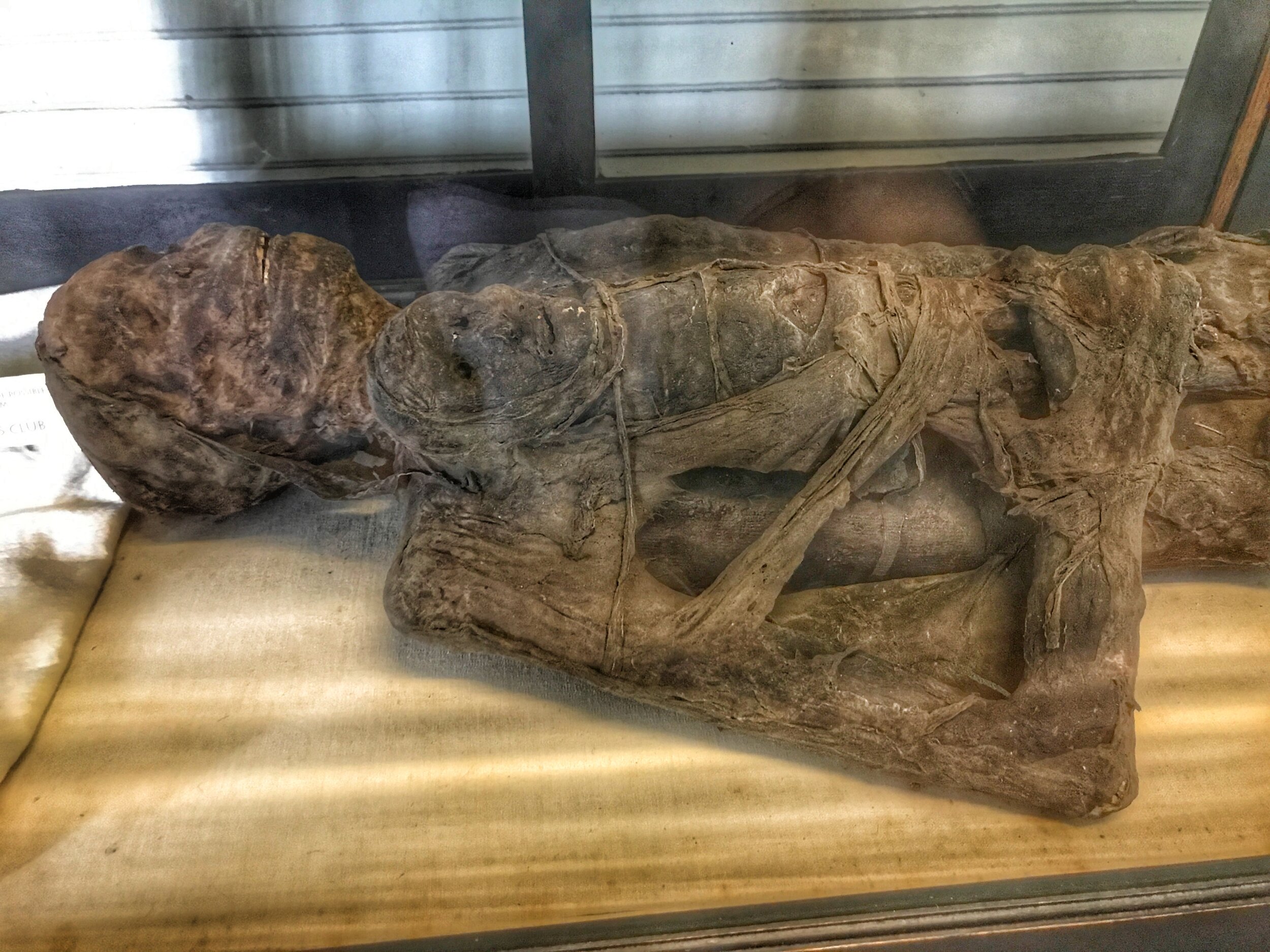
On the back porch is a display case holding a mummy. Its body is wrapped in strips of linen and clutching what uncannily resembles an infant. Turns out the mummy is actually a forgery. In 1982, an expert examined the mummy, and an X-ray revealed it to be fabricated with nails, plywood, sawdust and a single bone inside the wrappings — and that bone came from a dog. Apparently, no one’s certain of its provenance or if the original owners knew it was a fake. One theory is that it may have been featured as a sideshow oddity or was an artifact purchased by Fabyan from the Field Museum. 

The Fabyans’ mummy turned out to be a hoax.

The Fabyans’ mummy turned out to be a hoax.

Beyond the dining room is Nelle Fabyan’s bedroom and en suite bathroom with custom furniture designed by Wright. Nelle had a hanging bed, suspended from the ceiling like a giant swing, and it’s speculated that this was to promote air circulation and protect her from contracting tuberculosis. Many of the original furnishings were auctioned off when the estate was sold in 1939, but locals who owned pieces donated them back to the landmark, which is managed by the PPFV. 

Frank Lloyd Wright didn’t build the Fabyan Villa from scratch but did renovate it, infusing it with Prairie style aesthetics and symmetry.

Frank Lloyd Wright didn’t build the Fabyan Villa from scratch — but he did renovate it, infusing it with Prairie style aesthetics and symmetry.

Wright’s Prairie style aesthetic is also evident in the open floor plan and warm earth tone color palette used on the walls of the interior. 

Upstairs is the music room, where Nelle’s Victor Talking Machine aka Victrola, encased in a wood cabinet, stands sentinel. Only the wealthy could afford the innovative Victor-Victrola model, whose initial selling price was $200, expensive for the time.

Duke and Wally explore the estate.

Duke and Wally explore the estate.

Duke and his parents in the rose arbor (which was noticeably lacking roses at the time of our visit).

Duke and his parents in the rose arbor (which was noticeably lacking roses at the time of our visit).

Connected to the music room is the sleeping porch, where the pet monkeys, Mike, Patsy and Molly, would stay during the winter months. The floor of the room is tinplate, with drainage incorporated for obvious reasons (monkey waste). Perhaps the simians filled the vacant role of children to the childless couple?

Furniture, art and light were an integral part of Wright’s conceptual philosophy, creating compositions that functioned as a cohesive whole. As such, he would have most likely despised the ornate Victorian bed in the second floor bedroom. Wright’s leaded glass cathedral-style windows or “light screens” as the architect called them, fill the room with light. They’re not the intricate geometric stained glass affairs he was famous for elsewhere, as, out here in the countryside, he didn’t want to obscure the beauty of the natural view. 

The house’s grounds lead down to the Fox River.

The house’s grounds lead down to the Fox River.

Fabyan’s Animal Kingdom 

In addition to that trio of monkeys, a menagerie of animals lived on the estate, including Cayman alligators, a pair of black bears (named Tom and Jerry after a popular Midwestern milk punch served at the holidays), cows and dogs. A bear cage remains southwest of the garden, and according to local lore, loaves of bread were baked in the basement of the windmill to feed Fabyan’s pet bears. 

Japanese gardens were a craze with the élite in the early 1900s, and the Fabyans added a lovely one to Riverbank.

Japanese gardens were a craze with the elite in the early 1900s, and the Fabyans added a lovely one to Riverbank.

Turning Japanese: The Fabyan Japanese Garden

Awaiting visitors outside and just beyond the villa are the Japanese gardens and rose arbor, which lead from the bottom of the slope at the rear of the villa down to the banks of the Fox River. After the Japanese embassy created a garden for the 1893 World’s Fair, they became a status symbol among the wealthy. 

The Fabyans’ gardens were built between 1910 and 1913 by landscape architect Issei Taro Otsuka, a Japanese immigrant gardener who later redesigned the 1893 Wooded Island in Jackson Park for the Century of Progress International Exposition, the second world’s fair hosted by Chicago.

The gardens were closed on our visit, but we were able to see the torii gate, traditionally found at the entrance of a Shinto shrine and demarcating the passage from the earthly to the sacred. The gardens looked beautiful from afar, with conifer pine trees, traditional stone lanterns and a graceful curved bridge reflected in the pond beneath it. 

Although Fabyan didn’t serve in the armed services, he was given the honorary title of colonel by Illinois Governor Richard Yates out of gratitude for his public service work after Fabyan allowed the National Guard to use the estate as a training ground — and from that time on, George was known as Colonel Fabyan. He also received Japan’s Order of the Rising Sun, a decoration of honor awarded for his invaluable participation in peace negotiations with Japanese emissaries, a few of whom stayed on the property when the Colonel and Nelle hosted them. 

Riverbank Laboratories, owned by Fabyan, conducted acoustic research and later became instrumental in codebreaking.

Riverbank Laboratories, owned by Fabyan, conducted acoustic research and later became instrumental in codebreaking.

Codebreaking at Riverbank Laboratories: Birth of the NSA

The Fabyan estate also carried on extensive scientific research, with greenhouses where they would grow exotic plants and conduct genetic experiments. Across the street from the villa is Riverbank Laboratories. This was Fabyan’s think tank. He was interested in subjects as diverse as acoustics and, perhaps the Colonel`s most famous legacy, the cryptology laboratory.

The acoustics laboratory, which is still in operation today, was built around an ultra-quiet test chamber for the study of soundwaves and was designed by the top acoustics expert in the country, Professor Wallace Sabine of Harvard University. 

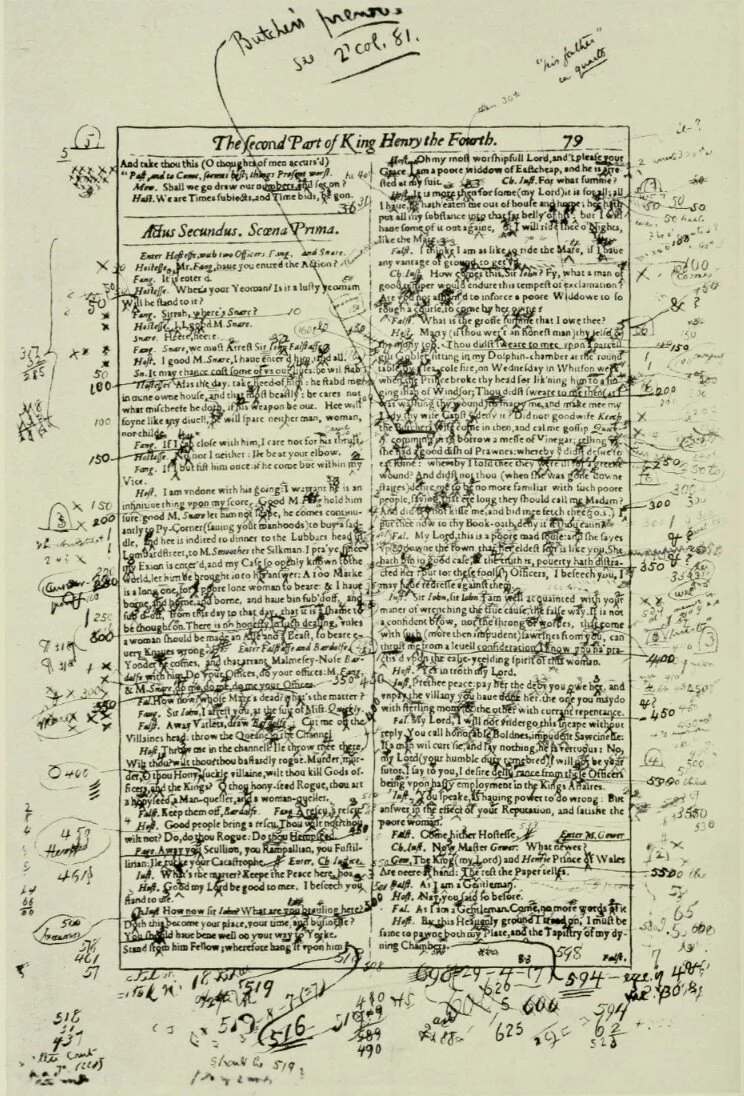
One of the Colonel’s odder obsessions was a belief that Sir Francis Bacon was the true author of some (or even all) of Shakespeare’s literary works, and that Bacon had left coded messages within the plays and sonnets. Fabyan hired Elizabeth Wells Gallup, a scholar and author of The Bi-literal Cypher of Sir Francis Bacon, to decipher a binary alphabet to reveal secret messages in the works of Shakespeare. 

Fabyan was convinced that there were clues in Shakespeare’s plays that revealed that their true author was actually Sir Frances Bacon.

Fabyan was convinced that there were clues in Shakespeare’s plays that revealed that their true author was actually Sir Francis Bacon.

Gallup’s team included Elizebeth and William Friedman, who spent years honing their cryptology skills researching the Bard’s works using Bacon’s ciphers. Though largely inconclusive, their efforts weren’t entirely in vain: The couple was instrumental in breaking codes and ciphers during World War I and World War II. Because the U.S. military didn’t yet have a dedicated department devoted to codebreaking, Fabyan’s Riverbank Laboratories ended up being the foundation for the NSA, the National Security Agency.

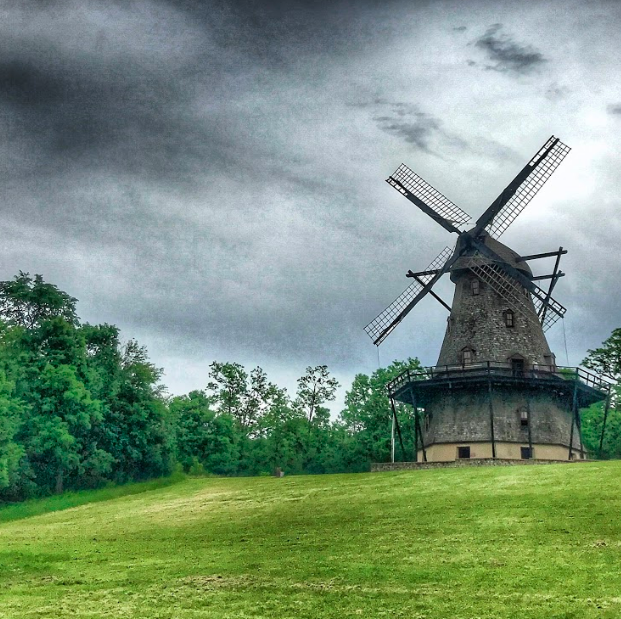
Fabyan was quite proud of his windmill. Make sure you cross the Fox River and check it out.

Fabyan was quite proud of his windmill. Make sure you cross the Fox River and check it out.

Over the River to the Windmill

In 1914, Fabyan purchased a Dutch-style windmill for $8,000 from Yorktown, Illinois, about 20 miles from its current location, and spent around $75,000 reconstructing it on the east bank of the Fox River. The windmill stands at an impressive 68 feet high and was originally built by Louis Blackhaus, a German immigrant and craftsman, between 1850 and 1860. 

But it was mainly a toy for Fabyan, who enjoyed showing it off to his Chicago friends. In 1979, the windmill was listed on the National Register of Historic Places, and the following year, it was selected to be on a U.S. postage stamp as part of a series in a booklet called Windmills USA. 

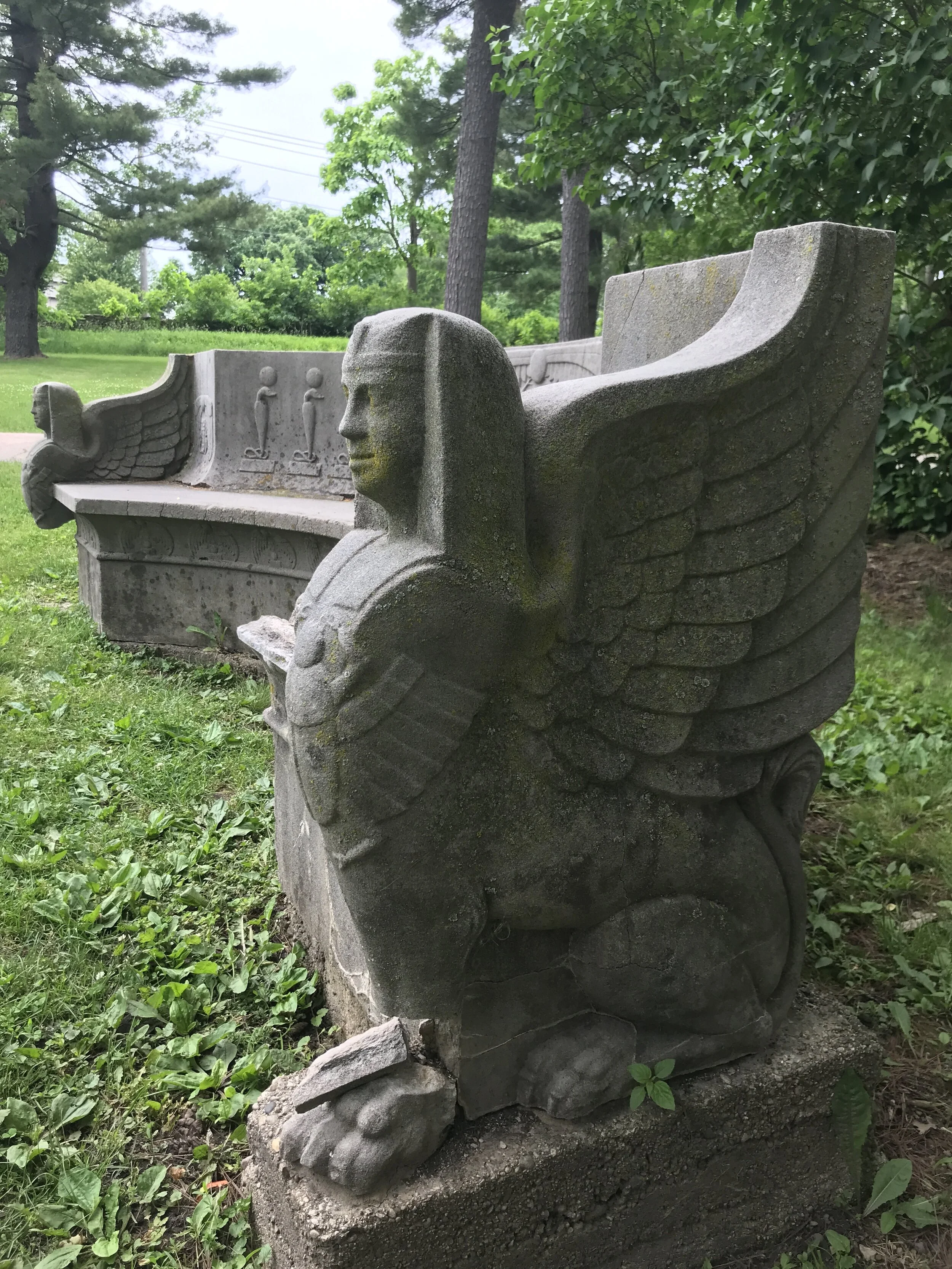
Look for the fun Egyptianate benches on the lawn.

Look for the fun Egyptianate benches on the lawn.

Preserving the Legacy of the Fabyan Villa and Forest Preserve

George died in 1936 and Nelle in 1939, and because they had no offspring, the Forest Preserve District of Kane County purchased the majority of the estate and opened the residence as a museum the following year. Starting in 1995, the nonprofit PPFV was enlisted to maintain and provide tours of the historic dwelling. The house was added to the National Registerof Historic Places in 1984. 

The four of us had a wonderful time wandering the paths that cross the bucolic park-like setting of the historic estate, with plenty of photo opportunities along the way. It’s an easy drive (just over 40 minutes from Chicago) and it’s remarkable to consider the lasting scientific achievements that germinated from the Fabyans’ private research center. If you’re looking for a fun place to visit that combines architecture and nature, the Fabyan Villa is open for tours from May to October. –Duke


Fabyan Villa Museum & Japanese Garden

Fabyan Forest Preserve
1925 South Batavia Avenue
Geneva, Illinois, USA 
The Beautiful Bahai Temple in Chicago

What is Baha’i? What’s the history of the Baha’i Temple in Wilmette, Illinois?

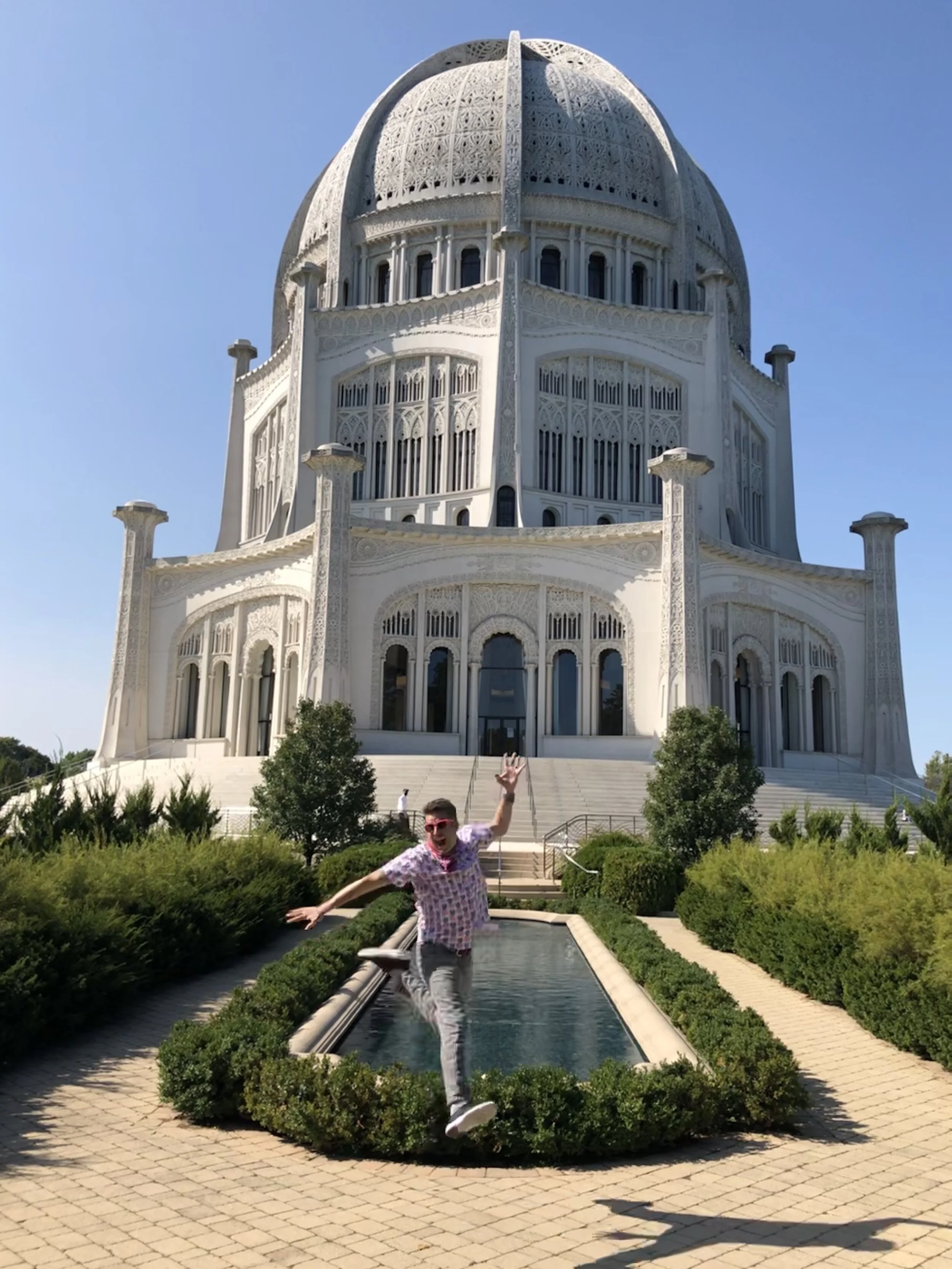
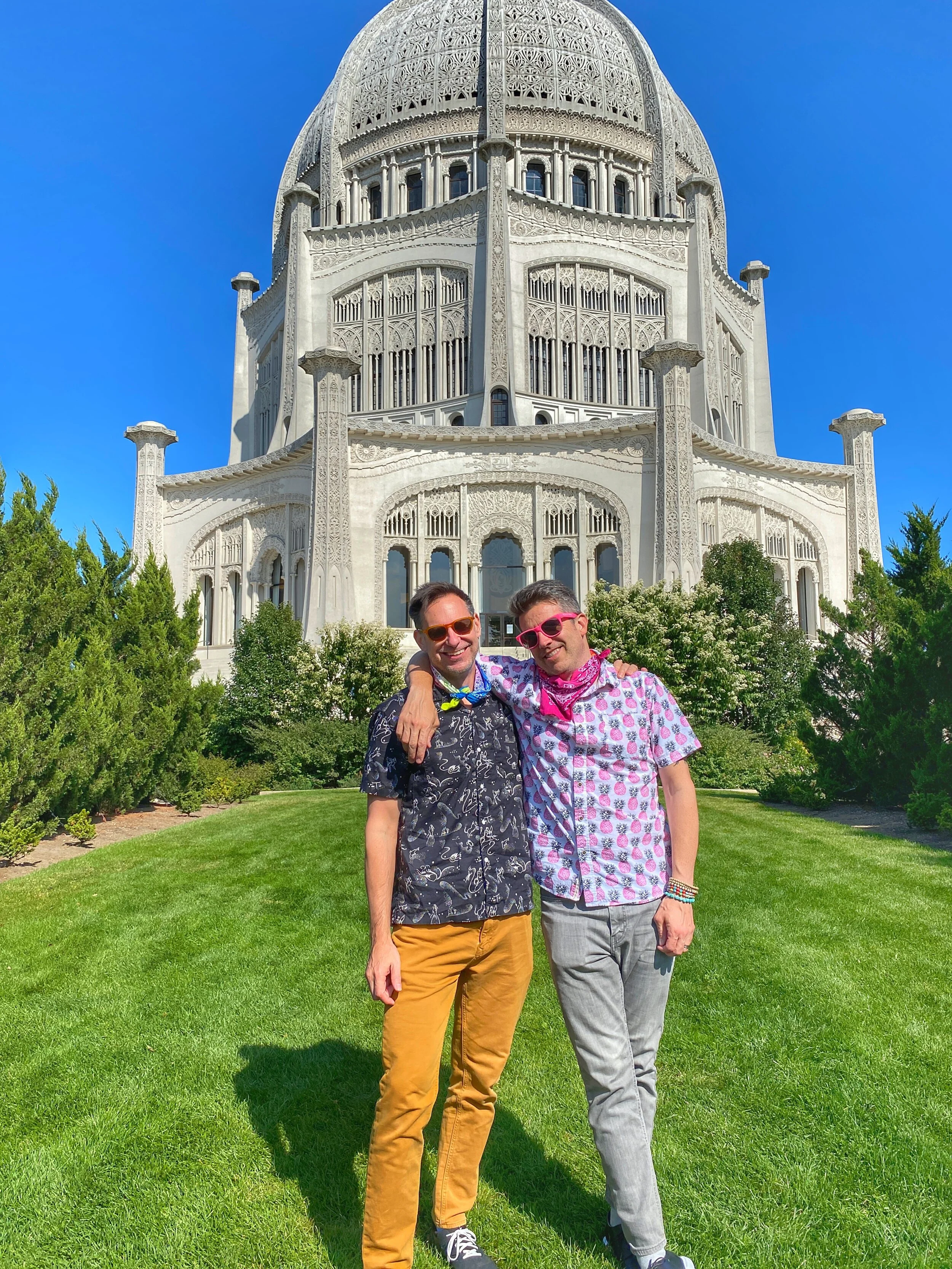
The beauty of the Bahai’i Temple makes Wally jump for joy.

The beauty of the Bahai’i Temple makes Wally jump for joy.

Those of us who live in the Chicago area are familiar with the Baha’i Temple — though most know nothing about the religion itself. We’ve seen glimpses of the structure on the North Shore and have been drawn to it, where we discover that it’s a gorgeous building that makes for a pleasant visit to spend a short time wandering its gardens and admiring its intricate stonework. 

Which is exactly what we did one weekend with our friend Kate during the COVID-19 pandemic. We weren’t able to go inside the temple, but to be honest that’s not too big a disappointment. The interior isn’t all that impressive — a large, open space that’s unadorned, in stark contrast to the ornate exterior. OK, the interior of the dome is gorgeous. But that’s the extent of the beauty inside, I promise. 

The Earth is but one country, and mankind its citizens.
— Bahá’ulláh, founder of Bahá’í
An illuminated manuscript of Baha’u’llah’s writings that was presented to the British Museum in 1913

An illuminated manuscript of Baha’u’llah’s writings that was presented to the British Museum in 1913

What is the Bahá’í religion?

It’s a relatively new faith, having emerged in the Middle East in the 1840s. A Persian teacher known as Bahá’ulláh preached a religion founded on the principles of peace, equality and the unity of humankind. Sounds nice, doesn’t it? 

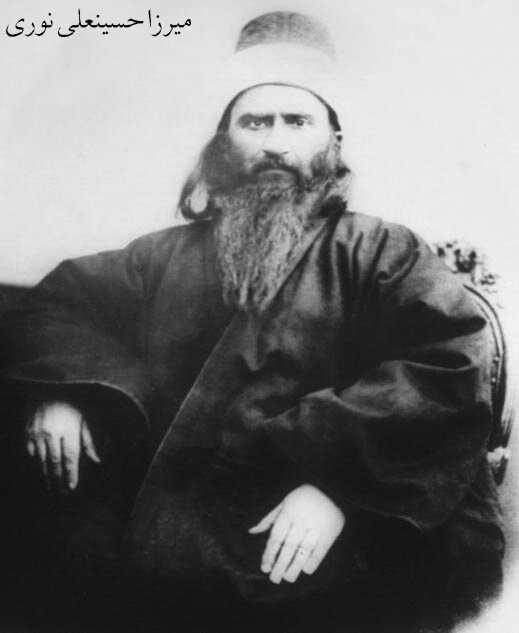
Bahá’ulláh, the founder of the Baha’i faith, might look stern — but he was really all about peace, love and understanding.

Bahá’ulláh, the founder of the Baha’i faith, might look stern — but he was really all about peace, love and understanding.

To Baha’is, the soul is eternal and should be illuminated by focusing on kindness, generosity, integrity, truthfulness, humility and selflessness. That’s exactly what this world needs more of, if you ask me.

At a Parliament of the World’s Religions meeting in Chicago in 1893, the United States was introduced to Baha’i. (By the way, it’s pronounced “Buh-high.”) Despite being proclaimed as one of the world’s fastest growing religions, it never caught on big time, and I’d wager that most Americans aren’t familiar with the faith. 

But by 1900, there were about 1,000 Baha’is living in the U.S. and Canada. Worldwide, the faith’s adherents now number around 5 million.

Duke and Wally spent a pleasant day with their friend Kate, circling (and admiring) the Baha’i Temple.

Duke and Wally spent a pleasant day with their friend Kate, circling (and admiring) the Baha’i Temple.

Do they have a prophet or savior like Mohammed or Jesus?

Like Muslims, the Baha’i believe that Mohammed, as well as Jesus (along with Abraham, Moses, Buddha, Krishna and Zoroaster, for that matter) was a prophet — just not God’s final prophet. Divine revelation, to them, is not final but ongoing; there will be other prophets in the future. Maybe the next one will be female.

The Baha’i faith sees all people as equal — a view that doesn’t fit with conservative Islam — and has led to persecution since its inception.

The Baha’i faith sees all people as equal — a view that doesn’t fit with conservative Islam — and has led to persecution since its inception.

How have Baha’i been treated over the years?

It’s sad that a religion that preaches acceptance has suffered so much oppression and violence. Perhaps it’s telling that no temple exists in Iran, the birthplace of the faith. The Baha’i messages of religious tolerance, gender equality, universal education, and elimination of all prejudice and racism don’t jibe well with many conservative religious entities, and the faith is viewed as a heretical branch of Islam. As such, countries including Yemen, Egypt and Afghanistan have persecuted and imprisoned Baha’is on the sole grounds of their beliefs. And Iran has a history of torturing and killing Baha’is, closing their schools, banning their literature, and denying their rights and marriages.

Worship for Baha’is is very personal and freeform, devoid of rituals and clergy.

Worship for Baha’is is very personal and freeform, devoid of rituals and clergy.

What is worship like for Baha’i?

The freeform, personal worship certainly won’t appeal to everyone, especially those who find comfort in religious rituals. My ex became interested in Baha’i, but the lack of any sort of pomp and circumstance never appealed to me. I have always been more drawn to Wicca, which has a similar acceptance of all faiths, seeing them as symbols, but has the flair of magic spells.

In keeping with the Baha’i philosophy of egalitarianism, everyone is welcome at their temples, and there isn’t any clergy. Ceremonies happen on only a few holy days each year. Typical worship consists of sitting there quietly, praying or meditating on your own. 

It’s also encouraged to get involved in social projects in your community. 

The COVID pandemic meant most people had to stay closer to home, so Wally and Duke headed up to give the Baha’i Temple another visit.

The COVID pandemic meant most people had to stay closer to home, so Wally and Duke headed up to give the Baha’i Temple another visit.

What is the Chicago Baha’i Temple’s history?

It began with the purchase of a couple of plots of land along Lake Michigan in 1907, north of Chicago in what is now the town of Wilmette. Because it was funded by individual contributions, the project was delayed, much like Gaudí’s La Sagrada Família cathedral in Barcelona, Spain (which is still being built, by the way). The Chicago Baha’i Temple was further held up by the two World Wars and the Great Depression. The foundation stone was laid in 1920 and construction ended with the temple’s formal dedication in 1953. 

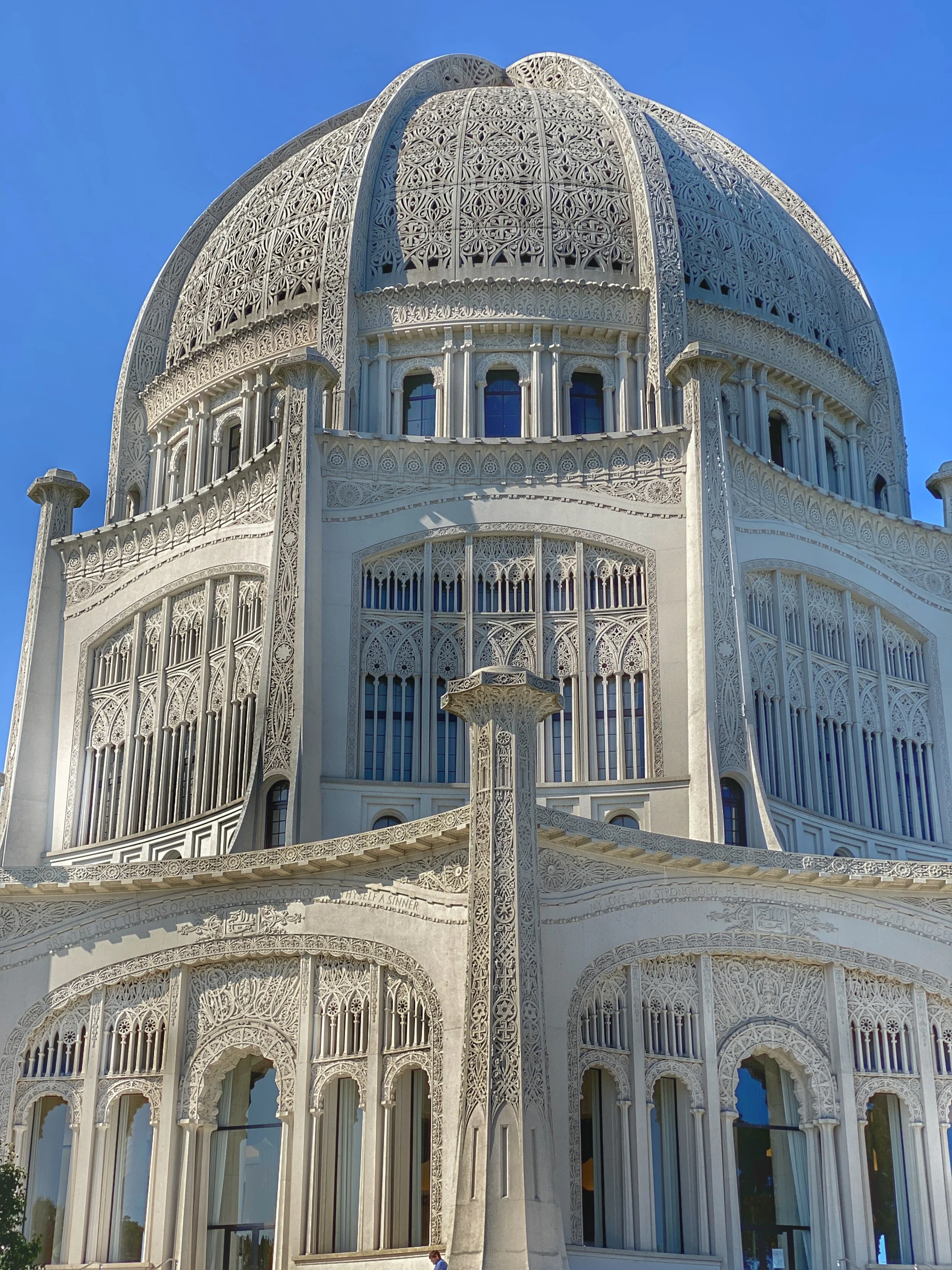
The temple was built from 1920 to 1953 and is composed of a variety of architectural styles.

The temple was built from 1920 to 1953 and is composed of a variety of architectural styles.

Who designed the Chicago Baha’i Temple?

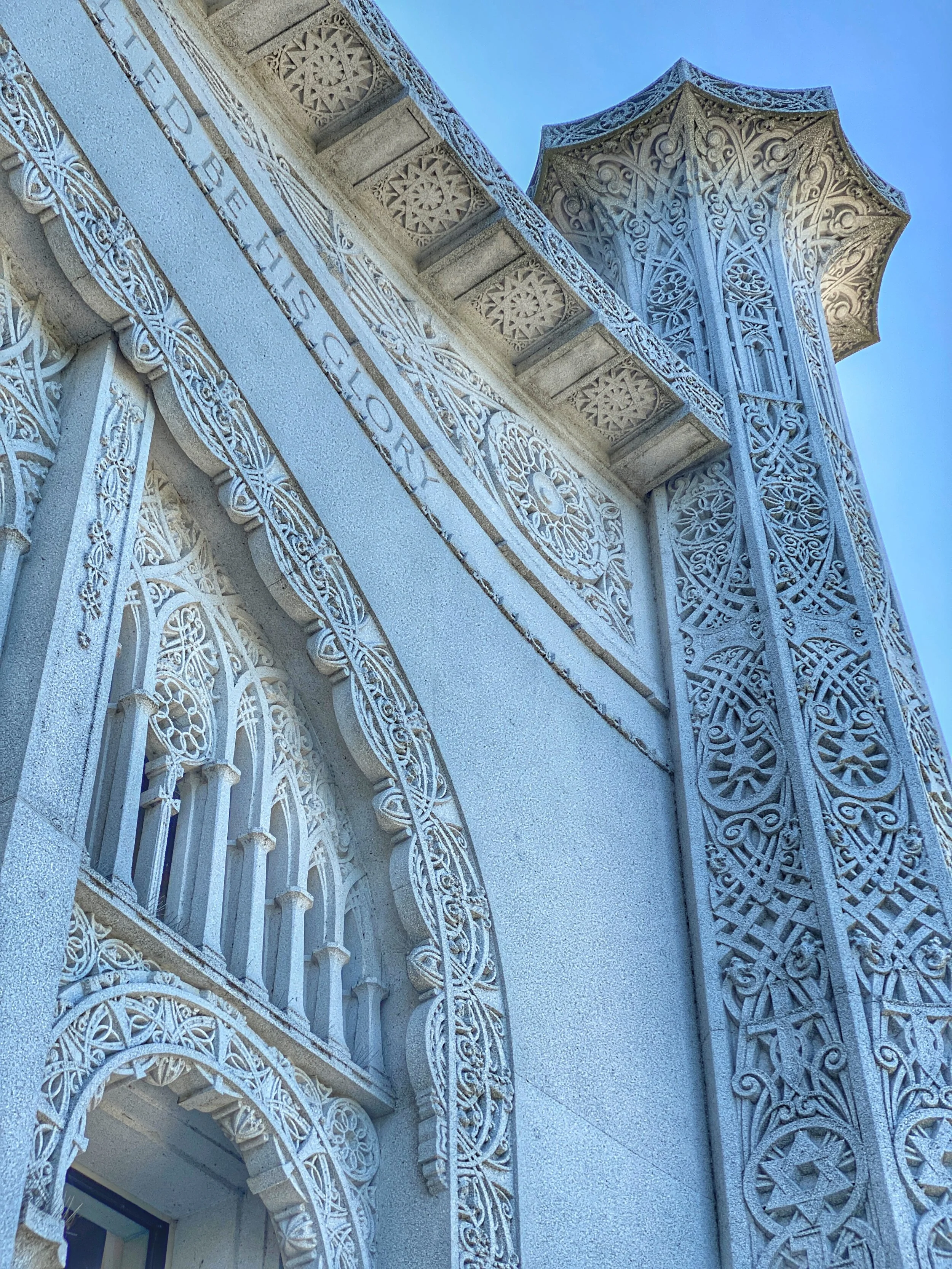
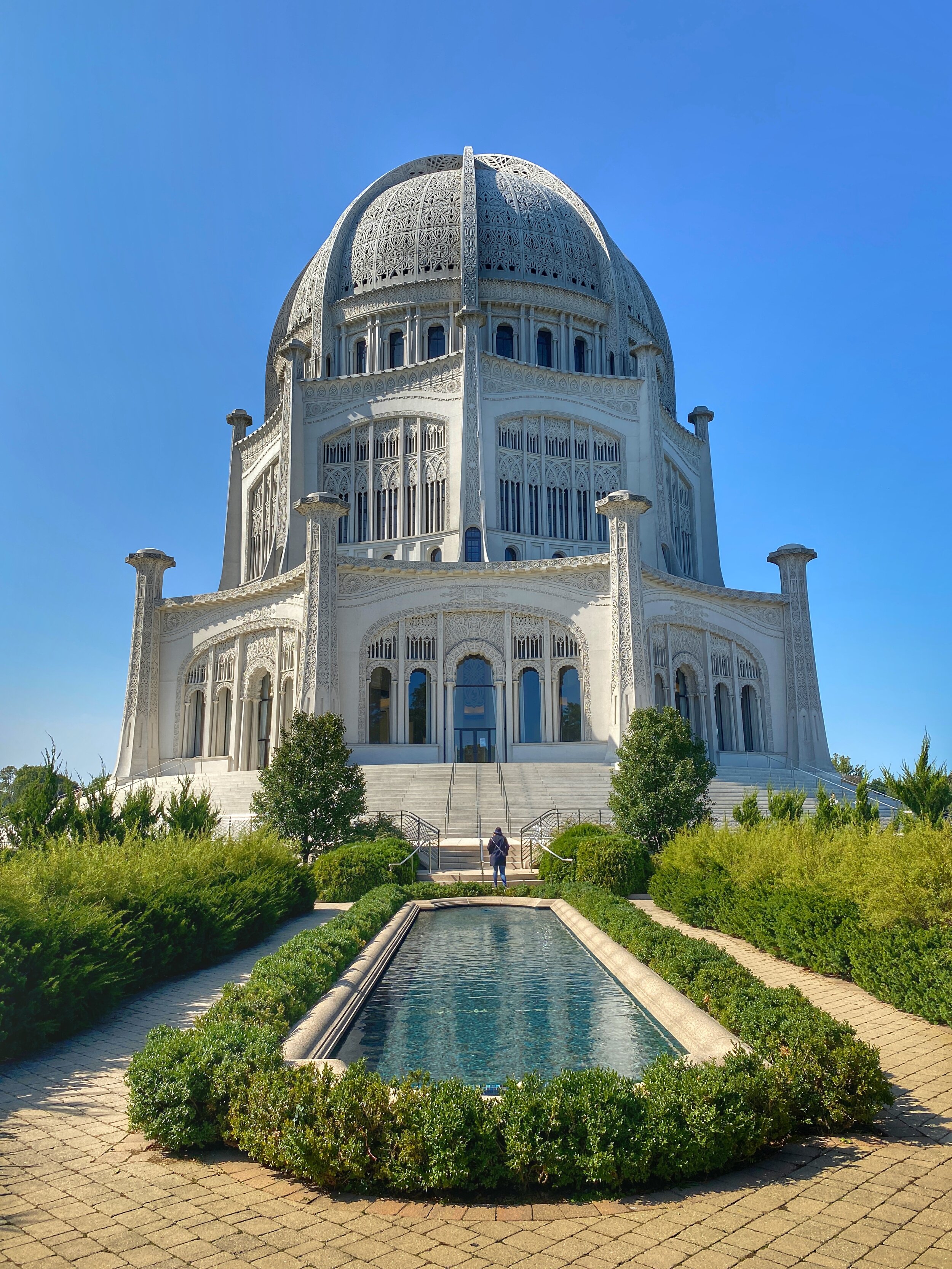
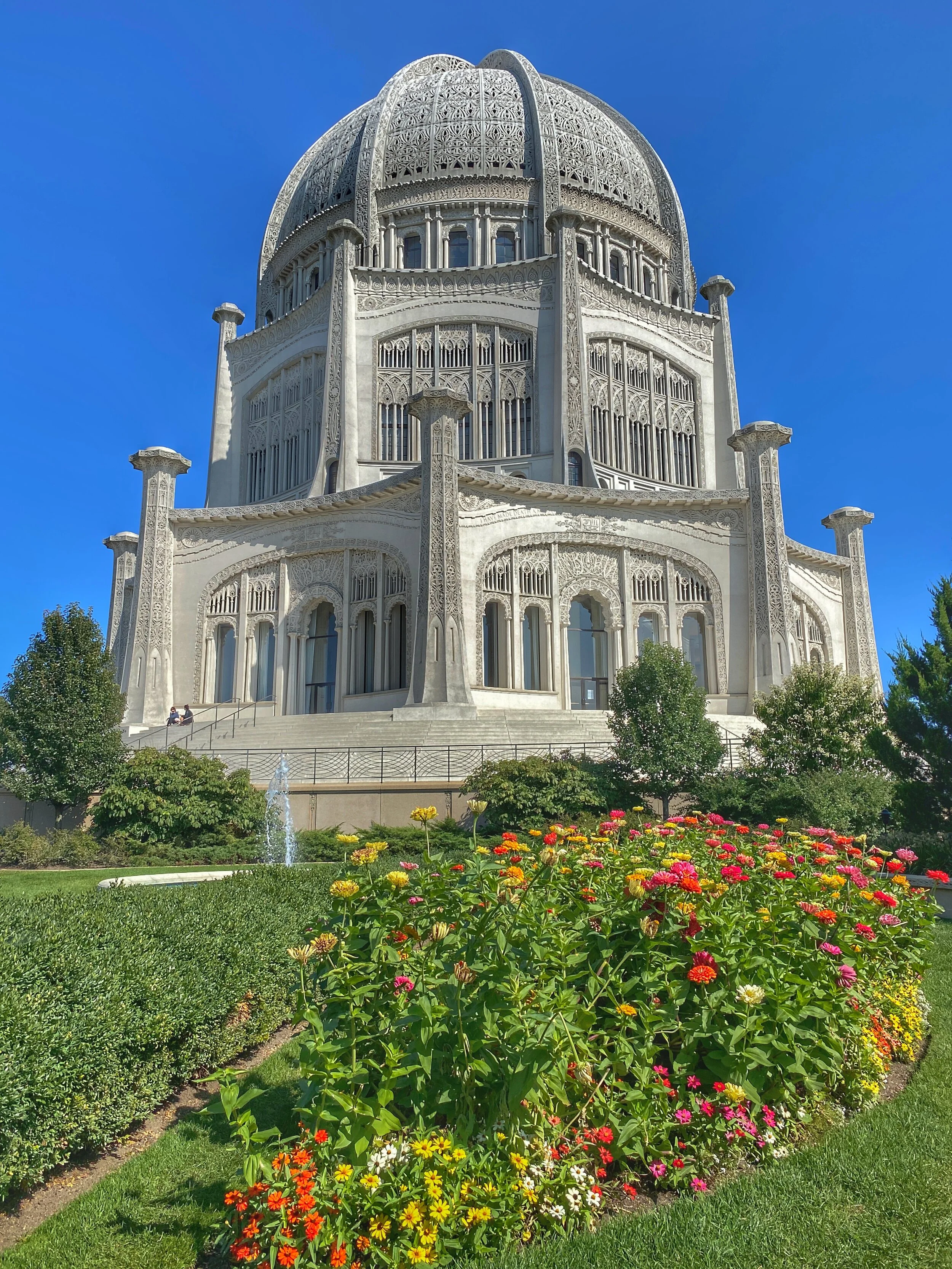
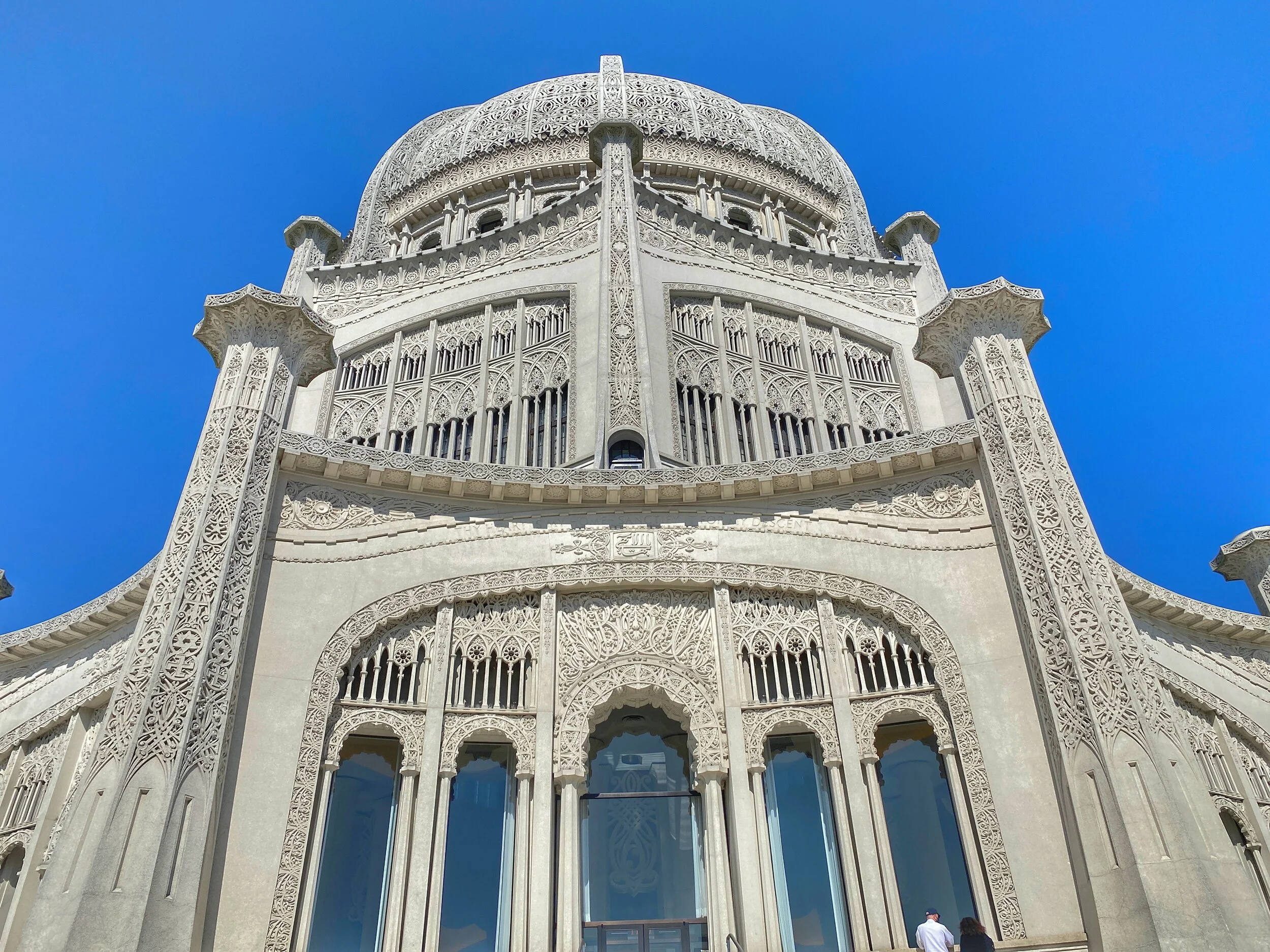
Louis Bourgeois, a French Canadian who had been a Baha’i for over a decade at the time, got the commission. He wanted the building’s design to reflect the beliefs of the faith: the oneness of humanity and the unity of all religions. To really run with this symbolism, he designed a conglomerate of various architectural styles: Neoclassical symmetry, Gothic ribbing, a Renaissance dome, Romanesque clerestory and Islamic arabesques on pillars that hint at minarets. And while that sounds like an unpleasing Frankensteinian mishmash, it somehow all comes together gracefully.

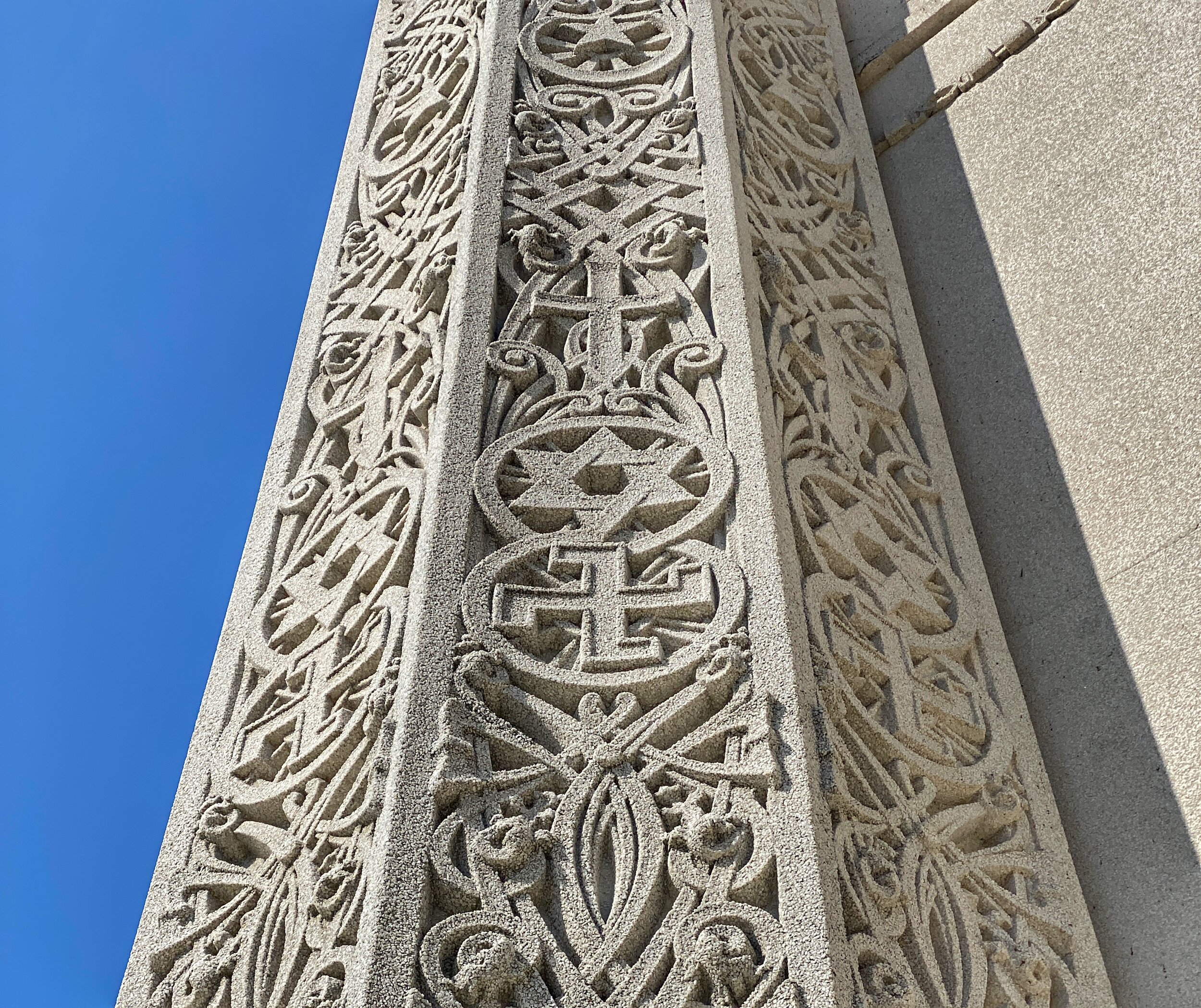
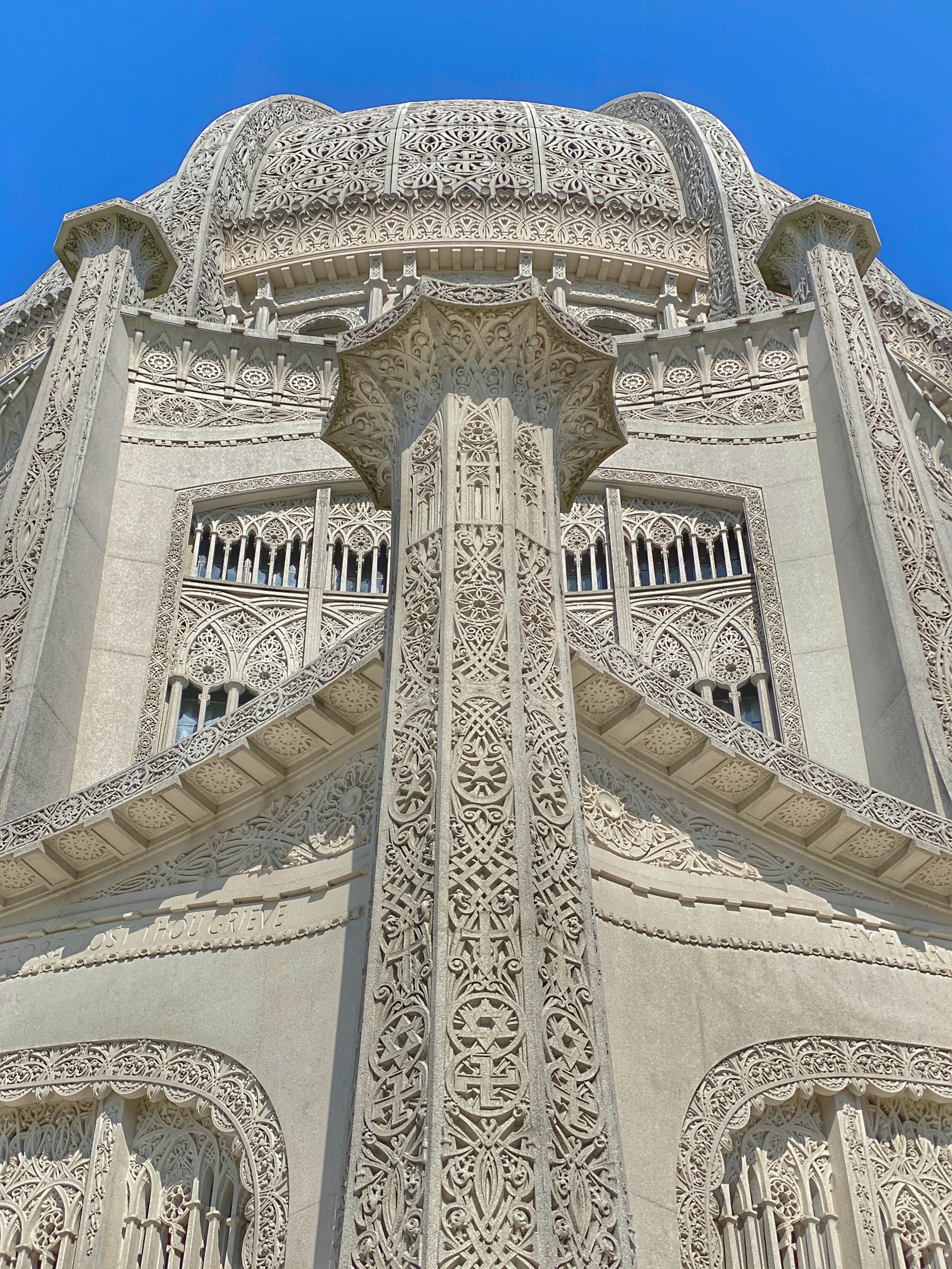
The carvings on the nine pillars feature symbols of the world’s biggest religions: the Christian cross, the Jewish Star of David, the Islamic star and crescent moon — even the swastika of Hinduism, Buddhism and Jainism. 

That swastika causes a lot of controversy — but that’s just because people don’t understand that Buddhists and Hindus have used that symbol long before the Nazis co-opted it.

That swastika causes a lot of controversy — but that’s just because people don’t understand that Buddhists and Hindus have used that symbol long before the Nazis co-opted it.

Bourgeois’ vision was to create “a gathering place for all humanity.” When describing his design, the architect said, “There are combinations of mathematical lines, symbolizing those of the universe, and in their intricate merging of circle into circle, and circle within circle, we visualize the merging of all religions into one.”

Ornate scrollwork depicting symbols from major world religions covers the building’s façade.

Ornate scrollwork depicting symbols from major world religions covers the building’s façade.

What’s with the repetition of the number nine?

To a Baha’i, nine is the most sacred number. As the highest single digit, it’s a potent symbol of comprehensiveness as well as unity. In addition to the nine columns, there are nine entrances, nine verses above the doors and alcoves and nine fountains. 

Each column is topped by a nine-pointed star, the symbol of Baha’i.

The nine columns around the exterior are each topped with a nine-pointed star, the symbol of the Baha’i faith.

The nine columns around the exterior are each topped with a nine-pointed star, the symbol of the Baha’i faith.

Small pools and fountains surround the Baha’i Temple.

Small pools and fountains surround the Baha’i Temple.

How many Baha’i temples are there?

The original idea was to have one house of worship on each inhabited continent (sorry about your luck, Antarctica), and the one in Wilmette, known as the Mother Temple of the West, remains the only one in North America. It’s also the oldest Baha’i temple in the world. (The first temple was built in Ashkhabad, modern-day Turkmenistan, in 1908 but was commandeered by the Soviets and later badly damaged by an earthquake before being demolished in 1963.)

The temple outside of Chicago is the only one on the continent and is supposed to serve all of North America.

The temple outside of Chicago is the only one on the continent and is supposed to serve all of North America.

Here’s a list of Baha’i temples around the world:

Other national or local Baha’i houses of worship are planned for the Democratic Republic of Congo, Papua New Guinea, Cambodia, India, Kenya, Colombia and Vanuatu.

If you’re in the Chicago area, consider a trip north of the city to visit the Baha’i Temple.

If you’re in the Chicago area, consider a trip north of the city to visit the Baha’i Temple.

What about the gardens?

The gardens are an essential design element at all the temples. There’s one in front of each of the nine entrances to the temple, featuring rectangular as well as rounded elements, revealing influences both Western and Eastern.

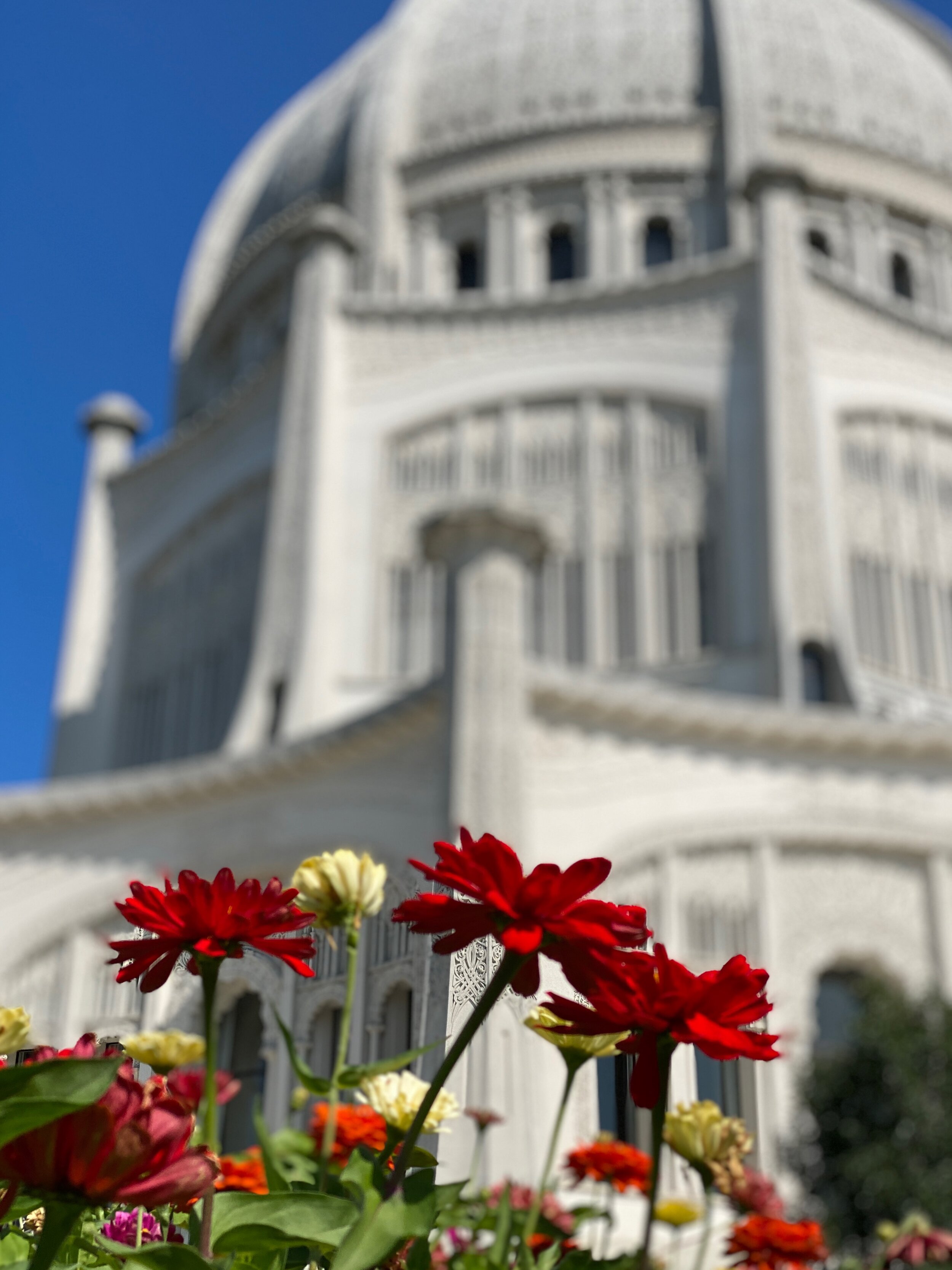
Wandering through the gardens with our friend Kate, we kept circling the temple, admiring its beauty. The circumambulation can be meditative.

Who’d have thought that the delicate beauty of the Baha’i Temple was achieved using concrete?!

Who’d have thought that the delicate beauty of the Baha’i Temple was achieved using concrete?!

What is the Chicago temple made of?

Would you believe that various materials were suggested, including limestone, granite, terracotta and even aluminum, before they decided upon concrete?

This didn’t go over so well, as people feared the material lacked beauty. But a fifth-generation stone carver named John Earley devised a technique inspired by Italian mosaics. He exposed the larger pebbles in the aggregate of the mixture, which gave the concrete an unusual warmth. And when you see the final product nowadays, there’s no denying its lacelike beauty that seems to glow, earning its nickname as the Temple of Light and Unity.

Sadly, neither Bourgeois nor Earley lived to see the temple’s completion. –Wally

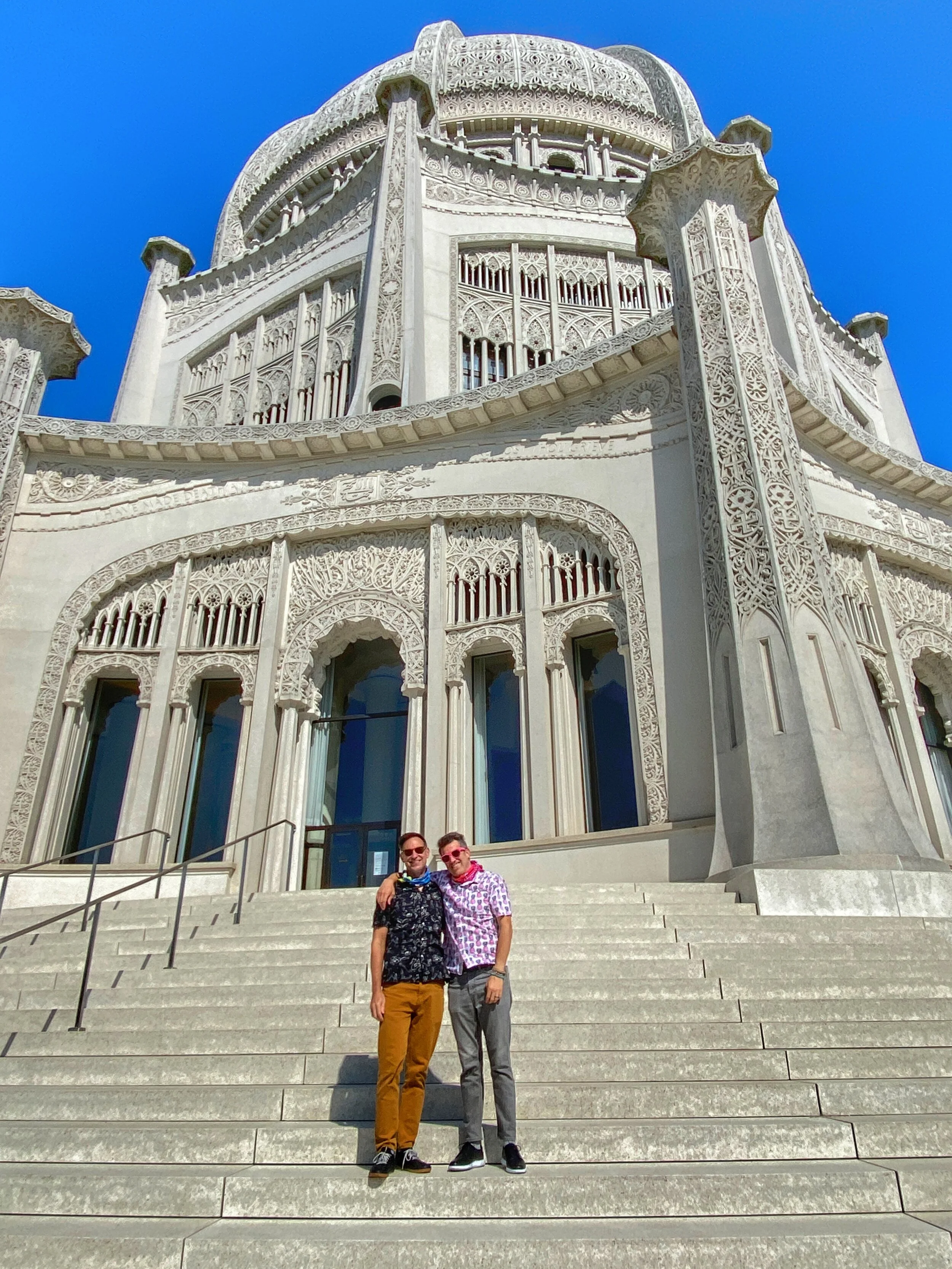
Kate wasn’t the biggest fan of this shot. “It looks like you’re in front of some office building,” she said. Wally looked at the pic and replied, “That’s some office building!”

Kate wasn’t the biggest fan of this shot. “It looks like you’re in front of some office building,” she said. Wally looked at the pic and replied, “That’s some office building!”

Bahá'í House of Worship
100 Lindon Ave.
Wilmette, IL 60091


TWA Flight Center: 8 Facts About the Futuristic Mid-Century Modern Masterpiece

Channeling the Jet Age, the Eero Saarinen-designed Terminal 5 at New York’s John F. Kennedy Airport received a second life as the lobby of the TWA Hotel.

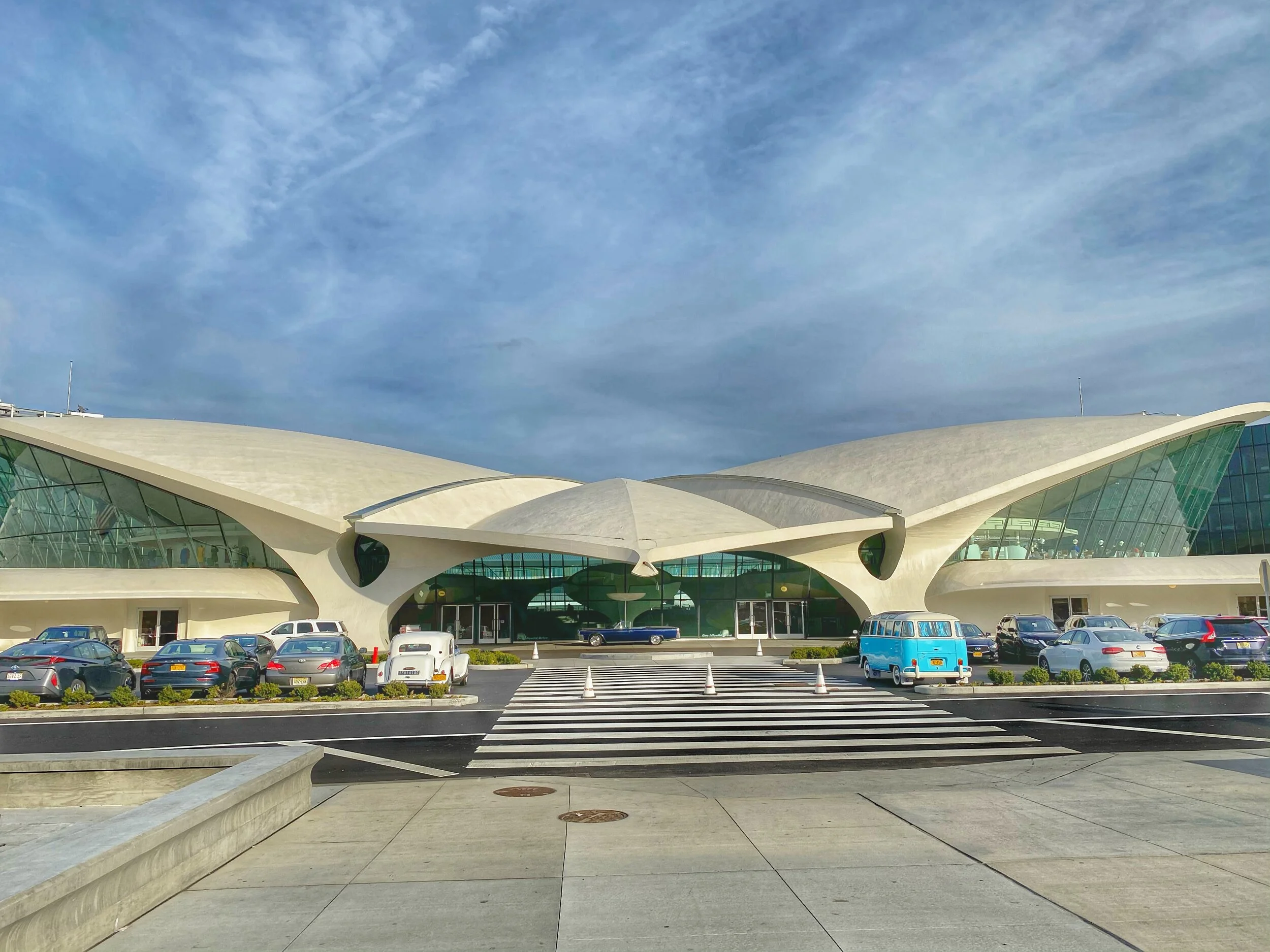
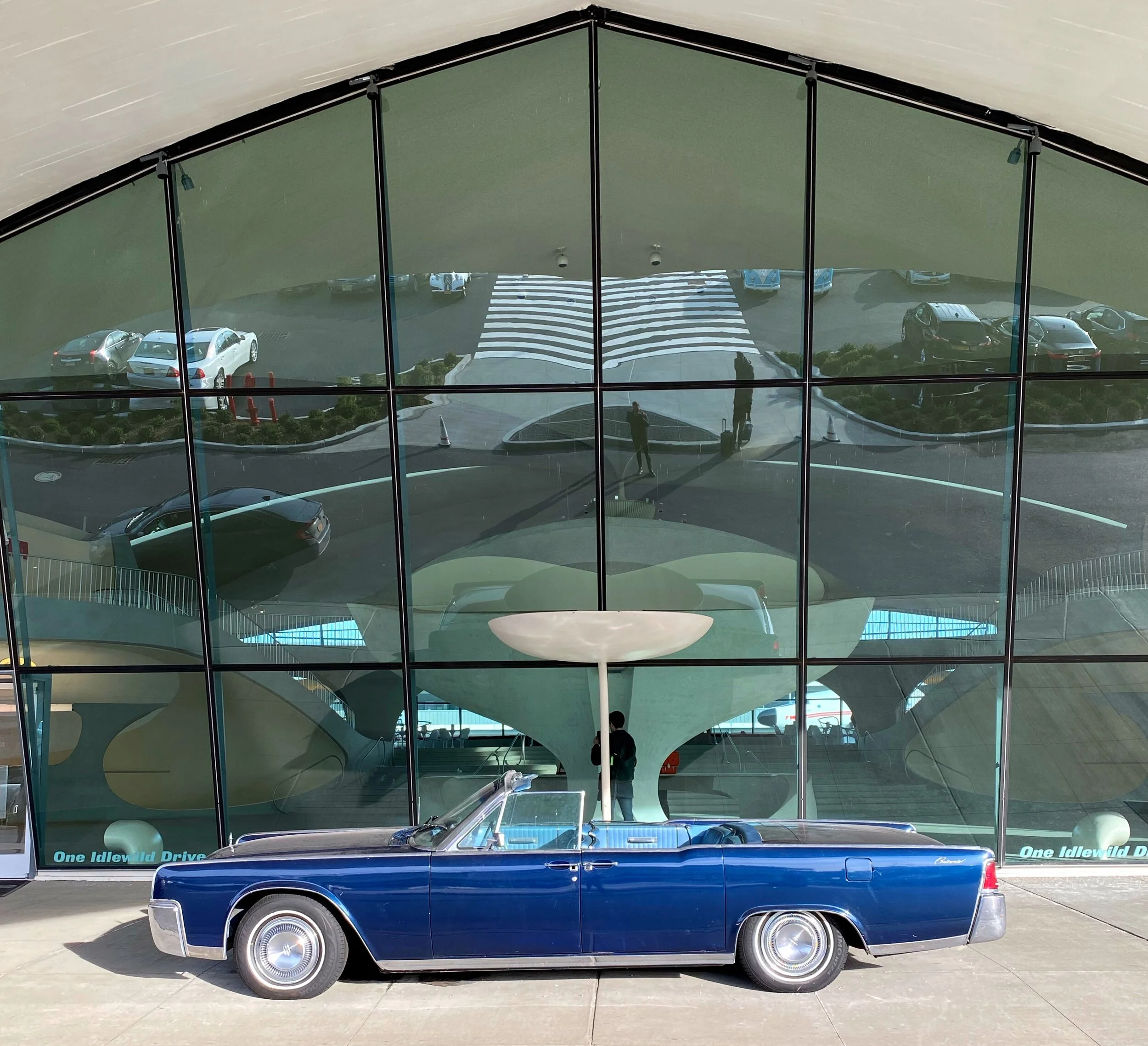
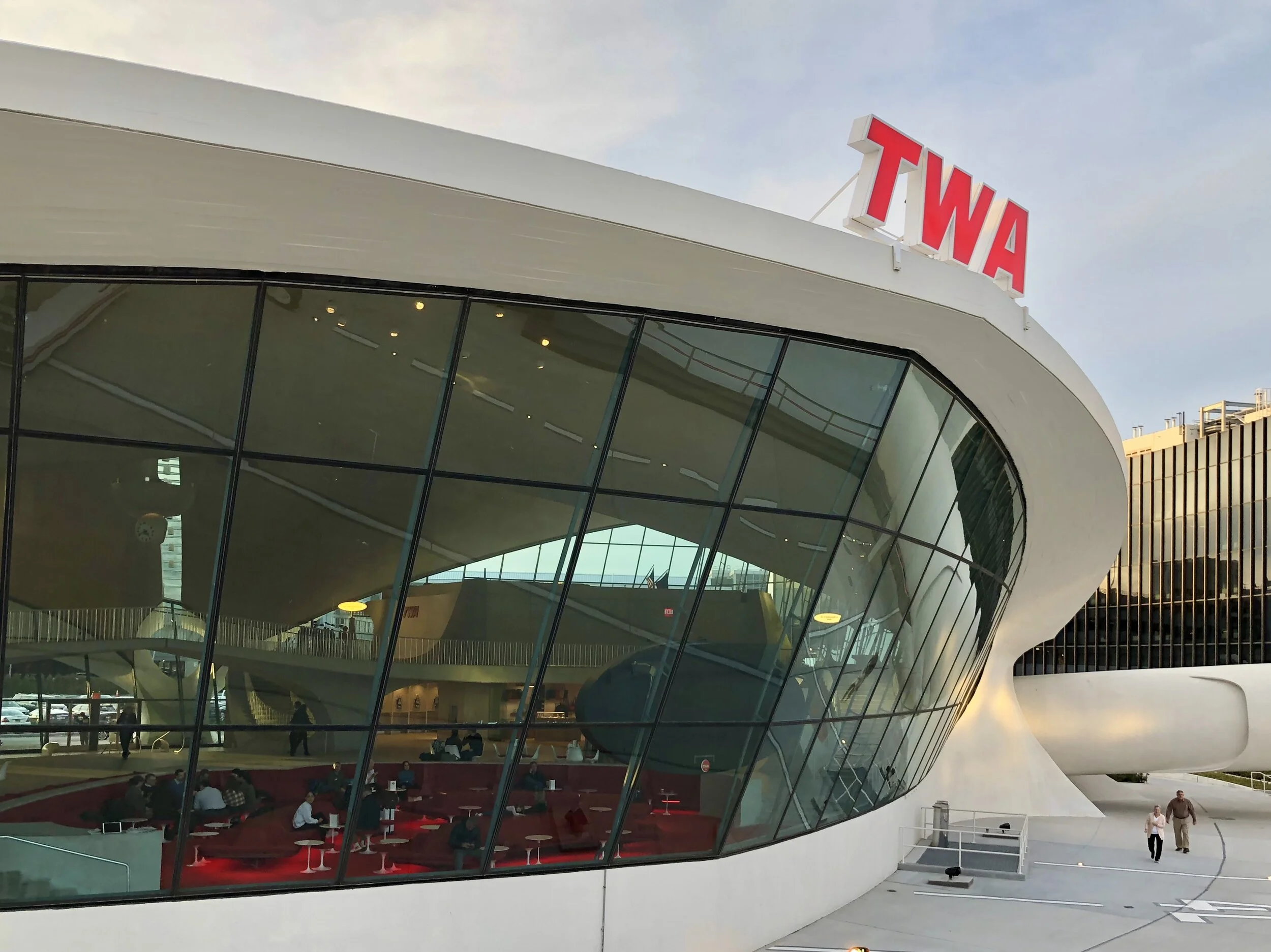
Whether you think it looks like a bird or a sea turtle, there’s no denying the architectural excellence of the TWA Flight Center.

Whether you think it looks like a bird or a sea turtle, there’s no denying the architectural excellence of the TWA Flight Center.

When I had to travel to New York to attend Shoppe Object, an independent home and gift show, at Pier 36, where I’d be assisting the Hay wholesale team with taking orders, Wally figured he’d tag along. 

We flew into JFK a day early and put aside an extra hour or so to visit Terminal 5, or T5, and get a drink at the Sunken Lounge and explore the iconic Eero Saarinen-designed TWA Flight Center. 

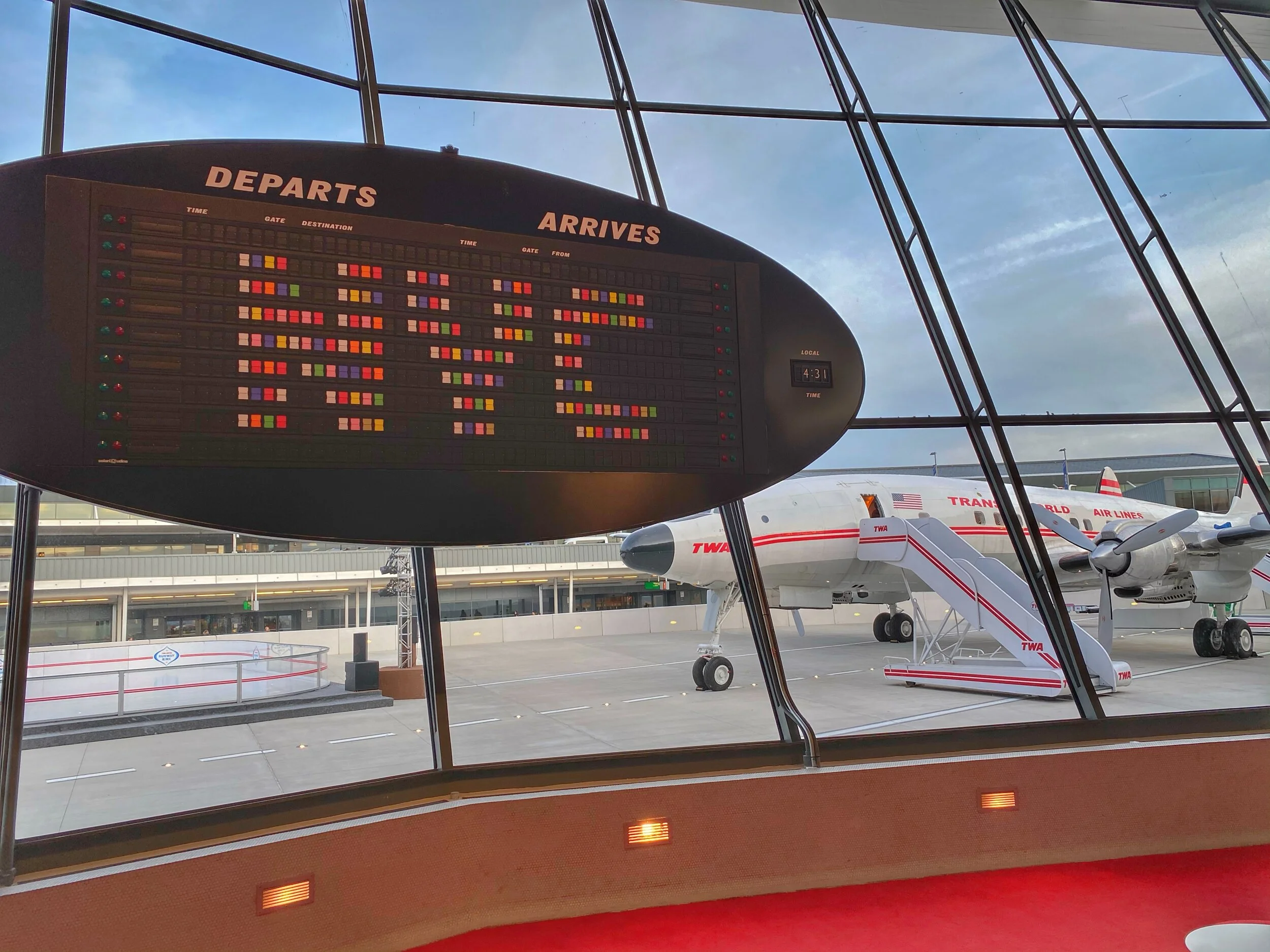
One of the first things you’ll see is this amazing check-in desk for the TWA Hotel, with the departures and arrival board (it might be old-fashioned, but it’s got up-to-date listings) and staffers in retro outfits.

One of the first things you’ll see is this amazing check-in desk for the TWA Hotel, with the departures and arrival board (it might be old-fashioned, but it’s got up-to-date listings) and staffers in retro outfits.

The space reminded me of Antoni Gaudí’s La Sagrada Família Cathedral in its organic sensibility.

To me, this was Saarinen’s cathedral to aviation.

After we disembarked, we took the AirTrain to Terminal 5, then followed the signs directing us to the TWA Hotel. 

Here are eight interesting facts about the TWA Flight Center. 

Howard Hughes in the cockpit of a TWA plane. He bought the airline and commission the construction of the Flight Center.

Howard Hughes in the cockpit of a TWA plane. He bought the airline and commissioned the construction of the Flight Center.

1. Playboy Howard Hughes hired Eero Saarinen to build the terminal, costs be damned. 

Prior to becoming a recluse and taking up residence of the penthouse at the Desert Inn Hotel in Las Vegas, Howard Hughes, one of the wealthiest men in the world, dabbled in motion picture direction, production and aviation. He acquired control of TWA (short for Trans World Airlines) in 1939, without ever holding an official position. 

Known to want the best that money could buy, in 1959, Hughes commissioned Eero Saarinen, the Finnish-American architect behind the 630-foot-high Gateway Arch in St. Louis, Missouri, to design a terminal for the airline. Never one to keep to a budget, construction costs for the terminal ballooned from $9 million to $15 million (equal to a staggering $130 million in 2021).

An old map that shows TWA’s routes

An old map that shows TWA’s routes

Fun fact: Hughes was well known for his dalliances with celebrities of both sexes, including Katherine Hepburn, Cary Grant, Ginger Rogers and Olivia de Havilland.  

The sky blue VW bus out front is totally groovy, man.

The sky blue VW bus out front is totally groovy, man.

2. Saarinen got the inspiration for his mid-century modern marvel from a grapefruit.

Often described as a swooping bird, I found the structure to more closely resemble a sea turtle. 

The TWA Flight Center was dedicated to the Golden Age of travel and was a marvel of mid-century modern design when it opened in May 1962, nearly 60 years ago — the likes of which the world had never seen. 

If Eero Saarinen didn’t eat grapefruit, the TWA Flight Center would never have been conceived.

If Eero Saarinen didn’t eat grapefruit, the TWA Flight Center would never have been conceived.

Legend has it that the architect arrived at the building’s evocative form one morning during breakfast, after flipping over a hollowed-out grapefruit rind and pressing down in the middle. 

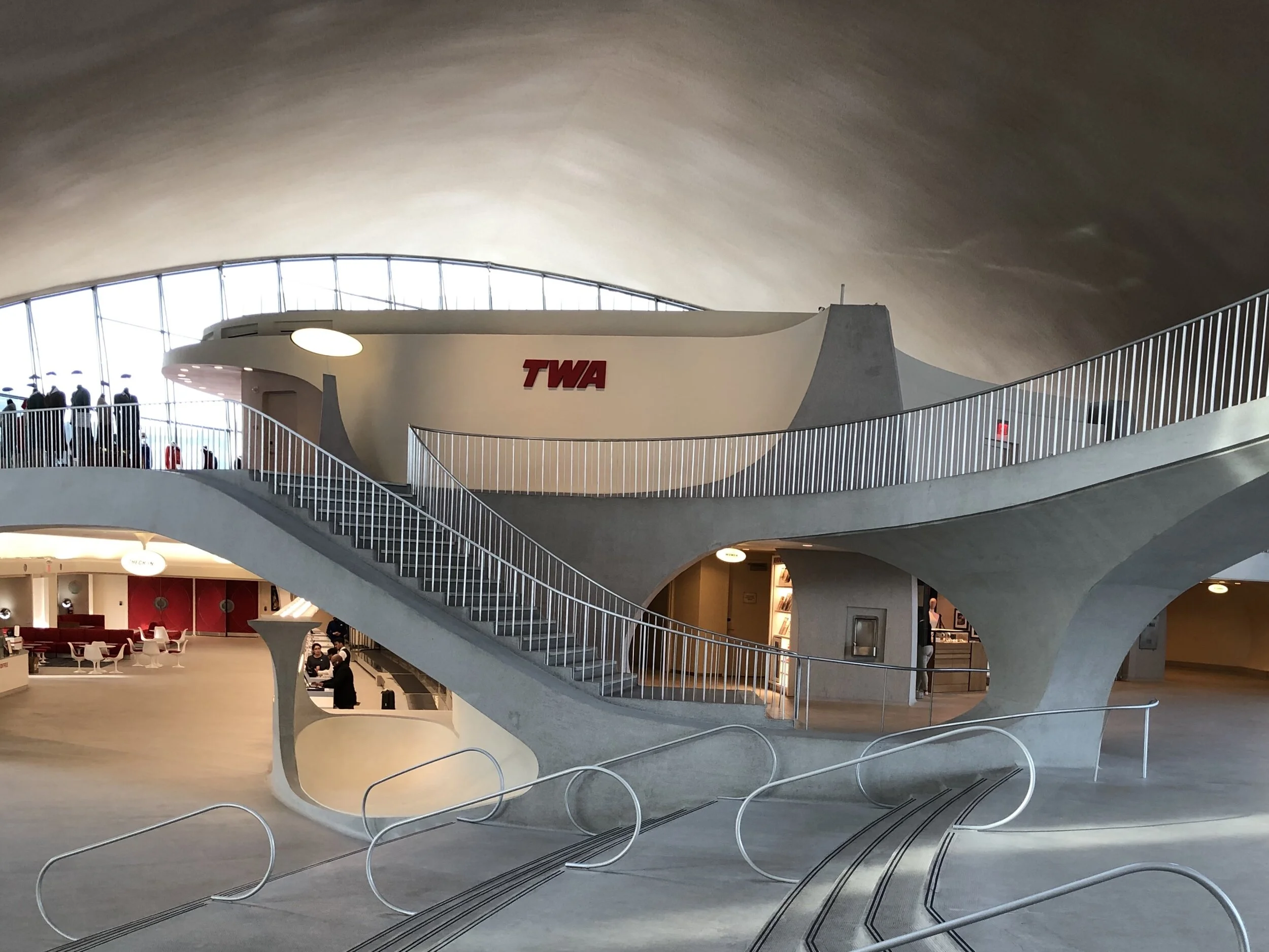
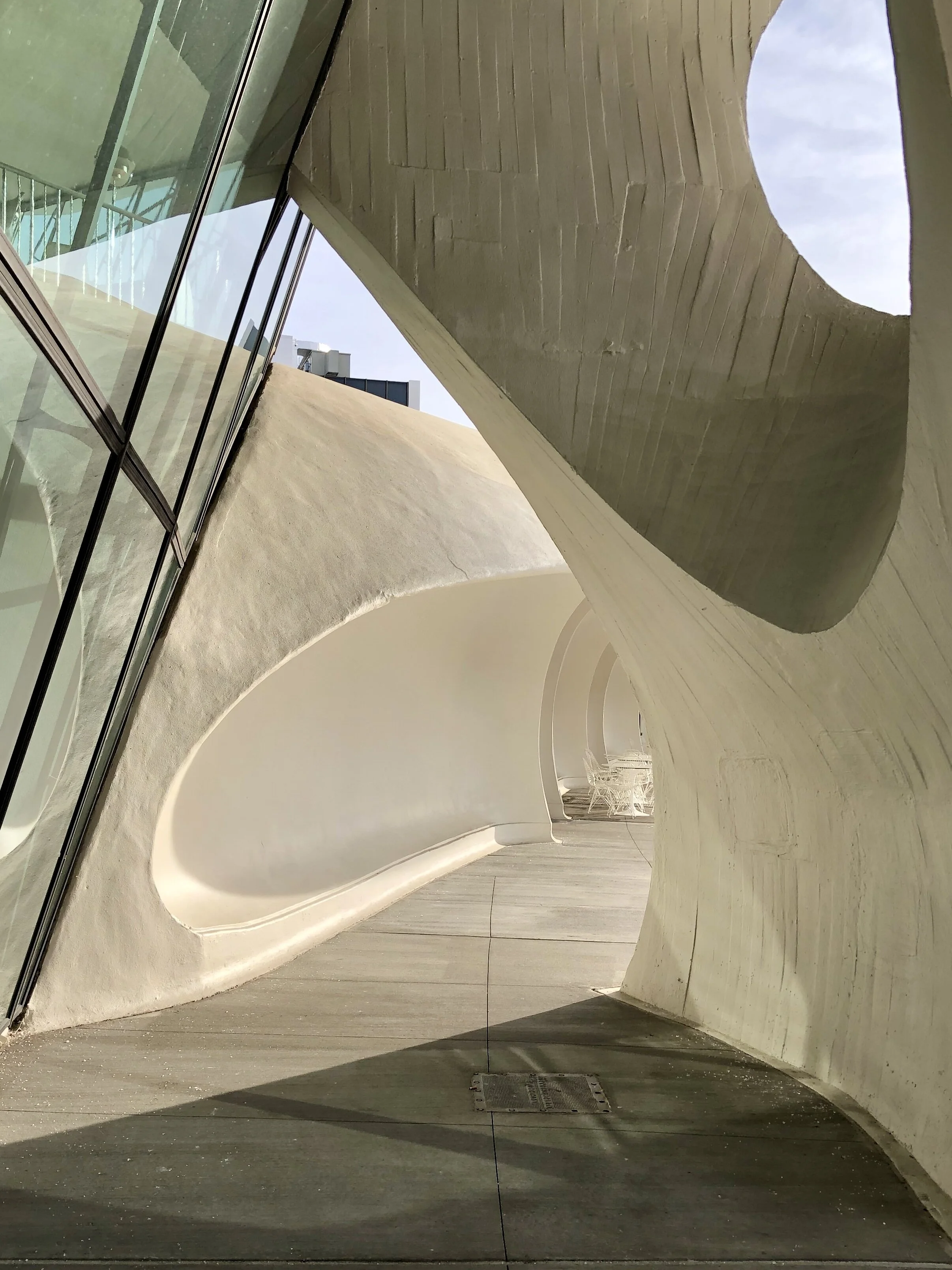
The Flight Center’s shell-shaped roof consists of four symmetrical reinforced concrete forms separated from one another by narrow skylights. Inside, undulating organic forms of the 200,000-square-foot lobby merge inward — soaring ceilings blend into walls, and those walls become floors. The space reminded me of Antoni Gaudí’s La Sagrada Família Cathedral in its organic sensibility. To me, this was Saarinen’s cathedral to aviation.

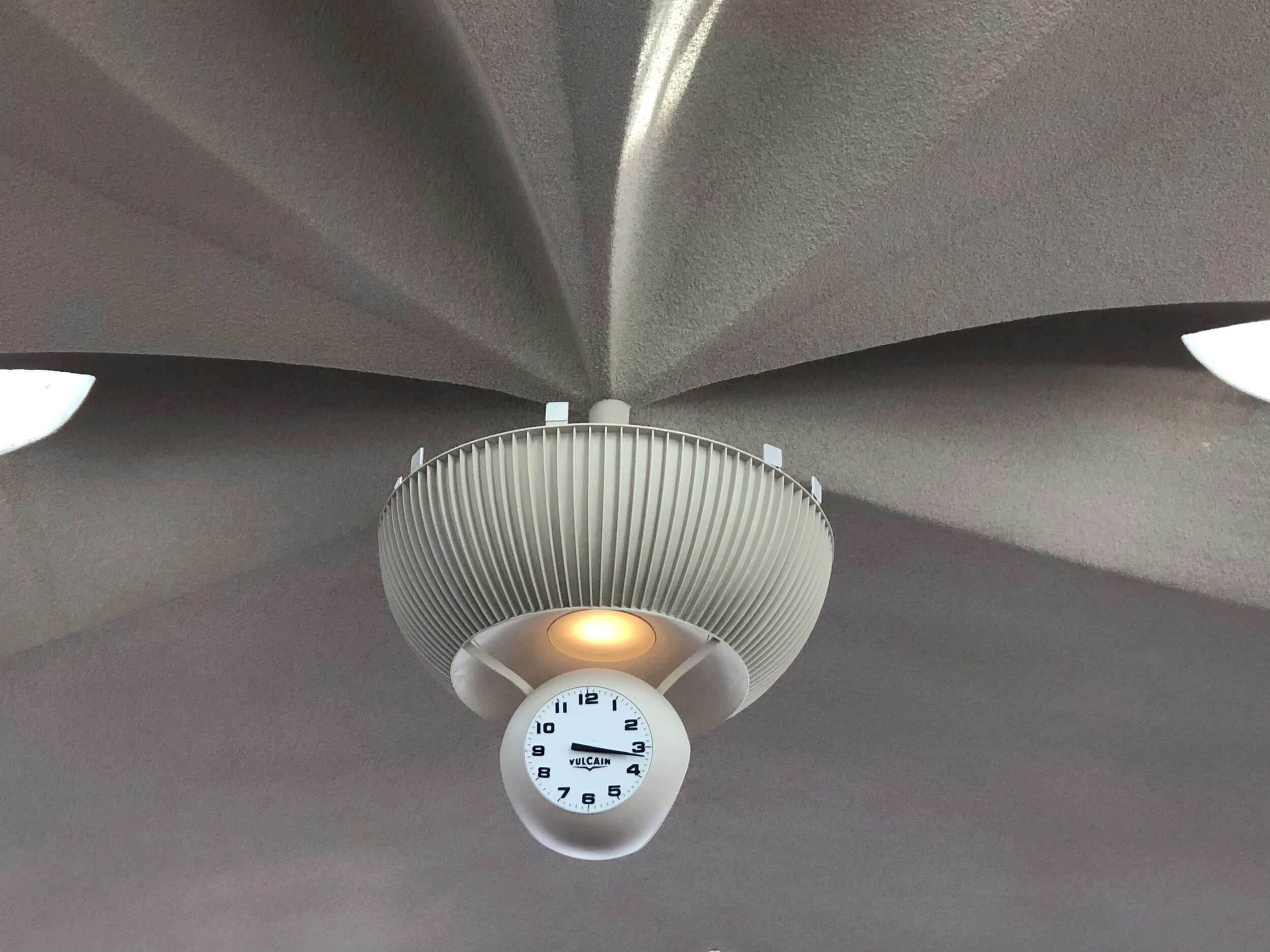
At the center of the terminal’s vaulted ceilings, the original Vulcain clock still keeps the time.

The original clock high above, positioned where the many arches converge on the ceiling

The original clock high above, positioned where the many arches converge on the ceiling

Speaking of time, Saarinen’s ran out all too soon. Sadly, the designer never lived to see his finished creation. He died at the age of 51, during surgery to remove a brain tumor, in 1961 — one year before the Flight Center was complete.

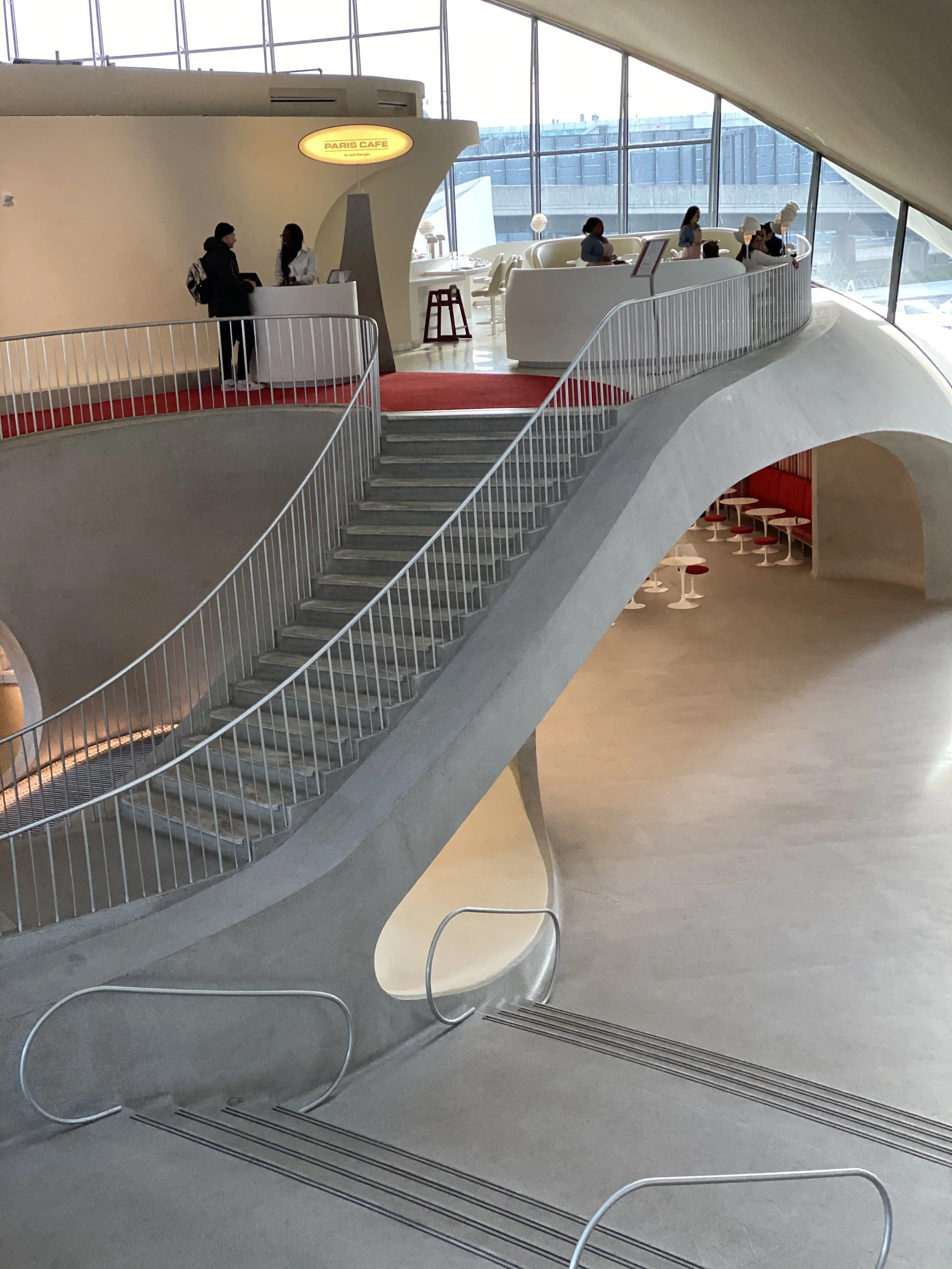
Swooping staircases and curving walkways fill the interior.

Swooping staircases and curving walkways fill the interior.

3. The media adored the TWA Flight Center, but one of Saarinen’s fellow architects described it as part of a “nightmare.”

Today, Saarinen is revered as one of the most important architects of the 20th century. However, when the TWA Flight Center opened in 1962 at what was then Idlewild Airport, not all of the attention it attracted was positive. The press was enthusiastic about his design, heaping acclaim on the structure’s dynamic form and fluid interior. 

But some of Saarinen’s peers were critical of his work. British architect and critic Alan Colquhoun was quoted in Architectural Design as saying the Flight Center was “like the monster forests of a child’s nightmare, where a toadstool may be 20 feet high or like the dematerialized and unearthly forms of an Expressionist film set.”

You can understand why critic Alan Colquhoun would say the interior feels like an Expressionist film set — but why does that have to be a bad thing?

You can understand why critic Alan Colquhoun would say the interior feels like an Expressionist film set — but why does that have to be a bad thing?

It was designated as a New York City landmark in 1994 and listed on the National Register of Historic Places in 2005. 

Planes are a lot bigger than they used to me, rendering Terminal 5 obsolete.

Planes are a lot bigger than they used to be, rendering Terminal 5 obsolete.

4. The iconic terminal was ultimately too small to work for larger planes and closed for almost two decades. 

By the mid-’70s, the aging hub became impractical — Saarinen’s design couldn’t accommodate the proliferation of wide-body jets that could carry hundreds of passengers at a time. The terminal was still used for smaller planes but eventually closed, with the last flight departing from there in 2001. 

Duke chillaxes on the chili pepper red seating.

Duke chillaxes on the chili pepper red seating.

5. Saarinen didn’t just design the TWA Flight Center — he also created a color for it. 

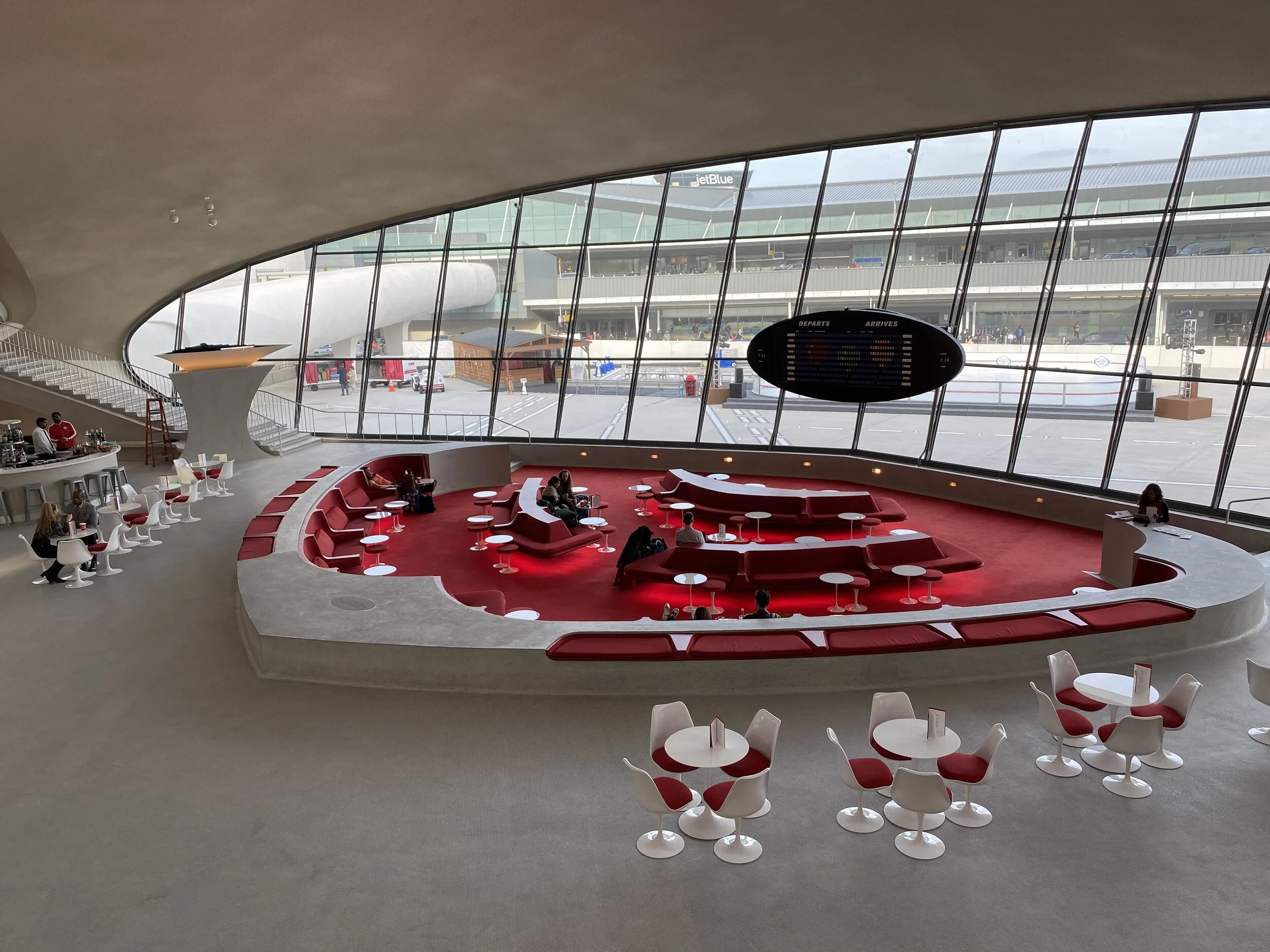
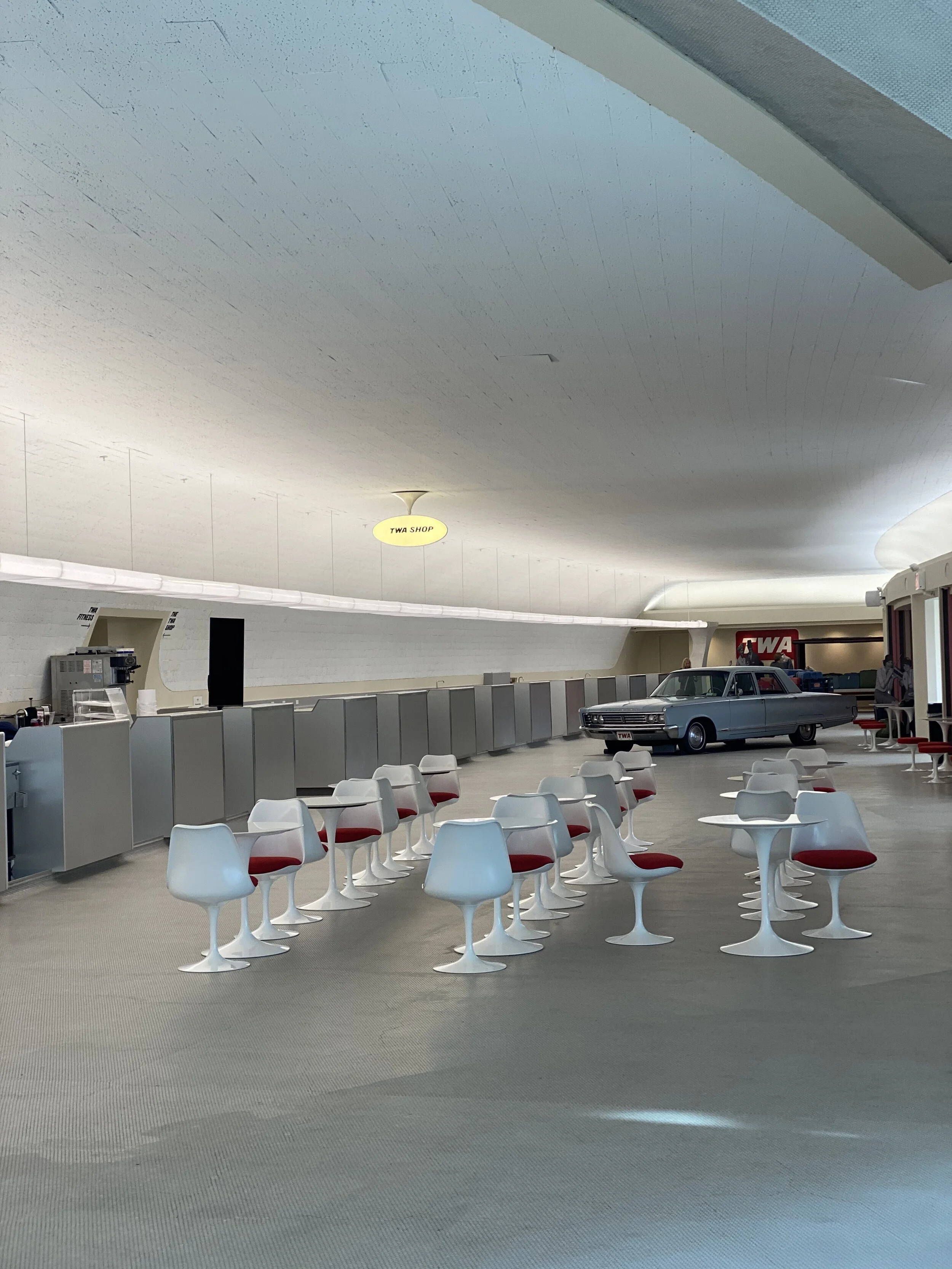
The signature hue, chili pepper red, which Saarinen developed for the Flight Center can be seen everywhere, from the banquettes and furnishings to the hallway carpeting in the hotel buildings. It stands out in stark contrast to the predominant white interior.

Incidentally, the space was originally outfitted by acclaimed Parisian industrial designer Raymond Loewy, the creative mind behind the 1959 TWA twin globes logo. 

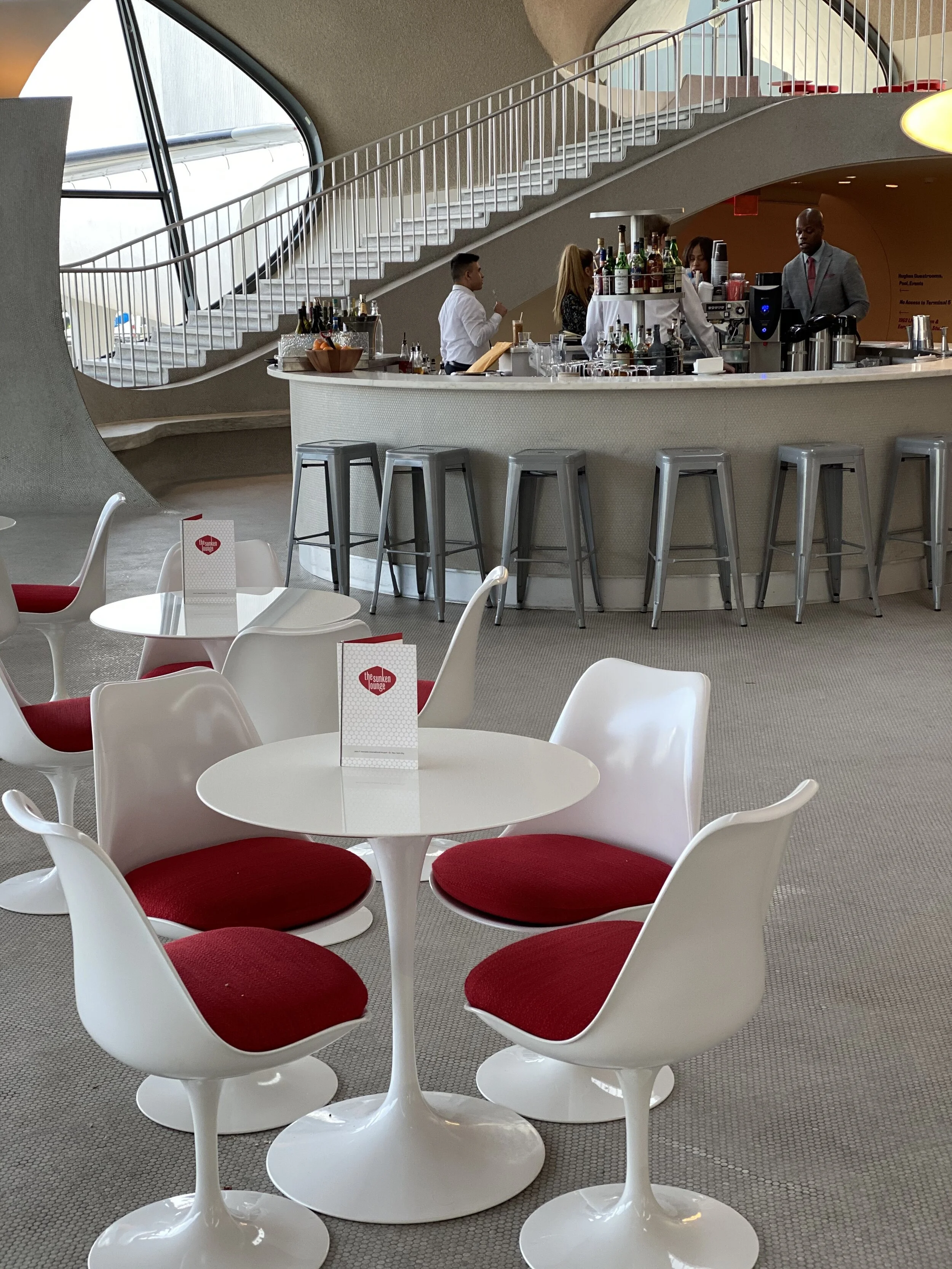
The Sunken Lounge as seen from the second floor.

The Sunken Lounge as seen from the second floor

6. The Sunken Lounge is the hippest spot to grab a drink at JFK.

The centerpiece of the space is the Sunken Lounge cocktail bar, complete with Tulip chairs and pedestal tables designed by Saarinen for Knoll. 

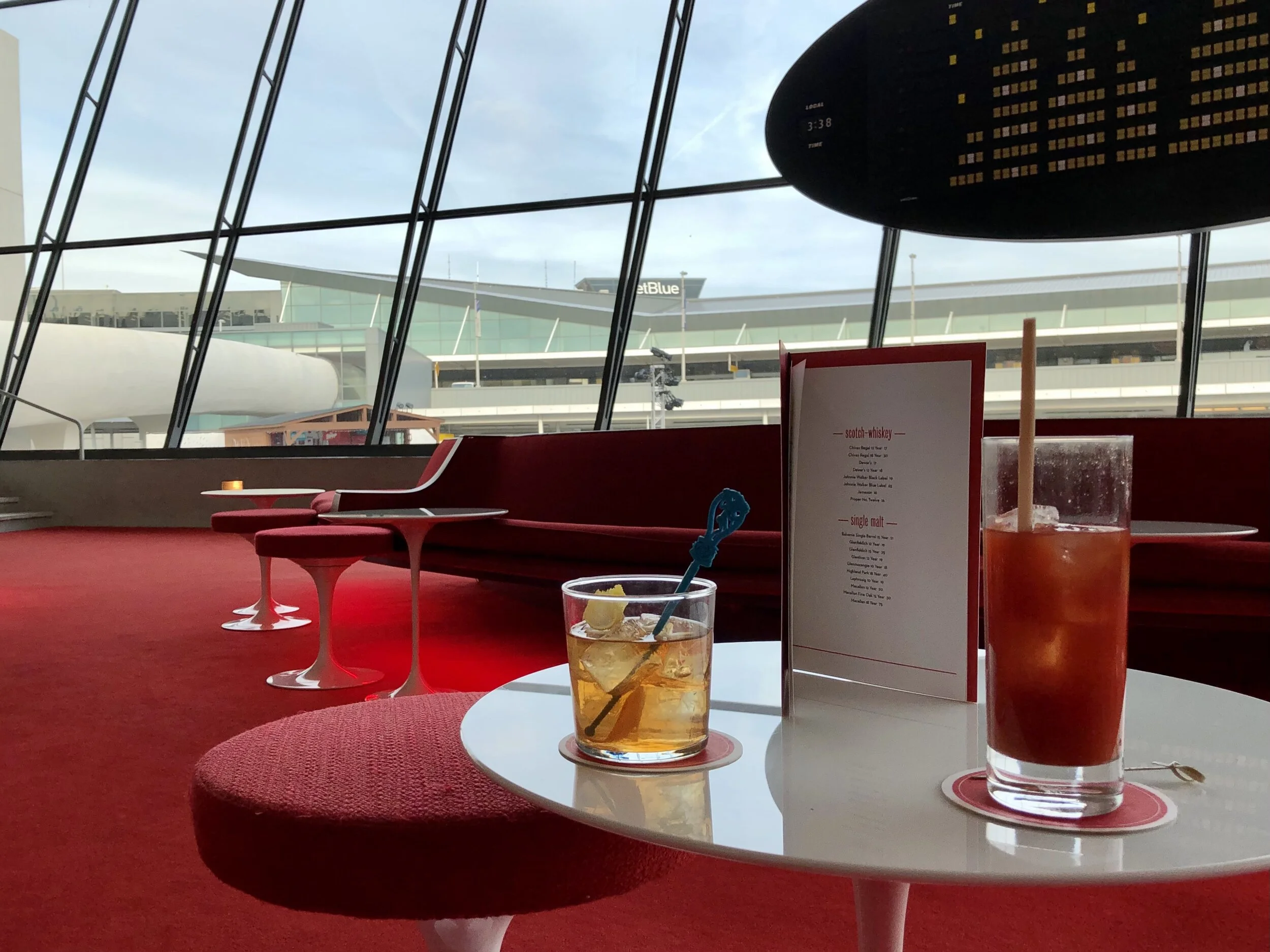
I ordered an Idlewild old fashioned, while Wally got a Bloody Mary. We were particularly delighted with the retro swizzle stick featuring a dancing Shiva, the Hindu god.

The drinks might be spendy, but the atmosphere makes it worthwhile.

The drinks might be spendy, but the atmosphere makes it worthwhile.

Wally’s a sucker for spicy Bloodys.

Wally’s a sucker for spicy Bloodys.

There’s something comforting about the click-click-click of the retro departures board.

There’s something comforting about the click-click-click of the retro departures board.

A split-flap departures board, by Solari di Udine, the Italian manufacturer that made the terminal’s original, displays custom messages instead of flight info. There are over 34,000 tiles on the sign, creating a nostalgia-inducing whir and clatter throughout our visit.

De plane! De plane! One imagines this plane was named Connie cuz she’s a Lockheed Constellation.

De plane! De plane! One imagines this aircraft was named Connie cuz she’s a Lockheed Constellation.

7. The on-site plane, Connie, is now a cocktail lounge — though she once ran drugs in South America.

While enjoying a drink in the Sunken Lounge, you can see a vintage plane through the floor-to-ceiling windows. Wally and I knew we had to explore it. 

Wally’s off to see if there’s any pot left on Connie from her drug-smuggling days.

Wally’s off to see if there’s any pot left on Connie from her drug-smuggling days.

There’s no ticket needed for Duke to board this plane!

There’s no ticket needed for Duke to board this plane!

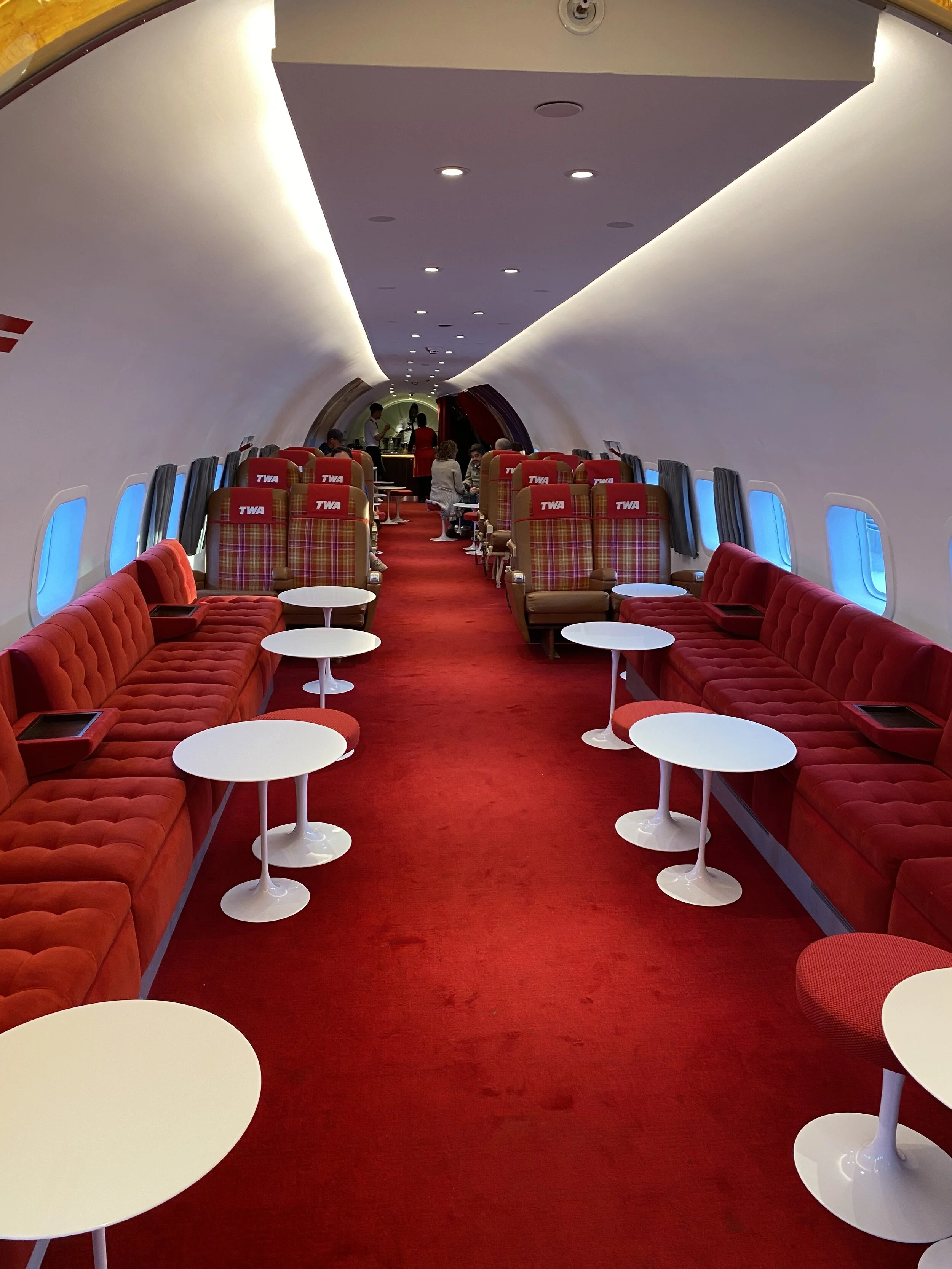
A 1958 Lockheed Constellation L 1649A — a four-propeller airplane commissioned by Hughes and affectionately known as Connie — sits parked on the tarmac behind the terminal. Its interior has been transformed into a delightful, one-of-a-kind cocktail lounge. 

Grab a drink and some nibblies inside Connie, a plane-turned-cocktail bar.

Grab a drink and some nibblies inside Connie, a plane-turned-cocktail bar.

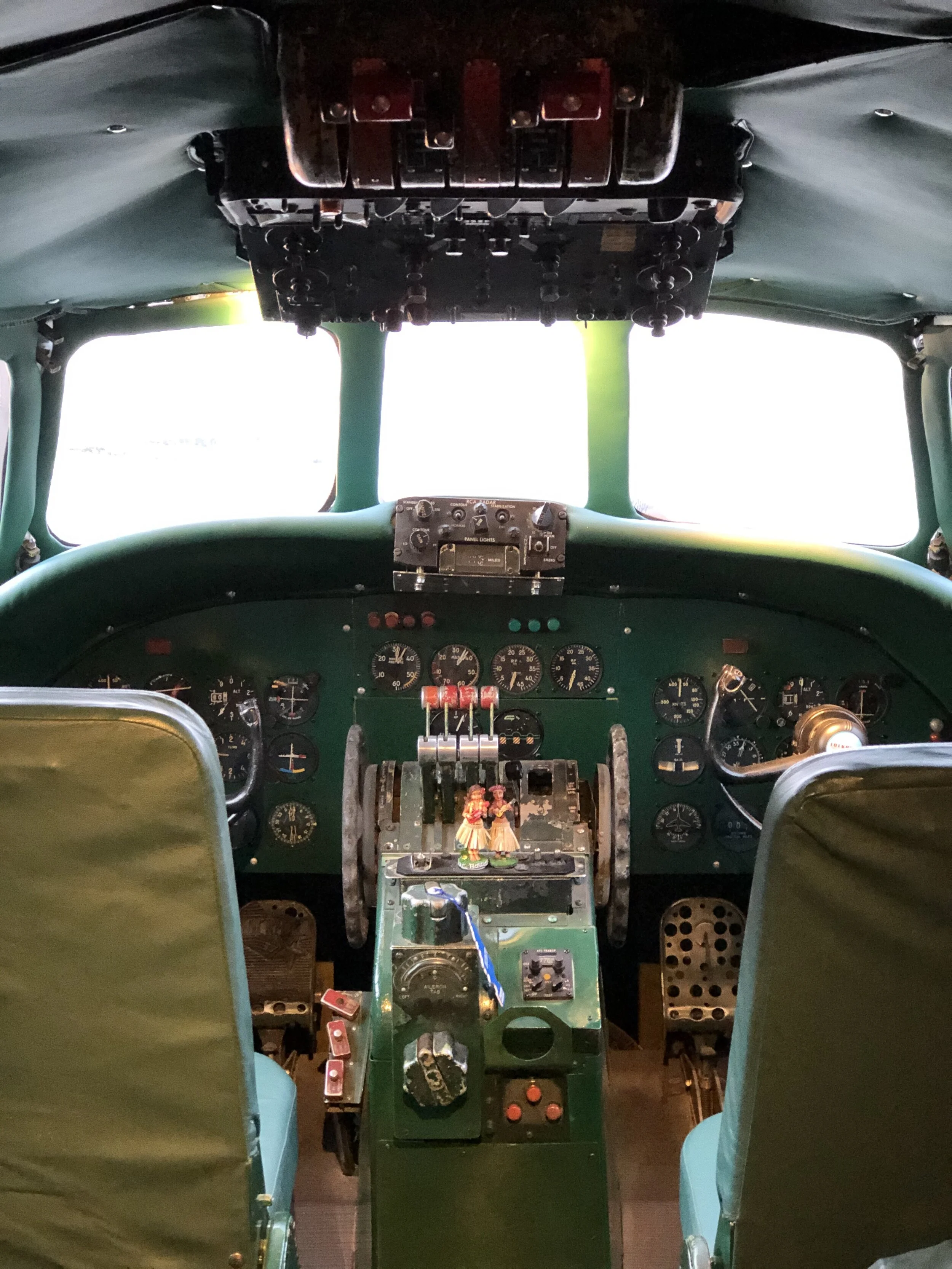
Check out the cockpit while onboard Connie.

Check out the cockpit while onboard Connie.

In the interim between being a part of the TWA fleet and being a star of the Flight Center, Connie engaged in some dubious activities, including delivering marijuana for a Colombian drug cartel before being abandoned in Honduras, according to Air & Space magazine.

Saarinen designed the Tulip chairs and pedestal tables found throughout the space.

Saarinen designed the Tulip chairs and pedestal tables found throughout the space.

8. A restoration project returned the Flight Center to its former retro space-age glory.

The impeccable attention to detail of the restoration of the former terminal was overseen by Richard Southwick, partner and director of historic preservation at New York-based architecture firm Beyer Blinder Belle. 

A vintage convertible sits out front of the Flight Center.

A vintage convertible sits out front of the Flight Center.

One design element that was particularly challenging was the ceramic penny tiles specified in Saarinen’s original design. A total of 20 million custom ½-inch-diameter bisque-colored mosaic tiles were sourced and used over the course of both phases of the project, covering the floors and swooping interior walls. 

The organic yet futuristic forms create a Jetsons sort of feel, retro and space age all at once.

The organic yet futuristic forms create a Jetsons sort of feel, retro and space age all at once.

Those things on the wall are called payphones. They’re sort of like mobiles, except they were stationary.

Those things on the wall are called payphones. They’re sort of like mobiles, except they were stationary.

There’s an odd little seating area (with another classic car) off to the left when you enter.

There’s an odd little seating area (with another classic car) off to the left when you enter.

Vintage magazines and snacks at the newsstand by the bathroom

Vintage magazines and toiletries at the newsstand by the bathroom

The upper level features a mini-museum of TWA artifacts, including flight attendant uniforms from the 1940s to the 1990s. Designs from Valentino, Cassini and Balmain are on display, along with vintage flight bags. 

The Paris Café on the second floor

The Paris Café on the second floor

Famous designers like Valentino designed flight attendant uniforms for TWA. They’re on display upstairs.

Famous designers like Valentino designed flight attendant uniforms for TWA. They’re on display upstairs.

The Paris Café is located on the second floor of the Flight Center and occupies the footprint of the original Lisbon Lounge. 

The pair of corridors featured in the 2002 Steven Spielberg film Catch Me If You Can, starring Leonardo DiCaprio and Tom Hanks, once led to boarding gates and now offers access to the two wings of the TWA Hotel, Hughes and Saarinen, which partially encircle the terminal.

If you’ve got some extra time before or after a flight at JFK, be sure to stop by the TWA Flight Center for a drink and some photos. Saarinen’s design somehow manages to be retro and futuristic at the same time. –Duke

Follow the signs the Terminal 5, and you’ll be rewarded with the architectural and design wonder that is the TWA Flight Center.

Follow the signs the Terminal 5, and you’ll be rewarded with the architectural and design wonder that is the TWA Flight Center.


TWA Flight Center
John F. Kennedy International Airport
JFK Access Road
1 Idlewild Drive
New York, NY 11430

All-Too-Perfect Seaside, Florida

The quaint-as-heck New Urbanism town where “The Truman Show” was filmed will charm visitors, even amidst a red tide.

An aerial view of Seaside, Florida reveals the town’s well-thought-out planning, with buildings surrounding green spaces and everything within walking distance.

An aerial view of Seaside, Florida reveals the town’s well-thought-out planning, with buildings surrounding green spaces and everything within walking distance.

We left early in the morning from Hilton Head, South Carolina with Wally’s parents and arrived in Seaside, Florida around eight hours later. It was one of Shirley’s sister Eve’s favorite places to visit and is located so far west on the Florida Panhandle that it’s in the Central time zone. 

Strangely, we found ourselves simultaneously clearing our suddenly dry throats as we exited the car. We chalked it up as a coincidence — but soon learned it had a more sinister explanation.

Some say the beach at Seaside on the Gulf of Mexico is one of the best in the state of Florida.

Some say the beach at Seaside on the Gulf of Mexico is one of the best in the state of Florida.

We met up with a rental agent who handed us the keys to 208 West Ruskin Place, officially known as Forsythe House. The Shirl asked if the woman knew what was causing the tickle in our throats and got the casual response that it was a byproduct of red tide — airborne toxins released by algal blooms that can cause respiratory illness. The woman suggested we purchase an antihistamine, which would help reduce symptoms. 

That flag is a lesson that there’s a price you pay for perfection: red tide, airborne algal blooms that irritate your throat.

That flag is a lesson that there’s a price you pay for perfection: red tide, airborne algal blooms that irritate your throat.

We ventured out to the town square and stopped by Modica Market. It didn’t really help Wally and I all that much while we were outside but seemed to do the trick for Dave and Shirley. 

Wally and his parents with Duke in front of the charming post office, the first civic building built in town.

Wally and his parents with Duke in front of the charming post office, the first civic building built in town.

Nothing’s Perfect 

“It’s almost too perfect,” Wally said as we perused one of the boutiques near our rental. As if on queue, a shop owner replied, “You do know that The Truman Show was filmed here?” 

“It’s almost too perfect,” Wally said.

As if on queue, a shop owner replied, “You do know that ‘The Truman Show’ was filmed here?” 
Seaside was almost eerily quaint — so we weren’t surprised to learn that it’s where The Truman Show, starring Jim Carey, was filmed.

Seaside was almost eerily quaint — so we weren’t surprised to learn that it’s where The Truman Show, starring Jim Carey, was filmed.

The film stars Jim Carey as Truman Burbank, an insurance salesman who leads a seemingly ideal life in the idyllic town of Seahaven — only to discover that he’s the unwitting star of one of the longest-airing reality TV series. 

We looked at each other, wide-eyed.

“I knew it looked familiar!” I exclaimed. 

“Now it makes perfect sense,” Wally said.

Our home away from home, Forsythe House

Our home away from home, Forsythe House

Forsythe House on Ruskin Place

I’ve often joked that if I wasn’t so bad at math, I would’ve been an architect. One of the reasons I moved to Chicago was because of its rich and varied architectural legacy. So you can imagine my excitement when we entered the modernist row house we would be staying in. Designed by Walter Chatham for a couple from Chicago, Forsythe House was filled with quirky artwork. Maybe it was too much of an open loft concept (the ceiling of the living room soars three stories high) or perhaps it was the narrow open tread staircase and cable railing system, but the house wasn’t to Shirley’s taste, which skews more traditional. 

Wally and I, though, were utterly smitten with it and loved our third-floor room that overlooked Ruskin Place, the quiet park-like square inspired by the French Quarter of New Orleans. The balconies and archways of the surrounding townhomes are a nod to the Vieux Carré. Buildings display names such as Home Alone, Albert F’s and Beach Music. 

Wally hangs out in Ruskin Place, the charming square outside our rental.

Wally hangs out in Ruskin Place, the charming square outside our rental.

An all-white board-and-batten Carpenter Gothic-inspired chapel designed by Scott Merrill stands at the far end of the green. This type of siding consists of wide boards laid vertically with narrower strips of wood, called battens, covering the gaps. It was striking to look at, but, unfortunately, we were unable to see inside as it’s locked up tight when not in use. It’s most prominent feature is the 68-foot-tall bell tower. 

The quaint, nondenominational Chapel at Seaside

The quaint, nondenominational Chapel at Seaside

Next to the property we were staying at was architect Alexander Gorlin’s residence. Aptly named Stairway to Heaven, its exterior features a two-story-high glass curtain wall and spiral staircase that rises through the interior and corkscrews out through the rooftop to take in sweeping views of Seaside and the Gulf of Mexico. 

“There’s a lady who’s sure all that glitters is gold, and she's buying a stairway to heaven.” –Led Zeppelin

“There’s a lady who’s sure all that glitters is gold, and she's buying a stairway to heaven.” –Led Zeppelin

A Brief History of Seaside and New Urbanism

Founded in 1981, Seaside is located in South Walton County along Florida's scenic two-lane Highway 30A. 

The idea began in 1946 when Davis’ uncle, Joseph Smolian, a businessman from Alabama, bought 80 acres of land near Seagrove Beach on Florida's northwest coast. His intent was to develop and create a summer camp for the employees of Pizitz, the regional department store he co-owned and operated in Birmingham. 

In 1978, ownership of the property was transferred to his nephew Robert Davis. Davis envisioned a self-sustained coastal community where second-home residents could experience “the special pleasure of relaxing on a porch rocker after a shower at the end of the day on the beach,” like he had on family vacations on the Gulf.

Sunsets are a highlight of the day in Seaside, with the sun setting right over the water.

Sunsets are a highlight of the day in Seaside, with the sun setting right over the water.

When development started on the deserted stretch of the Florida Panhandle, Davis tapped Andrés Duany and Elizabeth Plater-Zyberk, pioneers of the New Urbanism movement — a design philosophy which promotes environmentally friendly habits by creating walkable neighborhoods. 

The Seaside Charter School was built, in part, thanks to the location fees from The Truman Show.

The Seaside Neighborhood School was built, in part, thanks to the location fees from The Truman Show.

The planned community of Seaside embodies this ethos. The diminutive post office was the first civic structure to be built, with a charter school and the chapel to follow.

Houses use materials and forms that evoke the vernacular architecture of old Southern towns. Aside from its lawns and squares, the city’s landscaping incorporates native drought-tolerant species such as the gnarled branch evergreen known as scrub oak. 

All of the main shops in Seaside open onto the town green, complete with an amphitheater. You can see the back of the post office and the line of food trucks in the background.

All of the main shops in Seaside open onto the town green, complete with an amphitheater. You can see the back of the post office and the line of food trucks in the background.

It’s a Small World

While browsing the vinyl collection at Central Square Records, we ran into Nichole, a delightfully crass friend of ours from Chicago. She was staying with her mother in a nearby town and spending the afternoon in Seaside. Nichole remarked that she was relieved to be out of the house as it was a real “boner-killer” being at home. Wally went out that night with her to get into some mischief and was introduced to the Justin Bieber song “Love Yourself,” which Nichole had on repeat. 

Wally fell in love with the Duckies mascot.

Wally fell in love with the Duckies mascot.

Duke had fun at Duckies Shop of Fun.

Duke had fun at Duckies Shop of Fun.

Seaside has an eclectic array of shops. A nearby boutique behind the rental we stayed in named An Apartment in Paris turned out to be a favorite of The Shirl. The eclectic, cluttered shop offered French milled soaps, artwork and home goods. It’s as close as you’ll get to exploring the Paris Flea Market in Florida. 

Since everything is within walking distance, Wally and I took the opportunity to explore and wander the network of footpaths. Of course we spent a lot of time perusing the shelves of Sundog Books. And we started our days getting our caffeine fix and baked goodies at Amavida coffeeshop

Duke and Wally hung out here a lot, with a bookshop on the bottom floor and a used record shop above.

Duke and Wally hung out here a lot, with a bookshop on the bottom floor and a used record shop above.

Grab a meal or two at the Airstream trailer food trucks, which line Highway 30A.

Grab a meal or two at the Airstream trailer food trucks, which line Highway 30A.

Across the main thoroughfare of Route 30A, silver trailers used as food trucks and known as Airstream Row, offer a variety of fare from fresh-pressed organic juices to the perfect grilled cheese sandwich. 

seasidepavilion3.JPG

Making an Entrance: The Pavilions of Seaside

At Seaside, all of the beaches are public. A series of pavilions mark access points, each one designed by a different architect.

One of my favorites was David Coleman’s Obe Pavilion. The slatted-wood obelisk was adorned with lights during our visit in December and appears in the background in The Truman Show

Take a ride over to the nearby (and colorfully named) town of WaterColor. We had lunch at the WaterColor Inn and bought handpainted ornaments at a small craft fair.

Take a ride over to the nearby (and colorfully named) town of WaterColor. We had lunch at the WaterColor Inn and bought handpainted ornaments at a small craft fair.

Though the “red tide tickle” deviated from the script, and we were only in Seaside for a long weekend, we were happy to have supporting roles in this idyllic town. –Duke


National Museum of Mexican Art: A Hidden Gem in Chicago

Remedios Varo, Frida Khalo and Diego Rivera are all part of the rich heritage of Mexican artists honored at this all-too-often-overlooked museum.

If you’re not all tied up, make a visit to the National Museum of Mexican Art in Chicago — it’s dog-gone great!

If you’re not all tied up, make a visit to the National Museum of Mexican Art in Chicago — it’s dog-gone great!

It’s one of our favorite fall activities. Every October, Duke and I make a trip to the National Museum of Mexican Art on the South Side of Chicago to see the ofrendas set up for the Day of the Dead. These altars for loved ones who have died are always colorful, touching and artistic — and, despite being tributes to the dead, they never fail to make you smile. 

An ofrenda to Diego Rivera, one of the most famous Mexican artists of all time

An ofrenda to Diego Rivera, one of the most famous Mexican artists of all time

Plus, it’s an excuse to wander the Pilsen neighborhood to see its street murals and grab some tacos and tamales. Pilsen is known as a Mexican neighborhood, though the artists who once called it home got priced out and vacated to Logan Square (and have most likely been priced out again and moved on to the new up-and-coming enclave). 

When you visit the museum, be sure to take a walk through the colorful neighborhood of Pilsen and go mural-hunting.

When you visit the museum, be sure to take a walk through the colorful neighborhood of Pilsen and go mural-hunting.

We were unable to see the ofrendas this year because of that pesky pandemic, so we reached out to the museum to tell us a bit more about one of the most impressive cultural centers in the city and to share their favorite artists (the founder seems particularly fond of the Surrealists).

The gift shop at the museum is filled with great Mexican handicrafts.

The gift shop at the museum is filled with great Mexican handicrafts.

When the museum reopens, be sure to visit. It’s a small space, so you could easily see it all in one visit. And the gift shop is an exhibition itself, filled with Mexican handicrafts, from brightly painted fantastic beasts to comical skeletons. If that’s not enough to entice you, admission to the National Museum of Mexican Art is always free.

Here’s a Q&A with the museum’s founder, Carlos Tortolero. –Wally 

Duke loves the National Museum of Mexican Art thiiiiiiiis much!

Duke loves the National Museum of Mexican Art thiiiiiiiis much!

Wally in front of a cool exhibit with knitted fruit

Wally in front of a cool exhibit with knitted fruit

How did the museum come about?

Founder Carlos Tortolero, a former high school teacher who’s now president of the museum, invited four of his fellow teachers and his sister, also a teacher, to form a nonprofit to create a museum in 1982.

CHema Skandal’s take on lotería cards depicts Donald Trump as “the Evil One.” After launching his political career by calling Mexicans rapists and drug dealers, we agree with that moniker.

CHema Skandal’s take on lotería cards depicts Donald Trump as “the Evil One.” After launching his political career by calling Mexicans rapists and drug dealers, we agree with that moniker.

What is its mission?

To showcase the richness of Mexican art from both sides of the border from ancient times to the present.

Laura Molina’s Amor Alien from 2004 is part of the museum’s permanent collection.

Laura Molina’s Amor Alien from 2004 is part of the museum’s permanent collection.

Tell us about Mexican art.

Mexican art is an amazing cultural tradition. From ancient times to the present, the manifestations of Mexican art have earned worldwide recognition.


Who are some of your favorite artists?

Artists who are deceased that I admire are:

  • Saturnino Herrán

Saturnino Herrán, The Offering, 1913

Saturnino Herrán, The Offering, 1913

  • Remedios Varo

Remedios Varo, Simpatía (La Rabia del Gato), 1955

Remedios Varo, Simpatía (La Rabia del Gato), 1955

  • José Celmente Orozco

José Celmente Orozco, The Trench, 1926

José Celmente Orozco, The Trench, 1926

  • Diego Rivera

Diego Rivera, detail from Dream of a Sunday Afternoon in Alameda Park, 1948

Diego Rivera, detail from Dream of a Sunday Afternoon in Alameda Park, 1948


  • David Alfaro Siqueiros

David Alfaro Siqueiros, La Marcha de la Humanidad, 1966

David Alfaro Siqueiros, La Marcha de la Humanidad, 1966

  • María Izquierdo

María Izquierdo, Viernes de Dolores, 1945

María Izquierdo, Viernes de Dolores, 1945

  • Frida Kahlo

Frida Kahlo, The Two Fridas, 1939

Frida Kahlo, The Two Fridas, 1939


  • Salvador Dali

  • Rene Magritte


Living artists: 

  • Patssi Valdez

Patssi Valdez, The Enchanted Garden, 2005

Patssi Valdez, The Enchanted Garden, 2005

  • John Valadez

John Valadez, Pool Party, 1987

John Valadez, Pool Party, 1987

  • Marcos Raya

Marcos Raya, Girl With Prosthesis, 2010

Marcos Raya, Girl With Prosthesis, 2010

  • Nahum Zenil

Nahum Zenil, Con Todo Respecto, 1983

Nahum Zenil, Con Todo Respecto, 1983

Murals have long been an important part of Mexican culture.

Murals have long been an important part of Mexican culture.

What’s special about the Pilsen neighborhood?

Pilsen has historically been a port of entry for immigrants from Europe and now from Mexico. There’s a dynamism of activism that has always made Pilsen stand out from other communities. Pilsen also has excellent restaurants and bakeries based on Mexican cuisine.

Skeletons are a popular motif in Mexican art — especially around Día de los Muertos.

Skeletons are a popular motif in Mexican art — especially around Día de los Muertos.

What else is the museum used for?

The museum hosts numerous events during the year, from health workshops dealing with health issues like HIV, cancer and lupus, community fundraisers, immigration presentations, city-wide initiatives and, of course, presentations of authors, musical groups and theater.

Popocatépetl and Iztaccíhuatl by Jesus Helguera welcomes visitors to the permanent collection gallery at the National Mexican Museum of Art.

Popocatépetl and Iztaccíhuatl by Jesus Helguera welcomes visitors to the permanent collection gallery at the National Mexican Museum of Art.


Why Are There Coyotes in Graceland Cemetery?!

Were coyotes introduced to get rid of the raccoons? And just how dangerous are the coyotes in Chicago?

They’re cute — and a bit frightening. But the coyotes in Graceland Cemetery in Chicago haven’t hurt anyone and keep to themselves. Photo by Adam Selzer

They’re cute — and a bit frightening. But the coyotes in Graceland Cemetery in Chicago haven’t hurt anyone and keep to themselves. Photo by Adam Selzer

I never can resist a stroll through a graveyard. One winter day, I walked past the entrance of Graceland Cemetery at the intersection of Clark and Irving Park in Chicago. Before I even knew what I was doing, I found myself heading through the iron gates.

The cemetery is enormous and full of gorgeous old graves and mausoleums, some of which house the remains of famous Chicagoans, including the architect Louis Sullivan and the department store magnate Marshall Field.

Wally thinks this might have been the copse where the coyote made her den.

Wally thinks this might have been the copse where the coyote made her den.

As I wandered around the pond at the northern end of the cemetery, I noticed movement out of the corner of my eye. A dark shape emerged from a cluster of brambles about 20 feet away, its brown fur in stark contrast to the whiteness of the snow-covered ground. The creature stared at me, then crouched a bit, its ears flattening, and slowly began to prowl in my direction. I realized this must be a coyote — people in Chicago talk about these creatures roaming the streets at night — and despite its inherent cuteness, I had no doubt it could inflict some serious damage. 

I was carrying a tote bag with my laptop inside, which I now desperately clutched like a weapon, ready to swing it at the beast if it decided to attack me. I backed away, slowly at first, so I could keep the coyote within my sights. Once I had gained some distance, I started running through the snow, finding one of the roads that led to the main entrance. 

Can you spot the coyote? These wild canines help curb populations of raccoons, rats and geese at Graceland Cemetery. Photo by Adam Selzer

Can you spot the coyote? These wild canines help curb populations of raccoons, rats and geese at Graceland Cemetery. Photo by Adam Selzer

Out of breath and slightly traumatized, I darted into the cemetery office near the front gate. A young man smiled at me as I shouted, “There’s a coyote in the cemetery!”

“Oh, yes,” he said calmly. “There’s more than one.”

I blinked at him, dumbfounded. I mean, I understand why cities would allow squirrels and bunnies and even deer to roam our green spaces — but why would it be OK to have large wild dogs running free? As insane as it sounds, there could be up to 4,000 coyotes in Chicago, according to NPR.

“In fact,” the young man continued, “the city brought the coyotes into the cemetery to eradicate the raccoon problem.”

This was getting stranger and stranger. It seemed to me that, in this case, the solution might be worse than the problem. 

“I might have been imagining things,” I said, “but it seemed as if it was pursuing me, like it might attack.”

He nodded. “There’s never been an attack in the cemetery, but she just had a litter and was protecting them.”

That being the case, it sure would have been nice to have a warning posted, something along the lines of: Caution! Keep a lookout for a mother coyote that could maul you because she feels you’re a threat to her babies. Enjoy your visit!

As strange as it might seem, it turns out coyotes are indeed fixtures within Chicago city limits and are, in the vast majority of cases, not a threat to our safety. There are, of course, exceptions to this rule, such as the 6-year-old boy who was bitten by a coyote near the Nature Museum — though who knows? The kid might have done something to instigate the attack.

There are typically three to five coyotes within the grounds of Graceland Cemetery. Photo by Adam Selzer

There are typically three to five coyotes within the grounds of Graceland Cemetery. Photo by Adam Selzer

The Official Word on Coyotes at Graceland

Wanting to get to the bottom of this mystery, I reached out to Graceland’s staff to ask them about coyotes in the cemetery.

No one is sure of exactly how many coyotes are on the grounds, but employees estimate there are usually about three to five.

“The coyotes have never hurt anyone on the grounds and stay away from people,” says Jensen Allen, associate director at Graceland. “We do not allow people to feed them, which is usually what can cause animals to become accustomed to up-close human interactions.”

Did the city really introduce them to the cemetery to deal with the raccoon population?  

“We cannot verify whether they were brought into the city for any reason or not,” Allen says. “There are many stories out there, but we have heard from wildlife experts that this is not true per se. Coyotes have been part of the city for an extremely long time, and it is likely humans encroached upon their territories long ago and they have become used to surviving in urban areas.”

Either way, raccoons are more of an issue to people than the coyotes have ever been, she attests. “As I’m sure you know, raccoons are pretty fearless and will approach humans with no issue. We are thankful to our coyotes because they keep raccoons down as well as other vermin such as rats, mice, geese and any other troublesome wildlife animal.”

Our friend Sandy and her daughters visit Graceland often — and are always excited to see a coyote.

Our friend Sandy and her daughters visit Graceland often — and are always excited to see a coyote.

To learn more about coyotes (and be tempted to hold one of their cute little puppies — even though this is a very bad idea), check out the Urban Coyote Research Project. –Wally


Graceland Cemetery
4001 N. Clark St.
Chicago, IL 60613

Bloodletting and Trepanation: A Tour of the International Museum of Surgical Science

12 fascinating, freaky facts about early medical science.

You can’t miss the strange statue in front of the International Museum of Surgical Science just north of the Magnificent Mile shopping district

You can’t miss the strange statue in front of the International Museum of Surgical Science just north of the Magnificent Mile shopping district.

We had heard about the International Museum of Surgical Science’s spooky Halloween tours for years and had passed by the colossal figure holding a limp and seemingly lifeless body out front numerous times on Lake Shore Drive in Chicago.

So when something called Morbid Curiosities showed up as a suggested event in our Facebook feed, we couldn’t resist. The museum smartly offers tours year-round, though their Halloween event is legendary.

We were surprised to hear that George Washington died from bloodletting.

The reason this was prescribed? He had woken up with a sore throat.
The tour starts in the coolest room in the museum: the hall of statues of famous physicians

The tour starts in the coolest room in the museum: the hall of statues of famous physicians.

Housed in a mansion built in 1917 near the shore of Lake Michigan, just north of downtown Chicago, the museum contains three floors of macabre medical paraphernalia. For this event, a guide walked us through the displays, calling out gruesome fun facts about the various medical techniques of the past.

Here are a dozen creepy cool things we learned on our tour.

Doctors swear to healing gods that they will obey certain ethical standards in the famous oath named for the Greek physician Hippocrates

Doctors swear to healing gods that they will obey certain ethical standards in the famous oath named for the Greek physician Hippocrates.

1. Ancient doctors believed illnesses were attributable to an imbalance of the four humors.

This notion dates back to Ancient Greece and the teachings of Hippocrates. Often referred to as the Father of Medicine, his code of ethics, known as the Hippocratic Oath, is still used today. Hippocrates developed the theory of the four humors and their influence on the body and its emotions.

This woodcut from Leonhard Thurneysser’s Quinta Essentia (1574) shows the four humors

This woodcut from Leonhard Thurneysser’s Quinta Essentia (1574) shows the four humors.

Humor: Black bile

Organ: Spleen

Trait: Melancholic


Humor: Phlegm

Organ: Brain

Trait: Phlegmatic


Humor: Yellow bile

Organ: Gallbladder

Trait: Choleric

Humor: Blood

Organ: Heart

Trait: Sanguine

Hippocrates believed that by paying attention to the balance of these four humors, we could maintain a healthy body and mind — and an imbalance could result in disease or death.

2. One of the best-regarded doctors of the Dark Ages recommended a medical bath involving the blood of blind puppies.

In Flowers of Bartholomew, written around 1375, the monk and doctor Johannes de Mirfield wrote:

Here is a bath which has proved to be of value. Take blind puppies, gut them and cut off the feet; then boil in water, and in this water let the patient bathe himself. Let him get in the bath for four hours after he has eaten, and whilst in the bath he should keep his head covered, and his chest completely covered with the skin of a goat, so he won’t catch a sudden chill.

If you decide to try it, let us know how it works! (Kidding, obviously.)

If you get poisoned, don’t expect the bezoar, which comes from a goat’s stomach, to be a miracle cure

If you get poisoned, don’t expect the bezoar, which comes from a goat’s stomach, to be a miracle cure.

3. A stone that grows in a goat’s stomach was thought to be the ultimate antidote to any poison.

The bezoar comes from the Persian word for “counter poison.” And while the bezoar works miraculously in the world of Harry Potter, it doesn’t have quite the same power in real life. The French surgeon Ambroise Paré decided to put the bezoar’s antidotal properties to the test (with the help of an unwilling condemned criminal). The poor fellow was given sublimate of mercury, a nasty poison, to see if a bezoar would counteract it. Things didn’t work out too well. Paré wrote about the experiment in Apology and Treatise (1575):

An hour after, I found him on the ground on his hands and feet like an animal, with his tongue hanging out of his mouth, his eyes wild, vomiting, with blood pouring from his ears, nose and mouth. Eventually he died in great torment, seven hours after I gave him the poison.

Patients risked blindness (and suffered a lot of pain) during the earliest cataract surgeries in India

Patients risked blindness (and suffered a lot of pain) during the earliest cataract surgeries in India.

4. Cataract surgery can be traced all the way back to the 5th century BCE in India.

I’m not sure what current cataract surgery involves, but its origins are downright disgusting. The procedure started out pleasant enough, with an oil massage and a hot bath. But that’s when things got icky. The patient was tied down because of the excruciating pain to come. A knife or needle would dislodge the cataract — you’d know when this had happened because you’d hear a pop and see a gush of water. Surgeons would seal the cut with breast milk and a salve of clarified butter. If the patient could see after, it was considered successful. Not surprisingly, this didn’t happen all that often.

The most infamous book bound in human skin, Burke’s Skin Pocket Book, put a serial killer to good use

The most infamous book bound in human skin, Burke’s Skin Pocket Book, put a serial killer to good use.

5. There are books — mostly medical texts — that are bound in human skin.

The practice of binding books in human skin was once fairly common and has a fancy name: anthropodermic bibliopegy. The poor suckers whose epidermises have been cured to cover books were typically prisoners and other cadavers used for dissection. It’s tough to know if that leather-bound ancient tome is from a cow or a criminal.

How many books from the museum’s library are bound in human skin?

How many books from the museum’s library are bound in human skin?

A famous (and morbid) example is Burke’s Skin Pocket Book. William Burke and William Hare were serial killers who murdered 16 people and sold the cadavers for anatomical study and dissection.

Burke was found guilty and hanged. He received a just punishment: His corpse was dissected, and some of his skin was used to fashion a small book, now part of the collection of the Surgeon’s Hall Museum in Edinburgh, Scotland.

An early C-section in Latin America, where they actually gave woman pain relievers, unlike Westerners at the time, who thought childbirth was supposed to hurt like hell (thanks, Eve!)

An early C-section in Latin America, where they actually gave woman pain relievers, unlike Westerners at the time, who thought childbirth was supposed to hurt like hell (thanks, Eve!).

6. People didn’t think women should have anesthesia during childbirth because of a Bible passage.

Yes, there’s a lot of crazy shit in the Bible (read the story of Lot sometime, who offered up his daughters to be gang raped and was then seduced by them). In Genesis 3:16, God punishes Eve for her part in convincing Adam to eat the fruit of the Tree of Knowledge of Good and Evil, declaring, “I will make your pains in childbearing very severe; with painful labor you will give birth to children.”

Sorry, moms-to-be! Childbirth is gonna hurt — though a lot less than in the past

Sorry, moms-to-be! Childbirth is gonna hurt — though a lot less than in the past.

In South America, at least, when a woman was to give birth, they’d use a sea sponge drenched in wine and mandrake root as anesthesia. It had one mild side effect, though: The woman would hallucinate and trip her balls off.

The first surgery ever was to create literal holes in the head, during a practice known as trepanning or trepanation

The first surgery ever was to create literal holes in the head, during a practice known as trepanning or trepanation.

7. The first surgery involved poking holes into the skull.

This fun practice, known as trepanation, seems as necessary as a hole in the head — pun intended. It was performed by Incan priests to let out evil spirits. They’d chew coca (the same plant from which cocaine is derived) and spit it into the open wound. What’s most shocking is that more than half of the victims, er, patients survived.

A portrait of Vesalius from De Humani Corporis Fabrica (1543)

A portrait of Vesalius from De Humani Corporis Fabrica (1543)

8. Andreas Vesalius, the father of modern anatomy, took to grave robbing for corpses to dissect.

Vesalius, who lived during the 1500s, used the bodies of convicted criminals to create his seminal works on human anatomy. But when that wasn’t enough, he started digging up bodies in graveyards. To be fair, many cemeteries were a mess at the time. Dogs would often be found gnawing away at the bodies piled up in mass graves, and Vesalius would have to fight them off for his prize.

Who’d’ve thunk a sore throat would lead to the death of the United States’ first president?!

Who’d’ve thunk a sore throat would lead to the death of the United States’ first president?!

9. Bloodletting was a popular practice — and led to the death of none other than George Washington!

For 3,000 years, surgeons have thought that blood gets old and stagnates, and that the best way to refresh it was to open a vein and start to drain. We were familiar with the practice of bloodletting but were surprised to hear that the first U.S. president died from complications of a bloodletting procedure in 1799, in which nearly 40% of his blood was drained. The reason this was prescribed? He had woken up with a sore throat.

10. Blood transfusions didn’t work so well in the past.

This surgical procedure had a high rate of mortality before blood groups were discovered by Karl Landsteiner in 1901. In fact, sometimes animal blood was used in transfusions because it was thought to be cleaner (in part because they don’t drink booze).

Dr. Liston, the Fastest Knife in the West End, was a master of amputation (though he had quite a few misfires as well)

Dr. Liston, the Fastest Knife in the West End, was a master of amputation (though he had quite a few misfires as well).

11. Amputation used to be the most common surgery because of infection.

There was even an amputation superhero: Robert Liston, who earned the nickname the Fastest Knife in the West End in the earlyish 1800s. The London surgeon proudly wore his bloody apron and could hack off a limb in 90 seconds flat. Fast was good, what with the lack of anesthesia.

Nice gams! Check out these early artificial limbs from the museum’s collection

Nice gams! Check out these early artificial limbs from the museum’s collection.

Of course, the downside was that Liston had a high mortality rate. In fact, one of his surgeries killed three people: the patient, an assistant whose fingers were accidentally cut off and later became infected, and an elderly doctor watching the procedure whose coat was sliced in the excitement and died of a heart attack.

12. Maggots are still used to clean out wounds.

These disgusting little creepy-crawlies are actually really good at finding necrotic tissue and dissolving it. On top of that, they have antibacterial saliva. Maybe you should make out with a maggot next time you’re feeling sick? –Wally

If you’d like to learn the creepy origins of medicine, book a tour of the Chicago Surgical Museum

If you’d like to learn the creepy origins of medicine, book a tour of the Chicago Surgical Museum.

International Museum of Surgical Science
1524 N. Lake Shore Dr.
Chicago, IL 60610
USA

 

More Strange Stuff