MEXICO

Octavia Casa: La Condesa’s Chic New Boutique Hotel

A minimalist and modern retreat in one of CDMX’s most vibrant neighborhoods, Octavia Casa provides a tranquil sanctuary. 
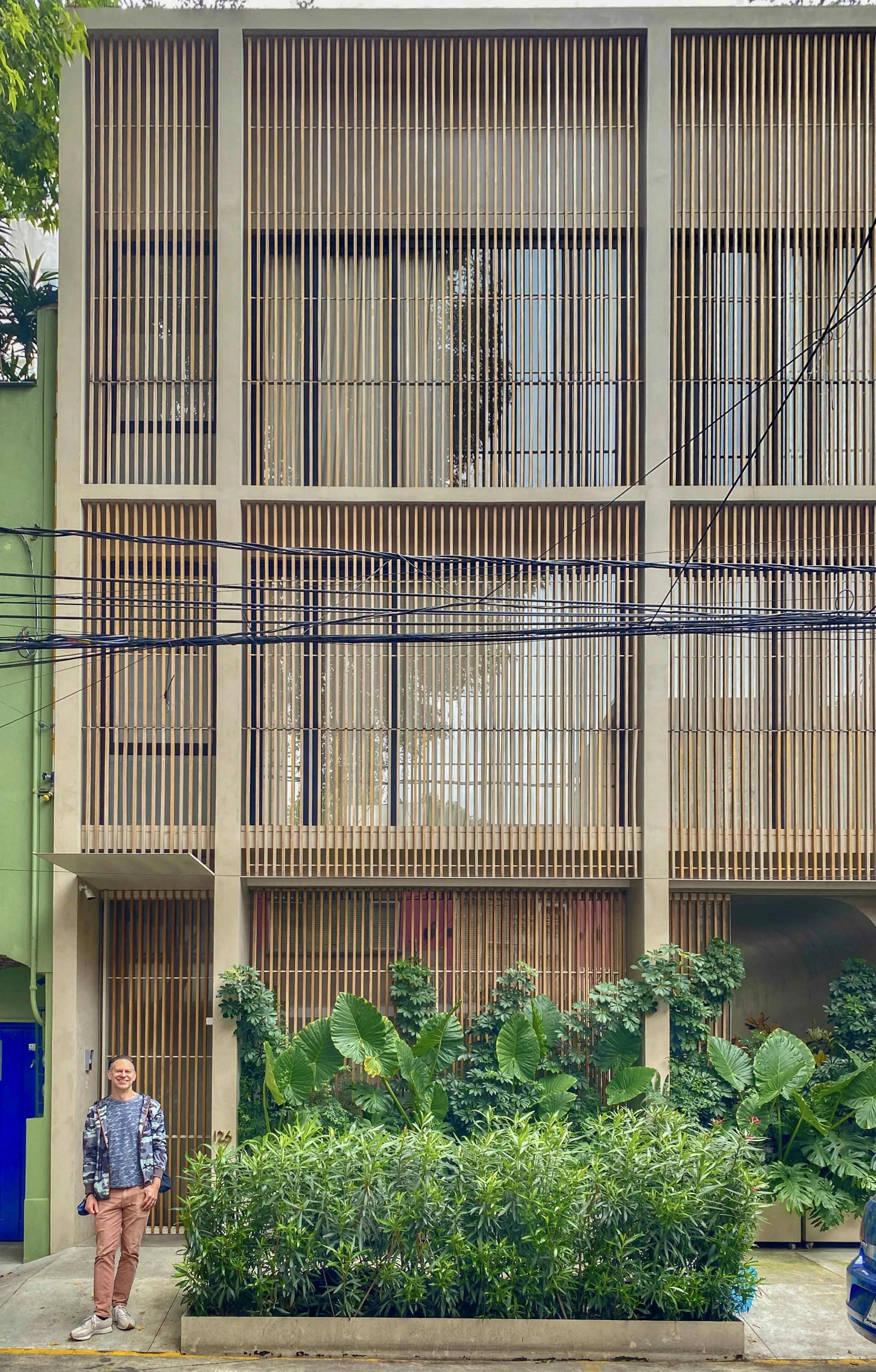
Duke stands in front of the teak screening that covers the façade of the small boutique hotel.

When Wally and I decided to plan our second trip to Mexico City, aka CDMX, we agreed that we wanted to stay in La Condesa, the leafy green, pedestrian-friendly neighborhood where the city’s Art Deco movement was born. 

We love to stay in small, stylish hotels where we get to know the staff, and I was pleased to discover Octavia Casa. It’s location is ideal; it’s within walking distance of Parque México and Avenida Amsterdam, which was once a horse racetrack and is now home to numerous trendy shops and restaurants. 
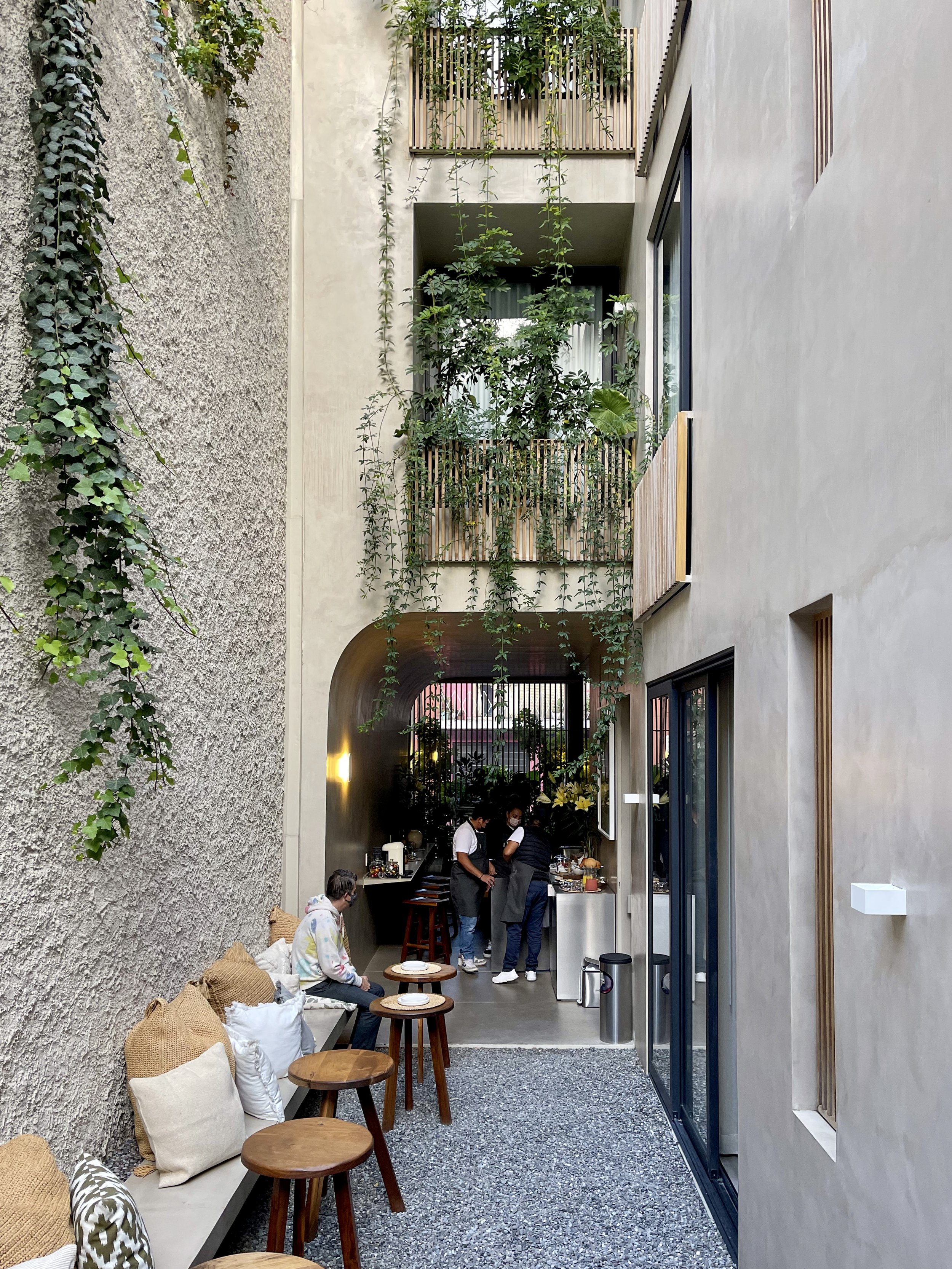
The gravel courtyard off the entrance where we had breakfast

A Fashionable Place to Stay

The modern boutique hotel is an extension of Octavia, the contemporary women’s wear fashion brand launched in 2015 by Mexico City-based designer and creative director Roberta Maceda. 

When Maceda decided to venture into hospitality, she collaborated with architect Pablo Peréz Palacios and his firm PPAA (Pérez Palacios Arquitectos Asociados). Peréz Palacios thoughtfully drew inspiration from the eponymous label to create a unique hospitality experience. 

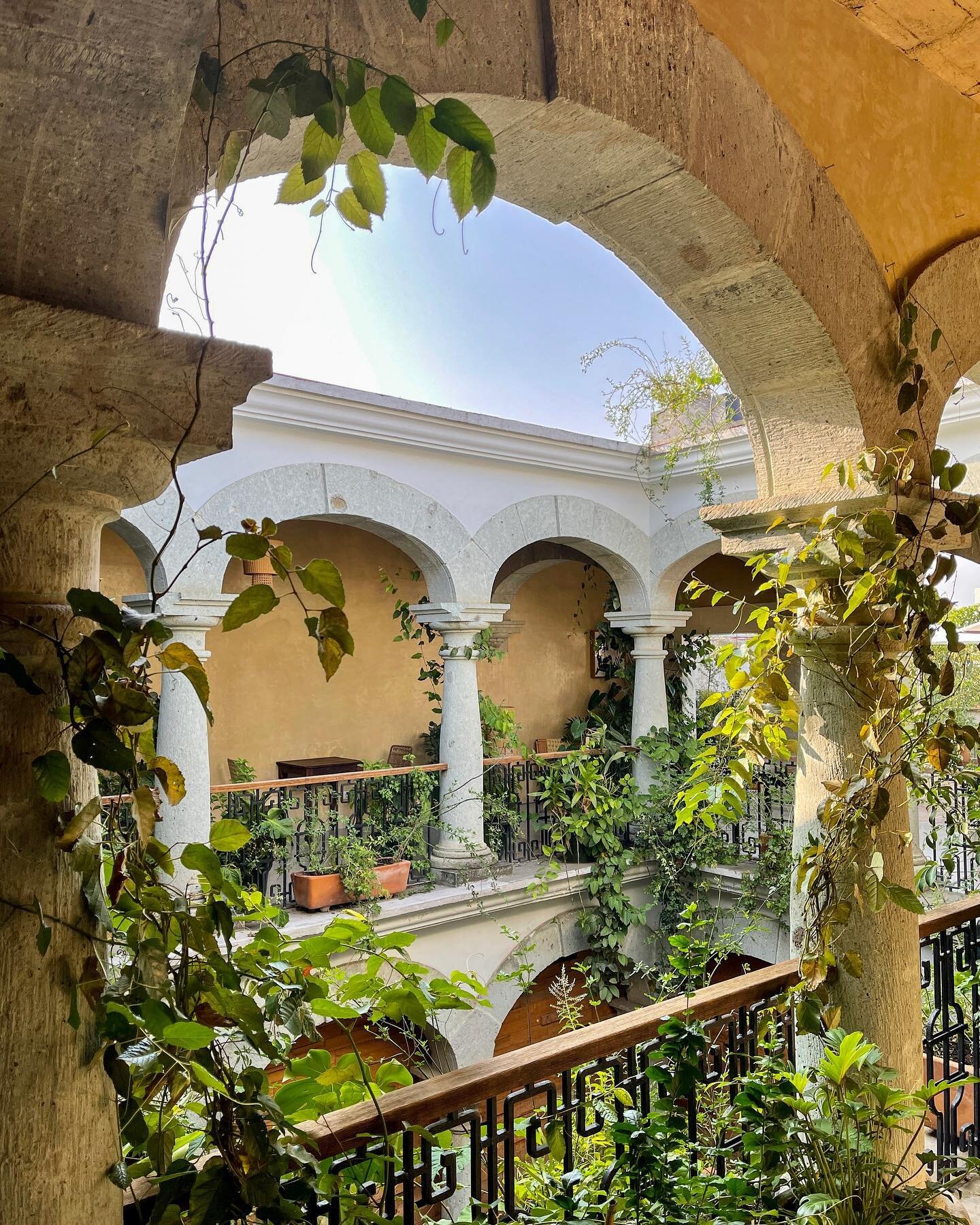
Upon arrival, we stepped out of the car and onto Avenida Amatlan. I was struck by the textures and shadows that were filtering sunlight through the teak lattice screen covering the façade of the hotel. At street level, lush tropical vegetation including monstera and jasmine add an organic element that pairs with the concrete and glass structure beneath. 

Beyond is the lobby, a space for rest and relaxation. A bronze rack holds a small collection of dresses from Octavia and a stone vase with dried magnolia leaves sits atop a circular concrete table by interior design studio Habitación 116 paired with a couple of Pierre Jeanneret Chandigarh office chairs. 
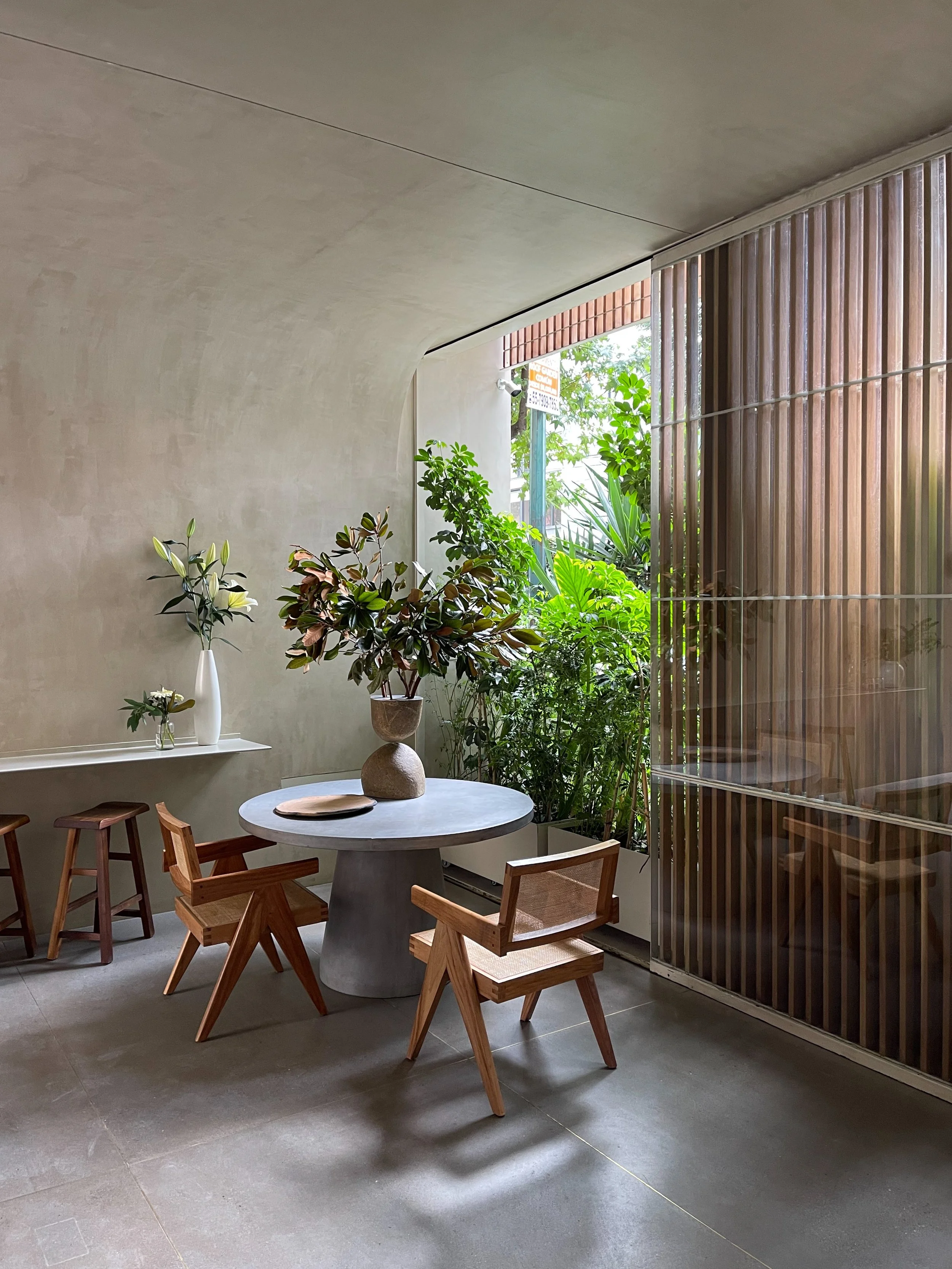
Octavia Casa’s lobby is really more of a foyer, making visitors really feel like they’re staying in a home.
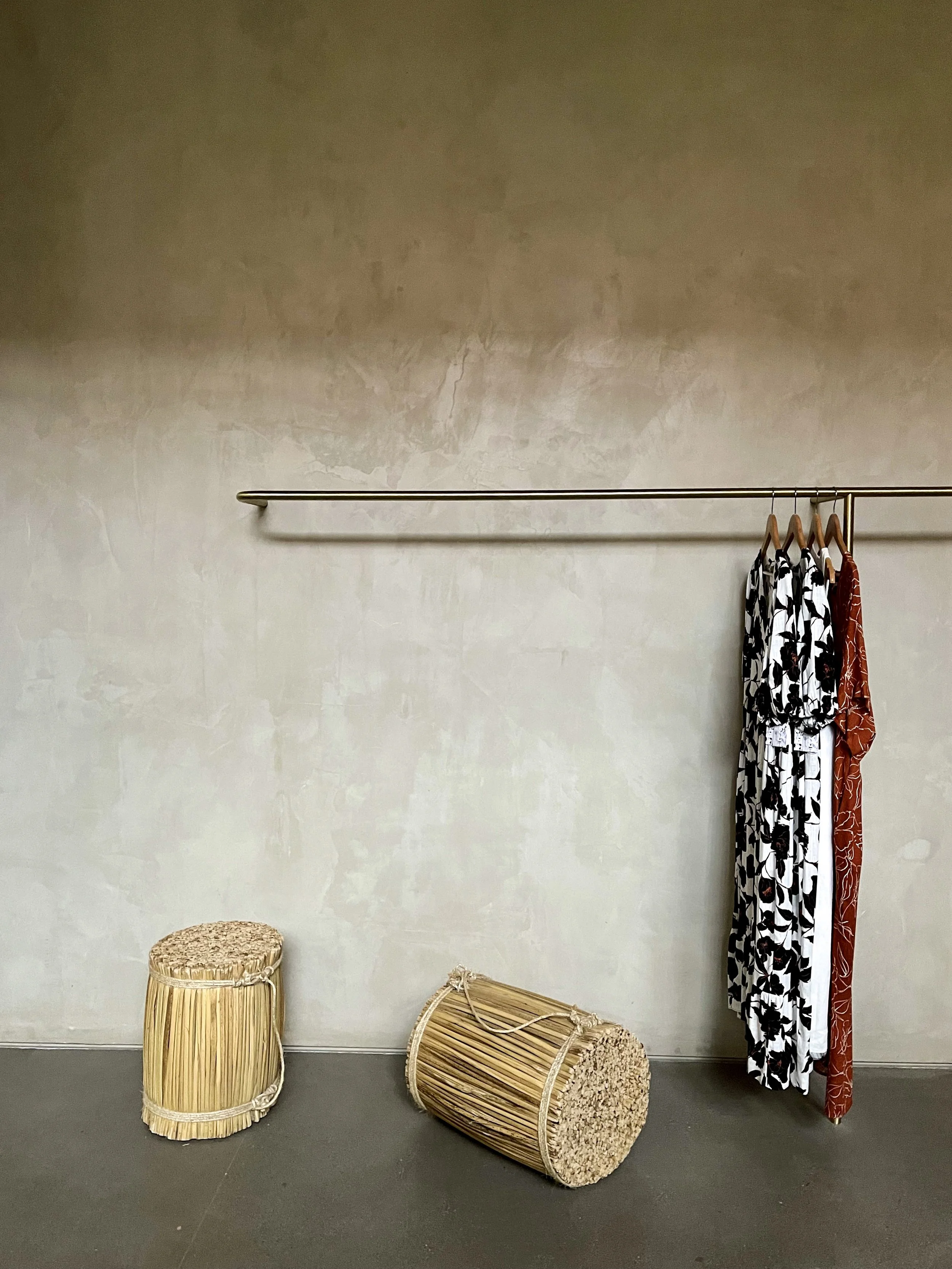
The hotel’s chic minimalist aesthetic is inspired by Octavia, the women’s wear label run by the owner. A few of her dresses are on display in the lobby.

Around the corner the “lobby” continues into a communal open-air patio covered in pea gravel, which creates a zen ambiance. 
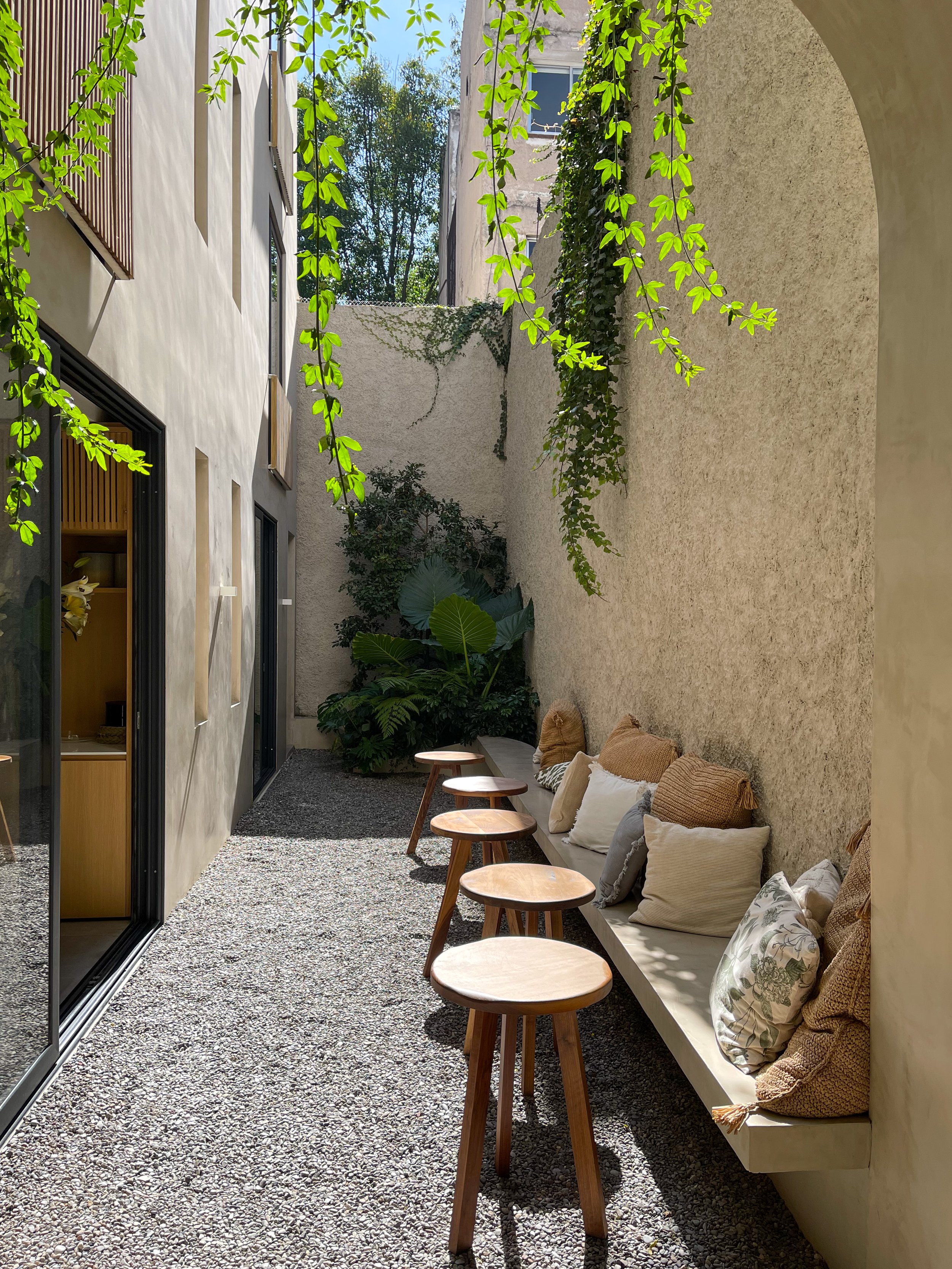
The staff described the open-air space as a continuation of the lobby.
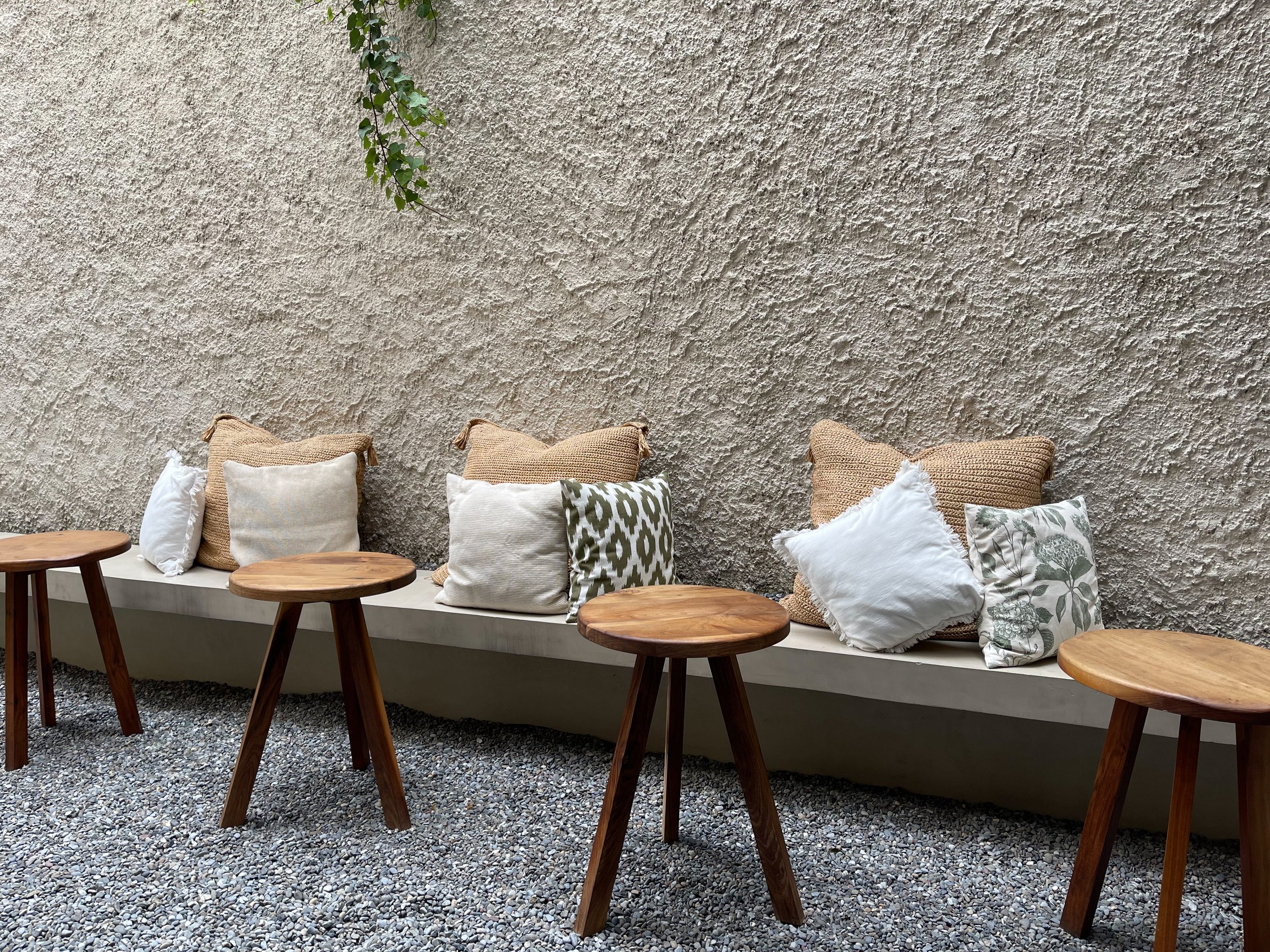
You can see the stucco work on the wall — a technique that’s been around since the Ancient Maya.

The ingenious and well-designed interior staircase, which Wally referred to as Escheresque, ascends and descends from the ground floor to the rooftop in 90-degree turns. 
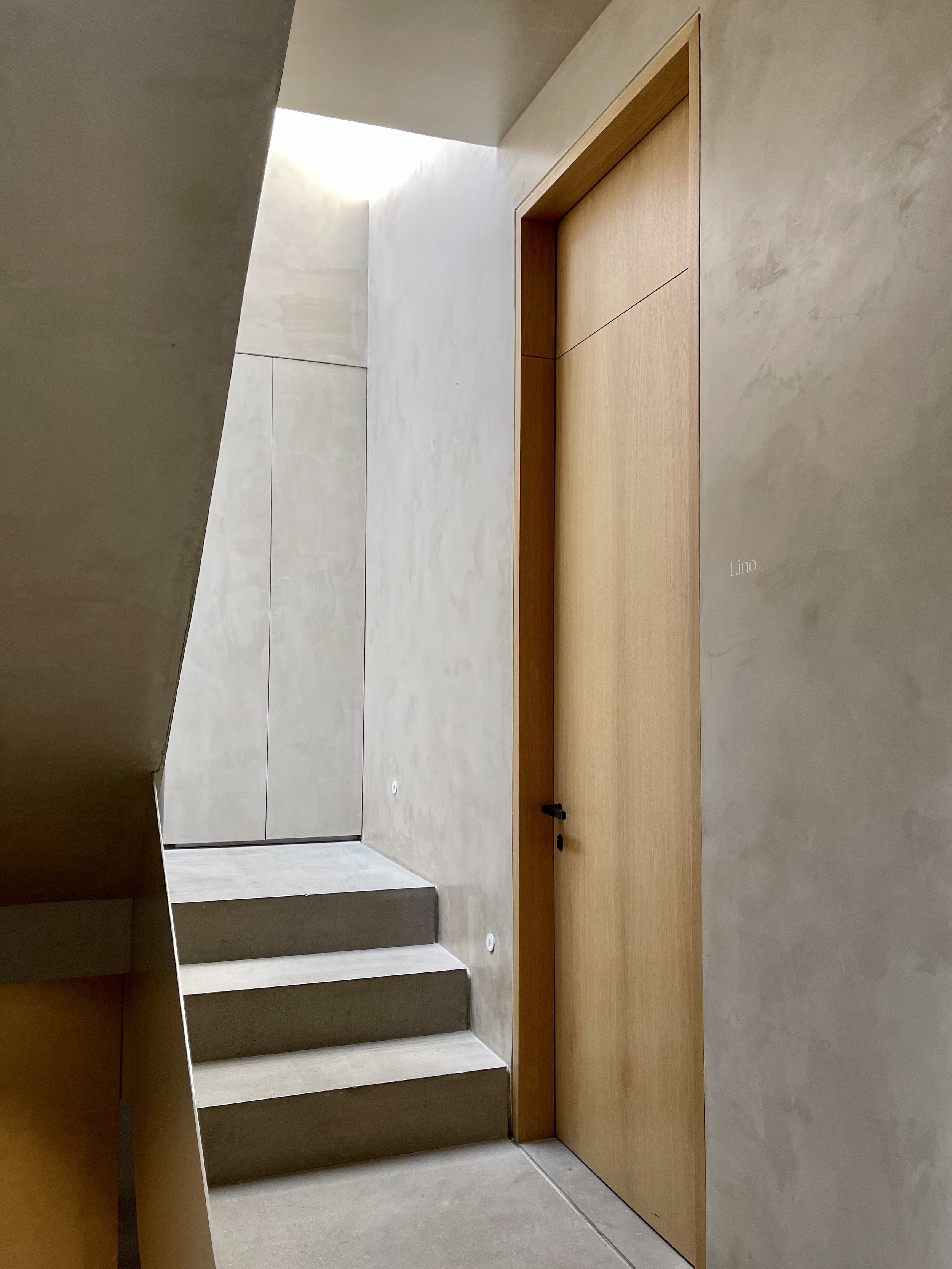
The sleek concrete stairwells looked to Wally like something out of an M.C. Escher drawing.
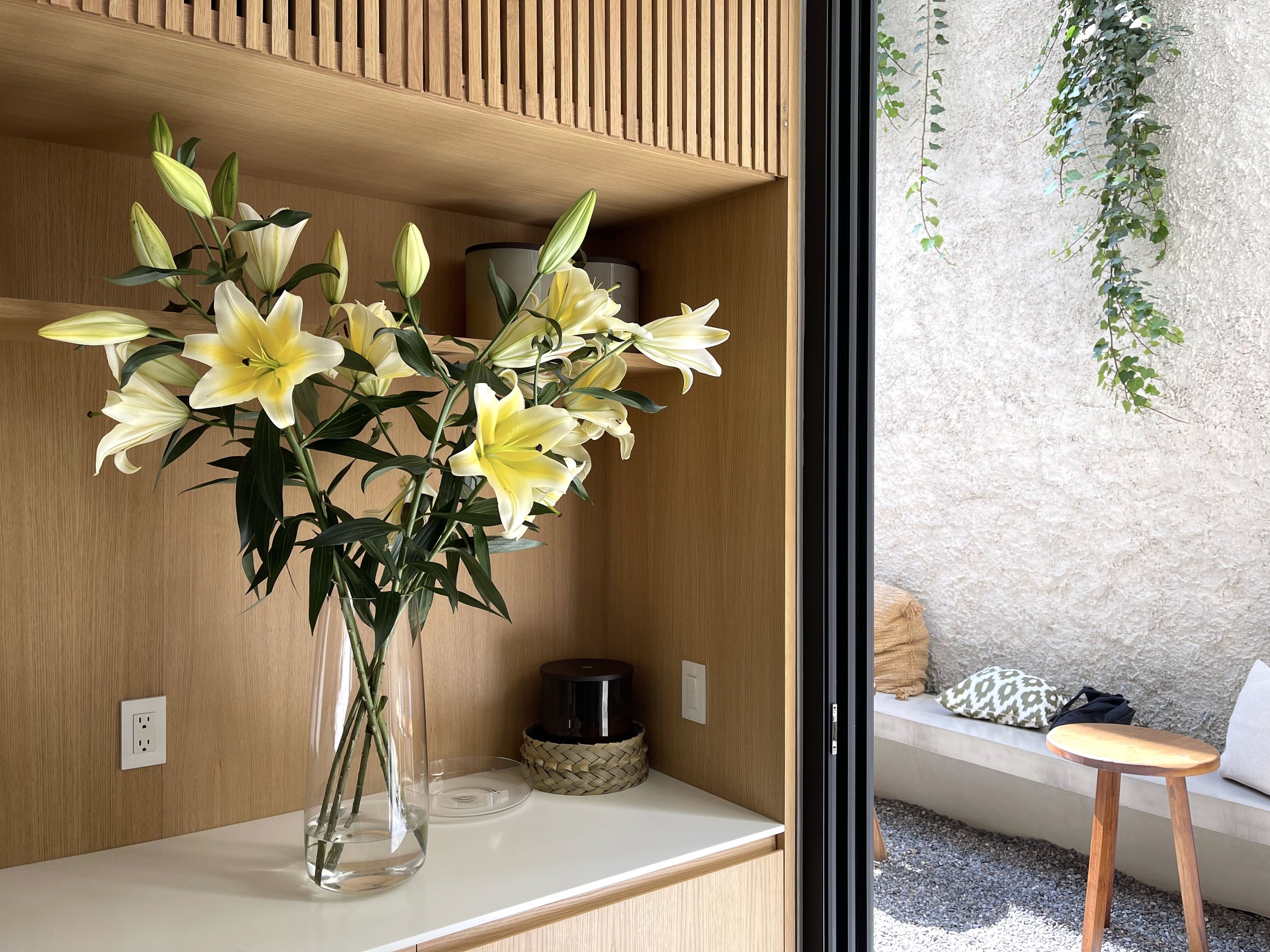
The scent of lilies filled the air.

A Modern Mix of Materials

A cohesive palette of muted neutrals are featured throughout Octavia Casa, anchored by refined natural and sustainable materials such as stone, wood, rattan and textiles. Interior walls are finished in chukum, a traditional and environmentally friendly Ancient Mayan stucco technique extracted by twice boiling the thorny tree’s bark. The resulting spaces are airy and bright, as well as rich, textured and welcoming. 
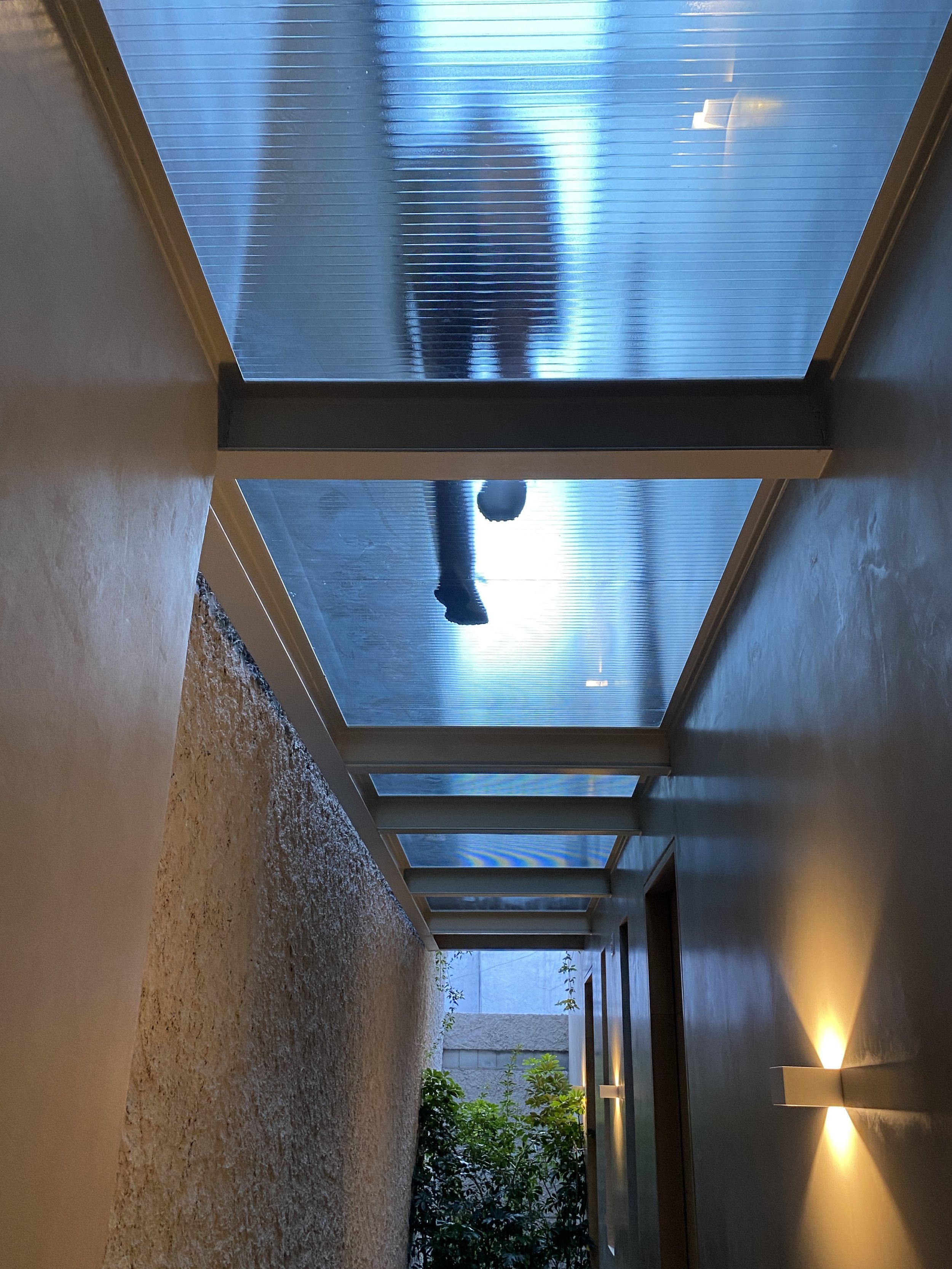
Reeded glass catwalks add yet another interesting visual element.

Each of the seven rooms are named after a natural element or material, such as Earth, Ochre, Bronze and Jute. We stayed in the Lino suite, the only room on the third floor, with balconies overlooking the interior courtyard and Avenida Amatlan. 
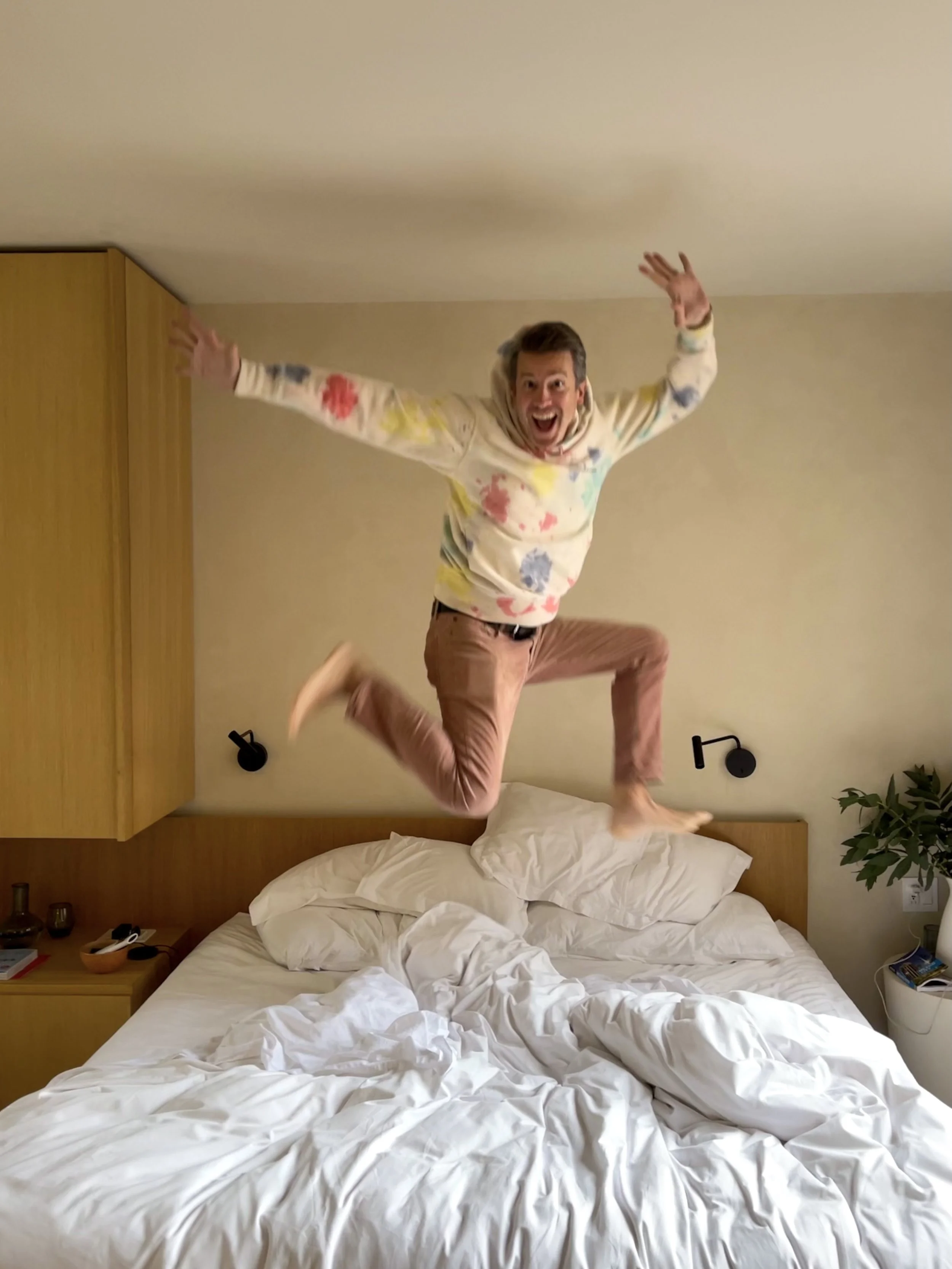
Wally does one of his jumping shots — and in a hotel as amazing as this, who can blame him?

A Sweet Suite at Octavia Casa

Our suite felt like an elegantly appointed residence and we immediately felt at home. 

The king-size bed, with linens by Octavia Casa’s homeware line, was luxurious and welcoming — especially after days spent exploring sites and the neighborhood, which had so many things to see that I feel like we barely scratched the surface. The Lino suite is also only one flight from the rooftop terrace, an oasis that provides views of the surrounding neighborhood. 
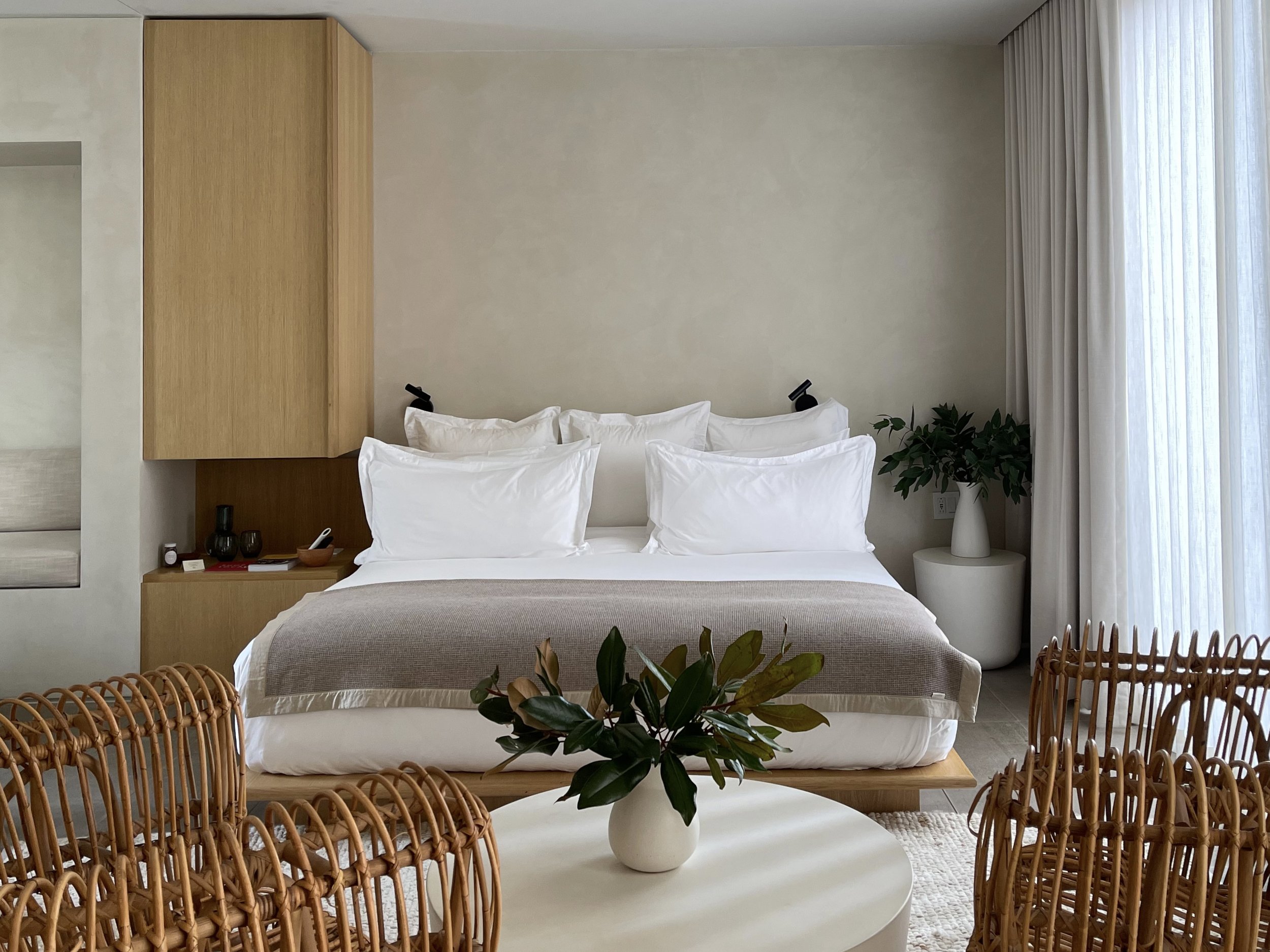
The Lino suite at Octavia Casa
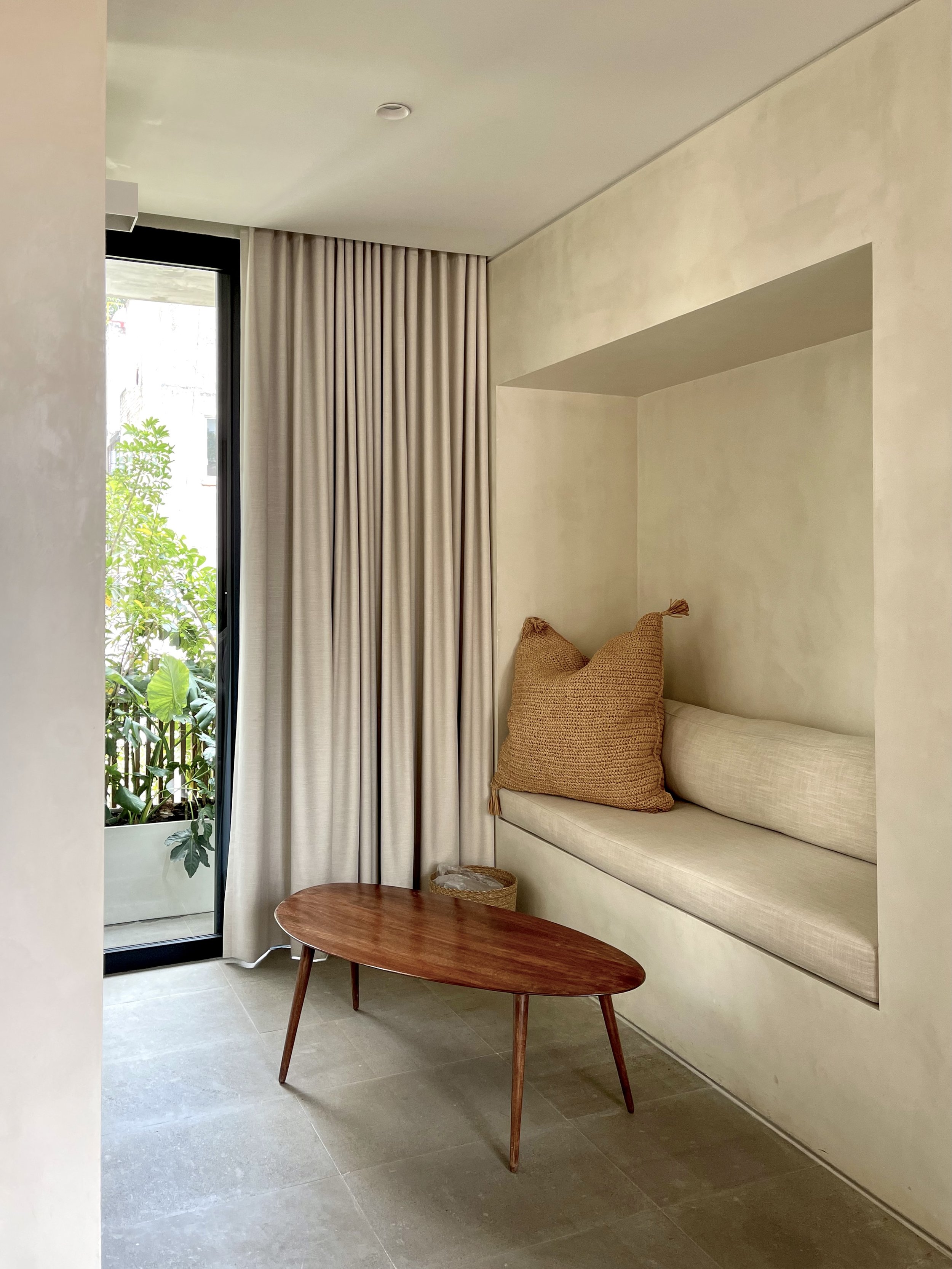
A quiet nook near the balcony that overlooks the interior courtyard

The property doesn’t include a restaurant. However, they do offer a breakfast buffet in the ground-floor courtyard. We opted to do this for a few days and it included Nespresso coffee, baguettes, brie, seasonal fresh fruit, juices, jams by Rosetta, yogurt, croissants and conchas, a traditional Mexican sweetened bread roll with a crunchy topping. I was mildly obsessed with the handmade bowl-shaped mugs, and when I asked where they were from, one of the staff members, Fedra, kindly provided the name of the shop: Templo. (Incidentally, Fedra makes a mean latte.)
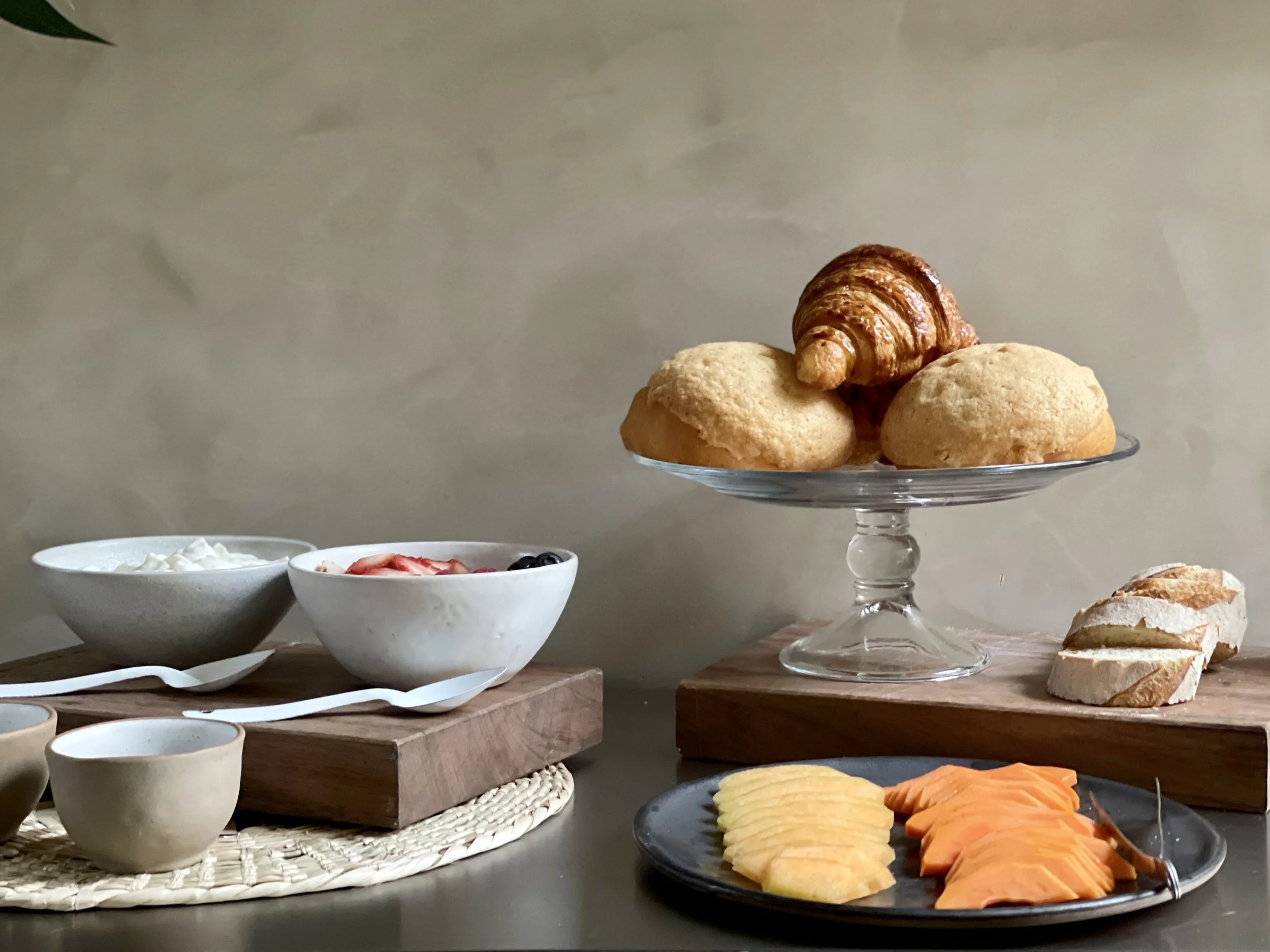
Fresh fruit, yogurt and bread are on offer at the breakfast buffet.
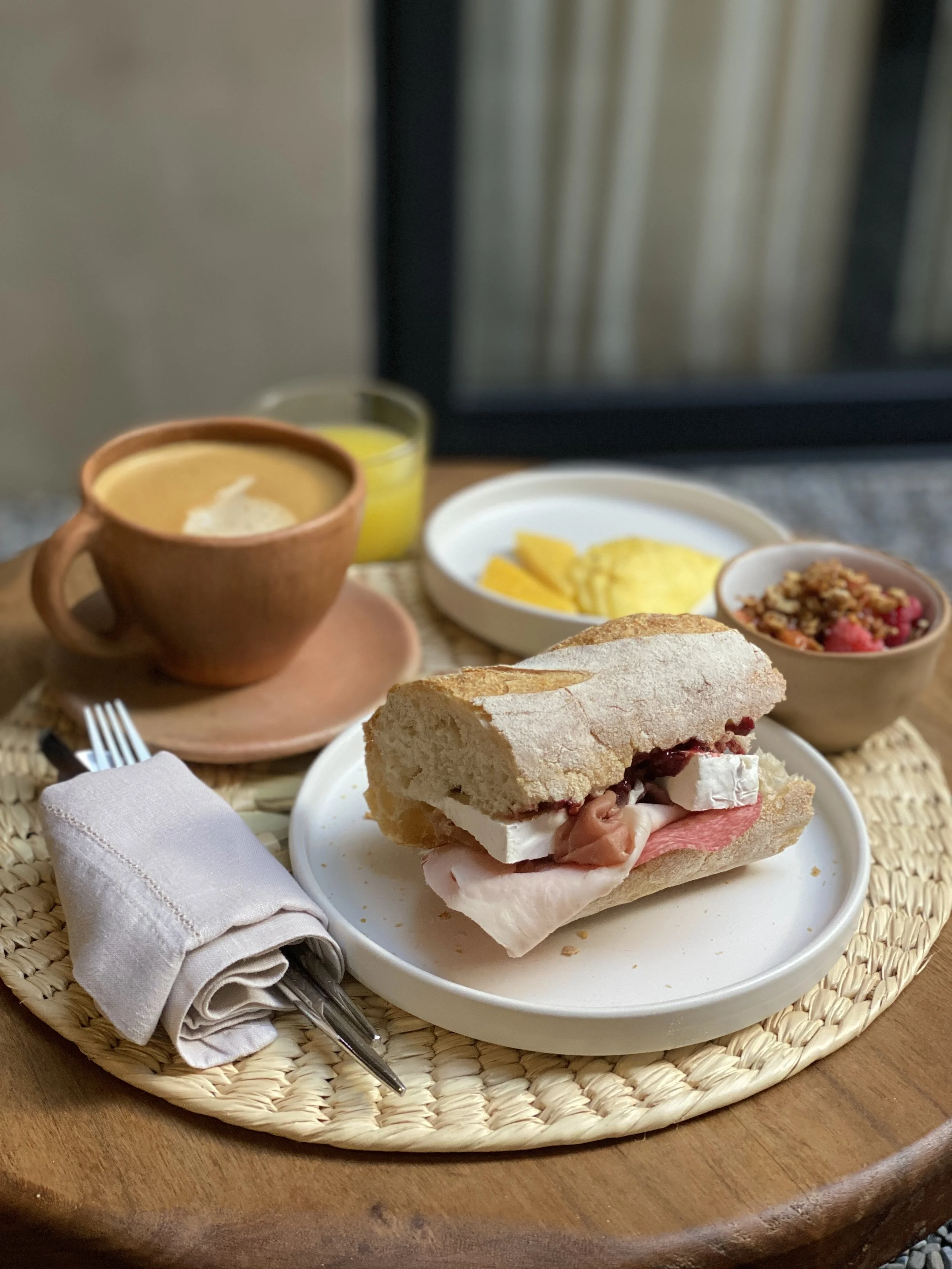
How we started every day
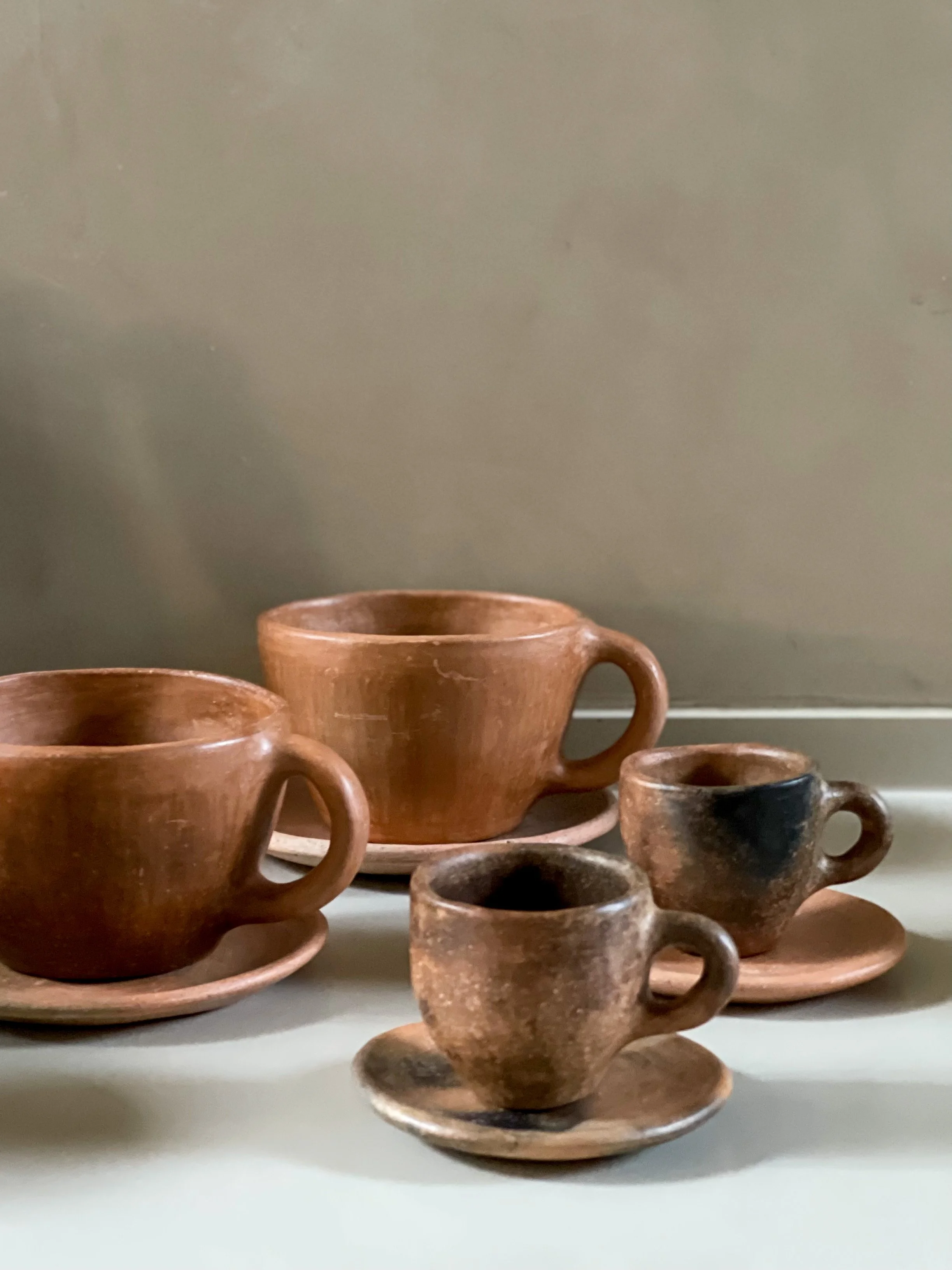
The coffee and espresso mugs Duke was obsessed with

In the evening the lobby transforms, illuminated by candlelight, with libations on offer, from local mezcals and tequilas to a selection of wines available for purchase. 

The personnel, including Raúl, Fedra and Luis, were genuine and friendly and took the time to make Wally and I feel welcome with every encounter. Thoughtful gestures such as a complimentary bottle of red wine for my birthday and offering the guest lounge on the ground floor when we anxiously took our on-site COVID tests, arranged by Octavia Casa, before flying home. Another employee, Silvia, reminded us of our favorite Spanish teacher, Mariú, and was a delight the entire time. She gave me a big hug on my birthday as again when we left. 

The staff at Octavia Casa gave birthday boy Duke the special treatment.

We found Octavia Casa to be a unique and unpretentious accommodation. (And so did Natalia Lafourcade, one of Mexico’s most famous singers, who stayed there at the same time as us and had the staff all aflutter.) It’s the perfect place to wake up and return to after each day’s adventures. If you’re planning a trip to this magical city, look no further and book your stay here. –Duke
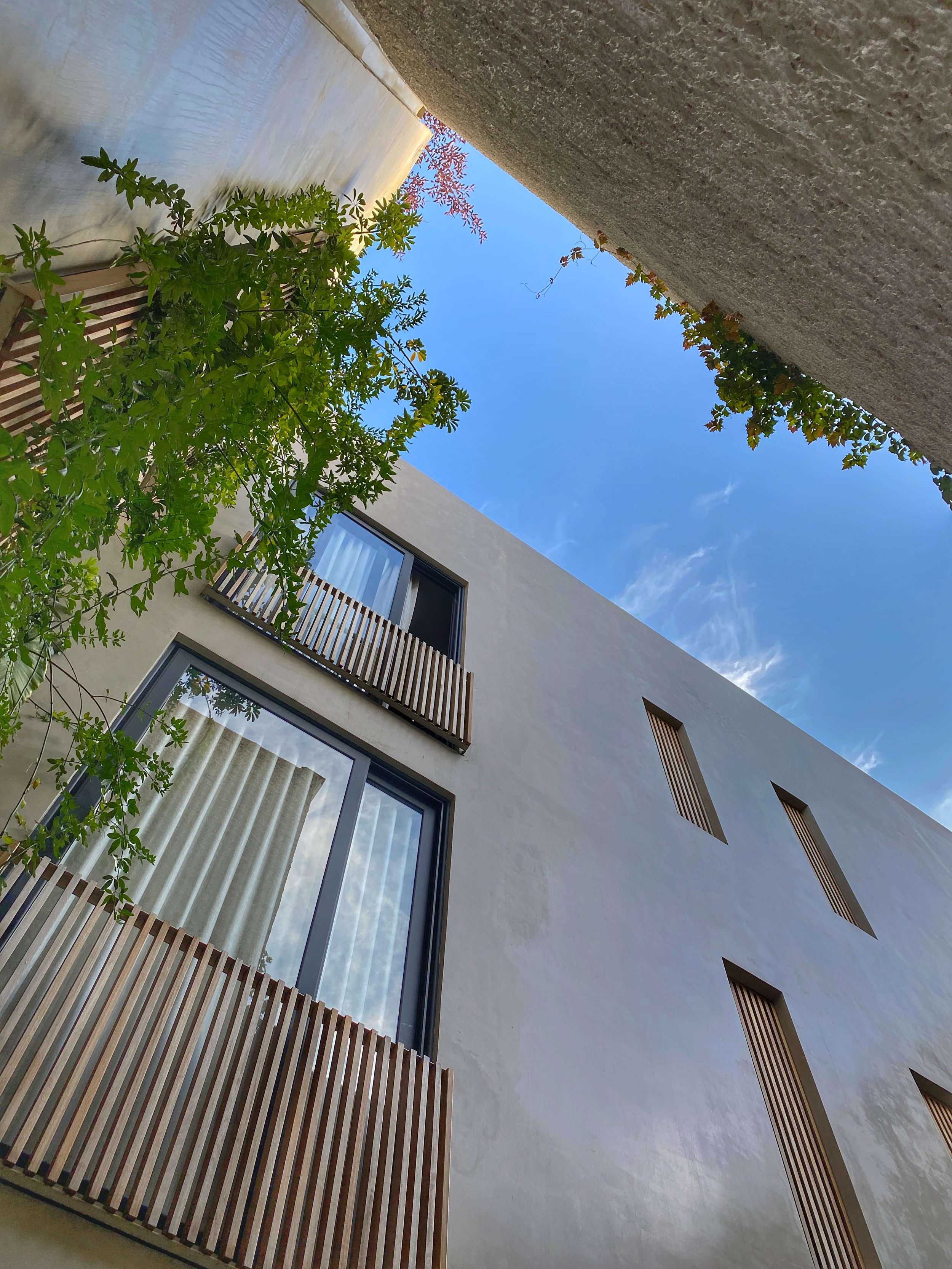
Pale concrete and teak pair with green plants and the blue sky, helping make Octavia Casa a tranquil retreat from the bustle of CDMX.

Octavia Casa
Avenida Amatlan 126
Hipódromo Condesa
Cuauhtémoc
06170 Ciudad de México, CDMX
Mexico
 

Barragán’s Mind-Boggling Torres de Satélite

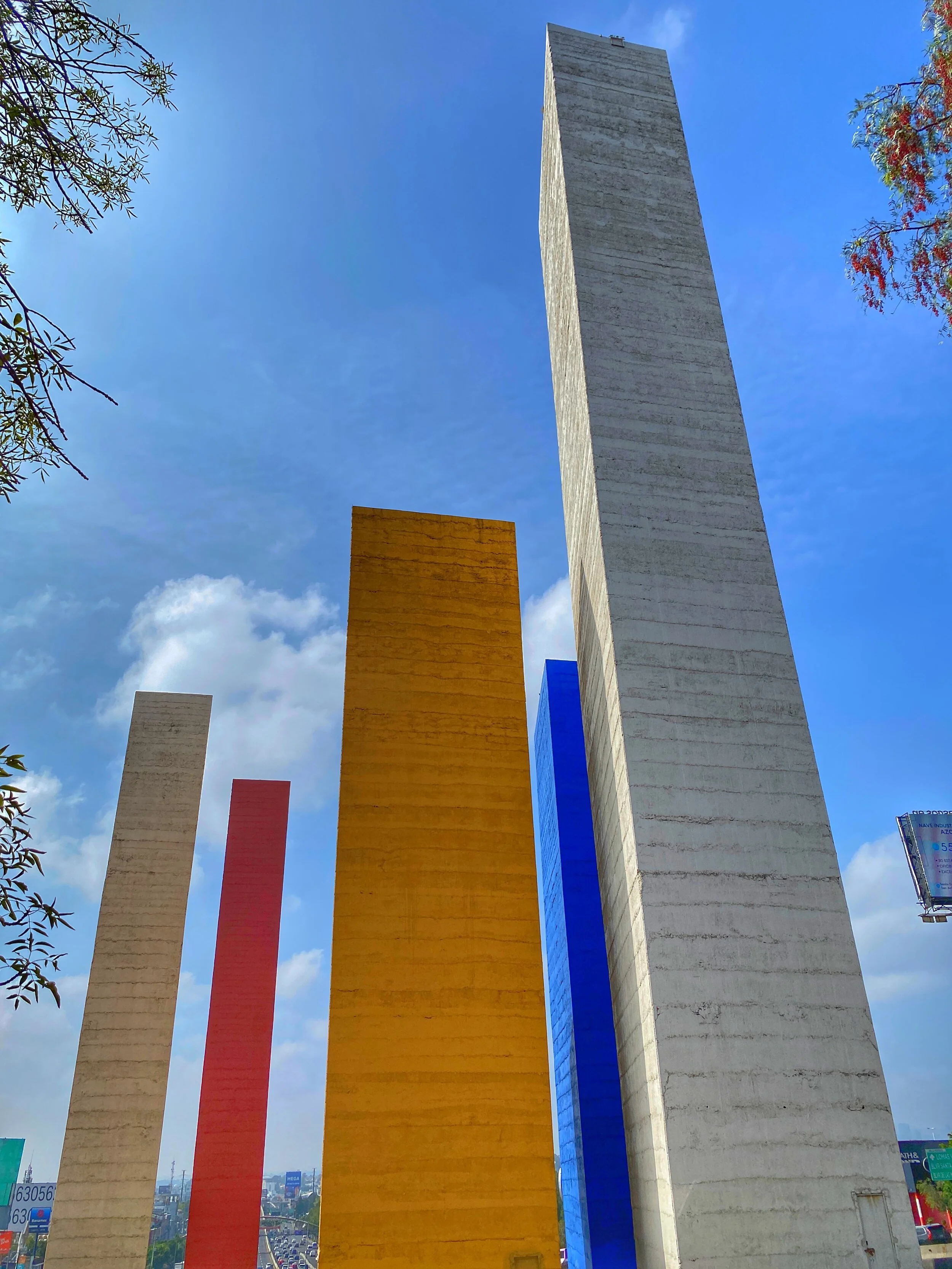
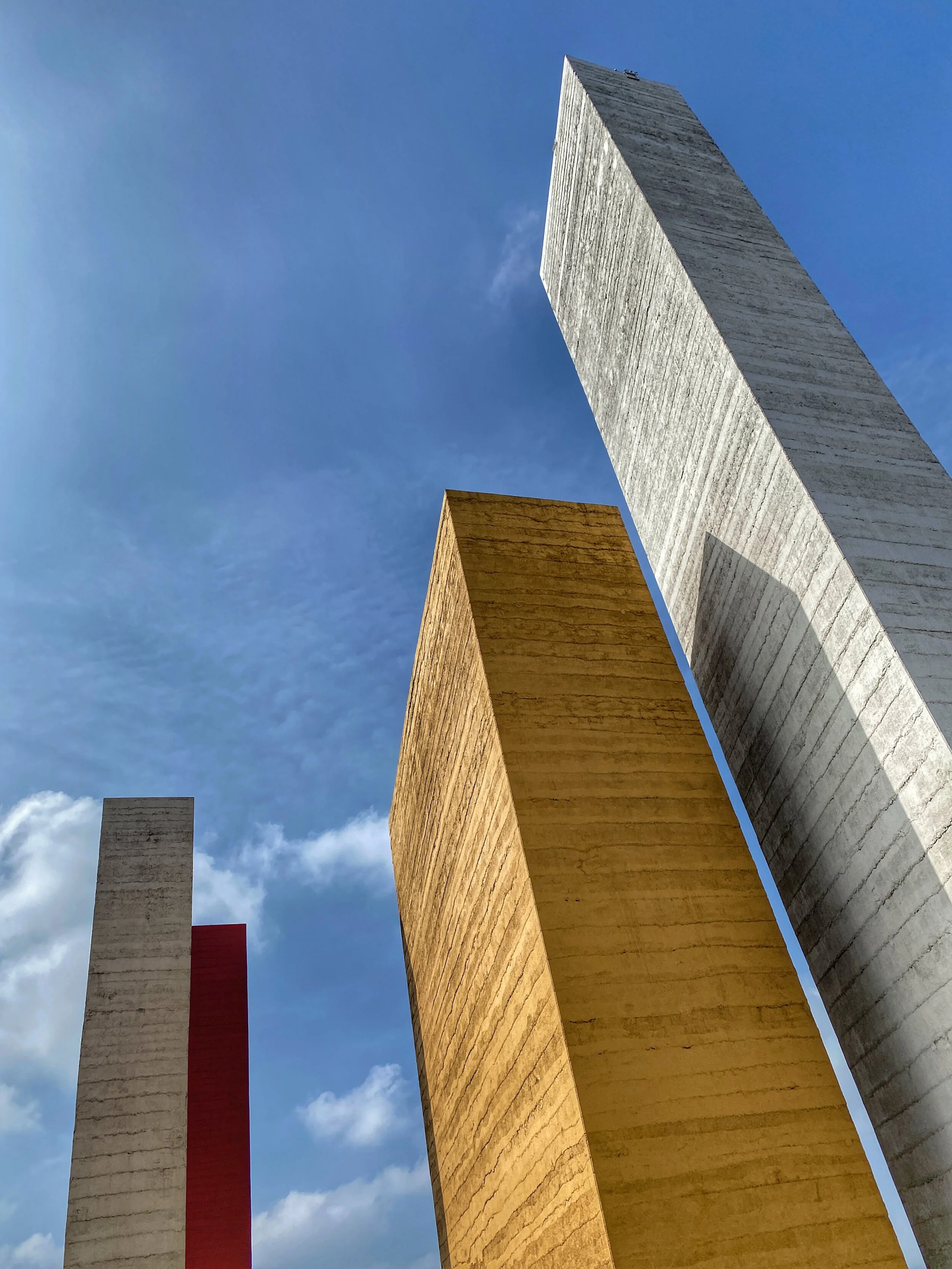
Just outside of CDMX, the Satellite Towers seem to change shape before your very eyes.

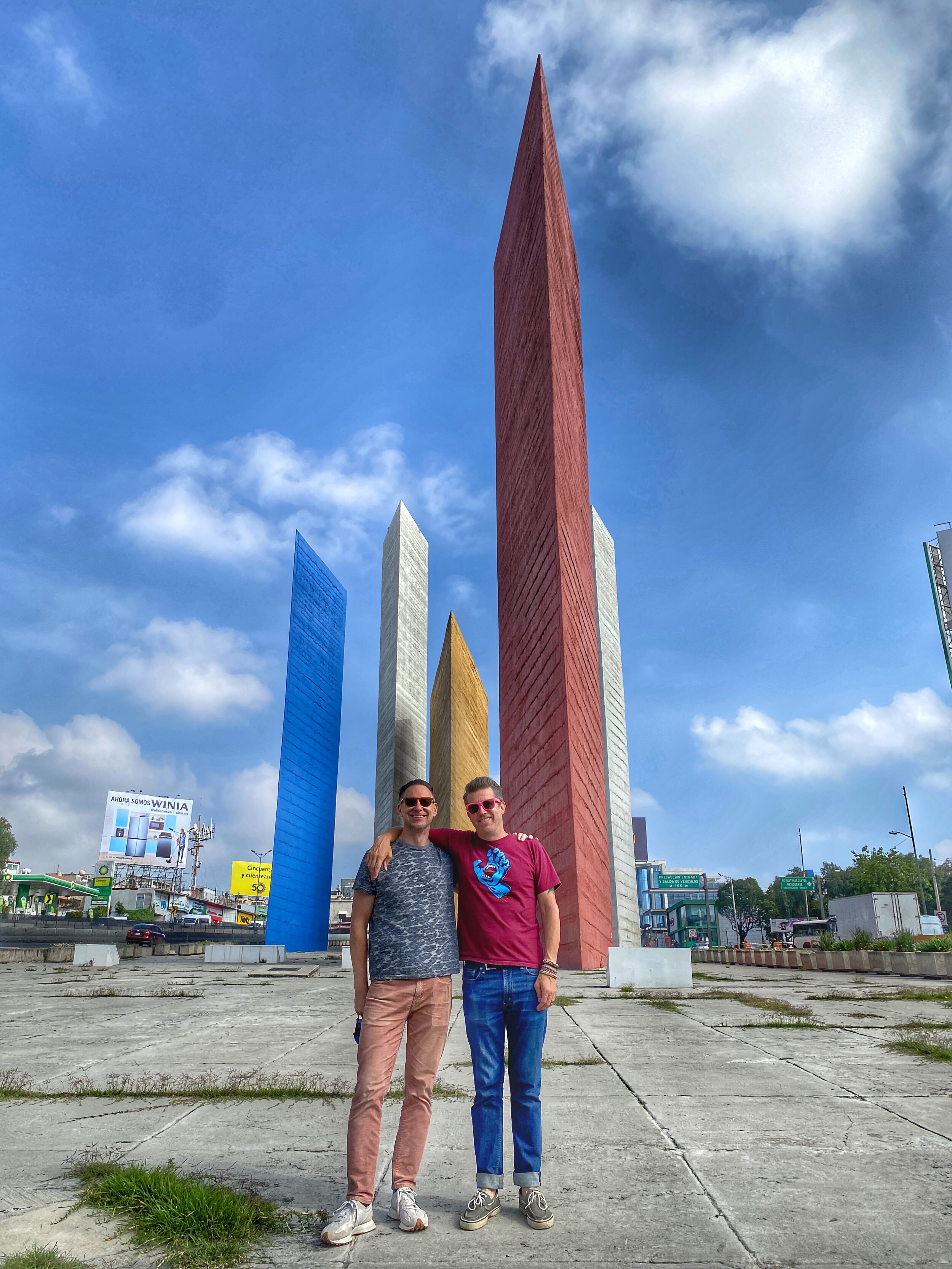
“The towers make us look thinner!” Duke exclaimed.

“The towers make us look thinner!” Duke exclaimed.

When we first saw the Torres de Satélite (Satellite Towers), I must admit that I was not very impressed. Granted, we were speeding past them on the freeway to the northwestern suburb on the outskirts of Mexico City named, appropriately, Satélite (Merriam-Webster’s third definition of “satellite” being “a usually independent urban community situated near but not immediately adjacent to a large city”).

Seen from the freeway, the Torres de Satélite are cool but not overly impressive.

Seen from the freeway, the Torres de Satélite are cool but not overly impressive.

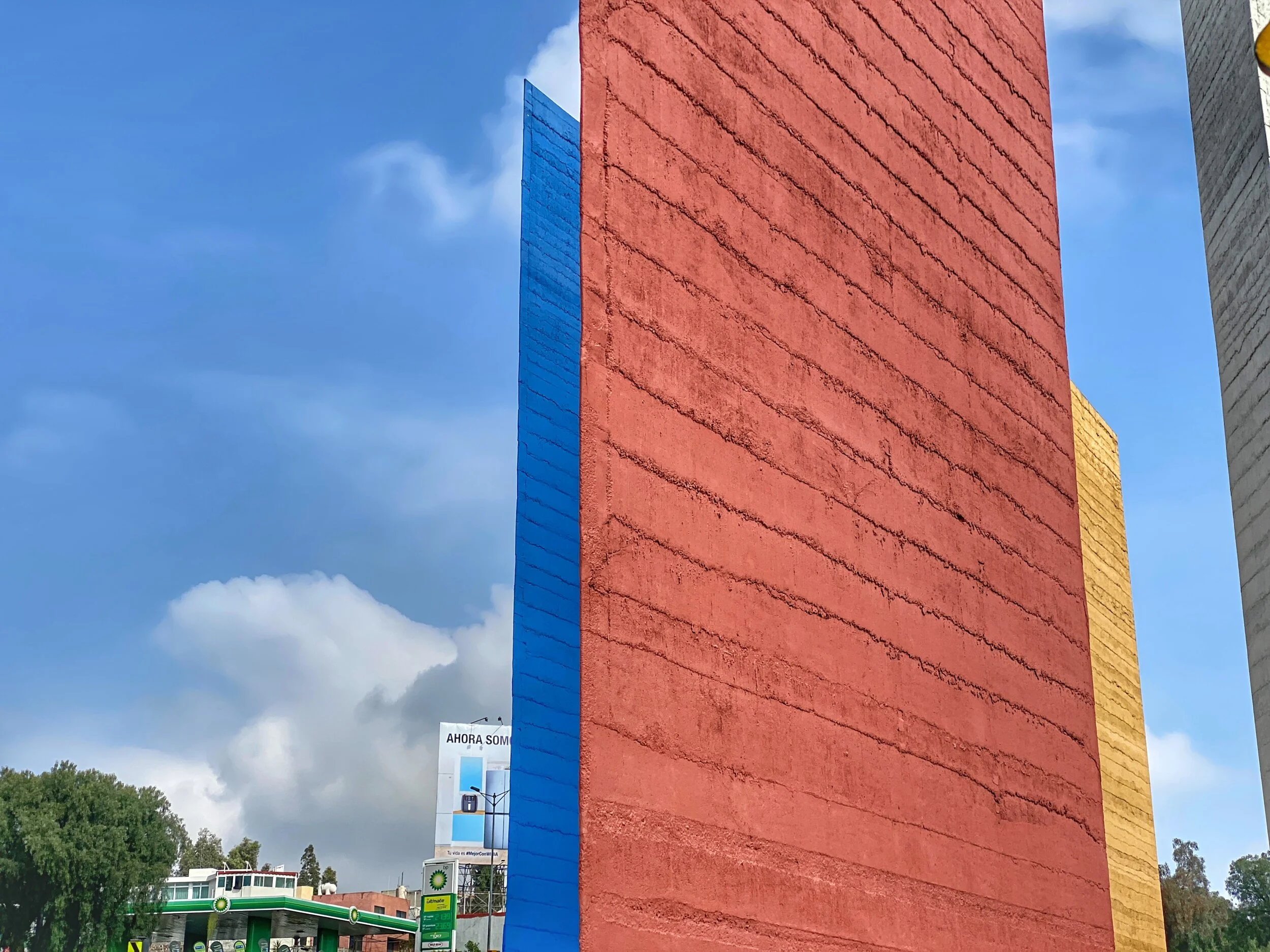
From one side, the towers look entirely rectangular, but — spoiler! — they’re not!

From one side, the towers look entirely rectangular, but — spoiler! — they’re not!

The five towers struck me as simple yet colorful rectangular sculptures rising into the sky. There didn’t seem to be much that was interesting about them.

But that was before we parked nearby and experienced them on foot. 

What at first seemed to be rectangular structures reveal themselves to actually be triangular.

You walk on a bit, keeping your eyes on the ever-morphing shapes, and suddenly one of the towers looks entirely flat!
It’s fun tooling around in a bright orange-red Volkswagen bus.

It’s fun tooling around in a bright orange-red Volkswagen bus.

Barragán Tour With the Traveling Beetle

One of my old coworkers had told me about Luis Barragán, and while I admired the clean lines and bright colors in the photos I saw of his works, I confess that I wasn’t fully appreciative of his supposed genius as an architect.

So I was happy to hear that Duke had booked us a half-day excursion to see some of Barragán’s projects just outside of Mexico City, through a tour group called the Traveling Beetle. A brief review:

Duke and Wally posing near their sytlin’ ride for the day

Duke and Wally posing near their sytlin’ ride for the day

The cons: It’s definitely on the expensive side at $115 per person (that’s U.S. dollars, although keep in mind that the Mexican peso also uses the $ symbol). And, as cute as the vintage 1976 VW bus was to zoom around in, there weren’t any seatbelts. 

The pros: Everything else. 

Indeed, it’s no exaggeration when I say that I can thank our guide, Martín, in large part for my newfound appreciation of Barragán. His passion was contagious.

The architect who designed neighborhoods in the CDMX suburb of Cuidad Satélite hired Barragán to create an iconic, bold sculpture to impress visitors to the new development.

The architect who designed neighborhoods in the CDMX suburb of Cuidad Satélite hired Barragán to create an iconic, bold sculpture to impress visitors to the new development.

A Dramatic Entrance to Ciudad Satélite

Our first stop of the day was an exploration of the Torres de Satélite. We pulled into a parking lot just beyond them, which Martín described as one of the best-kept secrets of the area.

Barragán was hired to create an iconic entrance to the Ciudad Satélite, which was, at the time of the Torres de Satélite’s construction in 1958, a new community. Mario Pani, an architect known for modern megaprojects, designed the neighborhood and had been impressed with Barragán’s El Pedregal, gardens developed over lava fields. Wanting something that made a similar bold statement, Pani commissioned Barragán, who collaborated on the tower design with the artist Mathias Goeritz.

“It’s a piece of art,” Martín says, as we get out of the car and head toward the towers. “They’re in between sculpture and architecture.” 

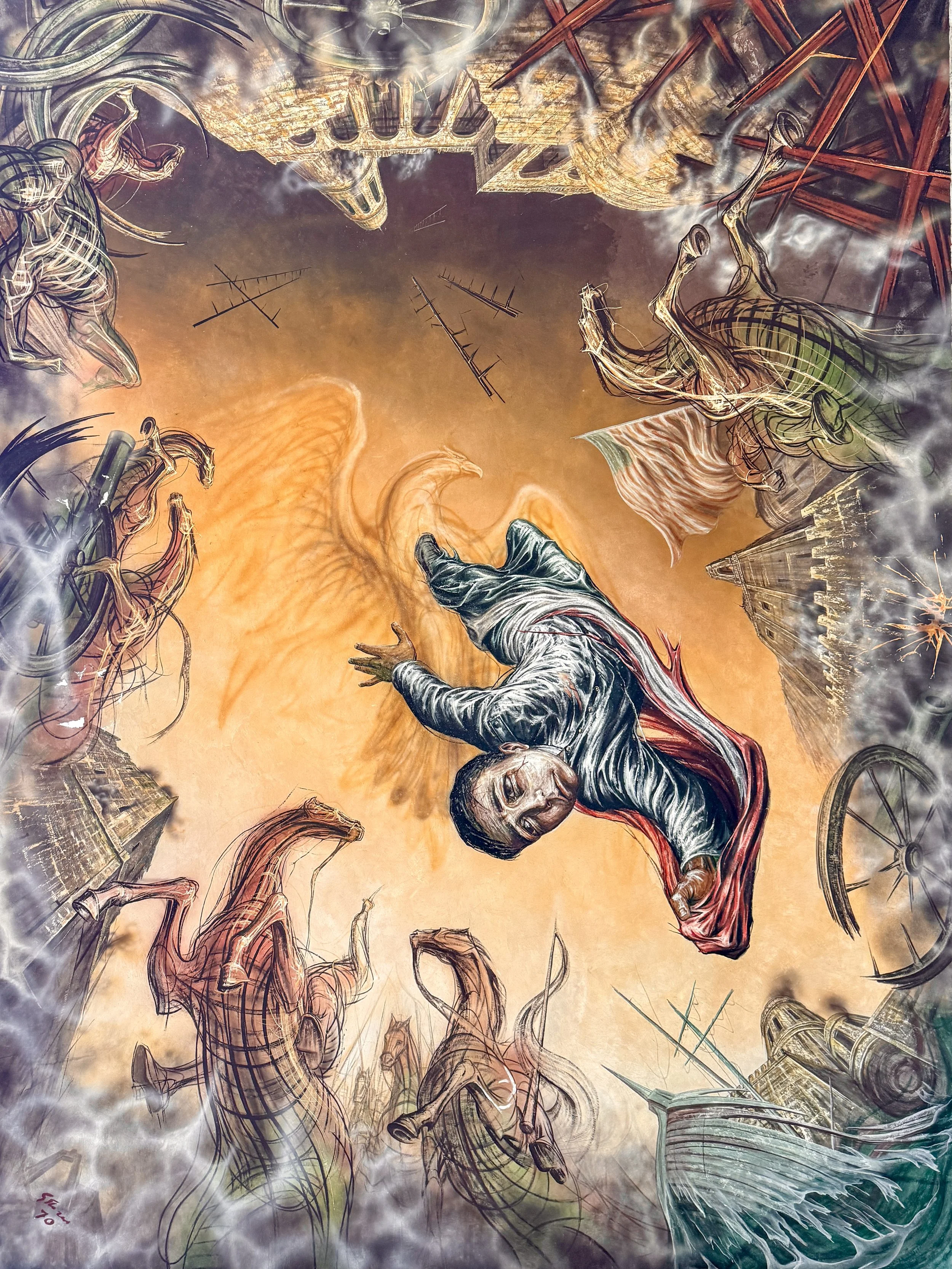
The design of the Torres de Satélite was a collaboration with the Mexican artist Mathias Goeritz. This painting inspired Barragán to create the impressive monoliths.

The design of the Torres de Satélite was a collaboration with the Mexican artist Mathias Goeritz. This painting inspired Barragán to create the impressive monoliths.

The towers are in a concrete median in the middle of a bustling freeway, with commercial developments on either side. Note how Barragán ingeniously positioned the structures so their angles align at various vantage points.

The towers are in a concrete median in the middle of a bustling freeway, with commercial developments on either side. Note how Barragán ingeniously positioned the structures so their angles align at various vantage points.

The bright primary colors we see today weren’t the original hues, Martín informs us. Originally, the towers were painted in warm tones of ochre and orange. But when all eyes were on Mexico City for the 1968 Olympics, the city asked Barragán to refresh the palette. 

As can be seen in this vintage shot, the towers originally had a different color scheme. They were updated to coincide with the 1968 Olympics in Mexico City.

As can be seen in this vintage shot, the towers originally had a different color scheme. They were updated to coincide with the 1968 Olympics in Mexico City.

It’s a bit ironic that an architect known for his intense pops of color didn’t actually choose those colors himself. Barragán worked closely with the artist Chucho Reyes, who was the one who actually determined what colors to use. 

Barragán must have been pleased with the choice of primary colors, but Pani was not. In fact, the color scheme alteration caused the two architects to argue and part ways.

Are the towers rectangular? Triangular? Flat? Depends on where you’re standing!

Are the towers rectangular? Triangular? Flat? Depends on where you’re standing!

The Optical Illusions of the Torres de Satélite

From afar, the towers look static — almost, I dare say, a bit boring. But then, upon approach, you see them transform into all sorts of dimensions and shapes. As you walk around the base of the towers, which range from 98 to over 160 feet tall, you’re constantly surprised: What at first seemed to be rectangular structures reveal themselves to actually be triangular. You walk on a bit, keeping your eyes on the ever-morphing shapes, and suddenly one of the towers looks entirely flat! 

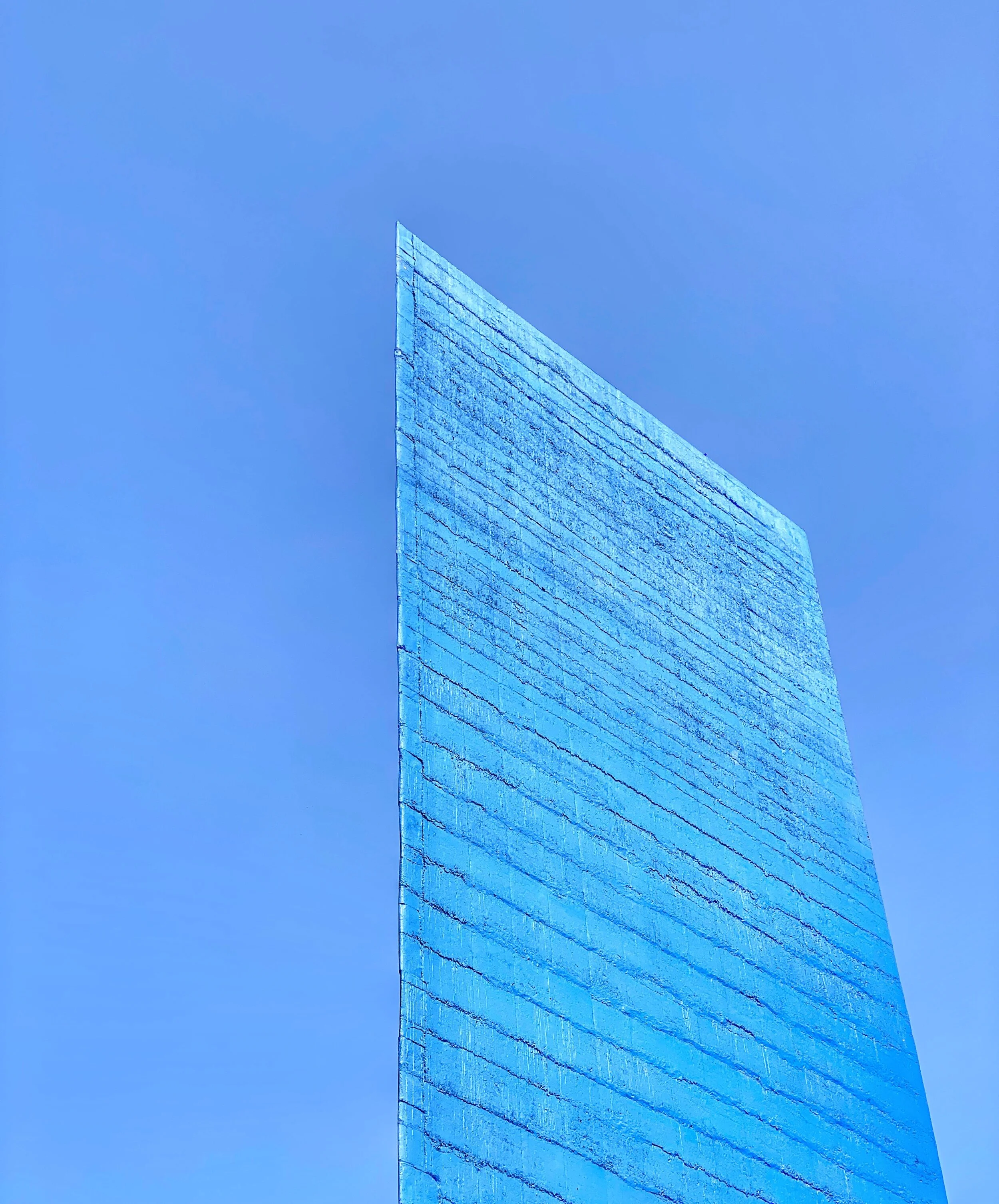
Yet another optical illusion employed by Barragán was the use of forced perspective. The rows of bricks get smaller and tighter as they progress up each tower to evoke an increased sense of height.

Note the forced perspective — the horizontal lines get closer and closer as they near the top. This makes the tower look taller that it really is. The blue was chosen to match the sky.

Note the forced perspective — the horizontal lines get closer and closer as they near the top. This makes the tower look taller that it really is. The blue was chosen to match the sky.

The door at the base of the far tower is open, so I peek my head in. There isn’t anything impressive in there — it’s just an unfinished space with some maintenance tools scattered about in the thick layer of grime. Martín tells us he saw a homeless man seeking shelter inside one of the towers on a previous visit.

I was surprised to discover that the towers are open at the top. Birds flitted about inside. 

“Some people call them big birdhouses,” Martín continues. He points to the birdshit that covers the interior. “And that’s exactly what they are.”

The towers aren’t usually open, but we were able to peek inside one — and were surprised to discover that they’re open at the top.

The towers aren’t usually open, but we were able to peek inside one — and were surprised to discover that they’re open at the top.

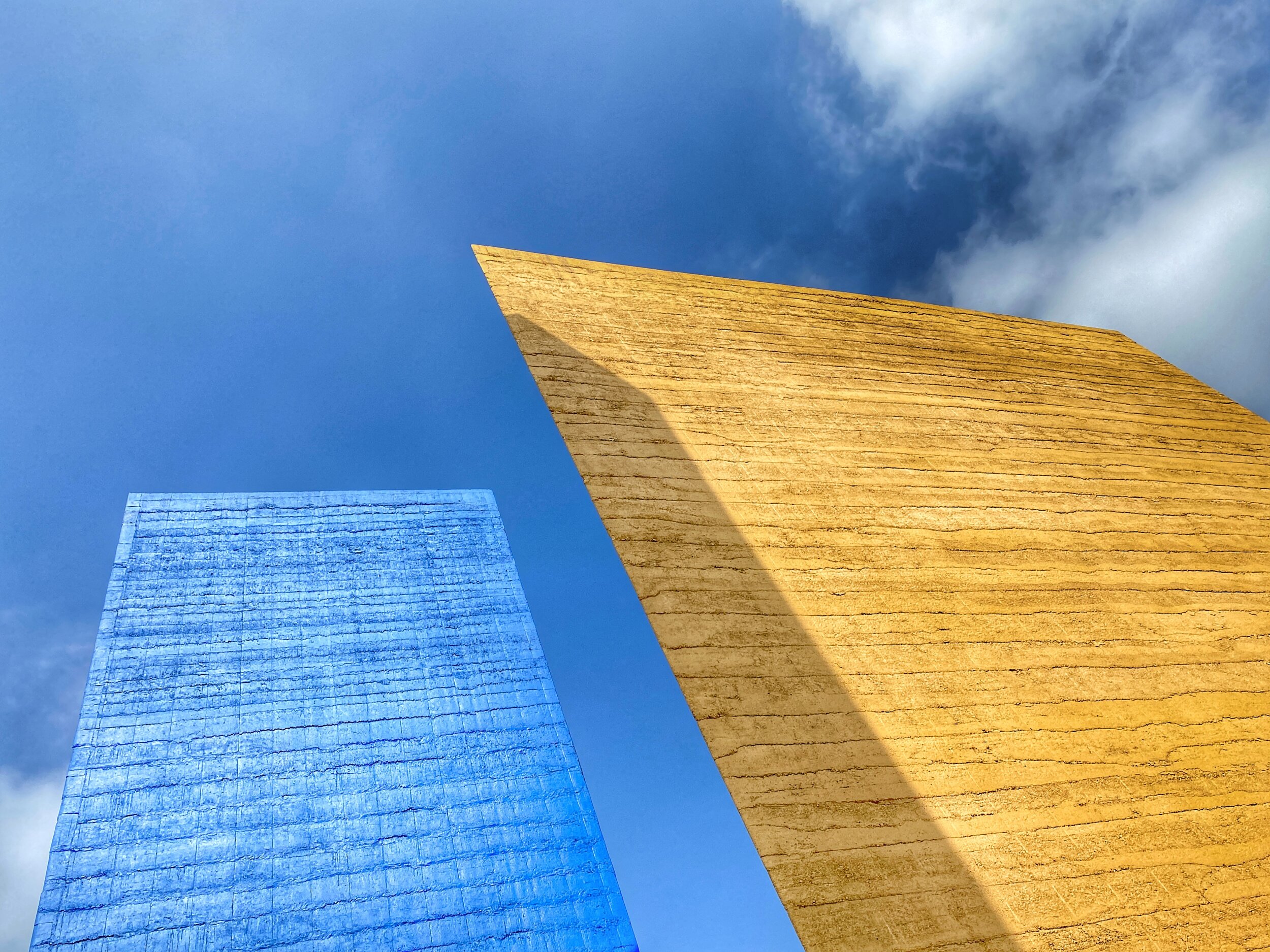
Martín has us note how the towers cast shadows upon each other, creating additional ever-shifting lines, black shapes that mimic the malleability of the towers themselves. 

“Shadow was one of Barragán’s obsessions,” he explains.

The shadows that form shifting patterns on the towers were part of Barragán’s consideration in the design. He was always aware of the power of chiaroscuro.

The shadows that form shifting patterns on the towers were part of Barragán’s consideration in the design. He was always aware of the power of chiaroscuro.

Pretty much any picture of the towers could be considered modern art (at least that’s what Wally thinks).

Pretty much any picture of the towers could be considered modern art (at least that’s what Wally thinks).

Las Torres de Satélite ended up being but an appetizer on our tour of Barragán’s suburban works (with Cuadra San Cristóbal being the main course). They seem to defy the very laws of physics and are a great introduction to the brilliance of Barragán. –Wally


Las Torres de Satélite can be combined with a tour of other Barragán works in the northwestern suburbs of Mexico City.

Las Torres de Satélite can be combined with a tour of other Barragán works in the northwestern suburbs of Mexico City.

Torres de Satélite
Ciudad Satélite
53100 Naucalpan de Juárez
State of Mexico
Mexico


11 Tips When Visiting Xochimilco

Here’s what to know about trajineras, how to rent these Xochimilco boats, and how to get the most of your trip to chinampas and the Isla de las Muñecas.

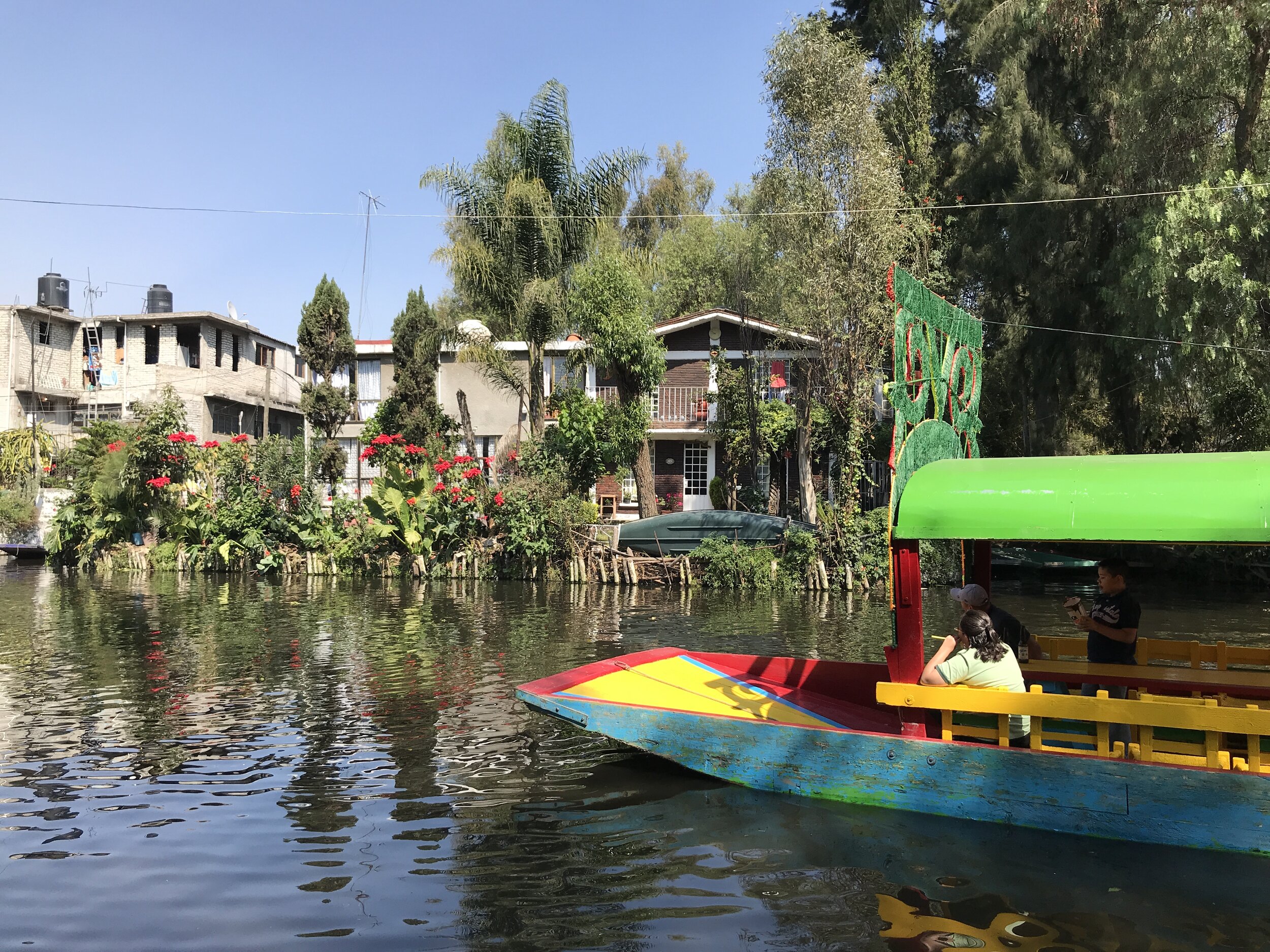
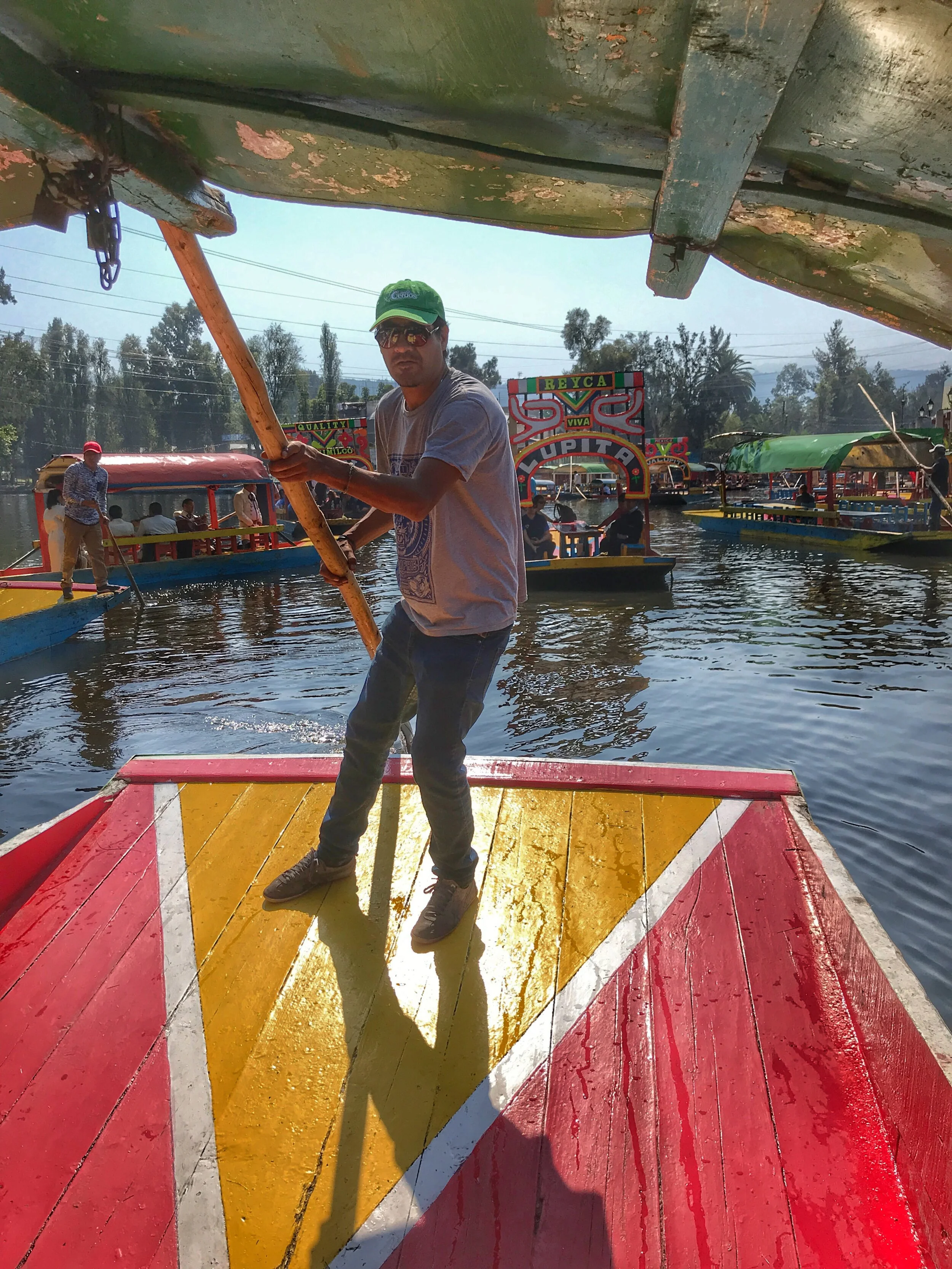
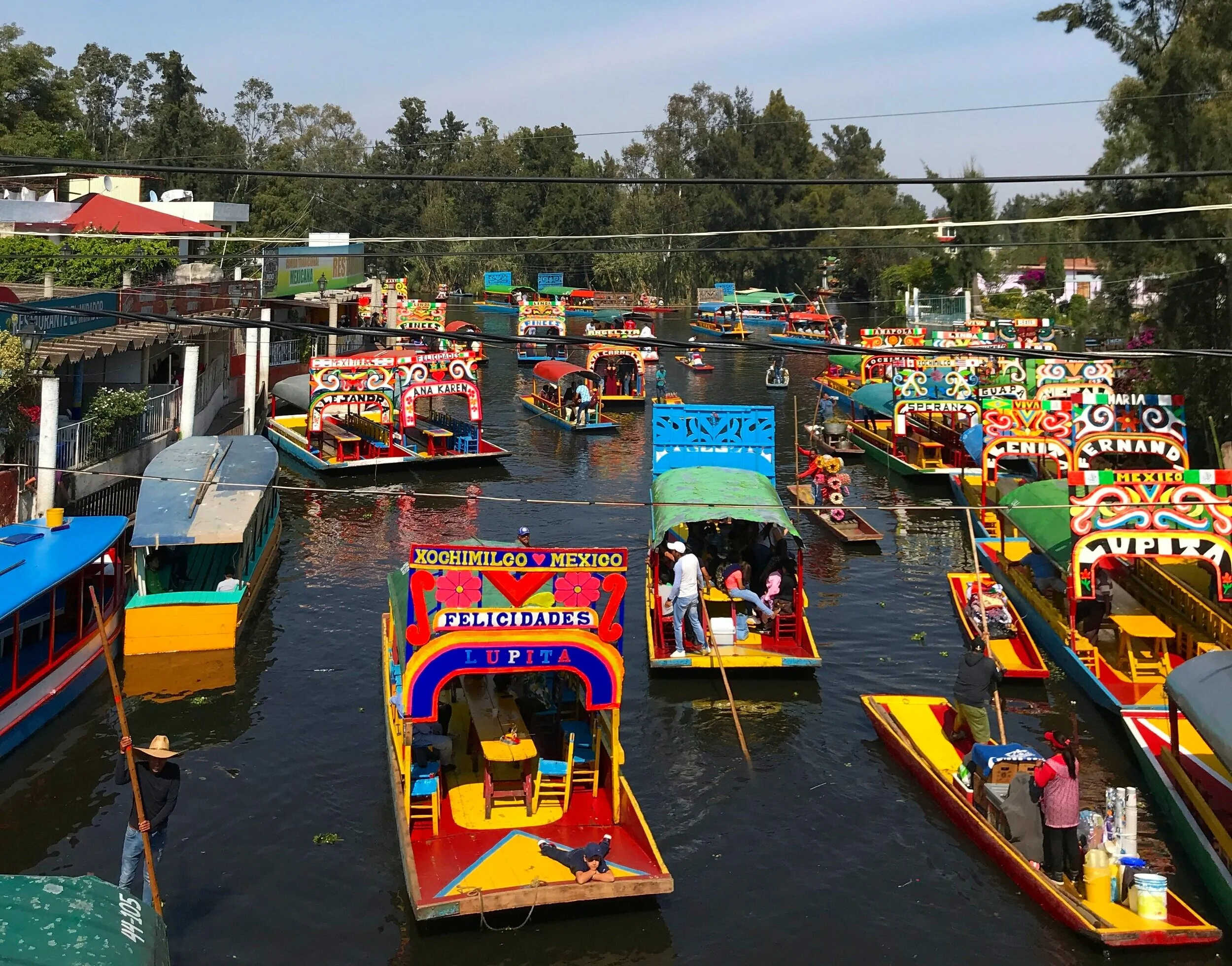
Xochimilco is nicknamed the Venice of Mexico City — though the boats are much more whimsical than Italian gondolas.

Xochimilco is nicknamed the Venice of Mexico City — though the boats are much more whimsical than Italian gondolas.

Wally enjoyed a pleasant few hours at Xochimilco.

Wally enjoyed a pleasant few hours at Xochimilco.

1. Pronounce it properly.

It’s “So-chee-meel-ko.”

A long table runs the length of the trajinera, situated under a canopy. Food and socializing are the main priorities.
Floating gardens called chinampas line the waterways.

Floating gardens called chinampas line the waterways.

The Xochimilco canals are some of the only remaining features from Aztec times.

The Xochimilco canals are some of the only remaining features from Aztec times.

2. Learn a bit about its history before you go.

The Xochimilco canals are a vestige of the ancient Aztec Empire and still provide much-needed water to Mexico City. Now a UNESCO World Heritage Site, they’re located about 17 miles south of the Centro Histórico. 

The name is from Nahuatl, the language of the Aztecs, and translates to Flower Garden, a reference to the “floating gardens” now known as chinampas. These man-made islets are situated throughout the waterways and are covered with fruits, vegetables and other plants. (We passed a large poinsettia farm on our excursion.) They’re a clever way to create more arable land in the midst of a wetland. 

We chose to launch from Embarcadero Nuevo Nativitas.

We chose to launch from Embarcadero Nuevo Nativitas.

3. Choose your embarkation point.

This confused us a bit, as there are a few different spots you can launch from. We ended up choosing Embarcadero Nuevo Nativitas, as it’s the best spot to leave from to visit the closest Island of the Dead Dolls (see below). 

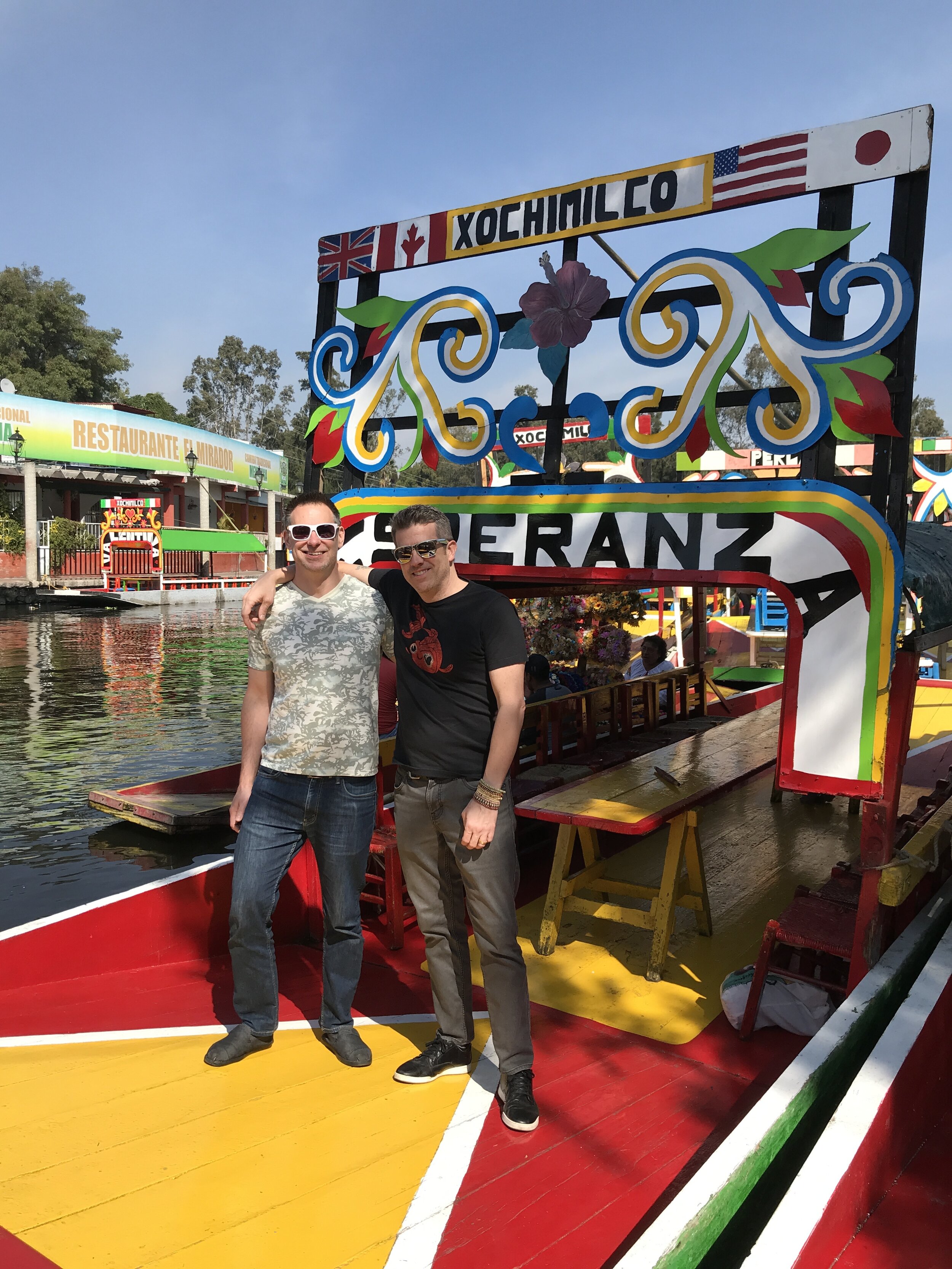
Duke and Wally aboard the Esperanza

Duke and Wally aboard the Esperanza

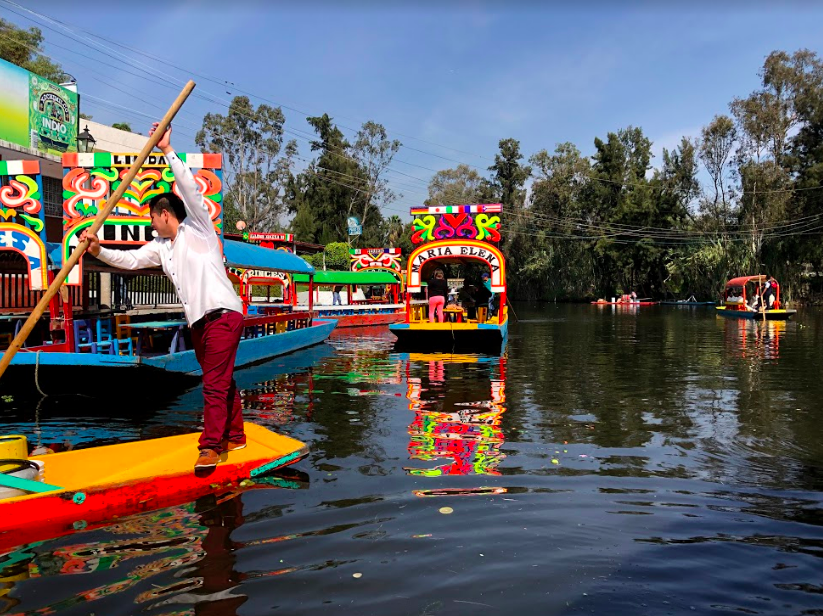
No motors on these boats — they’re propelled and steered by a pole.

No motors on these boats — they’re propelled and steered by a pole.

4. Don’t worry about haggling over the price.

Duke and I walked the docks, looking out at the brightly colored armada, wondering how we were going to choose one of the flat-bottomed boats known as trajineras, which sport painted archways and look like Mardi Gras floats. But then one of the captains, Sandro, approached us and offered to take us out for 500 pesos an hour (about $25 an hour). We had no idea if this was a good price — but he pointed to an official sign that had that rate right on it. That sold us, and we were glad we didn’t have to barter. So Captain Sandro aboard the Esperanza (which translates to Hope) it was!

A nearby store provided snacks and adult beverages to enjoy on our boat ride.

A nearby store provided snacks and adult beverages to enjoy on our boat ride.

5. Bring some food and drinks.

As our Uber pulled into Nativita, the first thing we did was pop into a local market and buy some snacks and booze. We were glad to find a shop but next time we’ll plan a bit better and make sure we have a picnic, including fixings for margaritas. In fact, it would be a lot of fun to have a party on one of the boats. A long table runs the length of the trajinera, situated under a canopy. Food and socializing are the main priorities. 

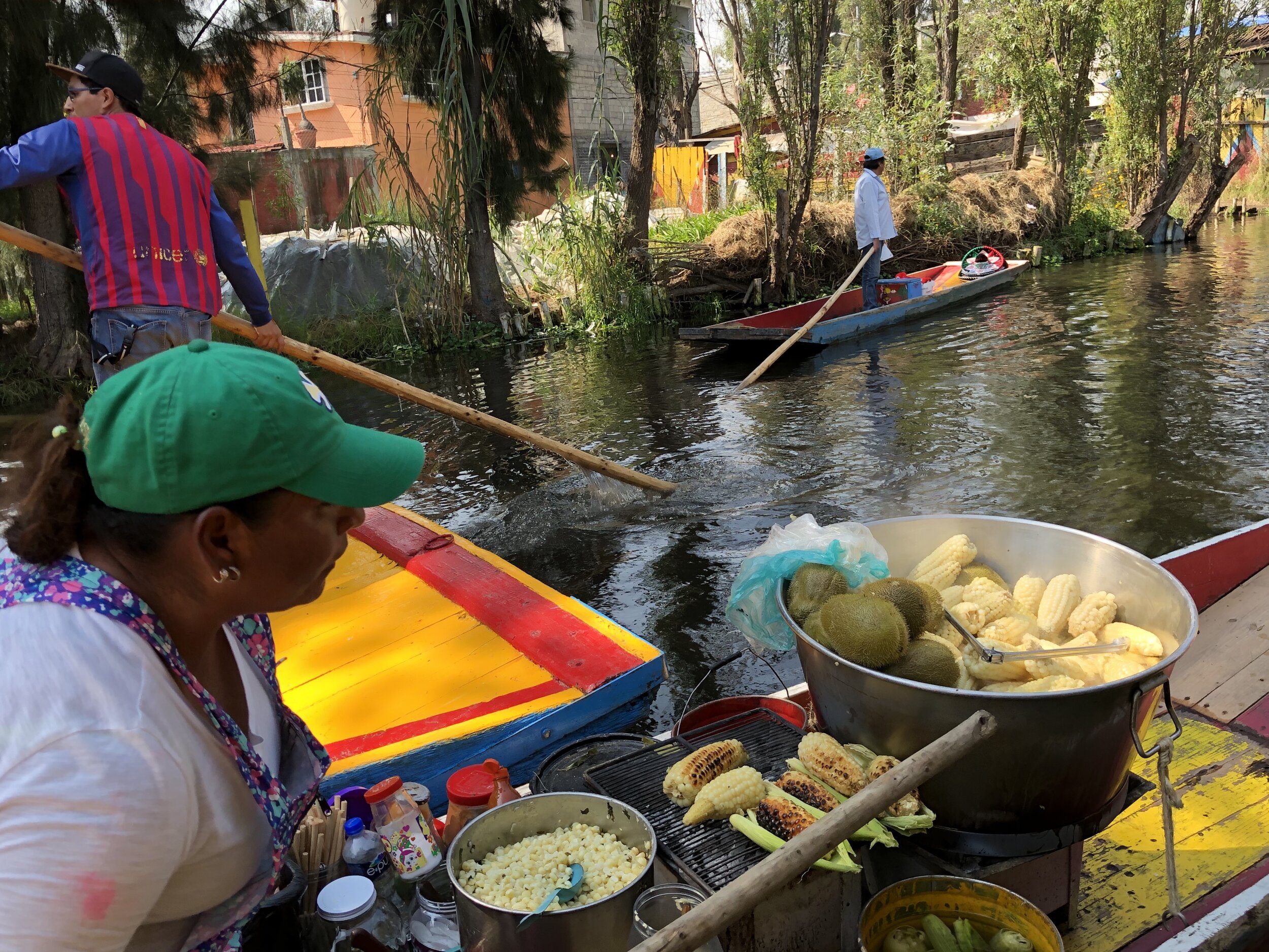
Some of the boats in the waterways are the equivalent of floating food trucks.

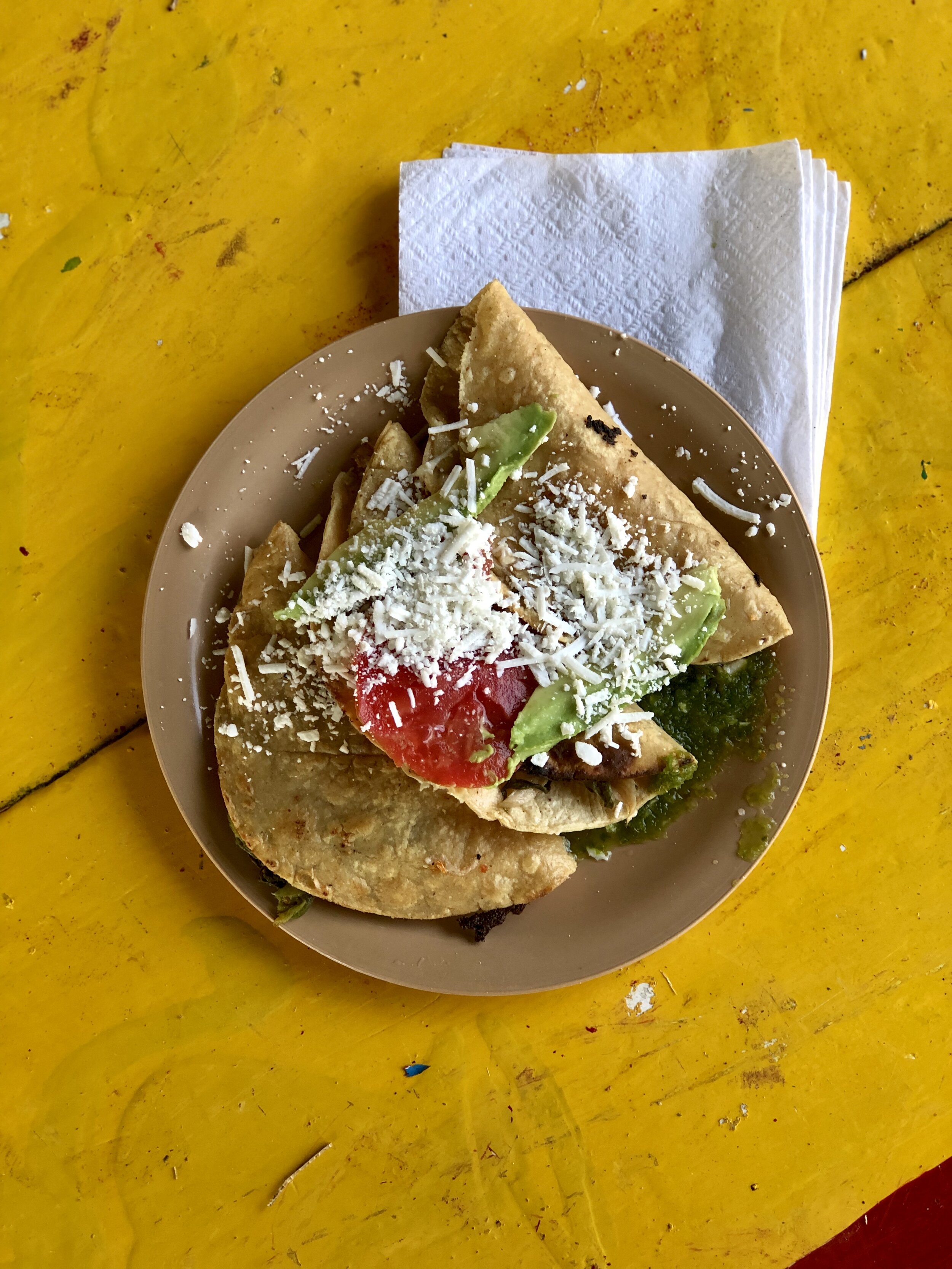
The delicious quesadillas we had for lunch that were made by a nice couple aboard a trajinera.

The delicious quesadillas we had for lunch that were made by a nice couple aboard a trajinera.

6. But save room for the waterborne food vendors.

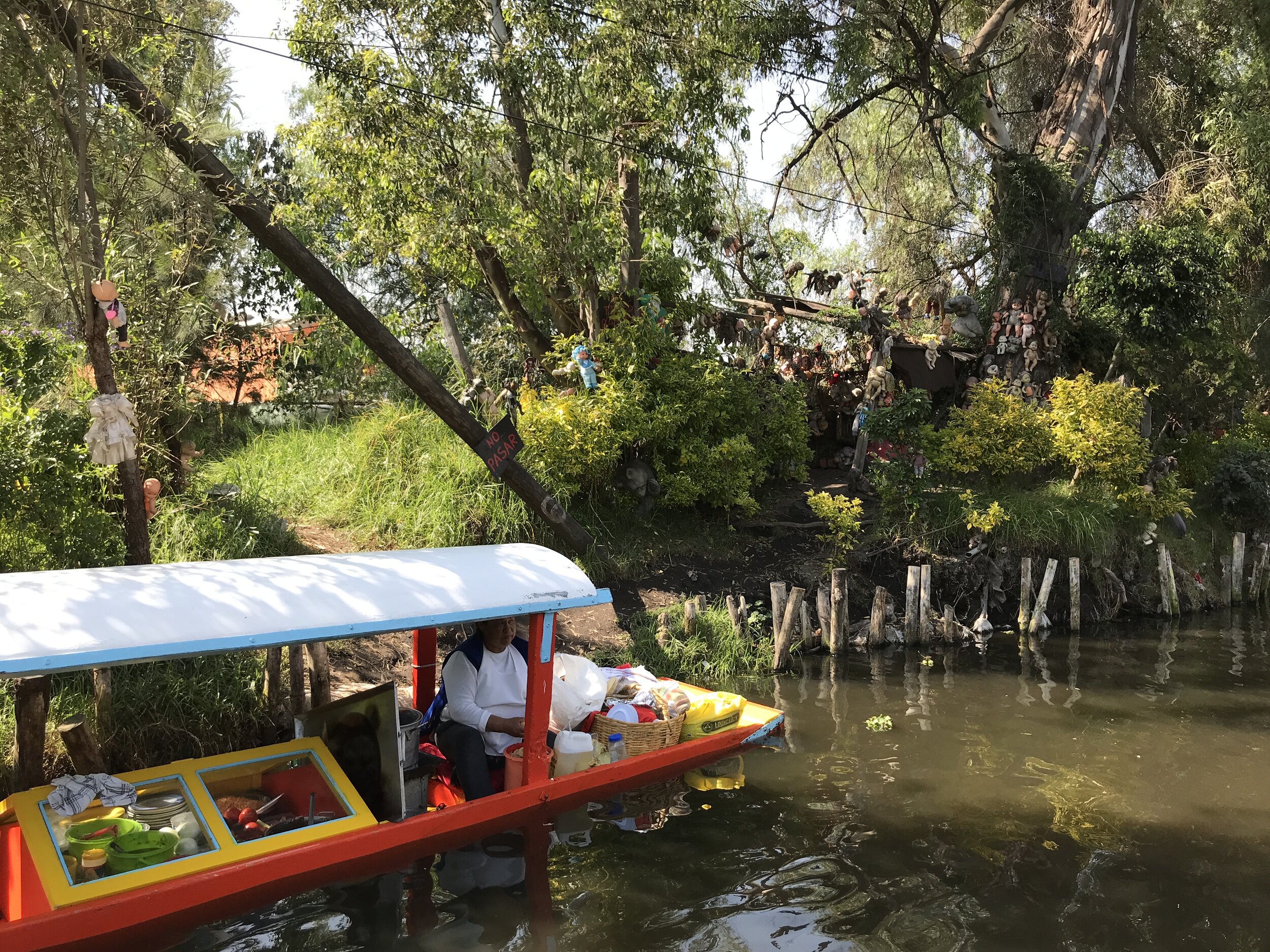
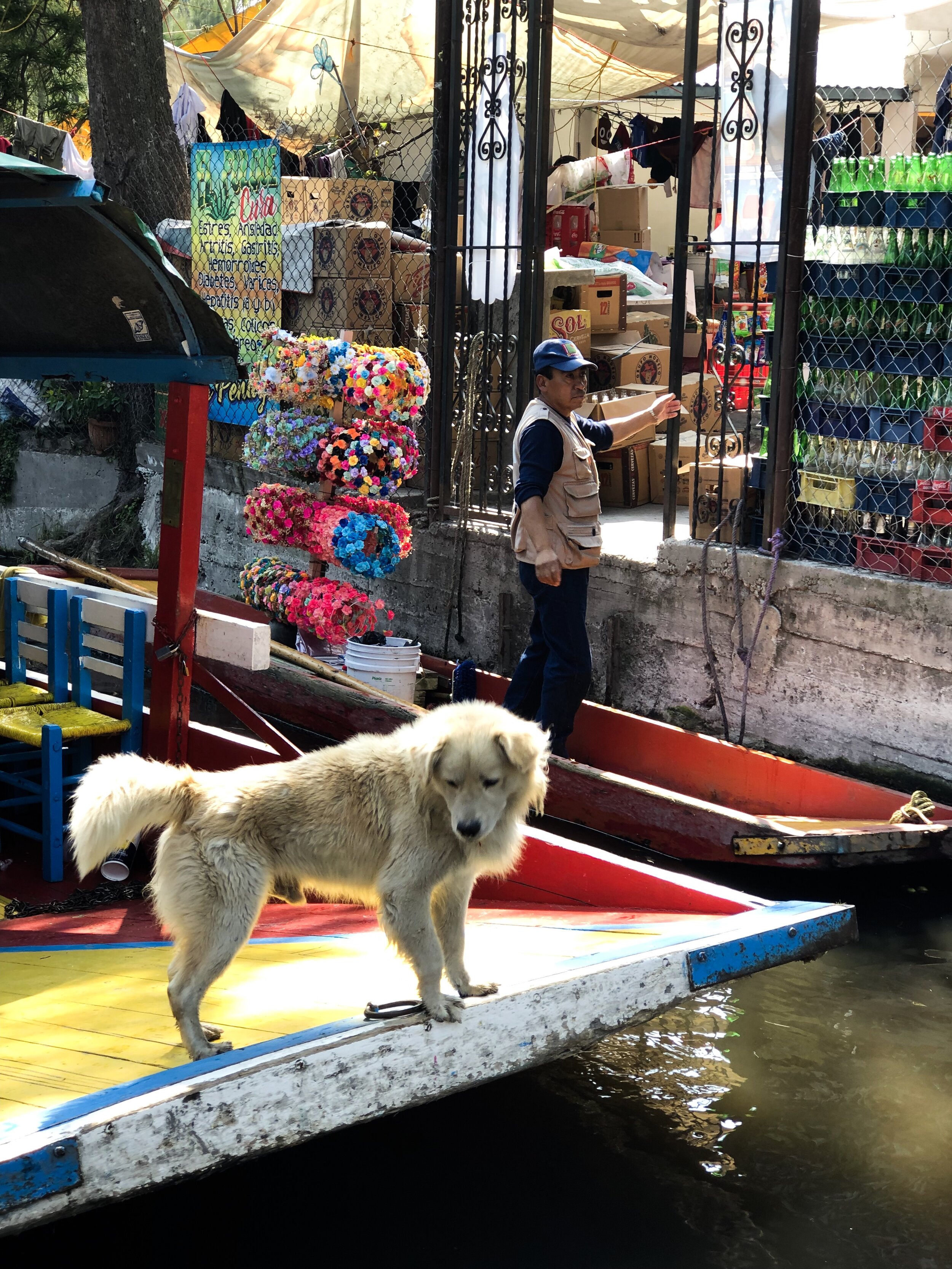
It’s not too tragic if you forget to bring along some food. There are people who paddle narrow, flat boats along the canals, selling freshly made Mexican dishes. We bought quesadillas from a nice couple who parked near the Island of the Dead Dolls (hold your horses — it’s coming up).

Hire a mariachi band and have a dance party aboard your trajinera.

Hire a mariachi band and have a dance party aboard your trajinera.

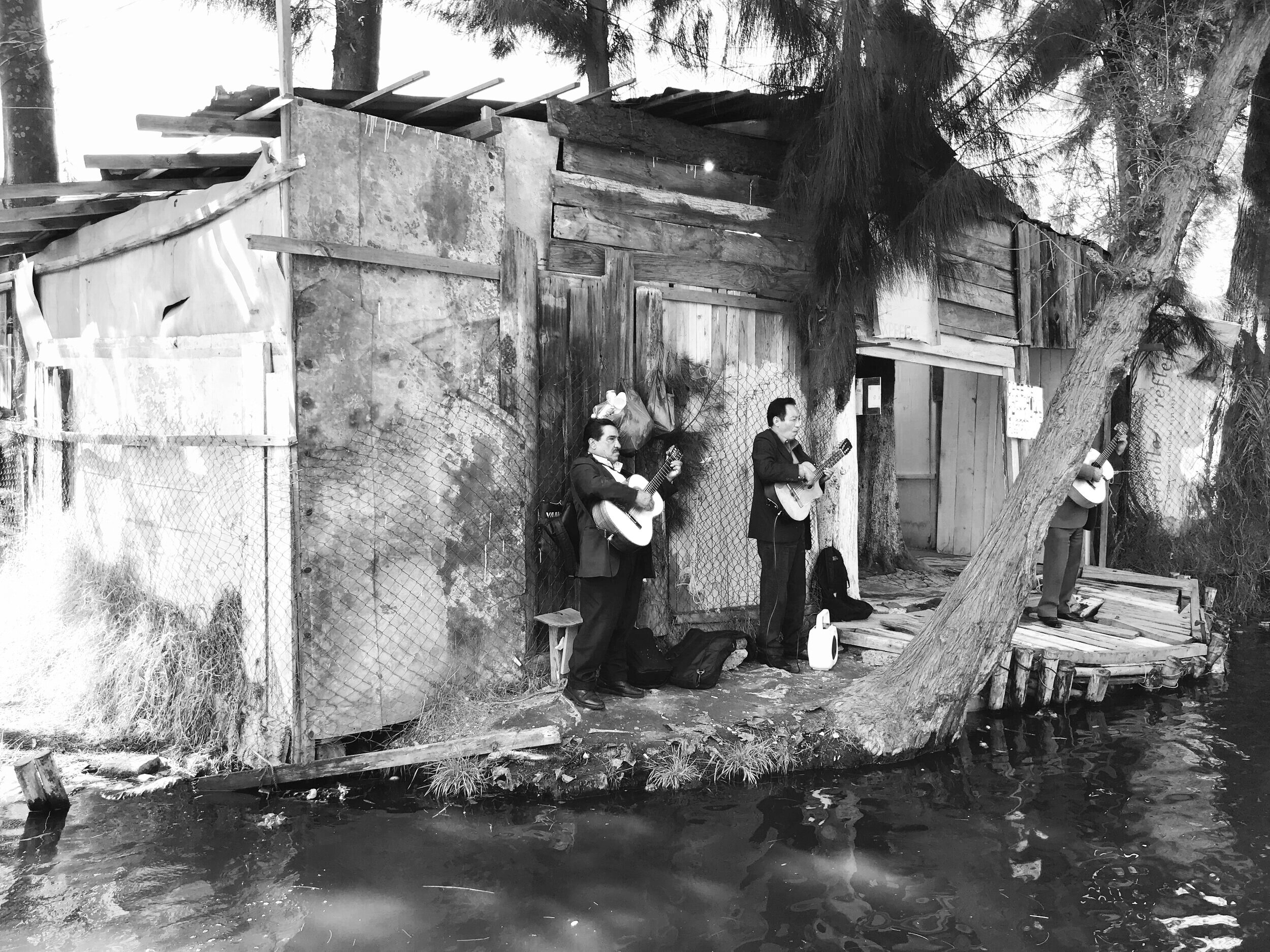
Strains of mariachi music can often be heard on the canals.

Strains of mariachi music can often be heard on the canals.

7. Hire a floating mariachi band.

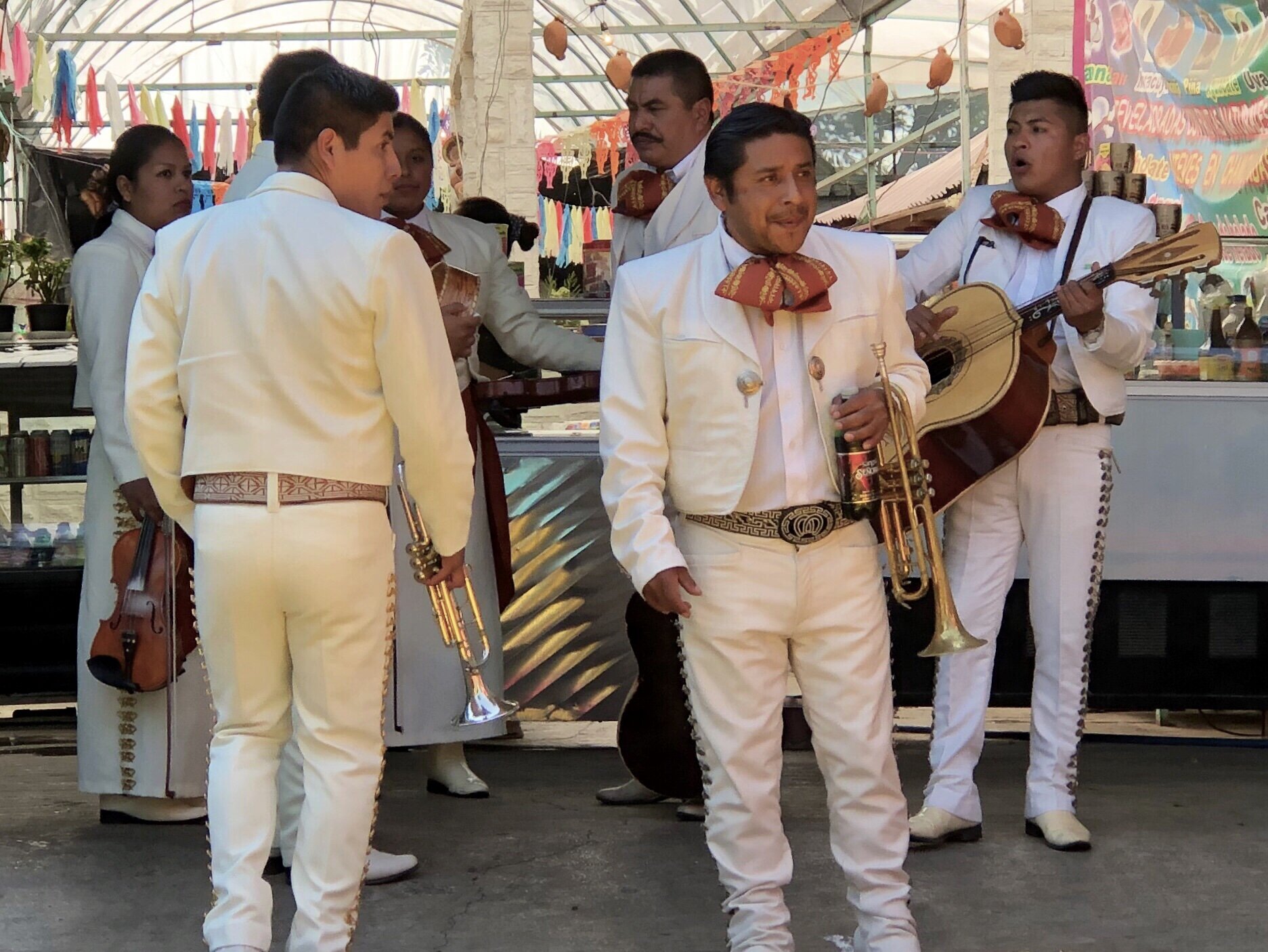
We cheated and just enjoyed hearing the strains of the lively music as we passed by. There are entire boats filled with musicians in their traditional garb, and we saw a couple of bands aboard a rented trajinera, playing their tunes as people danced.

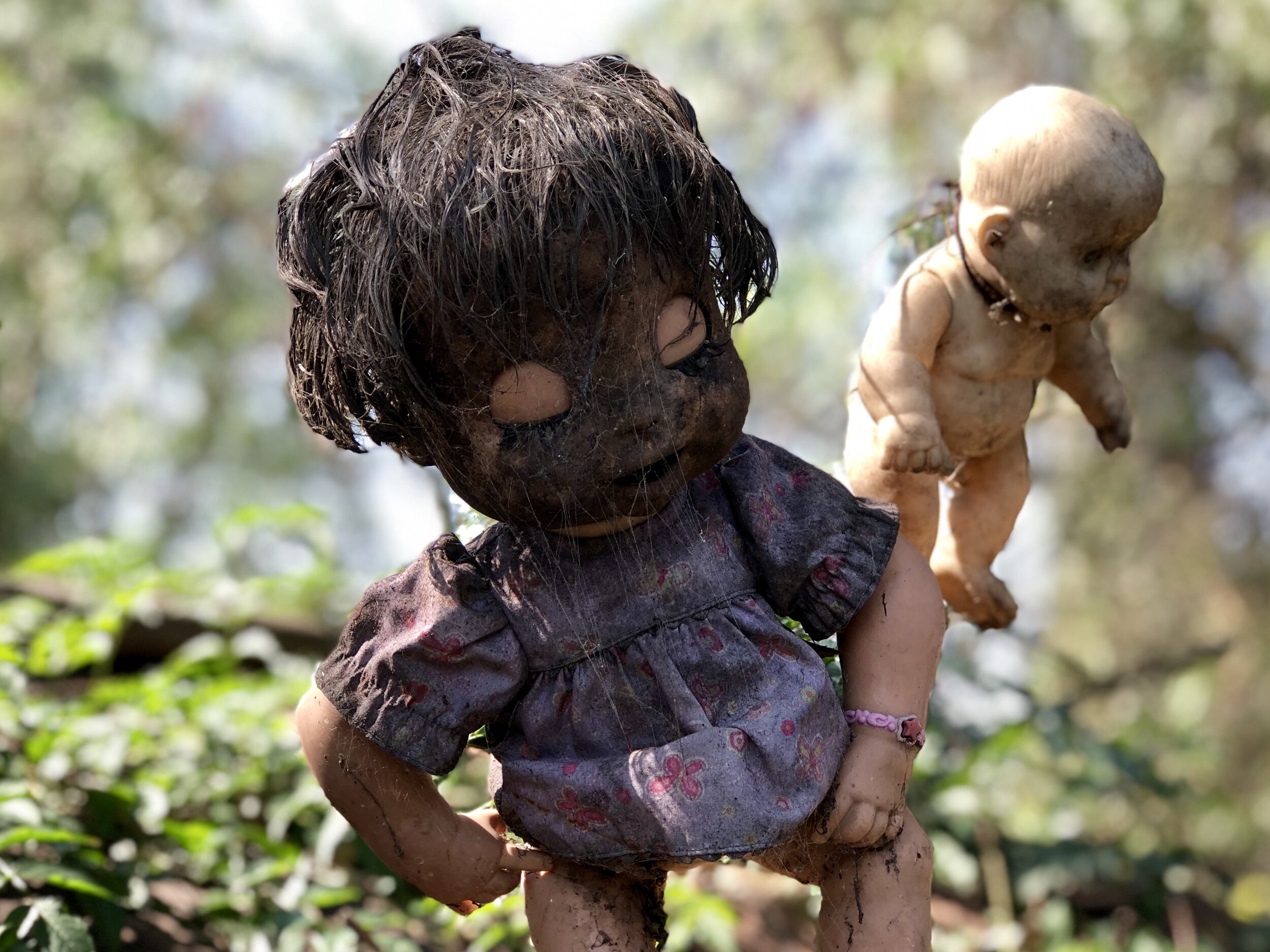
Horrifying (but cool) dolls like this are strung up all over the Island of the Dead Dolls.

Horrifying (but cool) dolls like this are strung up all over the Island of the Dead Dolls.

The creepy Isla de las Muñecas

The creepy Isla de las Muñecas

8. Plan a trip to the Island of Dead Dolls.

If you like creepy, off-the-wall spots, like we do, you have to stop by la Isla de las Muñecas, aka the Island of the Dead Dolls. This small isle is covered with dolls left in offering to appease the ghost of a little girl who drowned. Duke and I had found a doll on the street behind the Uptown Theater in Chicago, brought it with us to CDMX and left it on the island. Read more about the Island of Dead Dolls here.

As the day wears on, the canals get more and more crowded.

As the day wears on, the canals get more and more crowded.

9. You might want to go a bit early in the day. 

We had a relatively early start to our excursion, and the canals weren’t too busy for most of the time we spent there. Until, that is, we started heading back, and the canals were utterly clogged. When we got back to the embarcadero, I didn’t know how we were going to get through the traffic jam to dock. But Captain Sandro somehow eventually  maneuvered us through the deadlock. 

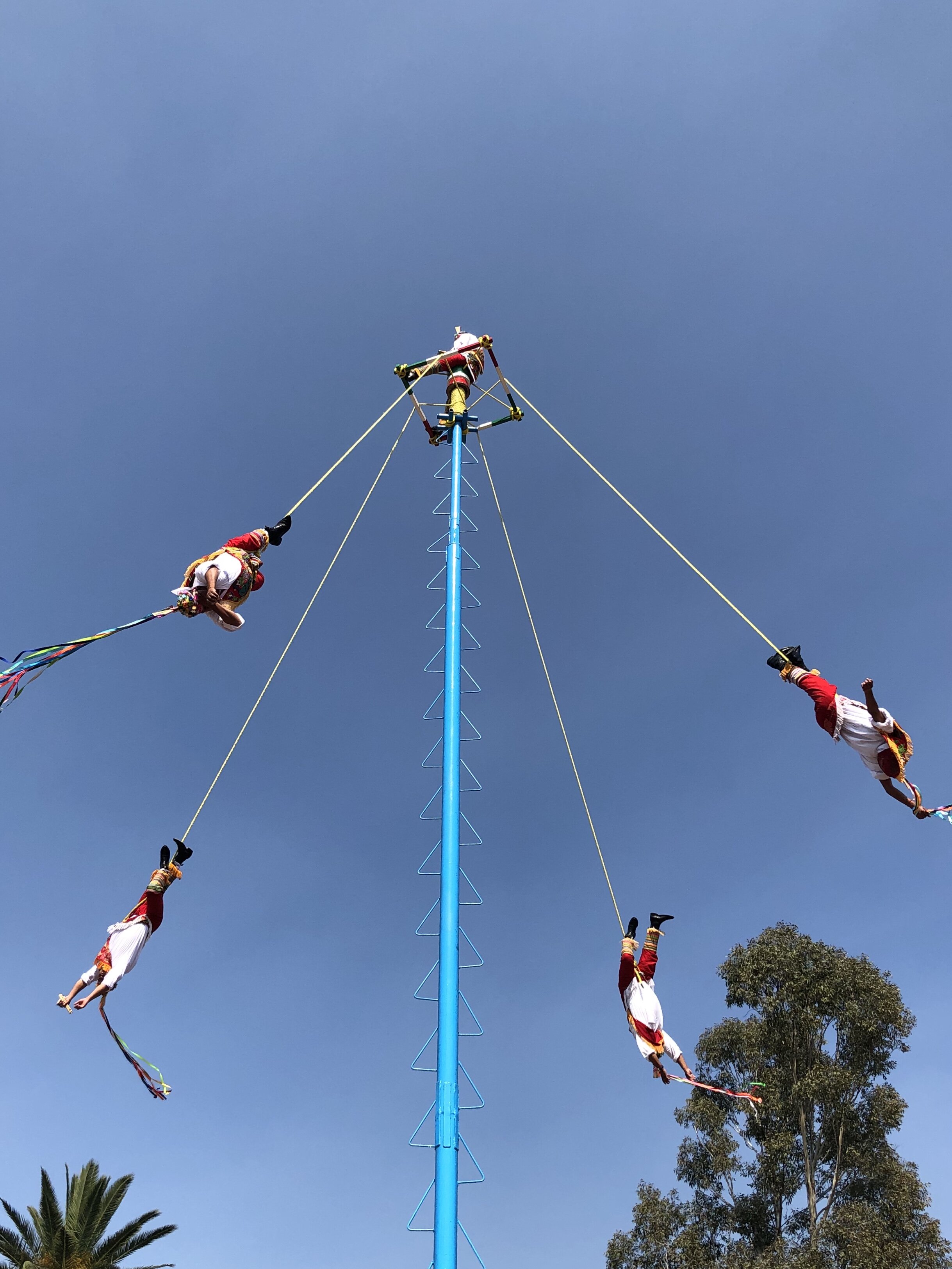
While we visited Xochimilco, the bizarre Danza de los Voladores was taking place.

While we visited Xochimilco, the bizarre Danza de los Voladores was taking place.

10. Don’t miss the Danza de los Voladores.

After a pleasant couple of hours on the canals, we disembarked and walked around Nuevo Nativitas, where some market stalls had been set up. We cut over to head back to the parking area — and beheld quite a sight! Four men were hanging head-first in the air, spinning around a pole, held by ropes tied around their ankles. They circled the pole while one of their compatriots played something between a pipe and a percussion instrument while sitting atop the pole. I had actually seen such a spectacle on the Yucatán and knew it was a traditional ceremony — it’s part of the native Totonaca people’s folk culture and is known as la Danza de los Voladores, or the Dance of the Flying Men.

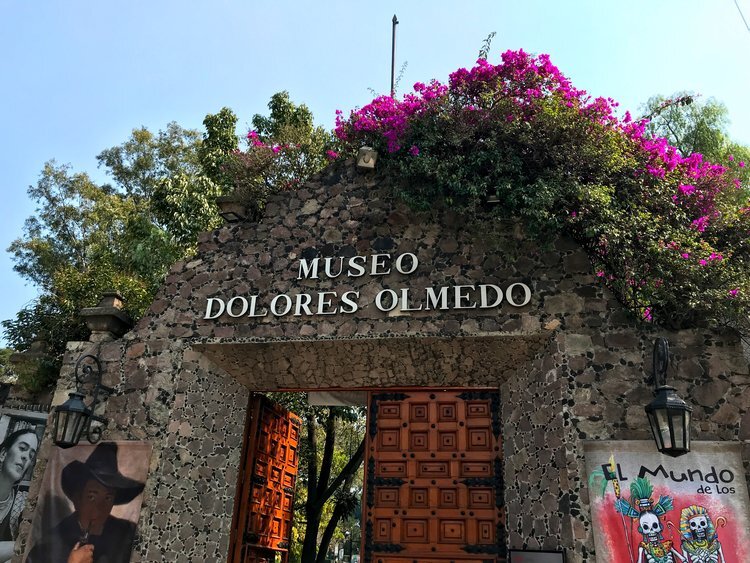
While you’re in this neck o’ the woods, visit the Museo Dolores Olmedo to see a large collection of Frida and Diego paintings on the grounds of an amazing estate.

While you’re in this neck o’ the woods, visit the Museo Dolores Olmedo to see a large collection of Frida and Diego paintings on the grounds of an amazing estate.

11. Pair Xochimilco with a visit to the Dolores Olmedo Museum.

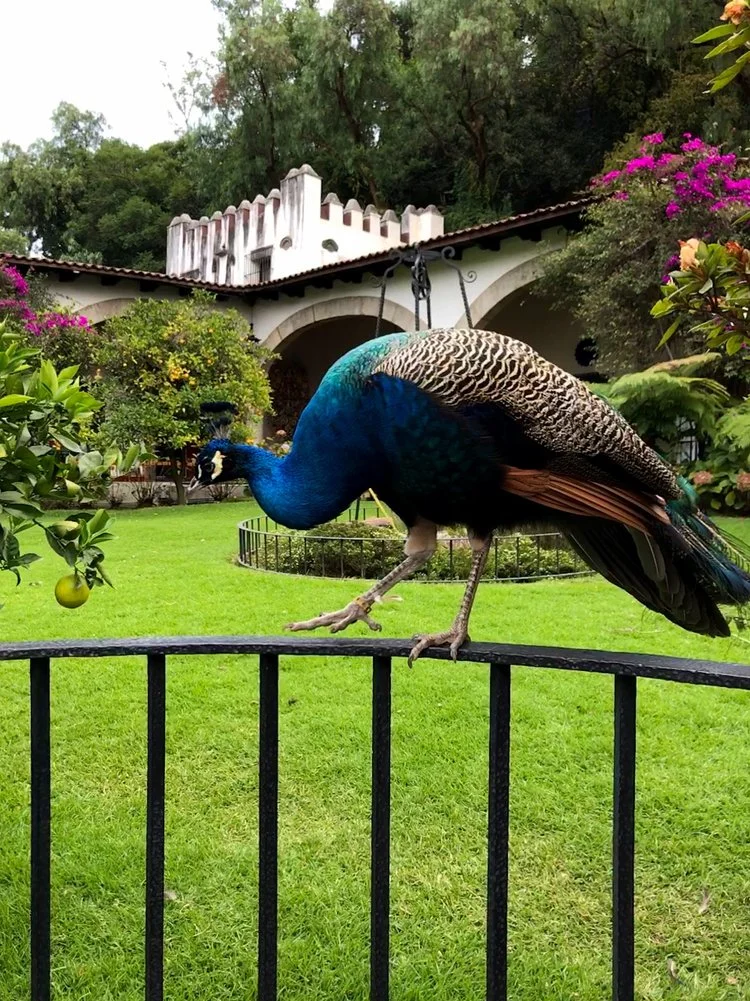
This gorgeous estate holds one of the largest collections of the works of Frida Kahlo and Diego Rivera. Come for the art, stay for the peacocks that roam the grounds. From Embarcadero Nuevo Nativitas, it’s about a 10-minute drive away. Read more about the Museo Dolores Olmedo here

Before we left for Mexico City, a couple of friends who had lived there told us we absolutely had to check out Xochimilco — and they were right. It’s definitely one of the things that we will do again when we return. –Wally

This perro hopped from boat to boat in search of food and affection.

This perro hopped from boat to boat in search of food and affection.

Duke’s on a boat!

Duke’s on a boat!


Anahuacalli Museum: Diego Rivera’s Temple-Like Treasure Trove

El Museo Anahuacalli is unlike any other museum we’ve visited. Explore Rivera’s collection of pre-Hispanic artifacts after a visit to La Casa Azul.

If you’ve seen Frida’s Casa Azul, the Anahuacalli Museum is included in the ticket. Don’t miss it!

If you’ve seen Frida’s Casa Azul, the Anahuacalli Museum is included in the ticket. Don’t miss it!

My first introduction to Diego Rivera, one of Mexico’s most famous artists, was a seemingly ubiquitous, mass-produced print of Rivera’s painting El Vendedor de Alcatraces (The Calla Lily Vendor). This image can be seen hanging on the wall of many Mexican restaurants in Anytown, USA. 

Wally peeks behind a giant agave plant in the plaza in front of the museum.

Wally peeks behind a giant agave plant in the plaza in front of the museum.

The subject of the artwork is a peasant woman, head bowed, squatting and overwhelmed by a basket filled with an immense bunch of white calla lilies. Rivera was known for his murals with a message and many featured the great social inequalities of the working class and the indigenous peoples of his country. His larger-than-life paintings were commissioned by the Mexican government, Henry Ford, the Rockefellers and the San Francisco Stock Exchange building, among many others. 

If the light seems gauzy it’s because the panels of the thin vertical windows aren’t made from glass but alabaster, creating an ethereal air of mystery.
Frida’s nickname for Diego was Toad-Frog — and with his bulging eyes and belly, it’s not hard to imagine why.

Frida’s nickname for Diego was Toad-Frog — and with his bulging eyes and belly, it’s not hard to imagine why.

Perhaps what’s more interesting is that his passionate, colorfully attired and unibrowed wife, the eccentric Mexican painter Frida Kahlo is now better known than her erstwhile husband. Her birthplace and childhood home, La Casa Azul (the Blue House), was purchased by and shared with Rivera, who paid off the mortgage and financial debt left by Frida’s father Guillermo — undoubtedly accrued by Frida’s chronic health issues caused by a near-fatal street car accident she suffered when she was 18 years old. 

The first floor of the museum is filled with Mexican folk art.

The first floor of the museum is filled with Mexican folk art.

Diego’s Dream Museum

If you’re visiting Kahlo’s home, be sure to hold on to your ticket, as it also includes admission to Rivera’s equally intriguing and less visited Museo Anahuacalli. The museum is located on the southern end of Coyoacán, about a 30-minute Uber ride from La Conchita Plaza, where Wally and I departed from after spending the afternoon exploring the area. 

The museum’s name is derived from Cemanahuac, the name used by the Aztecs to refer to their world. It’s Nahuatl, the language of the Aztecs, for “the Place Surrounded by Water” a concept that paid homage to the swampy pre-Hispanic landscape of México. 

Diego and Frida purchased the parcel of land in the 1930s on the rocky and then underdeveloped lava deposit of El Pedregal colonia, or neighborhood. While working on a mural in America, Rivera was inspired by the Industrial Revolution, and envisioned a space where he and Kahlo could visit and contemplate their collection of pre-Hispanic artifacts. He spent every cent he could scrape together on acquiring these pieces, amassing over 50,000 in his lifetime. One of the stories told about his obsession involves his second wife, Guadalupe Marín, who ground up one of his prized figurines in a fit of anger and served it to him in a bowl of soup. 

Rivera obsessively collected local artifacts.

Rivera obsessively collected local artifacts.

Some of RIvera’s artifacts might have been acquired on the black market — maybe even this one, which Wally thinks looks like someone giving birth.

Some of Rivera’s artifacts might have been acquired on the black market — maybe even this one, which Wally thinks looks like someone giving birth.

Rumor has it that Rivera acquired more than a few of his artifacts on the black market. At the time, there weren’t any laws protecting the provenance of pre-Columbian antiquities, and for this reason, the market boomed amongst nationals and foreigners alike. However Rivera obtained his prized artifacts, it’s undoubtedly an impressive collection that reveals the reverence and curiosity he felt toward the past. An inscription by Rivera at the entrance to the museum reads, “I hereby return to the people what I could rescue from the artistic heritage of their ancestors.”

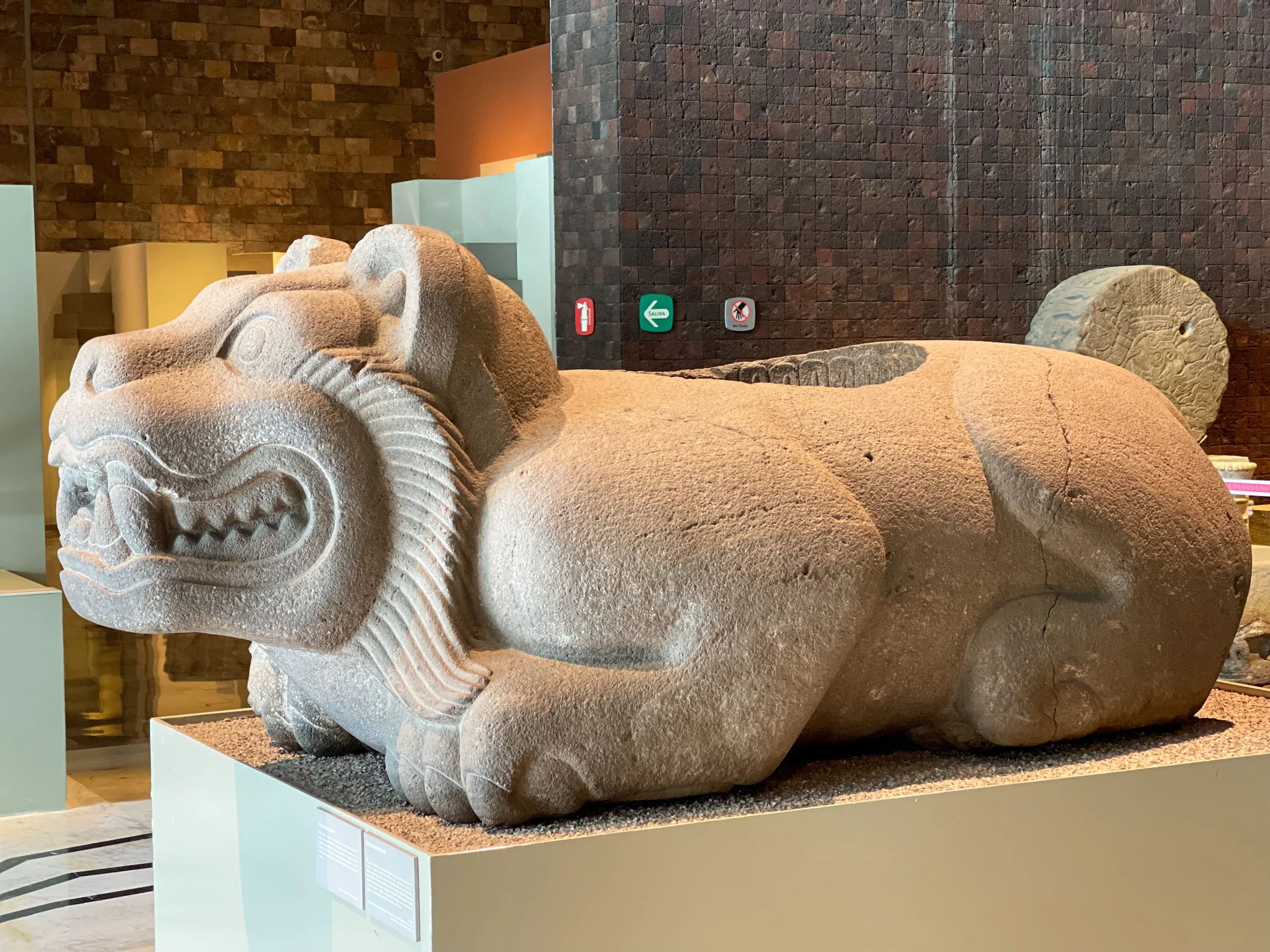
Jaguars were worshipped as gods by the ancient peoples of Mexico.

Jaguars were worshipped as gods by the ancient peoples of Mexico.

Before he died in 1957 at the age of 70, Rivera bequeathed his artifacts and vision for a space to conserve and share the collection with the people of Mexico. The passion project was completed posthumously by his daughter Ruth Rivera, the financial support of his close friend and patroness Dolores Olmedo and architect Juan O’Gorman, using plans left by Rivera.  


olmedohouse.JPG

Visit Dolores Olmedo’s amazing estate and see more works by Frida and Diego


All are welcome at the Museo Anahuacalli.

All are welcome at the Museo Anahuacalli.

Like Entering a Temple

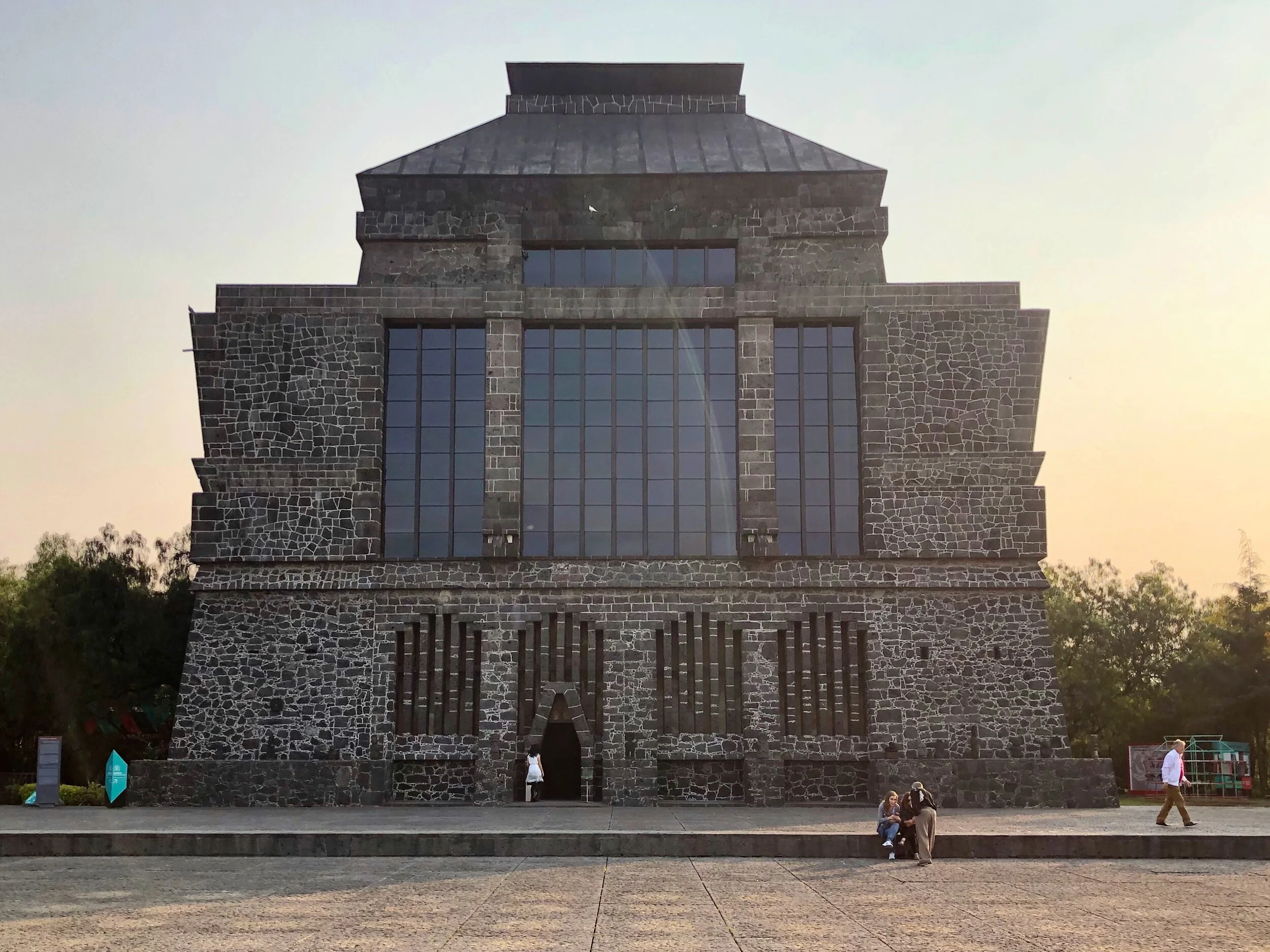
The imposing exterior of Anahuacalli is based upon a teocalli, a Mesoamerican temple standing on a truncated pyramid, rising dramatically from the edge of a broad, open plaza. Anahuacalli is sheathed entirely in black basalt, the igneous rock produced by the eruption of nearby Xitle, a volcano that destroyed the pre-Hispanic settlement of Cuicuilco that preceded Mexico City. 

A sign at the entry kiosk states:

En este establecimiento mercantil no se discrimina el ingreso a ninguna persona por motivos de raza, religión, orientación sexual o socioeconómica ni por ningún otro motivo.

This establishment does not discriminate against entry to any person on the basis of race, religion, sexual orientation, socioeconomic status or for any other reason.

Once inside, Wally and I immediately noticed a change in light and temperature; it was dim and cool, like the interior of a tomb. If the light seems gauzy it’s because the panels of the thin vertical windows aren’t made from glass but alabaster, creating an ethereal air of mystery. 

Gorgeous papel picado, or cut paper decorations hang above artifacts placed in niches.

Gorgeous papel picado, or cut paper decorations, hang above artifacts placed in niches.

There’s a large ofrenda, an altar to Rivera.

There’s a large ofrenda, an altar to Rivera.

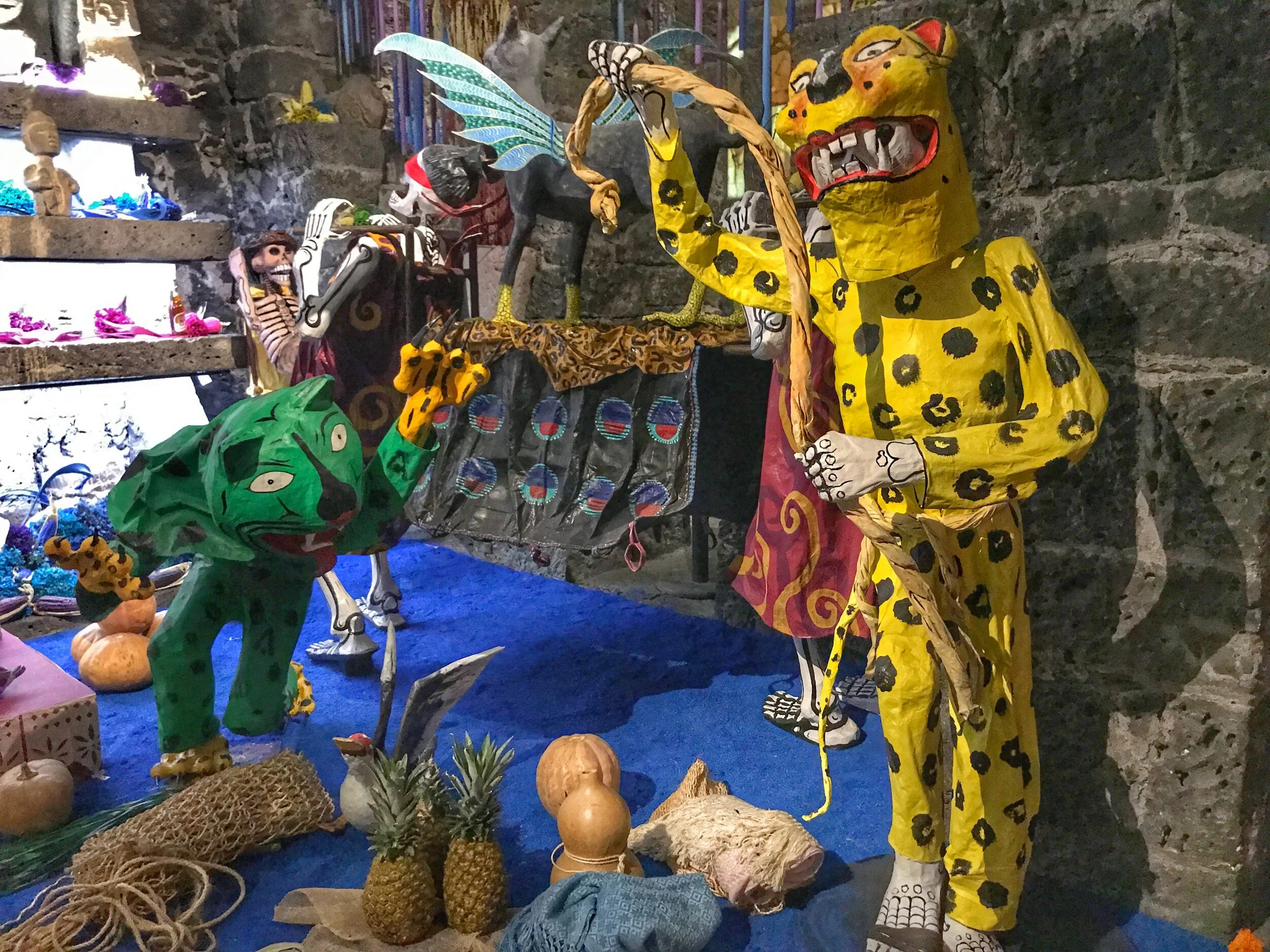
One of our favorite displays on the ground floor was the impressive and brightly colored ofrenda, a traditional and allegorical offering dedicated to the deceased Rivera. Adorning the ofrenda are life-size papier-mâché folk art sculptures are known as alebrijes—the word these fantastical creatures were repeatedly chanting in vivid fever dream that the artisan Pedro Linares had. 

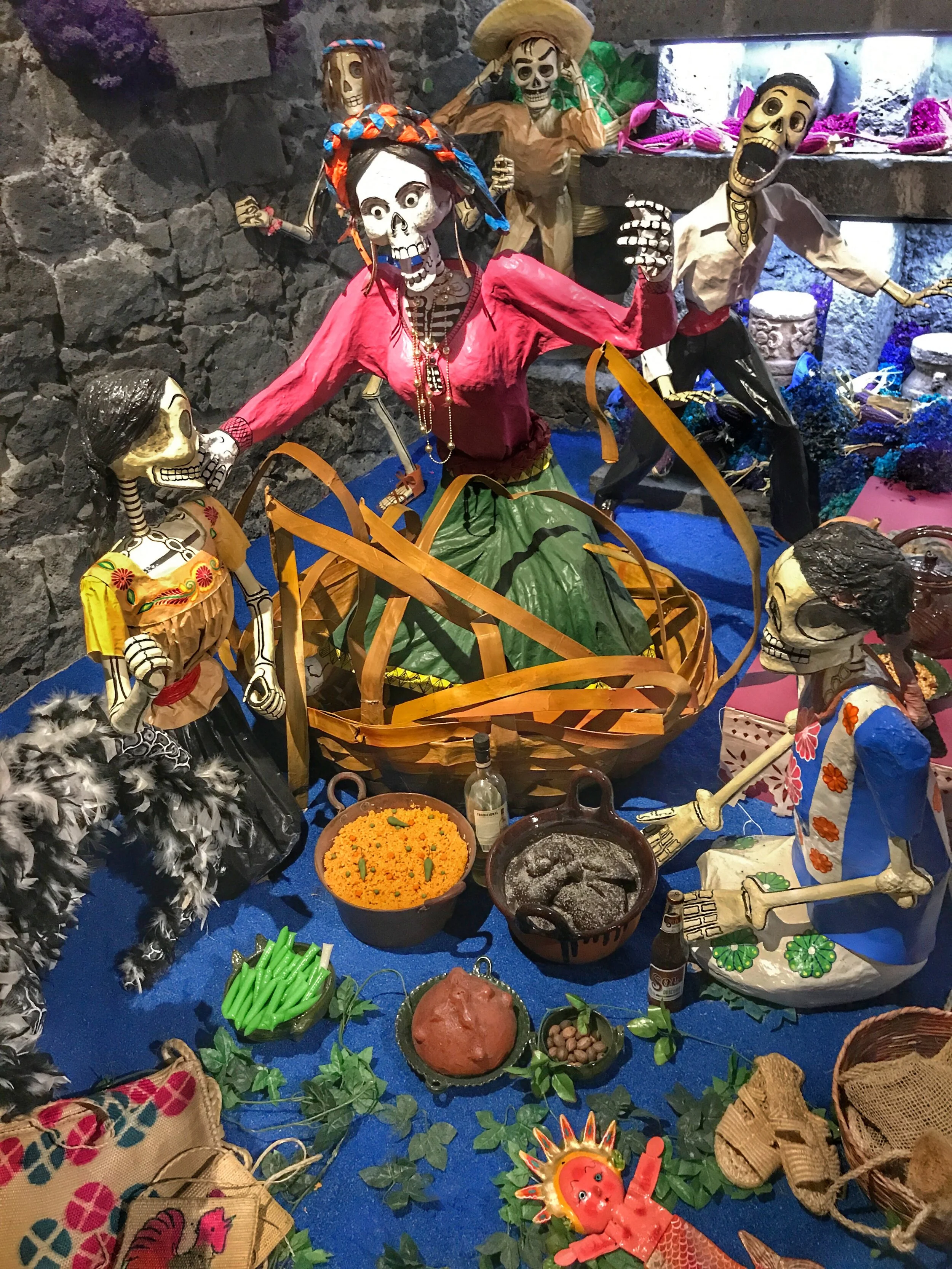
Ofrendas often have skeleton figures and food and other items the deceased enjoyed in life.

Ofrendas often have skeleton figures and food and other items the deceased enjoyed in life.

Whimsical papier-mâché folk art creatures called alebrijes came to their creator in a feverish dream.

Whimsical papier-mâché folk art creatures called alebrijes came to their creator in a feverish dream.

The exuberant colors of the figures and papel picado, cut tissue paper banners, are all the more striking against the volcanic stone. 

Admire the cut tissue paper flags before venturing into the depths of the temple-like museum.

Admire the cut tissue paper flags before venturing into the depths of the temple-like museum.

Narrow alabaster windows give the museum an otherworldly quality.

Narrow alabaster windows give the museum an otherworldly quality.

From the Underworld to the Heavens

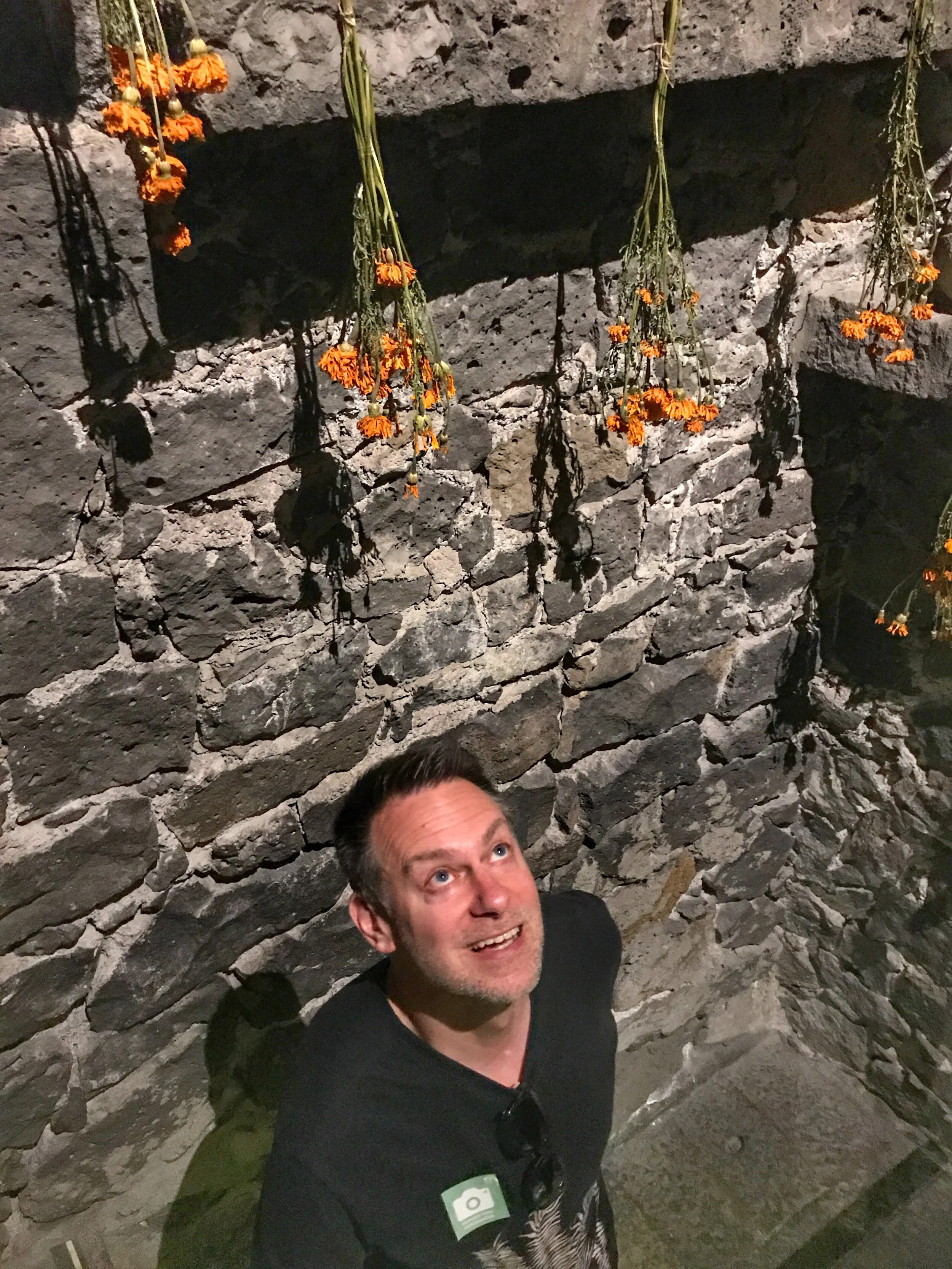
A stairwell symbolizing the entrance to the Mayan underworld of Xibalba descends past bouquets of dried marigolds. These flowers guide spirits to their altars using their vibrant colors and pungent scent. 

Bright orange marigolds help guide the way for spirits to visit this world.

Bright orange marigolds help guide the way for spirits to visit this world.

Duke looks up at the dried marigolds that fill this stairwell.

Duke looks up at the dried marigolds that fill this stairwell.

The Anahuacalli’s three levels are bisected by dramatic stone staircases leading to galleries with vitrines and niches filled with Rivera’s personal collection of more than 2,000 Zapotec, Maya, Aztec, Olmec and Toltec idols and artifacts ranging from utilitarian to religious objects. 

Rivera collected about 50,000 pre-Hispanic artifacts.

Rivera collected about 50,000 pre-Hispanic artifacts.

One of Rivera’s wives supposedly ground up one of his idols and served it to him in soup.

One of Rivera’s wives supposedly ground up one of his idols and served it to him in soup.

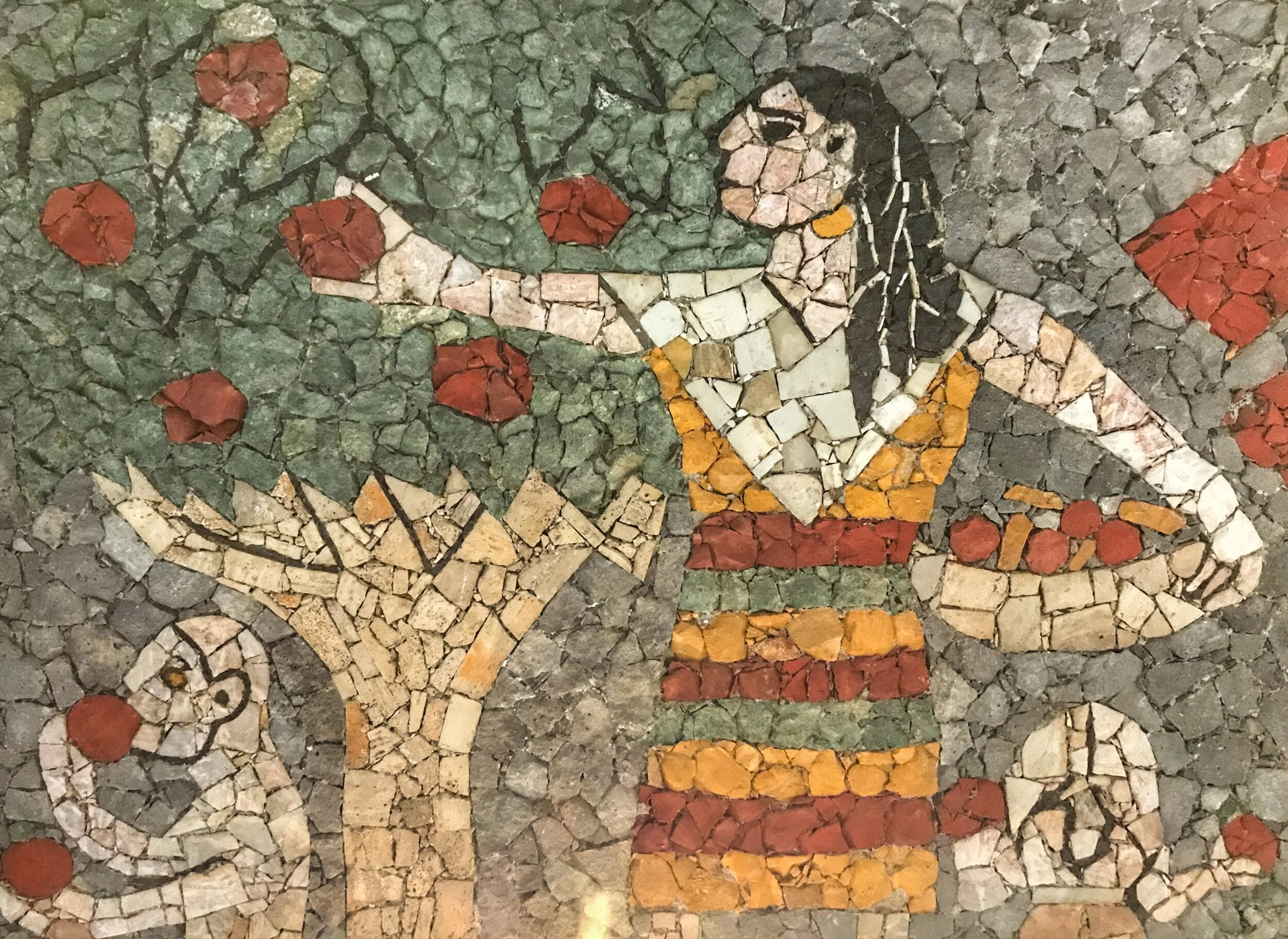
Make sure to look up at the ceilings, which showcase mosaics based on Rivera’s designs and communist inclinations. Most were inspired by the mythological creatures of the Mesoamerican canon, with a hammer and sickle thrown in for good measure. One mosaic depicts a toad — Kahlo’s nickname for Rivera was El Sapo-rana, or Toad-Frog — fitting, as he was a large, portly man with bulging eyes. Incidentally, his birthplace, Guanajuato, loosely translates to the Place of Frogs. 

Look up! Most of the ceilings have murals made from different colored rocks.

Look up! Most of the ceilings have murals made from different colored rocks.

A woman gathers fruit in one ceiling mural.

A woman gathers fruit in one ceiling mural.

Rivera wasn’t subtle about his fondness for Communism.

Rivera wasn’t subtle about his fondness for Communism.

The light-filled second floor of the museum was originally envisioned as Rivera’s art studio and contains a number of monumental charcoal sketches and studies for several of his murals. One in particular, El Hombre en el Cruce de los Caminos (Man at the Crossroads), is a fresco originally commissioned in 1932 for the Rockefeller Center in New York, but later destroyed and unceremoniously chiseled off the wall for its unflattering portrait of Rockefeller and depiction of communism.

On the second floor, you can see sketches for Rivera’s murals.

On the second floor, you can see studies for Rivera’s murals.

Another large-scale piece, Pesadilla de Guerra, Sueño de Paz (Nightmare of War, Dream of Peace), was a portable mural painted in 1952 for the Twenty Centuries of Mexican Art exhibition that traveled to various European cities. Its creator sold the work, which was censored by the Mexican authorities, to China. Nobody knows for certain where it is today. 

Also among Rivera’s artworks is a childhood drawing of a choo-choo train. 

Although the Anahuacalli is filled with niches showcasing Rivera’s beloved artifacts, it must house only a fraction of his collection.

Although the Anahuacalli is filled with niches showcasing Rivera’s beloved artifacts, it houses only a fraction of his collection.

Some galleries host temporary exhibits.

Some galleries host temporary exhibits.

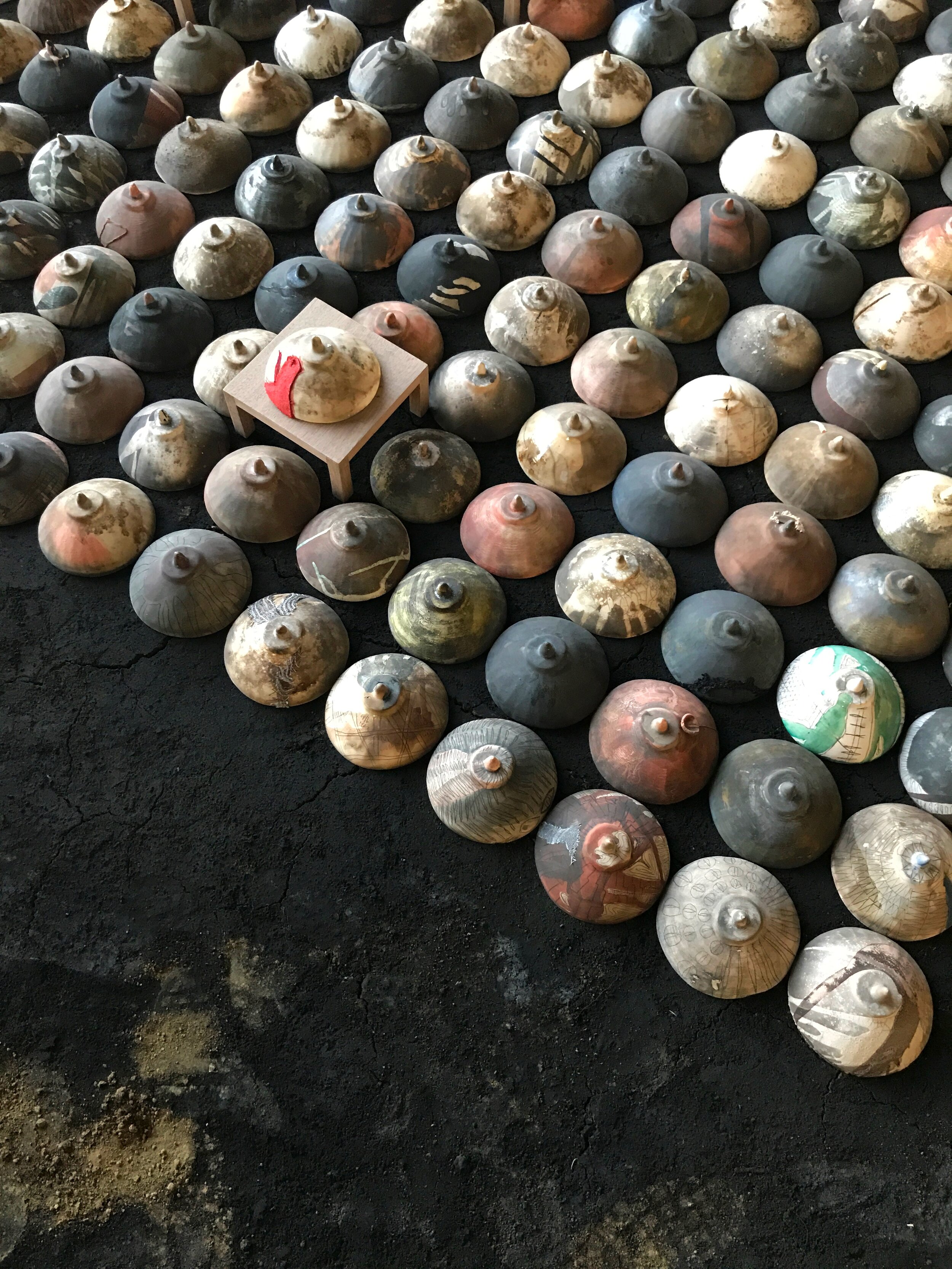
It’s also a space that hosts temporary exhibits and site-specific projects. While we were there in the fall of 2018, an exhibit titled Machama featured Adelia Sayeg’s sculptural ceramics. 

Dominating the second floor wall is an early rendering of Rivera’s famous Pesadilla de Guerra, Sueño de Paz mural.

Dominating the second floor wall is an early rendering of Rivera’s famous Pesadilla de Guerra, Sueño de Paz mural.

The circular piece in the center of the room was filled with small ceramic pieces by Adelia Sayeg.

The circular piece in the center of the room was filled with small ceramic pieces by Adelia Sayeg.

The museum’s interior embodies some of the same tenets as American architect Frank Lloyd Wright — specifically the concept of compression and release, with narrow stairwells and passageways opening abruptly into larger spaces. Rivera did meet with Wright in 1952 and consulted with him about the structure. 

anahuacallisun.JPG

Here comes the sun: Keep winding your way up through the museum to end up on the rooftop.

You’ll be temporarily blinded as you step out of the dark confines of the museum onto the rooftop terrace. Like Duke, you can admire the view of CDMX.

You’ll be temporarily blinded as you step out of the dark confines of the museum onto the rooftop terrace. Like Duke, you can admire the view of CDMX.

Wally takes a break from a long day exploring the neighborhood of Coyoacán.

Wally takes a break from a long day exploring the neighborhood of Coyoacán.

You wind your way up, floor by floor, until you step out onto the rooftop terrace, open to the sky, boasting panoramic views of the city. The sun bathed the outlying area in golden light. It was a perfect end to an incredible day. –Duke

Wally and Duke are all smiles at this truly one-of-a-kind museum, which they can’t recommend enough.

Wally and Duke are all smiles at this truly one-of-a-kind museum, which they can’t recommend enough.

Anahuacalli Museum

Museo 150
San Pablo Tepetlapa
Coyoacán
04620 Ciudad de México
CDMX
Mexico


9 Fascinating Frida Kahlo Facts That May Surprise You

Overshadowed by her husband Diego Rivera, Kahlo led a too-short life fraught with pain, which she channeled into her powerful paintings.

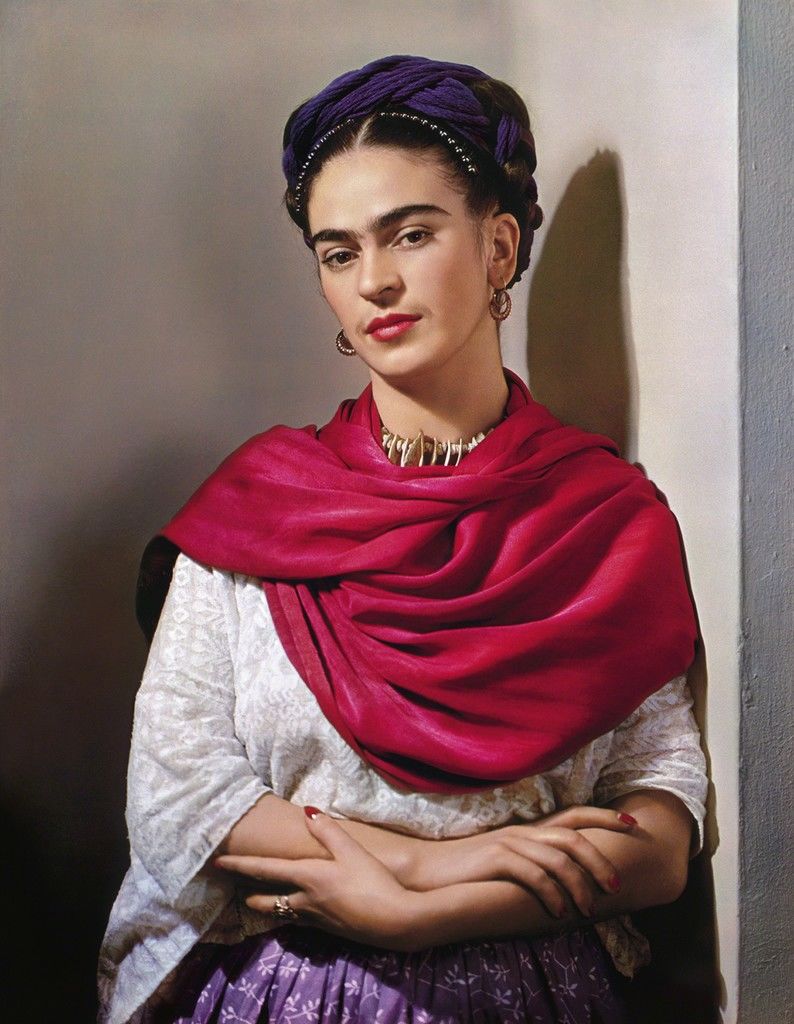
A portrait of the unusual artist in 1939 by Nickolas Muray

A portrait of the unusual artist in 1939 by Nickolas Muray

It seems every famous artist is eccentric in their own way, and Frida Kahlo was no exception. She didn’t follow the rules, establishing herself as the negation of what a woman was expected to be. Her singular vision continues to inspire and capture the world’s imagination. Kahlo’s recognizable unibrow, boldly colored clothes and tempestuous marriage to muralist Diego Rivera are as central to her fame as her vivid and powerful self-portraits.

During the horrific accident, a shower of gold glitter landed on Frida’s bloody and broken body — making the macabre moment like something out of a magical realism novel.

While writing my post on the Blue House, or La Casa Azul, Kahlo’s former home, I learned more than a few surprising things. Why nine, you might ask? During their lifetimes, Kahlo and Rivera passionately assembled a collection of fantastical papier-mâché alebrijes, and I’d like to imagine hers as a cat with its metaphorical nine lives. So, without further exposition, here are nine interesting facts you might not have known about Frida Kahlo.

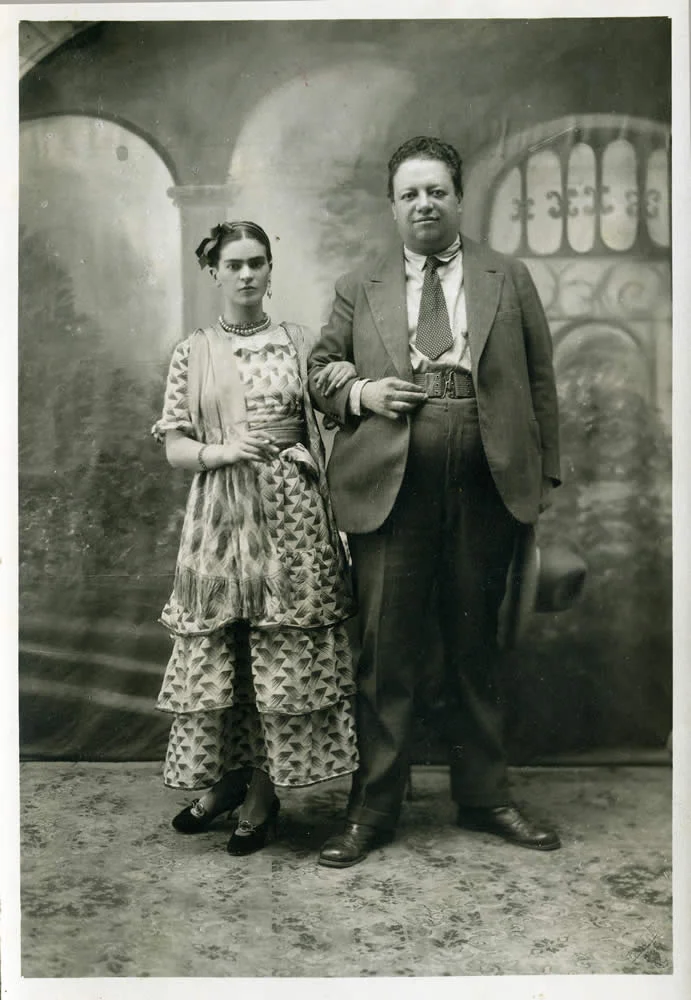
Talk about odd couples! Here’s Wedding Portrait of Frida Kahlo and Diego Rivera by Victor Reyes, 1929

Talk about odd couples! Here’s Wedding Portrait of Frida Kahlo and Diego Rivera by Victor Reyes, 1929

1. She and Diego proved that opposites really do attract.

Kahlo first met Rivera when he was commissioned by the government to paint the mural La Creación at the Bolívar Auditorium of the Escuela Nacional Preparatoria in 1922. Kahlo was one of only 35 females in a student body of 2,000 and belonged to a group of young intellectuals who called themselves Las Cachuchas, named after the peaked cloth caps they wore as a sign of subversion against the rigid dress code of the period. One account claims that she mischievously soaped the stairs leading to the auditorium where Rivera was working, hoping to make him slip and fall.

They met again in 1928 while he was working on a fresco for Mexico City’s Ministry of Education building. With paintings tucked under her arm, she demanded Rivera critique her work, telling him, “I have not come to you looking for compliments. I want the criticism of a serious man. I’m neither an art lover nor an amateur. I’m simply a girl who must work for her living.”

It was a May-December romance, as Rivera was about twice her age (as well as 200 pounds heavier). She was 22, he was 43. He had been married twice before. Kahlo once said, “I suffered two grave accidents in my life: one in which a streetcar knocked me down, and the other was Diego.”  

Frida paints Portrait of My Father, 1952, in her studio. Photo by Gisèle Freund

Frida paints Portrait of My Father, 1952, in her studio. Photo by Gisèle Freund

2. A horrific — but strangely beautiful — accident changed the course of her life.

In 1925, an 18-year-old Kahlo was riding a bus home from school with her boyfriend Alex Gómez Arias when it collided with an oncoming electric streetcar. A fellow passenger on the bus had been carrying a bag of gold dust, which was released upon impact and tore, a shower of gold glitter landing on the bloody and broken body of Kahlo — making the macabre moment like something out of a magical realism novel.

When onlookers saw her, they cried, “La bailarina, la bailarina!” mistaking her for a dancer.

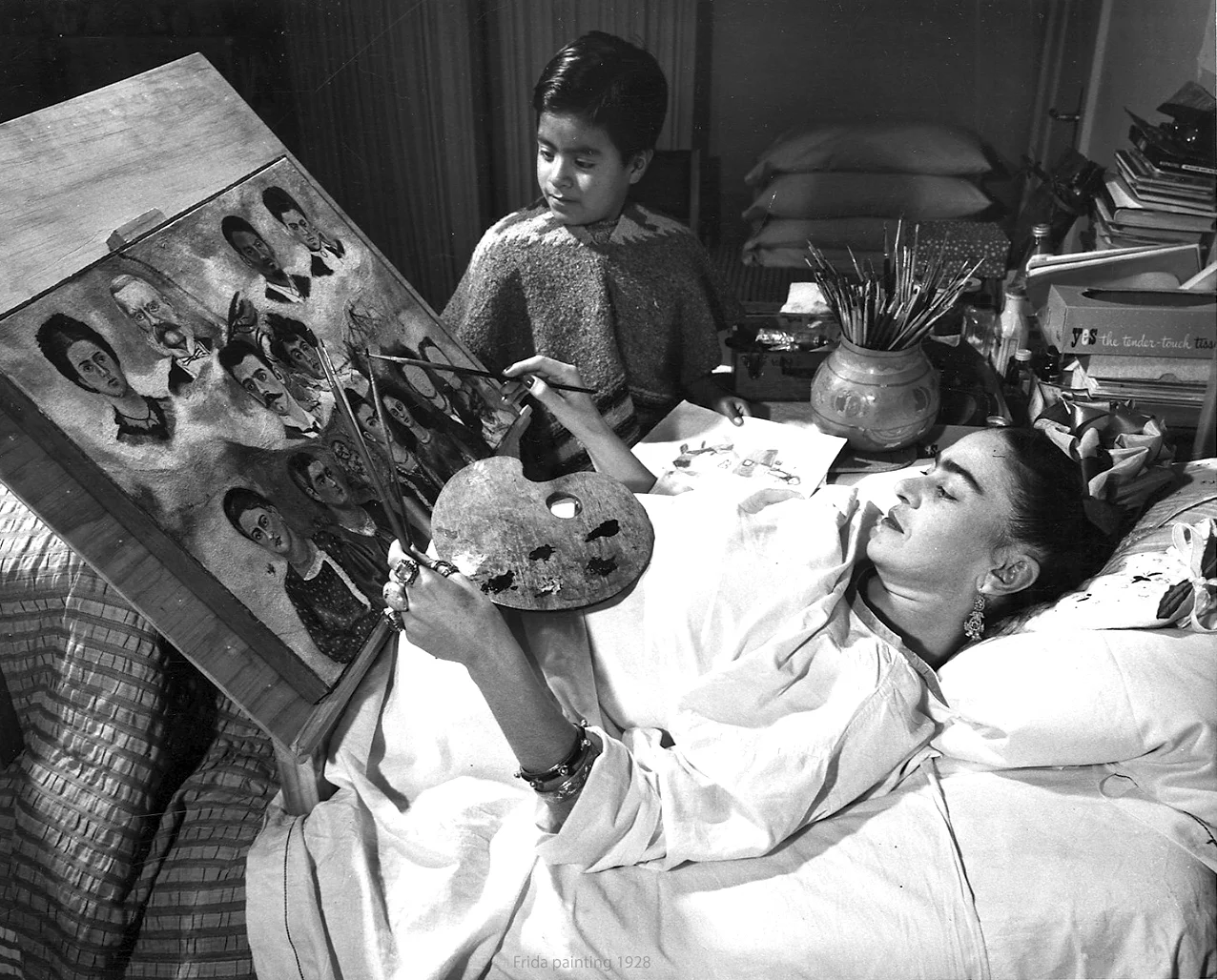
The bed-ridden Frida Kahlo painting Portrait of My Family in 1950. Photo by Juan Guzmán

The bed-ridden Frida Kahlo painting Portrait of My Family in 1950. Photo by Juan Guzmán

The near-fatal accident left Kahlo bedridden for months and enduring lifelong complications that would fuel her intensely personal artwork, turning her deepest feelings and darkest moments into art.

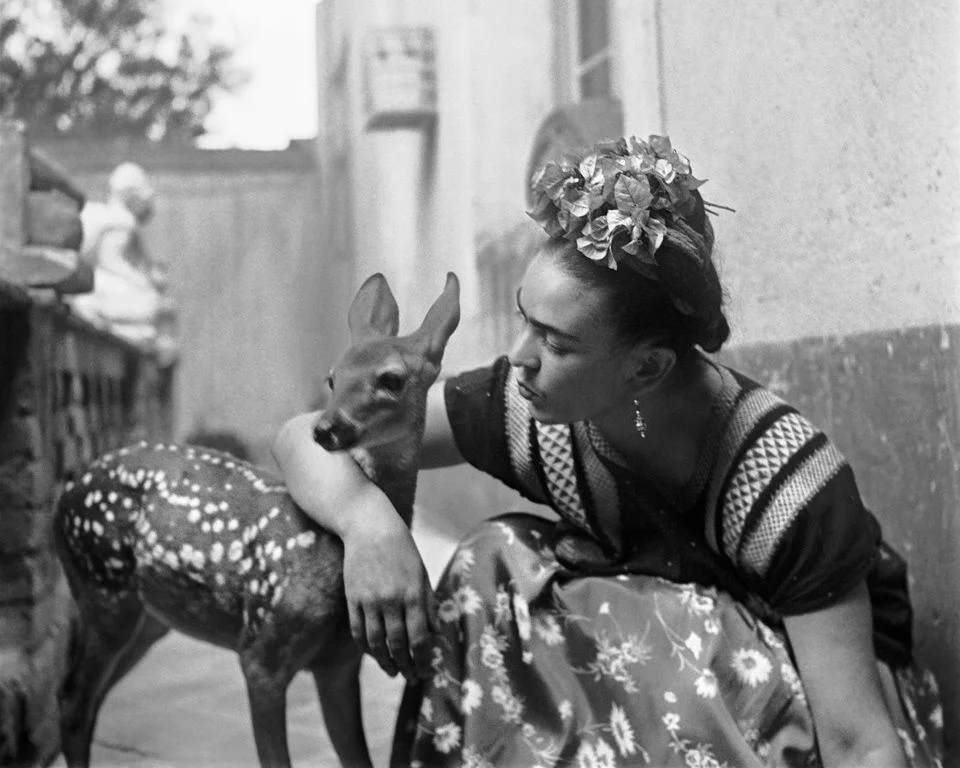
What a deer! Frida With Granzino, Version 2 by Nickolas Muray, 1939

What a deer! Frida With Granzino, Version 2 by Nickolas Muray, 1939

3. Kahlo wasn’t able to have children, so she filled the void with exotic pets.

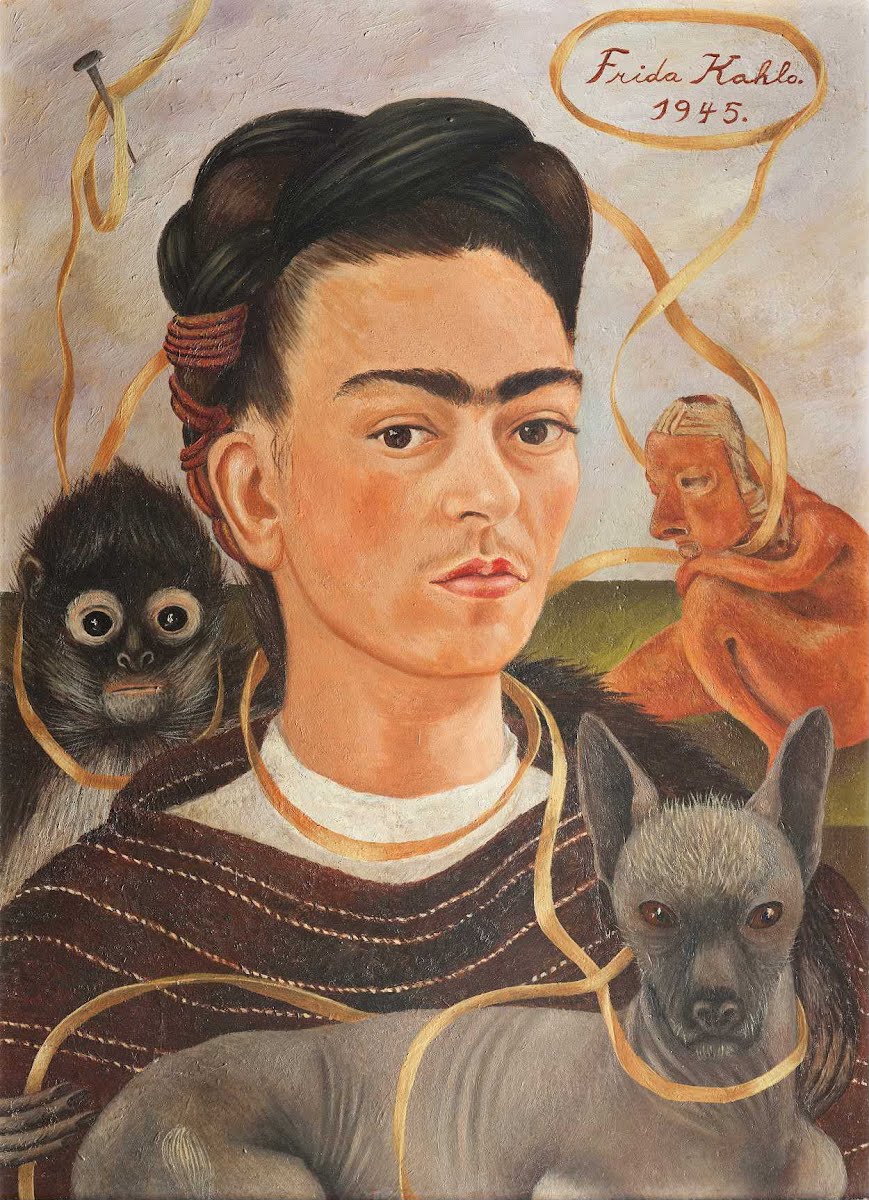
Kahlo was a great lover of animals and had an exotic menagerie at La Casa Azul. In many of her self-portraits she is accompanied by her favorite animals, including a pair of mischievous spider monkeys named Fulang Chung and Caimito de Guayabal. She also had Bonito, an Amazon parrot, who would perform tricks at the table for rewards of pats of butter, an eagle named Gertrudis Caca Blanca (Gertrude White Shit), hairless Xoloitzcuintli dogs and a fawn called Granzino.

These animals appeared in her work, including Self-Portrait With Monkey and The Wounded Deer, her face placed atop a deer’s body, probably Granzino’s, complete with antlers, running through a forest as nine arrows pierce its body.

Frida’s love of animals is evident in her Self-Portrait With Small Monkey from 1945

Frida’s love of animals is evident in her Self-Portrait With Small Monkey from 1945

Despite wanting to have offspring, Kahlo was unable to bear children and suffered miscarriages and medical abortions. Her inability to give birth became a source of trauma, and she said that her pets symbolized the children she never could have.

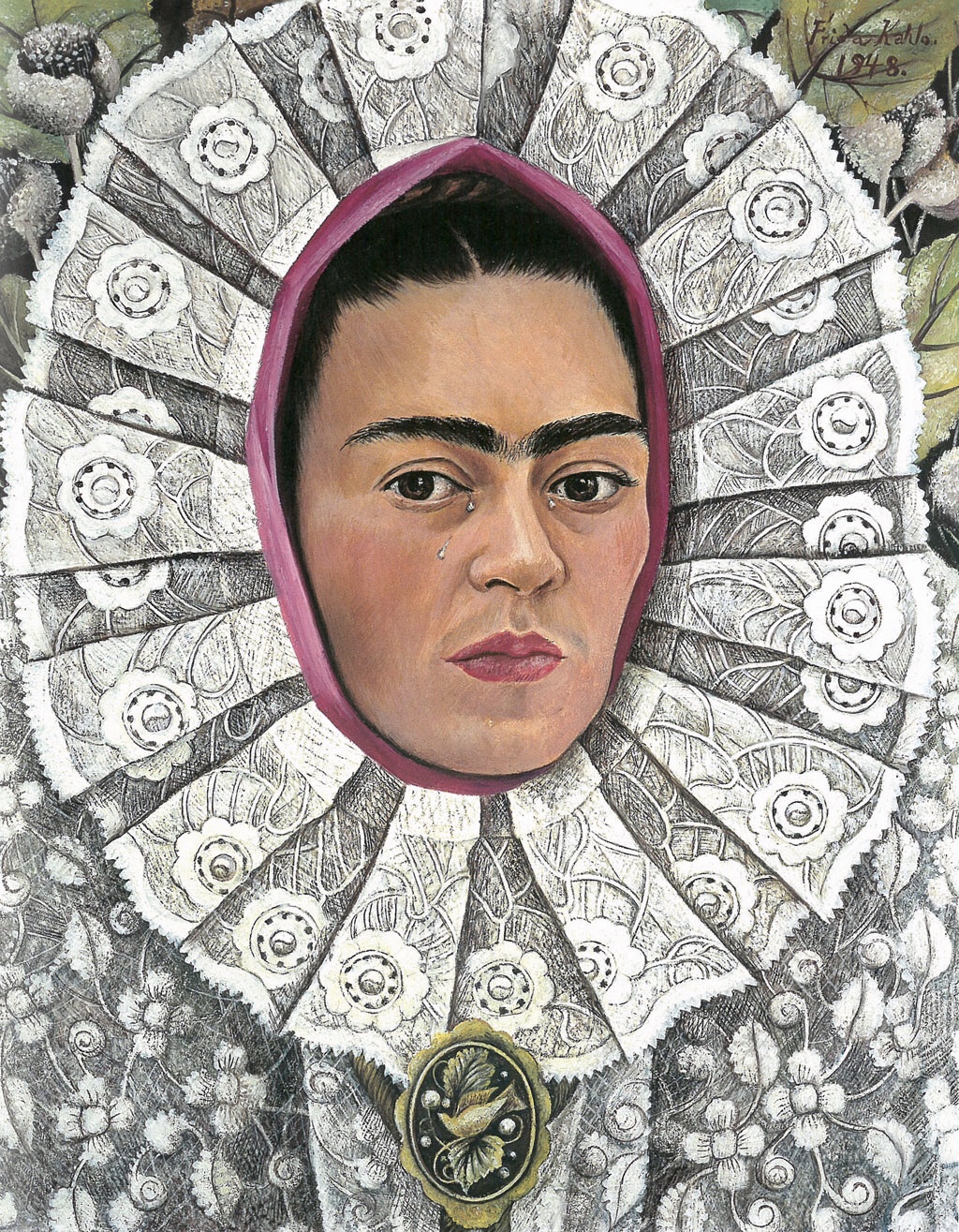
Many of Frida’s paintings were self-portraits, like Autorretrato from 1948

Many of Frida’s paintings were self-portraits, like Autorretrato from 1948

4. She’d most likely beat you in a staring contest.

Kahlo was her own most popular muse. Fifty-five of her 143 paintings are self-portraits, which is perhaps understandable when thinking about how much time she spent on her own while coping with a variety of chronic health issues. Her conjoined brows, plaited hair and watchful eyes fiercely demand that the viewer meet her gaze. And her defiant, upright posture was as much due to the immobilizing plaster corsets she was forced to wear to support her spinal column as it was her confidence.

Kahlo’s use of the intimate self-portrait often reflected her turbulent life and was a visual means to communicate her physical and psychological wounds.

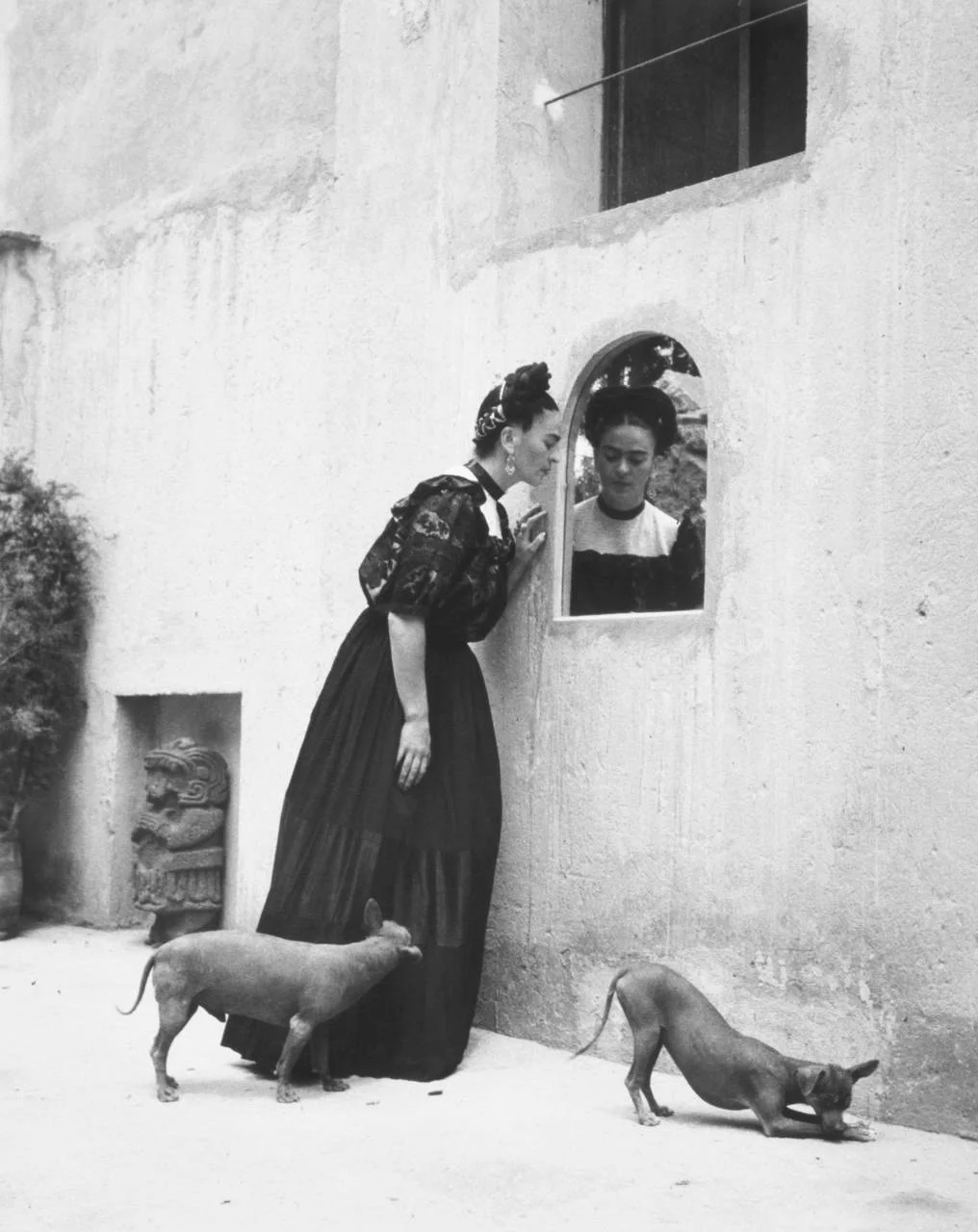
Let’s take some time to reflect upon what an amazing woman Frida Kahlo was. Photo by Lola Álvarez Bravo

Let’s take some time to reflect upon what an amazing woman Frida Kahlo was. Photo by Lola Álvarez Bravo

5. She was her own brand ambassador.

Our sense of self is largely dependent on where we were born, where our family’s from and the people we choose to surround ourselves with. This was especially true for Kahlo with her distinctive sartorial style inspired by the traditional dress of the Tehuana, the independent and proud indigenous matriarchal Zapotec society in the state of Oaxaca. Kahlo’s mother was born in Oaxaca to an indigenous father and a mother of Spanish descent.

Her attire helped her craft an imaginative, colorful identity and typically included flamboyant rings adorning her fingers, a traditional square-cut blouse, the huipil, and a long wrap-around skirt, which allowed her to mask and distract from her physical injuries.

One can only imagine the sensation of Kahlo’s striking and exotic appearance when she arrived in the United States with Rivera. Her rejection of conventional fashion was unlike anything the people of San Francisco, Detroit or New York had ever seen. On a walk in NYC, a flock of children asked Kahlo, “Where’s the circus?” but she simply smiled graciously and continued walking.

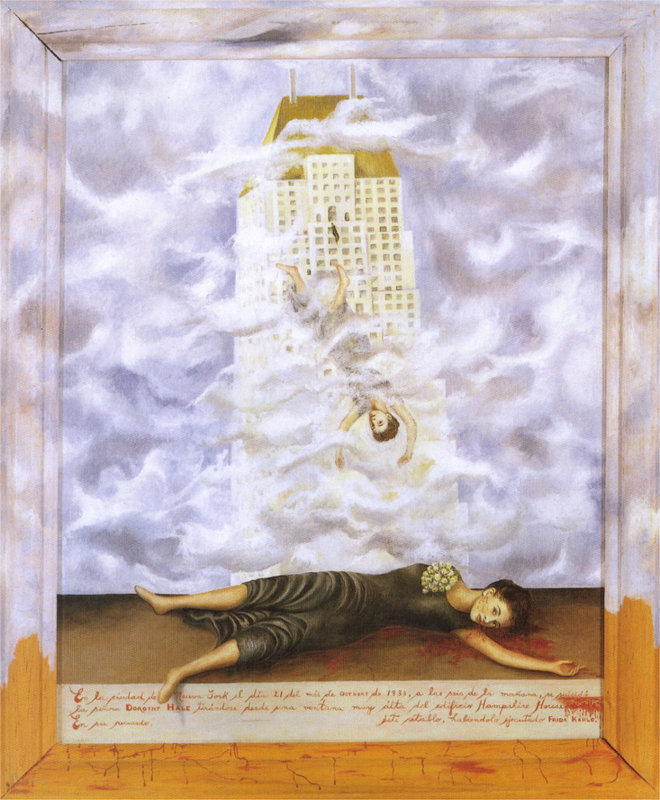
The controversial The Suicide of Dorothy Hale by Frida Kahlo, 1939

The controversial The Suicide of Dorothy Hale by Frida Kahlo, 1939

6. She pushed boundaries and buttons.

Sometime in 1938, Kahlo was commissioned by Clare Boothe Luce, the writer of the all-female Broadway play The Women and a former managing editor of Vanity Fair magazine, to paint a recuerdo, a remembrance portrait of their mutual New York socialite friend and aspiring actress Dorothy Hale, who had recently taken her own life.

Luce presumed Kahlo would paint a conventional portrait of Hale. However, Kahlo wasn’t a fan of what she considered to be the bourgeois capitalist social scene of New York City and had a more cerebral vision in mind — to create a graphic retablo detailing Hale’s moment of death.

In the center of the painting, the building where Hale lived is depicted with its many small windows rising up behind a layer of feathery clouds. A tiny figure plummets from an upper window. In the middle ground is a larger falling figure, clearly Hale, her arms extended and her skirt billowing around her knees. Resting on the pavement in the foreground is the deceased Hale in the black velvet dress and yellow corsage she wore, her dead eyes frozen open and staring at the viewer. As if that wasn’t enough, the inscription literally bleeds into the bottom of the frame and reads, “In the city of New York on the 21st day of the month of October, 1938, at 6 o’clock in the morning, Mrs. Dorothy Hale committed suicide by throwing herself out of a very high window of the Hampshire House building. In her memory, this portrait was executed by Frida Kahlo.”

When Luce received the painting, she seriously considered destroying it, but was persuaded by friends to desist. The arresting and controversial work remained in storage for decades before being donated “anonymously” to the Phoenix Art Museum in 1960.

7. She arrived at her first solo exhibition in Mexico in an ambulance.

Kahlo’s first major solo exhibition was held at the Julien Levy Gallery in 1938 in New York City, and one year later, her works were part of a collective exhibition entitled Mexique, shown at the Galerie Renou et Colle in Paris. The French surrealist André Breton described her art as “a ribbon around a bomb.”

Due to declining health during her final years, Kahlo rarely ventured outside of the Blue House, and had to use a wheelchair and crutches to get around. In April 1953, her first solo exhibition in Mexico opened at the Galería de Arte Contemporáneo. At the time, Kahlo was on bed rest under doctor’s orders and not expected to attend. However, she made sure to be there, arriving by ambulance to a mystified crowd, ordering that her four-poster bed be moved into the gallery. She was brought in on a stretcher to the bed, where she was able to enjoy the event.

8. She made a most memorable exit from life.

Kahlo was transported to the crematorium at the Panteón Civil de Dolores, and her body was lifted out of the coffin and laid in a cart that would carry her along iron tracks to the cemetery. So desperate were people to have a memento of Kahlo that onlookers pulled at the rings on her fingers even as her body moved toward the crematorium fire. Witnesses who were in the small chamber containing the furnace claimed that a sudden blast of heat from the open incinerator doors caused Kahlo’s corpse to sit bolt upright, and when the flames ignited her hair, forming an aura around her face, her lips appeared to part in a grin just before the doors closed shut.

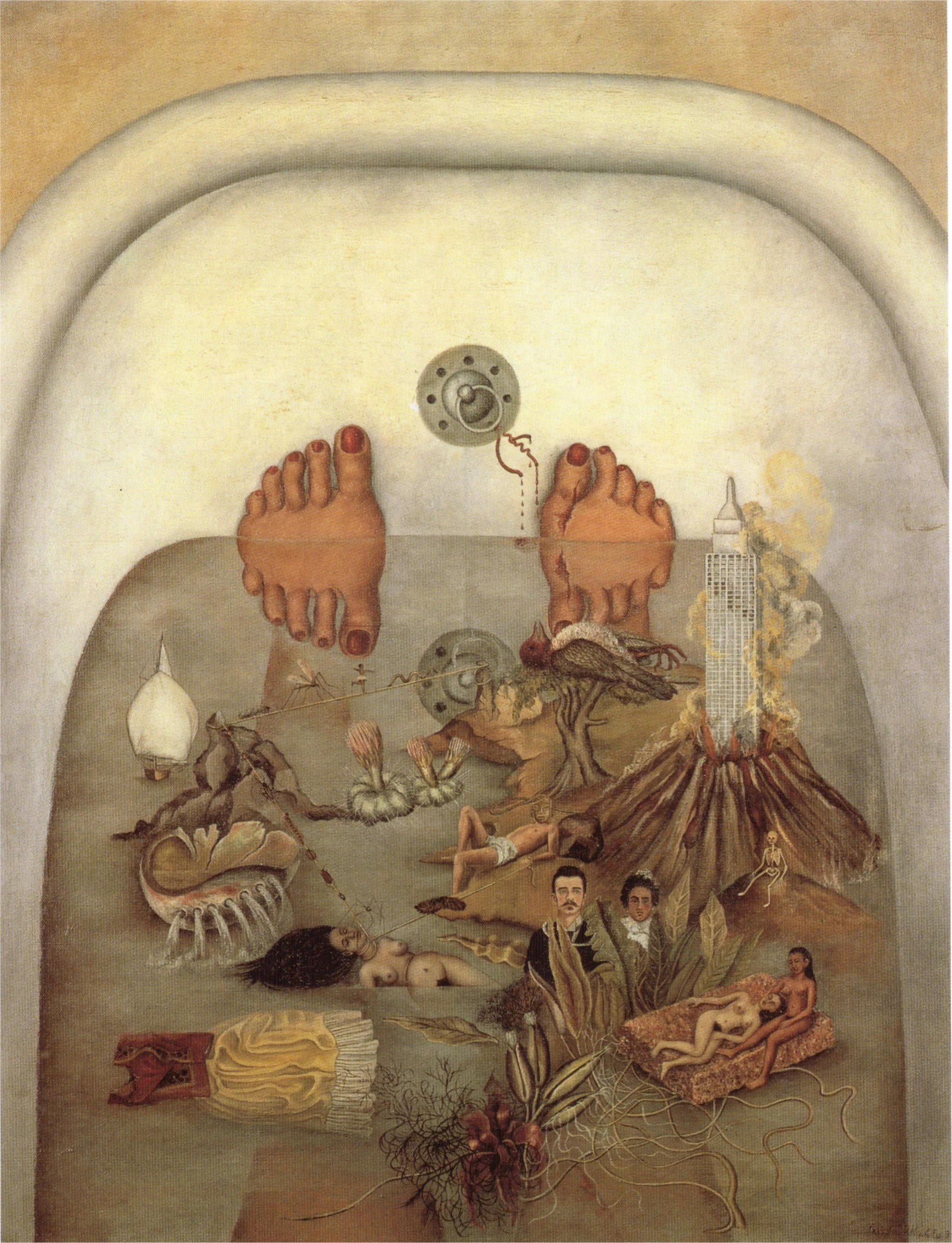
What the Water Gave Me by Frida Kahlo, 1938

What the Water Gave Me by Frida Kahlo, 1938

9. She was underappreciated as an artist in her lifetime.

Kahlo’s work was largely overshadowed by that of her husband during her lifetime. This was partly because the complexity of her art was difficult for an international audience to categorize. Kahlo’s most famous works, her autorretratos, or self-portraits, combine elements of realism, surrealism and indigenous Mexican symbolism.

Breton, an original member of the Dada group and the founder of the Surrealist movement in 1924, visited Kahlo in Mexico in 1938 while she was working on Lo Que el Agua Me Dio (What the Water Gave Me). Breton was transfixed by it, calling Kahlo a “natural surrealist.” Kahlo rejected the label and replied, “I never painted dreams. I paint my own reality.”

When Kahlo died at the early age of 47 in 1954, Rivera begged his friend and patroness of the arts, Dolores Olmedo to purchase 25 of Kahlo’s paintings for a mere $1,600. He wanted to make sure that an important part of his wife’s work remained in Mexico. –Duke

A sudden blast of heat from the incinerator caused Frida’s corpse to sit bolt upright. Flames ignited her hair, forming an aura around her face, and her lips parted into a grin just before the doors closed shut.

La Casa Azul, the Frida Kahlo Museum in Mexico City

Explore the quirky blue-painted home-turned-museum where the bohemian Mexican artist was born and lived while married to muralist Diego Rivera.

You can wander through the home Frida Kahlo and Diego Rivera lived in

You can wander through the home Frida Kahlo and Diego Rivera lived in

One destination that was at the top of our list to visit while in CDMX was La Casa Azul, or the Blue House, the former home and studio of Mexican artist and revolutionary cultural icon Frida Kahlo.

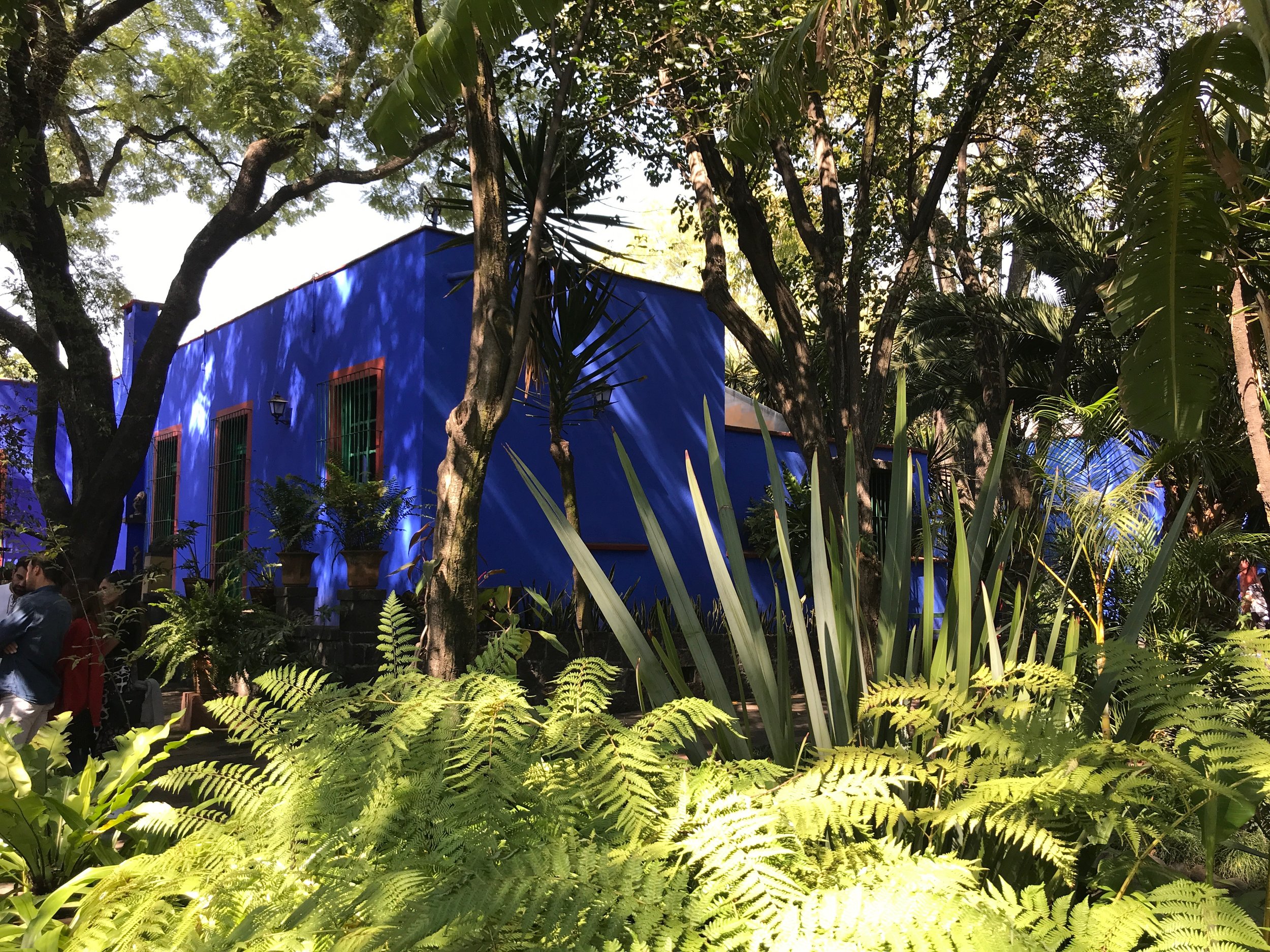
The first thing to capture your attention upon arrival at the corner of Calles Londres and Allende, which is now the Museo Frida Kahlo, are the vibrant cobalt-blue walls that rise straight up from the sidewalk. They reminded me of the intense blue used by French painter Jacques Majorelle in his garden acquired by Yves St. Laurent and Pierre Bergé in Marrakech, Morocco.

To be in the former home of this captivating, self-willed individual was an amazing and moving experience.
Get your tickets well before you visit — and get the earliest time available to cut down on crowds

Get your tickets well before you visit — and get the earliest time available to cut down on crowds

The other was the line of people waiting to gain admission. After reading how popular the destination is, we purchased and printed our tickets in advance for the first available self-guided tour of the day to avoid the crowds. If you show up without a ticket, we’ve heard you can expect to wait up to four hours, as the museum limits the amount of people allowed inside. Even if you get your tickets in advance, plan on getting into line half an hour early so you’re at the beginning of your group.

Portrait of Frida Kahlo by Roberto Montenegro, 1936

Portrait of Frida Kahlo by Roberto Montenegro, 1936

You can download an electronic version of your ticket, which will be scanned by one of the museum docents. If you’d like to take pictures inside, which we did, you’ll need to purchase a photography pass for an extra fee of about 30 pesos, or $1.50.

Keep in mind that the cost of your ticket also includes admission to the Anahuacalli Museum, designed by Diego Rivera to contain his impressive collection of pre-Columbian art. It’s great fun to explore.

Duke leans on the iconic blue walls of La Casa Azul while we wait to go in

Duke leans on the iconic blue walls of La Casa Azul while we wait to go in

It’s cool being able to explore the home shared by these two famous artists

It’s cool being able to explore the home shared by these two famous artists

Inside La Casa Azul

At the entry, you’re met by a few of Kahlo’s fantastical and monstrous papier-mâché folk art alebrije figures, traditionally representing Satan and Judas, which are filled with firecrackers and exploded on Sabado de Gloria, the Saturday before Easter.

Part of the courtyard includes this tiled pool

Part of the courtyard includes this tiled pool

Built around an open-air central courtyard, the interior of the house offers visitors a chance to catch a glimpse into Frida’s creative universe. Each room is organized by theme, many exactly as Kahlo left them. The first room Wally and I entered was originally the formal living room, where the Riveras hosted storied intellectual guests from Gershwin to Trotsky and now functions as a gallery featuring a selection of Frida’s lesser-known paintings. Of note is Portrait of My Father, made by Kahlo 10 years after her father’s death with the dedication “I painted my father Wilhelm Kahlo, of Hungarian-German origin, artist-photographer by profession, in character generous, intelligent and fine, valiant because he suffered for 60 years with epilepsy, but never gave up working and fought against Hitler. With adoration, his daughter, Frida Kahlo,” and a still life depicting sliced watermelons inscribed with the phrase “Viva la Vida” or, Long Live Life.

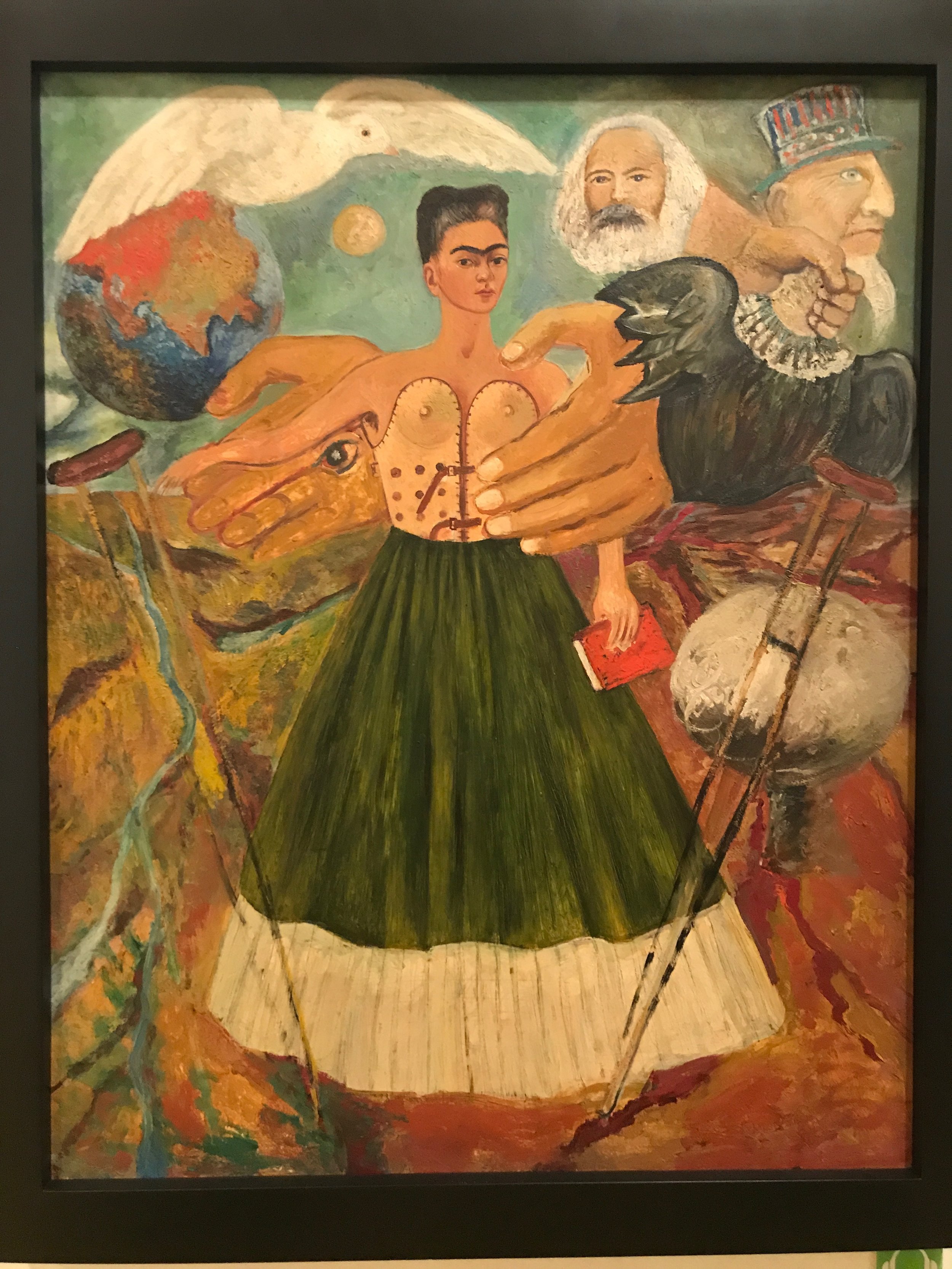
Marxism Will Give Health to the Sick by Frida Kahlo, 1954

Marxism Will Give Health to the Sick by Frida Kahlo, 1954

Portrait of My Father by Frida Kahlo, 1951

Portrait of My Father by Frida Kahlo, 1951

Viva la Vida by Frida Kahlo, 1954 — the last of her paintings she signed

Viva la Vida by Frida Kahlo, 1954 — the last of her paintings she signed

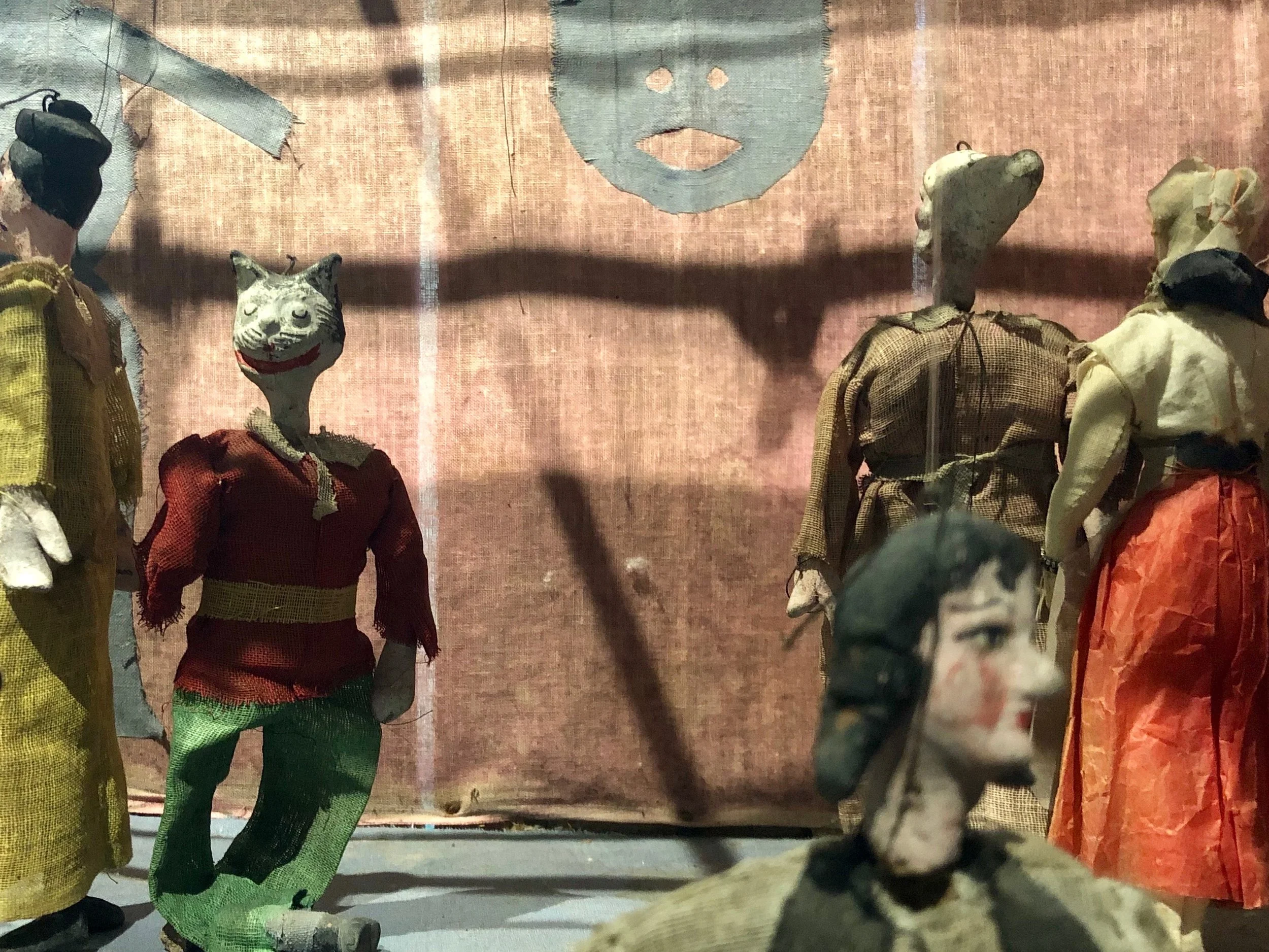
The next room held a delightful miniature puppet theater created by Frida. One of my favorite items in the house, it contained a cat or perhaps jaguar, a seated woman, a skeleton with a red sash around its waist and an alligator suspended in the air. Also on display was a painting by Diego Rivera titled La Quebrada. The inscription in the lower right corner reads, “A La Niña Fridita Kahlo la maravillosa. El 7 de Julio de 1956 a los dos años que duerme en cenizas, viva en mi corazón” (To the little girl Fridita Kahlo, the wonderful one. On July 7, 1956, two years since she went to sleep in the ashes, she lives on in my heart.)

We especially loved this kinda creepy puppet theater Frida created

We especially loved this kinda creepy puppet theater Frida created

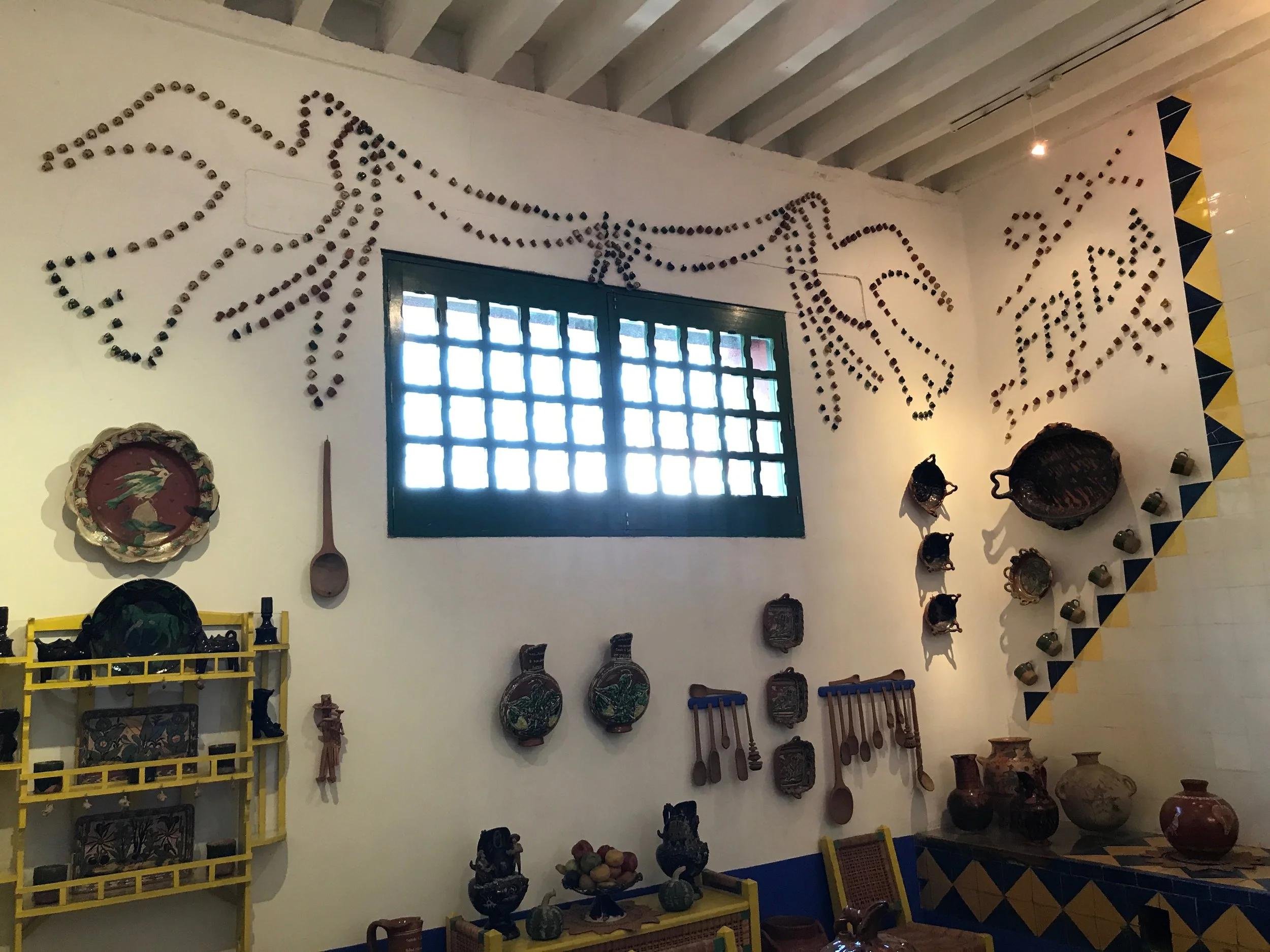
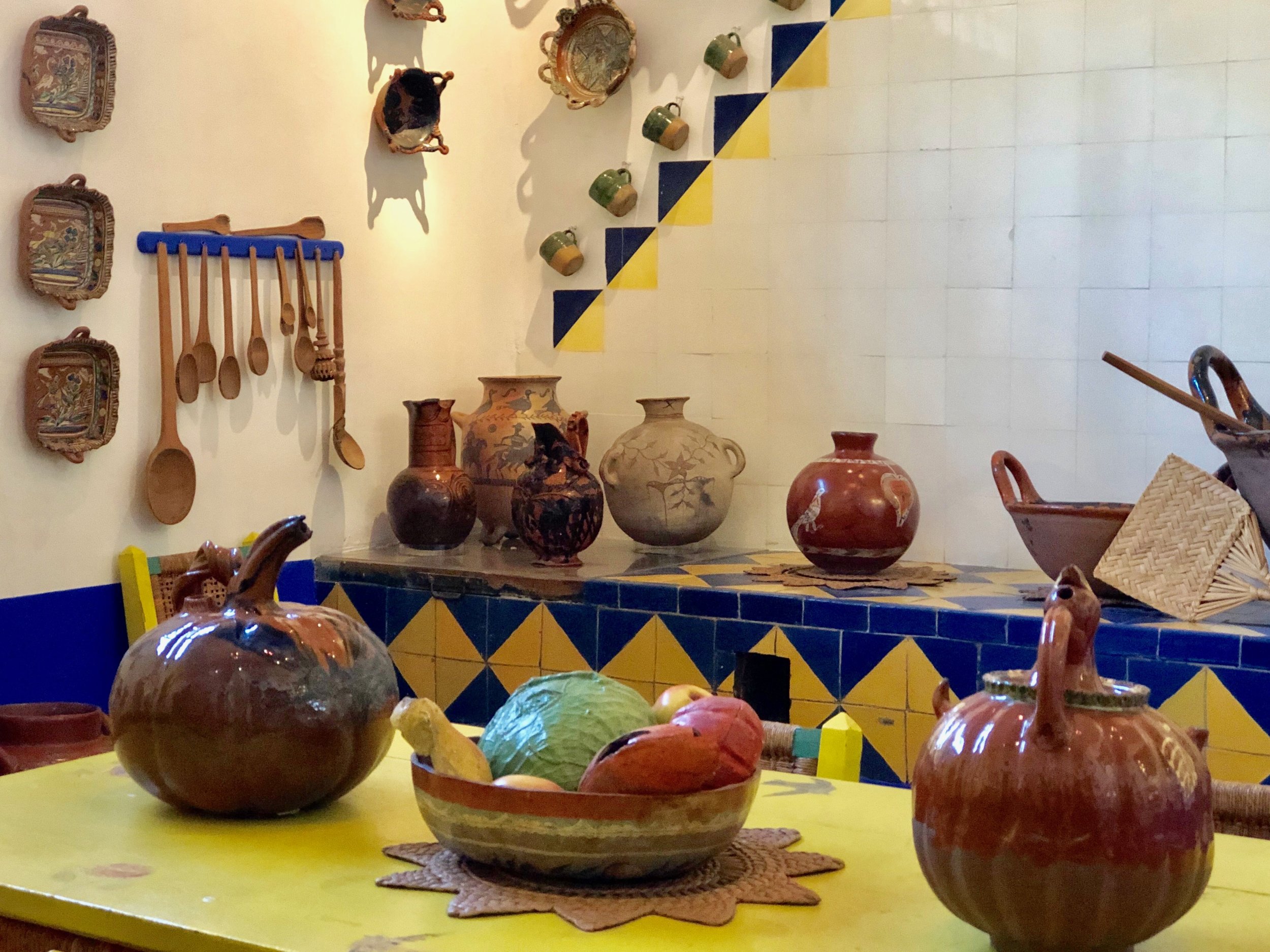
Moving farther along, white painted ceiling beams and bold blue, yellow and white glazed tiles complement the kitchen countertop and frame the chimney. Kahlo embellished the walls surrounding the wood-burning stove using miniature glazed clay mugs to whimsically spell out her and Diego’s names. On the opposite wall are two doves tying a lovers’ knot and a pair of pumpkin-shaped clay tureens sitting atop a long yellow table.

Frida spelled out her and Diego’s names in miniature clay mugs on the wall above her stove

Frida spelled out her and Diego’s names in miniature clay mugs on the wall above her stove

A glimpse into Frida’s kitchen

A glimpse into Frida’s kitchen

The neutral tones of earthenware pottery pair nicely with the bright blue and yellow tiles

The neutral tones of earthenware pottery pair nicely with the bright blue and yellow tiles

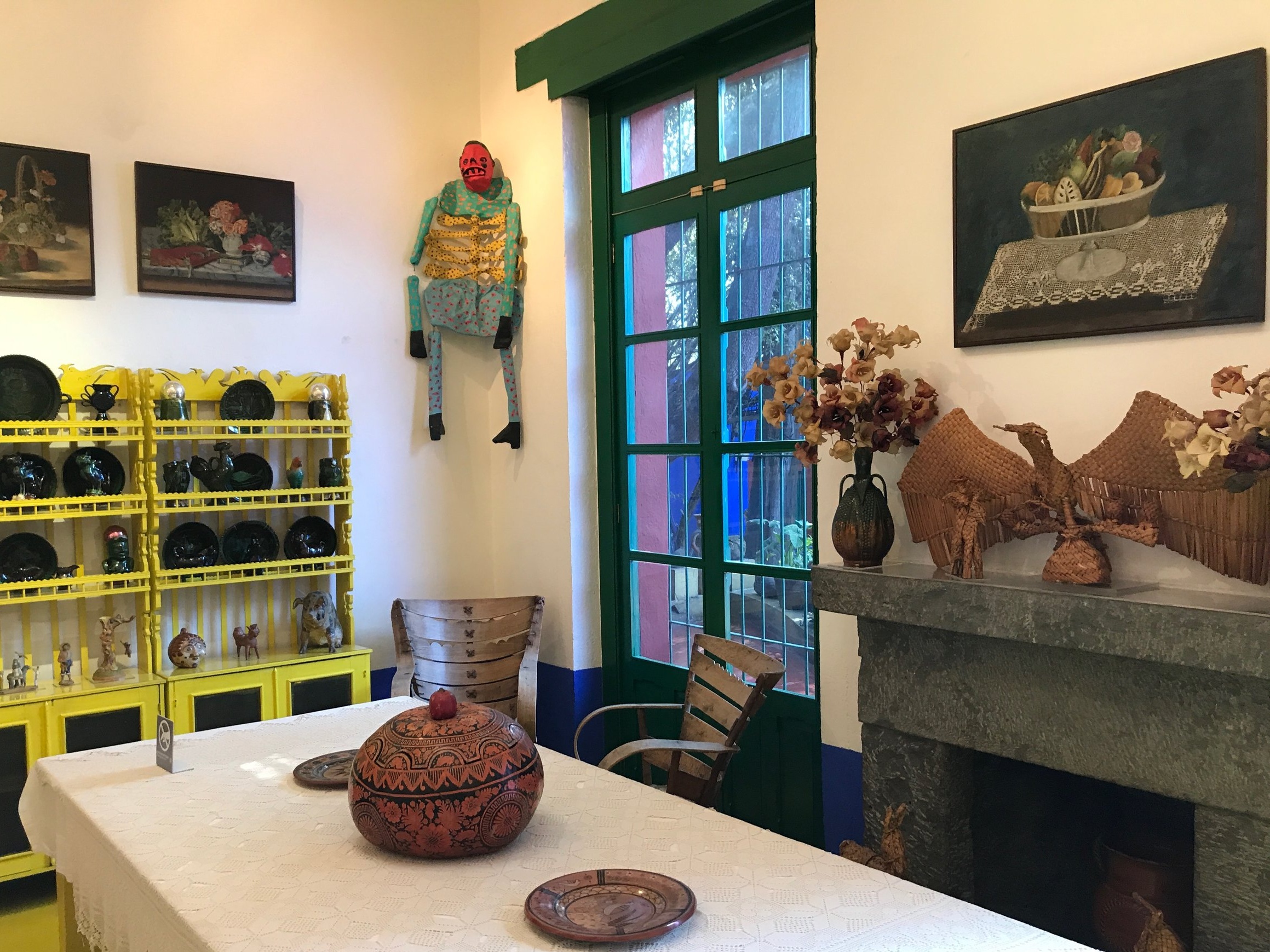
Next to the kitchen, the dining room shares the same vibrant color scheme with bright yellow open storage shelving chock full of colored glassware, earthenware pots, plates and indigenous artifacts.  

The dining room

The dining room

A bright yellow cabinet displaying some of Frida’s collections

A bright yellow cabinet displaying some of Frida’s collections

Rivera’s small bedroom is tucked off to the side of the dining room. A pillow sitting on a vintage armchair is embroidered with the words “Despierta Corazon Dormido” (Wake Up, Sleeping Heart). Outside this room, a flight of stairs leads to the second floor library and studio, an addition by Rivera.

The small room Diego stayed in also once housed Leon Trotsky, with whom Frida had an affair

The small room Diego stayed in also once housed Leon Trotsky, with whom Frida had an affair

Up in the studio, large steel-framed windows look out to the garden and fill the room with natural light. There’s also an enviable collection of books. Kahlo’s small wooden work desk holds an assortment of brushes, a palette, a mirror and small glass bottles of pigment waiting to be mixed for use.

Frida’s work table: where the magic happened

Frida’s work table: where the magic happened

The materials Frida used in her paintings

The materials Frida used in her paintings

Color pigments Frida used to create her paint

Color pigments Frida used to create her paint

Adjacent to these tools, a wheelchair faces an easel with the painting Still Life With Flag — a reminder that Frida experienced a series of life events that left her in chronic pain. At the age of 6, she contracted polio, which left her right leg withered and shorter than her left, causing her to limp. In her teens, while traveling home from school, the bus on which she was riding was hit by a streetcar. She sustained serious trauma, including multiple fractures of the clavicle, ribs and spine, and was pierced by an iron handrail from the streetcar that impaled her pelvis. Frida miraculously survived and and began painting self-portraits — her reality captured by a mirror within the intimacy of her own studio at home. She once said, “I paint myself because I am so often alone and because I am the subject I know best.”

In poor health for much of her life, Frida had to paint in a wheelchair now and then

In poor health for much of her life, Frida had to paint in a wheelchair now and then

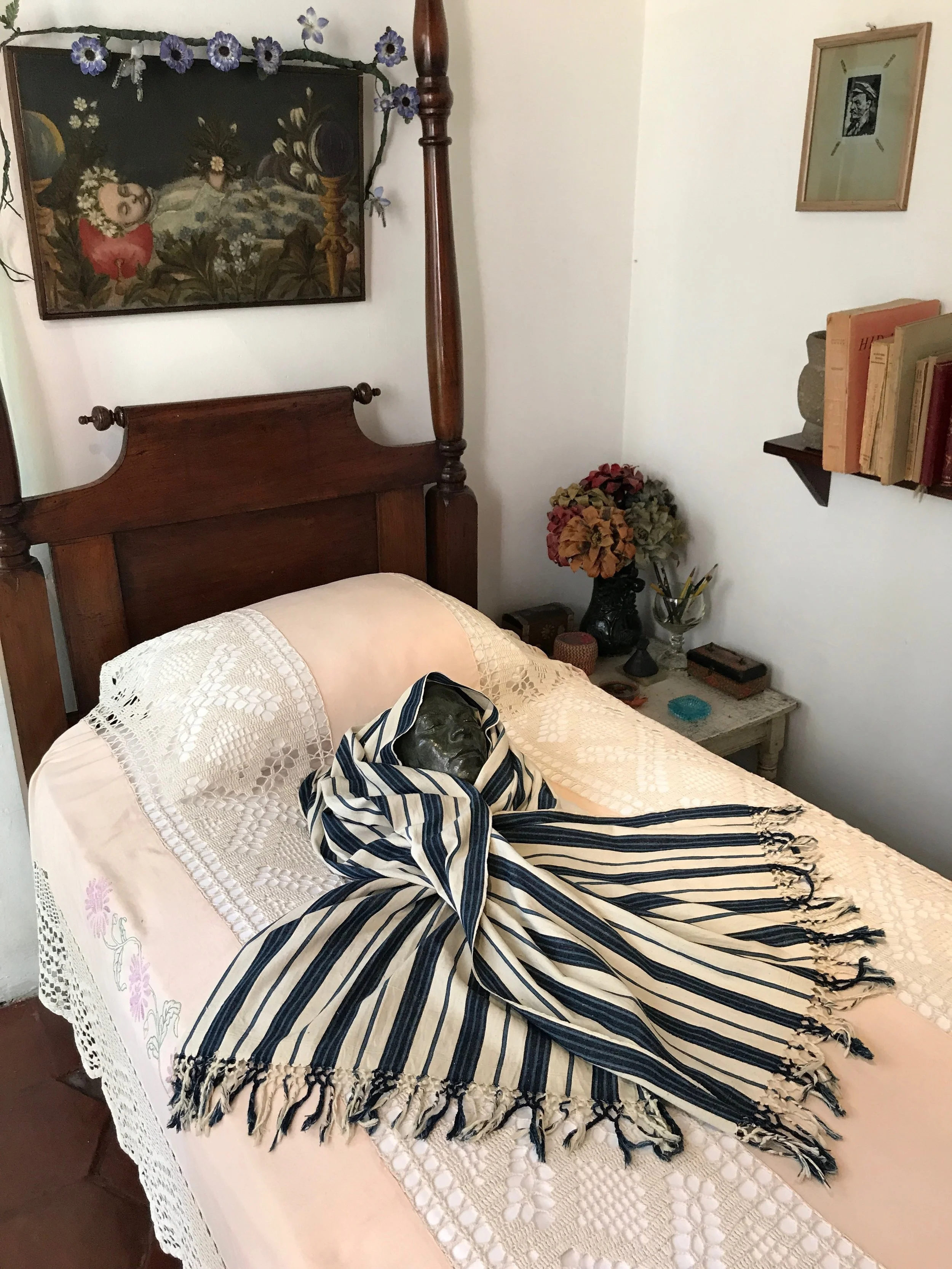
Immediately off the artists studio are a pair of Kahlo’s four-poster beds. As Frida was frequently bedridden, her day bed is fitted with a mirror above that she would use to paint while convalescing. Because she died in this room in 1954, her death mask fittingly (yet creepily) rests atop the bed. On the wall behind the headboard, a skeleton with tiny arms wearing a top hat and a painting of a presumably dead child with a garland of purple poppy flowers watch over the bed.

Frida’s death mask sits on her bed

Frida’s death mask sits on her bed

Frida’s night bed has a framed grouping of butterfly specimens attached to the panel above. These were given to her by Japanese-American sculptor Isamu Noguchi. On a lace-topped table nearby a headless pre-Columbian urn contains her ashes. A cabinet of toys rendered in miniature are displayed off to the right.

The large urn to the left contains Frida’s ashes

The large urn to the left contains Frida’s ashes

We exited via a staircase from Frida’s day room in the central courtyard and followed a winding path that led us past a stepped pyramidal structure, added and built by Rivera, a pedestal to display their pre-Columbian sculptures in the garden. Frida loved botany and collected many species of plants native to Mexico and created a garden abundant with yuccas, bougainvilleas, cacti, jasmine and agave.

Wally and Duke on the patio leading to the central courtyard

Wally and Duke on the patio leading to the central courtyard

Diego especially loved pre-Columbian artifacts

Diego especially loved pre-Columbian artifacts

A large ofrenda is set up in the garden

A large ofrenda is set up in the garden

Around back you’ll find an opportunity to pretend to be Frida and Diego

Around back you’ll find an opportunity to pretend to be Frida and Diego

An ancillary building contains an exhibit named after a drawing Kahlo made in 1946: Appearances Can Be Deceiving, where the artist drew herself, showing an X-ray view through her traditional Tehuana dress to reveal her injured leg and plaster corset. The first room displays a few of Kahlo’s personal objects used in relation to her medical condition. There’s also a vitrine with mannequins wearing Kahlo’s distinctive Tehuana dresses and headpieces. She favored the huipil, a boxy blouse, rebozo shawl and long skirt, a representation of Kahlo’s authentic Mexican femininity. There’s also a couture dress with a buckled corset by fashion designer and provocateur Jean Paul Gaultier whose 1998 spring-summer runway was titled Tribute to Frida Kahlo. In this same case is a dress by Rei Kawakubo for Comme des Garçons surrounded by a sort of hoop cage, and in the last room there’s a delicately embroidered bodysuit with an incredible fringe jacket by Roberto Tisci for Givenchy.

An outbuilding houses some of Frida’s distinctive outfits

An outbuilding houses some of Frida’s distinctive outfits

A dress by Comme des Garçons (left) and The Freckles by Gaultier

A dress by Comme des Garçons (left) and The Freckles by Gaultier

To be in the former home of this captivating, self-willed individual was an amazing and moving experience. Like Kahlo, La Casa Azul has many layers — its details bear witness to her inspired magpie approach, filled with objects that carried personal meaning to Kahlo and are reflected in her fascinating collection of arte popular. –Duke

La Casa Azul, the Museo Frida Kahlo

La Casa Azul, the Museo Frida Kahlo

Frida Kahlo Museum
Londres 247
Del Carmen
04100 Ciudad de México, CDMX
Mexico


olmedomuseum

10 Most Instagrammable Places in Mexico City's Centro
A photographer’s tour of the CDMX historic district, from the Palacio de Bellas Artes to the Gran Hotel Ciudad de México.

CDMX, as the cool kids call it, is full of stunning design, a mind-blowing mix of colonial architecture and modern marvels. Here are some of our favorites to help you get started on a cultural and Insta-worthy tour of the city’s historic heart.

Centro Histórico

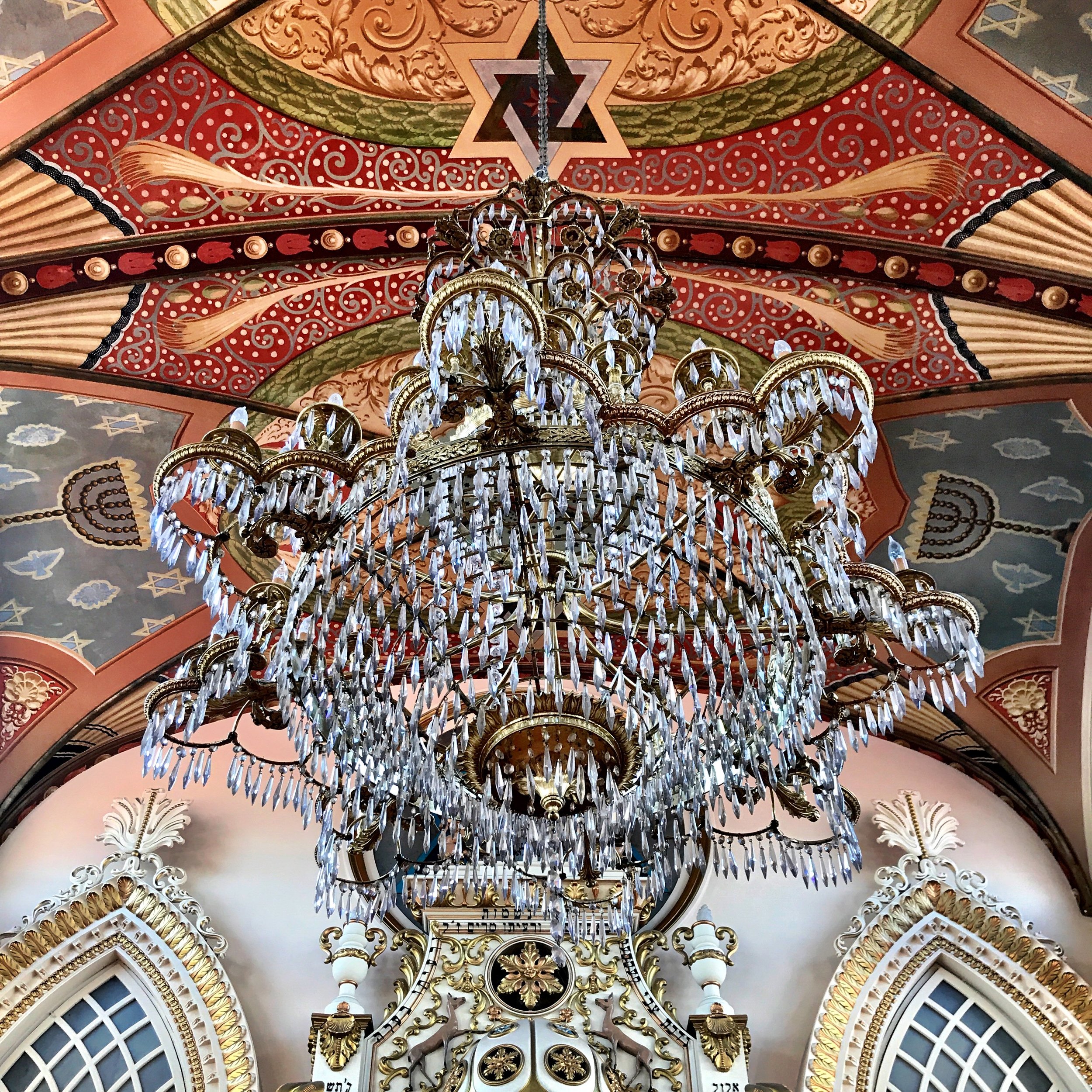
A chandelier hangs above the holy ark

A chandelier hangs above the holy ark

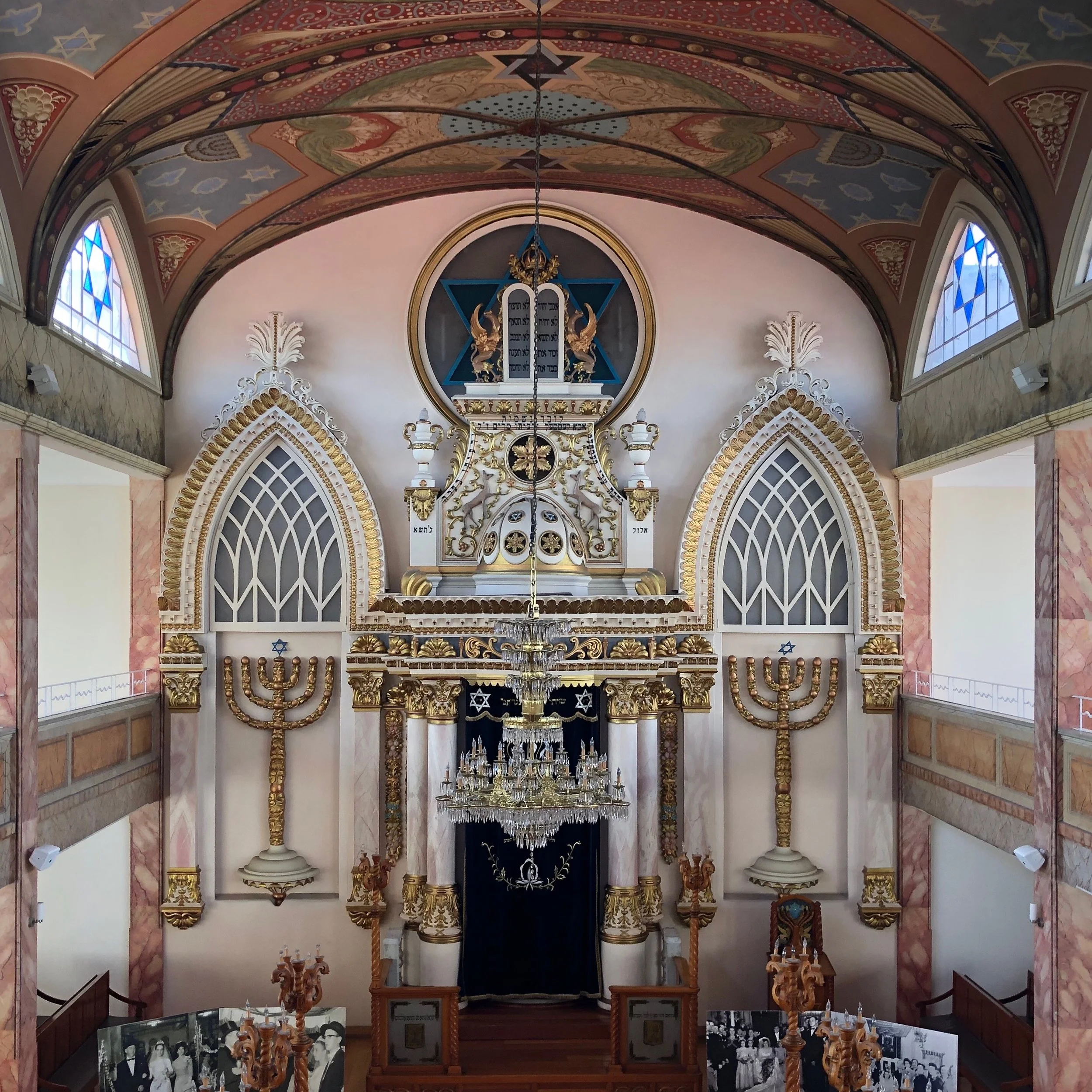
The second and third floors of the Sinagoga Histórica have some beautiful elements

The second and third floors of the Sinagoga Histórica have some beautiful elements

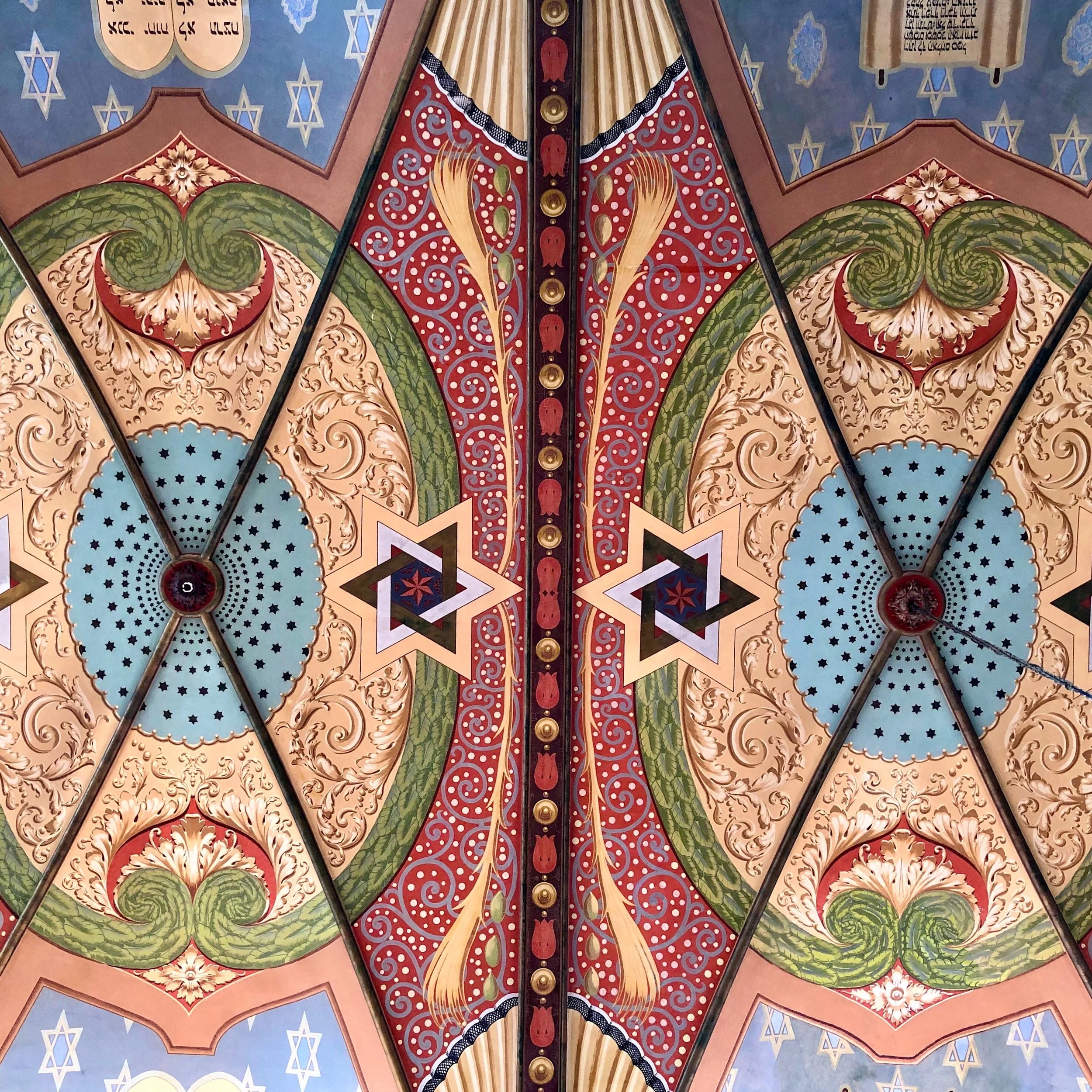
Look up to see the folk art-styled ceiling, with its gorgeous color pallette

Look up to see the folk art-styled ceiling, with its gorgeous color pallette

1. Sinagoga Histórica Justo Sierra 71

Start your tour with this hidden gem, built and established by the Ashkenazi, Eastern European Jews who arrived in Mexico City as refugees escaping persecution in the early 1940s. The Historic Synagogue, or Templo Nidje Israel, is entered through an interior courtyard beyond the building’s colonial façade (and a somewhat grumpy guard).

The interior contains a rather plain assembly hall on the first floor, but the sanctuary located on the second floor is impressive, said to be modeled after a synagogue in Lithuania. Make sure to look up at the vaulted clerestory ceiling intricately painted in hues of rust, mustard yellow, blue and green. An elaborately carved platform stands in the center of the room and faces the richly ornamented aron kodesh, or holy ark, surrounded by folk art elements typical of Eastern European villages. The sacred Torah scrolls were once kept behind the blue velvet curtain panel embroidered with silver thread.

Justo Sierra 71

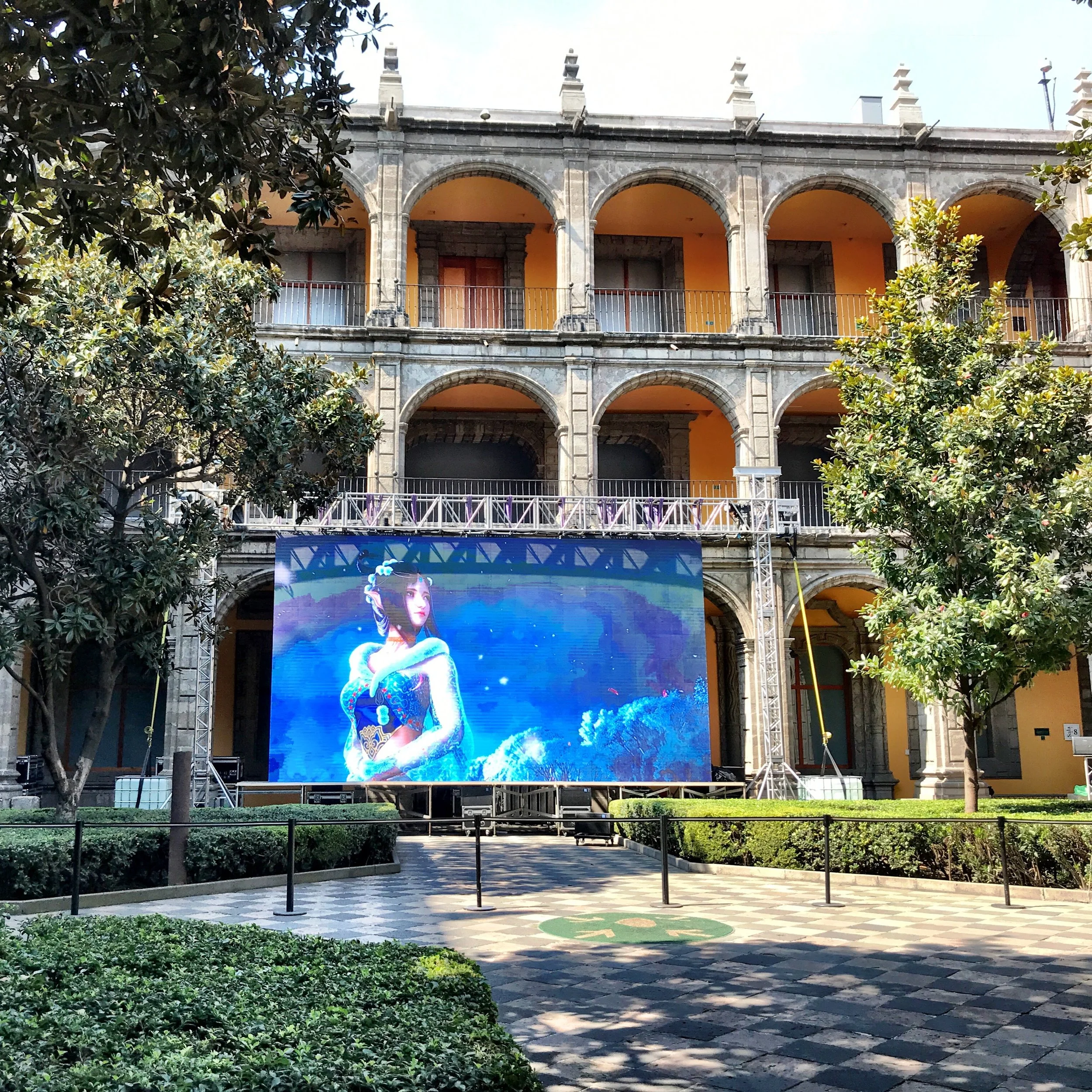
What seemed to be a bizarre fantasy video game ad was playing in the courtyard while we visited

What seemed to be a bizarre fantasy video game ad was playing in the courtyard while we visited

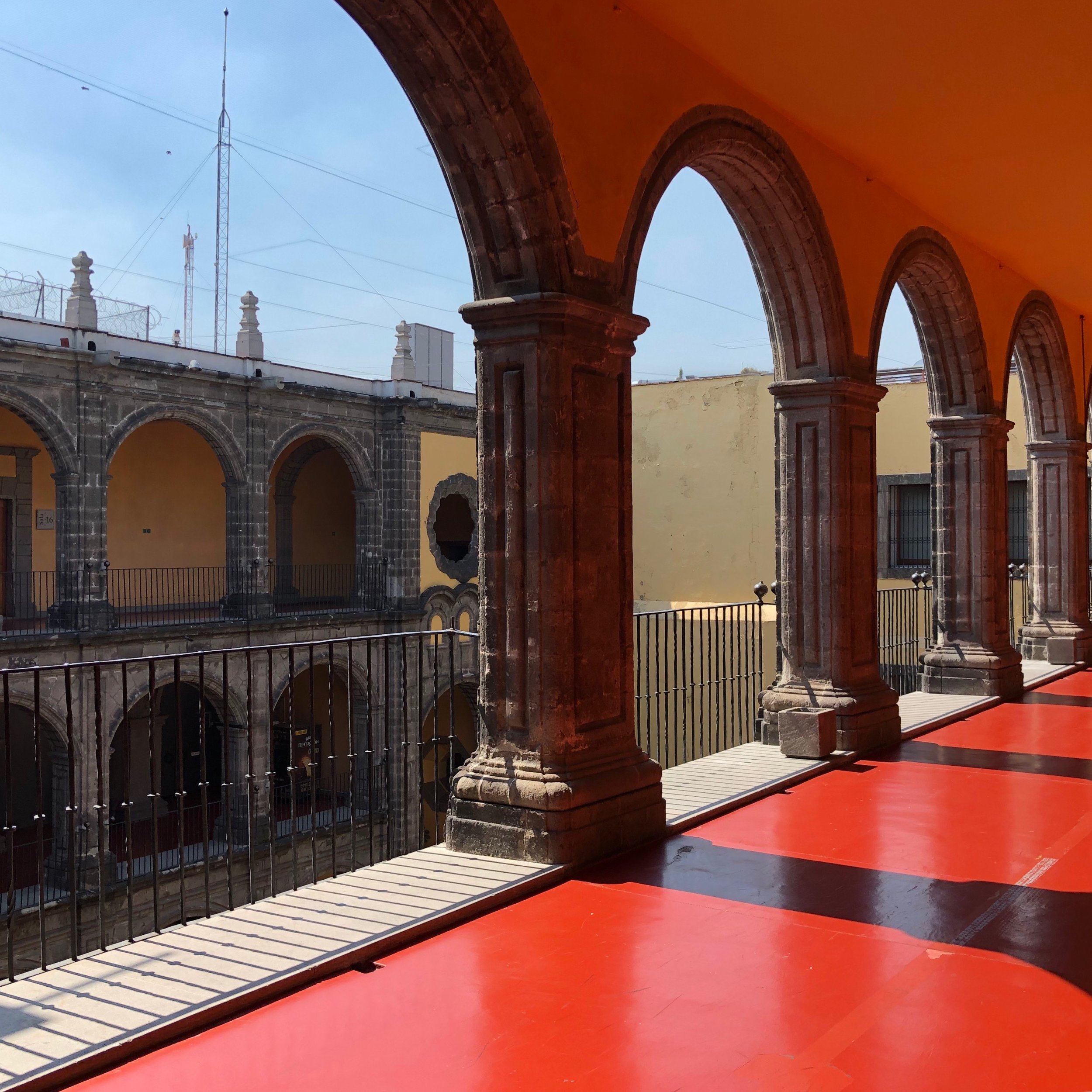
Open archways line the corridors of the ex-college

Open archways line the corridors of the ex-college

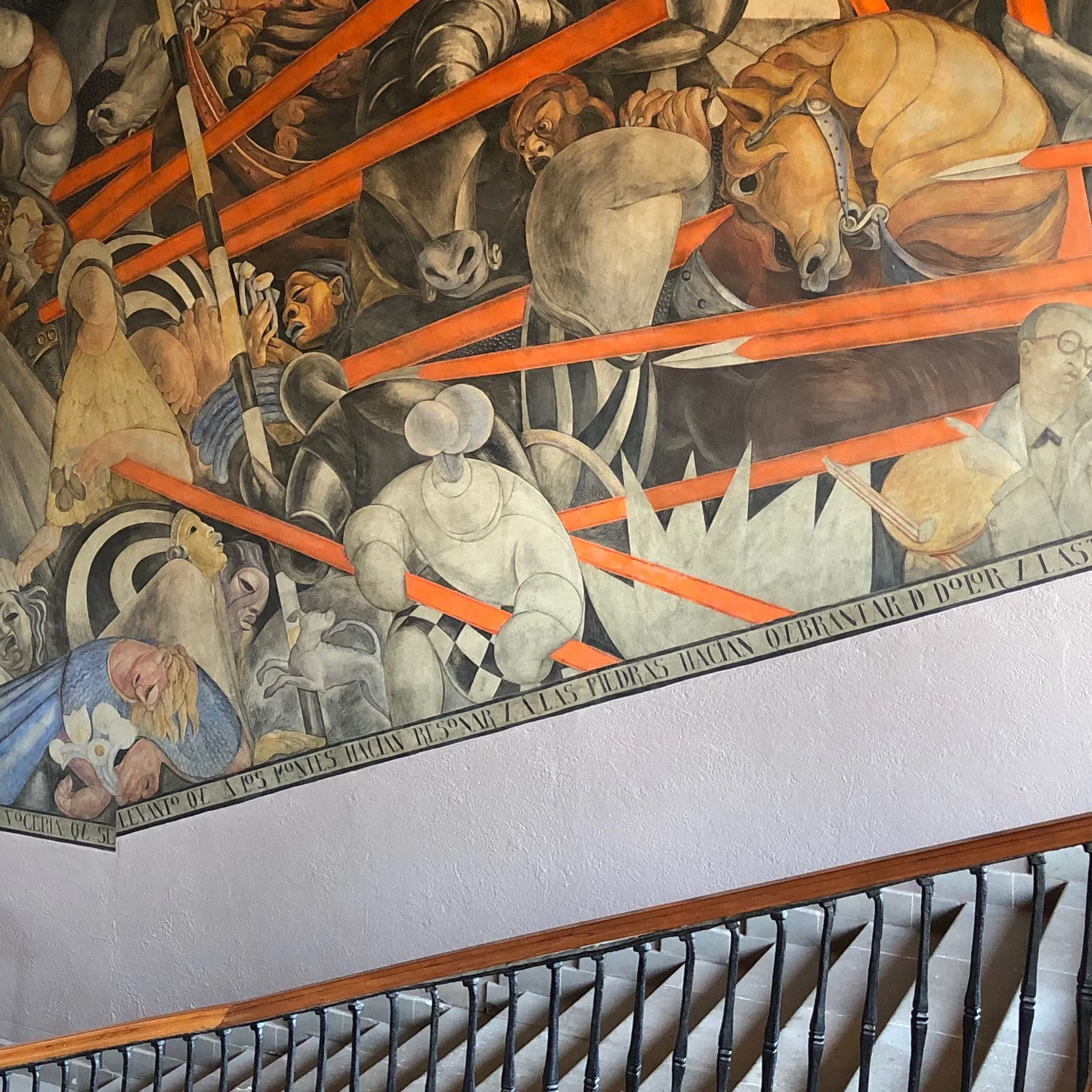
You’ll spot murals all over the Antiguo Colegio de San Ildefonso

You’ll spot murals all over the Antiguo Colegio de San Ildefonso

2. Antiguo Colegio de San Ildefonso

A block or so down from the synagogue is a former Jesuit boarding school that has since been transformed into a museum and cultural center. After the Jesuits were expelled from the city, the building temporarily served as barracks for the Mexican army before becoming the National Preparatory School. The site is considered to be the birthplace of the Mexican muralism movement and features murals painted by David Alfaro, José Clemente Orozco (Wally’s personal fave) and Diego Rivera.

Justo Sierra 16

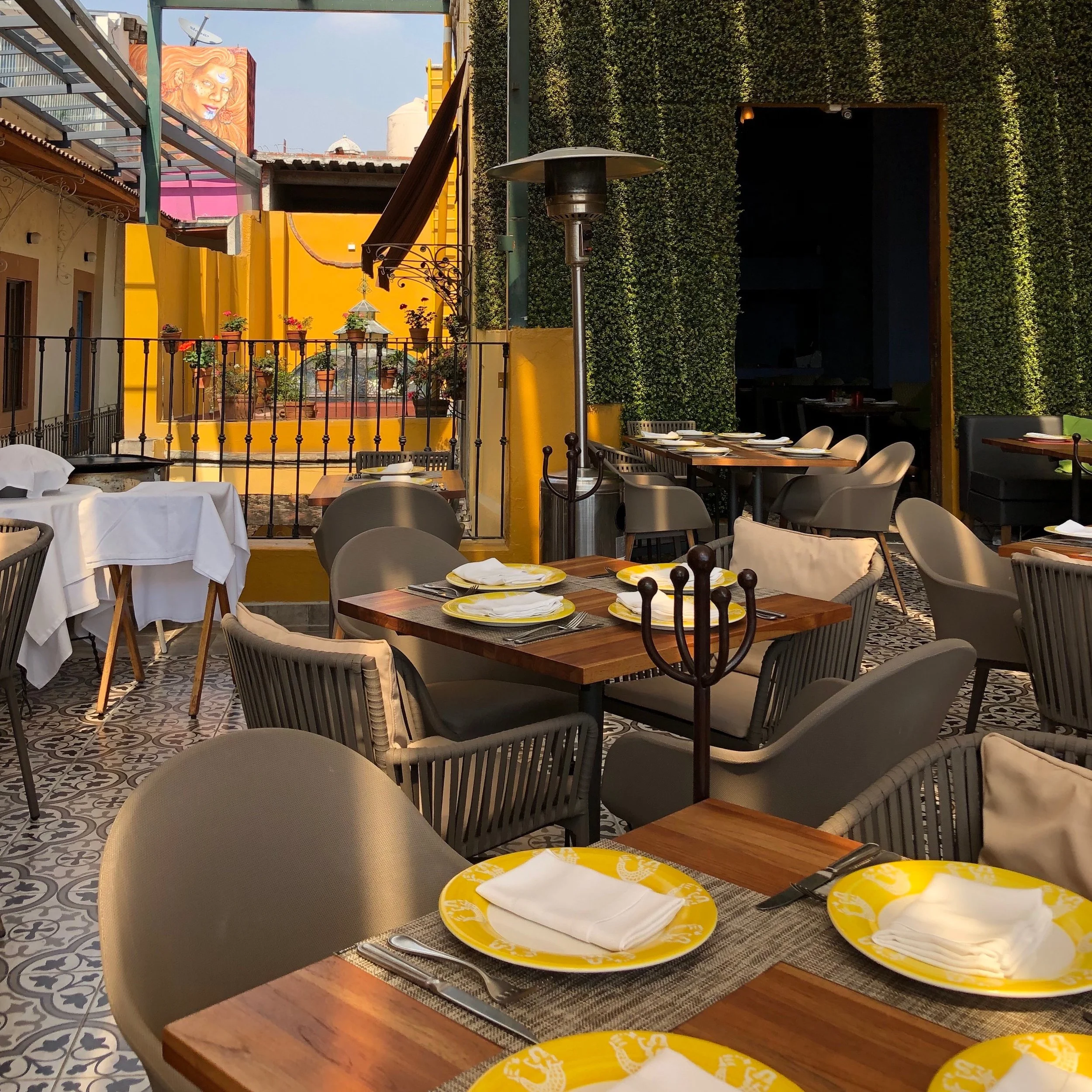
La Casa de las Sirenas is located within one of the first colonial mansions in Mexico City
La Casa de las Sirenas is located within one of the first colonial mansions in Mexico City

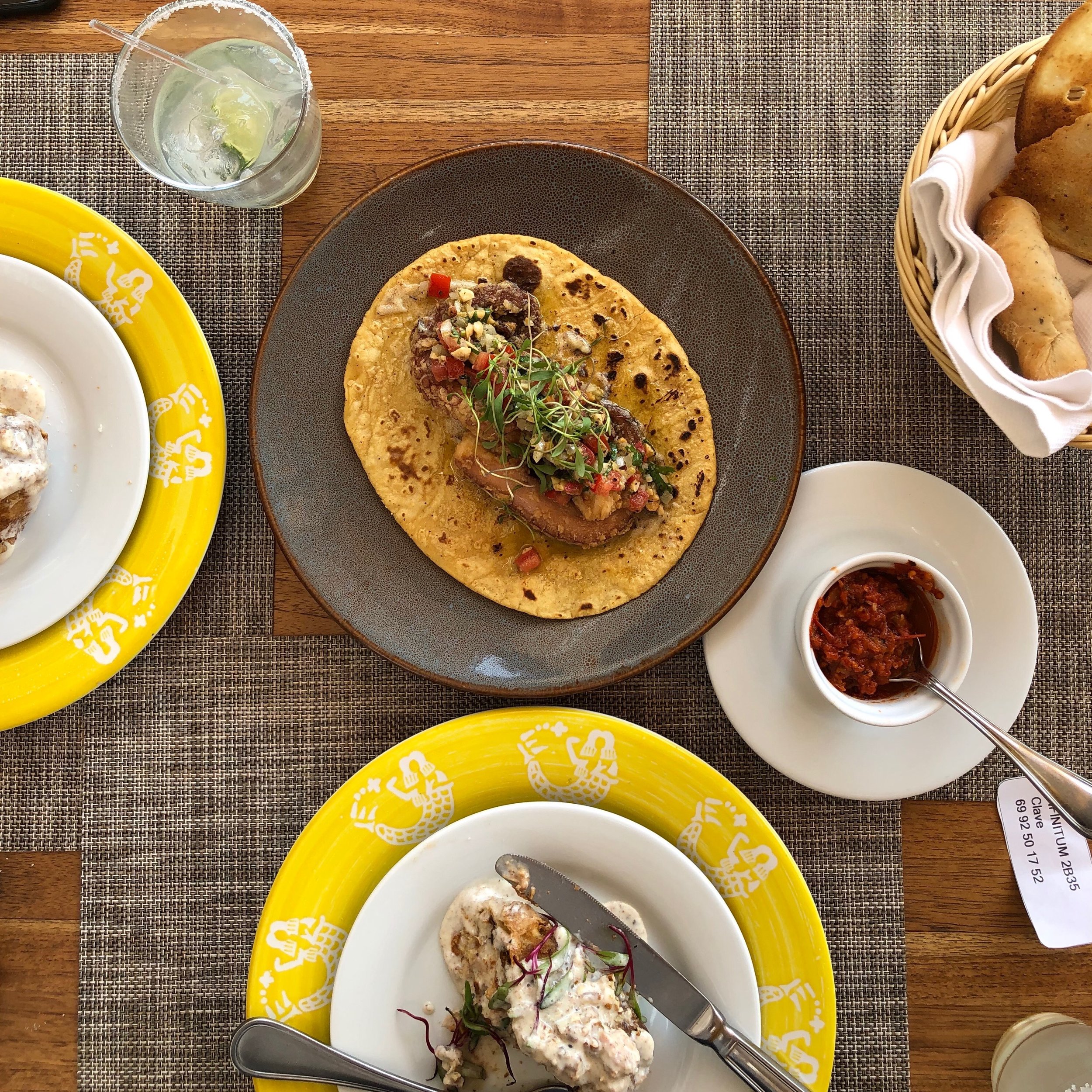
Our al fresco meal was delicious

Our al fresco meal was delicious

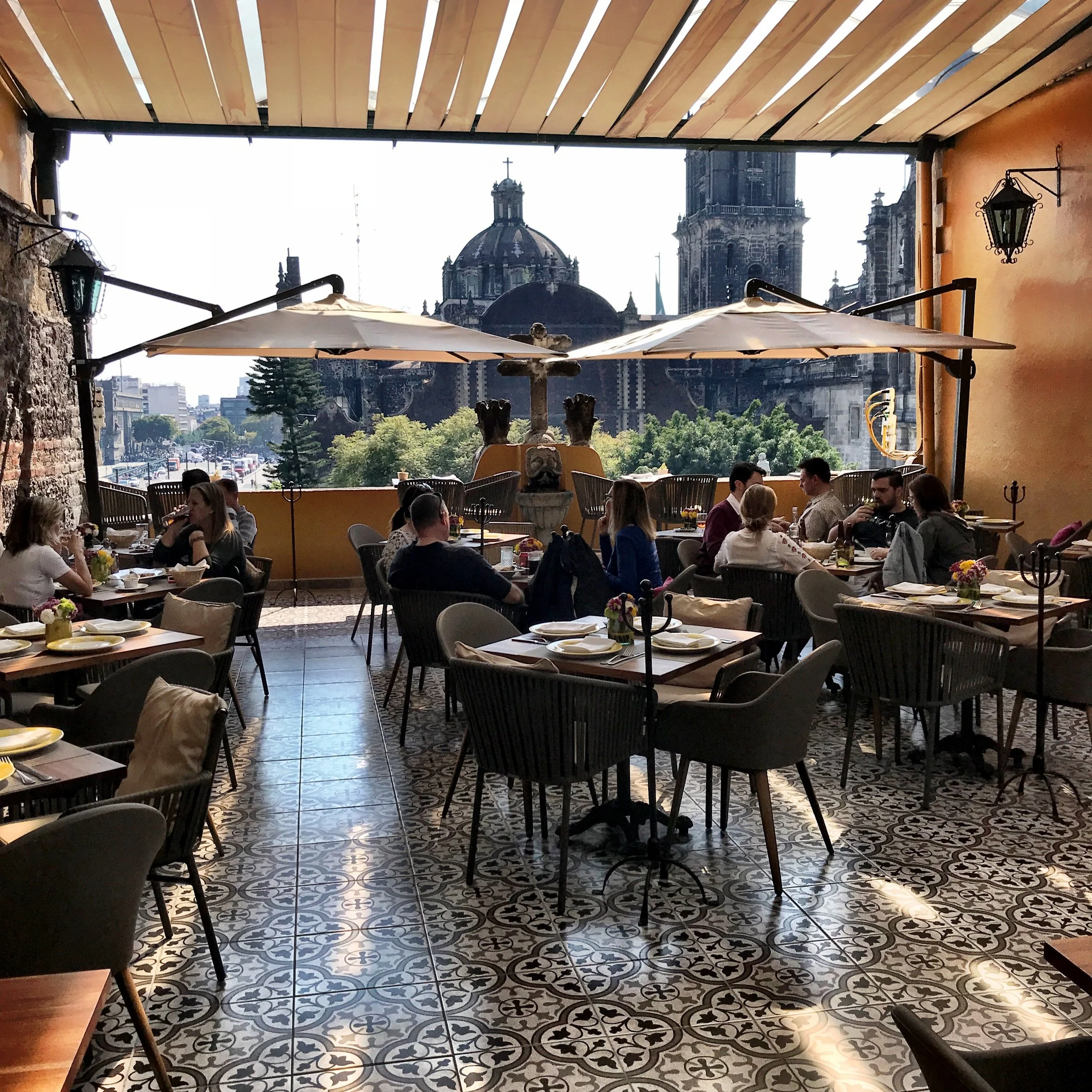
Grab a bite on the rooftop terrace, which overlooks the back of the cathedral

Grab a bite on the rooftop terrace, which overlooks the back of the cathedral

3. La Casa de las Sirenas

The frieze on the façade of this former 17th century colonial abode features a Caravaca cross flanked by a pair of mermaids, which gives the restaurant its name, the House of the Mermaids.

We ate a delicious lunch on the rooftop terrace with a spectacular view overlooking the extremely disappointing Templo Mayor and the back of the impressive Catedral Metropolitana, while an organ grinder played a whimsical tune over and over from the street below.

República de Guatemala 32

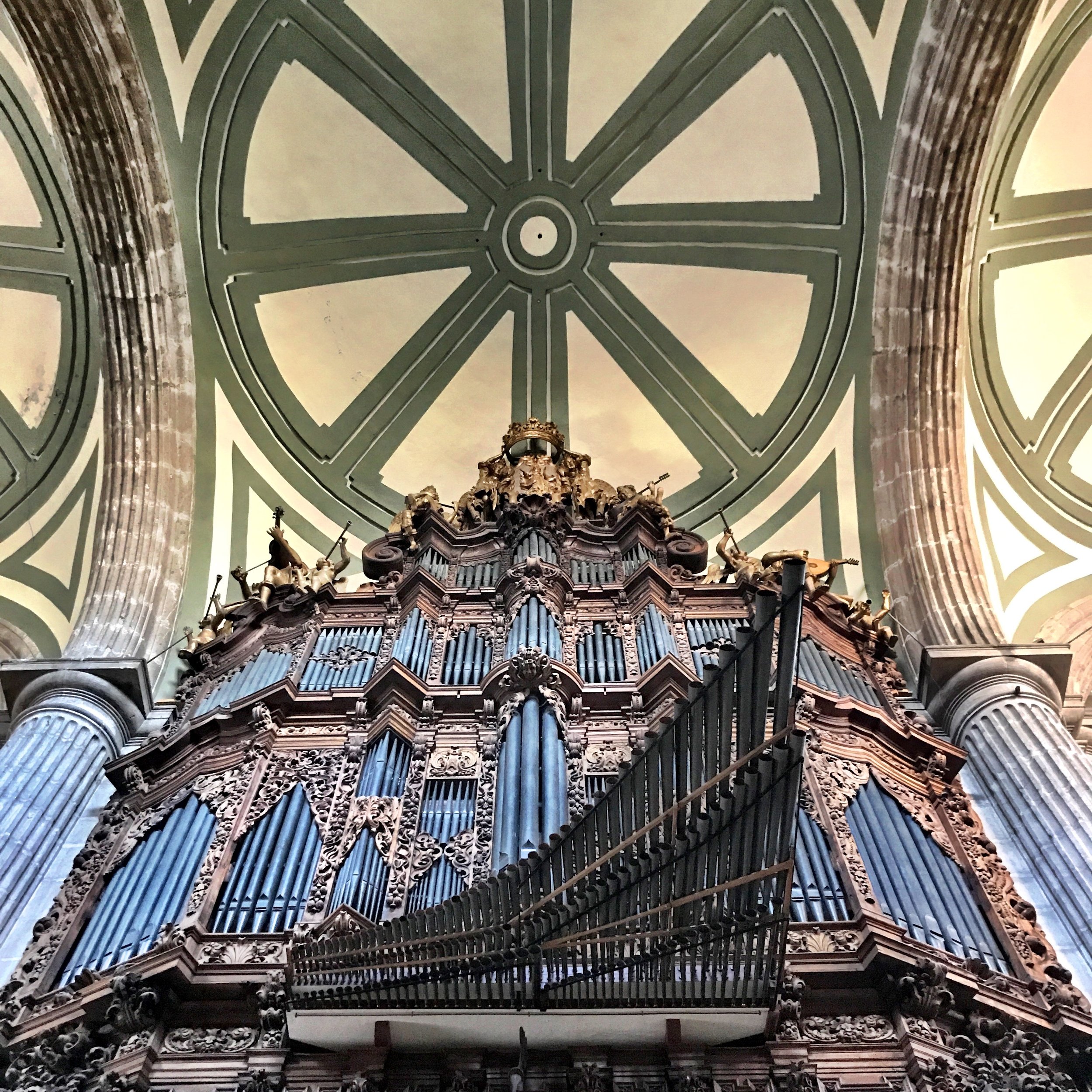
The Metropolitan Cathedral organ

The Metropolitan Cathedral organ

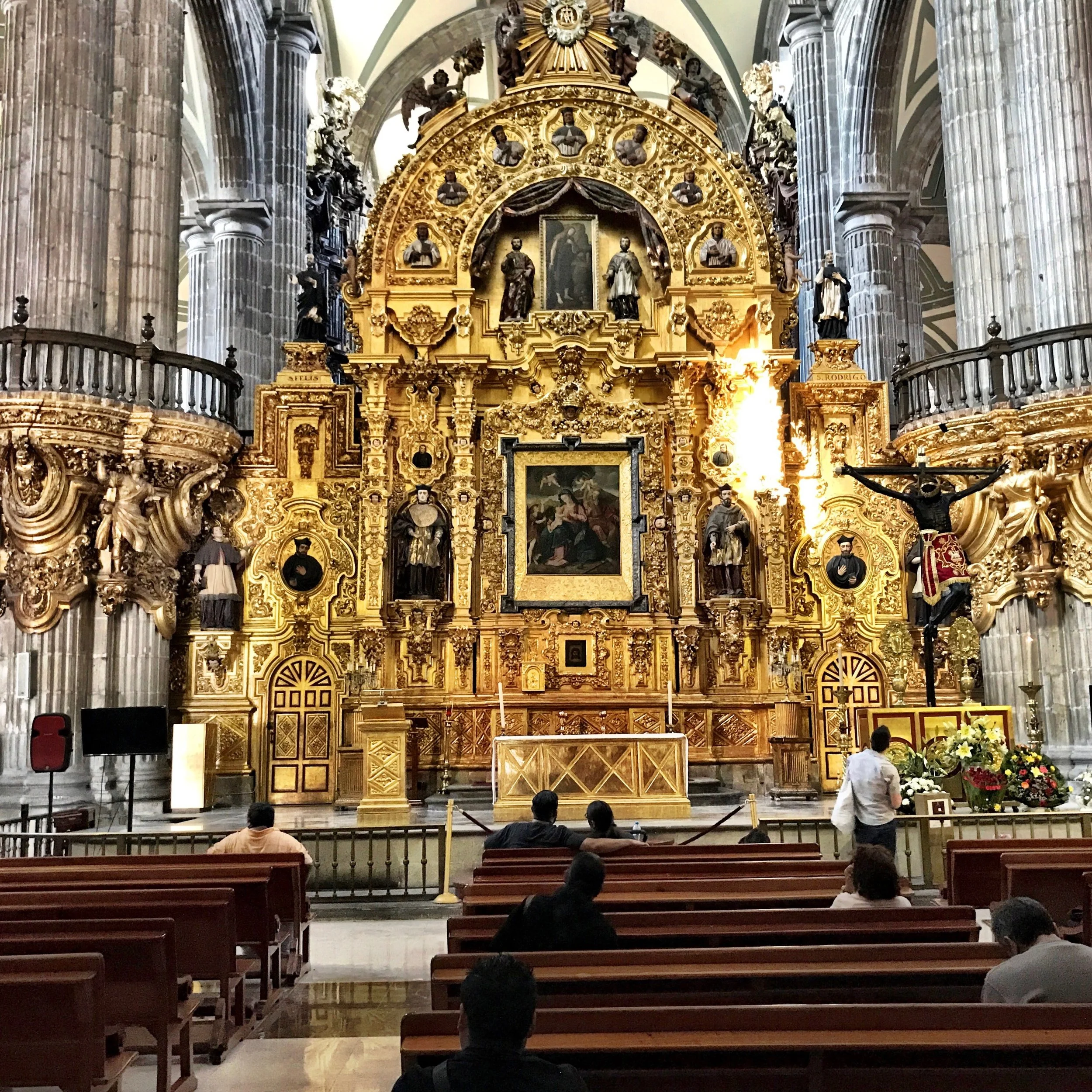
This over-the-top golden altar is just one of many inside the massive cathedral

This over-the-top golden altar is just one of many inside the massive cathedral

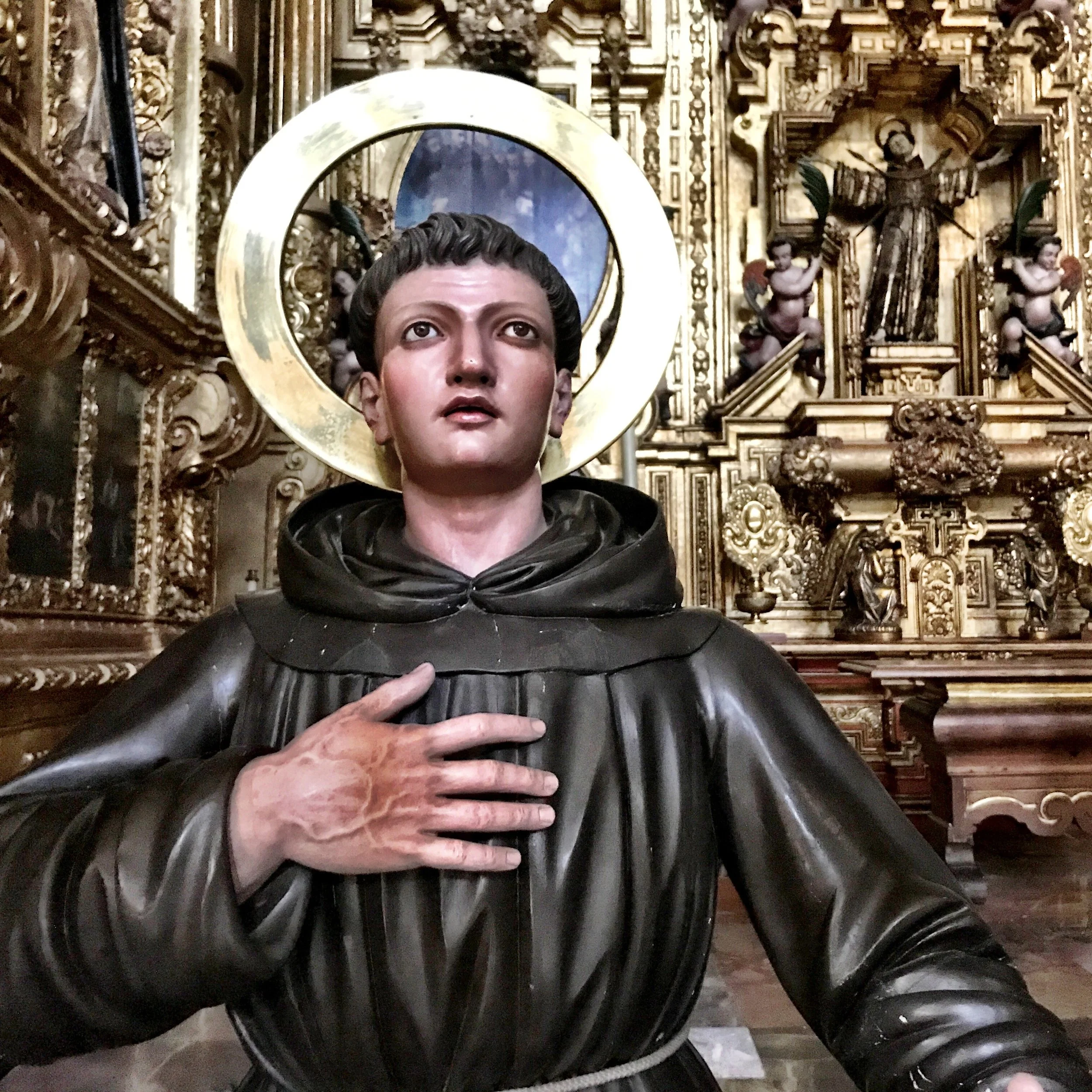
Saints galore in various niches in this Baroque church — note the highly realistic detail on his hand

Saints galore in various niches in this Baroque church — note the highly realistic detail on his hand

4. Mexico City Metropolitan Cathedral

This massive Baroque-style cathedral dominating the northern side of the Zócalo plaza was built in stages between 1573 to 1873, shortly after Hernán Cortés and his conquistadors defeated the Aztec Empire. Among the oldest and largest cathedrals in the Americas, much of it was built using stones pilfered from the Templo Mayor. (Maybe that’s why the temple’s ruins are so unimpressive.) Step inside to see the large, ornate Altar of the Kings, collection of paintings, pipe organ and statuary.

Plaza de la Constitución s/n

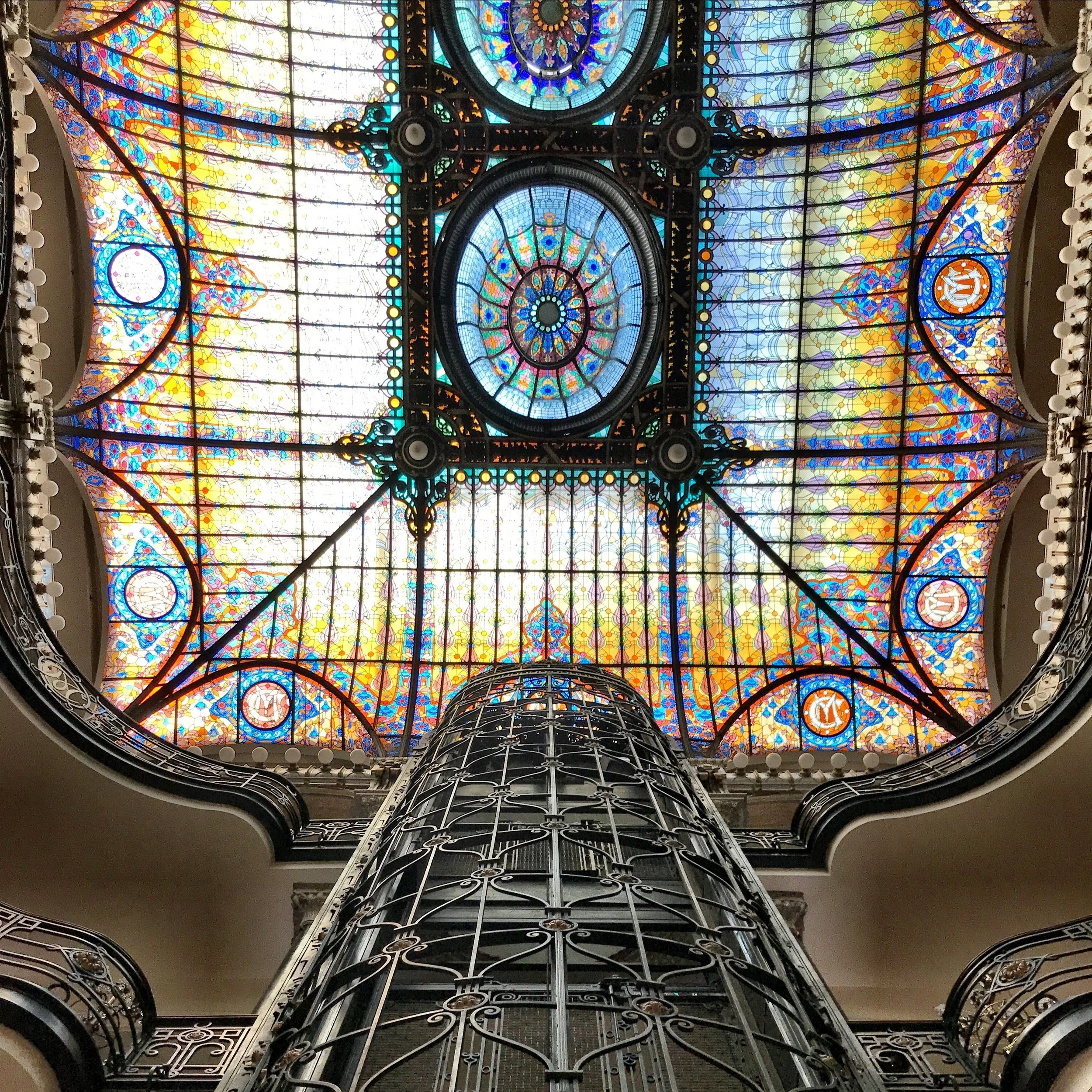
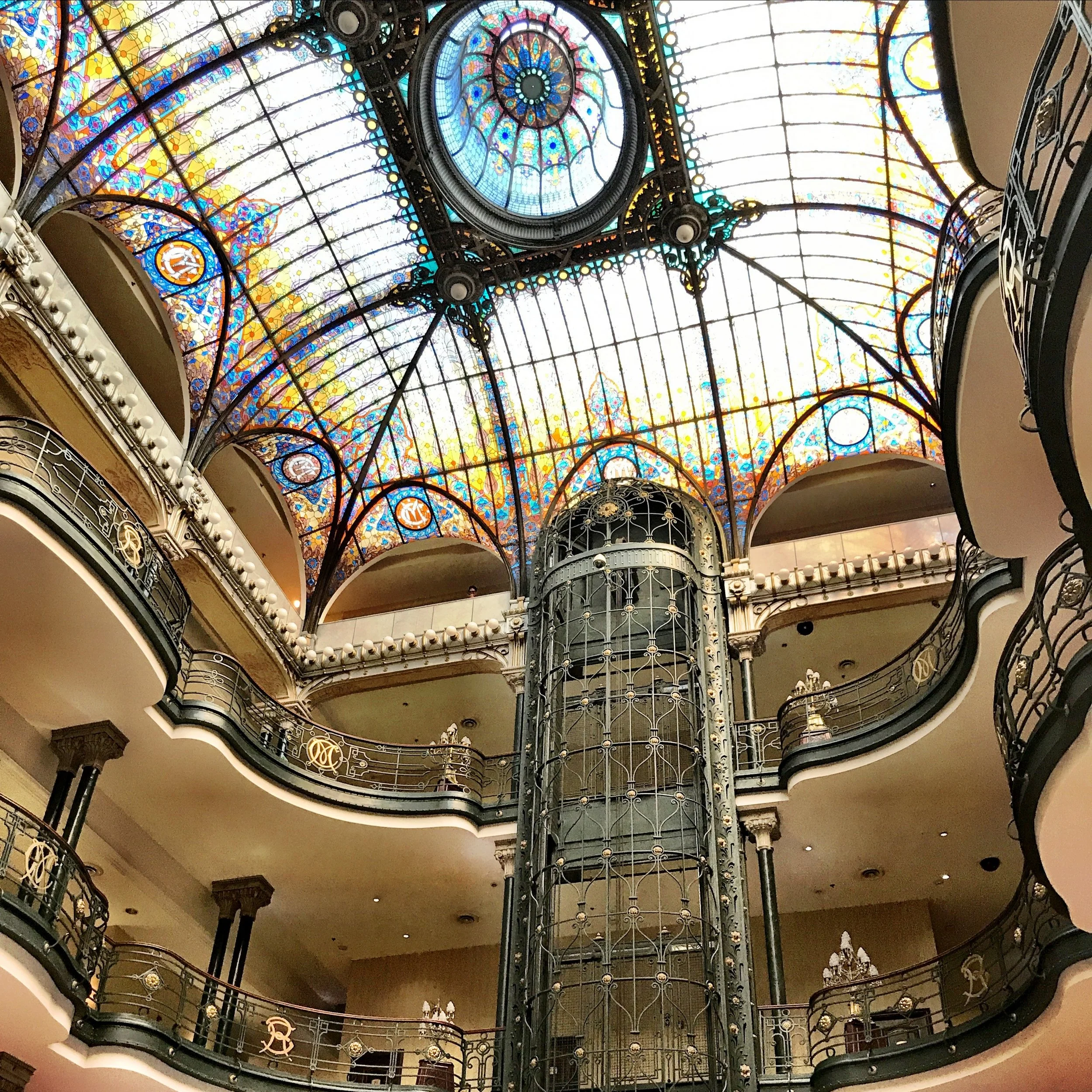
Pop into the lobby of the Gran Hotel to marvel at the stained glass ceiling and ironwork

Pop into the lobby of the Gran Hotel to marvel at the stained glass ceiling and ironwork

The curving balconies and organic grillwork on the cage elevators make this Art Nouveau gem worth a shot or two

The curving balconies and organic grillwork on the cage elevators make this Art Nouveau gem worth a shot or two

5. Gran Hotel Ciudad de México

After binge-watching the Spanish soap series Gran Hotel on Netflix, we had to go inside this historic Art Nouveau gem of the same name. It was originally the city’s most luxurious department store, known as el Centro Mercanti — in fact, you can still see the monogram “CM” in the stained-glass ceiling designed by French glass artist Jacques Grüber as well as the railings. Fun fact: The interior is featured in the opening scenes of the James Bond film Spectre.

16 de Septiembre 82

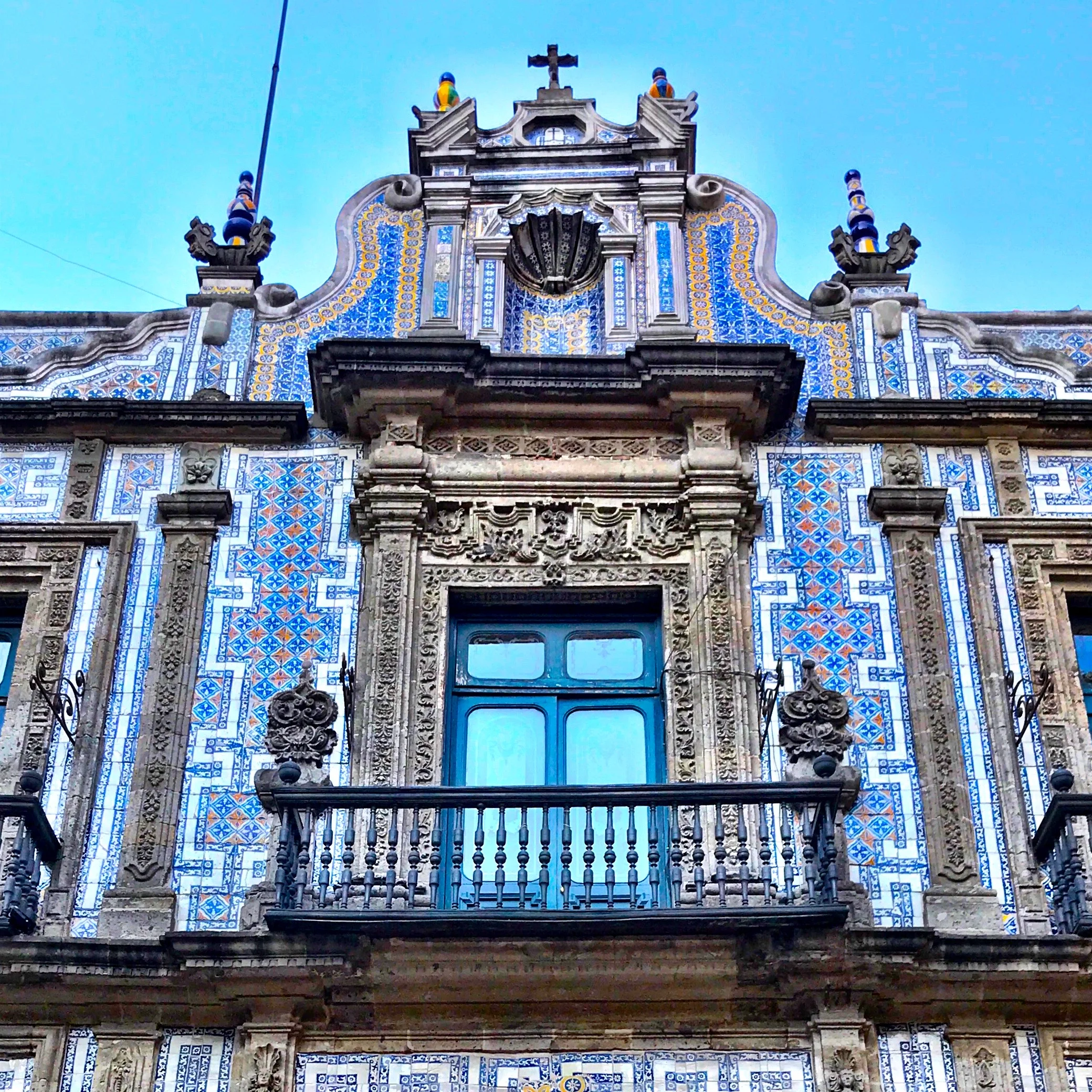
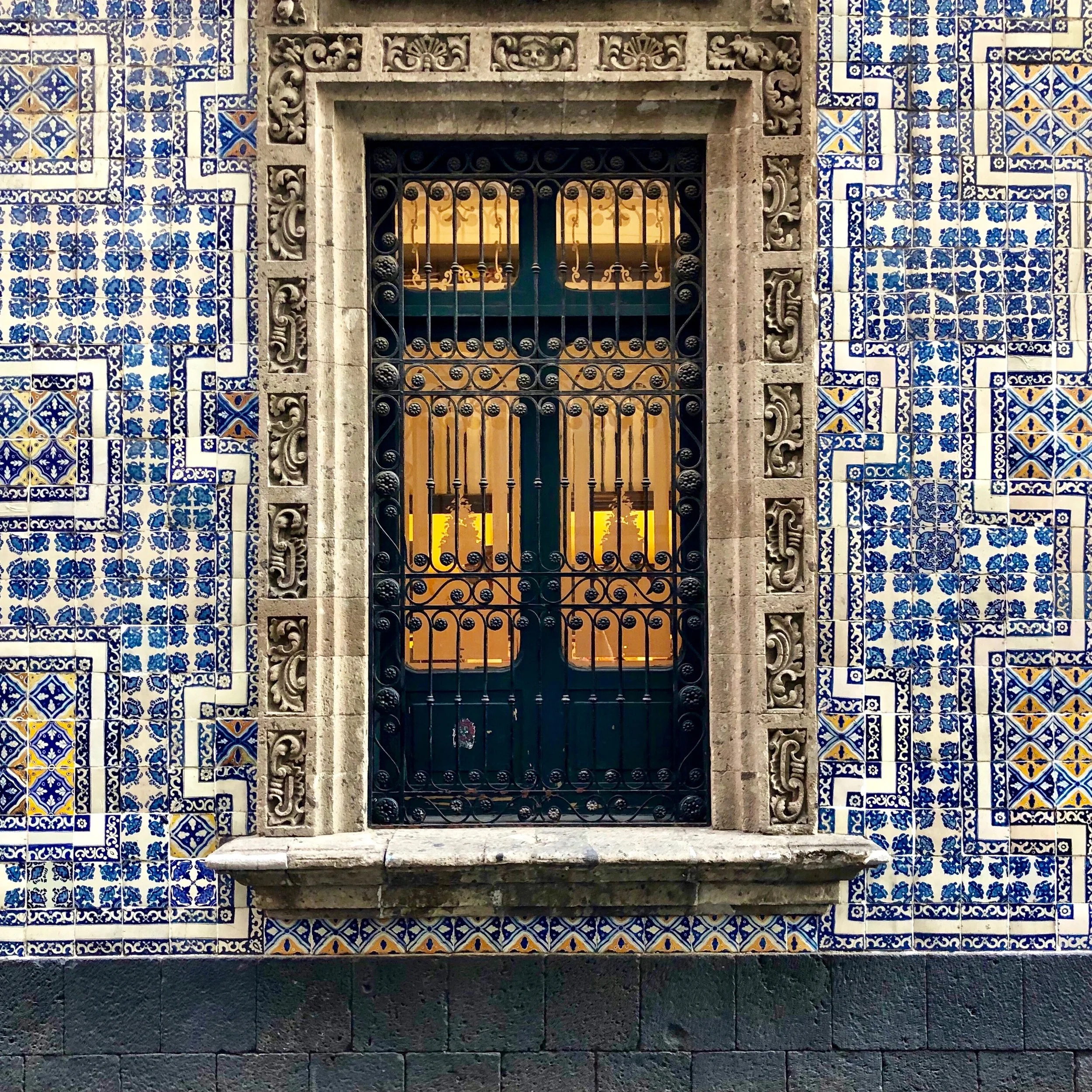
This building is known colloquially as the House of Tiles

This building is known colloquially as the House of Tiles

This distinctive tiled building is now a Sanborns department store

This distinctive tiled building is now a Sanborns department store

6. Casa de los Azulejos

Meaning “the House of Tiles” in Spanish, the exterior of this 16th century building is embellished with tin-glazed ceramic tilework known as azulejos, from Puebla, Mexico. The property was originally the residence of the Valle de Orizaba counts, one of the wealthiest families in the country. It was purchased by brothers Walter and Frank Sanborn in 1919 and converted into the flagship location of Sanborns, a Mexican department store and restaurant chain.

Av Francisco I. Madero 4

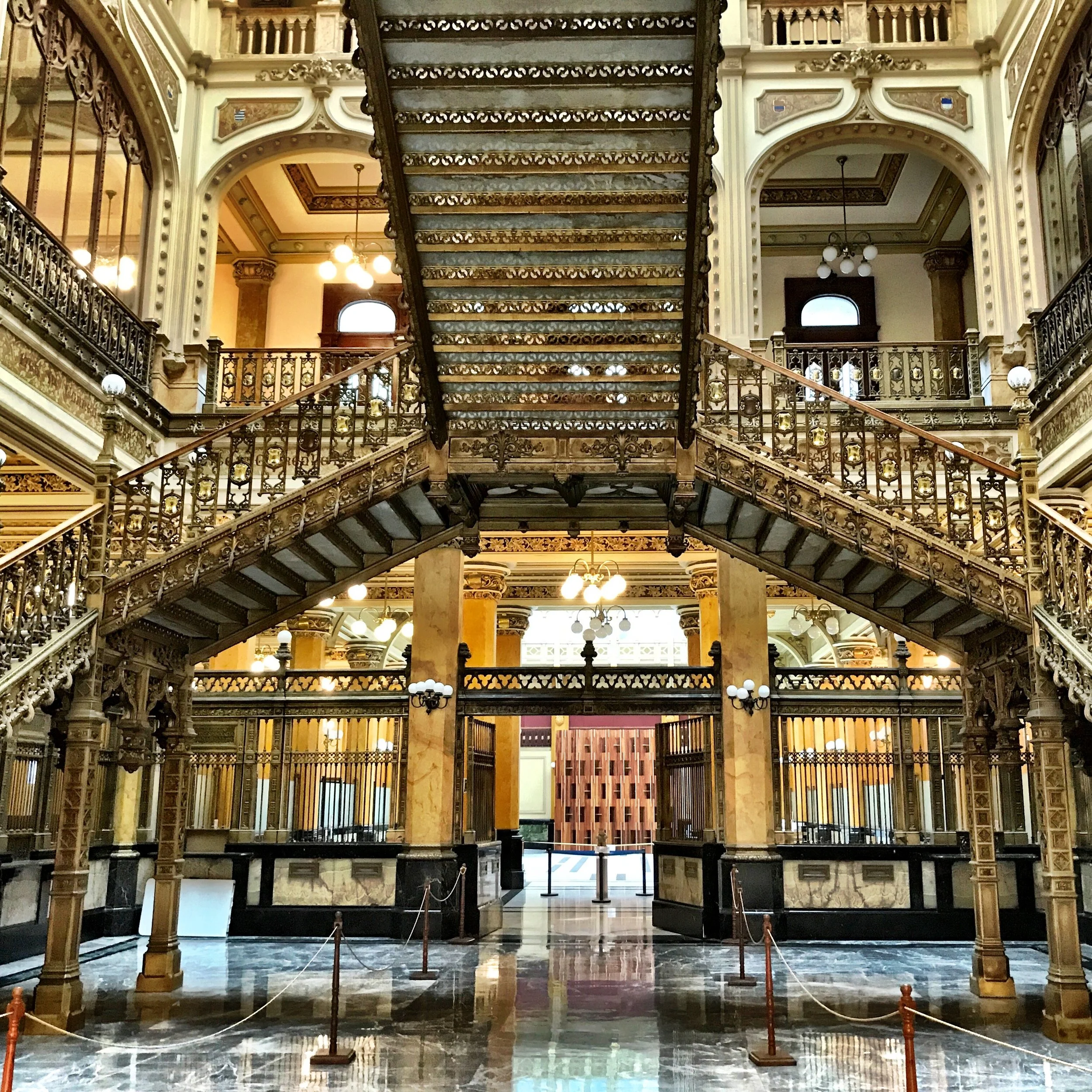
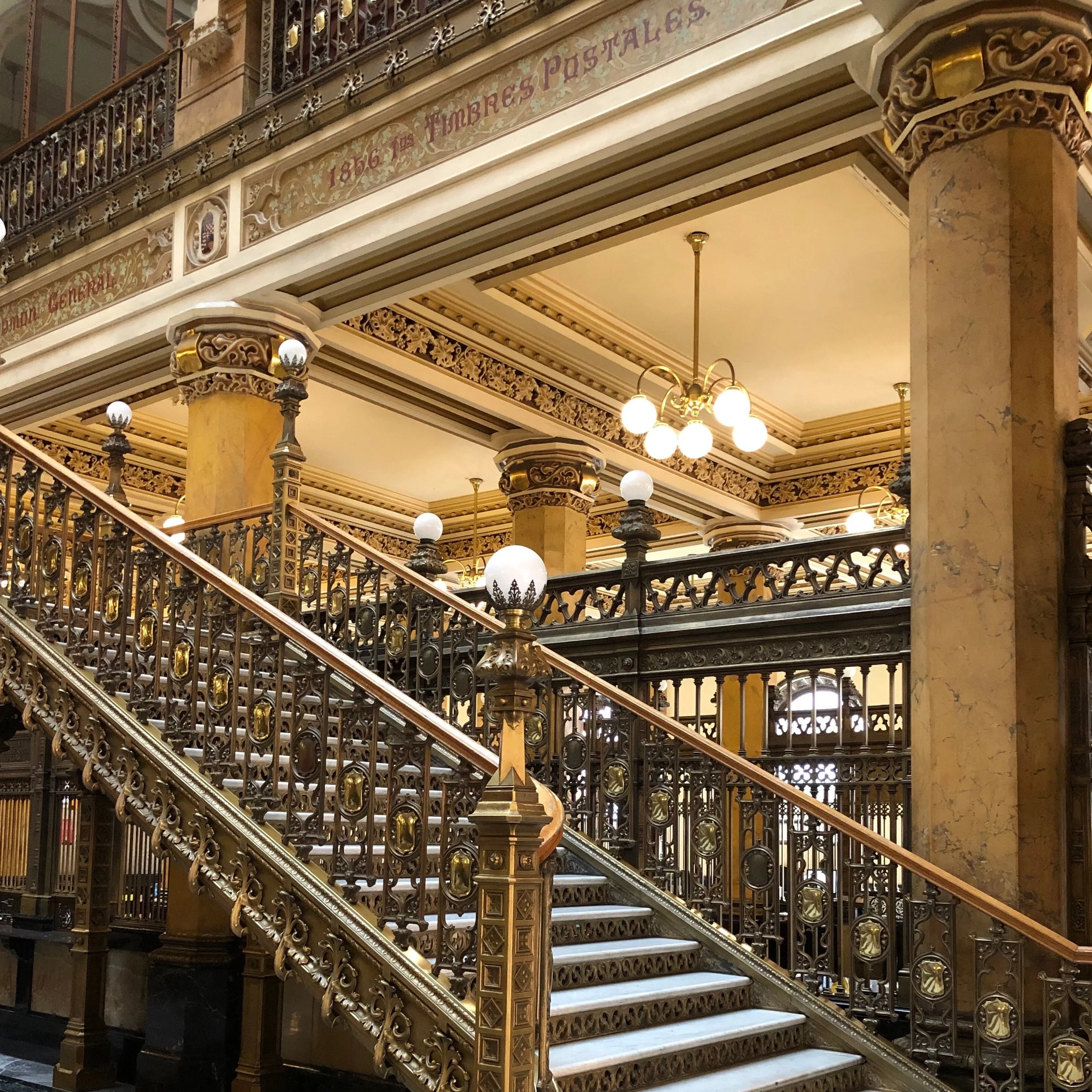
Since you’re in the area, you should pop into the Palacio Postal just to check out the amazing staircase

Since you’re in the area, you should pop into the Palacio Postal just to check out the amazing staircase

Things are looking up at the Postal Palace

Things are looking up at the Postal Palace

7. Palacio Postal

Also known as the Correo Mayor, the Postal Palace was built by Italian architect Adamo Boari and Mexican engineer Gonzalo Garita and has been in continuous operation since it first opened in 1907. The interior was restored to its original gilded splendor with the help of Boari’s granddaughter, who had the original building plans in Italy. The money shot is of a pair of grand interconnecting staircases embellished with vegetal brass balustrades that almost appear to be alive. My only regret is that we weren’t able to send a postcard home while there.

C. Tacuba 1, Cuauhtémoc

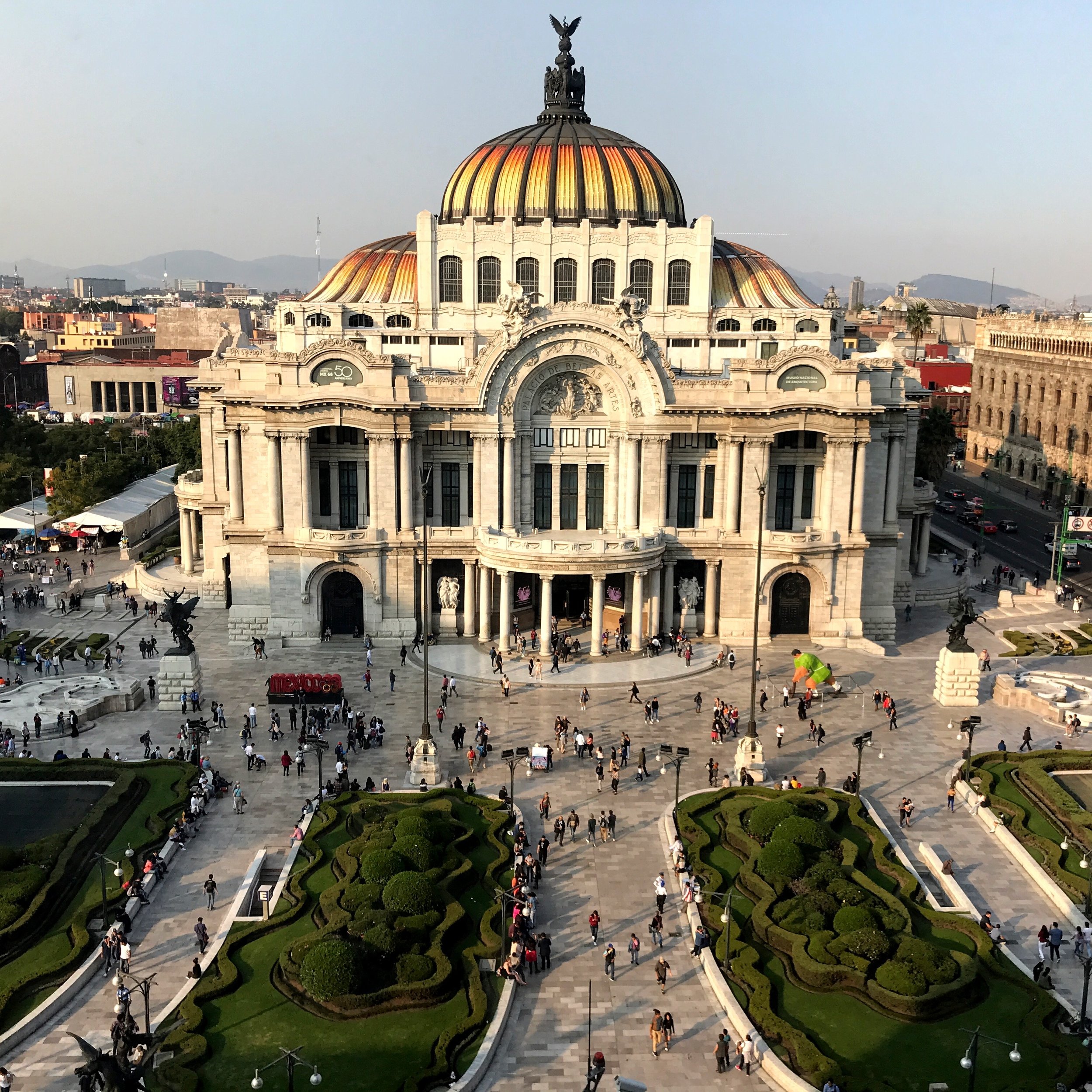
To get this money shot, you have to go into the Sears department store across the street

To get this money shot, you have to go into the Sears department store across the street

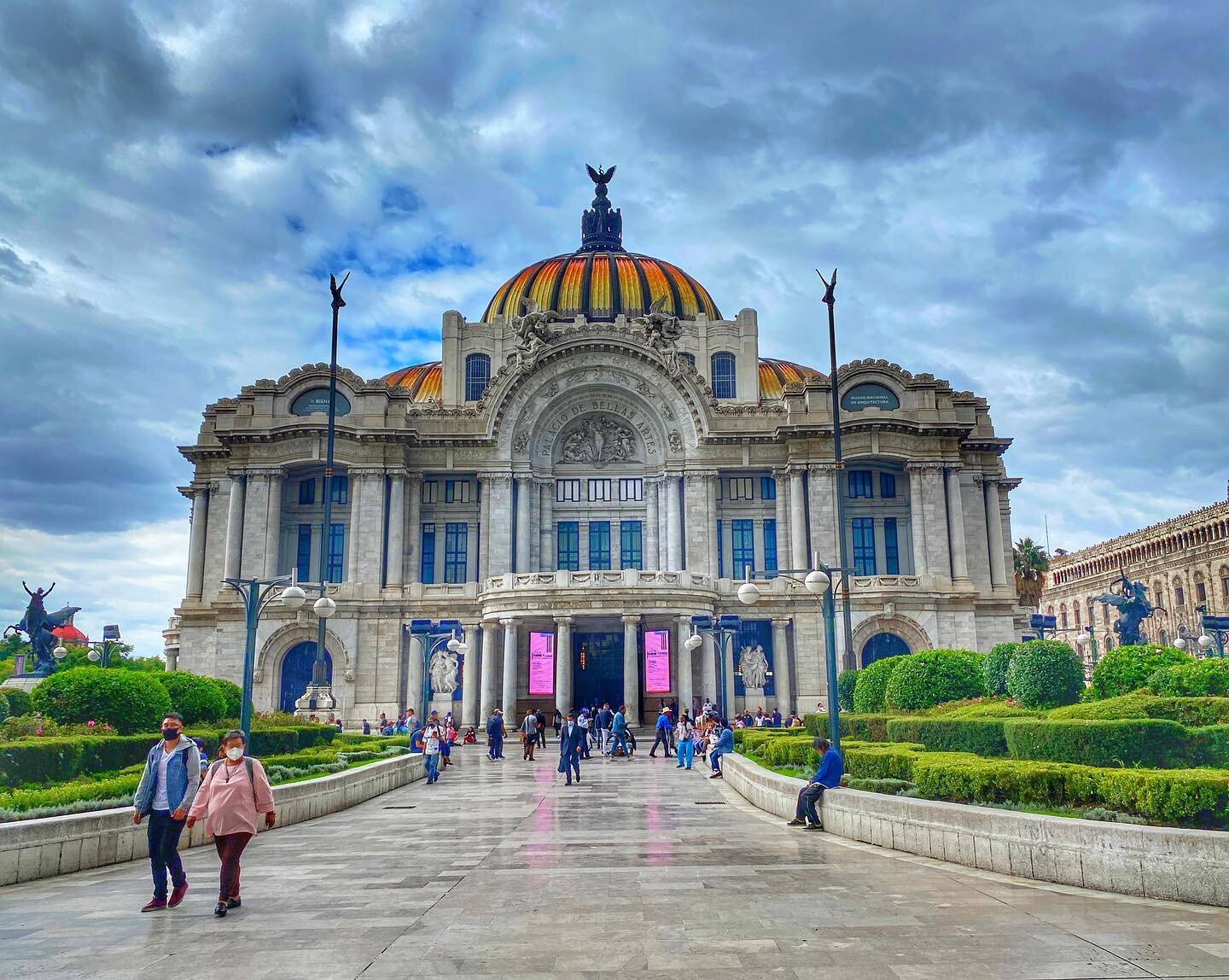
8. Palacio de Bellas Artes

We didn’t get to go inside on this visit. But the secret to an amazing aerial shot is to head over to the Sears department store directly across the street. (If you don’t want to have a snack or drink on the balcony café, just go up one more floor and press your camera against the glass as we did.)

Designed by the same architect as the Palacio Postal, the building’s gorgeously photogenic Art Nouveau exterior is topped by a lattice of iron and a shimmering iridescent ombre-tiled dome. At the very top, the Mexican eagle perches on a cactus with a serpent in its beak, with the four figures beneath representing the personifications of the dramatic arts.  

The plaza includes various sculptures, including four Pegasus statues designed by Catalan Agustí Querol Subirats, as well as the famous Mexico City Olympics logo — way too popular with tourists to get a good picture of.

Av. Juárez

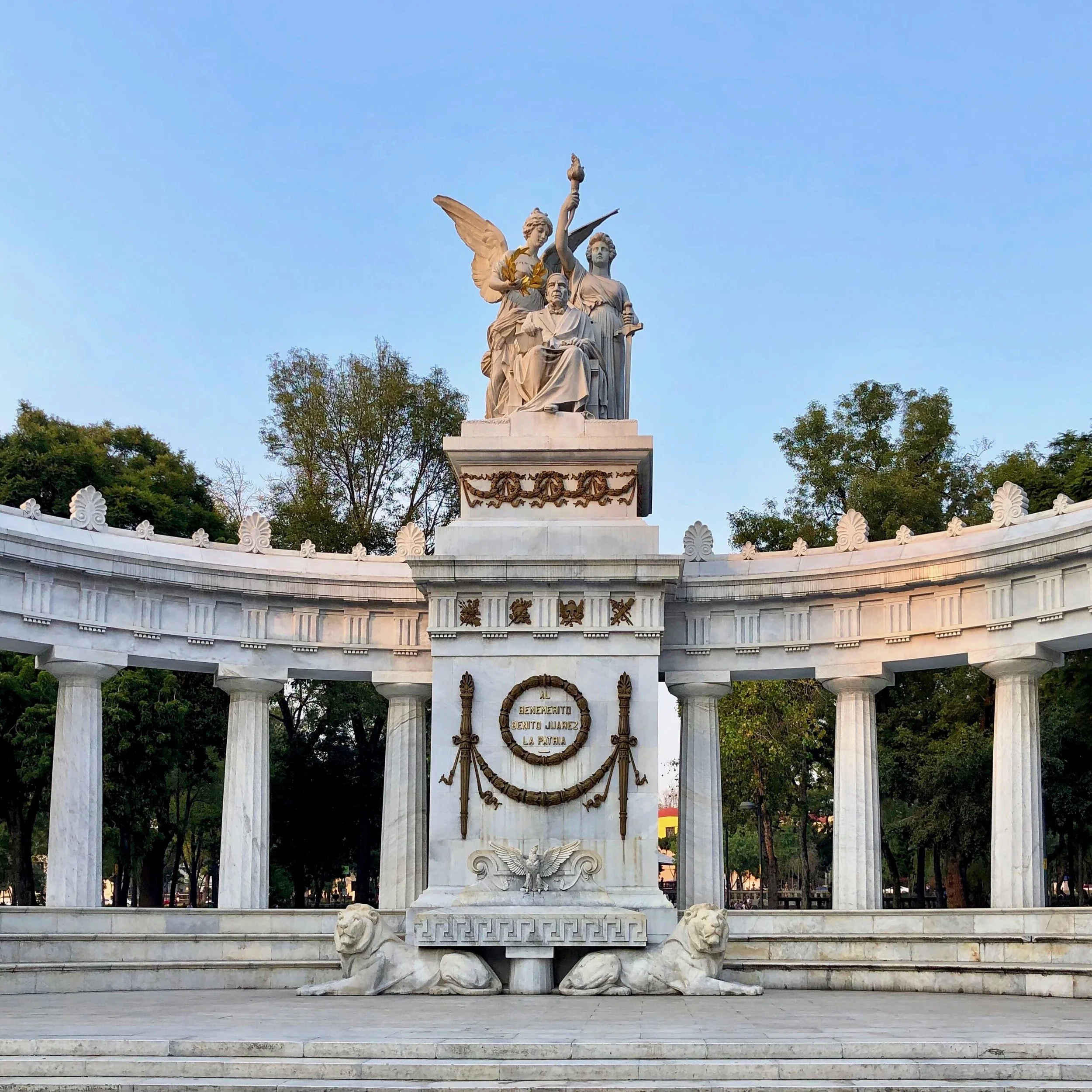
The Hemiciclo a Benito Juárez monument

The Hemiciclo a Benito Juárez monument

A large green space sits right next to the plaza of the Palacio de Bellas Artes

A large green space sits right next to the plaza of the Palacio de Bellas Artes

9. Alameda Central

This leafy park was created in 1525 on what was previously the site of an Aztec marketplace. Its name comes from the word alámo, Spanish for poplar tree — which can be found in abundance throughout the park. You’ll encounter children playing in empty fountain basins and locals of all ages meandering or sitting on benches along the many paths. The Kiosco Morisco was located there briefly and used as a pavilion to announce lottery winners before being moved to make way for the semicircular Neoclassical Hemiciclo a Benito Juárez monument, dedicated to the former Mexican president.

Av. Hidalgo s/n

This fountain is right across from Alameda Central and is worth a quick visit to get the Insta shot

This fountain is right across from Alameda Central and is worth a quick visit to get the Insta shot

Governmental buildings and the Museum of Memory and Tolerance surround the fountain

Governmental buildings and the Museum of Memory and Tolerance surround the fountain

País de Volcanes (Country of Volcanoes) by Ricardo Legorreta

País de Volcanes (Country of Volcanoes) by Ricardo Legorreta

10. Fuente de Vicente Rojo

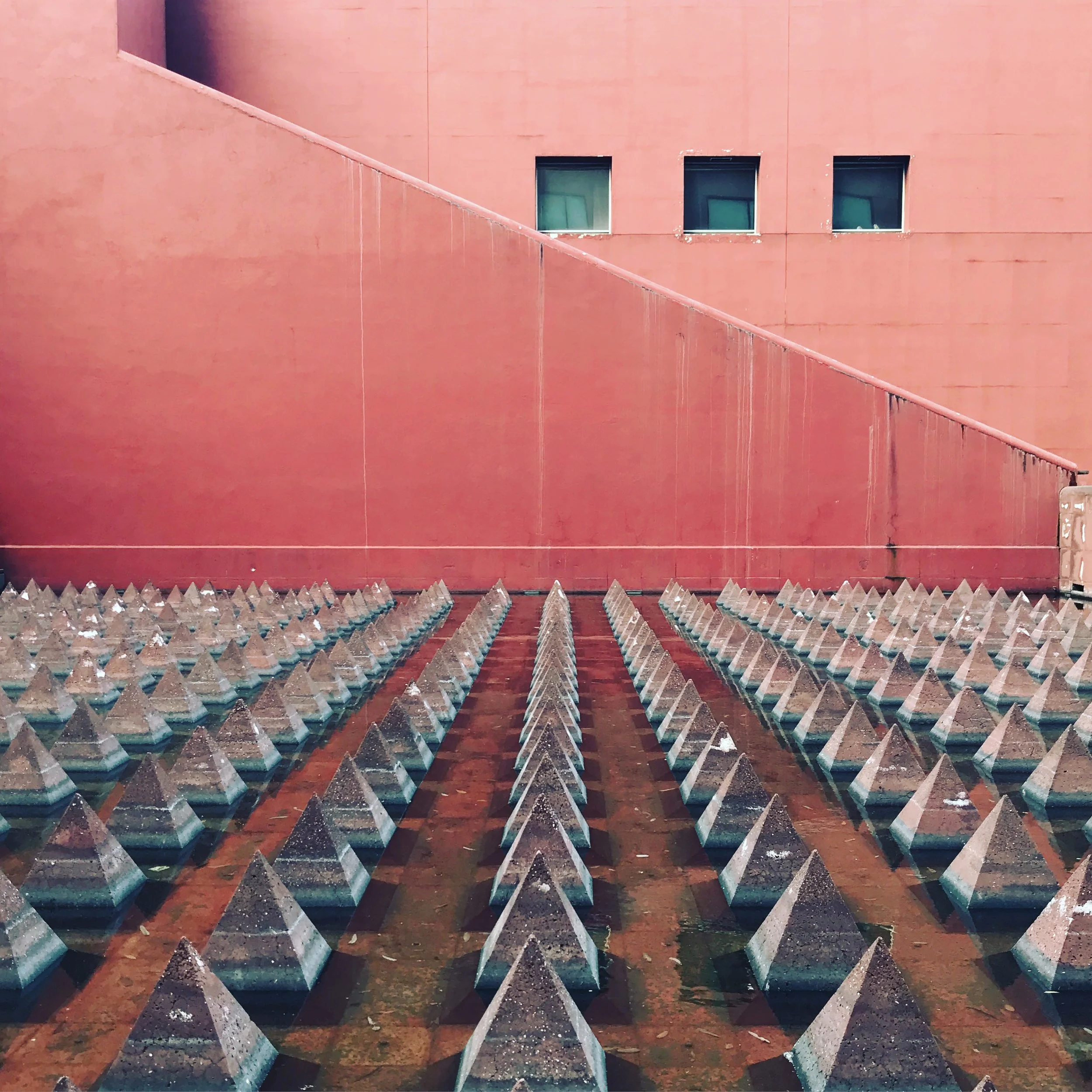
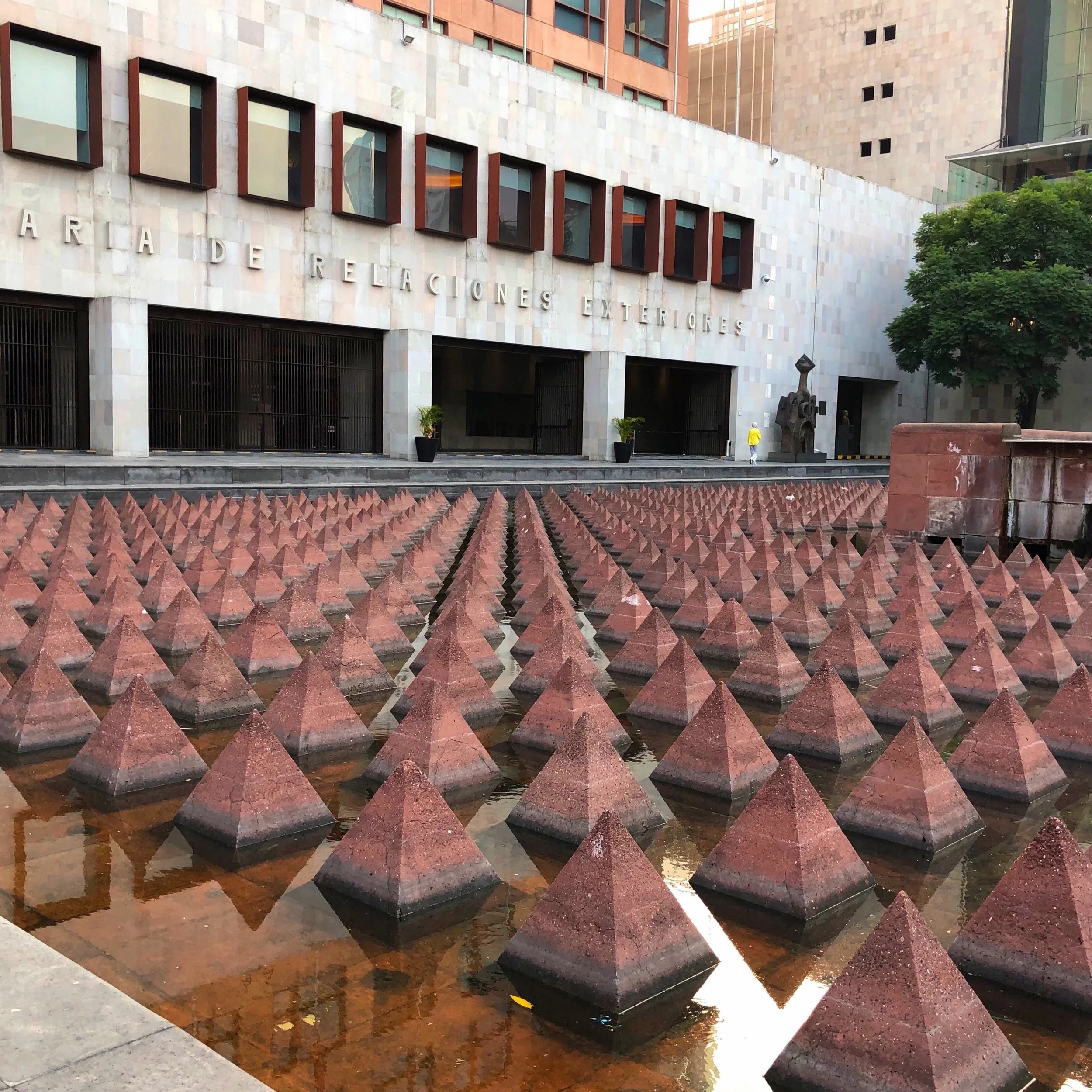
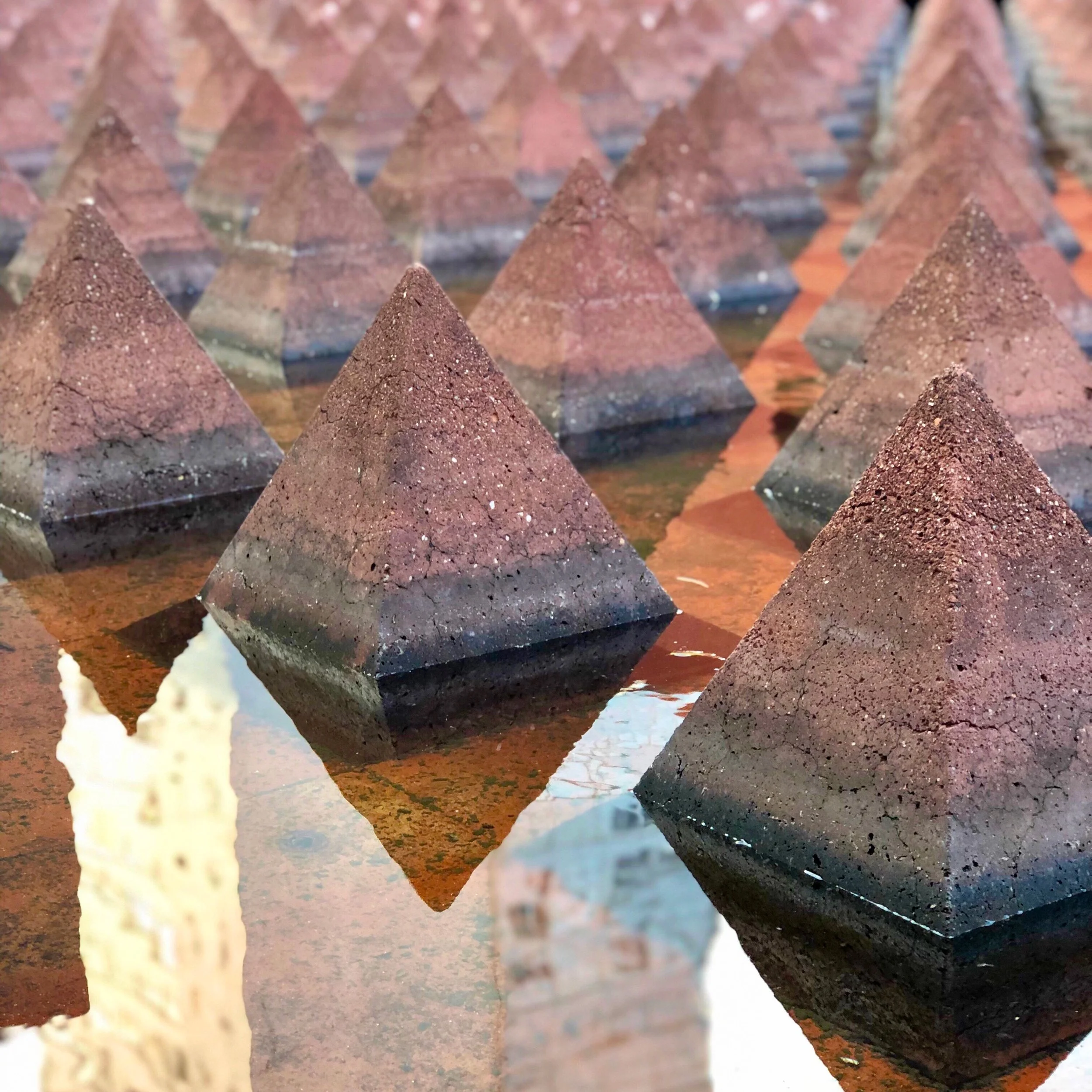
Across from Alameda Park, tucked into the courtyard of the Museo Memoria y Tolerancia surrounded by governmental offices is a fountain designed by Mexican visual artist Vicente Rojo and architect Ricardo Legorreta. Titled País de Volcanes (Country of Volcanoes), it features more than 1,000 small burnt red concrete pyramids emerging from a sunken reflecting pool, a reference to the coarse volcanic tezontle stone widely used by the Aztecs. –Duke

Av. Juárez 44

Q&A With Mexico City Chef Rodrigo Carrasco

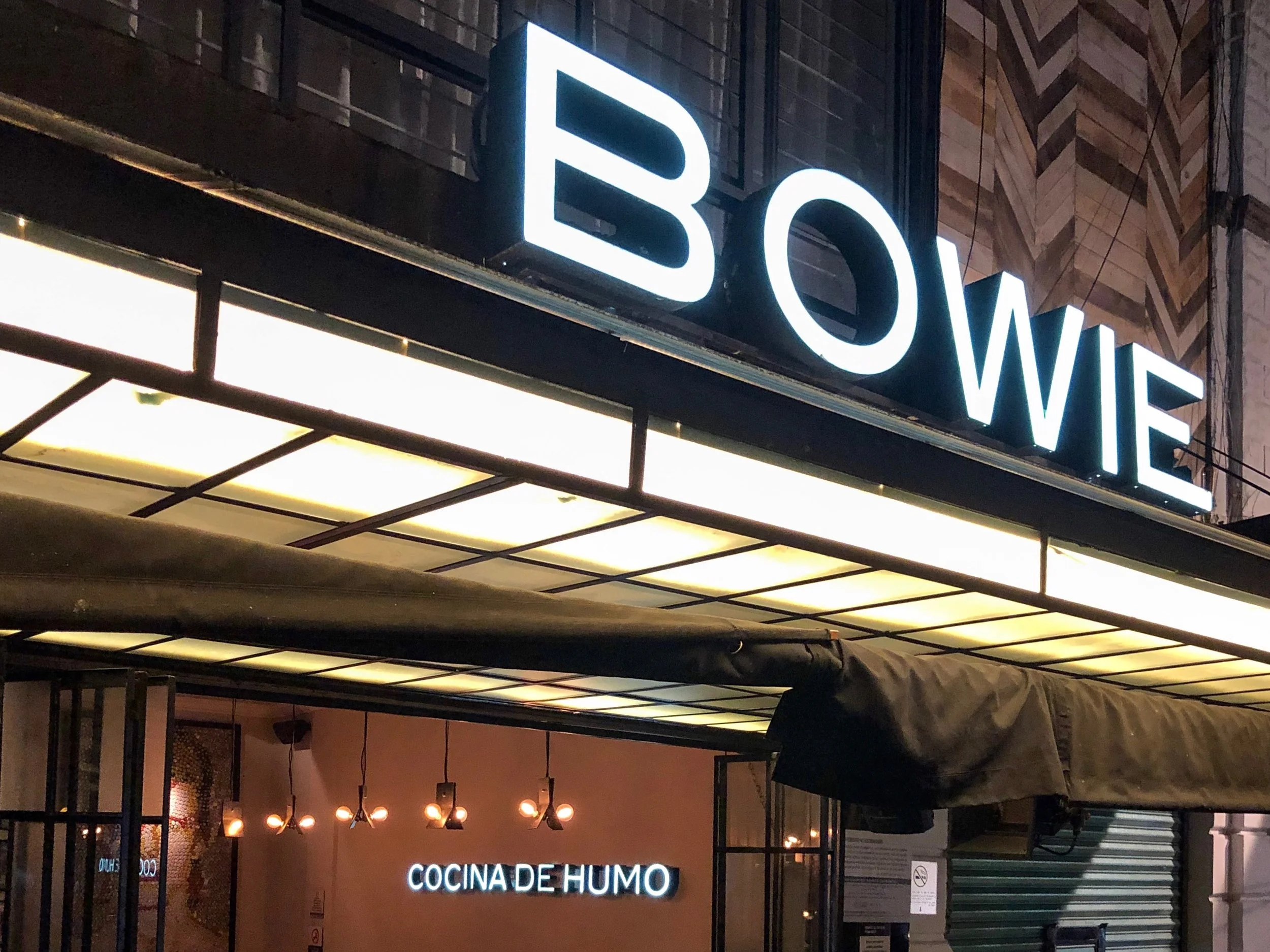
The talented man behind Bowie Cocina de Humo, Tirano and Kitchen6 explains his culinary vision and inspirations.

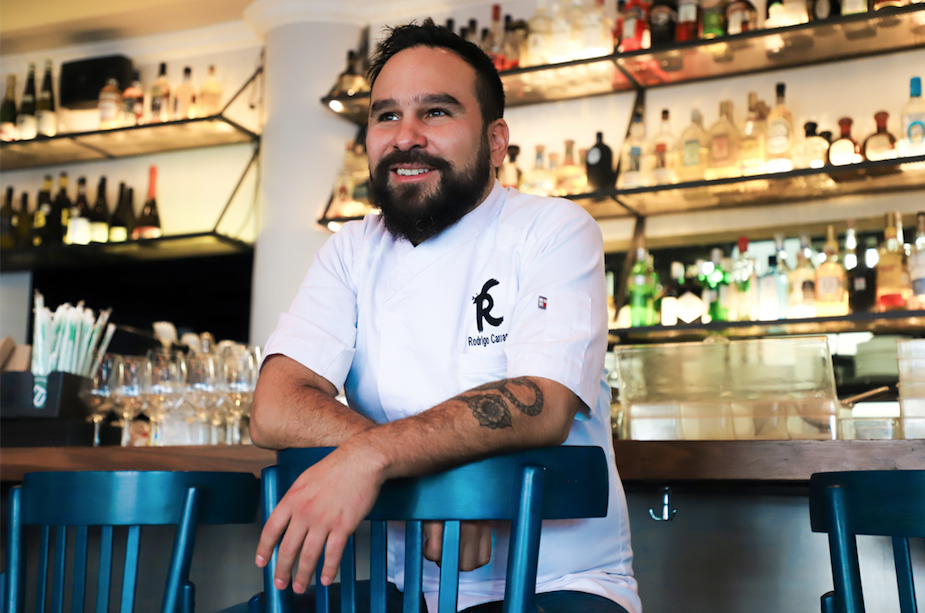
Chef Rodrigo Carrasco at Bowie

Chef Rodrigo Carrasco at Bowie

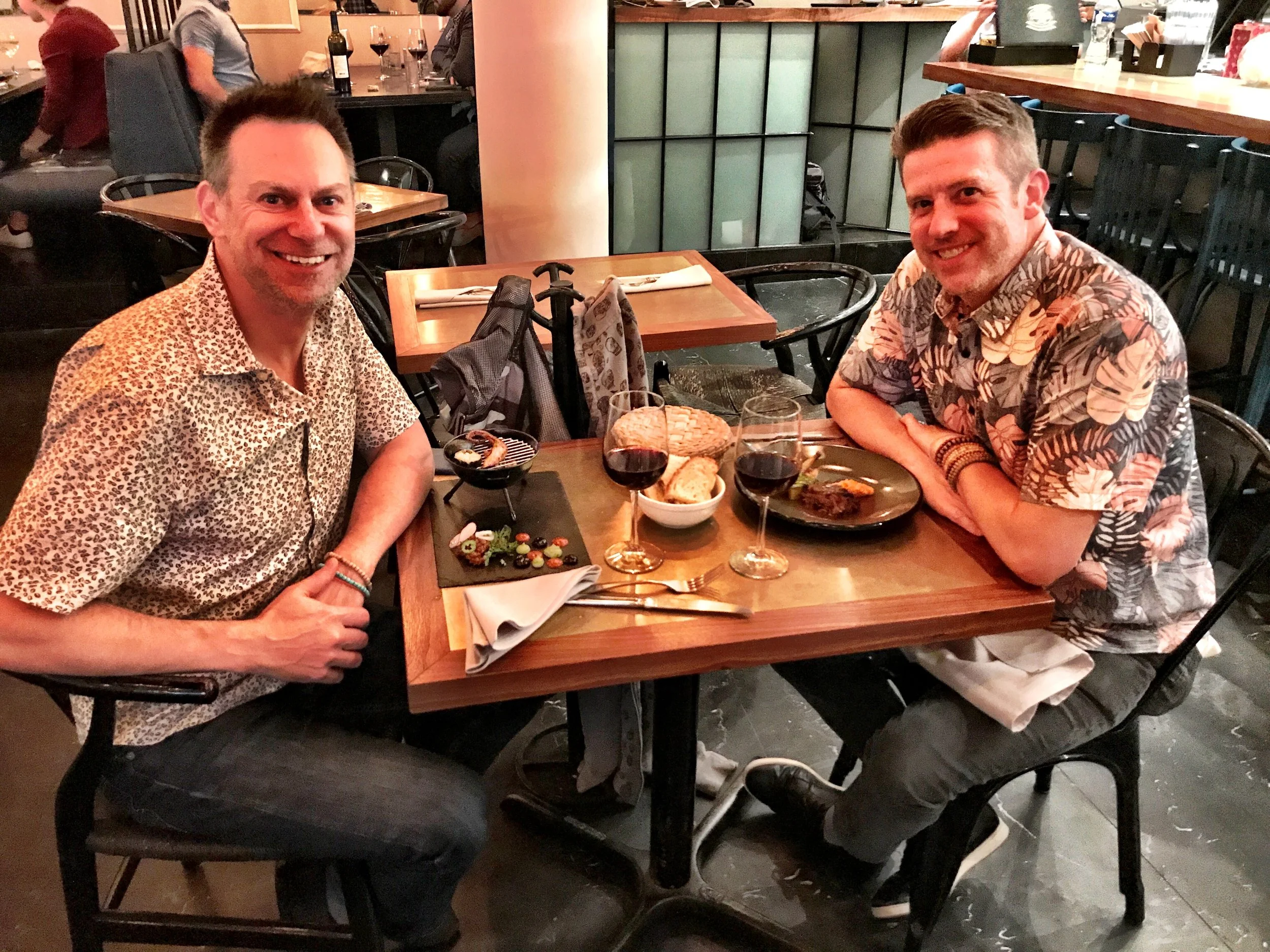
Wally and I had a delightful evening enjoying the smoky cuisine at Bowie in Mexico City’s Colonia Roma neighborhood. It was a wonderful experience and made a lasting impression on us. So much so that I decided to reach out to its chef de cuisine, Rodrigo Carrasco. To my surprise, he kindly accommodated my request to answer some questions and share his story about the origins of his “Kitchen of Smoke,” why it was named after the British music icon David Bowie and what’s next on the horizon. –Duke

At our country house, we cooked on an open hearth. I saw the power of smoke and got the idea to open a restaurant cooking with smoke and coalfire in the coolest neighborhood in Mexico City.
— Chef Rodrigo Carrasco

bowiebar.JPG

READ OUR REVIEW OF BOWIE

Subtle smoke flavors, attentive service and a fun musical backdrop made Chef Carrasco’s Roma Norte restaurant our favorite dining experience in CDMX.


What inspired you to open Bowie?

At my family’s country house in Valle de Bravo, we cooked on an open hearth. I saw the power of smoke and got the idea to open a restaurant cooking with smoke and coalfire in the coolest neighborhood in one of the biggest cities in the world.

En la casa de campo en Valle de Bravo cocinando en una chimenea. Vi el poder del humo y dije háganos un restaurante de ahumado en leña y carbón. En la ciudad más grande del mundo en el barrio más cool.

A trip to Texas helped inspire Carrasco to perfect his barbecue methods. Photo by Juan Carlos Valladolid

A trip to Texas helped inspire Carrasco to perfect his barbecue methods. Photo by Juan Carlos Valladolid

What’s your connection to David Bowie?

While traveling through Texas to learn about the various BBQ methods, I came across a county named Bowie, where the Bowie knife was created, and I’d been listening to the music of David Bowie. I didn’t need anything else to know that Bowie would be the name.

Bowie por qué estaba investigado en Texas el proceso del BBQ y llegue a un condado llamado Bowie, había un bowie knife y el playlist era de David Bowie. Dije no hay más bowie será su nombre.

When Carrasco’s not cooking seafood, he’s probably working with steak

When Carrasco’s not cooking seafood, he’s probably working with steak

Where’s the beef? Carrasco serves it up at his steakhouse, Tirano

Where’s the beef? Carrasco serves it up at his steakhouse, Tirano

Describe the aesthetic and mood of the restaurant.

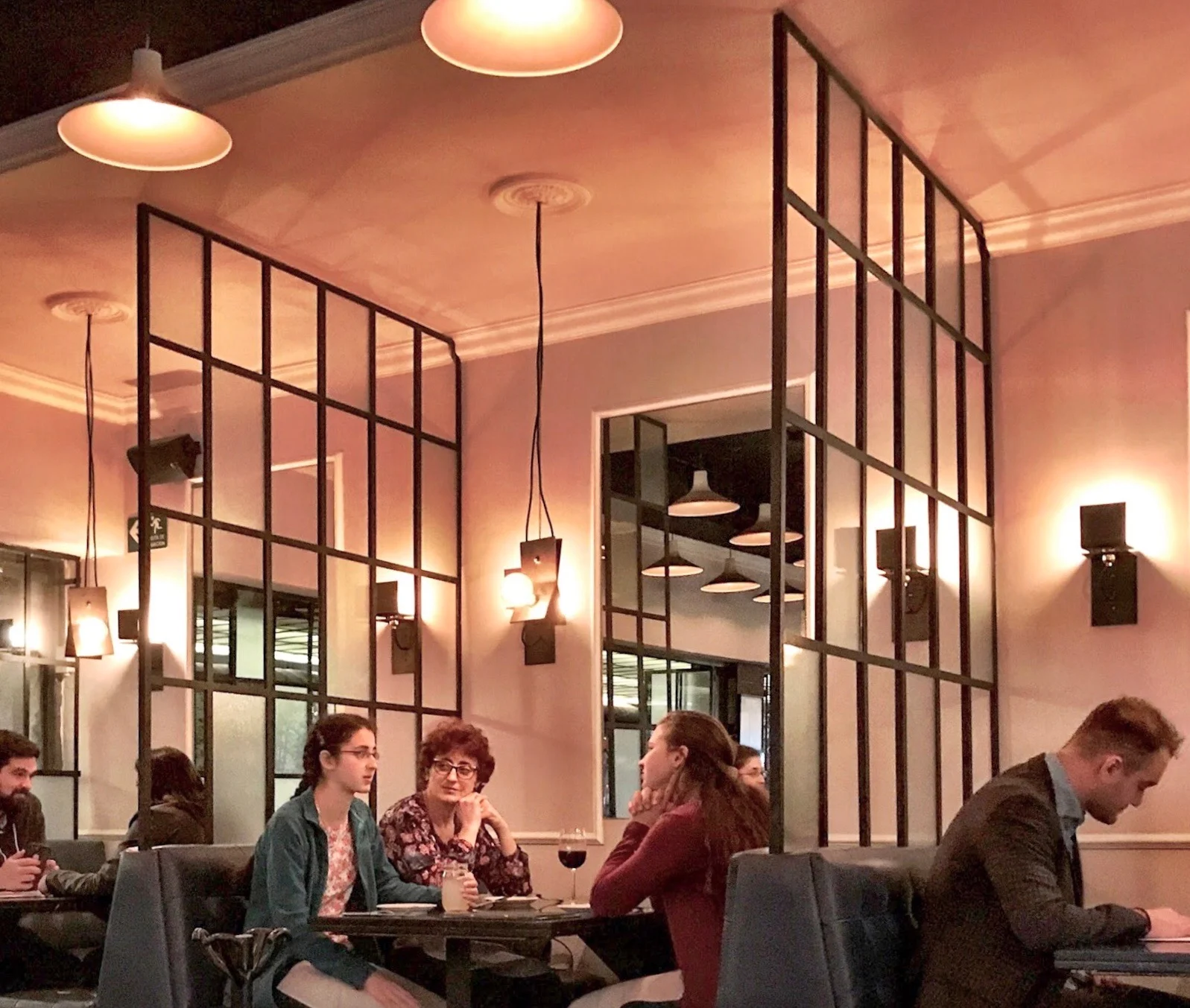
It’s a contemporary Mexican space. Relaxed, but with elegant design touches, and a kitchen that’s visible from virtually anywhere within the restaurant. I love immersing diners in a theatrical experience.

Un espacio mexicano contemporáneo. Relajado pero con toques de diseño elegantes. La posibilidad de ver la cocina desde todo el lugar me encanta es involucrar a los comensales en una experiencia teatral también.

The chef’s recipes have been perfected over more than two decades of cooking

The chef’s recipes have been perfected over more than two decades of cooking

How did you determine the menu?

It’s a compilation of my best recipes after cooking for more than 20 years: European-inspired ingredients and techniques with a Mexican twist. Always with smoke as the foundation.

Es una compilación de mis mejores recetas luego de cocinar por más de 20 años. Siempre con el humo como fundamento e ingrediente y técnicas mexicanas y europeas.

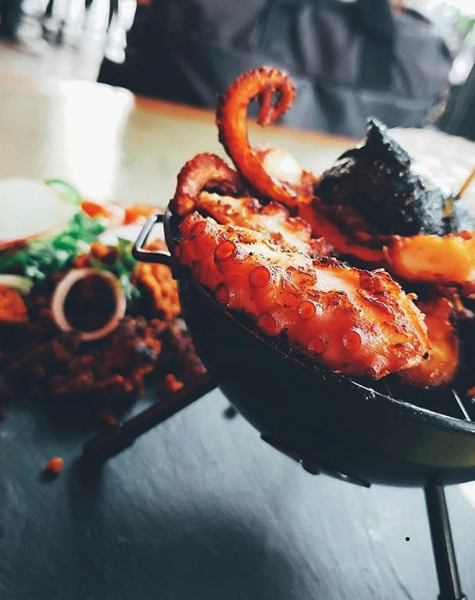
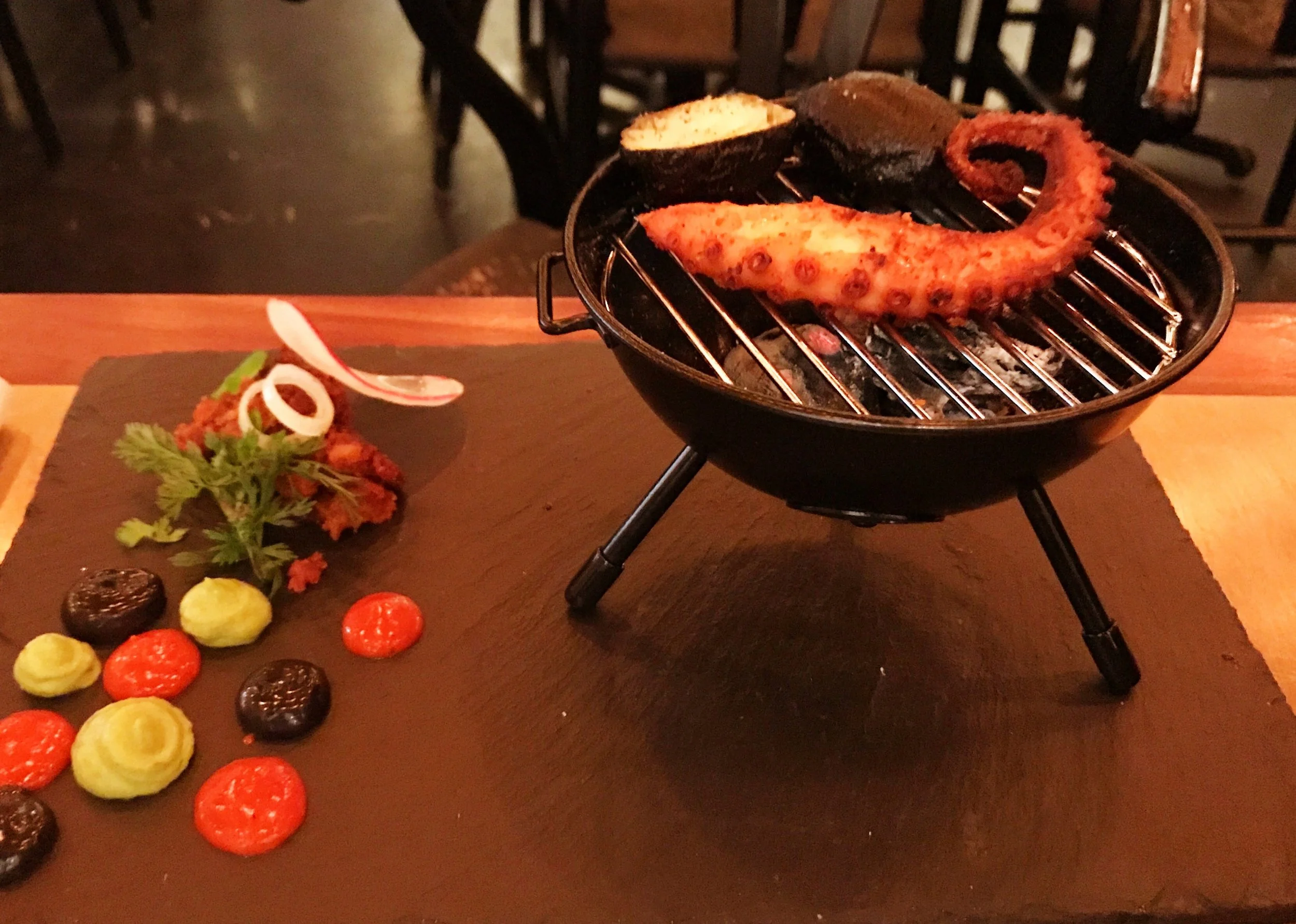
The pulpo, or octopus, at Bowie is served up on the cutest little grill ever

The pulpo, or octopus, at Bowie is served up on the cutest little grill ever

What’s your favorite thing to cook?

Fish and seafood.

Los pescados y mariscos.

If Chef Carrasco cooks it, chances are it’ll be divine

If Chef Carrasco cooks it, chances are it’ll be divine

Where do you find your inspiration?

Music, nature, my Mexican heritage and to let the world know that there’s good cuisine and world-class restaurants in CDMX. That’s what inspires and motivates me.

La música, la naturaleza, mi cultura mexicana, hacerle saber al mundo que en CDMX hay buena cocina y restaurantes de buen nivel. Eso me inspira y me motiva.

How do you choose the music that plays at Bowie?

We have several playlists, I believe. I love music and am always tinkering with it, depending on the day, time and clientele.

For example, on Sundays we get families and grandparents who sing along to the classics of the ’60s. The young people also know these songs. But on Thursday nights we have an ultra hip clientele who prefer house, soul or something more progressive that allows them to dine, drink and enjoy the beat.

These are the basics with the music, and obviously there’s a lot of David Bowie on all the playlists.

Tenemos varios playlist que yo creo. Amo la música y siempre estoy renovando esa parte; la ponemos dependiendo del día, la hora y el target de cliente.

Por ejemplo, el domingo es muy familiar y hacemos que los abuelos canten los clásicos de los 60s y los jóvenes lo conocen, pero los jueves en la noche tenemos clientes ultra cool, que se sienten mejor con el house, el soul, y algo progresivo que les permita beber y disfrutar el beat.

Es así la mecánica con la música, obviamente hay mucha presencia de David en todas las playlist.

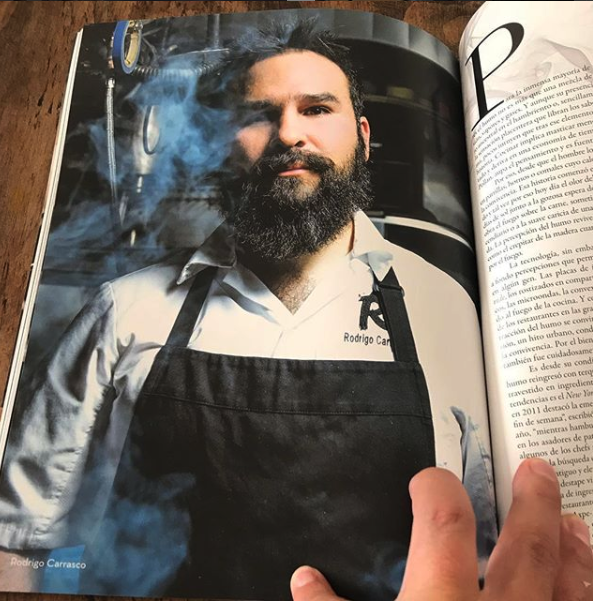
Carrasco garners some press

Carrasco garners some press

What’s next for you?

I’m the co-owner of two other concepts: Tirano, which is a Mexican steakhouse that’s also in Roma, and Kitchen6, a gastropub on Amsterdam in La Condesa that serves grilled food. In addition, our group is planning on opening a torteria sandwich shop later this year.

Si soy co propietario de otros dos conceptos. Tirano, que es un asador mexicano que reubicamos en la Roma también; y Kitchen6 un gastropub que está en Condesa en Amsterdam, que es cocina de grill. En el grupo, planeamos la apertura de una torteria este año de igual forma.

Bowie: One of the Best Restaurants in Mexico City

Chef Rodrigo Carrasco works his magic with a delicious smoke-themed menu at our favorite CDMX dinner spot.

The chic interior, fun playlists and attentive service helped make Bowie our best dining experience in CDMX.

The chic interior, fun playlists and attentive service helped make Bowie our best dining experience in CDMX.

Instead of a Thanksgiving dinner of turkey, stuffing, cranberry sauce and mashed potatoes, Wally and I decided to take a trip to Mexico City. If we were going to miss the traditional American meal, we wanted something equally delicious. So we took the suggestion of Magda, a manager at the Ignacia Guest House, where we were staying, and decided upon Bowie.

The restaurant is a stone's throw from Avenida Álvaro Obregón, the main thoroughfare in the hip Roma Norte neighborhood. Named after the memorable performer, Bowie is the creation of Mexican chef Rodrigo Carrasco.

Bowie straddles the line between restaurant and theater.

The dish arrived under a glass dome, concealed by a miniature cloud that hung motionless before vanishing in a wisp of woodsmoke.

This distinctive dining establishment is modern and fashionable, but not pretentious, and is devoted to using smoke as the foundation of all of its dishes — in fact, the words “Cocina de Humo” illuminate one of the walls. And you can’t miss the fantastic, custom-created portrait of David Bowie as Ziggy Stardust made entirely from bottle caps.

Almost all of the dishes are smoked — but not overwhelmingly so.

Almost all of the dishes are smoked — but not overwhelmingly so.

The restaurant was already buzzing when we arrived, around 8ish. Diners can choose to order à la carte from the menu, but we decided to try the seven-course tasting menu and drink pairing. The first course of beet carpaccio arrived under a glass dome, concealed by a miniature cloud. It hung motionless in the air for a moment before vanishing in a wisp of woodsmoke once our server removed the lid with flair.

The visual appeal was matched by the deliciousness of the dish. The delicately flavored beets were topped with savory goat cheese offset by a surprising hit of brightly tart lemon dressing. A single bite — and boom! We had fallen in love with Bowie. We had never tasted anything like this, and it was just the beginning.

The dramatic reveal of the beet appetizer. Photo by Jordana Btp

The dramatic reveal of the beet appetizer. Photo by Jordana Btp

Our first couple of courses were paired with an artisanal Mexican IPA. We don’t typically like American IPAs as they’re too hoppy, but this one tasted like a farmhouse ale — more our speed.

The following courses were served with Blanc de Pacs, an organic white wine from Penedès, Spain, and Bolero, a Mexican red blend from Valle de San Vicente in Baja California Sur.

Beyond the bar, you can peek into the kitchen at Bowie.

Beyond the bar, you can peek into the kitchen at Bowie.

Bowie straddles the line between restaurant and theater, and it quickly became clear that we were about to embark on a culinary adventure.

The pulpo came on an adorable tiny grill.

The pulpo came on an adorable tiny grill.

The truffled steak tartare was served in a vessel reminiscent of a glass mushroom. Filled with bite-size chunks of red meat and portobello mushrooms, it was like eating your way through an ethereal terrarium.

Another standout was the slow-cooked short ribs with a smoked pumpkin purée, dressed with a whiskey reduction sauce. It was smoky and sweet, and immensely satisfying.

The dessert, a riff on s’mores, arrived near the end of the tasting menu. Served it a small cast iron skillet, it was utterly delicious and topped with housemade marshmallows, layered with bananas, chocolate and a shortbread crust, toasted by our server with a handheld butane torch.

Duke and Wally absolutely loved their experience at Bowie.

Duke and Wally absolutely loved their experience at Bowie.

In short, this incredible meal set a high bar and made us feel like kids again — though our adult palettes delighted in the impressive sophistication of the dishes as well. A meal at Bowie is an experience we would be happy to have any day. –Duke

NOTE: We heard that, sadly, Bowie has permanently closed.

Grab a bite at Bowie — especially if you’re in the Roma neighborhood of Mexico City.

Grab a bite at Bowie — especially if you’re in the Roma neighborhood of Mexico City.

Bowie
Córdoba 113
Roma Norte
06700 Ciudad de México
CDMX, Mexico


Biblioteca Vasconcelos: A Futuristic Architectural Marvel

Architect Alberto Kalach’s amazing library in Mexico City contains bookshelves that hang from the ceiling, and a whale bone sculpture by artist Gabriel Orozco.

Off-the-beaten-path CDMX: la Biblioteca Vasconcelos

Off-the-beaten-path CDMX: la Biblioteca Vasconcelos

After a visit to the labyrinthine and often-claustrophobic Mercado de Sonora Witch’s Market, Duke and I took a short Uber ride to the Biblioteca Vasconcelos in the Colonia Buenavista neighborhood. Dedicated to José Vasconcelos, a Mexican writer, philosopher and politician, the library’s interior is unlike anything you’ve ever seen.

Story after story of metal and glass bookcases defy logic, floating above like a science fiction version of Hogwarts.
Wally and Duke in ecstasy: Who needs to go to church when you’ve got a library like this?

Wally and Duke in ecstasy: Who needs to go to church when you’ve got a library like this?

The interior is like stepping into an M.C. Escher drawing

The interior is like stepping into an M.C. Escher drawing

Don’t Judge a Book by Its Cover

From the building’s exterior — a fortress of concrete and steel grillwork — you’d never imagine the airy futuristic interior within. However, getting into the hallowed repository of knowledge was a bit tricky. Initially, Duke and I saw the gaping maw of the parking garage and wondered if we had to enter there. We skirted around to the right of the building in an attempt to gain access. When we realized there wasn’t an entrance there either, we paused to ask a local who was walking his dog. He gestured to the left side of the library. We thanked him and made our way over to a courtyard with a couple of smaller buildings and the main entrance.

The exterior of the library isn’t too impressive — but just wait till you step inside!

The exterior of the library isn’t too impressive — but just wait till you step inside!

When we first stepped foot inside the 400,000-square-foot Biblioteca Vasconcelos, designed by Mexican architect Alberto Kalach, we could barely contain our giddiness. We looked around in wonder, our necks craning in every direction.

The floating stacks are a novel way, pun intended, to display books

The floating stacks are a novel way, pun intended, to display books

Story after story of metal and glass bookcases defy logic, while simultaneously offering a sense of complete order, floating above like a science fiction version of Hogwarts. Thin steel beams seem barely able to support the monumental stacks filled with books. Hazy silhouettes of patrons can be glimpsed through translucent sea-green catwalks.

Greenish-blue semitranslucent walkways connect the stacks

Greenish-blue semitranslucent walkways connect the stacks

Seating areas seen from across the expanse

Seating areas seen from across the expanse

We felt as though we had entered a sacred space, one that evoked the same reverence of the organic space-age architecture of La Sagrada Família church in Barcelona, Spain.

The exhibit Vientos de Japón (Winds of Japan) by master calligrapher Ryuho Hamano was on display when we visited

The exhibit Vientos de Japón (Winds of Japan) by master calligrapher Ryuho Hamano was on display when we visited

Duke daring to lean against the thin wire railing

Duke daring to lean against the thin wire railing

Wally chose a more secure spot for his portrait

Wally chose a more secure spot for his portrait

Sunlight plays a major role at the Biblioteca Vasconcelos, filling the interior with natural light. Ingenious louvered glass panels soften the sun's rays and keep the library from getting too hot.

The far ends of the library offer expansive views of the city

The far ends of the library offer expansive views of the city

As we passed by the first floor patios, we saw teens practicing dance routines, mimicking the choreography seen in some pop star’s latest music video. Beyond them, we could see the sprawling botanic garden that surrounds the structure. During our stay in Mexico City, we saw chilangos of all ages, from teens to seniors, dancing in public spaces.

A botanic park surrounds the structure

A botanic park surrounds the structure

Whenever I got too close to the cable rails on the upper floors of the library, my head would spin with vertigo. It became clear that this was a library for the brave. God forbid I needed a book located at the end of one of these stacks.

Looking down at Gabriel Orozco’s hanging sculpture, Mobile Matrix

Looking down at Gabriel Orozco’s hanging sculpture, Mobile Matrix

A Whale of a Time: Orozco’s Mobile Matrix

Hovering above the central atrium hall is the striking Mátrix Móvil (Mobile Matrix in English), an intricately inscribed gray whale skeleton fitted onto a metal armature. Conceptual artist Gabriel Orozco and his team used over 6,000 mechanical pencils to etch concentric circles onto the bones, which stretch over 38 feet long. I learned that the whale had died after beaching itself on the Baja Peninsula during a migratory trip along the Mexican Pacific coast. The art piece adds a museum-like quality to the space.

A peek at the whale bone sculpture

A peek at the whale bone sculpture

There’s a lot to see in Mexico City, but the Biblioteca Vasconcelos is worth adding to your itinerary. It’s quite close to CDMX’s historic Centro. And when you’re done exploring this modern marvel (and have taken copious amounts of photos), head past the Buenavista rail and bus station and cross the overpass that spans the bustling Avenida Insurgentes. A 10-minute walk straight down Calle Salvador Díaz Mirón will bring you to the colorful Kiosco Morisco in the nearby Santa María la Ribera neighborhood. –Wally

A forest of paper cylinders with Japanese kana characters on display at the entrance

A forest of paper cylinders with Japanese kana characters on display at the entrance

Duke poses in front of the art exhibit

Duke poses in front of the art exhibit

There are elevators for those who don’t want to walk up all those stairs

There are elevators for those who don’t want to walk up all those stairs

One of the rooms along the sides of the library was filled with women knitting a cool cactus

One of the rooms along the sides of the library was filled with women knitting a cool cactus

Peek-a-boo! Duke looks through one of the stacks near the edge of the railing

Peek-a-boo! Duke looks through one of the stacks near the edge of the railing

Biblioteca Vasconcelos

Mosqueta
Eje 1 Norte S/N
Buenavista
06350 Ciudad de México
CDMX, México