The Best Place to Make Out in Public in Delhi

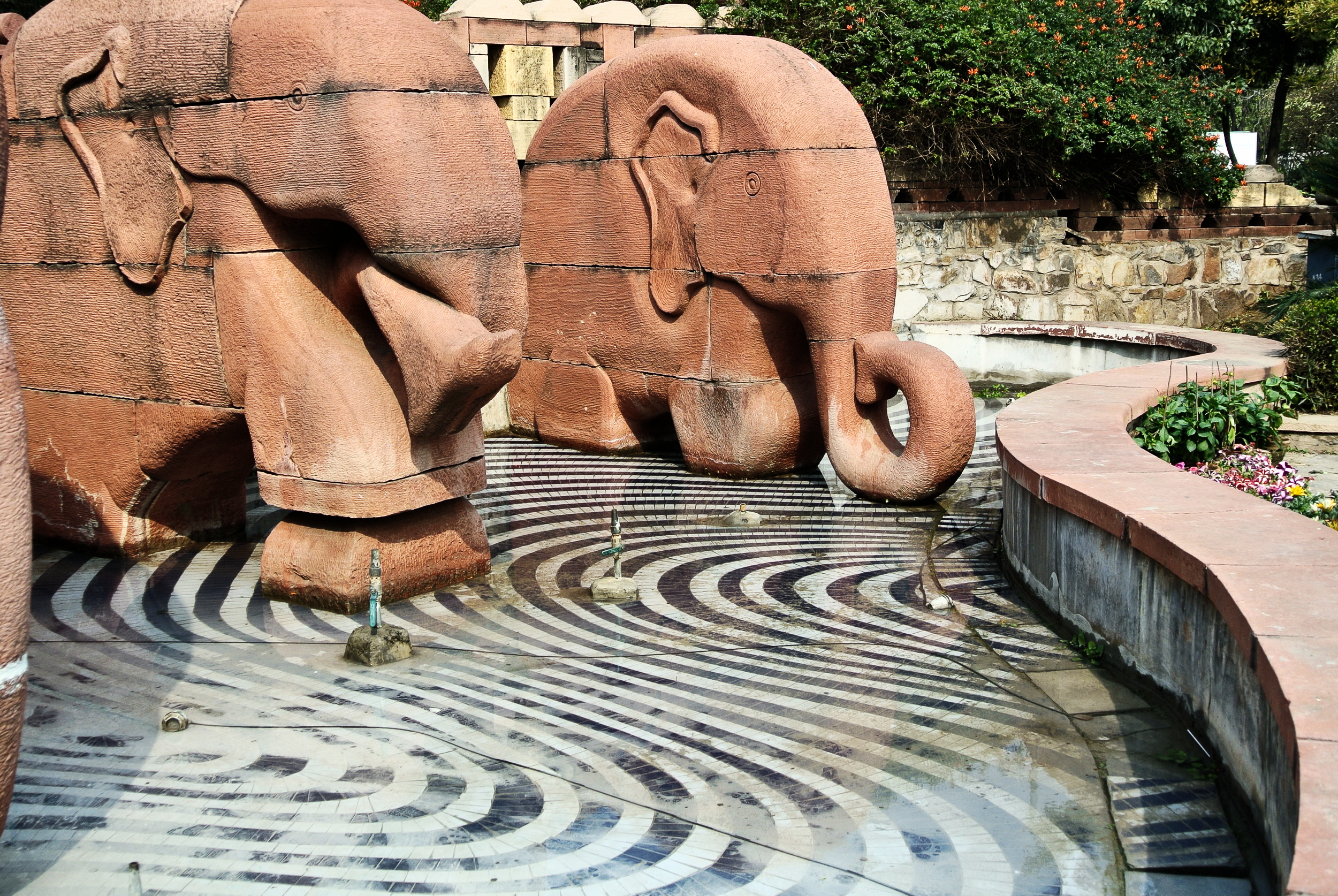
These elephants greet you upon entering the Garden of Five Senses in Delhi

These elephants greet you upon entering the Garden of Five Senses in Delhi

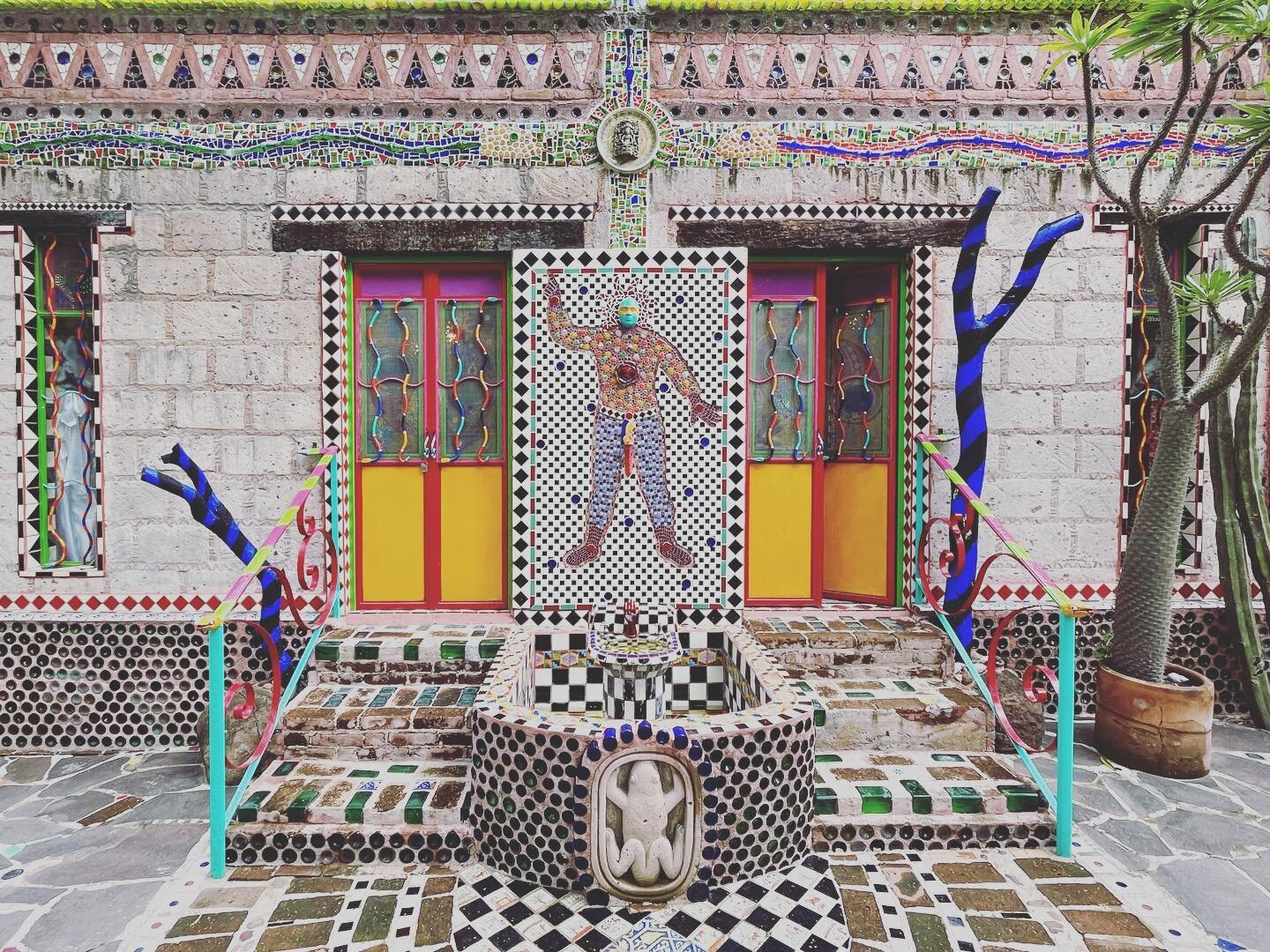
Not a typical tourist stop, the Garden of Five Senses is a whimsical sculpture park worth visiting. It's also popular with local couples escaping societal judgment against PDA.


Congestion does not begin to describe traffic in Delhi. It follows its own logic, and yet somehow, miraculously, it works — blowing horns and all. A red light means you might want to consider stopping. Or not.

Driver: Obama came for visit. Business relationship is very good. China is very jealous.

This was clearly a spot favored by amorous young couples.

Wally noticed a sign for the Garden of Five Senses and we asked our driver to take us there. He referred to it as Honeymoon Park. He thought we were crazy to want to go there.

Young couples were aggressively pushing past us to purchase tickets to gain admission. In addition to admission fees for sites in India, many have an additional photography fee that you have to pay if you want to take pictures inside the site. We were not permitted to enter the park without a photography permit.

This was clearly a spot favored by amorous young couples to spend time away from the public eye, tucked into the privacy of shadowed archways or behind a curved wall, locked in an embrace and kissing. I felt that we had entered a subworld, as Indian society is generally conservative, especially in regards to public displays of affection. Ironically, there's a sign on the ticket kiosk exclaiming in capital letters, PLEASE MAINTAIN DECENCY.

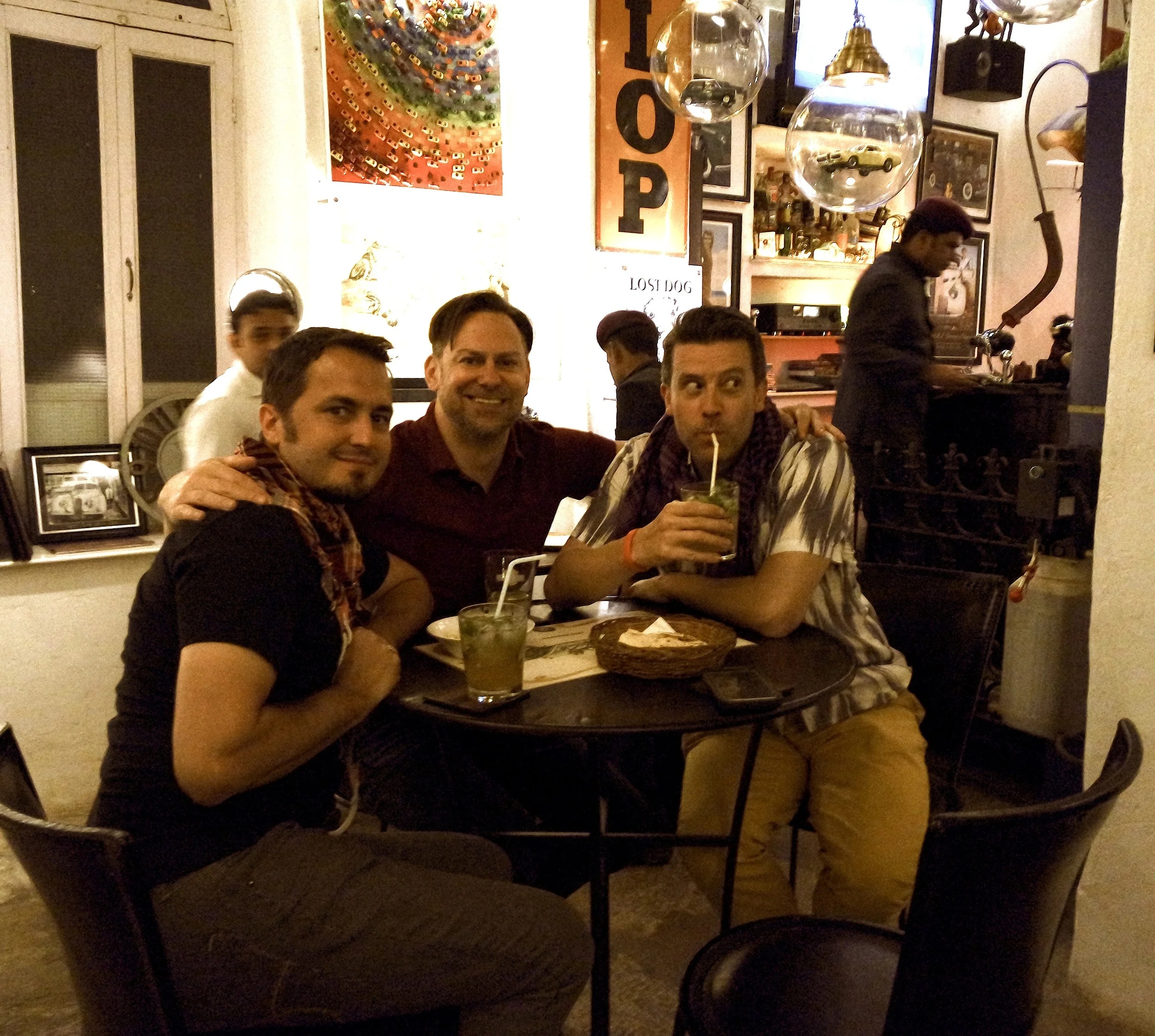
Duke in the Garden of Five Senses. Note the couple(s) hidden in the nook below

Duke in the Garden of Five Senses. Note the couple(s) hidden in the nook below


A random highlight was a colorfully decorated camel, which is apparently available for rides.

Overall, the park is fun to explore, with a variety of styles of statues. You feel a bit like Alice in Wonderland, never knowing what lies ahead.


Children of the Street

Back in the car, two children performed on a narrow packed dirt median while our car was paused at a light. The young boy beat a tabla drum, while the young girl proceeded to execute three perfect back flips. Wally rolled down the window and gave her 4 rupees, which she took and ran ahead.

Our driver smiled and looked at Wally in the rearview mirror. He explained that the government pays for two children to go to school, but since families often end up having more than two children, the others are forced to beg for money. –Duke

You feel a bit like Alice in Wonderland, never knowing what lies ahead.

3 Tips for Hiring a Driver in India

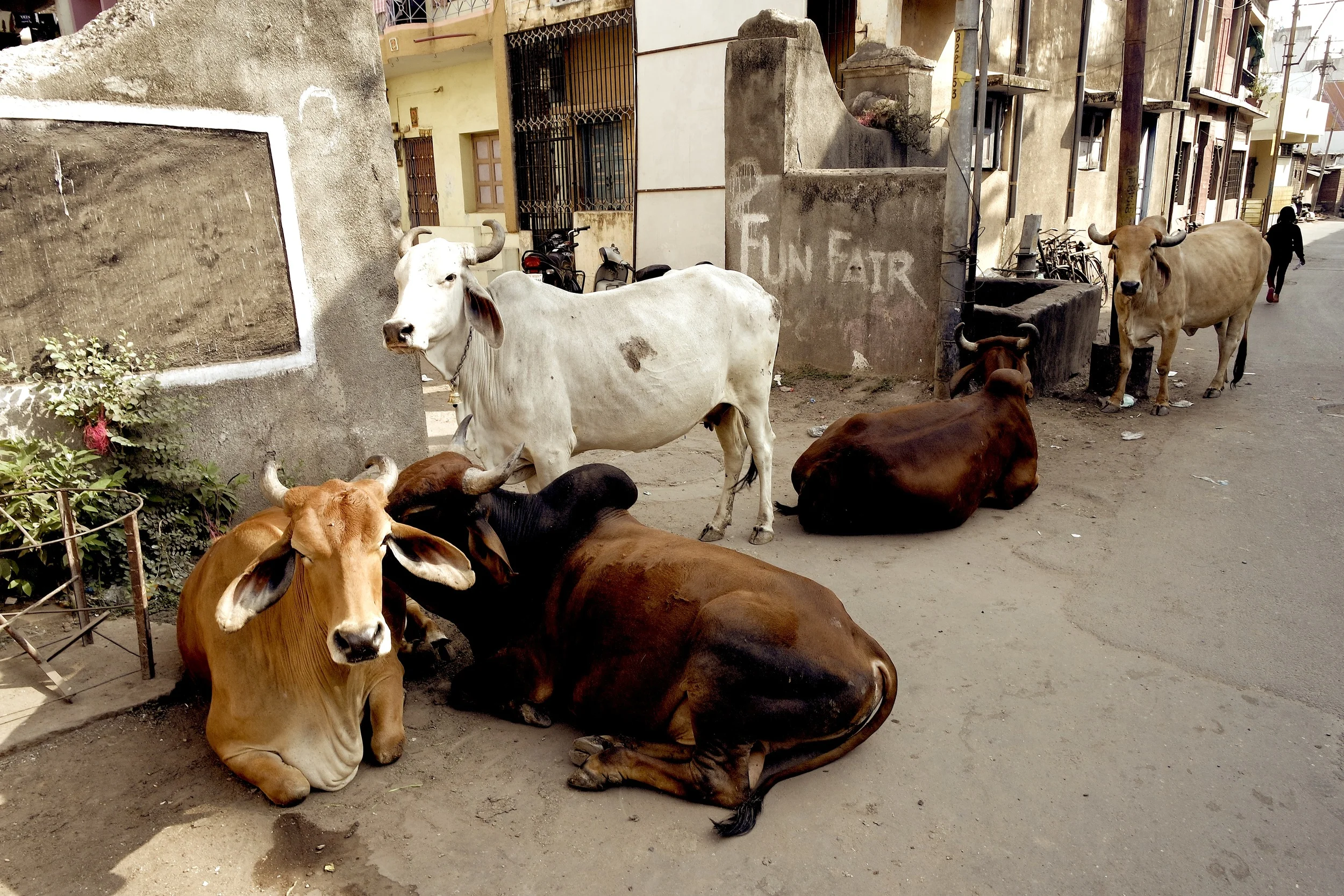
In Baroda, as in all of India, you'll be sharing the road with cows

In Baroda, as in all of India, you'll be sharing the road with cows

Commissions and conversations: what to expect from your hired drivers.


The next morning we enjoyed parantha and pao bhurji for breakfast. Our friend George later explained that pao means bun.

We followed the same routine as the day before and stopped by the tourist office above Amici Cafe, except that instead requesting a return to our hotel, we required transportation to the airport.

As shocking as this might be, we decided to skip the Taj Mahal.

We packed up our luggage and put it in the back. Our driver asked us where we wanted to go. We told him Qutb Minar and Hauz Khas Village. He asked why we wanted to go to Hauz Khas, telling us, “It's very expensive, no negotiation, fixed prices.” We told him that we were looking for handicrafts, preferably old and/or painted wood, and he assured us that he had a special place to take us to should we like.
 

You'll be taken to shops where they'll expect you to buy something — and will be upset if you don't.

We've come to accept that a hired driver is likely to take you to patronize businesses where they make a commission. The shop usually pays the guide if the tourist makes a purchase. In our case, we were a hard sell, and our driver was clearly expecting us to make more purchases. He would click his tongue when we left a shop he took us to empty-handed.


Sometimes it's easier to lie.

We were asked by both of our drivers how long we were going to be in India and if we had plans to see the Taj Mahal? As shocking as this might be, we decided to skip the Taj Mahal. We know it's the pride of India and all that — but we had other things we wanted to see on this trip. 

Almost everyone we met asked us if we were visiting the Taj, and we found it easier to lie and just say yes rather than face their indignation.


Don't let them tell you where to go.

We agreed to skip Hauz Khas (a decision we would live to regret), and our driver took us to a shop located beneath a flyover. According to the gentleman who greeted us, we were the first customers, and as such, he would offer us a very fair price. We politely told him that we were just looking and attempted to wander through unmolested. But this proved to be impossible as we were the sole customers.

We attempted to have a genuine conversation with our salesman, and he told us a story about a rabbit as big as a donkey.

The shop had many beautiful things, but most of them were at a price well above what we had been looking to spend. We did end up purchasing a figurine of Krishna and his consort Rada, though.

Tomb of Safdarjung in Delhi

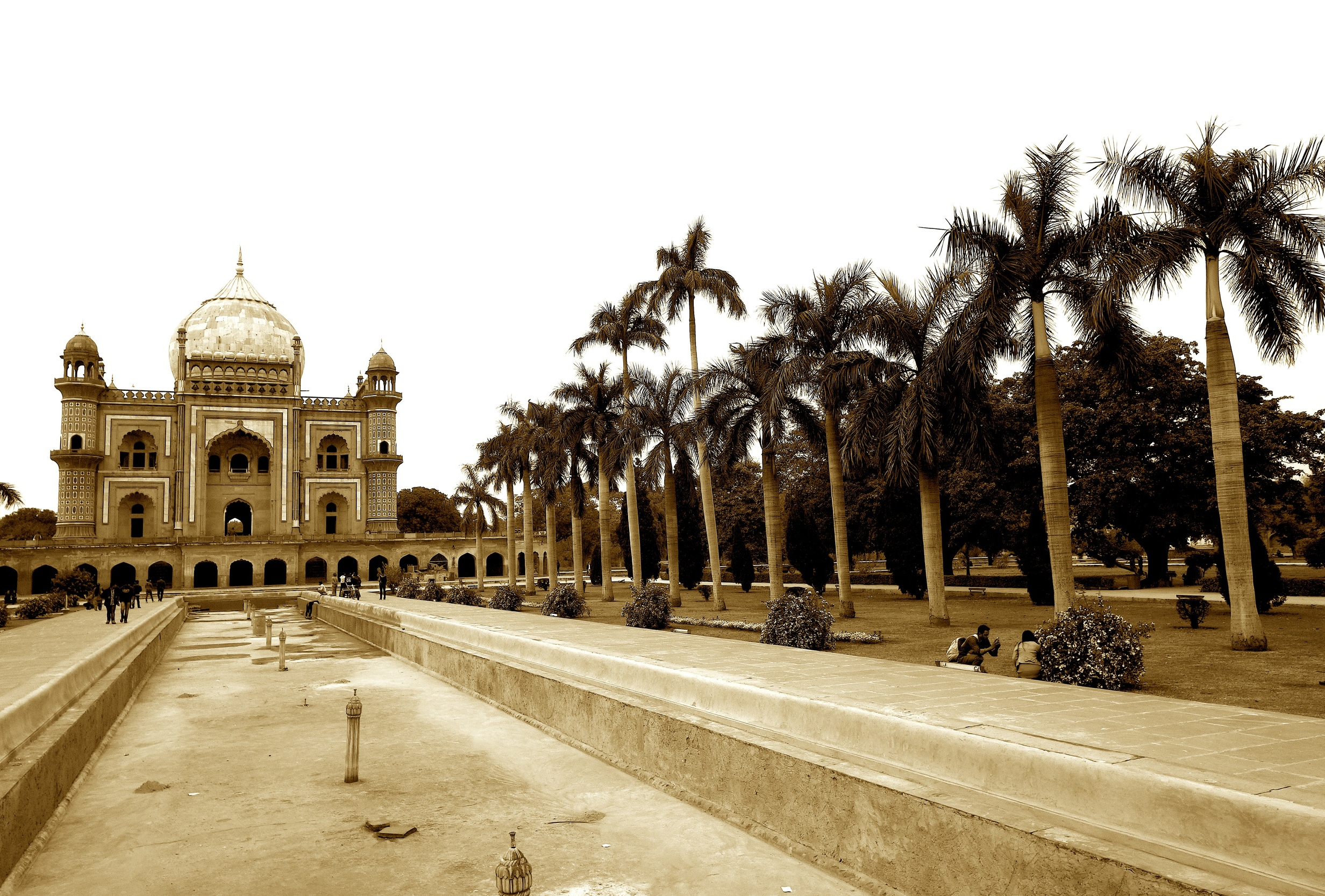
The empty pool at Safdarjung's Tomb in Delhi, India reveals its neglected state

The empty pool at Safdarjung's Tomb in Delhi, India reveals its neglected state

Safdarjung's Tomb is a less-busy attraction that's worth exploring.

We enjoyed this historical site immensely as it was less-visited than the other destinations we had been to. Built in 1754, the red and buff-colored sandstone mausoleum of Safdarjung's Tomb is the last grand tomb of late Mughal architecture. The majestic double-storied entrance gate, with its vaulted archway, created the perfect frame for the main tomb inside.

While previous, wealthier Mughal nobility used marble for their monuments, Safdarjung's son Shuja-ud-Daula plundered what he could from other nearby tombs, and the marble applied to the surface of the onion-shaped dome looks like an unfinished jigsaw puzzle with patches of pink sandstone showing through.

The onion-shaped dome looks like an unfinished jigsaw puzzle with patches of pink sandstone showing through.

At the center of the tomb is a large chamber with arched doorways which contains the white marble cenotaph of Safdarjung. It's eerie. 


A young boy plays with a wheel while a man uses his wheels to carry materials for restoration at the Tomb of Safdarjung

A young boy plays with a wheel while a man uses his wheels to carry materials for restoration at the Tomb of Safdarjung

We wandered around and watched a young boy playing with a wheel he had found, treating it like the best toy ever. –Duke


Delhi's Shopping Extravaganza: Dilli Haat

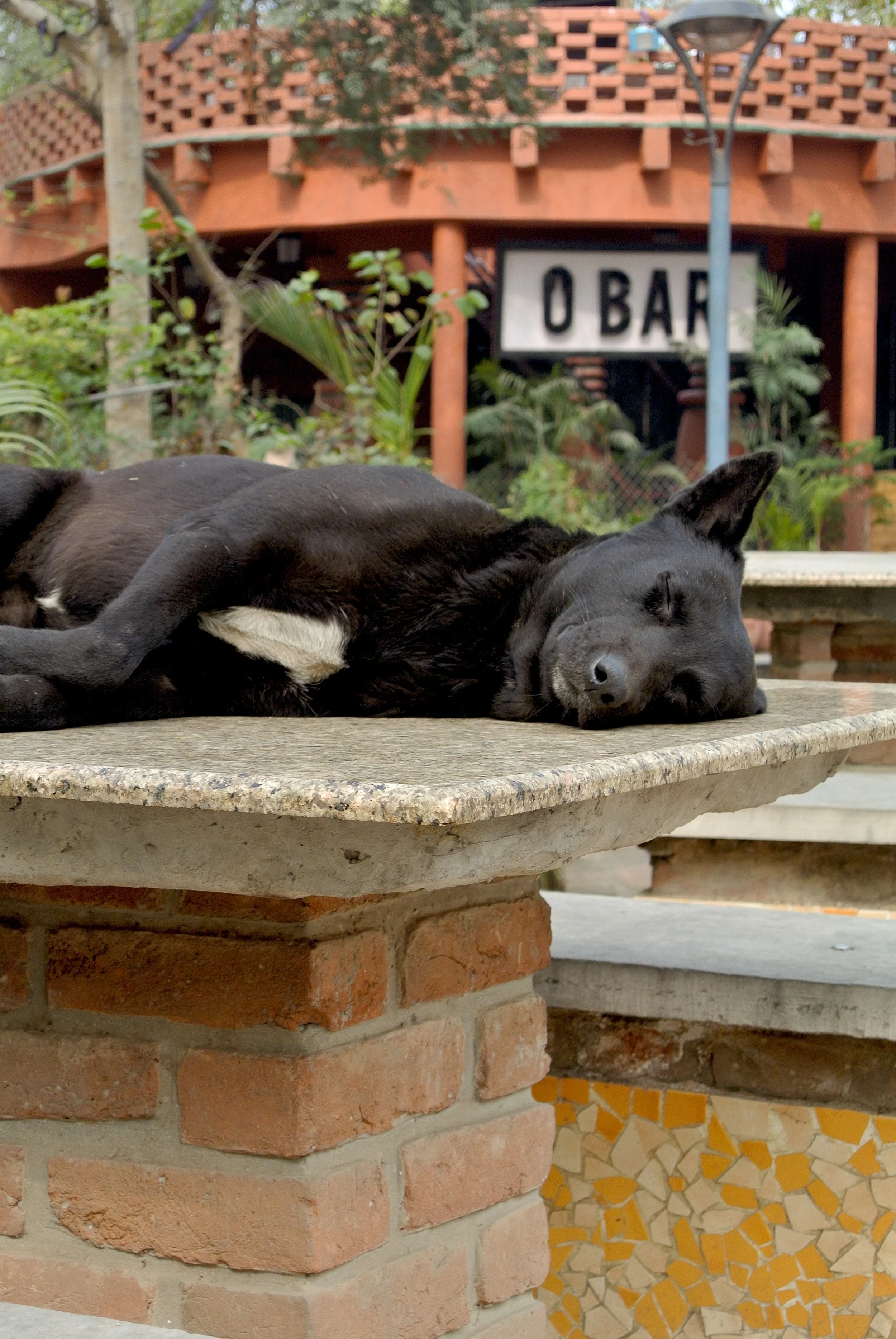
A stray dog sleeps atop a table in the Garden of Five Senses

A stray dog sleeps atop a table in the Garden of Five Senses

How bazaar! Crafts galore at Delhi's large outdoor market.


We met our driver for the day in the parking lot and set out for the open-air craft bazaar known as Dilli Haat. Beggars used paused vehicles as an opportunity to solicit money. Under the flyover, hijras, India's transgendered male-to-females, walked amongst cars, extending outreached hands.

Three women traversed the sidewalk on Lodhi Road. One of them carried a long bamboo rod with a wire hook secured to one end. I asked our driver if they were pruning the trees. He laughed and told me that they were extracting dead branches to use in cooking fires.

We found the best deals and merchandise in the actual store at one end of the bazaar — no bargaining required.

By the time we arrived at Dilli Haat, Wally and I were both quite hungry and made our way to the food kiosks.


Bobble Heads

As compared to Western traditions, the Indian head wobble lies somewhere between a nod and a shake. They move their heads from side to side like an erratic metronome. Meanings are unclear and include “yes," “good,” “maybe” or “OK." So, basically anything.
There was a woman dressed in a brightly colored sari with a traditional golden nath (nose ring) who appeared to be waiting in line. As I wanted to be polite, I made a gesture to indicate that I wasn't attempting to cut in line. She smiled and wobbled her head, which I took as an indicator that it was OK for me to move ahead.

Not knowing what to order, we observed the locals and followed their lead. We ordered two dosa — savory, thin, crisp Indian crepes — donut-shaped vadas and veggie samosas. In India it is customary to eat with your right hand. The left hand is considered to be unclean as it's associated with going to the bathroom. This was a bit of a challenge to me, as I am left-handed. But I persevered.

We wandered the stalls but found the best deals and merchandise in the actual store at one end of the bazaar — no bargaining required. The vendors here weren't as concerned with making sales and wouldn't come down much in price (unlike our experience in Morocco).

Returning to the parking lot to meet our driver, we walked past an area about the size of a football field that had the remains of large swaths of gauzy white netting. A cluster of oversized burnished gold vessels lay on the grass at what was most likely the entrance to the affair. We asked our driver what it was and he replied, “a wedding — very expensive.”

As we drove away, I noticed large area rugs, which had probably been used for the wedding, now washed and laid out in a cul-de-sac, drying in the midday sun. –Duke

Tips for Exploring Delhi’s Red Fort

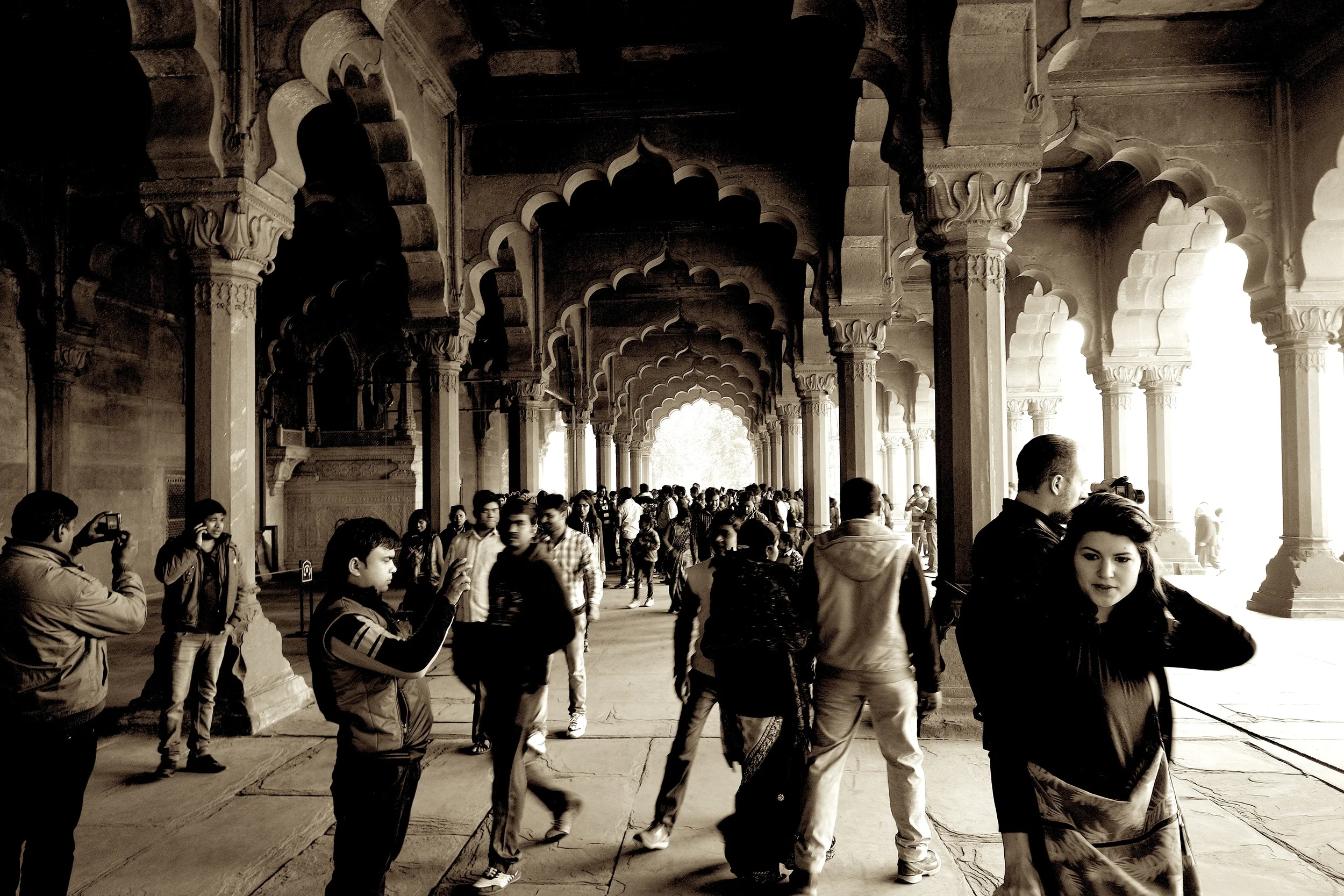
A crowded arcade at Delhi’s Red Fort

A crowded arcade at Delhi’s Red Fort

How to avoid a long line and hit the various sections of the expansive Red Fort (Lal Qila).


With all the crowds around the entrances of India’s major monuments, tourists can get confused about where to go — and the long lines can be daunting. But here’s a tip: Many attractions have two entrances — one for locals, which inevitably has a long line (and a reduced fee) and one for foreign tourists. 

We entered the fortress through the Lahori Gate and passed through the enclosed Chhatta Chowk shopping arcade, which was known as the Meena Bazaar during the reign of Emperor Shah Jahan. As women of nobility rarely ventured outside, the emperor wanted to create an enclosed market where they could shop, like the ones he had seen in Persia. The high-vaulted ceilings are covered in stucco with an intricately carved geometric honeycomb design.

Here’s a tip: Many attractions have two entrances — one for locals and one for foreign tourists.

The Red Fort was the main residence of Shah Jahan and was designed to impress visitors with its size and grandeur. In truth, many of the pavilions inside the fort were demolished after the British took control and replaced with military barracks, which were occupied until independence in August 1947 and subsequently inhabited by the Indian Army until 2002. Many of the remaining pavilions are in poor condition and due to a lack of conservation work, the Archaeological Survey of India has cordoned off many sections.

The long, narrow water channels, which intersect the complex, were dry and neglected, and large slabs of red sandstone lay tossed aside like hunks of discarded gingerbread.

We passed the exquisitely inlaid Diwan-I-Khas, where Shah Jahan would receive private guests. Unfortunately, it was closed off to the general public.

Every guidebook will tell you that the Red Fort is a must-see. But honestly, it wasn't our favorite spot in Delhi. Go in with lower expectations, knowing it's mostly run-down, with some nice colonnaded arcades. –Duke

Old Delhi Spice Market

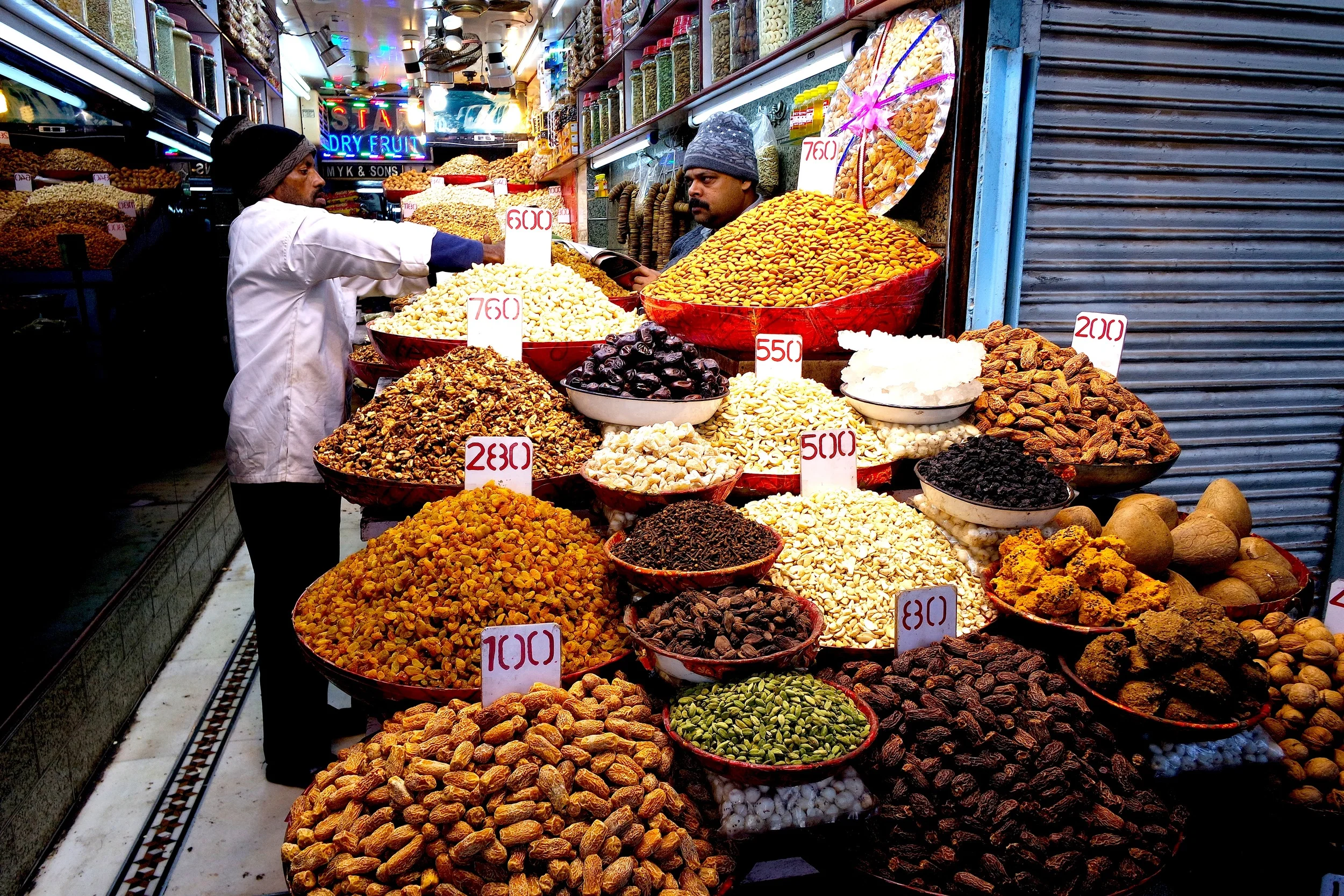
The Khari Baoli Spice Market also has plenty of nuts and dried fruits

The Khari Baoli Spice Market also has plenty of nuts and dried fruits

The fragrant wonderland of the Khari Baoli Spice Market.


Leaving the mosque, we got back onto the bicycle rickshaw, and Mohammed took us to the Khari Baoli Spice Market. He led us into one of the stalls he was probably familiar with (and might get a commission for bringing in customers).

When the shopkeeper appeared, he gave us each a small piece of cinnamon bark to chew on. It tasted slightly sweet but also spicy, like a stick of Big Red chewing gum, only with a distinctly more fibrous bite.

We met a Hindu who said the trouble between the two religions all comes down to the fact that Muslims want to eat their sacred cows.

He showed us a variety of unprocessed spices: clove, cardamom pods, coriander seeds, star anise and dried mango, which would later be ground into a powder called amchur, which adds a tart and sour note to Indian cuisine.

He also had peppers: black, white and Szechuan.

He had nutmeg and mace, which he explained come from the same tree. Nutmeg is the seed inside the fruit of the Myristica fragrans, an evergreen tree indigenous to the spice islands of Indonesia. Mace is the thin, lacy, garnet-colored membrane that envelops the nutmeg kernel and has a milder, slightly peppery flavor.

The spice vendor concluded his presentation and produced a variety of cellophane-wrapped curry blends. We purchased some garam masala, thanked him and continued on our journey.


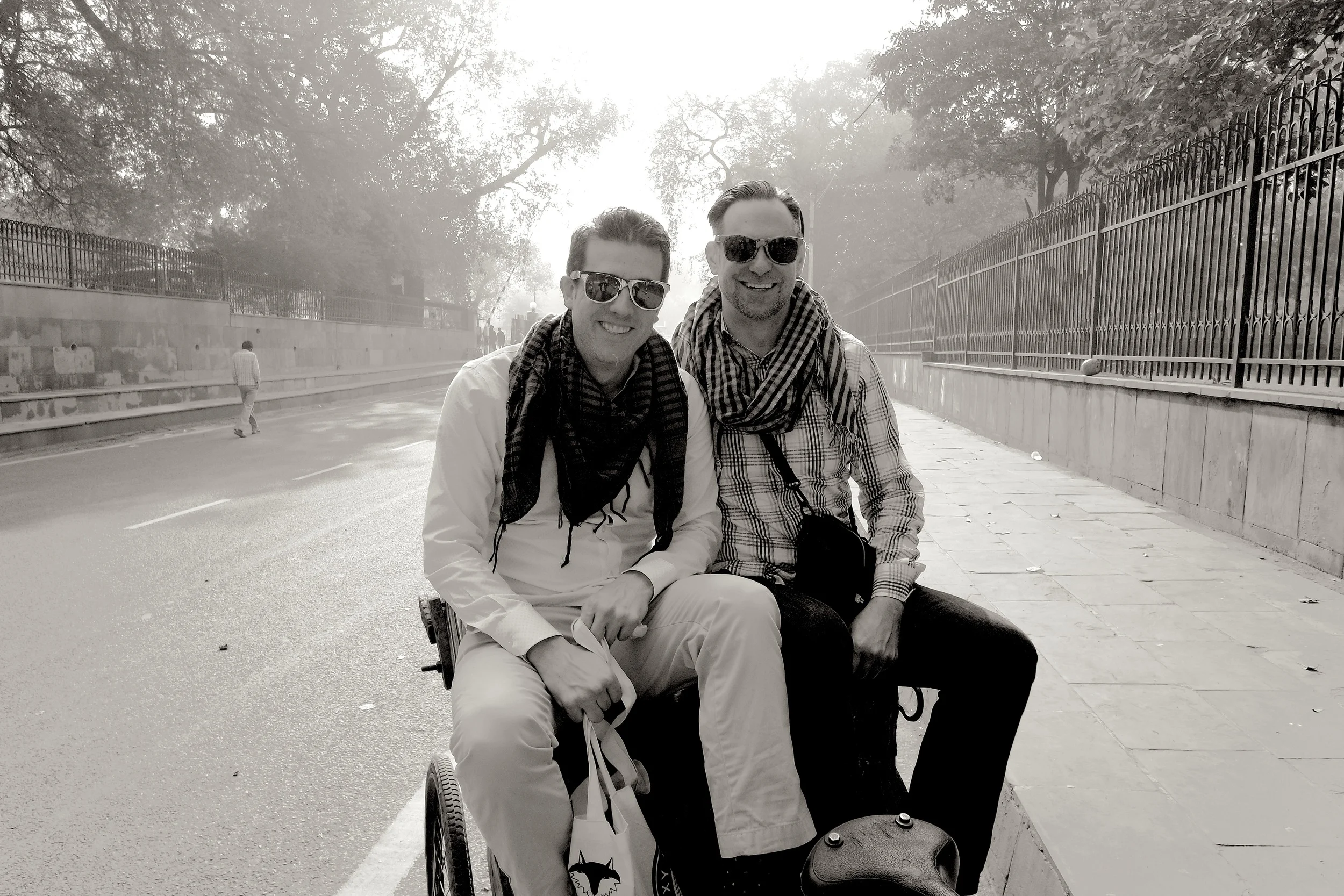
Wally and Duke precariously perched on the back of Mohammed's bicycle rickshaw, ready to explore Old Delhi

Wally and Duke precariously perched on the back of Mohammed's bicycle rickshaw, ready to explore Old Delhi

We Learn the Differences Between Hinduism and Islam

As we were walking back to the rickshaw, Mohammed nonchalantly mentioned to us that he believes the fundamental difference between Hindus and Muslims is that Hinduism has many gods, Islam only one god, Allah.

Later, we met a Hindu who said the trouble between the two religions all comes down to the fact that Muslims want to eat their sacred cows.

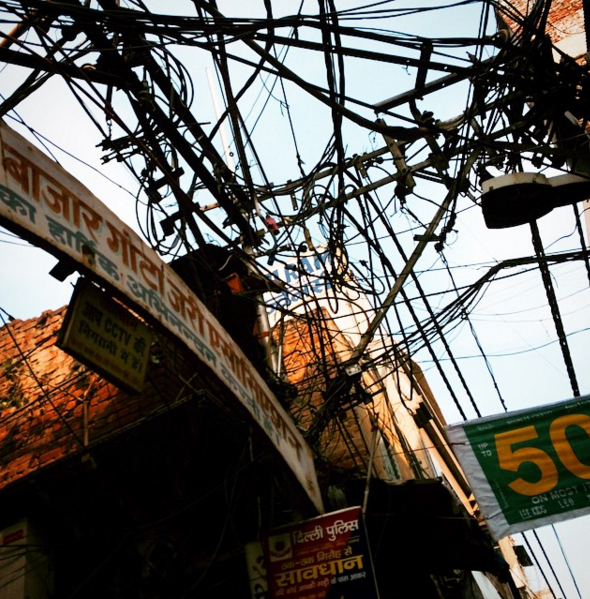
We perched atop the rickshaw's thin wooden board, which acted as a seat, and passed through narrow alleys amidst a jumble of old and crumbling structures with a tangled mess of wires dangled overhead.

Wally snapped a quick pic as we wobbled along on the bicycle rickshaw through the narrow lanes of Old Delhi. Everywhere overhead were jumbles of wires like these

Wally snapped a quick pic as we wobbled along on the bicycle rickshaw through the narrow lanes of Old Delhi. Everywhere overhead were jumbles of wires like these

We saw tethered goats and even some street dogs wearing hand-me-down sweater vests and men getting roadside haircuts.


Art for Our Sake

Our next stop was a shop that specialized in silk saris and pashminas. I noticed some miniature paintings they had in a case in front of the folded pashminas and asked if they had any depicting the goddess Durga. I was met with slightly bemused smiles and head wobbles, which I took to mean “yes,” as one of the women proceeded to lay an assortment on the counter like she was dealing a deck of playing cards.

While none of them depicted Durga, we did find one of the elephant-headed god Ganesha holding an umbrella that we quite liked, as well as one depicting Krishna with gopis (milkmaids). We purchased them, but, much to the shopkeeper’s dismay, no pashminas. –Duke

The Best Way to Explore Delhi’s Old Quarter

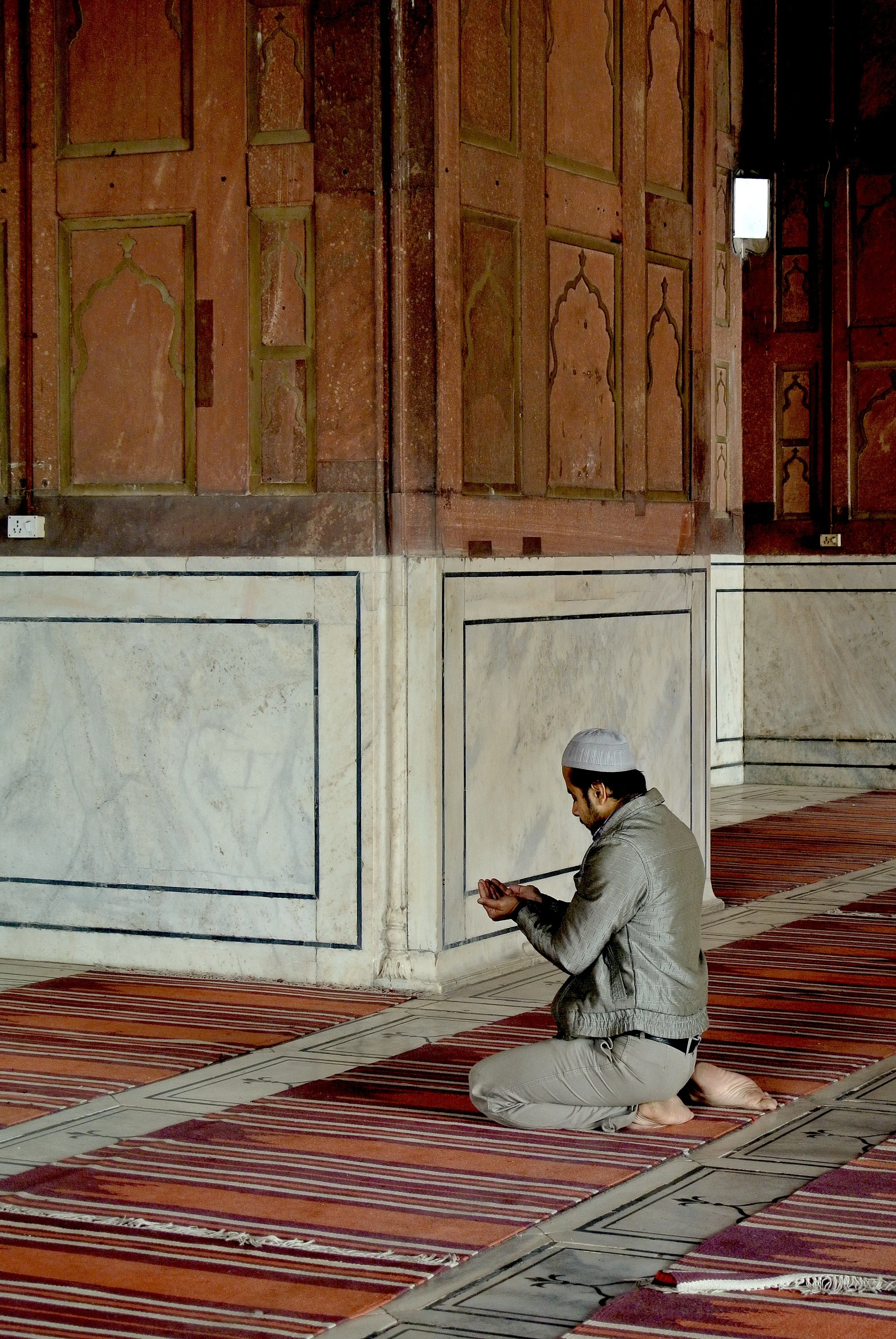
A Muslim prays on one of the many mats in Delhi's Jama Masjid mosque

A Muslim prays on one of the many mats in Delhi's Jama Masjid mosque

Grab a bicycle rickshaw and know the best time to get to the Jama Masjid mosque.


We enjoyed breakfast at the Amici Cafe, adjacent to the Bloomrooms Hotel. This is where I discovered the Amul Dairy Girl on a single-serve packet of butter and where my mild obsession began. She’s the offspring of a ’60s Fisher-Price Little People toy and a rosy-cheeked, cherub-faced Campbell Kid.

After breakfast, we asked the concierge about transportation to the Old Quarter. The hotel has its own travel service conveniently located above the café, which in affiliation with the Delhi Tourism & Transportation Initiative, offers fixed rates. We were able to get a car and driver for the day for about $28.

We were able to get a car and driver for the day for about $28.


Heading to Old Delhi

Arriving at the parking lot behind the Red Fort, our driver called a cycle rickshaw over, explaining to us that this was the best method to get to the Jama Masjid mosque and see the Old Quarter.

Initially we were hesitant to accept, believing we could walk, but once we caught a glimpse of the dense, chaotic Sunday market surrounding the outer perimeter of the walled city, we agreed that this was the most practical/least stressful way to traverse the congested interior.

Our driver introduced himself. He was a friendly man named Mohammed. Clearly it's not easy to pedal with two men as passengers. Wally apologized by telling him that we both had big breakfasts.

Mohammed asked if we were married. For the sake of avoiding offense and to reduce any confusion in such a conservative country, I answered yes. When asked if I had any children, my reply was no, which was met with a look of puzzlement, so I recovered by saying “two jobs,” which wasn't exactly a lie, as both Wally and I work. He paused for a moment, after which he told us that he has three children — two boys and one girl.

En route to the Jama Masjid, we passed a restaurant named Sunny Lala Chicken Wallah, possibly named after local entrepreneur Lala Chunna Mal. That made me chuckle.

We arrived, dismounted the rickshaw and were approached by two scrappy little boys who tugged at our shirtsleeves and attempted to sell us stickers.


Jama Masjid (Friday Mosque)

Built in 1650, India’s largest mosque takes its name from the congregation that gathers to worship in its great courtyard on Fridays, the Muslim day of prayer.

We arrived shortly before 10 a.m., as the mosque is closed to non-Muslims between 12 to 2 p.m. We ascended the steps to the main entrance and removed our shoes prior to entering.

The mosque is constructed upon a natural elevation and rises high above the narrow streets. It is spectacular, if only in its sense of scale, and served as a soldier’s camp during British rule. –Duke

Welcome to India: The Most Intense Smells, Sounds and Sights

Wally and Duke got about a hundred pictures taken by a man at the Jama Masjid mosque in Delhi, India. This was the only one that came out OK

Wally and Duke got about a hundred pictures taken by a man at the Jama Masjid mosque in Delhi, India. This was the only one that came out OK

Arriving in Delhi, overwhelmed with wood smoke, honking horns and colorfully painted goods carrier trucks.


We arrived at the Indira Gandhi International Airport in Delhi, India at 1:30 a.m. from our layover in Heathrow. I had added the cities we were visiting to my iPhone weather app prior to our arrival and will admit I was wholly unfamiliar with the weather condition of “smoke.” It turned out to be a soupy haze caused by assorted pollutants.

Once we had passed through customs, collected our luggage and exited the airport, it hits you. The air was acrid and thick with the aroma of sandalwood incense. Overpowering the incense is wood smoke from cooking fires, burnt plastic, dust and diesel exhaust punctuated by a cacophony of honking horns.

Wood smoke from cooking fires, burnt plastic, dust and diesel exhaust are punctuated by a cacophony of honking horns.


Horn OK Please!

On our way to our hotel, we passed colorfully detailed Goods Carrier vehicles. These trucks, which are compact in size, reminded me of carnival-style food trailers. Many of them have hanging brass bells adorning their bumpers and occasionally threads of tinsel added for good measure. One of the trucks had an inscription painted in bright blue shadowed in white on its back bumper exclaiming, “Love Speed Great India 40km.” Our driver told us that trucks are only allowed to use the highways at night.

These vehicles have their permit, the AIP (All India Permit), which allows the holder to drive throughout the country, painted on the side of the truck. Occasionally this stylization appears like a yin yang, reminiscent of the Pepsi-Cola logo but in the tricolor of the national flag of India: saffron, white and green.

Stainless steel organic-looking sculptures emerged in clusters along the highway. Added to the AIIMS flyover during the 2010 Commonwealth Games and designed by sculptor Vibhor Sogani for Jindal Stainless, they appeared like highly polished steel bean sprouts.

Powder blue police barricades with red plastic tube LED lights strung atop separate lanes were painted messages like the following: “True we slow you down. But we try not to let criminals slip by.” A steaming vat of tar simmered alongside, undoubtedly contributing to the aforementioned nasal miasma. –Duke

Oh India! Why We Decided to Finally Give India a Try

George, Duke and Wally enjoying pre-dinner drinks at the Mews at Udai Bilas Palace, our hotel in Dungarpur, India

George, Duke and Wally enjoying pre-dinner drinks at the Mews at Udai Bilas Palace, our hotel in Dungarpur, India

Purchasing guidebooks to India and suffering the side effects of malaria pills.


When Wally received an email in early September 2014 from our friend George, inviting us to visit him in India, we agreed to make it our next adventure.

India had been on both of our shortlists of places to go and having a friend there made the decision a no-brainer. Plus we decided to plan the trip for the dead of winter, which would give us a much-needed reprieve from the cold, gray days of February in Chicago.

India is an expansive country comparable in size to the United States.

Wally purchased travel guides (DK and Lonely Planet) while I began researching online. We also got the informative and detailed Blue Guide India by Sam Miller from the Chicago Public Library. Together, over the following three months, we mercilessly altered and tweaked our itinerary in hopes of reducing the amount of time spent traveling. After all, we only had 12 days, two of which would be lost getting there and back. India is an expansive country comparable in size to the United States.


Bitter Pills to Swallow

Two days prior to leaving for our trip, we began taking our daily dose of Malarone, an oral malaria preventative. After swallowing the first tablet, I felt my stomach cramp and was convinced they were giving me the shits.

Wally’s experience was different. He thought it caused him to produce an excessive flow of saliva, and by the second dose I felt it, too.

In addition to the above, we both experienced some of the more common side effects:

• Mouth sores

• Shortness of breath

• Strange dreams

I had a curious dream where my niece morphed into a combination of an Ewok and our calico cat. As she is black, Wally remarked that my subconscious is racist.

I countered that Ewoks are soft, fuzzy and cute. But he wasn't buying it. –Duke

8 Tips to Get the Best Deals at a Moroccan Souk

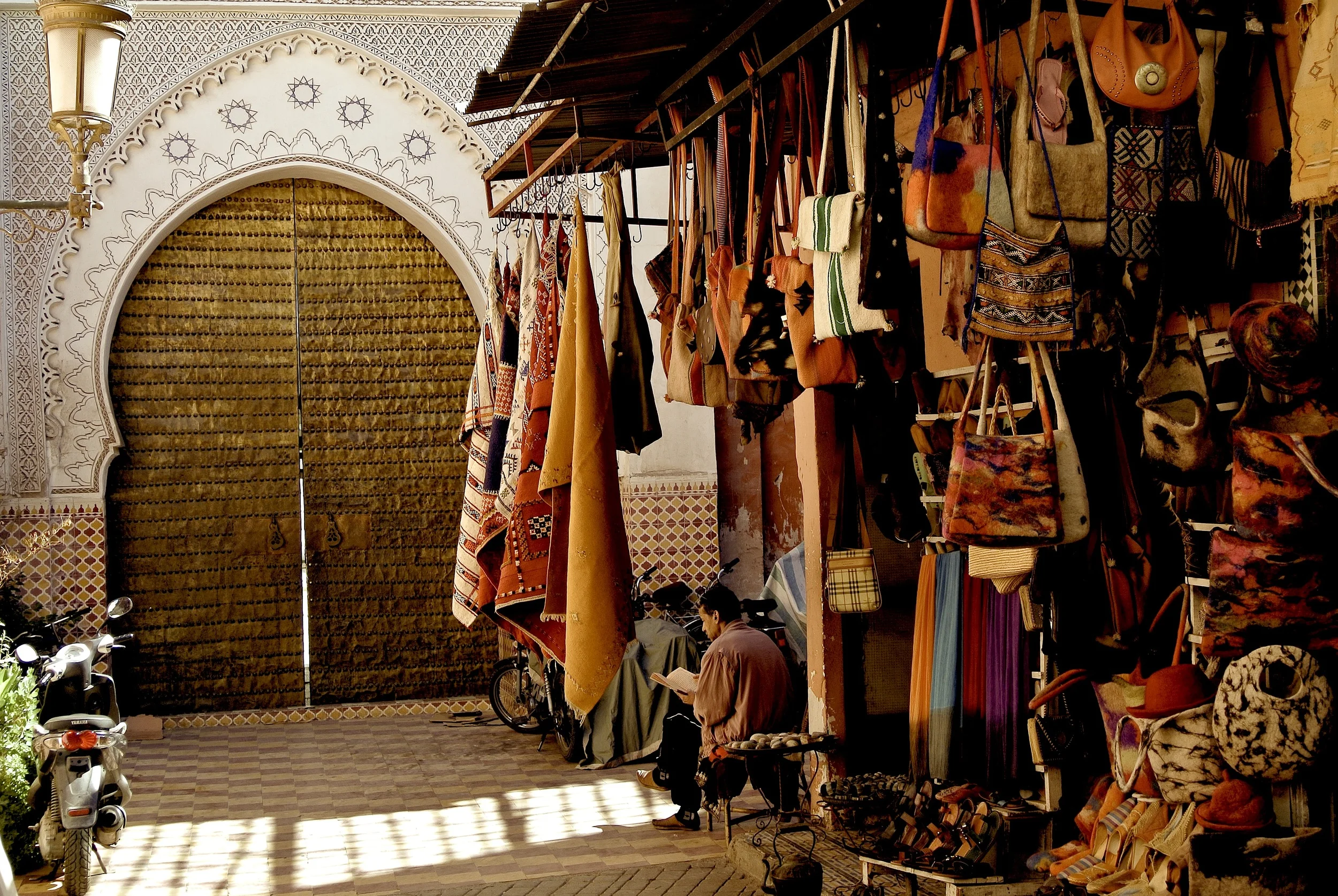
The souk in Marrakesh, Morocco is just off of the large square in the media, Jemaa el-Fnaa.

The souk in Marrakesh, Morocco is just off of the large square in the media, Jemaa el-Fnaa.

Bargaining and haggling are a time-honored tradition when shopping at markets. Just make sure you don’t get taken advantage of.


Duke and I are unabashed consumers. When we’re on vacation, we’ll hit the markets once or even twice a day if possible. So let’s just say we’ve had plenty of practice bargaining for the best price. I also play hardball (our guide on our trip to the Sahara, Barack, saw me in action and was so impressed, he dubbed me an honorary Berber).

Haggling for everything you buy (food aside) can be exhausting. But it’s part of the culture in Morocco, and vendors look forward to a lively contest of wills. Follow these steps, and chances are you’ll get a good deal when shopping the souks.

Our guide saw me in action and was so impressed, he dubbed me an honorary Berber.


1. Scope out the sitch. 

Start out with a reconnaissance mission. When you see something you’re interested in, ask how much it is, as casually as possible. Then make a mental note and move on. Quickly. 

You’ll often see similar items at other stalls, so it’s good to have perspective, to see if you’re getting ripped off.

That being said, if you see something you really want, snag it. You never know if you’ll find it again. Souks are labyrinthine, and there’s no guarantee you can retrace your steps another day. 


2. Speak French if you know it. 

Most vendors speak French as well as an impressive amount of English and phrases from Spanish and other languages. I’m not sure that all vendors assume Americans are rich and charge more — but it sure seemed that way. I definitely scored better deals when they couldn’t quite pin down my nationality. 

And don’t worry about being fluent in French. Remember, it’s their second language, too, so you can meet in the middle, skill-wise.


3. Be aggressive if need be. 

It’s not uncommon to be inside a narrow stall, looking around and then, when you turn to leave, find the merchant blocking your path. He might have something he’s shoving in your face, trying to excite your interest.

I found that there were times when I literally had to grab a vendor's shoulder and push him out of the way in order to leave.

Note that we traveled with our friend Vanessa, who said the men didn’t accost her in this way. So it might (hopefully) just be a “guy thing.”


4. Shop on Friday — despite what you’ve been told. 

Everyone told us the souk would be closed on Friday, that everyone’s at the mosque. Well, Duke and I couldn’t resist just seeing if anyone was open — and sure enough, in the Marrakech souk, we found that about a quarter of the stalls weren't closed. Instead of the usual hustle and bustle, the passageways were relatively quiet, and we scored some great deals, as shopkeeps knew business would be slow.


5. Use this formula. 

OK, let’s get down to the nitty gritty. How much should you pay? Here’s what I do: Think about what you’d pay at a store back home. Then divide that in half. You won’t be ripping anyone off, and you’ll be getting a great deal — which you deserve by eliminating the middleman. 

On our last day in Marrakech, we found a fertility doll from Cameroon, covered in beads and horn and metal bangles, that we simply had to have. It wouldn’t surprise me to a see a museum-quality handicraft from Africa like this for $70 back in the States. (Indeed, a Google search revealed prices upwards of $100.) So I divided $70 in two, and decided I’d like to end up at $35. 


6. Ignore their opening bid. 

In most places I’ve been, the shopkeeps start with a reasonable offer and you can end up with a decent price by meeting in the middle. Not so in Morocco. They’ll try to get as much out of you as possible. So don’t even listen to the first number they throw out there.

With the fertility doll, the young man started at $200. By this point, I knew better than to even pay attention. I countered with $20. Yes, that seems ridiculous, right? But if they’re being ridiculous, you can be ridiculous right back.


7. Give yourself some wiggle room. 

After you’ve figured out what you want to pay, go a bit lower. After all, you need to come up a bit, act as if you’re conceding, unable to escape the vendor’s wiliness. He wants to feel as if he’s won on some level. 

Our fertility doll vendor offered the equivalent of $45 and wouldn’t budge. 


8. Walk away. 

This is an especially successful tactic in Morocco. (Not so much in India, btw, where we said goodbye to many an item.) Even though we were just above what I wanted to pay for the doll, I shook my head and dragged a reluctant Duke away. 

“We could pay $45!” he pleaded. 

But I can be merciless. “We’ll go halfway down the block,” I told him. “And if he doesn’t chase after us, we’ll go back and get it for $45.”

We had gotten only 20 feet away before the young man chased after us, grabbing my arm. 

“What’s your final offer?”

I pretended to think about it. “We really don’t need it… $35 is my final offer.”

“OK. OK,” he caved. “You’re getting great deal.”

Yes. Yes, I was. –Wally