ART

Standards of Beauty (and Ugliness) in African Art

From scarification to the ideal male and female, discover what Westerners get wrong about how Sub-Saharan sculptures and other works of art are viewed in their own cultures. 
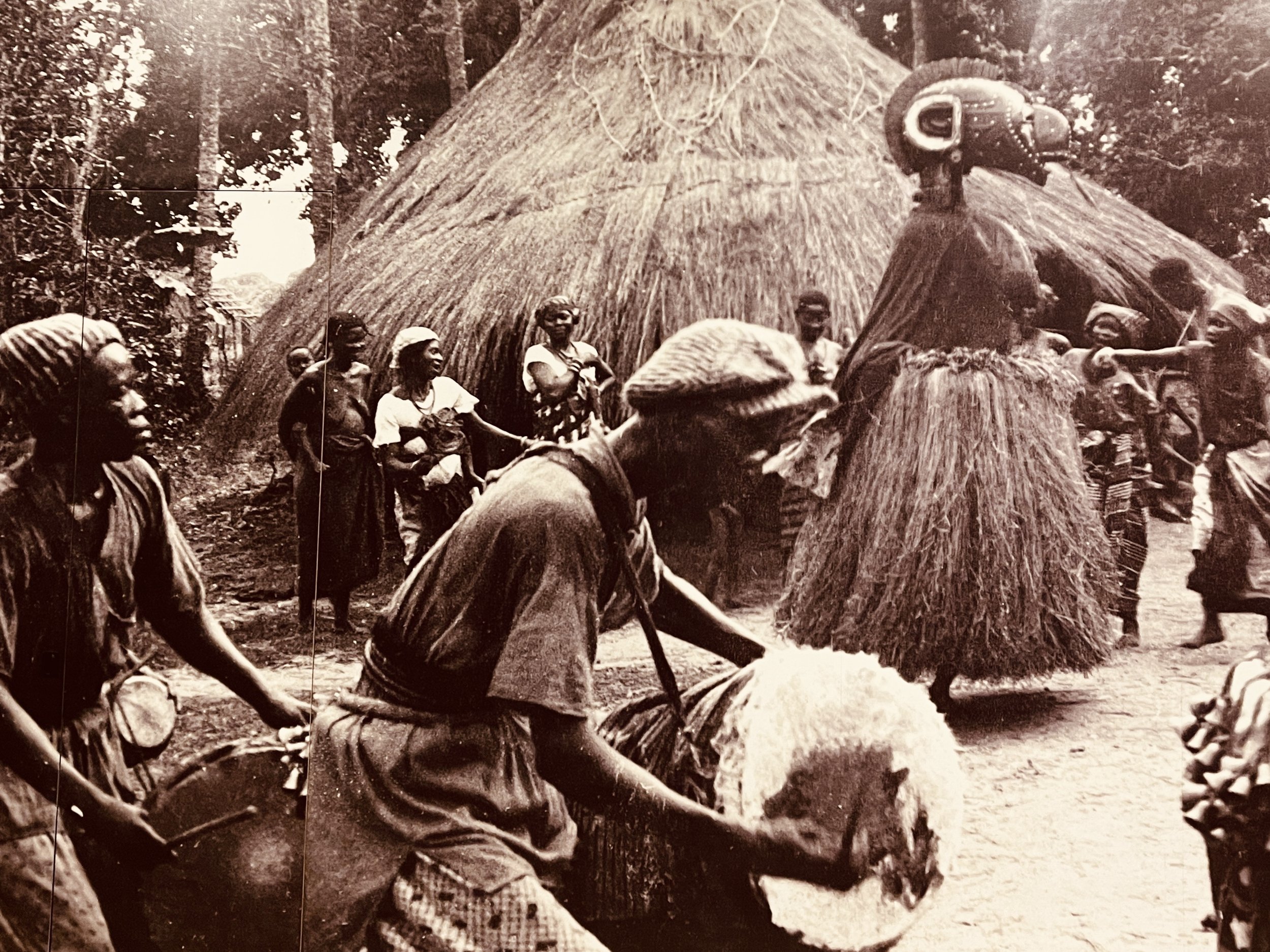
A ritual dance by grass huts in Africa featuring a dancer wearing a large baga nimba or d'mba headress and grass skirt

A ritual dance in Guinea, Africa features a Baga nimba or d’mba headdress, seen in the upper right corner, which represents the ideal fertile woman.

Westerners have collected African art for centuries. But do they really understand it? Who determines what is beautiful and what is ugly in African art? Can viewers judge art solely by the standards of beauty in their own culture?

That’s the question a recent exhibit at the Art Institute of Chicago sought to answer. The collection was massive, taking up six or so rooms, filled with over 250 works of art from dozens of cultures across Sub-Saharan Africa. 

The idea is to put art in its cultural context. How did the local communities view these works of art? And how were they used? 

For some African cultures, scarification, including on the face, is a way to enhance someone’s beauty — especially that of a woman.

There’s often a religious aspect to these works. “So the art is not made just to be art,” says Constantine Petridis, chair and curator of arts of Africa at the Art Institute. “It’s art that serves a purpose, serves a function and has a meaning. And that contributes in a very deep and integral way to the survival and the wellbeing of both individuals and societies.” 

Much of this art is literally thought to save lives: It guards ancestors’ remains or fends off evil spirits. 
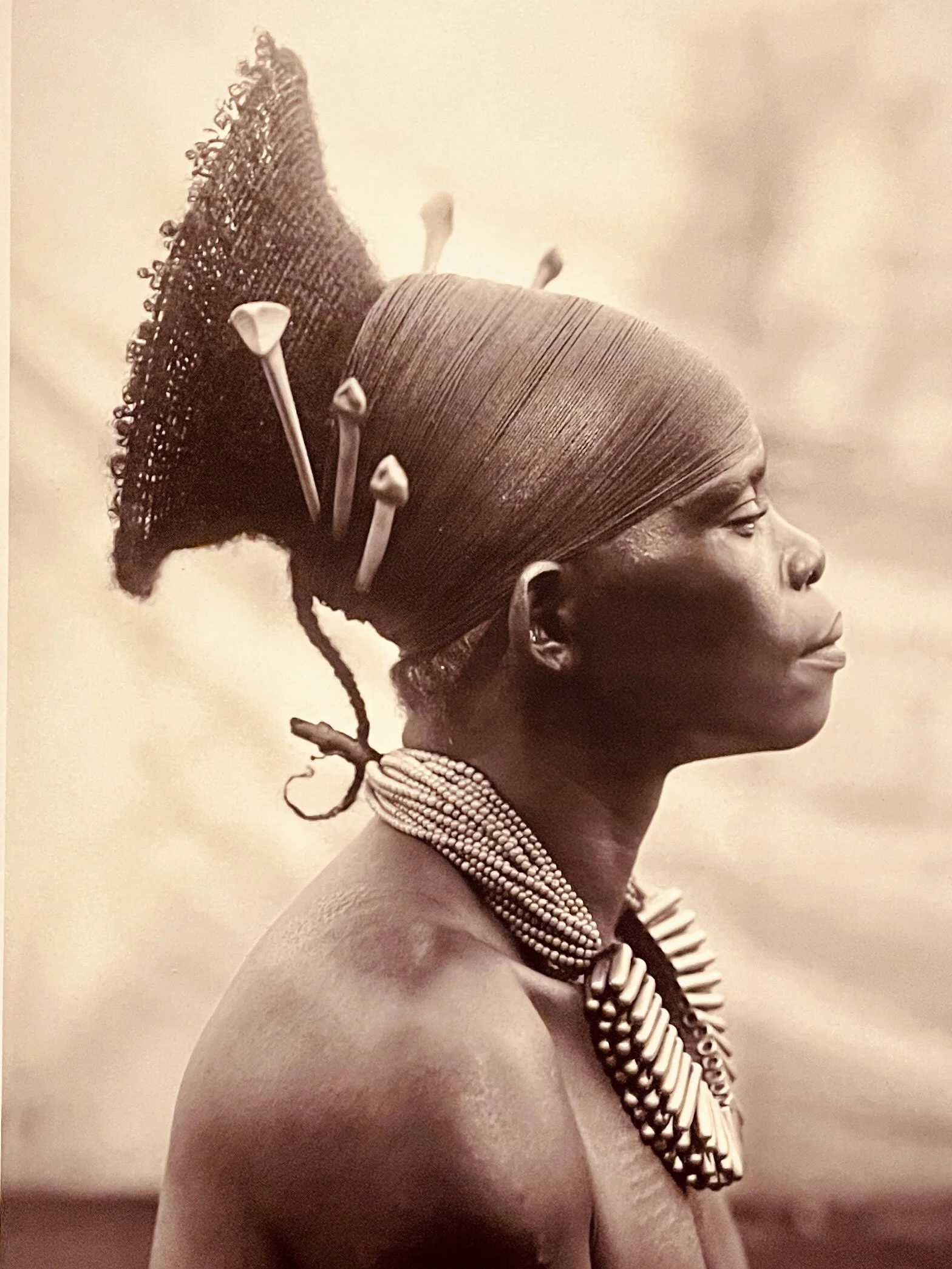
A Mangbetu woman in the DRC in 1913 with a hairstyle called a halo with ivory pins and a beaded necklace

A Mangbetu woman in 1913 wearing a halo hairstyle with ivory pins, popular in the Democratic Republic of the Congo

African Art Viewed Through an African Lens

It’s time we reevaluated standards of beauty — and understood that what’s attractive or powerful to a Western audience could be very different than that of a Sub-Saharan group. 

“The hope is also to erase prejudices and preconceived notions that have, for a very long time, prevented people from appreciating this art,” Petridis says.

Let’s take a look at some of the commonalities found throughout African art — and see that beauty is more than skin deep.
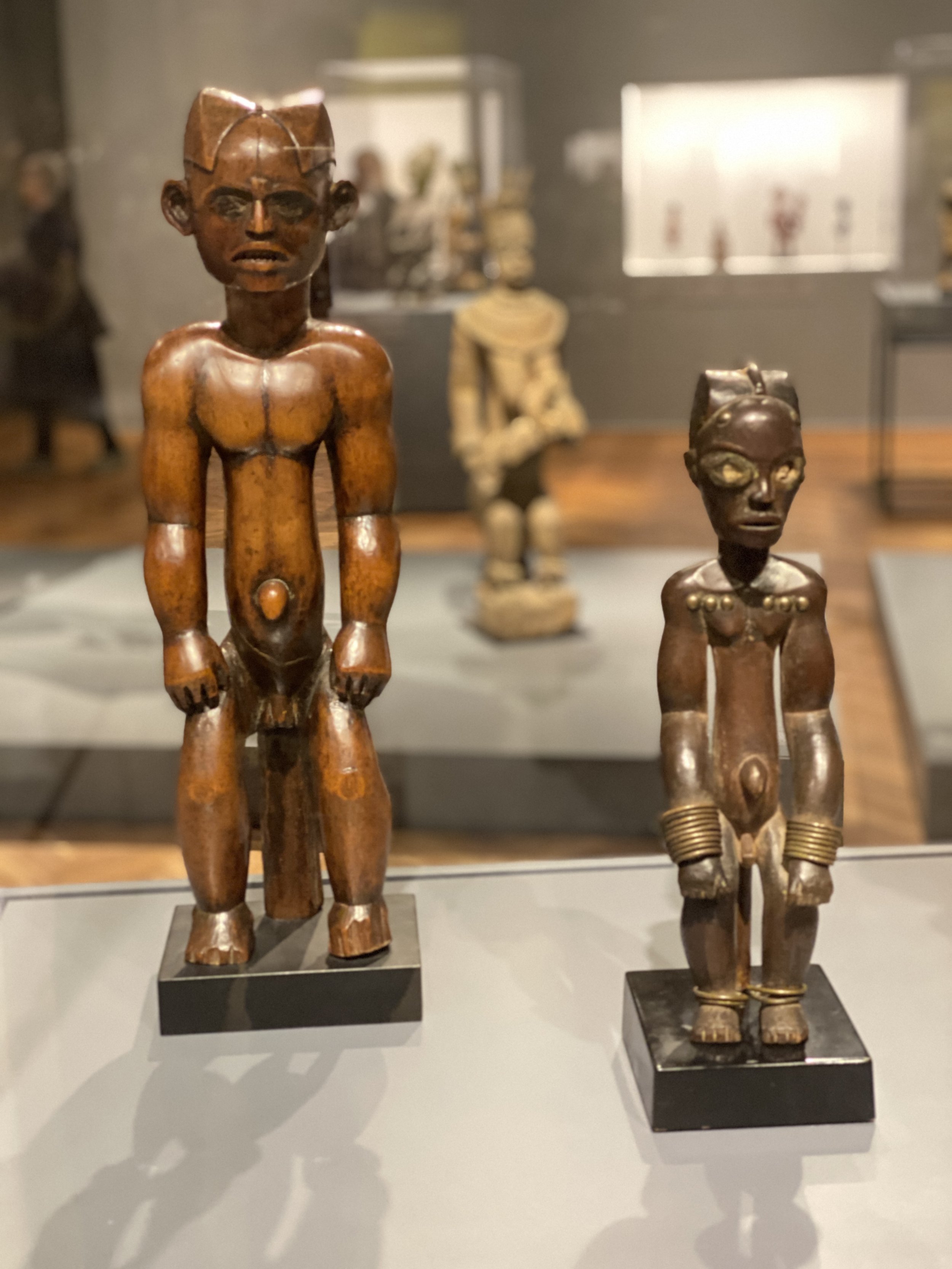
Male guardian reliquary figures made of wood with child faces, muscular bodies and extended belly buttons at the Art Institute of Chicago

Male guardian reliquary figures with the heads of children but muscular bodies of adults. Teeth have been sealed behind the eyes to help the statues act as intermediaries with ancestors.

Masculinity is depicted with youthful, muscular bodies and large hands and feet. 

In many African cultures, the ideal male figure is tall and lean, with long limbs, an elongated neck and muscular calves. Why? These physical attributes are deemed necessary to transport heavy loads on the head and to work hard in the fields.

“A youthful appearance in general connotes fertility and also good health and the capability of doing hard work,” Petridis says. 

Large hands and feet are seen as representing the energy and endurance needed on a hunting expedition. 
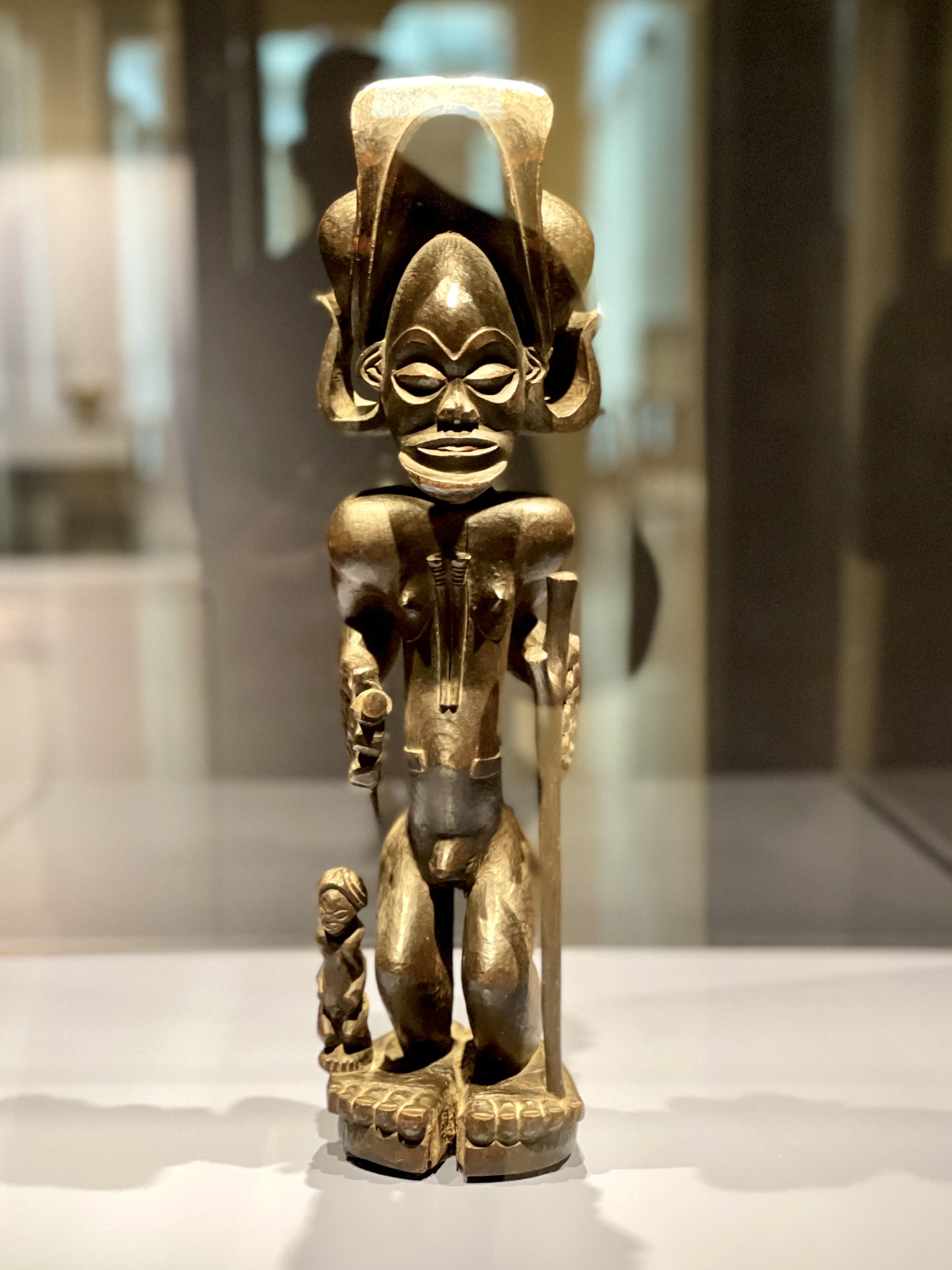
Wood figure of Chibinda Ilunga, a mythic hero of the Chokwe people in Africa

A statue of the Chokwe mythological hero Chibinda Ilunga, a legendary hunter, made in Angola in 1850

These physical characteristics are often depicted in African sculpture to emphasize physical prowess — essential in a society where men are responsible for hunting, farming and other demanding activities.
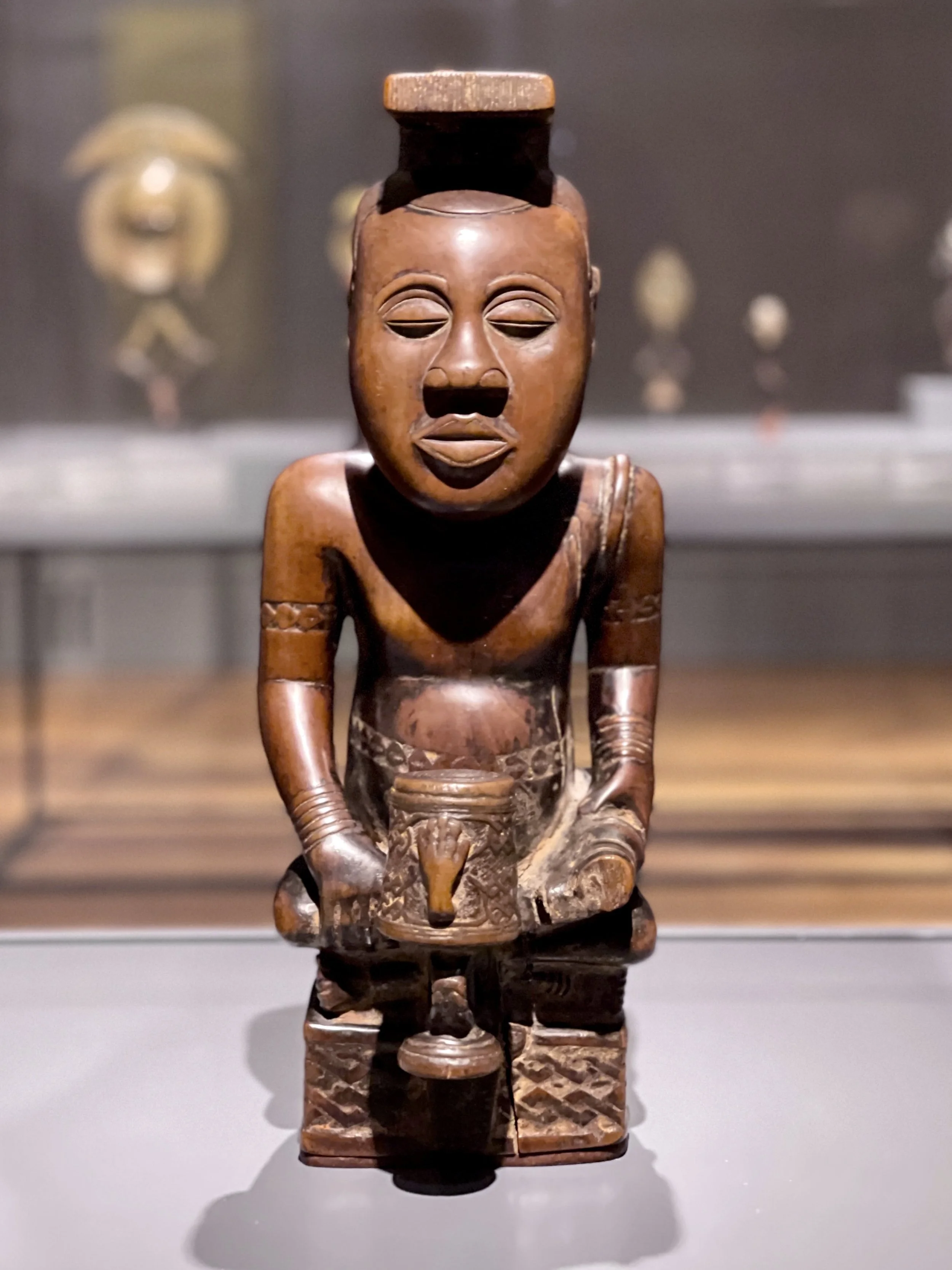
A ndop wood carving of King Mishe miShyaang maMbul with a large head and drum with hand motif

A ndop portrait figure of King Mishe miShyaang maMbul, made about 1770 in the Democratic Republic of the Congo. The oversized head symbolizes intelligence.

Works of art depicting male beauty aren’t just for aesthetic appreciation, though; they serve a vital purpose.

“All of these attributes represent or express political and religious authority, and as such, these objects would have been placed on an altar to serve to fight physical as well as metaphysical threats,” Petridis adds. 
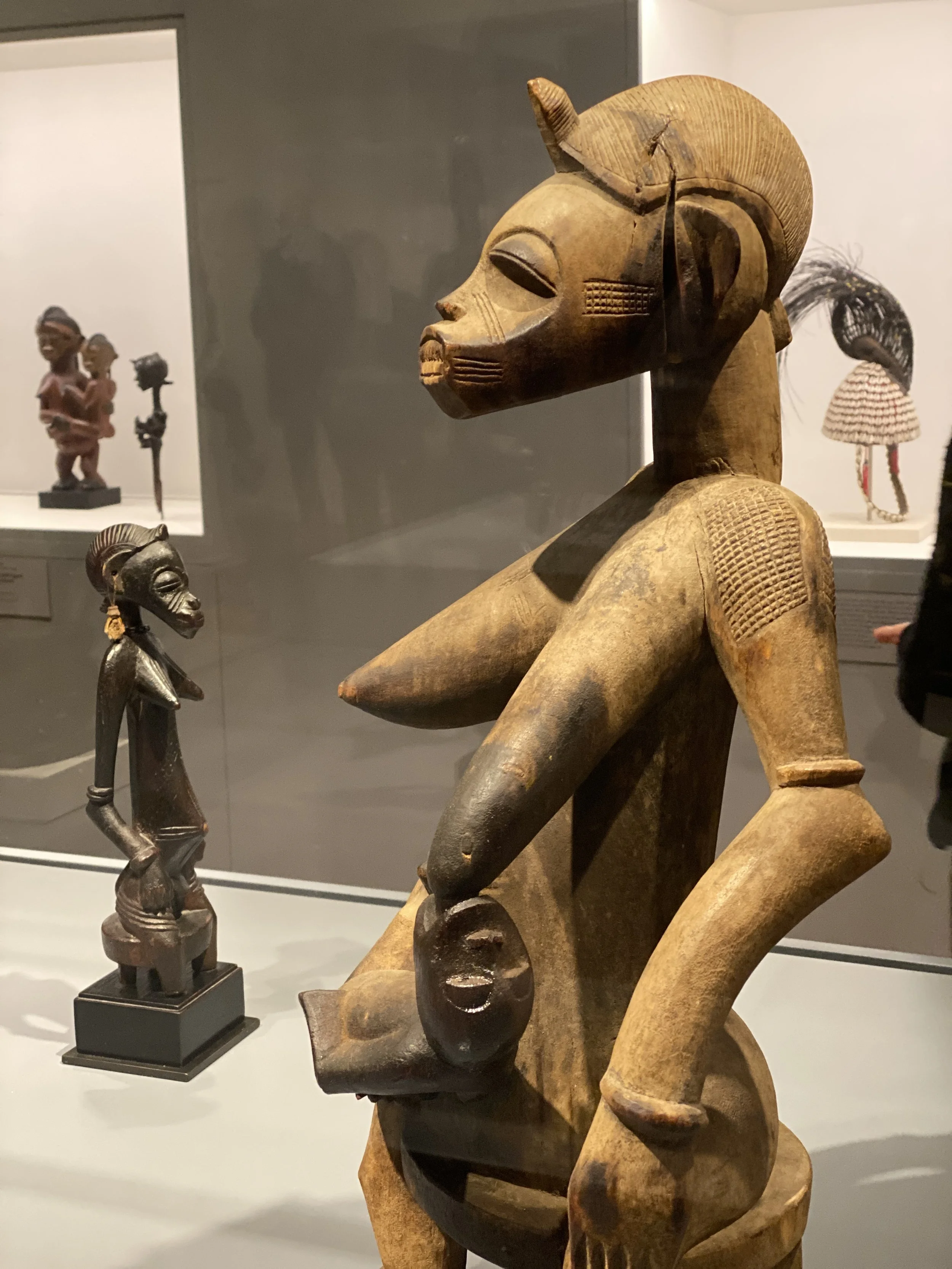
A wooden figurine of the Ancient Mother, Kaatyeleo, of Africa, with long narrow breasts with a child suckling from them

A depiction of Kaatyeleo, the Ancient Mother, who nurses babies with the milk of knowledge and evokes authoritative power

The feminine ideal is voluptuous — big belly, rounded hips, a large butt — and sometimes sports a long neck.

The ideal female figure has been a subject of fascination and inspiration for artists throughout history, and African art is no exception. In African sculpture, the ideal female figure is often depicted as having a curvaceous body with wide hips and full breasts. These features are seen as symbols of fertility, femininity and maternal strength.
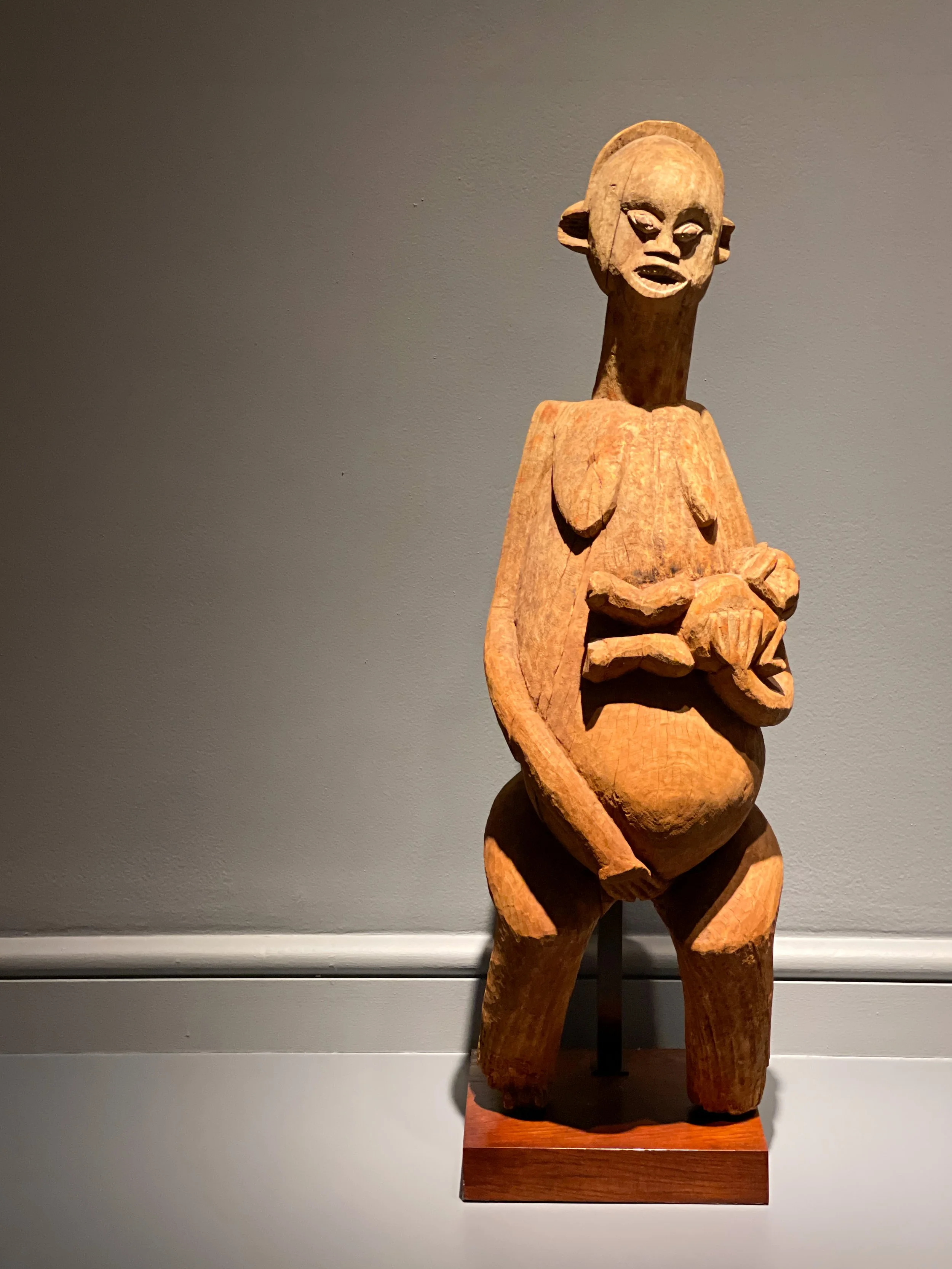
Rough wood carving of a queen from Cameroon, with short hair, a suckling baby, and extended stomach

A portrait of a queen, the wife of King Njike, from early 20th century Cameroon. It once stood in front of the royal palace.

While the exact proportions of the ideal female figure vary between African cultures, there are some common elements frequently seen across the continent. For example, in West Africa, the ideal female figure is often portrayed with a prominent belly and rounded buttocks, while in East Africa, the focus is more on the breasts and elongated neck.

The curvaceous figure of the ideal woman is seen as a reflection of her role as a caretaker and nurturer, responsible for raising healthy children and maintaining a strong family.
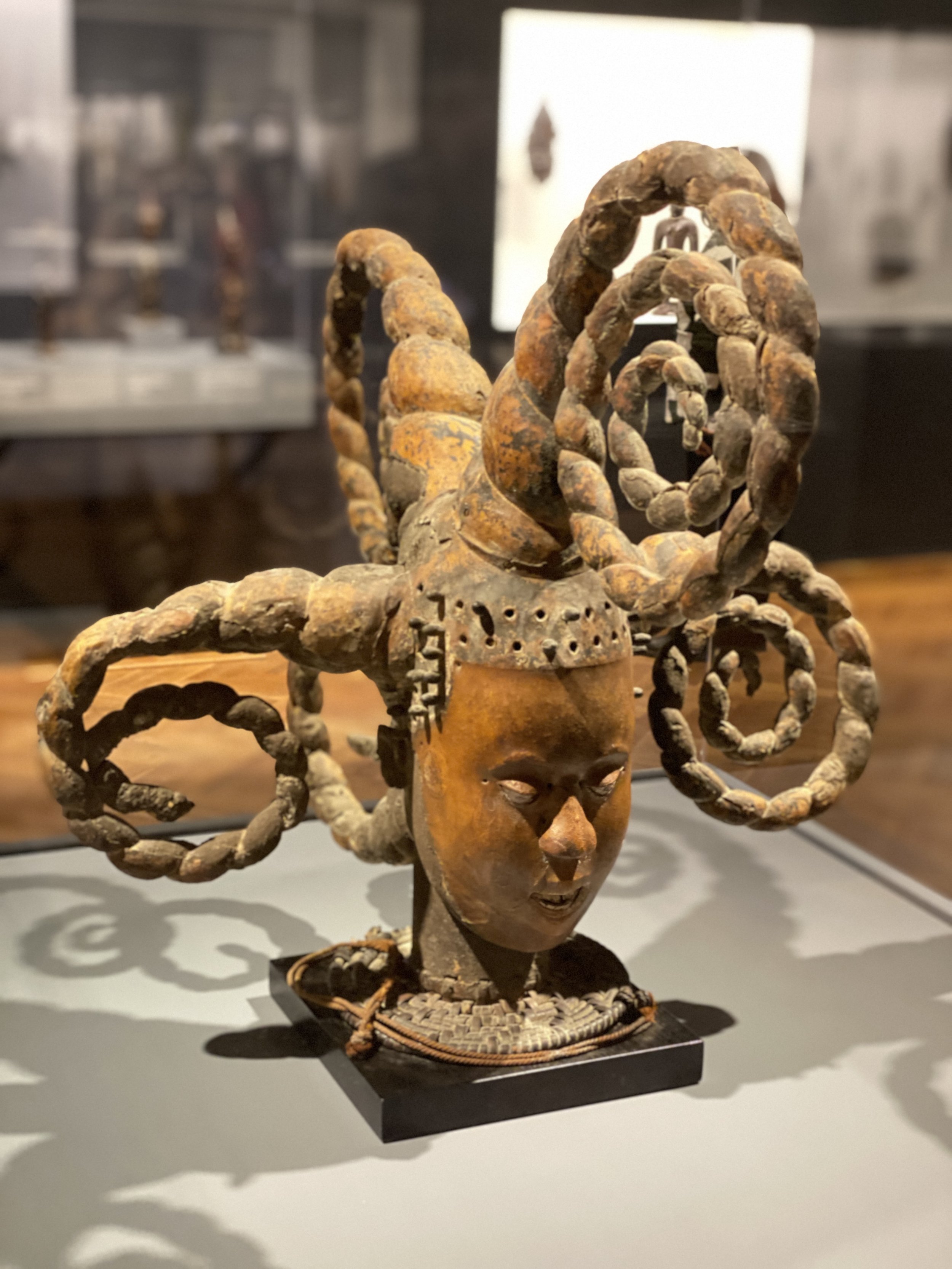
Ikam crest mask from Nigeria of girl's head with large hair spirals

An ikam crest mask from Nigeria depicts the fantastical hairstyles girls had created for their initiation into womanhood. Incidentally, these “beautiful maiden” masks were worn by men.

Female figures are frequently depicted with intricate hairstyles and elaborate jewelry, which are seen as a reflection of high status and beauty.

A mwana pwo or pwo mask from Angola showing a woman's face with scarification and woven hair

A mwana pwo or pwo mask from Angola is more realistic than other depictions of beauty in African art. It features elements a Westerner wouldn’t consider attractive, including extensive scarification and chipped teeth.

Scarification is considered beautiful. 

This particular aspect of beauty is probably the most difficult for Westerners to grasp. (Then again, look at our obsession with tattoos.) Scarification, a form of body modification that involves creating designs or patterns on skin by cutting or branding, has been practiced for centuries.
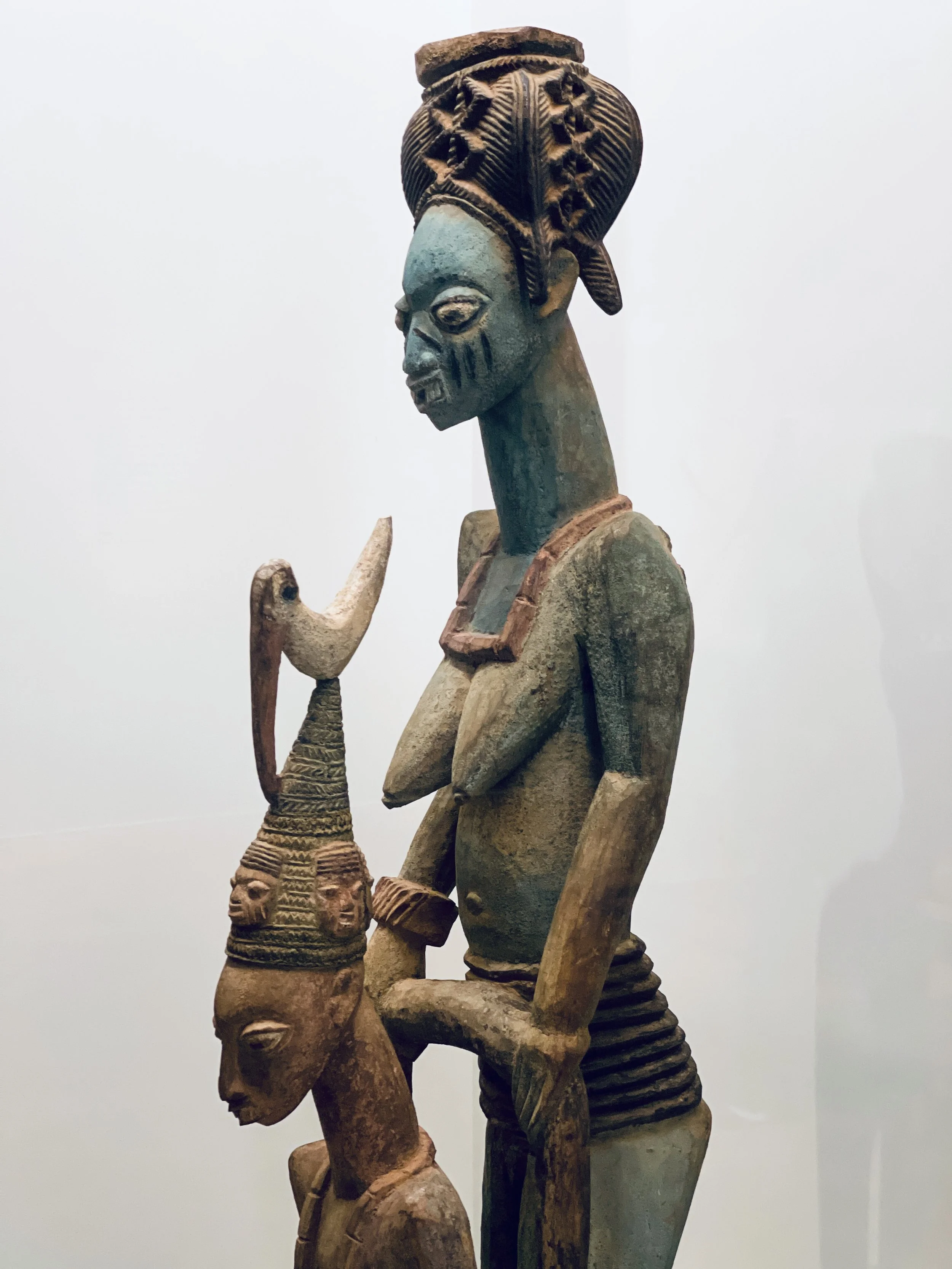
Blue wood figure of a royal wife from Nigeria with blue skin, large breasts, headdress and small attendant

Originally used as a post on a veranda in Nigeria, this carving is of a senior royal wife was created by a famous artist, Olówé of Ise. The scarification indicates her high status.

For some African cultures, scarification, including on the face, is a way to enhance someone’s beauty — especially that of a woman. 
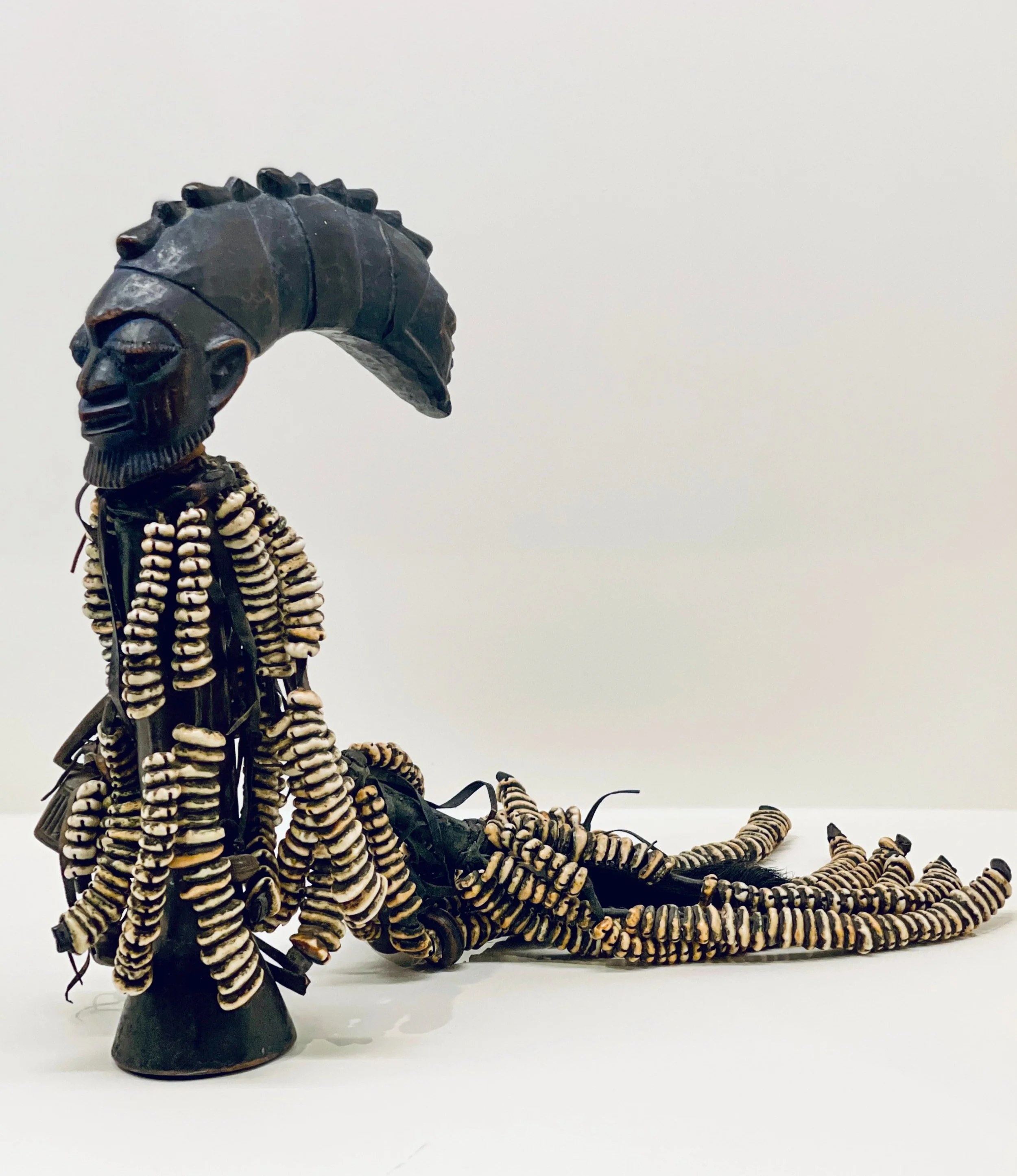
Rattle shaped like Ogo Esu, god of the marketplace in Nigeria, with a phallic headpiece and a body covered in trailing cowrie shells

Ogo Esu, god of the marketplace, the only orisha, or deity, consistently represented in human form. In Nigeria, his followers would dance with a staff like this, which has a phallic headpiece and cowrie shells associated with wealth.

Morality is synonymous with beauty.

In many African cultures, the concept of beauty is closely tied to morality and ethics. This is reflected in the use of a single word to describe both beauty and goodness. Likewise, the same word is often used to convey ugliness and immorality, highlighting the deep connection between physical appearance and moral character. 
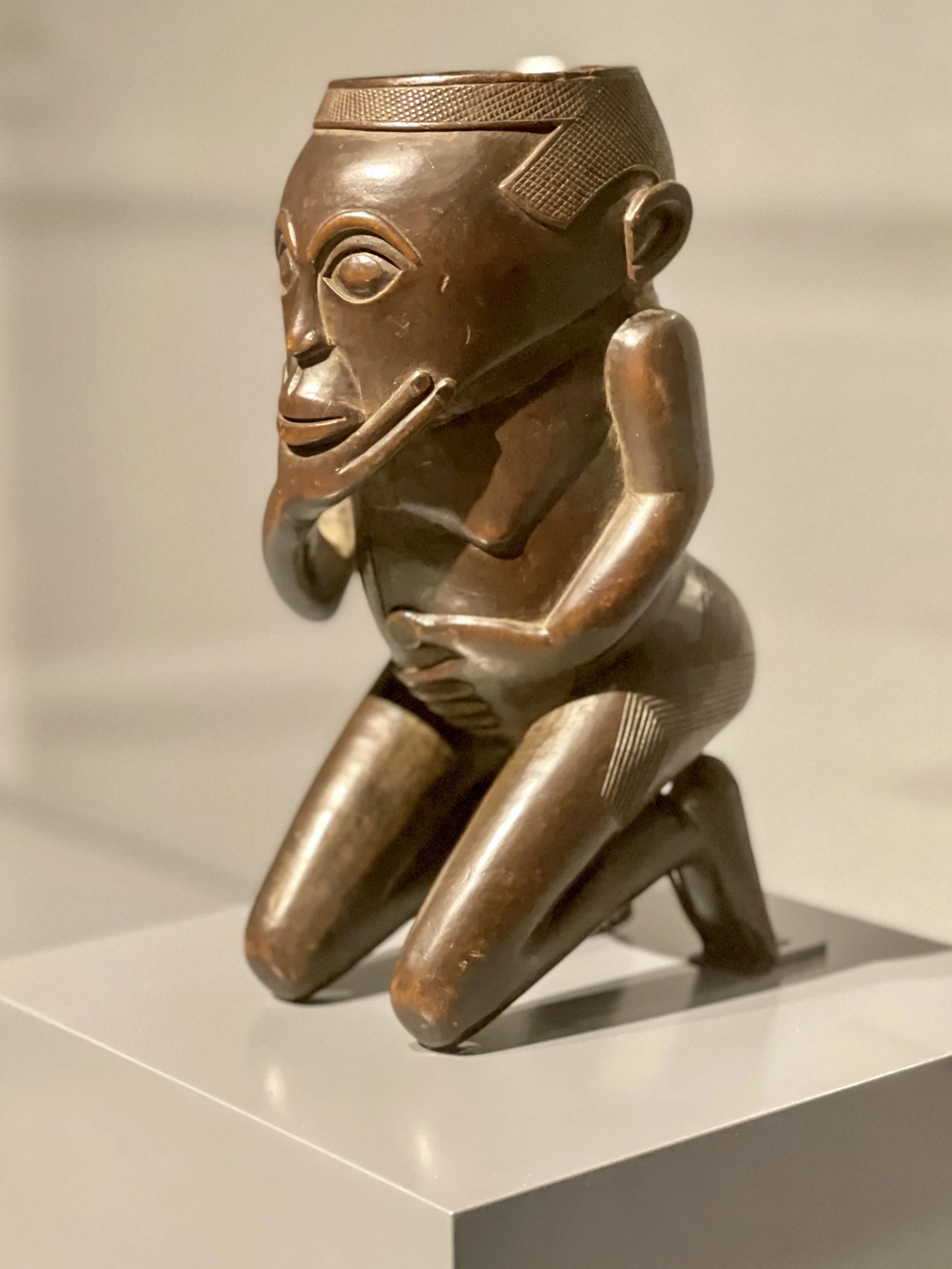
Mbwoongntey, a cup for palm wine in the Congo, shaped like a kneeling person, one had on its chin, one on its stomach

A mbwoongntey, a cup used for palm wine in the Congo

Smooth skin is attractive.

While scarification has been a long-standing tradition in African art, the idea of smooth skin as a standard of beauty is also prevalent. In many African cultures, smooth, flawless skin is considered attractive, healthy and a sign of good hygiene. To achieve that look, some sculptures are polished to a bright shine using leaves or stones. 

But the idea of beauty extends beyond the individual. “A smooth surface is a metaphor for smooth, harmonious social relationships,” Petridis explains.

On the flip side, crusty, rough surfaces are seen as ugly.
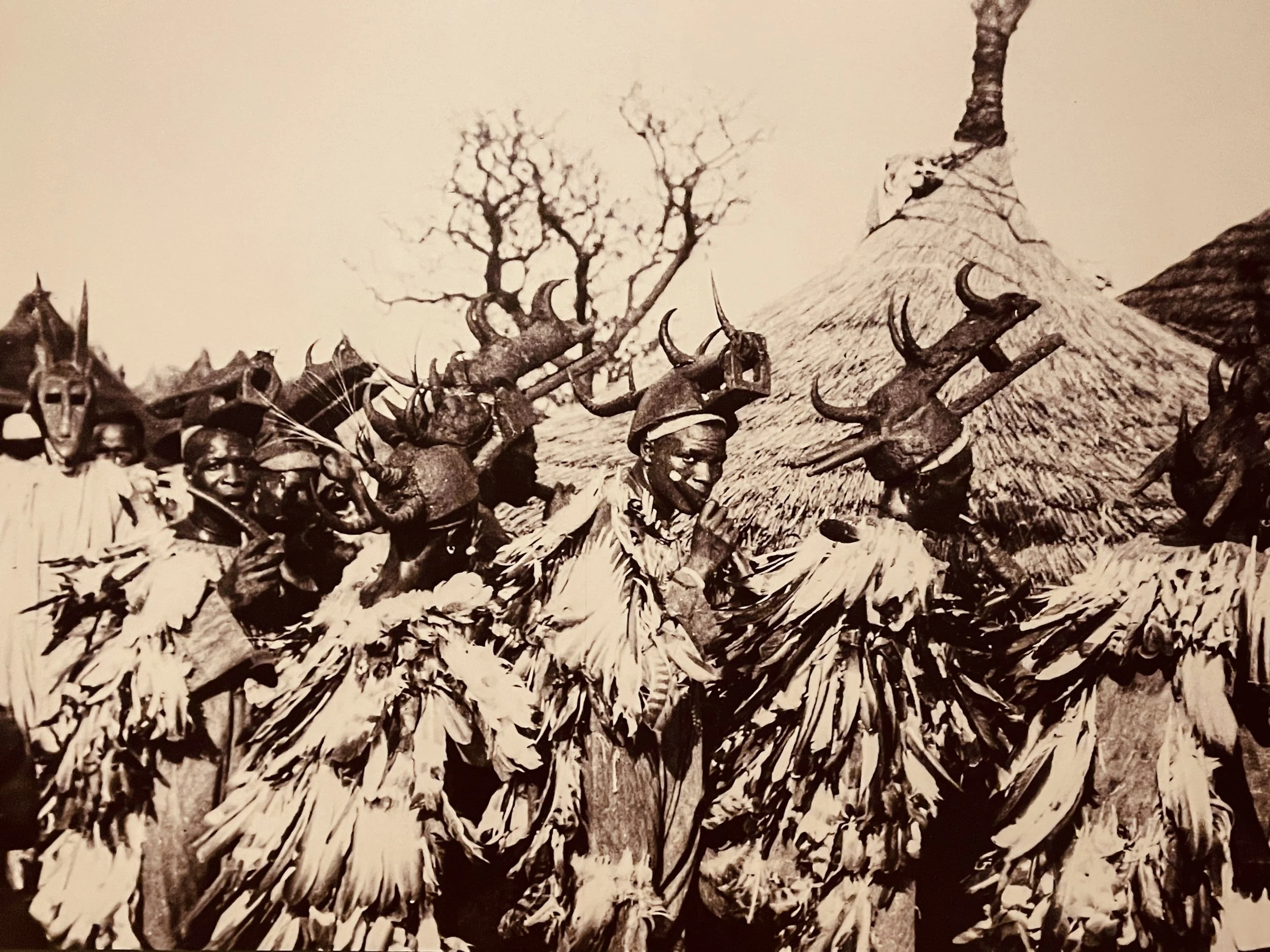
African dancers form Guinea wearing horned helmets and tribal dresses

A group of dancers from Guinea wearing Bamana Komo helmets with elements from the hyena, a nighttime scavenger.

Ugliness is tied to nature, the wilderness and animals, whereas beauty is connected to humans, the village and community. 

Nature spirits are thought to cause misfortune, illness and even death. Some sculptures were designed to be so strikingly beautiful they would lure in spirits, and the figure would take possession of them, avoiding the trouble they would have otherwise caused. 

“The sculpture becomes an abode, a home for the spirit, and it will receive offerings in order to keep it happy, and therefore remedy the problem in question,” Petridis explains.
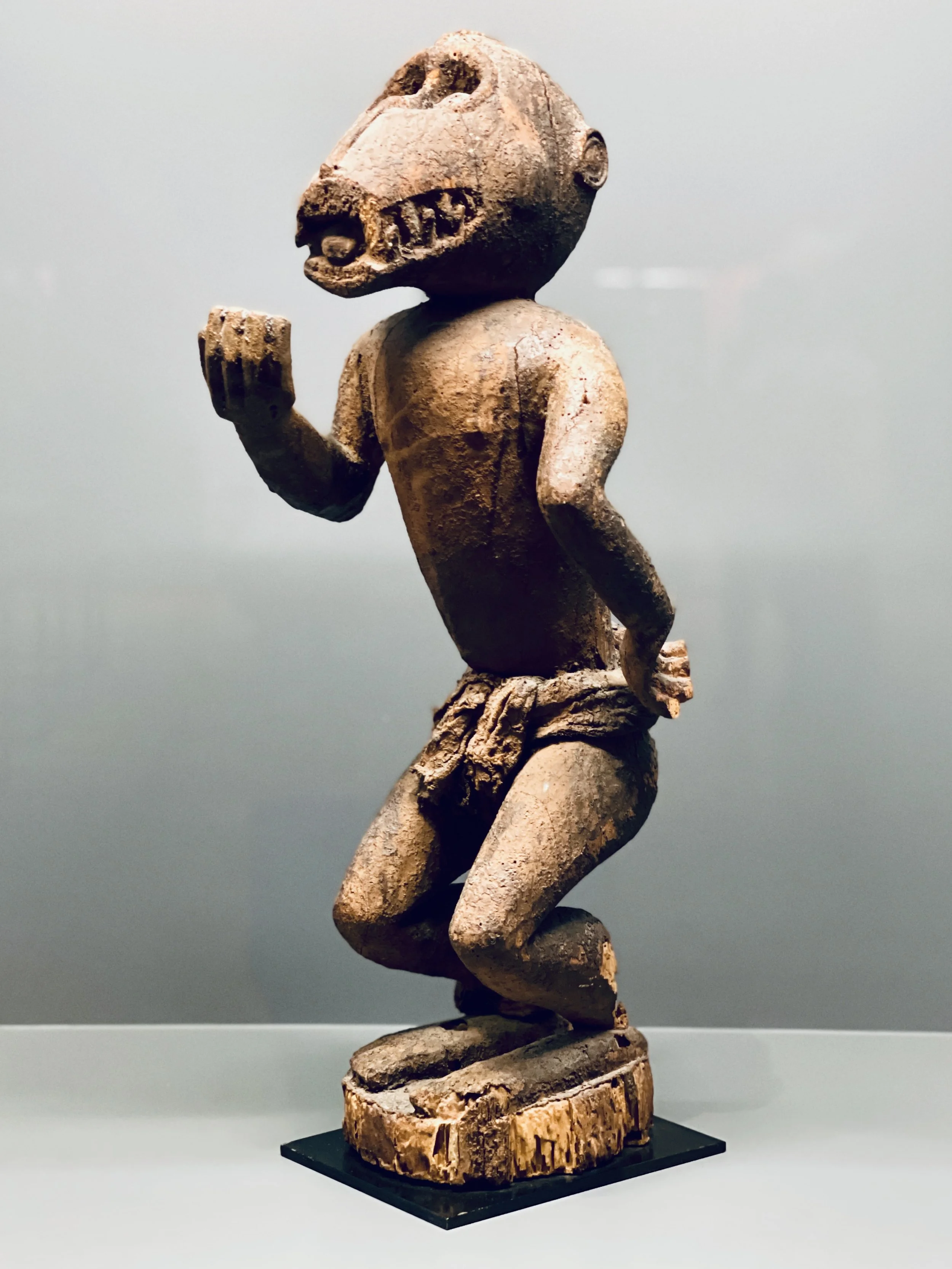
Baule monkey figure from Cote d'Ivoire of baboon-headed man

This Baule monkey figure from the Côte d’Ivoire features a baboon-headed man representing a bush spirit and untamed wildness.

There’s a duality common throughout Africa: culture vs. nature, community vs. the wilderness. As such, idealized beauty is always presumed to be of human origin, associated with the realm of the village and society. 

At the other end of the spectrum, ugliness correlates with the wild and untamed realm of the jungle outside the boundaries of the village. The works that are deliberately created to be ugly reflect the widely shared belief that coarse and asymmetrical animal-like forms correspond with bad character, malignant magic and death. 

This dichotomy reflects the central role of community and social harmony in African cultures — and the threats that come from the untamed, uncontrolled and unpredictable aspects of nature.
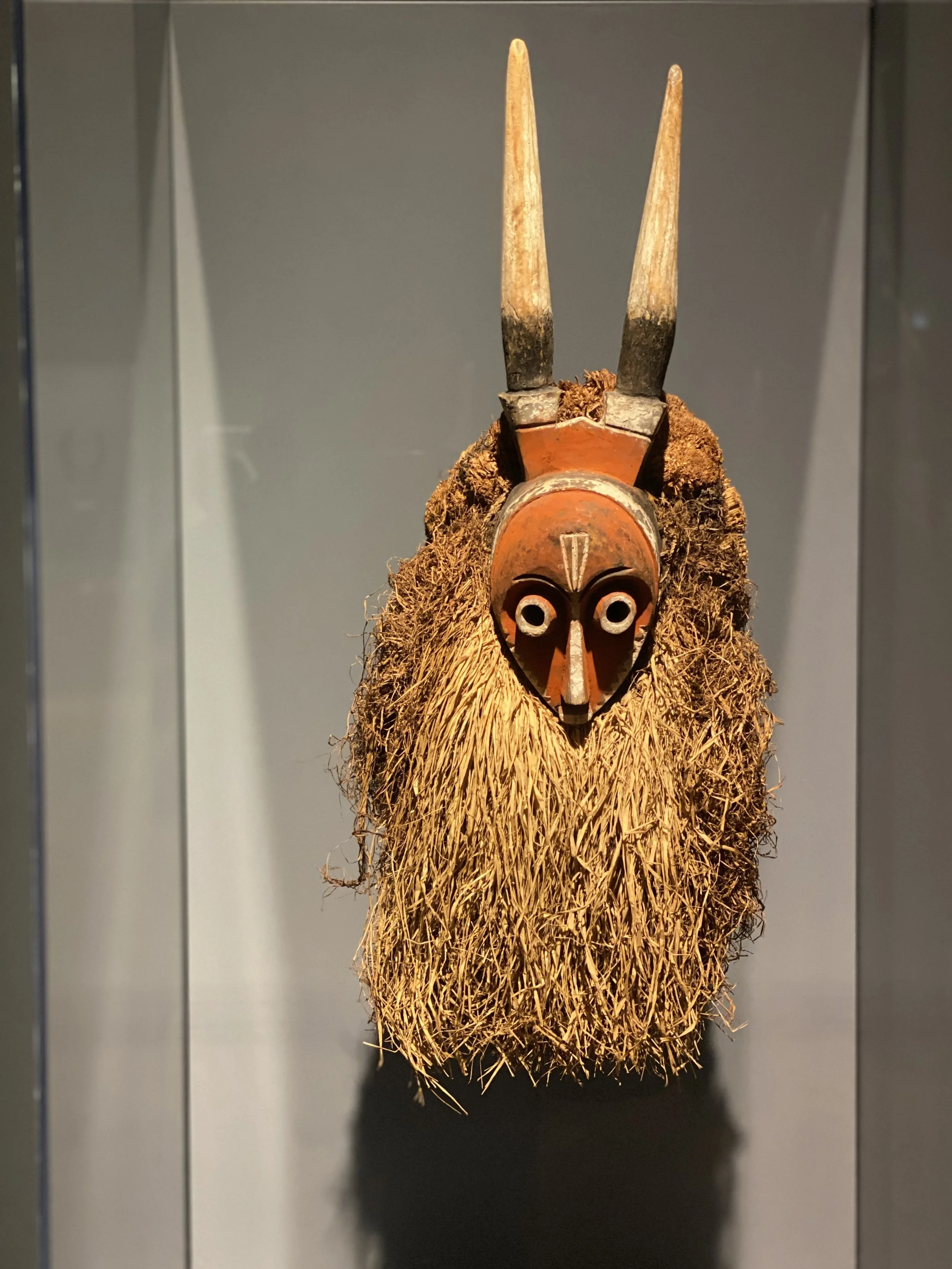
Ngolo mask from the DRC with orange face with wide eyes, antelope horns and straw beard

This ngolo mask from the DRC features antelope horns to convey courage, while its protruding eyes signal aggression in the hopes of discouraging outsiders from approaching a boys’ training camp.

“Artists who intend to instill fear through their objects may represent ugliness by mimicking or referencing animals, especially powerful and fearsome ones,” Petridis says. “Additional features will be incorporated into fantastic compositions that comprise elements sourced literally from the natural world — actual animal parts: hides, horns, teeth, fur.”

Ugliness in African art has a power of its own. “They turn it into a dark, dangerous object, an object that inspires fear and terror and therefore also power and authority,” he continues. 
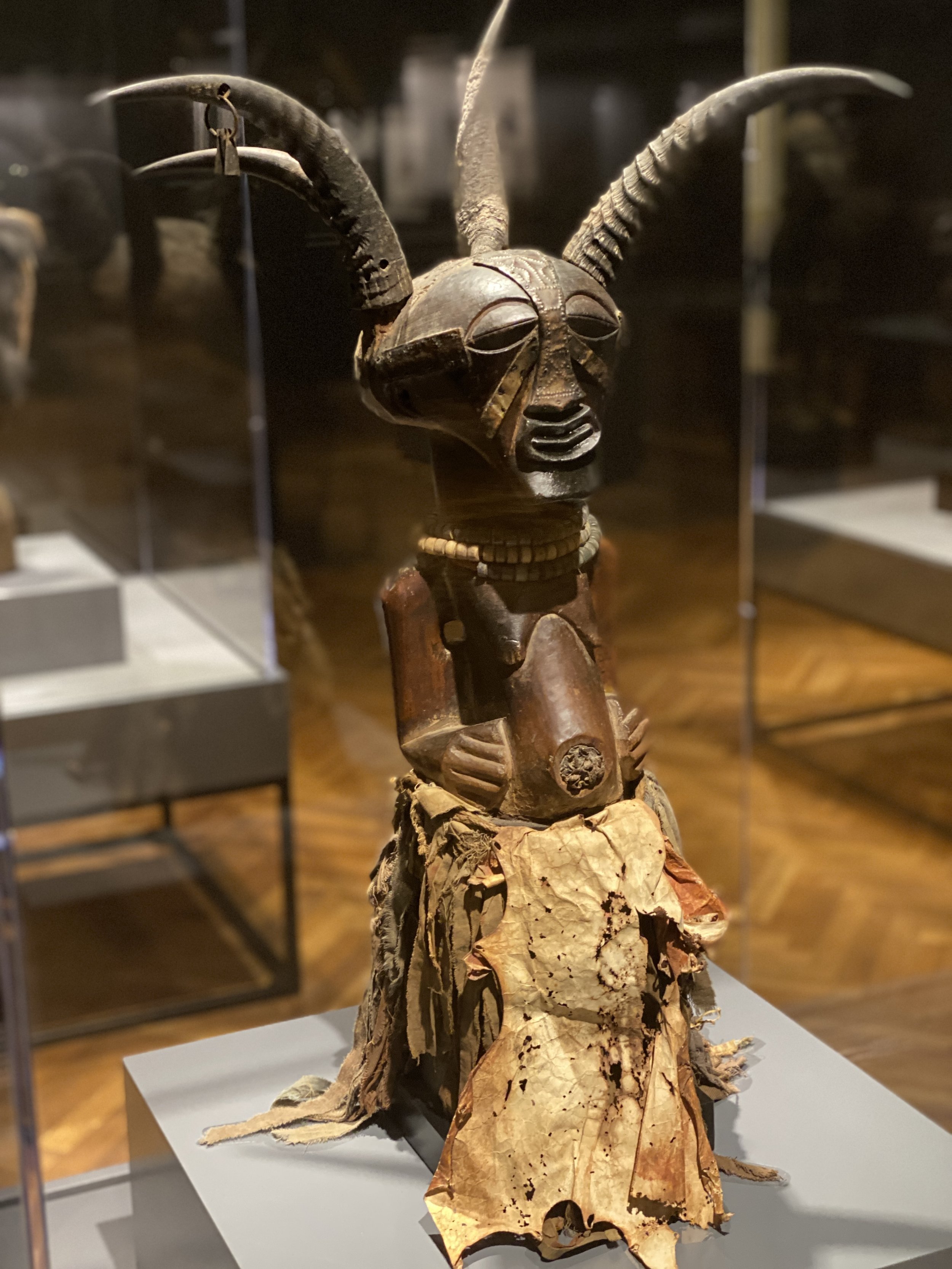
Nkisi figure from the DRC representing a folklore blacksmith hero, with antelope horns and animal skin skirt

Antelope horns sit atop a nkisi figure from the DRC that depicts a blacksmith from folklore. It held great power and was created to protect an entire village.

Some art has elements of both beauty and ugliness and is meant to astonish. 

Petridis refers to this as “awesome art,” what Westerners might call the sublime. They are meant to both fascinate and terrify.
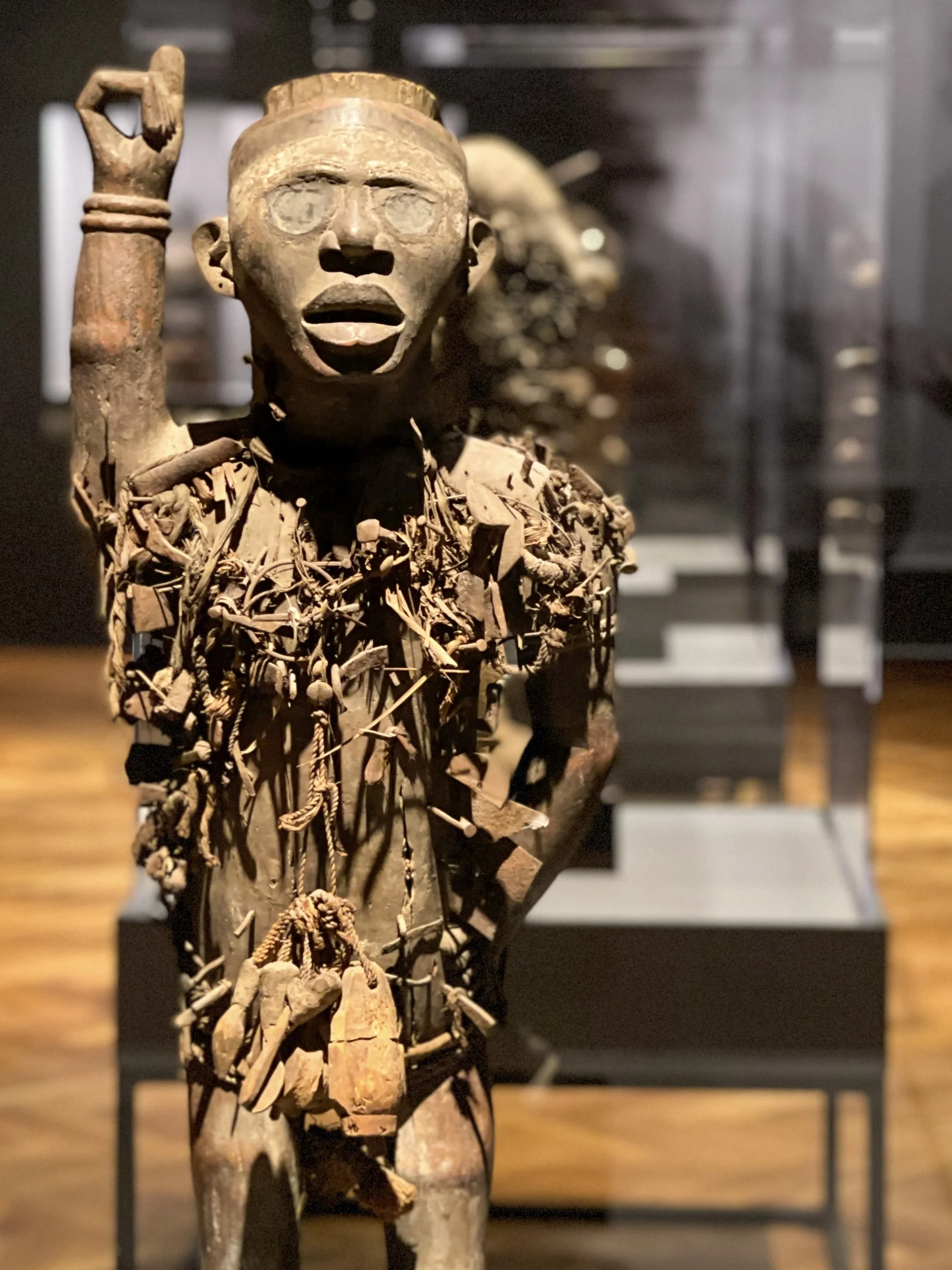
Nkisi Nkondi from the DRC, a wooden figurine with one raised arm and a body full of nails and other metal pieces

Nails are driven into a nkisi nkondi, like this one from the DRC, to atone for transgressions. If someone breaks an oath made to the figurine, it’s said to come to life to mete out justice.

“In a literal sense, it refers to objects that are meant to be awe-inspiring. They will literally stop you in your tracks,” he says. “And these objects are considered to be both beautiful and ugly, both terrorizing and attractive at once.”
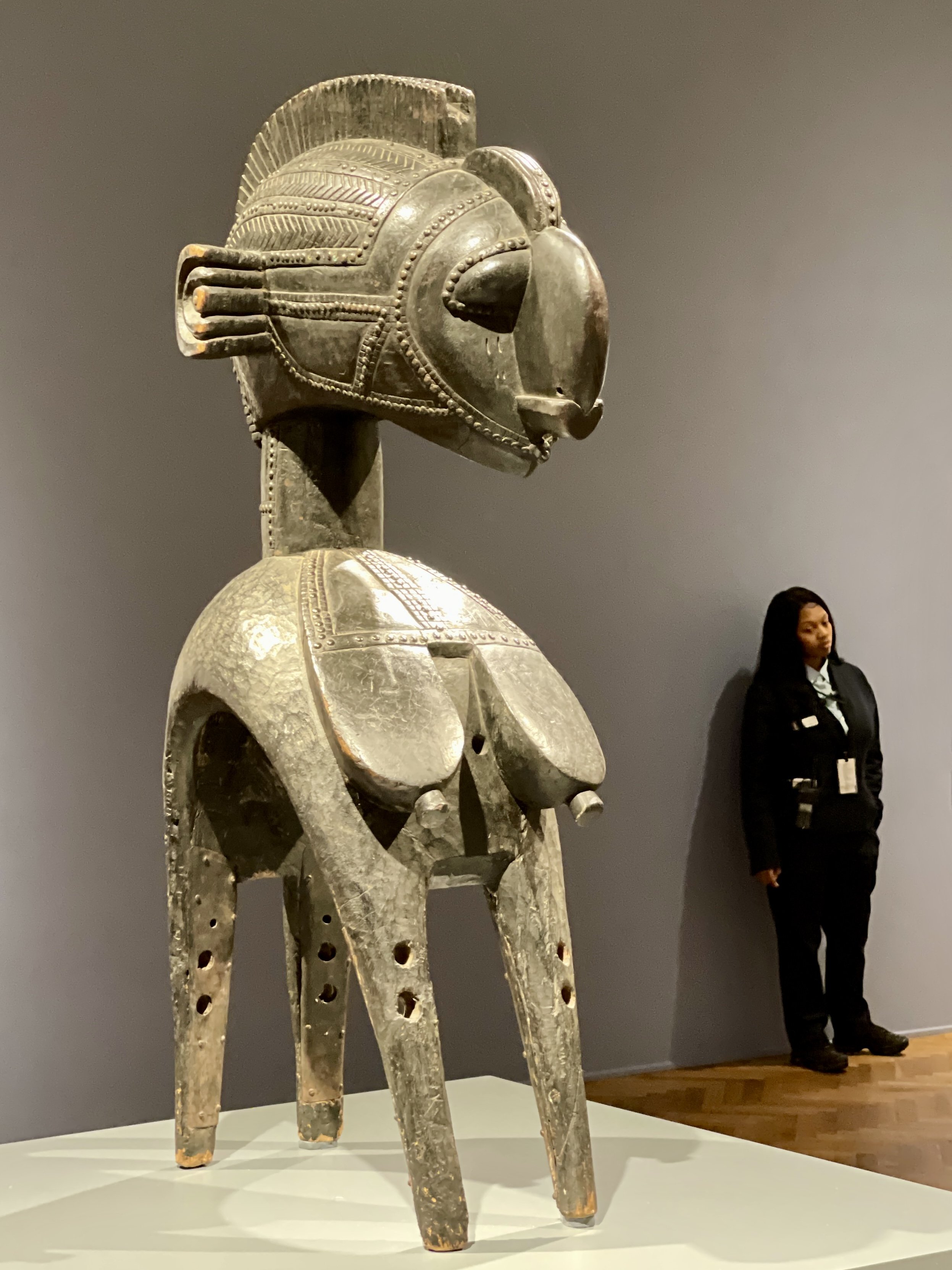
A large wooden d'mba shoulder mask of woman with scarification and large breasts next to a female guard from the Art Institute of Chicago

A large d’mba shoulder mask used during ceremonies features scarification and pendulous breasts — aspects of the feminine ideal among the Baga people of Guinea.

Beauty Is in the Eye of the Beholder

When judging African art, see where there are overlaps or differences from your own preconceived notions, Petridis suggests. Always keep in mind that African art should always be viewed through the language and vocabulary of the culture it comes from.

“Beauty is essential and important and critical in the arts of Africa as well,” he concludes. “But it’s not necessarily the beauty that you as an outsider would see in it.” 

To avoid imposing your own tastes and preferences on art objects, you have to be open to learn and read about the culture in which they function, and what meanings and purposes they convey. And that new understanding is a thing of beauty. –Wally
Crazy, Cartoonish, Controversial: The Art of Mu Pan

A Q&A with the avant-garde artist who creates elaborate hellscapes of violence and monsters and has been featured in the horror film Midsommar. 

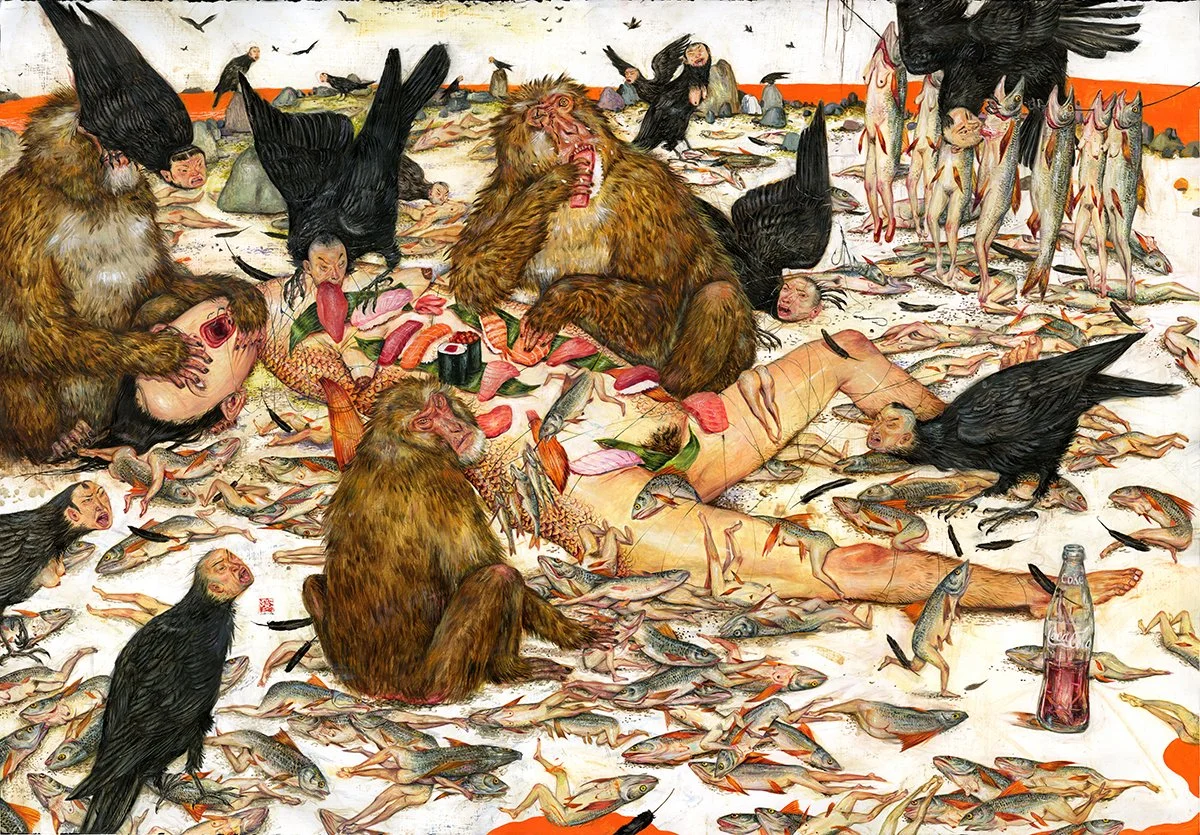
Mu Pan artwork showing a naked woman surrounded by dead fish, with monkeys and human-headed crows eating sushi off her

Me Like Sushi by Mu Pan, 2015

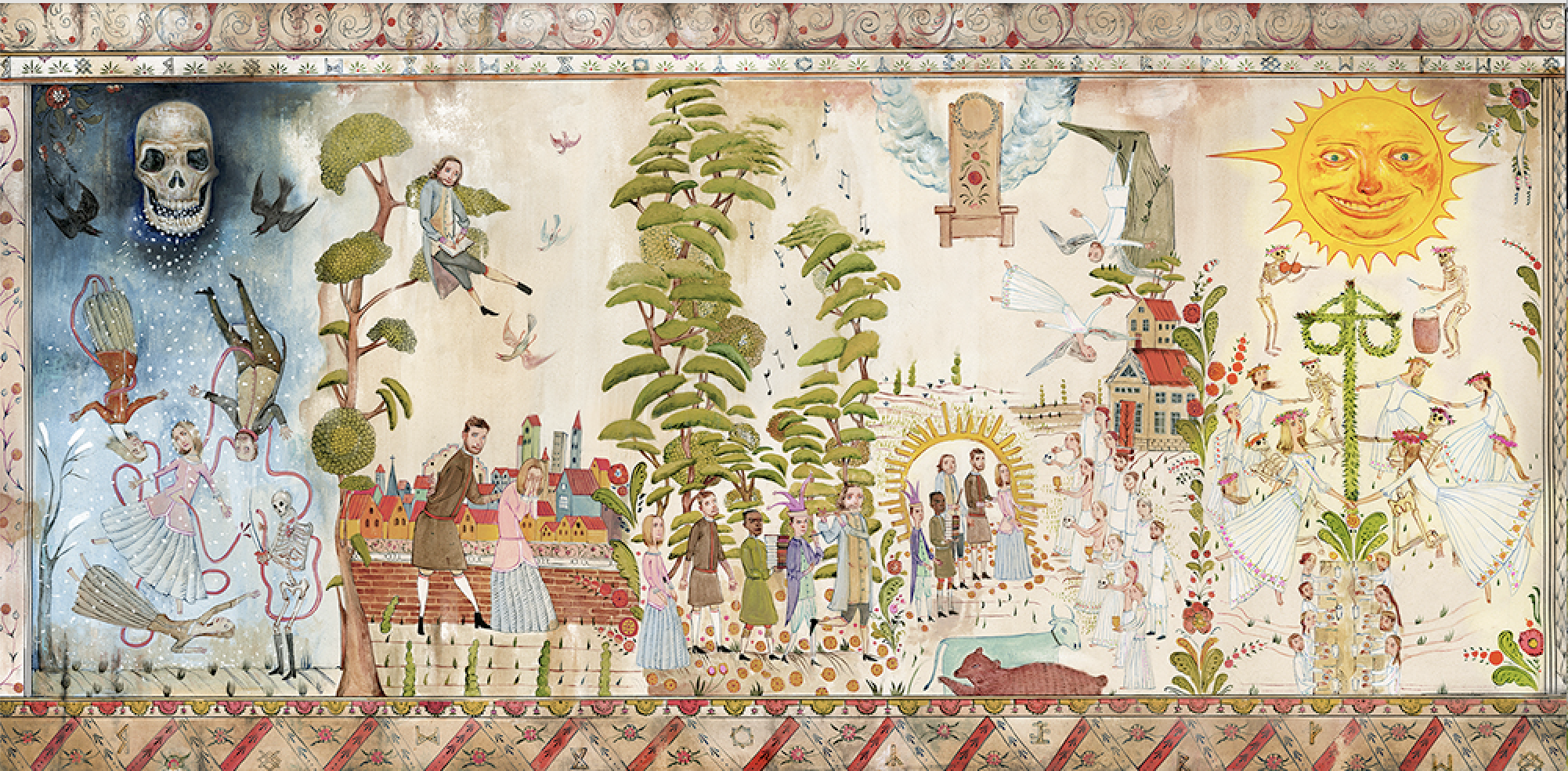
Monkeys and human-headed crows eating sushi off a screaming woman. A multi-armed Christ shooting machine guns. A yak-headed samurai slicing a cowboy in half. Countless battles between bizarre beasts. Oh, and a creepy mural that foreshadows the dread to come in the horror flick Midsommar

Every monster I draw is actually a self-portrait. 
— Mu Pan, American Fried Rice 

Looking at the scope of his elaborate artworks, you notice certain themes: Mu Pan holds a cynical and misanthropic view of human nature and society. His paintings are used to express his anger and frustration with the issues he cares about, such as racism, colonialism, U.S. politics and pop culture.

Yes, if there’s one thing the artist Mu Pan isn’t afraid to be, it’s provocative.

Mu Pan’s epic-scale nightmares depict violence, gore, sex and, yes, humor. His art is like if Hieronymus Bosch and Henry Darger had a half-aborted fetus. 

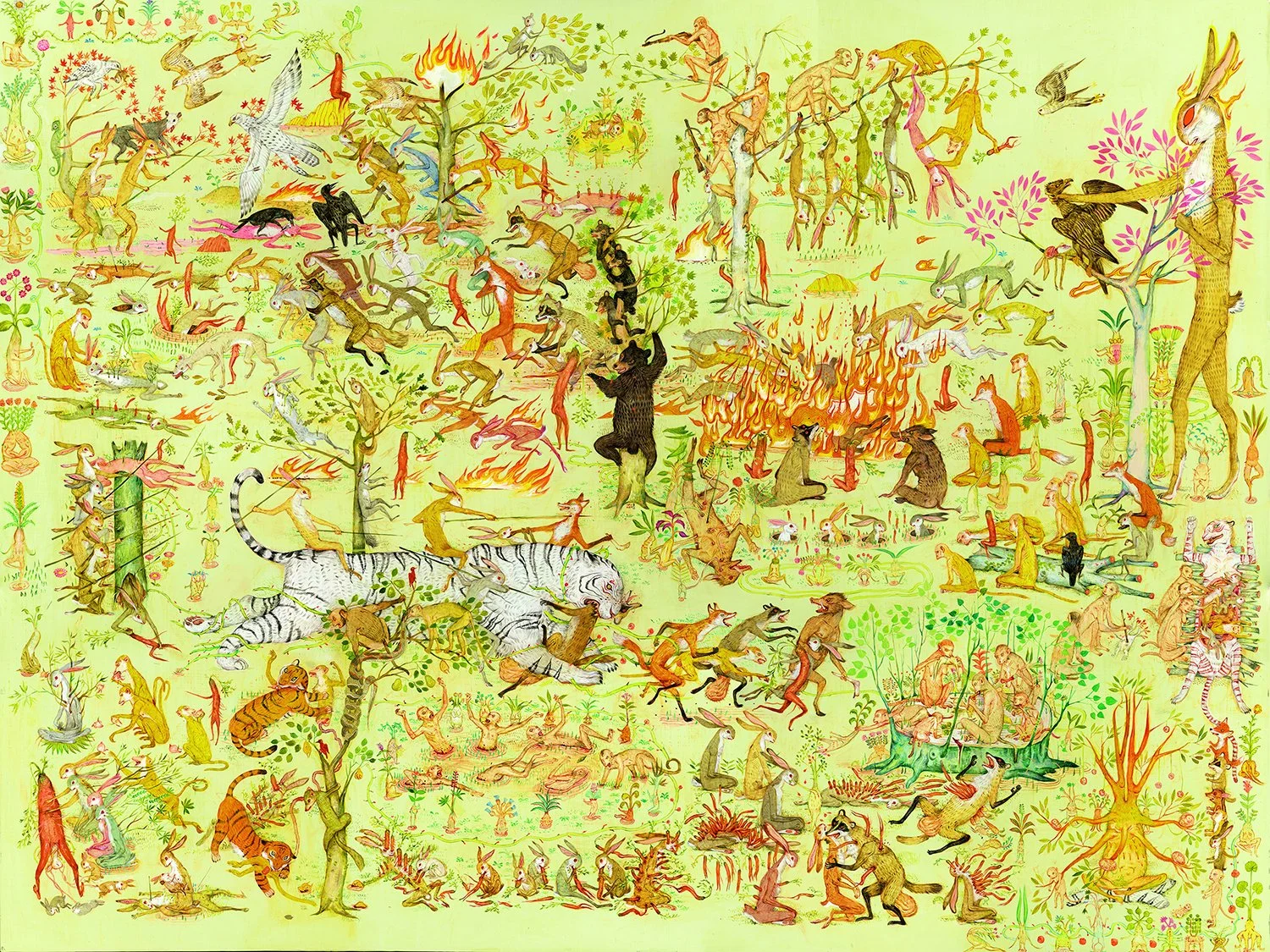
Many beasts fight, including rabbits, foxes and tigers in elaborate greenish artwork by Mu Pan

Rabbits by Mu Pan, 2020

He challenges viewers to confront their own prejudices and to question the narratives they’ve been told.

“Drawing and painting are for me the most obvious ways to claim justice,” Mu Pan says in his book American Fried Rice. “I use creation as a pretext to highlight everything I dislike such as violence, conflict or lies.”

When Duke and I saw Mu Pan’s work, it was love at first sight. 

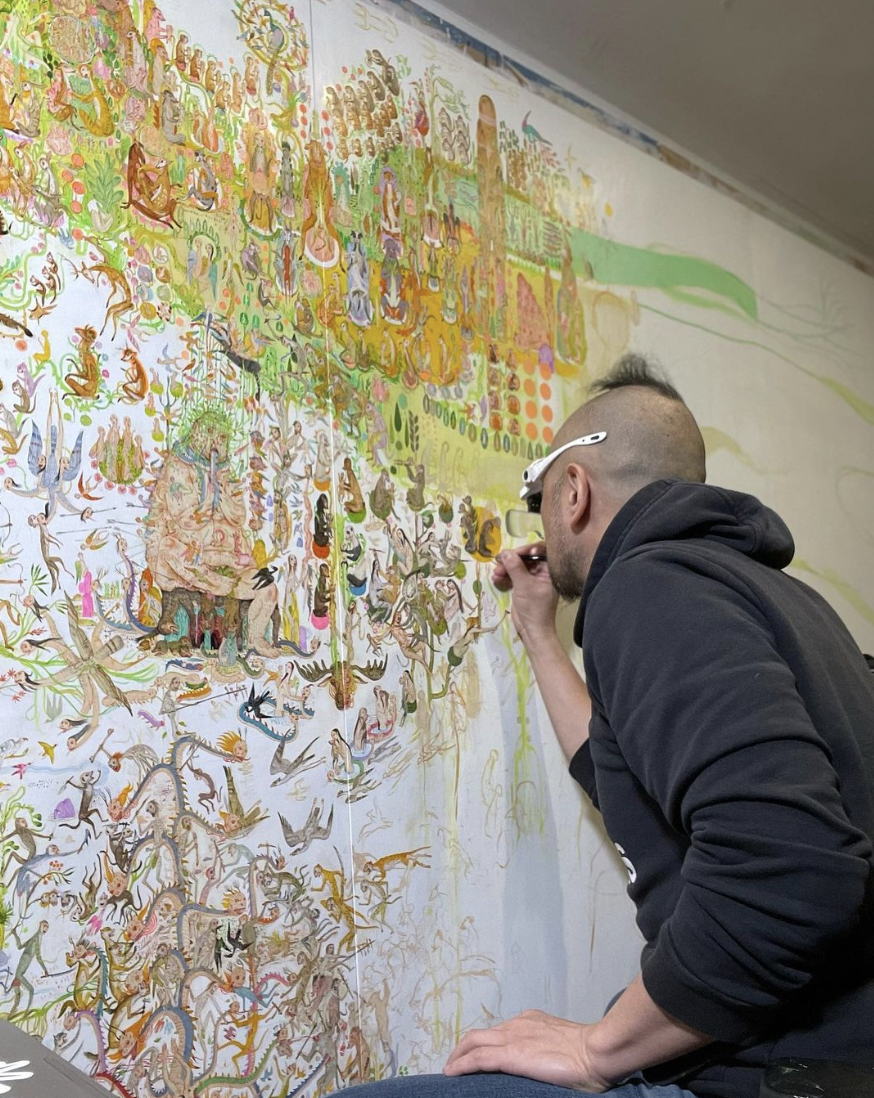
The artist Mu Pan works on a large, intricate illustration

The artist at work

A Brief Bio of Mu Pan

The artist known as Mu Pan was born in Taichung City, Taiwan in 1976. He grew up there and emigrated to the United States with his parents in 1997. He studied at the School of Visual Arts in New York City, where he obtained a bachelor’s degree in illustration in 2001 and a master’s in illustration as visual essay in 2007. He lives and works in Brooklyn.

“Now I’m just bitter,” Mu Pan says in American Fried Rice. “I hate everybody equally. I’m not American, but I’m also not Chinese anymore. I’m glad I have both and I don’t have both.”

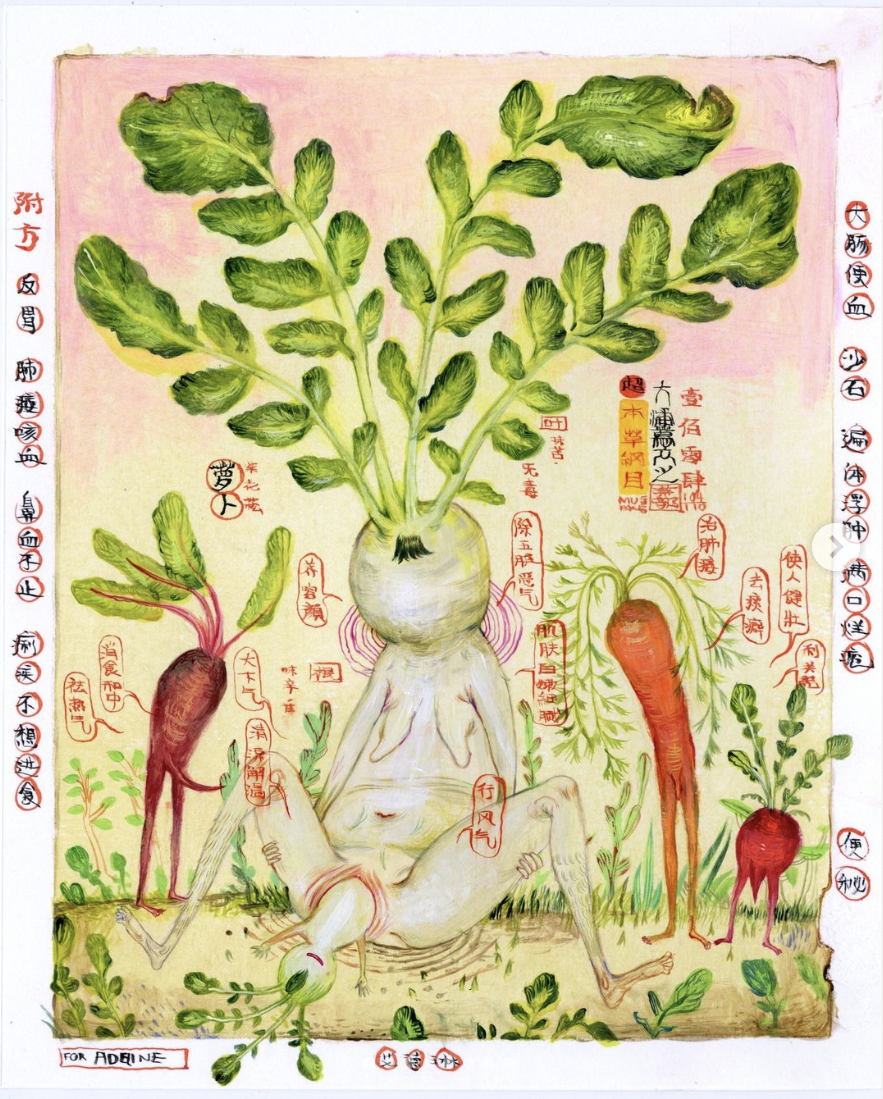
Mu Pan artwork showing a humanoid parsnip giving birth by other root veggies with legs

From the Compendium of Materia MUdica by Mu Pan, 2020

We were intrigued. So we reached out to Mu Pan to see if he’d answer some of our questions. To our surprise and delight, he obliged us. 

Some of his responses are head-scratchers — but that’s part of why we’re so fascinated with him. –Wally
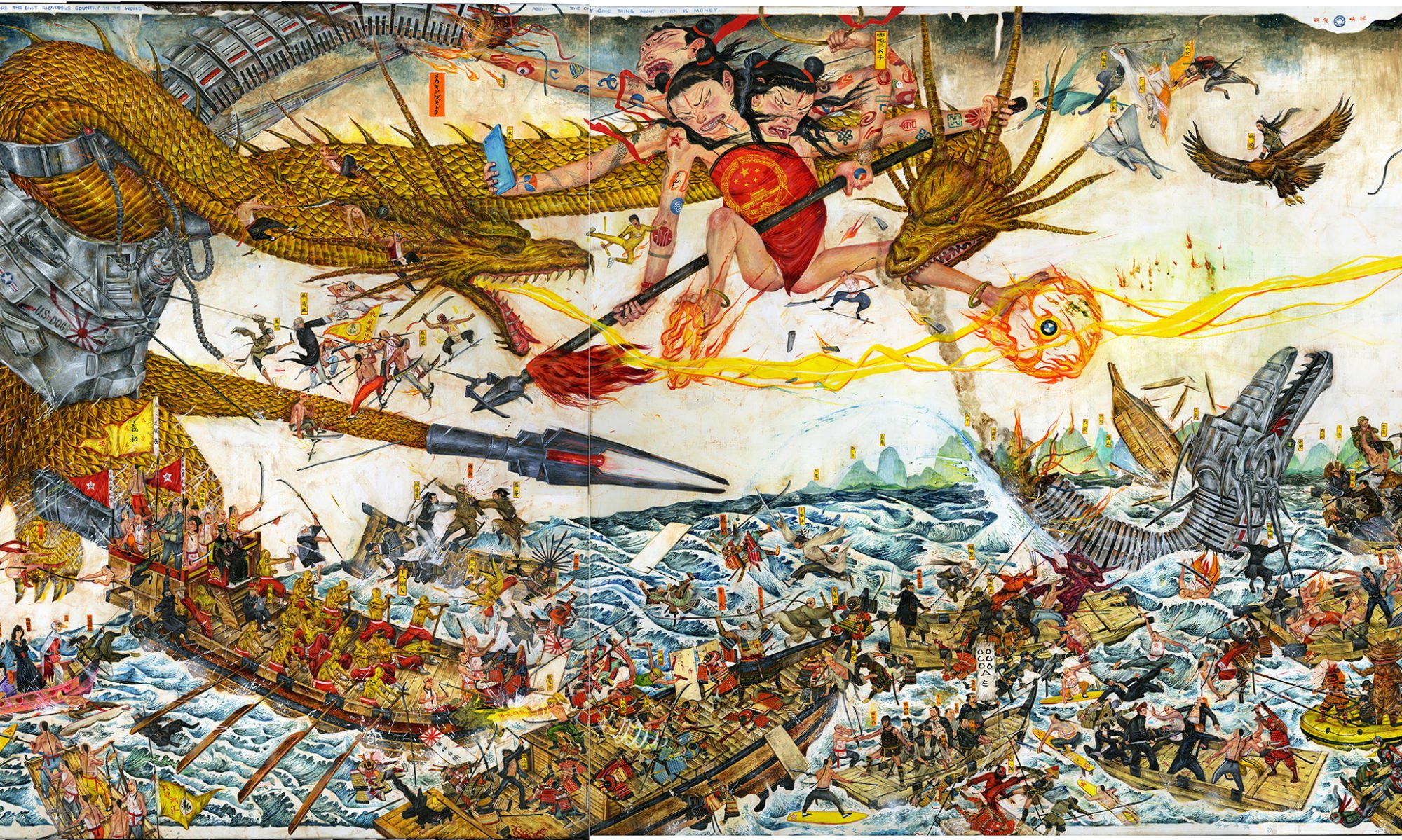
Artwork by Mu Pan showing a naval battle with gold dragons and multi-headed and -armed flaming warrior dueling in the sky

Detail from The Loyal Retainers Part VI: South China Sea, 2016

Q&A With Mu Pan

What influences your artwork? 

Ancient art — the less sophisticated the better. Anything that has no Western influence. 

I used to be so into Japanese woodblock prints, but now I don’t feel anything for them anymore.

I listen to audiobooks while I work. 

When I was younger, I was influenced a lot by Louis Cha. Now I’m more into Mo Yan. Most images I make are stolen from books. 

I also get influenced by Hong Kong and Japanese cinema from the ’80s and ’90s.

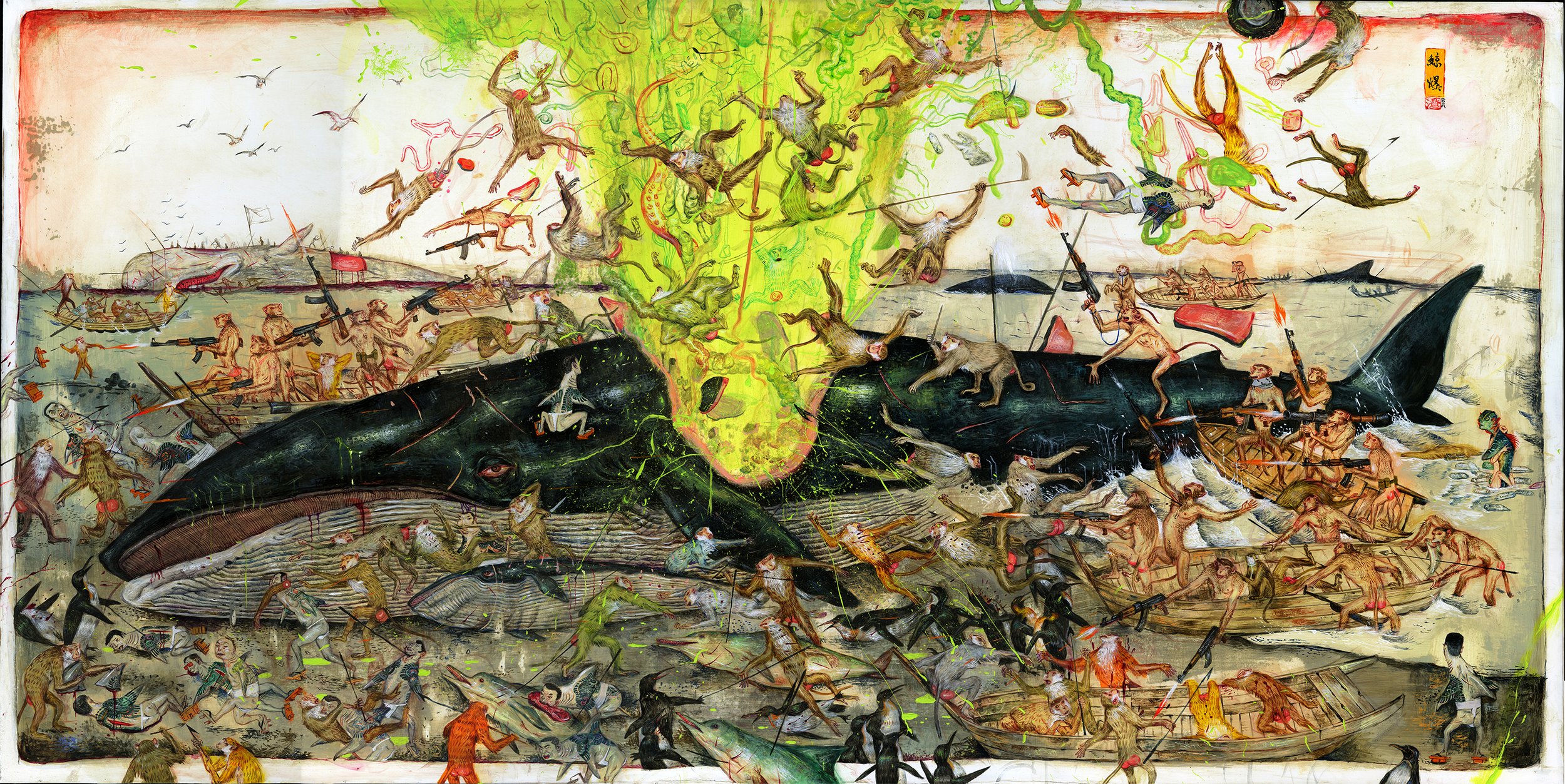
Black whale lies dying, with a toxic green explosion blowing away monkeys in the center of its body, surrounded  by naked hunters in boats with machine guns

Whale Explosion by Mu Pan, 2018

What artists do you love? 

I don’t love any living artists. I kinda hate them. Cuz they all make much more money than me and I don’t think my talent is less than theirs. They are just businesspeople. I can tell you I hate Murakami the most. And yes, I said that.

Also, I hate their fans to like my work. 

My favorite dead artist is Henry Darger. When I get frustrated and depressed, I think of him, then I can keep going on.

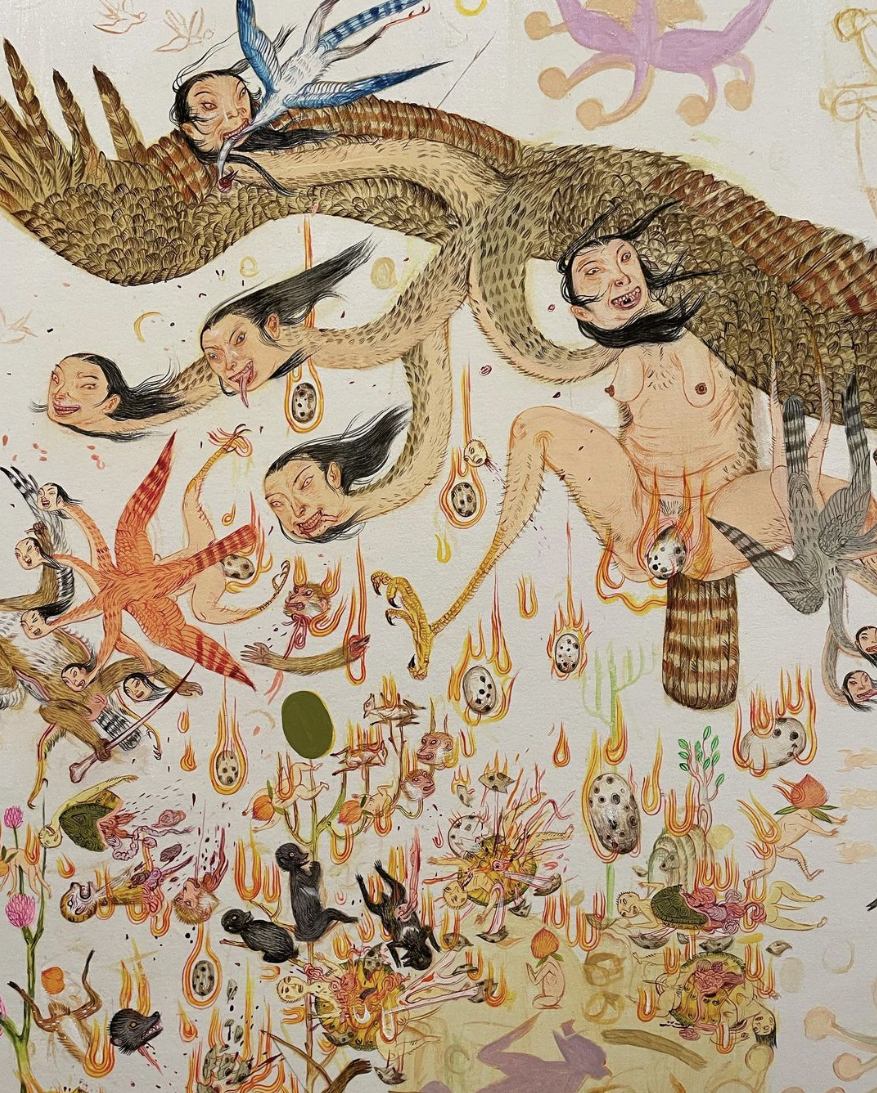
Artwork by Mu Pan showing bird with long necks and women's heads while harpy gives birth to flaming spotted eggs

Momlego Egg by Mu Pan, 2023

What part does folklore play in your art?

I am more into history than folklore. 

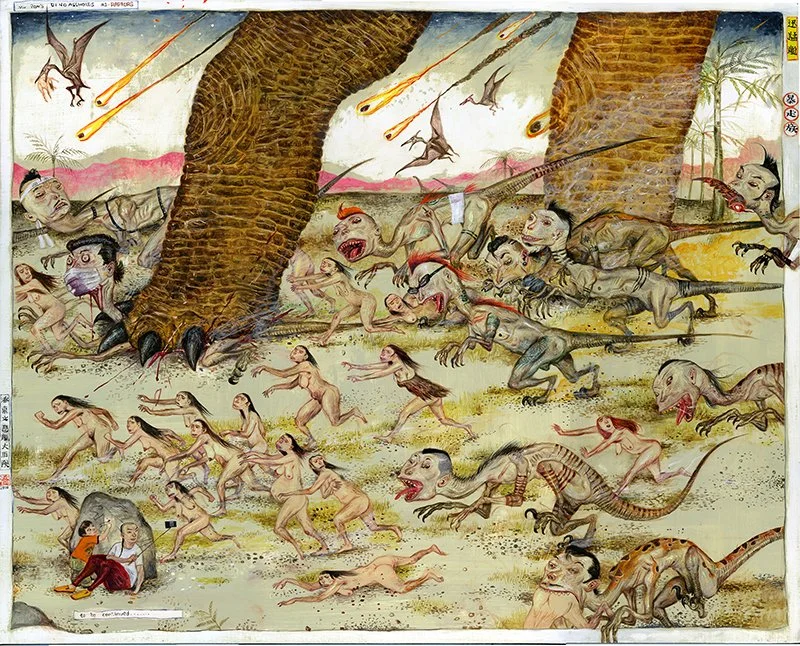
Artwork by Mu Pan showing human-headed dinosaurs chasing after naked women while giant dino stomps down

Mu Pan’s Dinoasshole Chapter 1 by Mu Pan, 2016

There’s a violence to your art but also a playfulness. Can you talk about that?

My violence is cartoon. I am a very peaceful person indeed. I just have too much anger. And when I am angry at someone or something, I just purely wish the person would die in the most painful way.

And I hate being pretentious. I don’t believe that there is anyone in this world who doesn’t enjoy vengeance and violence. Our history is made of that, and even the Bible is full of violence.

I see that being fake and nice is worse than violence, and I still believe that violence is the ultimate method used to solve problems. Just look at the U.S.  government — they rely on violence and power. And they are pretentious as hell.

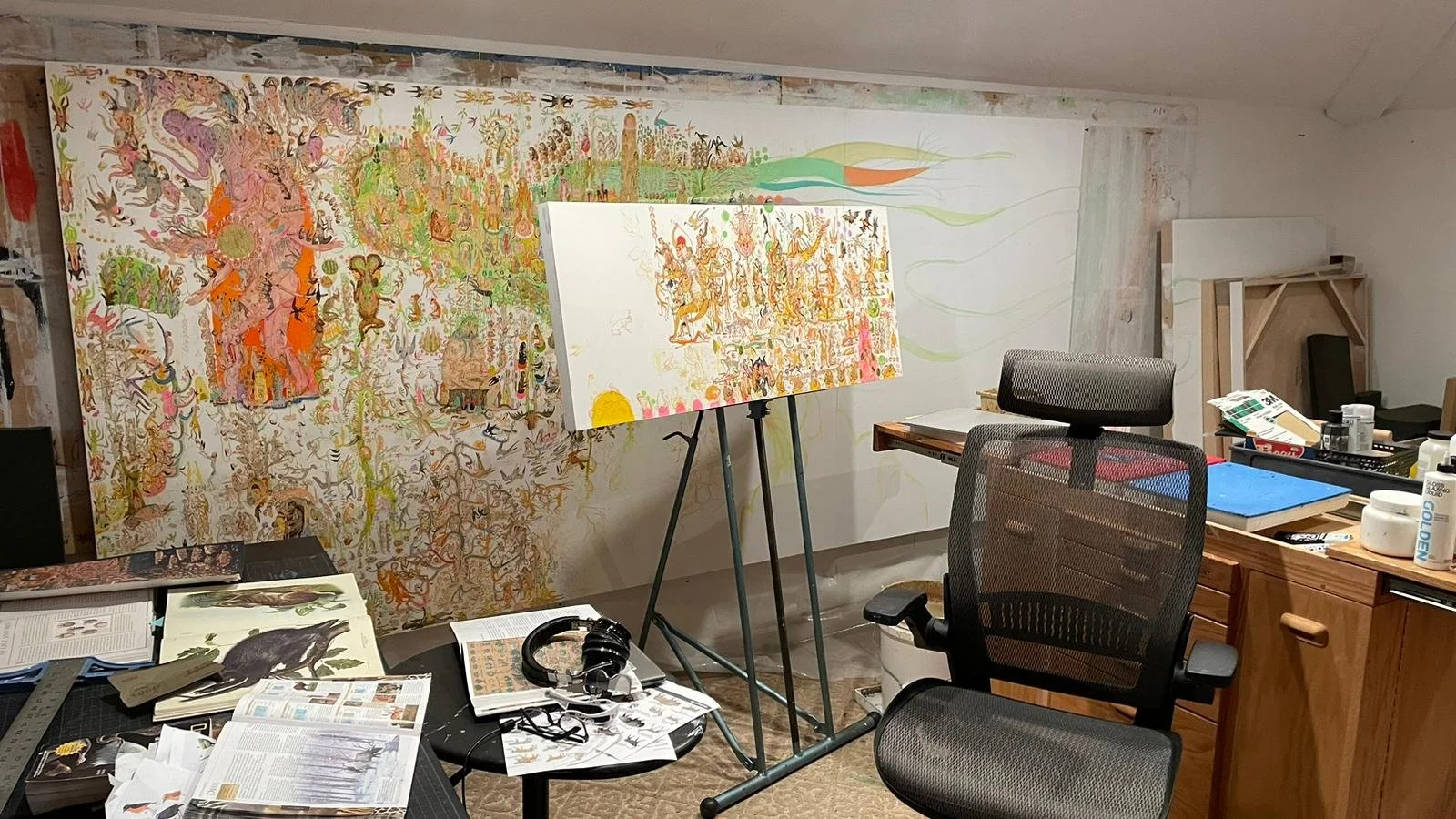
Mu Pan’s studio. Even though there are two works in progress, he told us he can only work on one at a time.

Tell us about your process. 

It really depends on how I feel. I don’t like to do small pieces, cuz I like to show off my strength that others don’t have — especially doing tiny figures on a big scale. I like to do things that people are not willing to, and I will not be submissive to anyone. You can call that stupidity, and I admit that I am stupid. 

Each piece takes a long time to make, because I don’t prepare — neither do I like to make any sketches. Sketches are for products, illustrations or to feed a dumb audience. I draw as I think, and I often erase everything I did the day before.

Life is too short. Being myself is more important than making others happy.

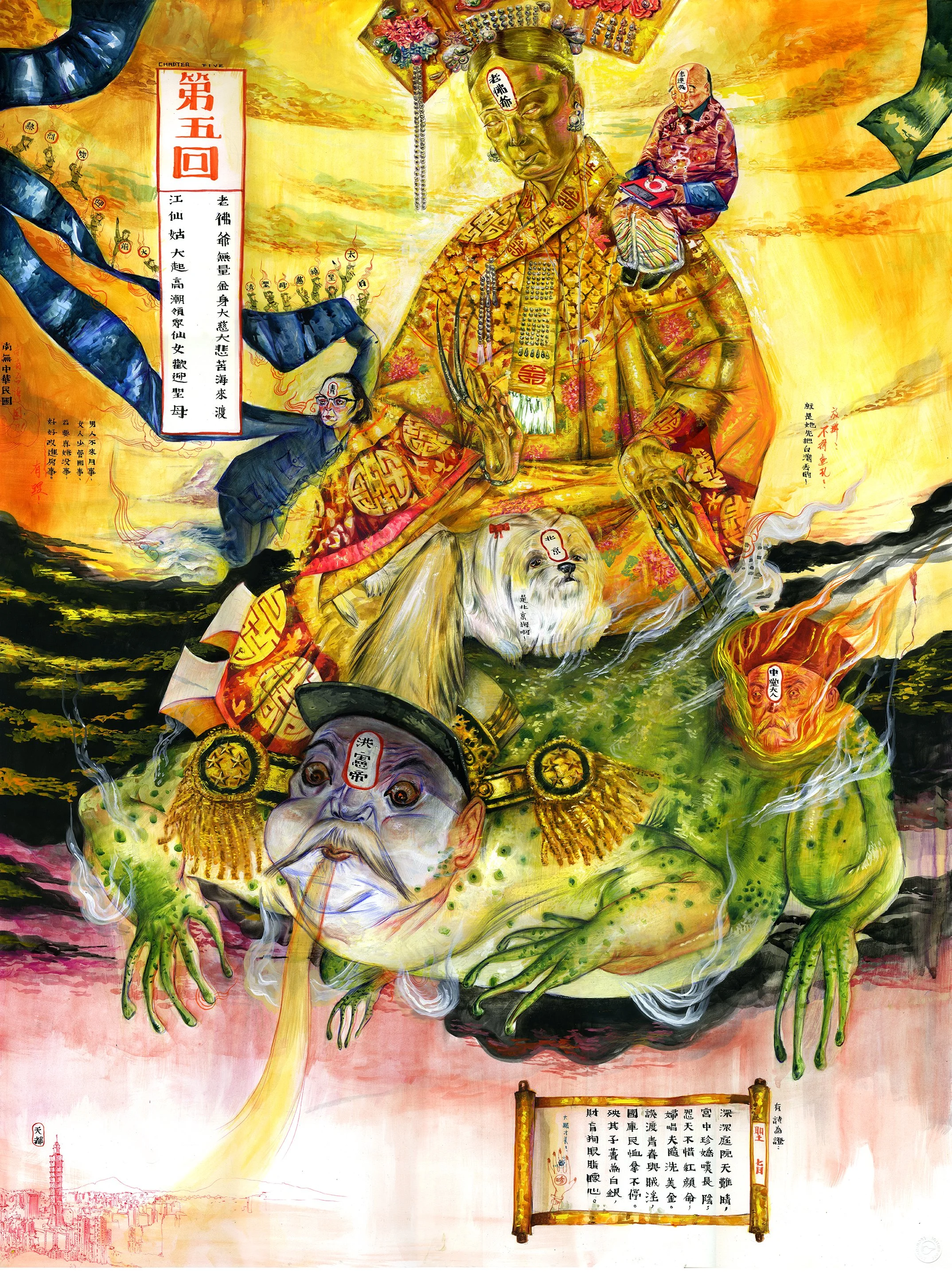
Golden Chinese woman in traditional garb, with smaller man on her shoulder and white Pekinese dog in her lap on giant frog with gray human head and military garb in this artwork by Mu Pan

From the series Shit History of China by Mu Pan, 2010

You were born in Taiwan and identify as Chinese. How does your heritage influence your worldview?

I am Chinese because my father is Chinese, and so was his father and his father before him.

My grandfathers fought the Japanese, and we were never colonized. 

If you ask Bruce Lee if he is Chinese, he would say yes for sure — even though he was born in San Francisco and raised in Hong Kong. 

I don’t give a shit about Western ideology. 

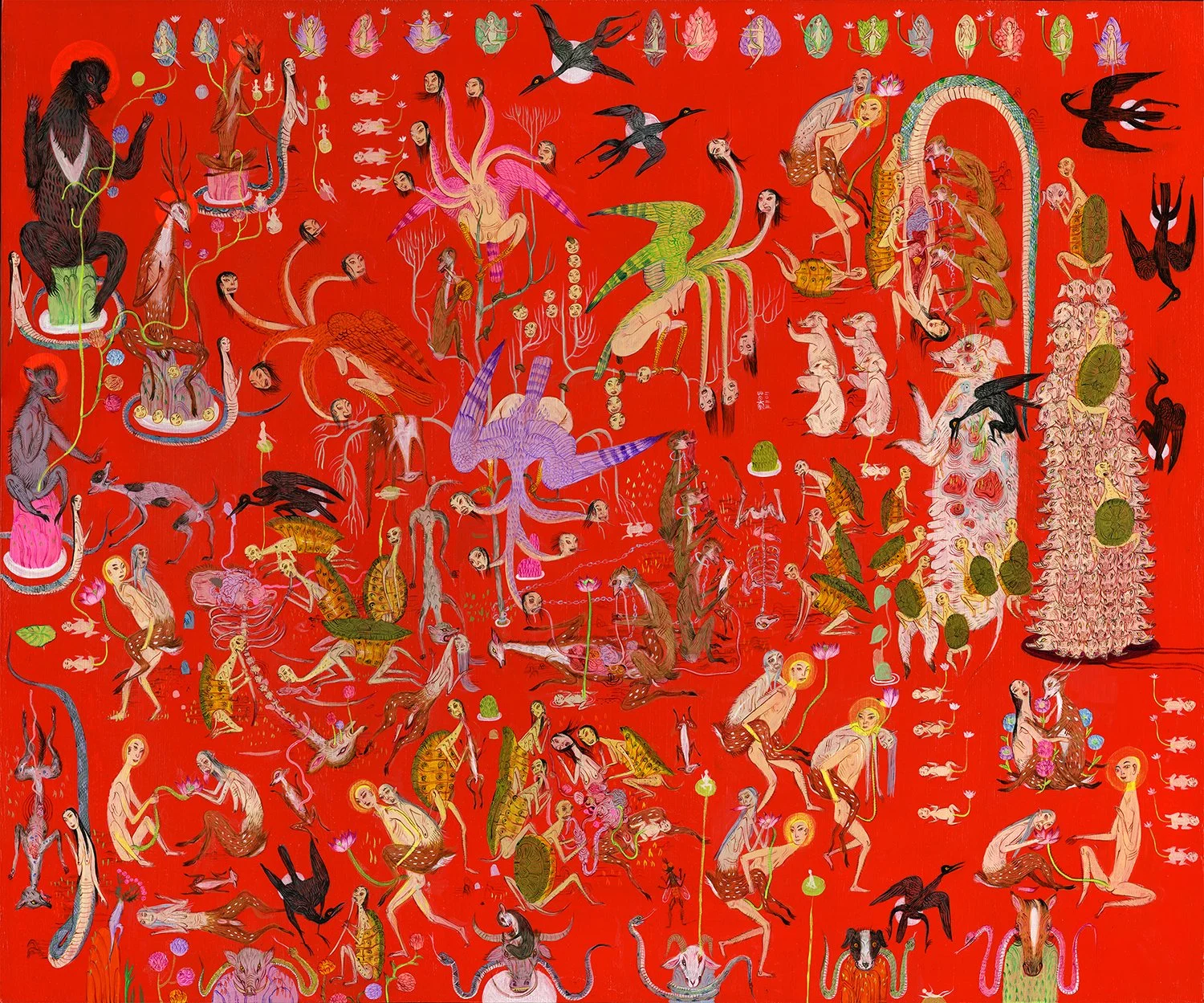
Artwork by Mu Pan featuring a variety of strange creatures, some with multiple heads, including birds, boars and bears against a red background

Be There Soon by Mu Pan, 2023

When did you first get into drawing? 

Since the first time I could make a mark on a piece of paper with a pencil.

Mu Pan created the ominous mural featured in the movie Midsommar.

Tell us about your collaboration with Ari Aster, director of Midsommar. 

Ari is a cool guy. I met him when he asked me to make the opening image for Midsommar. He is very busy and I don’t get to talk to him much. But we have been friends ever since then.

I asked him for a favor to write the forward of my book.

Magical Mystery Tour of the Chapel of Jimmy Ray

A glimpse into the glittering and colorful legacy of the self-taught expat artist Anado McLauchlin at his house outside of San Miguel de Allende, Mexico. 

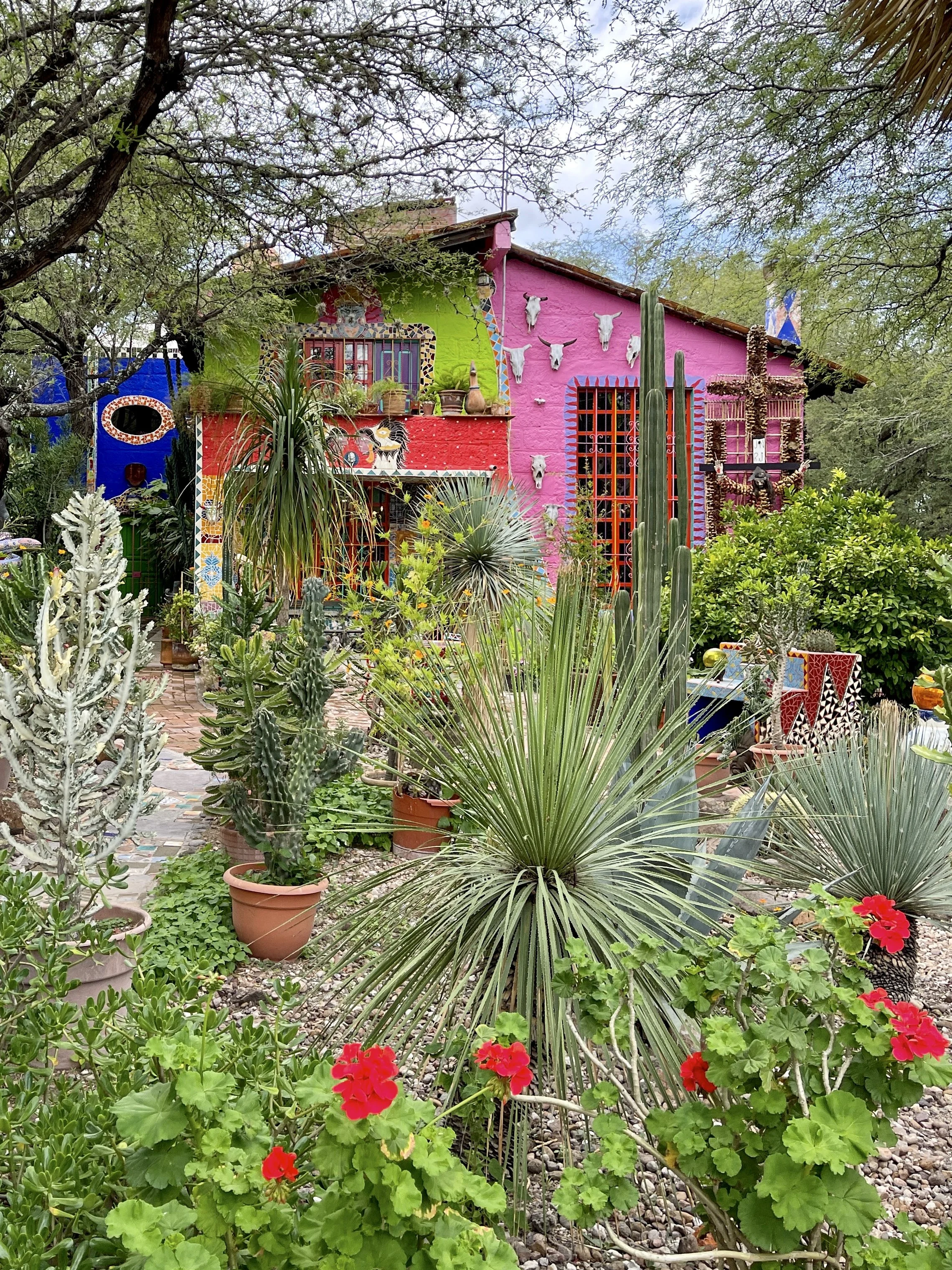
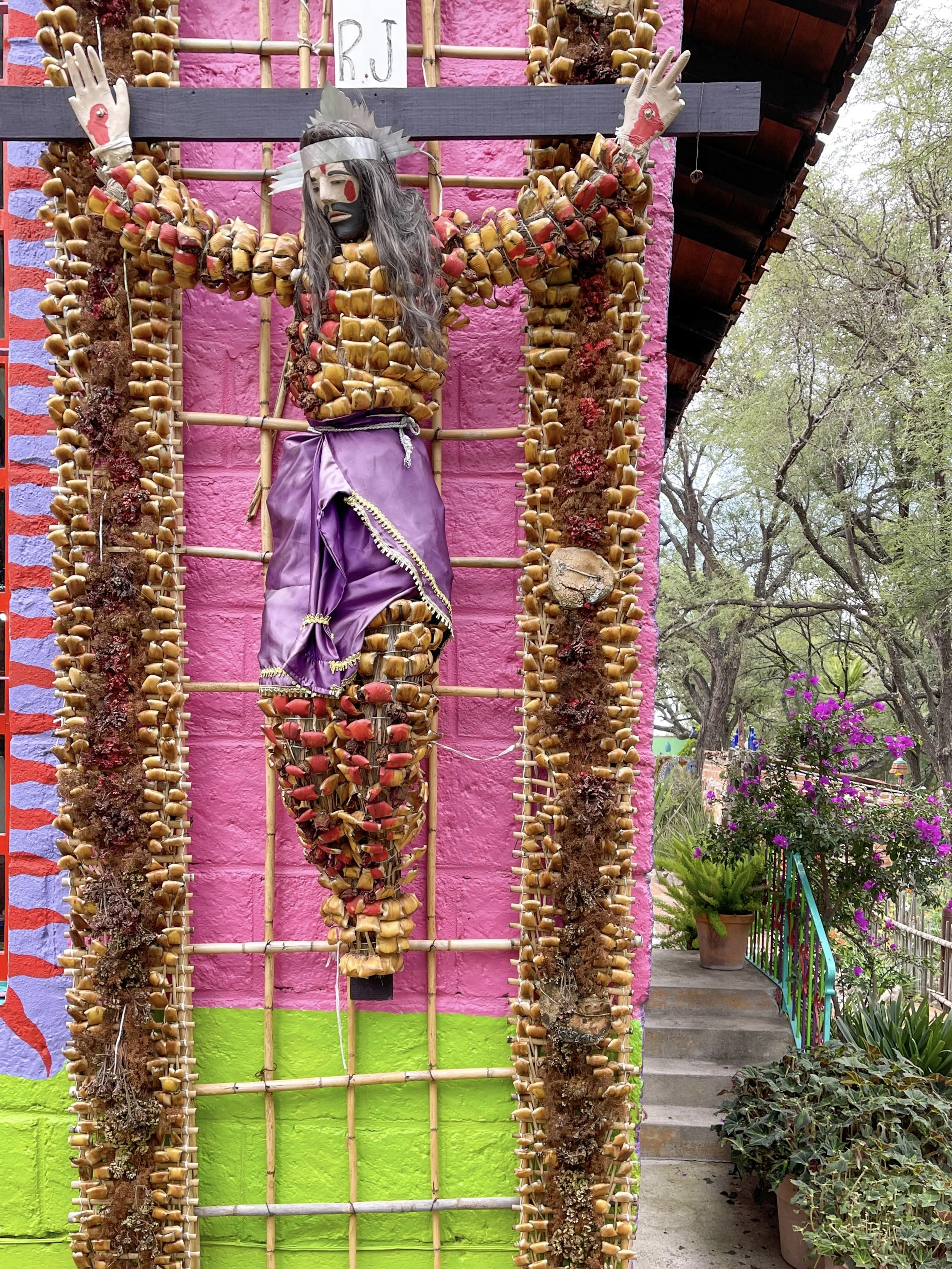
Pink house with cattle skulls and plants at Chapel of Jimmy Ray

There’s no denying that a visit to the Chapel of Jimmy Ray will be a unique experience.

When planning a trip, Wally and I seek out quirky sites that are in close proximity to where we’re visiting. That’s how I first came across the Chapel of Jimmy Ray on Atlas Obscura — followed by an intensive image search on Instagram. I shared the fantastical artwork with Wally but was getting worried our itinerary was filling up. He said we’d make the time. 

And, really, how could we pass up such a weird and wonderful attraction during our stay in San Miguel de Allende, Mexico?!

Don’t go expecting to see a chapel, FYI. It’s actually a 2.5-acre complex literally filled with the unusual art of the late Anado McLauchlin. 

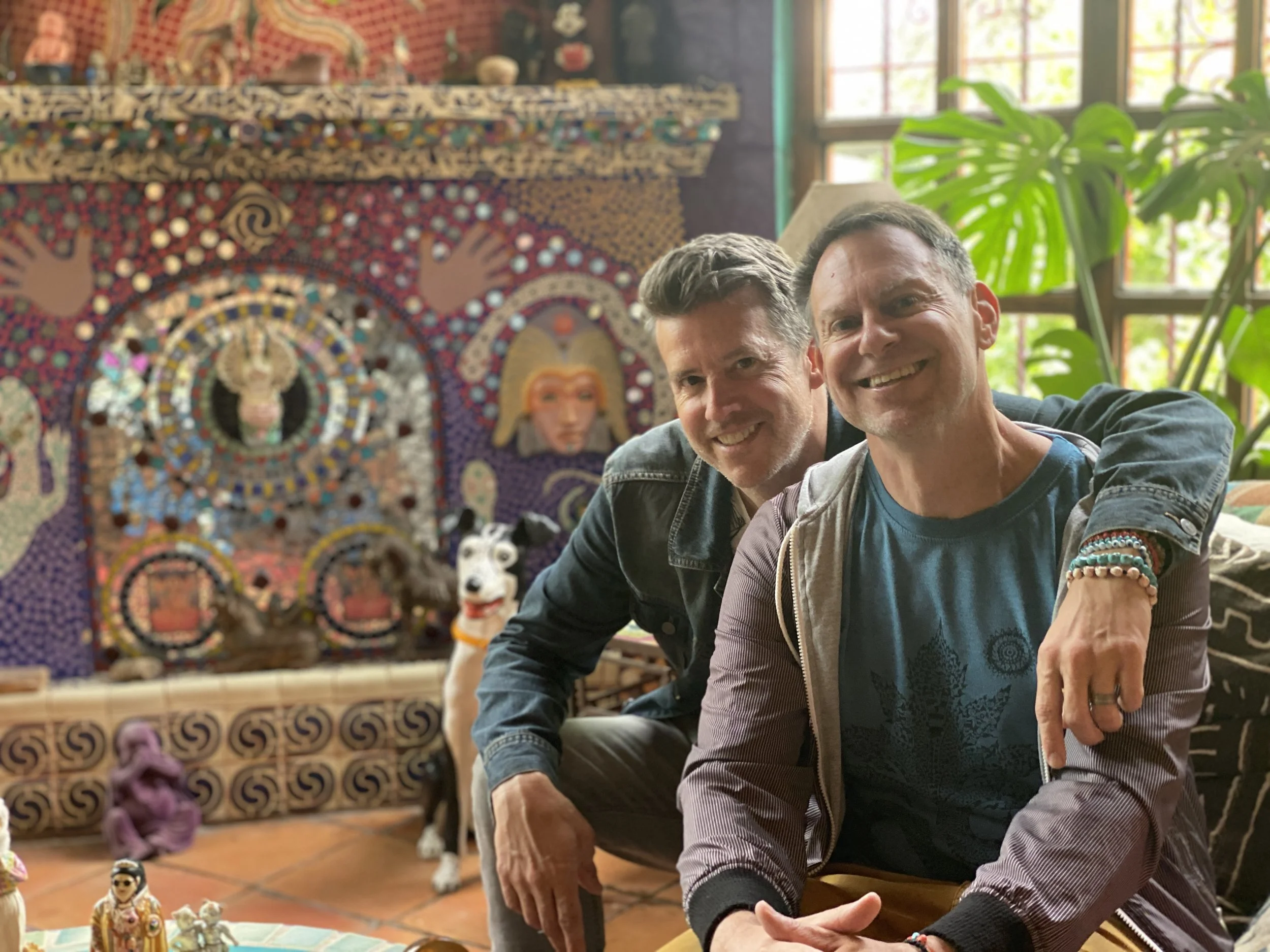
Two men sitting by crazy mosaic-covered fireplace

The Casa de las Ranas might be too crazy for other people, but Wally and Duke would be more than happy to call it their home.

Since it isn’t exactly easy to find, we hired a driver to take us there. The mosaic wonderland is located at the end of an unpaved dead-end road in La Cieneguita, a small town about 30 minutes from San Miguel de Allende. Our hotel arranged the ride, but when the driver doubled the price on us, we sent him packing — a move we’d later come to regret. 

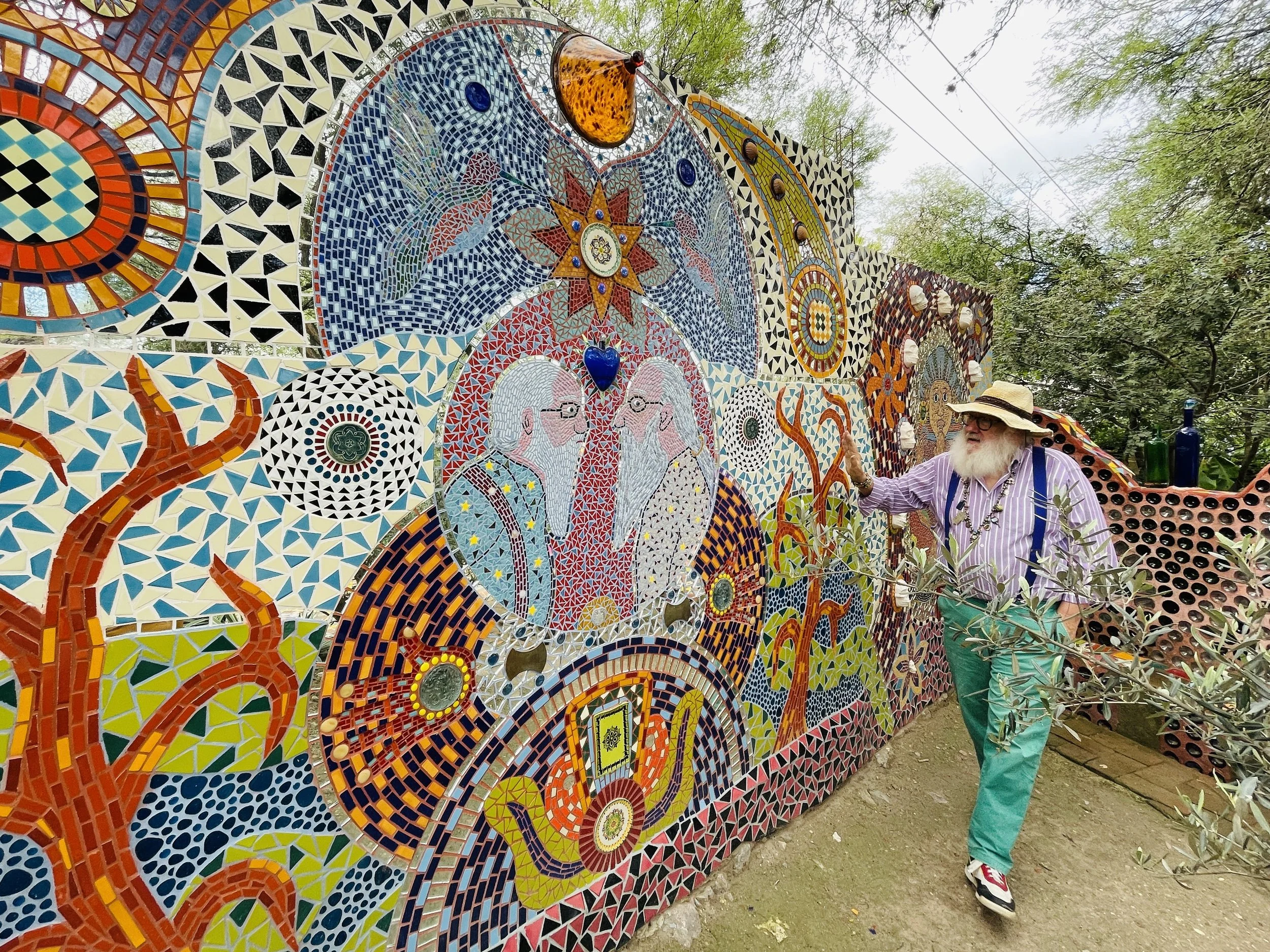
Upon our arrival, Wally and I were welcomed by trusted artistic assistant Carlos Ramírez Galvan. We met up with another couple and were greeted by a tall bespeckled man with an impressive long white beard, wearing a wide-brimmed straw hat. This was Anado’s husband, Richard Schultz, and not unlike a mystical shaman, he was adorned with baubles and charms. Wally thought he looked like the poet Walt Whitman.

Colorful mural and man with white beard, hat and green pants

Richard leads the tour, which starts at the memorial for his late hubby.

Life’s Rich Tapestry: Anado’s Memorial

We were about 10 minutes late and the tour had already started, so be sure to get there a bit early. 

It started off at Anado’s memorial, which includes a 50-year-old olive tree that he and Richard purchased and planted when Anado was diagnosed with colon cancer. The design and theme was originally proposed for the chapel at the Puerto Vallarta Botanical Garden. However, the garden didn’t have enough money to fund it, Richard told us. 

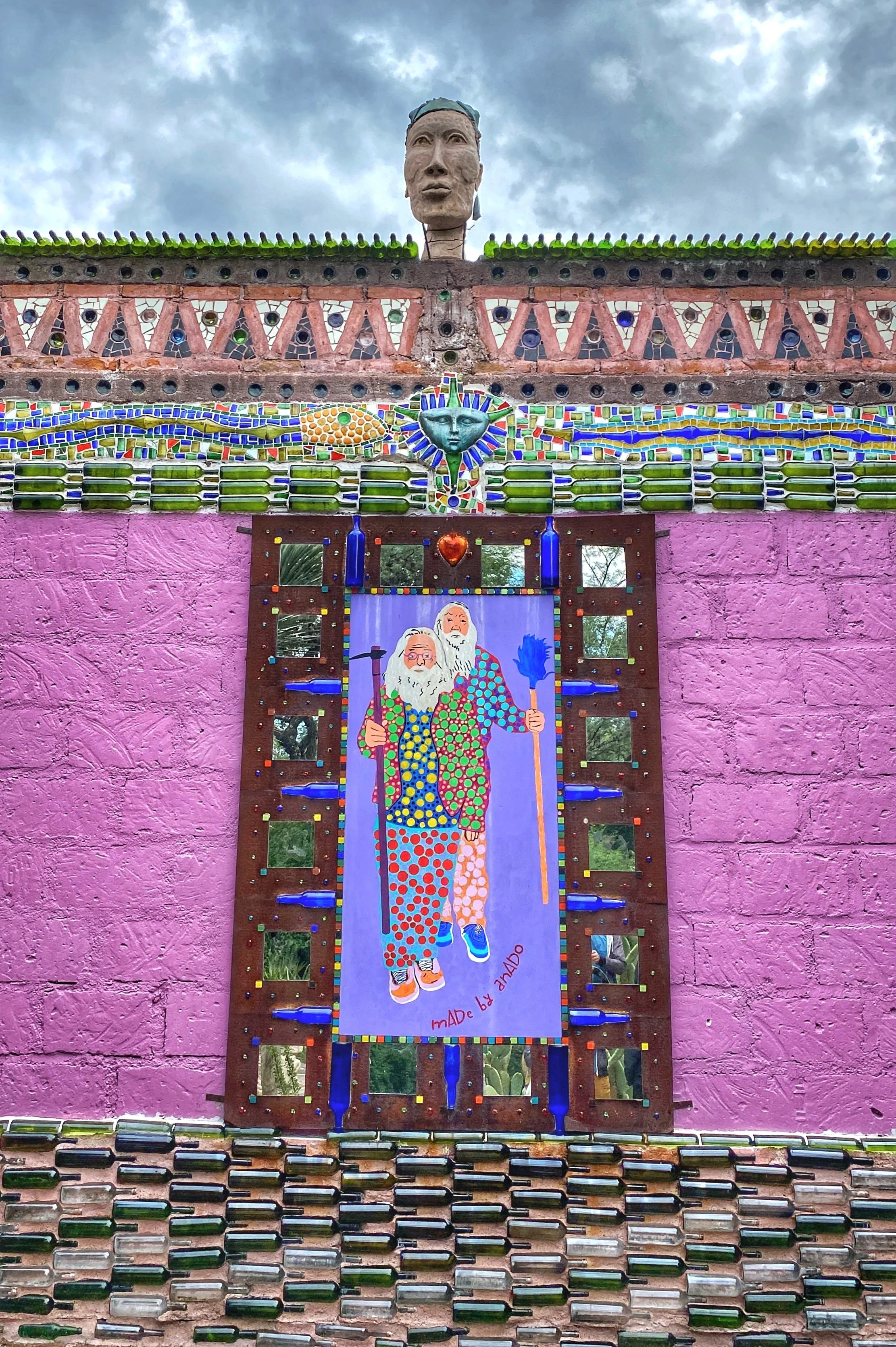
So, Anado decided to use it as his memorial. The assemblage depicts two Trees of Life and portraits of Anado and Richard in profile. Between them is a blue glass heart and above them are a pair of colibríes (hummingbirds), which are considered sacred to many Mesoamerican cultures. 

Mural of two old men in love

A lovely mosaic of the lovebirds

Many of the small pieces of tile used in the construction of the mural come from Dolores Hidalgo. The nearby village is known for the production of brightly colored tin-enameled Talavera tiles — and for Father Miguel Hidalgo, who, on September 16, 1810, rang the church bells from his parish and set the Mexican Independence movement in motion. 

Additional tiles were sourced from Cuernavaca, Morelos. These arrive in ¾-inch squares and need to be cut by hand using a tile nipper, which allows the artists to break off small pieces of the material in a controlled fashion.

To the right of the memorial is a likeness of the Aztec god Xochipilli, (pronounced So-chee-pee-lee). Xochipilli was a benevolent god, a gender-fluid combination of both male and female traits. His name contains the Nahuatl words meaning Flower Prince. He was the god of art — as well as male sex workers. 

Richard pointed out how other indigenous societies like the Lakota Sioux have third-sex individuals who identify as two-spirit and hold sacred roles as teachers, healers and keepers of traditional knowledge among their tribes. Even the Zapotec muxes (mu-shay), who are born male at birth but assume matriarchal roles and female dress, are celebrated in parts of Mexico. 

“Usually, they get stomped out any time religion’s involved, whether it’s Evangelical, Catholic or Muslim,” Richard said. “Being two-spirit doesn’t mean they’re gay, or trans — they’re simply two spirits in one person.”

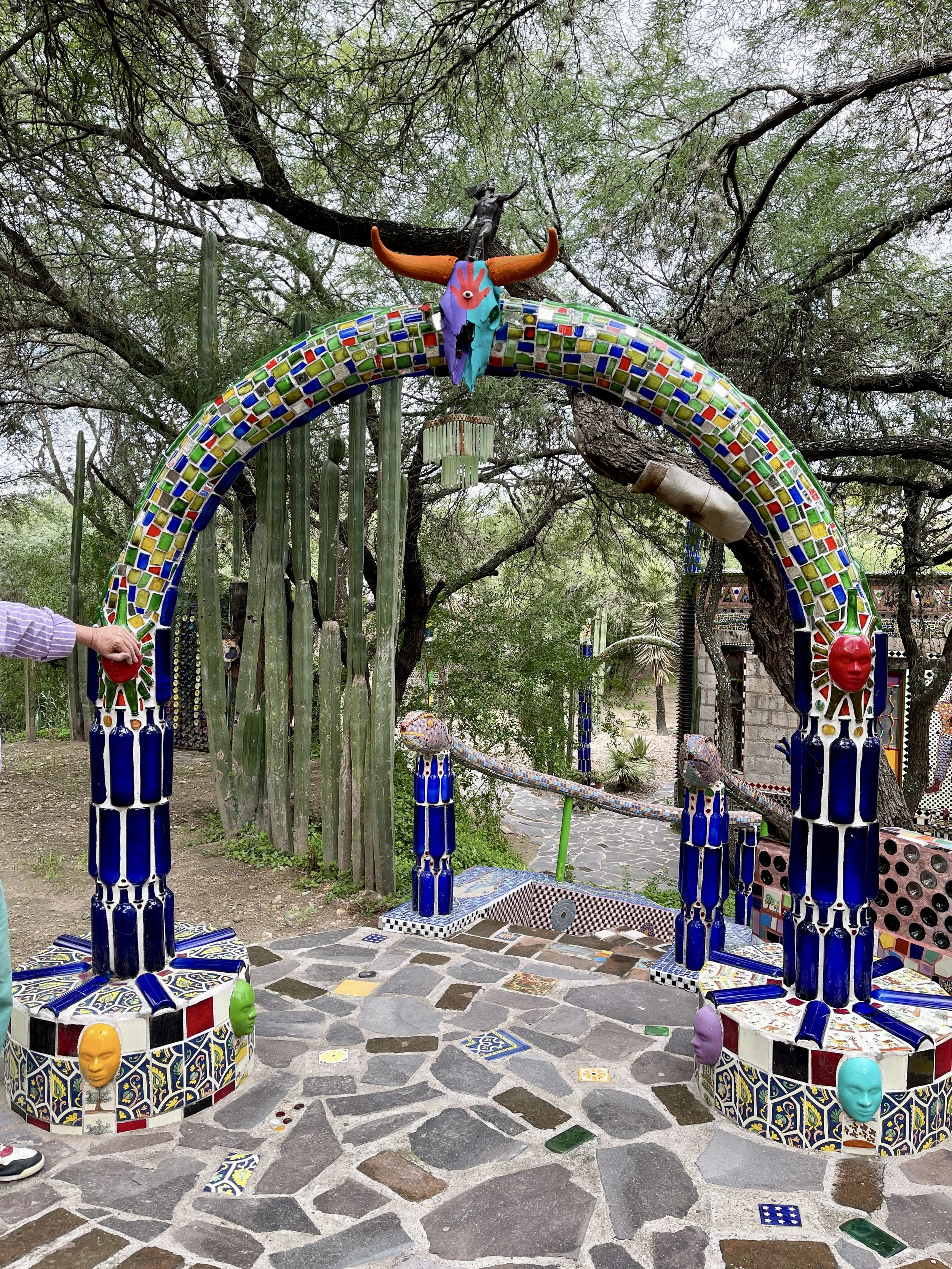
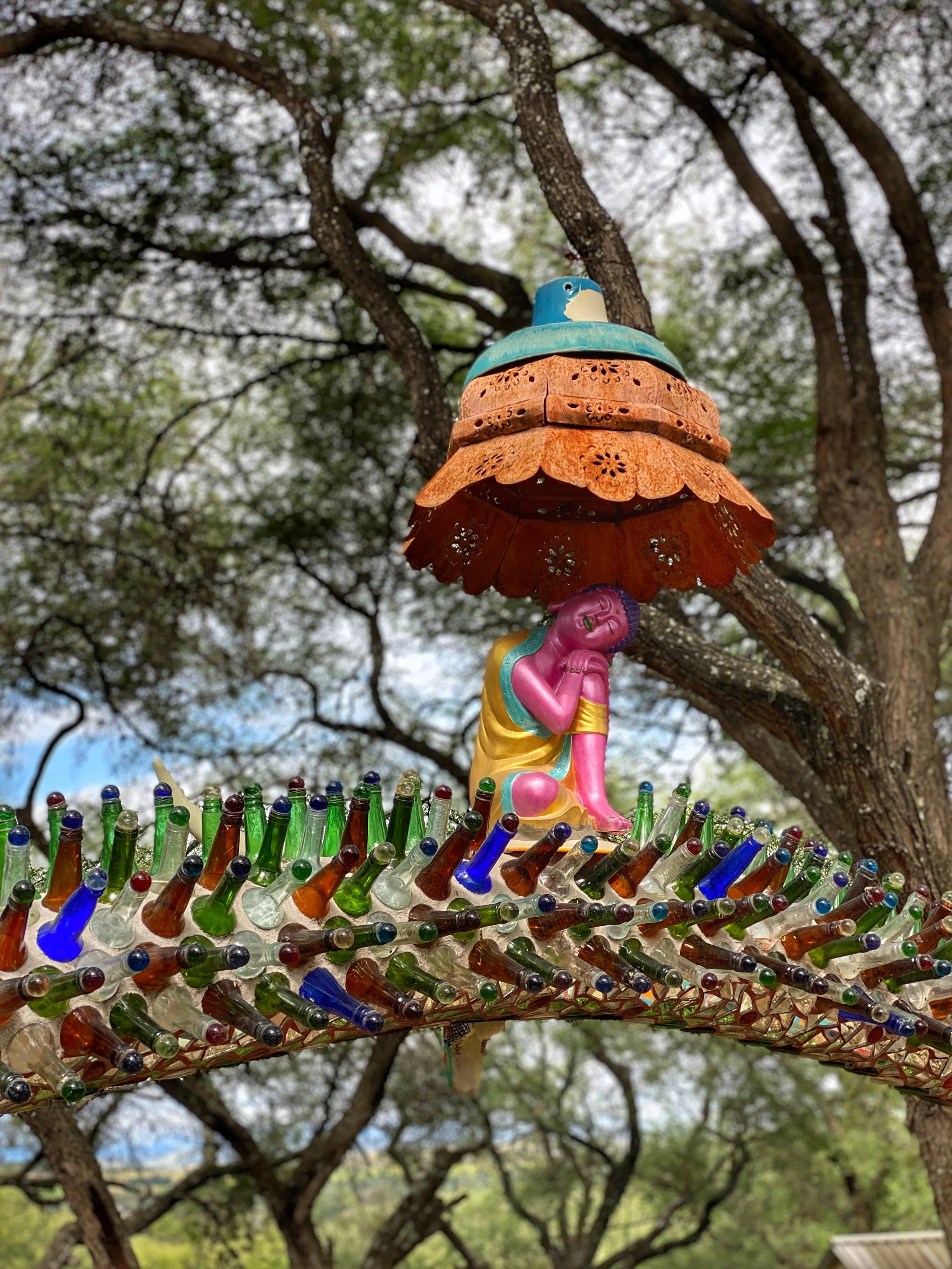
Mosaic arch with painted cattle skull and blue bottles at Chapel of Jimmy Ray

Anado referred to this as the Arch to Nowhere because at the time there was nothing built beyond it. Now it leads to the gallery (and outhouse).

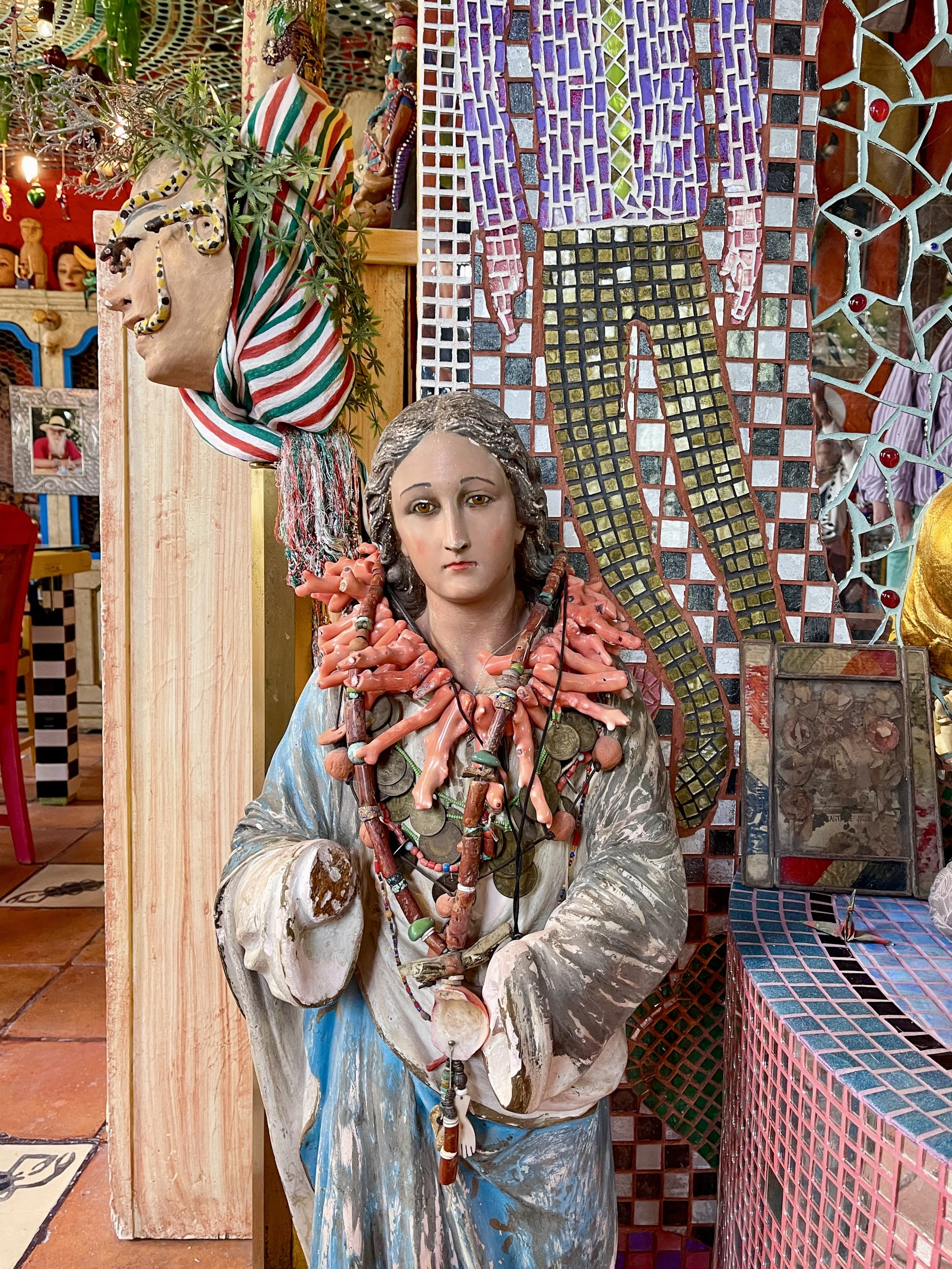
Anado’s fascination with world religions, especially those honoring the pre-Columbian pantheon, can be found throughout the grounds. There’s a small colorful shrine embellished with pieces of mirror and tile that pays homage to the Virgin of Guadalupe, the venerated patroness of Mexico.

Artwork of Anado McLauchlin and his husband Richard against orange wall

Anado and Richard met the old-fashioned way: in an AOL chat room.

Picking Up the Pieces: Anado’s Fractured Life

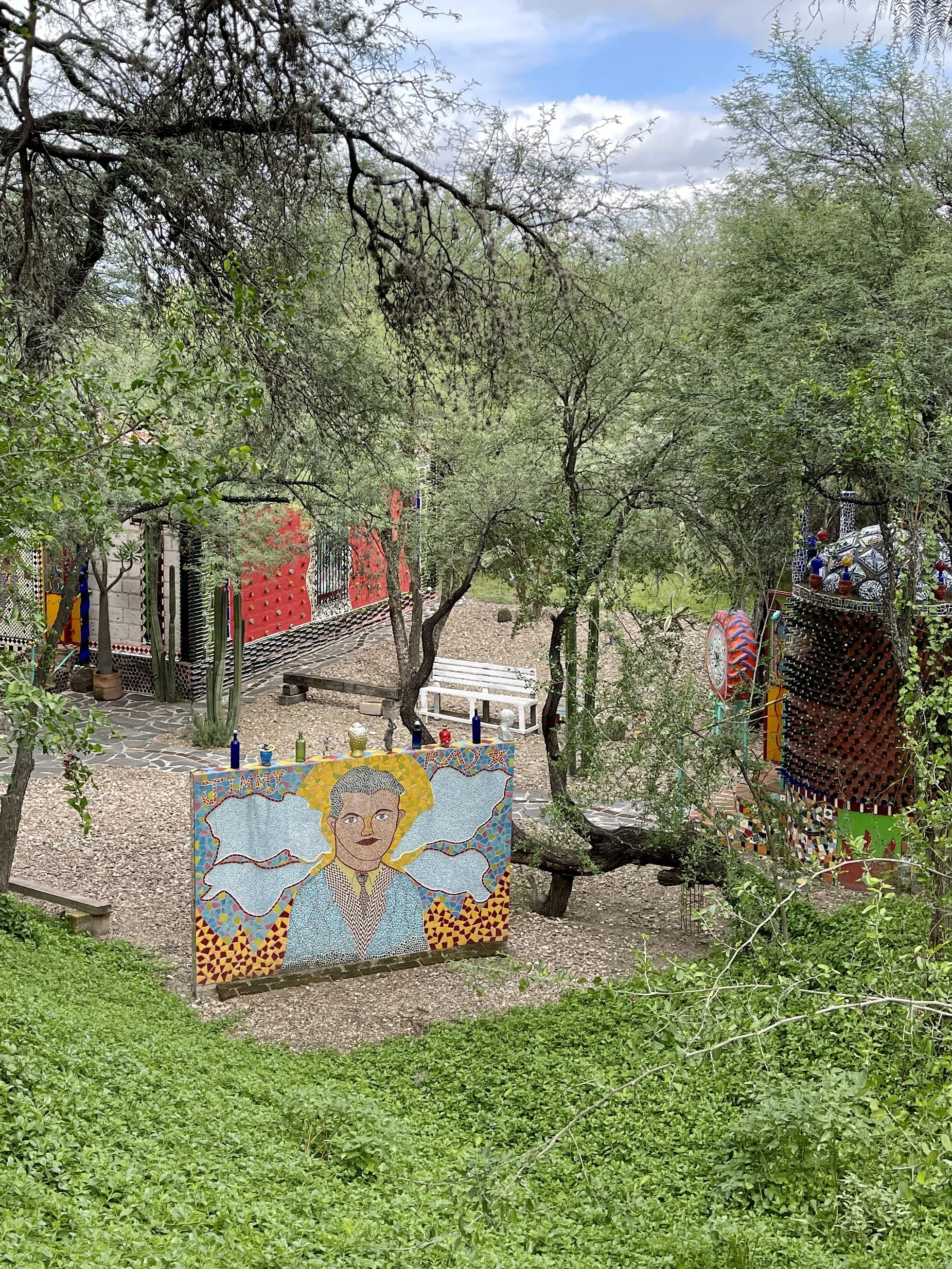
Central to the complex is the namesake Jimmy Ray, a mosaic rendering Anado created in honor of his father, with whom he had a troubled relationship. Anado’s given name at birth was James Rayburn McLaughlin III, and his father was James Rayburn McLaughlin Jr. Anado’s father was a doctor and a scoundrel who always had a mistress. He had two sons outside his marriage and died in a plane crash returning from the Caribbean with one of his mistresses. 

“Anado’s mother learned of her husband’s death while watching the local news on TV,” Richard told us. “In life, there was always anger towards his father because the whole family knew what was going on.”

Mural of man at Gallery of Jimmy Ray

This mosaic is of Anado’s philandering father, the Jimmy Ray the chapel is named for.

One of the reasons Anado named his compound the Chapel of Jimmy Ray (his father’s nickname), was partly as a healing process, to recognize and forgive his dad for being a flawed human being, and to stop internalizing everything his father had done.

Anado was born in Oklahoma City on May 24, 1947. At the age of 20, he was drafted into the Navy during the Vietnam War. As fate would have it, he was stationed in San Francisco. A self-proclaimed product of the Summer of Love, he visited the bohemian Haight-Ashbury neighborhood every chance he could to participate in the crosscurrents of creative expression and social tolerance among the hippies. 

Once Anado got out of the Navy, he returned to Oklahoma City and opened the only head shop in town and was arrested for selling Zap Comix, which local authorities considered to be part of the counterculture movement.

Shortly thereafter, Anado enrolled at the School of Visual Arts in Norman, Oklahoma, where he intended to pursue a career in art. However, he was frustrated by his professors, who told him that his works were “too decorative.”

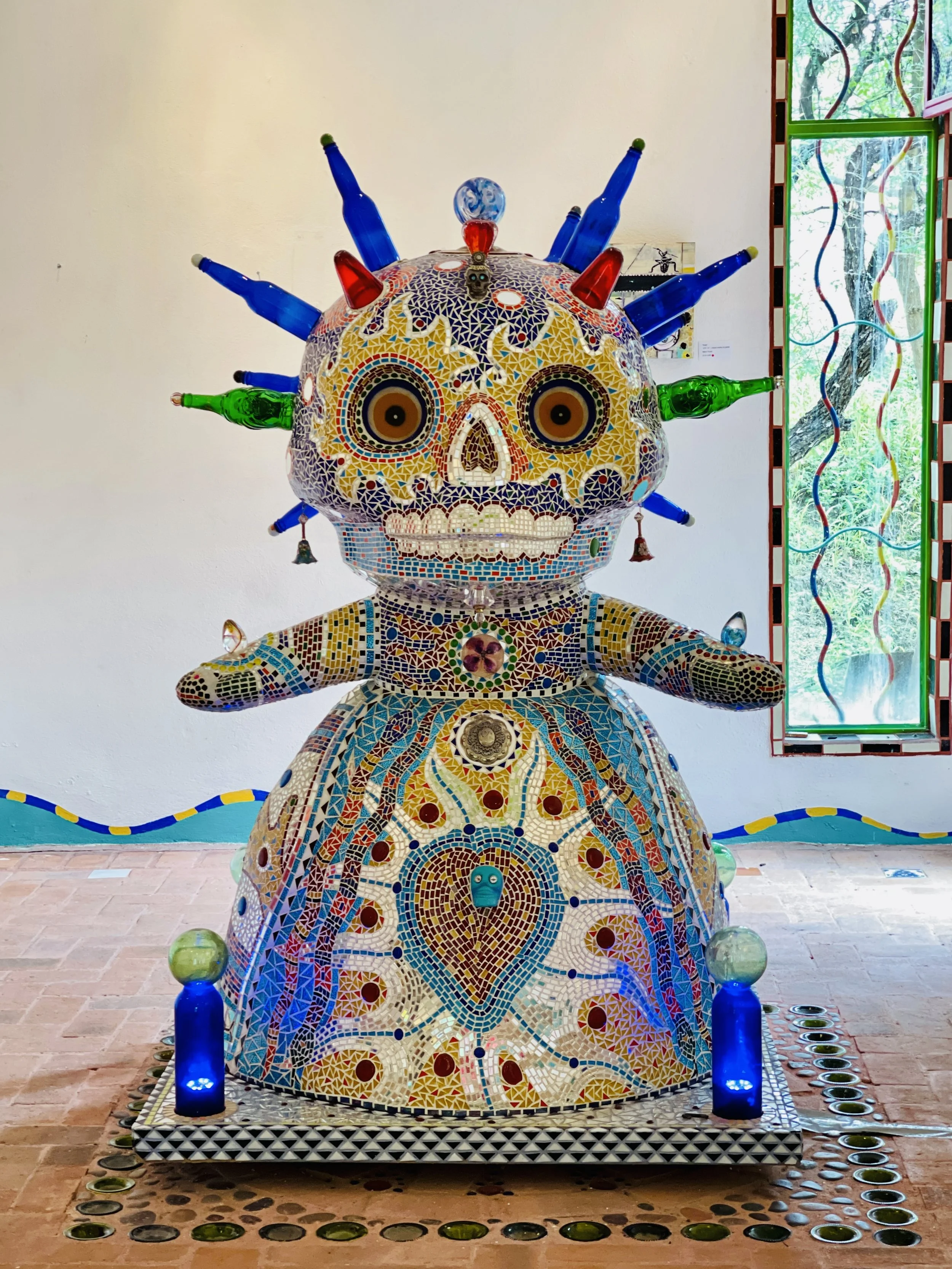
Catrina artwork with bottle hair at the Chapel of Jimmy Ray Gallery

Screw you, School of Visual Arts in Oklahoma! We think Anado’s work, like this take on a Catrina, is pretty rad.

He left Oklahoma and moved to New York City, where he lived for about 10 years and became a performance artist. Anado made most of his money driving a taxi and was part of the Chelsea Hotel crowd, performing with the likes of Patti Smith and Lou Reed. 

Pink wall with bottles and painting of two old men with white hair and beards and polka dot clothing

Before meeting Richard, Anado was part of the Rajneeshpuram, the sex-forward cult featured in the documentary Wild, Wild Country.

By the late ’70s, friends were committing suicide and overdosing on drugs. So Anado made the decision to travel to India and join the ashram led by the sex guru Osho Rajneesh. He was rechristened Anand Anado, which means “Blissful Silence” in Sanskrit. Rajneesh relocated to the U.S., founding a controversial community in Oregon, and Anado followed him there.

If you’ve heard about Rajneesh, it’s probably because of the 2018 Netflix documentary Wild, Wild Country. When we asked about this, Richard said Anado wouldn’t watch it because he didn’t share the views of the people who were interviewed from the commune (or, as many would call it, cult). “He felt that they didn’t represent what the everyday person was doing there and that they were part of the problem,” Richard explained.

Anado left the commune and relocated to California. In 1998, he met Richard in an AOL chat room. Richard was a former art history teacher residing in Noe Valley, a neighborhood in San Francisco, and Anado was living in Lagunitas. Suffice to say, sparks flew and Richard eventually became Anado’s husband and muse.

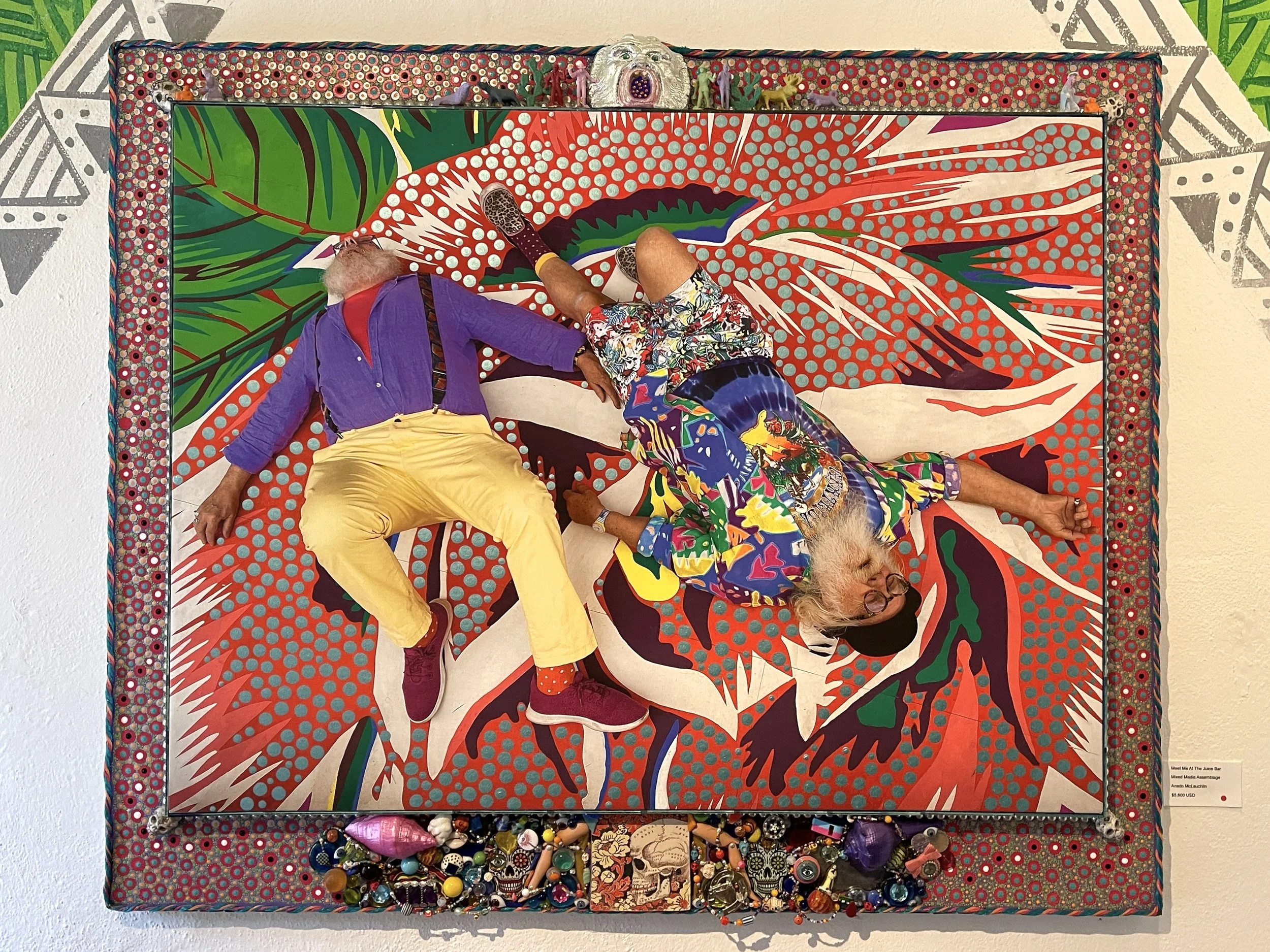
Funny artwork of two men swirling in red background with gray dots

Richard and Anado moved to Mexico and built their colorful home together. Sadly, Anado died of colon cancer in 2021.

A couple of years later, Anado and Richard visited San Miguel for a few days. They returned in 2001 to look for a place to retire and saw a listing in the local newspaper. The property was in poor condition and had been on the market for a while. The price was right: “You have to pay cash when you buy property in Mexico,” Richard explained, “and it was within our budget.”

Anado died of colon cancer in 2021.

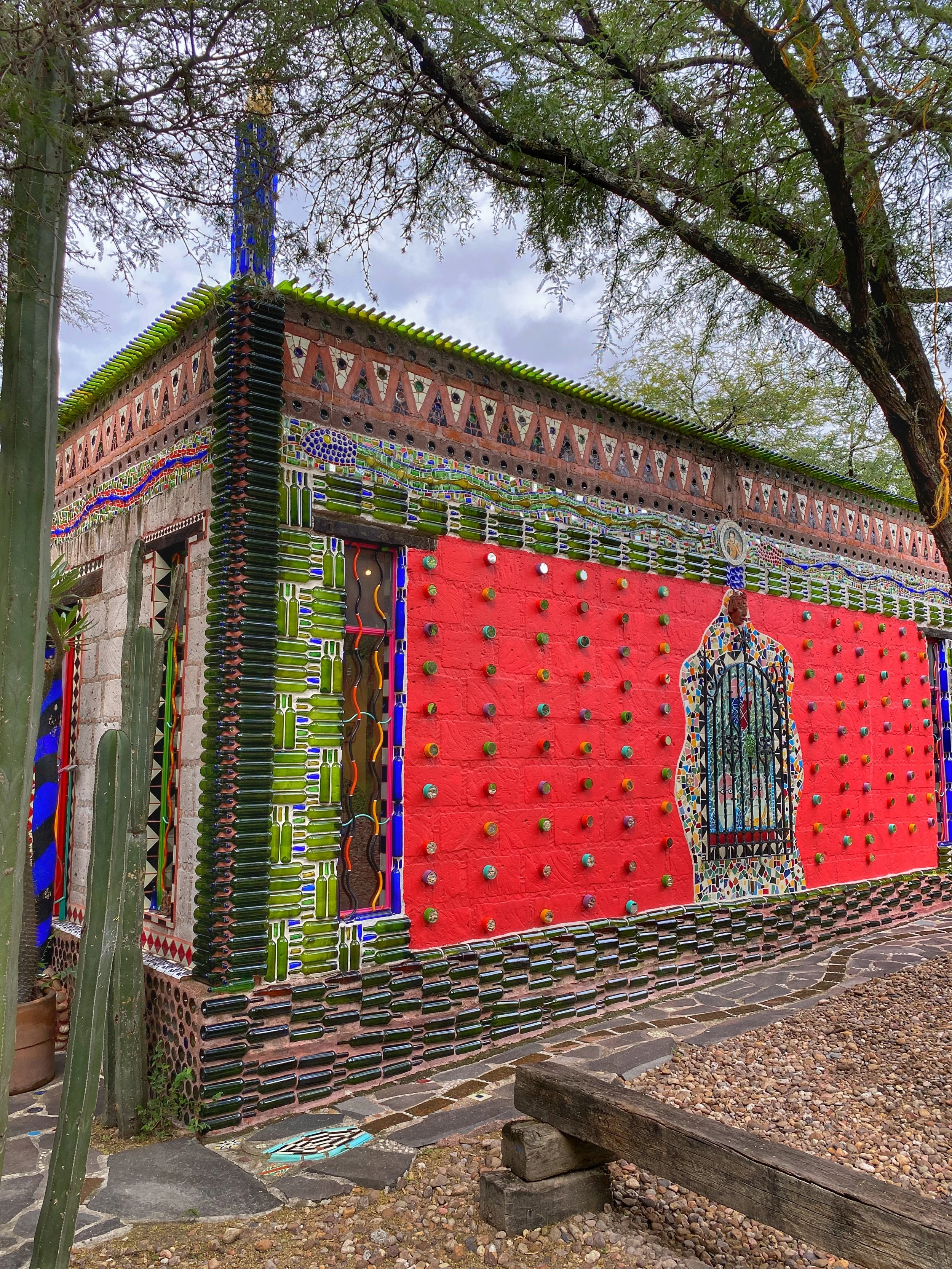
Red gallery covered with mosaics and bottles at the Chapel of Jimmy Ray

The Gallery at the Chapel of Jimmy Ray is itself a work of art.

Memory Box: the Chapel of Jimmy Ray Gallery

Our group followed Richard down a curved staircase flanked with mosaic-covered snakes.

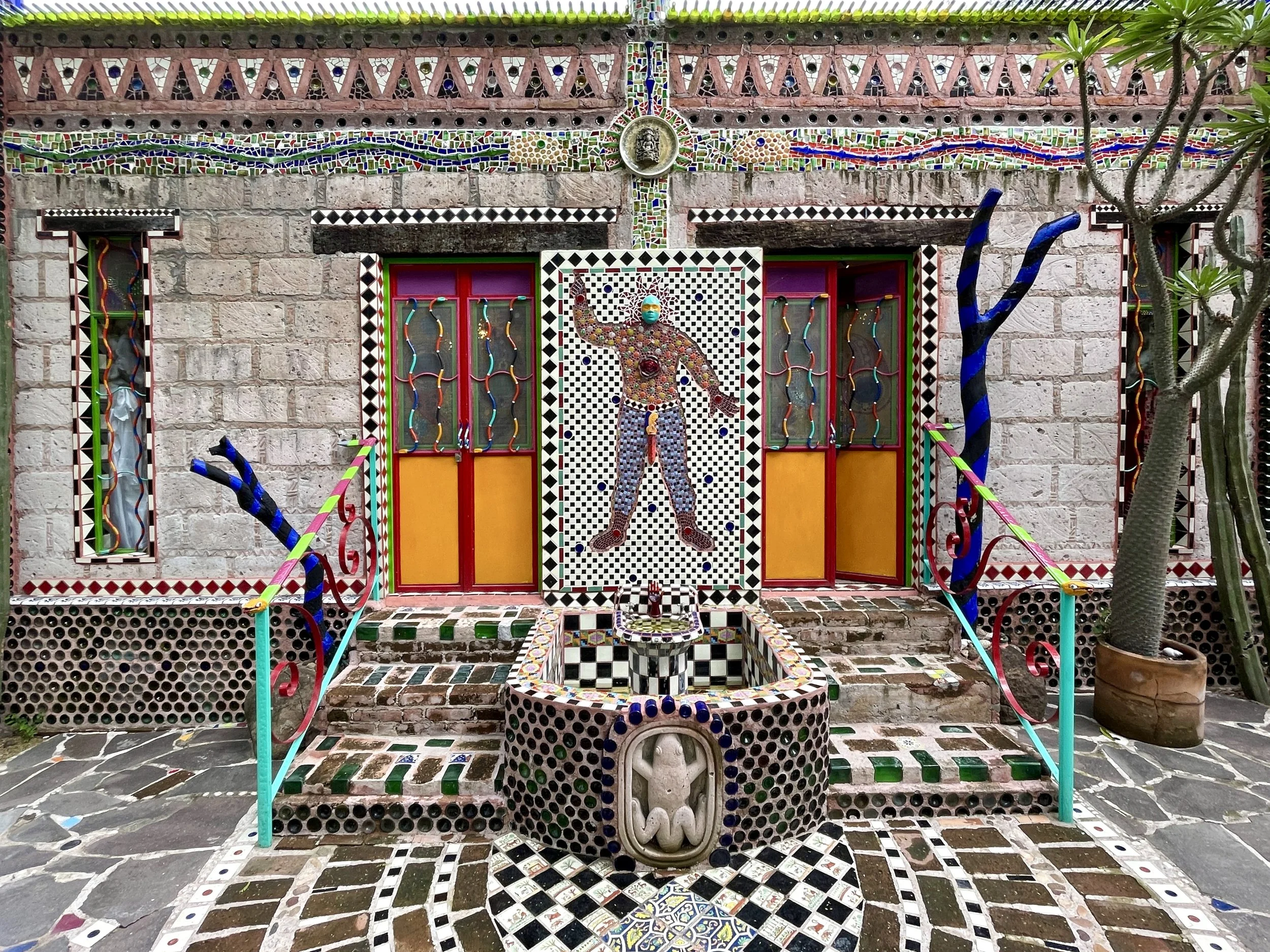
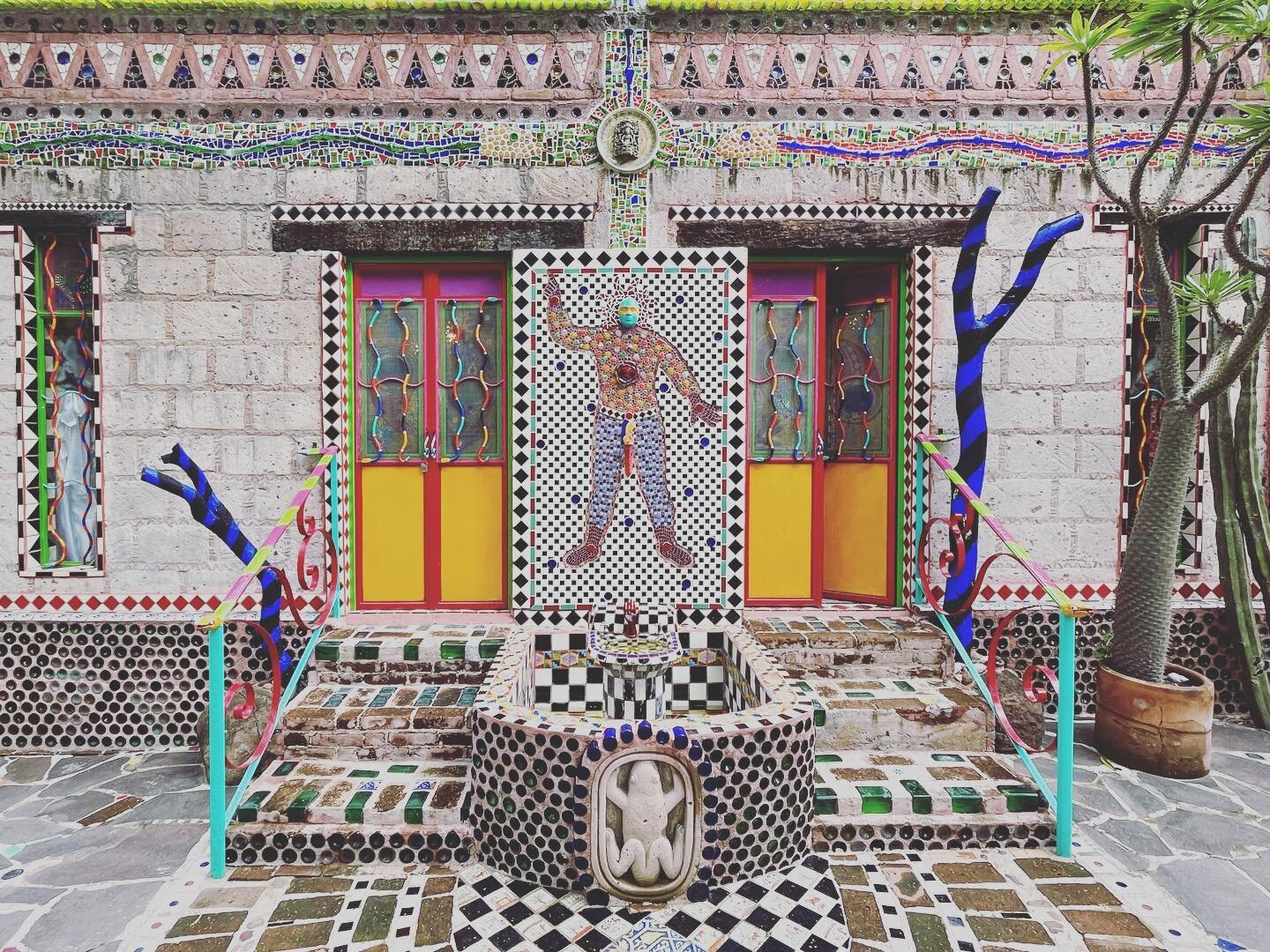
The metaphorical focal point of the property is the Chapel of Jimmy Ray Gallery, a space that showcases an eclectic mix of Anado’s work as well as rotating exhibitions by guest artists who are friends of Anado and Richard. Its exterior features a subversive fountain with an anatomically correct luchador who perpetually “pees” into its basin. 

Luchador fountain with mosaics at the Gallery of Jimmy Ray in Mexico

This fountain outside the gallery is fed by water coming out of the luchador’s bright red penis.

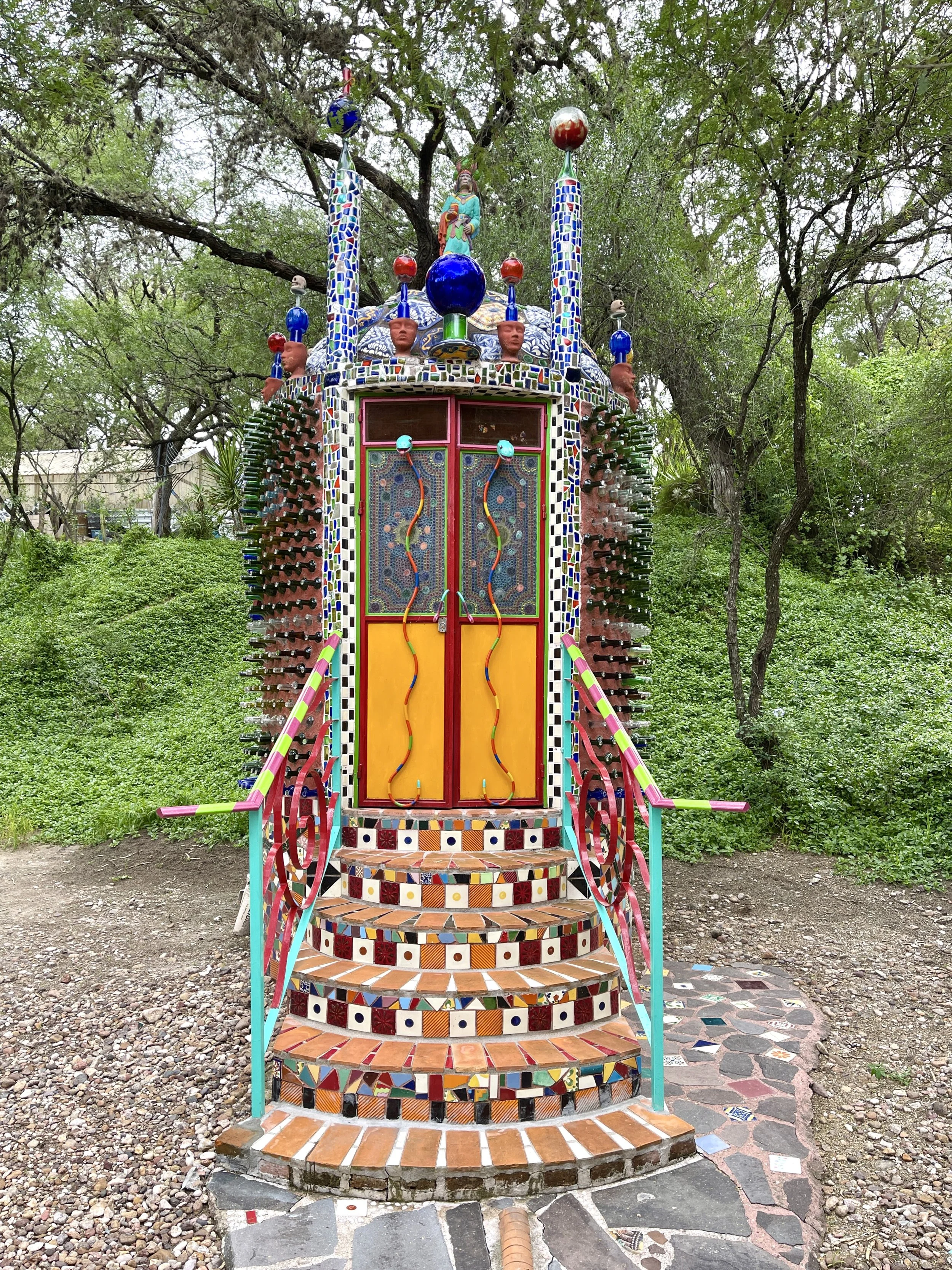
Standing outside of the gallery is quite possibly the most beautiful outhouse ever built. It’s a rounded and thoroughly embellished structure with glass bottles embedded into its terracotta-hued mortar walls, multicolored snake door handles, shiny glass spheres and an Indian chief finial. Anado cheekily referred to it as the Caca Mahal (a play of the Taj Mahal with the Spanish word for poop). It’s a waterless toilet that uses evaporation and decomposition to compost human waste. 

Crazy outhouse with mosaics at the Chapel of Jimmy Ray

What a throne room! This could very well be the coolest outhouse ever.

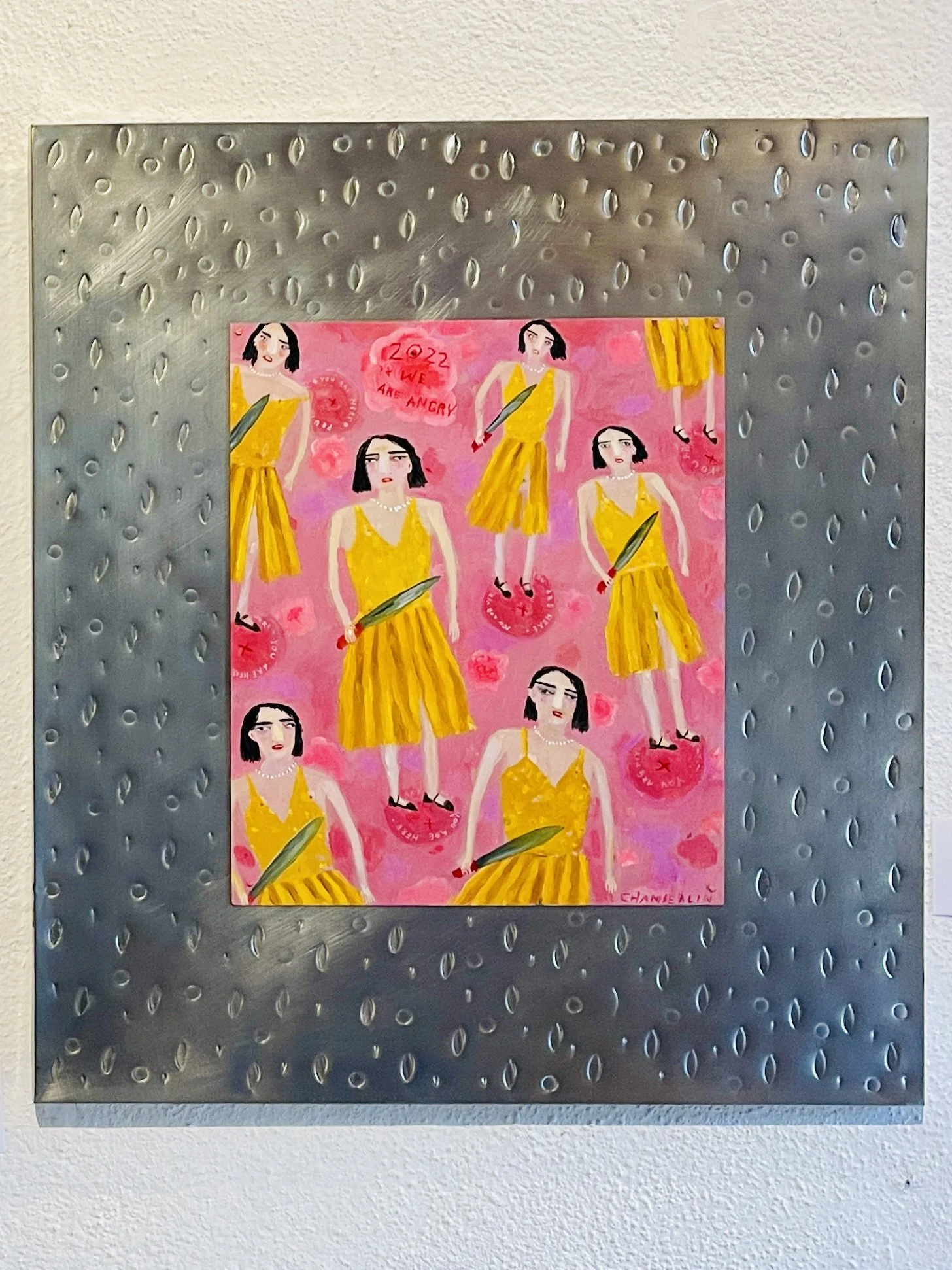
We caught the tail end of a show that featured the works of three female artists: Meryl Truett, Ann Chamberlin and Leigh Hyams. We ended up purchasing a piece by Chamberlin of a group of dazed-looking men hiding out in trees called Men in the Fresh Air. Her expressive works are inspired by traditional hand-painted devotional images known as retablos. 

We Are Angry 2022 by Ann Chamberlin, a painting of women in yellow dresses with knives

We especially loved the work of Ann Chamberlin, including We Are Angry 2022, featuring multiple women with blunt bob haircuts, wearing sleeveless canary yellow dresses — and all wielding machetes!

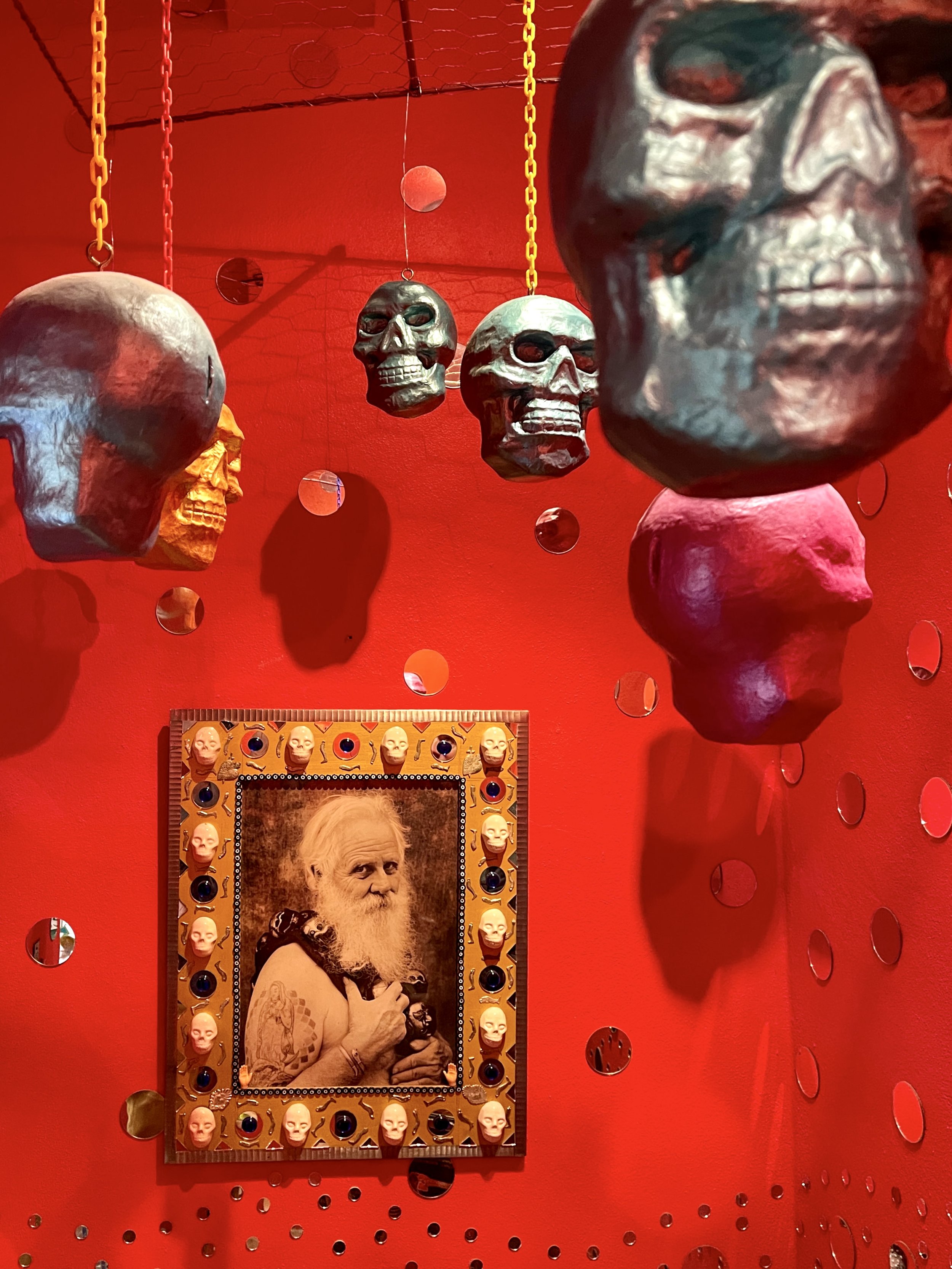
Red walls, small round mirrors, hanging skulls and a photo of Anado McLauchlin

A cool side room has a shrine of sorts to Anado

Giant mosaic skull with clocks for eyes and blue bottle hair at the Gallery of the Chapel of Jimmy Ray

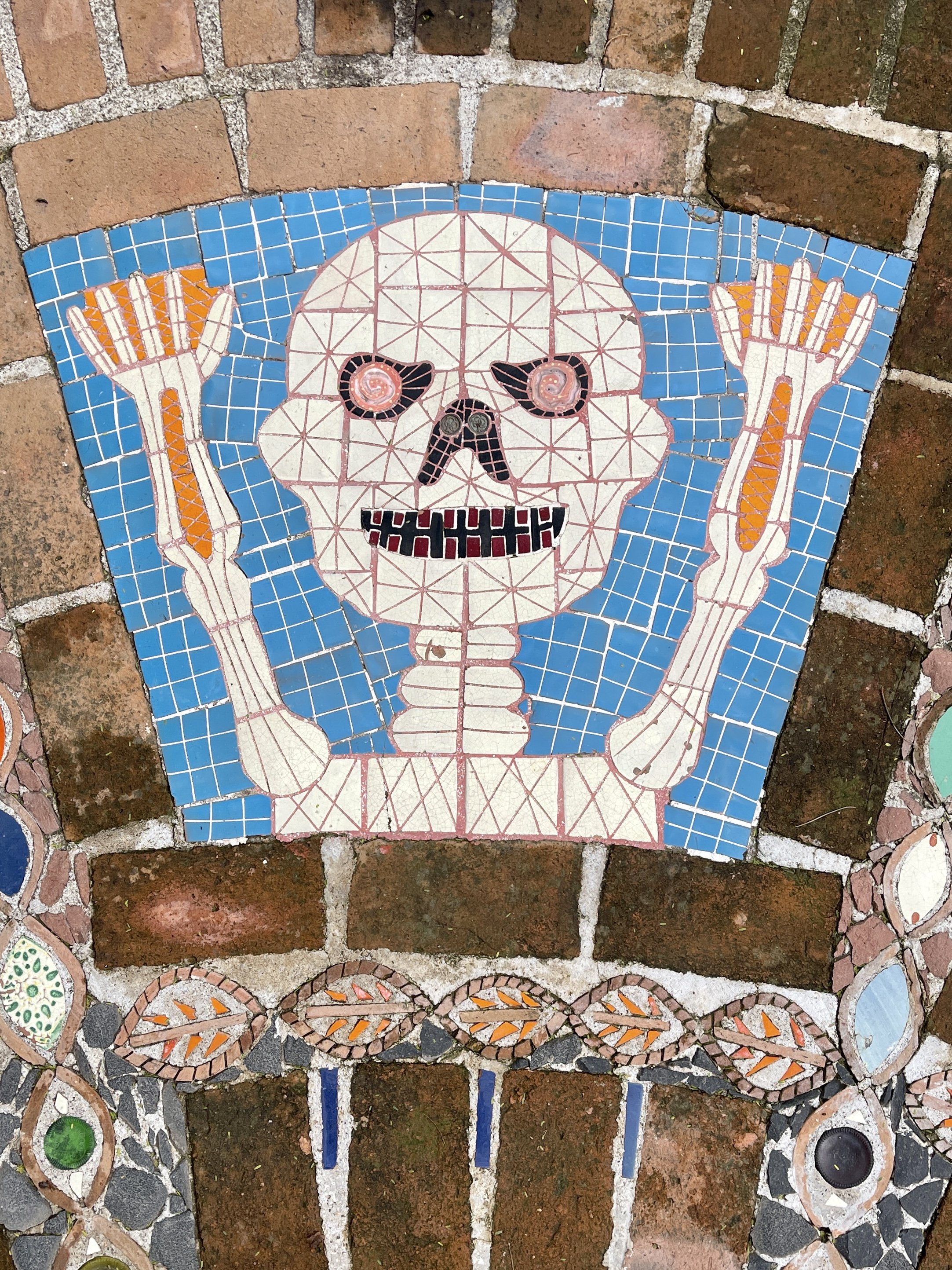
One of Anado’s works is a monumental skull covered in mosaic tiles and cobalt blue bottles titled Time Is Not the Enemy — note the clocks placed in the eye sockets.

On either side of the gallery space are a pair of Día de los Muertos sculptures, a giant bejeweled calaca (skull) and a take on a Catrina. 

Tile-covered gallery with quirky artwork at the Chapel of Jimmy Ray

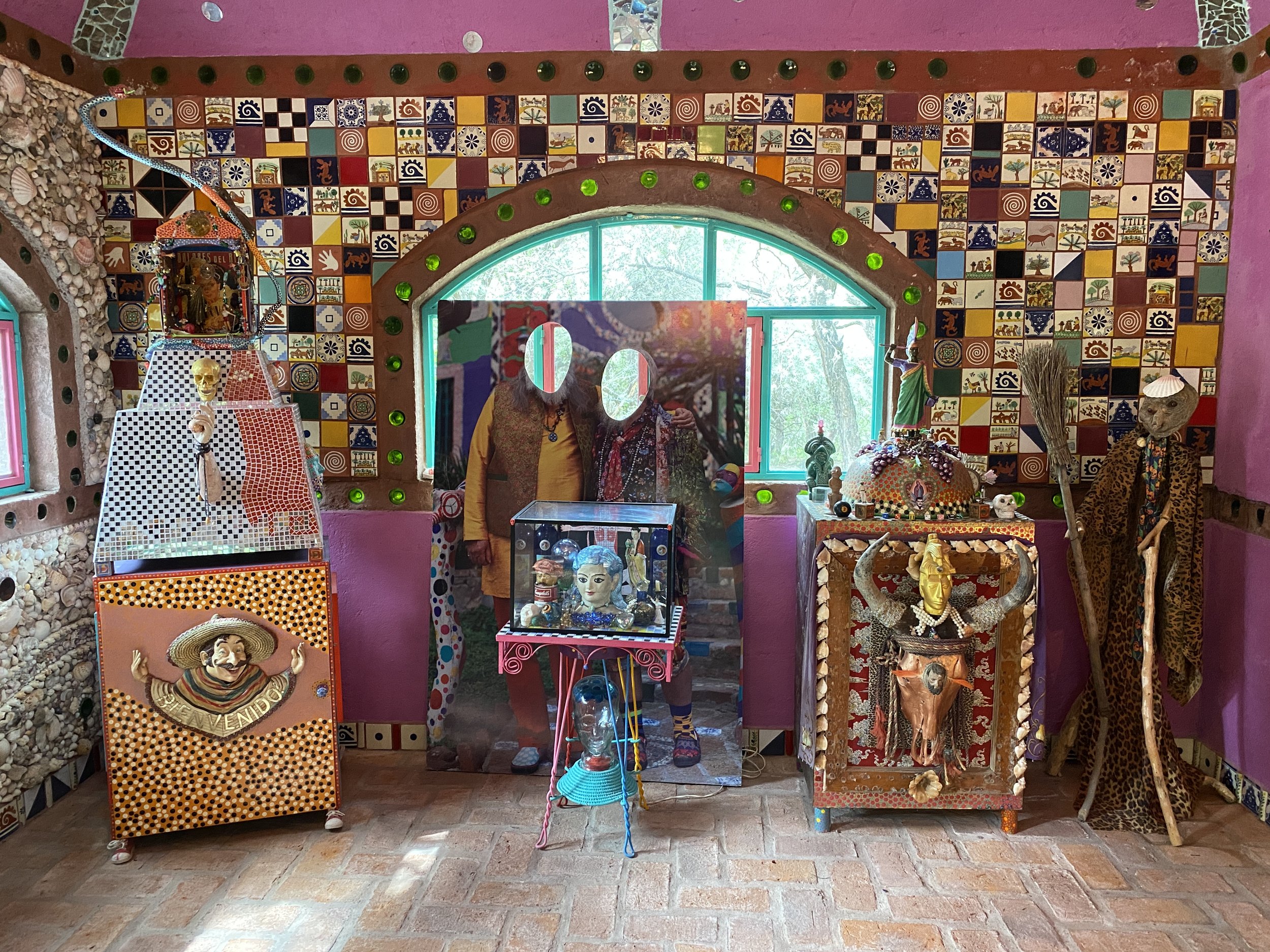
A secondary outbuilding, named Casa Kali, showcases some of Anado’s early works, as well as those of his assistant, Carlos.

Destiny Calling: Casa Kali and Coltrane

The first outbuilding Anado and Richard added to the grounds was dubbed Casa Kali and was built as an office. It now holds many of Anado’s early sculptural creations as well as those of his assistant Carlos. 

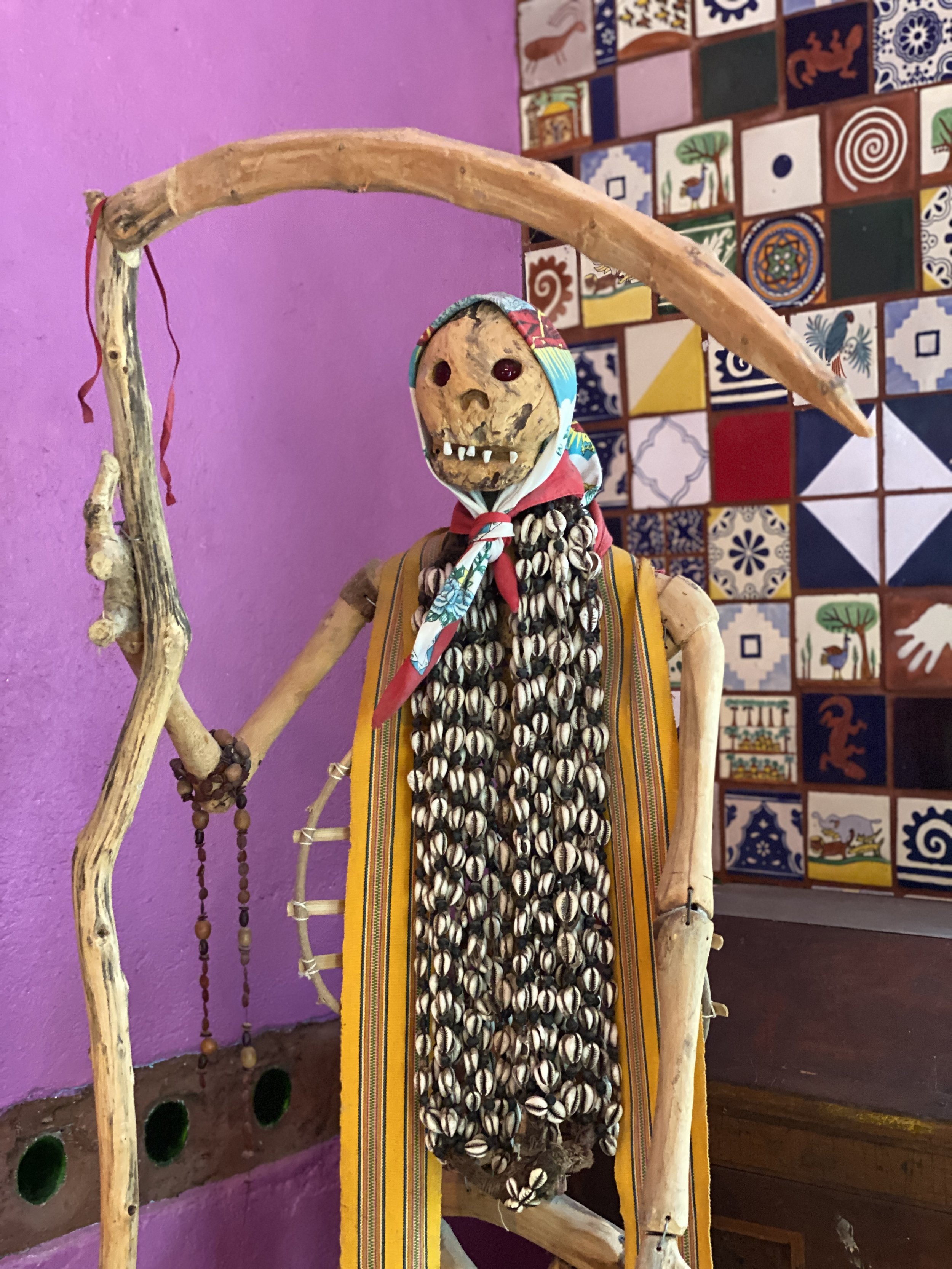
Creepy artwork of skeleton in kerchief and cowrie shells holding scythe

A gnarled creation by Carlos was one of our favorites and was adorned with a multicolored headscarf and cowrie shell necklaces and held a menacingly large scythe.

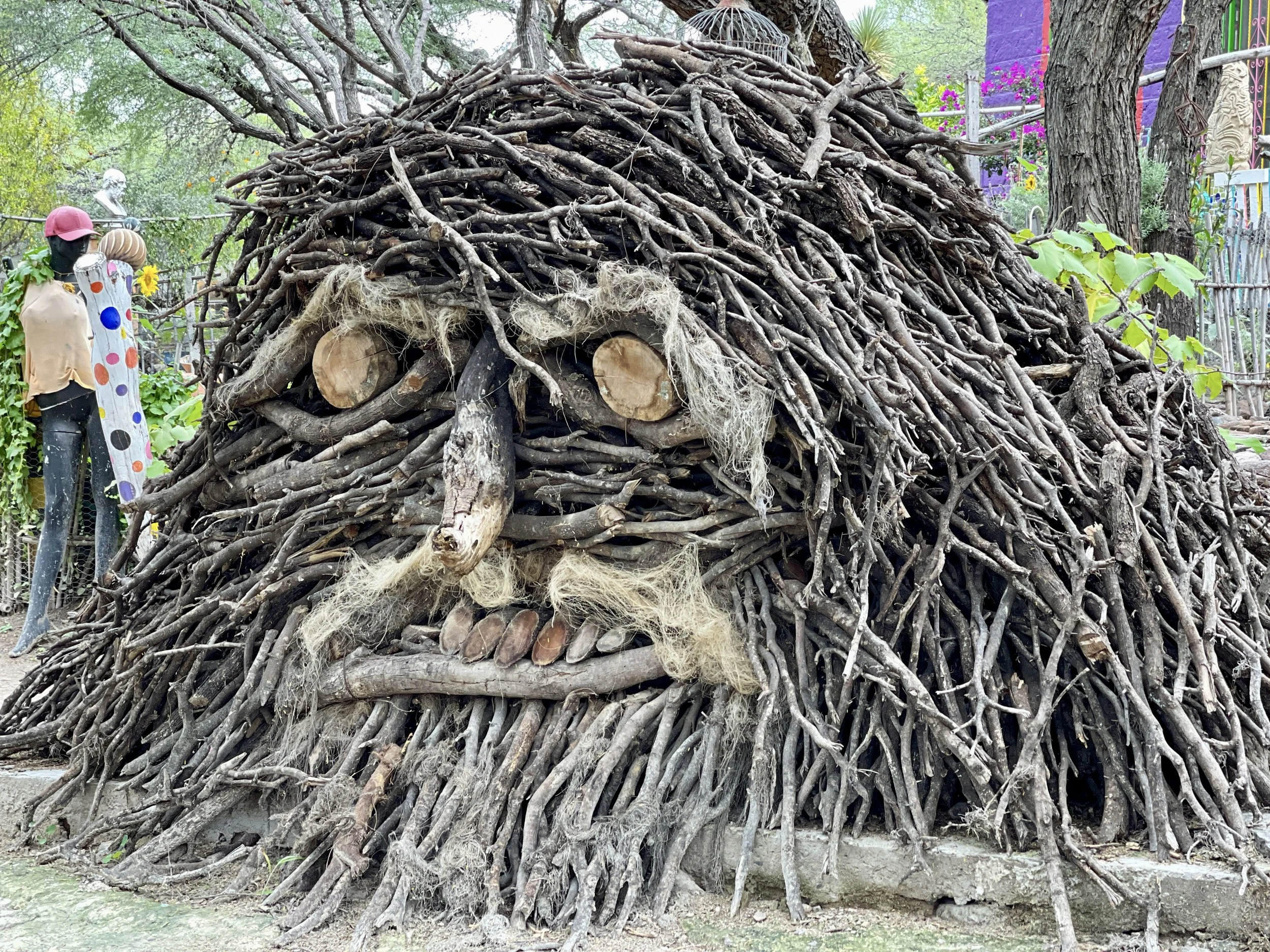
Giant head made of branches at Chapel of Jimmy Ray

This giant, grumpy-looking wood sculpture was made by Carlos’ kids. They named him Coltrane.

As we wandered toward the main house, we passed a monumental effigy head nicknamed Coltrane. It was made from twigs and branches by Carlos’ kids one summer. Wally asked if he was constantly being added to, and without missing a beat, Richard replied, “Or being put back together.”  

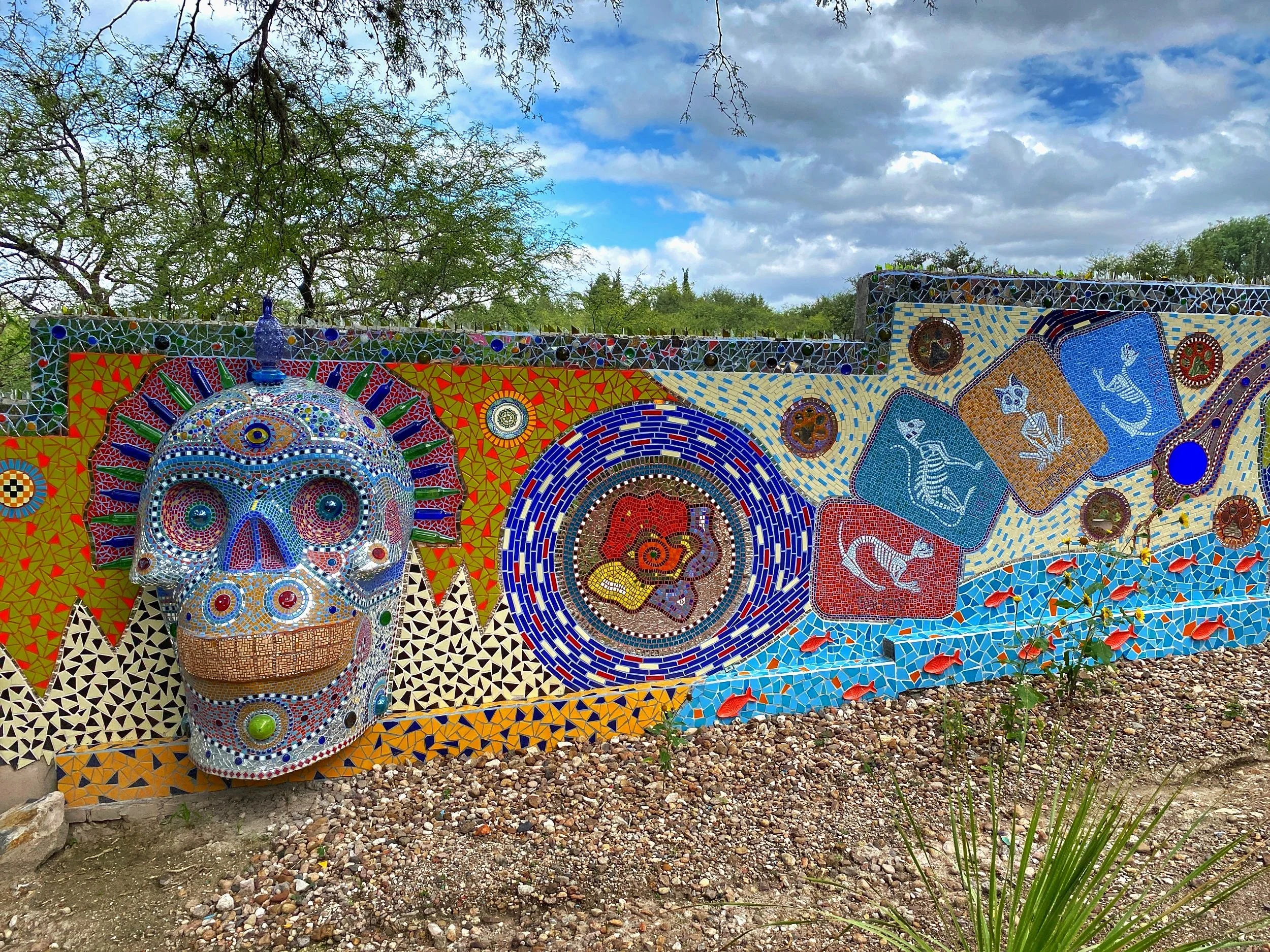
Wall featuring mosaics of a giant skull and skeletal cats

One section honors the couple’s kitties who have gone on the Great Litterbox in the Sky. Another mosaic honors their dead doggies.

Good Fortune: Tarot and Other Murals of Kismet Street

An outer wall is covered by an elaborate large-scale mosaic installation called Kismet Street. The name came from a vivid dream Anado had while living in the East Village in the ’70s and features a series of vignettes that took years to complete. 

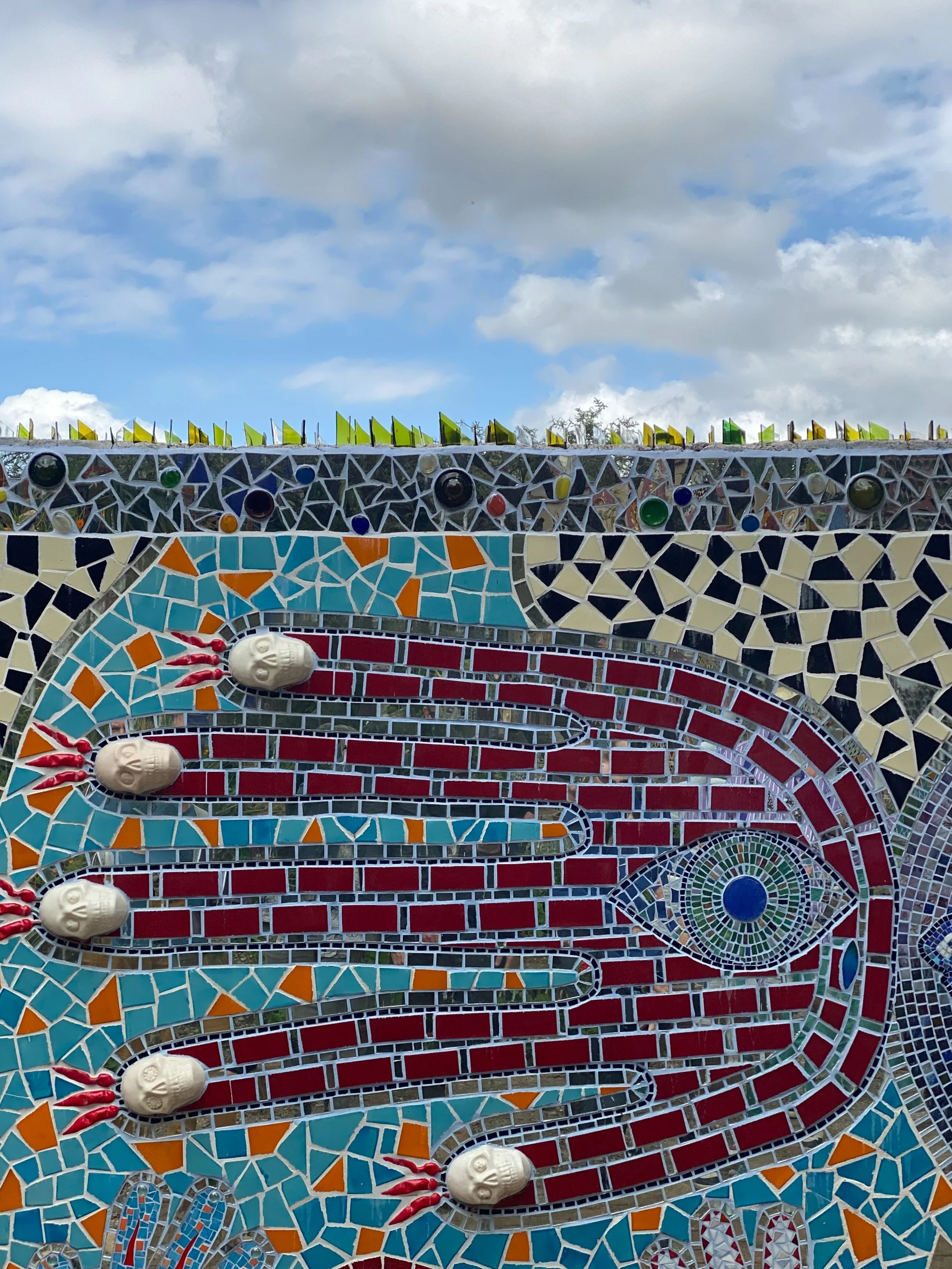
The politically charged Big Hands features two outward-facing palms. The left hand with blue eye and brick wall represents the United States, while the right-facing green hand with brown eye represents Mexico. The inspiration for the piece was a quote attributed to the Mexican President Porfifro Díaz: “So far from God, so close to the U.S.”

Wall with mosaic mural of burgundy hand with an eye and skulls for fingernails

One half of Big Hands, with skulls and a nod to a brick wall to symbolize the United States.

We stopped to smile over yet another unusual aspect of the wall. “We were given a Tyrannosaurus Rex head,” Richard said. “Anado combined it with a platter and turned it into Quetzalcoatl, the plumed serpent.” 

Aqua T.rex head by colorful swirling mosaic wall

Only Anado could take a T. rex head and platter and turn it into the snake god Quetzalcoatl.

A recurring theme that can be seen throughout the estate in Anado’s art is snakes. Richard explained that snakes are sacred animals to many indigenous cultures around the world, from Asia and the Americas. They’re close to the earth and are often associated with wisdom, healing and knowledge. The Judeo-Christian tradition, of course, had to demonize them (think of the serpent in the Garden of Eden).

Mosaic of blue Xoloitzcuintli dog at the Casa de las Ranas, Mexico

Xoloitzcuintli dogs are said to shepherd the souls of the dead, which could explain why Anado chose one for the mural honoring his deceased friend David Wojnarowicz.

Another mural on Kismet Street is of a hairless Xoloitzcuintli dog, and was made by Anado in memory of his former roommate, David Wojnarowicz. David was an activist and mixed-media artist in New York, who died from AIDS-related complications in 1992. Early in his career, he was part of the street art culture and created Mayan dog graffiti around the East Village where he lived. In Mesoamerican religious lore, the Xoloitzcuintli leads the soul through the underworld to its final resting spot.

Other murals were inspired by tarot cards, which Anado read. The Emperor and the Empress have no clothes and were made, in part, from cut beer and wine bottles. The Emperor has a beer bottle penis, which has broken off more than a few times by the couple’s dogs’ excitedly wagging tails. 

Mosaic of green sideways naked woman on a wall

A section of the wall features mosaics inspired by the tarot. This one is the Empress, a card depicting maternal influence.

The Lovers features a trio of entangled snakes, which represent the invisible holy energy yogis believe resides at the base of our spines. In tarot, the card depicts the choices we make in life and love, and the consequences of such choices. 

Tile mosaic of snakes

Snakes are a recurring theme in Anado’s mosaics, including this one, inspired by the Lovers card in the tarot deck.

The Hanged Man depicts a young Anado hanging around in New York City in the ’70s. 

“Respectame,” says Anado’s mother in the last mosaic on Kismet Street — a healing work of art that was his favorite of the bunch.

The Fool honors Anado’s beloved mother. She’s looking down at her husband and saying, “Respectame” (Respect me). It was Anado’s favorite piece, Richard told us. He liked the idea of his mom standing up, as she never did during her life. In tarot, this card starts the deck and represents the beginning of a journey.

Two pet memorial walls (one for cats and the other for dogs) are dedicated to Anado and Richard’s beloved companions over the years. They were designed by Anado and completed over a period of two years by Mosaics in Mexico, a mosaic mural-making workshop led by artists Julie Richey and Ana Foncerrada. 

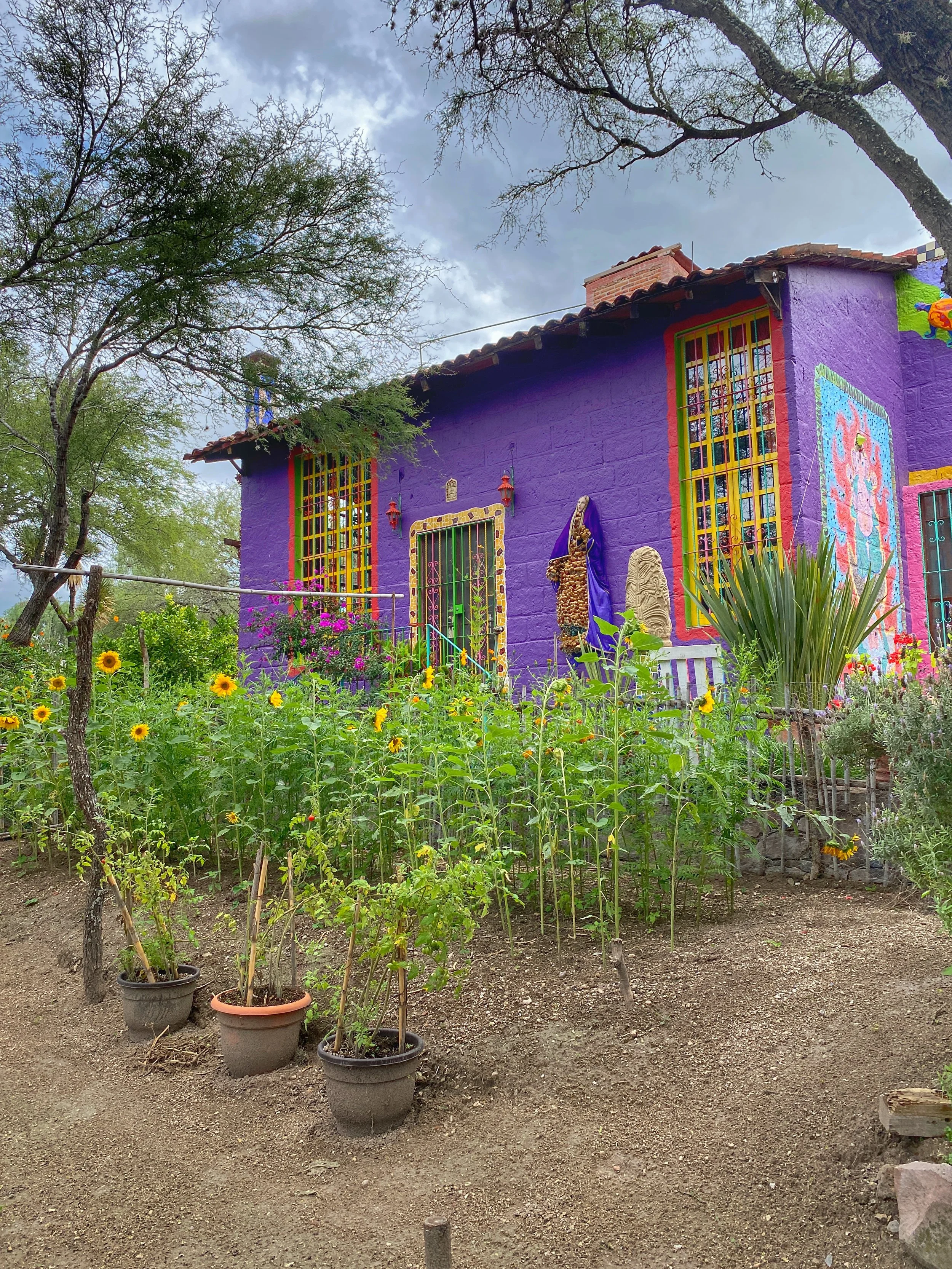
Colorful purple, yellow, blue, red and green home with tree in front

The second part of the tour offers a glimpse inside Anado and Richard’s home.

Casa de las Ranas: Anado and Richard’s Fairy Tale Home

Our tour ended at Casa de las Ranas (Frog House). While renovating their home, which was in a ruined state when he and Richard purchased it, Anado referred to it as a tadpole that they transformed into a handsome prince, earning the residence its name. I found it especially fitting, as the well-known Mexican muralist Diego Rivera aka el Sapo-Rana (Toad-Frog) was born in the nearby capital city of Guanajuato. 

Crazy, colorful dining room with green mosaic ceiling with part of a statue, red walls covered with artwork and a yellow table

The dining room at la Casa de las Ranas

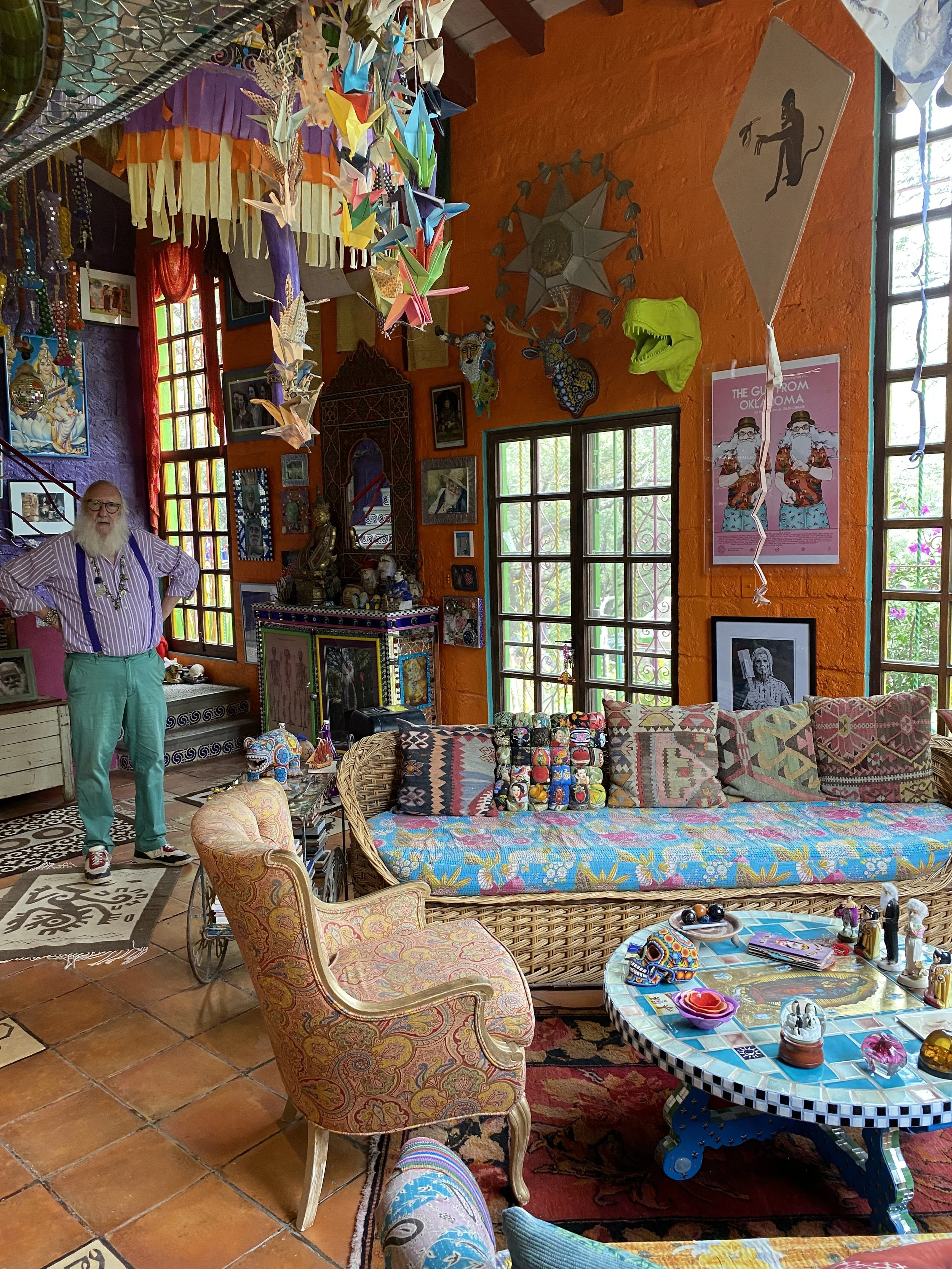
Man in green pants and striped shirt stands in very colorful maximalist room with pillows, table and settees

The house itself isn’t that big — but there sure is a lot going on inside!

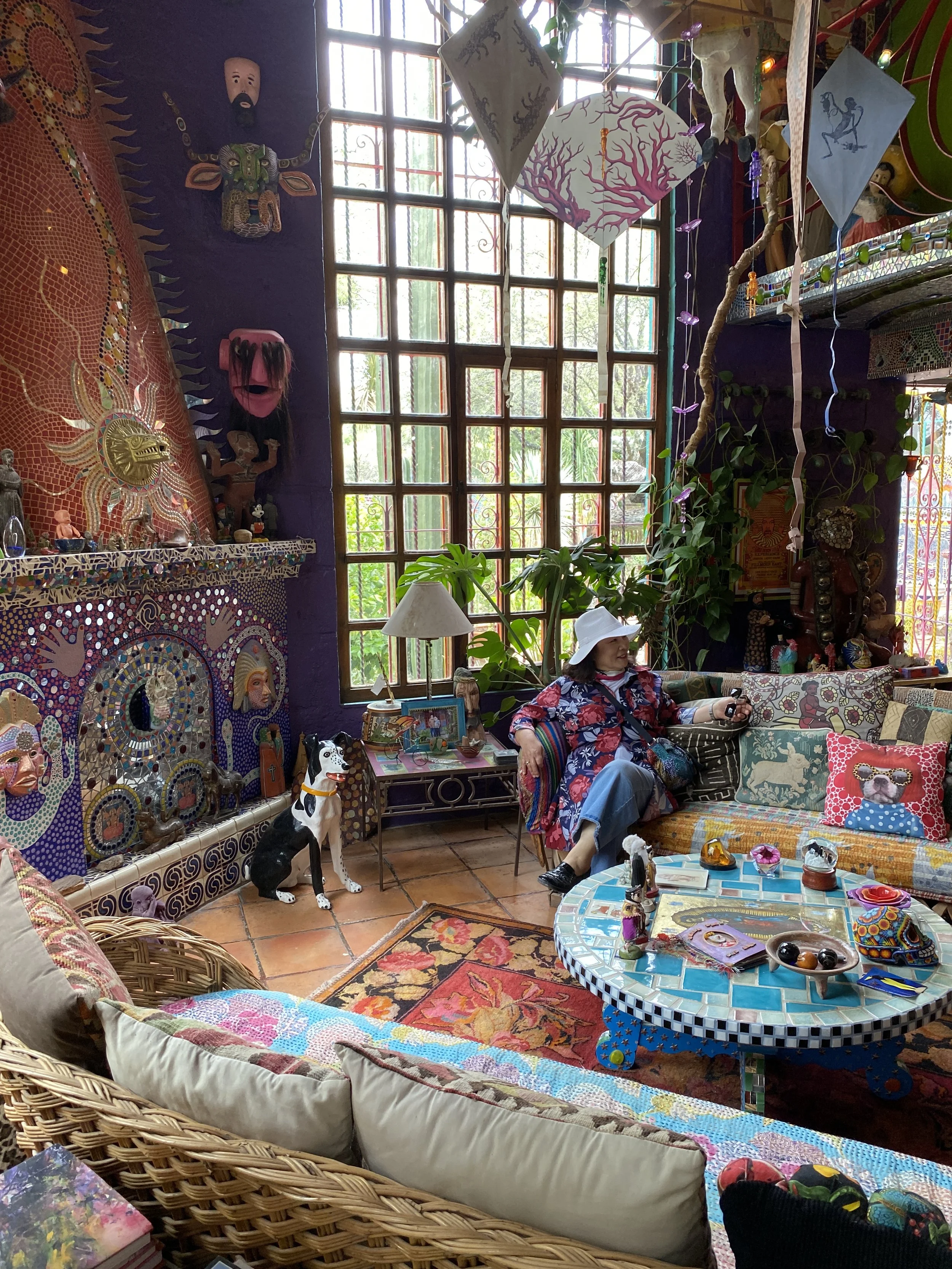
Asian woman sitting on sofa with lots of pillows by fireplace covered with mosaics and a statue of a dog

The Rosewood gang couldn’t resist getting a photo taken in the kooky casa.

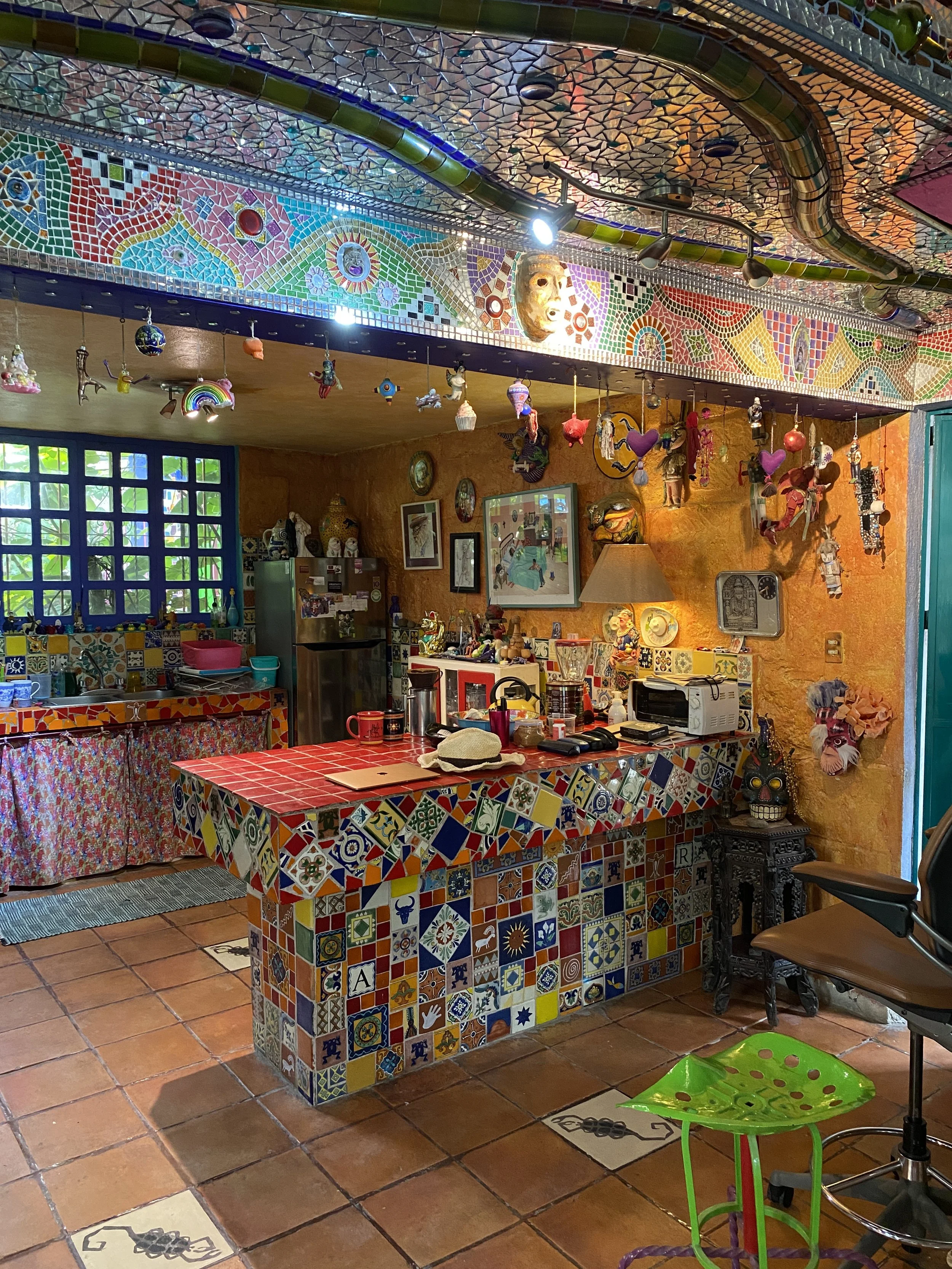
Kitchen counter and walls covered with tiles and knickknacks.

The kitchen at Richard and Anado’s home

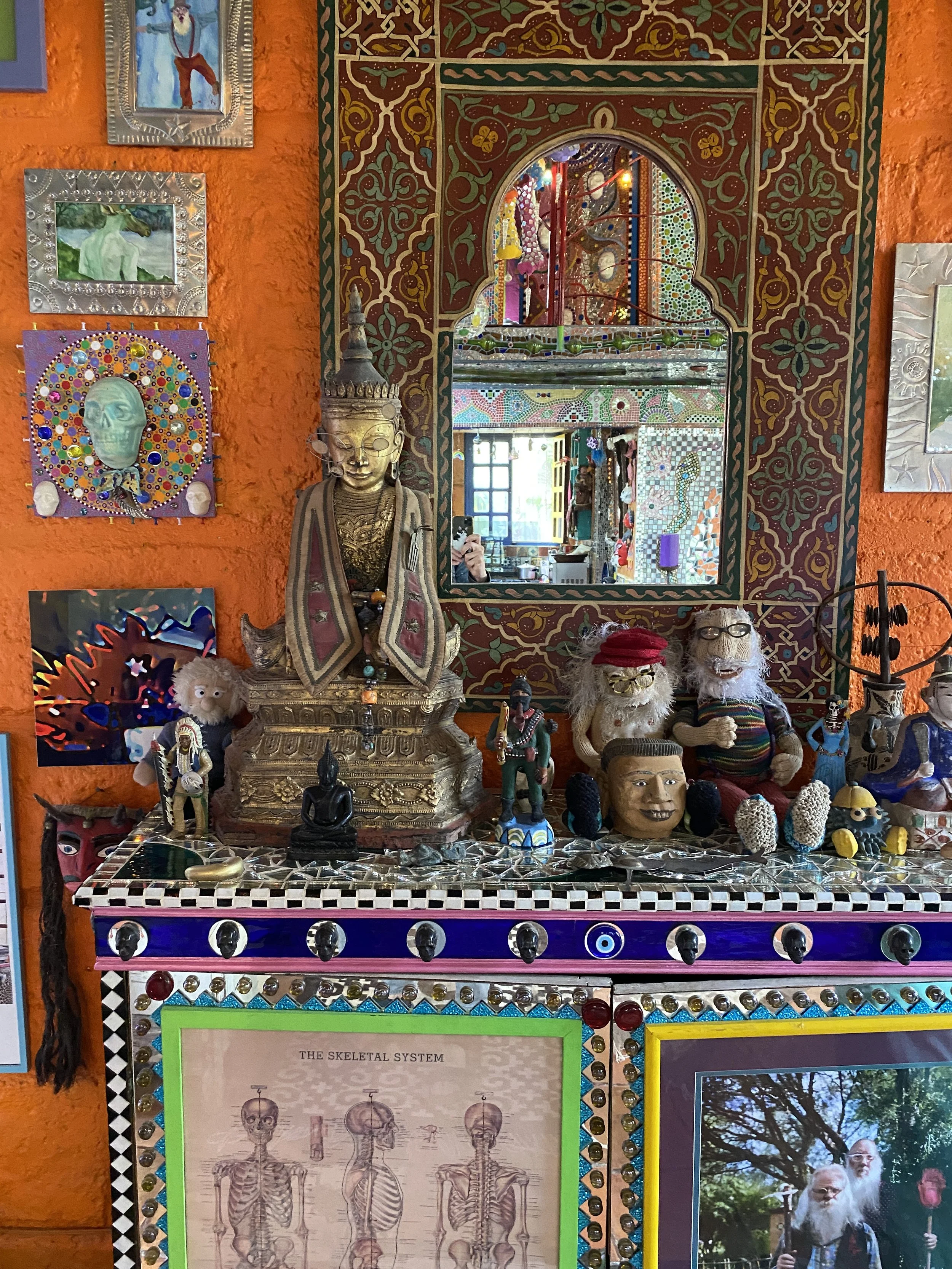
Like the rest of the compound, the mosaic images covering the walls were created from pieces of mirror, tile, ceramics, and salvaged and recycled materials. Everywhere we looked there was something fantastic to be discovered. 

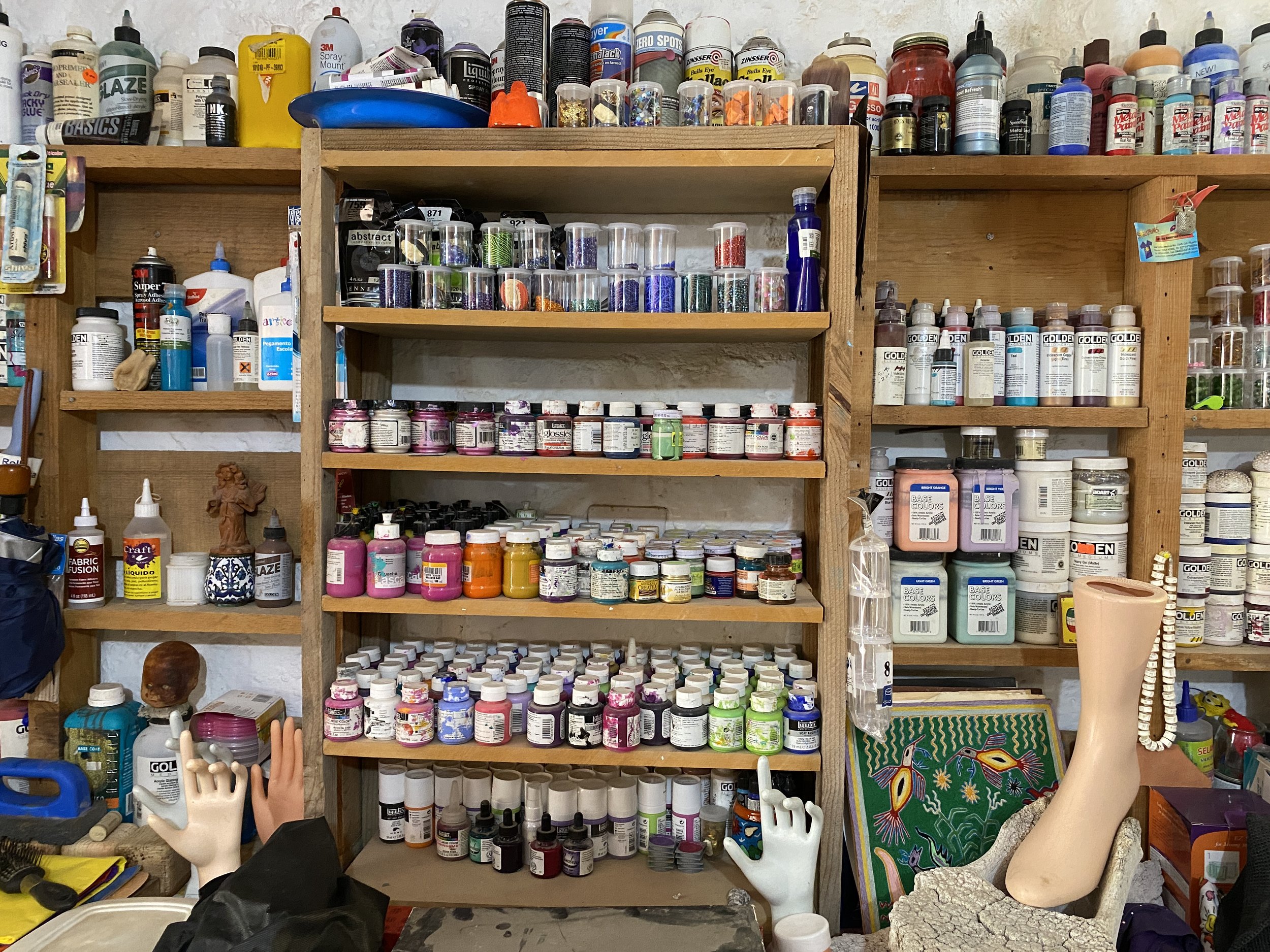
Container holding many containers of paint in artist's workshop
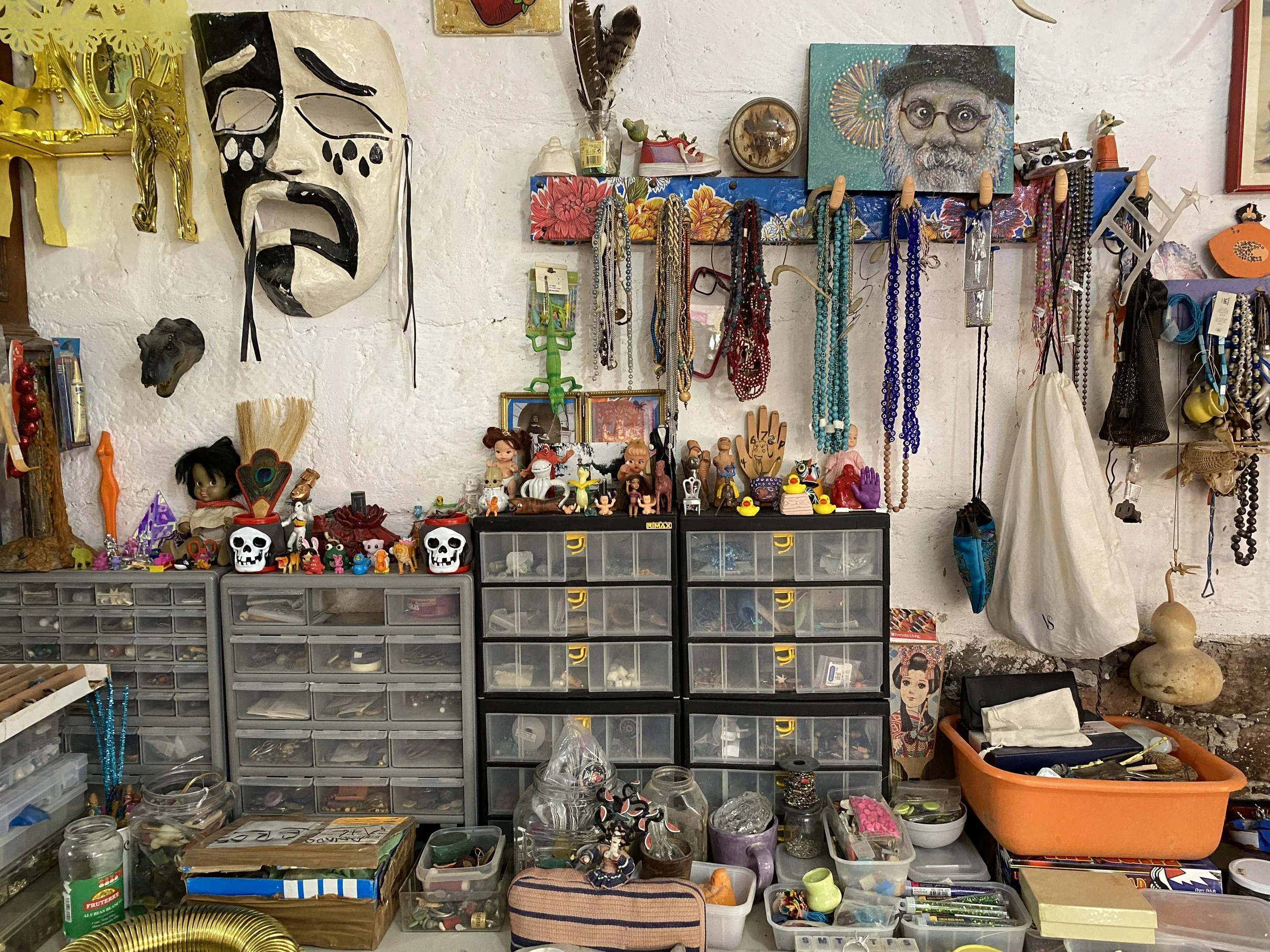
Artist's workshop with necklaces, giant mask and plastic containers

The workshop offers a glimpse into the method of Anado’s madness.

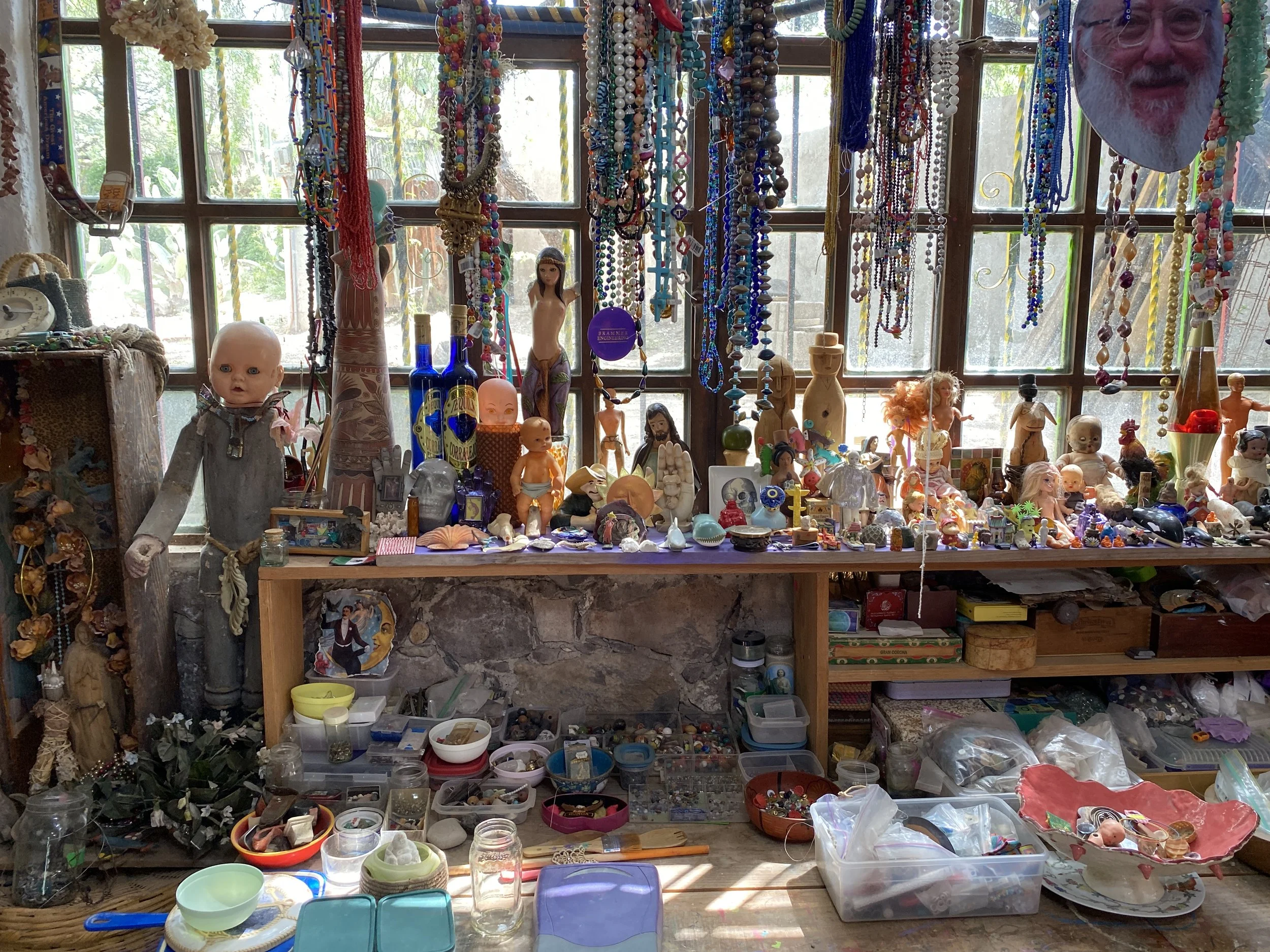
Necklaces hang in window by table covered with dolls and knickknacks

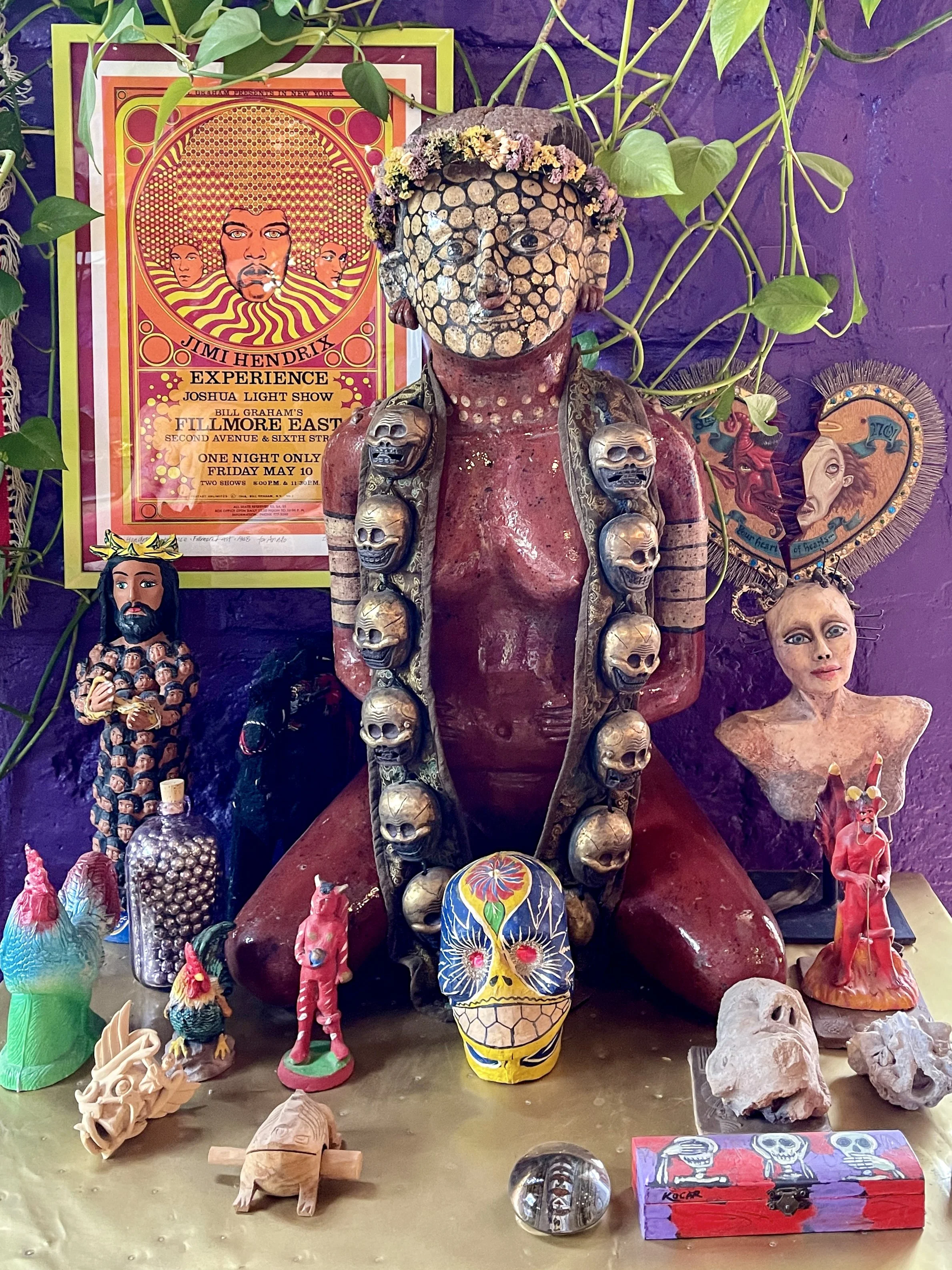
Anado had plenty of materials to work with — everywhere you look there are quirky items.

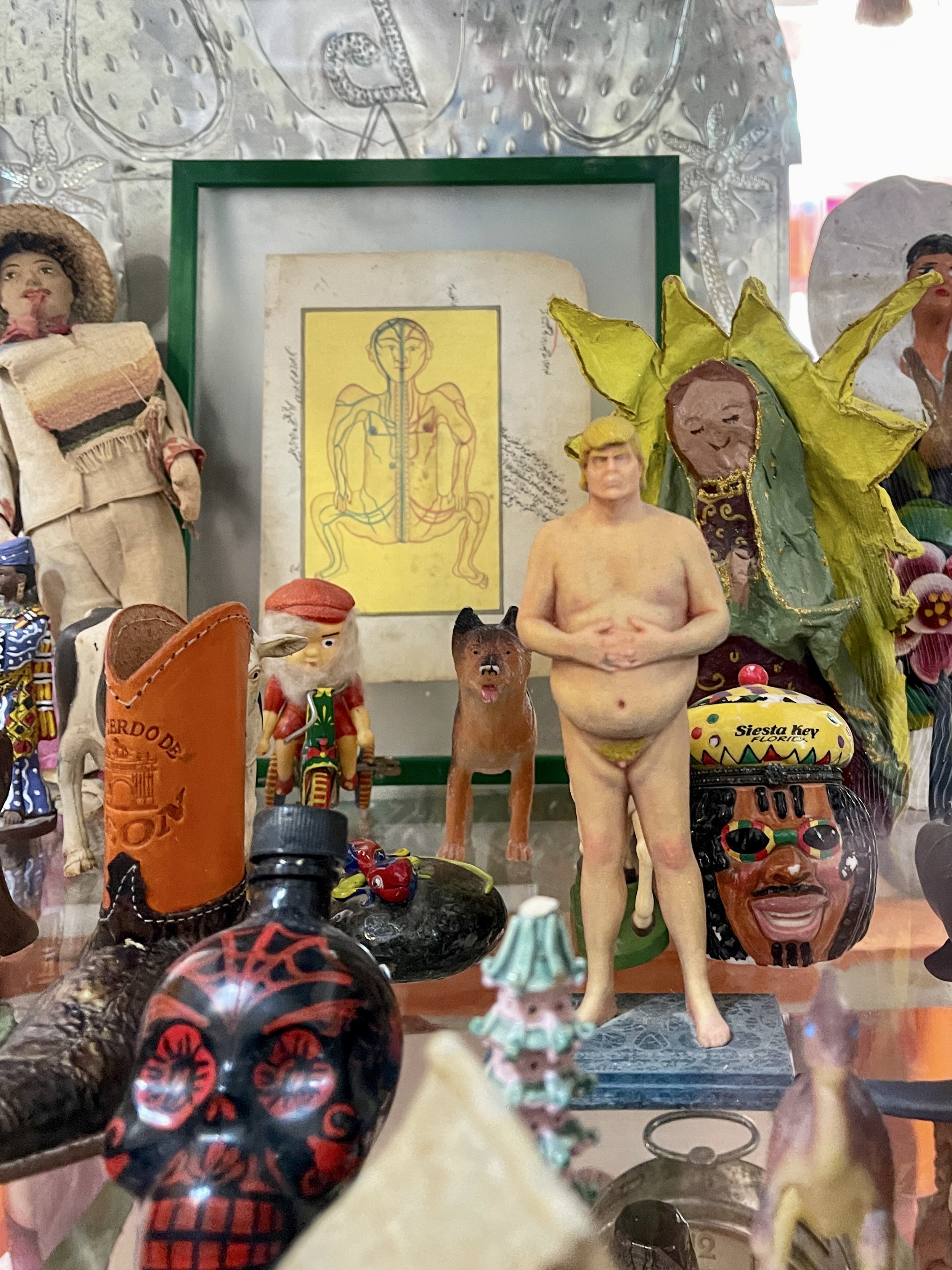
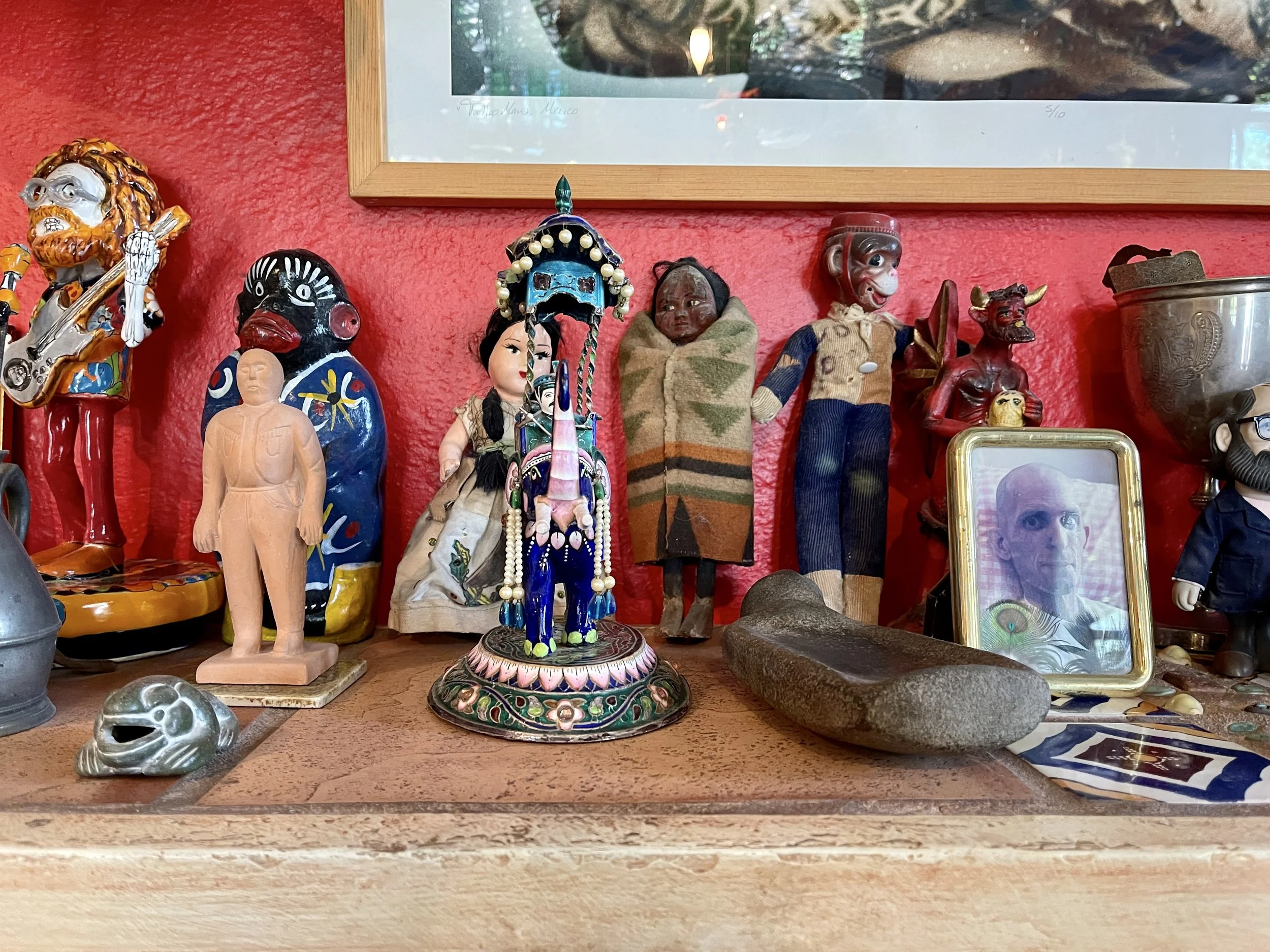
Table with various items, including Mexican puppet, Jamaican cookie jar, papier-mache Virgin Mary and a naked Trump with micropenis

Various artistic inspirations, including Trump’s micropenis

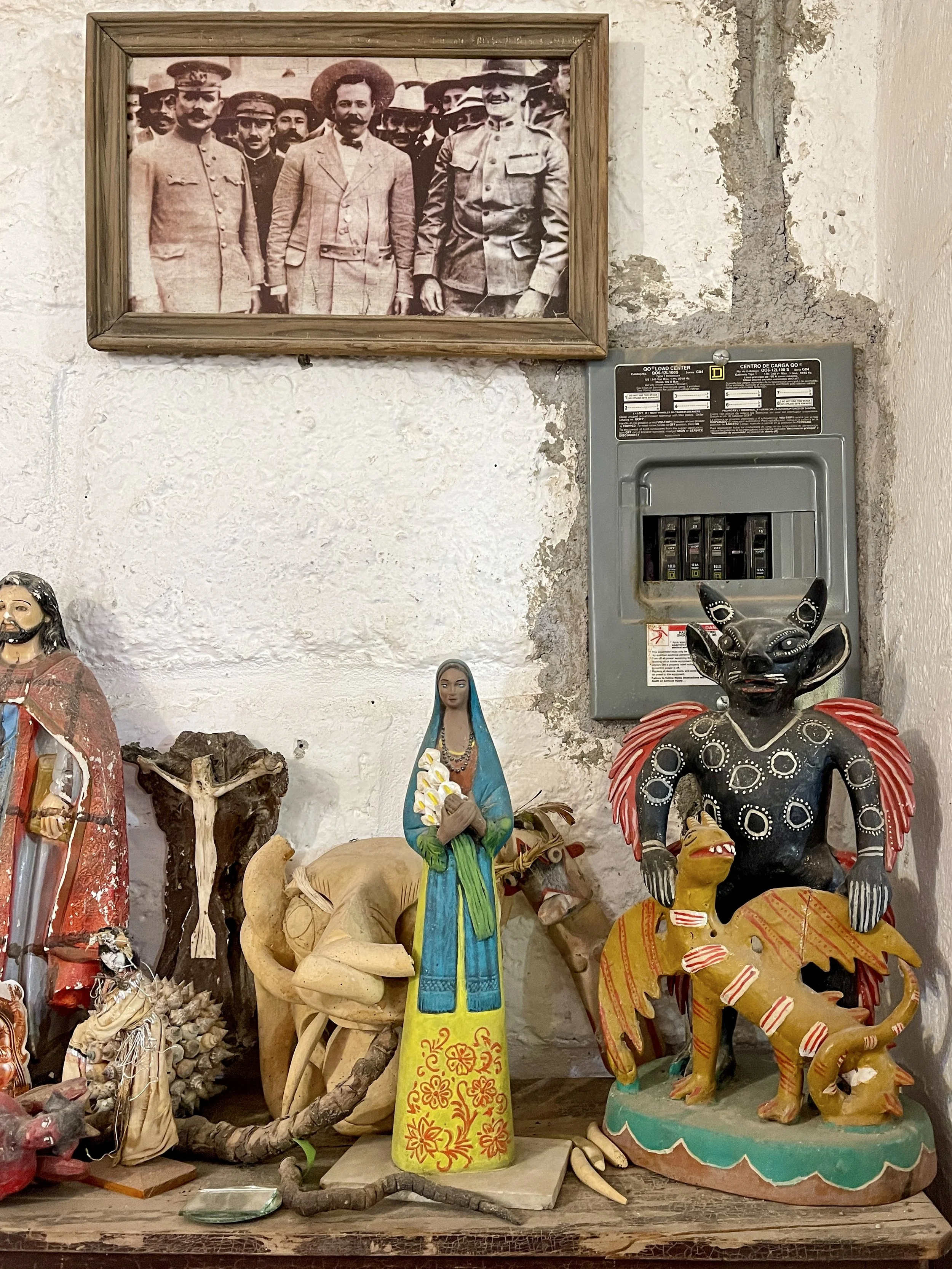
Statues of Jesus, a woman with lilies and the devil with a dragon by historic military photo in Mexico

Religious iconography in Anado’s garage workshop

The tour ends in the garage workshop, filled with containers of paint, folk art, necklaces, and odds and ends. Wally bought a bracelet of mismatched beads to remember our time here. 

The Chapel of Jimmy Ray is a journey to an artsy, whimsical world. You’ll feel a bit like Alice in Wonderland.

Final Tips for Visiting the Chapel of Jimmy Ray

1. Make an appointment — through your hotel.

Because the Chapel of Jimmy Ray is Richard’s home and a museum of sorts showcasing Anado’s work, visits are by appointment only. We had emailed Richard weeks before to make a reservation but never heard back. Luckily, the concierge at our hotel in San Miguel was able to connect with him and secure us a spot.

Maybe the trick is to get Richard on the phone. Try giving him a call at +52-415-155-8044.

2. Arrange transportation so you don’t get stranded.

As mentioned, we were upset with being overcharged for our ride out there, and made the mistake of dismissing our driver after he dropped us off. As a result, we found ourselves stranded after the tour. When we tried to connect with a taxi service or Uber, the wifi and cell service was too spotty. Fortunately, the kind-hearted Richard took pity on us and asked Carlos to take us to our destination, the natural hot springs of La Gruta. 

The best option might be to have a driver stay there, so you’re ready to head back after the tour.

3. Be sure to get there on time, if not early.

Our driver showed up late, and by the time we got into the Chapel of Jimmy Ray complex, it was 10 minutes past the appointed time, and Richard had started the tour. As such, we missed some of the background about Anado and the property.

4. After the tour, visit La Gruta Spa and the Sanctuary of Atotonilco.

While you’re in the area, stop by La Gruta, where you can soak in hot springs grottos with locals. And then head down the street to the Sanctuary of Atotonilco, a UNESCO World Heritage Site known for its amazing murals from the 1700s. –Duke

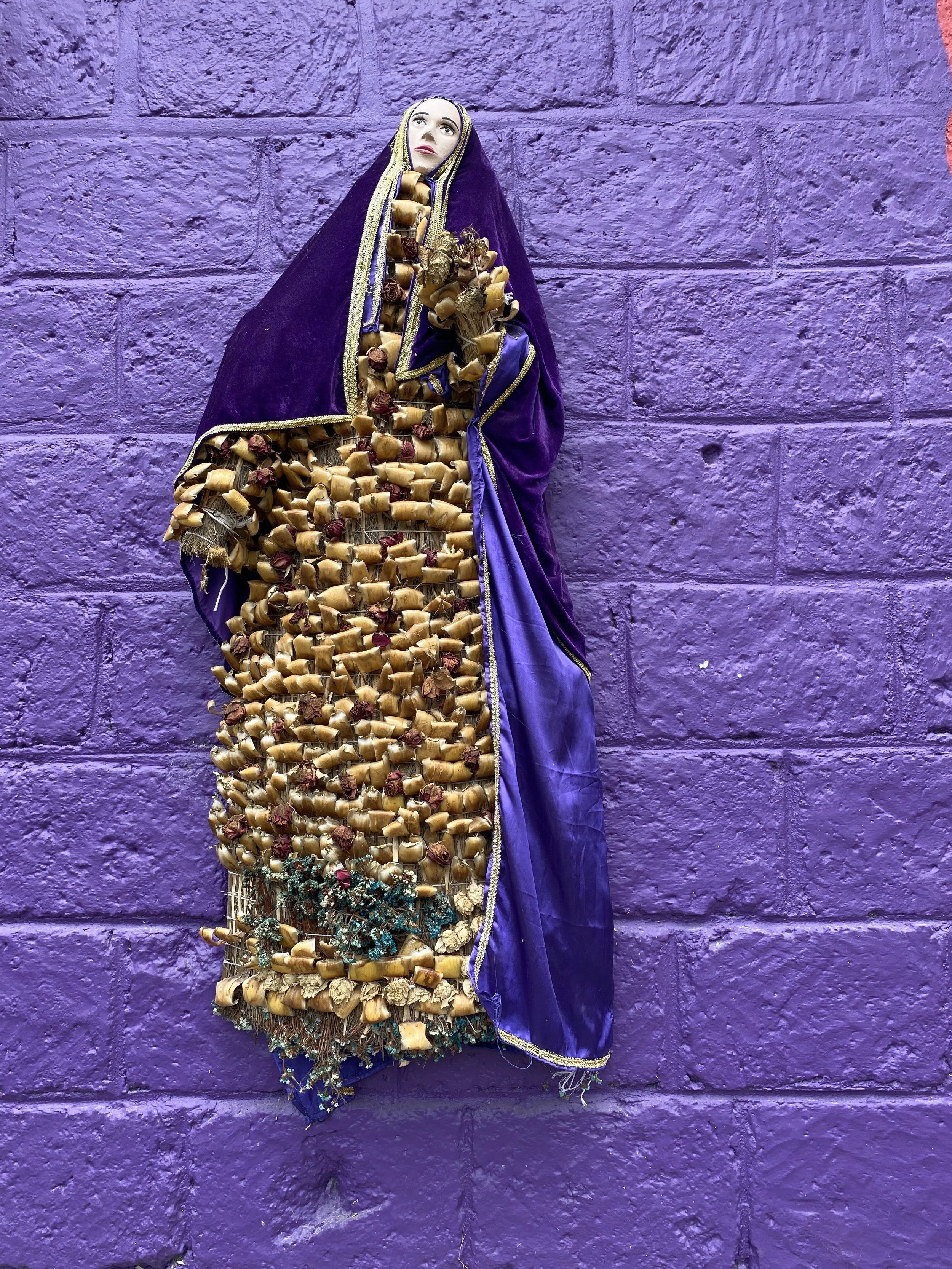
Purple house with Virgin Mary made of cork and fiery painting and sunflowers in front

Chapel of Jimmy Ray and la Casa de las Ranas

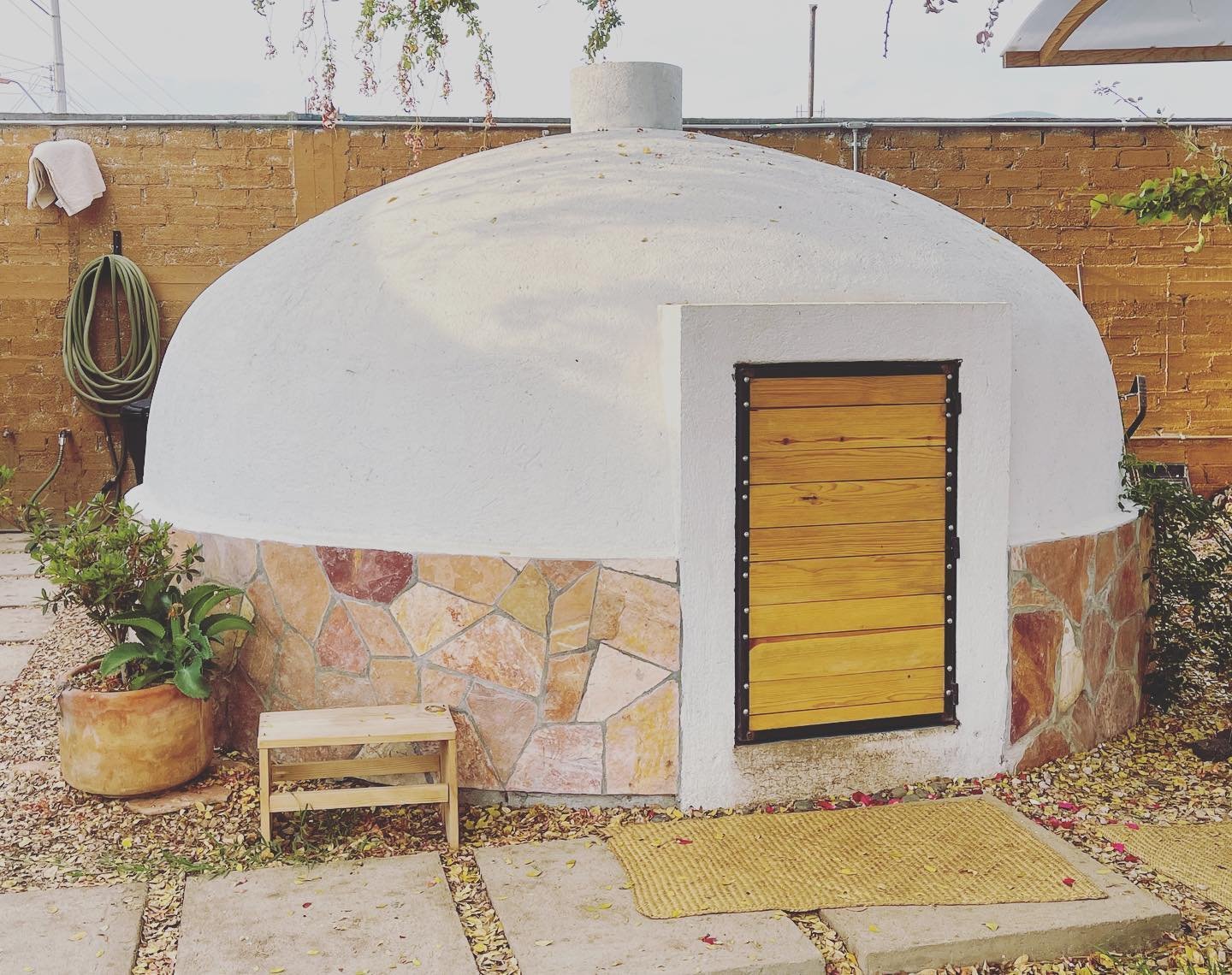
Temazcal 3
37893 La Cieneguita
Guanajuato
Mexico


Woodcarvers of Oaxaca Carve Out Their Niche

Manuel Jiménez is credited with starting the alebrije tradition in Oaxaca, but we’re smitten with the playful creations of Martín Melchor Ángeles.

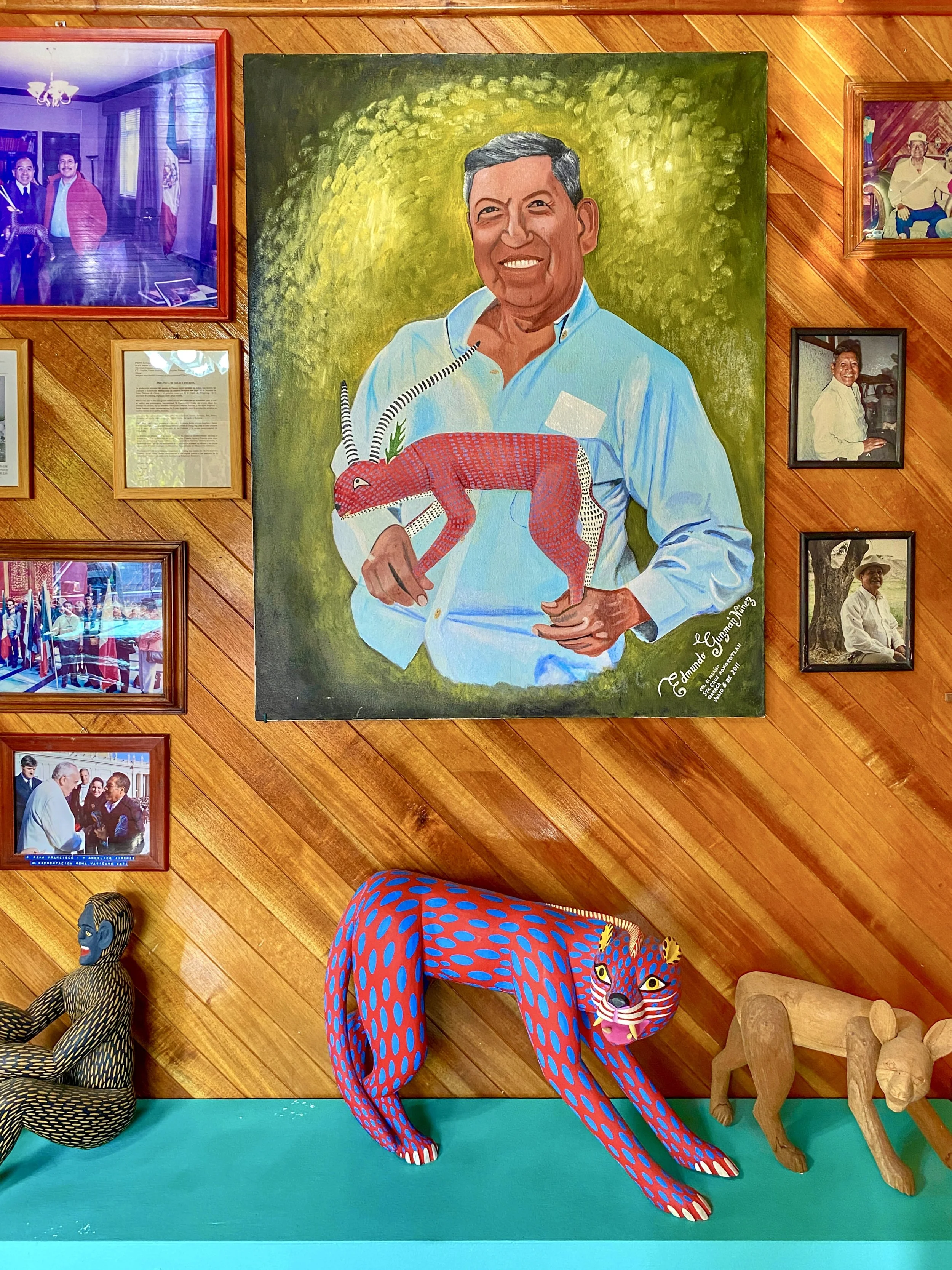
Painting of Manuel Jiménez holding an alebrije in front of real alebrije

Don Manuel Jiménez is credited with bringing the alebrije tradition to Oaxaca, and shifting the medium from papier-mâché to wood.

On our fifth day in Oaxaca, Wally and I were picked up outside Casa Antonieta, the hotel we were staying at, by folk art expert extraordinaire Linda Hanna. Having done our research, we knew that Oaxaca was famous for its brightly painted collectible wooden figures and that Linda was the perfect guide to explore the region. We were on the road by 9:30 a.m. and en route to San Antonio Arrazola, a small pueblo where the tradition began. 

These wood carvings are the newest of the local crafts yet draw on generations of skill. Even the capital’s fútbol (soccer) team, Los Alebrijes, is named after the locally produced wood carvings, which are an important source of income for their indigenous makers. According to Linda, prior to the 1940s, the region produced utilitarian items such as wooden spoons and molinillos, a utensil used to froth drinking chocolate. 

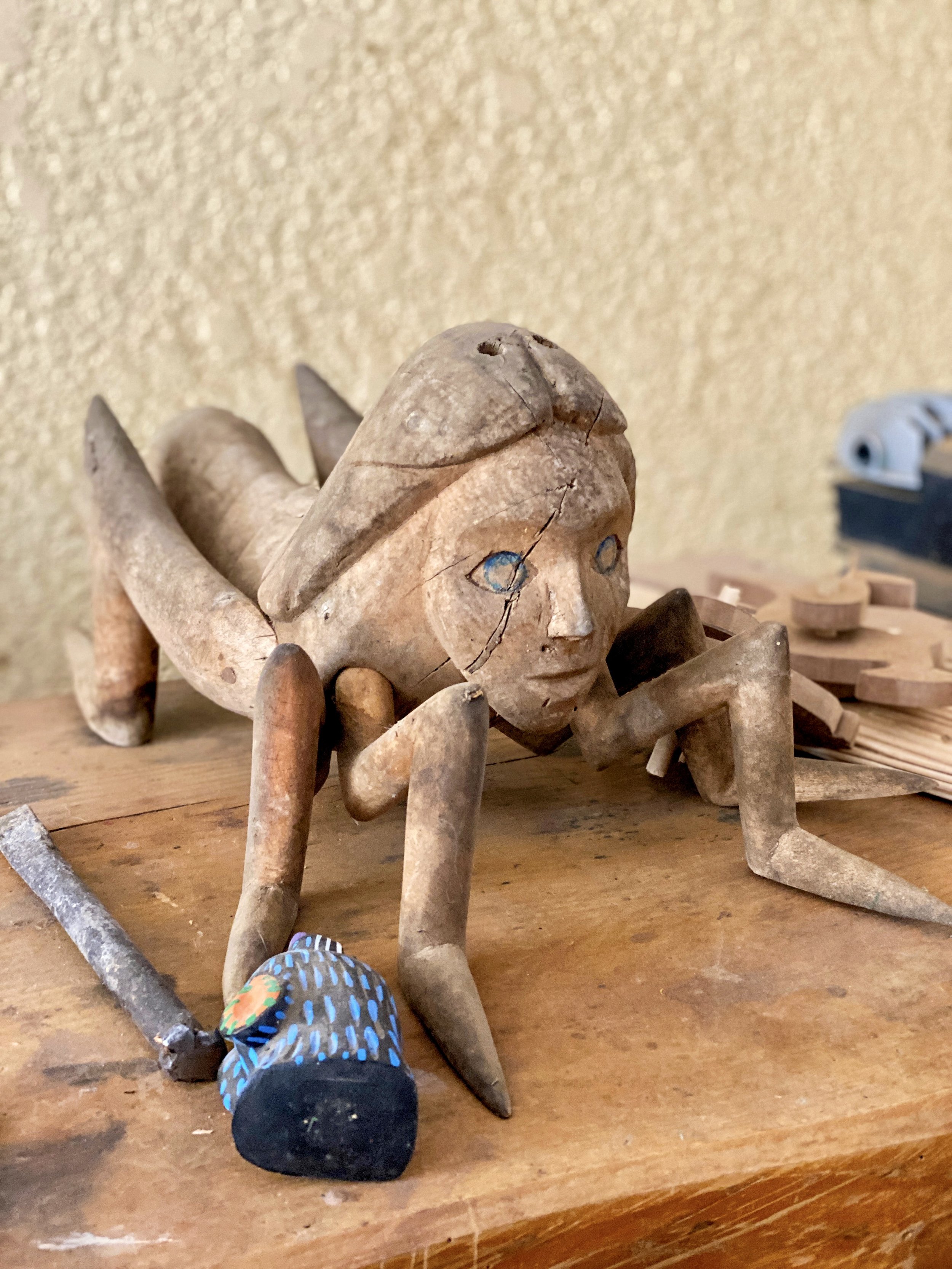
Nahual woodcarving of grasshopper with woman's face

Alebrijes are believed to have been modern offshoots of nahuals, human-headed animal amulets worn by the Zapotec.

The origin story that Linda has heard often and which she believes to be the most credible involves a Zapotec tradition: Every baby was given a small nahual or nagual (pronounced “na-wal”) amulet to wear around their neck from the day they were born. These tokens took the form of animals from the 20-month Mesoamerican zodiac and were protective talismans symbolic of an individual’s alter ego that accompanied them throughout life.  

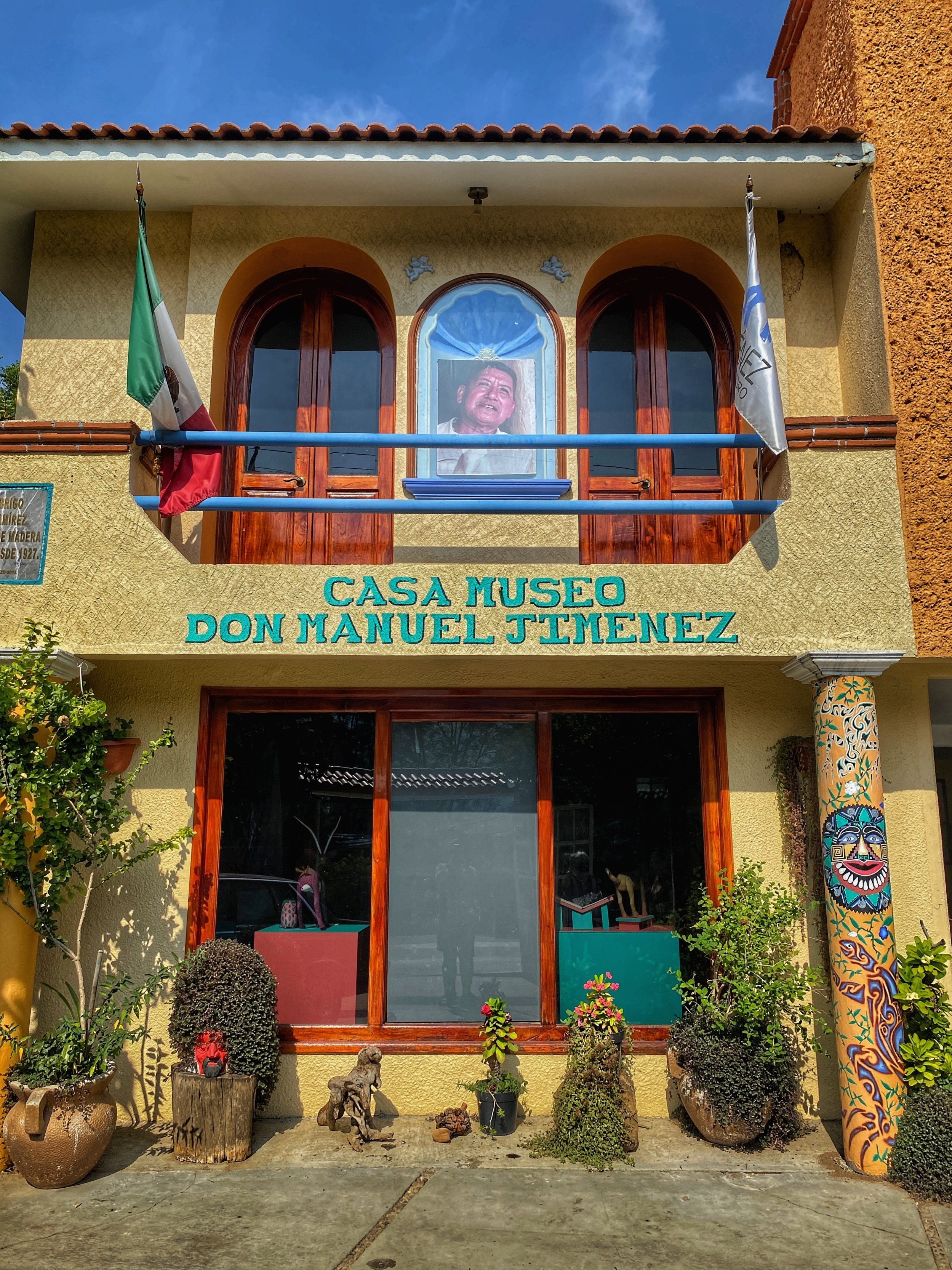
Facade of Casa Museo Don Manuel Jimenez

Don Manuel is no longer living, but his family carries on the woodcarving legacy.

Don Manuel Jiménez: The Alebrije Story Begins

“Manuel Jiménez was a peasant farmer who would be out there in the fields,” Linda told us. “And I think these people are, you know, born with a machete nearby. So carving is almost inherent in their DNA, and he was probably out there whittling away. He didn’t want to be limited by the size of the creatures, so he started making them bigger. At some point he had a bunch of them and would come into town, sit on some street corner, trying to sell them, probably not too effectively — until an American saw his work and was very impressed.”

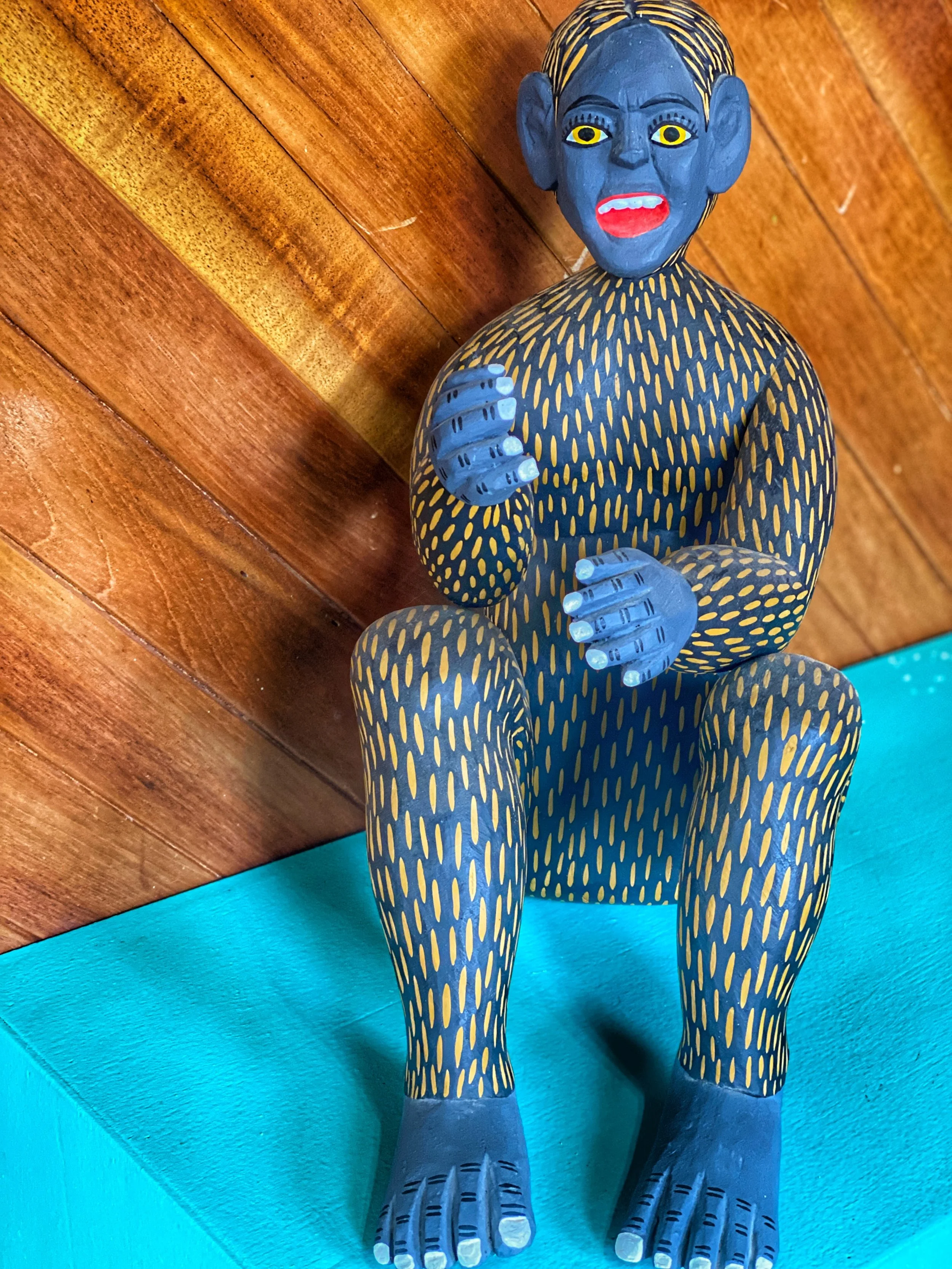
Blue man alebrije by Jiménez

Alebrijes take many forms but are mostly animals nowadays. Jiménez liked to do human faces, inspired by an ancient Zapotec tradition.

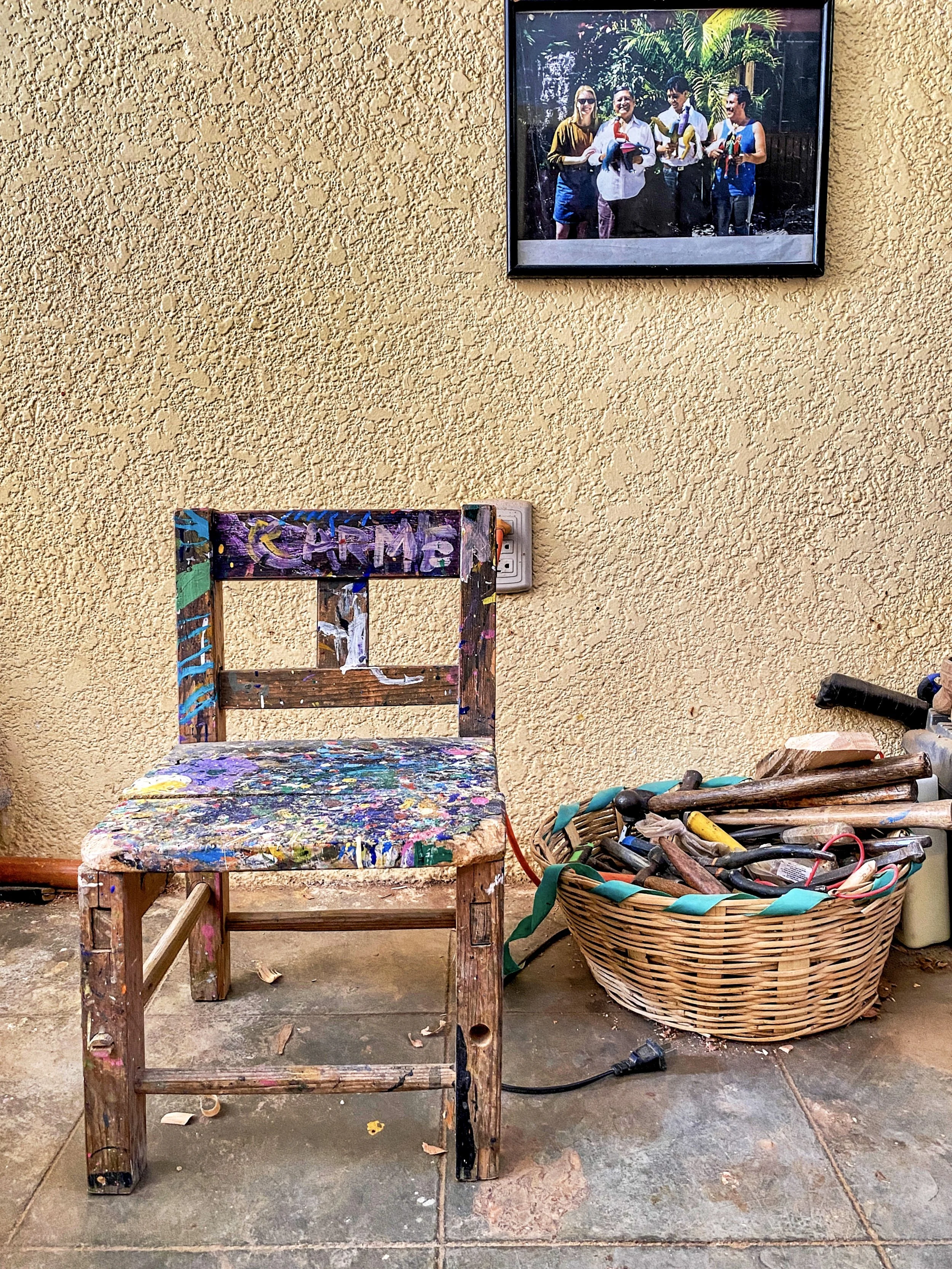
Paint-covered chair with wicker basket at the Don Manuel Jimenez workshop

If you’re into alebrijes even half as much as Wally and Duke, consider having Linda Hanna take you on a tour of woodcarving artisan workshop homes.

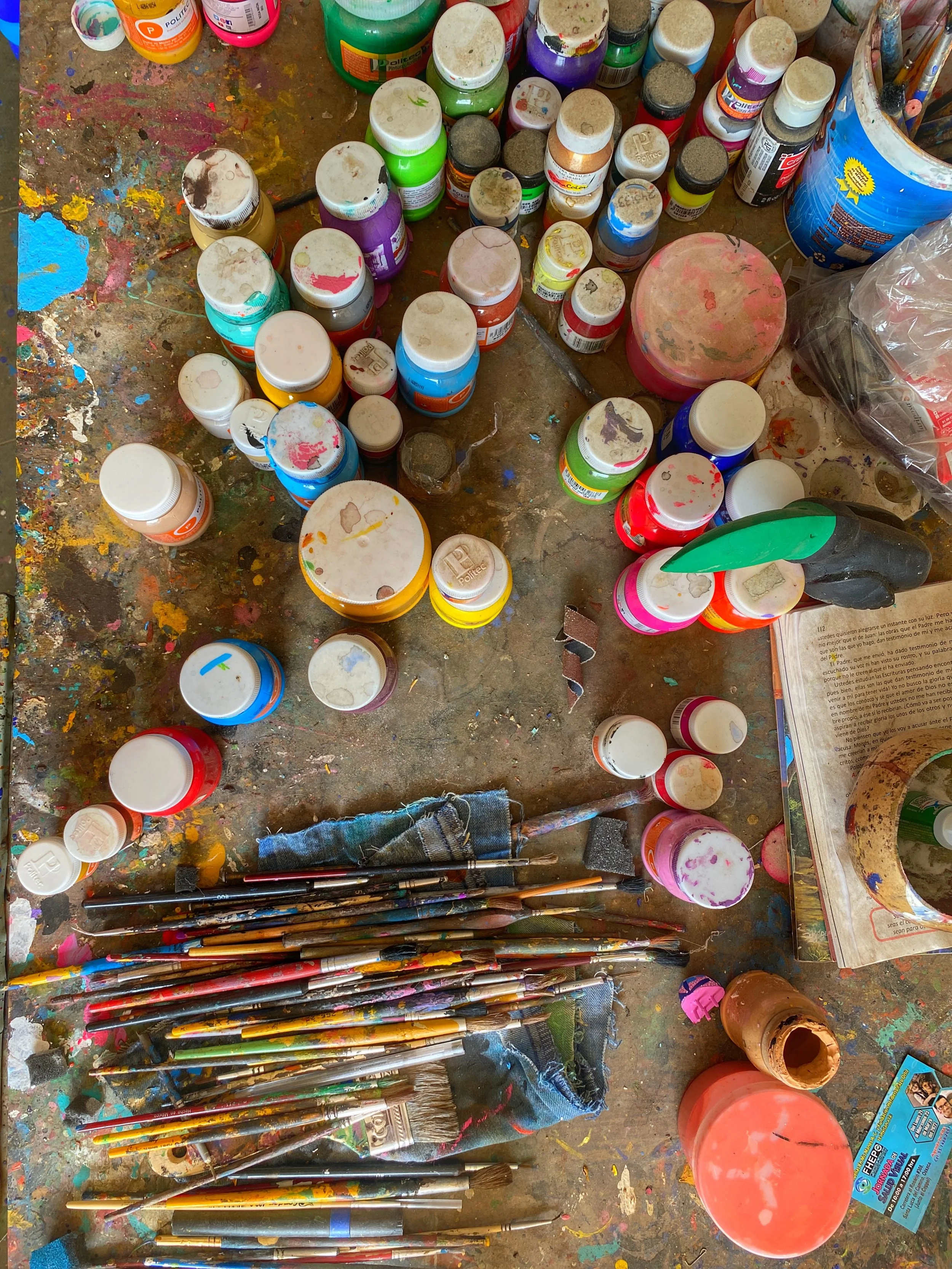
Paint containers and paintbrushes at the Jimenez workshop

We call Jiménez and his cohorts woodcarvers — but a lot of their craft involves painting. Alebrijes are known for their surprising mix of colors and patterns.

Jiménez, with the assistance of the foreigner, took these objects and presented them to the offices of the Tourist Council in Mexico City. The closest thing they could compare them to were the fantastical creatures Pedro Linares had been making out of papier-mâché, so they decided to also call these surreal, vibrantly colored wooden adaptations “alebrijes,” too. 


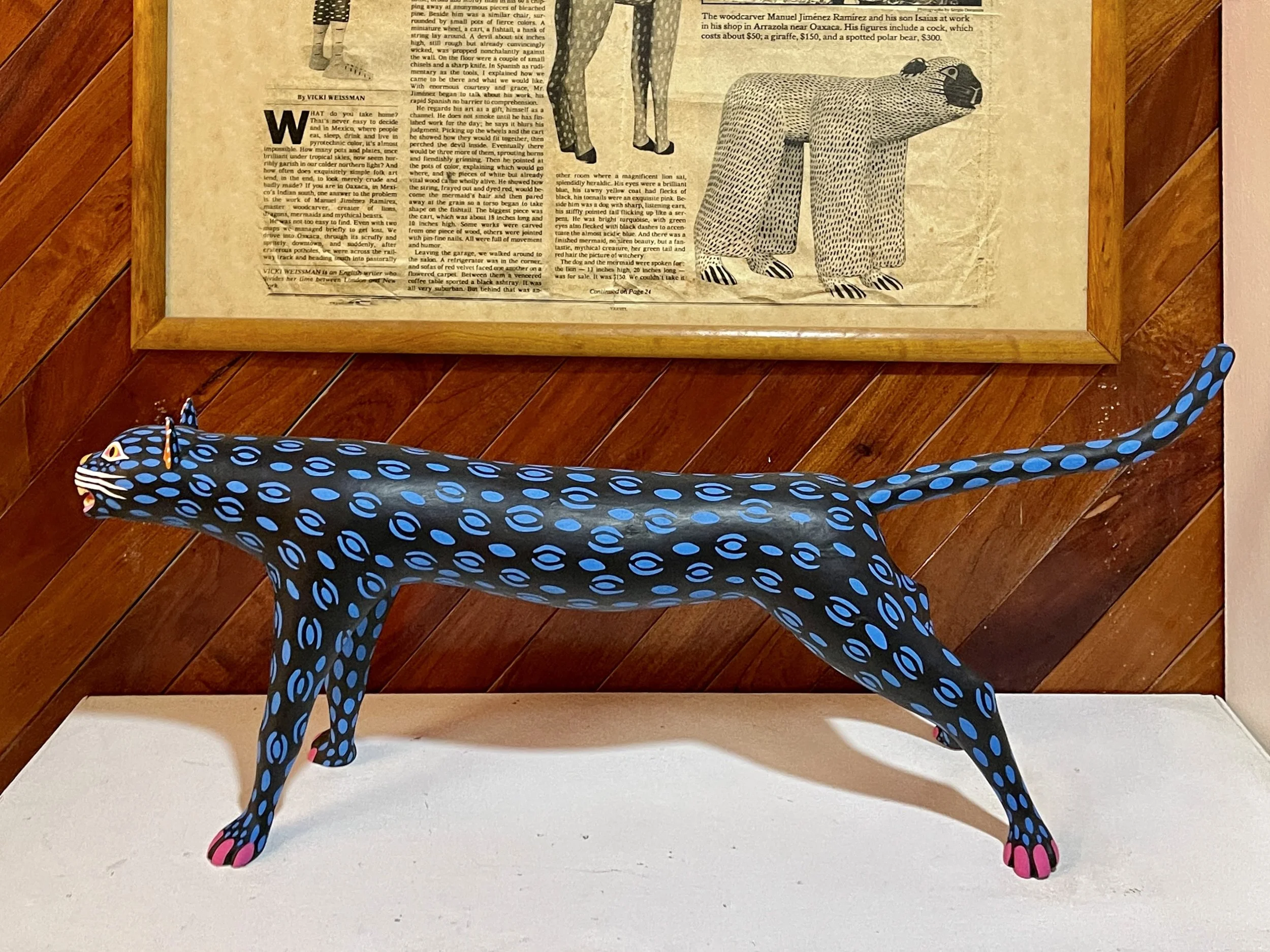
Blue cat alebrije at the Casa Museo Don Manuel Jimenez

What’s an Alebrije? Learn more about our favorite Mexican artisan tradition.

Click here


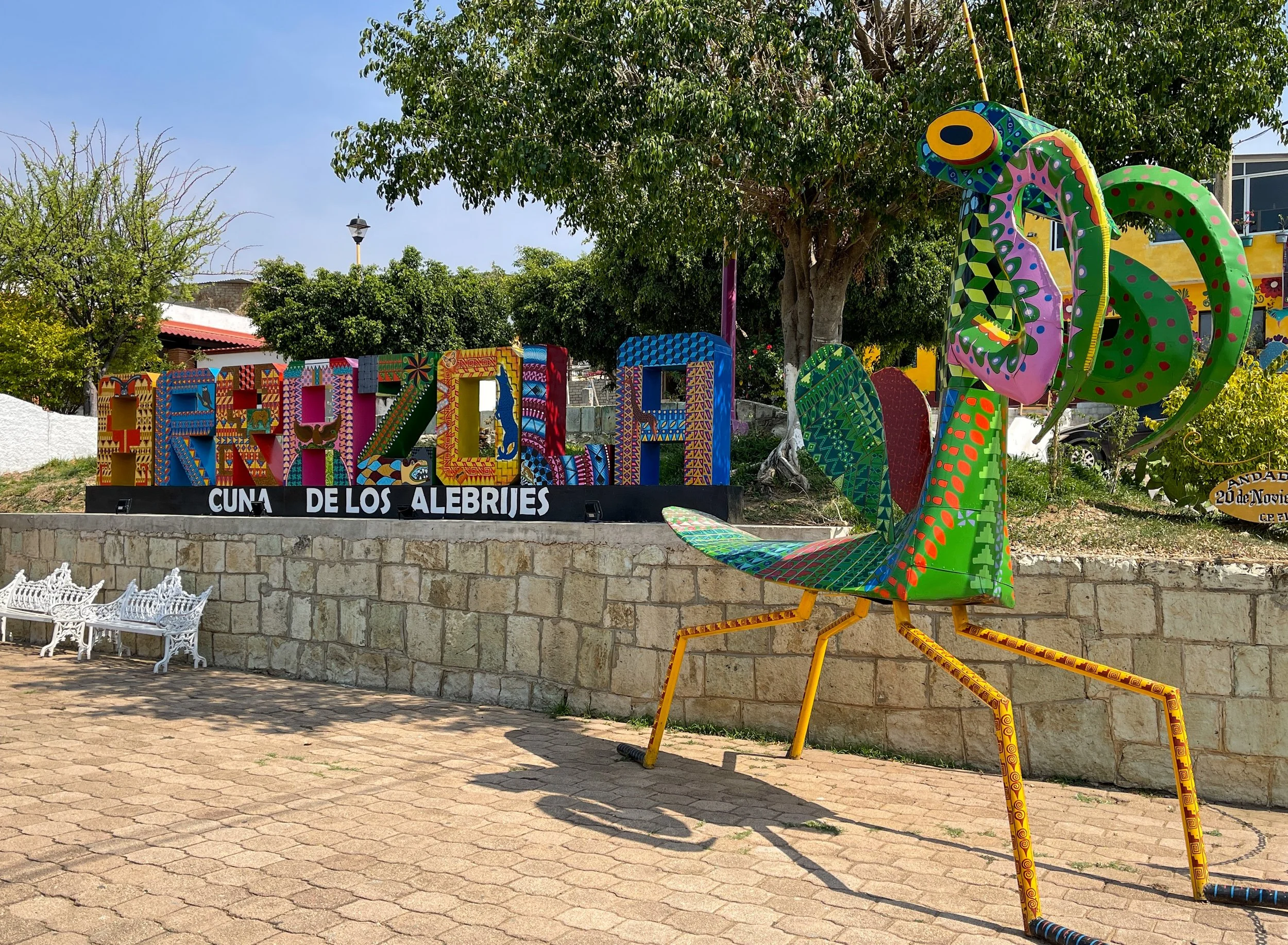
About 45 minutes later, we were welcomed to Arrazola by a giant acid green praying mantis sculpture and a sign commemorating the town as la Cuña de los Alebrijes, the Cradle of Alebrijes. A short time after, we arrived at our destination, the museum workshop of the Jiménez family. Known locally as Don Manuel, the patriarch died in 2005 and is often credited as the father of Oaxacan alebrijes.

A fun sculpture of a giant praying mantis in Arrazola, the Cuña, or Cradle, of Alebrijes

As we parked and got out of Linda’s car, we noticed a man outside the studio enclosure with a converted bicycle grinding a metallic object against a spinning rust-colored disc. When we asked Linda what he was doing, she replied that he was a knife sharpener and it looked like he was working on a pair of scissors.

Courtyard at the Jimenez workshop and museum

The charming courtyard at the Jiménez home, workshop and store

In the courtyard, a group of small, weathered and anatomically correct diablitos (little devils) playing guitars hung along a roughly textured stucco wall. 

Inside the workshop are framed photographs, newspaper articles and nahuales. One with a man’s face and mustache was sitting upright like a dog, another, ears back, crouched, appearing ready to pounce. A brightly colored figurine of Dante, the dog from the Pixar movie Coco stood atop a well-worn table.

The taller (pronounced “tie-yair”), or workshop, is operated by Don Manuel’s sons, Angélico and Isaías, and contains a small museum with glass display cases of their father’s work. They still sign Manuel’s name to their work — supposedly to honor his legacy. 

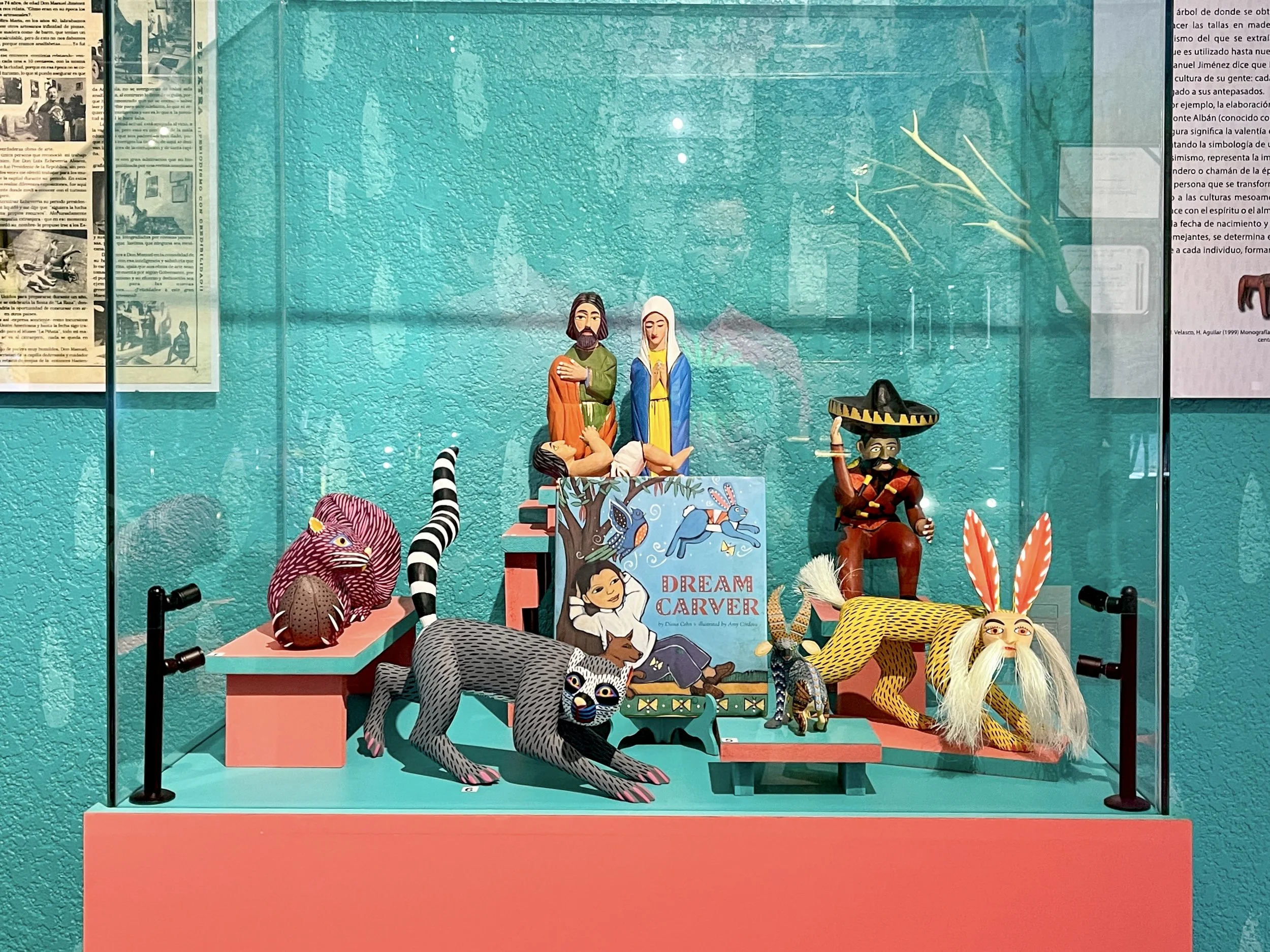
The patriarch specialized in nativity scenes, animals and nahuales. There’s even a children’s book, Dream Carver, that tells the story of a young woodcarver who breaks with a generations-old artistic tradition, inspired by the life of Don Manuel. 

A display case of some of Don Manuel’s works and the children’s book based on his life

There’s a shop/museum connected to the workshop.

“When these started selling, Jiménez tried to keep it a secret — which is impossible in a little village,” Linda said. “They know everything about you, good and bad.”

It wasn’t long before campesinos (farmers) in the nearby pueblos of San Martín Tilcajete and La Unión Tejalapan caught on and decided to carve and sell their products to tourists and collectors from North America and beyond. A new artisan tradition was born. 

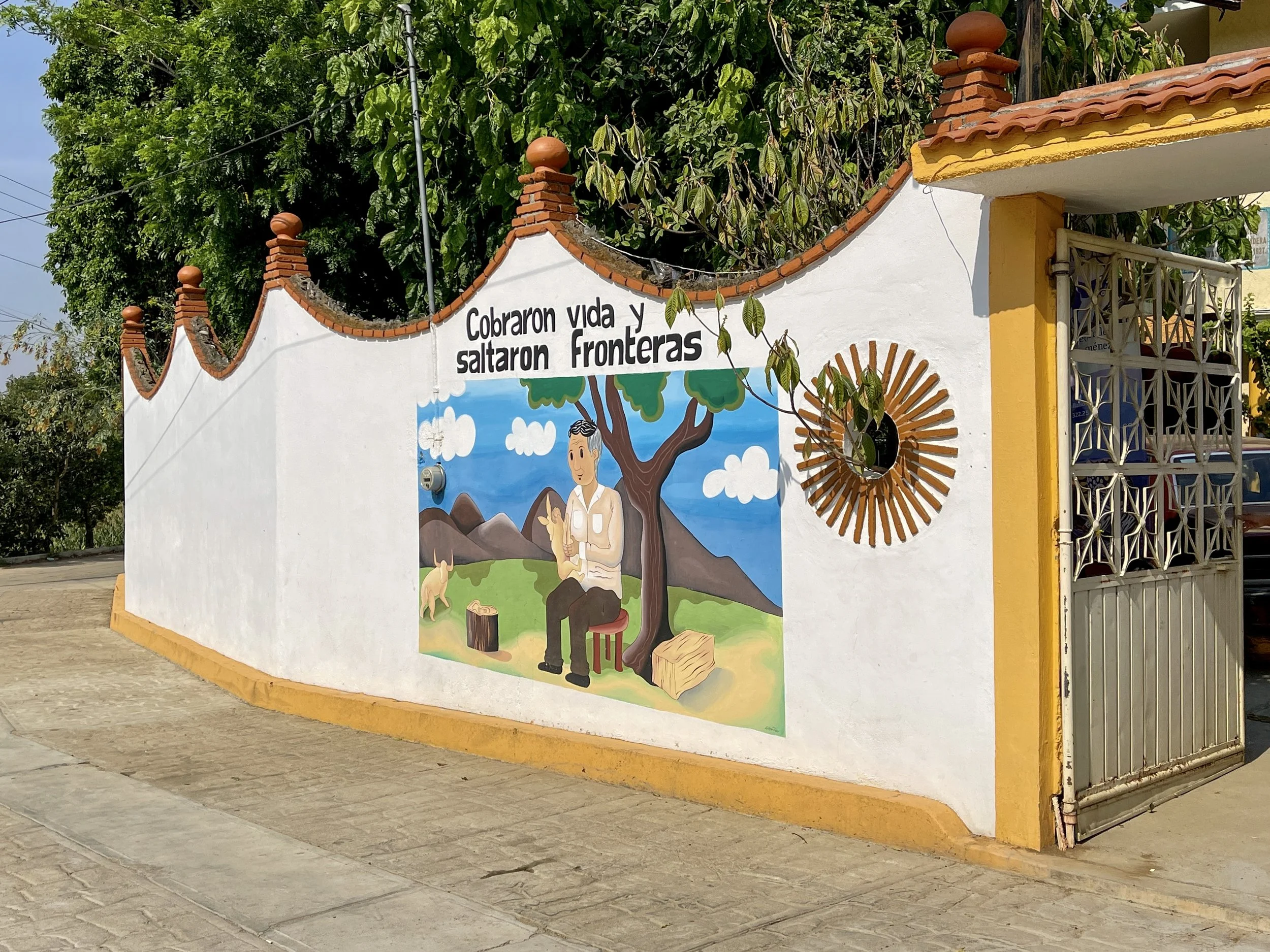
El Tallador de Sueños Museo-Taller

When you see this mural, you’ll know you’re about to enter Don Manuel’s complex.

El Tallador de Sueños Museo-Taller
Álvaro Obregón #1
San Antonio Arrazola
Santa Cruz Xoxocotlán, 71233
Oaxaca
México

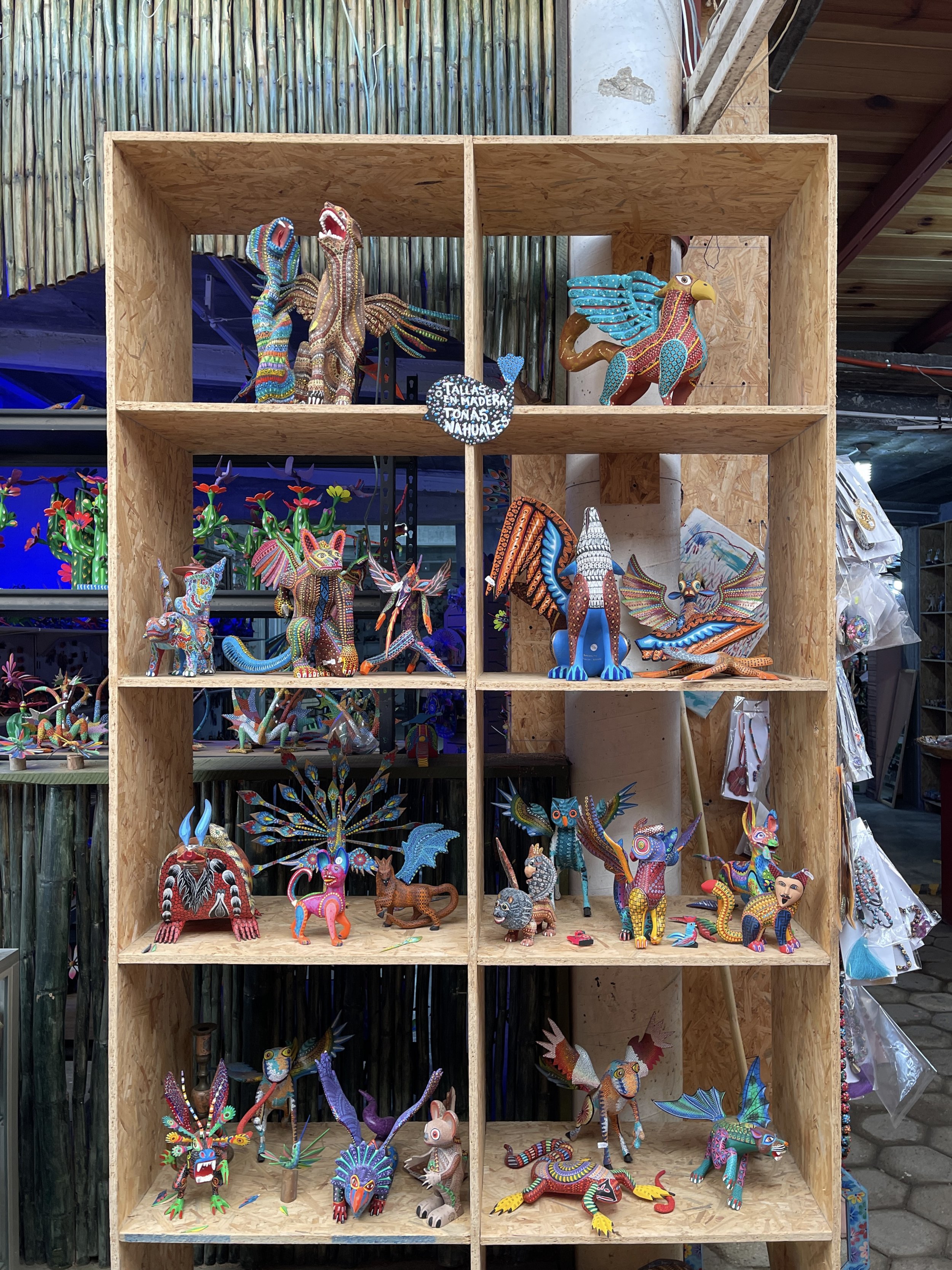
Alebrije display case

While we were in Arrazola, we stopped into Taller de Alebrijes Autóctonos, a massive store filled with colorful carvings.

Shopping Break 

In addition to Don Manuel’s workshop and museum, Arrazola has a concentration of shops on Calle Emiliano Zapata. Wally and I stopped by Taller de Alebrijes Autóctonos, a massive establishment with a vast selection of alebrijes. Linda had mentioned that a few artists use syringes to apply dots of acrylic paint to the surface of their creations. Sure enough, I noticed a woman working on a piece who was using a syringe to embellish a small wood carving.


Taller de Alebrijes Autóctonos
Emiliano Zapata #2-B
San Antonio Arrazola
Santa Cruz Xoxocotlán, 71233
Oaxaca
México

Martín Melchor Ángeles

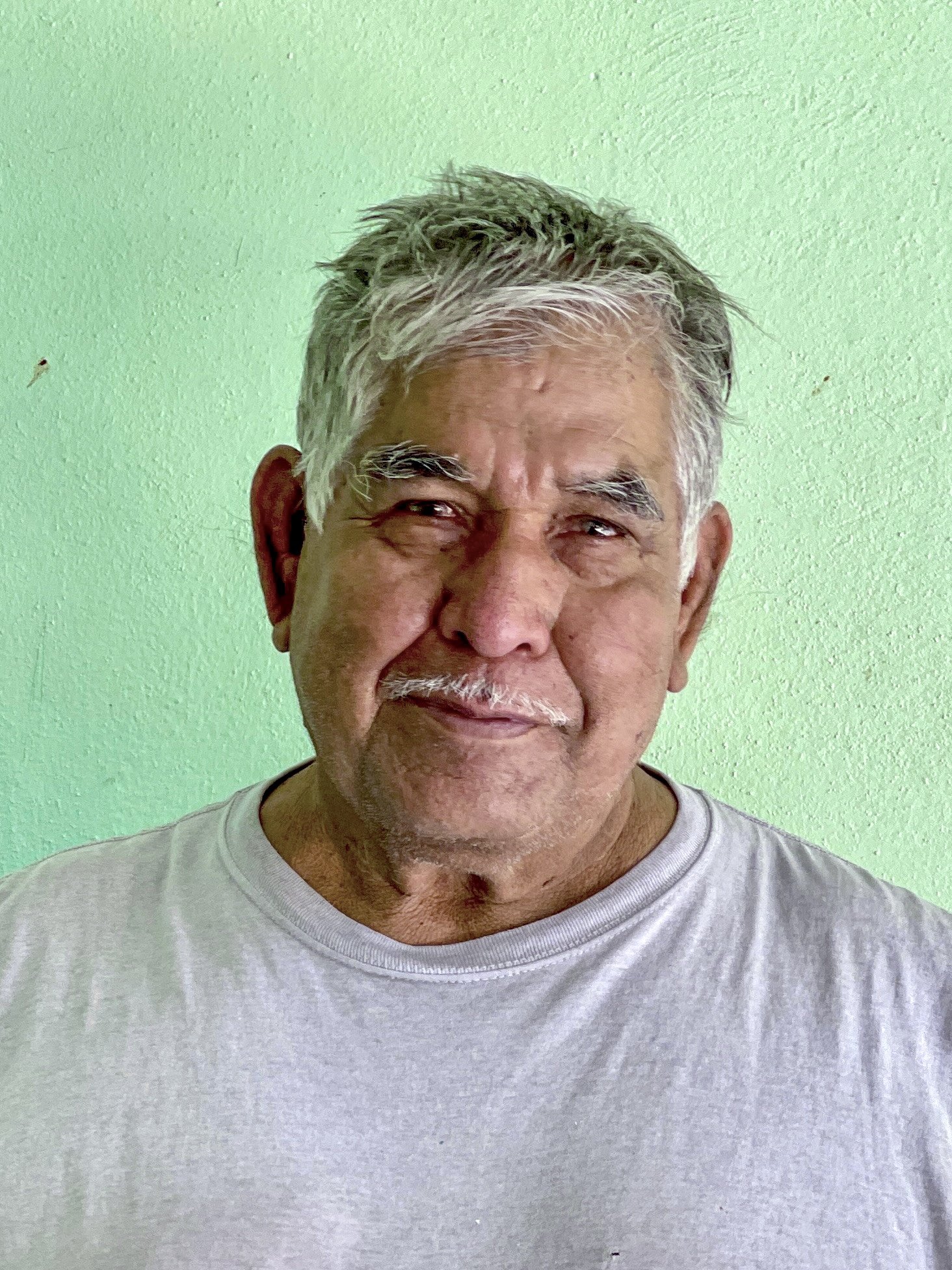
Martín Melchor Ángeles, our favorite alebrije artisan

The Story Continues: Martín Melchor’s Magical Menagerie 

The moment I first saw the work of Martín Melchor Ángeles on the Instagram feed of Mexico City-based freelance journalist Michael Snyder, I knew I’d found someone special. 

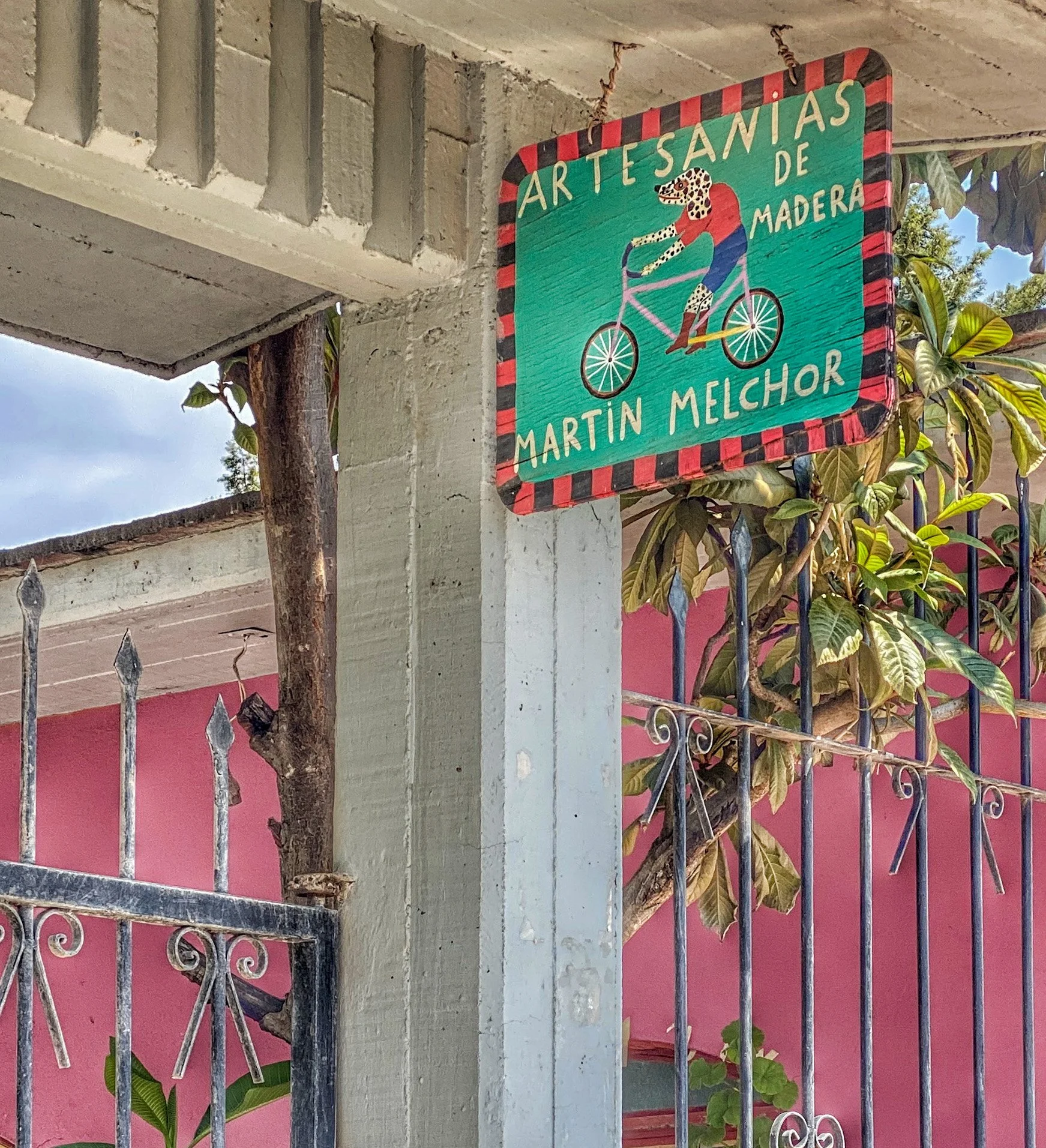
Our next stop was the taller of Martín Melchor Ángeles. A dusty, rose-colored wall sported a hand-painted sign with one of Martín’s signature dalmatians wearing a red shirt and blue pants riding a bicycle. 

Martín’s distinct whimsical handcarved animals include a menagerie of creatures: giraffes operating mototaxis, dogs on bikes, alligators in libraries, cows on stilts and more. His wife, Hermelinda, makes handsewn costumes for the figures on stilts. 

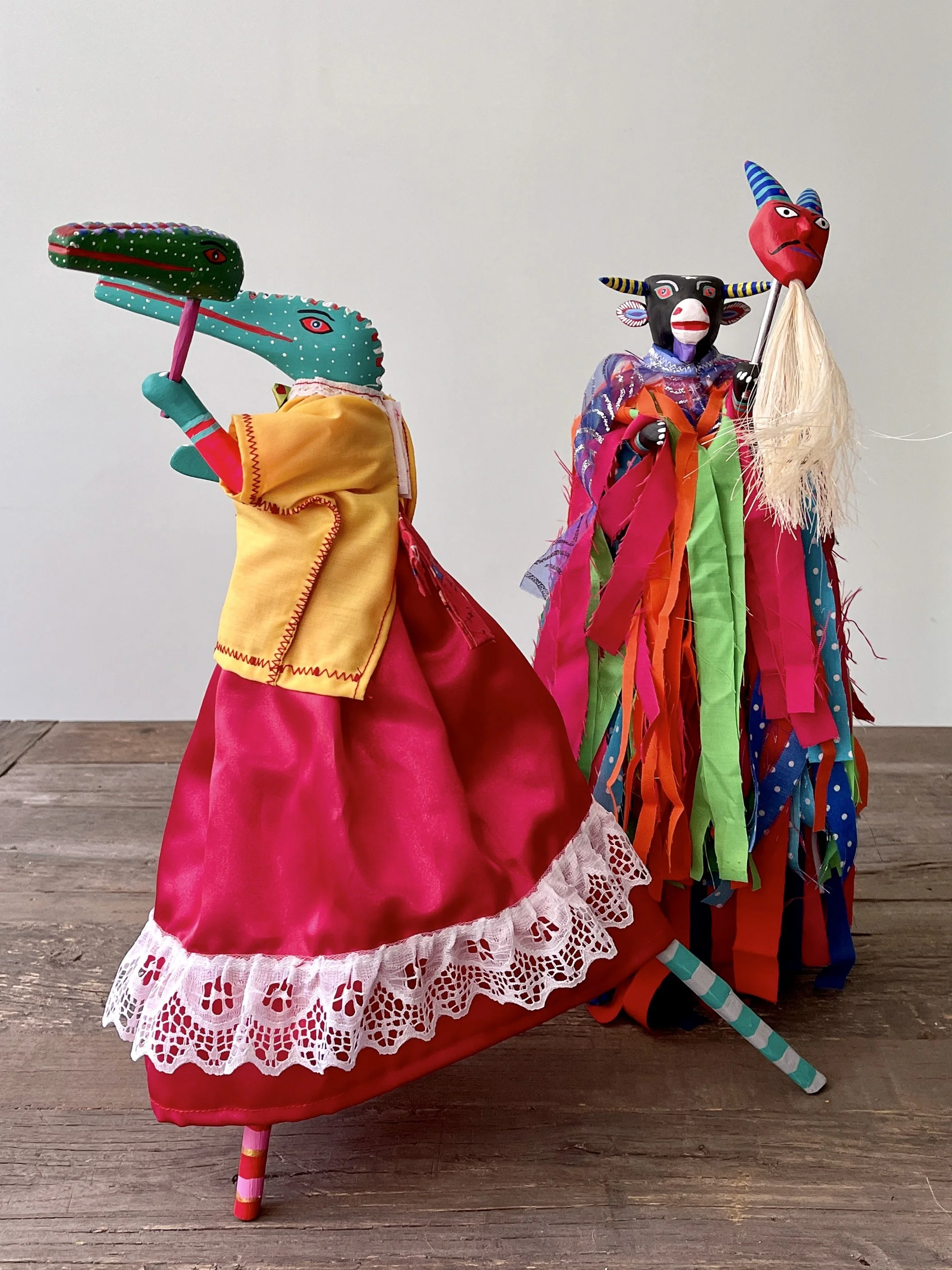
Martín Melchor Ángeles alebrijes of gator and bull in dresses on stilts

These are the alebrijes on stilts that Duke and Wally bought at Melchor’s workshop.

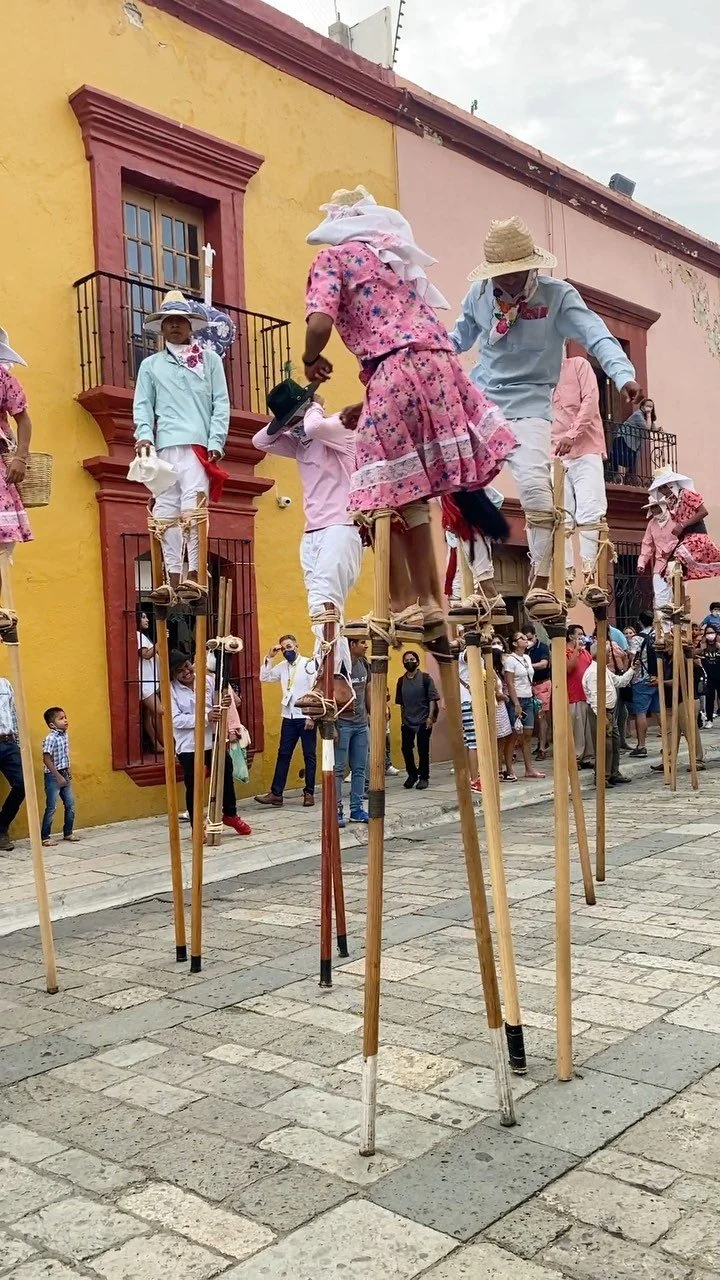
The stilt walkers were included as part of a collaborative exhibit, Transcommuniality, by multidisciplinary artist Laura Anderson Barbata, which made an appearance at the Museo Textil de Oaxaca in 2018. The traveling exhibit includes interpretations of stilt walkers’ costumes found around the globe, from the moko jumbies of Trinidad and Tobago to the Zancudos de Zaachila in Oaxaca.

In fact, while walking through Oaxaca Centro a couple days earlier, Wally and I happened upon a parade with these performers. We marveled at how they danced around, tied onto wooden stilts. They’re known as Zancudos, which comes from zanco, meaning “stilt” but also evokes “mosquito” — a reference to the insects’ long legs. The male performers, some dressed in masculine garb, some wearing dresses, are impressive to watch.

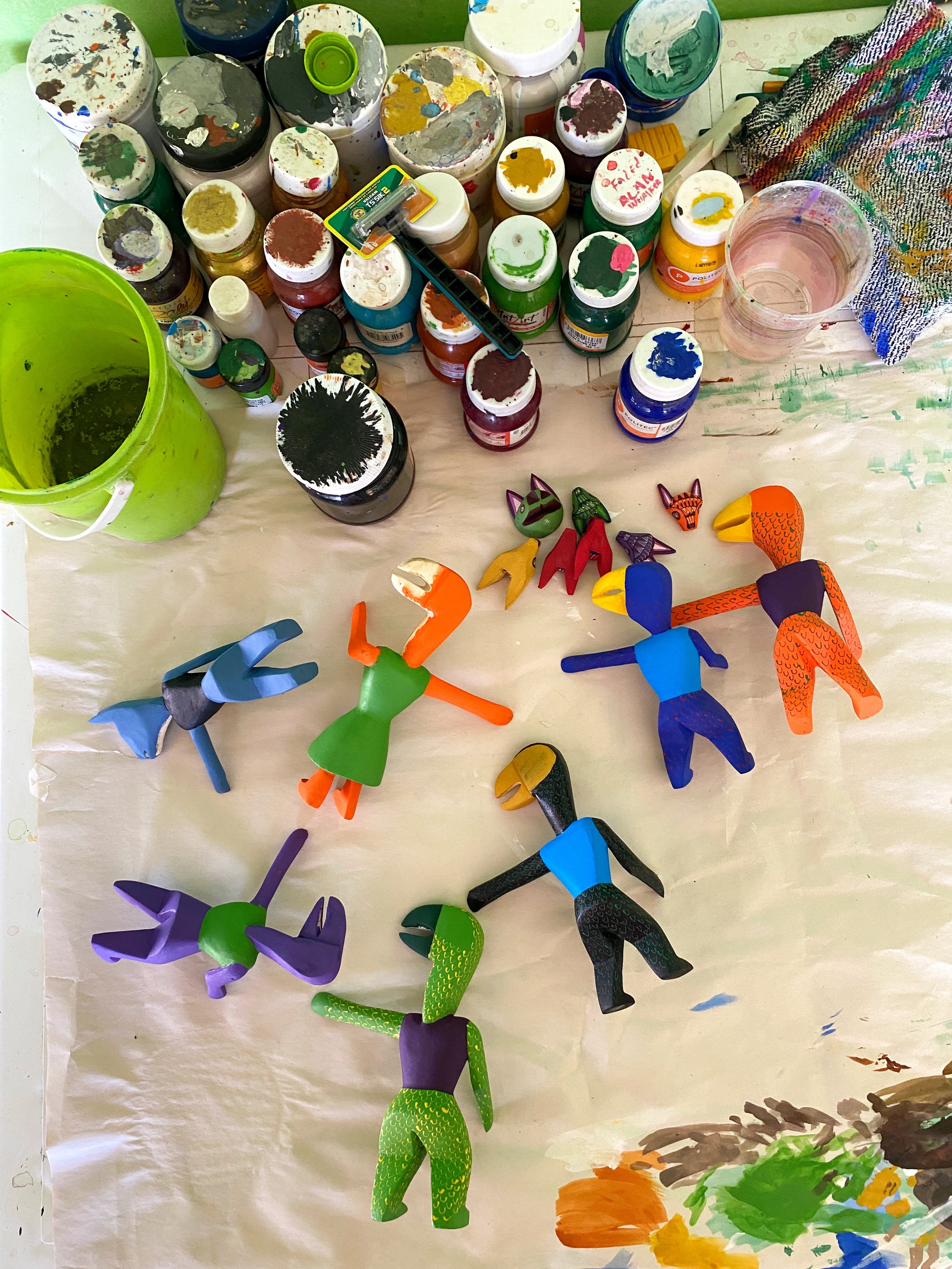
Small bird-headed figurines being painted at Martín Melchor Ángeles' workshop

Part of the fun of a folk art tour is seeing the handicrafts at various stages of production.

At Martín’s shop, it was difficult to decide between the pieces. But ultimately, we decided upon a bull dressed as a tiliche in colorful scraps of cloth. This character makes an annual appearance at Guelaguetza, a celebration of indigenous culture held in Oaxaca de Juárez, along with an alligator in fanciful Tehuana dress wearing a lemon yellow huipil tunic paired with a long bougainvillea pink skirt.

If for some reason you don’t want to make a trip to Martín’s studio (and want to pay a lot more for his work), we found a couple of his pieces in town along Avenida de la Independencia at Andares. But not only is it cool to meet these artisans and see their workshops, you’ll find the prices much cheaper than those at the stores.

Painted sign for Martin Melchor, woodcarver and pink wall

The sign at Martín’s home and workshop shows his playful style, often with animals on bikes or in mototaxis.

Martín Melchor Ángeles
Andrés Portillo #2
San Martín Tilcajete
Oaxaca
México


Wally and I wished that we had allotted extra time in Oaxaca to coordinate a second day trip with Linda. Her involvement with and passion for the region’s indigenous artisans deepened our understanding and appreciation of the process. Having her as both driver and guide took the stress of transportation out of the equation. Plus, her familiarity with and ability to contact the creators prior to us visiting their workshops ensured that they had pieces for us to see and purchase.

If you’re interested in Mexican folk art, Linda can introduce you to local artesanos and take you to see their workshops. Send her an email at folkartfantasy@gmail.com. —Duke

What Are Alebrijes?

From the fever dream of Pedro Linares to the ultra-popular Oaxacan woodcarvings started by Manuel Jiménez, these fantastical folk art animals are sure to delight.

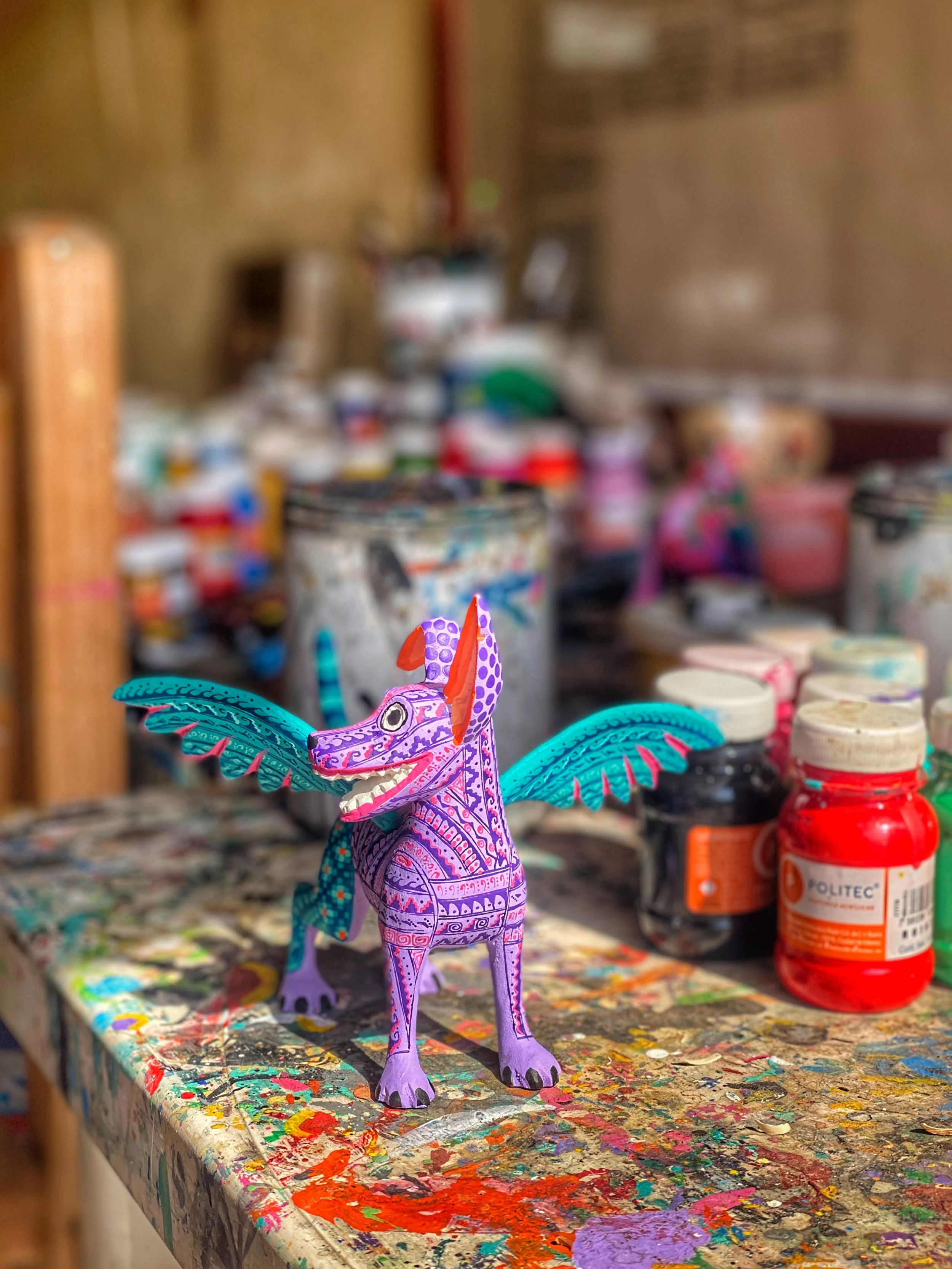
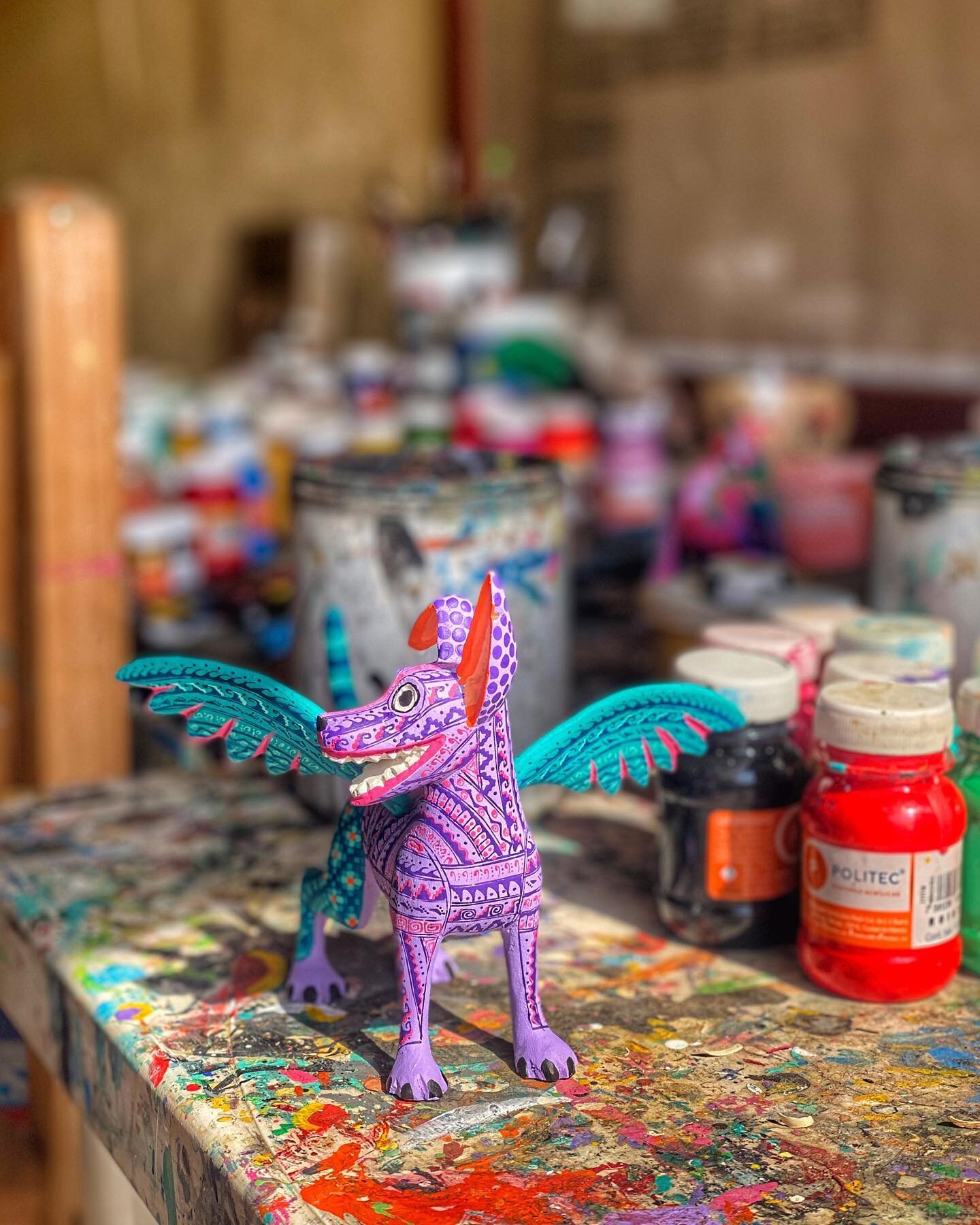
Alebrije of purple dog with wings by paint jars

A winged dog alebrije on the workbench at the family home of Manuel Jiménez, who popularized the small, brightly painted, whimsical woodcarvings known as alebrijes.

I can clearly remember the first time I was introduced to Oaxacan woodcarving. It was the early ’90s and I was working for the Nature Company. We received a shipment of whimsical wooden frogs. I purchased a brightly painted one with an upturned head, saucer-like eyes, a cartoonish grin and exaggerated outstretched limbs more like a cat’s than an amphibians. Little did I know I was on my way to becoming a collector of this art form. 

Pedro Linares fell ill and had a fever dream where strange zoomorphic creatures materialized in a dark forest chanting the word, “Alebrije… alebrije… alebrije.” 

When Wally and I decided to venture beyond CDMX and visit Oaxaca, Mexico, I knew it’d be a dream come true for us. We are drawn to cultural destinations with vibrant histories — and this one included colorful carvings of arte popular: animals, devils, mythical beasts and skeletons.

Pro tip: I always pack bubble wrap and tape in our suitcase in anticipation of what we will inevitably buy. 

Three alebrijes, including skeleton with broom and hippo

Three alebrijes from Duke and Wally’s collection

Object Lesson: Woodcarving’s Origins in Mexico 

To get a sense of history, like many things having to do with Mexico, we must look to the Spanish conquistadors who conquered the Aztec Empire. Indigenous craftspeople shifted, in large part, to creating Catholic objects of saints, angels, crosses and ornate altarpieces for colonial churches. Native Mexicans still made masks for ritual dances and festivals, and Dominican friars used them as visual aids to theatrically act out parables from the Bible as a means to sway the natives to convert to Christianity.

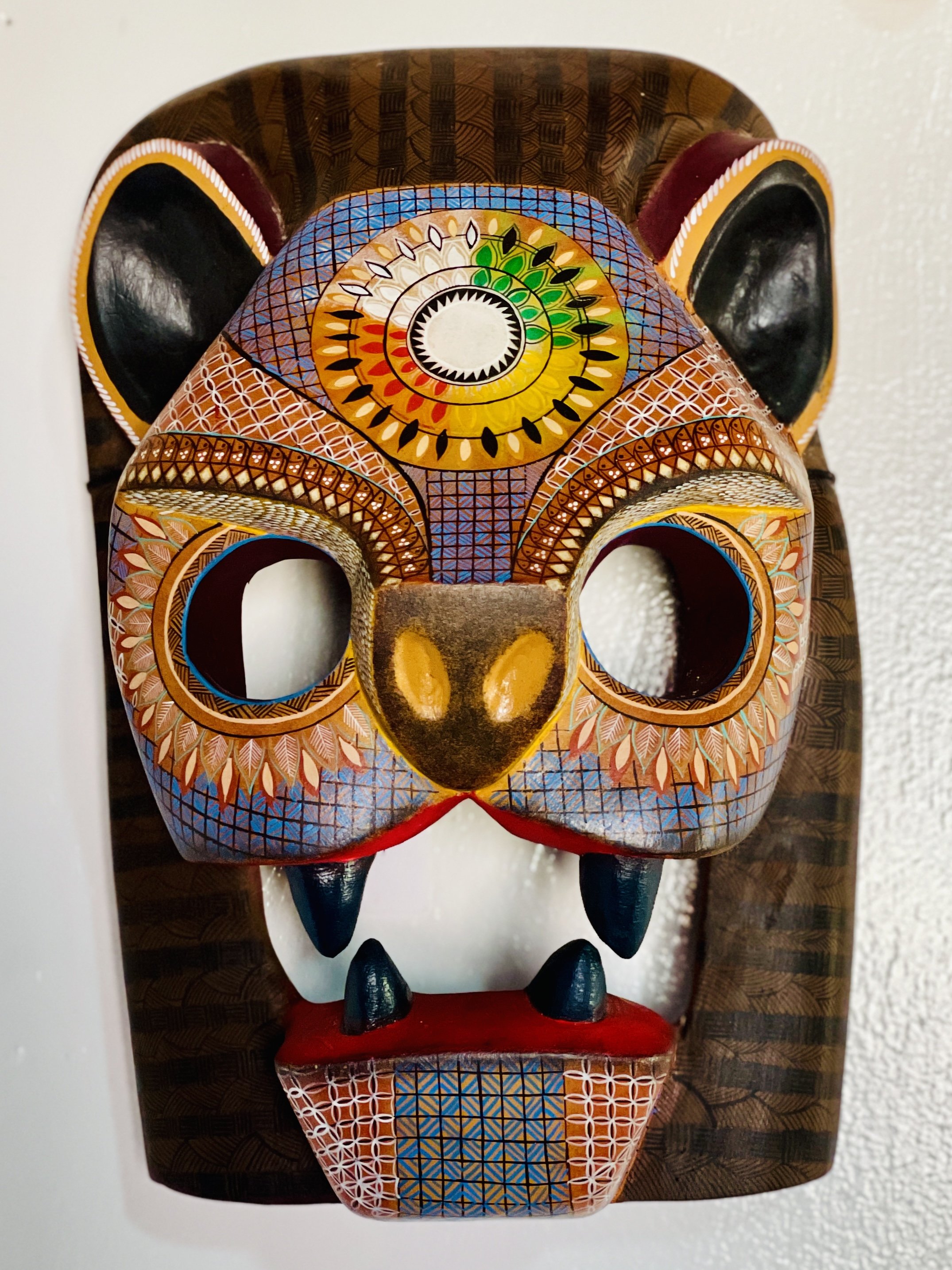
Mexican lion mask

A lion mask from a Mexican woodcarver

Fast-forward to the construction of the Pan-American Highway in the 1940s, which enabled tourists to travel to rural pueblos and led to the increased production of art objects as souvenirs. Although Oaxacan woodcarvings, known as alebrijes (pronounced ah-lay-bree-hays), in their current form have been around for less than 50 years, they have become one of the most popular. 

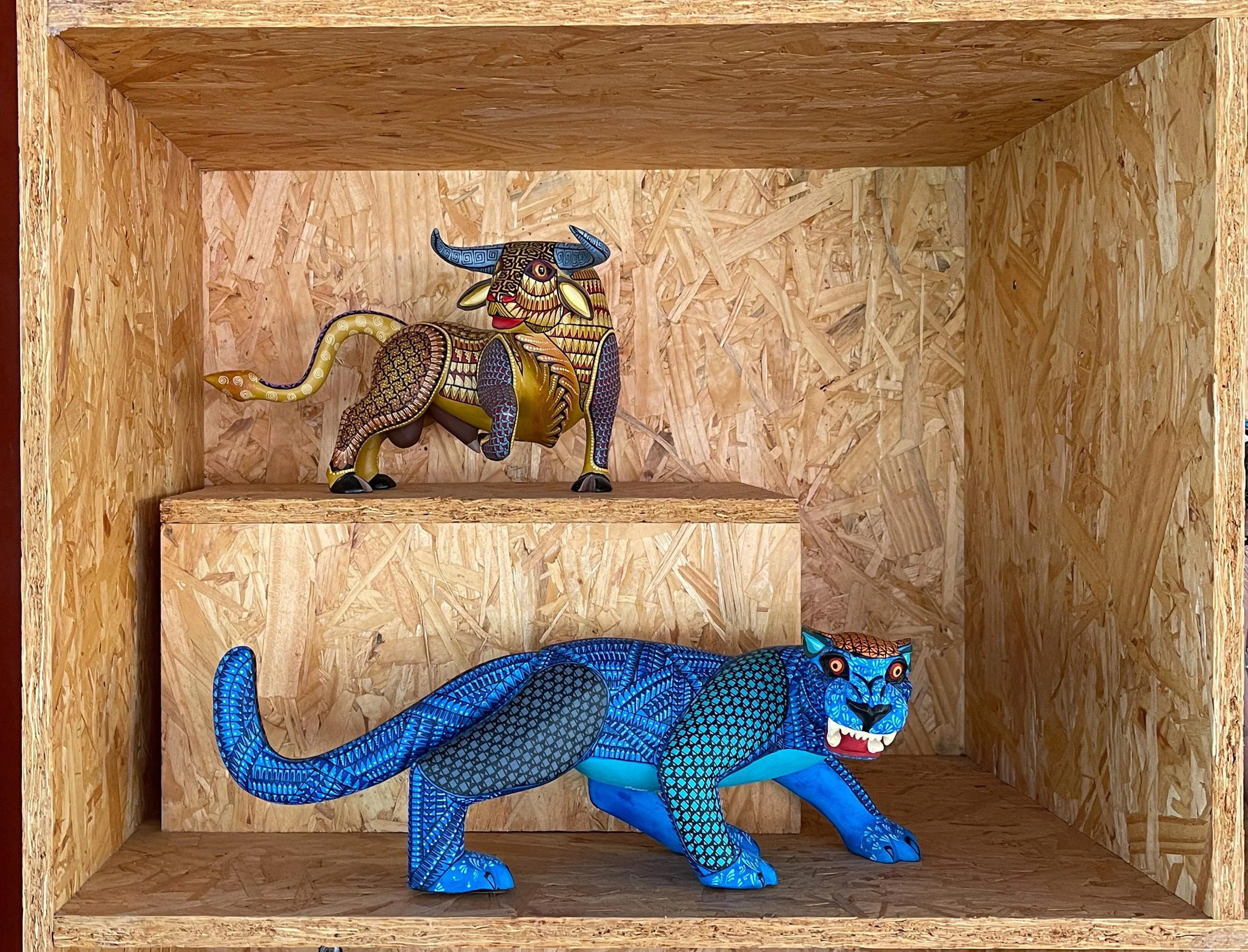
Bull and jaguar alebrijes

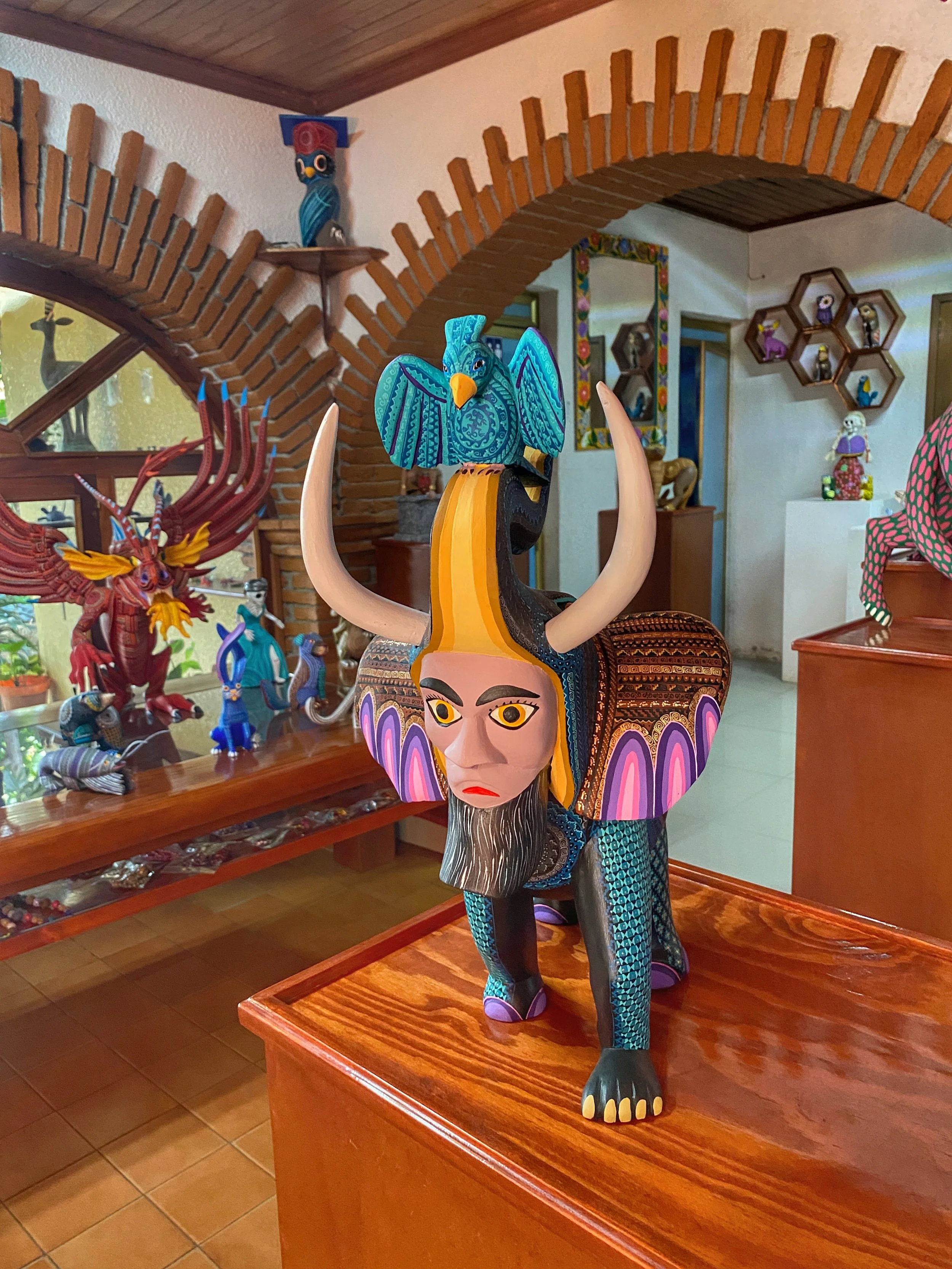
Not all alebrijes are of fantastical beasts — but they do have unexpected colors and patterns.

This art form can be traced back to a single man, Manuel Jiménez, a native of the small village of San Antonio Arrazola. Today the legendary late artist’s compound contains a museum and workshop. His alebrijes are incredible objects that are a cultural jumble of real and imaginary indigenous folklore. It was a natural evolution that other families from Arrazola, as well as those from San Martín Tilcajete and La Unión Tejalapam in particular, applied their ingenuity to create and sell pieces as a source of income.

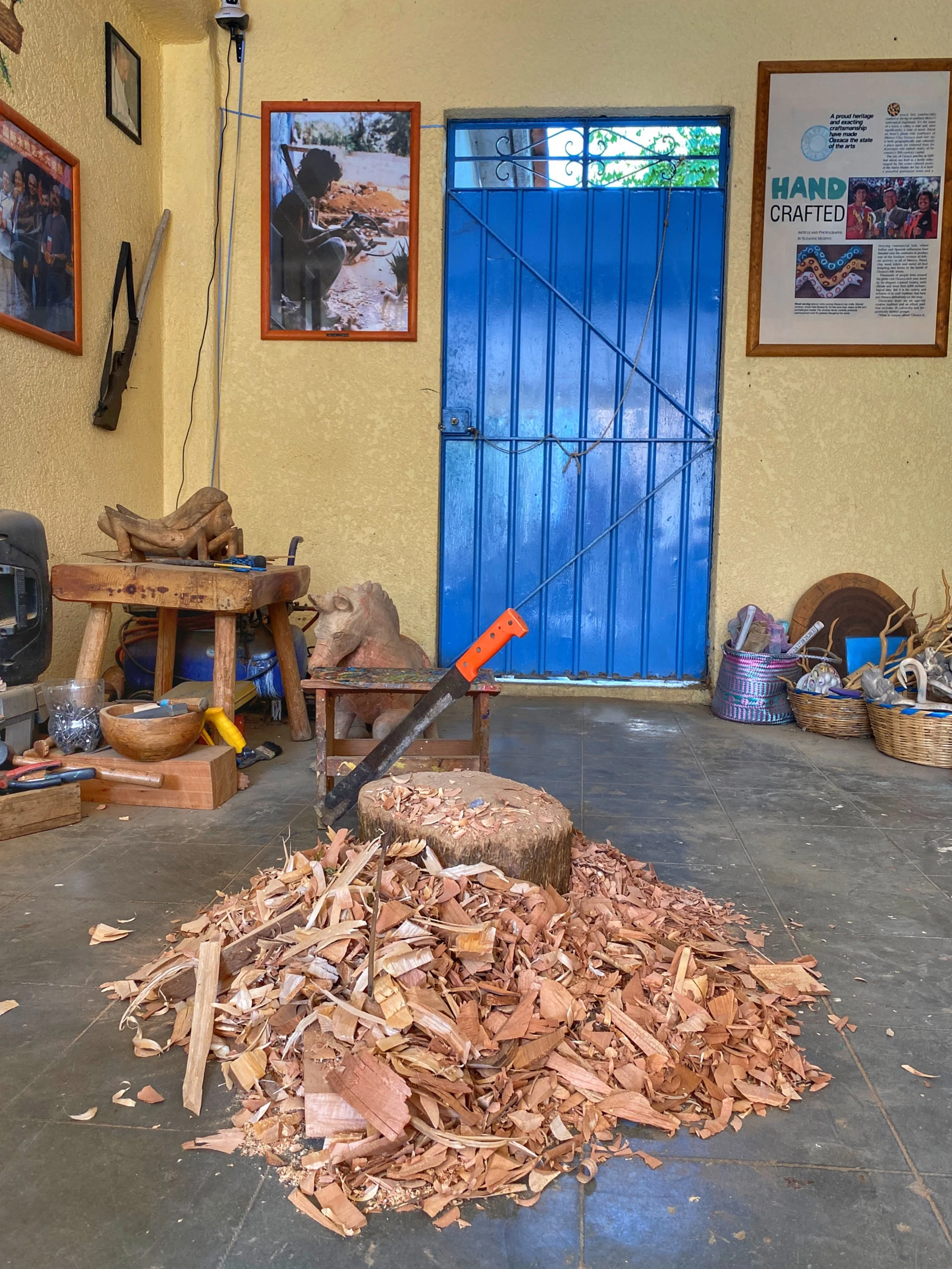
Machete and wood shavings at alebrije workshop in Oaxaca

The first step in creating an alebrije involves a machete like this in the Jiménez family workshop outside of Oaxaca.

Bough Down: How Alebrijes Are Made

These folk art sculptures are considered a young tradition when compared to pre-Hispanic handicrafts such as weaving and pottery. The most popular choice for carving is copal, a softwood that’s easy to work with. Woodcarving involves using non-mechanical tools like machetes, chisels and knives. The exact positioning of the figure is determined by the shape of the piece of wood. Initial cuts are often made with a machete to form a rough idea of what the artist has imagined, while smaller knives and chisels are used to define the final form. 

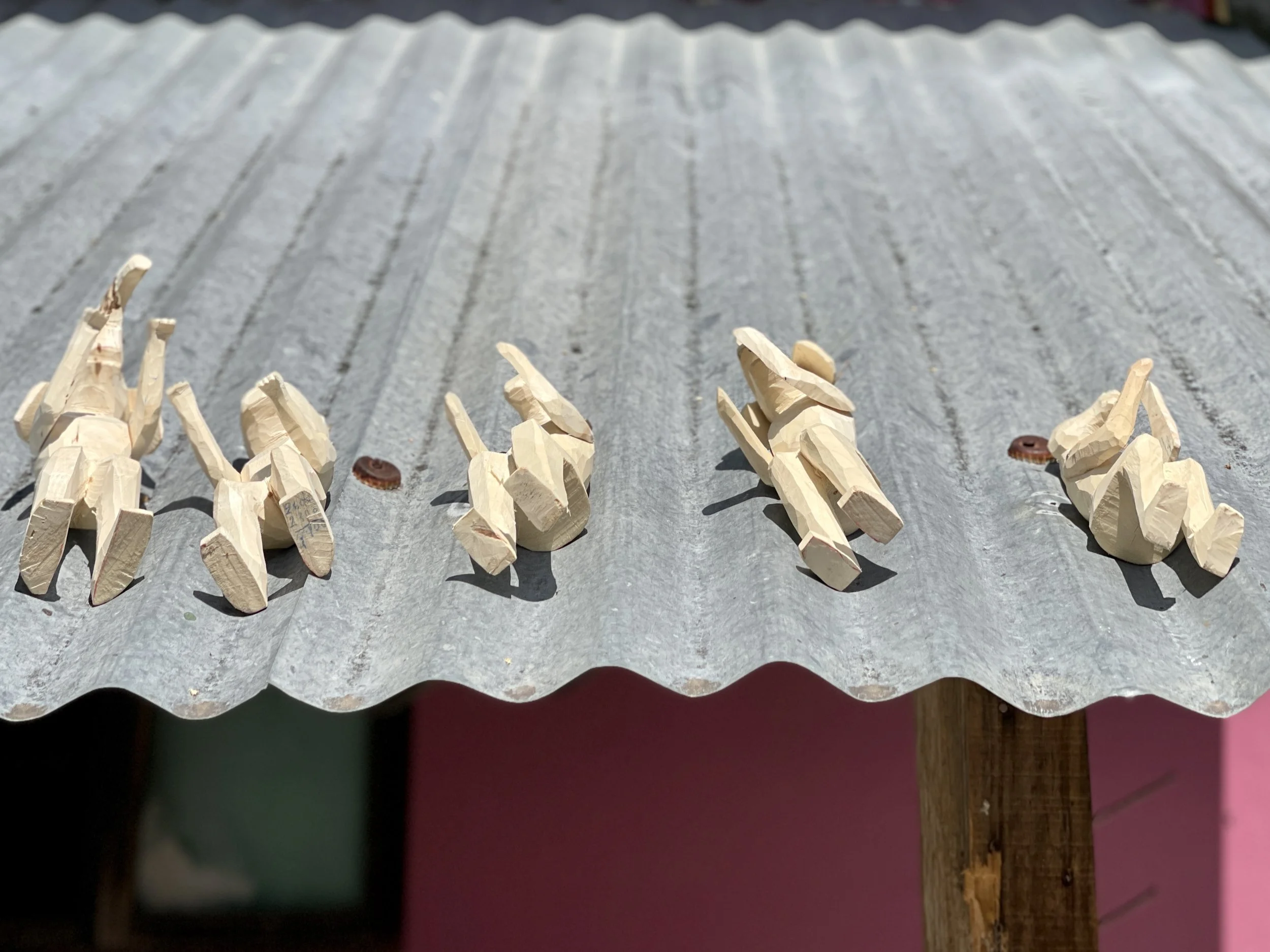
After the object is carved, it’s sanded smooth and left to dry. Those that are carved from a large solid piece of wood can take months to dry. Details like wings, tails and ears are crafted in separate pieces from the main figure, which make them easier to travel with. 

Unpainted alebrijes drying on a tin roof

Most alebrijes are carved of copal wood. These are drying on a roof at the home and studio of our favorite artisan, Martín Melchor.

The process is a family affair. Generally, it is the men who carve and women who paint. Some are embellished with bold, contrasting acrylic paints and ixtle fiber from the leaves of the maguey plant. They are a source of family pride, and most homes have a small area where finished works are displayed. 

Tona or nahual woodcarving

It’s believed that alebrijes trace their roots back to the Zapotec tradition of tonas or nahuals, animal spirit guides, which often had human faces, complete with mustaches.

Motifs change, driven by the market’s appetite for novelty and the creativity and imagination of the individual who makes them. Most Oaxacan artisans simply call them figuras, wooden figures. It’s thought that they originally derived from tonas or nahuals, which refer to animal spirit guides from the Zapotec zodiac. But nowadays, these fantastic figures are more often than not referred to as alebrijes. 

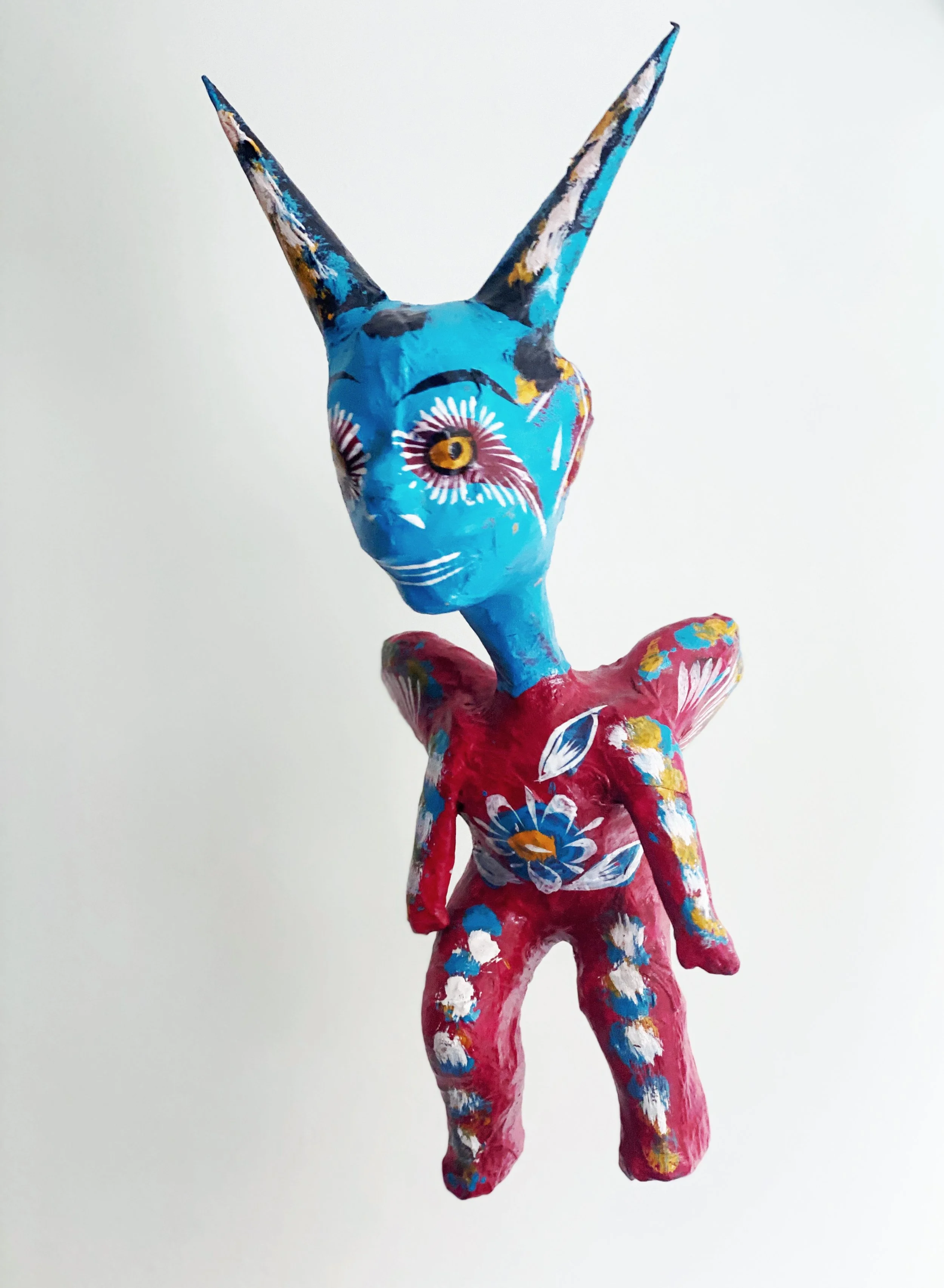
A cute (?) devilesque papier-mâché alebrije Duke and Wally bought at a store in Chicago

Alebrijes: What’s in a Name?

The first alebrijes as well as the name itself are attributed to Mexico City-born artist Pedro Linares. In 1936 Linares fell ill and had a fever dream where strange zoomorphic creatures materialized in a dark forest chanting the word, “Alebrije… alebrije… alebrije.” 

Using his skills as a papier-mâché artist, Linares rendered the creatures from memory, mixing multiple animal body parts, such as the body of a snake, a rooster’s beak, bat wings, lizard legs and a fish’s tail. 

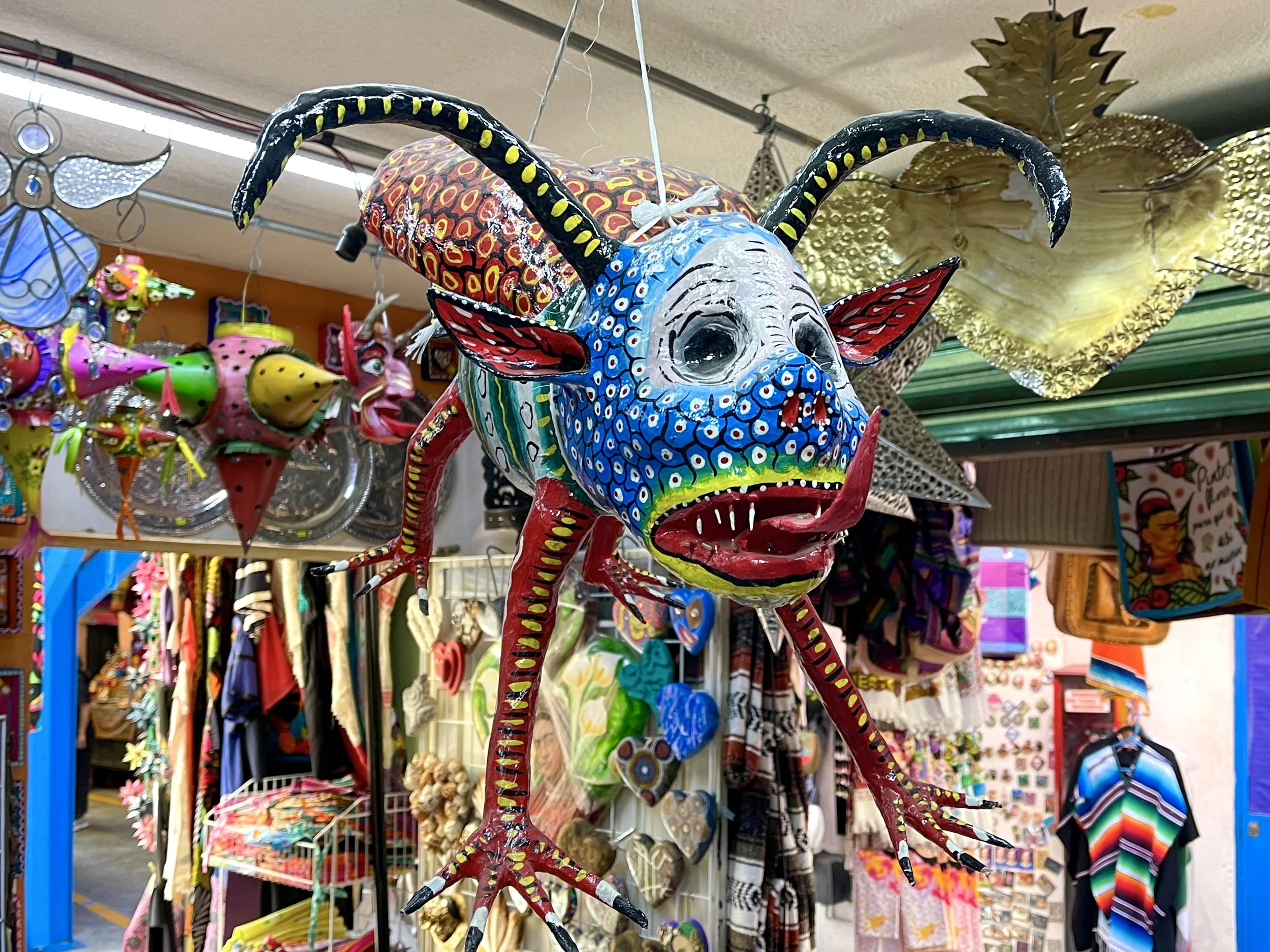
Papier-mâché alebrije at shop in Mexico City

Alebrijes began as larger papier-mâché crazy creatures like this one at a mercado in Mexico City.

Jiménez, in turn, was influenced by the highly stylized treatment and colors he saw in the works of Linares — shifting the medium to wood and putting his own mark on the creatures. 

The economic growth created by the popularity of these colorful creatures has given many families the opportunity to have a better life in the poorest state in Mexico. Woodcarving has improved the lives of these villagers as evidenced by paved roads, better schools, streetlights and cell phones — none of which existed 20 years ago. 

Quality and prices vary widely. Choosing an alebrije is truly a matter of personal taste. It can be overwhelming, so go with your gut. And decide between a colorful chucherría, a small, simple folk object, or a larger labor-intensive fine art gallery-worthy piece. 

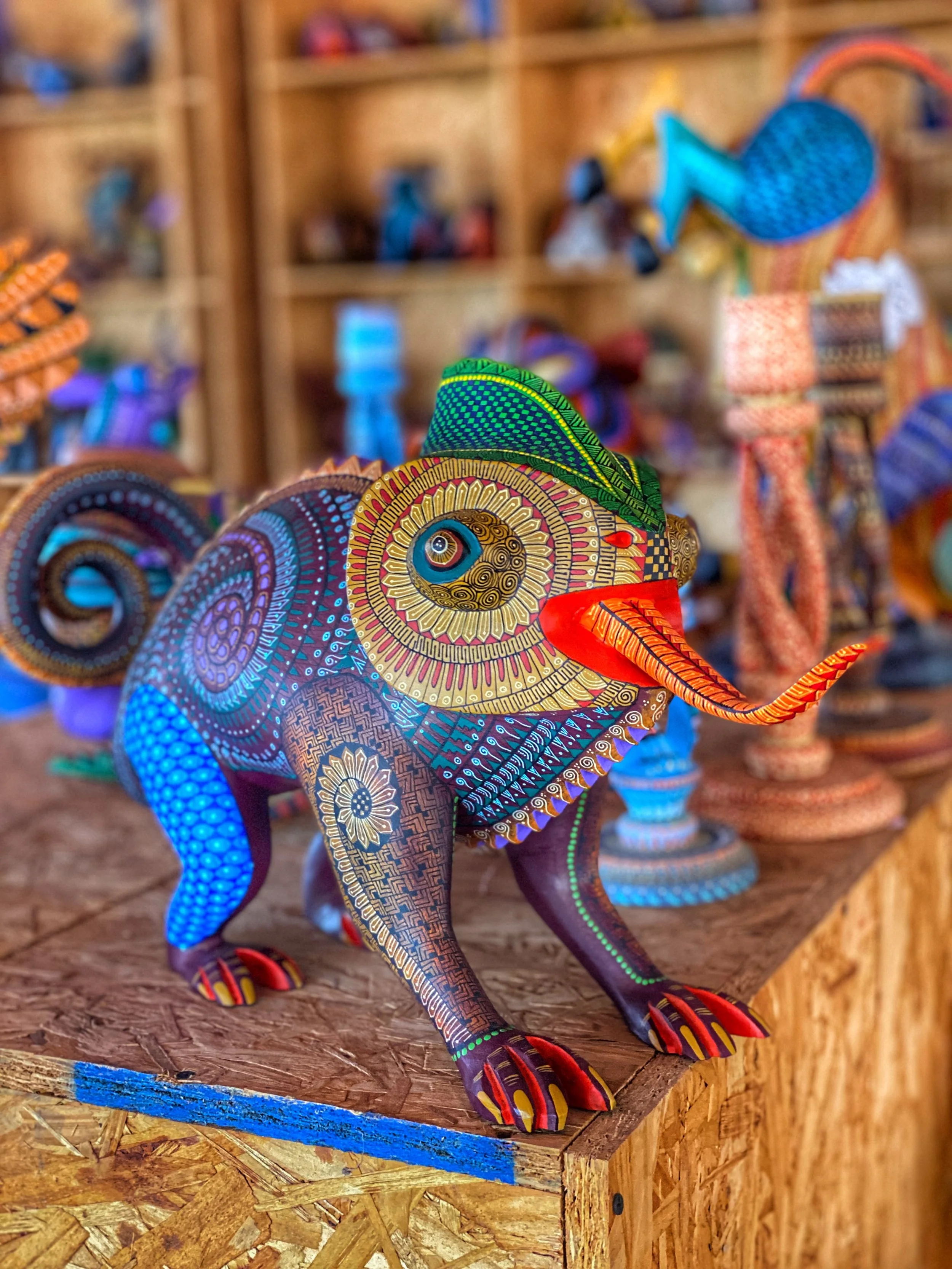
Iguana alebrije with many patterns

Many alebrijes now sport multiple intricate patterns.

When you’re in the Oaxaca area and want to visit artisans at their studios, book a tour with the delightful Linda Hanna. And when you see something you like, buy it — because you’ll probably never see anything like it again. Added bonus: The prices at a studio will be much better than at a store or even market. –Duke

The Marvelous (and Controversial) Murals at the Palacio de Bellas Artes in Mexico City

Make the rounds at the Palace of Fine Arts in CDMX’s Centro to see works from some of Mexico’s most famous muralists, including Diego Rivera, José Clemente Orozco and David Alfaro Siqueiros.

This provocative mural was being renovated when we visited the Palacio de Bellas Artes and could only be viewed from across the way.

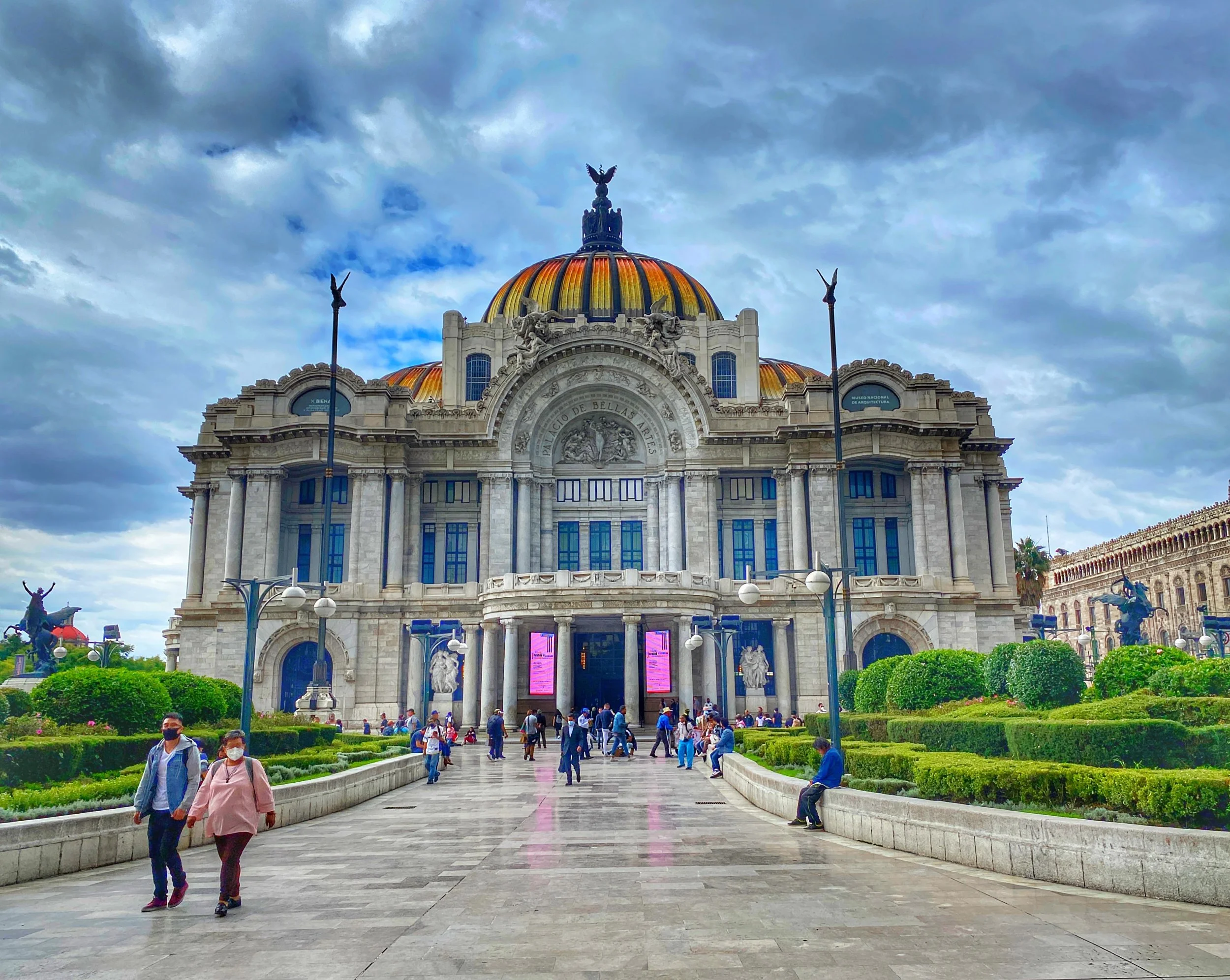
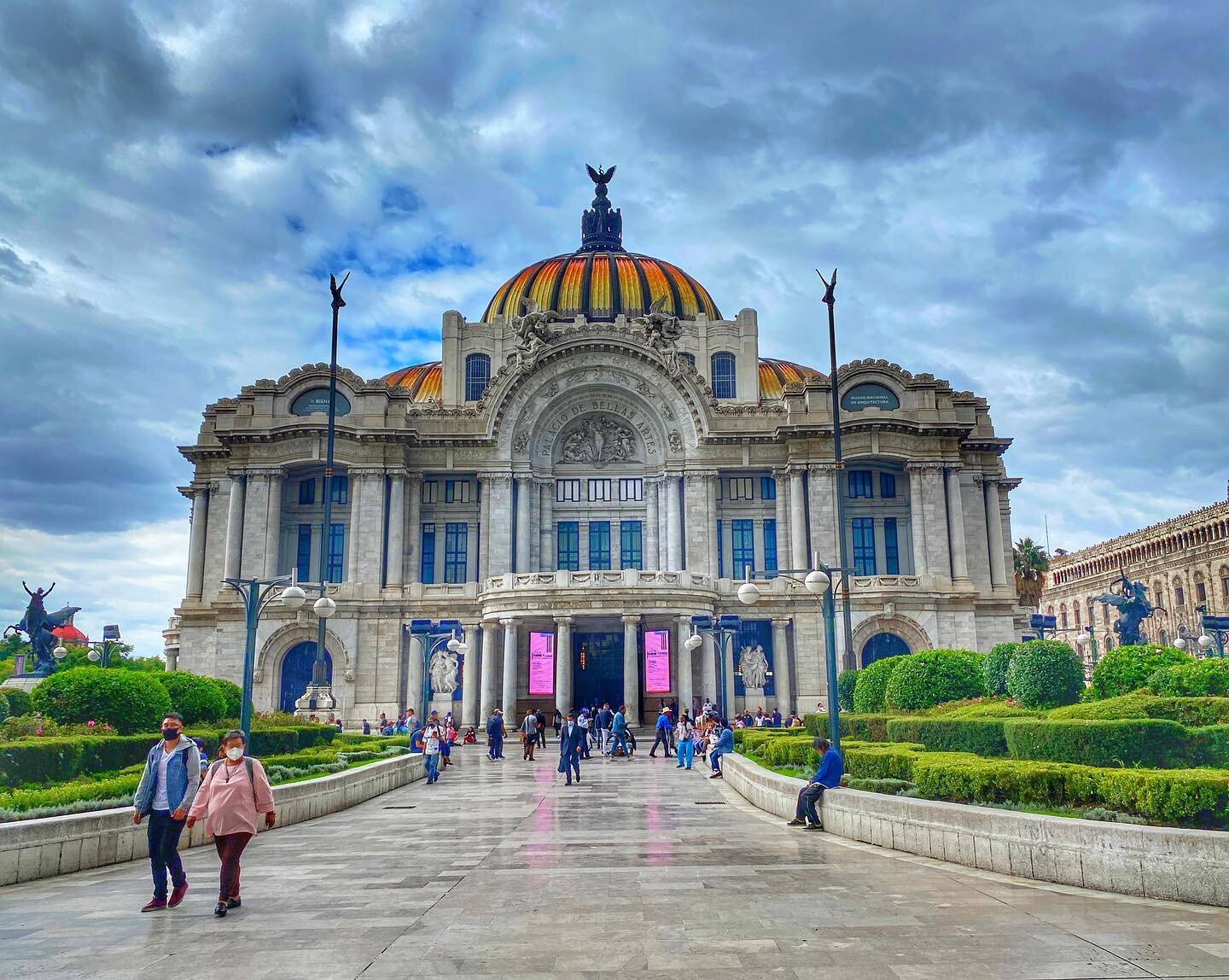
On our first trip to Mexico City, we only admired the Palacio de Bellas Artes from afar — namely, from the Sears across the street, which affords the best view of that gorgeous Art Nouveau dome, glowing in an ombre that starts with bright saffron and fades to pale yellow. 

Instead, we followed a scavenger hunt of sorts, rambling around Centro in a search for its most Instagrammable spots

The Palacio de Bellas Artes is more than just a pretty façade — there’s a gallery of famous murals inside.

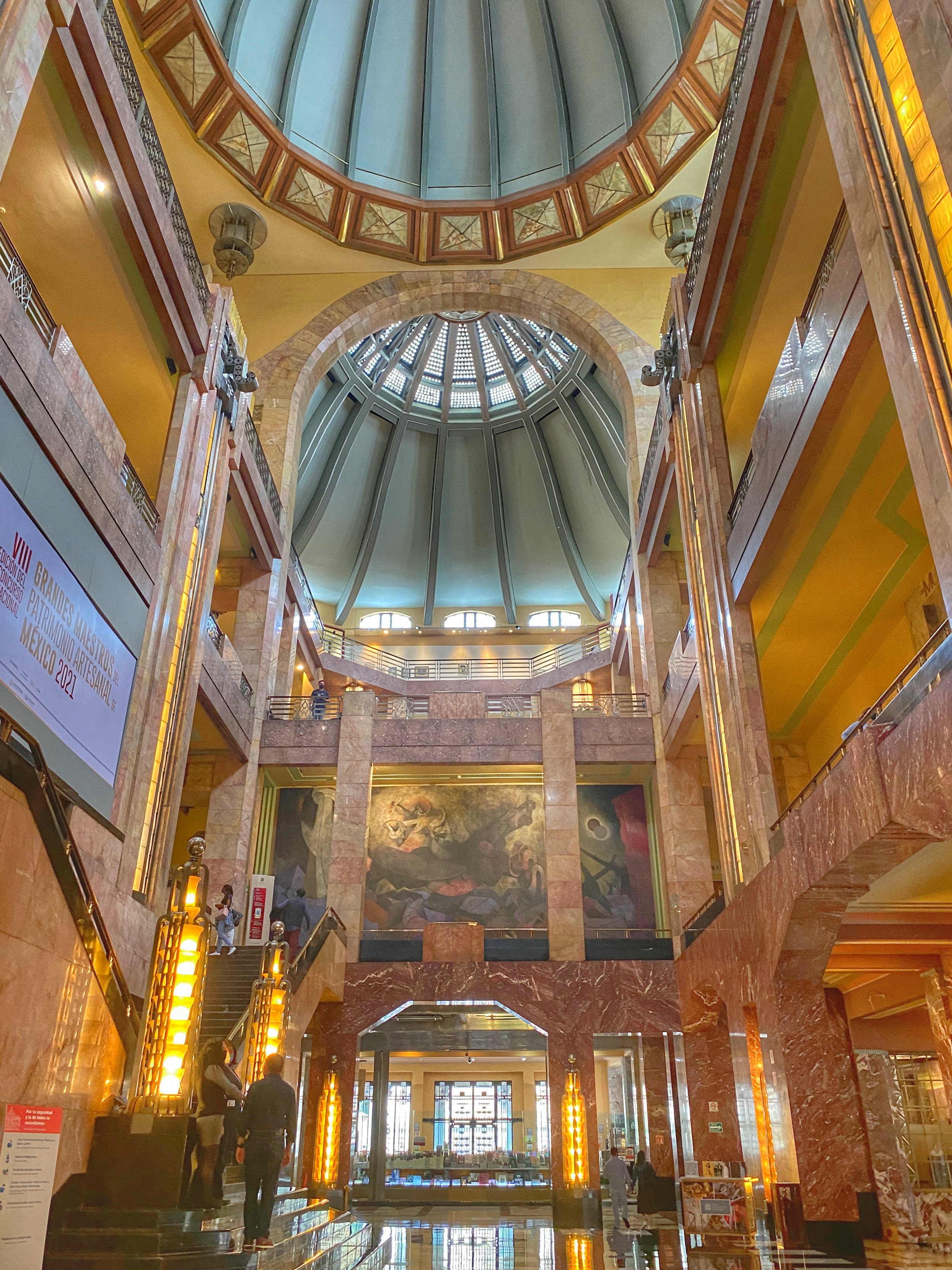
This time, we planned to actually enter the Palacio de Bellas Artes, though we had no idea what lay within. Duke and I were pleasantly surprised to discover that the top floor was devoted to a gallery of murals from some of Mexico’s most famous artists. 

Interior of Palacio de Bellas Artes

The inside of the Palace of Fine Arts in Mexico City isn’t too shabby, either. Be sure to get tickets for the mural museum when you visit.

We purchased our tickets on the ground floor, then climbed the grand staircases up two flights. The murals form a ring around the space, with the center open, letting you look down at the palace’s lobby or admire the murals from afar. When we visited, one of the murals was being restored and we could only see it from across the way.

Sit and admire Diego Rivera’s kooky mural — which Rockefeller rejected.

El Hombre en el Cruce de Caminos o El Hombre Controlador del Universo

Translation: Man at the Crossroads, or Man, Controller of the Universe

Date: Date: 1934

Artist: Diego Rivera

It’s a battle between capitalism, as represented by figures including Charles Darwin (the fellow with a white beard surrounded by animals)…

Detail from Diego's El Hombre en el Cruce de Caminos o El Hombre Controlador del Universo

…and Communism, depicted on the righthand side, with Leon Trotsky, Karl Marx and Friedrich Engels all making appearances.

Fascinating fact: The original Man at the Crossroads was commissioned for the Rockefeller Center in New York City. But when Nelson Rockefeller got wind that it included a depiction of Vladimir Lenin and a Soviet May Day parade, he ordered it destroyed — before it was even completed.


González Camarena’s mural moves from slavery to spiritual liberation.

Liberación o La Humanidad Se Libera de la Miseria

Translation: Liberation, or Humanity Frees Itself From Misery

Date: 1963

Artist: Jorge González Camarena

Fascinating facts: This is a re-creation of a no-longer-existing mural that had been painted on the Edificio Guardiola, where the Bank of Mexico placed its vaults. The first part shows a man tied up in a coffin and a nude tattooed woman to protest agrarian policies after the Mexican Revolution and slavery. The last section to the far right depicts a mestizo woman (someone of indigenous and European blood) — a radiant symbol of spiritual liberation.


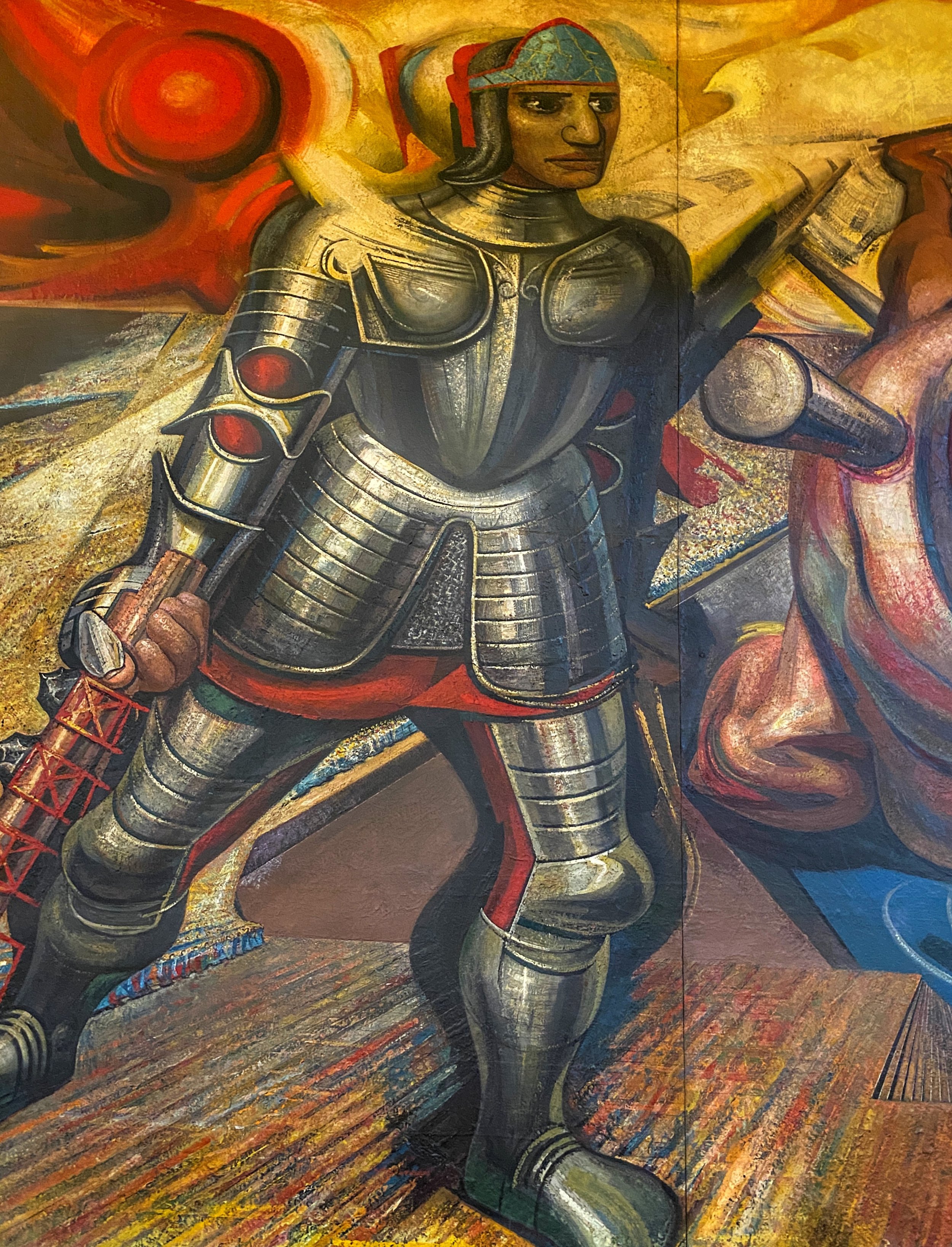
Knight in Apoteosis de Cuauhtémoc mural

Siqueiros’ mural presents revisionist history, where an Aztec ruler isn’t conquered by the conquistadors.

Apoteosis de Cuauhtémoc o Cuauhtémoc Redivivo and Tormento de Cuauhtémoc
(Díptico Monumento a Cuauhtémoc)

Translation: Apotheosis of Cuauhtémoc, or Cuauhtémoc Resurrected and Torment of Cuauhtémoc (Monumental Diptych to Cuauhtémoc)

Date: 1951

Artist: David Alfaro Siqueiros

The Aztec ruler Cuauhtémoc had his feet burned until he caved and told the Spanish where to find a treasure trove.

Fascinating facts: One panel shows a revisionist history, what the artist wishes had happened — that the Aztec emperor Cuauhtémoc had defeated the Spanish conquistadors. The other shows what really happened: The ruler was tortured by the Spanish, who burned his feet until he revealed the location of Montezuma’s treasure.


Alegoría del Viento mural at Bellas Artes

Note the personifications of the wind blowing in this Art Deco mural fragment.

Alegoría del Viento o El Ángel de la Paz o La Aviación

Translation: Allegory of the Wind, or The Angel of Peace, or Aviation 

Date: 1928

Artist: Roberto Montenegro

Fascinating facts: This is the only portion of the original Art Deco work at the former Colegio Máximo de San Pedro y San Pablo that survived the humidity. It’s the oldest mural in the collection.  


Man vs. machinery battle it out in Orozco’s bizarre and disturbing mural.

Katharsis o La Eterna Lucha de la Humanidad por un Mundo Mejor

Translation: Catharsis, or Humanity’s Eternal Struggle for a Better World

Date: 1935

Artist: José Clemente Orozco

Detail of La Chata in Katharsis by Orozco

A detail of La Chata, the infamous pug-nosed prostitute in Orozco’s mural

Fascinating facts: Orozco, like his contemporary Diego, was no stranger to controversy, as evidenced by this horrific vision of dystopia. The naked woman, wearing a massive pearl necklace, grins outward and opens her legs to a piece of machinery. She’s known as La Chata (Pug Nose) and has the dubious honor of being considered one of the most repulsive images in art. 


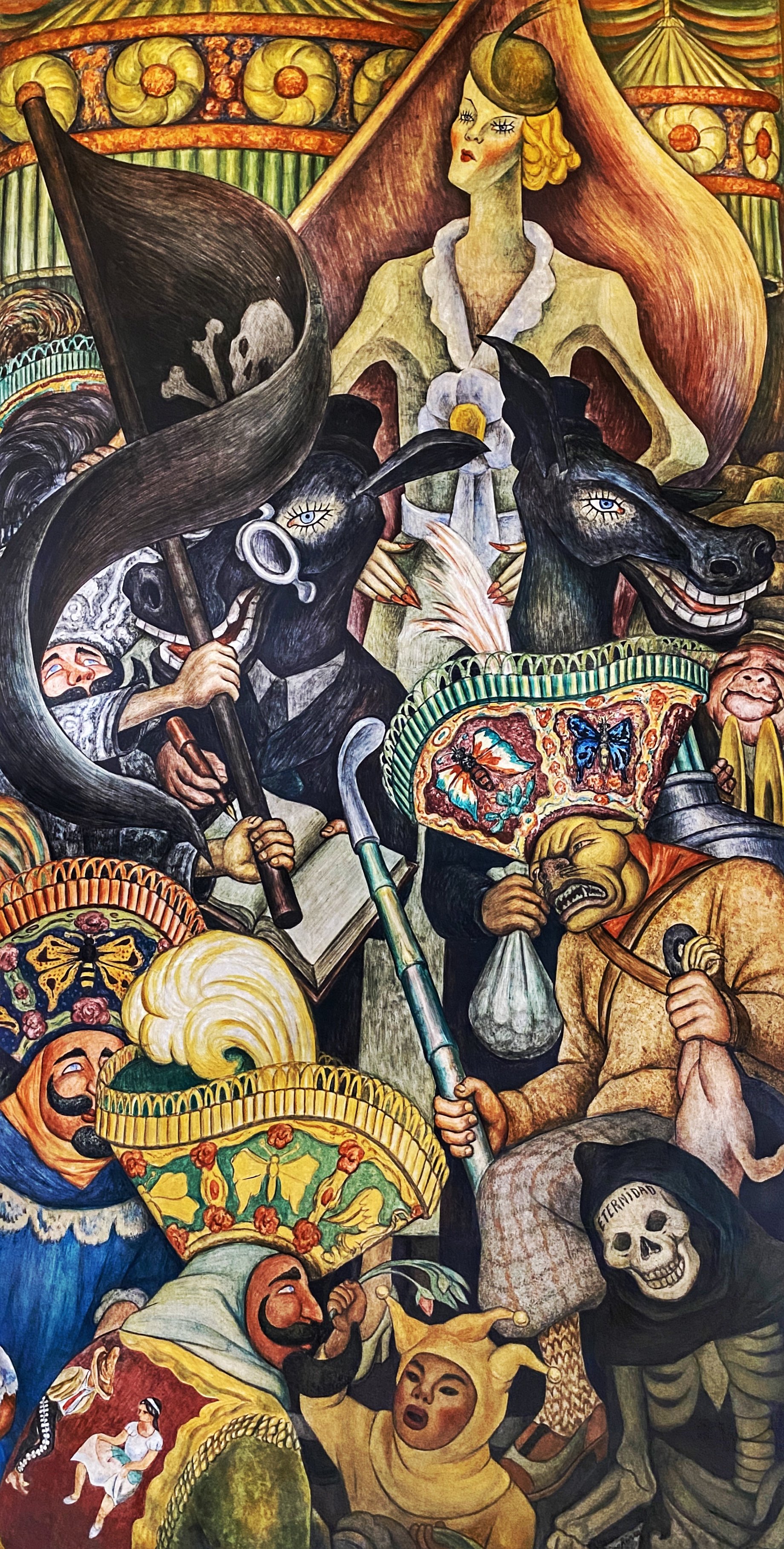
México Folclórico y Turístico by Diego

Rivera’s mural panels poked fun at White tourists and played upon circus themes.

México Folclórico y Turístico and Dictadura
(Políptico Carnaval de la Vida Mexicana)

Translation: Folkloric and Touristic Mexico and Dictatorship (Carnival of Mexican Life Polyptych)

Date: 1936

Artist: Diego Rivera

Section of México Folclórico y Turístico by Diego

There’s a lot to find offensive in these murals, from an officer depicted as a pig to a flag that sports a swastika.

Fascinating facts: Alberto Pani commissioned the series for his Hotel Reforma. But Diego, ever the shit-stirrer, inserted political motifs and unflattering representations of tourists. Pani “touched up” the offensive bits; Diego sued and won, and was allowed to restore his work. But the hotelier put the work into storage, where it remained hidden away until it was sold to the government in 1963 and installed at Bellas Artes. 

Murals are, by their nature, public works of art. If you’re in CDMX’s Centro neighborhood, take a quick spin through the murals of the Palacio de Bellas Artes — and see if you can spot all the controversial sections. –Wally
Exterior of the Palace of Fine Arts in CDMX

Palacio de Bellas Artes
Avenida Juárez s/n
Centro
Cuauhtémoc
06050 Ciudad de México
Mexico


Animal Symbolism in Pre-Columbian Pottery at the Museo Nacional de Antropología

The meanings behind monkeys, jaguars, ducks, bats, dogs and other animals in Mesoamerican myths as depicted in pre-Columbian artifacts at the National Museum of Anthropology in Mexico City.

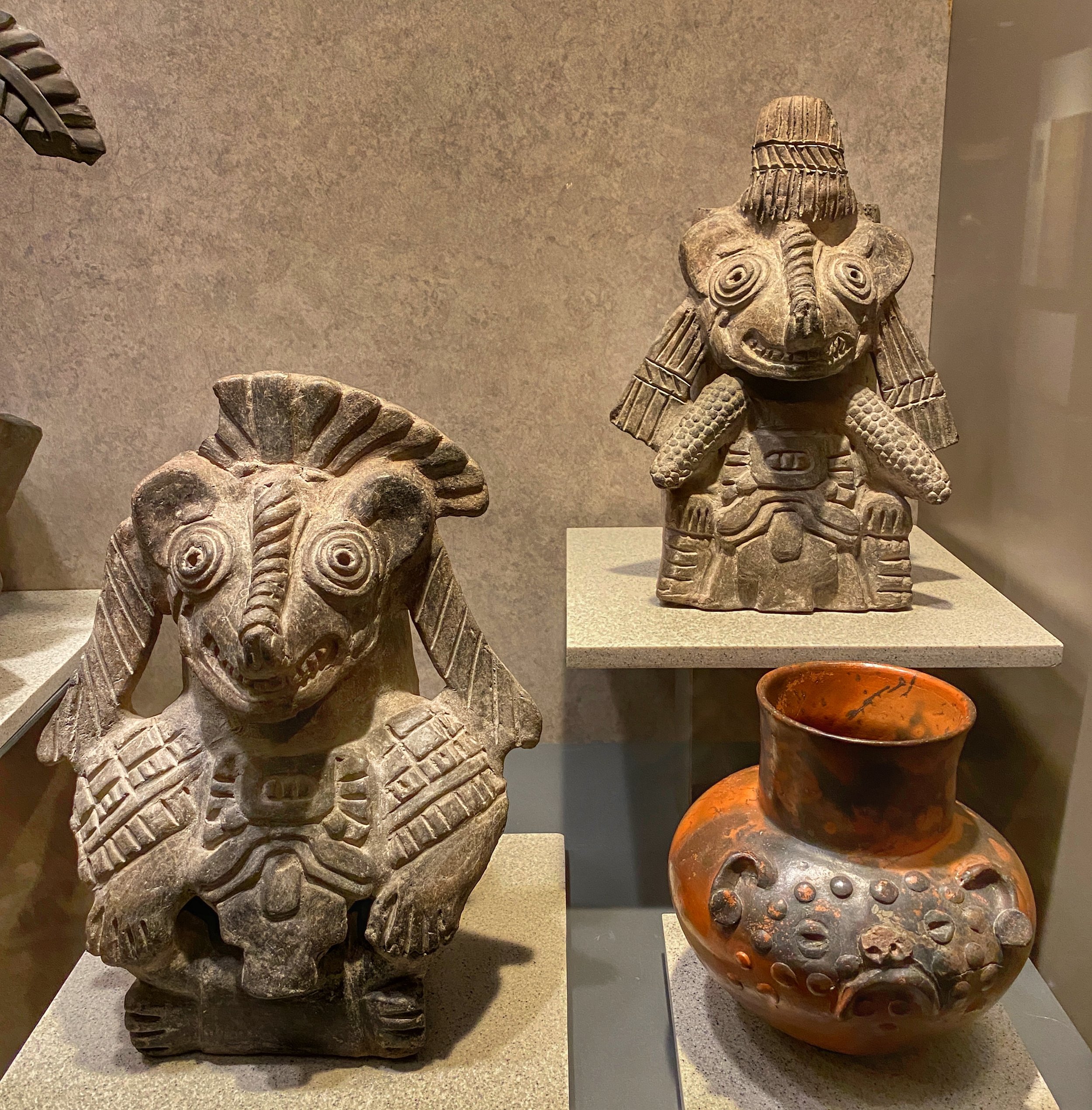
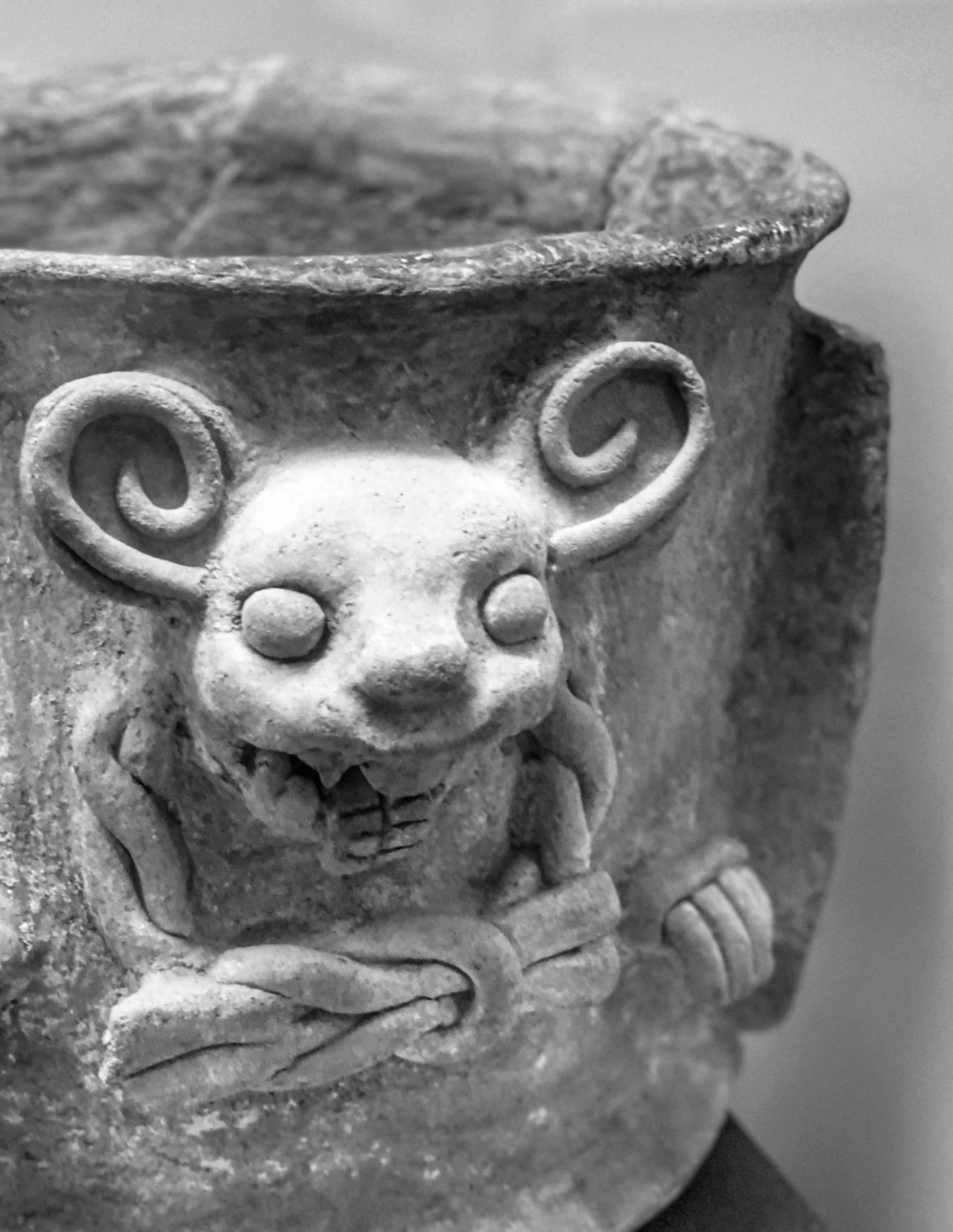
Coati sculptures of pre-Columbian pottery at the Museo Nacional de Antropología

A lot of the exhibits at the National Museum of Anthropology in CDMX depict animals — each of which held symbolic meaning for the ancient peoples of Mexico.

Something that’s always fascinated me about ancient cultures are the similarities in beliefs with other civilizations around the world. Despite being oceans apart, many shared highly developed civilizations and a deep reverence for the natural world. 

We saw this in action during our last visit to Mexico City, when we finally made it to the Museo Nacional de Antropología. The scale and scope of the galleries at the museum is dizzying. Wally and I don’t like to overdo it, so we spent half a day just wandering through the first floor. One of the highlights for me was the large number and variety of Mesoamerican animal-shaped effigy vessels on display. Like other ancient societies, the pre-Columbian peoples believed that certain animals embodied a spiritual energy in which sacred beings manifested themselves. 

Conquistadors developed such an appetite for Xoloitzcuintli Mexican hairless dogs that they nearly ate them into extinction. 

These ritual objects were not used in everyday life; they were often placed in tombs as burial goods. Animals played a key role at all levels of society and symbolically linked the three cosmic realms of the universe: the heavens, earth and underworld.

Stone Aztec calendar at the Museo Nacional de Antropología

Aztec cosmology posited that time is cyclical — and that we’re in the Fifth Sun, the final cycle of the world.

Here Comes the (Fifth) Sun

According to the Aztec legend of the Fifth Sun, time is cyclical. Four suns, or eras, have passed, created by a different deity and successively destroyed. Each cycle included inhabitants who died or transformed into various creatures, including monkeys, turkeys, dogs and fish. Our present world happens to be the Fifth Sun. 

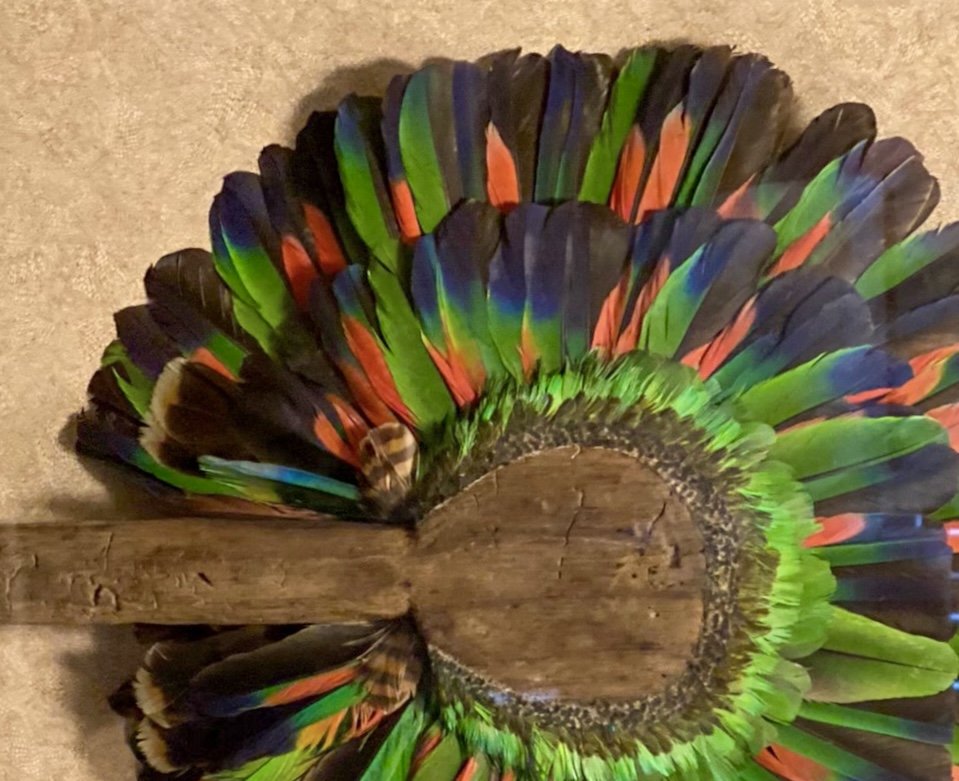
Brightly colored feathers were used in religious ceremonies.

The pre-Columbian people used animals for a variety of purposes. Parrots and macaws, for example, provided a source of food as well as prized blue-green plumage used to adorn headdresses. However, animals also held great symbolic significance. They served as cultural and cosmic metaphors based on their habitat and natural features. 

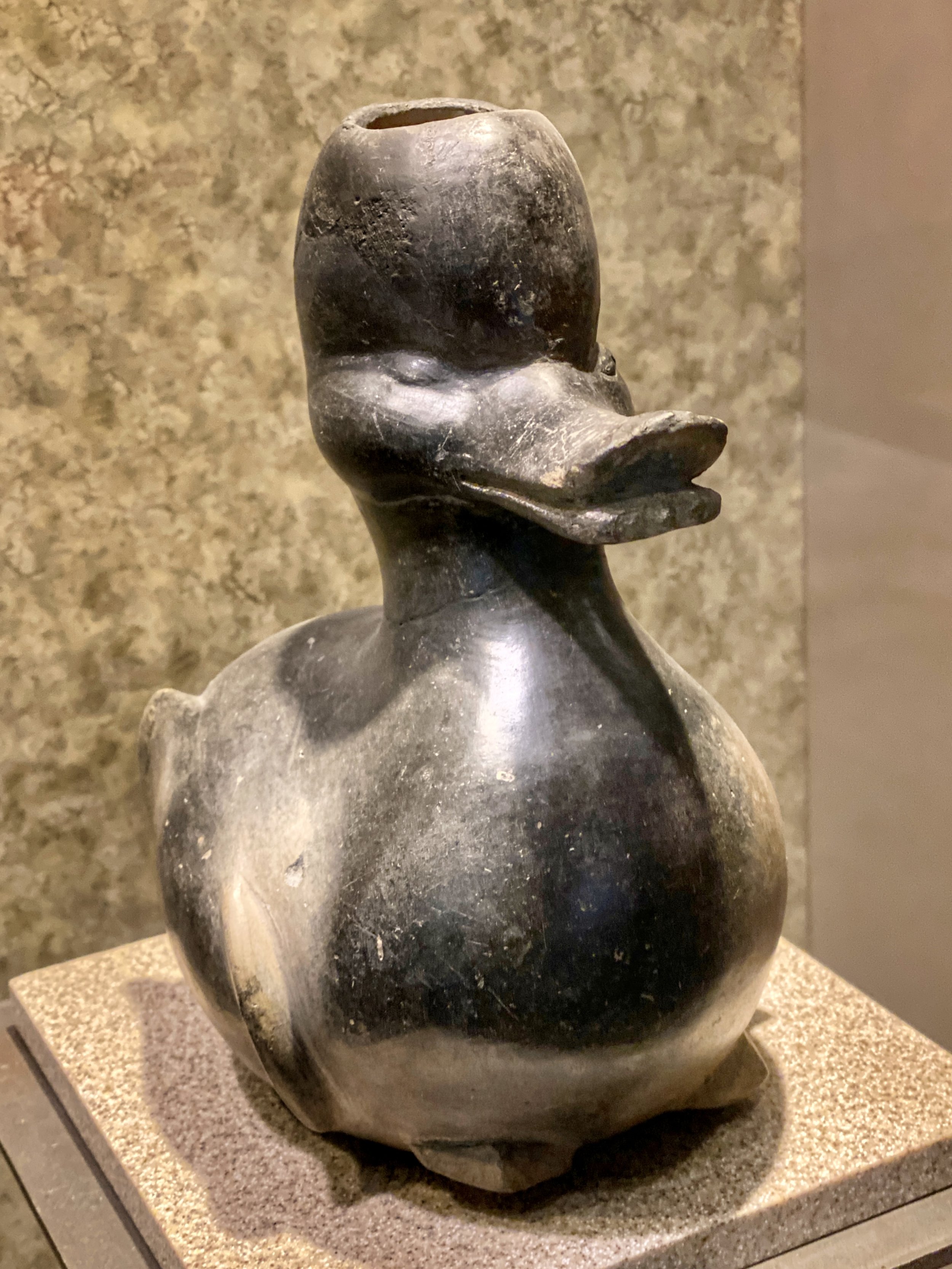
Duck pre-Columbian pottery at the Museo Nacional de Antropología

Ducks were particularly holy to Mesoamericans, as they moved between three realms: water, the sky and land.

Just Ducky

Birds symbolized the celestial realm, the sun and moon in particular, and were considered messengers between the natural and spiritual worlds. 

Ducks were particularly holy, perhaps because they ticked all the boxes: They can fly, walk on land and dive underwater, possessing the ability to travel freely between these different spheres. 

Ducks and related birds were also associated with the wind god Ehécatl (pronounced “Eh-heh-ka-tul”), one of the avatars of Quetzacoatl, the great plumed serpent. The deity was frequently portrayed with a duckbill-like appendage on his face, which he used to summon the winds. 

The Maya considered bodies of water to be pathways to the Underworld. Ducks and other waterfowl were ritualistically sacrificed, eaten and used to ward off demons.

Coatimundi pre-Columbian pottery at the Museo Nacional de Antropología

This little guy represents a coatimundi, which figures in a Mayan myth that involved a decapitated head in the Underworld.

Coati Encounters of the First Kind

The coatimundi, or coati, are members of the raccoon family. They have distinct mask-like markings on their faces, resembling a combination of kinkajou, anteater, raccoon and bear cub. 

In the Popol Vuh, the sacred text of the Maya, a bat rips off the head of Hunahpu, one of the Hero Twins, and takes it to the ball court of Xibalbá (the Underworld) to be used in place of a rubber ball. A coati fashions a fake head from a calabash squash and places it on the shoulders of the headless hero. Hanapu’s brother Xbalanque places Hanapu’s head back on his shoulders, and the brothers succeed in defeating the Lords of Xibalbá.

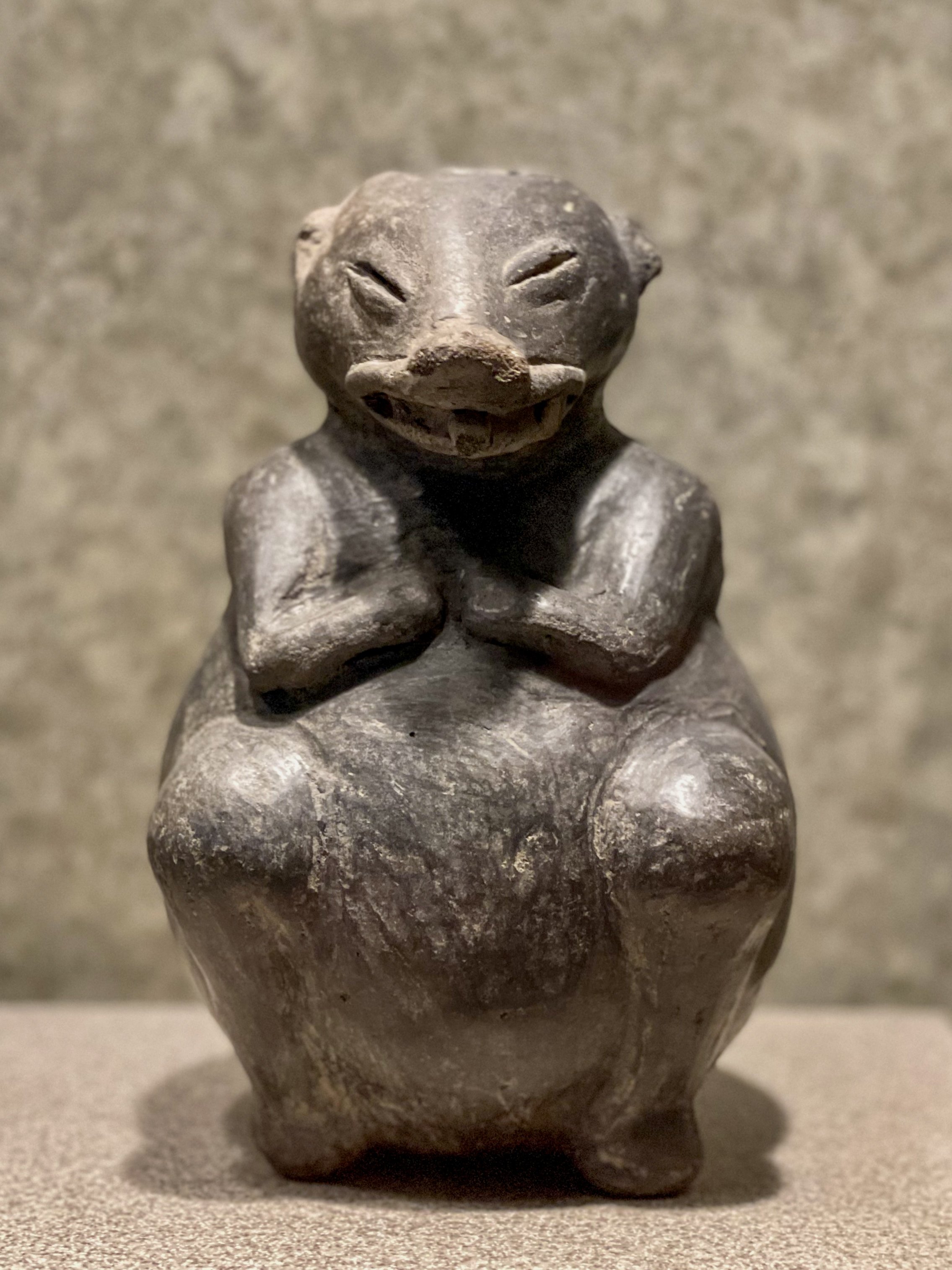
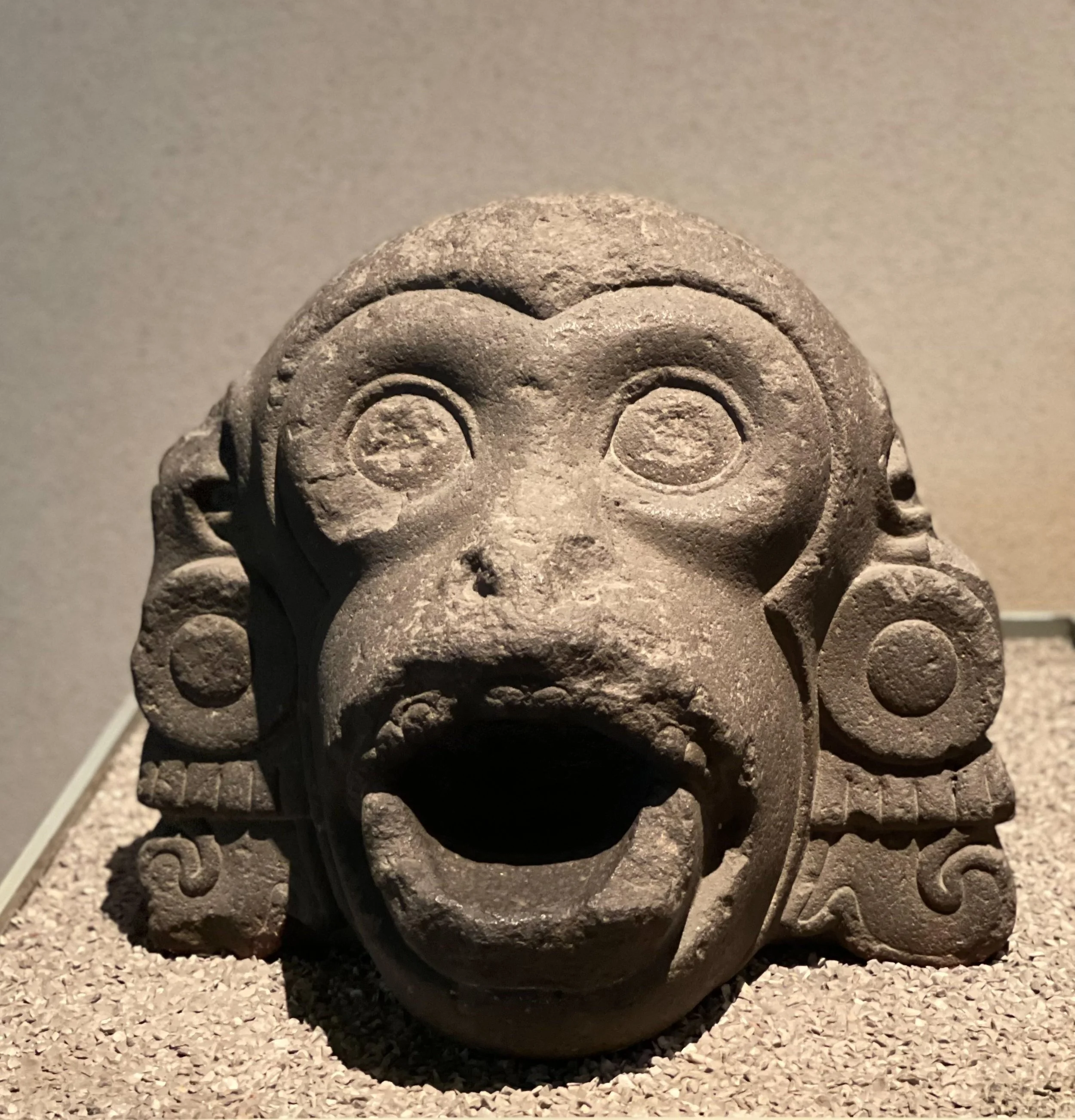
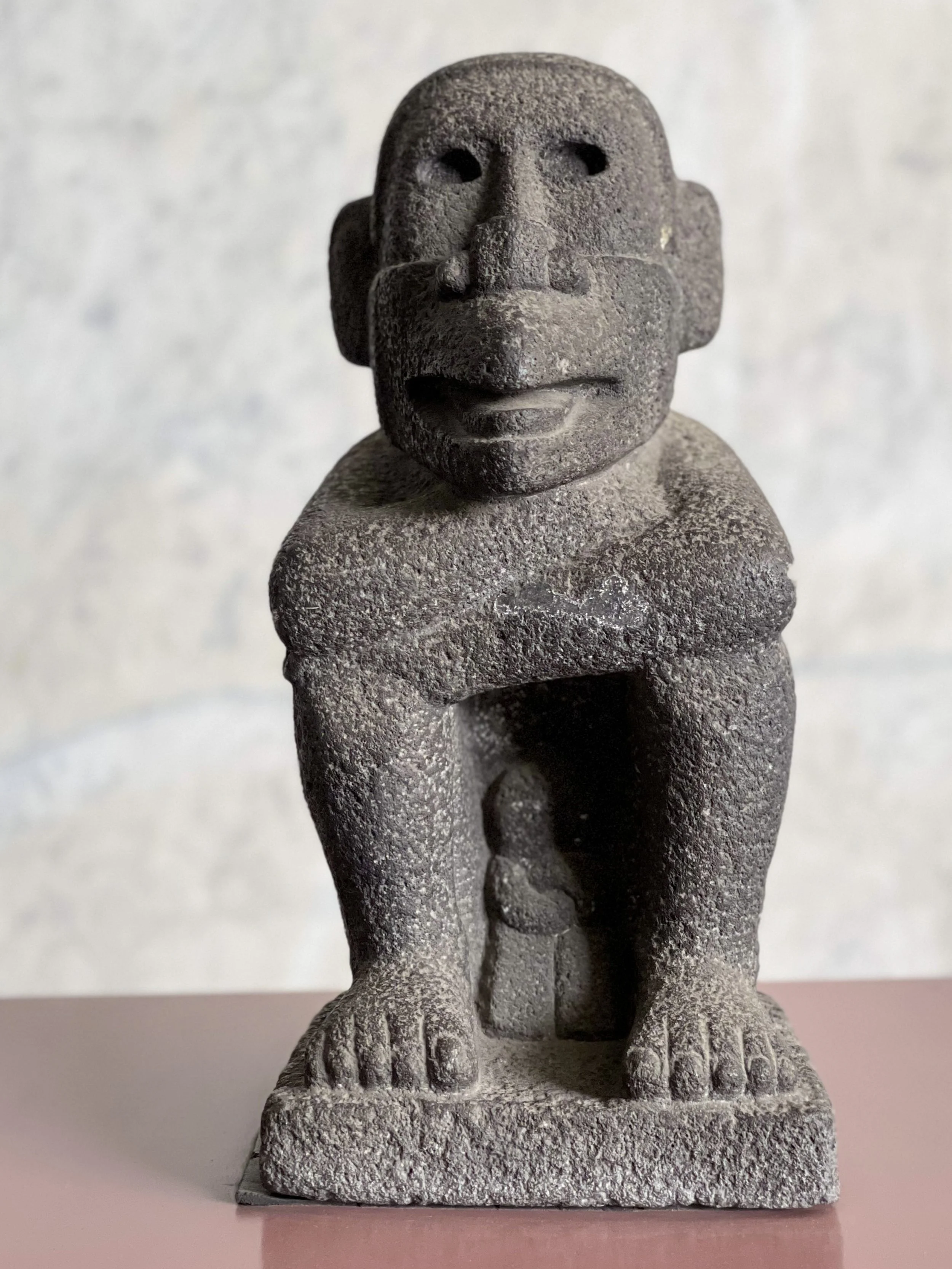
Sitting monkey pre-Columbian pottery at the Museo Nacional de Antropología

Monkeys represented the good (luck and joy) and the bad (immorality).

Monkeys: Sacred Simians 

Spider and howler monkeys are the two most common species native to the tropical lowlands of Mexico. Playful and social in nature, these nimble primates live in the high forest canopy and are mankind’s closest living relative. They were symbols of good fortune and joy, as well as pleasure and immorality — the latter of which was punishable by death. Monkeys were domesticated and kept as pets by both Zapotec and Aztec nobility and weren’t used for food or sacrifice. 

Head of monkey pre-Columbian pottery at the Museo Nacional de Antropología

The “leftovers” of the Second Sun cycle of the universe were turned into jabbering monkeys.

Statue of Ehecatl the god of the wind at the Museo Nacional de Antropología

Ehecatl, the Aztec god of the wind, was associated with monkeys.

Monkeys were also associated with the Aztec wind god Ehécatl. According to the legend of the Fifth Sun, the disobedient survivors of the Second Sun, whose cataclysmic end included hurricanes and floods, were transformed into monkeys by Ehécatl. Deprived of the ability to speak, they were condemned to emit meaningless noises for the rest of their existence. 

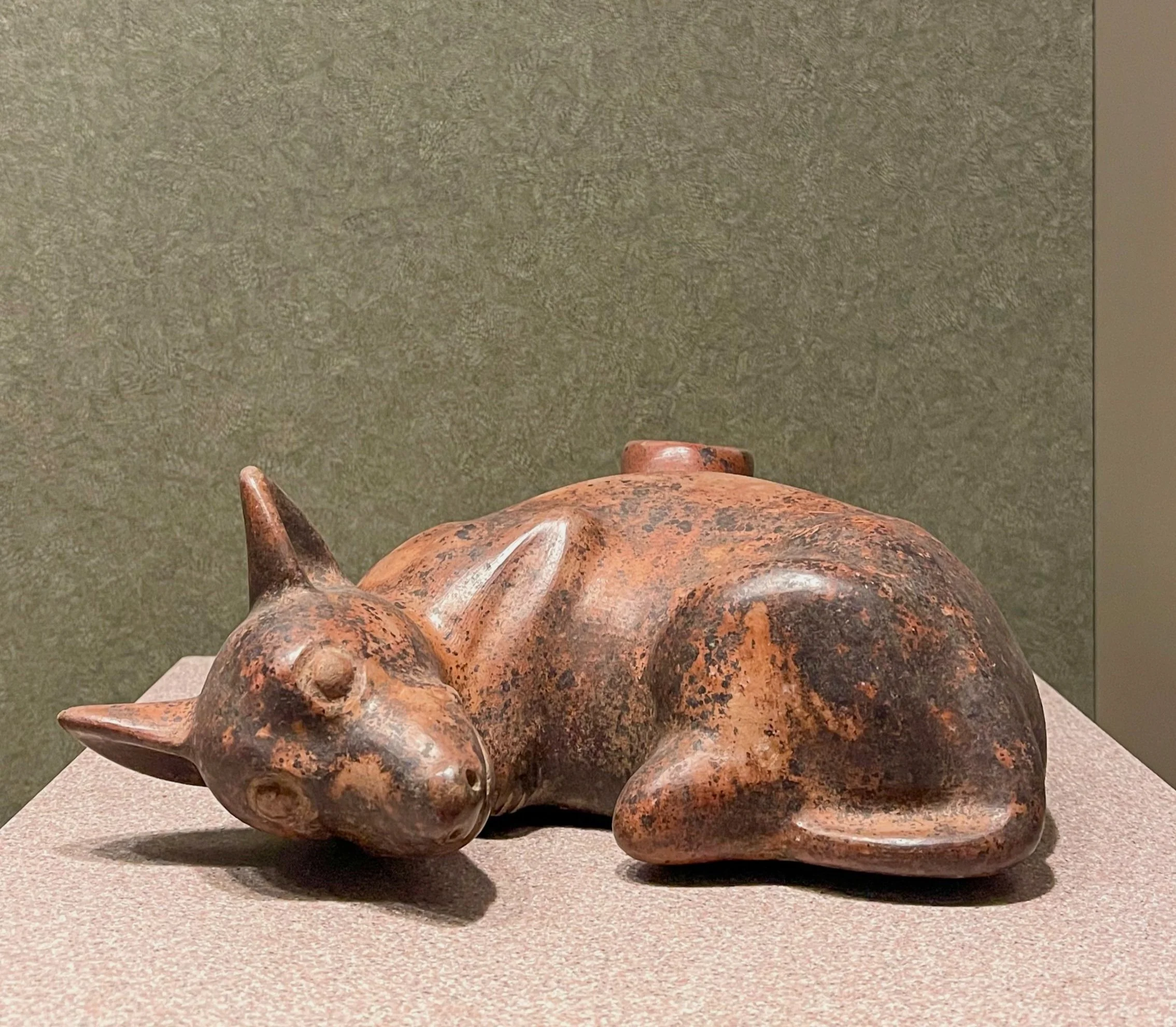
Xoloitzcuintli dog pre-Columbian pottery at the Museo Nacional de Antropología

A person’s spirit would hold onto a Xoloitzcuintli dog’s tail to be guided through the Underworld.

Dogs Truly Are Man’s Best Friend

Before the Chihuahua became the most popular dog breed from Mexico, there was the hairless Xoloitzcuintli (pronounced “Show-low-eats-queent-lee”). This breed got its name from Xolotl, the god of lightning and death, and itzcuintli, dog. To the ancient Aztec and Maya, the canine was created by Xolotl to guard the living and guide the souls of the dead through the perils of Mictlán, the Underworld. Deceased souls held onto the dogs’ tails as they led their owners through the afterlife. They were also bred as a source of food — in fact, the conquistadors developed such an appetite for them that they nearly ate them into extinction. 

The most common depictions of Xoloitzcuintles take the form of small ceramic vessels known as Colima dogs for the modern state of Mexico where they are commonly found. More than a few of these red clay objects are depicted with chubby bodies — this may be an indication that they were fattened up to be eaten.

Frida Khalo and Diego Rivera owned a brood of Xolos, and Wally and I saw a few sunning themselves at el Museo Dolores Olmedo, which houses a large collection of works by this famous duo.

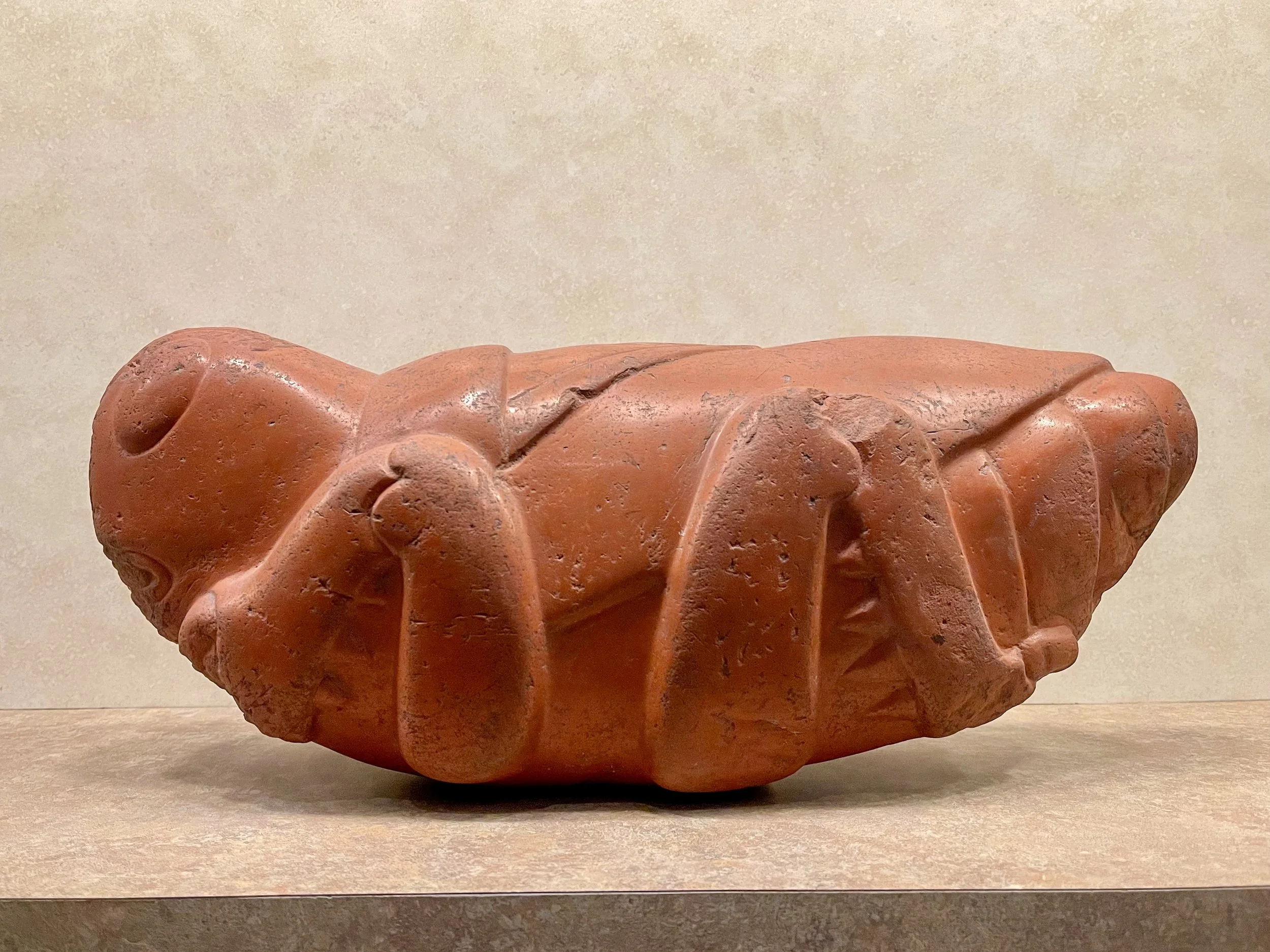
Grasshopper pre-Columbian pottery at the Museo Nacional de Antropología

Grasshoppers were associated with agriculture and fertility — but could also mean destruction.

The Grasshopper: the Insect That Sings for Its Supper

The name of Chapultepec Park, where the Museo Nacional de Antropología is located, comes from Náhuatl for “Hill of the Grasshopper.” This hill rises from the center of the park, was a sacred place for the Aztec and is where Chapultepec Castle stands. 

Grasshoppers were associated with agriculture and fertility and were associated with the period following the annual rainfall, which brought an abundance of the insects. 

In addition to their symbolic importance, the Aztec snacked on chapulines, cooking them on clay surfaces with spices. 

To the Mexica, they represented the duality of abundance vs. destruction: Drought triggers the solitary grasshopper to become social, changing color from green to yellow and black. Under such conditions, they move in swarms, devouring crops and vegetation.

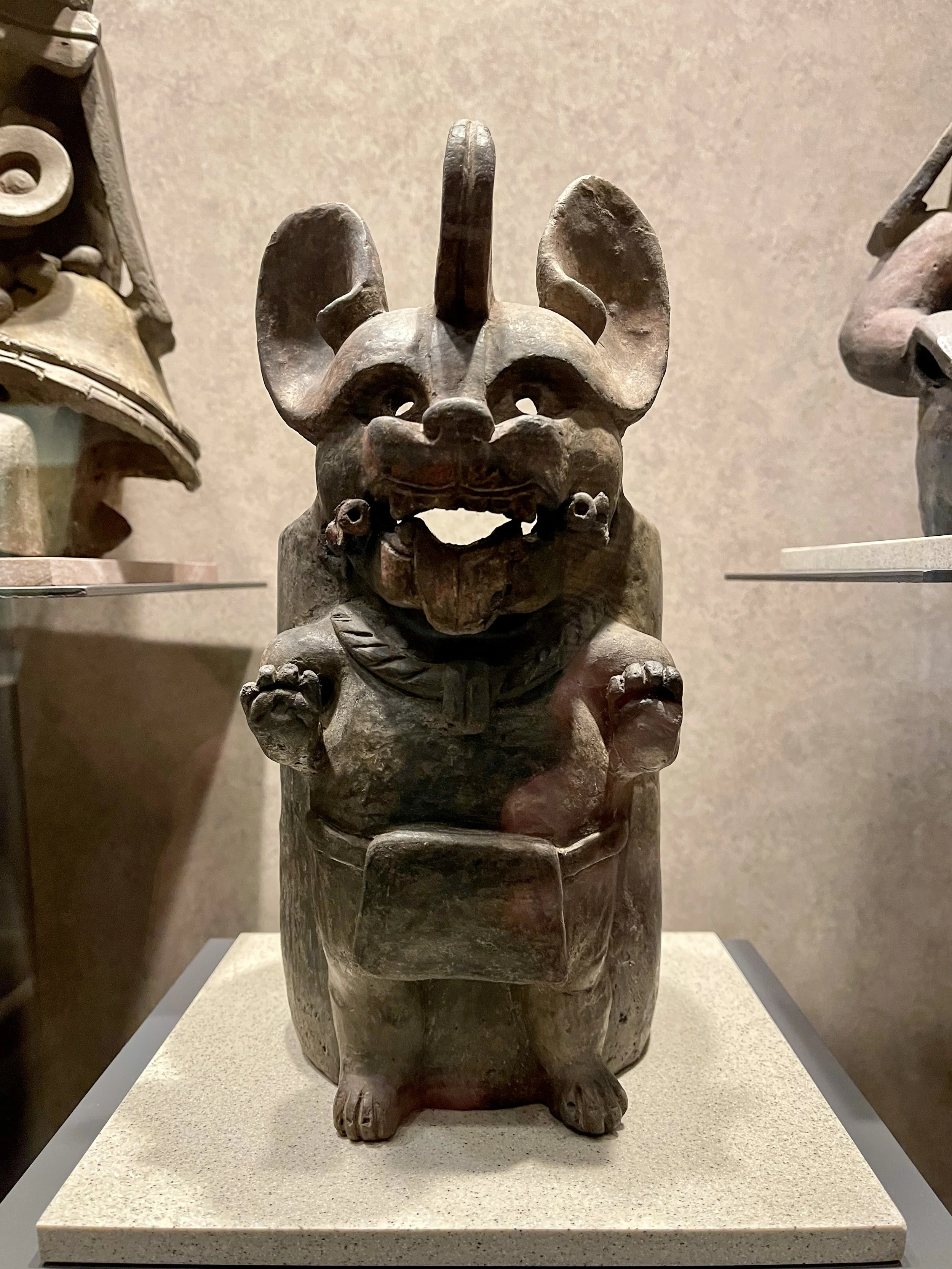
Bat on bowl of pre-Columbian pottery at the Museo Nacional de Antropología

Bats were paired with the Underworld, which was accessible via the caves they live in.

Bats Out of Hell

Bats are nocturnal creatures that travel the sky by night and hide in caves by day, which Mesoamericans believed were portals to the Underworld. 

Bat pre-Columbian artifact at the Museo Nacional de Antropología

The stuck-out tongue on this bat statue hinted at the creature’s blood-sucking nature and connected it to the practice of human sacrifice.

The Zapotec venerated the god Camazotz, who had the head of a bat and was associated with night, death and sacrifice. Most likely due to the sanguinary diet of the vampire bat, native to most regions of Mexico, where it feeds on the blood of mammals, the creature became associated with rites of bloodletting and human sacrifice practiced to honor the gods and secure bountiful harvests. 

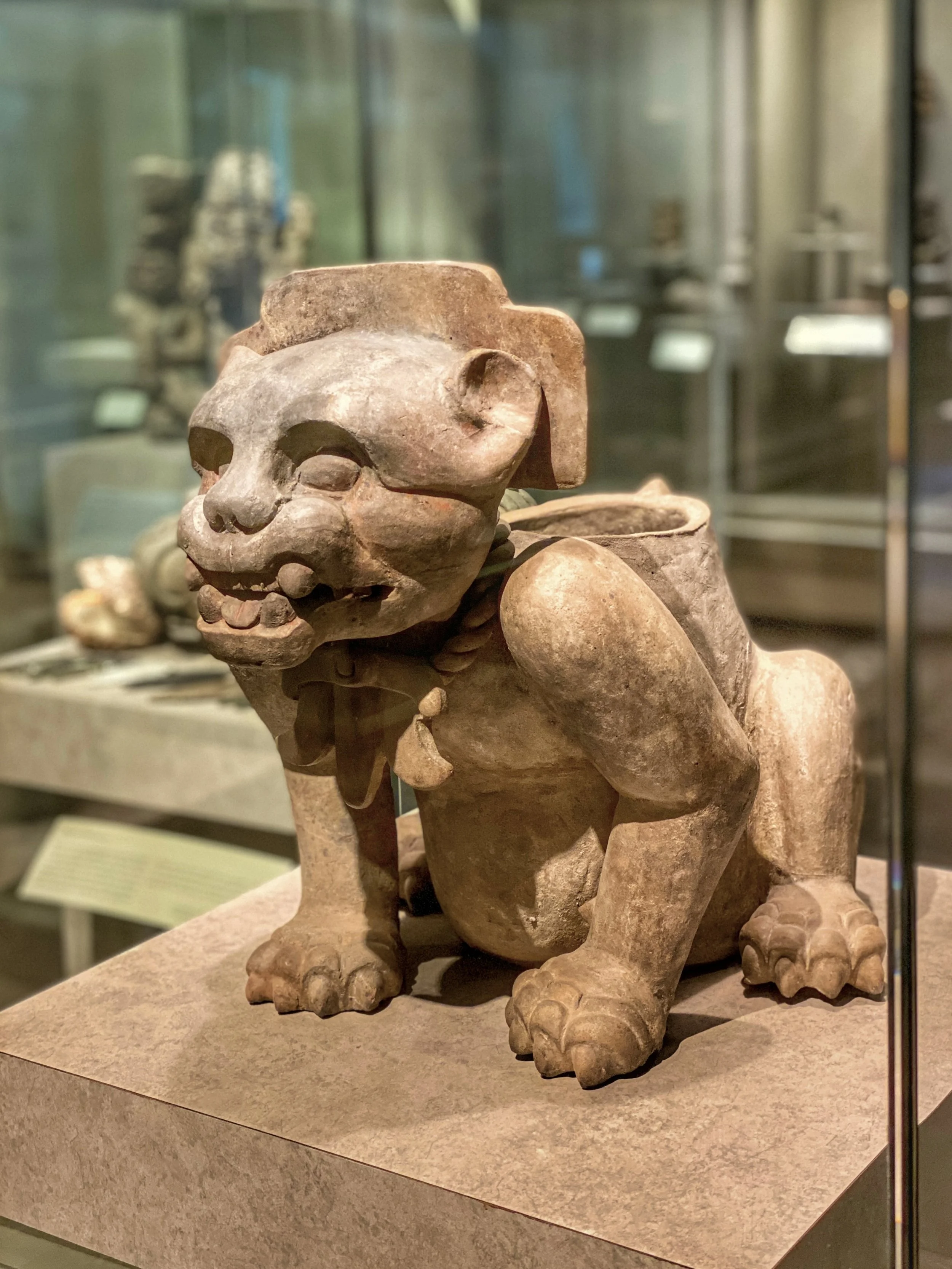
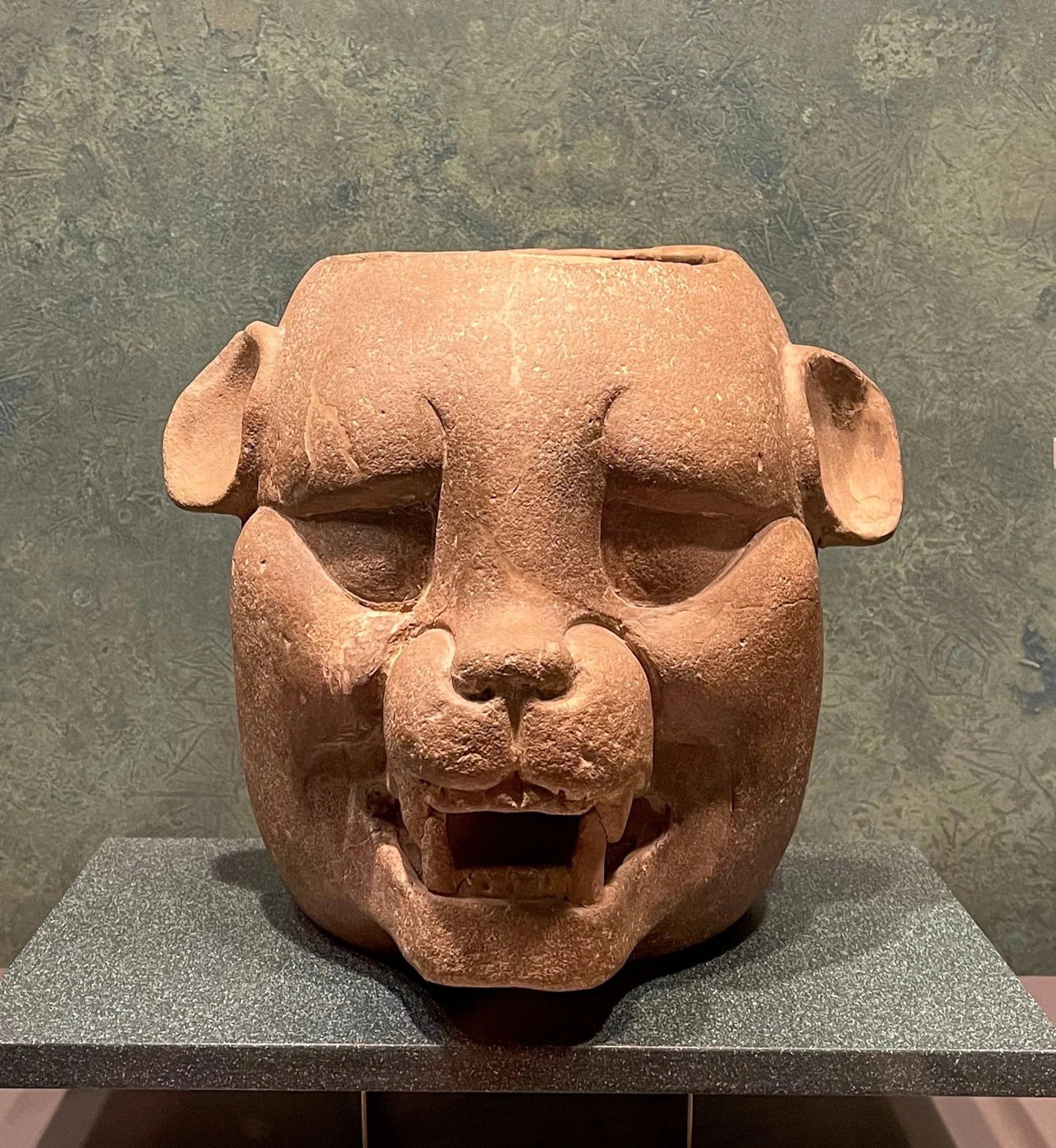
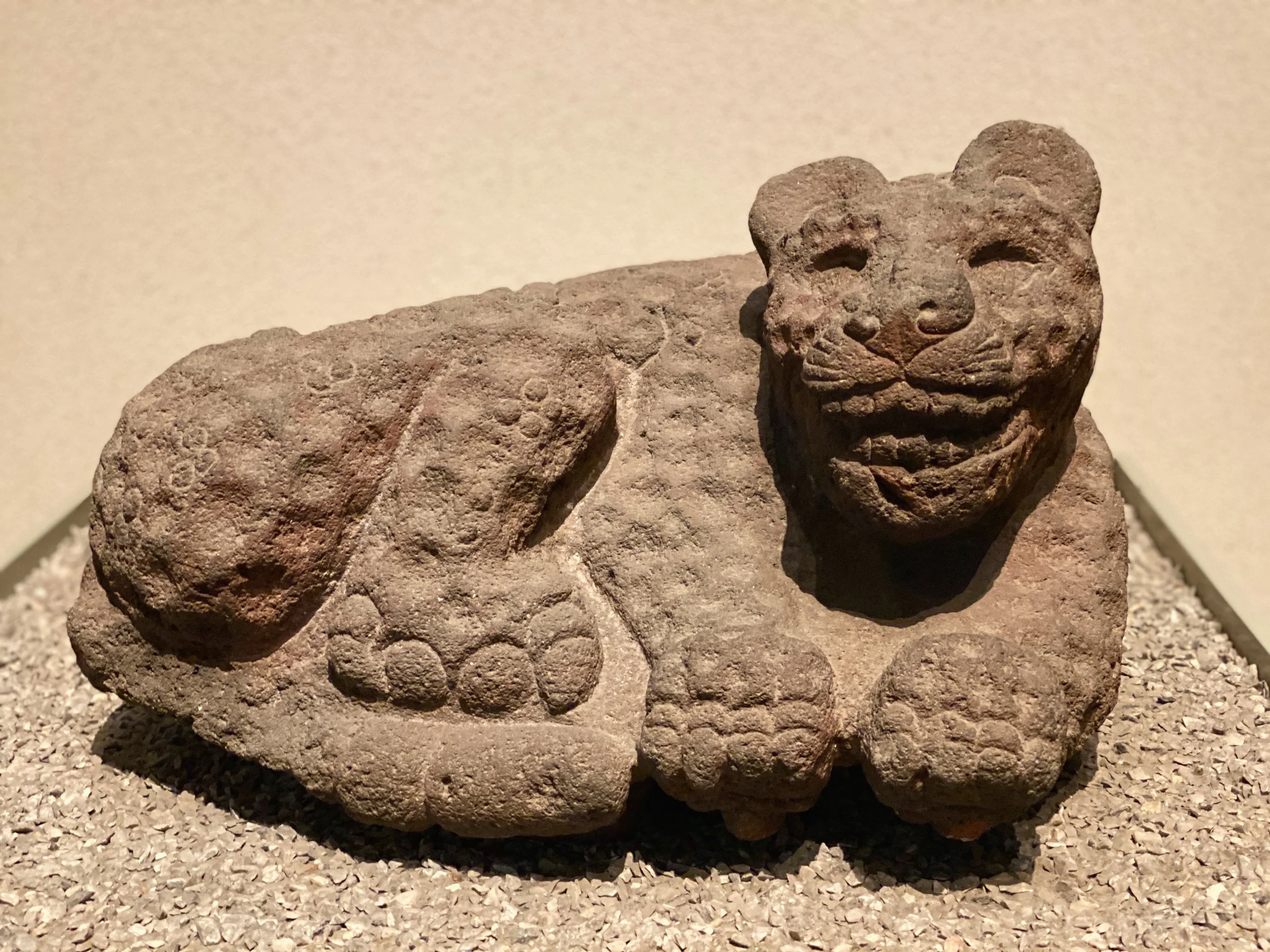
Jaguar pre-Columbian pottery at the Museo Nacional de Antropología

A common symbol in ancient Mesoamerica, the jaguar was linked to power and protection from evil.

Jaguars Hit the Spot(s)

The jaguar was one of the most important sacred symbols of power, ferocity and protection from evil. According to Mexica lore, a jaguar and an eagle both sacrificed themselves to bring light to the world, and in doing so became gods. 

Jaguars were believed to have the ability to travel between the worlds.

Laying jaguar pre-Columbian pottery at the Museo Nacional de Antropología

The Maya connected the jaguar’s spots with heavenly lights.

The jaguar is closely associated with the “night sun” (the sun during its nightly trip through the Underworld) and darkness as well. As such, the big cat was thought to have the ability to move between the worlds of the living and the dead. The Maya venerated the feline, seeing heavenly lights in its spots. –Duke


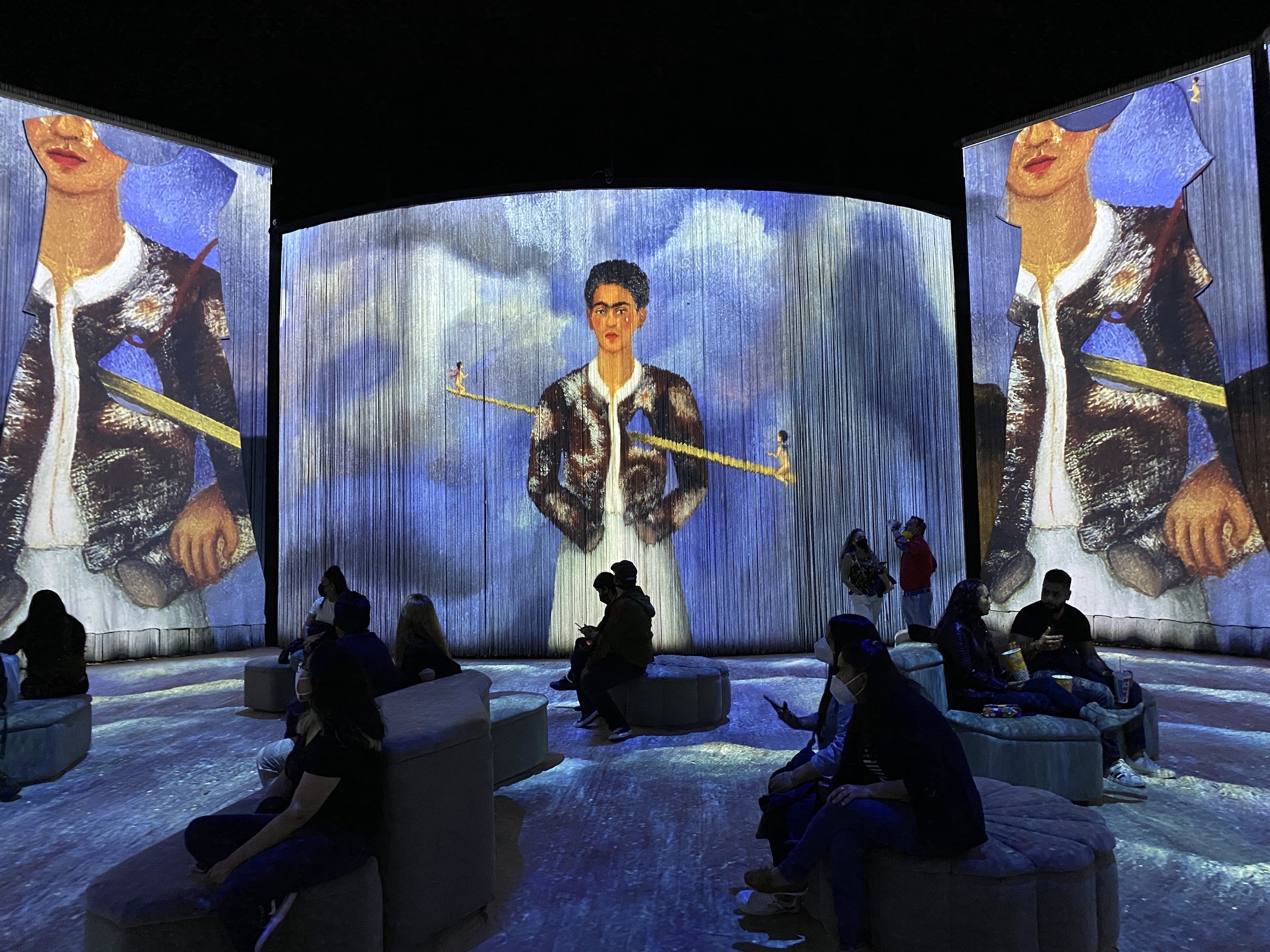
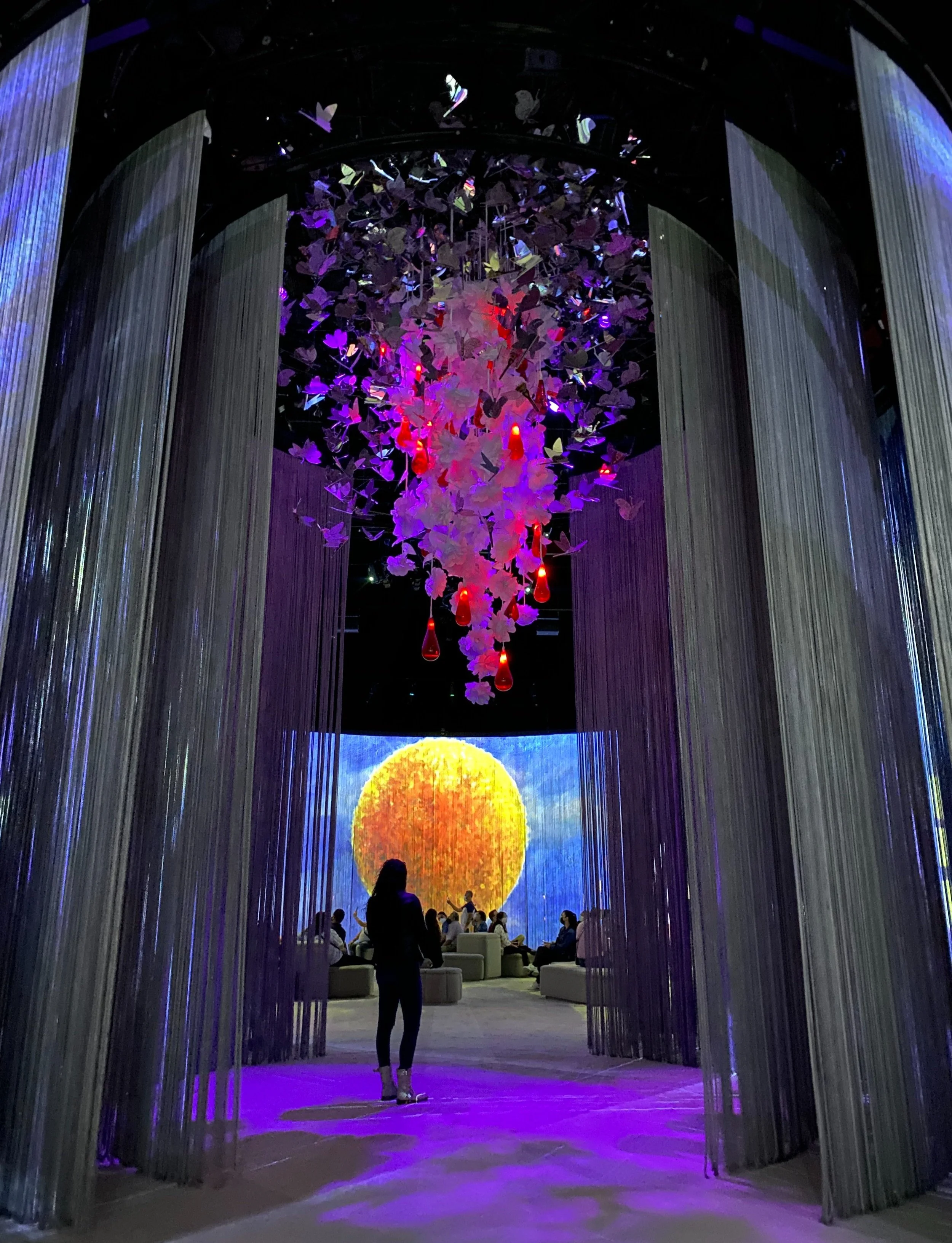
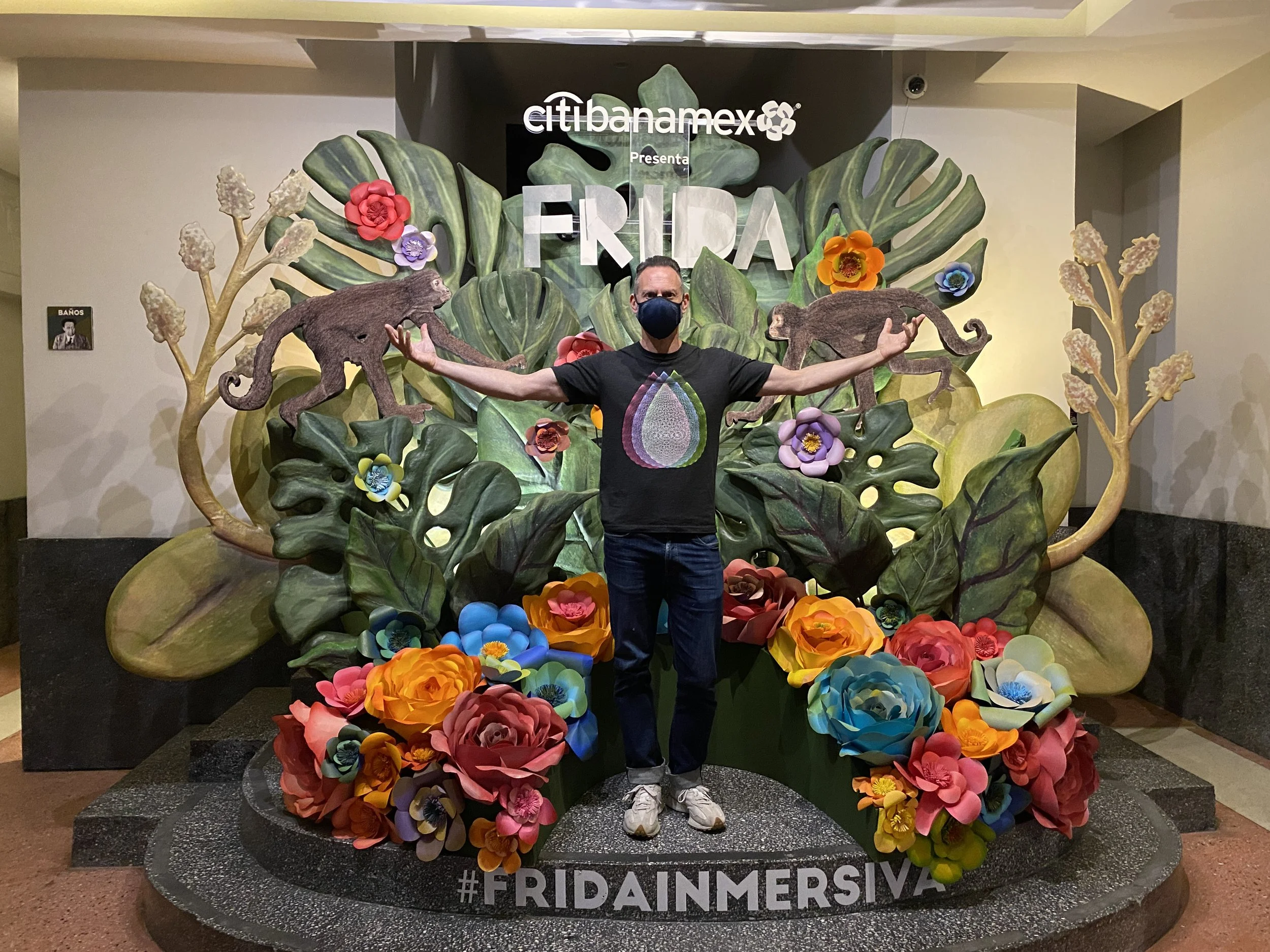
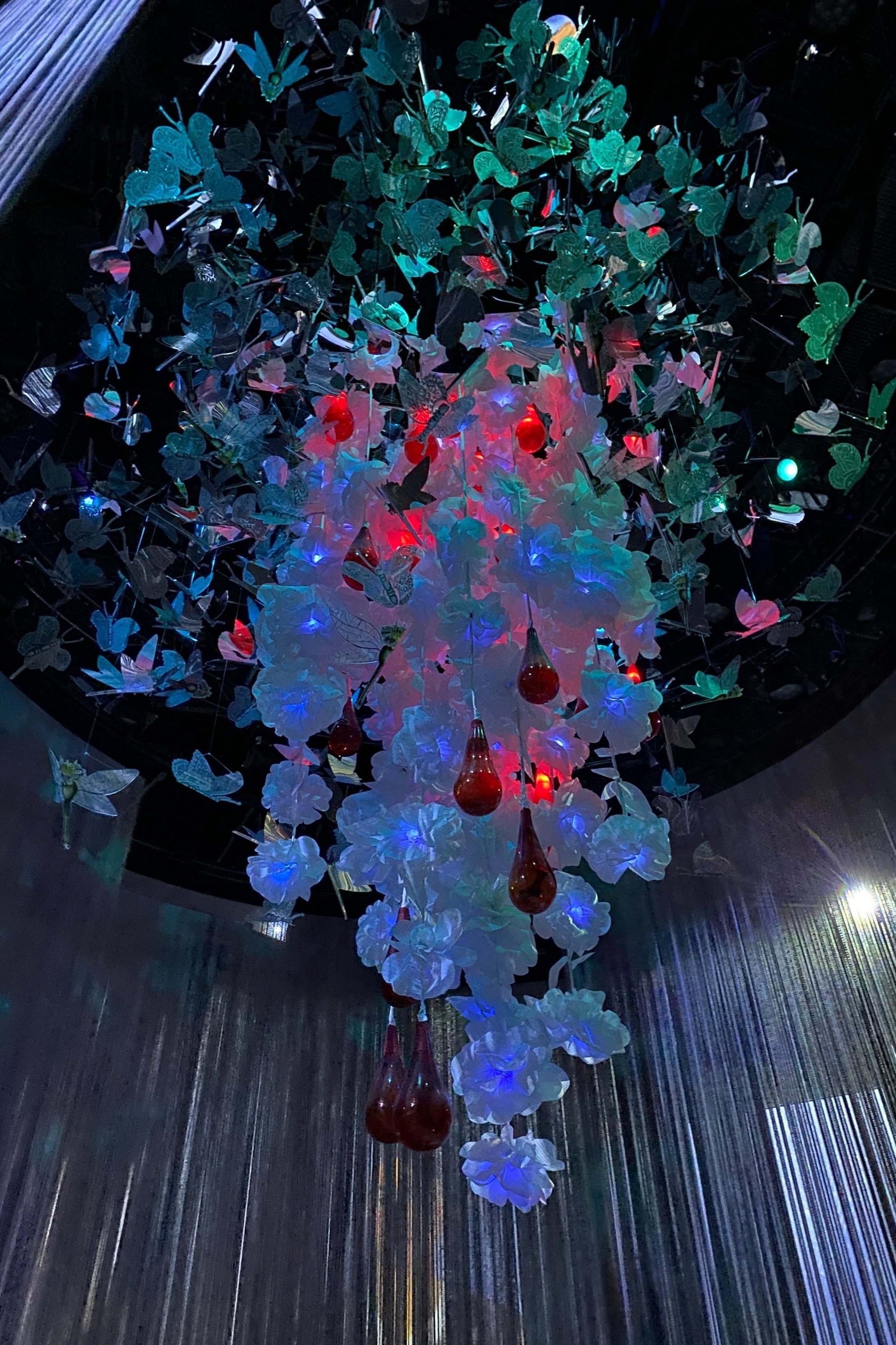
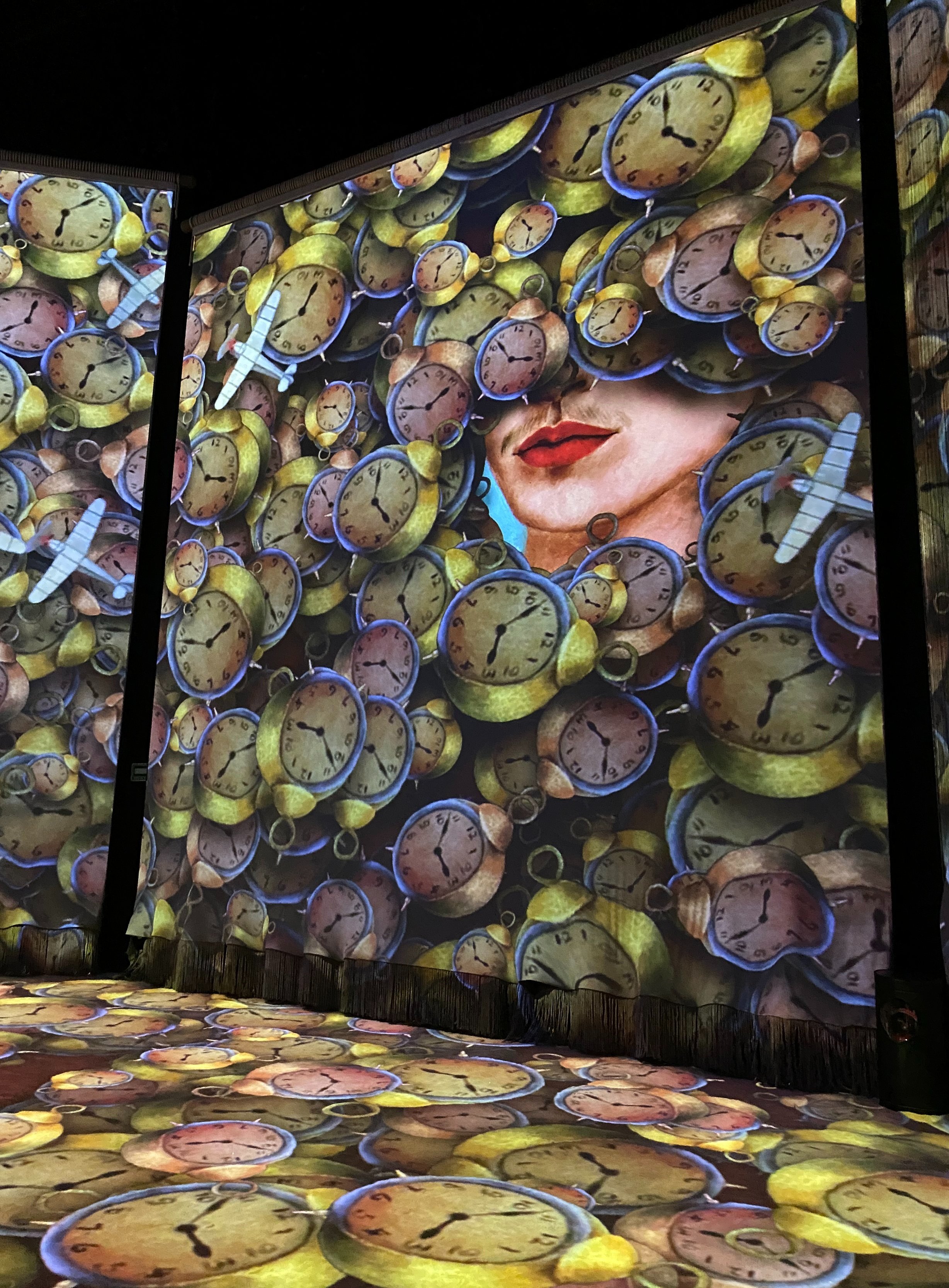
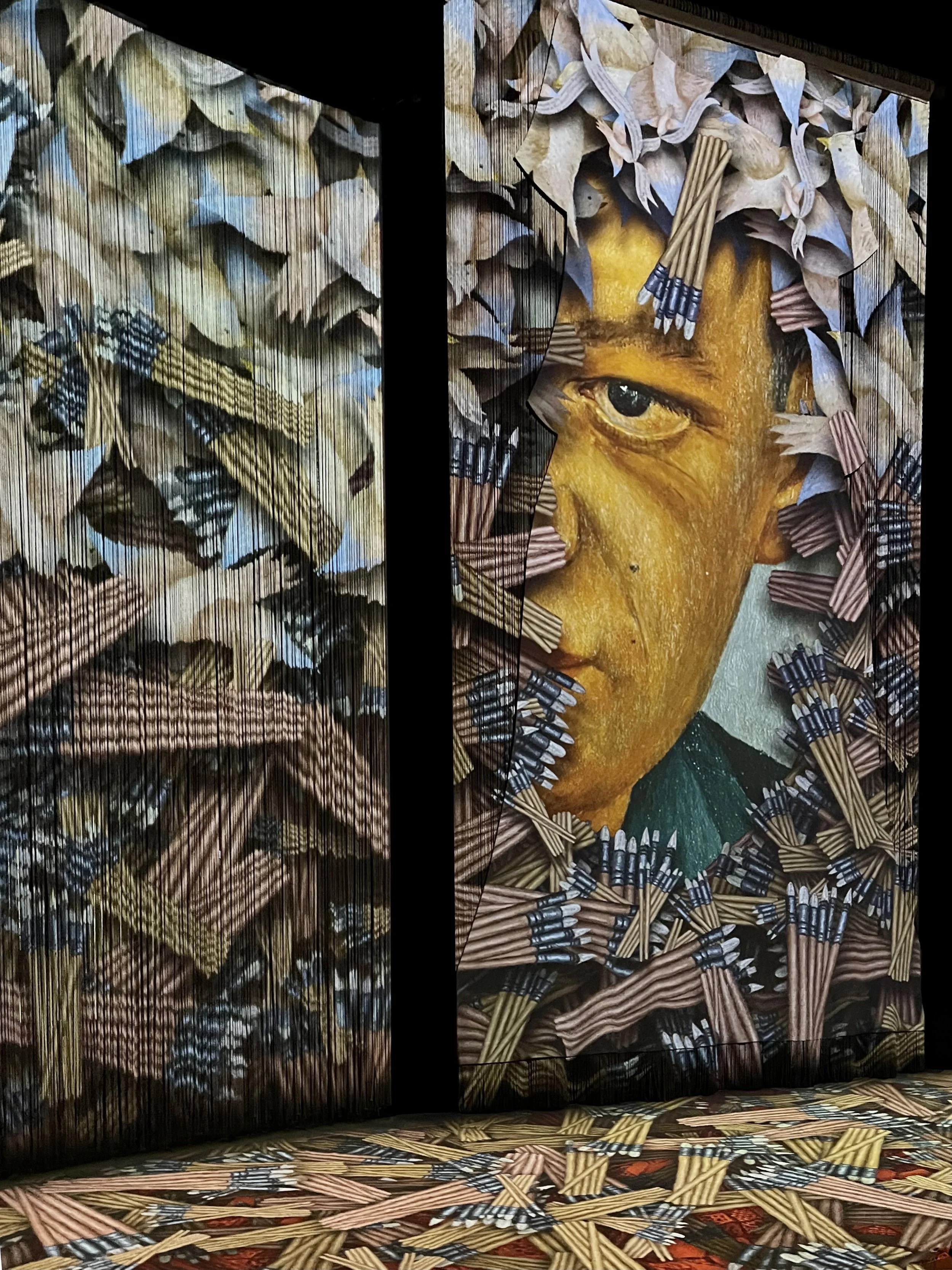
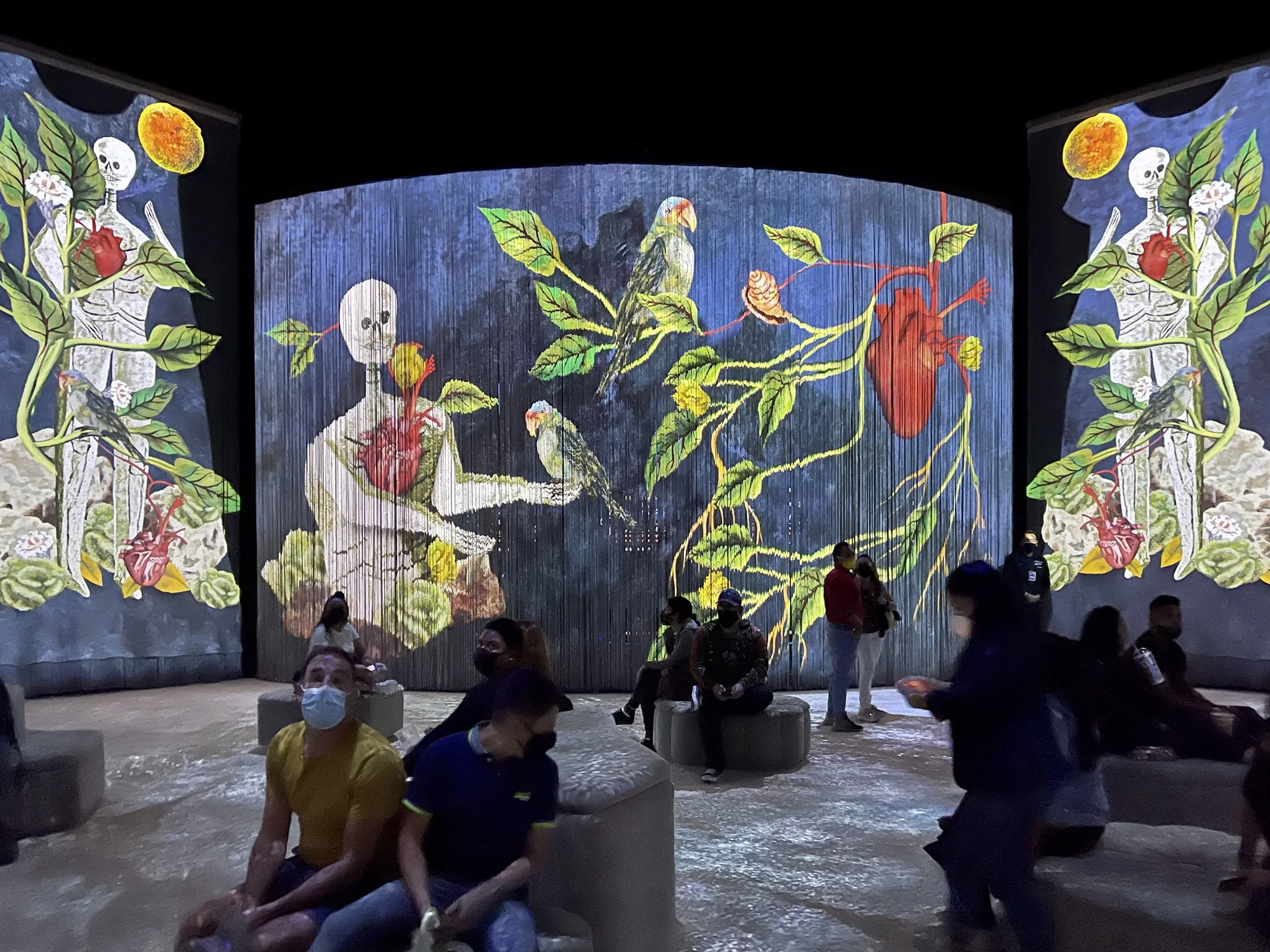
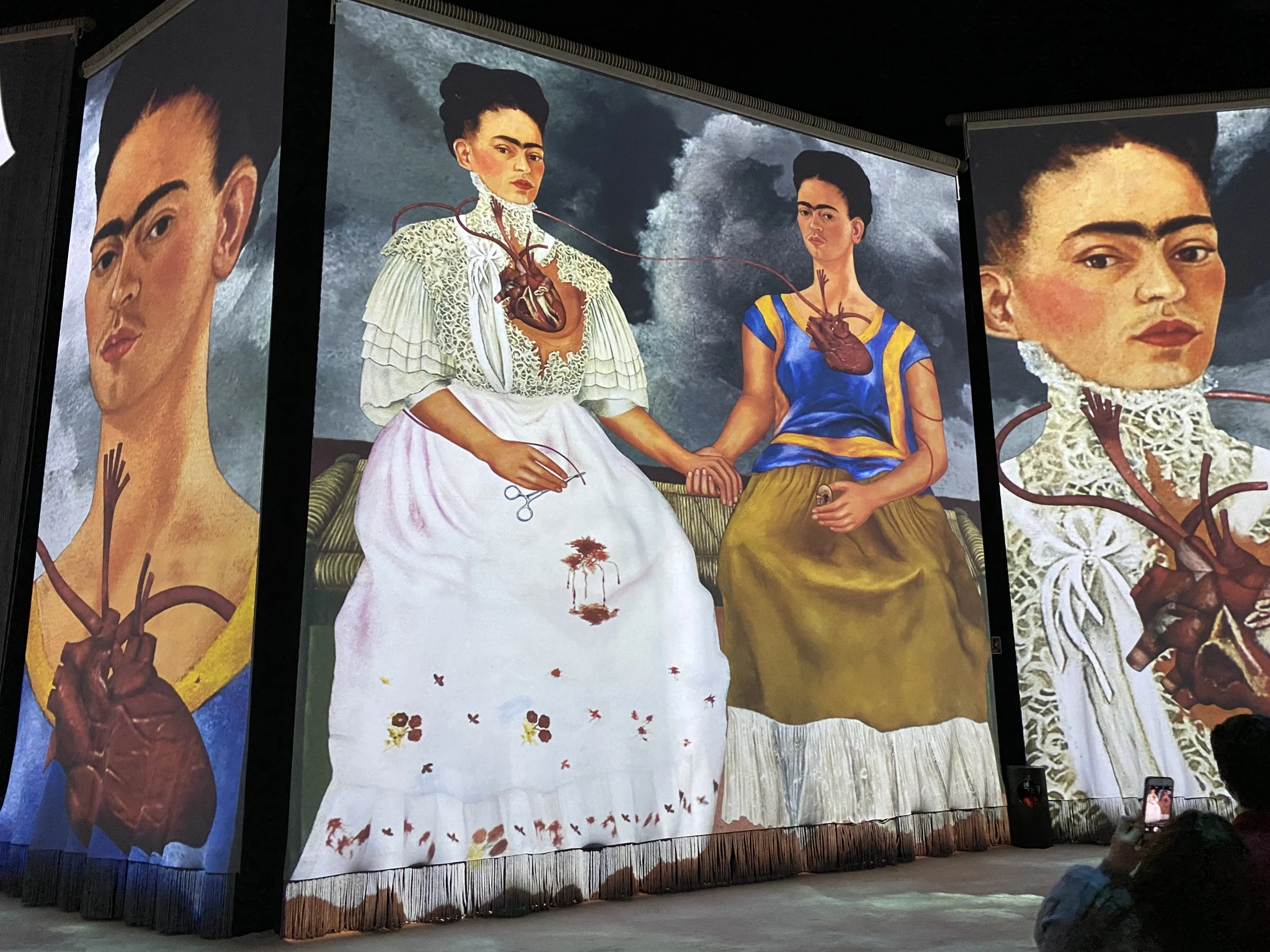
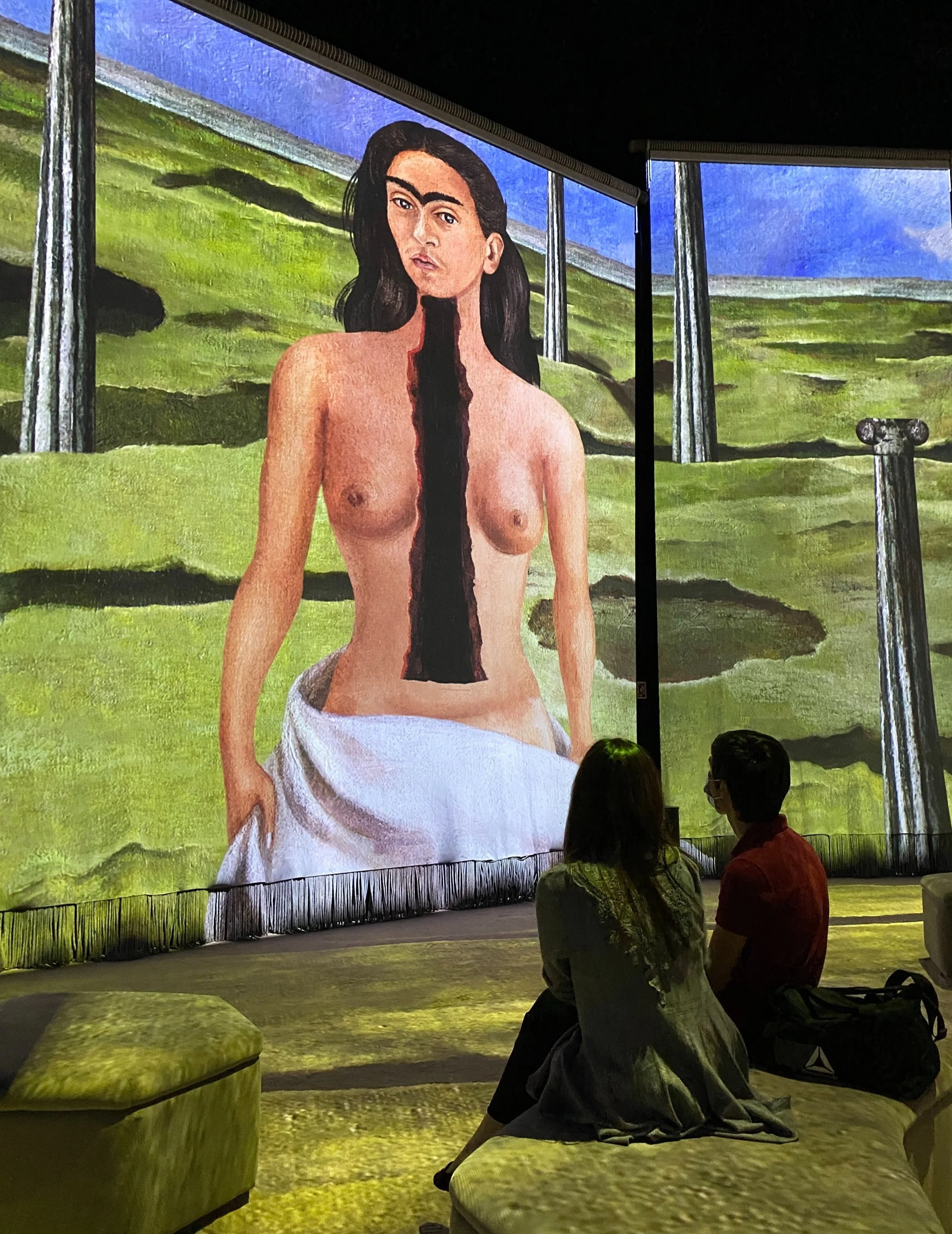
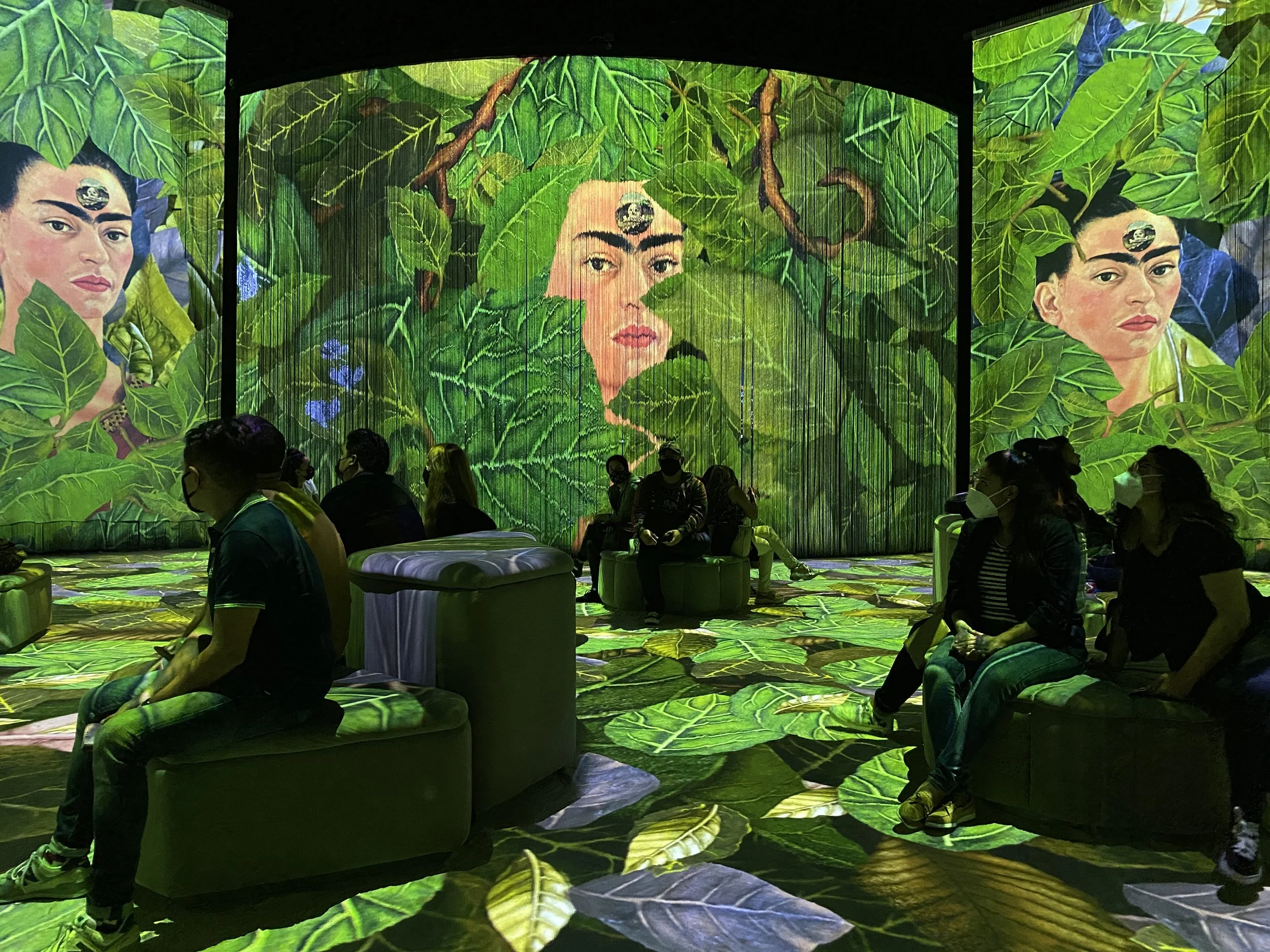
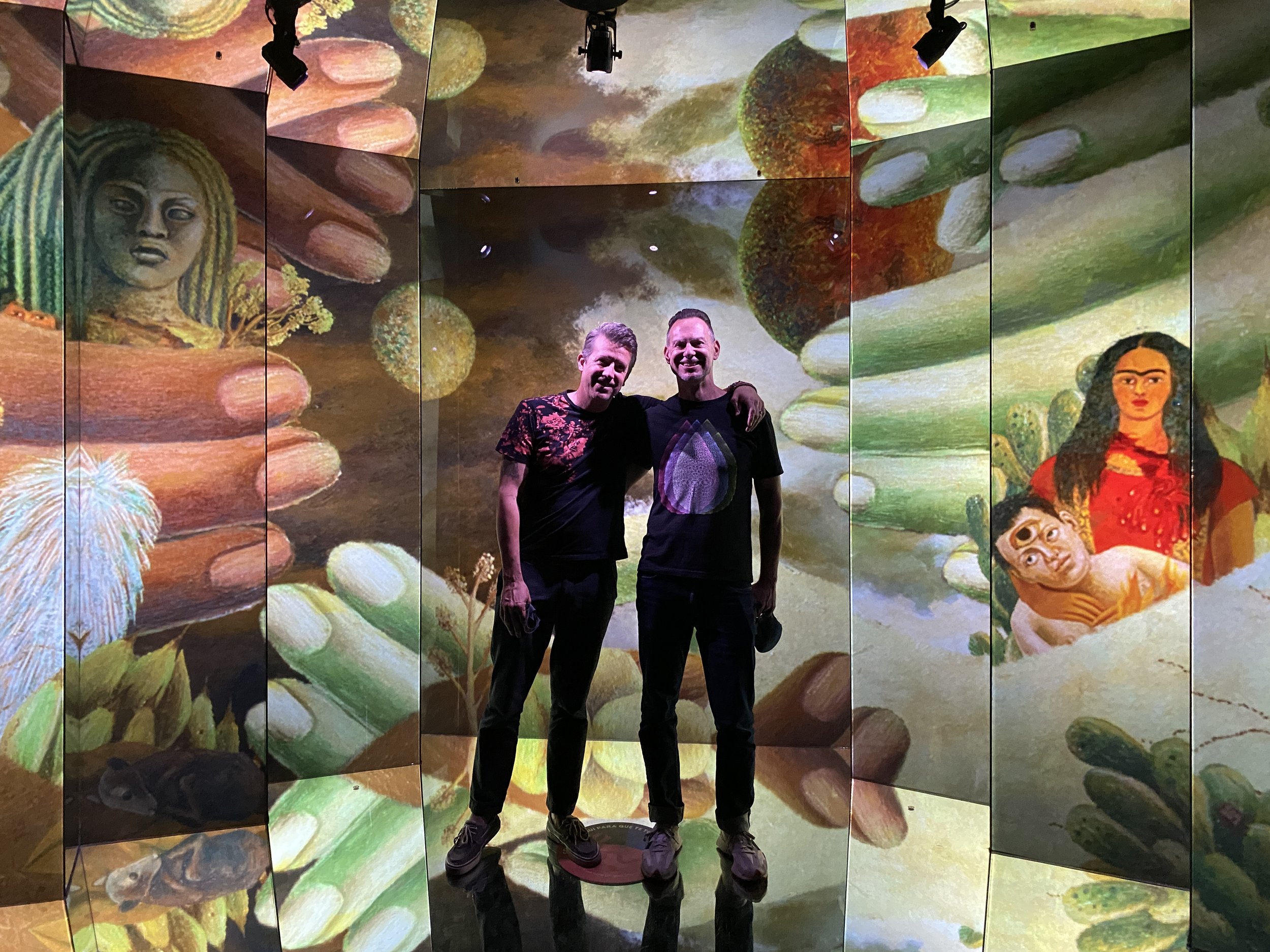
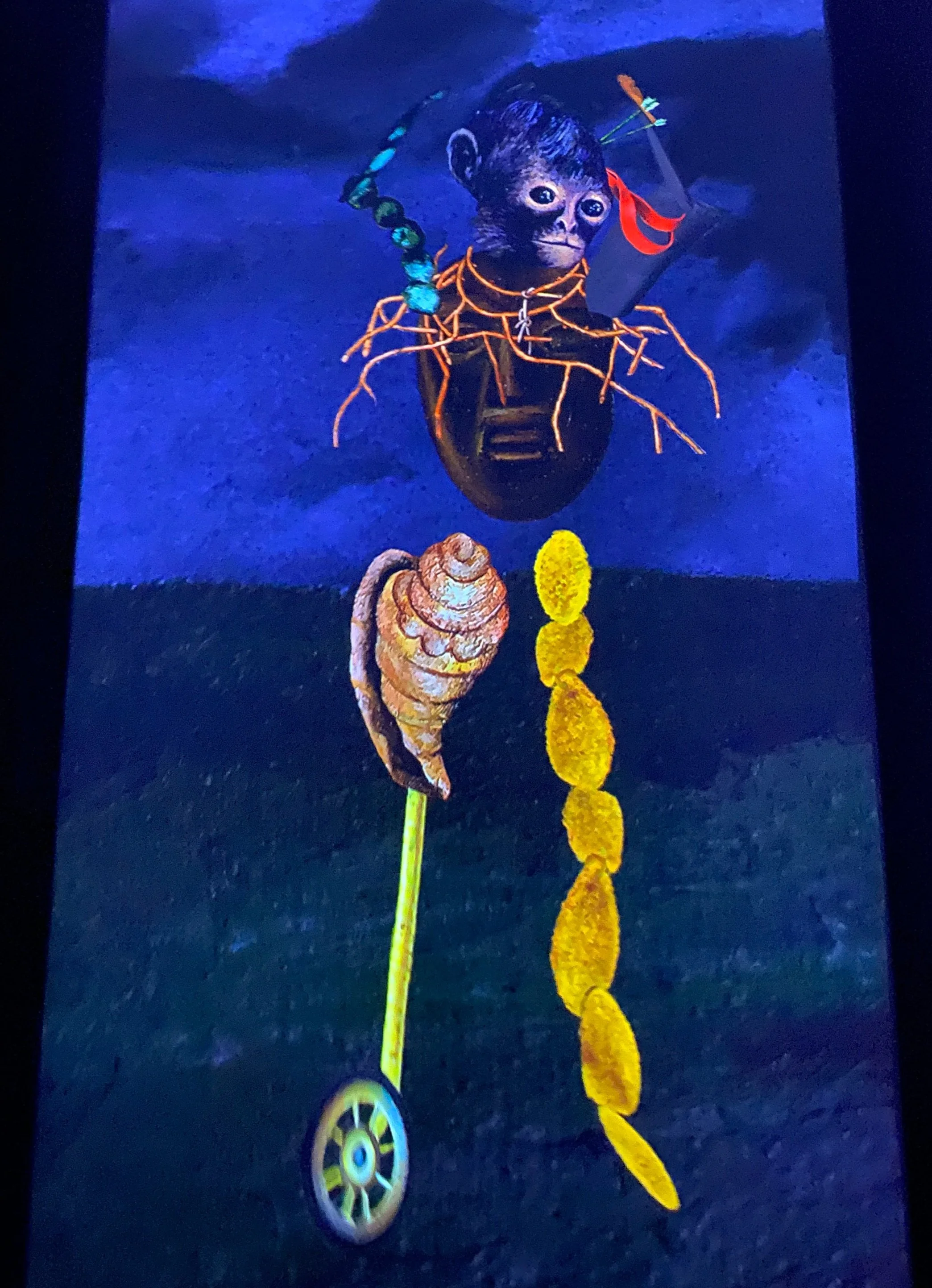
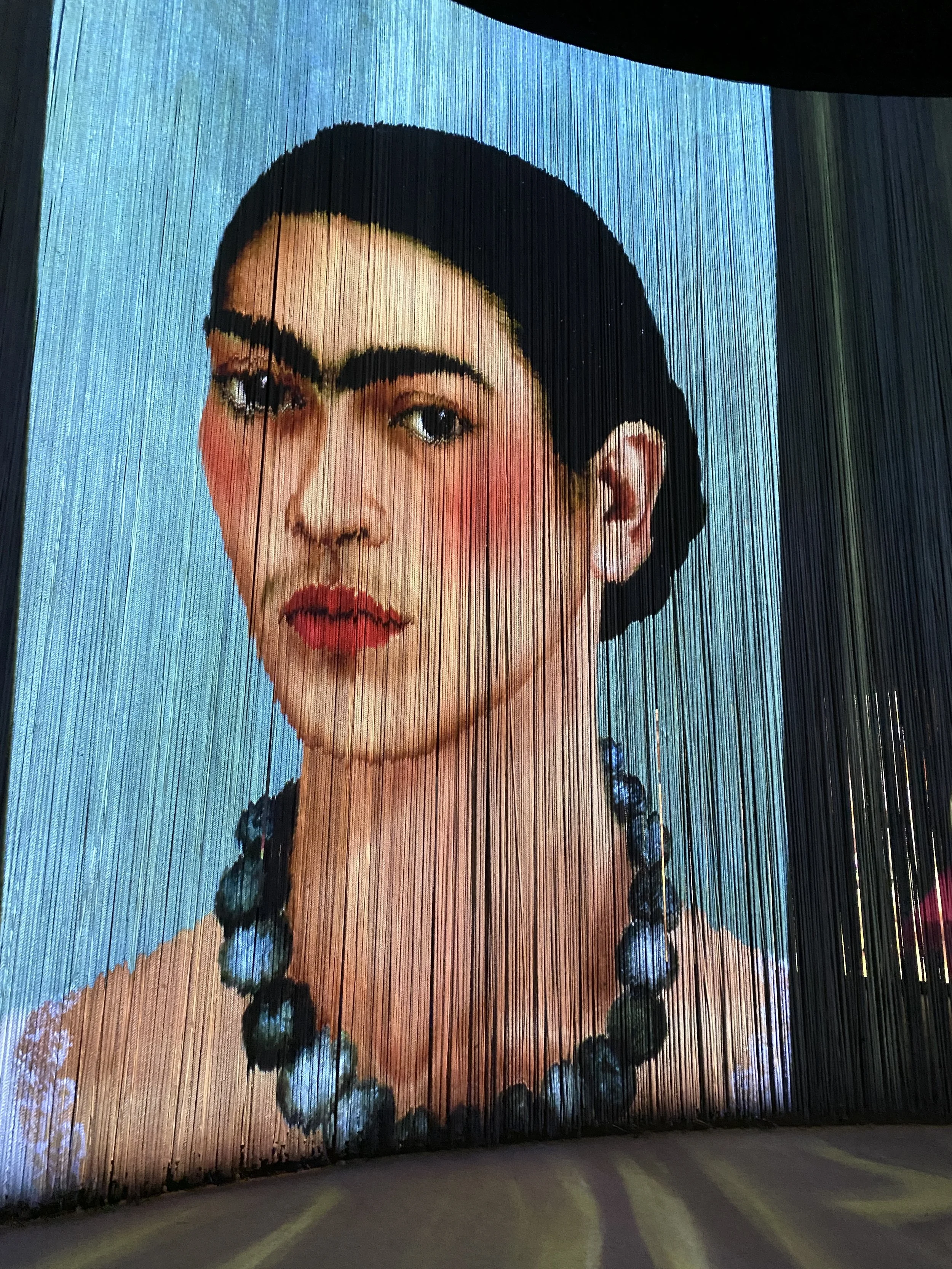
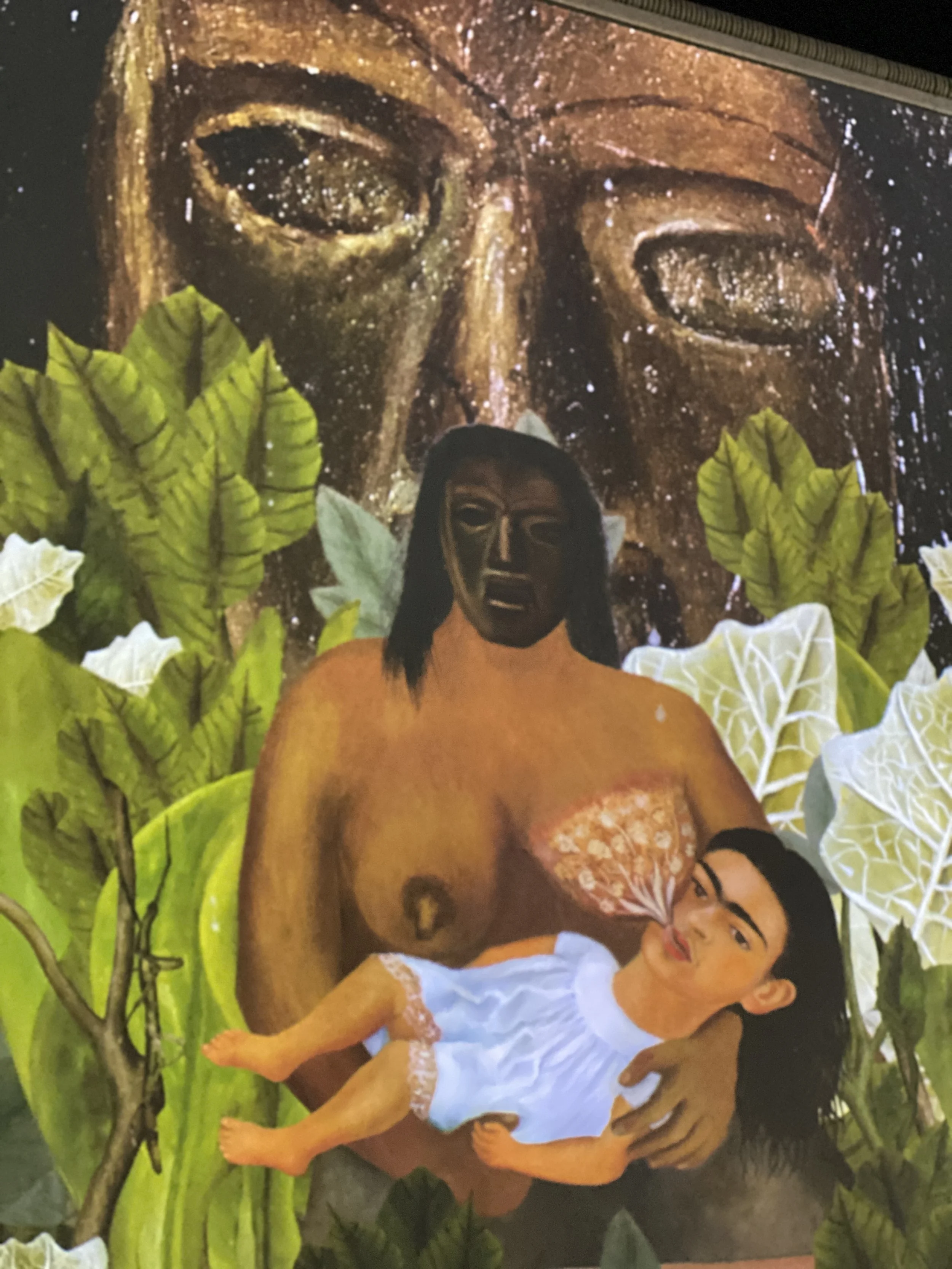
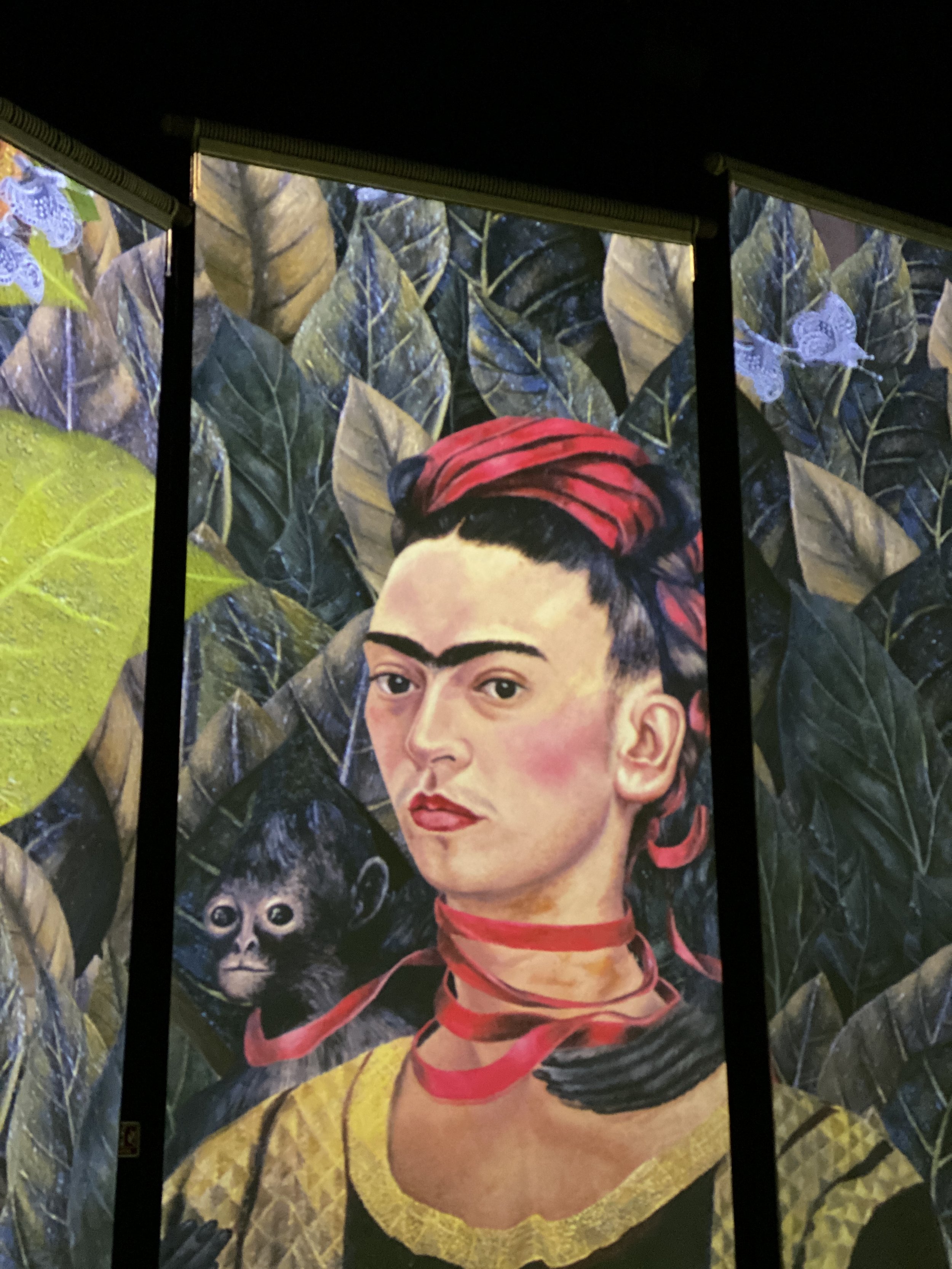
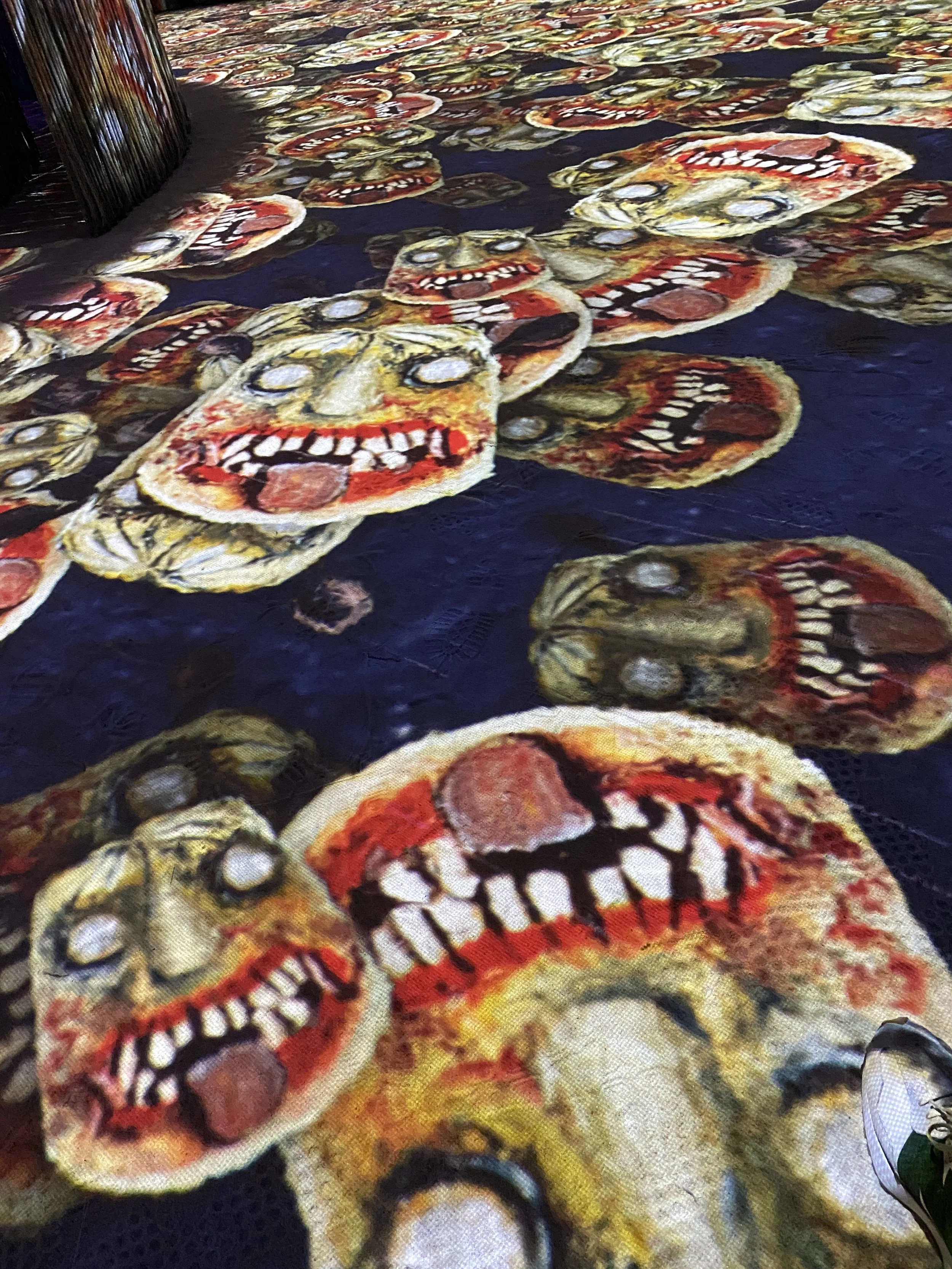
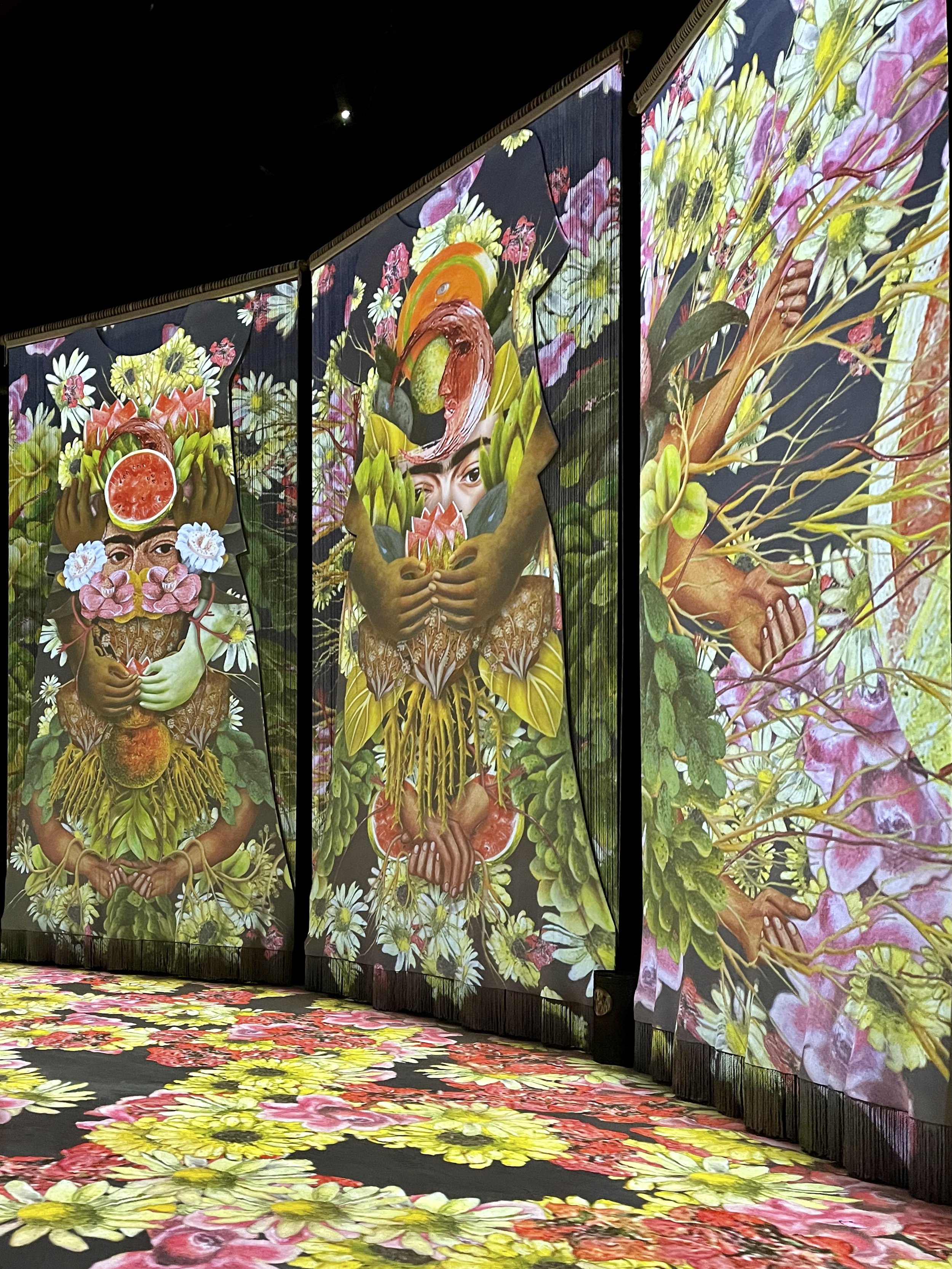
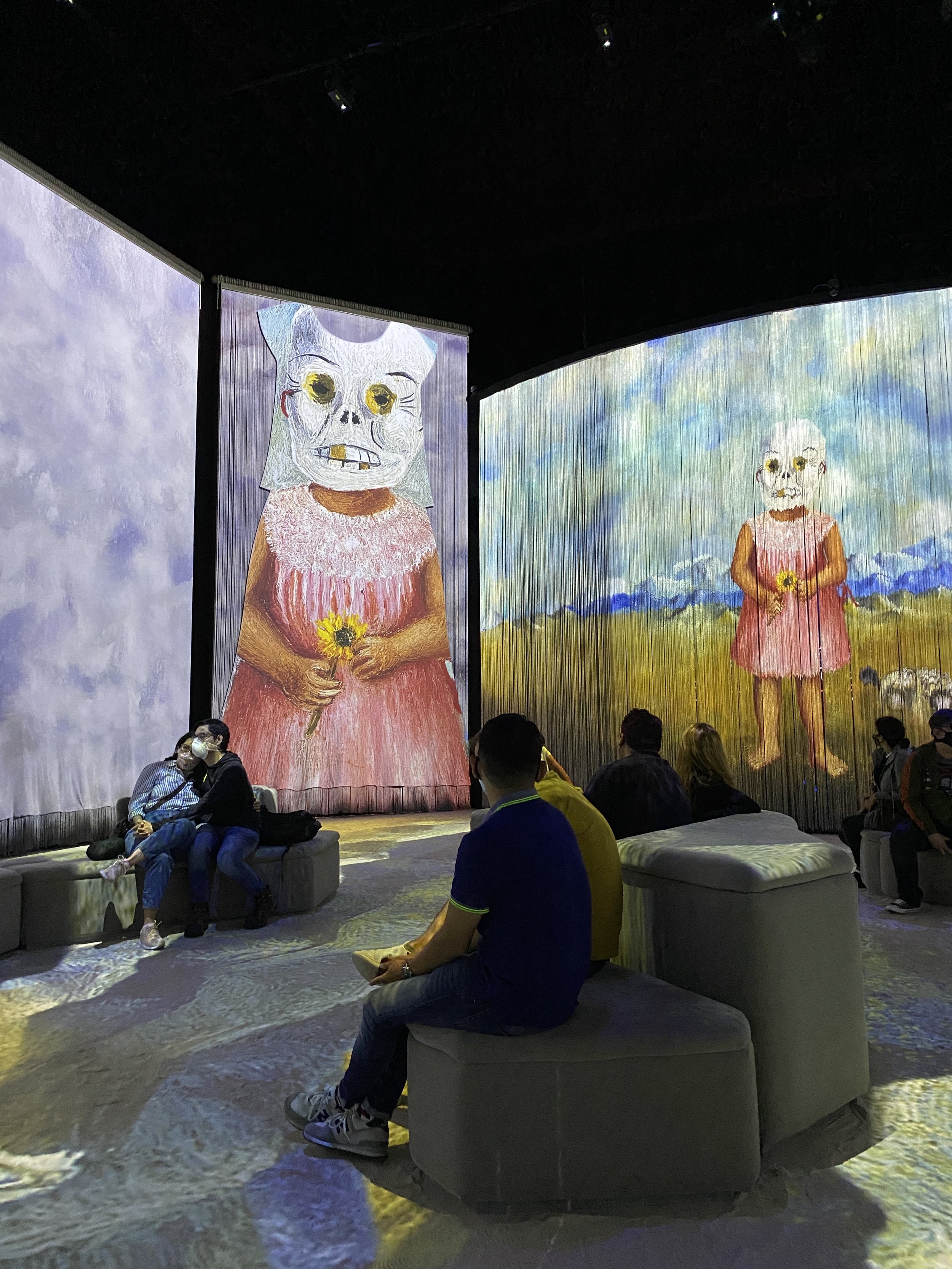
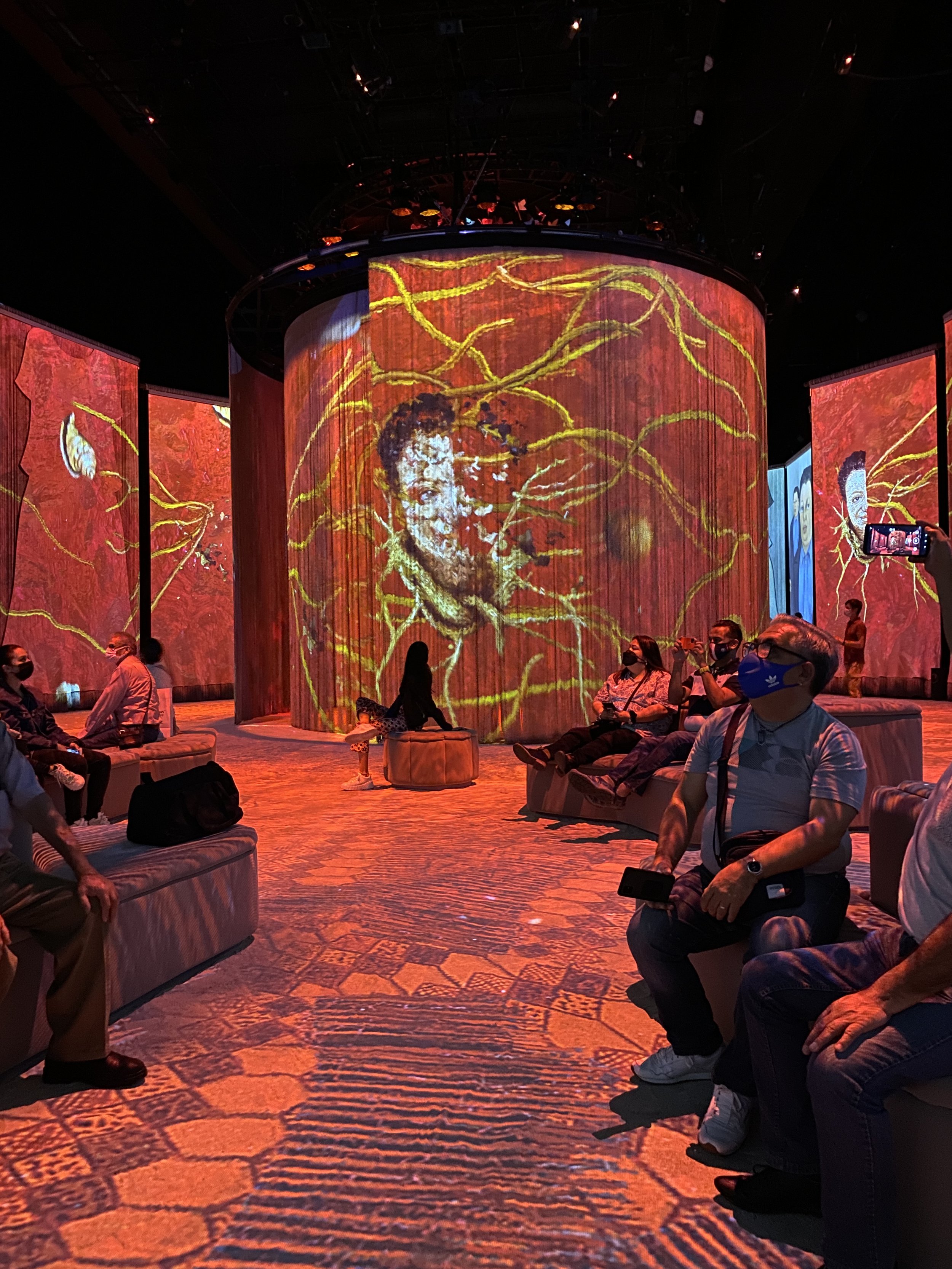
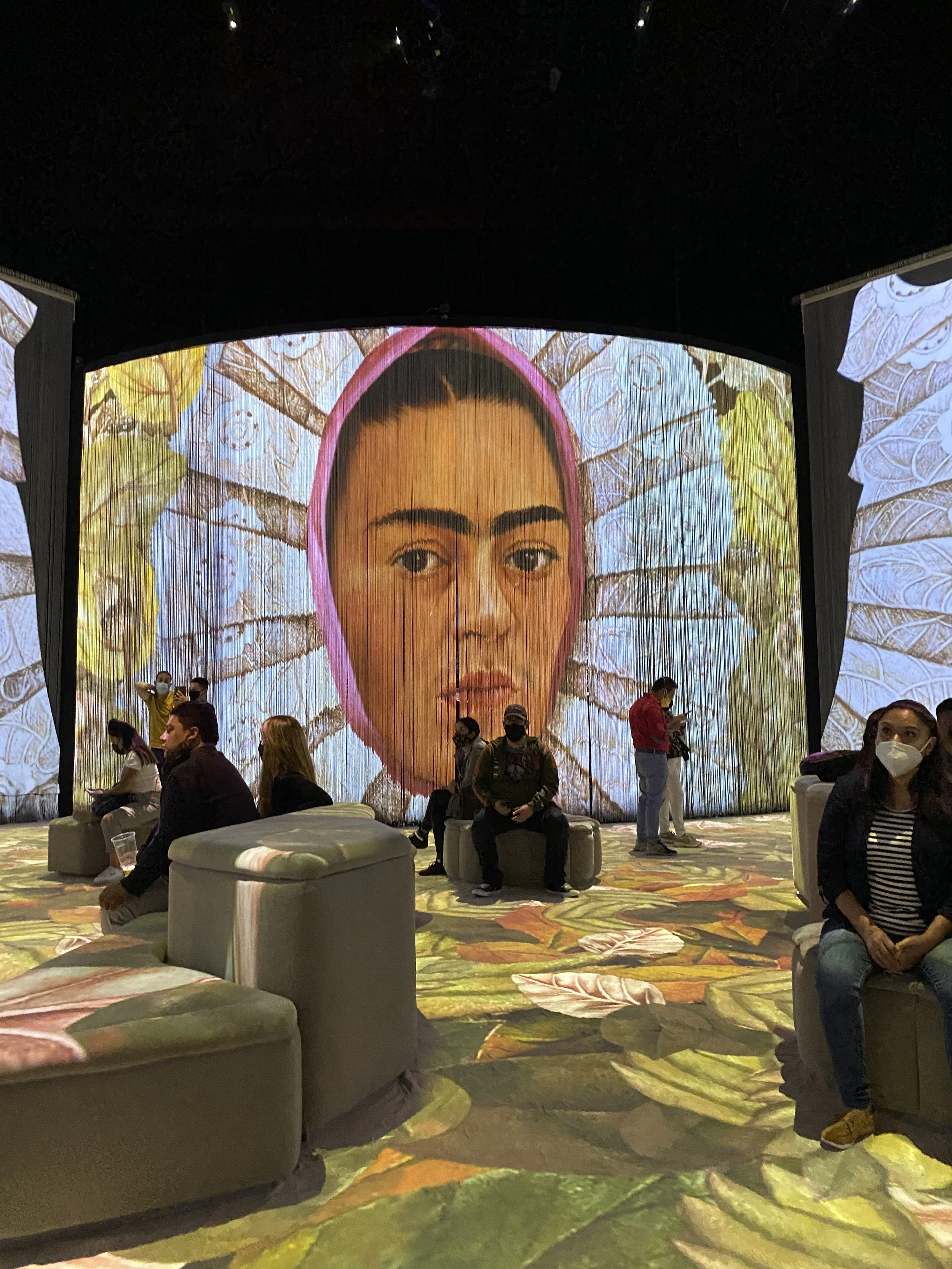
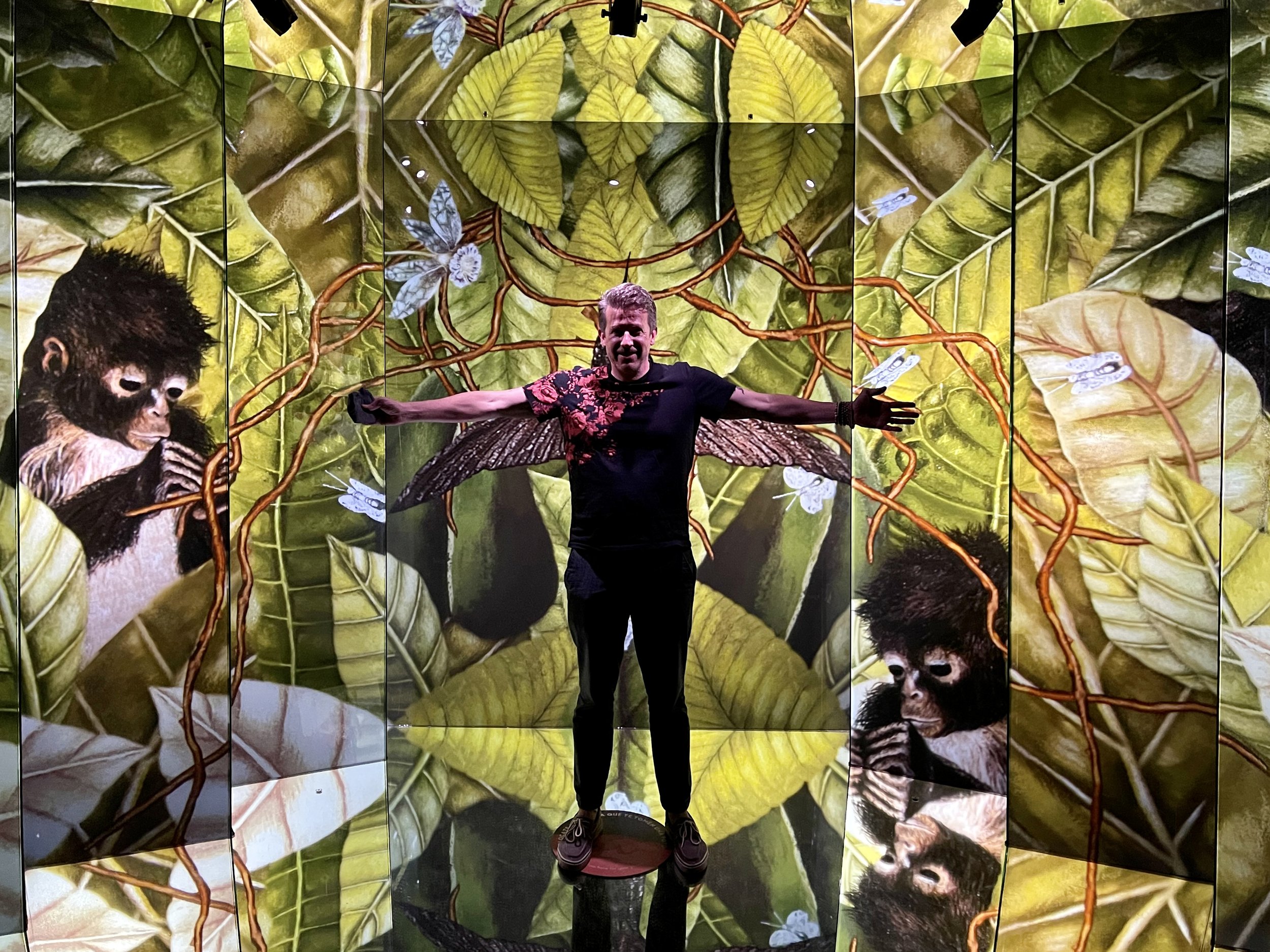
Immersive Frida: An Incredible, Must-See Show

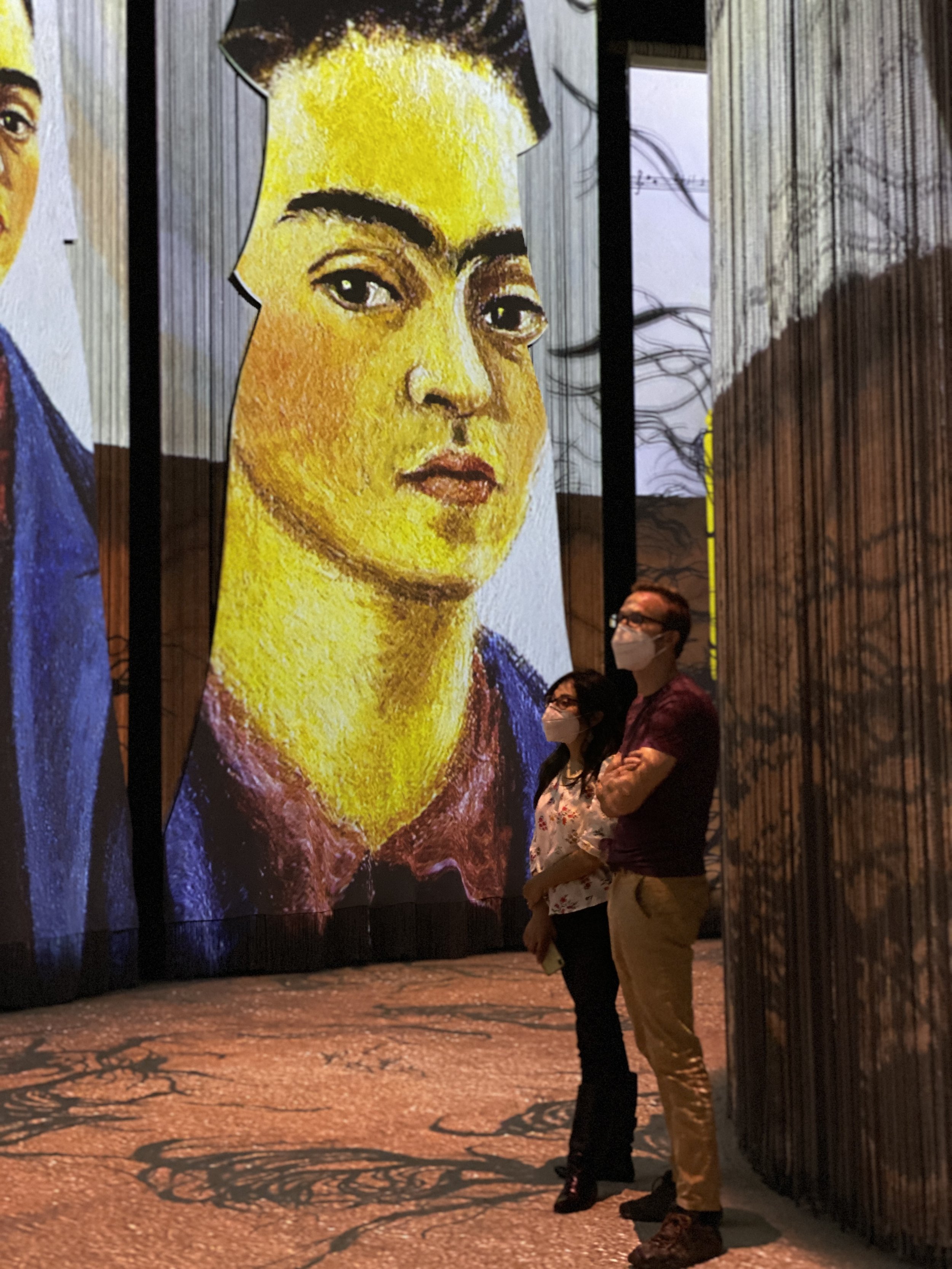
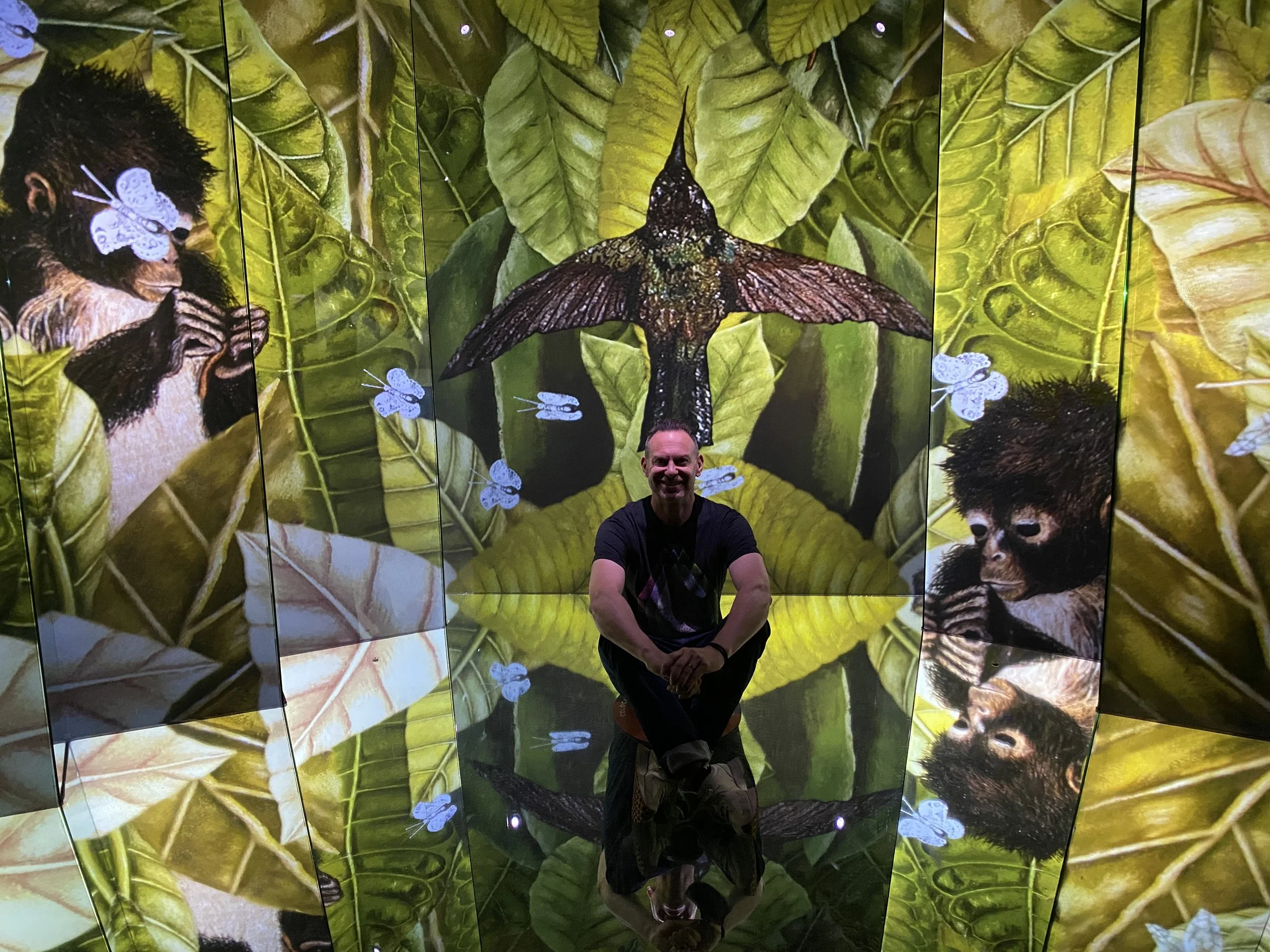
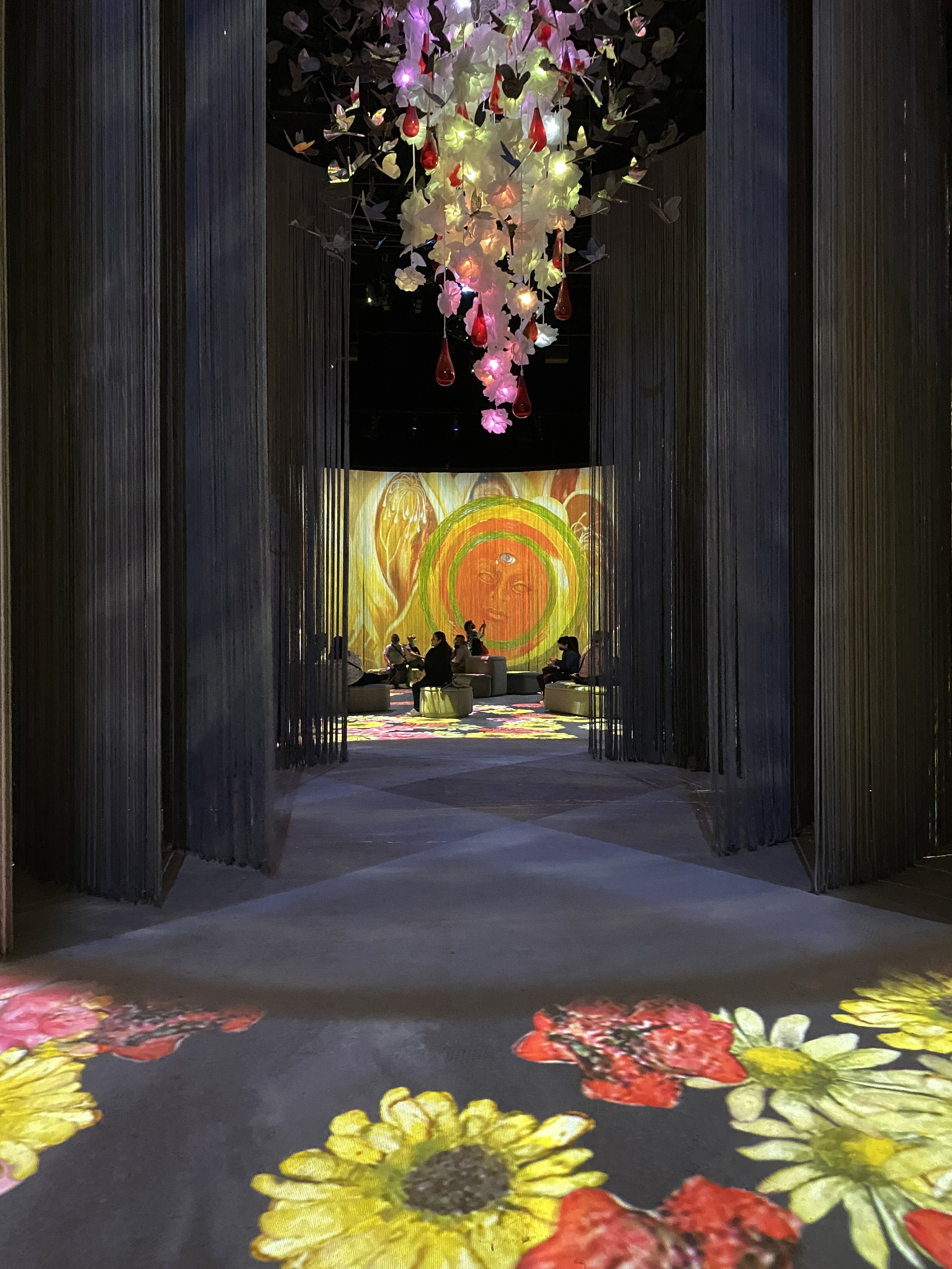
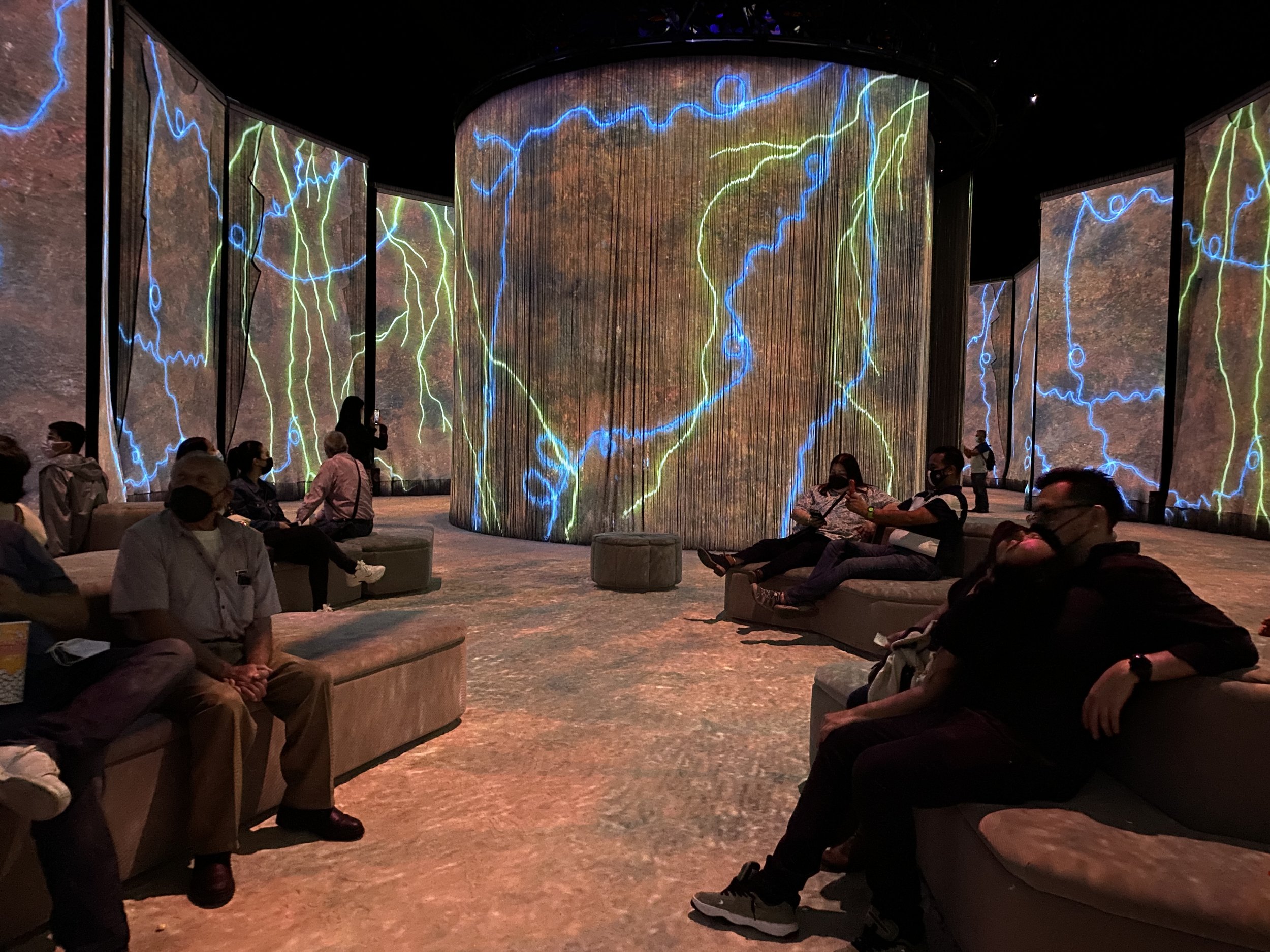
Compared to this amazing spectacle honoring the life and work of Frida Kahlo, the Immersive Van Gogh is a mere screensaver. 

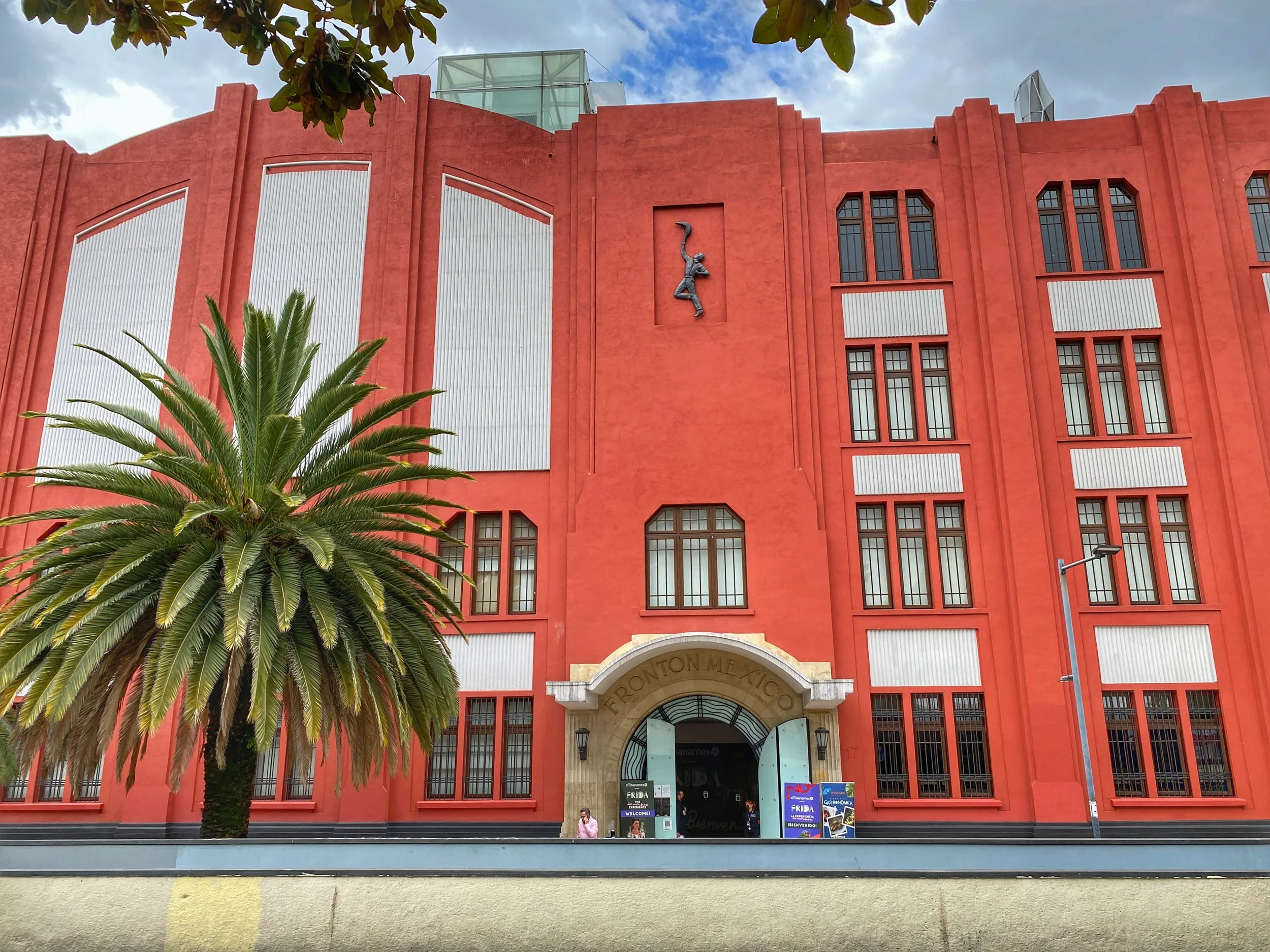
If you’re in Mexico City, see Immersive Frida while you can!

We parted the strings of rope as we would a curtain, fittingly, from beneath one of Frida’s long Tehuana skirts, and were instantly transported into a magical world. 

Duke and I headed toward an empty round ottoman but we both stopped right as we were about to sit down — the seat appeared to be moving! 

After a few seconds, our vision adjusted and we realized it was just a trick of the eye from the projected patterns that filled the walls and drifted across the white sand covered floor. We laughed and took a seat. 

In the center of the gallery a circle of rope curtains bisected the gallery. These moved periodically, sometimes swirling, sometimes opening to reveal the other half of the exhibit space for dramatic vistas. 

Rings of curtain-like ropes open and close to reveal dramatic vistas across the room.

Other rope curtains were placed at either end of the main room, acting as screens for the projections of Frida Kahlo’s paintings. 

The show takes place at Frontón México, a large entertainment venue.

The spectacle Duke and I attended was Frida: The Immersive Experience (Frida: la Experiencia Inmersiva) held in Mexico City at Frontón México. This massive building, which once served as a jai lai court from the 1920s until the mid-’90s, reopened after a multimillion-dollar overhaul in 2017 as a multipurpose entertainment venue that includes a casino. It’s right across the street from the Plaza de la República and is a 12-minute walk to the Palacio de Bellas Artes, which we explored after the show.

Duke posing in the lobby

Frida in 360 Degrees 

Halfway through Immersive Frida, we decided to get up to discover what it was like in the curtained portion at the center of the room. The ropes spun in circles and it was like walking through a curved passageway with moving walls. Then we were inside the bower, with slashes of light illuminating the space. Above us hung a chandelier of sorts, a cascade of white paper flowers that shifted in color, sometimes glowing light blue or purple, interspersed with dark red lightbulbs dripping like drops of blood.

The chandelier shifts colors throughout the show.

After a bit of time here and wanting to see new perspectives, we emerged and found seats on the other side of the room, where we remained for the rest of the show. 

The creators of the exhibit took elements from Frida’s paintings — a bug-eyed jaguar mask from (Girl with Death Mask, 1938), a leaf, an alarm clock and airplane from (Time Flies, 1929), and (The Two Fridas) — cut them out and filled the screen with them. Then parts of famous paintings would peek out from the collage, and you have to constantly look around to see different objects: Diego’s eye here, Frida’s mustache over there, the leg of a deer behind you. There’s nonstop movement and animation, and even voice recordings of Frida herself, waxing poetic about her love for Diego. 

Elements of Frida’s paintings are isolated and presented as a moving collage.

Then elements from other paintings reveal themselves, like this one of Diego.

Immersive Frida includes some audio footage of the artist speaking.

Frida’s famous paintings truly come to life.

You’ve got to constantly look in all directions during the show — there’s something new to see everywhere you look.

A somber set of images, like the ones about the spinal injury that plagued the iconic artist most of her life, were accompanied by intense, moody music. At one point, Frida’s chest opened and a corset wove itself around her shoulders and torso to reveal a broken column within. But then the images would turn bright, as when nature scenes began to populate, and the music became optimistic, energetic, paired with happier imagery. 

A terrible accident Frida suffered as a youth informed many of her paintings.

One segment of the exhibit features nature scenes.

At the end of the show, be sure to explore both ends of the room. Beyond the curtains on the side you enter, there are two cool photo opps with elements from the show, along with a long monitor where you can write and have your scribblings show up as colored streaks. Through the ropes at the other end of the exhibit space are a line of interactive stations where crazy creatures created from aspects of Frida’s paintings react to your movements. The more you dance around, flail your arms and jump, the more fun it is to watch the character on screen mimic you.

The photo opps at the end of the show are worthwhile.

A series of interactive exhibits put a fun end to the amazing show.

We’ve seen the Immersive Van Gogh in Chicago. While it’s cool in its way, it struck us as one-note; the media felt more static and didn’t evoke much emotion. To be honest, even the interactive moments after the Frida show were more enjoyable than the $50 we shelled out for Van Gogh. And for only $17 a ticket, Immersive Frida is a steal.

It’s obvious the curators and creators of the show loved their job and greatly respect Frida’s legacy— that appreciation and dedication shine through every moment of the 45-minute spectacle. If you couldn’t already tell, we highly recommend going. If we lived in Mexico City, or if the show makes its way to Chicago, we would certainly come again. Immersive Frida is so rich in imagery, and, as we had to spin around constantly and crane our necks to catch all the different views, we know that inevitably there was much we missed the first time. –Wally
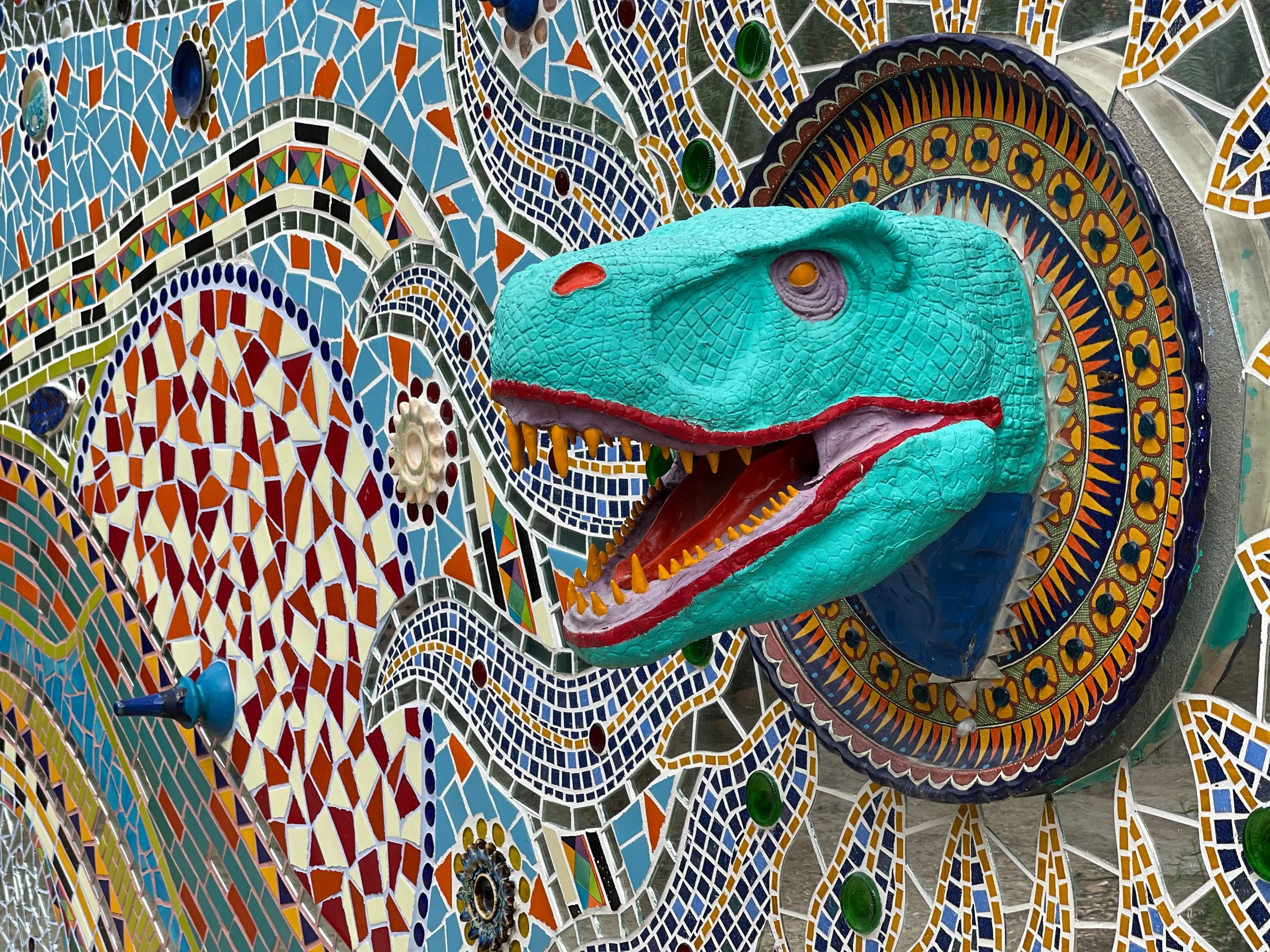

Hubbard Street Murals: Chicago’s Street Art Gallery

Wanna see some cool murals in Chicago? This stretch of Hubbard features street art done by artists from around the world. 

Pilsen or West Loop? Find out where the best murals in Chicago are.

Pilsen or West Loop? Find out where the best murals in Chicago are.

Duke and I are obsessed with street art. We hunt it down and take pics of it wherever we go. 

But, as amazing as it would be to share your art with the world, it also strikes me that it must also be heartbreaking how ephemeral street art can be. Buildings get demolished (or simply change ownership), and the artists have no claim to their work. And how awful it would be to have your work obliterated — which definitely seems to be a trend, at least in Chicago at hip venues like Soho House and the Violet Hour. In many cases, we view murals nowadays as temporary canvases, able to shine all too briefly before they are painted over and another takes its place.

One of Wally’s favorite murals on Hubbard Street

One of Wally’s favorite murals on Hubbard Street

I work near Fulton Market (West Loop is Best Loop, as we say), and on my lunch break, I will often walk along Hubbard Street, from Halsted to Ogden, to admire and photograph the murals. The one downside is that there’s no real path along the street — at times you’ll be trekking through weeds and bushes to see the sights.

Even the underpasses along Hubbard are covered with cool graffiti.

Even the underpasses along Hubbard are covered with cool graffiti.

At first there were many remnants from the ’70s, faded and less artistic than the amazing works done by today’s muralists. But now, every time I pass by, more and more of the original murals have been painted over, replaced by more modern artworks. Hubbard Street acts as an amazing outdoor gallery, an open-air museum of some of the most talented street artists from around the world. 

¡Viva Chicago indeed! A fading luchador mural

¡Viva Chicago indeed! A fading luchador mural

The Hubbard Street murals blow Duke’s mind.

The Hubbard Street murals blow Duke’s mind.

Great street art really packs a wallop for Wally.

Great street art really packs a wallop for Wally.

I caught up with Levar Hoard, chief curator and managing director of the B_Line, a mile-long corridor of public art in Chicago’s Fulton Market District, who was kind enough to answer a few questions for us.

Levar Hoard heads up the Hubbard Street Murals project.

Levar Hoard heads up the Hubbard Street Murals project.

A Q&A With Levar Hoard of the B_Line

Tell us about the original project. When did it begin and what was its mission?

The original founder/curator was Ricardo Alonzo. When the murals started in 1971 (this year is our 50th anniversary), they were dedicated to environmental causes (pollution initially, then endangered animals). That went on to include many concepts like Mexican native art, abstract and other styles.

How did B_Line get involved?

We became the sole curators in 2017 after years of research and negotiation with the private train company that owns the walls (it's not a city project), and we legally assumed the license in perpetuity from Ricardo that was signed in 1971 with the railroad.

How do you find the artists? What’s the process with them?

We fly the world's most renowned artists to Chicago and also find Chicago’s best muralists, and discover new muralists, who we give their first commission to. 

As a privately run and funded organization, we subjectively select artists based on skill level, demonstrated competence with techniques and materials, and aesthetics. 

One of the artists flown in to create a mural

One of the artists flown in to create a mural

How do you decide where each artist is to paint, and when it’s time to paint over an existing mural?

It’s based on the condition of the wall. Most of the murals from 1971 are long gone, and we work to preserve or restore them where possible. Where it’s not possible or worthwhile, we recondition the wall and usher in a new era of art and artists that reflect the time we now live in — the M.O. of street art. 


What’s your favorite thing about the mural project? 

Meeting thousands of people that visit the murals weekly. 


Be sure to check out B_Line’s Instagram feed for video interviews about their many projects and history: @blinechicago.

To learn more about the history of the Hubbard Street Murals, read this Reader article.

We also reached out to a couple of the street artists behind our favorite murals along the stretch of Hubbard. Here are their stories.

Nurture or Nature by the street artist duo Pipsqueak Was Here!!!

Nurture or Nature by the street artist duo Pipsqueak Was Here!!!

A Q&A With Pipsqueak Was Here!!!

The Amsterdam, Netherlands-based street artist duo known as Pipsqueak Was Here!!! told us about their experience with the Hubbard Street Murals:

We were in Chicago for a show with Vertical Gallery and had a few days to play around. Patrick Hull, who runs the gallery, introduced us to Levar Hoard, who curates the B_Line paintings. He helped us out with two ladders, and Patrick provided us with some paint.

We painted a girl holding a duck, a stencil we had with us because we planned to do a mural for the RAW Project, an incredible collective to improve the environment of elementary schools around the USA.

Our painting is called Nurture or Nature. The work, like most of our paintings, is a combination of a child with an animal. We combine these two to depict the relationship between human beings and the remaining natural environment. Most of our work is about how we treat the world and how, in return, it treats us.

Nurture or Nature poses the question, should we protect what is left or should we let nature take its course, whatever the consequences may turn out to be?

We really enjoyed being part of this wonderful project, as we found it incredible to see that they included and restored some of the paintings over 40 years old. It was an honor to contribute to such a rich tradition, and we were really helped by Lavar, Patrick and Margaux Comte, who took photographs while we worked.

We had an overwhelming response to this painting, and it really was fun being able to do something like this on such short notice.

Here’s a short time-lapse video of the mural creation.

The Hubbard Street mural painted by Stinkfish

The Hubbard Street mural painted by Stinkfish

A Q&A With Stinkfish

The artist known as Stinkfish told us: 

I got involved by an invitation by B_Line and through my gallery in Chicago, Vertical Gallery. 

I used a portrait of a girl in a workshop I did in Vienna, Austria. She had the mask because we were using spray paint. 

Then came COVID, and the piece took on another relevance and meaning. 

It was a good experience. It’s a nice place to paint. The project gave me the opportunity to see different styles, techniques and messages in the same place. 


If you’re a fan of murals, you can’t miss the Hubbard Street corridor. This might be a controversial view, but I prefer these murals to those on 16th Street in Pilsen, another legendary stretch of street art in Chicago. With new artists constantly creating works of art, a walk along Hubbard is never quite the same, even just weeks apart. –Wally
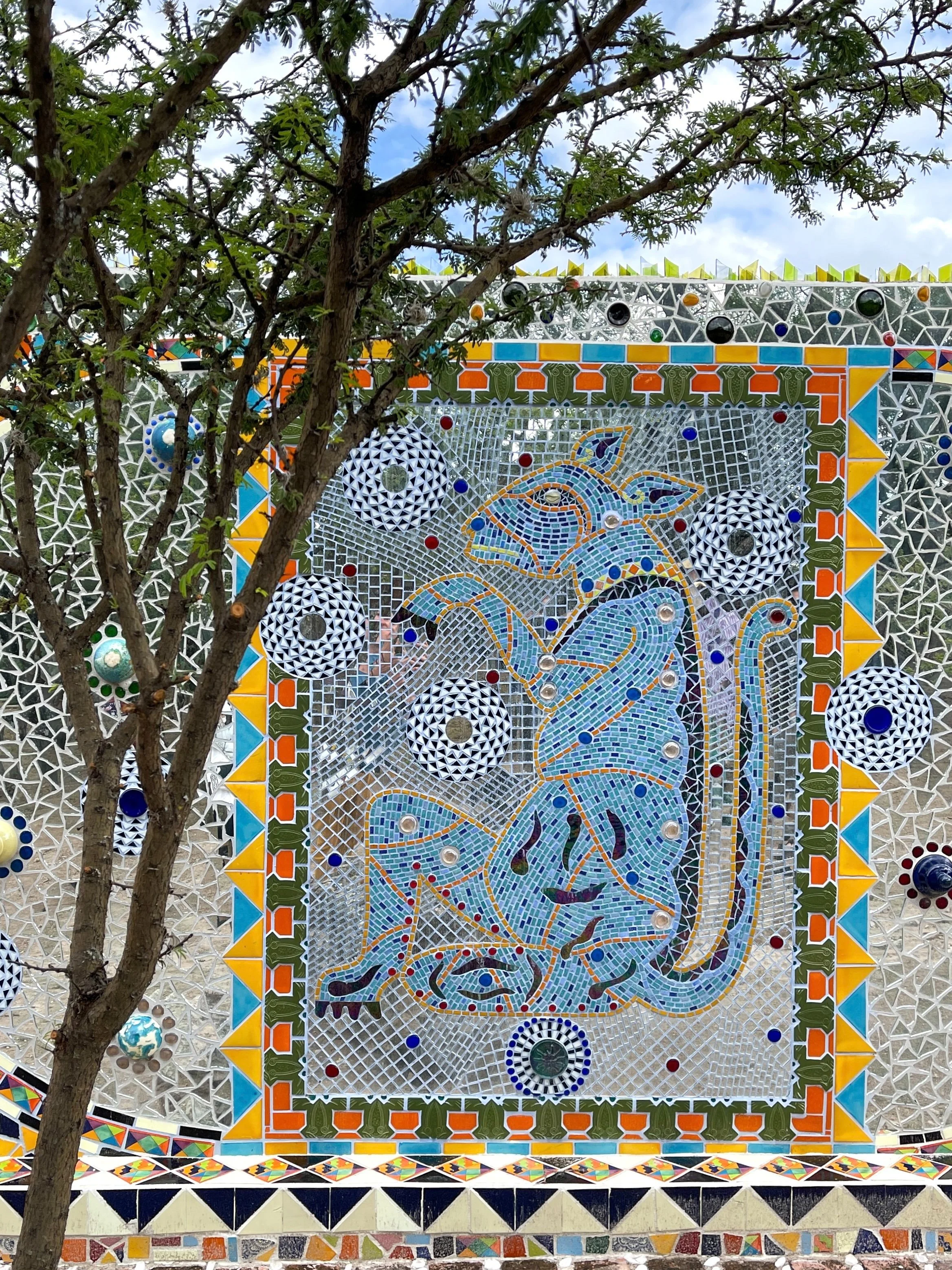
The Male Nude in Art

A virtual tour of the Masculin/Masculin exhibit at the Musée d’Orsay in Paris, including works by Egon Schiele, Kehinde Wiley, Gustave Caillebotte and Pierre et Giles.

Le Berger Paris (The Shepherd Paris) by Jean-Baptiste Frédéric Desmarais, 1787

Le Berger Paris (The Shepherd Paris) by Jean-Baptiste Frédéric Desmarais, 1787

The perfection of the male figure was first seen through the lens of the Ancient Greeks. Their idealized depictions celebrated the male body as a reflection of heroic and athletic beauty. The few female sculptures that existed during this period were clothed and chaste in comparison. 

At some point the male nude fell out of favor, and the female nude became the central subject of objectification. Historically speaking, the typical viewer of artwork was male, and this display of the female physique for pleasure turned the female nude into an accepted object of male desire.
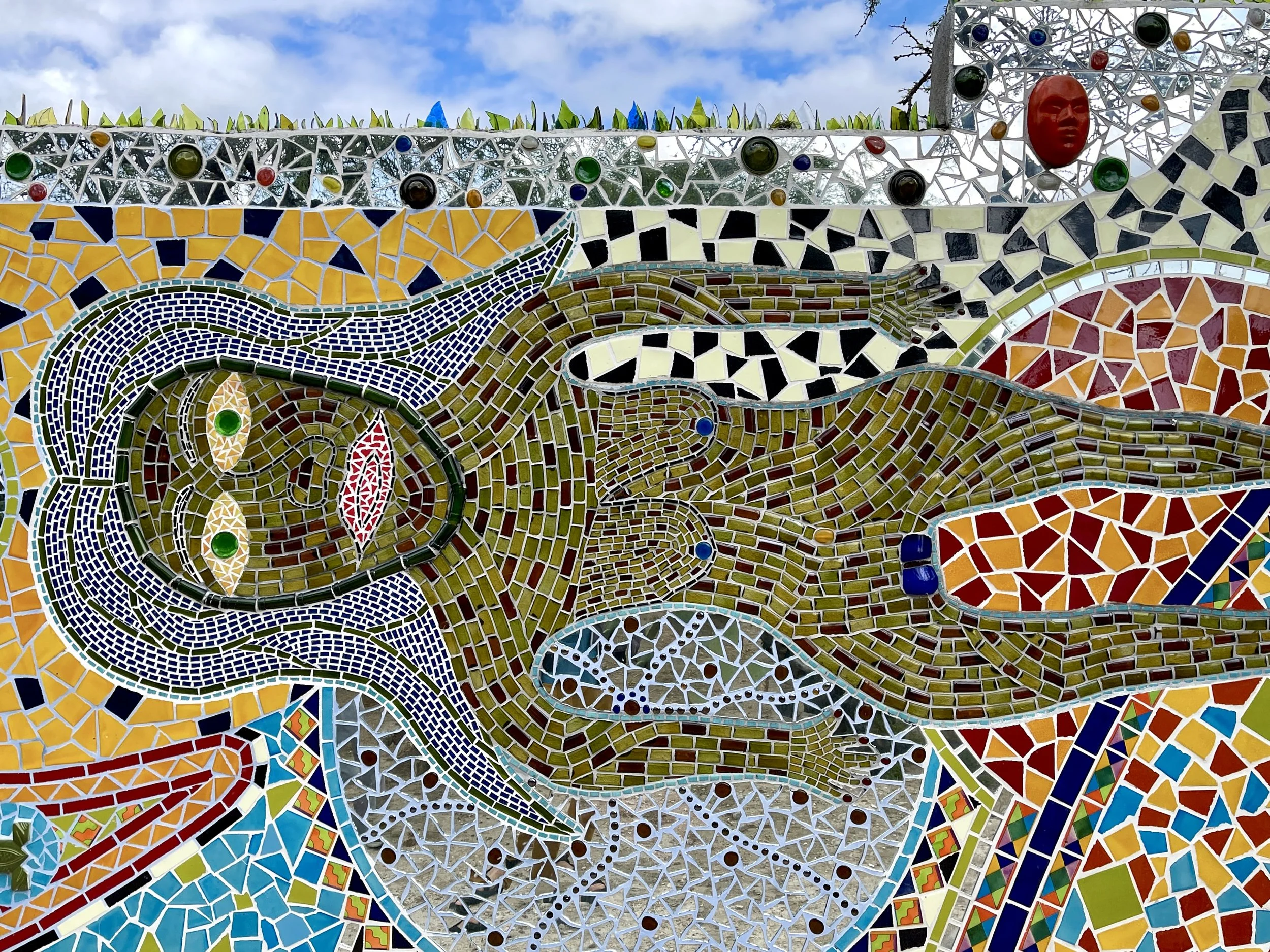
Imagine if you will then, how excited Wally and I were in Paris in the fall of 2013. We had decided to visit the Musée d’Orsay, and saw that its featured exhibit was Masculin/Masculin: L’homme nu dans l’art de 1800 à nos jours (The Male Nude in Art From 1800 to Today). The exhibition ran from September 24, 2013 to  January 2, 2014. 
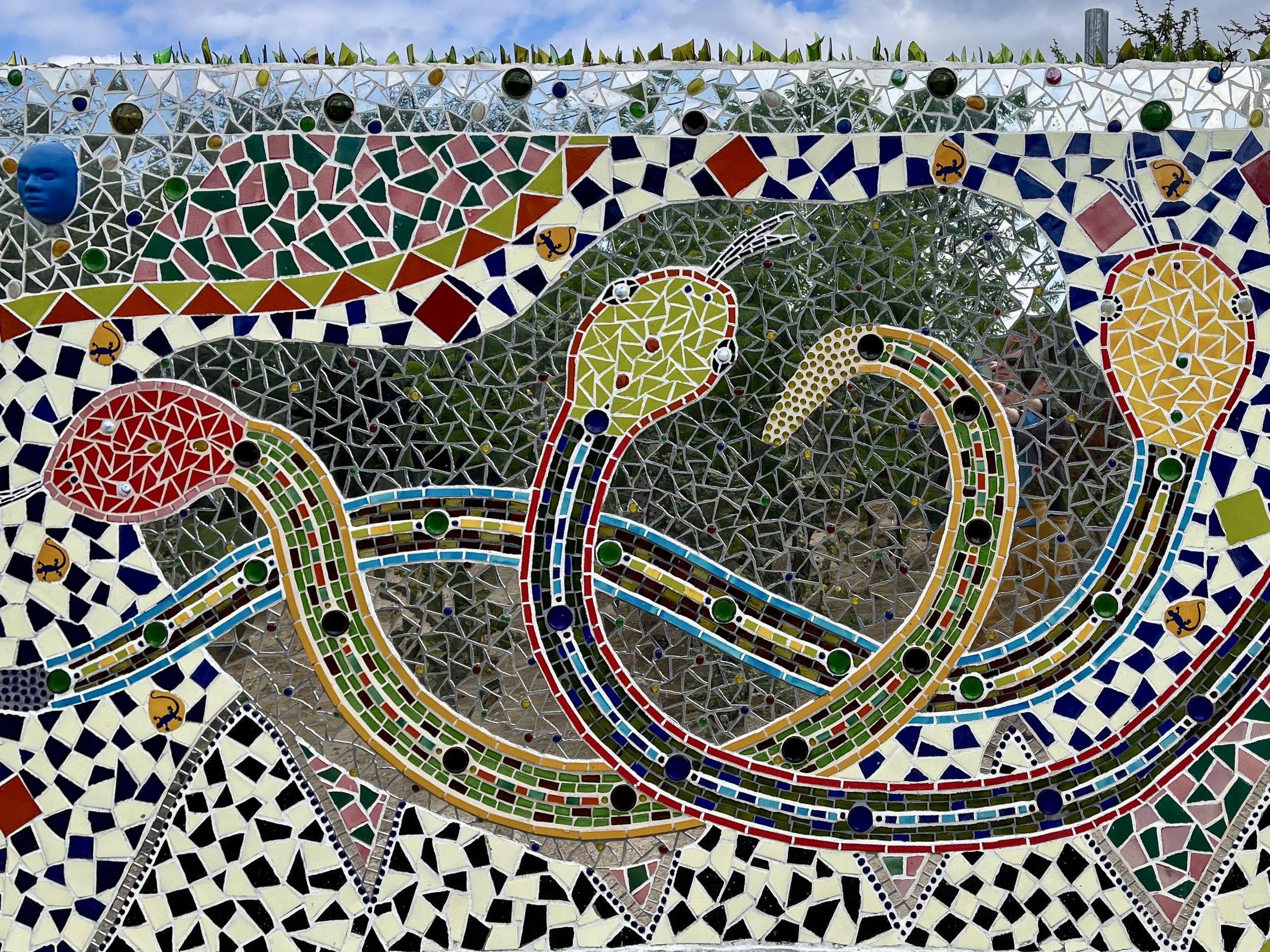
We arrived with Wally’s parents, Dave and Shirley, in tow. When we mentioned that we were excited to see a special exhibit all about the male nude, the Shirl replied, “I don’t need to see that.” Her loss! Though we can’t say we weren’t a bit relieved; seeing galleries full of nude men with your parents could get a little awkward. 

Mercure (Mercury) by Pierre et Gilles, 2001

Mercure (Mercury) by Pierre et Gilles, 2001

Nude Male Art Galleries Galore!

Inside, a larger-than-life banner featured a stylized work of French art photography duo Pierre et Gilles titled Mercure (Mercury), the heroic winged messenger and trickster deity of Roman mythology. 

Please note that, as you can imagine from the title, this post includes images of male nudity. 

Barberini Faun by Edmé Bouchardon, 1726

Faune endormi (Sleeping Faun), a copy of the Barberini Faun, by Edmé Bouchardon, 1726

The Ideal Man

The exhibition is arranged thematically and began by introducing us to “L’Idéal classique, the Classic Ideal.” This concept has existed since the Ancient Greeks chiseled away at marble to depict perfectly sculpted male bodies (pun intended). In my humble opinion, though, these were rarely erotic — sure, they had rockin’ bods, but the statues’ minuscule, flaccid genitalia unappealingly evoke wilted zucchini blossoms.
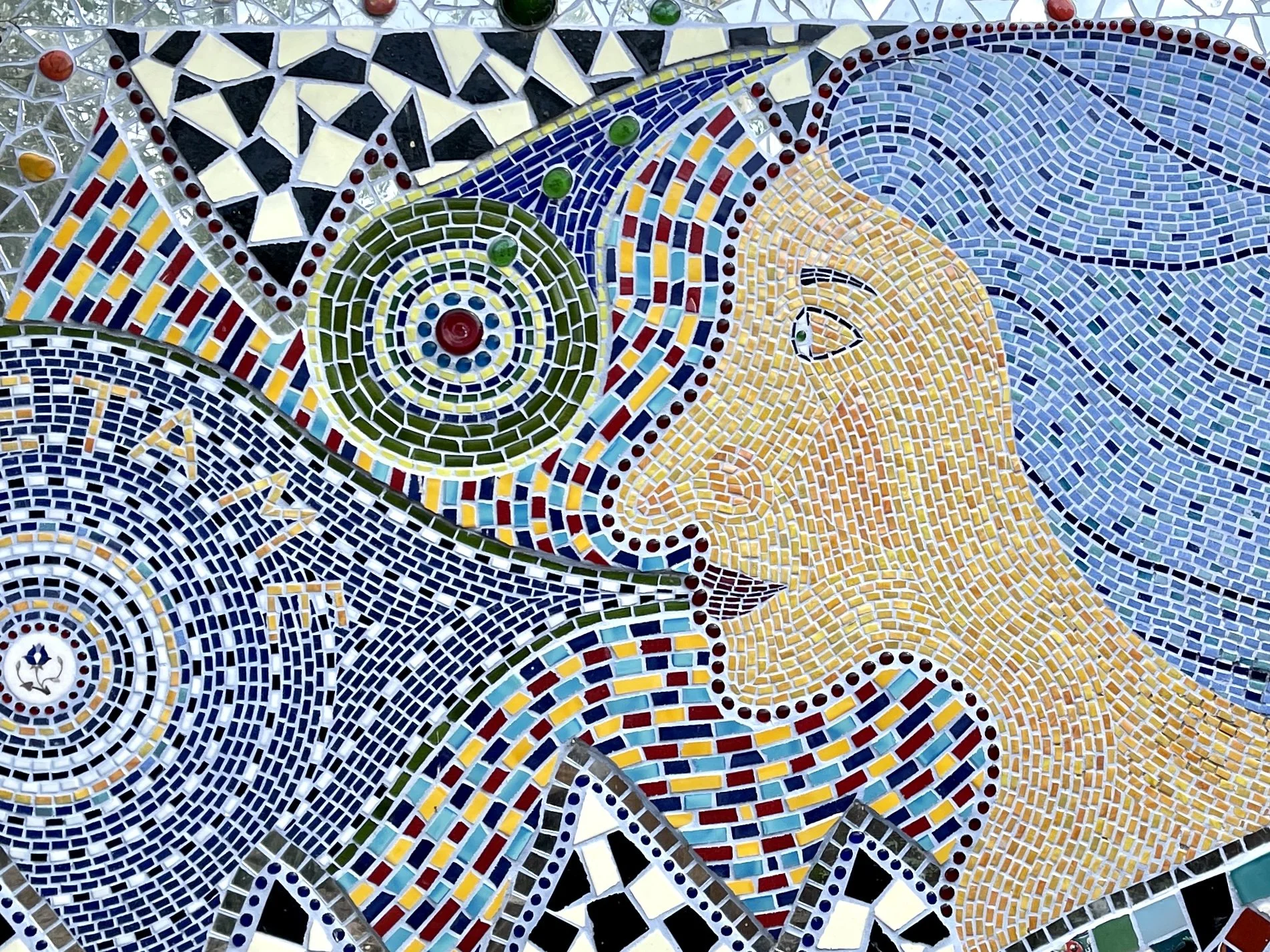
One such exception was the life-size copy of the Barberini Faun by Edmé Bouchardon on loan from the Louvre. I can clearly remember seeing an image of the Barberini Faun projected onto a screen in my college art history class in its erotic, spread-eagled glory. The figure is a satyr, or faun — usually depicted as a creature half-man, half-goat but in this case referencing a follower of Dyionysus, the god of pleasure and wine. 

Seeing the sculpture in person felt voyeuristic — the viewer is allowed to gaze at something forbidden: a man sleeping, or perhaps passed out from all that wine. The nude form is lounging back, with his legs splayed, giving everyone a view of the goods. 

Académie d’homme dit Patrocle (Academy of a Man, Called Patroclus) by Jacques-Louis David, 1780

Académie d’homme dit Patrocle (Academy of a Man, Called Patroclus) by Jacques-Louis David, 1780

One of the first works of art we viewed was Académie d’homme dit Patrocle (Academy of a Man, Called Patroclus) by Jacques-Louis David, from 1780. 

Patroclus was a character from Homer’s Iliad who died fighting the Trojans. The painting was produced by David during his stay in Italy as a Prix de Rome laureate. Turned away from the viewer, the figure's accentuated muscles reminded me a bit of Michelangelo's studies for the Libyan Sibyl, Phemonoe, the finished result of which adorns the ceiling of the Sistine Chapel in Rome. 

Horst in the Pose of an Ancient Greek Horseman by George Hoyningen-Huene, 1932

Horst in the Pose of an Ancient Greek Horseman by George Hoyningen-Huene, 1932

Gods and Heroes

The second theme, “Le Nu héroïque, the Heroic Nude,” also dates back to the Ancient Greeks. It was assumed that a hero had little need for armor, and that the strength of his body was the measure of his worth.

David by Antonin Mercié, 1892

David by Antonin Mercié, 1892

Fléau! (Scourge!) by Henri-Camille Danger, 1901

Fléau! (Scourge!) by Henri-Camille Danger, 1901

Pushing Weights With Two Arms -2 by Eugène Fredrik Jansson, 1913

Pushing Weights With Two Arms -2 by Eugène Fredrik Jansson, 1913

A noteworthy inclusion in this gallery was Pushing Weights with Two Arms -2 by Eugène Fredrik Jansson, a Swedish artist. He began his career painting atmospheric landscapes and cityscapes rendered in shades of blue, but in later years turned his focus to painting male nudes. Jansson became a swimmer and winter bather to combat the chronic health issues he’d suffered since childhood. He often visited Stockholm’s Flottans Badhus, the Navy Bathhouse, where he met sailors who served as the models for his paintings. 

Pushing Weights was a series of paintings by Jansson. In this particular one, a naked athlete stands near a doorway, his gaze fixed on a man, possibly Knut Nyman, Jansson’s “close companion,” lifting a barbell above his head. 

Based upon the homoerotic subtext, it’s possible that Jansson was a closeted homosexual and that the works he produced during this period reveal the strong attraction he felt for his subjects. 

Job by Léon Bonnat, 1880

Job by Léon Bonnat, 1880

The Naked Truth

The third theme focused on “Nuda veritas, sans complaisance, The Naked Truth Without Compromise.” The idea of the authentic nude abandons the conventions of classical perfection to portray the body in realistic accuracy. 

L’Age d’airain (The Age of Bronze) by Auguste Rodin, 1877

L’Age d’airain (The Age of Bronze) by Auguste Rodin, 1877

Homme au Bain (Man at His Bath) by Gustave Caillebotte 1884

Homme au bain (Man at His Bath) by Gustave Caillebotte, 1884

What I like about Homme au bain (Man at His Bath) by Gustave Caillebotte is that it depicts a very private moment. A man is drying himself with a towel after a bath. His back is turned away from the viewer; he is neither posing for the painting nor has any intention of being seen.

David and Eli by Lucien Freud, 2004

David and Eli by Lucien Freud, 2004

The reclining nude male figure with the dad bod depicted in British painter Lucian Freud’s portrait David and Eli is his friend and studio assistant David Dawson. The dog is Eli, one of the artist's beloved whippets. Freud’s late nudes are noted for their uncompromising scrutiny of the human body. The artist utilized a technique known as impasto, where layers of paint and brushstrokes blend and converge to reveal the materiality of the flesh. The oil paint applied to the figure of David and the bedsheet beneath him was Cremnitz white, a type of white lead paint that Freud favored for its luminosity. 

Jeune homme nu assis au bord de la mer (Young Male Nude Seated Beside the Sea) by Hippolyte Flandrin, 1836

Jeune homme nu assis au bord de la mer (Young Male Nude Seated Beside the Sea) by Hippolyte Flandrin, 1836

Vitalism: Naughty by Nature 

“Im Natur, In Nature,” the fourth theme is all about men en plein air, as they say in France. As the 19th century world became increasingly industrialized, academies across Europe favored realistic subjects, and people embraced vitalism, an anti-mechanical return to nature. This movement encouraged male nakedness during outdoor activities, including bathing, as a means to rejuvenate the spirit and increase virility. 

The Fisherman With a Net by Frédéric Bazille, 1868

The Fisherman With a Net by Frédéric Bazille, 1868

There’s an underlying eroticism and intimacy to The Fisherman With a Net by Frédéric Bazille. Whether unintentionally homoerotic or not, the subject in the foreground of the painting is an athletic young man prepared to cast a net into a pond. He’s clearly positioned to show off his “assets” and looks every bit like a modern-day hipster — all that’s missing is a pair of skinny jeans and a PBR. Another man in a state of undress can be seen in the background. 

Mort pour la patrie (Dying for the Fatherland) by Jean-Jules-Antoine Lecomte du Nouÿ, 1892

Mort pour la patrie (Dying for the Fatherland) by Jean-Jules-Antoine Lecomte du Nouÿ, 1892

This Mortal Coil

We continued wandering the galleries until we came to the one titled “Dans la douleur, In Pain,” which focused on the fragile balance of life and death. Man is not immortal; these works of art were a grim reminder of the shortness of life and the frailties of the mind and body. 

Kneeling Nude With Raised Hands (Self-Portrait) by Egon Schiele, 1910

Kneeling Nude With Raised Hands (Self-Portrait) by Egon Schiele, 1910

Egon Schiele is famous for his raw figurative works. A protégée of Gustav Klimt, Schiele had a muse and lover named Walburga “Wally” Neuzil, who had previously modeled for Klimt. Schiele’s color palette and expressive drawings remind me of French artist Henri de Toulouse-Lautrec. Where Lautrec elevated the world of underground nightlife, Schiele’s art was an exploration of the human condition, often depicting the twisted bodies and raw sexuality of his subjects. 

In Kneeling Nude With Raised Hands, Schiele offers himself up to the viewer. The angst of his contorted, angular body, jaundice-colored flesh and red-rimmed eyes certainly questioned the artistic conventions of gender, sexuality and morality of pre-war Vienna. His hands and limbs appear to be pressed firmly against an invisible surface, possibly a mirror, while the negative space outlining Schiele’s form serves as a window for his figure to float in space and time. 

L’Abîme (The Abyss) by Just Becquet, 1901

L’Abîme (The Abyss) by Just Becquet, 1901

La mort d'Hippolyte (The Death of Hippolytus) by Joseph-Désiré Court, 1825

La mort d'Hippolyte (The Death of Hippolytus) by Joseph-Désiré Court, 1825

Homosexuality: The Object of Desire Laid Bare 

The final room explored the theme “L’Objet du désir, The Object of Desire,” and focused on the more contemporary subtext of homosexual desire and objectification. A notice outside stated that some viewers may find the artwork beyond too provocative or offensive — but of course Wally and I found this titillating and weren’t in the slightest bit deterred.
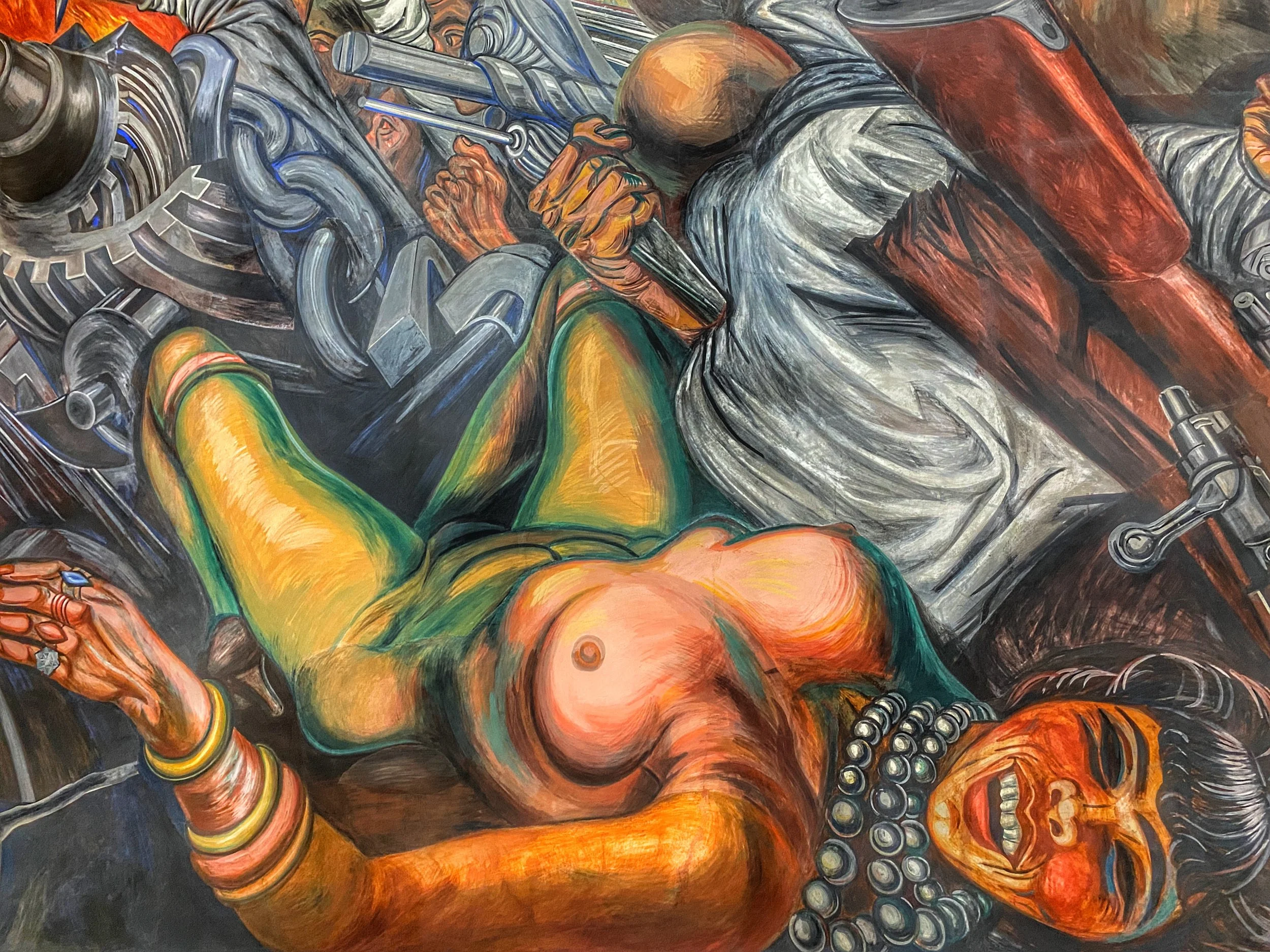
Der Wäger (The Wager) by Arno Breker, 1939

Der Wäger (The Wager) by Arno Breker, 1939

Upon entering the space, we were greeted by a life-size nude male bronze figure by German sculptor Arno Breker. Called Der Wäger (The Wager), the figure stands chest out, looking every bit like a vintage beefcake photo from the 1940s. His hand is placed on his hip in an unintended effeminate manner. The sculptor’s neoclassical style made him a favorite of Adolf Hitler, who felt Breker’s works embodied fascist Nazi ideology. 

Achille by Pierre et Gilles, 2004

Achille by Pierre et Gilles, 2004

David et Jonathan (Jean-Eves et Moussa) by Pierre et Gilles, 2005

David et Jonathan (Jean-Eves et Moussa) by Pierre et Gilles, 2005

La douche, Après la bataille (Shower, After the Battle) by Alexander Deyneka, 1942

La douche, Après la bataille (Shower, After the Battle) by Alexander Deyneka, 1942

La douche, Après la bataille (Shower, After the Battle) by Alexander Deyneka was inspired by a black and white photograph of presumably nude athletes that Soviet photographer Boris Ignatovich had presented to Deyneka. It took the painter five years to complete. The provocative work depicts a group of strapping young men taking a communal shower. The muscular back of an onlooker is seen in the foreground. For me, the painting brings back high school anxieties of showering and sharing the locker room with the wrestling team. There’s a tension between heterosexual aspirations and homoerotic desire. 

Death of Abel Study by Kehinde Wiley, 2008

Death of Abel Study by Kehinde Wiley, 2008

Kehinde Wiley is a contemporary African American artist known for his large-scale paintings that highlight the image and status of young urban Black men in contemporary culture by placing them in scenes that are regal and European in origin. His photorealistic compositions reinterpret classical portraiture and are often combined with layered, vivid ornamental motifs. Gazing at the monumental Death of Abel Study — it measures a whopping 11 feet high by 25 feet wide — I couldn’t help but ask myself, is the man dead, being objectified, or both? 

Incidentally, Wiley was the first Black gay artist selected to paint a presidential portrait. He was commissioned in 2017 to paint a portrait of former President Barack Obama for the Smithsonian National Portrait Gallery.

The Most Beautiful Part of a Man's Body by Duane Michals, 1986

The Most Beautiful Part of a Man's Body by Duane Michals, 1986

Le Sommeil d’Endymion (The Sleep of Endymion) by Anne-Louis Girodet, 1791

Le Sommeil d’Endymion (The Sleep of Endymion) by Anne-Louis Girodet, 1791

There really wasn’t anything too outrageous to be seen as we wandered through Masculin/Masculin, but it was refreshing to view the galleries of traditional paintings, sculptures and contemporary works that examined and objectified men for a change. –Duke