Opened to the public in 2016, Le Jardin Secret pairs Islamic garden design and exotic plantings with the history of a centuries-old medina estate.
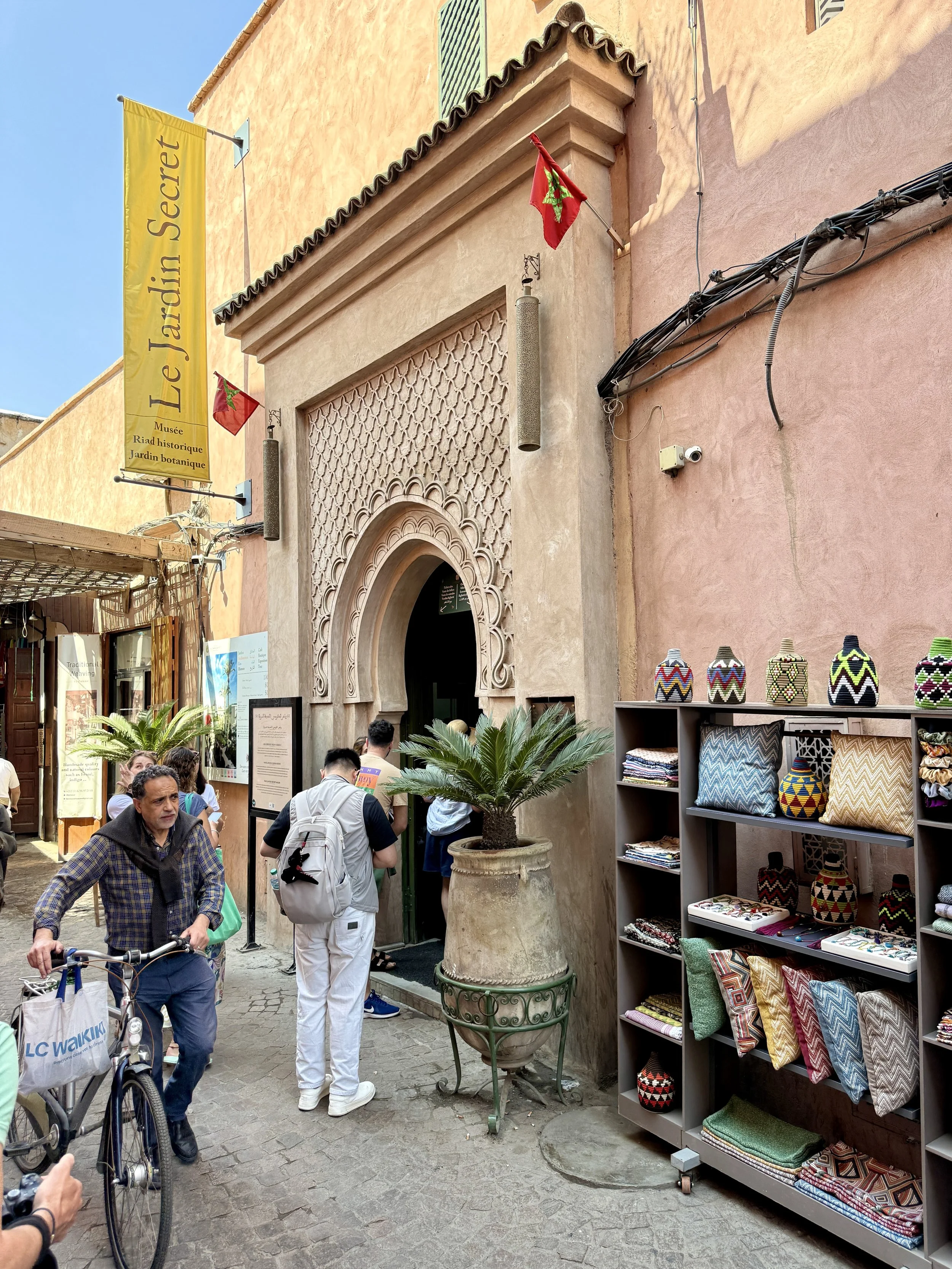
The secret’s out: Le Jardin Secret is no longer a hidden refuge from Marrakech’s crowds. Especially on weekends, lines can stretch down Rue Mouassine.
But step through its unassuming door, and the medina’s rumble gives way to birdsong, running water and the quiet of two historic gardens. It’s one of the many reasons Wally and I keep finding our way back to the seductive Red City.
“The buzz of activity outside fell away almost immediately, replaced by stillness.”
When we first visited Marrakech in 2012, Le Jardin Majorelle in Gueliz was the city’s best-known garden. Created by French painter Jacques Majorelle (hence the name), it had been rescued from a proposed real estate development in 1980, when Yves Saint Laurent and his partner Pierre Bergé acquired the property and set about restoring it.
What we didn’t know then was that plans to restore another historic garden were quietly taking shape within the ancient pisé walls of the medina.
Visitor Information
Le Jardin Secret
- Address
- Le Jardin Secret
121 Rue Mouassine
Marrakech Medina, Morocco - Location
- In the medina’s Mouassine quarter, an easy walk from Jemaa el-Fnaa. Follow the signs along Rue Mouassine.
- Hours
-
Daily, opening at 9:30 a.m.
Closing time varies by season:January–March: 6:30 p.m.
April–September: 7:30 p.m.
October: 6 p.m.
November–December: 5:30 p.m.Last entry is 30 minutes before closing. Hours change during Ramadan, so check before you go.
- Admission
-
Adults: 100 MAD ($11)
Up to age 24: 80 MAD ($9)
Moroccan citizens: 50 MAD ($5)
Under 12: Free
Tower (optional add-on): 40 MAD ($4), or 30 MAD ($3) up to age 24
- Tickets
- Buy at the entrance. Online ticketing may be coming soon, so check Le Jardin Secret’s website before you go.
- Time to allow
- About 1 to 2 hours. Plan closer to 2 if you stop for tea at one of the two cafés or climb the tower.
- About
- A restored 19th-century palace in the heart of the medina, opened to the public in 2017. Two gardens, one Islamic and one exotic, plus a tower with views over the medina and the Atlas Mountains.
- Good to know
-
Go at opening or late in the afternoon for fewer crowds and softer light.
Bags and large items go in the free cloakroom. Outside food and drink aren’t allowed.
Photos and video are for private use only, with hand-held equipment.
Café Sahrij and Café Menzeh both require a garden ticket.
Children under 6 can’t climb the tower.
- Accessibility
- Most of the garden is accessible to visitors with reduced mobility. The tower and one of the two cafés are not. Wheelchair users and their carers enter free.
- Contact
-
+212 667 81 38 68 (WhatsApp)
A Secret History of the Secret Garden
Tucked away in the Mouassine quarter, the Secret Garden’s story begins in the second half of the 16th century. Abdallah al-Ghalib, the second sultan of the Saadian Dynasty, commissioned the district’s mosque, fountain, and hammam, redeveloping the former Jewish quarter into an affluent residential neighborhood attracting tujjar (prosperous merchants) and elite families. He built his palace along Rue Mouassine. Like many of Marrakech’s important buildings, the residence was destroyed at the end of the 17th century, following the fall of the Saadian Dynasty.
Fun Fact: Al-Ghalib was also responsible for the reconstruction of the nearby Ben Youssef Madrasa. Its richly decorated courtyard, intricate zellige tilework, carved stucco and cedarwork make it a masterpiece of religious architecture, which at its height was the largest Islamic college in the Maghreb.
Nearly two centuries later, the complex entered a new chapter when al-Hajj Abd-Allah U-Bihi took possession of the property. A caïd, or powerful provincial official, he built a new palace on the site, largely following the layout of the earlier Saadian complex. His fortunes, however, soon took a dark turn. Suspected of political intrigue, U-Bihi fell from favor with Sultan Mohammed IV and ultimately met his end after drinking poisoned tea.
The property then passed to Moulay Mustapha, a qadi, or judge, who in 1912 exchanged it for a house in Fès belonging to al-Hajj Muhammad Loukrissi, a skilled watchmaker who had served as chamberlain to Sultan Moulay Abd al-Hafiz.
Loukrissi moved into the palace, where he lived with his three wives and numerous offspring until his death in 1934. The property was then divided among his many heirs, and without a single owner to maintain it, gradually fell into ruin.
Uncovering the Past at the Secret Garden
Decades later, the imposing blind wall and unassuming wooden door across from Café Arabe piqued the curiosity of Lauro Milan, an Italian entrepreneur who had made Marrakech his home and owned the restaurant opposite. When Milan, and his business partner, Sante Giovanni Albonetti, finally gained access, they found the grounds buried in rubble and debris, with a scattering of makeshift dwellings occupying the site. What followed was years of patient work: tracking down the more than 130 owners who held claims to the property and negotiating to reunite their shares under a single ownership.
Only then could the real excavation begin. Local workers cleared away the later-built domestic structures and decades of accumulated debris, gradually revealing the outlines of the original gardens, their paths, water basins, and, running beneath them, the remains of the estate’s khettara, part of the network of underground galleries that had once carried groundwater by gravity from the foothills of the Atlas Mountains to the city’s mosques, hammams (public baths), fountains and grand houses.
These discoveries informed the restoration that followed. In 2013, recognizing its potential, Milan and Albonetti brought in Marrakech-based architect Karim El Achak and British garden designer Tom Stuart-Smith, who drew on the archaeological evidence and traditions of Islamic garden design to overhaul the site. After three years of meticulous work, the restored property was reborn and opened its doors to the public for the first time in 2016.
Visiting Le Jardin Secret
Fast forward to today, and the gardens are clearly no longer a secret. Lines can stretch down the street, so to beat the crowds, we arrived shortly after opening on a weekday. After passing through the entrance on Rue Mouassine, we emerged into the reception pavilion, where we purchased our tickets.
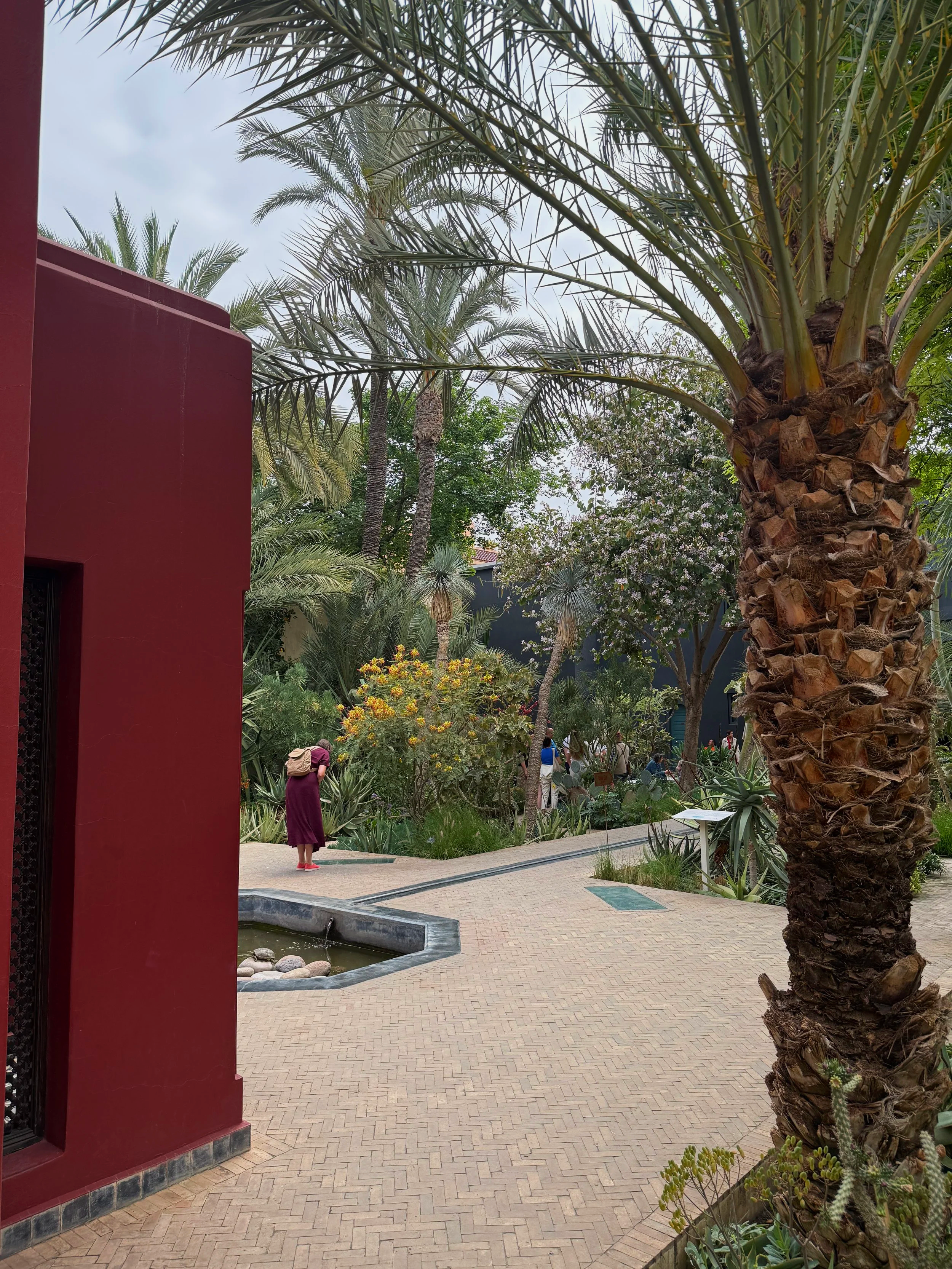
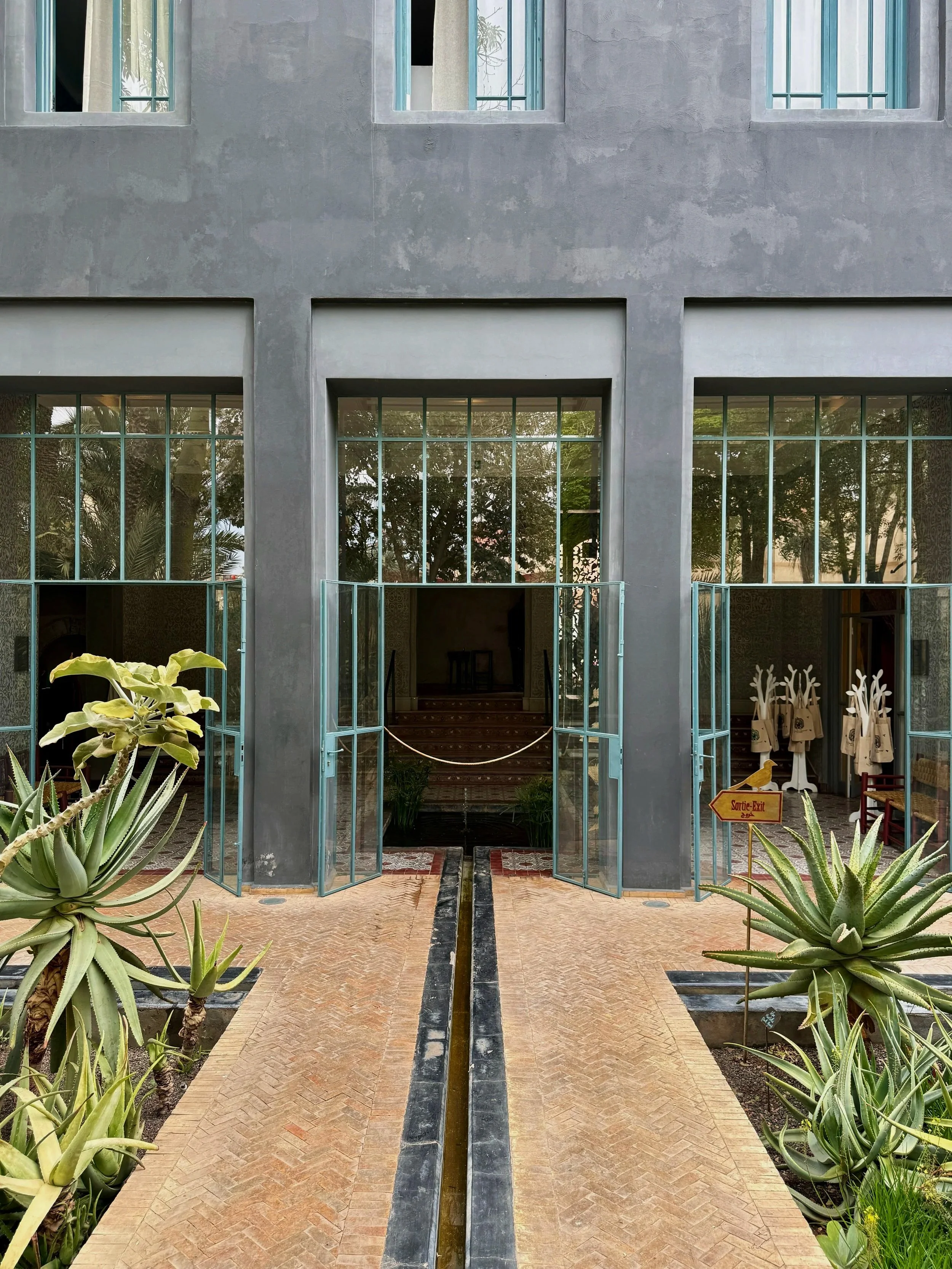
At the garden’s entrance, the slate gray reception pavilion’s clean geometry and steel-framed casement windows felt deliberately modern beside the historic structures beyond. A narrow water channel called a rill traces the garden’s central axis toward the red ochre pavilion at the far end.
New Roots: Le Jardin Exotique
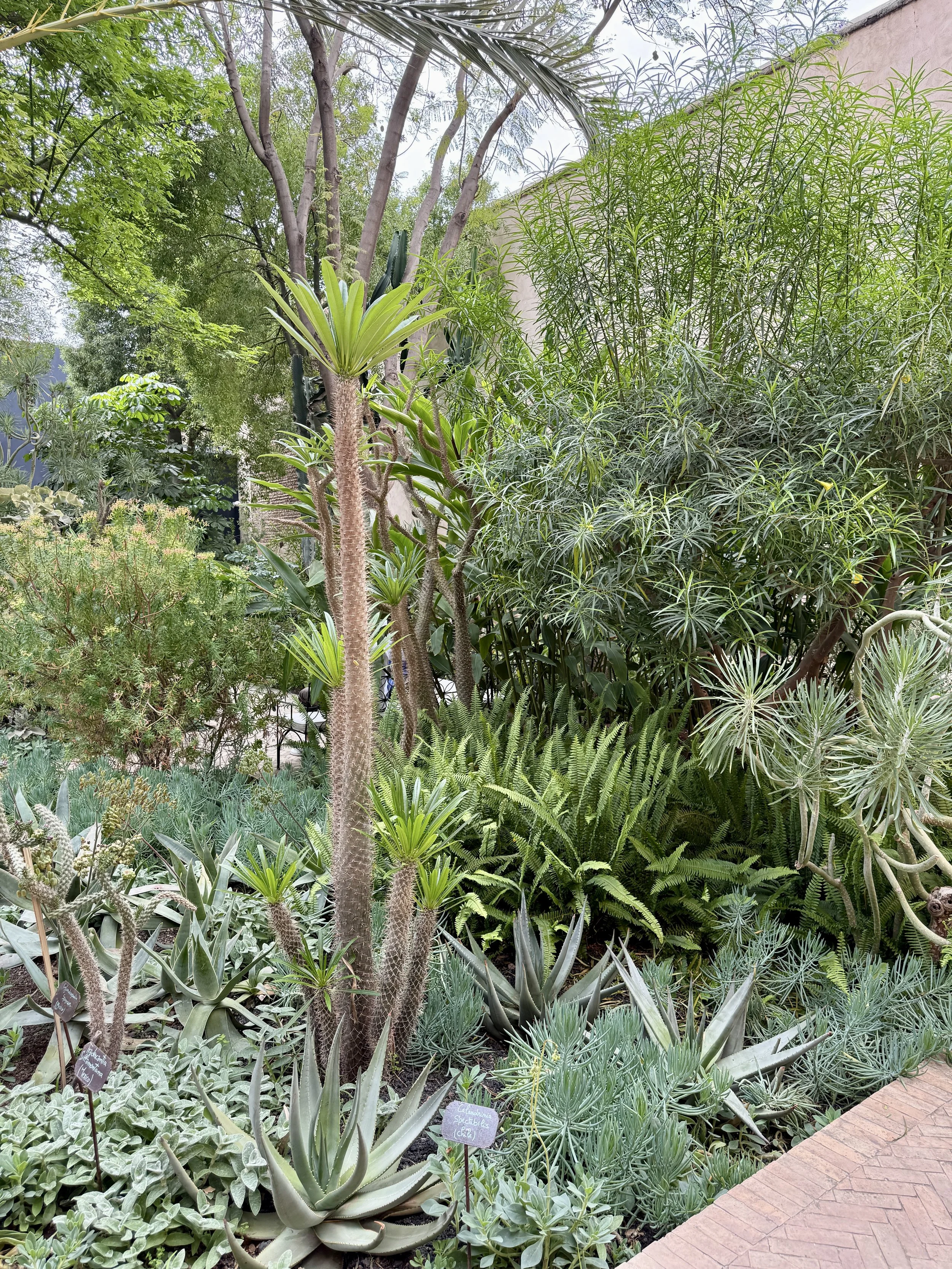
The green spaces at Le Jardin Secret are divided into two parallel gardens: the smaller Exotic Garden and the larger Islamic Garden. The former is filled with plants from around the world, including species from Mexico, South Africa, Brazil, Madagascar, the Canary Islands and Australia. Because little was known about the original appearance of this garden, Stuart-Smith had greater creative freedom to reimagine it as wilder and more organic.
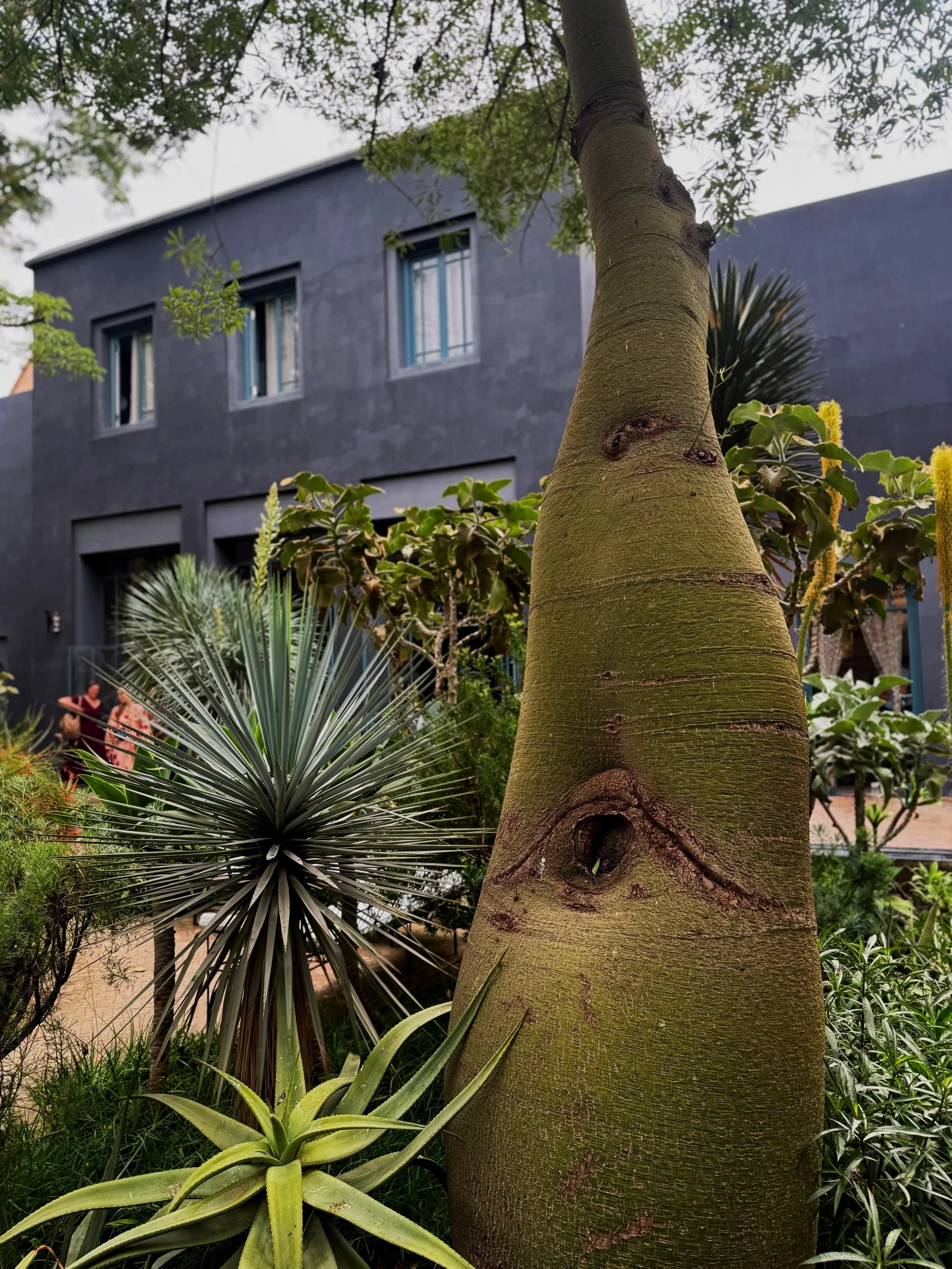
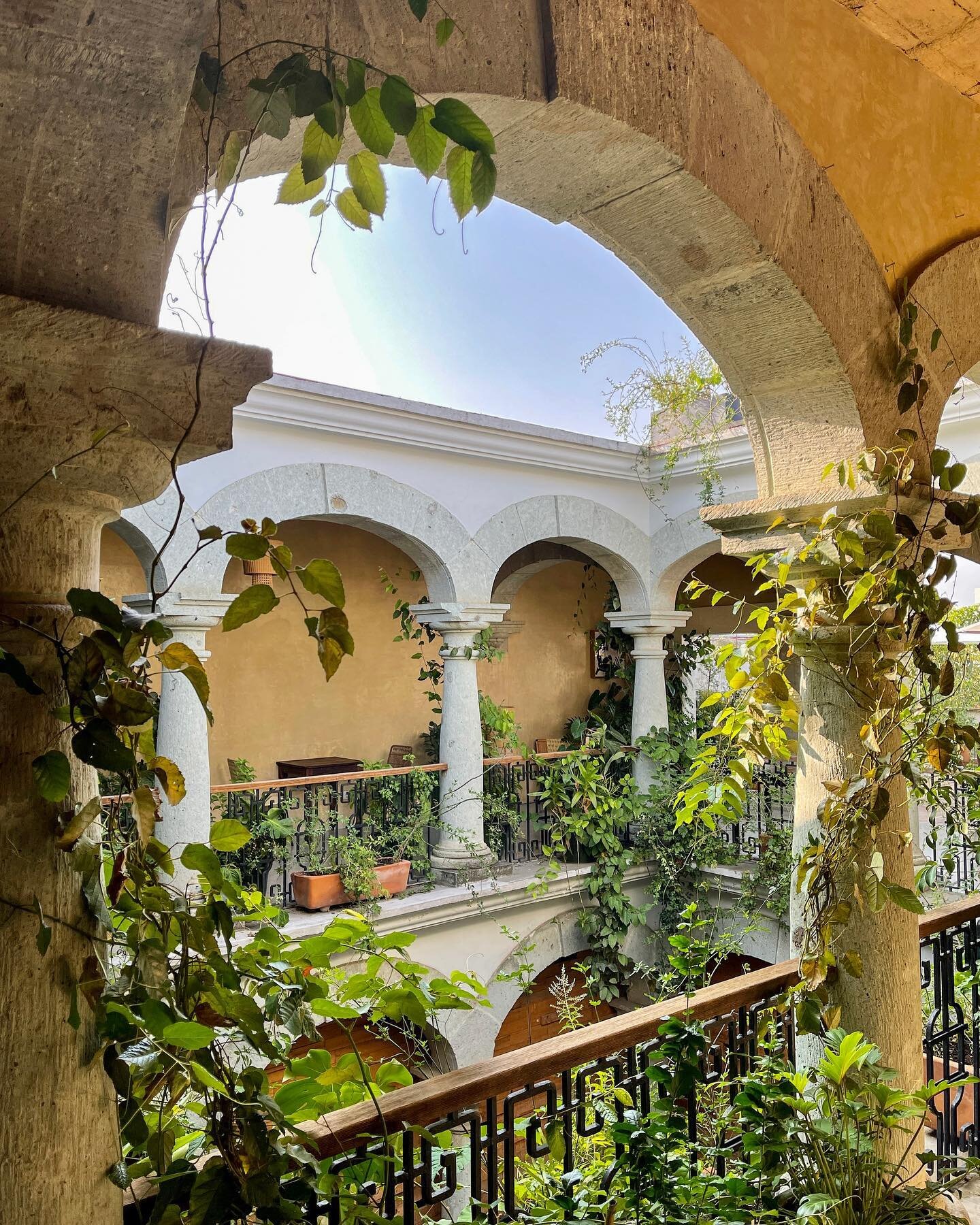
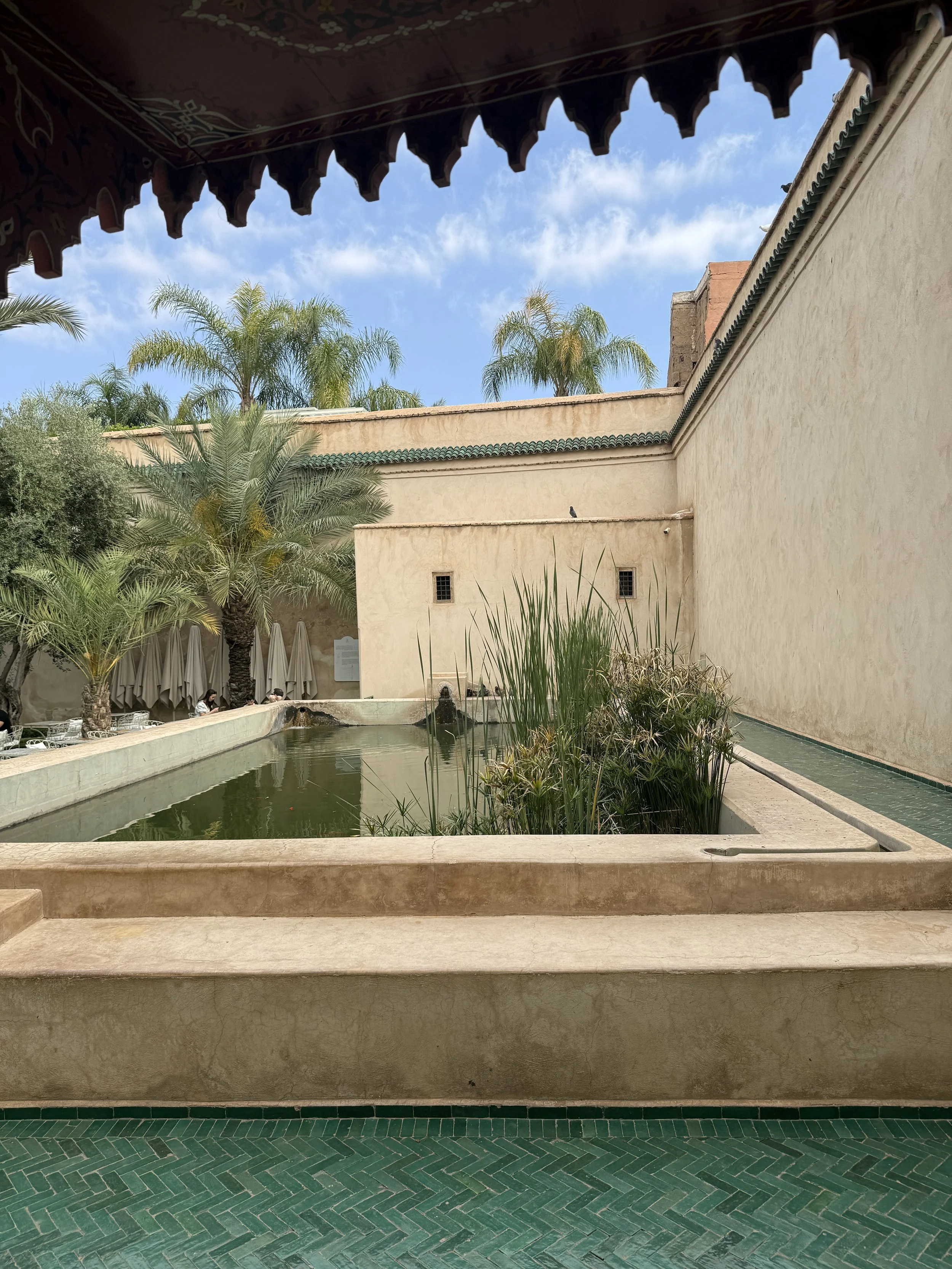
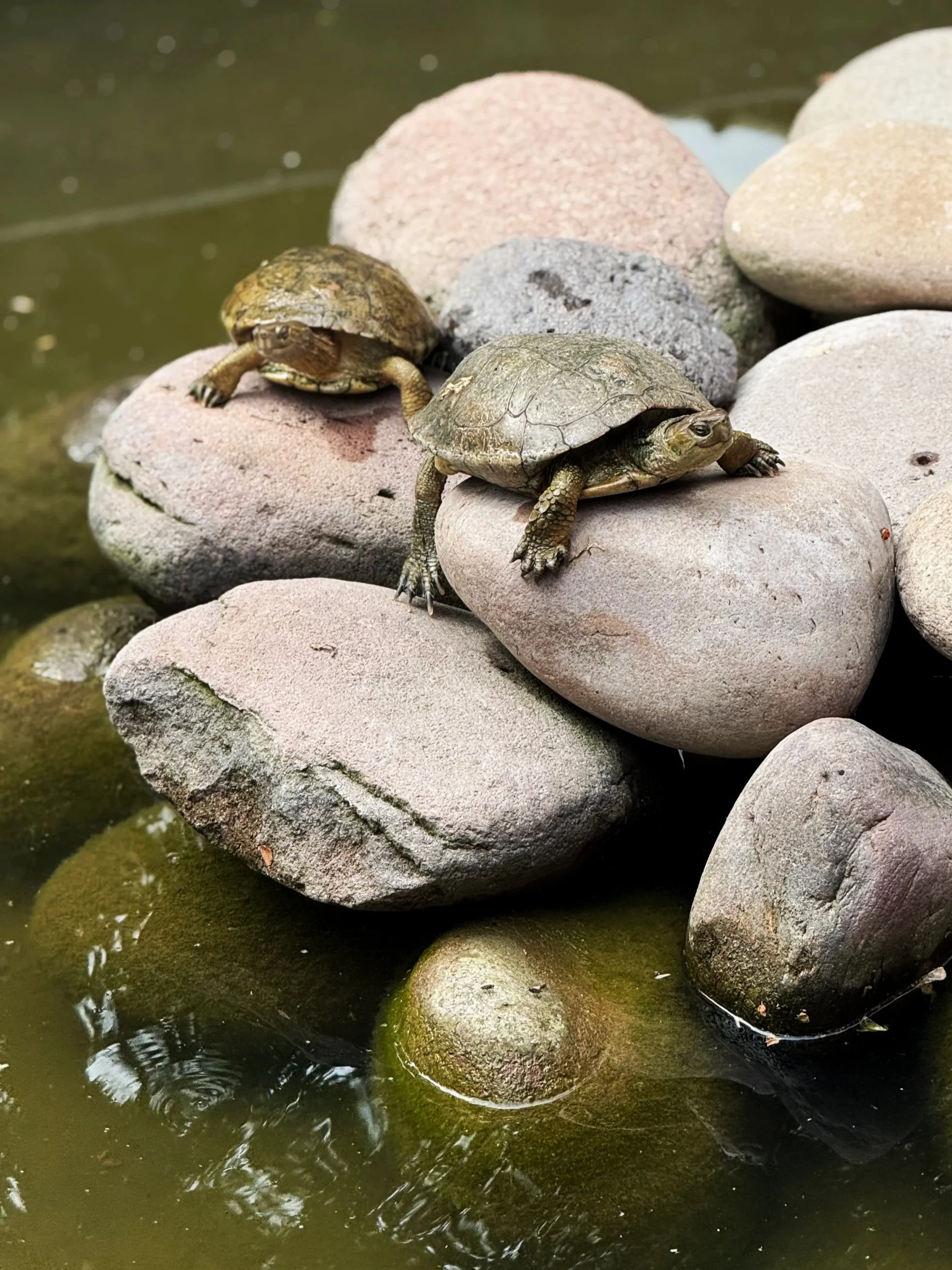
Laid out in a grid, the cloister-like paths encircling the courtyard were paved with bisque-colored bejmat tiles set in a herringbone pattern. Against this orderly framework, graceful ornamental grasses soften the composition, growing alongside sculptural succulents, flowering trees and a pair of mature date palms that predate the restoration. The rill from the reception pavilion empties into a small pool, where a pair of turtles warmed themselves in the morning sun.
During excavation, the foundations of a previous structure were uncovered, and the decision was made to build a contemporary pavilion directly on top of them. With no historical evidence of what the original building looked like, the pavilion is a modern interpretation rather than a reconstruction. It also marks the transition between the lush planting of the Exotic Garden and the more formal symmetry of the Islamic Garden. We followed the short, staggered passageway into the larger garden beyond, where the restored cruciform layout was informed by the traditions of Islamic garden design.
Before heading to the Islamic Garden, be sure to follow the path on the right to peek into the former hammam. Though only fragments of the original structure survive, they offer a glimpse of the luxury and refinement that once characterized life in this grand estate.
Heaven on Earth: The Islamic Garden
Species from the Mediterranean, North Africa and Persia are planted here, reflecting the principles of the chaharbagh, or four-part garden plan, organized around intersecting water channels and a central pool or fountain. Its form can be traced back to the royal gardens of Pasargadae, which contain the earliest known surviving example of a formal Persian garden, commissioned by Cyrus the Great in the 6th century BCE.
Centuries later, with the rise of Islam, this ancient form was given new meaning, evoking the four gardens and rivers of Paradise described in the Qur’an, each with its own fountain and fruit-bearing tree. The number four also carries cosmological significance, representing the cardinal directions, the four elements and the four seasons. Together, these associations transformed the garden into a symbolic image of earthly order and heavenly paradise.
Fun fact: The word paradise comes from pairidaeza, an old Iranian/Avestan word meaning “walled enclosure,” a term associated with the enclosed gardens of ancient Persia.
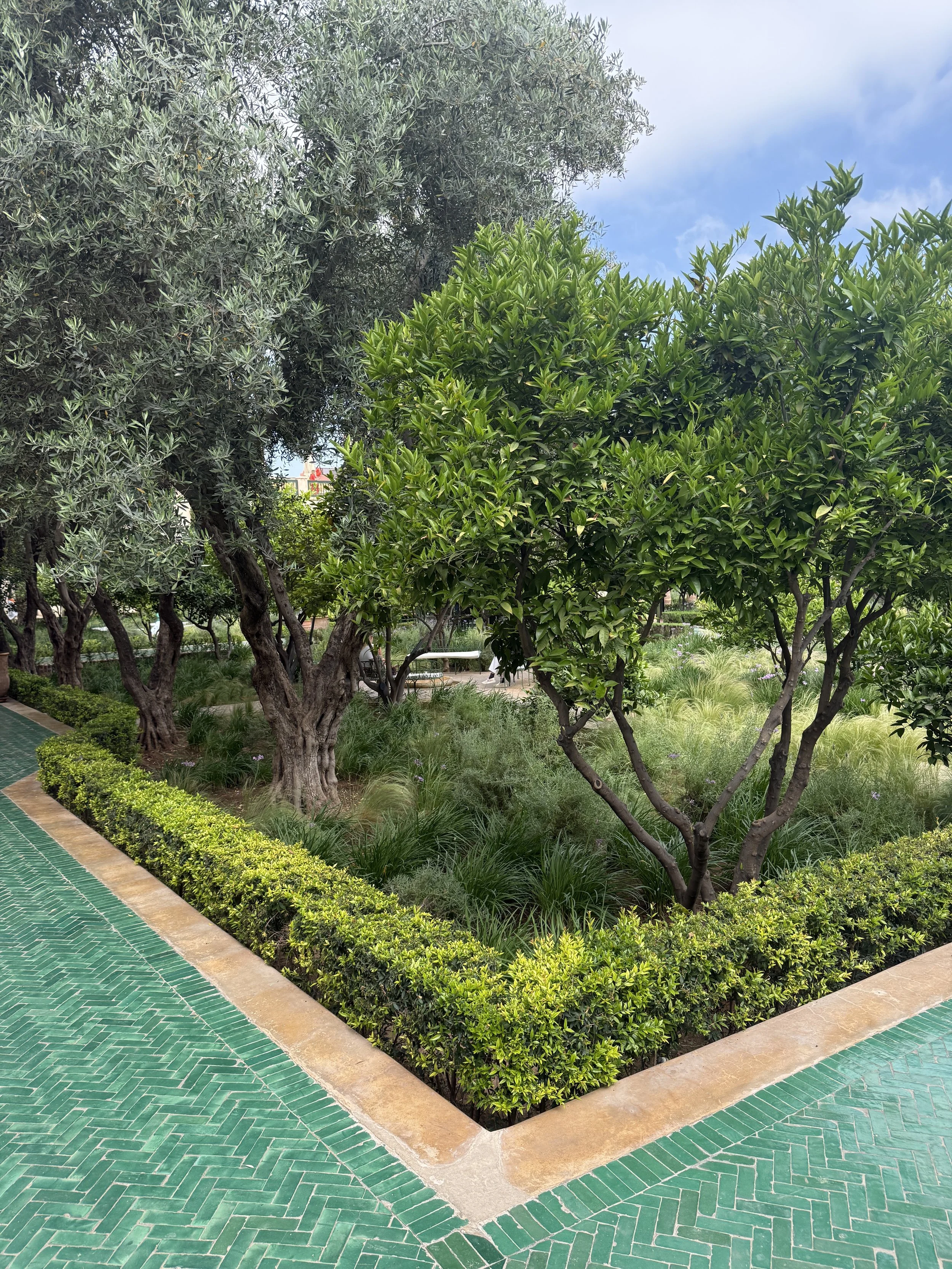
At Le Jardin Secret, each quadrant honors this tradition, planted with the classic quartet of trees: fig, olive, date palm and pomegranate. Stuart-Smith supplemented these with orange, lemon and argan trees, drawing on their broader symbolic and practical importance in Moroccan gardens.
Beneath the trees, rosemary forms a low, drought-tolerant hedge. Elsewhere, lavender, California poppy and society garlic weave through a mass planting of Mexican feather grass, creating a meadow-like effect that recalls the Persian bustan, a fragrant garden or orchard where fruit trees are underplanted with flowers and herbs.
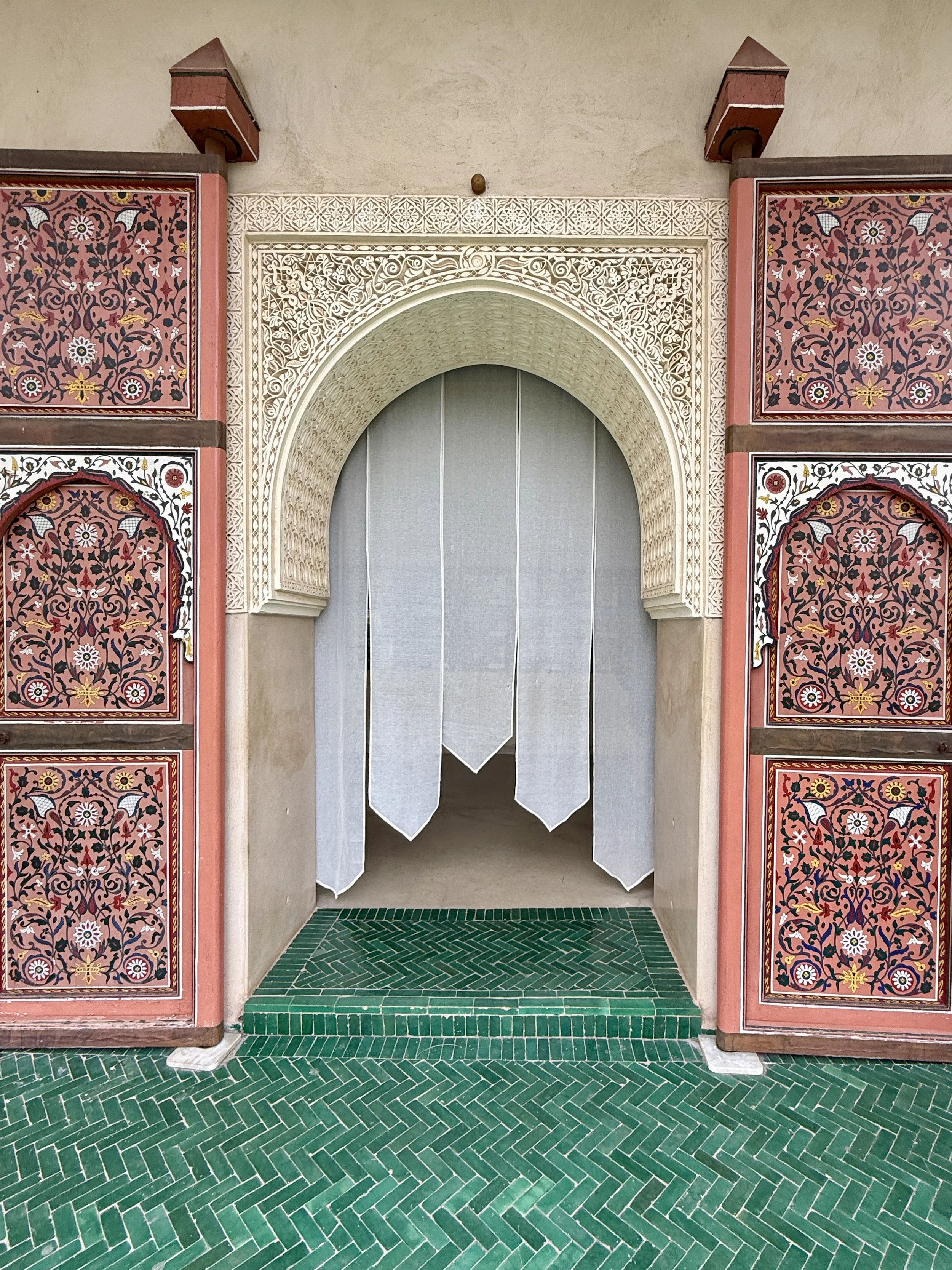
Hbiqa Pavilion
One of two buildings in the Islamic Garden, the Hbiqa Pavilion stands at the eastern end of the second courtyard. At the opposite end, the Oud El Ward Pavilion and its tower anchor the enclosure.
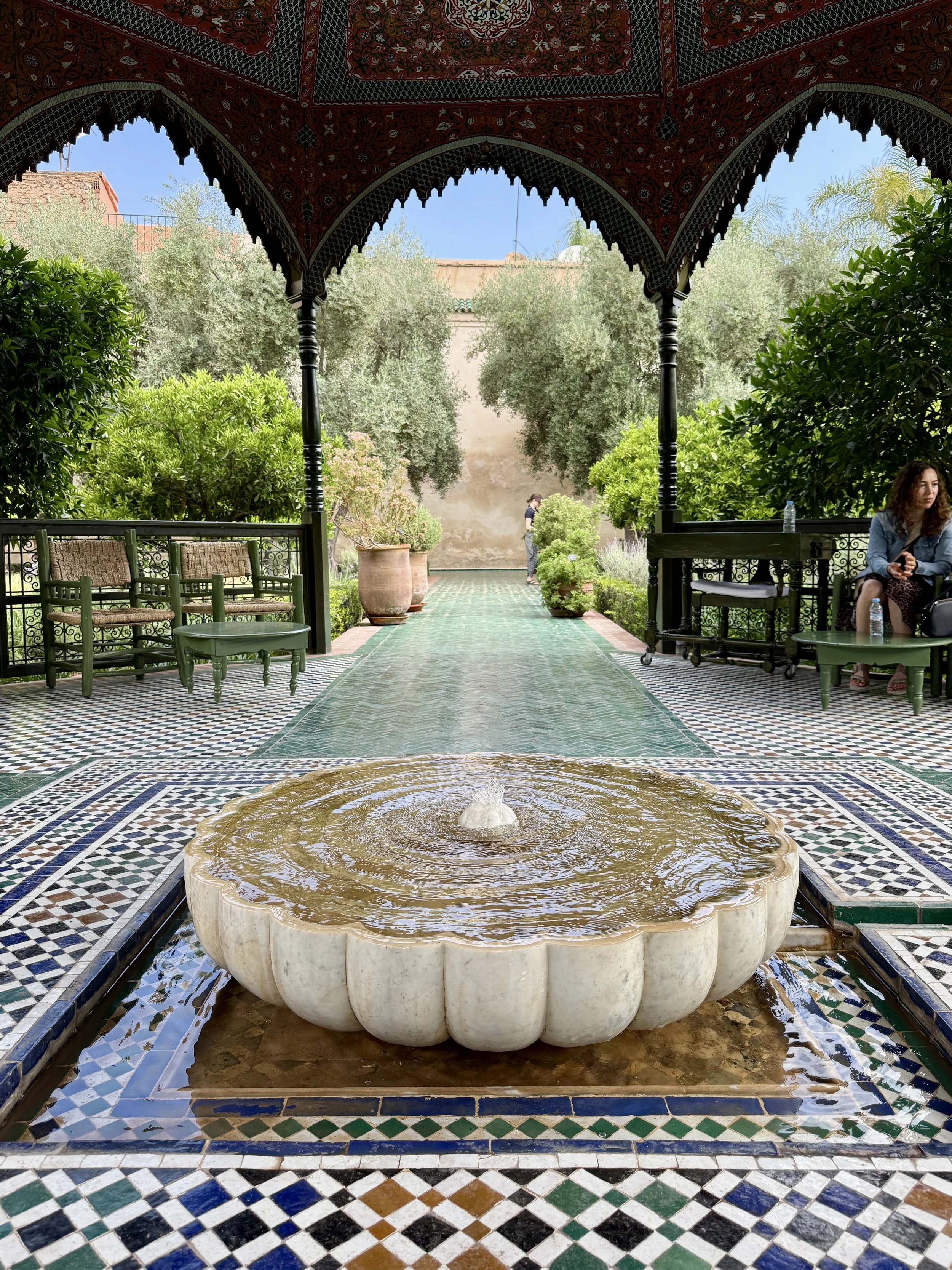
Like the reception pavilion in the Exotic Garden, a central path and rill link the pair. However, here the path is paved with shimmering blue-green glazed bejmat tiles bordered in red brick.
The Hbiqa Pavilion once served as the private living quarters of Loukrissi’s second wife, whose name means “Basil” in Arabic, and today serves a different purpose as a grand hall holding a photographic exhibition documenting the restoration of the riad and its gardens.
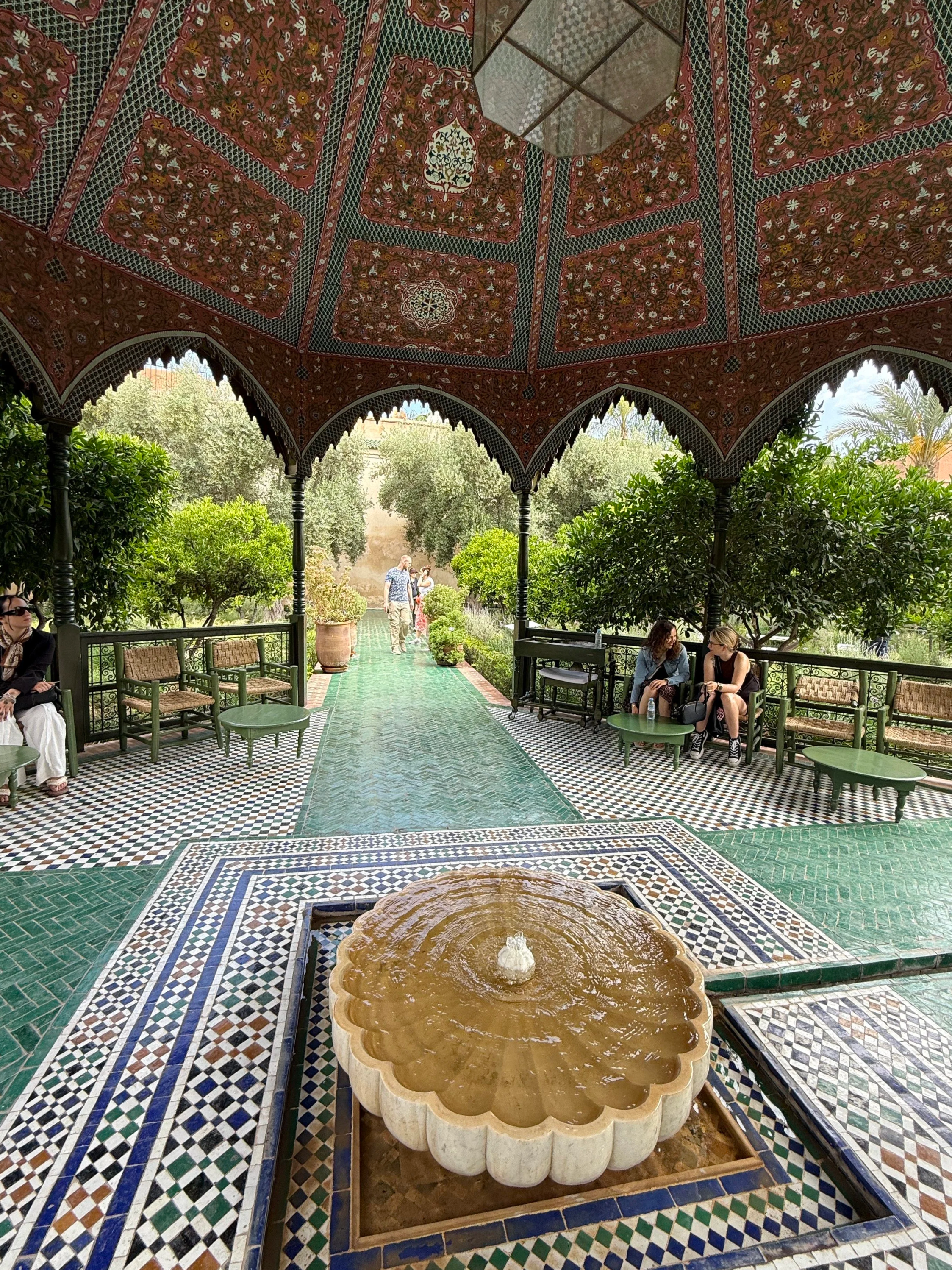
A gazebo rises from the center of the courtyard, directly over the principal fountain: a khossa, a scalloped marble basin set where the garden paths converge. Multicolored zellige tiles, arranged in a repeating lozenge pattern, border the shallow bowl. The fountain’s placement reflects a broader principle of Islamic garden design, where water at the center of a garden’s quadrants symbolizes the source of life and the four rivers of Paradise.
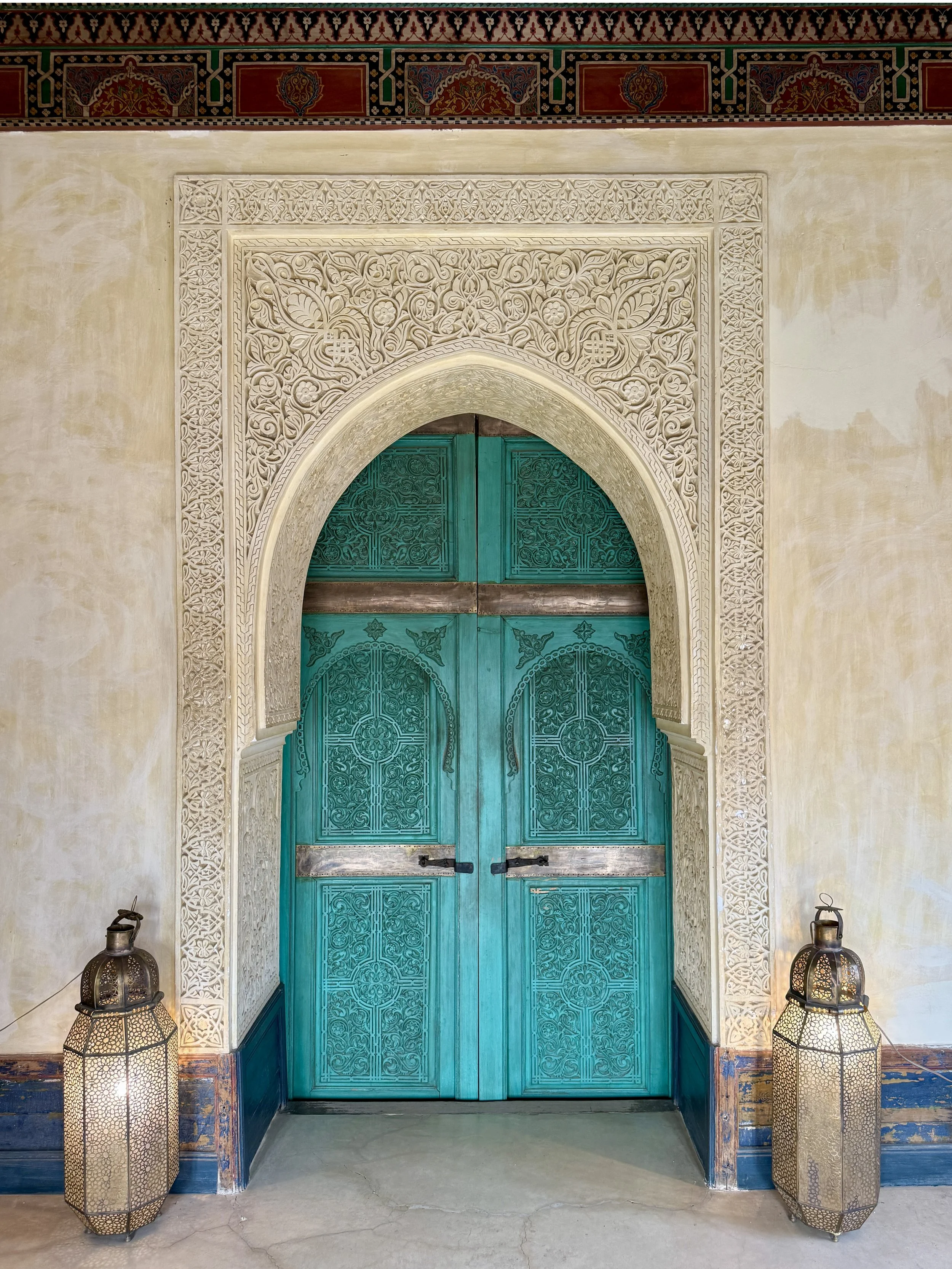
Kiss From a Rose: The Oud el Ward Pavilion
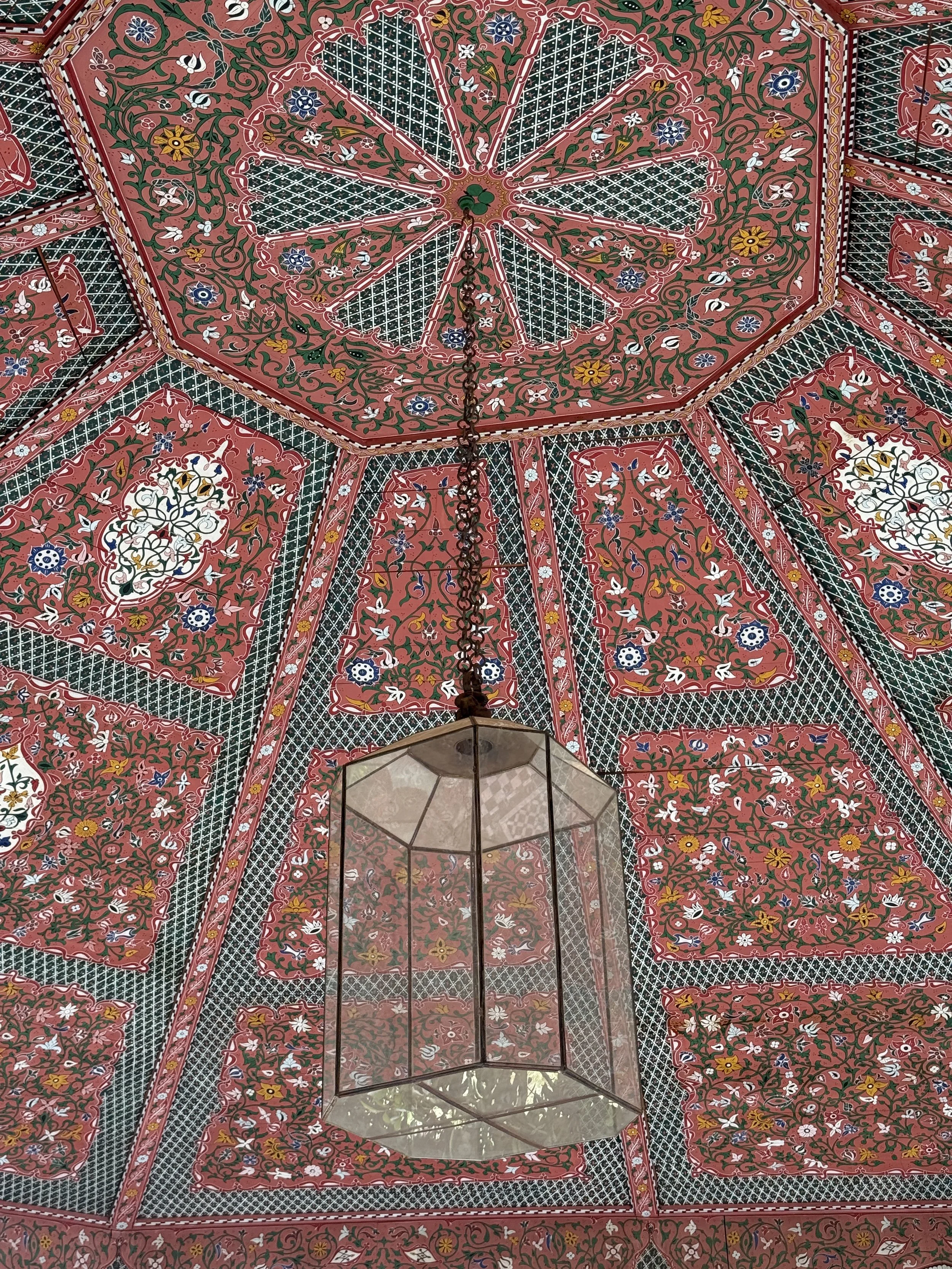
After sitting beneath the gazebo canopy and admiring its hand-painted ceiling, Wally and I continued across the courtyard toward the majestic Oud el Ward Pavilion. The largest of the garden’s structures, it’s named for another one of Loukrissi’s wives, Oud el Ward, whose name translates as “Rosewood.” The ground floor features a hall displaying artifacts uncovered during excavations, along with a video explaining how the garden’s khettara system works.
An unmissable feature of the pavilion is its attached tower. Rising 56 feet (17 meters) above the garden, it stands roughly as tall as a four-to-five-story building. Historically, towers of this height were rare within the medina, apart from minarets, and its scale would have been a conspicuous display of Loukrissi’s prestige and wealth.
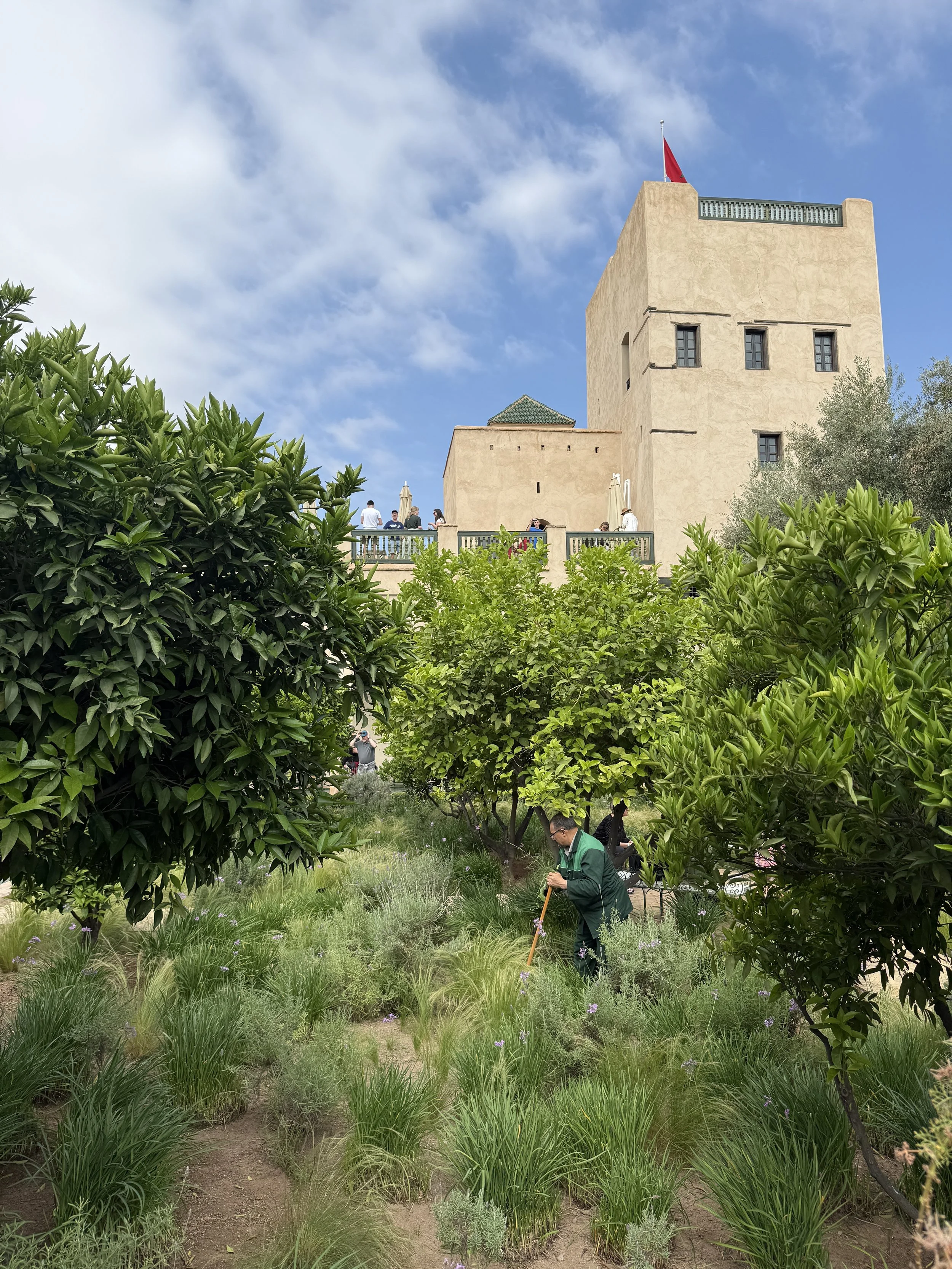
We bought tickets to tour the tower along with general admission, having read that it offered panoramic views of the city. Tours are every 15 minutes and we didn’t have to wait long before the guide came back from his last tour.
We followed him and climbed the tower stairs, arriving in a spacious room that served as Loukrissi’s reception room. The spacious chamber had a pair of intricately carved doors and ceiling hand-painted using a technique known as zouak. Our guide explained that each color carried a meaning: green for Islam, blue for spirituality and the sky, and white for purity.
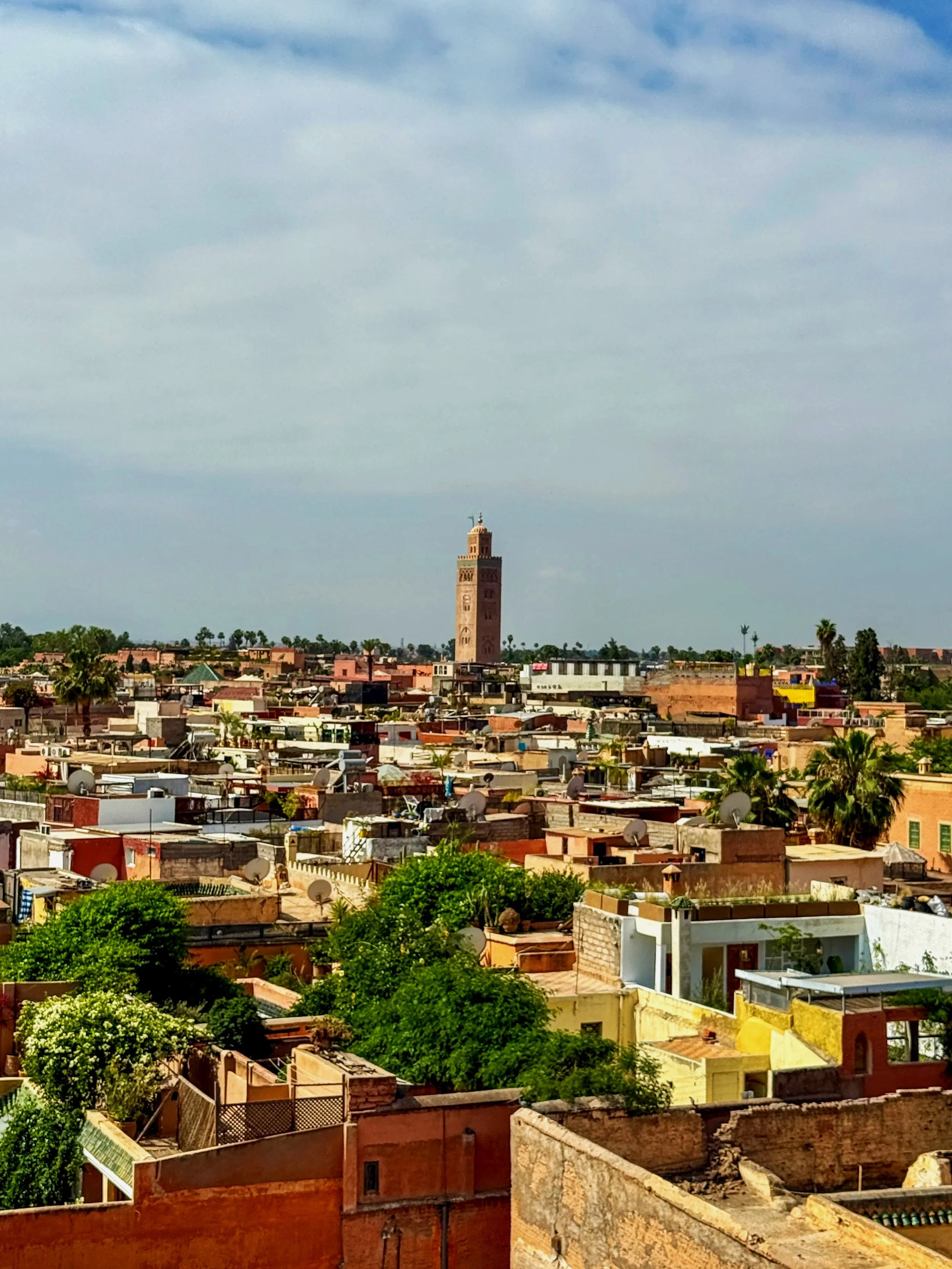
From the top, we were treated to sweeping views of the Mouassine quarter and the snow-capped peaks of the Atlas Mountains. Our guide pointed out the green-tiled rooftop of the Dar al-Makhzen, the official residence of the king of Morocco, as well as the Bulgari family’s opulent private riad.
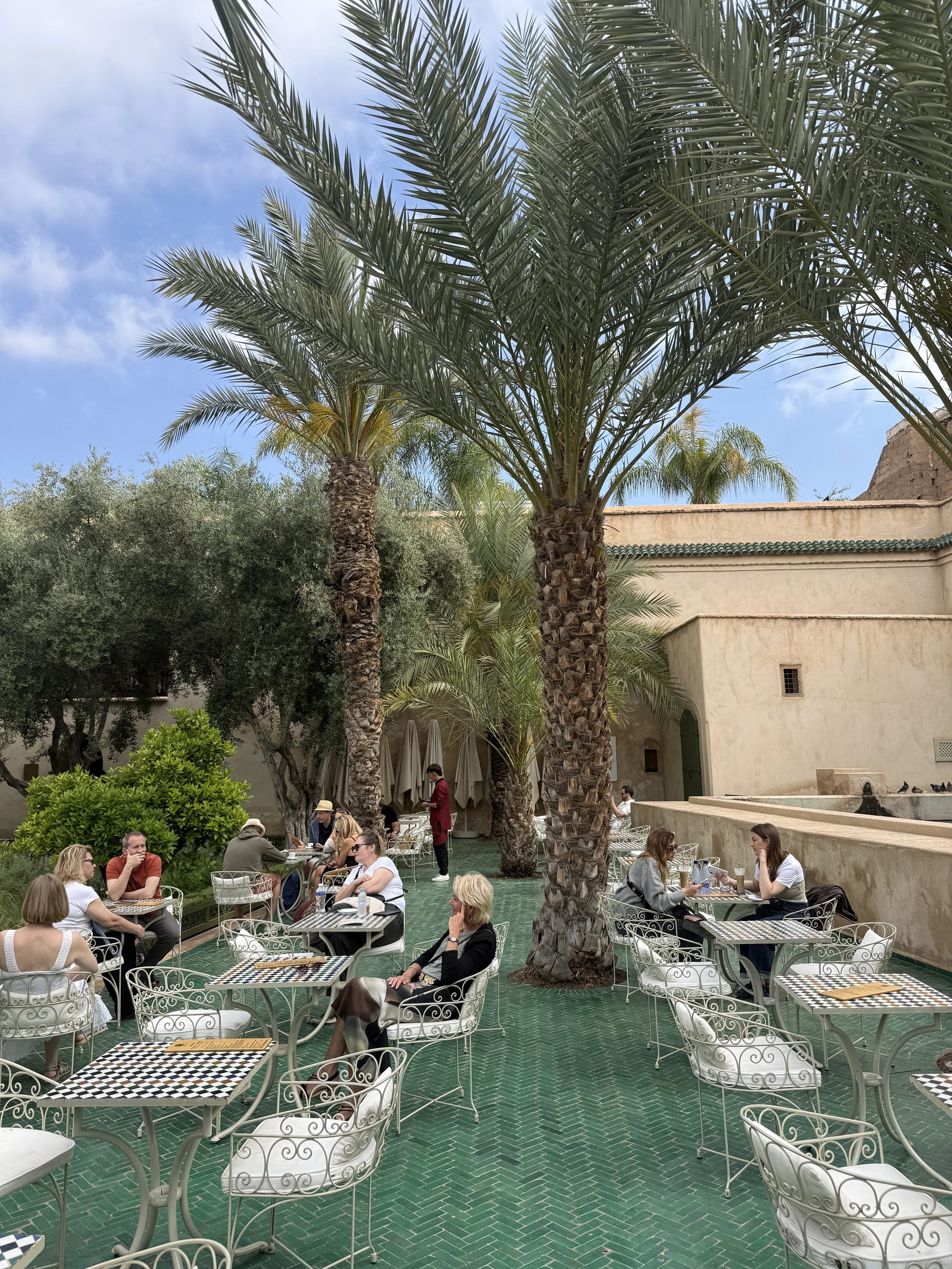
Should you find yourself peckish or parched, there’s a rooftop café atop the pavilion where you can stop for a Moroccan mint tea or something to eat while taking in views over the gardens and Habiqa Pavilion. We passed, though, since it was early in the day and we hadn’t yet worked up an appetite after breakfast at our riad, Rosemary.
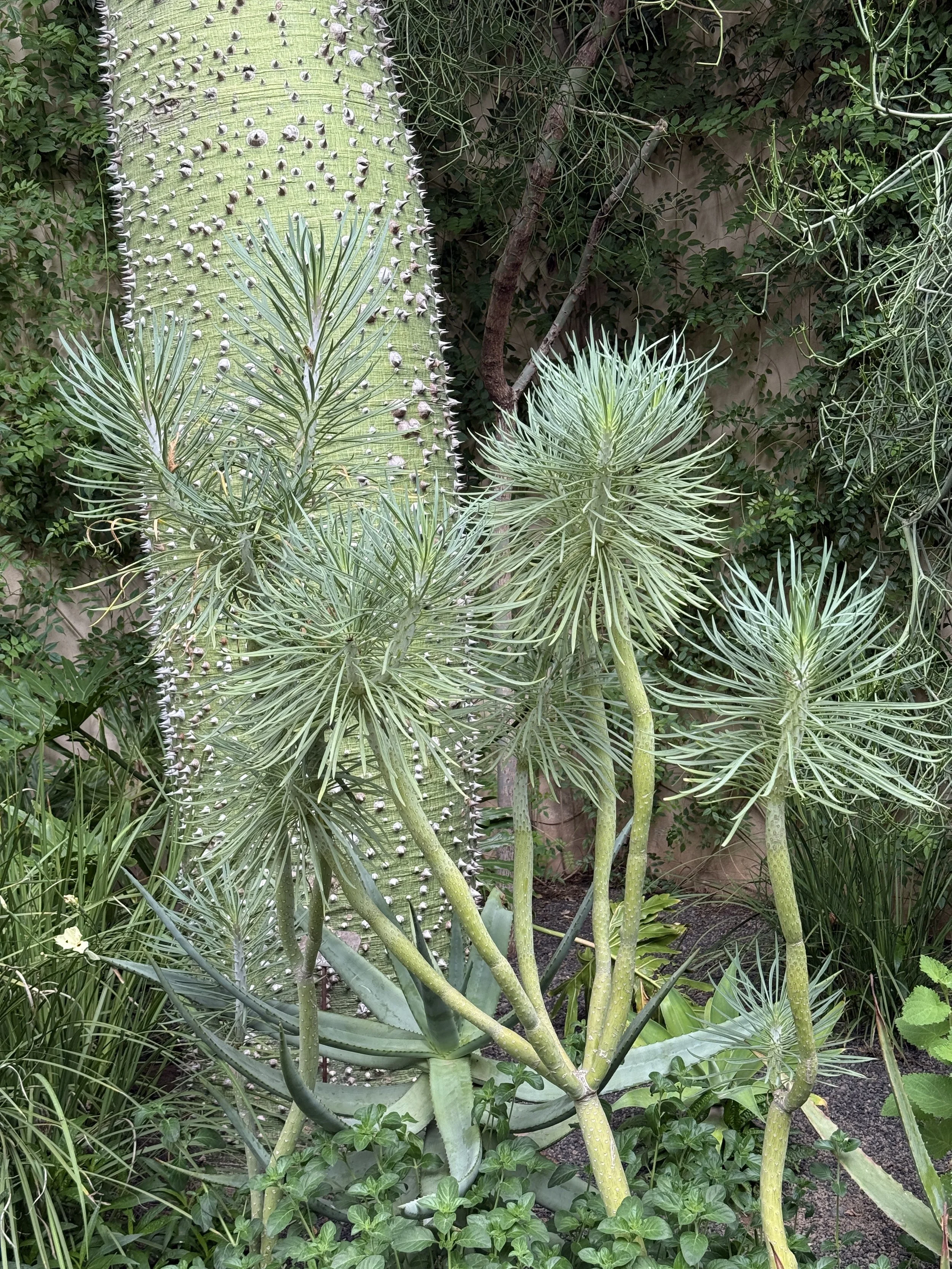
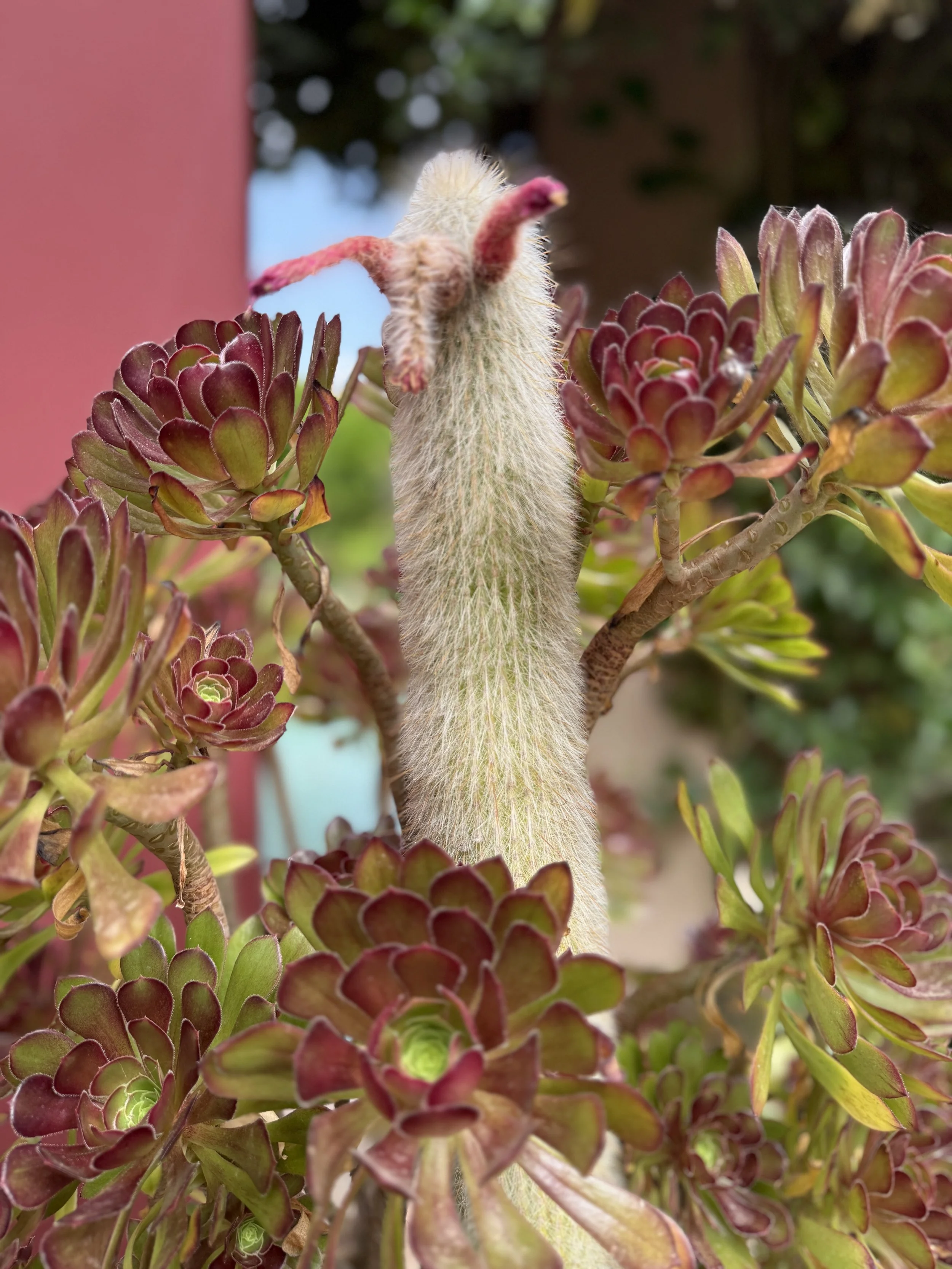
While it may not rival the grandeur of the Majorelle Garden, Le Jardin Secret has a charm all its own. Tucked away in the ancient medina, its intimate courtyards and gardens offer a welcome break from the energy of the city.
Like most of Marrakech’s popular attractions, it can get busy, so we recommend arriving early or later in the day, when it’s less crowded and you can enjoy it at a more leisurely pace. –Duke